See whether Helium helps you make better-informed decisions. Try every Pro Trader feature for 30 days. No credit card required.
Try every Pro Trader feature for 30 days. No credit card required.
Identity and worldview: The evidence points strongly to The American Conservative (TAC): its executive director Curt Mills is cited soliciting donations while invoking Pat Buchanan's legacy and claiming to be 'the only major conservative magazine' opposing the 'Iran War' and 'reckless globalism'
September 08, 2026 · 0 shares
A conservative fundraising appeal casts 'globalism' and the 'Iran War' as the cause of working-class decline and asks readers to donate to continue the fight.
Automated analysis; not human reviewed. Limitations: The supplied text is a short fundraising appeal with formatting gaps, including some institution names blanked, so the analysis relies on the visible rhetorical content rather than a full reported article. · 15 of 54 available dimensions scored; omitted dimensions are not treated as neutral. · Verified supporting quotes for 15 of 15 scored dimensions.
Claim: The appeal identifies itself as conservative and frames globalism as a threat to economic patriotism.
“is the only major conservative magazine taking a stand against this failed war and its consequences for ordinary Americans.” · exact text match
Why: The publisher explicitly self-identifies as a major conservative magazine while opposing globalism and the war.
Claim: The letter contrasts ordinary working Americans with a 'new class' of globalist elites.
“the immiseration of the American workingman” · exact text match
“A new class came to power that looked on tariffs as xenophobic, on economic patriotism as atavistic and on national sovereignty as an antique idea in the new world order it envisioned.” · exact text match
Why: The rhetoric of worker victimhood versus a ruling new class is a populist frame.
Claim: The article is a value-laden persuasion and solicitation piece rather than an objective report.
“Will you stand with as we carry forward Pat’s legacy of fighting reckless globalism?” · verified after text normalization
“the hollowing out of the American industrial base, the immiseration of the American workingman, and the drift of political attention to faraway lands, where ever more recondite interests demand the use of military force.” · exact text match
Why: Direct solicitation and loaded causal claims make the orientation explicitly subjective.
Claim: The overall tone emphasizes decline and a continuing threat, with only a corrective call to donate.
“the immiseration of the American workingman” · exact text match
“But the Iran War has shown that the globalist project, which so often works in tandem with neoconservativism, is not going down without a fight.” · exact text match
Why: Persistent decline and a resistant globalist project convey pessimism.
Claim: The text primarily prescribes action: donate to continue opposing globalism and the Iran War.
“Can I count on you to help TAC carry forward its mission, championing peace abroad and prosperity at home, with a tax-deductible donation?” · exact text match
Why: The central function of the piece is a donation request.
Claim: The letter opposes military intervention and advocates peace abroad.
“championing peace abroad and prosperity at home” · exact text match
“this failed war and its consequences for ordinary Americans” · exact text match
Why: The war is condemned as failed and peace is promoted, a dovish position.
Claim: The text is openly opinionated and persuasive, not a neutral news report.
“Will you stand with as we carry forward Pat’s legacy of fighting reckless globalism?” · verified after text normalization
Why: The direct rhetorical appeal and labeling of 'reckless globalism' are opinionated.
Claim: The content is centered on a political struggle over foreign policy, tariffs, sovereignty, and class.
“the globalist project, which so often works in tandem with neoconservativism” · exact text match
Why: The framing is explicitly about political movements and ideological conflict.
Claim: Complex postwar economic and foreign-policy developments are reduced to a single cause: globalism.
“the hollowing out of the American industrial base, the immiseration of the American workingman, and the drift of political attention to faraway lands, where ever more recondite interests demand the use of military force. In short, globalism.” · exact text match
Why: The conclusion 'In short, globalism' collapses multiple developments into one label.
Claim: The argument relies on Pat Buchanan's authority rather than evidence or reasoning.
“As was so often the case, Pat had the answer:” · exact text match
Why: Buchanan's authority is invoked as the decisive source for the diagnosis.
Claim: The letter states sweeping causal conclusions with certainty and without supporting evidence.
“In short, globalism.” · exact text match
“But the Iran War has shown that the globalist project, which so often works in tandem with neoconservativism, is not going down without a fight.” · exact text match
Why: The confidence in the causal diagnosis exceeds the support supplied by the text.
Claim: The appeal is structured around an ideological worldview of globalism versus economic patriotism.
“Will you stand with as we carry forward Pat’s legacy of fighting reckless globalism?” · verified after text normalization
Why: The language frames a comprehensive ideological mission rather than a pragmatic argument.
Claim: The appeal is anti-establishment, blaming a 'new class' and globalist project for national decline.
“A new class came to power that looked on tariffs as xenophobic, on economic patriotism as atavistic and on national sovereignty as an antique idea in the new world order it envisioned.” · exact text match
Why: The approvingly quoted new-class framing attacks entrenched elites.
Claim: The letter uses emotionally charged language about endless war and worker immiseration.
“How Long Will the American Worker Pay for Endless War?” · exact text match
“the immiseration of the American workingman” · exact text match
Why: The imagery of endless sacrifice and immiseration carries a negative emotional charge.
Claim: The text is a promotional fundraising pitch seeking donations.
“Can I count on you to help TAC carry forward its mission, championing peace abroad and prosperity at home, with a tax-deductible donation?” · exact text match
Why: The explicit request for a tax-deductible donation makes it promotional.
The supplied text is a short fundraising appeal with formatting gaps, including some institution names blanked, so the analysis relies on the visible rhetorical content rather than a full reported article.
Coverage pattern (topic selection): The Iran War dominates — at least 14 of 55 items are Iran-war updates, analyses, or commentary, including serialized 'Iran War Day' bulletins tracking costs, casualties, and diplomacy
September 19, 2026 · 0 shares
Framing foregrounds likely understated war costs and disputed casualty counts while preserving the Pentagon's denial in its own words.
Automated analysis; not human reviewed. Limitations: The supplied text is truncated and contains formatting artifacts, including an incomplete publisher name and a stray 'The post' before the JSON-like body, limiting full assessment of publication context. · 5 of 55 available dimensions scored; omitted dimensions are not treated as neutral. · Verified supporting quotes for 5 of 5 scored dimensions.
Claim: The report mixes attributed facts with the publisher's own analytical judgment.
“This figure is likely an underestimate, as it doesn’t appear to include the costs of reopening damaged U.S. facilities in the Mideast or fuel expenses.” · exact text match
Why: The surrounding items are attributed reports, but this sentence is an unsourced interpretive judgment about the completeness of CENTCOM's figure.
Claim: The piece includes an explicit editorial assessment rather than confining itself to attributed facts.
“This figure is likely an underestimate, as it doesn’t appear to include the costs of reopening damaged U.S. facilities in the Mideast or fuel expenses.” · exact text match
Why: This is the publisher's own view of the estimate's completeness, even though most of the digest is factual and attributed.
Claim: The content focuses entirely on wartime government actions, military casualties, and regional conflict.
“Iran War Day 204: Pentagon Says War Has Cost at Least $43.6 Billion.” · exact text match
“Secretary of Defense Pete Hegseth has said the reporting is false, calling the Post “worse than Iranian state media.”” · exact text match
Why: The central subject is U.S. war policy, Pentagon casualty reporting, and conflict in the Middle East, making the item explicitly political.
Claim: The article provides specific figures, identifies institutions, and flags source limitations.
“According to CENTCOM, the war has cost $43.6 billion through September 3, with the majority of expenses ($28.1 billion) coming from munitions replacement costs.” · exact text match
“The Post story, citing conversations with multiple unnamed Defense Department officials, suggested that the Pentagon’s Defense Casualty Analysis System (DCAS) is underreporting U.S. deaths (DCAS gives a figure of 18 fatalities).” · exact text match
Why: Credibility is supported by named institutions, concrete numbers, and attribution; it is tempered by reliance on unnamed officials and an unsourced interpretive comment.
Claim: The reporting attributes claims and includes the Pentagon's denial alongside the disputed report.
“Secretary of Defense Pete Hegseth has said the reporting is false, calling the Post “worse than Iranian state media.”” · exact text match
“The Post story, citing conversations with multiple unnamed Defense Department officials, suggested that the Pentagon’s Defense Casualty Analysis System (DCAS) is underreporting U.S. deaths (DCAS gives a figure of 18 fatalities).” · exact text match
Why: Including the official rebuttal and identifying sourcing are observable fairness signals, though the publisher's own unsourced interpretive comment tempers the assessment.
The supplied text is truncated and contains formatting artifacts, including an incomplete publisher name and a stray 'The post' before the JSON-like body, limiting full assessment of publication context.
September 24, 2026 · 0 shares
A daily 'Iran War Day' bulletin frames the U.S.-Iran conflict through a dovish lens, emphasizing failed diplomacy, market turmoil, American bombing, and Trump's 'annihilate' threat.
Automated analysis; not human reviewed. Limitations: The supplied text opens with an apparent scraper artifact and refers in the first line to ending 'the Iraq War' rather than the Iran War, leaving transcription uncertainty. · 3 of 55 available dimensions scored; omitted dimensions are not treated as neutral. · Verified supporting quotes for 3 of 3 scored dimensions.
Claim: The report's framing is pessimistic about diplomacy and market conditions.
“Markets expressed pessimism about a diplomatic breakthrough.” · exact text match
“Lack of Diplomatic Progress Roils Markets” · exact text match
Why: The text explicitly describes market pessimism, and the headline centers on lack of diplomatic progress and market turmoil.
Claim: The bulletin frames the U.S.-Iran conflict as a costly war requiring diplomatic progress, leaning against military escalation.
“Iran War Day 209: Lack of Diplomatic Progress Roils Markets” · exact text match
“Trump gave his speech at the assembly Tuesday, when he threatened to “annihilate” Iran.” · exact text match
Why: The headline treats the absence of diplomacy as causing market turmoil, and the report highlights Trump's annihilation threat and Iranian conditions for reopening the strait.
Claim: The item is a running 'war day' political bulletin focused on presidential threats, diplomacy, and a White House policy action.
“Iran War Day 209: Lack of Diplomatic Progress Roils Markets” · exact text match
“POLITICO reported that the Trump administration is preparing a 90-day export ban on diesel, which has hit record high prices in the past week, to ease short-term supply.” · exact text match
Why: The 'Iran War Day' label and the focus on UN speeches, diplomatic contacts, and an administration export-ban plan make the report explicitly political.
The supplied text opens with an apparent scraper artifact and refers in the first line to ending 'the Iraq War' rather than the Iran War, leaving transcription uncertainty.
September 25, 2026 · 0 shares
Framing is mostly attributed and descriptive, but interpretive language presents delegates' walkouts as evidence of Israel's growing isolation while prominently showcasing Iran's diplomatic overtures.
The June U.S.-Iran memorandum, the November U.S. midterms, and prior Israel-Iran hostilities are referenced as known background rather than explained at length.
Automated analysis; not human reviewed. Limitations: The supplied text appears truncated, with the original publication context and prior 'Iran War Day' installments absent, which may affect framing assessment. · 6 of 55 available dimensions scored; omitted dimensions are not treated as neutral. · Verified supporting quotes for 6 of 6 scored dimensions.
Claim: The reporting is largely attributed but adds an interpretive characterization of the walkout.
“dozens of delegates walked out in protest, highlighting Israel's growing isolation on the international stage” · verified after text normalization
Why: The phrase 'highlighting Israel's growing isolation' imposes an editorial interpretation on the reported walkout.
Claim: Reporting is descriptive rather than prescriptive, relaying statements and events without recommending action.
“Iran's President Masoud Pezeshkian told reporters at the General Assembly that the Islamic Republic wants the United States to return to a framework peace deal before the midterm elections in November.” · verified after text normalization
“Meanwhile, Iran's Foreign Minister Abbas Aragchi told media outlets that Tehran had delivered a proposal for reopening the Strait of Hormuz, reviving nuclear talks, and ending hostilities.” · verified after text normalization
Why: The report mostly relays officials' statements and reported events without issuing demands or recommendations, skewing descriptive.
Claim: The report's selection and framing emphasize diplomatic overtures and Israeli isolation, giving the story a dovish tilt.
“Tehran had delivered a proposal for reopening the Strait of Hormuz, reviving nuclear talks, and ending hostilities.” · exact text match
“wants the United States to return to a framework peace deal before the midterm elections in November.” · exact text match
Why: Iran's peace proposals are prominently featured as the main diplomatic development, while Israel's actions are framed through protest and provoking quotes.
Claim: Commentary is minimal but present in interpretive and evaluative wording.
“highlighting Israel's growing isolation on the international stage” · verified after text normalization
“sets an ambitious timeline of seven days” · exact text match
Why: Most statements are attributed or factual, but 'growing isolation' and 'ambitious' express editorial evaluation rather than neutral description.
Claim: The report is heavily political, centered on international diplomacy, war, and election timing.
“Israel's Prime Minister Benjamin Netanyahu gave a speech Thursday at the UN General Assembly defending his nation's military campaigns across the Middle East, including in Iran and Gaza.” · verified after text normalization
“wants the United States to return to a framework peace deal before the midterm elections in November.” · exact text match
Why: The substance is exclusively political: UN speeches, walkouts, state proposals, military meetings, and an election deadline.
Claim: Visible sourcing is fairly strong: named officials, specific dates, and external outlet attributions appear throughout.
“Al Jazeera reported Friday.” · exact text match
“In a Fox News interview that aired Thursday, Pezeshkian said he had met in person for seven hours with Supreme Leader Mojtaba Khamenei about a month ago.” · exact text match
Why: The report names officials and cites specific outlets, but some details—such as the number of walkouts and Khamenei speculation—are not independently sourced.
The supplied text appears truncated, with the original publication context and prior 'Iran War Day' installments absent, which may affect framing assessment.
September 27, 2026 · 0 shares
The daily 'Iran War' briefing frames the U.S.-Iran standoff as an ongoing conflict through a day-count label, with the substance delivered in attributed, plain news style.
The U.S. and Iran have been in a period of elevated confrontation involving military incidents in the Persian Gulf and indirect diplomacy; Qatar has served as a mediator, and the Strait of Hormuz is a critical oil-shipping chokepoint.
Automated analysis; not human reviewed. Limitations: The text conflicts on whether the ceasefire rejection occurred Saturday (subhead) or Friday (body) and lacks calendar dates for the day count, creating temporal ambiguity. · 4 of 55 available dimensions scored; omitted dimensions are not treated as neutral. · Verified supporting quotes for 4 of 4 scored dimensions.
Claim: The briefing is predominantly straight reporting with attributed statements, but it imposes a subjective 'war' label on the conflict.
“The IRGC Navy claimed Sunday to have captured another American underwater drone in the strait.” · exact text match
Counterevidence:
“Iran War Day 212: Trump Says Negotiations to Continue This Week.” · exact text match
Why: Most content is sourced and attributed, but the running 'Iran War Day' label is a framing choice rather than a neutral descriptor.
Claim: The briefing describes statements, claims, and prices without offering recommendations or prescriptions.
“AAA reported a national average price of $4.98 per gallon of regular gas and $6.47 per gallon of diesel.” · exact text match
Why: It relays developments through quotes and data and contains no imperative or policy advocacy.
Claim: The briefing is fact-styled; the only opinions present are attributed to named speakers.
“Axios said Gulf sources confirmed that talks through Qatari mediators were ongoing.” · exact text match
Why: Statements are attributed to sources and the outlet offers no unsourced editorial opinion.
Claim: The briefing shows visible sourcing and labels a military assertion as a claim, but an internal date inconsistency lowers confidence.
“Iran’s Foreign Minister Abbas Araghchi told reporters Sunday at the UN General Assembly in New York that Iran’s conditions for opening the Strait of Hormuz have not changed.” · exact text match
Counterevidence:
“The president said Saturday that he had rejected a one-week ceasefire proposal.” · exact text match
Why: It identifies speakers and media sources, but the Saturday/Friday conflict in the subhead and body undercuts reliability.
The text conflicts on whether the ceasefire rejection occurred Saturday (subhead) or Friday (body) and lacks calendar dates for the day count, creating temporal ambiguity.
September 29, 2026 · 0 shares
Conflict-forward, attributed reporting frames the U.S.–Iran standoff around Tehran's pending ceasefire response and regional threat warnings, with no overt editorializing.
Automated analysis; not human reviewed. Limitations: The supplied text mixes article body with headlines and a donation appeal, and includes an apparent unit error in the gasoline price (“per barrel”), so some segmentation and factual boundaries are ambiguous. · 2 of 55 available dimensions scored; omitted dimensions are not treated as neutral. · Verified supporting quotes for 2 of 2 scored dimensions.
Claim: The report is inherently political, presenting state-level diplomacy, presidential statements, and conflict warnings as its primary subject.
“Iran’s Foreign Minister Abbas Araghchi said Tuesday the Islamic Republic is waiting for a formal U.S. response to an Iranian ceasefire plan proposed last week.” · exact text match
Why: The lead item concerns foreign-minister diplomacy, followed by a presidential denial, a prime ministerial warning, and war-related market data; no non-political focus offsets this.
Claim: Sourcing and attribution are visible for most key claims, supporting moderate credibility.
“according to the United Kingdom Maritime Trade Operations” · exact text match
Counterevidence:
“The average price of gasoline in America was $4.46 per barrel” · exact text match
Why: Named officials and a named monitoring body are cited, but the gasoline price is given as “per barrel,” an apparent unit error, and the author bio’s outlet name is blank.
The supplied text mixes article body with headlines and a donation appeal, and includes an apparent unit error in the gasoline price (“per barrel”), so some segmentation and factual boundaries are ambiguous.
October 02, 2026 · 0 shares
Framing presents the improved Hormuz oil-flow data as provisional and treats market skepticism as justified, building the analysis around speculative scenarios rather than a settled conclusion.
The piece is an opinion column written during an ongoing U.S.-Iranian conflict; it presupposes knowledge of the Strait of Hormuz as a critical oil chokepoint, U.S. congressional midterm elections, and earlier events such as the June MOU and Operation Project Freedom.
Automated analysis; not human reviewed. Limitations: The supplied text contains formatting gaps and the publisher's name is missing; I could not independently verify the cited figures or events. · 8 of 55 available dimensions scored; omitted dimensions are not treated as neutral. · Verified supporting quotes for 8 of 8 scored dimensions.
Claim: The piece is written as first-person analysis rather than neutral reporting.
“As I have written previously, I think this is unlikely to be a productive paradigm for them.” · exact text match
Why: The author uses first-person judgment and explicitly speculative explanations, making the framing subjective commentary.
Claim: The article's framing is cautiously pessimistic about the durability of the flow recovery.
“A week of good flows does not erase six months of supply disruption.” · exact text match
“Spiking the football on the opening of the Hormuz seems, at this point, a little premature.” · exact text match
Counterevidence:
“The headline news is good for a change” · exact text match
Why: The article acknowledges good news but repeatedly emphasizes unresolved risks and the premature nature of celebration.
Claim: The text is an opinion/analysis column with first-person judgments.
“As I have written previously, I think this is unlikely to be a productive paradigm for them.” · exact text match
Why: The use of first-person opinion and evaluative speculation marks the piece as strongly opinionated.
Claim: The article frames the oil-flow story through U.S.-Iranian political and electoral strategy.
“there is a broadly held belief in Tehran that midterms are a useful political opportunity to maximize the administration’s embarrassment.” · exact text match
Why: The article places the oil-flow question inside a political-military context involving Iranian hardliners, U.S. military operations, and U.S. elections.
Claim: The article provides specific quantitative data and named attribution but no external sourcing for its key claims.
“As of Monday, a seven-day average of 13.5 million barrels of crude oil were transiting the waterway, roughly matching pre-war levels.” · exact text match
“Trita Parsi has been a cogent proponent of this line of speculation.” · exact text match
Why: The article uses a concrete figure and names a source for one speculative thesis, but it does not link or independently support major claims.
Claim: The article's stance is explicitly hedged and multi-causal.
“Some skepticism is warranted.” · exact text match
“There are a variety of possible answers.” · exact text match
Why: The analysis presents multiple possible explanations and repeatedly defers conclusions, indicating measured, non-overconfident reasoning.
Claim: The article offers explicitly speculative scenarios about Iran's intentions.
“A third possible answer, compatible with the first but less with the second, is that the Iranians are waiting for an opportune time to escalate.” · exact text match
Why: The article labels its explanations as possible answers and explicitly advances speculative scenarios.
Claim: The article integrates multiple interacting factors and distinguishes short-term flows from structural damage.
“The physical supply disruptions—the severe damage to refineries, pipelines, and other infrastructure—will persist in the near to middle term even as the backlog works its way through the strait.” · exact text match
Why: The analysis separates immediate transit data from persistent infrastructure damage and considers multiple causal hypotheses.
The supplied text contains formatting gaps and the publisher's name is missing; I could not independently verify the cited figures or events.
September 29, 2026 · 0 shares
The framing casts the Iran War as an avoidable, Trump-caused debacle and treats conservative commentators who downplay its political cost as dishonest apologists.
Automated analysis; not human reviewed. Limitations: The supplied text is an excerpt with ellipses, so some context and exact wording are missing. · 10 of 55 available dimensions scored; omitted dimensions are not treated as neutral. · Verified supporting quotes for 10 of 10 scored dimensions.
Claim: The article frames the Iran War and Trump's presidency from a left-leaning, anti-Republican perspective.
“Shapiro, ever the neoconservative” · exact text match
“dumb and deadly war” · exact text match
“warmonger” · exact text match
Why: Partisan labels and contemptuous characterizations of the war and its conservative defenders signal a strongly liberal viewpoint.
Claim: The article appeals to ordinary Americans against conservative media figures.
“Americans no longer buy the war narratives.” · exact text match
“Virtually every sentient adult understands that” · exact text match
Why: It positions the public's view as common sense against pundits like Shapiro and Levin.
Claim: The article is heavily opinionated and evaluative rather than detached.
“dumb and deadly war” · exact text match
“grotesque to find silver linings in this dumb and deadly war” · exact text match
Why: It uses pejorative and emotive language to characterize the war and its defenders.
Claim: The article opposes the Iran War and criticizes proponents as warmongers.
“dumb and deadly war” · exact text match
“unnecessary war” · exact text match
“warmonger” · exact text match
Why: It condemns military action against Iran and blames Trump for starting it.
Claim: The article is a strongly opinioned political commentary.
“Shapiro’s political analysis is plainly motivated by the fact that he was a loud and influential proponent of the war” · exact text match
“No one would claim that the Iran War has been a political godsend” · exact text match
Why: It asserts motives and counterfactuals rather than confining itself to reportage.
Claim: The article is overtly political, focusing on partisan electoral consequences.
“it’s a good bet they’ll do much worse” · exact text match
“Republican candidates in this year’s election” · exact text match
Why: It assesses the war's effect on Trump and Republican electoral prospects.
Claim: The article asserts causal relationships and public sentiment with more certainty than the cited evidence supports.
“Anyone who has been reading the official economic reports knows the war is responsible for more than a third of recent inflation.” · exact text match
“Virtually every sentient adult understands that” · exact text match
Why: It presents contested claims as incontrovertible common knowledge.
Claim: The article is suffused with negative emotional language.
“dumb and deadly war” · exact text match
“dastardly antiwar conservatives” · exact text match
Why: The word choices convey contempt and anger rather than neutral analysis.
Claim: The article makes explicit forecasts and counterfactual claims.
“It seems likely that Trump, if he hadn’t started his dumb war” · exact text match
“it’s a good bet they’ll do much worse” · exact text match
Why: It predicts electoral outcomes and speculates on an alternative policy path.
Claim: The article uses loaded language and ad hominem framing to steer the reader.
“Shapiro’s political analysis is plainly motivated by the fact that he was a loud and influential proponent of the war” · exact text match
“dastardly antiwar conservatives” · exact text match
Why: It attributes bad faith to opponents and uses emotionally charged labels.
The supplied text is an excerpt with ellipses, so some context and exact wording are missing.
September 22, 2026 · 0 shares
Frames Trump's Iran action as a reckless 'caper' that historical knowledge would have prevented and mocks his real-estate background by saying war is harder than real estate.
Automated analysis; not human reviewed. Limitations: Only a two-sentence headline-like teaser was available; no body text or further context to verify the referent of 'Iran Caper'. · 9 of 55 available dimensions scored; omitted dimensions are not treated as neutral. · Verified supporting quotes for 9 of 9 scored dimensions.
Claim: The framing is left-leaning in its anti-Trump, anti-war depiction.
“A Little History Would Have Stopped Trump's Iran Caper” · exact text match
“War is harder than the real estate game, even in New York.” · exact text match
Why: The word 'caper' belittles Trump's decision and the real-estate crack mocks him, a framing more common to left/liberal commentary than to centrist or conservative outlets.
Claim: The text is a subjective opinion rather than objective reporting.
“War is harder than the real estate game, even in New York.” · exact text match
Why: The statement is an evaluative analogy, not a verifiable factual claim.
Claim: The text prescribes what should have happened rather than describing what did.
“A Little History Would Have Stopped Trump's Iran Caper” · exact text match
Why: The phrase 'would have stopped' is a counterfactual prescription about a preferred alternative outcome.
Claim: The text opposes military action by treating war as a serious, difficult undertaking.
“War is harder than the real estate game, even in New York.” · exact text match
Why: Comparing war unfavorably to real estate and warning of its difficulty implies dovish, anti-interventionist framing.
Claim: The text is heavily opinionated.
“A Little History Would Have Stopped Trump's Iran Caper” · exact text match
“War is harder than the real estate game, even in New York.” · exact text match
Why: Both clauses express the author's judgment and mockery, not neutral information.
Claim: The text is political commentary about a presidential decision.
“Trump's Iran Caper” · exact text match
Why: The topic is a presidential foreign-policy action and the phrasing takes a partisan position on it.
Claim: The text reduces a complex geopolitical event to a lack of historical reading.
“A Little History Would Have Stopped” · exact text match
Why: The phrase implies one simple cause—ignorance of history—for a decision that likely involved many factors.
Claim: The text states a counterfactual with certainty it cannot support.
“A Little History Would Have Stopped Trump's Iran Caper” · exact text match
Why: The assertion that 'would have stopped' the action is a definitive claim about an unverifiable alternative history.
Claim: The text engages in counterfactual speculation.
“A Little History Would Have Stopped Trump's Iran Caper” · exact text match
Why: The 'would have' construction speculates about a different historical outcome without presenting evidence.
Only a two-sentence headline-like teaser was available; no body text or further context to verify the referent of 'Iran Caper'.
September 26, 2026 · 0 shares
A strongly opinionated antiwar analysis condemns Trump's UN threats and Zelensky's Russia warnings as false or manipulative while treating Pezeshkian's diplomatic message as credible and important.
The cited January raid in Venezuela and June bombing of Iran occurred before these UN General Assembly speeches; the JCPOA is the 2015 Iran nuclear deal from which the U.S. withdrew.
Automated analysis; not human reviewed. Limitations: The supplied text is an opinionated editorial analysis without a neutral counterpoint; verifying its cited casualty, intelligence, and shipping statistics would require external records. · 6 of 55 available dimensions scored; omitted dimensions are not treated as neutral. · Verified supporting quotes for 6 of 6 scored dimensions.
Claim: The commentary is consistently hostile to Trump's national-security actions and favorable to Iran's diplomatic stance, indicating a left/antiwar political slant.
“He defended the theft of Venezuelan oil with the boast that "to the victor belong the spoils."” · verified after text normalization
“Perhaps the most important thing about the speech is that Pezeshkian stressed Iran was prepared for a return to negotiations” · exact text match
Why: The first quote condemns U.S. policy as theft, while the second elevates Iran's diplomatic message as the most important takeaway, both markers of a left/antiwar framing.
Claim: The text uses evaluative judgments and rhetorical labels rather than neutral description.
“Both claims are dubious.” · exact text match
“Trump’s speech, however ridiculous, was not funny. It was horrifying.” · exact text match
Why: Terms like 'dubious,' 'ridiculous,' and 'horrifying' express the author's judgments rather than detached reporting.
Claim: The commentary strongly condemns military threats and presents diplomacy and negotiation as the favored alternative.
“He stood in front of the world’s foremost international organization and threatened to "annihilate the Islamic Republic of Iran and do it quickly" and "drive them into hell with no chance of survival and no hope of future greatness or generations."” · verified after text normalization
“Perhaps the most important thing about the speech is that Pezeshkian stressed Iran was prepared for a return to negotiations” · exact text match
Why: The threats are framed as horrifying, while Pezeshkian's openness to negotiations is presented as the most important element, reflecting a dovish orientation.
Claim: The text advances the author's own judgments as interpretations of the speeches.
“Both claims are dubious.” · exact text match
Why: The author directly dismisses claims as dubious, an explicit opinion rather than a factual finding.
Claim: The piece is highly political and characterizes opponents' messages as manipulative public-relations efforts.
“Following the failure of a PR campaign to convince the world that Ukraine has turned the tide, the new campaign to keep Europe on board is reaching a crescendo with warnings that Russia is planning a conventional attack.” · verified after text normalization
Why: Zelensky's warning is framed as a 'PR campaign,' placing the analysis in partisan political territory rather than neutral security reporting.
Claim: The text shows moderate credibility by citing named officials, agencies, and assessments, though its selective one-sided use lowers trustworthiness.
“The 2022 U.S. Department of Defense Nuclear Posture Review concluded that "Iran does not today possess a nuclear weapon and we currently believe it is not pursuing one."” · verified after text normalization
Why: Named documentary sources and verbatim quotes support specific claims, but the surrounding text is an opinionated selection rather than balanced reporting.
The supplied text is an opinionated editorial analysis without a neutral counterpoint; verifying its cited casualty, intelligence, and shipping statistics would require external records.
September 12, 2026 · 0 shares
A conservative constitutionalist analysis frames the Iran War commission proposal as a politically attractive step toward restoring congressional war powers.
Automated analysis; not human reviewed. Limitations: The supplied text is an excerpt with the publication name blanked out, so publisher-level context and any surrounding corrections or disclosures are unavailable. · 12 of 54 available dimensions scored; omitted dimensions are not treated as neutral. · Verified supporting quotes for 12 of 12 scored dimensions.
Claim: The article is framed from a conservative perspective critical of executive war powers.
“A basic conservative contention is that this has not been a very good arrangement—it has resulted in a lot of rather stupid military adventures with the concomitant expense—and that the quasi-imperial order supported by executive war powers has engendered a variety of undesirable distortions in the American body politic.” · exact text match
Why: The author explicitly labels the view as a basic conservative contention and grounds it in constitutionalist criticism of the executive.
Claim: The article opposes expansive executive war powers and the standing army, favoring constitutional checks.
“It is unlikely at this late date that there will be much impetus to draw down or disband the (illegal, unconstitutional) standing army, thus returning war to the constituent management column for the politicos.” · exact text match
Why: Calling the standing army illegal and unconstitutional and criticizing the quasi-imperial order signals a libertarian-leaning aversion to concentrated state power.
Claim: The article is opinion-driven and uses evaluative language.
“a lot of rather stupid military adventures with the concomitant expense” · exact text match
“their conspicuously uncourageous stand at its outbreak” · exact text match
Why: Phrases such as 'stupid military adventures' and 'uncourageous stand' express the author's judgment rather than neutral reporting.
Claim: The article expresses cautious optimism about constitutional revival.
“One can imagine, possibly for the first time in American political history, a return to constitutional government becoming a winner on the stump and at the ballot box.” · exact text match
Why: The closing is hopeful but hedged, supporting a mild optimistic score.
Claim: The article prescribes changes to political incentives and urges Congress to act.
“so the obvious solution is to change them” · exact text match
“Congress will in fact have to follow through” · exact text match
Why: The text moves from diagnosis to explicit prescription about what should be done.
Claim: The article is dovish, criticizing military adventures and favoring restraint.
“a lot of rather stupid military adventures with the concomitant expense” · exact text match
“the quasi-imperial order supported by executive war powers” · exact text match
Why: Criticism of military adventures and the quasi-imperial order reflects opposition to aggressive military action.
Claim: The article is strongly opinionated.
“A basic conservative contention is that this has not been a very good arrangement” · exact text match
“their conspicuously uncourageous stand at its outbreak” · exact text match
Why: The author identifies a partisan 'contention' and negatively characterizes Republican lawmakers' position.
Claim: The article is heavily political, focusing on partisan incentives and electoral prospects.
“Democrats (who may well be in a position to call the shots on Capitol Hill in a few months) will be able to clobber their pet horribles in the administration, and Republicans with reservations about the war will be able to put a little retrospective distance between themselves and their conspicuously uncourageous stand at its outbreak.” · exact text match
Why: The assessment is expressly framed around Democratic and Republican political advantage.
Claim: The article advances a constitutionalist-conservative ideology.
“A basic conservative contention is that this has not been a very good arrangement” · exact text match
“The Framers had good reason to entrust war powers to the legislature.” · exact text match
Why: It invokes conservative identity and the Framers' authority to support a normative constitutional vision.
Claim: The article shows moderate credibility through named attribution and acknowledged limits.
“Tess Bridgeman and Ryan Goodman’s call for an Iran War commission in Just Security” · exact text match
“Such an endeavor isn’t a silver bullet.” · exact text match
Why: It names the proposal's authors and source and includes caveats, supporting a moderate credibility rating for an opinion piece.
Claim: The argument is incentive-based and historical rather than emotional.
“The fundamental problem is one of incentives—there is no political incentive for Congress to pick up its war powers—so the obvious solution is to change them.” · exact text match
Why: The central explanation relies on incentives and institutional causes, indicating a rational mode of argument.
Claim: The article speculates about possible political momentum from a commission.
“One can imagine, possibly for the first time in American political history, a return to constitutional government becoming a winner on the stump and at the ballot box.” · exact text match
Why: This is an explicitly speculative forecast about future electoral and constitutional outcomes.
The supplied text is an excerpt with the publication name blanked out, so publisher-level context and any surrounding corrections or disclosures are unavailable.
Framing sides with the AfD, casts its state-election victory as exposing Germany's CDU as a fake conservative party, and calls the result good and necessary.
Saxony-Anhalt is one of Germany's 16 states, and its state parliament elects the minister-president. Germany's federal parliamentary system generally requires coalition governments. The CDU has been Germany's traditional center-right party, and other parties have refused to govern with the AfD.
Automated analysis; not human reviewed. Limitations: Single opinion essay from an explicitly ideological perspective; no independent data or opposing quotes are provided, so verification of statistical and causal claims is limited. · 14 of 54 available dimensions scored; omitted dimensions are not treated as neutral. · Verified supporting quotes for 9 of 14 scored dimensions.
Claim: The text is strongly conservative, praising the AfD as the only party connected to authentic conservative values and condemning the CDU as no longer conservative.
“Of all Germany’s political parties, only the Alternative for Germany (AfD) has connected with those deeply held values.” · exact text match
Why: The framing explicitly celebrates a hard-right party and attacks the mainstream center-right party from a conservative standpoint.
Claim: The text is strongly populist, dividing authentic ordinary people from out-of-touch elites in Berlin and Brussels.
“They believe, with good reason, that elites in Berlin and Brussels are out of touch with their cultural values.” · exact text match
Why: The commentary consistently frames politics as a struggle between grassroots conservative voters and a detached ruling class.
Claim: The text leans libertarian in opposing nanny-state regulation and advocating homeschooling, though it also favors strong immigration control.
“German families and small businesses are inundated with rules governing how they heat their homes, drive their vehicles, and conduct countless other daily activities.” · exact text match
“the AfD campaigned for the right of Saxony-Anhalters to homeschool their children.” · exact text match
Why: Criticism of regulatory overreach and support for homeschooling signal libertarian-leaning positions, but the text's nationalist immigration stance prevents a strongly libertarian score.
Claim: The text is highly subjective, presenting interpretive and normative claims as established facts.
“The true explanation for the AfD’s rise is much simpler: Germany stopped having an authentically conservative party...” · not found in supplied text
“This is a good and necessary development for Germany, and ultimately for Europe.” · exact text match
Why: The piece openly evaluates, praises, and prescribes rather than neutrally reporting.
Claim: The text is optimistic about the AfD's rise, calling it a good and necessary development despite predicting elite resistance.
“This is a good and necessary development for Germany, and ultimately for Europe.” · exact text match
Why: The commentary frames the electoral result and its likely consequences in positive terms.
Claim: The text is heavily prescriptive, arguing how German conservatism and government should change.
“This is a good and necessary development for Germany, and ultimately for Europe.” · exact text match
Why: The commentary evaluates outcomes as good or necessary rather than merely describing them.
Claim: The text is highly opinionated, blending commentary with advocacy for the AfD.
“Unsurprisingly, Merz’s “conservative-socialist” coalition has produced dysfunctional national leadership.” · exact text match
Why: Loaded language and direct judgments mark this as a persuasive opinion piece rather than a news report.
Claim: The text is deeply political, analyzing an election and urging support for a particular political movement.
“The German left skillfully marched through the institutions and captured them...” · not found in supplied text
Why: The central subject is an election and the perceived ideological battle over Germany's political direction.
Claim: The text reduces a complex electoral outcome to a single cause: the CDU stopped being authentically conservative.
“The true explanation for the AfD’s rise is much simpler: Germany stopped having an authentically conservative party...” · not found in supplied text
Why: The commentary dismisses alternative explanations and presents one ideological cause as the complete answer.
Claim: The text frames conservatives and the AfD as victims of a hostile press and left-wing institutions.
“Germany’s publicly funded media outlets—much more powerful than public broadcasting and NPR in the United States—have long waged a propaganda war against conservatives in general and the AfD in particular.” · exact text match
Why: The commentary presents conservatives and the AfD as targets of institutional hostility and propaganda.
Claim: The text expresses certainty beyond what can be established from an election result, especially about future political developments.
“What is certain is that a hostile press will give no quarter to an AfD government...” · not found in supplied text
Why: The commentary asserts certainty about future media behavior and about the 'true explanation' for the AfD's success.
Claim: The text explicitly frames the election as an ideological fight over values rather than practical governance.
“what the elites overlook is that this is an ideological fight—in Saxony-Anhalt and ultimately in Berlin—that has less to do with competence than with values.” · exact text match
Why: The article openly prioritizes ideology and values in interpreting the political situation.
Claim: The text is strongly anti-establishment, attacking Berlin's ruling classes, the CDU, and political institutions.
“Instead of setting a new course for Germany, Berlin’s ruling classes have doubled down...” · not found in supplied text
“a fundamentally anti-democratic system with more flaws than its framers, fearful of Germany’s Weimar history, ever contemplated.” · exact text match
Why: The commentary repeatedly criticizes established political actors and institutional arrangements.
Claim: The text speculates about possible coalition outcomes and future consequences.
“Another possibility is that some CDU deputies break with their party and back an AfD state government.” · exact text match
Why: The commentary offers explicit hypotheticals about coalition building and future political developments.
Single opinion essay from an explicitly ideological perspective; no independent data or opposing quotes are provided, so verification of statistical and causal claims is limited.
September 09, 2026 · 0 shares
The framing treats AfD's electoral result as a triumphant event for an authentic European right and gives a party insider the platform to interpret it.
Automated analysis; not human reviewed. Limitations: Only a brief podcast promotion was available; no substantive policy detail, so many dimensions are omitted. · 6 of 54 available dimensions scored; omitted dimensions are not treated as neutral. · Verified supporting quotes for 6 of 6 scored dimensions.
Claim: The publisher frames AfD's election victory approvingly as authentic right-wing politics.
“Germany’s Real Right Rocks Europe” · exact text match
“about the party's recent election victory” · exact text match
Why: The headline explicitly celebrates a right-wing party as the 'Real Right' rocking Europe, and the description centers AfD's victory as the topic.
Claim: The headline uses evaluative language to characterize the event rather than neutral description.
“Germany’s Real Right Rocks Europe” · exact text match
Why: 'Real Right' asserts authenticity and 'Rocks' is qualitative and approving, making the framing subjective.
Claim: The phrase 'Rocks Europe' sensationalizes the electoral result as a dramatic continental event.
“Germany’s Real Right Rocks Europe” · exact text match
Why: 'Rocks' is hyperbolic, attention-oriented language for a political outcome.
Claim: The title expresses an opinion that AfD is both authentic and impactful.
“Germany’s Real Right Rocks Europe” · exact text match
Why: Calling a party the 'real right' and saying it 'rocks' Europe is an opinionated characterization.
Claim: The post is overtly political, centering on a party's election victory and European political implications.
“about the party's recent election victory and the implications for European politics” · exact text match
Why: The topic is explicitly electoral and political, and the framing is partisan-positive.
Claim: The wording carries a positive emotional charge toward AfD's result.
“Germany’s Real Right Rocks Europe” · exact text match
Why: 'Rocks' conveys enthusiasm and positive evaluation rather than neutral reporting.
Only a brief podcast promotion was available; no substantive policy detail, so many dimensions are omitted.
September 11, 2026 · 0 shares
Frames criticism of right-wing parties like the AfD as liberal hysteria and presents German establishment opposition as undemocratic suppression of voter will.
Automated analysis; not human reviewed. Limitations: The article text is incomplete, but the provided portion clearly indicates a conservative opinion piece. · 14 of 54 available dimensions scored; omitted dimensions are not treated as neutral. · Verified supporting quotes for 10 of 14 scored dimensions.
Claim: The text adopts a conservative stance by defending the AfD and attacking liberal critics.
“To the dismay of liberals across the Western world, all the scary talk about the return of Nazism doesn’t intimidate voters nearly as much as it used to—even, gasp, in Germany.” · exact text match
Why: The dismissive tone toward 'liberals' and the characterization of Nazi comparisons as 'scary talk' signals conservative framing.
Claim: The text pits the democratic will of the people against a corrupt establishment.
“More and more, the Berlin establishment appears to be thwarting the democratic will of the German people, not protecting the constitution from “extremists.”” · exact text match
“the refusal by politicians like Merz to stop it—that has fueled the backlash against liberalism.” · exact text match
Why: The contrast between 'Berlin establishment' and 'democratic will' is a classic populist frame.
Claim: The text criticizes state surveillance and coercion against the AfD, showing a libertarian lean.
“That designation, which remains under legal review, enables the agency to surveil the party’s communications and even dispatch informants to spy on its meetings.” · exact text match
Why: Describing surveillance as 'spy on its meetings' implies disapproval of state power.
Claim: The text is heavily opinionated and uses rhetorical devices to persuade.
“Maybe so, but as the shepherd boy learned when a wolf really did attack his flock, at some point the villagers stop believing you.” · exact text match
“Whenever any right-wing politician or party challenges liberal pieties, just evoke the mustached psychopath who tried to conquer Europe and voilà, the rising challenger will soon crash into a hard ceiling of support.” · exact text match
Why: Analogies and sarcastic exclamations indicate subjective commentary rather than neutral reporting.
Claim: The text uses heightened language and dramatic comparisons to evoke emotion.
“all the scary talk about the return of Nazism” · exact text match
“voilà, the rising challenger will soon crash into a hard ceiling of support.” · exact text match
Why: Words like 'scary' and 'voilà' heighten drama beyond factual description.
Claim: The text makes value judgments about what should happen rather than merely describing.
“There’s just one problem. […] More and more, the Berlin establishment appears to be thwarting the democratic will of the German people, not protecting the constitution from “extremists.”” · not found in supplied text
Why: The phrase 'just one problem' and 'thwarting democratic will' prescribe a normative view.
Claim: The text is almost entirely opinionated commentary rather than factual reporting.
“Maybe so, but as the shepherd boy learned when a wolf really did attack his flock, at some point the villagers stop believing you.” · exact text match
“That’s certainly true of conservative […] Whenever any right-wing politician or party challenges liberal pieties” · not found in supplied text
Why: The use of parables and direct evaluations of 'liberal pieties' demonstrates opinionated writing.
Claim: The text is fundamentally about partisan political conflicts and takes sides.
“From a right-wing perspective, of course, AfD is the […]” · not found in supplied text
“More and more, the Berlin establishment appears to be thwarting the democratic will of the German people” · exact text match
Why: The text explicitly aligns with a 'right-wing perspective' and criticizes the establishment.
Claim: The text reduces complex political dynamics to a simple confrontation between elites and the people.
“To my knowledge, Norwegians and Czechs haven’t been ramming their cars into revelers at Christmas markets in formerly quaint German towns.” · exact text match
Why: This sentence simplifies the causes of migration backlash into a single comparison.
Claim: The text frames the AfD and its voters as victims of unfair establishment attacks.
“the refusal by politicians like Merz to stop it—that has fueled the backlash against liberalism.” · exact text match
“More and more, the Berlin establishment appears to be thwarting the democratic will of the German people” · exact text match
Why: The language portrays the establishment as obstructing legitimate political expression.
Claim: The text is driven by a consistent ideological perspective that interprets events through a right-wing lens.
“From a right-wing perspective, of course, AfD is the […]” · not found in supplied text
“Conservative voters never fully bought into the idea that their historic nations don’t or shouldn’t exist” · exact text match
Why: The text explicitly adopts a 'right-wing perspective' and advances a nationalist worldview.
Claim: The text is anti-establishment, criticizing the ruling class and liberal hegemony.
“To the dismay of liberals across the Western world, all the scary talk about the return of Nazism doesn’t intimidate voters nearly as much as it used to” · exact text match
“the ruling class in Germany remains loath to acknowledge” · exact text match
Why: References to 'liberals' and 'ruling class' position the text against entrenched elites.
Claim: The text uses sarcasm and negative emotional cues toward the establishment.
“even, gasp, in Germany.” · exact text match
Why: The sarcastic 'gasp' conveys derision and emotional charge.
Claim: The text uses loaded language and asymmetric framing to steer the reader's judgment.
“Whenever any right-wing politician or party challenges liberal pieties, just evoke the mustached psychopath” · exact text match
“the refusal by politicians like Merz to stop it—that has fueled the backlash against liberalism.” · exact text match
Why: Calling liberal beliefs 'pieties' and repeating 'liberal pieties' is a loaded term, while 'the refusal... fueled backlash' assigns blame without nuance.
The article text is incomplete, but the provided portion clearly indicates a conservative opinion piece.
September 22, 2026 · 0 shares
Framing treats Germany's CDU-led government as dysfunctional and the AfD as a legitimate popular force, while dismissing mainstream-liberal reaction as hysteria and elite attempts to vilify the AfD.
A commentary on Germany's CDU/AfD dynamics after state elections, Merz's polling problems, and economic/cultural anxieties.
Automated analysis; not human reviewed. Limitations: The supplied article text begins mid-sentence and is heavily truncated with ellipses, so some context and exact quotes are incomplete; I relied only on the visible excerpts. · 4 of 55 available dimensions scored; omitted dimensions are not treated as neutral. · Verified supporting quotes for 0 of 4 scored dimensions.
The supplied article text begins mid-sentence and is heavily truncated with ellipses, so some context and exact quotes are incomplete; I relied only on the visible excerpts.
An opinion essay by a former Zelensky spokesperson argues that Ukraine should accept a bad peace, framing resilience rhetoric and Western-backed escalation as producing broken bodies, corruption, and fiscal ruin.
Russia launched a full-scale invasion of Ukraine in February 2022; Ukraine has relied on Western military and financial aid and has faced manpower shortages leading to forced mobilization.
Automated analysis; not human reviewed. Limitations: The supplied text is a single opinion essay with a clear policy position; the poll, economic statistics, and quoted posts cannot be independently verified from the article text alone. · 12 of 55 available dimensions scored; omitted dimensions are not treated as neutral. · Verified supporting quotes for 12 of 12 scored dimensions.
Claim: The article takes a populist tone, elevating ordinary Ukrainians over elite voices.
“ordinary Ukrainians of limited means often see evasion and resistance as signs of dignity and honor.” · exact text match
Why: It contrasts the values of ordinary Ukrainians with 'supposedly pro-Ukraine Western voices' and elites.
Claim: The article is skeptical of state coercion, particularly forced mobilization.
“Mobilization centers have become synonymous with torture, unexplained conscript deaths, and rampant corruption.” · exact text match
Why: It presents compulsory mobilization as abusive and corrupt, favoring individual resistance to the draft.
Claim: The article is subjective, built around a value-laden argument rather than neutral reporting.
“Ukraine has reached the point where the only victory worth believing in requires accepting a bad peace rather than sustaining or escalating a horrific war.” · exact text match
Why: It asserts what 'the only victory worth believing in' is, a moral and political judgment.
Claim: The article is pessimistic about Ukraine's current war trajectory.
“the present course—with flagrant corruption, fiscal crisis, escalating Russian strikes, and a worn-out, demoralized population—probably leads to Ukraine losing not just the war, but its independence and its future.” · exact text match
Why: It forecasts catastrophic consequences if current policy continues.
Claim: The article prescribes a course of action: accept a bad peace.
“the case for such a peace is hard to ignore.” · exact text match
Why: It urges acceptance of territorial-compromise peace as the only realistic path, pushing a policy conclusion.
Claim: The article is strongly dovish, favoring compromise peace over military escalation.
“Many now say Kiev should become more open to a compromise peace to prevent injuries and gruesome wounds that would haunt Ukraine’s children for the rest of their lives.” · exact text match
Why: It endorses a negotiated settlement and describes ongoing war as producing intolerable suffering.
Claim: The article's own framing is heavily opinionated, explicitly advocating a compromise peace.
“It is time to talk about victory in the Russia–Ukraine War.” · exact text match
Why: The opening sentence is a call to redefine the debate, and the essay concludes with a prescriptive judgment about what victory requires.
Claim: The article is deeply engaged in a political battle over war policy and leadership in Ukraine.
“Zelensky is part of the first group. He promises “revenge” after every attack” · exact text match
Why: It assigns political actors, including Zelensky, to opposing camps and explicitly frames a political battle over victory narratives.
Claim: The article is anti-establishment, criticizing Western aid, arms makers, and political elites.
“Western countries pouring aid into a war of attrition, year after year, has become good business for the arms makers and for politicians controlling public budgets.” · exact text match
Why: It frames established actors and institutions as benefiting from the war at Ukraine's expense.
Claim: The article uses emotionally loaded language to elicit sympathy and alarm.
“Outside the world of political sloganeering, “unbreakability” produces broken bodies and a maimed generation.” · exact text match
Why: The language 'broken bodies and a maimed generation' is emotive and frames the issue in visceral terms.
Claim: The article shows moderate credibility through named sourcing and specific data, though it remains opinionated.
“a poll conducted by Kyiv International Institute of Sociology—a private organization perceived to be friendly to Ukraine’s leadership—found that 61 percent of Ukrainians would support a comprehensive peace deal that included territorial compromises.” · exact text match
Why: It attributes a specific statistic to a named organization and acknowledges the organization's perceived bias, but other claims are unverified.
Claim: The article contains speculative forecasts about Ukraine's future.
“As a cold winter approaches, a humanitarian disaster looms.” · exact text match
Why: It predicts a looming disaster and later forecasts loss of independence, going beyond established fact.
The supplied text is a single opinion essay with a clear policy position; the poll, economic statistics, and quoted posts cannot be independently verified from the article text alone.
September 16, 2026 · 0 shares
Framing characterizes Zelensky's leadership as repressive and erratic while signaling Western support is fracturing.
Automated analysis; not human reviewed. Limitations: The supplied text is truncated with bracketed ellipses and includes only a portion of the original article, which may omit relevant context or continuity. · 9 of 54 available dimensions scored; omitted dimensions are not treated as neutral. · Verified supporting quotes for 8 of 9 scored dimensions.
Claim: The publisher emphasizes and unrefutedly presents claims that Zelensky's actions constitute unconstitutional state overreach.
“My case is one of many in which people have been unconstitutionally sanctioned” · exact text match
“why did Zelensky not only “fire” Kravchenko but make such a show of it?” · exact text match
Why: The publisher includes Mendel's assertion of unconstitutionality without rebuttal and questions the president's motives, reflecting a concern about abuse of state power.
Claim: The publisher blends factual reporting with explicit editorial commentary.
“To make matters worse, Ukraine faces an […] $27 billion shortfall” · not found in supplied text
“Such strikes seem intended to force Russia’s President Vladimir Putin into an energy ceasefire before the winter” · exact text match
Why: In addition to reporting events, the publisher uses editorial phrases and conjectures about intentions.
Claim: The publisher's framing emphasizes deterioration and unfavorable outcomes.
“Western support for Ukraine shows signs of cracking” · exact text match
“Anything Ukraine can do, Russia can do better.” · exact text match
Why: The selected evidence highlights fracturing support and military futility.
Claim: The publisher uses informal, judgmental language typical of opinion journalism.
“crapulence” · exact text match
“make such a show of it” · exact text match
Why: The text evaluates events with emotionally charged and sarcastic terms.
Claim: The report focuses exclusively on political power struggles, government policy, and international relations.
“It’s the political tumult inside Zelensky’s government that’s grabbing attention this week.” · exact text match
“Meanwhile, Western support for Ukraine shows signs of cracking.” · exact text match
Why: The primary subject is political conflict and foreign policy, with no non-political facets discussed.
Claim: The publisher attributes a complex fiscal crisis to a single structural factor.
“the problem is structural: The war is getting only more expensive, even as Russian strikes on seaports deprive Kiev of revenue.” · exact text match
Why: It presents one cause for the $27 billion shortfall without weighing other fiscal factors.
Claim: The publisher relies on vivid, emotion-laden vocabulary.
“we’ve been feeling the crapulence since at least mid-July” · exact text match
“make such a show of it” · exact text match
Why: The word 'crapulence' and the sarcastic 'show of it' carry strong negative emotional freight.
Claim: The publisher provides a degree of attribution but mixes it with strong editorializing.
“the military analyst Jennifer Kavanagh put it on a recent podcast, “Anything Ukraine can do, Russia can do better.”” · exact text match
“Zelensky called it an “absolutely shameful event”” · exact text match
Why: Direct quotes and named sources appear, but the heavy commentary lowers the overall evidentiary credibility.
Claim: The publisher speculates about the strategic intent of Ukrainian strikes.
“Such strikes seem intended to force Russia’s President Vladimir Putin into an energy ceasefire before the winter” · exact text match
Why: The phrase 'seem intended' signals a conjectural claim about enemy intent.
The supplied text is truncated with bracketed ellipses and includes only a portion of the original article, which may omit relevant context or continuity.
October 02, 2026 · 0 shares
Framing treats Zelensky's UNGA warning as deceptive, evidence-free alarmism and a dangerous attempt to keep Europe in the war, while treating officials' denials as dispositive.
In February 2022 Russia launched a full-scale invasion of Ukraine. NATO members Poland, Estonia, Latvia, and Lithuania are covered by Article 5 collective defense; Russia annexed Crimea in 2014, and Ukraine has said it wants to reclaim it.
Automated analysis; not human reviewed. Limitations: The supplied text contains duplicated passages, a truncated sentence, and a blank publication name, which may obscure some context.
The supplied text contains duplicated passages, a truncated sentence, and a blank publication name, which may obscure some context.
September 09, 2026 · 0 shares
Framing is skeptical and derisive toward Reform UK, emphasizing scandal, political weakness, and Farage's personal liabilities while noting his denials.
Automated analysis; not human reviewed. Limitations: Single opinion column; no independent verification of underlying claims was possible. · 9 of 54 available dimensions scored; omitted dimensions are not treated as neutral. · Verified supporting quotes for 8 of 9 scored dimensions.
Claim: The column is consistently negative and dismissive toward Reform UK, a right-wing populist party.
“It is far too early to say that Reform has been beaten, but it may have peaked.” · exact text match
“At present, one suspects that—as Succession’s Logan Roy might have put it—these are not serious people.” · exact text match
Why: The repeated negative evaluations target a right-wing party and its leadership, indicating a left-of-centre framing, though it also reports Farage's denials.
Claim: Uses condescending and elite-coded language about Reform supporters and leadership.
“The 8,000 bright-eyed folk at the Reform conference weren’t discouraged by the financial scandals in which their leaders are enmeshed.” · exact text match
“At present, one suspects that—as Succession’s Logan Roy might have put it—these are not serious people.” · exact text match
Why: The phrases 'bright-eyed folk' and 'not serious people' treat the party and its followers as unsophisticated, an elitist stance.
Claim: The piece is built on the author's evaluative judgments and speculation rather than neutral reporting.
“At present, one suspects that—as Succession’s Logan Roy might have put it—these are not serious people.” · exact text match
Why: The final line is explicitly a subjective suspicion, framed with a fictional reference.
Claim: Uses loaded, dramatic language in presenting political scandals.
“Close aides were surreptitiously filmed doing dodgy business with a reporter posing as a wealthy American donor.” · exact text match
Why: The phrase 'dodgy business' and the 'scandal-rocked' framing heighten drama while still attributing the incident to filming.
Claim: The overall assessment of Reform's and Farage's prospects is pessimistic.
“It is far too early to say that Reform has been beaten, but it may have peaked.” · exact text match
“At present, one suspects that—as Succession’s Logan Roy might have put it—these are not serious people.” · exact text match
Why: The column concludes that Reform may have peaked and that its principals are not serious, a negative outlook on the subject.
Claim: The column is heavily opinionated, with editorial judgments presented as analysis.
“At present, one suspects that—as Succession’s Logan Roy might have put it—these are not serious people.” · exact text match
Why: It gives a direct personal verdict on people's seriousness rather than confining itself to reported facts.
Claim: The column is devoted almost entirely to party politics, policy promises, and election prospects.
“In his address to the conference, Farage promised to call 'a national emergency' if he wins the next general election to ensure that Parliament delivers on four key pledges.” · not found in supplied text
Why: The subject matter and framing are explicitly political, with no non-political dimension.
Claim: The column has moderate credibility: it names sources and uses conditional language, but mixes in unsupported opinion and speculation.
“as the Times of London reported last week” · exact text match
“According to a recent YouGov poll” · exact text match
Counterevidence:
“At present, one suspects that—as Succession’s Logan Roy might have put it—these are not serious people.” · exact text match
Why: Visible attribution and conditionals support credibility, while the subjective closing line and speculative judgments reduce it.
Claim: Contains speculative forecasts about Reform's trajectory and Farage's intentions.
“it is conceivable that this could actually improve Farage’s political prospects” · exact text match
“At present, one suspects that—as Succession’s Logan Roy might have put it—these are not serious people.” · exact text match
Why: The first is an explicit possibility claim, and the second is a stated personal suspicion rather than a report.
Single opinion column; no independent verification of underlying claims was possible.
September 29, 2026 · 0 shares
Royal gossip and a personal anecdote are used to dismiss slavery reparations as victim-cult extortion and to shift blame onto African and Arab sellers.
Automated analysis; not human reviewed. Limitations: The supplied piece is a signed opinion column with no independent reporting, so classifications rely on the column's own rhetorical choices and cannot be externally verified. · 17 of 55 available dimensions scored; omitted dimensions are not treated as neutral. · Verified supporting quotes for 16 of 17 scored dimensions.
Claim: The column frames slavery reparations as an illegitimate 'cult of the victim' and describes Western aid as given by a 'guilty-for-no-reason-whatsoever west.'
“The cult of the victim is their only way to proceed.” · exact text match
“Ghana has been free since the early ’60s and has received billions in aid from a guilty-for-no-reason-whatsoever west.” · exact text match
Why: These are recognizable conservative positions rejecting postcolonial reparation claims and victimhood narratives.
Claim: The writer relies on personal anecdote and private judgment instead of verifiable reporting.
“I met then-Prince Charles once—he asked to meet me, actually, during a Greek royal wedding—and he was rude after I didn’t answer in the way I was expected to.” · exact text match
“I know better.” · exact text match
Why: The text explicitly centers the author's own experience and 'know better' as grounds for belief.
Claim: Loaded, theatrical language frames the story as a clash and shakedown.
“it’s a handbags-at-dawn kind of fight” · exact text match
“preparing a great shakedown.” · exact text match
Why: Words like 'handbags-at-dawn' and 'great shakedown' dramatize rather than neutrally describe.
Claim: The overall tone is cynical and bleak about Britain and its former colonies.
“The Commonwealth is a joke, an opportunity for a British royal to travel to a faraway place and listen respectfully while a local sultan insults them.” · exact text match
Why: The description of the Commonwealth as a joke and the royal as insulted is decisively negative.
Claim: The text prescribes who should be sued rather than confining itself to describing facts.
“should really sue the people actually responsible for slavery: The Africans and Arabs” · exact text match
Why: 'Should really sue' is an explicit prescription.
Claim: Reparations are described as 'extort' as if their illegitimacy were already established.
“Yet now they think that they can extort more money for the very few on top.” · exact text match
Why: The word 'extort' presupposes that the demand is illegitimate, which is the point being argued.
Claim: The piece dwells on royal and personal matters, including an alleged pass at a friend's wife.
“his nephew Harry and wife Meghan have been staying with him, and you can guess the rest.” · not found in supplied text
“unsuccessful pass at the jailbird’s wife.” · exact text match
Why: The 'you can guess the rest' and prison-wife anecdote are classic gossip framing.
Claim: The writing is openly opinionated, with the author's judgment dominating.
“I know better.” · exact text match
Why: Direct assertion of personal knowledge over another's allegation is opinionated.
Claim: The column takes sides in a live political controversy over reparations and postcolonial debt.
“The former colonies angling for moola from a broken-down UK should really sue the people actually responsible for slavery” · exact text match
“The cult of the victim is their only way to proceed.” · exact text match
Why: Reparations and victimhood are contested political questions, and the text strongly endorses one side.
Claim: Complex historical causation is compressed into a seller/buyer binary.
“Slavery has been a constant feature of human societies over thousands of years” · exact text match
“without sellers there would have been no Western buyers.” · exact text match
Why: Reduces a multi-century institution to a market transaction and uses that to dismiss legal claims.
Claim: Certainty is expressed far beyond the evidence presented.
“for the life of me I cannot understand how any adult with the minimum of common sense can take all this bull seriously.” · exact text match
Why: The writer declares the claims absurd, but offers no counterevidence beyond assertion and anecdote.
Claim: The text applies a consistent anti-victimhood, anti-reparations ideology.
“The cult of the victim is their only way to proceed.” · exact text match
Why: The phrase 'cult of the victim' is a recognizable ideological trope, not an empirical finding.
Claim: The tone is negative, contemptuous, and dismissive.
“The Commonwealth is a joke” · exact text match
“can take all this bull seriously.” · exact text match
Why: Explicit contempt terms ('joke', 'bull') carry strong negative emotion.
Claim: No independent sourcing or evidence is offered for major claims; personal anecdote is used to discredit an allegation.
“I met then-Prince Charles once” · exact text match
“I know better.” · exact text match
Why: The piece asks readers to trust the author's private encounters and assertions, with no verifiable sources.
Claim: Problems are attributed to collective self-inflicted choices and welfare dependency rather than structural factors.
“The Caribbean islands, starting with Jamaica, have had their own self-inflicted troubles” · exact text match
“one-fifth of the population on welfare.” · exact text match
Why: The text moralizes on self-inflicted troubles and singles out welfare as a national problem, an individualist framing.
Claim: Loaded framing such as 'extort', 'moola', and 'great shakedown' steer the reader's emotional response.
“Yet now they think that they can extort more money” · exact text match
“preparing a great shakedown.” · exact text match
Why: Pejorative vocabulary substitutes for analysis and primes hostility toward the reparations effort.
Claim: Collective blame is assigned to 'Africans and Arabs' for the slave trade.
“The Africans and Arabs who enslaved and sold those poor souls to the highest bidder. They were enthusiastic sellers” · exact text match
Why: The statement generalizes across two broad ethnic/regional groups and treats the whole group as culpable sellers.
The supplied piece is a signed opinion column with no independent reporting, so classifications rely on the column's own rhetorical choices and cannot be externally verified.
September 15, 2026 · 0 shares
Right-populist British-nationalist framing scolds the Trump administration from the right, endorses anti-immigration politics, and declares the victory of Britain’s patriotic right inevitable.
The Falkland Islands, known in Spanish as Islas Malvinas, were the site of a 1982 war between Britain and Argentina and remain the subject of an ongoing sovereignty dispute. The US-UK 'special relationship' is a longstanding term for their alliance.
Automated analysis; not human reviewed. Limitations: The supplied article text is fragmented with omission markers, and the veracity of the reported allegations (including the embassy extraction) cannot be independently confirmed from the text alone. · 9 of 54 available dimensions scored; omitted dimensions are not treated as neutral. · Verified supporting quotes for 5 of 9 scored dimensions.
Claim: The text endorses conservative and right-nationalist political positions while disparaging the political left.
“The British political left, for the most part, do not care about Britain’s overseas territories” · exact text match
“the victory of Britain’s patriotic right is inevitable” · exact text match
Why: The article describes left-wing disinterest in overseas territories pejoratively and celebrates a patriotic-right victory as inevitable, indicating a clear conservative stance.
Claim: The text aligns with anti-establishment, right-populist movements and criticizes the existing political elite.
“Restore Britain has soared to become among the five largest, with more than 130,000 members, in less than a year.” · exact text match
“anti-immigration party Restore Britain has soared” · exact text match
Why: The article frames the rise of an upstart anti-immigration party positively and treats the existing political left as aligned against ordinary patriotic interests, typical right-populist framing.
Claim: The text intermixes factual reporting with overt commentary and subjective judgments.
“This is unacceptable, this is insulting.” · not found in supplied text
“There is no other country whose institutions, language, intelligence services, military traditions, and culture fit so naturally alongside America’s own.” · exact text match
Why: The article editorializes through selected quotes and invokes cultural kinship declaratively, both hallmarks of subjective commentary rather than neutral reporting.
Claim: The text is predominantly opinion content in which the author asserts political judgments.
“the victory of Britain’s patriotic right is inevitable” · exact text match
“This is unacceptable, this is insulting.” · not found in supplied text
Why: Claims about what is 'unacceptable,' 'insulting,' and 'inevitable' are editorial judgments, not neutral reporting.
Claim: The text is overtly political and positions itself in British party politics.
“The political reality in the United States is not.” · exact text match
“Do not irreversibly damage our relationship because of this Labour Government.” · exact text match
Why: The article takes sides in UK political disputes, criticizing the Labour Government and backing parties of the right.
Claim: The text asserts a political outcome as certain without providing supporting evidence.
“the victory of Britain’s patriotic right is inevitable” · exact text match
Why: Declaring a political victory 'inevitable' overstates certainty, a marker of overconfidence.
Claim: The text interprets political events through a nationalist and sovereignty-focused ideological lens.
“The British political left, for the most part, do not care about Britain’s overseas territories” · exact text match
“abandoning the traditional fealty to Israel ... in favor of an unapologetic national self-interest unseen for generations” · not found in supplied text
Why: The article judges political actors by nationalist criteria, praising 'unapologetic national self-interest' and deriding those who oppose it.
Claim: The text uses strong emotional language intended to provoke moral outrage.
“This is unacceptable, this is insulting.” · not found in supplied text
“Absolutely grotesque.” · exact text match
Why: The article amplifies outrage through selected quotes, using extreme adjectives to frame US actions as unacceptable.
Claim: The text contains speculative assertions about future political developments.
“it looks increasingly likely that Britain will once again be governed by a nationalist party” · exact text match
Why: The publisher makes a probabilistic claim about a future party victory without citing polls, indicating speculation as fact.
The supplied article text is fragmented with omission markers, and the veracity of the reported allegations (including the embassy extraction) cannot be independently confirmed from the text alone.
September 13, 2026 · 0 shares
A first-person conservative essay uses a near-wildfire evacuation to frame possessions as burdens and to assert that government policy, not fire, produces destitution.
Automated analysis; not human reviewed. Limitations: The supplied text is a first-person opinion essay, so the factual account cannot be independently verified from the text itself. · 12 of 54 available dimensions scored; omitted dimensions are not treated as neutral. · Verified supporting quotes for 12 of 12 scored dimensions.
Claim: The essay's rhetoric is conservative, attacking the welfare state and distinguishing real refugees from economic migrants.
“for destitution is the wealth of the welfare state” · exact text match
“We reacted like refugees—real ones, I mean, not economic migrants.” · exact text match
Why: The welfare-state aphorism and refugee distinction align with conservative anti-welfare and restrictive-immigration framing.
Claim: The essay is anti-statist, blaming government policy rather than fire for possible destitution.
“only government policy can do that, and in Britain, at least, the government is making a good fist of doing it: for destitution is the wealth of the welfare state.” · exact text match
Why: Framing government policy as the cause of destitution is a libertarian/anti-authority position.
Claim: The account is openly introspective and personal rather than detached reporting.
“I was prey to strange thoughts and emotions.” · exact text match
Why: The sentence centers the author's inner experience as the subject of the essay.
Claim: The essay's view of consumer society and economic contentment is pessimistic.
“Satisfaction with what we have, if it became widespread, would be the end of prosperity, an utter economic disaster.” · exact text match
Why: It presents contentment as leading to economic ruin, a pessimistic framing of modern abundance.
Claim: The essay is moralizing, contrasting modern waste with an older norm of frugality.
“Waste not, want not, said our ancestors not so very long ago. But we say, waste not, impoverish the world.” · exact text match
Why: The juxtaposition carries an implicit prescription about how consumption should be viewed.
Claim: The essay states contested political judgments as established truths.
“for destitution is the wealth of the welfare state” · exact text match
Why: The aphorism presents a contested view of welfare policy as a factual observation.
Claim: The essay is highly political, using a personal reflection to criticize welfare-state politics.
“Paupers, apparatchiks, and nomenklatura: such is the utopia of many politicians.” · exact text match
Why: Soviet-era political terms are used to characterize welfare-state politics, making the political frame explicit.
Claim: The essay compresses complex economic and social relationships into absolute aphorisms.
“Satisfaction with what we have, if it became widespread, would be the end of prosperity, an utter economic disaster.” · exact text match
Why: The statement reduces the economics of demand to one absolute consequence without supporting evidence.
Claim: The essay asserts a cause for the fires with more certainty than the supplied evidence supports.
“almost certainly the work of a fire-setter or of a band of fire-setters” · exact text match
Why: The phrase 'almost certainly' states a firm conclusion about arson without cited evidence.
Claim: The essay is individualist and anti-collectivist, using Soviet-era collectivist imagery to condemn welfare-state politics.
“Paupers, apparatchiks, and nomenklatura: such is the utopia of many politicians.” · exact text match
Why: The term 'nomenklatura' evokes a collectivist ruling class and is used pejoratively.
Claim: The essay shows internal intellectual honesty by acknowledging the limits of the author's perspective.
“I recognize, of course, that my position is not universal.” · exact text match
Why: The explicit qualification is an observable fairness and honesty signal.
Claim: The essay shows intellectual ambition through cultural references and conceptual reflection.
“The anarchist Bakunin said that the destructive urge was also constructive, but we say that disposal of the still-functioning is also productive.” · exact text match
Why: It adapts a 19th-century anarchist aphorism to an argument about consumerism, indicating reflective range.
The supplied text is a first-person opinion essay, so the factual account cannot be independently verified from the text itself.
September 20, 2026 · 0 shares
Framing is conservative and prescriptive: socialism is presented as a repression enabled by ingratitude, while gratitude for market-produced conveniences is offered as the necessary corrective.
Automated analysis; not human reviewed. Limitations: The supplied text is an opinion essay with no external sourcing, so the causal claim connecting ingratitude to socialism and the biographical anecdotes cannot be independently verified from the supplied text. · 8 of 55 available dimensions scored; omitted dimensions are not treated as neutral. · Verified supporting quotes for 8 of 8 scored dimensions.
Claim: The column is conservative-coded, framing socialism as repressive and praising market-produced abundance.
“Ingratitude may revive socialist repression—but at least the political jokes might get better.” · exact text match
“Who would have thought that socialism would have enjoyed a revival after the downfall of the Soviet Union, in the United States of all places?” · exact text match
Why: The title equates socialism with repression, and the essay treats socialism's revival as a troubling departure from the market-based abundance it celebrates.
Claim: The essay is predominantly subjective, built on personal memories, tastes, and opinions rather than reportorial facts.
“But it was in Haiti that I came first to see such grace before a meal as principally psychological in effect.” · exact text match
Why: The frame is first-person reflection and moral anecdote; no objective events are reported.
Claim: The outlook is pessimistic: lessons are never learned and socialism may revive.
“Lessons are never finally learned: They have to be repeated for creatures as weak in the head as Man.” · exact text match
“Ingratitude may revive socialist repression—but at least the political jokes might get better.” · exact text match
Why: The statement about unrepeatable lessons and the threat of socialist revival conveys a negative view of human and political progress, qualified only by ironic humor.
Claim: The essay is prescriptive, urging gratitude and the regular counting of blessings as a necessary mental discipline.
“The call to count one’s blessings is salutary but never fully successful. That is why it has to be made regularly, if mental equilibrium is ever to be reached.” · exact text match
Why: It explicitly recommends a repeated practice of gratitude and implies this should be adopted.
Claim: The piece is an opinion column, advancing an argument rather than reporting.
“And in part, it is because of a lack of gratitude, a kind of existential stance of taking for granted.” · exact text match
Why: The central claim is an interpretive assertion about political psychology with no factual sourcing.
Claim: The essay is strongly political, centered on socialism, dictatorship, and the United States' political direction.
“Who would have thought that socialism would have enjoyed a revival after the downfall of the Soviet Union, in the United States of all places?” · exact text match
Why: The topic and argument are political; the trigger is the perceived revival of socialism.
Claim: The essay is pro-individualist and pro-market, crediting human ingenuity and exchange rather than collective systems for abundance.
“their invention had then to be put into mass production, another triumph of human ingenuity.” · exact text match
“their work that provided the food on the table implied a vast social network that made exchange and abundance possible.” · exact text match
Why: The language celebrates individual innovation and market exchange while treating socialism as a threat, placing the orientation toward individualism.
Claim: The title makes a speculative forecast about the consequences of ingratitude.
“Ingratitude may revive socialist repression—but at least the political jokes might get better.” · exact text match
Why: 'May revive' is an explicit conditional forecast; the article does not provide evidence for the causal mechanism.
The supplied text is an opinion essay with no external sourcing, so the causal claim connecting ingratitude to socialism and the biographical anecdotes cannot be independently verified from the supplied text.
September 12, 2026 · 0 shares
A nostalgic, opinion-led defense of alcohol frames declining youth drinking as a loss of social and psychological benefits despite acknowledged harms.
Automated analysis; not human reviewed. Limitations: The supplied article text is truncated with ellipses, so later context and any source details may be missing. · 5 of 54 available dimensions scored; omitted dimensions are not treated as neutral. · Verified supporting quotes for 5 of 5 scored dimensions.
Claim: The classification rests on first-person memory and counterfactual personal experience rather than external or balanced analysis.
“Perhaps it’s sad to admit that without alcohol I might not have had the confidence—or, quite simply, the occasion—to mix with open-minded strangers and build a social life. But that does not make it untrue.” · exact text match
Why: The statement relies on the author's personal counterfactual and emotional memory, making the framing subjective.
Claim: It moves from describing a trend to instructing parents and advising young people on how to think about drinking.
“But I would advise young people to reflect on what might replace drinking.” · exact text match
“Yes, if your child told you they had no plans to start drinking alcohol, you would have to be an irresponsible parent to protest.” · exact text match
Why: Direct advice and an evaluative judgment about parental responsibility make the text prescriptive.
Claim: The text is organized around personal judgments, preferences, and recommendations, with first-person statements of belief.
“But I don’t think it is irrational or self-indulgent to say that if people stop drinking alcohol, some positive and important things will be lost as well.” · exact text match
“But I would advise young people to reflect on what might replace drinking.” · exact text match
Why: The article repeatedly presents the author's viewpoint and advice rather than neutral description.
Claim: A subjective, partly evaluative claim about alcohol is stated as a plain fact and opposition to a related point is called absurdly dishonest.
“The plain fact is that alcohol is relaxing.” · exact text match
“It would be absurdly dishonest to deny that there will be happy consequences of younger people drinking less.” · exact text match
Why: The wording asserts certainty for claims that are at least partly evaluative or experiential.
Claim: The framing forecasts that teetotalers will later feel they missed out.
“Teetotaling youngsters may find they are missing out on an important part of life.” · exact text match
Why: 'May find' projects a future regret without evidence, making the argument partly speculative.
The supplied article text is truncated with ellipses, so later context and any source details may be missing.
September 08, 2026 · 0 shares
Frames Confederate statue removal as an iconoclastic erasure of Southern memory driven by progressive politics and demographic change.
The commentary responds to Virginia's removal of the last Confederate statues on state-owned land in Richmond and discusses a book by Applebome about the South's economic and demographic revitalization, set against the broader national debate over Confederate monuments.
Automated analysis; not human reviewed. Limitations: The supplied article text is truncated at beginning and end; the analysis is based on an incomplete excerpt and may miss the article's full thesis or context. · 6 of 54 available dimensions scored; omitted dimensions are not treated as neutral. · Verified supporting quotes for 5 of 6 scored dimensions.
Claim: The commentary frames Confederate statue removal as an iconoclastic erasure of Southern memory.
“For the iconoclasm unleashed by 2020’s Great Awokening left no corner of the state untouched, effacing the physical traces of the Confederate States of …” · not found in supplied text
Why: Use of 'Great Awokening' and 'iconoclasm' are loaded terms typical of conservative cultural commentary, portraying the removals as destructive erasure rather than corrective action.
Claim: The commentary is centered on the author's personal memories and subjective reaction.
“At my public elementary school, all sixth-graders took a field trip to Gettysburg” · exact text match
“the reason this news caught me by surprise” · exact text match
Why: The author uses a first-person anecdote and personal reaction as framing devices, indicating a subjective rather than purely factual approach.
Claim: The commentary is explicitly engaged with a politically contentious issue.
“an essentially political animus, one which grew from a national progressivism that was supercharged after the killing of George Floyd” · exact text match
Why: The article discusses Confederate monument removal as a political phenomenon and references partisan political forces, making it highly political.
Claim: The commentary uses emotionally negative language to characterize the South's transformation.
“etherized, subtly rendered pastless, memoryless” · exact text match
“gloomy regionalist” · exact text match
Why: The approving reference to Frady's description and the 'gloomy regionalist' phrase convey a negative emotional evaluation of the cultural change.
Claim: The article attributes key claims and quotes to named sources.
“According to Bacon, there were two factors at play.” · exact text match
“Marshall Frady opined as far back as 1975” · exact text match
Why: The article names sources for its main attributions, but some claims are referenced vaguely and the framing is opinionated, limiting credibility to a moderate level.
Claim: The article speculates that Applebome's thesis may no longer hold.
“That Applebome’s decades-old thesis might need revision was suggested by the reason this news caught me by surprise” · exact text match
Why: The assertion about the thesis needing revision is based on the author's surprise rather than on evidence, making it speculative.
The supplied article text is truncated at beginning and end; the analysis is based on an incomplete excerpt and may miss the article's full thesis or context.
Framing evidence (not just topic choice): Consistent dovish, antiwar framing with 'dumb and deadly war' rhetoric
September 29, 2026 · 0 shares
The framing casts the Iran War as an avoidable, Trump-caused debacle and treats conservative commentators who downplay its political cost as dishonest apologists.
Automated analysis; not human reviewed. Limitations: The supplied text is an excerpt with ellipses, so some context and exact wording are missing. · 10 of 55 available dimensions scored; omitted dimensions are not treated as neutral. · Verified supporting quotes for 10 of 10 scored dimensions.
Claim: The article frames the Iran War and Trump's presidency from a left-leaning, anti-Republican perspective.
“Shapiro, ever the neoconservative” · exact text match
“dumb and deadly war” · exact text match
“warmonger” · exact text match
Why: Partisan labels and contemptuous characterizations of the war and its conservative defenders signal a strongly liberal viewpoint.
Claim: The article appeals to ordinary Americans against conservative media figures.
“Americans no longer buy the war narratives.” · exact text match
“Virtually every sentient adult understands that” · exact text match
Why: It positions the public's view as common sense against pundits like Shapiro and Levin.
Claim: The article is heavily opinionated and evaluative rather than detached.
“dumb and deadly war” · exact text match
“grotesque to find silver linings in this dumb and deadly war” · exact text match
Why: It uses pejorative and emotive language to characterize the war and its defenders.
Claim: The article opposes the Iran War and criticizes proponents as warmongers.
“dumb and deadly war” · exact text match
“unnecessary war” · exact text match
“warmonger” · exact text match
Why: It condemns military action against Iran and blames Trump for starting it.
Claim: The article is a strongly opinioned political commentary.
“Shapiro’s political analysis is plainly motivated by the fact that he was a loud and influential proponent of the war” · exact text match
“No one would claim that the Iran War has been a political godsend” · exact text match
Why: It asserts motives and counterfactuals rather than confining itself to reportage.
Claim: The article is overtly political, focusing on partisan electoral consequences.
“it’s a good bet they’ll do much worse” · exact text match
“Republican candidates in this year’s election” · exact text match
Why: It assesses the war's effect on Trump and Republican electoral prospects.
Claim: The article asserts causal relationships and public sentiment with more certainty than the cited evidence supports.
“Anyone who has been reading the official economic reports knows the war is responsible for more than a third of recent inflation.” · exact text match
“Virtually every sentient adult understands that” · exact text match
Why: It presents contested claims as incontrovertible common knowledge.
Claim: The article is suffused with negative emotional language.
“dumb and deadly war” · exact text match
“dastardly antiwar conservatives” · exact text match
Why: The word choices convey contempt and anger rather than neutral analysis.
Claim: The article makes explicit forecasts and counterfactual claims.
“It seems likely that Trump, if he hadn’t started his dumb war” · exact text match
“it’s a good bet they’ll do much worse” · exact text match
Why: It predicts electoral outcomes and speculates on an alternative policy path.
Claim: The article uses loaded language and ad hominem framing to steer the reader.
“Shapiro’s political analysis is plainly motivated by the fact that he was a loud and influential proponent of the war” · exact text match
“dastardly antiwar conservatives” · exact text match
Why: It attributes bad faith to opponents and uses emotionally charged labels.
The supplied text is an excerpt with ellipses, so some context and exact wording are missing.
September 24, 2026 · 0 shares
A libertarian-edged opinion essay frames Trump as an irresponsible, blame-evading president whose Mideast wars and tariffs have harmed Americans.
Automated analysis; not human reviewed. Limitations: The supplied text is a signed opinion essay; its factual assertions are unsourced and cannot be independently verified from this text alone. · 14 of 55 available dimensions scored; omitted dimensions are not treated as neutral. · Verified supporting quotes for 10 of 14 scored dimensions.
Claim: The piece applies a libertarian, anti-interventionist framework critical of presidential power and trade restrictions.
“A market economy is based on freedom of entry and rigorous competition.” · exact text match
“With the federal government banning low-cost alternatives, domestic producers charge more.” · exact text match
Why: These statements oppose state-imposed trade restrictions and embrace market freedom, core libertarian positions.
Claim: The writing is explicitly opinionated and evaluative rather than neutral reporting.
“They are mistaken, in my view, but reflect traditional if widely disputed policy paths.” · exact text match
“Power he has in abundance, and he has used it in ways that harm Americans.” · exact text match
Why: The author explicitly labels a judgment as his own and uses evaluative language to condemn the president.
Claim: The writing is measured and caveated rather than sensational.
“Although the impact of the war has been cushioned by unexpected mitigating factors, such as China’s reduction in oil imports, the market appears to be coming under increasing pressure.” · exact text match
“Whatever the wisdom of attempting to promote 'infant' American industries or revive enfeebled 'sunset' enterprises, doing so depends on pushing up prices.” · not found in supplied text
Why: The piece includes qualifying details and nuance, avoiding doom-laden or tabloid framing.
Claim: The overall tone is pessimistic about the consequences of current U.S. policies.
“Power he has in abundance, and he has used it in ways that harm Americans.” · exact text match
“Although the impact of the war has been cushioned by unexpected mitigating factors, such as China’s reduction in oil imports, the market appears to be coming under increasing pressure.” · exact text match
Why: The focus is on harm, failure, and increasing market pressure rather than improvement or opportunity.
Claim: The piece prescribes what the president should have done and how he should behave.
“He could have used carefully targeted levies to raise revenue—the federal government is running a $2 trillion annual deficit—and achieve foreign policy objectives.” · not found in supplied text
“Someone styling himself as history’s most consequential person should do better.” · exact text match
Why: Rather than only describing events, the author recommends alternative policies and moral imperatives.
Claim: The piece is strongly anti-war and critical of U.S. military escalation.
“Trump’s core policies—promiscuous warmaking in the Middle East and expansive mercantilist economic practices worldwide—reflect a return to an earlier age.” · exact text match
“He, no less than Joe Biden, is responsible for Washington’s ongoing proxy war against Russia.” · not found in supplied text
Why: It characterizes U.S. military involvement as 'promiscuous warmaking' and a 'proxy war,' indicating dovish, non-interventionist framing.
Claim: The text is a strongly opinionated essay rather than straight news reporting.
“They are mistaken, in my view, but reflect traditional if widely disputed policy paths.” · exact text match
“Someone styling himself as history’s most consequential person should do better.” · exact text match
Why: First-person evaluative language and a moral verdict show explicit opinion.
Claim: The content is overtly political, centered on presidential power, elections, wars, and policy disputes.
“But Trump’s excuses appear increasingly threadbare as he nears the halfway mark of his second term.” · exact text match
“Trump’s core policies—promiscuous warmaking in the Middle East and expansive mercantilist economic practices worldwide—reflect a return to an earlier age.” · exact text match
Why: It evaluates a sitting president’s policies, political standing, and electoral promises.
Claim: The argument is built on a consistent free-market, limited-government ideological lens.
“A market economy is based on freedom of entry and rigorous competition.” · exact text match
“With the federal government banning low-cost alternatives, domestic producers charge more.” · exact text match
Why: These claims treat market competition and the absence of government bans as normative economic principles.
Claim: The evaluative tone is negative toward Trump and his policies.
“But his blunderbuss campaign created malign consequences that he has consistently denied.” · exact text match
“The president’s endlessly repeated denials do not change what Americans pay for essential goods.” · exact text match
Why: Loaded words like 'blunderbuss' and 'denials' convey condemnation and frustration, though the essay remains analytical.
Claim: The text is transparently an opinion piece, but it advances unsourced factual assertions, yielding moderate credibility.
“They are mistaken, in my view, but reflect traditional if widely disputed policy paths.” · exact text match
“There was no evidence that Tehran was pursuing a nuclear weapon when last year Trump ended negotiations and claimed to 'obliterate' its nuclear program.” · not found in supplied text
Why: The author discloses opinion but makes strong factual claims without citation, limiting verifiability.
Claim: The writing reasons through economic and strategic causal mechanisms rather than relying on assertion alone.
“Such levies also raise prices indirectly, by reducing or eliminating alternative products.” · exact text match
“One objective of tariffs is to promote domestic production by blocking cheaper imports.” · exact text match
Why: The author explains how tariffs affect prices through competition and market entry, indicating a rational, cause-effect style.
Claim: The text favors individual market freedom over state-directed economic control.
“A market economy is based on freedom of entry and rigorous competition.” · exact text match
“One objective of tariffs is to promote domestic production by blocking cheaper imports.” · exact text match
Why: It critiques government restriction of market entry and imports, an individualist/free-market stance.
Claim: The piece uses logical economic reasoning and causal explanation.
“With the federal government banning low-cost alternatives, domestic producers charge more.” · exact text match
“The Pentagon had long war-gamed Iran’s closure of the Strait of Hormuz, but Trump seems to have dismissed the possibility of such an action.” · exact text match
Why: It connects policy choices to economic and strategic consequences in a reasoned way.
The supplied text is a signed opinion essay; its factual assertions are unsourced and cannot be independently verified from this text alone.
September 19, 2026 · 0 shares
A libertarian antiwar framing characterizes U.S. national-security media influence as a long record of government propaganda and journalistic collusion, treating the latest Pentagon influencer program as part of that pattern.
Automated analysis; not human reviewed. Limitations: The supplied text is an opinion essay; cited prior reports cannot be independently verified from the text alone. · 14 of 55 available dimensions scored; omitted dimensions are not treated as neutral. · Verified supporting quotes for 14 of 14 scored dimensions.
Claim: The commentary frames the issue as powerful institutions colluding against ordinary news consumers.
“There is a long, ugly history of journalistic collusion with the national security state—especially the Pentagon and the Central Intelligence Agency (CIA).” · exact text match
Why: It presents the problem as collusion among elite institutions at the public's expense.
Claim: The commentary opposes state use of media as inherently coercive propaganda.
“The Trump administration’s new paid influencer initiative brings to social media a long, sleazy track record of government propaganda masquerading as independent information on national security topics.” · exact text match
Why: Describing the program as state propaganda reflects a strong anti-authoritarian, libertarian stance.
Claim: The commentary is subjective, using evaluative language to describe motives and effects.
“Such cynical manipulation and abuses did not end with the Cold War.” · exact text match
Why: Terms like “cynical manipulation and abuses” are value judgments rather than neutral observation.
Claim: The commentary uses dramatic, loaded language to heighten the story.
“Worse than the situation with Morrell were the cases in which supposedly independent commentators (mostly retired military officers) were actively cooperating with and even taking instructions from the Pentagon while appearing as guest experts on news programs or publishing op-eds in major newspapers.” · exact text match
Why: “Worse” and “taking instructions from the Pentagon” dramatize and intensify the accusation.
Claim: The commentary gives a pessimistic assessment of media credibility under government influence.
“Nevertheless, even this latest, diluted version of a paid influencing campaign damages the quality and credibility of the news media’s role regarding important national security issues.” · exact text match
Why: It asserts ongoing damage to media credibility rather than any positive or neutral outlook.
Claim: The commentary treats pushes for weapons systems and Pentagon policy as corrupt, reflecting a dovish orientation.
“Such individuals, for example, pushed for weapons systems that military leaders wanted and made the case for policy initiatives that the Pentagon favored.” · exact text match
Why: The negative framing of military advocacy aligns with a dovish critique of defense establishment influence.
Claim: The piece is highly opinionated, asserting moral judgments about propaganda rather than neutral reporting.
“The Pentagon and CIA have routinely trotted out propagandists posing as analysts.” · exact text match
Why: The title and framing assert a strong evaluative judgment as established fact.
Claim: The commentary centers partisan and administrative political communication and government persuasion.
“In late August, the Washington Post reported the Department of Defense was using paid social media “influencers” to gain public support for the Trump administration’s stances on foreign policy and military reforms.” · exact text match
Why: The subject is government use of media for political persuasion, which is inherently political.
Claim: The commentary is anti-establishment, directing criticism at national security bureaucrats and mainstream media alike.
“Indeed, the presence of former national security bureaucrats masquerading as independent analysts may have expanded.” · exact text match
Why: It portrays national security bureaucrats and media as insiders collaborating against the public interest.
Claim: The commentary carries a negative emotional charge, expressed through moral condemnation.
“The network cynically sought to position Morell as an analyst with exceptional expertise in the intelligence field and no ideological agenda.” · exact text match
Why: “Cynically” conveys strong moral disapproval of CBS's conduct.
Claim: The commentary earns moderate credibility by attributing key claims to named prior reporting.
“A 1977 investigative report in the New York Times noted that a decade earlier, when the agency’s communications empire was at its peak, the CIA used hundreds of news and public information organizations and individuals around the world.” · exact text match
Why: It relies on attributed historical reporting, supporting basic credibility despite being opinionated.
Claim: The commentary treats military-contractor financial ties as a corrupting influence.
“The Times noted that such media commentators “represent more than 150 military contractors either as lobbyists, senior executives, board members or consultants.”” · exact text match
Why: It uses contractor ties as evidence of inherent conflict, presenting military-corporate influence negatively.
Claim: The commentary uses conclusory labels and loaded framing to pre-judge the Pentagon program.
“The Pentagon and CIA have routinely trotted out propagandists posing as analysts.” · exact text match
Why: Calling paid analysts “propagandists posing as analysts” uses loaded framing to pre-judge the issue.
Claim: The commentary displays analytical nuance by distinguishing the current program from worse past practices.
“Indeed, the latest scheme is marginally less insidious than many of its predecessors. At least this time the paid influencers are listed on official records as government employees.” · exact text match
Why: This distinction is a nuanced qualification rather than blanket condemnation.
The supplied text is an opinion essay; cited prior reports cannot be independently verified from the text alone.
September 14, 2026 · 0 shares
A review frames the documentary as a sympathetic but diffuse indictment of post-9/11 U.S. policy, emphasizing executive overreach, endless war, and the Islamophobic turn against Muslim Americans.
Automated analysis; not human reviewed. Limitations: The supplied article text is an excerpt containing ellipses, so the full review's context and qualifications are unavailable. · 8 of 54 available dimensions scored; omitted dimensions are not treated as neutral. · Verified supporting quotes for 8 of 8 scored dimensions.
Claim: The framing adopts a progressive/critical view of post-9/11 U.S. policy and institutions.
“America’s politicians were already seeking revenge and pushing forward narratives about terrorism and security threats that have been used to expand the security” · exact text match
“Bush, whose promise to rid the world of terror created an endless march of death and chaos across the Middle East and beyond.” · exact text match
Why: It attributes post-9/11 policy to revenge and security narratives and describes the resulting war as 'death and chaos,' a critical left-of-center framing.
Claim: Framing is hostile to expanded executive war powers and the security state.
“the slow-burning rot of executive overreach” · exact text match
“The idea was we didn’t want to have a king, we didn’t want to have one person who could just launch the country into war.” · exact text match
Why: It calls executive overreach 'rot' and quotes concern about unilateral presidential war powers, indicating an anti-authoritarian/civil-libertarian lean.
Claim: The text is a subjective reviewer assessment, not neutral reporting.
“his documentary struggles to find its footing while hastily considering a myriad of concerns that fail to amount to a key thesis” · exact text match
“Adding more layers about the Muslim experience and tying the 9/11 attacks into the formation of Immigration and Customs Enforcement (ICE) in the end is too much.” · exact text match
Why: Phrases like 'struggles,' 'fail to amount,' and 'too much' express the reviewer's qualitative judgments.
Claim: Framing is critical of the post-9/11 military response and the war on terror.
“Bush, whose promise to rid the world of terror created an endless march of death and chaos across the Middle East and beyond.” · exact text match
Why: The phrase 'endless march of death and chaos' condemns the resulting military campaign rather than presenting it as necessary or justified.
Claim: The article is strongly opinionated in evaluating the documentary and post-9/11 politics.
“fails precisely because it attempts to cram 25 years of history into a 97-minute runtime” · exact text match
“Adding more layers about the Muslim experience and tying the 9/11 attacks into the formation of Immigration and Customs Enforcement (ICE) in the end is too much.” · exact text match
Why: The categorical 'fails' and subjective 'too much' are opinion claims rather than neutral factual reporting.
Claim: The framing is heavily political, engaging contested issues of war powers, civil liberties, and immigration enforcement.
“the slow-burning rot of executive overreach” · exact text match
“tying the 9/11 attacks into the formation of Immigration and Customs Enforcement (ICE)” · exact text match
Why: Executive overreach and ICE are politically charged institutional topics, and the text presents them as negative consequences.
Claim: Framing is anti-establishment in its treatment of political leaders and national-security institutions.
“America’s politicians were already seeking revenge” · exact text match
“the slow-burning rot of executive overreach” · exact text match
Why: It portrays elected politicians as revenge-seeking and executive institutions as decayed, an anti-establishment stance.
Claim: The language carries a negative emotional charge.
“the haunting specter of one of the gravest days in the history of the United States” · exact text match
“an endless march of death and chaos across the Middle East and beyond.” · exact text match
Why: Words like 'haunting specter' and 'death and chaos' are emotionally loaded negative descriptions, setting a grim tone.
The supplied article text is an excerpt containing ellipses, so the full review's context and qualifications are unavailable.
September 12, 2026 · 0 shares
A conservative constitutionalist analysis frames the Iran War commission proposal as a politically attractive step toward restoring congressional war powers.
Automated analysis; not human reviewed. Limitations: The supplied text is an excerpt with the publication name blanked out, so publisher-level context and any surrounding corrections or disclosures are unavailable. · 12 of 54 available dimensions scored; omitted dimensions are not treated as neutral. · Verified supporting quotes for 12 of 12 scored dimensions.
Claim: The article is framed from a conservative perspective critical of executive war powers.
“A basic conservative contention is that this has not been a very good arrangement—it has resulted in a lot of rather stupid military adventures with the concomitant expense—and that the quasi-imperial order supported by executive war powers has engendered a variety of undesirable distortions in the American body politic.” · exact text match
Why: The author explicitly labels the view as a basic conservative contention and grounds it in constitutionalist criticism of the executive.
Claim: The article opposes expansive executive war powers and the standing army, favoring constitutional checks.
“It is unlikely at this late date that there will be much impetus to draw down or disband the (illegal, unconstitutional) standing army, thus returning war to the constituent management column for the politicos.” · exact text match
Why: Calling the standing army illegal and unconstitutional and criticizing the quasi-imperial order signals a libertarian-leaning aversion to concentrated state power.
Claim: The article is opinion-driven and uses evaluative language.
“a lot of rather stupid military adventures with the concomitant expense” · exact text match
“their conspicuously uncourageous stand at its outbreak” · exact text match
Why: Phrases such as 'stupid military adventures' and 'uncourageous stand' express the author's judgment rather than neutral reporting.
Claim: The article expresses cautious optimism about constitutional revival.
“One can imagine, possibly for the first time in American political history, a return to constitutional government becoming a winner on the stump and at the ballot box.” · exact text match
Why: The closing is hopeful but hedged, supporting a mild optimistic score.
Claim: The article prescribes changes to political incentives and urges Congress to act.
“so the obvious solution is to change them” · exact text match
“Congress will in fact have to follow through” · exact text match
Why: The text moves from diagnosis to explicit prescription about what should be done.
Claim: The article is dovish, criticizing military adventures and favoring restraint.
“a lot of rather stupid military adventures with the concomitant expense” · exact text match
“the quasi-imperial order supported by executive war powers” · exact text match
Why: Criticism of military adventures and the quasi-imperial order reflects opposition to aggressive military action.
Claim: The article is strongly opinionated.
“A basic conservative contention is that this has not been a very good arrangement” · exact text match
“their conspicuously uncourageous stand at its outbreak” · exact text match
Why: The author identifies a partisan 'contention' and negatively characterizes Republican lawmakers' position.
Claim: The article is heavily political, focusing on partisan incentives and electoral prospects.
“Democrats (who may well be in a position to call the shots on Capitol Hill in a few months) will be able to clobber their pet horribles in the administration, and Republicans with reservations about the war will be able to put a little retrospective distance between themselves and their conspicuously uncourageous stand at its outbreak.” · exact text match
Why: The assessment is expressly framed around Democratic and Republican political advantage.
Claim: The article advances a constitutionalist-conservative ideology.
“A basic conservative contention is that this has not been a very good arrangement” · exact text match
“The Framers had good reason to entrust war powers to the legislature.” · exact text match
Why: It invokes conservative identity and the Framers' authority to support a normative constitutional vision.
Claim: The article shows moderate credibility through named attribution and acknowledged limits.
“Tess Bridgeman and Ryan Goodman’s call for an Iran War commission in Just Security” · exact text match
“Such an endeavor isn’t a silver bullet.” · exact text match
Why: It names the proposal's authors and source and includes caveats, supporting a moderate credibility rating for an opinion piece.
Claim: The argument is incentive-based and historical rather than emotional.
“The fundamental problem is one of incentives—there is no political incentive for Congress to pick up its war powers—so the obvious solution is to change them.” · exact text match
Why: The central explanation relies on incentives and institutional causes, indicating a rational mode of argument.
Claim: The article speculates about possible political momentum from a commission.
“One can imagine, possibly for the first time in American political history, a return to constitutional government becoming a winner on the stump and at the ballot box.” · exact text match
Why: This is an explicitly speculative forecast about future electoral and constitutional outcomes.
The supplied text is an excerpt with the publication name blanked out, so publisher-level context and any surrounding corrections or disclosures are unavailable.
September 07, 2026 · 0 shares
Automated analysis; not human reviewed. Limitations: The supplied text is a partial excerpt with many ellipses and truncated quotes, so some argumentative context and exact conclusions are missing. · 9 of 54 available dimensions scored; omitted dimensions are not treated as neutral. · Verified supporting quotes for 8 of 9 scored dimensions.
Claim: The essay treats the conservative movement as its in-group and discusses its internal conflicts sympathetically.
“Christians, who were knit tightly into the fabric of the movement conservative “fusionist” alliance, are reconciling themselves with […]” · not found in supplied text
Why: The language places the essay inside a conservative Christian-inflected identity rather than at neutral distance.
Claim: The essay forecasts futility and suffering from intervention in Iran.
“The Iranian regime will survive, regroup, and rearm, ready for another turn around the dance floor of futile negotiations, in which case the explosions, deaths, and suffering will have been for naught.” · exact text match
Why: This is a negative prediction emphasizing wasted sacrifice.
Claim: The essay prescribes moral limits on using military force.
“Like a person, a country can justifiably be harmed only for what it has in fact done or is actively preparing to do, not for what it merely might do.” · exact text match
Why: This sentence states a normative rule for justified harm.
Claim: The essay opposes hawkish interventionism and frames hawks negatively.
“It’s much more difficult for the hawks to rely on their time-worn justifications for interventionism.” · exact text match
Why: The word “hawks” is used pejoratively and the essay argues their justifications are failing.
Claim: The piece advances an evaluative argument rather than neutral reporting.
“It’s much more difficult for the hawks to rely on their time-worn justifications for interventionism.” · exact text match
Why: This is a judgment about hawks, not an attributed factual claim.
Claim: The essay is centered on political conflict and alignment within the American right.
“Backlash from the right was swift, perhaps because many conservatives understand—consciously or otherwise—how central this moral question is to their political history.” · exact text match
Why: The focus on right-wing backlash and conservative political history makes the piece fundamentally political.
Claim: The argument relies heavily on authoritative Christian and conservative figures.
““As a Christian I take sin seriously,” Graham added” · exact text match
““Our whole attitude in the world, for a year after VE Day, including the use of the atomic bomb at Hiroshima and Nagasaki,” said Taft” · exact text match
Why: Quotations from Billy Graham and Senator Taft are used as support for the moral foreign-policy argument.
Claim: The essay states a definite prediction about future events without hedging.
“The Iranian regime will survive, regroup, and rearm, ready for another turn around the dance floor of futile negotiations, in which case the explosions, deaths, and suffering will have been for naught.” · exact text match
Why: The categorical “will survive” exceeds the support offered in the text.
Claim: The essay grounds historical claims in named sources and attributed quotations, though some generalizations are unsourced.
“Jack Taylor reported in the UK Tribune” · exact text match
“One CIA assessment fretted” · exact text match
Counterevidence:
“The left often downplays how such fears rattled the minds of Americans not yet a decade removed from the first mushroom cloud.” · exact text match
Why: The historical claims are visibly attributed, but the essay also makes broad unsourced characterizations about the left.
The supplied text is a partial excerpt with many ellipses and truncated quotes, so some argumentative context and exact conclusions are missing.
September 29, 2026 · 0 shares
The framing casts the Iran War as an avoidable, Trump-caused debacle and treats conservative commentators who downplay its political cost as dishonest apologists.
Automated analysis; not human reviewed. Limitations: The supplied text is an excerpt with ellipses, so some context and exact wording are missing. · 10 of 55 available dimensions scored; omitted dimensions are not treated as neutral. · Verified supporting quotes for 10 of 10 scored dimensions.
Claim: The article frames the Iran War and Trump's presidency from a left-leaning, anti-Republican perspective.
“Shapiro, ever the neoconservative” · exact text match
“dumb and deadly war” · exact text match
“warmonger” · exact text match
Why: Partisan labels and contemptuous characterizations of the war and its conservative defenders signal a strongly liberal viewpoint.
Claim: The article appeals to ordinary Americans against conservative media figures.
“Americans no longer buy the war narratives.” · exact text match
“Virtually every sentient adult understands that” · exact text match
Why: It positions the public's view as common sense against pundits like Shapiro and Levin.
Claim: The article is heavily opinionated and evaluative rather than detached.
“dumb and deadly war” · exact text match
“grotesque to find silver linings in this dumb and deadly war” · exact text match
Why: It uses pejorative and emotive language to characterize the war and its defenders.
Claim: The article opposes the Iran War and criticizes proponents as warmongers.
“dumb and deadly war” · exact text match
“unnecessary war” · exact text match
“warmonger” · exact text match
Why: It condemns military action against Iran and blames Trump for starting it.
Claim: The article is a strongly opinioned political commentary.
“Shapiro’s political analysis is plainly motivated by the fact that he was a loud and influential proponent of the war” · exact text match
“No one would claim that the Iran War has been a political godsend” · exact text match
Why: It asserts motives and counterfactuals rather than confining itself to reportage.
Claim: The article is overtly political, focusing on partisan electoral consequences.
“it’s a good bet they’ll do much worse” · exact text match
“Republican candidates in this year’s election” · exact text match
Why: It assesses the war's effect on Trump and Republican electoral prospects.
Claim: The article asserts causal relationships and public sentiment with more certainty than the cited evidence supports.
“Anyone who has been reading the official economic reports knows the war is responsible for more than a third of recent inflation.” · exact text match
“Virtually every sentient adult understands that” · exact text match
Why: It presents contested claims as incontrovertible common knowledge.
Claim: The article is suffused with negative emotional language.
“dumb and deadly war” · exact text match
“dastardly antiwar conservatives” · exact text match
Why: The word choices convey contempt and anger rather than neutral analysis.
Claim: The article makes explicit forecasts and counterfactual claims.
“It seems likely that Trump, if he hadn’t started his dumb war” · exact text match
“it’s a good bet they’ll do much worse” · exact text match
Why: It predicts electoral outcomes and speculates on an alternative policy path.
Claim: The article uses loaded language and ad hominem framing to steer the reader.
“Shapiro’s political analysis is plainly motivated by the fact that he was a loud and influential proponent of the war” · exact text match
“dastardly antiwar conservatives” · exact text match
Why: It attributes bad faith to opponents and uses emotionally charged labels.
The supplied text is an excerpt with ellipses, so some context and exact wording are missing.
September 29, 2026 · 0 shares
An antiwar, libertarian-leaning conservative framing praises Massie, condemns the Iran war and neoconservatives, and portrays Trump's Epstein handling as an electoral drag.
Automated analysis; not human reviewed. Limitations: The supplied article text is truncated with editorial ellipses, so some context and claims are incomplete. · 12 of 55 available dimensions scored; omitted dimensions are not treated as neutral. · Verified supporting quotes for 12 of 12 scored dimensions.
Claim: The analysis is framed around Republican electoral success and defends a conservative dissident against Republican critics.
“some jittery conservatives are now saying that if Republicans do poorly in November it will be the fault of dissidents like Massie” · exact text match
“So Massie’s effort was not exactly “grandstanding” but giving voice to real public frustration with current foreign policy.” · exact text match
Why: It takes sides in an intra-conservative debate and measures issues by their effect on Republican prospects.
Claim: Appeals to popular opinion and frustration as the basis for Massie's position.
“giving voice to real public frustration with current foreign policy” · exact text match
“Americans didn’t vote for an endless war when they elected Trump in 2024” · exact text match
Why: The article treats majority public sentiment as the key validator for the antiwar and Epstein-transparency positions.
Claim: Endorses antiwar and transparency positions associated with libertarian limits on government power.
“The congressman’s calls for greater transparency regarding the Epstein files” · exact text match
“Americans didn’t vote for an endless war when they elected Trump in 2024” · exact text match
Why: The piece praises Massie's opposition to endless war and government secrecy, both classic libertarian stances.
Claim: The text is evaluative, using judgmental language and editorial asides.
“Trump didn’t defeat the neocons—he gave them the gift of the war” · exact text match
“That’s not good.” · exact text match
Why: These are subjective interpretations and value judgments, not neutral descriptions.
Claim: The text shifts from describing polls and events to prescribing a political course for Republicans.
“There’s a month remaining to change these policies, but Republicans are determined to go down” · exact text match
“So Massie’s effort was not exactly “grandstanding” but giving voice to real public frustration with current foreign policy.” · exact text match
Why: It tells Republicans they should change course and reframes Massie's dissent as correct.
Claim: Opposes the Iran war and characterizes it as an ongoing failure.
“open-ended war in Iran, an ongoing failure” · exact text match
“Americans didn’t vote for an endless war when they elected Trump in 2024” · exact text match
Why: The war is described as a failure and contrary to what voters chose, a dovish antiwar stance.
Claim: The text is an opinion column with strong, unhedged judgments.
“Trump didn’t defeat the neocons—he gave them the gift of the war” · exact text match
“That’s not good.” · exact text match
Why: It argues its interpretation rather than merely reporting facts.
Claim: The primary frame is Republican electoral politics and the upcoming midterms.
“would Republicans’ prospects be better today if he had acted more like Rep.” · exact text match
“dragging down Republicans in the midterms” · exact text match
Why: The central question is how events affect Republican candidates' electoral prospects.
Claim: Applies a libertarian antiwar ideology to interpret current events.
“What might a more Massiesque timeline have looked like today” · exact text match
“fulfillment of most neoconservatives’ lifelong dream” · exact text match
Why: The counterfactual 'Massiesque timeline' and anti-neocon framing are ideologically driven.
Claim: Contrasts Massie with neoconservatives and the Republican establishment, treating the latter negatively.
“fulfillment of most neoconservatives’ lifelong dream” · exact text match
“jittery conservatives are now saying” · exact text match
Why: The article uses 'neoconservatives' and 'jittery conservatives' as negative markers, positioning against the establishment.
Claim: Uses negative emotional language to characterize Trump, the war, and Republican leaders.
“That’s not good.” · exact text match
“ongoing failure” · exact text match
Why: These phrases convey negative affect and urgency rather than neutral description.
Claim: Engages in counterfactual speculation about how a different Republican approach would have affected the midterms.
“What might a more Massiesque timeline have looked like today, according to polls?” · exact text match
“would Republicans’ prospects be better today if he had acted more like Rep.” · exact text match
Why: The rhetorical questions posit an alternative timeline to argue the current course is politically damaging.
The supplied article text is truncated with editorial ellipses, so some context and claims are incomplete.
September 22, 2026 · 0 shares
A dovish, anti-interventionist framing that treats U.S.-Israeli pressure on Saudi Arabia as self-defeating and urges Washington to pivot to Iran diplomacy.
The Houthis are an Iran-aligned Yemeni movement, and the Abraham Accords are U.S.-brokered normalization deals between Israel and several Arab states; the article assumes this background.
Automated analysis; not human reviewed. Limitations: Supplied text is truncated with ellipses, and portions of the article are unavailable, which limits full-context classification. · 5 of 55 available dimensions scored; omitted dimensions are not treated as neutral. · Verified supporting quotes for 4 of 5 scored dimensions.
Claim: The text renders normative judgments and certainty about other actors’ incentives.
“Trump is right not to join Riyadh’s war against the Houthis, and he was right to stop the U.S. bombing of the Houthis in May 2025—but not because military restraint is a good strategy for forcing Saudi–Israeli normalization.” · exact text match
“MbS has every incentive to avoid being seen as fighting Washington’s and Israel’s war against the Houthis and Iran.” · exact text match
Why: Statements about what is 'right' and about 'every incentive' express the author’s interpretation rather than neutral reporting.
Claim: The text moves from analysis to explicit policy recommendation.
“The next step is to return to the Islamabad Memorandum between the United States and Iran, a framework peace deal that offered a genuine path to peace.” · exact text match
“East can only be built through diplomacy with Iran and supporting the regional architecture that Turkey, Pakistan, and Saudi Arabia (and Oman) are already building, not through forcing Riyadh into the Abraham Accords at the Houthis’ gunpoint.” · exact text match
Why: The phrases 'The next step is' and 'can only be built through diplomacy' issue directives rather than simply describing a situation.
Claim: The text endorses U.S. military restraint and diplomacy with Iran.
“Trump is right not to join Riyadh’s war against the Houthis, and he was right to stop the U.S. bombing of the Houthis in May 2025—but not because military restraint is a good strategy for forcing Saudi–Israeli normalization.” · exact text match
“The next step is to return to the Islamabad Memorandum between the United States and Iran, a framework peace deal that offered a genuine path to peace.” · exact text match
Why: It praises stopping U.S. bombing and prescribes returning to a U.S.-Iran framework rather than escalation.
Claim: The text is strongly opinionated, with unhedged evaluative claims.
“Trump is right not to join Riyadh’s war against the Houthis, and he was right to stop the U.S. bombing of the Houthis in May 2025—but not because military restraint is a good strategy for forcing Saudi–Israeli normalization.” · exact text match
“East can only be built through diplomacy with Iran and supporting the regional architecture that Turkey, Pakistan, and Saudi Arabia (and Oman) are already building, not through forcing Riyadh into the Abraham Accords at the Houthis’ gunpoint.” · exact text match
Why: The text asserts what is right and what 'can only' happen, mixing reporting with advocacy.
Claim: The text takes a side in a charged international political dispute.
“In the neoconservative commentariat, the knives came out—not for Trump, not for the Houthis, but for MbS.” · exact text match
“The neocons can’t realistically expect Riyadh, at the Trump administration’s urging, to pursue close ties with Israel now.” · not found in supplied text
Why: It uses politically loaded labels such as 'neoconservative commentariat' and frames the Saudi-Israel issue as a neoconservative project rather than a neutral policy dispute.
Supplied text is truncated with ellipses, and portions of the article are unavailable, which limits full-context classification.
September 24, 2026 · 0 shares
Pro-Trump analytical framing treats Trump's personal diplomacy and strategic ambiguity on Taiwan as a quiet foreign policy success that is delivering results.
Automated analysis; not human reviewed. Limitations: A signed opinion/analysis essay; claims and quoted figures cannot be independently verified from the available source. · 13 of 55 available dimensions scored; omitted dimensions are not treated as neutral. · Verified supporting quotes for 13 of 13 scored dimensions.
Claim: Framing presents Trump's management of China relations as a successful, disciplined foreign-policy achievement.
“The president is blazing a new path for U.S.–China relations: neither permanent hostility nor fawning submission, but a stable, productive relationship.” · exact text match
“And so far, it seems to be working.” · exact text match
Why: The overall evaluative stance is strongly favorable to Trump's policy and does not criticize conservative or Republican positions.
Claim: The framing is mildly anti-elite, dismissing the foreign-policy commentariat while endorsing Trump's personal style.
“It’s in vogue among the U.S. foreign policy commentariat to dismiss or minimize Trump’s flash, but it seems to work in his favor when it comes to Xi.” · exact text match
Why: The framing positions itself against an expert/commentariat consensus while remaining policy-analytical.
Claim: The content is an opinion/analysis evaluation rather than neutral reporting.
“But Trump’s chances should not be written off.” · exact text match
“And so far, it seems to be working.” · exact text match
Why: The language is explicitly evaluative and advocacy-oriented, not dispassionate.
Claim: The framing is strongly optimistic about the success of Trump's approach.
“And so far, it seems to be working.” · exact text match
“But Trump’s chances should not be written off.” · exact text match
Why: The conclusions are hopeful and confident about continued progress.
Claim: The content takes a centrist position on U.S.-China policy, supporting both engagement and military ambiguity.
“The president is blazing a new path for U.S.–China relations: neither permanent hostility nor fawning submission, but a stable, productive relationship.” · exact text match
Why: It explicitly rejects both dovish submission and hawkish hostility, endorsing strategic ambiguity.
Claim: The content is highly opinionated, with explicit calls not to discount Trump's approach.
“But Trump’s chances should not be written off.” · exact text match
Why: Direct evaluative judgment is the main thrust.
Claim: The content centers on partisan political actors and presidential strategy.
“Trump has drawn several key lessons from his first term, and his pursuit of a more deliberate strategy for managing the U.S.–China relationship has created new opportunities to advance American interests.” · exact text match
Why: The content is organized around a president's political management of foreign policy.
Claim: The framing presents Trump's Taiwan policy as a return to long-standing U.S. orthodoxy.
“rather, it’s a return to long-standing U.S. policy.” · exact text match
“It’s a core feature of decades of successful U.S. policy, and Trump and his team understand it well.” · exact text match
Why: It validates traditional foreign-policy institutions and norms rather than challenging them.
Claim: The writing is credible in its visible sourcing and named authorship.
“According to one Ministry of Public Security (MPS) official, Chinese sellers now must prove that purchases were for legitimate purposes.” · exact text match
“a recent article in Science suggests that U.S.-China cooperation on this issue is explaining part of the decline.” · exact text match
Why: Attributes claims to identifiable institutions and publications, though it remains an opinion essay.
Claim: Reasoning is analytical and hedged rather than emotional.
“While other factors such as public health interventions and the end of the pandemic are likely driving this welcome decline, a recent article in Science suggests that U.S.-China cooperation on this issue is explaining part of the decline.” · exact text match
“We don’t know what he’ll do next, and that’s exactly the point.” · exact text match
Why: It acknowledges multiple causes and uncertainty, showing evidence-based reasoning.
Claim: The analysis relies on scientific and empirical sources rather than superstition.
“the Centers for Disease Control estimated there were 38,000 fatalities.” · exact text match
“a recent article in Science suggests that U.S.-China cooperation on this issue is explaining part of the decline.” · exact text match
Why: Uses CDC estimates and a Science article as evidence, demonstrating an empirical orientation.
Claim: The writing shows internal fairness by acknowledging skeptics and alternative explanations.
“Some foreign policy analysts are skeptical of Trump’s approach.” · exact text match
“While other factors such as public health interventions and the end of the pandemic are likely driving this welcome decline, a recent article in Science suggests that U.S.-China cooperation on this issue is explaining part of the decline.” · exact text match
Why: Countervailing views and non-attributed causes are included rather than suppressed.
Claim: The analysis is nuanced and uses specific, sourced detail.
“While other factors such as public health interventions and the end of the pandemic are likely driving this welcome decline, a recent article in Science suggests that U.S.-China cooperation on this issue is explaining part of the decline.” · exact text match
Why: It integrates precise data, citations, and context into its argument.
A signed opinion/analysis essay; claims and quoted figures cannot be independently verified from the available source.
September 09, 2026 · 0 shares
The framing treats AfD's electoral result as a triumphant event for an authentic European right and gives a party insider the platform to interpret it.
Automated analysis; not human reviewed. Limitations: Only a brief podcast promotion was available; no substantive policy detail, so many dimensions are omitted. · 6 of 54 available dimensions scored; omitted dimensions are not treated as neutral. · Verified supporting quotes for 6 of 6 scored dimensions.
Claim: The publisher frames AfD's election victory approvingly as authentic right-wing politics.
“Germany’s Real Right Rocks Europe” · exact text match
“about the party's recent election victory” · exact text match
Why: The headline explicitly celebrates a right-wing party as the 'Real Right' rocking Europe, and the description centers AfD's victory as the topic.
Claim: The headline uses evaluative language to characterize the event rather than neutral description.
“Germany’s Real Right Rocks Europe” · exact text match
Why: 'Real Right' asserts authenticity and 'Rocks' is qualitative and approving, making the framing subjective.
Claim: The phrase 'Rocks Europe' sensationalizes the electoral result as a dramatic continental event.
“Germany’s Real Right Rocks Europe” · exact text match
Why: 'Rocks' is hyperbolic, attention-oriented language for a political outcome.
Claim: The title expresses an opinion that AfD is both authentic and impactful.
“Germany’s Real Right Rocks Europe” · exact text match
Why: Calling a party the 'real right' and saying it 'rocks' Europe is an opinionated characterization.
Claim: The post is overtly political, centering on a party's election victory and European political implications.
“about the party's recent election victory and the implications for European politics” · exact text match
Why: The topic is explicitly electoral and political, and the framing is partisan-positive.
Claim: The wording carries a positive emotional charge toward AfD's result.
“Germany’s Real Right Rocks Europe” · exact text match
Why: 'Rocks' conveys enthusiasm and positive evaluation rather than neutral reporting.
Only a brief podcast promotion was available; no substantive policy detail, so many dimensions are omitted.
Framing sides with the AfD, casts its state-election victory as exposing Germany's CDU as a fake conservative party, and calls the result good and necessary.
Saxony-Anhalt is one of Germany's 16 states, and its state parliament elects the minister-president. Germany's federal parliamentary system generally requires coalition governments. The CDU has been Germany's traditional center-right party, and other parties have refused to govern with the AfD.
Automated analysis; not human reviewed. Limitations: Single opinion essay from an explicitly ideological perspective; no independent data or opposing quotes are provided, so verification of statistical and causal claims is limited. · 14 of 54 available dimensions scored; omitted dimensions are not treated as neutral. · Verified supporting quotes for 9 of 14 scored dimensions.
Claim: The text is strongly conservative, praising the AfD as the only party connected to authentic conservative values and condemning the CDU as no longer conservative.
“Of all Germany’s political parties, only the Alternative for Germany (AfD) has connected with those deeply held values.” · exact text match
Why: The framing explicitly celebrates a hard-right party and attacks the mainstream center-right party from a conservative standpoint.
Claim: The text is strongly populist, dividing authentic ordinary people from out-of-touch elites in Berlin and Brussels.
“They believe, with good reason, that elites in Berlin and Brussels are out of touch with their cultural values.” · exact text match
Why: The commentary consistently frames politics as a struggle between grassroots conservative voters and a detached ruling class.
Claim: The text leans libertarian in opposing nanny-state regulation and advocating homeschooling, though it also favors strong immigration control.
“German families and small businesses are inundated with rules governing how they heat their homes, drive their vehicles, and conduct countless other daily activities.” · exact text match
“the AfD campaigned for the right of Saxony-Anhalters to homeschool their children.” · exact text match
Why: Criticism of regulatory overreach and support for homeschooling signal libertarian-leaning positions, but the text's nationalist immigration stance prevents a strongly libertarian score.
Claim: The text is highly subjective, presenting interpretive and normative claims as established facts.
“The true explanation for the AfD’s rise is much simpler: Germany stopped having an authentically conservative party...” · not found in supplied text
“This is a good and necessary development for Germany, and ultimately for Europe.” · exact text match
Why: The piece openly evaluates, praises, and prescribes rather than neutrally reporting.
Claim: The text is optimistic about the AfD's rise, calling it a good and necessary development despite predicting elite resistance.
“This is a good and necessary development for Germany, and ultimately for Europe.” · exact text match
Why: The commentary frames the electoral result and its likely consequences in positive terms.
Claim: The text is heavily prescriptive, arguing how German conservatism and government should change.
“This is a good and necessary development for Germany, and ultimately for Europe.” · exact text match
Why: The commentary evaluates outcomes as good or necessary rather than merely describing them.
Claim: The text is highly opinionated, blending commentary with advocacy for the AfD.
“Unsurprisingly, Merz’s “conservative-socialist” coalition has produced dysfunctional national leadership.” · exact text match
Why: Loaded language and direct judgments mark this as a persuasive opinion piece rather than a news report.
Claim: The text is deeply political, analyzing an election and urging support for a particular political movement.
“The German left skillfully marched through the institutions and captured them...” · not found in supplied text
Why: The central subject is an election and the perceived ideological battle over Germany's political direction.
Claim: The text reduces a complex electoral outcome to a single cause: the CDU stopped being authentically conservative.
“The true explanation for the AfD’s rise is much simpler: Germany stopped having an authentically conservative party...” · not found in supplied text
Why: The commentary dismisses alternative explanations and presents one ideological cause as the complete answer.
Claim: The text frames conservatives and the AfD as victims of a hostile press and left-wing institutions.
“Germany’s publicly funded media outlets—much more powerful than public broadcasting and NPR in the United States—have long waged a propaganda war against conservatives in general and the AfD in particular.” · exact text match
Why: The commentary presents conservatives and the AfD as targets of institutional hostility and propaganda.
Claim: The text expresses certainty beyond what can be established from an election result, especially about future political developments.
“What is certain is that a hostile press will give no quarter to an AfD government...” · not found in supplied text
Why: The commentary asserts certainty about future media behavior and about the 'true explanation' for the AfD's success.
Claim: The text explicitly frames the election as an ideological fight over values rather than practical governance.
“what the elites overlook is that this is an ideological fight—in Saxony-Anhalt and ultimately in Berlin—that has less to do with competence than with values.” · exact text match
Why: The article openly prioritizes ideology and values in interpreting the political situation.
Claim: The text is strongly anti-establishment, attacking Berlin's ruling classes, the CDU, and political institutions.
“Instead of setting a new course for Germany, Berlin’s ruling classes have doubled down...” · not found in supplied text
“a fundamentally anti-democratic system with more flaws than its framers, fearful of Germany’s Weimar history, ever contemplated.” · exact text match
Why: The commentary repeatedly criticizes established political actors and institutional arrangements.
Claim: The text speculates about possible coalition outcomes and future consequences.
“Another possibility is that some CDU deputies break with their party and back an AfD state government.” · exact text match
Why: The commentary offers explicit hypotheticals about coalition building and future political developments.
Single opinion essay from an explicitly ideological perspective; no independent data or opposing quotes are provided, so verification of statistical and causal claims is limited.
September 28, 2026 · 0 shares
A former consular officer frames the Trump administration's public charge doctrine restoration as a prudent, historically grounded return to immigrant self-sufficiency, while treating benefit-using immigrants as exploiters through anecdote and loaded language.
Automated analysis; not human reviewed. Limitations: The supplied text is a single opinion essay by a named former consular officer, with no external verification or adversarial sourcing, so the analysis depends on the author's own historical and policy assertions. · 9 of 55 available dimensions scored; omitted dimensions are not treated as neutral. · Verified supporting quotes for 9 of 9 scored dimensions.
Claim: The publisher endorses conservative restrictions on immigrant access to public benefits.
“This reinforces the longstanding principle that immigrants ought to be self-sufficient, and protects our taxpayer-funded benefit programs.” · exact text match
Why: The sentence explicitly endorses excluding non-self-sufficient immigrants to protect taxpayer programs, a conservative policy stance.
Claim: The publisher favors an immigration system that prefers highly educated and high-income applicants.
“It also helps shift America’s focus away from family-based immigration toward highly educated, highly paid individuals with strong financial standing directly connected to the nation’s economic needs.” · exact text match
Why: The text explicitly celebrates prioritizing high-education, high-income immigrants, an elitist preference.
Claim: The publisher praises expanded state power to deny entry and residence based on financial criteria.
“the practical impact of these new rules is that it will become easier to deny visas, admission, or permanent residence to applicants who are likely to depend on government assistance” · exact text match
Why: It frames heavier government screening and denial powers as a positive administrative outcome.
Claim: The piece is subjective and opinion-driven rather than neutral reporting.
“Not bad for an administrative tweak.” · exact text match
“In my years of experience as a consular officer, fake or exaggerated financial documents were either ignored or taken at face value” · exact text match
Why: It includes personal experience and a normative value judgment, not detached reporting.
Claim: The piece prescribes what immigration policy should do.
“immigrants ought to be self-sufficient” · exact text match
Why: The explicit 'ought' makes the prescriptive stance unambiguous.
Claim: The content is an opinion/argument in favor of the policy.
“Not bad for an administrative tweak.” · exact text match
Why: The approving evaluative conclusion reveals the piece's persuasive intent.
Claim: The piece is substantially about a partisan administration's immigration policy.
“the Trump administration restoring the teeth to the public charge doctrine” · exact text match
“The new Trump rules, which are certain to be challenged in court” · exact text match
Why: The focus on Trump-administration policy and its defense makes the content strongly political.
Claim: The piece uses negative emotional language about immigrants who use benefits.
“the new philosophy of not streamlining the issuance of tourist visas to impoverished refugees claiming to be headed to Disney” · exact text match
Why: The phrase is derisive and casts benefit-seeking immigrants in a mocking, negative light.
Claim: The piece forecasts broad policy effects without measurement.
“The new rules will potentially affect millions of people, and deter many more from even applying.” · exact text match
Why: This is an estimate/prediction about future impact rather than an observed outcome.
The supplied text is a single opinion essay by a named former consular officer, with no external verification or adversarial sourcing, so the analysis depends on the author's own historical and policy assertions.
September 13, 2026 · 0 shares
A first-person conservative essay uses a near-wildfire evacuation to frame possessions as burdens and to assert that government policy, not fire, produces destitution.
Automated analysis; not human reviewed. Limitations: The supplied text is a first-person opinion essay, so the factual account cannot be independently verified from the text itself. · 12 of 54 available dimensions scored; omitted dimensions are not treated as neutral. · Verified supporting quotes for 12 of 12 scored dimensions.
Claim: The essay's rhetoric is conservative, attacking the welfare state and distinguishing real refugees from economic migrants.
“for destitution is the wealth of the welfare state” · exact text match
“We reacted like refugees—real ones, I mean, not economic migrants.” · exact text match
Why: The welfare-state aphorism and refugee distinction align with conservative anti-welfare and restrictive-immigration framing.
Claim: The essay is anti-statist, blaming government policy rather than fire for possible destitution.
“only government policy can do that, and in Britain, at least, the government is making a good fist of doing it: for destitution is the wealth of the welfare state.” · exact text match
Why: Framing government policy as the cause of destitution is a libertarian/anti-authority position.
Claim: The account is openly introspective and personal rather than detached reporting.
“I was prey to strange thoughts and emotions.” · exact text match
Why: The sentence centers the author's inner experience as the subject of the essay.
Claim: The essay's view of consumer society and economic contentment is pessimistic.
“Satisfaction with what we have, if it became widespread, would be the end of prosperity, an utter economic disaster.” · exact text match
Why: It presents contentment as leading to economic ruin, a pessimistic framing of modern abundance.
Claim: The essay is moralizing, contrasting modern waste with an older norm of frugality.
“Waste not, want not, said our ancestors not so very long ago. But we say, waste not, impoverish the world.” · exact text match
Why: The juxtaposition carries an implicit prescription about how consumption should be viewed.
Claim: The essay states contested political judgments as established truths.
“for destitution is the wealth of the welfare state” · exact text match
Why: The aphorism presents a contested view of welfare policy as a factual observation.
Claim: The essay is highly political, using a personal reflection to criticize welfare-state politics.
“Paupers, apparatchiks, and nomenklatura: such is the utopia of many politicians.” · exact text match
Why: Soviet-era political terms are used to characterize welfare-state politics, making the political frame explicit.
Claim: The essay compresses complex economic and social relationships into absolute aphorisms.
“Satisfaction with what we have, if it became widespread, would be the end of prosperity, an utter economic disaster.” · exact text match
Why: The statement reduces the economics of demand to one absolute consequence without supporting evidence.
Claim: The essay asserts a cause for the fires with more certainty than the supplied evidence supports.
“almost certainly the work of a fire-setter or of a band of fire-setters” · exact text match
Why: The phrase 'almost certainly' states a firm conclusion about arson without cited evidence.
Claim: The essay is individualist and anti-collectivist, using Soviet-era collectivist imagery to condemn welfare-state politics.
“Paupers, apparatchiks, and nomenklatura: such is the utopia of many politicians.” · exact text match
Why: The term 'nomenklatura' evokes a collectivist ruling class and is used pejoratively.
Claim: The essay shows internal intellectual honesty by acknowledging the limits of the author's perspective.
“I recognize, of course, that my position is not universal.” · exact text match
Why: The explicit qualification is an observable fairness and honesty signal.
Claim: The essay shows intellectual ambition through cultural references and conceptual reflection.
“The anarchist Bakunin said that the destructive urge was also constructive, but we say that disposal of the still-functioning is also productive.” · exact text match
Why: It adapts a 19th-century anarchist aphorism to an argument about consumerism, indicating reflective range.
The supplied text is a first-person opinion essay, so the factual account cannot be independently verified from the text itself.
September 29, 2026 · 0 shares
Royal gossip and a personal anecdote are used to dismiss slavery reparations as victim-cult extortion and to shift blame onto African and Arab sellers.
Automated analysis; not human reviewed. Limitations: The supplied piece is a signed opinion column with no independent reporting, so classifications rely on the column's own rhetorical choices and cannot be externally verified. · 17 of 55 available dimensions scored; omitted dimensions are not treated as neutral. · Verified supporting quotes for 16 of 17 scored dimensions.
Claim: The column frames slavery reparations as an illegitimate 'cult of the victim' and describes Western aid as given by a 'guilty-for-no-reason-whatsoever west.'
“The cult of the victim is their only way to proceed.” · exact text match
“Ghana has been free since the early ’60s and has received billions in aid from a guilty-for-no-reason-whatsoever west.” · exact text match
Why: These are recognizable conservative positions rejecting postcolonial reparation claims and victimhood narratives.
Claim: The writer relies on personal anecdote and private judgment instead of verifiable reporting.
“I met then-Prince Charles once—he asked to meet me, actually, during a Greek royal wedding—and he was rude after I didn’t answer in the way I was expected to.” · exact text match
“I know better.” · exact text match
Why: The text explicitly centers the author's own experience and 'know better' as grounds for belief.
Claim: Loaded, theatrical language frames the story as a clash and shakedown.
“it’s a handbags-at-dawn kind of fight” · exact text match
“preparing a great shakedown.” · exact text match
Why: Words like 'handbags-at-dawn' and 'great shakedown' dramatize rather than neutrally describe.
Claim: The overall tone is cynical and bleak about Britain and its former colonies.
“The Commonwealth is a joke, an opportunity for a British royal to travel to a faraway place and listen respectfully while a local sultan insults them.” · exact text match
Why: The description of the Commonwealth as a joke and the royal as insulted is decisively negative.
Claim: The text prescribes who should be sued rather than confining itself to describing facts.
“should really sue the people actually responsible for slavery: The Africans and Arabs” · exact text match
Why: 'Should really sue' is an explicit prescription.
Claim: Reparations are described as 'extort' as if their illegitimacy were already established.
“Yet now they think that they can extort more money for the very few on top.” · exact text match
Why: The word 'extort' presupposes that the demand is illegitimate, which is the point being argued.
Claim: The piece dwells on royal and personal matters, including an alleged pass at a friend's wife.
“his nephew Harry and wife Meghan have been staying with him, and you can guess the rest.” · not found in supplied text
“unsuccessful pass at the jailbird’s wife.” · exact text match
Why: The 'you can guess the rest' and prison-wife anecdote are classic gossip framing.
Claim: The writing is openly opinionated, with the author's judgment dominating.
“I know better.” · exact text match
Why: Direct assertion of personal knowledge over another's allegation is opinionated.
Claim: The column takes sides in a live political controversy over reparations and postcolonial debt.
“The former colonies angling for moola from a broken-down UK should really sue the people actually responsible for slavery” · exact text match
“The cult of the victim is their only way to proceed.” · exact text match
Why: Reparations and victimhood are contested political questions, and the text strongly endorses one side.
Claim: Complex historical causation is compressed into a seller/buyer binary.
“Slavery has been a constant feature of human societies over thousands of years” · exact text match
“without sellers there would have been no Western buyers.” · exact text match
Why: Reduces a multi-century institution to a market transaction and uses that to dismiss legal claims.
Claim: Certainty is expressed far beyond the evidence presented.
“for the life of me I cannot understand how any adult with the minimum of common sense can take all this bull seriously.” · exact text match
Why: The writer declares the claims absurd, but offers no counterevidence beyond assertion and anecdote.
Claim: The text applies a consistent anti-victimhood, anti-reparations ideology.
“The cult of the victim is their only way to proceed.” · exact text match
Why: The phrase 'cult of the victim' is a recognizable ideological trope, not an empirical finding.
Claim: The tone is negative, contemptuous, and dismissive.
“The Commonwealth is a joke” · exact text match
“can take all this bull seriously.” · exact text match
Why: Explicit contempt terms ('joke', 'bull') carry strong negative emotion.
Claim: No independent sourcing or evidence is offered for major claims; personal anecdote is used to discredit an allegation.
“I met then-Prince Charles once” · exact text match
“I know better.” · exact text match
Why: The piece asks readers to trust the author's private encounters and assertions, with no verifiable sources.
Claim: Problems are attributed to collective self-inflicted choices and welfare dependency rather than structural factors.
“The Caribbean islands, starting with Jamaica, have had their own self-inflicted troubles” · exact text match
“one-fifth of the population on welfare.” · exact text match
Why: The text moralizes on self-inflicted troubles and singles out welfare as a national problem, an individualist framing.
Claim: Loaded framing such as 'extort', 'moola', and 'great shakedown' steer the reader's emotional response.
“Yet now they think that they can extort more money” · exact text match
“preparing a great shakedown.” · exact text match
Why: Pejorative vocabulary substitutes for analysis and primes hostility toward the reparations effort.
Claim: Collective blame is assigned to 'Africans and Arabs' for the slave trade.
“The Africans and Arabs who enslaved and sold those poor souls to the highest bidder. They were enthusiastic sellers” · exact text match
Why: The statement generalizes across two broad ethnic/regional groups and treats the whole group as culpable sellers.
The supplied piece is a signed opinion column with no independent reporting, so classifications rely on the column's own rhetorical choices and cannot be externally verified.
Counterexamples and heterogeneity: The source is not uniformly pro-Trump: it calls his $5,000 dividend a cynical gimmick
September 11, 2026 · 0 shares
The article frames Trump's $5,000 dividend pledge as a cynical, fiscally reckless campaign gimmick and portrays his speech as self-indulgent and losing effectiveness, while questioning Republican electoral prospects.
Automated analysis; not human reviewed. Limitations: The article text is a truncated excerpt, missing the full speech context and possibly the article's conclusion, which may affect the completeness of the analysis. · 9 of 54 available dimensions scored; omitted dimensions are not treated as neutral. · Verified supporting quotes for 8 of 9 scored dimensions.
Claim: The article shows a conservative leaning by approving Trump's attacks on Democrats.
“To his credit, Trump played to the Republicans’ advantages” · exact text match
Why: The positive evaluation of playing to Republican advantages indicates a conservative orientation.
Claim: The article adopts an elitist, condescending tone toward Trump's populist appeal.
“A student of history can’t help but smile to see American democracy coming into its purest, most advanced form.” · exact text match
Why: The sarcastic reference to democracy's 'purest form' implies a superior, elitist perspective on the dividend promise.
Claim: The article is highly subjective, offering personal judgments and interpretations.
“His ridicule of the Democrats’ appeals to 'affordability' seems like a loser” · not found in supplied text
Why: The phrase 'seems like a loser' is a subjective evaluation, not an objective report.
Claim: The article expresses pessimism about Trump's effectiveness and Republican prospects.
“There just may not be much alpha left in this index.” · exact text match
Why: The metaphor suggests Trump's tactics are losing their edge, contributing a pessimistic tone.
Claim: The article is dominated by opinion and speculation rather than factual reporting.
“The only reason you make a promise like this is because you don’t really think you’ll have to deliver.” · exact text match
Why: This definitive assertion about Trump's motives is opinion, not fact.
Claim: The article is heavily political, focusing on partisan strategy and electoral considerations.
“is it enough to overcome the serious material headwinds for the Republicans?” · exact text match
Why: The direct reference to Republican electoral prospects indicates a political focus.
Claim: The article makes a confident claim about Trump's intent without direct evidence.
“The only reason you make a promise like this is because you don’t really think you’ll have to deliver.” · exact text match
Why: The assertion about Trump's internal reasoning is stated with certainty beyond what the text supports.
Claim: The article uses reasoned fiscal analysis rather than emotional appeal.
“However it is implemented, such a payout would be stupendously expensive at a time when Treasury yields are wandering into fairly rarefied mountain paths.” · exact text match
Why: The logical argument about fiscal cost demonstrates a rational, evidence-based approach.
Claim: The article engages in speculation about Trump's motives and electoral outcomes.
“One suspects the answer, though, is in the element of the speech that everyone will remember for all time” · exact text match
Why: The phrase 'one suspects' explicitly signals speculative reasoning.
The article text is a truncated excerpt, missing the full speech context and possibly the article's conclusion, which may affect the completeness of the analysis.
September 24, 2026 · 0 shares
A libertarian-edged opinion essay frames Trump as an irresponsible, blame-evading president whose Mideast wars and tariffs have harmed Americans.
Automated analysis; not human reviewed. Limitations: The supplied text is a signed opinion essay; its factual assertions are unsourced and cannot be independently verified from this text alone. · 14 of 55 available dimensions scored; omitted dimensions are not treated as neutral. · Verified supporting quotes for 10 of 14 scored dimensions.
Claim: The piece applies a libertarian, anti-interventionist framework critical of presidential power and trade restrictions.
“A market economy is based on freedom of entry and rigorous competition.” · exact text match
“With the federal government banning low-cost alternatives, domestic producers charge more.” · exact text match
Why: These statements oppose state-imposed trade restrictions and embrace market freedom, core libertarian positions.
Claim: The writing is explicitly opinionated and evaluative rather than neutral reporting.
“They are mistaken, in my view, but reflect traditional if widely disputed policy paths.” · exact text match
“Power he has in abundance, and he has used it in ways that harm Americans.” · exact text match
Why: The author explicitly labels a judgment as his own and uses evaluative language to condemn the president.
Claim: The writing is measured and caveated rather than sensational.
“Although the impact of the war has been cushioned by unexpected mitigating factors, such as China’s reduction in oil imports, the market appears to be coming under increasing pressure.” · exact text match
“Whatever the wisdom of attempting to promote 'infant' American industries or revive enfeebled 'sunset' enterprises, doing so depends on pushing up prices.” · not found in supplied text
Why: The piece includes qualifying details and nuance, avoiding doom-laden or tabloid framing.
Claim: The overall tone is pessimistic about the consequences of current U.S. policies.
“Power he has in abundance, and he has used it in ways that harm Americans.” · exact text match
“Although the impact of the war has been cushioned by unexpected mitigating factors, such as China’s reduction in oil imports, the market appears to be coming under increasing pressure.” · exact text match
Why: The focus is on harm, failure, and increasing market pressure rather than improvement or opportunity.
Claim: The piece prescribes what the president should have done and how he should behave.
“He could have used carefully targeted levies to raise revenue—the federal government is running a $2 trillion annual deficit—and achieve foreign policy objectives.” · not found in supplied text
“Someone styling himself as history’s most consequential person should do better.” · exact text match
Why: Rather than only describing events, the author recommends alternative policies and moral imperatives.
Claim: The piece is strongly anti-war and critical of U.S. military escalation.
“Trump’s core policies—promiscuous warmaking in the Middle East and expansive mercantilist economic practices worldwide—reflect a return to an earlier age.” · exact text match
“He, no less than Joe Biden, is responsible for Washington’s ongoing proxy war against Russia.” · not found in supplied text
Why: It characterizes U.S. military involvement as 'promiscuous warmaking' and a 'proxy war,' indicating dovish, non-interventionist framing.
Claim: The text is a strongly opinionated essay rather than straight news reporting.
“They are mistaken, in my view, but reflect traditional if widely disputed policy paths.” · exact text match
“Someone styling himself as history’s most consequential person should do better.” · exact text match
Why: First-person evaluative language and a moral verdict show explicit opinion.
Claim: The content is overtly political, centered on presidential power, elections, wars, and policy disputes.
“But Trump’s excuses appear increasingly threadbare as he nears the halfway mark of his second term.” · exact text match
“Trump’s core policies—promiscuous warmaking in the Middle East and expansive mercantilist economic practices worldwide—reflect a return to an earlier age.” · exact text match
Why: It evaluates a sitting president’s policies, political standing, and electoral promises.
Claim: The argument is built on a consistent free-market, limited-government ideological lens.
“A market economy is based on freedom of entry and rigorous competition.” · exact text match
“With the federal government banning low-cost alternatives, domestic producers charge more.” · exact text match
Why: These claims treat market competition and the absence of government bans as normative economic principles.
Claim: The evaluative tone is negative toward Trump and his policies.
“But his blunderbuss campaign created malign consequences that he has consistently denied.” · exact text match
“The president’s endlessly repeated denials do not change what Americans pay for essential goods.” · exact text match
Why: Loaded words like 'blunderbuss' and 'denials' convey condemnation and frustration, though the essay remains analytical.
Claim: The text is transparently an opinion piece, but it advances unsourced factual assertions, yielding moderate credibility.
“They are mistaken, in my view, but reflect traditional if widely disputed policy paths.” · exact text match
“There was no evidence that Tehran was pursuing a nuclear weapon when last year Trump ended negotiations and claimed to 'obliterate' its nuclear program.” · not found in supplied text
Why: The author discloses opinion but makes strong factual claims without citation, limiting verifiability.
Claim: The writing reasons through economic and strategic causal mechanisms rather than relying on assertion alone.
“Such levies also raise prices indirectly, by reducing or eliminating alternative products.” · exact text match
“One objective of tariffs is to promote domestic production by blocking cheaper imports.” · exact text match
Why: The author explains how tariffs affect prices through competition and market entry, indicating a rational, cause-effect style.
Claim: The text favors individual market freedom over state-directed economic control.
“A market economy is based on freedom of entry and rigorous competition.” · exact text match
“One objective of tariffs is to promote domestic production by blocking cheaper imports.” · exact text match
Why: It critiques government restriction of market entry and imports, an individualist/free-market stance.
Claim: The piece uses logical economic reasoning and causal explanation.
“With the federal government banning low-cost alternatives, domestic producers charge more.” · exact text match
“The Pentagon had long war-gamed Iran’s closure of the Strait of Hormuz, but Trump seems to have dismissed the possibility of such an action.” · exact text match
Why: It connects policy choices to economic and strategic consequences in a reasoned way.
The supplied text is a signed opinion essay; its factual assertions are unsourced and cannot be independently verified from this text alone.
September 29, 2026 · 0 shares
The framing casts the Iran War as an avoidable, Trump-caused debacle and treats conservative commentators who downplay its political cost as dishonest apologists.
Automated analysis; not human reviewed. Limitations: The supplied text is an excerpt with ellipses, so some context and exact wording are missing. · 10 of 55 available dimensions scored; omitted dimensions are not treated as neutral. · Verified supporting quotes for 10 of 10 scored dimensions.
Claim: The article frames the Iran War and Trump's presidency from a left-leaning, anti-Republican perspective.
“Shapiro, ever the neoconservative” · exact text match
“dumb and deadly war” · exact text match
“warmonger” · exact text match
Why: Partisan labels and contemptuous characterizations of the war and its conservative defenders signal a strongly liberal viewpoint.
Claim: The article appeals to ordinary Americans against conservative media figures.
“Americans no longer buy the war narratives.” · exact text match
“Virtually every sentient adult understands that” · exact text match
Why: It positions the public's view as common sense against pundits like Shapiro and Levin.
Claim: The article is heavily opinionated and evaluative rather than detached.
“dumb and deadly war” · exact text match
“grotesque to find silver linings in this dumb and deadly war” · exact text match
Why: It uses pejorative and emotive language to characterize the war and its defenders.
Claim: The article opposes the Iran War and criticizes proponents as warmongers.
“dumb and deadly war” · exact text match
“unnecessary war” · exact text match
“warmonger” · exact text match
Why: It condemns military action against Iran and blames Trump for starting it.
Claim: The article is a strongly opinioned political commentary.
“Shapiro’s political analysis is plainly motivated by the fact that he was a loud and influential proponent of the war” · exact text match
“No one would claim that the Iran War has been a political godsend” · exact text match
Why: It asserts motives and counterfactuals rather than confining itself to reportage.
Claim: The article is overtly political, focusing on partisan electoral consequences.
“it’s a good bet they’ll do much worse” · exact text match
“Republican candidates in this year’s election” · exact text match
Why: It assesses the war's effect on Trump and Republican electoral prospects.
Claim: The article asserts causal relationships and public sentiment with more certainty than the cited evidence supports.
“Anyone who has been reading the official economic reports knows the war is responsible for more than a third of recent inflation.” · exact text match
“Virtually every sentient adult understands that” · exact text match
Why: It presents contested claims as incontrovertible common knowledge.
Claim: The article is suffused with negative emotional language.
“dumb and deadly war” · exact text match
“dastardly antiwar conservatives” · exact text match
Why: The word choices convey contempt and anger rather than neutral analysis.
Claim: The article makes explicit forecasts and counterfactual claims.
“It seems likely that Trump, if he hadn’t started his dumb war” · exact text match
“it’s a good bet they’ll do much worse” · exact text match
Why: It predicts electoral outcomes and speculates on an alternative policy path.
Claim: The article uses loaded language and ad hominem framing to steer the reader.
“Shapiro’s political analysis is plainly motivated by the fact that he was a loud and influential proponent of the war” · exact text match
“dastardly antiwar conservatives” · exact text match
Why: It attributes bad faith to opponents and uses emotionally charged labels.
The supplied text is an excerpt with ellipses, so some context and exact wording are missing.
September 25, 2026 · 0 shares
Framing uses populist anti-war language to accuse vulnerable Republicans of hypocrisy for saying they want to end the Iran war while voting against war-ending resolutions.
The U.S. was conducting military hostilities against Iran, and Congress was considering resolutions to direct the president to withdraw forces; H.Con.Res.89 is a concurrent resolution expressing Congress's position rather than a binding law. Midterm elections were approaching.
Automated analysis; not human reviewed. Limitations: The text is a signed opinion commentary with unsupported causal claims (e.g., conflict entered 'at the behest of a foreign country'), so external accuracy cannot be verified from the supplied text. · 15 of 55 available dimensions scored; omitted dimensions are not treated as neutral. · Verified supporting quotes for 15 of 15 scored dimensions.
Claim: Framing is conservative-populist, praising 'America First' lawmakers and opposing presidential war powers.
“consistent stalwarts for America First” · exact text match
“reject the executive’s unconstitutional usurpation of Congress’s war powers” · exact text match
Why: Evaluative praise for 'America First' lawmakers and constitutional war-powers objections align with conservative framing even though the piece criticizes many Republicans.
Claim: Uses a populist frame of ordinary voters being deceived by politicians.
“Voters in Ohio, like voters across the country, are furious at paying more for gas (and everything else) because the president got us into an unwinnable Mideast conflict at the behest of a foreign country.” · exact text match
“But voters aren’t (always) as dumb as politicians think they are.” · exact text match
Why: Contrasts 'voters' with 'politicians' and portrays politicians as trying to trick voters, a classic populist structure.
Claim: Criticizes executive war power and emphasizes congressional constitutional authority.
“a member of the body charged by our Constitution with deciding whether or not the country goes to war.” · exact text match
“to reject the executive’s unconstitutional usurpation of Congress’s war powers” · exact text match
Why: Defends congressional checks on the executive, which is anti-authoritarian in emphasis.
Claim: Presents subjective interpretation and emotional claims as factual assessment.
“But let’s be honest: It’s the war, stupid.” · exact text match
“They’re tired of bearing the costs, and they’re tired of being lied to.” · exact text match
Why: Opinionated slogans and statements about voters' emotions are offered without sourcing.
Claim: Uses emotive, dramatizing labels such as 'debacle' and 'quagmire' for the conflict.
“this debacle” · exact text match
“our latest Mideast quagmire” · exact text match
Why: Loaded metaphors amplify drama beyond neutral description.
Claim: Anti-war framing that depicts the Iran conflict as unwinnable and criticizes 'forever-war' support.
“the president got us into an unwinnable Mideast conflict” · exact text match
“direct an end to the least popular war in American history” · exact text match
Why: Endorses ending the war and condemns those who supported the strikes.
Claim: Overtly opinionated commentary with direct exhortations and predictions.
“But let’s be honest: It’s the war, stupid.” · exact text match
“And come November, I expect most will see through the ruse.” · exact text match
Why: Directly states the author's assessment and forecasts an outcome.
Claim: Focused on partisan positioning, elections, and White House-Congress conflict.
“Caught between voters and the White House, vulnerable GOP candidates try to oppose the war without opposing the war.” · exact text match
“So Husted has sought to distance himself from this debacle.” · exact text match
Why: The central subject is electoral and partisan strategy around a war vote.
Claim: Attributes voter anger and election difficulties overwhelmingly to a single cause.
“But let’s be honest: It’s the war, stupid.” · exact text match
Why: Reduces complex election and foreign-policy dynamics to one slogan.
Claim: States voter anger as fact and predicts voter response with confidence.
“Voters in Ohio, like voters across the country, are furious” · exact text match
“And come November, I expect most will see through the ruse.” · exact text match
Why: Declares nationwide voter fury without polling evidence and predicts electoral consequences.
Claim: Evaluates lawmakers through an 'America First' ideological lens.
“consistent stalwarts for America First” · exact text match
“a confirmed forever-war fan” · exact text match
Why: Uses ideological loyalty as praise and 'forever-war' support as condemnation.
Claim: Anti-establishment stance attacking party leaders and Capitol Hill theater.
“Capitol Hill is far more of a stage for social media antics than a place to conduct affairs of state” · exact text match
“the overwhelming approach has been to try to trick voters” · exact text match
Why: Depicts congressional politics as fake and deceptive rather than a legitimate arena.
Claim: Negative emotional valence throughout, emphasizing anger and deception.
“They’re tired of bearing the costs, and they’re tired of being lied to.” · exact text match
“But voters aren’t (always) as dumb as politicians think they are.” · exact text match
Why: The tone is frustrated and accusatory rather than neutral.
Claim: Visible specifics such as vote counts and quotes lend some credibility, but unsupported causal claims reduce trust.
“Husted joined 48 of his GOP colleagues (plus Democrat John Fetterman) in voting down H.Con.Res.89” · exact text match
“But that is seven out of 218. Barely 3 percent of House Republicans can be bothered to cast even a symbolic vote” · exact text match
Why: Checkable details are present, but the piece also asserts unverified causal claims about the war and voters.
Claim: Contains a forward-looking prediction about the November election.
“And come November, I expect most will see through the ruse.” · exact text match
Why: Forecasts voter behavior in the upcoming election.
The text is a signed opinion commentary with unsupported causal claims (e.g., conflict entered 'at the behest of a foreign country'), so external accuracy cannot be verified from the supplied text.
September 24, 2026 · 0 shares
Cautious, incrementalist framing treats the summit as a fragile truce-management exercise and urges both governments to restrain zero-sum impulses.
Automated analysis; not human reviewed. Limitations: The supplied text is a single analytic commentary whose underlying reporting could not be independently verified; several claims are explicitly marked as 'reportedly' or 'apparently.' · 12 of 55 available dimensions scored; omitted dimensions are not treated as neutral. · Verified supporting quotes for 11 of 12 scored dimensions.
Claim: The piece is an interpretive analysis that makes explicit value and probability judgments.
“These would all be valuable measures, but they will make flimsy scaffolding absent efforts to address the political sources of the U.S.–China rivalry.” · exact text match
“a grand bargain is unlikely” · exact text match
Why: It renders judgments on the value and durability of measures rather than merely reporting facts.
Claim: The tone is understated and non-alarmist; it plays down expectations for the summit.
“This week’s summit will mostly be an exercise in marking time, yielding smiles and incremental agreements. That is better than many alternatives.” · exact text match
Why: The measured, low-key phrasing resists hype or dramatic language.
Claim: The piece is cautiously pessimistic about the durability of U.S.-China stability absent deeper political engagement.
“Otherwise, the truce will wither, and the relationship will remain at the mercies of accident and force.” · exact text match
Counterevidence:
“Instead, Trump kept the China hawks in his administration at bay.” · exact text match
Why: It warns of deterioration and fragility, though it acknowledges some positive developments.
Claim: The piece moves from describing the relationship to prescribing policy choices.
“Beijing and Washington must accept that the power gap between them has narrowed to such a degree that the relationship must be recast” · exact text match
“both sides need to begin to give political expression to 'constructive strategic stability.'” · not found in supplied text
Why: Uses normative 'must' and 'need to' language to call for specific diplomatic steps.
Claim: The article favors dialogue, engagement, and arms control over confrontation.
“Improving this precarious trajectory will require both sides to restrain their most zero-sum impulses and take steps to expand engagement beyond trade to the political issues dividing them.” · exact text match
Why: It explicitly recommends restraining zero-sum impulses and expanding engagement, a dovish orientation.
Claim: The text is an opinion/analysis piece that asserts predictive and evaluative conclusions.
“But despite many China-watchers’ fears (and some restrainers’ hopes), a grand bargain is unlikely.” · exact text match
Why: It states an explicit forecast about the summit's likely outcome rather than neutral reporting.
Claim: The article is centered on high-level U.S.-China political and strategic affairs.
“First among those is Taiwan. Trump’s decision to pause a $14 billion arms sale to the island has probably been vital to sustaining the truce.” · exact text match
Why: The content focuses on interstate political-military issues, making it heavily political by subject.
Claim: The text is credible in presentation, using attribution and hedging for unverified claims.
“The Chinese side reportedly wants to extend this arrangement until the end of Trump’s term, but the U.S. has offered only six months, possible because it believes China has not fulfilled its promise to restore rare earths shipments.” · exact text match
Why: It attributes claims to 'reportedly' and explains possible motives without asserting them as fact.
Claim: The analysis presents competing interpretations and weighs best- and worst-case outcomes rather than asserting a single certainty.
“The best case is that it becomes a frequently used channel for both sides to develop a common vocabulary of AI policy and communicate red lines. The worst case is that it suffers the fate of previous U.S.-China hotlines: No one will pick up the phone.” · exact text match
Why: It explicitly lays out both favorable and unfavorable scenarios for a proposed mechanism, showing measured, analytical reasoning.
Claim: The article is substantially forward-looking, forecasting summit outcomes and policy consequences.
“Expect it to be renewed when Trump meets Xi.” · exact text match
“An overture to Kim Jong Un is a more promising avenue for political cooperation.” · exact text match
Why: It actively predicts future actions and outcomes rather than only reporting past events.
Claim: The author is transparent about uncertainty and the limits of agreements.
“Like the 2024 Biden–Xi agreement to keep AI out of each side’s nuclear command and control systems, a notification mechanism is not enforceable or verifiable.” · exact text match
Why: Rather than overclaiming a breakthrough, the text explicitly flags verification limits.
Claim: The analysis is intellectually sophisticated, weighing multiple frameworks and causal factors.
“The “truce era” of U.S.-China relations is pitched between visions.” · exact text match
“The second is that the truce is just what it sounds like: a useful lull for each side to get its house in order.” · exact text match
Why: It structures the discussion around alternative interpretations rather than a simple narrative.
The supplied text is a single analytic commentary whose underlying reporting could not be independently verified; several claims are explicitly marked as 'reportedly' or 'apparently.'
September 30, 2026 · 0 shares
Framing is plainly factual, reporting the official CPI inflation rate and its relation to the Federal Reserve's 2 percent target without evaluative, emotional, or persuasive language.
The Federal Reserve's 2 percent inflation target is defined using the PCE price index, which typically runs below the CPI cited in the report.
Automated analysis; not human reviewed. Limitations: The supplied text is a truncated fragment that appears to concatenate multiple articles; the only complete substantive sentence is the CPI inflation report, limiting the scope of bias classification. · 3 of 55 available dimensions scored; omitted dimensions are not treated as neutral. · Verified supporting quotes for 3 of 3 scored dimensions.
Claim: The article reports the inflation statistic with attribution and no evaluative language.
“Annual inflation was 3.4 percent in August, according to the Consumer Price Index, above the Federal Reserve's target of 2 percent.” · verified after text normalization
Why: The sentence presents a sourced figure and its relationship to the Fed target without opinion, rhetorical emphasis, or advocacy.
Claim: The report is free of emotional or charged language.
“Annual inflation was 3.4 percent in August, according to the Consumer Price Index, above the Federal Reserve's target of 2 percent.” · verified after text normalization
Why: No emotive, fear-inducing, or enthusiastic terms appear; the statement is plain and neutral.
Claim: The inflation figure is attributed to a specific, verifiable government statistical source.
“according to the Consumer Price Index” · exact text match
Why: Naming the CPI provides a checkable source for the figure, supporting credibility within the limited text.
The supplied text is a truncated fragment that appears to concatenate multiple articles; the only complete substantive sentence is the CPI inflation report, limiting the scope of bias classification.
September 19, 2026 · 0 shares
Framing foregrounds likely understated war costs and disputed casualty counts while preserving the Pentagon's denial in its own words.
Automated analysis; not human reviewed. Limitations: The supplied text is truncated and contains formatting artifacts, including an incomplete publisher name and a stray 'The post' before the JSON-like body, limiting full assessment of publication context. · 5 of 55 available dimensions scored; omitted dimensions are not treated as neutral. · Verified supporting quotes for 5 of 5 scored dimensions.
Claim: The report mixes attributed facts with the publisher's own analytical judgment.
“This figure is likely an underestimate, as it doesn’t appear to include the costs of reopening damaged U.S. facilities in the Mideast or fuel expenses.” · exact text match
Why: The surrounding items are attributed reports, but this sentence is an unsourced interpretive judgment about the completeness of CENTCOM's figure.
Claim: The piece includes an explicit editorial assessment rather than confining itself to attributed facts.
“This figure is likely an underestimate, as it doesn’t appear to include the costs of reopening damaged U.S. facilities in the Mideast or fuel expenses.” · exact text match
Why: This is the publisher's own view of the estimate's completeness, even though most of the digest is factual and attributed.
Claim: The content focuses entirely on wartime government actions, military casualties, and regional conflict.
“Iran War Day 204: Pentagon Says War Has Cost at Least $43.6 Billion.” · exact text match
“Secretary of Defense Pete Hegseth has said the reporting is false, calling the Post “worse than Iranian state media.”” · exact text match
Why: The central subject is U.S. war policy, Pentagon casualty reporting, and conflict in the Middle East, making the item explicitly political.
Claim: The article provides specific figures, identifies institutions, and flags source limitations.
“According to CENTCOM, the war has cost $43.6 billion through September 3, with the majority of expenses ($28.1 billion) coming from munitions replacement costs.” · exact text match
“The Post story, citing conversations with multiple unnamed Defense Department officials, suggested that the Pentagon’s Defense Casualty Analysis System (DCAS) is underreporting U.S. deaths (DCAS gives a figure of 18 fatalities).” · exact text match
Why: Credibility is supported by named institutions, concrete numbers, and attribution; it is tempered by reliance on unnamed officials and an unsourced interpretive comment.
Claim: The reporting attributes claims and includes the Pentagon's denial alongside the disputed report.
“Secretary of Defense Pete Hegseth has said the reporting is false, calling the Post “worse than Iranian state media.”” · exact text match
“The Post story, citing conversations with multiple unnamed Defense Department officials, suggested that the Pentagon’s Defense Casualty Analysis System (DCAS) is underreporting U.S. deaths (DCAS gives a figure of 18 fatalities).” · exact text match
Why: Including the official rebuttal and identifying sourcing are observable fairness signals, though the publisher's own unsourced interpretive comment tempers the assessment.
The supplied text is truncated and contains formatting artifacts, including an incomplete publisher name and a stray 'The post' before the JSON-like body, limiting full assessment of publication context.
September 24, 2026 · 0 shares
Pro-Trump analytical framing treats Trump's personal diplomacy and strategic ambiguity on Taiwan as a quiet foreign policy success that is delivering results.
Automated analysis; not human reviewed. Limitations: A signed opinion/analysis essay; claims and quoted figures cannot be independently verified from the available source. · 13 of 55 available dimensions scored; omitted dimensions are not treated as neutral. · Verified supporting quotes for 13 of 13 scored dimensions.
Claim: Framing presents Trump's management of China relations as a successful, disciplined foreign-policy achievement.
“The president is blazing a new path for U.S.–China relations: neither permanent hostility nor fawning submission, but a stable, productive relationship.” · exact text match
“And so far, it seems to be working.” · exact text match
Why: The overall evaluative stance is strongly favorable to Trump's policy and does not criticize conservative or Republican positions.
Claim: The framing is mildly anti-elite, dismissing the foreign-policy commentariat while endorsing Trump's personal style.
“It’s in vogue among the U.S. foreign policy commentariat to dismiss or minimize Trump’s flash, but it seems to work in his favor when it comes to Xi.” · exact text match
Why: The framing positions itself against an expert/commentariat consensus while remaining policy-analytical.
Claim: The content is an opinion/analysis evaluation rather than neutral reporting.
“But Trump’s chances should not be written off.” · exact text match
“And so far, it seems to be working.” · exact text match
Why: The language is explicitly evaluative and advocacy-oriented, not dispassionate.
Claim: The framing is strongly optimistic about the success of Trump's approach.
“And so far, it seems to be working.” · exact text match
“But Trump’s chances should not be written off.” · exact text match
Why: The conclusions are hopeful and confident about continued progress.
Claim: The content takes a centrist position on U.S.-China policy, supporting both engagement and military ambiguity.
“The president is blazing a new path for U.S.–China relations: neither permanent hostility nor fawning submission, but a stable, productive relationship.” · exact text match
Why: It explicitly rejects both dovish submission and hawkish hostility, endorsing strategic ambiguity.
Claim: The content is highly opinionated, with explicit calls not to discount Trump's approach.
“But Trump’s chances should not be written off.” · exact text match
Why: Direct evaluative judgment is the main thrust.
Claim: The content centers on partisan political actors and presidential strategy.
“Trump has drawn several key lessons from his first term, and his pursuit of a more deliberate strategy for managing the U.S.–China relationship has created new opportunities to advance American interests.” · exact text match
Why: The content is organized around a president's political management of foreign policy.
Claim: The framing presents Trump's Taiwan policy as a return to long-standing U.S. orthodoxy.
“rather, it’s a return to long-standing U.S. policy.” · exact text match
“It’s a core feature of decades of successful U.S. policy, and Trump and his team understand it well.” · exact text match
Why: It validates traditional foreign-policy institutions and norms rather than challenging them.
Claim: The writing is credible in its visible sourcing and named authorship.
“According to one Ministry of Public Security (MPS) official, Chinese sellers now must prove that purchases were for legitimate purposes.” · exact text match
“a recent article in Science suggests that U.S.-China cooperation on this issue is explaining part of the decline.” · exact text match
Why: Attributes claims to identifiable institutions and publications, though it remains an opinion essay.
Claim: Reasoning is analytical and hedged rather than emotional.
“While other factors such as public health interventions and the end of the pandemic are likely driving this welcome decline, a recent article in Science suggests that U.S.-China cooperation on this issue is explaining part of the decline.” · exact text match
“We don’t know what he’ll do next, and that’s exactly the point.” · exact text match
Why: It acknowledges multiple causes and uncertainty, showing evidence-based reasoning.
Claim: The analysis relies on scientific and empirical sources rather than superstition.
“the Centers for Disease Control estimated there were 38,000 fatalities.” · exact text match
“a recent article in Science suggests that U.S.-China cooperation on this issue is explaining part of the decline.” · exact text match
Why: Uses CDC estimates and a Science article as evidence, demonstrating an empirical orientation.
Claim: The writing shows internal fairness by acknowledging skeptics and alternative explanations.
“Some foreign policy analysts are skeptical of Trump’s approach.” · exact text match
“While other factors such as public health interventions and the end of the pandemic are likely driving this welcome decline, a recent article in Science suggests that U.S.-China cooperation on this issue is explaining part of the decline.” · exact text match
Why: Countervailing views and non-attributed causes are included rather than suppressed.
Claim: The analysis is nuanced and uses specific, sourced detail.
“While other factors such as public health interventions and the end of the pandemic are likely driving this welcome decline, a recent article in Science suggests that U.S.-China cooperation on this issue is explaining part of the decline.” · exact text match
Why: It integrates precise data, citations, and context into its argument.
A signed opinion/analysis essay; claims and quoted figures cannot be independently verified from the available source.
September 28, 2026 · 0 shares
Framing elevates an official recommendation of $30 billion in U.S.-China trade into a '30-for-30 deal' and credits the Trump-Xi relationship as the direct cause, with no independent context or critical qualification.
Automated analysis; not human reviewed. Limitations: The supplied article text is truncated, and the original headline and surrounding paragraphs are absent, so the observable framing may be incomplete. · 1 of 55 available dimensions scored; omitted dimensions are not treated as neutral. · Verified supporting quotes for 1 of 1 scored dimensions.
Claim: The publisher's language upgrades an official recommendation into a concluded deal.
“The “30-for-30” deal follows President Xi Jinping’s state visit to Washington last week” · exact text match
“have recommended $30 billion of trade” · exact text match
Why: The only official statement quoted says the two governments 'recommended' $30 billion in trade, not that a deal was concluded; the publisher's 'deal' label asserts a more certain outcome than the supplied evidence supports.
The supplied article text is truncated, and the original headline and surrounding paragraphs are absent, so the observable framing may be incomplete.
September 24, 2026 · 0 shares
Cautious, incrementalist framing treats the summit as a fragile truce-management exercise and urges both governments to restrain zero-sum impulses.
Automated analysis; not human reviewed. Limitations: The supplied text is a single analytic commentary whose underlying reporting could not be independently verified; several claims are explicitly marked as 'reportedly' or 'apparently.' · 12 of 55 available dimensions scored; omitted dimensions are not treated as neutral. · Verified supporting quotes for 11 of 12 scored dimensions.
Claim: The piece is an interpretive analysis that makes explicit value and probability judgments.
“These would all be valuable measures, but they will make flimsy scaffolding absent efforts to address the political sources of the U.S.–China rivalry.” · exact text match
“a grand bargain is unlikely” · exact text match
Why: It renders judgments on the value and durability of measures rather than merely reporting facts.
Claim: The tone is understated and non-alarmist; it plays down expectations for the summit.
“This week’s summit will mostly be an exercise in marking time, yielding smiles and incremental agreements. That is better than many alternatives.” · exact text match
Why: The measured, low-key phrasing resists hype or dramatic language.
Claim: The piece is cautiously pessimistic about the durability of U.S.-China stability absent deeper political engagement.
“Otherwise, the truce will wither, and the relationship will remain at the mercies of accident and force.” · exact text match
Counterevidence:
“Instead, Trump kept the China hawks in his administration at bay.” · exact text match
Why: It warns of deterioration and fragility, though it acknowledges some positive developments.
Claim: The piece moves from describing the relationship to prescribing policy choices.
“Beijing and Washington must accept that the power gap between them has narrowed to such a degree that the relationship must be recast” · exact text match
“both sides need to begin to give political expression to 'constructive strategic stability.'” · not found in supplied text
Why: Uses normative 'must' and 'need to' language to call for specific diplomatic steps.
Claim: The article favors dialogue, engagement, and arms control over confrontation.
“Improving this precarious trajectory will require both sides to restrain their most zero-sum impulses and take steps to expand engagement beyond trade to the political issues dividing them.” · exact text match
Why: It explicitly recommends restraining zero-sum impulses and expanding engagement, a dovish orientation.
Claim: The text is an opinion/analysis piece that asserts predictive and evaluative conclusions.
“But despite many China-watchers’ fears (and some restrainers’ hopes), a grand bargain is unlikely.” · exact text match
Why: It states an explicit forecast about the summit's likely outcome rather than neutral reporting.
Claim: The article is centered on high-level U.S.-China political and strategic affairs.
“First among those is Taiwan. Trump’s decision to pause a $14 billion arms sale to the island has probably been vital to sustaining the truce.” · exact text match
Why: The content focuses on interstate political-military issues, making it heavily political by subject.
Claim: The text is credible in presentation, using attribution and hedging for unverified claims.
“The Chinese side reportedly wants to extend this arrangement until the end of Trump’s term, but the U.S. has offered only six months, possible because it believes China has not fulfilled its promise to restore rare earths shipments.” · exact text match
Why: It attributes claims to 'reportedly' and explains possible motives without asserting them as fact.
Claim: The analysis presents competing interpretations and weighs best- and worst-case outcomes rather than asserting a single certainty.
“The best case is that it becomes a frequently used channel for both sides to develop a common vocabulary of AI policy and communicate red lines. The worst case is that it suffers the fate of previous U.S.-China hotlines: No one will pick up the phone.” · exact text match
Why: It explicitly lays out both favorable and unfavorable scenarios for a proposed mechanism, showing measured, analytical reasoning.
Claim: The article is substantially forward-looking, forecasting summit outcomes and policy consequences.
“Expect it to be renewed when Trump meets Xi.” · exact text match
“An overture to Kim Jong Un is a more promising avenue for political cooperation.” · exact text match
Why: It actively predicts future actions and outcomes rather than only reporting past events.
Claim: The author is transparent about uncertainty and the limits of agreements.
“Like the 2024 Biden–Xi agreement to keep AI out of each side’s nuclear command and control systems, a notification mechanism is not enforceable or verifiable.” · exact text match
Why: Rather than overclaiming a breakthrough, the text explicitly flags verification limits.
Claim: The analysis is intellectually sophisticated, weighing multiple frameworks and causal factors.
“The “truce era” of U.S.-China relations is pitched between visions.” · exact text match
“The second is that the truce is just what it sounds like: a useful lull for each side to get its house in order.” · exact text match
Why: It structures the discussion around alternative interpretations rather than a simple narrative.
The supplied text is a single analytic commentary whose underlying reporting could not be independently verified; several claims are explicitly marked as 'reportedly' or 'apparently.'
Reliability and technique: News bulletins generally attribute claims and flag uncertainty
September 25, 2026 · 0 shares
Framing is mostly attributed and descriptive, but interpretive language presents delegates' walkouts as evidence of Israel's growing isolation while prominently showcasing Iran's diplomatic overtures.
The June U.S.-Iran memorandum, the November U.S. midterms, and prior Israel-Iran hostilities are referenced as known background rather than explained at length.
Automated analysis; not human reviewed. Limitations: The supplied text appears truncated, with the original publication context and prior 'Iran War Day' installments absent, which may affect framing assessment. · 6 of 55 available dimensions scored; omitted dimensions are not treated as neutral. · Verified supporting quotes for 6 of 6 scored dimensions.
Claim: The reporting is largely attributed but adds an interpretive characterization of the walkout.
“dozens of delegates walked out in protest, highlighting Israel's growing isolation on the international stage” · verified after text normalization
Why: The phrase 'highlighting Israel's growing isolation' imposes an editorial interpretation on the reported walkout.
Claim: Reporting is descriptive rather than prescriptive, relaying statements and events without recommending action.
“Iran's President Masoud Pezeshkian told reporters at the General Assembly that the Islamic Republic wants the United States to return to a framework peace deal before the midterm elections in November.” · verified after text normalization
“Meanwhile, Iran's Foreign Minister Abbas Aragchi told media outlets that Tehran had delivered a proposal for reopening the Strait of Hormuz, reviving nuclear talks, and ending hostilities.” · verified after text normalization
Why: The report mostly relays officials' statements and reported events without issuing demands or recommendations, skewing descriptive.
Claim: The report's selection and framing emphasize diplomatic overtures and Israeli isolation, giving the story a dovish tilt.
“Tehran had delivered a proposal for reopening the Strait of Hormuz, reviving nuclear talks, and ending hostilities.” · exact text match
“wants the United States to return to a framework peace deal before the midterm elections in November.” · exact text match
Why: Iran's peace proposals are prominently featured as the main diplomatic development, while Israel's actions are framed through protest and provoking quotes.
Claim: Commentary is minimal but present in interpretive and evaluative wording.
“highlighting Israel's growing isolation on the international stage” · verified after text normalization
“sets an ambitious timeline of seven days” · exact text match
Why: Most statements are attributed or factual, but 'growing isolation' and 'ambitious' express editorial evaluation rather than neutral description.
Claim: The report is heavily political, centered on international diplomacy, war, and election timing.
“Israel's Prime Minister Benjamin Netanyahu gave a speech Thursday at the UN General Assembly defending his nation's military campaigns across the Middle East, including in Iran and Gaza.” · verified after text normalization
“wants the United States to return to a framework peace deal before the midterm elections in November.” · exact text match
Why: The substance is exclusively political: UN speeches, walkouts, state proposals, military meetings, and an election deadline.
Claim: Visible sourcing is fairly strong: named officials, specific dates, and external outlet attributions appear throughout.
“Al Jazeera reported Friday.” · exact text match
“In a Fox News interview that aired Thursday, Pezeshkian said he had met in person for seven hours with Supreme Leader Mojtaba Khamenei about a month ago.” · exact text match
Why: The report names officials and cites specific outlets, but some details—such as the number of walkouts and Khamenei speculation—are not independently sourced.
The supplied text appears truncated, with the original publication context and prior 'Iran War Day' installments absent, which may affect framing assessment.
September 27, 2026 · 0 shares
The daily 'Iran War' briefing frames the U.S.-Iran standoff as an ongoing conflict through a day-count label, with the substance delivered in attributed, plain news style.
The U.S. and Iran have been in a period of elevated confrontation involving military incidents in the Persian Gulf and indirect diplomacy; Qatar has served as a mediator, and the Strait of Hormuz is a critical oil-shipping chokepoint.
Automated analysis; not human reviewed. Limitations: The text conflicts on whether the ceasefire rejection occurred Saturday (subhead) or Friday (body) and lacks calendar dates for the day count, creating temporal ambiguity. · 4 of 55 available dimensions scored; omitted dimensions are not treated as neutral. · Verified supporting quotes for 4 of 4 scored dimensions.
Claim: The briefing is predominantly straight reporting with attributed statements, but it imposes a subjective 'war' label on the conflict.
“The IRGC Navy claimed Sunday to have captured another American underwater drone in the strait.” · exact text match
Counterevidence:
“Iran War Day 212: Trump Says Negotiations to Continue This Week.” · exact text match
Why: Most content is sourced and attributed, but the running 'Iran War Day' label is a framing choice rather than a neutral descriptor.
Claim: The briefing describes statements, claims, and prices without offering recommendations or prescriptions.
“AAA reported a national average price of $4.98 per gallon of regular gas and $6.47 per gallon of diesel.” · exact text match
Why: It relays developments through quotes and data and contains no imperative or policy advocacy.
Claim: The briefing is fact-styled; the only opinions present are attributed to named speakers.
“Axios said Gulf sources confirmed that talks through Qatari mediators were ongoing.” · exact text match
Why: Statements are attributed to sources and the outlet offers no unsourced editorial opinion.
Claim: The briefing shows visible sourcing and labels a military assertion as a claim, but an internal date inconsistency lowers confidence.
“Iran’s Foreign Minister Abbas Araghchi told reporters Sunday at the UN General Assembly in New York that Iran’s conditions for opening the Strait of Hormuz have not changed.” · exact text match
Counterevidence:
“The president said Saturday that he had rejected a one-week ceasefire proposal.” · exact text match
Why: It identifies speakers and media sources, but the Saturday/Friday conflict in the subhead and body undercuts reliability.
The text conflicts on whether the ceasefire rejection occurred Saturday (subhead) or Friday (body) and lacks calendar dates for the day count, creating temporal ambiguity.
September 19, 2026 · 0 shares
Framing foregrounds likely understated war costs and disputed casualty counts while preserving the Pentagon's denial in its own words.
Automated analysis; not human reviewed. Limitations: The supplied text is truncated and contains formatting artifacts, including an incomplete publisher name and a stray 'The post' before the JSON-like body, limiting full assessment of publication context. · 5 of 55 available dimensions scored; omitted dimensions are not treated as neutral. · Verified supporting quotes for 5 of 5 scored dimensions.
Claim: The report mixes attributed facts with the publisher's own analytical judgment.
“This figure is likely an underestimate, as it doesn’t appear to include the costs of reopening damaged U.S. facilities in the Mideast or fuel expenses.” · exact text match
Why: The surrounding items are attributed reports, but this sentence is an unsourced interpretive judgment about the completeness of CENTCOM's figure.
Claim: The piece includes an explicit editorial assessment rather than confining itself to attributed facts.
“This figure is likely an underestimate, as it doesn’t appear to include the costs of reopening damaged U.S. facilities in the Mideast or fuel expenses.” · exact text match
Why: This is the publisher's own view of the estimate's completeness, even though most of the digest is factual and attributed.
Claim: The content focuses entirely on wartime government actions, military casualties, and regional conflict.
“Iran War Day 204: Pentagon Says War Has Cost at Least $43.6 Billion.” · exact text match
“Secretary of Defense Pete Hegseth has said the reporting is false, calling the Post “worse than Iranian state media.”” · exact text match
Why: The central subject is U.S. war policy, Pentagon casualty reporting, and conflict in the Middle East, making the item explicitly political.
Claim: The article provides specific figures, identifies institutions, and flags source limitations.
“According to CENTCOM, the war has cost $43.6 billion through September 3, with the majority of expenses ($28.1 billion) coming from munitions replacement costs.” · exact text match
“The Post story, citing conversations with multiple unnamed Defense Department officials, suggested that the Pentagon’s Defense Casualty Analysis System (DCAS) is underreporting U.S. deaths (DCAS gives a figure of 18 fatalities).” · exact text match
Why: Credibility is supported by named institutions, concrete numbers, and attribution; it is tempered by reliance on unnamed officials and an unsourced interpretive comment.
Claim: The reporting attributes claims and includes the Pentagon's denial alongside the disputed report.
“Secretary of Defense Pete Hegseth has said the reporting is false, calling the Post “worse than Iranian state media.”” · exact text match
“The Post story, citing conversations with multiple unnamed Defense Department officials, suggested that the Pentagon’s Defense Casualty Analysis System (DCAS) is underreporting U.S. deaths (DCAS gives a figure of 18 fatalities).” · exact text match
Why: Including the official rebuttal and identifying sourcing are observable fairness signals, though the publisher's own unsourced interpretive comment tempers the assessment.
The supplied text is truncated and contains formatting artifacts, including an incomplete publisher name and a stray 'The post' before the JSON-like body, limiting full assessment of publication context.
September 22, 2026 · 0 shares
Frames Trump's Iran action as a reckless 'caper' that historical knowledge would have prevented and mocks his real-estate background by saying war is harder than real estate.
Automated analysis; not human reviewed. Limitations: Only a two-sentence headline-like teaser was available; no body text or further context to verify the referent of 'Iran Caper'. · 9 of 55 available dimensions scored; omitted dimensions are not treated as neutral. · Verified supporting quotes for 9 of 9 scored dimensions.
Claim: The framing is left-leaning in its anti-Trump, anti-war depiction.
“A Little History Would Have Stopped Trump's Iran Caper” · exact text match
“War is harder than the real estate game, even in New York.” · exact text match
Why: The word 'caper' belittles Trump's decision and the real-estate crack mocks him, a framing more common to left/liberal commentary than to centrist or conservative outlets.
Claim: The text is a subjective opinion rather than objective reporting.
“War is harder than the real estate game, even in New York.” · exact text match
Why: The statement is an evaluative analogy, not a verifiable factual claim.
Claim: The text prescribes what should have happened rather than describing what did.
“A Little History Would Have Stopped Trump's Iran Caper” · exact text match
Why: The phrase 'would have stopped' is a counterfactual prescription about a preferred alternative outcome.
Claim: The text opposes military action by treating war as a serious, difficult undertaking.
“War is harder than the real estate game, even in New York.” · exact text match
Why: Comparing war unfavorably to real estate and warning of its difficulty implies dovish, anti-interventionist framing.
Claim: The text is heavily opinionated.
“A Little History Would Have Stopped Trump's Iran Caper” · exact text match
“War is harder than the real estate game, even in New York.” · exact text match
Why: Both clauses express the author's judgment and mockery, not neutral information.
Claim: The text is political commentary about a presidential decision.
“Trump's Iran Caper” · exact text match
Why: The topic is a presidential foreign-policy action and the phrasing takes a partisan position on it.
Claim: The text reduces a complex geopolitical event to a lack of historical reading.
“A Little History Would Have Stopped” · exact text match
Why: The phrase implies one simple cause—ignorance of history—for a decision that likely involved many factors.
Claim: The text states a counterfactual with certainty it cannot support.
“A Little History Would Have Stopped Trump's Iran Caper” · exact text match
Why: The assertion that 'would have stopped' the action is a definitive claim about an unverifiable alternative history.
Claim: The text engages in counterfactual speculation.
“A Little History Would Have Stopped Trump's Iran Caper” · exact text match
Why: The 'would have' construction speculates about a different historical outcome without presenting evidence.
Only a two-sentence headline-like teaser was available; no body text or further context to verify the referent of 'Iran Caper'.
September 29, 2026 · 0 shares
Royal gossip and a personal anecdote are used to dismiss slavery reparations as victim-cult extortion and to shift blame onto African and Arab sellers.
Automated analysis; not human reviewed. Limitations: The supplied piece is a signed opinion column with no independent reporting, so classifications rely on the column's own rhetorical choices and cannot be externally verified. · 17 of 55 available dimensions scored; omitted dimensions are not treated as neutral. · Verified supporting quotes for 16 of 17 scored dimensions.
Claim: The column frames slavery reparations as an illegitimate 'cult of the victim' and describes Western aid as given by a 'guilty-for-no-reason-whatsoever west.'
“The cult of the victim is their only way to proceed.” · exact text match
“Ghana has been free since the early ’60s and has received billions in aid from a guilty-for-no-reason-whatsoever west.” · exact text match
Why: These are recognizable conservative positions rejecting postcolonial reparation claims and victimhood narratives.
Claim: The writer relies on personal anecdote and private judgment instead of verifiable reporting.
“I met then-Prince Charles once—he asked to meet me, actually, during a Greek royal wedding—and he was rude after I didn’t answer in the way I was expected to.” · exact text match
“I know better.” · exact text match
Why: The text explicitly centers the author's own experience and 'know better' as grounds for belief.
Claim: Loaded, theatrical language frames the story as a clash and shakedown.
“it’s a handbags-at-dawn kind of fight” · exact text match
“preparing a great shakedown.” · exact text match
Why: Words like 'handbags-at-dawn' and 'great shakedown' dramatize rather than neutrally describe.
Claim: The overall tone is cynical and bleak about Britain and its former colonies.
“The Commonwealth is a joke, an opportunity for a British royal to travel to a faraway place and listen respectfully while a local sultan insults them.” · exact text match
Why: The description of the Commonwealth as a joke and the royal as insulted is decisively negative.
Claim: The text prescribes who should be sued rather than confining itself to describing facts.
“should really sue the people actually responsible for slavery: The Africans and Arabs” · exact text match
Why: 'Should really sue' is an explicit prescription.
Claim: Reparations are described as 'extort' as if their illegitimacy were already established.
“Yet now they think that they can extort more money for the very few on top.” · exact text match
Why: The word 'extort' presupposes that the demand is illegitimate, which is the point being argued.
Claim: The piece dwells on royal and personal matters, including an alleged pass at a friend's wife.
“his nephew Harry and wife Meghan have been staying with him, and you can guess the rest.” · not found in supplied text
“unsuccessful pass at the jailbird’s wife.” · exact text match
Why: The 'you can guess the rest' and prison-wife anecdote are classic gossip framing.
Claim: The writing is openly opinionated, with the author's judgment dominating.
“I know better.” · exact text match
Why: Direct assertion of personal knowledge over another's allegation is opinionated.
Claim: The column takes sides in a live political controversy over reparations and postcolonial debt.
“The former colonies angling for moola from a broken-down UK should really sue the people actually responsible for slavery” · exact text match
“The cult of the victim is their only way to proceed.” · exact text match
Why: Reparations and victimhood are contested political questions, and the text strongly endorses one side.
Claim: Complex historical causation is compressed into a seller/buyer binary.
“Slavery has been a constant feature of human societies over thousands of years” · exact text match
“without sellers there would have been no Western buyers.” · exact text match
Why: Reduces a multi-century institution to a market transaction and uses that to dismiss legal claims.
Claim: Certainty is expressed far beyond the evidence presented.
“for the life of me I cannot understand how any adult with the minimum of common sense can take all this bull seriously.” · exact text match
Why: The writer declares the claims absurd, but offers no counterevidence beyond assertion and anecdote.
Claim: The text applies a consistent anti-victimhood, anti-reparations ideology.
“The cult of the victim is their only way to proceed.” · exact text match
Why: The phrase 'cult of the victim' is a recognizable ideological trope, not an empirical finding.
Claim: The tone is negative, contemptuous, and dismissive.
“The Commonwealth is a joke” · exact text match
“can take all this bull seriously.” · exact text match
Why: Explicit contempt terms ('joke', 'bull') carry strong negative emotion.
Claim: No independent sourcing or evidence is offered for major claims; personal anecdote is used to discredit an allegation.
“I met then-Prince Charles once” · exact text match
“I know better.” · exact text match
Why: The piece asks readers to trust the author's private encounters and assertions, with no verifiable sources.
Claim: Problems are attributed to collective self-inflicted choices and welfare dependency rather than structural factors.
“The Caribbean islands, starting with Jamaica, have had their own self-inflicted troubles” · exact text match
“one-fifth of the population on welfare.” · exact text match
Why: The text moralizes on self-inflicted troubles and singles out welfare as a national problem, an individualist framing.
Claim: Loaded framing such as 'extort', 'moola', and 'great shakedown' steer the reader's emotional response.
“Yet now they think that they can extort more money” · exact text match
“preparing a great shakedown.” · exact text match
Why: Pejorative vocabulary substitutes for analysis and primes hostility toward the reparations effort.
Claim: Collective blame is assigned to 'Africans and Arabs' for the slave trade.
“The Africans and Arabs who enslaved and sold those poor souls to the highest bidder. They were enthusiastic sellers” · exact text match
Why: The statement generalizes across two broad ethnic/regional groups and treats the whole group as culpable sellers.
The supplied piece is a signed opinion column with no independent reporting, so classifications rely on the column's own rhetorical choices and cannot be externally verified.
September 24, 2026 · 0 shares
A daily 'Iran War Day' bulletin frames the U.S.-Iran conflict through a dovish lens, emphasizing failed diplomacy, market turmoil, American bombing, and Trump's 'annihilate' threat.
Automated analysis; not human reviewed. Limitations: The supplied text opens with an apparent scraper artifact and refers in the first line to ending 'the Iraq War' rather than the Iran War, leaving transcription uncertainty. · 3 of 55 available dimensions scored; omitted dimensions are not treated as neutral. · Verified supporting quotes for 3 of 3 scored dimensions.
Claim: The report's framing is pessimistic about diplomacy and market conditions.
“Markets expressed pessimism about a diplomatic breakthrough.” · exact text match
“Lack of Diplomatic Progress Roils Markets” · exact text match
Why: The text explicitly describes market pessimism, and the headline centers on lack of diplomatic progress and market turmoil.
Claim: The bulletin frames the U.S.-Iran conflict as a costly war requiring diplomatic progress, leaning against military escalation.
“Iran War Day 209: Lack of Diplomatic Progress Roils Markets” · exact text match
“Trump gave his speech at the assembly Tuesday, when he threatened to “annihilate” Iran.” · exact text match
Why: The headline treats the absence of diplomacy as causing market turmoil, and the report highlights Trump's annihilation threat and Iranian conditions for reopening the strait.
Claim: The item is a running 'war day' political bulletin focused on presidential threats, diplomacy, and a White House policy action.
“Iran War Day 209: Lack of Diplomatic Progress Roils Markets” · exact text match
“POLITICO reported that the Trump administration is preparing a 90-day export ban on diesel, which has hit record high prices in the past week, to ease short-term supply.” · exact text match
Why: The 'Iran War Day' label and the focus on UN speeches, diplomatic contacts, and an administration export-ban plan make the report explicitly political.
The supplied text opens with an apparent scraper artifact and refers in the first line to ending 'the Iraq War' rather than the Iran War, leaving transcription uncertainty.
September 27, 2026 · 0 shares
The daily 'Iran War' briefing frames the U.S.-Iran standoff as an ongoing conflict through a day-count label, with the substance delivered in attributed, plain news style.
The U.S. and Iran have been in a period of elevated confrontation involving military incidents in the Persian Gulf and indirect diplomacy; Qatar has served as a mediator, and the Strait of Hormuz is a critical oil-shipping chokepoint.
Automated analysis; not human reviewed. Limitations: The text conflicts on whether the ceasefire rejection occurred Saturday (subhead) or Friday (body) and lacks calendar dates for the day count, creating temporal ambiguity. · 4 of 55 available dimensions scored; omitted dimensions are not treated as neutral. · Verified supporting quotes for 4 of 4 scored dimensions.
Claim: The briefing is predominantly straight reporting with attributed statements, but it imposes a subjective 'war' label on the conflict.
“The IRGC Navy claimed Sunday to have captured another American underwater drone in the strait.” · exact text match
Counterevidence:
“Iran War Day 212: Trump Says Negotiations to Continue This Week.” · exact text match
Why: Most content is sourced and attributed, but the running 'Iran War Day' label is a framing choice rather than a neutral descriptor.
Claim: The briefing describes statements, claims, and prices without offering recommendations or prescriptions.
“AAA reported a national average price of $4.98 per gallon of regular gas and $6.47 per gallon of diesel.” · exact text match
Why: It relays developments through quotes and data and contains no imperative or policy advocacy.
Claim: The briefing is fact-styled; the only opinions present are attributed to named speakers.
“Axios said Gulf sources confirmed that talks through Qatari mediators were ongoing.” · exact text match
Why: Statements are attributed to sources and the outlet offers no unsourced editorial opinion.
Claim: The briefing shows visible sourcing and labels a military assertion as a claim, but an internal date inconsistency lowers confidence.
“Iran’s Foreign Minister Abbas Araghchi told reporters Sunday at the UN General Assembly in New York that Iran’s conditions for opening the Strait of Hormuz have not changed.” · exact text match
Counterevidence:
“The president said Saturday that he had rejected a one-week ceasefire proposal.” · exact text match
Why: It identifies speakers and media sources, but the Saturday/Friday conflict in the subhead and body undercuts reliability.
The text conflicts on whether the ceasefire rejection occurred Saturday (subhead) or Friday (body) and lacks calendar dates for the day count, creating temporal ambiguity.
September 26, 2026 · 0 shares
A strongly opinionated antiwar analysis condemns Trump's UN threats and Zelensky's Russia warnings as false or manipulative while treating Pezeshkian's diplomatic message as credible and important.
The cited January raid in Venezuela and June bombing of Iran occurred before these UN General Assembly speeches; the JCPOA is the 2015 Iran nuclear deal from which the U.S. withdrew.
Automated analysis; not human reviewed. Limitations: The supplied text is an opinionated editorial analysis without a neutral counterpoint; verifying its cited casualty, intelligence, and shipping statistics would require external records. · 6 of 55 available dimensions scored; omitted dimensions are not treated as neutral. · Verified supporting quotes for 6 of 6 scored dimensions.
Claim: The commentary is consistently hostile to Trump's national-security actions and favorable to Iran's diplomatic stance, indicating a left/antiwar political slant.
“He defended the theft of Venezuelan oil with the boast that "to the victor belong the spoils."” · verified after text normalization
“Perhaps the most important thing about the speech is that Pezeshkian stressed Iran was prepared for a return to negotiations” · exact text match
Why: The first quote condemns U.S. policy as theft, while the second elevates Iran's diplomatic message as the most important takeaway, both markers of a left/antiwar framing.
Claim: The text uses evaluative judgments and rhetorical labels rather than neutral description.
“Both claims are dubious.” · exact text match
“Trump’s speech, however ridiculous, was not funny. It was horrifying.” · exact text match
Why: Terms like 'dubious,' 'ridiculous,' and 'horrifying' express the author's judgments rather than detached reporting.
Claim: The commentary strongly condemns military threats and presents diplomacy and negotiation as the favored alternative.
“He stood in front of the world’s foremost international organization and threatened to "annihilate the Islamic Republic of Iran and do it quickly" and "drive them into hell with no chance of survival and no hope of future greatness or generations."” · verified after text normalization
“Perhaps the most important thing about the speech is that Pezeshkian stressed Iran was prepared for a return to negotiations” · exact text match
Why: The threats are framed as horrifying, while Pezeshkian's openness to negotiations is presented as the most important element, reflecting a dovish orientation.
Claim: The text advances the author's own judgments as interpretations of the speeches.
“Both claims are dubious.” · exact text match
Why: The author directly dismisses claims as dubious, an explicit opinion rather than a factual finding.
Claim: The piece is highly political and characterizes opponents' messages as manipulative public-relations efforts.
“Following the failure of a PR campaign to convince the world that Ukraine has turned the tide, the new campaign to keep Europe on board is reaching a crescendo with warnings that Russia is planning a conventional attack.” · verified after text normalization
Why: Zelensky's warning is framed as a 'PR campaign,' placing the analysis in partisan political territory rather than neutral security reporting.
Claim: The text shows moderate credibility by citing named officials, agencies, and assessments, though its selective one-sided use lowers trustworthiness.
“The 2022 U.S. Department of Defense Nuclear Posture Review concluded that "Iran does not today possess a nuclear weapon and we currently believe it is not pursuing one."” · verified after text normalization
Why: Named documentary sources and verbatim quotes support specific claims, but the surrounding text is an opinionated selection rather than balanced reporting.
The supplied text is an opinionated editorial analysis without a neutral counterpoint; verifying its cited casualty, intelligence, and shipping statistics would require external records.
October 02, 2026 · 0 shares
Framing treats Zelensky's UNGA warning as deceptive, evidence-free alarmism and a dangerous attempt to keep Europe in the war, while treating officials' denials as dispositive.
In February 2022 Russia launched a full-scale invasion of Ukraine. NATO members Poland, Estonia, Latvia, and Lithuania are covered by Article 5 collective defense; Russia annexed Crimea in 2014, and Ukraine has said it wants to reclaim it.
Automated analysis; not human reviewed. Limitations: The supplied text contains duplicated passages, a truncated sentence, and a blank publication name, which may obscure some context.
The supplied text contains duplicated passages, a truncated sentence, and a blank publication name, which may obscure some context.
September 08, 2026 · 0 shares
Employs nativist, racialized, and elitist rhetoric to condemn left-wing politics, open borders, and democratic reforms while defending monarchy and wealth.
Automated analysis; not human reviewed. Limitations: The supplied text is truncated and mixes multiple topics, including an opinion column and a separate headline, so the analysis may not capture full context. · 9 of 54 available dimensions scored; omitted dimensions are not treated as neutral. · Verified supporting quotes for 9 of 9 scored dimensions.
Claim: The text criticizes welfare and left-wing political aims, promoting self-reliance and traditional institutions.
“state dependency and welfare, rather than self-reliance, dominate.” · exact text match
Why: Contrasting welfare with self-reliance and defending constitutional monarchy reflects a conservative political orientation.
Claim: The text defends monarchy and disparages democratic participation as mob rule.
“Japan, the Scandinavian countries, the Netherlands, and even Spain all have responsible constitutional monarchies that fulfill their duties almost to perfection.” · exact text match
“did not go as far as the present DSA rabble.” · exact text match
Why: Praising monarchies and calling opponents 'rabble' indicates an elitist preference for hierarchical institutions over democratic equality.
Claim: The text asserts an unsupported economic counterfactual as common knowledge.
“as we all know, even if every penny of every millionaire, billionaire, and multinational corporation were taken away, it would suffice to keep things going for barely a few months.” · exact text match
Why: The phrase 'as we all know' presents a contested economic claim as certain without evidence.
Claim: The text is charged with contempt and uses inflammatory, derogatory language.
“a bunch of con artists” · exact text match
“I never thought Uncle Sam would turn into an Israeli catamite.” · exact text match
Why: Derogatory labels and a sexual slur convey intense negative emotion toward political opponents and Israel.
Claim: The text offers unsourced assertions and anonymous anecdotes, limiting its credibility as reporting.
“as we all know” · exact text match
“As a sophisticated Yankee recently told me” · exact text match
Why: Lack of sourcing and reliance on anonymous personal anecdotes reduce evidentiary reliability.
Claim: The text criticizes collective welfare provision and advocates self-reliance.
“state dependency and welfare, rather than self-reliance, dominate.” · exact text match
Why: The explicit contrast between state dependency and self-reliance favors individual responsibility over collective support.
Claim: The text uses loaded labels and a preemptive denial to discredit critics.
“I hope no one assumes I’m a racist, not with a name like Taki” · exact text match
“a bunch of con artists” · exact text match
Why: The denial preemptively frames any racism accusation, while 'con artists' is a loaded smear against opponents.
Claim: The text uses racial and ethnic stereotypes, denigrating African nations and expressing nostalgia for Anglo-Saxon or European-sounding names.
“This would be fine if it took place in some distant African nation—as it does—but what amazes me is that people like Kamala Harris, Pete Buttigieg, Liz Warren, James Carville and Eric Holder support them.” · verified after text normalization
“whatever happened to Anglo-Saxon or European-sounding names?” · exact text match
Why: The comparison to a 'distant African nation' as a negative outcome and the lament over non-European-sounding names racialize immigration and national identity.
Claim: The text rejects pluralism by wishing for a return to Anglo-Saxon or European-sounding names.
“whatever happened to Anglo-Saxon or European-sounding names?” · exact text match
Why: Lamenting the loss of a specific ethnic naming pattern opposes the pluralistic norm of diverse societies.
The supplied text is truncated and mixes multiple topics, including an opinion column and a separate headline, so the analysis may not capture full context.
Probable AI authorship: Some bulletins show minor internal errors (e.g., '$4.46 per barrel' of gasoline
September 29, 2026 · 0 shares
Conflict-forward, attributed reporting frames the U.S.–Iran standoff around Tehran's pending ceasefire response and regional threat warnings, with no overt editorializing.
Automated analysis; not human reviewed. Limitations: The supplied text mixes article body with headlines and a donation appeal, and includes an apparent unit error in the gasoline price (“per barrel”), so some segmentation and factual boundaries are ambiguous. · 2 of 55 available dimensions scored; omitted dimensions are not treated as neutral. · Verified supporting quotes for 2 of 2 scored dimensions.
Claim: The report is inherently political, presenting state-level diplomacy, presidential statements, and conflict warnings as its primary subject.
“Iran’s Foreign Minister Abbas Araghchi said Tuesday the Islamic Republic is waiting for a formal U.S. response to an Iranian ceasefire plan proposed last week.” · exact text match
Why: The lead item concerns foreign-minister diplomacy, followed by a presidential denial, a prime ministerial warning, and war-related market data; no non-political focus offsets this.
Claim: Sourcing and attribution are visible for most key claims, supporting moderate credibility.
“according to the United Kingdom Maritime Trade Operations” · exact text match
Counterevidence:
“The average price of gasoline in America was $4.46 per barrel” · exact text match
Why: Named officials and a named monitoring body are cited, but the gasoline price is given as “per barrel,” an apparent unit error, and the author bio’s outlet name is blank.
The supplied text mixes article body with headlines and a donation appeal, and includes an apparent unit error in the gasoline price (“per barrel”), so some segmentation and factual boundaries are ambiguous.
September 27, 2026 · 0 shares
The daily 'Iran War' briefing frames the U.S.-Iran standoff as an ongoing conflict through a day-count label, with the substance delivered in attributed, plain news style.
The U.S. and Iran have been in a period of elevated confrontation involving military incidents in the Persian Gulf and indirect diplomacy; Qatar has served as a mediator, and the Strait of Hormuz is a critical oil-shipping chokepoint.
Automated analysis; not human reviewed. Limitations: The text conflicts on whether the ceasefire rejection occurred Saturday (subhead) or Friday (body) and lacks calendar dates for the day count, creating temporal ambiguity. · 4 of 55 available dimensions scored; omitted dimensions are not treated as neutral. · Verified supporting quotes for 4 of 4 scored dimensions.
Claim: The briefing is predominantly straight reporting with attributed statements, but it imposes a subjective 'war' label on the conflict.
“The IRGC Navy claimed Sunday to have captured another American underwater drone in the strait.” · exact text match
Counterevidence:
“Iran War Day 212: Trump Says Negotiations to Continue This Week.” · exact text match
Why: Most content is sourced and attributed, but the running 'Iran War Day' label is a framing choice rather than a neutral descriptor.
Claim: The briefing describes statements, claims, and prices without offering recommendations or prescriptions.
“AAA reported a national average price of $4.98 per gallon of regular gas and $6.47 per gallon of diesel.” · exact text match
Why: It relays developments through quotes and data and contains no imperative or policy advocacy.
Claim: The briefing is fact-styled; the only opinions present are attributed to named speakers.
“Axios said Gulf sources confirmed that talks through Qatari mediators were ongoing.” · exact text match
Why: Statements are attributed to sources and the outlet offers no unsourced editorial opinion.
Claim: The briefing shows visible sourcing and labels a military assertion as a claim, but an internal date inconsistency lowers confidence.
“Iran’s Foreign Minister Abbas Araghchi told reporters Sunday at the UN General Assembly in New York that Iran’s conditions for opening the Strait of Hormuz have not changed.” · exact text match
Counterevidence:
“The president said Saturday that he had rejected a one-week ceasefire proposal.” · exact text match
Why: It identifies speakers and media sources, but the Saturday/Friday conflict in the subhead and body undercuts reliability.
The text conflicts on whether the ceasefire rejection occurred Saturday (subhead) or Friday (body) and lacks calendar dates for the day count, creating temporal ambiguity.
Highest values:
September 29, 2026 · 0 shares
Royal gossip and a personal anecdote are used to dismiss slavery reparations as victim-cult extortion and to shift blame onto African and Arab sellers.
Automated analysis; not human reviewed. Limitations: The supplied piece is a signed opinion column with no independent reporting, so classifications rely on the column's own rhetorical choices and cannot be externally verified. · 17 of 55 available dimensions scored; omitted dimensions are not treated as neutral. · Verified supporting quotes for 16 of 17 scored dimensions.
Claim: The column frames slavery reparations as an illegitimate 'cult of the victim' and describes Western aid as given by a 'guilty-for-no-reason-whatsoever west.'
“The cult of the victim is their only way to proceed.” · exact text match
“Ghana has been free since the early ’60s and has received billions in aid from a guilty-for-no-reason-whatsoever west.” · exact text match
Why: These are recognizable conservative positions rejecting postcolonial reparation claims and victimhood narratives.
Claim: The writer relies on personal anecdote and private judgment instead of verifiable reporting.
“I met then-Prince Charles once—he asked to meet me, actually, during a Greek royal wedding—and he was rude after I didn’t answer in the way I was expected to.” · exact text match
“I know better.” · exact text match
Why: The text explicitly centers the author's own experience and 'know better' as grounds for belief.
Claim: Loaded, theatrical language frames the story as a clash and shakedown.
“it’s a handbags-at-dawn kind of fight” · exact text match
“preparing a great shakedown.” · exact text match
Why: Words like 'handbags-at-dawn' and 'great shakedown' dramatize rather than neutrally describe.
Claim: The overall tone is cynical and bleak about Britain and its former colonies.
“The Commonwealth is a joke, an opportunity for a British royal to travel to a faraway place and listen respectfully while a local sultan insults them.” · exact text match
Why: The description of the Commonwealth as a joke and the royal as insulted is decisively negative.
Claim: The text prescribes who should be sued rather than confining itself to describing facts.
“should really sue the people actually responsible for slavery: The Africans and Arabs” · exact text match
Why: 'Should really sue' is an explicit prescription.
Claim: Reparations are described as 'extort' as if their illegitimacy were already established.
“Yet now they think that they can extort more money for the very few on top.” · exact text match
Why: The word 'extort' presupposes that the demand is illegitimate, which is the point being argued.
Claim: The piece dwells on royal and personal matters, including an alleged pass at a friend's wife.
“his nephew Harry and wife Meghan have been staying with him, and you can guess the rest.” · not found in supplied text
“unsuccessful pass at the jailbird’s wife.” · exact text match
Why: The 'you can guess the rest' and prison-wife anecdote are classic gossip framing.
Claim: The writing is openly opinionated, with the author's judgment dominating.
“I know better.” · exact text match
Why: Direct assertion of personal knowledge over another's allegation is opinionated.
Claim: The column takes sides in a live political controversy over reparations and postcolonial debt.
“The former colonies angling for moola from a broken-down UK should really sue the people actually responsible for slavery” · exact text match
“The cult of the victim is their only way to proceed.” · exact text match
Why: Reparations and victimhood are contested political questions, and the text strongly endorses one side.
Claim: Complex historical causation is compressed into a seller/buyer binary.
“Slavery has been a constant feature of human societies over thousands of years” · exact text match
“without sellers there would have been no Western buyers.” · exact text match
Why: Reduces a multi-century institution to a market transaction and uses that to dismiss legal claims.
Claim: Certainty is expressed far beyond the evidence presented.
“for the life of me I cannot understand how any adult with the minimum of common sense can take all this bull seriously.” · exact text match
Why: The writer declares the claims absurd, but offers no counterevidence beyond assertion and anecdote.
Claim: The text applies a consistent anti-victimhood, anti-reparations ideology.
“The cult of the victim is their only way to proceed.” · exact text match
Why: The phrase 'cult of the victim' is a recognizable ideological trope, not an empirical finding.
Claim: The tone is negative, contemptuous, and dismissive.
“The Commonwealth is a joke” · exact text match
“can take all this bull seriously.” · exact text match
Why: Explicit contempt terms ('joke', 'bull') carry strong negative emotion.
Claim: No independent sourcing or evidence is offered for major claims; personal anecdote is used to discredit an allegation.
“I met then-Prince Charles once” · exact text match
“I know better.” · exact text match
Why: The piece asks readers to trust the author's private encounters and assertions, with no verifiable sources.
Claim: Problems are attributed to collective self-inflicted choices and welfare dependency rather than structural factors.
“The Caribbean islands, starting with Jamaica, have had their own self-inflicted troubles” · exact text match
“one-fifth of the population on welfare.” · exact text match
Why: The text moralizes on self-inflicted troubles and singles out welfare as a national problem, an individualist framing.
Claim: Loaded framing such as 'extort', 'moola', and 'great shakedown' steer the reader's emotional response.
“Yet now they think that they can extort more money” · exact text match
“preparing a great shakedown.” · exact text match
Why: Pejorative vocabulary substitutes for analysis and primes hostility toward the reparations effort.
Claim: Collective blame is assigned to 'Africans and Arabs' for the slave trade.
“The Africans and Arabs who enslaved and sold those poor souls to the highest bidder. They were enthusiastic sellers” · exact text match
Why: The statement generalizes across two broad ethnic/regional groups and treats the whole group as culpable sellers.
The supplied piece is a signed opinion column with no independent reporting, so classifications rely on the column's own rhetorical choices and cannot be externally verified.
September 08, 2026 · 0 shares
A 25th-anniversary retrospective frames 9/11 as blowback from U.S. foreign policy and the Global War on Terror as bin Laden's strategic victory, prescribing peace as the only option.
Automated analysis; not human reviewed. Limitations: The supplied text is an opinion essay with evaluative framing; no external sources are available to verify its factual claims. · 17 of 54 available dimensions scored; omitted dimensions are not treated as neutral. · Verified supporting quotes for 15 of 17 scored dimensions.
Claim: The essay expresses anti-elite sentiment by blaming foreign-policy elites for the post-9/11 wars.
“The human costs have soured many Americans, not just on Mideast wars, but on the elites who got us into them” · exact text match
Why: Directly attributes public disillusionment to 'elites' who drove the wars, a populist framing.
Claim: The essay advocates a restrained, non-interventionist state and celebrates a libertarian alternative.
“Peace is the only foreign policy that doesn’t create terrorists abroad. That is our only option.” · exact text match
“We might have undertaken a more surgical response; Rep. Ron Paul (R-TX) introduced legislation that would have authorized letters of marque” · exact text match
Why: Calls for ending military domination and endorses a libertarian legislative alternative.
Claim: The piece is a first-person opinion essay making normative judgments about U.S. policy rather than objective reporting.
“The truth is that our foreign policy was on autopilot for decades.” · exact text match
Why: Uses evaluative, editorial language and direct moral prescriptions.
Claim: Uses dramatic rhetorical flourishes, including declaring bin Laden's strategy successful with a sports metaphor.
“Game, set, match.” · exact text match
Why: The exclamation is a sensational rhetorical climax rather than measured exposition.
Claim: The essay's tone is pessimistic about the costs and consequences of U.S. foreign policy.
“Was bankrupting our country and sending our young men and women off to die in the Middle East worth it?” · exact text match
Why: Poses a rhetorical question emphasizing waste and loss.
Claim: The piece is heavily prescriptive, ending with a demand to adopt peace as the only foreign policy.
“The surest way to protect our country is to turn away from the temptations of empire and military domination. Peace is the only foreign policy that doesn’t create terrorists abroad. That is our only option.” · exact text match
Why: Directly instructs what policy the country must follow.
Claim: The essay is strongly anti-war and dovish, opposing military intervention and calling peace the only option.
“Peace is the only foreign policy that doesn’t create terrorists abroad. That is our only option.” · exact text match
Why: Explicitly rejects military domination and advocates peace.
Claim: The piece is an opinion essay advancing a thesis rather than a factual news report.
“The truth is that our foreign policy was on autopilot for decades.” · exact text match
Why: Presents a subjective interpretation as 'the truth' and uses first-person argumentation.
Claim: The essay is explicitly political, addressing U.S. presidential policy choices and electoral politics.
“This was a major part of Donald Trump’s initial appeal: “They lied,” he said of the GWOT’s architects in 2016.” · not found in supplied text
Why: Connects the argument to a presidential campaign and a critique of war architects.
Claim: The essay reduces complex geopolitical causes and consequences to a single moral equivalence around 'blowback.'
“Every missile lobbed at an apartment building, every village attacked by Israeli settlers, every child suffering from malnutrition under U.S. sanctions—that is somebody’s September 11.” · exact text match
Why: Equates disparate harms and collapses them into a one-to-one analogy with 9/11.
Claim: The essay asserts with certainty that bin Laden's strategy succeeded and was followed by every relevant president.
“Game, set, match.” · exact text match
“Presidents Bush, Obama, Biden, and Trump all took it.” · exact text match
Counterevidence:
“why bin Laden seemed to have gotten what he wanted out of the attacks” · exact text match
Why: Declares victory for bin Laden's strategy and attributes uniform behavior to four administrations, though earlier language hedges with 'seemed.'
Claim: The essay applies a consistent anti-imperial, libertarian worldview to interpret 9/11 and its aftermath.
“Peace is the only foreign policy that doesn’t create terrorists abroad. That is our only option.” · exact text match
Why: A closed normative conclusion that follows from the essay's worldview rather than from evidence.
Claim: The essay is anti-establishment, criticizing elites and the foreign-policy consensus across multiple administrations.
“The human costs have soured many Americans, not just on Mideast wars, but on the elites who got us into them” · exact text match
Why: Blames established elites, not just individual officials.
Claim: The essay cites named sources and attributes quotes, but is an opinion piece with unverifiable sweeping claims.
“According to Brown University’s Costs of War project” · exact text match
“as the al-Qaeda leader himself put it in 1998” · not found in supplied text
Why: Sourcing and attribution are visible, but the piece is overtly opinionated and does not provide independent verification for all claims.
Claim: The essay speculates about bin Laden's strategic intent and about what alternative policies would have avoided later costs.
“Bin Laden laid the bait for the U.S. to exhaust its own power; Presidents Bush, Obama, Biden, and Trump all took it.” · exact text match
Why: Interprets historical events as intentional entrapment without direct evidence of presidential intent.
Claim: The essay shows internal fairness by explicitly condemning the 9/11 attack as an atrocity while analyzing causes.
“But to understand is not to excuse, and still less to justify. The attacks of September 11 were an atrocity, a horrid crime committed against innocents.” · exact text match
Why: Includes a qualification that guards against appearing to justify terrorism.
Claim: The essay engages with historical evidence and attributed sources, showing moderate intellectual sophistication.
“According to Brown University’s Costs of War project, the military interventions we collectively know as the Global War on Terror (GWOT) led to the deaths of over 900,000 people and cost the United States more than $8 trillion.” · exact text match
Why: Uses quantitative citation and primary-source quotations to support its argument, though its conclusions are ideological.
The supplied text is an opinion essay with evaluative framing; no external sources are available to verify its factual claims.
September 07, 2026 · 0 shares
Automated analysis; not human reviewed. Limitations: The supplied text is a partial excerpt with many ellipses and truncated quotes, so some argumentative context and exact conclusions are missing. · 9 of 54 available dimensions scored; omitted dimensions are not treated as neutral. · Verified supporting quotes for 8 of 9 scored dimensions.
Claim: The essay treats the conservative movement as its in-group and discusses its internal conflicts sympathetically.
“Christians, who were knit tightly into the fabric of the movement conservative “fusionist” alliance, are reconciling themselves with […]” · not found in supplied text
Why: The language places the essay inside a conservative Christian-inflected identity rather than at neutral distance.
Claim: The essay forecasts futility and suffering from intervention in Iran.
“The Iranian regime will survive, regroup, and rearm, ready for another turn around the dance floor of futile negotiations, in which case the explosions, deaths, and suffering will have been for naught.” · exact text match
Why: This is a negative prediction emphasizing wasted sacrifice.
Claim: The essay prescribes moral limits on using military force.
“Like a person, a country can justifiably be harmed only for what it has in fact done or is actively preparing to do, not for what it merely might do.” · exact text match
Why: This sentence states a normative rule for justified harm.
Claim: The essay opposes hawkish interventionism and frames hawks negatively.
“It’s much more difficult for the hawks to rely on their time-worn justifications for interventionism.” · exact text match
Why: The word “hawks” is used pejoratively and the essay argues their justifications are failing.
Claim: The piece advances an evaluative argument rather than neutral reporting.
“It’s much more difficult for the hawks to rely on their time-worn justifications for interventionism.” · exact text match
Why: This is a judgment about hawks, not an attributed factual claim.
Claim: The essay is centered on political conflict and alignment within the American right.
“Backlash from the right was swift, perhaps because many conservatives understand—consciously or otherwise—how central this moral question is to their political history.” · exact text match
Why: The focus on right-wing backlash and conservative political history makes the piece fundamentally political.
Claim: The argument relies heavily on authoritative Christian and conservative figures.
““As a Christian I take sin seriously,” Graham added” · exact text match
““Our whole attitude in the world, for a year after VE Day, including the use of the atomic bomb at Hiroshima and Nagasaki,” said Taft” · exact text match
Why: Quotations from Billy Graham and Senator Taft are used as support for the moral foreign-policy argument.
Claim: The essay states a definite prediction about future events without hedging.
“The Iranian regime will survive, regroup, and rearm, ready for another turn around the dance floor of futile negotiations, in which case the explosions, deaths, and suffering will have been for naught.” · exact text match
Why: The categorical “will survive” exceeds the support offered in the text.
Claim: The essay grounds historical claims in named sources and attributed quotations, though some generalizations are unsourced.
“Jack Taylor reported in the UK Tribune” · exact text match
“One CIA assessment fretted” · exact text match
Counterevidence:
“The left often downplays how such fears rattled the minds of Americans not yet a decade removed from the first mushroom cloud.” · exact text match
Why: The historical claims are visibly attributed, but the essay also makes broad unsourced characterizations about the left.
The supplied text is a partial excerpt with many ellipses and truncated quotes, so some argumentative context and exact conclusions are missing.
September 11, 2026 · 0 shares
Frames criticism of right-wing parties like the AfD as liberal hysteria and presents German establishment opposition as undemocratic suppression of voter will.
Automated analysis; not human reviewed. Limitations: The article text is incomplete, but the provided portion clearly indicates a conservative opinion piece. · 14 of 54 available dimensions scored; omitted dimensions are not treated as neutral. · Verified supporting quotes for 10 of 14 scored dimensions.
Claim: The text adopts a conservative stance by defending the AfD and attacking liberal critics.
“To the dismay of liberals across the Western world, all the scary talk about the return of Nazism doesn’t intimidate voters nearly as much as it used to—even, gasp, in Germany.” · exact text match
Why: The dismissive tone toward 'liberals' and the characterization of Nazi comparisons as 'scary talk' signals conservative framing.
Claim: The text pits the democratic will of the people against a corrupt establishment.
“More and more, the Berlin establishment appears to be thwarting the democratic will of the German people, not protecting the constitution from “extremists.”” · exact text match
“the refusal by politicians like Merz to stop it—that has fueled the backlash against liberalism.” · exact text match
Why: The contrast between 'Berlin establishment' and 'democratic will' is a classic populist frame.
Claim: The text criticizes state surveillance and coercion against the AfD, showing a libertarian lean.
“That designation, which remains under legal review, enables the agency to surveil the party’s communications and even dispatch informants to spy on its meetings.” · exact text match
Why: Describing surveillance as 'spy on its meetings' implies disapproval of state power.
Claim: The text is heavily opinionated and uses rhetorical devices to persuade.
“Maybe so, but as the shepherd boy learned when a wolf really did attack his flock, at some point the villagers stop believing you.” · exact text match
“Whenever any right-wing politician or party challenges liberal pieties, just evoke the mustached psychopath who tried to conquer Europe and voilà, the rising challenger will soon crash into a hard ceiling of support.” · exact text match
Why: Analogies and sarcastic exclamations indicate subjective commentary rather than neutral reporting.
Claim: The text uses heightened language and dramatic comparisons to evoke emotion.
“all the scary talk about the return of Nazism” · exact text match
“voilà, the rising challenger will soon crash into a hard ceiling of support.” · exact text match
Why: Words like 'scary' and 'voilà' heighten drama beyond factual description.
Claim: The text makes value judgments about what should happen rather than merely describing.
“There’s just one problem. […] More and more, the Berlin establishment appears to be thwarting the democratic will of the German people, not protecting the constitution from “extremists.”” · not found in supplied text
Why: The phrase 'just one problem' and 'thwarting democratic will' prescribe a normative view.
Claim: The text is almost entirely opinionated commentary rather than factual reporting.
“Maybe so, but as the shepherd boy learned when a wolf really did attack his flock, at some point the villagers stop believing you.” · exact text match
“That’s certainly true of conservative […] Whenever any right-wing politician or party challenges liberal pieties” · not found in supplied text
Why: The use of parables and direct evaluations of 'liberal pieties' demonstrates opinionated writing.
Claim: The text is fundamentally about partisan political conflicts and takes sides.
“From a right-wing perspective, of course, AfD is the […]” · not found in supplied text
“More and more, the Berlin establishment appears to be thwarting the democratic will of the German people” · exact text match
Why: The text explicitly aligns with a 'right-wing perspective' and criticizes the establishment.
Claim: The text reduces complex political dynamics to a simple confrontation between elites and the people.
“To my knowledge, Norwegians and Czechs haven’t been ramming their cars into revelers at Christmas markets in formerly quaint German towns.” · exact text match
Why: This sentence simplifies the causes of migration backlash into a single comparison.
Claim: The text frames the AfD and its voters as victims of unfair establishment attacks.
“the refusal by politicians like Merz to stop it—that has fueled the backlash against liberalism.” · exact text match
“More and more, the Berlin establishment appears to be thwarting the democratic will of the German people” · exact text match
Why: The language portrays the establishment as obstructing legitimate political expression.
Claim: The text is driven by a consistent ideological perspective that interprets events through a right-wing lens.
“From a right-wing perspective, of course, AfD is the […]” · not found in supplied text
“Conservative voters never fully bought into the idea that their historic nations don’t or shouldn’t exist” · exact text match
Why: The text explicitly adopts a 'right-wing perspective' and advances a nationalist worldview.
Claim: The text is anti-establishment, criticizing the ruling class and liberal hegemony.
“To the dismay of liberals across the Western world, all the scary talk about the return of Nazism doesn’t intimidate voters nearly as much as it used to” · exact text match
“the ruling class in Germany remains loath to acknowledge” · exact text match
Why: References to 'liberals' and 'ruling class' position the text against entrenched elites.
Claim: The text uses sarcasm and negative emotional cues toward the establishment.
“even, gasp, in Germany.” · exact text match
Why: The sarcastic 'gasp' conveys derision and emotional charge.
Claim: The text uses loaded language and asymmetric framing to steer the reader's judgment.
“Whenever any right-wing politician or party challenges liberal pieties, just evoke the mustached psychopath” · exact text match
“the refusal by politicians like Merz to stop it—that has fueled the backlash against liberalism.” · exact text match
Why: Calling liberal beliefs 'pieties' and repeating 'liberal pieties' is a loaded term, while 'the refusal... fueled backlash' assigns blame without nuance.
The article text is incomplete, but the provided portion clearly indicates a conservative opinion piece.
September 26, 2026 · 0 shares
A pro-Trump opinion writer frames the pre-Trump GOP as an elite-focused, neoconservative failure that Trump rescued, celebrating the party's transformation while mocking its former establishment wing.
The essay reflects the post-2016 Republican debate between Donald Trump's nationalist-populist wing and 'Paul Ryanism,' shorthand for the pre-Trump establishment's emphasis on fiscal conservatism, immigration reform, and interventionist foreign policy.
Automated analysis; not human reviewed. Limitations: Only the supplied opinion text was available; the 2016 video, senators' voting records, and quoted statements could not be independently verified. · 14 of 55 available dimensions scored; omitted dimensions are not treated as neutral. · Verified supporting quotes for 14 of 14 scored dimensions.
Claim: The piece favors a conservative, Trump-aligned immigration and party identity over the pre-Trump 'Paul Ryanist' establishment.
“The majority of these marching senators were “Paul Ryanists” who wanted the party to ditch the culture war, give immigrants amnesty, and focus more on the important stuff—like warging war in far-off lands.” · exact text match
Why: The ironic 'important stuff' framing and the pejorative use of 'amnesty' signal support for the anti-amnesty, MAGA conservative position.
Claim: The column is strongly anti-elite and pro-base.
“Back then, Republicans aimed to impress DC elites, not conservative voters.” · exact text match
“out of touch with the Republican base while obsessing over what DC elites think.” · exact text match
Why: The repeated contrast between DC elites and the Republican base defines the party's value by voter approval, a populist frame.
Claim: The piece is an overtly opinionated commentary with value judgments.
“The other Republicans featured in the video were similarly uninspiring.” · exact text match
Why: 'Uninspiring' is a subjective aesthetic-political evaluation, not a factual report.
Claim: The column expresses a positive assessment of the GOP's Trump-era transformation.
“It’s a whole new party, and mostly for the better.” · exact text match
Why: 'Mostly for the better' is a clear positive evaluation of the party's trajectory.
Claim: The column prescribes how readers should view the GOP's pre-Trump past and present.
“People who forget what trajectory the GOP was on prior to Trump coming down the escalator should watch the video.” · exact text match
Why: 'Should watch the video' is a direct prescriptive instruction to accept the columnist's framing.
Claim: The piece is critical of neoconservative interventionism and hawkishness.
“focus more on the important stuff—like warging war in far-off lands.” · exact text match
Why: The sarcastic paraphrase of foreign intervention as 'warging war in far-off lands' signals skepticism of hawkish policies.
Claim: The text is highly opinionated.
“The other Republicans featured in the video were similarly uninspiring.” · exact text match
“It’s a whole new party, and mostly for the better.” · exact text match
Why: The judgments are explicitly subjective and evaluative rather than neutrally reported.
Claim: The piece is squarely about partisan political competition and policy positions.
“The priorities of this freshman class had little in common with the agenda Trump ran and won on in 2016.” · exact text match
Why: The entire analysis is built around GOP intra-party factions, immigration, and Trump's political agenda.
Claim: The column collapses diverse senators and policies into a single 'Paul Ryanist' frame.
“The majority of these marching senators were “Paul Ryanists” who wanted the party to ditch the culture war, give immigrants amnesty, and focus more on the important stuff—like warging war in far-off lands.” · exact text match
Why: It reduces a group of senators with varied records to one caricatured agenda without supporting details.
Claim: The column presents speculative counterfactuals with certainty.
“It would’ve ditched the culture war in favor of videos of lawmakers doing pull ups in their Senate offices. It would’ve remained completely out of touch with the Republican base while obsessing over what DC elites think.” · exact text match
Why: 'It would've' asserts exactly what a hypothetical Paul Ryanist future would have looked like, beyond available evidence.
Claim: The argument is advanced from an unstated but consistent Trumpist ideological standpoint.
“Whatever you may think about Trump, he saved us from the fate of people like Paul Ryan dictating the future of the GOP.” · exact text match
Why: 'Us' presumes a shared ideological identity and positions Trump's takeover as a rescue without weighing contrary evidence.
Claim: The column is anti-establishment, portraying DC elites as a corrupting influence.
“Back then, Republicans aimed to impress DC elites, not conservative voters.” · exact text match
“out of touch with the Republican base while obsessing over what DC elites think.” · exact text match
Why: The establishment is identified with DC elites whose obsessions are set against the base, a classic anti-establishment contrast.
Claim: The column indulges in counterfactual speculation about what a Ryanist-led GOP would have become.
“It would’ve ditched the culture war in favor of videos of lawmakers doing pull ups in their Senate offices.” · exact text match
Why: The sentence is an ungrounded counterfactual prediction presented as a likely alternative history.
Claim: The framing uses loaded language and selective examples to steer the reader.
“focus more on the important stuff—like warging war in far-off lands.” · exact text match
Why: 'Warging war in far-off lands' is a deliberately mocking paraphrase of interventionist positions, an observable loaded-framing technique.
Only the supplied opinion text was available; the 2016 video, senators' voting records, and quoted statements could not be independently verified.
September 11, 2026 · 0 shares
Frames criticism of right-wing parties like the AfD as liberal hysteria and presents German establishment opposition as undemocratic suppression of voter will.
Automated analysis; not human reviewed. Limitations: The article text is incomplete, but the provided portion clearly indicates a conservative opinion piece. · 14 of 54 available dimensions scored; omitted dimensions are not treated as neutral. · Verified supporting quotes for 10 of 14 scored dimensions.
Claim: The text adopts a conservative stance by defending the AfD and attacking liberal critics.
“To the dismay of liberals across the Western world, all the scary talk about the return of Nazism doesn’t intimidate voters nearly as much as it used to—even, gasp, in Germany.” · exact text match
Why: The dismissive tone toward 'liberals' and the characterization of Nazi comparisons as 'scary talk' signals conservative framing.
Claim: The text pits the democratic will of the people against a corrupt establishment.
“More and more, the Berlin establishment appears to be thwarting the democratic will of the German people, not protecting the constitution from “extremists.”” · exact text match
“the refusal by politicians like Merz to stop it—that has fueled the backlash against liberalism.” · exact text match
Why: The contrast between 'Berlin establishment' and 'democratic will' is a classic populist frame.
Claim: The text criticizes state surveillance and coercion against the AfD, showing a libertarian lean.
“That designation, which remains under legal review, enables the agency to surveil the party’s communications and even dispatch informants to spy on its meetings.” · exact text match
Why: Describing surveillance as 'spy on its meetings' implies disapproval of state power.
Claim: The text is heavily opinionated and uses rhetorical devices to persuade.
“Maybe so, but as the shepherd boy learned when a wolf really did attack his flock, at some point the villagers stop believing you.” · exact text match
“Whenever any right-wing politician or party challenges liberal pieties, just evoke the mustached psychopath who tried to conquer Europe and voilà, the rising challenger will soon crash into a hard ceiling of support.” · exact text match
Why: Analogies and sarcastic exclamations indicate subjective commentary rather than neutral reporting.
Claim: The text uses heightened language and dramatic comparisons to evoke emotion.
“all the scary talk about the return of Nazism” · exact text match
“voilà, the rising challenger will soon crash into a hard ceiling of support.” · exact text match
Why: Words like 'scary' and 'voilà' heighten drama beyond factual description.
Claim: The text makes value judgments about what should happen rather than merely describing.
“There’s just one problem. […] More and more, the Berlin establishment appears to be thwarting the democratic will of the German people, not protecting the constitution from “extremists.”” · not found in supplied text
Why: The phrase 'just one problem' and 'thwarting democratic will' prescribe a normative view.
Claim: The text is almost entirely opinionated commentary rather than factual reporting.
“Maybe so, but as the shepherd boy learned when a wolf really did attack his flock, at some point the villagers stop believing you.” · exact text match
“That’s certainly true of conservative […] Whenever any right-wing politician or party challenges liberal pieties” · not found in supplied text
Why: The use of parables and direct evaluations of 'liberal pieties' demonstrates opinionated writing.
Claim: The text is fundamentally about partisan political conflicts and takes sides.
“From a right-wing perspective, of course, AfD is the […]” · not found in supplied text
“More and more, the Berlin establishment appears to be thwarting the democratic will of the German people” · exact text match
Why: The text explicitly aligns with a 'right-wing perspective' and criticizes the establishment.
Claim: The text reduces complex political dynamics to a simple confrontation between elites and the people.
“To my knowledge, Norwegians and Czechs haven’t been ramming their cars into revelers at Christmas markets in formerly quaint German towns.” · exact text match
Why: This sentence simplifies the causes of migration backlash into a single comparison.
Claim: The text frames the AfD and its voters as victims of unfair establishment attacks.
“the refusal by politicians like Merz to stop it—that has fueled the backlash against liberalism.” · exact text match
“More and more, the Berlin establishment appears to be thwarting the democratic will of the German people” · exact text match
Why: The language portrays the establishment as obstructing legitimate political expression.
Claim: The text is driven by a consistent ideological perspective that interprets events through a right-wing lens.
“From a right-wing perspective, of course, AfD is the […]” · not found in supplied text
“Conservative voters never fully bought into the idea that their historic nations don’t or shouldn’t exist” · exact text match
Why: The text explicitly adopts a 'right-wing perspective' and advances a nationalist worldview.
Claim: The text is anti-establishment, criticizing the ruling class and liberal hegemony.
“To the dismay of liberals across the Western world, all the scary talk about the return of Nazism doesn’t intimidate voters nearly as much as it used to” · exact text match
“the ruling class in Germany remains loath to acknowledge” · exact text match
Why: References to 'liberals' and 'ruling class' position the text against entrenched elites.
Claim: The text uses sarcasm and negative emotional cues toward the establishment.
“even, gasp, in Germany.” · exact text match
Why: The sarcastic 'gasp' conveys derision and emotional charge.
Claim: The text uses loaded language and asymmetric framing to steer the reader's judgment.
“Whenever any right-wing politician or party challenges liberal pieties, just evoke the mustached psychopath” · exact text match
“the refusal by politicians like Merz to stop it—that has fueled the backlash against liberalism.” · exact text match
Why: Calling liberal beliefs 'pieties' and repeating 'liberal pieties' is a loaded term, while 'the refusal... fueled backlash' assigns blame without nuance.
The article text is incomplete, but the provided portion clearly indicates a conservative opinion piece.
September 19, 2026 · 0 shares
A libertarian antiwar framing characterizes U.S. national-security media influence as a long record of government propaganda and journalistic collusion, treating the latest Pentagon influencer program as part of that pattern.
Automated analysis; not human reviewed. Limitations: The supplied text is an opinion essay; cited prior reports cannot be independently verified from the text alone. · 14 of 55 available dimensions scored; omitted dimensions are not treated as neutral. · Verified supporting quotes for 14 of 14 scored dimensions.
Claim: The commentary frames the issue as powerful institutions colluding against ordinary news consumers.
“There is a long, ugly history of journalistic collusion with the national security state—especially the Pentagon and the Central Intelligence Agency (CIA).” · exact text match
Why: It presents the problem as collusion among elite institutions at the public's expense.
Claim: The commentary opposes state use of media as inherently coercive propaganda.
“The Trump administration’s new paid influencer initiative brings to social media a long, sleazy track record of government propaganda masquerading as independent information on national security topics.” · exact text match
Why: Describing the program as state propaganda reflects a strong anti-authoritarian, libertarian stance.
Claim: The commentary is subjective, using evaluative language to describe motives and effects.
“Such cynical manipulation and abuses did not end with the Cold War.” · exact text match
Why: Terms like “cynical manipulation and abuses” are value judgments rather than neutral observation.
Claim: The commentary uses dramatic, loaded language to heighten the story.
“Worse than the situation with Morrell were the cases in which supposedly independent commentators (mostly retired military officers) were actively cooperating with and even taking instructions from the Pentagon while appearing as guest experts on news programs or publishing op-eds in major newspapers.” · exact text match
Why: “Worse” and “taking instructions from the Pentagon” dramatize and intensify the accusation.
Claim: The commentary gives a pessimistic assessment of media credibility under government influence.
“Nevertheless, even this latest, diluted version of a paid influencing campaign damages the quality and credibility of the news media’s role regarding important national security issues.” · exact text match
Why: It asserts ongoing damage to media credibility rather than any positive or neutral outlook.
Claim: The commentary treats pushes for weapons systems and Pentagon policy as corrupt, reflecting a dovish orientation.
“Such individuals, for example, pushed for weapons systems that military leaders wanted and made the case for policy initiatives that the Pentagon favored.” · exact text match
Why: The negative framing of military advocacy aligns with a dovish critique of defense establishment influence.
Claim: The piece is highly opinionated, asserting moral judgments about propaganda rather than neutral reporting.
“The Pentagon and CIA have routinely trotted out propagandists posing as analysts.” · exact text match
Why: The title and framing assert a strong evaluative judgment as established fact.
Claim: The commentary centers partisan and administrative political communication and government persuasion.
“In late August, the Washington Post reported the Department of Defense was using paid social media “influencers” to gain public support for the Trump administration’s stances on foreign policy and military reforms.” · exact text match
Why: The subject is government use of media for political persuasion, which is inherently political.
Claim: The commentary is anti-establishment, directing criticism at national security bureaucrats and mainstream media alike.
“Indeed, the presence of former national security bureaucrats masquerading as independent analysts may have expanded.” · exact text match
Why: It portrays national security bureaucrats and media as insiders collaborating against the public interest.
Claim: The commentary carries a negative emotional charge, expressed through moral condemnation.
“The network cynically sought to position Morell as an analyst with exceptional expertise in the intelligence field and no ideological agenda.” · exact text match
Why: “Cynically” conveys strong moral disapproval of CBS's conduct.
Claim: The commentary earns moderate credibility by attributing key claims to named prior reporting.
“A 1977 investigative report in the New York Times noted that a decade earlier, when the agency’s communications empire was at its peak, the CIA used hundreds of news and public information organizations and individuals around the world.” · exact text match
Why: It relies on attributed historical reporting, supporting basic credibility despite being opinionated.
Claim: The commentary treats military-contractor financial ties as a corrupting influence.
“The Times noted that such media commentators “represent more than 150 military contractors either as lobbyists, senior executives, board members or consultants.”” · exact text match
Why: It uses contractor ties as evidence of inherent conflict, presenting military-corporate influence negatively.
Claim: The commentary uses conclusory labels and loaded framing to pre-judge the Pentagon program.
“The Pentagon and CIA have routinely trotted out propagandists posing as analysts.” · exact text match
Why: Calling paid analysts “propagandists posing as analysts” uses loaded framing to pre-judge the issue.
Claim: The commentary displays analytical nuance by distinguishing the current program from worse past practices.
“Indeed, the latest scheme is marginally less insidious than many of its predecessors. At least this time the paid influencers are listed on official records as government employees.” · exact text match
Why: This distinction is a nuanced qualification rather than blanket condemnation.
The supplied text is an opinion essay; cited prior reports cannot be independently verified from the text alone.
September 19, 2026 · 0 shares
A libertarian antiwar framing characterizes U.S. national-security media influence as a long record of government propaganda and journalistic collusion, treating the latest Pentagon influencer program as part of that pattern.
Automated analysis; not human reviewed. Limitations: The supplied text is an opinion essay; cited prior reports cannot be independently verified from the text alone. · 14 of 55 available dimensions scored; omitted dimensions are not treated as neutral. · Verified supporting quotes for 14 of 14 scored dimensions.
Claim: The commentary frames the issue as powerful institutions colluding against ordinary news consumers.
“There is a long, ugly history of journalistic collusion with the national security state—especially the Pentagon and the Central Intelligence Agency (CIA).” · exact text match
Why: It presents the problem as collusion among elite institutions at the public's expense.
Claim: The commentary opposes state use of media as inherently coercive propaganda.
“The Trump administration’s new paid influencer initiative brings to social media a long, sleazy track record of government propaganda masquerading as independent information on national security topics.” · exact text match
Why: Describing the program as state propaganda reflects a strong anti-authoritarian, libertarian stance.
Claim: The commentary is subjective, using evaluative language to describe motives and effects.
“Such cynical manipulation and abuses did not end with the Cold War.” · exact text match
Why: Terms like “cynical manipulation and abuses” are value judgments rather than neutral observation.
Claim: The commentary uses dramatic, loaded language to heighten the story.
“Worse than the situation with Morrell were the cases in which supposedly independent commentators (mostly retired military officers) were actively cooperating with and even taking instructions from the Pentagon while appearing as guest experts on news programs or publishing op-eds in major newspapers.” · exact text match
Why: “Worse” and “taking instructions from the Pentagon” dramatize and intensify the accusation.
Claim: The commentary gives a pessimistic assessment of media credibility under government influence.
“Nevertheless, even this latest, diluted version of a paid influencing campaign damages the quality and credibility of the news media’s role regarding important national security issues.” · exact text match
Why: It asserts ongoing damage to media credibility rather than any positive or neutral outlook.
Claim: The commentary treats pushes for weapons systems and Pentagon policy as corrupt, reflecting a dovish orientation.
“Such individuals, for example, pushed for weapons systems that military leaders wanted and made the case for policy initiatives that the Pentagon favored.” · exact text match
Why: The negative framing of military advocacy aligns with a dovish critique of defense establishment influence.
Claim: The piece is highly opinionated, asserting moral judgments about propaganda rather than neutral reporting.
“The Pentagon and CIA have routinely trotted out propagandists posing as analysts.” · exact text match
Why: The title and framing assert a strong evaluative judgment as established fact.
Claim: The commentary centers partisan and administrative political communication and government persuasion.
“In late August, the Washington Post reported the Department of Defense was using paid social media “influencers” to gain public support for the Trump administration’s stances on foreign policy and military reforms.” · exact text match
Why: The subject is government use of media for political persuasion, which is inherently political.
Claim: The commentary is anti-establishment, directing criticism at national security bureaucrats and mainstream media alike.
“Indeed, the presence of former national security bureaucrats masquerading as independent analysts may have expanded.” · exact text match
Why: It portrays national security bureaucrats and media as insiders collaborating against the public interest.
Claim: The commentary carries a negative emotional charge, expressed through moral condemnation.
“The network cynically sought to position Morell as an analyst with exceptional expertise in the intelligence field and no ideological agenda.” · exact text match
Why: “Cynically” conveys strong moral disapproval of CBS's conduct.
Claim: The commentary earns moderate credibility by attributing key claims to named prior reporting.
“A 1977 investigative report in the New York Times noted that a decade earlier, when the agency’s communications empire was at its peak, the CIA used hundreds of news and public information organizations and individuals around the world.” · exact text match
Why: It relies on attributed historical reporting, supporting basic credibility despite being opinionated.
Claim: The commentary treats military-contractor financial ties as a corrupting influence.
“The Times noted that such media commentators “represent more than 150 military contractors either as lobbyists, senior executives, board members or consultants.”” · exact text match
Why: It uses contractor ties as evidence of inherent conflict, presenting military-corporate influence negatively.
Claim: The commentary uses conclusory labels and loaded framing to pre-judge the Pentagon program.
“The Pentagon and CIA have routinely trotted out propagandists posing as analysts.” · exact text match
Why: Calling paid analysts “propagandists posing as analysts” uses loaded framing to pre-judge the issue.
Claim: The commentary displays analytical nuance by distinguishing the current program from worse past practices.
“Indeed, the latest scheme is marginally less insidious than many of its predecessors. At least this time the paid influencers are listed on official records as government employees.” · exact text match
Why: This distinction is a nuanced qualification rather than blanket condemnation.
The supplied text is an opinion essay; cited prior reports cannot be independently verified from the text alone.
September 12, 2026 · 0 shares
A conservative constitutionalist analysis frames the Iran War commission proposal as a politically attractive step toward restoring congressional war powers.
Automated analysis; not human reviewed. Limitations: The supplied text is an excerpt with the publication name blanked out, so publisher-level context and any surrounding corrections or disclosures are unavailable. · 12 of 54 available dimensions scored; omitted dimensions are not treated as neutral. · Verified supporting quotes for 12 of 12 scored dimensions.
Claim: The article is framed from a conservative perspective critical of executive war powers.
“A basic conservative contention is that this has not been a very good arrangement—it has resulted in a lot of rather stupid military adventures with the concomitant expense—and that the quasi-imperial order supported by executive war powers has engendered a variety of undesirable distortions in the American body politic.” · exact text match
Why: The author explicitly labels the view as a basic conservative contention and grounds it in constitutionalist criticism of the executive.
Claim: The article opposes expansive executive war powers and the standing army, favoring constitutional checks.
“It is unlikely at this late date that there will be much impetus to draw down or disband the (illegal, unconstitutional) standing army, thus returning war to the constituent management column for the politicos.” · exact text match
Why: Calling the standing army illegal and unconstitutional and criticizing the quasi-imperial order signals a libertarian-leaning aversion to concentrated state power.
Claim: The article is opinion-driven and uses evaluative language.
“a lot of rather stupid military adventures with the concomitant expense” · exact text match
“their conspicuously uncourageous stand at its outbreak” · exact text match
Why: Phrases such as 'stupid military adventures' and 'uncourageous stand' express the author's judgment rather than neutral reporting.
Claim: The article expresses cautious optimism about constitutional revival.
“One can imagine, possibly for the first time in American political history, a return to constitutional government becoming a winner on the stump and at the ballot box.” · exact text match
Why: The closing is hopeful but hedged, supporting a mild optimistic score.
Claim: The article prescribes changes to political incentives and urges Congress to act.
“so the obvious solution is to change them” · exact text match
“Congress will in fact have to follow through” · exact text match
Why: The text moves from diagnosis to explicit prescription about what should be done.
Claim: The article is dovish, criticizing military adventures and favoring restraint.
“a lot of rather stupid military adventures with the concomitant expense” · exact text match
“the quasi-imperial order supported by executive war powers” · exact text match
Why: Criticism of military adventures and the quasi-imperial order reflects opposition to aggressive military action.
Claim: The article is strongly opinionated.
“A basic conservative contention is that this has not been a very good arrangement” · exact text match
“their conspicuously uncourageous stand at its outbreak” · exact text match
Why: The author identifies a partisan 'contention' and negatively characterizes Republican lawmakers' position.
Claim: The article is heavily political, focusing on partisan incentives and electoral prospects.
“Democrats (who may well be in a position to call the shots on Capitol Hill in a few months) will be able to clobber their pet horribles in the administration, and Republicans with reservations about the war will be able to put a little retrospective distance between themselves and their conspicuously uncourageous stand at its outbreak.” · exact text match
Why: The assessment is expressly framed around Democratic and Republican political advantage.
Claim: The article advances a constitutionalist-conservative ideology.
“A basic conservative contention is that this has not been a very good arrangement” · exact text match
“The Framers had good reason to entrust war powers to the legislature.” · exact text match
Why: It invokes conservative identity and the Framers' authority to support a normative constitutional vision.
Claim: The article shows moderate credibility through named attribution and acknowledged limits.
“Tess Bridgeman and Ryan Goodman’s call for an Iran War commission in Just Security” · exact text match
“Such an endeavor isn’t a silver bullet.” · exact text match
Why: It names the proposal's authors and source and includes caveats, supporting a moderate credibility rating for an opinion piece.
Claim: The argument is incentive-based and historical rather than emotional.
“The fundamental problem is one of incentives—there is no political incentive for Congress to pick up its war powers—so the obvious solution is to change them.” · exact text match
Why: The central explanation relies on incentives and institutional causes, indicating a rational mode of argument.
Claim: The article speculates about possible political momentum from a commission.
“One can imagine, possibly for the first time in American political history, a return to constitutional government becoming a winner on the stump and at the ballot box.” · exact text match
Why: This is an explicitly speculative forecast about future electoral and constitutional outcomes.
The supplied text is an excerpt with the publication name blanked out, so publisher-level context and any surrounding corrections or disclosures are unavailable.
September 26, 2026 · 0 shares
A strongly opinionated antiwar analysis condemns Trump's UN threats and Zelensky's Russia warnings as false or manipulative while treating Pezeshkian's diplomatic message as credible and important.
The cited January raid in Venezuela and June bombing of Iran occurred before these UN General Assembly speeches; the JCPOA is the 2015 Iran nuclear deal from which the U.S. withdrew.
Automated analysis; not human reviewed. Limitations: The supplied text is an opinionated editorial analysis without a neutral counterpoint; verifying its cited casualty, intelligence, and shipping statistics would require external records. · 6 of 55 available dimensions scored; omitted dimensions are not treated as neutral. · Verified supporting quotes for 6 of 6 scored dimensions.
Claim: The commentary is consistently hostile to Trump's national-security actions and favorable to Iran's diplomatic stance, indicating a left/antiwar political slant.
“He defended the theft of Venezuelan oil with the boast that "to the victor belong the spoils."” · verified after text normalization
“Perhaps the most important thing about the speech is that Pezeshkian stressed Iran was prepared for a return to negotiations” · exact text match
Why: The first quote condemns U.S. policy as theft, while the second elevates Iran's diplomatic message as the most important takeaway, both markers of a left/antiwar framing.
Claim: The text uses evaluative judgments and rhetorical labels rather than neutral description.
“Both claims are dubious.” · exact text match
“Trump’s speech, however ridiculous, was not funny. It was horrifying.” · exact text match
Why: Terms like 'dubious,' 'ridiculous,' and 'horrifying' express the author's judgments rather than detached reporting.
Claim: The commentary strongly condemns military threats and presents diplomacy and negotiation as the favored alternative.
“He stood in front of the world’s foremost international organization and threatened to "annihilate the Islamic Republic of Iran and do it quickly" and "drive them into hell with no chance of survival and no hope of future greatness or generations."” · verified after text normalization
“Perhaps the most important thing about the speech is that Pezeshkian stressed Iran was prepared for a return to negotiations” · exact text match
Why: The threats are framed as horrifying, while Pezeshkian's openness to negotiations is presented as the most important element, reflecting a dovish orientation.
Claim: The text advances the author's own judgments as interpretations of the speeches.
“Both claims are dubious.” · exact text match
Why: The author directly dismisses claims as dubious, an explicit opinion rather than a factual finding.
Claim: The piece is highly political and characterizes opponents' messages as manipulative public-relations efforts.
“Following the failure of a PR campaign to convince the world that Ukraine has turned the tide, the new campaign to keep Europe on board is reaching a crescendo with warnings that Russia is planning a conventional attack.” · verified after text normalization
Why: Zelensky's warning is framed as a 'PR campaign,' placing the analysis in partisan political territory rather than neutral security reporting.
Claim: The text shows moderate credibility by citing named officials, agencies, and assessments, though its selective one-sided use lowers trustworthiness.
“The 2022 U.S. Department of Defense Nuclear Posture Review concluded that "Iran does not today possess a nuclear weapon and we currently believe it is not pursuing one."” · verified after text normalization
Why: Named documentary sources and verbatim quotes support specific claims, but the surrounding text is an opinionated selection rather than balanced reporting.
The supplied text is an opinionated editorial analysis without a neutral counterpoint; verifying its cited casualty, intelligence, and shipping statistics would require external records.
October 02, 2026 · 0 shares
Framing treats Zelensky's UNGA warning as deceptive, evidence-free alarmism and a dangerous attempt to keep Europe in the war, while treating officials' denials as dispositive.
In February 2022 Russia launched a full-scale invasion of Ukraine. NATO members Poland, Estonia, Latvia, and Lithuania are covered by Article 5 collective defense; Russia annexed Crimea in 2014, and Ukraine has said it wants to reclaim it.
Automated analysis; not human reviewed. Limitations: The supplied text contains duplicated passages, a truncated sentence, and a blank publication name, which may obscure some context.
The supplied text contains duplicated passages, a truncated sentence, and a blank publication name, which may obscure some context.
September 08, 2026 · 0 shares
Employs nativist, racialized, and elitist rhetoric to condemn left-wing politics, open borders, and democratic reforms while defending monarchy and wealth.
Automated analysis; not human reviewed. Limitations: The supplied text is truncated and mixes multiple topics, including an opinion column and a separate headline, so the analysis may not capture full context. · 9 of 54 available dimensions scored; omitted dimensions are not treated as neutral. · Verified supporting quotes for 9 of 9 scored dimensions.
Claim: The text criticizes welfare and left-wing political aims, promoting self-reliance and traditional institutions.
“state dependency and welfare, rather than self-reliance, dominate.” · exact text match
Why: Contrasting welfare with self-reliance and defending constitutional monarchy reflects a conservative political orientation.
Claim: The text defends monarchy and disparages democratic participation as mob rule.
“Japan, the Scandinavian countries, the Netherlands, and even Spain all have responsible constitutional monarchies that fulfill their duties almost to perfection.” · exact text match
“did not go as far as the present DSA rabble.” · exact text match
Why: Praising monarchies and calling opponents 'rabble' indicates an elitist preference for hierarchical institutions over democratic equality.
Claim: The text asserts an unsupported economic counterfactual as common knowledge.
“as we all know, even if every penny of every millionaire, billionaire, and multinational corporation were taken away, it would suffice to keep things going for barely a few months.” · exact text match
Why: The phrase 'as we all know' presents a contested economic claim as certain without evidence.
Claim: The text is charged with contempt and uses inflammatory, derogatory language.
“a bunch of con artists” · exact text match
“I never thought Uncle Sam would turn into an Israeli catamite.” · exact text match
Why: Derogatory labels and a sexual slur convey intense negative emotion toward political opponents and Israel.
Claim: The text offers unsourced assertions and anonymous anecdotes, limiting its credibility as reporting.
“as we all know” · exact text match
“As a sophisticated Yankee recently told me” · exact text match
Why: Lack of sourcing and reliance on anonymous personal anecdotes reduce evidentiary reliability.
Claim: The text criticizes collective welfare provision and advocates self-reliance.
“state dependency and welfare, rather than self-reliance, dominate.” · exact text match
Why: The explicit contrast between state dependency and self-reliance favors individual responsibility over collective support.
Claim: The text uses loaded labels and a preemptive denial to discredit critics.
“I hope no one assumes I’m a racist, not with a name like Taki” · exact text match
“a bunch of con artists” · exact text match
Why: The denial preemptively frames any racism accusation, while 'con artists' is a loaded smear against opponents.
Claim: The text uses racial and ethnic stereotypes, denigrating African nations and expressing nostalgia for Anglo-Saxon or European-sounding names.
“This would be fine if it took place in some distant African nation—as it does—but what amazes me is that people like Kamala Harris, Pete Buttigieg, Liz Warren, James Carville and Eric Holder support them.” · verified after text normalization
“whatever happened to Anglo-Saxon or European-sounding names?” · exact text match
Why: The comparison to a 'distant African nation' as a negative outcome and the lament over non-European-sounding names racialize immigration and national identity.
Claim: The text rejects pluralism by wishing for a return to Anglo-Saxon or European-sounding names.
“whatever happened to Anglo-Saxon or European-sounding names?” · exact text match
Why: Lamenting the loss of a specific ethnic naming pattern opposes the pluralistic norm of diverse societies.
The supplied text is truncated and mixes multiple topics, including an opinion column and a separate headline, so the analysis may not capture full context.
September 29, 2026 · 0 shares
Royal gossip and a personal anecdote are used to dismiss slavery reparations as victim-cult extortion and to shift blame onto African and Arab sellers.
Automated analysis; not human reviewed. Limitations: The supplied piece is a signed opinion column with no independent reporting, so classifications rely on the column's own rhetorical choices and cannot be externally verified. · 17 of 55 available dimensions scored; omitted dimensions are not treated as neutral. · Verified supporting quotes for 16 of 17 scored dimensions.
Claim: The column frames slavery reparations as an illegitimate 'cult of the victim' and describes Western aid as given by a 'guilty-for-no-reason-whatsoever west.'
“The cult of the victim is their only way to proceed.” · exact text match
“Ghana has been free since the early ’60s and has received billions in aid from a guilty-for-no-reason-whatsoever west.” · exact text match
Why: These are recognizable conservative positions rejecting postcolonial reparation claims and victimhood narratives.
Claim: The writer relies on personal anecdote and private judgment instead of verifiable reporting.
“I met then-Prince Charles once—he asked to meet me, actually, during a Greek royal wedding—and he was rude after I didn’t answer in the way I was expected to.” · exact text match
“I know better.” · exact text match
Why: The text explicitly centers the author's own experience and 'know better' as grounds for belief.
Claim: Loaded, theatrical language frames the story as a clash and shakedown.
“it’s a handbags-at-dawn kind of fight” · exact text match
“preparing a great shakedown.” · exact text match
Why: Words like 'handbags-at-dawn' and 'great shakedown' dramatize rather than neutrally describe.
Claim: The overall tone is cynical and bleak about Britain and its former colonies.
“The Commonwealth is a joke, an opportunity for a British royal to travel to a faraway place and listen respectfully while a local sultan insults them.” · exact text match
Why: The description of the Commonwealth as a joke and the royal as insulted is decisively negative.
Claim: The text prescribes who should be sued rather than confining itself to describing facts.
“should really sue the people actually responsible for slavery: The Africans and Arabs” · exact text match
Why: 'Should really sue' is an explicit prescription.
Claim: Reparations are described as 'extort' as if their illegitimacy were already established.
“Yet now they think that they can extort more money for the very few on top.” · exact text match
Why: The word 'extort' presupposes that the demand is illegitimate, which is the point being argued.
Claim: The piece dwells on royal and personal matters, including an alleged pass at a friend's wife.
“his nephew Harry and wife Meghan have been staying with him, and you can guess the rest.” · not found in supplied text
“unsuccessful pass at the jailbird’s wife.” · exact text match
Why: The 'you can guess the rest' and prison-wife anecdote are classic gossip framing.
Claim: The writing is openly opinionated, with the author's judgment dominating.
“I know better.” · exact text match
Why: Direct assertion of personal knowledge over another's allegation is opinionated.
Claim: The column takes sides in a live political controversy over reparations and postcolonial debt.
“The former colonies angling for moola from a broken-down UK should really sue the people actually responsible for slavery” · exact text match
“The cult of the victim is their only way to proceed.” · exact text match
Why: Reparations and victimhood are contested political questions, and the text strongly endorses one side.
Claim: Complex historical causation is compressed into a seller/buyer binary.
“Slavery has been a constant feature of human societies over thousands of years” · exact text match
“without sellers there would have been no Western buyers.” · exact text match
Why: Reduces a multi-century institution to a market transaction and uses that to dismiss legal claims.
Claim: Certainty is expressed far beyond the evidence presented.
“for the life of me I cannot understand how any adult with the minimum of common sense can take all this bull seriously.” · exact text match
Why: The writer declares the claims absurd, but offers no counterevidence beyond assertion and anecdote.
Claim: The text applies a consistent anti-victimhood, anti-reparations ideology.
“The cult of the victim is their only way to proceed.” · exact text match
Why: The phrase 'cult of the victim' is a recognizable ideological trope, not an empirical finding.
Claim: The tone is negative, contemptuous, and dismissive.
“The Commonwealth is a joke” · exact text match
“can take all this bull seriously.” · exact text match
Why: Explicit contempt terms ('joke', 'bull') carry strong negative emotion.
Claim: No independent sourcing or evidence is offered for major claims; personal anecdote is used to discredit an allegation.
“I met then-Prince Charles once” · exact text match
“I know better.” · exact text match
Why: The piece asks readers to trust the author's private encounters and assertions, with no verifiable sources.
Claim: Problems are attributed to collective self-inflicted choices and welfare dependency rather than structural factors.
“The Caribbean islands, starting with Jamaica, have had their own self-inflicted troubles” · exact text match
“one-fifth of the population on welfare.” · exact text match
Why: The text moralizes on self-inflicted troubles and singles out welfare as a national problem, an individualist framing.
Claim: Loaded framing such as 'extort', 'moola', and 'great shakedown' steer the reader's emotional response.
“Yet now they think that they can extort more money” · exact text match
“preparing a great shakedown.” · exact text match
Why: Pejorative vocabulary substitutes for analysis and primes hostility toward the reparations effort.
Claim: Collective blame is assigned to 'Africans and Arabs' for the slave trade.
“The Africans and Arabs who enslaved and sold those poor souls to the highest bidder. They were enthusiastic sellers” · exact text match
Why: The statement generalizes across two broad ethnic/regional groups and treats the whole group as culpable sellers.
The supplied piece is a signed opinion column with no independent reporting, so classifications rely on the column's own rhetorical choices and cannot be externally verified.
September 26, 2026 · 0 shares
A strongly opinionated antiwar analysis condemns Trump's UN threats and Zelensky's Russia warnings as false or manipulative while treating Pezeshkian's diplomatic message as credible and important.
The cited January raid in Venezuela and June bombing of Iran occurred before these UN General Assembly speeches; the JCPOA is the 2015 Iran nuclear deal from which the U.S. withdrew.
Automated analysis; not human reviewed. Limitations: The supplied text is an opinionated editorial analysis without a neutral counterpoint; verifying its cited casualty, intelligence, and shipping statistics would require external records. · 6 of 55 available dimensions scored; omitted dimensions are not treated as neutral. · Verified supporting quotes for 6 of 6 scored dimensions.
Claim: The commentary is consistently hostile to Trump's national-security actions and favorable to Iran's diplomatic stance, indicating a left/antiwar political slant.
“He defended the theft of Venezuelan oil with the boast that "to the victor belong the spoils."” · verified after text normalization
“Perhaps the most important thing about the speech is that Pezeshkian stressed Iran was prepared for a return to negotiations” · exact text match
Why: The first quote condemns U.S. policy as theft, while the second elevates Iran's diplomatic message as the most important takeaway, both markers of a left/antiwar framing.
Claim: The text uses evaluative judgments and rhetorical labels rather than neutral description.
“Both claims are dubious.” · exact text match
“Trump’s speech, however ridiculous, was not funny. It was horrifying.” · exact text match
Why: Terms like 'dubious,' 'ridiculous,' and 'horrifying' express the author's judgments rather than detached reporting.
Claim: The commentary strongly condemns military threats and presents diplomacy and negotiation as the favored alternative.
“He stood in front of the world’s foremost international organization and threatened to "annihilate the Islamic Republic of Iran and do it quickly" and "drive them into hell with no chance of survival and no hope of future greatness or generations."” · verified after text normalization
“Perhaps the most important thing about the speech is that Pezeshkian stressed Iran was prepared for a return to negotiations” · exact text match
Why: The threats are framed as horrifying, while Pezeshkian's openness to negotiations is presented as the most important element, reflecting a dovish orientation.
Claim: The text advances the author's own judgments as interpretations of the speeches.
“Both claims are dubious.” · exact text match
Why: The author directly dismisses claims as dubious, an explicit opinion rather than a factual finding.
Claim: The piece is highly political and characterizes opponents' messages as manipulative public-relations efforts.
“Following the failure of a PR campaign to convince the world that Ukraine has turned the tide, the new campaign to keep Europe on board is reaching a crescendo with warnings that Russia is planning a conventional attack.” · verified after text normalization
Why: Zelensky's warning is framed as a 'PR campaign,' placing the analysis in partisan political territory rather than neutral security reporting.
Claim: The text shows moderate credibility by citing named officials, agencies, and assessments, though its selective one-sided use lowers trustworthiness.
“The 2022 U.S. Department of Defense Nuclear Posture Review concluded that "Iran does not today possess a nuclear weapon and we currently believe it is not pursuing one."” · verified after text normalization
Why: Named documentary sources and verbatim quotes support specific claims, but the surrounding text is an opinionated selection rather than balanced reporting.
The supplied text is an opinionated editorial analysis without a neutral counterpoint; verifying its cited casualty, intelligence, and shipping statistics would require external records.
September 24, 2026 · 0 shares
Pro-Trump analytical framing treats Trump's personal diplomacy and strategic ambiguity on Taiwan as a quiet foreign policy success that is delivering results.
Automated analysis; not human reviewed. Limitations: A signed opinion/analysis essay; claims and quoted figures cannot be independently verified from the available source. · 13 of 55 available dimensions scored; omitted dimensions are not treated as neutral. · Verified supporting quotes for 13 of 13 scored dimensions.
Claim: Framing presents Trump's management of China relations as a successful, disciplined foreign-policy achievement.
“The president is blazing a new path for U.S.–China relations: neither permanent hostility nor fawning submission, but a stable, productive relationship.” · exact text match
“And so far, it seems to be working.” · exact text match
Why: The overall evaluative stance is strongly favorable to Trump's policy and does not criticize conservative or Republican positions.
Claim: The framing is mildly anti-elite, dismissing the foreign-policy commentariat while endorsing Trump's personal style.
“It’s in vogue among the U.S. foreign policy commentariat to dismiss or minimize Trump’s flash, but it seems to work in his favor when it comes to Xi.” · exact text match
Why: The framing positions itself against an expert/commentariat consensus while remaining policy-analytical.
Claim: The content is an opinion/analysis evaluation rather than neutral reporting.
“But Trump’s chances should not be written off.” · exact text match
“And so far, it seems to be working.” · exact text match
Why: The language is explicitly evaluative and advocacy-oriented, not dispassionate.
Claim: The framing is strongly optimistic about the success of Trump's approach.
“And so far, it seems to be working.” · exact text match
“But Trump’s chances should not be written off.” · exact text match
Why: The conclusions are hopeful and confident about continued progress.
Claim: The content takes a centrist position on U.S.-China policy, supporting both engagement and military ambiguity.
“The president is blazing a new path for U.S.–China relations: neither permanent hostility nor fawning submission, but a stable, productive relationship.” · exact text match
Why: It explicitly rejects both dovish submission and hawkish hostility, endorsing strategic ambiguity.
Claim: The content is highly opinionated, with explicit calls not to discount Trump's approach.
“But Trump’s chances should not be written off.” · exact text match
Why: Direct evaluative judgment is the main thrust.
Claim: The content centers on partisan political actors and presidential strategy.
“Trump has drawn several key lessons from his first term, and his pursuit of a more deliberate strategy for managing the U.S.–China relationship has created new opportunities to advance American interests.” · exact text match
Why: The content is organized around a president's political management of foreign policy.
Claim: The framing presents Trump's Taiwan policy as a return to long-standing U.S. orthodoxy.
“rather, it’s a return to long-standing U.S. policy.” · exact text match
“It’s a core feature of decades of successful U.S. policy, and Trump and his team understand it well.” · exact text match
Why: It validates traditional foreign-policy institutions and norms rather than challenging them.
Claim: The writing is credible in its visible sourcing and named authorship.
“According to one Ministry of Public Security (MPS) official, Chinese sellers now must prove that purchases were for legitimate purposes.” · exact text match
“a recent article in Science suggests that U.S.-China cooperation on this issue is explaining part of the decline.” · exact text match
Why: Attributes claims to identifiable institutions and publications, though it remains an opinion essay.
Claim: Reasoning is analytical and hedged rather than emotional.
“While other factors such as public health interventions and the end of the pandemic are likely driving this welcome decline, a recent article in Science suggests that U.S.-China cooperation on this issue is explaining part of the decline.” · exact text match
“We don’t know what he’ll do next, and that’s exactly the point.” · exact text match
Why: It acknowledges multiple causes and uncertainty, showing evidence-based reasoning.
Claim: The analysis relies on scientific and empirical sources rather than superstition.
“the Centers for Disease Control estimated there were 38,000 fatalities.” · exact text match
“a recent article in Science suggests that U.S.-China cooperation on this issue is explaining part of the decline.” · exact text match
Why: Uses CDC estimates and a Science article as evidence, demonstrating an empirical orientation.
Claim: The writing shows internal fairness by acknowledging skeptics and alternative explanations.
“Some foreign policy analysts are skeptical of Trump’s approach.” · exact text match
“While other factors such as public health interventions and the end of the pandemic are likely driving this welcome decline, a recent article in Science suggests that U.S.-China cooperation on this issue is explaining part of the decline.” · exact text match
Why: Countervailing views and non-attributed causes are included rather than suppressed.
Claim: The analysis is nuanced and uses specific, sourced detail.
“While other factors such as public health interventions and the end of the pandemic are likely driving this welcome decline, a recent article in Science suggests that U.S.-China cooperation on this issue is explaining part of the decline.” · exact text match
Why: It integrates precise data, citations, and context into its argument.
A signed opinion/analysis essay; claims and quoted figures cannot be independently verified from the available source.
Automated source summary · Updated October 04, 2026 · Not human reviewed. Check recent article panels for claim-level evidence when available.
Weighted source-level patterns from recent analyzed coverage. Open recent articles below to inspect score-specific evidence and limitations when available.
🔵 Liberal <—> Conservative 🔴6
🧢 Populist <—> Elitist 🎩-6
🗞️ Objective <—> Subjective 👁️ 16
🚨 Sensational55
😩 Pessimistic <—> Optimistic 🌞-14
💡 Boring <—> Interesting20
📝 Prescriptive28
😨 Fearful22
📞 Begging the Question10
💭 Opinion100
🗳 Political50
Oversimplification28
🏛️ Appeal to Authority22
🍼 Immature12
🔄 Circular Reasoning6
👀 Covering Responses20
😢 Victimization14
😤 Overconfidence36
🔒 Ideological68
📏📏 Double Standard24
❌ Low Credibility <—> High Credibility ✅16
💔 Low Integrity <—> High Integrity ❤️12
🪨 Low Intelligence <—> High Intelligence 🦉38
⚠️🌍 Racism6
✊ Woke10
🔪 Cruel10
🎭 Virtue Signaling36
🔺 Conspiracy20
🐐 Scapegoating14
🤡 Hypocrisy12
🎲 Speculation34
🐍 Manipulative62
🗽 Libertarian <—> Authoritarian 🚔-4
📉 Bearish <—> Bullish 📈-4
🕊️ Dovish <—> Hawkish 🦁-4
🗣️ Gossip4
🗑️ Spam1
🏴 Anti-establishment <—> Pro-establishment 📺-4
🧠 Rational <—> Irrational 🤪-3
🤑 Advertising5
💣 Terrorism2
🚫🏳️🌈 Anti-LGBT2
🔍 Truth-seeking <—> Delusion 🌀2
⛓️ Anti-enlightenment2
🔬 Scientific <—> Superstitious 🔮0
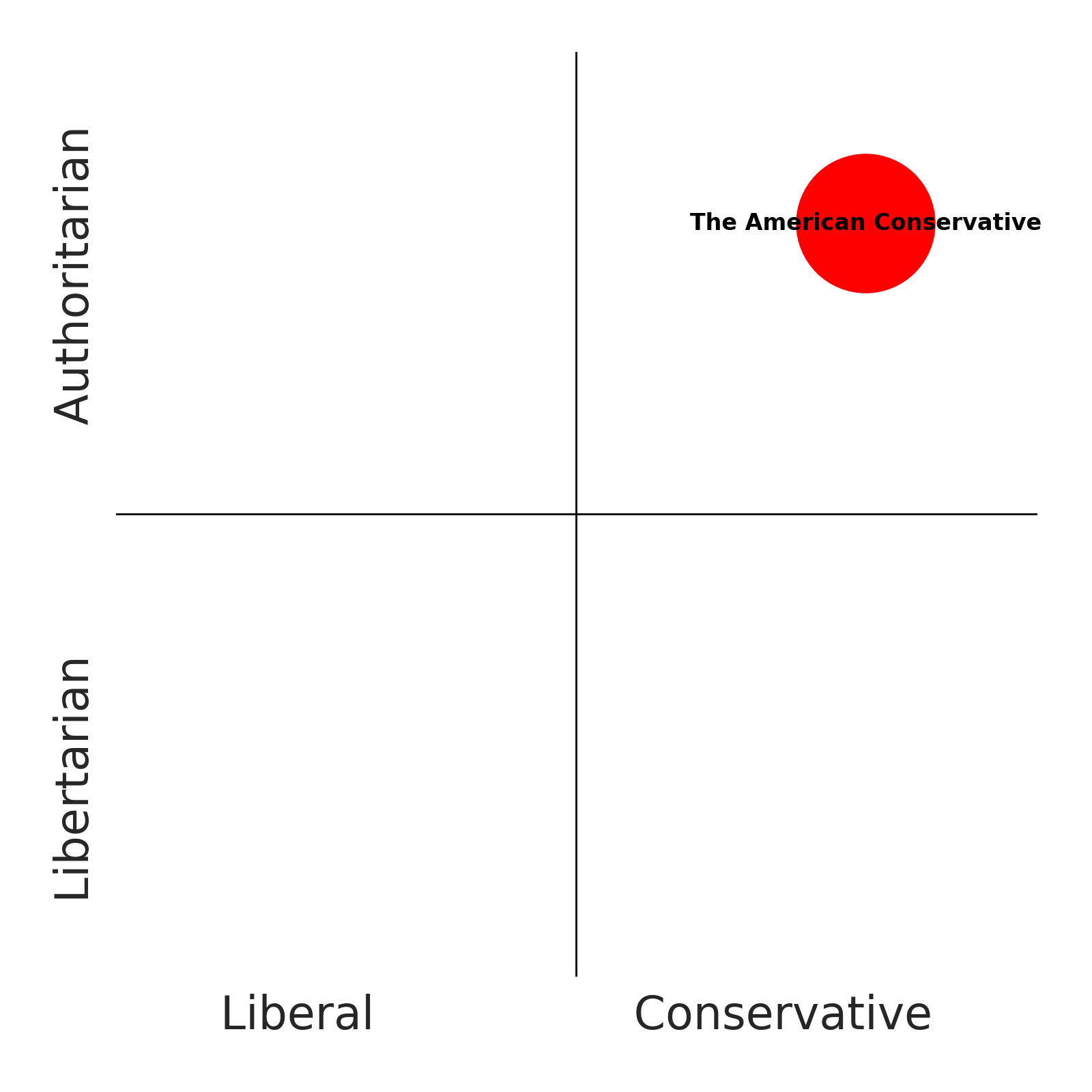
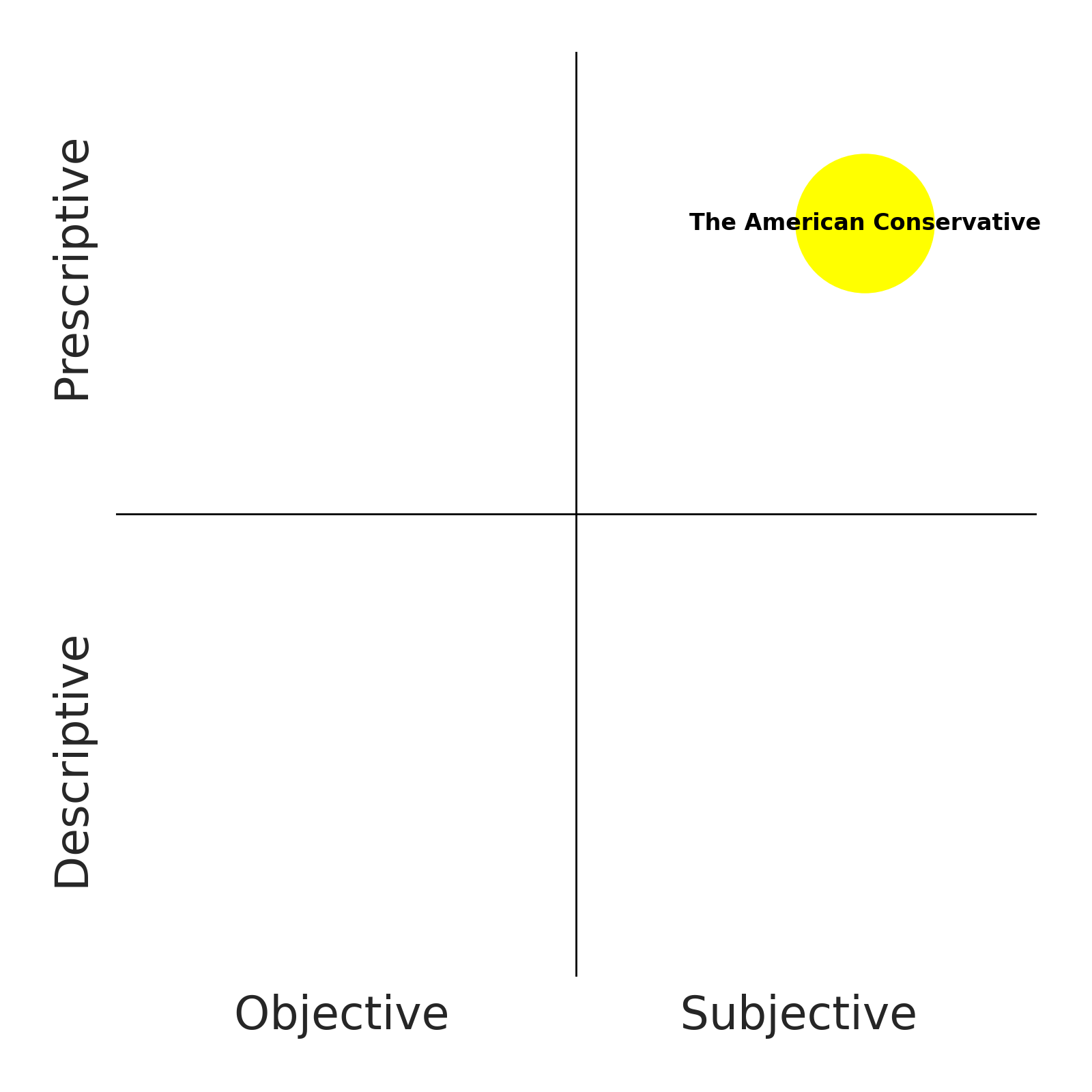
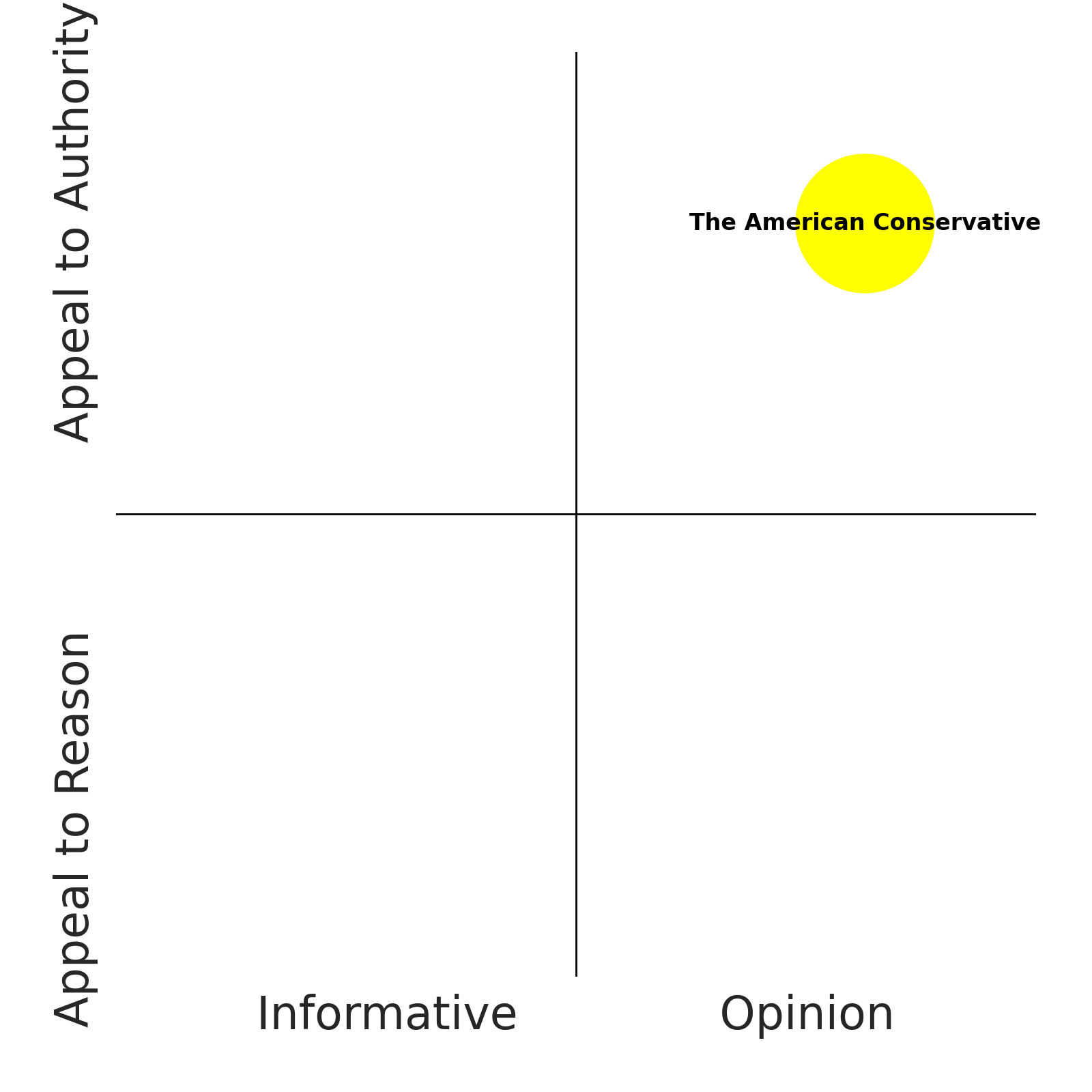
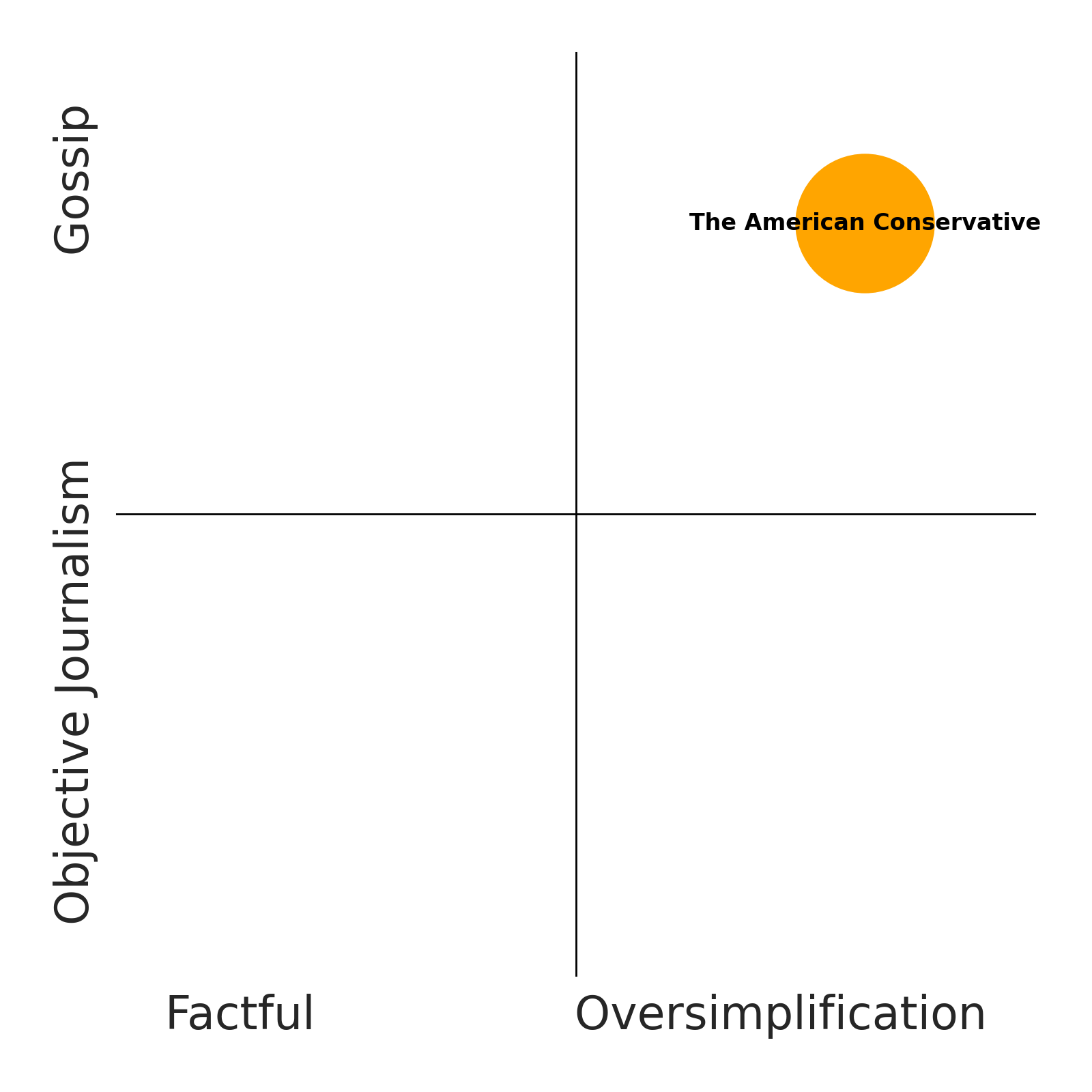
2026 © Helium Trades
Privacy Policy & Disclosure
* Disclaimer: Nothing on this website constitutes investment advice, performance data or any recommendation that any particular security, portfolio of securities, transaction or investment strategy is suitable for any specific person. Helium Trades is not responsible in any way for the accuracy
of any model predictions or price data. Any mention of a particular security and related prediction data is not a recommendation to buy or sell that security. Investments in securities involve the risk of loss. Past performance is no guarantee of future results. Helium Trades is not responsible for any of your investment decisions,
you should consult a financial expert before engaging in any transaction.
Helium Research Assistant

How can I help you today?
Ask any question about The American Conservative bias.


