See whether Helium helps you make better-informed decisions. Try every Pro Trader feature for 30 days. No credit card required.
Try every Pro Trader feature for 30 days. No credit card required.
Frames Nvidia as a clear bullish opportunity using selective favorable data, loaded language, and repeated self-promotion, while acknowledging risks only to dismiss them.
Automated analysis; not human reviewed. Limitations: The article is promotional in nature, potentially affecting objectivity; analysis is based solely on the text. · 14 of 52 available dimensions scored; omitted dimensions are not treated as neutral. · Verified supporting quotes for 10 of 14 scored dimensions.
Claim: The article mixes factual data with subjective interpretation and loaded language.
“monopoly-grade” · exact text match
“conversational, actionable, and grounded in long-term, buy-and-hold investing principles” · exact text match
Why: Uses subjective descriptors and personal investment philosophy, not purely objective reporting.
Claim: The publisher uses hyperbolic language to dramatize the opportunity.
“the largest infrastructure expansion in human history” · exact text match
“monopoly-grade” · exact text match
Why: Hyperbolic phrases exceed neutral description.
Claim: The publisher frames the stock as a clear bullish opportunity with asymmetric upside.
“Risk/reward at $190 is asymmetric because most pain is priced in.” · exact text match
“NVDA trades at $190.01 against a Wall Street consensus target of $302.83, implying roughly 59% upside.” · exact text match
Why: Repeated positive framing, dismissal of risks, and emphasis on upside.
Claim: The article prescribes action (buy) rather than merely describing facts.
“Create a Bullish Opportunity” · exact text match
“Should You Buy” · exact text match
Why: Headline and repeated calls to action indicate prescriptive framing.
Claim: The article is dominated by the author's bullish opinion rather than neutral reporting.
“NVIDIA at $190 screens well on fundamentals. The stock sits roughly 20% below its 52-week high near $236, yet fundamentals keep improving.” · not found in supplied text
Why: Presents selective positive metrics as conclusive, omitting counterpoints.
Claim: The publisher relies heavily on analyst consensus to bolster credibility.
“Wall Street consensus targets NVDA at $303, implying 59% upside, with 58 of 61 analysts rating it Buy or Strong Buy.” · exact text match
Why: Uses analyst ratings as primary support despite known conflicts of interest.
Claim: The publisher expresses certainty beyond what the data supports.
“Risk/reward at $190 is asymmetric because most pain is priced in.” · exact text match
Why: Claims most pain is priced in, a speculative assertion with no proof.
Claim: The article contains excessive self-promotion and links to other content.
“Our top personal finance-related articles today. Your wallet will thank you later.” · exact text match
“24/7 Wall St. price target says…” · exact text match
“Nvidia’s Next Growth Wave May Be Just Beginning: We See a 28% Upside” · exact text match
Why: Multiple embedded links to other articles on same site, distract from main content.
Claim: The article uses positively charged emotional language to create enthusiasm.
“bullish opportunity” · not found in supplied text
“clear evolution” · not found in supplied text
“monopoly-grade” · exact text match
Why: Positive emotional tone throughout.
Claim: The publisher sacrifices objectivity for promotional goals, lowering trustworthiness.
“monopoly-grade” · exact text match
“conversational, actionable, and grounded in long-term, buy-and-hold investing principles” · exact text match
Why: Combination of hyperbolic language, self-promotion, and lack of critical distance.
Claim: The article functions as an advertorial for Nvidia stock and the site's other content.
“Our NVIDIA (NASDAQ:NVDA | NVDA Price Prediction) call comes at a moment…” · not found in supplied text
“Contact [email protected] for any questions or corrections.” · exact text match
Why: Repeated promotion of own price predictions and contact for corrections suggest marketing intent.
Claim: The publisher portrays Nvidia favorably and aligns with corporate interests.
“NVIDIA sits at the center of what CEO Jensen Huang calls 'the largest infrastructure expansion in human history.'” · not found in supplied text
Why: Quotes CEO without critical context, frames company as central to historic trend.
Claim: The publisher makes speculative price predictions and future outcomes.
“NVDA trades at $190.01 against a Wall Street consensus target of $302.83, implying roughly 59% upside.” · exact text match
“The path to appreciation is mechanical.” · exact text match
Why: Predicts future price and earnings growth as mechanical, ignoring uncertainty.
Claim: The article uses selective presentation and loaded framing to guide reader action.
“Risk/reward at $190 is asymmetric because most pain is priced in.” · exact text match
“monopoly-grade” · exact text match
Why: Frames risk/reward as one-sided and uses superlatives to influence perception.
The article is promotional in nature, potentially affecting objectivity; analysis is based solely on the text.
July 22, 2026 · 0 shares
24/7 Wall St frames Marvell with a bullish investment narrative, emphasizing a buy rating, a $249.65 target, strong AI-related bookings, and Nvidia collaboration while acknowledging risks such as insider selling and hyperscaler capex shifts.
Marvell Technology is framed as an AI-infrastructure growth stock with a $249.65 price target, supported by Nvidia partnership, data-center strength, and a plan to grow custom ASIC revenue toward $4B by 2028.
Automated analysis; not human reviewed. Limitations: Concise, case-specific limitations and plausible alternative interpretations. · 6 of 52 available dimensions scored; omitted dimensions are not treated as neutral. · Verified supporting quotes for 1 of 6 scored dimensions.
Claim: The publisher frames Marvell with a bullish investment narrative.
“The 24/7 Wall St. price target for Marvell is $249.65, implying 24.35% upside from the current $200.76 quote.” · exact text match
“Our recommendation is buy with high confidence at 90%.” · exact text match
“The bull case one-year target sits at $347.35, roughly 73% upside if bookings hold and hyperscaler capex stays firm.” · exact text match
Counterevidence:
“bear case one-year target is $191.31, a modest 4.71% decline.” · exact text match
“The setup looks constructive if hyperscaler capex commentary holds through Q2 earnings, while a slip in custom ASIC design wins to competitors or tightening China restrictions would challenge the thesis.” · exact text match
Why: The quotes show explicit bullish framing and upside targets, tempered by a bear target and risk caveats.
Claim: The article prescribes action (buy) and emphasizes upside targets.
“"Our recommendation is buy with high confidence at 90%."” · not found in supplied text
“"The bull case one-year target sits at $347.35, roughly 73% upside..."” · not found in supplied text
Counterevidence:
“"bear case one-year target is $191.31, a modest 4.71% decline."” · not found in supplied text
Why: Explicit investment recommendation and forward targets indicate prescriptive framing.
Claim: The language conveys a bullish investment perspective and favorable framing.
“"bullish on Marvell" and references to upside targets.” · not found in supplied text
“"The bull case rests on custom silicon."” · not found in supplied text
“"The setup looks constructive"” · not found in supplied text
Counterevidence:
“"The recent selloff reflects sentiment rather than fundamentals."” · not found in supplied text
Why: Use of bullish framing and opinionated phrases indicates subjective interpretation.
Claim: The piece conveys high confidence in Marvell's upside potential.
“"Our recommendation is buy with high confidence at 90%."” · not found in supplied text
“"The bull case one-year target sits at $347.35, roughly 73% upside..."” · not found in supplied text
“"The 24/7 Wall St. price target for Marvell is $249.65, implying 24.35% upside..."” · not found in supplied text
Counterevidence:
“"bear case one-year target is $191.31, a modest 4.71% decline."” · not found in supplied text
Why: Multiple explicit upside projections paired with a bear-case figure suggest strong but debated confidence.
Claim: The piece uses numeric data and comparables to reason about value and risk.
“In Q1 FY2027, revenue hit $2.418 billion (up 27.6% year over year) with data center contributing $1.827 billion, or 76% of total revenue.” · exact text match
“Forward P/E of 47 and trailing P/E of 65 are cited as premium valuations.” · not found in supplied text
Counterevidence:
“Data center concentration risk and in-house silicon competition are noted as threats.” · not found in supplied text
Why: The use of concrete numbers and comparables reflects rational analysis, with caveats noted.
Claim: The publisher demonstrates fairness by including risk notes and bear-case targets.
“bear case one-year target is $191.31, a modest 4.71% decline.” · exact text match
“The setup looks constructive if hyperscaler capex commentary holds through Q2 earnings, while a slip in custom ASIC design wins would challenge the thesis.” · not found in supplied text
Counterevidence:
“"The recent selloff reflects sentiment rather than fundamentals."” · not found in supplied text
Why: Inclusion of bear-case and risk disclaimers signals attempt at balanced framing.
Ambiguity around AI demand and policy risk could shift outcomes.
Adopts a bullish read-through from SanDisk's multi-year financial targets to semiconductor equipment vendors, while explicitly flagging cyclicality and non-GAAP risks.
Automated analysis; not human reviewed. Limitations: Analysis based solely on the provided article text; no external verification of financial figures or claims. · 10 of 53 available dimensions scored; omitted dimensions are not treated as neutral. · Verified supporting quotes for 8 of 10 scored dimensions.
Claim: The article mixes factual reporting with analytical interpretation but remains primarily fact-based.
“SanDisk just posted a Q4 FY2026 revenue of $8.965 billion, up 371.6% year over year, per its August 5 8-K.” · exact text match
“Bit growth requires tools. Equipment vendors sell those tools.” · exact text match
Why: Precise data and direct quotes indicate objectivity, while interpretive statements like 'signals sustained investment' show a subjective analytical layer.
Claim: The article uses measured language and avoids sensationalism.
“Lam Research (NASDAQ:LRCX) is up roughly 4% intraday” · exact text match
Why: Tone is restrained, with 'roughly' and specific percentages instead of hyperbolic adjectives.
Claim: The publisher emphasizes a positive read-through from SanDisk's targets to equipment makers.
“SanDisk's 80% gross margin targets and signed contracts covering two-thirds of FY2028 bits drove LRCX up 4%, the most direct equipment beneficiary.” · exact text match
“A NAND maker guiding to mid-to-high teens revenue growth consistent with bit growth through the end of the decade, while committing to roughly 80% gross margins and 50% free cash flow margins, signals sustained wafer starts, new nodes, and advanced packaging investment.” · exact text match
Counterevidence:
“Memory capex is historically cyclical, equipment orders can be pulled quickly, and one customer’s long-term model does not guarantee industry-wide capex.” · exact text match
Why: The article repeatedly highlights upside for equipment vendors and uses language like 'most direct equipment beneficiary' and 'signals sustained investment', though it also notes cyclicality risks.
Claim: The article includes some opinionated analytical statements about the implications of SanDisk's targets.
“signals sustained wafer starts, new nodes, and advanced packaging investment” · exact text match
Why: The author interprets the meaning of the guidance, going beyond mere reporting of the numbers.
Claim: The article relies on CEO statements and company guidance as authority for future expectations.
“CEO Tim Archer stated “In NAND, demand is growing faster than previously expected…”” · not found in supplied text
“CEO Gary Dickerson has been vocal... telling investors “we expect to grow our packaging revenues more than 50% in calendar 2026”” · not found in supplied text
Why: Executive quotes are used to bolster the bullish outlook without independent verification.
Claim: The article cites specific figures, attributes quotes, and includes risk disclaimers, supporting credibility.
“Applied’s Q2 FY2026 delivered non-GAAP EPS of $2.86 versus $2.68 expected” · exact text match
“per its August 5 8-K” · exact text match
Why: Multiple precise data points, source attribution, and explicit risk commentary enhance trustworthiness.
Claim: The article uses logical reasoning and data, avoiding emotional or irrational appeals.
“Bit growth requires tools. Equipment vendors sell those tools.” · exact text match
Why: The reasoning is deductive and grounded in industry mechanics rather than fear or hype.
Claim: The article engages in forecasting about future capital expenditure based on current guidance.
“signals sustained wafer starts, new nodes, and advanced packaging investment” · exact text match
Why: It extrapolates from SanDisk's model to future industry activity without direct evidence of continued spending.
Claim: The article demonstrates honesty by including explicit caveats about forward-looking statements and cyclicality.
“SanDisk’s targets are forward-looking projections for FY2028 through FY2030, and full GAAP reconciliations are not available. Memory capex is historically cyclical, equipment orders can be pulled quickly, and one customer’s long-term model does not guarantee industry-wide capex.” · exact text match
Why: These cautionary statements inform readers of limitations and potential overoptimism.
Claim: The article demonstrates analytical depth by connecting contract terms to equipment demand and noting cyclicality.
“The underpinning is contractual... backed by committed volumes and minimum financial guarantees.” · not found in supplied text
“Memory capex is historically cyclical, equipment orders can be pulled quickly, and one customer’s long-term model does not guarantee industry-wide capex.” · exact text match
Why: It synthesizes multiple factors, including contract structure and cyclicality, showing sophisticated analysis.
Analysis based solely on the provided article text; no external verification of financial figures or claims.
Framed optimistically around AI infrastructure demand, using concrete earnings data and product news to support a bullish thesis for memory chipmakers.
Memory and storage stocks have been rallying in 2026 driven by AI infrastructure demand. Key chip types include HBM (high-bandwidth memory), DRAM, and NAND flash. Companies like Micron, SanDisk (formerly a division of Western Digital), SK Hynix, Western Digital, and Seagate are major players. Nebius Group is an AI infrastructure company that reported strong earnings and a large backlog. SpaceX's Grok model is a competing large language model. The article assumes familiarity with these concepts.
Automated analysis; not human reviewed. Limitations: The article text includes numerous unrelated headlines and links that might be considered noise; the analysis focused on the main narrative from 'Memory Stocks Rally Wednesday' through 'Thursday’s open.' The author bio and other promotions were excluded. · 21 of 53 available dimensions scored; omitted dimensions are not treated as neutral. · Verified supporting quotes for 16 of 21 scored dimensions.
Claim: The article presents data but frames it with interpretive statements about market implications.
“More consequential for memory investors: Nebius disclosed remaining performance obligations of $37.49 billion” · exact text match
Why: The phrase 'more consequential' adds subjective importance; the article interprets the data for the reader rather than merely reporting.
Claim: Headline and framing use attention-grabbing language like 'Here's Why' and 'ripping higher'.
“Memory and storage names are ripping higher into Wednesday’s close.” · exact text match
Why: 'Ripping higher' is informal and sensational, amplifying the positive movement.
Claim: The article strongly favors a bullish outlook on memory stocks.
“The fundamental backbone here.” · not found in supplied text
“The logic for memory holders is simple. Cheaper, faster models expand inference volume, which pulls more HBM, DRAM, and NAND through the stack. Sellers of the picks and shovels are the direct beneficiaries.” · exact text match
Why: Positive price moves are highlighted, catalysts are framed as bullish, and the author explicitly states 'direct beneficiaries'. No bearish counterpoints are given equal weight.
Claim: The article contains novel data points and competitive pricing comparisons that are engaging for investors.
“SpaceX just unveiled Grok 4.6, which Elon Musk called “objectively #1 when considering intelligence, speed & cost”. Independent benchmarker Artificial Analysis scored it 61 on its Intelligence Index” · exact text match
Why: Provides unique benchmark scores and pricing that are likely interesting to readers tracking AI and memory markets.
Claim: The article ends with a mild prescription to monitor price action.
“Keep an eye on whether SanDisk and Micron hold today’s gains into Thursday’s open.” · exact text match
Why: While mostly descriptive, the final sentence instructs the reader to watch a specific outcome, a mild prescriptive element.
Claim: Includes interpretive statements about market implications that go beyond pure facts.
“More consequential for memory investors: Nebius disclosed remaining performance obligations of $37.49 billion” · exact text match
Why: The phrase 'more consequential' is an opinion about importance, not a neutral statement.
Claim: Presents a simplified causal chain from cheap AI models to memory demand without caveats about other factors.
“The logic for memory holders is simple. Cheaper, faster models expand inference volume, which pulls more HBM, DRAM, and NAND through the stack.” · exact text match
Why: Asserts a direct linear relationship that oversimplifies complex market dynamics.
Claim: Cites Elon Musk's claim and an independent benchmark to support the bullish thesis.
“Elon Musk called “objectively #1 when considering intelligence, speed & cost”.” · exact text match
“Artificial Analysis scored it 61 on its Intelligence Index” · exact text match
Why: Appeals to Musk's authority and a benchmarker's score to validate the model's quality, which then supports the memory demand thesis.
Claim: Uses confident language about future demand based on current data.
“That contracted backlog signals that hyperscalers and neoclouds are locking in multi-year GPU capacity, which requires proportional NAND, HBM, and enterprise SSD content.” · exact text match
Why: The word 'signals' implies strong predictive certainty from a single data point.
Claim: The article aligns with pro-market, pro-corporate interests by highlighting positive corporate earnings and stock gains.
“Memory and storage names are ripping higher into Wednesday’s close.” · exact text match
Why: Celebrates stock price increases and corporate financial results without critical questioning of market structure.
Claim: The tone is positive and enthusiastic about stock gains.
“Memory and storage names are ripping higher” · exact text match
Why: 'Ripping higher' is an emotionally charged positive phrase.
Claim: The article uses specific data, cites company filings and independent benchmarks, and acknowledges risks.
“Micron’s own Q4 guidance of $50.0 billion ± $1.0 billion (see the company’s SEC filings)” · exact text match
“Independent benchmarker Artificial Analysis scored it 61” · exact text match
Why: Multiple specific numbers with attribution and a brief risk paragraph enhance credibility.
Claim: Favorable portrayal of memory chip companies and their products.
“That density and bandwidth profile is aimed squarely at AI-storage workloads” · exact text match
Why: Praises product innovations without critical distance; presents corporate narrative positively.
Claim: Relies on quantitative empirical data such as revenue, benchmarks, and capex.
“Nebius Group (NASDAQ:NBIS), whose Q2 2026 revenue of $582.30 million beat estimates and climbed 454% year over year.” · exact text match
Why: Frames investment thesis around concrete financial and performance metrics, not superstition.
Claim: Makes forecasts about future memory demand and stock performance.
“If hyperscaler capex commentary stays firm, memory should keep its bid.” · exact text match
Why: Explicit conditional prediction about future market direction.
Claim: The article provides specific financial data with attribution and acknowledges risks.
“Micron’s own Q4 guidance of $50.0 billion ± $1.0 billion (see the company’s SEC filings)” · exact text match
Why: Includes SEC filing reference and specific numbers. Also mentions risks: Chinese entrants, cyclical nature, stretched valuations.
Claim: Seeks truthful reporting by including both bullish catalysts and acknowledged risks.
“That run cuts both ways. Chinese entrants like CXMT and YMTC are climbing the technology ladder, memory remains a cyclical business, and valuations have stretched after outsized YTD gains.” · exact text match
Why: Includes a balanced note about risks, indicating truth-seeking rather than delusion.
The article text includes numerous unrelated headlines and links that might be considered noise; the analysis focused on the main narrative from 'Memory Stocks Rally Wednesday' through 'Thursday’s open.' The author bio and other promotions were excluded.
Promotes Dividend Kings as defensive bargains using bullish, authoritative, and prescriptive language to encourage immediate investment.
Automated analysis; not human reviewed. · 22 of 53 available dimensions scored; omitted dimensions are not treated as neutral. · Verified supporting quotes for 15 of 22 scored dimensions.
Claim: The article promotes corporate and market-friendly perspectives typical of conservative financial press.
“5 Dividend Kings That Blew Away Q2 Earnings Are Sizzling Summer Bargains” · exact text match
Why: The framing celebrates established corporations and market stability, aligning with conservative economic views.
Claim: The article positions the author's insider experience as a source of unique authority, leaning elitist.
“Lee Jackson's practical financial industry experience... allows him to shed light on the intricacies and workings of Wall Street in a way that only someone with deep insider experience and knowledge can.” · not found in supplied text
Why: The author bio emphasizes exclusive insider access and elite credentials, suggesting elitist framing.
Claim: The article advocates for individual investment choices within existing market structures, neither pro- nor anti-regulation.
“Companies that have raised dividends for 50 or more consecutive years are exactly the kinds of investments passive income investors need to own.” · exact text match
Why: Slight pro-market, pro-corporate tilt but not strongly authoritarian or libertarian.
Claim: The article mixes factual earnings reports with highly subjective promotional language.
“These stocks are mostly conservative, and should we see a dramatic market correction, they will likely hold their ground much better than volatile technology names.” · exact text match
Why: Predictive opinion presented as advice, strongly subjective.
Claim: The article uses sensational headlines and urgency ('sizzling summer bargains') to attract readers.
“5 Dividend Kings That Blew Away Q2 Earnings Are Sizzling Summer Bargains” · exact text match
Why: Headline and language are sensationalized beyond neutral reporting.
Claim: The article is strongly bullish, recommending these stocks as buys.
“These are companies that make sense for growth and income investors seeking timely ideas in an overbought, frothy stock market.” · exact text match
Why: Explicit endorsement of stocks as timely buys.
Claim: Contains moderately interesting data on dividend streaks and earnings beats.
“AWR raised its quarterly dividend 8% after Q2 EPS jumped to $1.09, extending its remarkable 70-year streak of consecutive dividend increases.” · exact text match
Why: Factual highlights are interesting, but overall piece is formulaic.
Claim: The article prescribes specific investment actions rather than just describing events.
“Investors seeking defensive companies that pay substantial dividends are drawn to the Dividend Kings, and for good reason.” · exact text match
Why: Advises what investors 'need to own'—strongly prescriptive.
Claim: Not relevant to geopolitical/military stance; slight dovish tilt from emphasizing stability over risk.
“defensive picks” · exact text match
Why: Marginal relevance.
Claim: Uses mild fear about market froth to frame stocks as safe havens.
“in an overbought, frothy stock market” · exact text match
Why: Subtle fear-mongering about market conditions.
Claim: The article is heavily opinionated, presenting the author's investment views as guidance.
“exactly the kinds of investments passive income investors need to own” · exact text match
Why: Imperative language ('need to own') and personal recommendations.
Claim: Reduces investment decision-making to dividend streaks and earnings beats.
“Companies that have raised dividends for 50 or more consecutive years are exactly the kinds of investments passive income investors need to own.” · exact text match
Why: Ignores valuation, sector risks, and diversification.
Claim: Relies heavily on the authority of Dividend King status and Warren Buffett's holdings.
“Warren Buffett's KO beat Q2 EPS and upgraded full-year guidance” · exact text match
Why: Frequent references to Buffett and long dividend streaks as authoritative proof.
Claim: Presents predictions with certainty beyond what earnings data alone supports.
“These stocks are mostly conservative, and should we see a dramatic market correction, they will likely hold their ground much better than volatile technology names.” · exact text match
Why: Declares future relative performance as likely without hedging.
Claim: The article supports established corporations and market institutions.
“Coca-Cola is the world’s largest beverage company...Led by Coca-Cola, one of the world’s most valuable and recognizable brands” · not found in supplied text
Why: Praises blue-chip companies and uses Warren Buffett as a credibility anchor.
Claim: Moderate credibility due to factual earnings data but undermined by promotional tone and lack of risk disclosure.
“The company reported Q2 funds from operations of $1.88 per share (beating mid-guidance expectations)” · not found in supplied text
Why: Some factual data, but marketing language and self-promotion reduce trustworthiness.
Claim: The article uses reasoned analysis of earnings and dividend streaks but also relies on emotional appeals about market froth.
“defensive picks in a frothy, overbought market” · exact text match
Why: Combines data with fear-based market characterization, slightly irrational.
Claim: Strongly favorable toward large corporations, presenting them as safest investments.
“Coca-Cola remains a long-time top holding of Warren Buffett, who owns a massive 400 million shares” · not found in supplied text
Why: Praises corporate stability and size while omitting potential downsides.
Claim: Speculates about market correction and relative safety of these stocks.
“should we see a dramatic market correction, they will likely hold their ground” · exact text match
Why: Clear forecast of future market behavior.
Claim: Uses urgency and fear to drive investment action.
“sizzling summer bargains” · not found in supplied text
“frothy, overbought market” · exact text match
Why: Emotionally charged language to influence reader behavior.
Claim: The article promotes stocks without disclosing potential conflicts of interest or risks beyond market correction.
“Lee Jackson's practical financial industry experience... provides direct access for him and 24/7 Wall St., a privilege few firms enjoy.” · not found in supplied text
Why: Self-promotion and lack of risk disclosure reduce perceived integrity.
Presents a 50/50 SCHD/JEPQ barbell as the standard retirement-income solution, with concrete yield math and optimistic language about democratized investing.
Automated analysis; not human reviewed. Limitations: The main article is a personal-finance how-to excerpt; the supplied text also includes several related article headlines that were excluded from bias scoring. · 12 of 53 available dimensions scored; omitted dimensions are not treated as neutral. · Verified supporting quotes for 12 of 12 scored dimensions.
Claim: The article offers personal retirement advice rather than objective reporting.
“That is why a 61-year-old with a 25-year horizon rarely wants 100% of the portfolio in the highest-yield sleeve.” · exact text match
Why: The sentence makes a normative recommendation about portfolio allocation based on the author's reasoning.
Claim: The headline employs sensational phrasing to attract clicks.
“How a 61-Year-Old Built a $3,500 Monthly Paycheck From Just Two Funds: SCHD and JEPQ” · exact text match
Why: The phrase 'Built' and 'Just Two Funds' simplify the strategy and suggest an easy path.
Claim: The article is optimistic about the SCHD/JEPQ combination for retirement income.
“JEPQ is the income workhorse.” · exact text match
“Total return has done the heavy lifting: SCHD is up 31% over the past year and 232% over the past decade on a price basis.” · exact text match
Why: The phrases 'income workhorse' and citing large historical returns frame the strategy positively.
Claim: The article gives guidance on how a retiree should structure income investments.
“That is why a 61-year-old with a 25-year horizon rarely wants 100% of the portfolio in the highest-yield sleeve.” · exact text match
Why: It tells readers what a person 'rarely wants' to do, implying a recommended approach.
Claim: The article is heavily opinionated, reflecting the author's personal take on investing.
“I write to help people understand the investments available to them so they can make the best choice for their portfolio, whether they're starting out or looking for income in retirement.” · exact text match
“The barbell fixes this.” · exact text match
Why: The author explicitly states a mission to guide choices, and 'The barbell fixes this' is a subjective assertion.
Claim: The article reduces complex retirement planning to a two-ETF strategy.
“The barbell fixes this.” · exact text match
“The math is the same equation at three different yields.” · exact text match
Why: It presents a simple solution ('barbell') and reduces yield math to one equation.
Claim: The article states projections and required capital with certainty.
“A 3% yielder that grows its dividend 8% per year passes an 8.46% starting yield in about a decade on the original cost basis.” · exact text match
“The blend requires roughly $737,000 at today’s yields, which is achievable for a household that has been maxing retirement accounts for 30 years.” · exact text match
Why: These statements rely on assumed growth rates and attainability without qualification.
Claim: The article provides specific financial data without citing sources, but includes a corrections contact.
“SCHD trades near $33.90 with a forward annualized dividend of about $1.01 per share, putting the forward yield right around 3%.” · exact text match
“Contact [email protected] for any questions or corrections.” · exact text match
Why: Unattributed data lowers verifiability, but a corrections contact adds accountability.
Claim: The article promotes specific ETFs (SCHD and JEPQ) as ideal solutions.
“JEPQ is the income workhorse.” · exact text match
Why: The description 'income workhorse' implies endorsement of JEPQ.
Claim: The article emphasizes individual financial self-reliance.
“individuals have never had more tools and information to take control of their financial lives.” · exact text match
Why: This statement promotes individual action and personal responsibility in investing.
Claim: The article includes a speculative calculation about future dividend growth.
“A 3% yielder that grows its dividend 8% per year passes an 8.46% starting yield in about a decade on the original cost basis.” · exact text match
Why: This is a hypothetical scenario based on assumed growth.
Claim: The article demonstrates quantitative reasoning about yields and portfolio construction.
“A 50/50 blend of SCHD and JEPQ produces a ~5.7% blended yield, requiring roughly $737,000 to generate $42,000 annually.” · exact text match
Why: It uses specific numbers and multiplication to derive a required portfolio size.
The main article is a personal-finance how-to excerpt; the supplied text also includes several related article headlines that were excluded from bias scoring.
Frames dividend income as a systematic, mathematically achievable goal using three yield tiers, with a promotional yet cautious tone that acknowledges tradeoffs.
The article references a 10-year Treasury yield near 5% and rising core PCE, highlighting the current tradeoff between static high yield and dividend growth.
Automated analysis; not human reviewed. Limitations: The article text includes surrounding promotional content and multiple article snippets, making it difficult to isolate the exact boundaries of the main article; analysis focused on the clearest continuous section. · 5 of 53 available dimensions scored; omitted dimensions are not treated as neutral. · Verified supporting quotes for 5 of 5 scored dimensions.
Claim: The article mixes factual calculations with personal opinion and prescription.
“The real question is how much capital each yield tier demands, and what you give up to get there.” · exact text match
Why: The article presents mathematical data but also offers subjective advice on which strategy is best.
Claim: The article is bullish on dividend income strategies, though it acknowledges risks.
“That is less than a third of what the conservative bucket demands.” · exact text match
Counterevidence:
“Aggressive-tier income is real. It is also, in most cases, income at the expense of principal.” · exact text match
Why: The overall tone encourages building dividend income, but balanced by noting tradeoffs.
Claim: The article is prescriptive, offering a portfolio blueprint.
“Here is the math at three levels.” · exact text match
Why: The article gives explicit advice on how to allocate capital for income.
Claim: The article contains strong personal opinion about investing strategy.
“I write to help people understand the investments available to them so they can make the best choice for their portfolio” · exact text match
Why: The author explicitly states their purpose and recommends specific approaches.
Claim: The article speculates on future dividend yields and portfolio performance.
“A 3.5% yield growing 8% annually doubles the income in nine years.” · exact text match
Why: The projection assumes constant growth rates, which is speculative.
The article text includes surrounding promotional content and multiple article snippets, making it difficult to isolate the exact boundaries of the main article; analysis focused on the clearest continuous section.
Frames a mandatory Roth catch-up rule as an advantageous loophole for high earners, emphasizing tax-free benefits over lost deductions.
Automated analysis; not human reviewed. · 10 of 53 available dimensions scored; omitted dimensions are not treated as neutral. · Verified supporting quotes for 10 of 10 scored dimensions.
Claim: Uses slightly sensational language that exaggerates the benefit.
“The Rule That Forces Tax-Free Money Into Your Account” · exact text match
Why: The headline and subheading use 'forces' and 'tax-free money' to create a dramatic effect, though the substance is factual.
Claim: Presents a novel angle on a tax rule, making it engaging for a target audience.
“That is the loophole the SECURE 2.0 language accidentally opened while trying to raise revenue.” · exact text match
Why: The 'loophole' framing adds interest, but the topic is niche.
Claim: Article prescribes a specific financial strategy (prioritize Roth catch-up contributions) rather than neutrally reporting the rule.
“The rule was written to raise revenue. It ended up creating the cleanest, largest Roth on-ramp a high earner has ever had inside a workplace plan.” · exact text match
Why: The article concludes with a prescriptive tone, advising action and framing the rule as an opportunity.
Claim: Contains opinionated advice and subjective framing rather than purely factual reporting.
“That is the loophole the SECURE 2.0 language accidentally opened while trying to raise revenue.” · exact text match
Why: The article characterizes the rule as a 'loophole' and 'accidentally opened,' which is an interpretive opinion.
Claim: Oversimplifies the trade-off, presenting Roth as universally better without considering individual tax situations.
“The Roth version pays none of it.” · exact text match
Why: The statement implies Roth is always superior, ignoring that some taxpayers may benefit from the deduction now.
Claim: Cites SECURE 2.0 as authoritative basis, but does not include independent expert analysis.
“Under Section 603 of SECURE 2.0, any catch-up contribution made by a high earner in 2026 must go to a Roth 401(k).” · exact text match
Why: Reference to the law is standard, but the article relies on the authority of the law rather than balanced analysis.
Claim: Presents the strategy as clearly beneficial with high certainty.
“That is the backdoor.” · exact text match
Why: The article uses definitive language ('the backdoor') without acknowledging uncertainty or alternative scenarios.
Claim: Article is generally factual and well-sourced, but includes promotional content and opinion.
“96.5% of Fidelity-recordkept plans offered a Roth option at the end of 2025, up from 74.4% five years earlier.” · exact text match
Why: Provides specific data from Fidelity, but the overall credibility is slightly reduced by opinionated framing and self-promotion.
Claim: Includes self-promotional content for other articles and the author's podcast.
“Our top personal finance-related articles today. Your wallet will thank you later.” · exact text match
Why: The end of the article promotes other content, indicating a commercial motive.
Claim: Demonstrates competent financial analysis with specific numbers and legal references.
“The catch-up amount for 2026 is $8,000 for participants aged 50 to 59 or 64-plus, and a $11,250 super catch-up for anyone aged 60 to 63.” · exact text match
Why: The article correctly cites specific amounts and age brackets, showing understanding of the rules.
Provides neutral, informative legal guidance on postnuptial agreements, emphasizing both benefits and risks without sensationalism.
Automated analysis; not human reviewed. Limitations: The supplied text contains multiple distinct article headlines and promotional links; analysis focused on the primary postnup article. · 2 of 53 available dimensions scored; omitted dimensions are not treated as neutral. · Verified supporting quotes for 1 of 2 scored dimensions.
Claim: Article is credible due to specific legal references and cautionary advice.
“Enforceability comes from state contract and family law, and a minority of states apply the Uniform Premarital and Marital Agreements Act (UPMAA).” · not found in supplied text
“Rules vary state by state, so local counsel is not optional.” · exact text match
Why: Cites the specific legal framework (UPMAA) and explicitly advises consulting local counsel, which supports reliability.
Claim: Article demonstrates high integrity by disclosing risks and advising legal counsel.
“Because you are already married, you owe each other a fiduciary duty. That means a judge looks at a postnup with a sharper eye than a prenup.” · exact text match
“Contact [email protected] for any questions or corrections.” · exact text match
Why: The article includes transparent warnings about court scrutiny and provides a contact for corrections, indicating honesty and openness.
The supplied text contains multiple distinct article headlines and promotional links; analysis focused on the primary postnup article.
August 12, 2026 · 0 shares
Prescribes holding specific high-yield dividend stocks in a Roth IRA to avoid ordinary income taxes, framing the tax savings as a substantial and compounding six-figure advantage.
Automated analysis; not human reviewed. Limitations: The article is from 24/7 Wall St., a financial news site that often produces listicles with advertising relationships; this may promote certain stocks, but the analysis is based solely on the supplied text. · 53 of 53 available dimensions scored; omitted dimensions are not treated as neutral. · Verified supporting quotes for 1 of 53 scored dimensions.
Claim: The article is explicitly opinionated financial advice rather than neutral reporting.
“The takeaway: The higher the bracket, the more aggressive the case for sheltering ordinary income payers first.” · exact text match
Why: The article frames a subjective strategy as a clear takeaway, not a balanced discussion of options.
Claim: The article projects a specific long-term cumulative six-figure gap without stating probabilistic assumptions or uncertainty.
“Stretched across 10 and 20 year holding windows at a conservative reinvestment assumption, the cumulative gap ... runs into six figures on the $500,000 base. That is a permanent cost of taxable placement, separate from any price appreciation.” · not found in supplied text
Why: The statement presents the gap as a certain permanent cost, ignoring market volatility, changes in tax law, or varying reinvestment rates.
Claim: The article promotes specific financial products (ARCC, JEPI, BTI, EPD) and the Roth IRA strategy in a manner resembling advertorial content.
“ARCC: The largest publicly traded business development company. BDC distributions are non-qualified and taxed at the holder’s marginal rate, which makes this the cleanest Roth candidate in the list.” · exact text match
“JEPI: Option premium from a written out-of-the-money S&P 500 call overlay is treated as ordinary income ... this is exactly the cash flow that loses the most to taxes in a brokerage.” · not found in supplied text
Why: The article singles out these tickers with description of why they are advantageous, and the overall structure is a list of recommended holdings.
Claim: The article projects future dividend income and tax savings without disclaiming that yields and tax laws may change.
“Anchor the engine math first. A $500,000 position in a stock yielding 8% generates $40,000 in annual gross income. ... Inside a Roth, it nets the full $40,000.” · not found in supplied text
Why: The 'engine math' treats the current yield as static, implying a permanent stream of income, though yields fluctuate.
Claim: The article demonstrates moderate integrity by disclosing important caveats for each stock.
“BTI: Foreign withholding cannot be reclaimed inside a Roth, so the shelter is partial rather than absolute” · not found in supplied text
“EPD: MLP distributions held in an IRA can generate Unrelated Business Taxable Income above $1,000, which becomes taxable inside the Roth.” · not found in supplied text
Why: While the article is promotional, it includes material limitations for two of the four stocks, indicating some effort to be truthful.
The article is from 24/7 Wall St., a financial news site that often produces listicles with advertising relationships; this may promote certain stocks, but the analysis is based solely on the supplied text.
Presents a 50/50 SCHD/JEPQ barbell as the standard retirement-income solution, with concrete yield math and optimistic language about democratized investing.
Automated analysis; not human reviewed. Limitations: The main article is a personal-finance how-to excerpt; the supplied text also includes several related article headlines that were excluded from bias scoring. · 12 of 53 available dimensions scored; omitted dimensions are not treated as neutral. · Verified supporting quotes for 12 of 12 scored dimensions.
Claim: The article offers personal retirement advice rather than objective reporting.
“That is why a 61-year-old with a 25-year horizon rarely wants 100% of the portfolio in the highest-yield sleeve.” · exact text match
Why: The sentence makes a normative recommendation about portfolio allocation based on the author's reasoning.
Claim: The headline employs sensational phrasing to attract clicks.
“How a 61-Year-Old Built a $3,500 Monthly Paycheck From Just Two Funds: SCHD and JEPQ” · exact text match
Why: The phrase 'Built' and 'Just Two Funds' simplify the strategy and suggest an easy path.
Claim: The article is optimistic about the SCHD/JEPQ combination for retirement income.
“JEPQ is the income workhorse.” · exact text match
“Total return has done the heavy lifting: SCHD is up 31% over the past year and 232% over the past decade on a price basis.” · exact text match
Why: The phrases 'income workhorse' and citing large historical returns frame the strategy positively.
Claim: The article gives guidance on how a retiree should structure income investments.
“That is why a 61-year-old with a 25-year horizon rarely wants 100% of the portfolio in the highest-yield sleeve.” · exact text match
Why: It tells readers what a person 'rarely wants' to do, implying a recommended approach.
Claim: The article is heavily opinionated, reflecting the author's personal take on investing.
“I write to help people understand the investments available to them so they can make the best choice for their portfolio, whether they're starting out or looking for income in retirement.” · exact text match
“The barbell fixes this.” · exact text match
Why: The author explicitly states a mission to guide choices, and 'The barbell fixes this' is a subjective assertion.
Claim: The article reduces complex retirement planning to a two-ETF strategy.
“The barbell fixes this.” · exact text match
“The math is the same equation at three different yields.” · exact text match
Why: It presents a simple solution ('barbell') and reduces yield math to one equation.
Claim: The article states projections and required capital with certainty.
“A 3% yielder that grows its dividend 8% per year passes an 8.46% starting yield in about a decade on the original cost basis.” · exact text match
“The blend requires roughly $737,000 at today’s yields, which is achievable for a household that has been maxing retirement accounts for 30 years.” · exact text match
Why: These statements rely on assumed growth rates and attainability without qualification.
Claim: The article provides specific financial data without citing sources, but includes a corrections contact.
“SCHD trades near $33.90 with a forward annualized dividend of about $1.01 per share, putting the forward yield right around 3%.” · exact text match
“Contact [email protected] for any questions or corrections.” · exact text match
Why: Unattributed data lowers verifiability, but a corrections contact adds accountability.
Claim: The article promotes specific ETFs (SCHD and JEPQ) as ideal solutions.
“JEPQ is the income workhorse.” · exact text match
Why: The description 'income workhorse' implies endorsement of JEPQ.
Claim: The article emphasizes individual financial self-reliance.
“individuals have never had more tools and information to take control of their financial lives.” · exact text match
Why: This statement promotes individual action and personal responsibility in investing.
Claim: The article includes a speculative calculation about future dividend growth.
“A 3% yielder that grows its dividend 8% per year passes an 8.46% starting yield in about a decade on the original cost basis.” · exact text match
Why: This is a hypothetical scenario based on assumed growth.
Claim: The article demonstrates quantitative reasoning about yields and portfolio construction.
“A 50/50 blend of SCHD and JEPQ produces a ~5.7% blended yield, requiring roughly $737,000 to generate $42,000 annually.” · exact text match
Why: It uses specific numbers and multiplication to derive a required portfolio size.
The main article is a personal-finance how-to excerpt; the supplied text also includes several related article headlines that were excluded from bias scoring.
Frames a mandatory Roth catch-up rule as an advantageous loophole for high earners, emphasizing tax-free benefits over lost deductions.
Automated analysis; not human reviewed. · 10 of 53 available dimensions scored; omitted dimensions are not treated as neutral. · Verified supporting quotes for 10 of 10 scored dimensions.
Claim: Uses slightly sensational language that exaggerates the benefit.
“The Rule That Forces Tax-Free Money Into Your Account” · exact text match
Why: The headline and subheading use 'forces' and 'tax-free money' to create a dramatic effect, though the substance is factual.
Claim: Presents a novel angle on a tax rule, making it engaging for a target audience.
“That is the loophole the SECURE 2.0 language accidentally opened while trying to raise revenue.” · exact text match
Why: The 'loophole' framing adds interest, but the topic is niche.
Claim: Article prescribes a specific financial strategy (prioritize Roth catch-up contributions) rather than neutrally reporting the rule.
“The rule was written to raise revenue. It ended up creating the cleanest, largest Roth on-ramp a high earner has ever had inside a workplace plan.” · exact text match
Why: The article concludes with a prescriptive tone, advising action and framing the rule as an opportunity.
Claim: Contains opinionated advice and subjective framing rather than purely factual reporting.
“That is the loophole the SECURE 2.0 language accidentally opened while trying to raise revenue.” · exact text match
Why: The article characterizes the rule as a 'loophole' and 'accidentally opened,' which is an interpretive opinion.
Claim: Oversimplifies the trade-off, presenting Roth as universally better without considering individual tax situations.
“The Roth version pays none of it.” · exact text match
Why: The statement implies Roth is always superior, ignoring that some taxpayers may benefit from the deduction now.
Claim: Cites SECURE 2.0 as authoritative basis, but does not include independent expert analysis.
“Under Section 603 of SECURE 2.0, any catch-up contribution made by a high earner in 2026 must go to a Roth 401(k).” · exact text match
Why: Reference to the law is standard, but the article relies on the authority of the law rather than balanced analysis.
Claim: Presents the strategy as clearly beneficial with high certainty.
“That is the backdoor.” · exact text match
Why: The article uses definitive language ('the backdoor') without acknowledging uncertainty or alternative scenarios.
Claim: Article is generally factual and well-sourced, but includes promotional content and opinion.
“96.5% of Fidelity-recordkept plans offered a Roth option at the end of 2025, up from 74.4% five years earlier.” · exact text match
Why: Provides specific data from Fidelity, but the overall credibility is slightly reduced by opinionated framing and self-promotion.
Claim: Includes self-promotional content for other articles and the author's podcast.
“Our top personal finance-related articles today. Your wallet will thank you later.” · exact text match
Why: The end of the article promotes other content, indicating a commercial motive.
Claim: Demonstrates competent financial analysis with specific numbers and legal references.
“The catch-up amount for 2026 is $8,000 for participants aged 50 to 59 or 64-plus, and a $11,250 super catch-up for anyone aged 60 to 63.” · exact text match
Why: The article correctly cites specific amounts and age brackets, showing understanding of the rules.
Headline frames buying Microsoft after a blowout quarter as a disciplined decision with strong bullish, opinionated, and oversimplified bias.
Automated analysis; not human reviewed. Limitations: Only a headline is available; full article content is missing, so framing analysis is limited to the headline's explicit assertions. · 7 of 52 available dimensions scored; omitted dimensions are not treated as neutral. · Verified supporting quotes for 7 of 7 scored dimensions.
Claim: The headline expresses an intention to buy the stock, reflecting strong bullish sentiment.
“I'll Keep Buying Microsoft” · exact text match
Why: A clear buy recommendation and positive outlook for the stock.
Claim: The headline prescribes a personal action (continuing to buy) rather than describing market conditions.
“I'll Keep Buying Microsoft” · exact text match
Why: The sentence states what the author will do, which is prescriptive in nature.
Claim: The entire headline is an expression of personal opinion without supporting facts.
“Discipline and Demand Are Why I'll Keep Buying Microsoft After Its Blowout Quarter” · exact text match
Why: No factual data is presented; the statement is solely the author's viewpoint.
Claim: The headline presents a conclusion without any reasoning, data, or context.
“Discipline and Demand Are Why I'll Keep Buying Microsoft After Its Blowout Quarter” · exact text match
Why: The headline reduces a complex investment decision to a single assertion lacking supporting evidence.
Claim: The author expresses certainty about future buying behavior without acknowledging uncertainty.
“I'll Keep Buying Microsoft” · exact text match
Why: The definite future tense implies high confidence, but the personal nature limits the degree of overconfidence.
Claim: The headline promotes Microsoft stock, indicating a favorable view toward the corporation.
“Buying Microsoft” · exact text match
Why: Directly endorsing the purchase of a company's stock reflects a pro-corporate stance.
Claim: The headline forecasts a future investment action (continued buying) based on past results.
“I'll Keep Buying Microsoft” · exact text match
Why: Predicting future behavior is inherently speculative, even if based on known earnings.
Only a headline is available; full article content is missing, so framing analysis is limited to the headline's explicit assertions.
August 02, 2026 · 0 shares
Bullish promotional framing endorsing an analyst's buy rating on Meta.
Automated analysis; not human reviewed. Limitations: Very short headline-only article limits bias analysis depth. · 5 of 52 available dimensions scored; omitted dimensions are not treated as neutral. · Verified supporting quotes for 5 of 5 scored dimensions.
Claim: The content presents subjective opinion rather than objective reporting.
“Here's Why We Agree” · exact text match
Why: The publisher does not claim impartiality; it actively endorses a viewpoint.
Claim: The publisher frames Meta as a financially promising investment.
“An Analyst Just Called Meta a Top Large-Cap Buy. Here's Why We Agree.” · exact text match
Why: The headline explicitly labels Meta as a top buy and the publisher agrees.
Claim: The publisher explicitly states a personal viewpoint.
“Here's Why We Agree” · exact text match
Why: The phrase 'we agree' indicates the publisher is sharing its opinion.
Claim: The content promotes Meta as an investment vehicle.
“Top Large-Cap Buy” · exact text match
Why: The phrasing 'Top Large-Cap Buy' is promotional language typical of advertorial content.
Claim: The article speculates on Meta's future stock performance.
“Top Large-Cap Buy” · exact text match
Why: Buy ratings predict future returns.
Very short headline-only article limits bias analysis depth.
Promotes Dividend Kings as defensive bargains using bullish, authoritative, and prescriptive language to encourage immediate investment.
Automated analysis; not human reviewed. · 22 of 53 available dimensions scored; omitted dimensions are not treated as neutral. · Verified supporting quotes for 15 of 22 scored dimensions.
Claim: The article promotes corporate and market-friendly perspectives typical of conservative financial press.
“5 Dividend Kings That Blew Away Q2 Earnings Are Sizzling Summer Bargains” · exact text match
Why: The framing celebrates established corporations and market stability, aligning with conservative economic views.
Claim: The article positions the author's insider experience as a source of unique authority, leaning elitist.
“Lee Jackson's practical financial industry experience... allows him to shed light on the intricacies and workings of Wall Street in a way that only someone with deep insider experience and knowledge can.” · not found in supplied text
Why: The author bio emphasizes exclusive insider access and elite credentials, suggesting elitist framing.
Claim: The article advocates for individual investment choices within existing market structures, neither pro- nor anti-regulation.
“Companies that have raised dividends for 50 or more consecutive years are exactly the kinds of investments passive income investors need to own.” · exact text match
Why: Slight pro-market, pro-corporate tilt but not strongly authoritarian or libertarian.
Claim: The article mixes factual earnings reports with highly subjective promotional language.
“These stocks are mostly conservative, and should we see a dramatic market correction, they will likely hold their ground much better than volatile technology names.” · exact text match
Why: Predictive opinion presented as advice, strongly subjective.
Claim: The article uses sensational headlines and urgency ('sizzling summer bargains') to attract readers.
“5 Dividend Kings That Blew Away Q2 Earnings Are Sizzling Summer Bargains” · exact text match
Why: Headline and language are sensationalized beyond neutral reporting.
Claim: The article is strongly bullish, recommending these stocks as buys.
“These are companies that make sense for growth and income investors seeking timely ideas in an overbought, frothy stock market.” · exact text match
Why: Explicit endorsement of stocks as timely buys.
Claim: Contains moderately interesting data on dividend streaks and earnings beats.
“AWR raised its quarterly dividend 8% after Q2 EPS jumped to $1.09, extending its remarkable 70-year streak of consecutive dividend increases.” · exact text match
Why: Factual highlights are interesting, but overall piece is formulaic.
Claim: The article prescribes specific investment actions rather than just describing events.
“Investors seeking defensive companies that pay substantial dividends are drawn to the Dividend Kings, and for good reason.” · exact text match
Why: Advises what investors 'need to own'—strongly prescriptive.
Claim: Not relevant to geopolitical/military stance; slight dovish tilt from emphasizing stability over risk.
“defensive picks” · exact text match
Why: Marginal relevance.
Claim: Uses mild fear about market froth to frame stocks as safe havens.
“in an overbought, frothy stock market” · exact text match
Why: Subtle fear-mongering about market conditions.
Claim: The article is heavily opinionated, presenting the author's investment views as guidance.
“exactly the kinds of investments passive income investors need to own” · exact text match
Why: Imperative language ('need to own') and personal recommendations.
Claim: Reduces investment decision-making to dividend streaks and earnings beats.
“Companies that have raised dividends for 50 or more consecutive years are exactly the kinds of investments passive income investors need to own.” · exact text match
Why: Ignores valuation, sector risks, and diversification.
Claim: Relies heavily on the authority of Dividend King status and Warren Buffett's holdings.
“Warren Buffett's KO beat Q2 EPS and upgraded full-year guidance” · exact text match
Why: Frequent references to Buffett and long dividend streaks as authoritative proof.
Claim: Presents predictions with certainty beyond what earnings data alone supports.
“These stocks are mostly conservative, and should we see a dramatic market correction, they will likely hold their ground much better than volatile technology names.” · exact text match
Why: Declares future relative performance as likely without hedging.
Claim: The article supports established corporations and market institutions.
“Coca-Cola is the world’s largest beverage company...Led by Coca-Cola, one of the world’s most valuable and recognizable brands” · not found in supplied text
Why: Praises blue-chip companies and uses Warren Buffett as a credibility anchor.
Claim: Moderate credibility due to factual earnings data but undermined by promotional tone and lack of risk disclosure.
“The company reported Q2 funds from operations of $1.88 per share (beating mid-guidance expectations)” · not found in supplied text
Why: Some factual data, but marketing language and self-promotion reduce trustworthiness.
Claim: The article uses reasoned analysis of earnings and dividend streaks but also relies on emotional appeals about market froth.
“defensive picks in a frothy, overbought market” · exact text match
Why: Combines data with fear-based market characterization, slightly irrational.
Claim: Strongly favorable toward large corporations, presenting them as safest investments.
“Coca-Cola remains a long-time top holding of Warren Buffett, who owns a massive 400 million shares” · not found in supplied text
Why: Praises corporate stability and size while omitting potential downsides.
Claim: Speculates about market correction and relative safety of these stocks.
“should we see a dramatic market correction, they will likely hold their ground” · exact text match
Why: Clear forecast of future market behavior.
Claim: Uses urgency and fear to drive investment action.
“sizzling summer bargains” · not found in supplied text
“frothy, overbought market” · exact text match
Why: Emotionally charged language to influence reader behavior.
Claim: The article promotes stocks without disclosing potential conflicts of interest or risks beyond market correction.
“Lee Jackson's practical financial industry experience... provides direct access for him and 24/7 Wall St., a privilege few firms enjoy.” · not found in supplied text
Why: Self-promotion and lack of risk disclosure reduce perceived integrity.
Presents a 50/50 SCHD/JEPQ barbell as the standard retirement-income solution, with concrete yield math and optimistic language about democratized investing.
Automated analysis; not human reviewed. Limitations: The main article is a personal-finance how-to excerpt; the supplied text also includes several related article headlines that were excluded from bias scoring. · 12 of 53 available dimensions scored; omitted dimensions are not treated as neutral. · Verified supporting quotes for 12 of 12 scored dimensions.
Claim: The article offers personal retirement advice rather than objective reporting.
“That is why a 61-year-old with a 25-year horizon rarely wants 100% of the portfolio in the highest-yield sleeve.” · exact text match
Why: The sentence makes a normative recommendation about portfolio allocation based on the author's reasoning.
Claim: The headline employs sensational phrasing to attract clicks.
“How a 61-Year-Old Built a $3,500 Monthly Paycheck From Just Two Funds: SCHD and JEPQ” · exact text match
Why: The phrase 'Built' and 'Just Two Funds' simplify the strategy and suggest an easy path.
Claim: The article is optimistic about the SCHD/JEPQ combination for retirement income.
“JEPQ is the income workhorse.” · exact text match
“Total return has done the heavy lifting: SCHD is up 31% over the past year and 232% over the past decade on a price basis.” · exact text match
Why: The phrases 'income workhorse' and citing large historical returns frame the strategy positively.
Claim: The article gives guidance on how a retiree should structure income investments.
“That is why a 61-year-old with a 25-year horizon rarely wants 100% of the portfolio in the highest-yield sleeve.” · exact text match
Why: It tells readers what a person 'rarely wants' to do, implying a recommended approach.
Claim: The article is heavily opinionated, reflecting the author's personal take on investing.
“I write to help people understand the investments available to them so they can make the best choice for their portfolio, whether they're starting out or looking for income in retirement.” · exact text match
“The barbell fixes this.” · exact text match
Why: The author explicitly states a mission to guide choices, and 'The barbell fixes this' is a subjective assertion.
Claim: The article reduces complex retirement planning to a two-ETF strategy.
“The barbell fixes this.” · exact text match
“The math is the same equation at three different yields.” · exact text match
Why: It presents a simple solution ('barbell') and reduces yield math to one equation.
Claim: The article states projections and required capital with certainty.
“A 3% yielder that grows its dividend 8% per year passes an 8.46% starting yield in about a decade on the original cost basis.” · exact text match
“The blend requires roughly $737,000 at today’s yields, which is achievable for a household that has been maxing retirement accounts for 30 years.” · exact text match
Why: These statements rely on assumed growth rates and attainability without qualification.
Claim: The article provides specific financial data without citing sources, but includes a corrections contact.
“SCHD trades near $33.90 with a forward annualized dividend of about $1.01 per share, putting the forward yield right around 3%.” · exact text match
“Contact [email protected] for any questions or corrections.” · exact text match
Why: Unattributed data lowers verifiability, but a corrections contact adds accountability.
Claim: The article promotes specific ETFs (SCHD and JEPQ) as ideal solutions.
“JEPQ is the income workhorse.” · exact text match
Why: The description 'income workhorse' implies endorsement of JEPQ.
Claim: The article emphasizes individual financial self-reliance.
“individuals have never had more tools and information to take control of their financial lives.” · exact text match
Why: This statement promotes individual action and personal responsibility in investing.
Claim: The article includes a speculative calculation about future dividend growth.
“A 3% yielder that grows its dividend 8% per year passes an 8.46% starting yield in about a decade on the original cost basis.” · exact text match
Why: This is a hypothetical scenario based on assumed growth.
Claim: The article demonstrates quantitative reasoning about yields and portfolio construction.
“A 50/50 blend of SCHD and JEPQ produces a ~5.7% blended yield, requiring roughly $737,000 to generate $42,000 annually.” · exact text match
Why: It uses specific numbers and multiplication to derive a required portfolio size.
The main article is a personal-finance how-to excerpt; the supplied text also includes several related article headlines that were excluded from bias scoring.
The analysis warns that SVOL's high yield masks significant tail risks, roll costs, and return of capital, framing it as a dangerous investment compared to safer alternatives.
VIX futures track expected market volatility. Contango (normal) benefits short sellers; backwardation (inverted) harms them. SVOL is an ETF that shorts VIX futures to generate monthly income but is exposed to tail risk from volatility spikes.
Automated analysis; not human reviewed. Limitations: The article is an opinionated analysis from an individual investor, potentially skewing toward risk aversion. · 1 of 53 available dimensions scored; omitted dimensions are not treated as neutral. · Verified supporting quotes for 1 of 1 scored dimensions.
Claim: The article cites specific data, provides author credentials, and offers contact for corrections.
“Contact [email protected] for any questions or corrections.” · exact text match
“Ryne holds a B.Sc. in Finance and an M.A. in Political Science.” · exact text match
Why: Shows willingness to correct errors and author expertise.
The article is an opinionated analysis from an individual investor, potentially skewing toward risk aversion.
Frames TQQQ as a high-risk product where volatility decay erodes long-term returns, despite short-term gains, using data to emphasize the gap between promised and actual leverage.
Automated analysis; not human reviewed. · 11 of 53 available dimensions scored; omitted dimensions are not treated as neutral. · Verified supporting quotes for 9 of 11 scored dimensions.
Claim: The article contains no political content, maintaining neutrality on liberal-conservative dimensions.
“TQQQ is a ProShares fund that seeks three times the daily return of the Nasdaq-100.” · exact text match
Why: The entire article discusses ETF mechanics and performance without any reference to political figures, parties, or policies, indicating political neutrality.
Claim: The article relies on objective data and sources, such as NPORT filings and historical returns.
“As of the May 31, 2026 NPORT filing, net assets stood at $39.77 billion, making it one of the largest leveraged ETFs in the world.” · exact text match
Why: The article repeatedly cites verifiable filings and specific figures, demonstrating an objective approach.
Claim: The article is factual and does not use sensational language beyond the headline, which reports a factual outcome.
“This $39.77 Billion Leveraged ETF Jumped 10.09% Tuesday, But Volatility Decay Cost Holders Millions.” · exact text match
Why: The headline states a factual event; the body maintains a measured tone without exaggeration.
Claim: The article emphasizes the downside risks of TQQQ, particularly volatility decay, given a bullish market setup.
“If chop returns, the same fund that turned $10,000 into $12,154 in a week can give it back before month-end.” · exact text match
Why: The warning about potential losses and the emphasis on decay despite recent gains indicate a cautious, moderately bearish stance.
Claim: The article is primarily descriptive, explaining how TQQQ works and its historical performance, rather than prescribing actions.
“Leveraged ETFs reset their exposure every day and are designed for short-term trading. Hold one through a choppy month and you can lose money even if the index goes nowhere.” · not found in supplied text
Why: The majority of sentences describe mechanisms and outcomes; explicit directives are absent.
Claim: The article contains interpretive labels and subjective framing of certain patterns.
“That is the survivorship trap in one number.” · exact text match
“The pattern of buying strength and eating the pullback is the leveraged ETF experience distilled.” · exact text match
Why: These phrases present the author's interpretation, moving beyond pure fact.
Claim: The article is highly credible due to its use of specific, attributable data and transparent sourcing.
“As of the May 31, 2026 NPORT filing, net assets stood at $39.77 billion.” · not found in supplied text
“Per Benzinga and Sahm Capital in July 2026, $100 invested in TQQQ fifteen years ago would be worth $15,988.45.” · not found in supplied text
Why: Multiple verifiable sources and precise figures support the claims, boosting trustworthiness.
Claim: The article provides a rational, data-driven explanation of volatility decay and leverage mechanics.
“Leveraged ETFs reset their exposure every day and are designed for short-term trading. Hold one through a choppy month and you can lose money even if the index goes nowhere, because the daily reset compounds losses on down days from a smaller base than it compounds gains on up days.” · exact text match
Why: The explanation is logical, uses cause-and-effect reasoning, and is supported by specific numerical examples.
Claim: The article includes a conditional forecast about future performance, but it is low in speculation.
“If chop returns, the same fund that turned $10,000 into $12,154 in a week can give it back before month-end.” · exact text match
Why: The statement is a hypothetical scenario based on historical patterns, not a firm prediction.
Claim: The article displays high integrity by transparently citing sources and presenting both positive and negative aspects.
“Per Benzinga and Sahm Capital in July 2026, $100 invested in TQQQ fifteen years ago would be worth $15,988.45 today, an average annual return of 40.06%.” · exact text match
“The NPORT filing shows how the leverage is built.” · exact text match
Why: Two distinct source attributions and clear data provenance show a commitment to factual reporting.
Claim: The article demonstrates a high level of financial intelligence, explaining complex mechanics clearly.
“The NPORT filing shows how the leverage is built. TQQQ holds roughly $11.7 billion in derivatives (about 29.4% of net assets), alongside $5.7 billion in Treasury bills and an 18.35% allocation to the ProShares GENIUS Money Market ETF as collateral.” · exact text match
Why: The detailed breakdown of the fund's structure and the use of specific financial terminology indicate sophisticated analysis.
Positions JEPQ's income strategy as a tax-inefficient performance trap through comparative fee, upside, and tax analysis.
Automated analysis; not human reviewed. · 8 of 53 available dimensions scored; omitted dimensions are not treated as neutral. · Verified supporting quotes for 7 of 8 scored dimensions.
Claim: The article presents factual data but frames it with an interpretation that JEPQ is a 'trap,' introducing subjectivity.
“Covered-Call Trap: Why JEPQ's Income Distributions Are Taxed Like a Paycheck, Not Dividends.” · exact text match
“Those two hidden costs can compound over time, reducing after-tax wealth even as investors continue collecting monthly checks.” · exact text match
Why: The headline uses subjective term 'trap' and the conclusion interprets data to warn investors, mixing objectivity with opinion.
Claim: The article is bearish on JEPQ and bullish on plain Nasdaq-100 alternatives.
“JEPQ delivers exactly what it promises: higher current income in exchange for giving up part of the Nasdaq-100’s upside.” · exact text match
“Over the past year, investors focused on total return would have been better off by simply owning the Nasdaq-100.” · exact text match
Why: Explicitly recommends against holding JEPQ for total return, emphasizing its underperformance and tax inefficiency.
Claim: The article provides a novel comparison of tax and performance costs that is informative for investors.
“JEPQ's covered-call engine caps your Nasdaq upside and taxes every monthly payout as ordinary income, quietly eroding wealth over a long holding period.” · exact text match
Why: The topic is of interest to income-focused investors, but the content is a common critique covered elsewhere.
Claim: The article describes JEPQ's mechanics and then prescribes alternatives.
“An investor who wants Nasdaq-100 exposure has QQQ or its lower-fee sibling Invesco NASDAQ 100 ETF (QQQM) ...” · not found in supplied text
“The tradeoff is real: give up the fat check, and you accept that your Nasdaq exposure will bounce around more.” · exact text match
Why: After describing the mechanics, the article prescribes that investors should consider alternatives, moving from description to recommendation.
Claim: The article expresses a clear opinion that JEPQ's strategy is suboptimal for most investors.
“Covered-Call Trap: Why JEPQ's Income Distributions Are Taxed Like a Paycheck, Not Dividends.” · exact text match
“The bigger problem is the capped upside.” · exact text match
Why: The framing as a 'trap' and emphasis on 'hidden costs' indicate a strong opinion, though supported by evidence.
Claim: The article cites specific numerical data and provides clear comparisons, but comes from a financial news site with potential bias.
“Since JEPQ’s May 2022 launch, the gap is roughly 7 percentage points in QQQ’s favor even before adjusting QQQ for its own small dividends.” · exact text match
“JEPQ generates a large share of its distributions through equity-linked notes, or ELNs, that embed the call-writing strategy.” · exact text match
Why: Uses verifiable data and explains tax rules, but lacks independent verification; overall trustworthy within its scope.
Claim: The article uses quantitative comparisons and logical argument to support its thesis.
“Year to date in 2026, JEPQ is up 7.48% while QQQ is up 13.96%.” · exact text match
“Since JEPQ’s May 2022 launch, the gap is roughly 7 percentage points in QQQ’s favor even before adjusting QQQ for its own small dividends.” · exact text match
Why: The analysis is grounded in specific performance data, fee comparisons, and tax treatment, making it highly rational.
Claim: The article discloses the author's background and provides specific, attributable data.
“Ryne Mauck is an individual investor, analyst, and investment writer.” · exact text match
“JEPQ’s most recent fact sheet lists a net and gross expense ratio of 0.35% as of March 9, 2026.” · exact text match
Why: Clearly identifies the author and sources specific data from fund fact sheets, indicating transparency.
The writing adopts a bullish, promotional stance toward a shipping ETF, contrasting it with a tanker fund and asserting dividends and stability with minimal critical risk analysis.
A brief financial headline promoting a shipping ETF and contrasting it with a tanker fund.
Automated analysis; not human reviewed. Limitations: Concise, case-specific limitations and plausible alternative interpretations. · 9 of 52 available dimensions scored; omitted dimensions are not treated as neutral. · Verified supporting quotes for 9 of 9 scored dimensions.
Claim: The piece employs sensational, definitive claims about ETF safety and performance.
“Forget the 600% Tanker Fund.” · exact text match
“This Shipping ETF Rode the Same Boom, Pays Dividends, and Won't Implode.” · exact text match
Why: Hyperbolic language signals sensationalism.
Claim: The piece frames the shipping ETF positively and contrasts it with the tanker fund.
“Forget the 600% Tanker Fund.” · exact text match
“This Shipping ETF Rode the Same Boom, Pays Dividends, and Won't Implode.” · exact text match
Why: Positive framing toward the shipping ETF is evident in imperative language and success descriptors.
Claim: The writing conveys normative judgments about the shipping ETF's viability.
“Forget the 600% Tanker Fund.” · exact text match
“This Shipping ETF Rode the Same Boom, Pays Dividends, and Won't Implode.” · exact text match
Why: Imperative and definitive language signals opinionated framing rather than neutral analysis.
Claim: Complex investment risk is reduced to a few positive claims.
“This Shipping ETF Rode the Same Boom, Pays Dividends, and Won't Implode.” · exact text match
Why: Lacks discussion of risk, volatility, or performance metrics beyond dividends.
Claim: Certainty about future performance without supporting evidence.
“Won't Implode.” · exact text match
Why: Definitive assertion of safety implies overconfidence.
Claim: Appeals to emotion by presenting certainty about safety.
“Won't Implode.” · exact text match
Why: Emotionally loaded phrasing without risk caveats.
Claim: Promotional, ad-like tone supporting the shipping ETF.
“Forget the 600% Tanker Fund.” · exact text match
“This Shipping ETF Rode the Same Boom, Pays Dividends, and Won't Implode.” · exact text match
Why: Loaded marketing language resembles advertisement.
Claim: Assumes continued outperformance and dividend payments with minimal data.
“Rode the Same Boom” · exact text match
“Pays Dividends” · exact text match
“Won't Implode.” · exact text match
Why: Forecast-like language without supporting data.
Claim: Loaded framing and imperative language guide reader toward a positive assessment.
“Forget the 600% Tanker Fund.” · exact text match
“This Shipping ETF Rode the Same Boom, Pays Dividends, and Won't Implode.” · exact text match
Why: Imperative phrasing constitutes a manipulative framing technique.
Promotional tone; data-poor; potential hype.
Frames Nvidia as a clear bullish opportunity using selective favorable data, loaded language, and repeated self-promotion, while acknowledging risks only to dismiss them.
Automated analysis; not human reviewed. Limitations: The article is promotional in nature, potentially affecting objectivity; analysis is based solely on the text. · 14 of 52 available dimensions scored; omitted dimensions are not treated as neutral. · Verified supporting quotes for 10 of 14 scored dimensions.
Claim: The article mixes factual data with subjective interpretation and loaded language.
“monopoly-grade” · exact text match
“conversational, actionable, and grounded in long-term, buy-and-hold investing principles” · exact text match
Why: Uses subjective descriptors and personal investment philosophy, not purely objective reporting.
Claim: The publisher uses hyperbolic language to dramatize the opportunity.
“the largest infrastructure expansion in human history” · exact text match
“monopoly-grade” · exact text match
Why: Hyperbolic phrases exceed neutral description.
Claim: The publisher frames the stock as a clear bullish opportunity with asymmetric upside.
“Risk/reward at $190 is asymmetric because most pain is priced in.” · exact text match
“NVDA trades at $190.01 against a Wall Street consensus target of $302.83, implying roughly 59% upside.” · exact text match
Why: Repeated positive framing, dismissal of risks, and emphasis on upside.
Claim: The article prescribes action (buy) rather than merely describing facts.
“Create a Bullish Opportunity” · exact text match
“Should You Buy” · exact text match
Why: Headline and repeated calls to action indicate prescriptive framing.
Claim: The article is dominated by the author's bullish opinion rather than neutral reporting.
“NVIDIA at $190 screens well on fundamentals. The stock sits roughly 20% below its 52-week high near $236, yet fundamentals keep improving.” · not found in supplied text
Why: Presents selective positive metrics as conclusive, omitting counterpoints.
Claim: The publisher relies heavily on analyst consensus to bolster credibility.
“Wall Street consensus targets NVDA at $303, implying 59% upside, with 58 of 61 analysts rating it Buy or Strong Buy.” · exact text match
Why: Uses analyst ratings as primary support despite known conflicts of interest.
Claim: The publisher expresses certainty beyond what the data supports.
“Risk/reward at $190 is asymmetric because most pain is priced in.” · exact text match
Why: Claims most pain is priced in, a speculative assertion with no proof.
Claim: The article contains excessive self-promotion and links to other content.
“Our top personal finance-related articles today. Your wallet will thank you later.” · exact text match
“24/7 Wall St. price target says…” · exact text match
“Nvidia’s Next Growth Wave May Be Just Beginning: We See a 28% Upside” · exact text match
Why: Multiple embedded links to other articles on same site, distract from main content.
Claim: The article uses positively charged emotional language to create enthusiasm.
“bullish opportunity” · not found in supplied text
“clear evolution” · not found in supplied text
“monopoly-grade” · exact text match
Why: Positive emotional tone throughout.
Claim: The publisher sacrifices objectivity for promotional goals, lowering trustworthiness.
“monopoly-grade” · exact text match
“conversational, actionable, and grounded in long-term, buy-and-hold investing principles” · exact text match
Why: Combination of hyperbolic language, self-promotion, and lack of critical distance.
Claim: The article functions as an advertorial for Nvidia stock and the site's other content.
“Our NVIDIA (NASDAQ:NVDA | NVDA Price Prediction) call comes at a moment…” · not found in supplied text
“Contact [email protected] for any questions or corrections.” · exact text match
Why: Repeated promotion of own price predictions and contact for corrections suggest marketing intent.
Claim: The publisher portrays Nvidia favorably and aligns with corporate interests.
“NVIDIA sits at the center of what CEO Jensen Huang calls 'the largest infrastructure expansion in human history.'” · not found in supplied text
Why: Quotes CEO without critical context, frames company as central to historic trend.
Claim: The publisher makes speculative price predictions and future outcomes.
“NVDA trades at $190.01 against a Wall Street consensus target of $302.83, implying roughly 59% upside.” · exact text match
“The path to appreciation is mechanical.” · exact text match
Why: Predicts future price and earnings growth as mechanical, ignoring uncertainty.
Claim: The article uses selective presentation and loaded framing to guide reader action.
“Risk/reward at $190 is asymmetric because most pain is priced in.” · exact text match
“monopoly-grade” · exact text match
Why: Frames risk/reward as one-sided and uses superlatives to influence perception.
The article is promotional in nature, potentially affecting objectivity; analysis is based solely on the text.
July 22, 2026 · 0 shares
24/7 Wall St frames Marvell with a bullish investment narrative, emphasizing a buy rating, a $249.65 target, strong AI-related bookings, and Nvidia collaboration while acknowledging risks such as insider selling and hyperscaler capex shifts.
Marvell Technology is framed as an AI-infrastructure growth stock with a $249.65 price target, supported by Nvidia partnership, data-center strength, and a plan to grow custom ASIC revenue toward $4B by 2028.
Automated analysis; not human reviewed. Limitations: Concise, case-specific limitations and plausible alternative interpretations. · 6 of 52 available dimensions scored; omitted dimensions are not treated as neutral. · Verified supporting quotes for 1 of 6 scored dimensions.
Claim: The publisher frames Marvell with a bullish investment narrative.
“The 24/7 Wall St. price target for Marvell is $249.65, implying 24.35% upside from the current $200.76 quote.” · exact text match
“Our recommendation is buy with high confidence at 90%.” · exact text match
“The bull case one-year target sits at $347.35, roughly 73% upside if bookings hold and hyperscaler capex stays firm.” · exact text match
Counterevidence:
“bear case one-year target is $191.31, a modest 4.71% decline.” · exact text match
“The setup looks constructive if hyperscaler capex commentary holds through Q2 earnings, while a slip in custom ASIC design wins to competitors or tightening China restrictions would challenge the thesis.” · exact text match
Why: The quotes show explicit bullish framing and upside targets, tempered by a bear target and risk caveats.
Claim: The article prescribes action (buy) and emphasizes upside targets.
“"Our recommendation is buy with high confidence at 90%."” · not found in supplied text
“"The bull case one-year target sits at $347.35, roughly 73% upside..."” · not found in supplied text
Counterevidence:
“"bear case one-year target is $191.31, a modest 4.71% decline."” · not found in supplied text
Why: Explicit investment recommendation and forward targets indicate prescriptive framing.
Claim: The language conveys a bullish investment perspective and favorable framing.
“"bullish on Marvell" and references to upside targets.” · not found in supplied text
“"The bull case rests on custom silicon."” · not found in supplied text
“"The setup looks constructive"” · not found in supplied text
Counterevidence:
“"The recent selloff reflects sentiment rather than fundamentals."” · not found in supplied text
Why: Use of bullish framing and opinionated phrases indicates subjective interpretation.
Claim: The piece conveys high confidence in Marvell's upside potential.
“"Our recommendation is buy with high confidence at 90%."” · not found in supplied text
“"The bull case one-year target sits at $347.35, roughly 73% upside..."” · not found in supplied text
“"The 24/7 Wall St. price target for Marvell is $249.65, implying 24.35% upside..."” · not found in supplied text
Counterevidence:
“"bear case one-year target is $191.31, a modest 4.71% decline."” · not found in supplied text
Why: Multiple explicit upside projections paired with a bear-case figure suggest strong but debated confidence.
Claim: The piece uses numeric data and comparables to reason about value and risk.
“In Q1 FY2027, revenue hit $2.418 billion (up 27.6% year over year) with data center contributing $1.827 billion, or 76% of total revenue.” · exact text match
“Forward P/E of 47 and trailing P/E of 65 are cited as premium valuations.” · not found in supplied text
Counterevidence:
“Data center concentration risk and in-house silicon competition are noted as threats.” · not found in supplied text
Why: The use of concrete numbers and comparables reflects rational analysis, with caveats noted.
Claim: The publisher demonstrates fairness by including risk notes and bear-case targets.
“bear case one-year target is $191.31, a modest 4.71% decline.” · exact text match
“The setup looks constructive if hyperscaler capex commentary holds through Q2 earnings, while a slip in custom ASIC design wins would challenge the thesis.” · not found in supplied text
Counterevidence:
“"The recent selloff reflects sentiment rather than fundamentals."” · not found in supplied text
Why: Inclusion of bear-case and risk disclaimers signals attempt at balanced framing.
Ambiguity around AI demand and policy risk could shift outcomes.
Scenario-based price prediction that is bullish-leaning and data-driven, underscoring AI growth potential while acknowledging valuation and geopolitical risks.
Automated analysis; not human reviewed. · 10 of 53 available dimensions scored; omitted dimensions are not treated as neutral. · Verified supporting quotes for 6 of 10 scored dimensions.
Claim: The article is predominantly objective in presentation but contains subjective projections.
“Note that this is a projection, not investment advice, and analyst targets are not guarantees.” · exact text match
“This is a scenario framework, not a guarantee, and readers should size positions with their own risk tolerance.” · not found in supplied text
Why: While it presents data and disclaimers, the core content is a price projection, which is inherently subjective, but framed with caution.
Claim: The article frames AMD's investment prospects as bullish in the base case.
“A $5,000 investment in AMD could be worth about $7,657.50 by 2031, a total return of 53.15% over the five-year window.” · exact text match
Why: The base-case projection shows a significant positive return, and the overall tone emphasizes AI-driven growth opportunities, despite acknowledging risks.
Claim: The article is likely to be of interest to investors and AMD followers.
“Advanced Micro Devices has become the second most talked-about name in AI silicon” · exact text match
Why: Highlights that AMD is a popular topic, which may increase reader interest.
Claim: The article relies on analyst consensus and CEO statements as supporting evidence.
“Analyst consensus sits at $516.12 on a shorter one-year view, with 82% of covering analysts bullish, 18% neutral, and 0% bearish.” · exact text match
“CEO Lisa Su noted that 'Customer engagement around MI450 Series and Helios is strengthening...'” · not found in supplied text
Why: Uses external authoritative sources (analysts, CEO) to bolster the investment thesis, though not excessively.
Claim: The article expresses high confidence in its base-case projection.
“the engine assigning a 90% confidence level to the underlying framework.” · exact text match
Why: Assigning a 90% confidence level to a long-term stock price projection may overstate certainty.
Claim: The article maintains credibility through data attribution and risk disclosure.
“In the most recent quarter, AMD’s Data Center segment generated $5.775 billion in revenue, up 57% year over year...” · not found in supplied text
“U.S. export controls on MI308 GPUs to China have already produced roughly $800 million in inventory charges...” · not found in supplied text
“Note that this is a projection, not investment advice, and analyst targets are not guarantees.” · exact text match
Why: Provides specific financial figures, acknowledges risks, and includes disclaimers, supporting trustworthiness.
Claim: The article uses rational, data-driven analysis with scenario modeling.
“This article models what a $5,000 stake in Advanced Micro Devices could be worth by 2031, the platform’s five-year horizon, using a live current share price of $488.68.” · not found in supplied text
“Three items matter most. First, valuation is stretched. ... Second, geopolitics remain unresolved. ... Third, AMD is a high-beta name at 2.47.” · not found in supplied text
Why: Presents multiple scenarios, quantifies risks, and cites specific financial metrics and data.
Claim: The article contains promotional content for another product.
“the Daily Profit team’s 7 Stocks Powering the AI Boom (That Aren’t Chipmakers) report is worth a look as a complementary lens.” · exact text match
Why: Includes a promotional reference to another report, which slightly detracts from pure informational content.
Claim: The article is heavily speculative, presenting a long-term stock price projection.
“Advanced Micro Devices (AMD) Price Prediction: How Much a $5,000 Investment Could Be Worth by 2031” · exact text match
Why: The entire premise is a forward-looking price prediction, which is speculative by nature.
Claim: The article demonstrates high integrity through disclaimers and transparency.
“Note that this is a projection, not investment advice, and analyst targets are not guarantees.” · exact text match
“Contact [email protected] for any questions or corrections.” · exact text match
Why: Includes explicit disclaimers about the projection and a contact for corrections, indicating responsible reporting.
The writing adopts a bullish, promotional stance toward a shipping ETF, contrasting it with a tanker fund and asserting dividends and stability with minimal critical risk analysis.
A brief financial headline promoting a shipping ETF and contrasting it with a tanker fund.
Automated analysis; not human reviewed. Limitations: Concise, case-specific limitations and plausible alternative interpretations. · 9 of 52 available dimensions scored; omitted dimensions are not treated as neutral. · Verified supporting quotes for 9 of 9 scored dimensions.
Claim: The piece employs sensational, definitive claims about ETF safety and performance.
“Forget the 600% Tanker Fund.” · exact text match
“This Shipping ETF Rode the Same Boom, Pays Dividends, and Won't Implode.” · exact text match
Why: Hyperbolic language signals sensationalism.
Claim: The piece frames the shipping ETF positively and contrasts it with the tanker fund.
“Forget the 600% Tanker Fund.” · exact text match
“This Shipping ETF Rode the Same Boom, Pays Dividends, and Won't Implode.” · exact text match
Why: Positive framing toward the shipping ETF is evident in imperative language and success descriptors.
Claim: The writing conveys normative judgments about the shipping ETF's viability.
“Forget the 600% Tanker Fund.” · exact text match
“This Shipping ETF Rode the Same Boom, Pays Dividends, and Won't Implode.” · exact text match
Why: Imperative and definitive language signals opinionated framing rather than neutral analysis.
Claim: Complex investment risk is reduced to a few positive claims.
“This Shipping ETF Rode the Same Boom, Pays Dividends, and Won't Implode.” · exact text match
Why: Lacks discussion of risk, volatility, or performance metrics beyond dividends.
Claim: Certainty about future performance without supporting evidence.
“Won't Implode.” · exact text match
Why: Definitive assertion of safety implies overconfidence.
Claim: Appeals to emotion by presenting certainty about safety.
“Won't Implode.” · exact text match
Why: Emotionally loaded phrasing without risk caveats.
Claim: Promotional, ad-like tone supporting the shipping ETF.
“Forget the 600% Tanker Fund.” · exact text match
“This Shipping ETF Rode the Same Boom, Pays Dividends, and Won't Implode.” · exact text match
Why: Loaded marketing language resembles advertisement.
Claim: Assumes continued outperformance and dividend payments with minimal data.
“Rode the Same Boom” · exact text match
“Pays Dividends” · exact text match
“Won't Implode.” · exact text match
Why: Forecast-like language without supporting data.
Claim: Loaded framing and imperative language guide reader toward a positive assessment.
“Forget the 600% Tanker Fund.” · exact text match
“This Shipping ETF Rode the Same Boom, Pays Dividends, and Won't Implode.” · exact text match
Why: Imperative phrasing constitutes a manipulative framing technique.
Promotional tone; data-poor; potential hype.
Frames Nvidia as a clear bullish opportunity using selective favorable data, loaded language, and repeated self-promotion, while acknowledging risks only to dismiss them.
Automated analysis; not human reviewed. Limitations: The article is promotional in nature, potentially affecting objectivity; analysis is based solely on the text. · 14 of 52 available dimensions scored; omitted dimensions are not treated as neutral. · Verified supporting quotes for 10 of 14 scored dimensions.
Claim: The article mixes factual data with subjective interpretation and loaded language.
“monopoly-grade” · exact text match
“conversational, actionable, and grounded in long-term, buy-and-hold investing principles” · exact text match
Why: Uses subjective descriptors and personal investment philosophy, not purely objective reporting.
Claim: The publisher uses hyperbolic language to dramatize the opportunity.
“the largest infrastructure expansion in human history” · exact text match
“monopoly-grade” · exact text match
Why: Hyperbolic phrases exceed neutral description.
Claim: The publisher frames the stock as a clear bullish opportunity with asymmetric upside.
“Risk/reward at $190 is asymmetric because most pain is priced in.” · exact text match
“NVDA trades at $190.01 against a Wall Street consensus target of $302.83, implying roughly 59% upside.” · exact text match
Why: Repeated positive framing, dismissal of risks, and emphasis on upside.
Claim: The article prescribes action (buy) rather than merely describing facts.
“Create a Bullish Opportunity” · exact text match
“Should You Buy” · exact text match
Why: Headline and repeated calls to action indicate prescriptive framing.
Claim: The article is dominated by the author's bullish opinion rather than neutral reporting.
“NVIDIA at $190 screens well on fundamentals. The stock sits roughly 20% below its 52-week high near $236, yet fundamentals keep improving.” · not found in supplied text
Why: Presents selective positive metrics as conclusive, omitting counterpoints.
Claim: The publisher relies heavily on analyst consensus to bolster credibility.
“Wall Street consensus targets NVDA at $303, implying 59% upside, with 58 of 61 analysts rating it Buy or Strong Buy.” · exact text match
Why: Uses analyst ratings as primary support despite known conflicts of interest.
Claim: The publisher expresses certainty beyond what the data supports.
“Risk/reward at $190 is asymmetric because most pain is priced in.” · exact text match
Why: Claims most pain is priced in, a speculative assertion with no proof.
Claim: The article contains excessive self-promotion and links to other content.
“Our top personal finance-related articles today. Your wallet will thank you later.” · exact text match
“24/7 Wall St. price target says…” · exact text match
“Nvidia’s Next Growth Wave May Be Just Beginning: We See a 28% Upside” · exact text match
Why: Multiple embedded links to other articles on same site, distract from main content.
Claim: The article uses positively charged emotional language to create enthusiasm.
“bullish opportunity” · not found in supplied text
“clear evolution” · not found in supplied text
“monopoly-grade” · exact text match
Why: Positive emotional tone throughout.
Claim: The publisher sacrifices objectivity for promotional goals, lowering trustworthiness.
“monopoly-grade” · exact text match
“conversational, actionable, and grounded in long-term, buy-and-hold investing principles” · exact text match
Why: Combination of hyperbolic language, self-promotion, and lack of critical distance.
Claim: The article functions as an advertorial for Nvidia stock and the site's other content.
“Our NVIDIA (NASDAQ:NVDA | NVDA Price Prediction) call comes at a moment…” · not found in supplied text
“Contact [email protected] for any questions or corrections.” · exact text match
Why: Repeated promotion of own price predictions and contact for corrections suggest marketing intent.
Claim: The publisher portrays Nvidia favorably and aligns with corporate interests.
“NVIDIA sits at the center of what CEO Jensen Huang calls 'the largest infrastructure expansion in human history.'” · not found in supplied text
Why: Quotes CEO without critical context, frames company as central to historic trend.
Claim: The publisher makes speculative price predictions and future outcomes.
“NVDA trades at $190.01 against a Wall Street consensus target of $302.83, implying roughly 59% upside.” · exact text match
“The path to appreciation is mechanical.” · exact text match
Why: Predicts future price and earnings growth as mechanical, ignoring uncertainty.
Claim: The article uses selective presentation and loaded framing to guide reader action.
“Risk/reward at $190 is asymmetric because most pain is priced in.” · exact text match
“monopoly-grade” · exact text match
Why: Frames risk/reward as one-sided and uses superlatives to influence perception.
The article is promotional in nature, potentially affecting objectivity; analysis is based solely on the text.
Promotes Dividend Kings as defensive bargains using bullish, authoritative, and prescriptive language to encourage immediate investment.
Automated analysis; not human reviewed. · 22 of 53 available dimensions scored; omitted dimensions are not treated as neutral. · Verified supporting quotes for 15 of 22 scored dimensions.
Claim: The article promotes corporate and market-friendly perspectives typical of conservative financial press.
“5 Dividend Kings That Blew Away Q2 Earnings Are Sizzling Summer Bargains” · exact text match
Why: The framing celebrates established corporations and market stability, aligning with conservative economic views.
Claim: The article positions the author's insider experience as a source of unique authority, leaning elitist.
“Lee Jackson's practical financial industry experience... allows him to shed light on the intricacies and workings of Wall Street in a way that only someone with deep insider experience and knowledge can.” · not found in supplied text
Why: The author bio emphasizes exclusive insider access and elite credentials, suggesting elitist framing.
Claim: The article advocates for individual investment choices within existing market structures, neither pro- nor anti-regulation.
“Companies that have raised dividends for 50 or more consecutive years are exactly the kinds of investments passive income investors need to own.” · exact text match
Why: Slight pro-market, pro-corporate tilt but not strongly authoritarian or libertarian.
Claim: The article mixes factual earnings reports with highly subjective promotional language.
“These stocks are mostly conservative, and should we see a dramatic market correction, they will likely hold their ground much better than volatile technology names.” · exact text match
Why: Predictive opinion presented as advice, strongly subjective.
Claim: The article uses sensational headlines and urgency ('sizzling summer bargains') to attract readers.
“5 Dividend Kings That Blew Away Q2 Earnings Are Sizzling Summer Bargains” · exact text match
Why: Headline and language are sensationalized beyond neutral reporting.
Claim: The article is strongly bullish, recommending these stocks as buys.
“These are companies that make sense for growth and income investors seeking timely ideas in an overbought, frothy stock market.” · exact text match
Why: Explicit endorsement of stocks as timely buys.
Claim: Contains moderately interesting data on dividend streaks and earnings beats.
“AWR raised its quarterly dividend 8% after Q2 EPS jumped to $1.09, extending its remarkable 70-year streak of consecutive dividend increases.” · exact text match
Why: Factual highlights are interesting, but overall piece is formulaic.
Claim: The article prescribes specific investment actions rather than just describing events.
“Investors seeking defensive companies that pay substantial dividends are drawn to the Dividend Kings, and for good reason.” · exact text match
Why: Advises what investors 'need to own'—strongly prescriptive.
Claim: Not relevant to geopolitical/military stance; slight dovish tilt from emphasizing stability over risk.
“defensive picks” · exact text match
Why: Marginal relevance.
Claim: Uses mild fear about market froth to frame stocks as safe havens.
“in an overbought, frothy stock market” · exact text match
Why: Subtle fear-mongering about market conditions.
Claim: The article is heavily opinionated, presenting the author's investment views as guidance.
“exactly the kinds of investments passive income investors need to own” · exact text match
Why: Imperative language ('need to own') and personal recommendations.
Claim: Reduces investment decision-making to dividend streaks and earnings beats.
“Companies that have raised dividends for 50 or more consecutive years are exactly the kinds of investments passive income investors need to own.” · exact text match
Why: Ignores valuation, sector risks, and diversification.
Claim: Relies heavily on the authority of Dividend King status and Warren Buffett's holdings.
“Warren Buffett's KO beat Q2 EPS and upgraded full-year guidance” · exact text match
Why: Frequent references to Buffett and long dividend streaks as authoritative proof.
Claim: Presents predictions with certainty beyond what earnings data alone supports.
“These stocks are mostly conservative, and should we see a dramatic market correction, they will likely hold their ground much better than volatile technology names.” · exact text match
Why: Declares future relative performance as likely without hedging.
Claim: The article supports established corporations and market institutions.
“Coca-Cola is the world’s largest beverage company...Led by Coca-Cola, one of the world’s most valuable and recognizable brands” · not found in supplied text
Why: Praises blue-chip companies and uses Warren Buffett as a credibility anchor.
Claim: Moderate credibility due to factual earnings data but undermined by promotional tone and lack of risk disclosure.
“The company reported Q2 funds from operations of $1.88 per share (beating mid-guidance expectations)” · not found in supplied text
Why: Some factual data, but marketing language and self-promotion reduce trustworthiness.
Claim: The article uses reasoned analysis of earnings and dividend streaks but also relies on emotional appeals about market froth.
“defensive picks in a frothy, overbought market” · exact text match
Why: Combines data with fear-based market characterization, slightly irrational.
Claim: Strongly favorable toward large corporations, presenting them as safest investments.
“Coca-Cola remains a long-time top holding of Warren Buffett, who owns a massive 400 million shares” · not found in supplied text
Why: Praises corporate stability and size while omitting potential downsides.
Claim: Speculates about market correction and relative safety of these stocks.
“should we see a dramatic market correction, they will likely hold their ground” · exact text match
Why: Clear forecast of future market behavior.
Claim: Uses urgency and fear to drive investment action.
“sizzling summer bargains” · not found in supplied text
“frothy, overbought market” · exact text match
Why: Emotionally charged language to influence reader behavior.
Claim: The article promotes stocks without disclosing potential conflicts of interest or risks beyond market correction.
“Lee Jackson's practical financial industry experience... provides direct access for him and 24/7 Wall St., a privilege few firms enjoy.” · not found in supplied text
Why: Self-promotion and lack of risk disclosure reduce perceived integrity.
August 10, 2026 · 0 shares
The article frames options data as bullish while incorporating a promotional advertisement for a stock pick list, blending factual analysis with marketing.
The article is an options market analysis piece published by 24/7 Wall St. on August 10, 2026, focusing on Apple Inc. (AAPL) options data.
Automated analysis; not human reviewed. Limitations: Limited information about 24/7 Wall St.'s editorial policies and the accuracy of the options data; analysis based solely on the supplied text. · 4 of 53 available dimensions scored; omitted dimensions are not treated as neutral. · Verified supporting quotes for 3 of 4 scored dimensions.
Claim: The article consistently frames the options data as bullish, using terms like 'bullish tilt' and 'signals confidence'.
“Apple. (AAPL) Options Show Bullish Tilt With 0.65 Put/Call Ratio” · verified after text normalization
“that signals confidence, though crowded call positioning fades hardest when a move fails to show up.” · not found in supplied text
Why: The headline and repeated framing emphasize a bullish interpretation of the data.
Claim: The article appeals to the authority of an analyst who previously called NVIDIA, using that as a basis for a promotional offer.
“the analyst who called NVIDIA in 2010 just revealed his top 10 AI stocks.” · exact text match
Why: The promotional line leverages the analyst's past success to add credibility to the stock list, an appeal to authority.
Claim: The article includes a promotional advertisement for a stock pick list, blending factual analysis with marketing.
“Don't wait: the analyst who called NVIDIA in 2010 just revealed his top 10 AI stocks. See the full list FREE now.” · exact text match
Why: The promotional line is explicitly commercial and not separated from the editorial content, indicating advertising bias.
Claim: The article mixes a promotional advertisement with factual analysis without clear separation, reducing integrity.
“Don't wait: the analyst who called NVIDIA in 2010 just revealed his top 10 AI stocks. See the full list FREE now.” · exact text match
Why: The ad appears as part of the article content, potentially misleading readers about its nature, indicating a lack of integrity.
Limited information about 24/7 Wall St.'s editorial policies and the accuracy of the options data; analysis based solely on the supplied text.
August 10, 2026 · 0 shares
The article frames options data as bullish while incorporating a promotional advertisement for a stock pick list, blending factual analysis with marketing.
The article is an options market analysis piece published by 24/7 Wall St. on August 10, 2026, focusing on Apple Inc. (AAPL) options data.
Automated analysis; not human reviewed. Limitations: Limited information about 24/7 Wall St.'s editorial policies and the accuracy of the options data; analysis based solely on the supplied text. · 4 of 53 available dimensions scored; omitted dimensions are not treated as neutral. · Verified supporting quotes for 3 of 4 scored dimensions.
Claim: The article consistently frames the options data as bullish, using terms like 'bullish tilt' and 'signals confidence'.
“Apple. (AAPL) Options Show Bullish Tilt With 0.65 Put/Call Ratio” · verified after text normalization
“that signals confidence, though crowded call positioning fades hardest when a move fails to show up.” · not found in supplied text
Why: The headline and repeated framing emphasize a bullish interpretation of the data.
Claim: The article appeals to the authority of an analyst who previously called NVIDIA, using that as a basis for a promotional offer.
“the analyst who called NVIDIA in 2010 just revealed his top 10 AI stocks.” · exact text match
Why: The promotional line leverages the analyst's past success to add credibility to the stock list, an appeal to authority.
Claim: The article includes a promotional advertisement for a stock pick list, blending factual analysis with marketing.
“Don't wait: the analyst who called NVIDIA in 2010 just revealed his top 10 AI stocks. See the full list FREE now.” · exact text match
Why: The promotional line is explicitly commercial and not separated from the editorial content, indicating advertising bias.
Claim: The article mixes a promotional advertisement with factual analysis without clear separation, reducing integrity.
“Don't wait: the analyst who called NVIDIA in 2010 just revealed his top 10 AI stocks. See the full list FREE now.” · exact text match
Why: The ad appears as part of the article content, potentially misleading readers about its nature, indicating a lack of integrity.
Limited information about 24/7 Wall St.'s editorial policies and the accuracy of the options data; analysis based solely on the supplied text.
Adopts a bullish read-through from SanDisk's multi-year financial targets to semiconductor equipment vendors, while explicitly flagging cyclicality and non-GAAP risks.
Automated analysis; not human reviewed. Limitations: Analysis based solely on the provided article text; no external verification of financial figures or claims. · 10 of 53 available dimensions scored; omitted dimensions are not treated as neutral. · Verified supporting quotes for 8 of 10 scored dimensions.
Claim: The article mixes factual reporting with analytical interpretation but remains primarily fact-based.
“SanDisk just posted a Q4 FY2026 revenue of $8.965 billion, up 371.6% year over year, per its August 5 8-K.” · exact text match
“Bit growth requires tools. Equipment vendors sell those tools.” · exact text match
Why: Precise data and direct quotes indicate objectivity, while interpretive statements like 'signals sustained investment' show a subjective analytical layer.
Claim: The article uses measured language and avoids sensationalism.
“Lam Research (NASDAQ:LRCX) is up roughly 4% intraday” · exact text match
Why: Tone is restrained, with 'roughly' and specific percentages instead of hyperbolic adjectives.
Claim: The publisher emphasizes a positive read-through from SanDisk's targets to equipment makers.
“SanDisk's 80% gross margin targets and signed contracts covering two-thirds of FY2028 bits drove LRCX up 4%, the most direct equipment beneficiary.” · exact text match
“A NAND maker guiding to mid-to-high teens revenue growth consistent with bit growth through the end of the decade, while committing to roughly 80% gross margins and 50% free cash flow margins, signals sustained wafer starts, new nodes, and advanced packaging investment.” · exact text match
Counterevidence:
“Memory capex is historically cyclical, equipment orders can be pulled quickly, and one customer’s long-term model does not guarantee industry-wide capex.” · exact text match
Why: The article repeatedly highlights upside for equipment vendors and uses language like 'most direct equipment beneficiary' and 'signals sustained investment', though it also notes cyclicality risks.
Claim: The article includes some opinionated analytical statements about the implications of SanDisk's targets.
“signals sustained wafer starts, new nodes, and advanced packaging investment” · exact text match
Why: The author interprets the meaning of the guidance, going beyond mere reporting of the numbers.
Claim: The article relies on CEO statements and company guidance as authority for future expectations.
“CEO Tim Archer stated “In NAND, demand is growing faster than previously expected…”” · not found in supplied text
“CEO Gary Dickerson has been vocal... telling investors “we expect to grow our packaging revenues more than 50% in calendar 2026”” · not found in supplied text
Why: Executive quotes are used to bolster the bullish outlook without independent verification.
Claim: The article cites specific figures, attributes quotes, and includes risk disclaimers, supporting credibility.
“Applied’s Q2 FY2026 delivered non-GAAP EPS of $2.86 versus $2.68 expected” · exact text match
“per its August 5 8-K” · exact text match
Why: Multiple precise data points, source attribution, and explicit risk commentary enhance trustworthiness.
Claim: The article uses logical reasoning and data, avoiding emotional or irrational appeals.
“Bit growth requires tools. Equipment vendors sell those tools.” · exact text match
Why: The reasoning is deductive and grounded in industry mechanics rather than fear or hype.
Claim: The article engages in forecasting about future capital expenditure based on current guidance.
“signals sustained wafer starts, new nodes, and advanced packaging investment” · exact text match
Why: It extrapolates from SanDisk's model to future industry activity without direct evidence of continued spending.
Claim: The article demonstrates honesty by including explicit caveats about forward-looking statements and cyclicality.
“SanDisk’s targets are forward-looking projections for FY2028 through FY2030, and full GAAP reconciliations are not available. Memory capex is historically cyclical, equipment orders can be pulled quickly, and one customer’s long-term model does not guarantee industry-wide capex.” · exact text match
Why: These cautionary statements inform readers of limitations and potential overoptimism.
Claim: The article demonstrates analytical depth by connecting contract terms to equipment demand and noting cyclicality.
“The underpinning is contractual... backed by committed volumes and minimum financial guarantees.” · not found in supplied text
“Memory capex is historically cyclical, equipment orders can be pulled quickly, and one customer’s long-term model does not guarantee industry-wide capex.” · exact text match
Why: It synthesizes multiple factors, including contract structure and cyclicality, showing sophisticated analysis.
Analysis based solely on the provided article text; no external verification of financial figures or claims.
Frames TQQQ as a high-risk product where volatility decay erodes long-term returns, despite short-term gains, using data to emphasize the gap between promised and actual leverage.
Automated analysis; not human reviewed. · 11 of 53 available dimensions scored; omitted dimensions are not treated as neutral. · Verified supporting quotes for 9 of 11 scored dimensions.
Claim: The article contains no political content, maintaining neutrality on liberal-conservative dimensions.
“TQQQ is a ProShares fund that seeks three times the daily return of the Nasdaq-100.” · exact text match
Why: The entire article discusses ETF mechanics and performance without any reference to political figures, parties, or policies, indicating political neutrality.
Claim: The article relies on objective data and sources, such as NPORT filings and historical returns.
“As of the May 31, 2026 NPORT filing, net assets stood at $39.77 billion, making it one of the largest leveraged ETFs in the world.” · exact text match
Why: The article repeatedly cites verifiable filings and specific figures, demonstrating an objective approach.
Claim: The article is factual and does not use sensational language beyond the headline, which reports a factual outcome.
“This $39.77 Billion Leveraged ETF Jumped 10.09% Tuesday, But Volatility Decay Cost Holders Millions.” · exact text match
Why: The headline states a factual event; the body maintains a measured tone without exaggeration.
Claim: The article emphasizes the downside risks of TQQQ, particularly volatility decay, given a bullish market setup.
“If chop returns, the same fund that turned $10,000 into $12,154 in a week can give it back before month-end.” · exact text match
Why: The warning about potential losses and the emphasis on decay despite recent gains indicate a cautious, moderately bearish stance.
Claim: The article is primarily descriptive, explaining how TQQQ works and its historical performance, rather than prescribing actions.
“Leveraged ETFs reset their exposure every day and are designed for short-term trading. Hold one through a choppy month and you can lose money even if the index goes nowhere.” · not found in supplied text
Why: The majority of sentences describe mechanisms and outcomes; explicit directives are absent.
Claim: The article contains interpretive labels and subjective framing of certain patterns.
“That is the survivorship trap in one number.” · exact text match
“The pattern of buying strength and eating the pullback is the leveraged ETF experience distilled.” · exact text match
Why: These phrases present the author's interpretation, moving beyond pure fact.
Claim: The article is highly credible due to its use of specific, attributable data and transparent sourcing.
“As of the May 31, 2026 NPORT filing, net assets stood at $39.77 billion.” · not found in supplied text
“Per Benzinga and Sahm Capital in July 2026, $100 invested in TQQQ fifteen years ago would be worth $15,988.45.” · not found in supplied text
Why: Multiple verifiable sources and precise figures support the claims, boosting trustworthiness.
Claim: The article provides a rational, data-driven explanation of volatility decay and leverage mechanics.
“Leveraged ETFs reset their exposure every day and are designed for short-term trading. Hold one through a choppy month and you can lose money even if the index goes nowhere, because the daily reset compounds losses on down days from a smaller base than it compounds gains on up days.” · exact text match
Why: The explanation is logical, uses cause-and-effect reasoning, and is supported by specific numerical examples.
Claim: The article includes a conditional forecast about future performance, but it is low in speculation.
“If chop returns, the same fund that turned $10,000 into $12,154 in a week can give it back before month-end.” · exact text match
Why: The statement is a hypothetical scenario based on historical patterns, not a firm prediction.
Claim: The article displays high integrity by transparently citing sources and presenting both positive and negative aspects.
“Per Benzinga and Sahm Capital in July 2026, $100 invested in TQQQ fifteen years ago would be worth $15,988.45 today, an average annual return of 40.06%.” · exact text match
“The NPORT filing shows how the leverage is built.” · exact text match
Why: Two distinct source attributions and clear data provenance show a commitment to factual reporting.
Claim: The article demonstrates a high level of financial intelligence, explaining complex mechanics clearly.
“The NPORT filing shows how the leverage is built. TQQQ holds roughly $11.7 billion in derivatives (about 29.4% of net assets), alongside $5.7 billion in Treasury bills and an 18.35% allocation to the ProShares GENIUS Money Market ETF as collateral.” · exact text match
Why: The detailed breakdown of the fund's structure and the use of specific financial terminology indicate sophisticated analysis.
Provides neutral, informative legal guidance on postnuptial agreements, emphasizing both benefits and risks without sensationalism.
Automated analysis; not human reviewed. Limitations: The supplied text contains multiple distinct article headlines and promotional links; analysis focused on the primary postnup article. · 2 of 53 available dimensions scored; omitted dimensions are not treated as neutral. · Verified supporting quotes for 1 of 2 scored dimensions.
Claim: Article is credible due to specific legal references and cautionary advice.
“Enforceability comes from state contract and family law, and a minority of states apply the Uniform Premarital and Marital Agreements Act (UPMAA).” · not found in supplied text
“Rules vary state by state, so local counsel is not optional.” · exact text match
Why: Cites the specific legal framework (UPMAA) and explicitly advises consulting local counsel, which supports reliability.
Claim: Article demonstrates high integrity by disclosing risks and advising legal counsel.
“Because you are already married, you owe each other a fiduciary duty. That means a judge looks at a postnup with a sharper eye than a prenup.” · exact text match
“Contact [email protected] for any questions or corrections.” · exact text match
Why: The article includes transparent warnings about court scrutiny and provides a contact for corrections, indicating honesty and openness.
The supplied text contains multiple distinct article headlines and promotional links; analysis focused on the primary postnup article.
A 13F filing is framed as a definitive bearish signal and a 'clean' crypto-risk rotation, using interpretive labels and speculation to turn positions into a tidy macro thesis.
A 13F is a public quarterly SEC filing of large U.S. equity positions and does not show a complete portfolio; options can be included but may serve as hedges or income tools rather than directional forecasts.
Automated analysis; not human reviewed. Limitations: The supplied text does not include the exact option contract details, full portfolio holdings, or the original 13F items, so the bearish/rotation reading cannot be independently verified. · 5 of 54 available dimensions scored; omitted dimensions are not treated as neutral. · Verified supporting quotes for 1 of 5 scored dimensions.
Claim: The article uses interpretive and subjective language to turn a disclosure into a signal rather than merely reporting the disclosed items.
“A bearish options structure on the S&P 500 product as a top holding signals that Oaktree is using its biggest disclosed bet to hedge against, or profit from, a broad market decline.” · not found in supplied text
“That is a clean rotation away from names whose returns are tightly tied to cryptocurrency prices, suggesting the firm wanted less speculative exposure.” · not found in supplied text
Why: Words like 'signals,' 'clean rotation,' and 'suggesting' put an inferred strategy into the description of what remains a position/options disclosure.
Claim: The article's framing presents the filing as proof of a bearish S&P 500 posture.
“Oaktree's Largest Position Is SPY, and the Filing Shows Why It's Bearish.” · exact text match
“at the same time it was pressing its bearish S&P 500 bet.” · exact text match
Why: The title explicitly attaches 'bearish' to the filing, and the body repeats 'pressing its bearish S&P500 bet,' making a directional bearish the central frame.
Claim: The article presents an interpretive 'bearish and rotation' narrative as its core story rather than strictly factual reporting.
“A bearish options structure on the S&P 500 ETF as a top holding signals that Oaktree is using its biggest disclosed bet to hedge against, or profit from, a broad market decline.” · exact text match
“a clean rotation away from names whose returns are tightly tied to cryptocurrency prices, suggesting the firm wanted less speculative exposure.” · not found in supplied text
Why: The conclusion that the firm is bearish and made a deliberate risk rotation is stated as a clean narrative, even though the supporting language is 'suggesting' and 'signals.'
Claim: A set of portfolio changes is compressed into one simple 'crypto' rotation with a single bearish motive.
“That is a clean rotation away from names whose returns are tightly tied to cryptocurrency prices, suggesting the firm wanted less speculative exposure.” · not found in supplied text
Why: The phrase 'clean rotation' attributes a single coherent motive to otherwise distinct entry/exit decisions and does not acknowledge other plausible explanations.
Claim: The headline treats the filing as proof of a bearish view, while the body itself is more qualified.
“Oaktree's Largest Position Is SPY, and the Filing Shows Why It's Bearish.” · exact text match
“that the firm wanted less speculative exposure.” · not found in supplied text
Why: The title says the filing 'shows' why, but the body uses 'suggesting' and the disclaimer notes the filing is stale and may not reflect current positions, so the certainty exceeds the supplied support.
The supplied text does not include the exact option contract details, full portfolio holdings, or the original 13F items, so the bearish/rotation reading cannot be independently verified.
Scenario-based price prediction that is bullish-leaning and data-driven, underscoring AI growth potential while acknowledging valuation and geopolitical risks.
Automated analysis; not human reviewed. · 10 of 53 available dimensions scored; omitted dimensions are not treated as neutral. · Verified supporting quotes for 6 of 10 scored dimensions.
Claim: The article is predominantly objective in presentation but contains subjective projections.
“Note that this is a projection, not investment advice, and analyst targets are not guarantees.” · exact text match
“This is a scenario framework, not a guarantee, and readers should size positions with their own risk tolerance.” · not found in supplied text
Why: While it presents data and disclaimers, the core content is a price projection, which is inherently subjective, but framed with caution.
Claim: The article frames AMD's investment prospects as bullish in the base case.
“A $5,000 investment in AMD could be worth about $7,657.50 by 2031, a total return of 53.15% over the five-year window.” · exact text match
Why: The base-case projection shows a significant positive return, and the overall tone emphasizes AI-driven growth opportunities, despite acknowledging risks.
Claim: The article is likely to be of interest to investors and AMD followers.
“Advanced Micro Devices has become the second most talked-about name in AI silicon” · exact text match
Why: Highlights that AMD is a popular topic, which may increase reader interest.
Claim: The article relies on analyst consensus and CEO statements as supporting evidence.
“Analyst consensus sits at $516.12 on a shorter one-year view, with 82% of covering analysts bullish, 18% neutral, and 0% bearish.” · exact text match
“CEO Lisa Su noted that 'Customer engagement around MI450 Series and Helios is strengthening...'” · not found in supplied text
Why: Uses external authoritative sources (analysts, CEO) to bolster the investment thesis, though not excessively.
Claim: The article expresses high confidence in its base-case projection.
“the engine assigning a 90% confidence level to the underlying framework.” · exact text match
Why: Assigning a 90% confidence level to a long-term stock price projection may overstate certainty.
Claim: The article maintains credibility through data attribution and risk disclosure.
“In the most recent quarter, AMD’s Data Center segment generated $5.775 billion in revenue, up 57% year over year...” · not found in supplied text
“U.S. export controls on MI308 GPUs to China have already produced roughly $800 million in inventory charges...” · not found in supplied text
“Note that this is a projection, not investment advice, and analyst targets are not guarantees.” · exact text match
Why: Provides specific financial figures, acknowledges risks, and includes disclaimers, supporting trustworthiness.
Claim: The article uses rational, data-driven analysis with scenario modeling.
“This article models what a $5,000 stake in Advanced Micro Devices could be worth by 2031, the platform’s five-year horizon, using a live current share price of $488.68.” · not found in supplied text
“Three items matter most. First, valuation is stretched. ... Second, geopolitics remain unresolved. ... Third, AMD is a high-beta name at 2.47.” · not found in supplied text
Why: Presents multiple scenarios, quantifies risks, and cites specific financial metrics and data.
Claim: The article contains promotional content for another product.
“the Daily Profit team’s 7 Stocks Powering the AI Boom (That Aren’t Chipmakers) report is worth a look as a complementary lens.” · exact text match
Why: Includes a promotional reference to another report, which slightly detracts from pure informational content.
Claim: The article is heavily speculative, presenting a long-term stock price projection.
“Advanced Micro Devices (AMD) Price Prediction: How Much a $5,000 Investment Could Be Worth by 2031” · exact text match
Why: The entire premise is a forward-looking price prediction, which is speculative by nature.
Claim: The article demonstrates high integrity through disclaimers and transparency.
“Note that this is a projection, not investment advice, and analyst targets are not guarantees.” · exact text match
“Contact [email protected] for any questions or corrections.” · exact text match
Why: Includes explicit disclaimers about the projection and a contact for corrections, indicating responsible reporting.
August 06, 2026 · 0 shares
No substantive content to analyze; only a headline asserting bullish sentiment on Chevron stock.
Automated analysis; not human reviewed. · 53 of 53 available dimensions scored; omitted dimensions are not treated as neutral. · Verified supporting quotes for 0 of 53 scored dimensions.
Only a headline was provided, preventing analysis of publisher framing.
Automated analysis; not human reviewed. Limitations: The input contained only a headline and publisher name, insufficient for bias analysis.
The input contained only a headline and publisher name, insufficient for bias analysis.
Content is unavailable; only a headline and publisher name are provided, preventing any framing analysis.
Automated analysis; not human reviewed. Limitations: The article text consisted solely of a headline and publisher attribution, with no substantive content to analyze.
The article text consisted solely of a headline and publisher attribution, with no substantive content to analyze.
August 05, 2026 · 0 shares
Article content unavailable; only a headline and publisher attribution were provided.
August 03, 2026 · 0 shares
Article content was unavailable; only a headline was provided, so bias analysis is not possible.
Automated analysis; not human reviewed. Limitations: Only a headline was provided, which limits analysis to surface-level framing.
Only a headline was provided, which limits analysis to surface-level framing.
Headline frames buying Microsoft after a blowout quarter as a disciplined decision with strong bullish, opinionated, and oversimplified bias.
Automated analysis; not human reviewed. Limitations: Only a headline is available; full article content is missing, so framing analysis is limited to the headline's explicit assertions. · 7 of 52 available dimensions scored; omitted dimensions are not treated as neutral. · Verified supporting quotes for 7 of 7 scored dimensions.
Claim: The headline expresses an intention to buy the stock, reflecting strong bullish sentiment.
“I'll Keep Buying Microsoft” · exact text match
Why: A clear buy recommendation and positive outlook for the stock.
Claim: The headline prescribes a personal action (continuing to buy) rather than describing market conditions.
“I'll Keep Buying Microsoft” · exact text match
Why: The sentence states what the author will do, which is prescriptive in nature.
Claim: The entire headline is an expression of personal opinion without supporting facts.
“Discipline and Demand Are Why I'll Keep Buying Microsoft After Its Blowout Quarter” · exact text match
Why: No factual data is presented; the statement is solely the author's viewpoint.
Claim: The headline presents a conclusion without any reasoning, data, or context.
“Discipline and Demand Are Why I'll Keep Buying Microsoft After Its Blowout Quarter” · exact text match
Why: The headline reduces a complex investment decision to a single assertion lacking supporting evidence.
Claim: The author expresses certainty about future buying behavior without acknowledging uncertainty.
“I'll Keep Buying Microsoft” · exact text match
Why: The definite future tense implies high confidence, but the personal nature limits the degree of overconfidence.
Claim: The headline promotes Microsoft stock, indicating a favorable view toward the corporation.
“Buying Microsoft” · exact text match
Why: Directly endorsing the purchase of a company's stock reflects a pro-corporate stance.
Claim: The headline forecasts a future investment action (continued buying) based on past results.
“I'll Keep Buying Microsoft” · exact text match
Why: Predicting future behavior is inherently speculative, even if based on known earnings.
Only a headline is available; full article content is missing, so framing analysis is limited to the headline's explicit assertions.
Promotes Dividend Kings as defensive bargains using bullish, authoritative, and prescriptive language to encourage immediate investment.
Automated analysis; not human reviewed. · 22 of 53 available dimensions scored; omitted dimensions are not treated as neutral. · Verified supporting quotes for 15 of 22 scored dimensions.
Claim: The article promotes corporate and market-friendly perspectives typical of conservative financial press.
“5 Dividend Kings That Blew Away Q2 Earnings Are Sizzling Summer Bargains” · exact text match
Why: The framing celebrates established corporations and market stability, aligning with conservative economic views.
Claim: The article positions the author's insider experience as a source of unique authority, leaning elitist.
“Lee Jackson's practical financial industry experience... allows him to shed light on the intricacies and workings of Wall Street in a way that only someone with deep insider experience and knowledge can.” · not found in supplied text
Why: The author bio emphasizes exclusive insider access and elite credentials, suggesting elitist framing.
Claim: The article advocates for individual investment choices within existing market structures, neither pro- nor anti-regulation.
“Companies that have raised dividends for 50 or more consecutive years are exactly the kinds of investments passive income investors need to own.” · exact text match
Why: Slight pro-market, pro-corporate tilt but not strongly authoritarian or libertarian.
Claim: The article mixes factual earnings reports with highly subjective promotional language.
“These stocks are mostly conservative, and should we see a dramatic market correction, they will likely hold their ground much better than volatile technology names.” · exact text match
Why: Predictive opinion presented as advice, strongly subjective.
Claim: The article uses sensational headlines and urgency ('sizzling summer bargains') to attract readers.
“5 Dividend Kings That Blew Away Q2 Earnings Are Sizzling Summer Bargains” · exact text match
Why: Headline and language are sensationalized beyond neutral reporting.
Claim: The article is strongly bullish, recommending these stocks as buys.
“These are companies that make sense for growth and income investors seeking timely ideas in an overbought, frothy stock market.” · exact text match
Why: Explicit endorsement of stocks as timely buys.
Claim: Contains moderately interesting data on dividend streaks and earnings beats.
“AWR raised its quarterly dividend 8% after Q2 EPS jumped to $1.09, extending its remarkable 70-year streak of consecutive dividend increases.” · exact text match
Why: Factual highlights are interesting, but overall piece is formulaic.
Claim: The article prescribes specific investment actions rather than just describing events.
“Investors seeking defensive companies that pay substantial dividends are drawn to the Dividend Kings, and for good reason.” · exact text match
Why: Advises what investors 'need to own'—strongly prescriptive.
Claim: Not relevant to geopolitical/military stance; slight dovish tilt from emphasizing stability over risk.
“defensive picks” · exact text match
Why: Marginal relevance.
Claim: Uses mild fear about market froth to frame stocks as safe havens.
“in an overbought, frothy stock market” · exact text match
Why: Subtle fear-mongering about market conditions.
Claim: The article is heavily opinionated, presenting the author's investment views as guidance.
“exactly the kinds of investments passive income investors need to own” · exact text match
Why: Imperative language ('need to own') and personal recommendations.
Claim: Reduces investment decision-making to dividend streaks and earnings beats.
“Companies that have raised dividends for 50 or more consecutive years are exactly the kinds of investments passive income investors need to own.” · exact text match
Why: Ignores valuation, sector risks, and diversification.
Claim: Relies heavily on the authority of Dividend King status and Warren Buffett's holdings.
“Warren Buffett's KO beat Q2 EPS and upgraded full-year guidance” · exact text match
Why: Frequent references to Buffett and long dividend streaks as authoritative proof.
Claim: Presents predictions with certainty beyond what earnings data alone supports.
“These stocks are mostly conservative, and should we see a dramatic market correction, they will likely hold their ground much better than volatile technology names.” · exact text match
Why: Declares future relative performance as likely without hedging.
Claim: The article supports established corporations and market institutions.
“Coca-Cola is the world’s largest beverage company...Led by Coca-Cola, one of the world’s most valuable and recognizable brands” · not found in supplied text
Why: Praises blue-chip companies and uses Warren Buffett as a credibility anchor.
Claim: Moderate credibility due to factual earnings data but undermined by promotional tone and lack of risk disclosure.
“The company reported Q2 funds from operations of $1.88 per share (beating mid-guidance expectations)” · not found in supplied text
Why: Some factual data, but marketing language and self-promotion reduce trustworthiness.
Claim: The article uses reasoned analysis of earnings and dividend streaks but also relies on emotional appeals about market froth.
“defensive picks in a frothy, overbought market” · exact text match
Why: Combines data with fear-based market characterization, slightly irrational.
Claim: Strongly favorable toward large corporations, presenting them as safest investments.
“Coca-Cola remains a long-time top holding of Warren Buffett, who owns a massive 400 million shares” · not found in supplied text
Why: Praises corporate stability and size while omitting potential downsides.
Claim: Speculates about market correction and relative safety of these stocks.
“should we see a dramatic market correction, they will likely hold their ground” · exact text match
Why: Clear forecast of future market behavior.
Claim: Uses urgency and fear to drive investment action.
“sizzling summer bargains” · not found in supplied text
“frothy, overbought market” · exact text match
Why: Emotionally charged language to influence reader behavior.
Claim: The article promotes stocks without disclosing potential conflicts of interest or risks beyond market correction.
“Lee Jackson's practical financial industry experience... provides direct access for him and 24/7 Wall St., a privilege few firms enjoy.” · not found in supplied text
Why: Self-promotion and lack of risk disclosure reduce perceived integrity.
Presents a 50/50 SCHD/JEPQ barbell as the standard retirement-income solution, with concrete yield math and optimistic language about democratized investing.
Automated analysis; not human reviewed. Limitations: The main article is a personal-finance how-to excerpt; the supplied text also includes several related article headlines that were excluded from bias scoring. · 12 of 53 available dimensions scored; omitted dimensions are not treated as neutral. · Verified supporting quotes for 12 of 12 scored dimensions.
Claim: The article offers personal retirement advice rather than objective reporting.
“That is why a 61-year-old with a 25-year horizon rarely wants 100% of the portfolio in the highest-yield sleeve.” · exact text match
Why: The sentence makes a normative recommendation about portfolio allocation based on the author's reasoning.
Claim: The headline employs sensational phrasing to attract clicks.
“How a 61-Year-Old Built a $3,500 Monthly Paycheck From Just Two Funds: SCHD and JEPQ” · exact text match
Why: The phrase 'Built' and 'Just Two Funds' simplify the strategy and suggest an easy path.
Claim: The article is optimistic about the SCHD/JEPQ combination for retirement income.
“JEPQ is the income workhorse.” · exact text match
“Total return has done the heavy lifting: SCHD is up 31% over the past year and 232% over the past decade on a price basis.” · exact text match
Why: The phrases 'income workhorse' and citing large historical returns frame the strategy positively.
Claim: The article gives guidance on how a retiree should structure income investments.
“That is why a 61-year-old with a 25-year horizon rarely wants 100% of the portfolio in the highest-yield sleeve.” · exact text match
Why: It tells readers what a person 'rarely wants' to do, implying a recommended approach.
Claim: The article is heavily opinionated, reflecting the author's personal take on investing.
“I write to help people understand the investments available to them so they can make the best choice for their portfolio, whether they're starting out or looking for income in retirement.” · exact text match
“The barbell fixes this.” · exact text match
Why: The author explicitly states a mission to guide choices, and 'The barbell fixes this' is a subjective assertion.
Claim: The article reduces complex retirement planning to a two-ETF strategy.
“The barbell fixes this.” · exact text match
“The math is the same equation at three different yields.” · exact text match
Why: It presents a simple solution ('barbell') and reduces yield math to one equation.
Claim: The article states projections and required capital with certainty.
“A 3% yielder that grows its dividend 8% per year passes an 8.46% starting yield in about a decade on the original cost basis.” · exact text match
“The blend requires roughly $737,000 at today’s yields, which is achievable for a household that has been maxing retirement accounts for 30 years.” · exact text match
Why: These statements rely on assumed growth rates and attainability without qualification.
Claim: The article provides specific financial data without citing sources, but includes a corrections contact.
“SCHD trades near $33.90 with a forward annualized dividend of about $1.01 per share, putting the forward yield right around 3%.” · exact text match
“Contact [email protected] for any questions or corrections.” · exact text match
Why: Unattributed data lowers verifiability, but a corrections contact adds accountability.
Claim: The article promotes specific ETFs (SCHD and JEPQ) as ideal solutions.
“JEPQ is the income workhorse.” · exact text match
Why: The description 'income workhorse' implies endorsement of JEPQ.
Claim: The article emphasizes individual financial self-reliance.
“individuals have never had more tools and information to take control of their financial lives.” · exact text match
Why: This statement promotes individual action and personal responsibility in investing.
Claim: The article includes a speculative calculation about future dividend growth.
“A 3% yielder that grows its dividend 8% per year passes an 8.46% starting yield in about a decade on the original cost basis.” · exact text match
Why: This is a hypothetical scenario based on assumed growth.
Claim: The article demonstrates quantitative reasoning about yields and portfolio construction.
“A 50/50 blend of SCHD and JEPQ produces a ~5.7% blended yield, requiring roughly $737,000 to generate $42,000 annually.” · exact text match
Why: It uses specific numbers and multiplication to derive a required portfolio size.
The main article is a personal-finance how-to excerpt; the supplied text also includes several related article headlines that were excluded from bias scoring.
Frames Nvidia as a clear bullish opportunity using selective favorable data, loaded language, and repeated self-promotion, while acknowledging risks only to dismiss them.
Automated analysis; not human reviewed. Limitations: The article is promotional in nature, potentially affecting objectivity; analysis is based solely on the text. · 14 of 52 available dimensions scored; omitted dimensions are not treated as neutral. · Verified supporting quotes for 10 of 14 scored dimensions.
Claim: The article mixes factual data with subjective interpretation and loaded language.
“monopoly-grade” · exact text match
“conversational, actionable, and grounded in long-term, buy-and-hold investing principles” · exact text match
Why: Uses subjective descriptors and personal investment philosophy, not purely objective reporting.
Claim: The publisher uses hyperbolic language to dramatize the opportunity.
“the largest infrastructure expansion in human history” · exact text match
“monopoly-grade” · exact text match
Why: Hyperbolic phrases exceed neutral description.
Claim: The publisher frames the stock as a clear bullish opportunity with asymmetric upside.
“Risk/reward at $190 is asymmetric because most pain is priced in.” · exact text match
“NVDA trades at $190.01 against a Wall Street consensus target of $302.83, implying roughly 59% upside.” · exact text match
Why: Repeated positive framing, dismissal of risks, and emphasis on upside.
Claim: The article prescribes action (buy) rather than merely describing facts.
“Create a Bullish Opportunity” · exact text match
“Should You Buy” · exact text match
Why: Headline and repeated calls to action indicate prescriptive framing.
Claim: The article is dominated by the author's bullish opinion rather than neutral reporting.
“NVIDIA at $190 screens well on fundamentals. The stock sits roughly 20% below its 52-week high near $236, yet fundamentals keep improving.” · not found in supplied text
Why: Presents selective positive metrics as conclusive, omitting counterpoints.
Claim: The publisher relies heavily on analyst consensus to bolster credibility.
“Wall Street consensus targets NVDA at $303, implying 59% upside, with 58 of 61 analysts rating it Buy or Strong Buy.” · exact text match
Why: Uses analyst ratings as primary support despite known conflicts of interest.
Claim: The publisher expresses certainty beyond what the data supports.
“Risk/reward at $190 is asymmetric because most pain is priced in.” · exact text match
Why: Claims most pain is priced in, a speculative assertion with no proof.
Claim: The article contains excessive self-promotion and links to other content.
“Our top personal finance-related articles today. Your wallet will thank you later.” · exact text match
“24/7 Wall St. price target says…” · exact text match
“Nvidia’s Next Growth Wave May Be Just Beginning: We See a 28% Upside” · exact text match
Why: Multiple embedded links to other articles on same site, distract from main content.
Claim: The article uses positively charged emotional language to create enthusiasm.
“bullish opportunity” · not found in supplied text
“clear evolution” · not found in supplied text
“monopoly-grade” · exact text match
Why: Positive emotional tone throughout.
Claim: The publisher sacrifices objectivity for promotional goals, lowering trustworthiness.
“monopoly-grade” · exact text match
“conversational, actionable, and grounded in long-term, buy-and-hold investing principles” · exact text match
Why: Combination of hyperbolic language, self-promotion, and lack of critical distance.
Claim: The article functions as an advertorial for Nvidia stock and the site's other content.
“Our NVIDIA (NASDAQ:NVDA | NVDA Price Prediction) call comes at a moment…” · not found in supplied text
“Contact [email protected] for any questions or corrections.” · exact text match
Why: Repeated promotion of own price predictions and contact for corrections suggest marketing intent.
Claim: The publisher portrays Nvidia favorably and aligns with corporate interests.
“NVIDIA sits at the center of what CEO Jensen Huang calls 'the largest infrastructure expansion in human history.'” · not found in supplied text
Why: Quotes CEO without critical context, frames company as central to historic trend.
Claim: The publisher makes speculative price predictions and future outcomes.
“NVDA trades at $190.01 against a Wall Street consensus target of $302.83, implying roughly 59% upside.” · exact text match
“The path to appreciation is mechanical.” · exact text match
Why: Predicts future price and earnings growth as mechanical, ignoring uncertainty.
Claim: The article uses selective presentation and loaded framing to guide reader action.
“Risk/reward at $190 is asymmetric because most pain is priced in.” · exact text match
“monopoly-grade” · exact text match
Why: Frames risk/reward as one-sided and uses superlatives to influence perception.
The article is promotional in nature, potentially affecting objectivity; analysis is based solely on the text.
Financial planning article uses a hypothetical scenario to advocate Roth conversions, emphasizing quantitative tax savings and professional advice.
Roth conversions move pre-tax retirement savings to after-tax Roth accounts, subject to ordinary income tax on the converted amount. Since 2018, conversions cannot be recharacterized (reversed). Required minimum distributions (RMDs) from traditional IRAs begin at age 73. Income-Related Monthly Adjustment Amount (IRMAA) surcharges increase Medicare premiums for high-income retirees.
Automated analysis; not human reviewed. Limitations: Potential bias from lack of alternative strategies presented; article strongly advocates conversion without discussing downsides like market risk or tax rate uncertainty. · 7 of 53 available dimensions scored; omitted dimensions are not treated as neutral. · Verified supporting quotes for 4 of 7 scored dimensions.
Claim: Article prescribes a specific action (Roth conversion) as necessary.
“Roth conversions fill that headroom on purpose.” · exact text match
“This is a situation where a fee-only advisor pays for themselves in the first meeting.” · exact text match
Why: The entire article is structured as advice to convert, with explicit recommendations.
Claim: Article includes opinions on best practices.
“the temptation is to leave the IRA alone... But that instinct is expensive.” · not found in supplied text
Why: The statement characterizes a neutral action as 'expensive' based on the author's judgment.
Claim: Article cites specific tax figures and a data point from Fidelity.
“Fidelity data shows the average Baby Boomer IRA balance is only about $257,002.” · not found in supplied text
“With the 10-year Treasury near 4.7% and the 30-year at 5.3%” · exact text match
Why: The article uses verifiable tax brackets and a cited market rate, but does not provide full sources for all numbers.
Claim: Article uses precise quantitative reasoning to support its thesis.
“The 2026 standard deduction for married filing jointly is $32,200, and the 22% bracket runs from $100,800 to $211,400 in taxable income, with the 24% bracket extending all the way to $403,550.” · exact text match
“Converting roughly $120,000 per year for five years moves about $600,000 into the Roth.” · exact text match
Why: The article is built entirely on numerical projections and tax bracket data, with no emotional or anecdotal reasoning.
Claim: Article promotes fee-only financial advisors.
“This is a situation where a fee-only advisor pays for themselves in the first meeting.” · exact text match
Why: The article explicitly recommends a specific type of professional service.
Claim: Article projects future tax rates and market returns.
“the difference between a good projection and a guess is easily six figures over a lifetime.” · exact text match
“tax-free compounding inside a Roth generally wins over a 15- to 25-year horizon.” · exact text match
Why: The article makes assumptions about future tax brackets and investment growth rates.
Claim: Article demonstrates high quantitative and analytical intelligence.
“The 2026 standard deduction for married filing jointly is $32,200, and the 22% bracket runs from $100,800 to $211,400...” · not found in supplied text
“With the 10-year Treasury near 4.7% and the 30-year at 5.3%...” · not found in supplied text
Why: The article integrates multiple tax concepts, opportunity cost, and IRMAA surcharges into a coherent strategy.
Potential bias from lack of alternative strategies presented; article strongly advocates conversion without discussing downsides like market risk or tax rate uncertainty.
Frames TQQQ as a high-risk product where volatility decay erodes long-term returns, despite short-term gains, using data to emphasize the gap between promised and actual leverage.
Automated analysis; not human reviewed. · 11 of 53 available dimensions scored; omitted dimensions are not treated as neutral. · Verified supporting quotes for 9 of 11 scored dimensions.
Claim: The article contains no political content, maintaining neutrality on liberal-conservative dimensions.
“TQQQ is a ProShares fund that seeks three times the daily return of the Nasdaq-100.” · exact text match
Why: The entire article discusses ETF mechanics and performance without any reference to political figures, parties, or policies, indicating political neutrality.
Claim: The article relies on objective data and sources, such as NPORT filings and historical returns.
“As of the May 31, 2026 NPORT filing, net assets stood at $39.77 billion, making it one of the largest leveraged ETFs in the world.” · exact text match
Why: The article repeatedly cites verifiable filings and specific figures, demonstrating an objective approach.
Claim: The article is factual and does not use sensational language beyond the headline, which reports a factual outcome.
“This $39.77 Billion Leveraged ETF Jumped 10.09% Tuesday, But Volatility Decay Cost Holders Millions.” · exact text match
Why: The headline states a factual event; the body maintains a measured tone without exaggeration.
Claim: The article emphasizes the downside risks of TQQQ, particularly volatility decay, given a bullish market setup.
“If chop returns, the same fund that turned $10,000 into $12,154 in a week can give it back before month-end.” · exact text match
Why: The warning about potential losses and the emphasis on decay despite recent gains indicate a cautious, moderately bearish stance.
Claim: The article is primarily descriptive, explaining how TQQQ works and its historical performance, rather than prescribing actions.
“Leveraged ETFs reset their exposure every day and are designed for short-term trading. Hold one through a choppy month and you can lose money even if the index goes nowhere.” · not found in supplied text
Why: The majority of sentences describe mechanisms and outcomes; explicit directives are absent.
Claim: The article contains interpretive labels and subjective framing of certain patterns.
“That is the survivorship trap in one number.” · exact text match
“The pattern of buying strength and eating the pullback is the leveraged ETF experience distilled.” · exact text match
Why: These phrases present the author's interpretation, moving beyond pure fact.
Claim: The article is highly credible due to its use of specific, attributable data and transparent sourcing.
“As of the May 31, 2026 NPORT filing, net assets stood at $39.77 billion.” · not found in supplied text
“Per Benzinga and Sahm Capital in July 2026, $100 invested in TQQQ fifteen years ago would be worth $15,988.45.” · not found in supplied text
Why: Multiple verifiable sources and precise figures support the claims, boosting trustworthiness.
Claim: The article provides a rational, data-driven explanation of volatility decay and leverage mechanics.
“Leveraged ETFs reset their exposure every day and are designed for short-term trading. Hold one through a choppy month and you can lose money even if the index goes nowhere, because the daily reset compounds losses on down days from a smaller base than it compounds gains on up days.” · exact text match
Why: The explanation is logical, uses cause-and-effect reasoning, and is supported by specific numerical examples.
Claim: The article includes a conditional forecast about future performance, but it is low in speculation.
“If chop returns, the same fund that turned $10,000 into $12,154 in a week can give it back before month-end.” · exact text match
Why: The statement is a hypothetical scenario based on historical patterns, not a firm prediction.
Claim: The article displays high integrity by transparently citing sources and presenting both positive and negative aspects.
“Per Benzinga and Sahm Capital in July 2026, $100 invested in TQQQ fifteen years ago would be worth $15,988.45 today, an average annual return of 40.06%.” · exact text match
“The NPORT filing shows how the leverage is built.” · exact text match
Why: Two distinct source attributions and clear data provenance show a commitment to factual reporting.
Claim: The article demonstrates a high level of financial intelligence, explaining complex mechanics clearly.
“The NPORT filing shows how the leverage is built. TQQQ holds roughly $11.7 billion in derivatives (about 29.4% of net assets), alongside $5.7 billion in Treasury bills and an 18.35% allocation to the ProShares GENIUS Money Market ETF as collateral.” · exact text match
Why: The detailed breakdown of the fund's structure and the use of specific financial terminology indicate sophisticated analysis.
August 02, 2026 · 0 shares
Bullish promotional framing endorsing an analyst's buy rating on Meta.
Automated analysis; not human reviewed. Limitations: Very short headline-only article limits bias analysis depth. · 5 of 52 available dimensions scored; omitted dimensions are not treated as neutral. · Verified supporting quotes for 5 of 5 scored dimensions.
Claim: The content presents subjective opinion rather than objective reporting.
“Here's Why We Agree” · exact text match
Why: The publisher does not claim impartiality; it actively endorses a viewpoint.
Claim: The publisher frames Meta as a financially promising investment.
“An Analyst Just Called Meta a Top Large-Cap Buy. Here's Why We Agree.” · exact text match
Why: The headline explicitly labels Meta as a top buy and the publisher agrees.
Claim: The publisher explicitly states a personal viewpoint.
“Here's Why We Agree” · exact text match
Why: The phrase 'we agree' indicates the publisher is sharing its opinion.
Claim: The content promotes Meta as an investment vehicle.
“Top Large-Cap Buy” · exact text match
Why: The phrasing 'Top Large-Cap Buy' is promotional language typical of advertorial content.
Claim: The article speculates on Meta's future stock performance.
“Top Large-Cap Buy” · exact text match
Why: Buy ratings predict future returns.
Very short headline-only article limits bias analysis depth.
Frames dividend income as a systematic, mathematically achievable goal using three yield tiers, with a promotional yet cautious tone that acknowledges tradeoffs.
The article references a 10-year Treasury yield near 5% and rising core PCE, highlighting the current tradeoff between static high yield and dividend growth.
Automated analysis; not human reviewed. Limitations: The article text includes surrounding promotional content and multiple article snippets, making it difficult to isolate the exact boundaries of the main article; analysis focused on the clearest continuous section. · 5 of 53 available dimensions scored; omitted dimensions are not treated as neutral. · Verified supporting quotes for 5 of 5 scored dimensions.
Claim: The article mixes factual calculations with personal opinion and prescription.
“The real question is how much capital each yield tier demands, and what you give up to get there.” · exact text match
Why: The article presents mathematical data but also offers subjective advice on which strategy is best.
Claim: The article is bullish on dividend income strategies, though it acknowledges risks.
“That is less than a third of what the conservative bucket demands.” · exact text match
Counterevidence:
“Aggressive-tier income is real. It is also, in most cases, income at the expense of principal.” · exact text match
Why: The overall tone encourages building dividend income, but balanced by noting tradeoffs.
Claim: The article is prescriptive, offering a portfolio blueprint.
“Here is the math at three levels.” · exact text match
Why: The article gives explicit advice on how to allocate capital for income.
Claim: The article contains strong personal opinion about investing strategy.
“I write to help people understand the investments available to them so they can make the best choice for their portfolio” · exact text match
Why: The author explicitly states their purpose and recommends specific approaches.
Claim: The article speculates on future dividend yields and portfolio performance.
“A 3.5% yield growing 8% annually doubles the income in nine years.” · exact text match
Why: The projection assumes constant growth rates, which is speculative.
The article text includes surrounding promotional content and multiple article snippets, making it difficult to isolate the exact boundaries of the main article; analysis focused on the clearest continuous section.
Framed optimistically around AI infrastructure demand, using concrete earnings data and product news to support a bullish thesis for memory chipmakers.
Memory and storage stocks have been rallying in 2026 driven by AI infrastructure demand. Key chip types include HBM (high-bandwidth memory), DRAM, and NAND flash. Companies like Micron, SanDisk (formerly a division of Western Digital), SK Hynix, Western Digital, and Seagate are major players. Nebius Group is an AI infrastructure company that reported strong earnings and a large backlog. SpaceX's Grok model is a competing large language model. The article assumes familiarity with these concepts.
Automated analysis; not human reviewed. Limitations: The article text includes numerous unrelated headlines and links that might be considered noise; the analysis focused on the main narrative from 'Memory Stocks Rally Wednesday' through 'Thursday’s open.' The author bio and other promotions were excluded. · 21 of 53 available dimensions scored; omitted dimensions are not treated as neutral. · Verified supporting quotes for 16 of 21 scored dimensions.
Claim: The article presents data but frames it with interpretive statements about market implications.
“More consequential for memory investors: Nebius disclosed remaining performance obligations of $37.49 billion” · exact text match
Why: The phrase 'more consequential' adds subjective importance; the article interprets the data for the reader rather than merely reporting.
Claim: Headline and framing use attention-grabbing language like 'Here's Why' and 'ripping higher'.
“Memory and storage names are ripping higher into Wednesday’s close.” · exact text match
Why: 'Ripping higher' is informal and sensational, amplifying the positive movement.
Claim: The article strongly favors a bullish outlook on memory stocks.
“The fundamental backbone here.” · not found in supplied text
“The logic for memory holders is simple. Cheaper, faster models expand inference volume, which pulls more HBM, DRAM, and NAND through the stack. Sellers of the picks and shovels are the direct beneficiaries.” · exact text match
Why: Positive price moves are highlighted, catalysts are framed as bullish, and the author explicitly states 'direct beneficiaries'. No bearish counterpoints are given equal weight.
Claim: The article contains novel data points and competitive pricing comparisons that are engaging for investors.
“SpaceX just unveiled Grok 4.6, which Elon Musk called “objectively #1 when considering intelligence, speed & cost”. Independent benchmarker Artificial Analysis scored it 61 on its Intelligence Index” · exact text match
Why: Provides unique benchmark scores and pricing that are likely interesting to readers tracking AI and memory markets.
Claim: The article ends with a mild prescription to monitor price action.
“Keep an eye on whether SanDisk and Micron hold today’s gains into Thursday’s open.” · exact text match
Why: While mostly descriptive, the final sentence instructs the reader to watch a specific outcome, a mild prescriptive element.
Claim: Includes interpretive statements about market implications that go beyond pure facts.
“More consequential for memory investors: Nebius disclosed remaining performance obligations of $37.49 billion” · exact text match
Why: The phrase 'more consequential' is an opinion about importance, not a neutral statement.
Claim: Presents a simplified causal chain from cheap AI models to memory demand without caveats about other factors.
“The logic for memory holders is simple. Cheaper, faster models expand inference volume, which pulls more HBM, DRAM, and NAND through the stack.” · exact text match
Why: Asserts a direct linear relationship that oversimplifies complex market dynamics.
Claim: Cites Elon Musk's claim and an independent benchmark to support the bullish thesis.
“Elon Musk called “objectively #1 when considering intelligence, speed & cost”.” · exact text match
“Artificial Analysis scored it 61 on its Intelligence Index” · exact text match
Why: Appeals to Musk's authority and a benchmarker's score to validate the model's quality, which then supports the memory demand thesis.
Claim: Uses confident language about future demand based on current data.
“That contracted backlog signals that hyperscalers and neoclouds are locking in multi-year GPU capacity, which requires proportional NAND, HBM, and enterprise SSD content.” · exact text match
Why: The word 'signals' implies strong predictive certainty from a single data point.
Claim: The article aligns with pro-market, pro-corporate interests by highlighting positive corporate earnings and stock gains.
“Memory and storage names are ripping higher into Wednesday’s close.” · exact text match
Why: Celebrates stock price increases and corporate financial results without critical questioning of market structure.
Claim: The tone is positive and enthusiastic about stock gains.
“Memory and storage names are ripping higher” · exact text match
Why: 'Ripping higher' is an emotionally charged positive phrase.
Claim: The article uses specific data, cites company filings and independent benchmarks, and acknowledges risks.
“Micron’s own Q4 guidance of $50.0 billion ± $1.0 billion (see the company’s SEC filings)” · exact text match
“Independent benchmarker Artificial Analysis scored it 61” · exact text match
Why: Multiple specific numbers with attribution and a brief risk paragraph enhance credibility.
Claim: Favorable portrayal of memory chip companies and their products.
“That density and bandwidth profile is aimed squarely at AI-storage workloads” · exact text match
Why: Praises product innovations without critical distance; presents corporate narrative positively.
Claim: Relies on quantitative empirical data such as revenue, benchmarks, and capex.
“Nebius Group (NASDAQ:NBIS), whose Q2 2026 revenue of $582.30 million beat estimates and climbed 454% year over year.” · exact text match
Why: Frames investment thesis around concrete financial and performance metrics, not superstition.
Claim: Makes forecasts about future memory demand and stock performance.
“If hyperscaler capex commentary stays firm, memory should keep its bid.” · exact text match
Why: Explicit conditional prediction about future market direction.
Claim: The article provides specific financial data with attribution and acknowledges risks.
“Micron’s own Q4 guidance of $50.0 billion ± $1.0 billion (see the company’s SEC filings)” · exact text match
Why: Includes SEC filing reference and specific numbers. Also mentions risks: Chinese entrants, cyclical nature, stretched valuations.
Claim: Seeks truthful reporting by including both bullish catalysts and acknowledged risks.
“That run cuts both ways. Chinese entrants like CXMT and YMTC are climbing the technology ladder, memory remains a cyclical business, and valuations have stretched after outsized YTD gains.” · exact text match
Why: Includes a balanced note about risks, indicating truth-seeking rather than delusion.
The article text includes numerous unrelated headlines and links that might be considered noise; the analysis focused on the main narrative from 'Memory Stocks Rally Wednesday' through 'Thursday’s open.' The author bio and other promotions were excluded.
Headline frames buying Microsoft after a blowout quarter as a disciplined decision with strong bullish, opinionated, and oversimplified bias.
Automated analysis; not human reviewed. Limitations: Only a headline is available; full article content is missing, so framing analysis is limited to the headline's explicit assertions. · 7 of 52 available dimensions scored; omitted dimensions are not treated as neutral. · Verified supporting quotes for 7 of 7 scored dimensions.
Claim: The headline expresses an intention to buy the stock, reflecting strong bullish sentiment.
“I'll Keep Buying Microsoft” · exact text match
Why: A clear buy recommendation and positive outlook for the stock.
Claim: The headline prescribes a personal action (continuing to buy) rather than describing market conditions.
“I'll Keep Buying Microsoft” · exact text match
Why: The sentence states what the author will do, which is prescriptive in nature.
Claim: The entire headline is an expression of personal opinion without supporting facts.
“Discipline and Demand Are Why I'll Keep Buying Microsoft After Its Blowout Quarter” · exact text match
Why: No factual data is presented; the statement is solely the author's viewpoint.
Claim: The headline presents a conclusion without any reasoning, data, or context.
“Discipline and Demand Are Why I'll Keep Buying Microsoft After Its Blowout Quarter” · exact text match
Why: The headline reduces a complex investment decision to a single assertion lacking supporting evidence.
Claim: The author expresses certainty about future buying behavior without acknowledging uncertainty.
“I'll Keep Buying Microsoft” · exact text match
Why: The definite future tense implies high confidence, but the personal nature limits the degree of overconfidence.
Claim: The headline promotes Microsoft stock, indicating a favorable view toward the corporation.
“Buying Microsoft” · exact text match
Why: Directly endorsing the purchase of a company's stock reflects a pro-corporate stance.
Claim: The headline forecasts a future investment action (continued buying) based on past results.
“I'll Keep Buying Microsoft” · exact text match
Why: Predicting future behavior is inherently speculative, even if based on known earnings.
Only a headline is available; full article content is missing, so framing analysis is limited to the headline's explicit assertions.
August 12, 2026 · 0 shares
Prescribes holding specific high-yield dividend stocks in a Roth IRA to avoid ordinary income taxes, framing the tax savings as a substantial and compounding six-figure advantage.
Automated analysis; not human reviewed. Limitations: The article is from 24/7 Wall St., a financial news site that often produces listicles with advertising relationships; this may promote certain stocks, but the analysis is based solely on the supplied text. · 53 of 53 available dimensions scored; omitted dimensions are not treated as neutral. · Verified supporting quotes for 1 of 53 scored dimensions.
Claim: The article is explicitly opinionated financial advice rather than neutral reporting.
“The takeaway: The higher the bracket, the more aggressive the case for sheltering ordinary income payers first.” · exact text match
Why: The article frames a subjective strategy as a clear takeaway, not a balanced discussion of options.
Claim: The article projects a specific long-term cumulative six-figure gap without stating probabilistic assumptions or uncertainty.
“Stretched across 10 and 20 year holding windows at a conservative reinvestment assumption, the cumulative gap ... runs into six figures on the $500,000 base. That is a permanent cost of taxable placement, separate from any price appreciation.” · not found in supplied text
Why: The statement presents the gap as a certain permanent cost, ignoring market volatility, changes in tax law, or varying reinvestment rates.
Claim: The article promotes specific financial products (ARCC, JEPI, BTI, EPD) and the Roth IRA strategy in a manner resembling advertorial content.
“ARCC: The largest publicly traded business development company. BDC distributions are non-qualified and taxed at the holder’s marginal rate, which makes this the cleanest Roth candidate in the list.” · exact text match
“JEPI: Option premium from a written out-of-the-money S&P 500 call overlay is treated as ordinary income ... this is exactly the cash flow that loses the most to taxes in a brokerage.” · not found in supplied text
Why: The article singles out these tickers with description of why they are advantageous, and the overall structure is a list of recommended holdings.
Claim: The article projects future dividend income and tax savings without disclaiming that yields and tax laws may change.
“Anchor the engine math first. A $500,000 position in a stock yielding 8% generates $40,000 in annual gross income. ... Inside a Roth, it nets the full $40,000.” · not found in supplied text
Why: The 'engine math' treats the current yield as static, implying a permanent stream of income, though yields fluctuate.
Claim: The article demonstrates moderate integrity by disclosing important caveats for each stock.
“BTI: Foreign withholding cannot be reclaimed inside a Roth, so the shelter is partial rather than absolute” · not found in supplied text
“EPD: MLP distributions held in an IRA can generate Unrelated Business Taxable Income above $1,000, which becomes taxable inside the Roth.” · not found in supplied text
Why: While the article is promotional, it includes material limitations for two of the four stocks, indicating some effort to be truthful.
The article is from 24/7 Wall St., a financial news site that often produces listicles with advertising relationships; this may promote certain stocks, but the analysis is based solely on the supplied text.
Frames a mandatory Roth catch-up rule as an advantageous loophole for high earners, emphasizing tax-free benefits over lost deductions.
Automated analysis; not human reviewed. · 10 of 53 available dimensions scored; omitted dimensions are not treated as neutral. · Verified supporting quotes for 10 of 10 scored dimensions.
Claim: Uses slightly sensational language that exaggerates the benefit.
“The Rule That Forces Tax-Free Money Into Your Account” · exact text match
Why: The headline and subheading use 'forces' and 'tax-free money' to create a dramatic effect, though the substance is factual.
Claim: Presents a novel angle on a tax rule, making it engaging for a target audience.
“That is the loophole the SECURE 2.0 language accidentally opened while trying to raise revenue.” · exact text match
Why: The 'loophole' framing adds interest, but the topic is niche.
Claim: Article prescribes a specific financial strategy (prioritize Roth catch-up contributions) rather than neutrally reporting the rule.
“The rule was written to raise revenue. It ended up creating the cleanest, largest Roth on-ramp a high earner has ever had inside a workplace plan.” · exact text match
Why: The article concludes with a prescriptive tone, advising action and framing the rule as an opportunity.
Claim: Contains opinionated advice and subjective framing rather than purely factual reporting.
“That is the loophole the SECURE 2.0 language accidentally opened while trying to raise revenue.” · exact text match
Why: The article characterizes the rule as a 'loophole' and 'accidentally opened,' which is an interpretive opinion.
Claim: Oversimplifies the trade-off, presenting Roth as universally better without considering individual tax situations.
“The Roth version pays none of it.” · exact text match
Why: The statement implies Roth is always superior, ignoring that some taxpayers may benefit from the deduction now.
Claim: Cites SECURE 2.0 as authoritative basis, but does not include independent expert analysis.
“Under Section 603 of SECURE 2.0, any catch-up contribution made by a high earner in 2026 must go to a Roth 401(k).” · exact text match
Why: Reference to the law is standard, but the article relies on the authority of the law rather than balanced analysis.
Claim: Presents the strategy as clearly beneficial with high certainty.
“That is the backdoor.” · exact text match
Why: The article uses definitive language ('the backdoor') without acknowledging uncertainty or alternative scenarios.
Claim: Article is generally factual and well-sourced, but includes promotional content and opinion.
“96.5% of Fidelity-recordkept plans offered a Roth option at the end of 2025, up from 74.4% five years earlier.” · exact text match
Why: Provides specific data from Fidelity, but the overall credibility is slightly reduced by opinionated framing and self-promotion.
Claim: Includes self-promotional content for other articles and the author's podcast.
“Our top personal finance-related articles today. Your wallet will thank you later.” · exact text match
Why: The end of the article promotes other content, indicating a commercial motive.
Claim: Demonstrates competent financial analysis with specific numbers and legal references.
“The catch-up amount for 2026 is $8,000 for participants aged 50 to 59 or 64-plus, and a $11,250 super catch-up for anyone aged 60 to 63.” · exact text match
Why: The article correctly cites specific amounts and age brackets, showing understanding of the rules.
Frames Nvidia as a clear bullish opportunity using selective favorable data, loaded language, and repeated self-promotion, while acknowledging risks only to dismiss them.
Automated analysis; not human reviewed. Limitations: The article is promotional in nature, potentially affecting objectivity; analysis is based solely on the text. · 14 of 52 available dimensions scored; omitted dimensions are not treated as neutral. · Verified supporting quotes for 10 of 14 scored dimensions.
Claim: The article mixes factual data with subjective interpretation and loaded language.
“monopoly-grade” · exact text match
“conversational, actionable, and grounded in long-term, buy-and-hold investing principles” · exact text match
Why: Uses subjective descriptors and personal investment philosophy, not purely objective reporting.
Claim: The publisher uses hyperbolic language to dramatize the opportunity.
“the largest infrastructure expansion in human history” · exact text match
“monopoly-grade” · exact text match
Why: Hyperbolic phrases exceed neutral description.
Claim: The publisher frames the stock as a clear bullish opportunity with asymmetric upside.
“Risk/reward at $190 is asymmetric because most pain is priced in.” · exact text match
“NVDA trades at $190.01 against a Wall Street consensus target of $302.83, implying roughly 59% upside.” · exact text match
Why: Repeated positive framing, dismissal of risks, and emphasis on upside.
Claim: The article prescribes action (buy) rather than merely describing facts.
“Create a Bullish Opportunity” · exact text match
“Should You Buy” · exact text match
Why: Headline and repeated calls to action indicate prescriptive framing.
Claim: The article is dominated by the author's bullish opinion rather than neutral reporting.
“NVIDIA at $190 screens well on fundamentals. The stock sits roughly 20% below its 52-week high near $236, yet fundamentals keep improving.” · not found in supplied text
Why: Presents selective positive metrics as conclusive, omitting counterpoints.
Claim: The publisher relies heavily on analyst consensus to bolster credibility.
“Wall Street consensus targets NVDA at $303, implying 59% upside, with 58 of 61 analysts rating it Buy or Strong Buy.” · exact text match
Why: Uses analyst ratings as primary support despite known conflicts of interest.
Claim: The publisher expresses certainty beyond what the data supports.
“Risk/reward at $190 is asymmetric because most pain is priced in.” · exact text match
Why: Claims most pain is priced in, a speculative assertion with no proof.
Claim: The article contains excessive self-promotion and links to other content.
“Our top personal finance-related articles today. Your wallet will thank you later.” · exact text match
“24/7 Wall St. price target says…” · exact text match
“Nvidia’s Next Growth Wave May Be Just Beginning: We See a 28% Upside” · exact text match
Why: Multiple embedded links to other articles on same site, distract from main content.
Claim: The article uses positively charged emotional language to create enthusiasm.
“bullish opportunity” · not found in supplied text
“clear evolution” · not found in supplied text
“monopoly-grade” · exact text match
Why: Positive emotional tone throughout.
Claim: The publisher sacrifices objectivity for promotional goals, lowering trustworthiness.
“monopoly-grade” · exact text match
“conversational, actionable, and grounded in long-term, buy-and-hold investing principles” · exact text match
Why: Combination of hyperbolic language, self-promotion, and lack of critical distance.
Claim: The article functions as an advertorial for Nvidia stock and the site's other content.
“Our NVIDIA (NASDAQ:NVDA | NVDA Price Prediction) call comes at a moment…” · not found in supplied text
“Contact [email protected] for any questions or corrections.” · exact text match
Why: Repeated promotion of own price predictions and contact for corrections suggest marketing intent.
Claim: The publisher portrays Nvidia favorably and aligns with corporate interests.
“NVIDIA sits at the center of what CEO Jensen Huang calls 'the largest infrastructure expansion in human history.'” · not found in supplied text
Why: Quotes CEO without critical context, frames company as central to historic trend.
Claim: The publisher makes speculative price predictions and future outcomes.
“NVDA trades at $190.01 against a Wall Street consensus target of $302.83, implying roughly 59% upside.” · exact text match
“The path to appreciation is mechanical.” · exact text match
Why: Predicts future price and earnings growth as mechanical, ignoring uncertainty.
Claim: The article uses selective presentation and loaded framing to guide reader action.
“Risk/reward at $190 is asymmetric because most pain is priced in.” · exact text match
“monopoly-grade” · exact text match
Why: Frames risk/reward as one-sided and uses superlatives to influence perception.
The article is promotional in nature, potentially affecting objectivity; analysis is based solely on the text.
The writing adopts a bullish, promotional stance toward a shipping ETF, contrasting it with a tanker fund and asserting dividends and stability with minimal critical risk analysis.
A brief financial headline promoting a shipping ETF and contrasting it with a tanker fund.
Automated analysis; not human reviewed. Limitations: Concise, case-specific limitations and plausible alternative interpretations. · 9 of 52 available dimensions scored; omitted dimensions are not treated as neutral. · Verified supporting quotes for 9 of 9 scored dimensions.
Claim: The piece employs sensational, definitive claims about ETF safety and performance.
“Forget the 600% Tanker Fund.” · exact text match
“This Shipping ETF Rode the Same Boom, Pays Dividends, and Won't Implode.” · exact text match
Why: Hyperbolic language signals sensationalism.
Claim: The piece frames the shipping ETF positively and contrasts it with the tanker fund.
“Forget the 600% Tanker Fund.” · exact text match
“This Shipping ETF Rode the Same Boom, Pays Dividends, and Won't Implode.” · exact text match
Why: Positive framing toward the shipping ETF is evident in imperative language and success descriptors.
Claim: The writing conveys normative judgments about the shipping ETF's viability.
“Forget the 600% Tanker Fund.” · exact text match
“This Shipping ETF Rode the Same Boom, Pays Dividends, and Won't Implode.” · exact text match
Why: Imperative and definitive language signals opinionated framing rather than neutral analysis.
Claim: Complex investment risk is reduced to a few positive claims.
“This Shipping ETF Rode the Same Boom, Pays Dividends, and Won't Implode.” · exact text match
Why: Lacks discussion of risk, volatility, or performance metrics beyond dividends.
Claim: Certainty about future performance without supporting evidence.
“Won't Implode.” · exact text match
Why: Definitive assertion of safety implies overconfidence.
Claim: Appeals to emotion by presenting certainty about safety.
“Won't Implode.” · exact text match
Why: Emotionally loaded phrasing without risk caveats.
Claim: Promotional, ad-like tone supporting the shipping ETF.
“Forget the 600% Tanker Fund.” · exact text match
“This Shipping ETF Rode the Same Boom, Pays Dividends, and Won't Implode.” · exact text match
Why: Loaded marketing language resembles advertisement.
Claim: Assumes continued outperformance and dividend payments with minimal data.
“Rode the Same Boom” · exact text match
“Pays Dividends” · exact text match
“Won't Implode.” · exact text match
Why: Forecast-like language without supporting data.
Claim: Loaded framing and imperative language guide reader toward a positive assessment.
“Forget the 600% Tanker Fund.” · exact text match
“This Shipping ETF Rode the Same Boom, Pays Dividends, and Won't Implode.” · exact text match
Why: Imperative phrasing constitutes a manipulative framing technique.
Promotional tone; data-poor; potential hype.
A 13F filing is framed as a definitive bearish signal and a 'clean' crypto-risk rotation, using interpretive labels and speculation to turn positions into a tidy macro thesis.
A 13F is a public quarterly SEC filing of large U.S. equity positions and does not show a complete portfolio; options can be included but may serve as hedges or income tools rather than directional forecasts.
Automated analysis; not human reviewed. Limitations: The supplied text does not include the exact option contract details, full portfolio holdings, or the original 13F items, so the bearish/rotation reading cannot be independently verified. · 5 of 54 available dimensions scored; omitted dimensions are not treated as neutral. · Verified supporting quotes for 1 of 5 scored dimensions.
Claim: The article uses interpretive and subjective language to turn a disclosure into a signal rather than merely reporting the disclosed items.
“A bearish options structure on the S&P 500 product as a top holding signals that Oaktree is using its biggest disclosed bet to hedge against, or profit from, a broad market decline.” · not found in supplied text
“That is a clean rotation away from names whose returns are tightly tied to cryptocurrency prices, suggesting the firm wanted less speculative exposure.” · not found in supplied text
Why: Words like 'signals,' 'clean rotation,' and 'suggesting' put an inferred strategy into the description of what remains a position/options disclosure.
Claim: The article's framing presents the filing as proof of a bearish S&P 500 posture.
“Oaktree's Largest Position Is SPY, and the Filing Shows Why It's Bearish.” · exact text match
“at the same time it was pressing its bearish S&P 500 bet.” · exact text match
Why: The title explicitly attaches 'bearish' to the filing, and the body repeats 'pressing its bearish S&P500 bet,' making a directional bearish the central frame.
Claim: The article presents an interpretive 'bearish and rotation' narrative as its core story rather than strictly factual reporting.
“A bearish options structure on the S&P 500 ETF as a top holding signals that Oaktree is using its biggest disclosed bet to hedge against, or profit from, a broad market decline.” · exact text match
“a clean rotation away from names whose returns are tightly tied to cryptocurrency prices, suggesting the firm wanted less speculative exposure.” · not found in supplied text
Why: The conclusion that the firm is bearish and made a deliberate risk rotation is stated as a clean narrative, even though the supporting language is 'suggesting' and 'signals.'
Claim: A set of portfolio changes is compressed into one simple 'crypto' rotation with a single bearish motive.
“That is a clean rotation away from names whose returns are tightly tied to cryptocurrency prices, suggesting the firm wanted less speculative exposure.” · not found in supplied text
Why: The phrase 'clean rotation' attributes a single coherent motive to otherwise distinct entry/exit decisions and does not acknowledge other plausible explanations.
Claim: The headline treats the filing as proof of a bearish view, while the body itself is more qualified.
“Oaktree's Largest Position Is SPY, and the Filing Shows Why It's Bearish.” · exact text match
“that the firm wanted less speculative exposure.” · not found in supplied text
Why: The title says the filing 'shows' why, but the body uses 'suggesting' and the disclaimer notes the filing is stale and may not reflect current positions, so the certainty exceeds the supplied support.
The supplied text does not include the exact option contract details, full portfolio holdings, or the original 13F items, so the bearish/rotation reading cannot be independently verified.
Scenario-based price prediction that is bullish-leaning and data-driven, underscoring AI growth potential while acknowledging valuation and geopolitical risks.
Automated analysis; not human reviewed. · 10 of 53 available dimensions scored; omitted dimensions are not treated as neutral. · Verified supporting quotes for 6 of 10 scored dimensions.
Claim: The article is predominantly objective in presentation but contains subjective projections.
“Note that this is a projection, not investment advice, and analyst targets are not guarantees.” · exact text match
“This is a scenario framework, not a guarantee, and readers should size positions with their own risk tolerance.” · not found in supplied text
Why: While it presents data and disclaimers, the core content is a price projection, which is inherently subjective, but framed with caution.
Claim: The article frames AMD's investment prospects as bullish in the base case.
“A $5,000 investment in AMD could be worth about $7,657.50 by 2031, a total return of 53.15% over the five-year window.” · exact text match
Why: The base-case projection shows a significant positive return, and the overall tone emphasizes AI-driven growth opportunities, despite acknowledging risks.
Claim: The article is likely to be of interest to investors and AMD followers.
“Advanced Micro Devices has become the second most talked-about name in AI silicon” · exact text match
Why: Highlights that AMD is a popular topic, which may increase reader interest.
Claim: The article relies on analyst consensus and CEO statements as supporting evidence.
“Analyst consensus sits at $516.12 on a shorter one-year view, with 82% of covering analysts bullish, 18% neutral, and 0% bearish.” · exact text match
“CEO Lisa Su noted that 'Customer engagement around MI450 Series and Helios is strengthening...'” · not found in supplied text
Why: Uses external authoritative sources (analysts, CEO) to bolster the investment thesis, though not excessively.
Claim: The article expresses high confidence in its base-case projection.
“the engine assigning a 90% confidence level to the underlying framework.” · exact text match
Why: Assigning a 90% confidence level to a long-term stock price projection may overstate certainty.
Claim: The article maintains credibility through data attribution and risk disclosure.
“In the most recent quarter, AMD’s Data Center segment generated $5.775 billion in revenue, up 57% year over year...” · not found in supplied text
“U.S. export controls on MI308 GPUs to China have already produced roughly $800 million in inventory charges...” · not found in supplied text
“Note that this is a projection, not investment advice, and analyst targets are not guarantees.” · exact text match
Why: Provides specific financial figures, acknowledges risks, and includes disclaimers, supporting trustworthiness.
Claim: The article uses rational, data-driven analysis with scenario modeling.
“This article models what a $5,000 stake in Advanced Micro Devices could be worth by 2031, the platform’s five-year horizon, using a live current share price of $488.68.” · not found in supplied text
“Three items matter most. First, valuation is stretched. ... Second, geopolitics remain unresolved. ... Third, AMD is a high-beta name at 2.47.” · not found in supplied text
Why: Presents multiple scenarios, quantifies risks, and cites specific financial metrics and data.
Claim: The article contains promotional content for another product.
“the Daily Profit team’s 7 Stocks Powering the AI Boom (That Aren’t Chipmakers) report is worth a look as a complementary lens.” · exact text match
Why: Includes a promotional reference to another report, which slightly detracts from pure informational content.
Claim: The article is heavily speculative, presenting a long-term stock price projection.
“Advanced Micro Devices (AMD) Price Prediction: How Much a $5,000 Investment Could Be Worth by 2031” · exact text match
Why: The entire premise is a forward-looking price prediction, which is speculative by nature.
Claim: The article demonstrates high integrity through disclaimers and transparency.
“Note that this is a projection, not investment advice, and analyst targets are not guarantees.” · exact text match
“Contact [email protected] for any questions or corrections.” · exact text match
Why: Includes explicit disclaimers about the projection and a contact for corrections, indicating responsible reporting.
August 02, 2026 · 0 shares
Bullish promotional framing endorsing an analyst's buy rating on Meta.
Automated analysis; not human reviewed. Limitations: Very short headline-only article limits bias analysis depth. · 5 of 52 available dimensions scored; omitted dimensions are not treated as neutral. · Verified supporting quotes for 5 of 5 scored dimensions.
Claim: The content presents subjective opinion rather than objective reporting.
“Here's Why We Agree” · exact text match
Why: The publisher does not claim impartiality; it actively endorses a viewpoint.
Claim: The publisher frames Meta as a financially promising investment.
“An Analyst Just Called Meta a Top Large-Cap Buy. Here's Why We Agree.” · exact text match
Why: The headline explicitly labels Meta as a top buy and the publisher agrees.
Claim: The publisher explicitly states a personal viewpoint.
“Here's Why We Agree” · exact text match
Why: The phrase 'we agree' indicates the publisher is sharing its opinion.
Claim: The content promotes Meta as an investment vehicle.
“Top Large-Cap Buy” · exact text match
Why: The phrasing 'Top Large-Cap Buy' is promotional language typical of advertorial content.
Claim: The article speculates on Meta's future stock performance.
“Top Large-Cap Buy” · exact text match
Why: Buy ratings predict future returns.
Very short headline-only article limits bias analysis depth.
Presents a 50/50 SCHD/JEPQ barbell as the standard retirement-income solution, with concrete yield math and optimistic language about democratized investing.
Automated analysis; not human reviewed. Limitations: The main article is a personal-finance how-to excerpt; the supplied text also includes several related article headlines that were excluded from bias scoring. · 12 of 53 available dimensions scored; omitted dimensions are not treated as neutral. · Verified supporting quotes for 12 of 12 scored dimensions.
Claim: The article offers personal retirement advice rather than objective reporting.
“That is why a 61-year-old with a 25-year horizon rarely wants 100% of the portfolio in the highest-yield sleeve.” · exact text match
Why: The sentence makes a normative recommendation about portfolio allocation based on the author's reasoning.
Claim: The headline employs sensational phrasing to attract clicks.
“How a 61-Year-Old Built a $3,500 Monthly Paycheck From Just Two Funds: SCHD and JEPQ” · exact text match
Why: The phrase 'Built' and 'Just Two Funds' simplify the strategy and suggest an easy path.
Claim: The article is optimistic about the SCHD/JEPQ combination for retirement income.
“JEPQ is the income workhorse.” · exact text match
“Total return has done the heavy lifting: SCHD is up 31% over the past year and 232% over the past decade on a price basis.” · exact text match
Why: The phrases 'income workhorse' and citing large historical returns frame the strategy positively.
Claim: The article gives guidance on how a retiree should structure income investments.
“That is why a 61-year-old with a 25-year horizon rarely wants 100% of the portfolio in the highest-yield sleeve.” · exact text match
Why: It tells readers what a person 'rarely wants' to do, implying a recommended approach.
Claim: The article is heavily opinionated, reflecting the author's personal take on investing.
“I write to help people understand the investments available to them so they can make the best choice for their portfolio, whether they're starting out or looking for income in retirement.” · exact text match
“The barbell fixes this.” · exact text match
Why: The author explicitly states a mission to guide choices, and 'The barbell fixes this' is a subjective assertion.
Claim: The article reduces complex retirement planning to a two-ETF strategy.
“The barbell fixes this.” · exact text match
“The math is the same equation at three different yields.” · exact text match
Why: It presents a simple solution ('barbell') and reduces yield math to one equation.
Claim: The article states projections and required capital with certainty.
“A 3% yielder that grows its dividend 8% per year passes an 8.46% starting yield in about a decade on the original cost basis.” · exact text match
“The blend requires roughly $737,000 at today’s yields, which is achievable for a household that has been maxing retirement accounts for 30 years.” · exact text match
Why: These statements rely on assumed growth rates and attainability without qualification.
Claim: The article provides specific financial data without citing sources, but includes a corrections contact.
“SCHD trades near $33.90 with a forward annualized dividend of about $1.01 per share, putting the forward yield right around 3%.” · exact text match
“Contact [email protected] for any questions or corrections.” · exact text match
Why: Unattributed data lowers verifiability, but a corrections contact adds accountability.
Claim: The article promotes specific ETFs (SCHD and JEPQ) as ideal solutions.
“JEPQ is the income workhorse.” · exact text match
Why: The description 'income workhorse' implies endorsement of JEPQ.
Claim: The article emphasizes individual financial self-reliance.
“individuals have never had more tools and information to take control of their financial lives.” · exact text match
Why: This statement promotes individual action and personal responsibility in investing.
Claim: The article includes a speculative calculation about future dividend growth.
“A 3% yielder that grows its dividend 8% per year passes an 8.46% starting yield in about a decade on the original cost basis.” · exact text match
Why: This is a hypothetical scenario based on assumed growth.
Claim: The article demonstrates quantitative reasoning about yields and portfolio construction.
“A 50/50 blend of SCHD and JEPQ produces a ~5.7% blended yield, requiring roughly $737,000 to generate $42,000 annually.” · exact text match
Why: It uses specific numbers and multiplication to derive a required portfolio size.
The main article is a personal-finance how-to excerpt; the supplied text also includes several related article headlines that were excluded from bias scoring.
Frames dividend income as a systematic, mathematically achievable goal using three yield tiers, with a promotional yet cautious tone that acknowledges tradeoffs.
The article references a 10-year Treasury yield near 5% and rising core PCE, highlighting the current tradeoff between static high yield and dividend growth.
Automated analysis; not human reviewed. Limitations: The article text includes surrounding promotional content and multiple article snippets, making it difficult to isolate the exact boundaries of the main article; analysis focused on the clearest continuous section. · 5 of 53 available dimensions scored; omitted dimensions are not treated as neutral. · Verified supporting quotes for 5 of 5 scored dimensions.
Claim: The article mixes factual calculations with personal opinion and prescription.
“The real question is how much capital each yield tier demands, and what you give up to get there.” · exact text match
Why: The article presents mathematical data but also offers subjective advice on which strategy is best.
Claim: The article is bullish on dividend income strategies, though it acknowledges risks.
“That is less than a third of what the conservative bucket demands.” · exact text match
Counterevidence:
“Aggressive-tier income is real. It is also, in most cases, income at the expense of principal.” · exact text match
Why: The overall tone encourages building dividend income, but balanced by noting tradeoffs.
Claim: The article is prescriptive, offering a portfolio blueprint.
“Here is the math at three levels.” · exact text match
Why: The article gives explicit advice on how to allocate capital for income.
Claim: The article contains strong personal opinion about investing strategy.
“I write to help people understand the investments available to them so they can make the best choice for their portfolio” · exact text match
Why: The author explicitly states their purpose and recommends specific approaches.
Claim: The article speculates on future dividend yields and portfolio performance.
“A 3.5% yield growing 8% annually doubles the income in nine years.” · exact text match
Why: The projection assumes constant growth rates, which is speculative.
The article text includes surrounding promotional content and multiple article snippets, making it difficult to isolate the exact boundaries of the main article; analysis focused on the clearest continuous section.
Automated source summary · Updated August 16, 2026 · Not human reviewed. Check recent article panels for claim-level evidence when available.
Weighted source-level patterns from recent analyzed coverage. Open recent articles below to inspect score-specific evidence and limitations when available.
🚨 Sensational20
📉 Bearish <—> Bullish 📈13
😩 Pessimistic <—> Optimistic 🌞11
💡 Boring <—> Interesting18
📝 Prescriptive36
😨 Fearful16
💭 Opinion85
Oversimplification20
🏛️ Appeal to Authority22
👀 Covering Responses18
😤 Overconfidence36
🏴 Anti-establishment <—> Pro-establishment 📺7
❌ Low Credibility <—> High Credibility ✅24
🧠 Rational <—> Irrational 🤪-11
🤑 Advertising19
💔 Low Integrity <—> High Integrity ❤️19
🪨 Low Intelligence <—> High Intelligence 🦉50
🎭 Virtue Signaling6
🦊 Anti-Corporate <—> Pro-Corporate 👔10
🎲 Speculation36
🐍 Manipulative42
🔵 Liberal <—> Conservative 🔴1
🧢 Populist <—> Elitist 🎩2
🗞️ Objective <—> Subjective 👁️ 2
🕊️ Dovish <—> Hawkish 🦁0
📞 Begging the Question2
🗣️ Gossip0
🗳 Political2
🍼 Immature1
🔄 Circular Reasoning0
😢 Victimization0
🗑️ Spam3
🔒 Ideological4
🤖 Written by AI0
🔬 Scientific <—> Superstitious 🔮-1
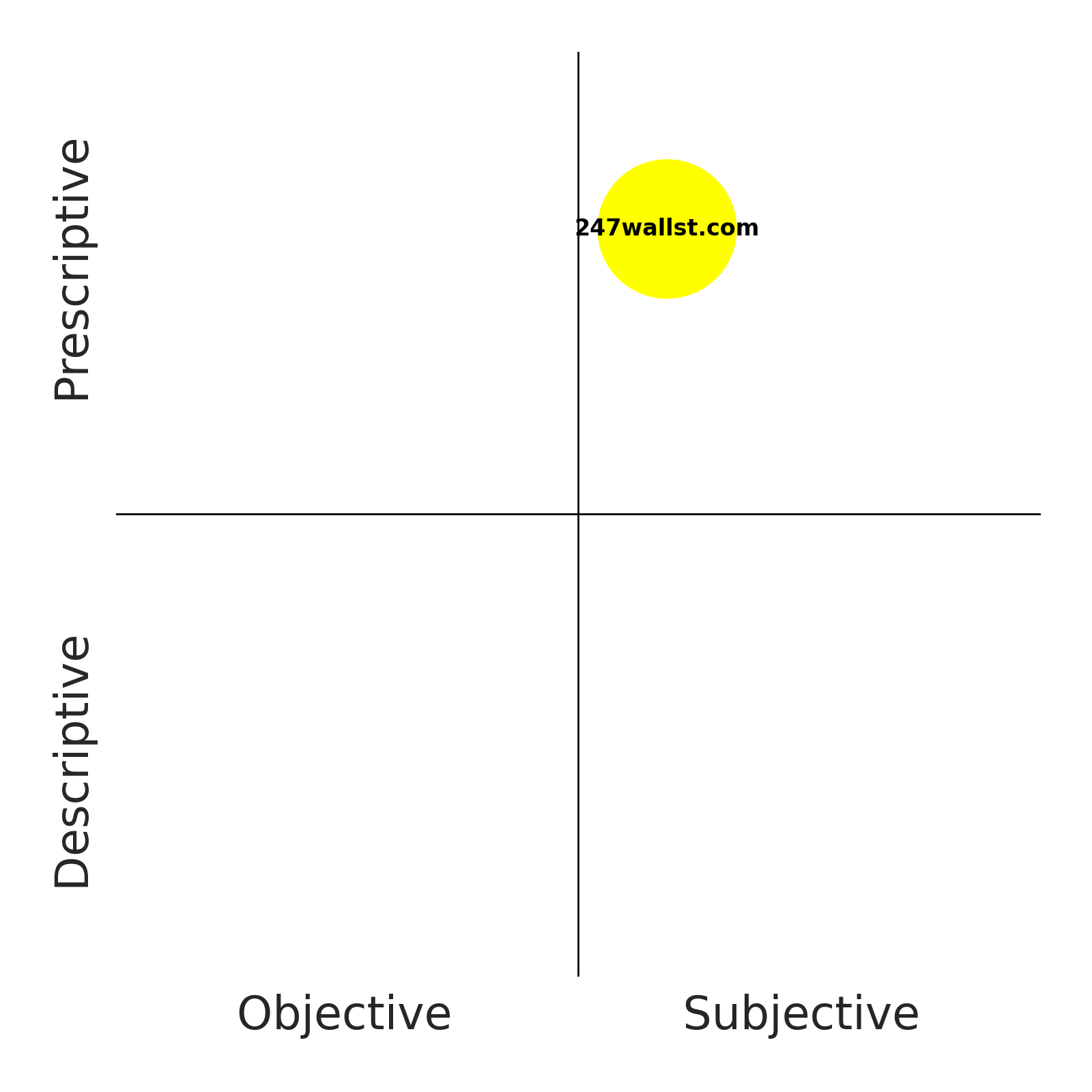
2026 © Helium Trades
Privacy Policy & Disclosure
* Disclaimer: Nothing on this website constitutes investment advice, performance data or any recommendation that any particular security, portfolio of securities, transaction or investment strategy is suitable for any specific person. Helium Trades is not responsible in any way for the accuracy
of any model predictions or price data. Any mention of a particular security and related prediction data is not a recommendation to buy or sell that security. Investments in securities involve the risk of loss. Past performance is no guarantee of future results. Helium Trades is not responsible for any of your investment decisions,
you should consult a financial expert before engaging in any transaction.
Helium Research Assistant

How can I help you today?
Ask any question about 247wallst.com bias.