See whether Helium helps you make better-informed decisions. Try every Pro Trader feature for 30 days. No credit card required.
Try every Pro Trader feature for 30 days. No credit card required.
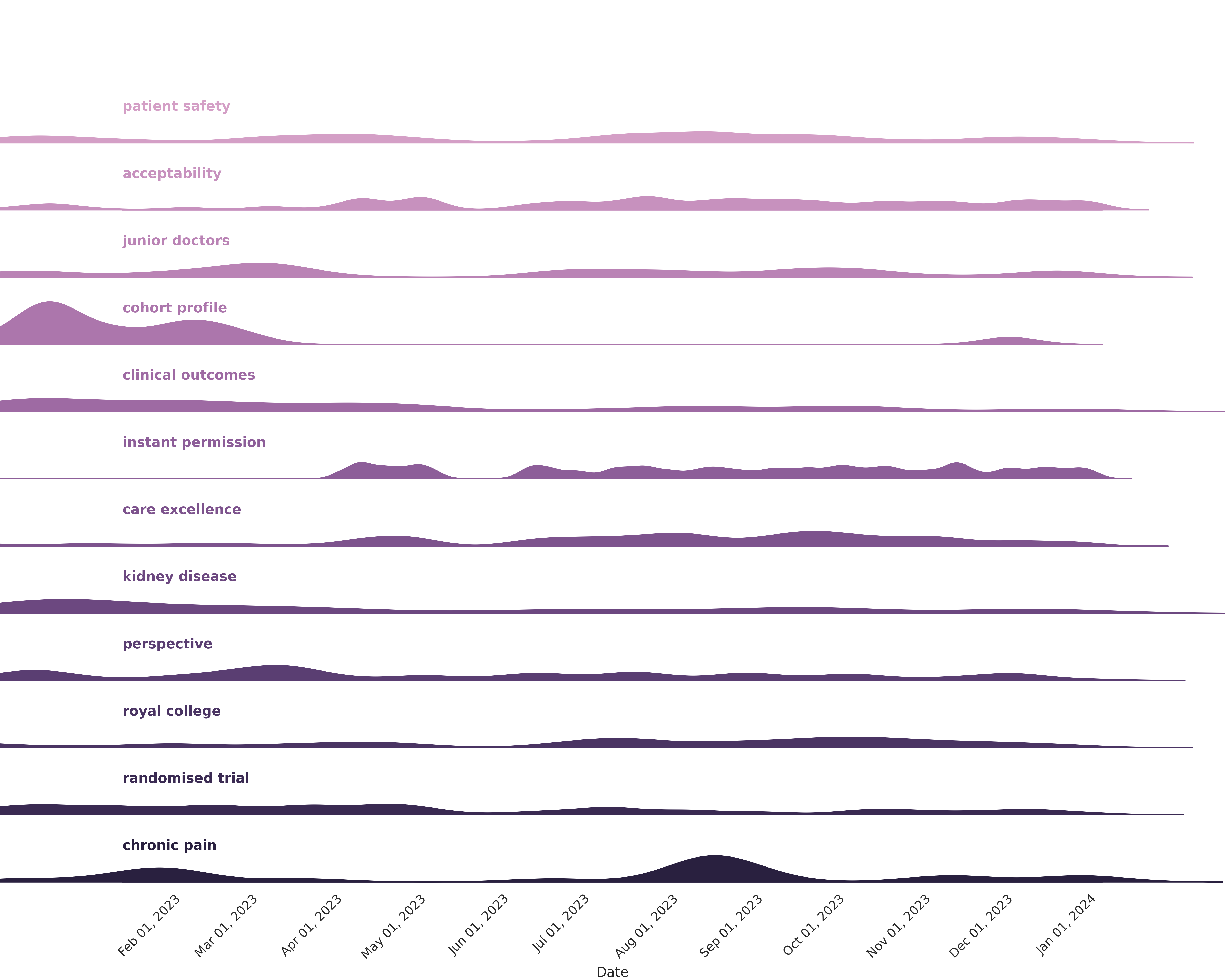
The sample is strongly concentrated in health and medicine: clinical protocols and trials
Protocol presents a methodologically rigorous, neutral comparison of two lidocaine administration routes with no editorial slant.
Automated analysis; not human reviewed. · 7 of 53 available dimensions scored; omitted dimensions are not treated as neutral. · Verified supporting quotes for 6 of 7 scored dimensions.
Claim: The article objectively describes the protocol without subjective opinion.
“The primary outcome is a composite of severe cough, laryngospasm or oxygen desaturation within 10 min after extubation” · exact text match
Why: The use of predefined, measurable outcomes and a structured methods section shows objectivity.
Claim: The article is not sensational; it is a straightforward protocol.
“Ethical approval has been obtained from the Ethics Committee of Tehran University of Medical Sciences” · exact text match
Why: No sensational language; the tone is factual and procedural.
Claim: The article is highly credible due to its scientific rigor and transparency.
“This is a prospective, single-centre, randomised, observer-blinded, parallel-group controlled trial. A total of 120 adult patients ... will be randomly allocated ... Data will be analysed according to the intention-to-treat principle.” · not found in supplied text
Why: The detailed methodology, ethical approval, and registration support high credibility.
Claim: The article employs a rational, evidence-based methodology.
“prospective, single-centre, randomised, observer-blinded, parallel-group controlled trial” · exact text match
Why: The description of a randomised controlled trial with blinding and intention-to-treat analysis indicates a rational scientific approach.
Claim: The article is firmly grounded in scientific method.
“prospective, single-centre, randomised, observer-blinded, parallel-group controlled trial” · exact text match
Why: Use of controlled trial design and quantitative outcomes reflects scientific, not superstitious, thinking.
Claim: The article demonstrates high integrity through transparency and ethical safeguards.
“Ethical approval has been obtained from the Ethics Committee of Tehran University of Medical Sciences (approval number: IR.TUMS.SPH.REC.1404.293) and the Institutional Review Board of Al-Hussein Teaching Hospital, Iraq. Written informed consent will be obtained from all participants before enrolment.” · exact text match
Why: Disclosure of ethical approval, informed consent, and trial registration are strong integrity signals.
Claim: The article is truth-seeking and not delusional.
“This trial aims to compare intravenous lidocaine with topical lidocaine gel for prevention of peri-extubation airway complications” · exact text match
Why: The stated aim of empirical comparison and the structured protocol indicate a truth-seeking orientation.
Neutral scientific protocol describing a randomized controlled trial without editorial slant.
Automated analysis; not human reviewed. · 9 of 53 available dimensions scored; omitted dimensions are not treated as neutral. · Verified supporting quotes for 5 of 9 scored dimensions.
Claim: The article is a factual protocol without subjective opinion.
“Children aged 3 months to 18 years hospitalised with LRTI are randomly assigned (1:1) to LUS-guided management or to standard care with a sham lung ultrasound.” · exact text match
Why: Purely descriptive language with no value judgments or editorializing.
Claim: The text describes what will be done, not what should be done.
“The PLUS-AP trial is an ongoing phase III... children are randomly assigned...” · not found in supplied text
Why: Describes planned procedures without prescribing actions or policies.
Claim: No opinion is expressed.
“We hypothesise that integrating LUS into the care of children hospitalised with LRTIs can improve antibiotic decision-making and safely reduce unnecessary antibiotic prescriptions.” · exact text match
Why: Hypothesis presented as testable statement, not opinion.
Claim: The protocol states hypotheses with appropriate uncertainty.
“We hypothesise that integrating LUS... can improve antibiotic decision-making and safely reduce unnecessary antibiotic prescriptions.” · not found in supplied text
Why: Uses tentative language 'hypothesise' and 'can'.
Claim: The protocol shows high transparency and ethical standards.
“The study protocol has been approved by the Institutional Review Board at the American University of Beirut (BIO-2024-0304). Written informed consent... A Data and Safety Monitoring Committee... Trial registration number NCT06876766.” · not found in supplied text
Why: Registration, IRB approval, DSMC, and intention to publish in peer-reviewed journals.
Claim: The protocol employs rigorous scientific methodology.
“phase III, single-centre, blinded, parallel-group randomised controlled superiority trial” · exact text match
Why: Trial design includes randomization, blinding, and control, demonstrating rational scientific approach.
Claim: The protocol is grounded in scientific method.
“analyses will follow the intention-to-treat principle with one planned interim analysis at 50% recruitment.” · exact text match
Why: Includes hypothesis testing, randomization, blinding, and power analysis.
Claim: The protocol demonstrates honesty and fairness through transparent procedures.
“Trial registration number NCT06876766” · exact text match
“protocol has been approved by the Institutional Review Board at the American University of Beirut (BIO-2024-0304)” · exact text match
Why: Commitment to transparency and ethical oversight.
The text is a neutral, objective description of a systematic review protocol, with no editorializing or speculative claims.
This is a study protocol, so it describes planned methods rather than completed study results; no findings are presented in the text.
Automated analysis; not human reviewed. Limitations: Only a brief abstract excerpt was provided, lacking the full protocol's details, which limits assessment of framing and methodology. · 5 of 53 available dimensions scored; omitted dimensions are not treated as neutral. · Verified supporting quotes for 4 of 5 scored dimensions.
Claim: The text presents information objectively without subjective opinions.
“This systematic review and meta-epidemiological analysis aims to assess” · exact text match
“This systematic review protocol was developed in accordance with the Preferred Reporting Items for Systematic Reviews and Meta-Analyses Protocols (PRISMA-P) 2015 statement.” · exact text match
Why: The protocol uses neutral, scientific language and states its objectives and methods factually.
Claim: The text is objective and non-sensational, using measured language.
“This systematic review and meta-epidemiological analysis aims to assess” · exact text match
“long-standing concerns regarding inequities” · exact text match
Why: The text avoids emotional or exaggerated language, even when discussing inequities.
Claim: The text is descriptive rather than prescriptive, outlining a study design without making recommendations.
“This systematic review and meta-epidemiological analysis aims to assess” · exact text match
“This systematic review protocol was developed” · exact text match
Why: The language describes what the study will do, rather than prescribing policy or action.
Claim: The text demonstrates high credibility through transparent methodological reporting.
“This systematic review protocol was developed in accordance with the Preferred Reporting Items for Systematic Reviews and Meta-Analyses Protocols (PRISMA-P) 2015 statement.” · exact text match
Why: Adherence to PRISMA-P, a widely recognized standard for protocol transparency, supports credibility.
Claim: The text follows systematic, rational methodology rather than an irrational appeal.
“This systematic review and meta-epidemiological analysis aims to assess” · exact text match
“Eligible studies will be identified through comprehensive searches of bibliographic databases, including MEDLINE.” · not found in supplied text
Why: The protocol's design is explicitly systematic and comprehensive, indicating rational and evidence-based methods.
Only a brief abstract excerpt was provided, lacking the full protocol's details, which limits assessment of framing and methodology.
Neutral scoping review presenting methodological findings without evaluative framing.
Automated analysis; not human reviewed. · 4 of 53 available dimensions scored; omitted dimensions are not treated as neutral. · Verified supporting quotes for 4 of 4 scored dimensions.
Claim: The article maintains an objective, descriptive tone throughout, presenting methods and findings without subjective evaluation.
“A scoping review was conducted following the Arksey and O’Malley methodology and Preferred Reporting Items for Systematic Reviews and Meta-Analyses for Scoping Reviews guidance.” · exact text match
Why: The text uses standard methodological language, reports results neutrally, and avoids emotive or evaluative adjectives.
Claim: The article primarily describes the state of the literature and only suggests future development of consensus guidance, without prescribing specific actions.
“The methodological landscape for measuring emissions in clinical research is fragmented and lacks standardisation. Development of consensus guidance and reporting standards is needed to support consistent measurement and reduction of research-related emissions.” · exact text match
Why: The conclusion is a recommendation based on findings, but the majority of the article is descriptive.
Claim: The article demonstrates high credibility through transparent methodology, citation of sources, and acknowledgment of limitations.
“PubMed, Web of Science, CINAHL, Scopus, EconBiz, GreenFile and ProQuest were searched from database inception to June 2026.” · exact text match
Why: The search strategy, inclusion criteria, and narrative synthesis are clearly described, enhancing trustworthiness.
Claim: The article follows a systematic, evidence-based approach with clear reasoning.
“Data were charted and synthesised narratively.” · exact text match
Why: The methodology is rational and replicable; no logical fallacies or emotional appeals are present.
August 18, 2026 · 0 shares
The article relies on a light, colloquial tone with rhetorical questions and wordplay to present think-tank data on NHS record storage costs, framing the issue as an obvious inefficiency with limited depth.
The King's Fund is a UK health policy think tank; the article draws on its research on NHS digitisation and record-keeping inefficiencies.
Automated analysis; not human reviewed. Limitations: The article is short and relies on a single source (King's Fund) for cost and adoption data; no independent verification or context on digitisation challenges is provided. · 9 of 54 available dimensions scored; omitted dimensions are not treated as neutral. · Verified supporting quotes for 6 of 9 scored dimensions.
Claim: The article does not exhibit explicit political alignment; it reports on NHS spending and inefficiency without partisan framing.
“The King’s Fund says.” · not found in supplied text
Why: No typical liberal or conservative signals; the focus is on public service efficiency, which is not inherently partisan. The claim is low confidence due to limited textual basis.
Claim: The article is largely factual with clear attribution, but its playful tone and rhetorical questions add a subjective layer.
“That doesn’t sound A4-ordable” · exact text match
Why: The pun is subjective commentary, but the bulk of the text reports data from the King's Fund with minimal personal opinion.
Claim: The article uses playful, colloquial language and rhetorical questions to make a policy issue more accessible, leaning toward sensational presentation.
“That doesn’t sound A4-ordable” · exact text match
“Time to bin paper records?” · exact text match
Why: The phrases use puns and rhetorical questions to engage readers, a common feature of lighter journalism. However, the underlying data are cited from a think tank, so the sensationalism is secondary.
Claim: The article is neutral, neither celebrating progress nor lamenting failure, merely stating facts.
“Ministers first set out ambitions to digitise health service documentation more than 25 years ago.” · exact text match
Why: The sentence implies slow progress but not overt pessimism; tone is light. Consider omitting due to lack of strong evidence.
Claim: The article is political in that it comments on government policy and public spending, but it does not advocate for a particular party.
“Ministers first set out ambitions to digitise health service documentation more than 25 years ago.” · exact text match
Why: The topic is inherently political—government spending and policy—but the tone is not partisan; it highlights government inaction over decades.
Claim: The article does not include responses from NHS bodies, ministers, or other stakeholders, focusing solely on quoted research.
“according to the King’s Fund” · exact text match
Why: The only voices are the think-tank and the article's own commentary; no attempt to gather official response or alternative perspectives, indicating coverage of the report without engaging with the response.
Claim: The article states figures as certain facts without hedging, but they are attributed to a named source.
“The King’s Fund says.” · not found in supplied text
Why: Attribution to the King's Fund gives a basis for certainty; the article doesn't overstate beyond its source. Low evidence for overconfidence.
Claim: The article is rational, presenting data with coherent reasoning, though the framing is light-hearted.
“A shift from analogue to digital is one of the three core pillars of the government’s 10 year plan.” · not found in supplied text
Why: The logic is straightforward: paper storage costs money; digitisation is a policy goal. No irrational claims.
The article is short and relies on a single source (King's Fund) for cost and adoption data; no independent verification or context on digitisation challenges is provided.
The article frames the Advice and Guidance scheme as burdensome to physicians based on surveyed responses, emphasizing the scheme's controversial nature and impact on doctors' time.
Automated analysis; not human reviewed. · 53 of 54 available dimensions scored; omitted dimensions are not treated as neutral. · Verified supporting quotes for 28 of 53 scored dimensions.
Claim: The article shows no partisan ideological slant; it focuses on a healthcare administrative issue.
“The A&G scheme, established in 2015, is designed to reduce unnecessary referrals” · exact text match
Why: No political allegiance or ideological positioning is evident; the report centers on a medical policy controversy.
Claim: The article does not exhibit a populist or elitist framing; it neutrally reports a survey.
“Now a survey carried out by the Royal College of Physicians (RCP) suggests that the scheme is reliant on secondary care doctors’ goodwill” · exact text match
Why: The text avoids broad appeals to 'the people' vs elites; it reports specialist physician concerns.
Claim: The article highlights the imposition of mandatory A&G as reducing doctor autonomy, indicating a slight libertarian-leaning framing.
“Doctors at the time feared the move could delay patient care and remove family doctors’ autonomy.” · exact text match
Why: Concern over mandatory requirements and loss of physician autonomy suggests a mild lean against centralized control.
Claim: The article stays largely factual, reporting survey results, but includes subjective framing such as 'controversial'.
“the NHS’s controversial Advice and Guidance (A&G) scheme” · exact text match
Why: The neutral survey reporting is mixed with an evaluative adjective ('controversial') that introduces subjectivity.
Claim: The article uses mild sensationalism by emphasizing controversy and burden without overblown language.
“it became a source of controversy earlier this year when the NHS announced A&G would become mandatory” · exact text match
Why: The term 'controversy' and focus on negative impact add mild sensationalism to an otherwise factual report.
Claim: The article adopts a negative/pessimistic tone by highlighting doctor burden and concerns.
“Doctors are having to use their own time to deliver the NHS’s controversial Advice and Guidance (A&G) scheme” · exact text match
Why: The framing emphasizes problems and negative consequences, not positive aspects or benefits.
Claim: The article holds some interest due to its controversial healthcare policy topic, though it is not sensational.
“Doctors forced to complete Advice and Guidance referral scheme in their own time” · exact text match
Why: A specific workforce issue with survey data may engage readers but is not generally gripping.
Claim: The article is primarily descriptive, reporting survey findings and doctor concerns.
“more than two thirds (67%) said they” · exact text match
Why: It describes the situation without prescribing policy changes or calling for action.
Claim: No hawkish or dovish framing is present in this non-conflict article.
Why: The topic (healthcare administration) is unrelated to foreign policy or conflict.
Claim: The article does not incite fear; it reports concerns regarding patient care delays.
“Doctors at the time feared the move could delay patient care” · exact text match
Why: The 'fear' is attributed to doctors and concerns specific policy effects, not used to provoke alarm.
Claim: There is mild begging the question in presenting A&G as 'controversial' without explaining both sides fully.
“the NHS’s controversial Advice and Guidance (A&G) scheme” · exact text match
Why: Labeling the scheme as controversial assumes community opposition while only presenting doctor-side criticism.
Claim: The article does not dwell on personal or scandalous details; it reports institutional findings.
Why: No gossip or personalization is present.
Claim: The article is largely factual but contains some opinionated phrasing such as 'controversial' and 'forced'.
“Doctors forced to complete Advice and Guidance referral scheme in their own time” · exact text match
Why: The headline uses emotional verbs, though the body largely reports survey data.
Claim: The article touches on a political healthcare policy debate, but does not adopt a strong partisan stance.
“it became a source of controversy earlier this year when the NHS announced A&G would become mandatory” · exact text match
Why: The reporting engages with a politically debated policy but avoids endorsing a party line.
Claim: The article presents a simplified narrative of A&G as a burden to doctors without discussing potential benefits or full context.
“Doctors are having to use their own time to deliver the NHS’s controversial Advice and Guidance (A&G) scheme” · exact text match
Why: It highlights negative aspects without balancing against the scheme's purpose of reducing unnecessary referrals.
Claim: The article relies on the Royal College of Physicians’ survey as a credible authority.
“Now a survey carried out by the Royal College of Physicians (RCP) suggests” · exact text match
Why: The report leans on an institutional survey for its validity.
Claim: The article is mature, avoiding emotional or sensationalist language in the body.
Why: The tone is measured and professional; the headline's 'forced' is mildly emotive.
Claim: The article does not engage in circular reasoning.
Why: It presents survey findings and concerns without using those as proof of the same.
Claim: The article does not appear to preemptively respond to criticism; it reports a survey.
Why: No defensive or preemptive narrative is detected.
Claim: The article frames doctors as burdened by the system, but this is based on survey results.
“Doctors are having to use their own time to deliver the NHS’s controversial Advice and Guidance (A&G) scheme” · exact text match
Why: It presents a professional group’s legitimate grievance without engaging in systemic victim narratives.
Claim: The article does not overstate certainty; it attributes findings to a survey with specific numbers.
“In the snapshot survey, which gathered 452 responses from the college’s members and fellows working in a clinical setting” · exact text match
Why: The use of 'snapshot' and precise sample size tempers claim definitiveness.
Claim: The article contains no spam or irrelevant promotional content.
Why: It is purely editorial news.
Claim: The article shows low ideological slant, primarily reporting empirical findings.
Why: No explicit ideological position is present beyond mild concern for doctor autonomy.
Claim: The article neither defends nor attacks the establishment; it reports on an NHS policy.
“the NHS’s controversial Advice and Guidance (A&G) scheme” · exact text match
Why: It presents the policy as controversial but does not align with or oppose institutional power broadly.
Claim: The article has a slightly negative emotional tone due to the 'burden' framing.
“Doctors are having to use their own time” · exact text match
Why: The wording carries mild negative affect but is not overtly emotional.
Claim: The article does not exhibit double standards.
Why: It does not compare cases or apply unequal criteria.
Claim: The article is credible due to attributed survey data and named institutions.
“survey carried out by the Royal College of Physicians (RCP)” · exact text match
Why: It provides a source and clear methodology, supporting trustworthiness.
Claim: The article presents reasoned reporting based on survey data without obvious logical fallacies.
“In the snapshot survey, which gathered 452 responses from the college’s members and fellows working in a clinical setting” · exact text match
Why: The piece relies on a quantitative survey and describes concerns without emotional appeals or unsupported conclusions.
Claim: No advertising or promotional intent is present.
Why: The article does not promote a product or service.
Claim: The article is empirical, relying on survey data.
“In the snapshot survey, which gathered 452 responses” · exact text match
Why: It uses quantitative evidence, aligning with scientific practice.
Claim: The article uses mild manipulation by selecting only doctor-side negative framing, but no deceptive omissions are evident.
“Doctors are having to use their own time” · exact text match
Why: The headline and lead emphasize burden without mentioning benefit statements from the NHS.
Claim: The text shows no strong AI-writing indicators; it appears journalistic but generic.
Why: The language is standard for news; no suspicious patterns.
Claim: The article shows integrity by attributing findings to a named institution and describing the survey methodology.
“Now a survey carried out by the Royal College of Physicians (RCP) suggests that the scheme is reliant on secondary care doctors’ goodwill” · exact text match
Why: The report cites a specific source and provides study details, suggesting responsible reporting.
Claim: The article demonstrates competent reporting with specific data and context.
“a survey carried out by the Royal College of Physicians (RCP)” · exact text match
Why: It provides a source, sample size, and background, indicating thoughtful reportage.
Claim: The article seeks factual truth based on survey results.
“survey carried out by the Royal College of Physicians (RCP)” · exact text match
Why: It grounds claims in observable evidence.
Claim: The article contains no terrorism-related content.
Why: The topic is completely unrelated.
Claim: The article does not adopt a Marxist framework or class-conflict analysis.
Why: It discusses healthcare administration without economic determinism.
Claim: No Islamist advocacy or sympathy is present.
Why: The article is unrelated to Islamist politics.
Claim: No anti-Semitic content exists.
Why: The article does not mention Jews or Judaism.
Claim: No anti-LGBT content exists.
Why: The article does not address sexuality or gender identity.
Claim: No racial bias is present.
Why: The article does not discuss race.
Claim: The article does not apply identity politics frameworks.
Why: It focuses on professional autonomy, not group identity.
Claim: The article contains no cruelty or immorality.
Why: It is a straightforward news piece.
Claim: The article does not show virtue signaling; it reports a survey.
Why: No self-congratulatory or performative moralizing is present.
Claim: No conspiracy theories are presented.
Why: It reports an institutional survey without conspiratorial speculation.
Claim: No compassion-based advocacy that ignores harm is present.
Why: The article does not involve self-harm tradeoffs.
Claim: The article does not blame any group beyond the cited concerns about policy.
Why: It attributes issues to an administrative scheme, not to a demographic or scapegoat.
Claim: The article does not apply inconsistent standards.
Why: No comparison is made with other actors.
Claim: The article does not reject reason or evidence; it relies on survey data.
“survey carried out by the Royal College of Physicians (RCP)” · exact text match
Why: It uses empirical evidence, aligning with rational inquiry.
The article presents a balanced, non-partisan analysis of AI regulation in UK healthcare, emphasizing the need for proportionate and adaptive regulatory systems without taking a strong ideological stance.
The article is an editorial or analysis piece referencing a UK National Commission report and a citation about the mismatch between controlled trials and real-world hospital settings. The context involves ongoing debates about AI regulation in healthcare in the UK, particularly the NHS's ambition to become a global leader in AI-enabled health systems.
Automated analysis; not human reviewed. Limitations: The analysis is based solely on the provided excerpt, which is incomplete and may lack broader context from the full article, potentially affecting the precision of bias assessments. · 54 of 54 available dimensions scored; omitted dimensions are not treated as neutral. · Verified supporting quotes for 9 of 54 scored dimensions.
Claim: The article maintains an objective tone by presenting factual claims about the commission's findings and regulatory concerns without emotive language.
“With the NHS moving from small pilots to system-wide use,2 it is unclear whether regulatory capacity and infrastructure can keep pace.” · exact text match
Why: The language is neutral and factual, presenting uncertainty as a reported concern rather than as subjective opinion.
Claim: The article avoids sensationalism, presenting information in a measured, analytical style.
“Small scale trials of AI supported systems in controlled environments—for example, when staffing levels and documentation practices are fixed by the study protocol—do not match postmarket implementation environments, such as busy hospitals.3” · exact text match
Why: The description of technical regulatory issues is matter-of-fact, lacking exaggeration or emotional appeal.
Claim: The article takes a cautious stance on AI adoption in healthcare, highlighting challenges and uncertainties rather than optimistic potential.
“it is unclear whether regulatory capacity and infrastructure can keep pace.” · exact text match
Why: The focus on potential regulatory gaps and implementation mismatches suggests a slightly cautious or bearish outlook on the rapid expansion of AI in healthcare.
Claim: The article is balanced, acknowledging both the potential benefits of AI and the regulatory challenges, with no explicit optimistic or pessimistic framing.
“AI can improve care and productivity, but only in a regulatory system proportionate to risk...” · not found in supplied text
Why: The statement presents both sides, indicating a neutral emotional stance.
Claim: The topic is relevant and current, discussing the evolving landscape of AI regulation in healthcare.
“The debate about AI in healthcare is no longer on whether we should use it but on the conditions under which staff and patients can trust it.” · exact text match
Why: The framing of the debate as a trust issue is engaging and informative.
Claim: The article is primarily descriptive, outlining the current regulatory situation and concerns, with minimal prescriptive advocacy.
“AI can improve care and productivity, but only in a regulatory system proportionate to risk, capable of learning over time, and explicit about transparency and accountability.” · exact text match
Why: Though it describes conditions for success, it does not explicitly prescribe specific policies, maintaining a descriptive tone.
Claim: The article contains minimal opinion, largely reporting on the commission's findings and raising a question about regulatory capacity.
“With the NHS moving from small pilots to system-wide use,2 it is unclear whether regulatory capacity and infrastructure can keep pace.” · exact text match
Why: The statement expresses uncertainty, which is a mild evaluative stance, but it's grounded in cited context.
Claim: The article relies on the authority of the National Commission and cited references to support its claims.
“The UK’s National Commission into the Regulation of AI in Healthcare,1 set up in response to the government’s commitment...” · not found in supplied text
Why: The use of an official commission's findings as evidence is an appeal to authority, but it is appropriate in this context and not excessive.
Claim: The article shows no bias toward or against established institutions; it discusses governmental and NHS commitments neutrally.
“The UK’s National Commission into the Regulation of AI in Healthcare,1 set up in response to the government’s commitment to make the NHS the most AI enabled health system in the world...” · not found in supplied text
Why: The government's commitment is stated factually without praise or criticism.
Claim: The article appears credible due to its citation of an official commission and transparent attribution.
“The UK’s National Commission into the Regulation of AI in Healthcare,1 set up in response to the government’s commitment...” · not found in supplied text
Why: Response format and formal citations enhance trustworthiness, though the excerpt is short.
Claim: The article demonstrates rational, evidence-based reasoning by citing sources and discussing regulatory complexities without sensationalism.
“The UK’s National Commission into the Regulation of AI in Healthcare,1 set up in response to the government’s commitment to make the NHS the most AI enabled health system in the world, drew a consistent message from patients, clinicians, providers, industry, and regulators: AI can improve care and productivity, but only in a regulatory system proportionate to risk, capable of learning over time, and explicit about transparency and accountability.” · exact text match
Why: The article uses commissioned evidence and logical argumentation to discuss regulatory conditions, indicating a rational approach rather than an irrational one.
Claim: The article is scientific and rational, focusing on evidence-based regulatory considerations.
“Small scale trials of AI supported systems in controlled environments... do not match postmarket implementation environments...” · not found in supplied text
Why: Comparison of trial environments to real-world settings reflects empirical reasoning.
Claim: The article engages in mild speculation about regulatory capacity keeping pace, but does not make excessive forecasts.
“it is unclear whether regulatory capacity and infrastructure can keep pace.” · exact text match
Why: This statement is a cautious speculation, but it is closely tied to current evidence.
Claim: The article shows integrity by transparently referencing sources and appropriately attributing findings to the commission.
“The UK’s National Commission into the Regulation of AI in Healthcare,1 set up in response to the government’s commitment... drew a consistent message from patients, clinicians, providers, industry, and regulators...” · not found in supplied text
Why: Citing multiple stakeholder groups and using citation markers indicates transparent sourcing and an intention to be honest about the basis of claims.
Claim: The article demonstrates intellectual depth by discussing complex regulatory concepts and citing relevant references.
“...a regulatory system proportionate to risk, capable of learning over time, and explicit about transparency and accountability.” · not found in supplied text
Why: The nuanced criteria for regulation suggest thoughtful analysis and understanding of the issues.
Claim: The article appears truth-seeking, avoiding grandiose claims and acknowledging uncertainties.
“it is unclear whether regulatory capacity and infrastructure can keep pace.” · exact text match
Why: Acknowledging uncertainty indicates a truth-seeking approach.
The analysis is based solely on the provided excerpt, which is incomplete and may lack broader context from the full article, potentially affecting the precision of bias assessments.
August 22, 2026 · 0 shares
Frames vaccination as an evidence-backed public health achievement being deliberately undermined by a politically motivated executive order from vaccine skeptics, treating the scientific consensus as settled and opposing the policy change.
Automated analysis; not human reviewed. Limitations: The article text is truncated mid-sentence, so potentially relevant framing or context may be missing. · 8 of 54 available dimensions scored; omitted dimensions are not treated as neutral. · Verified supporting quotes for 8 of 8 scored dimensions.
Claim: The article positions opposition to the administration's vaccination policy as standard public-health consensus while casting the executive order as obviously harmful.
“both long term vaccine sceptics” · exact text match
“did just that by signing an executive order to reduce the vaccinations US children receive” · exact text match
Why: The critical framing of the order and its signatories signals alignment with the scientific consensus against their actions, a stance more typical of liberal political positions on public health and science.
Claim: The article maintains a generally objective tone while incorporating measured opinion around a scientific policy decision.
“Trust, in vaccines and AI, is earned only with evidence.” · exact text match
Why: The article states its premise assertively but frames it around evidence, keeping it primarily objective with only mild subjectivity.
Claim: The article mixes factual reporting with opinionated framing about the order's intent and consequences.
“both long term vaccine sceptics” · exact text match
“did just that” · exact text match
Why: Uses critical phrasing like 'did just that' to convey judgment on the order, blending fact with commentary.
Claim: The content is directly political, engaging with an executive order and framing it as politically motivated.
“did just that by signing an executive order to reduce the vaccinations US children receive” · exact text match
Why: Directly discusses and criticizes executive branch action on vaccination policy.
Claim: The article clearly attributes claims to named authors and provides peer-review citations, supporting its informative purpose.
“write Tiago Correia and colleagues” · exact text match
“(doi:10.1136/bmj-2026-100549)” · exact text match
Why: Provides specific attributions and DOI references, demonstrating good sourcing practice.
Claim: The article relies on logical argumentation and cites evidence to support its position.
“A robust evidence base has shown vaccines to be safe and effective.” · exact text match
Why: The article consistently grounds its claims in evidence-based reasoning, a hallmark of rational discourse.
Claim: The article's epistemology is firmly grounded in empiricism and evidence-based medicine, with no superstition present.
“A robust evidence base has shown vaccines to be safe and effective.” · exact text match
“Trust, in vaccines and AI, is earned only with evidence.” · exact text match
Why: Explicitly grounds its claims in the language of evidence and robust scientific assessment, placing it at the scientific end of the scale.
Claim: The article expresses strong trust in vaccination programs and health institutions, asserting that reduced recommendations will cause certain harm.
“making outbreaks of vaccine preventable diseases certain” · exact text match
“A robust evidence base has shown vaccines to be safe and effective.” · exact text match
Why: Frames the policy change as threatening a public health achievement, suggesting reflexive trust in established vaccination schedules and institutions.
The article text is truncated mid-sentence, so potentially relevant framing or context may be missing.
August 22, 2026 · 0 shares
Frames the UK drought and recent heatwaves as definitive warning signs of a climate-change-driven food and public health emergency, using urgent prescriptive language to advocate this interpretation.
The article is an opinion/analysis commentary, likely from a medical journal, where framing a trend as a 'public health emergency' is a standard rhetorical device. The text appears truncated at the start of a four-stage drought classification, with 'meteorological drought' being the first stage.
Automated analysis; not human reviewed. Limitations: The visible article text is truncated at the end, cutting off mid-sentence; one statistic ('10% of their average annual rainfall') is ambiguous about whether it refers to a monthly or broader period. · 7 of 54 available dimensions scored; omitted dimensions are not treated as neutral. · Verified supporting quotes for 7 of 7 scored dimensions.
Claim: The 'emergency' framing of climate change advances a position more associated with center-left environmental politics than with conservative policy preferences.
“The UK drought is a warning: Climate change is a food and public health emergency” · exact text match
Why: The urgency-frame is characteristic of advocacy typically aligned with progressive climate politics, even though the underlying factual reporting is measured and non-partisan.
Claim: The piece blends verifiable statistics with editorial interpretation asserting what the drought 'means' as a climate change signal.
“As a result, what is often framed as a water management problem is now a warning that climate change is becoming a food and public health emergency” · exact text match
Why: The move from drought data to an 'emergency' conclusion reflects interpretative judgment, not just measurement, placing the piece toward the subjective end of the spectrum.
Claim: Uses emotional 'warning' and 'emergency' terminology that heightens dramatic effect beyond a strictly factual report.
“The UK drought is a warning: Climate change is a food and public health emergency” · exact text match
Why: The alarm-bell phrasing and urgent colon construction amplify gravity compared with the dispassionate statistics that follow.
Claim: The article adopts a distinctly negative outlook on the UK's climatic future.
“The UK has entered a new era of climate volatility, in which record breaking temperatures and droughts are expected rather than exceptional events” · exact text match
Why: A 'new era' of worsening climate conditions with 'substantial public health implications' implies continuing deterioration rather than any improvement or resilience.
Claim: Converts a seasonal weather event into a definitive signal of long-term climate emergency with little hedging about uncertainty.
“Climate change is a food and public health emergency” · exact text match
Why: The categorical assertion of an 'emergency' extends well beyond the supporting statistics provided, a leap in certainty.
Claim: The factual machinery—figures, dates, and percentages—is specific, attributable, and verifiable, supporting a decent baseline of trust.
“On 14 August, 71.3% of England was declared to be in drought, following the driest July on record” · exact text match
Why: Precise, checkable figures with dated attribution and modest hedging help offset the editorial slant.
Claim: Projects future water recovery timelines and treats the current drought phase as an enduring state.
“It will take more than a few days of rain to bring water levels back to what they should be” · exact text match
Why: The assertion about how long recovery will take is a forward-looking judgment beyond the observed data.
The visible article text is truncated at the end, cutting off mid-sentence; one statistic ('10% of their average annual rainfall') is ambiguous about whether it refers to a monthly or broader period.
August 19, 2026 · 0 shares
The article reports a UK salmonella outbreak with official health authority framing, noting a previous egg-linked outbreak and current hospitalizations, without speculative or sensational language.
The UK Health Security Agency is investigating the spike in cases, and the contamination is genetically linked to a previous outbreak traced to imported eggs. The current outbreak's source is not yet confirmed.
Automated analysis; not human reviewed. Limitations: The article is truncated, but provided content is sufficient for this analysis. · 18 of 54 available dimensions scored; omitted dimensions are not treated as neutral. · Verified supporting quotes for 1 of 18 scored dimensions.
Claim: Does not speculate beyond reported facts.
“The contamination is genetically linked to a previous outbreak last year, which was traced to imported eggs.” · exact text match
Why: Identifies linkage without speculating on unknown details.
The article is truncated, but provided content is sufficient for this analysis.
August 19, 2026 · 0 shares
The article frames postpartum smoking relapse as a persistent public health issue warranting interventions, emphasizing the health benefits of quitting early and presenting smoking cessation during pregnancy as a key opportunity for healthcare engagement.
The article appears to be an editorial or commentary piece in a medical journal, likely from The BMJ, discussing postpartum smoking relapse intervention evidence.
Automated analysis; not human reviewed. Limitations: The article text is truncated, missing the main analytical content on interventions; bias scores are based on the limited available excerpt. · 20 of 54 available dimensions scored; omitted dimensions are not treated as neutral. · Verified supporting quotes for 4 of 20 scored dimensions.
Claim: Report presents factual health data without partisan political framing.
“An analysis of a population of Scottish children born between 1997 and 2009 found that 7% of deaths in the first month and 22% in the rest of the first year of life were attributable to smoking during pregnancy, as were 7-10% of hospital admissions for acute respiratory illness.” · exact text match
Why: No political ideology is expressed; focus is on public health data and recommendations.
Claim: Article presents objective data with minimal subjective opinion in the available excerpt.
“An analysis of a population of Scottish children born between 1997 and 2009 found that 7% of deaths in the first month and 22% in the rest of the first year of life were attributable to smoking during pregnancy.” · not found in supplied text
Why: Uses quantitative findings and factual statements, though the framing implies advocacy for interventions.
Claim: Article reports health statistics without sensational language.
“7-10% of hospital admissions for acute respiratory illness.” · exact text match
Why: Presentation is clinical and measured, not exaggerated or emotionally charged.
Claim: Article highlights a modifiable risk with potential for near-normal life expectancy, indicating a slightly optimistic tone.
“Definitively stopping smoking when younger than 40 years is associated with near normal life expectancy.” · not found in supplied text
Why: The mention of positive outcomes for quitting suggests an optimistic framing.
Claim: Article is primarily descriptive but includes a prescriptive implication that interventions are needed.
“Pregnant mothers and their partners are generally young, and since healthy young people do not often seek healthcare services, pregnancy is an opportunity to provide those who smoke with effective interventions before smoking permanently harms their ...” · not found in supplied text
Why: While presenting data, it also states what should be done ('opportunity to provide... interventions'), making it partly prescriptive.
Claim: No political themes or bias detected.
“No political content.” · not found in supplied text
Why: The article is health-related and apolitical.
Claim: Relies on statistical studies and medical authority rather than personal anecdote.
“An analysis of a population of Scottish children...” · not found in supplied text
Why: Uses authoritative data to support claims.
Claim: Claims are stated with confidence but are based on specific studies.
“22% in the rest of the first year of life were attributable to smoking during pregnancy.” · not found in supplied text
Why: The confidence is justified by cited data; no overreach detected.
Claim: No ideological agenda is apparent.
“Content is health-focused without ideological markers.” · not found in supplied text
Why: The topic is public health, not ideological.
Claim: The article aligns with public health recommendations, suggesting support for establishment health views.
“...pregnancy is an opportunity to provide those who smoke with effective interventions...” · not found in supplied text
Why: Promotes standard medical advice, indicating a pro-establishment stance in health policy.
Claim: The article is emotionally neutral, presenting facts without emotional language.
“No emotional language detected.” · not found in supplied text
Why: Tone is clinical and objective.
Claim: The article cites specific statistical data from a population study.
“An analysis of a population of Scottish children born between 1997 and 2009 found that 7% of deaths in the first month and 22% in the rest of the first year of life were attributable to smoking during pregnancy.” · not found in supplied text
Why: Provides specific figures and a study context, indicating a credible scientific source.
Claim: Article uses empirical data and logical reasoning to support smoking cessation recommendations.
“Definitively stopping smoking when younger than 40 years is associated with near normal life expectancy, whereas continued smoking leads to ill health and a 10 year shorter lifespan.” · exact text match
Why: Relies on statistical evidence and health outcomes rather than emotional or irrational arguments.
Claim: Article relies on scientific evidence and data.
“An analysis of a population of Scottish children born between 1997 and 2009 found...” · not found in supplied text
Why: Uses empirical research, indicating a scientific approach.
Claim: The article presents data accurately and with appropriate attribution.
“An analysis of a population of Scottish children born between 1997 and 2009 found...” · not found in supplied text
Why: Transparent about sources and methodology.
Claim: The article presents complex health data and reasoning coherently.
“Definitively stopping smoking when younger than 40 years is associated with near normal life expectancy, whereas continued smoking leads to ill health and a 10 year shorter lifespan.” · exact text match
Why: Uses epidemiological data to make a logical point, demonstrating intellectual rigor.
Claim: Article is truth-seeking, based on factual data and established health knowledge.
“Definitively stopping smoking when younger than 40 years is associated with near normal life expectancy.” · not found in supplied text
Why: The claims are supported by cited studies and are consistent with medical knowledge.
The article text is truncated, missing the main analytical content on interventions; bias scores are based on the limited available excerpt.
Framing presents AI-assisted digital cytology as a policy-relevant, productivity-enhancing solution for NHS cervical screening, supported by model-based estimates of substantial labor-hour savings.
HPV-based cervical cancer screening program where cytology is used for triage after a positive HPV test; NHS Cervical Screening Programme laboratories in England and Scotland; employs a decision-tree model to estimate labor hours.
Automated analysis; not human reviewed. Limitations: Model-based estimates rely on parameterization; real-world validation may differ. · 4 of 52 available dimensions scored; omitted dimensions are not treated as neutral. · Verified supporting quotes for 4 of 4 scored dimensions.
Claim: Normative framing that AI-assisted cytology should bolster resilience and efficiency.
“AI-assisted digital cytology can support more resilient cervical screening programmes in the UK and other countries by reducing staff time required for slide review and reporting.” · exact text match
Why: Language asserts improving resilience and efficiency.
Claim: Policy-relevant framing that informs public health decision-makers.
“These findings may inform policymakers considering strategies to mitigate workforce shortages.” · exact text match
Why: Direct quote indicates policymaker relevance and workforce planning orientation.
Claim: Model-based evaluation demonstrates credible methodology.
“A decision-tree model of the flow of slides through the National Health Service (NHS) England cervical screening cytology laboratory workflow, parameterised using published evidence and expert input.” · exact text match
Why: Explicit mention of model-based approach with evidence and expert input.
Claim: Methodology signals an attempt at fairness and transparency via use of published evidence and expert input.
“parameterised using published evidence and expert input.” · exact text match
Why: Direct phrase indicates reliance on published evidence and expert input.
Model-based estimates rely on parameterization; real-world validation may differ.
August 22, 2026 · 0 shares
The piece frames healthcare AI integration as a source of growing risk and integrity concerns, foregrounding reported failures.
The article is presented as a cautionary comment in a medical journal or similar venue, aiming to shape responsible AI governance in health systems.
Automated analysis; not human reviewed. Limitations: Article text is truncated, potentially missing a balancing conclusion or direct response from the organisations mentioned. · 3 of 54 available dimensions scored; omitted dimensions are not treated as neutral. · Verified supporting quotes for 0 of 3 scored dimensions.
Claim: The piece maintains a measured, evidence-bound tone, generally reporting rather than editorializing.
“reports like these are likely to continue” · not found in supplied text
Why: The claim relies on attributions ('claimed', 'accused') and a measured warning, leaning slightly subjective only because of the cautionary framing.
Claim: The framing is mildly pessimistic, emphasizing risks and 'red flags' over benefits.
“red flags for hasty, low integrity AI integration” · not found in supplied text
Why: The opening phrase 'We can, but should we?' sets a concerned tone, yet the body stays balanced.
Claim: The article is credible because it attributes claims, uses qualification ('potential'), and stays close to news reports.
“News reports in recent weeks highlight” · exact text match
“a patient sued ... claiming” · not found in supplied text
“accused of using reckless algorithms” · exact text match
Why: Explicit sourcing and hedged language ('potential') support moderate credibility within the supplied text.
Article text is truncated, potentially missing a balancing conclusion or direct response from the organisations mentioned.
Co-design with people with lived CP experience and formal ethics oversight frame the Vietnam Cerebral Palsy Register as a patient-centered, policy-relevant national health data initiative.
Automated analysis; not human reviewed. · 5 of 52 available dimensions scored; omitted dimensions are not treated as neutral. · Verified supporting quotes for 0 of 5 scored dimensions.
Neutral, methodological research protocol with no ideological or sensational framing.
Automated analysis; not human reviewed. Limitations: The analysis is based solely on a research protocol with no results or news content; bias inferences are limited to methodological characteristics. · 11 of 53 available dimensions scored; omitted dimensions are not treated as neutral. · Verified supporting quotes for 7 of 11 scored dimensions.
Claim: The article contains no political or ideological statements.
“Introduction … This scoping review aims to systematically map and synthesise existing literature on the active participation and inclusion of children and young people with disabilities in health research in sub-Saharan Africa …” · not found in supplied text
Why: The text is entirely methodological and descriptive, with no references to political parties, ideologies, or partisan positions.
Claim: The article describes objective research procedures without subjective interpretation or opinion.
“A comprehensive search of MEDLINE, PubMed, Web of Science, Scopus, PsycINFO, Africa-Wide Information and grey literature sources will identify studies published in English from 2000 to 2025.” · exact text match
“Eligible evidence will include qualitative, quantitative and mixed-methods studies, as well as organisational reports addressing participation of children and youth aged 0–35 years with disability in health research.” · exact text match
Why: The text lists specific databases, timeframes, and eligibility criteria without injecting personal judgment or emotional language.
Claim: The article describes what will be done rather than prescribing what should be done.
“This scoping review aims to systematically map and synthesise existing literature … and identify reported interventions, strategies and outcomes that support such involvement.” · not found in supplied text
Why: The purpose is to map and identify, not to advocate for a specific course of action. The language is descriptive of planned methods.
Claim: The article presents factual methodological plans rather than subjective opinions.
“Methods and analysis This review will follow the Arksey and O’Malley framework and will be reported according to PRISMA-ScR guidelines.” · exact text match
Why: The content is a step-by-step protocol with no personal viewpoints or persuasive language.
Claim: The article contains no political content or advocacy.
“Ethics and dissemination Ethical approval is not required as this review draws solely on publicly available literature.” · exact text match
Why: No mention of political actors, policies, or ideologies; focus is entirely on health research methodology.
Claim: The article cites established methodologies but does not rely on appeal to authority in place of reason.
“This review will follow the Arksey and O’Malley framework and will be reported according to PRISMA-ScR guidelines.” · exact text match
Why: The frameworks are used as standard methodological guidelines, not as appeals to authority to override evidence. The reasoning remains methodological.
Claim: The article expresses appropriate uncertainty and does not claim results beyond its scope.
“This scoping review aims to systematically map and synthesise existing literature … and identify reported interventions, strategies and outcomes that support such involvement.” · not found in supplied text
Why: The language uses 'aims to' and 'identify reported' rather than asserting definitive conclusions. No overconfident claims are present.
Claim: The article uses neutral, unemotional language throughout.
“Ethical approval is not required as this review draws solely on publicly available literature.” · exact text match
Why: No emotional or value-laden terms; tone is flat and academic.
Claim: The article demonstrates credible research practices through transparent methods and independent review.
“Two reviewers will independently screen articles, extract data using a structured charting form and synthesise findings using descriptive and thematic analysis. Any disagreements will be resolved through discussion or consultation with a third reviewer.” · exact text match
Why: Independent screening, structured extraction, conflict resolution, and adherence to established guidelines support moderate-to-high credibility.
Claim: The article employs systematic, evidence-based methods characteristic of rational scientific inquiry.
“This review will follow the Arksey and O’Malley framework and will be reported according to PRISMA-ScR guidelines.” · exact text match
“Two reviewers will independently screen articles, extract data using a structured charting form and synthesise findings using descriptive and thematic analysis. Any disagreements will be resolved through discussion or consultation with a third reviewer.” · exact text match
Why: Use of established frameworks, systematic search, independent screening, and conflict resolution demonstrate rigorous rational methodology.
The analysis is based solely on a research protocol with no results or news content; bias inferences are limited to methodological characteristics.
Objective and evidence-based framing of a mixed-methods study on nurse recruitment and retention.
Automated analysis; not human reviewed. Limitations: Analysis is based on a study summary/abstract, not the full article; framing may differ in the complete text. · 11 of 53 available dimensions scored; omitted dimensions are not treated as neutral. · Verified supporting quotes for 9 of 11 scored dimensions.
Claim: The article is politically neutral, reporting empirical findings without partisan framing.
“The study aimed to assess the perspective of bachelor-qualified (BSN) nurses compared with vocationally educated nurses on the relative importance of various recruitment and retention (R&R) measures to determine tailored, suitable R&R measures according to BSN-specific needs.” · exact text match
Why: The objective is purely descriptive and evidence-based, with no political slant.
Claim: The article is neutral regarding populist or elitist perspectives, presenting data from a management and healthcare workforce study.
“Design A convergent mixed-methods study combining a survey and semi-structured interviews through triangulation, conducted as part of the BSN4Hospital study.” · exact text match
Why: The study design and reporting are standard academic research, not catering to populist or elitist narratives.
Claim: The article is neutral on libertarian vs authoritarian dimensions, describing a management approach without advocating for coercion or freedom.
“An integrated management approach that recognises BSN qualifications can support workforce stability and high-quality patient care.” · exact text match
Why: The conclusion suggests organizational adjustments, not policy mandates or individual liberty issues.
Claim: The article is highly objective, reporting quantitative and qualitative data without subjective interpretation beyond the evidence.
“Results A total of 1856 nurses participated... On recruitment measures, a significantly higher proportion of BSN (82.6% vs 52.7% of vocationally educated nurses, p<0.001) rated salary according to nurses’ qualifications as highly important.” · not found in supplied text
Why: Data are presented with exact percentages and p-values, avoiding subjective language.
Claim: The article is completely objective, devoid of sensationalism.
“Design A convergent mixed-methods study combining a survey and semi-structured interviews through triangulation.” · not found in supplied text
Why: The language is technical and measured, with no dramatic or exaggerated claims.
Claim: The article is predominantly descriptive, with a mild prescriptive conclusion.
“Conclusion Several R&R measures specific for BSN were identified suggesting that a tailored approach is needed. An integrated management approach that recognises BSN qualifications can support workforce stability and high-quality patient care.” · exact text match
Why: The conclusion offers a recommendation, but it is directly derived from the findings and is not strongly prescriptive.
Claim: The article is factual and neutral, not opinionated.
“Results A total of 1856 nurses participated in the survey (282 BSN and 1574 vocationally educated nurses).” · exact text match
Why: Presents data without editorializing.
Claim: The article is non-political, focusing on healthcare workforce management.
“Objectives Hospitals across Europe are under pressure to recruit and retain a well-qualified nursing workforce amid ongoing shortages.” · exact text match
Why: The topic is a managerial and health policy issue, not a partisan political one.
Claim: The article is highly credible due to its scientific methodology, clear reporting, and appropriate statistical analysis.
“A total of 1856 nurses participated in the survey (282 BSN and 1574 vocationally educated nurses). Semi-structured interviews were conducted with 19 individuals (6 BSN, 8 CNO and 5 NSC/other).” · exact text match
Why: Large sample size, mixed-methods, and transparent reporting enhance credibility.
Claim: The article is strongly rational, relying on empirical data and statistical significance.
“A total of 1856 nurses participated in the survey (282 BSN and 1574 vocationally educated nurses).” · exact text match
“82.6% vs 52.7% of vocationally educated nurses, p<0.001” · exact text match
Why: Uses large sample sizes, p-values, and mixed-methods to support conclusions.
Claim: The article demonstrates high integrity through transparent methodology and reporting of results.
“Measurement The survey included items related to R&R (work environment, onboarding, salary, shift work, work-life-balance, leadership, roles, tasks), perceived importance and the top three R&R measures. Interviews focused on targeted R&R measures, implementation and challenges.” · exact text match
Why: Methods are clearly described, and results are reported with appropriate uncertainty (p-values).
Analysis is based on a study summary/abstract, not the full article; framing may differ in the complete text.
The article objectively reports an immersive art exhibition transforming a former Los Angeles hospital into the Hospital of Emotions, highlighting one artist's commentary on vulnerability and care.
Automated analysis; not human reviewed. · 46 of 54 available dimensions scored; omitted dimensions are not treated as neutral. · Verified supporting quotes for 0 of 46 scored dimensions.
The dominant perspective is technocratic, empiricist, and evidence-conditional. The source favors randomized designs, transparent protocols, registration, statistical estimates, and explicit uncertainty
The report objectively presents null trial findings with balanced interpretation, acknowledging both intention-to-treat and per-protocol results without overstating benefits.
Postpartum smoking relapse is common. Public health guidance often supports interventions to sustain cessation, but evidence for digital and interpersonal maintenance programmes in this period is limited.
Automated analysis; not human reviewed. Limitations: Possible ambiguity in the per-protocol analysis's role; could be misinterpreted as primary finding by readers. Also, the article is an abstract without full methodology details. · 52 of 54 available dimensions scored; omitted dimensions are not treated as neutral. · Verified supporting quotes for 11 of 52 scored dimensions.
Claim: The article maintains political neutrality, focusing on health outcomes rather than political ideology.
“Community health visiting services in the UK” · exact text match
Why: No political framing, just public health research.
Claim: The report is predominantly objective, presenting numerical results without emotional or subjective language.
“The group difference in smoking abstinence at 12 months post partum was not significant (BabyBreathe 242/441 (54.9%) v usual care 222/445 (49.9%); odds ratio 1.23” · exact text match
Why: Almost entirely quantitative facts, minimal evaluative language.
Claim: The report is factual and measured, avoiding sensationalism.
“post hoc per protocol analysis favoured the intervention (BabyBreathe 200/347 (57.6%) v usual care 222/445 (49.9%); adjusted odds ratio 1.36” · exact text match
Why: Presents results in neutral statistical terms, no dramatic claims.
Claim: The article is not bullish on the intervention's effectiveness, but also not bearish given the positive per-protocol signal.
“The group difference in smoking abstinence at 12 months post partum was not significant” · exact text match
Why: Overall bullishness is moderate; primary result is null but not harmful.
Claim: The article balances a null primary result with a cautiously optimistic per-protocol finding.
“A post hoc per protocol analysis favoured the intervention” · exact text match
Why: Neither purely pessimistic nor enthusiastic; acknowledges potential benefit under intended use.
Claim: The article is primarily descriptive, with only a mild suggestion for future targeting.
“A focus on fidelity and further targeting of BabyBreathe to groups with lower socioeconomic status may be warranted.” · exact text match
Why: The only prescriptive element is a conditional suggestion, otherwise descriptive of methods/results.
Claim: The article relies on standard scientific authority, referencing trial registration and established methodology.
“Trial registration ISRCTN Registry ISRCTN70307341.” · not found in supplied text
Why: Uses formal registration, RCT design, but primarily evidence-driven rather than argument from authority.
Claim: The report transparently presents primary null results and secondary exploratory analyses with detailed statistics and caveats.
“The group difference in smoking abstinence at 12 months post partum was not significant (BabyBreathe 242/441 (54.9%) v usual care 222/445 (49.9%); odds ratio 1.23, 95% confidence interval (CI) 0.94 to 1.60, P=0.13” · exact text match
Why: Uses exact numbers, confidence intervals, and explicitly labels per-protocol as post hoc.
Claim: The reasoning follows logical scientific inference from data to conclusion.
“After one post-randomisation exclusion, 886 participants were included in an intention-to-treat analysis.” · exact text match
Why: Transparent analytic decisions and balanced interpretation.
Claim: The report relies on empirical randomised controlled trial methodology and objective outcome verification.
“continuous smoking abstinence, verified by exhaled carbon monoxide concentration (≤7 parts per million (ppm)) 12 months post partum” · exact text match
Why: Outcome verified by objective biomarker, design is RCT, no supernatural or unscientific elements.
Claim: The text demonstrates methodological sophistication in study design, statistical reporting, and interpretation.
“A post hoc per protocol analysis favoured the intervention (BabyBreathe 200/347 (57.6%) v usual care 222/445 (49.9%); adjusted odds ratio 1.36, 95% CI 1.02 to 1.81, P=0.04” · exact text match
Why: Accurately distinguishes post hoc analysis from primary, reporting adjusted estimates and NNT.
Claim: The text is truth-seeking, acknowledging the intervention did not reach statistical significance in the primary analysis.
“BabyBreathe did not statistically significantly increase sustained smoking abstinence post partum for people who quit smoking in pregnancy” · exact text match
Why: Explicitly states the null result rather than overclaiming effectiveness.
Possible ambiguity in the per-protocol analysis's role; could be misinterpreted as primary finding by readers. Also, the article is an abstract without full methodology details.
Presents descriptive cross-sectional findings with careful attribution of limitations and no editorializing.
Automated analysis; not human reviewed. Limitations: Limited to the abstract text; full article framing may differ. · 10 of 53 available dimensions scored; omitted dimensions are not treated as neutral. · Verified supporting quotes for 6 of 10 scored dimensions.
Claim: The article reports numerical results without subjective commentary.
“The strongest conditional association was between difficulty initiating tasks (D2) and lack of enthusiasm (D5; edge weight=0.282).” · exact text match
Why: Direct quote shows objective reporting of a quantitative finding without opinion.
Claim: The article explicitly states its findings are descriptive and not prescriptive.
“These cross-sectional findings are descriptive and hypothesis-generating and do not establish temporal, causal or treatment effects.” · exact text match
Why: Direct quote confirms descriptive framing.
Claim: The article reports facts and methodological details without opinion.
“Results section lists exact edge weights, expected influence, and predictability values.” · not found in supplied text
Why: Purely quantitative reporting without subjective judgment.
Claim: The article contains no political content.
“The text focuses entirely on clinical and statistical methods, with no mention of political actors or policies.” · not found in supplied text
Why: No political keywords or references.
Claim: The article expresses certainty within evidence limits.
“These cross-sectional findings are descriptive and hypothesis-generating and do not establish temporal, causal or treatment effects.” · exact text match
Why: Direct quote shows appropriate caution, not overconfidence.
Claim: The tone is neutral and unemotional throughout.
“Results were presented as numerical values and statistical measures without affective language.” · not found in supplied text
Why: No emotional or charged words present; the entire text is factual.
Claim: The article provides sufficient methodological detail and cautious interpretation.
“Correlation-stability coefficients for expected influence and bridge expected influence were both 0.67.” · exact text match
Why: Reports a standard stability metric, indicating reliable network estimation, and sample size of 798 is adequate.
Claim: The article uses rigorous statistical methodology and avoids irrational claims.
“Regularised partial-correlation network” · not found in supplied text
“bootstrap indices of accuracy and stability” · exact text match
Why: Mentions standard network analysis techniques and validation methods.
Claim: The article honestly acknowledges its limitations.
“These cross-sectional findings are descriptive and hypothesis-generating and do not establish temporal, causal or treatment effects.” · exact text match
Why: Direct quote shows transparency about what the study cannot conclude.
Limited to the abstract text; full article framing may differ.
A neutral, objective scientific study report with no detectable framing bias, adhering to standard academic conventions.
Automated analysis; not human reviewed. · 5 of 53 available dimensions scored; omitted dimensions are not treated as neutral. · Verified supporting quotes for 5 of 5 scored dimensions.
Claim: The article presents factual, verifiable data without subjective interpretation.
“Patients had a mean age of 53.7 years, while T2DM rates reached 47.4 per 1000 insured men and 43.8 per 1000 insured women.” · exact text match
Why: The presentation of quantitative results with no emotional or opinionated language demonstrates objectivity.
Claim: The article describes findings without prescribing policy or clinical actions.
“This study aimed to provide one of the first real-world assessments of antidiabetic treatment patterns, therapy modifications, medication adherence and guideline-recommended glycaemic monitoring among privately insured patients with T2DM in KSA.” · exact text match
Why: The stated aim is descriptive; the conclusion offers a suggestion but is framed as a potential role, not a directive.
Claim: The article is highly credible due to its rigorous methodology, clear attribution, and use of a national claims database.
“A national claims-based analysis was conducted using the National Platform for Health Information Exchange Services (NPHIES), covering privately insured beneficiaries across KSA.” · exact text match
Why: The use of a comprehensive national database and transparent methodology supports high credibility.
Claim: The article employs a systematic, evidence-based methodology indicative of rational analysis.
“Longitudinal retrospective cohort study.” · exact text match
“Data extraction used Structured Query Language-based queries and Python transformation.” · exact text match
Why: The structured study design and automated data processing show a rational, methodical approach.
Claim: The article transparently reports methods, data sources, and limitations.
“The study period spanned from 1 September 2022 to 31 December 2024.” · exact text match
“A total of 187 797 patients met the inclusion criteria and were included in the final analysis.” · exact text match
Why: Clear reporting of study timeframe and sample size indicates transparency and integrity.
August 22, 2026 · 0 shares
Frames the UK drought and recent heatwaves as definitive warning signs of a climate-change-driven food and public health emergency, using urgent prescriptive language to advocate this interpretation.
The article is an opinion/analysis commentary, likely from a medical journal, where framing a trend as a 'public health emergency' is a standard rhetorical device. The text appears truncated at the start of a four-stage drought classification, with 'meteorological drought' being the first stage.
Automated analysis; not human reviewed. Limitations: The visible article text is truncated at the end, cutting off mid-sentence; one statistic ('10% of their average annual rainfall') is ambiguous about whether it refers to a monthly or broader period. · 7 of 54 available dimensions scored; omitted dimensions are not treated as neutral. · Verified supporting quotes for 7 of 7 scored dimensions.
Claim: The 'emergency' framing of climate change advances a position more associated with center-left environmental politics than with conservative policy preferences.
“The UK drought is a warning: Climate change is a food and public health emergency” · exact text match
Why: The urgency-frame is characteristic of advocacy typically aligned with progressive climate politics, even though the underlying factual reporting is measured and non-partisan.
Claim: The piece blends verifiable statistics with editorial interpretation asserting what the drought 'means' as a climate change signal.
“As a result, what is often framed as a water management problem is now a warning that climate change is becoming a food and public health emergency” · exact text match
Why: The move from drought data to an 'emergency' conclusion reflects interpretative judgment, not just measurement, placing the piece toward the subjective end of the spectrum.
Claim: Uses emotional 'warning' and 'emergency' terminology that heightens dramatic effect beyond a strictly factual report.
“The UK drought is a warning: Climate change is a food and public health emergency” · exact text match
Why: The alarm-bell phrasing and urgent colon construction amplify gravity compared with the dispassionate statistics that follow.
Claim: The article adopts a distinctly negative outlook on the UK's climatic future.
“The UK has entered a new era of climate volatility, in which record breaking temperatures and droughts are expected rather than exceptional events” · exact text match
Why: A 'new era' of worsening climate conditions with 'substantial public health implications' implies continuing deterioration rather than any improvement or resilience.
Claim: Converts a seasonal weather event into a definitive signal of long-term climate emergency with little hedging about uncertainty.
“Climate change is a food and public health emergency” · exact text match
Why: The categorical assertion of an 'emergency' extends well beyond the supporting statistics provided, a leap in certainty.
Claim: The factual machinery—figures, dates, and percentages—is specific, attributable, and verifiable, supporting a decent baseline of trust.
“On 14 August, 71.3% of England was declared to be in drought, following the driest July on record” · exact text match
Why: Precise, checkable figures with dated attribution and modest hedging help offset the editorial slant.
Claim: Projects future water recovery timelines and treats the current drought phase as an enduring state.
“It will take more than a few days of rain to bring water levels back to what they should be” · exact text match
Why: The assertion about how long recovery will take is a forward-looking judgment beyond the observed data.
The visible article text is truncated at the end, cutting off mid-sentence; one statistic ('10% of their average annual rainfall') is ambiguous about whether it refers to a monthly or broader period.
August 18, 2026 · 0 shares
Framing of AI-designed phages as a promising but risky advance is used to argue that such research must be done in the open.
Automated analysis; not human reviewed. Limitations: The supplied text is truncated mid-sentence, so the analysis is limited to the visible excerpt and may miss later framing or evidence. · 5 of 54 available dimensions scored; omitted dimensions are not treated as neutral. · Verified supporting quotes for 5 of 5 scored dimensions.
Claim: The reporting is mixed with evaluative language about importance, promise, and risk.
“This is an important step for generative biology, but creating synthetic viruses raises significant safety and ethical concerns regarding biosecurity risk, unintended ecological consequences, and the potential for misuse of AI designed biological agents.” · exact text match
Why: Evaluative terms such as 'important step,' 'significant safety and ethical concerns,' and 'potential for misuse' reflect the publisher's interpretive judgment.
Claim: The treatment of the development is balanced between positive and negative assessments.
“This is an important step for generative biology, but creating synthetic viruses raises significant safety and ethical concerns regarding biosecurity risk, unintended ecological consequences, and the potential for misuse of AI designed biological agents.” · exact text match
Why: The sentence pairs 'important step' with 'significant safety and ethical concerns,' so neither optimism nor pessimism dominates.
Claim: A reported development is used as evidence that AI-virus research must be conducted openly.
“Developments in AI designed viruses demonstrate why such research must be done in the open.” · exact text match
Why: The sentence moves from a reported development to a prescriptive policy conclusion, making the framing prescriptive rather than purely descriptive.
Claim: The text contains explicit prescription and evaluation, not only factual reporting.
“Developments in AI designed viruses demonstrate why such research must be done in the open.” · exact text match
“This is an important step for generative biology, but creating synthetic viruses raises significant safety and ethical concerns regarding biosecurity risk, unintended ecological consequences, and the potential for misuse of AI designed biological agents.” · exact text match
Why: The 'must be done in the open' conclusion and 'important step' evaluation signal an opinionated editorial stance.
Claim: The argument uses causal reasoning about phage resistance to justify the need for novel phages.
“bacteria adapt and become resistant to them, and unlike the slow decline of antibiotic efficacy, phage resistance can occur suddenly and be absolute, rendering them useless as a potential treatment.” · exact text match
“To stay ahead of this threat, researchers must continuously source novel phages that can overcome resistant strains.” · exact text match
Why: Logical means-end reasoning connects bacterial resistance to the necessity of sourcing novel phages; no fallacious or irrational argument is visible.
The supplied text is truncated mid-sentence, so the analysis is limited to the visible excerpt and may miss later framing or evidence.
Its apparent highest three values are:
August 22, 2026 · 0 shares
Critical framing accuses the administration of imposing a conservative agenda and threatening evidence-based sexual health. The US Teen Pregnancy Prevention Program is a federal program that funds sexual health education initiatives.
Automated analysis; not human reviewed.
Limitations: The article text is truncated mid-sentence, potentially missing the author's concluding argument or call to action.
·
6 of 54 available dimensions scored; omitted dimensions are not treated as neutral. ·
Verified supporting quotes for 6 of 6 scored dimensions.
Claim: Frames adolescent sex education policy through a politically left-leaning lens critical of conservative governance.
“pushes the conservative agenda”
· exact text match
“yet another threat to evidence based sexual and reproductive”
· exact text match
Why: The article uses politically charged language and explicitly frames the policy as part of a conservative agenda. Claim: Uses subjective editorializing and attributions of motive.
“uses the concept as a pretext for restricting young people's autonomy”
· verified after text normalization
Why: Asserts a negative motive (pretext) for a policy position. Claim: Presents the policy shift as an ongoing threat with negative implications.
“these actions are yet another threat to evidence based sexual and reproductive”
· exact text match
Why: The use of 'yet another threat' positions the situation negatively. Claim: Heavily opinionated and evaluative language.
“favoured by the “Make America Healthy Again” movement”
· exact text match
“uses the concept as a pretext”
· exact text match
Why: The article is a commentary/analysis piece with clear editorial stance. Claim: Frames a health policy dispute within an explicitly political agenda.
“pushes the conservative agenda”
· exact text match
Why: Explicitly labels the policy as conservative and political. Claim: Adopts an ideological stance against the administration's framing.
“a conservative movement that uses the concept as a pretext for restricting young people’s autonomy”
· exact text match
Why: Takes a clear ideological position against a perceived conservative strategy. The article text is truncated mid-sentence, potentially missing the author's concluding argument or call to action.
Trump administration's new adolescent sex education policy pushes the conservative agenda
Article Analysis
Context
Hidden Assumptions
Inspect evidence · 70% classification confidence
Inspect evidence · 75% classification confidence
Inspect evidence · 60% classification confidence
Inspect evidence · 80% classification confidence
Inspect evidence · 70% classification confidence
Inspect evidence · 75% classification confidence
Analysis Self-Critique
Framing is strictly scientific and neutral, presenting a methodological protocol without evaluative or persuasive language.
Neglected fractures and dislocations are clinically significant in low- and middle-income countries due to barriers such as limited access to timely orthopaedic care, financial constraints, referral delays, and prior non-formal treatment. No standardized definition or classification currently exists.
Automated analysis; not human reviewed. Limitations: Article is a research protocol; analysis based on methodological description without outcome data. · 8 of 53 available dimensions scored; omitted dimensions are not treated as neutral. · Verified supporting quotes for 6 of 8 scored dimensions.
Claim: The article reports a study protocol without subjective evaluation.
“The study will be designed, conducted and reported in accordance with the Conducting and REporting of DElphi Studies (CREDES) checklist.” · exact text match
Why: Adherence to formal reporting guidelines and neutral language demonstrate objectivity.
Claim: The article describes a planned study, not advocating for a particular action.
“This study aims to develop an expert consensus-based definition and classification system for neglected fractures and dislocations.” · not found in supplied text
Why: Language is descriptive of aims and methods, not prescriptive.
Claim: The writing is unemotional and factual.
“Neglected fractures and dislocations are a common and clinically important problem in low- and middle-income countries, often attributed to limited access to timely orthopaedic care, financial barriers, referral delays and prior non-formal treatment.” · exact text match
Why: Language is detached and clinical, with no emotional valence.
Claim: The article provides transparent methodological detail and ethical oversight.
“Ethical approval has been obtained from the Addis Ababa University Institutional Review Board (reference: 007/26/Ortho).” · exact text match
Why: Inclusion of ethics reference, predefined criteria, and reporting standard supports credibility.
Claim: The article employs rigorous, predefined methodological standards.
“Consensus will be predefined as ≥70% agreement (7–9 on a 9-point Likert scale), with strong consensus defined as ≥80%.” · exact text match
Why: Quantitative thresholds and structured methods indicate rational, evidence-based approach.
Claim: The protocol is grounded in scientific methodology and evidence.
“Questionnaire development was informed by a concurrent scoping review of the literature.” · exact text match
Why: Use of literature review and systematic methods demonstrates scientific empiricism.
Claim: The article discloses methods and limitations transparently.
“Free-text responses will undergo directed thematic content analysis.” · exact text match
“The study will be designed, conducted and reported in accordance with the Conducting and REporting of DElphi Studies (CREDES) checklist.” · exact text match
Why: Transparent methodological description and planned analysis indicate high integrity.
Article is a research protocol; analysis based on methodological description without outcome data.
Neutral scoping review presenting methodological findings without evaluative framing.
Automated analysis; not human reviewed. · 4 of 53 available dimensions scored; omitted dimensions are not treated as neutral. · Verified supporting quotes for 4 of 4 scored dimensions.
Claim: The article maintains an objective, descriptive tone throughout, presenting methods and findings without subjective evaluation.
“A scoping review was conducted following the Arksey and O’Malley methodology and Preferred Reporting Items for Systematic Reviews and Meta-Analyses for Scoping Reviews guidance.” · exact text match
Why: The text uses standard methodological language, reports results neutrally, and avoids emotive or evaluative adjectives.
Claim: The article primarily describes the state of the literature and only suggests future development of consensus guidance, without prescribing specific actions.
“The methodological landscape for measuring emissions in clinical research is fragmented and lacks standardisation. Development of consensus guidance and reporting standards is needed to support consistent measurement and reduction of research-related emissions.” · exact text match
Why: The conclusion is a recommendation based on findings, but the majority of the article is descriptive.
Claim: The article demonstrates high credibility through transparent methodology, citation of sources, and acknowledgment of limitations.
“PubMed, Web of Science, CINAHL, Scopus, EconBiz, GreenFile and ProQuest were searched from database inception to June 2026.” · exact text match
Why: The search strategy, inclusion criteria, and narrative synthesis are clearly described, enhancing trustworthiness.
Claim: The article follows a systematic, evidence-based approach with clear reasoning.
“Data were charted and synthesised narratively.” · exact text match
Why: The methodology is rational and replicable; no logical fallacies or emotional appeals are present.
August 18, 2026 · 0 shares
Framing of AI-designed phages as a promising but risky advance is used to argue that such research must be done in the open.
Automated analysis; not human reviewed. Limitations: The supplied text is truncated mid-sentence, so the analysis is limited to the visible excerpt and may miss later framing or evidence. · 5 of 54 available dimensions scored; omitted dimensions are not treated as neutral. · Verified supporting quotes for 5 of 5 scored dimensions.
Claim: The reporting is mixed with evaluative language about importance, promise, and risk.
“This is an important step for generative biology, but creating synthetic viruses raises significant safety and ethical concerns regarding biosecurity risk, unintended ecological consequences, and the potential for misuse of AI designed biological agents.” · exact text match
Why: Evaluative terms such as 'important step,' 'significant safety and ethical concerns,' and 'potential for misuse' reflect the publisher's interpretive judgment.
Claim: The treatment of the development is balanced between positive and negative assessments.
“This is an important step for generative biology, but creating synthetic viruses raises significant safety and ethical concerns regarding biosecurity risk, unintended ecological consequences, and the potential for misuse of AI designed biological agents.” · exact text match
Why: The sentence pairs 'important step' with 'significant safety and ethical concerns,' so neither optimism nor pessimism dominates.
Claim: A reported development is used as evidence that AI-virus research must be conducted openly.
“Developments in AI designed viruses demonstrate why such research must be done in the open.” · exact text match
Why: The sentence moves from a reported development to a prescriptive policy conclusion, making the framing prescriptive rather than purely descriptive.
Claim: The text contains explicit prescription and evaluation, not only factual reporting.
“Developments in AI designed viruses demonstrate why such research must be done in the open.” · exact text match
“This is an important step for generative biology, but creating synthetic viruses raises significant safety and ethical concerns regarding biosecurity risk, unintended ecological consequences, and the potential for misuse of AI designed biological agents.” · exact text match
Why: The 'must be done in the open' conclusion and 'important step' evaluation signal an opinionated editorial stance.
Claim: The argument uses causal reasoning about phage resistance to justify the need for novel phages.
“bacteria adapt and become resistant to them, and unlike the slow decline of antibiotic efficacy, phage resistance can occur suddenly and be absolute, rendering them useless as a potential treatment.” · exact text match
“To stay ahead of this threat, researchers must continuously source novel phages that can overcome resistant strains.” · exact text match
Why: Logical means-end reasoning connects bacterial resistance to the necessity of sourcing novel phages; no fallacious or irrational argument is visible.
The supplied text is truncated mid-sentence, so the analysis is limited to the visible excerpt and may miss later framing or evidence.
Protocol presents a methodologically rigorous, neutral comparison of two lidocaine administration routes with no editorial slant.
Automated analysis; not human reviewed. · 7 of 53 available dimensions scored; omitted dimensions are not treated as neutral. · Verified supporting quotes for 6 of 7 scored dimensions.
Claim: The article objectively describes the protocol without subjective opinion.
“The primary outcome is a composite of severe cough, laryngospasm or oxygen desaturation within 10 min after extubation” · exact text match
Why: The use of predefined, measurable outcomes and a structured methods section shows objectivity.
Claim: The article is not sensational; it is a straightforward protocol.
“Ethical approval has been obtained from the Ethics Committee of Tehran University of Medical Sciences” · exact text match
Why: No sensational language; the tone is factual and procedural.
Claim: The article is highly credible due to its scientific rigor and transparency.
“This is a prospective, single-centre, randomised, observer-blinded, parallel-group controlled trial. A total of 120 adult patients ... will be randomly allocated ... Data will be analysed according to the intention-to-treat principle.” · not found in supplied text
Why: The detailed methodology, ethical approval, and registration support high credibility.
Claim: The article employs a rational, evidence-based methodology.
“prospective, single-centre, randomised, observer-blinded, parallel-group controlled trial” · exact text match
Why: The description of a randomised controlled trial with blinding and intention-to-treat analysis indicates a rational scientific approach.
Claim: The article is firmly grounded in scientific method.
“prospective, single-centre, randomised, observer-blinded, parallel-group controlled trial” · exact text match
Why: Use of controlled trial design and quantitative outcomes reflects scientific, not superstitious, thinking.
Claim: The article demonstrates high integrity through transparency and ethical safeguards.
“Ethical approval has been obtained from the Ethics Committee of Tehran University of Medical Sciences (approval number: IR.TUMS.SPH.REC.1404.293) and the Institutional Review Board of Al-Hussein Teaching Hospital, Iraq. Written informed consent will be obtained from all participants before enrolment.” · exact text match
Why: Disclosure of ethical approval, informed consent, and trial registration are strong integrity signals.
Claim: The article is truth-seeking and not delusional.
“This trial aims to compare intravenous lidocaine with topical lidocaine gel for prevention of peri-extubation airway complications” · exact text match
Why: The stated aim of empirical comparison and the structured protocol indicate a truth-seeking orientation.
The text is a neutral, objective description of a systematic review protocol, with no editorializing or speculative claims.
This is a study protocol, so it describes planned methods rather than completed study results; no findings are presented in the text.
Automated analysis; not human reviewed. Limitations: Only a brief abstract excerpt was provided, lacking the full protocol's details, which limits assessment of framing and methodology. · 5 of 53 available dimensions scored; omitted dimensions are not treated as neutral. · Verified supporting quotes for 4 of 5 scored dimensions.
Claim: The text presents information objectively without subjective opinions.
“This systematic review and meta-epidemiological analysis aims to assess” · exact text match
“This systematic review protocol was developed in accordance with the Preferred Reporting Items for Systematic Reviews and Meta-Analyses Protocols (PRISMA-P) 2015 statement.” · exact text match
Why: The protocol uses neutral, scientific language and states its objectives and methods factually.
Claim: The text is objective and non-sensational, using measured language.
“This systematic review and meta-epidemiological analysis aims to assess” · exact text match
“long-standing concerns regarding inequities” · exact text match
Why: The text avoids emotional or exaggerated language, even when discussing inequities.
Claim: The text is descriptive rather than prescriptive, outlining a study design without making recommendations.
“This systematic review and meta-epidemiological analysis aims to assess” · exact text match
“This systematic review protocol was developed” · exact text match
Why: The language describes what the study will do, rather than prescribing policy or action.
Claim: The text demonstrates high credibility through transparent methodological reporting.
“This systematic review protocol was developed in accordance with the Preferred Reporting Items for Systematic Reviews and Meta-Analyses Protocols (PRISMA-P) 2015 statement.” · exact text match
Why: Adherence to PRISMA-P, a widely recognized standard for protocol transparency, supports credibility.
Claim: The text follows systematic, rational methodology rather than an irrational appeal.
“This systematic review and meta-epidemiological analysis aims to assess” · exact text match
“Eligible studies will be identified through comprehensive searches of bibliographic databases, including MEDLINE.” · not found in supplied text
Why: The protocol's design is explicitly systematic and comprehensive, indicating rational and evidence-based methods.
Only a brief abstract excerpt was provided, lacking the full protocol's details, which limits assessment of framing and methodology.
August 22, 2026 · 0 shares
Frames vaccination as an evidence-backed public health achievement being deliberately undermined by a politically motivated executive order from vaccine skeptics, treating the scientific consensus as settled and opposing the policy change.
Automated analysis; not human reviewed. Limitations: The article text is truncated mid-sentence, so potentially relevant framing or context may be missing. · 8 of 54 available dimensions scored; omitted dimensions are not treated as neutral. · Verified supporting quotes for 8 of 8 scored dimensions.
Claim: The article positions opposition to the administration's vaccination policy as standard public-health consensus while casting the executive order as obviously harmful.
“both long term vaccine sceptics” · exact text match
“did just that by signing an executive order to reduce the vaccinations US children receive” · exact text match
Why: The critical framing of the order and its signatories signals alignment with the scientific consensus against their actions, a stance more typical of liberal political positions on public health and science.
Claim: The article maintains a generally objective tone while incorporating measured opinion around a scientific policy decision.
“Trust, in vaccines and AI, is earned only with evidence.” · exact text match
Why: The article states its premise assertively but frames it around evidence, keeping it primarily objective with only mild subjectivity.
Claim: The article mixes factual reporting with opinionated framing about the order's intent and consequences.
“both long term vaccine sceptics” · exact text match
“did just that” · exact text match
Why: Uses critical phrasing like 'did just that' to convey judgment on the order, blending fact with commentary.
Claim: The content is directly political, engaging with an executive order and framing it as politically motivated.
“did just that by signing an executive order to reduce the vaccinations US children receive” · exact text match
Why: Directly discusses and criticizes executive branch action on vaccination policy.
Claim: The article clearly attributes claims to named authors and provides peer-review citations, supporting its informative purpose.
“write Tiago Correia and colleagues” · exact text match
“(doi:10.1136/bmj-2026-100549)” · exact text match
Why: Provides specific attributions and DOI references, demonstrating good sourcing practice.
Claim: The article relies on logical argumentation and cites evidence to support its position.
“A robust evidence base has shown vaccines to be safe and effective.” · exact text match
Why: The article consistently grounds its claims in evidence-based reasoning, a hallmark of rational discourse.
Claim: The article's epistemology is firmly grounded in empiricism and evidence-based medicine, with no superstition present.
“A robust evidence base has shown vaccines to be safe and effective.” · exact text match
“Trust, in vaccines and AI, is earned only with evidence.” · exact text match
Why: Explicitly grounds its claims in the language of evidence and robust scientific assessment, placing it at the scientific end of the scale.
Claim: The article expresses strong trust in vaccination programs and health institutions, asserting that reduced recommendations will cause certain harm.
“making outbreaks of vaccine preventable diseases certain” · exact text match
“A robust evidence base has shown vaccines to be safe and effective.” · exact text match
Why: Frames the policy change as threatening a public health achievement, suggesting reflexive trust in established vaccination schedules and institutions.
The article text is truncated mid-sentence, so potentially relevant framing or context may be missing.
August 19, 2026 · 0 shares
The article frames postpartum smoking relapse as a persistent public health issue warranting interventions, emphasizing the health benefits of quitting early and presenting smoking cessation during pregnancy as a key opportunity for healthcare engagement.
The article appears to be an editorial or commentary piece in a medical journal, likely from The BMJ, discussing postpartum smoking relapse intervention evidence.
Automated analysis; not human reviewed. Limitations: The article text is truncated, missing the main analytical content on interventions; bias scores are based on the limited available excerpt. · 20 of 54 available dimensions scored; omitted dimensions are not treated as neutral. · Verified supporting quotes for 4 of 20 scored dimensions.
Claim: Report presents factual health data without partisan political framing.
“An analysis of a population of Scottish children born between 1997 and 2009 found that 7% of deaths in the first month and 22% in the rest of the first year of life were attributable to smoking during pregnancy, as were 7-10% of hospital admissions for acute respiratory illness.” · exact text match
Why: No political ideology is expressed; focus is on public health data and recommendations.
Claim: Article presents objective data with minimal subjective opinion in the available excerpt.
“An analysis of a population of Scottish children born between 1997 and 2009 found that 7% of deaths in the first month and 22% in the rest of the first year of life were attributable to smoking during pregnancy.” · not found in supplied text
Why: Uses quantitative findings and factual statements, though the framing implies advocacy for interventions.
Claim: Article reports health statistics without sensational language.
“7-10% of hospital admissions for acute respiratory illness.” · exact text match
Why: Presentation is clinical and measured, not exaggerated or emotionally charged.
Claim: Article highlights a modifiable risk with potential for near-normal life expectancy, indicating a slightly optimistic tone.
“Definitively stopping smoking when younger than 40 years is associated with near normal life expectancy.” · not found in supplied text
Why: The mention of positive outcomes for quitting suggests an optimistic framing.
Claim: Article is primarily descriptive but includes a prescriptive implication that interventions are needed.
“Pregnant mothers and their partners are generally young, and since healthy young people do not often seek healthcare services, pregnancy is an opportunity to provide those who smoke with effective interventions before smoking permanently harms their ...” · not found in supplied text
Why: While presenting data, it also states what should be done ('opportunity to provide... interventions'), making it partly prescriptive.
Claim: No political themes or bias detected.
“No political content.” · not found in supplied text
Why: The article is health-related and apolitical.
Claim: Relies on statistical studies and medical authority rather than personal anecdote.
“An analysis of a population of Scottish children...” · not found in supplied text
Why: Uses authoritative data to support claims.
Claim: Claims are stated with confidence but are based on specific studies.
“22% in the rest of the first year of life were attributable to smoking during pregnancy.” · not found in supplied text
Why: The confidence is justified by cited data; no overreach detected.
Claim: No ideological agenda is apparent.
“Content is health-focused without ideological markers.” · not found in supplied text
Why: The topic is public health, not ideological.
Claim: The article aligns with public health recommendations, suggesting support for establishment health views.
“...pregnancy is an opportunity to provide those who smoke with effective interventions...” · not found in supplied text
Why: Promotes standard medical advice, indicating a pro-establishment stance in health policy.
Claim: The article is emotionally neutral, presenting facts without emotional language.
“No emotional language detected.” · not found in supplied text
Why: Tone is clinical and objective.
Claim: The article cites specific statistical data from a population study.
“An analysis of a population of Scottish children born between 1997 and 2009 found that 7% of deaths in the first month and 22% in the rest of the first year of life were attributable to smoking during pregnancy.” · not found in supplied text
Why: Provides specific figures and a study context, indicating a credible scientific source.
Claim: Article uses empirical data and logical reasoning to support smoking cessation recommendations.
“Definitively stopping smoking when younger than 40 years is associated with near normal life expectancy, whereas continued smoking leads to ill health and a 10 year shorter lifespan.” · exact text match
Why: Relies on statistical evidence and health outcomes rather than emotional or irrational arguments.
Claim: Article relies on scientific evidence and data.
“An analysis of a population of Scottish children born between 1997 and 2009 found...” · not found in supplied text
Why: Uses empirical research, indicating a scientific approach.
Claim: The article presents data accurately and with appropriate attribution.
“An analysis of a population of Scottish children born between 1997 and 2009 found...” · not found in supplied text
Why: Transparent about sources and methodology.
Claim: The article presents complex health data and reasoning coherently.
“Definitively stopping smoking when younger than 40 years is associated with near normal life expectancy, whereas continued smoking leads to ill health and a 10 year shorter lifespan.” · exact text match
Why: Uses epidemiological data to make a logical point, demonstrating intellectual rigor.
Claim: Article is truth-seeking, based on factual data and established health knowledge.
“Definitively stopping smoking when younger than 40 years is associated with near normal life expectancy.” · not found in supplied text
Why: The claims are supported by cited studies and are consistent with medical knowledge.
The article text is truncated, missing the main analytical content on interventions; bias scores are based on the limited available excerpt.
August 22, 2026 · 0 shares
Frames vaccination as an evidence-backed public health achievement being deliberately undermined by a politically motivated executive order from vaccine skeptics, treating the scientific consensus as settled and opposing the policy change.
Automated analysis; not human reviewed. Limitations: The article text is truncated mid-sentence, so potentially relevant framing or context may be missing. · 8 of 54 available dimensions scored; omitted dimensions are not treated as neutral. · Verified supporting quotes for 8 of 8 scored dimensions.
Claim: The article positions opposition to the administration's vaccination policy as standard public-health consensus while casting the executive order as obviously harmful.
“both long term vaccine sceptics” · exact text match
“did just that by signing an executive order to reduce the vaccinations US children receive” · exact text match
Why: The critical framing of the order and its signatories signals alignment with the scientific consensus against their actions, a stance more typical of liberal political positions on public health and science.
Claim: The article maintains a generally objective tone while incorporating measured opinion around a scientific policy decision.
“Trust, in vaccines and AI, is earned only with evidence.” · exact text match
Why: The article states its premise assertively but frames it around evidence, keeping it primarily objective with only mild subjectivity.
Claim: The article mixes factual reporting with opinionated framing about the order's intent and consequences.
“both long term vaccine sceptics” · exact text match
“did just that” · exact text match
Why: Uses critical phrasing like 'did just that' to convey judgment on the order, blending fact with commentary.
Claim: The content is directly political, engaging with an executive order and framing it as politically motivated.
“did just that by signing an executive order to reduce the vaccinations US children receive” · exact text match
Why: Directly discusses and criticizes executive branch action on vaccination policy.
Claim: The article clearly attributes claims to named authors and provides peer-review citations, supporting its informative purpose.
“write Tiago Correia and colleagues” · exact text match
“(doi:10.1136/bmj-2026-100549)” · exact text match
Why: Provides specific attributions and DOI references, demonstrating good sourcing practice.
Claim: The article relies on logical argumentation and cites evidence to support its position.
“A robust evidence base has shown vaccines to be safe and effective.” · exact text match
Why: The article consistently grounds its claims in evidence-based reasoning, a hallmark of rational discourse.
Claim: The article's epistemology is firmly grounded in empiricism and evidence-based medicine, with no superstition present.
“A robust evidence base has shown vaccines to be safe and effective.” · exact text match
“Trust, in vaccines and AI, is earned only with evidence.” · exact text match
Why: Explicitly grounds its claims in the language of evidence and robust scientific assessment, placing it at the scientific end of the scale.
Claim: The article expresses strong trust in vaccination programs and health institutions, asserting that reduced recommendations will cause certain harm.
“making outbreaks of vaccine preventable diseases certain” · exact text match
“A robust evidence base has shown vaccines to be safe and effective.” · exact text match
Why: Frames the policy change as threatening a public health achievement, suggesting reflexive trust in established vaccination schedules and institutions.
The article text is truncated mid-sentence, so potentially relevant framing or context may be missing.
August 18, 2026 · 0 shares
The article relies on a light, colloquial tone with rhetorical questions and wordplay to present think-tank data on NHS record storage costs, framing the issue as an obvious inefficiency with limited depth.
The King's Fund is a UK health policy think tank; the article draws on its research on NHS digitisation and record-keeping inefficiencies.
Automated analysis; not human reviewed. Limitations: The article is short and relies on a single source (King's Fund) for cost and adoption data; no independent verification or context on digitisation challenges is provided. · 9 of 54 available dimensions scored; omitted dimensions are not treated as neutral. · Verified supporting quotes for 6 of 9 scored dimensions.
Claim: The article does not exhibit explicit political alignment; it reports on NHS spending and inefficiency without partisan framing.
“The King’s Fund says.” · not found in supplied text
Why: No typical liberal or conservative signals; the focus is on public service efficiency, which is not inherently partisan. The claim is low confidence due to limited textual basis.
Claim: The article is largely factual with clear attribution, but its playful tone and rhetorical questions add a subjective layer.
“That doesn’t sound A4-ordable” · exact text match
Why: The pun is subjective commentary, but the bulk of the text reports data from the King's Fund with minimal personal opinion.
Claim: The article uses playful, colloquial language and rhetorical questions to make a policy issue more accessible, leaning toward sensational presentation.
“That doesn’t sound A4-ordable” · exact text match
“Time to bin paper records?” · exact text match
Why: The phrases use puns and rhetorical questions to engage readers, a common feature of lighter journalism. However, the underlying data are cited from a think tank, so the sensationalism is secondary.
Claim: The article is neutral, neither celebrating progress nor lamenting failure, merely stating facts.
“Ministers first set out ambitions to digitise health service documentation more than 25 years ago.” · exact text match
Why: The sentence implies slow progress but not overt pessimism; tone is light. Consider omitting due to lack of strong evidence.
Claim: The article is political in that it comments on government policy and public spending, but it does not advocate for a particular party.
“Ministers first set out ambitions to digitise health service documentation more than 25 years ago.” · exact text match
Why: The topic is inherently political—government spending and policy—but the tone is not partisan; it highlights government inaction over decades.
Claim: The article does not include responses from NHS bodies, ministers, or other stakeholders, focusing solely on quoted research.
“according to the King’s Fund” · exact text match
Why: The only voices are the think-tank and the article's own commentary; no attempt to gather official response or alternative perspectives, indicating coverage of the report without engaging with the response.
Claim: The article states figures as certain facts without hedging, but they are attributed to a named source.
“The King’s Fund says.” · not found in supplied text
Why: Attribution to the King's Fund gives a basis for certainty; the article doesn't overstate beyond its source. Low evidence for overconfidence.
Claim: The article is rational, presenting data with coherent reasoning, though the framing is light-hearted.
“A shift from analogue to digital is one of the three core pillars of the government’s 10 year plan.” · not found in supplied text
Why: The logic is straightforward: paper storage costs money; digitisation is a policy goal. No irrational claims.
The article is short and relies on a single source (King's Fund) for cost and adoption data; no independent verification or context on digitisation challenges is provided.
Framing presents AI-assisted digital cytology as a policy-relevant, productivity-enhancing solution for NHS cervical screening, supported by model-based estimates of substantial labor-hour savings.
HPV-based cervical cancer screening program where cytology is used for triage after a positive HPV test; NHS Cervical Screening Programme laboratories in England and Scotland; employs a decision-tree model to estimate labor hours.
Automated analysis; not human reviewed. Limitations: Model-based estimates rely on parameterization; real-world validation may differ. · 4 of 52 available dimensions scored; omitted dimensions are not treated as neutral. · Verified supporting quotes for 4 of 4 scored dimensions.
Claim: Normative framing that AI-assisted cytology should bolster resilience and efficiency.
“AI-assisted digital cytology can support more resilient cervical screening programmes in the UK and other countries by reducing staff time required for slide review and reporting.” · exact text match
Why: Language asserts improving resilience and efficiency.
Claim: Policy-relevant framing that informs public health decision-makers.
“These findings may inform policymakers considering strategies to mitigate workforce shortages.” · exact text match
Why: Direct quote indicates policymaker relevance and workforce planning orientation.
Claim: Model-based evaluation demonstrates credible methodology.
“A decision-tree model of the flow of slides through the National Health Service (NHS) England cervical screening cytology laboratory workflow, parameterised using published evidence and expert input.” · exact text match
Why: Explicit mention of model-based approach with evidence and expert input.
Claim: Methodology signals an attempt at fairness and transparency via use of published evidence and expert input.
“parameterised using published evidence and expert input.” · exact text match
Why: Direct phrase indicates reliance on published evidence and expert input.
Model-based estimates rely on parameterization; real-world validation may differ.
The three least visible values are ideological pluralism, market/libertarian autonomy, and non-instrumental entertainment or lifestyle coverage. Political disagreement is usually filtered through public-health or regulatory evaluation: conservative vaccination and abstinence policies receive strongly critical framing
August 22, 2026 · 0 shares
Critical framing accuses the administration of imposing a conservative agenda and threatening evidence-based sexual health.
The US Teen Pregnancy Prevention Program is a federal program that funds sexual health education initiatives.
Automated analysis; not human reviewed. Limitations: The article text is truncated mid-sentence, potentially missing the author's concluding argument or call to action. · 6 of 54 available dimensions scored; omitted dimensions are not treated as neutral. · Verified supporting quotes for 6 of 6 scored dimensions.
Claim: Frames adolescent sex education policy through a politically left-leaning lens critical of conservative governance.
“pushes the conservative agenda” · exact text match
“yet another threat to evidence based sexual and reproductive” · exact text match
Why: The article uses politically charged language and explicitly frames the policy as part of a conservative agenda.
Claim: Uses subjective editorializing and attributions of motive.
“uses the concept as a pretext for restricting young people's autonomy” · verified after text normalization
Why: Asserts a negative motive (pretext) for a policy position.
Claim: Presents the policy shift as an ongoing threat with negative implications.
“these actions are yet another threat to evidence based sexual and reproductive” · exact text match
Why: The use of 'yet another threat' positions the situation negatively.
Claim: Heavily opinionated and evaluative language.
“favoured by the “Make America Healthy Again” movement” · exact text match
“uses the concept as a pretext” · exact text match
Why: The article is a commentary/analysis piece with clear editorial stance.
Claim: Frames a health policy dispute within an explicitly political agenda.
“pushes the conservative agenda” · exact text match
Why: Explicitly labels the policy as conservative and political.
Claim: Adopts an ideological stance against the administration's framing.
“a conservative movement that uses the concept as a pretext for restricting young people’s autonomy” · exact text match
Why: Takes a clear ideological position against a perceived conservative strategy.
The article text is truncated mid-sentence, potentially missing the author's concluding argument or call to action.
August 22, 2026 · 0 shares
Frames vaccination as an evidence-backed public health achievement being deliberately undermined by a politically motivated executive order from vaccine skeptics, treating the scientific consensus as settled and opposing the policy change.
Automated analysis; not human reviewed. Limitations: The article text is truncated mid-sentence, so potentially relevant framing or context may be missing. · 8 of 54 available dimensions scored; omitted dimensions are not treated as neutral. · Verified supporting quotes for 8 of 8 scored dimensions.
Claim: The article positions opposition to the administration's vaccination policy as standard public-health consensus while casting the executive order as obviously harmful.
“both long term vaccine sceptics” · exact text match
“did just that by signing an executive order to reduce the vaccinations US children receive” · exact text match
Why: The critical framing of the order and its signatories signals alignment with the scientific consensus against their actions, a stance more typical of liberal political positions on public health and science.
Claim: The article maintains a generally objective tone while incorporating measured opinion around a scientific policy decision.
“Trust, in vaccines and AI, is earned only with evidence.” · exact text match
Why: The article states its premise assertively but frames it around evidence, keeping it primarily objective with only mild subjectivity.
Claim: The article mixes factual reporting with opinionated framing about the order's intent and consequences.
“both long term vaccine sceptics” · exact text match
“did just that” · exact text match
Why: Uses critical phrasing like 'did just that' to convey judgment on the order, blending fact with commentary.
Claim: The content is directly political, engaging with an executive order and framing it as politically motivated.
“did just that by signing an executive order to reduce the vaccinations US children receive” · exact text match
Why: Directly discusses and criticizes executive branch action on vaccination policy.
Claim: The article clearly attributes claims to named authors and provides peer-review citations, supporting its informative purpose.
“write Tiago Correia and colleagues” · exact text match
“(doi:10.1136/bmj-2026-100549)” · exact text match
Why: Provides specific attributions and DOI references, demonstrating good sourcing practice.
Claim: The article relies on logical argumentation and cites evidence to support its position.
“A robust evidence base has shown vaccines to be safe and effective.” · exact text match
Why: The article consistently grounds its claims in evidence-based reasoning, a hallmark of rational discourse.
Claim: The article's epistemology is firmly grounded in empiricism and evidence-based medicine, with no superstition present.
“A robust evidence base has shown vaccines to be safe and effective.” · exact text match
“Trust, in vaccines and AI, is earned only with evidence.” · exact text match
Why: Explicitly grounds its claims in the language of evidence and robust scientific assessment, placing it at the scientific end of the scale.
Claim: The article expresses strong trust in vaccination programs and health institutions, asserting that reduced recommendations will cause certain harm.
“making outbreaks of vaccine preventable diseases certain” · exact text match
“A robust evidence base has shown vaccines to be safe and effective.” · exact text match
Why: Frames the policy change as threatening a public health achievement, suggesting reflexive trust in established vaccination schedules and institutions.
The article text is truncated mid-sentence, so potentially relevant framing or context may be missing.
Frames the lack of regulation in period tracking apps as a public health oversight, emphasizing user safety risks.
Automated analysis; not human reviewed. Limitations: Article text is truncated; analysis based on a snippet that may lack full context. · 53 of 53 available dimensions scored; omitted dimensions are not treated as neutral. · Verified supporting quotes for 8 of 53 scored dimensions.
Claim: The article frames lack of regulation as a public health problem requiring government action, reflecting a liberal regulatory preference.
“These apps are largely unregulated, with direct consequences for user safety and public health.” · exact text match
Why: The quote ties lack of regulation to negative consequences, implying a need for more regulation, a stance often associated with liberal/progressive views.
Claim: The article advocates for regulation, indicating an authoritarian (pro-state intervention) stance.
“These apps are largely unregulated, with direct consequences for user safety and public health.” · exact text match
Why: The statement implies that regulation is needed to prevent harm, a position favoring government oversight.
Claim: The article presents factual data and attributions, maintaining objectivity.
“three of the most popular period tracking apps alone account for 250 million downloads worldwide (data gathered between April and December 2021)” · exact text match
“According to the NHS, the effectiveness ...” · not found in supplied text
Why: The inclusion of specific data and attribution to external sources shows an objective reporting style.
Claim: The topic of femtech regulation is of current interest.
“Over half of UK women younger than 45 use an app to track their menstrual cycles” · exact text match
Why: The statistic about high usage makes the topic relevant and interesting to a broad audience.
Claim: The article describes a gap and implies a prescription to address it.
“However, neither strategy engages substantively with the widespread turn towards 'femtech'” · not found in supplied text
Why: The phrase 'however' juxtaposes the strategies' lack of engagement with the widespread use, implying they should have engaged, but it remains primarily descriptive.
Claim: The article includes opinionated language such as 'This matters because...'
“This matters because many period tracking apps generate ovulation predictions” · exact text match
Why: The word 'matters' introduces a value judgment, indicating opinion.
Claim: The article discusses regulatory gaps in a health policy context, making it political.
“Regulatory gaps in period tracking apps” · exact text match
Why: Regulatory gaps are inherently political as they involve government action.
Claim: The article appeals to the NHS as an authoritative source.
“According to the NHS” · exact text match
Why: Direct attribution to the NHS for effectiveness claims.
Claim: The article criticizes official strategies, showing an anti-establishment leaning.
“However, neither strategy engages substantively with the widespread turn towards 'femtech'” · not found in supplied text
Why: Critique of government strategies implies a negative view of current establishment efforts.
Claim: The article cites specific data and authoritative sources, enhancing credibility.
“three of the most popular period tracking apps alone account for 250 million downloads worldwide (data gathered between April and December 2021)” · exact text match
“According to the NHS” · exact text match
Why: Transparent attribution and data improve credibility despite the truncated text.
Claim: The article uses evidence and citations to support its argument.
“three of the most popular period tracking apps alone account for 250 million downloads worldwide (data gathered between April and December 2021)” · exact text match
“According to the NHS, the effectiveness of this natural method ranges from 99% with 'perfect use,' to as low as” · not found in supplied text
Why: The article cites specific download data and an authoritative source (NHS) for effectiveness claims, demonstrating rational empiricism.
Claim: The article demonstrates coherent argumentation with supporting data.
“three of the most popular period tracking apps alone account for 250 million downloads worldwide (data gathered between April and December 2021)” · exact text match
“According to the NHS” · exact text match
Why: The article integrates statistics and external references logically.
Article text is truncated; analysis based on a snippet that may lack full context.
August 18, 2026 · 0 shares
Framing is neutral and legalistic, attributing all findings to tribunal determinations and avoiding editorial commentary.
The UK medical register is the list of doctors licensed to practise in the UK; fitness-to-practise decisions are made by medical practitioners tribunals after hearings.
Automated analysis; not human reviewed. Limitations: Only a truncated excerpt was available; extension length and the doctor's response are not included. · 7 of 54 available dimensions scored; omitted dimensions are not treated as neutral. · Verified supporting quotes for 5 of 7 scored dimensions.
Claim: The report is objective, attributing determinations to the tribunal rather than making independent judgments.
“after a medical practitioners tribunal found that she had acted dishonestly in treating the man” · exact text match
Why: Key conclusions are explicitly attributed to the tribunal.
Claim: The report uses procedural, non-sensational language.
“The October 2025 tribunal that suspended Martins set a review hearing at the end of her suspension period, to decide whether she was fit to return to practice.” · exact text match
Why: Language is administrative and measured, with no inflammatory or dramatic vocabulary.
Claim: The text describes what occurred without recommending action or prescribing policy.
“The review tribunal was not persuaded that she was and opted to suspend her.” · not found in supplied text
Why: It describes the decision and reasoning rather than urging a course of action.
Claim: The language is unemotional and neutral in affect.
“has had her suspension from the UK medical register extended after a review” · exact text match
Why: The sentence states the outcome in regulatory terms without positive or negative emotional coloring.
Claim: The visible sourcing and attribution support high credibility.
“after a medical practitioners tribunal found that she had acted dishonestly” · exact text match
“the tribunal found” · exact text match
Why: Reporting names the tribunal, specifies dates and findings, and avoids presenting allegations as its own assertions.
Claim: The reporting follows a logical, evidence-based structure without speculative leaps.
“The review tribunal was not persuaded that she was and opted to suspend her.” · not found in supplied text
Why: Outcome is presented as the result of the tribunal's assessment rather than as emotional assertion.
Claim: The reporting is transparent about the source of its findings and does not overstate them.
“a medical practitioners tribunal found” · exact text match
“the tribunal found” · exact text match
Why: Findings are consistently attributed to the tribunal, including the review hearing's negative assessment.
Only a truncated excerpt was available; extension length and the doctor's response are not included.
August 19, 2026 · 0 shares
The article provides a balanced overview of Kambo rituals, presenting traditional uses and claimed benefits while noting the lack of scientific evidence and potential risks.
Kambo is a traditional Amazonian ritual that has gained popularity in Western countries; the article discusses evidence and risks associated with its use.
Automated analysis; not human reviewed. Limitations: The article is truncated; the full text may contain more evidence on risks and scientific studies. · 52 of 54 available dimensions scored; omitted dimensions are not treated as neutral. · Verified supporting quotes for 2 of 52 scored dimensions.
Claim: The article presents both traditional/claimed benefits and lack of scientific evidence, aiming for objectivity.
“Advocates claim that the ritual has various positive physical, emotional, and spiritual effects” · exact text match
“the article discusses risks and evidence” · not found in supplied text
Why: The article includes both claimed benefits and mentions of evidence/risks, suggesting a balanced factual approach rather than subjective promotion.
Claim: The article reports on a topic that could be sensational but maintains factual tone.
“Kambo: as DIY frog toxin kits are sold in the UK, what is the evidence and what are the risks?” · exact text match
Why: The headline poses a factual question, and the body discusses evidence and risks, indicating a measured, non-sensational approach.
Claim: The topic of DIY frog toxin kits and traditional ritual with potential health claims is inherently interesting.
“as DIY frog toxin kits are sold in the UK” · exact text match
Why: The unusual combination of DIY kits and a traditional frog toxin ritual captures interest.
The article is truncated; the full text may contain more evidence on risks and scientific studies.
The article objectively reports an immersive art exhibition transforming a former Los Angeles hospital into the Hospital of Emotions, highlighting one artist's commentary on vulnerability and care.
Automated analysis; not human reviewed. · 46 of 54 available dimensions scored; omitted dimensions are not treated as neutral. · Verified supporting quotes for 0 of 46 scored dimensions.
Main observable biases are establishment/institutional trust
Framing emphasizes alignment with established medical guidelines (MRC) and ethical oversight to support a nurse-led, evidence-based intervention for preventing recurrent stroke.
Automated analysis; not human reviewed. · 1 of 52 available dimensions scored; omitted dimensions are not treated as neutral. · Verified supporting quotes for 1 of 1 scored dimensions.
Claim: Explicit alignment with MRC guidelines and ethics oversight.
“In accordance with the UK Medical Research Council (MRC) guidelines, a complex intervention was developed that integrated evidence-based decision aids and a personalised, nurse-led coaching programme.” · exact text match
“The study has received ethical approval from the Ethical Committee of the University of Lübeck (reference 2024-522).” · exact text match
“Trial registration number DRKS00036091.” · exact text match
Why: The quotes explicitly tie the project to established guidelines, formal ethics approval, and registration, indicating pro-establishment framing.
The article presents a balanced, non-partisan analysis of AI regulation in UK healthcare, emphasizing the need for proportionate and adaptive regulatory systems without taking a strong ideological stance.
The article is an editorial or analysis piece referencing a UK National Commission report and a citation about the mismatch between controlled trials and real-world hospital settings. The context involves ongoing debates about AI regulation in healthcare in the UK, particularly the NHS's ambition to become a global leader in AI-enabled health systems.
Automated analysis; not human reviewed. Limitations: The analysis is based solely on the provided excerpt, which is incomplete and may lack broader context from the full article, potentially affecting the precision of bias assessments. · 54 of 54 available dimensions scored; omitted dimensions are not treated as neutral. · Verified supporting quotes for 9 of 54 scored dimensions.
Claim: The article maintains an objective tone by presenting factual claims about the commission's findings and regulatory concerns without emotive language.
“With the NHS moving from small pilots to system-wide use,2 it is unclear whether regulatory capacity and infrastructure can keep pace.” · exact text match
Why: The language is neutral and factual, presenting uncertainty as a reported concern rather than as subjective opinion.
Claim: The article avoids sensationalism, presenting information in a measured, analytical style.
“Small scale trials of AI supported systems in controlled environments—for example, when staffing levels and documentation practices are fixed by the study protocol—do not match postmarket implementation environments, such as busy hospitals.3” · exact text match
Why: The description of technical regulatory issues is matter-of-fact, lacking exaggeration or emotional appeal.
Claim: The article takes a cautious stance on AI adoption in healthcare, highlighting challenges and uncertainties rather than optimistic potential.
“it is unclear whether regulatory capacity and infrastructure can keep pace.” · exact text match
Why: The focus on potential regulatory gaps and implementation mismatches suggests a slightly cautious or bearish outlook on the rapid expansion of AI in healthcare.
Claim: The article is balanced, acknowledging both the potential benefits of AI and the regulatory challenges, with no explicit optimistic or pessimistic framing.
“AI can improve care and productivity, but only in a regulatory system proportionate to risk...” · not found in supplied text
Why: The statement presents both sides, indicating a neutral emotional stance.
Claim: The topic is relevant and current, discussing the evolving landscape of AI regulation in healthcare.
“The debate about AI in healthcare is no longer on whether we should use it but on the conditions under which staff and patients can trust it.” · exact text match
Why: The framing of the debate as a trust issue is engaging and informative.
Claim: The article is primarily descriptive, outlining the current regulatory situation and concerns, with minimal prescriptive advocacy.
“AI can improve care and productivity, but only in a regulatory system proportionate to risk, capable of learning over time, and explicit about transparency and accountability.” · exact text match
Why: Though it describes conditions for success, it does not explicitly prescribe specific policies, maintaining a descriptive tone.
Claim: The article contains minimal opinion, largely reporting on the commission's findings and raising a question about regulatory capacity.
“With the NHS moving from small pilots to system-wide use,2 it is unclear whether regulatory capacity and infrastructure can keep pace.” · exact text match
Why: The statement expresses uncertainty, which is a mild evaluative stance, but it's grounded in cited context.
Claim: The article relies on the authority of the National Commission and cited references to support its claims.
“The UK’s National Commission into the Regulation of AI in Healthcare,1 set up in response to the government’s commitment...” · not found in supplied text
Why: The use of an official commission's findings as evidence is an appeal to authority, but it is appropriate in this context and not excessive.
Claim: The article shows no bias toward or against established institutions; it discusses governmental and NHS commitments neutrally.
“The UK’s National Commission into the Regulation of AI in Healthcare,1 set up in response to the government’s commitment to make the NHS the most AI enabled health system in the world...” · not found in supplied text
Why: The government's commitment is stated factually without praise or criticism.
Claim: The article appears credible due to its citation of an official commission and transparent attribution.
“The UK’s National Commission into the Regulation of AI in Healthcare,1 set up in response to the government’s commitment...” · not found in supplied text
Why: Response format and formal citations enhance trustworthiness, though the excerpt is short.
Claim: The article demonstrates rational, evidence-based reasoning by citing sources and discussing regulatory complexities without sensationalism.
“The UK’s National Commission into the Regulation of AI in Healthcare,1 set up in response to the government’s commitment to make the NHS the most AI enabled health system in the world, drew a consistent message from patients, clinicians, providers, industry, and regulators: AI can improve care and productivity, but only in a regulatory system proportionate to risk, capable of learning over time, and explicit about transparency and accountability.” · exact text match
Why: The article uses commissioned evidence and logical argumentation to discuss regulatory conditions, indicating a rational approach rather than an irrational one.
Claim: The article is scientific and rational, focusing on evidence-based regulatory considerations.
“Small scale trials of AI supported systems in controlled environments... do not match postmarket implementation environments...” · not found in supplied text
Why: Comparison of trial environments to real-world settings reflects empirical reasoning.
Claim: The article engages in mild speculation about regulatory capacity keeping pace, but does not make excessive forecasts.
“it is unclear whether regulatory capacity and infrastructure can keep pace.” · exact text match
Why: This statement is a cautious speculation, but it is closely tied to current evidence.
Claim: The article shows integrity by transparently referencing sources and appropriately attributing findings to the commission.
“The UK’s National Commission into the Regulation of AI in Healthcare,1 set up in response to the government’s commitment... drew a consistent message from patients, clinicians, providers, industry, and regulators...” · not found in supplied text
Why: Citing multiple stakeholder groups and using citation markers indicates transparent sourcing and an intention to be honest about the basis of claims.
Claim: The article demonstrates intellectual depth by discussing complex regulatory concepts and citing relevant references.
“...a regulatory system proportionate to risk, capable of learning over time, and explicit about transparency and accountability.” · not found in supplied text
Why: The nuanced criteria for regulation suggest thoughtful analysis and understanding of the issues.
Claim: The article appears truth-seeking, avoiding grandiose claims and acknowledging uncertainties.
“it is unclear whether regulatory capacity and infrastructure can keep pace.” · exact text match
Why: Acknowledging uncertainty indicates a truth-seeking approach.
The analysis is based solely on the provided excerpt, which is incomplete and may lack broader context from the full article, potentially affecting the precision of bias assessments.
August 18, 2026 · 0 shares
The article relies on a light, colloquial tone with rhetorical questions and wordplay to present think-tank data on NHS record storage costs, framing the issue as an obvious inefficiency with limited depth.
The King's Fund is a UK health policy think tank; the article draws on its research on NHS digitisation and record-keeping inefficiencies.
Automated analysis; not human reviewed. Limitations: The article is short and relies on a single source (King's Fund) for cost and adoption data; no independent verification or context on digitisation challenges is provided. · 9 of 54 available dimensions scored; omitted dimensions are not treated as neutral. · Verified supporting quotes for 6 of 9 scored dimensions.
Claim: The article does not exhibit explicit political alignment; it reports on NHS spending and inefficiency without partisan framing.
“The King’s Fund says.” · not found in supplied text
Why: No typical liberal or conservative signals; the focus is on public service efficiency, which is not inherently partisan. The claim is low confidence due to limited textual basis.
Claim: The article is largely factual with clear attribution, but its playful tone and rhetorical questions add a subjective layer.
“That doesn’t sound A4-ordable” · exact text match
Why: The pun is subjective commentary, but the bulk of the text reports data from the King's Fund with minimal personal opinion.
Claim: The article uses playful, colloquial language and rhetorical questions to make a policy issue more accessible, leaning toward sensational presentation.
“That doesn’t sound A4-ordable” · exact text match
“Time to bin paper records?” · exact text match
Why: The phrases use puns and rhetorical questions to engage readers, a common feature of lighter journalism. However, the underlying data are cited from a think tank, so the sensationalism is secondary.
Claim: The article is neutral, neither celebrating progress nor lamenting failure, merely stating facts.
“Ministers first set out ambitions to digitise health service documentation more than 25 years ago.” · exact text match
Why: The sentence implies slow progress but not overt pessimism; tone is light. Consider omitting due to lack of strong evidence.
Claim: The article is political in that it comments on government policy and public spending, but it does not advocate for a particular party.
“Ministers first set out ambitions to digitise health service documentation more than 25 years ago.” · exact text match
Why: The topic is inherently political—government spending and policy—but the tone is not partisan; it highlights government inaction over decades.
Claim: The article does not include responses from NHS bodies, ministers, or other stakeholders, focusing solely on quoted research.
“according to the King’s Fund” · exact text match
Why: The only voices are the think-tank and the article's own commentary; no attempt to gather official response or alternative perspectives, indicating coverage of the report without engaging with the response.
Claim: The article states figures as certain facts without hedging, but they are attributed to a named source.
“The King’s Fund says.” · not found in supplied text
Why: Attribution to the King's Fund gives a basis for certainty; the article doesn't overstate beyond its source. Low evidence for overconfidence.
Claim: The article is rational, presenting data with coherent reasoning, though the framing is light-hearted.
“A shift from analogue to digital is one of the three core pillars of the government’s 10 year plan.” · not found in supplied text
Why: The logic is straightforward: paper storage costs money; digitisation is a policy goal. No irrational claims.
The article is short and relies on a single source (King's Fund) for cost and adoption data; no independent verification or context on digitisation challenges is provided.
Frames the lack of regulation in period tracking apps as a public health oversight, emphasizing user safety risks.
Automated analysis; not human reviewed. Limitations: Article text is truncated; analysis based on a snippet that may lack full context. · 53 of 53 available dimensions scored; omitted dimensions are not treated as neutral. · Verified supporting quotes for 8 of 53 scored dimensions.
Claim: The article frames lack of regulation as a public health problem requiring government action, reflecting a liberal regulatory preference.
“These apps are largely unregulated, with direct consequences for user safety and public health.” · exact text match
Why: The quote ties lack of regulation to negative consequences, implying a need for more regulation, a stance often associated with liberal/progressive views.
Claim: The article advocates for regulation, indicating an authoritarian (pro-state intervention) stance.
“These apps are largely unregulated, with direct consequences for user safety and public health.” · exact text match
Why: The statement implies that regulation is needed to prevent harm, a position favoring government oversight.
Claim: The article presents factual data and attributions, maintaining objectivity.
“three of the most popular period tracking apps alone account for 250 million downloads worldwide (data gathered between April and December 2021)” · exact text match
“According to the NHS, the effectiveness ...” · not found in supplied text
Why: The inclusion of specific data and attribution to external sources shows an objective reporting style.
Claim: The topic of femtech regulation is of current interest.
“Over half of UK women younger than 45 use an app to track their menstrual cycles” · exact text match
Why: The statistic about high usage makes the topic relevant and interesting to a broad audience.
Claim: The article describes a gap and implies a prescription to address it.
“However, neither strategy engages substantively with the widespread turn towards 'femtech'” · not found in supplied text
Why: The phrase 'however' juxtaposes the strategies' lack of engagement with the widespread use, implying they should have engaged, but it remains primarily descriptive.
Claim: The article includes opinionated language such as 'This matters because...'
“This matters because many period tracking apps generate ovulation predictions” · exact text match
Why: The word 'matters' introduces a value judgment, indicating opinion.
Claim: The article discusses regulatory gaps in a health policy context, making it political.
“Regulatory gaps in period tracking apps” · exact text match
Why: Regulatory gaps are inherently political as they involve government action.
Claim: The article appeals to the NHS as an authoritative source.
“According to the NHS” · exact text match
Why: Direct attribution to the NHS for effectiveness claims.
Claim: The article criticizes official strategies, showing an anti-establishment leaning.
“However, neither strategy engages substantively with the widespread turn towards 'femtech'” · not found in supplied text
Why: Critique of government strategies implies a negative view of current establishment efforts.
Claim: The article cites specific data and authoritative sources, enhancing credibility.
“three of the most popular period tracking apps alone account for 250 million downloads worldwide (data gathered between April and December 2021)” · exact text match
“According to the NHS” · exact text match
Why: Transparent attribution and data improve credibility despite the truncated text.
Claim: The article uses evidence and citations to support its argument.
“three of the most popular period tracking apps alone account for 250 million downloads worldwide (data gathered between April and December 2021)” · exact text match
“According to the NHS, the effectiveness of this natural method ranges from 99% with 'perfect use,' to as low as” · not found in supplied text
Why: The article cites specific download data and an authoritative source (NHS) for effectiveness claims, demonstrating rational empiricism.
Claim: The article demonstrates coherent argumentation with supporting data.
“three of the most popular period tracking apps alone account for 250 million downloads worldwide (data gathered between April and December 2021)” · exact text match
“According to the NHS” · exact text match
Why: The article integrates statistics and external references logically.
Article text is truncated; analysis based on a snippet that may lack full context.
August 22, 2026 · 0 shares
Critical framing accuses the administration of imposing a conservative agenda and threatening evidence-based sexual health.
The US Teen Pregnancy Prevention Program is a federal program that funds sexual health education initiatives.
Automated analysis; not human reviewed. Limitations: The article text is truncated mid-sentence, potentially missing the author's concluding argument or call to action. · 6 of 54 available dimensions scored; omitted dimensions are not treated as neutral. · Verified supporting quotes for 6 of 6 scored dimensions.
Claim: Frames adolescent sex education policy through a politically left-leaning lens critical of conservative governance.
“pushes the conservative agenda” · exact text match
“yet another threat to evidence based sexual and reproductive” · exact text match
Why: The article uses politically charged language and explicitly frames the policy as part of a conservative agenda.
Claim: Uses subjective editorializing and attributions of motive.
“uses the concept as a pretext for restricting young people's autonomy” · verified after text normalization
Why: Asserts a negative motive (pretext) for a policy position.
Claim: Presents the policy shift as an ongoing threat with negative implications.
“these actions are yet another threat to evidence based sexual and reproductive” · exact text match
Why: The use of 'yet another threat' positions the situation negatively.
Claim: Heavily opinionated and evaluative language.
“favoured by the “Make America Healthy Again” movement” · exact text match
“uses the concept as a pretext” · exact text match
Why: The article is a commentary/analysis piece with clear editorial stance.
Claim: Frames a health policy dispute within an explicitly political agenda.
“pushes the conservative agenda” · exact text match
Why: Explicitly labels the policy as conservative and political.
Claim: Adopts an ideological stance against the administration's framing.
“a conservative movement that uses the concept as a pretext for restricting young people’s autonomy” · exact text match
Why: Takes a clear ideological position against a perceived conservative strategy.
The article text is truncated mid-sentence, potentially missing the author's concluding argument or call to action.
August 22, 2026 · 0 shares
Frames vaccination as an evidence-backed public health achievement being deliberately undermined by a politically motivated executive order from vaccine skeptics, treating the scientific consensus as settled and opposing the policy change.
Automated analysis; not human reviewed. Limitations: The article text is truncated mid-sentence, so potentially relevant framing or context may be missing. · 8 of 54 available dimensions scored; omitted dimensions are not treated as neutral. · Verified supporting quotes for 8 of 8 scored dimensions.
Claim: The article positions opposition to the administration's vaccination policy as standard public-health consensus while casting the executive order as obviously harmful.
“both long term vaccine sceptics” · exact text match
“did just that by signing an executive order to reduce the vaccinations US children receive” · exact text match
Why: The critical framing of the order and its signatories signals alignment with the scientific consensus against their actions, a stance more typical of liberal political positions on public health and science.
Claim: The article maintains a generally objective tone while incorporating measured opinion around a scientific policy decision.
“Trust, in vaccines and AI, is earned only with evidence.” · exact text match
Why: The article states its premise assertively but frames it around evidence, keeping it primarily objective with only mild subjectivity.
Claim: The article mixes factual reporting with opinionated framing about the order's intent and consequences.
“both long term vaccine sceptics” · exact text match
“did just that” · exact text match
Why: Uses critical phrasing like 'did just that' to convey judgment on the order, blending fact with commentary.
Claim: The content is directly political, engaging with an executive order and framing it as politically motivated.
“did just that by signing an executive order to reduce the vaccinations US children receive” · exact text match
Why: Directly discusses and criticizes executive branch action on vaccination policy.
Claim: The article clearly attributes claims to named authors and provides peer-review citations, supporting its informative purpose.
“write Tiago Correia and colleagues” · exact text match
“(doi:10.1136/bmj-2026-100549)” · exact text match
Why: Provides specific attributions and DOI references, demonstrating good sourcing practice.
Claim: The article relies on logical argumentation and cites evidence to support its position.
“A robust evidence base has shown vaccines to be safe and effective.” · exact text match
Why: The article consistently grounds its claims in evidence-based reasoning, a hallmark of rational discourse.
Claim: The article's epistemology is firmly grounded in empiricism and evidence-based medicine, with no superstition present.
“A robust evidence base has shown vaccines to be safe and effective.” · exact text match
“Trust, in vaccines and AI, is earned only with evidence.” · exact text match
Why: Explicitly grounds its claims in the language of evidence and robust scientific assessment, placing it at the scientific end of the scale.
Claim: The article expresses strong trust in vaccination programs and health institutions, asserting that reduced recommendations will cause certain harm.
“making outbreaks of vaccine preventable diseases certain” · exact text match
“A robust evidence base has shown vaccines to be safe and effective.” · exact text match
Why: Frames the policy change as threatening a public health achievement, suggesting reflexive trust in established vaccination schedules and institutions.
The article text is truncated mid-sentence, so potentially relevant framing or context may be missing.
August 22, 2026 · 0 shares
Critical framing accuses the administration of imposing a conservative agenda and threatening evidence-based sexual health.
The US Teen Pregnancy Prevention Program is a federal program that funds sexual health education initiatives.
Automated analysis; not human reviewed. Limitations: The article text is truncated mid-sentence, potentially missing the author's concluding argument or call to action. · 6 of 54 available dimensions scored; omitted dimensions are not treated as neutral. · Verified supporting quotes for 6 of 6 scored dimensions.
Claim: Frames adolescent sex education policy through a politically left-leaning lens critical of conservative governance.
“pushes the conservative agenda” · exact text match
“yet another threat to evidence based sexual and reproductive” · exact text match
Why: The article uses politically charged language and explicitly frames the policy as part of a conservative agenda.
Claim: Uses subjective editorializing and attributions of motive.
“uses the concept as a pretext for restricting young people's autonomy” · verified after text normalization
Why: Asserts a negative motive (pretext) for a policy position.
Claim: Presents the policy shift as an ongoing threat with negative implications.
“these actions are yet another threat to evidence based sexual and reproductive” · exact text match
Why: The use of 'yet another threat' positions the situation negatively.
Claim: Heavily opinionated and evaluative language.
“favoured by the “Make America Healthy Again” movement” · exact text match
“uses the concept as a pretext” · exact text match
Why: The article is a commentary/analysis piece with clear editorial stance.
Claim: Frames a health policy dispute within an explicitly political agenda.
“pushes the conservative agenda” · exact text match
Why: Explicitly labels the policy as conservative and political.
Claim: Adopts an ideological stance against the administration's framing.
“a conservative movement that uses the concept as a pretext for restricting young people’s autonomy” · exact text match
Why: Takes a clear ideological position against a perceived conservative strategy.
The article text is truncated mid-sentence, potentially missing the author's concluding argument or call to action.
August 22, 2026 · 0 shares
Frames the UK drought and recent heatwaves as definitive warning signs of a climate-change-driven food and public health emergency, using urgent prescriptive language to advocate this interpretation.
The article is an opinion/analysis commentary, likely from a medical journal, where framing a trend as a 'public health emergency' is a standard rhetorical device. The text appears truncated at the start of a four-stage drought classification, with 'meteorological drought' being the first stage.
Automated analysis; not human reviewed. Limitations: The visible article text is truncated at the end, cutting off mid-sentence; one statistic ('10% of their average annual rainfall') is ambiguous about whether it refers to a monthly or broader period. · 7 of 54 available dimensions scored; omitted dimensions are not treated as neutral. · Verified supporting quotes for 7 of 7 scored dimensions.
Claim: The 'emergency' framing of climate change advances a position more associated with center-left environmental politics than with conservative policy preferences.
“The UK drought is a warning: Climate change is a food and public health emergency” · exact text match
Why: The urgency-frame is characteristic of advocacy typically aligned with progressive climate politics, even though the underlying factual reporting is measured and non-partisan.
Claim: The piece blends verifiable statistics with editorial interpretation asserting what the drought 'means' as a climate change signal.
“As a result, what is often framed as a water management problem is now a warning that climate change is becoming a food and public health emergency” · exact text match
Why: The move from drought data to an 'emergency' conclusion reflects interpretative judgment, not just measurement, placing the piece toward the subjective end of the spectrum.
Claim: Uses emotional 'warning' and 'emergency' terminology that heightens dramatic effect beyond a strictly factual report.
“The UK drought is a warning: Climate change is a food and public health emergency” · exact text match
Why: The alarm-bell phrasing and urgent colon construction amplify gravity compared with the dispassionate statistics that follow.
Claim: The article adopts a distinctly negative outlook on the UK's climatic future.
“The UK has entered a new era of climate volatility, in which record breaking temperatures and droughts are expected rather than exceptional events” · exact text match
Why: A 'new era' of worsening climate conditions with 'substantial public health implications' implies continuing deterioration rather than any improvement or resilience.
Claim: Converts a seasonal weather event into a definitive signal of long-term climate emergency with little hedging about uncertainty.
“Climate change is a food and public health emergency” · exact text match
Why: The categorical assertion of an 'emergency' extends well beyond the supporting statistics provided, a leap in certainty.
Claim: The factual machinery—figures, dates, and percentages—is specific, attributable, and verifiable, supporting a decent baseline of trust.
“On 14 August, 71.3% of England was declared to be in drought, following the driest July on record” · exact text match
Why: Precise, checkable figures with dated attribution and modest hedging help offset the editorial slant.
Claim: Projects future water recovery timelines and treats the current drought phase as an enduring state.
“It will take more than a few days of rain to bring water levels back to what they should be” · exact text match
Why: The assertion about how long recovery will take is a forward-looking judgment beyond the observed data.
The visible article text is truncated at the end, cutting off mid-sentence; one statistic ('10% of their average annual rainfall') is ambiguous about whether it refers to a monthly or broader period.
The article frames the Advice and Guidance scheme as burdensome to physicians based on surveyed responses, emphasizing the scheme's controversial nature and impact on doctors' time.
Automated analysis; not human reviewed. · 53 of 54 available dimensions scored; omitted dimensions are not treated as neutral. · Verified supporting quotes for 28 of 53 scored dimensions.
Claim: The article shows no partisan ideological slant; it focuses on a healthcare administrative issue.
“The A&G scheme, established in 2015, is designed to reduce unnecessary referrals” · exact text match
Why: No political allegiance or ideological positioning is evident; the report centers on a medical policy controversy.
Claim: The article does not exhibit a populist or elitist framing; it neutrally reports a survey.
“Now a survey carried out by the Royal College of Physicians (RCP) suggests that the scheme is reliant on secondary care doctors’ goodwill” · exact text match
Why: The text avoids broad appeals to 'the people' vs elites; it reports specialist physician concerns.
Claim: The article highlights the imposition of mandatory A&G as reducing doctor autonomy, indicating a slight libertarian-leaning framing.
“Doctors at the time feared the move could delay patient care and remove family doctors’ autonomy.” · exact text match
Why: Concern over mandatory requirements and loss of physician autonomy suggests a mild lean against centralized control.
Claim: The article stays largely factual, reporting survey results, but includes subjective framing such as 'controversial'.
“the NHS’s controversial Advice and Guidance (A&G) scheme” · exact text match
Why: The neutral survey reporting is mixed with an evaluative adjective ('controversial') that introduces subjectivity.
Claim: The article uses mild sensationalism by emphasizing controversy and burden without overblown language.
“it became a source of controversy earlier this year when the NHS announced A&G would become mandatory” · exact text match
Why: The term 'controversy' and focus on negative impact add mild sensationalism to an otherwise factual report.
Claim: The article adopts a negative/pessimistic tone by highlighting doctor burden and concerns.
“Doctors are having to use their own time to deliver the NHS’s controversial Advice and Guidance (A&G) scheme” · exact text match
Why: The framing emphasizes problems and negative consequences, not positive aspects or benefits.
Claim: The article holds some interest due to its controversial healthcare policy topic, though it is not sensational.
“Doctors forced to complete Advice and Guidance referral scheme in their own time” · exact text match
Why: A specific workforce issue with survey data may engage readers but is not generally gripping.
Claim: The article is primarily descriptive, reporting survey findings and doctor concerns.
“more than two thirds (67%) said they” · exact text match
Why: It describes the situation without prescribing policy changes or calling for action.
Claim: No hawkish or dovish framing is present in this non-conflict article.
Why: The topic (healthcare administration) is unrelated to foreign policy or conflict.
Claim: The article does not incite fear; it reports concerns regarding patient care delays.
“Doctors at the time feared the move could delay patient care” · exact text match
Why: The 'fear' is attributed to doctors and concerns specific policy effects, not used to provoke alarm.
Claim: There is mild begging the question in presenting A&G as 'controversial' without explaining both sides fully.
“the NHS’s controversial Advice and Guidance (A&G) scheme” · exact text match
Why: Labeling the scheme as controversial assumes community opposition while only presenting doctor-side criticism.
Claim: The article does not dwell on personal or scandalous details; it reports institutional findings.
Why: No gossip or personalization is present.
Claim: The article is largely factual but contains some opinionated phrasing such as 'controversial' and 'forced'.
“Doctors forced to complete Advice and Guidance referral scheme in their own time” · exact text match
Why: The headline uses emotional verbs, though the body largely reports survey data.
Claim: The article touches on a political healthcare policy debate, but does not adopt a strong partisan stance.
“it became a source of controversy earlier this year when the NHS announced A&G would become mandatory” · exact text match
Why: The reporting engages with a politically debated policy but avoids endorsing a party line.
Claim: The article presents a simplified narrative of A&G as a burden to doctors without discussing potential benefits or full context.
“Doctors are having to use their own time to deliver the NHS’s controversial Advice and Guidance (A&G) scheme” · exact text match
Why: It highlights negative aspects without balancing against the scheme's purpose of reducing unnecessary referrals.
Claim: The article relies on the Royal College of Physicians’ survey as a credible authority.
“Now a survey carried out by the Royal College of Physicians (RCP) suggests” · exact text match
Why: The report leans on an institutional survey for its validity.
Claim: The article is mature, avoiding emotional or sensationalist language in the body.
Why: The tone is measured and professional; the headline's 'forced' is mildly emotive.
Claim: The article does not engage in circular reasoning.
Why: It presents survey findings and concerns without using those as proof of the same.
Claim: The article does not appear to preemptively respond to criticism; it reports a survey.
Why: No defensive or preemptive narrative is detected.
Claim: The article frames doctors as burdened by the system, but this is based on survey results.
“Doctors are having to use their own time to deliver the NHS’s controversial Advice and Guidance (A&G) scheme” · exact text match
Why: It presents a professional group’s legitimate grievance without engaging in systemic victim narratives.
Claim: The article does not overstate certainty; it attributes findings to a survey with specific numbers.
“In the snapshot survey, which gathered 452 responses from the college’s members and fellows working in a clinical setting” · exact text match
Why: The use of 'snapshot' and precise sample size tempers claim definitiveness.
Claim: The article contains no spam or irrelevant promotional content.
Why: It is purely editorial news.
Claim: The article shows low ideological slant, primarily reporting empirical findings.
Why: No explicit ideological position is present beyond mild concern for doctor autonomy.
Claim: The article neither defends nor attacks the establishment; it reports on an NHS policy.
“the NHS’s controversial Advice and Guidance (A&G) scheme” · exact text match
Why: It presents the policy as controversial but does not align with or oppose institutional power broadly.
Claim: The article has a slightly negative emotional tone due to the 'burden' framing.
“Doctors are having to use their own time” · exact text match
Why: The wording carries mild negative affect but is not overtly emotional.
Claim: The article does not exhibit double standards.
Why: It does not compare cases or apply unequal criteria.
Claim: The article is credible due to attributed survey data and named institutions.
“survey carried out by the Royal College of Physicians (RCP)” · exact text match
Why: It provides a source and clear methodology, supporting trustworthiness.
Claim: The article presents reasoned reporting based on survey data without obvious logical fallacies.
“In the snapshot survey, which gathered 452 responses from the college’s members and fellows working in a clinical setting” · exact text match
Why: The piece relies on a quantitative survey and describes concerns without emotional appeals or unsupported conclusions.
Claim: No advertising or promotional intent is present.
Why: The article does not promote a product or service.
Claim: The article is empirical, relying on survey data.
“In the snapshot survey, which gathered 452 responses” · exact text match
Why: It uses quantitative evidence, aligning with scientific practice.
Claim: The article uses mild manipulation by selecting only doctor-side negative framing, but no deceptive omissions are evident.
“Doctors are having to use their own time” · exact text match
Why: The headline and lead emphasize burden without mentioning benefit statements from the NHS.
Claim: The text shows no strong AI-writing indicators; it appears journalistic but generic.
Why: The language is standard for news; no suspicious patterns.
Claim: The article shows integrity by attributing findings to a named institution and describing the survey methodology.
“Now a survey carried out by the Royal College of Physicians (RCP) suggests that the scheme is reliant on secondary care doctors’ goodwill” · exact text match
Why: The report cites a specific source and provides study details, suggesting responsible reporting.
Claim: The article demonstrates competent reporting with specific data and context.
“a survey carried out by the Royal College of Physicians (RCP)” · exact text match
Why: It provides a source, sample size, and background, indicating thoughtful reportage.
Claim: The article seeks factual truth based on survey results.
“survey carried out by the Royal College of Physicians (RCP)” · exact text match
Why: It grounds claims in observable evidence.
Claim: The article contains no terrorism-related content.
Why: The topic is completely unrelated.
Claim: The article does not adopt a Marxist framework or class-conflict analysis.
Why: It discusses healthcare administration without economic determinism.
Claim: No Islamist advocacy or sympathy is present.
Why: The article is unrelated to Islamist politics.
Claim: No anti-Semitic content exists.
Why: The article does not mention Jews or Judaism.
Claim: No anti-LGBT content exists.
Why: The article does not address sexuality or gender identity.
Claim: No racial bias is present.
Why: The article does not discuss race.
Claim: The article does not apply identity politics frameworks.
Why: It focuses on professional autonomy, not group identity.
Claim: The article contains no cruelty or immorality.
Why: It is a straightforward news piece.
Claim: The article does not show virtue signaling; it reports a survey.
Why: No self-congratulatory or performative moralizing is present.
Claim: No conspiracy theories are presented.
Why: It reports an institutional survey without conspiratorial speculation.
Claim: No compassion-based advocacy that ignores harm is present.
Why: The article does not involve self-harm tradeoffs.
Claim: The article does not blame any group beyond the cited concerns about policy.
Why: It attributes issues to an administrative scheme, not to a demographic or scapegoat.
Claim: The article does not apply inconsistent standards.
Why: No comparison is made with other actors.
Claim: The article does not reject reason or evidence; it relies on survey data.
“survey carried out by the Royal College of Physicians (RCP)” · exact text match
Why: It uses empirical evidence, aligning with rational inquiry.
Frames the lack of regulation in period tracking apps as a public health oversight, emphasizing user safety risks.
Automated analysis; not human reviewed. Limitations: Article text is truncated; analysis based on a snippet that may lack full context. · 53 of 53 available dimensions scored; omitted dimensions are not treated as neutral. · Verified supporting quotes for 8 of 53 scored dimensions.
Claim: The article frames lack of regulation as a public health problem requiring government action, reflecting a liberal regulatory preference.
“These apps are largely unregulated, with direct consequences for user safety and public health.” · exact text match
Why: The quote ties lack of regulation to negative consequences, implying a need for more regulation, a stance often associated with liberal/progressive views.
Claim: The article advocates for regulation, indicating an authoritarian (pro-state intervention) stance.
“These apps are largely unregulated, with direct consequences for user safety and public health.” · exact text match
Why: The statement implies that regulation is needed to prevent harm, a position favoring government oversight.
Claim: The article presents factual data and attributions, maintaining objectivity.
“three of the most popular period tracking apps alone account for 250 million downloads worldwide (data gathered between April and December 2021)” · exact text match
“According to the NHS, the effectiveness ...” · not found in supplied text
Why: The inclusion of specific data and attribution to external sources shows an objective reporting style.
Claim: The topic of femtech regulation is of current interest.
“Over half of UK women younger than 45 use an app to track their menstrual cycles” · exact text match
Why: The statistic about high usage makes the topic relevant and interesting to a broad audience.
Claim: The article describes a gap and implies a prescription to address it.
“However, neither strategy engages substantively with the widespread turn towards 'femtech'” · not found in supplied text
Why: The phrase 'however' juxtaposes the strategies' lack of engagement with the widespread use, implying they should have engaged, but it remains primarily descriptive.
Claim: The article includes opinionated language such as 'This matters because...'
“This matters because many period tracking apps generate ovulation predictions” · exact text match
Why: The word 'matters' introduces a value judgment, indicating opinion.
Claim: The article discusses regulatory gaps in a health policy context, making it political.
“Regulatory gaps in period tracking apps” · exact text match
Why: Regulatory gaps are inherently political as they involve government action.
Claim: The article appeals to the NHS as an authoritative source.
“According to the NHS” · exact text match
Why: Direct attribution to the NHS for effectiveness claims.
Claim: The article criticizes official strategies, showing an anti-establishment leaning.
“However, neither strategy engages substantively with the widespread turn towards 'femtech'” · not found in supplied text
Why: Critique of government strategies implies a negative view of current establishment efforts.
Claim: The article cites specific data and authoritative sources, enhancing credibility.
“three of the most popular period tracking apps alone account for 250 million downloads worldwide (data gathered between April and December 2021)” · exact text match
“According to the NHS” · exact text match
Why: Transparent attribution and data improve credibility despite the truncated text.
Claim: The article uses evidence and citations to support its argument.
“three of the most popular period tracking apps alone account for 250 million downloads worldwide (data gathered between April and December 2021)” · exact text match
“According to the NHS, the effectiveness of this natural method ranges from 99% with 'perfect use,' to as low as” · not found in supplied text
Why: The article cites specific download data and an authoritative source (NHS) for effectiveness claims, demonstrating rational empiricism.
Claim: The article demonstrates coherent argumentation with supporting data.
“three of the most popular period tracking apps alone account for 250 million downloads worldwide (data gathered between April and December 2021)” · exact text match
“According to the NHS” · exact text match
Why: The article integrates statistics and external references logically.
Article text is truncated; analysis based on a snippet that may lack full context.
August 18, 2026 · 0 shares
The article relies on a light, colloquial tone with rhetorical questions and wordplay to present think-tank data on NHS record storage costs, framing the issue as an obvious inefficiency with limited depth.
The King's Fund is a UK health policy think tank; the article draws on its research on NHS digitisation and record-keeping inefficiencies.
Automated analysis; not human reviewed. Limitations: The article is short and relies on a single source (King's Fund) for cost and adoption data; no independent verification or context on digitisation challenges is provided. · 9 of 54 available dimensions scored; omitted dimensions are not treated as neutral. · Verified supporting quotes for 6 of 9 scored dimensions.
Claim: The article does not exhibit explicit political alignment; it reports on NHS spending and inefficiency without partisan framing.
“The King’s Fund says.” · not found in supplied text
Why: No typical liberal or conservative signals; the focus is on public service efficiency, which is not inherently partisan. The claim is low confidence due to limited textual basis.
Claim: The article is largely factual with clear attribution, but its playful tone and rhetorical questions add a subjective layer.
“That doesn’t sound A4-ordable” · exact text match
Why: The pun is subjective commentary, but the bulk of the text reports data from the King's Fund with minimal personal opinion.
Claim: The article uses playful, colloquial language and rhetorical questions to make a policy issue more accessible, leaning toward sensational presentation.
“That doesn’t sound A4-ordable” · exact text match
“Time to bin paper records?” · exact text match
Why: The phrases use puns and rhetorical questions to engage readers, a common feature of lighter journalism. However, the underlying data are cited from a think tank, so the sensationalism is secondary.
Claim: The article is neutral, neither celebrating progress nor lamenting failure, merely stating facts.
“Ministers first set out ambitions to digitise health service documentation more than 25 years ago.” · exact text match
Why: The sentence implies slow progress but not overt pessimism; tone is light. Consider omitting due to lack of strong evidence.
Claim: The article is political in that it comments on government policy and public spending, but it does not advocate for a particular party.
“Ministers first set out ambitions to digitise health service documentation more than 25 years ago.” · exact text match
Why: The topic is inherently political—government spending and policy—but the tone is not partisan; it highlights government inaction over decades.
Claim: The article does not include responses from NHS bodies, ministers, or other stakeholders, focusing solely on quoted research.
“according to the King’s Fund” · exact text match
Why: The only voices are the think-tank and the article's own commentary; no attempt to gather official response or alternative perspectives, indicating coverage of the report without engaging with the response.
Claim: The article states figures as certain facts without hedging, but they are attributed to a named source.
“The King’s Fund says.” · not found in supplied text
Why: Attribution to the King's Fund gives a basis for certainty; the article doesn't overstate beyond its source. Low evidence for overconfidence.
Claim: The article is rational, presenting data with coherent reasoning, though the framing is light-hearted.
“A shift from analogue to digital is one of the three core pillars of the government’s 10 year plan.” · not found in supplied text
Why: The logic is straightforward: paper storage costs money; digitisation is a policy goal. No irrational claims.
The article is short and relies on a single source (King's Fund) for cost and adoption data; no independent verification or context on digitisation challenges is provided.
August 22, 2026 · 0 shares
Head positioning is framed as an intuitively appealing, low-cost stroke therapy that randomised trials have not yet validated, with post-reperfusion positioning posed as a genuinely open clinical question the HeadSOAR trial was designed to resolve.
Automated analysis; not human reviewed. Limitations: The article text is truncated mid-sentence, so the assessment relies on an incomplete excerpt without the linked trial's results or the commentary's conclusions. · 7 of 54 available dimensions scored; omitted dimensions are not treated as neutral. · Verified supporting quotes for 7 of 7 scored dimensions.
Claim: The writing is clinical and dispassionate, describing mechanisms and data in hedged, testable terms.
“head elevation may attenuate oedema progression” · exact text match
Why: Hypotheses are phrased as cautious possibilities rather than subjective assertions.
Claim: The commentary principally describes evidence and guidelines rather than instructing clinicians.
“Current guidelines recommend head position based on the individual” · exact text match
Why: Recommendations are attributed to guidelines, and the article's own position is framed as an open question.
Claim: The text is mostly expository but contains mild evaluative language.
“compelling physiological rationale” · exact text match
Why: A single evaluative phrase carries an opinionated judgment, but the surrounding register is factual.
Claim: Claims are consistently hedged to the likely certainty of the underlying evidence.
“remains unclear” · exact text match
“may attenuate” · exact text match
Why: Uncertainty markers qualify the main claims, so assertions do not exceed the evidence presented.
Claim: The commentary attributes claims to studies and guidelines and clearly flags uncertainty.
“Current guidelines recommend head position based on the individual” · exact text match
Why: Visible attribution and hedging support trustworthiness; no uncited overreach is apparent in the excerpt.
Claim: The commentary weighs conflicting evidence and explicitly flags remaining uncertainty rather than overstating a conclusion.
“randomised trials have not demonstrated functional benefit” · exact text match
“Whether there is a preferred head position after successful reperfusion remains unclear” · exact text match
Why: The text concedes null trial results and states an open question, indicating evidence-led reasoning rather than overreach.
Claim: The text fairly represents the strength of prior evidence, including its negative findings.
“randomised trials have not demonstrated functional benefit” · exact text match
Why: Reporting the absence of demonstrated benefit and open questions reflects internally consistent, honest scientific description.
The article text is truncated mid-sentence, so the assessment relies on an incomplete excerpt without the linked trial's results or the commentary's conclusions.
August 19, 2026 · 0 shares
The article reports a UK salmonella outbreak with official health authority framing, noting a previous egg-linked outbreak and current hospitalizations, without speculative or sensational language.
The UK Health Security Agency is investigating the spike in cases, and the contamination is genetically linked to a previous outbreak traced to imported eggs. The current outbreak's source is not yet confirmed.
Automated analysis; not human reviewed. Limitations: The article is truncated, but provided content is sufficient for this analysis. · 18 of 54 available dimensions scored; omitted dimensions are not treated as neutral. · Verified supporting quotes for 1 of 18 scored dimensions.
Claim: Does not speculate beyond reported facts.
“The contamination is genetically linked to a previous outbreak last year, which was traced to imported eggs.” · exact text match
Why: Identifies linkage without speculating on unknown details.
The article is truncated, but provided content is sufficient for this analysis.
The report objectively presents null trial findings with balanced interpretation, acknowledging both intention-to-treat and per-protocol results without overstating benefits.
Postpartum smoking relapse is common. Public health guidance often supports interventions to sustain cessation, but evidence for digital and interpersonal maintenance programmes in this period is limited.
Automated analysis; not human reviewed. Limitations: Possible ambiguity in the per-protocol analysis's role; could be misinterpreted as primary finding by readers. Also, the article is an abstract without full methodology details. · 52 of 54 available dimensions scored; omitted dimensions are not treated as neutral. · Verified supporting quotes for 11 of 52 scored dimensions.
Claim: The article maintains political neutrality, focusing on health outcomes rather than political ideology.
“Community health visiting services in the UK” · exact text match
Why: No political framing, just public health research.
Claim: The report is predominantly objective, presenting numerical results without emotional or subjective language.
“The group difference in smoking abstinence at 12 months post partum was not significant (BabyBreathe 242/441 (54.9%) v usual care 222/445 (49.9%); odds ratio 1.23” · exact text match
Why: Almost entirely quantitative facts, minimal evaluative language.
Claim: The report is factual and measured, avoiding sensationalism.
“post hoc per protocol analysis favoured the intervention (BabyBreathe 200/347 (57.6%) v usual care 222/445 (49.9%); adjusted odds ratio 1.36” · exact text match
Why: Presents results in neutral statistical terms, no dramatic claims.
Claim: The article is not bullish on the intervention's effectiveness, but also not bearish given the positive per-protocol signal.
“The group difference in smoking abstinence at 12 months post partum was not significant” · exact text match
Why: Overall bullishness is moderate; primary result is null but not harmful.
Claim: The article balances a null primary result with a cautiously optimistic per-protocol finding.
“A post hoc per protocol analysis favoured the intervention” · exact text match
Why: Neither purely pessimistic nor enthusiastic; acknowledges potential benefit under intended use.
Claim: The article is primarily descriptive, with only a mild suggestion for future targeting.
“A focus on fidelity and further targeting of BabyBreathe to groups with lower socioeconomic status may be warranted.” · exact text match
Why: The only prescriptive element is a conditional suggestion, otherwise descriptive of methods/results.
Claim: The article relies on standard scientific authority, referencing trial registration and established methodology.
“Trial registration ISRCTN Registry ISRCTN70307341.” · not found in supplied text
Why: Uses formal registration, RCT design, but primarily evidence-driven rather than argument from authority.
Claim: The report transparently presents primary null results and secondary exploratory analyses with detailed statistics and caveats.
“The group difference in smoking abstinence at 12 months post partum was not significant (BabyBreathe 242/441 (54.9%) v usual care 222/445 (49.9%); odds ratio 1.23, 95% confidence interval (CI) 0.94 to 1.60, P=0.13” · exact text match
Why: Uses exact numbers, confidence intervals, and explicitly labels per-protocol as post hoc.
Claim: The reasoning follows logical scientific inference from data to conclusion.
“After one post-randomisation exclusion, 886 participants were included in an intention-to-treat analysis.” · exact text match
Why: Transparent analytic decisions and balanced interpretation.
Claim: The report relies on empirical randomised controlled trial methodology and objective outcome verification.
“continuous smoking abstinence, verified by exhaled carbon monoxide concentration (≤7 parts per million (ppm)) 12 months post partum” · exact text match
Why: Outcome verified by objective biomarker, design is RCT, no supernatural or unscientific elements.
Claim: The text demonstrates methodological sophistication in study design, statistical reporting, and interpretation.
“A post hoc per protocol analysis favoured the intervention (BabyBreathe 200/347 (57.6%) v usual care 222/445 (49.9%); adjusted odds ratio 1.36, 95% CI 1.02 to 1.81, P=0.04” · exact text match
Why: Accurately distinguishes post hoc analysis from primary, reporting adjusted estimates and NNT.
Claim: The text is truth-seeking, acknowledging the intervention did not reach statistical significance in the primary analysis.
“BabyBreathe did not statistically significantly increase sustained smoking abstinence post partum for people who quit smoking in pregnancy” · exact text match
Why: Explicitly states the null result rather than overclaiming effectiveness.
Possible ambiguity in the per-protocol analysis's role; could be misinterpreted as primary finding by readers. Also, the article is an abstract without full methodology details.
The supplied bias annotations appear potentially AI-assisted because they repeatedly use templated categories, near-identical phrases such as “neutral,” “objective,” and “methodologically rigorous,” and mechanically list “hidden assumptions”
The abstract presents findings from a cross-sectional study with neutral, objective scientific framing, emphasizing statistical associations and methodological rigor.
This is a cross-sectional study conducted at the 37 Military Hospital in Accra, Ghana, involving 390 military personnel. Metabolic syndrome was defined using International Diabetes Federation criteria. Work stress was measured via Effort-Reward Imbalance and Job Content Questionnaire. Dietary patterns were identified using factor analysis.
Automated analysis; not human reviewed. · 16 of 53 available dimensions scored; omitted dimensions are not treated as neutral. · Verified supporting quotes for 0 of 16 scored dimensions.
Claim: The article is politically neutral.
“The text contains no political stance, ideological framing, or reference to political actors or policies.” · not found in supplied text
Why: The entire abstract is a scientific report of a health study; there is no political content.
Claim: The article does not favor populist or elitist perspectives.
“The text does not mention any populist or elitist themes, nor does it take a stance on power structures.” · not found in supplied text
Why: The abstract is purely descriptive of a scientific study, with no social or political commentary.
Claim: The article is neutral on government control.
“The text does not discuss government policy, individual liberties, or authority.” · not found in supplied text
Why: The study is about health outcomes, not political philosophy.
Claim: The article is highly objective, reporting methods and results without subjective opinion.
“Presents objective design, measures, and statistical outcomes without evaluative language.” · not found in supplied text
Why: The abstract follows a standard scientific format with no personal commentary or subjective statements.
Claim: The article is not sensational; it is factual and measured.
“No hyperbolic language, emotional appeals, or dramatic claims beyond the data.” · not found in supplied text
Why: The tone is academic and restrained, typical of a peer-reviewed research abstract.
Claim: The article is purely descriptive, not prescriptive.
“The conclusion states findings without recommending specific actions.” · not found in supplied text
Why: The abstract reports associations and does not advocate for policy or behavioral changes.
Claim: The article is factual, not opinionated.
“All statements are based on data; no opinion or speculation is presented.” · not found in supplied text
Why: The text contains only objective reporting of study design, results, and conclusions.
Claim: The article appropriately expresses uncertainty.
“Provides confidence intervals and p-values for all reported associations.” · not found in supplied text
Why: The use of statistical measures indicates a proper acknowledgment of uncertainty.
Claim: The article is highly credible based on internal evidence.
“Details sample size, setting, methods, and full statistical results including confidence intervals.” · not found in supplied text
Why: The abstract provides sufficient methodological detail and transparent reporting of findings.
Claim: The article is highly rational, relying on statistical evidence.
“Uses odds ratios, confidence intervals, p-values, and multivariate logistic regression.” · not found in supplied text
Why: The text employs standard quantitative methods and explicitly reports uncertainty.
Claim: The article is firmly scientific and empirical.
“Based on a cross-sectional survey with objective measurements and statistical analysis.” · not found in supplied text
Why: The entire approach is grounded in the scientific method, not superstition.
Claim: The article demonstrates high integrity through transparent reporting.
“Includes all relevant statistical details and reports both positive and negative associations.” · not found in supplied text
Why: The abstract does not hide inconvenient results; it presents the full picture.
Claim: The article demonstrates high intellectual rigor.
“Employs multivariate logistic regression, identifies dietary patterns via factor analysis, and uses validated criteria for MetS.” · not found in supplied text
Why: The analytical methods are sophisticated and appropriate for the research question.
Claim: The article is truth-seeking, not delusional.
“Reports surprising findings (e.g., protective effect of sugary diet) without dismissing them.” · not found in supplied text
Why: The study presents all results, even counterintuitive ones, and does not distort reality.
A neutral, objective scientific study report with no detectable framing bias, adhering to standard academic conventions.
Automated analysis; not human reviewed. · 5 of 53 available dimensions scored; omitted dimensions are not treated as neutral. · Verified supporting quotes for 5 of 5 scored dimensions.
Claim: The article presents factual, verifiable data without subjective interpretation.
“Patients had a mean age of 53.7 years, while T2DM rates reached 47.4 per 1000 insured men and 43.8 per 1000 insured women.” · exact text match
Why: The presentation of quantitative results with no emotional or opinionated language demonstrates objectivity.
Claim: The article describes findings without prescribing policy or clinical actions.
“This study aimed to provide one of the first real-world assessments of antidiabetic treatment patterns, therapy modifications, medication adherence and guideline-recommended glycaemic monitoring among privately insured patients with T2DM in KSA.” · exact text match
Why: The stated aim is descriptive; the conclusion offers a suggestion but is framed as a potential role, not a directive.
Claim: The article is highly credible due to its rigorous methodology, clear attribution, and use of a national claims database.
“A national claims-based analysis was conducted using the National Platform for Health Information Exchange Services (NPHIES), covering privately insured beneficiaries across KSA.” · exact text match
Why: The use of a comprehensive national database and transparent methodology supports high credibility.
Claim: The article employs a systematic, evidence-based methodology indicative of rational analysis.
“Longitudinal retrospective cohort study.” · exact text match
“Data extraction used Structured Query Language-based queries and Python transformation.” · exact text match
Why: The structured study design and automated data processing show a rational, methodical approach.
Claim: The article transparently reports methods, data sources, and limitations.
“The study period spanned from 1 September 2022 to 31 December 2024.” · exact text match
“A total of 187 797 patients met the inclusion criteria and were included in the final analysis.” · exact text match
Why: Clear reporting of study timeframe and sample size indicates transparency and integrity.
Automated source summary · Updated August 23, 2026 · Not human reviewed. Check recent article panels for claim-level evidence when available.
Weighted source-level patterns from recent analyzed coverage. Open recent articles below to inspect score-specific evidence and limitations when available.
🗞️ Objective <—> Subjective 👁️ -10
💡 Boring <—> Interesting9
📝 Prescriptive6
💭 Opinion15
🏛️ Appeal to Authority8
👀 Covering Responses7
😤 Overconfidence6
🏴 Anti-establishment <—> Pro-establishment 📺6
❌ Low Credibility <—> High Credibility ✅31
🧠 Rational <—> Irrational 🤪-13
💔 Low Integrity <—> High Integrity ❤️23
🪨 Low Intelligence <—> High Intelligence 🦉50
🎭 Virtue Signaling6
🔍 Truth-seeking <—> Delusion 🌀-6
🔬 Scientific <—> Superstitious 🔮-13
🎲 Speculation8
💊 Big Pharma12
🔵 Liberal <—> Conservative 🔴-1
🧢 Populist <—> Elitist 🎩0
🗽 Libertarian <—> Authoritarian 🚔0
🚨 Sensational0
📉 Bearish <—> Bullish 📈0
😩 Pessimistic <—> Optimistic 🌞-2
😨 Fearful2
🗳 Political2
Oversimplification2
😢 Victimization2
🔒 Ideological4
🤑 Advertising1
✊ Woke5
👤 Individualist <—> Collectivist 👥3
🐍 Manipulative5
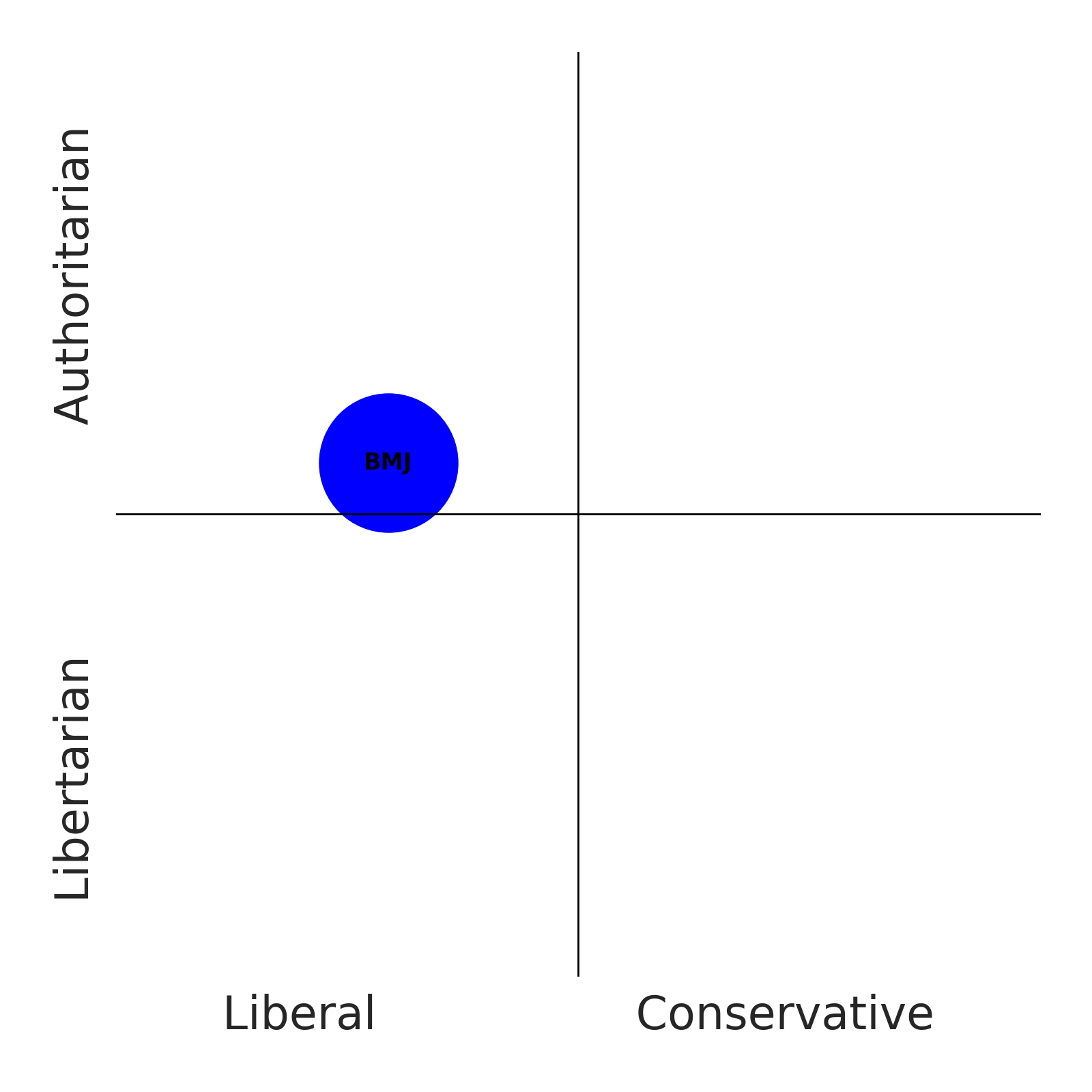
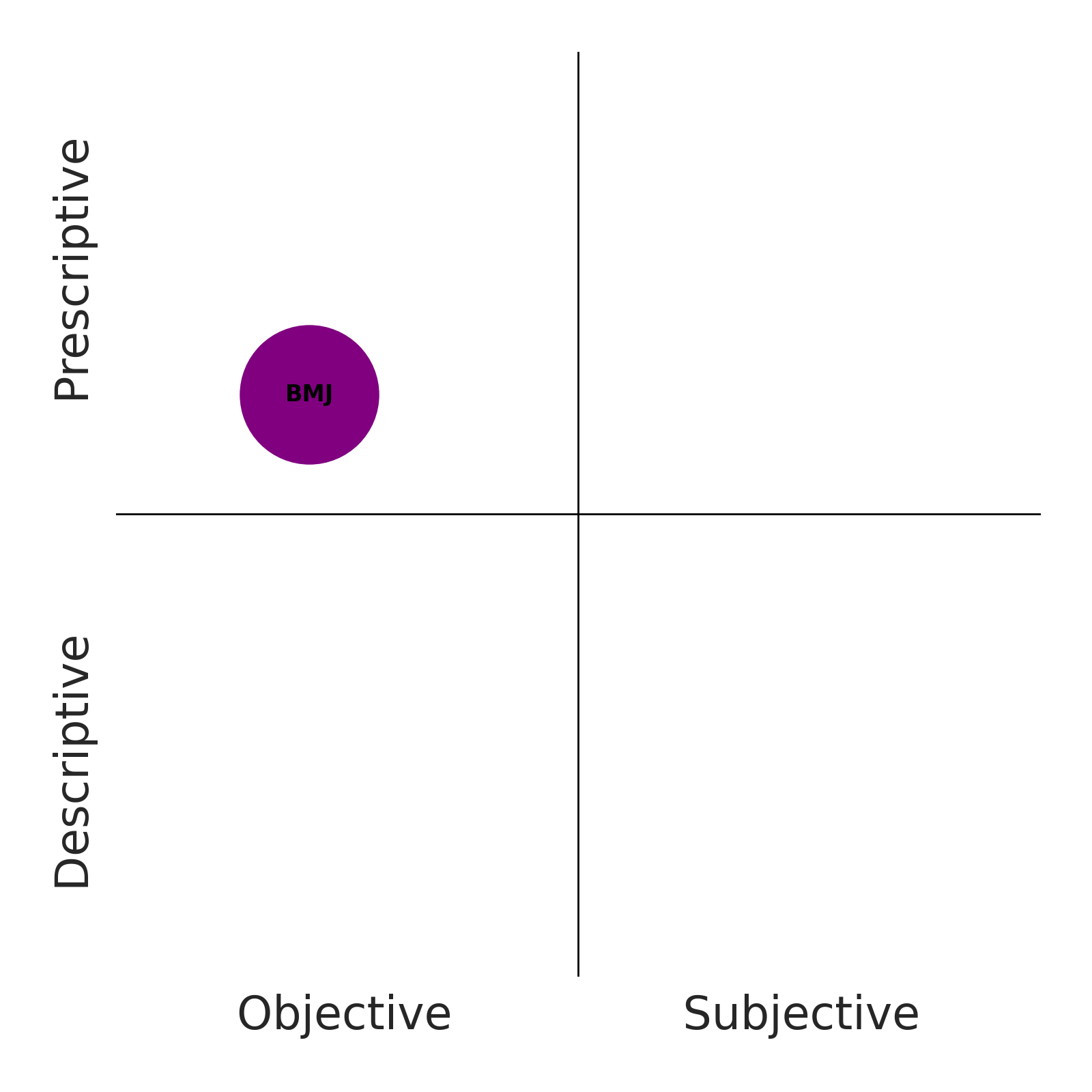
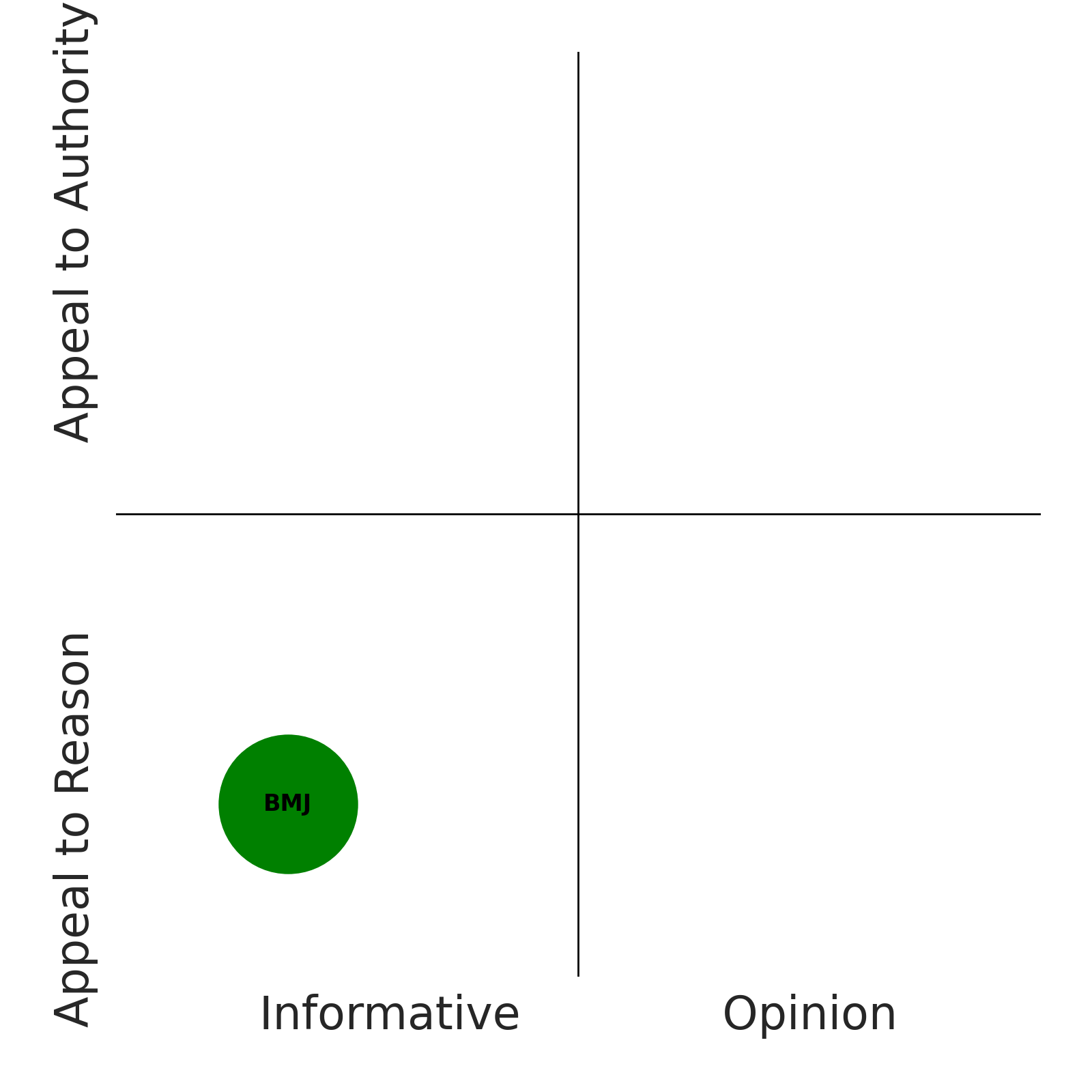
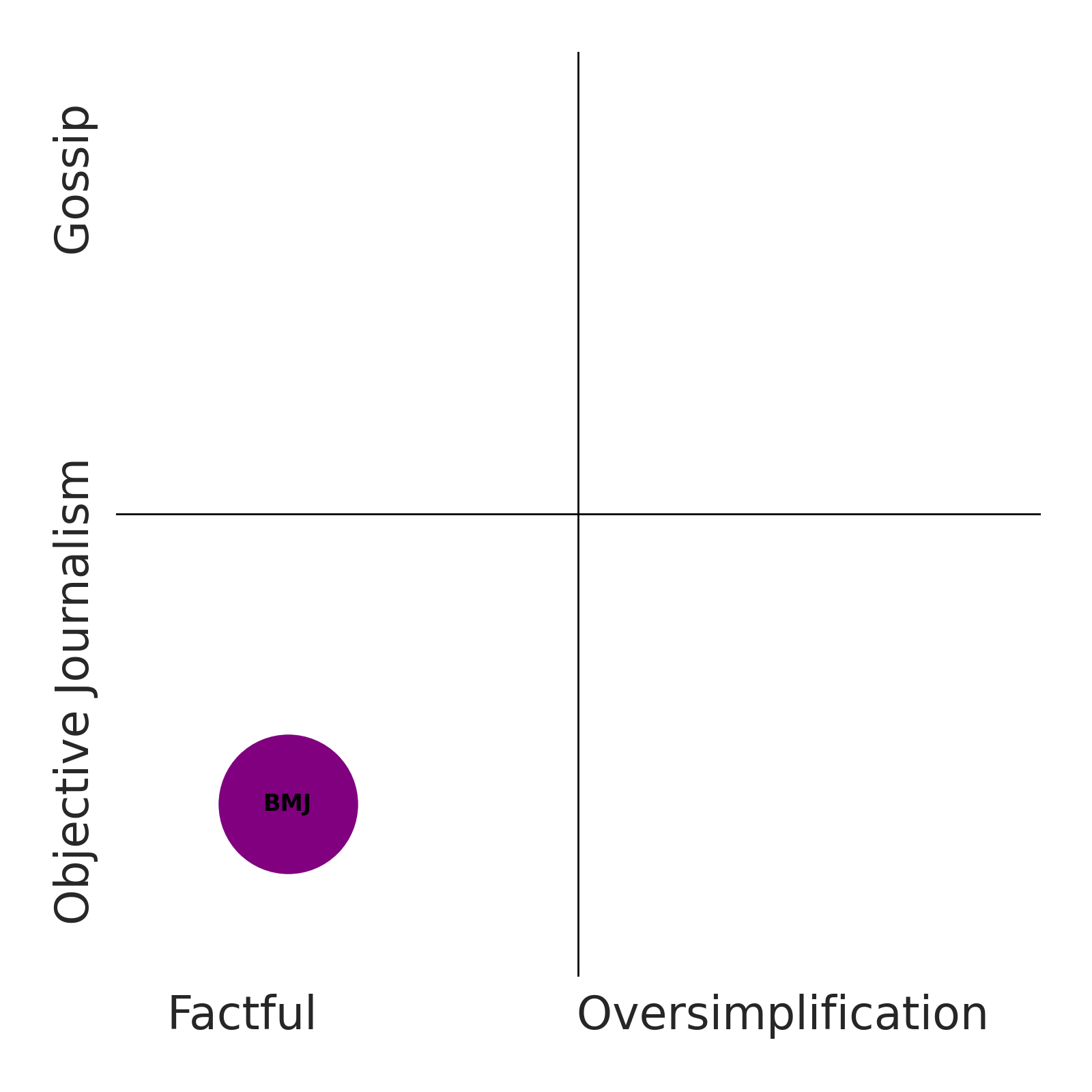
2026 © Helium Trades
Privacy Policy & Disclosure
* Disclaimer: Nothing on this website constitutes investment advice, performance data or any recommendation that any particular security, portfolio of securities, transaction or investment strategy is suitable for any specific person. Helium Trades is not responsible in any way for the accuracy
of any model predictions or price data. Any mention of a particular security and related prediction data is not a recommendation to buy or sell that security. Investments in securities involve the risk of loss. Past performance is no guarantee of future results. Helium Trades is not responsible for any of your investment decisions,
you should consult a financial expert before engaging in any transaction.
Helium Research Assistant

How can I help you today?
Ask any question about BMJ bias.