See whether Helium helps you make better-informed decisions. Try every Pro Trader feature for 30 days. No credit card required.
Try every Pro Trader feature for 30 days. No credit card required.
Identity & coverage patterns: The sample is consistent with ABC News / Good Morning America: a mainstream, high-volume outlet whose September 2026 output is dominated by a massive 9/11 25th-anniversary commemorative cluster — tribute framing of firefighters
September 10, 2026 · 0 shares
The framing is a sentimental, reverent tribute that emphasizes grief, camaraderie, and the conservation of the nine firefighters' names as a public memorial, rather than a critical or analytical account.
Automated analysis; not human reviewed. Limitations: The supplied article text is truncated with ellipses and contains related-story headlines, so some surrounding context is missing. · 1 of 54 available dimensions scored; omitted dimensions are not treated as neutral. · Verified supporting quotes for 1 of 1 scored dimensions.
Claim: The publisher frames the story as a heroic tribute rather than neutral reporting.
“They're not just names on a board. They're nine men who rushed in when everyone rushed out.” · exact text match
Why: The publisher injects a heroic value judgment into the narration, making the story subjective rather than strictly factual.
The supplied article text is truncated with ellipses and contains related-story headlines, so some surrounding context is missing.
September 10, 2026 · 0 shares
The publisher frames the 9/11 dog story as a sentimental tribute to 'four-legged heroes' and their comforting effect on responders, while promoting an ABC News special.
Automated analysis; not human reviewed. Limitations: The supplied article text is truncated with ellipsis markers, so some context and the exact special premiere date are unavailable. · 3 of 54 available dimensions scored; omitted dimensions are not treated as neutral. · Verified supporting quotes for 1 of 3 scored dimensions.
Claim: The article explicitly promotes an ABC News special at the end.
“"9/11 Tribute in Light: Live from Lower Manhattan," a one-hour ABC News multiplatform live special, premieres Friday, Sept.” · verified after text normalization
Why: The informational content closes with a promotional announcement for the publisher's own program.
Claim: The report frames the ground-zero dogs primarily as emotional heroes and comforters.
“"They provided some sort of source of comfort for all of us that were working there, and it really made a difference."” · not found in supplied text
“"four-legged 9/11 heroes."” · not found in supplied text
Why: Repeatedly selected references to comfort and heroism give the reporting a sentimental, tribute-like tone.
Claim: The reporting attributes specific claims to identified people and institutions.
“Otto, the executive director of the Penn Vet Working Dog Center and a University of Pennsylvania professor, said that although search and rescue dogs are not trained as therapy dogs, that unintentionally became part of their role at ground zero.” · exact text match
“according to the 9/11 Memorial & Museum, which refers to the dogs as the "four-legged 9/11 heroes."” · not found in supplied text
Why: Named expert and institutional attribution are visible throughout, supporting credibility.
The supplied article text is truncated with ellipsis markers, so some context and the exact special premiere date are unavailable.
September 11, 2026 · 0 shares
The reporting frames Father Mychal Judge's 9/11 death as a heroic sacrifice and an enduring spiritual legacy, using reverent and commemorative language.
Automated analysis; not human reviewed. Limitations: The supplied article text contains ellipses indicating omitted content, which may affect the completeness of the analysis. · 4 of 54 available dimensions scored; omitted dimensions are not treated as neutral. · Verified supporting quotes for 0 of 4 scored dimensions.
Claim: The publisher includes interpretive and value-laden language.
“"became one of the enduring symbols of the attacks."” · not found in supplied text
Why: Calling the image an 'enduring symbol' is an interpretive judgment rather than a purely factual observation.
Claim: The publisher presents an optimistic view of Judge's legacy.
“"His legacy of hope and service live on a quarter century after his death."” · not found in supplied text
Why: The phrase 'hope and service live on' expresses optimism about the lasting positive impact of Judge's life.
Claim: The publisher expresses an opinion about Judge's significance.
“"His legacy of hope and service live on a quarter century after his death."” · not found in supplied text
Why: This is an evaluative statement about the meaning of Judge's legacy, not a purely factual claim.
Claim: The publisher uses positively charged language to frame Judge's death and legacy.
“"His legacy of hope and service live on a quarter century after his death."” · not found in supplied text
“"became one of the enduring symbols of the attacks."” · not found in supplied text
Why: These statements characterize Judge's impact in hopeful and enduring terms, reflecting a positive emotional framing.
The supplied article text contains ellipses indicating omitted content, which may affect the completeness of the analysis.
September 10, 2026 · 0 shares
A survivor's art debut is framed through reverent memorial language, emphasizing loss and tribute rather than neutral art criticism.
Automated analysis; not human reviewed. Limitations: The supplied text is a truncated snippet; an incomplete President George W. clause limits contextual and political bias assessment. · 2 of 54 available dimensions scored; omitted dimensions are not treated as neutral. · Verified supporting quotes for 2 of 2 scored dimensions.
Claim: The publisher characterizes the paintings with value-laden memorial language instead of neutral arts-reporting terms.
“9/11 survivor's tribute to fallen colleagues.” · exact text match
“a collection of paintings of her fallen colleagues.” · exact text match
Why: 'Tribute' and 'fallen colleagues' are emotive, honorific descriptors; no neutral or critical art framing appears in the supplied text.
Claim: The wording evokes a solemnly positive emotional response by foregrounding survival and loss.
“9/11 survivor's tribute to fallen colleagues.” · exact text match
“her fallen colleagues” · exact text match
Why: 'Survivor' and 'fallen colleagues' personalize the September 11 loss and cast the work as reverence; the emotional direction is positive and respectful rather than neutral.
The supplied text is a truncated snippet; an incomplete President George W. clause limits contextual and political bias assessment.
September 10, 2026 · 0 shares
Promotional framing leans on emotional labels—'untold stories,' 'heroes,' and 'Shocking'—to present both programs as compelling and revelatory.
Automated analysis; not human reviewed. Limitations: The supplied text is only a short promotional snippet, so classifications rest on limited wording rather than substantive reporting. · 4 of 54 available dimensions scored; omitted dimensions are not treated as neutral. · Verified supporting quotes for 4 of 4 scored dimensions.
Claim: The text uses evaluative labels rather than neutral description.
“Shocking documentary follows Elizabeth Holmes as she prepares to go to prison” · exact text match
“features firsthand accounts from survivors and heroes from the Sept. 11, 2001, terror attacks” · exact text match
Why: 'Shocking' and 'heroes' are value judgments that frame the content subjectively.
Claim: The text uses dramatic, emotionally charged wording to heighten appeal.
“Shocking documentary follows Elizabeth Holmes as she prepares to go to prison” · exact text match
“Untold stories from people inside the World Trade Center on 9/11” · exact text match
Why: 'Shocking' and 'Untold stories' are attention-grabbing descriptors rather than dispassionate summary.
Claim: The publisher injects evaluative opinion into the promotional descriptions.
“Shocking documentary follows Elizabeth Holmes as she prepares to go to prison” · exact text match
“features firsthand accounts from survivors and heroes from the Sept. 11, 2001, terror attacks” · exact text match
Why: Calling the documentary 'Shocking' and labeling participants 'heroes' expresses judgment rather than neutral fact.
Claim: The text functions as a promotional advertisement for the programs.
“WATCH: Untold stories from people inside the World Trade Center on 9/11” · exact text match
“Shocking documentary follows Elizabeth Holmes as she prepares to go to prison” · exact text match
Why: The imperative 'WATCH' and the promotional descriptions of the special and documentary market the content directly.
The supplied text is only a short promotional snippet, so classifications rest on limited wording rather than substantive reporting.
September 10, 2026 · 0 shares
Uses sentimental first-person recollections and a reverent tone to frame the 9/11 school visit and the Tribute in Light commemoration as a unifying, emotionally resonant national memory rather than a political or policy moment.
The text presupposes the reader's familiarity with the September 11, 2001 terrorist attacks and their devastating national impact.
Automated analysis; not human reviewed. Limitations: The supplied article text is truncated and fragmented with numerous ellipses and splice points, preventing full verification of the original editorial context and exact sequencing of claims. · 11 of 54 available dimensions scored; omitted dimensions are not treated as neutral. · Verified supporting quotes for 6 of 11 scored dimensions.
Claim: The framing centers on ordinary citizens—students, a healthcare worker, a firefighter's relative—giving weight to grassroots experiences rather than elite perspectives.
“Davis, who currently works in healthcare but said she aspires to be a police officer, said the events that day inspired her to pursue a career serving others.” · exact text match
Why: The article elevates the perspective of a second-grader and a firefighter's relative over institutional or governmental analysis, illustrating a populist orientation.
Claim: The narrative uses emotionally laden descriptors and personal reflections, conveying a subjective, humanizing interpretation of the events.
“Former Sarasota, Florida, second grade student Krystal Davis remembers a wave of confusion […] after a suited man whispered into the ear of the president.” · not found in supplied text
Why: Phrases like 'wave of confusion' and the headline 'You could see it on his face' impose emotional states, indicating subjective framing rather than detached reportage.
Claim: The tone is measured and solemn, avoiding sensationalism or alarmist language despite the tragic subject matter.
“A quarter century later, as the country continues to grapple with the ramifications of that day, so too do the alumni of Emma E. […] the public to "put their hand on that steel and feel the loss and sacrifice that was made that day."” · not found in supplied text
Why: The language focuses on reflection and remembrance ('feel the loss and sacrifice') rather than exaggerated drama, indicating a non-sensational approach.
Claim: The overall tone is somber and reflective, emphasizing grief, loss, and sacrifice rather than hope or recovery.
“Feel the loss and sacrifice that was made that day.” · not found in supplied text
Why: The repeated emphasis on loss and sacrifice, along with the elegiac framing of the 24th anniversary, conveys a pessimistic or mournful undercurrent.
Claim: The framing emphasizes personal victimhood and sacrifice, particularly through the deaths of firefighters and the trauma of schoolchildren.
“Stephen Siller Jr., whose father Stephen Siller was one of the 343 New York City Fire Department members killed on 9/11” · exact text match
Why: Highlighting the specific loss of 343 firefighters and the confusion of children frames them primarily as victims, eliciting sympathy.
Claim: The portrayal of President Bush and national institutions is respectful and uncritical, reinforcing establishment credibility.
“Then-President George W. Bush” · exact text match
“Chief of Staff Andrew Card had just relayed to Bush that a second plane had crashed into the World Trade Center.” · not found in supplied text
Why: Titles and descriptions are deferential, and the account avoids any criticism of presidential actions, aligning with a pro-establishment stance.
Claim: The article is saturated with positive, reverent emotion toward the memories and individuals, shaping an uplifting but somber emotional register.
“look of admiration on his face suddenly gave way to an expression of concern.” · exact text match
Why: Descriptions of facial expressions and internal states (admiration, concern) evoke an emotional response in the reader, indicating a strongly emotional framing.
Claim: The article demonstrates strong credibility through specific, verifiable details and attributed quotes.
“343 New York City Fire Department members” · exact text match
“United Airlines Flight 93” · exact text match
Why: Precise numbers and accurate place names (Shanksville, Pennsylvania) enhance factual verifiability, supporting high overall credibility.
Claim: The narrative frames 9/11 as a shared collective national experience, emphasizing communal grief and memory.
“A quarter century later, as the country continues to grapple with the ramifications of that day” · exact text match
Why: The reference to 'the country' grappling together underscores a collectivist orientation toward national memory and solidarity.
Claim: The text consistently attributes statements and observations to named sources, maintaining transparent sourcing.
“Davis said” · exact text match
“Tose'-Rigell said” · exact text match
Why: Explicit attribution for each recollection and description demonstrates high journalistic integrity in the supplied text.
Claim: The narrative underscores personal moral growth, community service, and national resilience, signaling commendable virtues.
“As a second grader, I couldn't really explain," Davis said, adding that she would later realize her experience left her "wanting to do more for my community, wanting to do more for myself and my kids.” · not found in supplied text
Why: The explicit praise of community service and self-improvement as a direct consequence of the event serves as a virtue signal of moral uplift.
The supplied article text is truncated and fragmented with numerous ellipses and splice points, preventing full verification of the original editorial context and exact sequencing of claims.
September 10, 2026 · 0 shares
The publisher frames the 9/11 dog story as a sentimental tribute to 'four-legged heroes' and their comforting effect on responders, while promoting an ABC News special.
Automated analysis; not human reviewed. Limitations: The supplied article text is truncated with ellipsis markers, so some context and the exact special premiere date are unavailable. · 3 of 54 available dimensions scored; omitted dimensions are not treated as neutral. · Verified supporting quotes for 1 of 3 scored dimensions.
Claim: The article explicitly promotes an ABC News special at the end.
“"9/11 Tribute in Light: Live from Lower Manhattan," a one-hour ABC News multiplatform live special, premieres Friday, Sept.” · verified after text normalization
Why: The informational content closes with a promotional announcement for the publisher's own program.
Claim: The report frames the ground-zero dogs primarily as emotional heroes and comforters.
“"They provided some sort of source of comfort for all of us that were working there, and it really made a difference."” · not found in supplied text
“"four-legged 9/11 heroes."” · not found in supplied text
Why: Repeatedly selected references to comfort and heroism give the reporting a sentimental, tribute-like tone.
Claim: The reporting attributes specific claims to identified people and institutions.
“Otto, the executive director of the Penn Vet Working Dog Center and a University of Pennsylvania professor, said that although search and rescue dogs are not trained as therapy dogs, that unintentionally became part of their role at ground zero.” · exact text match
“according to the 9/11 Memorial & Museum, which refers to the dogs as the "four-legged 9/11 heroes."” · not found in supplied text
Why: Named expert and institutional attribution are visible throughout, supporting credibility.
The supplied article text is truncated with ellipsis markers, so some context and the exact special premiere date are unavailable.
The publisher frames Trump's dividend promise as unfulfilled and implausible, using a reality-check analysis that emphasizes the failure of a previous promise and tariff revenue shortfalls.
Automated analysis; not human reviewed. Limitations: The provided text includes multiple unrelated news headlines; analysis is limited to the dividend story. · 7 of 54 available dimensions scored; omitted dimensions are not treated as neutral. · Verified supporting quotes for 5 of 7 scored dimensions.
Claim: The publisher critically examines Trump's promise, highlighting non-fulfillment and implausibility.
“Ten months later, those previously promised returns have yet to materialize.” · exact text match
“Reality check -- you probably won't get a $5,000 Trump check: ANALYSIS” · exact text match
Why: The selection of these negative facts and the analytical label indicate a critical stance toward Trump's proposal.
Claim: The article combines factual reporting with a labeled analysis segment.
“ABC News has reached out to the White House for further details.” · exact text match
“Reality check -- you probably won't get a $5,000 Trump check: ANALYSIS” · exact text match
Why: The presence of both attributed reporting and an explicit analysis section balances objectivity and subjectivity.
Claim: The publisher expresses skepticism about the likelihood of the dividend.
“Reality check -- you probably won't get a $5,000 Trump check” · exact text match
“Ten months later, those previously promised returns have yet to materialize.” · exact text match
Why: These statements convey a negative expectation about the dividend's delivery.
Claim: The article includes editorial analysis in addition to reporting.
“Reality check -- you probably won't get a $5,000 Trump check: ANALYSIS” · exact text match
Why: The label 'ANALYSIS' and the content of that section constitute opinion.
Claim: The article focuses on a partisan political proposal and its electoral condition.
“if Republicans kept the House and Senate in the midterm elections this fall” · exact text match
“Trump said in his speech on Wednesday” · exact text match
Why: The subject matter directly involves political parties, elections, and a presidential promise.
Claim: The publisher demonstrates rigorous sourcing and attribution.
“ABC News has reached out to the White House for further details.” · exact text match
“"The president made it clear he wants to make it happen," Leavitt told reporters at the White House.” · not found in supplied text
Why: The article attributes quotes to named officials and seeks further comment, indicating high credibility.
Claim: The publisher evaluates the feasibility of the dividend using fiscal logic.
“much of the revenue collected by the government from Trump's tariffs had to be paid [...] That was more than half of the $166 billion owed to thousands of American businesses who paid the tariffs that were later struck down by the Supreme Court.” · not found in supplied text
Why: This reasoning connects tariff revenue shortfalls to the improbability of the dividend, showing rational analysis.
The provided text includes multiple unrelated news headlines; analysis is limited to the dividend story.
September 05, 2026 · 0 shares
Reporting leans on challengers' voter-access and states'-rights framing while labeling Trump's fraud claims unfounded, making the administration's defense appear secondary.
Under the U.S. Constitution's Elections Clause, Congress has authority to regulate the 'Times, Places and Manner' of federal elections, while states generally administer those elections unless Congress acts. The dispute centers on whether a federal agency (USPS) can impose uniform ballot-handling and data-reporting requirements on states for federal elections.
Automated analysis; not human reviewed. Limitations: The source text includes related headlines and lacks a byline or publication date, so I relied on the article body and treated related links as non-substantive. · 3 of 54 available dimensions scored; omitted dimensions are not treated as neutral. · Verified supporting quotes for 1 of 3 scored dimensions.
Claim: The report embeds an evaluative characterization of Trump's fraud claims and emphasizes voter disenfranchisement, tilting toward a liberal/anti-restriction framing.
“Trump, who has pushed unfounded claims of widespread mail ballot fraud, wants states to report to USPS basic voter information, such as a voter's name and home address, attached to a unique barcode on every mail-in ballot distributed.” · exact text match
“Judge Talwani wrote in her opinion Friday that the dispute was now ripe for judicial intervention. "Nothing is hypothetical," she said of the alleged harm to states, voters and voter advocacy groups ahead of the November election.” · not found in supplied text
Counterevidence:
“In its latest appeal to the justices, the Trump administration insisted the rules impose only "modest" ballot design and review requirements on states and that a requirement to submit name, address, and barcode information of intended recipients is not onerous or intrusive.” · not found in supplied text
Why: The 'unfounded claims' phrase is an unattributed judgment on a contested political claim, and the selection foregrounds the challengers' harm while the administration's defense is secondary.
Claim: The report inserts an evaluative characterization ('unfounded') into an otherwise factual sentence.
“Trump, who has pushed unfounded claims of widespread mail ballot fraud, wants states to report to USPS basic voter information, such as a voter's name and home address, attached to a unique barcode on every mail-in ballot distributed.” · exact text match
Why: Most content is attributed to the court or parties, but the 'unfounded claims' phrase is an un-attributed judgment embedded in a factual passage.
Claim: The report is centered on a partisan and institutional conflict over election administration, making it highly political in subject matter.
“Dozens of Democratic state attorneys general sued the Trump administration after an earlier lawsuit was blocked by the Supreme Court, which said at the time that the challenge was premature since the regulations hadn't been finalized.” · not found in supplied text
“Trump, who has pushed unfounded claims of widespread mail ballot fraud, wants states to report to USPS basic voter information, such as a voter's name and home address, attached to a unique barcode on every mail-in ballot distributed.” · exact text match
Why: The actors, stakes, and legal conflict are explicitly partisan and governmental, so the report is strongly political rather than non-political.
The source text includes related headlines and lacks a byline or publication date, so I relied on the article body and treated related links as non-substantive.
September 01, 2026 · 0 shares
The resignation is presented as straight Washington personnel news, pairing anonymous-official accounts of friction with an uncritically repeated White House endorsement, while an interpretative aside gently colors the departing secretary in a sympathetic light.
Automated analysis; not human reviewed. Limitations: The analysis is based on a single short article that relies on anonymous sourcing; lack of access to the live page or related coverage may limit context, particularly regarding the full text after the article's final sentence and any continued coverage. · 10 of 54 available dimensions scored; omitted dimensions are not treated as neutral. · Verified supporting quotes for 10 of 10 scored dimensions.
Claim: The article reports factual developments with attributed sourcing while including a few interpretive judgments.
“Driscoll has submitted his resignation to President Donald Trump amid growing tension between him and Defense Secretary Pete Hegseth, sources told ABC News.” · exact text match
Counterevidence:
“In a statement Monday, the White House thanked Driscoll for his work and praised him for being "highly effective."” · not found in supplied text
Why: The lead attributes claims to sources and includes the White House's positive account, reflecting mostly objective reporting with minimal editorializing.
Claim: The article reports the resignation in measured, non-sensational language.
“Driscoll has submitted his resignation to President Donald Trump amid growing tension between him and Defense Secretary Pete Hegseth, sources told ABC News.” · exact text match
Why: The reporting is calm and fact-based, avoiding dramatic language despite the sensitive topic of a Cabinet-level resignation.
Claim: The article mostly reports facts but contains a few opinionated or interpretive statements.
“An assignment like that was beyond the scope of the duties of a service secretary whose main task is to oversee the training and equipping of a service.” · exact text match
Why: The claim that the assignment exceeded his duties is presented as a statement of fact rather than attributed opinion.
Claim: The article is entirely within the political/governance domain, covering executive-branch personnel and partisan dynamics.
“Secretary Driscoll has been highly effective in advancing President Trump’s agenda to Make America Strong Again at the Department of the Army” · exact text match
Why: The report covers the White House, Pentagon leadership, and political infighting, which is inherently political content.
Claim: The article relies heavily on unnamed officials and an official White House statement for its factual claims.
“Driscoll has submitted his resignation to President Donald Trump amid growing tension between him and Defense Secretary Pete Hegseth, sources told ABC News.” · exact text match
Why: All claims about the reasons for the resignation rest on anonymous sources and a White House statement rather than independent verification.
Claim: The article devotes substantial focus to the White House's and insiders' reactions to the resignation.
“Secretary Driscoll has been highly effective in advancing President Trump’s agenda to Make America Strong Again at the Department of the Army” · exact text match
Why: The inclusion of the full White House statement, without independent commentary, emphasizes the official response over the underlying event details.
Claim: The article almost always qualifies claims, though it occasionally presents interpretive material with more certainty than the source basis might warrant.
“Driscoll and Hegseth differed on several matters since taking over their roles in 2025, according to various U.S. officials.” · exact text match
Why: The attribution 'according to various U.S. officials' limits overconfidence, but the statement is presented as fact rather than as an allegation.
Claim: The article demonstrates credible journalistic practices, attributing claims and hedging appropriately.
“Driscoll has submitted his resignation to President Donald Trump amid growing tension between him and Defense Secretary Pete Hegseth, sources told ABC News.” · exact text match
Counterevidence:
“It was noteworthy late last year that Trump chose Driscoll to head a diplomatic initiative last fall to restart the Ukraine-Russia peace talks.” · exact text match
Why: The piece consistently attributes claims to named or unnamed sources and correctly flags opinion ('It was noteworthy'), adding to its credibility.
Claim: The article includes a brief interpretive judgment about the significance of Driscoll's diplomatic assignment.
“It was noteworthy late last year that Trump chose Driscoll to head a diplomatic initiative last fall to restart the Ukraine-Russia peace talks.” · exact text match
Why: The phrase 'It was noteworthy' and the subsequent commentary on the scope of the assignment is the publisher's interpretation rather than a sourced fact.
Claim: The article demonstrates above-average analytical quality by adding contextual judgment about Driscoll's role.
“An assignment like that was beyond the scope of the duties of a service secretary whose main task is to oversee the training and equipping of a service.” · exact text match
Why: The comment reflects an understanding of the formal role of the Army secretary and compares it with actual events, indicating analytical depth.
The analysis is based on a single short article that relies on anonymous sourcing; lack of access to the live page or related coverage may limit context, particularly regarding the full text after the article's final sentence and any continued coverage.
The coverage frames mortality as a study-backed suggestion, attributes the walking-intensity recommendation to the authors, and stays largely descriptive.
Automated analysis; not human reviewed. Limitations: The supplied text is a truncated excerpt with bracketed omissions and a typo, so headline context and some study details are unavailable. · 5 of 54 available dimensions scored; omitted dimensions are not treated as neutral. · Verified supporting quotes for 5 of 5 scored dimensions.
Claim: The text uses attributed, non-evaluative language rather than editorial or subjective framing.
“according to the study, published Tuesday in the British Journal of Sports Medicine.” · exact text match
“The authors said their findings provide evidence for stepping up the intensity when walking.” · exact text match
Why: Conclusions are attributed to the study and authors rather than stated as unqualified fact, with no visible editorial judgment.
Claim: The text avoids dramatic or alarming wording and frames the finding cautiously.
“The authors said their findings provide evidence for stepping up the intensity when walking.” · exact text match
Why: The outcome is expressed as a study suggestion and attributed to the authors, with no urgent or fear-based vocabulary.
Claim: The text maintains an emotionally neutral, procedural tone.
“Researchers from Australia and Spain looked at 1approximately 70, 000 adults between ages 40 and 69.” · exact text match
Why: The reporting is descriptive and source-attributed, with no emotional appeals.
Claim: The text provides identifiable sourcing and attributes interpretive claims.
“according to the study, published Tuesday in the British Journal of Sports Medicine.” · exact text match
“The authors said their findings provide evidence for stepping up the intensity when walking.” · exact text match
Why: The source journal is named and conclusions are attributed to the study authors, though the excerpt does not show correction practices or independent verification.
Claim: The text grounds its claims in empirical research and peer-reviewed publication.
“according to the study, published Tuesday in the British Journal of Sports Medicine.” · exact text match
“Our study moves beyond single-metric approaches” · exact text match
Why: Findings are attributed to a published study and presented as evidence rather than non-empirical explanation.
The supplied text is a truncated excerpt with bracketed omissions and a typo, so headline context and some study details are unavailable.
September 10, 2026 · 0 shares
Framing presents August's record global warmth as an established fact and links it to U.S. heat warnings without naming a data source.
Automated analysis; not human reviewed. Limitations: The supplied text is a truncated composite; the embedded JSON-like headline was treated as non-substantive page metadata rather than article content. · 2 of 54 available dimensions scored; omitted dimensions are not treated as neutral. · Verified supporting quotes for 2 of 2 scored dimensions.
Claim: The report uses declarative factual statements without evaluative or emotional language.
“August was the warmest on record worldwide.” · exact text match
Why: The sentence is a plain factual statement rather than an opinion or emotionally framed assertion.
Claim: The report presents August warmth as an empirical record rather than as a supernatural or ideological explanation.
“August was the warmest on record worldwide.” · exact text match
Why: The claim relies on the concept of an observational temperature record, indicating a scientific/empirical orientation.
The supplied text is a truncated composite; the embedded JSON-like headline was treated as non-substantive page metadata rather than article content.
The strongest observable framing is commercial: a shopping-deals special is presented as newsroom content rather than labeled as advertising.
Automated analysis; not human reviewed. Limitations: Only a promotional video description is available; no article body, sourcing, or broader editorial context is present. · 1 of 54 available dimensions scored; omitted dimensions are not treated as neutral. · Verified supporting quotes for 1 of 1 scored dimensions.
Claim: The supplied content functions as promotion for a shopping-deals video segment.
“Lori Bergamotto is here with an ABC Secret Savings special for September, showcasing more than two dozen deals and exclusive discounts.” · exact text match
Why: The sentence explicitly markets a 'Secret Savings special' and 'deals and exclusive discounts,' with no neutral reporting or analysis beyond the promotional claim.
Only a promotional video description is available; no article body, sourcing, or broader editorial context is present.
August 29, 2026 · 0 shares
This promotional shopping segment uses urgency and positive framing to encourage immediate purchases, functioning as an advertisement rather than editorial content.
Automated analysis; not human reviewed. Limitations: The provided text is a short promotional blurb with no broader editorial context, limiting analysis to the visible advertising language. · 2 of 54 available dimensions scored; omitted dimensions are not treated as neutral. · Verified supporting quotes for 2 of 2 scored dimensions.
Claim: The segment is a promotional advertisement for products, not editorial content.
“Save on brands such as PaddleSmash & TowerToss, Culvani and many more.” · exact text match
“Find all of these offers for "GMA" viewers at ABCSecretSavings.com!” · exact text match
Why: The entire text directs viewers to shop on an external site and promotes specific product brands, demonstrating clear advertorial intent.
Claim: Uses urgency and calls to action to pressure immediate purchase.
“These deals are only available while supplies last, so be sure to shop now.” · exact text match
Why: The phrase 'only available while supplies last' creates artificial scarcity and the imperative 'shop now' pressures immediate action, a classic manipulation technique.
The provided text is a short promotional blurb with no broader editorial context, limiting analysis to the visible advertising language.
September 05, 2026 · 0 shares
An affiliate-commerce advertorial uses urgent shopping language and commission disclosure while presenting itself as a 'Secret Savings' special.
Automated analysis; not human reviewed. Limitations: The supplied text is a short affiliate-shopping excerpt rather than a full article, so analysis is limited to its promotional content and disclosures. · 4 of 54 available dimensions scored; omitted dimensions are not treated as neutral. · Verified supporting quotes for 2 of 4 scored dimensions.
Claim: The text instructs the reader to shop immediately, making it prescriptive.
“These deals are only available while supplies last, so be sure to shop now.” · exact text match
“Find all of these offers for "GMA" viewers at ABCSecretSavings.com!” · not found in supplied text
Why: Imperative phrases such as 'shop now' and 'Find all of these offers' direct reader action rather than merely describing products.
Claim: The text is a promotional advertorial for retail products rather than independent news reporting.
“ABC Secret Savings has deals for "Good Morning America" viewers.” · not found in supplied text
“ABC and Tory will receive a commission for purchases made through these links.” · exact text match
Why: The entire text directs readers to shop, lists products, and discloses affiliate commissions, making its promotional purpose explicit.
Claim: The text uses urgency and imperative language to push immediate purchasing.
“These deals are only available while supplies last, so be sure to shop now.” · exact text match
Why: The 'only available while supplies last' limitation plus 'be sure to shop now' creates time pressure without providing evidence of actual scarcity.
Claim: The text shows visible transparency by disclosing affiliate compensation and external-site terms.
“ABC and Tory will receive a commission for purchases made through these links.” · exact text match
“visitors will leave ABCNews.com and GoodMorningAmerica.com, and these e-commerce sites are operated under different terms and privacy policies.” · exact text match
Why: The commercial relationship and destination change are disclosed, supporting a moderately positive integrity assessment despite the promotional format.
The supplied text is a short affiliate-shopping excerpt rather than a full article, so analysis is limited to its promotional content and disclosures.
August 24, 2026 · 0 shares
Promotional affiliate shopping content uses limited-time urgency and brand association to drive purchases from Good Morning America viewers.
Automated analysis; not human reviewed. Limitations: The supplied content is a short promotional block, so the assessment is limited to visible commercial framing and disclosures rather than editorial news bias. · 4 of 54 available dimensions scored; omitted dimensions are not treated as neutral. · Verified supporting quotes for 4 of 4 scored dimensions.
Claim: The content instructs readers to purchase immediately rather than neutrally describing options.
“These deals are only available while supplies last, so be sure to shop now.” · exact text match
Why: The imperative 'be sure to shop now' is a direct prescription to act.
Claim: The content is largely promotional fluff rather than substantive reporting.
“Find all of these offers for "GMA" viewers at ABCSecretSavings.com!” · exact text match
“These deals are only available while supplies last, so be sure to shop now.” · exact text match
Why: Repetitive sales copy with urgency and a shopping link makes the content mostly promotional fluff.
Claim: The content is a promotional shopping advertisement for branded products.
“Save on brands such as illo, ReliefBand and many more.” · exact text match
“Find all of these offers for "GMA" viewers at ABCSecretSavings.com!” · exact text match
Why: The entire supplied text consists of sales copy promoting brands and directing readers to a shopping site.
Claim: The page displays visible transparency about affiliate compensation and price changes.
“ABC and Tory will receive a commission for purchases made through these links. Prices may change from date of publication.” · exact text match
Why: The supplied text openly discloses a financial incentive and possible price variation, which are observable honesty signals.
The supplied content is a short promotional block, so the assessment is limited to visible commercial framing and disclosures rather than editorial news bias.
Factual reliability is comparatively high: records repeatedly note strong sourcing, attribution, and hedging — e.g. 'sources told ABC News'
September 01, 2026 · 0 shares
The resignation is presented as straight Washington personnel news, pairing anonymous-official accounts of friction with an uncritically repeated White House endorsement, while an interpretative aside gently colors the departing secretary in a sympathetic light.
Automated analysis; not human reviewed. Limitations: The analysis is based on a single short article that relies on anonymous sourcing; lack of access to the live page or related coverage may limit context, particularly regarding the full text after the article's final sentence and any continued coverage. · 10 of 54 available dimensions scored; omitted dimensions are not treated as neutral. · Verified supporting quotes for 10 of 10 scored dimensions.
Claim: The article reports factual developments with attributed sourcing while including a few interpretive judgments.
“Driscoll has submitted his resignation to President Donald Trump amid growing tension between him and Defense Secretary Pete Hegseth, sources told ABC News.” · exact text match
Counterevidence:
“In a statement Monday, the White House thanked Driscoll for his work and praised him for being "highly effective."” · not found in supplied text
Why: The lead attributes claims to sources and includes the White House's positive account, reflecting mostly objective reporting with minimal editorializing.
Claim: The article reports the resignation in measured, non-sensational language.
“Driscoll has submitted his resignation to President Donald Trump amid growing tension between him and Defense Secretary Pete Hegseth, sources told ABC News.” · exact text match
Why: The reporting is calm and fact-based, avoiding dramatic language despite the sensitive topic of a Cabinet-level resignation.
Claim: The article mostly reports facts but contains a few opinionated or interpretive statements.
“An assignment like that was beyond the scope of the duties of a service secretary whose main task is to oversee the training and equipping of a service.” · exact text match
Why: The claim that the assignment exceeded his duties is presented as a statement of fact rather than attributed opinion.
Claim: The article is entirely within the political/governance domain, covering executive-branch personnel and partisan dynamics.
“Secretary Driscoll has been highly effective in advancing President Trump’s agenda to Make America Strong Again at the Department of the Army” · exact text match
Why: The report covers the White House, Pentagon leadership, and political infighting, which is inherently political content.
Claim: The article relies heavily on unnamed officials and an official White House statement for its factual claims.
“Driscoll has submitted his resignation to President Donald Trump amid growing tension between him and Defense Secretary Pete Hegseth, sources told ABC News.” · exact text match
Why: All claims about the reasons for the resignation rest on anonymous sources and a White House statement rather than independent verification.
Claim: The article devotes substantial focus to the White House's and insiders' reactions to the resignation.
“Secretary Driscoll has been highly effective in advancing President Trump’s agenda to Make America Strong Again at the Department of the Army” · exact text match
Why: The inclusion of the full White House statement, without independent commentary, emphasizes the official response over the underlying event details.
Claim: The article almost always qualifies claims, though it occasionally presents interpretive material with more certainty than the source basis might warrant.
“Driscoll and Hegseth differed on several matters since taking over their roles in 2025, according to various U.S. officials.” · exact text match
Why: The attribution 'according to various U.S. officials' limits overconfidence, but the statement is presented as fact rather than as an allegation.
Claim: The article demonstrates credible journalistic practices, attributing claims and hedging appropriately.
“Driscoll has submitted his resignation to President Donald Trump amid growing tension between him and Defense Secretary Pete Hegseth, sources told ABC News.” · exact text match
Counterevidence:
“It was noteworthy late last year that Trump chose Driscoll to head a diplomatic initiative last fall to restart the Ukraine-Russia peace talks.” · exact text match
Why: The piece consistently attributes claims to named or unnamed sources and correctly flags opinion ('It was noteworthy'), adding to its credibility.
Claim: The article includes a brief interpretive judgment about the significance of Driscoll's diplomatic assignment.
“It was noteworthy late last year that Trump chose Driscoll to head a diplomatic initiative last fall to restart the Ukraine-Russia peace talks.” · exact text match
Why: The phrase 'It was noteworthy' and the subsequent commentary on the scope of the assignment is the publisher's interpretation rather than a sourced fact.
Claim: The article demonstrates above-average analytical quality by adding contextual judgment about Driscoll's role.
“An assignment like that was beyond the scope of the duties of a service secretary whose main task is to oversee the training and equipping of a service.” · exact text match
Why: The comment reflects an understanding of the formal role of the Army secretary and compares it with actual events, indicating analytical depth.
The analysis is based on a single short article that relies on anonymous sourcing; lack of access to the live page or related coverage may limit context, particularly regarding the full text after the article's final sentence and any continued coverage.
The publisher frames Trump's dividend promise as unfulfilled and implausible, using a reality-check analysis that emphasizes the failure of a previous promise and tariff revenue shortfalls.
Automated analysis; not human reviewed. Limitations: The provided text includes multiple unrelated news headlines; analysis is limited to the dividend story. · 7 of 54 available dimensions scored; omitted dimensions are not treated as neutral. · Verified supporting quotes for 5 of 7 scored dimensions.
Claim: The publisher critically examines Trump's promise, highlighting non-fulfillment and implausibility.
“Ten months later, those previously promised returns have yet to materialize.” · exact text match
“Reality check -- you probably won't get a $5,000 Trump check: ANALYSIS” · exact text match
Why: The selection of these negative facts and the analytical label indicate a critical stance toward Trump's proposal.
Claim: The article combines factual reporting with a labeled analysis segment.
“ABC News has reached out to the White House for further details.” · exact text match
“Reality check -- you probably won't get a $5,000 Trump check: ANALYSIS” · exact text match
Why: The presence of both attributed reporting and an explicit analysis section balances objectivity and subjectivity.
Claim: The publisher expresses skepticism about the likelihood of the dividend.
“Reality check -- you probably won't get a $5,000 Trump check” · exact text match
“Ten months later, those previously promised returns have yet to materialize.” · exact text match
Why: These statements convey a negative expectation about the dividend's delivery.
Claim: The article includes editorial analysis in addition to reporting.
“Reality check -- you probably won't get a $5,000 Trump check: ANALYSIS” · exact text match
Why: The label 'ANALYSIS' and the content of that section constitute opinion.
Claim: The article focuses on a partisan political proposal and its electoral condition.
“if Republicans kept the House and Senate in the midterm elections this fall” · exact text match
“Trump said in his speech on Wednesday” · exact text match
Why: The subject matter directly involves political parties, elections, and a presidential promise.
Claim: The publisher demonstrates rigorous sourcing and attribution.
“ABC News has reached out to the White House for further details.” · exact text match
“"The president made it clear he wants to make it happen," Leavitt told reporters at the White House.” · not found in supplied text
Why: The article attributes quotes to named officials and seeks further comment, indicating high credibility.
Claim: The publisher evaluates the feasibility of the dividend using fiscal logic.
“much of the revenue collected by the government from Trump's tariffs had to be paid [...] That was more than half of the $166 billion owed to thousands of American businesses who paid the tariffs that were later struck down by the Supreme Court.” · not found in supplied text
Why: This reasoning connects tariff revenue shortfalls to the improbability of the dividend, showing rational analysis.
The provided text includes multiple unrelated news headlines; analysis is limited to the dividend story.
August 14, 2026 · 0 shares
Presents the outbreak mostly through a Democratic senator's political corruption allegations while including the company and administration's rebuttals.
Cyclosporiasis is a parasite-borne gastrointestinal illness most often linked to contaminated food, and federal food-safety oversight for such outbreaks sits with the Department of Health and Human Services, the CDC, and the FDA. The Food Traceability Rule is the regulatory background to Taylor Fresh Foods's defense that it had already filed traceability protocols.
Automated analysis; not human reviewed. Limitations: The supplied text is short and does not provide the full Warren letter or the WSJ story; this analysis relies on the selected excerpts and the report's own framing rather than primary documentation. · 3 of 54 available dimensions scored; omitted dimensions are not treated as neutral. · Verified supporting quotes for 0 of 3 scored dimensions.
Claim: The report is primarily source-attributed and data-heavy rather than editorializing.
“Nationwide, there are now at least 24,000 cases of confirmed or suspected cyclosporiasis across 47 states, according to the Centers for Disease Control and Prevention.” · exact text match
“A spokesperson for Taylor Fresh Foods said it "acts in the interest of science and consumer health."” · not found in supplied text
Why: Most assertions are attributed to public officials, agency data, a source familiar with the matter, or the company's own statement.
Claim: The political dimension is built on a Democratic senator's accusation, a Trump-aligned donor detail, and White House involvement rather than on the public-health response alone.
“Warren said the administration's "handling of this crisis has been marred by miscarries,"” · not found in supplied text
“Taylor Fresh Foods, Inc., the parent company of Taylor Farms, made a $1 million donation in March 2025, the MAGA Inc., a PAC aligned with Trump.” · not found in supplied text
Why: The article's headline, lead, and data are organized around an oversight fight, but the company's denial and the administration's own response are included as counterpoints.
Claim: The text includes discernible sourcing procedures, varied institutions, and direct denials from the company and the administration.
“ABC News has reached out to HHS for comment on the letter.” · exact text match
“Taylor Fresh Foods, when asked by ABC News for a response, said it was "a pioneer and industry leader in traceability."” · not found in supplied text
Why: The piece names specific agencies and organizations, quotes the accused party directly, and distinguishes attributed claims from its own reported facts.
The supplied text is short and does not provide the full Warren letter or the WSJ story; this analysis relies on the selected excerpts and the report's own framing rather than primary documentation.
August 24, 2026 · 0 shares
Reporting is balanced but subtly distances itself from the administration's claims by putting 'wins' in quotation marks.
The U.S. Department of Education, created in 1979, sets federal education policy but most funding comes from state and local sources. President Trump has long pledged to eliminate the department, and Secretary McMahon has described the task as her 'final mission.' School choice refers to policies that redirect public funds to private, charter, or home schools.
Automated analysis; not human reviewed. Limitations: The extracted text may include some unrelated sidebar content (e.g., other headlines) that was ignored; analysis is based only on the substantive report. · 5 of 54 available dimensions scored; omitted dimensions are not treated as neutral. · Verified supporting quotes for 3 of 5 scored dimensions.
Claim: The article presents both administration and critic viewpoints without endorsing either.
“some education advocates contend that it helps to gut public school funding” · exact text match
“conservatives argue that the tax law provides more options” · exact text match
Why: The article includes both a critique and a defense of school choice, indicating balanced coverage.
Claim: The article uses scare quotes around 'wins' to distance itself from the administration's characterization.
“But the 'wins' the administration is celebrating” · not found in supplied text
Why: The quotation marks around 'wins' signal the reporter's skepticism, a subjective choice, while the rest of the article remains factual.
Claim: The article attributes all opinions to sources and does not state its own.
“However, some education advocates contend that it helps to gut public school funding” · exact text match
“Meanwhile, conservatives argue that the tax law provides more options” · exact text match
Why: Opinions are clearly attributed to 'advocates' and 'conservatives', with no unmarked editorial statements.
Claim: The article focuses on political figures and policy, making it highly political in content.
“President Donald Trump and Department of Education Secretary Linda McMahon hosted a 'Back to School' event at the White House” · not found in supplied text
“Trump also touted policies he put in place to change curriculum and address gender issues in schools.” · exact text match
Why: The main subject is a political event and policy debate.
Claim: The article names specific sources and institutions, supporting its credibility.
“Parental rights advocate Tiffany Justice praised the administration for prioritizing choice in education.” · exact text match
“Education Policy Analyst Colleen Hroncich previously told ABC News” · exact text match
Why: The use of named individuals and explicit attribution to ABC News indicates sourcing practices typical of credible outlets.
The extracted text may include some unrelated sidebar content (e.g., other headlines) that was ignored; analysis is based only on the substantive report.
September 02, 2026 · 0 shares
Balanced, attribution-heavy framing keeps the polling-site reduction an unresolved partisan dispute over voting access and efficiency.
Automated analysis; not human reviewed. Limitations: The supplied text lacks a calendar date for 'Tuesday,' so the scheduled vote date cannot be independently anchored. · 4 of 54 available dimensions scored; omitted dimensions are not treated as neutral. · Verified supporting quotes for 4 of 4 scored dimensions.
Claim: The publisher does not endorse either partisan position on the polling-site reduction.
““The most powerful people in this county, the most powerful people in this country, don’t want us to be able vote easily,” Talarico said at a news conference.” · exact text match
““We’re clearly not trying to suppress the vote,” Rep. Matt Shaheen, the Republican chairman of the House Elections Committee, said of polling site reductions in Texas. “That’s a silly accusation.”” · exact text match
Why: Competing partisan claims are quoted with attribution and no editorial endorsement, supporting measured balance on this dimension.
Claim: Reporting relies on attributed claims and avoids un-attributed editorial opinion.
“County officials say the plan would save resources by eliminating low-turnout sites, noting voters would still have more than 200 locations where they could cast ballots.” · exact text match
“Spokespeople for Paxton did not respond to emails seeking comment.” · exact text match
Why: The article uses 'say,' 'said,' and 'according to' to attribute contested points and includes a factual non-response note without injecting first-person opinion.
Claim: The story is centered on a partisan dispute over election administration in a Senate battleground county.
“Texas' third-largest county is home to more than 2 million people and a key battleground in the U.S. Senate race between Democratic state Rep. James Talarico and Republican Attorney General Ken Paxton.” · exact text match
Why: The central development is a contested county voting plan involving party-line accusations, making the content inherently political.
Claim: Visible attribution and explicit non-response reporting support credibility.
“Locations near bus stops that complied with federal accessibility laws were prioritized to remain open, according to a county statement.” · exact text match
“Spokespeople for Paxton did not respond to emails seeking comment.” · exact text match
Why: The article uses attribution phrases and includes an explicit note that Paxton's spokespeople did not respond, showing transparent sourcing practices.
The supplied text lacks a calendar date for 'Tuesday,' so the scheduled vote date cannot be independently anchored.
September 11, 2026 · 0 shares
The report is neutral and factual, simply noting the attendance of former presidents at the 9/11 ceremony and a related drone tribute.
The 9/11 anniversary commemorates the September 11, 2001 terrorist attacks on the United States.
Automated analysis; not human reviewed. Limitations: The article text is extremely brief, limiting analysis of framing and context. · 4 of 54 available dimensions scored; omitted dimensions are not treated as neutral. · Verified supporting quotes for 4 of 4 scored dimensions.
Claim: The report does not favor any political party or ideology.
“Former President Barack Obama, former President Joe Biden, former President George W. Bush and their wives are at Friday morning’s New York City 9/11 ceremony.” · exact text match
Why: Both Democratic and Republican former presidents are mentioned without commentary or ranking.
Claim: The report is purely factual with no subjective evaluation.
“Former President Barack Obama, former President Joe Biden, former President George W. Bush and their wives are at Friday morning’s New York City 9/11 ceremony.” · exact text match
Why: The text simply states attendance without opinion or interpretation.
Claim: The report uses no sensational language or exaggeration.
“Former President Barack Obama, former President Joe Biden, former President George W. Bush and their wives are at Friday morning’s New York City 9/11 ceremony.” · exact text match
Why: The wording is plain and straightforward, with no emotional or dramatic embellishment.
Claim: The topic is political, but the reporting is neutral.
“Former President Barack Obama, former President Joe Biden, former President George W. Bush and their wives are at Friday morning’s New York City 9/11 ceremony.” · exact text match
Why: The event involves political figures, but the statement is purely descriptive.
The article text is extremely brief, limiting analysis of framing and context.
September 05, 2026 · 0 shares
Reporting leans on challengers' voter-access and states'-rights framing while labeling Trump's fraud claims unfounded, making the administration's defense appear secondary.
Under the U.S. Constitution's Elections Clause, Congress has authority to regulate the 'Times, Places and Manner' of federal elections, while states generally administer those elections unless Congress acts. The dispute centers on whether a federal agency (USPS) can impose uniform ballot-handling and data-reporting requirements on states for federal elections.
Automated analysis; not human reviewed. Limitations: The source text includes related headlines and lacks a byline or publication date, so I relied on the article body and treated related links as non-substantive. · 3 of 54 available dimensions scored; omitted dimensions are not treated as neutral. · Verified supporting quotes for 1 of 3 scored dimensions.
Claim: The report embeds an evaluative characterization of Trump's fraud claims and emphasizes voter disenfranchisement, tilting toward a liberal/anti-restriction framing.
“Trump, who has pushed unfounded claims of widespread mail ballot fraud, wants states to report to USPS basic voter information, such as a voter's name and home address, attached to a unique barcode on every mail-in ballot distributed.” · exact text match
“Judge Talwani wrote in her opinion Friday that the dispute was now ripe for judicial intervention. "Nothing is hypothetical," she said of the alleged harm to states, voters and voter advocacy groups ahead of the November election.” · not found in supplied text
Counterevidence:
“In its latest appeal to the justices, the Trump administration insisted the rules impose only "modest" ballot design and review requirements on states and that a requirement to submit name, address, and barcode information of intended recipients is not onerous or intrusive.” · not found in supplied text
Why: The 'unfounded claims' phrase is an unattributed judgment on a contested political claim, and the selection foregrounds the challengers' harm while the administration's defense is secondary.
Claim: The report inserts an evaluative characterization ('unfounded') into an otherwise factual sentence.
“Trump, who has pushed unfounded claims of widespread mail ballot fraud, wants states to report to USPS basic voter information, such as a voter's name and home address, attached to a unique barcode on every mail-in ballot distributed.” · exact text match
Why: Most content is attributed to the court or parties, but the 'unfounded claims' phrase is an un-attributed judgment embedded in a factual passage.
Claim: The report is centered on a partisan and institutional conflict over election administration, making it highly political in subject matter.
“Dozens of Democratic state attorneys general sued the Trump administration after an earlier lawsuit was blocked by the Supreme Court, which said at the time that the challenge was premature since the regulations hadn't been finalized.” · not found in supplied text
“Trump, who has pushed unfounded claims of widespread mail ballot fraud, wants states to report to USPS basic voter information, such as a voter's name and home address, attached to a unique barcode on every mail-in ballot distributed.” · exact text match
Why: The actors, stakes, and legal conflict are explicitly partisan and governmental, so the report is strongly political rather than non-political.
The source text includes related headlines and lacks a byline or publication date, so I relied on the article body and treated related links as non-substantive.
The publisher frames Trump's dividend promise as unfulfilled and implausible, using a reality-check analysis that emphasizes the failure of a previous promise and tariff revenue shortfalls.
Automated analysis; not human reviewed. Limitations: The provided text includes multiple unrelated news headlines; analysis is limited to the dividend story. · 7 of 54 available dimensions scored; omitted dimensions are not treated as neutral. · Verified supporting quotes for 5 of 7 scored dimensions.
Claim: The publisher critically examines Trump's promise, highlighting non-fulfillment and implausibility.
“Ten months later, those previously promised returns have yet to materialize.” · exact text match
“Reality check -- you probably won't get a $5,000 Trump check: ANALYSIS” · exact text match
Why: The selection of these negative facts and the analytical label indicate a critical stance toward Trump's proposal.
Claim: The article combines factual reporting with a labeled analysis segment.
“ABC News has reached out to the White House for further details.” · exact text match
“Reality check -- you probably won't get a $5,000 Trump check: ANALYSIS” · exact text match
Why: The presence of both attributed reporting and an explicit analysis section balances objectivity and subjectivity.
Claim: The publisher expresses skepticism about the likelihood of the dividend.
“Reality check -- you probably won't get a $5,000 Trump check” · exact text match
“Ten months later, those previously promised returns have yet to materialize.” · exact text match
Why: These statements convey a negative expectation about the dividend's delivery.
Claim: The article includes editorial analysis in addition to reporting.
“Reality check -- you probably won't get a $5,000 Trump check: ANALYSIS” · exact text match
Why: The label 'ANALYSIS' and the content of that section constitute opinion.
Claim: The article focuses on a partisan political proposal and its electoral condition.
“if Republicans kept the House and Senate in the midterm elections this fall” · exact text match
“Trump said in his speech on Wednesday” · exact text match
Why: The subject matter directly involves political parties, elections, and a presidential promise.
Claim: The publisher demonstrates rigorous sourcing and attribution.
“ABC News has reached out to the White House for further details.” · exact text match
“"The president made it clear he wants to make it happen," Leavitt told reporters at the White House.” · not found in supplied text
Why: The article attributes quotes to named officials and seeks further comment, indicating high credibility.
Claim: The publisher evaluates the feasibility of the dividend using fiscal logic.
“much of the revenue collected by the government from Trump's tariffs had to be paid [...] That was more than half of the $166 billion owed to thousands of American businesses who paid the tariffs that were later struck down by the Supreme Court.” · not found in supplied text
Why: This reasoning connects tariff revenue shortfalls to the improbability of the dividend, showing rational analysis.
The provided text includes multiple unrelated news headlines; analysis is limited to the dividend story.
Observable propaganda/marketing techniques: The clearest are commercial, not state propaganda: urgency/imperative language ('shop now,' 'while supplies last')
August 29, 2026 · 0 shares
This promotional shopping segment uses urgency and positive framing to encourage immediate purchases, functioning as an advertisement rather than editorial content.
Automated analysis; not human reviewed. Limitations: The provided text is a short promotional blurb with no broader editorial context, limiting analysis to the visible advertising language. · 2 of 54 available dimensions scored; omitted dimensions are not treated as neutral. · Verified supporting quotes for 2 of 2 scored dimensions.
Claim: The segment is a promotional advertisement for products, not editorial content.
“Save on brands such as PaddleSmash & TowerToss, Culvani and many more.” · exact text match
“Find all of these offers for "GMA" viewers at ABCSecretSavings.com!” · exact text match
Why: The entire text directs viewers to shop on an external site and promotes specific product brands, demonstrating clear advertorial intent.
Claim: Uses urgency and calls to action to pressure immediate purchase.
“These deals are only available while supplies last, so be sure to shop now.” · exact text match
Why: The phrase 'only available while supplies last' creates artificial scarcity and the imperative 'shop now' pressures immediate action, a classic manipulation technique.
The provided text is a short promotional blurb with no broader editorial context, limiting analysis to the visible advertising language.
September 05, 2026 · 0 shares
An affiliate-commerce advertorial uses urgent shopping language and commission disclosure while presenting itself as a 'Secret Savings' special.
Automated analysis; not human reviewed. Limitations: The supplied text is a short affiliate-shopping excerpt rather than a full article, so analysis is limited to its promotional content and disclosures. · 4 of 54 available dimensions scored; omitted dimensions are not treated as neutral. · Verified supporting quotes for 2 of 4 scored dimensions.
Claim: The text instructs the reader to shop immediately, making it prescriptive.
“These deals are only available while supplies last, so be sure to shop now.” · exact text match
“Find all of these offers for "GMA" viewers at ABCSecretSavings.com!” · not found in supplied text
Why: Imperative phrases such as 'shop now' and 'Find all of these offers' direct reader action rather than merely describing products.
Claim: The text is a promotional advertorial for retail products rather than independent news reporting.
“ABC Secret Savings has deals for "Good Morning America" viewers.” · not found in supplied text
“ABC and Tory will receive a commission for purchases made through these links.” · exact text match
Why: The entire text directs readers to shop, lists products, and discloses affiliate commissions, making its promotional purpose explicit.
Claim: The text uses urgency and imperative language to push immediate purchasing.
“These deals are only available while supplies last, so be sure to shop now.” · exact text match
Why: The 'only available while supplies last' limitation plus 'be sure to shop now' creates time pressure without providing evidence of actual scarcity.
Claim: The text shows visible transparency by disclosing affiliate compensation and external-site terms.
“ABC and Tory will receive a commission for purchases made through these links.” · exact text match
“visitors will leave ABCNews.com and GoodMorningAmerica.com, and these e-commerce sites are operated under different terms and privacy policies.” · exact text match
Why: The commercial relationship and destination change are disclosed, supporting a moderately positive integrity assessment despite the promotional format.
The supplied text is a short affiliate-shopping excerpt rather than a full article, so analysis is limited to its promotional content and disclosures.
September 04, 2026 · 0 shares
A promotional preview frames a sponsor's new waterpark as an exclusive travel highlight while disclosing the sponsorship.
GMA is ABC's morning program 'Good Morning America,' where sponsored lifestyle and travel segments appear.
Automated analysis; not human reviewed. Limitations: The supplied text is only a brief promotional snippet with an unrelated headline fragment present, so most bias dimensions cannot be scored. · 3 of 54 available dimensions scored; omitted dimensions are not treated as neutral. · Verified supporting quotes for 3 of 3 scored dimensions.
Claim: The supplied content is a promotional preview of a sponsor's new waterpark rather than independent reporting.
“WATCH: Exclusive look at new Great Tides Waterpark.” · exact text match
“ABC News' Sam Champion shares highlights from a trip to the new Great Tides Waterpark on our "GMA" sponsor Norwegian Cruise Line's private island Great Stirrup Cay.” · exact text match
Why: The headline uses promotional 'exclusive' framing and the description identifies the venue as a sponsor's commercial property, indicating an advertorial-style preview.
Claim: The content presents Norwegian Cruise Line's commercial property in a favorable light.
“WATCH: Exclusive look at new Great Tides Waterpark.” · exact text match
“ABC News' Sam Champion shares highlights from a trip to the new Great Tides Waterpark on our "GMA" sponsor Norwegian Cruise Line's private island Great Stirrup Cay.” · exact text match
Why: The venue is explicitly a sponsor's private-island waterpark and is presented as an 'exclusive look' with 'highlights,' which is favorable rather than neutral or critical.
Claim: The segment description visibly discloses its sponsor relationship.
“on our "GMA" sponsor Norwegian Cruise Line's private island Great Stirrup Cay” · exact text match
Why: The sponsor is named in the same sentence as the venue, an observable transparency signal that modestly supports above-neutral integrity.
The supplied text is only a brief promotional snippet with an unrelated headline fragment present, so most bias dimensions cannot be scored.
August 15, 2026 · 0 shares
Promotional, self-referential framing treats the program’s Book Club selection and the search for its fan inspiration as a warm discovery story.
Automated analysis; not human reviewed. Limitations: The supplied text is a very short video teaser with no substantial reporting, limiting the depth and number of classifications that can be supported. · 1 of 54 available dimensions scored; omitted dimensions are not treated as neutral. · Verified supporting quotes for 1 of 1 scored dimensions.
Claim: The item functions as self-promotional advertising for GMA and its Book Club segment.
“WATCH: 'GMA' tracks down woman who inspired a best-selling novel.” · exact text match
“After author Annabel Monaghan revealed that her “GMA” Book Club June pick, “Dolly All the Time,” was inspired by a fan, “GMA” tracked down the woman who inspired the character.” · exact text match
Why: The content is a two-sentence promotional teaser centered on program’s choose to show, its Book Club selection, and a watchable segment; it offers no independent news reporting or commentary.
The supplied text is a very short video teaser with no substantial reporting, limiting the depth and number of classifications that can be supported.
September 05, 2026 · 0 shares
An affiliate-commerce advertorial uses urgent shopping language and commission disclosure while presenting itself as a 'Secret Savings' special.
Automated analysis; not human reviewed. Limitations: The supplied text is a short affiliate-shopping excerpt rather than a full article, so analysis is limited to its promotional content and disclosures. · 4 of 54 available dimensions scored; omitted dimensions are not treated as neutral. · Verified supporting quotes for 2 of 4 scored dimensions.
Claim: The text instructs the reader to shop immediately, making it prescriptive.
“These deals are only available while supplies last, so be sure to shop now.” · exact text match
“Find all of these offers for "GMA" viewers at ABCSecretSavings.com!” · not found in supplied text
Why: Imperative phrases such as 'shop now' and 'Find all of these offers' direct reader action rather than merely describing products.
Claim: The text is a promotional advertorial for retail products rather than independent news reporting.
“ABC Secret Savings has deals for "Good Morning America" viewers.” · not found in supplied text
“ABC and Tory will receive a commission for purchases made through these links.” · exact text match
Why: The entire text directs readers to shop, lists products, and discloses affiliate commissions, making its promotional purpose explicit.
Claim: The text uses urgency and imperative language to push immediate purchasing.
“These deals are only available while supplies last, so be sure to shop now.” · exact text match
Why: The 'only available while supplies last' limitation plus 'be sure to shop now' creates time pressure without providing evidence of actual scarcity.
Claim: The text shows visible transparency by disclosing affiliate compensation and external-site terms.
“ABC and Tory will receive a commission for purchases made through these links.” · exact text match
“visitors will leave ABCNews.com and GoodMorningAmerica.com, and these e-commerce sites are operated under different terms and privacy policies.” · exact text match
Why: The commercial relationship and destination change are disclosed, supporting a moderately positive integrity assessment despite the promotional format.
The supplied text is a short affiliate-shopping excerpt rather than a full article, so analysis is limited to its promotional content and disclosures.
August 24, 2026 · 0 shares
Promotional affiliate shopping content uses limited-time urgency and brand association to drive purchases from Good Morning America viewers.
Automated analysis; not human reviewed. Limitations: The supplied content is a short promotional block, so the assessment is limited to visible commercial framing and disclosures rather than editorial news bias. · 4 of 54 available dimensions scored; omitted dimensions are not treated as neutral. · Verified supporting quotes for 4 of 4 scored dimensions.
Claim: The content instructs readers to purchase immediately rather than neutrally describing options.
“These deals are only available while supplies last, so be sure to shop now.” · exact text match
Why: The imperative 'be sure to shop now' is a direct prescription to act.
Claim: The content is largely promotional fluff rather than substantive reporting.
“Find all of these offers for "GMA" viewers at ABCSecretSavings.com!” · exact text match
“These deals are only available while supplies last, so be sure to shop now.” · exact text match
Why: Repetitive sales copy with urgency and a shopping link makes the content mostly promotional fluff.
Claim: The content is a promotional shopping advertisement for branded products.
“Save on brands such as illo, ReliefBand and many more.” · exact text match
“Find all of these offers for "GMA" viewers at ABCSecretSavings.com!” · exact text match
Why: The entire supplied text consists of sales copy promoting brands and directing readers to a shopping site.
Claim: The page displays visible transparency about affiliate compensation and price changes.
“ABC and Tory will receive a commission for purchases made through these links. Prices may change from date of publication.” · exact text match
Why: The supplied text openly discloses a financial incentive and possible price variation, which are observable honesty signals.
The supplied content is a short promotional block, so the assessment is limited to visible commercial framing and disclosures rather than editorial news bias.
September 10, 2026 · 0 shares
Promotional framing leans on emotional labels—'untold stories,' 'heroes,' and 'Shocking'—to present both programs as compelling and revelatory.
Automated analysis; not human reviewed. Limitations: The supplied text is only a short promotional snippet, so classifications rest on limited wording rather than substantive reporting. · 4 of 54 available dimensions scored; omitted dimensions are not treated as neutral. · Verified supporting quotes for 4 of 4 scored dimensions.
Claim: The text uses evaluative labels rather than neutral description.
“Shocking documentary follows Elizabeth Holmes as she prepares to go to prison” · exact text match
“features firsthand accounts from survivors and heroes from the Sept. 11, 2001, terror attacks” · exact text match
Why: 'Shocking' and 'heroes' are value judgments that frame the content subjectively.
Claim: The text uses dramatic, emotionally charged wording to heighten appeal.
“Shocking documentary follows Elizabeth Holmes as she prepares to go to prison” · exact text match
“Untold stories from people inside the World Trade Center on 9/11” · exact text match
Why: 'Shocking' and 'Untold stories' are attention-grabbing descriptors rather than dispassionate summary.
Claim: The publisher injects evaluative opinion into the promotional descriptions.
“Shocking documentary follows Elizabeth Holmes as she prepares to go to prison” · exact text match
“features firsthand accounts from survivors and heroes from the Sept. 11, 2001, terror attacks” · exact text match
Why: Calling the documentary 'Shocking' and labeling participants 'heroes' expresses judgment rather than neutral fact.
Claim: The text functions as a promotional advertisement for the programs.
“WATCH: Untold stories from people inside the World Trade Center on 9/11” · exact text match
“Shocking documentary follows Elizabeth Holmes as she prepares to go to prison” · exact text match
Why: The imperative 'WATCH' and the promotional descriptions of the special and documentary market the content directly.
The supplied text is only a short promotional snippet, so classifications rest on limited wording rather than substantive reporting.
The framing prioritizes the surrogate's anti-abortion stance and the Texas Attorney General's intervention, using emotive language such as 'courageous stand' and 'heroic' while presenting the biological parents' position primarily through their attorney's defensive statements.
Surrogacy law varies by state; in Texas, the gestational carrier is the legal mother until parental rights are transferred. Texas has restrictive abortion laws, which influenced the surrogate's travel to Texas. The baby's condition, HLHS, requires immediate and ongoing medical intervention.
Automated analysis; not human reviewed. Limitations: The article includes direct quotes from attorneys with opposing views, but the selection of quotes and framing may influence perception. No external verification of the claims is provided. · 54 of 54 available dimensions scored; omitted dimensions are not treated as neutral. · Verified supporting quotes for 0 of 54 scored dimensions.
The article includes direct quotes from attorneys with opposing views, but the selection of quotes and framing may influence perception. No external verification of the claims is provided.
September 10, 2026 · 0 shares
Frames the 9/11 story through one firefighter’s family and emotional tribute, treating grief and sacrifice as inspiration for charitable work.
Automated analysis; not human reviewed. Limitations: The supplied text is truncated and mixed with what appear to be related-story headlines, so the boundary of the main article is uncertain. · 5 of 54 available dimensions scored; omitted dimensions are not treated as neutral. · Verified supporting quotes for 2 of 5 scored dimensions.
Claim: The frame is built from emotional personal testimony rather than neutral distance.
“At the first stop, ground zero, a firefighter whose entire unit was killed on 9/11 "walked up to the steel and he put his hand on it, and he was overcome with emotion," Siller Jr. said.” · not found in supplied text
“No, we took his act of courage and sacrifice and said, 'We're going to do good with it,'" Frank Siller said.” · not found in supplied text
Why: These selections foreground grief, memory, and heroism, which makes the presentation subjective and commemorative.
Claim: The overall tone is hopeful, treating loss as a foundation for constructive action.
“We didn't let Stephen just perish in that rubble and let that story end there. No, we took his act of courage and sacrifice and said, 'We're going to do good with it,'" Frank Siller said.” · not found in supplied text
“The foundation is currently providing wounded veterans and first responders with mortgage-free, specially-adapted smart homes.” · exact text match
Why: The focus on doing good and current charitable services gives the story an optimistic, forward-looking outlook.
Claim: The piece relies on value-laden moral commentary as its interpretive core.
“We didn't let Stephen just perish in that rubble and let that story end there. No, we took his act of courage and sacrifice and said, 'We're going to do good with it,'" Frank Siller said.” · not found in supplied text
“"the sacrifice of first responders and their loss, the loss of innocent people who just went to work," Stephen Siller Jr.'s uncle, Frank Siller, told ABC News.” · not found in supplied text
Why: Frank Siller's statements supply a moral interpretation of 9/11, and the framing presents them without counterpoint or factual verification.
Claim: The story uses emotionally charged and sentimental language throughout.
“he was overcome with emotion” · exact text match
“incredibly powerful” · exact text match
“act of courage and sacrifice” · exact text match
Why: These repeated choices emphasize sentimental impact rather than informational distance.
Claim: Most claims are attributed to named family members or are clearly personal accounts.
“his son, Stephen Siller Jr., told ABC News” · exact text match
“Stephen Siller Jr.'s uncle, Frank Siller, told ABC News” · exact text match
Why: Attribution is consistent and specific enough to make the account moderately credible, though it is not independently verified.
The supplied text is truncated and mixed with what appear to be related-story headlines, so the boundary of the main article is uncertain.
Worldview: Institution- and authority-centric; commemorative, pro-first-responder, US-government deferential on terrorism (DHS warnings relayed without independent verification
September 11, 2026 · 0 shares
Frames terrorism as an evolving threat through attributed official warnings, maintaining a factual tone while also relaying conflict updates without editorializing.
Automated analysis; not human reviewed. Limitations: The article text is fragmented with multiple unrelated headlines, making it difficult to isolate a single publisher framing; analysis is based on the most detailed substantive portion about DHS warnings. · 3 of 54 available dimensions scored; omitted dimensions are not treated as neutral. · Verified supporting quotes for 0 of 3 scored dimensions.
Claim: The article relies on attributed statements rather than asserting claims as fact.
“"according to the spokesperson"” · not found in supplied text
“"according to the document"” · not found in supplied text
“"sources say"” · not found in supplied text
Why: Multiple attributions to officials, documents, and sources indicate an objective reporting stance without editorializing.
Claim: The article presents logical reasoning from officials without irrational commentary.
“"AI advancements could make terrorist activity faster, more scalable, and harder to detect," according to the spokesperson.” · not found in supplied text
Why: The statement is a reasoned inference presented with attribution, and the article does not challenge it with emotional language.
Claim: The article is transparent about its sources and uses direct quotes.
“"You would be silly to think that that's not coming to the United States at some point,"” · not found in supplied text
Why: Direct quotes and explicit attribution to officials demonstrate transparency about the source of information.
The article text is fragmented with multiple unrelated headlines, making it difficult to isolate a single publisher framing; analysis is based on the most detailed substantive portion about DHS warnings.
August 20, 2026 · 0 shares
The report adopts a balanced but mildly adversarial watchdog posture, highlighting funding-payment questions about the White House helipad while giving the administration and its contractors room to respond in their own words.
Automated analysis; not human reviewed. Limitations: The provided article text appears truncated at the end and includes embedded related-link blocks, which may omit clarifying context from the original report. · 4 of 54 available dimensions scored; omitted dimensions are not treated as neutral. · Verified supporting quotes for 2 of 4 scored dimensions.
Claim: The story gains mild interest from the unusual detail of a president signing a construction project.
“President Donald Trump on Wednesday signed his name on one of the slabs of a new multimillion-dollar granite helipad being built on the White House South Lawn as he showcased the ongoing construction project for the first time.” · exact text match
Why: An unconventional detail offsets what is otherwise a routine infrastructure story.
Claim: The article remains close to factual reporting, with only faint editorial framing.
“But questions are mounting about who is paying for the project and if taxpayers might be on the hook.” · exact text match
Why: That single phrase implies concern without evidence of who is asking; the rest is fact-based.
Claim: The story centers on presidential action, federal property, and foreign-policy timing, placing it firmly in political news.
“Trump is slated to welcome Chinese President Xi Jinping on Sept. 24.” · exact text match
“A construction worker told the president that the helipad could be completed by 'the 21st,' though it was not clear if that was of August or September.” · not found in supplied text
Why: The topic inherently involves the presidency, government procurement, and diplomatic scheduling.
Claim: The article shows strong sourcing and verification habits, earning a modest positive trust rating.
“A spokesperson for Lockheed Martin, Sikorsky's parent company, told ABC News in a statement last month that its contribution 'was made to the National Park Service.'” · not found in supplied text
“ABC News has asked the White House Historical Association whether there are any past instances of a president inscribing their own name on a project on the grounds.” · exact text match
Why: The story attributes claims to named institutions, includes a corporate response, and notes its own outreach for historical context, though it leaves the ultimate funding question unresolved.
The provided article text appears truncated at the end and includes embedded related-link blocks, which may omit clarifying context from the original report.
September 10, 2026 · 0 shares
The framing applies a skeptical fact-checking lens to Trump's 9/11 anecdotes, emphasizing that they are unsubstantiated and lack corroborating evidence.
Ground zero refers to the site of the World Trade Center towers destroyed in the September 11, 2001 attacks in Lower Manhattan.
September 11, 2026 · 0 shares
Presents a balanced account of 9/11 families' demands for Saudi accountability and Trump's defense of the crown prince, using attributed quotes from both sides without editorial commentary.
The September 11, 2001 attacks were carried out by al-Qaeda; there have been long-standing allegations, denied by Saudi Arabia, that Saudi officials aided the hijackers. The families have sued the Saudi government.
Automated analysis; not human reviewed. Limitations: Article text is truncated; analysis based on provided excerpts only. · 3 of 54 available dimensions scored; omitted dimensions are not treated as neutral. · Verified supporting quotes for 1 of 3 scored dimensions.
Claim: The reporting does not favor a liberal or conservative position on the issue.
“Some family members of 9/11 victims used the 25th anniversary ceremonies to openly call on the federal government to hold Saudi Arabia accountable” · exact text match
“Trump defended MBS when he was asked by ABC News chief White House correspondent Mary Bruce about the anger from 9/11 families over the visit.” · exact text match
Why: Equal weight is given to the families' criticism and Trump's defense, with no partisan framing in the publisher's own voice.
Claim: The article maintains an objective tone, using attributed statements from both sides without injecting editorial opinion.
“they say points to deep Saudi complicity” · exact text match
“the records omit key information” · not found in supplied text
Why: The use of attribution ('they say', 'alleged') and presentation of both family demands and White House defense indicate fact-based reporting rather than subjective commentary.
Claim: The article relies on direct quotes from named sources and official statements, indicating high trustworthiness.
“White House spokesperson Anna Kelly told ABC News last week” · exact text match
“Brett Eagleson, the president of 9/11 Justice, welcomed the documents' release but pointed out that the records omit key” · not found in supplied text
Why: Attribution to specific individuals and organizations, along with direct quotes, supports a credible reporting practice.
Article text is truncated; analysis based on provided excerpts only.
Highest 3 values:
September 09, 2026 · 0 shares
A memorial tribute presents Welles Crowther as an unambiguous 9/11 hero, using admiring evaluative language about his actions.
The date September 11 refers to the 2001 terrorist attacks in the United States; the text does not otherwise explain the event.
Automated analysis; not human reviewed. Limitations: The supplied text is a short, unsigned video caption, so classifications rely on a small sample and may not represent a longer report. · 3 of 54 available dimensions scored; omitted dimensions are not treated as neutral. · Verified supporting quotes for 0 of 3 scored dimensions.
Claim: The framing presents Crowther as a hero and his acts as courageous rather than neutrally reporting facts.
“"9/11 hero Welles Crowther"” · not found in supplied text
“"for his courageous acts on September 11"” · not found in supplied text
Why: Using 'hero' and 'courageous' assigns moral praise, not merely factual description.
Claim: The text uses value-laden labels such as 'hero' and 'courageous' as direct assertions.
“"9/11 hero Welles Crowther"” · not found in supplied text
“"for his courageous acts on September 11"” · not found in supplied text
Why: These are evaluative judgments presented as straightforward description.
Claim: The framing is positively emotional, honoring a person's legacy with admiring language.
“"Friends and family honor the legacy of 9/11 hero Welles Crowther"” · exact text match
“"for his courageous acts on September 11"” · not found in supplied text
Why: Words such as 'honor,' 'legacy,' and 'hero' evoke admiration and tribute.
The supplied text is a short, unsigned video caption, so classifications rely on a small sample and may not represent a longer report.
The publisher frames Trump's dividend promise as unfulfilled and implausible, using a reality-check analysis that emphasizes the failure of a previous promise and tariff revenue shortfalls.
Automated analysis; not human reviewed. Limitations: The provided text includes multiple unrelated news headlines; analysis is limited to the dividend story. · 7 of 54 available dimensions scored; omitted dimensions are not treated as neutral. · Verified supporting quotes for 5 of 7 scored dimensions.
Claim: The publisher critically examines Trump's promise, highlighting non-fulfillment and implausibility.
“Ten months later, those previously promised returns have yet to materialize.” · exact text match
“Reality check -- you probably won't get a $5,000 Trump check: ANALYSIS” · exact text match
Why: The selection of these negative facts and the analytical label indicate a critical stance toward Trump's proposal.
Claim: The article combines factual reporting with a labeled analysis segment.
“ABC News has reached out to the White House for further details.” · exact text match
“Reality check -- you probably won't get a $5,000 Trump check: ANALYSIS” · exact text match
Why: The presence of both attributed reporting and an explicit analysis section balances objectivity and subjectivity.
Claim: The publisher expresses skepticism about the likelihood of the dividend.
“Reality check -- you probably won't get a $5,000 Trump check” · exact text match
“Ten months later, those previously promised returns have yet to materialize.” · exact text match
Why: These statements convey a negative expectation about the dividend's delivery.
Claim: The article includes editorial analysis in addition to reporting.
“Reality check -- you probably won't get a $5,000 Trump check: ANALYSIS” · exact text match
Why: The label 'ANALYSIS' and the content of that section constitute opinion.
Claim: The article focuses on a partisan political proposal and its electoral condition.
“if Republicans kept the House and Senate in the midterm elections this fall” · exact text match
“Trump said in his speech on Wednesday” · exact text match
Why: The subject matter directly involves political parties, elections, and a presidential promise.
Claim: The publisher demonstrates rigorous sourcing and attribution.
“ABC News has reached out to the White House for further details.” · exact text match
“"The president made it clear he wants to make it happen," Leavitt told reporters at the White House.” · not found in supplied text
Why: The article attributes quotes to named officials and seeks further comment, indicating high credibility.
Claim: The publisher evaluates the feasibility of the dividend using fiscal logic.
“much of the revenue collected by the government from Trump's tariffs had to be paid [...] That was more than half of the $166 billion owed to thousands of American businesses who paid the tariffs that were later struck down by the Supreme Court.” · not found in supplied text
Why: This reasoning connects tariff revenue shortfalls to the improbability of the dividend, showing rational analysis.
The provided text includes multiple unrelated news headlines; analysis is limited to the dividend story.
September 01, 2026 · 0 shares
The resignation is presented as straight Washington personnel news, pairing anonymous-official accounts of friction with an uncritically repeated White House endorsement, while an interpretative aside gently colors the departing secretary in a sympathetic light.
Automated analysis; not human reviewed. Limitations: The analysis is based on a single short article that relies on anonymous sourcing; lack of access to the live page or related coverage may limit context, particularly regarding the full text after the article's final sentence and any continued coverage. · 10 of 54 available dimensions scored; omitted dimensions are not treated as neutral. · Verified supporting quotes for 10 of 10 scored dimensions.
Claim: The article reports factual developments with attributed sourcing while including a few interpretive judgments.
“Driscoll has submitted his resignation to President Donald Trump amid growing tension between him and Defense Secretary Pete Hegseth, sources told ABC News.” · exact text match
Counterevidence:
“In a statement Monday, the White House thanked Driscoll for his work and praised him for being "highly effective."” · not found in supplied text
Why: The lead attributes claims to sources and includes the White House's positive account, reflecting mostly objective reporting with minimal editorializing.
Claim: The article reports the resignation in measured, non-sensational language.
“Driscoll has submitted his resignation to President Donald Trump amid growing tension between him and Defense Secretary Pete Hegseth, sources told ABC News.” · exact text match
Why: The reporting is calm and fact-based, avoiding dramatic language despite the sensitive topic of a Cabinet-level resignation.
Claim: The article mostly reports facts but contains a few opinionated or interpretive statements.
“An assignment like that was beyond the scope of the duties of a service secretary whose main task is to oversee the training and equipping of a service.” · exact text match
Why: The claim that the assignment exceeded his duties is presented as a statement of fact rather than attributed opinion.
Claim: The article is entirely within the political/governance domain, covering executive-branch personnel and partisan dynamics.
“Secretary Driscoll has been highly effective in advancing President Trump’s agenda to Make America Strong Again at the Department of the Army” · exact text match
Why: The report covers the White House, Pentagon leadership, and political infighting, which is inherently political content.
Claim: The article relies heavily on unnamed officials and an official White House statement for its factual claims.
“Driscoll has submitted his resignation to President Donald Trump amid growing tension between him and Defense Secretary Pete Hegseth, sources told ABC News.” · exact text match
Why: All claims about the reasons for the resignation rest on anonymous sources and a White House statement rather than independent verification.
Claim: The article devotes substantial focus to the White House's and insiders' reactions to the resignation.
“Secretary Driscoll has been highly effective in advancing President Trump’s agenda to Make America Strong Again at the Department of the Army” · exact text match
Why: The inclusion of the full White House statement, without independent commentary, emphasizes the official response over the underlying event details.
Claim: The article almost always qualifies claims, though it occasionally presents interpretive material with more certainty than the source basis might warrant.
“Driscoll and Hegseth differed on several matters since taking over their roles in 2025, according to various U.S. officials.” · exact text match
Why: The attribution 'according to various U.S. officials' limits overconfidence, but the statement is presented as fact rather than as an allegation.
Claim: The article demonstrates credible journalistic practices, attributing claims and hedging appropriately.
“Driscoll has submitted his resignation to President Donald Trump amid growing tension between him and Defense Secretary Pete Hegseth, sources told ABC News.” · exact text match
Counterevidence:
“It was noteworthy late last year that Trump chose Driscoll to head a diplomatic initiative last fall to restart the Ukraine-Russia peace talks.” · exact text match
Why: The piece consistently attributes claims to named or unnamed sources and correctly flags opinion ('It was noteworthy'), adding to its credibility.
Claim: The article includes a brief interpretive judgment about the significance of Driscoll's diplomatic assignment.
“It was noteworthy late last year that Trump chose Driscoll to head a diplomatic initiative last fall to restart the Ukraine-Russia peace talks.” · exact text match
Why: The phrase 'It was noteworthy' and the subsequent commentary on the scope of the assignment is the publisher's interpretation rather than a sourced fact.
Claim: The article demonstrates above-average analytical quality by adding contextual judgment about Driscoll's role.
“An assignment like that was beyond the scope of the duties of a service secretary whose main task is to oversee the training and equipping of a service.” · exact text match
Why: The comment reflects an understanding of the formal role of the Army secretary and compares it with actual events, indicating analytical depth.
The analysis is based on a single short article that relies on anonymous sourcing; lack of access to the live page or related coverage may limit context, particularly regarding the full text after the article's final sentence and any continued coverage.
August 20, 2026 · 0 shares
The publisher promotes a celebrity interview with uncritical, promotional language about the show's success.
Automated analysis; not human reviewed. Limitations: The supplied text is only a one-sentence teaser; the remaining content appears to be page chrome and was excluded per instructions. · 3 of 54 available dimensions scored; omitted dimensions are not treated as neutral. · Verified supporting quotes for 0 of 3 scored dimensions.
Claim: The wording presents subjective opinions as fact.
“'hit series' and 'critically acclaimed' are subjective judgments.” · not found in supplied text
Why: No data or qualifications support these descriptors, so they reflect the publisher's subjective endorsement.
Claim: The few statements made are opinionated rather than factual.
“'hit series'” · not found in supplied text
“'critically acclaimed'” · not found in supplied text
Why: These are value judgments presented as simple description.
Claim: The publisher promotes the show and actor without critical distance.
“The series is described as a 'hit' and 'critically acclaimed' and 'No. 1 on Hulu'.” · not found in supplied text
Why: Use of promotional superlatives and direct encouragement to watch indicates advertising intent.
The supplied text is only a one-sentence teaser; the remaining content appears to be page chrome and was excluded per instructions.
September 10, 2026 · 0 shares
Uses sentimental first-person recollections and a reverent tone to frame the 9/11 school visit and the Tribute in Light commemoration as a unifying, emotionally resonant national memory rather than a political or policy moment.
The text presupposes the reader's familiarity with the September 11, 2001 terrorist attacks and their devastating national impact.
Automated analysis; not human reviewed. Limitations: The supplied article text is truncated and fragmented with numerous ellipses and splice points, preventing full verification of the original editorial context and exact sequencing of claims. · 11 of 54 available dimensions scored; omitted dimensions are not treated as neutral. · Verified supporting quotes for 6 of 11 scored dimensions.
Claim: The framing centers on ordinary citizens—students, a healthcare worker, a firefighter's relative—giving weight to grassroots experiences rather than elite perspectives.
“Davis, who currently works in healthcare but said she aspires to be a police officer, said the events that day inspired her to pursue a career serving others.” · exact text match
Why: The article elevates the perspective of a second-grader and a firefighter's relative over institutional or governmental analysis, illustrating a populist orientation.
Claim: The narrative uses emotionally laden descriptors and personal reflections, conveying a subjective, humanizing interpretation of the events.
“Former Sarasota, Florida, second grade student Krystal Davis remembers a wave of confusion […] after a suited man whispered into the ear of the president.” · not found in supplied text
Why: Phrases like 'wave of confusion' and the headline 'You could see it on his face' impose emotional states, indicating subjective framing rather than detached reportage.
Claim: The tone is measured and solemn, avoiding sensationalism or alarmist language despite the tragic subject matter.
“A quarter century later, as the country continues to grapple with the ramifications of that day, so too do the alumni of Emma E. […] the public to "put their hand on that steel and feel the loss and sacrifice that was made that day."” · not found in supplied text
Why: The language focuses on reflection and remembrance ('feel the loss and sacrifice') rather than exaggerated drama, indicating a non-sensational approach.
Claim: The overall tone is somber and reflective, emphasizing grief, loss, and sacrifice rather than hope or recovery.
“Feel the loss and sacrifice that was made that day.” · not found in supplied text
Why: The repeated emphasis on loss and sacrifice, along with the elegiac framing of the 24th anniversary, conveys a pessimistic or mournful undercurrent.
Claim: The framing emphasizes personal victimhood and sacrifice, particularly through the deaths of firefighters and the trauma of schoolchildren.
“Stephen Siller Jr., whose father Stephen Siller was one of the 343 New York City Fire Department members killed on 9/11” · exact text match
Why: Highlighting the specific loss of 343 firefighters and the confusion of children frames them primarily as victims, eliciting sympathy.
Claim: The portrayal of President Bush and national institutions is respectful and uncritical, reinforcing establishment credibility.
“Then-President George W. Bush” · exact text match
“Chief of Staff Andrew Card had just relayed to Bush that a second plane had crashed into the World Trade Center.” · not found in supplied text
Why: Titles and descriptions are deferential, and the account avoids any criticism of presidential actions, aligning with a pro-establishment stance.
Claim: The article is saturated with positive, reverent emotion toward the memories and individuals, shaping an uplifting but somber emotional register.
“look of admiration on his face suddenly gave way to an expression of concern.” · exact text match
Why: Descriptions of facial expressions and internal states (admiration, concern) evoke an emotional response in the reader, indicating a strongly emotional framing.
Claim: The article demonstrates strong credibility through specific, verifiable details and attributed quotes.
“343 New York City Fire Department members” · exact text match
“United Airlines Flight 93” · exact text match
Why: Precise numbers and accurate place names (Shanksville, Pennsylvania) enhance factual verifiability, supporting high overall credibility.
Claim: The narrative frames 9/11 as a shared collective national experience, emphasizing communal grief and memory.
“A quarter century later, as the country continues to grapple with the ramifications of that day” · exact text match
Why: The reference to 'the country' grappling together underscores a collectivist orientation toward national memory and solidarity.
Claim: The text consistently attributes statements and observations to named sources, maintaining transparent sourcing.
“Davis said” · exact text match
“Tose'-Rigell said” · exact text match
Why: Explicit attribution for each recollection and description demonstrates high journalistic integrity in the supplied text.
Claim: The narrative underscores personal moral growth, community service, and national resilience, signaling commendable virtues.
“As a second grader, I couldn't really explain," Davis said, adding that she would later realize her experience left her "wanting to do more for my community, wanting to do more for myself and my kids.” · not found in supplied text
Why: The explicit praise of community service and self-improvement as a direct consequence of the event serves as a virtue signal of moral uplift.
The supplied article text is truncated and fragmented with numerous ellipses and splice points, preventing full verification of the original editorial context and exact sequencing of claims.
A tribute-style retrospective celebrates Secret Service bravery and institutional continuity while promoting an ABC News 9/11 special.
Automated analysis; not human reviewed. Limitations: The supplied text is a short commemorative excerpt with promotional content; independent verification of the recollections was not possible. · 7 of 54 available dimensions scored; omitted dimensions are not treated as neutral. · Verified supporting quotes for 6 of 7 scored dimensions.
Claim: The retrospective uses admiring, evaluative language to characterize Secret Service conduct.
“Secret Service agents across the nation continued to respond with valor and courage.” · exact text match
Why: Phrases such as 'valor and courage' are value judgments rather than neutral factual descriptions.
Claim: The piece is explicitly framed as opinion/commentary by a former Secret Service agent.
“The opinions expressed in this story are theirs and not those of ABC News.” · exact text match
Why: The disclaimer identifies the content as the author's opinions, and the narrative is commemorative rather than investigative.
Claim: The retrospective presents the protection of leadership and continuity of command as the paramount achievement.
“The only thing that mattered was that the chain of command stayed unbroken, the leaders stayed alive, and the country knew someone was still standing guard.” · exact text match
Why: The closing quote, presented without challenge, valorizes institutional hierarchy and government leadership continuity.
Claim: The narrative is emotionally positive and admiring toward the agents.
“Most made critical decisions in the heat of battle without clear direction or orders, anchored purely in the mission to protect lives.” · exact text match
Why: The language evokes heroism and selfless duty, creating a positive emotional tone.
Claim: The piece shows visible sourcing and attribution for its central accounts.
“Marinzel told Pittsburgh's WPXI in 2011.” · exact text match
Why: Attribution to named agents and memoirs supports credibility, though the accounts are retrospective and not independently verifiable from this text.
Claim: The story includes a promotional announcement for an ABC News special.
“"9/11 Tribute in Light: Live from Lower Manhattan," a one-hour ABC News multiplatform live special, premieres on Friday, Sept.11, at 8:00 p.m. ET across ABC, Disney+, Hulu, National Geographic, ABC Owned Television Stations livestreams and ABC News Live.” · not found in supplied text
Why: The sentence provides a premiere time and distribution platforms, functioning as promotional content.
Claim: The piece is transparent about its sources and opinions.
“Cheney said in his 2011 autobiography.” · exact text match
“Marinzel told Pittsburgh's WPXI in 2011.” · exact text match
Why: Recollections are attributed to named individuals and outlets, and the author's background and opinion status are disclosed.
The supplied text is a short commemorative excerpt with promotional content; independent verification of the recollections was not possible.
August 24, 2026 · 0 shares
Reporting is balanced but subtly distances itself from the administration's claims by putting 'wins' in quotation marks.
The U.S. Department of Education, created in 1979, sets federal education policy but most funding comes from state and local sources. President Trump has long pledged to eliminate the department, and Secretary McMahon has described the task as her 'final mission.' School choice refers to policies that redirect public funds to private, charter, or home schools.
Automated analysis; not human reviewed. Limitations: The extracted text may include some unrelated sidebar content (e.g., other headlines) that was ignored; analysis is based only on the substantive report. · 5 of 54 available dimensions scored; omitted dimensions are not treated as neutral. · Verified supporting quotes for 3 of 5 scored dimensions.
Claim: The article presents both administration and critic viewpoints without endorsing either.
“some education advocates contend that it helps to gut public school funding” · exact text match
“conservatives argue that the tax law provides more options” · exact text match
Why: The article includes both a critique and a defense of school choice, indicating balanced coverage.
Claim: The article uses scare quotes around 'wins' to distance itself from the administration's characterization.
“But the 'wins' the administration is celebrating” · not found in supplied text
Why: The quotation marks around 'wins' signal the reporter's skepticism, a subjective choice, while the rest of the article remains factual.
Claim: The article attributes all opinions to sources and does not state its own.
“However, some education advocates contend that it helps to gut public school funding” · exact text match
“Meanwhile, conservatives argue that the tax law provides more options” · exact text match
Why: Opinions are clearly attributed to 'advocates' and 'conservatives', with no unmarked editorial statements.
Claim: The article focuses on political figures and policy, making it highly political in content.
“President Donald Trump and Department of Education Secretary Linda McMahon hosted a 'Back to School' event at the White House” · not found in supplied text
“Trump also touted policies he put in place to change curriculum and address gender issues in schools.” · exact text match
Why: The main subject is a political event and policy debate.
Claim: The article names specific sources and institutions, supporting its credibility.
“Parental rights advocate Tiffany Justice praised the administration for prioritizing choice in education.” · exact text match
“Education Policy Analyst Colleen Hroncich previously told ABC News” · exact text match
Why: The use of named individuals and explicit attribution to ABC News indicates sourcing practices typical of credible outlets.
The extracted text may include some unrelated sidebar content (e.g., other headlines) that was ignored; analysis is based only on the substantive report.
The strongest observable framing is commercial: a shopping-deals special is presented as newsroom content rather than labeled as advertising.
Automated analysis; not human reviewed. Limitations: Only a promotional video description is available; no article body, sourcing, or broader editorial context is present. · 1 of 54 available dimensions scored; omitted dimensions are not treated as neutral. · Verified supporting quotes for 1 of 1 scored dimensions.
Claim: The supplied content functions as promotion for a shopping-deals video segment.
“Lori Bergamotto is here with an ABC Secret Savings special for September, showcasing more than two dozen deals and exclusive discounts.” · exact text match
Why: The sentence explicitly markets a 'Secret Savings special' and 'deals and exclusive discounts,' with no neutral reporting or analysis beyond the promotional claim.
Only a promotional video description is available; no article body, sourcing, or broader editorial context is present.
August 29, 2026 · 0 shares
This promotional shopping segment uses urgency and positive framing to encourage immediate purchases, functioning as an advertisement rather than editorial content.
Automated analysis; not human reviewed. Limitations: The provided text is a short promotional blurb with no broader editorial context, limiting analysis to the visible advertising language. · 2 of 54 available dimensions scored; omitted dimensions are not treated as neutral. · Verified supporting quotes for 2 of 2 scored dimensions.
Claim: The segment is a promotional advertisement for products, not editorial content.
“Save on brands such as PaddleSmash & TowerToss, Culvani and many more.” · exact text match
“Find all of these offers for "GMA" viewers at ABCSecretSavings.com!” · exact text match
Why: The entire text directs viewers to shop on an external site and promotes specific product brands, demonstrating clear advertorial intent.
Claim: Uses urgency and calls to action to pressure immediate purchase.
“These deals are only available while supplies last, so be sure to shop now.” · exact text match
Why: The phrase 'only available while supplies last' creates artificial scarcity and the imperative 'shop now' pressures immediate action, a classic manipulation technique.
The provided text is a short promotional blurb with no broader editorial context, limiting analysis to the visible advertising language.
September 09, 2026 · 0 shares
A memorial tribute presents Welles Crowther as an unambiguous 9/11 hero, using admiring evaluative language about his actions.
The date September 11 refers to the 2001 terrorist attacks in the United States; the text does not otherwise explain the event.
Automated analysis; not human reviewed. Limitations: The supplied text is a short, unsigned video caption, so classifications rely on a small sample and may not represent a longer report. · 3 of 54 available dimensions scored; omitted dimensions are not treated as neutral. · Verified supporting quotes for 0 of 3 scored dimensions.
Claim: The framing presents Crowther as a hero and his acts as courageous rather than neutrally reporting facts.
“"9/11 hero Welles Crowther"” · not found in supplied text
“"for his courageous acts on September 11"” · not found in supplied text
Why: Using 'hero' and 'courageous' assigns moral praise, not merely factual description.
Claim: The text uses value-laden labels such as 'hero' and 'courageous' as direct assertions.
“"9/11 hero Welles Crowther"” · not found in supplied text
“"for his courageous acts on September 11"” · not found in supplied text
Why: These are evaluative judgments presented as straightforward description.
Claim: The framing is positively emotional, honoring a person's legacy with admiring language.
“"Friends and family honor the legacy of 9/11 hero Welles Crowther"” · exact text match
“"for his courageous acts on September 11"” · not found in supplied text
Why: Words such as 'honor,' 'legacy,' and 'hero' evoke admiration and tribute.
The supplied text is a short, unsigned video caption, so classifications rely on a small sample and may not represent a longer report.
September 04, 2026 · 0 shares
A promotional preview frames a sponsor's new waterpark as an exclusive travel highlight while disclosing the sponsorship.
GMA is ABC's morning program 'Good Morning America,' where sponsored lifestyle and travel segments appear.
Automated analysis; not human reviewed. Limitations: The supplied text is only a brief promotional snippet with an unrelated headline fragment present, so most bias dimensions cannot be scored. · 3 of 54 available dimensions scored; omitted dimensions are not treated as neutral. · Verified supporting quotes for 3 of 3 scored dimensions.
Claim: The supplied content is a promotional preview of a sponsor's new waterpark rather than independent reporting.
“WATCH: Exclusive look at new Great Tides Waterpark.” · exact text match
“ABC News' Sam Champion shares highlights from a trip to the new Great Tides Waterpark on our "GMA" sponsor Norwegian Cruise Line's private island Great Stirrup Cay.” · exact text match
Why: The headline uses promotional 'exclusive' framing and the description identifies the venue as a sponsor's commercial property, indicating an advertorial-style preview.
Claim: The content presents Norwegian Cruise Line's commercial property in a favorable light.
“WATCH: Exclusive look at new Great Tides Waterpark.” · exact text match
“ABC News' Sam Champion shares highlights from a trip to the new Great Tides Waterpark on our "GMA" sponsor Norwegian Cruise Line's private island Great Stirrup Cay.” · exact text match
Why: The venue is explicitly a sponsor's private-island waterpark and is presented as an 'exclusive look' with 'highlights,' which is favorable rather than neutral or critical.
Claim: The segment description visibly discloses its sponsor relationship.
“on our "GMA" sponsor Norwegian Cruise Line's private island Great Stirrup Cay” · exact text match
Why: The sponsor is named in the same sentence as the venue, an observable transparency signal that modestly supports above-neutral integrity.
The supplied text is only a brief promotional snippet with an unrelated headline fragment present, so most bias dimensions cannot be scored.
August 15, 2026 · 0 shares
Promotional, self-referential framing treats the program’s Book Club selection and the search for its fan inspiration as a warm discovery story.
Automated analysis; not human reviewed. Limitations: The supplied text is a very short video teaser with no substantial reporting, limiting the depth and number of classifications that can be supported. · 1 of 54 available dimensions scored; omitted dimensions are not treated as neutral. · Verified supporting quotes for 1 of 1 scored dimensions.
Claim: The item functions as self-promotional advertising for GMA and its Book Club segment.
“WATCH: 'GMA' tracks down woman who inspired a best-selling novel.” · exact text match
“After author Annabel Monaghan revealed that her “GMA” Book Club June pick, “Dolly All the Time,” was inspired by a fan, “GMA” tracked down the woman who inspired the character.” · exact text match
Why: The content is a two-sentence promotional teaser centered on program’s choose to show, its Book Club selection, and a watchable segment; it offers no independent news reporting or commentary.
The supplied text is a very short video teaser with no substantial reporting, limiting the depth and number of classifications that can be supported.
August 20, 2026 · 0 shares
The publisher promotes a celebrity interview with uncritical, promotional language about the show's success.
Automated analysis; not human reviewed. Limitations: The supplied text is only a one-sentence teaser; the remaining content appears to be page chrome and was excluded per instructions. · 3 of 54 available dimensions scored; omitted dimensions are not treated as neutral. · Verified supporting quotes for 0 of 3 scored dimensions.
Claim: The wording presents subjective opinions as fact.
“'hit series' and 'critically acclaimed' are subjective judgments.” · not found in supplied text
Why: No data or qualifications support these descriptors, so they reflect the publisher's subjective endorsement.
Claim: The few statements made are opinionated rather than factual.
“'hit series'” · not found in supplied text
“'critically acclaimed'” · not found in supplied text
Why: These are value judgments presented as simple description.
Claim: The publisher promotes the show and actor without critical distance.
“The series is described as a 'hit' and 'critically acclaimed' and 'No. 1 on Hulu'.” · not found in supplied text
Why: Use of promotional superlatives and direct encouragement to watch indicates advertising intent.
The supplied text is only a one-sentence teaser; the remaining content appears to be page chrome and was excluded per instructions.
The framing prioritizes the surrogate's anti-abortion stance and the Texas Attorney General's intervention, using emotive language such as 'courageous stand' and 'heroic' while presenting the biological parents' position primarily through their attorney's defensive statements.
Surrogacy law varies by state; in Texas, the gestational carrier is the legal mother until parental rights are transferred. Texas has restrictive abortion laws, which influenced the surrogate's travel to Texas. The baby's condition, HLHS, requires immediate and ongoing medical intervention.
Automated analysis; not human reviewed. Limitations: The article includes direct quotes from attorneys with opposing views, but the selection of quotes and framing may influence perception. No external verification of the claims is provided. · 54 of 54 available dimensions scored; omitted dimensions are not treated as neutral. · Verified supporting quotes for 0 of 54 scored dimensions.
The article includes direct quotes from attorneys with opposing views, but the selection of quotes and framing may influence perception. No external verification of the claims is provided.
September 10, 2026 · 0 shares
Frames the 9/11 story through one firefighter’s family and emotional tribute, treating grief and sacrifice as inspiration for charitable work.
Automated analysis; not human reviewed. Limitations: The supplied text is truncated and mixed with what appear to be related-story headlines, so the boundary of the main article is uncertain. · 5 of 54 available dimensions scored; omitted dimensions are not treated as neutral. · Verified supporting quotes for 2 of 5 scored dimensions.
Claim: The frame is built from emotional personal testimony rather than neutral distance.
“At the first stop, ground zero, a firefighter whose entire unit was killed on 9/11 "walked up to the steel and he put his hand on it, and he was overcome with emotion," Siller Jr. said.” · not found in supplied text
“No, we took his act of courage and sacrifice and said, 'We're going to do good with it,'" Frank Siller said.” · not found in supplied text
Why: These selections foreground grief, memory, and heroism, which makes the presentation subjective and commemorative.
Claim: The overall tone is hopeful, treating loss as a foundation for constructive action.
“We didn't let Stephen just perish in that rubble and let that story end there. No, we took his act of courage and sacrifice and said, 'We're going to do good with it,'" Frank Siller said.” · not found in supplied text
“The foundation is currently providing wounded veterans and first responders with mortgage-free, specially-adapted smart homes.” · exact text match
Why: The focus on doing good and current charitable services gives the story an optimistic, forward-looking outlook.
Claim: The piece relies on value-laden moral commentary as its interpretive core.
“We didn't let Stephen just perish in that rubble and let that story end there. No, we took his act of courage and sacrifice and said, 'We're going to do good with it,'" Frank Siller said.” · not found in supplied text
“"the sacrifice of first responders and their loss, the loss of innocent people who just went to work," Stephen Siller Jr.'s uncle, Frank Siller, told ABC News.” · not found in supplied text
Why: Frank Siller's statements supply a moral interpretation of 9/11, and the framing presents them without counterpoint or factual verification.
Claim: The story uses emotionally charged and sentimental language throughout.
“he was overcome with emotion” · exact text match
“incredibly powerful” · exact text match
“act of courage and sacrifice” · exact text match
Why: These repeated choices emphasize sentimental impact rather than informational distance.
Claim: Most claims are attributed to named family members or are clearly personal accounts.
“his son, Stephen Siller Jr., told ABC News” · exact text match
“Stephen Siller Jr.'s uncle, Frank Siller, told ABC News” · exact text match
Why: Attribution is consistent and specific enough to make the account moderately credible, though it is not independently verified.
The supplied text is truncated and mixed with what appear to be related-story headlines, so the boundary of the main article is uncertain.
August 24, 2026 · 0 shares
Reporting is balanced but subtly distances itself from the administration's claims by putting 'wins' in quotation marks.
The U.S. Department of Education, created in 1979, sets federal education policy but most funding comes from state and local sources. President Trump has long pledged to eliminate the department, and Secretary McMahon has described the task as her 'final mission.' School choice refers to policies that redirect public funds to private, charter, or home schools.
Automated analysis; not human reviewed. Limitations: The extracted text may include some unrelated sidebar content (e.g., other headlines) that was ignored; analysis is based only on the substantive report. · 5 of 54 available dimensions scored; omitted dimensions are not treated as neutral. · Verified supporting quotes for 3 of 5 scored dimensions.
Claim: The article presents both administration and critic viewpoints without endorsing either.
“some education advocates contend that it helps to gut public school funding” · exact text match
“conservatives argue that the tax law provides more options” · exact text match
Why: The article includes both a critique and a defense of school choice, indicating balanced coverage.
Claim: The article uses scare quotes around 'wins' to distance itself from the administration's characterization.
“But the 'wins' the administration is celebrating” · not found in supplied text
Why: The quotation marks around 'wins' signal the reporter's skepticism, a subjective choice, while the rest of the article remains factual.
Claim: The article attributes all opinions to sources and does not state its own.
“However, some education advocates contend that it helps to gut public school funding” · exact text match
“Meanwhile, conservatives argue that the tax law provides more options” · exact text match
Why: Opinions are clearly attributed to 'advocates' and 'conservatives', with no unmarked editorial statements.
Claim: The article focuses on political figures and policy, making it highly political in content.
“President Donald Trump and Department of Education Secretary Linda McMahon hosted a 'Back to School' event at the White House” · not found in supplied text
“Trump also touted policies he put in place to change curriculum and address gender issues in schools.” · exact text match
Why: The main subject is a political event and policy debate.
Claim: The article names specific sources and institutions, supporting its credibility.
“Parental rights advocate Tiffany Justice praised the administration for prioritizing choice in education.” · exact text match
“Education Policy Analyst Colleen Hroncich previously told ABC News” · exact text match
Why: The use of named individuals and explicit attribution to ABC News indicates sourcing practices typical of credible outlets.
The extracted text may include some unrelated sidebar content (e.g., other headlines) that was ignored; analysis is based only on the substantive report.
September 11, 2026 · 0 shares
Article content unavailable; the supplied text is a list of headlines without a coherent article for framing analysis.
Automated analysis; not human reviewed. Limitations: The supplied text is a fragmented collection of headlines and snippets with no connected article, so publisher framing cannot be assessed.
The supplied text is a fragmented collection of headlines and snippets with no connected article, so publisher framing cannot be assessed.
September 11, 2026 · 0 shares
Article content was unavailable; only truncated headline fragments remained.
Automated analysis; not human reviewed. Limitations: Only disjointed headline fragments were provided; no substantive reporting text existed to classify.
Only disjointed headline fragments were provided; no substantive reporting text existed to classify.
August 20, 2026 · 0 shares
The publisher promotes a celebrity interview with uncritical, promotional language about the show's success.
Automated analysis; not human reviewed. Limitations: The supplied text is only a one-sentence teaser; the remaining content appears to be page chrome and was excluded per instructions. · 3 of 54 available dimensions scored; omitted dimensions are not treated as neutral. · Verified supporting quotes for 0 of 3 scored dimensions.
Claim: The wording presents subjective opinions as fact.
“'hit series' and 'critically acclaimed' are subjective judgments.” · not found in supplied text
Why: No data or qualifications support these descriptors, so they reflect the publisher's subjective endorsement.
Claim: The few statements made are opinionated rather than factual.
“'hit series'” · not found in supplied text
“'critically acclaimed'” · not found in supplied text
Why: These are value judgments presented as simple description.
Claim: The publisher promotes the show and actor without critical distance.
“The series is described as a 'hit' and 'critically acclaimed' and 'No. 1 on Hulu'.” · not found in supplied text
Why: Use of promotional superlatives and direct encouragement to watch indicates advertising intent.
The supplied text is only a one-sentence teaser; the remaining content appears to be page chrome and was excluded per instructions.
AI authorship: Unlikely.
Verbatim quotes, named reporters, dated live coverage, and fragmented/truncated content suggest human wire/desk production, though promotional copy reads formulaically
September 10, 2026 · 0 shares
Promotional framing leans on emotional labels—'untold stories,' 'heroes,' and 'Shocking'—to present both programs as compelling and revelatory.
Automated analysis; not human reviewed. Limitations: The supplied text is only a short promotional snippet, so classifications rest on limited wording rather than substantive reporting. · 4 of 54 available dimensions scored; omitted dimensions are not treated as neutral. · Verified supporting quotes for 4 of 4 scored dimensions.
Claim: The text uses evaluative labels rather than neutral description.
“Shocking documentary follows Elizabeth Holmes as she prepares to go to prison” · exact text match
“features firsthand accounts from survivors and heroes from the Sept. 11, 2001, terror attacks” · exact text match
Why: 'Shocking' and 'heroes' are value judgments that frame the content subjectively.
Claim: The text uses dramatic, emotionally charged wording to heighten appeal.
“Shocking documentary follows Elizabeth Holmes as she prepares to go to prison” · exact text match
“Untold stories from people inside the World Trade Center on 9/11” · exact text match
Why: 'Shocking' and 'Untold stories' are attention-grabbing descriptors rather than dispassionate summary.
Claim: The publisher injects evaluative opinion into the promotional descriptions.
“Shocking documentary follows Elizabeth Holmes as she prepares to go to prison” · exact text match
“features firsthand accounts from survivors and heroes from the Sept. 11, 2001, terror attacks” · exact text match
Why: Calling the documentary 'Shocking' and labeling participants 'heroes' expresses judgment rather than neutral fact.
Claim: The text functions as a promotional advertisement for the programs.
“WATCH: Untold stories from people inside the World Trade Center on 9/11” · exact text match
“Shocking documentary follows Elizabeth Holmes as she prepares to go to prison” · exact text match
Why: The imperative 'WATCH' and the promotional descriptions of the special and documentary market the content directly.
The supplied text is only a short promotional snippet, so classifications rest on limited wording rather than substantive reporting.
August 29, 2026 · 0 shares
This promotional shopping segment uses urgency and positive framing to encourage immediate purchases, functioning as an advertisement rather than editorial content.
Automated analysis; not human reviewed. Limitations: The provided text is a short promotional blurb with no broader editorial context, limiting analysis to the visible advertising language. · 2 of 54 available dimensions scored; omitted dimensions are not treated as neutral. · Verified supporting quotes for 2 of 2 scored dimensions.
Claim: The segment is a promotional advertisement for products, not editorial content.
“Save on brands such as PaddleSmash & TowerToss, Culvani and many more.” · exact text match
“Find all of these offers for "GMA" viewers at ABCSecretSavings.com!” · exact text match
Why: The entire text directs viewers to shop on an external site and promotes specific product brands, demonstrating clear advertorial intent.
Claim: Uses urgency and calls to action to pressure immediate purchase.
“These deals are only available while supplies last, so be sure to shop now.” · exact text match
Why: The phrase 'only available while supplies last' creates artificial scarcity and the imperative 'shop now' pressures immediate action, a classic manipulation technique.
The provided text is a short promotional blurb with no broader editorial context, limiting analysis to the visible advertising language.
September 11, 2026 · 0 shares
No substantive article content available for bias analysis.
September 11, 2026 · 0 shares
Article content was unavailable for bias analysis.
Automated source summary · Updated September 13, 2026 · Not human reviewed. Check recent article panels for claim-level evidence when available.
Weighted source-level patterns from recent analyzed coverage. Open recent articles below to inspect score-specific evidence and limitations when available.
🗞️ Objective <—> Subjective 👁️ -6
💡 Boring <—> Interesting6
💭 Opinion15
🗳 Political8
🏛️ Appeal to Authority8
👀 Covering Responses7
❌ Low Credibility <—> High Credibility ✅18
💔 Low Integrity <—> High Integrity ❤️10
🪨 Low Intelligence <—> High Intelligence 🦉18
🎭 Virtue Signaling6
🎲 Speculation6
🐍 Manipulative7
💊 Big Pharma6
🔵 Liberal <—> Conservative 🔴-1
🧢 Populist <—> Elitist 🎩0
🚨 Sensational0
😩 Pessimistic <—> Optimistic 🌞2
📝 Prescriptive0
🕊️ Dovish <—> Hawkish 🦁1
😨 Fearful4
🗣️ Gossip0
Oversimplification2
😢 Victimization2
😤 Overconfidence4
🔒 Ideological4
🏴 Anti-establishment <—> Pro-establishment 📺3
🧠 Rational <—> Irrational 🤪-4
🤑 Advertising3
✊ Woke0
🔪 Cruel0
🔍 Truth-seeking <—> Delusion 🌀0
🐐 Scapegoating0
🦊 Anti-Corporate <—> Pro-Corporate 👔0
🔬 Scientific <—> Superstitious 🔮-1
👤 Individualist <—> Collectivist 👥0
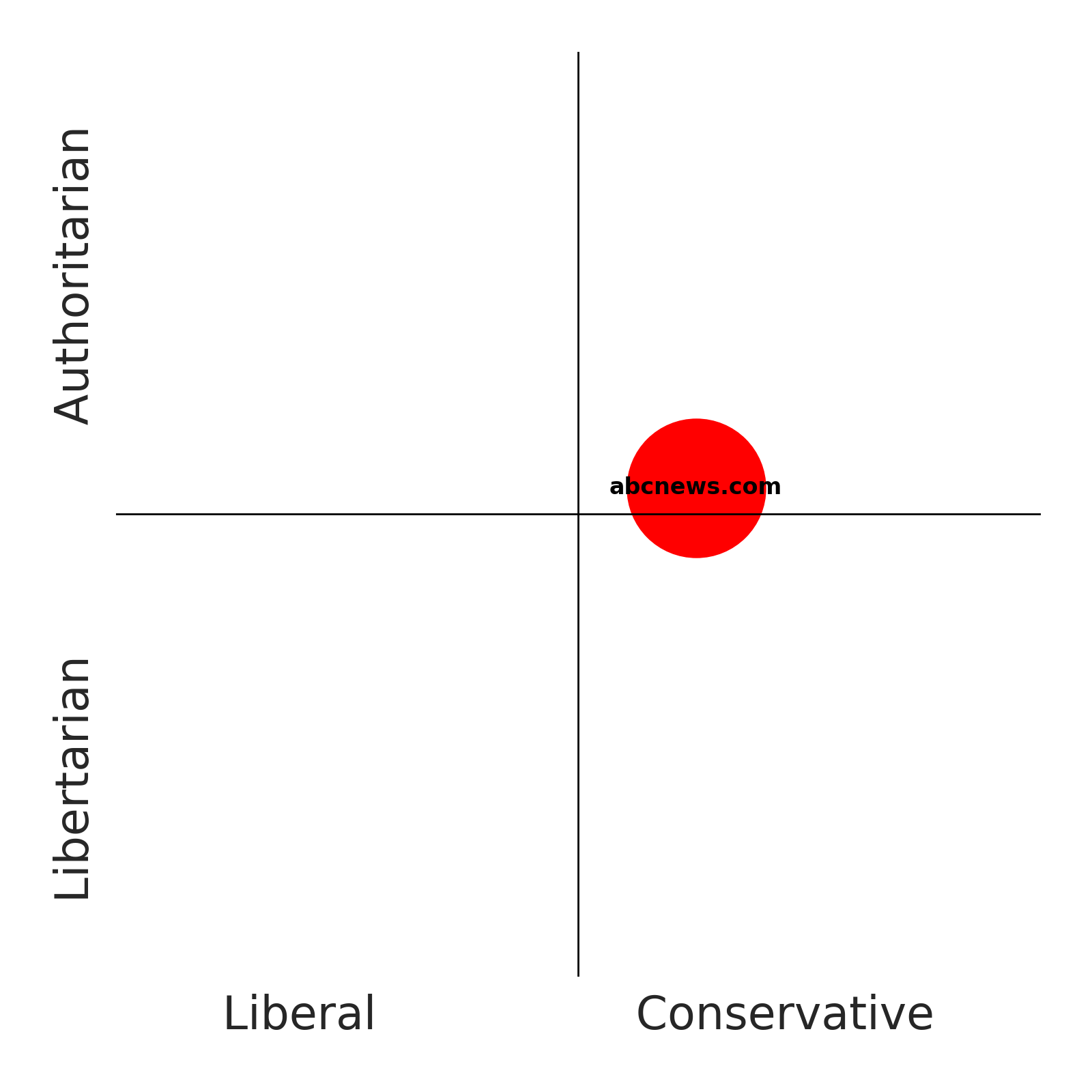
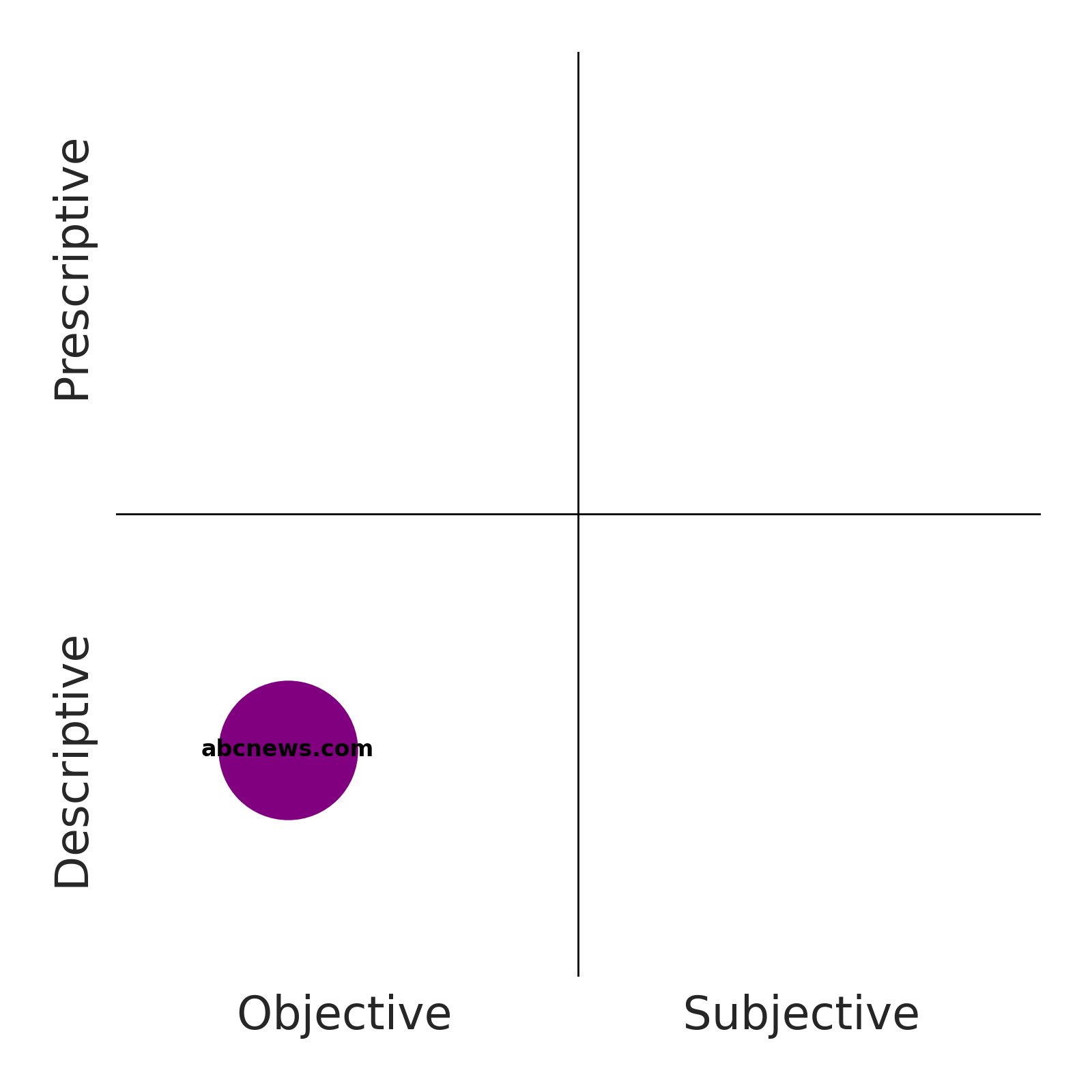
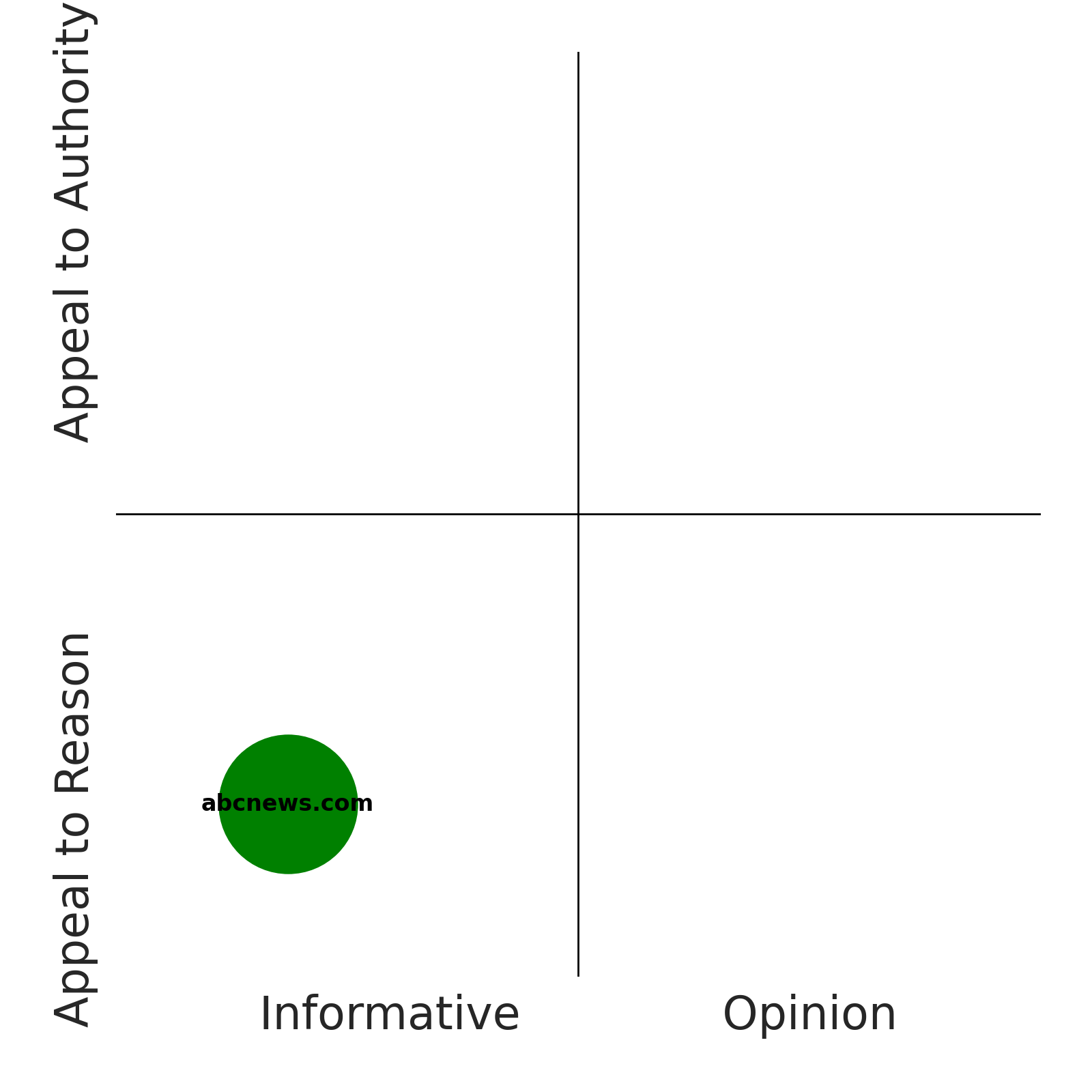
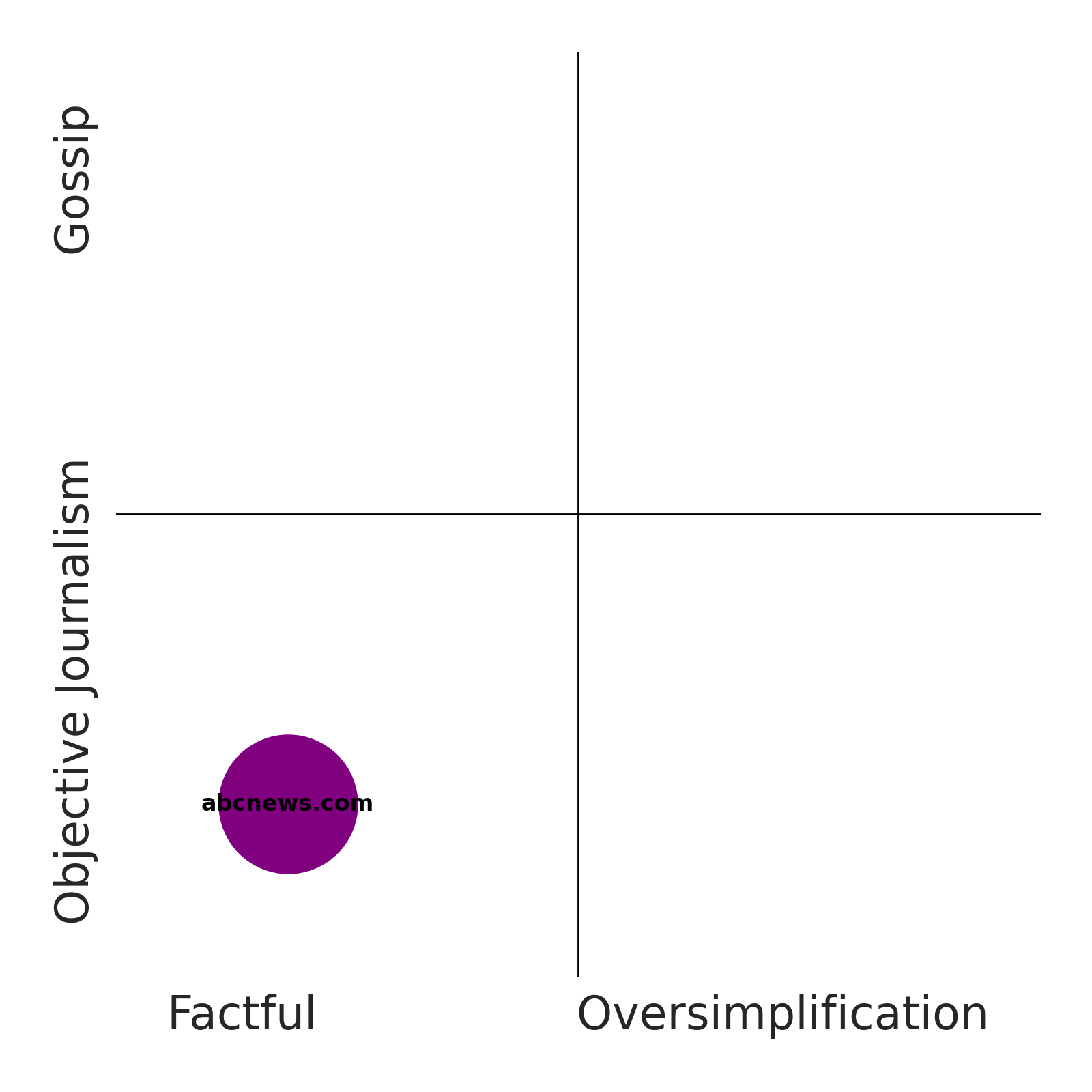
2026 © Helium Trades
Privacy Policy & Disclosure
* Disclaimer: Nothing on this website constitutes investment advice, performance data or any recommendation that any particular security, portfolio of securities, transaction or investment strategy is suitable for any specific person. Helium Trades is not responsible in any way for the accuracy
of any model predictions or price data. Any mention of a particular security and related prediction data is not a recommendation to buy or sell that security. Investments in securities involve the risk of loss. Past performance is no guarantee of future results. Helium Trades is not responsible for any of your investment decisions,
you should consult a financial expert before engaging in any transaction.
Helium Research Assistant

How can I help you today?
Ask any question about abcnews.com bias.


