See whether Helium helps you make better-informed decisions. Try every Pro Trader feature for 30 days. No credit card required.
Try every Pro Trader feature for 30 days. No credit card required.
Observable framing and coverage. The sample is strongly finance-industry centered: banking regulation, fintech and payments, AI adoption, tokenization, mergers, mortgage markets, wealth management, securities, and financial litigation recur far more than ordinary consumer experience or nonfinancial social effects
August 21, 2026 · 0 shares
Frames embedded payments as an impending growth wave that banks must embrace to stay relevant, while relying on third-party research and executive quotes to carry the sector's promise.
Embedded payments integrate payment processing directly into third-party business software and consumer platforms, such as the 'buy button' in apps and e-commerce checkouts.
Automated analysis; not human reviewed. Limitations: The source text mixes the Fifth Third/Payload story with several unrelated bank briefs, but the analysis focused on the embedded payments story that dominates the article. · 11 of 54 available dimensions scored; omitted dimensions are not treated as neutral. · Verified supporting quotes for 8 of 11 scored dimensions.
Claim: The report presents facts and attributed quotes without injecting subjective interpretation.
“Fifth Third this week made an investment in Payload, an embedded payment firm that has found demand in real estate” · exact text match
Why: Claims are attributed; no overt editorializing.
Claim: The language is calm and businesslike.
“Newline is the fastest growing segment in Fifth Third's commercial payments business, which generated more than $1 billion in fee revenue in 2025.” · exact text match
Why: Reconciled figures and measured terms avoid hype.
Claim: Favorable industry growth projections tilt the tone modestly bullish.
“The global embedded payments market will grow by 134% between the end of 2024 and 2028” · exact text match
Why: Projections are framed positively, although attributed to research firms.
Claim: The content is of moderate interest for a business audience, but not remarkable.
“Embedded payments are drawing banks and payment companies that desire the easy experience of a 'buy button' that's directly inside of another product.” · not found in supplied text
Why: Standard business-sector coverage with concrete figures.
Claim: The report is descriptive rather than prescriptive.
“The bank did not release the size of the investment, which comes as banks are plotting strategies for embedded payments” · exact text match
Why: Reports on strategies and market conditions without telling readers what to do.
Claim: The report leans on named third-party authorities to support claims.
“JPMorgan said in a research note on Fifth Third” · exact text match
“according to Juniper Research.” · exact text match
“according to Capgemini.” · exact text match
Why: A list of third parties provides support for the reported claims.
Claim: The source is transparent about its sourcing and provides specific, attributable data.
“JPMorgan said in a research note” · exact text match
“a KPMG survey found” · exact text match
Why: Named institutions and precise figures bolster the report's trustworthiness.
Claim: The source maintains a measured, analytical tone when discussing industry trends.
“the bank has invested in Payload, a company that has grown quickly selling new processing technology to real estate companies, with plans to expand into other industries with multiparty transactions.” · not found in supplied text
Why: The report is fact-focused and avoids emotional or alarmist language.
Claim: The source presents corporate and industry strategy without significant countervailing perspective.
“we have sought to make sure that we are creating value by being in the tech stack of these companies” · exact text match
Why: The bank's own framing is reproduced without an opposing viewpoint.
Claim: Forward-looking forecasts are included, but attributed to research firms.
“The global embedded payments market will grow by 134%” · exact text match
Why: The report contains forecasts that are appropriately sourced.
Claim: The writing is competent and clear, but does not go beyond typical business reporting.
“Embedded payments are drawing banks and payment companies that desire the easy experience of a 'buy button' that's directly inside of another product.” · not found in supplied text
Why: Standard industry analysis without advanced insight.
The source text mixes the Fifth Third/Payload story with several unrelated bank briefs, but the analysis focused on the embedded payments story that dominates the article.
August 18, 2026 · 0 shares
The framing is exploratory and practical, focusing on adapting risk management to always-on tokenized deposits, with a balanced consideration of opportunities and risks rather than advocacy or alarm.
The tokenized-deposit network Cari Network is one of several nascent projects; the article does not explain the full mechanics of tokenized deposits or the regulatory landscape.
Automated analysis; not human reviewed. Limitations: The article is from American Banker, a trade publication focused on banking, which may shape its industry perspective.
The article is from American Banker, a trade publication focused on banking, which may shape its industry perspective.
August 18, 2026 · 0 shares
The framing presents a cautiously pessimistic outlook on mortgage origination volumes and rates, balanced by acknowledgment of stable home prices and lender profitability, with reliance on institutional forecasts and executive commentary.
Automated analysis; not human reviewed. Limitations: The article relies on forecasts and executive statements, which are inherently uncertain and may not reflect actual market outcomes. · 54 of 54 available dimensions scored; omitted dimensions are not treated as neutral. · Verified supporting quotes for 11 of 54 scored dimensions.
Claim: The article does not take a political stance, focusing on economic indicators and forecasts.
“Mortgage rate projections have shifted notably higher in the past month” · exact text match
“Fannie Mae lowered its existing home sales estimate for 2026” · not found in supplied text
Why: The content is purely about mortgage and housing market forecasts without political commentary.
Claim: The article presents information from institutional sources (Fannie Mae, MBA) and executives, which is elite-centric but not explicitly elitist.
“according to Fannie Mae” · exact text match
“Mike Miedler, president and CEO of Century 21 Real Estate, said in an emailed press statement” · exact text match
Why: The reliance on authoritative forecasts and executive quotes does not demean ordinary people; it is neutral.
Claim: The article does not advocate for government intervention or deregulation.
Why: This is a market forecast article without policy prescriptions.
Claim: The article mixes objective forecasts with subjective executive commentary.
“Fannie lowered its single-family origination projections” · not found in supplied text
“Mortgage rates just hit 6.7%, their highest level in a year, and our data shows weekly contract activity slipping” · exact text match
Why: The article primarily reports on forecasts, which are objective in nature, but includes subjective statements from executives.
Claim: The article is objective in tone, without sensational language.
“The shift in the government-sponsored enterprise's outlook adds to growing concern” · exact text match
“annual home price index forecasts stability” · exact text match
Why: The language is measured and professional, not exaggerated.
Claim: The article is slightly bearish due to lower forecasts and higher rates, but acknowledges some positive aspects.
“Mortgage rate projections have shifted notably higher” · exact text match
“Fannie lowered its single-family origination projections” · not found in supplied text
“boosted its 2026 forecast for single-family housing starts” · exact text match
Why: The overall tone is cautious with lower forecasts, but it notes positive developments like housing starts and stable prices, leading to a slight negative bias.
Claim: The article is slightly pessimistic due to higher rates and lower origination projections, but balanced by positive mentions.
“adding to origination challenges in a market where housing demand is wavering” · exact text match
“some of the latest shifts in Fannie Mae's housing projections are positive for lenders” · exact text match
Why: The negative aspects are emphasized more, but the positive points reduce the pessimism to a modest level.
Claim: The article covers specific market data and forecasts, which may be of moderate interest to finance professionals.
“Fannie Mae's forecast now suggests the annual growth rate for industry mortgage originations has fallen” · not found in supplied text
“The second quarter is on track to be the best period for originations this year with $558 billion” · exact text match
Why: The content is informative but niche; not sensational.
Claim: The article is descriptive, reporting forecasts and data without suggesting actions.
“Fannie Mae's forecast now suggests” · not found in supplied text
“Fannie lowered its existing home sales estimate” · exact text match
Why: No recommendations or directives are present.
Claim: The article does not take a stance on military or foreign policy.
Why: Not applicable to this topic.
Claim: The article doesn't incite fear but notes challenges.
“adding to origination challenges” · exact text match
“housing demand is wavering” · exact text match
Why: Language is cautious but not fear-provoking.
Claim: The article does not rely on circular reasoning.
Why: No evidence of circular logic.
Claim: The article does not contain gossip or personal commentary.
Why: It's a factual market report.
Claim: The article includes quotes from industry executives that offer opinions, but the main body is factual.
“Mike Miedler, president and CEO of Century 21 Real Estate, said in an emailed press statement” · exact text match
“Sam Williamson, senior economist at First American, said in an emailed press statement” · exact text match
Why: The inclusion of executive opinions adds a subjective element, but it is balanced by objective data.
Claim: The article is non-political.
Why: Focuses solely on economic and market data.
Claim: The article presents complex forecasts in a simplified manner but does not grossly oversimplify.
“Mortgage rate projections have shifted notably higher” · exact text match
“Fannie lowered its single-family origination projections” · not found in supplied text
Why: It summarizes data without oversimplifying the underlying market conditions.
Claim: The article relies heavily on authority figures (Fannie Mae, executives) but appropriately attributes claims.
“according to Fannie Mae” · exact text match
“Mike Miedler ... said in an emailed press statement” · not found in supplied text
“Sam Williamson, senior economist at First American, said” · exact text match
Why: It uses institutional sources to back its claims, which is standard in financial journalism.
Claim: The article is professional and mature.
Why: Tone is serious and informative.
Claim: No circular reasoning present.
Why: The content is logical and non-repetitive.
Claim: No evidence of covering up responses or evading issues.
Why: The article addresses various aspects directly.
Claim: No victimization framing.
Why: It's a market forecast without targeting any group.
Claim: The article accurately conveys forecasts as projections, not certainties.
“Home mortgage forecasts more than a year ahead are highly subject to change” · exact text match
“far from certain” · exact text match
Why: The article is careful to note uncertainty.
Claim: The article is not spam or fluff.
Why: All content is substantive.
Claim: No ideological bias.
Why: The article is factual and data-driven.
Claim: The article relies on institutional sources like Fannie Mae and the Mortgage Bankers Association, showing a pro-establishment lean.
“according to Fannie Mae” · exact text match
“the Mortgage Bankers Association reporting” · exact text match
Why: The heavy reliance on official forecasts and industry associations indicates alignment with established financial institutions.
Claim: The article maintains a neutral emotional tone.
Why: No emotionally charged language.
Claim: No double standards.
Why: Consistent treatment of information.
Claim: High credibility due to use of official forecasts and named sources.
“according to Fannie Mae” · exact text match
“Mike Miedler, president and CEO of Century 21 Real Estate, said” · exact text match
“Sam Williamson, senior economist at First American, said” · exact text match
Why: Reliable sources and clear attribution.
Claim: The article logically presents forecasts and data without irrational claims.
“Fannie Mae's forecast now suggests the annual growth rate for industry mortgage originations has fallen” · not found in supplied text
“The GSE reduced its new home sales projection” · exact text match
Why: The content is data-driven and does not contain fallacious reasoning.
Claim: No advertising or promotional content.
Why: It's a news report.
Claim: The article is slightly pro-corporate because it highlights lender profitability and institutional forecasts.
“lenders generally have been profitable so far in 2026” · exact text match
“the Mortgage Bankers Association reporting” · exact text match
Why: It presents a positive note on corporate profitability but without strong advocacy.
Claim: The article includes speculative forecasts but clearly labels them as projections.
“Fannie Mae's forecast now suggests” · not found in supplied text
“Home mortgage forecasts more than a year ahead are highly subject to change” · exact text match
Why: Forecasts are inherently speculative, but the article acknowledges uncertainty.
Claim: The article appears written by a human, given the varied quotes and specific details.
“Mike Miedler, president and CEO of Century 21 Real Estate, said” · exact text match
“Sam Williamson, senior economist at First American, said” · exact text match
Why: The presence of multiple named quotes and industry-specific nuance suggests human authorship, though the style is typical of financial journalism.
Claim: The article appears honest by attributing statements to sources and presenting forecasts without distortion.
“according to Fannie Mae” · exact text match
“Mike Miedler, president and CEO of Century 21 Real Estate, said in an emailed press statement” · exact text match
Why: Transparent attribution and consistent reporting without evident bias.
Claim: The article is well-informed, presenting specific data and context.
“Fannie Mae's forecast now suggests the annual growth rate ... fallen from almost $2.3 trillion to nearly $2.17 trillion” · not found in supplied text
“The second quarter is on track to be the best period for originations this year with $558 billion” · exact text match
Why: Detailed market analysis with credible sources.
Claim: No terrorism content.
Why: Irrelevant.
Claim: No Marxist ideology.
Why: Irrelevant.
Claim: No Islamist content.
Why: Irrelevant.
Claim: No anti-Semitic content.
Why: Irrelevant.
Claim: No anti-LGBT content.
Why: Irrelevant.
Claim: No racist content.
Why: Irrelevant.
Claim: No woke ideology.
Why: Irrelevant.
Claim: No cruelty.
Why: Irrelevant.
Claim: No virtue signaling.
Why: Irrelevant.
Claim: No conspiracy theories.
Why: Irrelevant.
Claim: No suicidal empathy.
Why: Irrelevant.
Claim: No scapegoating.
Why: Irrelevant.
Claim: No hypocrisy.
Why: No evidence of double standards.
Claim: No anti-enlightenment content.
Why: Irrelevant.
The article relies on forecasts and executive statements, which are inherently uncertain and may not reflect actual market outcomes.
August 17, 2026 · 0 shares
The reporting frames Bank of America's nonconsecutive remote-day rule as the latest lender rollback from hybrid work while balancing management rationale with employee criticism.
Automated analysis; not human reviewed. Limitations: The supplied text is a newsletter-style compilation; scoring covers only the lead Bank of America item. · 2 of 54 available dimensions scored; omitted dimensions are not treated as neutral. · Verified supporting quotes for 2 of 2 scored dimensions.
Claim: Key policy details and industry context are attributed to a named spokesperson and research, with both sides of the RTO debate included.
“a BofA spokesperson confirmed to American Banker” · exact text match
“according to Arizent research” · exact text match
Why: The lead story uses attributed sourcing and presents management and employee perspectives, supporting a mildly objective presentation.
Claim: Visible sourcing is specific, named, and attributed rather than anonymous or unverifiable.
“a BofA spokesperson confirmed to American Banker” · exact text match
“told American Banker last year” · exact text match
Why: The key policy change is attributed to a named outlet source, and industry context is tied to Arizent research and a named consultant.
The supplied text is a newsletter-style compilation; scoring covers only the lead Bank of America item.
The dominant reporting frame is technocratic and institutionally anchored. Official agencies, trade associations, analysts, consultants, and corporate executives commonly supply the authoritative evidence—for example, the OCC in a charter story, the FDIC in a bank-failure report, and Morningstar in an active-management analysis
August 21, 2026 · 0 shares
The report frames the OCC's charter approval as a routine, process-driven regulatory matter, anchoring the story in capital requirements, waivers, and procedural conditions rather than strategic, political, or market implications, while briefly situating it in a broader pattern of approvals during the second Trump administration.
Automated analysis; not human reviewed. Limitations: The provided text appears to merge a main story about the Itaú charter with a block of unrelated financial news briefs, making the primary framing evaluation rely on the dominant topic of bank regulation. · 12 of 54 available dimensions scored; omitted dimensions are not treated as neutral. · Verified supporting quotes for 11 of 12 scored dimensions.
Claim: The report adheres strictly to verifiable facts, official statements, and documented requirements without subjective interpretation or editorializing.
“Final approval will not be granted until the Federal Reserve and FDIC act favorably on the related applications.” · exact text match
“Itaú Bank will operate as a subsidiary of the Brazilian banking company Itaú Unibanco Holding S.A, a more-than $600 billion institution based in Sao Paulo.” · exact text match
Why: The writing is purely factual, grounded in official documentation and quoted regulations, with no evaluative language or qualitative opinions.
Claim: The reporting is sober, understated, and free of dramatic language or exaggeration.
“The bank must apply for membership in the Federal Reserve system and obtain deposit insurance from the Federal Deposit Insurance Corp for the final conditions of the OCC's conditional approval to be met.” · exact text match
Why: The text is dry and procedural, avoiding any attempt to dramatize or simplify the subject matter for dramatic appeal.
Claim: The content is entirely descriptive, stating what is and what is required, without prescribing, endorsing, or recommending any particular course of action.
“Four proposed directors received residency waivers, while two received citizenship waivers.” · exact text match
“The bank has 18 months from the preliminary approval date to open for business or the approval will expire, unless they are granted an extension.” · exact text match
Why: Every sentence describes conditions, facts, or requirements; no recommendation or opinion is offered.
Claim: The report presents only facts and attributed statements, absent any original opinions, allegations, or personal judgments by the author.
“Itaú will operate as a subsidiary of the Brazilian banking company Itaú Unibanco Holding S.A, a more-than $600 billion institution based in Sao Paulo.” · not found in supplied text
Why: The article reads as a checklist of verifiable statements without any subjective commentary.
Claim: The content is predominantly non-political, with a single factual reference to the political timeline (the second Trump administration) to date the developments without taking a political stance.
“since the beginning of the second Trump administration, including the Trump-linked World Liberty Financial, whose charter was approved by the OCC a week ago.” · exact text match
Counterevidence:
“The mention of 'Trump-linked World Liberty Financial' could be seen as implying political influence in charter approvals, suggesting a slight political narrative.” · not found in supplied text
Why: The Trump administration reference anchors a timeline but contains no policy evaluation, indicating minimal political bias.
Claim: The report carefully conditions all facts about future actions and events, avoiding certainty beyond its evidence base.
“The bank must apply for membership in the Federal Reserve system and obtain deposit insurance from the Federal Deposit Insurance Corp for the final conditions of the OCC's conditional approval to be met.” · exact text match
Why: Certainty is deliberately hedged; the article distinguishes between what will happen and what must happen for the deal to close, showing measured language.
Claim: The language is emotionally neutral, using no charged terms or appeals to reader sentiment.
“The Office of the Comptroller of the Currency has granted Itaú Bank a charter to operate in the United States.” · exact text match
Why: The text is unadorned with feeling or sentiment, maintaining a purely informational and dispassionate tone.
Claim: The text is highly credible, relying on specific, attributable, verifiable information from official documents and regulatory disclosures.
“Itaú's U.S. subsidiary will launch with at least $507 million in capital” · exact text match
“The OCC also required the bank to maintain a Tier 1 leverage ratio of at least 8% during its first three years of operation.” · exact text match
Why: The level of specificity, use of required regulatory ratios, and clear sourcing provide strong support for a high credibility rating.
Claim: The text follows a logical, evidence-based structure, reporting verifiable facts, figures, and regulatory requirements without emotional or irrational appeals.
“The OCC also required the bank to maintain a Tier 1 leverage ratio of at least 8% during its first three years of operation.” · exact text match
Why: The article is precise and logical, focusing on regulatory mechanics and quantitative requirements rather than narrative or emotional appeal. The confidence reflects the 'irrational' end being entirely absent but acknowledges the article adds no analytical or evaluative reasoning beyond reporting.
Claim: The reporting demonstrates integrity through transparent attribution, use of official sources, and clear separation of fact from conditional statements.
“according to the OCC's approval letter” · exact text match
“The OCC said 66.67% of the bank's board would meet the citizenship requirements following their election.” · exact text match
Why: The article attributes information to its official source, uses precise numbers, and does not fabricate or inflate claims.
The provided text appears to merge a main story about the Itaú charter with a block of unrelated financial news briefs, making the primary framing evaluation rely on the dominant topic of bank regulation.
August 21, 2026 · 0 shares
Reporting relies strictly on official statements and data, avoids interpretation, and maintains a neutral tone.
This text appears in a banking-industry news roundup; bank failures have been rare in recent years—none in 2021-22, two in each of 2024-25, and five in 2023—so the health of community banks is a recurring topic.
Automated analysis; not human reviewed. Limitations: Analysis is based on a single short news brief that focuses on one main story followed by brief unrelated updates, providing a limited sample of the publisher's broader content. · 4 of 54 available dimensions scored; omitted dimensions are not treated as neutral. · Verified supporting quotes for 3 of 4 scored dimensions.
Claim: The publication presents the story with high factual objectivity.
“the FDIC estimated the failure will cause a Deposit Insurance Fund hit of around $5.5 million” · not found in supplied text
Why: The text attributes estimates to the FDIC and reports data (e.g., 'as of June 30, Tioga-Franklin had reported total assets of $68 million and total deposits of $67 million') without evaluative language.
Claim: The publication avoids sensationalism in reporting.
“It is the fifth bank to fail this year, the most since 2023.” · exact text match
Why: The statement about the failure count is presented plainly without dramatic or alarmist language.
Claim: The account is purely descriptive and avoids prescribing actions or judgments.
“The FDIC also announced an agreement with Second Federal Savings and Loan Association of Philadelphia to transfer all of Tioga-Franklin's deposits and the vast majority of its assets.” · exact text match
Why: The text reports events and actions without offering advice, recommendations, or value judgments, staying in a descriptive mode.
Claim: The text demonstrates high credibility through clear attribution and specific details.
“Tioga-Franklin Savings Bank was closed Friday by the Pennsylvania Department of Banking and Securities, with the FDIC appointed as receiver.” · exact text match
Why: It names specific regulatory bodies (e.g., 'Pennsylvania Department of Banking and Securities'), provides dates, and quantifies financial impacts, though only one source is used.
Analysis is based on a single short news brief that focuses on one main story followed by brief unrelated updates, providing a limited sample of the publisher's broader content.
August 17, 2026 · 0 shares
The article objectively reports Morningstar's data on active versus passive fund performance but frames active management's persistence through advisor incentives and fiduciary constraints.
The investment industry trend has been a shift from active to passive management due to fee differences and performance data, and advisors are repositioning their value proposition beyond stock picking.
Automated analysis; not human reviewed. · 54 of 54 available dimensions scored; omitted dimensions are not treated as neutral. · Verified supporting quotes for 7 of 54 scored dimensions.
Claim: The article mostly reports facts and quotes, but includes some subjective characterizations like 'shocked' and 'excellent'.
“Morningstar's findings, which look at returns after fees are paid, showed even worse results over a longer period.” · exact text match
“Bruns said he's "shocked" by the number of advisors who still go in for active portfolio management.” · not found in supplied text
Why: Mostly fact-based with some emotional quotes and slight subjective framing.
Claim: The article does not exaggerate or dramatize the findings, but uses somewhat strong language like 'shocked' and 'lackluster performance'.
“Bruns said he's "shocked" by the number of advisors who still go in for active portfolio management.” · not found in supplied text
“But, perhaps in response to the steady reports of lackluster performance, investors and advisors have been moving money out of actively managed funds in recent decades.” · exact text match
Why: Mostly factual but with some slightly emotional phrasing.
Claim: The article is slightly positive on the need for advisors to pivot to value-added services, which is a bullish view of the advice industry.
“"The real value of working with a financial planning firm is increasingly in tax planning, retirement income strategy, Social Security and Medicare decisions, and estate planning," Bruns said.” · not found in supplied text
Why: The tone suggests positive outlook for advisors beyond stock picking.
Claim: The article is moderately interesting due to new data and expert quotes.
“Active management does better with small-, mid-caps” · exact text match
“Private investments, which often are under no requirement to publicly report data, present an even bigger opportunity to active managers.” · not found in supplied text
Why: Provides actionable insights and notable statistics.
Claim: The article largely describes the state of investment management but hints at prescriptions for advisors.
“results like Morningstar's suggest advisors need to present themselves as something more than investment pickers.” · exact text match
Why: Mostly descriptive, but one sentence is prescriptive.
Claim: The article relies heavily on Morningstar data and the Investment Company Institute for statistics, and quotes industry advisors as experts.
“Morningstar reported this month.” · exact text match
“according to the Investment Company Institute.” · exact text match
Why: Cites established institutions for data, and uses named advisors as expert sources, which is standard in financial reporting.
Claim: The article has a slightly positive emotional tone due to quotes from advisors expressing confidence in their approach.
“"Our portfolios have a lower concentration in technology because of our concern over a potential AI bubble," Dwyer said. "But we are still in line with the overall S&P 500 return [year to date], which means our performance relatively speaking is excellent."” · not found in supplied text
Why: Despite the critical data, the tone is not overly negative; it includes positive notes on active management in certain segments.
Claim: Article is credible with clear sourcing, exact figures, and named expert opinions.
“Morningstar reported this month” · exact text match
“according to the Investment Company Institute.” · exact text match
“Monica Dwyer, a wealth advisor and vice president at Harvest Financial Advisors in West Chester, Ohio, said” · exact text match
Why: Uses reputable institutions and named individuals, provides specific numbers and dates.
Claim: The article endorses rational, evidence-based decision-making and questions active management based on data.
“"We have decades of evidence showing how difficult it is to consistently beat an index after fees," Bruns said.” · not found in supplied text
Why: Frames evidence-based approach as superior, but also presents counterarguments.
Claim: The article is not advertorial but includes mentions of firms and advisors, which could be seen as promotional for those mentioned.
“Monica Dwyer, a wealth advisor and vice president at Harvest Financial Advisors in West Chester, Ohio, said her firm doesn't pay outside portfolio providers for active management but does actively manage some investments on its own.” · exact text match
Why: Mention of advisors and their firms is for credibility, not promotion.
Claim: The article includes some speculative forward-looking statements about active management's role and advisor value.
“results like Morningstar's suggest advisors need to present themselves as something more than investment pickers.” · exact text match
“Private investments, which often are under no requirement to publicly report data, present an even bigger opportunity to active managers, McMeans said.” · exact text match
Why: Some statements are forward-looking suggestions based on data, but they are framed as opinions from sources.
Claim: The article provides balanced coverage by including both critics and proponents of active management.
“But active managers do have defenders among advisors.” · exact text match
“At least one academic paper has sought to cast doubt on the supposed poor performance of actively managed funds after fees are taken into account.” · exact text match
Why: The article includes opposing views and doesn't present active management as entirely bad, citing defenders and a paper questioning performance.
Claim: Article presents a balanced yet insightful analysis of active vs. passive management including definitions and counterpoints.
“Small-cap companies, worth between $250 million and $2 billion, and mid-cap, worth between $2 billion and $10 billion, tend to receive far less scrutiny. When active managers tended to firms in those categories, their success at beating their passive counterparts rose to nearly 50%, according to Morningstar.” · exact text match
Why: Includes contextual data, defines terms, and offers nuanced perspective.
August 19, 2026 · 0 shares
A market wrap that frames the expansion of long-dated Treasury buybacks as an election-timed 'gambit' to cap yields, pairing that interventionist narrative with attributed skepticism and dense market detail.
Automated analysis; not human reviewed. Limitations: The analysis draws on only a single news report, without independent verification of the underlying claims; judgments about 'fairness' and 'bias' are inherently subjective. · 10 of 54 available dimensions scored; omitted dimensions are not treated as neutral. · Verified supporting quotes for 8 of 10 scored dimensions.
Claim: The report is politically neutral, treating the electoral implications for Republicans as a market factor rather than taking sides, and does not favor one party over the other.
“posing a headwind for economic growth and a potential problem for President Donald Trump and his fellow Republicans ahead of the November midterm elections.” · exact text match
Why: The only party-political reference is descriptive of the policy's political fallout; there is no praise or vilification of either party, but the sample of political coverage is thin.
Claim: The reporting is largely objective, presenting market data and attributing opinions to named sources, though the inclusion of loaded words like 'gambit' and 'maneuver' imparts a mild subjective undercurrent.
“The new plan drove yields on the longest bond lower by nearly 10 basis points to 5.18%” · exact text match
“The buyback gambit is the latest in a series of interventions by Bessent” · exact text match
Why: The core story is conveyed with data and attributed quotes, but the choice of 'gambit' reflects an authorial judgment that the action is a risky or strategic play, tilting the piece slightly away from pure neutrality.
Claim: The article is unambiguously factual in tone, relying on granular figures and attribute-what-you-see reporting rather than inflated language.
“The operation was 10 times oversubscribed, showcasing how investors' enthusiasm for the program.” · exact text match
Why: The highly quantitative, understated style and references to primary market mechanisms ground the report in sober convention, with no hyperbolic or fear-driven language.
Claim: The piece contains several opinion-laden nouns—'gambit,' 'interventions,' and 'maneuver'—that signal the publisher's interpretive framing despite an otherwise factual news brief.
“The buyback gambit is the latest in a series of interventions by Bessent” · exact text match
Why: These words imply a motive or a characterization of the action as political or strategic, which goes beyond the strictly neutral market explanation the rest of the piece provides.
Claim: The story repeatedly ties the buyback announcement to the November midterm elections, which—whether factual or not—gives the political angle framing weight in what is otherwise a market story.
“posing a headwind for economic growth and a potential problem for President Donald Trump and his fellow Republicans ahead of the November midterm elections.” · exact text match
“that some analysts say are designed to actively manage down borrowing costs ahead of the November midterm elections.” · exact text match
Why: The election timing is mentioned at least twice as a possible motivation for the policy, which frames the announcement through a political lens.
Claim: The report is highly credible, relying on named analysts, official statements, and detailed market data that lend itself to verification.
“A 10-year auction last week drew the highest financing cost at that tenor since 2007” · exact text match
“The operation was 10 times oversubscribed” · exact text match
Why: The specificity of the data, the naming of institutions, and the inclusion of exact percentage points and dollar figures allow for independent verification, supporting a trust rating of 7.
Claim: Forward-looking statements are mostly attributed to quoted analysts, with only the arithmetic inference about extra purchases being the publisher's own, clearly flagged as such.
“At least doubling that total would suggest an extra $14 billion or more.” · exact text match
Why: The '$14 billion' extrapolation is labeled as an estimate ('would suggest'), and all other forward-looking market commentary is attributed to named sources such as Jack McIntyre and Deutsche Bank.
Claim: The reporting is honest and transparent: it attributes claims to named sources, flags uncertainty (e.g., 'How long-lasting the impact is remains to be seen'), and includes dissenting or skeptical views.
“Treasury officials reintroduced the buyback program in 2023” · exact text match
“How long lasting the impact is remains to be seen.” · exact text match
Why: Direct attribution, the inclusion of uncertainty, and the citation of specific data points demonstrate a commitment to fair and accurate reporting.
Claim: The report displays strong analytical intelligence by explaining a complex fixed-income operation and connecting it to historical central-bank precedent.
“If officials are in effect replacing longer-dated debt with bills, Bessent's latest maneuver amounts to a Treasury Department version of something the Federal Reserve has done more than once over the decades: an 'Operation Twist'.” · not found in supplied text
Why: The author weaves together multiple market mechanics and historical parallels into a coherent explanation, showing comprehension of the subject beyond mere reporting.
The analysis draws on only a single news report, without independent verification of the underlying claims; judgments about 'fairness' and 'bias' are inherently subjective.
August 18, 2026 · 0 shares
The article presents favorable industry data from a trade association survey, framing the recent profitability as a positive turnaround while omitting broader market challenges.
The mortgage industry experienced losses and reduced origination volume between 2022 and 2024 due to rising interest rates and reduced refinancing activity. The article relies on the Mortgage Bankers Association's quarterly survey and BCG data, indicating a sector turnaround in origination profitability.
Automated analysis; not human reviewed. Limitations: Reliance on industry survey data and selected public company results may skew optimistic; no external verification of the data. · 54 of 54 available dimensions scored; omitted dimensions are not treated as neutral. · Verified supporting quotes for 6 of 54 scored dimensions.
Claim: The article is largely objective, presenting industry data with some interpretative framing.
“This continued the turnaround from the widespread losses posted between 2022 and 2024, Marina Walsh, the Mortgage Bankers Association's vice president of industry analysis, said.” · exact text match
Why: The article quotes an industry analyst and provides data but uses the turnaround narrative, which adds subjective framing.
Claim: The article is factual and not sensationalized.
“Independent mortgage bankers now have five consecutive quarters of pretax net production profits, a quarterly survey found.” · not found in supplied text
Why: No sensational language; straightforward reporting of survey findings.
Claim: The article emphasizes positive profitability trends, suggesting a bullish view on the mortgage banking sector.
“this continued the turnaround from the widespread losses posted between 2022 and 2024” · not found in supplied text
“overall, mortgage companies are managing to stay in the black” · exact text match
Why: Focus on profitability improvements and positive outlook, while noting some deviations.
Claim: The article's optimistic framing is supported by the emphasis on profitability despite noting some losses.
“overall, mortgage companies are managing to stay in the black” · exact text match
Why: The phrase 'managing to stay in the black' conveys a positive spin.
Claim: The article is mostly descriptive, presenting data without explicit recommendations.
“Average production volume per firm was $689 million, the highest level since the second quarter of 2022,” · exact text match
Why: Provides data without prescribing actions.
Claim: The article relies heavily on industry association and consulting firm reports.
“a quarterly survey found” · exact text match
“Marina Walsh, the Mortgage Bankers Association's vice president of industry analysis, said” · exact text match
“Boston Consulting Group, which tracks 10 banks and six publicly traded IMBs, in its second quarter report” · exact text match
Why: Multiple references to authoritative sources support the data presented.
Claim: The article cites authoritative sources such as MBA and BCG, and includes both positive and negative data points.
“According to the Mortgage Bankers Association's quarterly survey” · not found in supplied text
“However, among the public IMBs which reported a net GAAP loss for the period” · exact text match
Why: Credible sources and inclusion of negative findings enhance trustworthiness.
Claim: The article has some characteristics that could indicate AI authorship, such as formulaic structure and data-heavy sections, but this is not conclusive.
“With average origination volume at its highest level in four years, independent mortgage bankers now have five consecutive quarters of pretax net production profits, a quarterly survey found.” · exact text match
Why: Data-heavy reporting is common in journalism; no strong AI-specific markers detected.
Claim: The article appears to present data transparently, including losses among public IMBs.
“However, among the public IMBs which reported a net GAAP loss for the period are: Finance of America; loanDepot; Onity; UWM Holdings; and Better Home & Finance.” · exact text match
Why: The article includes counterpoints to positive news, suggesting even-handed reporting.
Claim: The article provides detailed quantitative analysis of industry financials.
“Total production revenue, made up of fee income, net secondary marketing income, and warehouse spread, decreased to 333 basis points in the second quarter, down from 353 basis points three months prior” · not found in supplied text
Why: Complex industry metrics and comparative analysis indicate a high level of detail.
Reliance on industry survey data and selected public company results may skew optimistic; no external verification of the data.
August 21, 2026 · 0 shares
Reports a satisfaction decline while clearly framing it as a client-service opportunity for financial advisors.
Automated analysis; not human reviewed. Limitations: I can only process the supplied text; the article includes several apparently unrelated news briefs after the main story, which I treated as noise rather than part of the analyzed piece. · 4 of 54 available dimensions scored; omitted dimensions are not treated as neutral. · Verified supporting quotes for 4 of 4 scored dimensions.
Claim: The reporting is largely objective, presenting data and attributed expert opinion.
“Customer satisfaction with Medicare Advantage dropped for the second year in a row, according to JD Power's U.S. Medicare Advantage Study” · exact text match
Why: The primary claim is attributed to a study; the publisher also includes a range of expert opinions, though a subtle pro-advisor framing exists.
Claim: The piece prescriptively advises financial advisors and retirees on actions they should take.
“advisors should ask whether coverage has been reviewed” · exact text match
“it would be wise for retirees to think through their decisions” · exact text match
Why: The direct use of 'should' and 'it would be wise' is prescriptive, moving beyond describing study results.
Claim: The reporting is credible, using a named study, attributed expert sources, and cautionary language.
“according to JD Power's U.S. Medicare Advantage Study, released Aug. 18” · exact text match
“Heather Schreiber, founder of Atlanta-based HLS Retirement Consulting, wrote in an email” · exact text match
Why: Both an explicit quantitative source and named experts with affiliations are cited, supporting credibility.
Claim: The piece demonstrates sound analytical reasoning, connecting survey data to practical implications.
“Trust doesn't exist in a vacuum; it is built through the various touchpoints consumers have with their plan” · exact text match
Why: The publisher weaves together data and expert commentary in a reasonably sophisticated way, though it is not highly technical.
I can only process the supplied text; the article includes several apparently unrelated news briefs after the main story, which I treated as noise rather than part of the analyzed piece.
The source often presents innovation as commercially consequential and potentially beneficial, especially in AI, embedded payments, tokenized deposits, and blockchain finance
August 21, 2026 · 0 shares
Frames embedded payments as an impending growth wave that banks must embrace to stay relevant, while relying on third-party research and executive quotes to carry the sector's promise.
Embedded payments integrate payment processing directly into third-party business software and consumer platforms, such as the 'buy button' in apps and e-commerce checkouts.
Automated analysis; not human reviewed. Limitations: The source text mixes the Fifth Third/Payload story with several unrelated bank briefs, but the analysis focused on the embedded payments story that dominates the article. · 11 of 54 available dimensions scored; omitted dimensions are not treated as neutral. · Verified supporting quotes for 8 of 11 scored dimensions.
Claim: The report presents facts and attributed quotes without injecting subjective interpretation.
“Fifth Third this week made an investment in Payload, an embedded payment firm that has found demand in real estate” · exact text match
Why: Claims are attributed; no overt editorializing.
Claim: The language is calm and businesslike.
“Newline is the fastest growing segment in Fifth Third's commercial payments business, which generated more than $1 billion in fee revenue in 2025.” · exact text match
Why: Reconciled figures and measured terms avoid hype.
Claim: Favorable industry growth projections tilt the tone modestly bullish.
“The global embedded payments market will grow by 134% between the end of 2024 and 2028” · exact text match
Why: Projections are framed positively, although attributed to research firms.
Claim: The content is of moderate interest for a business audience, but not remarkable.
“Embedded payments are drawing banks and payment companies that desire the easy experience of a 'buy button' that's directly inside of another product.” · not found in supplied text
Why: Standard business-sector coverage with concrete figures.
Claim: The report is descriptive rather than prescriptive.
“The bank did not release the size of the investment, which comes as banks are plotting strategies for embedded payments” · exact text match
Why: Reports on strategies and market conditions without telling readers what to do.
Claim: The report leans on named third-party authorities to support claims.
“JPMorgan said in a research note on Fifth Third” · exact text match
“according to Juniper Research.” · exact text match
“according to Capgemini.” · exact text match
Why: A list of third parties provides support for the reported claims.
Claim: The source is transparent about its sourcing and provides specific, attributable data.
“JPMorgan said in a research note” · exact text match
“a KPMG survey found” · exact text match
Why: Named institutions and precise figures bolster the report's trustworthiness.
Claim: The source maintains a measured, analytical tone when discussing industry trends.
“the bank has invested in Payload, a company that has grown quickly selling new processing technology to real estate companies, with plans to expand into other industries with multiparty transactions.” · not found in supplied text
Why: The report is fact-focused and avoids emotional or alarmist language.
Claim: The source presents corporate and industry strategy without significant countervailing perspective.
“we have sought to make sure that we are creating value by being in the tech stack of these companies” · exact text match
Why: The bank's own framing is reproduced without an opposing viewpoint.
Claim: Forward-looking forecasts are included, but attributed to research firms.
“The global embedded payments market will grow by 134%” · exact text match
Why: The report contains forecasts that are appropriately sourced.
Claim: The writing is competent and clear, but does not go beyond typical business reporting.
“Embedded payments are drawing banks and payment companies that desire the easy experience of a 'buy button' that's directly inside of another product.” · not found in supplied text
Why: Standard industry analysis without advanced insight.
The source text mixes the Fifth Third/Payload story with several unrelated bank briefs, but the analysis focused on the embedded payments story that dominates the article.
August 19, 2026 · 0 shares
The reporting is substantially promotional toward AI adoption by banks, heavily relying on vendor-led survey data and executive commentary while framing adoption challenges solely as a trust issue rather than a critical examination.
Automated analysis; not human reviewed. · 23 of 54 available dimensions scored; omitted dimensions are not treated as neutral. · Verified supporting quotes for 0 of 23 scored dimensions.
August 18, 2026 · 0 shares
The framing is exploratory and practical, focusing on adapting risk management to always-on tokenized deposits, with a balanced consideration of opportunities and risks rather than advocacy or alarm.
The tokenized-deposit network Cari Network is one of several nascent projects; the article does not explain the full mechanics of tokenized deposits or the regulatory landscape.
Automated analysis; not human reviewed. Limitations: The article is from American Banker, a trade publication focused on banking, which may shape its industry perspective.
The article is from American Banker, a trade publication focused on banking, which may shape its industry perspective.
August 21, 2026 · 0 shares
The report adopts a boosterish, uncritical framing of the Texas market and its new exchange as a natural home for the bank's funds, eliding promotional claims with reported facts.
The Texas Stock Exchange, which launched in early July 2025, is a new national securities exchange headquartered in Dallas, competing with the New York Stock Exchange and Nasdaq; this transfer marks its first primary listings.
Automated analysis; not human reviewed. Limitations: I only saw a static text dump of the article, so I could not verify claims against the original page, live updates, or the publication date; the freshness of the 'Thursday' reference is therefore unverified. · 4 of 54 available dimensions scored; omitted dimensions are not treated as neutral. · Verified supporting quotes for 4 of 4 scored dimensions.
Claim: The piece is closer to straight objective reporting than subjective advocacy.
“The funds' existing investment objectives and strategies will remain unchanged” · exact text match
Why: The piece contains standard factual reporting and attributions, so the slight subjectivity from promotional framing keeps it near the objective end of the scale.
Claim: The piece demonstrates solid sourcing and attribution practices appropriate for financial journalism.
“according to Carlos Peña” · exact text match
“the bank said” · exact text match
Why: The reporter attributes quotations and figures to named sources and marks forward-looking statements as the exchange's plans, supporting a modestly positive credibility score.
Claim: The article promotes the Texas market and its financial institutions in a promotional, uncritical manner consistent with advertorial content.
“no better place to invest and do business than in its home state” · exact text match
“business-friendly haven” · exact text match
Why: The language consistently frames the Texas business climate and the new exchange positively without examination or balancing data, matching an advertorial register.
Claim: The article presents corporations' and financial institutions' interests in a favorable, uncritical light.
“the state has made certain reforms to position itself as a business-friendly haven” · exact text match
Why: The description of relocations and tax structures as 'business-friendly' adopts a corporate perspective without questioning costs to workers or the public.
I only saw a static text dump of the article, so I could not verify claims against the original page, live updates, or the publication date; the freshness of the 'Thursday' reference is therefore unverified.
August 18, 2026 · 0 shares
The article frames tokenized junk bonds as a natural, positive evolution in finance, featuring industry insiders' endorsements without critical analysis or opposing viewpoints.
Automated analysis; not human reviewed. Limitations: The analysis relies on a single article text that is largely promotional and includes limited critical perspective. · 53 of 54 available dimensions scored; omitted dimensions are not treated as neutral. · Verified supporting quotes for 15 of 53 scored dimensions.
Claim: The article's framing is slightly liberal.
“High-yield bonds, sometimes called "junk bonds" have historically been high risk, representing the debt of companies with poor credit quality.” · not found in supplied text
Why: The article presents a positive view of tokenized finance without conservative criticism, but not strongly liberal.
Claim: The article is slightly elitist.
“The offering lets Neuberger reach a growing segment of investors seeking to invest through tokenized funds, Cho said.” · exact text match
Why: Focus on institutional and sophisticated investors suggests elitist framing, though populist elements are absent.
Claim: The article is slightly subjective.
“It's a fresh example of a complex investment vehicle going on-chain; previous tokenized investment funds have been established for Treasuries and money market funds.” · exact text match
Why: The article is primarily descriptive but includes promotional tone and selective expert quotes.
Claim: The article is not sensational.
“The new fund, called the Neuberger Securitize High Income Tokenized Fund, will invest in high-yield bonds and other fixed-income investments like collateralized loan obligations and leveraged loans.” · exact text match
Why: No sensational language; straightforward reporting.
Claim: The article is slightly bullish.
“According to Kevin Cho, global head of Neuberger's product group, today's high yield market is different from the "junk bond" reputation of decades past, "as credit quality now sits near multi-decade highs."” · not found in supplied text
Why: Positive assessment of high-yield market and tokenization suggests bullish tilt.
Claim: The article is slightly optimistic.
“For investors, the benefits of tokenized investments include transparent and verifiable ownership and transaction histories, portability of assets across wallets and platforms and the ability to buy and sell assets 24/7, according to Bui.” · exact text match
Why: Emphasis on benefits and demand suggests optimistic framing.
Claim: The article is mildly interesting.
“It's a fresh example of a complex investment vehicle going on-chain; previous tokenized investment funds have been established for Treasuries and money market funds.” · exact text match
Why: Novel topic but not highly engaging.
Claim: The article is mostly descriptive.
“The new fund, called the Neuberger Securitize High Income Tokenized Fund, will invest in high-yield bonds and other fixed-income investments like collateralized loan obligations and leveraged loans.” · exact text match
Why: Mostly describes the fund and market, with minimal prescription.
Claim: The article is slightly opinionated.
“It's a fresh example of a complex investment vehicle going on-chain; previous tokenized investment funds have been established for Treasuries and money market funds.” · exact text match
Why: Includes some editorializing but mostly factual.
Claim: The article is slightly oversimplified.
“High-yield bonds, sometimes called "junk bonds" have historically been high risk, representing the debt of companies with poor credit quality.” · not found in supplied text
Why: Simplifies risk without nuanced discussion.
Claim: The article relies heavily on authority figures.
“According to Kevin Cho, global head of Neuberger's product group, today's high yield market is different from the "junk bond" reputation of decades past, "as credit quality now sits near multi-decade highs."” · not found in supplied text
“Giang Bui, vice president and head of issuer growth at Securitize, is also seeing demand "broaden as the tokenized asset market matures," Bui told American Banker.” · not found in supplied text
Why: Article heavily relies on executive quotes to support claims without independent analysis.
Claim: The article shows mild overconfidence.
“According to Kevin Cho, global head of Neuberger's product group, today's high yield market is different from the "junk bond" reputation of decades past, "as credit quality now sits near multi-decade highs."” · not found in supplied text
Why: Unqualified positive claim attributed to an executive, presented without counterevidence.
Claim: The article is slightly pro-establishment.
“Asset management firm Neuberger Berman is dipping its toe into on-chain finance.” · exact text match
Why: Favorable treatment of established financial firms and institutional adoption.
Claim: The article is somewhat credible.
“The new fund, called the Neuberger Securitize High Income Tokenized Fund, will invest in high-yield bonds and other fixed-income investments like collateralized loan obligations and leveraged loans.” · exact text match
“It's being offered on the Avalanche, Ethereum, Solana and Sui distributed ledgers.” · exact text match
Why: Provides specific details and attributes quotes, but lacks critical balance and independent verification.
Claim: The article is rational.
“Tokenization does not change the underlying investment strategy, he said. It changes the infrastructure surrounding the asset.” · not found in supplied text
Why: The article provides logical explanations of tokenization, though it lacks critical analysis.
Claim: The article has promotional elements.
“For investors, the benefits of tokenized investments include transparent and verifiable ownership and transaction histories, portability of assets across wallets and platforms and the ability to buy and sell assets 24/7, according to Bui.” · exact text match
Why: Focus on benefits and positive framing of the product resembles advertising.
Claim: The article is pro-corporate.
“Asset management firm Neuberger Berman is dipping its toe into on-chain finance.” · exact text match
Why: Favorable treatment of corporate entities and their products.
Claim: The article is slightly individualist.
“For investors, the benefits of tokenized investments include transparent and verifiable ownership and transaction histories, portability of assets across wallets and platforms and the ability to buy and sell assets 24/7, according to Bui.” · exact text match
Why: Focus on investor benefits and individual utility.
Claim: The article contains mild speculation.
“It's also part of a broader movement in which firms are offering tokenized assets on distributed ledgers where they can be bought and sold instantly, at any time of any day.” · exact text match
Why: Forecasts broader movement without concrete evidence.
Claim: The article uses selective framing.
“The offering lets Neuberger reach a growing segment of investors seeking to invest through tokenized funds, Cho said.” · exact text match
Why: Presents only positive aspects and excludes risks, but not overtly manipulative.
Claim: The article has adequate integrity.
“The offering lets Neuberger reach a growing segment of investors seeking to invest through tokenized funds, Cho said.” · exact text match
“The first major wave of institutional tokenization was concentrated in Treasury and money-market products, but investors increasingly want access to a wider range of traditional investment strategies through digital infrastructure.” · exact text match
Why: Article attributes quotes and uses hedged language, but lacks critical perspectives and is promotional.
The analysis relies on a single article text that is largely promotional and includes limited critical perspective.
August 18, 2026 · 0 shares
A cautiously bearish framing that foregrounds management churn, the guidance cut, and investor skepticism despite the reported earnings beat.
Automated analysis; not human reviewed. Limitations: The supplied text contains an inconsistent departure timeline for CFO Niclas Neglén ('beginning of the year' vs '2027'), creating ambiguity. · 5 of 54 available dimensions scored; omitted dimensions are not treated as neutral. · Verified supporting quotes for 4 of 5 scored dimensions.
Claim: The article is largely factual but contains an evaluative transitional framing.
“But Klarna's earnings beat was overshadowed by the management churn and a pullback in forward-looking guidance.” · exact text match
Why: Most of the report is figures and attributed quotes, but the 'overshadowed' transition is an editorial judgment rather than a neutral presentation.
Claim: Framing emphasizes negative guidance, executive departures, and investor skepticism despite the earnings beat.
“But Klarna's earnings beat was overshadowed by the management churn and a pullback in forward-looking guidance.” · exact text match
“The sell-off signals that traders won't be taking the margin story on faith, especially with U.S. transaction margin still far behind mature markets.” · exact text match
Counterevidence:
“Revenue hit $1.04 billion in the second quarter, a 27% year-over-year increase and ahead of expected $988 million.” · exact text match
Why: The article selects and foregrounds negative signals and includes an analyst quote that reinforces skepticism, giving the overall report a mildly bearish tone.
Claim: The report is weighted toward pessimistic signals about Klarna's outlook.
“Klarna announces exec departures, lowers outlook.” · exact text match
“Klarna now expects gross merchandise volume to $149 billion to $151 billion, down from more than $155 billion, largely due to currency conversions and a softening in Germany, its largest market by volume.” · exact text match
Why: The opening headline and the guidance-cut details place a negative forward-looking frame on the story, even though the underlying quarter beat estimates.
Claim: The article includes a small amount of opinionated interpretation amid mostly factual reporting.
“But Klarna's earnings beat was overshadowed by the management churn and a pullback in forward-looking guidance.” · exact text match
Why: The evaluative phrasing goes beyond a plain recitation of events, though the article otherwise relies on attributed analyst commentary and reported figures.
Claim: The article demonstrates visible sourcing through named analysts, direct quotes, and specific financial figures.
“Revenue hit $1.04 billion in the second quarter, a 27% year-over-year increase and ahead of expected $988 million.” · exact text match
“"Klarna is telling the market it would rather be smaller and more profitable than chase GMV, and the guide reiterates that idea," Mullin told American Banker in an email.” · not found in supplied text
Why: The reporting attributes market interpretation to a named strategist, gives exact financial metrics, and preserves the distinction between reported results and analyst opinion.
The supplied text contains an inconsistent departure timeline for CFO Niclas Neglén ('beginning of the year' vs '2027'), creating ambiguity.
August 19, 2026 · 0 shares
The piece maintains a cautiously optimistic tone about blockchain adoption in finance while adopting a critical stance toward the president's efforts to remove a Federal Reserve governor.
The Federal Reserve is an independent agency, and presidents have limited power to remove governors. The article appears in a financial trade publication and blends personal recollection with reporting on tokenization and a political dispute.
Automated analysis; not human reviewed. Limitations: I may be influenced by the author's favorable framing of tokenization and negative framing of President Trump's actions. · 6 of 54 available dimensions scored; omitted dimensions are not treated as neutral. · Verified supporting quotes for 6 of 6 scored dimensions.
Claim: The author opposes the president's removal of Fed Governor Lisa Cook, suggesting a slight liberal tilt.
“Cook has not been charged with any crime that would justify her ouster.” · exact text match
Why: The statement defends Cook and criticizes the legal basis for her removal, aligning with a liberal critique of the president.
Claim: The author supports institutional checks against presidential power, indicating a libertarian/anti-authoritarian stance.
“Cook is resisting, arguing he has no legal justification for doing so. The courts have so far been on her side.” · exact text match
Why: Highlighting the lack of legal justification and judicial support signals preference for rule of law over executive fiat.
Claim: The author blends objective reporting with subjective opinion and prediction.
“It should lead to easier record-keeping and reconciliation, settlement, custody and transfer. Lower costs, lower friction.” · exact text match
Why: Presents speculative benefits as likely outcomes, indicating subjective analysis mixed with factual reporting.
Claim: The author is modestly optimistic about tokenization's real-world adoption.
“It looks like that is finally happening for real.” · exact text match
“But don't get too hyped up. What Neuberger is doing may be real, but it still feels kind of proof-of-concept.” · exact text match
Why: Optimistic language is tempered by practical caveats, suggesting a measured bullish stance.
Claim: The article is moderately interesting for those following financial technology and Federal Reserve politics.
“Tokenization is a buzzword that's been a decade in the making.” · exact text match
Why: The topic is timely but the coverage is somewhat niche, making it interesting to a targeted audience.
Claim: The article is credible due to transparent attribution and acknowledgment of uncertainty.
“But don't get too hyped up. What Neuberger is doing may be real, but it still feels kind of proof-of-concept.” · exact text match
“I don't know if it's even possible.” · exact text match
Why: Author admits to uncertainty and provides specific, attributed claims, enhancing trustworthiness.
I may be influenced by the author's favorable framing of tokenization and negative framing of President Trump's actions.
August 04, 2026 · 0 shares
The framing is cautious, emphasizing expert skepticism and past failures of social media banking, while reporting the partnership as a new phase.
Automated analysis; not human reviewed. Limitations: Article text includes unrelated blurbs after the main report; main report identified as the Cross River/X Money story. Publisher not explicitly identified. · 11 of 53 available dimensions scored; omitted dimensions are not treated as neutral. · Verified supporting quotes for 2 of 11 scored dimensions.
Claim: The article shows no liberal or conservative bias, maintaining a neutral business reporting tone.
“"X Money offers 6% APY on deposits with no minimum balances, with FDIC insurance for deposits held at Cross River, 3% cash back on purchases, no transaction fees for cross-border payments and a P2P transfer network available to the social network's 570 million monthly users."” · exact text match
Why: The sentence presents factual product details without political slant; the overall article lacks political framing.
Claim: The article is objective, reporting facts and attributing opinions to named sources rather than asserting them as fact.
“"Anytime a financial experience is stitched together using multiple third-party providers, there's inherent risk that things fall through the cracks between systems — whether that's in oversight, communication rifts, or varying levels of regulatory rigor. Cross River controls its infrastructure end-to-end, giving us complete visibility over the entire system," Cross River said in a statement.” · not found in supplied text
Why: The article uses direct quotations and presents both the company's claims and expert skepticism without editorial insertion.
Claim: The article is not sensational; it uses measured language and avoids exaggeration.
“"It comes at a challenging time for both firms. X is trying to embed comprehensive financial services into a social media app — a strategy that has failed in the past."” · not found in supplied text
Why: The language is sober and references past failures without hyperbolic phrasing.
Claim: The article does not use fear-mongering language; it presents risks in a measured way.
“"Anytime a financial experience is stitched together using multiple third-party providers, there's inherent risk that things fall through the cracks between systems"” · not found in supplied text
Why: The caution is framed as a standard business risk, not as an alarmist warning.
Claim: The article contains no publisher opinion; all evaluative statements are attributed to named experts.
“"While X Money has long been viewed as a potential rival for fintech apps, traditional banks may face more of a threat, according to KBW Managing Director Sanjay Sakhrani, though Sakhrani said X Money will have a difficult time scaling."” · exact text match
Why: The opinion is attributed to a specific expert, not the publisher.
Claim: The article is non-political, focusing solely on business and financial services.
“"Cross River Bank has gone live with a fully-launched service that embeds interest-bearing FDIC-insured accounts, a Visa debit card and payment services into X Money, building on an earlier limited rollout."” · not found in supplied text
Why: No political language, actors, or policy debates are present.
Claim: The article avoids oversimplification by including nuanced expert critiques and acknowledging complexity.
“"X Money's offering appears to skew upmarket versus what the investment community seems to think is aimed at the likes of Block and Chime, whose customers barely have savings," Sakhrani said in a research note. "Even the likes of PayPal/Venmo offer benefits like entrenched merchant acceptance, checkout ubiquity and ecosystem stickiness, which X Money doesn't seem to aim to disrupt."” · not found in supplied text
Why: The expert highlights specific differences rather than painting a simple disruptor narrative.
Claim: The article does not overstate certainty; experts express doubt and uncertainty.
“"We think traditional banks with yield-seeking customers could have most to lose if X Money eventually has success. However, a 6% yield on deposits to us seems unsustainable."” · not found in supplied text
Why: The word 'unsustainable' and the conditional 'if X Money eventually has success' indicate cautious skepticism.
Claim: The article is credible due to named sources, specific data, and inclusion of both positive and negative information.
“"Cross River has more than 120 clients, including Stripe, Affirm, Best Egg and Coinbase, and manages an $8 billion balance sheet."” · not found in supplied text
“"Cross River has also had regulatory challenges, including a 2023 FDIC consent order for violations of fair lending regulations."” · not found in supplied text
Why: The article provides verifiable client names, balance sheet size, and acknowledges a regulatory consent order, demonstrating transparency.
Claim: The article is highly rational, presenting facts and expert analysis without emotional appeals.
“"Cross River has more than 120 clients, including Stripe, Affirm, Best Egg and Coinbase, and manages an $8 billion balance sheet. It has also had regulatory challenges, including a 2023 FDIC consent order for violations of fair lending regulations."” · not found in supplied text
Why: The reporting includes both positive client data and regulatory setbacks, reflecting balanced and evidence-based reporting.
Claim: The article demonstrates high integrity by transparently reporting regulatory issues and including multiple expert perspectives.
“"Cross River has also had regulatory challenges, including a 2023 FDIC consent order for violations of fair lending regulations. Cross River did not admit to wrongdoing, but also said that it updated its internal systems to address the FDIC's concerns."” · not found in supplied text
Why: The article includes a regulatory consent order and the company's response, showing fairness and transparency.
Article text includes unrelated blurbs after the main report; main report identified as the Cross River/X Money story. Publisher not explicitly identified.
Political perspective and standards. Most routine regulatory and market reports are restrained and attributed
August 21, 2026 · 0 shares
Reporting relies strictly on official statements and data, avoids interpretation, and maintains a neutral tone.
This text appears in a banking-industry news roundup; bank failures have been rare in recent years—none in 2021-22, two in each of 2024-25, and five in 2023—so the health of community banks is a recurring topic.
Automated analysis; not human reviewed. Limitations: Analysis is based on a single short news brief that focuses on one main story followed by brief unrelated updates, providing a limited sample of the publisher's broader content. · 4 of 54 available dimensions scored; omitted dimensions are not treated as neutral. · Verified supporting quotes for 3 of 4 scored dimensions.
Claim: The publication presents the story with high factual objectivity.
“the FDIC estimated the failure will cause a Deposit Insurance Fund hit of around $5.5 million” · not found in supplied text
Why: The text attributes estimates to the FDIC and reports data (e.g., 'as of June 30, Tioga-Franklin had reported total assets of $68 million and total deposits of $67 million') without evaluative language.
Claim: The publication avoids sensationalism in reporting.
“It is the fifth bank to fail this year, the most since 2023.” · exact text match
Why: The statement about the failure count is presented plainly without dramatic or alarmist language.
Claim: The account is purely descriptive and avoids prescribing actions or judgments.
“The FDIC also announced an agreement with Second Federal Savings and Loan Association of Philadelphia to transfer all of Tioga-Franklin's deposits and the vast majority of its assets.” · exact text match
Why: The text reports events and actions without offering advice, recommendations, or value judgments, staying in a descriptive mode.
Claim: The text demonstrates high credibility through clear attribution and specific details.
“Tioga-Franklin Savings Bank was closed Friday by the Pennsylvania Department of Banking and Securities, with the FDIC appointed as receiver.” · exact text match
Why: It names specific regulatory bodies (e.g., 'Pennsylvania Department of Banking and Securities'), provides dates, and quantifies financial impacts, though only one source is used.
Analysis is based on a single short news brief that focuses on one main story followed by brief unrelated updates, providing a limited sample of the publisher's broader content.
August 21, 2026 · 0 shares
The report frames the OCC's charter approval as a routine, process-driven regulatory matter, anchoring the story in capital requirements, waivers, and procedural conditions rather than strategic, political, or market implications, while briefly situating it in a broader pattern of approvals during the second Trump administration.
Automated analysis; not human reviewed. Limitations: The provided text appears to merge a main story about the Itaú charter with a block of unrelated financial news briefs, making the primary framing evaluation rely on the dominant topic of bank regulation. · 12 of 54 available dimensions scored; omitted dimensions are not treated as neutral. · Verified supporting quotes for 11 of 12 scored dimensions.
Claim: The report adheres strictly to verifiable facts, official statements, and documented requirements without subjective interpretation or editorializing.
“Final approval will not be granted until the Federal Reserve and FDIC act favorably on the related applications.” · exact text match
“Itaú Bank will operate as a subsidiary of the Brazilian banking company Itaú Unibanco Holding S.A, a more-than $600 billion institution based in Sao Paulo.” · exact text match
Why: The writing is purely factual, grounded in official documentation and quoted regulations, with no evaluative language or qualitative opinions.
Claim: The reporting is sober, understated, and free of dramatic language or exaggeration.
“The bank must apply for membership in the Federal Reserve system and obtain deposit insurance from the Federal Deposit Insurance Corp for the final conditions of the OCC's conditional approval to be met.” · exact text match
Why: The text is dry and procedural, avoiding any attempt to dramatize or simplify the subject matter for dramatic appeal.
Claim: The content is entirely descriptive, stating what is and what is required, without prescribing, endorsing, or recommending any particular course of action.
“Four proposed directors received residency waivers, while two received citizenship waivers.” · exact text match
“The bank has 18 months from the preliminary approval date to open for business or the approval will expire, unless they are granted an extension.” · exact text match
Why: Every sentence describes conditions, facts, or requirements; no recommendation or opinion is offered.
Claim: The report presents only facts and attributed statements, absent any original opinions, allegations, or personal judgments by the author.
“Itaú will operate as a subsidiary of the Brazilian banking company Itaú Unibanco Holding S.A, a more-than $600 billion institution based in Sao Paulo.” · not found in supplied text
Why: The article reads as a checklist of verifiable statements without any subjective commentary.
Claim: The content is predominantly non-political, with a single factual reference to the political timeline (the second Trump administration) to date the developments without taking a political stance.
“since the beginning of the second Trump administration, including the Trump-linked World Liberty Financial, whose charter was approved by the OCC a week ago.” · exact text match
Counterevidence:
“The mention of 'Trump-linked World Liberty Financial' could be seen as implying political influence in charter approvals, suggesting a slight political narrative.” · not found in supplied text
Why: The Trump administration reference anchors a timeline but contains no policy evaluation, indicating minimal political bias.
Claim: The report carefully conditions all facts about future actions and events, avoiding certainty beyond its evidence base.
“The bank must apply for membership in the Federal Reserve system and obtain deposit insurance from the Federal Deposit Insurance Corp for the final conditions of the OCC's conditional approval to be met.” · exact text match
Why: Certainty is deliberately hedged; the article distinguishes between what will happen and what must happen for the deal to close, showing measured language.
Claim: The language is emotionally neutral, using no charged terms or appeals to reader sentiment.
“The Office of the Comptroller of the Currency has granted Itaú Bank a charter to operate in the United States.” · exact text match
Why: The text is unadorned with feeling or sentiment, maintaining a purely informational and dispassionate tone.
Claim: The text is highly credible, relying on specific, attributable, verifiable information from official documents and regulatory disclosures.
“Itaú's U.S. subsidiary will launch with at least $507 million in capital” · exact text match
“The OCC also required the bank to maintain a Tier 1 leverage ratio of at least 8% during its first three years of operation.” · exact text match
Why: The level of specificity, use of required regulatory ratios, and clear sourcing provide strong support for a high credibility rating.
Claim: The text follows a logical, evidence-based structure, reporting verifiable facts, figures, and regulatory requirements without emotional or irrational appeals.
“The OCC also required the bank to maintain a Tier 1 leverage ratio of at least 8% during its first three years of operation.” · exact text match
Why: The article is precise and logical, focusing on regulatory mechanics and quantitative requirements rather than narrative or emotional appeal. The confidence reflects the 'irrational' end being entirely absent but acknowledges the article adds no analytical or evaluative reasoning beyond reporting.
Claim: The reporting demonstrates integrity through transparent attribution, use of official sources, and clear separation of fact from conditional statements.
“according to the OCC's approval letter” · exact text match
“The OCC said 66.67% of the bank's board would meet the citizenship requirements following their election.” · exact text match
Why: The article attributes information to its official source, uses precise numbers, and does not fabricate or inflate claims.
The provided text appears to merge a main story about the Itaú charter with a block of unrelated financial news briefs, making the primary framing evaluation rely on the dominant topic of bank regulation.
August 21, 2026 · 0 shares
The strongest framing feature is stark neutrality: every development, from a bank failure to a corporate hire, is reduced to an undecorated, roughly equal-weight bulletin with hedge words like 'said to' and 'expected to' doing heavy epistemic work.
Swift is the global interbank messaging network; its new 'live' offerings represent an expansion beyond its traditional messaging role. The Durbin Act (commonly the Durbin Amendment to the Dodd-Frank Act) directed the Federal Reserve to cap debit-card interchange fees, and the 8th Circuit case concerns whether the Fed's cap was lawfully calculated. The Deposit Insurance Fund covers losses from insured bank failures.
Automated analysis; not human reviewed. Limitations: The supplied text is a fragmentary newsletter dump of headlines and one-sentence briefs; many items are too compressed to fully assess the publisher's framing, and one item's subject ('The bank') is unidentified. · 8 of 54 available dimensions scored; omitted dimensions are not treated as neutral. · Verified supporting quotes for 7 of 8 scored dimensions.
Claim: Reporting on the politically charged debit-interchange dispute is framed institutionally, with no partisan or ideological position taken.
“The U.S. Court of Appeals for the 8th Circuit is set to decide whether a lower court's decision that found the Federal Reserve mispriced debit interchange limits in the Durbin Act stands.” · exact text match
Why: The item reports a legal dispute neutrally, without endorsing or attacking any side, supporting a measured 0.
Claim: The publisher presents all items as terse, unadorned factual or directly attributed bulletins with no evaluation or color.
“BMO Financial names Brent Reston chief digital officer."” · not found in supplied text
“Tioga-Franklin Savings Bank's failure is expected to cost the Deposit Insurance Fund $5.5 million.” · exact text match
Why: Every item is a bare declarative or hedged report; even a bank failure is rendered as a cost figure with no commentary.
Claim: Nearly all content is presented as fact or attributed claims, with almost no publisher commentary.
“Analysts say the battle will pressure banks toward faster payment options.” · exact text match
Why: The single analytical projection is explicitly attributed to third parties, not asserted as the publisher's own view.
Claim: The newsletter is non-political industry coverage; the only legislative item is reported as a procedural legal update.
“Analysts say the battle will pressure banks toward faster payment options.” · exact text match
Why: No party, candidate, or ideological position is endorsed; even the interchange fight is translated into industry-process terms with attributed analyst commentary.
Claim: The reporting is affectless and dispassionate even about consequential events.
“Tioga-Franklin Savings Bank's failure is expected to cost the Deposit Insurance Fund $5.5 million.” · exact text match
Why: The only failure story is told as a dry financial figure, evidencing emotional neutrality.
Claim: Sourcing is visible through named institutions and explicit hedging, but most claims lack verifiable links or named sources within the text.
“Morgan Stanley said to hire Barclays tech dealmaker Tim Luke” · exact text match
“The bank's decision to transfer two of its exchange-traded funds to the Texas Stock Exchange is an effort to better align the funds with their investment thesis, the bank said.” · exact text match
Why: Uncertainties are consistently flagged ('said to,' 'expected,' 'the bank said'), supporting a positive score, but the compressed bulletins cannot be independently verified from the provided text.
Claim: The only promotional content is a self-promotional blurb for the publisher's own annual ranking; the rest is informative.
“Meet The Most Powerful Women in Banking 2025, our annual ranking of the executives at the pinnacle of the industry.” · exact text match
Why: Only the house-promotion blurb shows promotional intent, supporting a near-floor score.
Claim: Reporting mostly avoids speculation; the few uncertain items are explicitly hedged as attribution or expectation.
“Morgan Stanley said to hire Barclays tech dealmaker Tim Luke” · exact text match
“Tioga-Franklin Savings Bank's failure is expected to cost the Deposit Insurance Fund $5.5 million.” · exact text match
Why: Phrases like 'said to' and 'expected to' explicitly flag uncertainty rather than asserting it, so speculation is minimal despite unconfirmed items.
The supplied text is a fragmentary newsletter dump of headlines and one-sentence briefs; many items are too compressed to fully assess the publisher's framing, and one item's subject ('The bank') is unidentified.
August 03, 2026 · 0 shares
Portrays the CFPB leadership transition as a continuation of a politically motivated effort to dismantle a consumer protection agency, using charged language to describe the prior acting director's tenure.
Automated analysis; not human reviewed. Limitations: The article text includes multiple unrelated news briefs, introducing ambiguity about the primary subject; analysis focused on the dominant CFPB story. · 5 of 52 available dimensions scored; omitted dimensions are not treated as neutral. · Verified supporting quotes for 5 of 5 scored dimensions.
Claim: The article uses emotionally loaded negative language to describe Republican-led changes to the CFPB, favoring a liberal perspective.
“leaves behind a trail of controversy, a structural gutting of the agency, and bitter relations with employees due to a legal battle that has purposely neutralized the consumer watchdog agency.” · exact text match
Why: The wording ('gutting', 'purposely neutralized', 'bitter') conveys strong disapproval and frames the actions as destructive, consistent with liberal critiques of deregulation.
Claim: The article includes subjective evaluations of Vought's tenure rather than purely factual description.
“leaves behind a trail of controversy, a structural gutting of the agency, and bitter relations with employees” · exact text match
Why: Descriptors like 'trail of controversy' and 'structural gutting' are value judgments, not objective facts.
Claim: The article contains opinionated framing of agency changes.
“leaves behind a trail of controversy, a structural gutting of the agency, and bitter relations with employees due to a legal battle that has purposely neutralized the consumer watchdog agency.” · exact text match
Why: The overall characterization is an evaluative conclusion rather than neutral reporting.
Claim: The article emphasizes partisan conflict in describing the CFPB's direction.
“a deregulatory agenda that has targeted rescinding rules finalized by prior Democratic administrations” · exact text match
Why: Explicitly contrasts actions by a Republican-led agency with prior Democratic administrations, framing the changes along party lines.
Claim: The article conveys a negative emotional tone toward the previous acting director and his policies.
“bitter relations with employees” · exact text match
Why: Words like 'bitter' and 'purposely neutralized' evoke a negative emotional response.
The article text includes multiple unrelated news briefs, introducing ambiguity about the primary subject; analysis focused on the dominant CFPB story.
August 21, 2026 · 0 shares
Frames the CDFI funding dispute as a one-sided political attack by the administration, presenting plaintiffs' claims uncritically while omitting any administration defense, using emotionally laden language like 'long been a target' and 'woke' without adequate contextualization.
The CDFI Fund is a federal program created by Congress to support community lenders that serve low-income and underserved communities. It was the subject of an earlier effort by the Trump administration to abolish it, and its future funding has been a recurring debate, though the placebo-effect of this contextual information is only partial.
Automated analysis; not human reviewed. Limitations: The article appears to be a truncated excerpt from a longer American Banker piece focused on the CDFI program; the summary of the full digest may omit broader policy and program-evaluation context. · 33 of 54 available dimensions scored; omitted dimensions are not treated as neutral. · Verified supporting quotes for 7 of 33 scored dimensions.
Claim: The article's framing is clearly liberal/anti-administration, characterizing the delay as a political attack without presenting any administrative rationale.
“CDFIs have long been a target of the Trump administration” · exact text match
“federal support should be dismantled” · exact text match
Why: The framing treats the administration's actions as illegitimate and fails to include any statement or defense from the administration, instead relying exclusively on the plaintiffs' complaint and allied partisan critics.
Claim: The overall tone is mildly pessimistic about the fund's survival and the motives of the administration.
“every dollar Congress appropriated for fiscal year 2025 awards is at risk of expiring unspent” · exact text match
Why: The phrase 'at risk' and the overall description of frozen funds conveys a pessimistic outlook for the program's beneficiaries, but the volume of quoted material referencing the harm tempers the intensity.
Claim: The article contains significant editorial perspective presented as news, including characterizations of motive and description of the suit.
“effectively accomplishing through delay what it could not accomplish through legislation” · exact text match
Why: This is the plaintiffs' argument presented as established fact, with no attribution in the immediate sentence. The description of the delay as a scheme to 'shrink' the program conveys an editorial position without providing countervailing analysis.
Claim: The article is highly political, focusing on the administration's political views and the plaintiffs' characterization of them, rather than on the substantive legal issues.
“with the Office of Management and Budget delaying the release of funds” · exact text match
“the administration's effort to shrink the program has been consistent and multifaceted since the onset of President Trump's second term” · not found in supplied text
Why: The framing is overtly political, with the administration described as acting on ideology ('woke') and the plaintiffs as bipartisan victims. The piece functions as political advocacy journalism, framing the CDFI funding issue as a battle against an ideologically driven administration.
Claim: The article frames CDFIs as passive victims of an aggressive, ideologically driven administration, with little agency or responsibility for the funding dispute.
“CDFIs have long been a target of the Trump administration” · exact text match
“The administration's effort to shrink the program has been consistent and multifaceted” · exact text match
Why: The language explicitly frames CDFIs as victims of a coordinated attack, using face-of-victimization language like 'target', 'effort to shrink', and emphasizing they 'have never explained any of this' as if they owe a justification for a delay caused by litigation.
Claim: The article asserts certainty beyond what the supplied evidence supports, presenting legal claims and political judgments as established fact.
“The plaintiffs argue that the government's refusal to spend the money violates federal appropriations law and unlawfully delays agency action” · exact text match
“The complaint says OMB released $35 million for the fund's administrative expenses in fiscal 2025 but withheld the $289 million” · exact text match
Why: The article presents as fact what are actually allegations, legal conclusions, or contested characterizations. For instance, stating the administration 'withheld' funds implies illegality, a finding not yet made by any court, and stating the money 'is at risk of expiring' asserts a specific outcome as certain. The certainty far exceeds the current state of the litigation.
Claim: Consistent political ideology frames that are distinct from simple partisanship, viewing the federal government's community lending program as essential and any reductions as an attack on equity.
“mission-driven lenders, including some banks, serving communities that conventional banks do not reach” · not found in supplied text
Why: The consistent portrayal of the program as necessary and 'mission-driven' and the administration's actions as illegitimate reflects a specific political-economic ideology without the reader being offered an alternative view.
Claim: Credibility is moderate, but heavily one-sided, with the sourcing coming exclusively from the plaintiffs and their allies, and no effort visible in the text to obtain comment from the Treasury, OMB, or any dissenting voice.
“The complaint says OMB released $35 million for the fund's administrative expenses in fiscal 2025 but withheld the $289 million Congress appropriated” · exact text match
“OMB Director Russell Vought said in congressional testimony earlier this year that the financial institutions... are "woke"” · not found in supplied text
Why: The article relies on official complaints and interviews with plaintiffs, but the absence of any response from the administration leaves the analysis one-sided. The reader is given no counterperspective to evaluate the validity of the plaintiffs' claims, though the direct quotes are properly attributed.
Claim: The piece speculates about the administration's motives and the program's future, presenting inference as fact.
“The complaint says OMB released $35 million for the fund's administrative expenses in fiscal 2025 but withheld the $289 million” · exact text match
“every dollar Congress appropriated for fiscal year 2025 awards is at risk of expiring unspent on September 30” · exact text match
Why: The article speculates about the administration's intent (political targeting) and about the inevitability of the funds expiring, despite no court having yet ruled on the case and various legal outcomes remaining possible. The 'at risk' framing is a projection based on the current stalemate.
Claim: The article uses techniques such as one-sided citation and coercion through law-pathos to guide reader interpretation by presenting only the plaintiffs' narrative.
“The plaintiffs say the administration is effectively accomplishing through delay what it could not accomplish through legislation” · exact text match
Why: The rhetorical framing—attributing 'targeting' and 'dismantling' motives, and repeatedly emphasizing the stakes for 'struggling communities'—relies on the reader's sympathy for underserved communities rather than a balanced policy discussion.
Claim: The article demonstrates moderate intelligence, connecting the dispute to broader appropriations law and executive power debates, but is undermined by its lack of balance and occasional oversimplification.
“Congress has continued to appropriate money for the program, including $324 million for fiscal 2026, and barred the administration from using appropriated funds to reduce or eliminate programs” · exact text match
“defendants have never explained any of this” · not found in supplied text
Why: The piece shows awareness of the appropriations process and the broader power struggle between Congress and the executive branch, but the analysis is limited by the partisan framing.
The article appears to be a truncated excerpt from a longer American Banker piece focused on the CDFI program; the summary of the full digest may omit broader policy and program-evaluation context.
July 24, 2026 · 0 shares
Publisher framing emphasizes bank-centric fraud policy, foregrounding Republican leadership and industry support while presenting Democratic liability-shift alternatives as competing options, and using expert critique to test the plan's premises.
The article reports on a GOP policy framework from the House Financial Services Committee aimed at expanding banks' fraud-fighting tools and resisting liability-shift proposals, drawing on hearings with banks, law enforcement, and telecom/social media firms.
Automated analysis; not human reviewed. Limitations: Analysis limited to the supplied text; does not capture non-textual newsroom decisions or broader editorial policies; quotes and framing may underrepresent opposing views not cited in the excerpt. · 47 of 52 available dimensions scored; omitted dimensions are not treated as neutral. · Verified supporting quotes for 0 of 47 scored dimensions.
Case-specific: modest pro-bank tilt; not purely neutral.
August 18, 2026 · 0 shares
Reporting on a judicial hearing with a focus on judges' questioning that appears to favor the banking industry's position, while presenting consumer advocates' concerns as a secondary perspective.
August 19, 2026 · 0 shares
A market wrap that frames the expansion of long-dated Treasury buybacks as an election-timed 'gambit' to cap yields, pairing that interventionist narrative with attributed skepticism and dense market detail.
Automated analysis; not human reviewed. Limitations: The analysis draws on only a single news report, without independent verification of the underlying claims; judgments about 'fairness' and 'bias' are inherently subjective. · 10 of 54 available dimensions scored; omitted dimensions are not treated as neutral. · Verified supporting quotes for 8 of 10 scored dimensions.
Claim: The report is politically neutral, treating the electoral implications for Republicans as a market factor rather than taking sides, and does not favor one party over the other.
“posing a headwind for economic growth and a potential problem for President Donald Trump and his fellow Republicans ahead of the November midterm elections.” · exact text match
Why: The only party-political reference is descriptive of the policy's political fallout; there is no praise or vilification of either party, but the sample of political coverage is thin.
Claim: The reporting is largely objective, presenting market data and attributing opinions to named sources, though the inclusion of loaded words like 'gambit' and 'maneuver' imparts a mild subjective undercurrent.
“The new plan drove yields on the longest bond lower by nearly 10 basis points to 5.18%” · exact text match
“The buyback gambit is the latest in a series of interventions by Bessent” · exact text match
Why: The core story is conveyed with data and attributed quotes, but the choice of 'gambit' reflects an authorial judgment that the action is a risky or strategic play, tilting the piece slightly away from pure neutrality.
Claim: The article is unambiguously factual in tone, relying on granular figures and attribute-what-you-see reporting rather than inflated language.
“The operation was 10 times oversubscribed, showcasing how investors' enthusiasm for the program.” · exact text match
Why: The highly quantitative, understated style and references to primary market mechanisms ground the report in sober convention, with no hyperbolic or fear-driven language.
Claim: The piece contains several opinion-laden nouns—'gambit,' 'interventions,' and 'maneuver'—that signal the publisher's interpretive framing despite an otherwise factual news brief.
“The buyback gambit is the latest in a series of interventions by Bessent” · exact text match
Why: These words imply a motive or a characterization of the action as political or strategic, which goes beyond the strictly neutral market explanation the rest of the piece provides.
Claim: The story repeatedly ties the buyback announcement to the November midterm elections, which—whether factual or not—gives the political angle framing weight in what is otherwise a market story.
“posing a headwind for economic growth and a potential problem for President Donald Trump and his fellow Republicans ahead of the November midterm elections.” · exact text match
“that some analysts say are designed to actively manage down borrowing costs ahead of the November midterm elections.” · exact text match
Why: The election timing is mentioned at least twice as a possible motivation for the policy, which frames the announcement through a political lens.
Claim: The report is highly credible, relying on named analysts, official statements, and detailed market data that lend itself to verification.
“A 10-year auction last week drew the highest financing cost at that tenor since 2007” · exact text match
“The operation was 10 times oversubscribed” · exact text match
Why: The specificity of the data, the naming of institutions, and the inclusion of exact percentage points and dollar figures allow for independent verification, supporting a trust rating of 7.
Claim: Forward-looking statements are mostly attributed to quoted analysts, with only the arithmetic inference about extra purchases being the publisher's own, clearly flagged as such.
“At least doubling that total would suggest an extra $14 billion or more.” · exact text match
Why: The '$14 billion' extrapolation is labeled as an estimate ('would suggest'), and all other forward-looking market commentary is attributed to named sources such as Jack McIntyre and Deutsche Bank.
Claim: The reporting is honest and transparent: it attributes claims to named sources, flags uncertainty (e.g., 'How long-lasting the impact is remains to be seen'), and includes dissenting or skeptical views.
“Treasury officials reintroduced the buyback program in 2023” · exact text match
“How long lasting the impact is remains to be seen.” · exact text match
Why: Direct attribution, the inclusion of uncertainty, and the citation of specific data points demonstrate a commitment to fair and accurate reporting.
Claim: The report displays strong analytical intelligence by explaining a complex fixed-income operation and connecting it to historical central-bank precedent.
“If officials are in effect replacing longer-dated debt with bills, Bessent's latest maneuver amounts to a Treasury Department version of something the Federal Reserve has done more than once over the decades: an 'Operation Twist'.” · not found in supplied text
Why: The author weaves together multiple market mechanics and historical parallels into a coherent explanation, showing comprehension of the subject beyond mere reporting.
The analysis draws on only a single news report, without independent verification of the underlying claims; judgments about 'fairness' and 'bias' are inherently subjective.
August 03, 2026 · 0 shares
Portrays the CFPB leadership transition as a continuation of a politically motivated effort to dismantle a consumer protection agency, using charged language to describe the prior acting director's tenure.
Automated analysis; not human reviewed. Limitations: The article text includes multiple unrelated news briefs, introducing ambiguity about the primary subject; analysis focused on the dominant CFPB story. · 5 of 52 available dimensions scored; omitted dimensions are not treated as neutral. · Verified supporting quotes for 5 of 5 scored dimensions.
Claim: The article uses emotionally loaded negative language to describe Republican-led changes to the CFPB, favoring a liberal perspective.
“leaves behind a trail of controversy, a structural gutting of the agency, and bitter relations with employees due to a legal battle that has purposely neutralized the consumer watchdog agency.” · exact text match
Why: The wording ('gutting', 'purposely neutralized', 'bitter') conveys strong disapproval and frames the actions as destructive, consistent with liberal critiques of deregulation.
Claim: The article includes subjective evaluations of Vought's tenure rather than purely factual description.
“leaves behind a trail of controversy, a structural gutting of the agency, and bitter relations with employees” · exact text match
Why: Descriptors like 'trail of controversy' and 'structural gutting' are value judgments, not objective facts.
Claim: The article contains opinionated framing of agency changes.
“leaves behind a trail of controversy, a structural gutting of the agency, and bitter relations with employees due to a legal battle that has purposely neutralized the consumer watchdog agency.” · exact text match
Why: The overall characterization is an evaluative conclusion rather than neutral reporting.
Claim: The article emphasizes partisan conflict in describing the CFPB's direction.
“a deregulatory agenda that has targeted rescinding rules finalized by prior Democratic administrations” · exact text match
Why: Explicitly contrasts actions by a Republican-led agency with prior Democratic administrations, framing the changes along party lines.
Claim: The article conveys a negative emotional tone toward the previous acting director and his policies.
“bitter relations with employees” · exact text match
Why: Words like 'bitter' and 'purposely neutralized' evoke a negative emotional response.
The article text includes multiple unrelated news briefs, introducing ambiguity about the primary subject; analysis focused on the dominant CFPB story.
August 21, 2026 · 0 shares
Frames the CDFI funding dispute as a one-sided political attack by the administration, presenting plaintiffs' claims uncritically while omitting any administration defense, using emotionally laden language like 'long been a target' and 'woke' without adequate contextualization.
The CDFI Fund is a federal program created by Congress to support community lenders that serve low-income and underserved communities. It was the subject of an earlier effort by the Trump administration to abolish it, and its future funding has been a recurring debate, though the placebo-effect of this contextual information is only partial.
Automated analysis; not human reviewed. Limitations: The article appears to be a truncated excerpt from a longer American Banker piece focused on the CDFI program; the summary of the full digest may omit broader policy and program-evaluation context. · 33 of 54 available dimensions scored; omitted dimensions are not treated as neutral. · Verified supporting quotes for 7 of 33 scored dimensions.
Claim: The article's framing is clearly liberal/anti-administration, characterizing the delay as a political attack without presenting any administrative rationale.
“CDFIs have long been a target of the Trump administration” · exact text match
“federal support should be dismantled” · exact text match
Why: The framing treats the administration's actions as illegitimate and fails to include any statement or defense from the administration, instead relying exclusively on the plaintiffs' complaint and allied partisan critics.
Claim: The overall tone is mildly pessimistic about the fund's survival and the motives of the administration.
“every dollar Congress appropriated for fiscal year 2025 awards is at risk of expiring unspent” · exact text match
Why: The phrase 'at risk' and the overall description of frozen funds conveys a pessimistic outlook for the program's beneficiaries, but the volume of quoted material referencing the harm tempers the intensity.
Claim: The article contains significant editorial perspective presented as news, including characterizations of motive and description of the suit.
“effectively accomplishing through delay what it could not accomplish through legislation” · exact text match
Why: This is the plaintiffs' argument presented as established fact, with no attribution in the immediate sentence. The description of the delay as a scheme to 'shrink' the program conveys an editorial position without providing countervailing analysis.
Claim: The article is highly political, focusing on the administration's political views and the plaintiffs' characterization of them, rather than on the substantive legal issues.
“with the Office of Management and Budget delaying the release of funds” · exact text match
“the administration's effort to shrink the program has been consistent and multifaceted since the onset of President Trump's second term” · not found in supplied text
Why: The framing is overtly political, with the administration described as acting on ideology ('woke') and the plaintiffs as bipartisan victims. The piece functions as political advocacy journalism, framing the CDFI funding issue as a battle against an ideologically driven administration.
Claim: The article frames CDFIs as passive victims of an aggressive, ideologically driven administration, with little agency or responsibility for the funding dispute.
“CDFIs have long been a target of the Trump administration” · exact text match
“The administration's effort to shrink the program has been consistent and multifaceted” · exact text match
Why: The language explicitly frames CDFIs as victims of a coordinated attack, using face-of-victimization language like 'target', 'effort to shrink', and emphasizing they 'have never explained any of this' as if they owe a justification for a delay caused by litigation.
Claim: The article asserts certainty beyond what the supplied evidence supports, presenting legal claims and political judgments as established fact.
“The plaintiffs argue that the government's refusal to spend the money violates federal appropriations law and unlawfully delays agency action” · exact text match
“The complaint says OMB released $35 million for the fund's administrative expenses in fiscal 2025 but withheld the $289 million” · exact text match
Why: The article presents as fact what are actually allegations, legal conclusions, or contested characterizations. For instance, stating the administration 'withheld' funds implies illegality, a finding not yet made by any court, and stating the money 'is at risk of expiring' asserts a specific outcome as certain. The certainty far exceeds the current state of the litigation.
Claim: Consistent political ideology frames that are distinct from simple partisanship, viewing the federal government's community lending program as essential and any reductions as an attack on equity.
“mission-driven lenders, including some banks, serving communities that conventional banks do not reach” · not found in supplied text
Why: The consistent portrayal of the program as necessary and 'mission-driven' and the administration's actions as illegitimate reflects a specific political-economic ideology without the reader being offered an alternative view.
Claim: Credibility is moderate, but heavily one-sided, with the sourcing coming exclusively from the plaintiffs and their allies, and no effort visible in the text to obtain comment from the Treasury, OMB, or any dissenting voice.
“The complaint says OMB released $35 million for the fund's administrative expenses in fiscal 2025 but withheld the $289 million Congress appropriated” · exact text match
“OMB Director Russell Vought said in congressional testimony earlier this year that the financial institutions... are "woke"” · not found in supplied text
Why: The article relies on official complaints and interviews with plaintiffs, but the absence of any response from the administration leaves the analysis one-sided. The reader is given no counterperspective to evaluate the validity of the plaintiffs' claims, though the direct quotes are properly attributed.
Claim: The piece speculates about the administration's motives and the program's future, presenting inference as fact.
“The complaint says OMB released $35 million for the fund's administrative expenses in fiscal 2025 but withheld the $289 million” · exact text match
“every dollar Congress appropriated for fiscal year 2025 awards is at risk of expiring unspent on September 30” · exact text match
Why: The article speculates about the administration's intent (political targeting) and about the inevitability of the funds expiring, despite no court having yet ruled on the case and various legal outcomes remaining possible. The 'at risk' framing is a projection based on the current stalemate.
Claim: The article uses techniques such as one-sided citation and coercion through law-pathos to guide reader interpretation by presenting only the plaintiffs' narrative.
“The plaintiffs say the administration is effectively accomplishing through delay what it could not accomplish through legislation” · exact text match
Why: The rhetorical framing—attributing 'targeting' and 'dismantling' motives, and repeatedly emphasizing the stakes for 'struggling communities'—relies on the reader's sympathy for underserved communities rather than a balanced policy discussion.
Claim: The article demonstrates moderate intelligence, connecting the dispute to broader appropriations law and executive power debates, but is undermined by its lack of balance and occasional oversimplification.
“Congress has continued to appropriate money for the program, including $324 million for fiscal 2026, and barred the administration from using appropriated funds to reduce or eliminate programs” · exact text match
“defendants have never explained any of this” · not found in supplied text
Why: The piece shows awareness of the appropriations process and the broader power struggle between Congress and the executive branch, but the analysis is limited by the partisan framing.
The article appears to be a truncated excerpt from a longer American Banker piece focused on the CDFI program; the summary of the full digest may omit broader policy and program-evaluation context.
AI authorship. Authorship cannot be established from summaries.
One item explicitly says its overview bullets were AI-generated with editorial review
August 17, 2026 · 0 shares
Cautious, evidence-bound trade reporting that foregrounds unresolved attribution and the regulatory gap around technology vendors.
Automated analysis; not human reviewed. Limitations: The supplied text is an AI-generated bullet overview rather than the original article, so some original framing and context may be compressed. · 17 of 54 available dimensions scored; omitted dimensions are not treated as neutral. · Verified supporting quotes for 8 of 17 scored dimensions.
Claim: The report is predominantly factual and attributed, with subjective inference clearly flagged as uncertainty.
“While it is unclear whether the Sawyer outage is tied to the N-central flaw, the circumstances suggest it.” · exact text match
“The disruption is "likely the result of a data security incident," according to an Aug. 6 update from James P. Whitaker, Sawyer's president and chief executive.” · not found in supplied text
Why: Even the speculative sentence is hedged, and most claims are attributed to named sources.
Claim: The coverage is sober and avoids sensational language, despite involving ransomware and a bank outage.
“No researcher, regulator or company has tied Sawyer's outage to N-central.” · exact text match
“The company's assessment remains that there is "no evidence that compromises are widespread," Pilling said.” · not found in supplied text
Why: The article downplays speculation and emphasizes absence of confirmed links rather than dramatizing the leak-site listing.
Claim: The article is predominantly descriptive, with any recommendations attributed to an expert rather than asserted by the publisher.
“A bank should keep a program for managing outside vendors, Herring said, with procedures for chasing possible break-ins at the important ones, a named contact at each and contractual promises that the vendor will cooperate.” · exact text match
Why: Although it contains 'should' language, it is explicitly Herring's advice, not an editorial directive.
Claim: The text is factful and neutral; opinion or commentary is attributed to named sources.
“While it is unclear whether the Sawyer outage is tied to the N-central flaw, the circumstances suggest it.” · exact text match
“The company's assessment remains that there is "no evidence that compromises are widespread," Pilling said.” · not found in supplied text
Why: The only evaluative statements are either hedged or sourced to named individuals.
Claim: The report preserves nuance and resists a simple ransomware-cause narrative.
“That does not necessarily mean the group hit Sawyer through the N-central flaw; the group reaches victims by multiple means.” · exact text match
“No researcher, regulator or company has tied Sawyer's outage to N-central.” · exact text match
Why: It explicitly refuses the most obvious simplification connecting the leak listing to the attack vector.
Claim: The article avoids certainty beyond its evidence, repeatedly qualifying what is known.
“While it is unclear whether the Sawyer outage is tied to the N-central flaw, the circumstances suggest it.” · exact text match
“No researcher, regulator or company has tied Sawyer's outage to N-central.” · exact text match
Why: Certainty is limited to the absence of a confirmed link, not to a positive causal claim.
Claim: The content is substantive journalism rather than filler or promotional material.
“The vulnerable product at the center of the impacts is N-central, sold by N-able. IT firms known as managed service providers, or MSPs, use it to monitor, patch and remotely control the computers of the businesses that hire them.” · exact text match
Why: The text supplies concrete technical and regulatory details, not generic fluff.
Claim: The tone is emotionally neutral and unalarming despite the subject matter.
“The company's assessment remains that there is "no evidence that compromises are widespread," Pilling said.” · not found in supplied text
“No researcher, regulator or company has tied Sawyer's outage to N-central.” · exact text match
Why: Language is measured and relies on attribution rather than fear-inducing adjectives.
Claim: Visible sourcing, attribution, and hedging practices support high credibility.
“The disruption is "likely the result of a data security incident," according to an Aug. 6 update from James P. Whitaker, Sawyer's president and chief executive.” · not found in supplied text
“No researcher, regulator or company has tied Sawyer's outage to N-central.” · exact text match
Why: Named sources, exact dates, quotation, and explicit uncertainty are consistently used.
Claim: The reporting consistently applies cautious reasoning and explicitly rejects unwarranted causal conclusions.
“That does not necessarily mean the group hit Sawyer through the N-central flaw; the group reaches victims by multiple means.” · exact text match
“No researcher, regulator or company has tied Sawyer's outage to N-central.” · exact text match
Why: The text repeatedly separates suspicion from proof and gives reasons against leaping to a specific attack vector.
Claim: No advertorial or promotional framing is present.
“Financial regulators "regulate financial institutions, not MSPs," said Herring, the attorney who built the New York department's cyber division.” · not found in supplied text
Why: The article critically explains regulatory limits rather than promoting any company or product.
Claim: The article is empirically grounded and evidence-based; it cites vendor measurements and investigation findings.
“Security firm Huntress found on Aug. 3 that 28.6% of the self-hosted servers it could reach were still unpatched.” · exact text match
“Sophos, whose Aug. 4 analysis detailed one of the intrusions, now counts one confirmed and another suspected compromise in its own customer data, according to Rafe Pilling, its senior director of threat research.” · exact text match
Why: It relies on measurement, testing, and named security research rather than supernatural or unsupported explanation.
Claim: The text is explicitly labeled as an AI-generated overview under editorial review.
“Overview bullets generated by AI with editorial review.” · exact text match
Why: The publisher label directly states AI generation, so the content is not purely human-written.
Claim: The report shows internally consistent fairness by including uncertainty, sourcing conflicts, and exculpatory caveats.
“No researcher, regulator or company has tied Sawyer's outage to N-central.” · exact text match
“Huntress has "not identified any impacted organization that was a bank, credit union, insurer, or provider serving one of those institutions," Hammond told American Banker.” · not found in supplied text
Why: It presents evidence that cuts against the implied link between the bank and the vulnerability.
Claim: The article is analytically sophisticated, integrating technical, regulatory, and vendor-specific details without oversimplification.
“Attackers began exploiting the N-central flaw on July 31, according to N-able, which shipped a fix on Aug. 2. N-able's hosted N-central installations updated themselves, but any copy running on an MSP's own server required someone to act.” · exact text match
“A security vendor only knows about the networks it monitors; the NYDFS sees confidential incident reports from every firm it licenses.” · exact text match
Why: It connects technical remediation paths, market structure, and regulatory visibility into one coherent account.
Claim: The reporting is truth-seeking, explicitly stating what remains unknown.
“No researcher, regulator or company has tied Sawyer's outage to N-central.” · exact text match
“The bank is still working out "what if any data may have been affected, and to whom that data belongs," Whitaker wrote on Aug. 9.” · not found in supplied text
Why: It foregrounds unresolved facts instead of presenting a tidy but unsupported account.
The supplied text is an AI-generated bullet overview rather than the original article, so some original framing and context may be compressed.
Main apparent biases: institutional/establishment authority, corporate and market-growth orientation, technocratic risk framing, selective promotional treatment of innovation, and occasional liberal/anti-administration political framing.
Highest apparent values:
August 03, 2026 · 0 shares
Conversational opinion column frames crypto bill as a time-sensitive political struggle and AI investment as potentially overblown, using insider anecdotes and subjective commentary.
Congress typically recesses in August, and midterm elections focus attention away from non-election issues; the AI sector has seen massive capital expenditure.
Automated analysis; not human reviewed. Limitations: The article is a column with clear opinion; distinguishing between editorial framing and reported facts required careful attribution. · 5 of 52 available dimensions scored; omitted dimensions are not treated as neutral. · Verified supporting quotes for 4 of 5 scored dimensions.
Claim: The article includes varied and engaging content beyond dry reporting.
“Over the weekend, I picked up a pizza from our local place.” · exact text match
Why: Use of personal anecdote adds color and interest.
Claim: The article expresses strong personal opinions and subjective judgments.
“I imagine there's more than one banker out there who'd be happy to see the whole thing disappear into the Washington sausage maker.” · exact text match
“the irony of that name is not lost on me, though I suspect it was lost on its young founder” · exact text match
Why: First-person perspective, speculative statements about banker sentiments, and authorial asides.
Claim: The article frames the crypto bill and midterm elections as politically charged and consequential.
“the midterms are going to be blocking out the sun on anything not election-related” · exact text match
Why: Direct reference to political dynamics affecting legislation.
Claim: The article takes a perspective aligned with traditional banking industry interests.
“the banking industry ... still isn't clear that the provisions bankers want ... will be included” · not found in supplied text
Why: Focus on banking industry's desired provisions and industry events.
Claim: The article shows transparency and honesty about its opinionated nature.
“Like I have said before, the crypto industry needs this bill a lot more than the banking industry does” · exact text match
Why: Author acknowledges prior statements, suggesting self-awareness and consistency.
The article is a column with clear opinion; distinguishing between editorial framing and reported facts required careful attribution.
August 21, 2026 · 0 shares
Reporting relies strictly on official statements and data, avoids interpretation, and maintains a neutral tone.
This text appears in a banking-industry news roundup; bank failures have been rare in recent years—none in 2021-22, two in each of 2024-25, and five in 2023—so the health of community banks is a recurring topic.
Automated analysis; not human reviewed. Limitations: Analysis is based on a single short news brief that focuses on one main story followed by brief unrelated updates, providing a limited sample of the publisher's broader content. · 4 of 54 available dimensions scored; omitted dimensions are not treated as neutral. · Verified supporting quotes for 3 of 4 scored dimensions.
Claim: The publication presents the story with high factual objectivity.
“the FDIC estimated the failure will cause a Deposit Insurance Fund hit of around $5.5 million” · not found in supplied text
Why: The text attributes estimates to the FDIC and reports data (e.g., 'as of June 30, Tioga-Franklin had reported total assets of $68 million and total deposits of $67 million') without evaluative language.
Claim: The publication avoids sensationalism in reporting.
“It is the fifth bank to fail this year, the most since 2023.” · exact text match
Why: The statement about the failure count is presented plainly without dramatic or alarmist language.
Claim: The account is purely descriptive and avoids prescribing actions or judgments.
“The FDIC also announced an agreement with Second Federal Savings and Loan Association of Philadelphia to transfer all of Tioga-Franklin's deposits and the vast majority of its assets.” · exact text match
Why: The text reports events and actions without offering advice, recommendations, or value judgments, staying in a descriptive mode.
Claim: The text demonstrates high credibility through clear attribution and specific details.
“Tioga-Franklin Savings Bank was closed Friday by the Pennsylvania Department of Banking and Securities, with the FDIC appointed as receiver.” · exact text match
Why: It names specific regulatory bodies (e.g., 'Pennsylvania Department of Banking and Securities'), provides dates, and quantifies financial impacts, though only one source is used.
Analysis is based on a single short news brief that focuses on one main story followed by brief unrelated updates, providing a limited sample of the publisher's broader content.
August 21, 2026 · 0 shares
The report frames the OCC's charter approval as a routine, process-driven regulatory matter, anchoring the story in capital requirements, waivers, and procedural conditions rather than strategic, political, or market implications, while briefly situating it in a broader pattern of approvals during the second Trump administration.
Automated analysis; not human reviewed. Limitations: The provided text appears to merge a main story about the Itaú charter with a block of unrelated financial news briefs, making the primary framing evaluation rely on the dominant topic of bank regulation. · 12 of 54 available dimensions scored; omitted dimensions are not treated as neutral. · Verified supporting quotes for 11 of 12 scored dimensions.
Claim: The report adheres strictly to verifiable facts, official statements, and documented requirements without subjective interpretation or editorializing.
“Final approval will not be granted until the Federal Reserve and FDIC act favorably on the related applications.” · exact text match
“Itaú Bank will operate as a subsidiary of the Brazilian banking company Itaú Unibanco Holding S.A, a more-than $600 billion institution based in Sao Paulo.” · exact text match
Why: The writing is purely factual, grounded in official documentation and quoted regulations, with no evaluative language or qualitative opinions.
Claim: The reporting is sober, understated, and free of dramatic language or exaggeration.
“The bank must apply for membership in the Federal Reserve system and obtain deposit insurance from the Federal Deposit Insurance Corp for the final conditions of the OCC's conditional approval to be met.” · exact text match
Why: The text is dry and procedural, avoiding any attempt to dramatize or simplify the subject matter for dramatic appeal.
Claim: The content is entirely descriptive, stating what is and what is required, without prescribing, endorsing, or recommending any particular course of action.
“Four proposed directors received residency waivers, while two received citizenship waivers.” · exact text match
“The bank has 18 months from the preliminary approval date to open for business or the approval will expire, unless they are granted an extension.” · exact text match
Why: Every sentence describes conditions, facts, or requirements; no recommendation or opinion is offered.
Claim: The report presents only facts and attributed statements, absent any original opinions, allegations, or personal judgments by the author.
“Itaú will operate as a subsidiary of the Brazilian banking company Itaú Unibanco Holding S.A, a more-than $600 billion institution based in Sao Paulo.” · not found in supplied text
Why: The article reads as a checklist of verifiable statements without any subjective commentary.
Claim: The content is predominantly non-political, with a single factual reference to the political timeline (the second Trump administration) to date the developments without taking a political stance.
“since the beginning of the second Trump administration, including the Trump-linked World Liberty Financial, whose charter was approved by the OCC a week ago.” · exact text match
Counterevidence:
“The mention of 'Trump-linked World Liberty Financial' could be seen as implying political influence in charter approvals, suggesting a slight political narrative.” · not found in supplied text
Why: The Trump administration reference anchors a timeline but contains no policy evaluation, indicating minimal political bias.
Claim: The report carefully conditions all facts about future actions and events, avoiding certainty beyond its evidence base.
“The bank must apply for membership in the Federal Reserve system and obtain deposit insurance from the Federal Deposit Insurance Corp for the final conditions of the OCC's conditional approval to be met.” · exact text match
Why: Certainty is deliberately hedged; the article distinguishes between what will happen and what must happen for the deal to close, showing measured language.
Claim: The language is emotionally neutral, using no charged terms or appeals to reader sentiment.
“The Office of the Comptroller of the Currency has granted Itaú Bank a charter to operate in the United States.” · exact text match
Why: The text is unadorned with feeling or sentiment, maintaining a purely informational and dispassionate tone.
Claim: The text is highly credible, relying on specific, attributable, verifiable information from official documents and regulatory disclosures.
“Itaú's U.S. subsidiary will launch with at least $507 million in capital” · exact text match
“The OCC also required the bank to maintain a Tier 1 leverage ratio of at least 8% during its first three years of operation.” · exact text match
Why: The level of specificity, use of required regulatory ratios, and clear sourcing provide strong support for a high credibility rating.
Claim: The text follows a logical, evidence-based structure, reporting verifiable facts, figures, and regulatory requirements without emotional or irrational appeals.
“The OCC also required the bank to maintain a Tier 1 leverage ratio of at least 8% during its first three years of operation.” · exact text match
Why: The article is precise and logical, focusing on regulatory mechanics and quantitative requirements rather than narrative or emotional appeal. The confidence reflects the 'irrational' end being entirely absent but acknowledges the article adds no analytical or evaluative reasoning beyond reporting.
Claim: The reporting demonstrates integrity through transparent attribution, use of official sources, and clear separation of fact from conditional statements.
“according to the OCC's approval letter” · exact text match
“The OCC said 66.67% of the bank's board would meet the citizenship requirements following their election.” · exact text match
Why: The article attributes information to its official source, uses precise numbers, and does not fabricate or inflate claims.
The provided text appears to merge a main story about the Itaú charter with a block of unrelated financial news briefs, making the primary framing evaluation rely on the dominant topic of bank regulation.
August 07, 2026 · 0 shares
Reports the Trump administration's renewed attempt to remove a Federal Reserve governor over unproven allegations, noting both the legal process and the central bank independence concerns.
Automated analysis; not human reviewed. Limitations: I may be underconfident due to limited article length; the article appears neutral but subtle framing may exist. · 9 of 53 available dimensions scored; omitted dimensions are not treated as neutral. · Verified supporting quotes for 8 of 9 scored dimensions.
Claim: The article shows no partisan leaning.
“President Donald Trump has revived his threat to fire Federal Reserve Governor Lisa Cook over unproven allegations of mortgage fraud” · exact text match
“In a statement, Cook's lawyer Abbe Lowell said they will continue to challenge the attempt to fire her.” · exact text match
Why: The article includes the administration's allegations and Cook's denial, as well as the Supreme Court ruling, without endorsing either side.
Claim: The article relies on attributed facts and avoids subjective assertions.
“The three-page letter amounts to an attempt to restart the process of removing Cook.” · exact text match
“Close observers of the Fed warn that a successful push to dismiss Cook could open the door for the White House to pursue other governors for dismissal too” · exact text match
Why: Most claims are attributed to documents or named sources; the observer warning is attributed as speculation.
Claim: The article covers a politically charged conflict with implications for central bank independence.
“Trump again moves to fire Cook, reviving independence spat.” · exact text match
Why: The headline signals a high-stakes dispute over Fed independence, which is inherently interesting to policy audiences.
Claim: The article is heavily political, covering a partisan dispute over Fed policy.
“President Donald Trump's administration has reportedly sent a letter to Federal Reserve Gov. Lisa Cook detailing his reasons for finding cause to remove her” · exact text match
“Trump signaled that he would again try to remove Cook from her position.” · exact text match
Why: The subject is a direct conflict between a presidential administration and a federal agency, with partisan overtones.
Claim: The article implicitly supports the norm of Federal Reserve independence.
“a move that could renew a legal fight over the central bank's independence” · exact text match
“Close observers of the Fed warn that a successful push to dismiss Cook could open the door for the White House to pursue other governors for dismissal too, allowing the president to nominate replacements that share his calls for lower interest rates.” · exact text match
Why: The phrase 'central bank's independence' is presented as a valued norm, and observers' warning frames the removal as a threat to that independence.
Claim: The article uses named sources, official documents, and direct quotes, enhancing credibility.
“according to a letter seen by Bloomberg” · exact text match
“ABC News reported earlier on the new attempt to oust Cook.” · exact text match
Why: Multiple credible media and a primary document are cited; the article attributes key information.
Claim: The article includes attributed speculation about future consequences.
“Close observers of the Fed warn that a successful push to dismiss Cook could open the door for the White House to pursue other governors for dismissal too” · exact text match
Why: The speculation is clearly attributed to 'close observers' and presented as a warning, not a certainty.
Claim: The article attributes all claims and distinguishes between allegations and proven facts.
“The letter, signed by White House personnel director Dan Scavino, acknowledged that ruling” · exact text match
“Cook has previously said that the claims are baseless and rely on 'cherry-picked, incomplete snippets' of documents.” · not found in supplied text
Why: Direct quotes and named sources provide transparency; the article labels allegations as untested.
Claim: The article demonstrates thorough reporting with multiple sources and legal context.
“The letter, signed by White House personnel director Dan Scavino, acknowledged that ruling” · exact text match
“Cook's lawyer Abbe Lowell said they will continue to challenge the attempt to fire her.” · exact text match
Why: The article incorporates the letter, the Supreme Court decision, the lawyer's statement, and analysis from observers, showing depth.
I may be underconfident due to limited article length; the article appears neutral but subtle framing may exist.
August 18, 2026 · 0 shares
The framing is exploratory and practical, focusing on adapting risk management to always-on tokenized deposits, with a balanced consideration of opportunities and risks rather than advocacy or alarm.
The tokenized-deposit network Cari Network is one of several nascent projects; the article does not explain the full mechanics of tokenized deposits or the regulatory landscape.
Automated analysis; not human reviewed. Limitations: The article is from American Banker, a trade publication focused on banking, which may shape its industry perspective.
The article is from American Banker, a trade publication focused on banking, which may shape its industry perspective.
August 19, 2026 · 0 shares
A market wrap that frames the expansion of long-dated Treasury buybacks as an election-timed 'gambit' to cap yields, pairing that interventionist narrative with attributed skepticism and dense market detail.
Automated analysis; not human reviewed. Limitations: The analysis draws on only a single news report, without independent verification of the underlying claims; judgments about 'fairness' and 'bias' are inherently subjective. · 10 of 54 available dimensions scored; omitted dimensions are not treated as neutral. · Verified supporting quotes for 8 of 10 scored dimensions.
Claim: The report is politically neutral, treating the electoral implications for Republicans as a market factor rather than taking sides, and does not favor one party over the other.
“posing a headwind for economic growth and a potential problem for President Donald Trump and his fellow Republicans ahead of the November midterm elections.” · exact text match
Why: The only party-political reference is descriptive of the policy's political fallout; there is no praise or vilification of either party, but the sample of political coverage is thin.
Claim: The reporting is largely objective, presenting market data and attributing opinions to named sources, though the inclusion of loaded words like 'gambit' and 'maneuver' imparts a mild subjective undercurrent.
“The new plan drove yields on the longest bond lower by nearly 10 basis points to 5.18%” · exact text match
“The buyback gambit is the latest in a series of interventions by Bessent” · exact text match
Why: The core story is conveyed with data and attributed quotes, but the choice of 'gambit' reflects an authorial judgment that the action is a risky or strategic play, tilting the piece slightly away from pure neutrality.
Claim: The article is unambiguously factual in tone, relying on granular figures and attribute-what-you-see reporting rather than inflated language.
“The operation was 10 times oversubscribed, showcasing how investors' enthusiasm for the program.” · exact text match
Why: The highly quantitative, understated style and references to primary market mechanisms ground the report in sober convention, with no hyperbolic or fear-driven language.
Claim: The piece contains several opinion-laden nouns—'gambit,' 'interventions,' and 'maneuver'—that signal the publisher's interpretive framing despite an otherwise factual news brief.
“The buyback gambit is the latest in a series of interventions by Bessent” · exact text match
Why: These words imply a motive or a characterization of the action as political or strategic, which goes beyond the strictly neutral market explanation the rest of the piece provides.
Claim: The story repeatedly ties the buyback announcement to the November midterm elections, which—whether factual or not—gives the political angle framing weight in what is otherwise a market story.
“posing a headwind for economic growth and a potential problem for President Donald Trump and his fellow Republicans ahead of the November midterm elections.” · exact text match
“that some analysts say are designed to actively manage down borrowing costs ahead of the November midterm elections.” · exact text match
Why: The election timing is mentioned at least twice as a possible motivation for the policy, which frames the announcement through a political lens.
Claim: The report is highly credible, relying on named analysts, official statements, and detailed market data that lend itself to verification.
“A 10-year auction last week drew the highest financing cost at that tenor since 2007” · exact text match
“The operation was 10 times oversubscribed” · exact text match
Why: The specificity of the data, the naming of institutions, and the inclusion of exact percentage points and dollar figures allow for independent verification, supporting a trust rating of 7.
Claim: Forward-looking statements are mostly attributed to quoted analysts, with only the arithmetic inference about extra purchases being the publisher's own, clearly flagged as such.
“At least doubling that total would suggest an extra $14 billion or more.” · exact text match
Why: The '$14 billion' extrapolation is labeled as an estimate ('would suggest'), and all other forward-looking market commentary is attributed to named sources such as Jack McIntyre and Deutsche Bank.
Claim: The reporting is honest and transparent: it attributes claims to named sources, flags uncertainty (e.g., 'How long-lasting the impact is remains to be seen'), and includes dissenting or skeptical views.
“Treasury officials reintroduced the buyback program in 2023” · exact text match
“How long lasting the impact is remains to be seen.” · exact text match
Why: Direct attribution, the inclusion of uncertainty, and the citation of specific data points demonstrate a commitment to fair and accurate reporting.
Claim: The report displays strong analytical intelligence by explaining a complex fixed-income operation and connecting it to historical central-bank precedent.
“If officials are in effect replacing longer-dated debt with bills, Bessent's latest maneuver amounts to a Treasury Department version of something the Federal Reserve has done more than once over the decades: an 'Operation Twist'.” · not found in supplied text
Why: The author weaves together multiple market mechanics and historical parallels into a coherent explanation, showing comprehension of the subject beyond mere reporting.
The analysis draws on only a single news report, without independent verification of the underlying claims; judgments about 'fairness' and 'bias' are inherently subjective.
August 03, 2026 · 0 shares
Portrays the CFPB leadership transition as a continuation of a politically motivated effort to dismantle a consumer protection agency, using charged language to describe the prior acting director's tenure.
Automated analysis; not human reviewed. Limitations: The article text includes multiple unrelated news briefs, introducing ambiguity about the primary subject; analysis focused on the dominant CFPB story. · 5 of 52 available dimensions scored; omitted dimensions are not treated as neutral. · Verified supporting quotes for 5 of 5 scored dimensions.
Claim: The article uses emotionally loaded negative language to describe Republican-led changes to the CFPB, favoring a liberal perspective.
“leaves behind a trail of controversy, a structural gutting of the agency, and bitter relations with employees due to a legal battle that has purposely neutralized the consumer watchdog agency.” · exact text match
Why: The wording ('gutting', 'purposely neutralized', 'bitter') conveys strong disapproval and frames the actions as destructive, consistent with liberal critiques of deregulation.
Claim: The article includes subjective evaluations of Vought's tenure rather than purely factual description.
“leaves behind a trail of controversy, a structural gutting of the agency, and bitter relations with employees” · exact text match
Why: Descriptors like 'trail of controversy' and 'structural gutting' are value judgments, not objective facts.
Claim: The article contains opinionated framing of agency changes.
“leaves behind a trail of controversy, a structural gutting of the agency, and bitter relations with employees due to a legal battle that has purposely neutralized the consumer watchdog agency.” · exact text match
Why: The overall characterization is an evaluative conclusion rather than neutral reporting.
Claim: The article emphasizes partisan conflict in describing the CFPB's direction.
“a deregulatory agenda that has targeted rescinding rules finalized by prior Democratic administrations” · exact text match
Why: Explicitly contrasts actions by a Republican-led agency with prior Democratic administrations, framing the changes along party lines.
Claim: The article conveys a negative emotional tone toward the previous acting director and his policies.
“bitter relations with employees” · exact text match
Why: Words like 'bitter' and 'purposely neutralized' evoke a negative emotional response.
The article text includes multiple unrelated news briefs, introducing ambiguity about the primary subject; analysis focused on the dominant CFPB story.
August 21, 2026 · 0 shares
Frames embedded payments as an impending growth wave that banks must embrace to stay relevant, while relying on third-party research and executive quotes to carry the sector's promise.
Embedded payments integrate payment processing directly into third-party business software and consumer platforms, such as the 'buy button' in apps and e-commerce checkouts.
Automated analysis; not human reviewed. Limitations: The source text mixes the Fifth Third/Payload story with several unrelated bank briefs, but the analysis focused on the embedded payments story that dominates the article. · 11 of 54 available dimensions scored; omitted dimensions are not treated as neutral. · Verified supporting quotes for 8 of 11 scored dimensions.
Claim: The report presents facts and attributed quotes without injecting subjective interpretation.
“Fifth Third this week made an investment in Payload, an embedded payment firm that has found demand in real estate” · exact text match
Why: Claims are attributed; no overt editorializing.
Claim: The language is calm and businesslike.
“Newline is the fastest growing segment in Fifth Third's commercial payments business, which generated more than $1 billion in fee revenue in 2025.” · exact text match
Why: Reconciled figures and measured terms avoid hype.
Claim: Favorable industry growth projections tilt the tone modestly bullish.
“The global embedded payments market will grow by 134% between the end of 2024 and 2028” · exact text match
Why: Projections are framed positively, although attributed to research firms.
Claim: The content is of moderate interest for a business audience, but not remarkable.
“Embedded payments are drawing banks and payment companies that desire the easy experience of a 'buy button' that's directly inside of another product.” · not found in supplied text
Why: Standard business-sector coverage with concrete figures.
Claim: The report is descriptive rather than prescriptive.
“The bank did not release the size of the investment, which comes as banks are plotting strategies for embedded payments” · exact text match
Why: Reports on strategies and market conditions without telling readers what to do.
Claim: The report leans on named third-party authorities to support claims.
“JPMorgan said in a research note on Fifth Third” · exact text match
“according to Juniper Research.” · exact text match
“according to Capgemini.” · exact text match
Why: A list of third parties provides support for the reported claims.
Claim: The source is transparent about its sourcing and provides specific, attributable data.
“JPMorgan said in a research note” · exact text match
“a KPMG survey found” · exact text match
Why: Named institutions and precise figures bolster the report's trustworthiness.
Claim: The source maintains a measured, analytical tone when discussing industry trends.
“the bank has invested in Payload, a company that has grown quickly selling new processing technology to real estate companies, with plans to expand into other industries with multiparty transactions.” · not found in supplied text
Why: The report is fact-focused and avoids emotional or alarmist language.
Claim: The source presents corporate and industry strategy without significant countervailing perspective.
“we have sought to make sure that we are creating value by being in the tech stack of these companies” · exact text match
Why: The bank's own framing is reproduced without an opposing viewpoint.
Claim: Forward-looking forecasts are included, but attributed to research firms.
“The global embedded payments market will grow by 134%” · exact text match
Why: The report contains forecasts that are appropriately sourced.
Claim: The writing is competent and clear, but does not go beyond typical business reporting.
“Embedded payments are drawing banks and payment companies that desire the easy experience of a 'buy button' that's directly inside of another product.” · not found in supplied text
Why: Standard industry analysis without advanced insight.
The source text mixes the Fifth Third/Payload story with several unrelated bank briefs, but the analysis focused on the embedded payments story that dominates the article.
August 19, 2026 · 0 shares
The reporting is substantially promotional toward AI adoption by banks, heavily relying on vendor-led survey data and executive commentary while framing adoption challenges solely as a trust issue rather than a critical examination.
Automated analysis; not human reviewed. · 23 of 54 available dimensions scored; omitted dimensions are not treated as neutral. · Verified supporting quotes for 0 of 23 scored dimensions.
August 03, 2026 · 0 shares
Conversational opinion column frames crypto bill as a time-sensitive political struggle and AI investment as potentially overblown, using insider anecdotes and subjective commentary.
Congress typically recesses in August, and midterm elections focus attention away from non-election issues; the AI sector has seen massive capital expenditure.
Automated analysis; not human reviewed. Limitations: The article is a column with clear opinion; distinguishing between editorial framing and reported facts required careful attribution. · 5 of 52 available dimensions scored; omitted dimensions are not treated as neutral. · Verified supporting quotes for 4 of 5 scored dimensions.
Claim: The article includes varied and engaging content beyond dry reporting.
“Over the weekend, I picked up a pizza from our local place.” · exact text match
Why: Use of personal anecdote adds color and interest.
Claim: The article expresses strong personal opinions and subjective judgments.
“I imagine there's more than one banker out there who'd be happy to see the whole thing disappear into the Washington sausage maker.” · exact text match
“the irony of that name is not lost on me, though I suspect it was lost on its young founder” · exact text match
Why: First-person perspective, speculative statements about banker sentiments, and authorial asides.
Claim: The article frames the crypto bill and midterm elections as politically charged and consequential.
“the midterms are going to be blocking out the sun on anything not election-related” · exact text match
Why: Direct reference to political dynamics affecting legislation.
Claim: The article takes a perspective aligned with traditional banking industry interests.
“the banking industry ... still isn't clear that the provisions bankers want ... will be included” · not found in supplied text
Why: Focus on banking industry's desired provisions and industry events.
Claim: The article shows transparency and honesty about its opinionated nature.
“Like I have said before, the crypto industry needs this bill a lot more than the banking industry does” · exact text match
Why: Author acknowledges prior statements, suggesting self-awareness and consistency.
The article is a column with clear opinion; distinguishing between editorial framing and reported facts required careful attribution.
August 18, 2026 · 0 shares
Reporting on a judicial hearing with a focus on judges' questioning that appears to favor the banking industry's position, while presenting consumer advocates' concerns as a secondary perspective.
August 17, 2026 · 0 shares
The reporting frames Bank of America's nonconsecutive remote-day rule as the latest lender rollback from hybrid work while balancing management rationale with employee criticism.
Automated analysis; not human reviewed. Limitations: The supplied text is a newsletter-style compilation; scoring covers only the lead Bank of America item. · 2 of 54 available dimensions scored; omitted dimensions are not treated as neutral. · Verified supporting quotes for 2 of 2 scored dimensions.
Claim: Key policy details and industry context are attributed to a named spokesperson and research, with both sides of the RTO debate included.
“a BofA spokesperson confirmed to American Banker” · exact text match
“according to Arizent research” · exact text match
Why: The lead story uses attributed sourcing and presents management and employee perspectives, supporting a mildly objective presentation.
Claim: Visible sourcing is specific, named, and attributed rather than anonymous or unverifiable.
“a BofA spokesperson confirmed to American Banker” · exact text match
“told American Banker last year” · exact text match
Why: The key policy change is attributed to a named outlet source, and industry context is tied to Arizent research and a named consultant.
The supplied text is a newsletter-style compilation; scoring covers only the lead Bank of America item.
August 07, 2026 · 0 shares
Reports the Trump administration's renewed attempt to remove a Federal Reserve governor over unproven allegations, noting both the legal process and the central bank independence concerns.
Automated analysis; not human reviewed. Limitations: I may be underconfident due to limited article length; the article appears neutral but subtle framing may exist. · 9 of 53 available dimensions scored; omitted dimensions are not treated as neutral. · Verified supporting quotes for 8 of 9 scored dimensions.
Claim: The article shows no partisan leaning.
“President Donald Trump has revived his threat to fire Federal Reserve Governor Lisa Cook over unproven allegations of mortgage fraud” · exact text match
“In a statement, Cook's lawyer Abbe Lowell said they will continue to challenge the attempt to fire her.” · exact text match
Why: The article includes the administration's allegations and Cook's denial, as well as the Supreme Court ruling, without endorsing either side.
Claim: The article relies on attributed facts and avoids subjective assertions.
“The three-page letter amounts to an attempt to restart the process of removing Cook.” · exact text match
“Close observers of the Fed warn that a successful push to dismiss Cook could open the door for the White House to pursue other governors for dismissal too” · exact text match
Why: Most claims are attributed to documents or named sources; the observer warning is attributed as speculation.
Claim: The article covers a politically charged conflict with implications for central bank independence.
“Trump again moves to fire Cook, reviving independence spat.” · exact text match
Why: The headline signals a high-stakes dispute over Fed independence, which is inherently interesting to policy audiences.
Claim: The article is heavily political, covering a partisan dispute over Fed policy.
“President Donald Trump's administration has reportedly sent a letter to Federal Reserve Gov. Lisa Cook detailing his reasons for finding cause to remove her” · exact text match
“Trump signaled that he would again try to remove Cook from her position.” · exact text match
Why: The subject is a direct conflict between a presidential administration and a federal agency, with partisan overtones.
Claim: The article implicitly supports the norm of Federal Reserve independence.
“a move that could renew a legal fight over the central bank's independence” · exact text match
“Close observers of the Fed warn that a successful push to dismiss Cook could open the door for the White House to pursue other governors for dismissal too, allowing the president to nominate replacements that share his calls for lower interest rates.” · exact text match
Why: The phrase 'central bank's independence' is presented as a valued norm, and observers' warning frames the removal as a threat to that independence.
Claim: The article uses named sources, official documents, and direct quotes, enhancing credibility.
“according to a letter seen by Bloomberg” · exact text match
“ABC News reported earlier on the new attempt to oust Cook.” · exact text match
Why: Multiple credible media and a primary document are cited; the article attributes key information.
Claim: The article includes attributed speculation about future consequences.
“Close observers of the Fed warn that a successful push to dismiss Cook could open the door for the White House to pursue other governors for dismissal too” · exact text match
Why: The speculation is clearly attributed to 'close observers' and presented as a warning, not a certainty.
Claim: The article attributes all claims and distinguishes between allegations and proven facts.
“The letter, signed by White House personnel director Dan Scavino, acknowledged that ruling” · exact text match
“Cook has previously said that the claims are baseless and rely on 'cherry-picked, incomplete snippets' of documents.” · not found in supplied text
Why: Direct quotes and named sources provide transparency; the article labels allegations as untested.
Claim: The article demonstrates thorough reporting with multiple sources and legal context.
“The letter, signed by White House personnel director Dan Scavino, acknowledged that ruling” · exact text match
“Cook's lawyer Abbe Lowell said they will continue to challenge the attempt to fire her.” · exact text match
Why: The article incorporates the letter, the Supreme Court decision, the lawyer's statement, and analysis from observers, showing depth.
I may be underconfident due to limited article length; the article appears neutral but subtle framing may exist.
August 18, 2026 · 0 shares
The article frames non-grantor trusts as an advantageous tax-planning tool in the wake of a 2025 federal tax law, with an expert-led, advisory tone that emphasizes opportunities for wealthy clients.
The article is from a financial news outlet covering tax planning for wealthy individuals. It reflects the July 2025 federal tax law (One Big Beautiful Bill Act) and its impact on trusts.
Automated analysis; not human reviewed. Limitations: The article is a news report with expert quotes; the framing subtly promotes tax planning strategies without scrutinizing potential downsides. · 21 of 54 available dimensions scored; omitted dimensions are not treated as neutral. · Verified supporting quotes for 4 of 21 scored dimensions.
Claim: The article takes a neutral stance on tax policy, focusing on planning strategies rather than advocating for political positions.
“"The July 2025 tax law, known as the One Big Beautiful Bill Act (OBBBA), enhanced the usefulness of non-grantor trusts because of the larger state and local tax deduction, the qualified business income deduction for pass-through entities and the breaks on capital gains duties from qualified small business stock."” · exact text match
Why: The article describes tax law changes factually without endorsing or criticizing them, but it frames them as beneficial for wealthy clients.
Claim: The article is largely objective reporting of expert opinions and tax law changes.
“"For some wealthy clients, charitable giving can come with a frustrating limitation: They may not have enough itemized deductions to get the full tax benefit they expect."” · exact text match
Why: The article explains tax technicalities in a neutral manner, based on expert quotes.
Claim: The article avoids sensational framing, sticking to technical tax planning topics.
“"Trusts don't get a standard deduction, so there's no reduction for that. So most of the money that goes to charity can offset the income."” · not found in supplied text
Why: The language is technical and factual, not sensational.
Claim: The article is mildly bullish on non-grantor trusts as a tax planning vehicle.
“"Non-grantor trusts have become attractive vehicles for gaining tax efficiencies."” · not found in supplied text
Why: The opening frames non-grantor trusts positively, and expert quotes highlight benefits.
Claim: The article is slightly optimistic about the benefits of non-grantor trusts.
“"Non-grantor trusts have become attractive vehicles for gaining tax efficiencies, such as when making charitable contributions."” · not found in supplied text
Why: The positive framing of tax advantages suggests optimism.
Claim: The article is moderately interesting to its audience but covers niche tax planning topics.
“"Meet The Most Powerful Women in Banking 2025, our annual ranking of the executives at the pinnacle of the industry."” · exact text match
Why: The article is part of a broader financial publication with mixed content.
Claim: The article is descriptive, explaining tax planning options without prescribing specific actions.
“"Non-grantor trusts are irrevocable," and "There are pros and cons."” · not found in supplied text
Why: The tone is explanatory rather than prescriptive.
Claim: The article is informational with expert opinions but is not heavily opinionated.
“"There are pros and cons of putting real estate assets in non-grantor trusts."” · exact text match
Why: Balanced presentation of pros and cons.
Claim: The article is non-political, focusing on tax planning under existing law.
“"The July 2025 tax law, known as the One Big Beautiful Bill Act (OBBBA), enhanced the usefulness..."” · not found in supplied text
Why: Mentions legislation without political commentary.
Claim: The article relies heavily on expert authorities but that is appropriate for tax advice.
“"said Chris Nason, head of private wealth at New York City-based estate and tax planning platform Wealth.com and a lecturer of trusts and estates planning at Stanford Law School."” · not found in supplied text
Why: Expert credentials are emphasized, but the topic requires expertise.
Claim: The article does not exhibit overconfidence beyond the supplied evidence.
“"This action 'requires careful analysis, and timing can matter,' she added."” · not found in supplied text
Why: Experts note uncertainty and caution.
Claim: The article is not spam; it is informative content.
“Substantive discussion of tax strategies.” · not found in supplied text
Why: No advertising or fluff.
Claim: The article is neutral-to-supportive of established financial and legal institutions.
“"said Jamie Hopkins, CEO of Bryn Mawr Trust Advisors and chief wealth officer at the Bryn Mawr, Pennsylvania-based Bryn Mawr Trust."” · not found in supplied text
Why: Sources are established professionals; no criticism of institutions.
Claim: The article is credible, relying on named experts and specific tax law details.
“"said Martin Shenkman, partner at the estate planning boutique law firm Shenkman Tietz."” · not found in supplied text
Why: Attributed quotes and specific legal terms enhance credibility.
Claim: The article presents mostly rational analysis but includes a warning about aggressive structures that suggests irrational behavior in some clients.
“"One has to tread very carefully when trying to set those up. You're really threading a needle that might not exist."” · not found in supplied text
Why: The quote cautions about risky trust structures, implying irrationality in pursuing them.
Claim: No advertorial content; the article is editorial.
“No promotional language.” · not found in supplied text
Why: Focus is on tax information.
Claim: The article contains predictions about future client interest but is not heavily speculative.
“"I can predict that there will be some interest in that coming about."” · not found in supplied text
Why: One expert predicts future interest, but overall the article is fact-based.
Claim: The article shows no strong AI-writing indicators; it is standard financial journalism.
“Quotes from multiple experts and detailed legal terms.” · not found in supplied text
Why: The style is consistent with professional financial reporting.
Claim: The article demonstrates integrity by including warnings and caveats about aggressive structures.
“"You're really threading a needle that might not exist."” · not found in supplied text
Why: The inclusion of cautionary advice indicates balanced reporting.
Claim: The article is intelligent, featuring detailed tax knowledge and expert analysis.
“"Estate freeze techniques, which were more popular before the OBBBA was enacted, are now less popular, since that law made the estate tax exemption permanently $15 million for individuals and $30 million for married couples, Hopkins said."” · not found in supplied text
Why: The content is sophisticated and well-informed.
The article is a news report with expert quotes; the framing subtly promotes tax planning strategies without scrutinizing potential downsides.
August 03, 2026 · 0 shares
Portrays the CFPB leadership transition as a continuation of a politically motivated effort to dismantle a consumer protection agency, using charged language to describe the prior acting director's tenure.
Automated analysis; not human reviewed. Limitations: The article text includes multiple unrelated news briefs, introducing ambiguity about the primary subject; analysis focused on the dominant CFPB story. · 5 of 52 available dimensions scored; omitted dimensions are not treated as neutral. · Verified supporting quotes for 5 of 5 scored dimensions.
Claim: The article uses emotionally loaded negative language to describe Republican-led changes to the CFPB, favoring a liberal perspective.
“leaves behind a trail of controversy, a structural gutting of the agency, and bitter relations with employees due to a legal battle that has purposely neutralized the consumer watchdog agency.” · exact text match
Why: The wording ('gutting', 'purposely neutralized', 'bitter') conveys strong disapproval and frames the actions as destructive, consistent with liberal critiques of deregulation.
Claim: The article includes subjective evaluations of Vought's tenure rather than purely factual description.
“leaves behind a trail of controversy, a structural gutting of the agency, and bitter relations with employees” · exact text match
Why: Descriptors like 'trail of controversy' and 'structural gutting' are value judgments, not objective facts.
Claim: The article contains opinionated framing of agency changes.
“leaves behind a trail of controversy, a structural gutting of the agency, and bitter relations with employees due to a legal battle that has purposely neutralized the consumer watchdog agency.” · exact text match
Why: The overall characterization is an evaluative conclusion rather than neutral reporting.
Claim: The article emphasizes partisan conflict in describing the CFPB's direction.
“a deregulatory agenda that has targeted rescinding rules finalized by prior Democratic administrations” · exact text match
Why: Explicitly contrasts actions by a Republican-led agency with prior Democratic administrations, framing the changes along party lines.
Claim: The article conveys a negative emotional tone toward the previous acting director and his policies.
“bitter relations with employees” · exact text match
Why: Words like 'bitter' and 'purposely neutralized' evoke a negative emotional response.
The article text includes multiple unrelated news briefs, introducing ambiguity about the primary subject; analysis focused on the dominant CFPB story.
August 03, 2026 · 0 shares
Portrays the CFPB leadership transition as a continuation of a politically motivated effort to dismantle a consumer protection agency, using charged language to describe the prior acting director's tenure.
Automated analysis; not human reviewed. Limitations: The article text includes multiple unrelated news briefs, introducing ambiguity about the primary subject; analysis focused on the dominant CFPB story. · 5 of 52 available dimensions scored; omitted dimensions are not treated as neutral. · Verified supporting quotes for 5 of 5 scored dimensions.
Claim: The article uses emotionally loaded negative language to describe Republican-led changes to the CFPB, favoring a liberal perspective.
“leaves behind a trail of controversy, a structural gutting of the agency, and bitter relations with employees due to a legal battle that has purposely neutralized the consumer watchdog agency.” · exact text match
Why: The wording ('gutting', 'purposely neutralized', 'bitter') conveys strong disapproval and frames the actions as destructive, consistent with liberal critiques of deregulation.
Claim: The article includes subjective evaluations of Vought's tenure rather than purely factual description.
“leaves behind a trail of controversy, a structural gutting of the agency, and bitter relations with employees” · exact text match
Why: Descriptors like 'trail of controversy' and 'structural gutting' are value judgments, not objective facts.
Claim: The article contains opinionated framing of agency changes.
“leaves behind a trail of controversy, a structural gutting of the agency, and bitter relations with employees due to a legal battle that has purposely neutralized the consumer watchdog agency.” · exact text match
Why: The overall characterization is an evaluative conclusion rather than neutral reporting.
Claim: The article emphasizes partisan conflict in describing the CFPB's direction.
“a deregulatory agenda that has targeted rescinding rules finalized by prior Democratic administrations” · exact text match
Why: Explicitly contrasts actions by a Republican-led agency with prior Democratic administrations, framing the changes along party lines.
Claim: The article conveys a negative emotional tone toward the previous acting director and his policies.
“bitter relations with employees” · exact text match
Why: Words like 'bitter' and 'purposely neutralized' evoke a negative emotional response.
The article text includes multiple unrelated news briefs, introducing ambiguity about the primary subject; analysis focused on the dominant CFPB story.
August 21, 2026 · 0 shares
Frames the CDFI funding dispute as a one-sided political attack by the administration, presenting plaintiffs' claims uncritically while omitting any administration defense, using emotionally laden language like 'long been a target' and 'woke' without adequate contextualization.
The CDFI Fund is a federal program created by Congress to support community lenders that serve low-income and underserved communities. It was the subject of an earlier effort by the Trump administration to abolish it, and its future funding has been a recurring debate, though the placebo-effect of this contextual information is only partial.
Automated analysis; not human reviewed. Limitations: The article appears to be a truncated excerpt from a longer American Banker piece focused on the CDFI program; the summary of the full digest may omit broader policy and program-evaluation context. · 33 of 54 available dimensions scored; omitted dimensions are not treated as neutral. · Verified supporting quotes for 7 of 33 scored dimensions.
Claim: The article's framing is clearly liberal/anti-administration, characterizing the delay as a political attack without presenting any administrative rationale.
“CDFIs have long been a target of the Trump administration” · exact text match
“federal support should be dismantled” · exact text match
Why: The framing treats the administration's actions as illegitimate and fails to include any statement or defense from the administration, instead relying exclusively on the plaintiffs' complaint and allied partisan critics.
Claim: The overall tone is mildly pessimistic about the fund's survival and the motives of the administration.
“every dollar Congress appropriated for fiscal year 2025 awards is at risk of expiring unspent” · exact text match
Why: The phrase 'at risk' and the overall description of frozen funds conveys a pessimistic outlook for the program's beneficiaries, but the volume of quoted material referencing the harm tempers the intensity.
Claim: The article contains significant editorial perspective presented as news, including characterizations of motive and description of the suit.
“effectively accomplishing through delay what it could not accomplish through legislation” · exact text match
Why: This is the plaintiffs' argument presented as established fact, with no attribution in the immediate sentence. The description of the delay as a scheme to 'shrink' the program conveys an editorial position without providing countervailing analysis.
Claim: The article is highly political, focusing on the administration's political views and the plaintiffs' characterization of them, rather than on the substantive legal issues.
“with the Office of Management and Budget delaying the release of funds” · exact text match
“the administration's effort to shrink the program has been consistent and multifaceted since the onset of President Trump's second term” · not found in supplied text
Why: The framing is overtly political, with the administration described as acting on ideology ('woke') and the plaintiffs as bipartisan victims. The piece functions as political advocacy journalism, framing the CDFI funding issue as a battle against an ideologically driven administration.
Claim: The article frames CDFIs as passive victims of an aggressive, ideologically driven administration, with little agency or responsibility for the funding dispute.
“CDFIs have long been a target of the Trump administration” · exact text match
“The administration's effort to shrink the program has been consistent and multifaceted” · exact text match
Why: The language explicitly frames CDFIs as victims of a coordinated attack, using face-of-victimization language like 'target', 'effort to shrink', and emphasizing they 'have never explained any of this' as if they owe a justification for a delay caused by litigation.
Claim: The article asserts certainty beyond what the supplied evidence supports, presenting legal claims and political judgments as established fact.
“The plaintiffs argue that the government's refusal to spend the money violates federal appropriations law and unlawfully delays agency action” · exact text match
“The complaint says OMB released $35 million for the fund's administrative expenses in fiscal 2025 but withheld the $289 million” · exact text match
Why: The article presents as fact what are actually allegations, legal conclusions, or contested characterizations. For instance, stating the administration 'withheld' funds implies illegality, a finding not yet made by any court, and stating the money 'is at risk of expiring' asserts a specific outcome as certain. The certainty far exceeds the current state of the litigation.
Claim: Consistent political ideology frames that are distinct from simple partisanship, viewing the federal government's community lending program as essential and any reductions as an attack on equity.
“mission-driven lenders, including some banks, serving communities that conventional banks do not reach” · not found in supplied text
Why: The consistent portrayal of the program as necessary and 'mission-driven' and the administration's actions as illegitimate reflects a specific political-economic ideology without the reader being offered an alternative view.
Claim: Credibility is moderate, but heavily one-sided, with the sourcing coming exclusively from the plaintiffs and their allies, and no effort visible in the text to obtain comment from the Treasury, OMB, or any dissenting voice.
“The complaint says OMB released $35 million for the fund's administrative expenses in fiscal 2025 but withheld the $289 million Congress appropriated” · exact text match
“OMB Director Russell Vought said in congressional testimony earlier this year that the financial institutions... are "woke"” · not found in supplied text
Why: The article relies on official complaints and interviews with plaintiffs, but the absence of any response from the administration leaves the analysis one-sided. The reader is given no counterperspective to evaluate the validity of the plaintiffs' claims, though the direct quotes are properly attributed.
Claim: The piece speculates about the administration's motives and the program's future, presenting inference as fact.
“The complaint says OMB released $35 million for the fund's administrative expenses in fiscal 2025 but withheld the $289 million” · exact text match
“every dollar Congress appropriated for fiscal year 2025 awards is at risk of expiring unspent on September 30” · exact text match
Why: The article speculates about the administration's intent (political targeting) and about the inevitability of the funds expiring, despite no court having yet ruled on the case and various legal outcomes remaining possible. The 'at risk' framing is a projection based on the current stalemate.
Claim: The article uses techniques such as one-sided citation and coercion through law-pathos to guide reader interpretation by presenting only the plaintiffs' narrative.
“The plaintiffs say the administration is effectively accomplishing through delay what it could not accomplish through legislation” · exact text match
Why: The rhetorical framing—attributing 'targeting' and 'dismantling' motives, and repeatedly emphasizing the stakes for 'struggling communities'—relies on the reader's sympathy for underserved communities rather than a balanced policy discussion.
Claim: The article demonstrates moderate intelligence, connecting the dispute to broader appropriations law and executive power debates, but is undermined by its lack of balance and occasional oversimplification.
“Congress has continued to appropriate money for the program, including $324 million for fiscal 2026, and barred the administration from using appropriated funds to reduce or eliminate programs” · exact text match
“defendants have never explained any of this” · not found in supplied text
Why: The piece shows awareness of the appropriations process and the broader power struggle between Congress and the executive branch, but the analysis is limited by the partisan framing.
The article appears to be a truncated excerpt from a longer American Banker piece focused on the CDFI program; the summary of the full digest may omit broader policy and program-evaluation context.
Automated source summary · Updated August 23, 2026 · Not human reviewed. Check recent article panels for claim-level evidence when available.
Weighted source-level patterns from recent analyzed coverage. Open recent articles below to inspect score-specific evidence and limitations when available.
📉 Bearish <—> Bullish 📈6
😩 Pessimistic <—> Optimistic 🌞7
💡 Boring <—> Interesting12
😨 Fearful8
💭 Opinion25
🏛️ Appeal to Authority18
👀 Covering Responses14
😤 Overconfidence6
🏴 Anti-establishment <—> Pro-establishment 📺8
❌ Low Credibility <—> High Credibility ✅29
🧠 Rational <—> Irrational 🤪-7
🤖 Written by AI6
💔 Low Integrity <—> High Integrity ❤️18
🪨 Low Intelligence <—> High Intelligence 🦉46
🎭 Virtue Signaling6
🦊 Anti-Corporate <—> Pro-Corporate 👔8
🎲 Speculation21
🐍 Manipulative12
🔵 Liberal <—> Conservative 🔴0
🧢 Populist <—> Elitist 🎩1
🗽 Libertarian <—> Authoritarian 🚔1
🗞️ Objective <—> Subjective 👁️ -5
🚨 Sensational0
📝 Prescriptive2
🕊️ Dovish <—> Hawkish 🦁1
🗳 Political4
Oversimplification4
😢 Victimization2
🔒 Ideological4
🤑 Advertising4
✊ Woke0
🔍 Truth-seeking <—> Delusion 🌀0
🔬 Scientific <—> Superstitious 🔮-1
👤 Individualist <—> Collectivist 👥1
💊 Big Pharma2
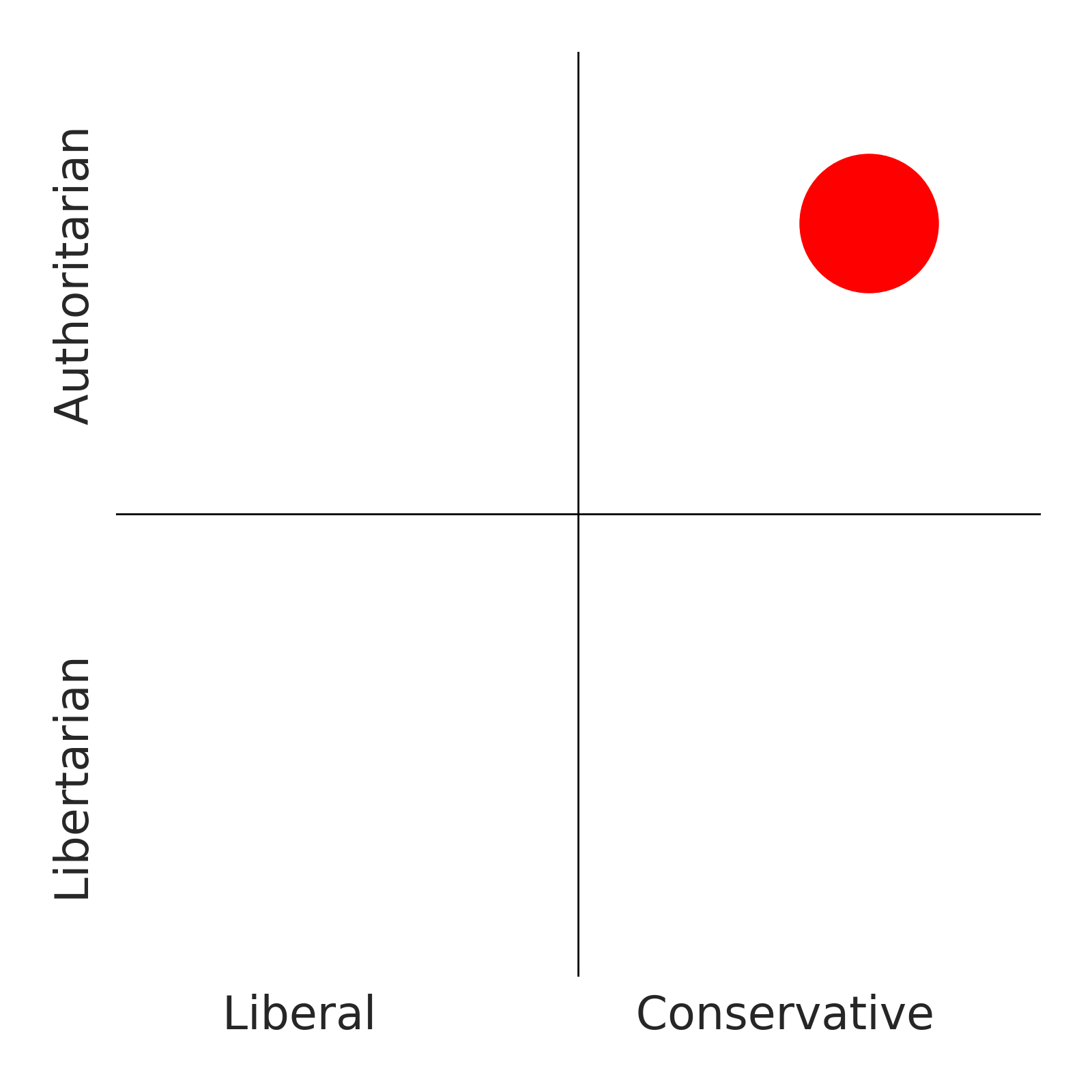
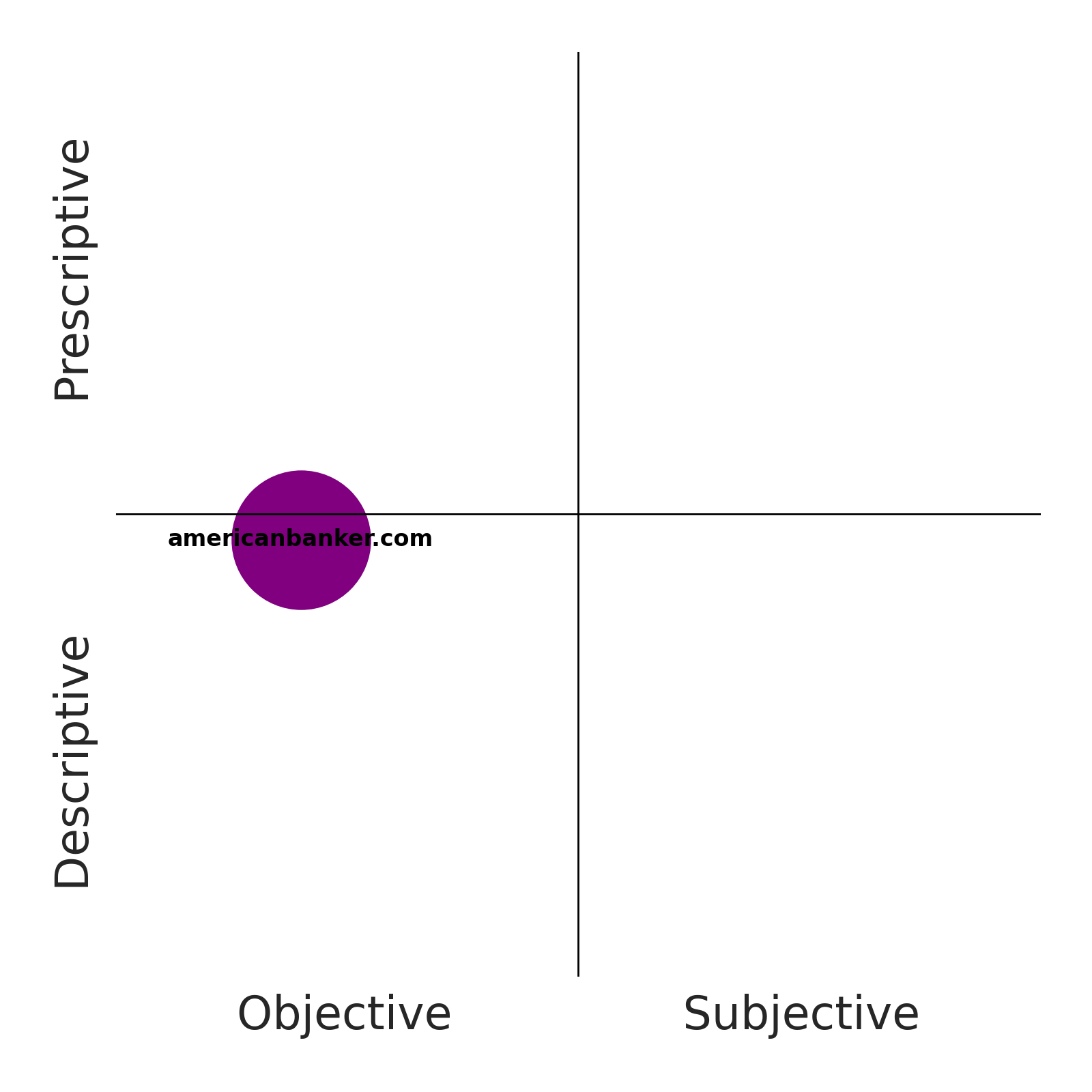
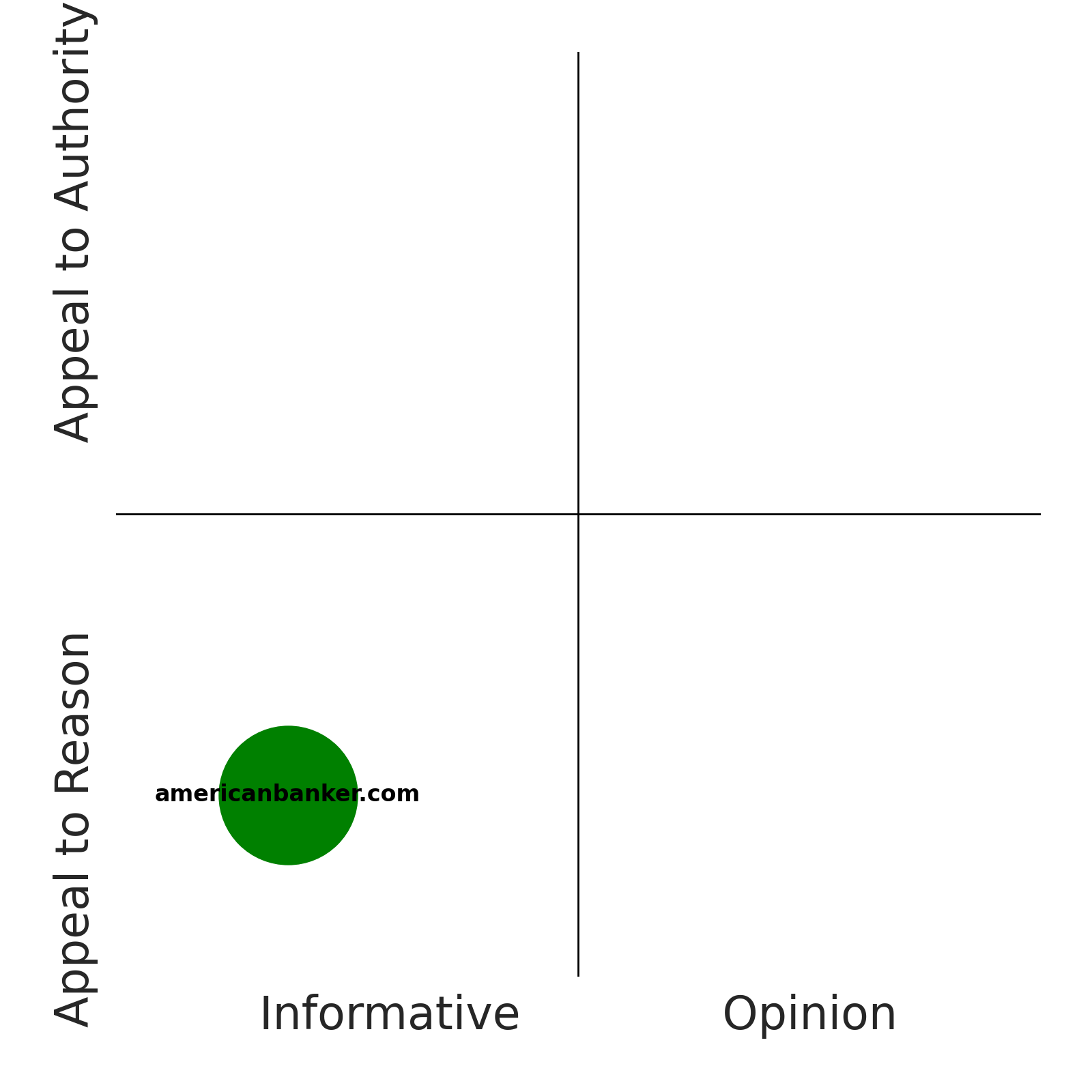
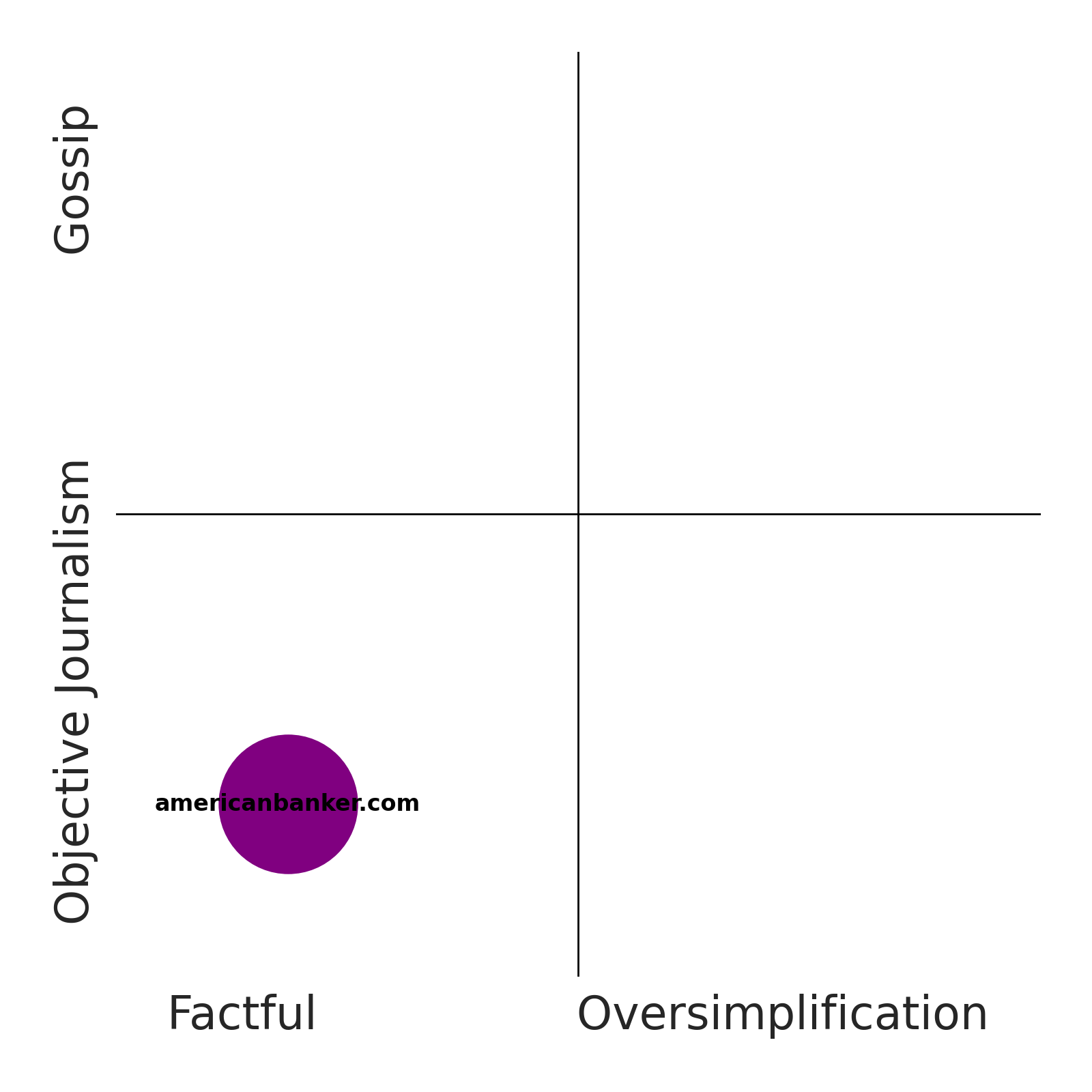
2026 © Helium Trades
Privacy Policy & Disclosure
* Disclaimer: Nothing on this website constitutes investment advice, performance data or any recommendation that any particular security, portfolio of securities, transaction or investment strategy is suitable for any specific person. Helium Trades is not responsible in any way for the accuracy
of any model predictions or price data. Any mention of a particular security and related prediction data is not a recommendation to buy or sell that security. Investments in securities involve the risk of loss. Past performance is no guarantee of future results. Helium Trades is not responsible for any of your investment decisions,
you should consult a financial expert before engaging in any transaction.
Helium Research Assistant

How can I help you today?
Ask any question about americanbanker.com bias.


