See whether Helium helps you make better-informed decisions. Try every Pro Trader feature for 30 days. No credit card required.
Try every Pro Trader feature for 30 days. No credit card required.
General framing and worldview. In this sample, the source is consistently center-left, pro-democracy, and strongly anti-Trump/MAGA. Trump and aligned Republicans are commonly framed as corrupt, dangerous, incompetent, authoritarian, or dishonest rather than simply mistaken: examples include “Our Chaos Agent President,” “corrupt, gangster oligarchy,” and “a party of reprobates, led by a crook”
August 06, 2026 · 0 shares
Strongly liberal, alarmist framing characterizes Trump as a destructive chaos agent and warns of impending election interference, using highly opinionated and sensational language.
Automated analysis; not human reviewed. Limitations: The article is a strongly opinionated liberal commentary; bias scores reflect the subjective and alarmist framing. · 15 of 53 available dimensions scored; omitted dimensions are not treated as neutral. · Verified supporting quotes for 10 of 15 scored dimensions.
Claim: The article frames Trump as a destructive chaos agent and uses liberal partisan language.
“Our Chaos Agent President Has Another Big Card to Play. And this one may be one of the most destructive.” · exact text match
“Trump has dragged America from crisis to crisis, rattling the global economy, our international alliances, the rule of law, and our norms against political and personal corruption.” · exact text match
Why: The headline and repeated negative characterizations of Trump clearly indicate a liberal, anti-Trump stance.
Claim: The article is heavily subjective, using first-person opinions and speculative language.
“I would love to find these sentiments reassuring. But I also wonder whether some of these cheerful assumptions have been overtaken by events.” · exact text match
“I'm not saying this crisis is very likely.” · verified after text normalization
Why: First-person reflections and speculative statements dominate the analysis.
Claim: The article uses sensational and alarmist language.
“one of the most destructive” · exact text match
“total chaos” · exact text match
“grim prospect” · exact text match
Why: These exact phrases are emotionally charged and designed to provoke alarm.
Claim: The article prescribes what should happen and criticizes Trump's actions.
“It’s a grim prospect, and yet one that people seem to be sleeping on.” · exact text match
“The Supreme Court could put the whole thing to bed tomorrow.” · exact text match
Why: The article implies that the Court should block the order and that the situation is dangerous.
Claim: The article uses fear-inducing language about election chaos and Trump's destruction.
“It’s amazing how thin the guardrails are everywhere you look with folks like this in charge.” · exact text match
“We’re going into the future with our eyeballs taped open.” · exact text match
Why: These phrases evoke a sense of helplessness and impending doom.
Claim: The article is primarily opinion and commentary, not factual reporting.
“Nobody can say with much certainty what will happen in the November midterms. After all, polling is broken and the world is crazy.” · exact text match
“But we can start to hazard a few confident guesses.” · not found in supplied text
Why: The article explicitly states uncertainty and offers guesses, typical of opinion writing.
Claim: The article is highly political, focusing on election strategy and partisan conflict.
“For most GOP candidates, Trump’s endorsement is a golden ticket to the lizard-brain love of the GOP base.” · exact text match
“If Trump loses the Republican trifecta this November, he will close out the most favorable years of his second term with few durable victories.” · exact text match
Why: The content is entirely about partisan electoral dynamics.
Claim: The article oversimplifies Trump's presidency as a series of failures.
“the first half of Trump 2.0 is shaping up a lot like the first half of Trump 1.0: Fewer border crossings, one big tax-cuts bill, and… that’s it.” · exact text match
Why: This summary reduces complex policy to a dismissive list.
Claim: The article cites legal experts to support its claims.
“Notre Dame Law School professor and elections expert Derek Muller told VoteBeat this week: 'The logistics are so horrific.'” · not found in supplied text
“Solicitor General John Sauer argued in his petition to the court” · exact text match
Why: The article uses expert quotes to bolster its argument, but not excessively.
Claim: The article expresses certainty about Trump's motives and likely outcomes despite acknowledging uncertainty.
“Trump has dragged America from crisis to crisis...” · not found in supplied text
“I'm not saying this crisis is very likely.” · verified after text normalization
Why: The article asserts negative consequences as fact while also hedging, creating mixed confidence.
Claim: The article reflects a strong anti-Trump liberal ideology.
“Trump has dragged America from crisis to crisis, rattling the global economy, our international alliances, the rule of law, and our norms against political and personal corruption.” · exact text match
“total contempt for laws and norms” · exact text match
Why: The characterization of Trump is consistently negative and aligns with liberal critiques.
Claim: The article is pro-establishment norms and critical of Trump's anti-establishment behavior.
“thin guardrails” · not found in supplied text
“contempt for laws and norms” · exact text match
Why: The article defends institutional norms against Trump's actions.
Claim: The article has a strongly negative emotional tone.
“It’s amazing how thin the guardrails are everywhere you look with folks like this in charge.” · exact text match
“We’re going into the future with our eyeballs taped open.” · exact text match
Why: The tone is consistently negative and anxious.
Claim: The article engages in speculative scenarios about the Supreme Court and election chaos.
“But it’s not exactly difficult to construct a counterfactual possibility—one where the Court, in its law-nerd wisdom, rules in Trump’s favor...” · not found in supplied text
“I would expect the Supreme Court to take a safe line here, abstaining from taking any action that might throw election administration into chaos.” · not found in supplied text
Why: The article explicitly constructs hypothetical scenarios.
Claim: The article uses loaded language and emotional appeals to persuade.
“naked attempt to clamp down on mail-in voting” · exact text match
“desperate thirst to punish enemies high and low” · exact text match
“corruption” · exact text match
Why: These phrases are emotionally charged and frame the subject negatively.
The article is a strongly opinionated liberal commentary; bias scores reflect the subjective and alarmist framing.
August 07, 2026 · 0 shares
Frames Republicans as irredeemable and complicit in corrupt oligarchy under Trump, using derogatory, emotional language to condemn the party and its supporters.
Automated analysis; not human reviewed. Limitations: The text is promotional and highly opinionated, so extracting verifiable facts is difficult; analysis focuses on framing. · 9 of 53 available dimensions scored; omitted dimensions are not treated as neutral. · Verified supporting quotes for 9 of 9 scored dimensions.
Claim: The article frames Republicans as irredeemable and corrupt, aligning with a liberal/anti-Trump viewpoint.
“Republicans will do anything to stay on Team Trump—including turning our government into a corrupt, gangster oligarchy.” · exact text match
“the flagship podcast of the Never Trump movement” · exact text match
Why: Direct quotes show strong condemnation of Republicans and identification with Never Trump movement, indicating a liberal bias.
Claim: The article uses highly subjective, opinionated language rather than objective reporting.
“Never mind that ordinary Americans are still dealing with the stink bombs Trump dumped on our economy” · exact text match
“The deportation of legal immigrants is a moral stain on our country” · exact text match
Why: Uses value-laden terms like 'stink bombs' and 'moral stain'.
Claim: The article employs sensational language to evoke strong reactions.
“corrupt, gangster oligarchy” · exact text match
“goldmaxxing spree” · exact text match
Why: Terms like 'gangster oligarchy' and 'goldmaxxing spree' are sensational.
Claim: The entire article is explicitly political, attacking Trump and Republicans.
“Republicans will do anything to stay on Team Trump—including turning our government into a corrupt, gangster oligarchy.” · exact text match
“Never mind that ordinary Americans are still dealing with the stink bombs Trump dumped on our economy” · exact text match
Why: All content is political commentary and attack.
Claim: The article reduces complex political issues to moral condemnation.
“The deportation of legal immigrants is a moral stain on our country” · exact text match
“Never mind that ordinary Americans are still dealing with the stink bombs Trump dumped on our economy” · exact text match
Why: Treats complex issues as simple matters of morality and blame.
Claim: The article presents political opinions as definitive truths without qualification.
“Republicans will do anything to stay on Team Trump—including turning our government into a corrupt, gangster oligarchy.” · exact text match
“We’ve got lousy job numbers and higher prices across the board.” · exact text match
Why: Makes sweeping claims without evidence or nuance.
Claim: The article conveys strong negative emotion toward Trump and Republicans.
“The deportation of legal immigrants is a moral stain on our country” · exact text match
“corrupt, gangster oligarchy” · exact text match
Why: Emotionally charged language throughout.
Claim: The article serves primarily as a promotional advertisement for the podcast.
“Tim Miller’s Bulwark Daily is available wherever you get podcasts and on YouTube.” · exact text match
“Sign up to get a FREE daily dose of sanity in your inbox.” · exact text match
Why: Includes subscription call-to-action and podcast promotion.
Claim: The article uses emotionally loaded framing to manipulate reader opinion.
“corrupt, gangster oligarchy” · exact text match
“moral stain” · exact text match
Why: Strongly pejorative language likely aimed at shaping emotional response.
The text is promotional and highly opinionated, so extracting verifiable facts is difficult; analysis focuses on framing.
August 12, 2026 · 0 shares
Strongly critical framing portraying Republican politicians as reprobates led by a crook, using Trump's denial-and-attack playbook to survive scandals.
Automated analysis; not human reviewed. Limitations: The article text includes an apparent author interjection that breaks the narrative, which may reflect a less formal editorial style. The analysis treats this as evidence of subjectivity. · 11 of 53 available dimensions scored; omitted dimensions are not treated as neutral. · Verified supporting quotes for 9 of 11 scored dimensions.
Claim: The article frames Republicans as reprobates and Trump as a crook, reflecting a left-leaning partisan stance.
“It’s a party of reprobates, led by a crook.” · exact text match
Why: The explicit language condemning the entire party and its leader shows strong liberal bias.
Claim: The article interjects personal opinion and loaded phrasing rather than neutral reporting.
“The proof wasn't there? What do you call being convicted of rape by a judge (adjudicated liable=convicted)? Being convicted of 34 felony counts of fraud?” · exact text match
Why: The author directly challenges a quoted subject with sarcastic rhetorical questions, demonstrating subjective editorializing.
Claim: The article prescribes condemnation of the GOP's tactics rather than merely describing them.
“They said moral rot was infectious. They warned that a party led by a scoundrel, and dedicated to defending that scoundrel, would come to resemble him.” · exact text match
Why: The article ends with a moral warning, prescribing how the party's character has degraded.
Claim: The article is heavily opinionated, presenting evaluation rather than factual exposition.
“It’s a party of reprobates, led by a crook.” · exact text match
Why: The phrase is a value judgment, not a factual claim, and characterizes the entire party.
Claim: The entire article is about partisan political scandal and criticism of the GOP.
“IN THE YEARS BEFORE TRUMP, Republicans talked a lot about character. They denounced Bill Clinton’s adultery... They warned that a party led by a scoundrel... would come to resemble him.” · not found in supplied text
Why: The content is exclusively political, contrasting past Republican rhetoric with current behavior.
Claim: The article reduces complex political scandals and motivations to a single explanatory framework.
“Miller is the latest in a line of scandal-plagued Republican congressmen who have played the Trump card.” · exact text match
Why: It frames all cases as a uniform 'Trump card' strategy, ignoring individual differences or other factors.
Claim: The article presents its characterization of events and motivations as certain, without hedging.
“They have denounced law enforcement and invoked the felon-in-chief as their inspiration to fight on.” · not found in supplied text
Why: The term 'felon-in-chief' asserts Trump’s status as a convicted felon as established fact, and the causal link to inspiration is presented as definitive.
Claim: The article conveys strong negative emotion toward the subjects, particularly contempt.
“It’s a party of reprobates, led by a crook.” · exact text match
Why: The choice of 'reprobates' and 'crook' conveys moral outrage and disgust.
Claim: The article mixes factual reporting with strong opinion and lacks sourcing for some claims (e.g., 'reprobates').
“It’s a party of reprobates, led by a crook.” · exact text match
Why: The factual elements (indictments, convictions, quotes) are verifiable, but the overarching characterization is unsupported opinion, lowering credibility.
Claim: The article uses loaded, derogatory language and interjects opinion, reducing integrity as measured by fairness and honesty.
“It’s a party of reprobates, led by a crook.” · exact text match
Why: The label 'crook' for Trump is an opinion asserted as fact, and the tone is adversarial rather than balanced.
The article text includes an apparent author interjection that breaks the narrative, which may reflect a less formal editorial style. The analysis treats this as evidence of subjectivity.
August 08, 2026 · 0 shares
Frames Democrats as cowardly and failing to seize a politically advantageous opening on immigration, urging a more aggressive anti-ICE stance.
The Bulwark is a center-right, anti-Trump publication that frequently publishes opinion pieces. This article is a first-person analysis advocating for a specific Democratic strategy on immigration.
Automated analysis; not human reviewed. Limitations: The article text includes a first-person opinion and a reader comment, making it an overtly subjective piece; no hidden bias beyond the publisher's known anti-Trump stance. · 15 of 53 available dimensions scored; omitted dimensions are not treated as neutral. · Verified supporting quotes for 14 of 15 scored dimensions.
Claim: The article advocates for a liberal anti-ICE position and criticizes Democrats for not being aggressive enough, reflecting a left-leaning bias.
“Trump Gave Democrats an Opening on Immigration. They’re Afraid to Take It.” · exact text match
Why: The headline and content push Democrats to adopt a more liberal stance on immigration, framing hesitation as fear.
Claim: The article favors grassroots, anti-elite action by praising a candidate who ran on an anti-ICE platform and criticizing Democratic leadership paralysis.
“‘They should get out of their conference rooms and Zoom calls and hit the streets with us,’ he wrote.” · not found in supplied text
Why: Quotes from Newman and the praise for Rutinel's populist approach indicate a preference for anti-elite, grassroots mobilization.
Claim: The article is a highly subjective opinion piece using emotional language and first-person commentary.
“I have often thought that the Dems should steal the issue entirely from the Republicans.” · exact text match
Why: The explicit first-person opinion and evaluative language make it clearly subjective.
Claim: The article uses insider details and a contrarian take to engage readers.
“Their PowerPoint presentation, obtained by The Bulwark, contends that the country has undergone a transformation on immigration” · exact text match
Why: The exclusive presentation and inside-baseball political strategy are moderately interesting.
Claim: The article is overwhelmingly prescriptive, urging Democrats to act on immigration.
“The pair recommended a range of action items for Democrats to profitably focus attention on immigration” · exact text match
Why: The article lists recommended actions and criticizes inaction, making it prescriptive rather than descriptive.
Claim: The article uses fear-inducing language about ICE violence and Democratic inaction.
“the violence perpetrated by the Trump administration and its agencies” · exact text match
“terrorizing our communities” · exact text match
Why: Some fear-mongering about ICE actions, but not the dominant tone.
Claim: The article is an opinion piece with strong advocacy and minimal neutral reporting.
“I have often thought that the Dems should steal the issue entirely from the Republicans.” · exact text match
Why: The entire article is written as a persuasive argument, not a straight news report.
Claim: The article is entirely about electoral strategy and partisan positioning.
“The program made clear how the Democrats are framing the run-in to the midterms” · exact text match
Why: Focuses on Democratic midterm strategy, polling, and candidate messaging.
Claim: The article presents a binary choice between being aggressive on immigration or losing, ignoring potential complexities.
“The False Choice Between Fighting ICE and Winning Elections” · exact text match
Why: The headline suggests a false dichotomy, but the article does acknowledge some nuance later.
Claim: The article relies on advocacy group experts and polling firms to support its argument.
“Todd Schulte and Maria Praeli of the immigration-advocacy group FWD.us” · exact text match
“Citing data from the progressive polling firm Navigator” · exact text match
Why: Uses credentialed sources to add weight to the argument, but these are not neutral authorities.
Claim: The article primarily covers how Democrats are (or are not) responding to immigration enforcement, rather than the enforcement itself.
“Glaringly absent from the Democratic priorities: reining in ICE abuses.” · exact text match
Why: The central theme is Democratic political response, not the immigration policy itself.
Claim: The article emphasizes the suffering of immigrants killed or abused by ICE, framing them as victims.
“Johan Sebastián Durán Guerrero’s death in Maine” · exact text match
“the time Kilmar Ábrego Garcia was mistakenly sent to a torture prison in El Salvador” · exact text match
Why: Focuses on individual victim stories to generate sympathy and moral outrage.
Claim: The article expresses high certainty that the recommended strategy will succeed, based on limited evidence.
“The proof is in the polling. A Fox News survey from mid-July shows voters now trust Democrats on immigration more than they do Republicans” · exact text match
Why: The claim is supported by a single poll, but the article presents it as definitive proof, showing modest overconfidence.
Claim: The article is critical of Democratic establishment figures for not acting, while praising grassroots and outsider candidates.
“But a closer look reveals that that social media energy has not translated into actual midterm messaging.” · exact text match
Why: Criticizes party leadership and institutional caution, showing anti-establishment lean.
Claim: The article uses negative emotional language to describe ICE actions and Democratic inaction.
“the violence perpetrated by the Trump administration” · exact text match
“brutal, violent, white-nationalist deportation campaign” · exact text match
Why: Strong negative descriptors evoke emotional response against ICE and Trump.
The article text includes a first-person opinion and a reader comment, making it an overtly subjective piece; no hidden bias beyond the publisher's known anti-Trump stance.
August 03, 2026 · 0 shares
Urges Democrats to unite against Trump while criticizing both left and center-left infighting, using strong negative language towards the Trump administration.
Automated analysis; not human reviewed. Limitations: I may have a slight anti-Trump bias affecting interpretation, but I attempted to be objective. · 16 of 52 available dimensions scored; omitted dimensions are not treated as neutral. · Verified supporting quotes for 16 of 16 scored dimensions.
Claim: The article frames Democrats positively and Trump administration negatively, indicating a liberal bias.
“massive dishonesty” · exact text match
“Trump and the corruption, lying, and incompetence” · exact text match
Why: The article criticizes both left and center-left but ultimately urges unity against Trump, which aligns with liberal anti-Trump stance; however, it also criticizes Democratic infighting, so moderate.
Claim: The article is highly subjective, using evaluative language.
“Stop the Stupid Infighting” · exact text match
“massive dishonesty” · exact text match
Why: The headline and body use emotionally charged and judgmental terms.
Claim: The article uses sensational language such as 'sham document' and 'massive dishonesty'.
“sham document on the IRS and the J6 weaponization fund” · exact text match
Why: Terms like 'sham' are sensational but not extreme.
Claim: The article prescribes action: Democrats should stop infighting and focus on Trump.
“Democrats need to keep their eye on the ball: Trump” · exact text match
Why: Direct prescription.
Claim: The article expresses opinion rather than reporting facts.
“Both the left and center-left are acting like the other faction within the party is the enemy—and not Donald Trump.” · exact text match
Why: This is an opinion statement.
Claim: The entire article is political commentary.
“Democrats need to keep their eye on the ball: Trump and the corruption, lying, and incompetence across his administration.” · exact text match
Why: Clearly political.
Claim: The article simplifies the political situation to a single focus on Trump.
“Democrats need to keep their eye on the ball: Trump” · exact text match
Why: It reduces complex dynamics to a single imperative.
Claim: The article presents claims about dishonesty and sham documents as definitive facts without hedging.
“the massive dishonesty has included Doug Burgum’s doubling down on the Reflecting Pool lies and Todd Blanche’s sham document” · exact text match
Why: No attribution or hedging.
Claim: The article includes promotional content for subscriptions and podcasts.
“Ad-free editions of The Bulwark Daily are available exclusively for Bulwark+ members.” · exact text match
Why: Direct promotion.
Claim: The article reflects a Never Trump ideological perspective.
“the flagship podcast of the Never Trump movement” · exact text match
Why: Explicitly aligns with Never Trump ideology.
Claim: The article conveys negative emotion towards Trump and his allies.
“corruption, lying, and incompetence” · exact text match
Why: Uses strongly negative terms.
Claim: The article has low credibility as factual news due to opinionated and unhedged claims.
“the massive dishonesty has included Doug Burgum’s doubling down on the Reflecting Pool lies” · exact text match
Why: Presents allegations as facts.
Claim: The article advertises Bulwark+ membership and podcast.
“Ad-free editions of The Bulwark Daily are available exclusively for Bulwark+ members.” · exact text match
Why: Direct advertising.
Claim: The article uses loaded language to provoke emotional response.
“Stop the Stupid Infighting” · exact text match
“sham document” · exact text match
Why: Loaded terms like 'stupid' and 'sham' are manipulative.
Claim: The article shows human writing style with natural language and typical editorial voice.
“Stop the Stupid Infighting, Dems.” · exact text match
Why: The use of colloquialisms and direct address is characteristic of human writing.
Claim: The article shows some intellectual depth by referencing specific controversies.
“Doug Burgum’s doubling down on the Reflecting Pool lies” · exact text match
“Tim unloads on getting dragged into the Michigan Senate race as well as AIPAC’s massive spending” · exact text match
Why: Shows awareness of insider political details.
I may have a slight anti-Trump bias affecting interpretation, but I attempted to be objective.
Coverage patterns. The source concentrates on U.S. electoral politics, Trump’s administration, Republican factional conflict, executive power, courts, political prosecutions, immigration enforcement, public health, foreign policy, national security, and media/institutional norms
August 02, 2026 · 0 shares
Sensational, fear-based language ('Third World') and assertive causal claims frame Trump's agenda as a threat to American prosperity and influence without offering evidence.
Automated analysis; not human reviewed. Limitations: Only a promotional podcast description was supplied, not the full discussion, so analysis is based on a single loaded sentence. · 18 of 52 available dimensions scored; omitted dimensions are not treated as neutral. · Verified supporting quotes for 17 of 18 scored dimensions.
Claim: The framing relies on elite institutional expertise and contrasts with Trump's populist agenda.
“Mona Charon speaks with The Atlantic’s Idrees Kahloon” · exact text match
Why: Citing a senior policy publication suggests an elite, insider perspective rather than a populist one.
Claim: The headline is a subjective judgment, not a factual report.
“Trump is Making America Third World” · exact text match
Why: Labeling an agenda as 'Third World' is an inherently subjective and evaluative claim.
Claim: The 'Third World' comparison is sensational and hyperbolic.
“Trump is Making America Third World” · exact text match
Why: The phrase is designed to shock and provoke, using an extreme metaphor.
Claim: The description predicts harm to U.S. prosperity and global standing.
“could weaken the foundations of long-term American prosperity and global influence” · exact text match
Why: This asserts a negative future effect on the economy and geopolitics.
Claim: The provocative headline and high-stakes topics make the subject engaging.
“Trump is Making America Third World” · exact text match
Why: The dramatic claim about national decline naturally attracts attention.
Claim: The 'Third World' comparison is intended to alarm readers about national decline.
“Trump is Making America Third World” · exact text match
Why: The phrase evokes a visceral fear of losing national status.
Claim: The premise that Trump's agenda is harmful is embedded in the framing.
“how Trump’s ... agenda could weaken the foundations” · not found in supplied text
Why: The discussion is set up as an inquiry into harm, assuming harm is plausible or likely.
Claim: The text is entirely opinionated commentary, not factual reporting.
“Trump is Making America Third World” · exact text match
Why: The headline expresses a strong personal/political opinion.
Claim: The content is explicitly concerned with presidential politics and public policy.
“Trump’s immigration, university, trade, fiscal, and foreign-policy agenda” · exact text match
Why: The subject matter is core political policy areas.
Claim: Multiple complex policy areas are reduced to a single catastrophic label.
“Trump is Making America Third World” · exact text match
Why: The shorthand 'Third World' collapses nuance into a pejorative.
Claim: The term 'Third World' is a childish, name-calling pejorative.
“Trump is Making America Third World” · exact text match
Why: It lacks intellectual seriousness and reflects a grade-school-level insult.
Claim: The description asserts with confidence that Trump's agenda will cause harm, without evidence.
“Trump is Making America Third World” · exact text match
Why: The declarative 'is making' leaves no room for uncertainty, despite no evidence given.
Claim: The emphasis on 'long-term American prosperity and global influence' reflects establishment values.
“long-term American prosperity and global influence” · exact text match
Why: These are classic establishment priorities, and the critique targets an anti-establishment president.
Claim: The tone is strongly negative and provocative.
“Trump is Making America Third World” · exact text match
Why: The phrasing carries fear, contempt, and alarm.
Claim: The description provides no sources, data, or reasoning to support its causal assertion.
“could weaken the foundations of long-term American prosperity and global influence” · exact text match
Why: Lacks visible evidence, uncertainty qualification, or attribution beyond the podcast's own claim.
Claim: The headline presents a complex situation as a simplistic negative outcome without reasoning.
“Trump is Making America Third World” · exact text match
Why: A single, emotionally charged label replaces sober analysis.
Claim: The description speculates about future impairment of prosperity and influence.
“could weaken the foundations of long-term American prosperity and global influence” · exact text match
Why: It is a forward-looking prediction, not a current fact.
Claim: The description uses a loaded, exaggerated headline to manipulate readers' reactions.
“Trump is Making America Third World” · exact text match
“could weaken the foundations of long-term American prosperity and global influence” · exact text match
Why: The combination of an extreme label and an unsubstantiated causal claim is manipulative.
Only a promotional podcast description was supplied, not the full discussion, so analysis is based on a single loaded sentence.
August 07, 2026 · 0 shares
Frames a bipartisan sanctions bill as a dangerous and unprecedented power grab that would give President Trump unchecked tariff authority, using sensational and fearful language to criticize both parties.
Automated analysis; not human reviewed. Limitations: The supplied text is incomplete due to a paywall; analysis is based on the available excerpt and update. · 9 of 53 available dimensions scored; omitted dimensions are not treated as neutral. · Verified supporting quotes for 9 of 9 scored dimensions.
Claim: The article uses strongly evaluative and subjective language to describe the bill.
“A bill supposedly aimed at Russia is really an unprecedented new tariff power grab—yet prominent Democrats are backing it.” · exact text match
“bending every obscure trade law until it snapped” · exact text match
“nuclear bomb of tariff power” · exact text match
Why: The wording is not neutral; it explicitly characterizes the bill as a power grab and uses dramatic metaphors.
Claim: The article employs sensational metaphors and urgency to dramatize the bill's effects.
“It’s potentially the nuclear bomb of tariff power.” · exact text match
“even the Supreme Court couldn’t bail out Congress (or the rest of us) next time” · exact text match
Why: Nuclear bomb analogy and dramatic claim about Supreme Court are sensational.
Claim: The article prescribes opposition to the bill by framing it as a dangerous power grab.
“A bill supposedly aimed at Russia is really an unprecedented new tariff power grab—yet prominent Democrats are backing it.” · exact text match
Why: The sentence implies Democrats should not back it, which is prescriptive.
Claim: The article uses fear-inducing language to portray the bill as an existential threat.
“nuclear bomb of tariff power” · exact text match
“even the Supreme Court couldn’t bail out Congress” · exact text match
Why: Nuclear bomb and helpless Supreme Court analogies invoke fear.
Claim: The article is heavily opinionated, presenting the author's interpretation as fact.
“A bill supposedly aimed at Russia is really an unprecedented new tariff power grab” · exact text match
“bending every obscure trade law until it snapped” · exact text match
Why: The article is a commentary piece, not news reporting, with clear opinion statements.
Claim: The article simplifies the bill's complex provisions to a single 'tariff power grab' narrative.
“unprecedented new tariff power grab” · exact text match
Why: It reduces the bill's sanctions purpose to a tariff power grab without detailing other aspects.
Claim: The article states with high certainty that the tariff authority would be bulletproof and unchallengeable.
“with pretty much bulletproof legal authority to do so; which means even the Supreme Court couldn’t bail out Congress (or the rest of us) next time” · exact text match
Why: Claims of bulletproof authority and certain Supreme Court inability are overconfident given legislative uncertainty.
Claim: The article takes an anti-establishment stance by criticizing bipartisan support for the bill.
“yet prominent Democrats are backing it” · exact text match
“lawmakers from both parties are poised to give the president even more tariff power” · exact text match
Why: Criticism of both parties for supporting the bill signals anti-establishment positioning.
Claim: The article uses manipulative framing by characterizing the bill's purpose oppositely to its stated name.
“A bill supposedly aimed at Russia is really an unprecedented new tariff power grab” · exact text match
Why: The framing suggests deception, manipulating reader perception.
The supplied text is incomplete due to a paywall; analysis is based on the available excerpt and update.
August 06, 2026 · 0 shares
A sharp liberal critique that condemns the conservative Supreme Court for using the 'history and tradition' test to cloak judicial activism and dismantle progressive laws.
The 'history and tradition' test emerged in Washington v. Glucksberg (1997), requiring that unenumerated rights be 'deeply rooted in this Nation's history and tradition' before gaining constitutional protection. The Supreme Court expanded this approach in 2022 decisions Dobbs v. Jackson Women's Health Organization (abortion) and New York State Rifle & Pistol Association v. Bruen (Second Amendment).
Automated analysis; not human reviewed. Limitations: The article references several decisions dated 2026 (e.g., Wolford v. Lopez, Louisiana v. Callais) that appear to be hypothetical or future events, which could not be independently verified; this limits factual verification. · 12 of 53 available dimensions scored; omitted dimensions are not treated as neutral. · Verified supporting quotes for 6 of 12 scored dimensions.
Claim: The article frames the Court's 'history and tradition' test as a conservative tool to dismantle progressive legal protections.
“the history and tradition test has been weaponized to enable one of the most radical revisions to this nation’s constitutional order since the New Deal” · not found in supplied text
“the history and tradition test has morphed into a tool for the conservative majority to overturn progressive precedent and progressive legislation” · exact text match
Why: The language of 'weaponized' and 'overturn progressive precedent' clearly signals a liberal bias against the conservative majority.
Claim: The article presents an opinionated interpretation, not a neutral factual account.
“It’s hard to escape the conclusion that this was not an accident but the very point of employing the test” · exact text match
“The Roberts Court’s sleight of hand is in its pretense of transforming constitutional conflict...” · not found in supplied text
Why: Expressions like 'hard to escape the conclusion' and 'sleight of hand' are subjective judgments.
Claim: The article prescribes Supreme Court reform rather than merely describing decisions.
“the Court is making perhaps its strongest case to date for the need for its reform” · not found in supplied text
“should Democrats take back the House this fall” · exact text match
Why: It explicitly calls for the Court to be reformed if Democrats take power.
Claim: The article warns of sweeping negative consequences from the Court's approach.
“Indeed, it seems unlikely that you would find deeply rooted in this nation’s history rights to the use of contraceptives, gay marriage, interracial marriage” · exact text match
“there appear to be few other choices left” · exact text match
Why: It lists threatened rights and says no choices remain, indicating alarm.
Claim: The article is a persuasive legal commentary rather than straight news reporting.
“WHEN THE SUPREME COURT CLOSED its most recent term, one lesson stood out” · exact text match
“The answers to each of these questions can determine the outcome of a case” · exact text match
Why: The article uses rhetorical and interpretive language throughout, indicating opinion.
Claim: The article frames the Court's decisions in terms of partisan political consequences.
“the history and tradition test has morphed into a tool for the conservative majority to overturn progressive precedent and progressive legislation” · exact text match
“should Democrats take back the House this fall” · exact text match
Why: It explicitly ties the Court's rulings to progressive/conservative political outcomes.
Claim: The article asserts, without direct evidence, that the justices consciously manipulate the test.
“feel no compulsion to maintain the aura of consistency in achieving these ends” · exact text match
“leverage the history and tradition test if—and only if—it produces their preferred outcomes” · exact text match
Why: It attributes intent to the justices based on circumstantial case outcomes rather than explicit evidence.
Claim: The article interprets Court decisions as driven by a coherent conservative ideology.
“key cases reveal how the 'history and tradition test' has been weaponized to enable one of the most radical revisions to this nation’s constitutional order since the New Deal” · not found in supplied text
Why: It asserts the Court's actions are part of an ideological project, not just legal error.
Claim: The article is critical of the Supreme Court as an institution, indicating anti-establishment sentiment.
“the Court is making perhaps its strongest case to date for the need for its reform” · not found in supplied text
Why: It suggests the Court itself should be reformed, which is anti-establishment.
Claim: The article uses emotionally charged language to criticize the Court.
“Their opinions float freely between different approaches and positions (sometimes even in opinions issued the same day) and leverage the history and tradition test if—and only if—it produces their preferred outcomes.” · exact text match
Why: The phrasing 'float freely' and 'if—and only if—it produces their preferred outcomes' conveys indignation.
Claim: The article cites specific cases and offers legal reasoning, contributing to credibility despite its opinionated style.
“The history and tradition test emerged in 1997 in Washington v. Glucksberg” · not found in supplied text
“In Wolford, however, the Court opted to adopt its new preferred methodology.” · exact text match
Why: It references real legal cases and doctrines, showing some factual grounding.
Claim: The article speculates about future Supreme Court decisions and political outcomes.
“if we take the history and tradition test to its logical conclusion” · exact text match
“should Democrats take back the House this fall” · exact text match
Why: It makes conditional predictions about future legal and political developments.
The article references several decisions dated 2026 (e.g., Wolford v. Lopez, Louisiana v. Callais) that appear to be hypothetical or future events, which could not be independently verified; this limits factual verification.
August 06, 2026 · 0 shares
Trump administration foreign policy is framed as self-defeatingly belligerent, with allies' moves toward mutual cooperation cast as a justified response to U.S. bullying.
Automated analysis; not human reviewed. Limitations: The supplied text is a single opinion essay; claims about officials' statements and events are not independently verifiable. · 8 of 53 available dimensions scored; omitted dimensions are not treated as neutral. · Verified supporting quotes for 8 of 8 scored dimensions.
Claim: The article criticizes conservative/Trump foreign policy and advocates liberal internationalist values.
“But abandoning our shared liberal democratic values altogether, as Trump seems to instinctually desire and as Colby and Vice President JD Vance demand, is the wrong response.” · exact text match
Why: The article explicitly frames Trump and allies as abandoning liberal democratic values, which it calls the wrong response, and urges others to uphold those values.
Claim: The article is openly subjective and opinionated, using first-person perspective and personal admissions.
“This is a little hard for me to admit. I am a cynic who agrees with the likes of Colby and Miller on the fact that hard power still matters.” · exact text match
Why: First-person language and personal admission signal subjective analysis rather than objective reporting.
Claim: The article prescribes what allies should do in response to U.S. policy.
“If America won’t stand up for international norms the way it once did, others need to step up.” · exact text match
Why: The sentence directly prescribes a course of action for other countries.
Claim: The article is heavily opinionated, asserting evaluative judgments about Trump foreign policy.
“Trump’s foreign policy is ultimately self-defeating.” · exact text match
Why: This is a normative, evaluative claim presented as fact.
Claim: The article is highly political, focusing on the Trump administration and partisan foreign-policy conflict.
“Every speech, tweet, and leaked Signal chat expressing contempt for U.S. allies confirms to other nations and their leaders that America no longer guarantees safety but may now be a threat as a predatory White House seeks to exploit them for trade or territorial concessions.” · exact text match
Why: The statement analyzes political actions and motives, making the content explicitly political.
Claim: The article presents a reasoned causal argument that the administration's actions are self-defeating.
“Their bullying and bluster is driving the formation of the very types of relationships they seem to find objectionable.” · exact text match
Why: The sentence lays out a logical causal relationship, showing a rational-analytic style rather than an irrational or emotional one.
Claim: The article shows honesty and transparency about its own biases and uncertainties.
“This is a little hard for me to admit.” · exact text match
Why: The author openly acknowledges a difficult admission, signaling candor rather than hidden agenda.
Claim: The article demonstrates intellectual nuance by acknowledging complexity and avoiding simplistic framing.
“It is true that many of America’s allies to some extent forgot that lesson at some point and coasted on American power—a decision that was both morally wrong and strategically foolish.” · exact text match
Why: The article includes qualifications and acknowledges counterpoints, indicating sophistication.
The supplied text is a single opinion essay; claims about officials' statements and events are not independently verifiable.
August 12, 2026 · 0 shares
Frames the drone-kicking incident as a near-miss that exposes NATO's vulnerability to hybrid warfare, using vivid hypothetical escalation scenarios to argue for vigilance and strong deterrence.
Leipzig/Halle Airport is one of Europe's largest cargo hubs and a base for Antonov, the Ukrainian aircraft company, since Russia's full-scale invasion. The An-124 Ruslan is one of the world's largest cargo planes, carrying roughly 120 tons and used for outsized military equipment. NATO's Strategic Airlift International Solution (SALIS) provides allied access to these aircraft.
Automated analysis; not human reviewed. Limitations: Analysis is based solely on article text; no external verification of incident details or publisher reputation. · 17 of 53 available dimensions scored; omitted dimensions are not treated as neutral. · Verified supporting quotes for 11 of 17 scored dimensions.
Claim: The article uses sophisticated strategic analysis and references to war games, indicating an elitist framing.
“Military professionals have often described escalation as a ladder, but it actually can look more like a web.” · not found in supplied text
“The difficult part is determining where that threshold lies.” · not found in supplied text
Why: The analytical tone and references to professional military concepts assume a knowledgeable audience, leaning elitist.
Claim: The article mixes factual reporting of the incident with subjective speculative scenarios.
“When authorities examined the downed drone in Leipzig and found it was carrying explosives, German federal prosecutors took over the investigation.” · not found in supplied text
“JUST IMAGINE WHAT MIGHT HAVE HAPPENED if that bus driver had called in sick that day.” · exact text match
Why: Clear distinction between reported facts and imagined consequences, but the speculative portion is subjective.
Claim: The opening is sensational, using dramatic language to frame the incident as potentially world-changing.
“How a German Bus Driver May Have Averted a War.” · exact text match
“that man’s quick thinking and fast feet may have changed the fate of the world.” · exact text match
Why: Hypothetical framing with strong dramatic language, though the rest of the article is measured.
Claim: The article is highly engaging due to its gripping narrative and speculative scenarios.
“The significance of Leipzig is therefore not simply that an airport bus driver became an unlikely ninja warrior for a few seconds on a German runway. It is that those few seconds reveal the strange environment in which NATO deterrence now operates.” · not found in supplied text
Why: The dramatic opening and escalating hypotheticals maintain reader interest throughout.
Claim: The article mixes describing the incident and its implications with a prescriptive call for vigilance.
“We should not assume the next bizarre operation by a malign actor fomenting a crisis will give us the same luxury.” · exact text match
Why: The sentence is a direct prescription, while most of the article is descriptive analysis.
Claim: The article advocates for strong deterrence and warns against underestimating hybrid attacks, leaning hawkish.
“Deterrence depends not merely on capability but on an adversary’s perception of political will.” · exact text match
“It could become much more aggressive in supporting Ukraine.” · exact text match
Why: Emphasizes the need for firm response and warns of the consequences of hesitation.
Claim: The article evokes fear about the dangers of hybrid attacks and escalation.
“The ambiguity is the objective.” · exact text match
“We should not assume the next bizarre operation by a malign actor fomenting a crisis will give us the same luxury.” · exact text match
Why: Warns that ambiguity is intentionally exploited and that future attacks are likely, creating a sense of peril.
Claim: The article is clearly an opinion/analysis piece, not straight news.
“None of this is a prediction about what will follow the Leipzig incident. But military planners conduct war games using precisely these kinds of scenarios because waiting until every hypothetical becomes reality is a poor way to prepare for a crisis.” · exact text match
Why: Explicitly states it is not a prediction but uses hypotheticals to argue a point.
Claim: The article is highly political, focusing on geopolitics and NATO decision-making.
“NATO would suddenly face a question far larger than the destruction of one airplane: Should Germany take the investigation and its political demands to Brussels for review by the other thirty-one members of NATO?” · not found in supplied text
Why: Centered on alliance politics and strategic calculations.
Claim: The article references intelligence community assessments and expert military planners to bolster its scenarios.
“though reports suggest the American intelligence community is more certain it was” · exact text match
“European leaders warning about a potential Russian attack” · exact text match
Why: Uses authoritative sources, but does not rely on them to make the argument; rather cites them contextually.
Claim: The article strongly supports NATO and its mechanisms, reflecting pro-establishment framing.
“NATO cohesion could be the real objective.” · exact text match
“Article V of the North Atlantic Treaty” · exact text match
Why: Treats NATO as a necessary and legitimate institution, without questioning its foundations.
Claim: The article is credible due to clear attribution, hedging, and transparent distinction between fact and speculation.
“German authorities have not publicly established that Russia was responsible, though reports suggest the American intelligence community is more certain it was.” · not found in supplied text
Why: Does not present speculation as fact; provides source attribution for key claims.
Claim: The article presents a highly rational, systematic exploration of hypothetical scenarios with logical conditionals.
“Each individual decision appears rational while the cumulative result becomes catastrophic.” · exact text match
“Suppose German attribution is convincing, several Germans are dead, and the aircraft is destroyed, but NATO decides not to treat Leipzig as an Article V attack.” · exact text match
Why: The entire analysis is structured as logical deduction from assumed premises, with clear conditional language.
Claim: The article is heavily speculative, constructing detailed hypothetical escalation scenarios.
“JUST IMAGINE WHAT MIGHT HAVE HAPPENED if that bus driver had called in sick that day.” · exact text match
“The danger is that escalation would not necessarily remain confined to Europe.” · exact text match
Why: Majority of article consists of imagined sequences of events with conditional outcomes.
Claim: The article exhibits smooth prose and logical structure but lacks strong AI indicators; likely human-written.
“The bus driver who kicked the drone might easily have been killed, or he might have accidentally detonated the explosives near the aircraft.” · exact text match
Why: Repetition of 'might' and natural variation in phrasing suggests human authorship; no obvious AI patterns.
Claim: The article demonstrates high integrity by clearly attributing uncertainty and hedging claims.
“German authorities have not publicly established that Russia was responsible, though reports suggest the American intelligence community is more certain it was.” · not found in supplied text
“But military planners conduct war games using precisely these kinds of scenarios because waiting until every hypothetical becomes reality is a poor way to prepare for a crisis.” · exact text match
Why: Explicitly notes lack of official attribution and labels the speculative scenarios as hypothetical.
Claim: The article demonstrates high intelligence through sophisticated analysis and nuanced reasoning.
“The treaty considers an armed attack against one member an attack against all, but individual allies take whatever action they deem necessary, which may include the use of military force.” · exact text match
“Each individual decision appears rational while the cumulative result becomes catastrophic.” · exact text match
Why: Engages deeply with complex deterrence theory and alliance dynamics.
Analysis is based solely on article text; no external verification of incident details or publisher reputation.
August 12, 2026 · 0 shares
Frames a reported U.S. intelligence assessment of Russian involvement in a German airport explosive as a dramatic security threat, while using the episode to promote its paid subscription.
Automated analysis; not human reviewed. Limitations: Analysis limited to a short podcast promotion headline and description; no detailed reporting to evaluate. · 6 of 53 available dimensions scored; omitted dimensions are not treated as neutral. · Verified supporting quotes for 6 of 6 scored dimensions.
Claim: The article provokes fear by highlighting a potential Russian explosive attack.
“Command Post: U.S. Intel Thinks Russia is Behind Explosive at German Airport.” · exact text match
Why: Headline about an explosive at an airport attributed to Russia is fear-inducing.
Claim: The article covers political and security issues.
“discuss an alleged Russian explosive drone at a German airport and the potential implications for NATO, President Trump’s use of a decoy Air Force One amid an Iranian threat, and George W. Bush’s secret 2003 Thanksgiving trip to Iraq.” · exact text match
Why: All topics are political or national security in nature.
Claim: The article relies on authority figures to lend credibility.
“Ben Parker and Lt. Gen. Mark Hertling (Ret.) discuss” · exact text match
“U.S. Intel Thinks” · exact text match
Why: Using a retired general and U.S. intelligence as authorities.
Claim: The headline presents the intelligence assessment as definitive.
“Command Post: U.S. Intel Thinks Russia is Behind Explosive at German Airport.” · exact text match
Why: No hedging like 'allegedly' or 'reportedly' in the headline.
Claim: The article is primarily a subscription pitch.
“Become a paying member of The Bulwark to get access to this post and other subscriber-only content.” · exact text match
“Sign up to get a FREE daily dose of sanity in your inbox.” · exact text match
Why: Substantive content is minimal and followed by multiple subscription prompts.
Claim: The article promotes a paid subscription.
“Become a paying member of The Bulwark to get access to this post and other subscriber-only content.” · exact text match
“A subscription gets you:” · exact text match
Why: The post is explicitly directed at selling a Bulwark+ membership.
Analysis limited to a short podcast promotion headline and description; no detailed reporting to evaluate.
August 08, 2026 · 0 shares
Frames the decline of American character as a moral crisis, using a dramatic headline and prescriptive call for military-led restoration of traditional values.
Automated analysis; not human reviewed. Limitations: Analysis based only on a promotional snippet; full podcast content unknown. · 16 of 53 available dimensions scored; omitted dimensions are not treated as neutral. · Verified supporting quotes for 15 of 16 scored dimensions.
Claim: The article reflects a conservative cultural critique of declining character and institutions.
“America Didn't Lower the Bar for Character. We Buried It.” · exact text match
“how America lost many of the institutions that once helped build it” · exact text match
Why: The headline laments a moral decline, a classic conservative trope, and the description focuses on lost institutions, consistent with conservative framing.
Claim: The article adopts an elite-oriented tone by featuring a retired general and an in-depth discussion.
“Lt. Gen. Mark Hertling (Ret.) joins Mona Charen for a conversation” · not found in supplied text
“The Mona Charen Show is a weekly, one-on-one discussion that goes in depth on political and cultural topics.” · exact text match
Why: The format and guest selection suggest a knowledgeable, elite audience rather than a populist appeal.
Claim: The article is heavily subjective, presenting opinion as fact.
“America Didn't Lower the Bar for Character. We Buried It.” · exact text match
Why: The headline is a sweeping, unqualified opinion claim, not a factual statement.
Claim: The article uses sensational language to dramatize its message.
“We Buried It.” · exact text match
Why: The phrase 'Buried It' is dramatic and hyperbolic, aiming to evoke strong reaction.
Claim: The article is prescriptive, advocating for a return to character and military values.
“what the military can teach about integrity, responsibility, and moral courage” · exact text match
Why: The description explicitly recommends military teachings as a solution, moving beyond description to prescription.
Claim: The article assumes its central premise without justification.
“America Didn't Lower the Bar for Character. We Buried It.” · exact text match
Why: The headline asserts that character standards have been buried, treating that as a given rather than a claim to be supported.
Claim: The article is dominated by opinion rather than factual reporting.
“America Didn't Lower the Bar for Character. We Buried It.” · exact text match
Why: The headline is a clear opinion, and the rest of the content is promotional, not factual news.
Claim: The article is heavily political, centered on leadership, institutions, and double standards.
“why character still matters in leadership” · exact text match
“in an era of political double standards” · exact text match
Why: The entire subject matter is political, and the framing directly engages with political discourse.
Claim: The article reduces a complex social issue to a simple, dramatic statement.
“America Didn't Lower the Bar for Character. We Buried It.” · exact text match
Why: The headline ignores historical, cultural, and political complexities in favor of a blunt, one-line verdict.
Claim: The article implicitly appeals to military authority to validate its message.
“what the military can teach about integrity, responsibility, and moral courage” · exact text match
Why: The description elevates military teachings as a source of moral lessons, leveraging the credibility of a retired general.
Claim: The article asserts a definitive, absolute claim without qualifying evidence.
“America Didn't Lower the Bar for Character. We Buried It.” · exact text match
Why: The headline presents a sweeping conclusion as incontrovertible fact, ignoring nuance or alternative perspectives.
Claim: The article promotes a distinct ideological perspective on character and institutions.
“why character still matters in leadership” · exact text match
“in an era of political double standards” · exact text match
Why: The framing assumes a specific set of values and critiques political double standards, indicating a coherent ideological stance.
Claim: The article shows deference to established institutions, particularly the military.
“what the military can teach about integrity, responsibility, and moral courage” · exact text match
Why: The military is presented as a trustworthy source of moral education, implying a pro-establishment orientation.
Claim: The article uses negative emotional language to frame the topic.
“We Buried It.” · exact text match
Why: The headline conveys a negative, fatalistic tone about character.
Claim: The article is predominantly promotional, urging subscriptions and engagement.
“Find this show wherever you get your podcasts and on YouTube.” · exact text match
“Become a paying member of The Bulwark to get access to this post and other subscriber-only content.” · exact text match
“Sign up to get a FREE daily dose of sanity in your inbox.” · exact text match
Why: Multiple calls to action for subscriptions, membership, and ad-free editions dominate the content.
Claim: The article uses loaded language to manipulate emotional response.
“We Buried It.” · exact text match
Why: The hyperbolic phrasing 'buried it' is designed to provoke outrage or concern, though the overall content is mild.
Analysis based only on a promotional snippet; full podcast content unknown.
August 05, 2026 · 0 shares
Promotional podcast summary uses emotionally charged and opinionated language to frame political topics with a critical view of Republican figures and a preference for social democracy.
Automated analysis; not human reviewed. Limitations: The supplied text is a promotional podcast snippet, not a full article, which limits analysis of bias dimensions. · 13 of 53 available dimensions scored; omitted dimensions are not treated as neutral. · Verified supporting quotes for 10 of 13 scored dimensions.
Claim: The text employs sensational language to attract attention.
“horrifying child abuse allegations” · exact text match
“disastrous CNN interview” · exact text match
Why: The strong emotional adjectives are characteristic of sensational framing.
Claim: The text covers topics of general political interest.
“Election night coverage, Senate primary, allegations against a congressman, Trump's anger” · not found in supplied text
Why: The topics are likely to interest political news consumers.
Claim: The text includes a value judgment about political ideologies.
“democratic socialists (meh) versus social democrats (better)” · exact text match
Why: The parenthetical 'meh' and 'better' prescribe a preference for social democracy over democratic socialism.
Claim: The text uses the word 'horrifying' which may evoke fear.
“horrifying child abuse allegations” · exact text match
Why: The word 'horrifying' is strong but directed at allegations, not necessarily fear-baiting.
Claim: The text focuses on personal drama and allegations.
“Trump’s anger at Jeanine Pirro” · exact text match
“horrifying child abuse allegations against Rep. Max Miller” · exact text match
Why: The content includes personal anger and scandalous allegations, typical of gossip.
Claim: The text contains strong opinionated language.
“horrifying” · exact text match
“disastrous” · exact text match
“meh” · exact text match
Why: Multiple evaluative terms indicate the text is opinionated rather than factual.
Claim: The text is heavily focused on political topics.
“Michigan Senate primary” · exact text match
“Trump’s anger” · exact text match
“Todd Blanche advancing” · exact text match
Why: All listed topics are political in nature.
Claim: The text includes promotional content for a subscription.
“Become a paying member of The Bulwark to get access to this post and other subscriber-only content.” · exact text match
“Sign up to get a FREE daily dose of sanity in your inbox.” · exact text match
Why: Direct calls to subscribe and pay constitute spammy promotional material.
Claim: The text expresses a preference for a specific political ideology.
“democratic socialists (meh) versus social democrats (better)” · exact text match
Why: The comparison indicates an ideological stance, though limited.
Claim: The text carries a negative emotional tone.
“horrifying child abuse allegations” · exact text match
“disastrous CNN interview” · exact text match
“Trump’s anger” · exact text match
Why: The words 'horrifying', 'disastrous', and 'anger' evoke negative emotion.
Claim: The text lacks credibility as a news source.
“It is a promotional summary, not a factual report. The language is opinionated and emotional.” · not found in supplied text
Why: No sourcing, attribution, or verification of claims; it's a promotional blurb.
Claim: The text is primarily promotional for the podcast and subscription.
“Become a paying member” · exact text match
“Ad-free edition is exclusively available for Bulwark+ members.” · not found in supplied text
Why: The content is an advertisement for the podcast and membership.
Claim: The text uses emotional language to persuade listeners to engage.
“horrifying” · exact text match
“disastrous” · exact text match
“anger” · exact text match
Why: Emotionally charged words are used to grab attention, a mild manipulative technique.
The supplied text is a promotional podcast snippet, not a full article, which limits analysis of bias dimensions.
Framing techniques and perspective. Observable techniques include loaded headlines, ridicule, moral condemnation, catastrophic metaphors, and fear appeals: “nuclear bomb of tariff power,” “Go Full Fascist,” “Third World,” and “secretly smuggled out”
August 07, 2026 · 0 shares
Frames a bipartisan sanctions bill as a dangerous and unprecedented power grab that would give President Trump unchecked tariff authority, using sensational and fearful language to criticize both parties.
Automated analysis; not human reviewed. Limitations: The supplied text is incomplete due to a paywall; analysis is based on the available excerpt and update. · 9 of 53 available dimensions scored; omitted dimensions are not treated as neutral. · Verified supporting quotes for 9 of 9 scored dimensions.
Claim: The article uses strongly evaluative and subjective language to describe the bill.
“A bill supposedly aimed at Russia is really an unprecedented new tariff power grab—yet prominent Democrats are backing it.” · exact text match
“bending every obscure trade law until it snapped” · exact text match
“nuclear bomb of tariff power” · exact text match
Why: The wording is not neutral; it explicitly characterizes the bill as a power grab and uses dramatic metaphors.
Claim: The article employs sensational metaphors and urgency to dramatize the bill's effects.
“It’s potentially the nuclear bomb of tariff power.” · exact text match
“even the Supreme Court couldn’t bail out Congress (or the rest of us) next time” · exact text match
Why: Nuclear bomb analogy and dramatic claim about Supreme Court are sensational.
Claim: The article prescribes opposition to the bill by framing it as a dangerous power grab.
“A bill supposedly aimed at Russia is really an unprecedented new tariff power grab—yet prominent Democrats are backing it.” · exact text match
Why: The sentence implies Democrats should not back it, which is prescriptive.
Claim: The article uses fear-inducing language to portray the bill as an existential threat.
“nuclear bomb of tariff power” · exact text match
“even the Supreme Court couldn’t bail out Congress” · exact text match
Why: Nuclear bomb and helpless Supreme Court analogies invoke fear.
Claim: The article is heavily opinionated, presenting the author's interpretation as fact.
“A bill supposedly aimed at Russia is really an unprecedented new tariff power grab” · exact text match
“bending every obscure trade law until it snapped” · exact text match
Why: The article is a commentary piece, not news reporting, with clear opinion statements.
Claim: The article simplifies the bill's complex provisions to a single 'tariff power grab' narrative.
“unprecedented new tariff power grab” · exact text match
Why: It reduces the bill's sanctions purpose to a tariff power grab without detailing other aspects.
Claim: The article states with high certainty that the tariff authority would be bulletproof and unchallengeable.
“with pretty much bulletproof legal authority to do so; which means even the Supreme Court couldn’t bail out Congress (or the rest of us) next time” · exact text match
Why: Claims of bulletproof authority and certain Supreme Court inability are overconfident given legislative uncertainty.
Claim: The article takes an anti-establishment stance by criticizing bipartisan support for the bill.
“yet prominent Democrats are backing it” · exact text match
“lawmakers from both parties are poised to give the president even more tariff power” · exact text match
Why: Criticism of both parties for supporting the bill signals anti-establishment positioning.
Claim: The article uses manipulative framing by characterizing the bill's purpose oppositely to its stated name.
“A bill supposedly aimed at Russia is really an unprecedented new tariff power grab” · exact text match
Why: The framing suggests deception, manipulating reader perception.
The supplied text is incomplete due to a paywall; analysis is based on the available excerpt and update.
July 29, 2026 · 0 shares
Framing centers on labeling Rubio and Miller's rhetoric as 'full fascist,' with explicit Goebbels parallels used to attack the left.
A little-noticed conference on political violence featuring Marco Rubio and Stephen Miller.
Automated analysis; not human reviewed. · 9 of 52 available dimensions scored; omitted dimensions are not treated as neutral. · Verified supporting quotes for 7 of 9 scored dimensions.
Claim: Publisher frames Rubio and Miller's rhetoric as fascist.
“JVL and Robert Kagan: Marco and Miller Go Full Fascist.” · exact text match
Why: Headline explicitly labels the actors as fascist.
Claim: Publisher relies on subjective, normative framing.
“employed the dehumanizing rhetoric of the Soviets and Nazi mastermind Joseph Goebbels to attack the left.” · exact text match
Why: Descriptive assertion uses moral language.
Claim: Publisher uses sensational labeling to describe political actors.
“Go Full Fascist.” · exact text match
Why: Headline uses a sensational label.
Claim: Framing prescribes normative assessment of the described rhetoric.
“employed the dehumanizing rhetoric of the Soviets and Nazi mastermind Joseph Goebbels to attack the left.” · exact text match
Why: Descriptive content includes normative evaluation.
Claim: Publisher's language communicates normative judgments about political actors.
“Go Full Fascist.” · exact text match
Why: Loaded language demonstrates opinion.
Claim: Framing reduces political disagreement to a fascism narrative.
“Go Full Fascist.” · exact text match
Why: Fascism reduces complexity to binary.
Claim: The framing asserts a strong label beyond the provided evidence.
“Go Full Fascist.” · exact text match
Why: Certainty beyond evidence.
August 02, 2026 · 0 shares
Sensational, fear-based language ('Third World') and assertive causal claims frame Trump's agenda as a threat to American prosperity and influence without offering evidence.
Automated analysis; not human reviewed. Limitations: Only a promotional podcast description was supplied, not the full discussion, so analysis is based on a single loaded sentence. · 18 of 52 available dimensions scored; omitted dimensions are not treated as neutral. · Verified supporting quotes for 17 of 18 scored dimensions.
Claim: The framing relies on elite institutional expertise and contrasts with Trump's populist agenda.
“Mona Charon speaks with The Atlantic’s Idrees Kahloon” · exact text match
Why: Citing a senior policy publication suggests an elite, insider perspective rather than a populist one.
Claim: The headline is a subjective judgment, not a factual report.
“Trump is Making America Third World” · exact text match
Why: Labeling an agenda as 'Third World' is an inherently subjective and evaluative claim.
Claim: The 'Third World' comparison is sensational and hyperbolic.
“Trump is Making America Third World” · exact text match
Why: The phrase is designed to shock and provoke, using an extreme metaphor.
Claim: The description predicts harm to U.S. prosperity and global standing.
“could weaken the foundations of long-term American prosperity and global influence” · exact text match
Why: This asserts a negative future effect on the economy and geopolitics.
Claim: The provocative headline and high-stakes topics make the subject engaging.
“Trump is Making America Third World” · exact text match
Why: The dramatic claim about national decline naturally attracts attention.
Claim: The 'Third World' comparison is intended to alarm readers about national decline.
“Trump is Making America Third World” · exact text match
Why: The phrase evokes a visceral fear of losing national status.
Claim: The premise that Trump's agenda is harmful is embedded in the framing.
“how Trump’s ... agenda could weaken the foundations” · not found in supplied text
Why: The discussion is set up as an inquiry into harm, assuming harm is plausible or likely.
Claim: The text is entirely opinionated commentary, not factual reporting.
“Trump is Making America Third World” · exact text match
Why: The headline expresses a strong personal/political opinion.
Claim: The content is explicitly concerned with presidential politics and public policy.
“Trump’s immigration, university, trade, fiscal, and foreign-policy agenda” · exact text match
Why: The subject matter is core political policy areas.
Claim: Multiple complex policy areas are reduced to a single catastrophic label.
“Trump is Making America Third World” · exact text match
Why: The shorthand 'Third World' collapses nuance into a pejorative.
Claim: The term 'Third World' is a childish, name-calling pejorative.
“Trump is Making America Third World” · exact text match
Why: It lacks intellectual seriousness and reflects a grade-school-level insult.
Claim: The description asserts with confidence that Trump's agenda will cause harm, without evidence.
“Trump is Making America Third World” · exact text match
Why: The declarative 'is making' leaves no room for uncertainty, despite no evidence given.
Claim: The emphasis on 'long-term American prosperity and global influence' reflects establishment values.
“long-term American prosperity and global influence” · exact text match
Why: These are classic establishment priorities, and the critique targets an anti-establishment president.
Claim: The tone is strongly negative and provocative.
“Trump is Making America Third World” · exact text match
Why: The phrasing carries fear, contempt, and alarm.
Claim: The description provides no sources, data, or reasoning to support its causal assertion.
“could weaken the foundations of long-term American prosperity and global influence” · exact text match
Why: Lacks visible evidence, uncertainty qualification, or attribution beyond the podcast's own claim.
Claim: The headline presents a complex situation as a simplistic negative outcome without reasoning.
“Trump is Making America Third World” · exact text match
Why: A single, emotionally charged label replaces sober analysis.
Claim: The description speculates about future impairment of prosperity and influence.
“could weaken the foundations of long-term American prosperity and global influence” · exact text match
Why: It is a forward-looking prediction, not a current fact.
Claim: The description uses a loaded, exaggerated headline to manipulate readers' reactions.
“Trump is Making America Third World” · exact text match
“could weaken the foundations of long-term American prosperity and global influence” · exact text match
Why: The combination of an extreme label and an unsubstantiated causal claim is manipulative.
Only a promotional podcast description was supplied, not the full discussion, so analysis is based on a single loaded sentence.
August 12, 2026 · 0 shares
Dramatic language and fear-inducing framing characterize the report of an alleged Iranian assassination plot, with authoritative expert commentary blended into the news.
Automated analysis; not human reviewed. Limitations: The article text is a short headline and snippet behind a paywall, limiting full context and verification of reported claims. · 8 of 53 available dimensions scored; omitted dimensions are not treated as neutral. · Verified supporting quotes for 7 of 8 scored dimensions.
Claim: The article uses dramatic language to describe the event, increasing sensationalism.
“secretly smuggled out” · exact text match
“extraordinary Secret Service operation” · exact text match
Why: These phrases are emotive and exaggerated for a security operation, heightening sensational appeal.
Claim: The article invokes fear by highlighting an assassination threat and secret evacuation.
“Iran Assassination Threat” · exact text match
“possible Iranian assassination plot” · exact text match
Why: The framing centers on a lethal threat and a dramatic response, designed to elicit fear.
Claim: The article includes commentary from experts, blending news with opinion.
“Michael Weiss and former CIA officer Marc Polymeropoulos give their takes” · exact text match
Why: The explicit mention of expert 'takes' indicates opinion content beyond straight news reporting.
Claim: The article covers a political subject involving a former president and international threat.
“Trump” · exact text match
“Iran” · exact text match
Why: The central event is inherently political, involving a major political figure and a foreign state.
Claim: The article appeals to authority by citing a former CIA officer.
“former CIA officer Marc Polymeropoulos” · exact text match
Why: Citing a former intelligence officer lends credibility to the commentary, leveraging institutional authority.
Claim: The article evokes negative emotions, particularly fear and concern.
“assassination plot” · exact text match
“secret evacuation” · not found in supplied text
Why: The subject matter and wording are inherently negative, emphasizing threat and secrecy.
Claim: The headline states the threat as fact, but the body uses 'reportedly', indicating speculation.
“Iran Assassination Threat Sparked Trump's Secret Evacuation” · exact text match
“intelligence reportedly warned” · exact text match
Why: The assertive headline contradicts the hedging in the body, suggesting speculative framing.
Claim: The article uses attention-grabbing language to manipulate reader engagement.
“secretly smuggled out” · exact text match
“extraordinary” · exact text match
Why: These phrases are designed to intrigue and dramatize, steering reader emotion and curiosity.
The article text is a short headline and snippet behind a paywall, limiting full context and verification of reported claims.
Frames ICE and government narratives as inherently deceptive, urging readers to presume lying based on past patterns.
Automated analysis; not human reviewed. Limitations: Limited to a truncated, paywalled snippet; full article context and evidence are unavailable. · 15 of 52 available dimensions scored; omitted dimensions are not treated as neutral. · Verified supporting quotes for 15 of 15 scored dimensions.
Claim: Frames ICE negatively, aligning with liberal distrust of law enforcement.
“Assume ICE Is Lying” · exact text match
“government’s initial story is packed with lies” · exact text match
Why: Headline and opening sentence express strong skepticism toward a government agency, a common liberal stance.
Claim: Advises distrust of government narratives, a populist anti-elite position.
“Assume ICE Is Lying” · exact text match
“the truth will only come out over time as the spotlight fades” · exact text match
Why: Urges readers to disbelieve official accounts, suggesting elite deception.
Claim: Criticizes government authority and urges skepticism, consistent with libertarian lean.
“Assume ICE Is Lying” · exact text match
“government’s initial story is packed with lies” · exact text match
Why: Questions government truthfulness, opposing authoritarian trust in institutions.
Claim: Presents opinion as directive rather than neutral reporting.
“you should now assume” · exact text match
Why: Explicitly tells readers what to believe, a subjective framing.
Claim: Uses a dramatic imperative headline to grab attention.
“Assume ICE Is Lying” · exact text match
Why: The headline is a blunt, emotionally charged command.
Claim: Prescribes a course of action for readers.
“you should now assume” · exact text match
Why: Directly tells readers what to do.
Claim: Entire text is opinionated commentary.
“Assume ICE Is Lying” · exact text match
“you should now assume” · exact text match
Why: No neutral reporting; strong directive and claim of lying.
Claim: Topic is highly political (ICE, Trump denaturalization).
“ICE” · exact text match
“Trump” · exact text match
“denaturalize” · exact text match
Why: Involves immigration enforcement and presidential power.
Claim: Reduces complex incidents to 'government lies' without nuance.
“you should now assume that the government’s initial story is packed with lies” · exact text match
Why: Generalizes from unspecified episodes to a blanket assumption.
Claim: Expresses certainty beyond the provided evidence.
“you should now assume” · exact text match
“packed with lies” · exact text match
Why: States assertion as certainty without presenting supporting details in the visible text.
Claim: Positions itself against government/establishment narratives.
“government’s initial story is packed with lies” · exact text match
Why: Characterizes official accounts as dishonest, anti-establishment.
Claim: Conveys negative emotion toward government accounts.
“lies” · exact text match
“packed with lies” · exact text match
Why: Uses emotionally charged language to depict deception.
Claim: Low credibility due to strong claims without supporting evidence in the snippet.
“Assume ICE Is Lying” · exact text match
“government’s initial story is packed with lies” · exact text match
Why: The visible text lacks verification, sourcing, or balance, undermining trustworthiness.
Claim: Speculates on a pattern of government lying based on two episodes.
“That’s been the case, yet again, in the two most recent episod…” · exact text match
Why: Projects a pattern from incomplete information.
Claim: Uses loaded language to influence reader perception.
“packed with lies” · exact text match
“Assume ICE Is Lying” · exact text match
Why: Strong declarative framing may pressure readers to adopt a negative view.
Limited to a truncated, paywalled snippet; full article context and evidence are unavailable.
August 04, 2026 · 0 shares
Strongly opinionated framing accusing Todd Blanche of deceptive wording to maintain Trump's corrupt fund.
Automated analysis; not human reviewed. Limitations: The article is an opinion piece with clear adversarial framing, which may lead to higher subjective and opinion bias scores. · 9 of 52 available dimensions scored; omitted dimensions are not treated as neutral. · Verified supporting quotes for 7 of 9 scored dimensions.
Claim: Article uses strong negative language targeting Trump and his fund, indicating a liberal-leaning critical stance.
“The attorney general nominee did not kill off Trump’s egregiously corrupt fund.” · not found in supplied text
Why: The phrase 'egregiously corrupt fund' is a value judgment that aligns with liberal criticism of Trump.
Claim: Article is heavily subjective, using opinionated language and imperatives.
“Don’t be fooled by the weasel-worded statements” · exact text match
“blatant betrayal of the American public” · exact text match
Why: The article tells readers what to think and uses emotionally charged terms.
Claim: Article prescribes disbelief and action.
“Don't Believe Todd Blanche” · exact text match
Why: The headline is an imperative, and the body instructs readers not to be fooled.
Claim: Article is almost entirely opinion and commentary.
“Don't Believe Todd Blanche About Trump's Slush Fund From Hell” · exact text match
Why: The entire piece is a persuasive argument, not a neutral report.
Claim: Article directly addresses high-profile political figures and events.
“Trump’s egregiously corrupt fund” · exact text match
“blatant betrayal of the American public” · exact text match
Why: The content is about President Trump, senators, and DOJ actions, making it inherently political.
Claim: Article is critical of and dismissive toward Republican senators, showing anti-establishment stance.
“If Senators Cornyn and Tillis are too dense to understand the difference” · exact text match
Why: Insulting sitting senators reflects an anti-establishment, anti-insider framing.
Claim: Article conveys strong negative emotion toward the subjects.
“blatant betrayal of the American public” · exact text match
Why: The phrase 'blatant betrayal' is emotionally charged and negative.
Claim: Article demonstrates credibility by citing specific legal documents and distinguishing between order and settlement.
“Part A of the order, dated August 2, 2026, contains the operative language: “The Attorney General’s May 18, 2026 Order establishing the Anti-Weaponization Fund . . . is rescinded”” · not found in supplied text
Why: Exact dates and documents are referenced, supporting analytical credibility despite opinionated tone.
Claim: Article presents a logical legal analysis of the order and settlement.
“rescinding the May 18 order did not and could not have killed the fund, it only defunded it for the time being.” · exact text match
Why: The argument is based on explicit legal distinction between order and settlement.
The article is an opinion piece with clear adversarial framing, which may lead to higher subjective and opinion bias scores.
Compares Trump to Stalin and Queeg, portraying him as an incompetent, authoritarian, scapegoating leader with anti-science mania, using alarmist and historical analogies to criticize his actions.
Automated analysis; not human reviewed. Limitations: The article is strongly opinionated and uses extreme historical analogies; my classification reflects that framing but may not capture nuances of the publisher's intent. · 23 of 53 available dimensions scored; omitted dimensions are not treated as neutral. · Verified supporting quotes for 19 of 23 scored dimensions.
Claim: The article displays a strong liberal bias by severely criticizing a conservative president and comparing him to Stalin and other authoritarian figures.
“Trump is no Stalin—he’s not as smart, for one thing. But he would surely have no moral qualms about Stalin if the old monster were around today.” · exact text match
“Trump’s attacks on vaccines are very much in the same spirit, utterly divorced from reality and capable of causing great suffering” · exact text match
Why: Extreme negative comparisons and attributions of malevolence indicate a liberal (anti-conservative) framing.
Claim: The article uses elite cultural and historical references, reflecting an elitist perspective.
“Every day that passes brings Trump closer to the Captain Queeg of The Caine Mutiny.” · exact text match
Why: Reference to a literary character from a classic novel signals an intellectual, elite frame rather than a populist one.
Claim: The article opposes authoritarian state actions and defends individual liberties.
“This is police-state stuff.” · exact text match
“We do not yet know how many more Americans will face the loss of their liberty due to the perversion of the Justice Department” · not found in supplied text
Why: Explicit condemnation of police-state tactics and concern for liberty reflect a libertarian, anti-authoritarian stance.
Claim: The article is heavily subjective, filled with opinion and metaphor rather than neutral reporting.
“IT WAS ALREADY ONE of the most clownish (if sinister) moments in the Trump administration” · exact text match
Why: Use of judgmental language like 'clownish' and 'sinister' shows the piece is an opinion commentary.
Claim: The article uses sensational comparisons to Stalin, Mao, and police states to evoke strong reactions.
“Stalin, and later Mao, swallowed this lie whole and imposed it upon hundreds of millions of Russians and Chinese.” · exact text match
Why: Sensational historical parallels amplify emotional impact beyond factual reporting.
Claim: The article prescribes a course of action (fighting MAGA) rather than merely describing events.
“We’re fighting MAGA by building a better kind of politics. Join us.” · exact text match
Why: Explicit call to join a political effort makes the article prescriptive.
Claim: The article induces fear by warning of loss of liberty and child deaths under Trump.
“We do not yet know how many more Americans will face the loss of their liberty due to the perversion of the Justice Department” · not found in supplied text
Why: Explicitly raises fear of liberty loss and death, aiming to alarm readers.
Claim: The article assumes the very conclusion it tries to prove—that Trump is a dictator—by comparing him to Stalin without establishing equivalence.
“But he would surely have no moral qualms about Stalin if the old monster were around today.” · exact text match
Why: Assumes Trump's moral character without evidence and uses it to support the Stalin parallel.
Claim: The article is constructed as an opinion piece, with clear calls to action and partisan framing.
“We’re fighting MAGA by building a better kind of politics. Join us.” · exact text match
Why: Direct call to join a political movement confirms opinion content.
Claim: The article is overtly political, attacking a presidential candidate and his policies.
“We do not know how many children will die of completely avoidable diseases due to the state-imposed quackery of Robert F. Kennedy Jr. and Trump.” · exact text match
Why: Aggressive political attack on Trump and his ally RFK Jr. marks strong political bias.
Claim: The article oversimplifies complex historical and political situations by drawing direct parallels between Trump and Stalin.
“Trump’s attacks on vaccines are very much in the same spirit, utterly divorced from reality” · exact text match
Why: Equating Trump's vaccine stance to Stalin's famines ignores differences in scale and context.
Claim: The article expresses high certitude about future harms and Trump's motives without sufficient evidence.
“We do not know how many children will die... But we do know that as Trump prepares to denounce the Democrats as Communists in the leadup to November, few resemble them as much as he.” · not found in supplied text
Why: Declaring that 'few resemble them as much as he' is a confident assertion about Trump's similarity to Communists, with speculative future harm.
Claim: The article aligns with establishment conservative views critical of Trump, not anti-establishment populism.
“We’re fighting MAGA by building a better kind of politics.” · exact text match
Why: Opposition to MAGA and call for 'better kind of politics' suggests pro-establishment (Never-Trump) stance.
Claim: The article conveys negative emotional tone through words like 'clownish', 'sinister', 'tantrum', 'quackery'.
“Failing leaders often seek scapegoats.” · exact text match
Why: Negative emotional framing throughout, with terms implying disgust and fear.
Claim: The article lacks balance and relies on extreme analogies, reducing its factual trustworthiness.
“This is police-state stuff.” · exact text match
Why: Exaggerated language and lack of counterpoints undermine credibility as a reliable news source.
Claim: The article presents a rational argument against Trump's actions, despite emotional language.
“Trump’s attacks on vaccines are very much in the same spirit, utterly divorced from reality” · exact text match
Why: The critique is logically structured and cites specific historical cases, showing a rational approach even if emotional.
Claim: The article contains a promotional call to subscribe.
“Sign up to get a FREE daily dose of sanity in your inbox.” · exact text match
Why: Direct advertisement for newsletter subscription.
Claim: The article strongly defends empirical science against anti-science policies.
“Trump’s attacks on vaccines are very much in the same spirit, utterly divorced from reality” · exact text match
Why: Endorses scientific consensus and criticizes rejection of evidence, showing pro-science orientation.
Claim: The article values individual liberty against state overreach.
“the loss of their liberty due to the perversion of the Justice Department” · exact text match
Why: Concern for personal liberty indicates individualistic bias.
Claim: The article speculates about future deaths and harms without concrete evidence.
“We do not know how many children will die of completely avoidable diseases” · exact text match
Why: Speculative claim about child deaths based on policy direction, not established fact.
Claim: The article uses rhetorical devices like false equivalence and emotional analogy to manipulate reader response.
“Don’t let the fact that it was a false accusation about a fake offense regarding a trivial matter distract you.” · exact text match
Why: Instructs reader to ignore certain details, steering interpretation toward the desired conclusion.
Claim: No detectable AI writing patterns; text appears human-authored with stylistic flair.
“The entire article is consistent with human opinion writing, including cultural references and emotional cadence.” · not found in supplied text
Why: No repetitive structures, unnatural phrasing, or other AI indicators.
Claim: The article displays low integrity due to one-sided, extreme framing and lack of fair representation.
“This is police-state stuff.” · exact text match
Why: Overstatement and absence of balancing perspectives indicate low editorial integrity.
The article is strongly opinionated and uses extreme historical analogies; my classification reflects that framing but may not capture nuances of the publisher's intent.
August 12, 2026 · 0 shares
Frames the drone-kicking incident as a near-miss that exposes NATO's vulnerability to hybrid warfare, using vivid hypothetical escalation scenarios to argue for vigilance and strong deterrence.
Leipzig/Halle Airport is one of Europe's largest cargo hubs and a base for Antonov, the Ukrainian aircraft company, since Russia's full-scale invasion. The An-124 Ruslan is one of the world's largest cargo planes, carrying roughly 120 tons and used for outsized military equipment. NATO's Strategic Airlift International Solution (SALIS) provides allied access to these aircraft.
Automated analysis; not human reviewed. Limitations: Analysis is based solely on article text; no external verification of incident details or publisher reputation. · 17 of 53 available dimensions scored; omitted dimensions are not treated as neutral. · Verified supporting quotes for 11 of 17 scored dimensions.
Claim: The article uses sophisticated strategic analysis and references to war games, indicating an elitist framing.
“Military professionals have often described escalation as a ladder, but it actually can look more like a web.” · not found in supplied text
“The difficult part is determining where that threshold lies.” · not found in supplied text
Why: The analytical tone and references to professional military concepts assume a knowledgeable audience, leaning elitist.
Claim: The article mixes factual reporting of the incident with subjective speculative scenarios.
“When authorities examined the downed drone in Leipzig and found it was carrying explosives, German federal prosecutors took over the investigation.” · not found in supplied text
“JUST IMAGINE WHAT MIGHT HAVE HAPPENED if that bus driver had called in sick that day.” · exact text match
Why: Clear distinction between reported facts and imagined consequences, but the speculative portion is subjective.
Claim: The opening is sensational, using dramatic language to frame the incident as potentially world-changing.
“How a German Bus Driver May Have Averted a War.” · exact text match
“that man’s quick thinking and fast feet may have changed the fate of the world.” · exact text match
Why: Hypothetical framing with strong dramatic language, though the rest of the article is measured.
Claim: The article is highly engaging due to its gripping narrative and speculative scenarios.
“The significance of Leipzig is therefore not simply that an airport bus driver became an unlikely ninja warrior for a few seconds on a German runway. It is that those few seconds reveal the strange environment in which NATO deterrence now operates.” · not found in supplied text
Why: The dramatic opening and escalating hypotheticals maintain reader interest throughout.
Claim: The article mixes describing the incident and its implications with a prescriptive call for vigilance.
“We should not assume the next bizarre operation by a malign actor fomenting a crisis will give us the same luxury.” · exact text match
Why: The sentence is a direct prescription, while most of the article is descriptive analysis.
Claim: The article advocates for strong deterrence and warns against underestimating hybrid attacks, leaning hawkish.
“Deterrence depends not merely on capability but on an adversary’s perception of political will.” · exact text match
“It could become much more aggressive in supporting Ukraine.” · exact text match
Why: Emphasizes the need for firm response and warns of the consequences of hesitation.
Claim: The article evokes fear about the dangers of hybrid attacks and escalation.
“The ambiguity is the objective.” · exact text match
“We should not assume the next bizarre operation by a malign actor fomenting a crisis will give us the same luxury.” · exact text match
Why: Warns that ambiguity is intentionally exploited and that future attacks are likely, creating a sense of peril.
Claim: The article is clearly an opinion/analysis piece, not straight news.
“None of this is a prediction about what will follow the Leipzig incident. But military planners conduct war games using precisely these kinds of scenarios because waiting until every hypothetical becomes reality is a poor way to prepare for a crisis.” · exact text match
Why: Explicitly states it is not a prediction but uses hypotheticals to argue a point.
Claim: The article is highly political, focusing on geopolitics and NATO decision-making.
“NATO would suddenly face a question far larger than the destruction of one airplane: Should Germany take the investigation and its political demands to Brussels for review by the other thirty-one members of NATO?” · not found in supplied text
Why: Centered on alliance politics and strategic calculations.
Claim: The article references intelligence community assessments and expert military planners to bolster its scenarios.
“though reports suggest the American intelligence community is more certain it was” · exact text match
“European leaders warning about a potential Russian attack” · exact text match
Why: Uses authoritative sources, but does not rely on them to make the argument; rather cites them contextually.
Claim: The article strongly supports NATO and its mechanisms, reflecting pro-establishment framing.
“NATO cohesion could be the real objective.” · exact text match
“Article V of the North Atlantic Treaty” · exact text match
Why: Treats NATO as a necessary and legitimate institution, without questioning its foundations.
Claim: The article is credible due to clear attribution, hedging, and transparent distinction between fact and speculation.
“German authorities have not publicly established that Russia was responsible, though reports suggest the American intelligence community is more certain it was.” · not found in supplied text
Why: Does not present speculation as fact; provides source attribution for key claims.
Claim: The article presents a highly rational, systematic exploration of hypothetical scenarios with logical conditionals.
“Each individual decision appears rational while the cumulative result becomes catastrophic.” · exact text match
“Suppose German attribution is convincing, several Germans are dead, and the aircraft is destroyed, but NATO decides not to treat Leipzig as an Article V attack.” · exact text match
Why: The entire analysis is structured as logical deduction from assumed premises, with clear conditional language.
Claim: The article is heavily speculative, constructing detailed hypothetical escalation scenarios.
“JUST IMAGINE WHAT MIGHT HAVE HAPPENED if that bus driver had called in sick that day.” · exact text match
“The danger is that escalation would not necessarily remain confined to Europe.” · exact text match
Why: Majority of article consists of imagined sequences of events with conditional outcomes.
Claim: The article exhibits smooth prose and logical structure but lacks strong AI indicators; likely human-written.
“The bus driver who kicked the drone might easily have been killed, or he might have accidentally detonated the explosives near the aircraft.” · exact text match
Why: Repetition of 'might' and natural variation in phrasing suggests human authorship; no obvious AI patterns.
Claim: The article demonstrates high integrity by clearly attributing uncertainty and hedging claims.
“German authorities have not publicly established that Russia was responsible, though reports suggest the American intelligence community is more certain it was.” · not found in supplied text
“But military planners conduct war games using precisely these kinds of scenarios because waiting until every hypothetical becomes reality is a poor way to prepare for a crisis.” · exact text match
Why: Explicitly notes lack of official attribution and labels the speculative scenarios as hypothetical.
Claim: The article demonstrates high intelligence through sophisticated analysis and nuanced reasoning.
“The treaty considers an armed attack against one member an attack against all, but individual allies take whatever action they deem necessary, which may include the use of military force.” · exact text match
“Each individual decision appears rational while the cumulative result becomes catastrophic.” · exact text match
Why: Engages deeply with complex deterrence theory and alliance dynamics.
Analysis is based solely on article text; no external verification of incident details or publisher reputation.
Strategic adaptation and cautious diplomacy are framed as the prudent response to a war, emphasizing official decision-making processes and a preference for diplomacy over escalation.
Automated analysis; not human reviewed. Limitations: Ambiguity arises from reliance on Times reporting and the article's own disclaimers; The actual reasons behind the pause remain uncertain. · 5 of 52 available dimensions scored; omitted dimensions are not treated as neutral. · Verified supporting quotes for 5 of 5 scored dimensions.
Claim: Advocates adaptation and diplomacy as the correct strategy
“Successful governments do not demonstrate strength by refusing to change course. They demonstrate strength by recognizing when circumstances have changed, by adapting before operational success becomes strategic overreach, and by understanding that the purpose of military power is not to maximize destruction but to achieve clearly defined political objectives.” · exact text match
Why: Normative guidance embedded in the argument.
Claim: Contains explicit personal commentary about the administration and markets
“Well, General, I hope you're right about adaptive strategies, but it seems just as likely that this is more of the administration's incoherence mixed with a little bit of market manipulation - because, guess what? It's the weekend and time to get ready for the next week of trading!” · exact text match
Why: Directly expresses author's opinion about the administration and market dynamics.
Claim: Official channels and institutional decision-making are portrayed as the proper locus for strategic thinking
“The joint staff, with its numbered departments, exists to help civilian and military leaders think strategically rather than operationally.” · exact text match
Why: Direct evidence from the text of the article.
Claim: Uses rational frameworks and formal concepts to discuss strategy
“The moment military action begins producing diminishing strategic returns, leaders face one of the hardest decisions in war: whether to continue pressing the attack or adapt before events force them to.” · exact text match
Why: Cites a Clausewitz concept and rational decision-making.
Claim: Article demonstrates fairness by citing credible sources and acknowledging uncertainty
“The New York Times reported that President Trump ordered the halt out of concern that the United States is running dangerously low on missile interceptors.” · exact text match
“We may not know the answers for months, perhaps years.” · exact text match
Why: Use of credible sourcing and explicit acknowledgement of uncertainty.
Ambiguity arises from reliance on Times reporting and the article's own disclaimers; The actual reasons behind the pause remain uncertain.
August 13, 2026 · 0 shares
The piece frames congressional dysfunction as a result of excessive party leader power and presents an expert-driven institutional reform agenda as the solution, while criticizing both progressive and conservative rebels for focusing on leadership changes rather than structural fixes.
Automated analysis; not human reviewed. Limitations: The analysis is based on an opinion article with a clear prescriptive agenda; the publisher's institutional lean (The Bulwark, center-right anti-Trump) may subtly influence framing, though the text itself is even-handed across parties. · 3 of 53 available dimensions scored; omitted dimensions are not treated as neutral. · Verified supporting quotes for 3 of 3 scored dimensions.
Claim: The article is moderately interesting, offering a concrete reform proposal within a political context.
“The real renegades are those willing to challenge leaders by reducing and redistributing their power, not simply by usurping it.” · exact text match
Why: The topic of congressional procedure may not be broadly engaging, but the article's reform agenda provides some novelty.
Claim: The article has good credibility for an opinion piece due to specific attributions and lack of obvious distortions.
“Among his sins: He “allowed” eight veteran Democratic senators to vote with Republicans last December to end the longest government shutdown in history without winning the policy concessions Democrats had demanded.” · exact text match
Why: The article provides verifiable references to events and quotes, though it is an opinion piece and thus not purely factual.
Claim: The article exhibits high intelligence through reasoned historical analysis and clear argumentation.
“It is hardly a coincidence that as party leaders were consolidating power and influence within Congress, the power and influence of Congress was eroding, and with it the capacity to govern.” · exact text match
Why: The article draws logical connections and uses historical perspective, indicating thoughtful analysis.
The analysis is based on an opinion article with a clear prescriptive agenda; the publisher's institutional lean (The Bulwark, center-right anti-Trump) may subtly influence framing, though the text itself is even-handed across parties.
Reliability signals. The records show mixed evidentiary practice.
Some articles attribute claims to polls, officials, courts, or named analysts
August 12, 2026 · 0 shares
Frames the drone-kicking incident as a near-miss that exposes NATO's vulnerability to hybrid warfare, using vivid hypothetical escalation scenarios to argue for vigilance and strong deterrence.
Leipzig/Halle Airport is one of Europe's largest cargo hubs and a base for Antonov, the Ukrainian aircraft company, since Russia's full-scale invasion. The An-124 Ruslan is one of the world's largest cargo planes, carrying roughly 120 tons and used for outsized military equipment. NATO's Strategic Airlift International Solution (SALIS) provides allied access to these aircraft.
Automated analysis; not human reviewed. Limitations: Analysis is based solely on article text; no external verification of incident details or publisher reputation. · 17 of 53 available dimensions scored; omitted dimensions are not treated as neutral. · Verified supporting quotes for 11 of 17 scored dimensions.
Claim: The article uses sophisticated strategic analysis and references to war games, indicating an elitist framing.
“Military professionals have often described escalation as a ladder, but it actually can look more like a web.” · not found in supplied text
“The difficult part is determining where that threshold lies.” · not found in supplied text
Why: The analytical tone and references to professional military concepts assume a knowledgeable audience, leaning elitist.
Claim: The article mixes factual reporting of the incident with subjective speculative scenarios.
“When authorities examined the downed drone in Leipzig and found it was carrying explosives, German federal prosecutors took over the investigation.” · not found in supplied text
“JUST IMAGINE WHAT MIGHT HAVE HAPPENED if that bus driver had called in sick that day.” · exact text match
Why: Clear distinction between reported facts and imagined consequences, but the speculative portion is subjective.
Claim: The opening is sensational, using dramatic language to frame the incident as potentially world-changing.
“How a German Bus Driver May Have Averted a War.” · exact text match
“that man’s quick thinking and fast feet may have changed the fate of the world.” · exact text match
Why: Hypothetical framing with strong dramatic language, though the rest of the article is measured.
Claim: The article is highly engaging due to its gripping narrative and speculative scenarios.
“The significance of Leipzig is therefore not simply that an airport bus driver became an unlikely ninja warrior for a few seconds on a German runway. It is that those few seconds reveal the strange environment in which NATO deterrence now operates.” · not found in supplied text
Why: The dramatic opening and escalating hypotheticals maintain reader interest throughout.
Claim: The article mixes describing the incident and its implications with a prescriptive call for vigilance.
“We should not assume the next bizarre operation by a malign actor fomenting a crisis will give us the same luxury.” · exact text match
Why: The sentence is a direct prescription, while most of the article is descriptive analysis.
Claim: The article advocates for strong deterrence and warns against underestimating hybrid attacks, leaning hawkish.
“Deterrence depends not merely on capability but on an adversary’s perception of political will.” · exact text match
“It could become much more aggressive in supporting Ukraine.” · exact text match
Why: Emphasizes the need for firm response and warns of the consequences of hesitation.
Claim: The article evokes fear about the dangers of hybrid attacks and escalation.
“The ambiguity is the objective.” · exact text match
“We should not assume the next bizarre operation by a malign actor fomenting a crisis will give us the same luxury.” · exact text match
Why: Warns that ambiguity is intentionally exploited and that future attacks are likely, creating a sense of peril.
Claim: The article is clearly an opinion/analysis piece, not straight news.
“None of this is a prediction about what will follow the Leipzig incident. But military planners conduct war games using precisely these kinds of scenarios because waiting until every hypothetical becomes reality is a poor way to prepare for a crisis.” · exact text match
Why: Explicitly states it is not a prediction but uses hypotheticals to argue a point.
Claim: The article is highly political, focusing on geopolitics and NATO decision-making.
“NATO would suddenly face a question far larger than the destruction of one airplane: Should Germany take the investigation and its political demands to Brussels for review by the other thirty-one members of NATO?” · not found in supplied text
Why: Centered on alliance politics and strategic calculations.
Claim: The article references intelligence community assessments and expert military planners to bolster its scenarios.
“though reports suggest the American intelligence community is more certain it was” · exact text match
“European leaders warning about a potential Russian attack” · exact text match
Why: Uses authoritative sources, but does not rely on them to make the argument; rather cites them contextually.
Claim: The article strongly supports NATO and its mechanisms, reflecting pro-establishment framing.
“NATO cohesion could be the real objective.” · exact text match
“Article V of the North Atlantic Treaty” · exact text match
Why: Treats NATO as a necessary and legitimate institution, without questioning its foundations.
Claim: The article is credible due to clear attribution, hedging, and transparent distinction between fact and speculation.
“German authorities have not publicly established that Russia was responsible, though reports suggest the American intelligence community is more certain it was.” · not found in supplied text
Why: Does not present speculation as fact; provides source attribution for key claims.
Claim: The article presents a highly rational, systematic exploration of hypothetical scenarios with logical conditionals.
“Each individual decision appears rational while the cumulative result becomes catastrophic.” · exact text match
“Suppose German attribution is convincing, several Germans are dead, and the aircraft is destroyed, but NATO decides not to treat Leipzig as an Article V attack.” · exact text match
Why: The entire analysis is structured as logical deduction from assumed premises, with clear conditional language.
Claim: The article is heavily speculative, constructing detailed hypothetical escalation scenarios.
“JUST IMAGINE WHAT MIGHT HAVE HAPPENED if that bus driver had called in sick that day.” · exact text match
“The danger is that escalation would not necessarily remain confined to Europe.” · exact text match
Why: Majority of article consists of imagined sequences of events with conditional outcomes.
Claim: The article exhibits smooth prose and logical structure but lacks strong AI indicators; likely human-written.
“The bus driver who kicked the drone might easily have been killed, or he might have accidentally detonated the explosives near the aircraft.” · exact text match
Why: Repetition of 'might' and natural variation in phrasing suggests human authorship; no obvious AI patterns.
Claim: The article demonstrates high integrity by clearly attributing uncertainty and hedging claims.
“German authorities have not publicly established that Russia was responsible, though reports suggest the American intelligence community is more certain it was.” · not found in supplied text
“But military planners conduct war games using precisely these kinds of scenarios because waiting until every hypothetical becomes reality is a poor way to prepare for a crisis.” · exact text match
Why: Explicitly notes lack of official attribution and labels the speculative scenarios as hypothetical.
Claim: The article demonstrates high intelligence through sophisticated analysis and nuanced reasoning.
“The treaty considers an armed attack against one member an attack against all, but individual allies take whatever action they deem necessary, which may include the use of military force.” · exact text match
“Each individual decision appears rational while the cumulative result becomes catastrophic.” · exact text match
Why: Engages deeply with complex deterrence theory and alliance dynamics.
Analysis is based solely on article text; no external verification of incident details or publisher reputation.
Strategic adaptation and cautious diplomacy are framed as the prudent response to a war, emphasizing official decision-making processes and a preference for diplomacy over escalation.
Automated analysis; not human reviewed. Limitations: Ambiguity arises from reliance on Times reporting and the article's own disclaimers; The actual reasons behind the pause remain uncertain. · 5 of 52 available dimensions scored; omitted dimensions are not treated as neutral. · Verified supporting quotes for 5 of 5 scored dimensions.
Claim: Advocates adaptation and diplomacy as the correct strategy
“Successful governments do not demonstrate strength by refusing to change course. They demonstrate strength by recognizing when circumstances have changed, by adapting before operational success becomes strategic overreach, and by understanding that the purpose of military power is not to maximize destruction but to achieve clearly defined political objectives.” · exact text match
Why: Normative guidance embedded in the argument.
Claim: Contains explicit personal commentary about the administration and markets
“Well, General, I hope you're right about adaptive strategies, but it seems just as likely that this is more of the administration's incoherence mixed with a little bit of market manipulation - because, guess what? It's the weekend and time to get ready for the next week of trading!” · exact text match
Why: Directly expresses author's opinion about the administration and market dynamics.
Claim: Official channels and institutional decision-making are portrayed as the proper locus for strategic thinking
“The joint staff, with its numbered departments, exists to help civilian and military leaders think strategically rather than operationally.” · exact text match
Why: Direct evidence from the text of the article.
Claim: Uses rational frameworks and formal concepts to discuss strategy
“The moment military action begins producing diminishing strategic returns, leaders face one of the hardest decisions in war: whether to continue pressing the attack or adapt before events force them to.” · exact text match
Why: Cites a Clausewitz concept and rational decision-making.
Claim: Article demonstrates fairness by citing credible sources and acknowledging uncertainty
“The New York Times reported that President Trump ordered the halt out of concern that the United States is running dangerously low on missile interceptors.” · exact text match
“We may not know the answers for months, perhaps years.” · exact text match
Why: Use of credible sourcing and explicit acknowledgement of uncertainty.
Ambiguity arises from reliance on Times reporting and the article's own disclaimers; The actual reasons behind the pause remain uncertain.
August 12, 2026 · 0 shares
Critiques far-right apocalyptic migration narratives by debunking their use of a dystopian novel with factual rebuttals and metaphorical analysis.
Jean Raspail's 1973 dystopian novel 'The Camp of the Saints' depicts a mass migration of starving Indians invading France and is commonly cited by far-right groups as a prophecy of the 'Great Replacement'—the alleged replacement of white Christian populations by non-Western immigrants. 'Remigration' is a far-right policy advocating mass deportations to restore a white demographic majority.
Automated analysis; not human reviewed. Limitations: The article is explicitly critical of far-right rhetoric, which may influence bias scoring toward higher rationality and lower emotionality. · 5 of 53 available dimensions scored; omitted dimensions are not treated as neutral. · Verified supporting quotes for 5 of 5 scored dimensions.
Claim: The article is strongly opinionated, presenting a clear argument against far-right narratives.
“Our political life is not a novel, no matter how many right-wingers claim it to be so.” · exact text match
Why: This is an outright opinion statement, typical of editorial content.
Claim: The article is highly political, focusing on far-right immigration rhetoric and its consequences.
“The Dystopian Novel Fueling the Far Right's Migration Myths.” · exact text match
Why: The headline and content are explicitly about political actors and ideologies.
Claim: The article carries a slightly negative emotional tone toward the far-right.
“The far right lives for tomorrow, and tomorrow, and tomorrow.” · exact text match
Why: The quote is dismissive and slightly sarcastic, indicating negative emotion.
Claim: The article is credible due to verifiable sourcing and careful attribution.
“According to the Spanish government, by August 1, hours after the breakthrough, 70,000 migrants had already been returned to Morocco—virtually all of them.” · exact text match
Why: Attributions are specific and checkable, supporting overall trustworthiness.
Claim: The article demonstrates high intelligence through sophisticated analysis, literary references, and data integration.
“It imposes on the reader or listener the claim that migration is a natural disaster—or perhaps a divine punishment—inflicted upon the West and impossible to stem.” · exact text match
Why: The article engages with metaphor theory, history, and political science, showing depth.
The article is explicitly critical of far-right rhetoric, which may influence bias scoring toward higher rationality and lower emotionality.
July 24, 2026 · 0 shares
Publisher framing portrays the Pentagon as hiding casualty counts in the Iran War, pairing a sensational headline with live video branding and a subscription-promotion push that shapes interpretation.
Bulwark live video post framing a claim about Pentagon casualty reporting in a sensational way while promoting subscriptions.
Automated analysis; not human reviewed. Limitations: Text is a short teaser with promotional content; lacks independent sourcing; conclusions depend on interpretation of framing rather than verified data. · 5 of 52 available dimensions scored; omitted dimensions are not treated as neutral. · Verified supporting quotes for 0 of 5 scored dimensions.
Ambiguity: relies on headline; no casualty figures; promo content may skew framing.
Accusatory commentary framing the Trump administration as corrupt, alleging Chinese bribery and calling for forfeiture actions.
The Bulwark is a conservative Never Trump publication. The text is a promotional summary for a podcast or article by Amanda Carpenter, featuring her commentary on Trump's alleged corruption.
Automated analysis; not human reviewed. Limitations: The article text is a short promotional snippet with limited substantive content, making bias analysis dependent on sparse and mostly opinionated statements. · 17 of 53 available dimensions scored; omitted dimensions are not treated as neutral. · Verified supporting quotes for 9 of 17 scored dimensions.
Claim: Trump's policies and actions are criticized as corrupt and soft on China.
“soft-on-China policies” · exact text match
“Trump used a catering cart to sneak out of Turkey” · exact text match
Why: Criticism of Trump from a Never Trump source indicates a liberal-leaning stance on this issue.
Claim: The commentary calls for auditing the White House and seizing money from corrupt actors, appealing to taxpayer interests.
“Audit the White House” · exact text match
“Taxpayers are going to want their money back” · exact text match
Why: Populist framing by targeting elites and calling for direct action against corruption.
Claim: The entire text is opinionated commentary rather than objective reporting.
“Trump may have the pardon power, but all those people making bank off of shady contracts… can lose all that money through forfeiture” · not found in supplied text
Why: The phrasing expresses a subjective viewpoint and prescriptive recommendation.
Claim: The article uses sensational language about bribery and corruption.
“bribe the president” · exact text match
“shady contracts” · exact text match
Why: Loaded terms like 'bribe' and 'shady' amplify drama.
Claim: Assumes the conclusion that Chinese nationals are bribing Trump.
“Why are Chinese nationals continuing to bribe the president” · not found in supplied text
Why: The question presupposes bribery as a fact.
Claim: Includes an anecdotal claim about Trump's personal behavior.
“Trump used a catering cart to sneak out of Turkey” · exact text match
Why: The claim is unverified and resembles gossip.
Claim: The article is heavily opinionated, presenting personal views as assertions.
“Trump used a catering cart to sneak out of Turkey” · exact text match
“the White House is doing socialist-style company takeovers” · exact text match
Why: Multiple opinionated claims presented without qualification.
Claim: The content is explicitly political, targeting the Trump administration.
“Amanda Carpenter: Audit the White House” · exact text match
“Why are Chinese nationals continuing to bribe the president” · not found in supplied text
Why: Direct political commentary on the president and administration.
Claim: A future event is stated as fact without attribution or uncertainty.
“the National Guard will now be in DC until 2029” · exact text match
Why: Asserted as a definitive fact, though no source or evidence is provided.
Claim: The commentary is driven by a Never Trump ideological stance.
“Never Trump movement and the reality-based community” · exact text match
Why: Explicit identification with an ideological movement.
Claim: The tone is negative and accusatory.
“corruption” · exact text match
“shady contracts” · exact text match
“bribe” · exact text match
Why: Negative emotional valence in word choice.
Claim: The article makes unsupported allegations, reducing trustworthiness.
“Why are Chinese nationals continuing to bribe the president” · not found in supplied text
Why: Lack of attribution or evidence for serious claims.
Claim: The article treats an allegation of bribery as an established fact without evidence.
“Why are Chinese nationals continuing to bribe the president of the United States” · not found in supplied text
Why: Rhetorical question assumes bribery is occurring, lacking supporting evidence.
Claim: The article speculates about motives and future actions.
“all those people making bank off of shady contracts… can lose all that money through forfeiture” · not found in supplied text
Why: Speculative prediction about legal outcomes.
Claim: Uses loaded language to evoke an emotional response.
“shady contracts” · exact text match
“socialist-style company takeovers” · exact text match
Why: Negative framing designed to influence reader perception.
Claim: The article lacks evidence for serious accusations, indicating low integrity.
“Why are Chinese nationals continuing to bribe the president” · not found in supplied text
Why: Making grave allegations without supporting evidence undermines integrity.
Claim: Implies a conspiracy involving Chinese nationals bribing Trump.
“Why are Chinese nationals continuing to bribe the president” · not found in supplied text
Why: Presents a coordinated bribery scenario without evidence.
The article text is a short promotional snippet with limited substantive content, making bias analysis dependent on sparse and mostly opinionated statements.
July 31, 2026 · 0 shares
Frames Pete Hegseth as unfit due to refusal to acknowledge a U.S. missile strike killing schoolchildren, using strongly opinionated and sensational language to advocate for impeachment.
Automated analysis; not human reviewed. · 20 of 52 available dimensions scored; omitted dimensions are not treated as neutral. · Verified supporting quotes for 20 of 20 scored dimensions.
Claim: The publisher frames Hegseth negatively using language typical of liberal critics of Trump administration officials.
“Hegseth Should Be Impeached” · exact text match
“makes him unfit to serve as secretary of defense” · exact text match
Why: The call for impeachment and criticism of a conservative defense secretary aligns with liberal political opposition, though the publisher is Never Trump conservative.
Claim: The article uses elitist language to distinguish U.S. military from enemies.
“The U.S. military prides itself on its excellence and precision, and that is what separates our fighting forces from those of our enemies.” · exact text match
Why: The statement implies moral and technical superiority, a hallmark of elitist framing.
Claim: The article is heavily subjective, using evaluative language without supporting evidence.
“makes him unfit” · exact text match
“dragging this vital institution down” · exact text match
“hare-brained schemes” · exact text match
Why: Multiple value judgments presented as assertions, not objective reporting.
Claim: The article uses sensational claims about civilian casualties and war crimes.
“killed 120 schoolchildren” · exact text match
“war crimes in the Caribbean” · exact text match
Why: The specific, dramatic number and allegation of war crimes are sensational.
Claim: The article prescribes impeachment.
“Hegseth Should Be Impeached” · exact text match
Why: The headline directly calls for a specific political action.
Claim: The article uses fear-inducing language about child deaths and war crimes.
“killed 120 schoolchildren” · exact text match
“war crimes in the Caribbean” · exact text match
Why: Appeals to fear of civilian harm and illegal military actions.
Claim: The article is entirely opinion-driven.
“makes him unfit” · exact text match
“hare-brained schemes” · exact text match
Why: No neutral or factual reporting; all claims are evaluative.
Claim: The article is highly political, targeting a government official.
“Hegseth Should Be Impeached” · exact text match
“secretary of defense” · exact text match
Why: Explicitly calls for removal of a political appointee.
Claim: Complex issues are reduced to simple accusations.
“hare-brained schemes and war crimes in the Caribbean” · exact text match
Why: Conflates multiple alleged failures without nuance.
Claim: The article relies on named authorities and credentials.
“Bill Kristol and Margaret Donovan” · exact text match
“Army JAG veteran Margaret Donovan says” · exact text match
Why: Uses their names and expertise to lend weight to arguments.
Claim: The article highlights schoolchildren as victims.
“killed 120 schoolchildren” · exact text match
Why: Focus on a vulnerable group suffering harm, though this is central to the critique.
Claim: The article presents a contested factual claim with certainty.
“it was our Tomahawk missile that killed 120 schoolchildren” · exact text match
Why: No hedging or attribution for a specific, likely disputed event.
Claim: The article reflects a strong ideological stance against Hegseth.
“makes him unfit” · exact text match
“dragging this vital institution down” · exact text match
Why: Consistent negative framing without counterpoint.
Claim: The article defends military institutions and norms.
“undermining of military discipline” · exact text match
“lack of dignity being shown to fallen soldiers” · exact text match
Why: Criticizes actions that violate traditional military standards, signaling pro-establishment stance.
Claim: The article uses negative emotional language.
“killed 120 schoolchildren” · exact text match
“war crimes” · exact text match
Why: Evokes outrage and compassion for victims.
Claim: The article suffers from low credibility due to unsupported allegations.
“it was our Tomahawk missile that killed 120 schoolchildren” · exact text match
Why: No sourcing for a serious claim reduced trustworthiness.
Claim: The article includes promotional content for the podcast.
“Ad-free editions of The Bulwark Podcast are available exclusively for Bulwark+ members.” · exact text match
Why: Direct marketing for subscription service.
Claim: The article uses loaded language to influence reader perception.
“hare-brained schemes” · exact text match
“war crimes” · exact text match
Why: Emotionally charged terms without qualification.
Claim: The article presents a serious factual allegation without sourcing, reducing integrity.
“it was our Tomahawk missile that killed 120 schoolchildren on the very first day of the war” · exact text match
Why: No attribution or evidence is provided for this specific, consequential claim.
Claim: The article signals concern for transparency and civilian harm.
“the public has the right to know what went wrong.” · exact text match
Why: Stresses moral principle of public accountability.
Highest inferred values:
August 02, 2026 · 0 shares
Sensational, fear-based language ('Third World') and assertive causal claims frame Trump's agenda as a threat to American prosperity and influence without offering evidence.
Automated analysis; not human reviewed. Limitations: Only a promotional podcast description was supplied, not the full discussion, so analysis is based on a single loaded sentence. · 18 of 52 available dimensions scored; omitted dimensions are not treated as neutral. · Verified supporting quotes for 17 of 18 scored dimensions.
Claim: The framing relies on elite institutional expertise and contrasts with Trump's populist agenda.
“Mona Charon speaks with The Atlantic’s Idrees Kahloon” · exact text match
Why: Citing a senior policy publication suggests an elite, insider perspective rather than a populist one.
Claim: The headline is a subjective judgment, not a factual report.
“Trump is Making America Third World” · exact text match
Why: Labeling an agenda as 'Third World' is an inherently subjective and evaluative claim.
Claim: The 'Third World' comparison is sensational and hyperbolic.
“Trump is Making America Third World” · exact text match
Why: The phrase is designed to shock and provoke, using an extreme metaphor.
Claim: The description predicts harm to U.S. prosperity and global standing.
“could weaken the foundations of long-term American prosperity and global influence” · exact text match
Why: This asserts a negative future effect on the economy and geopolitics.
Claim: The provocative headline and high-stakes topics make the subject engaging.
“Trump is Making America Third World” · exact text match
Why: The dramatic claim about national decline naturally attracts attention.
Claim: The 'Third World' comparison is intended to alarm readers about national decline.
“Trump is Making America Third World” · exact text match
Why: The phrase evokes a visceral fear of losing national status.
Claim: The premise that Trump's agenda is harmful is embedded in the framing.
“how Trump’s ... agenda could weaken the foundations” · not found in supplied text
Why: The discussion is set up as an inquiry into harm, assuming harm is plausible or likely.
Claim: The text is entirely opinionated commentary, not factual reporting.
“Trump is Making America Third World” · exact text match
Why: The headline expresses a strong personal/political opinion.
Claim: The content is explicitly concerned with presidential politics and public policy.
“Trump’s immigration, university, trade, fiscal, and foreign-policy agenda” · exact text match
Why: The subject matter is core political policy areas.
Claim: Multiple complex policy areas are reduced to a single catastrophic label.
“Trump is Making America Third World” · exact text match
Why: The shorthand 'Third World' collapses nuance into a pejorative.
Claim: The term 'Third World' is a childish, name-calling pejorative.
“Trump is Making America Third World” · exact text match
Why: It lacks intellectual seriousness and reflects a grade-school-level insult.
Claim: The description asserts with confidence that Trump's agenda will cause harm, without evidence.
“Trump is Making America Third World” · exact text match
Why: The declarative 'is making' leaves no room for uncertainty, despite no evidence given.
Claim: The emphasis on 'long-term American prosperity and global influence' reflects establishment values.
“long-term American prosperity and global influence” · exact text match
Why: These are classic establishment priorities, and the critique targets an anti-establishment president.
Claim: The tone is strongly negative and provocative.
“Trump is Making America Third World” · exact text match
Why: The phrasing carries fear, contempt, and alarm.
Claim: The description provides no sources, data, or reasoning to support its causal assertion.
“could weaken the foundations of long-term American prosperity and global influence” · exact text match
Why: Lacks visible evidence, uncertainty qualification, or attribution beyond the podcast's own claim.
Claim: The headline presents a complex situation as a simplistic negative outcome without reasoning.
“Trump is Making America Third World” · exact text match
Why: A single, emotionally charged label replaces sober analysis.
Claim: The description speculates about future impairment of prosperity and influence.
“could weaken the foundations of long-term American prosperity and global influence” · exact text match
Why: It is a forward-looking prediction, not a current fact.
Claim: The description uses a loaded, exaggerated headline to manipulate readers' reactions.
“Trump is Making America Third World” · exact text match
“could weaken the foundations of long-term American prosperity and global influence” · exact text match
Why: The combination of an extreme label and an unsubstantiated causal claim is manipulative.
Only a promotional podcast description was supplied, not the full discussion, so analysis is based on a single loaded sentence.
August 10, 2026 · 0 shares
Warns that a Republican gubernatorial nominee with election denial history threatens election certification, while expressing anxiety that a far-left Democratic nominee might jeopardize the party's opportunity.
The article provides context on Wisconsin's political history and the stakes of the gubernatorial election, so no external context is needed.
Automated analysis; not human reviewed. Limitations: Reader comments and subscription prompts were excluded from analysis as they are not publisher content. · 22 of 53 available dimensions scored; omitted dimensions are not treated as neutral. · Verified supporting quotes for 15 of 22 scored dimensions.
Claim: The article portrays Republican nominee Tom Tiffany negatively as an election denier and criticizes DSA candidate Hong, reflecting a liberal political stance.
“Tom Tiffany ... has a lengthy history of embracing Trump’s election lies.” · not found in supplied text
“Hong ... someone who has called for canceling Thanksgiving, abolishing the Senate, and eliminating police funding entirely.” · not found in supplied text
Why: The article's framing is critical of both, but more harsh on Republicans, indicating a liberal perspective.
Claim: The article adopts an insider political perspective, quoting party strategists and focusing on elite strategy, reflecting an elitist tone.
“Ben Wikler, the former state party chair” · exact text match
“Joe Zepecki, a Milwaukee-based Democratic strategist.” · exact text match
Why: The article relies on party insiders and uses strategic jargon.
Claim: The article is concerned about authoritarian interference in election certification, thus anti-authoritarian.
“Under Governor Tom Tiffany, I don’t know if we would be able to count on him doing the right thing and ensuring that that certification was properly done if he didn’t like the outcome.” · exact text match
Why: Direct quote expresses fear of authoritarian action by governor.
Claim: The article expresses opinion and analysis, not pure fact.
“We may soon find out. (speculative headline)” · not found in supplied text
Why: Headline sets speculative, subjective tone.
Claim: The uses dramatic language and stakes framing.
“What Happens When an Election Denier Runs a Crucial Swing State?” · exact text match
“The critical importance of defeating Tom Tiffany for the future of American democracy is hard to overstate.” · not found in supplied text
Why: Dramatic headline and quote escalate stakes.
Claim: The article covers a high-stakes political situation with strategic insights.
“Wisconsin might be the single state with the biggest possible swing in what happens with House maps based on what happens in the midterms.” · not found in supplied text
Why: Quote highlights a unique and consequential angle.
Claim: The article is largely descriptive but ends with prescriptive warning.
“the stakes are high, even if the voters haven’t caught on yet.” · exact text match
Why: Ending implies voters should act, crossing into prescription.
Claim: The article evokes fear about election crisis and Hong's electability.
“There are real fears in Democratic circles” · exact text match
“a panic has set in” · exact text match
Why: Direct use of fear and panic.
Claim: The article contains significant opinion and analysis.
“It would be a cruel fate for Wikler and others to see all the hard work they put in to flip Wisconsin back to Democrats come up short right at the finish line.” · exact text match
Why: Subjective evaluative language.
Claim: The article is highly political, focusing on partisan stakes.
“On the line is the Democratic Party of Wisconsin’s decade-and-a-half-long effort to claw its way back to a unified state government” · exact text match
Why: Explicitly frames the contest in partisan terms.
Claim: The article relies on quotes from party officials and strategists as authorities.
“Ben Wikler” · exact text match
“Devin Remiker” · exact text match
“Joe Zepecki” · exact text match
Why: Multiple named authorities lend credibility but also appeal to authority.
Claim: The article portrays Democrats as victims of cruel fate.
“It would be a cruel fate for Wikler and others to see all the hard work they put in to flip Wisconsin back to Democrats come up short right at the finish line.” · exact text match
Why: Direct victimization framing.
Claim: The article has a clear ideological stance (pro-democracy, anti-Trump, skeptical of DSA).
“The critical importance of defeating Tom Tiffany for the future of American democracy” · exact text match
Why: States a clear ideological commitment.
Claim: The article supports moderate Democratic establishment and criticizes DSA candidate.
“Anti-Hong Dems debated whether to rally around Crowley” · exact text match
“the establishment and the moderate wing” · exact text match
Why: The article uses 'establishment' positively and highlights efforts to stop Hong.
Claim: The article has a negative emotional tone.
“cruel fate” · exact text match
“panic” · exact text match
“fears” · exact text match
Why: Use of negative emotional words.
Claim: The article uses attributed sources and specific facts.
“Multiple quotes and data like '6 Republicans and 2 Democrats'” · not found in supplied text
Why: Good sourcing and data improves credibility.
Claim: The article emphasizes collective party action and state-level organization.
“Wisconsin Democrats have debated...” · not found in supplied text
“the state party is already planning a statewide tour” · not found in supplied text
Why: Focus on party organization and collective effort.
Claim: The article speculates about future election outcomes.
“it’s conceivable that Tiffany might interfere with the results of the 2028 Senate election.” · exact text match
Why: Direct speculation about hypothetical future action.
Claim: The article uses loaded language to frame the stakes.
“peddled lies” · exact text match
“election denier” · exact text match
“screw with the presidential election results” · exact text match
Why: Loaded terms shape reader perception.
Claim: The article provides clear attribution and quotes, indicating integrity.
“said Ben Wikler” · exact text match
“said Devin Remiker” · exact text match
“said Joe Zepecki” · exact text match
Why: Multiple direct attributions increase transparency.
Claim: The article is insightful and well-structured.
“The article connects local primary to national stakes and provides historical context.” · not found in supplied text
Why: Shows strategic understanding of interlinked issues.
Claim: The article signals concern for democracy as a virtue.
“the capacity to ensure that the state’s 2028 presidential election results will be properly certified.” · exact text match
Why: Frames protecting certification as a moral imperative.
Reader comments and subscription prompts were excluded from analysis as they are not publisher content.
July 28, 2026 · 0 shares
Pro-democracy and pro-establishment framing that Trumpism threatens civil liberties and the stability of U.S. institutions.
Context: discussion of concerns about erosion of civil liberties and public institutions under a political movement associated with Trump; cites Lincoln's Lyceum address to frame the duty to protect democracy.
Automated analysis; not human reviewed. · 1 of 52 available dimensions scored; omitted dimensions are not treated as neutral. · Verified supporting quotes for 1 of 1 scored dimensions.
Claim: The publisher frames defense of established democratic institutions and pro-democracy norms as central to its analysis of Trumpism.
“The assault on our political liberties and our civic decency, on our polity and on our society, is happening.” · exact text match
Why: Explicit emphasis on civil liberties and institutions, signaling a pro-establishment framing.
August 12, 2026 · 0 shares
The report frames Trump's executive order on childhood vaccines as unscientific, dangerous, and driven by anti-vaccine misinformation, while portraying the administration's actions as a direct threat to children's health.
The article reports on a measles outbreak in the U.S. and rising pertussis cases, against a backdrop of declining vaccination rates and increased vaccine skepticism following the COVID-19 pandemic.
Automated analysis; not human reviewed. Limitations: The article is strongly opinionated and uses emotional language, which may affect the objectivity of the bias analysis. · 26 of 53 available dimensions scored; omitted dimensions are not treated as neutral. · Verified supporting quotes for 1 of 26 scored dimensions.
Claim: The article strongly opposes Trump's vaccine policies and frames them as dangerous and unscientific, reflecting a liberal perspective.
““Vaccine Lies, Direct from the Oval Office.”” · not found in supplied text
““Bad things are happening already, as the measles figures show, and more are on the way.”” · not found in supplied text
Why: The headline and closing statements directly condemn Trump's actions, using loaded language and alarmist predictions typical of liberal criticism.
Claim: The article defends scientific expertise and elite institutions against populist anti-vaccine rhetoric.
““There is not a single legitimate medical or public health organization that has concluded the MMR vaccine should be split up into three vaccines.”” · not found in supplied text
Why: Relies on expert consensus from universities, CDC, and former FDA officials, dismissing Trump and Kennedy's claims as unsupported by mainstream science.
Claim: The article is heavily opinionated, using editorial framing and value-laden language.
““Trump has been cheering on Kennedy”” · not found in supplied text
““working himself into one of his familiar mini-rages”” · not found in supplied text
Why: Phrases like 'cheering on' and 'mini-rages' are judgmental and subjective, not neutral reporting.
Claim: The article uses sensational statements to heighten emotional impact.
““Children are going to die in record numbers.”” · not found in supplied text
Why: This unqualified prediction is dramatic and designed to provoke fear, characteristic of sensationalism.
Claim: The article is neutral on financial markets.
Why: No financial or market content.
Claim: The article covers a controversial and timely topic with conflict and expert quotes.
““That is already higher than last year’s total of 2,289, which was by far the highest since 1991.”” · not found in supplied text
Why: Rising measles cases and political conflict naturally attract interest.
Claim: The article prescribes what should be done rather than merely describing events.
““Fight lies with truth: Share this newsletter with parents, doctors, and concerned citizens.”” · verified after text normalization
Why: Directly calls for action, indicating a prescriptive stance.
Claim: The article uses fear of child death and disease to persuade.
““Children are going to die in record numbers.”” · not found in supplied text
Why: Explicit prediction of increased child mortality is classic fear appeal.
Claim: The article is heavily opinionated, mixing reporting with strong editorial judgments.
““Vaccine Lies, Direct from the Oval Office.”” · not found in supplied text
Why: Headline alone characterizes the presidential action as lies, a clear opinion.
Claim: The article is highly political, focusing on partisan conflict over vaccine policy.
““Trump’s order would seem to fail the very same legal tests”” · not found in supplied text
Why: Critiques the president and his administration's policy, central to political debate.
Claim: The article slightly oversimplifies anti-vaccine motivations as 'lies' without exploring nuances.
““That concept was based on one study, which was later found to be untrustworthy and was retracted.”” · not found in supplied text
Why: While accurate, the article dismisses the entire anti-vaccine movement as based on fraud, ignoring other concerns. But it does mention distrust in institutions, so moderate.
Claim: The article heavily relies on expert quotes and institutional authority.
““University of California, San Francisco Professor Dorit Reiss”” · not found in supplied text
““Stanford University infectious disease specialist Jake Scott”” · not found in supplied text
““Joshua Sharfstein, a pediatrician and former FDA deputy commissioner”” · not found in supplied text
Why: Numerous expert citations form the backbone of the argument, appealing to authority rather than lay reasoning.
Claim: The article is serious in tone but includes name-calling and personal attacks.
““working himself into one of his familiar mini-rages”” · not found in supplied text
Why: Characterizing Miller's behavior as a 'mini-rage' is somewhat immature, but the overall tone is adult.
Claim: The article expresses certainty about future harm beyond what evidence can guarantee.
““Bad things are happening already, as the measles figures show, and more are on the way.”” · not found in supplied text
Why: Uses 'more are on the way' as a definitive prediction, not as a hypothetical.
Claim: The article defends the public health establishment and scientific consensus.
““There is not a single legitimate medical or public health organization that has concluded the MMR vaccine should be split up into three vaccines.”” · not found in supplied text
Why: Relies on authority of medical and public health organizations, opposing anti-establishment rhetoric.
Claim: The article conveys a strongly negative emotional tone toward the Trump administration's actions.
““It devastated my mother, and affected her for the rest of her life.”” · not found in supplied text
Why: Personal anecdote about whooping cough evokes sadness and anger, driving negative emotion.
Claim: Credibility is moderate: uses expert sources and a correction but also employs emotional manipulation.
“Correction noted” · not found in supplied text
“Cites named experts with credentials” · not found in supplied text
Counterevidence:
““Spoiled Americans have no idea”” · not found in supplied text
Why: Good sourcing and correction offset by editorializing and derogatory language.
Claim: The article is evidence-based and cites multiple expert sources, though it also uses emotional appeals.
““Researchers across the world have investigated vaccines over and over again, conducting exactly the sorts of inquiries Kennedy says have been lacking, and found no evidence to sustain fears.”” · not found in supplied text
Counterevidence:
““Children are going to die in record numbers. Those who survive will likely have life-long issues.”” · not found in supplied text
Why: Majority of content attributes claims to experts and data, but concludes with a personal anecdote and dramatic fear-mongering, reducing rationality.
Claim: The article strongly endorses the scientific method and evidence-based medicine.
““Researchers across the world have investigated vaccines over and over again”” · not found in supplied text
Why: Praises repeated scientific inquiry and rejects superstition about vaccines.
Claim: The article supports collective public health measures over individual choice.
““The order also calls on the Justice Department to scrutinize states that don’t allow what the Trump administration considers adequate leeway for parents who want to ignore school vaccination mandates” – criticized.” · not found in supplied text
Why: Criticizes loosening of vaccine mandates, implying support for mandatory vaccination for the collective good.
Claim: The article uses emotionally charged framing and alarmist predictions to influence opinion.
““Children are going to die in record numbers.”” · not found in supplied text
““Spoiled Americans have no idea”” · not found in supplied text
Why: These are not neutral statements; they are designed to provoke guilt and fear.
Claim: The text has human stylistic markers such as personal anecdote and idiomatic expressions.
““Sixty years ago, my baby brother got whooping cough from my sister and me”” · not found in supplied text
Why: Personal story and emotional language are typical of human journalism; no AI indicators.
Claim: The article shows moderate integrity through a correction and attribution, but also strong opinion.
““Correction (August 12, 2026, 9:20 p.m. EDT): As originally published, this sentence erroneously referred to 'lethal brain clotting' instead of 'lethal brain bleeding.'”” · not found in supplied text
Counterevidence:
““Spoiled Americans have no idea what it's like to live in a world where their children die at early ages.”” · not found in supplied text
Why: Correction demonstrates accountability, but the personal editorializing and name-calling reduce credibility.
Claim: The article defends vaccines and the pharmaceutical industry's role in producing them, but does not reflexively trust drug companies.
““No American company manufactures the individual components or is even licensed to do so, according to University of California, San Francisco Professor Dorit Reiss”” · not found in supplied text
Counterevidence:
““Kennedy has been no innocent bystander to this process. He’s long been one of America’s most influential sources of vaccine misinformation”” · not found in supplied text
Why: Supports vaccines but also notes supply chain issues; more pro-public health than pro-pharma.
Claim: The article demonstrates research, expert interviews, and careful reasoning.
““Overall, he noted, today’s vaccine schedule protects against 16 to 18 diseases with about 165 antigens, while the 1986 schedule protected against just 7 diseases with more than 3,200 antigens.”” · not found in supplied text
Why: Provides specific data and contextual comparisons, indicating intellectual effort.
Claim: The article is truth-seeking, based on verifiable facts and expert consensus.
““A truly honest assessment would acknowledge—as countless academic reviews and media fact-checks have shown—”” · not found in supplied text
Why: Explicitly advocates for honesty and fact-checking.
The article is strongly opinionated and uses emotional language, which may affect the objectivity of the bias analysis.
August 07, 2026 · 0 shares
Frames a bipartisan sanctions bill as a dangerous and unprecedented power grab that would give President Trump unchecked tariff authority, using sensational and fearful language to criticize both parties.
Automated analysis; not human reviewed. Limitations: The supplied text is incomplete due to a paywall; analysis is based on the available excerpt and update. · 9 of 53 available dimensions scored; omitted dimensions are not treated as neutral. · Verified supporting quotes for 9 of 9 scored dimensions.
Claim: The article uses strongly evaluative and subjective language to describe the bill.
“A bill supposedly aimed at Russia is really an unprecedented new tariff power grab—yet prominent Democrats are backing it.” · exact text match
“bending every obscure trade law until it snapped” · exact text match
“nuclear bomb of tariff power” · exact text match
Why: The wording is not neutral; it explicitly characterizes the bill as a power grab and uses dramatic metaphors.
Claim: The article employs sensational metaphors and urgency to dramatize the bill's effects.
“It’s potentially the nuclear bomb of tariff power.” · exact text match
“even the Supreme Court couldn’t bail out Congress (or the rest of us) next time” · exact text match
Why: Nuclear bomb analogy and dramatic claim about Supreme Court are sensational.
Claim: The article prescribes opposition to the bill by framing it as a dangerous power grab.
“A bill supposedly aimed at Russia is really an unprecedented new tariff power grab—yet prominent Democrats are backing it.” · exact text match
Why: The sentence implies Democrats should not back it, which is prescriptive.
Claim: The article uses fear-inducing language to portray the bill as an existential threat.
“nuclear bomb of tariff power” · exact text match
“even the Supreme Court couldn’t bail out Congress” · exact text match
Why: Nuclear bomb and helpless Supreme Court analogies invoke fear.
Claim: The article is heavily opinionated, presenting the author's interpretation as fact.
“A bill supposedly aimed at Russia is really an unprecedented new tariff power grab” · exact text match
“bending every obscure trade law until it snapped” · exact text match
Why: The article is a commentary piece, not news reporting, with clear opinion statements.
Claim: The article simplifies the bill's complex provisions to a single 'tariff power grab' narrative.
“unprecedented new tariff power grab” · exact text match
Why: It reduces the bill's sanctions purpose to a tariff power grab without detailing other aspects.
Claim: The article states with high certainty that the tariff authority would be bulletproof and unchallengeable.
“with pretty much bulletproof legal authority to do so; which means even the Supreme Court couldn’t bail out Congress (or the rest of us) next time” · exact text match
Why: Claims of bulletproof authority and certain Supreme Court inability are overconfident given legislative uncertainty.
Claim: The article takes an anti-establishment stance by criticizing bipartisan support for the bill.
“yet prominent Democrats are backing it” · exact text match
“lawmakers from both parties are poised to give the president even more tariff power” · exact text match
Why: Criticism of both parties for supporting the bill signals anti-establishment positioning.
Claim: The article uses manipulative framing by characterizing the bill's purpose oppositely to its stated name.
“A bill supposedly aimed at Russia is really an unprecedented new tariff power grab” · exact text match
Why: The framing suggests deception, manipulating reader perception.
The supplied text is incomplete due to a paywall; analysis is based on the available excerpt and update.
August 03, 2026 · 0 shares
An ardent liberal critique of the Roberts Court, using a Hawaii Supreme Court opinion to accuse the majority of undermining democracy and benefiting the powerful.
Automated analysis; not human reviewed. Limitations: Analyzing an opinion piece about a judicial opinion; distinguishing the publisher's framing from the quoted judge's views requires careful attribution. · 24 of 52 available dimensions scored; omitted dimensions are not treated as neutral. · Verified supporting quotes for 19 of 24 scored dimensions.
Claim: The article frames the Roberts Court as a danger to democracy and favors liberal positions on voting rights, abortion, and campaign finance.
“The justices in the majority on the United States Supreme Court are a danger to democracy too.” · exact text match
Why: The article explicitly calls the SCOTUS majority a danger to democracy, a strong liberal critique.
Claim: The article criticizes the Court for favoring the wealthy and corporations over ordinary people.
“Billionaires spend to be repaid. Everyone else just votes. The Roberts Court has made sure one’s wealth counts more than another’s vote.” · exact text match
Why: Directly contrasts billionaire influence with the votes of ordinary people, a populist framing.
Claim: The article portrays the Roberts Court as overreaching and anti-democratic, aligning with a libertarian critique of authoritarian judicial activism.
“A court that systematically dismantles democratic safeguards, steamrolls constitutional liberties, and tramples human dignity” · exact text match
Why: Accuses the Court of trampling liberties and dismantling democratic safeguards, which is an anti-authoritarian stance.
Claim: The article is heavily opinionated and framed as a 'blistering critique' rather than neutral reporting.
“A Blistering Critique of the Roberts Court” · exact text match
Why: The headline and language make clear this is a subjective opinion piece.
Claim: The article uses sensational language to dramatize its critique.
“stunning opinion” · exact text match
“damning indictment” · exact text match
“pretend law for a real statute” · not found in supplied text
Why: Multiple emotionally charged phrases heighten the drama beyond straightforward reporting.
Claim: The article is overwhelmingly opinionated, offering commentary and framing rather than neutral fact.
“A Blistering Critique of the Roberts Court, From Hawaii's Supreme Court.” · exact text match
Why: The entire article is structured as a critique; the word 'critique' appears in the headline.
Claim: The article is highly political, focusing on partisan judicial decisions and democracy.
“The Roberts Court has made sure one’s wealth counts more than another’s vote.” · exact text match
Why: Directly addresses political power and voting, central to political discourse.
Claim: The article simplifies complex legal doctrines into a narrative of good versus evil.
“Rulings run in one direction, time after time... The pattern speaks for itself.” · not found in supplied text
Why: Reduces the Court's jurisprudence to a single anti-democratic pattern without nuance.
Claim: The article relies heavily on the Hawaii Supreme Court opinion as authoritative support for its critique.
“THE HAWAII SUPREME COURT issued a stunning opinion last month that said explicitly something that many other judges across the country have been thinking” · exact text match
Why: Invokes the authority of a state supreme court to validate the critique.
Claim: The article presents a reasoned argument, not circular logic.
Why: No evidence of circular reasoning; the argument proceeds from historical cases to contemporary critique.
Claim: The article portrays certain groups as victims of the Roberts Court.
“Weakening protections for those with less power” · exact text match
Why: Frames the Court as actively harming less powerful groups.
Claim: The article asserts strong conclusions about the Court's motives and effects with high certainty.
“A court that systematically dismantles democratic safeguards” · exact text match
Why: Absolute language like 'systematically dismantles' asserts a definitive negative impact.
Claim: The article is driven by a strong liberal ideology.
“All to serve its own ends.” · exact text match
Why: Portrays the Court as serving a partisan political project, mirroring a distinct ideological perspective.
Claim: The article has a strong negative emotional tone towards the Roberts Court.
“damning indictment” · exact text match
“pretend law” · not found in supplied text
“tramples human dignity” · exact text match
Why: Overwhelmingly negative emotional language throughout.
Claim: The article cites specific legal cases and quotes from the Hawaii Supreme Court opinion, but it is an opinion piece with selective framing.
“U.S. Supreme Court precedent holds that the government’s unknowing use of false evidence doesn’t violate a defendant’s constitutional rights.” · exact text match
Why: It provides some legal references but is clearly one-sided, reducing overall credibility as an objective source.
Claim: The article is grounded in legal reasoning and historical references, though impassioned.
“Eddins begins by quietly invoking the history of racial discrimination in this country” · exact text match
Why: The article uses historical and legal arguments, reflecting a rational approach despite its strong tone.
Claim: The article is critical of corporate political influence, particularly from Citizens United.
“handing corporations the same speech rights as flesh-and-blood Americans” · exact text match
Why: Explicitly criticizes corporate speech rights, showing anti-corporate bias.
Claim: The article emphasizes collective rights and systemic discrimination rather than individual choices.
“the dilution of Black votes, the unraveling of hard-fought civil rights remedies” · exact text match
Why: Focuses on group-level harms and remedies, reflecting a collectivist perspective.
Claim: The article speculates about the Court's motives and intentions.
“driven by agenda and intent on swiping power that belongs to the people.” · exact text match
Why: Asserts intent without direct evidence from the Court's statements.
Claim: The article uses loaded language and one-sided framing, which can be seen as manipulative.
“pretend law for a real statute” · not found in supplied text
Why: Labeling decisions as 'pretend law' is a loaded characterization designed to sway reader opinion.
Claim: The text appears human-written with natural argumentation and style.
“A Blistering Critique of the Roberts Court, From Hawaii's Supreme Court.” · exact text match
Why: Smooth prose and logical flow are typical of human writing; no strong AI indicators.
Claim: The article uses identity-group power framing, specifically regarding race and 'white sight'.
“The Roberts Court sees only white.” · exact text match
“That is white sight, by design.” · exact text match
Why: Accuses the Court of intentional white supremacy, using critical race theory language.
Claim: The article signals moral virtue by defending civil rights and democracy.
“the crown jewel of the civil rights movement” · exact text match
Why: Employs morally charged language about civil rights, signaling alignment with progressive values.
Claim: The article blames the Roberts Court for democratic decline.
“the same jurisprudence has cratered democracy itself.” · exact text match
Why: Attributes the decline of democracy to the Court's actions, a form of scapegoating.
Analyzing an opinion piece about a judicial opinion; distinguishing the publisher's framing from the quoted judge's views requires careful attribution.
A passionate conservative critique portrays the dead Comey prosecution as evidence of politicized law enforcement and the dying rule of law.
Automated analysis; not human reviewed. · 20 of 52 available dimensions scored; omitted dimensions are not treated as neutral. · Verified supporting quotes for 17 of 20 scored dimensions.
Claim: Frames legal process in conservative terms while condemning Trump's corruption.
“The rule of law and the neutral application of prosecutorial authority used to be bedrock principles of American jurisprudence.” · exact text match
Why: Appeals to classic conservative jurisprudence and attacks Trump's violative conduct.
Claim: Deferentially cites elite legal authorities.
“John Gleeson, one of the most famous, longtime mafia prosecutors in recent history” · exact text match
“the claim that ‘86’ is mafia jargon for ‘kill’ is preposterous.” · exact text match
Why: Relies on elite expertise to bolster the argument.
Claim: Opposes prosecutorial overreach.
“whether on this basis or because the indictment is deemed a vindictive prosecution” · exact text match
Why: Criticizes the prosecution as an abuse of state power.
Claim: Expresses subjective judgments explicitly.
“Who does not yearn for a full-blown public trial where the government’s proof is exposed for the bag of vacuous nonsense that it is?” · exact text match
Why: Rhetorical question laden with subjective valuation.
Claim: Directs senators on how to act.
“By not rejecting Blanche on this basis alone, the senators are, in effect, allowing their silence to speak volumes of acquiescence in aberrant behavior.” · exact text match
Why: Tells senators what their action would mean.
Claim: Warns of terrifying consequences.
“The terror comes not from the prosecution itself but from the almost casual way in which such vacuous prosecutions have become commonplace” · exact text match
“The rule of law is now also almost dead.” · exact text match
Why: Employs fear-inducing language about the death of rule of law.
Claim: Heavily opinionated with judgments.
“Who does not yearn for a full-blown public trial where the government’s proof is exposed for the bag of vacuous nonsense that it is?” · exact text match
“It is a shame that we will be deprived of this sort of magical public moment.” · exact text match
Why: Multiple subjective judgments and emotional appeals.
Claim: Focuses on partisan actors and processes.
“the Trump-appointed lawyer who approved the prosecution and pushed it forward at his master’s behest” · exact text match
“the Senate considers the nomination of Todd Blanche” · exact text match
Why: Directly addresses political actors and processes.
Claim: Lumps disparate cases into one category.
“The Comey prosecution joins a long line of baseless politicized prosecutions and investigations: Comey the first time, Letitia James, Adam Schiff, sandwich guy, the Olympic canoer at the Reflecting Pool, ‘immigration crimes’ in Minnesota, the list goes on and on and on.” · not found in supplied text
Why: Sweeping generalization without individual analysis.
Claim: Relies on legal expert authority.
“John Gleeson, one of the most famous, longtime mafia prosecutors in recent history” · exact text match
“the claim that ‘86’ is mafia jargon for ‘kill’ is preposterous.” · exact text match
Why: Uses expert reputations to bolster the argument.
Claim: Presents rule of law as a victim.
“The rule of law is now also almost dead.” · exact text match
Why: Frames the situation as a victimized institution.
Claim: Expresses absolute certainty without proof.
“There is no doubt whatever about that.” · exact text match
“Of that there can be no doubt.” · exact text match
Why: Uses absolute language beyond the supplied evidence.
Claim: Elevates a legal principle to an absolute.
“The rule of law and the neutral application of prosecutorial authority used to be bedrock principles of American jurisprudence.” · exact text match
Why: Positions a principle as bedrock.
Claim: Condemns the political establishment's tolerance.
“Virtually all of these benighted assaults on neutrality and the rule of law occurred on Todd Blanche’s watch.” · not found in supplied text
Why: Criticizes mainstream political actors for tolerating abuses.
Claim: Uses emotionally charged language.
“ALL OF WHICH MAKES THIS EPISODE both pathetic and still, in some ways, frightening.” · exact text match
Why: Uses words like 'pathetic' and 'frightening' to evoke emotion.
Claim: Cites documents but mixes with subjective commentary.
“Consider just a couple of the showstoppers that we are going to miss (summarized from Comey’s motion to dismiss and motion to suppress)” · exact text match
Why: References legal filings but mixes with rhetorical commentary.
Claim: Uses historical fact to support its argument.
“The origin of the phrase, in the 1930s, refers to the much more benign idea of asking someone to leave, or reporting that an item is out of stock.” · not found in supplied text
Why: Uses factual etymology to argue the prosecution's weakness.
Claim: Forecasts confirmation outcome with a specified cause.
“He may yet be denied Senate confirmation—but it will not, sadly, be because Republican senators have finally had enough of political prosecutions.” · exact text match
Why: Speculates about a future event and its reason.
Claim: Uses loaded pejorative language.
“the bag of vacuous nonsense” · exact text match
“benighted assaults on neutrality and the rule of law” · exact text match
Why: Pejorative descriptors inject bias into the narrative.
Claim: Makes unsubstantiated allegations about Blanche's lying.
“He has lied, almost casually, about their provenance.” · exact text match
Why: Imputes intent without corroboration.
Compares Trump to Stalin and Queeg, portraying him as an incompetent, authoritarian, scapegoating leader with anti-science mania, using alarmist and historical analogies to criticize his actions.
Automated analysis; not human reviewed. Limitations: The article is strongly opinionated and uses extreme historical analogies; my classification reflects that framing but may not capture nuances of the publisher's intent. · 23 of 53 available dimensions scored; omitted dimensions are not treated as neutral. · Verified supporting quotes for 19 of 23 scored dimensions.
Claim: The article displays a strong liberal bias by severely criticizing a conservative president and comparing him to Stalin and other authoritarian figures.
“Trump is no Stalin—he’s not as smart, for one thing. But he would surely have no moral qualms about Stalin if the old monster were around today.” · exact text match
“Trump’s attacks on vaccines are very much in the same spirit, utterly divorced from reality and capable of causing great suffering” · exact text match
Why: Extreme negative comparisons and attributions of malevolence indicate a liberal (anti-conservative) framing.
Claim: The article uses elite cultural and historical references, reflecting an elitist perspective.
“Every day that passes brings Trump closer to the Captain Queeg of The Caine Mutiny.” · exact text match
Why: Reference to a literary character from a classic novel signals an intellectual, elite frame rather than a populist one.
Claim: The article opposes authoritarian state actions and defends individual liberties.
“This is police-state stuff.” · exact text match
“We do not yet know how many more Americans will face the loss of their liberty due to the perversion of the Justice Department” · not found in supplied text
Why: Explicit condemnation of police-state tactics and concern for liberty reflect a libertarian, anti-authoritarian stance.
Claim: The article is heavily subjective, filled with opinion and metaphor rather than neutral reporting.
“IT WAS ALREADY ONE of the most clownish (if sinister) moments in the Trump administration” · exact text match
Why: Use of judgmental language like 'clownish' and 'sinister' shows the piece is an opinion commentary.
Claim: The article uses sensational comparisons to Stalin, Mao, and police states to evoke strong reactions.
“Stalin, and later Mao, swallowed this lie whole and imposed it upon hundreds of millions of Russians and Chinese.” · exact text match
Why: Sensational historical parallels amplify emotional impact beyond factual reporting.
Claim: The article prescribes a course of action (fighting MAGA) rather than merely describing events.
“We’re fighting MAGA by building a better kind of politics. Join us.” · exact text match
Why: Explicit call to join a political effort makes the article prescriptive.
Claim: The article induces fear by warning of loss of liberty and child deaths under Trump.
“We do not yet know how many more Americans will face the loss of their liberty due to the perversion of the Justice Department” · not found in supplied text
Why: Explicitly raises fear of liberty loss and death, aiming to alarm readers.
Claim: The article assumes the very conclusion it tries to prove—that Trump is a dictator—by comparing him to Stalin without establishing equivalence.
“But he would surely have no moral qualms about Stalin if the old monster were around today.” · exact text match
Why: Assumes Trump's moral character without evidence and uses it to support the Stalin parallel.
Claim: The article is constructed as an opinion piece, with clear calls to action and partisan framing.
“We’re fighting MAGA by building a better kind of politics. Join us.” · exact text match
Why: Direct call to join a political movement confirms opinion content.
Claim: The article is overtly political, attacking a presidential candidate and his policies.
“We do not know how many children will die of completely avoidable diseases due to the state-imposed quackery of Robert F. Kennedy Jr. and Trump.” · exact text match
Why: Aggressive political attack on Trump and his ally RFK Jr. marks strong political bias.
Claim: The article oversimplifies complex historical and political situations by drawing direct parallels between Trump and Stalin.
“Trump’s attacks on vaccines are very much in the same spirit, utterly divorced from reality” · exact text match
Why: Equating Trump's vaccine stance to Stalin's famines ignores differences in scale and context.
Claim: The article expresses high certitude about future harms and Trump's motives without sufficient evidence.
“We do not know how many children will die... But we do know that as Trump prepares to denounce the Democrats as Communists in the leadup to November, few resemble them as much as he.” · not found in supplied text
Why: Declaring that 'few resemble them as much as he' is a confident assertion about Trump's similarity to Communists, with speculative future harm.
Claim: The article aligns with establishment conservative views critical of Trump, not anti-establishment populism.
“We’re fighting MAGA by building a better kind of politics.” · exact text match
Why: Opposition to MAGA and call for 'better kind of politics' suggests pro-establishment (Never-Trump) stance.
Claim: The article conveys negative emotional tone through words like 'clownish', 'sinister', 'tantrum', 'quackery'.
“Failing leaders often seek scapegoats.” · exact text match
Why: Negative emotional framing throughout, with terms implying disgust and fear.
Claim: The article lacks balance and relies on extreme analogies, reducing its factual trustworthiness.
“This is police-state stuff.” · exact text match
Why: Exaggerated language and lack of counterpoints undermine credibility as a reliable news source.
Claim: The article presents a rational argument against Trump's actions, despite emotional language.
“Trump’s attacks on vaccines are very much in the same spirit, utterly divorced from reality” · exact text match
Why: The critique is logically structured and cites specific historical cases, showing a rational approach even if emotional.
Claim: The article contains a promotional call to subscribe.
“Sign up to get a FREE daily dose of sanity in your inbox.” · exact text match
Why: Direct advertisement for newsletter subscription.
Claim: The article strongly defends empirical science against anti-science policies.
“Trump’s attacks on vaccines are very much in the same spirit, utterly divorced from reality” · exact text match
Why: Endorses scientific consensus and criticizes rejection of evidence, showing pro-science orientation.
Claim: The article values individual liberty against state overreach.
“the loss of their liberty due to the perversion of the Justice Department” · exact text match
Why: Concern for personal liberty indicates individualistic bias.
Claim: The article speculates about future deaths and harms without concrete evidence.
“We do not know how many children will die of completely avoidable diseases” · exact text match
Why: Speculative claim about child deaths based on policy direction, not established fact.
Claim: The article uses rhetorical devices like false equivalence and emotional analogy to manipulate reader response.
“Don’t let the fact that it was a false accusation about a fake offense regarding a trivial matter distract you.” · exact text match
Why: Instructs reader to ignore certain details, steering interpretation toward the desired conclusion.
Claim: No detectable AI writing patterns; text appears human-authored with stylistic flair.
“The entire article is consistent with human opinion writing, including cultural references and emotional cadence.” · not found in supplied text
Why: No repetitive structures, unnatural phrasing, or other AI indicators.
Claim: The article displays low integrity due to one-sided, extreme framing and lack of fair representation.
“This is police-state stuff.” · exact text match
Why: Overstatement and absence of balancing perspectives indicate low editorial integrity.
The article is strongly opinionated and uses extreme historical analogies; my classification reflects that framing but may not capture nuances of the publisher's intent.
August 12, 2026 · 0 shares
The report frames Trump's executive order on childhood vaccines as unscientific, dangerous, and driven by anti-vaccine misinformation, while portraying the administration's actions as a direct threat to children's health.
The article reports on a measles outbreak in the U.S. and rising pertussis cases, against a backdrop of declining vaccination rates and increased vaccine skepticism following the COVID-19 pandemic.
Automated analysis; not human reviewed. Limitations: The article is strongly opinionated and uses emotional language, which may affect the objectivity of the bias analysis. · 26 of 53 available dimensions scored; omitted dimensions are not treated as neutral. · Verified supporting quotes for 1 of 26 scored dimensions.
Claim: The article strongly opposes Trump's vaccine policies and frames them as dangerous and unscientific, reflecting a liberal perspective.
““Vaccine Lies, Direct from the Oval Office.”” · not found in supplied text
““Bad things are happening already, as the measles figures show, and more are on the way.”” · not found in supplied text
Why: The headline and closing statements directly condemn Trump's actions, using loaded language and alarmist predictions typical of liberal criticism.
Claim: The article defends scientific expertise and elite institutions against populist anti-vaccine rhetoric.
““There is not a single legitimate medical or public health organization that has concluded the MMR vaccine should be split up into three vaccines.”” · not found in supplied text
Why: Relies on expert consensus from universities, CDC, and former FDA officials, dismissing Trump and Kennedy's claims as unsupported by mainstream science.
Claim: The article is heavily opinionated, using editorial framing and value-laden language.
““Trump has been cheering on Kennedy”” · not found in supplied text
““working himself into one of his familiar mini-rages”” · not found in supplied text
Why: Phrases like 'cheering on' and 'mini-rages' are judgmental and subjective, not neutral reporting.
Claim: The article uses sensational statements to heighten emotional impact.
““Children are going to die in record numbers.”” · not found in supplied text
Why: This unqualified prediction is dramatic and designed to provoke fear, characteristic of sensationalism.
Claim: The article is neutral on financial markets.
Why: No financial or market content.
Claim: The article covers a controversial and timely topic with conflict and expert quotes.
““That is already higher than last year’s total of 2,289, which was by far the highest since 1991.”” · not found in supplied text
Why: Rising measles cases and political conflict naturally attract interest.
Claim: The article prescribes what should be done rather than merely describing events.
““Fight lies with truth: Share this newsletter with parents, doctors, and concerned citizens.”” · verified after text normalization
Why: Directly calls for action, indicating a prescriptive stance.
Claim: The article uses fear of child death and disease to persuade.
““Children are going to die in record numbers.”” · not found in supplied text
Why: Explicit prediction of increased child mortality is classic fear appeal.
Claim: The article is heavily opinionated, mixing reporting with strong editorial judgments.
““Vaccine Lies, Direct from the Oval Office.”” · not found in supplied text
Why: Headline alone characterizes the presidential action as lies, a clear opinion.
Claim: The article is highly political, focusing on partisan conflict over vaccine policy.
““Trump’s order would seem to fail the very same legal tests”” · not found in supplied text
Why: Critiques the president and his administration's policy, central to political debate.
Claim: The article slightly oversimplifies anti-vaccine motivations as 'lies' without exploring nuances.
““That concept was based on one study, which was later found to be untrustworthy and was retracted.”” · not found in supplied text
Why: While accurate, the article dismisses the entire anti-vaccine movement as based on fraud, ignoring other concerns. But it does mention distrust in institutions, so moderate.
Claim: The article heavily relies on expert quotes and institutional authority.
““University of California, San Francisco Professor Dorit Reiss”” · not found in supplied text
““Stanford University infectious disease specialist Jake Scott”” · not found in supplied text
““Joshua Sharfstein, a pediatrician and former FDA deputy commissioner”” · not found in supplied text
Why: Numerous expert citations form the backbone of the argument, appealing to authority rather than lay reasoning.
Claim: The article is serious in tone but includes name-calling and personal attacks.
““working himself into one of his familiar mini-rages”” · not found in supplied text
Why: Characterizing Miller's behavior as a 'mini-rage' is somewhat immature, but the overall tone is adult.
Claim: The article expresses certainty about future harm beyond what evidence can guarantee.
““Bad things are happening already, as the measles figures show, and more are on the way.”” · not found in supplied text
Why: Uses 'more are on the way' as a definitive prediction, not as a hypothetical.
Claim: The article defends the public health establishment and scientific consensus.
““There is not a single legitimate medical or public health organization that has concluded the MMR vaccine should be split up into three vaccines.”” · not found in supplied text
Why: Relies on authority of medical and public health organizations, opposing anti-establishment rhetoric.
Claim: The article conveys a strongly negative emotional tone toward the Trump administration's actions.
““It devastated my mother, and affected her for the rest of her life.”” · not found in supplied text
Why: Personal anecdote about whooping cough evokes sadness and anger, driving negative emotion.
Claim: Credibility is moderate: uses expert sources and a correction but also employs emotional manipulation.
“Correction noted” · not found in supplied text
“Cites named experts with credentials” · not found in supplied text
Counterevidence:
““Spoiled Americans have no idea”” · not found in supplied text
Why: Good sourcing and correction offset by editorializing and derogatory language.
Claim: The article is evidence-based and cites multiple expert sources, though it also uses emotional appeals.
““Researchers across the world have investigated vaccines over and over again, conducting exactly the sorts of inquiries Kennedy says have been lacking, and found no evidence to sustain fears.”” · not found in supplied text
Counterevidence:
““Children are going to die in record numbers. Those who survive will likely have life-long issues.”” · not found in supplied text
Why: Majority of content attributes claims to experts and data, but concludes with a personal anecdote and dramatic fear-mongering, reducing rationality.
Claim: The article strongly endorses the scientific method and evidence-based medicine.
““Researchers across the world have investigated vaccines over and over again”” · not found in supplied text
Why: Praises repeated scientific inquiry and rejects superstition about vaccines.
Claim: The article supports collective public health measures over individual choice.
““The order also calls on the Justice Department to scrutinize states that don’t allow what the Trump administration considers adequate leeway for parents who want to ignore school vaccination mandates” – criticized.” · not found in supplied text
Why: Criticizes loosening of vaccine mandates, implying support for mandatory vaccination for the collective good.
Claim: The article uses emotionally charged framing and alarmist predictions to influence opinion.
““Children are going to die in record numbers.”” · not found in supplied text
““Spoiled Americans have no idea”” · not found in supplied text
Why: These are not neutral statements; they are designed to provoke guilt and fear.
Claim: The text has human stylistic markers such as personal anecdote and idiomatic expressions.
““Sixty years ago, my baby brother got whooping cough from my sister and me”” · not found in supplied text
Why: Personal story and emotional language are typical of human journalism; no AI indicators.
Claim: The article shows moderate integrity through a correction and attribution, but also strong opinion.
““Correction (August 12, 2026, 9:20 p.m. EDT): As originally published, this sentence erroneously referred to 'lethal brain clotting' instead of 'lethal brain bleeding.'”” · not found in supplied text
Counterevidence:
““Spoiled Americans have no idea what it's like to live in a world where their children die at early ages.”” · not found in supplied text
Why: Correction demonstrates accountability, but the personal editorializing and name-calling reduce credibility.
Claim: The article defends vaccines and the pharmaceutical industry's role in producing them, but does not reflexively trust drug companies.
““No American company manufactures the individual components or is even licensed to do so, according to University of California, San Francisco Professor Dorit Reiss”” · not found in supplied text
Counterevidence:
““Kennedy has been no innocent bystander to this process. He’s long been one of America’s most influential sources of vaccine misinformation”” · not found in supplied text
Why: Supports vaccines but also notes supply chain issues; more pro-public health than pro-pharma.
Claim: The article demonstrates research, expert interviews, and careful reasoning.
““Overall, he noted, today’s vaccine schedule protects against 16 to 18 diseases with about 165 antigens, while the 1986 schedule protected against just 7 diseases with more than 3,200 antigens.”” · not found in supplied text
Why: Provides specific data and contextual comparisons, indicating intellectual effort.
Claim: The article is truth-seeking, based on verifiable facts and expert consensus.
““A truly honest assessment would acknowledge—as countless academic reviews and media fact-checks have shown—”” · not found in supplied text
Why: Explicitly advocates for honesty and fact-checking.
The article is strongly opinionated and uses emotional language, which may affect the objectivity of the bias analysis.
Celebrates centrist Democratic primary victories as a rejection of far-left and MAGA extremism, framing the party's path as moderation and anti-Trump unity.
The article covers the results of 2026 midterm primaries in Wisconsin, Connecticut, Minnesota, and Michigan. The Democratic party is experiencing internal battles between moderate and progressive wings. The Bulwark is a center-right publication that opposes Donald Trump and MAGA Republicans.
Automated analysis; not human reviewed. Limitations: The article is a commentary piece with strong editorial voice; separating reported facts from opinion requires careful reading. · 19 of 53 available dimensions scored; omitted dimensions are not treated as neutral. · Verified supporting quotes for 14 of 19 scored dimensions.
Claim: The article favors centrist Democratic candidates and criticizes far-left and MAGA extremes, placing it left-of-center but not progressive.
“The remarkable come-from-behind victory by the impressive young mainstream liberal, Milwaukee County Executive David Crowley, over democratic socialist Francesca Hong” · exact text match
“Bronin is a centrist Democrat with establishment-type credentials.” · exact text match
Why: The framing explicitly celebrates mainstream liberals over socialists and praises centrist, establishment figures, indicating a liberal but moderate stance.
Claim: The article elevates elite credentials and disparages populist figures.
“A Yale graduate and Rhodes Scholar who was an officer in the Naval Reserve, he served two terms as a successful, pragmatic mayor” · exact text match
“we’d rather draft Andrew than Bill” · not found in supplied text
Why: The praise for Ivy League and elite military service, combined with mocking of populist Mike Lindell ('MAGA clown'), reveals an elitist perspective.
Claim: The article is a highly subjective opinion piece, using personal reactions and poetic references.
“I wasn’t a particularly happy scribbler” · exact text match
“Be still, sad heart! and cease repining; Behind the clouds is the sun still shining.” · not found in supplied text
Why: The first-person narrative, emotional language, and literary quotations indicate a subjective, opinion-driven commentary.
Claim: The article uses sensational language to characterize opponents and events.
“MAGA clown” · exact text match
“sweet, sweet panic clicks” · exact text match
“certified election-fraud loon Mike Lindell” · exact text match
Why: These hyperbolic and derogatory terms are sensational in tone, moving beyond neutral reporting.
Claim: The article expresses bullish optimism about Democratic electoral prospects.
“We’re likely to see a real Democratic blue wave this November, with Democrats very likely to win the House, and the odds of Democrats taking the Senate (slightly) better than 50/50.” · exact text match
Why: The confident prediction of a blue wave and positive outlook for governorships reflects a bullish bias.
Claim: The article prescribes specific strategies for Democrats, such as focusing on kitchen-table issues and uniting factions.
“My counsel a week ago was, Keep Calm and Carry On.” · exact text match
“Crowley needs to introduce himself on a larger scale... He also must bring the factions on the left together and create a united front” · not found in supplied text
Why: Direct advice and normative language ('must', 'needs to') indicate a prescriptive rather than purely descriptive stance.
Claim: The article is a personal opinion commentary, not a neutral news report.
“I wasn’t a particularly happy scribbler” · exact text match
“My counsel a week ago was, Keep Calm and Carry On.” · exact text match
Why: First-person reflections and advice confirm it is a subjective opinion piece.
Claim: The article is heavily political, focusing on partisan primaries and endorsing a specific strategy for Democrats.
“the remarkable come-from-behind victory by the impressive young mainstream liberal” · not found in supplied text
“the Democratic establishment led by Gov. Tony Evers coalesced behind Crowley” · exact text match
Why: The entire piece is about election politics, with explicit support for one faction within the Democratic Party and opposition to Republicans.
Claim: The article cites authoritative sources and figures to bolster its arguments.
“As Bronin said over and over, it was time for a change.” · exact text match
“a Marquette University Law School poll just three weeks ago” · not found in supplied text
Why: References to polling data and statements by candidates are used to lend credibility to the narrative.
Claim: The article uses name-calling and dismissive language against political opponents.
“MAGA clown” · exact text match
“certified election-fraud loon Mike Lindell” · exact text match
Why: Such ad hominem epithets are characteristic of immature discourse.
Claim: The article expresses high confidence in predictions about the November election and primary outcomes.
“We’re likely to see a real Democratic blue wave this November” · exact text match
“the odds of Democrats taking the Senate (slightly) better than 50/50” · exact text match
Why: While acknowledging some uncertainty ('slightly better than 50/50'), the overall prediction of a 'blue wave' is stated with certainty beyond the evidence provided.
Claim: The article strongly supports the Democratic establishment and centrist figures, and celebrates their victories.
“the Democratic establishment led by Gov. Tony Evers coalesced behind Crowley” · exact text match
“Bronin is a centrist Democrat with establishment-type credentials.” · exact text match
Why: Favorable language about establishment coalescence and credentials shows pro-establishment alignment.
Claim: The article expresses strong positive emotions about primary victories.
“I was never so happy to be wrong.” · exact text match
“the pure spring water in Wisconsin tastes a little sweeter this morning.” · exact text match
Why: The language conveys elation and relief, showing a positive emotional framing.
Claim: The article reports specific vote percentages and cites polls, but its heavy opinion content limits overall credibility as a news source.
“Crowley had actually dropped out in early July” · exact text match
“A Marquette University Law School poll just three weeks ago had Hong leading the field with 38 percent” · exact text match
Why: Factual reporting on primary results is present, but the pervasive opinion and lack of balance reduce credibility.
Claim: The article appeals to evidence and science, particularly regarding vaccines, while dismissing unsubstantiated claims.
“This is, of course, hogwash. It is beyond ludicrous for Bhattacharya to pretend that a single speculative text message from January 2021 should outweigh the accumulated evidence of millions upon millions of pregnant women receiving the COVID vaccines” · exact text match
Why: The strong language against vaccine misinformation and reliance on surveillance data shows a rational, evidence-based approach.
Claim: The article defends scientific consensus on vaccine safety and criticizes anti-science claims.
“gold-standard surveillance data conclusively demonstrating that the vaccines led to no uptick in miscarriage” · exact text match
“COVID-19 vaccination during pregnancy has not been linked to increased health risks for pregnant women or babies” · exact text match
Why: Strong reliance on CDC data and characterization of contrary claims as 'hogwash' demonstrates a scientific, evidence-based stance.
Claim: The article speculates about future election outcomes and party dynamics.
“We’re likely to see a real Democratic blue wave this November” · exact text match
“It remains to be seen how the Supreme Court will handle Trump’s order” · exact text match
Why: Forecasting election results and judicial actions is speculative in nature.
Claim: The article uses emotionally charged framing to influence reader opinion, particularly against opponents.
“But why would the NIH director share that information to reassure people when he could chase those sweet, sweet panic clicks instead?” · exact text match
“The Republican party will be as dishonest and as demagogic in its attacks as ever.” · exact text match
Why: Rhetorical questions and blanket condemnation of the opposition employ manipulative techniques to shape reader sentiment.
Claim: The article states facts about primary results and discloses its own earlier predictions, showing transparency.
“I wasn’t a particularly happy scribbler” · exact text match
“I was never so happy to be wrong.” · exact text match
Why: Admitting prior error and presenting numerical results supports a moderate level of integrity, though the overall tone is partisan.
The article is a commentary piece with strong editorial voice; separating reported facts from opinion requires careful reading.
August 02, 2026 · 0 shares
Sensational, fear-based language ('Third World') and assertive causal claims frame Trump's agenda as a threat to American prosperity and influence without offering evidence.
Automated analysis; not human reviewed. Limitations: Only a promotional podcast description was supplied, not the full discussion, so analysis is based on a single loaded sentence. · 18 of 52 available dimensions scored; omitted dimensions are not treated as neutral. · Verified supporting quotes for 17 of 18 scored dimensions.
Claim: The framing relies on elite institutional expertise and contrasts with Trump's populist agenda.
“Mona Charon speaks with The Atlantic’s Idrees Kahloon” · exact text match
Why: Citing a senior policy publication suggests an elite, insider perspective rather than a populist one.
Claim: The headline is a subjective judgment, not a factual report.
“Trump is Making America Third World” · exact text match
Why: Labeling an agenda as 'Third World' is an inherently subjective and evaluative claim.
Claim: The 'Third World' comparison is sensational and hyperbolic.
“Trump is Making America Third World” · exact text match
Why: The phrase is designed to shock and provoke, using an extreme metaphor.
Claim: The description predicts harm to U.S. prosperity and global standing.
“could weaken the foundations of long-term American prosperity and global influence” · exact text match
Why: This asserts a negative future effect on the economy and geopolitics.
Claim: The provocative headline and high-stakes topics make the subject engaging.
“Trump is Making America Third World” · exact text match
Why: The dramatic claim about national decline naturally attracts attention.
Claim: The 'Third World' comparison is intended to alarm readers about national decline.
“Trump is Making America Third World” · exact text match
Why: The phrase evokes a visceral fear of losing national status.
Claim: The premise that Trump's agenda is harmful is embedded in the framing.
“how Trump’s ... agenda could weaken the foundations” · not found in supplied text
Why: The discussion is set up as an inquiry into harm, assuming harm is plausible or likely.
Claim: The text is entirely opinionated commentary, not factual reporting.
“Trump is Making America Third World” · exact text match
Why: The headline expresses a strong personal/political opinion.
Claim: The content is explicitly concerned with presidential politics and public policy.
“Trump’s immigration, university, trade, fiscal, and foreign-policy agenda” · exact text match
Why: The subject matter is core political policy areas.
Claim: Multiple complex policy areas are reduced to a single catastrophic label.
“Trump is Making America Third World” · exact text match
Why: The shorthand 'Third World' collapses nuance into a pejorative.
Claim: The term 'Third World' is a childish, name-calling pejorative.
“Trump is Making America Third World” · exact text match
Why: It lacks intellectual seriousness and reflects a grade-school-level insult.
Claim: The description asserts with confidence that Trump's agenda will cause harm, without evidence.
“Trump is Making America Third World” · exact text match
Why: The declarative 'is making' leaves no room for uncertainty, despite no evidence given.
Claim: The emphasis on 'long-term American prosperity and global influence' reflects establishment values.
“long-term American prosperity and global influence” · exact text match
Why: These are classic establishment priorities, and the critique targets an anti-establishment president.
Claim: The tone is strongly negative and provocative.
“Trump is Making America Third World” · exact text match
Why: The phrasing carries fear, contempt, and alarm.
Claim: The description provides no sources, data, or reasoning to support its causal assertion.
“could weaken the foundations of long-term American prosperity and global influence” · exact text match
Why: Lacks visible evidence, uncertainty qualification, or attribution beyond the podcast's own claim.
Claim: The headline presents a complex situation as a simplistic negative outcome without reasoning.
“Trump is Making America Third World” · exact text match
Why: A single, emotionally charged label replaces sober analysis.
Claim: The description speculates about future impairment of prosperity and influence.
“could weaken the foundations of long-term American prosperity and global influence” · exact text match
Why: It is a forward-looking prediction, not a current fact.
Claim: The description uses a loaded, exaggerated headline to manipulate readers' reactions.
“Trump is Making America Third World” · exact text match
“could weaken the foundations of long-term American prosperity and global influence” · exact text match
Why: The combination of an extreme label and an unsubstantiated causal claim is manipulative.
Only a promotional podcast description was supplied, not the full discussion, so analysis is based on a single loaded sentence.
July 31, 2026 · 0 shares
Frames Republicans’ COVID narrative as a lie-filled show trial, casting Fauci as the villain and vaccines as deadly, while portraying Trump as having acted correctly.
Context: Senate hearing on COVID focused on Fauci's role and vaccine policy.
Automated analysis; not human reviewed. · 15 of 52 available dimensions scored; omitted dimensions are not treated as neutral. · Verified supporting quotes for 8 of 15 scored dimensions.
Claim: The publisher frames GOP COVID claims as false and as revisionist history.
“Here Are the Republicans’ Biggest Lies From Their Fauci Show Trial” · exact text match
“In their retelling of the COVID story, the doctor was the bad guy, the vaccines were deadly, and Trump did everything right.” · exact text match
Why: Headlines and phrasing label GOP claims as lies and position Fauci as the central figure.
Claim: Content markets itself to an exclusive readership and promotes premium access.
“Fight fear with facts. Join Bulwark+ today to read the rest of this newsletter—and get your first two weeks on us.” · exact text match
“Become a paying member of The Bulwark to get access to this post and other subscriber-only content.” · exact text match
Why: Direct CTAs to paid access imply an elitist framing.
Claim: Imposes subjective judgments of truth and deceit about GOP claims.
“Here Are the Republicans’ Biggest Lies From Their Fauci Show Trial.” · verified after text normalization
Why: Strong value-laden framing indicates subjectivity.
Claim: Employs sensational language to describe GOP claims and Fauci's role.
“Here Are the Republicans’ Biggest Lies From Their Fauci Show Trial.” · verified after text normalization
“twisted narrative” · exact text match
Why: Headlines and phrases such as 'show trial' indicate sensational framing.
Claim: Editorial structure includes calls to action, signaling normative intent.
“"Fight fear with facts. Join Bulwark+ today to read the rest of this newsletter."” · not found in supplied text
“"Become a paying member of The Bulwark to get access to this post and other subscriber-only content."” · not found in supplied text
Why: Calls to action reflect prescriptive aims beyond description.
Claim: Relies on fear-inducing language about vaccines and policy failures.
“deadly mismanagement of COVID” · exact text match
“the vaccines were deadly” · exact text match
Why: Emotionally charged terms evoke fear.
Claim: Conveys normative judgments about individuals (Fauci) and actions (vaccines).
“the doctor was the bad guy” · exact text match
“the vaccines were deadly” · exact text match
Why: Explicit opinionated characterizations.
Claim: Frames GOP behavior as deceitful political strategy and revisionism.
“REPUBLICANS HAVE BEEN TRYING for five years to rewrite the history of Donald Trump’s two biggest moral crimes.” · exact text match
Why: Directly labels political actions as deceptive.
Claim: Reduces nuanced policy debates to binary lies/villains.
“In this twisted narrative, the villain is Fauci.” · not found in supplied text
Why: Binary framing omits nuance in policy discussions.
Claim: Aligns with mainstream media patterns and promotes a branded content model.
“"Fight fear with facts. Join Bulwark+ today to read the rest of this newsletter."” · not found in supplied text
Why: Brand promotion and conventional media framing signal establishment alignment.
Claim: Relies on loaded, emotional framing rather than neutral analysis.
“In this twisted narrative, the villain isn’t Trump, China, or even the virus. It’s Fauci.” · exact text match
Why: Use of 'twisted narrative' and 'villain' signals non-neutral reasoning.
Claim: Suggests GOP data may be unreliable by highlighting a 'wildly off' death toll.
“Paul’s numbers were wildly off—the real death toll was about 6,400.” · not found in supplied text
Why: Calling out alleged data inaccuracy implies concerns about integrity.
Trump's Iran policy is framed as a cyclical, failing strategy delivered with sharp sarcasm and anti-Trump critique.
Context: Ongoing U.S.–Iran tensions, Trump's escalating rhetoric and policy shifts, and U.S. domestic political dynamics around endorsements and polling.
Automated analysis; not human reviewed. · 18 of 52 available dimensions scored; omitted dimensions are not treated as neutral. · Verified supporting quotes for 1 of 18 scored dimensions.
Claim: Framing is strongly liberal, portraying Trump negatively.
“"utterly incompetent con artist"” · not found in supplied text
“the same old grotesque status quo of America’s slow-motion pantsing on the world stage” · exact text match
Why: Explicit negative characterizations of Trump indicate liberal-leaning framing.
Claim: The piece treats populist endorsements and populist figures as risky or flawed.
“"Trump clearly values his endorsements highly as a political weapon—and he likes to keep it sharp by not wasting it on sure losers."” · not found in supplied text
“"Garrity is almost certainly headed toward an electoral calamity. Recent polling shows her getting trounced by double digits."” · not found in supplied text
Why: Direct statements about endorsements and GOP populist candidates support populist-elite framing.
Claim: The piece promotes pro-democracy, anti-paywall framing, implying anti-authoritarian stance.
“"Alone, we go crazy. That’s why we started a new kind of pro-democracy community. Join us."” · exact text match
“"Morning Shots is free—as is most of what The Bulwark publishes. Because you can’t save democracy from behind a paywall."” · not found in supplied text
Why: Explicit pro-democracy framing and critique of paywalls indicate anti-authoritarian tilt.
Claim: Explicit opinions about Trump and the Iran war are present.
“"utterly incompetent con artist"” · not found in supplied text
“"grotesque status quo of America’s slow-motion pantsing on the world stage"” · not found in supplied text
Why: Clear opinion-laden descriptors indicate high subjectivity.
Claim: Dramatic, sensational framing is used.
“"we’ll be hitting them hard. They’re going to get a beating."” · not found in supplied text
“"the heaviest period of bombardment since the opening days of the war"” · not found in supplied text
Why: The quoted language is sensational and vivid.
Claim: Framing is bearish toward Trump and his Iran policy.
“"utterly incompetent con artist"” · not found in supplied text
“"grotesque status quo of America’s slow-motion pantsing on the world stage"” · not found in supplied text
“"Two-phase approach: If we bomb the hell out of them, they’ll give us what we want. If we stop bombing them, they’ll give us what we want."” · not found in supplied text
Why: Negative descriptors and slanted framing indicate bearish bias toward Trump.
Claim: Contains provocative imagery and quotes that raise interest.
“"The definition of insanity"” · not found in supplied text
“The reference to 'Whiplash War' in Iran” · not found in supplied text
Why: Provocative phrases increase interest.
Claim: The text prescribes action, promoting pro-democracy stance.
“"Alone, we go crazy. That’s why we started a new kind of pro-democracy community. Join us."” · exact text match
Why: Explicit call to action implies prescriptive stance.
Claim: The piece leans toward non-hawkish perspective while acknowledging hawkish rhetoric.
“"I could knock out the power plants within one day," Trump said yesterday.” · not found in supplied text
“"If we bomb the hell out of them, they’ll give us what we want. If we stop bombing them, they’ll give us what we want."” · not found in supplied text
Why: Mixed signals but overall critical of hawkish habit.
Claim: Possible fear/doom framing around ongoing war.
“"The basic problem is that while Trump’s approach to the war is cyclical, its damage is cumulative."” · not found in supplied text
Why: Mild doom-laden framing; not uniformly fearful.
Claim: Explicit opinions about Trump and policy are present.
“"utterly incompetent con artist"” · not found in supplied text
“"grotesque status quo"” · not found in supplied text
Why: Highly opinionated language.
Claim: Political coverage slants against Trump and emphasizes pro-democracy messaging.
“"Trump clearly values his endorsements highly as a political weapon—and he likes to keep it sharp by not wasting it on sure losers."” · not found in supplied text
“"Garrity is almost certainly headed toward an electoral calamity. Recent polling shows her getting trounced by double digits."” · not found in supplied text
Why: Direct political judgments and anti-Trump framing.
Claim: Cyclical narrative reduces complex policy dynamics to a simple cycle.
“"The basic problem is that while Trump's approach to the war is cyclical, its damage is cumulative."” · not found in supplied text
Why: Simplification of complex policy dynamics into cyclical pattern.
Claim: References to NYT and Economist/YouGov polls to bolster claims.
“"The New York Times wrote up a short history of Trump’s 'Whiplash War' in Iran, laying out in stark data-viz form..."” · not found in supplied text
“"Economist/YouGov poll put his net approval rating at an astonishing -28 percent—a record low for either Trump term."” · not found in supplied text
Why: Citing authorities to support claims.
Claim: Certainty about outcomes beyond evidence.
“"the heaviest period of bombardment since the opening days of the war"” · not found in supplied text
Why: Definitive language about outcomes.
Claim: Contains anti-establishment signals by challenging paywalls and promoting pro-democracy groups.
“"Morning Shots is free—as is most of what The Bulwark publishes. Because you can’t save democracy from behind a paywall."” · not found in supplied text
Why: The call to pro-democracy and paywall critique signals anti-establishment leaning.
Claim: The analysis relies on emotive rhetoric and metaphors rather than pure data.
“"The basic problem is that while Trump's approach to the war is cyclical, its damage is cumulative."” · not found in supplied text
“"The definition of insanity, per the bumper sticker, is supposed to be doing the same thing over and over and expecting a different outcome."” · not found in supplied text
Why: Presence of normative metaphors and bumper-sticker framing indicates non-rational bias.
Claim: Trust in sources is evidenced by references to NYT and other credible analysis.
“"The New York Times wrote up a short history of Trump’s 'Whiplash War' in Iran, laying out in stark data-viz form just how erratically Trump has toggled between his two strategic modes."” · not found in supplied text
Why: Cites credible sources to support claims; indicates standard integrity.
August 12, 2026 · 0 shares
The report frames Trump's executive order on childhood vaccines as unscientific, dangerous, and driven by anti-vaccine misinformation, while portraying the administration's actions as a direct threat to children's health.
The article reports on a measles outbreak in the U.S. and rising pertussis cases, against a backdrop of declining vaccination rates and increased vaccine skepticism following the COVID-19 pandemic.
Automated analysis; not human reviewed. Limitations: The article is strongly opinionated and uses emotional language, which may affect the objectivity of the bias analysis. · 26 of 53 available dimensions scored; omitted dimensions are not treated as neutral. · Verified supporting quotes for 1 of 26 scored dimensions.
Claim: The article strongly opposes Trump's vaccine policies and frames them as dangerous and unscientific, reflecting a liberal perspective.
““Vaccine Lies, Direct from the Oval Office.”” · not found in supplied text
““Bad things are happening already, as the measles figures show, and more are on the way.”” · not found in supplied text
Why: The headline and closing statements directly condemn Trump's actions, using loaded language and alarmist predictions typical of liberal criticism.
Claim: The article defends scientific expertise and elite institutions against populist anti-vaccine rhetoric.
““There is not a single legitimate medical or public health organization that has concluded the MMR vaccine should be split up into three vaccines.”” · not found in supplied text
Why: Relies on expert consensus from universities, CDC, and former FDA officials, dismissing Trump and Kennedy's claims as unsupported by mainstream science.
Claim: The article is heavily opinionated, using editorial framing and value-laden language.
““Trump has been cheering on Kennedy”” · not found in supplied text
““working himself into one of his familiar mini-rages”” · not found in supplied text
Why: Phrases like 'cheering on' and 'mini-rages' are judgmental and subjective, not neutral reporting.
Claim: The article uses sensational statements to heighten emotional impact.
““Children are going to die in record numbers.”” · not found in supplied text
Why: This unqualified prediction is dramatic and designed to provoke fear, characteristic of sensationalism.
Claim: The article is neutral on financial markets.
Why: No financial or market content.
Claim: The article covers a controversial and timely topic with conflict and expert quotes.
““That is already higher than last year’s total of 2,289, which was by far the highest since 1991.”” · not found in supplied text
Why: Rising measles cases and political conflict naturally attract interest.
Claim: The article prescribes what should be done rather than merely describing events.
““Fight lies with truth: Share this newsletter with parents, doctors, and concerned citizens.”” · verified after text normalization
Why: Directly calls for action, indicating a prescriptive stance.
Claim: The article uses fear of child death and disease to persuade.
““Children are going to die in record numbers.”” · not found in supplied text
Why: Explicit prediction of increased child mortality is classic fear appeal.
Claim: The article is heavily opinionated, mixing reporting with strong editorial judgments.
““Vaccine Lies, Direct from the Oval Office.”” · not found in supplied text
Why: Headline alone characterizes the presidential action as lies, a clear opinion.
Claim: The article is highly political, focusing on partisan conflict over vaccine policy.
““Trump’s order would seem to fail the very same legal tests”” · not found in supplied text
Why: Critiques the president and his administration's policy, central to political debate.
Claim: The article slightly oversimplifies anti-vaccine motivations as 'lies' without exploring nuances.
““That concept was based on one study, which was later found to be untrustworthy and was retracted.”” · not found in supplied text
Why: While accurate, the article dismisses the entire anti-vaccine movement as based on fraud, ignoring other concerns. But it does mention distrust in institutions, so moderate.
Claim: The article heavily relies on expert quotes and institutional authority.
““University of California, San Francisco Professor Dorit Reiss”” · not found in supplied text
““Stanford University infectious disease specialist Jake Scott”” · not found in supplied text
““Joshua Sharfstein, a pediatrician and former FDA deputy commissioner”” · not found in supplied text
Why: Numerous expert citations form the backbone of the argument, appealing to authority rather than lay reasoning.
Claim: The article is serious in tone but includes name-calling and personal attacks.
““working himself into one of his familiar mini-rages”” · not found in supplied text
Why: Characterizing Miller's behavior as a 'mini-rage' is somewhat immature, but the overall tone is adult.
Claim: The article expresses certainty about future harm beyond what evidence can guarantee.
““Bad things are happening already, as the measles figures show, and more are on the way.”” · not found in supplied text
Why: Uses 'more are on the way' as a definitive prediction, not as a hypothetical.
Claim: The article defends the public health establishment and scientific consensus.
““There is not a single legitimate medical or public health organization that has concluded the MMR vaccine should be split up into three vaccines.”” · not found in supplied text
Why: Relies on authority of medical and public health organizations, opposing anti-establishment rhetoric.
Claim: The article conveys a strongly negative emotional tone toward the Trump administration's actions.
““It devastated my mother, and affected her for the rest of her life.”” · not found in supplied text
Why: Personal anecdote about whooping cough evokes sadness and anger, driving negative emotion.
Claim: Credibility is moderate: uses expert sources and a correction but also employs emotional manipulation.
“Correction noted” · not found in supplied text
“Cites named experts with credentials” · not found in supplied text
Counterevidence:
““Spoiled Americans have no idea”” · not found in supplied text
Why: Good sourcing and correction offset by editorializing and derogatory language.
Claim: The article is evidence-based and cites multiple expert sources, though it also uses emotional appeals.
““Researchers across the world have investigated vaccines over and over again, conducting exactly the sorts of inquiries Kennedy says have been lacking, and found no evidence to sustain fears.”” · not found in supplied text
Counterevidence:
““Children are going to die in record numbers. Those who survive will likely have life-long issues.”” · not found in supplied text
Why: Majority of content attributes claims to experts and data, but concludes with a personal anecdote and dramatic fear-mongering, reducing rationality.
Claim: The article strongly endorses the scientific method and evidence-based medicine.
““Researchers across the world have investigated vaccines over and over again”” · not found in supplied text
Why: Praises repeated scientific inquiry and rejects superstition about vaccines.
Claim: The article supports collective public health measures over individual choice.
““The order also calls on the Justice Department to scrutinize states that don’t allow what the Trump administration considers adequate leeway for parents who want to ignore school vaccination mandates” – criticized.” · not found in supplied text
Why: Criticizes loosening of vaccine mandates, implying support for mandatory vaccination for the collective good.
Claim: The article uses emotionally charged framing and alarmist predictions to influence opinion.
““Children are going to die in record numbers.”” · not found in supplied text
““Spoiled Americans have no idea”” · not found in supplied text
Why: These are not neutral statements; they are designed to provoke guilt and fear.
Claim: The text has human stylistic markers such as personal anecdote and idiomatic expressions.
““Sixty years ago, my baby brother got whooping cough from my sister and me”” · not found in supplied text
Why: Personal story and emotional language are typical of human journalism; no AI indicators.
Claim: The article shows moderate integrity through a correction and attribution, but also strong opinion.
““Correction (August 12, 2026, 9:20 p.m. EDT): As originally published, this sentence erroneously referred to 'lethal brain clotting' instead of 'lethal brain bleeding.'”” · not found in supplied text
Counterevidence:
““Spoiled Americans have no idea what it's like to live in a world where their children die at early ages.”” · not found in supplied text
Why: Correction demonstrates accountability, but the personal editorializing and name-calling reduce credibility.
Claim: The article defends vaccines and the pharmaceutical industry's role in producing them, but does not reflexively trust drug companies.
““No American company manufactures the individual components or is even licensed to do so, according to University of California, San Francisco Professor Dorit Reiss”” · not found in supplied text
Counterevidence:
““Kennedy has been no innocent bystander to this process. He’s long been one of America’s most influential sources of vaccine misinformation”” · not found in supplied text
Why: Supports vaccines but also notes supply chain issues; more pro-public health than pro-pharma.
Claim: The article demonstrates research, expert interviews, and careful reasoning.
““Overall, he noted, today’s vaccine schedule protects against 16 to 18 diseases with about 165 antigens, while the 1986 schedule protected against just 7 diseases with more than 3,200 antigens.”” · not found in supplied text
Why: Provides specific data and contextual comparisons, indicating intellectual effort.
Claim: The article is truth-seeking, based on verifiable facts and expert consensus.
““A truly honest assessment would acknowledge—as countless academic reviews and media fact-checks have shown—”” · not found in supplied text
Why: Explicitly advocates for honesty and fact-checking.
The article is strongly opinionated and uses emotional language, which may affect the objectivity of the bias analysis.
August 06, 2026 · 0 shares
The framing is aggressively anti-Trump and anti-GOP, using sensational and insulting language to characterize political figures and promote a Democratic candidate.
Automated analysis; not human reviewed. Limitations: The supplied text is a podcast episode promo with minimal reporting; bias classifications rely on framing language and unsupported claims, and the missile-shortage claim is extraordinary and uncorroborated. · 19 of 53 available dimensions scored; omitted dimensions are not treated as neutral. · Verified supporting quotes for 18 of 19 scored dimensions.
Claim: The framing is strongly critical of Trump and Republicans and supportive of a Democratic Senate candidate.
“how incumbent Roger Marshall is all about championing Trump and not the people of Kansas” · exact text match
“GOP Islamophobia is looking very 2002” · exact text match
Why: The negative characterizations of GOP figures and promotion of a Democratic nominee indicate a left-leaning bias.
Claim: The tone is elitist, mocking Trump with cultural references and positioning itself as a 'reality-based community'.
“What a time for Trump to don an SNL-grade wig” · exact text match
“the reality-based community” · exact text match
Why: Mocking and insider framing suggest an elitist stance rather than a populist one.
Claim: The language is heavily subjective, with personal insults and evaluative judgments.
“Max Miller keeps showing everyone he’s a sociopath” · exact text match
“GOP Islamophobia is looking very 2002” · exact text match
Why: These are subjective characterizations, not factual reporting.
Claim: The headline and phrasing are sensational, using dramatic language.
“Trump's Fabricated World Is Crashing” · exact text match
“the dangerous reality that the United States is running out of missiles” · exact text match
Why: Apocalyptic and dramatic phrasing is designed to provoke emotional response.
Claim: The framing explicitly advocates for a viewpoint, calling for a defense of liberal democracy.
“unabashed defense of liberal democracy” · exact text match
“cut through the "both-sides" BS” · not found in supplied text
Why: These phrases prescribe a stance rather than merely describing events.
Claim: The framing invokes fear about a missile shortage.
“the dangerous reality that the United States is running out of missiles” · exact text match
Why: The word 'dangerous reality' is intended to alarm.
Claim: The headline assumes the conclusion that Trump's world is fabricated.
“Trump's Fabricated World Is Crashing” · exact text match
Why: The claim presumes fabrication without proof.
Claim: The content is overwhelmingly opinionated.
“Max Miller keeps showing everyone he’s a sociopath” · exact text match
“GOP Islamophobia is looking very 2002” · exact text match
Why: These are personal judgments, not factual statements.
Claim: The content is entirely political, covering elections and partisan conflict.
“incumbent Roger Marshall is all about championing Trump” · exact text match
“AIPAC may be evolving into a Trump super PAC” · exact text match
Why: The topic is partisan politics.
Claim: Complex political situations are reduced to simple accusations.
“GOP Islamophobia is looking very 2002” · exact text match
“POTUS has always used lies” · exact text match
Why: Broad generalizations oversimplify.
Claim: The tone includes childish insults.
“What a time for Trump to don an SNL-grade wig” · exact text match
“Max Miller keeps showing everyone he’s a sociopath” · exact text match
Why: Mocking and name-calling are immature.
Claim: Certainty is expressed beyond the support provided.
“POTUS has always used lies to great advantage” · exact text match
“the dangerous reality” · exact text match
Why: Sweeping 'always' and definitive 'reality' exceed the evidence in a promotional description.
Claim: The framing is ideological, aligning with a Never Trump perspective.
“Never Trump movement” · exact text match
“reality-based community” · exact text match
Why: Explicit self-identification with a movement indicates ideological framing.
Claim: The emotional tone is strongly negative.
“sociopath” · exact text match
“dangerous reality” · exact text match
Why: Words like 'sociopath' and 'dangerous' convey negative emotion.
Claim: Credibility is low due to unsupported claims and ad hominem attacks.
“POTUS has always used lies to great advantage” · exact text match
“the dangerous reality that the United States is running out of missiles” · exact text match
Why: Assertions lack sourcing and are presented with high certainty.
Claim: While claiming to defend reality, the framing uses overgeneralizations and an unsupported missile-shortage claim.
“POTUS has always used lies to great advantage” · exact text match
“the dangerous reality that the United States is running out of missiles” · exact text match
Why: The sweeping claim about lies and uncorroborated missile crisis undercut a strictly rational approach.
Claim: The piece includes speculative statements about future political developments.
“AIPAC may be evolving into a Trump super PAC” · exact text match
Why: 'May be evolving' is explicit speculation.
Claim: Loaded language and emotional appeals are used to influence the audience.
“Max Miller keeps showing everyone he’s a sociopath” · exact text match
“GOP Islamophobia is looking very 2002” · exact text match
Why: Name-calling and charged terms are manipulative techniques.
Claim: The article makes sweeping factual claims without sourcing and uses ad hominem attacks.
“POTUS has always used lies to great advantage” · exact text match
“Max Miller keeps showing everyone he’s a sociopath” · exact text match
Why: Unsupported assertions and name-calling reduce perceived honesty and fairness.
The supplied text is a podcast episode promo with minimal reporting; bias classifications rely on framing language and unsupported claims, and the missile-shortage claim is extraordinary and uncorroborated.
August 12, 2026 · 0 shares
Frames Black voters as the essential centrist base of the Democratic party and uses mocking criticism of conservative columnists to reinforce a self-described sane conservative perspective.
Automated analysis; not human reviewed. Limitations: The analysis relies on the article's self-presentation as commentary; factual claims about polling are taken as reported without external verification. · 24 of 53 available dimensions scored; omitted dimensions are not treated as neutral. · Verified supporting quotes for 21 of 24 scored dimensions.
Claim: The article tilts slightly liberal by valorizing Black voters as the centrist base and harshly criticizing conservative figures like Douthat and Lindell.
“It's Black Voters, Stupid. And Thank God for That.” · exact text match
Why: The headline thanks God for Black voters being the center, and the article consistently defends mainstream Democratic coalition against both far-left and far-right.
Claim: The article adopts an elite, mocking tone toward populist figures and positions.
“The tears, they are delicious.” · exact text match
Why: Language like 'luxuriate in them' and mocking Lindell and Douthat indicates a dismissive elite perspective toward populist and grassroots conservative figures.
Claim: The article is predominantly subjective opinion and commentary.
“If you missed Jasmine’s Triad last week, go back and give it a read.” · exact text match
Why: The entire piece is a personal newsletter with opinionated framing, mockery, and explicit endorsement of views.
Claim: The article uses sensational and exaggerated language to describe political outcomes.
“The results were humiliating. So let’s luxuriate in them.” · exact text match
Why: Descriptions like 'humiliating' and 'delicious tears' are emotionally charged and sensational rather than neutral.
Claim: The article is moderately interesting due to its analysis of polling surprises and insider commentary.
“The lessons of Michigan and Wisconsin.” · exact text match
Why: The polling analysis and dissection of Douthat's column provide some interest for political readers.
Claim: The article is prescriptive, telling Democrats how to win elections.
“I would tell prospective Dems to lean into the African-American vote.” · exact text match
Why: The author explicitly offers strategic advice, shifting from describing to prescribing.
Claim: The article shares personal gossip about Ross Douthat's column and professional moves.
“Oh, what will Ross Douthat’s first feature for 60 Minutes be?” · exact text match
Why: Speculating about Douthat's future media appearances is gossipy.
Claim: The article is heavily opinionated, with little neutral reporting.
“He’s not a public intellectual. He’s a grifter...” · not found in supplied text
Why: Almost every paragraph contains a subjective opinion or sarcastic comment.
Claim: The article is deeply political, focusing on electoral strategy and partisan commentary.
“The eternal lesson is that African-American voters are the backbone of the Democratic coalition.” · exact text match
Why: The entire content is about Democratic primary politics and criticism of conservative figures.
Claim: The article oversimplifies the polling story and voter preferences.
“The polls in Wisconsin weren’t wrong so much as a week behind.” · exact text match
Why: It reduces the polling miss to a single explanation (latency) and frames Black voters as a monolithic centrist bloc.
Claim: The article uses mocking, immature language toward opponents.
“The tears, they are delicious.” · exact text match
Why: Gloating over Lindell's loss and calling Douthat a 'clown' reflects an immature tone.
Claim: The article expresses certainty about polling interpretation beyond what evidence supports.
“The polls captured the beginning of that flow, but polling doesn’t work in real time.” · exact text match
Why: The statement confidently asserts the reason for the polling miss without acknowledging other plausible explanations.
Claim: The article promotes a specific anti-extremist, pro-establishment ideology.
“Black voters represent the dead-center of the party.” · exact text match
Why: Consistently advocates for centrism and criticizes both far-left and far-right.
Claim: The article defends mainstream Democratic establishment against insurgent factions.
“Black voters represent the dead-center of the party.” · exact text match
Why: By praising Black voters as the centrist base and criticizing DSA candidates, it sides with establishment Democratic coalition politics.
Claim: The article has a negative emotional tone toward opponents and a positive tone toward Black voters.
“The tears, they are delicious.” · exact text match
Why: Overall, negative emotions (mockery, gloating) outweigh positive emotions, resulting in a negative emotional bias.
Claim: The article's credibility is neutral; it cites polling numbers but is predominantly opinion.
“Francesca Hong underperformed her polling, but not by that much.” · not found in supplied text
Why: Factual polling data are mixed with opinion, making overall credibility average.
Claim: The article mixes reasoned polling analysis with emotional and ad hominem attacks, leaning toward irrational.
“He’s not a public intellectual. He’s a grifter whose marks happen to be elite media executives.” · exact text match
Why: While it includes logical points about polling latency, the heavy use of personal insults and emotional rhetoric reduces rationality.
Claim: The article promotes a paid subscription at the end.
“You can read our locked newsletters—and join the conversation—with a Bulwark+ membership” · exact text match
Why: The explicit call to action for a paid subscription is a mild promotional element.
Claim: The article speculates about voter movement that polling did not capture.
“There’s latency.” · exact text match
Why: The claim that polls were 'a week behind' is speculative; no direct evidence of voter timing is provided.
Claim: The article uses emotional manipulation through loaded language and appeals.
“Thank God.” · exact text match
Why: The phrase 'Thank God' and 'Thank God for That' is an emotional appeal that frames the author's preference as divinely justified.
Claim: The article exhibits low integrity by using ad hominem attacks and mocking opponents rather than fair critique.
“He’s not a public intellectual. He’s a grifter...” · not found in supplied text
Why: Calling someone a 'clown' and 'grifter' is a personal attack that undermines fair-minded argument.
Claim: The article shows average intelligence; it makes logical points but relies on emotional appeals.
“But sometimes there are misses. It’s useful to look at the polling in Wisconsin to understand what happened last night” · exact text match
Why: The piece is well-written but not deeply analytical or novel.
Claim: The article displays cruelty by mocking and gloating over political losses.
“The tears, they are delicious.” · exact text match
Why: Taking pleasure in an opponent's defeat is a form of schadenfreude that could be considered cruel.
Claim: The article engages in virtue signaling by praising Black voters in a self-congratulatory way.
“It's Black Voters, Stupid. And Thank God for That.” · exact text match
Why: The headline thanks God for Black voters, signaling alignment with a valued group, though it is also a substantive point.
The analysis relies on the article's self-presentation as commentary; factual claims about polling are taken as reported without external verification.
Compares Trump to Stalin and Queeg, portraying him as an incompetent, authoritarian, scapegoating leader with anti-science mania, using alarmist and historical analogies to criticize his actions.
Automated analysis; not human reviewed. Limitations: The article is strongly opinionated and uses extreme historical analogies; my classification reflects that framing but may not capture nuances of the publisher's intent. · 23 of 53 available dimensions scored; omitted dimensions are not treated as neutral. · Verified supporting quotes for 19 of 23 scored dimensions.
Claim: The article displays a strong liberal bias by severely criticizing a conservative president and comparing him to Stalin and other authoritarian figures.
“Trump is no Stalin—he’s not as smart, for one thing. But he would surely have no moral qualms about Stalin if the old monster were around today.” · exact text match
“Trump’s attacks on vaccines are very much in the same spirit, utterly divorced from reality and capable of causing great suffering” · exact text match
Why: Extreme negative comparisons and attributions of malevolence indicate a liberal (anti-conservative) framing.
Claim: The article uses elite cultural and historical references, reflecting an elitist perspective.
“Every day that passes brings Trump closer to the Captain Queeg of The Caine Mutiny.” · exact text match
Why: Reference to a literary character from a classic novel signals an intellectual, elite frame rather than a populist one.
Claim: The article opposes authoritarian state actions and defends individual liberties.
“This is police-state stuff.” · exact text match
“We do not yet know how many more Americans will face the loss of their liberty due to the perversion of the Justice Department” · not found in supplied text
Why: Explicit condemnation of police-state tactics and concern for liberty reflect a libertarian, anti-authoritarian stance.
Claim: The article is heavily subjective, filled with opinion and metaphor rather than neutral reporting.
“IT WAS ALREADY ONE of the most clownish (if sinister) moments in the Trump administration” · exact text match
Why: Use of judgmental language like 'clownish' and 'sinister' shows the piece is an opinion commentary.
Claim: The article uses sensational comparisons to Stalin, Mao, and police states to evoke strong reactions.
“Stalin, and later Mao, swallowed this lie whole and imposed it upon hundreds of millions of Russians and Chinese.” · exact text match
Why: Sensational historical parallels amplify emotional impact beyond factual reporting.
Claim: The article prescribes a course of action (fighting MAGA) rather than merely describing events.
“We’re fighting MAGA by building a better kind of politics. Join us.” · exact text match
Why: Explicit call to join a political effort makes the article prescriptive.
Claim: The article induces fear by warning of loss of liberty and child deaths under Trump.
“We do not yet know how many more Americans will face the loss of their liberty due to the perversion of the Justice Department” · not found in supplied text
Why: Explicitly raises fear of liberty loss and death, aiming to alarm readers.
Claim: The article assumes the very conclusion it tries to prove—that Trump is a dictator—by comparing him to Stalin without establishing equivalence.
“But he would surely have no moral qualms about Stalin if the old monster were around today.” · exact text match
Why: Assumes Trump's moral character without evidence and uses it to support the Stalin parallel.
Claim: The article is constructed as an opinion piece, with clear calls to action and partisan framing.
“We’re fighting MAGA by building a better kind of politics. Join us.” · exact text match
Why: Direct call to join a political movement confirms opinion content.
Claim: The article is overtly political, attacking a presidential candidate and his policies.
“We do not know how many children will die of completely avoidable diseases due to the state-imposed quackery of Robert F. Kennedy Jr. and Trump.” · exact text match
Why: Aggressive political attack on Trump and his ally RFK Jr. marks strong political bias.
Claim: The article oversimplifies complex historical and political situations by drawing direct parallels between Trump and Stalin.
“Trump’s attacks on vaccines are very much in the same spirit, utterly divorced from reality” · exact text match
Why: Equating Trump's vaccine stance to Stalin's famines ignores differences in scale and context.
Claim: The article expresses high certitude about future harms and Trump's motives without sufficient evidence.
“We do not know how many children will die... But we do know that as Trump prepares to denounce the Democrats as Communists in the leadup to November, few resemble them as much as he.” · not found in supplied text
Why: Declaring that 'few resemble them as much as he' is a confident assertion about Trump's similarity to Communists, with speculative future harm.
Claim: The article aligns with establishment conservative views critical of Trump, not anti-establishment populism.
“We’re fighting MAGA by building a better kind of politics.” · exact text match
Why: Opposition to MAGA and call for 'better kind of politics' suggests pro-establishment (Never-Trump) stance.
Claim: The article conveys negative emotional tone through words like 'clownish', 'sinister', 'tantrum', 'quackery'.
“Failing leaders often seek scapegoats.” · exact text match
Why: Negative emotional framing throughout, with terms implying disgust and fear.
Claim: The article lacks balance and relies on extreme analogies, reducing its factual trustworthiness.
“This is police-state stuff.” · exact text match
Why: Exaggerated language and lack of counterpoints undermine credibility as a reliable news source.
Claim: The article presents a rational argument against Trump's actions, despite emotional language.
“Trump’s attacks on vaccines are very much in the same spirit, utterly divorced from reality” · exact text match
Why: The critique is logically structured and cites specific historical cases, showing a rational approach even if emotional.
Claim: The article contains a promotional call to subscribe.
“Sign up to get a FREE daily dose of sanity in your inbox.” · exact text match
Why: Direct advertisement for newsletter subscription.
Claim: The article strongly defends empirical science against anti-science policies.
“Trump’s attacks on vaccines are very much in the same spirit, utterly divorced from reality” · exact text match
Why: Endorses scientific consensus and criticizes rejection of evidence, showing pro-science orientation.
Claim: The article values individual liberty against state overreach.
“the loss of their liberty due to the perversion of the Justice Department” · exact text match
Why: Concern for personal liberty indicates individualistic bias.
Claim: The article speculates about future deaths and harms without concrete evidence.
“We do not know how many children will die of completely avoidable diseases” · exact text match
Why: Speculative claim about child deaths based on policy direction, not established fact.
Claim: The article uses rhetorical devices like false equivalence and emotional analogy to manipulate reader response.
“Don’t let the fact that it was a false accusation about a fake offense regarding a trivial matter distract you.” · exact text match
Why: Instructs reader to ignore certain details, steering interpretation toward the desired conclusion.
Claim: No detectable AI writing patterns; text appears human-authored with stylistic flair.
“The entire article is consistent with human opinion writing, including cultural references and emotional cadence.” · not found in supplied text
Why: No repetitive structures, unnatural phrasing, or other AI indicators.
Claim: The article displays low integrity due to one-sided, extreme framing and lack of fair representation.
“This is police-state stuff.” · exact text match
Why: Overstatement and absence of balancing perspectives indicate low editorial integrity.
The article is strongly opinionated and uses extreme historical analogies; my classification reflects that framing but may not capture nuances of the publisher's intent.
August 12, 2026 · 0 shares
Critiques far-right apocalyptic migration narratives by debunking their use of a dystopian novel with factual rebuttals and metaphorical analysis.
Jean Raspail's 1973 dystopian novel 'The Camp of the Saints' depicts a mass migration of starving Indians invading France and is commonly cited by far-right groups as a prophecy of the 'Great Replacement'—the alleged replacement of white Christian populations by non-Western immigrants. 'Remigration' is a far-right policy advocating mass deportations to restore a white demographic majority.
Automated analysis; not human reviewed. Limitations: The article is explicitly critical of far-right rhetoric, which may influence bias scoring toward higher rationality and lower emotionality. · 5 of 53 available dimensions scored; omitted dimensions are not treated as neutral. · Verified supporting quotes for 5 of 5 scored dimensions.
Claim: The article is strongly opinionated, presenting a clear argument against far-right narratives.
“Our political life is not a novel, no matter how many right-wingers claim it to be so.” · exact text match
Why: This is an outright opinion statement, typical of editorial content.
Claim: The article is highly political, focusing on far-right immigration rhetoric and its consequences.
“The Dystopian Novel Fueling the Far Right's Migration Myths.” · exact text match
Why: The headline and content are explicitly about political actors and ideologies.
Claim: The article carries a slightly negative emotional tone toward the far-right.
“The far right lives for tomorrow, and tomorrow, and tomorrow.” · exact text match
Why: The quote is dismissive and slightly sarcastic, indicating negative emotion.
Claim: The article is credible due to verifiable sourcing and careful attribution.
“According to the Spanish government, by August 1, hours after the breakthrough, 70,000 migrants had already been returned to Morocco—virtually all of them.” · exact text match
Why: Attributions are specific and checkable, supporting overall trustworthiness.
Claim: The article demonstrates high intelligence through sophisticated analysis, literary references, and data integration.
“It imposes on the reader or listener the claim that migration is a natural disaster—or perhaps a divine punishment—inflicted upon the West and impossible to stem.” · exact text match
Why: The article engages with metaphor theory, history, and political science, showing depth.
The article is explicitly critical of far-right rhetoric, which may influence bias scoring toward higher rationality and lower emotionality.
August 08, 2026 · 0 shares
Frames Democrats as cowardly and failing to seize a politically advantageous opening on immigration, urging a more aggressive anti-ICE stance.
The Bulwark is a center-right, anti-Trump publication that frequently publishes opinion pieces. This article is a first-person analysis advocating for a specific Democratic strategy on immigration.
Automated analysis; not human reviewed. Limitations: The article text includes a first-person opinion and a reader comment, making it an overtly subjective piece; no hidden bias beyond the publisher's known anti-Trump stance. · 15 of 53 available dimensions scored; omitted dimensions are not treated as neutral. · Verified supporting quotes for 14 of 15 scored dimensions.
Claim: The article advocates for a liberal anti-ICE position and criticizes Democrats for not being aggressive enough, reflecting a left-leaning bias.
“Trump Gave Democrats an Opening on Immigration. They’re Afraid to Take It.” · exact text match
Why: The headline and content push Democrats to adopt a more liberal stance on immigration, framing hesitation as fear.
Claim: The article favors grassroots, anti-elite action by praising a candidate who ran on an anti-ICE platform and criticizing Democratic leadership paralysis.
“‘They should get out of their conference rooms and Zoom calls and hit the streets with us,’ he wrote.” · not found in supplied text
Why: Quotes from Newman and the praise for Rutinel's populist approach indicate a preference for anti-elite, grassroots mobilization.
Claim: The article is a highly subjective opinion piece using emotional language and first-person commentary.
“I have often thought that the Dems should steal the issue entirely from the Republicans.” · exact text match
Why: The explicit first-person opinion and evaluative language make it clearly subjective.
Claim: The article uses insider details and a contrarian take to engage readers.
“Their PowerPoint presentation, obtained by The Bulwark, contends that the country has undergone a transformation on immigration” · exact text match
Why: The exclusive presentation and inside-baseball political strategy are moderately interesting.
Claim: The article is overwhelmingly prescriptive, urging Democrats to act on immigration.
“The pair recommended a range of action items for Democrats to profitably focus attention on immigration” · exact text match
Why: The article lists recommended actions and criticizes inaction, making it prescriptive rather than descriptive.
Claim: The article uses fear-inducing language about ICE violence and Democratic inaction.
“the violence perpetrated by the Trump administration and its agencies” · exact text match
“terrorizing our communities” · exact text match
Why: Some fear-mongering about ICE actions, but not the dominant tone.
Claim: The article is an opinion piece with strong advocacy and minimal neutral reporting.
“I have often thought that the Dems should steal the issue entirely from the Republicans.” · exact text match
Why: The entire article is written as a persuasive argument, not a straight news report.
Claim: The article is entirely about electoral strategy and partisan positioning.
“The program made clear how the Democrats are framing the run-in to the midterms” · exact text match
Why: Focuses on Democratic midterm strategy, polling, and candidate messaging.
Claim: The article presents a binary choice between being aggressive on immigration or losing, ignoring potential complexities.
“The False Choice Between Fighting ICE and Winning Elections” · exact text match
Why: The headline suggests a false dichotomy, but the article does acknowledge some nuance later.
Claim: The article relies on advocacy group experts and polling firms to support its argument.
“Todd Schulte and Maria Praeli of the immigration-advocacy group FWD.us” · exact text match
“Citing data from the progressive polling firm Navigator” · exact text match
Why: Uses credentialed sources to add weight to the argument, but these are not neutral authorities.
Claim: The article primarily covers how Democrats are (or are not) responding to immigration enforcement, rather than the enforcement itself.
“Glaringly absent from the Democratic priorities: reining in ICE abuses.” · exact text match
Why: The central theme is Democratic political response, not the immigration policy itself.
Claim: The article emphasizes the suffering of immigrants killed or abused by ICE, framing them as victims.
“Johan Sebastián Durán Guerrero’s death in Maine” · exact text match
“the time Kilmar Ábrego Garcia was mistakenly sent to a torture prison in El Salvador” · exact text match
Why: Focuses on individual victim stories to generate sympathy and moral outrage.
Claim: The article expresses high certainty that the recommended strategy will succeed, based on limited evidence.
“The proof is in the polling. A Fox News survey from mid-July shows voters now trust Democrats on immigration more than they do Republicans” · exact text match
Why: The claim is supported by a single poll, but the article presents it as definitive proof, showing modest overconfidence.
Claim: The article is critical of Democratic establishment figures for not acting, while praising grassroots and outsider candidates.
“But a closer look reveals that that social media energy has not translated into actual midterm messaging.” · exact text match
Why: Criticizes party leadership and institutional caution, showing anti-establishment lean.
Claim: The article uses negative emotional language to describe ICE actions and Democratic inaction.
“the violence perpetrated by the Trump administration” · exact text match
“brutal, violent, white-nationalist deportation campaign” · exact text match
Why: Strong negative descriptors evoke emotional response against ICE and Trump.
The article text includes a first-person opinion and a reader comment, making it an overtly subjective piece; no hidden bias beyond the publisher's known anti-Trump stance.
AI authorship. The evidence is insufficient to determine authorship.
Repeated promotional templates and formulaic episode descriptions could reflect platform or marketing workflows rather than AI generation
August 12, 2026 · 0 shares
Frames a reported U.S. intelligence assessment of Russian involvement in a German airport explosive as a dramatic security threat, while using the episode to promote its paid subscription.
Automated analysis; not human reviewed. Limitations: Analysis limited to a short podcast promotion headline and description; no detailed reporting to evaluate. · 6 of 53 available dimensions scored; omitted dimensions are not treated as neutral. · Verified supporting quotes for 6 of 6 scored dimensions.
Claim: The article provokes fear by highlighting a potential Russian explosive attack.
“Command Post: U.S. Intel Thinks Russia is Behind Explosive at German Airport.” · exact text match
Why: Headline about an explosive at an airport attributed to Russia is fear-inducing.
Claim: The article covers political and security issues.
“discuss an alleged Russian explosive drone at a German airport and the potential implications for NATO, President Trump’s use of a decoy Air Force One amid an Iranian threat, and George W. Bush’s secret 2003 Thanksgiving trip to Iraq.” · exact text match
Why: All topics are political or national security in nature.
Claim: The article relies on authority figures to lend credibility.
“Ben Parker and Lt. Gen. Mark Hertling (Ret.) discuss” · exact text match
“U.S. Intel Thinks” · exact text match
Why: Using a retired general and U.S. intelligence as authorities.
Claim: The headline presents the intelligence assessment as definitive.
“Command Post: U.S. Intel Thinks Russia is Behind Explosive at German Airport.” · exact text match
Why: No hedging like 'allegedly' or 'reportedly' in the headline.
Claim: The article is primarily a subscription pitch.
“Become a paying member of The Bulwark to get access to this post and other subscriber-only content.” · exact text match
“Sign up to get a FREE daily dose of sanity in your inbox.” · exact text match
Why: Substantive content is minimal and followed by multiple subscription prompts.
Claim: The article promotes a paid subscription.
“Become a paying member of The Bulwark to get access to this post and other subscriber-only content.” · exact text match
“A subscription gets you:” · exact text match
Why: The post is explicitly directed at selling a Bulwark+ membership.
Analysis limited to a short podcast promotion headline and description; no detailed reporting to evaluate.
Subscription-driven promotional framing dominates, urging membership to The Bulwark to access this post and subscriber-only content.
Automated analysis; not human reviewed. · 1 of 52 available dimensions scored; omitted dimensions are not treated as neutral. · Verified supporting quotes for 1 of 1 scored dimensions.
Claim: Promotional framing via paywall/subscription pitch
“Become a paying member of The Bulwark to get access to this post and other subscriber-only content.” · exact text match
Why: Direct, explicit call to subscribe/patronize membership is promotional framing within the post.
Character formation is framed as a long-term, institutionally cultivated process central to trustworthy leadership, anchored in West Point and broader civic institutions.
An essay by a former West Point cadet and Army officer arguing that character formation is a long-term, institutionally cultivated process that precedes leadership and shapes public life.
Automated analysis; not human reviewed. Limitations: The West Point-centric case study may limit generalizability to civilian institutions. · 17 of 52 available dimensions scored; omitted dimensions are not treated as neutral. · Verified supporting quotes for 0 of 17 scored dimensions.
The West Point-centric case study may limit generalizability to civilian institutions.
The framing emphasizes a leadership failure to listen to military families, casting the extended deployment as a test of empathy and communication.
Automated analysis; not human reviewed. Limitations: The analysis relies solely on the provided article text; no external verification of the Navy's conditions or family accounts was possible. · 15 of 53 available dimensions scored; omitted dimensions are not treated as neutral. · Verified supporting quotes for 11 of 15 scored dimensions.
Claim: The article takes the side of military families against the leadership, framing the issue as leaders failing to listen.
“They need leaders to listen.” · exact text match
“Military families accept extraordinary burdens. But accepting those burdens doesn’t mean surrendering the right to ask hard questions of the people who impose them.” · exact text match
Why: The article consistently presents families as the victims of poor leadership and argues for their right to answers, a populist position.
Claim: The article advocates for families' right to question authority and criticizes the imposed deployment.
“But accepting those burdens doesn’t mean surrendering the right to ask hard questions of the people who impose them.” · exact text match
Why: This directly supports the right to question those in power, a libertarian stance.
Claim: The piece is a first-person opinion essay, making it subjective.
“I thought about those families when I heard about the acting secretary of the Navy visiting the families of the Abraham Lincoln.” · not found in supplied text
Why: The writer explicitly uses personal experience and opinion.
Claim: The article is measured and analytic rather than sensational.
“An aircraft carrier may be one of the most impressive machines ever built, but it is still operated by human beings.” · exact text match
Why: The tone is reflective and understated, not hyperbolic.
Claim: The article is engaging due to personal anecdotes and emotional appeal.
“A young teenage girl told me she had been waiting for her father to come home because she wanted him to take her to the father-daughter dance at her high school.” · exact text match
Why: The use of personal stories makes it compelling.
Claim: The article is prescriptive, telling leaders what they should do.
“They need leaders to listen.” · exact text match
“They need honest answers about what the deployment is all about.” · not found in supplied text
Why: It uses 'need' repeatedly, issuing directives.
Claim: The piece is a personal opinion essay with a clear point of view.
“Sometimes the most important thing a senior military leader can do isn’t explain the mission. It’s stand in front of the people paying the price for it—and listen.” · exact text match
Why: It makes subjective assertions about what leaders should do.
Claim: The author relies on his own military authority and his wife's advice to support his argument.
“Our division commander, Maj. Gen. Marty Dempsey, gathered his commanders.” · not found in supplied text
Why: The argument gains weight from the author's senior military role.
Claim: The article is critical of current military leadership and the administration, showing anti-establishment sentiment.
“They are worried that prolonged stress, exhaustion, and enemy activity could eventually get their loved ones killed.” · exact text match
Why: The focus on family fears implies criticism of those who placed sailors in danger without adequate communication.
Claim: The article has a melancholic, critical tone, giving it a slightly negative emotional bias.
“They are worried that prolonged stress, exhaustion, and enemy activity could eventually get their loved ones killed.” · exact text match
Why: The focus on fear and frustration lends a somber tone.
Claim: The article is credible as a first-hand account with specific details.
“The Lincoln left San Diego late last year for what was expected to be a normal deployment and was subsequently diverted to the Middle East and combat operations against Iran. Its crew eventually endured 208 consecutive days at sea without a port visit.” · not found in supplied text
Why: The article provides concrete facts and timestamps.
Claim: The argument is logical and evidence-based, drawing on personal experience.
“It happened because someone had come to listen to them, stood in front of them, and treated their fears as legitimate.” · exact text match
Why: The author explains the outcome as a result of a specific listening behavior, not magical thinking.
Claim: The article demonstrates honesty and self-awareness, acknowledging the limits of its own advice.
“Not because I gave them a brilliant briefing. I didn’t.” · exact text match
Why: The author admits his own limitations, indicating integrity.
Claim: The article is thoughtful and insightful, connecting personal experience to a broader lesson.
“Sometimes the most important thing a senior military leader can do isn’t explain the mission. It’s stand in front of the people paying the price for it—and listen.” · exact text match
Why: The writing shows reflective judgment.
Claim: The article is grounded in reality and avoids speculative or conspiratorial thinking.
“Small mistakes in that environment can become catastrophic ones. This is the human side of war.” · exact text match
Why: It acknowledges practical risks without exaggeration.
The analysis relies solely on the provided article text; no external verification of the Navy's conditions or family accounts was possible.
Automated source summary · Updated August 23, 2026 · Not human reviewed. Check recent article panels for claim-level evidence when available.
Weighted source-level patterns from recent analyzed coverage. Open recent articles below to inspect score-specific evidence and limitations when available.
🔵 Liberal <—> Conservative 🔴-17
🗞️ Objective <—> Subjective 👁️ 18
🚨 Sensational100
📉 Bearish <—> Bullish 📈-8
😩 Pessimistic <—> Optimistic 🌞-10
💡 Boring <—> Interesting20
📝 Prescriptive30
😨 Fearful22
📞 Begging the Question8
🗣️ Gossip8
💭 Opinion100
🗳 Political54
Oversimplification32
🏛️ Appeal to Authority20
🍼 Immature17
👀 Covering Responses19
😢 Victimization10
😤 Overconfidence42
🔒 Ideological64
📏📏 Double Standard24
❌ Low Credibility <—> High Credibility ✅13
🤑 Advertising23
💔 Low Integrity <—> High Integrity ❤️7
🪨 Low Intelligence <—> High Intelligence 🦉30
⚠️🌍 Racism12
✊ Woke20
🔪 Cruel12
🎭 Virtue Signaling42
🔺 Conspiracy15
🐐 Scapegoating12
🤡 Hypocrisy12
🎲 Speculation35
🐍 Manipulative77
💊 Big Pharma40
🧢 Populist <—> Elitist 🎩4
🗽 Libertarian <—> Authoritarian 🚔-4
🕊️ Dovish <—> Hawkish 🦁0
🔄 Circular Reasoning4
🗑️ Spam5
🏴 Anti-establishment <—> Pro-establishment 📺2
🧠 Rational <—> Irrational 🤪-1
💣 Terrorism0
🔍 Truth-seeking <—> Delusion 🌀2
⛓️ Anti-enlightenment0
🦊 Anti-Corporate <—> Pro-Corporate 👔0
🔬 Scientific <—> Superstitious 🔮-1
👤 Individualist <—> Collectivist 👥1
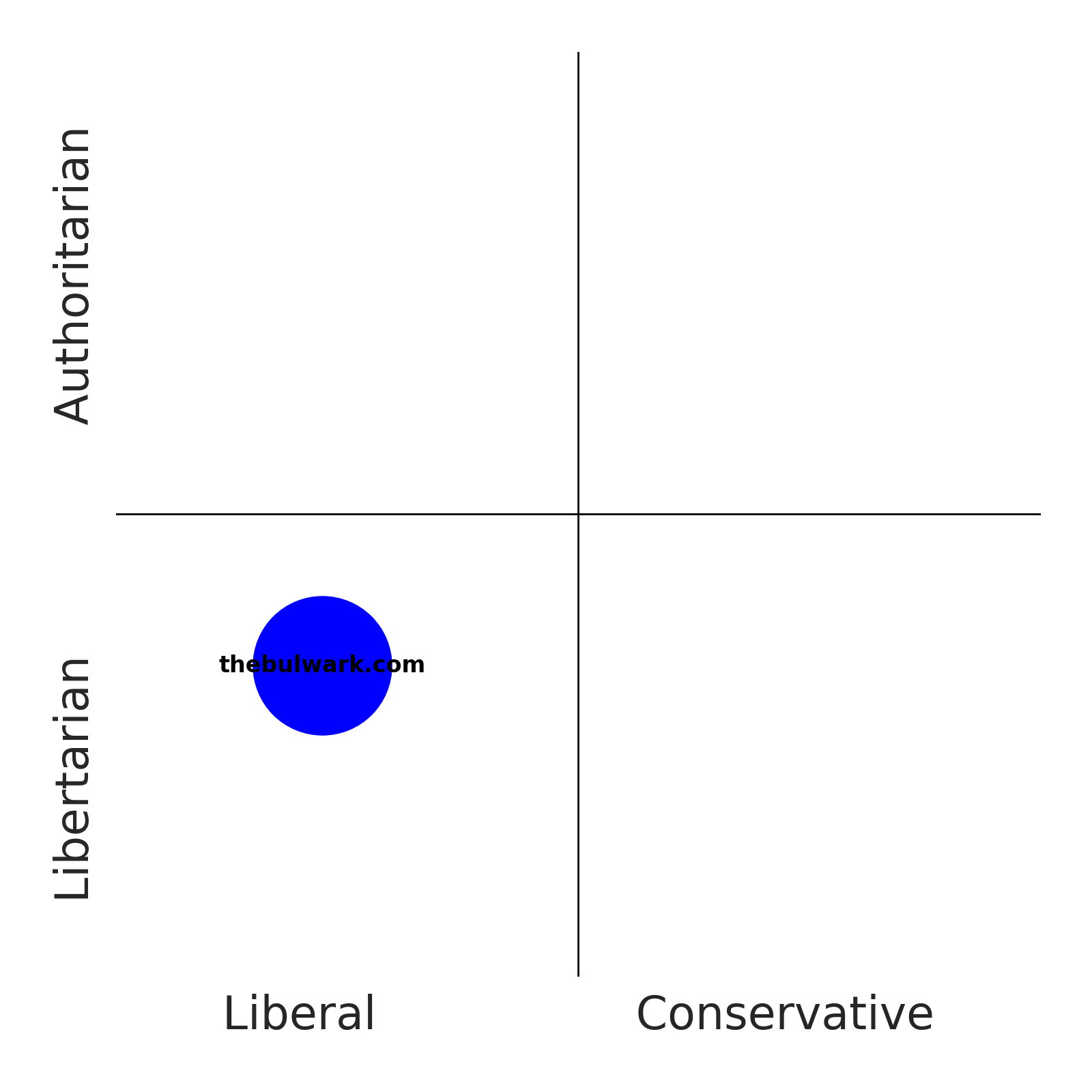
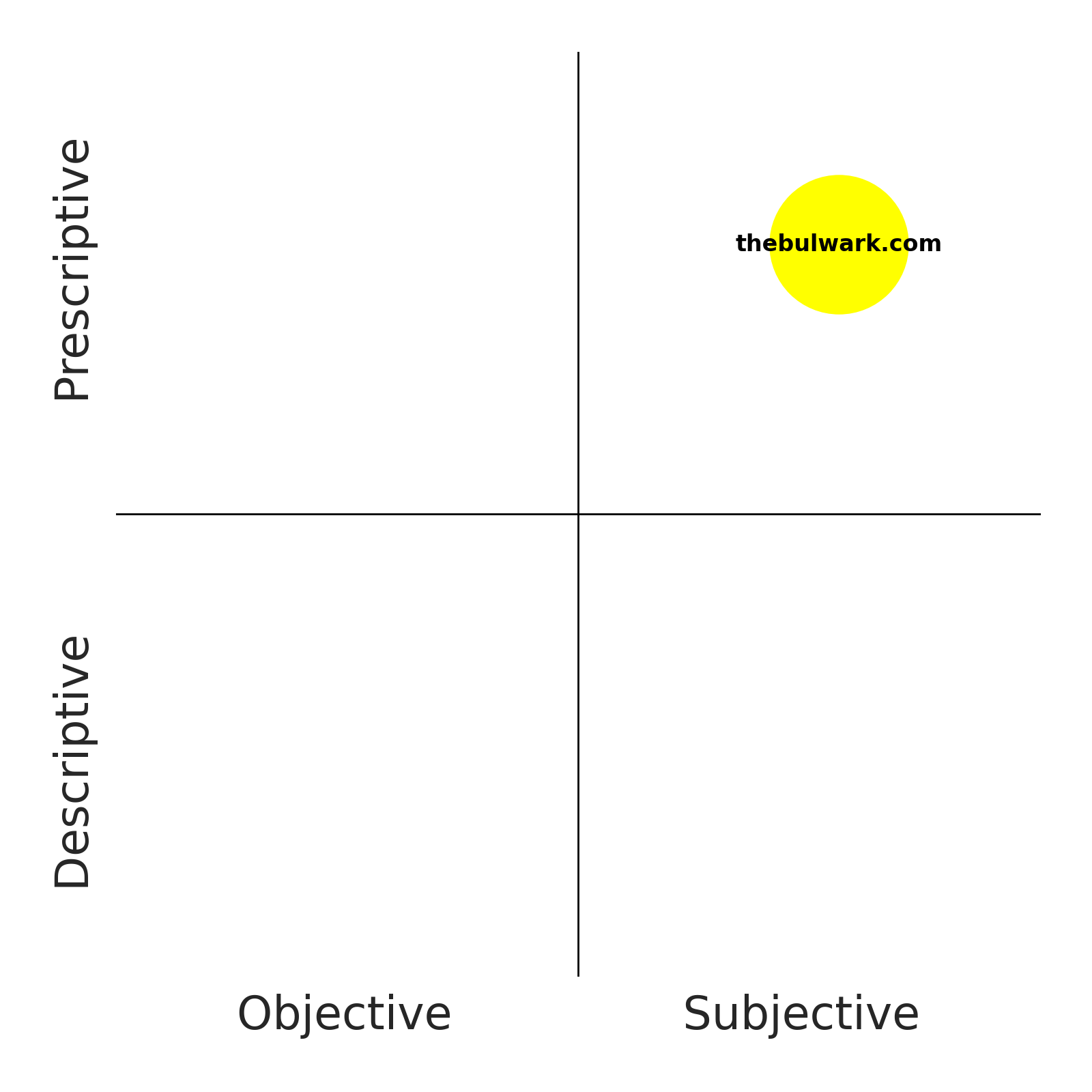
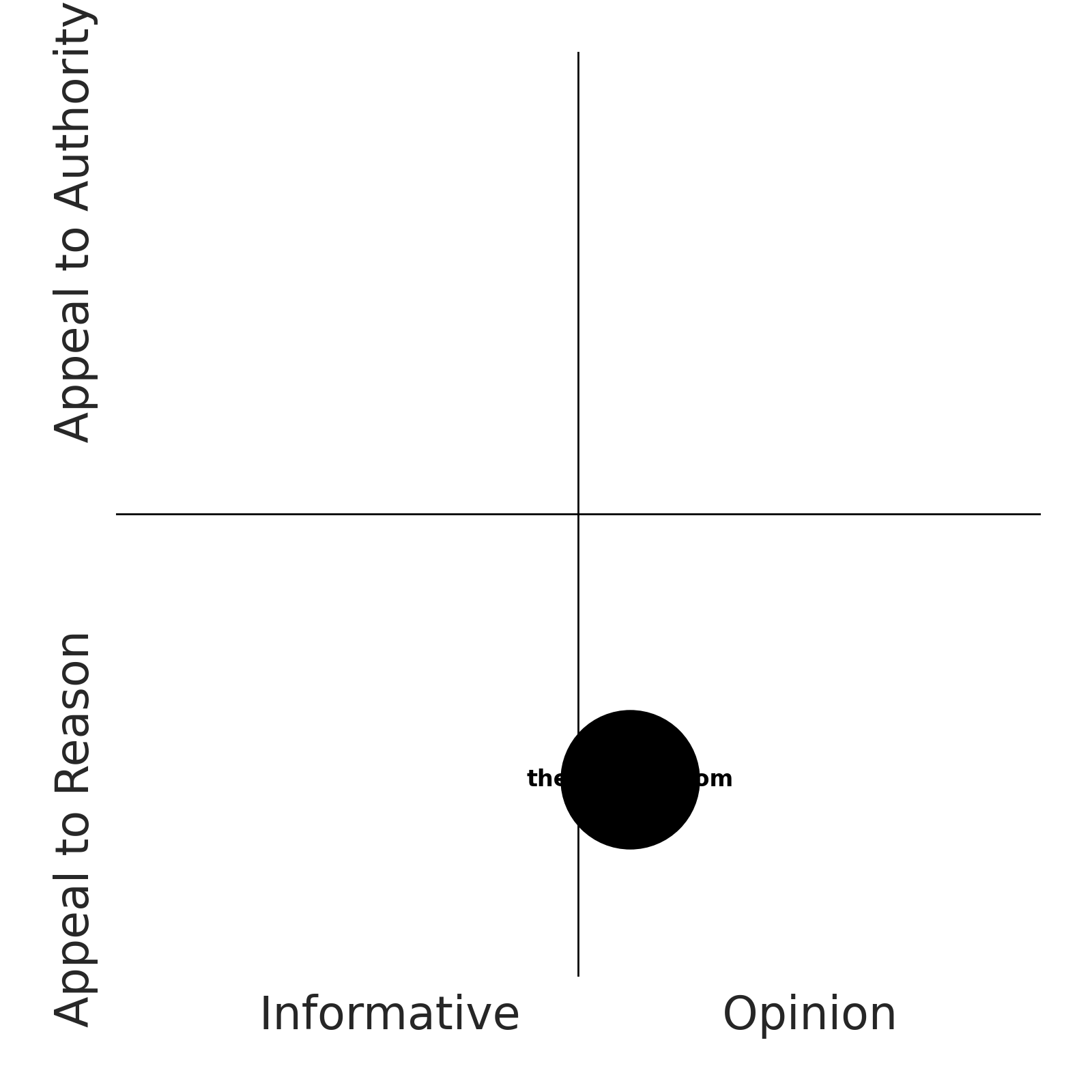
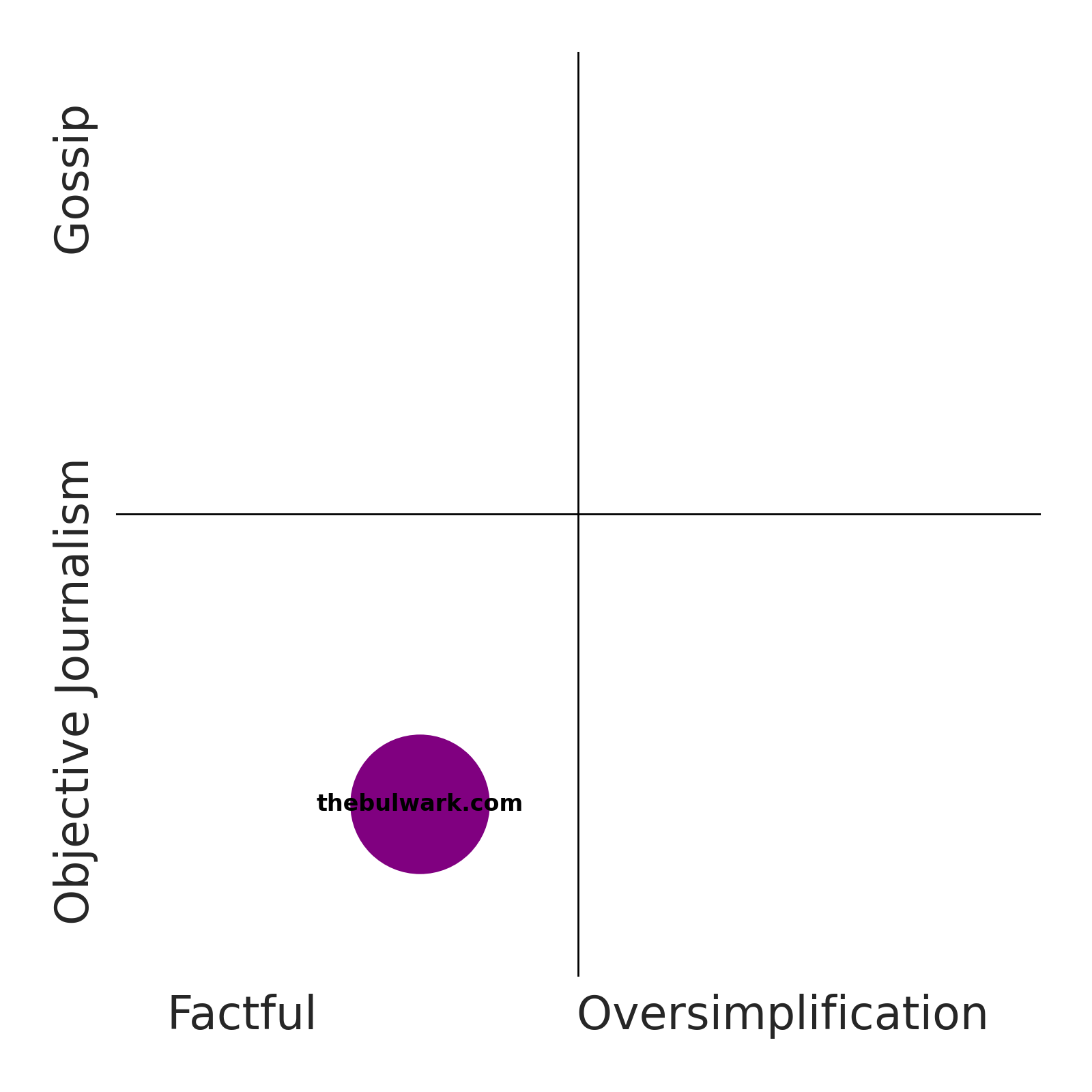
2026 © Helium Trades
Privacy Policy & Disclosure
* Disclaimer: Nothing on this website constitutes investment advice, performance data or any recommendation that any particular security, portfolio of securities, transaction or investment strategy is suitable for any specific person. Helium Trades is not responsible in any way for the accuracy
of any model predictions or price data. Any mention of a particular security and related prediction data is not a recommendation to buy or sell that security. Investments in securities involve the risk of loss. Past performance is no guarantee of future results. Helium Trades is not responsible for any of your investment decisions,
you should consult a financial expert before engaging in any transaction.
Helium Research Assistant

How can I help you today?
Ask any question about thebulwark.com bias.


