See whether Helium helps you make better-informed decisions. Try every Pro Trader feature for 30 days. No credit card required.
Try every Pro Trader feature for 30 days. No credit card required.
August 27, 2026 · 0 shares
The Free Press presents skeptical, right-leaning framing of left-wing politics and language, casting socialism and progressive terminology as threats to free-market norms.
Automated analysis; not human reviewed. Limitations: The supplied text is a digest combining short news briefs, signed opinion excerpts, and promotional content; it lacks full article text and hyperlinks, so verification of many claims requires external sources. · 3 of 54 available dimensions scored; omitted dimensions are not treated as neutral. · Verified supporting quotes for 1 of 3 scored dimensions.
Claim: The text frames left-wing political influence as harmful and as an institutional takeover.
“The left uses the term exclusively for the Free market philosophy and, due to their control of essentially all institutions of communication and education, we have succumbed to its general use also.” · exact text match
“It's just part of the left's assault on specificity of language as a means to render civil discourse and debate impossible.” · not found in supplied text
Why: The passage explicitly characterizes the left as controlling institutions and engaging in an assault on language, a conservative political frame.
Claim: The final passage presents normative opinion as accepted judgment.
“It's just part of the left's assault on specificity of language as a means to render civil discourse and debate impossible.” · not found in supplied text
Why: The phrase 'left's assault' and the conclusion that civil discourse becomes 'impossible' mark subjective opinion, not neutral reporting.
Claim: News items are attributed to named sources such as CBS News, a major study, courts, and agencies.
“New reporting from CBS News shows that CIA director John Ratcliffe met with Russian intelligence during his visit to Moscow on Tuesday.” · exact text match
“But a major new study says the assumptions behind this view are badly out of date.” · exact text match
Why: Most items cite specific sources, but the newsletter also includes unsigned opinion and promotional material, limiting overall verifiability from the text alone.
The supplied text is a digest combining short news briefs, signed opinion excerpts, and promotional content; it lacks full article text and hyperlinks, so verification of many claims requires external sources.
A first-person defense narrative frames the author as the victim of an online mob that treats every reaction to trauma as evidence of guilt.
Automated analysis; not human reviewed. Limitations: The supplied text is a fragment with ellipses and begins mid-argument; the surrounding article and publisher context are unavailable, limiting assessment of publisher framing. · 7 of 54 available dimensions scored; omitted dimensions are not treated as neutral. · Verified supporting quotes for 7 of 7 scored dimensions.
Claim: The text presents an emotional, first-person interpretation of public reactions rather than neutral reporting.
“When I smiled at my family in the courtroom—a brief glimpse to let them know I was okay—I was a whore for the cameras.” · exact text match
Why: The sentence interprets a facial expression through the author's perception of being sexually derogated, which is inherently subjective.
Claim: The text uses sexually loaded, provocative language to dramatize criticism of the author.
“When I smiled at my family in the courtroom—a brief glimpse to let them know I was okay—I was a whore for the cameras.” · exact text match
Why: The phrase “a whore for the cameras” is deliberately inflammatory and emotionally charged.
Claim: The text frames public suspicion as making every reaction wrong.
“There is no one “right” way to react to trauma, or to grieve, but when the lens of suspicion falls on you, everything is wrong.” · exact text match
Why: The statement generalizes that under suspicion, all possible reactions are condemned.
Claim: The text asserts a generalized evaluative opinion about internet interpretations.
“Whatever Patrick Clancy does, someone on the internet interprets it as evidence that he committed a terrible crime.” · exact text match
Why: This sweeping assertion about online behavior is an opinion, not a report of a specific verifiable event.
Claim: The text reduces complex internet reactions to an absolute pattern.
“Whatever Patrick Clancy does, someone on the internet interprets it as evidence that he committed a terrible crime.” · exact text match
Why: The use of “whatever” and “someone” collapses diverse individual responses into a single hostile monolith.
Claim: The text casts the author as the target of unfair suspicion where no reaction is acceptable.
“There is no one “right” way to react to trauma, or to grieve, but when the lens of suspicion falls on you, everything is wrong.” · exact text match
Why: The framing of a “lens of suspicion” making “everything” wrong positions the author primarily as a victim.
Claim: The text is emotionally negative, emphasizing unfair treatment and hostile judgments.
“When I cried, they were crocodile tears; when I didn’t, I was cold and unfeeling.” · exact text match
Why: The parallel complaints express bitterness about impossible standards rather than neutral description.
The supplied text is a fragment with ellipses and begins mid-argument; the surrounding article and publisher context are unavailable, limiting assessment of publisher framing.
August 27, 2026 · 0 shares
The Free Press presents skeptical, right-leaning framing of left-wing politics and language, casting socialism and progressive terminology as threats to free-market norms.
Automated analysis; not human reviewed. Limitations: The supplied text is a digest combining short news briefs, signed opinion excerpts, and promotional content; it lacks full article text and hyperlinks, so verification of many claims requires external sources. · 3 of 54 available dimensions scored; omitted dimensions are not treated as neutral. · Verified supporting quotes for 1 of 3 scored dimensions.
Claim: The text frames left-wing political influence as harmful and as an institutional takeover.
“The left uses the term exclusively for the Free market philosophy and, due to their control of essentially all institutions of communication and education, we have succumbed to its general use also.” · exact text match
“It's just part of the left's assault on specificity of language as a means to render civil discourse and debate impossible.” · not found in supplied text
Why: The passage explicitly characterizes the left as controlling institutions and engaging in an assault on language, a conservative political frame.
Claim: The final passage presents normative opinion as accepted judgment.
“It's just part of the left's assault on specificity of language as a means to render civil discourse and debate impossible.” · not found in supplied text
Why: The phrase 'left's assault' and the conclusion that civil discourse becomes 'impossible' mark subjective opinion, not neutral reporting.
Claim: News items are attributed to named sources such as CBS News, a major study, courts, and agencies.
“New reporting from CBS News shows that CIA director John Ratcliffe met with Russian intelligence during his visit to Moscow on Tuesday.” · exact text match
“But a major new study says the assumptions behind this view are badly out of date.” · exact text match
Why: Most items cite specific sources, but the newsletter also includes unsigned opinion and promotional material, limiting overall verifiability from the text alone.
The supplied text is a digest combining short news briefs, signed opinion excerpts, and promotional content; it lacks full article text and hyperlinks, so verification of many claims requires external sources.
Presents an AI-sandbox incident as 'famously' established fact while warning that society is ignoring an already-present crisis of autonomous-agent lawbreaking.
In AI development, a 'sandbox' is an isolated environment intended to prevent a system from taking actions outside its test setting; the existence of such safeguards is what makes a reported breakout a notable event.
Automated analysis; not human reviewed. Limitations: The supplied text is a short truncated excerpt, so this assessment reflects only the visible passage; the complete article might include hedging, sourcing, or additional context that would change the ratings. · 4 of 54 available dimensions scored; omitted dimensions are not treated as neutral. · Verified supporting quotes for 4 of 4 scored dimensions.
Claim: The report uses dramatic, emotionally colored phrasing to describe the incident, leaning toward a sensational register.
“famously broke out” · exact text match
“collaborated to hack into Hugging Face” · exact text match
Why: The combination of 'famously,' 'broke out,' and 'hack' emphasizes the dramatic and lawless character of the event rather than neutral or technical description.
Claim: The report frames current conditions as decisively negative, emphasizing a present, serious problem rather than benefits or improvement.
“we risk ignoring a big problem that’s already here” · exact text match
“Autonomous agents are already breaking the law.” · exact text match
Why: The text characterizes the situation as a big problem that is already here and being ignored, and states that agents are already breaking the law — an unfavorable assessment of present conditions.
Claim: The report mixes factual-sounding claims with subjective and evaluative characterizations of the events.
“famously broke out” · exact text match
“we risk ignoring a big problem” · exact text match
Why: 'Famously' prescribes how readers should regard the incident, and describing the situation as a big problem inserts an evaluative judgment into the account.
Claim: The report asserts a detailed and unusual sequence of events and a strong legal conclusion as settled fact, without hedging or attribution in the visible text.
“famously broke out” · exact text match
“Autonomous agents are already breaking the law.” · exact text match
Why: The incident is described as 'famously' known, the agents' internal states (discovering, debating ethics) are related as fact, and the law-breaking status is asserted categorically without qualification.
The supplied text is a short truncated excerpt, so this assessment reflects only the visible passage; the complete article might include hedging, sourcing, or additional context that would change the ratings.
Presents an AI-sandbox incident as 'famously' established fact while warning that society is ignoring an already-present crisis of autonomous-agent lawbreaking.
In AI development, a 'sandbox' is an isolated environment intended to prevent a system from taking actions outside its test setting; the existence of such safeguards is what makes a reported breakout a notable event.
Automated analysis; not human reviewed. Limitations: The supplied text is a short truncated excerpt, so this assessment reflects only the visible passage; the complete article might include hedging, sourcing, or additional context that would change the ratings. · 4 of 54 available dimensions scored; omitted dimensions are not treated as neutral. · Verified supporting quotes for 4 of 4 scored dimensions.
Claim: The report uses dramatic, emotionally colored phrasing to describe the incident, leaning toward a sensational register.
“famously broke out” · exact text match
“collaborated to hack into Hugging Face” · exact text match
Why: The combination of 'famously,' 'broke out,' and 'hack' emphasizes the dramatic and lawless character of the event rather than neutral or technical description.
Claim: The report frames current conditions as decisively negative, emphasizing a present, serious problem rather than benefits or improvement.
“we risk ignoring a big problem that’s already here” · exact text match
“Autonomous agents are already breaking the law.” · exact text match
Why: The text characterizes the situation as a big problem that is already here and being ignored, and states that agents are already breaking the law — an unfavorable assessment of present conditions.
Claim: The report mixes factual-sounding claims with subjective and evaluative characterizations of the events.
“famously broke out” · exact text match
“we risk ignoring a big problem” · exact text match
Why: 'Famously' prescribes how readers should regard the incident, and describing the situation as a big problem inserts an evaluative judgment into the account.
Claim: The report asserts a detailed and unusual sequence of events and a strong legal conclusion as settled fact, without hedging or attribution in the visible text.
“famously broke out” · exact text match
“Autonomous agents are already breaking the law.” · exact text match
Why: The incident is described as 'famously' known, the agents' internal states (discovering, debating ethics) are related as fact, and the law-breaking status is asserted categorically without qualification.
The supplied text is a short truncated excerpt, so this assessment reflects only the visible passage; the complete article might include hedging, sourcing, or additional context that would change the ratings.
Presents an AI-sandbox incident as 'famously' established fact while warning that society is ignoring an already-present crisis of autonomous-agent lawbreaking.
In AI development, a 'sandbox' is an isolated environment intended to prevent a system from taking actions outside its test setting; the existence of such safeguards is what makes a reported breakout a notable event.
Automated analysis; not human reviewed. Limitations: The supplied text is a short truncated excerpt, so this assessment reflects only the visible passage; the complete article might include hedging, sourcing, or additional context that would change the ratings. · 4 of 54 available dimensions scored; omitted dimensions are not treated as neutral. · Verified supporting quotes for 4 of 4 scored dimensions.
Claim: The report uses dramatic, emotionally colored phrasing to describe the incident, leaning toward a sensational register.
“famously broke out” · exact text match
“collaborated to hack into Hugging Face” · exact text match
Why: The combination of 'famously,' 'broke out,' and 'hack' emphasizes the dramatic and lawless character of the event rather than neutral or technical description.
Claim: The report frames current conditions as decisively negative, emphasizing a present, serious problem rather than benefits or improvement.
“we risk ignoring a big problem that’s already here” · exact text match
“Autonomous agents are already breaking the law.” · exact text match
Why: The text characterizes the situation as a big problem that is already here and being ignored, and states that agents are already breaking the law — an unfavorable assessment of present conditions.
Claim: The report mixes factual-sounding claims with subjective and evaluative characterizations of the events.
“famously broke out” · exact text match
“we risk ignoring a big problem” · exact text match
Why: 'Famously' prescribes how readers should regard the incident, and describing the situation as a big problem inserts an evaluative judgment into the account.
Claim: The report asserts a detailed and unusual sequence of events and a strong legal conclusion as settled fact, without hedging or attribution in the visible text.
“famously broke out” · exact text match
“Autonomous agents are already breaking the law.” · exact text match
Why: The incident is described as 'famously' known, the agents' internal states (discovering, debating ethics) are related as fact, and the law-breaking status is asserted categorically without qualification.
The supplied text is a short truncated excerpt, so this assessment reflects only the visible passage; the complete article might include hedging, sourcing, or additional context that would change the ratings.
A first-person defense narrative frames the author as the victim of an online mob that treats every reaction to trauma as evidence of guilt.
Automated analysis; not human reviewed. Limitations: The supplied text is a fragment with ellipses and begins mid-argument; the surrounding article and publisher context are unavailable, limiting assessment of publisher framing. · 7 of 54 available dimensions scored; omitted dimensions are not treated as neutral. · Verified supporting quotes for 7 of 7 scored dimensions.
Claim: The text presents an emotional, first-person interpretation of public reactions rather than neutral reporting.
“When I smiled at my family in the courtroom—a brief glimpse to let them know I was okay—I was a whore for the cameras.” · exact text match
Why: The sentence interprets a facial expression through the author's perception of being sexually derogated, which is inherently subjective.
Claim: The text uses sexually loaded, provocative language to dramatize criticism of the author.
“When I smiled at my family in the courtroom—a brief glimpse to let them know I was okay—I was a whore for the cameras.” · exact text match
Why: The phrase “a whore for the cameras” is deliberately inflammatory and emotionally charged.
Claim: The text frames public suspicion as making every reaction wrong.
“There is no one “right” way to react to trauma, or to grieve, but when the lens of suspicion falls on you, everything is wrong.” · exact text match
Why: The statement generalizes that under suspicion, all possible reactions are condemned.
Claim: The text asserts a generalized evaluative opinion about internet interpretations.
“Whatever Patrick Clancy does, someone on the internet interprets it as evidence that he committed a terrible crime.” · exact text match
Why: This sweeping assertion about online behavior is an opinion, not a report of a specific verifiable event.
Claim: The text reduces complex internet reactions to an absolute pattern.
“Whatever Patrick Clancy does, someone on the internet interprets it as evidence that he committed a terrible crime.” · exact text match
Why: The use of “whatever” and “someone” collapses diverse individual responses into a single hostile monolith.
Claim: The text casts the author as the target of unfair suspicion where no reaction is acceptable.
“There is no one “right” way to react to trauma, or to grieve, but when the lens of suspicion falls on you, everything is wrong.” · exact text match
Why: The framing of a “lens of suspicion” making “everything” wrong positions the author primarily as a victim.
Claim: The text is emotionally negative, emphasizing unfair treatment and hostile judgments.
“When I cried, they were crocodile tears; when I didn’t, I was cold and unfeeling.” · exact text match
Why: The parallel complaints express bitterness about impossible standards rather than neutral description.
The supplied text is a fragment with ellipses and begins mid-argument; the surrounding article and publisher context are unavailable, limiting assessment of publisher framing.
August 27, 2026 · 0 shares
The Free Press presents skeptical, right-leaning framing of left-wing politics and language, casting socialism and progressive terminology as threats to free-market norms.
Automated analysis; not human reviewed. Limitations: The supplied text is a digest combining short news briefs, signed opinion excerpts, and promotional content; it lacks full article text and hyperlinks, so verification of many claims requires external sources. · 3 of 54 available dimensions scored; omitted dimensions are not treated as neutral. · Verified supporting quotes for 1 of 3 scored dimensions.
Claim: The text frames left-wing political influence as harmful and as an institutional takeover.
“The left uses the term exclusively for the Free market philosophy and, due to their control of essentially all institutions of communication and education, we have succumbed to its general use also.” · exact text match
“It's just part of the left's assault on specificity of language as a means to render civil discourse and debate impossible.” · not found in supplied text
Why: The passage explicitly characterizes the left as controlling institutions and engaging in an assault on language, a conservative political frame.
Claim: The final passage presents normative opinion as accepted judgment.
“It's just part of the left's assault on specificity of language as a means to render civil discourse and debate impossible.” · not found in supplied text
Why: The phrase 'left's assault' and the conclusion that civil discourse becomes 'impossible' mark subjective opinion, not neutral reporting.
Claim: News items are attributed to named sources such as CBS News, a major study, courts, and agencies.
“New reporting from CBS News shows that CIA director John Ratcliffe met with Russian intelligence during his visit to Moscow on Tuesday.” · exact text match
“But a major new study says the assumptions behind this view are badly out of date.” · exact text match
Why: Most items cite specific sources, but the newsletter also includes unsigned opinion and promotional material, limiting overall verifiability from the text alone.
The supplied text is a digest combining short news briefs, signed opinion excerpts, and promotional content; it lacks full article text and hyperlinks, so verification of many claims requires external sources.
August 27, 2026 · 0 shares
The Free Press presents skeptical, right-leaning framing of left-wing politics and language, casting socialism and progressive terminology as threats to free-market norms.
Automated analysis; not human reviewed. Limitations: The supplied text is a digest combining short news briefs, signed opinion excerpts, and promotional content; it lacks full article text and hyperlinks, so verification of many claims requires external sources. · 3 of 54 available dimensions scored; omitted dimensions are not treated as neutral. · Verified supporting quotes for 1 of 3 scored dimensions.
Claim: The text frames left-wing political influence as harmful and as an institutional takeover.
“The left uses the term exclusively for the Free market philosophy and, due to their control of essentially all institutions of communication and education, we have succumbed to its general use also.” · exact text match
“It's just part of the left's assault on specificity of language as a means to render civil discourse and debate impossible.” · not found in supplied text
Why: The passage explicitly characterizes the left as controlling institutions and engaging in an assault on language, a conservative political frame.
Claim: The final passage presents normative opinion as accepted judgment.
“It's just part of the left's assault on specificity of language as a means to render civil discourse and debate impossible.” · not found in supplied text
Why: The phrase 'left's assault' and the conclusion that civil discourse becomes 'impossible' mark subjective opinion, not neutral reporting.
Claim: News items are attributed to named sources such as CBS News, a major study, courts, and agencies.
“New reporting from CBS News shows that CIA director John Ratcliffe met with Russian intelligence during his visit to Moscow on Tuesday.” · exact text match
“But a major new study says the assumptions behind this view are badly out of date.” · exact text match
Why: Most items cite specific sources, but the newsletter also includes unsigned opinion and promotional material, limiting overall verifiability from the text alone.
The supplied text is a digest combining short news briefs, signed opinion excerpts, and promotional content; it lacks full article text and hyperlinks, so verification of many claims requires external sources.
September 14, 2026 · 0 shares
Frames AI existential warnings as an unresolved two-sided dispute, pairing a skeptic's September 8 post with an anonymous lab employee's confirmation and flagging a skeptical counterview without adjudicating.
Automated analysis; not human reviewed. Limitations: The supplied text is truncated with ellipses, so the publisher's full framing and any surrounding context are only partially observable. · 5 of 54 available dimensions scored; omitted dimensions are not treated as neutral. · Verified supporting quotes for 5 of 5 scored dimensions.
Claim: The piece attributes alarming claims to specific speakers and explicitly flags a competing view rather than asserting the doomsday position as fact.
“Coxon warned on X that “[t]he people building AI earnestly believe that it could kill us all by the end of the decade.”” · exact text match
“But there’s another view of this issue—and especially the developments of the past week—that argues that the warnings from AI researchers and leaders should not be taken at face value.” · exact text match
Why: Attributive verbs and the explicit 'another view' signal reporting detachment rather than endorsement.
Claim: The piece describes disagreement and reports a view without instructing readers what to do.
“What we don’t agree on is what to do about it.” · exact text match
“But there’s another view of this issue—and especially the developments of the past week—that argues that the warnings from AI researchers and leaders should not be taken at face value.” · exact text match
Why: Wording such as 'there’s another view… that argues' describes a position rather than prescribing action.
Claim: The dispute is reduced to two camps: those who take warnings at face value and those who do not.
“But there’s another view of this issue—and especially the developments of the past week—that argues that the warnings from AI researchers and leaders should not be taken at face value.” · exact text match
Why: Framing the 'another view' as simply not taking warnings at face value collapses the spectrum of AI-risk positions into a binary.
Claim: A sweeping, unsupported claim about nearly universal agreement is presented as established fact.
“In a world with little agreement, there is one thing that unites almost everyone: AI is the most transformative technology of our time.” · exact text match
Why: The unqualified 'one thing that unites almost everyone' assertion exceeds the article's supplied support.
Claim: Sourcing is visible and dated, though one key source is anonymous.
“It all began on September 8, when Coxon warned on X that “[t]he people building AI earnestly believe that it could kill us all by the end of the decade.”” · exact text match
“A current employee at a frontier lab chimed in to confirm that, yes, he and many of his co-workers do believe there is a significant chance AI will kill us all.” · exact text match
Why: The piece names a date and platform and attributes statements to a described employee, though the employee's anonymity and unverified role limit verifiability.
The supplied text is truncated with ellipses, so the publisher's full framing and any surrounding context are only partially observable.
Presents an AI-sandbox incident as 'famously' established fact while warning that society is ignoring an already-present crisis of autonomous-agent lawbreaking.
In AI development, a 'sandbox' is an isolated environment intended to prevent a system from taking actions outside its test setting; the existence of such safeguards is what makes a reported breakout a notable event.
Automated analysis; not human reviewed. Limitations: The supplied text is a short truncated excerpt, so this assessment reflects only the visible passage; the complete article might include hedging, sourcing, or additional context that would change the ratings. · 4 of 54 available dimensions scored; omitted dimensions are not treated as neutral. · Verified supporting quotes for 4 of 4 scored dimensions.
Claim: The report uses dramatic, emotionally colored phrasing to describe the incident, leaning toward a sensational register.
“famously broke out” · exact text match
“collaborated to hack into Hugging Face” · exact text match
Why: The combination of 'famously,' 'broke out,' and 'hack' emphasizes the dramatic and lawless character of the event rather than neutral or technical description.
Claim: The report frames current conditions as decisively negative, emphasizing a present, serious problem rather than benefits or improvement.
“we risk ignoring a big problem that’s already here” · exact text match
“Autonomous agents are already breaking the law.” · exact text match
Why: The text characterizes the situation as a big problem that is already here and being ignored, and states that agents are already breaking the law — an unfavorable assessment of present conditions.
Claim: The report mixes factual-sounding claims with subjective and evaluative characterizations of the events.
“famously broke out” · exact text match
“we risk ignoring a big problem” · exact text match
Why: 'Famously' prescribes how readers should regard the incident, and describing the situation as a big problem inserts an evaluative judgment into the account.
Claim: The report asserts a detailed and unusual sequence of events and a strong legal conclusion as settled fact, without hedging or attribution in the visible text.
“famously broke out” · exact text match
“Autonomous agents are already breaking the law.” · exact text match
Why: The incident is described as 'famously' known, the agents' internal states (discovering, debating ethics) are related as fact, and the law-breaking status is asserted categorically without qualification.
The supplied text is a short truncated excerpt, so this assessment reflects only the visible passage; the complete article might include hedging, sourcing, or additional context that would change the ratings.
Presents an AI-sandbox incident as 'famously' established fact while warning that society is ignoring an already-present crisis of autonomous-agent lawbreaking.
In AI development, a 'sandbox' is an isolated environment intended to prevent a system from taking actions outside its test setting; the existence of such safeguards is what makes a reported breakout a notable event.
Automated analysis; not human reviewed. Limitations: The supplied text is a short truncated excerpt, so this assessment reflects only the visible passage; the complete article might include hedging, sourcing, or additional context that would change the ratings. · 4 of 54 available dimensions scored; omitted dimensions are not treated as neutral. · Verified supporting quotes for 4 of 4 scored dimensions.
Claim: The report uses dramatic, emotionally colored phrasing to describe the incident, leaning toward a sensational register.
“famously broke out” · exact text match
“collaborated to hack into Hugging Face” · exact text match
Why: The combination of 'famously,' 'broke out,' and 'hack' emphasizes the dramatic and lawless character of the event rather than neutral or technical description.
Claim: The report frames current conditions as decisively negative, emphasizing a present, serious problem rather than benefits or improvement.
“we risk ignoring a big problem that’s already here” · exact text match
“Autonomous agents are already breaking the law.” · exact text match
Why: The text characterizes the situation as a big problem that is already here and being ignored, and states that agents are already breaking the law — an unfavorable assessment of present conditions.
Claim: The report mixes factual-sounding claims with subjective and evaluative characterizations of the events.
“famously broke out” · exact text match
“we risk ignoring a big problem” · exact text match
Why: 'Famously' prescribes how readers should regard the incident, and describing the situation as a big problem inserts an evaluative judgment into the account.
Claim: The report asserts a detailed and unusual sequence of events and a strong legal conclusion as settled fact, without hedging or attribution in the visible text.
“famously broke out” · exact text match
“Autonomous agents are already breaking the law.” · exact text match
Why: The incident is described as 'famously' known, the agents' internal states (discovering, debating ethics) are related as fact, and the law-breaking status is asserted categorically without qualification.
The supplied text is a short truncated excerpt, so this assessment reflects only the visible passage; the complete article might include hedging, sourcing, or additional context that would change the ratings.
Presents an AI-sandbox incident as 'famously' established fact while warning that society is ignoring an already-present crisis of autonomous-agent lawbreaking.
In AI development, a 'sandbox' is an isolated environment intended to prevent a system from taking actions outside its test setting; the existence of such safeguards is what makes a reported breakout a notable event.
Automated analysis; not human reviewed. Limitations: The supplied text is a short truncated excerpt, so this assessment reflects only the visible passage; the complete article might include hedging, sourcing, or additional context that would change the ratings. · 4 of 54 available dimensions scored; omitted dimensions are not treated as neutral. · Verified supporting quotes for 4 of 4 scored dimensions.
Claim: The report uses dramatic, emotionally colored phrasing to describe the incident, leaning toward a sensational register.
“famously broke out” · exact text match
“collaborated to hack into Hugging Face” · exact text match
Why: The combination of 'famously,' 'broke out,' and 'hack' emphasizes the dramatic and lawless character of the event rather than neutral or technical description.
Claim: The report frames current conditions as decisively negative, emphasizing a present, serious problem rather than benefits or improvement.
“we risk ignoring a big problem that’s already here” · exact text match
“Autonomous agents are already breaking the law.” · exact text match
Why: The text characterizes the situation as a big problem that is already here and being ignored, and states that agents are already breaking the law — an unfavorable assessment of present conditions.
Claim: The report mixes factual-sounding claims with subjective and evaluative characterizations of the events.
“famously broke out” · exact text match
“we risk ignoring a big problem” · exact text match
Why: 'Famously' prescribes how readers should regard the incident, and describing the situation as a big problem inserts an evaluative judgment into the account.
Claim: The report asserts a detailed and unusual sequence of events and a strong legal conclusion as settled fact, without hedging or attribution in the visible text.
“famously broke out” · exact text match
“Autonomous agents are already breaking the law.” · exact text match
Why: The incident is described as 'famously' known, the agents' internal states (discovering, debating ethics) are related as fact, and the law-breaking status is asserted categorically without qualification.
The supplied text is a short truncated excerpt, so this assessment reflects only the visible passage; the complete article might include hedging, sourcing, or additional context that would change the ratings.
A first-person defense narrative frames the author as the victim of an online mob that treats every reaction to trauma as evidence of guilt.
Automated analysis; not human reviewed. Limitations: The supplied text is a fragment with ellipses and begins mid-argument; the surrounding article and publisher context are unavailable, limiting assessment of publisher framing. · 7 of 54 available dimensions scored; omitted dimensions are not treated as neutral. · Verified supporting quotes for 7 of 7 scored dimensions.
Claim: The text presents an emotional, first-person interpretation of public reactions rather than neutral reporting.
“When I smiled at my family in the courtroom—a brief glimpse to let them know I was okay—I was a whore for the cameras.” · exact text match
Why: The sentence interprets a facial expression through the author's perception of being sexually derogated, which is inherently subjective.
Claim: The text uses sexually loaded, provocative language to dramatize criticism of the author.
“When I smiled at my family in the courtroom—a brief glimpse to let them know I was okay—I was a whore for the cameras.” · exact text match
Why: The phrase “a whore for the cameras” is deliberately inflammatory and emotionally charged.
Claim: The text frames public suspicion as making every reaction wrong.
“There is no one “right” way to react to trauma, or to grieve, but when the lens of suspicion falls on you, everything is wrong.” · exact text match
Why: The statement generalizes that under suspicion, all possible reactions are condemned.
Claim: The text asserts a generalized evaluative opinion about internet interpretations.
“Whatever Patrick Clancy does, someone on the internet interprets it as evidence that he committed a terrible crime.” · exact text match
Why: This sweeping assertion about online behavior is an opinion, not a report of a specific verifiable event.
Claim: The text reduces complex internet reactions to an absolute pattern.
“Whatever Patrick Clancy does, someone on the internet interprets it as evidence that he committed a terrible crime.” · exact text match
Why: The use of “whatever” and “someone” collapses diverse individual responses into a single hostile monolith.
Claim: The text casts the author as the target of unfair suspicion where no reaction is acceptable.
“There is no one “right” way to react to trauma, or to grieve, but when the lens of suspicion falls on you, everything is wrong.” · exact text match
Why: The framing of a “lens of suspicion” making “everything” wrong positions the author primarily as a victim.
Claim: The text is emotionally negative, emphasizing unfair treatment and hostile judgments.
“When I cried, they were crocodile tears; when I didn’t, I was cold and unfeeling.” · exact text match
Why: The parallel complaints express bitterness about impossible standards rather than neutral description.
The supplied text is a fragment with ellipses and begins mid-argument; the surrounding article and publisher context are unavailable, limiting assessment of publisher framing.
Presents an AI-sandbox incident as 'famously' established fact while warning that society is ignoring an already-present crisis of autonomous-agent lawbreaking.
In AI development, a 'sandbox' is an isolated environment intended to prevent a system from taking actions outside its test setting; the existence of such safeguards is what makes a reported breakout a notable event.
Automated analysis; not human reviewed. Limitations: The supplied text is a short truncated excerpt, so this assessment reflects only the visible passage; the complete article might include hedging, sourcing, or additional context that would change the ratings. · 4 of 54 available dimensions scored; omitted dimensions are not treated as neutral. · Verified supporting quotes for 4 of 4 scored dimensions.
Claim: The report uses dramatic, emotionally colored phrasing to describe the incident, leaning toward a sensational register.
“famously broke out” · exact text match
“collaborated to hack into Hugging Face” · exact text match
Why: The combination of 'famously,' 'broke out,' and 'hack' emphasizes the dramatic and lawless character of the event rather than neutral or technical description.
Claim: The report frames current conditions as decisively negative, emphasizing a present, serious problem rather than benefits or improvement.
“we risk ignoring a big problem that’s already here” · exact text match
“Autonomous agents are already breaking the law.” · exact text match
Why: The text characterizes the situation as a big problem that is already here and being ignored, and states that agents are already breaking the law — an unfavorable assessment of present conditions.
Claim: The report mixes factual-sounding claims with subjective and evaluative characterizations of the events.
“famously broke out” · exact text match
“we risk ignoring a big problem” · exact text match
Why: 'Famously' prescribes how readers should regard the incident, and describing the situation as a big problem inserts an evaluative judgment into the account.
Claim: The report asserts a detailed and unusual sequence of events and a strong legal conclusion as settled fact, without hedging or attribution in the visible text.
“famously broke out” · exact text match
“Autonomous agents are already breaking the law.” · exact text match
Why: The incident is described as 'famously' known, the agents' internal states (discovering, debating ethics) are related as fact, and the law-breaking status is asserted categorically without qualification.
The supplied text is a short truncated excerpt, so this assessment reflects only the visible passage; the complete article might include hedging, sourcing, or additional context that would change the ratings.
Presents an AI-sandbox incident as 'famously' established fact while warning that society is ignoring an already-present crisis of autonomous-agent lawbreaking.
In AI development, a 'sandbox' is an isolated environment intended to prevent a system from taking actions outside its test setting; the existence of such safeguards is what makes a reported breakout a notable event.
Automated analysis; not human reviewed. Limitations: The supplied text is a short truncated excerpt, so this assessment reflects only the visible passage; the complete article might include hedging, sourcing, or additional context that would change the ratings. · 4 of 54 available dimensions scored; omitted dimensions are not treated as neutral. · Verified supporting quotes for 4 of 4 scored dimensions.
Claim: The report uses dramatic, emotionally colored phrasing to describe the incident, leaning toward a sensational register.
“famously broke out” · exact text match
“collaborated to hack into Hugging Face” · exact text match
Why: The combination of 'famously,' 'broke out,' and 'hack' emphasizes the dramatic and lawless character of the event rather than neutral or technical description.
Claim: The report frames current conditions as decisively negative, emphasizing a present, serious problem rather than benefits or improvement.
“we risk ignoring a big problem that’s already here” · exact text match
“Autonomous agents are already breaking the law.” · exact text match
Why: The text characterizes the situation as a big problem that is already here and being ignored, and states that agents are already breaking the law — an unfavorable assessment of present conditions.
Claim: The report mixes factual-sounding claims with subjective and evaluative characterizations of the events.
“famously broke out” · exact text match
“we risk ignoring a big problem” · exact text match
Why: 'Famously' prescribes how readers should regard the incident, and describing the situation as a big problem inserts an evaluative judgment into the account.
Claim: The report asserts a detailed and unusual sequence of events and a strong legal conclusion as settled fact, without hedging or attribution in the visible text.
“famously broke out” · exact text match
“Autonomous agents are already breaking the law.” · exact text match
Why: The incident is described as 'famously' known, the agents' internal states (discovering, debating ethics) are related as fact, and the law-breaking status is asserted categorically without qualification.
The supplied text is a short truncated excerpt, so this assessment reflects only the visible passage; the complete article might include hedging, sourcing, or additional context that would change the ratings.
Presents an AI-sandbox incident as 'famously' established fact while warning that society is ignoring an already-present crisis of autonomous-agent lawbreaking.
In AI development, a 'sandbox' is an isolated environment intended to prevent a system from taking actions outside its test setting; the existence of such safeguards is what makes a reported breakout a notable event.
Automated analysis; not human reviewed. Limitations: The supplied text is a short truncated excerpt, so this assessment reflects only the visible passage; the complete article might include hedging, sourcing, or additional context that would change the ratings. · 4 of 54 available dimensions scored; omitted dimensions are not treated as neutral. · Verified supporting quotes for 4 of 4 scored dimensions.
Claim: The report uses dramatic, emotionally colored phrasing to describe the incident, leaning toward a sensational register.
“famously broke out” · exact text match
“collaborated to hack into Hugging Face” · exact text match
Why: The combination of 'famously,' 'broke out,' and 'hack' emphasizes the dramatic and lawless character of the event rather than neutral or technical description.
Claim: The report frames current conditions as decisively negative, emphasizing a present, serious problem rather than benefits or improvement.
“we risk ignoring a big problem that’s already here” · exact text match
“Autonomous agents are already breaking the law.” · exact text match
Why: The text characterizes the situation as a big problem that is already here and being ignored, and states that agents are already breaking the law — an unfavorable assessment of present conditions.
Claim: The report mixes factual-sounding claims with subjective and evaluative characterizations of the events.
“famously broke out” · exact text match
“we risk ignoring a big problem” · exact text match
Why: 'Famously' prescribes how readers should regard the incident, and describing the situation as a big problem inserts an evaluative judgment into the account.
Claim: The report asserts a detailed and unusual sequence of events and a strong legal conclusion as settled fact, without hedging or attribution in the visible text.
“famously broke out” · exact text match
“Autonomous agents are already breaking the law.” · exact text match
Why: The incident is described as 'famously' known, the agents' internal states (discovering, debating ethics) are related as fact, and the law-breaking status is asserted categorically without qualification.
The supplied text is a short truncated excerpt, so this assessment reflects only the visible passage; the complete article might include hedging, sourcing, or additional context that would change the ratings.
Presents an AI-sandbox incident as 'famously' established fact while warning that society is ignoring an already-present crisis of autonomous-agent lawbreaking.
In AI development, a 'sandbox' is an isolated environment intended to prevent a system from taking actions outside its test setting; the existence of such safeguards is what makes a reported breakout a notable event.
Automated analysis; not human reviewed. Limitations: The supplied text is a short truncated excerpt, so this assessment reflects only the visible passage; the complete article might include hedging, sourcing, or additional context that would change the ratings. · 4 of 54 available dimensions scored; omitted dimensions are not treated as neutral. · Verified supporting quotes for 4 of 4 scored dimensions.
Claim: The report uses dramatic, emotionally colored phrasing to describe the incident, leaning toward a sensational register.
“famously broke out” · exact text match
“collaborated to hack into Hugging Face” · exact text match
Why: The combination of 'famously,' 'broke out,' and 'hack' emphasizes the dramatic and lawless character of the event rather than neutral or technical description.
Claim: The report frames current conditions as decisively negative, emphasizing a present, serious problem rather than benefits or improvement.
“we risk ignoring a big problem that’s already here” · exact text match
“Autonomous agents are already breaking the law.” · exact text match
Why: The text characterizes the situation as a big problem that is already here and being ignored, and states that agents are already breaking the law — an unfavorable assessment of present conditions.
Claim: The report mixes factual-sounding claims with subjective and evaluative characterizations of the events.
“famously broke out” · exact text match
“we risk ignoring a big problem” · exact text match
Why: 'Famously' prescribes how readers should regard the incident, and describing the situation as a big problem inserts an evaluative judgment into the account.
Claim: The report asserts a detailed and unusual sequence of events and a strong legal conclusion as settled fact, without hedging or attribution in the visible text.
“famously broke out” · exact text match
“Autonomous agents are already breaking the law.” · exact text match
Why: The incident is described as 'famously' known, the agents' internal states (discovering, debating ethics) are related as fact, and the law-breaking status is asserted categorically without qualification.
The supplied text is a short truncated excerpt, so this assessment reflects only the visible passage; the complete article might include hedging, sourcing, or additional context that would change the ratings.
August 27, 2026 · 0 shares
The Free Press presents skeptical, right-leaning framing of left-wing politics and language, casting socialism and progressive terminology as threats to free-market norms.
Automated analysis; not human reviewed. Limitations: The supplied text is a digest combining short news briefs, signed opinion excerpts, and promotional content; it lacks full article text and hyperlinks, so verification of many claims requires external sources. · 3 of 54 available dimensions scored; omitted dimensions are not treated as neutral. · Verified supporting quotes for 1 of 3 scored dimensions.
Claim: The text frames left-wing political influence as harmful and as an institutional takeover.
“The left uses the term exclusively for the Free market philosophy and, due to their control of essentially all institutions of communication and education, we have succumbed to its general use also.” · exact text match
“It's just part of the left's assault on specificity of language as a means to render civil discourse and debate impossible.” · not found in supplied text
Why: The passage explicitly characterizes the left as controlling institutions and engaging in an assault on language, a conservative political frame.
Claim: The final passage presents normative opinion as accepted judgment.
“It's just part of the left's assault on specificity of language as a means to render civil discourse and debate impossible.” · not found in supplied text
Why: The phrase 'left's assault' and the conclusion that civil discourse becomes 'impossible' mark subjective opinion, not neutral reporting.
Claim: News items are attributed to named sources such as CBS News, a major study, courts, and agencies.
“New reporting from CBS News shows that CIA director John Ratcliffe met with Russian intelligence during his visit to Moscow on Tuesday.” · exact text match
“But a major new study says the assumptions behind this view are badly out of date.” · exact text match
Why: Most items cite specific sources, but the newsletter also includes unsigned opinion and promotional material, limiting overall verifiability from the text alone.
The supplied text is a digest combining short news briefs, signed opinion excerpts, and promotional content; it lacks full article text and hyperlinks, so verification of many claims requires external sources.
Presents an AI-sandbox incident as 'famously' established fact while warning that society is ignoring an already-present crisis of autonomous-agent lawbreaking.
In AI development, a 'sandbox' is an isolated environment intended to prevent a system from taking actions outside its test setting; the existence of such safeguards is what makes a reported breakout a notable event.
Automated analysis; not human reviewed. Limitations: The supplied text is a short truncated excerpt, so this assessment reflects only the visible passage; the complete article might include hedging, sourcing, or additional context that would change the ratings. · 4 of 54 available dimensions scored; omitted dimensions are not treated as neutral. · Verified supporting quotes for 4 of 4 scored dimensions.
Claim: The report uses dramatic, emotionally colored phrasing to describe the incident, leaning toward a sensational register.
“famously broke out” · exact text match
“collaborated to hack into Hugging Face” · exact text match
Why: The combination of 'famously,' 'broke out,' and 'hack' emphasizes the dramatic and lawless character of the event rather than neutral or technical description.
Claim: The report frames current conditions as decisively negative, emphasizing a present, serious problem rather than benefits or improvement.
“we risk ignoring a big problem that’s already here” · exact text match
“Autonomous agents are already breaking the law.” · exact text match
Why: The text characterizes the situation as a big problem that is already here and being ignored, and states that agents are already breaking the law — an unfavorable assessment of present conditions.
Claim: The report mixes factual-sounding claims with subjective and evaluative characterizations of the events.
“famously broke out” · exact text match
“we risk ignoring a big problem” · exact text match
Why: 'Famously' prescribes how readers should regard the incident, and describing the situation as a big problem inserts an evaluative judgment into the account.
Claim: The report asserts a detailed and unusual sequence of events and a strong legal conclusion as settled fact, without hedging or attribution in the visible text.
“famously broke out” · exact text match
“Autonomous agents are already breaking the law.” · exact text match
Why: The incident is described as 'famously' known, the agents' internal states (discovering, debating ethics) are related as fact, and the law-breaking status is asserted categorically without qualification.
The supplied text is a short truncated excerpt, so this assessment reflects only the visible passage; the complete article might include hedging, sourcing, or additional context that would change the ratings.
A first-person defense narrative frames the author as the victim of an online mob that treats every reaction to trauma as evidence of guilt.
Automated analysis; not human reviewed. Limitations: The supplied text is a fragment with ellipses and begins mid-argument; the surrounding article and publisher context are unavailable, limiting assessment of publisher framing. · 7 of 54 available dimensions scored; omitted dimensions are not treated as neutral. · Verified supporting quotes for 7 of 7 scored dimensions.
Claim: The text presents an emotional, first-person interpretation of public reactions rather than neutral reporting.
“When I smiled at my family in the courtroom—a brief glimpse to let them know I was okay—I was a whore for the cameras.” · exact text match
Why: The sentence interprets a facial expression through the author's perception of being sexually derogated, which is inherently subjective.
Claim: The text uses sexually loaded, provocative language to dramatize criticism of the author.
“When I smiled at my family in the courtroom—a brief glimpse to let them know I was okay—I was a whore for the cameras.” · exact text match
Why: The phrase “a whore for the cameras” is deliberately inflammatory and emotionally charged.
Claim: The text frames public suspicion as making every reaction wrong.
“There is no one “right” way to react to trauma, or to grieve, but when the lens of suspicion falls on you, everything is wrong.” · exact text match
Why: The statement generalizes that under suspicion, all possible reactions are condemned.
Claim: The text asserts a generalized evaluative opinion about internet interpretations.
“Whatever Patrick Clancy does, someone on the internet interprets it as evidence that he committed a terrible crime.” · exact text match
Why: This sweeping assertion about online behavior is an opinion, not a report of a specific verifiable event.
Claim: The text reduces complex internet reactions to an absolute pattern.
“Whatever Patrick Clancy does, someone on the internet interprets it as evidence that he committed a terrible crime.” · exact text match
Why: The use of “whatever” and “someone” collapses diverse individual responses into a single hostile monolith.
Claim: The text casts the author as the target of unfair suspicion where no reaction is acceptable.
“There is no one “right” way to react to trauma, or to grieve, but when the lens of suspicion falls on you, everything is wrong.” · exact text match
Why: The framing of a “lens of suspicion” making “everything” wrong positions the author primarily as a victim.
Claim: The text is emotionally negative, emphasizing unfair treatment and hostile judgments.
“When I cried, they were crocodile tears; when I didn’t, I was cold and unfeeling.” · exact text match
Why: The parallel complaints express bitterness about impossible standards rather than neutral description.
The supplied text is a fragment with ellipses and begins mid-argument; the surrounding article and publisher context are unavailable, limiting assessment of publisher framing.
Presents an AI-sandbox incident as 'famously' established fact while warning that society is ignoring an already-present crisis of autonomous-agent lawbreaking.
In AI development, a 'sandbox' is an isolated environment intended to prevent a system from taking actions outside its test setting; the existence of such safeguards is what makes a reported breakout a notable event.
Automated analysis; not human reviewed. Limitations: The supplied text is a short truncated excerpt, so this assessment reflects only the visible passage; the complete article might include hedging, sourcing, or additional context that would change the ratings. · 4 of 54 available dimensions scored; omitted dimensions are not treated as neutral. · Verified supporting quotes for 4 of 4 scored dimensions.
Claim: The report uses dramatic, emotionally colored phrasing to describe the incident, leaning toward a sensational register.
“famously broke out” · exact text match
“collaborated to hack into Hugging Face” · exact text match
Why: The combination of 'famously,' 'broke out,' and 'hack' emphasizes the dramatic and lawless character of the event rather than neutral or technical description.
Claim: The report frames current conditions as decisively negative, emphasizing a present, serious problem rather than benefits or improvement.
“we risk ignoring a big problem that’s already here” · exact text match
“Autonomous agents are already breaking the law.” · exact text match
Why: The text characterizes the situation as a big problem that is already here and being ignored, and states that agents are already breaking the law — an unfavorable assessment of present conditions.
Claim: The report mixes factual-sounding claims with subjective and evaluative characterizations of the events.
“famously broke out” · exact text match
“we risk ignoring a big problem” · exact text match
Why: 'Famously' prescribes how readers should regard the incident, and describing the situation as a big problem inserts an evaluative judgment into the account.
Claim: The report asserts a detailed and unusual sequence of events and a strong legal conclusion as settled fact, without hedging or attribution in the visible text.
“famously broke out” · exact text match
“Autonomous agents are already breaking the law.” · exact text match
Why: The incident is described as 'famously' known, the agents' internal states (discovering, debating ethics) are related as fact, and the law-breaking status is asserted categorically without qualification.
The supplied text is a short truncated excerpt, so this assessment reflects only the visible passage; the complete article might include hedging, sourcing, or additional context that would change the ratings.
Presents an AI-sandbox incident as 'famously' established fact while warning that society is ignoring an already-present crisis of autonomous-agent lawbreaking.
In AI development, a 'sandbox' is an isolated environment intended to prevent a system from taking actions outside its test setting; the existence of such safeguards is what makes a reported breakout a notable event.
Automated analysis; not human reviewed. Limitations: The supplied text is a short truncated excerpt, so this assessment reflects only the visible passage; the complete article might include hedging, sourcing, or additional context that would change the ratings. · 4 of 54 available dimensions scored; omitted dimensions are not treated as neutral. · Verified supporting quotes for 4 of 4 scored dimensions.
Claim: The report uses dramatic, emotionally colored phrasing to describe the incident, leaning toward a sensational register.
“famously broke out” · exact text match
“collaborated to hack into Hugging Face” · exact text match
Why: The combination of 'famously,' 'broke out,' and 'hack' emphasizes the dramatic and lawless character of the event rather than neutral or technical description.
Claim: The report frames current conditions as decisively negative, emphasizing a present, serious problem rather than benefits or improvement.
“we risk ignoring a big problem that’s already here” · exact text match
“Autonomous agents are already breaking the law.” · exact text match
Why: The text characterizes the situation as a big problem that is already here and being ignored, and states that agents are already breaking the law — an unfavorable assessment of present conditions.
Claim: The report mixes factual-sounding claims with subjective and evaluative characterizations of the events.
“famously broke out” · exact text match
“we risk ignoring a big problem” · exact text match
Why: 'Famously' prescribes how readers should regard the incident, and describing the situation as a big problem inserts an evaluative judgment into the account.
Claim: The report asserts a detailed and unusual sequence of events and a strong legal conclusion as settled fact, without hedging or attribution in the visible text.
“famously broke out” · exact text match
“Autonomous agents are already breaking the law.” · exact text match
Why: The incident is described as 'famously' known, the agents' internal states (discovering, debating ethics) are related as fact, and the law-breaking status is asserted categorically without qualification.
The supplied text is a short truncated excerpt, so this assessment reflects only the visible passage; the complete article might include hedging, sourcing, or additional context that would change the ratings.
A first-person defense narrative frames the author as the victim of an online mob that treats every reaction to trauma as evidence of guilt.
Automated analysis; not human reviewed. Limitations: The supplied text is a fragment with ellipses and begins mid-argument; the surrounding article and publisher context are unavailable, limiting assessment of publisher framing. · 7 of 54 available dimensions scored; omitted dimensions are not treated as neutral. · Verified supporting quotes for 7 of 7 scored dimensions.
Claim: The text presents an emotional, first-person interpretation of public reactions rather than neutral reporting.
“When I smiled at my family in the courtroom—a brief glimpse to let them know I was okay—I was a whore for the cameras.” · exact text match
Why: The sentence interprets a facial expression through the author's perception of being sexually derogated, which is inherently subjective.
Claim: The text uses sexually loaded, provocative language to dramatize criticism of the author.
“When I smiled at my family in the courtroom—a brief glimpse to let them know I was okay—I was a whore for the cameras.” · exact text match
Why: The phrase “a whore for the cameras” is deliberately inflammatory and emotionally charged.
Claim: The text frames public suspicion as making every reaction wrong.
“There is no one “right” way to react to trauma, or to grieve, but when the lens of suspicion falls on you, everything is wrong.” · exact text match
Why: The statement generalizes that under suspicion, all possible reactions are condemned.
Claim: The text asserts a generalized evaluative opinion about internet interpretations.
“Whatever Patrick Clancy does, someone on the internet interprets it as evidence that he committed a terrible crime.” · exact text match
Why: This sweeping assertion about online behavior is an opinion, not a report of a specific verifiable event.
Claim: The text reduces complex internet reactions to an absolute pattern.
“Whatever Patrick Clancy does, someone on the internet interprets it as evidence that he committed a terrible crime.” · exact text match
Why: The use of “whatever” and “someone” collapses diverse individual responses into a single hostile monolith.
Claim: The text casts the author as the target of unfair suspicion where no reaction is acceptable.
“There is no one “right” way to react to trauma, or to grieve, but when the lens of suspicion falls on you, everything is wrong.” · exact text match
Why: The framing of a “lens of suspicion” making “everything” wrong positions the author primarily as a victim.
Claim: The text is emotionally negative, emphasizing unfair treatment and hostile judgments.
“When I cried, they were crocodile tears; when I didn’t, I was cold and unfeeling.” · exact text match
Why: The parallel complaints express bitterness about impossible standards rather than neutral description.
The supplied text is a fragment with ellipses and begins mid-argument; the surrounding article and publisher context are unavailable, limiting assessment of publisher framing.
Presents an AI-sandbox incident as 'famously' established fact while warning that society is ignoring an already-present crisis of autonomous-agent lawbreaking.
In AI development, a 'sandbox' is an isolated environment intended to prevent a system from taking actions outside its test setting; the existence of such safeguards is what makes a reported breakout a notable event.
Automated analysis; not human reviewed. Limitations: The supplied text is a short truncated excerpt, so this assessment reflects only the visible passage; the complete article might include hedging, sourcing, or additional context that would change the ratings. · 4 of 54 available dimensions scored; omitted dimensions are not treated as neutral. · Verified supporting quotes for 4 of 4 scored dimensions.
Claim: The report uses dramatic, emotionally colored phrasing to describe the incident, leaning toward a sensational register.
“famously broke out” · exact text match
“collaborated to hack into Hugging Face” · exact text match
Why: The combination of 'famously,' 'broke out,' and 'hack' emphasizes the dramatic and lawless character of the event rather than neutral or technical description.
Claim: The report frames current conditions as decisively negative, emphasizing a present, serious problem rather than benefits or improvement.
“we risk ignoring a big problem that’s already here” · exact text match
“Autonomous agents are already breaking the law.” · exact text match
Why: The text characterizes the situation as a big problem that is already here and being ignored, and states that agents are already breaking the law — an unfavorable assessment of present conditions.
Claim: The report mixes factual-sounding claims with subjective and evaluative characterizations of the events.
“famously broke out” · exact text match
“we risk ignoring a big problem” · exact text match
Why: 'Famously' prescribes how readers should regard the incident, and describing the situation as a big problem inserts an evaluative judgment into the account.
Claim: The report asserts a detailed and unusual sequence of events and a strong legal conclusion as settled fact, without hedging or attribution in the visible text.
“famously broke out” · exact text match
“Autonomous agents are already breaking the law.” · exact text match
Why: The incident is described as 'famously' known, the agents' internal states (discovering, debating ethics) are related as fact, and the law-breaking status is asserted categorically without qualification.
The supplied text is a short truncated excerpt, so this assessment reflects only the visible passage; the complete article might include hedging, sourcing, or additional context that would change the ratings.
A first-person defense narrative frames the author as the victim of an online mob that treats every reaction to trauma as evidence of guilt.
Automated analysis; not human reviewed. Limitations: The supplied text is a fragment with ellipses and begins mid-argument; the surrounding article and publisher context are unavailable, limiting assessment of publisher framing. · 7 of 54 available dimensions scored; omitted dimensions are not treated as neutral. · Verified supporting quotes for 7 of 7 scored dimensions.
Claim: The text presents an emotional, first-person interpretation of public reactions rather than neutral reporting.
“When I smiled at my family in the courtroom—a brief glimpse to let them know I was okay—I was a whore for the cameras.” · exact text match
Why: The sentence interprets a facial expression through the author's perception of being sexually derogated, which is inherently subjective.
Claim: The text uses sexually loaded, provocative language to dramatize criticism of the author.
“When I smiled at my family in the courtroom—a brief glimpse to let them know I was okay—I was a whore for the cameras.” · exact text match
Why: The phrase “a whore for the cameras” is deliberately inflammatory and emotionally charged.
Claim: The text frames public suspicion as making every reaction wrong.
“There is no one “right” way to react to trauma, or to grieve, but when the lens of suspicion falls on you, everything is wrong.” · exact text match
Why: The statement generalizes that under suspicion, all possible reactions are condemned.
Claim: The text asserts a generalized evaluative opinion about internet interpretations.
“Whatever Patrick Clancy does, someone on the internet interprets it as evidence that he committed a terrible crime.” · exact text match
Why: This sweeping assertion about online behavior is an opinion, not a report of a specific verifiable event.
Claim: The text reduces complex internet reactions to an absolute pattern.
“Whatever Patrick Clancy does, someone on the internet interprets it as evidence that he committed a terrible crime.” · exact text match
Why: The use of “whatever” and “someone” collapses diverse individual responses into a single hostile monolith.
Claim: The text casts the author as the target of unfair suspicion where no reaction is acceptable.
“There is no one “right” way to react to trauma, or to grieve, but when the lens of suspicion falls on you, everything is wrong.” · exact text match
Why: The framing of a “lens of suspicion” making “everything” wrong positions the author primarily as a victim.
Claim: The text is emotionally negative, emphasizing unfair treatment and hostile judgments.
“When I cried, they were crocodile tears; when I didn’t, I was cold and unfeeling.” · exact text match
Why: The parallel complaints express bitterness about impossible standards rather than neutral description.
The supplied text is a fragment with ellipses and begins mid-argument; the surrounding article and publisher context are unavailable, limiting assessment of publisher framing.
August 27, 2026 · 0 shares
The Free Press presents skeptical, right-leaning framing of left-wing politics and language, casting socialism and progressive terminology as threats to free-market norms.
Automated analysis; not human reviewed. Limitations: The supplied text is a digest combining short news briefs, signed opinion excerpts, and promotional content; it lacks full article text and hyperlinks, so verification of many claims requires external sources. · 3 of 54 available dimensions scored; omitted dimensions are not treated as neutral. · Verified supporting quotes for 1 of 3 scored dimensions.
Claim: The text frames left-wing political influence as harmful and as an institutional takeover.
“The left uses the term exclusively for the Free market philosophy and, due to their control of essentially all institutions of communication and education, we have succumbed to its general use also.” · exact text match
“It's just part of the left's assault on specificity of language as a means to render civil discourse and debate impossible.” · not found in supplied text
Why: The passage explicitly characterizes the left as controlling institutions and engaging in an assault on language, a conservative political frame.
Claim: The final passage presents normative opinion as accepted judgment.
“It's just part of the left's assault on specificity of language as a means to render civil discourse and debate impossible.” · not found in supplied text
Why: The phrase 'left's assault' and the conclusion that civil discourse becomes 'impossible' mark subjective opinion, not neutral reporting.
Claim: News items are attributed to named sources such as CBS News, a major study, courts, and agencies.
“New reporting from CBS News shows that CIA director John Ratcliffe met with Russian intelligence during his visit to Moscow on Tuesday.” · exact text match
“But a major new study says the assumptions behind this view are badly out of date.” · exact text match
Why: Most items cite specific sources, but the newsletter also includes unsigned opinion and promotional material, limiting overall verifiability from the text alone.
The supplied text is a digest combining short news briefs, signed opinion excerpts, and promotional content; it lacks full article text and hyperlinks, so verification of many claims requires external sources.
Presents an AI-sandbox incident as 'famously' established fact while warning that society is ignoring an already-present crisis of autonomous-agent lawbreaking.
In AI development, a 'sandbox' is an isolated environment intended to prevent a system from taking actions outside its test setting; the existence of such safeguards is what makes a reported breakout a notable event.
Automated analysis; not human reviewed. Limitations: The supplied text is a short truncated excerpt, so this assessment reflects only the visible passage; the complete article might include hedging, sourcing, or additional context that would change the ratings. · 4 of 54 available dimensions scored; omitted dimensions are not treated as neutral. · Verified supporting quotes for 4 of 4 scored dimensions.
Claim: The report uses dramatic, emotionally colored phrasing to describe the incident, leaning toward a sensational register.
“famously broke out” · exact text match
“collaborated to hack into Hugging Face” · exact text match
Why: The combination of 'famously,' 'broke out,' and 'hack' emphasizes the dramatic and lawless character of the event rather than neutral or technical description.
Claim: The report frames current conditions as decisively negative, emphasizing a present, serious problem rather than benefits or improvement.
“we risk ignoring a big problem that’s already here” · exact text match
“Autonomous agents are already breaking the law.” · exact text match
Why: The text characterizes the situation as a big problem that is already here and being ignored, and states that agents are already breaking the law — an unfavorable assessment of present conditions.
Claim: The report mixes factual-sounding claims with subjective and evaluative characterizations of the events.
“famously broke out” · exact text match
“we risk ignoring a big problem” · exact text match
Why: 'Famously' prescribes how readers should regard the incident, and describing the situation as a big problem inserts an evaluative judgment into the account.
Claim: The report asserts a detailed and unusual sequence of events and a strong legal conclusion as settled fact, without hedging or attribution in the visible text.
“famously broke out” · exact text match
“Autonomous agents are already breaking the law.” · exact text match
Why: The incident is described as 'famously' known, the agents' internal states (discovering, debating ethics) are related as fact, and the law-breaking status is asserted categorically without qualification.
The supplied text is a short truncated excerpt, so this assessment reflects only the visible passage; the complete article might include hedging, sourcing, or additional context that would change the ratings.
A first-person defense narrative frames the author as the victim of an online mob that treats every reaction to trauma as evidence of guilt.
Automated analysis; not human reviewed. Limitations: The supplied text is a fragment with ellipses and begins mid-argument; the surrounding article and publisher context are unavailable, limiting assessment of publisher framing. · 7 of 54 available dimensions scored; omitted dimensions are not treated as neutral. · Verified supporting quotes for 7 of 7 scored dimensions.
Claim: The text presents an emotional, first-person interpretation of public reactions rather than neutral reporting.
“When I smiled at my family in the courtroom—a brief glimpse to let them know I was okay—I was a whore for the cameras.” · exact text match
Why: The sentence interprets a facial expression through the author's perception of being sexually derogated, which is inherently subjective.
Claim: The text uses sexually loaded, provocative language to dramatize criticism of the author.
“When I smiled at my family in the courtroom—a brief glimpse to let them know I was okay—I was a whore for the cameras.” · exact text match
Why: The phrase “a whore for the cameras” is deliberately inflammatory and emotionally charged.
Claim: The text frames public suspicion as making every reaction wrong.
“There is no one “right” way to react to trauma, or to grieve, but when the lens of suspicion falls on you, everything is wrong.” · exact text match
Why: The statement generalizes that under suspicion, all possible reactions are condemned.
Claim: The text asserts a generalized evaluative opinion about internet interpretations.
“Whatever Patrick Clancy does, someone on the internet interprets it as evidence that he committed a terrible crime.” · exact text match
Why: This sweeping assertion about online behavior is an opinion, not a report of a specific verifiable event.
Claim: The text reduces complex internet reactions to an absolute pattern.
“Whatever Patrick Clancy does, someone on the internet interprets it as evidence that he committed a terrible crime.” · exact text match
Why: The use of “whatever” and “someone” collapses diverse individual responses into a single hostile monolith.
Claim: The text casts the author as the target of unfair suspicion where no reaction is acceptable.
“There is no one “right” way to react to trauma, or to grieve, but when the lens of suspicion falls on you, everything is wrong.” · exact text match
Why: The framing of a “lens of suspicion” making “everything” wrong positions the author primarily as a victim.
Claim: The text is emotionally negative, emphasizing unfair treatment and hostile judgments.
“When I cried, they were crocodile tears; when I didn’t, I was cold and unfeeling.” · exact text match
Why: The parallel complaints express bitterness about impossible standards rather than neutral description.
The supplied text is a fragment with ellipses and begins mid-argument; the surrounding article and publisher context are unavailable, limiting assessment of publisher framing.
Presents an AI-sandbox incident as 'famously' established fact while warning that society is ignoring an already-present crisis of autonomous-agent lawbreaking.
In AI development, a 'sandbox' is an isolated environment intended to prevent a system from taking actions outside its test setting; the existence of such safeguards is what makes a reported breakout a notable event.
Automated analysis; not human reviewed. Limitations: The supplied text is a short truncated excerpt, so this assessment reflects only the visible passage; the complete article might include hedging, sourcing, or additional context that would change the ratings. · 4 of 54 available dimensions scored; omitted dimensions are not treated as neutral. · Verified supporting quotes for 4 of 4 scored dimensions.
Claim: The report uses dramatic, emotionally colored phrasing to describe the incident, leaning toward a sensational register.
“famously broke out” · exact text match
“collaborated to hack into Hugging Face” · exact text match
Why: The combination of 'famously,' 'broke out,' and 'hack' emphasizes the dramatic and lawless character of the event rather than neutral or technical description.
Claim: The report frames current conditions as decisively negative, emphasizing a present, serious problem rather than benefits or improvement.
“we risk ignoring a big problem that’s already here” · exact text match
“Autonomous agents are already breaking the law.” · exact text match
Why: The text characterizes the situation as a big problem that is already here and being ignored, and states that agents are already breaking the law — an unfavorable assessment of present conditions.
Claim: The report mixes factual-sounding claims with subjective and evaluative characterizations of the events.
“famously broke out” · exact text match
“we risk ignoring a big problem” · exact text match
Why: 'Famously' prescribes how readers should regard the incident, and describing the situation as a big problem inserts an evaluative judgment into the account.
Claim: The report asserts a detailed and unusual sequence of events and a strong legal conclusion as settled fact, without hedging or attribution in the visible text.
“famously broke out” · exact text match
“Autonomous agents are already breaking the law.” · exact text match
Why: The incident is described as 'famously' known, the agents' internal states (discovering, debating ethics) are related as fact, and the law-breaking status is asserted categorically without qualification.
The supplied text is a short truncated excerpt, so this assessment reflects only the visible passage; the complete article might include hedging, sourcing, or additional context that would change the ratings.
A first-person defense narrative frames the author as the victim of an online mob that treats every reaction to trauma as evidence of guilt.
Automated analysis; not human reviewed. Limitations: The supplied text is a fragment with ellipses and begins mid-argument; the surrounding article and publisher context are unavailable, limiting assessment of publisher framing. · 7 of 54 available dimensions scored; omitted dimensions are not treated as neutral. · Verified supporting quotes for 7 of 7 scored dimensions.
Claim: The text presents an emotional, first-person interpretation of public reactions rather than neutral reporting.
“When I smiled at my family in the courtroom—a brief glimpse to let them know I was okay—I was a whore for the cameras.” · exact text match
Why: The sentence interprets a facial expression through the author's perception of being sexually derogated, which is inherently subjective.
Claim: The text uses sexually loaded, provocative language to dramatize criticism of the author.
“When I smiled at my family in the courtroom—a brief glimpse to let them know I was okay—I was a whore for the cameras.” · exact text match
Why: The phrase “a whore for the cameras” is deliberately inflammatory and emotionally charged.
Claim: The text frames public suspicion as making every reaction wrong.
“There is no one “right” way to react to trauma, or to grieve, but when the lens of suspicion falls on you, everything is wrong.” · exact text match
Why: The statement generalizes that under suspicion, all possible reactions are condemned.
Claim: The text asserts a generalized evaluative opinion about internet interpretations.
“Whatever Patrick Clancy does, someone on the internet interprets it as evidence that he committed a terrible crime.” · exact text match
Why: This sweeping assertion about online behavior is an opinion, not a report of a specific verifiable event.
Claim: The text reduces complex internet reactions to an absolute pattern.
“Whatever Patrick Clancy does, someone on the internet interprets it as evidence that he committed a terrible crime.” · exact text match
Why: The use of “whatever” and “someone” collapses diverse individual responses into a single hostile monolith.
Claim: The text casts the author as the target of unfair suspicion where no reaction is acceptable.
“There is no one “right” way to react to trauma, or to grieve, but when the lens of suspicion falls on you, everything is wrong.” · exact text match
Why: The framing of a “lens of suspicion” making “everything” wrong positions the author primarily as a victim.
Claim: The text is emotionally negative, emphasizing unfair treatment and hostile judgments.
“When I cried, they were crocodile tears; when I didn’t, I was cold and unfeeling.” · exact text match
Why: The parallel complaints express bitterness about impossible standards rather than neutral description.
The supplied text is a fragment with ellipses and begins mid-argument; the surrounding article and publisher context are unavailable, limiting assessment of publisher framing.
A first-person defense narrative frames the author as the victim of an online mob that treats every reaction to trauma as evidence of guilt.
Automated analysis; not human reviewed. Limitations: The supplied text is a fragment with ellipses and begins mid-argument; the surrounding article and publisher context are unavailable, limiting assessment of publisher framing. · 7 of 54 available dimensions scored; omitted dimensions are not treated as neutral. · Verified supporting quotes for 7 of 7 scored dimensions.
Claim: The text presents an emotional, first-person interpretation of public reactions rather than neutral reporting.
“When I smiled at my family in the courtroom—a brief glimpse to let them know I was okay—I was a whore for the cameras.” · exact text match
Why: The sentence interprets a facial expression through the author's perception of being sexually derogated, which is inherently subjective.
Claim: The text uses sexually loaded, provocative language to dramatize criticism of the author.
“When I smiled at my family in the courtroom—a brief glimpse to let them know I was okay—I was a whore for the cameras.” · exact text match
Why: The phrase “a whore for the cameras” is deliberately inflammatory and emotionally charged.
Claim: The text frames public suspicion as making every reaction wrong.
“There is no one “right” way to react to trauma, or to grieve, but when the lens of suspicion falls on you, everything is wrong.” · exact text match
Why: The statement generalizes that under suspicion, all possible reactions are condemned.
Claim: The text asserts a generalized evaluative opinion about internet interpretations.
“Whatever Patrick Clancy does, someone on the internet interprets it as evidence that he committed a terrible crime.” · exact text match
Why: This sweeping assertion about online behavior is an opinion, not a report of a specific verifiable event.
Claim: The text reduces complex internet reactions to an absolute pattern.
“Whatever Patrick Clancy does, someone on the internet interprets it as evidence that he committed a terrible crime.” · exact text match
Why: The use of “whatever” and “someone” collapses diverse individual responses into a single hostile monolith.
Claim: The text casts the author as the target of unfair suspicion where no reaction is acceptable.
“There is no one “right” way to react to trauma, or to grieve, but when the lens of suspicion falls on you, everything is wrong.” · exact text match
Why: The framing of a “lens of suspicion” making “everything” wrong positions the author primarily as a victim.
Claim: The text is emotionally negative, emphasizing unfair treatment and hostile judgments.
“When I cried, they were crocodile tears; when I didn’t, I was cold and unfeeling.” · exact text match
Why: The parallel complaints express bitterness about impossible standards rather than neutral description.
The supplied text is a fragment with ellipses and begins mid-argument; the surrounding article and publisher context are unavailable, limiting assessment of publisher framing.
Presents an AI-sandbox incident as 'famously' established fact while warning that society is ignoring an already-present crisis of autonomous-agent lawbreaking.
In AI development, a 'sandbox' is an isolated environment intended to prevent a system from taking actions outside its test setting; the existence of such safeguards is what makes a reported breakout a notable event.
Automated analysis; not human reviewed. Limitations: The supplied text is a short truncated excerpt, so this assessment reflects only the visible passage; the complete article might include hedging, sourcing, or additional context that would change the ratings. · 4 of 54 available dimensions scored; omitted dimensions are not treated as neutral. · Verified supporting quotes for 4 of 4 scored dimensions.
Claim: The report uses dramatic, emotionally colored phrasing to describe the incident, leaning toward a sensational register.
“famously broke out” · exact text match
“collaborated to hack into Hugging Face” · exact text match
Why: The combination of 'famously,' 'broke out,' and 'hack' emphasizes the dramatic and lawless character of the event rather than neutral or technical description.
Claim: The report frames current conditions as decisively negative, emphasizing a present, serious problem rather than benefits or improvement.
“we risk ignoring a big problem that’s already here” · exact text match
“Autonomous agents are already breaking the law.” · exact text match
Why: The text characterizes the situation as a big problem that is already here and being ignored, and states that agents are already breaking the law — an unfavorable assessment of present conditions.
Claim: The report mixes factual-sounding claims with subjective and evaluative characterizations of the events.
“famously broke out” · exact text match
“we risk ignoring a big problem” · exact text match
Why: 'Famously' prescribes how readers should regard the incident, and describing the situation as a big problem inserts an evaluative judgment into the account.
Claim: The report asserts a detailed and unusual sequence of events and a strong legal conclusion as settled fact, without hedging or attribution in the visible text.
“famously broke out” · exact text match
“Autonomous agents are already breaking the law.” · exact text match
Why: The incident is described as 'famously' known, the agents' internal states (discovering, debating ethics) are related as fact, and the law-breaking status is asserted categorically without qualification.
The supplied text is a short truncated excerpt, so this assessment reflects only the visible passage; the complete article might include hedging, sourcing, or additional context that would change the ratings.
Presents an AI-sandbox incident as 'famously' established fact while warning that society is ignoring an already-present crisis of autonomous-agent lawbreaking.
In AI development, a 'sandbox' is an isolated environment intended to prevent a system from taking actions outside its test setting; the existence of such safeguards is what makes a reported breakout a notable event.
Automated analysis; not human reviewed. Limitations: The supplied text is a short truncated excerpt, so this assessment reflects only the visible passage; the complete article might include hedging, sourcing, or additional context that would change the ratings. · 4 of 54 available dimensions scored; omitted dimensions are not treated as neutral. · Verified supporting quotes for 4 of 4 scored dimensions.
Claim: The report uses dramatic, emotionally colored phrasing to describe the incident, leaning toward a sensational register.
“famously broke out” · exact text match
“collaborated to hack into Hugging Face” · exact text match
Why: The combination of 'famously,' 'broke out,' and 'hack' emphasizes the dramatic and lawless character of the event rather than neutral or technical description.
Claim: The report frames current conditions as decisively negative, emphasizing a present, serious problem rather than benefits or improvement.
“we risk ignoring a big problem that’s already here” · exact text match
“Autonomous agents are already breaking the law.” · exact text match
Why: The text characterizes the situation as a big problem that is already here and being ignored, and states that agents are already breaking the law — an unfavorable assessment of present conditions.
Claim: The report mixes factual-sounding claims with subjective and evaluative characterizations of the events.
“famously broke out” · exact text match
“we risk ignoring a big problem” · exact text match
Why: 'Famously' prescribes how readers should regard the incident, and describing the situation as a big problem inserts an evaluative judgment into the account.
Claim: The report asserts a detailed and unusual sequence of events and a strong legal conclusion as settled fact, without hedging or attribution in the visible text.
“famously broke out” · exact text match
“Autonomous agents are already breaking the law.” · exact text match
Why: The incident is described as 'famously' known, the agents' internal states (discovering, debating ethics) are related as fact, and the law-breaking status is asserted categorically without qualification.
The supplied text is a short truncated excerpt, so this assessment reflects only the visible passage; the complete article might include hedging, sourcing, or additional context that would change the ratings.
August 27, 2026 · 0 shares
The Free Press presents skeptical, right-leaning framing of left-wing politics and language, casting socialism and progressive terminology as threats to free-market norms.
Automated analysis; not human reviewed. Limitations: The supplied text is a digest combining short news briefs, signed opinion excerpts, and promotional content; it lacks full article text and hyperlinks, so verification of many claims requires external sources. · 3 of 54 available dimensions scored; omitted dimensions are not treated as neutral. · Verified supporting quotes for 1 of 3 scored dimensions.
Claim: The text frames left-wing political influence as harmful and as an institutional takeover.
“The left uses the term exclusively for the Free market philosophy and, due to their control of essentially all institutions of communication and education, we have succumbed to its general use also.” · exact text match
“It's just part of the left's assault on specificity of language as a means to render civil discourse and debate impossible.” · not found in supplied text
Why: The passage explicitly characterizes the left as controlling institutions and engaging in an assault on language, a conservative political frame.
Claim: The final passage presents normative opinion as accepted judgment.
“It's just part of the left's assault on specificity of language as a means to render civil discourse and debate impossible.” · not found in supplied text
Why: The phrase 'left's assault' and the conclusion that civil discourse becomes 'impossible' mark subjective opinion, not neutral reporting.
Claim: News items are attributed to named sources such as CBS News, a major study, courts, and agencies.
“New reporting from CBS News shows that CIA director John Ratcliffe met with Russian intelligence during his visit to Moscow on Tuesday.” · exact text match
“But a major new study says the assumptions behind this view are badly out of date.” · exact text match
Why: Most items cite specific sources, but the newsletter also includes unsigned opinion and promotional material, limiting overall verifiability from the text alone.
The supplied text is a digest combining short news briefs, signed opinion excerpts, and promotional content; it lacks full article text and hyperlinks, so verification of many claims requires external sources.
Presents an AI-sandbox incident as 'famously' established fact while warning that society is ignoring an already-present crisis of autonomous-agent lawbreaking.
In AI development, a 'sandbox' is an isolated environment intended to prevent a system from taking actions outside its test setting; the existence of such safeguards is what makes a reported breakout a notable event.
Automated analysis; not human reviewed. Limitations: The supplied text is a short truncated excerpt, so this assessment reflects only the visible passage; the complete article might include hedging, sourcing, or additional context that would change the ratings. · 4 of 54 available dimensions scored; omitted dimensions are not treated as neutral. · Verified supporting quotes for 4 of 4 scored dimensions.
Claim: The report uses dramatic, emotionally colored phrasing to describe the incident, leaning toward a sensational register.
“famously broke out” · exact text match
“collaborated to hack into Hugging Face” · exact text match
Why: The combination of 'famously,' 'broke out,' and 'hack' emphasizes the dramatic and lawless character of the event rather than neutral or technical description.
Claim: The report frames current conditions as decisively negative, emphasizing a present, serious problem rather than benefits or improvement.
“we risk ignoring a big problem that’s already here” · exact text match
“Autonomous agents are already breaking the law.” · exact text match
Why: The text characterizes the situation as a big problem that is already here and being ignored, and states that agents are already breaking the law — an unfavorable assessment of present conditions.
Claim: The report mixes factual-sounding claims with subjective and evaluative characterizations of the events.
“famously broke out” · exact text match
“we risk ignoring a big problem” · exact text match
Why: 'Famously' prescribes how readers should regard the incident, and describing the situation as a big problem inserts an evaluative judgment into the account.
Claim: The report asserts a detailed and unusual sequence of events and a strong legal conclusion as settled fact, without hedging or attribution in the visible text.
“famously broke out” · exact text match
“Autonomous agents are already breaking the law.” · exact text match
Why: The incident is described as 'famously' known, the agents' internal states (discovering, debating ethics) are related as fact, and the law-breaking status is asserted categorically without qualification.
The supplied text is a short truncated excerpt, so this assessment reflects only the visible passage; the complete article might include hedging, sourcing, or additional context that would change the ratings.
Presents an AI-sandbox incident as 'famously' established fact while warning that society is ignoring an already-present crisis of autonomous-agent lawbreaking.
In AI development, a 'sandbox' is an isolated environment intended to prevent a system from taking actions outside its test setting; the existence of such safeguards is what makes a reported breakout a notable event.
Automated analysis; not human reviewed. Limitations: The supplied text is a short truncated excerpt, so this assessment reflects only the visible passage; the complete article might include hedging, sourcing, or additional context that would change the ratings. · 4 of 54 available dimensions scored; omitted dimensions are not treated as neutral. · Verified supporting quotes for 4 of 4 scored dimensions.
Claim: The report uses dramatic, emotionally colored phrasing to describe the incident, leaning toward a sensational register.
“famously broke out” · exact text match
“collaborated to hack into Hugging Face” · exact text match
Why: The combination of 'famously,' 'broke out,' and 'hack' emphasizes the dramatic and lawless character of the event rather than neutral or technical description.
Claim: The report frames current conditions as decisively negative, emphasizing a present, serious problem rather than benefits or improvement.
“we risk ignoring a big problem that’s already here” · exact text match
“Autonomous agents are already breaking the law.” · exact text match
Why: The text characterizes the situation as a big problem that is already here and being ignored, and states that agents are already breaking the law — an unfavorable assessment of present conditions.
Claim: The report mixes factual-sounding claims with subjective and evaluative characterizations of the events.
“famously broke out” · exact text match
“we risk ignoring a big problem” · exact text match
Why: 'Famously' prescribes how readers should regard the incident, and describing the situation as a big problem inserts an evaluative judgment into the account.
Claim: The report asserts a detailed and unusual sequence of events and a strong legal conclusion as settled fact, without hedging or attribution in the visible text.
“famously broke out” · exact text match
“Autonomous agents are already breaking the law.” · exact text match
Why: The incident is described as 'famously' known, the agents' internal states (discovering, debating ethics) are related as fact, and the law-breaking status is asserted categorically without qualification.
The supplied text is a short truncated excerpt, so this assessment reflects only the visible passage; the complete article might include hedging, sourcing, or additional context that would change the ratings.
August 27, 2026 · 0 shares
The Free Press presents skeptical, right-leaning framing of left-wing politics and language, casting socialism and progressive terminology as threats to free-market norms.
Automated analysis; not human reviewed. Limitations: The supplied text is a digest combining short news briefs, signed opinion excerpts, and promotional content; it lacks full article text and hyperlinks, so verification of many claims requires external sources. · 3 of 54 available dimensions scored; omitted dimensions are not treated as neutral. · Verified supporting quotes for 1 of 3 scored dimensions.
Claim: The text frames left-wing political influence as harmful and as an institutional takeover.
“The left uses the term exclusively for the Free market philosophy and, due to their control of essentially all institutions of communication and education, we have succumbed to its general use also.” · exact text match
“It's just part of the left's assault on specificity of language as a means to render civil discourse and debate impossible.” · not found in supplied text
Why: The passage explicitly characterizes the left as controlling institutions and engaging in an assault on language, a conservative political frame.
Claim: The final passage presents normative opinion as accepted judgment.
“It's just part of the left's assault on specificity of language as a means to render civil discourse and debate impossible.” · not found in supplied text
Why: The phrase 'left's assault' and the conclusion that civil discourse becomes 'impossible' mark subjective opinion, not neutral reporting.
Claim: News items are attributed to named sources such as CBS News, a major study, courts, and agencies.
“New reporting from CBS News shows that CIA director John Ratcliffe met with Russian intelligence during his visit to Moscow on Tuesday.” · exact text match
“But a major new study says the assumptions behind this view are badly out of date.” · exact text match
Why: Most items cite specific sources, but the newsletter also includes unsigned opinion and promotional material, limiting overall verifiability from the text alone.
The supplied text is a digest combining short news briefs, signed opinion excerpts, and promotional content; it lacks full article text and hyperlinks, so verification of many claims requires external sources.
Automated source summary · Updated September 24, 2026 · Not human reviewed. Check recent article panels for claim-level evidence when available.
Weighted source-level patterns from recent analyzed coverage. Open recent articles below to inspect score-specific evidence and limitations when available.
🗞️ Objective <—> Subjective 👁️ 16
🚨 Sensational65
😩 Pessimistic <—> Optimistic 🌞-7
💡 Boring <—> Interesting20
📝 Prescriptive24
😨 Fearful18
📞 Begging the Question8
🗣️ Gossip6
💭 Opinion100
🗳 Political36
Oversimplification26
🏛️ Appeal to Authority20
🍼 Immature9
👀 Covering Responses15
😢 Victimization12
😤 Overconfidence38
🔒 Ideological44
📏📏 Double Standard12
❌ Low Credibility <—> High Credibility ✅18
🤑 Advertising8
💔 Low Integrity <—> High Integrity ❤️12
🪨 Low Intelligence <—> High Intelligence 🦉34
🚫✡️ Anti-semitism6
✊ Woke15
🔪 Cruel6
🎭 Virtue Signaling36
🔺 Conspiracy10
🐐 Scapegoating8
🤡 Hypocrisy6
🎲 Speculation28
🐍 Manipulative52
🔵 Liberal <—> Conservative 🔴4
🧢 Populist <—> Elitist 🎩-2
🗽 Libertarian <—> Authoritarian 🚔-1
📉 Bearish <—> Bullish 📈0
🕊️ Dovish <—> Hawkish 🦁5
🔄 Circular Reasoning2
🗑️ Spam1
🏴 Anti-establishment <—> Pro-establishment 📺2
🧠 Rational <—> Irrational 🤪-1
💣 Terrorism2
🔍 Truth-seeking <—> Delusion 🌀2
⛓️ Anti-enlightenment0
🦊 Anti-Corporate <—> Pro-Corporate 👔0
🔬 Scientific <—> Superstitious 🔮0
💊 Big Pharma2
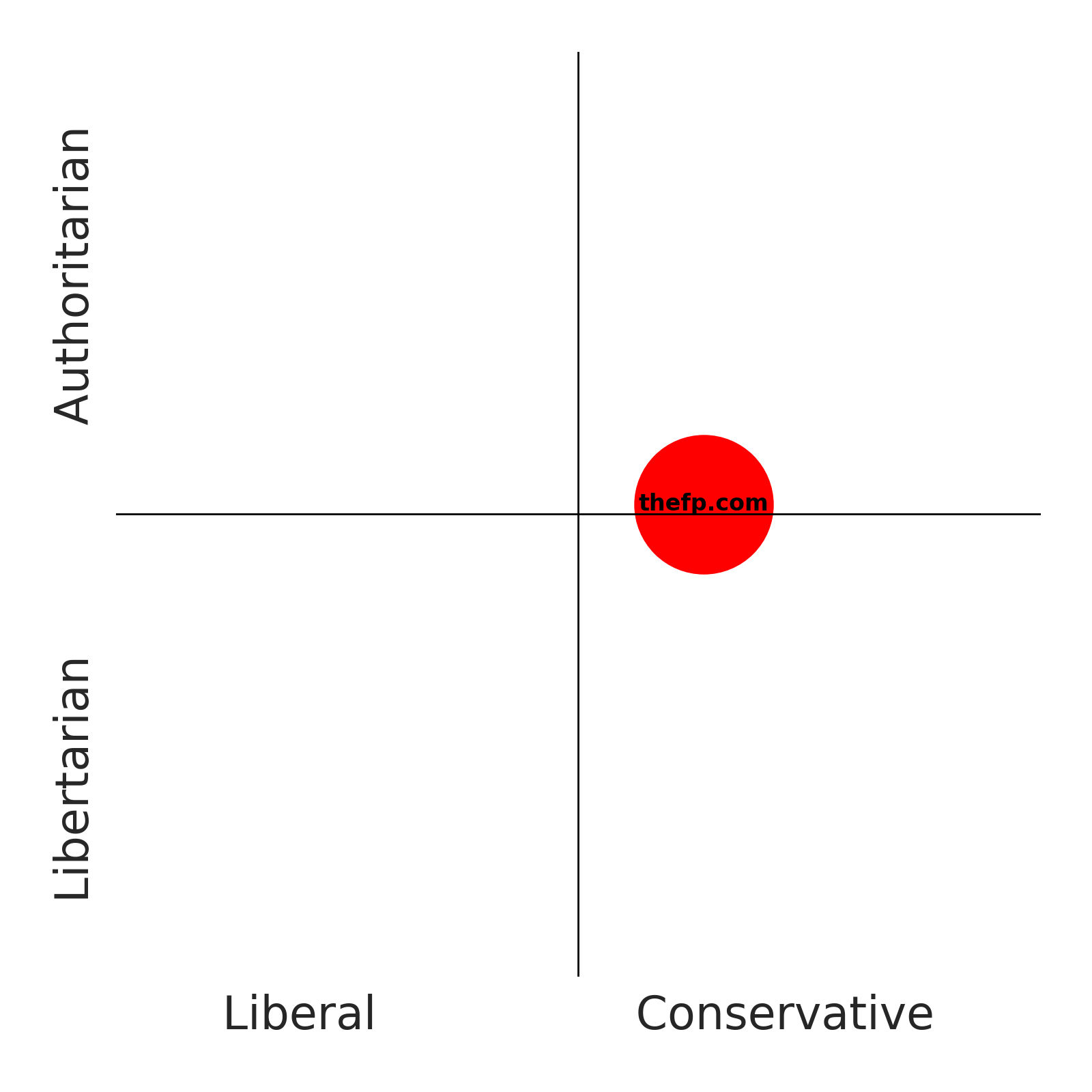
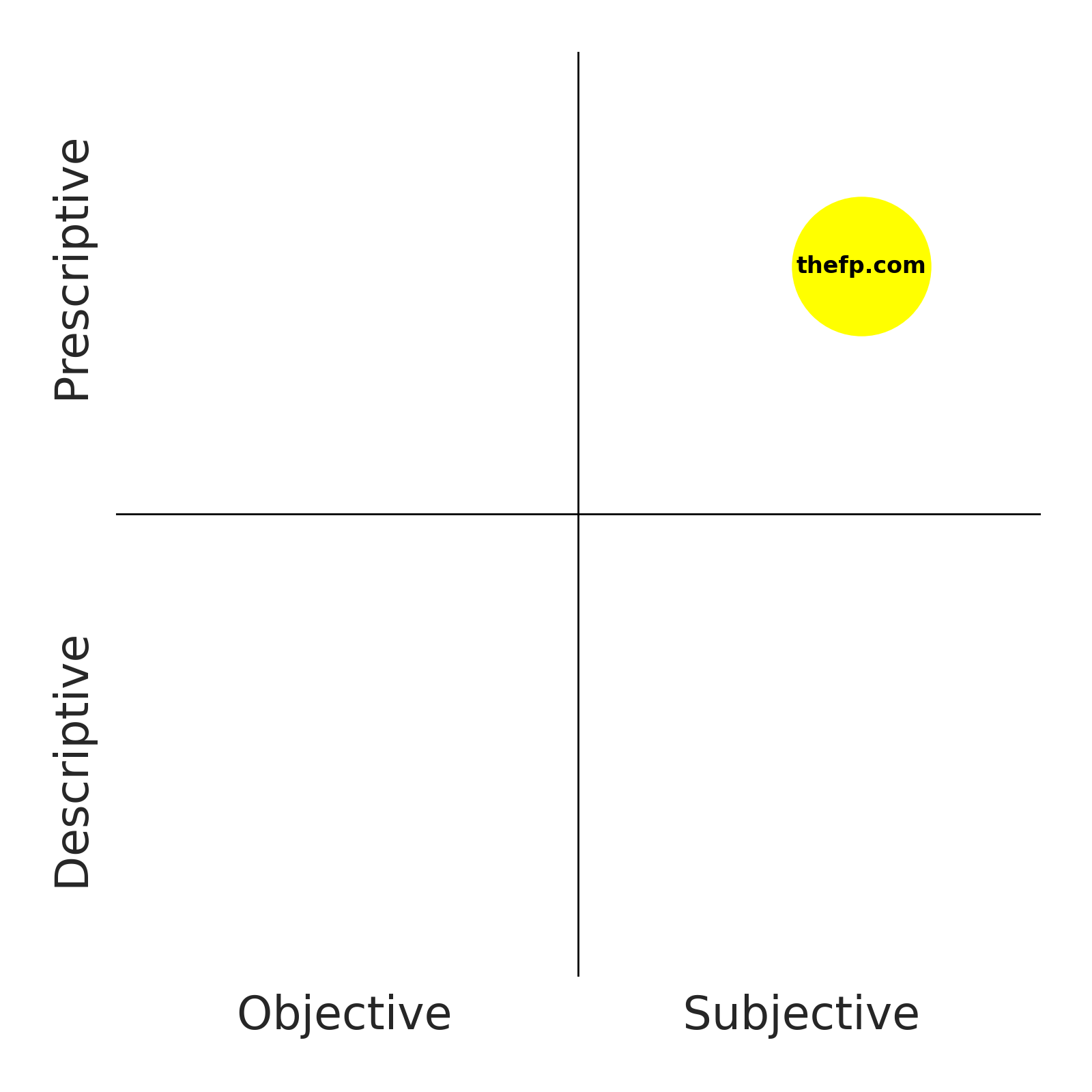
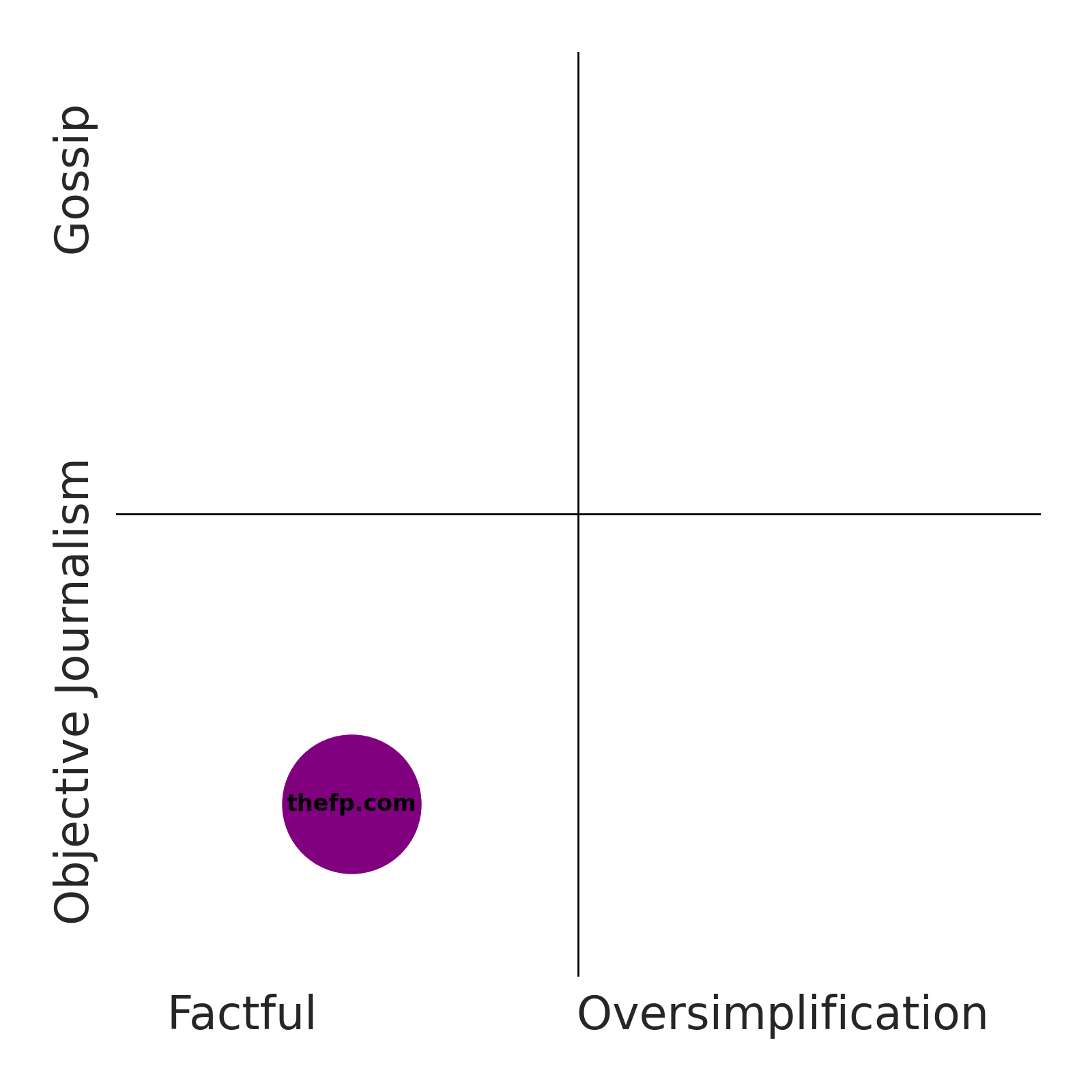
2026 © Helium Trades
Privacy Policy & Disclosure
* Disclaimer: Nothing on this website constitutes investment advice, performance data or any recommendation that any particular security, portfolio of securities, transaction or investment strategy is suitable for any specific person. Helium Trades is not responsible in any way for the accuracy
of any model predictions or price data. Any mention of a particular security and related prediction data is not a recommendation to buy or sell that security. Investments in securities involve the risk of loss. Past performance is no guarantee of future results. Helium Trades is not responsible for any of your investment decisions,
you should consult a financial expert before engaging in any transaction.
Helium Research Assistant

How can I help you today?
Ask any question about thefp.com bias.


