See whether Helium helps you make better-informed decisions. Try every Pro Trader feature for 30 days. No credit card required.
Try every Pro Trader feature for 30 days. No credit card required.
October 02, 2026 · 0 shares
The framing is that of an objective wire dispatch, staying close to official statements and attributing accusations rather than adjudicating them.
Automated analysis; not human reviewed.
Limitations: The supplied article text is a short excerpt that also includes unrelated headlines, so the analysis is limited to the core Ethiopia-Eritrea report.
·
3 of 55 available dimensions scored; omitted dimensions are not treated as neutral.
·
Verified supporting quotes for 1 of 3 scored dimensions.
Claim: The report stays in attributed news mode, with most contested actions attached to officials or institutions rather than to the publisher.
“Ethiopia announced it would close its embassy in Asmara “in response to Eritrea’s direct and indirect acts of hostility and belligerence against Ethiopia”.” · exact text match
“Ethiopia has accused Eritrea,Sudan and Egypt of supporting an opposition alliance led by the Tigray People’s Liberation Front (TPLF)” · not found in supplied text
Counterevidence:
“It was the biggest escalation in the country since the end of a 2020-2022 civil war.” · exact text match
Why: The publisher relays official statements and labels one side's claim as an accusation, indicating descriptive rather than subjective framing.
Claim: The article presents the rupture in low-key diplomatic language and does not use emotive or lurid description beyond the headline.
“In response, Eritrea said it had no option but to “reciprocate in kind and sever all diplomatic ties with Ethiopia with all the negative corollaries that this entails”.” · exact text match
“The AU commission urged all three member states to exercise maximum restraint and refrain from actions or statements that could further escalate tensions and undermine regional peace and stability.” · exact text match
Counterevidence:
“Ethiopia, Eritrea cut diplomatic ties as Tigray tension escalates.” · exact text match
Why: Even the tense diplomatic exchanges are rendered as direct quotes and official calls for restraint, rather than as dramatic narrative.
Claim: The article relies on named governments and institutions with direct quotations, giving it visible sourcing for most claims.
“In a statement late Thursday evening, the AU said it was closely following the heightened tensions between Ethiopia, Eritrea and Egypt with concern.” · exact text match
“Ethiopia has accused Eritrea,Sudan and Egypt of supporting an opposition alliance led by the Tigray People’s Liberation Front (TPLF)” · not found in supplied text
Counterevidence:
“It was the biggest escalation in the country since the end of a 2020-2022 civil war.” · exact text match
Why: Attribution is clear and most assertions are tied to official statements, but the piece lacks independent verification and one escalation claim is un-attributed.
The supplied article text is a short excerpt that also includes unrelated headlines, so the analysis is limited to the core Ethiopia-Eritrea report.
October 05, 2026 · 0 shares
The coverage is a balanced, attributed diplomatic-conflict news summary that uses hedged analytical framing ('appeared to push back,' 'seemingly in response to') rather than advocacy or sensationalism.
Automated analysis; not human reviewed.
Limitations: The supplied text appears to be a partial excerpt with an ad placeholder and no byline, and the caption date (October 4, 2026) is later than the stated current date, preventing external verification.
·
6 of 55 available dimensions scored; omitted dimensions are not treated as neutral.
·
Verified supporting quotes for 6 of 6 scored dimensions.
Claim: The report is predominantly factual and attributed, though it includes some interpretive framing.
“The joint declaration appeared to push back against several policies pursued by Ethiopia in recent years, highlighting widening rifts between Addis Ababa and its neighbours.” · exact text match
Why: Most sentences report statements and events with attribution, but 'appeared to push back' is an analytical inference, placing the text on the objective side rather than fully neutral.
Claim: The article avoids sensationalism and presents escalating conflict in measured, attributed terms.
“Government and allied forces retook the city of Mekelle on Sunday after the TPLF said it “temporarily moved out of” Tigray’s regional capital to “operate from somewhere else”.” · exact text match
Why: A pivotal battlefield development is stated with direct TPLF attribution and without dramatic embellishment.
Claim: The publisher describes leaders' positions and declarations without issuing its own policy prescription.
“The declaration backed Sudan’s military-led government and called for a political process led by Sudanese parties.” · exact text match
Why: The call for a political process is framed as the declaration's content, not as the publisher's recommendation.
Claim: The report names leaders and officials, gives dates and places, and attributes claims to specific sources.
“According to Ethiopian state media reports, former Tigray interim leader Abraham Belay said on Sunday that the federal government is preparing a new temporary administration for the region and hopes to hold regional elections within months.” · exact text match
Why: Specific attribution to state media and direct identification of the speaker support the text's observable credibility; external verification is not possible from the supplied text.
Claim: The report uses hedged speculation about the declaration's intent.
“seemingly in response to landlocked Ethiopia’s pursuit of sovereign access to the sea and a naval presence.” · exact text match
Why: 'Seemingly' explicitly marks an inference rather than an asserted fact, so the speculation is minor and transparent.
Claim: The article reports accusations and denials together and attributes secondary information to named or described sources.
“Ethiopia has accused Egypt, Eritrea and Sudan of backing the armed alliance fighting its government.
Officials from all three countries have denied involvement.”
· exact text match
Why: Including both the accusation and the denials is an observable fairness signal, and the report names leaders and media sources elsewhere.
The supplied text appears to be a partial excerpt with an ad placeholder and no byline, and the caption date (October 4, 2026) is later than the stated current date, preventing external verification.
October 02, 2026 · 0 shares
Framed around the African Union's diplomatic appeal and expert warnings of broader instability, the story relays Ethiopia's accusation and the three countries' denials without independent verification.
Tigray is Ethiopia's northernmost region.
The 2020–2022 war pitted Ethiopia's federal government, allied with Eritrean forces, against Tigrayan regional forces; a November 2022 AU-mediated ceasefire ended major hostilities, but the region's political status remained contested.
Automated analysis; not human reviewed.
Limitations: The supplied article is an undated, byline-less brief that appears to be a truncated wire report; the unexplained 'Iran war' reference and an abrupt coastline clause limit confidence in framing judgments.
·
9 of 55 available dimensions scored; omitted dimensions are not treated as neutral.
·
Verified supporting quotes for 7 of 9 scored dimensions.
Claim: The report is predominantly objective, presenting attributed statements and denials rather than subjective evaluation.
“The three countries deny the accusation.” · exact text match
Why: The publisher relays Ethiopia's accusation and immediately includes the denial, using neutral, sourced language.
Claim: The report is mostly factual but uses dramatic risk language about wider conflict and Red Sea shipping.
“Experts fear renewed fighting could quickly spill into a wider conflict across the Horn of Africa, potentially further destabilizing shipping in the Red Sea” · exact text match
Why: The warning is attributed to experts, but the wording ('quickly spill', 'destabilizing') adds a sensational undertone to an otherwise plain dispatch.
Claim: The publisher's prose is descriptive, with the only explicit prescription coming from a quoted AU statement.
“The latest clashes mark the biggest outbreak of violence since the 2020-2022 conflict in the northern region that led to hundreds of thousands of deaths.” · exact text match
Why: The publisher reports events and context; the AU's prescriptive formulation is attributed, not the publisher's own.
Claim: The framing leans dovish by foregrounding the African Union's call for restraint and peaceful dialogue.
“The African Union urged Ethiopia and its neighbors to exercise restraint” · exact text match
“address their differences through established diplomatic channels and peaceful dialogue.” · not found in supplied text
Why: The lede and the quoted AU statement emphasize diplomatic de-escalation, with no comparable military or hawkish framing.
Claim: The article subtly evokes concern through words like 'threaten,' 'fear,' and 'destabilize' without full fear-mongering.
“growing tensions threaten to destabilize the region” · exact text match
“Experts fear renewed fighting could quickly spill into a wider conflict” · exact text match
Why: The risk language is hedged and attributed, suggesting mild alarm rather than deliberate rage-baiting.
Claim: The article is factful rather than opinionated, with its only prescriptive sentence attributed to the AU.
“The three countries deny the accusation.” · exact text match
Why: The text reports statements and events; no publisher-voiced opinion or advocacy appears.
Claim: The report is credible on its face because it attributes claims, quotes the AU statement, and includes the three countries' denial.
“The three countries deny the accusation.” · exact text match
“The AU Commission on Thursday called on the countries to “address their differences through established diplomatic channels and peaceful dialogue.”” · not found in supplied text
Why: Sourcing is explicit and contested claims are balanced, though no independent verification or correction history is present.
Claim: The article includes attributed speculation about the possible spread of fighting and Red Sea shipping effects.
“Experts fear renewed fighting could quickly spill into a wider conflict across the Horn of Africa, potentially further destabilizing shipping in the Red Sea” · exact text match
Why: The predictive outcome is explicitly attributed to experts and marked by hedging ('could'), so it is speculative but not asserted as fact.
Claim: The report shows internal fairness by reporting the denial alongside the accusation and using attribution for contested claims.
“The three countries deny the accusation.” · exact text match
Why: Including the denial and attributing the accusation to Addis Ababa are observable evenhandedness signals.
The supplied article is an undated, byline-less brief that appears to be a truncated wire report; the unexplained 'Iran war' reference and an abrupt coastline clause limit confidence in framing judgments.
October 02, 2026 · 0 shares
The framing is that of an objective wire dispatch, staying close to official statements and attributing accusations rather than adjudicating them.
Automated analysis; not human reviewed.
Limitations: The supplied article text is a short excerpt that also includes unrelated headlines, so the analysis is limited to the core Ethiopia-Eritrea report.
·
3 of 55 available dimensions scored; omitted dimensions are not treated as neutral.
·
Verified supporting quotes for 1 of 3 scored dimensions.
Claim: The report stays in attributed news mode, with most contested actions attached to officials or institutions rather than to the publisher.
“Ethiopia announced it would close its embassy in Asmara “in response to Eritrea’s direct and indirect acts of hostility and belligerence against Ethiopia”.” · exact text match
“Ethiopia has accused Eritrea,Sudan and Egypt of supporting an opposition alliance led by the Tigray People’s Liberation Front (TPLF)” · not found in supplied text
Counterevidence:
“It was the biggest escalation in the country since the end of a 2020-2022 civil war.” · exact text match
Why: The publisher relays official statements and labels one side's claim as an accusation, indicating descriptive rather than subjective framing.
Claim: The article presents the rupture in low-key diplomatic language and does not use emotive or lurid description beyond the headline.
“In response, Eritrea said it had no option but to “reciprocate in kind and sever all diplomatic ties with Ethiopia with all the negative corollaries that this entails”.” · exact text match
“The AU commission urged all three member states to exercise maximum restraint and refrain from actions or statements that could further escalate tensions and undermine regional peace and stability.” · exact text match
Counterevidence:
“Ethiopia, Eritrea cut diplomatic ties as Tigray tension escalates.” · exact text match
Why: Even the tense diplomatic exchanges are rendered as direct quotes and official calls for restraint, rather than as dramatic narrative.
Claim: The article relies on named governments and institutions with direct quotations, giving it visible sourcing for most claims.
“In a statement late Thursday evening, the AU said it was closely following the heightened tensions between Ethiopia, Eritrea and Egypt with concern.” · exact text match
“Ethiopia has accused Eritrea,Sudan and Egypt of supporting an opposition alliance led by the Tigray People’s Liberation Front (TPLF)” · not found in supplied text
Counterevidence:
“It was the biggest escalation in the country since the end of a 2020-2022 civil war.” · exact text match
Why: Attribution is clear and most assertions are tied to official statements, but the piece lacks independent verification and one escalation claim is un-attributed.
The supplied article text is a short excerpt that also includes unrelated headlines, so the analysis is limited to the core Ethiopia-Eritrea report.
A wire-style dispatch relays the joint declaration with neutral attribution, while adopting the leaders' 'so-called Somaliland' framing and foregrounding Egyptian coordination efforts.
Somaliland is a breakaway territory of Somalia that declared independence in 1991 and is not internationally recognized; Egypt and Sudan are downstream Nile riparian states with longstanding disputes with upstream Ethiopia over Nile water use.
Automated analysis; not human reviewed.
Limitations: The appended headline links after the substantive report were treated as unrelated page content, and the exact publication outlet and date were not specified beyond 'Sunday'.
·
3 of 55 available dimensions scored; omitted dimensions are not treated as neutral.
·
Verified supporting quotes for 2 of 3 scored dimensions.
Claim: The report is predominantly objective wire coverage, with one mild editorializing phrase.
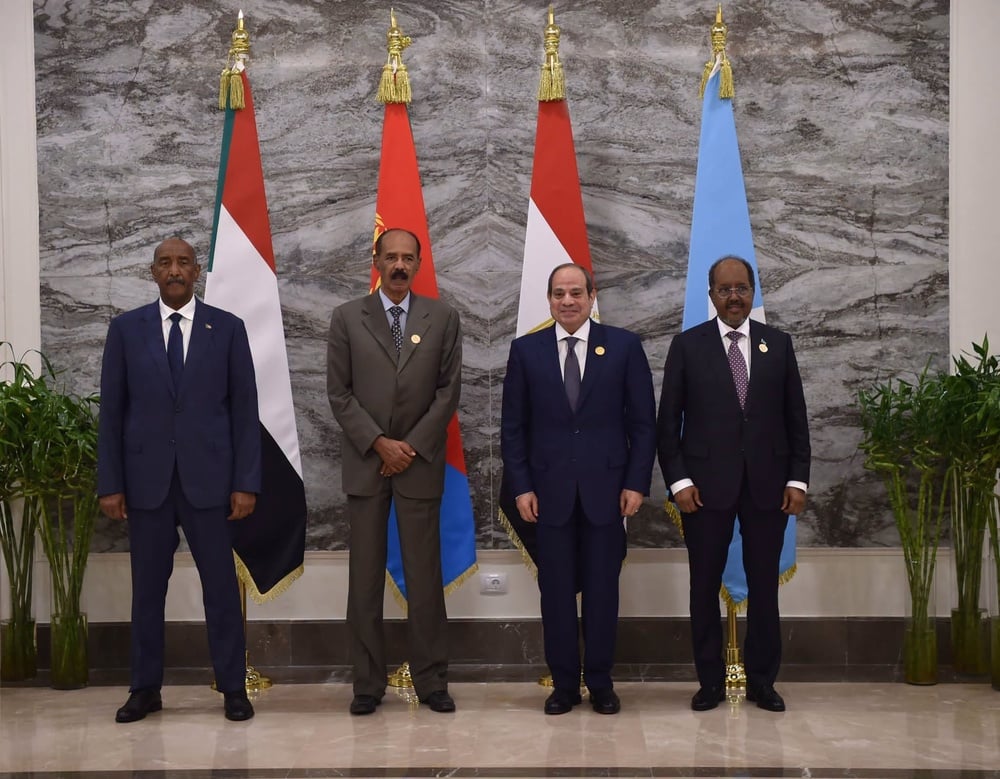
“The summit was attended by Egyptian President Abdel Fattah El-Sisi, Eritrean President Isaias Afwerki, Somali President Hassan Sheikh Mohamud, and Abdel Fattah Al-Burhan, chairman of Sudan's Transitional Sovereign Council, reports Xinhua news agency.” · exact text match
Counterevidence:
“They reject any recognition of or support for the so-called 'Somaliland' and affirm that the governance of the Red Sea is the exclusive responsibility of the littoral states.” · not found in supplied text
Why: The article mostly lists attributed facts and quotes, but the unmarked 'so-called' before Somaliland injects a subjective judgment into otherwise neutral reporting.
Claim: The report avoids sensational or emotional language and sticks to declarative wire-style narration.
“In the El Alamein Joint Declaration issued following the quadrilateral consultative summit in Egypt's New Alamein on Sunday (local time), the leaders rejected interference in the internal affairs of the region's states 'under any pretext.'” · not found in supplied text
Why: The wording is formal and descriptive, with no dramatic adjectives, fear appeals, or hyperbole.
Claim: The report demonstrates high visible sourcing and attribution.
“The summit was attended by Egyptian President Abdel Fattah El-Sisi, Eritrean President Isaias Afwerki, Somali President Hassan Sheikh Mohamud, and Abdel Fattah Al-Burhan, chairman of Sudan's Transitional Sovereign Council, reports Xinhua news agency.” · exact text match
Why: It names specific leaders, attributes the account to Xinhua, and presents declarations as reported positions rather than as the outlet's own assertions.
The appended headline links after the substantive report were treated as unrelated page content, and the exact publication outlet and date were not specified beyond 'Sunday'.
October 05, 2026 · 0 shares
The coverage is a balanced, attributed diplomatic-conflict news summary that uses hedged analytical framing ('appeared to push back,' 'seemingly in response to') rather than advocacy or sensationalism.
Automated analysis; not human reviewed.
Limitations: The supplied text appears to be a partial excerpt with an ad placeholder and no byline, and the caption date (October 4, 2026) is later than the stated current date, preventing external verification.
·
6 of 55 available dimensions scored; omitted dimensions are not treated as neutral.
·
Verified supporting quotes for 6 of 6 scored dimensions.
Claim: The report is predominantly factual and attributed, though it includes some interpretive framing.
“The joint declaration appeared to push back against several policies pursued by Ethiopia in recent years, highlighting widening rifts between Addis Ababa and its neighbours.” · exact text match
Why: Most sentences report statements and events with attribution, but 'appeared to push back' is an analytical inference, placing the text on the objective side rather than fully neutral.
Claim: The article avoids sensationalism and presents escalating conflict in measured, attributed terms.
“Government and allied forces retook the city of Mekelle on Sunday after the TPLF said it “temporarily moved out of” Tigray’s regional capital to “operate from somewhere else”.” · exact text match
Why: A pivotal battlefield development is stated with direct TPLF attribution and without dramatic embellishment.
Claim: The publisher describes leaders' positions and declarations without issuing its own policy prescription.
“The declaration backed Sudan’s military-led government and called for a political process led by Sudanese parties.” · exact text match
Why: The call for a political process is framed as the declaration's content, not as the publisher's recommendation.
Claim: The report names leaders and officials, gives dates and places, and attributes claims to specific sources.
“According to Ethiopian state media reports, former Tigray interim leader Abraham Belay said on Sunday that the federal government is preparing a new temporary administration for the region and hopes to hold regional elections within months.” · exact text match
Why: Specific attribution to state media and direct identification of the speaker support the text's observable credibility; external verification is not possible from the supplied text.
Claim: The report uses hedged speculation about the declaration's intent.
“seemingly in response to landlocked Ethiopia’s pursuit of sovereign access to the sea and a naval presence.” · exact text match
Why: 'Seemingly' explicitly marks an inference rather than an asserted fact, so the speculation is minor and transparent.
Claim: The article reports accusations and denials together and attributes secondary information to named or described sources.
“Ethiopia has accused Egypt, Eritrea and Sudan of backing the armed alliance fighting its government.
Officials from all three countries have denied involvement.”
· exact text match
Why: Including both the accusation and the denials is an observable fairness signal, and the report names leaders and media sources elsewhere.
The supplied text appears to be a partial excerpt with an ad placeholder and no byline, and the caption date (October 4, 2026) is later than the stated current date, preventing external verification.
October 04, 2026 · 0 shares
Framing presents the El-Alamein summit as a consensus-driven regional-security initiative, relying on the official joint declaration and stressing state sovereignty, international law, and coordination.
The summit occurred amid regional tensions including the dispute over Ethiopia's port agreement with Somaliland and Egypt's long-running dispute over the Grand Ethiopian Renaissance Dam, neither of which is detailed in the article.
Automated analysis; not human reviewed.
Limitations: The supplied text mixes the main summit report with unrelated headlines and page elements; I analyzed the summit report and treated the surrounding list as non-substantive.
·
5 of 55 available dimensions scored; omitted dimensions are not treated as neutral.
·
Verified supporting quotes for 5 of 5 scored dimensions.
Claim: The report is wholly attributed and non-evaluative.
“according to a joint declaration issued after a summit in Egypt.” · exact text match
Why: Every substantive position is attributed to the declaration or the leaders, with no un-attributed opinion or subjective language.
Claim: The report avoids emotional or dramatic language.
“The summit comes as conflicts and political tensions continue to reshape the Horn of Africa and the Red Sea region, with the Sudan war and instability in Somalia among the main regional security concerns.” · exact text match
Why: The only contextualizing sentence is geopolitical and unemotional; no dramatic adjectives or exaggerations are used.
Claim: The report describes what leaders said and called for rather than prescribing policy itself.
“On the Nile, the leaders stressed the need to respect international law and the principle of avoiding significant harm to other states.” · exact text match
Why: The article attributes the prescriptive language to the leaders and the declaration rather than adopting it as the publisher's own position.
Claim: The article contains no first-person stance or evaluative adjectives.
“according to a joint declaration issued after a summit in Egypt.” · exact text match
Why: All positions are attributed, and the article maintains a neutral third-person reporting voice.
Claim: The report identifies officials, places, and an attributed declaration, enabling verification.
“Egyptian President Abdel Fattah al-Sisi, Eritrean President Isaias Afwerki, Somali President Hassan Sheikh Mohamud and Sudan’s army chief and Sovereignty Council Chairman Abdel Fattah al-Burhan met in the city of El-Alamein on Sunday.” · exact text match
“according to a joint declaration issued after a summit in Egypt.” · exact text match
Why: The article names all leaders, specifies the location, and explicitly attributes the content to a written joint declaration.
The supplied text mixes the main summit report with unrelated headlines and page elements; I analyzed the summit report and treated the surrounding list as non-substantive.
October 05, 2026 · 0 shares
Framing casts the Alamein summit as a strategic realignment against Ethiopia and Somaliland recognition, while using hedged and attributed language rather than asserting the alliance outright.
Automated analysis; not human reviewed.
Limitations: The supplied text has no publication name, byline, or external links, so the analysis is confined to the text's internal framing and cannot account for the publisher's broader editorial record.
·
55 of 55 available dimensions scored; omitted dimensions are not treated as neutral.
·
Verified supporting quotes for 8 of 55 scored dimensions.
Claim: The article is predominantly factual and uses attributed statements and context rather than subjective editorialising.
“A joint statement issued late on Sunday made no mention of Ethiopia, which accuses three of the four nations – Egypt, Sudan and Eritrea – of aiding an anti-government rebellion.” · exact text match
“The three nations deny the charge.” · exact text match
Why: Positions and disputes are reported through named actors and direct quotations, not the writer's opinion.
Claim: The article avoids sensational language, instead using cautious descriptors like 'loose' and 'appeared to signal.'
“But the statement appeared to signal the creation of a four-nation alliance, albeit a loose one, whose actions could alter the geopolitics of a strategic area with a porous Red Sea coastline and ample natural resources.” · exact text match
Why: Even the potentially dramatic realignment is qualified with hedging and measured vocabulary.
Claim: The article describes the summit, statement, and disputes without telling readers what should be done.
“The leaders of Egypt, Eritrea, Sudan and Somalia have signalled the emergence of their countries as an alliance to influence the geopolitical landscape of the Horn of Africa and ensure its security.” · exact text match
Why: The text is written in declarative, descriptive mode and contains no recommendations or policy prescriptions.
Claim: The publisher's voice is factual, with the only opinion appearing as an attributed analyst quotation.
“Commenting on the internal strife in Ethiopia, prominent Egyptian analyst Abdalla Senawy said that while Cairo insisted it played no part in the conflict, it had benefited from the 'weakening' of Prime Minister Abiy Ahmed's government.” · not found in supplied text
Why: The analyst's view is clearly labelled as commentary and attributed, so the article itself remains non-opinionated.
Claim: The article is heavily political, covering state alliances, diplomacy, military deployments, and contested sovereignty.
“The leaders of Egypt, Eritrea, Sudan and Somalia have signalled the emergence of their countries as an alliance to influence the geopolitical landscape of the Horn of Africa and ensure its security.” · exact text match
Why: Subject matter is intergovernmental and geopolitical, with no non-political angle, making the piece strongly political in content.
Claim: The article presents complexity and nuance rather than reducing the situation to a simple narrative.
“Egypt is in dispute with Ethiopia over the former's share of Nile water, while Sudan and Ethiopia are torn by civil wars.” · exact text match
“But the statement appeared to signal the creation of a four-nation alliance, albeit a loose one, whose actions could alter the geopolitics of a strategic area with a porous Red Sea coastline and ample natural resources.” · exact text match
Why: Multiple overlapping disputes and hedging show the report avoids oversimplified causality.
Claim: The article avoids overclaiming by explicitly hedging uncertain interpretation.
“But the statement appeared to signal the creation of a four-nation alliance, albeit a loose one.” · not found in supplied text
“Egypt's military also has naval and army sites in Eritrea and is reportedly backing the SAF against the RSF.” · exact text match
Why: Words like 'appeared,' 'albeit,' and 'reportedly' signal uncertainty consistent with the evidence presented.
Claim: The tone is neutral and unemotional, even when discussing severe conflicts.
“Their meeting, the first of its kind, came as the four countries grapple with formidable challenges.” · exact text match
Why: The vocabulary is calm and analytic; severe disputes are described without inflammatory language.
Claim: The report is internally credible because it names participants, quotes the joint statement, attributes assertions, and uses hedged language for unverified details.
“A joint statement issued late on Sunday made no mention of Ethiopia, which accuses three of the four nations – Egypt, Sudan and Eritrea – of aiding an anti-government rebellion.” · exact text match
“Egypt has an estimated 15,000-strong military contingent in Somalia serving in an African Union peacekeeping force as well as a large mission supporting the Mogadishu government and its military.” · not found in supplied text
Why: Specificity, attribution, and explicit uncertainty markers support a visible practice of credible reporting.
Claim: Reporting is reasoned and explanatory, attributing positions and contextualising causes rather than using emotional or conspiratorial framing.
“Their meeting, the first of its kind, came as the four countries grapple with formidable challenges.” · exact text match
“But the statement appeared to signal the creation of a four-nation alliance, albeit a loose one, whose actions could alter the geopolitics of a strategic area with a porous Red Sea coastline and ample natural resources.” · exact text match
Why: The article links events to causes and uses hedged inference, indicating rational, evidence-based exposition.
Claim: The article shows high internal integrity by attributing claims, quoting the joint statement, and flagging uncertainty with words such as 'reportedly' and 'estimated.'
“It has an estimated 15,000-strong military contingent in Somalia serving in an African Union peacekeeping force as well as a large mission supporting the Mogadishu government and its military.” · exact text match
“Egypt's military also has naval and army sites in Eritrea and is reportedly backing the SAF against the RSF.” · exact text match
Why: Uncertain or contested facts are explicitly hedged and sourced where possible, reflecting fairness signals rather than assertion.
The supplied text has no publication name, byline, or external links, so the analysis is confined to the text's internal framing and cannot account for the publisher's broader editorial record.
October 05, 2026 · 0 shares
The coverage is a balanced, attributed diplomatic-conflict news summary that uses hedged analytical framing ('appeared to push back,' 'seemingly in response to') rather than advocacy or sensationalism.
Automated analysis; not human reviewed.
Limitations: The supplied text appears to be a partial excerpt with an ad placeholder and no byline, and the caption date (October 4, 2026) is later than the stated current date, preventing external verification.
·
6 of 55 available dimensions scored; omitted dimensions are not treated as neutral.
·
Verified supporting quotes for 6 of 6 scored dimensions.
Claim: The report is predominantly factual and attributed, though it includes some interpretive framing.
“The joint declaration appeared to push back against several policies pursued by Ethiopia in recent years, highlighting widening rifts between Addis Ababa and its neighbours.” · exact text match
Why: Most sentences report statements and events with attribution, but 'appeared to push back' is an analytical inference, placing the text on the objective side rather than fully neutral.
Claim: The article avoids sensationalism and presents escalating conflict in measured, attributed terms.
“Government and allied forces retook the city of Mekelle on Sunday after the TPLF said it “temporarily moved out of” Tigray’s regional capital to “operate from somewhere else”.” · exact text match
Why: A pivotal battlefield development is stated with direct TPLF attribution and without dramatic embellishment.
Claim: The publisher describes leaders' positions and declarations without issuing its own policy prescription.
“The declaration backed Sudan’s military-led government and called for a political process led by Sudanese parties.” · exact text match
Why: The call for a political process is framed as the declaration's content, not as the publisher's recommendation.
Claim: The report names leaders and officials, gives dates and places, and attributes claims to specific sources.
“According to Ethiopian state media reports, former Tigray interim leader Abraham Belay said on Sunday that the federal government is preparing a new temporary administration for the region and hopes to hold regional elections within months.” · exact text match
Why: Specific attribution to state media and direct identification of the speaker support the text's observable credibility; external verification is not possible from the supplied text.
Claim: The report uses hedged speculation about the declaration's intent.
“seemingly in response to landlocked Ethiopia’s pursuit of sovereign access to the sea and a naval presence.” · exact text match
Why: 'Seemingly' explicitly marks an inference rather than an asserted fact, so the speculation is minor and transparent.
Claim: The article reports accusations and denials together and attributes secondary information to named or described sources.
“Ethiopia has accused Egypt, Eritrea and Sudan of backing the armed alliance fighting its government.
Officials from all three countries have denied involvement.”
· exact text match
Why: Including both the accusation and the denials is an observable fairness signal, and the report names leaders and media sources elsewhere.
The supplied text appears to be a partial excerpt with an ad placeholder and no byline, and the caption date (October 4, 2026) is later than the stated current date, preventing external verification.
October 02, 2026 · 0 shares
Framed around the African Union's diplomatic appeal and expert warnings of broader instability, the story relays Ethiopia's accusation and the three countries' denials without independent verification.
Tigray is Ethiopia's northernmost region.
The 2020–2022 war pitted Ethiopia's federal government, allied with Eritrean forces, against Tigrayan regional forces; a November 2022 AU-mediated ceasefire ended major hostilities, but the region's political status remained contested.
Automated analysis; not human reviewed.
Limitations: The supplied article is an undated, byline-less brief that appears to be a truncated wire report; the unexplained 'Iran war' reference and an abrupt coastline clause limit confidence in framing judgments.
·
9 of 55 available dimensions scored; omitted dimensions are not treated as neutral.
·
Verified supporting quotes for 7 of 9 scored dimensions.
Claim: The report is predominantly objective, presenting attributed statements and denials rather than subjective evaluation.
“The three countries deny the accusation.” · exact text match
Why: The publisher relays Ethiopia's accusation and immediately includes the denial, using neutral, sourced language.
Claim: The report is mostly factual but uses dramatic risk language about wider conflict and Red Sea shipping.
“Experts fear renewed fighting could quickly spill into a wider conflict across the Horn of Africa, potentially further destabilizing shipping in the Red Sea” · exact text match
Why: The warning is attributed to experts, but the wording ('quickly spill', 'destabilizing') adds a sensational undertone to an otherwise plain dispatch.
Claim: The publisher's prose is descriptive, with the only explicit prescription coming from a quoted AU statement.
“The latest clashes mark the biggest outbreak of violence since the 2020-2022 conflict in the northern region that led to hundreds of thousands of deaths.” · exact text match
Why: The publisher reports events and context; the AU's prescriptive formulation is attributed, not the publisher's own.
Claim: The framing leans dovish by foregrounding the African Union's call for restraint and peaceful dialogue.
“The African Union urged Ethiopia and its neighbors to exercise restraint” · exact text match
“address their differences through established diplomatic channels and peaceful dialogue.” · not found in supplied text
Why: The lede and the quoted AU statement emphasize diplomatic de-escalation, with no comparable military or hawkish framing.
Claim: The article subtly evokes concern through words like 'threaten,' 'fear,' and 'destabilize' without full fear-mongering.
“growing tensions threaten to destabilize the region” · exact text match
“Experts fear renewed fighting could quickly spill into a wider conflict” · exact text match
Why: The risk language is hedged and attributed, suggesting mild alarm rather than deliberate rage-baiting.
Claim: The article is factful rather than opinionated, with its only prescriptive sentence attributed to the AU.
“The three countries deny the accusation.” · exact text match
Why: The text reports statements and events; no publisher-voiced opinion or advocacy appears.
Claim: The report is credible on its face because it attributes claims, quotes the AU statement, and includes the three countries' denial.
“The three countries deny the accusation.” · exact text match
“The AU Commission on Thursday called on the countries to “address their differences through established diplomatic channels and peaceful dialogue.”” · not found in supplied text
Why: Sourcing is explicit and contested claims are balanced, though no independent verification or correction history is present.
Claim: The article includes attributed speculation about the possible spread of fighting and Red Sea shipping effects.
“Experts fear renewed fighting could quickly spill into a wider conflict across the Horn of Africa, potentially further destabilizing shipping in the Red Sea” · exact text match
Why: The predictive outcome is explicitly attributed to experts and marked by hedging ('could'), so it is speculative but not asserted as fact.
Claim: The report shows internal fairness by reporting the denial alongside the accusation and using attribution for contested claims.
“The three countries deny the accusation.” · exact text match
Why: Including the denial and attributing the accusation to Addis Ababa are observable evenhandedness signals.
The supplied article is an undated, byline-less brief that appears to be a truncated wire report; the unexplained 'Iran war' reference and an abrupt coastline clause limit confidence in framing judgments.
October 02, 2026 · 0 shares
The framing is that of an objective wire dispatch, staying close to official statements and attributing accusations rather than adjudicating them.
Automated analysis; not human reviewed.
Limitations: The supplied article text is a short excerpt that also includes unrelated headlines, so the analysis is limited to the core Ethiopia-Eritrea report.
·
3 of 55 available dimensions scored; omitted dimensions are not treated as neutral.
·
Verified supporting quotes for 1 of 3 scored dimensions.
Claim: The report stays in attributed news mode, with most contested actions attached to officials or institutions rather than to the publisher.
“Ethiopia announced it would close its embassy in Asmara “in response to Eritrea’s direct and indirect acts of hostility and belligerence against Ethiopia”.” · exact text match
“Ethiopia has accused Eritrea,Sudan and Egypt of supporting an opposition alliance led by the Tigray People’s Liberation Front (TPLF)” · not found in supplied text
Counterevidence:
“It was the biggest escalation in the country since the end of a 2020-2022 civil war.” · exact text match
Why: The publisher relays official statements and labels one side's claim as an accusation, indicating descriptive rather than subjective framing.
Claim: The article presents the rupture in low-key diplomatic language and does not use emotive or lurid description beyond the headline.
“In response, Eritrea said it had no option but to “reciprocate in kind and sever all diplomatic ties with Ethiopia with all the negative corollaries that this entails”.” · exact text match
“The AU commission urged all three member states to exercise maximum restraint and refrain from actions or statements that could further escalate tensions and undermine regional peace and stability.” · exact text match
Counterevidence:
“Ethiopia, Eritrea cut diplomatic ties as Tigray tension escalates.” · exact text match
Why: Even the tense diplomatic exchanges are rendered as direct quotes and official calls for restraint, rather than as dramatic narrative.
Claim: The article relies on named governments and institutions with direct quotations, giving it visible sourcing for most claims.
“In a statement late Thursday evening, the AU said it was closely following the heightened tensions between Ethiopia, Eritrea and Egypt with concern.” · exact text match
“Ethiopia has accused Eritrea,Sudan and Egypt of supporting an opposition alliance led by the Tigray People’s Liberation Front (TPLF)” · not found in supplied text
Counterevidence:
“It was the biggest escalation in the country since the end of a 2020-2022 civil war.” · exact text match
Why: Attribution is clear and most assertions are tied to official statements, but the piece lacks independent verification and one escalation claim is un-attributed.
The supplied article text is a short excerpt that also includes unrelated headlines, so the analysis is limited to the core Ethiopia-Eritrea report.
October 02, 2026 · 0 shares
The framing is that of an objective wire dispatch, staying close to official statements and attributing accusations rather than adjudicating them.
Automated analysis; not human reviewed. Limitations: The supplied article text is a short excerpt that also includes unrelated headlines, so the analysis is limited to the core Ethiopia-Eritrea report. · 3 of 55 available dimensions scored; omitted dimensions are not treated as neutral. · Verified supporting quotes for 1 of 3 scored dimensions.
Claim: The report stays in attributed news mode, with most contested actions attached to officials or institutions rather than to the publisher.
“Ethiopia announced it would close its embassy in Asmara “in response to Eritrea’s direct and indirect acts of hostility and belligerence against Ethiopia”.” · exact text match
“Ethiopia has accused Eritrea,Sudan and Egypt of supporting an opposition alliance led by the Tigray People’s Liberation Front (TPLF)” · not found in supplied text
Counterevidence:
“It was the biggest escalation in the country since the end of a 2020-2022 civil war.” · exact text match
Why: The publisher relays official statements and labels one side's claim as an accusation, indicating descriptive rather than subjective framing.
Claim: The article presents the rupture in low-key diplomatic language and does not use emotive or lurid description beyond the headline.
“In response, Eritrea said it had no option but to “reciprocate in kind and sever all diplomatic ties with Ethiopia with all the negative corollaries that this entails”.” · exact text match
“The AU commission urged all three member states to exercise maximum restraint and refrain from actions or statements that could further escalate tensions and undermine regional peace and stability.” · exact text match
Counterevidence:
“Ethiopia, Eritrea cut diplomatic ties as Tigray tension escalates.” · exact text match
Why: Even the tense diplomatic exchanges are rendered as direct quotes and official calls for restraint, rather than as dramatic narrative.
Claim: The article relies on named governments and institutions with direct quotations, giving it visible sourcing for most claims.
“In a statement late Thursday evening, the AU said it was closely following the heightened tensions between Ethiopia, Eritrea and Egypt with concern.” · exact text match
“Ethiopia has accused Eritrea,Sudan and Egypt of supporting an opposition alliance led by the Tigray People’s Liberation Front (TPLF)” · not found in supplied text
Counterevidence:
“It was the biggest escalation in the country since the end of a 2020-2022 civil war.” · exact text match
Why: Attribution is clear and most assertions are tied to official statements, but the piece lacks independent verification and one escalation claim is un-attributed.
The supplied article text is a short excerpt that also includes unrelated headlines, so the analysis is limited to the core Ethiopia-Eritrea report.
October 02, 2026 · 0 shares
Framed around the African Union's diplomatic appeal and expert warnings of broader instability, the story relays Ethiopia's accusation and the three countries' denials without independent verification.
Tigray is Ethiopia's northernmost region. The 2020–2022 war pitted Ethiopia's federal government, allied with Eritrean forces, against Tigrayan regional forces; a November 2022 AU-mediated ceasefire ended major hostilities, but the region's political status remained contested.
Automated analysis; not human reviewed. Limitations: The supplied article is an undated, byline-less brief that appears to be a truncated wire report; the unexplained 'Iran war' reference and an abrupt coastline clause limit confidence in framing judgments. · 9 of 55 available dimensions scored; omitted dimensions are not treated as neutral. · Verified supporting quotes for 7 of 9 scored dimensions.
Claim: The report is predominantly objective, presenting attributed statements and denials rather than subjective evaluation.
“The three countries deny the accusation.” · exact text match
Why: The publisher relays Ethiopia's accusation and immediately includes the denial, using neutral, sourced language.
Claim: The report is mostly factual but uses dramatic risk language about wider conflict and Red Sea shipping.
“Experts fear renewed fighting could quickly spill into a wider conflict across the Horn of Africa, potentially further destabilizing shipping in the Red Sea” · exact text match
Why: The warning is attributed to experts, but the wording ('quickly spill', 'destabilizing') adds a sensational undertone to an otherwise plain dispatch.
Claim: The publisher's prose is descriptive, with the only explicit prescription coming from a quoted AU statement.
“The latest clashes mark the biggest outbreak of violence since the 2020-2022 conflict in the northern region that led to hundreds of thousands of deaths.” · exact text match
Why: The publisher reports events and context; the AU's prescriptive formulation is attributed, not the publisher's own.
Claim: The framing leans dovish by foregrounding the African Union's call for restraint and peaceful dialogue.
“The African Union urged Ethiopia and its neighbors to exercise restraint” · exact text match
“address their differences through established diplomatic channels and peaceful dialogue.” · not found in supplied text
Why: The lede and the quoted AU statement emphasize diplomatic de-escalation, with no comparable military or hawkish framing.
Claim: The article subtly evokes concern through words like 'threaten,' 'fear,' and 'destabilize' without full fear-mongering.
“growing tensions threaten to destabilize the region” · exact text match
“Experts fear renewed fighting could quickly spill into a wider conflict” · exact text match
Why: The risk language is hedged and attributed, suggesting mild alarm rather than deliberate rage-baiting.
Claim: The article is factful rather than opinionated, with its only prescriptive sentence attributed to the AU.
“The three countries deny the accusation.” · exact text match
Why: The text reports statements and events; no publisher-voiced opinion or advocacy appears.
Claim: The report is credible on its face because it attributes claims, quotes the AU statement, and includes the three countries' denial.
“The three countries deny the accusation.” · exact text match
“The AU Commission on Thursday called on the countries to “address their differences through established diplomatic channels and peaceful dialogue.”” · not found in supplied text
Why: Sourcing is explicit and contested claims are balanced, though no independent verification or correction history is present.
Claim: The article includes attributed speculation about the possible spread of fighting and Red Sea shipping effects.
“Experts fear renewed fighting could quickly spill into a wider conflict across the Horn of Africa, potentially further destabilizing shipping in the Red Sea” · exact text match
Why: The predictive outcome is explicitly attributed to experts and marked by hedging ('could'), so it is speculative but not asserted as fact.
Claim: The report shows internal fairness by reporting the denial alongside the accusation and using attribution for contested claims.
“The three countries deny the accusation.” · exact text match
Why: Including the denial and attributing the accusation to Addis Ababa are observable evenhandedness signals.
The supplied article is an undated, byline-less brief that appears to be a truncated wire report; the unexplained 'Iran war' reference and an abrupt coastline clause limit confidence in framing judgments.
October 04, 2026 · 0 shares
Framing presents the El-Alamein summit as a consensus-driven regional-security initiative, relying on the official joint declaration and stressing state sovereignty, international law, and coordination.
The summit occurred amid regional tensions including the dispute over Ethiopia's port agreement with Somaliland and Egypt's long-running dispute over the Grand Ethiopian Renaissance Dam, neither of which is detailed in the article.
Automated analysis; not human reviewed. Limitations: The supplied text mixes the main summit report with unrelated headlines and page elements; I analyzed the summit report and treated the surrounding list as non-substantive. · 5 of 55 available dimensions scored; omitted dimensions are not treated as neutral. · Verified supporting quotes for 5 of 5 scored dimensions.
Claim: The report is wholly attributed and non-evaluative.
“according to a joint declaration issued after a summit in Egypt.” · exact text match
Why: Every substantive position is attributed to the declaration or the leaders, with no un-attributed opinion or subjective language.
Claim: The report avoids emotional or dramatic language.
“The summit comes as conflicts and political tensions continue to reshape the Horn of Africa and the Red Sea region, with the Sudan war and instability in Somalia among the main regional security concerns.” · exact text match
Why: The only contextualizing sentence is geopolitical and unemotional; no dramatic adjectives or exaggerations are used.
Claim: The report describes what leaders said and called for rather than prescribing policy itself.
“On the Nile, the leaders stressed the need to respect international law and the principle of avoiding significant harm to other states.” · exact text match
Why: The article attributes the prescriptive language to the leaders and the declaration rather than adopting it as the publisher's own position.
Claim: The article contains no first-person stance or evaluative adjectives.
“according to a joint declaration issued after a summit in Egypt.” · exact text match
Why: All positions are attributed, and the article maintains a neutral third-person reporting voice.
Claim: The report identifies officials, places, and an attributed declaration, enabling verification.
“Egyptian President Abdel Fattah al-Sisi, Eritrean President Isaias Afwerki, Somali President Hassan Sheikh Mohamud and Sudan’s army chief and Sovereignty Council Chairman Abdel Fattah al-Burhan met in the city of El-Alamein on Sunday.” · exact text match
“according to a joint declaration issued after a summit in Egypt.” · exact text match
Why: The article names all leaders, specifies the location, and explicitly attributes the content to a written joint declaration.
The supplied text mixes the main summit report with unrelated headlines and page elements; I analyzed the summit report and treated the surrounding list as non-substantive.
A wire-style dispatch relays the joint declaration with neutral attribution, while adopting the leaders' 'so-called Somaliland' framing and foregrounding Egyptian coordination efforts.
Somaliland is a breakaway territory of Somalia that declared independence in 1991 and is not internationally recognized; Egypt and Sudan are downstream Nile riparian states with longstanding disputes with upstream Ethiopia over Nile water use.
Automated analysis; not human reviewed. Limitations: The appended headline links after the substantive report were treated as unrelated page content, and the exact publication outlet and date were not specified beyond 'Sunday'. · 3 of 55 available dimensions scored; omitted dimensions are not treated as neutral. · Verified supporting quotes for 2 of 3 scored dimensions.
Claim: The report is predominantly objective wire coverage, with one mild editorializing phrase.
“The summit was attended by Egyptian President Abdel Fattah El-Sisi, Eritrean President Isaias Afwerki, Somali President Hassan Sheikh Mohamud, and Abdel Fattah Al-Burhan, chairman of Sudan's Transitional Sovereign Council, reports Xinhua news agency.” · exact text match
Counterevidence:
“They reject any recognition of or support for the so-called 'Somaliland' and affirm that the governance of the Red Sea is the exclusive responsibility of the littoral states.” · not found in supplied text
Why: The article mostly lists attributed facts and quotes, but the unmarked 'so-called' before Somaliland injects a subjective judgment into otherwise neutral reporting.
Claim: The report avoids sensational or emotional language and sticks to declarative wire-style narration.
“In the El Alamein Joint Declaration issued following the quadrilateral consultative summit in Egypt's New Alamein on Sunday (local time), the leaders rejected interference in the internal affairs of the region's states 'under any pretext.'” · not found in supplied text
Why: The wording is formal and descriptive, with no dramatic adjectives, fear appeals, or hyperbole.
Claim: The report demonstrates high visible sourcing and attribution.
“The summit was attended by Egyptian President Abdel Fattah El-Sisi, Eritrean President Isaias Afwerki, Somali President Hassan Sheikh Mohamud, and Abdel Fattah Al-Burhan, chairman of Sudan's Transitional Sovereign Council, reports Xinhua news agency.” · exact text match
Why: It names specific leaders, attributes the account to Xinhua, and presents declarations as reported positions rather than as the outlet's own assertions.
The appended headline links after the substantive report were treated as unrelated page content, and the exact publication outlet and date were not specified beyond 'Sunday'.
October 05, 2026 · 0 shares
Framing casts the Alamein summit as a strategic realignment against Ethiopia and Somaliland recognition, while using hedged and attributed language rather than asserting the alliance outright.
Automated analysis; not human reviewed. Limitations: The supplied text has no publication name, byline, or external links, so the analysis is confined to the text's internal framing and cannot account for the publisher's broader editorial record. · 55 of 55 available dimensions scored; omitted dimensions are not treated as neutral. · Verified supporting quotes for 8 of 55 scored dimensions.
Claim: The article is predominantly factual and uses attributed statements and context rather than subjective editorialising.
“A joint statement issued late on Sunday made no mention of Ethiopia, which accuses three of the four nations – Egypt, Sudan and Eritrea – of aiding an anti-government rebellion.” · exact text match
“The three nations deny the charge.” · exact text match
Why: Positions and disputes are reported through named actors and direct quotations, not the writer's opinion.
Claim: The article avoids sensational language, instead using cautious descriptors like 'loose' and 'appeared to signal.'
“But the statement appeared to signal the creation of a four-nation alliance, albeit a loose one, whose actions could alter the geopolitics of a strategic area with a porous Red Sea coastline and ample natural resources.” · exact text match
Why: Even the potentially dramatic realignment is qualified with hedging and measured vocabulary.
Claim: The article describes the summit, statement, and disputes without telling readers what should be done.
“The leaders of Egypt, Eritrea, Sudan and Somalia have signalled the emergence of their countries as an alliance to influence the geopolitical landscape of the Horn of Africa and ensure its security.” · exact text match
Why: The text is written in declarative, descriptive mode and contains no recommendations or policy prescriptions.
Claim: The publisher's voice is factual, with the only opinion appearing as an attributed analyst quotation.
“Commenting on the internal strife in Ethiopia, prominent Egyptian analyst Abdalla Senawy said that while Cairo insisted it played no part in the conflict, it had benefited from the 'weakening' of Prime Minister Abiy Ahmed's government.” · not found in supplied text
Why: The analyst's view is clearly labelled as commentary and attributed, so the article itself remains non-opinionated.
Claim: The article is heavily political, covering state alliances, diplomacy, military deployments, and contested sovereignty.
“The leaders of Egypt, Eritrea, Sudan and Somalia have signalled the emergence of their countries as an alliance to influence the geopolitical landscape of the Horn of Africa and ensure its security.” · exact text match
Why: Subject matter is intergovernmental and geopolitical, with no non-political angle, making the piece strongly political in content.
Claim: The article presents complexity and nuance rather than reducing the situation to a simple narrative.
“Egypt is in dispute with Ethiopia over the former's share of Nile water, while Sudan and Ethiopia are torn by civil wars.” · exact text match
“But the statement appeared to signal the creation of a four-nation alliance, albeit a loose one, whose actions could alter the geopolitics of a strategic area with a porous Red Sea coastline and ample natural resources.” · exact text match
Why: Multiple overlapping disputes and hedging show the report avoids oversimplified causality.
Claim: The article avoids overclaiming by explicitly hedging uncertain interpretation.
“But the statement appeared to signal the creation of a four-nation alliance, albeit a loose one.” · not found in supplied text
“Egypt's military also has naval and army sites in Eritrea and is reportedly backing the SAF against the RSF.” · exact text match
Why: Words like 'appeared,' 'albeit,' and 'reportedly' signal uncertainty consistent with the evidence presented.
Claim: The tone is neutral and unemotional, even when discussing severe conflicts.
“Their meeting, the first of its kind, came as the four countries grapple with formidable challenges.” · exact text match
Why: The vocabulary is calm and analytic; severe disputes are described without inflammatory language.
Claim: The report is internally credible because it names participants, quotes the joint statement, attributes assertions, and uses hedged language for unverified details.
“A joint statement issued late on Sunday made no mention of Ethiopia, which accuses three of the four nations – Egypt, Sudan and Eritrea – of aiding an anti-government rebellion.” · exact text match
“Egypt has an estimated 15,000-strong military contingent in Somalia serving in an African Union peacekeeping force as well as a large mission supporting the Mogadishu government and its military.” · not found in supplied text
Why: Specificity, attribution, and explicit uncertainty markers support a visible practice of credible reporting.
Claim: Reporting is reasoned and explanatory, attributing positions and contextualising causes rather than using emotional or conspiratorial framing.
“Their meeting, the first of its kind, came as the four countries grapple with formidable challenges.” · exact text match
“But the statement appeared to signal the creation of a four-nation alliance, albeit a loose one, whose actions could alter the geopolitics of a strategic area with a porous Red Sea coastline and ample natural resources.” · exact text match
Why: The article links events to causes and uses hedged inference, indicating rational, evidence-based exposition.
Claim: The article shows high internal integrity by attributing claims, quoting the joint statement, and flagging uncertainty with words such as 'reportedly' and 'estimated.'
“It has an estimated 15,000-strong military contingent in Somalia serving in an African Union peacekeeping force as well as a large mission supporting the Mogadishu government and its military.” · exact text match
“Egypt's military also has naval and army sites in Eritrea and is reportedly backing the SAF against the RSF.” · exact text match
Why: Uncertain or contested facts are explicitly hedged and sourced where possible, reflecting fairness signals rather than assertion.
The supplied text has no publication name, byline, or external links, so the analysis is confined to the text's internal framing and cannot account for the publisher's broader editorial record.
October 04, 2026 · 0 shares
A source-attributed, institutionally framed report presents Egypt's four-nation summit as a defensive military-cooperation response to Ethiopian pressure, with Ethiopia's accusations included mainly as context.
Automated analysis; not human reviewed. Limitations: Analysis limited to supplied text, which mixes article body with related-link headlines; those links were not used for scoring. · 2 of 55 available dimensions scored; omitted dimensions are not treated as neutral. · Verified supporting quotes for 2 of 2 scored dimensions.
Claim: The report is mostly factual but contains unattributed strategic analysis about the summit's purpose and Egypt's regional aims.
“Egypt, Eritrea, Sudan and Somalia are meeting in Alamein to consolidate their alliance against Ethiopia through wider military co-operation.” · exact text match
“Its military footprint in Eritrea and Somalia is chiefly designed to isolate and put pressure on Ethiopia to show flexibility in their dispute over a large Nile dam Addis Ababa has built that Cairo insists could reduce its vital share of the river's water.” · exact text match
Why: The article interleaves attributed reporting with analytical statements about alliance motives and military purpose, giving it a slightly objective-leaning but not purely neutral character.
Claim: The article demonstrates visible sourcing and attribution practices that support credibility.
“However, sources said the meeting would announce several measures to consolidate the alliance of the four nations, including wider military co-operation.” · exact text match
“The three nations have denied the charge.” · exact text match
Why: Information is repeatedly attributed to officials, named leaders and anonymous sources, and the article includes denials, though reliance on anonymous sourcing tempers the credibility score.
Analysis limited to supplied text, which mixes article body with related-link headlines; those links were not used for scoring.
Helium Bias
Story Blindspots
October 05, 2026 · 0 shares
Framing the summit through Egyptian official and former-official voices, the coverage presents it as a benign sovereignty-focused gathering and relays Ethiopian accusations only as rejected claims.
The article does not explain the broader Horn of Africa disputes—especially the downstream Nile-water disagreement and Red Sea governance competition involving Ethiopia—that give the joint statement its political significance.
Automated analysis; not human reviewed. Limitations: The exact publication and byline are absent from the supplied text, so outlet-specific editorial context is unavailable. · 5 of 55 available dimensions scored; omitted dimensions are not treated as neutral. · Verified supporting quotes for 5 of 5 scored dimensions.
Claim: The report is predominantly factual and attributed rather than opinionated.
“In their joint statement, they placed freedom of navigation, Red Sea security and respect for sovereignty at the heart of the talks.” · exact text match
“The two countries severed diplomatic relations on Oct. 1 after Ethiopia ordered the closure of its embassy in Asmara and expelled 10 Eritrean diplomats, accusing Eritrea of supporting armed opposition groups.” · exact text match
Why: Most content is attributed reporting of summit statements and a joint communique, with no editorial commentary.
Claim: The coverage is sober and unsensational.
“Rather, it is a consultative gathering held without a formal agenda,” Haridy said, adding that the meeting was intended to exchange views on developments in the Horn of Africa and Gulf of Aden and their political and economic implications.” · exact text match
“More broadly, the summit emphasized respect for the sovereignty, independence and territorial integrity of states in the region, rejected interference in their internal affairs and called for political and peaceful solutions to regional conflicts.” · exact text match
Why: No emotive or dramatic wording; the article maintains a diplomatic wire-style tone throughout.
Claim: The report's sourcing and framing align with Egyptian government positions on Ethiopia.
“Hassan also rejected Ethiopian accusations of Egyptian interference.” · exact text match
“He described Ethiopian accusations against Cairo as attempts to divert attention from domestic developments.” · exact text match
Why: Only Egyptian denials and characterizations are carried; no Ethiopian response to those specific accusations is included.
Claim: The report prominently supports state institutions and official regional order.
“They rejected the establishment of parallel entities and any support for mercenaries, while encouraging the resumption of a Sudanese owned-and-led political process.” · exact text match
“The summit also backed Somalia’s counterterrorism efforts and called for the strengthening of state institutions across the country.” · exact text match
Why: The joint statement's pro-government positions are highlighted without critical scrutiny, and the coverage centers official leaders.
Claim: The report uses attributed named sources and an official joint statement.
“Rakha Ahmed Hassan, another former Egyptian assistant foreign minister, said the summit came at a particularly critical moment following the sharp deterioration in relations between Ethiopia and Eritrea.” · exact text match
“In their joint statement, they placed freedom of navigation, Red Sea security and respect for sovereignty at the heart of the talks.” · exact text match
Why: Reporting is sourced and attributed; no anonymous or unsourced assertions dominate the article.
The exact publication and byline are absent from the supplied text, so outlet-specific editorial context is unavailable.
October 02, 2026 · 0 shares
Framed around the African Union's diplomatic appeal and expert warnings of broader instability, the story relays Ethiopia's accusation and the three countries' denials without independent verification.
Tigray is Ethiopia's northernmost region. The 2020–2022 war pitted Ethiopia's federal government, allied with Eritrean forces, against Tigrayan regional forces; a November 2022 AU-mediated ceasefire ended major hostilities, but the region's political status remained contested.
Automated analysis; not human reviewed. Limitations: The supplied article is an undated, byline-less brief that appears to be a truncated wire report; the unexplained 'Iran war' reference and an abrupt coastline clause limit confidence in framing judgments. · 9 of 55 available dimensions scored; omitted dimensions are not treated as neutral. · Verified supporting quotes for 7 of 9 scored dimensions.
Claim: The report is predominantly objective, presenting attributed statements and denials rather than subjective evaluation.
“The three countries deny the accusation.” · exact text match
Why: The publisher relays Ethiopia's accusation and immediately includes the denial, using neutral, sourced language.
Claim: The report is mostly factual but uses dramatic risk language about wider conflict and Red Sea shipping.
“Experts fear renewed fighting could quickly spill into a wider conflict across the Horn of Africa, potentially further destabilizing shipping in the Red Sea” · exact text match
Why: The warning is attributed to experts, but the wording ('quickly spill', 'destabilizing') adds a sensational undertone to an otherwise plain dispatch.
Claim: The publisher's prose is descriptive, with the only explicit prescription coming from a quoted AU statement.
“The latest clashes mark the biggest outbreak of violence since the 2020-2022 conflict in the northern region that led to hundreds of thousands of deaths.” · exact text match
Why: The publisher reports events and context; the AU's prescriptive formulation is attributed, not the publisher's own.
Claim: The framing leans dovish by foregrounding the African Union's call for restraint and peaceful dialogue.
“The African Union urged Ethiopia and its neighbors to exercise restraint” · exact text match
“address their differences through established diplomatic channels and peaceful dialogue.” · not found in supplied text
Why: The lede and the quoted AU statement emphasize diplomatic de-escalation, with no comparable military or hawkish framing.
Claim: The article subtly evokes concern through words like 'threaten,' 'fear,' and 'destabilize' without full fear-mongering.
“growing tensions threaten to destabilize the region” · exact text match
“Experts fear renewed fighting could quickly spill into a wider conflict” · exact text match
Why: The risk language is hedged and attributed, suggesting mild alarm rather than deliberate rage-baiting.
Claim: The article is factful rather than opinionated, with its only prescriptive sentence attributed to the AU.
“The three countries deny the accusation.” · exact text match
Why: The text reports statements and events; no publisher-voiced opinion or advocacy appears.
Claim: The report is credible on its face because it attributes claims, quotes the AU statement, and includes the three countries' denial.
“The three countries deny the accusation.” · exact text match
“The AU Commission on Thursday called on the countries to “address their differences through established diplomatic channels and peaceful dialogue.”” · not found in supplied text
Why: Sourcing is explicit and contested claims are balanced, though no independent verification or correction history is present.
Claim: The article includes attributed speculation about the possible spread of fighting and Red Sea shipping effects.
“Experts fear renewed fighting could quickly spill into a wider conflict across the Horn of Africa, potentially further destabilizing shipping in the Red Sea” · exact text match
Why: The predictive outcome is explicitly attributed to experts and marked by hedging ('could'), so it is speculative but not asserted as fact.
Claim: The report shows internal fairness by reporting the denial alongside the accusation and using attribution for contested claims.
“The three countries deny the accusation.” · exact text match
Why: Including the denial and attributing the accusation to Addis Ababa are observable evenhandedness signals.
The supplied article is an undated, byline-less brief that appears to be a truncated wire report; the unexplained 'Iran war' reference and an abrupt coastline clause limit confidence in framing judgments.
October 05, 2026 · 0 shares
The coverage is a balanced, attributed diplomatic-conflict news summary that uses hedged analytical framing ('appeared to push back,' 'seemingly in response to') rather than advocacy or sensationalism.
Automated analysis; not human reviewed. Limitations: The supplied text appears to be a partial excerpt with an ad placeholder and no byline, and the caption date (October 4, 2026) is later than the stated current date, preventing external verification. · 6 of 55 available dimensions scored; omitted dimensions are not treated as neutral. · Verified supporting quotes for 6 of 6 scored dimensions.
Claim: The report is predominantly factual and attributed, though it includes some interpretive framing.
“The joint declaration appeared to push back against several policies pursued by Ethiopia in recent years, highlighting widening rifts between Addis Ababa and its neighbours.” · exact text match
Why: Most sentences report statements and events with attribution, but 'appeared to push back' is an analytical inference, placing the text on the objective side rather than fully neutral.
Claim: The article avoids sensationalism and presents escalating conflict in measured, attributed terms.
“Government and allied forces retook the city of Mekelle on Sunday after the TPLF said it “temporarily moved out of” Tigray’s regional capital to “operate from somewhere else”.” · exact text match
Why: A pivotal battlefield development is stated with direct TPLF attribution and without dramatic embellishment.
Claim: The publisher describes leaders' positions and declarations without issuing its own policy prescription.
“The declaration backed Sudan’s military-led government and called for a political process led by Sudanese parties.” · exact text match
Why: The call for a political process is framed as the declaration's content, not as the publisher's recommendation.
Claim: The report names leaders and officials, gives dates and places, and attributes claims to specific sources.
“According to Ethiopian state media reports, former Tigray interim leader Abraham Belay said on Sunday that the federal government is preparing a new temporary administration for the region and hopes to hold regional elections within months.” · exact text match
Why: Specific attribution to state media and direct identification of the speaker support the text's observable credibility; external verification is not possible from the supplied text.
Claim: The report uses hedged speculation about the declaration's intent.
“seemingly in response to landlocked Ethiopia’s pursuit of sovereign access to the sea and a naval presence.” · exact text match
Why: 'Seemingly' explicitly marks an inference rather than an asserted fact, so the speculation is minor and transparent.
Claim: The article reports accusations and denials together and attributes secondary information to named or described sources.
“Ethiopia has accused Egypt, Eritrea and Sudan of backing the armed alliance fighting its government. Officials from all three countries have denied involvement.” · exact text match
Why: Including both the accusation and the denials is an observable fairness signal, and the report names leaders and media sources elsewhere.
The supplied text appears to be a partial excerpt with an ad placeholder and no byline, and the caption date (October 4, 2026) is later than the stated current date, preventing external verification.
October 04, 2026 · 0 shares
Framing presents the El-Alamein summit as a consensus-driven regional-security initiative, relying on the official joint declaration and stressing state sovereignty, international law, and coordination.
The summit occurred amid regional tensions including the dispute over Ethiopia's port agreement with Somaliland and Egypt's long-running dispute over the Grand Ethiopian Renaissance Dam, neither of which is detailed in the article.
Automated analysis; not human reviewed. Limitations: The supplied text mixes the main summit report with unrelated headlines and page elements; I analyzed the summit report and treated the surrounding list as non-substantive. · 5 of 55 available dimensions scored; omitted dimensions are not treated as neutral. · Verified supporting quotes for 5 of 5 scored dimensions.
Claim: The report is wholly attributed and non-evaluative.
“according to a joint declaration issued after a summit in Egypt.” · exact text match
Why: Every substantive position is attributed to the declaration or the leaders, with no un-attributed opinion or subjective language.
Claim: The report avoids emotional or dramatic language.
“The summit comes as conflicts and political tensions continue to reshape the Horn of Africa and the Red Sea region, with the Sudan war and instability in Somalia among the main regional security concerns.” · exact text match
Why: The only contextualizing sentence is geopolitical and unemotional; no dramatic adjectives or exaggerations are used.
Claim: The report describes what leaders said and called for rather than prescribing policy itself.
“On the Nile, the leaders stressed the need to respect international law and the principle of avoiding significant harm to other states.” · exact text match
Why: The article attributes the prescriptive language to the leaders and the declaration rather than adopting it as the publisher's own position.
Claim: The article contains no first-person stance or evaluative adjectives.
“according to a joint declaration issued after a summit in Egypt.” · exact text match
Why: All positions are attributed, and the article maintains a neutral third-person reporting voice.
Claim: The report identifies officials, places, and an attributed declaration, enabling verification.
“Egyptian President Abdel Fattah al-Sisi, Eritrean President Isaias Afwerki, Somali President Hassan Sheikh Mohamud and Sudan’s army chief and Sovereignty Council Chairman Abdel Fattah al-Burhan met in the city of El-Alamein on Sunday.” · exact text match
“according to a joint declaration issued after a summit in Egypt.” · exact text match
Why: The article names all leaders, specifies the location, and explicitly attributes the content to a written joint declaration.
The supplied text mixes the main summit report with unrelated headlines and page elements; I analyzed the summit report and treated the surrounding list as non-substantive.
October 05, 2026 · 0 shares
The coverage is a balanced, attributed diplomatic-conflict news summary that uses hedged analytical framing ('appeared to push back,' 'seemingly in response to') rather than advocacy or sensationalism.
Automated analysis; not human reviewed. Limitations: The supplied text appears to be a partial excerpt with an ad placeholder and no byline, and the caption date (October 4, 2026) is later than the stated current date, preventing external verification. · 6 of 55 available dimensions scored; omitted dimensions are not treated as neutral. · Verified supporting quotes for 6 of 6 scored dimensions.
Claim: The report is predominantly factual and attributed, though it includes some interpretive framing.
“The joint declaration appeared to push back against several policies pursued by Ethiopia in recent years, highlighting widening rifts between Addis Ababa and its neighbours.” · exact text match
Why: Most sentences report statements and events with attribution, but 'appeared to push back' is an analytical inference, placing the text on the objective side rather than fully neutral.
Claim: The article avoids sensationalism and presents escalating conflict in measured, attributed terms.
“Government and allied forces retook the city of Mekelle on Sunday after the TPLF said it “temporarily moved out of” Tigray’s regional capital to “operate from somewhere else”.” · exact text match
Why: A pivotal battlefield development is stated with direct TPLF attribution and without dramatic embellishment.
Claim: The publisher describes leaders' positions and declarations without issuing its own policy prescription.
“The declaration backed Sudan’s military-led government and called for a political process led by Sudanese parties.” · exact text match
Why: The call for a political process is framed as the declaration's content, not as the publisher's recommendation.
Claim: The report names leaders and officials, gives dates and places, and attributes claims to specific sources.
“According to Ethiopian state media reports, former Tigray interim leader Abraham Belay said on Sunday that the federal government is preparing a new temporary administration for the region and hopes to hold regional elections within months.” · exact text match
Why: Specific attribution to state media and direct identification of the speaker support the text's observable credibility; external verification is not possible from the supplied text.
Claim: The report uses hedged speculation about the declaration's intent.
“seemingly in response to landlocked Ethiopia’s pursuit of sovereign access to the sea and a naval presence.” · exact text match
Why: 'Seemingly' explicitly marks an inference rather than an asserted fact, so the speculation is minor and transparent.
Claim: The article reports accusations and denials together and attributes secondary information to named or described sources.
“Ethiopia has accused Egypt, Eritrea and Sudan of backing the armed alliance fighting its government. Officials from all three countries have denied involvement.” · exact text match
Why: Including both the accusation and the denials is an observable fairness signal, and the report names leaders and media sources elsewhere.
The supplied text appears to be a partial excerpt with an ad placeholder and no byline, and the caption date (October 4, 2026) is later than the stated current date, preventing external verification.
October 04, 2026 · 0 shares
A source-attributed, institutionally framed report presents Egypt's four-nation summit as a defensive military-cooperation response to Ethiopian pressure, with Ethiopia's accusations included mainly as context.
Automated analysis; not human reviewed. Limitations: Analysis limited to supplied text, which mixes article body with related-link headlines; those links were not used for scoring. · 2 of 55 available dimensions scored; omitted dimensions are not treated as neutral. · Verified supporting quotes for 2 of 2 scored dimensions.
Claim: The report is mostly factual but contains unattributed strategic analysis about the summit's purpose and Egypt's regional aims.
“Egypt, Eritrea, Sudan and Somalia are meeting in Alamein to consolidate their alliance against Ethiopia through wider military co-operation.” · exact text match
“Its military footprint in Eritrea and Somalia is chiefly designed to isolate and put pressure on Ethiopia to show flexibility in their dispute over a large Nile dam Addis Ababa has built that Cairo insists could reduce its vital share of the river's water.” · exact text match
Why: The article interleaves attributed reporting with analytical statements about alliance motives and military purpose, giving it a slightly objective-leaning but not purely neutral character.
Claim: The article demonstrates visible sourcing and attribution practices that support credibility.
“However, sources said the meeting would announce several measures to consolidate the alliance of the four nations, including wider military co-operation.” · exact text match
“The three nations have denied the charge.” · exact text match
Why: Information is repeatedly attributed to officials, named leaders and anonymous sources, and the article includes denials, though reliance on anonymous sourcing tempers the credibility score.
Analysis limited to supplied text, which mixes article body with related-link headlines; those links were not used for scoring.
A wire-style dispatch relays the joint declaration with neutral attribution, while adopting the leaders' 'so-called Somaliland' framing and foregrounding Egyptian coordination efforts.
Somaliland is a breakaway territory of Somalia that declared independence in 1991 and is not internationally recognized; Egypt and Sudan are downstream Nile riparian states with longstanding disputes with upstream Ethiopia over Nile water use.
Automated analysis; not human reviewed. Limitations: The appended headline links after the substantive report were treated as unrelated page content, and the exact publication outlet and date were not specified beyond 'Sunday'. · 3 of 55 available dimensions scored; omitted dimensions are not treated as neutral. · Verified supporting quotes for 2 of 3 scored dimensions.
Claim: The report is predominantly objective wire coverage, with one mild editorializing phrase.
“The summit was attended by Egyptian President Abdel Fattah El-Sisi, Eritrean President Isaias Afwerki, Somali President Hassan Sheikh Mohamud, and Abdel Fattah Al-Burhan, chairman of Sudan's Transitional Sovereign Council, reports Xinhua news agency.” · exact text match
Counterevidence:
“They reject any recognition of or support for the so-called 'Somaliland' and affirm that the governance of the Red Sea is the exclusive responsibility of the littoral states.” · not found in supplied text
Why: The article mostly lists attributed facts and quotes, but the unmarked 'so-called' before Somaliland injects a subjective judgment into otherwise neutral reporting.
Claim: The report avoids sensational or emotional language and sticks to declarative wire-style narration.
“In the El Alamein Joint Declaration issued following the quadrilateral consultative summit in Egypt's New Alamein on Sunday (local time), the leaders rejected interference in the internal affairs of the region's states 'under any pretext.'” · not found in supplied text
Why: The wording is formal and descriptive, with no dramatic adjectives, fear appeals, or hyperbole.
Claim: The report demonstrates high visible sourcing and attribution.
“The summit was attended by Egyptian President Abdel Fattah El-Sisi, Eritrean President Isaias Afwerki, Somali President Hassan Sheikh Mohamud, and Abdel Fattah Al-Burhan, chairman of Sudan's Transitional Sovereign Council, reports Xinhua news agency.” · exact text match
Why: It names specific leaders, attributes the account to Xinhua, and presents declarations as reported positions rather than as the outlet's own assertions.
The appended headline links after the substantive report were treated as unrelated page content, and the exact publication outlet and date were not specified beyond 'Sunday'.
October 05, 2026 · 0 shares
Framing casts the Alamein summit as a strategic realignment against Ethiopia and Somaliland recognition, while using hedged and attributed language rather than asserting the alliance outright.
Automated analysis; not human reviewed. Limitations: The supplied text has no publication name, byline, or external links, so the analysis is confined to the text's internal framing and cannot account for the publisher's broader editorial record. · 55 of 55 available dimensions scored; omitted dimensions are not treated as neutral. · Verified supporting quotes for 8 of 55 scored dimensions.
Claim: The article is predominantly factual and uses attributed statements and context rather than subjective editorialising.
“A joint statement issued late on Sunday made no mention of Ethiopia, which accuses three of the four nations – Egypt, Sudan and Eritrea – of aiding an anti-government rebellion.” · exact text match
“The three nations deny the charge.” · exact text match
Why: Positions and disputes are reported through named actors and direct quotations, not the writer's opinion.
Claim: The article avoids sensational language, instead using cautious descriptors like 'loose' and 'appeared to signal.'
“But the statement appeared to signal the creation of a four-nation alliance, albeit a loose one, whose actions could alter the geopolitics of a strategic area with a porous Red Sea coastline and ample natural resources.” · exact text match
Why: Even the potentially dramatic realignment is qualified with hedging and measured vocabulary.
Claim: The article describes the summit, statement, and disputes without telling readers what should be done.
“The leaders of Egypt, Eritrea, Sudan and Somalia have signalled the emergence of their countries as an alliance to influence the geopolitical landscape of the Horn of Africa and ensure its security.” · exact text match
Why: The text is written in declarative, descriptive mode and contains no recommendations or policy prescriptions.
Claim: The publisher's voice is factual, with the only opinion appearing as an attributed analyst quotation.
“Commenting on the internal strife in Ethiopia, prominent Egyptian analyst Abdalla Senawy said that while Cairo insisted it played no part in the conflict, it had benefited from the 'weakening' of Prime Minister Abiy Ahmed's government.” · not found in supplied text
Why: The analyst's view is clearly labelled as commentary and attributed, so the article itself remains non-opinionated.
Claim: The article is heavily political, covering state alliances, diplomacy, military deployments, and contested sovereignty.
“The leaders of Egypt, Eritrea, Sudan and Somalia have signalled the emergence of their countries as an alliance to influence the geopolitical landscape of the Horn of Africa and ensure its security.” · exact text match
Why: Subject matter is intergovernmental and geopolitical, with no non-political angle, making the piece strongly political in content.
Claim: The article presents complexity and nuance rather than reducing the situation to a simple narrative.
“Egypt is in dispute with Ethiopia over the former's share of Nile water, while Sudan and Ethiopia are torn by civil wars.” · exact text match
“But the statement appeared to signal the creation of a four-nation alliance, albeit a loose one, whose actions could alter the geopolitics of a strategic area with a porous Red Sea coastline and ample natural resources.” · exact text match
Why: Multiple overlapping disputes and hedging show the report avoids oversimplified causality.
Claim: The article avoids overclaiming by explicitly hedging uncertain interpretation.
“But the statement appeared to signal the creation of a four-nation alliance, albeit a loose one.” · not found in supplied text
“Egypt's military also has naval and army sites in Eritrea and is reportedly backing the SAF against the RSF.” · exact text match
Why: Words like 'appeared,' 'albeit,' and 'reportedly' signal uncertainty consistent with the evidence presented.
Claim: The tone is neutral and unemotional, even when discussing severe conflicts.
“Their meeting, the first of its kind, came as the four countries grapple with formidable challenges.” · exact text match
Why: The vocabulary is calm and analytic; severe disputes are described without inflammatory language.
Claim: The report is internally credible because it names participants, quotes the joint statement, attributes assertions, and uses hedged language for unverified details.
“A joint statement issued late on Sunday made no mention of Ethiopia, which accuses three of the four nations – Egypt, Sudan and Eritrea – of aiding an anti-government rebellion.” · exact text match
“Egypt has an estimated 15,000-strong military contingent in Somalia serving in an African Union peacekeeping force as well as a large mission supporting the Mogadishu government and its military.” · not found in supplied text
Why: Specificity, attribution, and explicit uncertainty markers support a visible practice of credible reporting.
Claim: Reporting is reasoned and explanatory, attributing positions and contextualising causes rather than using emotional or conspiratorial framing.
“Their meeting, the first of its kind, came as the four countries grapple with formidable challenges.” · exact text match
“But the statement appeared to signal the creation of a four-nation alliance, albeit a loose one, whose actions could alter the geopolitics of a strategic area with a porous Red Sea coastline and ample natural resources.” · exact text match
Why: The article links events to causes and uses hedged inference, indicating rational, evidence-based exposition.
Claim: The article shows high internal integrity by attributing claims, quoting the joint statement, and flagging uncertainty with words such as 'reportedly' and 'estimated.'
“It has an estimated 15,000-strong military contingent in Somalia serving in an African Union peacekeeping force as well as a large mission supporting the Mogadishu government and its military.” · exact text match
“Egypt's military also has naval and army sites in Eritrea and is reportedly backing the SAF against the RSF.” · exact text match
Why: Uncertain or contested facts are explicitly hedged and sourced where possible, reflecting fairness signals rather than assertion.
The supplied text has no publication name, byline, or external links, so the analysis is confined to the text's internal framing and cannot account for the publisher's broader editorial record.
October 05, 2026 · 0 shares
Framing casts the Alamein summit as a strategic realignment against Ethiopia and Somaliland recognition, while using hedged and attributed language rather than asserting the alliance outright.
Automated analysis; not human reviewed. Limitations: The supplied text has no publication name, byline, or external links, so the analysis is confined to the text's internal framing and cannot account for the publisher's broader editorial record. · 55 of 55 available dimensions scored; omitted dimensions are not treated as neutral. · Verified supporting quotes for 8 of 55 scored dimensions.
Claim: The article is predominantly factual and uses attributed statements and context rather than subjective editorialising.
“A joint statement issued late on Sunday made no mention of Ethiopia, which accuses three of the four nations – Egypt, Sudan and Eritrea – of aiding an anti-government rebellion.” · exact text match
“The three nations deny the charge.” · exact text match
Why: Positions and disputes are reported through named actors and direct quotations, not the writer's opinion.
Claim: The article avoids sensational language, instead using cautious descriptors like 'loose' and 'appeared to signal.'
“But the statement appeared to signal the creation of a four-nation alliance, albeit a loose one, whose actions could alter the geopolitics of a strategic area with a porous Red Sea coastline and ample natural resources.” · exact text match
Why: Even the potentially dramatic realignment is qualified with hedging and measured vocabulary.
Claim: The article describes the summit, statement, and disputes without telling readers what should be done.
“The leaders of Egypt, Eritrea, Sudan and Somalia have signalled the emergence of their countries as an alliance to influence the geopolitical landscape of the Horn of Africa and ensure its security.” · exact text match
Why: The text is written in declarative, descriptive mode and contains no recommendations or policy prescriptions.
Claim: The publisher's voice is factual, with the only opinion appearing as an attributed analyst quotation.
“Commenting on the internal strife in Ethiopia, prominent Egyptian analyst Abdalla Senawy said that while Cairo insisted it played no part in the conflict, it had benefited from the 'weakening' of Prime Minister Abiy Ahmed's government.” · not found in supplied text
Why: The analyst's view is clearly labelled as commentary and attributed, so the article itself remains non-opinionated.
Claim: The article is heavily political, covering state alliances, diplomacy, military deployments, and contested sovereignty.
“The leaders of Egypt, Eritrea, Sudan and Somalia have signalled the emergence of their countries as an alliance to influence the geopolitical landscape of the Horn of Africa and ensure its security.” · exact text match
Why: Subject matter is intergovernmental and geopolitical, with no non-political angle, making the piece strongly political in content.
Claim: The article presents complexity and nuance rather than reducing the situation to a simple narrative.
“Egypt is in dispute with Ethiopia over the former's share of Nile water, while Sudan and Ethiopia are torn by civil wars.” · exact text match
“But the statement appeared to signal the creation of a four-nation alliance, albeit a loose one, whose actions could alter the geopolitics of a strategic area with a porous Red Sea coastline and ample natural resources.” · exact text match
Why: Multiple overlapping disputes and hedging show the report avoids oversimplified causality.
Claim: The article avoids overclaiming by explicitly hedging uncertain interpretation.
“But the statement appeared to signal the creation of a four-nation alliance, albeit a loose one.” · not found in supplied text
“Egypt's military also has naval and army sites in Eritrea and is reportedly backing the SAF against the RSF.” · exact text match
Why: Words like 'appeared,' 'albeit,' and 'reportedly' signal uncertainty consistent with the evidence presented.
Claim: The tone is neutral and unemotional, even when discussing severe conflicts.
“Their meeting, the first of its kind, came as the four countries grapple with formidable challenges.” · exact text match
Why: The vocabulary is calm and analytic; severe disputes are described without inflammatory language.
Claim: The report is internally credible because it names participants, quotes the joint statement, attributes assertions, and uses hedged language for unverified details.
“A joint statement issued late on Sunday made no mention of Ethiopia, which accuses three of the four nations – Egypt, Sudan and Eritrea – of aiding an anti-government rebellion.” · exact text match
“Egypt has an estimated 15,000-strong military contingent in Somalia serving in an African Union peacekeeping force as well as a large mission supporting the Mogadishu government and its military.” · not found in supplied text
Why: Specificity, attribution, and explicit uncertainty markers support a visible practice of credible reporting.
Claim: Reporting is reasoned and explanatory, attributing positions and contextualising causes rather than using emotional or conspiratorial framing.
“Their meeting, the first of its kind, came as the four countries grapple with formidable challenges.” · exact text match
“But the statement appeared to signal the creation of a four-nation alliance, albeit a loose one, whose actions could alter the geopolitics of a strategic area with a porous Red Sea coastline and ample natural resources.” · exact text match
Why: The article links events to causes and uses hedged inference, indicating rational, evidence-based exposition.
Claim: The article shows high internal integrity by attributing claims, quoting the joint statement, and flagging uncertainty with words such as 'reportedly' and 'estimated.'
“It has an estimated 15,000-strong military contingent in Somalia serving in an African Union peacekeeping force as well as a large mission supporting the Mogadishu government and its military.” · exact text match
“Egypt's military also has naval and army sites in Eritrea and is reportedly backing the SAF against the RSF.” · exact text match
Why: Uncertain or contested facts are explicitly hedged and sourced where possible, reflecting fairness signals rather than assertion.
The supplied text has no publication name, byline, or external links, so the analysis is confined to the text's internal framing and cannot account for the publisher's broader editorial record.
October 02, 2026 · 0 shares
Framed around the African Union's diplomatic appeal and expert warnings of broader instability, the story relays Ethiopia's accusation and the three countries' denials without independent verification.
Tigray is Ethiopia's northernmost region. The 2020–2022 war pitted Ethiopia's federal government, allied with Eritrean forces, against Tigrayan regional forces; a November 2022 AU-mediated ceasefire ended major hostilities, but the region's political status remained contested.
Automated analysis; not human reviewed. Limitations: The supplied article is an undated, byline-less brief that appears to be a truncated wire report; the unexplained 'Iran war' reference and an abrupt coastline clause limit confidence in framing judgments. · 9 of 55 available dimensions scored; omitted dimensions are not treated as neutral. · Verified supporting quotes for 7 of 9 scored dimensions.
Claim: The report is predominantly objective, presenting attributed statements and denials rather than subjective evaluation.
“The three countries deny the accusation.” · exact text match
Why: The publisher relays Ethiopia's accusation and immediately includes the denial, using neutral, sourced language.
Claim: The report is mostly factual but uses dramatic risk language about wider conflict and Red Sea shipping.
“Experts fear renewed fighting could quickly spill into a wider conflict across the Horn of Africa, potentially further destabilizing shipping in the Red Sea” · exact text match
Why: The warning is attributed to experts, but the wording ('quickly spill', 'destabilizing') adds a sensational undertone to an otherwise plain dispatch.
Claim: The publisher's prose is descriptive, with the only explicit prescription coming from a quoted AU statement.
“The latest clashes mark the biggest outbreak of violence since the 2020-2022 conflict in the northern region that led to hundreds of thousands of deaths.” · exact text match
Why: The publisher reports events and context; the AU's prescriptive formulation is attributed, not the publisher's own.
Claim: The framing leans dovish by foregrounding the African Union's call for restraint and peaceful dialogue.
“The African Union urged Ethiopia and its neighbors to exercise restraint” · exact text match
“address their differences through established diplomatic channels and peaceful dialogue.” · not found in supplied text
Why: The lede and the quoted AU statement emphasize diplomatic de-escalation, with no comparable military or hawkish framing.
Claim: The article subtly evokes concern through words like 'threaten,' 'fear,' and 'destabilize' without full fear-mongering.
“growing tensions threaten to destabilize the region” · exact text match
“Experts fear renewed fighting could quickly spill into a wider conflict” · exact text match
Why: The risk language is hedged and attributed, suggesting mild alarm rather than deliberate rage-baiting.
Claim: The article is factful rather than opinionated, with its only prescriptive sentence attributed to the AU.
“The three countries deny the accusation.” · exact text match
Why: The text reports statements and events; no publisher-voiced opinion or advocacy appears.
Claim: The report is credible on its face because it attributes claims, quotes the AU statement, and includes the three countries' denial.
“The three countries deny the accusation.” · exact text match
“The AU Commission on Thursday called on the countries to “address their differences through established diplomatic channels and peaceful dialogue.”” · not found in supplied text
Why: Sourcing is explicit and contested claims are balanced, though no independent verification or correction history is present.
Claim: The article includes attributed speculation about the possible spread of fighting and Red Sea shipping effects.
“Experts fear renewed fighting could quickly spill into a wider conflict across the Horn of Africa, potentially further destabilizing shipping in the Red Sea” · exact text match
Why: The predictive outcome is explicitly attributed to experts and marked by hedging ('could'), so it is speculative but not asserted as fact.
Claim: The report shows internal fairness by reporting the denial alongside the accusation and using attribution for contested claims.
“The three countries deny the accusation.” · exact text match
Why: Including the denial and attributing the accusation to Addis Ababa are observable evenhandedness signals.
The supplied article is an undated, byline-less brief that appears to be a truncated wire report; the unexplained 'Iran war' reference and an abrupt coastline clause limit confidence in framing judgments.
October 05, 2026 · 0 shares
The coverage is a balanced, attributed diplomatic-conflict news summary that uses hedged analytical framing ('appeared to push back,' 'seemingly in response to') rather than advocacy or sensationalism.
Automated analysis; not human reviewed. Limitations: The supplied text appears to be a partial excerpt with an ad placeholder and no byline, and the caption date (October 4, 2026) is later than the stated current date, preventing external verification. · 6 of 55 available dimensions scored; omitted dimensions are not treated as neutral. · Verified supporting quotes for 6 of 6 scored dimensions.
Claim: The report is predominantly factual and attributed, though it includes some interpretive framing.
“The joint declaration appeared to push back against several policies pursued by Ethiopia in recent years, highlighting widening rifts between Addis Ababa and its neighbours.” · exact text match
Why: Most sentences report statements and events with attribution, but 'appeared to push back' is an analytical inference, placing the text on the objective side rather than fully neutral.
Claim: The article avoids sensationalism and presents escalating conflict in measured, attributed terms.
“Government and allied forces retook the city of Mekelle on Sunday after the TPLF said it “temporarily moved out of” Tigray’s regional capital to “operate from somewhere else”.” · exact text match
Why: A pivotal battlefield development is stated with direct TPLF attribution and without dramatic embellishment.
Claim: The publisher describes leaders' positions and declarations without issuing its own policy prescription.
“The declaration backed Sudan’s military-led government and called for a political process led by Sudanese parties.” · exact text match
Why: The call for a political process is framed as the declaration's content, not as the publisher's recommendation.
Claim: The report names leaders and officials, gives dates and places, and attributes claims to specific sources.
“According to Ethiopian state media reports, former Tigray interim leader Abraham Belay said on Sunday that the federal government is preparing a new temporary administration for the region and hopes to hold regional elections within months.” · exact text match
Why: Specific attribution to state media and direct identification of the speaker support the text's observable credibility; external verification is not possible from the supplied text.
Claim: The report uses hedged speculation about the declaration's intent.
“seemingly in response to landlocked Ethiopia’s pursuit of sovereign access to the sea and a naval presence.” · exact text match
Why: 'Seemingly' explicitly marks an inference rather than an asserted fact, so the speculation is minor and transparent.
Claim: The article reports accusations and denials together and attributes secondary information to named or described sources.
“Ethiopia has accused Egypt, Eritrea and Sudan of backing the armed alliance fighting its government. Officials from all three countries have denied involvement.” · exact text match
Why: Including both the accusation and the denials is an observable fairness signal, and the report names leaders and media sources elsewhere.
The supplied text appears to be a partial excerpt with an ad placeholder and no byline, and the caption date (October 4, 2026) is later than the stated current date, preventing external verification.
The report frames Egypt's four-way summit as a necessary diplomatic intervention at a volatile moment, emphasizing conflict, diplomatic ruptures, and fears of a wider Horn of Africa crisis.
Automated analysis; not human reviewed. Limitations: The supplied text intermixes the main news article with unrelated appended headlines and site chrome; analysis is based on the coherent wire story but boundary ambiguity remains. · 3 of 55 available dimensions scored; omitted dimensions are not treated as neutral. · Verified supporting quotes for 3 of 3 scored dimensions.
Claim: The article maintains an objective, attributed reporting stance, using official statements and balanced attributions rather than subjective commentary.
“the Egyptian presidency said Saturday.” · exact text match
“allegations denied by all three countries.” · exact text match
Why: The text attributes statements to officials and includes denials, showing an effort to report multiple sides without asserting opinion.
Claim: The article emphasizes risk, volatility, and fear of wider conflict in its framing.
“raise fears of a wider conflict across the Horn of Africa.” · exact text match
“The meeting comes at a volatile moment in the Horn of Africa” · exact text match
Why: The selected phrases appear in the article's own voice and convey a pessimistic assessment of regional stability, even though the underlying facts may be grave.
Claim: The article's visible sourcing, attribution, and inclusion of denials support high credibility.
“according to reports.” · exact text match
“according to the Egyptian presidency.” · exact text match
Why: The article repeatedly identifies sources and includes countering allegations, which strengthens its observable reliability.
The supplied text intermixes the main news article with unrelated appended headlines and site chrome; analysis is based on the coherent wire story but boundary ambiguity remains.
The Alamein Declaration is framed as a positive, sovereignty-affirming diplomatic achievement, adopting the leaders' strong language and emphasizing Egypt's leadership role without critical distance.
The declaration addresses two long-running regional disputes: the status of Somaliland, a self-declared breakaway territory that Somalia considers part of its sovereignty, and the Nile water dispute between downstream states (Egypt, Sudan) and upstream states, with the principle of no-harm being a central point of contention. AUSSOM is the African Union mission in Somalia.
Automated analysis; not human reviewed. Limitations: The article text appears to be a truncated concatenation of a longer report, with passages cut off mid-sentence (e.g., the statement from the Egyptian Presidency Spokesperson), which limits full analysis of the framing. · 8 of 55 available dimensions scored; omitted dimensions are not treated as neutral. · Verified supporting quotes for 2 of 8 scored dimensions.
Claim: The report adopts the summit's framing, describing the outcome as a 'unified front' and stating the declaration's aims as fact.
“forged a unified front” · not found in supplied text
“assert exclusive sovereignty over Red Sea governance” · exact text match
Why: The framing presents the diplomatic outcome as a singular positive achievement, and the declaration's aims are reported as established facts rather than attributed positions.
Claim: The summit is framed positively, ending with appreciation for Egypt's role and a commitment to cooperation and development.
“The summit concluded with the visiting presidents expressing their appreciation for Egypt's role in supporting continental stability” · verified after text normalization
Why: The article highlights positive outcomes and mutual appreciation, with no critical or skeptical assessment of the summit's effectiveness.
Claim: The report blends factual reporting with evaluative language, such as describing the summit as a 'unified front' and noting appreciation for Egypt's role.
“forged a unified front” · not found in supplied text
“expressing their appreciation for Egypt's role” · verified after text normalization
Why: 'Forged a unified front' is an evaluative metaphor, and the closing appreciation is presented approvingly, reflecting a positive editorial stance.
Claim: The report is thoroughly political, adopting the four governments' framing on contested issues like Somaliland and the Nile without presenting opposing perspectives.
“refused any recognition or support for the so-called Somaliland” · not found in supplied text
“complete rejection of any unilateral measures harming the interests of downstream states” · not found in supplied text
Why: The contested issues are presented from the four states' perspective only, with the 'so-called' qualifier indicating a partisan stance.
Claim: The report relies almost entirely on official statements and the declaration's text, with no independent analysis or alternative sources.
“Egyptian Presidency Spokesperson” · exact text match
“the declaration emphasised” · exact text match
Why: The content is essentially a recitation of official positions, with authority granted to government sources.
Claim: The report is sympathetic to state institutions and national sovereignty, presenting the leaders' positions as authoritative and including no dissenting views.
“reaffirmed Egypt's continued support for national institutions in confronting security challenges” · verified after text normalization
“stressed support for a Sudanese-owned and led political process” · not found in supplied text
Why: The article consistently frames state sovereignty and the leaders' actions positively, treating their statements as the definitive account.
Claim: The report provides specific details, names the leaders, and attributes statements to the declaration and officials, supporting its credibility.
“The summit, held in New Alamein City, was attended by Egyptian President Abdel Fattah Al-Sisi” · not found in supplied text
Why: Concrete details and named attributions are visible, though the one-sided presentation and absence of independent verification cap the overall credibility.
Claim: The report uses loaded language ('so-called Somaliland') and omits the perspectives of parties affected by the declaration, such as upstream Nile states and Somaliland itself.
“refused any recognition or support for the so-called Somaliland” · not found in supplied text
Why: The scare quotes around 'so-called' signal a partisan stance, and the report gives no voice to those whose recognition is refused or whose interests are affected.
The article text appears to be a truncated concatenation of a longer report, with passages cut off mid-sentence (e.g., the statement from the Egyptian Presidency Spokesperson), which limits full analysis of the framing.
October 05, 2026 · 0 shares
Framing casts the Alamein summit as a strategic realignment against Ethiopia and Somaliland recognition, while using hedged and attributed language rather than asserting the alliance outright.
Automated analysis; not human reviewed. Limitations: The supplied text has no publication name, byline, or external links, so the analysis is confined to the text's internal framing and cannot account for the publisher's broader editorial record. · 55 of 55 available dimensions scored; omitted dimensions are not treated as neutral. · Verified supporting quotes for 8 of 55 scored dimensions.
Claim: The article is predominantly factual and uses attributed statements and context rather than subjective editorialising.
“A joint statement issued late on Sunday made no mention of Ethiopia, which accuses three of the four nations – Egypt, Sudan and Eritrea – of aiding an anti-government rebellion.” · exact text match
“The three nations deny the charge.” · exact text match
Why: Positions and disputes are reported through named actors and direct quotations, not the writer's opinion.
Claim: The article avoids sensational language, instead using cautious descriptors like 'loose' and 'appeared to signal.'
“But the statement appeared to signal the creation of a four-nation alliance, albeit a loose one, whose actions could alter the geopolitics of a strategic area with a porous Red Sea coastline and ample natural resources.” · exact text match
Why: Even the potentially dramatic realignment is qualified with hedging and measured vocabulary.
Claim: The article describes the summit, statement, and disputes without telling readers what should be done.
“The leaders of Egypt, Eritrea, Sudan and Somalia have signalled the emergence of their countries as an alliance to influence the geopolitical landscape of the Horn of Africa and ensure its security.” · exact text match
Why: The text is written in declarative, descriptive mode and contains no recommendations or policy prescriptions.
Claim: The publisher's voice is factual, with the only opinion appearing as an attributed analyst quotation.
“Commenting on the internal strife in Ethiopia, prominent Egyptian analyst Abdalla Senawy said that while Cairo insisted it played no part in the conflict, it had benefited from the 'weakening' of Prime Minister Abiy Ahmed's government.” · not found in supplied text
Why: The analyst's view is clearly labelled as commentary and attributed, so the article itself remains non-opinionated.
Claim: The article is heavily political, covering state alliances, diplomacy, military deployments, and contested sovereignty.
“The leaders of Egypt, Eritrea, Sudan and Somalia have signalled the emergence of their countries as an alliance to influence the geopolitical landscape of the Horn of Africa and ensure its security.” · exact text match
Why: Subject matter is intergovernmental and geopolitical, with no non-political angle, making the piece strongly political in content.
Claim: The article presents complexity and nuance rather than reducing the situation to a simple narrative.
“Egypt is in dispute with Ethiopia over the former's share of Nile water, while Sudan and Ethiopia are torn by civil wars.” · exact text match
“But the statement appeared to signal the creation of a four-nation alliance, albeit a loose one, whose actions could alter the geopolitics of a strategic area with a porous Red Sea coastline and ample natural resources.” · exact text match
Why: Multiple overlapping disputes and hedging show the report avoids oversimplified causality.
Claim: The article avoids overclaiming by explicitly hedging uncertain interpretation.
“But the statement appeared to signal the creation of a four-nation alliance, albeit a loose one.” · not found in supplied text
“Egypt's military also has naval and army sites in Eritrea and is reportedly backing the SAF against the RSF.” · exact text match
Why: Words like 'appeared,' 'albeit,' and 'reportedly' signal uncertainty consistent with the evidence presented.
Claim: The tone is neutral and unemotional, even when discussing severe conflicts.
“Their meeting, the first of its kind, came as the four countries grapple with formidable challenges.” · exact text match
Why: The vocabulary is calm and analytic; severe disputes are described without inflammatory language.
Claim: The report is internally credible because it names participants, quotes the joint statement, attributes assertions, and uses hedged language for unverified details.
“A joint statement issued late on Sunday made no mention of Ethiopia, which accuses three of the four nations – Egypt, Sudan and Eritrea – of aiding an anti-government rebellion.” · exact text match
“Egypt has an estimated 15,000-strong military contingent in Somalia serving in an African Union peacekeeping force as well as a large mission supporting the Mogadishu government and its military.” · not found in supplied text
Why: Specificity, attribution, and explicit uncertainty markers support a visible practice of credible reporting.
Claim: Reporting is reasoned and explanatory, attributing positions and contextualising causes rather than using emotional or conspiratorial framing.
“Their meeting, the first of its kind, came as the four countries grapple with formidable challenges.” · exact text match
“But the statement appeared to signal the creation of a four-nation alliance, albeit a loose one, whose actions could alter the geopolitics of a strategic area with a porous Red Sea coastline and ample natural resources.” · exact text match
Why: The article links events to causes and uses hedged inference, indicating rational, evidence-based exposition.
Claim: The article shows high internal integrity by attributing claims, quoting the joint statement, and flagging uncertainty with words such as 'reportedly' and 'estimated.'
“It has an estimated 15,000-strong military contingent in Somalia serving in an African Union peacekeeping force as well as a large mission supporting the Mogadishu government and its military.” · exact text match
“Egypt's military also has naval and army sites in Eritrea and is reportedly backing the SAF against the RSF.” · exact text match
Why: Uncertain or contested facts are explicitly hedged and sourced where possible, reflecting fairness signals rather than assertion.
The supplied text has no publication name, byline, or external links, so the analysis is confined to the text's internal framing and cannot account for the publisher's broader editorial record.
October 04, 2026 · 0 shares
Framing presents the El-Alamein summit as a consensus-driven regional-security initiative, relying on the official joint declaration and stressing state sovereignty, international law, and coordination.
The summit occurred amid regional tensions including the dispute over Ethiopia's port agreement with Somaliland and Egypt's long-running dispute over the Grand Ethiopian Renaissance Dam, neither of which is detailed in the article.
Automated analysis; not human reviewed. Limitations: The supplied text mixes the main summit report with unrelated headlines and page elements; I analyzed the summit report and treated the surrounding list as non-substantive. · 5 of 55 available dimensions scored; omitted dimensions are not treated as neutral. · Verified supporting quotes for 5 of 5 scored dimensions.
Claim: The report is wholly attributed and non-evaluative.
“according to a joint declaration issued after a summit in Egypt.” · exact text match
Why: Every substantive position is attributed to the declaration or the leaders, with no un-attributed opinion or subjective language.
Claim: The report avoids emotional or dramatic language.
“The summit comes as conflicts and political tensions continue to reshape the Horn of Africa and the Red Sea region, with the Sudan war and instability in Somalia among the main regional security concerns.” · exact text match
Why: The only contextualizing sentence is geopolitical and unemotional; no dramatic adjectives or exaggerations are used.
Claim: The report describes what leaders said and called for rather than prescribing policy itself.
“On the Nile, the leaders stressed the need to respect international law and the principle of avoiding significant harm to other states.” · exact text match
Why: The article attributes the prescriptive language to the leaders and the declaration rather than adopting it as the publisher's own position.
Claim: The article contains no first-person stance or evaluative adjectives.
“according to a joint declaration issued after a summit in Egypt.” · exact text match
Why: All positions are attributed, and the article maintains a neutral third-person reporting voice.
Claim: The report identifies officials, places, and an attributed declaration, enabling verification.
“Egyptian President Abdel Fattah al-Sisi, Eritrean President Isaias Afwerki, Somali President Hassan Sheikh Mohamud and Sudan’s army chief and Sovereignty Council Chairman Abdel Fattah al-Burhan met in the city of El-Alamein on Sunday.” · exact text match
“according to a joint declaration issued after a summit in Egypt.” · exact text match
Why: The article names all leaders, specifies the location, and explicitly attributes the content to a written joint declaration.
The supplied text mixes the main summit report with unrelated headlines and page elements; I analyzed the summit report and treated the surrounding list as non-substantive.
A wire-style dispatch relays the joint declaration with neutral attribution, while adopting the leaders' 'so-called Somaliland' framing and foregrounding Egyptian coordination efforts.
Somaliland is a breakaway territory of Somalia that declared independence in 1991 and is not internationally recognized; Egypt and Sudan are downstream Nile riparian states with longstanding disputes with upstream Ethiopia over Nile water use.
Automated analysis; not human reviewed. Limitations: The appended headline links after the substantive report were treated as unrelated page content, and the exact publication outlet and date were not specified beyond 'Sunday'. · 3 of 55 available dimensions scored; omitted dimensions are not treated as neutral. · Verified supporting quotes for 2 of 3 scored dimensions.
Claim: The report is predominantly objective wire coverage, with one mild editorializing phrase.
“The summit was attended by Egyptian President Abdel Fattah El-Sisi, Eritrean President Isaias Afwerki, Somali President Hassan Sheikh Mohamud, and Abdel Fattah Al-Burhan, chairman of Sudan's Transitional Sovereign Council, reports Xinhua news agency.” · exact text match
Counterevidence:
“They reject any recognition of or support for the so-called 'Somaliland' and affirm that the governance of the Red Sea is the exclusive responsibility of the littoral states.” · not found in supplied text
Why: The article mostly lists attributed facts and quotes, but the unmarked 'so-called' before Somaliland injects a subjective judgment into otherwise neutral reporting.
Claim: The report avoids sensational or emotional language and sticks to declarative wire-style narration.
“In the El Alamein Joint Declaration issued following the quadrilateral consultative summit in Egypt's New Alamein on Sunday (local time), the leaders rejected interference in the internal affairs of the region's states 'under any pretext.'” · not found in supplied text
Why: The wording is formal and descriptive, with no dramatic adjectives, fear appeals, or hyperbole.
Claim: The report demonstrates high visible sourcing and attribution.
“The summit was attended by Egyptian President Abdel Fattah El-Sisi, Eritrean President Isaias Afwerki, Somali President Hassan Sheikh Mohamud, and Abdel Fattah Al-Burhan, chairman of Sudan's Transitional Sovereign Council, reports Xinhua news agency.” · exact text match
Why: It names specific leaders, attributes the account to Xinhua, and presents declarations as reported positions rather than as the outlet's own assertions.
The appended headline links after the substantive report were treated as unrelated page content, and the exact publication outlet and date were not specified beyond 'Sunday'.
October 05, 2026 · 0 shares
Framing casts the Alamein summit as a strategic realignment against Ethiopia and Somaliland recognition, while using hedged and attributed language rather than asserting the alliance outright.
Automated analysis; not human reviewed. Limitations: The supplied text has no publication name, byline, or external links, so the analysis is confined to the text's internal framing and cannot account for the publisher's broader editorial record. · 55 of 55 available dimensions scored; omitted dimensions are not treated as neutral. · Verified supporting quotes for 8 of 55 scored dimensions.
Claim: The article is predominantly factual and uses attributed statements and context rather than subjective editorialising.
“A joint statement issued late on Sunday made no mention of Ethiopia, which accuses three of the four nations – Egypt, Sudan and Eritrea – of aiding an anti-government rebellion.” · exact text match
“The three nations deny the charge.” · exact text match
Why: Positions and disputes are reported through named actors and direct quotations, not the writer's opinion.
Claim: The article avoids sensational language, instead using cautious descriptors like 'loose' and 'appeared to signal.'
“But the statement appeared to signal the creation of a four-nation alliance, albeit a loose one, whose actions could alter the geopolitics of a strategic area with a porous Red Sea coastline and ample natural resources.” · exact text match
Why: Even the potentially dramatic realignment is qualified with hedging and measured vocabulary.
Claim: The article describes the summit, statement, and disputes without telling readers what should be done.
“The leaders of Egypt, Eritrea, Sudan and Somalia have signalled the emergence of their countries as an alliance to influence the geopolitical landscape of the Horn of Africa and ensure its security.” · exact text match
Why: The text is written in declarative, descriptive mode and contains no recommendations or policy prescriptions.
Claim: The publisher's voice is factual, with the only opinion appearing as an attributed analyst quotation.
“Commenting on the internal strife in Ethiopia, prominent Egyptian analyst Abdalla Senawy said that while Cairo insisted it played no part in the conflict, it had benefited from the 'weakening' of Prime Minister Abiy Ahmed's government.” · not found in supplied text
Why: The analyst's view is clearly labelled as commentary and attributed, so the article itself remains non-opinionated.
Claim: The article is heavily political, covering state alliances, diplomacy, military deployments, and contested sovereignty.
“The leaders of Egypt, Eritrea, Sudan and Somalia have signalled the emergence of their countries as an alliance to influence the geopolitical landscape of the Horn of Africa and ensure its security.” · exact text match
Why: Subject matter is intergovernmental and geopolitical, with no non-political angle, making the piece strongly political in content.
Claim: The article presents complexity and nuance rather than reducing the situation to a simple narrative.
“Egypt is in dispute with Ethiopia over the former's share of Nile water, while Sudan and Ethiopia are torn by civil wars.” · exact text match
“But the statement appeared to signal the creation of a four-nation alliance, albeit a loose one, whose actions could alter the geopolitics of a strategic area with a porous Red Sea coastline and ample natural resources.” · exact text match
Why: Multiple overlapping disputes and hedging show the report avoids oversimplified causality.
Claim: The article avoids overclaiming by explicitly hedging uncertain interpretation.
“But the statement appeared to signal the creation of a four-nation alliance, albeit a loose one.” · not found in supplied text
“Egypt's military also has naval and army sites in Eritrea and is reportedly backing the SAF against the RSF.” · exact text match
Why: Words like 'appeared,' 'albeit,' and 'reportedly' signal uncertainty consistent with the evidence presented.
Claim: The tone is neutral and unemotional, even when discussing severe conflicts.
“Their meeting, the first of its kind, came as the four countries grapple with formidable challenges.” · exact text match
Why: The vocabulary is calm and analytic; severe disputes are described without inflammatory language.
Claim: The report is internally credible because it names participants, quotes the joint statement, attributes assertions, and uses hedged language for unverified details.
“A joint statement issued late on Sunday made no mention of Ethiopia, which accuses three of the four nations – Egypt, Sudan and Eritrea – of aiding an anti-government rebellion.” · exact text match
“Egypt has an estimated 15,000-strong military contingent in Somalia serving in an African Union peacekeeping force as well as a large mission supporting the Mogadishu government and its military.” · not found in supplied text
Why: Specificity, attribution, and explicit uncertainty markers support a visible practice of credible reporting.
Claim: Reporting is reasoned and explanatory, attributing positions and contextualising causes rather than using emotional or conspiratorial framing.
“Their meeting, the first of its kind, came as the four countries grapple with formidable challenges.” · exact text match
“But the statement appeared to signal the creation of a four-nation alliance, albeit a loose one, whose actions could alter the geopolitics of a strategic area with a porous Red Sea coastline and ample natural resources.” · exact text match
Why: The article links events to causes and uses hedged inference, indicating rational, evidence-based exposition.
Claim: The article shows high internal integrity by attributing claims, quoting the joint statement, and flagging uncertainty with words such as 'reportedly' and 'estimated.'
“It has an estimated 15,000-strong military contingent in Somalia serving in an African Union peacekeeping force as well as a large mission supporting the Mogadishu government and its military.” · exact text match
“Egypt's military also has naval and army sites in Eritrea and is reportedly backing the SAF against the RSF.” · exact text match
Why: Uncertain or contested facts are explicitly hedged and sourced where possible, reflecting fairness signals rather than assertion.
The supplied text has no publication name, byline, or external links, so the analysis is confined to the text's internal framing and cannot account for the publisher's broader editorial record.
October 05, 2026 · 0 shares
The coverage is a balanced, attributed diplomatic-conflict news summary that uses hedged analytical framing ('appeared to push back,' 'seemingly in response to') rather than advocacy or sensationalism.
Automated analysis; not human reviewed. Limitations: The supplied text appears to be a partial excerpt with an ad placeholder and no byline, and the caption date (October 4, 2026) is later than the stated current date, preventing external verification. · 6 of 55 available dimensions scored; omitted dimensions are not treated as neutral. · Verified supporting quotes for 6 of 6 scored dimensions.
Claim: The report is predominantly factual and attributed, though it includes some interpretive framing.
“The joint declaration appeared to push back against several policies pursued by Ethiopia in recent years, highlighting widening rifts between Addis Ababa and its neighbours.” · exact text match
Why: Most sentences report statements and events with attribution, but 'appeared to push back' is an analytical inference, placing the text on the objective side rather than fully neutral.
Claim: The article avoids sensationalism and presents escalating conflict in measured, attributed terms.
“Government and allied forces retook the city of Mekelle on Sunday after the TPLF said it “temporarily moved out of” Tigray’s regional capital to “operate from somewhere else”.” · exact text match
Why: A pivotal battlefield development is stated with direct TPLF attribution and without dramatic embellishment.
Claim: The publisher describes leaders' positions and declarations without issuing its own policy prescription.
“The declaration backed Sudan’s military-led government and called for a political process led by Sudanese parties.” · exact text match
Why: The call for a political process is framed as the declaration's content, not as the publisher's recommendation.
Claim: The report names leaders and officials, gives dates and places, and attributes claims to specific sources.
“According to Ethiopian state media reports, former Tigray interim leader Abraham Belay said on Sunday that the federal government is preparing a new temporary administration for the region and hopes to hold regional elections within months.” · exact text match
Why: Specific attribution to state media and direct identification of the speaker support the text's observable credibility; external verification is not possible from the supplied text.
Claim: The report uses hedged speculation about the declaration's intent.
“seemingly in response to landlocked Ethiopia’s pursuit of sovereign access to the sea and a naval presence.” · exact text match
Why: 'Seemingly' explicitly marks an inference rather than an asserted fact, so the speculation is minor and transparent.
Claim: The article reports accusations and denials together and attributes secondary information to named or described sources.
“Ethiopia has accused Egypt, Eritrea and Sudan of backing the armed alliance fighting its government. Officials from all three countries have denied involvement.” · exact text match
Why: Including both the accusation and the denials is an observable fairness signal, and the report names leaders and media sources elsewhere.
The supplied text appears to be a partial excerpt with an ad placeholder and no byline, and the caption date (October 4, 2026) is later than the stated current date, preventing external verification.
October 02, 2026 · 0 shares
The framing is that of an objective wire dispatch, staying close to official statements and attributing accusations rather than adjudicating them.
Automated analysis; not human reviewed. Limitations: The supplied article text is a short excerpt that also includes unrelated headlines, so the analysis is limited to the core Ethiopia-Eritrea report. · 3 of 55 available dimensions scored; omitted dimensions are not treated as neutral. · Verified supporting quotes for 1 of 3 scored dimensions.
Claim: The report stays in attributed news mode, with most contested actions attached to officials or institutions rather than to the publisher.
“Ethiopia announced it would close its embassy in Asmara “in response to Eritrea’s direct and indirect acts of hostility and belligerence against Ethiopia”.” · exact text match
“Ethiopia has accused Eritrea,Sudan and Egypt of supporting an opposition alliance led by the Tigray People’s Liberation Front (TPLF)” · not found in supplied text
Counterevidence:
“It was the biggest escalation in the country since the end of a 2020-2022 civil war.” · exact text match
Why: The publisher relays official statements and labels one side's claim as an accusation, indicating descriptive rather than subjective framing.
Claim: The article presents the rupture in low-key diplomatic language and does not use emotive or lurid description beyond the headline.
“In response, Eritrea said it had no option but to “reciprocate in kind and sever all diplomatic ties with Ethiopia with all the negative corollaries that this entails”.” · exact text match
“The AU commission urged all three member states to exercise maximum restraint and refrain from actions or statements that could further escalate tensions and undermine regional peace and stability.” · exact text match
Counterevidence:
“Ethiopia, Eritrea cut diplomatic ties as Tigray tension escalates.” · exact text match
Why: Even the tense diplomatic exchanges are rendered as direct quotes and official calls for restraint, rather than as dramatic narrative.
Claim: The article relies on named governments and institutions with direct quotations, giving it visible sourcing for most claims.
“In a statement late Thursday evening, the AU said it was closely following the heightened tensions between Ethiopia, Eritrea and Egypt with concern.” · exact text match
“Ethiopia has accused Eritrea,Sudan and Egypt of supporting an opposition alliance led by the Tigray People’s Liberation Front (TPLF)” · not found in supplied text
Counterevidence:
“It was the biggest escalation in the country since the end of a 2020-2022 civil war.” · exact text match
Why: Attribution is clear and most assertions are tied to official statements, but the piece lacks independent verification and one escalation claim is un-attributed.
The supplied article text is a short excerpt that also includes unrelated headlines, so the analysis is limited to the core Ethiopia-Eritrea report.
The report frames Egypt's four-way summit as a necessary diplomatic intervention at a volatile moment, emphasizing conflict, diplomatic ruptures, and fears of a wider Horn of Africa crisis.
Automated analysis; not human reviewed. Limitations: The supplied text intermixes the main news article with unrelated appended headlines and site chrome; analysis is based on the coherent wire story but boundary ambiguity remains. · 3 of 55 available dimensions scored; omitted dimensions are not treated as neutral. · Verified supporting quotes for 3 of 3 scored dimensions.
Claim: The article maintains an objective, attributed reporting stance, using official statements and balanced attributions rather than subjective commentary.
“the Egyptian presidency said Saturday.” · exact text match
“allegations denied by all three countries.” · exact text match
Why: The text attributes statements to officials and includes denials, showing an effort to report multiple sides without asserting opinion.
Claim: The article emphasizes risk, volatility, and fear of wider conflict in its framing.
“raise fears of a wider conflict across the Horn of Africa.” · exact text match
“The meeting comes at a volatile moment in the Horn of Africa” · exact text match
Why: The selected phrases appear in the article's own voice and convey a pessimistic assessment of regional stability, even though the underlying facts may be grave.
Claim: The article's visible sourcing, attribution, and inclusion of denials support high credibility.
“according to reports.” · exact text match
“according to the Egyptian presidency.” · exact text match
Why: The article repeatedly identifies sources and includes countering allegations, which strengthens its observable reliability.
The supplied text intermixes the main news article with unrelated appended headlines and site chrome; analysis is based on the coherent wire story but boundary ambiguity remains.
October 05, 2026 · 0 shares
The coverage is a balanced, attributed diplomatic-conflict news summary that uses hedged analytical framing ('appeared to push back,' 'seemingly in response to') rather than advocacy or sensationalism.
Automated analysis; not human reviewed. Limitations: The supplied text appears to be a partial excerpt with an ad placeholder and no byline, and the caption date (October 4, 2026) is later than the stated current date, preventing external verification. · 6 of 55 available dimensions scored; omitted dimensions are not treated as neutral. · Verified supporting quotes for 6 of 6 scored dimensions.
Claim: The report is predominantly factual and attributed, though it includes some interpretive framing.
“The joint declaration appeared to push back against several policies pursued by Ethiopia in recent years, highlighting widening rifts between Addis Ababa and its neighbours.” · exact text match
Why: Most sentences report statements and events with attribution, but 'appeared to push back' is an analytical inference, placing the text on the objective side rather than fully neutral.
Claim: The article avoids sensationalism and presents escalating conflict in measured, attributed terms.
“Government and allied forces retook the city of Mekelle on Sunday after the TPLF said it “temporarily moved out of” Tigray’s regional capital to “operate from somewhere else”.” · exact text match
Why: A pivotal battlefield development is stated with direct TPLF attribution and without dramatic embellishment.
Claim: The publisher describes leaders' positions and declarations without issuing its own policy prescription.
“The declaration backed Sudan’s military-led government and called for a political process led by Sudanese parties.” · exact text match
Why: The call for a political process is framed as the declaration's content, not as the publisher's recommendation.
Claim: The report names leaders and officials, gives dates and places, and attributes claims to specific sources.
“According to Ethiopian state media reports, former Tigray interim leader Abraham Belay said on Sunday that the federal government is preparing a new temporary administration for the region and hopes to hold regional elections within months.” · exact text match
Why: Specific attribution to state media and direct identification of the speaker support the text's observable credibility; external verification is not possible from the supplied text.
Claim: The report uses hedged speculation about the declaration's intent.
“seemingly in response to landlocked Ethiopia’s pursuit of sovereign access to the sea and a naval presence.” · exact text match
Why: 'Seemingly' explicitly marks an inference rather than an asserted fact, so the speculation is minor and transparent.
Claim: The article reports accusations and denials together and attributes secondary information to named or described sources.
“Ethiopia has accused Egypt, Eritrea and Sudan of backing the armed alliance fighting its government. Officials from all three countries have denied involvement.” · exact text match
Why: Including both the accusation and the denials is an observable fairness signal, and the report names leaders and media sources elsewhere.
The supplied text appears to be a partial excerpt with an ad placeholder and no byline, and the caption date (October 4, 2026) is later than the stated current date, preventing external verification.
The report frames Egypt's four-way summit as a necessary diplomatic intervention at a volatile moment, emphasizing conflict, diplomatic ruptures, and fears of a wider Horn of Africa crisis.
Automated analysis; not human reviewed. Limitations: The supplied text intermixes the main news article with unrelated appended headlines and site chrome; analysis is based on the coherent wire story but boundary ambiguity remains. · 3 of 55 available dimensions scored; omitted dimensions are not treated as neutral. · Verified supporting quotes for 3 of 3 scored dimensions.
Claim: The article maintains an objective, attributed reporting stance, using official statements and balanced attributions rather than subjective commentary.
“the Egyptian presidency said Saturday.” · exact text match
“allegations denied by all three countries.” · exact text match
Why: The text attributes statements to officials and includes denials, showing an effort to report multiple sides without asserting opinion.
Claim: The article emphasizes risk, volatility, and fear of wider conflict in its framing.
“raise fears of a wider conflict across the Horn of Africa.” · exact text match
“The meeting comes at a volatile moment in the Horn of Africa” · exact text match
Why: The selected phrases appear in the article's own voice and convey a pessimistic assessment of regional stability, even though the underlying facts may be grave.
Claim: The article's visible sourcing, attribution, and inclusion of denials support high credibility.
“according to reports.” · exact text match
“according to the Egyptian presidency.” · exact text match
Why: The article repeatedly identifies sources and includes countering allegations, which strengthens its observable reliability.
The supplied text intermixes the main news article with unrelated appended headlines and site chrome; analysis is based on the coherent wire story but boundary ambiguity remains.
October 02, 2026 · 0 shares
The framing is that of an objective wire dispatch, staying close to official statements and attributing accusations rather than adjudicating them.
Automated analysis; not human reviewed. Limitations: The supplied article text is a short excerpt that also includes unrelated headlines, so the analysis is limited to the core Ethiopia-Eritrea report. · 3 of 55 available dimensions scored; omitted dimensions are not treated as neutral. · Verified supporting quotes for 1 of 3 scored dimensions.
Claim: The report stays in attributed news mode, with most contested actions attached to officials or institutions rather than to the publisher.
“Ethiopia announced it would close its embassy in Asmara “in response to Eritrea’s direct and indirect acts of hostility and belligerence against Ethiopia”.” · exact text match
“Ethiopia has accused Eritrea,Sudan and Egypt of supporting an opposition alliance led by the Tigray People’s Liberation Front (TPLF)” · not found in supplied text
Counterevidence:
“It was the biggest escalation in the country since the end of a 2020-2022 civil war.” · exact text match
Why: The publisher relays official statements and labels one side's claim as an accusation, indicating descriptive rather than subjective framing.
Claim: The article presents the rupture in low-key diplomatic language and does not use emotive or lurid description beyond the headline.
“In response, Eritrea said it had no option but to “reciprocate in kind and sever all diplomatic ties with Ethiopia with all the negative corollaries that this entails”.” · exact text match
“The AU commission urged all three member states to exercise maximum restraint and refrain from actions or statements that could further escalate tensions and undermine regional peace and stability.” · exact text match
Counterevidence:
“Ethiopia, Eritrea cut diplomatic ties as Tigray tension escalates.” · exact text match
Why: Even the tense diplomatic exchanges are rendered as direct quotes and official calls for restraint, rather than as dramatic narrative.
Claim: The article relies on named governments and institutions with direct quotations, giving it visible sourcing for most claims.
“In a statement late Thursday evening, the AU said it was closely following the heightened tensions between Ethiopia, Eritrea and Egypt with concern.” · exact text match
“Ethiopia has accused Eritrea,Sudan and Egypt of supporting an opposition alliance led by the Tigray People’s Liberation Front (TPLF)” · not found in supplied text
Counterevidence:
“It was the biggest escalation in the country since the end of a 2020-2022 civil war.” · exact text match
Why: Attribution is clear and most assertions are tied to official statements, but the piece lacks independent verification and one escalation claim is un-attributed.
The supplied article text is a short excerpt that also includes unrelated headlines, so the analysis is limited to the core Ethiopia-Eritrea report.
October 02, 2026 · 0 shares
The framing is that of an objective wire dispatch, staying close to official statements and attributing accusations rather than adjudicating them.
Automated analysis; not human reviewed. Limitations: The supplied article text is a short excerpt that also includes unrelated headlines, so the analysis is limited to the core Ethiopia-Eritrea report. · 3 of 55 available dimensions scored; omitted dimensions are not treated as neutral. · Verified supporting quotes for 1 of 3 scored dimensions.
Claim: The report stays in attributed news mode, with most contested actions attached to officials or institutions rather than to the publisher.
“Ethiopia announced it would close its embassy in Asmara “in response to Eritrea’s direct and indirect acts of hostility and belligerence against Ethiopia”.” · exact text match
“Ethiopia has accused Eritrea,Sudan and Egypt of supporting an opposition alliance led by the Tigray People’s Liberation Front (TPLF)” · not found in supplied text
Counterevidence:
“It was the biggest escalation in the country since the end of a 2020-2022 civil war.” · exact text match
Why: The publisher relays official statements and labels one side's claim as an accusation, indicating descriptive rather than subjective framing.
Claim: The article presents the rupture in low-key diplomatic language and does not use emotive or lurid description beyond the headline.
“In response, Eritrea said it had no option but to “reciprocate in kind and sever all diplomatic ties with Ethiopia with all the negative corollaries that this entails”.” · exact text match
“The AU commission urged all three member states to exercise maximum restraint and refrain from actions or statements that could further escalate tensions and undermine regional peace and stability.” · exact text match
Counterevidence:
“Ethiopia, Eritrea cut diplomatic ties as Tigray tension escalates.” · exact text match
Why: Even the tense diplomatic exchanges are rendered as direct quotes and official calls for restraint, rather than as dramatic narrative.
Claim: The article relies on named governments and institutions with direct quotations, giving it visible sourcing for most claims.
“In a statement late Thursday evening, the AU said it was closely following the heightened tensions between Ethiopia, Eritrea and Egypt with concern.” · exact text match
“Ethiopia has accused Eritrea,Sudan and Egypt of supporting an opposition alliance led by the Tigray People’s Liberation Front (TPLF)” · not found in supplied text
Counterevidence:
“It was the biggest escalation in the country since the end of a 2020-2022 civil war.” · exact text match
Why: Attribution is clear and most assertions are tied to official statements, but the piece lacks independent verification and one escalation claim is un-attributed.
The supplied article text is a short excerpt that also includes unrelated headlines, so the analysis is limited to the core Ethiopia-Eritrea report.
October 05, 2026 · 0 shares
Framing casts the Alamein summit as a strategic realignment against Ethiopia and Somaliland recognition, while using hedged and attributed language rather than asserting the alliance outright.
Automated analysis; not human reviewed. Limitations: The supplied text has no publication name, byline, or external links, so the analysis is confined to the text's internal framing and cannot account for the publisher's broader editorial record. · 55 of 55 available dimensions scored; omitted dimensions are not treated as neutral. · Verified supporting quotes for 8 of 55 scored dimensions.
Claim: The article is predominantly factual and uses attributed statements and context rather than subjective editorialising.
“A joint statement issued late on Sunday made no mention of Ethiopia, which accuses three of the four nations – Egypt, Sudan and Eritrea – of aiding an anti-government rebellion.” · exact text match
“The three nations deny the charge.” · exact text match
Why: Positions and disputes are reported through named actors and direct quotations, not the writer's opinion.
Claim: The article avoids sensational language, instead using cautious descriptors like 'loose' and 'appeared to signal.'
“But the statement appeared to signal the creation of a four-nation alliance, albeit a loose one, whose actions could alter the geopolitics of a strategic area with a porous Red Sea coastline and ample natural resources.” · exact text match
Why: Even the potentially dramatic realignment is qualified with hedging and measured vocabulary.
Claim: The article describes the summit, statement, and disputes without telling readers what should be done.
“The leaders of Egypt, Eritrea, Sudan and Somalia have signalled the emergence of their countries as an alliance to influence the geopolitical landscape of the Horn of Africa and ensure its security.” · exact text match
Why: The text is written in declarative, descriptive mode and contains no recommendations or policy prescriptions.
Claim: The publisher's voice is factual, with the only opinion appearing as an attributed analyst quotation.
“Commenting on the internal strife in Ethiopia, prominent Egyptian analyst Abdalla Senawy said that while Cairo insisted it played no part in the conflict, it had benefited from the 'weakening' of Prime Minister Abiy Ahmed's government.” · not found in supplied text
Why: The analyst's view is clearly labelled as commentary and attributed, so the article itself remains non-opinionated.
Claim: The article is heavily political, covering state alliances, diplomacy, military deployments, and contested sovereignty.
“The leaders of Egypt, Eritrea, Sudan and Somalia have signalled the emergence of their countries as an alliance to influence the geopolitical landscape of the Horn of Africa and ensure its security.” · exact text match
Why: Subject matter is intergovernmental and geopolitical, with no non-political angle, making the piece strongly political in content.
Claim: The article presents complexity and nuance rather than reducing the situation to a simple narrative.
“Egypt is in dispute with Ethiopia over the former's share of Nile water, while Sudan and Ethiopia are torn by civil wars.” · exact text match
“But the statement appeared to signal the creation of a four-nation alliance, albeit a loose one, whose actions could alter the geopolitics of a strategic area with a porous Red Sea coastline and ample natural resources.” · exact text match
Why: Multiple overlapping disputes and hedging show the report avoids oversimplified causality.
Claim: The article avoids overclaiming by explicitly hedging uncertain interpretation.
“But the statement appeared to signal the creation of a four-nation alliance, albeit a loose one.” · not found in supplied text
“Egypt's military also has naval and army sites in Eritrea and is reportedly backing the SAF against the RSF.” · exact text match
Why: Words like 'appeared,' 'albeit,' and 'reportedly' signal uncertainty consistent with the evidence presented.
Claim: The tone is neutral and unemotional, even when discussing severe conflicts.
“Their meeting, the first of its kind, came as the four countries grapple with formidable challenges.” · exact text match
Why: The vocabulary is calm and analytic; severe disputes are described without inflammatory language.
Claim: The report is internally credible because it names participants, quotes the joint statement, attributes assertions, and uses hedged language for unverified details.
“A joint statement issued late on Sunday made no mention of Ethiopia, which accuses three of the four nations – Egypt, Sudan and Eritrea – of aiding an anti-government rebellion.” · exact text match
“Egypt has an estimated 15,000-strong military contingent in Somalia serving in an African Union peacekeeping force as well as a large mission supporting the Mogadishu government and its military.” · not found in supplied text
Why: Specificity, attribution, and explicit uncertainty markers support a visible practice of credible reporting.
Claim: Reporting is reasoned and explanatory, attributing positions and contextualising causes rather than using emotional or conspiratorial framing.
“Their meeting, the first of its kind, came as the four countries grapple with formidable challenges.” · exact text match
“But the statement appeared to signal the creation of a four-nation alliance, albeit a loose one, whose actions could alter the geopolitics of a strategic area with a porous Red Sea coastline and ample natural resources.” · exact text match
Why: The article links events to causes and uses hedged inference, indicating rational, evidence-based exposition.
Claim: The article shows high internal integrity by attributing claims, quoting the joint statement, and flagging uncertainty with words such as 'reportedly' and 'estimated.'
“It has an estimated 15,000-strong military contingent in Somalia serving in an African Union peacekeeping force as well as a large mission supporting the Mogadishu government and its military.” · exact text match
“Egypt's military also has naval and army sites in Eritrea and is reportedly backing the SAF against the RSF.” · exact text match
Why: Uncertain or contested facts are explicitly hedged and sourced where possible, reflecting fairness signals rather than assertion.
The supplied text has no publication name, byline, or external links, so the analysis is confined to the text's internal framing and cannot account for the publisher's broader editorial record.
October 02, 2026 · 0 shares
Framed around the African Union's diplomatic appeal and expert warnings of broader instability, the story relays Ethiopia's accusation and the three countries' denials without independent verification.
Tigray is Ethiopia's northernmost region. The 2020–2022 war pitted Ethiopia's federal government, allied with Eritrean forces, against Tigrayan regional forces; a November 2022 AU-mediated ceasefire ended major hostilities, but the region's political status remained contested.
Automated analysis; not human reviewed. Limitations: The supplied article is an undated, byline-less brief that appears to be a truncated wire report; the unexplained 'Iran war' reference and an abrupt coastline clause limit confidence in framing judgments. · 9 of 55 available dimensions scored; omitted dimensions are not treated as neutral. · Verified supporting quotes for 7 of 9 scored dimensions.
Claim: The report is predominantly objective, presenting attributed statements and denials rather than subjective evaluation.
“The three countries deny the accusation.” · exact text match
Why: The publisher relays Ethiopia's accusation and immediately includes the denial, using neutral, sourced language.
Claim: The report is mostly factual but uses dramatic risk language about wider conflict and Red Sea shipping.
“Experts fear renewed fighting could quickly spill into a wider conflict across the Horn of Africa, potentially further destabilizing shipping in the Red Sea” · exact text match
Why: The warning is attributed to experts, but the wording ('quickly spill', 'destabilizing') adds a sensational undertone to an otherwise plain dispatch.
Claim: The publisher's prose is descriptive, with the only explicit prescription coming from a quoted AU statement.
“The latest clashes mark the biggest outbreak of violence since the 2020-2022 conflict in the northern region that led to hundreds of thousands of deaths.” · exact text match
Why: The publisher reports events and context; the AU's prescriptive formulation is attributed, not the publisher's own.
Claim: The framing leans dovish by foregrounding the African Union's call for restraint and peaceful dialogue.
“The African Union urged Ethiopia and its neighbors to exercise restraint” · exact text match
“address their differences through established diplomatic channels and peaceful dialogue.” · not found in supplied text
Why: The lede and the quoted AU statement emphasize diplomatic de-escalation, with no comparable military or hawkish framing.
Claim: The article subtly evokes concern through words like 'threaten,' 'fear,' and 'destabilize' without full fear-mongering.
“growing tensions threaten to destabilize the region” · exact text match
“Experts fear renewed fighting could quickly spill into a wider conflict” · exact text match
Why: The risk language is hedged and attributed, suggesting mild alarm rather than deliberate rage-baiting.
Claim: The article is factful rather than opinionated, with its only prescriptive sentence attributed to the AU.
“The three countries deny the accusation.” · exact text match
Why: The text reports statements and events; no publisher-voiced opinion or advocacy appears.
Claim: The report is credible on its face because it attributes claims, quotes the AU statement, and includes the three countries' denial.
“The three countries deny the accusation.” · exact text match
“The AU Commission on Thursday called on the countries to “address their differences through established diplomatic channels and peaceful dialogue.”” · not found in supplied text
Why: Sourcing is explicit and contested claims are balanced, though no independent verification or correction history is present.
Claim: The article includes attributed speculation about the possible spread of fighting and Red Sea shipping effects.
“Experts fear renewed fighting could quickly spill into a wider conflict across the Horn of Africa, potentially further destabilizing shipping in the Red Sea” · exact text match
Why: The predictive outcome is explicitly attributed to experts and marked by hedging ('could'), so it is speculative but not asserted as fact.
Claim: The report shows internal fairness by reporting the denial alongside the accusation and using attribution for contested claims.
“The three countries deny the accusation.” · exact text match
Why: Including the denial and attributing the accusation to Addis Ababa are observable evenhandedness signals.
The supplied article is an undated, byline-less brief that appears to be a truncated wire report; the unexplained 'Iran war' reference and an abrupt coastline clause limit confidence in framing judgments.
October 05, 2026 · 0 shares
The coverage is a balanced, attributed diplomatic-conflict news summary that uses hedged analytical framing ('appeared to push back,' 'seemingly in response to') rather than advocacy or sensationalism.
Automated analysis; not human reviewed. Limitations: The supplied text appears to be a partial excerpt with an ad placeholder and no byline, and the caption date (October 4, 2026) is later than the stated current date, preventing external verification. · 6 of 55 available dimensions scored; omitted dimensions are not treated as neutral. · Verified supporting quotes for 6 of 6 scored dimensions.
Claim: The report is predominantly factual and attributed, though it includes some interpretive framing.
“The joint declaration appeared to push back against several policies pursued by Ethiopia in recent years, highlighting widening rifts between Addis Ababa and its neighbours.” · exact text match
Why: Most sentences report statements and events with attribution, but 'appeared to push back' is an analytical inference, placing the text on the objective side rather than fully neutral.
Claim: The article avoids sensationalism and presents escalating conflict in measured, attributed terms.
“Government and allied forces retook the city of Mekelle on Sunday after the TPLF said it “temporarily moved out of” Tigray’s regional capital to “operate from somewhere else”.” · exact text match
Why: A pivotal battlefield development is stated with direct TPLF attribution and without dramatic embellishment.
Claim: The publisher describes leaders' positions and declarations without issuing its own policy prescription.
“The declaration backed Sudan’s military-led government and called for a political process led by Sudanese parties.” · exact text match
Why: The call for a political process is framed as the declaration's content, not as the publisher's recommendation.
Claim: The report names leaders and officials, gives dates and places, and attributes claims to specific sources.
“According to Ethiopian state media reports, former Tigray interim leader Abraham Belay said on Sunday that the federal government is preparing a new temporary administration for the region and hopes to hold regional elections within months.” · exact text match
Why: Specific attribution to state media and direct identification of the speaker support the text's observable credibility; external verification is not possible from the supplied text.
Claim: The report uses hedged speculation about the declaration's intent.
“seemingly in response to landlocked Ethiopia’s pursuit of sovereign access to the sea and a naval presence.” · exact text match
Why: 'Seemingly' explicitly marks an inference rather than an asserted fact, so the speculation is minor and transparent.
Claim: The article reports accusations and denials together and attributes secondary information to named or described sources.
“Ethiopia has accused Egypt, Eritrea and Sudan of backing the armed alliance fighting its government. Officials from all three countries have denied involvement.” · exact text match
Why: Including both the accusation and the denials is an observable fairness signal, and the report names leaders and media sources elsewhere.
The supplied text appears to be a partial excerpt with an ad placeholder and no byline, and the caption date (October 4, 2026) is later than the stated current date, preventing external verification.
The Alamein Declaration is framed as a positive, sovereignty-affirming diplomatic achievement, adopting the leaders' strong language and emphasizing Egypt's leadership role without critical distance.
The declaration addresses two long-running regional disputes: the status of Somaliland, a self-declared breakaway territory that Somalia considers part of its sovereignty, and the Nile water dispute between downstream states (Egypt, Sudan) and upstream states, with the principle of no-harm being a central point of contention.
AUSSOM is the African Union mission in Somalia.
Automated analysis; not human reviewed.
Limitations: The article text appears to be a truncated concatenation of a longer report, with passages cut off mid-sentence (e.g., the statement from the Egyptian Presidency Spokesperson), which limits full analysis of the framing.
·
8 of 55 available dimensions scored; omitted dimensions are not treated as neutral.
·
Verified supporting quotes for 2 of 8 scored dimensions.
Claim: The report adopts the summit's framing, describing the outcome as a 'unified front' and stating the declaration's aims as fact.
“forged a unified front” · not found in supplied text
“assert exclusive sovereignty over Red Sea governance” · exact text match
Why: The framing presents the diplomatic outcome as a singular positive achievement, and the declaration's aims are reported as established facts rather than attributed positions.
Claim: The summit is framed positively, ending with appreciation for Egypt's role and a commitment to cooperation and development.
“The summit concluded with the visiting presidents expressing their appreciation for Egypt's role in supporting continental stability” · verified after text normalization
Why: The article highlights positive outcomes and mutual appreciation, with no critical or skeptical assessment of the summit's effectiveness.
Claim: The report blends factual reporting with evaluative language, such as describing the summit as a 'unified front' and noting appreciation for Egypt's role.
“forged a unified front” · not found in supplied text
“expressing their appreciation for Egypt's role” · verified after text normalization
Why: 'Forged a unified front' is an evaluative metaphor, and the closing appreciation is presented approvingly, reflecting a positive editorial stance.
Claim: The report is thoroughly political, adopting the four governments' framing on contested issues like Somaliland and the Nile without presenting opposing perspectives.
“refused any recognition or support for the so-called Somaliland” · not found in supplied text
“complete rejection of any unilateral measures harming the interests of downstream states” · not found in supplied text
Why: The contested issues are presented from the four states' perspective only, with the 'so-called' qualifier indicating a partisan stance.
Claim: The report relies almost entirely on official statements and the declaration's text, with no independent analysis or alternative sources.
“Egyptian Presidency Spokesperson” · exact text match
“the declaration emphasised” · exact text match
Why: The content is essentially a recitation of official positions, with authority granted to government sources.
Claim: The report is sympathetic to state institutions and national sovereignty, presenting the leaders' positions as authoritative and including no dissenting views.
“reaffirmed Egypt's continued support for national institutions in confronting security challenges” · verified after text normalization
“stressed support for a Sudanese-owned and led political process” · not found in supplied text
Why: The article consistently frames state sovereignty and the leaders' actions positively, treating their statements as the definitive account.
Claim: The report provides specific details, names the leaders, and attributes statements to the declaration and officials, supporting its credibility.
“The summit, held in New Alamein City, was attended by Egyptian President Abdel Fattah Al-Sisi” · not found in supplied text
Why: Concrete details and named attributions are visible, though the one-sided presentation and absence of independent verification cap the overall credibility.
Claim: The report uses loaded language ('so-called Somaliland') and omits the perspectives of parties affected by the declaration, such as upstream Nile states and Somaliland itself.
“refused any recognition or support for the so-called Somaliland” · not found in supplied text
Why: The scare quotes around 'so-called' signal a partisan stance, and the report gives no voice to those whose recognition is refused or whose interests are affected.
The article text appears to be a truncated concatenation of a longer report, with passages cut off mid-sentence (e.g., the statement from the Egyptian Presidency Spokesperson), which limits full analysis of the framing.
The Alamein Declaration is framed as a positive, sovereignty-affirming diplomatic achievement, adopting the leaders' strong language and emphasizing Egypt's leadership role without critical distance.
The declaration addresses two long-running regional disputes: the status of Somaliland, a self-declared breakaway territory that Somalia considers part of its sovereignty, and the Nile water dispute between downstream states (Egypt, Sudan) and upstream states, with the principle of no-harm being a central point of contention.
AUSSOM is the African Union mission in Somalia.
Automated analysis; not human reviewed.
Limitations: The article text appears to be a truncated concatenation of a longer report, with passages cut off mid-sentence (e.g., the statement from the Egyptian Presidency Spokesperson), which limits full analysis of the framing.
·
8 of 55 available dimensions scored; omitted dimensions are not treated as neutral.
·
Verified supporting quotes for 2 of 8 scored dimensions.
Claim: The report adopts the summit's framing, describing the outcome as a 'unified front' and stating the declaration's aims as fact.
“forged a unified front” · not found in supplied text
“assert exclusive sovereignty over Red Sea governance” · exact text match
Why: The framing presents the diplomatic outcome as a singular positive achievement, and the declaration's aims are reported as established facts rather than attributed positions.
Claim: The summit is framed positively, ending with appreciation for Egypt's role and a commitment to cooperation and development.
“The summit concluded with the visiting presidents expressing their appreciation for Egypt's role in supporting continental stability” · verified after text normalization
Why: The article highlights positive outcomes and mutual appreciation, with no critical or skeptical assessment of the summit's effectiveness.
Claim: The report blends factual reporting with evaluative language, such as describing the summit as a 'unified front' and noting appreciation for Egypt's role.
“forged a unified front” · not found in supplied text
“expressing their appreciation for Egypt's role” · verified after text normalization
Why: 'Forged a unified front' is an evaluative metaphor, and the closing appreciation is presented approvingly, reflecting a positive editorial stance.
Claim: The report is thoroughly political, adopting the four governments' framing on contested issues like Somaliland and the Nile without presenting opposing perspectives.
“refused any recognition or support for the so-called Somaliland” · not found in supplied text
“complete rejection of any unilateral measures harming the interests of downstream states” · not found in supplied text
Why: The contested issues are presented from the four states' perspective only, with the 'so-called' qualifier indicating a partisan stance.
Claim: The report relies almost entirely on official statements and the declaration's text, with no independent analysis or alternative sources.
“Egyptian Presidency Spokesperson” · exact text match
“the declaration emphasised” · exact text match
Why: The content is essentially a recitation of official positions, with authority granted to government sources.
Claim: The report is sympathetic to state institutions and national sovereignty, presenting the leaders' positions as authoritative and including no dissenting views.
“reaffirmed Egypt's continued support for national institutions in confronting security challenges” · verified after text normalization
“stressed support for a Sudanese-owned and led political process” · not found in supplied text
Why: The article consistently frames state sovereignty and the leaders' actions positively, treating their statements as the definitive account.
Claim: The report provides specific details, names the leaders, and attributes statements to the declaration and officials, supporting its credibility.
“The summit, held in New Alamein City, was attended by Egyptian President Abdel Fattah Al-Sisi” · not found in supplied text
Why: Concrete details and named attributions are visible, though the one-sided presentation and absence of independent verification cap the overall credibility.
Claim: The report uses loaded language ('so-called Somaliland') and omits the perspectives of parties affected by the declaration, such as upstream Nile states and Somaliland itself.
“refused any recognition or support for the so-called Somaliland” · not found in supplied text
Why: The scare quotes around 'so-called' signal a partisan stance, and the report gives no voice to those whose recognition is refused or whose interests are affected.
The article text appears to be a truncated concatenation of a longer report, with passages cut off mid-sentence (e.g., the statement from the Egyptian Presidency Spokesperson), which limits full analysis of the framing.
October 05, 2026 · 0 shares
Framing the summit through Egyptian official and former-official voices, the coverage presents it as a benign sovereignty-focused gathering and relays Ethiopian accusations only as rejected claims.
The article does not explain the broader Horn of Africa disputes—especially the downstream Nile-water disagreement and Red Sea governance competition involving Ethiopia—that give the joint statement its political significance.
Automated analysis; not human reviewed.
Limitations: The exact publication and byline are absent from the supplied text, so outlet-specific editorial context is unavailable.
·
5 of 55 available dimensions scored; omitted dimensions are not treated as neutral.
·
Verified supporting quotes for 5 of 5 scored dimensions.
Claim: The report is predominantly factual and attributed rather than opinionated.
“In their joint statement, they placed freedom of navigation, Red Sea security and respect for sovereignty at the heart of the talks.” · exact text match
“The two countries severed diplomatic relations on Oct. 1 after Ethiopia ordered the closure of its embassy in Asmara and expelled 10 Eritrean diplomats, accusing Eritrea of supporting armed opposition groups.” · exact text match
Why: Most content is attributed reporting of summit statements and a joint communique, with no editorial commentary.
Claim: The coverage is sober and unsensational.
“Rather, it is a consultative gathering held without a formal agenda,” Haridy said, adding that the meeting was intended to exchange views on developments in the Horn of Africa and Gulf of Aden and their political and economic implications.” · exact text match
“More broadly, the summit emphasized respect for the sovereignty, independence and territorial integrity of states in the region, rejected interference in their internal affairs and called for political and peaceful solutions to regional conflicts.” · exact text match
Why: No emotive or dramatic wording; the article maintains a diplomatic wire-style tone throughout.
Claim: The report's sourcing and framing align with Egyptian government positions on Ethiopia.
“Hassan also rejected Ethiopian accusations of Egyptian interference.” · exact text match
“He described Ethiopian accusations against Cairo as attempts to divert attention from domestic developments.” · exact text match
Why: Only Egyptian denials and characterizations are carried; no Ethiopian response to those specific accusations is included.
Claim: The report prominently supports state institutions and official regional order.
“They rejected the establishment of parallel entities and any support for mercenaries, while encouraging the resumption of a Sudanese owned-and-led political process.” · exact text match
“The summit also backed Somalia’s counterterrorism efforts and called for the strengthening of state institutions across the country.” · exact text match
Why: The joint statement's pro-government positions are highlighted without critical scrutiny, and the coverage centers official leaders.
Claim: The report uses attributed named sources and an official joint statement.
“Rakha Ahmed Hassan, another former Egyptian assistant foreign minister, said the summit came at a particularly critical moment following the sharp deterioration in relations between Ethiopia and Eritrea.” · exact text match
“In their joint statement, they placed freedom of navigation, Red Sea security and respect for sovereignty at the heart of the talks.” · exact text match
Why: Reporting is sourced and attributed; no anonymous or unsourced assertions dominate the article.
The exact publication and byline are absent from the supplied text, so outlet-specific editorial context is unavailable.
The report frames Egypt's four-way summit as a necessary diplomatic intervention at a volatile moment, emphasizing conflict, diplomatic ruptures, and fears of a wider Horn of Africa crisis.
Automated analysis; not human reviewed.
Limitations: The supplied text intermixes the main news article with unrelated appended headlines and site chrome; analysis is based on the coherent wire story but boundary ambiguity remains.
·
3 of 55 available dimensions scored; omitted dimensions are not treated as neutral.
·
Verified supporting quotes for 3 of 3 scored dimensions.
Claim: The article maintains an objective, attributed reporting stance, using official statements and balanced attributions rather than subjective commentary.
“the Egyptian presidency said Saturday.” · exact text match
“allegations denied by all three countries.” · exact text match
Why: The text attributes statements to officials and includes denials, showing an effort to report multiple sides without asserting opinion.
Claim: The article emphasizes risk, volatility, and fear of wider conflict in its framing.
“raise fears of a wider conflict across the Horn of Africa.” · exact text match
“The meeting comes at a volatile moment in the Horn of Africa” · exact text match
Why: The selected phrases appear in the article's own voice and convey a pessimistic assessment of regional stability, even though the underlying facts may be grave.
Claim: The article's visible sourcing, attribution, and inclusion of denials support high credibility.
“according to reports.” · exact text match
“according to the Egyptian presidency.” · exact text match
Why: The article repeatedly identifies sources and includes countering allegations, which strengthens its observable reliability.
The supplied text intermixes the main news article with unrelated appended headlines and site chrome; analysis is based on the coherent wire story but boundary ambiguity remains.
A wire-style dispatch relays the joint declaration with neutral attribution, while adopting the leaders' 'so-called Somaliland' framing and foregrounding Egyptian coordination efforts.
Somaliland is a breakaway territory of Somalia that declared independence in 1991 and is not internationally recognized; Egypt and Sudan are downstream Nile riparian states with longstanding disputes with upstream Ethiopia over Nile water use.
Automated analysis; not human reviewed.
Limitations: The appended headline links after the substantive report were treated as unrelated page content, and the exact publication outlet and date were not specified beyond 'Sunday'.
·
3 of 55 available dimensions scored; omitted dimensions are not treated as neutral.
·
Verified supporting quotes for 2 of 3 scored dimensions.
Claim: The report is predominantly objective wire coverage, with one mild editorializing phrase.
“The summit was attended by Egyptian President Abdel Fattah El-Sisi, Eritrean President Isaias Afwerki, Somali President Hassan Sheikh Mohamud, and Abdel Fattah Al-Burhan, chairman of Sudan's Transitional Sovereign Council, reports Xinhua news agency.” · exact text match
Counterevidence:
“They reject any recognition of or support for the so-called 'Somaliland' and affirm that the governance of the Red Sea is the exclusive responsibility of the littoral states.” · not found in supplied text
Why: The article mostly lists attributed facts and quotes, but the unmarked 'so-called' before Somaliland injects a subjective judgment into otherwise neutral reporting.
Claim: The report avoids sensational or emotional language and sticks to declarative wire-style narration.
“In the El Alamein Joint Declaration issued following the quadrilateral consultative summit in Egypt's New Alamein on Sunday (local time), the leaders rejected interference in the internal affairs of the region's states 'under any pretext.'” · not found in supplied text
Why: The wording is formal and descriptive, with no dramatic adjectives, fear appeals, or hyperbole.
Claim: The report demonstrates high visible sourcing and attribution.
“The summit was attended by Egyptian President Abdel Fattah El-Sisi, Eritrean President Isaias Afwerki, Somali President Hassan Sheikh Mohamud, and Abdel Fattah Al-Burhan, chairman of Sudan's Transitional Sovereign Council, reports Xinhua news agency.” · exact text match
Why: It names specific leaders, attributes the account to Xinhua, and presents declarations as reported positions rather than as the outlet's own assertions.
The appended headline links after the substantive report were treated as unrelated page content, and the exact publication outlet and date were not specified beyond 'Sunday'.
October 02, 2026 · 0 shares
The framing is that of an objective wire dispatch, staying close to official statements and attributing accusations rather than adjudicating them.
Automated analysis; not human reviewed.
Limitations: The supplied article text is a short excerpt that also includes unrelated headlines, so the analysis is limited to the core Ethiopia-Eritrea report.
·
3 of 55 available dimensions scored; omitted dimensions are not treated as neutral.
·
Verified supporting quotes for 1 of 3 scored dimensions.
Claim: The report stays in attributed news mode, with most contested actions attached to officials or institutions rather than to the publisher.
“Ethiopia announced it would close its embassy in Asmara “in response to Eritrea’s direct and indirect acts of hostility and belligerence against Ethiopia”.” · exact text match
“Ethiopia has accused Eritrea,Sudan and Egypt of supporting an opposition alliance led by the Tigray People’s Liberation Front (TPLF)” · not found in supplied text
Counterevidence:
“It was the biggest escalation in the country since the end of a 2020-2022 civil war.” · exact text match
Why: The publisher relays official statements and labels one side's claim as an accusation, indicating descriptive rather than subjective framing.
Claim: The article presents the rupture in low-key diplomatic language and does not use emotive or lurid description beyond the headline.
“In response, Eritrea said it had no option but to “reciprocate in kind and sever all diplomatic ties with Ethiopia with all the negative corollaries that this entails”.” · exact text match
“The AU commission urged all three member states to exercise maximum restraint and refrain from actions or statements that could further escalate tensions and undermine regional peace and stability.” · exact text match
Counterevidence:
“Ethiopia, Eritrea cut diplomatic ties as Tigray tension escalates.” · exact text match
Why: Even the tense diplomatic exchanges are rendered as direct quotes and official calls for restraint, rather than as dramatic narrative.
Claim: The article relies on named governments and institutions with direct quotations, giving it visible sourcing for most claims.
“In a statement late Thursday evening, the AU said it was closely following the heightened tensions between Ethiopia, Eritrea and Egypt with concern.” · exact text match
“Ethiopia has accused Eritrea,Sudan and Egypt of supporting an opposition alliance led by the Tigray People’s Liberation Front (TPLF)” · not found in supplied text
Counterevidence:
“It was the biggest escalation in the country since the end of a 2020-2022 civil war.” · exact text match
Why: Attribution is clear and most assertions are tied to official statements, but the piece lacks independent verification and one escalation claim is un-attributed.
The supplied article text is a short excerpt that also includes unrelated headlines, so the analysis is limited to the core Ethiopia-Eritrea report.
October 02, 2026 · 0 shares
Framed around the African Union's diplomatic appeal and expert warnings of broader instability, the story relays Ethiopia's accusation and the three countries' denials without independent verification.
Tigray is Ethiopia's northernmost region.
The 2020–2022 war pitted Ethiopia's federal government, allied with Eritrean forces, against Tigrayan regional forces; a November 2022 AU-mediated ceasefire ended major hostilities, but the region's political status remained contested.
Automated analysis; not human reviewed.
Limitations: The supplied article is an undated, byline-less brief that appears to be a truncated wire report; the unexplained 'Iran war' reference and an abrupt coastline clause limit confidence in framing judgments.
·
9 of 55 available dimensions scored; omitted dimensions are not treated as neutral.
·
Verified supporting quotes for 7 of 9 scored dimensions.
Claim: The report is predominantly objective, presenting attributed statements and denials rather than subjective evaluation.
“The three countries deny the accusation.” · exact text match
Why: The publisher relays Ethiopia's accusation and immediately includes the denial, using neutral, sourced language.
Claim: The report is mostly factual but uses dramatic risk language about wider conflict and Red Sea shipping.
“Experts fear renewed fighting could quickly spill into a wider conflict across the Horn of Africa, potentially further destabilizing shipping in the Red Sea” · exact text match
Why: The warning is attributed to experts, but the wording ('quickly spill', 'destabilizing') adds a sensational undertone to an otherwise plain dispatch.
Claim: The publisher's prose is descriptive, with the only explicit prescription coming from a quoted AU statement.
“The latest clashes mark the biggest outbreak of violence since the 2020-2022 conflict in the northern region that led to hundreds of thousands of deaths.” · exact text match
Why: The publisher reports events and context; the AU's prescriptive formulation is attributed, not the publisher's own.
Claim: The framing leans dovish by foregrounding the African Union's call for restraint and peaceful dialogue.
“The African Union urged Ethiopia and its neighbors to exercise restraint” · exact text match
“address their differences through established diplomatic channels and peaceful dialogue.” · not found in supplied text
Why: The lede and the quoted AU statement emphasize diplomatic de-escalation, with no comparable military or hawkish framing.
Claim: The article subtly evokes concern through words like 'threaten,' 'fear,' and 'destabilize' without full fear-mongering.
“growing tensions threaten to destabilize the region” · exact text match
“Experts fear renewed fighting could quickly spill into a wider conflict” · exact text match
Why: The risk language is hedged and attributed, suggesting mild alarm rather than deliberate rage-baiting.
Claim: The article is factful rather than opinionated, with its only prescriptive sentence attributed to the AU.
“The three countries deny the accusation.” · exact text match
Why: The text reports statements and events; no publisher-voiced opinion or advocacy appears.
Claim: The report is credible on its face because it attributes claims, quotes the AU statement, and includes the three countries' denial.
“The three countries deny the accusation.” · exact text match
“The AU Commission on Thursday called on the countries to “address their differences through established diplomatic channels and peaceful dialogue.”” · not found in supplied text
Why: Sourcing is explicit and contested claims are balanced, though no independent verification or correction history is present.
Claim: The article includes attributed speculation about the possible spread of fighting and Red Sea shipping effects.
“Experts fear renewed fighting could quickly spill into a wider conflict across the Horn of Africa, potentially further destabilizing shipping in the Red Sea” · exact text match
Why: The predictive outcome is explicitly attributed to experts and marked by hedging ('could'), so it is speculative but not asserted as fact.
Claim: The report shows internal fairness by reporting the denial alongside the accusation and using attribution for contested claims.
“The three countries deny the accusation.” · exact text match
Why: Including the denial and attributing the accusation to Addis Ababa are observable evenhandedness signals.
The supplied article is an undated, byline-less brief that appears to be a truncated wire report; the unexplained 'Iran war' reference and an abrupt coastline clause limit confidence in framing judgments.
October 05, 2026 · 0 shares
Framing casts the Alamein summit as a strategic realignment against Ethiopia and Somaliland recognition, while using hedged and attributed language rather than asserting the alliance outright.
Automated analysis; not human reviewed.
Limitations: The supplied text has no publication name, byline, or external links, so the analysis is confined to the text's internal framing and cannot account for the publisher's broader editorial record.
·
55 of 55 available dimensions scored; omitted dimensions are not treated as neutral.
·
Verified supporting quotes for 8 of 55 scored dimensions.
Claim: The article is predominantly factual and uses attributed statements and context rather than subjective editorialising.
“A joint statement issued late on Sunday made no mention of Ethiopia, which accuses three of the four nations – Egypt, Sudan and Eritrea – of aiding an anti-government rebellion.” · exact text match
“The three nations deny the charge.” · exact text match
Why: Positions and disputes are reported through named actors and direct quotations, not the writer's opinion.
Claim: The article avoids sensational language, instead using cautious descriptors like 'loose' and 'appeared to signal.'
“But the statement appeared to signal the creation of a four-nation alliance, albeit a loose one, whose actions could alter the geopolitics of a strategic area with a porous Red Sea coastline and ample natural resources.” · exact text match
Why: Even the potentially dramatic realignment is qualified with hedging and measured vocabulary.
Claim: The article describes the summit, statement, and disputes without telling readers what should be done.
“The leaders of Egypt, Eritrea, Sudan and Somalia have signalled the emergence of their countries as an alliance to influence the geopolitical landscape of the Horn of Africa and ensure its security.” · exact text match
Why: The text is written in declarative, descriptive mode and contains no recommendations or policy prescriptions.
Claim: The publisher's voice is factual, with the only opinion appearing as an attributed analyst quotation.
“Commenting on the internal strife in Ethiopia, prominent Egyptian analyst Abdalla Senawy said that while Cairo insisted it played no part in the conflict, it had benefited from the 'weakening' of Prime Minister Abiy Ahmed's government.” · not found in supplied text
Why: The analyst's view is clearly labelled as commentary and attributed, so the article itself remains non-opinionated.
Claim: The article is heavily political, covering state alliances, diplomacy, military deployments, and contested sovereignty.
“The leaders of Egypt, Eritrea, Sudan and Somalia have signalled the emergence of their countries as an alliance to influence the geopolitical landscape of the Horn of Africa and ensure its security.” · exact text match
Why: Subject matter is intergovernmental and geopolitical, with no non-political angle, making the piece strongly political in content.
Claim: The article presents complexity and nuance rather than reducing the situation to a simple narrative.
“Egypt is in dispute with Ethiopia over the former's share of Nile water, while Sudan and Ethiopia are torn by civil wars.” · exact text match
“But the statement appeared to signal the creation of a four-nation alliance, albeit a loose one, whose actions could alter the geopolitics of a strategic area with a porous Red Sea coastline and ample natural resources.” · exact text match
Why: Multiple overlapping disputes and hedging show the report avoids oversimplified causality.
Claim: The article avoids overclaiming by explicitly hedging uncertain interpretation.
“But the statement appeared to signal the creation of a four-nation alliance, albeit a loose one.” · not found in supplied text
“Egypt's military also has naval and army sites in Eritrea and is reportedly backing the SAF against the RSF.” · exact text match
Why: Words like 'appeared,' 'albeit,' and 'reportedly' signal uncertainty consistent with the evidence presented.
Claim: The tone is neutral and unemotional, even when discussing severe conflicts.
“Their meeting, the first of its kind, came as the four countries grapple with formidable challenges.” · exact text match
Why: The vocabulary is calm and analytic; severe disputes are described without inflammatory language.
Claim: The report is internally credible because it names participants, quotes the joint statement, attributes assertions, and uses hedged language for unverified details.
“A joint statement issued late on Sunday made no mention of Ethiopia, which accuses three of the four nations – Egypt, Sudan and Eritrea – of aiding an anti-government rebellion.” · exact text match
“Egypt has an estimated 15,000-strong military contingent in Somalia serving in an African Union peacekeeping force as well as a large mission supporting the Mogadishu government and its military.” · not found in supplied text
Why: Specificity, attribution, and explicit uncertainty markers support a visible practice of credible reporting.
Claim: Reporting is reasoned and explanatory, attributing positions and contextualising causes rather than using emotional or conspiratorial framing.
“Their meeting, the first of its kind, came as the four countries grapple with formidable challenges.” · exact text match
“But the statement appeared to signal the creation of a four-nation alliance, albeit a loose one, whose actions could alter the geopolitics of a strategic area with a porous Red Sea coastline and ample natural resources.” · exact text match
Why: The article links events to causes and uses hedged inference, indicating rational, evidence-based exposition.
Claim: The article shows high internal integrity by attributing claims, quoting the joint statement, and flagging uncertainty with words such as 'reportedly' and 'estimated.'
“It has an estimated 15,000-strong military contingent in Somalia serving in an African Union peacekeeping force as well as a large mission supporting the Mogadishu government and its military.” · exact text match
“Egypt's military also has naval and army sites in Eritrea and is reportedly backing the SAF against the RSF.” · exact text match
Why: Uncertain or contested facts are explicitly hedged and sourced where possible, reflecting fairness signals rather than assertion.
The supplied text has no publication name, byline, or external links, so the analysis is confined to the text's internal framing and cannot account for the publisher's broader editorial record.
October 04, 2026 · 0 shares
A source-attributed, institutionally framed report presents Egypt's four-nation summit as a defensive military-cooperation response to Ethiopian pressure, with Ethiopia's accusations included mainly as context.
Automated analysis; not human reviewed.
Limitations: Analysis limited to supplied text, which mixes article body with related-link headlines; those links were not used for scoring.
·
2 of 55 available dimensions scored; omitted dimensions are not treated as neutral.
·
Verified supporting quotes for 2 of 2 scored dimensions.
Claim: The report is mostly factual but contains unattributed strategic analysis about the summit's purpose and Egypt's regional aims.
“Egypt, Eritrea, Sudan and Somalia are meeting in Alamein to consolidate their alliance against Ethiopia through wider military co-operation.” · exact text match
“Its military footprint in Eritrea and Somalia is chiefly designed to isolate and put pressure on Ethiopia to show flexibility in their dispute over a large Nile dam Addis Ababa has built that Cairo insists could reduce its vital share of the river's water.” · exact text match
Why: The article interleaves attributed reporting with analytical statements about alliance motives and military purpose, giving it a slightly objective-leaning but not purely neutral character.
Claim: The article demonstrates visible sourcing and attribution practices that support credibility.
“However, sources said the meeting would announce several measures to consolidate the alliance of the four nations, including wider military co-operation.” · exact text match
“The three nations have denied the charge.” · exact text match
Why: Information is repeatedly attributed to officials, named leaders and anonymous sources, and the article includes denials, though reliance on anonymous sourcing tempers the credibility score.
Analysis limited to supplied text, which mixes article body with related-link headlines; those links were not used for scoring.
October 05, 2026 · 0 shares
The coverage is a balanced, attributed diplomatic-conflict news summary that uses hedged analytical framing ('appeared to push back,' 'seemingly in response to') rather than advocacy or sensationalism.
Automated analysis; not human reviewed.
Limitations: The supplied text appears to be a partial excerpt with an ad placeholder and no byline, and the caption date (October 4, 2026) is later than the stated current date, preventing external verification.
·
6 of 55 available dimensions scored; omitted dimensions are not treated as neutral.
·
Verified supporting quotes for 6 of 6 scored dimensions.
Claim: The report is predominantly factual and attributed, though it includes some interpretive framing.
“The joint declaration appeared to push back against several policies pursued by Ethiopia in recent years, highlighting widening rifts between Addis Ababa and its neighbours.” · exact text match
Why: Most sentences report statements and events with attribution, but 'appeared to push back' is an analytical inference, placing the text on the objective side rather than fully neutral.
Claim: The article avoids sensationalism and presents escalating conflict in measured, attributed terms.
“Government and allied forces retook the city of Mekelle on Sunday after the TPLF said it “temporarily moved out of” Tigray’s regional capital to “operate from somewhere else”.” · exact text match
Why: A pivotal battlefield development is stated with direct TPLF attribution and without dramatic embellishment.
Claim: The publisher describes leaders' positions and declarations without issuing its own policy prescription.
“The declaration backed Sudan’s military-led government and called for a political process led by Sudanese parties.” · exact text match
Why: The call for a political process is framed as the declaration's content, not as the publisher's recommendation.
Claim: The report names leaders and officials, gives dates and places, and attributes claims to specific sources.
“According to Ethiopian state media reports, former Tigray interim leader Abraham Belay said on Sunday that the federal government is preparing a new temporary administration for the region and hopes to hold regional elections within months.” · exact text match
Why: Specific attribution to state media and direct identification of the speaker support the text's observable credibility; external verification is not possible from the supplied text.
Claim: The report uses hedged speculation about the declaration's intent.
“seemingly in response to landlocked Ethiopia’s pursuit of sovereign access to the sea and a naval presence.” · exact text match
Why: 'Seemingly' explicitly marks an inference rather than an asserted fact, so the speculation is minor and transparent.
Claim: The article reports accusations and denials together and attributes secondary information to named or described sources.
“Ethiopia has accused Egypt, Eritrea and Sudan of backing the armed alliance fighting its government.
Officials from all three countries have denied involvement.”
· exact text match
Why: Including both the accusation and the denials is an observable fairness signal, and the report names leaders and media sources elsewhere.
The supplied text appears to be a partial excerpt with an ad placeholder and no byline, and the caption date (October 4, 2026) is later than the stated current date, preventing external verification.
October 04, 2026 · 0 shares
Framing presents the El-Alamein summit as a consensus-driven regional-security initiative, relying on the official joint declaration and stressing state sovereignty, international law, and coordination.
The summit occurred amid regional tensions including the dispute over Ethiopia's port agreement with Somaliland and Egypt's long-running dispute over the Grand Ethiopian Renaissance Dam, neither of which is detailed in the article.
Automated analysis; not human reviewed.
Limitations: The supplied text mixes the main summit report with unrelated headlines and page elements; I analyzed the summit report and treated the surrounding list as non-substantive.
·
5 of 55 available dimensions scored; omitted dimensions are not treated as neutral.
·
Verified supporting quotes for 5 of 5 scored dimensions.
Claim: The report is wholly attributed and non-evaluative.
“according to a joint declaration issued after a summit in Egypt.” · exact text match
Why: Every substantive position is attributed to the declaration or the leaders, with no un-attributed opinion or subjective language.
Claim: The report avoids emotional or dramatic language.
“The summit comes as conflicts and political tensions continue to reshape the Horn of Africa and the Red Sea region, with the Sudan war and instability in Somalia among the main regional security concerns.” · exact text match
Why: The only contextualizing sentence is geopolitical and unemotional; no dramatic adjectives or exaggerations are used.
Claim: The report describes what leaders said and called for rather than prescribing policy itself.
“On the Nile, the leaders stressed the need to respect international law and the principle of avoiding significant harm to other states.” · exact text match
Why: The article attributes the prescriptive language to the leaders and the declaration rather than adopting it as the publisher's own position.
Claim: The article contains no first-person stance or evaluative adjectives.
“according to a joint declaration issued after a summit in Egypt.” · exact text match
Why: All positions are attributed, and the article maintains a neutral third-person reporting voice.
Claim: The report identifies officials, places, and an attributed declaration, enabling verification.
“Egyptian President Abdel Fattah al-Sisi, Eritrean President Isaias Afwerki, Somali President Hassan Sheikh Mohamud and Sudan’s army chief and Sovereignty Council Chairman Abdel Fattah al-Burhan met in the city of El-Alamein on Sunday.” · exact text match
“according to a joint declaration issued after a summit in Egypt.” · exact text match
Why: The article names all leaders, specifies the location, and explicitly attributes the content to a written joint declaration.
The supplied text mixes the main summit report with unrelated headlines and page elements; I analyzed the summit report and treated the surrounding list as non-substantive.
October 02, 2026 · 0 shares
Framed around the African Union's diplomatic appeal and expert warnings of broader instability, the story relays Ethiopia's accusation and the three countries' denials without independent verification.
Tigray is Ethiopia's northernmost region.
The 2020–2022 war pitted Ethiopia's federal government, allied with Eritrean forces, against Tigrayan regional forces; a November 2022 AU-mediated ceasefire ended major hostilities, but the region's political status remained contested.
Automated analysis; not human reviewed.
Limitations: The supplied article is an undated, byline-less brief that appears to be a truncated wire report; the unexplained 'Iran war' reference and an abrupt coastline clause limit confidence in framing judgments.
·
9 of 55 available dimensions scored; omitted dimensions are not treated as neutral.
·
Verified supporting quotes for 7 of 9 scored dimensions.
Claim: The report is predominantly objective, presenting attributed statements and denials rather than subjective evaluation.
“The three countries deny the accusation.” · exact text match
Why: The publisher relays Ethiopia's accusation and immediately includes the denial, using neutral, sourced language.
Claim: The report is mostly factual but uses dramatic risk language about wider conflict and Red Sea shipping.
“Experts fear renewed fighting could quickly spill into a wider conflict across the Horn of Africa, potentially further destabilizing shipping in the Red Sea” · exact text match
Why: The warning is attributed to experts, but the wording ('quickly spill', 'destabilizing') adds a sensational undertone to an otherwise plain dispatch.
Claim: The publisher's prose is descriptive, with the only explicit prescription coming from a quoted AU statement.
“The latest clashes mark the biggest outbreak of violence since the 2020-2022 conflict in the northern region that led to hundreds of thousands of deaths.” · exact text match
Why: The publisher reports events and context; the AU's prescriptive formulation is attributed, not the publisher's own.
Claim: The framing leans dovish by foregrounding the African Union's call for restraint and peaceful dialogue.
“The African Union urged Ethiopia and its neighbors to exercise restraint” · exact text match
“address their differences through established diplomatic channels and peaceful dialogue.” · not found in supplied text
Why: The lede and the quoted AU statement emphasize diplomatic de-escalation, with no comparable military or hawkish framing.
Claim: The article subtly evokes concern through words like 'threaten,' 'fear,' and 'destabilize' without full fear-mongering.
“growing tensions threaten to destabilize the region” · exact text match
“Experts fear renewed fighting could quickly spill into a wider conflict” · exact text match
Why: The risk language is hedged and attributed, suggesting mild alarm rather than deliberate rage-baiting.
Claim: The article is factful rather than opinionated, with its only prescriptive sentence attributed to the AU.
“The three countries deny the accusation.” · exact text match
Why: The text reports statements and events; no publisher-voiced opinion or advocacy appears.
Claim: The report is credible on its face because it attributes claims, quotes the AU statement, and includes the three countries' denial.
“The three countries deny the accusation.” · exact text match
“The AU Commission on Thursday called on the countries to “address their differences through established diplomatic channels and peaceful dialogue.”” · not found in supplied text
Why: Sourcing is explicit and contested claims are balanced, though no independent verification or correction history is present.
Claim: The article includes attributed speculation about the possible spread of fighting and Red Sea shipping effects.
“Experts fear renewed fighting could quickly spill into a wider conflict across the Horn of Africa, potentially further destabilizing shipping in the Red Sea” · exact text match
Why: The predictive outcome is explicitly attributed to experts and marked by hedging ('could'), so it is speculative but not asserted as fact.
Claim: The report shows internal fairness by reporting the denial alongside the accusation and using attribution for contested claims.
“The three countries deny the accusation.” · exact text match
Why: Including the denial and attributing the accusation to Addis Ababa are observable evenhandedness signals.
The supplied article is an undated, byline-less brief that appears to be a truncated wire report; the unexplained 'Iran war' reference and an abrupt coastline clause limit confidence in framing judgments.


2026 © Helium Trades
Privacy Policy & Disclosure
* Disclaimer: Nothing on this website constitutes investment advice, performance data or any recommendation that any particular security, portfolio of securities, transaction or investment strategy is suitable for any specific person. Helium Trades is not responsible in any way for the accuracy
of any model predictions or price data. Any mention of a particular security and related prediction data is not a recommendation to buy or sell that security. Investments in securities involve the risk of loss. Past performance is no guarantee of future results. Helium Trades is not responsible for any of your investment decisions,
you should consult a financial expert before engaging in any transaction.
Helium Research Assistant

How can I help you today?
Ask any question about this page.