See whether Helium helps you make better-informed decisions. Try every Pro Trader feature for 30 days. No credit card required.
Try every Pro Trader feature for 30 days. No credit card required.
October 07, 2026 · 0 shares
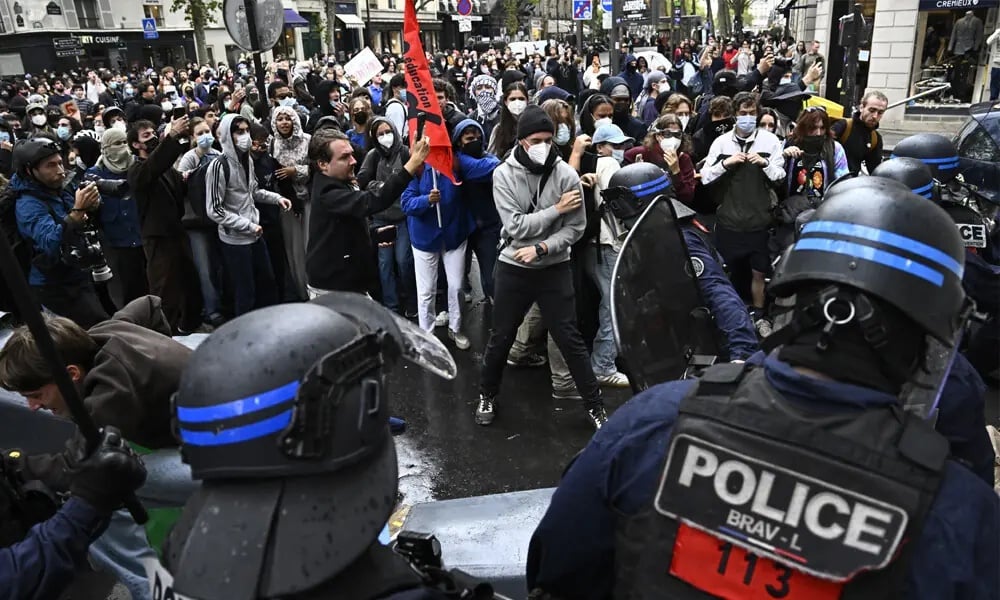
The framing is balanced but concentrates on student harm and police accountability, while official responses and protester violence are included as counterpoints.
Automated analysis; not human reviewed.
Limitations: Only the supplied article extract was available; no byline, original publication date, or external verification of figures could be used.
·
5 of 55 available dimensions scored; omitted dimensions are not treated as neutral.
·
Verified supporting quotes for 5 of 5 scored dimensions.
Claim: The article is neutral on the liberal-conservative axis, giving voice to both critics of policing and government officials.
“Rights groups and trades unions have repeatedly accused the police of using unnecessary force.” · exact text match
“Lecornu on Tuesday condemned the violence and told parliament it could not be tolerated, while also rejecting accusations that the government had ordered “police repression” against the protesters.” · exact text match
Why: Both critical and official perspectives are presented with attribution, and the article does not endorse either side.
Claim: The article is predominantly objective, attributing emotive statements and disputed claims to sources and flagging unresolved facts.
“Authorities have not confirmed the exact circumstances – in particular, whether the boy had picked the grenade up or had been struck by it” · exact text match
“Laurent Nuñez told RTL radio on Wednesday that he had ordered a temporary halt” · exact text match
Why: Subjective material appears in direct quotes rather than in the reporter's voice, and key facts are hedged.
Claim: The story is heavily political, covering protests, policing, government response, and election timing.
“The protests, months before key presidential elections to choose Macron’s successor, have rattled a government” · exact text match
“They have also sparked a heated political row, with the government accusing the radical-left La France Insoumise party of encouraging and even orchestrating the movement” · exact text match
Why: The central developments are political conflict and state response rather than nonpolitical school administration.
Claim: The article is credible relative to the supplied text because it names officials, ministries, and organizations for specific claims and counts.
“Laurent Nuñez told RTL radio on Wednesday” · exact text match
“More than 1,800 are being prosecuted, nearly 1,500 of them under 18, the justice ministry has said.” · exact text match
Why: Key assertions carry named sources and institutional attribution, and the article distinguishes official statements from confirmed events.
Claim: The article reports both official and protester/critic positions without taking sides and explicitly notes uncertainty.
“He said inquiries were always opened over accusations of “non-proportional” policing, but insisted officers were there to protect the students.” · exact text match
“Rights groups and trades unions have repeatedly accused the police of using unnecessary force.” · exact text match
Why: Government and critic statements are juxtaposed with attribution, and unresolved details are acknowledged.
Only the supplied article extract was available; no byline, original publication date, or external verification of figures could be used.
October 07, 2026 · 0 shares
Even-handed, attribution-heavy reporting centers a teenager's severe injury and the stun-grenade suspension while preserving conflicting official and protester accounts.
Automated analysis; not human reviewed.
Limitations: The supplied text is a syndicated BBC report with a NilePost subscription prompt appended; no byline or publication timestamp was provided, so original editorial context is limited.
·
5 of 55 available dimensions scored; omitted dimensions are not treated as neutral.
·
Verified supporting quotes for 4 of 5 scored dimensions.
Claim: The report is predominantly objective, attributing contested claims rather than endorsing a side.
“Interior Minister Laurent Nuñez said he had requested the pause until the facts of Monday's incident in Lens had been "clarified", with conflicting accounts offered by protesters and officials.” · not found in supplied text
“Authorities have said he picked up the grenade which then exploded, but students have alleged he was hit directly after an officer fired.” · exact text match
Why: The article attributes every key claim to named officials, police, and students, and includes both versions of the disputed Lens incident.
Claim: The framing is mildly sensational because the boy's severe injury is foregrounded in graphic terms.
“The 15-year-old boy's hand was torn off after a so-called anti-encirclement grenade was fired in unclear circumstances near the Auguste Béhal high school in the northern city near Lille.” · exact text match
Why: The phrase 'hand was torn off' is concrete and graphic, though the report does not exaggerate beyond the reported injury and includes official context.
Claim: The article is descriptive rather than prescriptive.
“France has suspended the use of stun grenades for policing student protests that have swept the country, after a 15-year-old's hand was blown off earlier this week.” · exact text match
Why: It reports a policy action and statements without recommending or prescribing a course of action.
Claim: The article is highly credible in visible sourcing and attribution practices.
“Nuñez told French radio RTL that police watchdog IGPN had opened 18 investigations to determine whether officers had been "proportionate" during the demonstrations” · exact text match
“More than 6,500 people have been stopped or arrested in that time, according to the interior ministry.” · exact text match
Why: It names ministries, ministers, police watchdog, and unions, provides figures with attribution, and distinguishes official estimates from union estimates.
Claim: The article demonstrates high internal honesty by showing conflicting accounts and attributing information.
“Authorities have said he picked up the grenade which then exploded, but students have alleged he was hit directly after an officer fired.” · exact text match
“The national secretary of policing union UNSA said he was sceptical about the decision to halt the use of stun grenades, saying it had been based "on emotion".” · exact text match
Why: Rather than omitting inconvenient views, it includes police-union skepticism and official accounts alongside protesters' allegations.
The supplied text is a syndicated BBC report with a NilePost subscription prompt appended; no byline or publication timestamp was provided, so original editorial context is limited.
October 07, 2026 · 0 shares
Framing centers on an unresolved official response, pairing hedged ministerial statements with attributed accusations and student grievances.
Automated analysis; not human reviewed.
Limitations: The supplied text is a truncated report interleaved with subscription prompts and unrelated headlines; analysis uses only the coherent France report.
·
6 of 55 available dimensions scored; omitted dimensions are not treated as neutral.
·
Verified supporting quotes for 4 of 6 scored dimensions.
Claim: The article is written in an objective style, relying on attributed statements and conditional language rather than subjective judgement.
“Nunez said there was a “strong possibility” the firing of a non-lethal stun grenade had caused the teenager to lose his hand.” · exact text match
“Rights groups, students and some political opponents have accused the French police of using disproportionate force during a more than two-week-old wave of student protests.” · not found in supplied text
Why: The report attributes claims to officials and critics and uses a hedging phrase ('strong possibility') instead of asserting cause.
Claim: The article states a severe injury and protests without using sensationalist adjectives or alarmist framing.
“The French government said on Wednesday it was pausing the use of stun grenades in its policing of student protests after a 15-year-old boy’s hand was blown off during a clash with riot police.” · exact text match
Why: The graphic injury is presented in a straightforward lead focused on the policy response, not exaggerated for emotional effect.
Claim: The article describes events and attributes calls to action to unions and officials; the publisher itself does not prescribe policy.
““The CGT will continue to shoulder its responsibilities in supporting the young people who have mobilised and protecting them from violence and police repression,” a CGT statement said.” · exact text match
Why: The only prescriptive language appears inside attributed quotations, while the surrounding report remains descriptive.
Claim: The report consistently attributes information to named officials, institutions, agencies, and rankings, making its factual claims verifiable.
“Interior Minister Laurent Nunez said he had ordered the stun grenade suspension until there was more clarity around the events that took place in the northern city of Lens on Monday.” · exact text match
“according to the rankings” · exact text match
Why: Named official attribution, sourced OECD rankings, and agency reports provide visible sourcing for the main claims.
Claim: The article includes an explicit forward-looking inference that French protests might inspire unrest elsewhere in Europe.
“In a sign the protests in France might spur unrest elsewhere in Europe, where budgets have been under pressure as governments respond to successive cost-of-living and energy crises, students in parts of Belgium have launched copycat actions.” · exact text match
Why: The phrase 'might spur' is speculative, but the article immediately offers reported examples from Belgium, Portugal, and Spain as support.
Claim: The article presents government, critic, and union perspectives without endorsing one side.
“Rights groups, students and some political opponents have accused the French police of using disproportionate force during a more than two-week-old wave of student protests.” · not found in supplied text
“French Prime Minister Sebastien Lecornu has acknowledged the “legitimate” demands of France’s students but also described the unrest as the most violent student demonstrations in decades.” · exact text match
Why: Both critical accusations and the government's response are included, allowing readers to compare accounts.
The supplied text is a truncated report interleaved with subscription prompts and unrelated headlines; analysis uses only the coherent France report.
October 07, 2026 · 0 shares
Framing centers on an unresolved official response, pairing hedged ministerial statements with attributed accusations and student grievances.
Automated analysis; not human reviewed.
Limitations: The supplied text is a truncated report interleaved with subscription prompts and unrelated headlines; analysis uses only the coherent France report.
·
6 of 55 available dimensions scored; omitted dimensions are not treated as neutral.
·
Verified supporting quotes for 4 of 6 scored dimensions.
Claim: The article is written in an objective style, relying on attributed statements and conditional language rather than subjective judgement.
“Nunez said there was a “strong possibility” the firing of a non-lethal stun grenade had caused the teenager to lose his hand.” · exact text match
“Rights groups, students and some political opponents have accused the French police of using disproportionate force during a more than two-week-old wave of student protests.” · not found in supplied text
Why: The report attributes claims to officials and critics and uses a hedging phrase ('strong possibility') instead of asserting cause.
Claim: The article states a severe injury and protests without using sensationalist adjectives or alarmist framing.
“The French government said on Wednesday it was pausing the use of stun grenades in its policing of student protests after a 15-year-old boy’s hand was blown off during a clash with riot police.” · exact text match
Why: The graphic injury is presented in a straightforward lead focused on the policy response, not exaggerated for emotional effect.
Claim: The article describes events and attributes calls to action to unions and officials; the publisher itself does not prescribe policy.
““The CGT will continue to shoulder its responsibilities in supporting the young people who have mobilised and protecting them from violence and police repression,” a CGT statement said.” · exact text match
Why: The only prescriptive language appears inside attributed quotations, while the surrounding report remains descriptive.
Claim: The report consistently attributes information to named officials, institutions, agencies, and rankings, making its factual claims verifiable.
“Interior Minister Laurent Nunez said he had ordered the stun grenade suspension until there was more clarity around the events that took place in the northern city of Lens on Monday.” · exact text match
“according to the rankings” · exact text match
Why: Named official attribution, sourced OECD rankings, and agency reports provide visible sourcing for the main claims.
Claim: The article includes an explicit forward-looking inference that French protests might inspire unrest elsewhere in Europe.
“In a sign the protests in France might spur unrest elsewhere in Europe, where budgets have been under pressure as governments respond to successive cost-of-living and energy crises, students in parts of Belgium have launched copycat actions.” · exact text match
Why: The phrase 'might spur' is speculative, but the article immediately offers reported examples from Belgium, Portugal, and Spain as support.
Claim: The article presents government, critic, and union perspectives without endorsing one side.
“Rights groups, students and some political opponents have accused the French police of using disproportionate force during a more than two-week-old wave of student protests.” · not found in supplied text
“French Prime Minister Sebastien Lecornu has acknowledged the “legitimate” demands of France’s students but also described the unrest as the most violent student demonstrations in decades.” · exact text match
Why: Both critical accusations and the government's response are included, allowing readers to compare accounts.
The supplied text is a truncated report interleaved with subscription prompts and unrelated headlines; analysis uses only the coherent France report.
October 07, 2026 · 0 shares
The framing is balanced but concentrates on student harm and police accountability, while official responses and protester violence are included as counterpoints.
Automated analysis; not human reviewed.
Limitations: Only the supplied article extract was available; no byline, original publication date, or external verification of figures could be used.
·
5 of 55 available dimensions scored; omitted dimensions are not treated as neutral.
·
Verified supporting quotes for 5 of 5 scored dimensions.
Claim: The article is neutral on the liberal-conservative axis, giving voice to both critics of policing and government officials.
“Rights groups and trades unions have repeatedly accused the police of using unnecessary force.” · exact text match
“Lecornu on Tuesday condemned the violence and told parliament it could not be tolerated, while also rejecting accusations that the government had ordered “police repression” against the protesters.” · exact text match
Why: Both critical and official perspectives are presented with attribution, and the article does not endorse either side.
Claim: The article is predominantly objective, attributing emotive statements and disputed claims to sources and flagging unresolved facts.
“Authorities have not confirmed the exact circumstances – in particular, whether the boy had picked the grenade up or had been struck by it” · exact text match
“Laurent Nuñez told RTL radio on Wednesday that he had ordered a temporary halt” · exact text match
Why: Subjective material appears in direct quotes rather than in the reporter's voice, and key facts are hedged.
Claim: The story is heavily political, covering protests, policing, government response, and election timing.
“The protests, months before key presidential elections to choose Macron’s successor, have rattled a government” · exact text match
“They have also sparked a heated political row, with the government accusing the radical-left La France Insoumise party of encouraging and even orchestrating the movement” · exact text match
Why: The central developments are political conflict and state response rather than nonpolitical school administration.
Claim: The article is credible relative to the supplied text because it names officials, ministries, and organizations for specific claims and counts.
“Laurent Nuñez told RTL radio on Wednesday” · exact text match
“More than 1,800 are being prosecuted, nearly 1,500 of them under 18, the justice ministry has said.” · exact text match
Why: Key assertions carry named sources and institutional attribution, and the article distinguishes official statements from confirmed events.
Claim: The article reports both official and protester/critic positions without taking sides and explicitly notes uncertainty.
“He said inquiries were always opened over accusations of “non-proportional” policing, but insisted officers were there to protect the students.” · exact text match
“Rights groups and trades unions have repeatedly accused the police of using unnecessary force.” · exact text match
Why: Government and critic statements are juxtaposed with attribution, and unresolved details are acknowledged.
Only the supplied article extract was available; no byline, original publication date, or external verification of figures could be used.
October 07, 2026 · 0 shares
Even-handed, attribution-heavy reporting centers a teenager's severe injury and the stun-grenade suspension while preserving conflicting official and protester accounts.
Automated analysis; not human reviewed.
Limitations: The supplied text is a syndicated BBC report with a NilePost subscription prompt appended; no byline or publication timestamp was provided, so original editorial context is limited.
·
5 of 55 available dimensions scored; omitted dimensions are not treated as neutral.
·
Verified supporting quotes for 4 of 5 scored dimensions.
Claim: The report is predominantly objective, attributing contested claims rather than endorsing a side.
“Interior Minister Laurent Nuñez said he had requested the pause until the facts of Monday's incident in Lens had been "clarified", with conflicting accounts offered by protesters and officials.” · not found in supplied text
“Authorities have said he picked up the grenade which then exploded, but students have alleged he was hit directly after an officer fired.” · exact text match
Why: The article attributes every key claim to named officials, police, and students, and includes both versions of the disputed Lens incident.
Claim: The framing is mildly sensational because the boy's severe injury is foregrounded in graphic terms.
“The 15-year-old boy's hand was torn off after a so-called anti-encirclement grenade was fired in unclear circumstances near the Auguste Béhal high school in the northern city near Lille.” · exact text match
Why: The phrase 'hand was torn off' is concrete and graphic, though the report does not exaggerate beyond the reported injury and includes official context.
Claim: The article is descriptive rather than prescriptive.
“France has suspended the use of stun grenades for policing student protests that have swept the country, after a 15-year-old's hand was blown off earlier this week.” · exact text match
Why: It reports a policy action and statements without recommending or prescribing a course of action.
Claim: The article is highly credible in visible sourcing and attribution practices.
“Nuñez told French radio RTL that police watchdog IGPN had opened 18 investigations to determine whether officers had been "proportionate" during the demonstrations” · exact text match
“More than 6,500 people have been stopped or arrested in that time, according to the interior ministry.” · exact text match
Why: It names ministries, ministers, police watchdog, and unions, provides figures with attribution, and distinguishes official estimates from union estimates.
Claim: The article demonstrates high internal honesty by showing conflicting accounts and attributing information.
“Authorities have said he picked up the grenade which then exploded, but students have alleged he was hit directly after an officer fired.” · exact text match
“The national secretary of policing union UNSA said he was sceptical about the decision to halt the use of stun grenades, saying it had been based "on emotion".” · exact text match
Why: Rather than omitting inconvenient views, it includes police-union skepticism and official accounts alongside protesters' allegations.
The supplied text is a syndicated BBC report with a NilePost subscription prompt appended; no byline or publication timestamp was provided, so original editorial context is limited.
The framing is a bare, declarative headline that foregrounds a 15-year-old's severe injury and the police device, with no attribution, context, or explicit blame assignment.
Automated analysis; not human reviewed. Limitations: Only a headline and hashtags were available, so broader editorial framing, sourcing, and context could not be evaluated.
Only a headline and hashtags were available, so broader editorial framing, sourcing, and context could not be evaluated.
October 07, 2026 · 0 shares
The framing is balanced but concentrates on student harm and police accountability, while official responses and protester violence are included as counterpoints.
Automated analysis; not human reviewed.
Limitations: Only the supplied article extract was available; no byline, original publication date, or external verification of figures could be used.
·
5 of 55 available dimensions scored; omitted dimensions are not treated as neutral.
·
Verified supporting quotes for 5 of 5 scored dimensions.
Claim: The article is neutral on the liberal-conservative axis, giving voice to both critics of policing and government officials.
“Rights groups and trades unions have repeatedly accused the police of using unnecessary force.” · exact text match
“Lecornu on Tuesday condemned the violence and told parliament it could not be tolerated, while also rejecting accusations that the government had ordered “police repression” against the protesters.” · exact text match
Why: Both critical and official perspectives are presented with attribution, and the article does not endorse either side.
Claim: The article is predominantly objective, attributing emotive statements and disputed claims to sources and flagging unresolved facts.
“Authorities have not confirmed the exact circumstances – in particular, whether the boy had picked the grenade up or had been struck by it” · exact text match
“Laurent Nuñez told RTL radio on Wednesday that he had ordered a temporary halt” · exact text match
Why: Subjective material appears in direct quotes rather than in the reporter's voice, and key facts are hedged.
Claim: The story is heavily political, covering protests, policing, government response, and election timing.
“The protests, months before key presidential elections to choose Macron’s successor, have rattled a government” · exact text match
“They have also sparked a heated political row, with the government accusing the radical-left La France Insoumise party of encouraging and even orchestrating the movement” · exact text match
Why: The central developments are political conflict and state response rather than nonpolitical school administration.
Claim: The article is credible relative to the supplied text because it names officials, ministries, and organizations for specific claims and counts.
“Laurent Nuñez told RTL radio on Wednesday” · exact text match
“More than 1,800 are being prosecuted, nearly 1,500 of them under 18, the justice ministry has said.” · exact text match
Why: Key assertions carry named sources and institutional attribution, and the article distinguishes official statements from confirmed events.
Claim: The article reports both official and protester/critic positions without taking sides and explicitly notes uncertainty.
“He said inquiries were always opened over accusations of “non-proportional” policing, but insisted officers were there to protect the students.” · exact text match
“Rights groups and trades unions have repeatedly accused the police of using unnecessary force.” · exact text match
Why: Government and critic statements are juxtaposed with attribution, and unresolved details are acknowledged.
Only the supplied article extract was available; no byline, original publication date, or external verification of figures could be used.
October 07, 2026 · 0 shares
Even-handed, attribution-heavy reporting centers a teenager's severe injury and the stun-grenade suspension while preserving conflicting official and protester accounts.
Automated analysis; not human reviewed.
Limitations: The supplied text is a syndicated BBC report with a NilePost subscription prompt appended; no byline or publication timestamp was provided, so original editorial context is limited.
·
5 of 55 available dimensions scored; omitted dimensions are not treated as neutral.
·
Verified supporting quotes for 4 of 5 scored dimensions.
Claim: The report is predominantly objective, attributing contested claims rather than endorsing a side.
“Interior Minister Laurent Nuñez said he had requested the pause until the facts of Monday's incident in Lens had been "clarified", with conflicting accounts offered by protesters and officials.” · not found in supplied text
“Authorities have said he picked up the grenade which then exploded, but students have alleged he was hit directly after an officer fired.” · exact text match
Why: The article attributes every key claim to named officials, police, and students, and includes both versions of the disputed Lens incident.
Claim: The framing is mildly sensational because the boy's severe injury is foregrounded in graphic terms.
“The 15-year-old boy's hand was torn off after a so-called anti-encirclement grenade was fired in unclear circumstances near the Auguste Béhal high school in the northern city near Lille.” · exact text match
Why: The phrase 'hand was torn off' is concrete and graphic, though the report does not exaggerate beyond the reported injury and includes official context.
Claim: The article is descriptive rather than prescriptive.
“France has suspended the use of stun grenades for policing student protests that have swept the country, after a 15-year-old's hand was blown off earlier this week.” · exact text match
Why: It reports a policy action and statements without recommending or prescribing a course of action.
Claim: The article is highly credible in visible sourcing and attribution practices.
“Nuñez told French radio RTL that police watchdog IGPN had opened 18 investigations to determine whether officers had been "proportionate" during the demonstrations” · exact text match
“More than 6,500 people have been stopped or arrested in that time, according to the interior ministry.” · exact text match
Why: It names ministries, ministers, police watchdog, and unions, provides figures with attribution, and distinguishes official estimates from union estimates.
Claim: The article demonstrates high internal honesty by showing conflicting accounts and attributing information.
“Authorities have said he picked up the grenade which then exploded, but students have alleged he was hit directly after an officer fired.” · exact text match
“The national secretary of policing union UNSA said he was sceptical about the decision to halt the use of stun grenades, saying it had been based "on emotion".” · exact text match
Why: Rather than omitting inconvenient views, it includes police-union skepticism and official accounts alongside protesters' allegations.
The supplied text is a syndicated BBC report with a NilePost subscription prompt appended; no byline or publication timestamp was provided, so original editorial context is limited.
October 07, 2026 · 0 shares
The framing is balanced but concentrates on student harm and police accountability, while official responses and protester violence are included as counterpoints.
Automated analysis; not human reviewed.
Limitations: Only the supplied article extract was available; no byline, original publication date, or external verification of figures could be used.
·
5 of 55 available dimensions scored; omitted dimensions are not treated as neutral.
·
Verified supporting quotes for 5 of 5 scored dimensions.
Claim: The article is neutral on the liberal-conservative axis, giving voice to both critics of policing and government officials.
“Rights groups and trades unions have repeatedly accused the police of using unnecessary force.” · exact text match
“Lecornu on Tuesday condemned the violence and told parliament it could not be tolerated, while also rejecting accusations that the government had ordered “police repression” against the protesters.” · exact text match
Why: Both critical and official perspectives are presented with attribution, and the article does not endorse either side.
Claim: The article is predominantly objective, attributing emotive statements and disputed claims to sources and flagging unresolved facts.
“Authorities have not confirmed the exact circumstances – in particular, whether the boy had picked the grenade up or had been struck by it” · exact text match
“Laurent Nuñez told RTL radio on Wednesday that he had ordered a temporary halt” · exact text match
Why: Subjective material appears in direct quotes rather than in the reporter's voice, and key facts are hedged.
Claim: The story is heavily political, covering protests, policing, government response, and election timing.
“The protests, months before key presidential elections to choose Macron’s successor, have rattled a government” · exact text match
“They have also sparked a heated political row, with the government accusing the radical-left La France Insoumise party of encouraging and even orchestrating the movement” · exact text match
Why: The central developments are political conflict and state response rather than nonpolitical school administration.
Claim: The article is credible relative to the supplied text because it names officials, ministries, and organizations for specific claims and counts.
“Laurent Nuñez told RTL radio on Wednesday” · exact text match
“More than 1,800 are being prosecuted, nearly 1,500 of them under 18, the justice ministry has said.” · exact text match
Why: Key assertions carry named sources and institutional attribution, and the article distinguishes official statements from confirmed events.
Claim: The article reports both official and protester/critic positions without taking sides and explicitly notes uncertainty.
“He said inquiries were always opened over accusations of “non-proportional” policing, but insisted officers were there to protect the students.” · exact text match
“Rights groups and trades unions have repeatedly accused the police of using unnecessary force.” · exact text match
Why: Government and critic statements are juxtaposed with attribution, and unresolved details are acknowledged.
Only the supplied article extract was available; no byline, original publication date, or external verification of figures could be used.
October 07, 2026 · 0 shares
Even-handed, attribution-heavy reporting centers a teenager's severe injury and the stun-grenade suspension while preserving conflicting official and protester accounts.
Automated analysis; not human reviewed.
Limitations: The supplied text is a syndicated BBC report with a NilePost subscription prompt appended; no byline or publication timestamp was provided, so original editorial context is limited.
·
5 of 55 available dimensions scored; omitted dimensions are not treated as neutral.
·
Verified supporting quotes for 4 of 5 scored dimensions.
Claim: The report is predominantly objective, attributing contested claims rather than endorsing a side.
“Interior Minister Laurent Nuñez said he had requested the pause until the facts of Monday's incident in Lens had been "clarified", with conflicting accounts offered by protesters and officials.” · not found in supplied text
“Authorities have said he picked up the grenade which then exploded, but students have alleged he was hit directly after an officer fired.” · exact text match
Why: The article attributes every key claim to named officials, police, and students, and includes both versions of the disputed Lens incident.
Claim: The framing is mildly sensational because the boy's severe injury is foregrounded in graphic terms.
“The 15-year-old boy's hand was torn off after a so-called anti-encirclement grenade was fired in unclear circumstances near the Auguste Béhal high school in the northern city near Lille.” · exact text match
Why: The phrase 'hand was torn off' is concrete and graphic, though the report does not exaggerate beyond the reported injury and includes official context.
Claim: The article is descriptive rather than prescriptive.
“France has suspended the use of stun grenades for policing student protests that have swept the country, after a 15-year-old's hand was blown off earlier this week.” · exact text match
Why: It reports a policy action and statements without recommending or prescribing a course of action.
Claim: The article is highly credible in visible sourcing and attribution practices.
“Nuñez told French radio RTL that police watchdog IGPN had opened 18 investigations to determine whether officers had been "proportionate" during the demonstrations” · exact text match
“More than 6,500 people have been stopped or arrested in that time, according to the interior ministry.” · exact text match
Why: It names ministries, ministers, police watchdog, and unions, provides figures with attribution, and distinguishes official estimates from union estimates.
Claim: The article demonstrates high internal honesty by showing conflicting accounts and attributing information.
“Authorities have said he picked up the grenade which then exploded, but students have alleged he was hit directly after an officer fired.” · exact text match
“The national secretary of policing union UNSA said he was sceptical about the decision to halt the use of stun grenades, saying it had been based "on emotion".” · exact text match
Why: Rather than omitting inconvenient views, it includes police-union skepticism and official accounts alongside protesters' allegations.
The supplied text is a syndicated BBC report with a NilePost subscription prompt appended; no byline or publication timestamp was provided, so original editorial context is limited.
October 05, 2026 · 0 shares
Framing centers a police-caused injury to a student and emphasizes government crackdown and protest violence, creating a protest-sympathetic news angle.
Automated analysis; not human reviewed.
Limitations: The supplied text mixes promotional and membership boilerplate with news paragraphs; I treated the boilerplate as non-substantive and based the analysis only on the visible news content.
·
8 of 55 available dimensions scored; omitted dimensions are not treated as neutral.
·
Verified supporting quotes for 8 of 8 scored dimensions.
Claim: The publisher uses a lead focused on police-caused injury to a minor and frames the protests as student grievances, producing a protest-sympathetic angle.
“A 15-year-old student has had their hand blown off after picking up a stun grenade being used by police as mass school protests continue across France, local authorities said.” · exact text match
Why: The lead emphasizes a police weapon as the cause of a student's severe injury, a framing more sympathetic to demonstrators than to authorities.
Claim: The publisher uses vivid, emotionally charged language in the headline.
“Student, 15, has hand blown off by police stun grenade during French mass protests.” · exact text match
Why: 'Hand blown off' is dramatic and sensational rather than neutral clinical language.
Claim: The article selects violent imagery and warnings of further violence, which can heighten fear.
“Some of the most violent footage emerging from the demonstrations shows police officers being attacked and fires breaking out.” · exact text match
“Student, 15, has hand blown off by police stun grenade during French mass protests.” · exact text match
Why: Repeated emphasis on severe injury, attacks on police, fires, and officials' fears leans into fearful framing.
Claim: The headline states the causal injury as fact while the body attributes it to local authorities.
“Student, 15, has hand blown off by police stun grenade during French mass protests.” · exact text match
“A 15-year-old student has had their hand blown off after picking up a stun grenade being used by police as mass school protests continue across France, local authorities said.” · exact text match
Why: The headline omits the attribution and hedging present in the body, asserting the cause-and-effect relationship directly.
Claim: The reporting carries a negative emotional charge through injury and violence details.
“Student, 15, has hand blown off by police stun grenade during French mass protests.” · exact text match
Why: The headline's explicit severe injury to a teenager evokes a strong negative emotional response.
Claim: The article names officials, other news outlets, and uses hedged language, supporting basic credibility.
“according to French paper La Voix du Nord” · exact text match
“The BBC previously reported that teenagers have suffered eye injuries and at least one has lost teeth in the uproar.” · exact text match
Why: Multiple specific attributions and references to other reporting allow the reader to verify the account.
Claim: The article includes future-oriented expectations and fears about protest escalation.
“Student unions have called for a national day of demonstrations to take place on Tuesday as security officials fear that the demonstrations could spark further violence.” · exact text match
Why: The statement projects possible future violence, though it is attributed to security officials' fears.
Claim: The article consistently attributes claims to officials, unions, and other media, and flags uncertain reports.
“A 15-year-old student has had their hand blown off after picking up a stun grenade being used by police as mass school protests continue across France, local authorities said.” · exact text match
“A teacher in Angers was reportedly struck on the head with an iron bar by attackers who were not from the school.” · exact text match
Why: Attribution phrases such as 'local authorities said' and 'reportedly' show care in distinguishing sourced claims from established fact.
The supplied text mixes promotional and membership boilerplate with news paragraphs; I treated the boilerplate as non-substantive and based the analysis only on the visible news content.
October 07, 2026 · 0 shares
Framing centers on an unresolved official response, pairing hedged ministerial statements with attributed accusations and student grievances.
Automated analysis; not human reviewed.
Limitations: The supplied text is a truncated report interleaved with subscription prompts and unrelated headlines; analysis uses only the coherent France report.
·
6 of 55 available dimensions scored; omitted dimensions are not treated as neutral.
·
Verified supporting quotes for 4 of 6 scored dimensions.
Claim: The article is written in an objective style, relying on attributed statements and conditional language rather than subjective judgement.
“Nunez said there was a “strong possibility” the firing of a non-lethal stun grenade had caused the teenager to lose his hand.” · exact text match
“Rights groups, students and some political opponents have accused the French police of using disproportionate force during a more than two-week-old wave of student protests.” · not found in supplied text
Why: The report attributes claims to officials and critics and uses a hedging phrase ('strong possibility') instead of asserting cause.
Claim: The article states a severe injury and protests without using sensationalist adjectives or alarmist framing.
“The French government said on Wednesday it was pausing the use of stun grenades in its policing of student protests after a 15-year-old boy’s hand was blown off during a clash with riot police.” · exact text match
Why: The graphic injury is presented in a straightforward lead focused on the policy response, not exaggerated for emotional effect.
Claim: The article describes events and attributes calls to action to unions and officials; the publisher itself does not prescribe policy.
““The CGT will continue to shoulder its responsibilities in supporting the young people who have mobilised and protecting them from violence and police repression,” a CGT statement said.” · exact text match
Why: The only prescriptive language appears inside attributed quotations, while the surrounding report remains descriptive.
Claim: The report consistently attributes information to named officials, institutions, agencies, and rankings, making its factual claims verifiable.
“Interior Minister Laurent Nunez said he had ordered the stun grenade suspension until there was more clarity around the events that took place in the northern city of Lens on Monday.” · exact text match
“according to the rankings” · exact text match
Why: Named official attribution, sourced OECD rankings, and agency reports provide visible sourcing for the main claims.
Claim: The article includes an explicit forward-looking inference that French protests might inspire unrest elsewhere in Europe.
“In a sign the protests in France might spur unrest elsewhere in Europe, where budgets have been under pressure as governments respond to successive cost-of-living and energy crises, students in parts of Belgium have launched copycat actions.” · exact text match
Why: The phrase 'might spur' is speculative, but the article immediately offers reported examples from Belgium, Portugal, and Spain as support.
Claim: The article presents government, critic, and union perspectives without endorsing one side.
“Rights groups, students and some political opponents have accused the French police of using disproportionate force during a more than two-week-old wave of student protests.” · not found in supplied text
“French Prime Minister Sebastien Lecornu has acknowledged the “legitimate” demands of France’s students but also described the unrest as the most violent student demonstrations in decades.” · exact text match
Why: Both critical accusations and the government's response are included, allowing readers to compare accounts.
The supplied text is a truncated report interleaved with subscription prompts and unrelated headlines; analysis uses only the coherent France report.
The framing presents a government policy reversal as a responsive, plainly stated fact following mass protest, without critical context or comment.
Automated analysis; not human reviewed.
Limitations: Only a headline-shaped text fragment was supplied; no full article, author attribution, or sourcing was available for analysis.
·
4 of 55 available dimensions scored; omitted dimensions are not treated as neutral.
·
Verified supporting quotes for 4 of 4 scored dimensions.
Claim: The article reports the policy action and the public address in a non-evaluative, declarative manner.
“France halts police use of stun grenades at student protests” · exact text match
“Prime Minister Sebastien Lecornu to make public address after thousands rally to demand” · exact text match
Why: The clauses state factual policy and scheduling information with no evaluative adjectives or explicit subjective judgment.
Claim: The article avoids exaggeration and emotionally charged presentation.
“France halts police use of stun grenades at student protests” · exact text match
“after thousands rally to demand” · exact text match
Why: The wording is plain and declarative; even the crowd-size reference is not embellished with dramatic adjectives or intensifiers.
Claim: The article describes events and scheduled actions rather than recommending any policy.
“France halts police use of stun grenades at student protests” · exact text match
Why: All language is indicative and factual; no imperative or normative prescription is present.
Claim: The article is intrinsically political in subject matter, involving the Prime Minister, police policy, and mass protest.
“Prime Minister Sebastien Lecornu to make public address after thousands rally to demand” · exact text match
Why: The actors and topics are governmental and protest-related, placing the story firmly in the political domain.
Only a headline-shaped text fragment was supplied; no full article, author attribution, or sourcing was available for analysis.
October 07, 2026 · 0 shares
The framing is balanced but concentrates on student harm and police accountability, while official responses and protester violence are included as counterpoints.
Automated analysis; not human reviewed. Limitations: Only the supplied article extract was available; no byline, original publication date, or external verification of figures could be used. · 5 of 55 available dimensions scored; omitted dimensions are not treated as neutral. · Verified supporting quotes for 5 of 5 scored dimensions.
Claim: The article is neutral on the liberal-conservative axis, giving voice to both critics of policing and government officials.
“Rights groups and trades unions have repeatedly accused the police of using unnecessary force.” · exact text match
“Lecornu on Tuesday condemned the violence and told parliament it could not be tolerated, while also rejecting accusations that the government had ordered “police repression” against the protesters.” · exact text match
Why: Both critical and official perspectives are presented with attribution, and the article does not endorse either side.
Claim: The article is predominantly objective, attributing emotive statements and disputed claims to sources and flagging unresolved facts.
“Authorities have not confirmed the exact circumstances – in particular, whether the boy had picked the grenade up or had been struck by it” · exact text match
“Laurent Nuñez told RTL radio on Wednesday that he had ordered a temporary halt” · exact text match
Why: Subjective material appears in direct quotes rather than in the reporter's voice, and key facts are hedged.
Claim: The story is heavily political, covering protests, policing, government response, and election timing.
“The protests, months before key presidential elections to choose Macron’s successor, have rattled a government” · exact text match
“They have also sparked a heated political row, with the government accusing the radical-left La France Insoumise party of encouraging and even orchestrating the movement” · exact text match
Why: The central developments are political conflict and state response rather than nonpolitical school administration.
Claim: The article is credible relative to the supplied text because it names officials, ministries, and organizations for specific claims and counts.
“Laurent Nuñez told RTL radio on Wednesday” · exact text match
“More than 1,800 are being prosecuted, nearly 1,500 of them under 18, the justice ministry has said.” · exact text match
Why: Key assertions carry named sources and institutional attribution, and the article distinguishes official statements from confirmed events.
Claim: The article reports both official and protester/critic positions without taking sides and explicitly notes uncertainty.
“He said inquiries were always opened over accusations of “non-proportional” policing, but insisted officers were there to protect the students.” · exact text match
“Rights groups and trades unions have repeatedly accused the police of using unnecessary force.” · exact text match
Why: Government and critic statements are juxtaposed with attribution, and unresolved details are acknowledged.
Only the supplied article extract was available; no byline, original publication date, or external verification of figures could be used.
October 07, 2026 · 0 shares
Framing centers on an unresolved official response, pairing hedged ministerial statements with attributed accusations and student grievances.
Automated analysis; not human reviewed. Limitations: The supplied text is a truncated report interleaved with subscription prompts and unrelated headlines; analysis uses only the coherent France report. · 6 of 55 available dimensions scored; omitted dimensions are not treated as neutral. · Verified supporting quotes for 4 of 6 scored dimensions.
Claim: The article is written in an objective style, relying on attributed statements and conditional language rather than subjective judgement.
“Nunez said there was a “strong possibility” the firing of a non-lethal stun grenade had caused the teenager to lose his hand.” · exact text match
“Rights groups, students and some political opponents have accused the French police of using disproportionate force during a more than two-week-old wave of student protests.” · not found in supplied text
Why: The report attributes claims to officials and critics and uses a hedging phrase ('strong possibility') instead of asserting cause.
Claim: The article states a severe injury and protests without using sensationalist adjectives or alarmist framing.
“The French government said on Wednesday it was pausing the use of stun grenades in its policing of student protests after a 15-year-old boy’s hand was blown off during a clash with riot police.” · exact text match
Why: The graphic injury is presented in a straightforward lead focused on the policy response, not exaggerated for emotional effect.
Claim: The article describes events and attributes calls to action to unions and officials; the publisher itself does not prescribe policy.
““The CGT will continue to shoulder its responsibilities in supporting the young people who have mobilised and protecting them from violence and police repression,” a CGT statement said.” · exact text match
Why: The only prescriptive language appears inside attributed quotations, while the surrounding report remains descriptive.
Claim: The report consistently attributes information to named officials, institutions, agencies, and rankings, making its factual claims verifiable.
“Interior Minister Laurent Nunez said he had ordered the stun grenade suspension until there was more clarity around the events that took place in the northern city of Lens on Monday.” · exact text match
“according to the rankings” · exact text match
Why: Named official attribution, sourced OECD rankings, and agency reports provide visible sourcing for the main claims.
Claim: The article includes an explicit forward-looking inference that French protests might inspire unrest elsewhere in Europe.
“In a sign the protests in France might spur unrest elsewhere in Europe, where budgets have been under pressure as governments respond to successive cost-of-living and energy crises, students in parts of Belgium have launched copycat actions.” · exact text match
Why: The phrase 'might spur' is speculative, but the article immediately offers reported examples from Belgium, Portugal, and Spain as support.
Claim: The article presents government, critic, and union perspectives without endorsing one side.
“Rights groups, students and some political opponents have accused the French police of using disproportionate force during a more than two-week-old wave of student protests.” · not found in supplied text
“French Prime Minister Sebastien Lecornu has acknowledged the “legitimate” demands of France’s students but also described the unrest as the most violent student demonstrations in decades.” · exact text match
Why: Both critical accusations and the government's response are included, allowing readers to compare accounts.
The supplied text is a truncated report interleaved with subscription prompts and unrelated headlines; analysis uses only the coherent France report.
October 07, 2026 · 0 shares
Even-handed, attribution-heavy reporting centers a teenager's severe injury and the stun-grenade suspension while preserving conflicting official and protester accounts.
Automated analysis; not human reviewed. Limitations: The supplied text is a syndicated BBC report with a NilePost subscription prompt appended; no byline or publication timestamp was provided, so original editorial context is limited. · 5 of 55 available dimensions scored; omitted dimensions are not treated as neutral. · Verified supporting quotes for 4 of 5 scored dimensions.
Claim: The report is predominantly objective, attributing contested claims rather than endorsing a side.
“Interior Minister Laurent Nuñez said he had requested the pause until the facts of Monday's incident in Lens had been "clarified", with conflicting accounts offered by protesters and officials.” · not found in supplied text
“Authorities have said he picked up the grenade which then exploded, but students have alleged he was hit directly after an officer fired.” · exact text match
Why: The article attributes every key claim to named officials, police, and students, and includes both versions of the disputed Lens incident.
Claim: The framing is mildly sensational because the boy's severe injury is foregrounded in graphic terms.
“The 15-year-old boy's hand was torn off after a so-called anti-encirclement grenade was fired in unclear circumstances near the Auguste Béhal high school in the northern city near Lille.” · exact text match
Why: The phrase 'hand was torn off' is concrete and graphic, though the report does not exaggerate beyond the reported injury and includes official context.
Claim: The article is descriptive rather than prescriptive.
“France has suspended the use of stun grenades for policing student protests that have swept the country, after a 15-year-old's hand was blown off earlier this week.” · exact text match
Why: It reports a policy action and statements without recommending or prescribing a course of action.
Claim: The article is highly credible in visible sourcing and attribution practices.
“Nuñez told French radio RTL that police watchdog IGPN had opened 18 investigations to determine whether officers had been "proportionate" during the demonstrations” · exact text match
“More than 6,500 people have been stopped or arrested in that time, according to the interior ministry.” · exact text match
Why: It names ministries, ministers, police watchdog, and unions, provides figures with attribution, and distinguishes official estimates from union estimates.
Claim: The article demonstrates high internal honesty by showing conflicting accounts and attributing information.
“Authorities have said he picked up the grenade which then exploded, but students have alleged he was hit directly after an officer fired.” · exact text match
“The national secretary of policing union UNSA said he was sceptical about the decision to halt the use of stun grenades, saying it had been based "on emotion".” · exact text match
Why: Rather than omitting inconvenient views, it includes police-union skepticism and official accounts alongside protesters' allegations.
The supplied text is a syndicated BBC report with a NilePost subscription prompt appended; no byline or publication timestamp was provided, so original editorial context is limited.
October 07, 2026 · 0 shares
The framing is balanced but concentrates on student harm and police accountability, while official responses and protester violence are included as counterpoints.
Automated analysis; not human reviewed. Limitations: Only the supplied article extract was available; no byline, original publication date, or external verification of figures could be used. · 5 of 55 available dimensions scored; omitted dimensions are not treated as neutral. · Verified supporting quotes for 5 of 5 scored dimensions.
Claim: The article is neutral on the liberal-conservative axis, giving voice to both critics of policing and government officials.
“Rights groups and trades unions have repeatedly accused the police of using unnecessary force.” · exact text match
“Lecornu on Tuesday condemned the violence and told parliament it could not be tolerated, while also rejecting accusations that the government had ordered “police repression” against the protesters.” · exact text match
Why: Both critical and official perspectives are presented with attribution, and the article does not endorse either side.
Claim: The article is predominantly objective, attributing emotive statements and disputed claims to sources and flagging unresolved facts.
“Authorities have not confirmed the exact circumstances – in particular, whether the boy had picked the grenade up or had been struck by it” · exact text match
“Laurent Nuñez told RTL radio on Wednesday that he had ordered a temporary halt” · exact text match
Why: Subjective material appears in direct quotes rather than in the reporter's voice, and key facts are hedged.
Claim: The story is heavily political, covering protests, policing, government response, and election timing.
“The protests, months before key presidential elections to choose Macron’s successor, have rattled a government” · exact text match
“They have also sparked a heated political row, with the government accusing the radical-left La France Insoumise party of encouraging and even orchestrating the movement” · exact text match
Why: The central developments are political conflict and state response rather than nonpolitical school administration.
Claim: The article is credible relative to the supplied text because it names officials, ministries, and organizations for specific claims and counts.
“Laurent Nuñez told RTL radio on Wednesday” · exact text match
“More than 1,800 are being prosecuted, nearly 1,500 of them under 18, the justice ministry has said.” · exact text match
Why: Key assertions carry named sources and institutional attribution, and the article distinguishes official statements from confirmed events.
Claim: The article reports both official and protester/critic positions without taking sides and explicitly notes uncertainty.
“He said inquiries were always opened over accusations of “non-proportional” policing, but insisted officers were there to protect the students.” · exact text match
“Rights groups and trades unions have repeatedly accused the police of using unnecessary force.” · exact text match
Why: Government and critic statements are juxtaposed with attribution, and unresolved details are acknowledged.
Only the supplied article extract was available; no byline, original publication date, or external verification of figures could be used.
October 07, 2026 · 0 shares
Even-handed, attribution-heavy reporting centers a teenager's severe injury and the stun-grenade suspension while preserving conflicting official and protester accounts.
Automated analysis; not human reviewed. Limitations: The supplied text is a syndicated BBC report with a NilePost subscription prompt appended; no byline or publication timestamp was provided, so original editorial context is limited. · 5 of 55 available dimensions scored; omitted dimensions are not treated as neutral. · Verified supporting quotes for 4 of 5 scored dimensions.
Claim: The report is predominantly objective, attributing contested claims rather than endorsing a side.
“Interior Minister Laurent Nuñez said he had requested the pause until the facts of Monday's incident in Lens had been "clarified", with conflicting accounts offered by protesters and officials.” · not found in supplied text
“Authorities have said he picked up the grenade which then exploded, but students have alleged he was hit directly after an officer fired.” · exact text match
Why: The article attributes every key claim to named officials, police, and students, and includes both versions of the disputed Lens incident.
Claim: The framing is mildly sensational because the boy's severe injury is foregrounded in graphic terms.
“The 15-year-old boy's hand was torn off after a so-called anti-encirclement grenade was fired in unclear circumstances near the Auguste Béhal high school in the northern city near Lille.” · exact text match
Why: The phrase 'hand was torn off' is concrete and graphic, though the report does not exaggerate beyond the reported injury and includes official context.
Claim: The article is descriptive rather than prescriptive.
“France has suspended the use of stun grenades for policing student protests that have swept the country, after a 15-year-old's hand was blown off earlier this week.” · exact text match
Why: It reports a policy action and statements without recommending or prescribing a course of action.
Claim: The article is highly credible in visible sourcing and attribution practices.
“Nuñez told French radio RTL that police watchdog IGPN had opened 18 investigations to determine whether officers had been "proportionate" during the demonstrations” · exact text match
“More than 6,500 people have been stopped or arrested in that time, according to the interior ministry.” · exact text match
Why: It names ministries, ministers, police watchdog, and unions, provides figures with attribution, and distinguishes official estimates from union estimates.
Claim: The article demonstrates high internal honesty by showing conflicting accounts and attributing information.
“Authorities have said he picked up the grenade which then exploded, but students have alleged he was hit directly after an officer fired.” · exact text match
“The national secretary of policing union UNSA said he was sceptical about the decision to halt the use of stun grenades, saying it had been based "on emotion".” · exact text match
Why: Rather than omitting inconvenient views, it includes police-union skepticism and official accounts alongside protesters' allegations.
The supplied text is a syndicated BBC report with a NilePost subscription prompt appended; no byline or publication timestamp was provided, so original editorial context is limited.
October 07, 2026 · 0 shares
Framing centers on an unresolved official response, pairing hedged ministerial statements with attributed accusations and student grievances.
Automated analysis; not human reviewed. Limitations: The supplied text is a truncated report interleaved with subscription prompts and unrelated headlines; analysis uses only the coherent France report. · 6 of 55 available dimensions scored; omitted dimensions are not treated as neutral. · Verified supporting quotes for 4 of 6 scored dimensions.
Claim: The article is written in an objective style, relying on attributed statements and conditional language rather than subjective judgement.
“Nunez said there was a “strong possibility” the firing of a non-lethal stun grenade had caused the teenager to lose his hand.” · exact text match
“Rights groups, students and some political opponents have accused the French police of using disproportionate force during a more than two-week-old wave of student protests.” · not found in supplied text
Why: The report attributes claims to officials and critics and uses a hedging phrase ('strong possibility') instead of asserting cause.
Claim: The article states a severe injury and protests without using sensationalist adjectives or alarmist framing.
“The French government said on Wednesday it was pausing the use of stun grenades in its policing of student protests after a 15-year-old boy’s hand was blown off during a clash with riot police.” · exact text match
Why: The graphic injury is presented in a straightforward lead focused on the policy response, not exaggerated for emotional effect.
Claim: The article describes events and attributes calls to action to unions and officials; the publisher itself does not prescribe policy.
““The CGT will continue to shoulder its responsibilities in supporting the young people who have mobilised and protecting them from violence and police repression,” a CGT statement said.” · exact text match
Why: The only prescriptive language appears inside attributed quotations, while the surrounding report remains descriptive.
Claim: The report consistently attributes information to named officials, institutions, agencies, and rankings, making its factual claims verifiable.
“Interior Minister Laurent Nunez said he had ordered the stun grenade suspension until there was more clarity around the events that took place in the northern city of Lens on Monday.” · exact text match
“according to the rankings” · exact text match
Why: Named official attribution, sourced OECD rankings, and agency reports provide visible sourcing for the main claims.
Claim: The article includes an explicit forward-looking inference that French protests might inspire unrest elsewhere in Europe.
“In a sign the protests in France might spur unrest elsewhere in Europe, where budgets have been under pressure as governments respond to successive cost-of-living and energy crises, students in parts of Belgium have launched copycat actions.” · exact text match
Why: The phrase 'might spur' is speculative, but the article immediately offers reported examples from Belgium, Portugal, and Spain as support.
Claim: The article presents government, critic, and union perspectives without endorsing one side.
“Rights groups, students and some political opponents have accused the French police of using disproportionate force during a more than two-week-old wave of student protests.” · not found in supplied text
“French Prime Minister Sebastien Lecornu has acknowledged the “legitimate” demands of France’s students but also described the unrest as the most violent student demonstrations in decades.” · exact text match
Why: Both critical accusations and the government's response are included, allowing readers to compare accounts.
The supplied text is a truncated report interleaved with subscription prompts and unrelated headlines; analysis uses only the coherent France report.
October 05, 2026 · 0 shares
Framing centers a police-caused injury to a student and emphasizes government crackdown and protest violence, creating a protest-sympathetic news angle.
Automated analysis; not human reviewed. Limitations: The supplied text mixes promotional and membership boilerplate with news paragraphs; I treated the boilerplate as non-substantive and based the analysis only on the visible news content. · 8 of 55 available dimensions scored; omitted dimensions are not treated as neutral. · Verified supporting quotes for 8 of 8 scored dimensions.
Claim: The publisher uses a lead focused on police-caused injury to a minor and frames the protests as student grievances, producing a protest-sympathetic angle.
“A 15-year-old student has had their hand blown off after picking up a stun grenade being used by police as mass school protests continue across France, local authorities said.” · exact text match
Why: The lead emphasizes a police weapon as the cause of a student's severe injury, a framing more sympathetic to demonstrators than to authorities.
Claim: The publisher uses vivid, emotionally charged language in the headline.
“Student, 15, has hand blown off by police stun grenade during French mass protests.” · exact text match
Why: 'Hand blown off' is dramatic and sensational rather than neutral clinical language.
Claim: The article selects violent imagery and warnings of further violence, which can heighten fear.
“Some of the most violent footage emerging from the demonstrations shows police officers being attacked and fires breaking out.” · exact text match
“Student, 15, has hand blown off by police stun grenade during French mass protests.” · exact text match
Why: Repeated emphasis on severe injury, attacks on police, fires, and officials' fears leans into fearful framing.
Claim: The headline states the causal injury as fact while the body attributes it to local authorities.
“Student, 15, has hand blown off by police stun grenade during French mass protests.” · exact text match
“A 15-year-old student has had their hand blown off after picking up a stun grenade being used by police as mass school protests continue across France, local authorities said.” · exact text match
Why: The headline omits the attribution and hedging present in the body, asserting the cause-and-effect relationship directly.
Claim: The reporting carries a negative emotional charge through injury and violence details.
“Student, 15, has hand blown off by police stun grenade during French mass protests.” · exact text match
Why: The headline's explicit severe injury to a teenager evokes a strong negative emotional response.
Claim: The article names officials, other news outlets, and uses hedged language, supporting basic credibility.
“according to French paper La Voix du Nord” · exact text match
“The BBC previously reported that teenagers have suffered eye injuries and at least one has lost teeth in the uproar.” · exact text match
Why: Multiple specific attributions and references to other reporting allow the reader to verify the account.
Claim: The article includes future-oriented expectations and fears about protest escalation.
“Student unions have called for a national day of demonstrations to take place on Tuesday as security officials fear that the demonstrations could spark further violence.” · exact text match
Why: The statement projects possible future violence, though it is attributed to security officials' fears.
Claim: The article consistently attributes claims to officials, unions, and other media, and flags uncertain reports.
“A 15-year-old student has had their hand blown off after picking up a stun grenade being used by police as mass school protests continue across France, local authorities said.” · exact text match
“A teacher in Angers was reportedly struck on the head with an iron bar by attackers who were not from the school.” · exact text match
Why: Attribution phrases such as 'local authorities said' and 'reportedly' show care in distinguishing sourced claims from established fact.
The supplied text mixes promotional and membership boilerplate with news paragraphs; I treated the boilerplate as non-substantive and based the analysis only on the visible news content.
The framing is a bare, declarative headline that foregrounds a 15-year-old's severe injury and the police device, with no attribution, context, or explicit blame assignment.
Automated analysis; not human reviewed. Limitations: Only a headline and hashtags were available, so broader editorial framing, sourcing, and context could not be evaluated.
Only a headline and hashtags were available, so broader editorial framing, sourcing, and context could not be evaluated.
October 07, 2026 · 0 shares
Even-handed, attribution-heavy reporting centers a teenager's severe injury and the stun-grenade suspension while preserving conflicting official and protester accounts.
Automated analysis; not human reviewed. Limitations: The supplied text is a syndicated BBC report with a NilePost subscription prompt appended; no byline or publication timestamp was provided, so original editorial context is limited. · 5 of 55 available dimensions scored; omitted dimensions are not treated as neutral. · Verified supporting quotes for 4 of 5 scored dimensions.
Claim: The report is predominantly objective, attributing contested claims rather than endorsing a side.
“Interior Minister Laurent Nuñez said he had requested the pause until the facts of Monday's incident in Lens had been "clarified", with conflicting accounts offered by protesters and officials.” · not found in supplied text
“Authorities have said he picked up the grenade which then exploded, but students have alleged he was hit directly after an officer fired.” · exact text match
Why: The article attributes every key claim to named officials, police, and students, and includes both versions of the disputed Lens incident.
Claim: The framing is mildly sensational because the boy's severe injury is foregrounded in graphic terms.
“The 15-year-old boy's hand was torn off after a so-called anti-encirclement grenade was fired in unclear circumstances near the Auguste Béhal high school in the northern city near Lille.” · exact text match
Why: The phrase 'hand was torn off' is concrete and graphic, though the report does not exaggerate beyond the reported injury and includes official context.
Claim: The article is descriptive rather than prescriptive.
“France has suspended the use of stun grenades for policing student protests that have swept the country, after a 15-year-old's hand was blown off earlier this week.” · exact text match
Why: It reports a policy action and statements without recommending or prescribing a course of action.
Claim: The article is highly credible in visible sourcing and attribution practices.
“Nuñez told French radio RTL that police watchdog IGPN had opened 18 investigations to determine whether officers had been "proportionate" during the demonstrations” · exact text match
“More than 6,500 people have been stopped or arrested in that time, according to the interior ministry.” · exact text match
Why: It names ministries, ministers, police watchdog, and unions, provides figures with attribution, and distinguishes official estimates from union estimates.
Claim: The article demonstrates high internal honesty by showing conflicting accounts and attributing information.
“Authorities have said he picked up the grenade which then exploded, but students have alleged he was hit directly after an officer fired.” · exact text match
“The national secretary of policing union UNSA said he was sceptical about the decision to halt the use of stun grenades, saying it had been based "on emotion".” · exact text match
Why: Rather than omitting inconvenient views, it includes police-union skepticism and official accounts alongside protesters' allegations.
The supplied text is a syndicated BBC report with a NilePost subscription prompt appended; no byline or publication timestamp was provided, so original editorial context is limited.
October 07, 2026 · 0 shares
Even-handed, attribution-heavy reporting centers a teenager's severe injury and the stun-grenade suspension while preserving conflicting official and protester accounts.
Automated analysis; not human reviewed. Limitations: The supplied text is a syndicated BBC report with a NilePost subscription prompt appended; no byline or publication timestamp was provided, so original editorial context is limited. · 5 of 55 available dimensions scored; omitted dimensions are not treated as neutral. · Verified supporting quotes for 4 of 5 scored dimensions.
Claim: The report is predominantly objective, attributing contested claims rather than endorsing a side.
“Interior Minister Laurent Nuñez said he had requested the pause until the facts of Monday's incident in Lens had been "clarified", with conflicting accounts offered by protesters and officials.” · not found in supplied text
“Authorities have said he picked up the grenade which then exploded, but students have alleged he was hit directly after an officer fired.” · exact text match
Why: The article attributes every key claim to named officials, police, and students, and includes both versions of the disputed Lens incident.
Claim: The framing is mildly sensational because the boy's severe injury is foregrounded in graphic terms.
“The 15-year-old boy's hand was torn off after a so-called anti-encirclement grenade was fired in unclear circumstances near the Auguste Béhal high school in the northern city near Lille.” · exact text match
Why: The phrase 'hand was torn off' is concrete and graphic, though the report does not exaggerate beyond the reported injury and includes official context.
Claim: The article is descriptive rather than prescriptive.
“France has suspended the use of stun grenades for policing student protests that have swept the country, after a 15-year-old's hand was blown off earlier this week.” · exact text match
Why: It reports a policy action and statements without recommending or prescribing a course of action.
Claim: The article is highly credible in visible sourcing and attribution practices.
“Nuñez told French radio RTL that police watchdog IGPN had opened 18 investigations to determine whether officers had been "proportionate" during the demonstrations” · exact text match
“More than 6,500 people have been stopped or arrested in that time, according to the interior ministry.” · exact text match
Why: It names ministries, ministers, police watchdog, and unions, provides figures with attribution, and distinguishes official estimates from union estimates.
Claim: The article demonstrates high internal honesty by showing conflicting accounts and attributing information.
“Authorities have said he picked up the grenade which then exploded, but students have alleged he was hit directly after an officer fired.” · exact text match
“The national secretary of policing union UNSA said he was sceptical about the decision to halt the use of stun grenades, saying it had been based "on emotion".” · exact text match
Why: Rather than omitting inconvenient views, it includes police-union skepticism and official accounts alongside protesters' allegations.
The supplied text is a syndicated BBC report with a NilePost subscription prompt appended; no byline or publication timestamp was provided, so original editorial context is limited.
October 05, 2026 · 0 shares
Framing centers a police-caused injury to a student and emphasizes government crackdown and protest violence, creating a protest-sympathetic news angle.
Automated analysis; not human reviewed. Limitations: The supplied text mixes promotional and membership boilerplate with news paragraphs; I treated the boilerplate as non-substantive and based the analysis only on the visible news content. · 8 of 55 available dimensions scored; omitted dimensions are not treated as neutral. · Verified supporting quotes for 8 of 8 scored dimensions.
Claim: The publisher uses a lead focused on police-caused injury to a minor and frames the protests as student grievances, producing a protest-sympathetic angle.
“A 15-year-old student has had their hand blown off after picking up a stun grenade being used by police as mass school protests continue across France, local authorities said.” · exact text match
Why: The lead emphasizes a police weapon as the cause of a student's severe injury, a framing more sympathetic to demonstrators than to authorities.
Claim: The publisher uses vivid, emotionally charged language in the headline.
“Student, 15, has hand blown off by police stun grenade during French mass protests.” · exact text match
Why: 'Hand blown off' is dramatic and sensational rather than neutral clinical language.
Claim: The article selects violent imagery and warnings of further violence, which can heighten fear.
“Some of the most violent footage emerging from the demonstrations shows police officers being attacked and fires breaking out.” · exact text match
“Student, 15, has hand blown off by police stun grenade during French mass protests.” · exact text match
Why: Repeated emphasis on severe injury, attacks on police, fires, and officials' fears leans into fearful framing.
Claim: The headline states the causal injury as fact while the body attributes it to local authorities.
“Student, 15, has hand blown off by police stun grenade during French mass protests.” · exact text match
“A 15-year-old student has had their hand blown off after picking up a stun grenade being used by police as mass school protests continue across France, local authorities said.” · exact text match
Why: The headline omits the attribution and hedging present in the body, asserting the cause-and-effect relationship directly.
Claim: The reporting carries a negative emotional charge through injury and violence details.
“Student, 15, has hand blown off by police stun grenade during French mass protests.” · exact text match
Why: The headline's explicit severe injury to a teenager evokes a strong negative emotional response.
Claim: The article names officials, other news outlets, and uses hedged language, supporting basic credibility.
“according to French paper La Voix du Nord” · exact text match
“The BBC previously reported that teenagers have suffered eye injuries and at least one has lost teeth in the uproar.” · exact text match
Why: Multiple specific attributions and references to other reporting allow the reader to verify the account.
Claim: The article includes future-oriented expectations and fears about protest escalation.
“Student unions have called for a national day of demonstrations to take place on Tuesday as security officials fear that the demonstrations could spark further violence.” · exact text match
Why: The statement projects possible future violence, though it is attributed to security officials' fears.
Claim: The article consistently attributes claims to officials, unions, and other media, and flags uncertain reports.
“A 15-year-old student has had their hand blown off after picking up a stun grenade being used by police as mass school protests continue across France, local authorities said.” · exact text match
“A teacher in Angers was reportedly struck on the head with an iron bar by attackers who were not from the school.” · exact text match
Why: Attribution phrases such as 'local authorities said' and 'reportedly' show care in distinguishing sourced claims from established fact.
The supplied text mixes promotional and membership boilerplate with news paragraphs; I treated the boilerplate as non-substantive and based the analysis only on the visible news content.
October 07, 2026 · 0 shares
Framing centers on an unresolved official response, pairing hedged ministerial statements with attributed accusations and student grievances.
Automated analysis; not human reviewed. Limitations: The supplied text is a truncated report interleaved with subscription prompts and unrelated headlines; analysis uses only the coherent France report. · 6 of 55 available dimensions scored; omitted dimensions are not treated as neutral. · Verified supporting quotes for 4 of 6 scored dimensions.
Claim: The article is written in an objective style, relying on attributed statements and conditional language rather than subjective judgement.
“Nunez said there was a “strong possibility” the firing of a non-lethal stun grenade had caused the teenager to lose his hand.” · exact text match
“Rights groups, students and some political opponents have accused the French police of using disproportionate force during a more than two-week-old wave of student protests.” · not found in supplied text
Why: The report attributes claims to officials and critics and uses a hedging phrase ('strong possibility') instead of asserting cause.
Claim: The article states a severe injury and protests without using sensationalist adjectives or alarmist framing.
“The French government said on Wednesday it was pausing the use of stun grenades in its policing of student protests after a 15-year-old boy’s hand was blown off during a clash with riot police.” · exact text match
Why: The graphic injury is presented in a straightforward lead focused on the policy response, not exaggerated for emotional effect.
Claim: The article describes events and attributes calls to action to unions and officials; the publisher itself does not prescribe policy.
““The CGT will continue to shoulder its responsibilities in supporting the young people who have mobilised and protecting them from violence and police repression,” a CGT statement said.” · exact text match
Why: The only prescriptive language appears inside attributed quotations, while the surrounding report remains descriptive.
Claim: The report consistently attributes information to named officials, institutions, agencies, and rankings, making its factual claims verifiable.
“Interior Minister Laurent Nunez said he had ordered the stun grenade suspension until there was more clarity around the events that took place in the northern city of Lens on Monday.” · exact text match
“according to the rankings” · exact text match
Why: Named official attribution, sourced OECD rankings, and agency reports provide visible sourcing for the main claims.
Claim: The article includes an explicit forward-looking inference that French protests might inspire unrest elsewhere in Europe.
“In a sign the protests in France might spur unrest elsewhere in Europe, where budgets have been under pressure as governments respond to successive cost-of-living and energy crises, students in parts of Belgium have launched copycat actions.” · exact text match
Why: The phrase 'might spur' is speculative, but the article immediately offers reported examples from Belgium, Portugal, and Spain as support.
Claim: The article presents government, critic, and union perspectives without endorsing one side.
“Rights groups, students and some political opponents have accused the French police of using disproportionate force during a more than two-week-old wave of student protests.” · not found in supplied text
“French Prime Minister Sebastien Lecornu has acknowledged the “legitimate” demands of France’s students but also described the unrest as the most violent student demonstrations in decades.” · exact text match
Why: Both critical accusations and the government's response are included, allowing readers to compare accounts.
The supplied text is a truncated report interleaved with subscription prompts and unrelated headlines; analysis uses only the coherent France report.
The framing presents a government policy reversal as a responsive, plainly stated fact following mass protest, without critical context or comment.
Automated analysis; not human reviewed. Limitations: Only a headline-shaped text fragment was supplied; no full article, author attribution, or sourcing was available for analysis. · 4 of 55 available dimensions scored; omitted dimensions are not treated as neutral. · Verified supporting quotes for 4 of 4 scored dimensions.
Claim: The article reports the policy action and the public address in a non-evaluative, declarative manner.
“France halts police use of stun grenades at student protests” · exact text match
“Prime Minister Sebastien Lecornu to make public address after thousands rally to demand” · exact text match
Why: The clauses state factual policy and scheduling information with no evaluative adjectives or explicit subjective judgment.
Claim: The article avoids exaggeration and emotionally charged presentation.
“France halts police use of stun grenades at student protests” · exact text match
“after thousands rally to demand” · exact text match
Why: The wording is plain and declarative; even the crowd-size reference is not embellished with dramatic adjectives or intensifiers.
Claim: The article describes events and scheduled actions rather than recommending any policy.
“France halts police use of stun grenades at student protests” · exact text match
Why: All language is indicative and factual; no imperative or normative prescription is present.
Claim: The article is intrinsically political in subject matter, involving the Prime Minister, police policy, and mass protest.
“Prime Minister Sebastien Lecornu to make public address after thousands rally to demand” · exact text match
Why: The actors and topics are governmental and protest-related, placing the story firmly in the political domain.
Only a headline-shaped text fragment was supplied; no full article, author attribution, or sourcing was available for analysis.
Helium Bias
October 07, 2026 · 0 shares
The framing is balanced but concentrates on student harm and police accountability, while official responses and protester violence are included as counterpoints.
Automated analysis; not human reviewed. Limitations: Only the supplied article extract was available; no byline, original publication date, or external verification of figures could be used. · 5 of 55 available dimensions scored; omitted dimensions are not treated as neutral. · Verified supporting quotes for 5 of 5 scored dimensions.
Claim: The article is neutral on the liberal-conservative axis, giving voice to both critics of policing and government officials.
“Rights groups and trades unions have repeatedly accused the police of using unnecessary force.” · exact text match
“Lecornu on Tuesday condemned the violence and told parliament it could not be tolerated, while also rejecting accusations that the government had ordered “police repression” against the protesters.” · exact text match
Why: Both critical and official perspectives are presented with attribution, and the article does not endorse either side.
Claim: The article is predominantly objective, attributing emotive statements and disputed claims to sources and flagging unresolved facts.
“Authorities have not confirmed the exact circumstances – in particular, whether the boy had picked the grenade up or had been struck by it” · exact text match
“Laurent Nuñez told RTL radio on Wednesday that he had ordered a temporary halt” · exact text match
Why: Subjective material appears in direct quotes rather than in the reporter's voice, and key facts are hedged.
Claim: The story is heavily political, covering protests, policing, government response, and election timing.
“The protests, months before key presidential elections to choose Macron’s successor, have rattled a government” · exact text match
“They have also sparked a heated political row, with the government accusing the radical-left La France Insoumise party of encouraging and even orchestrating the movement” · exact text match
Why: The central developments are political conflict and state response rather than nonpolitical school administration.
Claim: The article is credible relative to the supplied text because it names officials, ministries, and organizations for specific claims and counts.
“Laurent Nuñez told RTL radio on Wednesday” · exact text match
“More than 1,800 are being prosecuted, nearly 1,500 of them under 18, the justice ministry has said.” · exact text match
Why: Key assertions carry named sources and institutional attribution, and the article distinguishes official statements from confirmed events.
Claim: The article reports both official and protester/critic positions without taking sides and explicitly notes uncertainty.
“He said inquiries were always opened over accusations of “non-proportional” policing, but insisted officers were there to protect the students.” · exact text match
“Rights groups and trades unions have repeatedly accused the police of using unnecessary force.” · exact text match
Why: Government and critic statements are juxtaposed with attribution, and unresolved details are acknowledged.
Only the supplied article extract was available; no byline, original publication date, or external verification of figures could be used.
The framing is a bare, declarative headline that foregrounds a 15-year-old's severe injury and the police device, with no attribution, context, or explicit blame assignment.
Automated analysis; not human reviewed. Limitations: Only a headline and hashtags were available, so broader editorial framing, sourcing, and context could not be evaluated.
Only a headline and hashtags were available, so broader editorial framing, sourcing, and context could not be evaluated.
October 07, 2026 · 0 shares
Even-handed, attribution-heavy reporting centers a teenager's severe injury and the stun-grenade suspension while preserving conflicting official and protester accounts.
Automated analysis; not human reviewed. Limitations: The supplied text is a syndicated BBC report with a NilePost subscription prompt appended; no byline or publication timestamp was provided, so original editorial context is limited. · 5 of 55 available dimensions scored; omitted dimensions are not treated as neutral. · Verified supporting quotes for 4 of 5 scored dimensions.
Claim: The report is predominantly objective, attributing contested claims rather than endorsing a side.
“Interior Minister Laurent Nuñez said he had requested the pause until the facts of Monday's incident in Lens had been "clarified", with conflicting accounts offered by protesters and officials.” · not found in supplied text
“Authorities have said he picked up the grenade which then exploded, but students have alleged he was hit directly after an officer fired.” · exact text match
Why: The article attributes every key claim to named officials, police, and students, and includes both versions of the disputed Lens incident.
Claim: The framing is mildly sensational because the boy's severe injury is foregrounded in graphic terms.
“The 15-year-old boy's hand was torn off after a so-called anti-encirclement grenade was fired in unclear circumstances near the Auguste Béhal high school in the northern city near Lille.” · exact text match
Why: The phrase 'hand was torn off' is concrete and graphic, though the report does not exaggerate beyond the reported injury and includes official context.
Claim: The article is descriptive rather than prescriptive.
“France has suspended the use of stun grenades for policing student protests that have swept the country, after a 15-year-old's hand was blown off earlier this week.” · exact text match
Why: It reports a policy action and statements without recommending or prescribing a course of action.
Claim: The article is highly credible in visible sourcing and attribution practices.
“Nuñez told French radio RTL that police watchdog IGPN had opened 18 investigations to determine whether officers had been "proportionate" during the demonstrations” · exact text match
“More than 6,500 people have been stopped or arrested in that time, according to the interior ministry.” · exact text match
Why: It names ministries, ministers, police watchdog, and unions, provides figures with attribution, and distinguishes official estimates from union estimates.
Claim: The article demonstrates high internal honesty by showing conflicting accounts and attributing information.
“Authorities have said he picked up the grenade which then exploded, but students have alleged he was hit directly after an officer fired.” · exact text match
“The national secretary of policing union UNSA said he was sceptical about the decision to halt the use of stun grenades, saying it had been based "on emotion".” · exact text match
Why: Rather than omitting inconvenient views, it includes police-union skepticism and official accounts alongside protesters' allegations.
The supplied text is a syndicated BBC report with a NilePost subscription prompt appended; no byline or publication timestamp was provided, so original editorial context is limited.
October 05, 2026 · 0 shares
Framing centers a police-caused injury to a student and emphasizes government crackdown and protest violence, creating a protest-sympathetic news angle.
Automated analysis; not human reviewed. Limitations: The supplied text mixes promotional and membership boilerplate with news paragraphs; I treated the boilerplate as non-substantive and based the analysis only on the visible news content. · 8 of 55 available dimensions scored; omitted dimensions are not treated as neutral. · Verified supporting quotes for 8 of 8 scored dimensions.
Claim: The publisher uses a lead focused on police-caused injury to a minor and frames the protests as student grievances, producing a protest-sympathetic angle.
“A 15-year-old student has had their hand blown off after picking up a stun grenade being used by police as mass school protests continue across France, local authorities said.” · exact text match
Why: The lead emphasizes a police weapon as the cause of a student's severe injury, a framing more sympathetic to demonstrators than to authorities.
Claim: The publisher uses vivid, emotionally charged language in the headline.
“Student, 15, has hand blown off by police stun grenade during French mass protests.” · exact text match
Why: 'Hand blown off' is dramatic and sensational rather than neutral clinical language.
Claim: The article selects violent imagery and warnings of further violence, which can heighten fear.
“Some of the most violent footage emerging from the demonstrations shows police officers being attacked and fires breaking out.” · exact text match
“Student, 15, has hand blown off by police stun grenade during French mass protests.” · exact text match
Why: Repeated emphasis on severe injury, attacks on police, fires, and officials' fears leans into fearful framing.
Claim: The headline states the causal injury as fact while the body attributes it to local authorities.
“Student, 15, has hand blown off by police stun grenade during French mass protests.” · exact text match
“A 15-year-old student has had their hand blown off after picking up a stun grenade being used by police as mass school protests continue across France, local authorities said.” · exact text match
Why: The headline omits the attribution and hedging present in the body, asserting the cause-and-effect relationship directly.
Claim: The reporting carries a negative emotional charge through injury and violence details.
“Student, 15, has hand blown off by police stun grenade during French mass protests.” · exact text match
Why: The headline's explicit severe injury to a teenager evokes a strong negative emotional response.
Claim: The article names officials, other news outlets, and uses hedged language, supporting basic credibility.
“according to French paper La Voix du Nord” · exact text match
“The BBC previously reported that teenagers have suffered eye injuries and at least one has lost teeth in the uproar.” · exact text match
Why: Multiple specific attributions and references to other reporting allow the reader to verify the account.
Claim: The article includes future-oriented expectations and fears about protest escalation.
“Student unions have called for a national day of demonstrations to take place on Tuesday as security officials fear that the demonstrations could spark further violence.” · exact text match
Why: The statement projects possible future violence, though it is attributed to security officials' fears.
Claim: The article consistently attributes claims to officials, unions, and other media, and flags uncertain reports.
“A 15-year-old student has had their hand blown off after picking up a stun grenade being used by police as mass school protests continue across France, local authorities said.” · exact text match
“A teacher in Angers was reportedly struck on the head with an iron bar by attackers who were not from the school.” · exact text match
Why: Attribution phrases such as 'local authorities said' and 'reportedly' show care in distinguishing sourced claims from established fact.
The supplied text mixes promotional and membership boilerplate with news paragraphs; I treated the boilerplate as non-substantive and based the analysis only on the visible news content.
October 07, 2026 · 0 shares
Even-handed, attribution-heavy reporting centers a teenager's severe injury and the stun-grenade suspension while preserving conflicting official and protester accounts.
Automated analysis; not human reviewed. Limitations: The supplied text is a syndicated BBC report with a NilePost subscription prompt appended; no byline or publication timestamp was provided, so original editorial context is limited. · 5 of 55 available dimensions scored; omitted dimensions are not treated as neutral. · Verified supporting quotes for 4 of 5 scored dimensions.
Claim: The report is predominantly objective, attributing contested claims rather than endorsing a side.
“Interior Minister Laurent Nuñez said he had requested the pause until the facts of Monday's incident in Lens had been "clarified", with conflicting accounts offered by protesters and officials.” · not found in supplied text
“Authorities have said he picked up the grenade which then exploded, but students have alleged he was hit directly after an officer fired.” · exact text match
Why: The article attributes every key claim to named officials, police, and students, and includes both versions of the disputed Lens incident.
Claim: The framing is mildly sensational because the boy's severe injury is foregrounded in graphic terms.
“The 15-year-old boy's hand was torn off after a so-called anti-encirclement grenade was fired in unclear circumstances near the Auguste Béhal high school in the northern city near Lille.” · exact text match
Why: The phrase 'hand was torn off' is concrete and graphic, though the report does not exaggerate beyond the reported injury and includes official context.
Claim: The article is descriptive rather than prescriptive.
“France has suspended the use of stun grenades for policing student protests that have swept the country, after a 15-year-old's hand was blown off earlier this week.” · exact text match
Why: It reports a policy action and statements without recommending or prescribing a course of action.
Claim: The article is highly credible in visible sourcing and attribution practices.
“Nuñez told French radio RTL that police watchdog IGPN had opened 18 investigations to determine whether officers had been "proportionate" during the demonstrations” · exact text match
“More than 6,500 people have been stopped or arrested in that time, according to the interior ministry.” · exact text match
Why: It names ministries, ministers, police watchdog, and unions, provides figures with attribution, and distinguishes official estimates from union estimates.
Claim: The article demonstrates high internal honesty by showing conflicting accounts and attributing information.
“Authorities have said he picked up the grenade which then exploded, but students have alleged he was hit directly after an officer fired.” · exact text match
“The national secretary of policing union UNSA said he was sceptical about the decision to halt the use of stun grenades, saying it had been based "on emotion".” · exact text match
Why: Rather than omitting inconvenient views, it includes police-union skepticism and official accounts alongside protesters' allegations.
The supplied text is a syndicated BBC report with a NilePost subscription prompt appended; no byline or publication timestamp was provided, so original editorial context is limited.
October 07, 2026 · 0 shares
The framing is balanced but concentrates on student harm and police accountability, while official responses and protester violence are included as counterpoints.
Automated analysis; not human reviewed. Limitations: Only the supplied article extract was available; no byline, original publication date, or external verification of figures could be used. · 5 of 55 available dimensions scored; omitted dimensions are not treated as neutral. · Verified supporting quotes for 5 of 5 scored dimensions.
Claim: The article is neutral on the liberal-conservative axis, giving voice to both critics of policing and government officials.
“Rights groups and trades unions have repeatedly accused the police of using unnecessary force.” · exact text match
“Lecornu on Tuesday condemned the violence and told parliament it could not be tolerated, while also rejecting accusations that the government had ordered “police repression” against the protesters.” · exact text match
Why: Both critical and official perspectives are presented with attribution, and the article does not endorse either side.
Claim: The article is predominantly objective, attributing emotive statements and disputed claims to sources and flagging unresolved facts.
“Authorities have not confirmed the exact circumstances – in particular, whether the boy had picked the grenade up or had been struck by it” · exact text match
“Laurent Nuñez told RTL radio on Wednesday that he had ordered a temporary halt” · exact text match
Why: Subjective material appears in direct quotes rather than in the reporter's voice, and key facts are hedged.
Claim: The story is heavily political, covering protests, policing, government response, and election timing.
“The protests, months before key presidential elections to choose Macron’s successor, have rattled a government” · exact text match
“They have also sparked a heated political row, with the government accusing the radical-left La France Insoumise party of encouraging and even orchestrating the movement” · exact text match
Why: The central developments are political conflict and state response rather than nonpolitical school administration.
Claim: The article is credible relative to the supplied text because it names officials, ministries, and organizations for specific claims and counts.
“Laurent Nuñez told RTL radio on Wednesday” · exact text match
“More than 1,800 are being prosecuted, nearly 1,500 of them under 18, the justice ministry has said.” · exact text match
Why: Key assertions carry named sources and institutional attribution, and the article distinguishes official statements from confirmed events.
Claim: The article reports both official and protester/critic positions without taking sides and explicitly notes uncertainty.
“He said inquiries were always opened over accusations of “non-proportional” policing, but insisted officers were there to protect the students.” · exact text match
“Rights groups and trades unions have repeatedly accused the police of using unnecessary force.” · exact text match
Why: Government and critic statements are juxtaposed with attribution, and unresolved details are acknowledged.
Only the supplied article extract was available; no byline, original publication date, or external verification of figures could be used.
Story Blindspots
October 07, 2026 · 0 shares
Even-handed, attribution-heavy reporting centers a teenager's severe injury and the stun-grenade suspension while preserving conflicting official and protester accounts.
Automated analysis; not human reviewed. Limitations: The supplied text is a syndicated BBC report with a NilePost subscription prompt appended; no byline or publication timestamp was provided, so original editorial context is limited. · 5 of 55 available dimensions scored; omitted dimensions are not treated as neutral. · Verified supporting quotes for 4 of 5 scored dimensions.
Claim: The report is predominantly objective, attributing contested claims rather than endorsing a side.
“Interior Minister Laurent Nuñez said he had requested the pause until the facts of Monday's incident in Lens had been "clarified", with conflicting accounts offered by protesters and officials.” · not found in supplied text
“Authorities have said he picked up the grenade which then exploded, but students have alleged he was hit directly after an officer fired.” · exact text match
Why: The article attributes every key claim to named officials, police, and students, and includes both versions of the disputed Lens incident.
Claim: The framing is mildly sensational because the boy's severe injury is foregrounded in graphic terms.
“The 15-year-old boy's hand was torn off after a so-called anti-encirclement grenade was fired in unclear circumstances near the Auguste Béhal high school in the northern city near Lille.” · exact text match
Why: The phrase 'hand was torn off' is concrete and graphic, though the report does not exaggerate beyond the reported injury and includes official context.
Claim: The article is descriptive rather than prescriptive.
“France has suspended the use of stun grenades for policing student protests that have swept the country, after a 15-year-old's hand was blown off earlier this week.” · exact text match
Why: It reports a policy action and statements without recommending or prescribing a course of action.
Claim: The article is highly credible in visible sourcing and attribution practices.
“Nuñez told French radio RTL that police watchdog IGPN had opened 18 investigations to determine whether officers had been "proportionate" during the demonstrations” · exact text match
“More than 6,500 people have been stopped or arrested in that time, according to the interior ministry.” · exact text match
Why: It names ministries, ministers, police watchdog, and unions, provides figures with attribution, and distinguishes official estimates from union estimates.
Claim: The article demonstrates high internal honesty by showing conflicting accounts and attributing information.
“Authorities have said he picked up the grenade which then exploded, but students have alleged he was hit directly after an officer fired.” · exact text match
“The national secretary of policing union UNSA said he was sceptical about the decision to halt the use of stun grenades, saying it had been based "on emotion".” · exact text match
Why: Rather than omitting inconvenient views, it includes police-union skepticism and official accounts alongside protesters' allegations.
The supplied text is a syndicated BBC report with a NilePost subscription prompt appended; no byline or publication timestamp was provided, so original editorial context is limited.
October 07, 2026 · 0 shares
The framing is balanced but concentrates on student harm and police accountability, while official responses and protester violence are included as counterpoints.
Automated analysis; not human reviewed. Limitations: Only the supplied article extract was available; no byline, original publication date, or external verification of figures could be used. · 5 of 55 available dimensions scored; omitted dimensions are not treated as neutral. · Verified supporting quotes for 5 of 5 scored dimensions.
Claim: The article is neutral on the liberal-conservative axis, giving voice to both critics of policing and government officials.
“Rights groups and trades unions have repeatedly accused the police of using unnecessary force.” · exact text match
“Lecornu on Tuesday condemned the violence and told parliament it could not be tolerated, while also rejecting accusations that the government had ordered “police repression” against the protesters.” · exact text match
Why: Both critical and official perspectives are presented with attribution, and the article does not endorse either side.
Claim: The article is predominantly objective, attributing emotive statements and disputed claims to sources and flagging unresolved facts.
“Authorities have not confirmed the exact circumstances – in particular, whether the boy had picked the grenade up or had been struck by it” · exact text match
“Laurent Nuñez told RTL radio on Wednesday that he had ordered a temporary halt” · exact text match
Why: Subjective material appears in direct quotes rather than in the reporter's voice, and key facts are hedged.
Claim: The story is heavily political, covering protests, policing, government response, and election timing.
“The protests, months before key presidential elections to choose Macron’s successor, have rattled a government” · exact text match
“They have also sparked a heated political row, with the government accusing the radical-left La France Insoumise party of encouraging and even orchestrating the movement” · exact text match
Why: The central developments are political conflict and state response rather than nonpolitical school administration.
Claim: The article is credible relative to the supplied text because it names officials, ministries, and organizations for specific claims and counts.
“Laurent Nuñez told RTL radio on Wednesday” · exact text match
“More than 1,800 are being prosecuted, nearly 1,500 of them under 18, the justice ministry has said.” · exact text match
Why: Key assertions carry named sources and institutional attribution, and the article distinguishes official statements from confirmed events.
Claim: The article reports both official and protester/critic positions without taking sides and explicitly notes uncertainty.
“He said inquiries were always opened over accusations of “non-proportional” policing, but insisted officers were there to protect the students.” · exact text match
“Rights groups and trades unions have repeatedly accused the police of using unnecessary force.” · exact text match
Why: Government and critic statements are juxtaposed with attribution, and unresolved details are acknowledged.
Only the supplied article extract was available; no byline, original publication date, or external verification of figures could be used.
The framing is plain and declarative, reporting a police policy change connected to a protester's injury with no evaluative language or partisan cues.
Automated analysis; not human reviewed. Limitations: The input is only a one-sentence headline with no publisher attribution, date, or source documentation, limiting verification and context. · 4 of 55 available dimensions scored; omitted dimensions are not treated as neutral. · Verified supporting quotes for 4 of 4 scored dimensions.
Claim: The headline presents the events objectively without subjective evaluation.
“French police suspend use of stun grenades after high-school protester loses hand” · exact text match
Why: The sentence is a declarative report of actions and injury; no opinion words or evaluative phrasing appear.
Claim: The headline is not sensationalized despite the severe injury.
“French police suspend use of stun grenades after high-school protester loses hand” · exact text match
Why: The injury is stated plainly without hyperbolic or emotionally charged descriptors.
Claim: The headline describes a policy change and an event without prescribing or endorsing any action.
“French police suspend use of stun grenades after high-school protester loses hand” · exact text match
Why: It reports what happened and does not recommend, demand, or judge.
Claim: The headline is emotionally neutral rather than positively or negatively charged.
“French police suspend use of stun grenades after high-school protester loses hand” · exact text match
Why: No emotionally valenced adjectives or exclamatory framing are present; the injury is reported as a plain fact.
The input is only a one-sentence headline with no publisher attribution, date, or source documentation, limiting verification and context.
The framing presents a government policy reversal as a responsive, plainly stated fact following mass protest, without critical context or comment.
Automated analysis; not human reviewed. Limitations: Only a headline-shaped text fragment was supplied; no full article, author attribution, or sourcing was available for analysis. · 4 of 55 available dimensions scored; omitted dimensions are not treated as neutral. · Verified supporting quotes for 4 of 4 scored dimensions.
Claim: The article reports the policy action and the public address in a non-evaluative, declarative manner.
“France halts police use of stun grenades at student protests” · exact text match
“Prime Minister Sebastien Lecornu to make public address after thousands rally to demand” · exact text match
Why: The clauses state factual policy and scheduling information with no evaluative adjectives or explicit subjective judgment.
Claim: The article avoids exaggeration and emotionally charged presentation.
“France halts police use of stun grenades at student protests” · exact text match
“after thousands rally to demand” · exact text match
Why: The wording is plain and declarative; even the crowd-size reference is not embellished with dramatic adjectives or intensifiers.
Claim: The article describes events and scheduled actions rather than recommending any policy.
“France halts police use of stun grenades at student protests” · exact text match
Why: All language is indicative and factual; no imperative or normative prescription is present.
Claim: The article is intrinsically political in subject matter, involving the Prime Minister, police policy, and mass protest.
“Prime Minister Sebastien Lecornu to make public address after thousands rally to demand” · exact text match
Why: The actors and topics are governmental and protest-related, placing the story firmly in the political domain.
Only a headline-shaped text fragment was supplied; no full article, author attribution, or sourcing was available for analysis.
October 07, 2026 · 0 shares
The framing is balanced but concentrates on student harm and police accountability, while official responses and protester violence are included as counterpoints.
Automated analysis; not human reviewed. Limitations: Only the supplied article extract was available; no byline, original publication date, or external verification of figures could be used. · 5 of 55 available dimensions scored; omitted dimensions are not treated as neutral. · Verified supporting quotes for 5 of 5 scored dimensions.
Claim: The article is neutral on the liberal-conservative axis, giving voice to both critics of policing and government officials.
“Rights groups and trades unions have repeatedly accused the police of using unnecessary force.” · exact text match
“Lecornu on Tuesday condemned the violence and told parliament it could not be tolerated, while also rejecting accusations that the government had ordered “police repression” against the protesters.” · exact text match
Why: Both critical and official perspectives are presented with attribution, and the article does not endorse either side.
Claim: The article is predominantly objective, attributing emotive statements and disputed claims to sources and flagging unresolved facts.
“Authorities have not confirmed the exact circumstances – in particular, whether the boy had picked the grenade up or had been struck by it” · exact text match
“Laurent Nuñez told RTL radio on Wednesday that he had ordered a temporary halt” · exact text match
Why: Subjective material appears in direct quotes rather than in the reporter's voice, and key facts are hedged.
Claim: The story is heavily political, covering protests, policing, government response, and election timing.
“The protests, months before key presidential elections to choose Macron’s successor, have rattled a government” · exact text match
“They have also sparked a heated political row, with the government accusing the radical-left La France Insoumise party of encouraging and even orchestrating the movement” · exact text match
Why: The central developments are political conflict and state response rather than nonpolitical school administration.
Claim: The article is credible relative to the supplied text because it names officials, ministries, and organizations for specific claims and counts.
“Laurent Nuñez told RTL radio on Wednesday” · exact text match
“More than 1,800 are being prosecuted, nearly 1,500 of them under 18, the justice ministry has said.” · exact text match
Why: Key assertions carry named sources and institutional attribution, and the article distinguishes official statements from confirmed events.
Claim: The article reports both official and protester/critic positions without taking sides and explicitly notes uncertainty.
“He said inquiries were always opened over accusations of “non-proportional” policing, but insisted officers were there to protect the students.” · exact text match
“Rights groups and trades unions have repeatedly accused the police of using unnecessary force.” · exact text match
Why: Government and critic statements are juxtaposed with attribution, and unresolved details are acknowledged.
Only the supplied article extract was available; no byline, original publication date, or external verification of figures could be used.
October 07, 2026 · 0 shares
The framing is balanced but concentrates on student harm and police accountability, while official responses and protester violence are included as counterpoints.
Automated analysis; not human reviewed. Limitations: Only the supplied article extract was available; no byline, original publication date, or external verification of figures could be used. · 5 of 55 available dimensions scored; omitted dimensions are not treated as neutral. · Verified supporting quotes for 5 of 5 scored dimensions.
Claim: The article is neutral on the liberal-conservative axis, giving voice to both critics of policing and government officials.
“Rights groups and trades unions have repeatedly accused the police of using unnecessary force.” · exact text match
“Lecornu on Tuesday condemned the violence and told parliament it could not be tolerated, while also rejecting accusations that the government had ordered “police repression” against the protesters.” · exact text match
Why: Both critical and official perspectives are presented with attribution, and the article does not endorse either side.
Claim: The article is predominantly objective, attributing emotive statements and disputed claims to sources and flagging unresolved facts.
“Authorities have not confirmed the exact circumstances – in particular, whether the boy had picked the grenade up or had been struck by it” · exact text match
“Laurent Nuñez told RTL radio on Wednesday that he had ordered a temporary halt” · exact text match
Why: Subjective material appears in direct quotes rather than in the reporter's voice, and key facts are hedged.
Claim: The story is heavily political, covering protests, policing, government response, and election timing.
“The protests, months before key presidential elections to choose Macron’s successor, have rattled a government” · exact text match
“They have also sparked a heated political row, with the government accusing the radical-left La France Insoumise party of encouraging and even orchestrating the movement” · exact text match
Why: The central developments are political conflict and state response rather than nonpolitical school administration.
Claim: The article is credible relative to the supplied text because it names officials, ministries, and organizations for specific claims and counts.
“Laurent Nuñez told RTL radio on Wednesday” · exact text match
“More than 1,800 are being prosecuted, nearly 1,500 of them under 18, the justice ministry has said.” · exact text match
Why: Key assertions carry named sources and institutional attribution, and the article distinguishes official statements from confirmed events.
Claim: The article reports both official and protester/critic positions without taking sides and explicitly notes uncertainty.
“He said inquiries were always opened over accusations of “non-proportional” policing, but insisted officers were there to protect the students.” · exact text match
“Rights groups and trades unions have repeatedly accused the police of using unnecessary force.” · exact text match
Why: Government and critic statements are juxtaposed with attribution, and unresolved details are acknowledged.
Only the supplied article extract was available; no byline, original publication date, or external verification of figures could be used.
October 05, 2026 · 0 shares
Framing centers a police-caused injury to a student and emphasizes government crackdown and protest violence, creating a protest-sympathetic news angle.
Automated analysis; not human reviewed. Limitations: The supplied text mixes promotional and membership boilerplate with news paragraphs; I treated the boilerplate as non-substantive and based the analysis only on the visible news content. · 8 of 55 available dimensions scored; omitted dimensions are not treated as neutral. · Verified supporting quotes for 8 of 8 scored dimensions.
Claim: The publisher uses a lead focused on police-caused injury to a minor and frames the protests as student grievances, producing a protest-sympathetic angle.
“A 15-year-old student has had their hand blown off after picking up a stun grenade being used by police as mass school protests continue across France, local authorities said.” · exact text match
Why: The lead emphasizes a police weapon as the cause of a student's severe injury, a framing more sympathetic to demonstrators than to authorities.
Claim: The publisher uses vivid, emotionally charged language in the headline.
“Student, 15, has hand blown off by police stun grenade during French mass protests.” · exact text match
Why: 'Hand blown off' is dramatic and sensational rather than neutral clinical language.
Claim: The article selects violent imagery and warnings of further violence, which can heighten fear.
“Some of the most violent footage emerging from the demonstrations shows police officers being attacked and fires breaking out.” · exact text match
“Student, 15, has hand blown off by police stun grenade during French mass protests.” · exact text match
Why: Repeated emphasis on severe injury, attacks on police, fires, and officials' fears leans into fearful framing.
Claim: The headline states the causal injury as fact while the body attributes it to local authorities.
“Student, 15, has hand blown off by police stun grenade during French mass protests.” · exact text match
“A 15-year-old student has had their hand blown off after picking up a stun grenade being used by police as mass school protests continue across France, local authorities said.” · exact text match
Why: The headline omits the attribution and hedging present in the body, asserting the cause-and-effect relationship directly.
Claim: The reporting carries a negative emotional charge through injury and violence details.
“Student, 15, has hand blown off by police stun grenade during French mass protests.” · exact text match
Why: The headline's explicit severe injury to a teenager evokes a strong negative emotional response.
Claim: The article names officials, other news outlets, and uses hedged language, supporting basic credibility.
“according to French paper La Voix du Nord” · exact text match
“The BBC previously reported that teenagers have suffered eye injuries and at least one has lost teeth in the uproar.” · exact text match
Why: Multiple specific attributions and references to other reporting allow the reader to verify the account.
Claim: The article includes future-oriented expectations and fears about protest escalation.
“Student unions have called for a national day of demonstrations to take place on Tuesday as security officials fear that the demonstrations could spark further violence.” · exact text match
Why: The statement projects possible future violence, though it is attributed to security officials' fears.
Claim: The article consistently attributes claims to officials, unions, and other media, and flags uncertain reports.
“A 15-year-old student has had their hand blown off after picking up a stun grenade being used by police as mass school protests continue across France, local authorities said.” · exact text match
“A teacher in Angers was reportedly struck on the head with an iron bar by attackers who were not from the school.” · exact text match
Why: Attribution phrases such as 'local authorities said' and 'reportedly' show care in distinguishing sourced claims from established fact.
The supplied text mixes promotional and membership boilerplate with news paragraphs; I treated the boilerplate as non-substantive and based the analysis only on the visible news content.
The framing is a bare, declarative headline that foregrounds a 15-year-old's severe injury and the police device, with no attribution, context, or explicit blame assignment.
Automated analysis; not human reviewed. Limitations: Only a headline and hashtags were available, so broader editorial framing, sourcing, and context could not be evaluated.
Only a headline and hashtags were available, so broader editorial framing, sourcing, and context could not be evaluated.
October 07, 2026 · 0 shares
The framing is balanced but concentrates on student harm and police accountability, while official responses and protester violence are included as counterpoints.
Automated analysis; not human reviewed. Limitations: Only the supplied article extract was available; no byline, original publication date, or external verification of figures could be used. · 5 of 55 available dimensions scored; omitted dimensions are not treated as neutral. · Verified supporting quotes for 5 of 5 scored dimensions.
Claim: The article is neutral on the liberal-conservative axis, giving voice to both critics of policing and government officials.
“Rights groups and trades unions have repeatedly accused the police of using unnecessary force.” · exact text match
“Lecornu on Tuesday condemned the violence and told parliament it could not be tolerated, while also rejecting accusations that the government had ordered “police repression” against the protesters.” · exact text match
Why: Both critical and official perspectives are presented with attribution, and the article does not endorse either side.
Claim: The article is predominantly objective, attributing emotive statements and disputed claims to sources and flagging unresolved facts.
“Authorities have not confirmed the exact circumstances – in particular, whether the boy had picked the grenade up or had been struck by it” · exact text match
“Laurent Nuñez told RTL radio on Wednesday that he had ordered a temporary halt” · exact text match
Why: Subjective material appears in direct quotes rather than in the reporter's voice, and key facts are hedged.
Claim: The story is heavily political, covering protests, policing, government response, and election timing.
“The protests, months before key presidential elections to choose Macron’s successor, have rattled a government” · exact text match
“They have also sparked a heated political row, with the government accusing the radical-left La France Insoumise party of encouraging and even orchestrating the movement” · exact text match
Why: The central developments are political conflict and state response rather than nonpolitical school administration.
Claim: The article is credible relative to the supplied text because it names officials, ministries, and organizations for specific claims and counts.
“Laurent Nuñez told RTL radio on Wednesday” · exact text match
“More than 1,800 are being prosecuted, nearly 1,500 of them under 18, the justice ministry has said.” · exact text match
Why: Key assertions carry named sources and institutional attribution, and the article distinguishes official statements from confirmed events.
Claim: The article reports both official and protester/critic positions without taking sides and explicitly notes uncertainty.
“He said inquiries were always opened over accusations of “non-proportional” policing, but insisted officers were there to protect the students.” · exact text match
“Rights groups and trades unions have repeatedly accused the police of using unnecessary force.” · exact text match
Why: Government and critic statements are juxtaposed with attribution, and unresolved details are acknowledged.
Only the supplied article extract was available; no byline, original publication date, or external verification of figures could be used.
October 07, 2026 · 0 shares
Even-handed, attribution-heavy reporting centers a teenager's severe injury and the stun-grenade suspension while preserving conflicting official and protester accounts.
Automated analysis; not human reviewed. Limitations: The supplied text is a syndicated BBC report with a NilePost subscription prompt appended; no byline or publication timestamp was provided, so original editorial context is limited. · 5 of 55 available dimensions scored; omitted dimensions are not treated as neutral. · Verified supporting quotes for 4 of 5 scored dimensions.
Claim: The report is predominantly objective, attributing contested claims rather than endorsing a side.
“Interior Minister Laurent Nuñez said he had requested the pause until the facts of Monday's incident in Lens had been "clarified", with conflicting accounts offered by protesters and officials.” · not found in supplied text
“Authorities have said he picked up the grenade which then exploded, but students have alleged he was hit directly after an officer fired.” · exact text match
Why: The article attributes every key claim to named officials, police, and students, and includes both versions of the disputed Lens incident.
Claim: The framing is mildly sensational because the boy's severe injury is foregrounded in graphic terms.
“The 15-year-old boy's hand was torn off after a so-called anti-encirclement grenade was fired in unclear circumstances near the Auguste Béhal high school in the northern city near Lille.” · exact text match
Why: The phrase 'hand was torn off' is concrete and graphic, though the report does not exaggerate beyond the reported injury and includes official context.
Claim: The article is descriptive rather than prescriptive.
“France has suspended the use of stun grenades for policing student protests that have swept the country, after a 15-year-old's hand was blown off earlier this week.” · exact text match
Why: It reports a policy action and statements without recommending or prescribing a course of action.
Claim: The article is highly credible in visible sourcing and attribution practices.
“Nuñez told French radio RTL that police watchdog IGPN had opened 18 investigations to determine whether officers had been "proportionate" during the demonstrations” · exact text match
“More than 6,500 people have been stopped or arrested in that time, according to the interior ministry.” · exact text match
Why: It names ministries, ministers, police watchdog, and unions, provides figures with attribution, and distinguishes official estimates from union estimates.
Claim: The article demonstrates high internal honesty by showing conflicting accounts and attributing information.
“Authorities have said he picked up the grenade which then exploded, but students have alleged he was hit directly after an officer fired.” · exact text match
“The national secretary of policing union UNSA said he was sceptical about the decision to halt the use of stun grenades, saying it had been based "on emotion".” · exact text match
Why: Rather than omitting inconvenient views, it includes police-union skepticism and official accounts alongside protesters' allegations.
The supplied text is a syndicated BBC report with a NilePost subscription prompt appended; no byline or publication timestamp was provided, so original editorial context is limited.
October 07, 2026 · 0 shares
Framing centers on an unresolved official response, pairing hedged ministerial statements with attributed accusations and student grievances.
Automated analysis; not human reviewed. Limitations: The supplied text is a truncated report interleaved with subscription prompts and unrelated headlines; analysis uses only the coherent France report. · 6 of 55 available dimensions scored; omitted dimensions are not treated as neutral. · Verified supporting quotes for 4 of 6 scored dimensions.
Claim: The article is written in an objective style, relying on attributed statements and conditional language rather than subjective judgement.
“Nunez said there was a “strong possibility” the firing of a non-lethal stun grenade had caused the teenager to lose his hand.” · exact text match
“Rights groups, students and some political opponents have accused the French police of using disproportionate force during a more than two-week-old wave of student protests.” · not found in supplied text
Why: The report attributes claims to officials and critics and uses a hedging phrase ('strong possibility') instead of asserting cause.
Claim: The article states a severe injury and protests without using sensationalist adjectives or alarmist framing.
“The French government said on Wednesday it was pausing the use of stun grenades in its policing of student protests after a 15-year-old boy’s hand was blown off during a clash with riot police.” · exact text match
Why: The graphic injury is presented in a straightforward lead focused on the policy response, not exaggerated for emotional effect.
Claim: The article describes events and attributes calls to action to unions and officials; the publisher itself does not prescribe policy.
““The CGT will continue to shoulder its responsibilities in supporting the young people who have mobilised and protecting them from violence and police repression,” a CGT statement said.” · exact text match
Why: The only prescriptive language appears inside attributed quotations, while the surrounding report remains descriptive.
Claim: The report consistently attributes information to named officials, institutions, agencies, and rankings, making its factual claims verifiable.
“Interior Minister Laurent Nunez said he had ordered the stun grenade suspension until there was more clarity around the events that took place in the northern city of Lens on Monday.” · exact text match
“according to the rankings” · exact text match
Why: Named official attribution, sourced OECD rankings, and agency reports provide visible sourcing for the main claims.
Claim: The article includes an explicit forward-looking inference that French protests might inspire unrest elsewhere in Europe.
“In a sign the protests in France might spur unrest elsewhere in Europe, where budgets have been under pressure as governments respond to successive cost-of-living and energy crises, students in parts of Belgium have launched copycat actions.” · exact text match
Why: The phrase 'might spur' is speculative, but the article immediately offers reported examples from Belgium, Portugal, and Spain as support.
Claim: The article presents government, critic, and union perspectives without endorsing one side.
“Rights groups, students and some political opponents have accused the French police of using disproportionate force during a more than two-week-old wave of student protests.” · not found in supplied text
“French Prime Minister Sebastien Lecornu has acknowledged the “legitimate” demands of France’s students but also described the unrest as the most violent student demonstrations in decades.” · exact text match
Why: Both critical accusations and the government's response are included, allowing readers to compare accounts.
The supplied text is a truncated report interleaved with subscription prompts and unrelated headlines; analysis uses only the coherent France report.
October 05, 2026 · 0 shares
Framing centers a police-caused injury to a student and emphasizes government crackdown and protest violence, creating a protest-sympathetic news angle.
Automated analysis; not human reviewed. Limitations: The supplied text mixes promotional and membership boilerplate with news paragraphs; I treated the boilerplate as non-substantive and based the analysis only on the visible news content. · 8 of 55 available dimensions scored; omitted dimensions are not treated as neutral. · Verified supporting quotes for 8 of 8 scored dimensions.
Claim: The publisher uses a lead focused on police-caused injury to a minor and frames the protests as student grievances, producing a protest-sympathetic angle.
“A 15-year-old student has had their hand blown off after picking up a stun grenade being used by police as mass school protests continue across France, local authorities said.” · exact text match
Why: The lead emphasizes a police weapon as the cause of a student's severe injury, a framing more sympathetic to demonstrators than to authorities.
Claim: The publisher uses vivid, emotionally charged language in the headline.
“Student, 15, has hand blown off by police stun grenade during French mass protests.” · exact text match
Why: 'Hand blown off' is dramatic and sensational rather than neutral clinical language.
Claim: The article selects violent imagery and warnings of further violence, which can heighten fear.
“Some of the most violent footage emerging from the demonstrations shows police officers being attacked and fires breaking out.” · exact text match
“Student, 15, has hand blown off by police stun grenade during French mass protests.” · exact text match
Why: Repeated emphasis on severe injury, attacks on police, fires, and officials' fears leans into fearful framing.
Claim: The headline states the causal injury as fact while the body attributes it to local authorities.
“Student, 15, has hand blown off by police stun grenade during French mass protests.” · exact text match
“A 15-year-old student has had their hand blown off after picking up a stun grenade being used by police as mass school protests continue across France, local authorities said.” · exact text match
Why: The headline omits the attribution and hedging present in the body, asserting the cause-and-effect relationship directly.
Claim: The reporting carries a negative emotional charge through injury and violence details.
“Student, 15, has hand blown off by police stun grenade during French mass protests.” · exact text match
Why: The headline's explicit severe injury to a teenager evokes a strong negative emotional response.
Claim: The article names officials, other news outlets, and uses hedged language, supporting basic credibility.
“according to French paper La Voix du Nord” · exact text match
“The BBC previously reported that teenagers have suffered eye injuries and at least one has lost teeth in the uproar.” · exact text match
Why: Multiple specific attributions and references to other reporting allow the reader to verify the account.
Claim: The article includes future-oriented expectations and fears about protest escalation.
“Student unions have called for a national day of demonstrations to take place on Tuesday as security officials fear that the demonstrations could spark further violence.” · exact text match
Why: The statement projects possible future violence, though it is attributed to security officials' fears.
Claim: The article consistently attributes claims to officials, unions, and other media, and flags uncertain reports.
“A 15-year-old student has had their hand blown off after picking up a stun grenade being used by police as mass school protests continue across France, local authorities said.” · exact text match
“A teacher in Angers was reportedly struck on the head with an iron bar by attackers who were not from the school.” · exact text match
Why: Attribution phrases such as 'local authorities said' and 'reportedly' show care in distinguishing sourced claims from established fact.
The supplied text mixes promotional and membership boilerplate with news paragraphs; I treated the boilerplate as non-substantive and based the analysis only on the visible news content.
October 07, 2026 · 0 shares
Framing centers on an unresolved official response, pairing hedged ministerial statements with attributed accusations and student grievances.
Automated analysis; not human reviewed. Limitations: The supplied text is a truncated report interleaved with subscription prompts and unrelated headlines; analysis uses only the coherent France report. · 6 of 55 available dimensions scored; omitted dimensions are not treated as neutral. · Verified supporting quotes for 4 of 6 scored dimensions.
Claim: The article is written in an objective style, relying on attributed statements and conditional language rather than subjective judgement.
“Nunez said there was a “strong possibility” the firing of a non-lethal stun grenade had caused the teenager to lose his hand.” · exact text match
“Rights groups, students and some political opponents have accused the French police of using disproportionate force during a more than two-week-old wave of student protests.” · not found in supplied text
Why: The report attributes claims to officials and critics and uses a hedging phrase ('strong possibility') instead of asserting cause.
Claim: The article states a severe injury and protests without using sensationalist adjectives or alarmist framing.
“The French government said on Wednesday it was pausing the use of stun grenades in its policing of student protests after a 15-year-old boy’s hand was blown off during a clash with riot police.” · exact text match
Why: The graphic injury is presented in a straightforward lead focused on the policy response, not exaggerated for emotional effect.
Claim: The article describes events and attributes calls to action to unions and officials; the publisher itself does not prescribe policy.
““The CGT will continue to shoulder its responsibilities in supporting the young people who have mobilised and protecting them from violence and police repression,” a CGT statement said.” · exact text match
Why: The only prescriptive language appears inside attributed quotations, while the surrounding report remains descriptive.
Claim: The report consistently attributes information to named officials, institutions, agencies, and rankings, making its factual claims verifiable.
“Interior Minister Laurent Nunez said he had ordered the stun grenade suspension until there was more clarity around the events that took place in the northern city of Lens on Monday.” · exact text match
“according to the rankings” · exact text match
Why: Named official attribution, sourced OECD rankings, and agency reports provide visible sourcing for the main claims.
Claim: The article includes an explicit forward-looking inference that French protests might inspire unrest elsewhere in Europe.
“In a sign the protests in France might spur unrest elsewhere in Europe, where budgets have been under pressure as governments respond to successive cost-of-living and energy crises, students in parts of Belgium have launched copycat actions.” · exact text match
Why: The phrase 'might spur' is speculative, but the article immediately offers reported examples from Belgium, Portugal, and Spain as support.
Claim: The article presents government, critic, and union perspectives without endorsing one side.
“Rights groups, students and some political opponents have accused the French police of using disproportionate force during a more than two-week-old wave of student protests.” · not found in supplied text
“French Prime Minister Sebastien Lecornu has acknowledged the “legitimate” demands of France’s students but also described the unrest as the most violent student demonstrations in decades.” · exact text match
Why: Both critical accusations and the government's response are included, allowing readers to compare accounts.
The supplied text is a truncated report interleaved with subscription prompts and unrelated headlines; analysis uses only the coherent France report.
October 05, 2026 · 0 shares
Framing centers a police-caused injury to a student and emphasizes government crackdown and protest violence, creating a protest-sympathetic news angle.
Automated analysis; not human reviewed. Limitations: The supplied text mixes promotional and membership boilerplate with news paragraphs; I treated the boilerplate as non-substantive and based the analysis only on the visible news content. · 8 of 55 available dimensions scored; omitted dimensions are not treated as neutral. · Verified supporting quotes for 8 of 8 scored dimensions.
Claim: The publisher uses a lead focused on police-caused injury to a minor and frames the protests as student grievances, producing a protest-sympathetic angle.
“A 15-year-old student has had their hand blown off after picking up a stun grenade being used by police as mass school protests continue across France, local authorities said.” · exact text match
Why: The lead emphasizes a police weapon as the cause of a student's severe injury, a framing more sympathetic to demonstrators than to authorities.
Claim: The publisher uses vivid, emotionally charged language in the headline.
“Student, 15, has hand blown off by police stun grenade during French mass protests.” · exact text match
Why: 'Hand blown off' is dramatic and sensational rather than neutral clinical language.
Claim: The article selects violent imagery and warnings of further violence, which can heighten fear.
“Some of the most violent footage emerging from the demonstrations shows police officers being attacked and fires breaking out.” · exact text match
“Student, 15, has hand blown off by police stun grenade during French mass protests.” · exact text match
Why: Repeated emphasis on severe injury, attacks on police, fires, and officials' fears leans into fearful framing.
Claim: The headline states the causal injury as fact while the body attributes it to local authorities.
“Student, 15, has hand blown off by police stun grenade during French mass protests.” · exact text match
“A 15-year-old student has had their hand blown off after picking up a stun grenade being used by police as mass school protests continue across France, local authorities said.” · exact text match
Why: The headline omits the attribution and hedging present in the body, asserting the cause-and-effect relationship directly.
Claim: The reporting carries a negative emotional charge through injury and violence details.
“Student, 15, has hand blown off by police stun grenade during French mass protests.” · exact text match
Why: The headline's explicit severe injury to a teenager evokes a strong negative emotional response.
Claim: The article names officials, other news outlets, and uses hedged language, supporting basic credibility.
“according to French paper La Voix du Nord” · exact text match
“The BBC previously reported that teenagers have suffered eye injuries and at least one has lost teeth in the uproar.” · exact text match
Why: Multiple specific attributions and references to other reporting allow the reader to verify the account.
Claim: The article includes future-oriented expectations and fears about protest escalation.
“Student unions have called for a national day of demonstrations to take place on Tuesday as security officials fear that the demonstrations could spark further violence.” · exact text match
Why: The statement projects possible future violence, though it is attributed to security officials' fears.
Claim: The article consistently attributes claims to officials, unions, and other media, and flags uncertain reports.
“A 15-year-old student has had their hand blown off after picking up a stun grenade being used by police as mass school protests continue across France, local authorities said.” · exact text match
“A teacher in Angers was reportedly struck on the head with an iron bar by attackers who were not from the school.” · exact text match
Why: Attribution phrases such as 'local authorities said' and 'reportedly' show care in distinguishing sourced claims from established fact.
The supplied text mixes promotional and membership boilerplate with news paragraphs; I treated the boilerplate as non-substantive and based the analysis only on the visible news content.
October 07, 2026 · 0 shares
Even-handed, attribution-heavy reporting centers a teenager's severe injury and the stun-grenade suspension while preserving conflicting official and protester accounts.
Automated analysis; not human reviewed. Limitations: The supplied text is a syndicated BBC report with a NilePost subscription prompt appended; no byline or publication timestamp was provided, so original editorial context is limited. · 5 of 55 available dimensions scored; omitted dimensions are not treated as neutral. · Verified supporting quotes for 4 of 5 scored dimensions.
Claim: The report is predominantly objective, attributing contested claims rather than endorsing a side.
“Interior Minister Laurent Nuñez said he had requested the pause until the facts of Monday's incident in Lens had been "clarified", with conflicting accounts offered by protesters and officials.” · not found in supplied text
“Authorities have said he picked up the grenade which then exploded, but students have alleged he was hit directly after an officer fired.” · exact text match
Why: The article attributes every key claim to named officials, police, and students, and includes both versions of the disputed Lens incident.
Claim: The framing is mildly sensational because the boy's severe injury is foregrounded in graphic terms.
“The 15-year-old boy's hand was torn off after a so-called anti-encirclement grenade was fired in unclear circumstances near the Auguste Béhal high school in the northern city near Lille.” · exact text match
Why: The phrase 'hand was torn off' is concrete and graphic, though the report does not exaggerate beyond the reported injury and includes official context.
Claim: The article is descriptive rather than prescriptive.
“France has suspended the use of stun grenades for policing student protests that have swept the country, after a 15-year-old's hand was blown off earlier this week.” · exact text match
Why: It reports a policy action and statements without recommending or prescribing a course of action.
Claim: The article is highly credible in visible sourcing and attribution practices.
“Nuñez told French radio RTL that police watchdog IGPN had opened 18 investigations to determine whether officers had been "proportionate" during the demonstrations” · exact text match
“More than 6,500 people have been stopped or arrested in that time, according to the interior ministry.” · exact text match
Why: It names ministries, ministers, police watchdog, and unions, provides figures with attribution, and distinguishes official estimates from union estimates.
Claim: The article demonstrates high internal honesty by showing conflicting accounts and attributing information.
“Authorities have said he picked up the grenade which then exploded, but students have alleged he was hit directly after an officer fired.” · exact text match
“The national secretary of policing union UNSA said he was sceptical about the decision to halt the use of stun grenades, saying it had been based "on emotion".” · exact text match
Why: Rather than omitting inconvenient views, it includes police-union skepticism and official accounts alongside protesters' allegations.
The supplied text is a syndicated BBC report with a NilePost subscription prompt appended; no byline or publication timestamp was provided, so original editorial context is limited.
October 07, 2026 · 0 shares
The framing is balanced but concentrates on student harm and police accountability, while official responses and protester violence are included as counterpoints.
Automated analysis; not human reviewed. Limitations: Only the supplied article extract was available; no byline, original publication date, or external verification of figures could be used. · 5 of 55 available dimensions scored; omitted dimensions are not treated as neutral. · Verified supporting quotes for 5 of 5 scored dimensions.
Claim: The article is neutral on the liberal-conservative axis, giving voice to both critics of policing and government officials.
“Rights groups and trades unions have repeatedly accused the police of using unnecessary force.” · exact text match
“Lecornu on Tuesday condemned the violence and told parliament it could not be tolerated, while also rejecting accusations that the government had ordered “police repression” against the protesters.” · exact text match
Why: Both critical and official perspectives are presented with attribution, and the article does not endorse either side.
Claim: The article is predominantly objective, attributing emotive statements and disputed claims to sources and flagging unresolved facts.
“Authorities have not confirmed the exact circumstances – in particular, whether the boy had picked the grenade up or had been struck by it” · exact text match
“Laurent Nuñez told RTL radio on Wednesday that he had ordered a temporary halt” · exact text match
Why: Subjective material appears in direct quotes rather than in the reporter's voice, and key facts are hedged.
Claim: The story is heavily political, covering protests, policing, government response, and election timing.
“The protests, months before key presidential elections to choose Macron’s successor, have rattled a government” · exact text match
“They have also sparked a heated political row, with the government accusing the radical-left La France Insoumise party of encouraging and even orchestrating the movement” · exact text match
Why: The central developments are political conflict and state response rather than nonpolitical school administration.
Claim: The article is credible relative to the supplied text because it names officials, ministries, and organizations for specific claims and counts.
“Laurent Nuñez told RTL radio on Wednesday” · exact text match
“More than 1,800 are being prosecuted, nearly 1,500 of them under 18, the justice ministry has said.” · exact text match
Why: Key assertions carry named sources and institutional attribution, and the article distinguishes official statements from confirmed events.
Claim: The article reports both official and protester/critic positions without taking sides and explicitly notes uncertainty.
“He said inquiries were always opened over accusations of “non-proportional” policing, but insisted officers were there to protect the students.” · exact text match
“Rights groups and trades unions have repeatedly accused the police of using unnecessary force.” · exact text match
Why: Government and critic statements are juxtaposed with attribution, and unresolved details are acknowledged.
Only the supplied article extract was available; no byline, original publication date, or external verification of figures could be used.
October 07, 2026 · 0 shares
Framing centers on an unresolved official response, pairing hedged ministerial statements with attributed accusations and student grievances.
Automated analysis; not human reviewed. Limitations: The supplied text is a truncated report interleaved with subscription prompts and unrelated headlines; analysis uses only the coherent France report. · 6 of 55 available dimensions scored; omitted dimensions are not treated as neutral. · Verified supporting quotes for 4 of 6 scored dimensions.
Claim: The article is written in an objective style, relying on attributed statements and conditional language rather than subjective judgement.
“Nunez said there was a “strong possibility” the firing of a non-lethal stun grenade had caused the teenager to lose his hand.” · exact text match
“Rights groups, students and some political opponents have accused the French police of using disproportionate force during a more than two-week-old wave of student protests.” · not found in supplied text
Why: The report attributes claims to officials and critics and uses a hedging phrase ('strong possibility') instead of asserting cause.
Claim: The article states a severe injury and protests without using sensationalist adjectives or alarmist framing.
“The French government said on Wednesday it was pausing the use of stun grenades in its policing of student protests after a 15-year-old boy’s hand was blown off during a clash with riot police.” · exact text match
Why: The graphic injury is presented in a straightforward lead focused on the policy response, not exaggerated for emotional effect.
Claim: The article describes events and attributes calls to action to unions and officials; the publisher itself does not prescribe policy.
““The CGT will continue to shoulder its responsibilities in supporting the young people who have mobilised and protecting them from violence and police repression,” a CGT statement said.” · exact text match
Why: The only prescriptive language appears inside attributed quotations, while the surrounding report remains descriptive.
Claim: The report consistently attributes information to named officials, institutions, agencies, and rankings, making its factual claims verifiable.
“Interior Minister Laurent Nunez said he had ordered the stun grenade suspension until there was more clarity around the events that took place in the northern city of Lens on Monday.” · exact text match
“according to the rankings” · exact text match
Why: Named official attribution, sourced OECD rankings, and agency reports provide visible sourcing for the main claims.
Claim: The article includes an explicit forward-looking inference that French protests might inspire unrest elsewhere in Europe.
“In a sign the protests in France might spur unrest elsewhere in Europe, where budgets have been under pressure as governments respond to successive cost-of-living and energy crises, students in parts of Belgium have launched copycat actions.” · exact text match
Why: The phrase 'might spur' is speculative, but the article immediately offers reported examples from Belgium, Portugal, and Spain as support.
Claim: The article presents government, critic, and union perspectives without endorsing one side.
“Rights groups, students and some political opponents have accused the French police of using disproportionate force during a more than two-week-old wave of student protests.” · not found in supplied text
“French Prime Minister Sebastien Lecornu has acknowledged the “legitimate” demands of France’s students but also described the unrest as the most violent student demonstrations in decades.” · exact text match
Why: Both critical accusations and the government's response are included, allowing readers to compare accounts.
The supplied text is a truncated report interleaved with subscription prompts and unrelated headlines; analysis uses only the coherent France report.
October 05, 2026 · 0 shares
Framing centers a police-caused injury to a student and emphasizes government crackdown and protest violence, creating a protest-sympathetic news angle.
Automated analysis; not human reviewed. Limitations: The supplied text mixes promotional and membership boilerplate with news paragraphs; I treated the boilerplate as non-substantive and based the analysis only on the visible news content. · 8 of 55 available dimensions scored; omitted dimensions are not treated as neutral. · Verified supporting quotes for 8 of 8 scored dimensions.
Claim: The publisher uses a lead focused on police-caused injury to a minor and frames the protests as student grievances, producing a protest-sympathetic angle.
“A 15-year-old student has had their hand blown off after picking up a stun grenade being used by police as mass school protests continue across France, local authorities said.” · exact text match
Why: The lead emphasizes a police weapon as the cause of a student's severe injury, a framing more sympathetic to demonstrators than to authorities.
Claim: The publisher uses vivid, emotionally charged language in the headline.
“Student, 15, has hand blown off by police stun grenade during French mass protests.” · exact text match
Why: 'Hand blown off' is dramatic and sensational rather than neutral clinical language.
Claim: The article selects violent imagery and warnings of further violence, which can heighten fear.
“Some of the most violent footage emerging from the demonstrations shows police officers being attacked and fires breaking out.” · exact text match
“Student, 15, has hand blown off by police stun grenade during French mass protests.” · exact text match
Why: Repeated emphasis on severe injury, attacks on police, fires, and officials' fears leans into fearful framing.
Claim: The headline states the causal injury as fact while the body attributes it to local authorities.
“Student, 15, has hand blown off by police stun grenade during French mass protests.” · exact text match
“A 15-year-old student has had their hand blown off after picking up a stun grenade being used by police as mass school protests continue across France, local authorities said.” · exact text match
Why: The headline omits the attribution and hedging present in the body, asserting the cause-and-effect relationship directly.
Claim: The reporting carries a negative emotional charge through injury and violence details.
“Student, 15, has hand blown off by police stun grenade during French mass protests.” · exact text match
Why: The headline's explicit severe injury to a teenager evokes a strong negative emotional response.
Claim: The article names officials, other news outlets, and uses hedged language, supporting basic credibility.
“according to French paper La Voix du Nord” · exact text match
“The BBC previously reported that teenagers have suffered eye injuries and at least one has lost teeth in the uproar.” · exact text match
Why: Multiple specific attributions and references to other reporting allow the reader to verify the account.
Claim: The article includes future-oriented expectations and fears about protest escalation.
“Student unions have called for a national day of demonstrations to take place on Tuesday as security officials fear that the demonstrations could spark further violence.” · exact text match
Why: The statement projects possible future violence, though it is attributed to security officials' fears.
Claim: The article consistently attributes claims to officials, unions, and other media, and flags uncertain reports.
“A 15-year-old student has had their hand blown off after picking up a stun grenade being used by police as mass school protests continue across France, local authorities said.” · exact text match
“A teacher in Angers was reportedly struck on the head with an iron bar by attackers who were not from the school.” · exact text match
Why: Attribution phrases such as 'local authorities said' and 'reportedly' show care in distinguishing sourced claims from established fact.
The supplied text mixes promotional and membership boilerplate with news paragraphs; I treated the boilerplate as non-substantive and based the analysis only on the visible news content.
October 07, 2026 · 0 shares
The framing is balanced but concentrates on student harm and police accountability, while official responses and protester violence are included as counterpoints.
Automated analysis; not human reviewed. Limitations: Only the supplied article extract was available; no byline, original publication date, or external verification of figures could be used. · 5 of 55 available dimensions scored; omitted dimensions are not treated as neutral. · Verified supporting quotes for 5 of 5 scored dimensions.
Claim: The article is neutral on the liberal-conservative axis, giving voice to both critics of policing and government officials.
“Rights groups and trades unions have repeatedly accused the police of using unnecessary force.” · exact text match
“Lecornu on Tuesday condemned the violence and told parliament it could not be tolerated, while also rejecting accusations that the government had ordered “police repression” against the protesters.” · exact text match
Why: Both critical and official perspectives are presented with attribution, and the article does not endorse either side.
Claim: The article is predominantly objective, attributing emotive statements and disputed claims to sources and flagging unresolved facts.
“Authorities have not confirmed the exact circumstances – in particular, whether the boy had picked the grenade up or had been struck by it” · exact text match
“Laurent Nuñez told RTL radio on Wednesday that he had ordered a temporary halt” · exact text match
Why: Subjective material appears in direct quotes rather than in the reporter's voice, and key facts are hedged.
Claim: The story is heavily political, covering protests, policing, government response, and election timing.
“The protests, months before key presidential elections to choose Macron’s successor, have rattled a government” · exact text match
“They have also sparked a heated political row, with the government accusing the radical-left La France Insoumise party of encouraging and even orchestrating the movement” · exact text match
Why: The central developments are political conflict and state response rather than nonpolitical school administration.
Claim: The article is credible relative to the supplied text because it names officials, ministries, and organizations for specific claims and counts.
“Laurent Nuñez told RTL radio on Wednesday” · exact text match
“More than 1,800 are being prosecuted, nearly 1,500 of them under 18, the justice ministry has said.” · exact text match
Why: Key assertions carry named sources and institutional attribution, and the article distinguishes official statements from confirmed events.
Claim: The article reports both official and protester/critic positions without taking sides and explicitly notes uncertainty.
“He said inquiries were always opened over accusations of “non-proportional” policing, but insisted officers were there to protect the students.” · exact text match
“Rights groups and trades unions have repeatedly accused the police of using unnecessary force.” · exact text match
Why: Government and critic statements are juxtaposed with attribution, and unresolved details are acknowledged.
Only the supplied article extract was available; no byline, original publication date, or external verification of figures could be used.
The framing is plain and declarative, reporting a police policy change connected to a protester's injury with no evaluative language or partisan cues.
Automated analysis; not human reviewed. Limitations: The input is only a one-sentence headline with no publisher attribution, date, or source documentation, limiting verification and context. · 4 of 55 available dimensions scored; omitted dimensions are not treated as neutral. · Verified supporting quotes for 4 of 4 scored dimensions.
Claim: The headline presents the events objectively without subjective evaluation.
“French police suspend use of stun grenades after high-school protester loses hand” · exact text match
Why: The sentence is a declarative report of actions and injury; no opinion words or evaluative phrasing appear.
Claim: The headline is not sensationalized despite the severe injury.
“French police suspend use of stun grenades after high-school protester loses hand” · exact text match
Why: The injury is stated plainly without hyperbolic or emotionally charged descriptors.
Claim: The headline describes a policy change and an event without prescribing or endorsing any action.
“French police suspend use of stun grenades after high-school protester loses hand” · exact text match
Why: It reports what happened and does not recommend, demand, or judge.
Claim: The headline is emotionally neutral rather than positively or negatively charged.
“French police suspend use of stun grenades after high-school protester loses hand” · exact text match
Why: No emotionally valenced adjectives or exclamatory framing are present; the injury is reported as a plain fact.
The input is only a one-sentence headline with no publisher attribution, date, or source documentation, limiting verification and context.
October 07, 2026 · 0 shares
Framing centers on an unresolved official response, pairing hedged ministerial statements with attributed accusations and student grievances.
Automated analysis; not human reviewed.
Limitations: The supplied text is a truncated report interleaved with subscription prompts and unrelated headlines; analysis uses only the coherent France report.
·
6 of 55 available dimensions scored; omitted dimensions are not treated as neutral.
·
Verified supporting quotes for 4 of 6 scored dimensions.
Claim: The article is written in an objective style, relying on attributed statements and conditional language rather than subjective judgement.
“Nunez said there was a “strong possibility” the firing of a non-lethal stun grenade had caused the teenager to lose his hand.” · exact text match
“Rights groups, students and some political opponents have accused the French police of using disproportionate force during a more than two-week-old wave of student protests.” · not found in supplied text
Why: The report attributes claims to officials and critics and uses a hedging phrase ('strong possibility') instead of asserting cause.
Claim: The article states a severe injury and protests without using sensationalist adjectives or alarmist framing.
“The French government said on Wednesday it was pausing the use of stun grenades in its policing of student protests after a 15-year-old boy’s hand was blown off during a clash with riot police.” · exact text match
Why: The graphic injury is presented in a straightforward lead focused on the policy response, not exaggerated for emotional effect.
Claim: The article describes events and attributes calls to action to unions and officials; the publisher itself does not prescribe policy.
““The CGT will continue to shoulder its responsibilities in supporting the young people who have mobilised and protecting them from violence and police repression,” a CGT statement said.” · exact text match
Why: The only prescriptive language appears inside attributed quotations, while the surrounding report remains descriptive.
Claim: The report consistently attributes information to named officials, institutions, agencies, and rankings, making its factual claims verifiable.
“Interior Minister Laurent Nunez said he had ordered the stun grenade suspension until there was more clarity around the events that took place in the northern city of Lens on Monday.” · exact text match
“according to the rankings” · exact text match
Why: Named official attribution, sourced OECD rankings, and agency reports provide visible sourcing for the main claims.
Claim: The article includes an explicit forward-looking inference that French protests might inspire unrest elsewhere in Europe.
“In a sign the protests in France might spur unrest elsewhere in Europe, where budgets have been under pressure as governments respond to successive cost-of-living and energy crises, students in parts of Belgium have launched copycat actions.” · exact text match
Why: The phrase 'might spur' is speculative, but the article immediately offers reported examples from Belgium, Portugal, and Spain as support.
Claim: The article presents government, critic, and union perspectives without endorsing one side.
“Rights groups, students and some political opponents have accused the French police of using disproportionate force during a more than two-week-old wave of student protests.” · not found in supplied text
“French Prime Minister Sebastien Lecornu has acknowledged the “legitimate” demands of France’s students but also described the unrest as the most violent student demonstrations in decades.” · exact text match
Why: Both critical accusations and the government's response are included, allowing readers to compare accounts.
The supplied text is a truncated report interleaved with subscription prompts and unrelated headlines; analysis uses only the coherent France report.
October 05, 2026 · 0 shares
The framing spotlights a young protester's graphic injury and attributes it to police action, with the victim's age and violent wording adding emotional charge.
Automated analysis; not human reviewed.
Limitations: Only headline/title text and boilerplate were supplied; no article body, so the analysis is limited to headline framing.
·
4 of 55 available dimensions scored; omitted dimensions are not treated as neutral.
·
Verified supporting quotes for 4 of 4 scored dimensions.
Claim: The headline uses graphic, dramatic wording instead of clinical or neutral injury language.
“Student, 15, has hand blown off by police stun grenade during French mass protests” · exact text match
Why: The phrase 'hand blown off' is more sensational than alternatives like 'injured by' or 'lost a hand,' and the victim's age is emphasized.
Claim: The headline is rage-baiting, using a shocking injury to a minor to provoke fear and outrage.
“Student, 15, has hand blown off by police stun grenade during French mass protests” · exact text match
“Young protester loses hand during mass school demonstrations in France.” · exact text match
Why: Repeating the graphic injury and the victim's age in the title and subtitle heightens emotional impact.
Claim: The framing is emotionally negative, emphasizing a child's severe injury and police causation.
“Student, 15, has hand blown off by police stun grenade during French mass protests” · exact text match
Why: The combination of age, graphic injury, and police cause evokes sympathy and outrage.
Claim: The headline uses loaded framing and selective emphasis on the victim's youth and the graphic cause.
“Student, 15, has hand blown off by police stun grenade during French mass protests” · exact text match
Why: The phrase 'hand blown off' and the explicit age are emotionally loaded framing choices, presenting the event as police-inflicted harm without contextual detail.
Only headline/title text and boilerplate were supplied; no article body, so the analysis is limited to headline framing.
October 05, 2026 · 0 shares
The framing uses graphic, visceral language ('hand blown off') to highlight a police-caused injury to a teenage student, amplifying the emotional impact of the ongoing protest clashes.
Automated analysis; not human reviewed.
Limitations: The supplied text is a two-sentence headline with no body, limiting analysis to framing choices in the headline.
·
1 of 55 available dimensions scored; omitted dimensions are not treated as neutral.
·
Verified supporting quotes for 1 of 1 scored dimensions.
Claim: The report uses graphic, emotionally charged language to describe the injury, heightening the sensationalism.
“hand blown off by police stun grenade” · exact text match
Why: The phrase 'blown off' is more dramatic and vivid than neutral alternatives like 'severely injured' or 'amputated', emphasizing the violent nature of the event.
The supplied text is a two-sentence headline with no body, limiting analysis to framing choices in the headline.
October 05, 2026 · 0 shares
Framing centers a police-caused injury to a student and emphasizes government crackdown and protest violence, creating a protest-sympathetic news angle.
Automated analysis; not human reviewed.
Limitations: The supplied text mixes promotional and membership boilerplate with news paragraphs; I treated the boilerplate as non-substantive and based the analysis only on the visible news content.
·
8 of 55 available dimensions scored; omitted dimensions are not treated as neutral.
·
Verified supporting quotes for 8 of 8 scored dimensions.
Claim: The publisher uses a lead focused on police-caused injury to a minor and frames the protests as student grievances, producing a protest-sympathetic angle.
“A 15-year-old student has had their hand blown off after picking up a stun grenade being used by police as mass school protests continue across France, local authorities said.” · exact text match
Why: The lead emphasizes a police weapon as the cause of a student's severe injury, a framing more sympathetic to demonstrators than to authorities.
Claim: The publisher uses vivid, emotionally charged language in the headline.
“Student, 15, has hand blown off by police stun grenade during French mass protests.” · exact text match
Why: 'Hand blown off' is dramatic and sensational rather than neutral clinical language.
Claim: The article selects violent imagery and warnings of further violence, which can heighten fear.
“Some of the most violent footage emerging from the demonstrations shows police officers being attacked and fires breaking out.” · exact text match
“Student, 15, has hand blown off by police stun grenade during French mass protests.” · exact text match
Why: Repeated emphasis on severe injury, attacks on police, fires, and officials' fears leans into fearful framing.
Claim: The headline states the causal injury as fact while the body attributes it to local authorities.
“Student, 15, has hand blown off by police stun grenade during French mass protests.” · exact text match
“A 15-year-old student has had their hand blown off after picking up a stun grenade being used by police as mass school protests continue across France, local authorities said.” · exact text match
Why: The headline omits the attribution and hedging present in the body, asserting the cause-and-effect relationship directly.
Claim: The reporting carries a negative emotional charge through injury and violence details.
“Student, 15, has hand blown off by police stun grenade during French mass protests.” · exact text match
Why: The headline's explicit severe injury to a teenager evokes a strong negative emotional response.
Claim: The article names officials, other news outlets, and uses hedged language, supporting basic credibility.
“according to French paper La Voix du Nord” · exact text match
“The BBC previously reported that teenagers have suffered eye injuries and at least one has lost teeth in the uproar.” · exact text match
Why: Multiple specific attributions and references to other reporting allow the reader to verify the account.
Claim: The article includes future-oriented expectations and fears about protest escalation.
“Student unions have called for a national day of demonstrations to take place on Tuesday as security officials fear that the demonstrations could spark further violence.” · exact text match
Why: The statement projects possible future violence, though it is attributed to security officials' fears.
Claim: The article consistently attributes claims to officials, unions, and other media, and flags uncertain reports.
“A 15-year-old student has had their hand blown off after picking up a stun grenade being used by police as mass school protests continue across France, local authorities said.” · exact text match
“A teacher in Angers was reportedly struck on the head with an iron bar by attackers who were not from the school.” · exact text match
Why: Attribution phrases such as 'local authorities said' and 'reportedly' show care in distinguishing sourced claims from established fact.
The supplied text mixes promotional and membership boilerplate with news paragraphs; I treated the boilerplate as non-substantive and based the analysis only on the visible news content.
October 05, 2026 · 0 shares
The framing spotlights a young protester's graphic injury and attributes it to police action, with the victim's age and violent wording adding emotional charge.
Automated analysis; not human reviewed.
Limitations: Only headline/title text and boilerplate were supplied; no article body, so the analysis is limited to headline framing.
·
4 of 55 available dimensions scored; omitted dimensions are not treated as neutral.
·
Verified supporting quotes for 4 of 4 scored dimensions.
Claim: The headline uses graphic, dramatic wording instead of clinical or neutral injury language.
“Student, 15, has hand blown off by police stun grenade during French mass protests” · exact text match
Why: The phrase 'hand blown off' is more sensational than alternatives like 'injured by' or 'lost a hand,' and the victim's age is emphasized.
Claim: The headline is rage-baiting, using a shocking injury to a minor to provoke fear and outrage.
“Student, 15, has hand blown off by police stun grenade during French mass protests” · exact text match
“Young protester loses hand during mass school demonstrations in France.” · exact text match
Why: Repeating the graphic injury and the victim's age in the title and subtitle heightens emotional impact.
Claim: The framing is emotionally negative, emphasizing a child's severe injury and police causation.
“Student, 15, has hand blown off by police stun grenade during French mass protests” · exact text match
Why: The combination of age, graphic injury, and police cause evokes sympathy and outrage.
Claim: The headline uses loaded framing and selective emphasis on the victim's youth and the graphic cause.
“Student, 15, has hand blown off by police stun grenade during French mass protests” · exact text match
Why: The phrase 'hand blown off' and the explicit age are emotionally loaded framing choices, presenting the event as police-inflicted harm without contextual detail.
Only headline/title text and boilerplate were supplied; no article body, so the analysis is limited to headline framing.
The framing is a bare, declarative headline that foregrounds a 15-year-old's severe injury and the police device, with no attribution, context, or explicit blame assignment.
Automated analysis; not human reviewed. Limitations: Only a headline and hashtags were available, so broader editorial framing, sourcing, and context could not be evaluated.
Only a headline and hashtags were available, so broader editorial framing, sourcing, and context could not be evaluated.
The reporting frames the suspension as a straightforward institutional response to student-related allegations, without commentary or emotional coloring.
Automated analysis; not human reviewed. Limitations: The supplied text is truncated and extremely brief, so most bias dimensions cannot be evidenced.
The supplied text is truncated and extremely brief, so most bias dimensions cannot be evidenced.
October 07, 2026 · 0 shares
The framing is balanced but concentrates on student harm and police accountability, while official responses and protester violence are included as counterpoints.
Automated analysis; not human reviewed.
Limitations: Only the supplied article extract was available; no byline, original publication date, or external verification of figures could be used.
·
5 of 55 available dimensions scored; omitted dimensions are not treated as neutral.
·
Verified supporting quotes for 5 of 5 scored dimensions.
Claim: The article is neutral on the liberal-conservative axis, giving voice to both critics of policing and government officials.
“Rights groups and trades unions have repeatedly accused the police of using unnecessary force.” · exact text match
“Lecornu on Tuesday condemned the violence and told parliament it could not be tolerated, while also rejecting accusations that the government had ordered “police repression” against the protesters.” · exact text match
Why: Both critical and official perspectives are presented with attribution, and the article does not endorse either side.
Claim: The article is predominantly objective, attributing emotive statements and disputed claims to sources and flagging unresolved facts.
“Authorities have not confirmed the exact circumstances – in particular, whether the boy had picked the grenade up or had been struck by it” · exact text match
“Laurent Nuñez told RTL radio on Wednesday that he had ordered a temporary halt” · exact text match
Why: Subjective material appears in direct quotes rather than in the reporter's voice, and key facts are hedged.
Claim: The story is heavily political, covering protests, policing, government response, and election timing.
“The protests, months before key presidential elections to choose Macron’s successor, have rattled a government” · exact text match
“They have also sparked a heated political row, with the government accusing the radical-left La France Insoumise party of encouraging and even orchestrating the movement” · exact text match
Why: The central developments are political conflict and state response rather than nonpolitical school administration.
Claim: The article is credible relative to the supplied text because it names officials, ministries, and organizations for specific claims and counts.
“Laurent Nuñez told RTL radio on Wednesday” · exact text match
“More than 1,800 are being prosecuted, nearly 1,500 of them under 18, the justice ministry has said.” · exact text match
Why: Key assertions carry named sources and institutional attribution, and the article distinguishes official statements from confirmed events.
Claim: The article reports both official and protester/critic positions without taking sides and explicitly notes uncertainty.
“He said inquiries were always opened over accusations of “non-proportional” policing, but insisted officers were there to protect the students.” · exact text match
“Rights groups and trades unions have repeatedly accused the police of using unnecessary force.” · exact text match
Why: Government and critic statements are juxtaposed with attribution, and unresolved details are acknowledged.
Only the supplied article extract was available; no byline, original publication date, or external verification of figures could be used.
October 07, 2026 · 0 shares
Even-handed, attribution-heavy reporting centers a teenager's severe injury and the stun-grenade suspension while preserving conflicting official and protester accounts.
Automated analysis; not human reviewed.
Limitations: The supplied text is a syndicated BBC report with a NilePost subscription prompt appended; no byline or publication timestamp was provided, so original editorial context is limited.
·
5 of 55 available dimensions scored; omitted dimensions are not treated as neutral.
·
Verified supporting quotes for 4 of 5 scored dimensions.
Claim: The report is predominantly objective, attributing contested claims rather than endorsing a side.
“Interior Minister Laurent Nuñez said he had requested the pause until the facts of Monday's incident in Lens had been "clarified", with conflicting accounts offered by protesters and officials.” · not found in supplied text
“Authorities have said he picked up the grenade which then exploded, but students have alleged he was hit directly after an officer fired.” · exact text match
Why: The article attributes every key claim to named officials, police, and students, and includes both versions of the disputed Lens incident.
Claim: The framing is mildly sensational because the boy's severe injury is foregrounded in graphic terms.
“The 15-year-old boy's hand was torn off after a so-called anti-encirclement grenade was fired in unclear circumstances near the Auguste Béhal high school in the northern city near Lille.” · exact text match
Why: The phrase 'hand was torn off' is concrete and graphic, though the report does not exaggerate beyond the reported injury and includes official context.
Claim: The article is descriptive rather than prescriptive.
“France has suspended the use of stun grenades for policing student protests that have swept the country, after a 15-year-old's hand was blown off earlier this week.” · exact text match
Why: It reports a policy action and statements without recommending or prescribing a course of action.
Claim: The article is highly credible in visible sourcing and attribution practices.
“Nuñez told French radio RTL that police watchdog IGPN had opened 18 investigations to determine whether officers had been "proportionate" during the demonstrations” · exact text match
“More than 6,500 people have been stopped or arrested in that time, according to the interior ministry.” · exact text match
Why: It names ministries, ministers, police watchdog, and unions, provides figures with attribution, and distinguishes official estimates from union estimates.
Claim: The article demonstrates high internal honesty by showing conflicting accounts and attributing information.
“Authorities have said he picked up the grenade which then exploded, but students have alleged he was hit directly after an officer fired.” · exact text match
“The national secretary of policing union UNSA said he was sceptical about the decision to halt the use of stun grenades, saying it had been based "on emotion".” · exact text match
Why: Rather than omitting inconvenient views, it includes police-union skepticism and official accounts alongside protesters' allegations.
The supplied text is a syndicated BBC report with a NilePost subscription prompt appended; no byline or publication timestamp was provided, so original editorial context is limited.
The framing is a bare, declarative headline that foregrounds a 15-year-old's severe injury and the police device, with no attribution, context, or explicit blame assignment.
Automated analysis; not human reviewed. Limitations: Only a headline and hashtags were available, so broader editorial framing, sourcing, and context could not be evaluated.
Only a headline and hashtags were available, so broader editorial framing, sourcing, and context could not be evaluated.
October 07, 2026 · 0 shares
Even-handed, attribution-heavy reporting centers a teenager's severe injury and the stun-grenade suspension while preserving conflicting official and protester accounts.
Automated analysis; not human reviewed.
Limitations: The supplied text is a syndicated BBC report with a NilePost subscription prompt appended; no byline or publication timestamp was provided, so original editorial context is limited.
·
5 of 55 available dimensions scored; omitted dimensions are not treated as neutral.
·
Verified supporting quotes for 4 of 5 scored dimensions.
Claim: The report is predominantly objective, attributing contested claims rather than endorsing a side.
“Interior Minister Laurent Nuñez said he had requested the pause until the facts of Monday's incident in Lens had been "clarified", with conflicting accounts offered by protesters and officials.” · not found in supplied text
“Authorities have said he picked up the grenade which then exploded, but students have alleged he was hit directly after an officer fired.” · exact text match
Why: The article attributes every key claim to named officials, police, and students, and includes both versions of the disputed Lens incident.
Claim: The framing is mildly sensational because the boy's severe injury is foregrounded in graphic terms.
“The 15-year-old boy's hand was torn off after a so-called anti-encirclement grenade was fired in unclear circumstances near the Auguste Béhal high school in the northern city near Lille.” · exact text match
Why: The phrase 'hand was torn off' is concrete and graphic, though the report does not exaggerate beyond the reported injury and includes official context.
Claim: The article is descriptive rather than prescriptive.
“France has suspended the use of stun grenades for policing student protests that have swept the country, after a 15-year-old's hand was blown off earlier this week.” · exact text match
Why: It reports a policy action and statements without recommending or prescribing a course of action.
Claim: The article is highly credible in visible sourcing and attribution practices.
“Nuñez told French radio RTL that police watchdog IGPN had opened 18 investigations to determine whether officers had been "proportionate" during the demonstrations” · exact text match
“More than 6,500 people have been stopped or arrested in that time, according to the interior ministry.” · exact text match
Why: It names ministries, ministers, police watchdog, and unions, provides figures with attribution, and distinguishes official estimates from union estimates.
Claim: The article demonstrates high internal honesty by showing conflicting accounts and attributing information.
“Authorities have said he picked up the grenade which then exploded, but students have alleged he was hit directly after an officer fired.” · exact text match
“The national secretary of policing union UNSA said he was sceptical about the decision to halt the use of stun grenades, saying it had been based "on emotion".” · exact text match
Why: Rather than omitting inconvenient views, it includes police-union skepticism and official accounts alongside protesters' allegations.
The supplied text is a syndicated BBC report with a NilePost subscription prompt appended; no byline or publication timestamp was provided, so original editorial context is limited.
October 07, 2026 · 0 shares
Framing centers on an unresolved official response, pairing hedged ministerial statements with attributed accusations and student grievances.
Automated analysis; not human reviewed.
Limitations: The supplied text is a truncated report interleaved with subscription prompts and unrelated headlines; analysis uses only the coherent France report.
·
6 of 55 available dimensions scored; omitted dimensions are not treated as neutral.
·
Verified supporting quotes for 4 of 6 scored dimensions.
Claim: The article is written in an objective style, relying on attributed statements and conditional language rather than subjective judgement.
“Nunez said there was a “strong possibility” the firing of a non-lethal stun grenade had caused the teenager to lose his hand.” · exact text match
“Rights groups, students and some political opponents have accused the French police of using disproportionate force during a more than two-week-old wave of student protests.” · not found in supplied text
Why: The report attributes claims to officials and critics and uses a hedging phrase ('strong possibility') instead of asserting cause.
Claim: The article states a severe injury and protests without using sensationalist adjectives or alarmist framing.
“The French government said on Wednesday it was pausing the use of stun grenades in its policing of student protests after a 15-year-old boy’s hand was blown off during a clash with riot police.” · exact text match
Why: The graphic injury is presented in a straightforward lead focused on the policy response, not exaggerated for emotional effect.
Claim: The article describes events and attributes calls to action to unions and officials; the publisher itself does not prescribe policy.
““The CGT will continue to shoulder its responsibilities in supporting the young people who have mobilised and protecting them from violence and police repression,” a CGT statement said.” · exact text match
Why: The only prescriptive language appears inside attributed quotations, while the surrounding report remains descriptive.
Claim: The report consistently attributes information to named officials, institutions, agencies, and rankings, making its factual claims verifiable.
“Interior Minister Laurent Nunez said he had ordered the stun grenade suspension until there was more clarity around the events that took place in the northern city of Lens on Monday.” · exact text match
“according to the rankings” · exact text match
Why: Named official attribution, sourced OECD rankings, and agency reports provide visible sourcing for the main claims.
Claim: The article includes an explicit forward-looking inference that French protests might inspire unrest elsewhere in Europe.
“In a sign the protests in France might spur unrest elsewhere in Europe, where budgets have been under pressure as governments respond to successive cost-of-living and energy crises, students in parts of Belgium have launched copycat actions.” · exact text match
Why: The phrase 'might spur' is speculative, but the article immediately offers reported examples from Belgium, Portugal, and Spain as support.
Claim: The article presents government, critic, and union perspectives without endorsing one side.
“Rights groups, students and some political opponents have accused the French police of using disproportionate force during a more than two-week-old wave of student protests.” · not found in supplied text
“French Prime Minister Sebastien Lecornu has acknowledged the “legitimate” demands of France’s students but also described the unrest as the most violent student demonstrations in decades.” · exact text match
Why: Both critical accusations and the government's response are included, allowing readers to compare accounts.
The supplied text is a truncated report interleaved with subscription prompts and unrelated headlines; analysis uses only the coherent France report.
October 07, 2026 · 0 shares
Framing centers on an unresolved official response, pairing hedged ministerial statements with attributed accusations and student grievances.
Automated analysis; not human reviewed.
Limitations: The supplied text is a truncated report interleaved with subscription prompts and unrelated headlines; analysis uses only the coherent France report.
·
6 of 55 available dimensions scored; omitted dimensions are not treated as neutral.
·
Verified supporting quotes for 4 of 6 scored dimensions.
Claim: The article is written in an objective style, relying on attributed statements and conditional language rather than subjective judgement.
“Nunez said there was a “strong possibility” the firing of a non-lethal stun grenade had caused the teenager to lose his hand.” · exact text match
“Rights groups, students and some political opponents have accused the French police of using disproportionate force during a more than two-week-old wave of student protests.” · not found in supplied text
Why: The report attributes claims to officials and critics and uses a hedging phrase ('strong possibility') instead of asserting cause.
Claim: The article states a severe injury and protests without using sensationalist adjectives or alarmist framing.
“The French government said on Wednesday it was pausing the use of stun grenades in its policing of student protests after a 15-year-old boy’s hand was blown off during a clash with riot police.” · exact text match
Why: The graphic injury is presented in a straightforward lead focused on the policy response, not exaggerated for emotional effect.
Claim: The article describes events and attributes calls to action to unions and officials; the publisher itself does not prescribe policy.
““The CGT will continue to shoulder its responsibilities in supporting the young people who have mobilised and protecting them from violence and police repression,” a CGT statement said.” · exact text match
Why: The only prescriptive language appears inside attributed quotations, while the surrounding report remains descriptive.
Claim: The report consistently attributes information to named officials, institutions, agencies, and rankings, making its factual claims verifiable.
“Interior Minister Laurent Nunez said he had ordered the stun grenade suspension until there was more clarity around the events that took place in the northern city of Lens on Monday.” · exact text match
“according to the rankings” · exact text match
Why: Named official attribution, sourced OECD rankings, and agency reports provide visible sourcing for the main claims.
Claim: The article includes an explicit forward-looking inference that French protests might inspire unrest elsewhere in Europe.
“In a sign the protests in France might spur unrest elsewhere in Europe, where budgets have been under pressure as governments respond to successive cost-of-living and energy crises, students in parts of Belgium have launched copycat actions.” · exact text match
Why: The phrase 'might spur' is speculative, but the article immediately offers reported examples from Belgium, Portugal, and Spain as support.
Claim: The article presents government, critic, and union perspectives without endorsing one side.
“Rights groups, students and some political opponents have accused the French police of using disproportionate force during a more than two-week-old wave of student protests.” · not found in supplied text
“French Prime Minister Sebastien Lecornu has acknowledged the “legitimate” demands of France’s students but also described the unrest as the most violent student demonstrations in decades.” · exact text match
Why: Both critical accusations and the government's response are included, allowing readers to compare accounts.
The supplied text is a truncated report interleaved with subscription prompts and unrelated headlines; analysis uses only the coherent France report.
The framing presents a government policy reversal as a responsive, plainly stated fact following mass protest, without critical context or comment.
Automated analysis; not human reviewed.
Limitations: Only a headline-shaped text fragment was supplied; no full article, author attribution, or sourcing was available for analysis.
·
4 of 55 available dimensions scored; omitted dimensions are not treated as neutral.
·
Verified supporting quotes for 4 of 4 scored dimensions.
Claim: The article reports the policy action and the public address in a non-evaluative, declarative manner.
“France halts police use of stun grenades at student protests” · exact text match
“Prime Minister Sebastien Lecornu to make public address after thousands rally to demand” · exact text match
Why: The clauses state factual policy and scheduling information with no evaluative adjectives or explicit subjective judgment.
Claim: The article avoids exaggeration and emotionally charged presentation.
“France halts police use of stun grenades at student protests” · exact text match
“after thousands rally to demand” · exact text match
Why: The wording is plain and declarative; even the crowd-size reference is not embellished with dramatic adjectives or intensifiers.
Claim: The article describes events and scheduled actions rather than recommending any policy.
“France halts police use of stun grenades at student protests” · exact text match
Why: All language is indicative and factual; no imperative or normative prescription is present.
Claim: The article is intrinsically political in subject matter, involving the Prime Minister, police policy, and mass protest.
“Prime Minister Sebastien Lecornu to make public address after thousands rally to demand” · exact text match
Why: The actors and topics are governmental and protest-related, placing the story firmly in the political domain.
Only a headline-shaped text fragment was supplied; no full article, author attribution, or sourcing was available for analysis.
October 07, 2026 · 0 shares
The framing is balanced but concentrates on student harm and police accountability, while official responses and protester violence are included as counterpoints.
Automated analysis; not human reviewed.
Limitations: Only the supplied article extract was available; no byline, original publication date, or external verification of figures could be used.
·
5 of 55 available dimensions scored; omitted dimensions are not treated as neutral.
·
Verified supporting quotes for 5 of 5 scored dimensions.
Claim: The article is neutral on the liberal-conservative axis, giving voice to both critics of policing and government officials.
“Rights groups and trades unions have repeatedly accused the police of using unnecessary force.” · exact text match
“Lecornu on Tuesday condemned the violence and told parliament it could not be tolerated, while also rejecting accusations that the government had ordered “police repression” against the protesters.” · exact text match
Why: Both critical and official perspectives are presented with attribution, and the article does not endorse either side.
Claim: The article is predominantly objective, attributing emotive statements and disputed claims to sources and flagging unresolved facts.
“Authorities have not confirmed the exact circumstances – in particular, whether the boy had picked the grenade up or had been struck by it” · exact text match
“Laurent Nuñez told RTL radio on Wednesday that he had ordered a temporary halt” · exact text match
Why: Subjective material appears in direct quotes rather than in the reporter's voice, and key facts are hedged.
Claim: The story is heavily political, covering protests, policing, government response, and election timing.
“The protests, months before key presidential elections to choose Macron’s successor, have rattled a government” · exact text match
“They have also sparked a heated political row, with the government accusing the radical-left La France Insoumise party of encouraging and even orchestrating the movement” · exact text match
Why: The central developments are political conflict and state response rather than nonpolitical school administration.
Claim: The article is credible relative to the supplied text because it names officials, ministries, and organizations for specific claims and counts.
“Laurent Nuñez told RTL radio on Wednesday” · exact text match
“More than 1,800 are being prosecuted, nearly 1,500 of them under 18, the justice ministry has said.” · exact text match
Why: Key assertions carry named sources and institutional attribution, and the article distinguishes official statements from confirmed events.
Claim: The article reports both official and protester/critic positions without taking sides and explicitly notes uncertainty.
“He said inquiries were always opened over accusations of “non-proportional” policing, but insisted officers were there to protect the students.” · exact text match
“Rights groups and trades unions have repeatedly accused the police of using unnecessary force.” · exact text match
Why: Government and critic statements are juxtaposed with attribution, and unresolved details are acknowledged.
Only the supplied article extract was available; no byline, original publication date, or external verification of figures could be used.
October 07, 2026 · 0 shares
Even-handed, attribution-heavy reporting centers a teenager's severe injury and the stun-grenade suspension while preserving conflicting official and protester accounts.
Automated analysis; not human reviewed.
Limitations: The supplied text is a syndicated BBC report with a NilePost subscription prompt appended; no byline or publication timestamp was provided, so original editorial context is limited.
·
5 of 55 available dimensions scored; omitted dimensions are not treated as neutral.
·
Verified supporting quotes for 4 of 5 scored dimensions.
Claim: The report is predominantly objective, attributing contested claims rather than endorsing a side.
“Interior Minister Laurent Nuñez said he had requested the pause until the facts of Monday's incident in Lens had been "clarified", with conflicting accounts offered by protesters and officials.” · not found in supplied text
“Authorities have said he picked up the grenade which then exploded, but students have alleged he was hit directly after an officer fired.” · exact text match
Why: The article attributes every key claim to named officials, police, and students, and includes both versions of the disputed Lens incident.
Claim: The framing is mildly sensational because the boy's severe injury is foregrounded in graphic terms.
“The 15-year-old boy's hand was torn off after a so-called anti-encirclement grenade was fired in unclear circumstances near the Auguste Béhal high school in the northern city near Lille.” · exact text match
Why: The phrase 'hand was torn off' is concrete and graphic, though the report does not exaggerate beyond the reported injury and includes official context.
Claim: The article is descriptive rather than prescriptive.
“France has suspended the use of stun grenades for policing student protests that have swept the country, after a 15-year-old's hand was blown off earlier this week.” · exact text match
Why: It reports a policy action and statements without recommending or prescribing a course of action.
Claim: The article is highly credible in visible sourcing and attribution practices.
“Nuñez told French radio RTL that police watchdog IGPN had opened 18 investigations to determine whether officers had been "proportionate" during the demonstrations” · exact text match
“More than 6,500 people have been stopped or arrested in that time, according to the interior ministry.” · exact text match
Why: It names ministries, ministers, police watchdog, and unions, provides figures with attribution, and distinguishes official estimates from union estimates.
Claim: The article demonstrates high internal honesty by showing conflicting accounts and attributing information.
“Authorities have said he picked up the grenade which then exploded, but students have alleged he was hit directly after an officer fired.” · exact text match
“The national secretary of policing union UNSA said he was sceptical about the decision to halt the use of stun grenades, saying it had been based "on emotion".” · exact text match
Why: Rather than omitting inconvenient views, it includes police-union skepticism and official accounts alongside protesters' allegations.
The supplied text is a syndicated BBC report with a NilePost subscription prompt appended; no byline or publication timestamp was provided, so original editorial context is limited.
October 07, 2026 · 0 shares
Framing centers on an unresolved official response, pairing hedged ministerial statements with attributed accusations and student grievances.
Automated analysis; not human reviewed.
Limitations: The supplied text is a truncated report interleaved with subscription prompts and unrelated headlines; analysis uses only the coherent France report.
·
6 of 55 available dimensions scored; omitted dimensions are not treated as neutral.
·
Verified supporting quotes for 4 of 6 scored dimensions.
Claim: The article is written in an objective style, relying on attributed statements and conditional language rather than subjective judgement.
“Nunez said there was a “strong possibility” the firing of a non-lethal stun grenade had caused the teenager to lose his hand.” · exact text match
“Rights groups, students and some political opponents have accused the French police of using disproportionate force during a more than two-week-old wave of student protests.” · not found in supplied text
Why: The report attributes claims to officials and critics and uses a hedging phrase ('strong possibility') instead of asserting cause.
Claim: The article states a severe injury and protests without using sensationalist adjectives or alarmist framing.
“The French government said on Wednesday it was pausing the use of stun grenades in its policing of student protests after a 15-year-old boy’s hand was blown off during a clash with riot police.” · exact text match
Why: The graphic injury is presented in a straightforward lead focused on the policy response, not exaggerated for emotional effect.
Claim: The article describes events and attributes calls to action to unions and officials; the publisher itself does not prescribe policy.
““The CGT will continue to shoulder its responsibilities in supporting the young people who have mobilised and protecting them from violence and police repression,” a CGT statement said.” · exact text match
Why: The only prescriptive language appears inside attributed quotations, while the surrounding report remains descriptive.
Claim: The report consistently attributes information to named officials, institutions, agencies, and rankings, making its factual claims verifiable.
“Interior Minister Laurent Nunez said he had ordered the stun grenade suspension until there was more clarity around the events that took place in the northern city of Lens on Monday.” · exact text match
“according to the rankings” · exact text match
Why: Named official attribution, sourced OECD rankings, and agency reports provide visible sourcing for the main claims.
Claim: The article includes an explicit forward-looking inference that French protests might inspire unrest elsewhere in Europe.
“In a sign the protests in France might spur unrest elsewhere in Europe, where budgets have been under pressure as governments respond to successive cost-of-living and energy crises, students in parts of Belgium have launched copycat actions.” · exact text match
Why: The phrase 'might spur' is speculative, but the article immediately offers reported examples from Belgium, Portugal, and Spain as support.
Claim: The article presents government, critic, and union perspectives without endorsing one side.
“Rights groups, students and some political opponents have accused the French police of using disproportionate force during a more than two-week-old wave of student protests.” · not found in supplied text
“French Prime Minister Sebastien Lecornu has acknowledged the “legitimate” demands of France’s students but also described the unrest as the most violent student demonstrations in decades.” · exact text match
Why: Both critical accusations and the government's response are included, allowing readers to compare accounts.
The supplied text is a truncated report interleaved with subscription prompts and unrelated headlines; analysis uses only the coherent France report.
October 07, 2026 · 0 shares
Framing centers on an unresolved official response, pairing hedged ministerial statements with attributed accusations and student grievances.
Automated analysis; not human reviewed.
Limitations: The supplied text is a truncated report interleaved with subscription prompts and unrelated headlines; analysis uses only the coherent France report.
·
6 of 55 available dimensions scored; omitted dimensions are not treated as neutral.
·
Verified supporting quotes for 4 of 6 scored dimensions.
Claim: The article is written in an objective style, relying on attributed statements and conditional language rather than subjective judgement.
“Nunez said there was a “strong possibility” the firing of a non-lethal stun grenade had caused the teenager to lose his hand.” · exact text match
“Rights groups, students and some political opponents have accused the French police of using disproportionate force during a more than two-week-old wave of student protests.” · not found in supplied text
Why: The report attributes claims to officials and critics and uses a hedging phrase ('strong possibility') instead of asserting cause.
Claim: The article states a severe injury and protests without using sensationalist adjectives or alarmist framing.
“The French government said on Wednesday it was pausing the use of stun grenades in its policing of student protests after a 15-year-old boy’s hand was blown off during a clash with riot police.” · exact text match
Why: The graphic injury is presented in a straightforward lead focused on the policy response, not exaggerated for emotional effect.
Claim: The article describes events and attributes calls to action to unions and officials; the publisher itself does not prescribe policy.
““The CGT will continue to shoulder its responsibilities in supporting the young people who have mobilised and protecting them from violence and police repression,” a CGT statement said.” · exact text match
Why: The only prescriptive language appears inside attributed quotations, while the surrounding report remains descriptive.
Claim: The report consistently attributes information to named officials, institutions, agencies, and rankings, making its factual claims verifiable.
“Interior Minister Laurent Nunez said he had ordered the stun grenade suspension until there was more clarity around the events that took place in the northern city of Lens on Monday.” · exact text match
“according to the rankings” · exact text match
Why: Named official attribution, sourced OECD rankings, and agency reports provide visible sourcing for the main claims.
Claim: The article includes an explicit forward-looking inference that French protests might inspire unrest elsewhere in Europe.
“In a sign the protests in France might spur unrest elsewhere in Europe, where budgets have been under pressure as governments respond to successive cost-of-living and energy crises, students in parts of Belgium have launched copycat actions.” · exact text match
Why: The phrase 'might spur' is speculative, but the article immediately offers reported examples from Belgium, Portugal, and Spain as support.
Claim: The article presents government, critic, and union perspectives without endorsing one side.
“Rights groups, students and some political opponents have accused the French police of using disproportionate force during a more than two-week-old wave of student protests.” · not found in supplied text
“French Prime Minister Sebastien Lecornu has acknowledged the “legitimate” demands of France’s students but also described the unrest as the most violent student demonstrations in decades.” · exact text match
Why: Both critical accusations and the government's response are included, allowing readers to compare accounts.
The supplied text is a truncated report interleaved with subscription prompts and unrelated headlines; analysis uses only the coherent France report.
October 07, 2026 · 0 shares
Even-handed, attribution-heavy reporting centers a teenager's severe injury and the stun-grenade suspension while preserving conflicting official and protester accounts.
Automated analysis; not human reviewed. Limitations: The supplied text is a syndicated BBC report with a NilePost subscription prompt appended; no byline or publication timestamp was provided, so original editorial context is limited. · 5 of 55 available dimensions scored; omitted dimensions are not treated as neutral. · Verified supporting quotes for 4 of 5 scored dimensions.
Claim: The report is predominantly objective, attributing contested claims rather than endorsing a side.
“Interior Minister Laurent Nuñez said he had requested the pause until the facts of Monday's incident in Lens had been "clarified", with conflicting accounts offered by protesters and officials.” · not found in supplied text
“Authorities have said he picked up the grenade which then exploded, but students have alleged he was hit directly after an officer fired.” · exact text match
Why: The article attributes every key claim to named officials, police, and students, and includes both versions of the disputed Lens incident.
Claim: The framing is mildly sensational because the boy's severe injury is foregrounded in graphic terms.
“The 15-year-old boy's hand was torn off after a so-called anti-encirclement grenade was fired in unclear circumstances near the Auguste Béhal high school in the northern city near Lille.” · exact text match
Why: The phrase 'hand was torn off' is concrete and graphic, though the report does not exaggerate beyond the reported injury and includes official context.
Claim: The article is descriptive rather than prescriptive.
“France has suspended the use of stun grenades for policing student protests that have swept the country, after a 15-year-old's hand was blown off earlier this week.” · exact text match
Why: It reports a policy action and statements without recommending or prescribing a course of action.
Claim: The article is highly credible in visible sourcing and attribution practices.
“Nuñez told French radio RTL that police watchdog IGPN had opened 18 investigations to determine whether officers had been "proportionate" during the demonstrations” · exact text match
“More than 6,500 people have been stopped or arrested in that time, according to the interior ministry.” · exact text match
Why: It names ministries, ministers, police watchdog, and unions, provides figures with attribution, and distinguishes official estimates from union estimates.
Claim: The article demonstrates high internal honesty by showing conflicting accounts and attributing information.
“Authorities have said he picked up the grenade which then exploded, but students have alleged he was hit directly after an officer fired.” · exact text match
“The national secretary of policing union UNSA said he was sceptical about the decision to halt the use of stun grenades, saying it had been based "on emotion".” · exact text match
Why: Rather than omitting inconvenient views, it includes police-union skepticism and official accounts alongside protesters' allegations.
The supplied text is a syndicated BBC report with a NilePost subscription prompt appended; no byline or publication timestamp was provided, so original editorial context is limited.
October 07, 2026 · 0 shares
The framing is balanced but concentrates on student harm and police accountability, while official responses and protester violence are included as counterpoints.
Automated analysis; not human reviewed. Limitations: Only the supplied article extract was available; no byline, original publication date, or external verification of figures could be used. · 5 of 55 available dimensions scored; omitted dimensions are not treated as neutral. · Verified supporting quotes for 5 of 5 scored dimensions.
Claim: The article is neutral on the liberal-conservative axis, giving voice to both critics of policing and government officials.
“Rights groups and trades unions have repeatedly accused the police of using unnecessary force.” · exact text match
“Lecornu on Tuesday condemned the violence and told parliament it could not be tolerated, while also rejecting accusations that the government had ordered “police repression” against the protesters.” · exact text match
Why: Both critical and official perspectives are presented with attribution, and the article does not endorse either side.
Claim: The article is predominantly objective, attributing emotive statements and disputed claims to sources and flagging unresolved facts.
“Authorities have not confirmed the exact circumstances – in particular, whether the boy had picked the grenade up or had been struck by it” · exact text match
“Laurent Nuñez told RTL radio on Wednesday that he had ordered a temporary halt” · exact text match
Why: Subjective material appears in direct quotes rather than in the reporter's voice, and key facts are hedged.
Claim: The story is heavily political, covering protests, policing, government response, and election timing.
“The protests, months before key presidential elections to choose Macron’s successor, have rattled a government” · exact text match
“They have also sparked a heated political row, with the government accusing the radical-left La France Insoumise party of encouraging and even orchestrating the movement” · exact text match
Why: The central developments are political conflict and state response rather than nonpolitical school administration.
Claim: The article is credible relative to the supplied text because it names officials, ministries, and organizations for specific claims and counts.
“Laurent Nuñez told RTL radio on Wednesday” · exact text match
“More than 1,800 are being prosecuted, nearly 1,500 of them under 18, the justice ministry has said.” · exact text match
Why: Key assertions carry named sources and institutional attribution, and the article distinguishes official statements from confirmed events.
Claim: The article reports both official and protester/critic positions without taking sides and explicitly notes uncertainty.
“He said inquiries were always opened over accusations of “non-proportional” policing, but insisted officers were there to protect the students.” · exact text match
“Rights groups and trades unions have repeatedly accused the police of using unnecessary force.” · exact text match
Why: Government and critic statements are juxtaposed with attribution, and unresolved details are acknowledged.
Only the supplied article extract was available; no byline, original publication date, or external verification of figures could be used.
The framing is a bare, declarative headline that foregrounds a 15-year-old's severe injury and the police device, with no attribution, context, or explicit blame assignment.
Automated analysis; not human reviewed. Limitations: Only a headline and hashtags were available, so broader editorial framing, sourcing, and context could not be evaluated.
Only a headline and hashtags were available, so broader editorial framing, sourcing, and context could not be evaluated.
October 07, 2026 · 0 shares
Framing centers on an unresolved official response, pairing hedged ministerial statements with attributed accusations and student grievances.
Automated analysis; not human reviewed. Limitations: The supplied text is a truncated report interleaved with subscription prompts and unrelated headlines; analysis uses only the coherent France report. · 6 of 55 available dimensions scored; omitted dimensions are not treated as neutral. · Verified supporting quotes for 4 of 6 scored dimensions.
Claim: The article is written in an objective style, relying on attributed statements and conditional language rather than subjective judgement.
“Nunez said there was a “strong possibility” the firing of a non-lethal stun grenade had caused the teenager to lose his hand.” · exact text match
“Rights groups, students and some political opponents have accused the French police of using disproportionate force during a more than two-week-old wave of student protests.” · not found in supplied text
Why: The report attributes claims to officials and critics and uses a hedging phrase ('strong possibility') instead of asserting cause.
Claim: The article states a severe injury and protests without using sensationalist adjectives or alarmist framing.
“The French government said on Wednesday it was pausing the use of stun grenades in its policing of student protests after a 15-year-old boy’s hand was blown off during a clash with riot police.” · exact text match
Why: The graphic injury is presented in a straightforward lead focused on the policy response, not exaggerated for emotional effect.
Claim: The article describes events and attributes calls to action to unions and officials; the publisher itself does not prescribe policy.
““The CGT will continue to shoulder its responsibilities in supporting the young people who have mobilised and protecting them from violence and police repression,” a CGT statement said.” · exact text match
Why: The only prescriptive language appears inside attributed quotations, while the surrounding report remains descriptive.
Claim: The report consistently attributes information to named officials, institutions, agencies, and rankings, making its factual claims verifiable.
“Interior Minister Laurent Nunez said he had ordered the stun grenade suspension until there was more clarity around the events that took place in the northern city of Lens on Monday.” · exact text match
“according to the rankings” · exact text match
Why: Named official attribution, sourced OECD rankings, and agency reports provide visible sourcing for the main claims.
Claim: The article includes an explicit forward-looking inference that French protests might inspire unrest elsewhere in Europe.
“In a sign the protests in France might spur unrest elsewhere in Europe, where budgets have been under pressure as governments respond to successive cost-of-living and energy crises, students in parts of Belgium have launched copycat actions.” · exact text match
Why: The phrase 'might spur' is speculative, but the article immediately offers reported examples from Belgium, Portugal, and Spain as support.
Claim: The article presents government, critic, and union perspectives without endorsing one side.
“Rights groups, students and some political opponents have accused the French police of using disproportionate force during a more than two-week-old wave of student protests.” · not found in supplied text
“French Prime Minister Sebastien Lecornu has acknowledged the “legitimate” demands of France’s students but also described the unrest as the most violent student demonstrations in decades.” · exact text match
Why: Both critical accusations and the government's response are included, allowing readers to compare accounts.
The supplied text is a truncated report interleaved with subscription prompts and unrelated headlines; analysis uses only the coherent France report.
October 07, 2026 · 0 shares
The framing is balanced but concentrates on student harm and police accountability, while official responses and protester violence are included as counterpoints.
Automated analysis; not human reviewed. Limitations: Only the supplied article extract was available; no byline, original publication date, or external verification of figures could be used. · 5 of 55 available dimensions scored; omitted dimensions are not treated as neutral. · Verified supporting quotes for 5 of 5 scored dimensions.
Claim: The article is neutral on the liberal-conservative axis, giving voice to both critics of policing and government officials.
“Rights groups and trades unions have repeatedly accused the police of using unnecessary force.” · exact text match
“Lecornu on Tuesday condemned the violence and told parliament it could not be tolerated, while also rejecting accusations that the government had ordered “police repression” against the protesters.” · exact text match
Why: Both critical and official perspectives are presented with attribution, and the article does not endorse either side.
Claim: The article is predominantly objective, attributing emotive statements and disputed claims to sources and flagging unresolved facts.
“Authorities have not confirmed the exact circumstances – in particular, whether the boy had picked the grenade up or had been struck by it” · exact text match
“Laurent Nuñez told RTL radio on Wednesday that he had ordered a temporary halt” · exact text match
Why: Subjective material appears in direct quotes rather than in the reporter's voice, and key facts are hedged.
Claim: The story is heavily political, covering protests, policing, government response, and election timing.
“The protests, months before key presidential elections to choose Macron’s successor, have rattled a government” · exact text match
“They have also sparked a heated political row, with the government accusing the radical-left La France Insoumise party of encouraging and even orchestrating the movement” · exact text match
Why: The central developments are political conflict and state response rather than nonpolitical school administration.
Claim: The article is credible relative to the supplied text because it names officials, ministries, and organizations for specific claims and counts.
“Laurent Nuñez told RTL radio on Wednesday” · exact text match
“More than 1,800 are being prosecuted, nearly 1,500 of them under 18, the justice ministry has said.” · exact text match
Why: Key assertions carry named sources and institutional attribution, and the article distinguishes official statements from confirmed events.
Claim: The article reports both official and protester/critic positions without taking sides and explicitly notes uncertainty.
“He said inquiries were always opened over accusations of “non-proportional” policing, but insisted officers were there to protect the students.” · exact text match
“Rights groups and trades unions have repeatedly accused the police of using unnecessary force.” · exact text match
Why: Government and critic statements are juxtaposed with attribution, and unresolved details are acknowledged.
Only the supplied article extract was available; no byline, original publication date, or external verification of figures could be used.
2026 © Helium Trades
Privacy Policy & Disclosure
* Disclaimer: Nothing on this website constitutes investment advice, performance data or any recommendation that any particular security, portfolio of securities, transaction or investment strategy is suitable for any specific person. Helium Trades is not responsible in any way for the accuracy
of any model predictions or price data. Any mention of a particular security and related prediction data is not a recommendation to buy or sell that security. Investments in securities involve the risk of loss. Past performance is no guarantee of future results. Helium Trades is not responsible for any of your investment decisions,
you should consult a financial expert before engaging in any transaction.
Helium Research Assistant

How can I help you today?
Ask any question about this page.