See whether Helium helps you make better-informed decisions. Try every Pro Trader feature for 30 days. No credit card required.
Try every Pro Trader feature for 30 days. No credit card required.
October 12, 2026 · 0 shares
A heavily attributed wire-style account lets prosecutors, ministers, retailers, and security researchers carry every claim, with the publisher adding only neutral connective framing.
Automated analysis; not human reviewed.
Limitations: The input is a scraped page with duplicated paragraphs, site boilerplate, and an appended list of unrelated headlines; no byline is given and the text reads as an agency wire republication, so publisher-specific framing beyond standard wire practice cannot be assessed.
·
9 of 55 available dimensions scored; omitted dimensions are not treated as neutral.
·
Verified supporting quotes for 4 of 9 scored dimensions.
Claim: The report relies on attributed statements and explicit uncertainty markers rather than the publisher's own assertions.
“It was unclear whether other operations had been affected.” · not found in supplied text
“Food retailers E.Leclerc and Auchan did not respond to requests for comment.” · exact text match
Why: Explicit acknowledgment of unknowns and disclosed non-responses indicate objective reporting rather than editorial assertion.
Claim: Alarming facts are delivered through precise, sourced statements rather than embellishment or urgency framing.
“Hackers raised the temperature of refrigerators and freezers at hundreds of French supermarkets to as high as 50 degrees Celsius (122 degrees Fahrenheit) overnight, causing fires and spoiling food.” · not found in supplied text
Why: The vivid lead is unit-converted and prosecutor-sourced factual reporting, without loaded or exaggerated language.
Claim: The story covers an unusual attack vector — internet-connected supermarket refrigeration causing physical harm — with cross-border implications.
“Supermarket cold aisles are typically run by control panels that manage an entire store’s fridges and freezers and can be accessed over the internet” · exact text match
Why: A cyberattack converting maintenance access into fires and food spoilage, plus multi-country spread, is a novel and consequential angle.
Claim: The report presents events and stakeholder statements without publisher recommendations.
““This incident underlines the importance of resilience across the entire supply chain.”” · exact text match
Why: The only prescriptive line is quoted from Eurocommerce's director general, not offered as the publisher's view.
Claim: The tone stays neutral and unemotional, conveying alarming content through attribution.
“The Paris prosecutor’s office said on Monday that a “large-scale” attack was “affecting connected refrigerators in several major food retailers across France”, leading to food losses and fires.” · not found in supplied text
Why: Alarming content is consistently framed with attribution and neutral wording rather than emotive language.
Claim: Nearly all claims are attributed to named officials, companies, and analysts, with estimates and uncertainties flagged.
“Felix Aime, a senior cyber threat intelligence analyst at Sekoia Threat Detection and Research, said Spain, Portugal, Poland, Germany and Belgium had also been affected.” · not found in supplied text
“It was unclear whether other operations had been affected.” · not found in supplied text
Why: Named sourcing for the multi-country claim and explicit uncertainty flags reflect strong visible attribution practice.
Claim: Causal and technical claims are attributed and hedged rather than asserted as settled fact.
“The affected units “were running outdated firmware”, Danfoss said” · exact text match
Why: The publisher preserves Danfoss's causal explanation as attributed while the official investigation is still pending, an evidence-bound practice.
Claim: The report preserves a source's denial of linkage and discloses non-responses, indicating fair handling of interested parties.
“Ahold Delhaize said there was no reason to see a link between the incidents in France and its supermarkets.” · not found in supplied text
“Food retailers E.Leclerc and Auchan did not respond to requests for comment.” · exact text match
Why: Preserving a counter-position and transparently reporting refusals to comment are observable fairness signals.
Claim: The report supplies technical and causal context connecting the incident to a documented controller vulnerability.
“On August 9, cybersecurity firm Claroty’s Team82 published research detailing vulnerabilities in the Danfoss AK-SM 800A controller.” · exact text match
Why: Linking the attack to prior published vulnerability research and explaining the control-panel mechanism adds analytic depth beyond event recitation.
The input is a scraped page with duplicated paragraphs, site boilerplate, and an appended list of unrelated headlines; no byline is given and the text reads as an agency wire republication, so publisher-specific framing beyond standard wire practice cannot be assessed.
Factual incident reporting that leans on a named store director's account, with the only noticeable framing flourish being a dramatic headline ('Hackers force ... fridges ... 'unprecedented'') while the body stays measured.
Automated analysis; not human reviewed.
Limitations: The supplied text is a truncated excerpt (headline fragment, lead, and one store's account); fuller sourcing for the chain-wide 50C figure and the 'unprecedented' label may exist in the complete report, so credibility rests on partial text.
·
8 of 55 available dimensions scored; omitted dimensions are not treated as neutral.
·
Verified supporting quotes for 8 of 8 scored dimensions.
Claim: Claims are attributed to a named source and evaluative wording stays inside quotations.
“spoiling fresh and frozen food, according to store director Julien Freret” · exact text match
Why: The outlet relays the director's account rather than asserting its own judgments.
Claim: The headline uses vivid hacker-agency framing and the superlative 'unprecedented', adding mild drama to otherwise factual coverage.
“Hackers force French supermarket fridges to heat up to 50C in ‘unprecedented’ cyber-attack” · exact text match
Counterevidence:
“with widespread food losses reported” · exact text match
Why: Active 'force' framing and a superlative headline outpace the restrained body text.
Claim: A remote cyber-attack that physically heats supermarket refrigeration is an unusual, concrete incident.
“A cyber-attack caused refrigeration temperatures to soar to 50C overnight on Monday across several hundred French supermarkets” · exact text match
Why: A rare cyber-physical attack with vivid, tangible consequences gives the story broad novelty.
Claim: Coverage only describes the incident and losses, with no recommendations or normative stance.
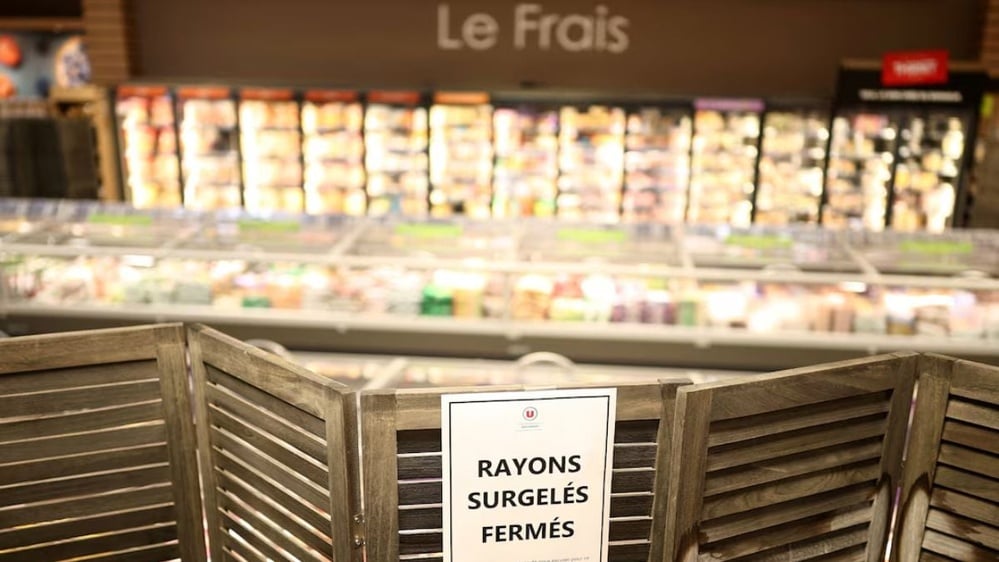
“French supermarket director apologises after cyber-attack spoils fresh and frozen food” · exact text match
Why: The text reports events and one quote without advice, blame, or policy prescription.
Claim: The reporting voice is matter-of-fact; affective language appears only inside the director's quoted remarks.
“describing the incident as 'an enormous loss of products'” · exact text match
Why: Emotive terms are attributed speech, not the outlet's own framing.
Claim: Store-level figures carry named attribution and direct quotes, while the chain-wide 50C figure is asserted without visible sourcing in the supplied text.
“according to store director Julien Freret” · exact text match
“'Today, we have a total loss of fresh and frozen,' Freret said” · exact text match
Why: Named attribution and quotation signal solid sourcing, but the headline figure's lack of visible attribution in the excerpt caps the score.
Claim: The reporting presents checkable, attributed facts without fallacious or speculative inference.
“At Intermarché La Haye, the attack caused fridge temperatures to reach 27C (80F), spoiling fresh and frozen food, according to store director Julien Freret.” · exact text match
Why: Concrete figures with named attribution; the supplied text shows no reasoning errors.
Claim: The excerpt compresses who, what, when, scale, and consequence into concrete, checkable detail.
“fridge temperatures to reach 27C (80F)” · exact text match
Why: Precise figures, a unit conversion, and a first-hand quote make the brief report efficient and informative.
The supplied text is a truncated excerpt (headline fragment, lead, and one store's account); fuller sourcing for the chain-wide 50C figure and the 'unprecedented' label may exist in the complete report, so credibility rests on partial text.
October 12, 2026 · 0 shares
A heavily attributed wire-style account lets prosecutors, ministers, retailers, and security researchers carry every claim, with the publisher adding only neutral connective framing.
Automated analysis; not human reviewed.
Limitations: The input is a scraped page with duplicated paragraphs, site boilerplate, and an appended list of unrelated headlines; no byline is given and the text reads as an agency wire republication, so publisher-specific framing beyond standard wire practice cannot be assessed.
·
9 of 55 available dimensions scored; omitted dimensions are not treated as neutral.
·
Verified supporting quotes for 4 of 9 scored dimensions.
Claim: The report relies on attributed statements and explicit uncertainty markers rather than the publisher's own assertions.
“It was unclear whether other operations had been affected.” · not found in supplied text
“Food retailers E.Leclerc and Auchan did not respond to requests for comment.” · exact text match
Why: Explicit acknowledgment of unknowns and disclosed non-responses indicate objective reporting rather than editorial assertion.
Claim: Alarming facts are delivered through precise, sourced statements rather than embellishment or urgency framing.
“Hackers raised the temperature of refrigerators and freezers at hundreds of French supermarkets to as high as 50 degrees Celsius (122 degrees Fahrenheit) overnight, causing fires and spoiling food.” · not found in supplied text
Why: The vivid lead is unit-converted and prosecutor-sourced factual reporting, without loaded or exaggerated language.
Claim: The story covers an unusual attack vector — internet-connected supermarket refrigeration causing physical harm — with cross-border implications.
“Supermarket cold aisles are typically run by control panels that manage an entire store’s fridges and freezers and can be accessed over the internet” · exact text match
Why: A cyberattack converting maintenance access into fires and food spoilage, plus multi-country spread, is a novel and consequential angle.
Claim: The report presents events and stakeholder statements without publisher recommendations.
““This incident underlines the importance of resilience across the entire supply chain.”” · exact text match
Why: The only prescriptive line is quoted from Eurocommerce's director general, not offered as the publisher's view.
Claim: The tone stays neutral and unemotional, conveying alarming content through attribution.
“The Paris prosecutor’s office said on Monday that a “large-scale” attack was “affecting connected refrigerators in several major food retailers across France”, leading to food losses and fires.” · not found in supplied text
Why: Alarming content is consistently framed with attribution and neutral wording rather than emotive language.
Claim: Nearly all claims are attributed to named officials, companies, and analysts, with estimates and uncertainties flagged.
“Felix Aime, a senior cyber threat intelligence analyst at Sekoia Threat Detection and Research, said Spain, Portugal, Poland, Germany and Belgium had also been affected.” · not found in supplied text
“It was unclear whether other operations had been affected.” · not found in supplied text
Why: Named sourcing for the multi-country claim and explicit uncertainty flags reflect strong visible attribution practice.
Claim: Causal and technical claims are attributed and hedged rather than asserted as settled fact.
“The affected units “were running outdated firmware”, Danfoss said” · exact text match
Why: The publisher preserves Danfoss's causal explanation as attributed while the official investigation is still pending, an evidence-bound practice.
Claim: The report preserves a source's denial of linkage and discloses non-responses, indicating fair handling of interested parties.
“Ahold Delhaize said there was no reason to see a link between the incidents in France and its supermarkets.” · not found in supplied text
“Food retailers E.Leclerc and Auchan did not respond to requests for comment.” · exact text match
Why: Preserving a counter-position and transparently reporting refusals to comment are observable fairness signals.
Claim: The report supplies technical and causal context connecting the incident to a documented controller vulnerability.
“On August 9, cybersecurity firm Claroty’s Team82 published research detailing vulnerabilities in the Danfoss AK-SM 800A controller.” · exact text match
Why: Linking the attack to prior published vulnerability research and explaining the control-panel mechanism adds analytic depth beyond event recitation.
The input is a scraped page with duplicated paragraphs, site boilerplate, and an appended list of unrelated headlines; no byline is given and the text reads as an agency wire republication, so publisher-specific framing beyond standard wire practice cannot be assessed.
October 12, 2026 · 0 shares
Measured, heavily attributed wire-style reporting that frames the fridge-hacking attack as an unprecedented food-security incident and situates it within European cyber-threat concern and Russian hybrid-attack context without asserting any perpetrator.
Automated analysis; not human reviewed.
Limitations: No publication date or dateline is given; the photo caption's '12 October 2026' may be a dating error, leaving the event's timing anchored only to relative references like 'Sunday night' and 'last month'.
·
9 of 55 available dimensions scored; omitted dimensions are not treated as neutral.
·
Verified supporting quotes for 9 of 9 scored dimensions.
Claim: Nearly all claims are attributed to named companies, prosecutors, or outlets, with unconfirmed items flagged.
“confirmed to AFP they suffered a cyberattack” · exact text match
“but the companies have yet to confirm this” · exact text match
Why: Dense attribution plus explicit flagging of unconfirmed reports shows objective presentation rather than editorial assertion.
Claim: Dramatic characterizations come from quoted officials, not publisher wording.
“described as "unprecedented"” · exact text match
Why: Strong language stays inside quotation marks with named attribution, keeping the register measured.
Claim: The story features an unusual attack vector with physical, consumer-facing consequences.
“managed to remotely trigger the forced defrosting of the refrigeration systems in numerous stores” · exact text match
Why: Remote defrosting causing spoiled food and fires is a novel, concrete scenario beyond routine breach coverage.
Claim: The report describes events and official reactions without editorial prescriptions.
“Intermarche condemned the food waste and financial losses resulting from the attack, without providing figures” · exact text match
Why: Recommendations appear only inside quoted officials' statements; the publisher offers none of its own.
Claim: Closing background amplifies general threat perception with sweeping, unattributed 'havoc' language.
“the potential havoc that can be caused in Europe in all sectors by malicious actors carrying out cyberattacks” · exact text match
Why: A broad, unattributed warning of sector-wide havoc adds mild alarm beyond the reported facts.
Claim: Multiple confirmations from prosecutors, retailers, and Danfoss anchor the report, with uncertainty flagged.
“The office of the Paris prosecutor confirmed to AFP that an investigation has been opened” · exact text match
“but the companies have yet to confirm this” · exact text match
Why: Institutional confirmations plus explicit uncertainty flags indicate strong visible sourcing practice in the supplied text.
Claim: Reporting relies on attributed technical specifics rather than conjecture.
“no longer receive software or security updates” · exact text match
Why: The report grounds the incident in verifiable details such as Danfoss's legacy-product admission and named regulator models instead of speculation.
Claim: The report separates confirmed facts from unconfirmed specialist-site claims.
“but the companies have yet to confirm this” · exact text match
Why: Explicitly noting the lack of company confirmation signals honest handling of uncertainty.
Claim: The report supplies specific technical identifiers and supply-chain detail.
“with a version of the former using "outdated firmware"” · exact text match
Why: Naming regulator models and firmware status gives readers precise, actionable context beyond generic breach reporting.
No publication date or dateline is given; the photo caption's '12 October 2026' may be a dating error, leaving the event's timing anchored only to relative references like 'Sunday night' and 'last month'.
October 12, 2026 · 0 shares
A heavily attributed wire-style account lets prosecutors, ministers, retailers, and security researchers carry every claim, with the publisher adding only neutral connective framing.
Automated analysis; not human reviewed.
Limitations: The input is a scraped page with duplicated paragraphs, site boilerplate, and an appended list of unrelated headlines; no byline is given and the text reads as an agency wire republication, so publisher-specific framing beyond standard wire practice cannot be assessed.
·
9 of 55 available dimensions scored; omitted dimensions are not treated as neutral.
·
Verified supporting quotes for 4 of 9 scored dimensions.
Claim: The report relies on attributed statements and explicit uncertainty markers rather than the publisher's own assertions.
“It was unclear whether other operations had been affected.” · not found in supplied text
“Food retailers E.Leclerc and Auchan did not respond to requests for comment.” · exact text match
Why: Explicit acknowledgment of unknowns and disclosed non-responses indicate objective reporting rather than editorial assertion.
Claim: Alarming facts are delivered through precise, sourced statements rather than embellishment or urgency framing.
“Hackers raised the temperature of refrigerators and freezers at hundreds of French supermarkets to as high as 50 degrees Celsius (122 degrees Fahrenheit) overnight, causing fires and spoiling food.” · not found in supplied text
Why: The vivid lead is unit-converted and prosecutor-sourced factual reporting, without loaded or exaggerated language.
Claim: The story covers an unusual attack vector — internet-connected supermarket refrigeration causing physical harm — with cross-border implications.
“Supermarket cold aisles are typically run by control panels that manage an entire store’s fridges and freezers and can be accessed over the internet” · exact text match
Why: A cyberattack converting maintenance access into fires and food spoilage, plus multi-country spread, is a novel and consequential angle.
Claim: The report presents events and stakeholder statements without publisher recommendations.
““This incident underlines the importance of resilience across the entire supply chain.”” · exact text match
Why: The only prescriptive line is quoted from Eurocommerce's director general, not offered as the publisher's view.
Claim: The tone stays neutral and unemotional, conveying alarming content through attribution.
“The Paris prosecutor’s office said on Monday that a “large-scale” attack was “affecting connected refrigerators in several major food retailers across France”, leading to food losses and fires.” · not found in supplied text
Why: Alarming content is consistently framed with attribution and neutral wording rather than emotive language.
Claim: Nearly all claims are attributed to named officials, companies, and analysts, with estimates and uncertainties flagged.
“Felix Aime, a senior cyber threat intelligence analyst at Sekoia Threat Detection and Research, said Spain, Portugal, Poland, Germany and Belgium had also been affected.” · not found in supplied text
“It was unclear whether other operations had been affected.” · not found in supplied text
Why: Named sourcing for the multi-country claim and explicit uncertainty flags reflect strong visible attribution practice.
Claim: Causal and technical claims are attributed and hedged rather than asserted as settled fact.
“The affected units “were running outdated firmware”, Danfoss said” · exact text match
Why: The publisher preserves Danfoss's causal explanation as attributed while the official investigation is still pending, an evidence-bound practice.
Claim: The report preserves a source's denial of linkage and discloses non-responses, indicating fair handling of interested parties.
“Ahold Delhaize said there was no reason to see a link between the incidents in France and its supermarkets.” · not found in supplied text
“Food retailers E.Leclerc and Auchan did not respond to requests for comment.” · exact text match
Why: Preserving a counter-position and transparently reporting refusals to comment are observable fairness signals.
Claim: The report supplies technical and causal context connecting the incident to a documented controller vulnerability.
“On August 9, cybersecurity firm Claroty’s Team82 published research detailing vulnerabilities in the Danfoss AK-SM 800A controller.” · exact text match
Why: Linking the attack to prior published vulnerability research and explaining the control-panel mechanism adds analytic depth beyond event recitation.
The input is a scraped page with duplicated paragraphs, site boilerplate, and an appended list of unrelated headlines; no byline is given and the text reads as an agency wire republication, so publisher-specific framing beyond standard wire practice cannot be assessed.
October 12, 2026 · 0 shares
Measured, heavily attributed wire-style reporting that frames the fridge-hacking attack as an unprecedented food-security incident and situates it within European cyber-threat concern and Russian hybrid-attack context without asserting any perpetrator.
Automated analysis; not human reviewed.
Limitations: No publication date or dateline is given; the photo caption's '12 October 2026' may be a dating error, leaving the event's timing anchored only to relative references like 'Sunday night' and 'last month'.
·
9 of 55 available dimensions scored; omitted dimensions are not treated as neutral.
·
Verified supporting quotes for 9 of 9 scored dimensions.
Claim: Nearly all claims are attributed to named companies, prosecutors, or outlets, with unconfirmed items flagged.
“confirmed to AFP they suffered a cyberattack” · exact text match
“but the companies have yet to confirm this” · exact text match
Why: Dense attribution plus explicit flagging of unconfirmed reports shows objective presentation rather than editorial assertion.
Claim: Dramatic characterizations come from quoted officials, not publisher wording.
“described as "unprecedented"” · exact text match
Why: Strong language stays inside quotation marks with named attribution, keeping the register measured.
Claim: The story features an unusual attack vector with physical, consumer-facing consequences.
“managed to remotely trigger the forced defrosting of the refrigeration systems in numerous stores” · exact text match
Why: Remote defrosting causing spoiled food and fires is a novel, concrete scenario beyond routine breach coverage.
Claim: The report describes events and official reactions without editorial prescriptions.
“Intermarche condemned the food waste and financial losses resulting from the attack, without providing figures” · exact text match
Why: Recommendations appear only inside quoted officials' statements; the publisher offers none of its own.
Claim: Closing background amplifies general threat perception with sweeping, unattributed 'havoc' language.
“the potential havoc that can be caused in Europe in all sectors by malicious actors carrying out cyberattacks” · exact text match
Why: A broad, unattributed warning of sector-wide havoc adds mild alarm beyond the reported facts.
Claim: Multiple confirmations from prosecutors, retailers, and Danfoss anchor the report, with uncertainty flagged.
“The office of the Paris prosecutor confirmed to AFP that an investigation has been opened” · exact text match
“but the companies have yet to confirm this” · exact text match
Why: Institutional confirmations plus explicit uncertainty flags indicate strong visible sourcing practice in the supplied text.
Claim: Reporting relies on attributed technical specifics rather than conjecture.
“no longer receive software or security updates” · exact text match
Why: The report grounds the incident in verifiable details such as Danfoss's legacy-product admission and named regulator models instead of speculation.
Claim: The report separates confirmed facts from unconfirmed specialist-site claims.
“but the companies have yet to confirm this” · exact text match
Why: Explicitly noting the lack of company confirmation signals honest handling of uncertainty.
Claim: The report supplies specific technical identifiers and supply-chain detail.
“with a version of the former using "outdated firmware"” · exact text match
Why: Naming regulator models and firmware status gives readers precise, actionable context beyond generic breach reporting.
No publication date or dateline is given; the photo caption's '12 October 2026' may be a dating error, leaving the event's timing anchored only to relative references like 'Sunday night' and 'last month'.
Heavily attributed straight-wire coverage relays French government, prosecutorial, and corporate statements about supermarket cyberattacks without editorial framing or independent verification.
Automated analysis; not human reviewed.
Limitations: No attacker, attack method, or independent verification is supplied; all scale and impact figures rest on official and corporate statements, and the link between the French refrigeration attacks and Ahold Delhaize's 'security issue' is presumed rather than confirmed.
·
9 of 55 available dimensions scored; omitted dimensions are not treated as neutral.
·
Verified supporting quotes for 9 of 9 scored dimensions.
Claim: No partisan or ideological framing appears; all claims are attributed official or corporate statements.
“French Finance Minister Roland Lescure told Parliament on Tuesday that about 700 of the country’s 10,000 supermarkets were affected.” · exact text match
“He said there was no risk to France’s food supplies but acknowledged that the attack “touches the heart of our food security.”” · exact text match
Why: The report conveys officials' and companies' statements without ideological characterization, policy advocacy, or partisan vocabulary.
Claim: Government and corporate actors are covered as neutral information sources, with neither anti-elite attack nor deferential praise.
“The Paris prosecutor’s office said Tuesday that its cybercrime unit was investigating the large-scale attack” · exact text match
Why: Institutions appear only as attributing sources for facts; no populist or elitist framing is present.
Claim: Virtually every factual claim is attributed to a named official, prosecutor, or company.
“Dominique Schelcher, CEO of French grocery chain Cooperative U, said 80 of the company’s 2,000 stores were affected.” · exact text match
“Danish technology company Danfoss, which supplied the refrigeration management software, said Monday that most affected systems were older products that no longer received software or security updates.” · exact text match
Why: Dense attribution to identifiable sources and absence of editorial voice mark strongly objective reporting.
Claim: The headline and body stay factual and precisely scoped; alarming language appears only inside quotes.
“Cyberattack targeting refrigeration systems hits 700 supermarkets, French government says.” · exact text match
“Websites for several of its brands, including Stop & Shop, Food Lion and Albert Heijn, remained offline Tuesday, although stores were open and serving customers.” · exact text match
Why: The headline is factual and attributed to the government, and the body reports measured specifics without alarmist amplification.
Claim: Reports of damage are balanced with official reassurance and containment steps.
“He said there was no risk to France’s food supplies but acknowledged that the attack “touches the heart of our food security.”” · exact text match
“Danfoss said it was working with affected customers to limit the damage.” · exact text match
Why: Spoiled food, shutdowns, and fires are paired with official reassurance and mitigation efforts, yielding balanced tone.
Claim: A cyberattack that makes supermarket refrigeration fail at scale is an unusual and consequential subject.
“causing refrigeration systems to overheat at hundreds of stores in France” · exact text match
Why: The novel target (supermarket refrigeration) and scale (roughly 700 stores) make the story distinctive and materially significant.
Claim: The narrative tone is flat; emotive characterizations occur only within attributed quotes.
“It is unprecedented, extremely serious, and unacceptable,” Schelcher said.” · exact text match
Why: Charged wording is confined to the CEO's quoted speech, while the publisher's own sentences remain neutral and descriptive.
Claim: Named institutional sources and preserved uncertainty support high credibility.
“Ahold Delhaize said it had no evidence that customer or employee data had been stolen.” · exact text match
“The Paris prosecutor’s office said Tuesday that its cybercrime unit was investigating the large-scale attack, including the extent of damage caused by spoiled food and possible fires.” · exact text match
Why: Claims are sourced to identifiable officials and companies, with uncertainty (e.g., 'no evidence', 'possible fires') left explicit rather than resolved.
Claim: The report efficiently covers scale, official response, technical cause, and a related incident in compact form.
“Danish technology company Danfoss, which supplied the refrigeration management software, said Monday that most affected systems were older products that no longer received software or security updates.” · exact text match
Why: Concise structure delivers quantities, responsible entities, a technical explanation, and remediation context with clear sourcing.
No attacker, attack method, or independent verification is supplied; all scale and impact figures rest on official and corporate statements, and the link between the French refrigeration attacks and Ahold Delhaize's 'security issue' is presumed rather than confirmed.
October 12, 2026 · 0 shares
A heavily attributed wire-style account lets prosecutors, ministers, retailers, and security researchers carry every claim, with the publisher adding only neutral connective framing.
Automated analysis; not human reviewed.
Limitations: The input is a scraped page with duplicated paragraphs, site boilerplate, and an appended list of unrelated headlines; no byline is given and the text reads as an agency wire republication, so publisher-specific framing beyond standard wire practice cannot be assessed.
·
9 of 55 available dimensions scored; omitted dimensions are not treated as neutral.
·
Verified supporting quotes for 4 of 9 scored dimensions.
Claim: The report relies on attributed statements and explicit uncertainty markers rather than the publisher's own assertions.
“It was unclear whether other operations had been affected.” · not found in supplied text
“Food retailers E.Leclerc and Auchan did not respond to requests for comment.” · exact text match
Why: Explicit acknowledgment of unknowns and disclosed non-responses indicate objective reporting rather than editorial assertion.
Claim: Alarming facts are delivered through precise, sourced statements rather than embellishment or urgency framing.
“Hackers raised the temperature of refrigerators and freezers at hundreds of French supermarkets to as high as 50 degrees Celsius (122 degrees Fahrenheit) overnight, causing fires and spoiling food.” · not found in supplied text
Why: The vivid lead is unit-converted and prosecutor-sourced factual reporting, without loaded or exaggerated language.
Claim: The story covers an unusual attack vector — internet-connected supermarket refrigeration causing physical harm — with cross-border implications.
“Supermarket cold aisles are typically run by control panels that manage an entire store’s fridges and freezers and can be accessed over the internet” · exact text match
Why: A cyberattack converting maintenance access into fires and food spoilage, plus multi-country spread, is a novel and consequential angle.
Claim: The report presents events and stakeholder statements without publisher recommendations.
““This incident underlines the importance of resilience across the entire supply chain.”” · exact text match
Why: The only prescriptive line is quoted from Eurocommerce's director general, not offered as the publisher's view.
Claim: The tone stays neutral and unemotional, conveying alarming content through attribution.
“The Paris prosecutor’s office said on Monday that a “large-scale” attack was “affecting connected refrigerators in several major food retailers across France”, leading to food losses and fires.” · not found in supplied text
Why: Alarming content is consistently framed with attribution and neutral wording rather than emotive language.
Claim: Nearly all claims are attributed to named officials, companies, and analysts, with estimates and uncertainties flagged.
“Felix Aime, a senior cyber threat intelligence analyst at Sekoia Threat Detection and Research, said Spain, Portugal, Poland, Germany and Belgium had also been affected.” · not found in supplied text
“It was unclear whether other operations had been affected.” · not found in supplied text
Why: Named sourcing for the multi-country claim and explicit uncertainty flags reflect strong visible attribution practice.
Claim: Causal and technical claims are attributed and hedged rather than asserted as settled fact.
“The affected units “were running outdated firmware”, Danfoss said” · exact text match
Why: The publisher preserves Danfoss's causal explanation as attributed while the official investigation is still pending, an evidence-bound practice.
Claim: The report preserves a source's denial of linkage and discloses non-responses, indicating fair handling of interested parties.
“Ahold Delhaize said there was no reason to see a link between the incidents in France and its supermarkets.” · not found in supplied text
“Food retailers E.Leclerc and Auchan did not respond to requests for comment.” · exact text match
Why: Preserving a counter-position and transparently reporting refusals to comment are observable fairness signals.
Claim: The report supplies technical and causal context connecting the incident to a documented controller vulnerability.
“On August 9, cybersecurity firm Claroty’s Team82 published research detailing vulnerabilities in the Danfoss AK-SM 800A controller.” · exact text match
Why: Linking the attack to prior published vulnerability research and explaining the control-panel mechanism adds analytic depth beyond event recitation.
The input is a scraped page with duplicated paragraphs, site boilerplate, and an appended list of unrelated headlines; no byline is given and the text reads as an agency wire republication, so publisher-specific framing beyond standard wire practice cannot be assessed.
October 12, 2026 · 0 shares
Neutral, attribution-heavy reporting presents the cyber attack and losses through official and news-agency sources without partisan or sensational framing.
Automated analysis; not human reviewed.
Limitations: No author byline or publication date is provided, and several key facts rely on second-hand agency and local-media accounts.
·
8 of 55 available dimensions scored; omitted dimensions are not treated as neutral.
·
Verified supporting quotes for 6 of 8 scored dimensions.
Claim: The report does not frame the cyber attack in partisan left-right terms.
“Food security requires more attention at all levels.
Because the weaponisation of food has become a reality.”
· exact text match
Why: The only politically charged language is attributed to an official, with no publisher endorsement or partisan label.
Claim: The report keeps to observable facts and attributed statements rather than subjective interpretation.
“according to the AFP news agency” · exact text match
“BBC News has approached the supermarket chains for comment.” · exact text match
Why: Named sourcing and a request for comment support an objective rather than subjective presentation.
Claim: Alarming details are presented in measured, attributed prose rather than sensationalized publisher framing.
“The chief executive of Coopérative U said several of its supermarkets had been hit by the "extremely serious and unprecedented" attack.” · exact text match
“Some supermarket staff reportedly said they were hit by waves of hot air when they opened freezer units on Monday morning.” · exact text match
Why: Strong language and dramatic details are attributed or reported rather than amplified in the publisher's own voice.
Claim: The report primarily describes the incident and responses; prescriptions appear only as attributed calls by officials or executives.
“He called for an investigation into the hack and said targeting equipment essential to the French food supply was "unacceptable".” · exact text match
Why: Calls for investigation and condemnation are quoted from actors rather than advanced as the publisher's own prescription.
Claim: The report relies on multiple named news agencies and official sources, with clear attribution and requests for comment.
“according to the AFP news agency” · exact text match
“the Reuters news agency reported” · exact text match
“The Paris prosecutor's office told AFP it had opened an investigation into the incident” · not found in supplied text
Why: Multiple independent attributions and official sourcing support high visible credibility.
Claim: The report consistently attributes claims to named agencies and hedges uncertain details.
“Hackers reportedly gained control of the software that regulates the temperatures of the refrigeration units” · exact text match
“The Paris prosecutor's office told AFP it had opened an investigation into the incident” · not found in supplied text
Why: Attribution and hedging indicate rational, evidence-bound reporting rather than irrational assertion.
Claim: The report makes a modest extrapolation from two local loss figures to a possible nationwide total.
“meaning the nationwide total could run into the millions” · exact text match
Why: The nationwide figure is a hedged estimate inferred from limited local loss data.
Claim: The report shows fairness signals by attributing claims and seeking comment from implicated chains.
“BBC News has approached the supermarket chains for comment.” · exact text match
“Hackers reportedly gained control of the software that regulates the temperatures of the refrigeration units” · exact text match
Why: Seeking comment and using hedged attribution indicate honest, fair reporting practices.
No author byline or publication date is provided, and several key facts rely on second-hand agency and local-media accounts.
October 14, 2026 · 0 shares
Measured, attribution-driven cybersecurity reporting grounded in CERT-FR advisories, vendor notices, and one named expert, with mild urgency framing and occasional editorial flourishes.
Automated analysis; not human reviewed.
Limitations: The supplied text is truncated mid-sentence and never names the attacker, the intrusion method, or financial losses, limiting verification of cause and impact.
·
9 of 55 available dimensions scored; omitted dimensions are not treated as neutral.
·
Verified supporting quotes for 9 of 9 scored dimensions.
Claim: Coverage is predominantly factual and attribution-heavy, with only minor editorial color.
“posted presciently on LinkedIn” · exact text match
“a spokesman said” · exact text match
Why: Facts are consistently attributed to CERT-FR, vendors, and named spokesmen, while an occasional adverb like 'presciently' injects mild authorial judgment, placing the text near but not at full objectivity.
Claim: Unusual target and attribution ambiguity give the story above-average interest.
“A teenager and an intelligence service would look much the same from the defender’s side” · exact text match
Why: The unexpected smart-fridge attack vector and the espionage-versus-vandalism puzzle add distinctive angles beyond routine breach coverage.
Claim: Mild urgency framing emphasizes spreading impact and immediate disconnection without alarmism.
“telling supermarkets to disconnect them from the internet as soon as possible” · exact text match
Why: Urgency language mirrors official guidance rather than amplifying fear, supporting only a low-level fearful score.
Claim: Light editorializing overlays otherwise attributed reporting.
“posted presciently on LinkedIn” · exact text match
“And so it came to be.” · exact text match
Why: Authorial judgments and narrative flourishes appear occasionally, but the substantive claims remain sourced to officials and experts.
Claim: Strong visible sourcing and hedged attribution support above-average credibility.
“CERT-FR said” · exact text match
“said Hegel” · exact text match
Why: Consistent attribution to officials, vendor advisories, spokesmen, and a named expert, with forecasts hedged rather than asserted as fact.
Claim: Reporting is methodical and evidence-based, resting on official advisories and reasoned expert analysis.
“advised supermarkets to disconnect any refrigeration control systems with a public IP address from the internet, and to reconnect them via a secure VPN” · exact text match
Why: Step-by-step, source-attributed remediation logic and hedged expert forecasts support a measured, rational classification.
Claim: Modest unsourced forward-looking and mind-reading framing beyond established facts.
“supermarket CISOs will be wondering who attacked them, and why” · exact text match
Why: Asserts what CISOs will be thinking without attribution, while the other forecasts in the text are attributed to Hegel.
Claim: Human authorship is indicated by grammatical slips and a detailed personal author bio.
“Dixell published a security advisory for user of its XWEB internet interface” · exact text match
“Peter has been writing about enterprise IT for over 30 years” · exact text match
Why: An uncorrected grammatical error and a specific personal career bio are more consistent with human writing than AI generation.
Claim: The reporting explains the systemic cause of exposure, not just the incident itself.
“supermarkets often buy “refrigeration as a service,” with providers guaranteeing performance as long as they have access to a constant stream of data” · exact text match
Why: Linking the managed-services business model to the security exposure shows analytical depth beyond event reporting.
The supplied text is truncated mid-sentence and never names the attacker, the intrusion method, or financial losses, limiting verification of cause and impact.
October 14, 2026 · 0 shares
Well-attributed, hedged security reporting whose strongest framing device is an expanding-incident narrative built largely on one vendor expert's analysis and an official CERT-FR advisory.
Automated analysis; not human reviewed.
Limitations: The text is an update referencing earlier reporting ('previously observed') that is not supplied, so the incident's original scope and baseline details cannot be verified; the trailing list of unrelated headlines is navigation and was excluded.
·
11 of 55 available dimensions scored; omitted dimensions are not treated as neutral.
·
Verified supporting quotes for 11 of 11 scored dimensions.
Claim: Publisher distinguishes reported facts from attributed expert judgments.
“Preminger assessed that while the attack did not necessarily require sophisticated skills, the targeting was a clear deliberate attempt to cause damage.” · exact text match
Why: Deliberateness is framed as the expert's assessment, not the publisher's conclusion.
Claim: Striking incident details are presented factually without alarmist language.
“attackers reportedly changed freezer settings from −22°C to 150°C” · exact text match
Why: The dramatic temperature change is sourced and stated neutrally; no hype vocabulary appears.
Claim: Unusual industrial-control attack with physical consequences and vivid technical detail.
“attackers reportedly changed freezer settings from −22°C to 150°C” · exact text match
Why: A cyber-attack flipping freezers to 150°C is a rare, memorable angle beyond routine breach coverage.
Claim: Remediation guidance is attributed to the expert rather than prescribed editorially.
“His advice was to keep critical devices off the public internet” · exact text match
Why: Prescriptions appear as Preminger's recommendations, keeping the publisher's voice descriptive.
Claim: Mild concern framing from scope-expansion and cross-border exposure warnings, without fear-mongering.
“the scope of the incident could be larger than previously observed.” · exact text match
Why: The lede emphasizes widening impact, but hedged wording and mitigation advice keep alarm low.
Claim: Analysis content consists of attributed expert opinion with minimal publisher editorializing.
“Speaking to Infosecurity, Amir Preminger, CTO of industrial security provider Claroty, said” · exact text match
Why: Opinions are introduced as the expert's statements to the outlet, not publisher views.
Claim: Certainty is kept within the evidence, including explicit acknowledgment of unknowns.
“but he did not know what software versions those devices were running or whether they were vulnerable.” · exact text match
Why: The report preserves the expert's stated uncertainty about foreign devices' exposure.
Claim: Core claims rest on multiple named, checkable sources.
“A security advisory published by the French national Computer emergency response team (CERT-FR) on October 12” · exact text match
Why: An official advisory, national media, and a named industry expert support the key claims.
Claim: Reporting is evidence-based, hedging claims and grounding analysis in named sources rather than speculation.
“attackers reportedly changed freezer settings from −22°C to 150°C” · exact text match
Why: The dramatic detail is attributed to Le Monde rather than asserted, reflecting evidence-bound reasoning.
Claim: The report explicitly avoids implying a connection between separate incidents.
“Preminger did not claim the incidents involved the same group.” · exact text match
Why: Actively disclaiming an implied link, alongside consistent named sourcing, is an honesty signal.
Claim: Explains the technical and regulatory context behind the attack surface.
“requires them to maintain timestamped monitoring of temperatures to strengthen food safety” · exact text match
Why: Connecting internet exposure to compliance law gives readers the underlying causal context.
The text is an update referencing earlier reporting ('previously observed') that is not supplied, so the incident's original scope and baseline details cannot be verified; the trailing list of unrelated headlines is navigation and was excluded.
Heavily attributed straight-wire coverage relays French government, prosecutorial, and corporate statements about supermarket cyberattacks without editorial framing or independent verification.
Automated analysis; not human reviewed.
Limitations: No attacker, attack method, or independent verification is supplied; all scale and impact figures rest on official and corporate statements, and the link between the French refrigeration attacks and Ahold Delhaize's 'security issue' is presumed rather than confirmed.
·
9 of 55 available dimensions scored; omitted dimensions are not treated as neutral.
·
Verified supporting quotes for 9 of 9 scored dimensions.
Claim: No partisan or ideological framing appears; all claims are attributed official or corporate statements.
“French Finance Minister Roland Lescure told Parliament on Tuesday that about 700 of the country’s 10,000 supermarkets were affected.” · exact text match
“He said there was no risk to France’s food supplies but acknowledged that the attack “touches the heart of our food security.”” · exact text match
Why: The report conveys officials' and companies' statements without ideological characterization, policy advocacy, or partisan vocabulary.
Claim: Government and corporate actors are covered as neutral information sources, with neither anti-elite attack nor deferential praise.
“The Paris prosecutor’s office said Tuesday that its cybercrime unit was investigating the large-scale attack” · exact text match
Why: Institutions appear only as attributing sources for facts; no populist or elitist framing is present.
Claim: Virtually every factual claim is attributed to a named official, prosecutor, or company.
“Dominique Schelcher, CEO of French grocery chain Cooperative U, said 80 of the company’s 2,000 stores were affected.” · exact text match
“Danish technology company Danfoss, which supplied the refrigeration management software, said Monday that most affected systems were older products that no longer received software or security updates.” · exact text match
Why: Dense attribution to identifiable sources and absence of editorial voice mark strongly objective reporting.
Claim: The headline and body stay factual and precisely scoped; alarming language appears only inside quotes.
“Cyberattack targeting refrigeration systems hits 700 supermarkets, French government says.” · exact text match
“Websites for several of its brands, including Stop & Shop, Food Lion and Albert Heijn, remained offline Tuesday, although stores were open and serving customers.” · exact text match
Why: The headline is factual and attributed to the government, and the body reports measured specifics without alarmist amplification.
Claim: Reports of damage are balanced with official reassurance and containment steps.
“He said there was no risk to France’s food supplies but acknowledged that the attack “touches the heart of our food security.”” · exact text match
“Danfoss said it was working with affected customers to limit the damage.” · exact text match
Why: Spoiled food, shutdowns, and fires are paired with official reassurance and mitigation efforts, yielding balanced tone.
Claim: A cyberattack that makes supermarket refrigeration fail at scale is an unusual and consequential subject.
“causing refrigeration systems to overheat at hundreds of stores in France” · exact text match
Why: The novel target (supermarket refrigeration) and scale (roughly 700 stores) make the story distinctive and materially significant.
Claim: The narrative tone is flat; emotive characterizations occur only within attributed quotes.
“It is unprecedented, extremely serious, and unacceptable,” Schelcher said.” · exact text match
Why: Charged wording is confined to the CEO's quoted speech, while the publisher's own sentences remain neutral and descriptive.
Claim: Named institutional sources and preserved uncertainty support high credibility.
“Ahold Delhaize said it had no evidence that customer or employee data had been stolen.” · exact text match
“The Paris prosecutor’s office said Tuesday that its cybercrime unit was investigating the large-scale attack, including the extent of damage caused by spoiled food and possible fires.” · exact text match
Why: Claims are sourced to identifiable officials and companies, with uncertainty (e.g., 'no evidence', 'possible fires') left explicit rather than resolved.
Claim: The report efficiently covers scale, official response, technical cause, and a related incident in compact form.
“Danish technology company Danfoss, which supplied the refrigeration management software, said Monday that most affected systems were older products that no longer received software or security updates.” · exact text match
Why: Concise structure delivers quantities, responsible entities, a technical explanation, and remediation context with clear sourcing.
No attacker, attack method, or independent verification is supplied; all scale and impact figures rest on official and corporate statements, and the link between the French refrigeration attacks and Ahold Delhaize's 'security issue' is presumed rather than confirmed.
October 12, 2026 · 0 shares
A heavily attributed wire-style account lets prosecutors, ministers, retailers, and security researchers carry every claim, with the publisher adding only neutral connective framing.
Automated analysis; not human reviewed.
Limitations: The input is a scraped page with duplicated paragraphs, site boilerplate, and an appended list of unrelated headlines; no byline is given and the text reads as an agency wire republication, so publisher-specific framing beyond standard wire practice cannot be assessed.
·
9 of 55 available dimensions scored; omitted dimensions are not treated as neutral.
·
Verified supporting quotes for 4 of 9 scored dimensions.
Claim: The report relies on attributed statements and explicit uncertainty markers rather than the publisher's own assertions.
“It was unclear whether other operations had been affected.” · not found in supplied text
“Food retailers E.Leclerc and Auchan did not respond to requests for comment.” · exact text match
Why: Explicit acknowledgment of unknowns and disclosed non-responses indicate objective reporting rather than editorial assertion.
Claim: Alarming facts are delivered through precise, sourced statements rather than embellishment or urgency framing.
“Hackers raised the temperature of refrigerators and freezers at hundreds of French supermarkets to as high as 50 degrees Celsius (122 degrees Fahrenheit) overnight, causing fires and spoiling food.” · not found in supplied text
Why: The vivid lead is unit-converted and prosecutor-sourced factual reporting, without loaded or exaggerated language.
Claim: The story covers an unusual attack vector — internet-connected supermarket refrigeration causing physical harm — with cross-border implications.
“Supermarket cold aisles are typically run by control panels that manage an entire store’s fridges and freezers and can be accessed over the internet” · exact text match
Why: A cyberattack converting maintenance access into fires and food spoilage, plus multi-country spread, is a novel and consequential angle.
Claim: The report presents events and stakeholder statements without publisher recommendations.
““This incident underlines the importance of resilience across the entire supply chain.”” · exact text match
Why: The only prescriptive line is quoted from Eurocommerce's director general, not offered as the publisher's view.
Claim: The tone stays neutral and unemotional, conveying alarming content through attribution.
“The Paris prosecutor’s office said on Monday that a “large-scale” attack was “affecting connected refrigerators in several major food retailers across France”, leading to food losses and fires.” · not found in supplied text
Why: Alarming content is consistently framed with attribution and neutral wording rather than emotive language.
Claim: Nearly all claims are attributed to named officials, companies, and analysts, with estimates and uncertainties flagged.
“Felix Aime, a senior cyber threat intelligence analyst at Sekoia Threat Detection and Research, said Spain, Portugal, Poland, Germany and Belgium had also been affected.” · not found in supplied text
“It was unclear whether other operations had been affected.” · not found in supplied text
Why: Named sourcing for the multi-country claim and explicit uncertainty flags reflect strong visible attribution practice.
Claim: Causal and technical claims are attributed and hedged rather than asserted as settled fact.
“The affected units “were running outdated firmware”, Danfoss said” · exact text match
Why: The publisher preserves Danfoss's causal explanation as attributed while the official investigation is still pending, an evidence-bound practice.
Claim: The report preserves a source's denial of linkage and discloses non-responses, indicating fair handling of interested parties.
“Ahold Delhaize said there was no reason to see a link between the incidents in France and its supermarkets.” · not found in supplied text
“Food retailers E.Leclerc and Auchan did not respond to requests for comment.” · exact text match
Why: Preserving a counter-position and transparently reporting refusals to comment are observable fairness signals.
Claim: The report supplies technical and causal context connecting the incident to a documented controller vulnerability.
“On August 9, cybersecurity firm Claroty’s Team82 published research detailing vulnerabilities in the Danfoss AK-SM 800A controller.” · exact text match
Why: Linking the attack to prior published vulnerability research and explaining the control-panel mechanism adds analytic depth beyond event recitation.
The input is a scraped page with duplicated paragraphs, site boilerplate, and an appended list of unrelated headlines; no byline is given and the text reads as an agency wire republication, so publisher-specific framing beyond standard wire practice cannot be assessed.
Heavily attributed straight-wire coverage relays French government, prosecutorial, and corporate statements about supermarket cyberattacks without editorial framing or independent verification.
Automated analysis; not human reviewed.
Limitations: No attacker, attack method, or independent verification is supplied; all scale and impact figures rest on official and corporate statements, and the link between the French refrigeration attacks and Ahold Delhaize's 'security issue' is presumed rather than confirmed.
·
9 of 55 available dimensions scored; omitted dimensions are not treated as neutral.
·
Verified supporting quotes for 9 of 9 scored dimensions.
Claim: No partisan or ideological framing appears; all claims are attributed official or corporate statements.
“French Finance Minister Roland Lescure told Parliament on Tuesday that about 700 of the country’s 10,000 supermarkets were affected.” · exact text match
“He said there was no risk to France’s food supplies but acknowledged that the attack “touches the heart of our food security.”” · exact text match
Why: The report conveys officials' and companies' statements without ideological characterization, policy advocacy, or partisan vocabulary.
Claim: Government and corporate actors are covered as neutral information sources, with neither anti-elite attack nor deferential praise.
“The Paris prosecutor’s office said Tuesday that its cybercrime unit was investigating the large-scale attack” · exact text match
Why: Institutions appear only as attributing sources for facts; no populist or elitist framing is present.
Claim: Virtually every factual claim is attributed to a named official, prosecutor, or company.
“Dominique Schelcher, CEO of French grocery chain Cooperative U, said 80 of the company’s 2,000 stores were affected.” · exact text match
“Danish technology company Danfoss, which supplied the refrigeration management software, said Monday that most affected systems were older products that no longer received software or security updates.” · exact text match
Why: Dense attribution to identifiable sources and absence of editorial voice mark strongly objective reporting.
Claim: The headline and body stay factual and precisely scoped; alarming language appears only inside quotes.
“Cyberattack targeting refrigeration systems hits 700 supermarkets, French government says.” · exact text match
“Websites for several of its brands, including Stop & Shop, Food Lion and Albert Heijn, remained offline Tuesday, although stores were open and serving customers.” · exact text match
Why: The headline is factual and attributed to the government, and the body reports measured specifics without alarmist amplification.
Claim: Reports of damage are balanced with official reassurance and containment steps.
“He said there was no risk to France’s food supplies but acknowledged that the attack “touches the heart of our food security.”” · exact text match
“Danfoss said it was working with affected customers to limit the damage.” · exact text match
Why: Spoiled food, shutdowns, and fires are paired with official reassurance and mitigation efforts, yielding balanced tone.
Claim: A cyberattack that makes supermarket refrigeration fail at scale is an unusual and consequential subject.
“causing refrigeration systems to overheat at hundreds of stores in France” · exact text match
Why: The novel target (supermarket refrigeration) and scale (roughly 700 stores) make the story distinctive and materially significant.
Claim: The narrative tone is flat; emotive characterizations occur only within attributed quotes.
“It is unprecedented, extremely serious, and unacceptable,” Schelcher said.” · exact text match
Why: Charged wording is confined to the CEO's quoted speech, while the publisher's own sentences remain neutral and descriptive.
Claim: Named institutional sources and preserved uncertainty support high credibility.
“Ahold Delhaize said it had no evidence that customer or employee data had been stolen.” · exact text match
“The Paris prosecutor’s office said Tuesday that its cybercrime unit was investigating the large-scale attack, including the extent of damage caused by spoiled food and possible fires.” · exact text match
Why: Claims are sourced to identifiable officials and companies, with uncertainty (e.g., 'no evidence', 'possible fires') left explicit rather than resolved.
Claim: The report efficiently covers scale, official response, technical cause, and a related incident in compact form.
“Danish technology company Danfoss, which supplied the refrigeration management software, said Monday that most affected systems were older products that no longer received software or security updates.” · exact text match
Why: Concise structure delivers quantities, responsible entities, a technical explanation, and remediation context with clear sourcing.
No attacker, attack method, or independent verification is supplied; all scale and impact figures rest on official and corporate statements, and the link between the French refrigeration attacks and Ahold Delhaize's 'security issue' is presumed rather than confirmed.
October 12, 2026 · 0 shares
A heavily attributed wire-style account lets prosecutors, ministers, retailers, and security researchers carry every claim, with the publisher adding only neutral connective framing.
Automated analysis; not human reviewed.
Limitations: The input is a scraped page with duplicated paragraphs, site boilerplate, and an appended list of unrelated headlines; no byline is given and the text reads as an agency wire republication, so publisher-specific framing beyond standard wire practice cannot be assessed.
·
9 of 55 available dimensions scored; omitted dimensions are not treated as neutral.
·
Verified supporting quotes for 4 of 9 scored dimensions.
Claim: The report relies on attributed statements and explicit uncertainty markers rather than the publisher's own assertions.
“It was unclear whether other operations had been affected.” · not found in supplied text
“Food retailers E.Leclerc and Auchan did not respond to requests for comment.” · exact text match
Why: Explicit acknowledgment of unknowns and disclosed non-responses indicate objective reporting rather than editorial assertion.
Claim: Alarming facts are delivered through precise, sourced statements rather than embellishment or urgency framing.
“Hackers raised the temperature of refrigerators and freezers at hundreds of French supermarkets to as high as 50 degrees Celsius (122 degrees Fahrenheit) overnight, causing fires and spoiling food.” · not found in supplied text
Why: The vivid lead is unit-converted and prosecutor-sourced factual reporting, without loaded or exaggerated language.
Claim: The story covers an unusual attack vector — internet-connected supermarket refrigeration causing physical harm — with cross-border implications.
“Supermarket cold aisles are typically run by control panels that manage an entire store’s fridges and freezers and can be accessed over the internet” · exact text match
Why: A cyberattack converting maintenance access into fires and food spoilage, plus multi-country spread, is a novel and consequential angle.
Claim: The report presents events and stakeholder statements without publisher recommendations.
““This incident underlines the importance of resilience across the entire supply chain.”” · exact text match
Why: The only prescriptive line is quoted from Eurocommerce's director general, not offered as the publisher's view.
Claim: The tone stays neutral and unemotional, conveying alarming content through attribution.
“The Paris prosecutor’s office said on Monday that a “large-scale” attack was “affecting connected refrigerators in several major food retailers across France”, leading to food losses and fires.” · not found in supplied text
Why: Alarming content is consistently framed with attribution and neutral wording rather than emotive language.
Claim: Nearly all claims are attributed to named officials, companies, and analysts, with estimates and uncertainties flagged.
“Felix Aime, a senior cyber threat intelligence analyst at Sekoia Threat Detection and Research, said Spain, Portugal, Poland, Germany and Belgium had also been affected.” · not found in supplied text
“It was unclear whether other operations had been affected.” · not found in supplied text
Why: Named sourcing for the multi-country claim and explicit uncertainty flags reflect strong visible attribution practice.
Claim: Causal and technical claims are attributed and hedged rather than asserted as settled fact.
“The affected units “were running outdated firmware”, Danfoss said” · exact text match
Why: The publisher preserves Danfoss's causal explanation as attributed while the official investigation is still pending, an evidence-bound practice.
Claim: The report preserves a source's denial of linkage and discloses non-responses, indicating fair handling of interested parties.
“Ahold Delhaize said there was no reason to see a link between the incidents in France and its supermarkets.” · not found in supplied text
“Food retailers E.Leclerc and Auchan did not respond to requests for comment.” · exact text match
Why: Preserving a counter-position and transparently reporting refusals to comment are observable fairness signals.
Claim: The report supplies technical and causal context connecting the incident to a documented controller vulnerability.
“On August 9, cybersecurity firm Claroty’s Team82 published research detailing vulnerabilities in the Danfoss AK-SM 800A controller.” · exact text match
Why: Linking the attack to prior published vulnerability research and explaining the control-panel mechanism adds analytic depth beyond event recitation.
The input is a scraped page with duplicated paragraphs, site boilerplate, and an appended list of unrelated headlines; no byline is given and the text reads as an agency wire republication, so publisher-specific framing beyond standard wire practice cannot be assessed.
October 12, 2026 · 0 shares
A heavily attributed wire-style account lets prosecutors, ministers, retailers, and security researchers carry every claim, with the publisher adding only neutral connective framing.
Automated analysis; not human reviewed. Limitations: The input is a scraped page with duplicated paragraphs, site boilerplate, and an appended list of unrelated headlines; no byline is given and the text reads as an agency wire republication, so publisher-specific framing beyond standard wire practice cannot be assessed. · 9 of 55 available dimensions scored; omitted dimensions are not treated as neutral. · Verified supporting quotes for 4 of 9 scored dimensions.
Claim: The report relies on attributed statements and explicit uncertainty markers rather than the publisher's own assertions.
“It was unclear whether other operations had been affected.” · not found in supplied text
“Food retailers E.Leclerc and Auchan did not respond to requests for comment.” · exact text match
Why: Explicit acknowledgment of unknowns and disclosed non-responses indicate objective reporting rather than editorial assertion.
Claim: Alarming facts are delivered through precise, sourced statements rather than embellishment or urgency framing.
“Hackers raised the temperature of refrigerators and freezers at hundreds of French supermarkets to as high as 50 degrees Celsius (122 degrees Fahrenheit) overnight, causing fires and spoiling food.” · not found in supplied text
Why: The vivid lead is unit-converted and prosecutor-sourced factual reporting, without loaded or exaggerated language.
Claim: The story covers an unusual attack vector — internet-connected supermarket refrigeration causing physical harm — with cross-border implications.
“Supermarket cold aisles are typically run by control panels that manage an entire store’s fridges and freezers and can be accessed over the internet” · exact text match
Why: A cyberattack converting maintenance access into fires and food spoilage, plus multi-country spread, is a novel and consequential angle.
Claim: The report presents events and stakeholder statements without publisher recommendations.
““This incident underlines the importance of resilience across the entire supply chain.”” · exact text match
Why: The only prescriptive line is quoted from Eurocommerce's director general, not offered as the publisher's view.
Claim: The tone stays neutral and unemotional, conveying alarming content through attribution.
“The Paris prosecutor’s office said on Monday that a “large-scale” attack was “affecting connected refrigerators in several major food retailers across France”, leading to food losses and fires.” · not found in supplied text
Why: Alarming content is consistently framed with attribution and neutral wording rather than emotive language.
Claim: Nearly all claims are attributed to named officials, companies, and analysts, with estimates and uncertainties flagged.
“Felix Aime, a senior cyber threat intelligence analyst at Sekoia Threat Detection and Research, said Spain, Portugal, Poland, Germany and Belgium had also been affected.” · not found in supplied text
“It was unclear whether other operations had been affected.” · not found in supplied text
Why: Named sourcing for the multi-country claim and explicit uncertainty flags reflect strong visible attribution practice.
Claim: Causal and technical claims are attributed and hedged rather than asserted as settled fact.
“The affected units “were running outdated firmware”, Danfoss said” · exact text match
Why: The publisher preserves Danfoss's causal explanation as attributed while the official investigation is still pending, an evidence-bound practice.
Claim: The report preserves a source's denial of linkage and discloses non-responses, indicating fair handling of interested parties.
“Ahold Delhaize said there was no reason to see a link between the incidents in France and its supermarkets.” · not found in supplied text
“Food retailers E.Leclerc and Auchan did not respond to requests for comment.” · exact text match
Why: Preserving a counter-position and transparently reporting refusals to comment are observable fairness signals.
Claim: The report supplies technical and causal context connecting the incident to a documented controller vulnerability.
“On August 9, cybersecurity firm Claroty’s Team82 published research detailing vulnerabilities in the Danfoss AK-SM 800A controller.” · exact text match
Why: Linking the attack to prior published vulnerability research and explaining the control-panel mechanism adds analytic depth beyond event recitation.
The input is a scraped page with duplicated paragraphs, site boilerplate, and an appended list of unrelated headlines; no byline is given and the text reads as an agency wire republication, so publisher-specific framing beyond standard wire practice cannot be assessed.
October 12, 2026 · 0 shares
A heavily attributed wire-style account lets prosecutors, ministers, retailers, and security researchers carry every claim, with the publisher adding only neutral connective framing.
Automated analysis; not human reviewed. Limitations: The input is a scraped page with duplicated paragraphs, site boilerplate, and an appended list of unrelated headlines; no byline is given and the text reads as an agency wire republication, so publisher-specific framing beyond standard wire practice cannot be assessed. · 9 of 55 available dimensions scored; omitted dimensions are not treated as neutral. · Verified supporting quotes for 4 of 9 scored dimensions.
Claim: The report relies on attributed statements and explicit uncertainty markers rather than the publisher's own assertions.
“It was unclear whether other operations had been affected.” · not found in supplied text
“Food retailers E.Leclerc and Auchan did not respond to requests for comment.” · exact text match
Why: Explicit acknowledgment of unknowns and disclosed non-responses indicate objective reporting rather than editorial assertion.
Claim: Alarming facts are delivered through precise, sourced statements rather than embellishment or urgency framing.
“Hackers raised the temperature of refrigerators and freezers at hundreds of French supermarkets to as high as 50 degrees Celsius (122 degrees Fahrenheit) overnight, causing fires and spoiling food.” · not found in supplied text
Why: The vivid lead is unit-converted and prosecutor-sourced factual reporting, without loaded or exaggerated language.
Claim: The story covers an unusual attack vector — internet-connected supermarket refrigeration causing physical harm — with cross-border implications.
“Supermarket cold aisles are typically run by control panels that manage an entire store’s fridges and freezers and can be accessed over the internet” · exact text match
Why: A cyberattack converting maintenance access into fires and food spoilage, plus multi-country spread, is a novel and consequential angle.
Claim: The report presents events and stakeholder statements without publisher recommendations.
““This incident underlines the importance of resilience across the entire supply chain.”” · exact text match
Why: The only prescriptive line is quoted from Eurocommerce's director general, not offered as the publisher's view.
Claim: The tone stays neutral and unemotional, conveying alarming content through attribution.
“The Paris prosecutor’s office said on Monday that a “large-scale” attack was “affecting connected refrigerators in several major food retailers across France”, leading to food losses and fires.” · not found in supplied text
Why: Alarming content is consistently framed with attribution and neutral wording rather than emotive language.
Claim: Nearly all claims are attributed to named officials, companies, and analysts, with estimates and uncertainties flagged.
“Felix Aime, a senior cyber threat intelligence analyst at Sekoia Threat Detection and Research, said Spain, Portugal, Poland, Germany and Belgium had also been affected.” · not found in supplied text
“It was unclear whether other operations had been affected.” · not found in supplied text
Why: Named sourcing for the multi-country claim and explicit uncertainty flags reflect strong visible attribution practice.
Claim: Causal and technical claims are attributed and hedged rather than asserted as settled fact.
“The affected units “were running outdated firmware”, Danfoss said” · exact text match
Why: The publisher preserves Danfoss's causal explanation as attributed while the official investigation is still pending, an evidence-bound practice.
Claim: The report preserves a source's denial of linkage and discloses non-responses, indicating fair handling of interested parties.
“Ahold Delhaize said there was no reason to see a link between the incidents in France and its supermarkets.” · not found in supplied text
“Food retailers E.Leclerc and Auchan did not respond to requests for comment.” · exact text match
Why: Preserving a counter-position and transparently reporting refusals to comment are observable fairness signals.
Claim: The report supplies technical and causal context connecting the incident to a documented controller vulnerability.
“On August 9, cybersecurity firm Claroty’s Team82 published research detailing vulnerabilities in the Danfoss AK-SM 800A controller.” · exact text match
Why: Linking the attack to prior published vulnerability research and explaining the control-panel mechanism adds analytic depth beyond event recitation.
The input is a scraped page with duplicated paragraphs, site boilerplate, and an appended list of unrelated headlines; no byline is given and the text reads as an agency wire republication, so publisher-specific framing beyond standard wire practice cannot be assessed.
October 12, 2026 · 0 shares
Measured, heavily attributed wire-style reporting that frames the fridge-hacking attack as an unprecedented food-security incident and situates it within European cyber-threat concern and Russian hybrid-attack context without asserting any perpetrator.
Automated analysis; not human reviewed. Limitations: No publication date or dateline is given; the photo caption's '12 October 2026' may be a dating error, leaving the event's timing anchored only to relative references like 'Sunday night' and 'last month'. · 9 of 55 available dimensions scored; omitted dimensions are not treated as neutral. · Verified supporting quotes for 9 of 9 scored dimensions.
Claim: Nearly all claims are attributed to named companies, prosecutors, or outlets, with unconfirmed items flagged.
“confirmed to AFP they suffered a cyberattack” · exact text match
“but the companies have yet to confirm this” · exact text match
Why: Dense attribution plus explicit flagging of unconfirmed reports shows objective presentation rather than editorial assertion.
Claim: Dramatic characterizations come from quoted officials, not publisher wording.
“described as "unprecedented"” · exact text match
Why: Strong language stays inside quotation marks with named attribution, keeping the register measured.
Claim: The story features an unusual attack vector with physical, consumer-facing consequences.
“managed to remotely trigger the forced defrosting of the refrigeration systems in numerous stores” · exact text match
Why: Remote defrosting causing spoiled food and fires is a novel, concrete scenario beyond routine breach coverage.
Claim: The report describes events and official reactions without editorial prescriptions.
“Intermarche condemned the food waste and financial losses resulting from the attack, without providing figures” · exact text match
Why: Recommendations appear only inside quoted officials' statements; the publisher offers none of its own.
Claim: Closing background amplifies general threat perception with sweeping, unattributed 'havoc' language.
“the potential havoc that can be caused in Europe in all sectors by malicious actors carrying out cyberattacks” · exact text match
Why: A broad, unattributed warning of sector-wide havoc adds mild alarm beyond the reported facts.
Claim: Multiple confirmations from prosecutors, retailers, and Danfoss anchor the report, with uncertainty flagged.
“The office of the Paris prosecutor confirmed to AFP that an investigation has been opened” · exact text match
“but the companies have yet to confirm this” · exact text match
Why: Institutional confirmations plus explicit uncertainty flags indicate strong visible sourcing practice in the supplied text.
Claim: Reporting relies on attributed technical specifics rather than conjecture.
“no longer receive software or security updates” · exact text match
Why: The report grounds the incident in verifiable details such as Danfoss's legacy-product admission and named regulator models instead of speculation.
Claim: The report separates confirmed facts from unconfirmed specialist-site claims.
“but the companies have yet to confirm this” · exact text match
Why: Explicitly noting the lack of company confirmation signals honest handling of uncertainty.
Claim: The report supplies specific technical identifiers and supply-chain detail.
“with a version of the former using "outdated firmware"” · exact text match
Why: Naming regulator models and firmware status gives readers precise, actionable context beyond generic breach reporting.
No publication date or dateline is given; the photo caption's '12 October 2026' may be a dating error, leaving the event's timing anchored only to relative references like 'Sunday night' and 'last month'.
October 14, 2026 · 0 shares
Measured, attribution-driven cybersecurity reporting grounded in CERT-FR advisories, vendor notices, and one named expert, with mild urgency framing and occasional editorial flourishes.
Automated analysis; not human reviewed. Limitations: The supplied text is truncated mid-sentence and never names the attacker, the intrusion method, or financial losses, limiting verification of cause and impact. · 9 of 55 available dimensions scored; omitted dimensions are not treated as neutral. · Verified supporting quotes for 9 of 9 scored dimensions.
Claim: Coverage is predominantly factual and attribution-heavy, with only minor editorial color.
“posted presciently on LinkedIn” · exact text match
“a spokesman said” · exact text match
Why: Facts are consistently attributed to CERT-FR, vendors, and named spokesmen, while an occasional adverb like 'presciently' injects mild authorial judgment, placing the text near but not at full objectivity.
Claim: Unusual target and attribution ambiguity give the story above-average interest.
“A teenager and an intelligence service would look much the same from the defender’s side” · exact text match
Why: The unexpected smart-fridge attack vector and the espionage-versus-vandalism puzzle add distinctive angles beyond routine breach coverage.
Claim: Mild urgency framing emphasizes spreading impact and immediate disconnection without alarmism.
“telling supermarkets to disconnect them from the internet as soon as possible” · exact text match
Why: Urgency language mirrors official guidance rather than amplifying fear, supporting only a low-level fearful score.
Claim: Light editorializing overlays otherwise attributed reporting.
“posted presciently on LinkedIn” · exact text match
“And so it came to be.” · exact text match
Why: Authorial judgments and narrative flourishes appear occasionally, but the substantive claims remain sourced to officials and experts.
Claim: Strong visible sourcing and hedged attribution support above-average credibility.
“CERT-FR said” · exact text match
“said Hegel” · exact text match
Why: Consistent attribution to officials, vendor advisories, spokesmen, and a named expert, with forecasts hedged rather than asserted as fact.
Claim: Reporting is methodical and evidence-based, resting on official advisories and reasoned expert analysis.
“advised supermarkets to disconnect any refrigeration control systems with a public IP address from the internet, and to reconnect them via a secure VPN” · exact text match
Why: Step-by-step, source-attributed remediation logic and hedged expert forecasts support a measured, rational classification.
Claim: Modest unsourced forward-looking and mind-reading framing beyond established facts.
“supermarket CISOs will be wondering who attacked them, and why” · exact text match
Why: Asserts what CISOs will be thinking without attribution, while the other forecasts in the text are attributed to Hegel.
Claim: Human authorship is indicated by grammatical slips and a detailed personal author bio.
“Dixell published a security advisory for user of its XWEB internet interface” · exact text match
“Peter has been writing about enterprise IT for over 30 years” · exact text match
Why: An uncorrected grammatical error and a specific personal career bio are more consistent with human writing than AI generation.
Claim: The reporting explains the systemic cause of exposure, not just the incident itself.
“supermarkets often buy “refrigeration as a service,” with providers guaranteeing performance as long as they have access to a constant stream of data” · exact text match
Why: Linking the managed-services business model to the security exposure shows analytical depth beyond event reporting.
The supplied text is truncated mid-sentence and never names the attacker, the intrusion method, or financial losses, limiting verification of cause and impact.
October 14, 2026 · 0 shares
Well-attributed, hedged security reporting whose strongest framing device is an expanding-incident narrative built largely on one vendor expert's analysis and an official CERT-FR advisory.
Automated analysis; not human reviewed. Limitations: The text is an update referencing earlier reporting ('previously observed') that is not supplied, so the incident's original scope and baseline details cannot be verified; the trailing list of unrelated headlines is navigation and was excluded. · 11 of 55 available dimensions scored; omitted dimensions are not treated as neutral. · Verified supporting quotes for 11 of 11 scored dimensions.
Claim: Publisher distinguishes reported facts from attributed expert judgments.
“Preminger assessed that while the attack did not necessarily require sophisticated skills, the targeting was a clear deliberate attempt to cause damage.” · exact text match
Why: Deliberateness is framed as the expert's assessment, not the publisher's conclusion.
Claim: Striking incident details are presented factually without alarmist language.
“attackers reportedly changed freezer settings from −22°C to 150°C” · exact text match
Why: The dramatic temperature change is sourced and stated neutrally; no hype vocabulary appears.
Claim: Unusual industrial-control attack with physical consequences and vivid technical detail.
“attackers reportedly changed freezer settings from −22°C to 150°C” · exact text match
Why: A cyber-attack flipping freezers to 150°C is a rare, memorable angle beyond routine breach coverage.
Claim: Remediation guidance is attributed to the expert rather than prescribed editorially.
“His advice was to keep critical devices off the public internet” · exact text match
Why: Prescriptions appear as Preminger's recommendations, keeping the publisher's voice descriptive.
Claim: Mild concern framing from scope-expansion and cross-border exposure warnings, without fear-mongering.
“the scope of the incident could be larger than previously observed.” · exact text match
Why: The lede emphasizes widening impact, but hedged wording and mitigation advice keep alarm low.
Claim: Analysis content consists of attributed expert opinion with minimal publisher editorializing.
“Speaking to Infosecurity, Amir Preminger, CTO of industrial security provider Claroty, said” · exact text match
Why: Opinions are introduced as the expert's statements to the outlet, not publisher views.
Claim: Certainty is kept within the evidence, including explicit acknowledgment of unknowns.
“but he did not know what software versions those devices were running or whether they were vulnerable.” · exact text match
Why: The report preserves the expert's stated uncertainty about foreign devices' exposure.
Claim: Core claims rest on multiple named, checkable sources.
“A security advisory published by the French national Computer emergency response team (CERT-FR) on October 12” · exact text match
Why: An official advisory, national media, and a named industry expert support the key claims.
Claim: Reporting is evidence-based, hedging claims and grounding analysis in named sources rather than speculation.
“attackers reportedly changed freezer settings from −22°C to 150°C” · exact text match
Why: The dramatic detail is attributed to Le Monde rather than asserted, reflecting evidence-bound reasoning.
Claim: The report explicitly avoids implying a connection between separate incidents.
“Preminger did not claim the incidents involved the same group.” · exact text match
Why: Actively disclaiming an implied link, alongside consistent named sourcing, is an honesty signal.
Claim: Explains the technical and regulatory context behind the attack surface.
“requires them to maintain timestamped monitoring of temperatures to strengthen food safety” · exact text match
Why: Connecting internet exposure to compliance law gives readers the underlying causal context.
The text is an update referencing earlier reporting ('previously observed') that is not supplied, so the incident's original scope and baseline details cannot be verified; the trailing list of unrelated headlines is navigation and was excluded.
Heavily attributed straight-wire coverage relays French government, prosecutorial, and corporate statements about supermarket cyberattacks without editorial framing or independent verification.
Automated analysis; not human reviewed. Limitations: No attacker, attack method, or independent verification is supplied; all scale and impact figures rest on official and corporate statements, and the link between the French refrigeration attacks and Ahold Delhaize's 'security issue' is presumed rather than confirmed. · 9 of 55 available dimensions scored; omitted dimensions are not treated as neutral. · Verified supporting quotes for 9 of 9 scored dimensions.
Claim: No partisan or ideological framing appears; all claims are attributed official or corporate statements.
“French Finance Minister Roland Lescure told Parliament on Tuesday that about 700 of the country’s 10,000 supermarkets were affected.” · exact text match
“He said there was no risk to France’s food supplies but acknowledged that the attack “touches the heart of our food security.”” · exact text match
Why: The report conveys officials' and companies' statements without ideological characterization, policy advocacy, or partisan vocabulary.
Claim: Government and corporate actors are covered as neutral information sources, with neither anti-elite attack nor deferential praise.
“The Paris prosecutor’s office said Tuesday that its cybercrime unit was investigating the large-scale attack” · exact text match
Why: Institutions appear only as attributing sources for facts; no populist or elitist framing is present.
Claim: Virtually every factual claim is attributed to a named official, prosecutor, or company.
“Dominique Schelcher, CEO of French grocery chain Cooperative U, said 80 of the company’s 2,000 stores were affected.” · exact text match
“Danish technology company Danfoss, which supplied the refrigeration management software, said Monday that most affected systems were older products that no longer received software or security updates.” · exact text match
Why: Dense attribution to identifiable sources and absence of editorial voice mark strongly objective reporting.
Claim: The headline and body stay factual and precisely scoped; alarming language appears only inside quotes.
“Cyberattack targeting refrigeration systems hits 700 supermarkets, French government says.” · exact text match
“Websites for several of its brands, including Stop & Shop, Food Lion and Albert Heijn, remained offline Tuesday, although stores were open and serving customers.” · exact text match
Why: The headline is factual and attributed to the government, and the body reports measured specifics without alarmist amplification.
Claim: Reports of damage are balanced with official reassurance and containment steps.
“He said there was no risk to France’s food supplies but acknowledged that the attack “touches the heart of our food security.”” · exact text match
“Danfoss said it was working with affected customers to limit the damage.” · exact text match
Why: Spoiled food, shutdowns, and fires are paired with official reassurance and mitigation efforts, yielding balanced tone.
Claim: A cyberattack that makes supermarket refrigeration fail at scale is an unusual and consequential subject.
“causing refrigeration systems to overheat at hundreds of stores in France” · exact text match
Why: The novel target (supermarket refrigeration) and scale (roughly 700 stores) make the story distinctive and materially significant.
Claim: The narrative tone is flat; emotive characterizations occur only within attributed quotes.
“It is unprecedented, extremely serious, and unacceptable,” Schelcher said.” · exact text match
Why: Charged wording is confined to the CEO's quoted speech, while the publisher's own sentences remain neutral and descriptive.
Claim: Named institutional sources and preserved uncertainty support high credibility.
“Ahold Delhaize said it had no evidence that customer or employee data had been stolen.” · exact text match
“The Paris prosecutor’s office said Tuesday that its cybercrime unit was investigating the large-scale attack, including the extent of damage caused by spoiled food and possible fires.” · exact text match
Why: Claims are sourced to identifiable officials and companies, with uncertainty (e.g., 'no evidence', 'possible fires') left explicit rather than resolved.
Claim: The report efficiently covers scale, official response, technical cause, and a related incident in compact form.
“Danish technology company Danfoss, which supplied the refrigeration management software, said Monday that most affected systems were older products that no longer received software or security updates.” · exact text match
Why: Concise structure delivers quantities, responsible entities, a technical explanation, and remediation context with clear sourcing.
No attacker, attack method, or independent verification is supplied; all scale and impact figures rest on official and corporate statements, and the link between the French refrigeration attacks and Ahold Delhaize's 'security issue' is presumed rather than confirmed.
French Government / ANSSI
Heavily attributed straight-wire coverage relays French government, prosecutorial, and corporate statements about supermarket cyberattacks without editorial framing or independent verification.
Automated analysis; not human reviewed. Limitations: No attacker, attack method, or independent verification is supplied; all scale and impact figures rest on official and corporate statements, and the link between the French refrigeration attacks and Ahold Delhaize's 'security issue' is presumed rather than confirmed. · 9 of 55 available dimensions scored; omitted dimensions are not treated as neutral. · Verified supporting quotes for 9 of 9 scored dimensions.
Claim: No partisan or ideological framing appears; all claims are attributed official or corporate statements.
“French Finance Minister Roland Lescure told Parliament on Tuesday that about 700 of the country’s 10,000 supermarkets were affected.” · exact text match
“He said there was no risk to France’s food supplies but acknowledged that the attack “touches the heart of our food security.”” · exact text match
Why: The report conveys officials' and companies' statements without ideological characterization, policy advocacy, or partisan vocabulary.
Claim: Government and corporate actors are covered as neutral information sources, with neither anti-elite attack nor deferential praise.
“The Paris prosecutor’s office said Tuesday that its cybercrime unit was investigating the large-scale attack” · exact text match
Why: Institutions appear only as attributing sources for facts; no populist or elitist framing is present.
Claim: Virtually every factual claim is attributed to a named official, prosecutor, or company.
“Dominique Schelcher, CEO of French grocery chain Cooperative U, said 80 of the company’s 2,000 stores were affected.” · exact text match
“Danish technology company Danfoss, which supplied the refrigeration management software, said Monday that most affected systems were older products that no longer received software or security updates.” · exact text match
Why: Dense attribution to identifiable sources and absence of editorial voice mark strongly objective reporting.
Claim: The headline and body stay factual and precisely scoped; alarming language appears only inside quotes.
“Cyberattack targeting refrigeration systems hits 700 supermarkets, French government says.” · exact text match
“Websites for several of its brands, including Stop & Shop, Food Lion and Albert Heijn, remained offline Tuesday, although stores were open and serving customers.” · exact text match
Why: The headline is factual and attributed to the government, and the body reports measured specifics without alarmist amplification.
Claim: Reports of damage are balanced with official reassurance and containment steps.
“He said there was no risk to France’s food supplies but acknowledged that the attack “touches the heart of our food security.”” · exact text match
“Danfoss said it was working with affected customers to limit the damage.” · exact text match
Why: Spoiled food, shutdowns, and fires are paired with official reassurance and mitigation efforts, yielding balanced tone.
Claim: A cyberattack that makes supermarket refrigeration fail at scale is an unusual and consequential subject.
“causing refrigeration systems to overheat at hundreds of stores in France” · exact text match
Why: The novel target (supermarket refrigeration) and scale (roughly 700 stores) make the story distinctive and materially significant.
Claim: The narrative tone is flat; emotive characterizations occur only within attributed quotes.
“It is unprecedented, extremely serious, and unacceptable,” Schelcher said.” · exact text match
Why: Charged wording is confined to the CEO's quoted speech, while the publisher's own sentences remain neutral and descriptive.
Claim: Named institutional sources and preserved uncertainty support high credibility.
“Ahold Delhaize said it had no evidence that customer or employee data had been stolen.” · exact text match
“The Paris prosecutor’s office said Tuesday that its cybercrime unit was investigating the large-scale attack, including the extent of damage caused by spoiled food and possible fires.” · exact text match
Why: Claims are sourced to identifiable officials and companies, with uncertainty (e.g., 'no evidence', 'possible fires') left explicit rather than resolved.
Claim: The report efficiently covers scale, official response, technical cause, and a related incident in compact form.
“Danish technology company Danfoss, which supplied the refrigeration management software, said Monday that most affected systems were older products that no longer received software or security updates.” · exact text match
Why: Concise structure delivers quantities, responsible entities, a technical explanation, and remediation context with clear sourcing.
No attacker, attack method, or independent verification is supplied; all scale and impact figures rest on official and corporate statements, and the link between the French refrigeration attacks and Ahold Delhaize's 'security issue' is presumed rather than confirmed.
October 12, 2026 · 0 shares
A heavily attributed wire-style account lets prosecutors, ministers, retailers, and security researchers carry every claim, with the publisher adding only neutral connective framing.
Automated analysis; not human reviewed. Limitations: The input is a scraped page with duplicated paragraphs, site boilerplate, and an appended list of unrelated headlines; no byline is given and the text reads as an agency wire republication, so publisher-specific framing beyond standard wire practice cannot be assessed. · 9 of 55 available dimensions scored; omitted dimensions are not treated as neutral. · Verified supporting quotes for 4 of 9 scored dimensions.
Claim: The report relies on attributed statements and explicit uncertainty markers rather than the publisher's own assertions.
“It was unclear whether other operations had been affected.” · not found in supplied text
“Food retailers E.Leclerc and Auchan did not respond to requests for comment.” · exact text match
Why: Explicit acknowledgment of unknowns and disclosed non-responses indicate objective reporting rather than editorial assertion.
Claim: Alarming facts are delivered through precise, sourced statements rather than embellishment or urgency framing.
“Hackers raised the temperature of refrigerators and freezers at hundreds of French supermarkets to as high as 50 degrees Celsius (122 degrees Fahrenheit) overnight, causing fires and spoiling food.” · not found in supplied text
Why: The vivid lead is unit-converted and prosecutor-sourced factual reporting, without loaded or exaggerated language.
Claim: The story covers an unusual attack vector — internet-connected supermarket refrigeration causing physical harm — with cross-border implications.
“Supermarket cold aisles are typically run by control panels that manage an entire store’s fridges and freezers and can be accessed over the internet” · exact text match
Why: A cyberattack converting maintenance access into fires and food spoilage, plus multi-country spread, is a novel and consequential angle.
Claim: The report presents events and stakeholder statements without publisher recommendations.
““This incident underlines the importance of resilience across the entire supply chain.”” · exact text match
Why: The only prescriptive line is quoted from Eurocommerce's director general, not offered as the publisher's view.
Claim: The tone stays neutral and unemotional, conveying alarming content through attribution.
“The Paris prosecutor’s office said on Monday that a “large-scale” attack was “affecting connected refrigerators in several major food retailers across France”, leading to food losses and fires.” · not found in supplied text
Why: Alarming content is consistently framed with attribution and neutral wording rather than emotive language.
Claim: Nearly all claims are attributed to named officials, companies, and analysts, with estimates and uncertainties flagged.
“Felix Aime, a senior cyber threat intelligence analyst at Sekoia Threat Detection and Research, said Spain, Portugal, Poland, Germany and Belgium had also been affected.” · not found in supplied text
“It was unclear whether other operations had been affected.” · not found in supplied text
Why: Named sourcing for the multi-country claim and explicit uncertainty flags reflect strong visible attribution practice.
Claim: Causal and technical claims are attributed and hedged rather than asserted as settled fact.
“The affected units “were running outdated firmware”, Danfoss said” · exact text match
Why: The publisher preserves Danfoss's causal explanation as attributed while the official investigation is still pending, an evidence-bound practice.
Claim: The report preserves a source's denial of linkage and discloses non-responses, indicating fair handling of interested parties.
“Ahold Delhaize said there was no reason to see a link between the incidents in France and its supermarkets.” · not found in supplied text
“Food retailers E.Leclerc and Auchan did not respond to requests for comment.” · exact text match
Why: Preserving a counter-position and transparently reporting refusals to comment are observable fairness signals.
Claim: The report supplies technical and causal context connecting the incident to a documented controller vulnerability.
“On August 9, cybersecurity firm Claroty’s Team82 published research detailing vulnerabilities in the Danfoss AK-SM 800A controller.” · exact text match
Why: Linking the attack to prior published vulnerability research and explaining the control-panel mechanism adds analytic depth beyond event recitation.
The input is a scraped page with duplicated paragraphs, site boilerplate, and an appended list of unrelated headlines; no byline is given and the text reads as an agency wire republication, so publisher-specific framing beyond standard wire practice cannot be assessed.
October 12, 2026 · 0 shares
Measured, heavily attributed wire-style reporting that frames the fridge-hacking attack as an unprecedented food-security incident and situates it within European cyber-threat concern and Russian hybrid-attack context without asserting any perpetrator.
Automated analysis; not human reviewed. Limitations: No publication date or dateline is given; the photo caption's '12 October 2026' may be a dating error, leaving the event's timing anchored only to relative references like 'Sunday night' and 'last month'. · 9 of 55 available dimensions scored; omitted dimensions are not treated as neutral. · Verified supporting quotes for 9 of 9 scored dimensions.
Claim: Nearly all claims are attributed to named companies, prosecutors, or outlets, with unconfirmed items flagged.
“confirmed to AFP they suffered a cyberattack” · exact text match
“but the companies have yet to confirm this” · exact text match
Why: Dense attribution plus explicit flagging of unconfirmed reports shows objective presentation rather than editorial assertion.
Claim: Dramatic characterizations come from quoted officials, not publisher wording.
“described as "unprecedented"” · exact text match
Why: Strong language stays inside quotation marks with named attribution, keeping the register measured.
Claim: The story features an unusual attack vector with physical, consumer-facing consequences.
“managed to remotely trigger the forced defrosting of the refrigeration systems in numerous stores” · exact text match
Why: Remote defrosting causing spoiled food and fires is a novel, concrete scenario beyond routine breach coverage.
Claim: The report describes events and official reactions without editorial prescriptions.
“Intermarche condemned the food waste and financial losses resulting from the attack, without providing figures” · exact text match
Why: Recommendations appear only inside quoted officials' statements; the publisher offers none of its own.
Claim: Closing background amplifies general threat perception with sweeping, unattributed 'havoc' language.
“the potential havoc that can be caused in Europe in all sectors by malicious actors carrying out cyberattacks” · exact text match
Why: A broad, unattributed warning of sector-wide havoc adds mild alarm beyond the reported facts.
Claim: Multiple confirmations from prosecutors, retailers, and Danfoss anchor the report, with uncertainty flagged.
“The office of the Paris prosecutor confirmed to AFP that an investigation has been opened” · exact text match
“but the companies have yet to confirm this” · exact text match
Why: Institutional confirmations plus explicit uncertainty flags indicate strong visible sourcing practice in the supplied text.
Claim: Reporting relies on attributed technical specifics rather than conjecture.
“no longer receive software or security updates” · exact text match
Why: The report grounds the incident in verifiable details such as Danfoss's legacy-product admission and named regulator models instead of speculation.
Claim: The report separates confirmed facts from unconfirmed specialist-site claims.
“but the companies have yet to confirm this” · exact text match
Why: Explicitly noting the lack of company confirmation signals honest handling of uncertainty.
Claim: The report supplies specific technical identifiers and supply-chain detail.
“with a version of the former using "outdated firmware"” · exact text match
Why: Naming regulator models and firmware status gives readers precise, actionable context beyond generic breach reporting.
No publication date or dateline is given; the photo caption's '12 October 2026' may be a dating error, leaving the event's timing anchored only to relative references like 'Sunday night' and 'last month'.
Heavily attributed straight-wire coverage relays French government, prosecutorial, and corporate statements about supermarket cyberattacks without editorial framing or independent verification.
Automated analysis; not human reviewed. Limitations: No attacker, attack method, or independent verification is supplied; all scale and impact figures rest on official and corporate statements, and the link between the French refrigeration attacks and Ahold Delhaize's 'security issue' is presumed rather than confirmed. · 9 of 55 available dimensions scored; omitted dimensions are not treated as neutral. · Verified supporting quotes for 9 of 9 scored dimensions.
Claim: No partisan or ideological framing appears; all claims are attributed official or corporate statements.
“French Finance Minister Roland Lescure told Parliament on Tuesday that about 700 of the country’s 10,000 supermarkets were affected.” · exact text match
“He said there was no risk to France’s food supplies but acknowledged that the attack “touches the heart of our food security.”” · exact text match
Why: The report conveys officials' and companies' statements without ideological characterization, policy advocacy, or partisan vocabulary.
Claim: Government and corporate actors are covered as neutral information sources, with neither anti-elite attack nor deferential praise.
“The Paris prosecutor’s office said Tuesday that its cybercrime unit was investigating the large-scale attack” · exact text match
Why: Institutions appear only as attributing sources for facts; no populist or elitist framing is present.
Claim: Virtually every factual claim is attributed to a named official, prosecutor, or company.
“Dominique Schelcher, CEO of French grocery chain Cooperative U, said 80 of the company’s 2,000 stores were affected.” · exact text match
“Danish technology company Danfoss, which supplied the refrigeration management software, said Monday that most affected systems were older products that no longer received software or security updates.” · exact text match
Why: Dense attribution to identifiable sources and absence of editorial voice mark strongly objective reporting.
Claim: The headline and body stay factual and precisely scoped; alarming language appears only inside quotes.
“Cyberattack targeting refrigeration systems hits 700 supermarkets, French government says.” · exact text match
“Websites for several of its brands, including Stop & Shop, Food Lion and Albert Heijn, remained offline Tuesday, although stores were open and serving customers.” · exact text match
Why: The headline is factual and attributed to the government, and the body reports measured specifics without alarmist amplification.
Claim: Reports of damage are balanced with official reassurance and containment steps.
“He said there was no risk to France’s food supplies but acknowledged that the attack “touches the heart of our food security.”” · exact text match
“Danfoss said it was working with affected customers to limit the damage.” · exact text match
Why: Spoiled food, shutdowns, and fires are paired with official reassurance and mitigation efforts, yielding balanced tone.
Claim: A cyberattack that makes supermarket refrigeration fail at scale is an unusual and consequential subject.
“causing refrigeration systems to overheat at hundreds of stores in France” · exact text match
Why: The novel target (supermarket refrigeration) and scale (roughly 700 stores) make the story distinctive and materially significant.
Claim: The narrative tone is flat; emotive characterizations occur only within attributed quotes.
“It is unprecedented, extremely serious, and unacceptable,” Schelcher said.” · exact text match
Why: Charged wording is confined to the CEO's quoted speech, while the publisher's own sentences remain neutral and descriptive.
Claim: Named institutional sources and preserved uncertainty support high credibility.
“Ahold Delhaize said it had no evidence that customer or employee data had been stolen.” · exact text match
“The Paris prosecutor’s office said Tuesday that its cybercrime unit was investigating the large-scale attack, including the extent of damage caused by spoiled food and possible fires.” · exact text match
Why: Claims are sourced to identifiable officials and companies, with uncertainty (e.g., 'no evidence', 'possible fires') left explicit rather than resolved.
Claim: The report efficiently covers scale, official response, technical cause, and a related incident in compact form.
“Danish technology company Danfoss, which supplied the refrigeration management software, said Monday that most affected systems were older products that no longer received software or security updates.” · exact text match
Why: Concise structure delivers quantities, responsible entities, a technical explanation, and remediation context with clear sourcing.
No attacker, attack method, or independent verification is supplied; all scale and impact figures rest on official and corporate statements, and the link between the French refrigeration attacks and Ahold Delhaize's 'security issue' is presumed rather than confirmed.
Affected Retailers
Heavily attributed straight-wire coverage relays French government, prosecutorial, and corporate statements about supermarket cyberattacks without editorial framing or independent verification.
Automated analysis; not human reviewed. Limitations: No attacker, attack method, or independent verification is supplied; all scale and impact figures rest on official and corporate statements, and the link between the French refrigeration attacks and Ahold Delhaize's 'security issue' is presumed rather than confirmed. · 9 of 55 available dimensions scored; omitted dimensions are not treated as neutral. · Verified supporting quotes for 9 of 9 scored dimensions.
Claim: No partisan or ideological framing appears; all claims are attributed official or corporate statements.
“French Finance Minister Roland Lescure told Parliament on Tuesday that about 700 of the country’s 10,000 supermarkets were affected.” · exact text match
“He said there was no risk to France’s food supplies but acknowledged that the attack “touches the heart of our food security.”” · exact text match
Why: The report conveys officials' and companies' statements without ideological characterization, policy advocacy, or partisan vocabulary.
Claim: Government and corporate actors are covered as neutral information sources, with neither anti-elite attack nor deferential praise.
“The Paris prosecutor’s office said Tuesday that its cybercrime unit was investigating the large-scale attack” · exact text match
Why: Institutions appear only as attributing sources for facts; no populist or elitist framing is present.
Claim: Virtually every factual claim is attributed to a named official, prosecutor, or company.
“Dominique Schelcher, CEO of French grocery chain Cooperative U, said 80 of the company’s 2,000 stores were affected.” · exact text match
“Danish technology company Danfoss, which supplied the refrigeration management software, said Monday that most affected systems were older products that no longer received software or security updates.” · exact text match
Why: Dense attribution to identifiable sources and absence of editorial voice mark strongly objective reporting.
Claim: The headline and body stay factual and precisely scoped; alarming language appears only inside quotes.
“Cyberattack targeting refrigeration systems hits 700 supermarkets, French government says.” · exact text match
“Websites for several of its brands, including Stop & Shop, Food Lion and Albert Heijn, remained offline Tuesday, although stores were open and serving customers.” · exact text match
Why: The headline is factual and attributed to the government, and the body reports measured specifics without alarmist amplification.
Claim: Reports of damage are balanced with official reassurance and containment steps.
“He said there was no risk to France’s food supplies but acknowledged that the attack “touches the heart of our food security.”” · exact text match
“Danfoss said it was working with affected customers to limit the damage.” · exact text match
Why: Spoiled food, shutdowns, and fires are paired with official reassurance and mitigation efforts, yielding balanced tone.
Claim: A cyberattack that makes supermarket refrigeration fail at scale is an unusual and consequential subject.
“causing refrigeration systems to overheat at hundreds of stores in France” · exact text match
Why: The novel target (supermarket refrigeration) and scale (roughly 700 stores) make the story distinctive and materially significant.
Claim: The narrative tone is flat; emotive characterizations occur only within attributed quotes.
“It is unprecedented, extremely serious, and unacceptable,” Schelcher said.” · exact text match
Why: Charged wording is confined to the CEO's quoted speech, while the publisher's own sentences remain neutral and descriptive.
Claim: Named institutional sources and preserved uncertainty support high credibility.
“Ahold Delhaize said it had no evidence that customer or employee data had been stolen.” · exact text match
“The Paris prosecutor’s office said Tuesday that its cybercrime unit was investigating the large-scale attack, including the extent of damage caused by spoiled food and possible fires.” · exact text match
Why: Claims are sourced to identifiable officials and companies, with uncertainty (e.g., 'no evidence', 'possible fires') left explicit rather than resolved.
Claim: The report efficiently covers scale, official response, technical cause, and a related incident in compact form.
“Danish technology company Danfoss, which supplied the refrigeration management software, said Monday that most affected systems were older products that no longer received software or security updates.” · exact text match
Why: Concise structure delivers quantities, responsible entities, a technical explanation, and remediation context with clear sourcing.
No attacker, attack method, or independent verification is supplied; all scale and impact figures rest on official and corporate statements, and the link between the French refrigeration attacks and Ahold Delhaize's 'security issue' is presumed rather than confirmed.
October 12, 2026 · 0 shares
Measured, heavily attributed wire-style reporting that frames the fridge-hacking attack as an unprecedented food-security incident and situates it within European cyber-threat concern and Russian hybrid-attack context without asserting any perpetrator.
Automated analysis; not human reviewed. Limitations: No publication date or dateline is given; the photo caption's '12 October 2026' may be a dating error, leaving the event's timing anchored only to relative references like 'Sunday night' and 'last month'. · 9 of 55 available dimensions scored; omitted dimensions are not treated as neutral. · Verified supporting quotes for 9 of 9 scored dimensions.
Claim: Nearly all claims are attributed to named companies, prosecutors, or outlets, with unconfirmed items flagged.
“confirmed to AFP they suffered a cyberattack” · exact text match
“but the companies have yet to confirm this” · exact text match
Why: Dense attribution plus explicit flagging of unconfirmed reports shows objective presentation rather than editorial assertion.
Claim: Dramatic characterizations come from quoted officials, not publisher wording.
“described as "unprecedented"” · exact text match
Why: Strong language stays inside quotation marks with named attribution, keeping the register measured.
Claim: The story features an unusual attack vector with physical, consumer-facing consequences.
“managed to remotely trigger the forced defrosting of the refrigeration systems in numerous stores” · exact text match
Why: Remote defrosting causing spoiled food and fires is a novel, concrete scenario beyond routine breach coverage.
Claim: The report describes events and official reactions without editorial prescriptions.
“Intermarche condemned the food waste and financial losses resulting from the attack, without providing figures” · exact text match
Why: Recommendations appear only inside quoted officials' statements; the publisher offers none of its own.
Claim: Closing background amplifies general threat perception with sweeping, unattributed 'havoc' language.
“the potential havoc that can be caused in Europe in all sectors by malicious actors carrying out cyberattacks” · exact text match
Why: A broad, unattributed warning of sector-wide havoc adds mild alarm beyond the reported facts.
Claim: Multiple confirmations from prosecutors, retailers, and Danfoss anchor the report, with uncertainty flagged.
“The office of the Paris prosecutor confirmed to AFP that an investigation has been opened” · exact text match
“but the companies have yet to confirm this” · exact text match
Why: Institutional confirmations plus explicit uncertainty flags indicate strong visible sourcing practice in the supplied text.
Claim: Reporting relies on attributed technical specifics rather than conjecture.
“no longer receive software or security updates” · exact text match
Why: The report grounds the incident in verifiable details such as Danfoss's legacy-product admission and named regulator models instead of speculation.
Claim: The report separates confirmed facts from unconfirmed specialist-site claims.
“but the companies have yet to confirm this” · exact text match
Why: Explicitly noting the lack of company confirmation signals honest handling of uncertainty.
Claim: The report supplies specific technical identifiers and supply-chain detail.
“with a version of the former using "outdated firmware"” · exact text match
Why: Naming regulator models and firmware status gives readers precise, actionable context beyond generic breach reporting.
No publication date or dateline is given; the photo caption's '12 October 2026' may be a dating error, leaving the event's timing anchored only to relative references like 'Sunday night' and 'last month'.
October 12, 2026 · 0 shares
A heavily attributed wire-style account lets prosecutors, ministers, retailers, and security researchers carry every claim, with the publisher adding only neutral connective framing.
Automated analysis; not human reviewed. Limitations: The input is a scraped page with duplicated paragraphs, site boilerplate, and an appended list of unrelated headlines; no byline is given and the text reads as an agency wire republication, so publisher-specific framing beyond standard wire practice cannot be assessed. · 9 of 55 available dimensions scored; omitted dimensions are not treated as neutral. · Verified supporting quotes for 4 of 9 scored dimensions.
Claim: The report relies on attributed statements and explicit uncertainty markers rather than the publisher's own assertions.
“It was unclear whether other operations had been affected.” · not found in supplied text
“Food retailers E.Leclerc and Auchan did not respond to requests for comment.” · exact text match
Why: Explicit acknowledgment of unknowns and disclosed non-responses indicate objective reporting rather than editorial assertion.
Claim: Alarming facts are delivered through precise, sourced statements rather than embellishment or urgency framing.
“Hackers raised the temperature of refrigerators and freezers at hundreds of French supermarkets to as high as 50 degrees Celsius (122 degrees Fahrenheit) overnight, causing fires and spoiling food.” · not found in supplied text
Why: The vivid lead is unit-converted and prosecutor-sourced factual reporting, without loaded or exaggerated language.
Claim: The story covers an unusual attack vector — internet-connected supermarket refrigeration causing physical harm — with cross-border implications.
“Supermarket cold aisles are typically run by control panels that manage an entire store’s fridges and freezers and can be accessed over the internet” · exact text match
Why: A cyberattack converting maintenance access into fires and food spoilage, plus multi-country spread, is a novel and consequential angle.
Claim: The report presents events and stakeholder statements without publisher recommendations.
““This incident underlines the importance of resilience across the entire supply chain.”” · exact text match
Why: The only prescriptive line is quoted from Eurocommerce's director general, not offered as the publisher's view.
Claim: The tone stays neutral and unemotional, conveying alarming content through attribution.
“The Paris prosecutor’s office said on Monday that a “large-scale” attack was “affecting connected refrigerators in several major food retailers across France”, leading to food losses and fires.” · not found in supplied text
Why: Alarming content is consistently framed with attribution and neutral wording rather than emotive language.
Claim: Nearly all claims are attributed to named officials, companies, and analysts, with estimates and uncertainties flagged.
“Felix Aime, a senior cyber threat intelligence analyst at Sekoia Threat Detection and Research, said Spain, Portugal, Poland, Germany and Belgium had also been affected.” · not found in supplied text
“It was unclear whether other operations had been affected.” · not found in supplied text
Why: Named sourcing for the multi-country claim and explicit uncertainty flags reflect strong visible attribution practice.
Claim: Causal and technical claims are attributed and hedged rather than asserted as settled fact.
“The affected units “were running outdated firmware”, Danfoss said” · exact text match
Why: The publisher preserves Danfoss's causal explanation as attributed while the official investigation is still pending, an evidence-bound practice.
Claim: The report preserves a source's denial of linkage and discloses non-responses, indicating fair handling of interested parties.
“Ahold Delhaize said there was no reason to see a link between the incidents in France and its supermarkets.” · not found in supplied text
“Food retailers E.Leclerc and Auchan did not respond to requests for comment.” · exact text match
Why: Preserving a counter-position and transparently reporting refusals to comment are observable fairness signals.
Claim: The report supplies technical and causal context connecting the incident to a documented controller vulnerability.
“On August 9, cybersecurity firm Claroty’s Team82 published research detailing vulnerabilities in the Danfoss AK-SM 800A controller.” · exact text match
Why: Linking the attack to prior published vulnerability research and explaining the control-panel mechanism adds analytic depth beyond event recitation.
The input is a scraped page with duplicated paragraphs, site boilerplate, and an appended list of unrelated headlines; no byline is given and the text reads as an agency wire republication, so publisher-specific framing beyond standard wire practice cannot be assessed.
October 13, 2026 · 0 shares
Tightly attributed wire reporting that relays the French cybersecurity agency's claim about Copeland and Dixell systems while explicitly flagging the manufacturer's refusal to confirm, with no editorializing language.
Copeland and Dixell are refrigeration equipment and controls suppliers whose systems run supermarket cold chains, so a compromise can affect many stores at once; France's cybersecurity agency (ANSSI) is the national authority that investigates and attributes major cyber incidents.
Automated analysis; not human reviewed. Limitations: The new Copeland/Dixell claim rests solely on the cybersecurity agency's statement in a very short brief, and the dateline omits the year (the photo caption indicates Oct 13, 2026). · 9 of 55 available dimensions scored; omitted dimensions are not treated as neutral. · Verified supporting quotes for 3 of 9 scored dimensions.
Claim: No political valence or partisan framing appears in the report.
“France's cybersecurity agency said on Tuesday that the refrigeration systems of Copeland and Dixell were also hacked” · not found in supplied text
Why: The brief covers a cyber incident with only technical and corporate actors, showing no left- or right-leaning framing.
Claim: No anti-elite or anti-public framing appears; institutions and a company are treated evenhandedly.
“A spokesperson for Copeland, which owns Dixell, declined to confirm the information” · exact text match
Why: Both a government agency and a corporation are relayed neutrally, with no populist or elitist angle.
Claim: Claims are stated with attribution and non-confirmation is disclosed, without evaluative or opinion language.
“France's cybersecurity agency said on Tuesday that the refrigeration systems of Copeland and Dixell were also hacked” · not found in supplied text
Why: Every substantive claim is attributed to a named authority or flagged as unconfirmed, and no editorial judgment appears.
Claim: Dramatic physical consequences are described in flat, unsensational wording.
“Hackers raised temperatures of refrigerators in hundreds of supermarkets to as high as 50 degrees Celsius (122 degrees Fahrenheit), causing fires and spoiling food.” · not found in supplied text
Why: Alarm-worthy outcomes are stated plainly without intensifiers, exclamation, or fear-framing.
Claim: The attack method and consequences—supermarket freezers pushed to 50°C, causing fires and spoilage—are unusual and newsworthy.
“Hackers raised temperatures of refrigerators in hundreds of supermarkets to as high as 50 degrees Celsius (122 degrees Fahrenheit)” · not found in supplied text
Why: An uncommon cyber-physical attack with tangible consumer impact gives the brief above-average interest.
Claim: The tone is unemotional throughout, matching the scale's zero anchor of unemotional/rational.
“Hackers raised temperatures of refrigerators in hundreds of supermarkets to as high as 50 degrees Celsius (122 degrees Fahrenheit), causing fires and spoiling food.” · not found in supplied text
Why: Dramatic subject matter is rendered in neutral, descriptive language with no emotive wording in either direction.
Claim: The brief relies on named institutional sourcing, notes non-confirmation, and carries visible reporting and editing credits.
“France's cybersecurity agency said on Tuesday that the refrigeration systems of Copeland and Dixell were also hacked” · not found in supplied text
“(Reporting by John Irish, Leo Marchandon and Inti Landauro, Editing by Charlotte Van Campenhout)” · not found in supplied text
Why: Named authority, disclosed non-confirmation, and editorial accountability support high credibility on visible signals alone.
Claim: The report separates the agency's assertion from the manufacturer's confirmation status.
“A spokesperson for Copeland, which owns Dixell, declined to confirm the information” · exact text match
Why: Distinguishing asserted from confirmed facts is a reasoned epistemic practice, and no unsupported inference appears.
Claim: The report discloses the affected company's refusal to confirm instead of presenting the claim as settled fact.
“declined to confirm the information” · exact text match
Why: Disclosing non-confirmation is an observable fairness and honesty signal, and visible reporter and editor credits add accountability.
The new Copeland/Dixell claim rests solely on the cybersecurity agency's statement in a very short brief, and the dateline omits the year (the photo caption indicates Oct 13, 2026).
Cybersecurity Researchers
October 14, 2026 · 0 shares
Well-attributed, hedged security reporting whose strongest framing device is an expanding-incident narrative built largely on one vendor expert's analysis and an official CERT-FR advisory.
Automated analysis; not human reviewed. Limitations: The text is an update referencing earlier reporting ('previously observed') that is not supplied, so the incident's original scope and baseline details cannot be verified; the trailing list of unrelated headlines is navigation and was excluded. · 11 of 55 available dimensions scored; omitted dimensions are not treated as neutral. · Verified supporting quotes for 11 of 11 scored dimensions.
Claim: Publisher distinguishes reported facts from attributed expert judgments.
“Preminger assessed that while the attack did not necessarily require sophisticated skills, the targeting was a clear deliberate attempt to cause damage.” · exact text match
Why: Deliberateness is framed as the expert's assessment, not the publisher's conclusion.
Claim: Striking incident details are presented factually without alarmist language.
“attackers reportedly changed freezer settings from −22°C to 150°C” · exact text match
Why: The dramatic temperature change is sourced and stated neutrally; no hype vocabulary appears.
Claim: Unusual industrial-control attack with physical consequences and vivid technical detail.
“attackers reportedly changed freezer settings from −22°C to 150°C” · exact text match
Why: A cyber-attack flipping freezers to 150°C is a rare, memorable angle beyond routine breach coverage.
Claim: Remediation guidance is attributed to the expert rather than prescribed editorially.
“His advice was to keep critical devices off the public internet” · exact text match
Why: Prescriptions appear as Preminger's recommendations, keeping the publisher's voice descriptive.
Claim: Mild concern framing from scope-expansion and cross-border exposure warnings, without fear-mongering.
“the scope of the incident could be larger than previously observed.” · exact text match
Why: The lede emphasizes widening impact, but hedged wording and mitigation advice keep alarm low.
Claim: Analysis content consists of attributed expert opinion with minimal publisher editorializing.
“Speaking to Infosecurity, Amir Preminger, CTO of industrial security provider Claroty, said” · exact text match
Why: Opinions are introduced as the expert's statements to the outlet, not publisher views.
Claim: Certainty is kept within the evidence, including explicit acknowledgment of unknowns.
“but he did not know what software versions those devices were running or whether they were vulnerable.” · exact text match
Why: The report preserves the expert's stated uncertainty about foreign devices' exposure.
Claim: Core claims rest on multiple named, checkable sources.
“A security advisory published by the French national Computer emergency response team (CERT-FR) on October 12” · exact text match
Why: An official advisory, national media, and a named industry expert support the key claims.
Claim: Reporting is evidence-based, hedging claims and grounding analysis in named sources rather than speculation.
“attackers reportedly changed freezer settings from −22°C to 150°C” · exact text match
Why: The dramatic detail is attributed to Le Monde rather than asserted, reflecting evidence-bound reasoning.
Claim: The report explicitly avoids implying a connection between separate incidents.
“Preminger did not claim the incidents involved the same group.” · exact text match
Why: Actively disclaiming an implied link, alongside consistent named sourcing, is an honesty signal.
Claim: Explains the technical and regulatory context behind the attack surface.
“requires them to maintain timestamped monitoring of temperatures to strengthen food safety” · exact text match
Why: Connecting internet exposure to compliance law gives readers the underlying causal context.
The text is an update referencing earlier reporting ('previously observed') that is not supplied, so the incident's original scope and baseline details cannot be verified; the trailing list of unrelated headlines is navigation and was excluded.
October 14, 2026 · 0 shares
Measured, attribution-driven cybersecurity reporting grounded in CERT-FR advisories, vendor notices, and one named expert, with mild urgency framing and occasional editorial flourishes.
Automated analysis; not human reviewed. Limitations: The supplied text is truncated mid-sentence and never names the attacker, the intrusion method, or financial losses, limiting verification of cause and impact. · 9 of 55 available dimensions scored; omitted dimensions are not treated as neutral. · Verified supporting quotes for 9 of 9 scored dimensions.
Claim: Coverage is predominantly factual and attribution-heavy, with only minor editorial color.
“posted presciently on LinkedIn” · exact text match
“a spokesman said” · exact text match
Why: Facts are consistently attributed to CERT-FR, vendors, and named spokesmen, while an occasional adverb like 'presciently' injects mild authorial judgment, placing the text near but not at full objectivity.
Claim: Unusual target and attribution ambiguity give the story above-average interest.
“A teenager and an intelligence service would look much the same from the defender’s side” · exact text match
Why: The unexpected smart-fridge attack vector and the espionage-versus-vandalism puzzle add distinctive angles beyond routine breach coverage.
Claim: Mild urgency framing emphasizes spreading impact and immediate disconnection without alarmism.
“telling supermarkets to disconnect them from the internet as soon as possible” · exact text match
Why: Urgency language mirrors official guidance rather than amplifying fear, supporting only a low-level fearful score.
Claim: Light editorializing overlays otherwise attributed reporting.
“posted presciently on LinkedIn” · exact text match
“And so it came to be.” · exact text match
Why: Authorial judgments and narrative flourishes appear occasionally, but the substantive claims remain sourced to officials and experts.
Claim: Strong visible sourcing and hedged attribution support above-average credibility.
“CERT-FR said” · exact text match
“said Hegel” · exact text match
Why: Consistent attribution to officials, vendor advisories, spokesmen, and a named expert, with forecasts hedged rather than asserted as fact.
Claim: Reporting is methodical and evidence-based, resting on official advisories and reasoned expert analysis.
“advised supermarkets to disconnect any refrigeration control systems with a public IP address from the internet, and to reconnect them via a secure VPN” · exact text match
Why: Step-by-step, source-attributed remediation logic and hedged expert forecasts support a measured, rational classification.
Claim: Modest unsourced forward-looking and mind-reading framing beyond established facts.
“supermarket CISOs will be wondering who attacked them, and why” · exact text match
Why: Asserts what CISOs will be thinking without attribution, while the other forecasts in the text are attributed to Hegel.
Claim: Human authorship is indicated by grammatical slips and a detailed personal author bio.
“Dixell published a security advisory for user of its XWEB internet interface” · exact text match
“Peter has been writing about enterprise IT for over 30 years” · exact text match
Why: An uncorrected grammatical error and a specific personal career bio are more consistent with human writing than AI generation.
Claim: The reporting explains the systemic cause of exposure, not just the incident itself.
“supermarkets often buy “refrigeration as a service,” with providers guaranteeing performance as long as they have access to a constant stream of data” · exact text match
Why: Linking the managed-services business model to the security exposure shows analytical depth beyond event reporting.
The supplied text is truncated mid-sentence and never names the attacker, the intrusion method, or financial losses, limiting verification of cause and impact.
EU / Food-Security Framing
October 12, 2026 · 0 shares
Neutral, attribution-heavy reporting presents the cyber attack and losses through official and news-agency sources without partisan or sensational framing.
Automated analysis; not human reviewed. Limitations: No author byline or publication date is provided, and several key facts rely on second-hand agency and local-media accounts. · 8 of 55 available dimensions scored; omitted dimensions are not treated as neutral. · Verified supporting quotes for 6 of 8 scored dimensions.
Claim: The report does not frame the cyber attack in partisan left-right terms.
“Food security requires more attention at all levels. Because the weaponisation of food has become a reality.” · exact text match
Why: The only politically charged language is attributed to an official, with no publisher endorsement or partisan label.
Claim: The report keeps to observable facts and attributed statements rather than subjective interpretation.
“according to the AFP news agency” · exact text match
“BBC News has approached the supermarket chains for comment.” · exact text match
Why: Named sourcing and a request for comment support an objective rather than subjective presentation.
Claim: Alarming details are presented in measured, attributed prose rather than sensationalized publisher framing.
“The chief executive of Coopérative U said several of its supermarkets had been hit by the "extremely serious and unprecedented" attack.” · exact text match
“Some supermarket staff reportedly said they were hit by waves of hot air when they opened freezer units on Monday morning.” · exact text match
Why: Strong language and dramatic details are attributed or reported rather than amplified in the publisher's own voice.
Claim: The report primarily describes the incident and responses; prescriptions appear only as attributed calls by officials or executives.
“He called for an investigation into the hack and said targeting equipment essential to the French food supply was "unacceptable".” · exact text match
Why: Calls for investigation and condemnation are quoted from actors rather than advanced as the publisher's own prescription.
Claim: The report relies on multiple named news agencies and official sources, with clear attribution and requests for comment.
“according to the AFP news agency” · exact text match
“the Reuters news agency reported” · exact text match
“The Paris prosecutor's office told AFP it had opened an investigation into the incident” · not found in supplied text
Why: Multiple independent attributions and official sourcing support high visible credibility.
Claim: The report consistently attributes claims to named agencies and hedges uncertain details.
“Hackers reportedly gained control of the software that regulates the temperatures of the refrigeration units” · exact text match
“The Paris prosecutor's office told AFP it had opened an investigation into the incident” · not found in supplied text
Why: Attribution and hedging indicate rational, evidence-bound reporting rather than irrational assertion.
Claim: The report makes a modest extrapolation from two local loss figures to a possible nationwide total.
“meaning the nationwide total could run into the millions” · exact text match
Why: The nationwide figure is a hedged estimate inferred from limited local loss data.
Claim: The report shows fairness signals by attributing claims and seeking comment from implicated chains.
“BBC News has approached the supermarket chains for comment.” · exact text match
“Hackers reportedly gained control of the software that regulates the temperatures of the refrigeration units” · exact text match
Why: Seeking comment and using hedged attribution indicate honest, fair reporting practices.
No author byline or publication date is provided, and several key facts rely on second-hand agency and local-media accounts.
Helium Bias
Story Blindspots
October 14, 2026 · 0 shares
Measured, attribution-driven cybersecurity reporting grounded in CERT-FR advisories, vendor notices, and one named expert, with mild urgency framing and occasional editorial flourishes.
Automated analysis; not human reviewed. Limitations: The supplied text is truncated mid-sentence and never names the attacker, the intrusion method, or financial losses, limiting verification of cause and impact. · 9 of 55 available dimensions scored; omitted dimensions are not treated as neutral. · Verified supporting quotes for 9 of 9 scored dimensions.
Claim: Coverage is predominantly factual and attribution-heavy, with only minor editorial color.
“posted presciently on LinkedIn” · exact text match
“a spokesman said” · exact text match
Why: Facts are consistently attributed to CERT-FR, vendors, and named spokesmen, while an occasional adverb like 'presciently' injects mild authorial judgment, placing the text near but not at full objectivity.
Claim: Unusual target and attribution ambiguity give the story above-average interest.
“A teenager and an intelligence service would look much the same from the defender’s side” · exact text match
Why: The unexpected smart-fridge attack vector and the espionage-versus-vandalism puzzle add distinctive angles beyond routine breach coverage.
Claim: Mild urgency framing emphasizes spreading impact and immediate disconnection without alarmism.
“telling supermarkets to disconnect them from the internet as soon as possible” · exact text match
Why: Urgency language mirrors official guidance rather than amplifying fear, supporting only a low-level fearful score.
Claim: Light editorializing overlays otherwise attributed reporting.
“posted presciently on LinkedIn” · exact text match
“And so it came to be.” · exact text match
Why: Authorial judgments and narrative flourishes appear occasionally, but the substantive claims remain sourced to officials and experts.
Claim: Strong visible sourcing and hedged attribution support above-average credibility.
“CERT-FR said” · exact text match
“said Hegel” · exact text match
Why: Consistent attribution to officials, vendor advisories, spokesmen, and a named expert, with forecasts hedged rather than asserted as fact.
Claim: Reporting is methodical and evidence-based, resting on official advisories and reasoned expert analysis.
“advised supermarkets to disconnect any refrigeration control systems with a public IP address from the internet, and to reconnect them via a secure VPN” · exact text match
Why: Step-by-step, source-attributed remediation logic and hedged expert forecasts support a measured, rational classification.
Claim: Modest unsourced forward-looking and mind-reading framing beyond established facts.
“supermarket CISOs will be wondering who attacked them, and why” · exact text match
Why: Asserts what CISOs will be thinking without attribution, while the other forecasts in the text are attributed to Hegel.
Claim: Human authorship is indicated by grammatical slips and a detailed personal author bio.
“Dixell published a security advisory for user of its XWEB internet interface” · exact text match
“Peter has been writing about enterprise IT for over 30 years” · exact text match
Why: An uncorrected grammatical error and a specific personal career bio are more consistent with human writing than AI generation.
Claim: The reporting explains the systemic cause of exposure, not just the incident itself.
“supermarkets often buy “refrigeration as a service,” with providers guaranteeing performance as long as they have access to a constant stream of data” · exact text match
Why: Linking the managed-services business model to the security exposure shows analytical depth beyond event reporting.
The supplied text is truncated mid-sentence and never names the attacker, the intrusion method, or financial losses, limiting verification of cause and impact.
October 13, 2026 · 0 shares
The headline pairs alarm-oriented food-security framing with a striking temperature figure while attributing the specific readings only to store reports.
Automated analysis; not human reviewed. Limitations: Only a headline and subheading were supplied, so the causal link between the attack and the 80C readings, and the event's scale, cannot be verified from the text. · 6 of 55 available dimensions scored; omitted dimensions are not treated as neutral. · Verified supporting quotes for 6 of 6 scored dimensions.
Claim: The headline presents attributed reported facts rather than the publisher's own opinions.
“Some stores reported fridge temperatures as high as 80C, melting equipment and destroying food” · exact text match
Counterevidence:
“Cyber attack on French supermarket fridges raises alarm over food security” · exact text match
Why: The key quantitative claim is attributed to store reports, keeping the framing factual; alarm wording slightly qualifies it.
Claim: The subheadline foregrounds the most dramatic figures and outcomes of the incident.
“Some stores reported fridge temperatures as high as 80C, melting equipment and destroying food” · exact text match
Why: Leading with 80C, melting equipment, and destroyed food emphasizes shock value, though the details are attributed and plausibly newsworthy.
Claim: The unusual attack target and extreme reported temperature make the story notably attention-worthy.
“Some stores reported fridge temperatures as high as 80C, melting equipment and destroying food” · exact text match
Why: A cyber-physical attack on supermarket refrigeration with an 80C reading is an unusual, striking development.
Claim: The headline only describes the incident and resulting alarm, with no recommendations.
“Cyber attack on French supermarket fridges raises alarm over food security” · exact text match
Why: The text reports an event and its implications without advising any action or policy.
Claim: The headline uses mild alarm framing tied to the food supply.
“Cyber attack on French supermarket fridges raises alarm over food security” · exact text match
Why: Linking the attack to food security emphasizes threat, but the language stops short of rage-baiting.
Claim: The headline attributes its key quantitative claim to store reports.
“Some stores reported fridge temperatures as high as 80C” · exact text match
Counterevidence:
“Cyber attack on French supermarket fridges raises alarm over food security” · exact text match
Why: Visible attribution supports basic credibility practice, though the attack itself is asserted without attribution.
Only a headline and subheading were supplied, so the causal link between the attack and the 80C readings, and the event's scale, cannot be verified from the text.
October 12, 2026 · 0 shares
A heavily attributed wire-style account lets prosecutors, ministers, retailers, and security researchers carry every claim, with the publisher adding only neutral connective framing.
Automated analysis; not human reviewed. Limitations: The input is a scraped page with duplicated paragraphs, site boilerplate, and an appended list of unrelated headlines; no byline is given and the text reads as an agency wire republication, so publisher-specific framing beyond standard wire practice cannot be assessed. · 9 of 55 available dimensions scored; omitted dimensions are not treated as neutral. · Verified supporting quotes for 4 of 9 scored dimensions.
Claim: The report relies on attributed statements and explicit uncertainty markers rather than the publisher's own assertions.
“It was unclear whether other operations had been affected.” · not found in supplied text
“Food retailers E.Leclerc and Auchan did not respond to requests for comment.” · exact text match
Why: Explicit acknowledgment of unknowns and disclosed non-responses indicate objective reporting rather than editorial assertion.
Claim: Alarming facts are delivered through precise, sourced statements rather than embellishment or urgency framing.
“Hackers raised the temperature of refrigerators and freezers at hundreds of French supermarkets to as high as 50 degrees Celsius (122 degrees Fahrenheit) overnight, causing fires and spoiling food.” · not found in supplied text
Why: The vivid lead is unit-converted and prosecutor-sourced factual reporting, without loaded or exaggerated language.
Claim: The story covers an unusual attack vector — internet-connected supermarket refrigeration causing physical harm — with cross-border implications.
“Supermarket cold aisles are typically run by control panels that manage an entire store’s fridges and freezers and can be accessed over the internet” · exact text match
Why: A cyberattack converting maintenance access into fires and food spoilage, plus multi-country spread, is a novel and consequential angle.
Claim: The report presents events and stakeholder statements without publisher recommendations.
““This incident underlines the importance of resilience across the entire supply chain.”” · exact text match
Why: The only prescriptive line is quoted from Eurocommerce's director general, not offered as the publisher's view.
Claim: The tone stays neutral and unemotional, conveying alarming content through attribution.
“The Paris prosecutor’s office said on Monday that a “large-scale” attack was “affecting connected refrigerators in several major food retailers across France”, leading to food losses and fires.” · not found in supplied text
Why: Alarming content is consistently framed with attribution and neutral wording rather than emotive language.
Claim: Nearly all claims are attributed to named officials, companies, and analysts, with estimates and uncertainties flagged.
“Felix Aime, a senior cyber threat intelligence analyst at Sekoia Threat Detection and Research, said Spain, Portugal, Poland, Germany and Belgium had also been affected.” · not found in supplied text
“It was unclear whether other operations had been affected.” · not found in supplied text
Why: Named sourcing for the multi-country claim and explicit uncertainty flags reflect strong visible attribution practice.
Claim: Causal and technical claims are attributed and hedged rather than asserted as settled fact.
“The affected units “were running outdated firmware”, Danfoss said” · exact text match
Why: The publisher preserves Danfoss's causal explanation as attributed while the official investigation is still pending, an evidence-bound practice.
Claim: The report preserves a source's denial of linkage and discloses non-responses, indicating fair handling of interested parties.
“Ahold Delhaize said there was no reason to see a link between the incidents in France and its supermarkets.” · not found in supplied text
“Food retailers E.Leclerc and Auchan did not respond to requests for comment.” · exact text match
Why: Preserving a counter-position and transparently reporting refusals to comment are observable fairness signals.
Claim: The report supplies technical and causal context connecting the incident to a documented controller vulnerability.
“On August 9, cybersecurity firm Claroty’s Team82 published research detailing vulnerabilities in the Danfoss AK-SM 800A controller.” · exact text match
Why: Linking the attack to prior published vulnerability research and explaining the control-panel mechanism adds analytic depth beyond event recitation.
The input is a scraped page with duplicated paragraphs, site boilerplate, and an appended list of unrelated headlines; no byline is given and the text reads as an agency wire republication, so publisher-specific framing beyond standard wire practice cannot be assessed.
Heavily attributed straight-wire coverage relays French government, prosecutorial, and corporate statements about supermarket cyberattacks without editorial framing or independent verification.
Automated analysis; not human reviewed. Limitations: No attacker, attack method, or independent verification is supplied; all scale and impact figures rest on official and corporate statements, and the link between the French refrigeration attacks and Ahold Delhaize's 'security issue' is presumed rather than confirmed. · 9 of 55 available dimensions scored; omitted dimensions are not treated as neutral. · Verified supporting quotes for 9 of 9 scored dimensions.
Claim: No partisan or ideological framing appears; all claims are attributed official or corporate statements.
“French Finance Minister Roland Lescure told Parliament on Tuesday that about 700 of the country’s 10,000 supermarkets were affected.” · exact text match
“He said there was no risk to France’s food supplies but acknowledged that the attack “touches the heart of our food security.”” · exact text match
Why: The report conveys officials' and companies' statements without ideological characterization, policy advocacy, or partisan vocabulary.
Claim: Government and corporate actors are covered as neutral information sources, with neither anti-elite attack nor deferential praise.
“The Paris prosecutor’s office said Tuesday that its cybercrime unit was investigating the large-scale attack” · exact text match
Why: Institutions appear only as attributing sources for facts; no populist or elitist framing is present.
Claim: Virtually every factual claim is attributed to a named official, prosecutor, or company.
“Dominique Schelcher, CEO of French grocery chain Cooperative U, said 80 of the company’s 2,000 stores were affected.” · exact text match
“Danish technology company Danfoss, which supplied the refrigeration management software, said Monday that most affected systems were older products that no longer received software or security updates.” · exact text match
Why: Dense attribution to identifiable sources and absence of editorial voice mark strongly objective reporting.
Claim: The headline and body stay factual and precisely scoped; alarming language appears only inside quotes.
“Cyberattack targeting refrigeration systems hits 700 supermarkets, French government says.” · exact text match
“Websites for several of its brands, including Stop & Shop, Food Lion and Albert Heijn, remained offline Tuesday, although stores were open and serving customers.” · exact text match
Why: The headline is factual and attributed to the government, and the body reports measured specifics without alarmist amplification.
Claim: Reports of damage are balanced with official reassurance and containment steps.
“He said there was no risk to France’s food supplies but acknowledged that the attack “touches the heart of our food security.”” · exact text match
“Danfoss said it was working with affected customers to limit the damage.” · exact text match
Why: Spoiled food, shutdowns, and fires are paired with official reassurance and mitigation efforts, yielding balanced tone.
Claim: A cyberattack that makes supermarket refrigeration fail at scale is an unusual and consequential subject.
“causing refrigeration systems to overheat at hundreds of stores in France” · exact text match
Why: The novel target (supermarket refrigeration) and scale (roughly 700 stores) make the story distinctive and materially significant.
Claim: The narrative tone is flat; emotive characterizations occur only within attributed quotes.
“It is unprecedented, extremely serious, and unacceptable,” Schelcher said.” · exact text match
Why: Charged wording is confined to the CEO's quoted speech, while the publisher's own sentences remain neutral and descriptive.
Claim: Named institutional sources and preserved uncertainty support high credibility.
“Ahold Delhaize said it had no evidence that customer or employee data had been stolen.” · exact text match
“The Paris prosecutor’s office said Tuesday that its cybercrime unit was investigating the large-scale attack, including the extent of damage caused by spoiled food and possible fires.” · exact text match
Why: Claims are sourced to identifiable officials and companies, with uncertainty (e.g., 'no evidence', 'possible fires') left explicit rather than resolved.
Claim: The report efficiently covers scale, official response, technical cause, and a related incident in compact form.
“Danish technology company Danfoss, which supplied the refrigeration management software, said Monday that most affected systems were older products that no longer received software or security updates.” · exact text match
Why: Concise structure delivers quantities, responsible entities, a technical explanation, and remediation context with clear sourcing.
No attacker, attack method, or independent verification is supplied; all scale and impact figures rest on official and corporate statements, and the link between the French refrigeration attacks and Ahold Delhaize's 'security issue' is presumed rather than confirmed.
October 12, 2026 · 0 shares
A heavily attributed wire-style account lets prosecutors, ministers, retailers, and security researchers carry every claim, with the publisher adding only neutral connective framing.
Automated analysis; not human reviewed. Limitations: The input is a scraped page with duplicated paragraphs, site boilerplate, and an appended list of unrelated headlines; no byline is given and the text reads as an agency wire republication, so publisher-specific framing beyond standard wire practice cannot be assessed. · 9 of 55 available dimensions scored; omitted dimensions are not treated as neutral. · Verified supporting quotes for 4 of 9 scored dimensions.
Claim: The report relies on attributed statements and explicit uncertainty markers rather than the publisher's own assertions.
“It was unclear whether other operations had been affected.” · not found in supplied text
“Food retailers E.Leclerc and Auchan did not respond to requests for comment.” · exact text match
Why: Explicit acknowledgment of unknowns and disclosed non-responses indicate objective reporting rather than editorial assertion.
Claim: Alarming facts are delivered through precise, sourced statements rather than embellishment or urgency framing.
“Hackers raised the temperature of refrigerators and freezers at hundreds of French supermarkets to as high as 50 degrees Celsius (122 degrees Fahrenheit) overnight, causing fires and spoiling food.” · not found in supplied text
Why: The vivid lead is unit-converted and prosecutor-sourced factual reporting, without loaded or exaggerated language.
Claim: The story covers an unusual attack vector — internet-connected supermarket refrigeration causing physical harm — with cross-border implications.
“Supermarket cold aisles are typically run by control panels that manage an entire store’s fridges and freezers and can be accessed over the internet” · exact text match
Why: A cyberattack converting maintenance access into fires and food spoilage, plus multi-country spread, is a novel and consequential angle.
Claim: The report presents events and stakeholder statements without publisher recommendations.
““This incident underlines the importance of resilience across the entire supply chain.”” · exact text match
Why: The only prescriptive line is quoted from Eurocommerce's director general, not offered as the publisher's view.
Claim: The tone stays neutral and unemotional, conveying alarming content through attribution.
“The Paris prosecutor’s office said on Monday that a “large-scale” attack was “affecting connected refrigerators in several major food retailers across France”, leading to food losses and fires.” · not found in supplied text
Why: Alarming content is consistently framed with attribution and neutral wording rather than emotive language.
Claim: Nearly all claims are attributed to named officials, companies, and analysts, with estimates and uncertainties flagged.
“Felix Aime, a senior cyber threat intelligence analyst at Sekoia Threat Detection and Research, said Spain, Portugal, Poland, Germany and Belgium had also been affected.” · not found in supplied text
“It was unclear whether other operations had been affected.” · not found in supplied text
Why: Named sourcing for the multi-country claim and explicit uncertainty flags reflect strong visible attribution practice.
Claim: Causal and technical claims are attributed and hedged rather than asserted as settled fact.
“The affected units “were running outdated firmware”, Danfoss said” · exact text match
Why: The publisher preserves Danfoss's causal explanation as attributed while the official investigation is still pending, an evidence-bound practice.
Claim: The report preserves a source's denial of linkage and discloses non-responses, indicating fair handling of interested parties.
“Ahold Delhaize said there was no reason to see a link between the incidents in France and its supermarkets.” · not found in supplied text
“Food retailers E.Leclerc and Auchan did not respond to requests for comment.” · exact text match
Why: Preserving a counter-position and transparently reporting refusals to comment are observable fairness signals.
Claim: The report supplies technical and causal context connecting the incident to a documented controller vulnerability.
“On August 9, cybersecurity firm Claroty’s Team82 published research detailing vulnerabilities in the Danfoss AK-SM 800A controller.” · exact text match
Why: Linking the attack to prior published vulnerability research and explaining the control-panel mechanism adds analytic depth beyond event recitation.
The input is a scraped page with duplicated paragraphs, site boilerplate, and an appended list of unrelated headlines; no byline is given and the text reads as an agency wire republication, so publisher-specific framing beyond standard wire practice cannot be assessed.
October 14, 2026 · 0 shares
Well-attributed, hedged security reporting whose strongest framing device is an expanding-incident narrative built largely on one vendor expert's analysis and an official CERT-FR advisory.
Automated analysis; not human reviewed. Limitations: The text is an update referencing earlier reporting ('previously observed') that is not supplied, so the incident's original scope and baseline details cannot be verified; the trailing list of unrelated headlines is navigation and was excluded. · 11 of 55 available dimensions scored; omitted dimensions are not treated as neutral. · Verified supporting quotes for 11 of 11 scored dimensions.
Claim: Publisher distinguishes reported facts from attributed expert judgments.
“Preminger assessed that while the attack did not necessarily require sophisticated skills, the targeting was a clear deliberate attempt to cause damage.” · exact text match
Why: Deliberateness is framed as the expert's assessment, not the publisher's conclusion.
Claim: Striking incident details are presented factually without alarmist language.
“attackers reportedly changed freezer settings from −22°C to 150°C” · exact text match
Why: The dramatic temperature change is sourced and stated neutrally; no hype vocabulary appears.
Claim: Unusual industrial-control attack with physical consequences and vivid technical detail.
“attackers reportedly changed freezer settings from −22°C to 150°C” · exact text match
Why: A cyber-attack flipping freezers to 150°C is a rare, memorable angle beyond routine breach coverage.
Claim: Remediation guidance is attributed to the expert rather than prescribed editorially.
“His advice was to keep critical devices off the public internet” · exact text match
Why: Prescriptions appear as Preminger's recommendations, keeping the publisher's voice descriptive.
Claim: Mild concern framing from scope-expansion and cross-border exposure warnings, without fear-mongering.
“the scope of the incident could be larger than previously observed.” · exact text match
Why: The lede emphasizes widening impact, but hedged wording and mitigation advice keep alarm low.
Claim: Analysis content consists of attributed expert opinion with minimal publisher editorializing.
“Speaking to Infosecurity, Amir Preminger, CTO of industrial security provider Claroty, said” · exact text match
Why: Opinions are introduced as the expert's statements to the outlet, not publisher views.
Claim: Certainty is kept within the evidence, including explicit acknowledgment of unknowns.
“but he did not know what software versions those devices were running or whether they were vulnerable.” · exact text match
Why: The report preserves the expert's stated uncertainty about foreign devices' exposure.
Claim: Core claims rest on multiple named, checkable sources.
“A security advisory published by the French national Computer emergency response team (CERT-FR) on October 12” · exact text match
Why: An official advisory, national media, and a named industry expert support the key claims.
Claim: Reporting is evidence-based, hedging claims and grounding analysis in named sources rather than speculation.
“attackers reportedly changed freezer settings from −22°C to 150°C” · exact text match
Why: The dramatic detail is attributed to Le Monde rather than asserted, reflecting evidence-bound reasoning.
Claim: The report explicitly avoids implying a connection between separate incidents.
“Preminger did not claim the incidents involved the same group.” · exact text match
Why: Actively disclaiming an implied link, alongside consistent named sourcing, is an honesty signal.
Claim: Explains the technical and regulatory context behind the attack surface.
“requires them to maintain timestamped monitoring of temperatures to strengthen food safety” · exact text match
Why: Connecting internet exposure to compliance law gives readers the underlying causal context.
The text is an update referencing earlier reporting ('previously observed') that is not supplied, so the incident's original scope and baseline details cannot be verified; the trailing list of unrelated headlines is navigation and was excluded.
Heavily attributed straight-wire coverage relays French government, prosecutorial, and corporate statements about supermarket cyberattacks without editorial framing or independent verification.
Automated analysis; not human reviewed. Limitations: No attacker, attack method, or independent verification is supplied; all scale and impact figures rest on official and corporate statements, and the link between the French refrigeration attacks and Ahold Delhaize's 'security issue' is presumed rather than confirmed. · 9 of 55 available dimensions scored; omitted dimensions are not treated as neutral. · Verified supporting quotes for 9 of 9 scored dimensions.
Claim: No partisan or ideological framing appears; all claims are attributed official or corporate statements.
“French Finance Minister Roland Lescure told Parliament on Tuesday that about 700 of the country’s 10,000 supermarkets were affected.” · exact text match
“He said there was no risk to France’s food supplies but acknowledged that the attack “touches the heart of our food security.”” · exact text match
Why: The report conveys officials' and companies' statements without ideological characterization, policy advocacy, or partisan vocabulary.
Claim: Government and corporate actors are covered as neutral information sources, with neither anti-elite attack nor deferential praise.
“The Paris prosecutor’s office said Tuesday that its cybercrime unit was investigating the large-scale attack” · exact text match
Why: Institutions appear only as attributing sources for facts; no populist or elitist framing is present.
Claim: Virtually every factual claim is attributed to a named official, prosecutor, or company.
“Dominique Schelcher, CEO of French grocery chain Cooperative U, said 80 of the company’s 2,000 stores were affected.” · exact text match
“Danish technology company Danfoss, which supplied the refrigeration management software, said Monday that most affected systems were older products that no longer received software or security updates.” · exact text match
Why: Dense attribution to identifiable sources and absence of editorial voice mark strongly objective reporting.
Claim: The headline and body stay factual and precisely scoped; alarming language appears only inside quotes.
“Cyberattack targeting refrigeration systems hits 700 supermarkets, French government says.” · exact text match
“Websites for several of its brands, including Stop & Shop, Food Lion and Albert Heijn, remained offline Tuesday, although stores were open and serving customers.” · exact text match
Why: The headline is factual and attributed to the government, and the body reports measured specifics without alarmist amplification.
Claim: Reports of damage are balanced with official reassurance and containment steps.
“He said there was no risk to France’s food supplies but acknowledged that the attack “touches the heart of our food security.”” · exact text match
“Danfoss said it was working with affected customers to limit the damage.” · exact text match
Why: Spoiled food, shutdowns, and fires are paired with official reassurance and mitigation efforts, yielding balanced tone.
Claim: A cyberattack that makes supermarket refrigeration fail at scale is an unusual and consequential subject.
“causing refrigeration systems to overheat at hundreds of stores in France” · exact text match
Why: The novel target (supermarket refrigeration) and scale (roughly 700 stores) make the story distinctive and materially significant.
Claim: The narrative tone is flat; emotive characterizations occur only within attributed quotes.
“It is unprecedented, extremely serious, and unacceptable,” Schelcher said.” · exact text match
Why: Charged wording is confined to the CEO's quoted speech, while the publisher's own sentences remain neutral and descriptive.
Claim: Named institutional sources and preserved uncertainty support high credibility.
“Ahold Delhaize said it had no evidence that customer or employee data had been stolen.” · exact text match
“The Paris prosecutor’s office said Tuesday that its cybercrime unit was investigating the large-scale attack, including the extent of damage caused by spoiled food and possible fires.” · exact text match
Why: Claims are sourced to identifiable officials and companies, with uncertainty (e.g., 'no evidence', 'possible fires') left explicit rather than resolved.
Claim: The report efficiently covers scale, official response, technical cause, and a related incident in compact form.
“Danish technology company Danfoss, which supplied the refrigeration management software, said Monday that most affected systems were older products that no longer received software or security updates.” · exact text match
Why: Concise structure delivers quantities, responsible entities, a technical explanation, and remediation context with clear sourcing.
No attacker, attack method, or independent verification is supplied; all scale and impact figures rest on official and corporate statements, and the link between the French refrigeration attacks and Ahold Delhaize's 'security issue' is presumed rather than confirmed.
October 12, 2026 · 0 shares
A heavily attributed wire-style account lets prosecutors, ministers, retailers, and security researchers carry every claim, with the publisher adding only neutral connective framing.
Automated analysis; not human reviewed. Limitations: The input is a scraped page with duplicated paragraphs, site boilerplate, and an appended list of unrelated headlines; no byline is given and the text reads as an agency wire republication, so publisher-specific framing beyond standard wire practice cannot be assessed. · 9 of 55 available dimensions scored; omitted dimensions are not treated as neutral. · Verified supporting quotes for 4 of 9 scored dimensions.
Claim: The report relies on attributed statements and explicit uncertainty markers rather than the publisher's own assertions.
“It was unclear whether other operations had been affected.” · not found in supplied text
“Food retailers E.Leclerc and Auchan did not respond to requests for comment.” · exact text match
Why: Explicit acknowledgment of unknowns and disclosed non-responses indicate objective reporting rather than editorial assertion.
Claim: Alarming facts are delivered through precise, sourced statements rather than embellishment or urgency framing.
“Hackers raised the temperature of refrigerators and freezers at hundreds of French supermarkets to as high as 50 degrees Celsius (122 degrees Fahrenheit) overnight, causing fires and spoiling food.” · not found in supplied text
Why: The vivid lead is unit-converted and prosecutor-sourced factual reporting, without loaded or exaggerated language.
Claim: The story covers an unusual attack vector — internet-connected supermarket refrigeration causing physical harm — with cross-border implications.
“Supermarket cold aisles are typically run by control panels that manage an entire store’s fridges and freezers and can be accessed over the internet” · exact text match
Why: A cyberattack converting maintenance access into fires and food spoilage, plus multi-country spread, is a novel and consequential angle.
Claim: The report presents events and stakeholder statements without publisher recommendations.
““This incident underlines the importance of resilience across the entire supply chain.”” · exact text match
Why: The only prescriptive line is quoted from Eurocommerce's director general, not offered as the publisher's view.
Claim: The tone stays neutral and unemotional, conveying alarming content through attribution.
“The Paris prosecutor’s office said on Monday that a “large-scale” attack was “affecting connected refrigerators in several major food retailers across France”, leading to food losses and fires.” · not found in supplied text
Why: Alarming content is consistently framed with attribution and neutral wording rather than emotive language.
Claim: Nearly all claims are attributed to named officials, companies, and analysts, with estimates and uncertainties flagged.
“Felix Aime, a senior cyber threat intelligence analyst at Sekoia Threat Detection and Research, said Spain, Portugal, Poland, Germany and Belgium had also been affected.” · not found in supplied text
“It was unclear whether other operations had been affected.” · not found in supplied text
Why: Named sourcing for the multi-country claim and explicit uncertainty flags reflect strong visible attribution practice.
Claim: Causal and technical claims are attributed and hedged rather than asserted as settled fact.
“The affected units “were running outdated firmware”, Danfoss said” · exact text match
Why: The publisher preserves Danfoss's causal explanation as attributed while the official investigation is still pending, an evidence-bound practice.
Claim: The report preserves a source's denial of linkage and discloses non-responses, indicating fair handling of interested parties.
“Ahold Delhaize said there was no reason to see a link between the incidents in France and its supermarkets.” · not found in supplied text
“Food retailers E.Leclerc and Auchan did not respond to requests for comment.” · exact text match
Why: Preserving a counter-position and transparently reporting refusals to comment are observable fairness signals.
Claim: The report supplies technical and causal context connecting the incident to a documented controller vulnerability.
“On August 9, cybersecurity firm Claroty’s Team82 published research detailing vulnerabilities in the Danfoss AK-SM 800A controller.” · exact text match
Why: Linking the attack to prior published vulnerability research and explaining the control-panel mechanism adds analytic depth beyond event recitation.
The input is a scraped page with duplicated paragraphs, site boilerplate, and an appended list of unrelated headlines; no byline is given and the text reads as an agency wire republication, so publisher-specific framing beyond standard wire practice cannot be assessed.
October 12, 2026 · 0 shares
A heavily attributed wire-style account lets prosecutors, ministers, retailers, and security researchers carry every claim, with the publisher adding only neutral connective framing.
Automated analysis; not human reviewed. Limitations: The input is a scraped page with duplicated paragraphs, site boilerplate, and an appended list of unrelated headlines; no byline is given and the text reads as an agency wire republication, so publisher-specific framing beyond standard wire practice cannot be assessed. · 9 of 55 available dimensions scored; omitted dimensions are not treated as neutral. · Verified supporting quotes for 4 of 9 scored dimensions.
Claim: The report relies on attributed statements and explicit uncertainty markers rather than the publisher's own assertions.
“It was unclear whether other operations had been affected.” · not found in supplied text
“Food retailers E.Leclerc and Auchan did not respond to requests for comment.” · exact text match
Why: Explicit acknowledgment of unknowns and disclosed non-responses indicate objective reporting rather than editorial assertion.
Claim: Alarming facts are delivered through precise, sourced statements rather than embellishment or urgency framing.
“Hackers raised the temperature of refrigerators and freezers at hundreds of French supermarkets to as high as 50 degrees Celsius (122 degrees Fahrenheit) overnight, causing fires and spoiling food.” · not found in supplied text
Why: The vivid lead is unit-converted and prosecutor-sourced factual reporting, without loaded or exaggerated language.
Claim: The story covers an unusual attack vector — internet-connected supermarket refrigeration causing physical harm — with cross-border implications.
“Supermarket cold aisles are typically run by control panels that manage an entire store’s fridges and freezers and can be accessed over the internet” · exact text match
Why: A cyberattack converting maintenance access into fires and food spoilage, plus multi-country spread, is a novel and consequential angle.
Claim: The report presents events and stakeholder statements without publisher recommendations.
““This incident underlines the importance of resilience across the entire supply chain.”” · exact text match
Why: The only prescriptive line is quoted from Eurocommerce's director general, not offered as the publisher's view.
Claim: The tone stays neutral and unemotional, conveying alarming content through attribution.
“The Paris prosecutor’s office said on Monday that a “large-scale” attack was “affecting connected refrigerators in several major food retailers across France”, leading to food losses and fires.” · not found in supplied text
Why: Alarming content is consistently framed with attribution and neutral wording rather than emotive language.
Claim: Nearly all claims are attributed to named officials, companies, and analysts, with estimates and uncertainties flagged.
“Felix Aime, a senior cyber threat intelligence analyst at Sekoia Threat Detection and Research, said Spain, Portugal, Poland, Germany and Belgium had also been affected.” · not found in supplied text
“It was unclear whether other operations had been affected.” · not found in supplied text
Why: Named sourcing for the multi-country claim and explicit uncertainty flags reflect strong visible attribution practice.
Claim: Causal and technical claims are attributed and hedged rather than asserted as settled fact.
“The affected units “were running outdated firmware”, Danfoss said” · exact text match
Why: The publisher preserves Danfoss's causal explanation as attributed while the official investigation is still pending, an evidence-bound practice.
Claim: The report preserves a source's denial of linkage and discloses non-responses, indicating fair handling of interested parties.
“Ahold Delhaize said there was no reason to see a link between the incidents in France and its supermarkets.” · not found in supplied text
“Food retailers E.Leclerc and Auchan did not respond to requests for comment.” · exact text match
Why: Preserving a counter-position and transparently reporting refusals to comment are observable fairness signals.
Claim: The report supplies technical and causal context connecting the incident to a documented controller vulnerability.
“On August 9, cybersecurity firm Claroty’s Team82 published research detailing vulnerabilities in the Danfoss AK-SM 800A controller.” · exact text match
Why: Linking the attack to prior published vulnerability research and explaining the control-panel mechanism adds analytic depth beyond event recitation.
The input is a scraped page with duplicated paragraphs, site boilerplate, and an appended list of unrelated headlines; no byline is given and the text reads as an agency wire republication, so publisher-specific framing beyond standard wire practice cannot be assessed.
October 12, 2026 · 0 shares
Neutral, attribution-heavy reporting presents the cyber attack and losses through official and news-agency sources without partisan or sensational framing.
Automated analysis; not human reviewed. Limitations: No author byline or publication date is provided, and several key facts rely on second-hand agency and local-media accounts. · 8 of 55 available dimensions scored; omitted dimensions are not treated as neutral. · Verified supporting quotes for 6 of 8 scored dimensions.
Claim: The report does not frame the cyber attack in partisan left-right terms.
“Food security requires more attention at all levels. Because the weaponisation of food has become a reality.” · exact text match
Why: The only politically charged language is attributed to an official, with no publisher endorsement or partisan label.
Claim: The report keeps to observable facts and attributed statements rather than subjective interpretation.
“according to the AFP news agency” · exact text match
“BBC News has approached the supermarket chains for comment.” · exact text match
Why: Named sourcing and a request for comment support an objective rather than subjective presentation.
Claim: Alarming details are presented in measured, attributed prose rather than sensationalized publisher framing.
“The chief executive of Coopérative U said several of its supermarkets had been hit by the "extremely serious and unprecedented" attack.” · exact text match
“Some supermarket staff reportedly said they were hit by waves of hot air when they opened freezer units on Monday morning.” · exact text match
Why: Strong language and dramatic details are attributed or reported rather than amplified in the publisher's own voice.
Claim: The report primarily describes the incident and responses; prescriptions appear only as attributed calls by officials or executives.
“He called for an investigation into the hack and said targeting equipment essential to the French food supply was "unacceptable".” · exact text match
Why: Calls for investigation and condemnation are quoted from actors rather than advanced as the publisher's own prescription.
Claim: The report relies on multiple named news agencies and official sources, with clear attribution and requests for comment.
“according to the AFP news agency” · exact text match
“the Reuters news agency reported” · exact text match
“The Paris prosecutor's office told AFP it had opened an investigation into the incident” · not found in supplied text
Why: Multiple independent attributions and official sourcing support high visible credibility.
Claim: The report consistently attributes claims to named agencies and hedges uncertain details.
“Hackers reportedly gained control of the software that regulates the temperatures of the refrigeration units” · exact text match
“The Paris prosecutor's office told AFP it had opened an investigation into the incident” · not found in supplied text
Why: Attribution and hedging indicate rational, evidence-bound reporting rather than irrational assertion.
Claim: The report makes a modest extrapolation from two local loss figures to a possible nationwide total.
“meaning the nationwide total could run into the millions” · exact text match
Why: The nationwide figure is a hedged estimate inferred from limited local loss data.
Claim: The report shows fairness signals by attributing claims and seeking comment from implicated chains.
“BBC News has approached the supermarket chains for comment.” · exact text match
“Hackers reportedly gained control of the software that regulates the temperatures of the refrigeration units” · exact text match
Why: Seeking comment and using hedged attribution indicate honest, fair reporting practices.
No author byline or publication date is provided, and several key facts rely on second-hand agency and local-media accounts.
October 12, 2026 · 0 shares
A heavily attributed wire-style account lets prosecutors, ministers, retailers, and security researchers carry every claim, with the publisher adding only neutral connective framing.
Automated analysis; not human reviewed. Limitations: The input is a scraped page with duplicated paragraphs, site boilerplate, and an appended list of unrelated headlines; no byline is given and the text reads as an agency wire republication, so publisher-specific framing beyond standard wire practice cannot be assessed. · 9 of 55 available dimensions scored; omitted dimensions are not treated as neutral. · Verified supporting quotes for 4 of 9 scored dimensions.
Claim: The report relies on attributed statements and explicit uncertainty markers rather than the publisher's own assertions.
“It was unclear whether other operations had been affected.” · not found in supplied text
“Food retailers E.Leclerc and Auchan did not respond to requests for comment.” · exact text match
Why: Explicit acknowledgment of unknowns and disclosed non-responses indicate objective reporting rather than editorial assertion.
Claim: Alarming facts are delivered through precise, sourced statements rather than embellishment or urgency framing.
“Hackers raised the temperature of refrigerators and freezers at hundreds of French supermarkets to as high as 50 degrees Celsius (122 degrees Fahrenheit) overnight, causing fires and spoiling food.” · not found in supplied text
Why: The vivid lead is unit-converted and prosecutor-sourced factual reporting, without loaded or exaggerated language.
Claim: The story covers an unusual attack vector — internet-connected supermarket refrigeration causing physical harm — with cross-border implications.
“Supermarket cold aisles are typically run by control panels that manage an entire store’s fridges and freezers and can be accessed over the internet” · exact text match
Why: A cyberattack converting maintenance access into fires and food spoilage, plus multi-country spread, is a novel and consequential angle.
Claim: The report presents events and stakeholder statements without publisher recommendations.
““This incident underlines the importance of resilience across the entire supply chain.”” · exact text match
Why: The only prescriptive line is quoted from Eurocommerce's director general, not offered as the publisher's view.
Claim: The tone stays neutral and unemotional, conveying alarming content through attribution.
“The Paris prosecutor’s office said on Monday that a “large-scale” attack was “affecting connected refrigerators in several major food retailers across France”, leading to food losses and fires.” · not found in supplied text
Why: Alarming content is consistently framed with attribution and neutral wording rather than emotive language.
Claim: Nearly all claims are attributed to named officials, companies, and analysts, with estimates and uncertainties flagged.
“Felix Aime, a senior cyber threat intelligence analyst at Sekoia Threat Detection and Research, said Spain, Portugal, Poland, Germany and Belgium had also been affected.” · not found in supplied text
“It was unclear whether other operations had been affected.” · not found in supplied text
Why: Named sourcing for the multi-country claim and explicit uncertainty flags reflect strong visible attribution practice.
Claim: Causal and technical claims are attributed and hedged rather than asserted as settled fact.
“The affected units “were running outdated firmware”, Danfoss said” · exact text match
Why: The publisher preserves Danfoss's causal explanation as attributed while the official investigation is still pending, an evidence-bound practice.
Claim: The report preserves a source's denial of linkage and discloses non-responses, indicating fair handling of interested parties.
“Ahold Delhaize said there was no reason to see a link between the incidents in France and its supermarkets.” · not found in supplied text
“Food retailers E.Leclerc and Auchan did not respond to requests for comment.” · exact text match
Why: Preserving a counter-position and transparently reporting refusals to comment are observable fairness signals.
Claim: The report supplies technical and causal context connecting the incident to a documented controller vulnerability.
“On August 9, cybersecurity firm Claroty’s Team82 published research detailing vulnerabilities in the Danfoss AK-SM 800A controller.” · exact text match
Why: Linking the attack to prior published vulnerability research and explaining the control-panel mechanism adds analytic depth beyond event recitation.
The input is a scraped page with duplicated paragraphs, site boilerplate, and an appended list of unrelated headlines; no byline is given and the text reads as an agency wire republication, so publisher-specific framing beyond standard wire practice cannot be assessed.
October 14, 2026 · 0 shares
Measured, attribution-driven cybersecurity reporting grounded in CERT-FR advisories, vendor notices, and one named expert, with mild urgency framing and occasional editorial flourishes.
Automated analysis; not human reviewed. Limitations: The supplied text is truncated mid-sentence and never names the attacker, the intrusion method, or financial losses, limiting verification of cause and impact. · 9 of 55 available dimensions scored; omitted dimensions are not treated as neutral. · Verified supporting quotes for 9 of 9 scored dimensions.
Claim: Coverage is predominantly factual and attribution-heavy, with only minor editorial color.
“posted presciently on LinkedIn” · exact text match
“a spokesman said” · exact text match
Why: Facts are consistently attributed to CERT-FR, vendors, and named spokesmen, while an occasional adverb like 'presciently' injects mild authorial judgment, placing the text near but not at full objectivity.
Claim: Unusual target and attribution ambiguity give the story above-average interest.
“A teenager and an intelligence service would look much the same from the defender’s side” · exact text match
Why: The unexpected smart-fridge attack vector and the espionage-versus-vandalism puzzle add distinctive angles beyond routine breach coverage.
Claim: Mild urgency framing emphasizes spreading impact and immediate disconnection without alarmism.
“telling supermarkets to disconnect them from the internet as soon as possible” · exact text match
Why: Urgency language mirrors official guidance rather than amplifying fear, supporting only a low-level fearful score.
Claim: Light editorializing overlays otherwise attributed reporting.
“posted presciently on LinkedIn” · exact text match
“And so it came to be.” · exact text match
Why: Authorial judgments and narrative flourishes appear occasionally, but the substantive claims remain sourced to officials and experts.
Claim: Strong visible sourcing and hedged attribution support above-average credibility.
“CERT-FR said” · exact text match
“said Hegel” · exact text match
Why: Consistent attribution to officials, vendor advisories, spokesmen, and a named expert, with forecasts hedged rather than asserted as fact.
Claim: Reporting is methodical and evidence-based, resting on official advisories and reasoned expert analysis.
“advised supermarkets to disconnect any refrigeration control systems with a public IP address from the internet, and to reconnect them via a secure VPN” · exact text match
Why: Step-by-step, source-attributed remediation logic and hedged expert forecasts support a measured, rational classification.
Claim: Modest unsourced forward-looking and mind-reading framing beyond established facts.
“supermarket CISOs will be wondering who attacked them, and why” · exact text match
Why: Asserts what CISOs will be thinking without attribution, while the other forecasts in the text are attributed to Hegel.
Claim: Human authorship is indicated by grammatical slips and a detailed personal author bio.
“Dixell published a security advisory for user of its XWEB internet interface” · exact text match
“Peter has been writing about enterprise IT for over 30 years” · exact text match
Why: An uncorrected grammatical error and a specific personal career bio are more consistent with human writing than AI generation.
Claim: The reporting explains the systemic cause of exposure, not just the incident itself.
“supermarkets often buy “refrigeration as a service,” with providers guaranteeing performance as long as they have access to a constant stream of data” · exact text match
Why: Linking the managed-services business model to the security exposure shows analytical depth beyond event reporting.
The supplied text is truncated mid-sentence and never names the attacker, the intrusion method, or financial losses, limiting verification of cause and impact.
October 12, 2026 · 0 shares
Measured, heavily attributed wire-style reporting that frames the fridge-hacking attack as an unprecedented food-security incident and situates it within European cyber-threat concern and Russian hybrid-attack context without asserting any perpetrator.
Automated analysis; not human reviewed. Limitations: No publication date or dateline is given; the photo caption's '12 October 2026' may be a dating error, leaving the event's timing anchored only to relative references like 'Sunday night' and 'last month'. · 9 of 55 available dimensions scored; omitted dimensions are not treated as neutral. · Verified supporting quotes for 9 of 9 scored dimensions.
Claim: Nearly all claims are attributed to named companies, prosecutors, or outlets, with unconfirmed items flagged.
“confirmed to AFP they suffered a cyberattack” · exact text match
“but the companies have yet to confirm this” · exact text match
Why: Dense attribution plus explicit flagging of unconfirmed reports shows objective presentation rather than editorial assertion.
Claim: Dramatic characterizations come from quoted officials, not publisher wording.
“described as "unprecedented"” · exact text match
Why: Strong language stays inside quotation marks with named attribution, keeping the register measured.
Claim: The story features an unusual attack vector with physical, consumer-facing consequences.
“managed to remotely trigger the forced defrosting of the refrigeration systems in numerous stores” · exact text match
Why: Remote defrosting causing spoiled food and fires is a novel, concrete scenario beyond routine breach coverage.
Claim: The report describes events and official reactions without editorial prescriptions.
“Intermarche condemned the food waste and financial losses resulting from the attack, without providing figures” · exact text match
Why: Recommendations appear only inside quoted officials' statements; the publisher offers none of its own.
Claim: Closing background amplifies general threat perception with sweeping, unattributed 'havoc' language.
“the potential havoc that can be caused in Europe in all sectors by malicious actors carrying out cyberattacks” · exact text match
Why: A broad, unattributed warning of sector-wide havoc adds mild alarm beyond the reported facts.
Claim: Multiple confirmations from prosecutors, retailers, and Danfoss anchor the report, with uncertainty flagged.
“The office of the Paris prosecutor confirmed to AFP that an investigation has been opened” · exact text match
“but the companies have yet to confirm this” · exact text match
Why: Institutional confirmations plus explicit uncertainty flags indicate strong visible sourcing practice in the supplied text.
Claim: Reporting relies on attributed technical specifics rather than conjecture.
“no longer receive software or security updates” · exact text match
Why: The report grounds the incident in verifiable details such as Danfoss's legacy-product admission and named regulator models instead of speculation.
Claim: The report separates confirmed facts from unconfirmed specialist-site claims.
“but the companies have yet to confirm this” · exact text match
Why: Explicitly noting the lack of company confirmation signals honest handling of uncertainty.
Claim: The report supplies specific technical identifiers and supply-chain detail.
“with a version of the former using "outdated firmware"” · exact text match
Why: Naming regulator models and firmware status gives readers precise, actionable context beyond generic breach reporting.
No publication date or dateline is given; the photo caption's '12 October 2026' may be a dating error, leaving the event's timing anchored only to relative references like 'Sunday night' and 'last month'.
Factual incident reporting that leans on a named store director's account, with the only noticeable framing flourish being a dramatic headline ('Hackers force ... fridges ... 'unprecedented'') while the body stays measured.
Automated analysis; not human reviewed.
Limitations: The supplied text is a truncated excerpt (headline fragment, lead, and one store's account); fuller sourcing for the chain-wide 50C figure and the 'unprecedented' label may exist in the complete report, so credibility rests on partial text.
·
8 of 55 available dimensions scored; omitted dimensions are not treated as neutral.
·
Verified supporting quotes for 8 of 8 scored dimensions.
Claim: Claims are attributed to a named source and evaluative wording stays inside quotations.
“spoiling fresh and frozen food, according to store director Julien Freret” · exact text match
Why: The outlet relays the director's account rather than asserting its own judgments.
Claim: The headline uses vivid hacker-agency framing and the superlative 'unprecedented', adding mild drama to otherwise factual coverage.
“Hackers force French supermarket fridges to heat up to 50C in ‘unprecedented’ cyber-attack” · exact text match
Counterevidence:
“with widespread food losses reported” · exact text match
Why: Active 'force' framing and a superlative headline outpace the restrained body text.
Claim: A remote cyber-attack that physically heats supermarket refrigeration is an unusual, concrete incident.
“A cyber-attack caused refrigeration temperatures to soar to 50C overnight on Monday across several hundred French supermarkets” · exact text match
Why: A rare cyber-physical attack with vivid, tangible consequences gives the story broad novelty.
Claim: Coverage only describes the incident and losses, with no recommendations or normative stance.
“French supermarket director apologises after cyber-attack spoils fresh and frozen food” · exact text match
Why: The text reports events and one quote without advice, blame, or policy prescription.
Claim: The reporting voice is matter-of-fact; affective language appears only inside the director's quoted remarks.
“describing the incident as 'an enormous loss of products'” · exact text match
Why: Emotive terms are attributed speech, not the outlet's own framing.
Claim: Store-level figures carry named attribution and direct quotes, while the chain-wide 50C figure is asserted without visible sourcing in the supplied text.
“according to store director Julien Freret” · exact text match
“'Today, we have a total loss of fresh and frozen,' Freret said” · exact text match
Why: Named attribution and quotation signal solid sourcing, but the headline figure's lack of visible attribution in the excerpt caps the score.
Claim: The reporting presents checkable, attributed facts without fallacious or speculative inference.
“At Intermarché La Haye, the attack caused fridge temperatures to reach 27C (80F), spoiling fresh and frozen food, according to store director Julien Freret.” · exact text match
Why: Concrete figures with named attribution; the supplied text shows no reasoning errors.
Claim: The excerpt compresses who, what, when, scale, and consequence into concrete, checkable detail.
“fridge temperatures to reach 27C (80F)” · exact text match
Why: Precise figures, a unit conversion, and a first-hand quote make the brief report efficient and informative.
The supplied text is a truncated excerpt (headline fragment, lead, and one store's account); fuller sourcing for the chain-wide 50C figure and the 'unprecedented' label may exist in the complete report, so credibility rests on partial text.
October 12, 2026 · 0 shares
Neutral, attribution-heavy reporting presents the cyber attack and losses through official and news-agency sources without partisan or sensational framing.
Automated analysis; not human reviewed.
Limitations: No author byline or publication date is provided, and several key facts rely on second-hand agency and local-media accounts.
·
8 of 55 available dimensions scored; omitted dimensions are not treated as neutral.
·
Verified supporting quotes for 6 of 8 scored dimensions.
Claim: The report does not frame the cyber attack in partisan left-right terms.
“Food security requires more attention at all levels.
Because the weaponisation of food has become a reality.”
· exact text match
Why: The only politically charged language is attributed to an official, with no publisher endorsement or partisan label.
Claim: The report keeps to observable facts and attributed statements rather than subjective interpretation.
“according to the AFP news agency” · exact text match
“BBC News has approached the supermarket chains for comment.” · exact text match
Why: Named sourcing and a request for comment support an objective rather than subjective presentation.
Claim: Alarming details are presented in measured, attributed prose rather than sensationalized publisher framing.
“The chief executive of Coopérative U said several of its supermarkets had been hit by the "extremely serious and unprecedented" attack.” · exact text match
“Some supermarket staff reportedly said they were hit by waves of hot air when they opened freezer units on Monday morning.” · exact text match
Why: Strong language and dramatic details are attributed or reported rather than amplified in the publisher's own voice.
Claim: The report primarily describes the incident and responses; prescriptions appear only as attributed calls by officials or executives.
“He called for an investigation into the hack and said targeting equipment essential to the French food supply was "unacceptable".” · exact text match
Why: Calls for investigation and condemnation are quoted from actors rather than advanced as the publisher's own prescription.
Claim: The report relies on multiple named news agencies and official sources, with clear attribution and requests for comment.
“according to the AFP news agency” · exact text match
“the Reuters news agency reported” · exact text match
“The Paris prosecutor's office told AFP it had opened an investigation into the incident” · not found in supplied text
Why: Multiple independent attributions and official sourcing support high visible credibility.
Claim: The report consistently attributes claims to named agencies and hedges uncertain details.
“Hackers reportedly gained control of the software that regulates the temperatures of the refrigeration units” · exact text match
“The Paris prosecutor's office told AFP it had opened an investigation into the incident” · not found in supplied text
Why: Attribution and hedging indicate rational, evidence-bound reporting rather than irrational assertion.
Claim: The report makes a modest extrapolation from two local loss figures to a possible nationwide total.
“meaning the nationwide total could run into the millions” · exact text match
Why: The nationwide figure is a hedged estimate inferred from limited local loss data.
Claim: The report shows fairness signals by attributing claims and seeking comment from implicated chains.
“BBC News has approached the supermarket chains for comment.” · exact text match
“Hackers reportedly gained control of the software that regulates the temperatures of the refrigeration units” · exact text match
Why: Seeking comment and using hedged attribution indicate honest, fair reporting practices.
No author byline or publication date is provided, and several key facts rely on second-hand agency and local-media accounts.
Heavily attributed straight-wire coverage relays French government, prosecutorial, and corporate statements about supermarket cyberattacks without editorial framing or independent verification.
Automated analysis; not human reviewed.
Limitations: No attacker, attack method, or independent verification is supplied; all scale and impact figures rest on official and corporate statements, and the link between the French refrigeration attacks and Ahold Delhaize's 'security issue' is presumed rather than confirmed.
·
9 of 55 available dimensions scored; omitted dimensions are not treated as neutral.
·
Verified supporting quotes for 9 of 9 scored dimensions.
Claim: No partisan or ideological framing appears; all claims are attributed official or corporate statements.
“French Finance Minister Roland Lescure told Parliament on Tuesday that about 700 of the country’s 10,000 supermarkets were affected.” · exact text match
“He said there was no risk to France’s food supplies but acknowledged that the attack “touches the heart of our food security.”” · exact text match
Why: The report conveys officials' and companies' statements without ideological characterization, policy advocacy, or partisan vocabulary.
Claim: Government and corporate actors are covered as neutral information sources, with neither anti-elite attack nor deferential praise.
“The Paris prosecutor’s office said Tuesday that its cybercrime unit was investigating the large-scale attack” · exact text match
Why: Institutions appear only as attributing sources for facts; no populist or elitist framing is present.
Claim: Virtually every factual claim is attributed to a named official, prosecutor, or company.
“Dominique Schelcher, CEO of French grocery chain Cooperative U, said 80 of the company’s 2,000 stores were affected.” · exact text match
“Danish technology company Danfoss, which supplied the refrigeration management software, said Monday that most affected systems were older products that no longer received software or security updates.” · exact text match
Why: Dense attribution to identifiable sources and absence of editorial voice mark strongly objective reporting.
Claim: The headline and body stay factual and precisely scoped; alarming language appears only inside quotes.
“Cyberattack targeting refrigeration systems hits 700 supermarkets, French government says.” · exact text match
“Websites for several of its brands, including Stop & Shop, Food Lion and Albert Heijn, remained offline Tuesday, although stores were open and serving customers.” · exact text match
Why: The headline is factual and attributed to the government, and the body reports measured specifics without alarmist amplification.
Claim: Reports of damage are balanced with official reassurance and containment steps.
“He said there was no risk to France’s food supplies but acknowledged that the attack “touches the heart of our food security.”” · exact text match
“Danfoss said it was working with affected customers to limit the damage.” · exact text match
Why: Spoiled food, shutdowns, and fires are paired with official reassurance and mitigation efforts, yielding balanced tone.
Claim: A cyberattack that makes supermarket refrigeration fail at scale is an unusual and consequential subject.
“causing refrigeration systems to overheat at hundreds of stores in France” · exact text match
Why: The novel target (supermarket refrigeration) and scale (roughly 700 stores) make the story distinctive and materially significant.
Claim: The narrative tone is flat; emotive characterizations occur only within attributed quotes.
“It is unprecedented, extremely serious, and unacceptable,” Schelcher said.” · exact text match
Why: Charged wording is confined to the CEO's quoted speech, while the publisher's own sentences remain neutral and descriptive.
Claim: Named institutional sources and preserved uncertainty support high credibility.
“Ahold Delhaize said it had no evidence that customer or employee data had been stolen.” · exact text match
“The Paris prosecutor’s office said Tuesday that its cybercrime unit was investigating the large-scale attack, including the extent of damage caused by spoiled food and possible fires.” · exact text match
Why: Claims are sourced to identifiable officials and companies, with uncertainty (e.g., 'no evidence', 'possible fires') left explicit rather than resolved.
Claim: The report efficiently covers scale, official response, technical cause, and a related incident in compact form.
“Danish technology company Danfoss, which supplied the refrigeration management software, said Monday that most affected systems were older products that no longer received software or security updates.” · exact text match
Why: Concise structure delivers quantities, responsible entities, a technical explanation, and remediation context with clear sourcing.
No attacker, attack method, or independent verification is supplied; all scale and impact figures rest on official and corporate statements, and the link between the French refrigeration attacks and Ahold Delhaize's 'security issue' is presumed rather than confirmed.
October 12, 2026 · 0 shares
Measured, heavily attributed wire-style reporting that frames the fridge-hacking attack as an unprecedented food-security incident and situates it within European cyber-threat concern and Russian hybrid-attack context without asserting any perpetrator.
Automated analysis; not human reviewed.
Limitations: No publication date or dateline is given; the photo caption's '12 October 2026' may be a dating error, leaving the event's timing anchored only to relative references like 'Sunday night' and 'last month'.
·
9 of 55 available dimensions scored; omitted dimensions are not treated as neutral.
·
Verified supporting quotes for 9 of 9 scored dimensions.
Claim: Nearly all claims are attributed to named companies, prosecutors, or outlets, with unconfirmed items flagged.
“confirmed to AFP they suffered a cyberattack” · exact text match
“but the companies have yet to confirm this” · exact text match
Why: Dense attribution plus explicit flagging of unconfirmed reports shows objective presentation rather than editorial assertion.
Claim: Dramatic characterizations come from quoted officials, not publisher wording.
“described as "unprecedented"” · exact text match
Why: Strong language stays inside quotation marks with named attribution, keeping the register measured.
Claim: The story features an unusual attack vector with physical, consumer-facing consequences.
“managed to remotely trigger the forced defrosting of the refrigeration systems in numerous stores” · exact text match
Why: Remote defrosting causing spoiled food and fires is a novel, concrete scenario beyond routine breach coverage.
Claim: The report describes events and official reactions without editorial prescriptions.
“Intermarche condemned the food waste and financial losses resulting from the attack, without providing figures” · exact text match
Why: Recommendations appear only inside quoted officials' statements; the publisher offers none of its own.
Claim: Closing background amplifies general threat perception with sweeping, unattributed 'havoc' language.
“the potential havoc that can be caused in Europe in all sectors by malicious actors carrying out cyberattacks” · exact text match
Why: A broad, unattributed warning of sector-wide havoc adds mild alarm beyond the reported facts.
Claim: Multiple confirmations from prosecutors, retailers, and Danfoss anchor the report, with uncertainty flagged.
“The office of the Paris prosecutor confirmed to AFP that an investigation has been opened” · exact text match
“but the companies have yet to confirm this” · exact text match
Why: Institutional confirmations plus explicit uncertainty flags indicate strong visible sourcing practice in the supplied text.
Claim: Reporting relies on attributed technical specifics rather than conjecture.
“no longer receive software or security updates” · exact text match
Why: The report grounds the incident in verifiable details such as Danfoss's legacy-product admission and named regulator models instead of speculation.
Claim: The report separates confirmed facts from unconfirmed specialist-site claims.
“but the companies have yet to confirm this” · exact text match
Why: Explicitly noting the lack of company confirmation signals honest handling of uncertainty.
Claim: The report supplies specific technical identifiers and supply-chain detail.
“with a version of the former using "outdated firmware"” · exact text match
Why: Naming regulator models and firmware status gives readers precise, actionable context beyond generic breach reporting.
No publication date or dateline is given; the photo caption's '12 October 2026' may be a dating error, leaving the event's timing anchored only to relative references like 'Sunday night' and 'last month'.
October 13, 2026 · 0 shares
The headline pairs alarm-oriented food-security framing with a striking temperature figure while attributing the specific readings only to store reports.
Automated analysis; not human reviewed.
Limitations: Only a headline and subheading were supplied, so the causal link between the attack and the 80C readings, and the event's scale, cannot be verified from the text.
·
6 of 55 available dimensions scored; omitted dimensions are not treated as neutral.
·
Verified supporting quotes for 6 of 6 scored dimensions.
Claim: The headline presents attributed reported facts rather than the publisher's own opinions.
“Some stores reported fridge temperatures as high as 80C, melting equipment and destroying food” · exact text match
Counterevidence:
“Cyber attack on French supermarket fridges raises alarm over food security” · exact text match
Why: The key quantitative claim is attributed to store reports, keeping the framing factual; alarm wording slightly qualifies it.
Claim: The subheadline foregrounds the most dramatic figures and outcomes of the incident.
“Some stores reported fridge temperatures as high as 80C, melting equipment and destroying food” · exact text match
Why: Leading with 80C, melting equipment, and destroyed food emphasizes shock value, though the details are attributed and plausibly newsworthy.
Claim: The unusual attack target and extreme reported temperature make the story notably attention-worthy.
“Some stores reported fridge temperatures as high as 80C, melting equipment and destroying food” · exact text match
Why: A cyber-physical attack on supermarket refrigeration with an 80C reading is an unusual, striking development.
Claim: The headline only describes the incident and resulting alarm, with no recommendations.
“Cyber attack on French supermarket fridges raises alarm over food security” · exact text match
Why: The text reports an event and its implications without advising any action or policy.
Claim: The headline uses mild alarm framing tied to the food supply.
“Cyber attack on French supermarket fridges raises alarm over food security” · exact text match
Why: Linking the attack to food security emphasizes threat, but the language stops short of rage-baiting.
Claim: The headline attributes its key quantitative claim to store reports.
“Some stores reported fridge temperatures as high as 80C” · exact text match
Counterevidence:
“Cyber attack on French supermarket fridges raises alarm over food security” · exact text match
Why: Visible attribution supports basic credibility practice, though the attack itself is asserted without attribution.
Only a headline and subheading were supplied, so the causal link between the attack and the 80C readings, and the event's scale, cannot be verified from the text.
October 14, 2026 · 0 shares
Measured, attribution-driven cybersecurity reporting grounded in CERT-FR advisories, vendor notices, and one named expert, with mild urgency framing and occasional editorial flourishes.
Automated analysis; not human reviewed.
Limitations: The supplied text is truncated mid-sentence and never names the attacker, the intrusion method, or financial losses, limiting verification of cause and impact.
·
9 of 55 available dimensions scored; omitted dimensions are not treated as neutral.
·
Verified supporting quotes for 9 of 9 scored dimensions.
Claim: Coverage is predominantly factual and attribution-heavy, with only minor editorial color.
“posted presciently on LinkedIn” · exact text match
“a spokesman said” · exact text match
Why: Facts are consistently attributed to CERT-FR, vendors, and named spokesmen, while an occasional adverb like 'presciently' injects mild authorial judgment, placing the text near but not at full objectivity.
Claim: Unusual target and attribution ambiguity give the story above-average interest.
“A teenager and an intelligence service would look much the same from the defender’s side” · exact text match
Why: The unexpected smart-fridge attack vector and the espionage-versus-vandalism puzzle add distinctive angles beyond routine breach coverage.
Claim: Mild urgency framing emphasizes spreading impact and immediate disconnection without alarmism.
“telling supermarkets to disconnect them from the internet as soon as possible” · exact text match
Why: Urgency language mirrors official guidance rather than amplifying fear, supporting only a low-level fearful score.
Claim: Light editorializing overlays otherwise attributed reporting.
“posted presciently on LinkedIn” · exact text match
“And so it came to be.” · exact text match
Why: Authorial judgments and narrative flourishes appear occasionally, but the substantive claims remain sourced to officials and experts.
Claim: Strong visible sourcing and hedged attribution support above-average credibility.
“CERT-FR said” · exact text match
“said Hegel” · exact text match
Why: Consistent attribution to officials, vendor advisories, spokesmen, and a named expert, with forecasts hedged rather than asserted as fact.
Claim: Reporting is methodical and evidence-based, resting on official advisories and reasoned expert analysis.
“advised supermarkets to disconnect any refrigeration control systems with a public IP address from the internet, and to reconnect them via a secure VPN” · exact text match
Why: Step-by-step, source-attributed remediation logic and hedged expert forecasts support a measured, rational classification.
Claim: Modest unsourced forward-looking and mind-reading framing beyond established facts.
“supermarket CISOs will be wondering who attacked them, and why” · exact text match
Why: Asserts what CISOs will be thinking without attribution, while the other forecasts in the text are attributed to Hegel.
Claim: Human authorship is indicated by grammatical slips and a detailed personal author bio.
“Dixell published a security advisory for user of its XWEB internet interface” · exact text match
“Peter has been writing about enterprise IT for over 30 years” · exact text match
Why: An uncorrected grammatical error and a specific personal career bio are more consistent with human writing than AI generation.
Claim: The reporting explains the systemic cause of exposure, not just the incident itself.
“supermarkets often buy “refrigeration as a service,” with providers guaranteeing performance as long as they have access to a constant stream of data” · exact text match
Why: Linking the managed-services business model to the security exposure shows analytical depth beyond event reporting.
The supplied text is truncated mid-sentence and never names the attacker, the intrusion method, or financial losses, limiting verification of cause and impact.
October 14, 2026 · 0 shares
Well-attributed, hedged security reporting whose strongest framing device is an expanding-incident narrative built largely on one vendor expert's analysis and an official CERT-FR advisory.
Automated analysis; not human reviewed.
Limitations: The text is an update referencing earlier reporting ('previously observed') that is not supplied, so the incident's original scope and baseline details cannot be verified; the trailing list of unrelated headlines is navigation and was excluded.
·
11 of 55 available dimensions scored; omitted dimensions are not treated as neutral.
·
Verified supporting quotes for 11 of 11 scored dimensions.
Claim: Publisher distinguishes reported facts from attributed expert judgments.
“Preminger assessed that while the attack did not necessarily require sophisticated skills, the targeting was a clear deliberate attempt to cause damage.” · exact text match
Why: Deliberateness is framed as the expert's assessment, not the publisher's conclusion.
Claim: Striking incident details are presented factually without alarmist language.
“attackers reportedly changed freezer settings from −22°C to 150°C” · exact text match
Why: The dramatic temperature change is sourced and stated neutrally; no hype vocabulary appears.
Claim: Unusual industrial-control attack with physical consequences and vivid technical detail.
“attackers reportedly changed freezer settings from −22°C to 150°C” · exact text match
Why: A cyber-attack flipping freezers to 150°C is a rare, memorable angle beyond routine breach coverage.
Claim: Remediation guidance is attributed to the expert rather than prescribed editorially.
“His advice was to keep critical devices off the public internet” · exact text match
Why: Prescriptions appear as Preminger's recommendations, keeping the publisher's voice descriptive.
Claim: Mild concern framing from scope-expansion and cross-border exposure warnings, without fear-mongering.
“the scope of the incident could be larger than previously observed.” · exact text match
Why: The lede emphasizes widening impact, but hedged wording and mitigation advice keep alarm low.
Claim: Analysis content consists of attributed expert opinion with minimal publisher editorializing.
“Speaking to Infosecurity, Amir Preminger, CTO of industrial security provider Claroty, said” · exact text match
Why: Opinions are introduced as the expert's statements to the outlet, not publisher views.
Claim: Certainty is kept within the evidence, including explicit acknowledgment of unknowns.
“but he did not know what software versions those devices were running or whether they were vulnerable.” · exact text match
Why: The report preserves the expert's stated uncertainty about foreign devices' exposure.
Claim: Core claims rest on multiple named, checkable sources.
“A security advisory published by the French national Computer emergency response team (CERT-FR) on October 12” · exact text match
Why: An official advisory, national media, and a named industry expert support the key claims.
Claim: Reporting is evidence-based, hedging claims and grounding analysis in named sources rather than speculation.
“attackers reportedly changed freezer settings from −22°C to 150°C” · exact text match
Why: The dramatic detail is attributed to Le Monde rather than asserted, reflecting evidence-bound reasoning.
Claim: The report explicitly avoids implying a connection between separate incidents.
“Preminger did not claim the incidents involved the same group.” · exact text match
Why: Actively disclaiming an implied link, alongside consistent named sourcing, is an honesty signal.
Claim: Explains the technical and regulatory context behind the attack surface.
“requires them to maintain timestamped monitoring of temperatures to strengthen food safety” · exact text match
Why: Connecting internet exposure to compliance law gives readers the underlying causal context.
The text is an update referencing earlier reporting ('previously observed') that is not supplied, so the incident's original scope and baseline details cannot be verified; the trailing list of unrelated headlines is navigation and was excluded.
October 13, 2026 · 0 shares
Tightly attributed wire reporting that relays the French cybersecurity agency's claim about Copeland and Dixell systems while explicitly flagging the manufacturer's refusal to confirm, with no editorializing language.
Copeland and Dixell are refrigeration equipment and controls suppliers whose systems run supermarket cold chains, so a compromise can affect many stores at once; France's cybersecurity agency (ANSSI) is the national authority that investigates and attributes major cyber incidents.
Automated analysis; not human reviewed.
Limitations: The new Copeland/Dixell claim rests solely on the cybersecurity agency's statement in a very short brief, and the dateline omits the year (the photo caption indicates Oct 13, 2026).
·
9 of 55 available dimensions scored; omitted dimensions are not treated as neutral.
·
Verified supporting quotes for 3 of 9 scored dimensions.
Claim: No political valence or partisan framing appears in the report.
“France's cybersecurity agency said on Tuesday that the refrigeration systems of Copeland and Dixell were also hacked” · not found in supplied text
Why: The brief covers a cyber incident with only technical and corporate actors, showing no left- or right-leaning framing.
Claim: No anti-elite or anti-public framing appears; institutions and a company are treated evenhandedly.
“A spokesperson for Copeland, which owns Dixell, declined to confirm the information” · exact text match
Why: Both a government agency and a corporation are relayed neutrally, with no populist or elitist angle.
Claim: Claims are stated with attribution and non-confirmation is disclosed, without evaluative or opinion language.
“France's cybersecurity agency said on Tuesday that the refrigeration systems of Copeland and Dixell were also hacked” · not found in supplied text
Why: Every substantive claim is attributed to a named authority or flagged as unconfirmed, and no editorial judgment appears.
Claim: Dramatic physical consequences are described in flat, unsensational wording.
“Hackers raised temperatures of refrigerators in hundreds of supermarkets to as high as 50 degrees Celsius (122 degrees Fahrenheit), causing fires and spoiling food.” · not found in supplied text
Why: Alarm-worthy outcomes are stated plainly without intensifiers, exclamation, or fear-framing.
Claim: The attack method and consequences—supermarket freezers pushed to 50°C, causing fires and spoilage—are unusual and newsworthy.
“Hackers raised temperatures of refrigerators in hundreds of supermarkets to as high as 50 degrees Celsius (122 degrees Fahrenheit)” · not found in supplied text
Why: An uncommon cyber-physical attack with tangible consumer impact gives the brief above-average interest.
Claim: The tone is unemotional throughout, matching the scale's zero anchor of unemotional/rational.
“Hackers raised temperatures of refrigerators in hundreds of supermarkets to as high as 50 degrees Celsius (122 degrees Fahrenheit), causing fires and spoiling food.” · not found in supplied text
Why: Dramatic subject matter is rendered in neutral, descriptive language with no emotive wording in either direction.
Claim: The brief relies on named institutional sourcing, notes non-confirmation, and carries visible reporting and editing credits.
“France's cybersecurity agency said on Tuesday that the refrigeration systems of Copeland and Dixell were also hacked” · not found in supplied text
“(Reporting by John Irish, Leo Marchandon and Inti Landauro, Editing by Charlotte Van Campenhout)” · not found in supplied text
Why: Named authority, disclosed non-confirmation, and editorial accountability support high credibility on visible signals alone.
Claim: The report separates the agency's assertion from the manufacturer's confirmation status.
“A spokesperson for Copeland, which owns Dixell, declined to confirm the information” · exact text match
Why: Distinguishing asserted from confirmed facts is a reasoned epistemic practice, and no unsupported inference appears.
Claim: The report discloses the affected company's refusal to confirm instead of presenting the claim as settled fact.
“declined to confirm the information” · exact text match
Why: Disclosing non-confirmation is an observable fairness and honesty signal, and visible reporter and editor credits add accountability.
The new Copeland/Dixell claim rests solely on the cybersecurity agency's statement in a very short brief, and the dateline omits the year (the photo caption indicates Oct 13, 2026).
Heavily attributed straight-wire coverage relays French government, prosecutorial, and corporate statements about supermarket cyberattacks without editorial framing or independent verification.
Automated analysis; not human reviewed.
Limitations: No attacker, attack method, or independent verification is supplied; all scale and impact figures rest on official and corporate statements, and the link between the French refrigeration attacks and Ahold Delhaize's 'security issue' is presumed rather than confirmed.
·
9 of 55 available dimensions scored; omitted dimensions are not treated as neutral.
·
Verified supporting quotes for 9 of 9 scored dimensions.
Claim: No partisan or ideological framing appears; all claims are attributed official or corporate statements.
“French Finance Minister Roland Lescure told Parliament on Tuesday that about 700 of the country’s 10,000 supermarkets were affected.” · exact text match
“He said there was no risk to France’s food supplies but acknowledged that the attack “touches the heart of our food security.”” · exact text match
Why: The report conveys officials' and companies' statements without ideological characterization, policy advocacy, or partisan vocabulary.
Claim: Government and corporate actors are covered as neutral information sources, with neither anti-elite attack nor deferential praise.
“The Paris prosecutor’s office said Tuesday that its cybercrime unit was investigating the large-scale attack” · exact text match
Why: Institutions appear only as attributing sources for facts; no populist or elitist framing is present.
Claim: Virtually every factual claim is attributed to a named official, prosecutor, or company.
“Dominique Schelcher, CEO of French grocery chain Cooperative U, said 80 of the company’s 2,000 stores were affected.” · exact text match
“Danish technology company Danfoss, which supplied the refrigeration management software, said Monday that most affected systems were older products that no longer received software or security updates.” · exact text match
Why: Dense attribution to identifiable sources and absence of editorial voice mark strongly objective reporting.
Claim: The headline and body stay factual and precisely scoped; alarming language appears only inside quotes.
“Cyberattack targeting refrigeration systems hits 700 supermarkets, French government says.” · exact text match
“Websites for several of its brands, including Stop & Shop, Food Lion and Albert Heijn, remained offline Tuesday, although stores were open and serving customers.” · exact text match
Why: The headline is factual and attributed to the government, and the body reports measured specifics without alarmist amplification.
Claim: Reports of damage are balanced with official reassurance and containment steps.
“He said there was no risk to France’s food supplies but acknowledged that the attack “touches the heart of our food security.”” · exact text match
“Danfoss said it was working with affected customers to limit the damage.” · exact text match
Why: Spoiled food, shutdowns, and fires are paired with official reassurance and mitigation efforts, yielding balanced tone.
Claim: A cyberattack that makes supermarket refrigeration fail at scale is an unusual and consequential subject.
“causing refrigeration systems to overheat at hundreds of stores in France” · exact text match
Why: The novel target (supermarket refrigeration) and scale (roughly 700 stores) make the story distinctive and materially significant.
Claim: The narrative tone is flat; emotive characterizations occur only within attributed quotes.
“It is unprecedented, extremely serious, and unacceptable,” Schelcher said.” · exact text match
Why: Charged wording is confined to the CEO's quoted speech, while the publisher's own sentences remain neutral and descriptive.
Claim: Named institutional sources and preserved uncertainty support high credibility.
“Ahold Delhaize said it had no evidence that customer or employee data had been stolen.” · exact text match
“The Paris prosecutor’s office said Tuesday that its cybercrime unit was investigating the large-scale attack, including the extent of damage caused by spoiled food and possible fires.” · exact text match
Why: Claims are sourced to identifiable officials and companies, with uncertainty (e.g., 'no evidence', 'possible fires') left explicit rather than resolved.
Claim: The report efficiently covers scale, official response, technical cause, and a related incident in compact form.
“Danish technology company Danfoss, which supplied the refrigeration management software, said Monday that most affected systems were older products that no longer received software or security updates.” · exact text match
Why: Concise structure delivers quantities, responsible entities, a technical explanation, and remediation context with clear sourcing.
No attacker, attack method, or independent verification is supplied; all scale and impact figures rest on official and corporate statements, and the link between the French refrigeration attacks and Ahold Delhaize's 'security issue' is presumed rather than confirmed.
October 12, 2026 · 0 shares
A heavily attributed wire-style account lets prosecutors, ministers, retailers, and security researchers carry every claim, with the publisher adding only neutral connective framing.
Automated analysis; not human reviewed.
Limitations: The input is a scraped page with duplicated paragraphs, site boilerplate, and an appended list of unrelated headlines; no byline is given and the text reads as an agency wire republication, so publisher-specific framing beyond standard wire practice cannot be assessed.
·
9 of 55 available dimensions scored; omitted dimensions are not treated as neutral.
·
Verified supporting quotes for 4 of 9 scored dimensions.
Claim: The report relies on attributed statements and explicit uncertainty markers rather than the publisher's own assertions.
“It was unclear whether other operations had been affected.” · not found in supplied text
“Food retailers E.Leclerc and Auchan did not respond to requests for comment.” · exact text match
Why: Explicit acknowledgment of unknowns and disclosed non-responses indicate objective reporting rather than editorial assertion.
Claim: Alarming facts are delivered through precise, sourced statements rather than embellishment or urgency framing.
“Hackers raised the temperature of refrigerators and freezers at hundreds of French supermarkets to as high as 50 degrees Celsius (122 degrees Fahrenheit) overnight, causing fires and spoiling food.” · not found in supplied text
Why: The vivid lead is unit-converted and prosecutor-sourced factual reporting, without loaded or exaggerated language.
Claim: The story covers an unusual attack vector — internet-connected supermarket refrigeration causing physical harm — with cross-border implications.
“Supermarket cold aisles are typically run by control panels that manage an entire store’s fridges and freezers and can be accessed over the internet” · exact text match
Why: A cyberattack converting maintenance access into fires and food spoilage, plus multi-country spread, is a novel and consequential angle.
Claim: The report presents events and stakeholder statements without publisher recommendations.
““This incident underlines the importance of resilience across the entire supply chain.”” · exact text match
Why: The only prescriptive line is quoted from Eurocommerce's director general, not offered as the publisher's view.
Claim: The tone stays neutral and unemotional, conveying alarming content through attribution.
“The Paris prosecutor’s office said on Monday that a “large-scale” attack was “affecting connected refrigerators in several major food retailers across France”, leading to food losses and fires.” · not found in supplied text
Why: Alarming content is consistently framed with attribution and neutral wording rather than emotive language.
Claim: Nearly all claims are attributed to named officials, companies, and analysts, with estimates and uncertainties flagged.
“Felix Aime, a senior cyber threat intelligence analyst at Sekoia Threat Detection and Research, said Spain, Portugal, Poland, Germany and Belgium had also been affected.” · not found in supplied text
“It was unclear whether other operations had been affected.” · not found in supplied text
Why: Named sourcing for the multi-country claim and explicit uncertainty flags reflect strong visible attribution practice.
Claim: Causal and technical claims are attributed and hedged rather than asserted as settled fact.
“The affected units “were running outdated firmware”, Danfoss said” · exact text match
Why: The publisher preserves Danfoss's causal explanation as attributed while the official investigation is still pending, an evidence-bound practice.
Claim: The report preserves a source's denial of linkage and discloses non-responses, indicating fair handling of interested parties.
“Ahold Delhaize said there was no reason to see a link between the incidents in France and its supermarkets.” · not found in supplied text
“Food retailers E.Leclerc and Auchan did not respond to requests for comment.” · exact text match
Why: Preserving a counter-position and transparently reporting refusals to comment are observable fairness signals.
Claim: The report supplies technical and causal context connecting the incident to a documented controller vulnerability.
“On August 9, cybersecurity firm Claroty’s Team82 published research detailing vulnerabilities in the Danfoss AK-SM 800A controller.” · exact text match
Why: Linking the attack to prior published vulnerability research and explaining the control-panel mechanism adds analytic depth beyond event recitation.
The input is a scraped page with duplicated paragraphs, site boilerplate, and an appended list of unrelated headlines; no byline is given and the text reads as an agency wire republication, so publisher-specific framing beyond standard wire practice cannot be assessed.
October 12, 2026 · 0 shares
Measured, heavily attributed wire-style reporting that frames the fridge-hacking attack as an unprecedented food-security incident and situates it within European cyber-threat concern and Russian hybrid-attack context without asserting any perpetrator.
Automated analysis; not human reviewed.
Limitations: No publication date or dateline is given; the photo caption's '12 October 2026' may be a dating error, leaving the event's timing anchored only to relative references like 'Sunday night' and 'last month'.
·
9 of 55 available dimensions scored; omitted dimensions are not treated as neutral.
·
Verified supporting quotes for 9 of 9 scored dimensions.
Claim: Nearly all claims are attributed to named companies, prosecutors, or outlets, with unconfirmed items flagged.
“confirmed to AFP they suffered a cyberattack” · exact text match
“but the companies have yet to confirm this” · exact text match
Why: Dense attribution plus explicit flagging of unconfirmed reports shows objective presentation rather than editorial assertion.
Claim: Dramatic characterizations come from quoted officials, not publisher wording.
“described as "unprecedented"” · exact text match
Why: Strong language stays inside quotation marks with named attribution, keeping the register measured.
Claim: The story features an unusual attack vector with physical, consumer-facing consequences.
“managed to remotely trigger the forced defrosting of the refrigeration systems in numerous stores” · exact text match
Why: Remote defrosting causing spoiled food and fires is a novel, concrete scenario beyond routine breach coverage.
Claim: The report describes events and official reactions without editorial prescriptions.
“Intermarche condemned the food waste and financial losses resulting from the attack, without providing figures” · exact text match
Why: Recommendations appear only inside quoted officials' statements; the publisher offers none of its own.
Claim: Closing background amplifies general threat perception with sweeping, unattributed 'havoc' language.
“the potential havoc that can be caused in Europe in all sectors by malicious actors carrying out cyberattacks” · exact text match
Why: A broad, unattributed warning of sector-wide havoc adds mild alarm beyond the reported facts.
Claim: Multiple confirmations from prosecutors, retailers, and Danfoss anchor the report, with uncertainty flagged.
“The office of the Paris prosecutor confirmed to AFP that an investigation has been opened” · exact text match
“but the companies have yet to confirm this” · exact text match
Why: Institutional confirmations plus explicit uncertainty flags indicate strong visible sourcing practice in the supplied text.
Claim: Reporting relies on attributed technical specifics rather than conjecture.
“no longer receive software or security updates” · exact text match
Why: The report grounds the incident in verifiable details such as Danfoss's legacy-product admission and named regulator models instead of speculation.
Claim: The report separates confirmed facts from unconfirmed specialist-site claims.
“but the companies have yet to confirm this” · exact text match
Why: Explicitly noting the lack of company confirmation signals honest handling of uncertainty.
Claim: The report supplies specific technical identifiers and supply-chain detail.
“with a version of the former using "outdated firmware"” · exact text match
Why: Naming regulator models and firmware status gives readers precise, actionable context beyond generic breach reporting.
No publication date or dateline is given; the photo caption's '12 October 2026' may be a dating error, leaving the event's timing anchored only to relative references like 'Sunday night' and 'last month'.
October 12, 2026 · 0 shares
Neutral, attribution-heavy reporting presents the cyber attack and losses through official and news-agency sources without partisan or sensational framing.
Automated analysis; not human reviewed.
Limitations: No author byline or publication date is provided, and several key facts rely on second-hand agency and local-media accounts.
·
8 of 55 available dimensions scored; omitted dimensions are not treated as neutral.
·
Verified supporting quotes for 6 of 8 scored dimensions.
Claim: The report does not frame the cyber attack in partisan left-right terms.
“Food security requires more attention at all levels.
Because the weaponisation of food has become a reality.”
· exact text match
Why: The only politically charged language is attributed to an official, with no publisher endorsement or partisan label.
Claim: The report keeps to observable facts and attributed statements rather than subjective interpretation.
“according to the AFP news agency” · exact text match
“BBC News has approached the supermarket chains for comment.” · exact text match
Why: Named sourcing and a request for comment support an objective rather than subjective presentation.
Claim: Alarming details are presented in measured, attributed prose rather than sensationalized publisher framing.
“The chief executive of Coopérative U said several of its supermarkets had been hit by the "extremely serious and unprecedented" attack.” · exact text match
“Some supermarket staff reportedly said they were hit by waves of hot air when they opened freezer units on Monday morning.” · exact text match
Why: Strong language and dramatic details are attributed or reported rather than amplified in the publisher's own voice.
Claim: The report primarily describes the incident and responses; prescriptions appear only as attributed calls by officials or executives.
“He called for an investigation into the hack and said targeting equipment essential to the French food supply was "unacceptable".” · exact text match
Why: Calls for investigation and condemnation are quoted from actors rather than advanced as the publisher's own prescription.
Claim: The report relies on multiple named news agencies and official sources, with clear attribution and requests for comment.
“according to the AFP news agency” · exact text match
“the Reuters news agency reported” · exact text match
“The Paris prosecutor's office told AFP it had opened an investigation into the incident” · not found in supplied text
Why: Multiple independent attributions and official sourcing support high visible credibility.
Claim: The report consistently attributes claims to named agencies and hedges uncertain details.
“Hackers reportedly gained control of the software that regulates the temperatures of the refrigeration units” · exact text match
“The Paris prosecutor's office told AFP it had opened an investigation into the incident” · not found in supplied text
Why: Attribution and hedging indicate rational, evidence-bound reporting rather than irrational assertion.
Claim: The report makes a modest extrapolation from two local loss figures to a possible nationwide total.
“meaning the nationwide total could run into the millions” · exact text match
Why: The nationwide figure is a hedged estimate inferred from limited local loss data.
Claim: The report shows fairness signals by attributing claims and seeking comment from implicated chains.
“BBC News has approached the supermarket chains for comment.” · exact text match
“Hackers reportedly gained control of the software that regulates the temperatures of the refrigeration units” · exact text match
Why: Seeking comment and using hedged attribution indicate honest, fair reporting practices.
No author byline or publication date is provided, and several key facts rely on second-hand agency and local-media accounts.



2026 © Helium Trades
Privacy Policy & Disclosure
* Disclaimer: Nothing on this website constitutes investment advice, performance data or any recommendation that any particular security, portfolio of securities, transaction or investment strategy is suitable for any specific person. Helium Trades is not responsible in any way for the accuracy
of any model predictions or price data. Any mention of a particular security and related prediction data is not a recommendation to buy or sell that security. Investments in securities involve the risk of loss. Past performance is no guarantee of future results. Helium Trades is not responsible for any of your investment decisions,
you should consult a financial expert before engaging in any transaction.
Helium Research Assistant

How can I help you today?
Ask any question about this page.


