See whether Helium helps you make better-informed decisions. Try every Pro Trader feature for 30 days. No credit card required.
Try every Pro Trader feature for 30 days. No credit card required.
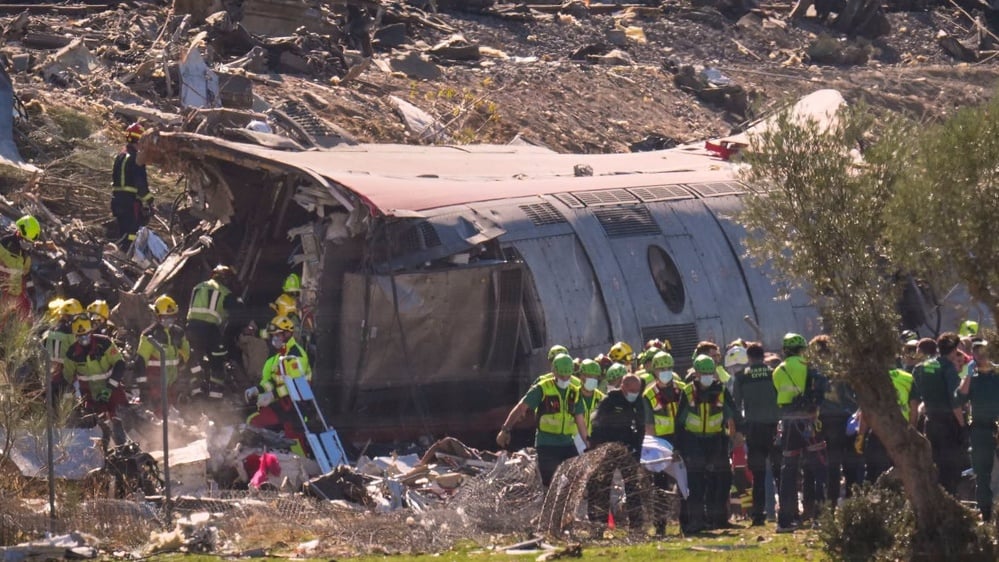
October 28, 2026 · 0 shares
Neutral, attribution-based straight-news framing foregrounds casualty figures and an official cause claim without evaluative language.
Automated analysis; not human reviewed.
Limitations: Supplied article text is truncated and mixed with page boilerplate, so full framing and later causal details cannot be assessed.
·
13 of 55 available dimensions scored; omitted dimensions are not treated as neutral.
·
Verified supporting quotes for 13 of 13 scored dimensions.
Claim: The report contains no left-right ideological or partisan framing.
“At least 68 people have been killed and dozens more injured after two high-speed trains collided south of Madrid on Wednesday.” · exact text match
Why: Casualty and accident reporting is presented without political cues.
Claim: Framing is predominantly factual and attributed rather than evaluative.
“Spain’s transport minister Óscar Puente said that a computer failure led to the initial halt of six moving” · exact text match
Why: The causal claim is attributed to an official rather than asserted subjectively.
Claim: The report avoids sensational language despite covering deaths.
“At least 68 people have been killed and dozens more injured after two high-speed trains collided south of Madrid on Wednesday.” · exact text match
Why: Direct casualty wording is factual rather than dramatized.
Claim: No policy prescription or advocacy is offered.
“At least 68 people have been killed and dozens more injured after two high-speed trains collided south of Madrid on Wednesday.” · exact text match
Why: The text is limited to describing the crash and official account.
Claim: The text reports facts and an attributed statement without editorial opinion.
“Spain’s transport minister Óscar Puente said that a computer failure led to the initial halt of six moving” · exact text match
Why: The causal claim is attributed, not presented as the publisher’s opinion.
Claim: The report does not frame the crash in political terms.
“At least 68 people have been killed and dozens more injured after two high-speed trains collided south of Madrid on Wednesday.” · exact text match
Why: No partisan or policy conflict is referenced.
Claim: Causal language is qualified by attribution to an official.
“Spain’s transport minister Óscar Puente said that a computer failure led to the initial halt of six moving” · exact text match
Why: Using “said” keeps the claim attributed rather than independently certain.
Claim: Tone is unemotional and factual.
“At least 68 people have been killed and dozens more injured after two high-speed trains collided south of Madrid on Wednesday.” · exact text match
Why: Casualty figures are stated plainly without emotive adjectives.
Claim: The supplied text shows named attribution and a cited outlet.
“Spain’s transport minister Óscar Puente said that a computer failure led to the initial halt of six moving” · exact text match
“The accident occurred at 8:54 am local time near Urda, in the province of Toledo, on a straight section of track with good visibility (Euro News).” · exact text match
Why: Attribution supports visible credibility, though the text is truncated.
Claim: The report follows a factual, sourced account of the event.
“The accident occurred at 8:54 am local time near Urda, in the province of Toledo, on a straight section of track with good visibility (Euro News).” · exact text match
Why: Specific time, location, and attribution support rational reporting.
Claim: Sourcing and attribution are transparent in the supplied text.
“Spain’s transport minister Óscar Puente said that a computer failure led to the initial halt of six moving” · exact text match
“The accident occurred at 8:54 am local time near Urda, in the province of Toledo, on a straight section of track with good visibility (Euro News).” · exact text match
Why: A named official and a named outlet are cited for key claims.
Supplied article text is truncated and mixed with page boilerplate, so full framing and later causal details cannot be assessed.
October 28, 2026 · 0 shares
Presents a mostly attributed, official-source account but leaves the central death toll inconsistent between headline (68) and body (at least 64) without reconciliation.
Automated analysis; not human reviewed.
Limitations: Headline and body give conflicting death tolls (68 vs at least 64), so the central casualty figure is ambiguous.
·
5 of 55 available dimensions scored; omitted dimensions are not treated as neutral.
·
Verified supporting quotes for 5 of 5 scored dimensions.
Claim: The report is largely built from attributed official statements, survivor testimony, and described events rather than the publisher's own judgments.
“Spain’s Transport Minister Óscar Puente said an electronic communications failure had caused rail traffic in the area to stop before the collision.” · exact text match
Why: Causal claims are explicitly attributed to the transport minister, supporting an objective rather than subjective framing.
Claim: Coverage of the disaster is generally restrained and attributes uncertainty, though the headline emphasizes the rising toll.
“Authorities warned that the death toll could change as recovery efforts continued and rescuers gained access to the wreckage.” · exact text match
Counterevidence:
“Spain Train Collision Death Toll Rises To 68 Dead As Authorities Investigate Toledo Disaster.” · exact text match
Why: The body uses cautious official language about an evolving toll, while the headline is more alarming, yielding a mildly objective net score.
Claim: Credibility is moderate because sourcing is visible but the headline's 68 dead conflicts with the body's at least 64 without explanation.
“Spain Train Collision Death Toll Rises To 68 Dead As Authorities Investigate Toledo Disaster.” · exact text match
“At least 64 people have died after two high-speed trains collided near Urda in Spain’s Toledo province on Wednesday morning, triggering a major rescue operation and an investigation into the circumstances surrounding the disaster.” · exact text match
Why: The unreconciled death-toll discrepancy reduces trust in the central figure even though official and survivor sourcing is present.
Claim: Forward-looking content is limited to attributed expectations about investigative focus.
“Investigators are expected to focus on the communications failure, the signalling system and the decisions made immediately before the Renfe train struck the stationary Iryo service.” · exact text match
Why: The only clear forecast is framed as an expectation about the investigation, keeping speculation low.
Claim: The report attributes sensitive causal and safety claims to named officials and states that key questions remain under investigation.
“Puente said the Renfe train was later authorised to continue despite a red signal.
He said the decision did not follow established safety procedures and resulted in the train striking the stationary service ahead.”
· exact text match
Why: Attribution and explicit acknowledgment of an ongoing investigation indicate fair, honest handling rather than concealment.
Headline and body give conflicting death tolls (68 vs at least 64), so the central casualty figure is ambiguous.
October 28, 2026 · 0 shares
Disaster coverage is largely wire-style and attribution-heavy, with vivid scene detail but no discernible political framing.
Automated analysis; not human reviewed.
Limitations: The supplied text is a wire-style disaster report reproduced with related-link and app-prompt artifacts; its future-dated 2026 dateline is reported as given and was not externally verified.
·
55 of 55 available dimensions scored; omitted dimensions are not treated as neutral.
·
Verified supporting quotes for 11 of 55 scored dimensions.
Claim: Causal claims are presented as attributed preliminary accounts rather than as the publisher’s own conclusions.
“A person briefed on the disaster said a train operated by private consortium Iryo stopped near Toledo on orders from infrastructure manager ADIF due to a signal fault.” · exact text match
Why: The central cause is sourced to a named type of briefing and kept provisional.
Claim: Dramatic passenger and scene details are included but kept within factual disaster reporting rather than sensational speculation.
“The exact sequence of events, the traffic conditions and the circumstances of the impact will have to be established by the investigation,” Renfe said.” · exact text match
Counterevidence:
“some splattered with blood or with their wounds bandaged” · exact text match
Why: The report flags unresolved causation while also using vivid injury imagery.
Claim: The report’s tone is somber and focused on deaths, injuries, and wreckage.
“some splattered with blood or with their wounds bandaged” · exact text match
Why: Casualty and injury imagery gives the coverage a negative, pessimistic valence.
Claim: The report describes the crash and official accounts without prescribing policy or action.
“The exact sequence of events, the traffic conditions and the circumstances of the impact will have to be established by the investigation,” Renfe said.” · exact text match
Why: It defers to investigation rather than recommending remedies.
Claim: Negative disaster imagery and casualties give the report a somber emotional valence.
“some splattered with blood or with their wounds bandaged” · exact text match
Why: Vivid injury detail produces a negative emotional tone.
Claim: Sourcing is transparent: unnamed briefing, direct Renfe statement, and disclosure of no comment from Iryo/Adif.
“A person briefed on the disaster said a train operated by private consortium Iryo stopped near Toledo on orders from infrastructure manager ADIF due to a signal fault.” · exact text match
“There was no immediate response to a Reuters request for comment from Iryo or Adif.” · exact text match
Why: Clear attribution and comment disclosure support high credibility.
Claim: The report frames the crash cause through attributed preliminary accounts and explicitly leaves the sequence to investigation.
“The exact sequence of events, the traffic conditions and the circumstances of the impact will have to be established by the investigation,” Renfe said.” · exact text match
Why: Attribution of preliminary claims and explicit uncertainty indicate rational, non-dogmatic reporting.
Claim: The report relies on observable events, official statements, and an investigation rather than supernatural or superstitious explanation.
“The exact sequence of events, the traffic conditions and the circumstances of the impact will have to be established by the investigation,” Renfe said.” · exact text match
Why: Empirical and investigative framing indicates a scientific rather than superstitious approach.
Claim: The report includes a preliminary causal account but attributes it and notes that investigation must establish the sequence.
“A person briefed on the disaster said a train operated by private consortium Iryo stopped near Toledo on orders from infrastructure manager ADIF due to a signal fault.” · exact text match
Why: Preliminary causal reporting is present but bounded by attribution and uncertainty.
Claim: The report includes Renfe’s denial-of-knowledge phrasing and notes no response from other parties, indicating fairness.
“for reasons we don’t know” · exact text match
“There was no immediate response to a Reuters request for comment from Iryo or Adif.” · exact text match
Why: Including uncertain phrasing and comment status supports fair, honest presentation.
Claim: The report avoids unsupported certainty about the crash sequence.
“The exact sequence of events, the traffic conditions and the circumstances of the impact will have to be established by the investigation,” Renfe said.” · exact text match
Why: Explicit deference to investigation supports truth-seeking rather than delusion.
The supplied text is a wire-style disaster report reproduced with related-link and app-prompt artifacts; its future-dated 2026 dateline is reported as given and was not externally verified.
October 28, 2026 · 0 shares
Frames the collision as an inexplicable systemic safety failure, amplifying expert outrage and political stakes around a still-unconfirmed cause.
Automated analysis; not human reviewed.
Limitations: The official cause remains unknown and the causal sequence is attributed to early reports, limiting certainty about responsibility.
·
55 of 55 available dimensions scored; omitted dimensions are not treated as neutral.
·
Verified supporting quotes for 10 of 55 scored dimensions.
Claim: Mostly factual but leans on loaded expert characterizations.
“Experts say the Spanish rail system suffered an "appalling" failure of normal safeguards” · exact text match
Why: Quoted evaluative language is selected prominently, tilting the otherwise factual report toward subjectivity.
Claim: Publisher uses dramatic verbs and quoted outrage in the headline and lead.
“slammed directly into the rear carriages” · exact text match
“appalling” · exact text match
Why: Dramatic collision wording and loaded expert adjectives heighten the report's sensational tone.
Claim: Mainly describes events but includes demands for investigation and safety response.
“demanding an investigation” · exact text match
Why: Reporting demands for action adds a prescriptive element to an otherwise descriptive account.
Claim: Coverage foregrounds a rising death toll and critical injuries.
“the death toll is likely to rise” · exact text match
“15 in a critical condition” · exact text match
Why: Emphasizing escalation and critical casualties produces a fearful framing.
Claim: The report inserts electoral stakes and party leaders into the disaster story.
“one month before socialist Prime Minister Pedro Sánchez, who faced heavy criticism for this year's first disaster, seeks to overturn unfavourable polls and extend his eight-year premiership in an early general election on 29 November.” · exact text match
Why: Explicit election timing and partisan positioning make the report political in framing.
Claim: Relies on expert and official authority to frame the failure.
“Francisco Badea, professor of engineering and railway expert at Nebrija University in Madrid, told the BBC” · exact text match
Why: The causal critique is anchored in an academic expert's authority.
Claim: The tone is negative and grief-oriented.
“whole country is grieving” · exact text match
Why: Selected grief language makes the emotional valence strongly negative.
Claim: The report marks cause as unknown, cites a judicial investigation, and credits AFP.
“At present, the official cause of the incident is unknown; however, a judicial investigation is expected to be carried out by local authorities.” · exact text match
“— With additional reporting by Agence France-Presse.” · exact text match
Why: Explicit uncertainty and wire attribution are strong credibility signals.
Claim: Causal account rests on early reports before official findings.
“According to early reports, at around 8.30am local time on Wednesday (6.30pm AEDT), a major computer failure resulted in the suspension of the LZB continuous automatic train protection and signalling system across a 69km stretch of track in Spain's Toledo province.” · exact text match
Why: The detailed causal sequence is explicitly attributed to early reports, not official conclusions.
Claim: Includes uncertainty and opposing political voices without asserting a final cause.
“At present, the official cause of the incident is unknown” · exact text match
“Spain has the right to know what is going on with its infrastructure.” · exact text match
Why: Acknowledging unresolved causation and including opposition criticism supports fairness.
The official cause remains unknown and the causal sequence is attributed to early reports, limiting certainty about responsibility.
October 28, 2026 · 0 shares
Attributed, detail-heavy incident reporting that relies on named officials and repeatedly characterizes the control-centre order as implausible or inexplicable.
Renfe is Spain’s state-owned rail operator and Iryo is a private high-speed operator; the Madrid-Seville line is part of Spain’s AVE high-speed network.
Automated analysis; not human reviewed.
Limitations: The supplied text includes login/comment boilerplate and no author byline; scoring is limited to the substantive news report.
·
10 of 55 available dimensions scored; omitted dimensions are not treated as neutral.
·
Verified supporting quotes for 9 of 10 scored dimensions.
Claim: Events and causes are presented through attributed official statements and specific details.
“Transport Minister Óscar Puente said that at around 8.30 a.m. the LZB control and safety system failed due to a communication fault in three computers” · exact text match
Why: Named attribution and concrete factual details indicate an objective presentation.
Claim: The casualty report is stated factually rather than with sensational language.
“At least 68 people were killed on Wednesday when a Renfe AVE high-speed train ran into the back of an Iryo train that was stopped on the Madrid-Seville line near Urda station” · exact text match
Why: The death toll is reported in a straightforward factual sentence without emotive embellishment.
Claim: The report describes the investigation and official responses rather than prescribing policy.
“The Civil Guard and the Railway Accident Investigation Commission are questioning the operator who was managing traffic.” · exact text match
Why: It reports investigative actions descriptively without advocacy.
Claim: The report notes fear that the death toll may rise but does not use rage-baiting or sensational fear language.
“authorities fear the death toll will rise” · exact text match
Why: A single factual fear reference supports mild fearful framing, not high fear-baiting.
Claim: Government leaders and political accountability are prominent in the report.
“We will get to the bottom of this and, if there has been negligence, it will be known” · exact text match
Why: Quoting the prime minister on negligence and accountability foregrounds political response.
Claim: Much of the technical and casualty account relies on named officials.
“Transport Minister Óscar Puente said that at around 8.30 a.m. the LZB control and safety system failed due to a communication fault in three computers” · exact text match
Why: Causal technical details are sourced to the transport minister rather than independent documentation.
Claim: Sourcing is attributed to named officials and investigation bodies, with uncertainty noted.
“The Civil Guard and the Railway Accident Investigation Commission are questioning the operator who was managing traffic.” · exact text match
“according to the minister” · exact text match
Why: Attribution to named officials and investigative bodies supports high visible credibility.
Claim: The report explains the collision through specific technical and procedural details rather than emotional or irrational framing.
“The LZB control and safety system failed due to a communication fault in three computers, leaving a 63-kilometre stretch without it and automatically stopping six trains.” · not found in supplied text
Why: Technical system details and procedural chronology support a rational rather than irrational framing.
Claim: Casualty figures and uncertain details are attributed to named officials and uncertainty is marked.
“according to the president of the Castilla-La Mancha region, Emiliano García-Page” · exact text match
“authorities fear the death toll will rise” · exact text match
Why: Attribution and explicit uncertainty language show fair, honest reporting signals.
Claim: The report includes technical and procedural context that supports an informed account.
“The train travelled about 25 kilometres at close to 200 kilometres per hour before the impact.” · exact text match
Why: Specific speed, distance, and control-system details indicate above-average informational depth.
The supplied text includes login/comment boilerplate and no author byline; scoring is limited to the substantive news report.
October 29, 2026 · 0 shares
Wire-style attribution and official sourcing frame the Spain train crash report neutrally, with causal uncertainty marked by hedges such as “may have been caused” and “allegedly.”
Automated analysis; not human reviewed.
Limitations: The supplied text includes duplicated and unrelated Tajikistan headlines, so only the Spain crash portion was analyzed.
·
8 of 55 available dimensions scored; omitted dimensions are not treated as neutral.
·
Verified supporting quotes for 7 of 8 scored dimensions.
Claim: The crash account relies on named sources and official statements, with limited subjective narration.
“According to Spanish Transport Minister Oscar Puente, a computer failure occurred before the collision, causing several trains to stop.” · exact text match
“The Renfe train was allegedly traveling at up to 200 km/h at the moment of impact.” · exact text match
Why: Sourcing and attribution make the framing predominantly objective.
Claim: Casualty and rescue details are reported in factual, numbered terms rather than sensational language.
“According to the latest reports, 77 people were taken to hospitals, 15 of them in serious condition.” · exact text match
Why: The concrete hospitalization figures support an objective rather than sensational presentation.
Claim: The text describes the crash, official response, and investigation without prescribing policy or action.
“Investigators are working to determine why dispatchers authorized the movement.” · exact text match
Why: The framing is descriptive rather than prescriptive.
Claim: Visible sourcing, official attribution, and uncertainty markers support a credible news report.
“According to Spanish Transport Minister Oscar Puente, a computer failure occurred before the collision, causing several trains to stop.” · exact text match
“the BBC’s Russian Service reported yesterday” · exact text match
Why: Named attribution and hedged claims are strong credibility signals within the supplied text.
Claim: The report is structured around attributed official statements and explicitly marks unresolved causation rather than asserting a definitive cause.
“According to Spanish Transport Minister Oscar Puente, a computer failure occurred before the collision, causing several trains to stop.” · exact text match
“The Renfe train was allegedly traveling at up to 200 km/h at the moment of impact.” · exact text match
Why: Attribution and hedging indicate rational, evidence-bounded reporting rather than emotional or unsupported reasoning.
Claim: The report includes a speculative causal line about an air traffic control center error.
“The tragedy may have been caused by an air traffic control center error.” · exact text match
Why: The explicit possibility language introduces limited speculation about causation.
Claim: The report repeatedly attributes claims to named officials or the BBC’s Russian Service and preserves uncertainty around the speed and cause.
“Spanish Prime Minister Pedro Sanchez has declared three days of national mourning from October 29 to 31 following a collision between two high-speed trains that killed at least 68 people, the BBC’s Russian Service reported yesterday.” · exact text match
“The Renfe train was allegedly traveling at up to 200 km/h at the moment of impact.” · exact text match
Why: Clear sourcing and hedging are observable integrity signals.
The supplied text includes duplicated and unrelated Tajikistan headlines, so only the Spain crash portion was analyzed.
October 28, 2026 · 0 shares
Presents a mostly attributed, official-source account but leaves the central death toll inconsistent between headline (68) and body (at least 64) without reconciliation.
Automated analysis; not human reviewed.
Limitations: Headline and body give conflicting death tolls (68 vs at least 64), so the central casualty figure is ambiguous.
·
5 of 55 available dimensions scored; omitted dimensions are not treated as neutral.
·
Verified supporting quotes for 5 of 5 scored dimensions.
Claim: The report is largely built from attributed official statements, survivor testimony, and described events rather than the publisher's own judgments.
“Spain’s Transport Minister Óscar Puente said an electronic communications failure had caused rail traffic in the area to stop before the collision.” · exact text match
Why: Causal claims are explicitly attributed to the transport minister, supporting an objective rather than subjective framing.
Claim: Coverage of the disaster is generally restrained and attributes uncertainty, though the headline emphasizes the rising toll.
“Authorities warned that the death toll could change as recovery efforts continued and rescuers gained access to the wreckage.” · exact text match
Counterevidence:
“Spain Train Collision Death Toll Rises To 68 Dead As Authorities Investigate Toledo Disaster.” · exact text match
Why: The body uses cautious official language about an evolving toll, while the headline is more alarming, yielding a mildly objective net score.
Claim: Credibility is moderate because sourcing is visible but the headline's 68 dead conflicts with the body's at least 64 without explanation.
“Spain Train Collision Death Toll Rises To 68 Dead As Authorities Investigate Toledo Disaster.” · exact text match
“At least 64 people have died after two high-speed trains collided near Urda in Spain’s Toledo province on Wednesday morning, triggering a major rescue operation and an investigation into the circumstances surrounding the disaster.” · exact text match
Why: The unreconciled death-toll discrepancy reduces trust in the central figure even though official and survivor sourcing is present.
Claim: Forward-looking content is limited to attributed expectations about investigative focus.
“Investigators are expected to focus on the communications failure, the signalling system and the decisions made immediately before the Renfe train struck the stationary Iryo service.” · exact text match
Why: The only clear forecast is framed as an expectation about the investigation, keeping speculation low.
Claim: The report attributes sensitive causal and safety claims to named officials and states that key questions remain under investigation.
“Puente said the Renfe train was later authorised to continue despite a red signal.
He said the decision did not follow established safety procedures and resulted in the train striking the stationary service ahead.”
· exact text match
Why: Attribution and explicit acknowledgment of an ongoing investigation indicate fair, honest handling rather than concealment.
Headline and body give conflicting death tolls (68 vs at least 64), so the central casualty figure is ambiguous.
October 28, 2026 · 0 shares
Presents a mostly attributed, official-source account but leaves the central death toll inconsistent between headline (68) and body (at least 64) without reconciliation.
Automated analysis; not human reviewed.
Limitations: Headline and body give conflicting death tolls (68 vs at least 64), so the central casualty figure is ambiguous.
·
5 of 55 available dimensions scored; omitted dimensions are not treated as neutral.
·
Verified supporting quotes for 5 of 5 scored dimensions.
Claim: The report is largely built from attributed official statements, survivor testimony, and described events rather than the publisher's own judgments.
“Spain’s Transport Minister Óscar Puente said an electronic communications failure had caused rail traffic in the area to stop before the collision.” · exact text match
Why: Causal claims are explicitly attributed to the transport minister, supporting an objective rather than subjective framing.
Claim: Coverage of the disaster is generally restrained and attributes uncertainty, though the headline emphasizes the rising toll.
“Authorities warned that the death toll could change as recovery efforts continued and rescuers gained access to the wreckage.” · exact text match
Counterevidence:
“Spain Train Collision Death Toll Rises To 68 Dead As Authorities Investigate Toledo Disaster.” · exact text match
Why: The body uses cautious official language about an evolving toll, while the headline is more alarming, yielding a mildly objective net score.
Claim: Credibility is moderate because sourcing is visible but the headline's 68 dead conflicts with the body's at least 64 without explanation.
“Spain Train Collision Death Toll Rises To 68 Dead As Authorities Investigate Toledo Disaster.” · exact text match
“At least 64 people have died after two high-speed trains collided near Urda in Spain’s Toledo province on Wednesday morning, triggering a major rescue operation and an investigation into the circumstances surrounding the disaster.” · exact text match
Why: The unreconciled death-toll discrepancy reduces trust in the central figure even though official and survivor sourcing is present.
Claim: Forward-looking content is limited to attributed expectations about investigative focus.
“Investigators are expected to focus on the communications failure, the signalling system and the decisions made immediately before the Renfe train struck the stationary Iryo service.” · exact text match
Why: The only clear forecast is framed as an expectation about the investigation, keeping speculation low.
Claim: The report attributes sensitive causal and safety claims to named officials and states that key questions remain under investigation.
“Puente said the Renfe train was later authorised to continue despite a red signal.
He said the decision did not follow established safety procedures and resulted in the train striking the stationary service ahead.”
· exact text match
Why: Attribution and explicit acknowledgment of an ongoing investigation indicate fair, honest handling rather than concealment.
Headline and body give conflicting death tolls (68 vs at least 64), so the central casualty figure is ambiguous.
October 29, 2026 · 0 shares
Wire-style attribution and official sourcing frame the Spain train crash report neutrally, with causal uncertainty marked by hedges such as “may have been caused” and “allegedly.”
Automated analysis; not human reviewed.
Limitations: The supplied text includes duplicated and unrelated Tajikistan headlines, so only the Spain crash portion was analyzed.
·
8 of 55 available dimensions scored; omitted dimensions are not treated as neutral.
·
Verified supporting quotes for 7 of 8 scored dimensions.
Claim: The crash account relies on named sources and official statements, with limited subjective narration.
“According to Spanish Transport Minister Oscar Puente, a computer failure occurred before the collision, causing several trains to stop.” · exact text match
“The Renfe train was allegedly traveling at up to 200 km/h at the moment of impact.” · exact text match
Why: Sourcing and attribution make the framing predominantly objective.
Claim: Casualty and rescue details are reported in factual, numbered terms rather than sensational language.
“According to the latest reports, 77 people were taken to hospitals, 15 of them in serious condition.” · exact text match
Why: The concrete hospitalization figures support an objective rather than sensational presentation.
Claim: The text describes the crash, official response, and investigation without prescribing policy or action.
“Investigators are working to determine why dispatchers authorized the movement.” · exact text match
Why: The framing is descriptive rather than prescriptive.
Claim: Visible sourcing, official attribution, and uncertainty markers support a credible news report.
“According to Spanish Transport Minister Oscar Puente, a computer failure occurred before the collision, causing several trains to stop.” · exact text match
“the BBC’s Russian Service reported yesterday” · exact text match
Why: Named attribution and hedged claims are strong credibility signals within the supplied text.
Claim: The report is structured around attributed official statements and explicitly marks unresolved causation rather than asserting a definitive cause.
“According to Spanish Transport Minister Oscar Puente, a computer failure occurred before the collision, causing several trains to stop.” · exact text match
“The Renfe train was allegedly traveling at up to 200 km/h at the moment of impact.” · exact text match
Why: Attribution and hedging indicate rational, evidence-bounded reporting rather than emotional or unsupported reasoning.
Claim: The report includes a speculative causal line about an air traffic control center error.
“The tragedy may have been caused by an air traffic control center error.” · exact text match
Why: The explicit possibility language introduces limited speculation about causation.
Claim: The report repeatedly attributes claims to named officials or the BBC’s Russian Service and preserves uncertainty around the speed and cause.
“Spanish Prime Minister Pedro Sanchez has declared three days of national mourning from October 29 to 31 following a collision between two high-speed trains that killed at least 68 people, the BBC’s Russian Service reported yesterday.” · exact text match
“The Renfe train was allegedly traveling at up to 200 km/h at the moment of impact.” · exact text match
Why: Clear sourcing and hedging are observable integrity signals.
The supplied text includes duplicated and unrelated Tajikistan headlines, so only the Spain crash portion was analyzed.
October 28, 2026 · 0 shares
Presents a mostly attributed, official-source account but leaves the central death toll inconsistent between headline (68) and body (at least 64) without reconciliation.
Automated analysis; not human reviewed.
Limitations: Headline and body give conflicting death tolls (68 vs at least 64), so the central casualty figure is ambiguous.
·
5 of 55 available dimensions scored; omitted dimensions are not treated as neutral.
·
Verified supporting quotes for 5 of 5 scored dimensions.
Claim: The report is largely built from attributed official statements, survivor testimony, and described events rather than the publisher's own judgments.
“Spain’s Transport Minister Óscar Puente said an electronic communications failure had caused rail traffic in the area to stop before the collision.” · exact text match
Why: Causal claims are explicitly attributed to the transport minister, supporting an objective rather than subjective framing.
Claim: Coverage of the disaster is generally restrained and attributes uncertainty, though the headline emphasizes the rising toll.
“Authorities warned that the death toll could change as recovery efforts continued and rescuers gained access to the wreckage.” · exact text match
Counterevidence:
“Spain Train Collision Death Toll Rises To 68 Dead As Authorities Investigate Toledo Disaster.” · exact text match
Why: The body uses cautious official language about an evolving toll, while the headline is more alarming, yielding a mildly objective net score.
Claim: Credibility is moderate because sourcing is visible but the headline's 68 dead conflicts with the body's at least 64 without explanation.
“Spain Train Collision Death Toll Rises To 68 Dead As Authorities Investigate Toledo Disaster.” · exact text match
“At least 64 people have died after two high-speed trains collided near Urda in Spain’s Toledo province on Wednesday morning, triggering a major rescue operation and an investigation into the circumstances surrounding the disaster.” · exact text match
Why: The unreconciled death-toll discrepancy reduces trust in the central figure even though official and survivor sourcing is present.
Claim: Forward-looking content is limited to attributed expectations about investigative focus.
“Investigators are expected to focus on the communications failure, the signalling system and the decisions made immediately before the Renfe train struck the stationary Iryo service.” · exact text match
Why: The only clear forecast is framed as an expectation about the investigation, keeping speculation low.
Claim: The report attributes sensitive causal and safety claims to named officials and states that key questions remain under investigation.
“Puente said the Renfe train was later authorised to continue despite a red signal.
He said the decision did not follow established safety procedures and resulted in the train striking the stationary service ahead.”
· exact text match
Why: Attribution and explicit acknowledgment of an ongoing investigation indicate fair, honest handling rather than concealment.
Headline and body give conflicting death tolls (68 vs at least 64), so the central casualty figure is ambiguous.
October 29, 2026 · 0 shares
Wire-style attribution and official sourcing frame the Spain train crash report neutrally, with causal uncertainty marked by hedges such as “may have been caused” and “allegedly.”
Automated analysis; not human reviewed.
Limitations: The supplied text includes duplicated and unrelated Tajikistan headlines, so only the Spain crash portion was analyzed.
·
8 of 55 available dimensions scored; omitted dimensions are not treated as neutral.
·
Verified supporting quotes for 7 of 8 scored dimensions.
Claim: The crash account relies on named sources and official statements, with limited subjective narration.
“According to Spanish Transport Minister Oscar Puente, a computer failure occurred before the collision, causing several trains to stop.” · exact text match
“The Renfe train was allegedly traveling at up to 200 km/h at the moment of impact.” · exact text match
Why: Sourcing and attribution make the framing predominantly objective.
Claim: Casualty and rescue details are reported in factual, numbered terms rather than sensational language.
“According to the latest reports, 77 people were taken to hospitals, 15 of them in serious condition.” · exact text match
Why: The concrete hospitalization figures support an objective rather than sensational presentation.
Claim: The text describes the crash, official response, and investigation without prescribing policy or action.
“Investigators are working to determine why dispatchers authorized the movement.” · exact text match
Why: The framing is descriptive rather than prescriptive.
Claim: Visible sourcing, official attribution, and uncertainty markers support a credible news report.
“According to Spanish Transport Minister Oscar Puente, a computer failure occurred before the collision, causing several trains to stop.” · exact text match
“the BBC’s Russian Service reported yesterday” · exact text match
Why: Named attribution and hedged claims are strong credibility signals within the supplied text.
Claim: The report is structured around attributed official statements and explicitly marks unresolved causation rather than asserting a definitive cause.
“According to Spanish Transport Minister Oscar Puente, a computer failure occurred before the collision, causing several trains to stop.” · exact text match
“The Renfe train was allegedly traveling at up to 200 km/h at the moment of impact.” · exact text match
Why: Attribution and hedging indicate rational, evidence-bounded reporting rather than emotional or unsupported reasoning.
Claim: The report includes a speculative causal line about an air traffic control center error.
“The tragedy may have been caused by an air traffic control center error.” · exact text match
Why: The explicit possibility language introduces limited speculation about causation.
Claim: The report repeatedly attributes claims to named officials or the BBC’s Russian Service and preserves uncertainty around the speed and cause.
“Spanish Prime Minister Pedro Sanchez has declared three days of national mourning from October 29 to 31 following a collision between two high-speed trains that killed at least 68 people, the BBC’s Russian Service reported yesterday.” · exact text match
“The Renfe train was allegedly traveling at up to 200 km/h at the moment of impact.” · exact text match
Why: Clear sourcing and hedging are observable integrity signals.
The supplied text includes duplicated and unrelated Tajikistan headlines, so only the Spain crash portion was analyzed.
October 28, 2026 · 0 shares
Neutral, attribution-heavy disaster brief that presents casualty figures and official statements with little publisher-side evaluative framing.
Automated analysis; not human reviewed.
Limitations: The supplied text is a short, aggregated brief with unrelated headline fragments, limiting observable framing and editorial choices.
·
3 of 55 available dimensions scored; omitted dimensions are not treated as neutral.
·
Verified supporting quotes for 3 of 3 scored dimensions.
Claim: Key claims are attributed to named external sources rather than presented through authorial commentary.
“the BBC reports” · exact text match
“Rail operator Adif says the incident occurred between a Renfe train and another of the Iryo company” · exact text match
Why: The brief relies on BBC and Adif attribution and contains no evaluative authorial language.
Claim: Casualty and passenger details are stated plainly without dramatic or emotive publisher language.
“At least 64 people have been killed” · exact text match
“More than 500 passengers were travelling on the trains involved in today’s collision” · exact text match
Why: Factual casualty and passenger figures are presented without hyperbole or sensational prose.
Claim: Key facts are attributed to BBC, a regional government spokesperson, Adif, and the prime minister.
“the BBC reports” · exact text match
“the spokesperson for the regional government says” · exact text match
“Rail operator Adif says” · exact text match
Why: Multiple named or official attributions support the credibility of the short report.
The supplied text is a short, aggregated brief with unrelated headline fragments, limiting observable framing and editorial choices.
October 28, 2026 · 0 shares
Presents a mostly attributed, official-source account but leaves the central death toll inconsistent between headline (68) and body (at least 64) without reconciliation.
Automated analysis; not human reviewed.
Limitations: Headline and body give conflicting death tolls (68 vs at least 64), so the central casualty figure is ambiguous.
·
5 of 55 available dimensions scored; omitted dimensions are not treated as neutral.
·
Verified supporting quotes for 5 of 5 scored dimensions.
Claim: The report is largely built from attributed official statements, survivor testimony, and described events rather than the publisher's own judgments.
“Spain’s Transport Minister Óscar Puente said an electronic communications failure had caused rail traffic in the area to stop before the collision.” · exact text match
Why: Causal claims are explicitly attributed to the transport minister, supporting an objective rather than subjective framing.
Claim: Coverage of the disaster is generally restrained and attributes uncertainty, though the headline emphasizes the rising toll.
“Authorities warned that the death toll could change as recovery efforts continued and rescuers gained access to the wreckage.” · exact text match
Counterevidence:
“Spain Train Collision Death Toll Rises To 68 Dead As Authorities Investigate Toledo Disaster.” · exact text match
Why: The body uses cautious official language about an evolving toll, while the headline is more alarming, yielding a mildly objective net score.
Claim: Credibility is moderate because sourcing is visible but the headline's 68 dead conflicts with the body's at least 64 without explanation.
“Spain Train Collision Death Toll Rises To 68 Dead As Authorities Investigate Toledo Disaster.” · exact text match
“At least 64 people have died after two high-speed trains collided near Urda in Spain’s Toledo province on Wednesday morning, triggering a major rescue operation and an investigation into the circumstances surrounding the disaster.” · exact text match
Why: The unreconciled death-toll discrepancy reduces trust in the central figure even though official and survivor sourcing is present.
Claim: Forward-looking content is limited to attributed expectations about investigative focus.
“Investigators are expected to focus on the communications failure, the signalling system and the decisions made immediately before the Renfe train struck the stationary Iryo service.” · exact text match
Why: The only clear forecast is framed as an expectation about the investigation, keeping speculation low.
Claim: The report attributes sensitive causal and safety claims to named officials and states that key questions remain under investigation.
“Puente said the Renfe train was later authorised to continue despite a red signal.
He said the decision did not follow established safety procedures and resulted in the train striking the stationary service ahead.”
· exact text match
Why: Attribution and explicit acknowledgment of an ongoing investigation indicate fair, honest handling rather than concealment.
Headline and body give conflicting death tolls (68 vs at least 64), so the central casualty figure is ambiguous.
October 28, 2026 · 0 shares
The report neutrally chronicles a transportation accident, prioritizing factual dissemination and the historical context of similar rail incidents over advocacy or opinion.
Spain has the largest high-speed rail network in Europe for trains moving more than 155 mph, with more than 1,900 miles of track, according to the European Union.
October 28, 2026 · 0 shares
Wire-service attribution is present, but an unreconciled 'kills 68' headline alongside the 'at least 10' report creates a notable epistemic inconsistency.
Automated analysis; not human reviewed.
Limitations: The supplied text appears to be an aggregation of headlines and wire snippets, with conflicting casualty figures, limiting framing and credibility assessment.
·
4 of 55 available dimensions scored; omitted dimensions are not treated as neutral.
·
Verified supporting quotes for 4 of 4 scored dimensions.
Claim: The main report is framed through attributed official statements rather than publisher opinion.
“Esther Padilla, spokeswoman for the government of Castilla-La Mancha, told local broadcaster CMM” · exact text match
“ADIF confirmed the collision” · exact text match
Why: Named officials and the rail operator are cited for the key facts, indicating an objective-attribution frame.
Claim: Official and named sourcing supports credibility, but the conflicting death-toll headline undercuts it.
“a regional government spokeswoman said” · exact text match
“Spain mourns after high-speed train collision kills 68” · exact text match
Why: Attribution to a named spokeswoman and ADIF is a credibility signal, while the unreconciled '68' headline limits the overall assessment.
Claim: Uncertainty about the death toll is explicitly attributed and flagged rather than asserted as final.
“warning that the toll could rise” · exact text match
“it is possible that the number will increase” · exact text match
Why: The report preserves the spokeswoman's uncertainty about casualty figures, supporting a rational/evidence-bound classification.
Claim: The text carries an unreconciled casualty contradiction between 'at least 10' and 'kills 68'.
“killed at least 10 people on Wednesday” · exact text match
“Spain mourns after high-speed train collision kills 68” · exact text match
Why: An unexplained conflicting death toll in the supplied text reduces observable fairness and internal consistency.
The supplied text appears to be an aggregation of headlines and wire snippets, with conflicting casualty figures, limiting framing and credibility assessment.
October 28, 2026 · 0 shares
Factual wire-style attribution in the body is undercut by a headline-body death-toll discrepancy and unrelated inserted headlines.
Automated analysis; not human reviewed.
Limitations: Supplied text is a scraped aggregation with duplicated passages, unrelated Tanzania headlines, and a headline-body death-toll mismatch; bias scores are based only on the Spain collision report.
·
7 of 55 available dimensions scored; omitted dimensions are not treated as neutral.
·
Verified supporting quotes for 7 of 7 scored dimensions.
Claim: The body reports the collision in factual, attributed terms.
“At least 30 people have been killed after a high-speed train struck the rear of a stationary train near Urda in Toledo province, central Spain, on Wednesday” · exact text match
Why: The sentence states the event, location, time, and casualty figure as reportable fact rather than commentary.
Claim: The body avoids sensational language in describing the crash and response.
“Rescue teams were working to reach passengers trapped in the most severely damaged carriages” · exact text match
Why: Rescue activity is described plainly, without dramatic or emotive embellishment.
Claim: The report describes events and responses rather than prescribing policy or action.
“Rescue teams were working to reach passengers trapped in the most severely damaged carriages” · exact text match
Why: The passage narrates emergency response without advocating what should be done.
Claim: The headline states a precise death toll of 39 while the body only supports 'at least 30'.
“39 killed after two high-speed trains collide in Spain.” · exact text match
“At least 30 people have been killed after a high-speed train struck the rear of a stationary train” · exact text match
Why: A definitive precise count is used despite the body's less certain casualty reporting.
Claim: Credible official attribution is qualified by the headline-body death-toll discrepancy and page clutter.
“Regional government spokeswoman Esther Padilla said both trains had been travelling in the same direction before the crash.” · exact text match
Counterevidence:
“39 killed after two high-speed trains collide in Spain.” · exact text match
Why: The report names officials and operators, but the headline's conflicting toll reduces overall reliability.
Claim: The report presents attributed official statements and operational details rather than emotive or speculative reasoning.
“Regional government spokeswoman Esther Padilla said both trains had been travelling in the same direction before the crash.” · exact text match
Why: The central detail is attributed to an official and presented without emotive inference.
Claim: Headline and body give inconsistent death tolls, weakening internal accuracy.
“39 killed after two high-speed trains collide in Spain.” · exact text match
“At least 30 people have been killed after a high-speed train struck the rear of a stationary train” · exact text match
Why: The precise headline figure conflicts with the body's lower, provisional figure.
Supplied text is a scraped aggregation with duplicated passages, unrelated Tanzania headlines, and a headline-body death-toll mismatch; bias scores are based only on the Spain collision report.
October 28, 2026 · 0 shares
Presents a mostly attributed, official-source account but leaves the central death toll inconsistent between headline (68) and body (at least 64) without reconciliation.
Automated analysis; not human reviewed.
Limitations: Headline and body give conflicting death tolls (68 vs at least 64), so the central casualty figure is ambiguous.
·
5 of 55 available dimensions scored; omitted dimensions are not treated as neutral.
·
Verified supporting quotes for 5 of 5 scored dimensions.
Claim: The report is largely built from attributed official statements, survivor testimony, and described events rather than the publisher's own judgments.
“Spain’s Transport Minister Óscar Puente said an electronic communications failure had caused rail traffic in the area to stop before the collision.” · exact text match
Why: Causal claims are explicitly attributed to the transport minister, supporting an objective rather than subjective framing.
Claim: Coverage of the disaster is generally restrained and attributes uncertainty, though the headline emphasizes the rising toll.
“Authorities warned that the death toll could change as recovery efforts continued and rescuers gained access to the wreckage.” · exact text match
Counterevidence:
“Spain Train Collision Death Toll Rises To 68 Dead As Authorities Investigate Toledo Disaster.” · exact text match
Why: The body uses cautious official language about an evolving toll, while the headline is more alarming, yielding a mildly objective net score.
Claim: Credibility is moderate because sourcing is visible but the headline's 68 dead conflicts with the body's at least 64 without explanation.
“Spain Train Collision Death Toll Rises To 68 Dead As Authorities Investigate Toledo Disaster.” · exact text match
“At least 64 people have died after two high-speed trains collided near Urda in Spain’s Toledo province on Wednesday morning, triggering a major rescue operation and an investigation into the circumstances surrounding the disaster.” · exact text match
Why: The unreconciled death-toll discrepancy reduces trust in the central figure even though official and survivor sourcing is present.
Claim: Forward-looking content is limited to attributed expectations about investigative focus.
“Investigators are expected to focus on the communications failure, the signalling system and the decisions made immediately before the Renfe train struck the stationary Iryo service.” · exact text match
Why: The only clear forecast is framed as an expectation about the investigation, keeping speculation low.
Claim: The report attributes sensitive causal and safety claims to named officials and states that key questions remain under investigation.
“Puente said the Renfe train was later authorised to continue despite a red signal.
He said the decision did not follow established safety procedures and resulted in the train striking the stationary service ahead.”
· exact text match
Why: Attribution and explicit acknowledgment of an ongoing investigation indicate fair, honest handling rather than concealment.
Headline and body give conflicting death tolls (68 vs at least 64), so the central casualty figure is ambiguous.
October 28, 2026 · 0 shares
Frames the collision as an inexplicable systemic safety failure, amplifying expert outrage and political stakes around a still-unconfirmed cause.
Automated analysis; not human reviewed. Limitations: The official cause remains unknown and the causal sequence is attributed to early reports, limiting certainty about responsibility. · 55 of 55 available dimensions scored; omitted dimensions are not treated as neutral. · Verified supporting quotes for 10 of 55 scored dimensions.
Claim: Mostly factual but leans on loaded expert characterizations.
“Experts say the Spanish rail system suffered an "appalling" failure of normal safeguards” · exact text match
Why: Quoted evaluative language is selected prominently, tilting the otherwise factual report toward subjectivity.
Claim: Publisher uses dramatic verbs and quoted outrage in the headline and lead.
“slammed directly into the rear carriages” · exact text match
“appalling” · exact text match
Why: Dramatic collision wording and loaded expert adjectives heighten the report's sensational tone.
Claim: Mainly describes events but includes demands for investigation and safety response.
“demanding an investigation” · exact text match
Why: Reporting demands for action adds a prescriptive element to an otherwise descriptive account.
Claim: Coverage foregrounds a rising death toll and critical injuries.
“the death toll is likely to rise” · exact text match
“15 in a critical condition” · exact text match
Why: Emphasizing escalation and critical casualties produces a fearful framing.
Claim: The report inserts electoral stakes and party leaders into the disaster story.
“one month before socialist Prime Minister Pedro Sánchez, who faced heavy criticism for this year's first disaster, seeks to overturn unfavourable polls and extend his eight-year premiership in an early general election on 29 November.” · exact text match
Why: Explicit election timing and partisan positioning make the report political in framing.
Claim: Relies on expert and official authority to frame the failure.
“Francisco Badea, professor of engineering and railway expert at Nebrija University in Madrid, told the BBC” · exact text match
Why: The causal critique is anchored in an academic expert's authority.
Claim: The tone is negative and grief-oriented.
“whole country is grieving” · exact text match
Why: Selected grief language makes the emotional valence strongly negative.
Claim: The report marks cause as unknown, cites a judicial investigation, and credits AFP.
“At present, the official cause of the incident is unknown; however, a judicial investigation is expected to be carried out by local authorities.” · exact text match
“— With additional reporting by Agence France-Presse.” · exact text match
Why: Explicit uncertainty and wire attribution are strong credibility signals.
Claim: Causal account rests on early reports before official findings.
“According to early reports, at around 8.30am local time on Wednesday (6.30pm AEDT), a major computer failure resulted in the suspension of the LZB continuous automatic train protection and signalling system across a 69km stretch of track in Spain's Toledo province.” · exact text match
Why: The detailed causal sequence is explicitly attributed to early reports, not official conclusions.
Claim: Includes uncertainty and opposing political voices without asserting a final cause.
“At present, the official cause of the incident is unknown” · exact text match
“Spain has the right to know what is going on with its infrastructure.” · exact text match
Why: Acknowledging unresolved causation and including opposition criticism supports fairness.
The official cause remains unknown and the causal sequence is attributed to early reports, limiting certainty about responsibility.
October 28, 2026 · 0 shares
Attributed, detail-heavy incident reporting that relies on named officials and repeatedly characterizes the control-centre order as implausible or inexplicable.
Renfe is Spain’s state-owned rail operator and Iryo is a private high-speed operator; the Madrid-Seville line is part of Spain’s AVE high-speed network.
Automated analysis; not human reviewed. Limitations: The supplied text includes login/comment boilerplate and no author byline; scoring is limited to the substantive news report. · 10 of 55 available dimensions scored; omitted dimensions are not treated as neutral. · Verified supporting quotes for 9 of 10 scored dimensions.
Claim: Events and causes are presented through attributed official statements and specific details.
“Transport Minister Óscar Puente said that at around 8.30 a.m. the LZB control and safety system failed due to a communication fault in three computers” · exact text match
Why: Named attribution and concrete factual details indicate an objective presentation.
Claim: The casualty report is stated factually rather than with sensational language.
“At least 68 people were killed on Wednesday when a Renfe AVE high-speed train ran into the back of an Iryo train that was stopped on the Madrid-Seville line near Urda station” · exact text match
Why: The death toll is reported in a straightforward factual sentence without emotive embellishment.
Claim: The report describes the investigation and official responses rather than prescribing policy.
“The Civil Guard and the Railway Accident Investigation Commission are questioning the operator who was managing traffic.” · exact text match
Why: It reports investigative actions descriptively without advocacy.
Claim: The report notes fear that the death toll may rise but does not use rage-baiting or sensational fear language.
“authorities fear the death toll will rise” · exact text match
Why: A single factual fear reference supports mild fearful framing, not high fear-baiting.
Claim: Government leaders and political accountability are prominent in the report.
“We will get to the bottom of this and, if there has been negligence, it will be known” · exact text match
Why: Quoting the prime minister on negligence and accountability foregrounds political response.
Claim: Much of the technical and casualty account relies on named officials.
“Transport Minister Óscar Puente said that at around 8.30 a.m. the LZB control and safety system failed due to a communication fault in three computers” · exact text match
Why: Causal technical details are sourced to the transport minister rather than independent documentation.
Claim: Sourcing is attributed to named officials and investigation bodies, with uncertainty noted.
“The Civil Guard and the Railway Accident Investigation Commission are questioning the operator who was managing traffic.” · exact text match
“according to the minister” · exact text match
Why: Attribution to named officials and investigative bodies supports high visible credibility.
Claim: The report explains the collision through specific technical and procedural details rather than emotional or irrational framing.
“The LZB control and safety system failed due to a communication fault in three computers, leaving a 63-kilometre stretch without it and automatically stopping six trains.” · not found in supplied text
Why: Technical system details and procedural chronology support a rational rather than irrational framing.
Claim: Casualty figures and uncertain details are attributed to named officials and uncertainty is marked.
“according to the president of the Castilla-La Mancha region, Emiliano García-Page” · exact text match
“authorities fear the death toll will rise” · exact text match
Why: Attribution and explicit uncertainty language show fair, honest reporting signals.
Claim: The report includes technical and procedural context that supports an informed account.
“The train travelled about 25 kilometres at close to 200 kilometres per hour before the impact.” · exact text match
Why: Specific speed, distance, and control-system details indicate above-average informational depth.
The supplied text includes login/comment boilerplate and no author byline; scoring is limited to the substantive news report.
October 28, 2026 · 0 shares
Neutral, attribution-based straight-news framing foregrounds casualty figures and an official cause claim without evaluative language.
Automated analysis; not human reviewed. Limitations: Supplied article text is truncated and mixed with page boilerplate, so full framing and later causal details cannot be assessed. · 13 of 55 available dimensions scored; omitted dimensions are not treated as neutral. · Verified supporting quotes for 13 of 13 scored dimensions.
Claim: The report contains no left-right ideological or partisan framing.
“At least 68 people have been killed and dozens more injured after two high-speed trains collided south of Madrid on Wednesday.” · exact text match
Why: Casualty and accident reporting is presented without political cues.
Claim: Framing is predominantly factual and attributed rather than evaluative.
“Spain’s transport minister Óscar Puente said that a computer failure led to the initial halt of six moving” · exact text match
Why: The causal claim is attributed to an official rather than asserted subjectively.
Claim: The report avoids sensational language despite covering deaths.
“At least 68 people have been killed and dozens more injured after two high-speed trains collided south of Madrid on Wednesday.” · exact text match
Why: Direct casualty wording is factual rather than dramatized.
Claim: No policy prescription or advocacy is offered.
“At least 68 people have been killed and dozens more injured after two high-speed trains collided south of Madrid on Wednesday.” · exact text match
Why: The text is limited to describing the crash and official account.
Claim: The text reports facts and an attributed statement without editorial opinion.
“Spain’s transport minister Óscar Puente said that a computer failure led to the initial halt of six moving” · exact text match
Why: The causal claim is attributed, not presented as the publisher’s opinion.
Claim: The report does not frame the crash in political terms.
“At least 68 people have been killed and dozens more injured after two high-speed trains collided south of Madrid on Wednesday.” · exact text match
Why: No partisan or policy conflict is referenced.
Claim: Causal language is qualified by attribution to an official.
“Spain’s transport minister Óscar Puente said that a computer failure led to the initial halt of six moving” · exact text match
Why: Using “said” keeps the claim attributed rather than independently certain.
Claim: Tone is unemotional and factual.
“At least 68 people have been killed and dozens more injured after two high-speed trains collided south of Madrid on Wednesday.” · exact text match
Why: Casualty figures are stated plainly without emotive adjectives.
Claim: The supplied text shows named attribution and a cited outlet.
“Spain’s transport minister Óscar Puente said that a computer failure led to the initial halt of six moving” · exact text match
“The accident occurred at 8:54 am local time near Urda, in the province of Toledo, on a straight section of track with good visibility (Euro News).” · exact text match
Why: Attribution supports visible credibility, though the text is truncated.
Claim: The report follows a factual, sourced account of the event.
“The accident occurred at 8:54 am local time near Urda, in the province of Toledo, on a straight section of track with good visibility (Euro News).” · exact text match
Why: Specific time, location, and attribution support rational reporting.
Claim: Sourcing and attribution are transparent in the supplied text.
“Spain’s transport minister Óscar Puente said that a computer failure led to the initial halt of six moving” · exact text match
“The accident occurred at 8:54 am local time near Urda, in the province of Toledo, on a straight section of track with good visibility (Euro News).” · exact text match
Why: A named official and a named outlet are cited for key claims.
Supplied article text is truncated and mixed with page boilerplate, so full framing and later causal details cannot be assessed.
October 28, 2026 · 0 shares
Presents a mostly attributed, official-source account but leaves the central death toll inconsistent between headline (68) and body (at least 64) without reconciliation.
Automated analysis; not human reviewed. Limitations: Headline and body give conflicting death tolls (68 vs at least 64), so the central casualty figure is ambiguous. · 5 of 55 available dimensions scored; omitted dimensions are not treated as neutral. · Verified supporting quotes for 5 of 5 scored dimensions.
Claim: The report is largely built from attributed official statements, survivor testimony, and described events rather than the publisher's own judgments.
“Spain’s Transport Minister Óscar Puente said an electronic communications failure had caused rail traffic in the area to stop before the collision.” · exact text match
Why: Causal claims are explicitly attributed to the transport minister, supporting an objective rather than subjective framing.
Claim: Coverage of the disaster is generally restrained and attributes uncertainty, though the headline emphasizes the rising toll.
“Authorities warned that the death toll could change as recovery efforts continued and rescuers gained access to the wreckage.” · exact text match
Counterevidence:
“Spain Train Collision Death Toll Rises To 68 Dead As Authorities Investigate Toledo Disaster.” · exact text match
Why: The body uses cautious official language about an evolving toll, while the headline is more alarming, yielding a mildly objective net score.
Claim: Credibility is moderate because sourcing is visible but the headline's 68 dead conflicts with the body's at least 64 without explanation.
“Spain Train Collision Death Toll Rises To 68 Dead As Authorities Investigate Toledo Disaster.” · exact text match
“At least 64 people have died after two high-speed trains collided near Urda in Spain’s Toledo province on Wednesday morning, triggering a major rescue operation and an investigation into the circumstances surrounding the disaster.” · exact text match
Why: The unreconciled death-toll discrepancy reduces trust in the central figure even though official and survivor sourcing is present.
Claim: Forward-looking content is limited to attributed expectations about investigative focus.
“Investigators are expected to focus on the communications failure, the signalling system and the decisions made immediately before the Renfe train struck the stationary Iryo service.” · exact text match
Why: The only clear forecast is framed as an expectation about the investigation, keeping speculation low.
Claim: The report attributes sensitive causal and safety claims to named officials and states that key questions remain under investigation.
“Puente said the Renfe train was later authorised to continue despite a red signal. He said the decision did not follow established safety procedures and resulted in the train striking the stationary service ahead.” · exact text match
Why: Attribution and explicit acknowledgment of an ongoing investigation indicate fair, honest handling rather than concealment.
Headline and body give conflicting death tolls (68 vs at least 64), so the central casualty figure is ambiguous.
October 28, 2026 · 0 shares
Disaster coverage is largely wire-style and attribution-heavy, with vivid scene detail but no discernible political framing.
Automated analysis; not human reviewed. Limitations: The supplied text is a wire-style disaster report reproduced with related-link and app-prompt artifacts; its future-dated 2026 dateline is reported as given and was not externally verified. · 55 of 55 available dimensions scored; omitted dimensions are not treated as neutral. · Verified supporting quotes for 11 of 55 scored dimensions.
Claim: Causal claims are presented as attributed preliminary accounts rather than as the publisher’s own conclusions.
“A person briefed on the disaster said a train operated by private consortium Iryo stopped near Toledo on orders from infrastructure manager ADIF due to a signal fault.” · exact text match
Why: The central cause is sourced to a named type of briefing and kept provisional.
Claim: Dramatic passenger and scene details are included but kept within factual disaster reporting rather than sensational speculation.
“The exact sequence of events, the traffic conditions and the circumstances of the impact will have to be established by the investigation,” Renfe said.” · exact text match
Counterevidence:
“some splattered with blood or with their wounds bandaged” · exact text match
Why: The report flags unresolved causation while also using vivid injury imagery.
Claim: The report’s tone is somber and focused on deaths, injuries, and wreckage.
“some splattered with blood or with their wounds bandaged” · exact text match
Why: Casualty and injury imagery gives the coverage a negative, pessimistic valence.
Claim: The report describes the crash and official accounts without prescribing policy or action.
“The exact sequence of events, the traffic conditions and the circumstances of the impact will have to be established by the investigation,” Renfe said.” · exact text match
Why: It defers to investigation rather than recommending remedies.
Claim: Negative disaster imagery and casualties give the report a somber emotional valence.
“some splattered with blood or with their wounds bandaged” · exact text match
Why: Vivid injury detail produces a negative emotional tone.
Claim: Sourcing is transparent: unnamed briefing, direct Renfe statement, and disclosure of no comment from Iryo/Adif.
“A person briefed on the disaster said a train operated by private consortium Iryo stopped near Toledo on orders from infrastructure manager ADIF due to a signal fault.” · exact text match
“There was no immediate response to a Reuters request for comment from Iryo or Adif.” · exact text match
Why: Clear attribution and comment disclosure support high credibility.
Claim: The report frames the crash cause through attributed preliminary accounts and explicitly leaves the sequence to investigation.
“The exact sequence of events, the traffic conditions and the circumstances of the impact will have to be established by the investigation,” Renfe said.” · exact text match
Why: Attribution of preliminary claims and explicit uncertainty indicate rational, non-dogmatic reporting.
Claim: The report relies on observable events, official statements, and an investigation rather than supernatural or superstitious explanation.
“The exact sequence of events, the traffic conditions and the circumstances of the impact will have to be established by the investigation,” Renfe said.” · exact text match
Why: Empirical and investigative framing indicates a scientific rather than superstitious approach.
Claim: The report includes a preliminary causal account but attributes it and notes that investigation must establish the sequence.
“A person briefed on the disaster said a train operated by private consortium Iryo stopped near Toledo on orders from infrastructure manager ADIF due to a signal fault.” · exact text match
Why: Preliminary causal reporting is present but bounded by attribution and uncertainty.
Claim: The report includes Renfe’s denial-of-knowledge phrasing and notes no response from other parties, indicating fairness.
“for reasons we don’t know” · exact text match
“There was no immediate response to a Reuters request for comment from Iryo or Adif.” · exact text match
Why: Including uncertain phrasing and comment status supports fair, honest presentation.
Claim: The report avoids unsupported certainty about the crash sequence.
“The exact sequence of events, the traffic conditions and the circumstances of the impact will have to be established by the investigation,” Renfe said.” · exact text match
Why: Explicit deference to investigation supports truth-seeking rather than delusion.
The supplied text is a wire-style disaster report reproduced with related-link and app-prompt artifacts; its future-dated 2026 dateline is reported as given and was not externally verified.
October 28, 2026 · 0 shares
Presents a mostly attributed, official-source account but leaves the central death toll inconsistent between headline (68) and body (at least 64) without reconciliation.
Automated analysis; not human reviewed. Limitations: Headline and body give conflicting death tolls (68 vs at least 64), so the central casualty figure is ambiguous. · 5 of 55 available dimensions scored; omitted dimensions are not treated as neutral. · Verified supporting quotes for 5 of 5 scored dimensions.
Claim: The report is largely built from attributed official statements, survivor testimony, and described events rather than the publisher's own judgments.
“Spain’s Transport Minister Óscar Puente said an electronic communications failure had caused rail traffic in the area to stop before the collision.” · exact text match
Why: Causal claims are explicitly attributed to the transport minister, supporting an objective rather than subjective framing.
Claim: Coverage of the disaster is generally restrained and attributes uncertainty, though the headline emphasizes the rising toll.
“Authorities warned that the death toll could change as recovery efforts continued and rescuers gained access to the wreckage.” · exact text match
Counterevidence:
“Spain Train Collision Death Toll Rises To 68 Dead As Authorities Investigate Toledo Disaster.” · exact text match
Why: The body uses cautious official language about an evolving toll, while the headline is more alarming, yielding a mildly objective net score.
Claim: Credibility is moderate because sourcing is visible but the headline's 68 dead conflicts with the body's at least 64 without explanation.
“Spain Train Collision Death Toll Rises To 68 Dead As Authorities Investigate Toledo Disaster.” · exact text match
“At least 64 people have died after two high-speed trains collided near Urda in Spain’s Toledo province on Wednesday morning, triggering a major rescue operation and an investigation into the circumstances surrounding the disaster.” · exact text match
Why: The unreconciled death-toll discrepancy reduces trust in the central figure even though official and survivor sourcing is present.
Claim: Forward-looking content is limited to attributed expectations about investigative focus.
“Investigators are expected to focus on the communications failure, the signalling system and the decisions made immediately before the Renfe train struck the stationary Iryo service.” · exact text match
Why: The only clear forecast is framed as an expectation about the investigation, keeping speculation low.
Claim: The report attributes sensitive causal and safety claims to named officials and states that key questions remain under investigation.
“Puente said the Renfe train was later authorised to continue despite a red signal. He said the decision did not follow established safety procedures and resulted in the train striking the stationary service ahead.” · exact text match
Why: Attribution and explicit acknowledgment of an ongoing investigation indicate fair, honest handling rather than concealment.
Headline and body give conflicting death tolls (68 vs at least 64), so the central casualty figure is ambiguous.
October 29, 2026 · 0 shares
Wire-style attribution and official sourcing frame the Spain train crash report neutrally, with causal uncertainty marked by hedges such as “may have been caused” and “allegedly.”
Automated analysis; not human reviewed. Limitations: The supplied text includes duplicated and unrelated Tajikistan headlines, so only the Spain crash portion was analyzed. · 8 of 55 available dimensions scored; omitted dimensions are not treated as neutral. · Verified supporting quotes for 7 of 8 scored dimensions.
Claim: The crash account relies on named sources and official statements, with limited subjective narration.
“According to Spanish Transport Minister Oscar Puente, a computer failure occurred before the collision, causing several trains to stop.” · exact text match
“The Renfe train was allegedly traveling at up to 200 km/h at the moment of impact.” · exact text match
Why: Sourcing and attribution make the framing predominantly objective.
Claim: Casualty and rescue details are reported in factual, numbered terms rather than sensational language.
“According to the latest reports, 77 people were taken to hospitals, 15 of them in serious condition.” · exact text match
Why: The concrete hospitalization figures support an objective rather than sensational presentation.
Claim: The text describes the crash, official response, and investigation without prescribing policy or action.
“Investigators are working to determine why dispatchers authorized the movement.” · exact text match
Why: The framing is descriptive rather than prescriptive.
Claim: Visible sourcing, official attribution, and uncertainty markers support a credible news report.
“According to Spanish Transport Minister Oscar Puente, a computer failure occurred before the collision, causing several trains to stop.” · exact text match
“the BBC’s Russian Service reported yesterday” · exact text match
Why: Named attribution and hedged claims are strong credibility signals within the supplied text.
Claim: The report is structured around attributed official statements and explicitly marks unresolved causation rather than asserting a definitive cause.
“According to Spanish Transport Minister Oscar Puente, a computer failure occurred before the collision, causing several trains to stop.” · exact text match
“The Renfe train was allegedly traveling at up to 200 km/h at the moment of impact.” · exact text match
Why: Attribution and hedging indicate rational, evidence-bounded reporting rather than emotional or unsupported reasoning.
Claim: The report includes a speculative causal line about an air traffic control center error.
“The tragedy may have been caused by an air traffic control center error.” · exact text match
Why: The explicit possibility language introduces limited speculation about causation.
Claim: The report repeatedly attributes claims to named officials or the BBC’s Russian Service and preserves uncertainty around the speed and cause.
“Spanish Prime Minister Pedro Sanchez has declared three days of national mourning from October 29 to 31 following a collision between two high-speed trains that killed at least 68 people, the BBC’s Russian Service reported yesterday.” · exact text match
“The Renfe train was allegedly traveling at up to 200 km/h at the moment of impact.” · exact text match
Why: Clear sourcing and hedging are observable integrity signals.
The supplied text includes duplicated and unrelated Tajikistan headlines, so only the Spain crash portion was analyzed.
October 28, 2026 · 0 shares
Neutral, attribution-heavy disaster brief that presents casualty figures and official statements with little publisher-side evaluative framing.
Automated analysis; not human reviewed. Limitations: The supplied text is a short, aggregated brief with unrelated headline fragments, limiting observable framing and editorial choices. · 3 of 55 available dimensions scored; omitted dimensions are not treated as neutral. · Verified supporting quotes for 3 of 3 scored dimensions.
Claim: Key claims are attributed to named external sources rather than presented through authorial commentary.
“the BBC reports” · exact text match
“Rail operator Adif says the incident occurred between a Renfe train and another of the Iryo company” · exact text match
Why: The brief relies on BBC and Adif attribution and contains no evaluative authorial language.
Claim: Casualty and passenger details are stated plainly without dramatic or emotive publisher language.
“At least 64 people have been killed” · exact text match
“More than 500 passengers were travelling on the trains involved in today’s collision” · exact text match
Why: Factual casualty and passenger figures are presented without hyperbole or sensational prose.
Claim: Key facts are attributed to BBC, a regional government spokesperson, Adif, and the prime minister.
“the BBC reports” · exact text match
“the spokesperson for the regional government says” · exact text match
“Rail operator Adif says” · exact text match
Why: Multiple named or official attributions support the credibility of the short report.
The supplied text is a short, aggregated brief with unrelated headline fragments, limiting observable framing and editorial choices.
October 28, 2026 · 0 shares
The report neutrally chronicles a transportation accident, prioritizing factual dissemination and the historical context of similar rail incidents over advocacy or opinion.
Spain has the largest high-speed rail network in Europe for trains moving more than 155 mph, with more than 1,900 miles of track, according to the European Union.
Helium Bias
Story Blindspots
October 28, 2026 · 0 shares
Frames the collision as an inexplicable systemic safety failure, amplifying expert outrage and political stakes around a still-unconfirmed cause.
Automated analysis; not human reviewed. Limitations: The official cause remains unknown and the causal sequence is attributed to early reports, limiting certainty about responsibility. · 55 of 55 available dimensions scored; omitted dimensions are not treated as neutral. · Verified supporting quotes for 10 of 55 scored dimensions.
Claim: Mostly factual but leans on loaded expert characterizations.
“Experts say the Spanish rail system suffered an "appalling" failure of normal safeguards” · exact text match
Why: Quoted evaluative language is selected prominently, tilting the otherwise factual report toward subjectivity.
Claim: Publisher uses dramatic verbs and quoted outrage in the headline and lead.
“slammed directly into the rear carriages” · exact text match
“appalling” · exact text match
Why: Dramatic collision wording and loaded expert adjectives heighten the report's sensational tone.
Claim: Mainly describes events but includes demands for investigation and safety response.
“demanding an investigation” · exact text match
Why: Reporting demands for action adds a prescriptive element to an otherwise descriptive account.
Claim: Coverage foregrounds a rising death toll and critical injuries.
“the death toll is likely to rise” · exact text match
“15 in a critical condition” · exact text match
Why: Emphasizing escalation and critical casualties produces a fearful framing.
Claim: The report inserts electoral stakes and party leaders into the disaster story.
“one month before socialist Prime Minister Pedro Sánchez, who faced heavy criticism for this year's first disaster, seeks to overturn unfavourable polls and extend his eight-year premiership in an early general election on 29 November.” · exact text match
Why: Explicit election timing and partisan positioning make the report political in framing.
Claim: Relies on expert and official authority to frame the failure.
“Francisco Badea, professor of engineering and railway expert at Nebrija University in Madrid, told the BBC” · exact text match
Why: The causal critique is anchored in an academic expert's authority.
Claim: The tone is negative and grief-oriented.
“whole country is grieving” · exact text match
Why: Selected grief language makes the emotional valence strongly negative.
Claim: The report marks cause as unknown, cites a judicial investigation, and credits AFP.
“At present, the official cause of the incident is unknown; however, a judicial investigation is expected to be carried out by local authorities.” · exact text match
“— With additional reporting by Agence France-Presse.” · exact text match
Why: Explicit uncertainty and wire attribution are strong credibility signals.
Claim: Causal account rests on early reports before official findings.
“According to early reports, at around 8.30am local time on Wednesday (6.30pm AEDT), a major computer failure resulted in the suspension of the LZB continuous automatic train protection and signalling system across a 69km stretch of track in Spain's Toledo province.” · exact text match
Why: The detailed causal sequence is explicitly attributed to early reports, not official conclusions.
Claim: Includes uncertainty and opposing political voices without asserting a final cause.
“At present, the official cause of the incident is unknown” · exact text match
“Spain has the right to know what is going on with its infrastructure.” · exact text match
Why: Acknowledging unresolved causation and including opposition criticism supports fairness.
The official cause remains unknown and the causal sequence is attributed to early reports, limiting certainty about responsibility.
October 28, 2026 · 0 shares
Neutral, attribution-based straight-news framing foregrounds casualty figures and an official cause claim without evaluative language.
Automated analysis; not human reviewed. Limitations: Supplied article text is truncated and mixed with page boilerplate, so full framing and later causal details cannot be assessed. · 13 of 55 available dimensions scored; omitted dimensions are not treated as neutral. · Verified supporting quotes for 13 of 13 scored dimensions.
Claim: The report contains no left-right ideological or partisan framing.
“At least 68 people have been killed and dozens more injured after two high-speed trains collided south of Madrid on Wednesday.” · exact text match
Why: Casualty and accident reporting is presented without political cues.
Claim: Framing is predominantly factual and attributed rather than evaluative.
“Spain’s transport minister Óscar Puente said that a computer failure led to the initial halt of six moving” · exact text match
Why: The causal claim is attributed to an official rather than asserted subjectively.
Claim: The report avoids sensational language despite covering deaths.
“At least 68 people have been killed and dozens more injured after two high-speed trains collided south of Madrid on Wednesday.” · exact text match
Why: Direct casualty wording is factual rather than dramatized.
Claim: No policy prescription or advocacy is offered.
“At least 68 people have been killed and dozens more injured after two high-speed trains collided south of Madrid on Wednesday.” · exact text match
Why: The text is limited to describing the crash and official account.
Claim: The text reports facts and an attributed statement without editorial opinion.
“Spain’s transport minister Óscar Puente said that a computer failure led to the initial halt of six moving” · exact text match
Why: The causal claim is attributed, not presented as the publisher’s opinion.
Claim: The report does not frame the crash in political terms.
“At least 68 people have been killed and dozens more injured after two high-speed trains collided south of Madrid on Wednesday.” · exact text match
Why: No partisan or policy conflict is referenced.
Claim: Causal language is qualified by attribution to an official.
“Spain’s transport minister Óscar Puente said that a computer failure led to the initial halt of six moving” · exact text match
Why: Using “said” keeps the claim attributed rather than independently certain.
Claim: Tone is unemotional and factual.
“At least 68 people have been killed and dozens more injured after two high-speed trains collided south of Madrid on Wednesday.” · exact text match
Why: Casualty figures are stated plainly without emotive adjectives.
Claim: The supplied text shows named attribution and a cited outlet.
“Spain’s transport minister Óscar Puente said that a computer failure led to the initial halt of six moving” · exact text match
“The accident occurred at 8:54 am local time near Urda, in the province of Toledo, on a straight section of track with good visibility (Euro News).” · exact text match
Why: Attribution supports visible credibility, though the text is truncated.
Claim: The report follows a factual, sourced account of the event.
“The accident occurred at 8:54 am local time near Urda, in the province of Toledo, on a straight section of track with good visibility (Euro News).” · exact text match
Why: Specific time, location, and attribution support rational reporting.
Claim: Sourcing and attribution are transparent in the supplied text.
“Spain’s transport minister Óscar Puente said that a computer failure led to the initial halt of six moving” · exact text match
“The accident occurred at 8:54 am local time near Urda, in the province of Toledo, on a straight section of track with good visibility (Euro News).” · exact text match
Why: A named official and a named outlet are cited for key claims.
Supplied article text is truncated and mixed with page boilerplate, so full framing and later causal details cannot be assessed.
October 29, 2026 · 0 shares
Wire-style attribution and official sourcing frame the Spain train crash report neutrally, with causal uncertainty marked by hedges such as “may have been caused” and “allegedly.”
Automated analysis; not human reviewed. Limitations: The supplied text includes duplicated and unrelated Tajikistan headlines, so only the Spain crash portion was analyzed. · 8 of 55 available dimensions scored; omitted dimensions are not treated as neutral. · Verified supporting quotes for 7 of 8 scored dimensions.
Claim: The crash account relies on named sources and official statements, with limited subjective narration.
“According to Spanish Transport Minister Oscar Puente, a computer failure occurred before the collision, causing several trains to stop.” · exact text match
“The Renfe train was allegedly traveling at up to 200 km/h at the moment of impact.” · exact text match
Why: Sourcing and attribution make the framing predominantly objective.
Claim: Casualty and rescue details are reported in factual, numbered terms rather than sensational language.
“According to the latest reports, 77 people were taken to hospitals, 15 of them in serious condition.” · exact text match
Why: The concrete hospitalization figures support an objective rather than sensational presentation.
Claim: The text describes the crash, official response, and investigation without prescribing policy or action.
“Investigators are working to determine why dispatchers authorized the movement.” · exact text match
Why: The framing is descriptive rather than prescriptive.
Claim: Visible sourcing, official attribution, and uncertainty markers support a credible news report.
“According to Spanish Transport Minister Oscar Puente, a computer failure occurred before the collision, causing several trains to stop.” · exact text match
“the BBC’s Russian Service reported yesterday” · exact text match
Why: Named attribution and hedged claims are strong credibility signals within the supplied text.
Claim: The report is structured around attributed official statements and explicitly marks unresolved causation rather than asserting a definitive cause.
“According to Spanish Transport Minister Oscar Puente, a computer failure occurred before the collision, causing several trains to stop.” · exact text match
“The Renfe train was allegedly traveling at up to 200 km/h at the moment of impact.” · exact text match
Why: Attribution and hedging indicate rational, evidence-bounded reporting rather than emotional or unsupported reasoning.
Claim: The report includes a speculative causal line about an air traffic control center error.
“The tragedy may have been caused by an air traffic control center error.” · exact text match
Why: The explicit possibility language introduces limited speculation about causation.
Claim: The report repeatedly attributes claims to named officials or the BBC’s Russian Service and preserves uncertainty around the speed and cause.
“Spanish Prime Minister Pedro Sanchez has declared three days of national mourning from October 29 to 31 following a collision between two high-speed trains that killed at least 68 people, the BBC’s Russian Service reported yesterday.” · exact text match
“The Renfe train was allegedly traveling at up to 200 km/h at the moment of impact.” · exact text match
Why: Clear sourcing and hedging are observable integrity signals.
The supplied text includes duplicated and unrelated Tajikistan headlines, so only the Spain crash portion was analyzed.
October 25, 2026 · 0 shares
Terse, factual wording focuses on the crash, the driver's condition, and the police-discovered death without evaluative or sensational language.
Automated analysis; not human reviewed. Limitations: The supplied text is only a two-sentence news snippet, limiting assessment of full article sourcing, context, and framing. · 5 of 55 available dimensions scored; omitted dimensions are not treated as neutral. · Verified supporting quotes for 5 of 5 scored dimensions.
Claim: The report is limited to factual statements about the crash, the driver's condition, and the discovery of the woman.
“A driver is in a critical condition after a car and train collided” · exact text match
Why: The wording is denotative and contains no evaluative or opinion language.
Claim: The headline and text state the death and crash plainly rather than using sensational language.
“Woman found dead at Bay of Plenty home after car v train crash.” · exact text match
Why: Although the events are serious, the phrasing is blunt and neutral, with no dramatic adjectives or emotive emphasis.
Claim: The report describes the incident and official response without recommending actions or prescribing policy.
“leading officers to a Kawerau property where a woman was found dead” · exact text match
Why: The text narrates what occurred and does not advocate or prescribe.
Claim: The serious subject matter is reported with neutral, unemotional wording.
“A driver is in a critical condition” · exact text match
Why: The phrase states a medical condition factually; it does not use emotive modifiers or expressive language.
Claim: The report presents the event as a sequence of factual occurrences without speculative causal reasoning.
“A driver is in a critical condition after a car and train collided, leading officers to a Kawerau property where a woman was found dead.” · exact text match
Why: The sentence reports observable events and an official response in sequence, with no fallacious or irrational argumentation.
The supplied text is only a two-sentence news snippet, limiting assessment of full article sourcing, context, and framing.
Straightforward incident reporting relies on police and St John statements, with no evident ideological or sensational framing.
Automated analysis; not human reviewed. Limitations: No byline or publication date appears in the substantive article text; unrelated promotional and navigation items after the incident report were excluded. · 4 of 55 available dimensions scored; omitted dimensions are not treated as neutral. · Verified supporting quotes for 4 of 4 scored dimensions.
Claim: The report is framed as an objective incident account attributed to police and emergency services rather than subjective commentary.
“Police said they were called to a serious crash on Te Puke Highway in Paengaroa about 9am involving a vehicle and a train.” · exact text match
Why: Key facts are attributed to police, and no evaluative commentary is added.
Claim: The report uses factual, attributed language rather than sensational embellishment.
“One person is in a critical condition, police said.” · exact text match
Why: The injury status is stated plainly and attributed to police, without emotive detail.
Claim: The report describes the incident and official response without recommending actions beyond a police travel advisory.
“While the road was expected to reopen once the helicopter leaves the scene, police said motorists should expect delays.” · exact text match
Why: The only advisory is attributed to police and concerns traffic delays, not a prescriptive argument.
Claim: The report shows visible attribution to police and an emergency-services spokeswoman.
“Police said they were called to a serious crash on Te Puke Highway in Paengaroa about 9am involving a vehicle and a train.” · exact text match
““Our crews assessed and treated one patient who was airlifted to Waikato Hospital in a critical condition,” a spokeswoman said.” · exact text match
Why: Direct police and St John spokeswoman attributions support credibility signals in the supplied text.
No byline or publication date appears in the substantive article text; unrelated promotional and navigation items after the incident report were excluded.
October 28, 2026 · 0 shares
Frames the collision as an inexplicable systemic safety failure, amplifying expert outrage and political stakes around a still-unconfirmed cause.
Automated analysis; not human reviewed. Limitations: The official cause remains unknown and the causal sequence is attributed to early reports, limiting certainty about responsibility. · 55 of 55 available dimensions scored; omitted dimensions are not treated as neutral. · Verified supporting quotes for 10 of 55 scored dimensions.
Claim: Mostly factual but leans on loaded expert characterizations.
“Experts say the Spanish rail system suffered an "appalling" failure of normal safeguards” · exact text match
Why: Quoted evaluative language is selected prominently, tilting the otherwise factual report toward subjectivity.
Claim: Publisher uses dramatic verbs and quoted outrage in the headline and lead.
“slammed directly into the rear carriages” · exact text match
“appalling” · exact text match
Why: Dramatic collision wording and loaded expert adjectives heighten the report's sensational tone.
Claim: Mainly describes events but includes demands for investigation and safety response.
“demanding an investigation” · exact text match
Why: Reporting demands for action adds a prescriptive element to an otherwise descriptive account.
Claim: Coverage foregrounds a rising death toll and critical injuries.
“the death toll is likely to rise” · exact text match
“15 in a critical condition” · exact text match
Why: Emphasizing escalation and critical casualties produces a fearful framing.
Claim: The report inserts electoral stakes and party leaders into the disaster story.
“one month before socialist Prime Minister Pedro Sánchez, who faced heavy criticism for this year's first disaster, seeks to overturn unfavourable polls and extend his eight-year premiership in an early general election on 29 November.” · exact text match
Why: Explicit election timing and partisan positioning make the report political in framing.
Claim: Relies on expert and official authority to frame the failure.
“Francisco Badea, professor of engineering and railway expert at Nebrija University in Madrid, told the BBC” · exact text match
Why: The causal critique is anchored in an academic expert's authority.
Claim: The tone is negative and grief-oriented.
“whole country is grieving” · exact text match
Why: Selected grief language makes the emotional valence strongly negative.
Claim: The report marks cause as unknown, cites a judicial investigation, and credits AFP.
“At present, the official cause of the incident is unknown; however, a judicial investigation is expected to be carried out by local authorities.” · exact text match
“— With additional reporting by Agence France-Presse.” · exact text match
Why: Explicit uncertainty and wire attribution are strong credibility signals.
Claim: Causal account rests on early reports before official findings.
“According to early reports, at around 8.30am local time on Wednesday (6.30pm AEDT), a major computer failure resulted in the suspension of the LZB continuous automatic train protection and signalling system across a 69km stretch of track in Spain's Toledo province.” · exact text match
Why: The detailed causal sequence is explicitly attributed to early reports, not official conclusions.
Claim: Includes uncertainty and opposing political voices without asserting a final cause.
“At present, the official cause of the incident is unknown” · exact text match
“Spain has the right to know what is going on with its infrastructure.” · exact text match
Why: Acknowledging unresolved causation and including opposition criticism supports fairness.
The official cause remains unknown and the causal sequence is attributed to early reports, limiting certainty about responsibility.
October 28, 2026 · 0 shares
Attributed, detail-heavy incident reporting that relies on named officials and repeatedly characterizes the control-centre order as implausible or inexplicable.
Renfe is Spain’s state-owned rail operator and Iryo is a private high-speed operator; the Madrid-Seville line is part of Spain’s AVE high-speed network.
Automated analysis; not human reviewed. Limitations: The supplied text includes login/comment boilerplate and no author byline; scoring is limited to the substantive news report. · 10 of 55 available dimensions scored; omitted dimensions are not treated as neutral. · Verified supporting quotes for 9 of 10 scored dimensions.
Claim: Events and causes are presented through attributed official statements and specific details.
“Transport Minister Óscar Puente said that at around 8.30 a.m. the LZB control and safety system failed due to a communication fault in three computers” · exact text match
Why: Named attribution and concrete factual details indicate an objective presentation.
Claim: The casualty report is stated factually rather than with sensational language.
“At least 68 people were killed on Wednesday when a Renfe AVE high-speed train ran into the back of an Iryo train that was stopped on the Madrid-Seville line near Urda station” · exact text match
Why: The death toll is reported in a straightforward factual sentence without emotive embellishment.
Claim: The report describes the investigation and official responses rather than prescribing policy.
“The Civil Guard and the Railway Accident Investigation Commission are questioning the operator who was managing traffic.” · exact text match
Why: It reports investigative actions descriptively without advocacy.
Claim: The report notes fear that the death toll may rise but does not use rage-baiting or sensational fear language.
“authorities fear the death toll will rise” · exact text match
Why: A single factual fear reference supports mild fearful framing, not high fear-baiting.
Claim: Government leaders and political accountability are prominent in the report.
“We will get to the bottom of this and, if there has been negligence, it will be known” · exact text match
Why: Quoting the prime minister on negligence and accountability foregrounds political response.
Claim: Much of the technical and casualty account relies on named officials.
“Transport Minister Óscar Puente said that at around 8.30 a.m. the LZB control and safety system failed due to a communication fault in three computers” · exact text match
Why: Causal technical details are sourced to the transport minister rather than independent documentation.
Claim: Sourcing is attributed to named officials and investigation bodies, with uncertainty noted.
“The Civil Guard and the Railway Accident Investigation Commission are questioning the operator who was managing traffic.” · exact text match
“according to the minister” · exact text match
Why: Attribution to named officials and investigative bodies supports high visible credibility.
Claim: The report explains the collision through specific technical and procedural details rather than emotional or irrational framing.
“The LZB control and safety system failed due to a communication fault in three computers, leaving a 63-kilometre stretch without it and automatically stopping six trains.” · not found in supplied text
Why: Technical system details and procedural chronology support a rational rather than irrational framing.
Claim: Casualty figures and uncertain details are attributed to named officials and uncertainty is marked.
“according to the president of the Castilla-La Mancha region, Emiliano García-Page” · exact text match
“authorities fear the death toll will rise” · exact text match
Why: Attribution and explicit uncertainty language show fair, honest reporting signals.
Claim: The report includes technical and procedural context that supports an informed account.
“The train travelled about 25 kilometres at close to 200 kilometres per hour before the impact.” · exact text match
Why: Specific speed, distance, and control-system details indicate above-average informational depth.
The supplied text includes login/comment boilerplate and no author byline; scoring is limited to the substantive news report.
October 28, 2026 · 0 shares
Neutral, attribution-based straight-news framing foregrounds casualty figures and an official cause claim without evaluative language.
Automated analysis; not human reviewed. Limitations: Supplied article text is truncated and mixed with page boilerplate, so full framing and later causal details cannot be assessed. · 13 of 55 available dimensions scored; omitted dimensions are not treated as neutral. · Verified supporting quotes for 13 of 13 scored dimensions.
Claim: The report contains no left-right ideological or partisan framing.
“At least 68 people have been killed and dozens more injured after two high-speed trains collided south of Madrid on Wednesday.” · exact text match
Why: Casualty and accident reporting is presented without political cues.
Claim: Framing is predominantly factual and attributed rather than evaluative.
“Spain’s transport minister Óscar Puente said that a computer failure led to the initial halt of six moving” · exact text match
Why: The causal claim is attributed to an official rather than asserted subjectively.
Claim: The report avoids sensational language despite covering deaths.
“At least 68 people have been killed and dozens more injured after two high-speed trains collided south of Madrid on Wednesday.” · exact text match
Why: Direct casualty wording is factual rather than dramatized.
Claim: No policy prescription or advocacy is offered.
“At least 68 people have been killed and dozens more injured after two high-speed trains collided south of Madrid on Wednesday.” · exact text match
Why: The text is limited to describing the crash and official account.
Claim: The text reports facts and an attributed statement without editorial opinion.
“Spain’s transport minister Óscar Puente said that a computer failure led to the initial halt of six moving” · exact text match
Why: The causal claim is attributed, not presented as the publisher’s opinion.
Claim: The report does not frame the crash in political terms.
“At least 68 people have been killed and dozens more injured after two high-speed trains collided south of Madrid on Wednesday.” · exact text match
Why: No partisan or policy conflict is referenced.
Claim: Causal language is qualified by attribution to an official.
“Spain’s transport minister Óscar Puente said that a computer failure led to the initial halt of six moving” · exact text match
Why: Using “said” keeps the claim attributed rather than independently certain.
Claim: Tone is unemotional and factual.
“At least 68 people have been killed and dozens more injured after two high-speed trains collided south of Madrid on Wednesday.” · exact text match
Why: Casualty figures are stated plainly without emotive adjectives.
Claim: The supplied text shows named attribution and a cited outlet.
“Spain’s transport minister Óscar Puente said that a computer failure led to the initial halt of six moving” · exact text match
“The accident occurred at 8:54 am local time near Urda, in the province of Toledo, on a straight section of track with good visibility (Euro News).” · exact text match
Why: Attribution supports visible credibility, though the text is truncated.
Claim: The report follows a factual, sourced account of the event.
“The accident occurred at 8:54 am local time near Urda, in the province of Toledo, on a straight section of track with good visibility (Euro News).” · exact text match
Why: Specific time, location, and attribution support rational reporting.
Claim: Sourcing and attribution are transparent in the supplied text.
“Spain’s transport minister Óscar Puente said that a computer failure led to the initial halt of six moving” · exact text match
“The accident occurred at 8:54 am local time near Urda, in the province of Toledo, on a straight section of track with good visibility (Euro News).” · exact text match
Why: A named official and a named outlet are cited for key claims.
Supplied article text is truncated and mixed with page boilerplate, so full framing and later causal details cannot be assessed.
October 29, 2026 · 0 shares
Wire-style attribution and official sourcing frame the Spain train crash report neutrally, with causal uncertainty marked by hedges such as “may have been caused” and “allegedly.”
Automated analysis; not human reviewed. Limitations: The supplied text includes duplicated and unrelated Tajikistan headlines, so only the Spain crash portion was analyzed. · 8 of 55 available dimensions scored; omitted dimensions are not treated as neutral. · Verified supporting quotes for 7 of 8 scored dimensions.
Claim: The crash account relies on named sources and official statements, with limited subjective narration.
“According to Spanish Transport Minister Oscar Puente, a computer failure occurred before the collision, causing several trains to stop.” · exact text match
“The Renfe train was allegedly traveling at up to 200 km/h at the moment of impact.” · exact text match
Why: Sourcing and attribution make the framing predominantly objective.
Claim: Casualty and rescue details are reported in factual, numbered terms rather than sensational language.
“According to the latest reports, 77 people were taken to hospitals, 15 of them in serious condition.” · exact text match
Why: The concrete hospitalization figures support an objective rather than sensational presentation.
Claim: The text describes the crash, official response, and investigation without prescribing policy or action.
“Investigators are working to determine why dispatchers authorized the movement.” · exact text match
Why: The framing is descriptive rather than prescriptive.
Claim: Visible sourcing, official attribution, and uncertainty markers support a credible news report.
“According to Spanish Transport Minister Oscar Puente, a computer failure occurred before the collision, causing several trains to stop.” · exact text match
“the BBC’s Russian Service reported yesterday” · exact text match
Why: Named attribution and hedged claims are strong credibility signals within the supplied text.
Claim: The report is structured around attributed official statements and explicitly marks unresolved causation rather than asserting a definitive cause.
“According to Spanish Transport Minister Oscar Puente, a computer failure occurred before the collision, causing several trains to stop.” · exact text match
“The Renfe train was allegedly traveling at up to 200 km/h at the moment of impact.” · exact text match
Why: Attribution and hedging indicate rational, evidence-bounded reporting rather than emotional or unsupported reasoning.
Claim: The report includes a speculative causal line about an air traffic control center error.
“The tragedy may have been caused by an air traffic control center error.” · exact text match
Why: The explicit possibility language introduces limited speculation about causation.
Claim: The report repeatedly attributes claims to named officials or the BBC’s Russian Service and preserves uncertainty around the speed and cause.
“Spanish Prime Minister Pedro Sanchez has declared three days of national mourning from October 29 to 31 following a collision between two high-speed trains that killed at least 68 people, the BBC’s Russian Service reported yesterday.” · exact text match
“The Renfe train was allegedly traveling at up to 200 km/h at the moment of impact.” · exact text match
Why: Clear sourcing and hedging are observable integrity signals.
The supplied text includes duplicated and unrelated Tajikistan headlines, so only the Spain crash portion was analyzed.
October 28, 2026 · 0 shares
Disaster coverage is largely wire-style and attribution-heavy, with vivid scene detail but no discernible political framing.
Automated analysis; not human reviewed. Limitations: The supplied text is a wire-style disaster report reproduced with related-link and app-prompt artifacts; its future-dated 2026 dateline is reported as given and was not externally verified. · 55 of 55 available dimensions scored; omitted dimensions are not treated as neutral. · Verified supporting quotes for 11 of 55 scored dimensions.
Claim: Causal claims are presented as attributed preliminary accounts rather than as the publisher’s own conclusions.
“A person briefed on the disaster said a train operated by private consortium Iryo stopped near Toledo on orders from infrastructure manager ADIF due to a signal fault.” · exact text match
Why: The central cause is sourced to a named type of briefing and kept provisional.
Claim: Dramatic passenger and scene details are included but kept within factual disaster reporting rather than sensational speculation.
“The exact sequence of events, the traffic conditions and the circumstances of the impact will have to be established by the investigation,” Renfe said.” · exact text match
Counterevidence:
“some splattered with blood or with their wounds bandaged” · exact text match
Why: The report flags unresolved causation while also using vivid injury imagery.
Claim: The report’s tone is somber and focused on deaths, injuries, and wreckage.
“some splattered with blood or with their wounds bandaged” · exact text match
Why: Casualty and injury imagery gives the coverage a negative, pessimistic valence.
Claim: The report describes the crash and official accounts without prescribing policy or action.
“The exact sequence of events, the traffic conditions and the circumstances of the impact will have to be established by the investigation,” Renfe said.” · exact text match
Why: It defers to investigation rather than recommending remedies.
Claim: Negative disaster imagery and casualties give the report a somber emotional valence.
“some splattered with blood or with their wounds bandaged” · exact text match
Why: Vivid injury detail produces a negative emotional tone.
Claim: Sourcing is transparent: unnamed briefing, direct Renfe statement, and disclosure of no comment from Iryo/Adif.
“A person briefed on the disaster said a train operated by private consortium Iryo stopped near Toledo on orders from infrastructure manager ADIF due to a signal fault.” · exact text match
“There was no immediate response to a Reuters request for comment from Iryo or Adif.” · exact text match
Why: Clear attribution and comment disclosure support high credibility.
Claim: The report frames the crash cause through attributed preliminary accounts and explicitly leaves the sequence to investigation.
“The exact sequence of events, the traffic conditions and the circumstances of the impact will have to be established by the investigation,” Renfe said.” · exact text match
Why: Attribution of preliminary claims and explicit uncertainty indicate rational, non-dogmatic reporting.
Claim: The report relies on observable events, official statements, and an investigation rather than supernatural or superstitious explanation.
“The exact sequence of events, the traffic conditions and the circumstances of the impact will have to be established by the investigation,” Renfe said.” · exact text match
Why: Empirical and investigative framing indicates a scientific rather than superstitious approach.
Claim: The report includes a preliminary causal account but attributes it and notes that investigation must establish the sequence.
“A person briefed on the disaster said a train operated by private consortium Iryo stopped near Toledo on orders from infrastructure manager ADIF due to a signal fault.” · exact text match
Why: Preliminary causal reporting is present but bounded by attribution and uncertainty.
Claim: The report includes Renfe’s denial-of-knowledge phrasing and notes no response from other parties, indicating fairness.
“for reasons we don’t know” · exact text match
“There was no immediate response to a Reuters request for comment from Iryo or Adif.” · exact text match
Why: Including uncertain phrasing and comment status supports fair, honest presentation.
Claim: The report avoids unsupported certainty about the crash sequence.
“The exact sequence of events, the traffic conditions and the circumstances of the impact will have to be established by the investigation,” Renfe said.” · exact text match
Why: Explicit deference to investigation supports truth-seeking rather than delusion.
The supplied text is a wire-style disaster report reproduced with related-link and app-prompt artifacts; its future-dated 2026 dateline is reported as given and was not externally verified.
October 29, 2026 · 0 shares
Wire-style attribution and official sourcing frame the Spain train crash report neutrally, with causal uncertainty marked by hedges such as “may have been caused” and “allegedly.”
Automated analysis; not human reviewed. Limitations: The supplied text includes duplicated and unrelated Tajikistan headlines, so only the Spain crash portion was analyzed. · 8 of 55 available dimensions scored; omitted dimensions are not treated as neutral. · Verified supporting quotes for 7 of 8 scored dimensions.
Claim: The crash account relies on named sources and official statements, with limited subjective narration.
“According to Spanish Transport Minister Oscar Puente, a computer failure occurred before the collision, causing several trains to stop.” · exact text match
“The Renfe train was allegedly traveling at up to 200 km/h at the moment of impact.” · exact text match
Why: Sourcing and attribution make the framing predominantly objective.
Claim: Casualty and rescue details are reported in factual, numbered terms rather than sensational language.
“According to the latest reports, 77 people were taken to hospitals, 15 of them in serious condition.” · exact text match
Why: The concrete hospitalization figures support an objective rather than sensational presentation.
Claim: The text describes the crash, official response, and investigation without prescribing policy or action.
“Investigators are working to determine why dispatchers authorized the movement.” · exact text match
Why: The framing is descriptive rather than prescriptive.
Claim: Visible sourcing, official attribution, and uncertainty markers support a credible news report.
“According to Spanish Transport Minister Oscar Puente, a computer failure occurred before the collision, causing several trains to stop.” · exact text match
“the BBC’s Russian Service reported yesterday” · exact text match
Why: Named attribution and hedged claims are strong credibility signals within the supplied text.
Claim: The report is structured around attributed official statements and explicitly marks unresolved causation rather than asserting a definitive cause.
“According to Spanish Transport Minister Oscar Puente, a computer failure occurred before the collision, causing several trains to stop.” · exact text match
“The Renfe train was allegedly traveling at up to 200 km/h at the moment of impact.” · exact text match
Why: Attribution and hedging indicate rational, evidence-bounded reporting rather than emotional or unsupported reasoning.
Claim: The report includes a speculative causal line about an air traffic control center error.
“The tragedy may have been caused by an air traffic control center error.” · exact text match
Why: The explicit possibility language introduces limited speculation about causation.
Claim: The report repeatedly attributes claims to named officials or the BBC’s Russian Service and preserves uncertainty around the speed and cause.
“Spanish Prime Minister Pedro Sanchez has declared three days of national mourning from October 29 to 31 following a collision between two high-speed trains that killed at least 68 people, the BBC’s Russian Service reported yesterday.” · exact text match
“The Renfe train was allegedly traveling at up to 200 km/h at the moment of impact.” · exact text match
Why: Clear sourcing and hedging are observable integrity signals.
The supplied text includes duplicated and unrelated Tajikistan headlines, so only the Spain crash portion was analyzed.
October 28, 2026 · 0 shares
Wire-service attribution is present, but an unreconciled 'kills 68' headline alongside the 'at least 10' report creates a notable epistemic inconsistency.
Automated analysis; not human reviewed. Limitations: The supplied text appears to be an aggregation of headlines and wire snippets, with conflicting casualty figures, limiting framing and credibility assessment. · 4 of 55 available dimensions scored; omitted dimensions are not treated as neutral. · Verified supporting quotes for 4 of 4 scored dimensions.
Claim: The main report is framed through attributed official statements rather than publisher opinion.
“Esther Padilla, spokeswoman for the government of Castilla-La Mancha, told local broadcaster CMM” · exact text match
“ADIF confirmed the collision” · exact text match
Why: Named officials and the rail operator are cited for the key facts, indicating an objective-attribution frame.
Claim: Official and named sourcing supports credibility, but the conflicting death-toll headline undercuts it.
“a regional government spokeswoman said” · exact text match
“Spain mourns after high-speed train collision kills 68” · exact text match
Why: Attribution to a named spokeswoman and ADIF is a credibility signal, while the unreconciled '68' headline limits the overall assessment.
Claim: Uncertainty about the death toll is explicitly attributed and flagged rather than asserted as final.
“warning that the toll could rise” · exact text match
“it is possible that the number will increase” · exact text match
Why: The report preserves the spokeswoman's uncertainty about casualty figures, supporting a rational/evidence-bound classification.
Claim: The text carries an unreconciled casualty contradiction between 'at least 10' and 'kills 68'.
“killed at least 10 people on Wednesday” · exact text match
“Spain mourns after high-speed train collision kills 68” · exact text match
Why: An unexplained conflicting death toll in the supplied text reduces observable fairness and internal consistency.
The supplied text appears to be an aggregation of headlines and wire snippets, with conflicting casualty figures, limiting framing and credibility assessment.
October 28, 2026 · 0 shares
The article presents a factual, news-based reporting of a fatal transport accident, contextualizing the incident within past infrastructure failures.
The collision follows a previous high-speed train accident on the same line in January that resulted in 46 deaths, which had previously triggered a debate concerning the level of investment in railway maintenance.
Automated analysis; not human reviewed. · 10 of 55 available dimensions scored; omitted dimensions are not treated as neutral. · Verified supporting quotes for 0 of 10 scored dimensions.
October 28, 2026 · 0 shares
The coverage maintains a professional, investigative tone, focusing primarily on reporting the factual details and the systemic safety context of the railway accident.
Automated analysis; not human reviewed. · 55 of 55 available dimensions scored; omitted dimensions are not treated as neutral. · Verified supporting quotes for 0 of 55 scored dimensions.
October 28, 2026 · 0 shares
The reporting maintains a strictly factual, highly objective stance, relying entirely on official government and rail operator statements without introducing interpretive analysis or editorial commentary.
Automated analysis; not human reviewed. · 5 of 55 available dimensions scored; omitted dimensions are not treated as neutral. · Verified supporting quotes for 0 of 5 scored dimensions.
October 28, 2026 · 0 shares
Factual wire-style attribution in the body is undercut by a headline-body death-toll discrepancy and unrelated inserted headlines.
Automated analysis; not human reviewed. Limitations: Supplied text is a scraped aggregation with duplicated passages, unrelated Tanzania headlines, and a headline-body death-toll mismatch; bias scores are based only on the Spain collision report. · 7 of 55 available dimensions scored; omitted dimensions are not treated as neutral. · Verified supporting quotes for 7 of 7 scored dimensions.
Claim: The body reports the collision in factual, attributed terms.
“At least 30 people have been killed after a high-speed train struck the rear of a stationary train near Urda in Toledo province, central Spain, on Wednesday” · exact text match
Why: The sentence states the event, location, time, and casualty figure as reportable fact rather than commentary.
Claim: The body avoids sensational language in describing the crash and response.
“Rescue teams were working to reach passengers trapped in the most severely damaged carriages” · exact text match
Why: Rescue activity is described plainly, without dramatic or emotive embellishment.
Claim: The report describes events and responses rather than prescribing policy or action.
“Rescue teams were working to reach passengers trapped in the most severely damaged carriages” · exact text match
Why: The passage narrates emergency response without advocating what should be done.
Claim: The headline states a precise death toll of 39 while the body only supports 'at least 30'.
“39 killed after two high-speed trains collide in Spain.” · exact text match
“At least 30 people have been killed after a high-speed train struck the rear of a stationary train” · exact text match
Why: A definitive precise count is used despite the body's less certain casualty reporting.
Claim: Credible official attribution is qualified by the headline-body death-toll discrepancy and page clutter.
“Regional government spokeswoman Esther Padilla said both trains had been travelling in the same direction before the crash.” · exact text match
Counterevidence:
“39 killed after two high-speed trains collide in Spain.” · exact text match
Why: The report names officials and operators, but the headline's conflicting toll reduces overall reliability.
Claim: The report presents attributed official statements and operational details rather than emotive or speculative reasoning.
“Regional government spokeswoman Esther Padilla said both trains had been travelling in the same direction before the crash.” · exact text match
Why: The central detail is attributed to an official and presented without emotive inference.
Claim: Headline and body give inconsistent death tolls, weakening internal accuracy.
“39 killed after two high-speed trains collide in Spain.” · exact text match
“At least 30 people have been killed after a high-speed train struck the rear of a stationary train” · exact text match
Why: The precise headline figure conflicts with the body's lower, provisional figure.
Supplied text is a scraped aggregation with duplicated passages, unrelated Tanzania headlines, and a headline-body death-toll mismatch; bias scores are based only on the Spain collision report.
October 28, 2026 · 0 shares
Neutral, attribution-heavy disaster brief that presents casualty figures and official statements with little publisher-side evaluative framing.
Automated analysis; not human reviewed. Limitations: The supplied text is a short, aggregated brief with unrelated headline fragments, limiting observable framing and editorial choices. · 3 of 55 available dimensions scored; omitted dimensions are not treated as neutral. · Verified supporting quotes for 3 of 3 scored dimensions.
Claim: Key claims are attributed to named external sources rather than presented through authorial commentary.
“the BBC reports” · exact text match
“Rail operator Adif says the incident occurred between a Renfe train and another of the Iryo company” · exact text match
Why: The brief relies on BBC and Adif attribution and contains no evaluative authorial language.
Claim: Casualty and passenger details are stated plainly without dramatic or emotive publisher language.
“At least 64 people have been killed” · exact text match
“More than 500 passengers were travelling on the trains involved in today’s collision” · exact text match
Why: Factual casualty and passenger figures are presented without hyperbole or sensational prose.
Claim: Key facts are attributed to BBC, a regional government spokesperson, Adif, and the prime minister.
“the BBC reports” · exact text match
“the spokesperson for the regional government says” · exact text match
“Rail operator Adif says” · exact text match
Why: Multiple named or official attributions support the credibility of the short report.
The supplied text is a short, aggregated brief with unrelated headline fragments, limiting observable framing and editorial choices.
October 28, 2026 · 0 shares
Disaster coverage is largely wire-style and attribution-heavy, with vivid scene detail but no discernible political framing.
Automated analysis; not human reviewed. Limitations: The supplied text is a wire-style disaster report reproduced with related-link and app-prompt artifacts; its future-dated 2026 dateline is reported as given and was not externally verified. · 55 of 55 available dimensions scored; omitted dimensions are not treated as neutral. · Verified supporting quotes for 11 of 55 scored dimensions.
Claim: Causal claims are presented as attributed preliminary accounts rather than as the publisher’s own conclusions.
“A person briefed on the disaster said a train operated by private consortium Iryo stopped near Toledo on orders from infrastructure manager ADIF due to a signal fault.” · exact text match
Why: The central cause is sourced to a named type of briefing and kept provisional.
Claim: Dramatic passenger and scene details are included but kept within factual disaster reporting rather than sensational speculation.
“The exact sequence of events, the traffic conditions and the circumstances of the impact will have to be established by the investigation,” Renfe said.” · exact text match
Counterevidence:
“some splattered with blood or with their wounds bandaged” · exact text match
Why: The report flags unresolved causation while also using vivid injury imagery.
Claim: The report’s tone is somber and focused on deaths, injuries, and wreckage.
“some splattered with blood or with their wounds bandaged” · exact text match
Why: Casualty and injury imagery gives the coverage a negative, pessimistic valence.
Claim: The report describes the crash and official accounts without prescribing policy or action.
“The exact sequence of events, the traffic conditions and the circumstances of the impact will have to be established by the investigation,” Renfe said.” · exact text match
Why: It defers to investigation rather than recommending remedies.
Claim: Negative disaster imagery and casualties give the report a somber emotional valence.
“some splattered with blood or with their wounds bandaged” · exact text match
Why: Vivid injury detail produces a negative emotional tone.
Claim: Sourcing is transparent: unnamed briefing, direct Renfe statement, and disclosure of no comment from Iryo/Adif.
“A person briefed on the disaster said a train operated by private consortium Iryo stopped near Toledo on orders from infrastructure manager ADIF due to a signal fault.” · exact text match
“There was no immediate response to a Reuters request for comment from Iryo or Adif.” · exact text match
Why: Clear attribution and comment disclosure support high credibility.
Claim: The report frames the crash cause through attributed preliminary accounts and explicitly leaves the sequence to investigation.
“The exact sequence of events, the traffic conditions and the circumstances of the impact will have to be established by the investigation,” Renfe said.” · exact text match
Why: Attribution of preliminary claims and explicit uncertainty indicate rational, non-dogmatic reporting.
Claim: The report relies on observable events, official statements, and an investigation rather than supernatural or superstitious explanation.
“The exact sequence of events, the traffic conditions and the circumstances of the impact will have to be established by the investigation,” Renfe said.” · exact text match
Why: Empirical and investigative framing indicates a scientific rather than superstitious approach.
Claim: The report includes a preliminary causal account but attributes it and notes that investigation must establish the sequence.
“A person briefed on the disaster said a train operated by private consortium Iryo stopped near Toledo on orders from infrastructure manager ADIF due to a signal fault.” · exact text match
Why: Preliminary causal reporting is present but bounded by attribution and uncertainty.
Claim: The report includes Renfe’s denial-of-knowledge phrasing and notes no response from other parties, indicating fairness.
“for reasons we don’t know” · exact text match
“There was no immediate response to a Reuters request for comment from Iryo or Adif.” · exact text match
Why: Including uncertain phrasing and comment status supports fair, honest presentation.
Claim: The report avoids unsupported certainty about the crash sequence.
“The exact sequence of events, the traffic conditions and the circumstances of the impact will have to be established by the investigation,” Renfe said.” · exact text match
Why: Explicit deference to investigation supports truth-seeking rather than delusion.
The supplied text is a wire-style disaster report reproduced with related-link and app-prompt artifacts; its future-dated 2026 dateline is reported as given and was not externally verified.
October 28, 2026 · 0 shares
Neutral, attribution-based straight-news framing foregrounds casualty figures and an official cause claim without evaluative language.
Automated analysis; not human reviewed. Limitations: Supplied article text is truncated and mixed with page boilerplate, so full framing and later causal details cannot be assessed. · 13 of 55 available dimensions scored; omitted dimensions are not treated as neutral. · Verified supporting quotes for 13 of 13 scored dimensions.
Claim: The report contains no left-right ideological or partisan framing.
“At least 68 people have been killed and dozens more injured after two high-speed trains collided south of Madrid on Wednesday.” · exact text match
Why: Casualty and accident reporting is presented without political cues.
Claim: Framing is predominantly factual and attributed rather than evaluative.
“Spain’s transport minister Óscar Puente said that a computer failure led to the initial halt of six moving” · exact text match
Why: The causal claim is attributed to an official rather than asserted subjectively.
Claim: The report avoids sensational language despite covering deaths.
“At least 68 people have been killed and dozens more injured after two high-speed trains collided south of Madrid on Wednesday.” · exact text match
Why: Direct casualty wording is factual rather than dramatized.
Claim: No policy prescription or advocacy is offered.
“At least 68 people have been killed and dozens more injured after two high-speed trains collided south of Madrid on Wednesday.” · exact text match
Why: The text is limited to describing the crash and official account.
Claim: The text reports facts and an attributed statement without editorial opinion.
“Spain’s transport minister Óscar Puente said that a computer failure led to the initial halt of six moving” · exact text match
Why: The causal claim is attributed, not presented as the publisher’s opinion.
Claim: The report does not frame the crash in political terms.
“At least 68 people have been killed and dozens more injured after two high-speed trains collided south of Madrid on Wednesday.” · exact text match
Why: No partisan or policy conflict is referenced.
Claim: Causal language is qualified by attribution to an official.
“Spain’s transport minister Óscar Puente said that a computer failure led to the initial halt of six moving” · exact text match
Why: Using “said” keeps the claim attributed rather than independently certain.
Claim: Tone is unemotional and factual.
“At least 68 people have been killed and dozens more injured after two high-speed trains collided south of Madrid on Wednesday.” · exact text match
Why: Casualty figures are stated plainly without emotive adjectives.
Claim: The supplied text shows named attribution and a cited outlet.
“Spain’s transport minister Óscar Puente said that a computer failure led to the initial halt of six moving” · exact text match
“The accident occurred at 8:54 am local time near Urda, in the province of Toledo, on a straight section of track with good visibility (Euro News).” · exact text match
Why: Attribution supports visible credibility, though the text is truncated.
Claim: The report follows a factual, sourced account of the event.
“The accident occurred at 8:54 am local time near Urda, in the province of Toledo, on a straight section of track with good visibility (Euro News).” · exact text match
Why: Specific time, location, and attribution support rational reporting.
Claim: Sourcing and attribution are transparent in the supplied text.
“Spain’s transport minister Óscar Puente said that a computer failure led to the initial halt of six moving” · exact text match
“The accident occurred at 8:54 am local time near Urda, in the province of Toledo, on a straight section of track with good visibility (Euro News).” · exact text match
Why: A named official and a named outlet are cited for key claims.
Supplied article text is truncated and mixed with page boilerplate, so full framing and later causal details cannot be assessed.
October 28, 2026 · 0 shares
Presents a mostly attributed, official-source account but leaves the central death toll inconsistent between headline (68) and body (at least 64) without reconciliation.
Automated analysis; not human reviewed. Limitations: Headline and body give conflicting death tolls (68 vs at least 64), so the central casualty figure is ambiguous. · 5 of 55 available dimensions scored; omitted dimensions are not treated as neutral. · Verified supporting quotes for 5 of 5 scored dimensions.
Claim: The report is largely built from attributed official statements, survivor testimony, and described events rather than the publisher's own judgments.
“Spain’s Transport Minister Óscar Puente said an electronic communications failure had caused rail traffic in the area to stop before the collision.” · exact text match
Why: Causal claims are explicitly attributed to the transport minister, supporting an objective rather than subjective framing.
Claim: Coverage of the disaster is generally restrained and attributes uncertainty, though the headline emphasizes the rising toll.
“Authorities warned that the death toll could change as recovery efforts continued and rescuers gained access to the wreckage.” · exact text match
Counterevidence:
“Spain Train Collision Death Toll Rises To 68 Dead As Authorities Investigate Toledo Disaster.” · exact text match
Why: The body uses cautious official language about an evolving toll, while the headline is more alarming, yielding a mildly objective net score.
Claim: Credibility is moderate because sourcing is visible but the headline's 68 dead conflicts with the body's at least 64 without explanation.
“Spain Train Collision Death Toll Rises To 68 Dead As Authorities Investigate Toledo Disaster.” · exact text match
“At least 64 people have died after two high-speed trains collided near Urda in Spain’s Toledo province on Wednesday morning, triggering a major rescue operation and an investigation into the circumstances surrounding the disaster.” · exact text match
Why: The unreconciled death-toll discrepancy reduces trust in the central figure even though official and survivor sourcing is present.
Claim: Forward-looking content is limited to attributed expectations about investigative focus.
“Investigators are expected to focus on the communications failure, the signalling system and the decisions made immediately before the Renfe train struck the stationary Iryo service.” · exact text match
Why: The only clear forecast is framed as an expectation about the investigation, keeping speculation low.
Claim: The report attributes sensitive causal and safety claims to named officials and states that key questions remain under investigation.
“Puente said the Renfe train was later authorised to continue despite a red signal. He said the decision did not follow established safety procedures and resulted in the train striking the stationary service ahead.” · exact text match
Why: Attribution and explicit acknowledgment of an ongoing investigation indicate fair, honest handling rather than concealment.
Headline and body give conflicting death tolls (68 vs at least 64), so the central casualty figure is ambiguous.
October 29, 2026 · 0 shares
Wire-style attribution and official sourcing frame the Spain train crash report neutrally, with causal uncertainty marked by hedges such as “may have been caused” and “allegedly.”
Automated analysis; not human reviewed. Limitations: The supplied text includes duplicated and unrelated Tajikistan headlines, so only the Spain crash portion was analyzed. · 8 of 55 available dimensions scored; omitted dimensions are not treated as neutral. · Verified supporting quotes for 7 of 8 scored dimensions.
Claim: The crash account relies on named sources and official statements, with limited subjective narration.
“According to Spanish Transport Minister Oscar Puente, a computer failure occurred before the collision, causing several trains to stop.” · exact text match
“The Renfe train was allegedly traveling at up to 200 km/h at the moment of impact.” · exact text match
Why: Sourcing and attribution make the framing predominantly objective.
Claim: Casualty and rescue details are reported in factual, numbered terms rather than sensational language.
“According to the latest reports, 77 people were taken to hospitals, 15 of them in serious condition.” · exact text match
Why: The concrete hospitalization figures support an objective rather than sensational presentation.
Claim: The text describes the crash, official response, and investigation without prescribing policy or action.
“Investigators are working to determine why dispatchers authorized the movement.” · exact text match
Why: The framing is descriptive rather than prescriptive.
Claim: Visible sourcing, official attribution, and uncertainty markers support a credible news report.
“According to Spanish Transport Minister Oscar Puente, a computer failure occurred before the collision, causing several trains to stop.” · exact text match
“the BBC’s Russian Service reported yesterday” · exact text match
Why: Named attribution and hedged claims are strong credibility signals within the supplied text.
Claim: The report is structured around attributed official statements and explicitly marks unresolved causation rather than asserting a definitive cause.
“According to Spanish Transport Minister Oscar Puente, a computer failure occurred before the collision, causing several trains to stop.” · exact text match
“The Renfe train was allegedly traveling at up to 200 km/h at the moment of impact.” · exact text match
Why: Attribution and hedging indicate rational, evidence-bounded reporting rather than emotional or unsupported reasoning.
Claim: The report includes a speculative causal line about an air traffic control center error.
“The tragedy may have been caused by an air traffic control center error.” · exact text match
Why: The explicit possibility language introduces limited speculation about causation.
Claim: The report repeatedly attributes claims to named officials or the BBC’s Russian Service and preserves uncertainty around the speed and cause.
“Spanish Prime Minister Pedro Sanchez has declared three days of national mourning from October 29 to 31 following a collision between two high-speed trains that killed at least 68 people, the BBC’s Russian Service reported yesterday.” · exact text match
“The Renfe train was allegedly traveling at up to 200 km/h at the moment of impact.” · exact text match
Why: Clear sourcing and hedging are observable integrity signals.
The supplied text includes duplicated and unrelated Tajikistan headlines, so only the Spain crash portion was analyzed.
October 28, 2026 · 0 shares
The report neutrally chronicles a transportation accident, prioritizing factual dissemination and the historical context of similar rail incidents over advocacy or opinion.
Spain has the largest high-speed rail network in Europe for trains moving more than 155 mph, with more than 1,900 miles of track, according to the European Union.
October 28, 2026 · 0 shares
Presents a mostly attributed, official-source account but leaves the central death toll inconsistent between headline (68) and body (at least 64) without reconciliation.
Automated analysis; not human reviewed. Limitations: Headline and body give conflicting death tolls (68 vs at least 64), so the central casualty figure is ambiguous. · 5 of 55 available dimensions scored; omitted dimensions are not treated as neutral. · Verified supporting quotes for 5 of 5 scored dimensions.
Claim: The report is largely built from attributed official statements, survivor testimony, and described events rather than the publisher's own judgments.
“Spain’s Transport Minister Óscar Puente said an electronic communications failure had caused rail traffic in the area to stop before the collision.” · exact text match
Why: Causal claims are explicitly attributed to the transport minister, supporting an objective rather than subjective framing.
Claim: Coverage of the disaster is generally restrained and attributes uncertainty, though the headline emphasizes the rising toll.
“Authorities warned that the death toll could change as recovery efforts continued and rescuers gained access to the wreckage.” · exact text match
Counterevidence:
“Spain Train Collision Death Toll Rises To 68 Dead As Authorities Investigate Toledo Disaster.” · exact text match
Why: The body uses cautious official language about an evolving toll, while the headline is more alarming, yielding a mildly objective net score.
Claim: Credibility is moderate because sourcing is visible but the headline's 68 dead conflicts with the body's at least 64 without explanation.
“Spain Train Collision Death Toll Rises To 68 Dead As Authorities Investigate Toledo Disaster.” · exact text match
“At least 64 people have died after two high-speed trains collided near Urda in Spain’s Toledo province on Wednesday morning, triggering a major rescue operation and an investigation into the circumstances surrounding the disaster.” · exact text match
Why: The unreconciled death-toll discrepancy reduces trust in the central figure even though official and survivor sourcing is present.
Claim: Forward-looking content is limited to attributed expectations about investigative focus.
“Investigators are expected to focus on the communications failure, the signalling system and the decisions made immediately before the Renfe train struck the stationary Iryo service.” · exact text match
Why: The only clear forecast is framed as an expectation about the investigation, keeping speculation low.
Claim: The report attributes sensitive causal and safety claims to named officials and states that key questions remain under investigation.
“Puente said the Renfe train was later authorised to continue despite a red signal. He said the decision did not follow established safety procedures and resulted in the train striking the stationary service ahead.” · exact text match
Why: Attribution and explicit acknowledgment of an ongoing investigation indicate fair, honest handling rather than concealment.
Headline and body give conflicting death tolls (68 vs at least 64), so the central casualty figure is ambiguous.
October 28, 2026 · 0 shares
Wire-service attribution is present, but an unreconciled 'kills 68' headline alongside the 'at least 10' report creates a notable epistemic inconsistency.
Automated analysis; not human reviewed. Limitations: The supplied text appears to be an aggregation of headlines and wire snippets, with conflicting casualty figures, limiting framing and credibility assessment. · 4 of 55 available dimensions scored; omitted dimensions are not treated as neutral. · Verified supporting quotes for 4 of 4 scored dimensions.
Claim: The main report is framed through attributed official statements rather than publisher opinion.
“Esther Padilla, spokeswoman for the government of Castilla-La Mancha, told local broadcaster CMM” · exact text match
“ADIF confirmed the collision” · exact text match
Why: Named officials and the rail operator are cited for the key facts, indicating an objective-attribution frame.
Claim: Official and named sourcing supports credibility, but the conflicting death-toll headline undercuts it.
“a regional government spokeswoman said” · exact text match
“Spain mourns after high-speed train collision kills 68” · exact text match
Why: Attribution to a named spokeswoman and ADIF is a credibility signal, while the unreconciled '68' headline limits the overall assessment.
Claim: Uncertainty about the death toll is explicitly attributed and flagged rather than asserted as final.
“warning that the toll could rise” · exact text match
“it is possible that the number will increase” · exact text match
Why: The report preserves the spokeswoman's uncertainty about casualty figures, supporting a rational/evidence-bound classification.
Claim: The text carries an unreconciled casualty contradiction between 'at least 10' and 'kills 68'.
“killed at least 10 people on Wednesday” · exact text match
“Spain mourns after high-speed train collision kills 68” · exact text match
Why: An unexplained conflicting death toll in the supplied text reduces observable fairness and internal consistency.
The supplied text appears to be an aggregation of headlines and wire snippets, with conflicting casualty figures, limiting framing and credibility assessment.
October 28, 2026 · 0 shares
Neutral, attribution-based straight-news framing foregrounds casualty figures and an official cause claim without evaluative language.
Automated analysis; not human reviewed.
Limitations: Supplied article text is truncated and mixed with page boilerplate, so full framing and later causal details cannot be assessed.
·
13 of 55 available dimensions scored; omitted dimensions are not treated as neutral.
·
Verified supporting quotes for 13 of 13 scored dimensions.
Claim: The report contains no left-right ideological or partisan framing.
“At least 68 people have been killed and dozens more injured after two high-speed trains collided south of Madrid on Wednesday.” · exact text match
Why: Casualty and accident reporting is presented without political cues.
Claim: Framing is predominantly factual and attributed rather than evaluative.
“Spain’s transport minister Óscar Puente said that a computer failure led to the initial halt of six moving” · exact text match
Why: The causal claim is attributed to an official rather than asserted subjectively.
Claim: The report avoids sensational language despite covering deaths.
“At least 68 people have been killed and dozens more injured after two high-speed trains collided south of Madrid on Wednesday.” · exact text match
Why: Direct casualty wording is factual rather than dramatized.
Claim: No policy prescription or advocacy is offered.
“At least 68 people have been killed and dozens more injured after two high-speed trains collided south of Madrid on Wednesday.” · exact text match
Why: The text is limited to describing the crash and official account.
Claim: The text reports facts and an attributed statement without editorial opinion.
“Spain’s transport minister Óscar Puente said that a computer failure led to the initial halt of six moving” · exact text match
Why: The causal claim is attributed, not presented as the publisher’s opinion.
Claim: The report does not frame the crash in political terms.
“At least 68 people have been killed and dozens more injured after two high-speed trains collided south of Madrid on Wednesday.” · exact text match
Why: No partisan or policy conflict is referenced.
Claim: Causal language is qualified by attribution to an official.
“Spain’s transport minister Óscar Puente said that a computer failure led to the initial halt of six moving” · exact text match
Why: Using “said” keeps the claim attributed rather than independently certain.
Claim: Tone is unemotional and factual.
“At least 68 people have been killed and dozens more injured after two high-speed trains collided south of Madrid on Wednesday.” · exact text match
Why: Casualty figures are stated plainly without emotive adjectives.
Claim: The supplied text shows named attribution and a cited outlet.
“Spain’s transport minister Óscar Puente said that a computer failure led to the initial halt of six moving” · exact text match
“The accident occurred at 8:54 am local time near Urda, in the province of Toledo, on a straight section of track with good visibility (Euro News).” · exact text match
Why: Attribution supports visible credibility, though the text is truncated.
Claim: The report follows a factual, sourced account of the event.
“The accident occurred at 8:54 am local time near Urda, in the province of Toledo, on a straight section of track with good visibility (Euro News).” · exact text match
Why: Specific time, location, and attribution support rational reporting.
Claim: Sourcing and attribution are transparent in the supplied text.
“Spain’s transport minister Óscar Puente said that a computer failure led to the initial halt of six moving” · exact text match
“The accident occurred at 8:54 am local time near Urda, in the province of Toledo, on a straight section of track with good visibility (Euro News).” · exact text match
Why: A named official and a named outlet are cited for key claims.
Supplied article text is truncated and mixed with page boilerplate, so full framing and later causal details cannot be assessed.
October 28, 2026 · 0 shares
Attributed, detail-heavy incident reporting that relies on named officials and repeatedly characterizes the control-centre order as implausible or inexplicable.
Renfe is Spain’s state-owned rail operator and Iryo is a private high-speed operator; the Madrid-Seville line is part of Spain’s AVE high-speed network.
Automated analysis; not human reviewed.
Limitations: The supplied text includes login/comment boilerplate and no author byline; scoring is limited to the substantive news report.
·
10 of 55 available dimensions scored; omitted dimensions are not treated as neutral.
·
Verified supporting quotes for 9 of 10 scored dimensions.
Claim: Events and causes are presented through attributed official statements and specific details.
“Transport Minister Óscar Puente said that at around 8.30 a.m. the LZB control and safety system failed due to a communication fault in three computers” · exact text match
Why: Named attribution and concrete factual details indicate an objective presentation.
Claim: The casualty report is stated factually rather than with sensational language.
“At least 68 people were killed on Wednesday when a Renfe AVE high-speed train ran into the back of an Iryo train that was stopped on the Madrid-Seville line near Urda station” · exact text match
Why: The death toll is reported in a straightforward factual sentence without emotive embellishment.
Claim: The report describes the investigation and official responses rather than prescribing policy.
“The Civil Guard and the Railway Accident Investigation Commission are questioning the operator who was managing traffic.” · exact text match
Why: It reports investigative actions descriptively without advocacy.
Claim: The report notes fear that the death toll may rise but does not use rage-baiting or sensational fear language.
“authorities fear the death toll will rise” · exact text match
Why: A single factual fear reference supports mild fearful framing, not high fear-baiting.
Claim: Government leaders and political accountability are prominent in the report.
“We will get to the bottom of this and, if there has been negligence, it will be known” · exact text match
Why: Quoting the prime minister on negligence and accountability foregrounds political response.
Claim: Much of the technical and casualty account relies on named officials.
“Transport Minister Óscar Puente said that at around 8.30 a.m. the LZB control and safety system failed due to a communication fault in three computers” · exact text match
Why: Causal technical details are sourced to the transport minister rather than independent documentation.
Claim: Sourcing is attributed to named officials and investigation bodies, with uncertainty noted.
“The Civil Guard and the Railway Accident Investigation Commission are questioning the operator who was managing traffic.” · exact text match
“according to the minister” · exact text match
Why: Attribution to named officials and investigative bodies supports high visible credibility.
Claim: The report explains the collision through specific technical and procedural details rather than emotional or irrational framing.
“The LZB control and safety system failed due to a communication fault in three computers, leaving a 63-kilometre stretch without it and automatically stopping six trains.” · not found in supplied text
Why: Technical system details and procedural chronology support a rational rather than irrational framing.
Claim: Casualty figures and uncertain details are attributed to named officials and uncertainty is marked.
“according to the president of the Castilla-La Mancha region, Emiliano García-Page” · exact text match
“authorities fear the death toll will rise” · exact text match
Why: Attribution and explicit uncertainty language show fair, honest reporting signals.
Claim: The report includes technical and procedural context that supports an informed account.
“The train travelled about 25 kilometres at close to 200 kilometres per hour before the impact.” · exact text match
Why: Specific speed, distance, and control-system details indicate above-average informational depth.
The supplied text includes login/comment boilerplate and no author byline; scoring is limited to the substantive news report.
October 28, 2026 · 0 shares
Frames the collision as an inexplicable systemic safety failure, amplifying expert outrage and political stakes around a still-unconfirmed cause.
Automated analysis; not human reviewed.
Limitations: The official cause remains unknown and the causal sequence is attributed to early reports, limiting certainty about responsibility.
·
55 of 55 available dimensions scored; omitted dimensions are not treated as neutral.
·
Verified supporting quotes for 10 of 55 scored dimensions.
Claim: Mostly factual but leans on loaded expert characterizations.
“Experts say the Spanish rail system suffered an "appalling" failure of normal safeguards” · exact text match
Why: Quoted evaluative language is selected prominently, tilting the otherwise factual report toward subjectivity.
Claim: Publisher uses dramatic verbs and quoted outrage in the headline and lead.
“slammed directly into the rear carriages” · exact text match
“appalling” · exact text match
Why: Dramatic collision wording and loaded expert adjectives heighten the report's sensational tone.
Claim: Mainly describes events but includes demands for investigation and safety response.
“demanding an investigation” · exact text match
Why: Reporting demands for action adds a prescriptive element to an otherwise descriptive account.
Claim: Coverage foregrounds a rising death toll and critical injuries.
“the death toll is likely to rise” · exact text match
“15 in a critical condition” · exact text match
Why: Emphasizing escalation and critical casualties produces a fearful framing.
Claim: The report inserts electoral stakes and party leaders into the disaster story.
“one month before socialist Prime Minister Pedro Sánchez, who faced heavy criticism for this year's first disaster, seeks to overturn unfavourable polls and extend his eight-year premiership in an early general election on 29 November.” · exact text match
Why: Explicit election timing and partisan positioning make the report political in framing.
Claim: Relies on expert and official authority to frame the failure.
“Francisco Badea, professor of engineering and railway expert at Nebrija University in Madrid, told the BBC” · exact text match
Why: The causal critique is anchored in an academic expert's authority.
Claim: The tone is negative and grief-oriented.
“whole country is grieving” · exact text match
Why: Selected grief language makes the emotional valence strongly negative.
Claim: The report marks cause as unknown, cites a judicial investigation, and credits AFP.
“At present, the official cause of the incident is unknown; however, a judicial investigation is expected to be carried out by local authorities.” · exact text match
“— With additional reporting by Agence France-Presse.” · exact text match
Why: Explicit uncertainty and wire attribution are strong credibility signals.
Claim: Causal account rests on early reports before official findings.
“According to early reports, at around 8.30am local time on Wednesday (6.30pm AEDT), a major computer failure resulted in the suspension of the LZB continuous automatic train protection and signalling system across a 69km stretch of track in Spain's Toledo province.” · exact text match
Why: The detailed causal sequence is explicitly attributed to early reports, not official conclusions.
Claim: Includes uncertainty and opposing political voices without asserting a final cause.
“At present, the official cause of the incident is unknown” · exact text match
“Spain has the right to know what is going on with its infrastructure.” · exact text match
Why: Acknowledging unresolved causation and including opposition criticism supports fairness.
The official cause remains unknown and the causal sequence is attributed to early reports, limiting certainty about responsibility.
October 28, 2026 · 0 shares
Attributed, detail-heavy incident reporting that relies on named officials and repeatedly characterizes the control-centre order as implausible or inexplicable.
Renfe is Spain’s state-owned rail operator and Iryo is a private high-speed operator; the Madrid-Seville line is part of Spain’s AVE high-speed network.
Automated analysis; not human reviewed.
Limitations: The supplied text includes login/comment boilerplate and no author byline; scoring is limited to the substantive news report.
·
10 of 55 available dimensions scored; omitted dimensions are not treated as neutral.
·
Verified supporting quotes for 9 of 10 scored dimensions.
Claim: Events and causes are presented through attributed official statements and specific details.
“Transport Minister Óscar Puente said that at around 8.30 a.m. the LZB control and safety system failed due to a communication fault in three computers” · exact text match
Why: Named attribution and concrete factual details indicate an objective presentation.
Claim: The casualty report is stated factually rather than with sensational language.
“At least 68 people were killed on Wednesday when a Renfe AVE high-speed train ran into the back of an Iryo train that was stopped on the Madrid-Seville line near Urda station” · exact text match
Why: The death toll is reported in a straightforward factual sentence without emotive embellishment.
Claim: The report describes the investigation and official responses rather than prescribing policy.
“The Civil Guard and the Railway Accident Investigation Commission are questioning the operator who was managing traffic.” · exact text match
Why: It reports investigative actions descriptively without advocacy.
Claim: The report notes fear that the death toll may rise but does not use rage-baiting or sensational fear language.
“authorities fear the death toll will rise” · exact text match
Why: A single factual fear reference supports mild fearful framing, not high fear-baiting.
Claim: Government leaders and political accountability are prominent in the report.
“We will get to the bottom of this and, if there has been negligence, it will be known” · exact text match
Why: Quoting the prime minister on negligence and accountability foregrounds political response.
Claim: Much of the technical and casualty account relies on named officials.
“Transport Minister Óscar Puente said that at around 8.30 a.m. the LZB control and safety system failed due to a communication fault in three computers” · exact text match
Why: Causal technical details are sourced to the transport minister rather than independent documentation.
Claim: Sourcing is attributed to named officials and investigation bodies, with uncertainty noted.
“The Civil Guard and the Railway Accident Investigation Commission are questioning the operator who was managing traffic.” · exact text match
“according to the minister” · exact text match
Why: Attribution to named officials and investigative bodies supports high visible credibility.
Claim: The report explains the collision through specific technical and procedural details rather than emotional or irrational framing.
“The LZB control and safety system failed due to a communication fault in three computers, leaving a 63-kilometre stretch without it and automatically stopping six trains.” · not found in supplied text
Why: Technical system details and procedural chronology support a rational rather than irrational framing.
Claim: Casualty figures and uncertain details are attributed to named officials and uncertainty is marked.
“according to the president of the Castilla-La Mancha region, Emiliano García-Page” · exact text match
“authorities fear the death toll will rise” · exact text match
Why: Attribution and explicit uncertainty language show fair, honest reporting signals.
Claim: The report includes technical and procedural context that supports an informed account.
“The train travelled about 25 kilometres at close to 200 kilometres per hour before the impact.” · exact text match
Why: Specific speed, distance, and control-system details indicate above-average informational depth.
The supplied text includes login/comment boilerplate and no author byline; scoring is limited to the substantive news report.
October 29, 2026 · 0 shares
Wire-style attribution and official sourcing frame the Spain train crash report neutrally, with causal uncertainty marked by hedges such as “may have been caused” and “allegedly.”
Automated analysis; not human reviewed.
Limitations: The supplied text includes duplicated and unrelated Tajikistan headlines, so only the Spain crash portion was analyzed.
·
8 of 55 available dimensions scored; omitted dimensions are not treated as neutral.
·
Verified supporting quotes for 7 of 8 scored dimensions.
Claim: The crash account relies on named sources and official statements, with limited subjective narration.
“According to Spanish Transport Minister Oscar Puente, a computer failure occurred before the collision, causing several trains to stop.” · exact text match
“The Renfe train was allegedly traveling at up to 200 km/h at the moment of impact.” · exact text match
Why: Sourcing and attribution make the framing predominantly objective.
Claim: Casualty and rescue details are reported in factual, numbered terms rather than sensational language.
“According to the latest reports, 77 people were taken to hospitals, 15 of them in serious condition.” · exact text match
Why: The concrete hospitalization figures support an objective rather than sensational presentation.
Claim: The text describes the crash, official response, and investigation without prescribing policy or action.
“Investigators are working to determine why dispatchers authorized the movement.” · exact text match
Why: The framing is descriptive rather than prescriptive.
Claim: Visible sourcing, official attribution, and uncertainty markers support a credible news report.
“According to Spanish Transport Minister Oscar Puente, a computer failure occurred before the collision, causing several trains to stop.” · exact text match
“the BBC’s Russian Service reported yesterday” · exact text match
Why: Named attribution and hedged claims are strong credibility signals within the supplied text.
Claim: The report is structured around attributed official statements and explicitly marks unresolved causation rather than asserting a definitive cause.
“According to Spanish Transport Minister Oscar Puente, a computer failure occurred before the collision, causing several trains to stop.” · exact text match
“The Renfe train was allegedly traveling at up to 200 km/h at the moment of impact.” · exact text match
Why: Attribution and hedging indicate rational, evidence-bounded reporting rather than emotional or unsupported reasoning.
Claim: The report includes a speculative causal line about an air traffic control center error.
“The tragedy may have been caused by an air traffic control center error.” · exact text match
Why: The explicit possibility language introduces limited speculation about causation.
Claim: The report repeatedly attributes claims to named officials or the BBC’s Russian Service and preserves uncertainty around the speed and cause.
“Spanish Prime Minister Pedro Sanchez has declared three days of national mourning from October 29 to 31 following a collision between two high-speed trains that killed at least 68 people, the BBC’s Russian Service reported yesterday.” · exact text match
“The Renfe train was allegedly traveling at up to 200 km/h at the moment of impact.” · exact text match
Why: Clear sourcing and hedging are observable integrity signals.
The supplied text includes duplicated and unrelated Tajikistan headlines, so only the Spain crash portion was analyzed.
October 28, 2026 · 0 shares
The coverage maintains a professional, investigative tone, focusing primarily on reporting the factual details and the systemic safety context of the railway accident.
Automated analysis; not human reviewed.
·
55 of 55 available dimensions scored; omitted dimensions are not treated as neutral.
·
Verified supporting quotes for 0 of 55 scored dimensions.
October 28, 2026 · 0 shares
Wire-service attribution is present, but an unreconciled 'kills 68' headline alongside the 'at least 10' report creates a notable epistemic inconsistency.
Automated analysis; not human reviewed.
Limitations: The supplied text appears to be an aggregation of headlines and wire snippets, with conflicting casualty figures, limiting framing and credibility assessment.
·
4 of 55 available dimensions scored; omitted dimensions are not treated as neutral.
·
Verified supporting quotes for 4 of 4 scored dimensions.
Claim: The main report is framed through attributed official statements rather than publisher opinion.
“Esther Padilla, spokeswoman for the government of Castilla-La Mancha, told local broadcaster CMM” · exact text match
“ADIF confirmed the collision” · exact text match
Why: Named officials and the rail operator are cited for the key facts, indicating an objective-attribution frame.
Claim: Official and named sourcing supports credibility, but the conflicting death-toll headline undercuts it.
“a regional government spokeswoman said” · exact text match
“Spain mourns after high-speed train collision kills 68” · exact text match
Why: Attribution to a named spokeswoman and ADIF is a credibility signal, while the unreconciled '68' headline limits the overall assessment.
Claim: Uncertainty about the death toll is explicitly attributed and flagged rather than asserted as final.
“warning that the toll could rise” · exact text match
“it is possible that the number will increase” · exact text match
Why: The report preserves the spokeswoman's uncertainty about casualty figures, supporting a rational/evidence-bound classification.
Claim: The text carries an unreconciled casualty contradiction between 'at least 10' and 'kills 68'.
“killed at least 10 people on Wednesday” · exact text match
“Spain mourns after high-speed train collision kills 68” · exact text match
Why: An unexplained conflicting death toll in the supplied text reduces observable fairness and internal consistency.
The supplied text appears to be an aggregation of headlines and wire snippets, with conflicting casualty figures, limiting framing and credibility assessment.
October 28, 2026 · 0 shares
The article presents a factual, news-based reporting of a fatal transport accident, contextualizing the incident within past infrastructure failures.
The collision follows a previous high-speed train accident on the same line in January that resulted in 46 deaths, which had previously triggered a debate concerning the level of investment in railway maintenance.
Automated analysis; not human reviewed.
·
10 of 55 available dimensions scored; omitted dimensions are not treated as neutral.
·
Verified supporting quotes for 0 of 10 scored dimensions.
October 28, 2026 · 0 shares
The report neutrally chronicles a transportation accident, prioritizing factual dissemination and the historical context of similar rail incidents over advocacy or opinion.
Spain has the largest high-speed rail network in Europe for trains moving more than 155 mph, with more than 1,900 miles of track, according to the European Union.
October 28, 2026 · 0 shares
The reporting maintains a strictly factual, highly objective stance, relying entirely on official government and rail operator statements without introducing interpretive analysis or editorial commentary.
Automated analysis; not human reviewed.
·
5 of 55 available dimensions scored; omitted dimensions are not treated as neutral.
·
Verified supporting quotes for 0 of 5 scored dimensions.
October 28, 2026 · 0 shares
The text provides a descriptive, crisis-oriented account of a major rail disaster, emphasizing logistical details and official government pronouncements while maintaining a generally objective tone.
The current collision follows a devastating rail disaster in January near Adamuz, which resulted in 46 deaths, marking the deadliest incident for Spain's high-speed rail network since 2013.
Automated analysis; not human reviewed.
·
55 of 55 available dimensions scored; omitted dimensions are not treated as neutral.
·
Verified supporting quotes for 0 of 55 scored dimensions.
October 28, 2026 · 0 shares
Attributed, detail-heavy incident reporting that relies on named officials and repeatedly characterizes the control-centre order as implausible or inexplicable.
Renfe is Spain’s state-owned rail operator and Iryo is a private high-speed operator; the Madrid-Seville line is part of Spain’s AVE high-speed network.
Automated analysis; not human reviewed.
Limitations: The supplied text includes login/comment boilerplate and no author byline; scoring is limited to the substantive news report.
·
10 of 55 available dimensions scored; omitted dimensions are not treated as neutral.
·
Verified supporting quotes for 9 of 10 scored dimensions.
Claim: Events and causes are presented through attributed official statements and specific details.
“Transport Minister Óscar Puente said that at around 8.30 a.m. the LZB control and safety system failed due to a communication fault in three computers” · exact text match
Why: Named attribution and concrete factual details indicate an objective presentation.
Claim: The casualty report is stated factually rather than with sensational language.
“At least 68 people were killed on Wednesday when a Renfe AVE high-speed train ran into the back of an Iryo train that was stopped on the Madrid-Seville line near Urda station” · exact text match
Why: The death toll is reported in a straightforward factual sentence without emotive embellishment.
Claim: The report describes the investigation and official responses rather than prescribing policy.
“The Civil Guard and the Railway Accident Investigation Commission are questioning the operator who was managing traffic.” · exact text match
Why: It reports investigative actions descriptively without advocacy.
Claim: The report notes fear that the death toll may rise but does not use rage-baiting or sensational fear language.
“authorities fear the death toll will rise” · exact text match
Why: A single factual fear reference supports mild fearful framing, not high fear-baiting.
Claim: Government leaders and political accountability are prominent in the report.
“We will get to the bottom of this and, if there has been negligence, it will be known” · exact text match
Why: Quoting the prime minister on negligence and accountability foregrounds political response.
Claim: Much of the technical and casualty account relies on named officials.
“Transport Minister Óscar Puente said that at around 8.30 a.m. the LZB control and safety system failed due to a communication fault in three computers” · exact text match
Why: Causal technical details are sourced to the transport minister rather than independent documentation.
Claim: Sourcing is attributed to named officials and investigation bodies, with uncertainty noted.
“The Civil Guard and the Railway Accident Investigation Commission are questioning the operator who was managing traffic.” · exact text match
“according to the minister” · exact text match
Why: Attribution to named officials and investigative bodies supports high visible credibility.
Claim: The report explains the collision through specific technical and procedural details rather than emotional or irrational framing.
“The LZB control and safety system failed due to a communication fault in three computers, leaving a 63-kilometre stretch without it and automatically stopping six trains.” · not found in supplied text
Why: Technical system details and procedural chronology support a rational rather than irrational framing.
Claim: Casualty figures and uncertain details are attributed to named officials and uncertainty is marked.
“according to the president of the Castilla-La Mancha region, Emiliano García-Page” · exact text match
“authorities fear the death toll will rise” · exact text match
Why: Attribution and explicit uncertainty language show fair, honest reporting signals.
Claim: The report includes technical and procedural context that supports an informed account.
“The train travelled about 25 kilometres at close to 200 kilometres per hour before the impact.” · exact text match
Why: Specific speed, distance, and control-system details indicate above-average informational depth.
The supplied text includes login/comment boilerplate and no author byline; scoring is limited to the substantive news report.
October 29, 2026 · 0 shares
Wire-style attribution and official sourcing frame the Spain train crash report neutrally, with causal uncertainty marked by hedges such as “may have been caused” and “allegedly.”
Automated analysis; not human reviewed.
Limitations: The supplied text includes duplicated and unrelated Tajikistan headlines, so only the Spain crash portion was analyzed.
·
8 of 55 available dimensions scored; omitted dimensions are not treated as neutral.
·
Verified supporting quotes for 7 of 8 scored dimensions.
Claim: The crash account relies on named sources and official statements, with limited subjective narration.
“According to Spanish Transport Minister Oscar Puente, a computer failure occurred before the collision, causing several trains to stop.” · exact text match
“The Renfe train was allegedly traveling at up to 200 km/h at the moment of impact.” · exact text match
Why: Sourcing and attribution make the framing predominantly objective.
Claim: Casualty and rescue details are reported in factual, numbered terms rather than sensational language.
“According to the latest reports, 77 people were taken to hospitals, 15 of them in serious condition.” · exact text match
Why: The concrete hospitalization figures support an objective rather than sensational presentation.
Claim: The text describes the crash, official response, and investigation without prescribing policy or action.
“Investigators are working to determine why dispatchers authorized the movement.” · exact text match
Why: The framing is descriptive rather than prescriptive.
Claim: Visible sourcing, official attribution, and uncertainty markers support a credible news report.
“According to Spanish Transport Minister Oscar Puente, a computer failure occurred before the collision, causing several trains to stop.” · exact text match
“the BBC’s Russian Service reported yesterday” · exact text match
Why: Named attribution and hedged claims are strong credibility signals within the supplied text.
Claim: The report is structured around attributed official statements and explicitly marks unresolved causation rather than asserting a definitive cause.
“According to Spanish Transport Minister Oscar Puente, a computer failure occurred before the collision, causing several trains to stop.” · exact text match
“The Renfe train was allegedly traveling at up to 200 km/h at the moment of impact.” · exact text match
Why: Attribution and hedging indicate rational, evidence-bounded reporting rather than emotional or unsupported reasoning.
Claim: The report includes a speculative causal line about an air traffic control center error.
“The tragedy may have been caused by an air traffic control center error.” · exact text match
Why: The explicit possibility language introduces limited speculation about causation.
Claim: The report repeatedly attributes claims to named officials or the BBC’s Russian Service and preserves uncertainty around the speed and cause.
“Spanish Prime Minister Pedro Sanchez has declared three days of national mourning from October 29 to 31 following a collision between two high-speed trains that killed at least 68 people, the BBC’s Russian Service reported yesterday.” · exact text match
“The Renfe train was allegedly traveling at up to 200 km/h at the moment of impact.” · exact text match
Why: Clear sourcing and hedging are observable integrity signals.
The supplied text includes duplicated and unrelated Tajikistan headlines, so only the Spain crash portion was analyzed.
October 28, 2026 · 0 shares
Presents a mostly attributed, official-source account but leaves the central death toll inconsistent between headline (68) and body (at least 64) without reconciliation.
Automated analysis; not human reviewed.
Limitations: Headline and body give conflicting death tolls (68 vs at least 64), so the central casualty figure is ambiguous.
·
5 of 55 available dimensions scored; omitted dimensions are not treated as neutral.
·
Verified supporting quotes for 5 of 5 scored dimensions.
Claim: The report is largely built from attributed official statements, survivor testimony, and described events rather than the publisher's own judgments.
“Spain’s Transport Minister Óscar Puente said an electronic communications failure had caused rail traffic in the area to stop before the collision.” · exact text match
Why: Causal claims are explicitly attributed to the transport minister, supporting an objective rather than subjective framing.
Claim: Coverage of the disaster is generally restrained and attributes uncertainty, though the headline emphasizes the rising toll.
“Authorities warned that the death toll could change as recovery efforts continued and rescuers gained access to the wreckage.” · exact text match
Counterevidence:
“Spain Train Collision Death Toll Rises To 68 Dead As Authorities Investigate Toledo Disaster.” · exact text match
Why: The body uses cautious official language about an evolving toll, while the headline is more alarming, yielding a mildly objective net score.
Claim: Credibility is moderate because sourcing is visible but the headline's 68 dead conflicts with the body's at least 64 without explanation.
“Spain Train Collision Death Toll Rises To 68 Dead As Authorities Investigate Toledo Disaster.” · exact text match
“At least 64 people have died after two high-speed trains collided near Urda in Spain’s Toledo province on Wednesday morning, triggering a major rescue operation and an investigation into the circumstances surrounding the disaster.” · exact text match
Why: The unreconciled death-toll discrepancy reduces trust in the central figure even though official and survivor sourcing is present.
Claim: Forward-looking content is limited to attributed expectations about investigative focus.
“Investigators are expected to focus on the communications failure, the signalling system and the decisions made immediately before the Renfe train struck the stationary Iryo service.” · exact text match
Why: The only clear forecast is framed as an expectation about the investigation, keeping speculation low.
Claim: The report attributes sensitive causal and safety claims to named officials and states that key questions remain under investigation.
“Puente said the Renfe train was later authorised to continue despite a red signal.
He said the decision did not follow established safety procedures and resulted in the train striking the stationary service ahead.”
· exact text match
Why: Attribution and explicit acknowledgment of an ongoing investigation indicate fair, honest handling rather than concealment.
Headline and body give conflicting death tolls (68 vs at least 64), so the central casualty figure is ambiguous.
October 28, 2026 · 0 shares
Neutral, attribution-heavy disaster brief that presents casualty figures and official statements with little publisher-side evaluative framing.
Automated analysis; not human reviewed.
Limitations: The supplied text is a short, aggregated brief with unrelated headline fragments, limiting observable framing and editorial choices.
·
3 of 55 available dimensions scored; omitted dimensions are not treated as neutral.
·
Verified supporting quotes for 3 of 3 scored dimensions.
Claim: Key claims are attributed to named external sources rather than presented through authorial commentary.
“the BBC reports” · exact text match
“Rail operator Adif says the incident occurred between a Renfe train and another of the Iryo company” · exact text match
Why: The brief relies on BBC and Adif attribution and contains no evaluative authorial language.
Claim: Casualty and passenger details are stated plainly without dramatic or emotive publisher language.
“At least 64 people have been killed” · exact text match
“More than 500 passengers were travelling on the trains involved in today’s collision” · exact text match
Why: Factual casualty and passenger figures are presented without hyperbole or sensational prose.
Claim: Key facts are attributed to BBC, a regional government spokesperson, Adif, and the prime minister.
“the BBC reports” · exact text match
“the spokesperson for the regional government says” · exact text match
“Rail operator Adif says” · exact text match
Why: Multiple named or official attributions support the credibility of the short report.
The supplied text is a short, aggregated brief with unrelated headline fragments, limiting observable framing and editorial choices.
October 28, 2026 · 0 shares
Presents a mostly attributed, official-source account but leaves the central death toll inconsistent between headline (68) and body (at least 64) without reconciliation.
Automated analysis; not human reviewed.
Limitations: Headline and body give conflicting death tolls (68 vs at least 64), so the central casualty figure is ambiguous.
·
5 of 55 available dimensions scored; omitted dimensions are not treated as neutral.
·
Verified supporting quotes for 5 of 5 scored dimensions.
Claim: The report is largely built from attributed official statements, survivor testimony, and described events rather than the publisher's own judgments.
“Spain’s Transport Minister Óscar Puente said an electronic communications failure had caused rail traffic in the area to stop before the collision.” · exact text match
Why: Causal claims are explicitly attributed to the transport minister, supporting an objective rather than subjective framing.
Claim: Coverage of the disaster is generally restrained and attributes uncertainty, though the headline emphasizes the rising toll.
“Authorities warned that the death toll could change as recovery efforts continued and rescuers gained access to the wreckage.” · exact text match
Counterevidence:
“Spain Train Collision Death Toll Rises To 68 Dead As Authorities Investigate Toledo Disaster.” · exact text match
Why: The body uses cautious official language about an evolving toll, while the headline is more alarming, yielding a mildly objective net score.
Claim: Credibility is moderate because sourcing is visible but the headline's 68 dead conflicts with the body's at least 64 without explanation.
“Spain Train Collision Death Toll Rises To 68 Dead As Authorities Investigate Toledo Disaster.” · exact text match
“At least 64 people have died after two high-speed trains collided near Urda in Spain’s Toledo province on Wednesday morning, triggering a major rescue operation and an investigation into the circumstances surrounding the disaster.” · exact text match
Why: The unreconciled death-toll discrepancy reduces trust in the central figure even though official and survivor sourcing is present.
Claim: Forward-looking content is limited to attributed expectations about investigative focus.
“Investigators are expected to focus on the communications failure, the signalling system and the decisions made immediately before the Renfe train struck the stationary Iryo service.” · exact text match
Why: The only clear forecast is framed as an expectation about the investigation, keeping speculation low.
Claim: The report attributes sensitive causal and safety claims to named officials and states that key questions remain under investigation.
“Puente said the Renfe train was later authorised to continue despite a red signal.
He said the decision did not follow established safety procedures and resulted in the train striking the stationary service ahead.”
· exact text match
Why: Attribution and explicit acknowledgment of an ongoing investigation indicate fair, honest handling rather than concealment.
Headline and body give conflicting death tolls (68 vs at least 64), so the central casualty figure is ambiguous.
October 28, 2026 · 0 shares
Frames the collision as an inexplicable systemic safety failure, amplifying expert outrage and political stakes around a still-unconfirmed cause.
Automated analysis; not human reviewed. Limitations: The official cause remains unknown and the causal sequence is attributed to early reports, limiting certainty about responsibility. · 55 of 55 available dimensions scored; omitted dimensions are not treated as neutral. · Verified supporting quotes for 10 of 55 scored dimensions.
Claim: Mostly factual but leans on loaded expert characterizations.
“Experts say the Spanish rail system suffered an "appalling" failure of normal safeguards” · exact text match
Why: Quoted evaluative language is selected prominently, tilting the otherwise factual report toward subjectivity.
Claim: Publisher uses dramatic verbs and quoted outrage in the headline and lead.
“slammed directly into the rear carriages” · exact text match
“appalling” · exact text match
Why: Dramatic collision wording and loaded expert adjectives heighten the report's sensational tone.
Claim: Mainly describes events but includes demands for investigation and safety response.
“demanding an investigation” · exact text match
Why: Reporting demands for action adds a prescriptive element to an otherwise descriptive account.
Claim: Coverage foregrounds a rising death toll and critical injuries.
“the death toll is likely to rise” · exact text match
“15 in a critical condition” · exact text match
Why: Emphasizing escalation and critical casualties produces a fearful framing.
Claim: The report inserts electoral stakes and party leaders into the disaster story.
“one month before socialist Prime Minister Pedro Sánchez, who faced heavy criticism for this year's first disaster, seeks to overturn unfavourable polls and extend his eight-year premiership in an early general election on 29 November.” · exact text match
Why: Explicit election timing and partisan positioning make the report political in framing.
Claim: Relies on expert and official authority to frame the failure.
“Francisco Badea, professor of engineering and railway expert at Nebrija University in Madrid, told the BBC” · exact text match
Why: The causal critique is anchored in an academic expert's authority.
Claim: The tone is negative and grief-oriented.
“whole country is grieving” · exact text match
Why: Selected grief language makes the emotional valence strongly negative.
Claim: The report marks cause as unknown, cites a judicial investigation, and credits AFP.
“At present, the official cause of the incident is unknown; however, a judicial investigation is expected to be carried out by local authorities.” · exact text match
“— With additional reporting by Agence France-Presse.” · exact text match
Why: Explicit uncertainty and wire attribution are strong credibility signals.
Claim: Causal account rests on early reports before official findings.
“According to early reports, at around 8.30am local time on Wednesday (6.30pm AEDT), a major computer failure resulted in the suspension of the LZB continuous automatic train protection and signalling system across a 69km stretch of track in Spain's Toledo province.” · exact text match
Why: The detailed causal sequence is explicitly attributed to early reports, not official conclusions.
Claim: Includes uncertainty and opposing political voices without asserting a final cause.
“At present, the official cause of the incident is unknown” · exact text match
“Spain has the right to know what is going on with its infrastructure.” · exact text match
Why: Acknowledging unresolved causation and including opposition criticism supports fairness.
The official cause remains unknown and the causal sequence is attributed to early reports, limiting certainty about responsibility.
October 28, 2026 · 0 shares
Attributed, detail-heavy incident reporting that relies on named officials and repeatedly characterizes the control-centre order as implausible or inexplicable.
Renfe is Spain’s state-owned rail operator and Iryo is a private high-speed operator; the Madrid-Seville line is part of Spain’s AVE high-speed network.
Automated analysis; not human reviewed. Limitations: The supplied text includes login/comment boilerplate and no author byline; scoring is limited to the substantive news report. · 10 of 55 available dimensions scored; omitted dimensions are not treated as neutral. · Verified supporting quotes for 9 of 10 scored dimensions.
Claim: Events and causes are presented through attributed official statements and specific details.
“Transport Minister Óscar Puente said that at around 8.30 a.m. the LZB control and safety system failed due to a communication fault in three computers” · exact text match
Why: Named attribution and concrete factual details indicate an objective presentation.
Claim: The casualty report is stated factually rather than with sensational language.
“At least 68 people were killed on Wednesday when a Renfe AVE high-speed train ran into the back of an Iryo train that was stopped on the Madrid-Seville line near Urda station” · exact text match
Why: The death toll is reported in a straightforward factual sentence without emotive embellishment.
Claim: The report describes the investigation and official responses rather than prescribing policy.
“The Civil Guard and the Railway Accident Investigation Commission are questioning the operator who was managing traffic.” · exact text match
Why: It reports investigative actions descriptively without advocacy.
Claim: The report notes fear that the death toll may rise but does not use rage-baiting or sensational fear language.
“authorities fear the death toll will rise” · exact text match
Why: A single factual fear reference supports mild fearful framing, not high fear-baiting.
Claim: Government leaders and political accountability are prominent in the report.
“We will get to the bottom of this and, if there has been negligence, it will be known” · exact text match
Why: Quoting the prime minister on negligence and accountability foregrounds political response.
Claim: Much of the technical and casualty account relies on named officials.
“Transport Minister Óscar Puente said that at around 8.30 a.m. the LZB control and safety system failed due to a communication fault in three computers” · exact text match
Why: Causal technical details are sourced to the transport minister rather than independent documentation.
Claim: Sourcing is attributed to named officials and investigation bodies, with uncertainty noted.
“The Civil Guard and the Railway Accident Investigation Commission are questioning the operator who was managing traffic.” · exact text match
“according to the minister” · exact text match
Why: Attribution to named officials and investigative bodies supports high visible credibility.
Claim: The report explains the collision through specific technical and procedural details rather than emotional or irrational framing.
“The LZB control and safety system failed due to a communication fault in three computers, leaving a 63-kilometre stretch without it and automatically stopping six trains.” · not found in supplied text
Why: Technical system details and procedural chronology support a rational rather than irrational framing.
Claim: Casualty figures and uncertain details are attributed to named officials and uncertainty is marked.
“according to the president of the Castilla-La Mancha region, Emiliano García-Page” · exact text match
“authorities fear the death toll will rise” · exact text match
Why: Attribution and explicit uncertainty language show fair, honest reporting signals.
Claim: The report includes technical and procedural context that supports an informed account.
“The train travelled about 25 kilometres at close to 200 kilometres per hour before the impact.” · exact text match
Why: Specific speed, distance, and control-system details indicate above-average informational depth.
The supplied text includes login/comment boilerplate and no author byline; scoring is limited to the substantive news report.
October 29, 2026 · 0 shares
Wire-style attribution and official sourcing frame the Spain train crash report neutrally, with causal uncertainty marked by hedges such as “may have been caused” and “allegedly.”
Automated analysis; not human reviewed. Limitations: The supplied text includes duplicated and unrelated Tajikistan headlines, so only the Spain crash portion was analyzed. · 8 of 55 available dimensions scored; omitted dimensions are not treated as neutral. · Verified supporting quotes for 7 of 8 scored dimensions.
Claim: The crash account relies on named sources and official statements, with limited subjective narration.
“According to Spanish Transport Minister Oscar Puente, a computer failure occurred before the collision, causing several trains to stop.” · exact text match
“The Renfe train was allegedly traveling at up to 200 km/h at the moment of impact.” · exact text match
Why: Sourcing and attribution make the framing predominantly objective.
Claim: Casualty and rescue details are reported in factual, numbered terms rather than sensational language.
“According to the latest reports, 77 people were taken to hospitals, 15 of them in serious condition.” · exact text match
Why: The concrete hospitalization figures support an objective rather than sensational presentation.
Claim: The text describes the crash, official response, and investigation without prescribing policy or action.
“Investigators are working to determine why dispatchers authorized the movement.” · exact text match
Why: The framing is descriptive rather than prescriptive.
Claim: Visible sourcing, official attribution, and uncertainty markers support a credible news report.
“According to Spanish Transport Minister Oscar Puente, a computer failure occurred before the collision, causing several trains to stop.” · exact text match
“the BBC’s Russian Service reported yesterday” · exact text match
Why: Named attribution and hedged claims are strong credibility signals within the supplied text.
Claim: The report is structured around attributed official statements and explicitly marks unresolved causation rather than asserting a definitive cause.
“According to Spanish Transport Minister Oscar Puente, a computer failure occurred before the collision, causing several trains to stop.” · exact text match
“The Renfe train was allegedly traveling at up to 200 km/h at the moment of impact.” · exact text match
Why: Attribution and hedging indicate rational, evidence-bounded reporting rather than emotional or unsupported reasoning.
Claim: The report includes a speculative causal line about an air traffic control center error.
“The tragedy may have been caused by an air traffic control center error.” · exact text match
Why: The explicit possibility language introduces limited speculation about causation.
Claim: The report repeatedly attributes claims to named officials or the BBC’s Russian Service and preserves uncertainty around the speed and cause.
“Spanish Prime Minister Pedro Sanchez has declared three days of national mourning from October 29 to 31 following a collision between two high-speed trains that killed at least 68 people, the BBC’s Russian Service reported yesterday.” · exact text match
“The Renfe train was allegedly traveling at up to 200 km/h at the moment of impact.” · exact text match
Why: Clear sourcing and hedging are observable integrity signals.
The supplied text includes duplicated and unrelated Tajikistan headlines, so only the Spain crash portion was analyzed.
October 28, 2026 · 0 shares
The coverage maintains a professional, investigative tone, focusing primarily on reporting the factual details and the systemic safety context of the railway accident.
Automated analysis; not human reviewed. · 55 of 55 available dimensions scored; omitted dimensions are not treated as neutral. · Verified supporting quotes for 0 of 55 scored dimensions.



Click points to explore news by date. News sentiment ranges from -10 (very negative) to +10 (very positive) where 0 is neutral.
2026 © Helium Trades
Privacy Policy & Disclosure
* Disclaimer: Nothing on this website constitutes investment advice, performance data or any recommendation that any particular security, portfolio of securities, transaction or investment strategy is suitable for any specific person. Helium Trades is not responsible in any way for the accuracy
of any model predictions or price data. Any mention of a particular security and related prediction data is not a recommendation to buy or sell that security. Investments in securities involve the risk of loss. Past performance is no guarantee of future results. Helium Trades is not responsible for any of your investment decisions,
you should consult a financial expert before engaging in any transaction.
Helium Research Assistant

How can I help you today?
Ask any question about this page.


