See whether Helium helps you make better-informed decisions. Try every Pro Trader feature for 30 days. No credit card required.
Try every Pro Trader feature for 30 days. No credit card required.
September 29, 2026 · 0 shares
An event-focused legal news brief presents the court order and resident petition with clipped, procedural neutrality, though promotional descriptors like 'mega-investment' soften the setback framing.
Automated analysis; not human reviewed.
Limitations: The supplied excerpt ends mid-sentence, so the petition's grounds and the full court order cannot be assessed; analysis is limited to the truncated text.
·
6 of 55 available dimensions scored; omitted dimensions are not treated as neutral.
·
Verified supporting quotes for 6 of 6 scored dimensions.
Claim: The report is largely factual and sourced to the court process, with only mildly promotional modifiers.
“The Malindi Environment and Land Court has issued interim orders temporarily halting construction and development activities on the land earmarked for the mega-investment.” · exact text match
Counterevidence:
“The ambitious multibillion-shilling Dangote refinery project in Lamu County has encountered a significant legal obstacle.” · exact text match
Why: The core sentence is procedural and attributed, but 'ambitious' and 'mega-investment' introduce a promotional tone, tempering full objectivity.
Claim: The report is restrained and non-sensational; the only heightened language comes from project-scale descriptors and a routine legal framing.
“The Malindi Environment and Land Court has issued interim orders temporarily halting construction and development activities on the land earmarked for the mega-investment.” · exact text match
Counterevidence:
“significant legal obstacle” · exact text match
Why: No dramatic verbs or emotional appeals are used; the story is presented as a straightforward legal-procedural update.
Claim: The report describes what happened rather than recommending action or policy.
“The Malindi Environment and Land Court has issued interim orders temporarily halting construction and development activities on the land earmarked for the mega-investment.” · exact text match
Why: All clauses are indicative and factual; no 'should', 'must', or imperative language is present.
Claim: The emotional register is neutral and procedural, with no deliberate emotional appeal.
“The Malindi Environment and Land Court has issued interim orders temporarily halting construction and development activities on the land earmarked for the mega-investment.” · exact text match
Why: The dominant voice is procedural; the word 'urgent' is attached to the petition's legal characterization rather than used to provoke an emotional response.
Claim: The post has credible sourcing and attribution, though the excerpt is incomplete.
“The Malindi Environment and Land Court has issued interim orders” · exact text match
“filed by Salim Tima Swale alongside 132 other local residents” · exact text match
Why: A specific court ruling and a named lead petitioner are verifiable details; the cutoff mid-sentence reduces completeness.
Claim: The report transparently names the court and the petitioners and avoids anonymous sourcing or unattributed opinion.
“The Malindi Environment and Land Court has issued interim orders temporarily halting construction and development activities on the land earmarked for the mega-investment.” · exact text match
“The ruling follows an urgent petition filed by Salim Tima Swale alongside 132 other local residents” · exact text match
Why: Attribution to a specific court and a named lead petitioner with a group of residents provides visible sourcing.
The supplied excerpt ends mid-sentence, so the petition's grounds and the full court order cannot be assessed; analysis is limited to the truncated text.
September 28, 2026 · 0 shares
Frames the development as a legal procedural event, with the $16 billion figure and the petitioners' opposition supplying the only context.
Automated analysis; not human reviewed.
Limitations: The supplied text is a single unattributed sentence, so bias scoring rests almost entirely on word-level neutrality and cannot assess sourcing or context.
·
3 of 55 available dimensions scored; omitted dimensions are not treated as neutral.
·
Verified supporting quotes for 3 of 3 scored dimensions.
Claim: The report uses neutral, factual language without evaluative or emotional terms.
“A Kenyan court ordered construction to be paused on Aliko Dangote’s $16 billion oil refinery” · exact text match
Why: The sentence states events and parties directly, with no adjectives or judgment.
Claim: The report avoids sensational or dramatic language.
“A Kenyan court ordered construction to be paused” · exact text match
Why: The phrasing is understated and matter-of-fact, with no hyperbole or urgency words.
Claim: The text describes what happened rather than prescribing what should happen.
“ordered construction to be paused” · exact text match
“after a group of petitioners filed a case opposing the project” · exact text match
Why: All clauses are declarative statements of fact; no imperative or normative language is used.
The supplied text is a single unattributed sentence, so bias scoring rests almost entirely on word-level neutrality and cannot assess sourcing or context.
September 29, 2026 · 0 shares
Framing centers Dangote’s dismissive response to a Kenyan court order, presenting the legal challenge as a routine obstacle and opponents as troublemakers, while petitioners’ allegations appear only in attributed summary.
Automated analysis; not human reviewed.
Limitations: The supplied article text contains duplicate repeated blocks caused by scraping; analysis uses the first complete occurrence.
Publication year is not explicitly stated.
·
3 of 55 available dimensions scored; omitted dimensions are not treated as neutral.
·
Verified supporting quotes for 3 of 3 scored dimensions.
Claim: The framing presents the court order as a routine, surmountable obstacle, yielding an optimistic tone.
“Dangote says refinery ready to overcome Kenyan legal hurdles” · exact text match
“This is normal for us in Africa.
We don’t care.”
· exact text match
Why: The headline and lede lead with Dangote's downplaying and his dismissive quote, then cite Ruto's fast-tracking, so the overall selection is more positive than neutral.
Claim: The reporting is aligned with the project's business and governmental backers rather than with the project's opponents.
“Dangote Group is expected to hold a 70 per cent stake in the project, with regional governments, including Kenya and Rwanda, holding the remainder.” · exact text match
“Ruto said his government was fast-tracking administrative processes for the proposed refinery.” · exact text match
Why: The story emphasizes Dangote's and the Kenyan president's assurances while the residents' allegations are summarized without direct voice.
Claim: Visible sourcing and attribution practices are strong, with allegations and company statements clearly attributed.
“According to a Bloomberg report, the Malindi Environment and Land Court ordered that the status quo prevailing at the site be maintained” · exact text match
“Dangote Group said in a statement on Tuesday that the court order had not halted the planned groundbreaking ceremony” · exact text match
Why: The text repeatedly attributes claims to Bloomberg, Dangote Group, and Kenyan officials, and marks petitioners' statements as 'alleged,' showing care about epistemic status.
The supplied article text contains duplicate repeated blocks caused by scraping; analysis uses the first complete occurrence.
Publication year is not explicitly stated.
September 29, 2026 · 0 shares
Framing centers Dangote’s dismissive response to a Kenyan court order, presenting the legal challenge as a routine obstacle and opponents as troublemakers, while petitioners’ allegations appear only in attributed summary.
Automated analysis; not human reviewed.
Limitations: The supplied article text contains duplicate repeated blocks caused by scraping; analysis uses the first complete occurrence.
Publication year is not explicitly stated.
·
3 of 55 available dimensions scored; omitted dimensions are not treated as neutral.
·
Verified supporting quotes for 3 of 3 scored dimensions.
Claim: The framing presents the court order as a routine, surmountable obstacle, yielding an optimistic tone.
“Dangote says refinery ready to overcome Kenyan legal hurdles” · exact text match
“This is normal for us in Africa.
We don’t care.”
· exact text match
Why: The headline and lede lead with Dangote's downplaying and his dismissive quote, then cite Ruto's fast-tracking, so the overall selection is more positive than neutral.
Claim: The reporting is aligned with the project's business and governmental backers rather than with the project's opponents.
“Dangote Group is expected to hold a 70 per cent stake in the project, with regional governments, including Kenya and Rwanda, holding the remainder.” · exact text match
“Ruto said his government was fast-tracking administrative processes for the proposed refinery.” · exact text match
Why: The story emphasizes Dangote's and the Kenyan president's assurances while the residents' allegations are summarized without direct voice.
Claim: Visible sourcing and attribution practices are strong, with allegations and company statements clearly attributed.
“According to a Bloomberg report, the Malindi Environment and Land Court ordered that the status quo prevailing at the site be maintained” · exact text match
“Dangote Group said in a statement on Tuesday that the court order had not halted the planned groundbreaking ceremony” · exact text match
Why: The text repeatedly attributes claims to Bloomberg, Dangote Group, and Kenyan officials, and marks petitioners' statements as 'alleged,' showing care about epistemic status.
The supplied article text contains duplicate repeated blocks caused by scraping; analysis uses the first complete occurrence.
Publication year is not explicitly stated.
September 28, 2026 · 0 shares
A Kenyan presidential visit is narrated almost entirely through enthusiastic quotes from President Ruto and Aliko Dangote, presenting the proposed Lamu refinery as an unqualified regional triumph without independent scrutiny.
Automated analysis; not human reviewed.
Limitations: Analysis is limited to a single supplied article text with duplicated sections; the veracity of Ruto's and Dangote's claims could not be independently checked.
·
3 of 55 available dimensions scored; omitted dimensions are not treated as neutral.
·
Verified supporting quotes for 3 of 3 scored dimensions.
Claim: The report is bullish on the investment, foregrounding promised economic upside and catalytic effects without downside risk.
“He said the refinery would serve as a catalyst for other investments, attracting businesses and industries that could take advantage of the infrastructure and petroleum products to be produced at the facility.” · exact text match
Why: The forward-looking economic content is entirely positive and comes from project backers, with no independent or contrary analysis included.
Claim: The report frames the Lamu refinery project with strong optimism, highlighting superlative predictions of size and quality without qualification.
“I think in Lamu we are not only going to have the largest, but we are also going to have the best.” · exact text match
Why: The selected content prominently features Ruto's unqualified superlatives and projects positive regional outcomes, with no countervailing risks, costs, or feasibility questions.
Claim: The report is transparent about its sourcing and includes specific, checkable details, though it relies wholly on proponents' statements.
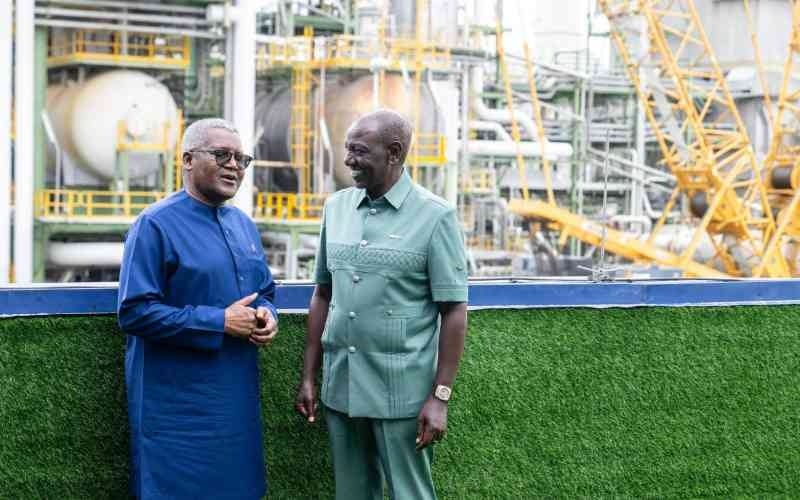
“Ruto spoke on Friday during a tour of the Dangote Petroleum Refinery in Lekki, Lagos, ahead of the September 30 groundbreaking ceremony for the proposed 700,000-barrel-per-day refinery in Lamu, Kenya.” · exact text match
Why: The story attributes claims to named officials and executives and gives concrete dates and capacities, but it offers no independent verification or outside sourcing.
Analysis is limited to a single supplied article text with duplicated sections; the veracity of Ruto's and Dangote's claims could not be independently checked.
September 28, 2026 · 0 shares
Framing treats the Lamu refinery as a transformative national and regional economic win, foregrounding optimistic official and corporate projections while giving limited critical scrutiny.
Automated analysis; not human reviewed. Limitations: No external verification was used; the supplied text's future-dated timeline was taken at face value.
No external verification was used; the supplied text's future-dated timeline was taken at face value.
September 29, 2026 · 0 shares
Framing privileges a government official's denial and dismissive characterizations of residents' grievances, with official assertions presented more directly than protester claims.
Automated analysis; not human reviewed.
Limitations: The supplied text is a short attributed news brief with no independent verification or resident counter-response, so bias scores rest on framing and attribution cues rather than verified facts.
·
4 of 55 available dimensions scored; omitted dimensions are not treated as neutral.
·
Verified supporting quotes for 4 of 4 scored dimensions.
Claim: The story is organized around a partisan dispute between government figures and opposition politicians.
“He also refuted claims by a section of opposition leaders that President William Ruto has shares in the oil refinery.” · exact text match
“CS Mbadi's affirmation followed allegations by the People’s Party of Kenya (PPK) party leader Ndindi Nyoro, who claimed that powerful individuals linked to the government were seeking shares in the refinery for personal benefit.” · exact text match
Why: The central content is a government official rebutting opposition claims about the president, with no non-political or policy detail beyond the dispute.
Claim: The frame gives greater prominence and unhedged phrasing to the government official's defense than to the protesters' complaints.
“Treasury Cabinet Secretary John Mbadi has defended the planned Dangote Lamu oil refinery, saying it is good for Kenya.” · exact text match
“Accusing those demanding for compensation of being part of land cartels, out to defraud the government through false acquisition, the CS also defended President Ruto over claims that he has shares in the Ksh.2 trillion plant.” · exact text match
Counterevidence:
“CS Mbadi's affirmation followed allegations by the People’s Party of Kenya (PPK) party leader Ndindi Nyoro, who claimed that powerful individuals linked to the government were seeking shares in the refinery for personal benefit.” · exact text match
Why: The article leads with and elaborates Mbadi's defense and accusations, while resident grievances appear only as 'alleged' claims and no protester response is included.
Claim: The text uses named attribution and direct quotes, but lacks independent verification or balancing response.
“CS Mbadi insisted that Lamu residents were part of a public participation exercise conducted by the relevant agencies ahead of the planned ground breaking on Wednesday.” · exact text match
“CS Mbadi's affirmation followed allegations by the People’s Party of Kenya (PPK) party leader Ndindi Nyoro, who claimed that powerful individuals linked to the government were seeking shares in the refinery for personal benefit.” · exact text match
Why: Named official and direct quotes support basic sourcing, but the one-sided presentation and lack of independent checks limit credibility.
Claim: Residents' complaints are hedged as 'alleged' while the official's accusations are stated without hedging, and no protester response is provided.
“Responding to the latest protests by a section of Lamu residents over alleged non-compensation and lack of public participation in the planned construction of East Africa Oil Refinery plant in Lamu county, CS Mbadi dismissed the claims as “primitive politics.”” · exact text match
“Accusing those demanding for compensation of being part of land cartels, out to defraud the government through false acquisition, the CS also defended President Ruto over claims that he has shares in the Ksh.2 trillion plant.” · exact text match
Why: Asymmetric epistemic labeling and omission of resident response steer interpretation toward the official account.
The supplied text is a short attributed news brief with no independent verification or resident counter-response, so bias scores rest on framing and attribution cues rather than verified facts.
September 26, 2026 · 0 shares
Framing presents the Dangote Lamu refinery as an assured regional 'game changer,' leading with positive official assurances and omitting skeptical or risk-focused context.
Automated analysis; not human reviewed.
Limitations: Original byline and publication context are unavailable; text is a composite of headline, summary, and structured data.
·
6 of 55 available dimensions scored; omitted dimensions are not treated as neutral.
·
Verified supporting quotes for 2 of 6 scored dimensions.
Claim: The report gives a strongly positive outlook for the Dangote refinery project.
“"It will be a game changer for the entire region," Captain Ruto said.” · not found in supplied text
Why: The only evaluative framing is positive and project-supportive; no risks, costs, or criticisms are included.
Claim: The report emphasizes expected benefits and government commitment, creating an optimistic tone.
“"The arrival of this vessel is very critical and shows the Government’s commitment to ensuring this project succeeds."” · not found in supplied text
Why: The selected official quote presents the project's progress as critical and assured, with no negative or cautionary content.
Claim: The content is primarily a factual description of the vessel arrival and project details, not a call to action.
“The Port of Lamu has received 2,930 metric tonnes of heavy machinery for the planned Dangote East Africa Refinery, days before the project is expected to break ground.” · exact text match
Why: Most sentences report events, figures, and planned activities rather than urging a particular policy or behavior.
Claim: The content presents government support for the project in a favorable light.
“President William Ruto has also assured the Dangote family of government support for the project, saying Kenya had already secured the land required for the refinery and was working on other measures needed to prevent administrative delays.” · exact text match
Why: The government's role is described as committed and problem-solving, with no critical or oppositional perspective.
Claim: The content has promotional characteristics, resembling a positive project announcement.
“"It will be a game changer for the entire region," Captain Ruto said.” · not found in supplied text
Why: The prominent positive quote and lack of independent scrutiny give the content an announcement-like, promotional quality.
Claim: The content frames Dangote's refinery project favorably and without critical perspective.
“expected to contribute to industrialisation, jobs and opportunities in engineering and business” · not found in supplied text
Why: The expected benefits are highlighted while potential downsides or obstacles are absent, favoring the corporate project's image.
Original byline and publication context are unavailable; text is a composite of headline, summary, and structured data.
September 28, 2026 · 0 shares
Framing treats the Lamu refinery as a transformative national and regional economic win, foregrounding optimistic official and corporate projections while giving limited critical scrutiny.
Automated analysis; not human reviewed. Limitations: No external verification was used; the supplied text's future-dated timeline was taken at face value.
No external verification was used; the supplied text's future-dated timeline was taken at face value.
September 27, 2026 · 0 shares
A single leader's conditional rejection is presented as a unified community position, with the project's scale highlighted and no response or context provided.
Lamu is a coastal county in Kenya; Dangote Group is a Nigerian conglomerate.
Automated analysis; not human reviewed.
Limitations: The article is truncated by a paywall; only the headline and a repeated paraphrase are available for analysis.
·
2 of 55 available dimensions scored; omitted dimensions are not treated as neutral.
·
Verified supporting quotes for 1 of 2 scored dimensions.
Claim: The report is framed as objective attribution of a community leader's statement rather than subjective commentary.
“Lamu's Bajuni community leader Shariff Omar has said that they will reject the Sh2 trillion Dangote Oil Refinery if they are not fully involved, and guaranteed benefits agreed for the host community.” · exact text match
Why: The central claim is attributed to a named source with 'has said', and no evaluative or first-person language appears in the substantive text.
Claim: The headline presents one leader's conditional statement as a collective community position.
“Lamu community sets conditions for Sh2 trillion Dangote oil refinery project” · exact text match
“Lamu's Bajuni community leader Shariff Omar has said that they will reject the oil refinery project if they are not fully involved” · not found in supplied text
Why: The body names a single leader, but the headline attributes the condition to 'Lamu community' as a whole.
The article is truncated by a paywall; only the headline and a repeated paraphrase are available for analysis.
September 27, 2026 · 0 shares
A single leader's conditional rejection is presented as a unified community position, with the project's scale highlighted and no response or context provided.
Lamu is a coastal county in Kenya; Dangote Group is a Nigerian conglomerate.
Automated analysis; not human reviewed.
Limitations: The article is truncated by a paywall; only the headline and a repeated paraphrase are available for analysis.
·
2 of 55 available dimensions scored; omitted dimensions are not treated as neutral.
·
Verified supporting quotes for 1 of 2 scored dimensions.
Claim: The report is framed as objective attribution of a community leader's statement rather than subjective commentary.
“Lamu's Bajuni community leader Shariff Omar has said that they will reject the Sh2 trillion Dangote Oil Refinery if they are not fully involved, and guaranteed benefits agreed for the host community.” · exact text match
Why: The central claim is attributed to a named source with 'has said', and no evaluative or first-person language appears in the substantive text.
Claim: The headline presents one leader's conditional statement as a collective community position.
“Lamu community sets conditions for Sh2 trillion Dangote oil refinery project” · exact text match
“Lamu's Bajuni community leader Shariff Omar has said that they will reject the oil refinery project if they are not fully involved” · not found in supplied text
Why: The body names a single leader, but the headline attributes the condition to 'Lamu community' as a whole.
The article is truncated by a paywall; only the headline and a repeated paraphrase are available for analysis.
September 29, 2026 · 0 shares
An event-focused legal news brief presents the court order and resident petition with clipped, procedural neutrality, though promotional descriptors like 'mega-investment' soften the setback framing.
Automated analysis; not human reviewed. Limitations: The supplied excerpt ends mid-sentence, so the petition's grounds and the full court order cannot be assessed; analysis is limited to the truncated text. · 6 of 55 available dimensions scored; omitted dimensions are not treated as neutral. · Verified supporting quotes for 6 of 6 scored dimensions.
Claim: The report is largely factual and sourced to the court process, with only mildly promotional modifiers.
“The Malindi Environment and Land Court has issued interim orders temporarily halting construction and development activities on the land earmarked for the mega-investment.” · exact text match
Counterevidence:
“The ambitious multibillion-shilling Dangote refinery project in Lamu County has encountered a significant legal obstacle.” · exact text match
Why: The core sentence is procedural and attributed, but 'ambitious' and 'mega-investment' introduce a promotional tone, tempering full objectivity.
Claim: The report is restrained and non-sensational; the only heightened language comes from project-scale descriptors and a routine legal framing.
“The Malindi Environment and Land Court has issued interim orders temporarily halting construction and development activities on the land earmarked for the mega-investment.” · exact text match
Counterevidence:
“significant legal obstacle” · exact text match
Why: No dramatic verbs or emotional appeals are used; the story is presented as a straightforward legal-procedural update.
Claim: The report describes what happened rather than recommending action or policy.
“The Malindi Environment and Land Court has issued interim orders temporarily halting construction and development activities on the land earmarked for the mega-investment.” · exact text match
Why: All clauses are indicative and factual; no 'should', 'must', or imperative language is present.
Claim: The emotional register is neutral and procedural, with no deliberate emotional appeal.
“The Malindi Environment and Land Court has issued interim orders temporarily halting construction and development activities on the land earmarked for the mega-investment.” · exact text match
Why: The dominant voice is procedural; the word 'urgent' is attached to the petition's legal characterization rather than used to provoke an emotional response.
Claim: The post has credible sourcing and attribution, though the excerpt is incomplete.
“The Malindi Environment and Land Court has issued interim orders” · exact text match
“filed by Salim Tima Swale alongside 132 other local residents” · exact text match
Why: A specific court ruling and a named lead petitioner are verifiable details; the cutoff mid-sentence reduces completeness.
Claim: The report transparently names the court and the petitioners and avoids anonymous sourcing or unattributed opinion.
“The Malindi Environment and Land Court has issued interim orders temporarily halting construction and development activities on the land earmarked for the mega-investment.” · exact text match
“The ruling follows an urgent petition filed by Salim Tima Swale alongside 132 other local residents” · exact text match
Why: Attribution to a specific court and a named lead petitioner with a group of residents provides visible sourcing.
The supplied excerpt ends mid-sentence, so the petition's grounds and the full court order cannot be assessed; analysis is limited to the truncated text.
September 29, 2026 · 0 shares
Framing centers Dangote’s dismissive response to a Kenyan court order, presenting the legal challenge as a routine obstacle and opponents as troublemakers, while petitioners’ allegations appear only in attributed summary.
Automated analysis; not human reviewed. Limitations: The supplied article text contains duplicate repeated blocks caused by scraping; analysis uses the first complete occurrence. Publication year is not explicitly stated. · 3 of 55 available dimensions scored; omitted dimensions are not treated as neutral. · Verified supporting quotes for 3 of 3 scored dimensions.
Claim: The framing presents the court order as a routine, surmountable obstacle, yielding an optimistic tone.
“Dangote says refinery ready to overcome Kenyan legal hurdles” · exact text match
“This is normal for us in Africa. We don’t care.” · exact text match
Why: The headline and lede lead with Dangote's downplaying and his dismissive quote, then cite Ruto's fast-tracking, so the overall selection is more positive than neutral.
Claim: The reporting is aligned with the project's business and governmental backers rather than with the project's opponents.
“Dangote Group is expected to hold a 70 per cent stake in the project, with regional governments, including Kenya and Rwanda, holding the remainder.” · exact text match
“Ruto said his government was fast-tracking administrative processes for the proposed refinery.” · exact text match
Why: The story emphasizes Dangote's and the Kenyan president's assurances while the residents' allegations are summarized without direct voice.
Claim: Visible sourcing and attribution practices are strong, with allegations and company statements clearly attributed.
“According to a Bloomberg report, the Malindi Environment and Land Court ordered that the status quo prevailing at the site be maintained” · exact text match
“Dangote Group said in a statement on Tuesday that the court order had not halted the planned groundbreaking ceremony” · exact text match
Why: The text repeatedly attributes claims to Bloomberg, Dangote Group, and Kenyan officials, and marks petitioners' statements as 'alleged,' showing care about epistemic status.
The supplied article text contains duplicate repeated blocks caused by scraping; analysis uses the first complete occurrence. Publication year is not explicitly stated.
September 28, 2026 · 0 shares
Frames the development as a legal procedural event, with the $16 billion figure and the petitioners' opposition supplying the only context.
Automated analysis; not human reviewed. Limitations: The supplied text is a single unattributed sentence, so bias scoring rests almost entirely on word-level neutrality and cannot assess sourcing or context. · 3 of 55 available dimensions scored; omitted dimensions are not treated as neutral. · Verified supporting quotes for 3 of 3 scored dimensions.
Claim: The report uses neutral, factual language without evaluative or emotional terms.
“A Kenyan court ordered construction to be paused on Aliko Dangote’s $16 billion oil refinery” · exact text match
Why: The sentence states events and parties directly, with no adjectives or judgment.
Claim: The report avoids sensational or dramatic language.
“A Kenyan court ordered construction to be paused” · exact text match
Why: The phrasing is understated and matter-of-fact, with no hyperbole or urgency words.
Claim: The text describes what happened rather than prescribing what should happen.
“ordered construction to be paused” · exact text match
“after a group of petitioners filed a case opposing the project” · exact text match
Why: All clauses are declarative statements of fact; no imperative or normative language is used.
The supplied text is a single unattributed sentence, so bias scoring rests almost entirely on word-level neutrality and cannot assess sourcing or context.
September 28, 2026 · 0 shares
A Kenyan presidential visit is narrated almost entirely through enthusiastic quotes from President Ruto and Aliko Dangote, presenting the proposed Lamu refinery as an unqualified regional triumph without independent scrutiny.
Automated analysis; not human reviewed. Limitations: Analysis is limited to a single supplied article text with duplicated sections; the veracity of Ruto's and Dangote's claims could not be independently checked. · 3 of 55 available dimensions scored; omitted dimensions are not treated as neutral. · Verified supporting quotes for 3 of 3 scored dimensions.
Claim: The report is bullish on the investment, foregrounding promised economic upside and catalytic effects without downside risk.
“He said the refinery would serve as a catalyst for other investments, attracting businesses and industries that could take advantage of the infrastructure and petroleum products to be produced at the facility.” · exact text match
Why: The forward-looking economic content is entirely positive and comes from project backers, with no independent or contrary analysis included.
Claim: The report frames the Lamu refinery project with strong optimism, highlighting superlative predictions of size and quality without qualification.
“I think in Lamu we are not only going to have the largest, but we are also going to have the best.” · exact text match
Why: The selected content prominently features Ruto's unqualified superlatives and projects positive regional outcomes, with no countervailing risks, costs, or feasibility questions.
Claim: The report is transparent about its sourcing and includes specific, checkable details, though it relies wholly on proponents' statements.
“Ruto spoke on Friday during a tour of the Dangote Petroleum Refinery in Lekki, Lagos, ahead of the September 30 groundbreaking ceremony for the proposed 700,000-barrel-per-day refinery in Lamu, Kenya.” · exact text match
Why: The story attributes claims to named officials and executives and gives concrete dates and capacities, but it offers no independent verification or outside sourcing.
Analysis is limited to a single supplied article text with duplicated sections; the veracity of Ruto's and Dangote's claims could not be independently checked.
September 28, 2026 · 0 shares
Framing treats the Lamu refinery as a transformative national and regional economic win, foregrounding optimistic official and corporate projections while giving limited critical scrutiny.
Automated analysis; not human reviewed. Limitations: No external verification was used; the supplied text's future-dated timeline was taken at face value.
No external verification was used; the supplied text's future-dated timeline was taken at face value.
September 26, 2026 · 0 shares
Framing presents the Dangote Lamu refinery as an assured regional 'game changer,' leading with positive official assurances and omitting skeptical or risk-focused context.
Automated analysis; not human reviewed. Limitations: Original byline and publication context are unavailable; text is a composite of headline, summary, and structured data. · 6 of 55 available dimensions scored; omitted dimensions are not treated as neutral. · Verified supporting quotes for 2 of 6 scored dimensions.
Claim: The report gives a strongly positive outlook for the Dangote refinery project.
“"It will be a game changer for the entire region," Captain Ruto said.” · not found in supplied text
Why: The only evaluative framing is positive and project-supportive; no risks, costs, or criticisms are included.
Claim: The report emphasizes expected benefits and government commitment, creating an optimistic tone.
“"The arrival of this vessel is very critical and shows the Government’s commitment to ensuring this project succeeds."” · not found in supplied text
Why: The selected official quote presents the project's progress as critical and assured, with no negative or cautionary content.
Claim: The content is primarily a factual description of the vessel arrival and project details, not a call to action.
“The Port of Lamu has received 2,930 metric tonnes of heavy machinery for the planned Dangote East Africa Refinery, days before the project is expected to break ground.” · exact text match
Why: Most sentences report events, figures, and planned activities rather than urging a particular policy or behavior.
Claim: The content presents government support for the project in a favorable light.
“President William Ruto has also assured the Dangote family of government support for the project, saying Kenya had already secured the land required for the refinery and was working on other measures needed to prevent administrative delays.” · exact text match
Why: The government's role is described as committed and problem-solving, with no critical or oppositional perspective.
Claim: The content has promotional characteristics, resembling a positive project announcement.
“"It will be a game changer for the entire region," Captain Ruto said.” · not found in supplied text
Why: The prominent positive quote and lack of independent scrutiny give the content an announcement-like, promotional quality.
Claim: The content frames Dangote's refinery project favorably and without critical perspective.
“expected to contribute to industrialisation, jobs and opportunities in engineering and business” · not found in supplied text
Why: The expected benefits are highlighted while potential downsides or obstacles are absent, favoring the corporate project's image.
Original byline and publication context are unavailable; text is a composite of headline, summary, and structured data.
Pro-Project / Government and Corporate View
September 28, 2026 · 0 shares
A Kenyan presidential visit is narrated almost entirely through enthusiastic quotes from President Ruto and Aliko Dangote, presenting the proposed Lamu refinery as an unqualified regional triumph without independent scrutiny.
Automated analysis; not human reviewed. Limitations: Analysis is limited to a single supplied article text with duplicated sections; the veracity of Ruto's and Dangote's claims could not be independently checked. · 3 of 55 available dimensions scored; omitted dimensions are not treated as neutral. · Verified supporting quotes for 3 of 3 scored dimensions.
Claim: The report is bullish on the investment, foregrounding promised economic upside and catalytic effects without downside risk.
“He said the refinery would serve as a catalyst for other investments, attracting businesses and industries that could take advantage of the infrastructure and petroleum products to be produced at the facility.” · exact text match
Why: The forward-looking economic content is entirely positive and comes from project backers, with no independent or contrary analysis included.
Claim: The report frames the Lamu refinery project with strong optimism, highlighting superlative predictions of size and quality without qualification.
“I think in Lamu we are not only going to have the largest, but we are also going to have the best.” · exact text match
Why: The selected content prominently features Ruto's unqualified superlatives and projects positive regional outcomes, with no countervailing risks, costs, or feasibility questions.
Claim: The report is transparent about its sourcing and includes specific, checkable details, though it relies wholly on proponents' statements.
“Ruto spoke on Friday during a tour of the Dangote Petroleum Refinery in Lekki, Lagos, ahead of the September 30 groundbreaking ceremony for the proposed 700,000-barrel-per-day refinery in Lamu, Kenya.” · exact text match
Why: The story attributes claims to named officials and executives and gives concrete dates and capacities, but it offers no independent verification or outside sourcing.
Analysis is limited to a single supplied article text with duplicated sections; the veracity of Ruto's and Dangote's claims could not be independently checked.
September 28, 2026 · 0 shares
Framing treats the Lamu refinery as a transformative national and regional economic win, foregrounding optimistic official and corporate projections while giving limited critical scrutiny.
Automated analysis; not human reviewed. Limitations: No external verification was used; the supplied text's future-dated timeline was taken at face value.
No external verification was used; the supplied text's future-dated timeline was taken at face value.
September 28, 2026 · 0 shares
A Kenyan presidential visit is narrated almost entirely through enthusiastic quotes from President Ruto and Aliko Dangote, presenting the proposed Lamu refinery as an unqualified regional triumph without independent scrutiny.
Automated analysis; not human reviewed. Limitations: Analysis is limited to a single supplied article text with duplicated sections; the veracity of Ruto's and Dangote's claims could not be independently checked. · 3 of 55 available dimensions scored; omitted dimensions are not treated as neutral. · Verified supporting quotes for 3 of 3 scored dimensions.
Claim: The report is bullish on the investment, foregrounding promised economic upside and catalytic effects without downside risk.
“He said the refinery would serve as a catalyst for other investments, attracting businesses and industries that could take advantage of the infrastructure and petroleum products to be produced at the facility.” · exact text match
Why: The forward-looking economic content is entirely positive and comes from project backers, with no independent or contrary analysis included.
Claim: The report frames the Lamu refinery project with strong optimism, highlighting superlative predictions of size and quality without qualification.
“I think in Lamu we are not only going to have the largest, but we are also going to have the best.” · exact text match
Why: The selected content prominently features Ruto's unqualified superlatives and projects positive regional outcomes, with no countervailing risks, costs, or feasibility questions.
Claim: The report is transparent about its sourcing and includes specific, checkable details, though it relies wholly on proponents' statements.
“Ruto spoke on Friday during a tour of the Dangote Petroleum Refinery in Lekki, Lagos, ahead of the September 30 groundbreaking ceremony for the proposed 700,000-barrel-per-day refinery in Lamu, Kenya.” · exact text match
Why: The story attributes claims to named officials and executives and gives concrete dates and capacities, but it offers no independent verification or outside sourcing.
Analysis is limited to a single supplied article text with duplicated sections; the veracity of Ruto's and Dangote's claims could not be independently checked.
September 29, 2026 · 0 shares
Framing privileges a government official's denial and dismissive characterizations of residents' grievances, with official assertions presented more directly than protester claims.
Automated analysis; not human reviewed. Limitations: The supplied text is a short attributed news brief with no independent verification or resident counter-response, so bias scores rest on framing and attribution cues rather than verified facts. · 4 of 55 available dimensions scored; omitted dimensions are not treated as neutral. · Verified supporting quotes for 4 of 4 scored dimensions.
Claim: The story is organized around a partisan dispute between government figures and opposition politicians.
“He also refuted claims by a section of opposition leaders that President William Ruto has shares in the oil refinery.” · exact text match
“CS Mbadi's affirmation followed allegations by the People’s Party of Kenya (PPK) party leader Ndindi Nyoro, who claimed that powerful individuals linked to the government were seeking shares in the refinery for personal benefit.” · exact text match
Why: The central content is a government official rebutting opposition claims about the president, with no non-political or policy detail beyond the dispute.
Claim: The frame gives greater prominence and unhedged phrasing to the government official's defense than to the protesters' complaints.
“Treasury Cabinet Secretary John Mbadi has defended the planned Dangote Lamu oil refinery, saying it is good for Kenya.” · exact text match
“Accusing those demanding for compensation of being part of land cartels, out to defraud the government through false acquisition, the CS also defended President Ruto over claims that he has shares in the Ksh.2 trillion plant.” · exact text match
Counterevidence:
“CS Mbadi's affirmation followed allegations by the People’s Party of Kenya (PPK) party leader Ndindi Nyoro, who claimed that powerful individuals linked to the government were seeking shares in the refinery for personal benefit.” · exact text match
Why: The article leads with and elaborates Mbadi's defense and accusations, while resident grievances appear only as 'alleged' claims and no protester response is included.
Claim: The text uses named attribution and direct quotes, but lacks independent verification or balancing response.
“CS Mbadi insisted that Lamu residents were part of a public participation exercise conducted by the relevant agencies ahead of the planned ground breaking on Wednesday.” · exact text match
“CS Mbadi's affirmation followed allegations by the People’s Party of Kenya (PPK) party leader Ndindi Nyoro, who claimed that powerful individuals linked to the government were seeking shares in the refinery for personal benefit.” · exact text match
Why: Named official and direct quotes support basic sourcing, but the one-sided presentation and lack of independent checks limit credibility.
Claim: Residents' complaints are hedged as 'alleged' while the official's accusations are stated without hedging, and no protester response is provided.
“Responding to the latest protests by a section of Lamu residents over alleged non-compensation and lack of public participation in the planned construction of East Africa Oil Refinery plant in Lamu county, CS Mbadi dismissed the claims as “primitive politics.”” · exact text match
“Accusing those demanding for compensation of being part of land cartels, out to defraud the government through false acquisition, the CS also defended President Ruto over claims that he has shares in the Ksh.2 trillion plant.” · exact text match
Why: Asymmetric epistemic labeling and omission of resident response steer interpretation toward the official account.
The supplied text is a short attributed news brief with no independent verification or resident counter-response, so bias scores rest on framing and attribution cues rather than verified facts.
September 29, 2026 · 0 shares
Straightforward, attribution-heavy political reporting relays President Ruto's warnings and promises about the Lamu refinery, largely adopting his pro-investment framing without editorial rebuttal.
Automated analysis; not human reviewed. Limitations: The supplied text truncates the main article and appends unrelated headline links; the analysis uses only the main report, and some dates cannot be independently verified. · 5 of 55 available dimensions scored; omitted dimensions are not treated as neutral. · Verified supporting quotes for 5 of 5 scored dimensions.
Claim: The report is predominantly objective, attributing claims and including legal counterpoints rather than presenting commentary.
“Ruto said the government would ensure the refinery investment was structured transparently” · exact text match
“The project has, however, faced legal challenges over land.” · exact text match
Why: Statements are repeatedly attributed to Ruto and the report includes the court challenge, showing balanced, mostly neutral reporting despite the positive 'mega project' epithet.
Claim: The article is descriptive, recounting events and statements without recommended actions or policy prescriptions.
“A vessel carrying about 2,930 tonnes of construction equipment for the refinery arrived at Lamu Port on Saturday.” · exact text match
Why: The dominant mode is reporting events and quoted remarks rather than advocacy.
Claim: The report remains factful, relaying allegations and statements with attribution rather than advancing an opinion.
“Ruto accused unnamed “brokers” of previously contributing to Kenya losing major investments” · exact text match
“Dangote Group has also confirmed that the court ruling will not stop Wednesday’s official groundbreaking ceremony, although it could affect some activities at the site.” · exact text match
Why: Claims are attributed to Ruto or Dangote Group, and no non-attributed editorial judgement is presented.
Claim: Coverage centers on a president's political warning and promises about an investment project.
“President William Ruto has warned individuals he accused of trying to frustrate the planned Sh2 trillion Dangote refinery in Lamu” · exact text match
“You will not succeed to con us or lie to us this time round” · exact text match
Why: The main subject is a presidential speech with attacks on unnamed 'brokers' and pledges, making the content explicitly political.
Claim: Visible sourcing and inclusion of countervailing legal details support the report's credibility.
“The project has, however, faced legal challenges over land.” · exact text match
“Dangote Group has also confirmed that the court ruling will not stop Wednesday’s official groundbreaking ceremony, although it could affect some activities at the site.” · exact text match
Why: It names the speaker, quotes directly, and reports both Ruto's position and the court/company response, markers of credible reporting.
The supplied text truncates the main article and appends unrelated headline links; the analysis uses only the main report, and some dates cannot be independently verified.
September 29, 2026 · 0 shares
Framing centers Dangote’s dismissive response to a Kenyan court order, presenting the legal challenge as a routine obstacle and opponents as troublemakers, while petitioners’ allegations appear only in attributed summary.
Automated analysis; not human reviewed. Limitations: The supplied article text contains duplicate repeated blocks caused by scraping; analysis uses the first complete occurrence. Publication year is not explicitly stated. · 3 of 55 available dimensions scored; omitted dimensions are not treated as neutral. · Verified supporting quotes for 3 of 3 scored dimensions.
Claim: The framing presents the court order as a routine, surmountable obstacle, yielding an optimistic tone.
“Dangote says refinery ready to overcome Kenyan legal hurdles” · exact text match
“This is normal for us in Africa. We don’t care.” · exact text match
Why: The headline and lede lead with Dangote's downplaying and his dismissive quote, then cite Ruto's fast-tracking, so the overall selection is more positive than neutral.
Claim: The reporting is aligned with the project's business and governmental backers rather than with the project's opponents.
“Dangote Group is expected to hold a 70 per cent stake in the project, with regional governments, including Kenya and Rwanda, holding the remainder.” · exact text match
“Ruto said his government was fast-tracking administrative processes for the proposed refinery.” · exact text match
Why: The story emphasizes Dangote's and the Kenyan president's assurances while the residents' allegations are summarized without direct voice.
Claim: Visible sourcing and attribution practices are strong, with allegations and company statements clearly attributed.
“According to a Bloomberg report, the Malindi Environment and Land Court ordered that the status quo prevailing at the site be maintained” · exact text match
“Dangote Group said in a statement on Tuesday that the court order had not halted the planned groundbreaking ceremony” · exact text match
Why: The text repeatedly attributes claims to Bloomberg, Dangote Group, and Kenyan officials, and marks petitioners' statements as 'alleged,' showing care about epistemic status.
The supplied article text contains duplicate repeated blocks caused by scraping; analysis uses the first complete occurrence. Publication year is not explicitly stated.
September 29, 2026 · 0 shares
Straightforward, attribution-heavy political reporting relays President Ruto's warnings and promises about the Lamu refinery, largely adopting his pro-investment framing without editorial rebuttal.
Automated analysis; not human reviewed. Limitations: The supplied text truncates the main article and appends unrelated headline links; the analysis uses only the main report, and some dates cannot be independently verified. · 5 of 55 available dimensions scored; omitted dimensions are not treated as neutral. · Verified supporting quotes for 5 of 5 scored dimensions.
Claim: The report is predominantly objective, attributing claims and including legal counterpoints rather than presenting commentary.
“Ruto said the government would ensure the refinery investment was structured transparently” · exact text match
“The project has, however, faced legal challenges over land.” · exact text match
Why: Statements are repeatedly attributed to Ruto and the report includes the court challenge, showing balanced, mostly neutral reporting despite the positive 'mega project' epithet.
Claim: The article is descriptive, recounting events and statements without recommended actions or policy prescriptions.
“A vessel carrying about 2,930 tonnes of construction equipment for the refinery arrived at Lamu Port on Saturday.” · exact text match
Why: The dominant mode is reporting events and quoted remarks rather than advocacy.
Claim: The report remains factful, relaying allegations and statements with attribution rather than advancing an opinion.
“Ruto accused unnamed “brokers” of previously contributing to Kenya losing major investments” · exact text match
“Dangote Group has also confirmed that the court ruling will not stop Wednesday’s official groundbreaking ceremony, although it could affect some activities at the site.” · exact text match
Why: Claims are attributed to Ruto or Dangote Group, and no non-attributed editorial judgement is presented.
Claim: Coverage centers on a president's political warning and promises about an investment project.
“President William Ruto has warned individuals he accused of trying to frustrate the planned Sh2 trillion Dangote refinery in Lamu” · exact text match
“You will not succeed to con us or lie to us this time round” · exact text match
Why: The main subject is a presidential speech with attacks on unnamed 'brokers' and pledges, making the content explicitly political.
Claim: Visible sourcing and inclusion of countervailing legal details support the report's credibility.
“The project has, however, faced legal challenges over land.” · exact text match
“Dangote Group has also confirmed that the court ruling will not stop Wednesday’s official groundbreaking ceremony, although it could affect some activities at the site.” · exact text match
Why: It names the speaker, quotes directly, and reports both Ruto's position and the court/company response, markers of credible reporting.
The supplied text truncates the main article and appends unrelated headline links; the analysis uses only the main report, and some dates cannot be independently verified.
Community and Petitioner View
September 29, 2026 · 0 shares
Framing centers Dangote’s dismissive response to a Kenyan court order, presenting the legal challenge as a routine obstacle and opponents as troublemakers, while petitioners’ allegations appear only in attributed summary.
Automated analysis; not human reviewed. Limitations: The supplied article text contains duplicate repeated blocks caused by scraping; analysis uses the first complete occurrence. Publication year is not explicitly stated. · 3 of 55 available dimensions scored; omitted dimensions are not treated as neutral. · Verified supporting quotes for 3 of 3 scored dimensions.
Claim: The framing presents the court order as a routine, surmountable obstacle, yielding an optimistic tone.
“Dangote says refinery ready to overcome Kenyan legal hurdles” · exact text match
“This is normal for us in Africa. We don’t care.” · exact text match
Why: The headline and lede lead with Dangote's downplaying and his dismissive quote, then cite Ruto's fast-tracking, so the overall selection is more positive than neutral.
Claim: The reporting is aligned with the project's business and governmental backers rather than with the project's opponents.
“Dangote Group is expected to hold a 70 per cent stake in the project, with regional governments, including Kenya and Rwanda, holding the remainder.” · exact text match
“Ruto said his government was fast-tracking administrative processes for the proposed refinery.” · exact text match
Why: The story emphasizes Dangote's and the Kenyan president's assurances while the residents' allegations are summarized without direct voice.
Claim: Visible sourcing and attribution practices are strong, with allegations and company statements clearly attributed.
“According to a Bloomberg report, the Malindi Environment and Land Court ordered that the status quo prevailing at the site be maintained” · exact text match
“Dangote Group said in a statement on Tuesday that the court order had not halted the planned groundbreaking ceremony” · exact text match
Why: The text repeatedly attributes claims to Bloomberg, Dangote Group, and Kenyan officials, and marks petitioners' statements as 'alleged,' showing care about epistemic status.
The supplied article text contains duplicate repeated blocks caused by scraping; analysis uses the first complete occurrence. Publication year is not explicitly stated.
September 29, 2026 · 0 shares
An event-focused legal news brief presents the court order and resident petition with clipped, procedural neutrality, though promotional descriptors like 'mega-investment' soften the setback framing.
Automated analysis; not human reviewed. Limitations: The supplied excerpt ends mid-sentence, so the petition's grounds and the full court order cannot be assessed; analysis is limited to the truncated text. · 6 of 55 available dimensions scored; omitted dimensions are not treated as neutral. · Verified supporting quotes for 6 of 6 scored dimensions.
Claim: The report is largely factual and sourced to the court process, with only mildly promotional modifiers.
“The Malindi Environment and Land Court has issued interim orders temporarily halting construction and development activities on the land earmarked for the mega-investment.” · exact text match
Counterevidence:
“The ambitious multibillion-shilling Dangote refinery project in Lamu County has encountered a significant legal obstacle.” · exact text match
Why: The core sentence is procedural and attributed, but 'ambitious' and 'mega-investment' introduce a promotional tone, tempering full objectivity.
Claim: The report is restrained and non-sensational; the only heightened language comes from project-scale descriptors and a routine legal framing.
“The Malindi Environment and Land Court has issued interim orders temporarily halting construction and development activities on the land earmarked for the mega-investment.” · exact text match
Counterevidence:
“significant legal obstacle” · exact text match
Why: No dramatic verbs or emotional appeals are used; the story is presented as a straightforward legal-procedural update.
Claim: The report describes what happened rather than recommending action or policy.
“The Malindi Environment and Land Court has issued interim orders temporarily halting construction and development activities on the land earmarked for the mega-investment.” · exact text match
Why: All clauses are indicative and factual; no 'should', 'must', or imperative language is present.
Claim: The emotional register is neutral and procedural, with no deliberate emotional appeal.
“The Malindi Environment and Land Court has issued interim orders temporarily halting construction and development activities on the land earmarked for the mega-investment.” · exact text match
Why: The dominant voice is procedural; the word 'urgent' is attached to the petition's legal characterization rather than used to provoke an emotional response.
Claim: The post has credible sourcing and attribution, though the excerpt is incomplete.
“The Malindi Environment and Land Court has issued interim orders” · exact text match
“filed by Salim Tima Swale alongside 132 other local residents” · exact text match
Why: A specific court ruling and a named lead petitioner are verifiable details; the cutoff mid-sentence reduces completeness.
Claim: The report transparently names the court and the petitioners and avoids anonymous sourcing or unattributed opinion.
“The Malindi Environment and Land Court has issued interim orders temporarily halting construction and development activities on the land earmarked for the mega-investment.” · exact text match
“The ruling follows an urgent petition filed by Salim Tima Swale alongside 132 other local residents” · exact text match
Why: Attribution to a specific court and a named lead petitioner with a group of residents provides visible sourcing.
The supplied excerpt ends mid-sentence, so the petition's grounds and the full court order cannot be assessed; analysis is limited to the truncated text.
September 27, 2026 · 0 shares
A single leader's conditional rejection is presented as a unified community position, with the project's scale highlighted and no response or context provided.
Lamu is a coastal county in Kenya; Dangote Group is a Nigerian conglomerate.
Automated analysis; not human reviewed. Limitations: The article is truncated by a paywall; only the headline and a repeated paraphrase are available for analysis. · 2 of 55 available dimensions scored; omitted dimensions are not treated as neutral. · Verified supporting quotes for 1 of 2 scored dimensions.
Claim: The report is framed as objective attribution of a community leader's statement rather than subjective commentary.
“Lamu's Bajuni community leader Shariff Omar has said that they will reject the Sh2 trillion Dangote Oil Refinery if they are not fully involved, and guaranteed benefits agreed for the host community.” · exact text match
Why: The central claim is attributed to a named source with 'has said', and no evaluative or first-person language appears in the substantive text.
Claim: The headline presents one leader's conditional statement as a collective community position.
“Lamu community sets conditions for Sh2 trillion Dangote oil refinery project” · exact text match
“Lamu's Bajuni community leader Shariff Omar has said that they will reject the oil refinery project if they are not fully involved” · not found in supplied text
Why: The body names a single leader, but the headline attributes the condition to 'Lamu community' as a whole.
The article is truncated by a paywall; only the headline and a repeated paraphrase are available for analysis.
September 27, 2026 · 0 shares
A single leader's conditional rejection is presented as a unified community position, with the project's scale highlighted and no response or context provided.
Lamu is a coastal county in Kenya; Dangote Group is a Nigerian conglomerate.
Automated analysis; not human reviewed. Limitations: The article is truncated by a paywall; only the headline and a repeated paraphrase are available for analysis. · 2 of 55 available dimensions scored; omitted dimensions are not treated as neutral. · Verified supporting quotes for 1 of 2 scored dimensions.
Claim: The report is framed as objective attribution of a community leader's statement rather than subjective commentary.
“Lamu's Bajuni community leader Shariff Omar has said that they will reject the Sh2 trillion Dangote Oil Refinery if they are not fully involved, and guaranteed benefits agreed for the host community.” · exact text match
Why: The central claim is attributed to a named source with 'has said', and no evaluative or first-person language appears in the substantive text.
Claim: The headline presents one leader's conditional statement as a collective community position.
“Lamu community sets conditions for Sh2 trillion Dangote oil refinery project” · exact text match
“Lamu's Bajuni community leader Shariff Omar has said that they will reject the oil refinery project if they are not fully involved” · not found in supplied text
Why: The body names a single leader, but the headline attributes the condition to 'Lamu community' as a whole.
The article is truncated by a paywall; only the headline and a repeated paraphrase are available for analysis.
September 29, 2026 · 0 shares
The report centers on opposition claims that the Lamu refinery is a rushed, non-transparent "ambush" shaped by presidential politics, and includes no response from project backers.
Automated analysis; not human reviewed. Limitations: The supplied text is a short report with no response from project proponents or government; judgments are based only on the published framing and quoted allegations. · 4 of 55 available dimensions scored; omitted dimensions are not treated as neutral. · Verified supporting quotes for 3 of 4 scored dimensions.
Claim: The report mostly attributes critical views to sources rather than asserting them as its own, but the selection of voices is one-sided.
“Wandeto explained in an interview at Citizen TV.” · exact text match
“The Ksh. 2 trillion oil refinery, which will be located in Kililana, Lamu County, is expected to produce a Capacity of 700,000 barrels per day and create 60,000 local jobs.” · exact text match
Why: Direct quotations are labeled and attributed, and factual specifications are included, but the story is curated around negative assessments.
Claim: The report is pessimistic in framing; every substantive voice warns about process, deception, or land harm.
““This refinery is a big story this week because to almost all of us Kenyans it is technically an ambush of information,” said Wandeto.” · exact text match
““When a deal sounds too good, think twice. This deal is looking too good to be real for the country,” said Maanzo.” · not found in supplied text
Why: The selected quotes all raise suspicion or harm, with no supportive or balancing perspective included.
Claim: The report frames a major infrastructure project primarily as a political controversy involving MPs and President Ruto's campaign.
“Senator Dan Maanzo of Makueni County backed the concerns, saying that the deal was too good.” · exact text match
“Maanzo, who also claimed that he believed that the refinery was part of William Ruto’s big campaign.” · exact text match
Why: The only substantive storyline is political opposition to a state-backed project, including an electoral campaign allegation.
Claim: The report uses named sources, direct attribution, and identifies residents' court claim as their description, but does not verify claims or include official response.
“Wandeto explained in an interview at Citizen TV.” · exact text match
“This comes as the project continues to face backlash, including from Lamu residents, who moved to court seeking to stop what they describe as the unlawful takeover and destruction of their ancestral land.” · exact text match
Why: Attribution and the phrase 'what they describe' show sourcing care, though the report lacks independent verification and response from proponents.
The supplied text is a short report with no response from project proponents or government; judgments are based only on the published framing and quoted allegations.
September 29, 2026 · 0 shares
The report centers on opposition claims that the Lamu refinery is a rushed, non-transparent "ambush" shaped by presidential politics, and includes no response from project backers.
Automated analysis; not human reviewed. Limitations: The supplied text is a short report with no response from project proponents or government; judgments are based only on the published framing and quoted allegations. · 4 of 55 available dimensions scored; omitted dimensions are not treated as neutral. · Verified supporting quotes for 3 of 4 scored dimensions.
Claim: The report mostly attributes critical views to sources rather than asserting them as its own, but the selection of voices is one-sided.
“Wandeto explained in an interview at Citizen TV.” · exact text match
“The Ksh. 2 trillion oil refinery, which will be located in Kililana, Lamu County, is expected to produce a Capacity of 700,000 barrels per day and create 60,000 local jobs.” · exact text match
Why: Direct quotations are labeled and attributed, and factual specifications are included, but the story is curated around negative assessments.
Claim: The report is pessimistic in framing; every substantive voice warns about process, deception, or land harm.
““This refinery is a big story this week because to almost all of us Kenyans it is technically an ambush of information,” said Wandeto.” · exact text match
““When a deal sounds too good, think twice. This deal is looking too good to be real for the country,” said Maanzo.” · not found in supplied text
Why: The selected quotes all raise suspicion or harm, with no supportive or balancing perspective included.
Claim: The report frames a major infrastructure project primarily as a political controversy involving MPs and President Ruto's campaign.
“Senator Dan Maanzo of Makueni County backed the concerns, saying that the deal was too good.” · exact text match
“Maanzo, who also claimed that he believed that the refinery was part of William Ruto’s big campaign.” · exact text match
Why: The only substantive storyline is political opposition to a state-backed project, including an electoral campaign allegation.
Claim: The report uses named sources, direct attribution, and identifies residents' court claim as their description, but does not verify claims or include official response.
“Wandeto explained in an interview at Citizen TV.” · exact text match
“This comes as the project continues to face backlash, including from Lamu residents, who moved to court seeking to stop what they describe as the unlawful takeover and destruction of their ancestral land.” · exact text match
Why: Attribution and the phrase 'what they describe' show sourcing care, though the report lacks independent verification and response from proponents.
The supplied text is a short report with no response from project proponents or government; judgments are based only on the published framing and quoted allegations.
Parliamentary Skeptic / Accountability View
September 29, 2026 · 0 shares
The report centers on opposition claims that the Lamu refinery is a rushed, non-transparent "ambush" shaped by presidential politics, and includes no response from project backers.
Automated analysis; not human reviewed. Limitations: The supplied text is a short report with no response from project proponents or government; judgments are based only on the published framing and quoted allegations. · 4 of 55 available dimensions scored; omitted dimensions are not treated as neutral. · Verified supporting quotes for 3 of 4 scored dimensions.
Claim: The report mostly attributes critical views to sources rather than asserting them as its own, but the selection of voices is one-sided.
“Wandeto explained in an interview at Citizen TV.” · exact text match
“The Ksh. 2 trillion oil refinery, which will be located in Kililana, Lamu County, is expected to produce a Capacity of 700,000 barrels per day and create 60,000 local jobs.” · exact text match
Why: Direct quotations are labeled and attributed, and factual specifications are included, but the story is curated around negative assessments.
Claim: The report is pessimistic in framing; every substantive voice warns about process, deception, or land harm.
““This refinery is a big story this week because to almost all of us Kenyans it is technically an ambush of information,” said Wandeto.” · exact text match
““When a deal sounds too good, think twice. This deal is looking too good to be real for the country,” said Maanzo.” · not found in supplied text
Why: The selected quotes all raise suspicion or harm, with no supportive or balancing perspective included.
Claim: The report frames a major infrastructure project primarily as a political controversy involving MPs and President Ruto's campaign.
“Senator Dan Maanzo of Makueni County backed the concerns, saying that the deal was too good.” · exact text match
“Maanzo, who also claimed that he believed that the refinery was part of William Ruto’s big campaign.” · exact text match
Why: The only substantive storyline is political opposition to a state-backed project, including an electoral campaign allegation.
Claim: The report uses named sources, direct attribution, and identifies residents' court claim as their description, but does not verify claims or include official response.
“Wandeto explained in an interview at Citizen TV.” · exact text match
“This comes as the project continues to face backlash, including from Lamu residents, who moved to court seeking to stop what they describe as the unlawful takeover and destruction of their ancestral land.” · exact text match
Why: Attribution and the phrase 'what they describe' show sourcing care, though the report lacks independent verification and response from proponents.
The supplied text is a short report with no response from project proponents or government; judgments are based only on the published framing and quoted allegations.
September 29, 2026 · 0 shares
The report centers on opposition claims that the Lamu refinery is a rushed, non-transparent "ambush" shaped by presidential politics, and includes no response from project backers.
Automated analysis; not human reviewed. Limitations: The supplied text is a short report with no response from project proponents or government; judgments are based only on the published framing and quoted allegations. · 4 of 55 available dimensions scored; omitted dimensions are not treated as neutral. · Verified supporting quotes for 3 of 4 scored dimensions.
Claim: The report mostly attributes critical views to sources rather than asserting them as its own, but the selection of voices is one-sided.
“Wandeto explained in an interview at Citizen TV.” · exact text match
“The Ksh. 2 trillion oil refinery, which will be located in Kililana, Lamu County, is expected to produce a Capacity of 700,000 barrels per day and create 60,000 local jobs.” · exact text match
Why: Direct quotations are labeled and attributed, and factual specifications are included, but the story is curated around negative assessments.
Claim: The report is pessimistic in framing; every substantive voice warns about process, deception, or land harm.
““This refinery is a big story this week because to almost all of us Kenyans it is technically an ambush of information,” said Wandeto.” · exact text match
““When a deal sounds too good, think twice. This deal is looking too good to be real for the country,” said Maanzo.” · not found in supplied text
Why: The selected quotes all raise suspicion or harm, with no supportive or balancing perspective included.
Claim: The report frames a major infrastructure project primarily as a political controversy involving MPs and President Ruto's campaign.
“Senator Dan Maanzo of Makueni County backed the concerns, saying that the deal was too good.” · exact text match
“Maanzo, who also claimed that he believed that the refinery was part of William Ruto’s big campaign.” · exact text match
Why: The only substantive storyline is political opposition to a state-backed project, including an electoral campaign allegation.
Claim: The report uses named sources, direct attribution, and identifies residents' court claim as their description, but does not verify claims or include official response.
“Wandeto explained in an interview at Citizen TV.” · exact text match
“This comes as the project continues to face backlash, including from Lamu residents, who moved to court seeking to stop what they describe as the unlawful takeover and destruction of their ancestral land.” · exact text match
Why: Attribution and the phrase 'what they describe' show sourcing care, though the report lacks independent verification and response from proponents.
The supplied text is a short report with no response from project proponents or government; judgments are based only on the published framing and quoted allegations.
September 29, 2026 · 0 shares
Framing privileges a government official's denial and dismissive characterizations of residents' grievances, with official assertions presented more directly than protester claims.
Automated analysis; not human reviewed. Limitations: The supplied text is a short attributed news brief with no independent verification or resident counter-response, so bias scores rest on framing and attribution cues rather than verified facts. · 4 of 55 available dimensions scored; omitted dimensions are not treated as neutral. · Verified supporting quotes for 4 of 4 scored dimensions.
Claim: The story is organized around a partisan dispute between government figures and opposition politicians.
“He also refuted claims by a section of opposition leaders that President William Ruto has shares in the oil refinery.” · exact text match
“CS Mbadi's affirmation followed allegations by the People’s Party of Kenya (PPK) party leader Ndindi Nyoro, who claimed that powerful individuals linked to the government were seeking shares in the refinery for personal benefit.” · exact text match
Why: The central content is a government official rebutting opposition claims about the president, with no non-political or policy detail beyond the dispute.
Claim: The frame gives greater prominence and unhedged phrasing to the government official's defense than to the protesters' complaints.
“Treasury Cabinet Secretary John Mbadi has defended the planned Dangote Lamu oil refinery, saying it is good for Kenya.” · exact text match
“Accusing those demanding for compensation of being part of land cartels, out to defraud the government through false acquisition, the CS also defended President Ruto over claims that he has shares in the Ksh.2 trillion plant.” · exact text match
Counterevidence:
“CS Mbadi's affirmation followed allegations by the People’s Party of Kenya (PPK) party leader Ndindi Nyoro, who claimed that powerful individuals linked to the government were seeking shares in the refinery for personal benefit.” · exact text match
Why: The article leads with and elaborates Mbadi's defense and accusations, while resident grievances appear only as 'alleged' claims and no protester response is included.
Claim: The text uses named attribution and direct quotes, but lacks independent verification or balancing response.
“CS Mbadi insisted that Lamu residents were part of a public participation exercise conducted by the relevant agencies ahead of the planned ground breaking on Wednesday.” · exact text match
“CS Mbadi's affirmation followed allegations by the People’s Party of Kenya (PPK) party leader Ndindi Nyoro, who claimed that powerful individuals linked to the government were seeking shares in the refinery for personal benefit.” · exact text match
Why: Named official and direct quotes support basic sourcing, but the one-sided presentation and lack of independent checks limit credibility.
Claim: Residents' complaints are hedged as 'alleged' while the official's accusations are stated without hedging, and no protester response is provided.
“Responding to the latest protests by a section of Lamu residents over alleged non-compensation and lack of public participation in the planned construction of East Africa Oil Refinery plant in Lamu county, CS Mbadi dismissed the claims as “primitive politics.”” · exact text match
“Accusing those demanding for compensation of being part of land cartels, out to defraud the government through false acquisition, the CS also defended President Ruto over claims that he has shares in the Ksh.2 trillion plant.” · exact text match
Why: Asymmetric epistemic labeling and omission of resident response steer interpretation toward the official account.
The supplied text is a short attributed news brief with no independent verification or resident counter-response, so bias scores rest on framing and attribution cues rather than verified facts.
September 29, 2026 · 0 shares
Framing privileges a government official's denial and dismissive characterizations of residents' grievances, with official assertions presented more directly than protester claims.
Automated analysis; not human reviewed. Limitations: The supplied text is a short attributed news brief with no independent verification or resident counter-response, so bias scores rest on framing and attribution cues rather than verified facts. · 4 of 55 available dimensions scored; omitted dimensions are not treated as neutral. · Verified supporting quotes for 4 of 4 scored dimensions.
Claim: The story is organized around a partisan dispute between government figures and opposition politicians.
“He also refuted claims by a section of opposition leaders that President William Ruto has shares in the oil refinery.” · exact text match
“CS Mbadi's affirmation followed allegations by the People’s Party of Kenya (PPK) party leader Ndindi Nyoro, who claimed that powerful individuals linked to the government were seeking shares in the refinery for personal benefit.” · exact text match
Why: The central content is a government official rebutting opposition claims about the president, with no non-political or policy detail beyond the dispute.
Claim: The frame gives greater prominence and unhedged phrasing to the government official's defense than to the protesters' complaints.
“Treasury Cabinet Secretary John Mbadi has defended the planned Dangote Lamu oil refinery, saying it is good for Kenya.” · exact text match
“Accusing those demanding for compensation of being part of land cartels, out to defraud the government through false acquisition, the CS also defended President Ruto over claims that he has shares in the Ksh.2 trillion plant.” · exact text match
Counterevidence:
“CS Mbadi's affirmation followed allegations by the People’s Party of Kenya (PPK) party leader Ndindi Nyoro, who claimed that powerful individuals linked to the government were seeking shares in the refinery for personal benefit.” · exact text match
Why: The article leads with and elaborates Mbadi's defense and accusations, while resident grievances appear only as 'alleged' claims and no protester response is included.
Claim: The text uses named attribution and direct quotes, but lacks independent verification or balancing response.
“CS Mbadi insisted that Lamu residents were part of a public participation exercise conducted by the relevant agencies ahead of the planned ground breaking on Wednesday.” · exact text match
“CS Mbadi's affirmation followed allegations by the People’s Party of Kenya (PPK) party leader Ndindi Nyoro, who claimed that powerful individuals linked to the government were seeking shares in the refinery for personal benefit.” · exact text match
Why: Named official and direct quotes support basic sourcing, but the one-sided presentation and lack of independent checks limit credibility.
Claim: Residents' complaints are hedged as 'alleged' while the official's accusations are stated without hedging, and no protester response is provided.
“Responding to the latest protests by a section of Lamu residents over alleged non-compensation and lack of public participation in the planned construction of East Africa Oil Refinery plant in Lamu county, CS Mbadi dismissed the claims as “primitive politics.”” · exact text match
“Accusing those demanding for compensation of being part of land cartels, out to defraud the government through false acquisition, the CS also defended President Ruto over claims that he has shares in the Ksh.2 trillion plant.” · exact text match
Why: Asymmetric epistemic labeling and omission of resident response steer interpretation toward the official account.
The supplied text is a short attributed news brief with no independent verification or resident counter-response, so bias scores rest on framing and attribution cues rather than verified facts.
Helium Bias
Story Blindspots
September 29, 2026 · 0 shares
An event-focused legal news brief presents the court order and resident petition with clipped, procedural neutrality, though promotional descriptors like 'mega-investment' soften the setback framing.
Automated analysis; not human reviewed. Limitations: The supplied excerpt ends mid-sentence, so the petition's grounds and the full court order cannot be assessed; analysis is limited to the truncated text. · 6 of 55 available dimensions scored; omitted dimensions are not treated as neutral. · Verified supporting quotes for 6 of 6 scored dimensions.
Claim: The report is largely factual and sourced to the court process, with only mildly promotional modifiers.
“The Malindi Environment and Land Court has issued interim orders temporarily halting construction and development activities on the land earmarked for the mega-investment.” · exact text match
Counterevidence:
“The ambitious multibillion-shilling Dangote refinery project in Lamu County has encountered a significant legal obstacle.” · exact text match
Why: The core sentence is procedural and attributed, but 'ambitious' and 'mega-investment' introduce a promotional tone, tempering full objectivity.
Claim: The report is restrained and non-sensational; the only heightened language comes from project-scale descriptors and a routine legal framing.
“The Malindi Environment and Land Court has issued interim orders temporarily halting construction and development activities on the land earmarked for the mega-investment.” · exact text match
Counterevidence:
“significant legal obstacle” · exact text match
Why: No dramatic verbs or emotional appeals are used; the story is presented as a straightforward legal-procedural update.
Claim: The report describes what happened rather than recommending action or policy.
“The Malindi Environment and Land Court has issued interim orders temporarily halting construction and development activities on the land earmarked for the mega-investment.” · exact text match
Why: All clauses are indicative and factual; no 'should', 'must', or imperative language is present.
Claim: The emotional register is neutral and procedural, with no deliberate emotional appeal.
“The Malindi Environment and Land Court has issued interim orders temporarily halting construction and development activities on the land earmarked for the mega-investment.” · exact text match
Why: The dominant voice is procedural; the word 'urgent' is attached to the petition's legal characterization rather than used to provoke an emotional response.
Claim: The post has credible sourcing and attribution, though the excerpt is incomplete.
“The Malindi Environment and Land Court has issued interim orders” · exact text match
“filed by Salim Tima Swale alongside 132 other local residents” · exact text match
Why: A specific court ruling and a named lead petitioner are verifiable details; the cutoff mid-sentence reduces completeness.
Claim: The report transparently names the court and the petitioners and avoids anonymous sourcing or unattributed opinion.
“The Malindi Environment and Land Court has issued interim orders temporarily halting construction and development activities on the land earmarked for the mega-investment.” · exact text match
“The ruling follows an urgent petition filed by Salim Tima Swale alongside 132 other local residents” · exact text match
Why: Attribution to a specific court and a named lead petitioner with a group of residents provides visible sourcing.
The supplied excerpt ends mid-sentence, so the petition's grounds and the full court order cannot be assessed; analysis is limited to the truncated text.
September 29, 2026 · 0 shares
Framing centers Dangote’s dismissive response to a Kenyan court order, presenting the legal challenge as a routine obstacle and opponents as troublemakers, while petitioners’ allegations appear only in attributed summary.
Automated analysis; not human reviewed. Limitations: The supplied article text contains duplicate repeated blocks caused by scraping; analysis uses the first complete occurrence. Publication year is not explicitly stated. · 3 of 55 available dimensions scored; omitted dimensions are not treated as neutral. · Verified supporting quotes for 3 of 3 scored dimensions.
Claim: The framing presents the court order as a routine, surmountable obstacle, yielding an optimistic tone.
“Dangote says refinery ready to overcome Kenyan legal hurdles” · exact text match
“This is normal for us in Africa. We don’t care.” · exact text match
Why: The headline and lede lead with Dangote's downplaying and his dismissive quote, then cite Ruto's fast-tracking, so the overall selection is more positive than neutral.
Claim: The reporting is aligned with the project's business and governmental backers rather than with the project's opponents.
“Dangote Group is expected to hold a 70 per cent stake in the project, with regional governments, including Kenya and Rwanda, holding the remainder.” · exact text match
“Ruto said his government was fast-tracking administrative processes for the proposed refinery.” · exact text match
Why: The story emphasizes Dangote's and the Kenyan president's assurances while the residents' allegations are summarized without direct voice.
Claim: Visible sourcing and attribution practices are strong, with allegations and company statements clearly attributed.
“According to a Bloomberg report, the Malindi Environment and Land Court ordered that the status quo prevailing at the site be maintained” · exact text match
“Dangote Group said in a statement on Tuesday that the court order had not halted the planned groundbreaking ceremony” · exact text match
Why: The text repeatedly attributes claims to Bloomberg, Dangote Group, and Kenyan officials, and marks petitioners' statements as 'alleged,' showing care about epistemic status.
The supplied article text contains duplicate repeated blocks caused by scraping; analysis uses the first complete occurrence. Publication year is not explicitly stated.
September 28, 2026 · 0 shares
Framing treats the Lamu refinery as a transformative national and regional economic win, foregrounding optimistic official and corporate projections while giving limited critical scrutiny.
Automated analysis; not human reviewed. Limitations: No external verification was used; the supplied text's future-dated timeline was taken at face value.
No external verification was used; the supplied text's future-dated timeline was taken at face value.
September 28, 2026 · 0 shares
Framing treats the Lamu refinery as a transformative national and regional economic win, foregrounding optimistic official and corporate projections while giving limited critical scrutiny.
Automated analysis; not human reviewed. Limitations: No external verification was used; the supplied text's future-dated timeline was taken at face value.
No external verification was used; the supplied text's future-dated timeline was taken at face value.
September 29, 2026 · 0 shares
Framing centers Dangote’s dismissive response to a Kenyan court order, presenting the legal challenge as a routine obstacle and opponents as troublemakers, while petitioners’ allegations appear only in attributed summary.
Automated analysis; not human reviewed. Limitations: The supplied article text contains duplicate repeated blocks caused by scraping; analysis uses the first complete occurrence. Publication year is not explicitly stated. · 3 of 55 available dimensions scored; omitted dimensions are not treated as neutral. · Verified supporting quotes for 3 of 3 scored dimensions.
Claim: The framing presents the court order as a routine, surmountable obstacle, yielding an optimistic tone.
“Dangote says refinery ready to overcome Kenyan legal hurdles” · exact text match
“This is normal for us in Africa. We don’t care.” · exact text match
Why: The headline and lede lead with Dangote's downplaying and his dismissive quote, then cite Ruto's fast-tracking, so the overall selection is more positive than neutral.
Claim: The reporting is aligned with the project's business and governmental backers rather than with the project's opponents.
“Dangote Group is expected to hold a 70 per cent stake in the project, with regional governments, including Kenya and Rwanda, holding the remainder.” · exact text match
“Ruto said his government was fast-tracking administrative processes for the proposed refinery.” · exact text match
Why: The story emphasizes Dangote's and the Kenyan president's assurances while the residents' allegations are summarized without direct voice.
Claim: Visible sourcing and attribution practices are strong, with allegations and company statements clearly attributed.
“According to a Bloomberg report, the Malindi Environment and Land Court ordered that the status quo prevailing at the site be maintained” · exact text match
“Dangote Group said in a statement on Tuesday that the court order had not halted the planned groundbreaking ceremony” · exact text match
Why: The text repeatedly attributes claims to Bloomberg, Dangote Group, and Kenyan officials, and marks petitioners' statements as 'alleged,' showing care about epistemic status.
The supplied article text contains duplicate repeated blocks caused by scraping; analysis uses the first complete occurrence. Publication year is not explicitly stated.
September 29, 2026 · 0 shares
Straightforward, attribution-heavy political reporting relays President Ruto's warnings and promises about the Lamu refinery, largely adopting his pro-investment framing without editorial rebuttal.
Automated analysis; not human reviewed. Limitations: The supplied text truncates the main article and appends unrelated headline links; the analysis uses only the main report, and some dates cannot be independently verified. · 5 of 55 available dimensions scored; omitted dimensions are not treated as neutral. · Verified supporting quotes for 5 of 5 scored dimensions.
Claim: The report is predominantly objective, attributing claims and including legal counterpoints rather than presenting commentary.
“Ruto said the government would ensure the refinery investment was structured transparently” · exact text match
“The project has, however, faced legal challenges over land.” · exact text match
Why: Statements are repeatedly attributed to Ruto and the report includes the court challenge, showing balanced, mostly neutral reporting despite the positive 'mega project' epithet.
Claim: The article is descriptive, recounting events and statements without recommended actions or policy prescriptions.
“A vessel carrying about 2,930 tonnes of construction equipment for the refinery arrived at Lamu Port on Saturday.” · exact text match
Why: The dominant mode is reporting events and quoted remarks rather than advocacy.
Claim: The report remains factful, relaying allegations and statements with attribution rather than advancing an opinion.
“Ruto accused unnamed “brokers” of previously contributing to Kenya losing major investments” · exact text match
“Dangote Group has also confirmed that the court ruling will not stop Wednesday’s official groundbreaking ceremony, although it could affect some activities at the site.” · exact text match
Why: Claims are attributed to Ruto or Dangote Group, and no non-attributed editorial judgement is presented.
Claim: Coverage centers on a president's political warning and promises about an investment project.
“President William Ruto has warned individuals he accused of trying to frustrate the planned Sh2 trillion Dangote refinery in Lamu” · exact text match
“You will not succeed to con us or lie to us this time round” · exact text match
Why: The main subject is a presidential speech with attacks on unnamed 'brokers' and pledges, making the content explicitly political.
Claim: Visible sourcing and inclusion of countervailing legal details support the report's credibility.
“The project has, however, faced legal challenges over land.” · exact text match
“Dangote Group has also confirmed that the court ruling will not stop Wednesday’s official groundbreaking ceremony, although it could affect some activities at the site.” · exact text match
Why: It names the speaker, quotes directly, and reports both Ruto's position and the court/company response, markers of credible reporting.
The supplied text truncates the main article and appends unrelated headline links; the analysis uses only the main report, and some dates cannot be independently verified.
September 29, 2026 · 0 shares
Straightforward, attribution-heavy political reporting relays President Ruto's warnings and promises about the Lamu refinery, largely adopting his pro-investment framing without editorial rebuttal.
Automated analysis; not human reviewed. Limitations: The supplied text truncates the main article and appends unrelated headline links; the analysis uses only the main report, and some dates cannot be independently verified. · 5 of 55 available dimensions scored; omitted dimensions are not treated as neutral. · Verified supporting quotes for 5 of 5 scored dimensions.
Claim: The report is predominantly objective, attributing claims and including legal counterpoints rather than presenting commentary.
“Ruto said the government would ensure the refinery investment was structured transparently” · exact text match
“The project has, however, faced legal challenges over land.” · exact text match
Why: Statements are repeatedly attributed to Ruto and the report includes the court challenge, showing balanced, mostly neutral reporting despite the positive 'mega project' epithet.
Claim: The article is descriptive, recounting events and statements without recommended actions or policy prescriptions.
“A vessel carrying about 2,930 tonnes of construction equipment for the refinery arrived at Lamu Port on Saturday.” · exact text match
Why: The dominant mode is reporting events and quoted remarks rather than advocacy.
Claim: The report remains factful, relaying allegations and statements with attribution rather than advancing an opinion.
“Ruto accused unnamed “brokers” of previously contributing to Kenya losing major investments” · exact text match
“Dangote Group has also confirmed that the court ruling will not stop Wednesday’s official groundbreaking ceremony, although it could affect some activities at the site.” · exact text match
Why: Claims are attributed to Ruto or Dangote Group, and no non-attributed editorial judgement is presented.
Claim: Coverage centers on a president's political warning and promises about an investment project.
“President William Ruto has warned individuals he accused of trying to frustrate the planned Sh2 trillion Dangote refinery in Lamu” · exact text match
“You will not succeed to con us or lie to us this time round” · exact text match
Why: The main subject is a presidential speech with attacks on unnamed 'brokers' and pledges, making the content explicitly political.
Claim: Visible sourcing and inclusion of countervailing legal details support the report's credibility.
“The project has, however, faced legal challenges over land.” · exact text match
“Dangote Group has also confirmed that the court ruling will not stop Wednesday’s official groundbreaking ceremony, although it could affect some activities at the site.” · exact text match
Why: It names the speaker, quotes directly, and reports both Ruto's position and the court/company response, markers of credible reporting.
The supplied text truncates the main article and appends unrelated headline links; the analysis uses only the main report, and some dates cannot be independently verified.
September 29, 2026 · 0 shares
Framing centers Dangote’s dismissive response to a Kenyan court order, presenting the legal challenge as a routine obstacle and opponents as troublemakers, while petitioners’ allegations appear only in attributed summary.
Automated analysis; not human reviewed. Limitations: The supplied article text contains duplicate repeated blocks caused by scraping; analysis uses the first complete occurrence. Publication year is not explicitly stated. · 3 of 55 available dimensions scored; omitted dimensions are not treated as neutral. · Verified supporting quotes for 3 of 3 scored dimensions.
Claim: The framing presents the court order as a routine, surmountable obstacle, yielding an optimistic tone.
“Dangote says refinery ready to overcome Kenyan legal hurdles” · exact text match
“This is normal for us in Africa. We don’t care.” · exact text match
Why: The headline and lede lead with Dangote's downplaying and his dismissive quote, then cite Ruto's fast-tracking, so the overall selection is more positive than neutral.
Claim: The reporting is aligned with the project's business and governmental backers rather than with the project's opponents.
“Dangote Group is expected to hold a 70 per cent stake in the project, with regional governments, including Kenya and Rwanda, holding the remainder.” · exact text match
“Ruto said his government was fast-tracking administrative processes for the proposed refinery.” · exact text match
Why: The story emphasizes Dangote's and the Kenyan president's assurances while the residents' allegations are summarized without direct voice.
Claim: Visible sourcing and attribution practices are strong, with allegations and company statements clearly attributed.
“According to a Bloomberg report, the Malindi Environment and Land Court ordered that the status quo prevailing at the site be maintained” · exact text match
“Dangote Group said in a statement on Tuesday that the court order had not halted the planned groundbreaking ceremony” · exact text match
Why: The text repeatedly attributes claims to Bloomberg, Dangote Group, and Kenyan officials, and marks petitioners' statements as 'alleged,' showing care about epistemic status.
The supplied article text contains duplicate repeated blocks caused by scraping; analysis uses the first complete occurrence. Publication year is not explicitly stated.
September 28, 2026 · 0 shares
Framing treats the Lamu refinery as a transformative national and regional economic win, foregrounding optimistic official and corporate projections while giving limited critical scrutiny.
Automated analysis; not human reviewed. Limitations: No external verification was used; the supplied text's future-dated timeline was taken at face value.
No external verification was used; the supplied text's future-dated timeline was taken at face value.
September 28, 2026 · 0 shares
A Kenyan presidential visit is narrated almost entirely through enthusiastic quotes from President Ruto and Aliko Dangote, presenting the proposed Lamu refinery as an unqualified regional triumph without independent scrutiny.
Automated analysis; not human reviewed. Limitations: Analysis is limited to a single supplied article text with duplicated sections; the veracity of Ruto's and Dangote's claims could not be independently checked. · 3 of 55 available dimensions scored; omitted dimensions are not treated as neutral. · Verified supporting quotes for 3 of 3 scored dimensions.
Claim: The report is bullish on the investment, foregrounding promised economic upside and catalytic effects without downside risk.
“He said the refinery would serve as a catalyst for other investments, attracting businesses and industries that could take advantage of the infrastructure and petroleum products to be produced at the facility.” · exact text match
Why: The forward-looking economic content is entirely positive and comes from project backers, with no independent or contrary analysis included.
Claim: The report frames the Lamu refinery project with strong optimism, highlighting superlative predictions of size and quality without qualification.
“I think in Lamu we are not only going to have the largest, but we are also going to have the best.” · exact text match
Why: The selected content prominently features Ruto's unqualified superlatives and projects positive regional outcomes, with no countervailing risks, costs, or feasibility questions.
Claim: The report is transparent about its sourcing and includes specific, checkable details, though it relies wholly on proponents' statements.
“Ruto spoke on Friday during a tour of the Dangote Petroleum Refinery in Lekki, Lagos, ahead of the September 30 groundbreaking ceremony for the proposed 700,000-barrel-per-day refinery in Lamu, Kenya.” · exact text match
Why: The story attributes claims to named officials and executives and gives concrete dates and capacities, but it offers no independent verification or outside sourcing.
Analysis is limited to a single supplied article text with duplicated sections; the veracity of Ruto's and Dangote's claims could not be independently checked.
September 28, 2026 · 0 shares
Framing treats the Lamu refinery as a transformative national and regional economic win, foregrounding optimistic official and corporate projections while giving limited critical scrutiny.
Automated analysis; not human reviewed. Limitations: No external verification was used; the supplied text's future-dated timeline was taken at face value.
No external verification was used; the supplied text's future-dated timeline was taken at face value.
September 28, 2026 · 0 shares
A Kenyan presidential visit is narrated almost entirely through enthusiastic quotes from President Ruto and Aliko Dangote, presenting the proposed Lamu refinery as an unqualified regional triumph without independent scrutiny.
Automated analysis; not human reviewed.
Limitations: Analysis is limited to a single supplied article text with duplicated sections; the veracity of Ruto's and Dangote's claims could not be independently checked.
·
3 of 55 available dimensions scored; omitted dimensions are not treated as neutral.
·
Verified supporting quotes for 3 of 3 scored dimensions.
Claim: The report is bullish on the investment, foregrounding promised economic upside and catalytic effects without downside risk.
“He said the refinery would serve as a catalyst for other investments, attracting businesses and industries that could take advantage of the infrastructure and petroleum products to be produced at the facility.” · exact text match
Why: The forward-looking economic content is entirely positive and comes from project backers, with no independent or contrary analysis included.
Claim: The report frames the Lamu refinery project with strong optimism, highlighting superlative predictions of size and quality without qualification.
“I think in Lamu we are not only going to have the largest, but we are also going to have the best.” · exact text match
Why: The selected content prominently features Ruto's unqualified superlatives and projects positive regional outcomes, with no countervailing risks, costs, or feasibility questions.
Claim: The report is transparent about its sourcing and includes specific, checkable details, though it relies wholly on proponents' statements.
“Ruto spoke on Friday during a tour of the Dangote Petroleum Refinery in Lekki, Lagos, ahead of the September 30 groundbreaking ceremony for the proposed 700,000-barrel-per-day refinery in Lamu, Kenya.” · exact text match
Why: The story attributes claims to named officials and executives and gives concrete dates and capacities, but it offers no independent verification or outside sourcing.
Analysis is limited to a single supplied article text with duplicated sections; the veracity of Ruto's and Dangote's claims could not be independently checked.
September 26, 2026 · 0 shares
Framing presents the Dangote Lamu refinery as an assured regional 'game changer,' leading with positive official assurances and omitting skeptical or risk-focused context.
Automated analysis; not human reviewed.
Limitations: Original byline and publication context are unavailable; text is a composite of headline, summary, and structured data.
·
6 of 55 available dimensions scored; omitted dimensions are not treated as neutral.
·
Verified supporting quotes for 2 of 6 scored dimensions.
Claim: The report gives a strongly positive outlook for the Dangote refinery project.
“"It will be a game changer for the entire region," Captain Ruto said.” · not found in supplied text
Why: The only evaluative framing is positive and project-supportive; no risks, costs, or criticisms are included.
Claim: The report emphasizes expected benefits and government commitment, creating an optimistic tone.
“"The arrival of this vessel is very critical and shows the Government’s commitment to ensuring this project succeeds."” · not found in supplied text
Why: The selected official quote presents the project's progress as critical and assured, with no negative or cautionary content.
Claim: The content is primarily a factual description of the vessel arrival and project details, not a call to action.
“The Port of Lamu has received 2,930 metric tonnes of heavy machinery for the planned Dangote East Africa Refinery, days before the project is expected to break ground.” · exact text match
Why: Most sentences report events, figures, and planned activities rather than urging a particular policy or behavior.
Claim: The content presents government support for the project in a favorable light.
“President William Ruto has also assured the Dangote family of government support for the project, saying Kenya had already secured the land required for the refinery and was working on other measures needed to prevent administrative delays.” · exact text match
Why: The government's role is described as committed and problem-solving, with no critical or oppositional perspective.
Claim: The content has promotional characteristics, resembling a positive project announcement.
“"It will be a game changer for the entire region," Captain Ruto said.” · not found in supplied text
Why: The prominent positive quote and lack of independent scrutiny give the content an announcement-like, promotional quality.
Claim: The content frames Dangote's refinery project favorably and without critical perspective.
“expected to contribute to industrialisation, jobs and opportunities in engineering and business” · not found in supplied text
Why: The expected benefits are highlighted while potential downsides or obstacles are absent, favoring the corporate project's image.
Original byline and publication context are unavailable; text is a composite of headline, summary, and structured data.
September 29, 2026 · 0 shares
Straightforward, attribution-heavy political reporting relays President Ruto's warnings and promises about the Lamu refinery, largely adopting his pro-investment framing without editorial rebuttal.
Automated analysis; not human reviewed.
Limitations: The supplied text truncates the main article and appends unrelated headline links; the analysis uses only the main report, and some dates cannot be independently verified.
·
5 of 55 available dimensions scored; omitted dimensions are not treated as neutral.
·
Verified supporting quotes for 5 of 5 scored dimensions.
Claim: The report is predominantly objective, attributing claims and including legal counterpoints rather than presenting commentary.
“Ruto said the government would ensure the refinery investment was structured transparently” · exact text match
“The project has, however, faced legal challenges over land.” · exact text match
Why: Statements are repeatedly attributed to Ruto and the report includes the court challenge, showing balanced, mostly neutral reporting despite the positive 'mega project' epithet.
Claim: The article is descriptive, recounting events and statements without recommended actions or policy prescriptions.
“A vessel carrying about 2,930 tonnes of construction equipment for the refinery arrived at Lamu Port on Saturday.” · exact text match
Why: The dominant mode is reporting events and quoted remarks rather than advocacy.
Claim: The report remains factful, relaying allegations and statements with attribution rather than advancing an opinion.
“Ruto accused unnamed “brokers” of previously contributing to Kenya losing major investments” · exact text match
“Dangote Group has also confirmed that the court ruling will not stop Wednesday’s official groundbreaking ceremony, although it could affect some activities at the site.” · exact text match
Why: Claims are attributed to Ruto or Dangote Group, and no non-attributed editorial judgement is presented.
Claim: Coverage centers on a president's political warning and promises about an investment project.
“President William Ruto has warned individuals he accused of trying to frustrate the planned Sh2 trillion Dangote refinery in Lamu” · exact text match
“You will not succeed to con us or lie to us this time round” · exact text match
Why: The main subject is a presidential speech with attacks on unnamed 'brokers' and pledges, making the content explicitly political.
Claim: Visible sourcing and inclusion of countervailing legal details support the report's credibility.
“The project has, however, faced legal challenges over land.” · exact text match
“Dangote Group has also confirmed that the court ruling will not stop Wednesday’s official groundbreaking ceremony, although it could affect some activities at the site.” · exact text match
Why: It names the speaker, quotes directly, and reports both Ruto's position and the court/company response, markers of credible reporting.
The supplied text truncates the main article and appends unrelated headline links; the analysis uses only the main report, and some dates cannot be independently verified.
September 29, 2026 · 0 shares
The report centers on opposition claims that the Lamu refinery is a rushed, non-transparent "ambush" shaped by presidential politics, and includes no response from project backers.
Automated analysis; not human reviewed.
Limitations: The supplied text is a short report with no response from project proponents or government; judgments are based only on the published framing and quoted allegations.
·
4 of 55 available dimensions scored; omitted dimensions are not treated as neutral.
·
Verified supporting quotes for 3 of 4 scored dimensions.
Claim: The report mostly attributes critical views to sources rather than asserting them as its own, but the selection of voices is one-sided.
“Wandeto explained in an interview at Citizen TV.” · exact text match
“The Ksh. 2 trillion oil refinery, which will be located in Kililana, Lamu County, is expected to produce a Capacity of 700,000 barrels per day and create 60,000 local jobs.” · exact text match
Why: Direct quotations are labeled and attributed, and factual specifications are included, but the story is curated around negative assessments.
Claim: The report is pessimistic in framing; every substantive voice warns about process, deception, or land harm.
““This refinery is a big story this week because to almost all of us Kenyans it is technically an ambush of information,” said Wandeto.” · exact text match
““When a deal sounds too good, think twice.
This deal is looking too good to be real for the country,” said Maanzo.”
· not found in supplied text
Why: The selected quotes all raise suspicion or harm, with no supportive or balancing perspective included.
Claim: The report frames a major infrastructure project primarily as a political controversy involving MPs and President Ruto's campaign.
“Senator Dan Maanzo of Makueni County backed the concerns, saying that the deal was too good.” · exact text match
“Maanzo, who also claimed that he believed that the refinery was part of William Ruto’s big campaign.” · exact text match
Why: The only substantive storyline is political opposition to a state-backed project, including an electoral campaign allegation.
Claim: The report uses named sources, direct attribution, and identifies residents' court claim as their description, but does not verify claims or include official response.
“Wandeto explained in an interview at Citizen TV.” · exact text match
“This comes as the project continues to face backlash, including from Lamu residents, who moved to court seeking to stop what they describe as the unlawful takeover and destruction of their ancestral land.” · exact text match
Why: Attribution and the phrase 'what they describe' show sourcing care, though the report lacks independent verification and response from proponents.
The supplied text is a short report with no response from project proponents or government; judgments are based only on the published framing and quoted allegations.
September 27, 2026 · 0 shares
A single leader's conditional rejection is presented as a unified community position, with the project's scale highlighted and no response or context provided.
Lamu is a coastal county in Kenya; Dangote Group is a Nigerian conglomerate.
Automated analysis; not human reviewed.
Limitations: The article is truncated by a paywall; only the headline and a repeated paraphrase are available for analysis.
·
2 of 55 available dimensions scored; omitted dimensions are not treated as neutral.
·
Verified supporting quotes for 1 of 2 scored dimensions.
Claim: The report is framed as objective attribution of a community leader's statement rather than subjective commentary.
“Lamu's Bajuni community leader Shariff Omar has said that they will reject the Sh2 trillion Dangote Oil Refinery if they are not fully involved, and guaranteed benefits agreed for the host community.” · exact text match
Why: The central claim is attributed to a named source with 'has said', and no evaluative or first-person language appears in the substantive text.
Claim: The headline presents one leader's conditional statement as a collective community position.
“Lamu community sets conditions for Sh2 trillion Dangote oil refinery project” · exact text match
“Lamu's Bajuni community leader Shariff Omar has said that they will reject the oil refinery project if they are not fully involved” · not found in supplied text
Why: The body names a single leader, but the headline attributes the condition to 'Lamu community' as a whole.
The article is truncated by a paywall; only the headline and a repeated paraphrase are available for analysis.
September 29, 2026 · 0 shares
Framing privileges a government official's denial and dismissive characterizations of residents' grievances, with official assertions presented more directly than protester claims.
Automated analysis; not human reviewed.
Limitations: The supplied text is a short attributed news brief with no independent verification or resident counter-response, so bias scores rest on framing and attribution cues rather than verified facts.
·
4 of 55 available dimensions scored; omitted dimensions are not treated as neutral.
·
Verified supporting quotes for 4 of 4 scored dimensions.
Claim: The story is organized around a partisan dispute between government figures and opposition politicians.
“He also refuted claims by a section of opposition leaders that President William Ruto has shares in the oil refinery.” · exact text match
“CS Mbadi's affirmation followed allegations by the People’s Party of Kenya (PPK) party leader Ndindi Nyoro, who claimed that powerful individuals linked to the government were seeking shares in the refinery for personal benefit.” · exact text match
Why: The central content is a government official rebutting opposition claims about the president, with no non-political or policy detail beyond the dispute.
Claim: The frame gives greater prominence and unhedged phrasing to the government official's defense than to the protesters' complaints.
“Treasury Cabinet Secretary John Mbadi has defended the planned Dangote Lamu oil refinery, saying it is good for Kenya.” · exact text match
“Accusing those demanding for compensation of being part of land cartels, out to defraud the government through false acquisition, the CS also defended President Ruto over claims that he has shares in the Ksh.2 trillion plant.” · exact text match
Counterevidence:
“CS Mbadi's affirmation followed allegations by the People’s Party of Kenya (PPK) party leader Ndindi Nyoro, who claimed that powerful individuals linked to the government were seeking shares in the refinery for personal benefit.” · exact text match
Why: The article leads with and elaborates Mbadi's defense and accusations, while resident grievances appear only as 'alleged' claims and no protester response is included.
Claim: The text uses named attribution and direct quotes, but lacks independent verification or balancing response.
“CS Mbadi insisted that Lamu residents were part of a public participation exercise conducted by the relevant agencies ahead of the planned ground breaking on Wednesday.” · exact text match
“CS Mbadi's affirmation followed allegations by the People’s Party of Kenya (PPK) party leader Ndindi Nyoro, who claimed that powerful individuals linked to the government were seeking shares in the refinery for personal benefit.” · exact text match
Why: Named official and direct quotes support basic sourcing, but the one-sided presentation and lack of independent checks limit credibility.
Claim: Residents' complaints are hedged as 'alleged' while the official's accusations are stated without hedging, and no protester response is provided.
“Responding to the latest protests by a section of Lamu residents over alleged non-compensation and lack of public participation in the planned construction of East Africa Oil Refinery plant in Lamu county, CS Mbadi dismissed the claims as “primitive politics.”” · exact text match
“Accusing those demanding for compensation of being part of land cartels, out to defraud the government through false acquisition, the CS also defended President Ruto over claims that he has shares in the Ksh.2 trillion plant.” · exact text match
Why: Asymmetric epistemic labeling and omission of resident response steer interpretation toward the official account.
The supplied text is a short attributed news brief with no independent verification or resident counter-response, so bias scores rest on framing and attribution cues rather than verified facts.
September 28, 2026 · 0 shares
Frames the development as a legal procedural event, with the $16 billion figure and the petitioners' opposition supplying the only context.
Automated analysis; not human reviewed.
Limitations: The supplied text is a single unattributed sentence, so bias scoring rests almost entirely on word-level neutrality and cannot assess sourcing or context.
·
3 of 55 available dimensions scored; omitted dimensions are not treated as neutral.
·
Verified supporting quotes for 3 of 3 scored dimensions.
Claim: The report uses neutral, factual language without evaluative or emotional terms.
“A Kenyan court ordered construction to be paused on Aliko Dangote’s $16 billion oil refinery” · exact text match
Why: The sentence states events and parties directly, with no adjectives or judgment.
Claim: The report avoids sensational or dramatic language.
“A Kenyan court ordered construction to be paused” · exact text match
Why: The phrasing is understated and matter-of-fact, with no hyperbole or urgency words.
Claim: The text describes what happened rather than prescribing what should happen.
“ordered construction to be paused” · exact text match
“after a group of petitioners filed a case opposing the project” · exact text match
Why: All clauses are declarative statements of fact; no imperative or normative language is used.
The supplied text is a single unattributed sentence, so bias scoring rests almost entirely on word-level neutrality and cannot assess sourcing or context.
September 29, 2026 · 0 shares
An event-focused legal news brief presents the court order and resident petition with clipped, procedural neutrality, though promotional descriptors like 'mega-investment' soften the setback framing.
Automated analysis; not human reviewed.
Limitations: The supplied excerpt ends mid-sentence, so the petition's grounds and the full court order cannot be assessed; analysis is limited to the truncated text.
·
6 of 55 available dimensions scored; omitted dimensions are not treated as neutral.
·
Verified supporting quotes for 6 of 6 scored dimensions.
Claim: The report is largely factual and sourced to the court process, with only mildly promotional modifiers.
“The Malindi Environment and Land Court has issued interim orders temporarily halting construction and development activities on the land earmarked for the mega-investment.” · exact text match
Counterevidence:
“The ambitious multibillion-shilling Dangote refinery project in Lamu County has encountered a significant legal obstacle.” · exact text match
Why: The core sentence is procedural and attributed, but 'ambitious' and 'mega-investment' introduce a promotional tone, tempering full objectivity.
Claim: The report is restrained and non-sensational; the only heightened language comes from project-scale descriptors and a routine legal framing.
“The Malindi Environment and Land Court has issued interim orders temporarily halting construction and development activities on the land earmarked for the mega-investment.” · exact text match
Counterevidence:
“significant legal obstacle” · exact text match
Why: No dramatic verbs or emotional appeals are used; the story is presented as a straightforward legal-procedural update.
Claim: The report describes what happened rather than recommending action or policy.
“The Malindi Environment and Land Court has issued interim orders temporarily halting construction and development activities on the land earmarked for the mega-investment.” · exact text match
Why: All clauses are indicative and factual; no 'should', 'must', or imperative language is present.
Claim: The emotional register is neutral and procedural, with no deliberate emotional appeal.
“The Malindi Environment and Land Court has issued interim orders temporarily halting construction and development activities on the land earmarked for the mega-investment.” · exact text match
Why: The dominant voice is procedural; the word 'urgent' is attached to the petition's legal characterization rather than used to provoke an emotional response.
Claim: The post has credible sourcing and attribution, though the excerpt is incomplete.
“The Malindi Environment and Land Court has issued interim orders” · exact text match
“filed by Salim Tima Swale alongside 132 other local residents” · exact text match
Why: A specific court ruling and a named lead petitioner are verifiable details; the cutoff mid-sentence reduces completeness.
Claim: The report transparently names the court and the petitioners and avoids anonymous sourcing or unattributed opinion.
“The Malindi Environment and Land Court has issued interim orders temporarily halting construction and development activities on the land earmarked for the mega-investment.” · exact text match
“The ruling follows an urgent petition filed by Salim Tima Swale alongside 132 other local residents” · exact text match
Why: Attribution to a specific court and a named lead petitioner with a group of residents provides visible sourcing.
The supplied excerpt ends mid-sentence, so the petition's grounds and the full court order cannot be assessed; analysis is limited to the truncated text.
September 29, 2026 · 0 shares
Framing centers Dangote’s dismissive response to a Kenyan court order, presenting the legal challenge as a routine obstacle and opponents as troublemakers, while petitioners’ allegations appear only in attributed summary.
Automated analysis; not human reviewed.
Limitations: The supplied article text contains duplicate repeated blocks caused by scraping; analysis uses the first complete occurrence.
Publication year is not explicitly stated.
·
3 of 55 available dimensions scored; omitted dimensions are not treated as neutral.
·
Verified supporting quotes for 3 of 3 scored dimensions.
Claim: The framing presents the court order as a routine, surmountable obstacle, yielding an optimistic tone.
“Dangote says refinery ready to overcome Kenyan legal hurdles” · exact text match
“This is normal for us in Africa.
We don’t care.”
· exact text match
Why: The headline and lede lead with Dangote's downplaying and his dismissive quote, then cite Ruto's fast-tracking, so the overall selection is more positive than neutral.
Claim: The reporting is aligned with the project's business and governmental backers rather than with the project's opponents.
“Dangote Group is expected to hold a 70 per cent stake in the project, with regional governments, including Kenya and Rwanda, holding the remainder.” · exact text match
“Ruto said his government was fast-tracking administrative processes for the proposed refinery.” · exact text match
Why: The story emphasizes Dangote's and the Kenyan president's assurances while the residents' allegations are summarized without direct voice.
Claim: Visible sourcing and attribution practices are strong, with allegations and company statements clearly attributed.
“According to a Bloomberg report, the Malindi Environment and Land Court ordered that the status quo prevailing at the site be maintained” · exact text match
“Dangote Group said in a statement on Tuesday that the court order had not halted the planned groundbreaking ceremony” · exact text match
Why: The text repeatedly attributes claims to Bloomberg, Dangote Group, and Kenyan officials, and marks petitioners' statements as 'alleged,' showing care about epistemic status.
The supplied article text contains duplicate repeated blocks caused by scraping; analysis uses the first complete occurrence.
Publication year is not explicitly stated.
September 27, 2026 · 0 shares
Straight report of a Christian leader's endorsement of the Dangote Refinery IPO, framing share-buying as religiously compatible and economically beneficial without critical counterpoint or risk disclosure.
An initial public offering is a process in which a company sells shares to the public for the first time; the Dangote Petroleum Refinery is the Nigerian refinery company undertaking the share sale.
Automated analysis; not human reviewed.
Limitations: The supplied text is truncated and partly malformed, which makes some attributions and the exact wording of passages uncertain.
·
2 of 55 available dimensions scored; omitted dimensions are not treated as neutral.
·
Verified supporting quotes for 1 of 2 scored dimensions.
Claim: Publisher attributes the investment exhortation to a named speaker and supplies direct quotes rather than endorsing the claim in its own voice.
“Joseph John Hayab, has urged Christians across the country to participate in the ongoing Initial Public Offering, IPO, of Dangote Petroleum Refinery, saying religious considerations should not influence investment decisions.” · exact text match
Why: The framing reports Hayab's call and rationale through attribution and quotation, with no visible editorializing or subjective judgment by the outlet.
Claim: Reporting is sourced to a named individual and contains direct quotations, giving the text a visible evidentiary basis.
“Joseph John Hayab” · exact text match
“What Dangote is selling is not Islam; … Buy it for the future of their education,” he said.” · not found in supplied text
Counterevidence:
“The Dangote Petroleum Refinery public offer […] interest in owning stakes in businesses operating within the country, saying broader participation in investment would give citizens a stronger economic stake in the nation’s development.” · not found in supplied text
Why: Named attribution and direct quotes support moderate credibility, but truncation limits full verification of the surrounding statements.
The supplied text is truncated and partly malformed, which makes some attributions and the exact wording of passages uncertain.
September 29, 2026 · 0 shares
Framing privileges a government official's denial and dismissive characterizations of residents' grievances, with official assertions presented more directly than protester claims.
Automated analysis; not human reviewed.
Limitations: The supplied text is a short attributed news brief with no independent verification or resident counter-response, so bias scores rest on framing and attribution cues rather than verified facts.
·
4 of 55 available dimensions scored; omitted dimensions are not treated as neutral.
·
Verified supporting quotes for 4 of 4 scored dimensions.
Claim: The story is organized around a partisan dispute between government figures and opposition politicians.
“He also refuted claims by a section of opposition leaders that President William Ruto has shares in the oil refinery.” · exact text match
“CS Mbadi's affirmation followed allegations by the People’s Party of Kenya (PPK) party leader Ndindi Nyoro, who claimed that powerful individuals linked to the government were seeking shares in the refinery for personal benefit.” · exact text match
Why: The central content is a government official rebutting opposition claims about the president, with no non-political or policy detail beyond the dispute.
Claim: The frame gives greater prominence and unhedged phrasing to the government official's defense than to the protesters' complaints.
“Treasury Cabinet Secretary John Mbadi has defended the planned Dangote Lamu oil refinery, saying it is good for Kenya.” · exact text match
“Accusing those demanding for compensation of being part of land cartels, out to defraud the government through false acquisition, the CS also defended President Ruto over claims that he has shares in the Ksh.2 trillion plant.” · exact text match
Counterevidence:
“CS Mbadi's affirmation followed allegations by the People’s Party of Kenya (PPK) party leader Ndindi Nyoro, who claimed that powerful individuals linked to the government were seeking shares in the refinery for personal benefit.” · exact text match
Why: The article leads with and elaborates Mbadi's defense and accusations, while resident grievances appear only as 'alleged' claims and no protester response is included.
Claim: The text uses named attribution and direct quotes, but lacks independent verification or balancing response.
“CS Mbadi insisted that Lamu residents were part of a public participation exercise conducted by the relevant agencies ahead of the planned ground breaking on Wednesday.” · exact text match
“CS Mbadi's affirmation followed allegations by the People’s Party of Kenya (PPK) party leader Ndindi Nyoro, who claimed that powerful individuals linked to the government were seeking shares in the refinery for personal benefit.” · exact text match
Why: Named official and direct quotes support basic sourcing, but the one-sided presentation and lack of independent checks limit credibility.
Claim: Residents' complaints are hedged as 'alleged' while the official's accusations are stated without hedging, and no protester response is provided.
“Responding to the latest protests by a section of Lamu residents over alleged non-compensation and lack of public participation in the planned construction of East Africa Oil Refinery plant in Lamu county, CS Mbadi dismissed the claims as “primitive politics.”” · exact text match
“Accusing those demanding for compensation of being part of land cartels, out to defraud the government through false acquisition, the CS also defended President Ruto over claims that he has shares in the Ksh.2 trillion plant.” · exact text match
Why: Asymmetric epistemic labeling and omission of resident response steer interpretation toward the official account.
The supplied text is a short attributed news brief with no independent verification or resident counter-response, so bias scores rest on framing and attribution cues rather than verified facts.
September 27, 2026 · 0 shares
A single leader's conditional rejection is presented as a unified community position, with the project's scale highlighted and no response or context provided.
Lamu is a coastal county in Kenya; Dangote Group is a Nigerian conglomerate.
Automated analysis; not human reviewed.
Limitations: The article is truncated by a paywall; only the headline and a repeated paraphrase are available for analysis.
·
2 of 55 available dimensions scored; omitted dimensions are not treated as neutral.
·
Verified supporting quotes for 1 of 2 scored dimensions.
Claim: The report is framed as objective attribution of a community leader's statement rather than subjective commentary.
“Lamu's Bajuni community leader Shariff Omar has said that they will reject the Sh2 trillion Dangote Oil Refinery if they are not fully involved, and guaranteed benefits agreed for the host community.” · exact text match
Why: The central claim is attributed to a named source with 'has said', and no evaluative or first-person language appears in the substantive text.
Claim: The headline presents one leader's conditional statement as a collective community position.
“Lamu community sets conditions for Sh2 trillion Dangote oil refinery project” · exact text match
“Lamu's Bajuni community leader Shariff Omar has said that they will reject the oil refinery project if they are not fully involved” · not found in supplied text
Why: The body names a single leader, but the headline attributes the condition to 'Lamu community' as a whole.
The article is truncated by a paywall; only the headline and a repeated paraphrase are available for analysis.
September 28, 2026 · 0 shares
Framing treats the Lamu refinery as a transformative national and regional economic win, foregrounding optimistic official and corporate projections while giving limited critical scrutiny.
Automated analysis; not human reviewed. Limitations: No external verification was used; the supplied text's future-dated timeline was taken at face value.
No external verification was used; the supplied text's future-dated timeline was taken at face value.
September 27, 2026 · 0 shares
Straight report of a Christian leader's endorsement of the Dangote Refinery IPO, framing share-buying as religiously compatible and economically beneficial without critical counterpoint or risk disclosure.
An initial public offering is a process in which a company sells shares to the public for the first time; the Dangote Petroleum Refinery is the Nigerian refinery company undertaking the share sale.
Automated analysis; not human reviewed.
Limitations: The supplied text is truncated and partly malformed, which makes some attributions and the exact wording of passages uncertain.
·
2 of 55 available dimensions scored; omitted dimensions are not treated as neutral.
·
Verified supporting quotes for 1 of 2 scored dimensions.
Claim: Publisher attributes the investment exhortation to a named speaker and supplies direct quotes rather than endorsing the claim in its own voice.
“Joseph John Hayab, has urged Christians across the country to participate in the ongoing Initial Public Offering, IPO, of Dangote Petroleum Refinery, saying religious considerations should not influence investment decisions.” · exact text match
Why: The framing reports Hayab's call and rationale through attribution and quotation, with no visible editorializing or subjective judgment by the outlet.
Claim: Reporting is sourced to a named individual and contains direct quotations, giving the text a visible evidentiary basis.
“Joseph John Hayab” · exact text match
“What Dangote is selling is not Islam; … Buy it for the future of their education,” he said.” · not found in supplied text
Counterevidence:
“The Dangote Petroleum Refinery public offer […] interest in owning stakes in businesses operating within the country, saying broader participation in investment would give citizens a stronger economic stake in the nation’s development.” · not found in supplied text
Why: Named attribution and direct quotes support moderate credibility, but truncation limits full verification of the surrounding statements.
The supplied text is truncated and partly malformed, which makes some attributions and the exact wording of passages uncertain.
September 27, 2026 · 0 shares
Straight report of a Christian leader's endorsement of the Dangote Refinery IPO, framing share-buying as religiously compatible and economically beneficial without critical counterpoint or risk disclosure.
An initial public offering is a process in which a company sells shares to the public for the first time; the Dangote Petroleum Refinery is the Nigerian refinery company undertaking the share sale.
Automated analysis; not human reviewed.
Limitations: The supplied text is truncated and partly malformed, which makes some attributions and the exact wording of passages uncertain.
·
2 of 55 available dimensions scored; omitted dimensions are not treated as neutral.
·
Verified supporting quotes for 1 of 2 scored dimensions.
Claim: Publisher attributes the investment exhortation to a named speaker and supplies direct quotes rather than endorsing the claim in its own voice.
“Joseph John Hayab, has urged Christians across the country to participate in the ongoing Initial Public Offering, IPO, of Dangote Petroleum Refinery, saying religious considerations should not influence investment decisions.” · exact text match
Why: The framing reports Hayab's call and rationale through attribution and quotation, with no visible editorializing or subjective judgment by the outlet.
Claim: Reporting is sourced to a named individual and contains direct quotations, giving the text a visible evidentiary basis.
“Joseph John Hayab” · exact text match
“What Dangote is selling is not Islam; … Buy it for the future of their education,” he said.” · not found in supplied text
Counterevidence:
“The Dangote Petroleum Refinery public offer […] interest in owning stakes in businesses operating within the country, saying broader participation in investment would give citizens a stronger economic stake in the nation’s development.” · not found in supplied text
Why: Named attribution and direct quotes support moderate credibility, but truncation limits full verification of the surrounding statements.
The supplied text is truncated and partly malformed, which makes some attributions and the exact wording of passages uncertain.
September 28, 2026 · 0 shares
Framing treats the Lamu refinery as a transformative national and regional economic win, foregrounding optimistic official and corporate projections while giving limited critical scrutiny.
Automated analysis; not human reviewed. Limitations: No external verification was used; the supplied text's future-dated timeline was taken at face value.
No external verification was used; the supplied text's future-dated timeline was taken at face value.
September 28, 2026 · 0 shares
A Kenyan presidential visit is narrated almost entirely through enthusiastic quotes from President Ruto and Aliko Dangote, presenting the proposed Lamu refinery as an unqualified regional triumph without independent scrutiny.
Automated analysis; not human reviewed. Limitations: Analysis is limited to a single supplied article text with duplicated sections; the veracity of Ruto's and Dangote's claims could not be independently checked. · 3 of 55 available dimensions scored; omitted dimensions are not treated as neutral. · Verified supporting quotes for 3 of 3 scored dimensions.
Claim: The report is bullish on the investment, foregrounding promised economic upside and catalytic effects without downside risk.
“He said the refinery would serve as a catalyst for other investments, attracting businesses and industries that could take advantage of the infrastructure and petroleum products to be produced at the facility.” · exact text match
Why: The forward-looking economic content is entirely positive and comes from project backers, with no independent or contrary analysis included.
Claim: The report frames the Lamu refinery project with strong optimism, highlighting superlative predictions of size and quality without qualification.
“I think in Lamu we are not only going to have the largest, but we are also going to have the best.” · exact text match
Why: The selected content prominently features Ruto's unqualified superlatives and projects positive regional outcomes, with no countervailing risks, costs, or feasibility questions.
Claim: The report is transparent about its sourcing and includes specific, checkable details, though it relies wholly on proponents' statements.
“Ruto spoke on Friday during a tour of the Dangote Petroleum Refinery in Lekki, Lagos, ahead of the September 30 groundbreaking ceremony for the proposed 700,000-barrel-per-day refinery in Lamu, Kenya.” · exact text match
Why: The story attributes claims to named officials and executives and gives concrete dates and capacities, but it offers no independent verification or outside sourcing.
Analysis is limited to a single supplied article text with duplicated sections; the veracity of Ruto's and Dangote's claims could not be independently checked.
September 27, 2026 · 0 shares
Straight report of a Christian leader's endorsement of the Dangote Refinery IPO, framing share-buying as religiously compatible and economically beneficial without critical counterpoint or risk disclosure.
An initial public offering is a process in which a company sells shares to the public for the first time; the Dangote Petroleum Refinery is the Nigerian refinery company undertaking the share sale.
Automated analysis; not human reviewed. Limitations: The supplied text is truncated and partly malformed, which makes some attributions and the exact wording of passages uncertain. · 2 of 55 available dimensions scored; omitted dimensions are not treated as neutral. · Verified supporting quotes for 1 of 2 scored dimensions.
Claim: Publisher attributes the investment exhortation to a named speaker and supplies direct quotes rather than endorsing the claim in its own voice.
“Joseph John Hayab, has urged Christians across the country to participate in the ongoing Initial Public Offering, IPO, of Dangote Petroleum Refinery, saying religious considerations should not influence investment decisions.” · exact text match
Why: The framing reports Hayab's call and rationale through attribution and quotation, with no visible editorializing or subjective judgment by the outlet.
Claim: Reporting is sourced to a named individual and contains direct quotations, giving the text a visible evidentiary basis.
“Joseph John Hayab” · exact text match
“What Dangote is selling is not Islam; … Buy it for the future of their education,” he said.” · not found in supplied text
Counterevidence:
“The Dangote Petroleum Refinery public offer […] interest in owning stakes in businesses operating within the country, saying broader participation in investment would give citizens a stronger economic stake in the nation’s development.” · not found in supplied text
Why: Named attribution and direct quotes support moderate credibility, but truncation limits full verification of the surrounding statements.
The supplied text is truncated and partly malformed, which makes some attributions and the exact wording of passages uncertain.
September 28, 2026 · 0 shares
Framing treats the Lamu refinery as a transformative national and regional economic win, foregrounding optimistic official and corporate projections while giving limited critical scrutiny.
Automated analysis; not human reviewed. Limitations: No external verification was used; the supplied text's future-dated timeline was taken at face value.
No external verification was used; the supplied text's future-dated timeline was taken at face value.
September 29, 2026 · 0 shares
An event-focused legal news brief presents the court order and resident petition with clipped, procedural neutrality, though promotional descriptors like 'mega-investment' soften the setback framing.
Automated analysis; not human reviewed. Limitations: The supplied excerpt ends mid-sentence, so the petition's grounds and the full court order cannot be assessed; analysis is limited to the truncated text. · 6 of 55 available dimensions scored; omitted dimensions are not treated as neutral. · Verified supporting quotes for 6 of 6 scored dimensions.
Claim: The report is largely factual and sourced to the court process, with only mildly promotional modifiers.
“The Malindi Environment and Land Court has issued interim orders temporarily halting construction and development activities on the land earmarked for the mega-investment.” · exact text match
Counterevidence:
“The ambitious multibillion-shilling Dangote refinery project in Lamu County has encountered a significant legal obstacle.” · exact text match
Why: The core sentence is procedural and attributed, but 'ambitious' and 'mega-investment' introduce a promotional tone, tempering full objectivity.
Claim: The report is restrained and non-sensational; the only heightened language comes from project-scale descriptors and a routine legal framing.
“The Malindi Environment and Land Court has issued interim orders temporarily halting construction and development activities on the land earmarked for the mega-investment.” · exact text match
Counterevidence:
“significant legal obstacle” · exact text match
Why: No dramatic verbs or emotional appeals are used; the story is presented as a straightforward legal-procedural update.
Claim: The report describes what happened rather than recommending action or policy.
“The Malindi Environment and Land Court has issued interim orders temporarily halting construction and development activities on the land earmarked for the mega-investment.” · exact text match
Why: All clauses are indicative and factual; no 'should', 'must', or imperative language is present.
Claim: The emotional register is neutral and procedural, with no deliberate emotional appeal.
“The Malindi Environment and Land Court has issued interim orders temporarily halting construction and development activities on the land earmarked for the mega-investment.” · exact text match
Why: The dominant voice is procedural; the word 'urgent' is attached to the petition's legal characterization rather than used to provoke an emotional response.
Claim: The post has credible sourcing and attribution, though the excerpt is incomplete.
“The Malindi Environment and Land Court has issued interim orders” · exact text match
“filed by Salim Tima Swale alongside 132 other local residents” · exact text match
Why: A specific court ruling and a named lead petitioner are verifiable details; the cutoff mid-sentence reduces completeness.
Claim: The report transparently names the court and the petitioners and avoids anonymous sourcing or unattributed opinion.
“The Malindi Environment and Land Court has issued interim orders temporarily halting construction and development activities on the land earmarked for the mega-investment.” · exact text match
“The ruling follows an urgent petition filed by Salim Tima Swale alongside 132 other local residents” · exact text match
Why: Attribution to a specific court and a named lead petitioner with a group of residents provides visible sourcing.
The supplied excerpt ends mid-sentence, so the petition's grounds and the full court order cannot be assessed; analysis is limited to the truncated text.
September 28, 2026 · 0 shares
Frames the development as a legal procedural event, with the $16 billion figure and the petitioners' opposition supplying the only context.
Automated analysis; not human reviewed. Limitations: The supplied text is a single unattributed sentence, so bias scoring rests almost entirely on word-level neutrality and cannot assess sourcing or context. · 3 of 55 available dimensions scored; omitted dimensions are not treated as neutral. · Verified supporting quotes for 3 of 3 scored dimensions.
Claim: The report uses neutral, factual language without evaluative or emotional terms.
“A Kenyan court ordered construction to be paused on Aliko Dangote’s $16 billion oil refinery” · exact text match
Why: The sentence states events and parties directly, with no adjectives or judgment.
Claim: The report avoids sensational or dramatic language.
“A Kenyan court ordered construction to be paused” · exact text match
Why: The phrasing is understated and matter-of-fact, with no hyperbole or urgency words.
Claim: The text describes what happened rather than prescribing what should happen.
“ordered construction to be paused” · exact text match
“after a group of petitioners filed a case opposing the project” · exact text match
Why: All clauses are declarative statements of fact; no imperative or normative language is used.
The supplied text is a single unattributed sentence, so bias scoring rests almost entirely on word-level neutrality and cannot assess sourcing or context.
September 25, 2026 · 0 shares
The sixfold PMS export increase is framed as a favorable, data-backed turnaround driven by Dangote refinery output and Middle East supply disruptions.
The Dangote refinery is a large private Nigerian refinery; the naira-for-crude arrangement is a Nigerian government policy under which crude oil is sold to local refineries in naira.
Automated analysis; not human reviewed. Limitations: The provided text is an excerpt combining the report with unrelated headlines and a promotional line; accuracy of NBS data and analyst statements could not be independently verified. · 9 of 55 available dimensions scored; omitted dimensions are not treated as neutral. · Verified supporting quotes for 9 of 9 scored dimensions.
Claim: Neither liberal nor conservative framing is present.
“Data from the National Bureau of Statistics (NBS), showed that African buyers accounted for N621.72bn, or more than 60 per cent, of the total value of Nigeria’s PMS exports during the period.” · verified after text normalization
Why: The report relies on statistical information and named experts without employing partisan or ideological terms.
Claim: Reporting is objective, attributing figures to a national statistical office and named analysts.
“Data from the National Bureau of Statistics (NBS), showed that African buyers accounted for N621.72bn, or more than 60 per cent, of the total value of Nigeria’s PMS exports during the period.” · verified after text normalization
Why: The report relies on third-party data and direct attribution, with no first-person opinion or subjective framing.
Claim: The report is sober and non-sensational.
“Exports returned in the second quarter of that year at a modest N85.83bn.” · exact text match
Why: The restrained descriptor and plain numerical reporting reflect a measured tone rather than sensationalism.
Claim: The selection and framing lean constructive on Nigeria's petroleum export outlook.
“Adeniji described the development as evidence that Nigeria had moved from being primarily a crude oil exporter and refined-product importer to becoming a net exporter of refined petroleum products.” · exact text match
“The latest figures mark a sharp reversal for Nigeria, which was still heavily dependent on imported petrol barely a year earlier.” · exact text match
Why: The highlighted analyst conclusion and emphasis on turnaround and net-exporter status give the report a modestly bullish cast.
Claim: The report describes developments without prescribing policy or action.
“He added that the war involving Iran and the resulting disruption of Middle Eastern supply routes created another opportunity for Nigerian petroleum products in the African market.” · exact text match
Why: The text reports causal context and expert analysis; it does not urge readers or policymakers to act.
Claim: The tone is unemotional and measured.
“Data from the National Bureau of Statistics (NBS), showed that African buyers accounted for N621.72bn, or more than 60 per cent, of the total value of Nigeria’s PMS exports during the period.” · verified after text normalization
Why: No fear, anger, joy, or other emotional charge appears in the substantive report.
Claim: The article is credible on its face due to clear sourcing and precise quantification.
“Data from the National Bureau of Statistics (NBS), showed that African buyers accounted for N621.72bn, or more than 60 per cent, of the total value of Nigeria’s PMS exports during the period.” · verified after text normalization
“An investment research analyst, Abeeblahi Rufai, said Nigeria’s weak PMS exports in early 2025 were largely due to the absence of surplus products for foreign markets.” · exact text match
Why: Sources are identified and figures are specific; no anonymous claims or obvious internal inconsistencies are present in the supplied text.
Claim: The analysis uses reasoned causal explanation and data rather than emotional or superstitious reasoning.
“Analysts attributed the turnaround mainly to the ramp-up of the Dangote refinery, which has increased the volume of refined products available for domestic consumption and export.” · exact text match
Why: The explanatory framework is causal, evidence-based, and tied to refinery operations and market conditions.
Claim: The report shows high internal fairness by naming sources and attributing claims.
“An investment research analyst, Abeeblahi Rufai, said Nigeria’s weak PMS exports in early 2025 were largely due to the absence of surplus products for foreign markets.” · exact text match
“An economist and Chief Executive Officer of Economic Associates, Dr Ayo Teriba, described the development as a natural progression in the refinery’s operations.” · exact text match
Why: Expert opinions are attributed by name and institutional affiliation, reducing unlabeled assertion.
The provided text is an excerpt combining the report with unrelated headlines and a promotional line; accuracy of NBS data and analyst statements could not be independently verified.


2026 © Helium Trades
Privacy Policy & Disclosure
* Disclaimer: Nothing on this website constitutes investment advice, performance data or any recommendation that any particular security, portfolio of securities, transaction or investment strategy is suitable for any specific person. Helium Trades is not responsible in any way for the accuracy
of any model predictions or price data. Any mention of a particular security and related prediction data is not a recommendation to buy or sell that security. Investments in securities involve the risk of loss. Past performance is no guarantee of future results. Helium Trades is not responsible for any of your investment decisions,
you should consult a financial expert before engaging in any transaction.
Helium Research Assistant

How can I help you today?
Ask any question about this page.


