See whether Helium helps you make better-informed decisions. Try every Pro Trader feature for 30 days. No credit card required.
Try every Pro Trader feature for 30 days. No credit card required.
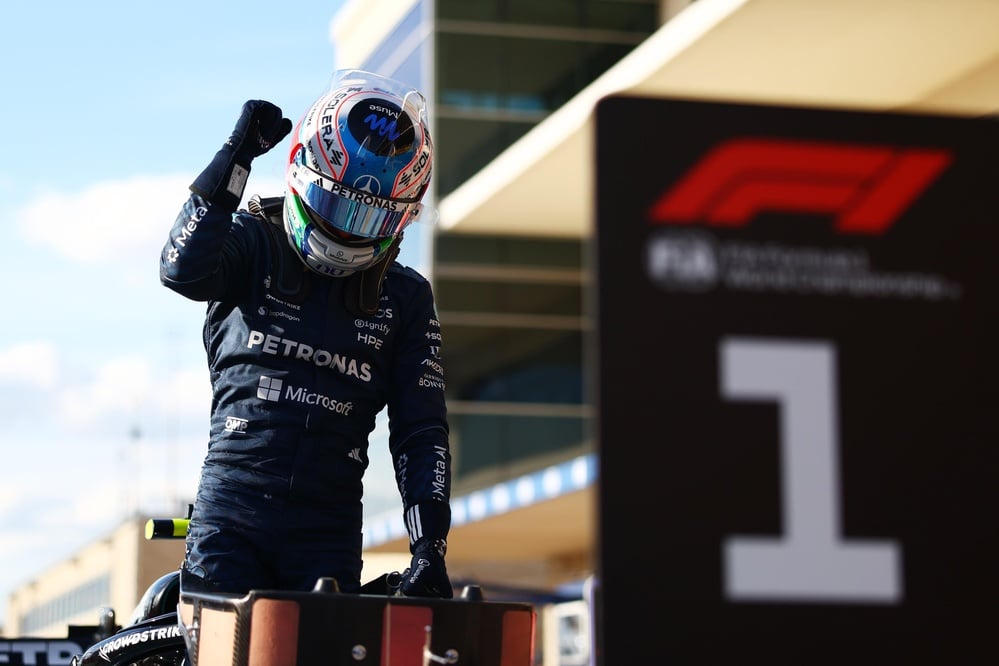
October 25, 2026 · 0 shares
Compact wire-style sports report whose only evaluative coloring is mild dramatic verb choice ('stormed to his ninth win'), otherwise limited to attributed race results.
The Formula 1 season championship is decided across a series of Grands Prix, with the next round scheduled in Mexico City.
Automated analysis; not human reviewed.
·
4 of 55 available dimensions scored; omitted dimensions are not treated as neutral.
·
Verified supporting quotes for 4 of 4 scored dimensions.
Claim: The report is confined to verifiable race outcome and standings implications.
“Kimi Antonelli stormed to his ninth win of the season on Sunday at the United States Grand Prix” · exact text match
Why: Statements are factual result and standings reporting rather than commentary or opinion.
Claim: Framing is largely plain despite one dramatic verb.
“further tightened his grip on a Formula 1 season championship” · exact text match
Why: Sportswriting idioms add mild drama but no hype or exaggeration of stakes beyond the stated standings.
Claim: Tone is mildly positive toward the winner's achievement.
“stormed to his ninth win of the season” · exact text match
Why: The verb choice conveys a favorable, energetic tone without negative affect.
Claim: Claims are specific and presented without unsupported elaboration.
“he could win at the next race in Mexico City” · exact text match
Why: Short report states results and a hedged ('could') projection without sourcing detail or exaggeration, though supporting attribution is minimal.
October 25, 2026 · 0 shares
Coverage is predominantly factual and explanatory, built around quantified championship permutations and race results rather than emotive or ideological framing.
Formula 1 uses a standard points system and countback on wins to break ties; the 2026 calendar has five rounds remaining after Austin.
Automated analysis; not human reviewed.
Limitations: The supplied text includes scraped headline lists and empty strings around the main article; the substantive article content is present.
·
7 of 55 available dimensions scored; omitted dimensions are not treated as neutral.
·
Verified supporting quotes for 7 of 7 scored dimensions.
Claim: The title-clinch discussion is framed as an explicit conditional calculation rather than subjective commentary.
“For Antonelli to become champion at Circuit of the Americas, he needed to win with Russell finishing ninth or below and Hamilton taking fifth.” · exact text match
Why: The conditional statement makes the claim testable against results.
Claim: Sensational language is largely absent; the report relies on quantified standings.
“There are now 125 points left available in the 2026 campaign with five rounds remaining” · exact text match
Why: The framing is centered on points and schedule facts rather than dramatic language.
Claim: The article describes conditions and outcomes rather than advocating actions.
“For Antonelli to become champion at Circuit of the Americas, he needed to win with Russell finishing ninth or below and Hamilton taking fifth.” · exact text match
Why: It states what must happen mathematically instead of prescribing behavior.
Claim: Specific named contenders, points gaps, and points available are supplied.
“There were six mathematical contenders heading into Austin - Antonelli, George Russell, Lewis Hamilton, Max Verstappen, Charles Leclerc and Lando Norris - as 139 points separated the drivers with 150 left available pre-Texas.” · exact text match
Why: The report provides verifiable names and quantities for its central claim.
Claim: Championship implications are reduced to explicit points calculations.
“This means both must outscore Antonelli by 24 and 25 points respectively.” · exact text match
Why: The report explains title scenarios through arithmetic rather than emotional assertion.
Claim: The report flags a schedule contingency rather than presenting remaining races as certain.
“provided the Middle Eastern grands prix go ahead amid the conflict” · exact text match
Why: It acknowledges uncertainty in the conditions underlying the title math.
Claim: The report explains complex title permutations clearly.
“This means both must outscore Antonelli by 24 and 25 points respectively.” · exact text match
Why: The calculation is presented in a structured, understandable way.
The supplied text includes scraped headline lists and empty strings around the main article; the substantive article content is present.
The framing is a largely factual race report with mildly positive and surprise-oriented language around Antonelli and Mercedes, backed by direct quotes and specific qualifying details.
Automated analysis; not human reviewed.
Limitations: The supplied text includes duplicated related-headline and subscription fragments mixed with the race report; scoring is limited to the substantive article content.
·
7 of 55 available dimensions scored; omitted dimensions are not treated as neutral.
·
Verified supporting quotes for 7 of 7 scored dimensions.
Claim: The report uses evaluative idioms that frame team performance subjectively.
“as Ferrari flattered to deceive” · exact text match
“Antonelli sprung somewhat of a surprise” · exact text match
Why: These phrases go beyond neutral result reporting and characterize performance as deceptive or surprising.
Claim: The headline and lede use mildly dramatic, surprise-oriented language.
“Kimi Antonelli delivers Austin surprise pole in tricky Mercedes” · exact text match
Why: 'Delivers' and 'surprise' add modest sensational emphasis to the pole result.
Claim: The article is overwhelmingly descriptive, recounting qualifying results and quotes without prescribing actions.
“Antonelli held off Red Bull tandem Max Verstappen and Isack Hadjar on Austin's Circuit of the Americas” · exact text match
Why: The sentence reports a result rather than advocating a course of action.
Claim: The article frames Antonelli's pole as a positive reward for Mercedes' work.
“It was a reward for Mercedes' efforts to exploit its big Malaysia upgrade” · exact text match
Why: The word 'reward' casts the result in an approving, positive light.
Claim: The report credibly attributes claims and supplies specific race details.
“said Antonelli, after denying Verstappen a third consecutive pole.” · exact text match
“Antonelli held off Red Bull tandem Max Verstappen and Isack Hadjar on Austin's Circuit of the Americas” · exact text match
Why: Direct quotation and precise qualifying details provide visible sourcing and attribution.
Claim: The report briefly forecasts Antonelli's title chances.
“the chances of Antonelli celebrating a maiden title in Texas may still be small, but they are not negligible either.” · exact text match
Why: The article explicitly estimates future title prospects rather than only reporting qualifying facts.
Claim: The report includes technical Formula 1 context about the car upgrade and setup trade-offs.
“Mercedes' efforts to exploit its big Malaysia upgrade, which has made the W17 faster but also more difficult to set up.” · exact text match
Why: The technical explanation supports an above-average intelligence rating for the article.
The supplied text includes duplicated related-headline and subscription fragments mixed with the race report; scoring is limited to the substantive article content.
October 25, 2026 · 0 shares
Neutral, attribution-heavy sports reporting with mild sensational and evaluative language around Antonelli’s surprise pole.
Formula 1 qualifying determines the starting grid, and championship points are awarded based on race results, allowing a title to be clinched before the final round depending on placings.
Automated analysis; not human reviewed.
Limitations: Promotional Sky Sports broadcast/subscription lines and repeated video placeholders were present; they were treated as page chrome and excluded from substantive bias scoring.
·
9 of 55 available dimensions scored; omitted dimensions are not treated as neutral.
·
Verified supporting quotes for 9 of 9 scored dimensions.
Claim: Framing is mostly objective but includes some evaluative sports language.
“It was perhaps the most unlikely of Antonelli's seven poles this season as he came from nowhere in Q3 to surge ahead of Verstappen” · exact text match
Why: The article reports concrete results and quotes, though it uses evaluative phrases such as 'most unlikely' and 'came from nowhere'.
Claim: The report uses mild sensational wording around the surprise pole.
“Kimi Antonelli stuns Max Verstappen to take pole in Austin” · exact text match
Why: The verb 'stuns' adds dramatic emphasis to an otherwise factual qualifying report.
Claim: The surprise pole and title implications make the report moderately interesting.
“It was perhaps the most unlikely of Antonelli's seven poles this season as he came from nowhere in Q3 to surge ahead of Verstappen” · exact text match
Why: The unexpected pole and championship stakes provide narrative interest beyond routine results.
Claim: The article is overwhelmingly descriptive of qualifying events, times, and quotes rather than prescriptive.
“Antonelli's pole time of 1:34.035s was good enough to beat Verstappen by 0.179s, with neither driver managing to improve on the second of their two Q3 flying laps.” · exact text match
Why: The content focuses on reporting measurable qualifying outcomes rather than recommending actions or policies.
Claim: The article is mostly factual but contains some evaluative commentary.
“leaving Ferrari's Charles Leclerc and Lewis Hamilton a hugely disappointing fourth and fifth, respectively.” · exact text match
Why: The phrase 'hugely disappointing' expresses an evaluative judgment, though it is limited within otherwise factual reporting.
Claim: Credibility is supported by specific times, grid details, and attributed driver quotes.
“Antonelli's pole time of 1:34.035s was good enough to beat Verstappen by 0.179s” · exact text match
“"We got pole, so we will try to win tomorrow," Antonelli said.” · exact text match
Why: The article supplies verifiable-seeming specificity and direct attribution rather than unsourced assertions.
Claim: The article uses conditional, evidence-based sports reasoning rather than irrationality.
“The 20-year-old Mercedes driver is all but certain to become Formula 1's youngest ever champion but could clinch the title with five rounds to spare if he wins in Austin on Sunday and other placings go his way.” · exact text match
Why: The statement lays out conditional title scenarios and qualifying facts rather than relying on fallacious reasoning.
Claim: The report presents competing explanations with attribution rather than asserting a contested claim as fact.
“Hamilton questioned over team radio whether Ferrari's rivals 'turning up their engines' had caused the turnaround, but Leclerc insisted after the session that it was down to other factors.” · exact text match
Why: It fairly attributes Hamilton's radio question and Leclerc's response without adopting either explanation as established.
Claim: The report is detailed and technically clear in describing qualifying developments.
“With gusting winds making for challenging conditions, Antonelli made a mistake in the final sector on his second run that appeared to have opened the door for Verstappen to snatch pole, but the Dutchman was also caught out and failed to improve his time, before the lap was deleted in any case for a track limits breach.” · exact text match
Why: It provides precise causal and technical detail about qualifying outcomes and conditions.
Promotional Sky Sports broadcast/subscription lines and repeated video placeholders were present; they were treated as page chrome and excluded from substantive bias scoring.
October 25, 2026 · 0 shares
The framing is measured, technical sports journalism that credits Mercedes' upgrade and Antonelli's qualifying execution while carefully qualifying the title scenario.
Formula 1 qualifying determines the starting grid, and pole position is awarded to the fastest qualifier.
Automated analysis; not human reviewed.
Limitations: The supplied text includes extensive navigation and recommendation clutter, but the core F1 report is present; scoring is limited to that substantive content.
·
6 of 55 available dimensions scored; omitted dimensions are not treated as neutral.
·
Verified supporting quotes for 3 of 6 scored dimensions.
Claim: The report is predominantly factual and attribution-based, with limited evaluative language.
“Antonelli held off Red Bull tandem Max Verstappen and Isack Hadjar on Austin's Circuit of the Americas as Ferrari flattered to deceive in Saturday's qualifying shootout by taking fourth and fifth.” · exact text match
Why: Specific qualifying facts dominate, though the phrase 'flattered to deceive' introduces mild evaluative language.
Claim: The article reports the result and title scenarios in measured terms rather than sensational language.
“The chances of Antonelli celebrating a maiden title in Texas may still be small, but they are not negligible either.” · not found in supplied text
Why: The forecast is explicitly qualified and not sensationalized.
Claim: The framing is modestly positive about Antonelli's breakthrough and title opportunity.
“Antonelli gets a first, if remote, opportunity to tie up the championship on Sunday if he wins the race and team-mate George Russell finishes ninth or lower, and Hamilton is no higher than fifth.” · exact text match
Why: It notes a positive possibility but explicitly calls it remote, yielding only slight optimism.
Claim: The report uses direct quotes and specific qualifying and upgrade details, supporting its credibility.
“"I'm happy because we've been working really hard on this package, and we're still trying to understand it fully," said Antonelli, after denying Verstappen a third consecutive pole.” · not found in supplied text
Why: Direct quotation and specific attribution are visible; external verification is outside the supplied text.
Claim: A limited amount of forward-looking probability language appears in the championship discussion.
“The chances of Antonelli celebrating a maiden title in Texas may still be small, but they are not negligible either.” · not found in supplied text
Why: The passage offers a carefully bounded future scenario rather than a confirmed result.
Claim: The article connects car-upgrade development, qualifying conditions, and championship permutations coherently.
“It was a reward for Mercedes' efforts to exploit its big Malaysia upgrade, which has made the W17 faster but also more difficult to set up.” · exact text match
Why: The explanation links a technical cause to the qualifying result in a clear, informed manner.
The supplied text includes extensive navigation and recommendation clutter, but the core F1 report is present; scoring is limited to that substantive content.
October 25, 2026 · 0 shares
Coverage is predominantly factual and explanatory, built around quantified championship permutations and race results rather than emotive or ideological framing.
Formula 1 uses a standard points system and countback on wins to break ties; the 2026 calendar has five rounds remaining after Austin.
Automated analysis; not human reviewed.
Limitations: The supplied text includes scraped headline lists and empty strings around the main article; the substantive article content is present.
·
7 of 55 available dimensions scored; omitted dimensions are not treated as neutral.
·
Verified supporting quotes for 7 of 7 scored dimensions.
Claim: The title-clinch discussion is framed as an explicit conditional calculation rather than subjective commentary.
“For Antonelli to become champion at Circuit of the Americas, he needed to win with Russell finishing ninth or below and Hamilton taking fifth.” · exact text match
Why: The conditional statement makes the claim testable against results.
Claim: Sensational language is largely absent; the report relies on quantified standings.
“There are now 125 points left available in the 2026 campaign with five rounds remaining” · exact text match
Why: The framing is centered on points and schedule facts rather than dramatic language.
Claim: The article describes conditions and outcomes rather than advocating actions.
“For Antonelli to become champion at Circuit of the Americas, he needed to win with Russell finishing ninth or below and Hamilton taking fifth.” · exact text match
Why: It states what must happen mathematically instead of prescribing behavior.
Claim: Specific named contenders, points gaps, and points available are supplied.
“There were six mathematical contenders heading into Austin - Antonelli, George Russell, Lewis Hamilton, Max Verstappen, Charles Leclerc and Lando Norris - as 139 points separated the drivers with 150 left available pre-Texas.” · exact text match
Why: The report provides verifiable names and quantities for its central claim.
Claim: Championship implications are reduced to explicit points calculations.
“This means both must outscore Antonelli by 24 and 25 points respectively.” · exact text match
Why: The report explains title scenarios through arithmetic rather than emotional assertion.
Claim: The report flags a schedule contingency rather than presenting remaining races as certain.
“provided the Middle Eastern grands prix go ahead amid the conflict” · exact text match
Why: It acknowledges uncertainty in the conditions underlying the title math.
Claim: The report explains complex title permutations clearly.
“This means both must outscore Antonelli by 24 and 25 points respectively.” · exact text match
Why: The calculation is presented in a structured, understandable way.
The supplied text includes scraped headline lists and empty strings around the main article; the substantive article content is present.
October 29, 2026 · 0 shares
Framing is largely factual and numerically precise, with modest promotional and prediction-market emphasis.
Formula 1’s drivers’ championship is decided by accumulated points across races, and the report is a pre-race preview published before qualifying.
Automated analysis; not human reviewed.
Limitations: Supplied text is fragmentary and includes subscription/page chrome; authorial voice and full article structure are limited.
·
55 of 55 available dimensions scored; omitted dimensions are not treated as neutral.
·
Verified supporting quotes for 9 of 55 scored dimensions.
Claim: The report is primarily objective, presenting race statistics and standings rather than personal opinion.
“He has won nine races this season.
Russell has three, Max Verstappen of Red Bull two, and Hamilton and Ferrari’s Charles Leclerc one each.”
· exact text match
Why: The quoted passage is a factual enumeration of race wins.
Claim: The framing is dry and factual rather than sensational.
“A finish in ninth place or better on Sunday secures the championship.” · exact text match
Why: The title scenario is stated in plain, non-sensational terms.
Claim: The report highlights a notable title-clinching and record-setting storyline.
“A title at 20 would make Antonelli the youngest champion in the sport’s history.” · exact text match
Why: The youngest-champion angle gives the preview notable interest.
Claim: The report is descriptive, explaining what result would secure the title rather than prescribing actions.
“A finish in ninth place or better on Sunday secures the championship.” · exact text match
Why: The quoted sentence describes a condition, not a recommendation.
Claim: The report has visible sourcing and attribution, supporting credibility.
“Kalshi, a prediction market regulated in the US by the Commodity Futures Trading Commission (CFTC)” · exact text match
“Source: Formula 1, Apple, Kalshi” · exact text match
Why: Named official and regulated-market sources are disclosed.
Claim: The report relies on quantified standings, race details and attributed market data rather than emotional or irrational framing.
“He leads his teammate Russell by 123 points and a finish in the top nine on Sunday is enough to clinch the title.” · exact text match
Why: Concrete standings and a clear title scenario indicate a rational, data-oriented presentation.
Claim: The report includes speculative framing about a future title outcome.
“A 20-year-old Italian could be crowned Formula 1 world champion in Mexico City on Sunday.” · exact text match
Why: Conditional language and prediction-market odds frame a future possibility.
Claim: The report shows sourcing and editorial accountability signals.
“Source: Formula 1, Apple, Kalshi” · exact text match
“Editorial responsibility: Matthias Camenzind, Editor-in-Chief · Editorial standards · Report an error” · exact text match
Why: Named sources and an editorial-responsibility line support fair and honest presentation.
Claim: The report is relatively informed, using detailed standings, race history and market data.
“He has won nine races this season.
Russell has three, Max Verstappen of Red Bull two, and Hamilton and Ferrari’s Charles Leclerc one each.”
· exact text match
Why: Specific competitive context supports a relatively intelligent sports preview.
Supplied text is fragmentary and includes subscription/page chrome; authorial voice and full article structure are limited.
October 25, 2026 · 0 shares
Coverage is predominantly factual and explanatory, built around quantified championship permutations and race results rather than emotive or ideological framing.
Formula 1 uses a standard points system and countback on wins to break ties; the 2026 calendar has five rounds remaining after Austin.
Automated analysis; not human reviewed.
Limitations: The supplied text includes scraped headline lists and empty strings around the main article; the substantive article content is present.
·
7 of 55 available dimensions scored; omitted dimensions are not treated as neutral.
·
Verified supporting quotes for 7 of 7 scored dimensions.
Claim: The title-clinch discussion is framed as an explicit conditional calculation rather than subjective commentary.
“For Antonelli to become champion at Circuit of the Americas, he needed to win with Russell finishing ninth or below and Hamilton taking fifth.” · exact text match
Why: The conditional statement makes the claim testable against results.
Claim: Sensational language is largely absent; the report relies on quantified standings.
“There are now 125 points left available in the 2026 campaign with five rounds remaining” · exact text match
Why: The framing is centered on points and schedule facts rather than dramatic language.
Claim: The article describes conditions and outcomes rather than advocating actions.
“For Antonelli to become champion at Circuit of the Americas, he needed to win with Russell finishing ninth or below and Hamilton taking fifth.” · exact text match
Why: It states what must happen mathematically instead of prescribing behavior.
Claim: Specific named contenders, points gaps, and points available are supplied.
“There were six mathematical contenders heading into Austin - Antonelli, George Russell, Lewis Hamilton, Max Verstappen, Charles Leclerc and Lando Norris - as 139 points separated the drivers with 150 left available pre-Texas.” · exact text match
Why: The report provides verifiable names and quantities for its central claim.
Claim: Championship implications are reduced to explicit points calculations.
“This means both must outscore Antonelli by 24 and 25 points respectively.” · exact text match
Why: The report explains title scenarios through arithmetic rather than emotional assertion.
Claim: The report flags a schedule contingency rather than presenting remaining races as certain.
“provided the Middle Eastern grands prix go ahead amid the conflict” · exact text match
Why: It acknowledges uncertainty in the conditions underlying the title math.
Claim: The report explains complex title permutations clearly.
“This means both must outscore Antonelli by 24 and 25 points respectively.” · exact text match
Why: The calculation is presented in a structured, understandable way.
The supplied text includes scraped headline lists and empty strings around the main article; the substantive article content is present.
Frames a likely title clinch through a celebratory, quote-driven narrative that heightens drama with 'tears' and 'coronation' language while promoting Sky Sports F1 coverage.
Automated analysis; not human reviewed.
Limitations: The supplied text is a short, quote-heavy Sky Sports F1 preview with promotional schedule elements; scores reflect only the publisher's framing of the sports story, not quoted individuals' views.
·
3 of 55 available dimensions scored; omitted dimensions are not treated as neutral.
·
Verified supporting quotes for 3 of 3 scored dimensions.
Claim: The headline and standfirst frame the title prospect with dramatic terms.
“after 'tears' in Belgium 2025 to likely world championship coronation at Mexico City GP” · exact text match
Why: Dramatic 'tears' and 'coronation' language heightens the sports story beyond neutral description.
Claim: The article's account of Antonelli's improvement is built around Toto Wolff's explanations and judgments.
“Wolff thinks the new 2026 cars, which provided a reset for the field, has benefitted Antonelli and is mystified how the Italian has hit back so strongly after last year.” · exact text match
Why: Frames the team principal's assessment as the explanatory core of the turnaround story.
Claim: The article includes a direct call to watch and stream Sky Sports F1.
“watch every session of the Mexico City GP from this Friday, live on Sky Sports F1” · exact text match
Why: Promotes the broadcaster's own coverage alongside the sports report.
The supplied text is a short, quote-heavy Sky Sports F1 preview with promotional schedule elements; scores reflect only the publisher's framing of the sports story, not quoted individuals' views.
October 29, 2026 · 0 shares
Framing is largely factual and numerically precise, with modest promotional and prediction-market emphasis.
Formula 1’s drivers’ championship is decided by accumulated points across races, and the report is a pre-race preview published before qualifying.
Automated analysis; not human reviewed.
Limitations: Supplied text is fragmentary and includes subscription/page chrome; authorial voice and full article structure are limited.
·
55 of 55 available dimensions scored; omitted dimensions are not treated as neutral.
·
Verified supporting quotes for 9 of 55 scored dimensions.
Claim: The report is primarily objective, presenting race statistics and standings rather than personal opinion.
“He has won nine races this season.
Russell has three, Max Verstappen of Red Bull two, and Hamilton and Ferrari’s Charles Leclerc one each.”
· exact text match
Why: The quoted passage is a factual enumeration of race wins.
Claim: The framing is dry and factual rather than sensational.
“A finish in ninth place or better on Sunday secures the championship.” · exact text match
Why: The title scenario is stated in plain, non-sensational terms.
Claim: The report highlights a notable title-clinching and record-setting storyline.
“A title at 20 would make Antonelli the youngest champion in the sport’s history.” · exact text match
Why: The youngest-champion angle gives the preview notable interest.
Claim: The report is descriptive, explaining what result would secure the title rather than prescribing actions.
“A finish in ninth place or better on Sunday secures the championship.” · exact text match
Why: The quoted sentence describes a condition, not a recommendation.
Claim: The report has visible sourcing and attribution, supporting credibility.
“Kalshi, a prediction market regulated in the US by the Commodity Futures Trading Commission (CFTC)” · exact text match
“Source: Formula 1, Apple, Kalshi” · exact text match
Why: Named official and regulated-market sources are disclosed.
Claim: The report relies on quantified standings, race details and attributed market data rather than emotional or irrational framing.
“He leads his teammate Russell by 123 points and a finish in the top nine on Sunday is enough to clinch the title.” · exact text match
Why: Concrete standings and a clear title scenario indicate a rational, data-oriented presentation.
Claim: The report includes speculative framing about a future title outcome.
“A 20-year-old Italian could be crowned Formula 1 world champion in Mexico City on Sunday.” · exact text match
Why: Conditional language and prediction-market odds frame a future possibility.
Claim: The report shows sourcing and editorial accountability signals.
“Source: Formula 1, Apple, Kalshi” · exact text match
“Editorial responsibility: Matthias Camenzind, Editor-in-Chief · Editorial standards · Report an error” · exact text match
Why: Named sources and an editorial-responsibility line support fair and honest presentation.
Claim: The report is relatively informed, using detailed standings, race history and market data.
“He has won nine races this season.
Russell has three, Max Verstappen of Red Bull two, and Hamilton and Ferrari’s Charles Leclerc one each.”
· exact text match
Why: Specific competitive context supports a relatively intelligent sports preview.
Supplied text is fragmentary and includes subscription/page chrome; authorial voice and full article structure are limited.
The sports feature uses dramatic, history-in-the-making language and occasional authorial judgment while generally grounding the title scenario in explicit points and finishing conditions.
Automated analysis; not human reviewed.
·
8 of 55 available dimensions scored; omitted dimensions are not treated as neutral.
·
Verified supporting quotes for 8 of 8 scored dimensions.
Claim: The author inserts an evaluative judgment about the season.
“"Incredible" is an over-used word, but an entirely appropriate one in the circumstances.” · exact text match
Why: The author explicitly endorses 'incredible' as appropriate, adding subjectivity.
Claim: The lead uses dramatic historical framing.
“Antonelli stands on brink of history in Austin.” · exact text match
Why: 'Brink of history' is heightened language beyond neutral description.
Claim: The author predicts Antonelli's title as a matter of timing.
“Antonelli will be champion sooner or later.” · exact text match
Why: This positive outcome assertion gives the feature an optimistic valence.
Claim: The author states a subjective judgment about the race's significance.
“There's really only one story on Sunday, though.” · exact text match
Why: The sentence selects one story as the only one, an opinionated editorial framing.
Claim: The feature describes Antonelli's reaction with positive emotional coloring.
“his delight was clear as he whooped over the team radio on his slowing down lap.” · exact text match
Why: Reporting delight and whooping adds a mildly positive emotional valence.
Claim: The article supplies precise conditional title scenarios and attributed figures.
“Antonelli will become world champion on Sunday if he wins the race while his Mercedes team-mate George Russell is lower than eighth and Ferrari's Lewis Hamilton below fourth.” · exact text match
Why: Specific conditions and quoted sources support visible credibility.
Claim: The title scenario is framed through a stated mathematical likelihood.
“The maths suggest the most likely scenario is that Antonelli will not win the title on Sunday” · exact text match
Why: Explicit likelihood language and conditional scenarios indicate rational, evidence-bound framing.
Claim: The feature forecasts the most likely title outcome for Sunday.
“The maths suggest the most likely scenario is that Antonelli will not win the title on Sunday” · exact text match
Why: It presents a probabilistic forecast about the race outcome.
October 29, 2026 · 0 shares
Framing is largely factual and numerically precise, with modest promotional and prediction-market emphasis.
Formula 1’s drivers’ championship is decided by accumulated points across races, and the report is a pre-race preview published before qualifying.
Automated analysis; not human reviewed.
Limitations: Supplied text is fragmentary and includes subscription/page chrome; authorial voice and full article structure are limited.
·
55 of 55 available dimensions scored; omitted dimensions are not treated as neutral.
·
Verified supporting quotes for 9 of 55 scored dimensions.
Claim: The report is primarily objective, presenting race statistics and standings rather than personal opinion.
“He has won nine races this season.
Russell has three, Max Verstappen of Red Bull two, and Hamilton and Ferrari’s Charles Leclerc one each.”
· exact text match
Why: The quoted passage is a factual enumeration of race wins.
Claim: The framing is dry and factual rather than sensational.
“A finish in ninth place or better on Sunday secures the championship.” · exact text match
Why: The title scenario is stated in plain, non-sensational terms.
Claim: The report highlights a notable title-clinching and record-setting storyline.
“A title at 20 would make Antonelli the youngest champion in the sport’s history.” · exact text match
Why: The youngest-champion angle gives the preview notable interest.
Claim: The report is descriptive, explaining what result would secure the title rather than prescribing actions.
“A finish in ninth place or better on Sunday secures the championship.” · exact text match
Why: The quoted sentence describes a condition, not a recommendation.
Claim: The report has visible sourcing and attribution, supporting credibility.
“Kalshi, a prediction market regulated in the US by the Commodity Futures Trading Commission (CFTC)” · exact text match
“Source: Formula 1, Apple, Kalshi” · exact text match
Why: Named official and regulated-market sources are disclosed.
Claim: The report relies on quantified standings, race details and attributed market data rather than emotional or irrational framing.
“He leads his teammate Russell by 123 points and a finish in the top nine on Sunday is enough to clinch the title.” · exact text match
Why: Concrete standings and a clear title scenario indicate a rational, data-oriented presentation.
Claim: The report includes speculative framing about a future title outcome.
“A 20-year-old Italian could be crowned Formula 1 world champion in Mexico City on Sunday.” · exact text match
Why: Conditional language and prediction-market odds frame a future possibility.
Claim: The report shows sourcing and editorial accountability signals.
“Source: Formula 1, Apple, Kalshi” · exact text match
“Editorial responsibility: Matthias Camenzind, Editor-in-Chief · Editorial standards · Report an error” · exact text match
Why: Named sources and an editorial-responsibility line support fair and honest presentation.
Claim: The report is relatively informed, using detailed standings, race history and market data.
“He has won nine races this season.
Russell has three, Max Verstappen of Red Bull two, and Hamilton and Ferrari’s Charles Leclerc one each.”
· exact text match
Why: Specific competitive context supports a relatively intelligent sports preview.
Supplied text is fragmentary and includes subscription/page chrome; authorial voice and full article structure are limited.
October 25, 2026 · 0 shares
Coverage is predominantly factual and explanatory, built around quantified championship permutations and race results rather than emotive or ideological framing.
Formula 1 uses a standard points system and countback on wins to break ties; the 2026 calendar has five rounds remaining after Austin.
Automated analysis; not human reviewed. Limitations: The supplied text includes scraped headline lists and empty strings around the main article; the substantive article content is present. · 7 of 55 available dimensions scored; omitted dimensions are not treated as neutral. · Verified supporting quotes for 7 of 7 scored dimensions.
Claim: The title-clinch discussion is framed as an explicit conditional calculation rather than subjective commentary.
“For Antonelli to become champion at Circuit of the Americas, he needed to win with Russell finishing ninth or below and Hamilton taking fifth.” · exact text match
Why: The conditional statement makes the claim testable against results.
Claim: Sensational language is largely absent; the report relies on quantified standings.
“There are now 125 points left available in the 2026 campaign with five rounds remaining” · exact text match
Why: The framing is centered on points and schedule facts rather than dramatic language.
Claim: The article describes conditions and outcomes rather than advocating actions.
“For Antonelli to become champion at Circuit of the Americas, he needed to win with Russell finishing ninth or below and Hamilton taking fifth.” · exact text match
Why: It states what must happen mathematically instead of prescribing behavior.
Claim: Specific named contenders, points gaps, and points available are supplied.
“There were six mathematical contenders heading into Austin - Antonelli, George Russell, Lewis Hamilton, Max Verstappen, Charles Leclerc and Lando Norris - as 139 points separated the drivers with 150 left available pre-Texas.” · exact text match
Why: The report provides verifiable names and quantities for its central claim.
Claim: Championship implications are reduced to explicit points calculations.
“This means both must outscore Antonelli by 24 and 25 points respectively.” · exact text match
Why: The report explains title scenarios through arithmetic rather than emotional assertion.
Claim: The report flags a schedule contingency rather than presenting remaining races as certain.
“provided the Middle Eastern grands prix go ahead amid the conflict” · exact text match
Why: It acknowledges uncertainty in the conditions underlying the title math.
Claim: The report explains complex title permutations clearly.
“This means both must outscore Antonelli by 24 and 25 points respectively.” · exact text match
Why: The calculation is presented in a structured, understandable way.
The supplied text includes scraped headline lists and empty strings around the main article; the substantive article content is present.
October 25, 2026 · 0 shares
Compact wire-style sports report whose only evaluative coloring is mild dramatic verb choice ('stormed to his ninth win'), otherwise limited to attributed race results.
The Formula 1 season championship is decided across a series of Grands Prix, with the next round scheduled in Mexico City.
Automated analysis; not human reviewed. · 4 of 55 available dimensions scored; omitted dimensions are not treated as neutral. · Verified supporting quotes for 4 of 4 scored dimensions.
Claim: The report is confined to verifiable race outcome and standings implications.
“Kimi Antonelli stormed to his ninth win of the season on Sunday at the United States Grand Prix” · exact text match
Why: Statements are factual result and standings reporting rather than commentary or opinion.
Claim: Framing is largely plain despite one dramatic verb.
“further tightened his grip on a Formula 1 season championship” · exact text match
Why: Sportswriting idioms add mild drama but no hype or exaggeration of stakes beyond the stated standings.
Claim: Tone is mildly positive toward the winner's achievement.
“stormed to his ninth win of the season” · exact text match
Why: The verb choice conveys a favorable, energetic tone without negative affect.
Claim: Claims are specific and presented without unsupported elaboration.
“he could win at the next race in Mexico City” · exact text match
Why: Short report states results and a hedged ('could') projection without sourcing detail or exaggeration, though supporting attribution is minimal.
October 29, 2026 · 0 shares
Framing is largely factual and numerically precise, with modest promotional and prediction-market emphasis.
Formula 1’s drivers’ championship is decided by accumulated points across races, and the report is a pre-race preview published before qualifying.
Automated analysis; not human reviewed. Limitations: Supplied text is fragmentary and includes subscription/page chrome; authorial voice and full article structure are limited. · 55 of 55 available dimensions scored; omitted dimensions are not treated as neutral. · Verified supporting quotes for 9 of 55 scored dimensions.
Claim: The report is primarily objective, presenting race statistics and standings rather than personal opinion.
“He has won nine races this season. Russell has three, Max Verstappen of Red Bull two, and Hamilton and Ferrari’s Charles Leclerc one each.” · exact text match
Why: The quoted passage is a factual enumeration of race wins.
Claim: The framing is dry and factual rather than sensational.
“A finish in ninth place or better on Sunday secures the championship.” · exact text match
Why: The title scenario is stated in plain, non-sensational terms.
Claim: The report highlights a notable title-clinching and record-setting storyline.
“A title at 20 would make Antonelli the youngest champion in the sport’s history.” · exact text match
Why: The youngest-champion angle gives the preview notable interest.
Claim: The report is descriptive, explaining what result would secure the title rather than prescribing actions.
“A finish in ninth place or better on Sunday secures the championship.” · exact text match
Why: The quoted sentence describes a condition, not a recommendation.
Claim: The report has visible sourcing and attribution, supporting credibility.
“Kalshi, a prediction market regulated in the US by the Commodity Futures Trading Commission (CFTC)” · exact text match
“Source: Formula 1, Apple, Kalshi” · exact text match
Why: Named official and regulated-market sources are disclosed.
Claim: The report relies on quantified standings, race details and attributed market data rather than emotional or irrational framing.
“He leads his teammate Russell by 123 points and a finish in the top nine on Sunday is enough to clinch the title.” · exact text match
Why: Concrete standings and a clear title scenario indicate a rational, data-oriented presentation.
Claim: The report includes speculative framing about a future title outcome.
“A 20-year-old Italian could be crowned Formula 1 world champion in Mexico City on Sunday.” · exact text match
Why: Conditional language and prediction-market odds frame a future possibility.
Claim: The report shows sourcing and editorial accountability signals.
“Source: Formula 1, Apple, Kalshi” · exact text match
“Editorial responsibility: Matthias Camenzind, Editor-in-Chief · Editorial standards · Report an error” · exact text match
Why: Named sources and an editorial-responsibility line support fair and honest presentation.
Claim: The report is relatively informed, using detailed standings, race history and market data.
“He has won nine races this season. Russell has three, Max Verstappen of Red Bull two, and Hamilton and Ferrari’s Charles Leclerc one each.” · exact text match
Why: Specific competitive context supports a relatively intelligent sports preview.
Supplied text is fragmentary and includes subscription/page chrome; authorial voice and full article structure are limited.
October 25, 2026 · 0 shares
Coverage is predominantly factual and explanatory, built around quantified championship permutations and race results rather than emotive or ideological framing.
Formula 1 uses a standard points system and countback on wins to break ties; the 2026 calendar has five rounds remaining after Austin.
Automated analysis; not human reviewed. Limitations: The supplied text includes scraped headline lists and empty strings around the main article; the substantive article content is present. · 7 of 55 available dimensions scored; omitted dimensions are not treated as neutral. · Verified supporting quotes for 7 of 7 scored dimensions.
Claim: The title-clinch discussion is framed as an explicit conditional calculation rather than subjective commentary.
“For Antonelli to become champion at Circuit of the Americas, he needed to win with Russell finishing ninth or below and Hamilton taking fifth.” · exact text match
Why: The conditional statement makes the claim testable against results.
Claim: Sensational language is largely absent; the report relies on quantified standings.
“There are now 125 points left available in the 2026 campaign with five rounds remaining” · exact text match
Why: The framing is centered on points and schedule facts rather than dramatic language.
Claim: The article describes conditions and outcomes rather than advocating actions.
“For Antonelli to become champion at Circuit of the Americas, he needed to win with Russell finishing ninth or below and Hamilton taking fifth.” · exact text match
Why: It states what must happen mathematically instead of prescribing behavior.
Claim: Specific named contenders, points gaps, and points available are supplied.
“There were six mathematical contenders heading into Austin - Antonelli, George Russell, Lewis Hamilton, Max Verstappen, Charles Leclerc and Lando Norris - as 139 points separated the drivers with 150 left available pre-Texas.” · exact text match
Why: The report provides verifiable names and quantities for its central claim.
Claim: Championship implications are reduced to explicit points calculations.
“This means both must outscore Antonelli by 24 and 25 points respectively.” · exact text match
Why: The report explains title scenarios through arithmetic rather than emotional assertion.
Claim: The report flags a schedule contingency rather than presenting remaining races as certain.
“provided the Middle Eastern grands prix go ahead amid the conflict” · exact text match
Why: It acknowledges uncertainty in the conditions underlying the title math.
Claim: The report explains complex title permutations clearly.
“This means both must outscore Antonelli by 24 and 25 points respectively.” · exact text match
Why: The calculation is presented in a structured, understandable way.
The supplied text includes scraped headline lists and empty strings around the main article; the substantive article content is present.
Frames a likely title clinch through a celebratory, quote-driven narrative that heightens drama with 'tears' and 'coronation' language while promoting Sky Sports F1 coverage.
Automated analysis; not human reviewed. Limitations: The supplied text is a short, quote-heavy Sky Sports F1 preview with promotional schedule elements; scores reflect only the publisher's framing of the sports story, not quoted individuals' views. · 3 of 55 available dimensions scored; omitted dimensions are not treated as neutral. · Verified supporting quotes for 3 of 3 scored dimensions.
Claim: The headline and standfirst frame the title prospect with dramatic terms.
“after 'tears' in Belgium 2025 to likely world championship coronation at Mexico City GP” · exact text match
Why: Dramatic 'tears' and 'coronation' language heightens the sports story beyond neutral description.
Claim: The article's account of Antonelli's improvement is built around Toto Wolff's explanations and judgments.
“Wolff thinks the new 2026 cars, which provided a reset for the field, has benefitted Antonelli and is mystified how the Italian has hit back so strongly after last year.” · exact text match
Why: Frames the team principal's assessment as the explanatory core of the turnaround story.
Claim: The article includes a direct call to watch and stream Sky Sports F1.
“watch every session of the Mexico City GP from this Friday, live on Sky Sports F1” · exact text match
Why: Promotes the broadcaster's own coverage alongside the sports report.
The supplied text is a short, quote-heavy Sky Sports F1 preview with promotional schedule elements; scores reflect only the publisher's framing of the sports story, not quoted individuals' views.
October 25, 2026 · 0 shares
Coverage is predominantly factual and explanatory, built around quantified championship permutations and race results rather than emotive or ideological framing.
Formula 1 uses a standard points system and countback on wins to break ties; the 2026 calendar has five rounds remaining after Austin.
Automated analysis; not human reviewed. Limitations: The supplied text includes scraped headline lists and empty strings around the main article; the substantive article content is present. · 7 of 55 available dimensions scored; omitted dimensions are not treated as neutral. · Verified supporting quotes for 7 of 7 scored dimensions.
Claim: The title-clinch discussion is framed as an explicit conditional calculation rather than subjective commentary.
“For Antonelli to become champion at Circuit of the Americas, he needed to win with Russell finishing ninth or below and Hamilton taking fifth.” · exact text match
Why: The conditional statement makes the claim testable against results.
Claim: Sensational language is largely absent; the report relies on quantified standings.
“There are now 125 points left available in the 2026 campaign with five rounds remaining” · exact text match
Why: The framing is centered on points and schedule facts rather than dramatic language.
Claim: The article describes conditions and outcomes rather than advocating actions.
“For Antonelli to become champion at Circuit of the Americas, he needed to win with Russell finishing ninth or below and Hamilton taking fifth.” · exact text match
Why: It states what must happen mathematically instead of prescribing behavior.
Claim: Specific named contenders, points gaps, and points available are supplied.
“There were six mathematical contenders heading into Austin - Antonelli, George Russell, Lewis Hamilton, Max Verstappen, Charles Leclerc and Lando Norris - as 139 points separated the drivers with 150 left available pre-Texas.” · exact text match
Why: The report provides verifiable names and quantities for its central claim.
Claim: Championship implications are reduced to explicit points calculations.
“This means both must outscore Antonelli by 24 and 25 points respectively.” · exact text match
Why: The report explains title scenarios through arithmetic rather than emotional assertion.
Claim: The report flags a schedule contingency rather than presenting remaining races as certain.
“provided the Middle Eastern grands prix go ahead amid the conflict” · exact text match
Why: It acknowledges uncertainty in the conditions underlying the title math.
Claim: The report explains complex title permutations clearly.
“This means both must outscore Antonelli by 24 and 25 points respectively.” · exact text match
Why: The calculation is presented in a structured, understandable way.
The supplied text includes scraped headline lists and empty strings around the main article; the substantive article content is present.
The sports feature uses dramatic, history-in-the-making language and occasional authorial judgment while generally grounding the title scenario in explicit points and finishing conditions.
Automated analysis; not human reviewed. · 8 of 55 available dimensions scored; omitted dimensions are not treated as neutral. · Verified supporting quotes for 8 of 8 scored dimensions.
Claim: The author inserts an evaluative judgment about the season.
“"Incredible" is an over-used word, but an entirely appropriate one in the circumstances.” · exact text match
Why: The author explicitly endorses 'incredible' as appropriate, adding subjectivity.
Claim: The lead uses dramatic historical framing.
“Antonelli stands on brink of history in Austin.” · exact text match
Why: 'Brink of history' is heightened language beyond neutral description.
Claim: The author predicts Antonelli's title as a matter of timing.
“Antonelli will be champion sooner or later.” · exact text match
Why: This positive outcome assertion gives the feature an optimistic valence.
Claim: The author states a subjective judgment about the race's significance.
“There's really only one story on Sunday, though.” · exact text match
Why: The sentence selects one story as the only one, an opinionated editorial framing.
Claim: The feature describes Antonelli's reaction with positive emotional coloring.
“his delight was clear as he whooped over the team radio on his slowing down lap.” · exact text match
Why: Reporting delight and whooping adds a mildly positive emotional valence.
Claim: The article supplies precise conditional title scenarios and attributed figures.
“Antonelli will become world champion on Sunday if he wins the race while his Mercedes team-mate George Russell is lower than eighth and Ferrari's Lewis Hamilton below fourth.” · exact text match
Why: Specific conditions and quoted sources support visible credibility.
Claim: The title scenario is framed through a stated mathematical likelihood.
“The maths suggest the most likely scenario is that Antonelli will not win the title on Sunday” · exact text match
Why: Explicit likelihood language and conditional scenarios indicate rational, evidence-bound framing.
Claim: The feature forecasts the most likely title outcome for Sunday.
“The maths suggest the most likely scenario is that Antonelli will not win the title on Sunday” · exact text match
Why: It presents a probabilistic forecast about the race outcome.
October 25, 2026 · 0 shares
Neutral, attribution-heavy sports reporting with mild sensational and evaluative language around Antonelli’s surprise pole.
Formula 1 qualifying determines the starting grid, and championship points are awarded based on race results, allowing a title to be clinched before the final round depending on placings.
Automated analysis; not human reviewed. Limitations: Promotional Sky Sports broadcast/subscription lines and repeated video placeholders were present; they were treated as page chrome and excluded from substantive bias scoring. · 9 of 55 available dimensions scored; omitted dimensions are not treated as neutral. · Verified supporting quotes for 9 of 9 scored dimensions.
Claim: Framing is mostly objective but includes some evaluative sports language.
“It was perhaps the most unlikely of Antonelli's seven poles this season as he came from nowhere in Q3 to surge ahead of Verstappen” · exact text match
Why: The article reports concrete results and quotes, though it uses evaluative phrases such as 'most unlikely' and 'came from nowhere'.
Claim: The report uses mild sensational wording around the surprise pole.
“Kimi Antonelli stuns Max Verstappen to take pole in Austin” · exact text match
Why: The verb 'stuns' adds dramatic emphasis to an otherwise factual qualifying report.
Claim: The surprise pole and title implications make the report moderately interesting.
“It was perhaps the most unlikely of Antonelli's seven poles this season as he came from nowhere in Q3 to surge ahead of Verstappen” · exact text match
Why: The unexpected pole and championship stakes provide narrative interest beyond routine results.
Claim: The article is overwhelmingly descriptive of qualifying events, times, and quotes rather than prescriptive.
“Antonelli's pole time of 1:34.035s was good enough to beat Verstappen by 0.179s, with neither driver managing to improve on the second of their two Q3 flying laps.” · exact text match
Why: The content focuses on reporting measurable qualifying outcomes rather than recommending actions or policies.
Claim: The article is mostly factual but contains some evaluative commentary.
“leaving Ferrari's Charles Leclerc and Lewis Hamilton a hugely disappointing fourth and fifth, respectively.” · exact text match
Why: The phrase 'hugely disappointing' expresses an evaluative judgment, though it is limited within otherwise factual reporting.
Claim: Credibility is supported by specific times, grid details, and attributed driver quotes.
“Antonelli's pole time of 1:34.035s was good enough to beat Verstappen by 0.179s” · exact text match
“"We got pole, so we will try to win tomorrow," Antonelli said.” · exact text match
Why: The article supplies verifiable-seeming specificity and direct attribution rather than unsourced assertions.
Claim: The article uses conditional, evidence-based sports reasoning rather than irrationality.
“The 20-year-old Mercedes driver is all but certain to become Formula 1's youngest ever champion but could clinch the title with five rounds to spare if he wins in Austin on Sunday and other placings go his way.” · exact text match
Why: The statement lays out conditional title scenarios and qualifying facts rather than relying on fallacious reasoning.
Claim: The report presents competing explanations with attribution rather than asserting a contested claim as fact.
“Hamilton questioned over team radio whether Ferrari's rivals 'turning up their engines' had caused the turnaround, but Leclerc insisted after the session that it was down to other factors.” · exact text match
Why: It fairly attributes Hamilton's radio question and Leclerc's response without adopting either explanation as established.
Claim: The report is detailed and technically clear in describing qualifying developments.
“With gusting winds making for challenging conditions, Antonelli made a mistake in the final sector on his second run that appeared to have opened the door for Verstappen to snatch pole, but the Dutchman was also caught out and failed to improve his time, before the lap was deleted in any case for a track limits breach.” · exact text match
Why: It provides precise causal and technical detail about qualifying outcomes and conditions.
Promotional Sky Sports broadcast/subscription lines and repeated video placeholders were present; they were treated as page chrome and excluded from substantive bias scoring.
The framing is a largely factual race report with mildly positive and surprise-oriented language around Antonelli and Mercedes, backed by direct quotes and specific qualifying details.
Automated analysis; not human reviewed. Limitations: The supplied text includes duplicated related-headline and subscription fragments mixed with the race report; scoring is limited to the substantive article content. · 7 of 55 available dimensions scored; omitted dimensions are not treated as neutral. · Verified supporting quotes for 7 of 7 scored dimensions.
Claim: The report uses evaluative idioms that frame team performance subjectively.
“as Ferrari flattered to deceive” · exact text match
“Antonelli sprung somewhat of a surprise” · exact text match
Why: These phrases go beyond neutral result reporting and characterize performance as deceptive or surprising.
Claim: The headline and lede use mildly dramatic, surprise-oriented language.
“Kimi Antonelli delivers Austin surprise pole in tricky Mercedes” · exact text match
Why: 'Delivers' and 'surprise' add modest sensational emphasis to the pole result.
Claim: The article is overwhelmingly descriptive, recounting qualifying results and quotes without prescribing actions.
“Antonelli held off Red Bull tandem Max Verstappen and Isack Hadjar on Austin's Circuit of the Americas” · exact text match
Why: The sentence reports a result rather than advocating a course of action.
Claim: The article frames Antonelli's pole as a positive reward for Mercedes' work.
“It was a reward for Mercedes' efforts to exploit its big Malaysia upgrade” · exact text match
Why: The word 'reward' casts the result in an approving, positive light.
Claim: The report credibly attributes claims and supplies specific race details.
“said Antonelli, after denying Verstappen a third consecutive pole.” · exact text match
“Antonelli held off Red Bull tandem Max Verstappen and Isack Hadjar on Austin's Circuit of the Americas” · exact text match
Why: Direct quotation and precise qualifying details provide visible sourcing and attribution.
Claim: The report briefly forecasts Antonelli's title chances.
“the chances of Antonelli celebrating a maiden title in Texas may still be small, but they are not negligible either.” · exact text match
Why: The article explicitly estimates future title prospects rather than only reporting qualifying facts.
Claim: The report includes technical Formula 1 context about the car upgrade and setup trade-offs.
“Mercedes' efforts to exploit its big Malaysia upgrade, which has made the W17 faster but also more difficult to set up.” · exact text match
Why: The technical explanation supports an above-average intelligence rating for the article.
The supplied text includes duplicated related-headline and subscription fragments mixed with the race report; scoring is limited to the substantive article content.
October 25, 2026 · 0 shares
The framing is measured, technical sports journalism that credits Mercedes' upgrade and Antonelli's qualifying execution while carefully qualifying the title scenario.
Formula 1 qualifying determines the starting grid, and pole position is awarded to the fastest qualifier.
Automated analysis; not human reviewed. Limitations: The supplied text includes extensive navigation and recommendation clutter, but the core F1 report is present; scoring is limited to that substantive content. · 6 of 55 available dimensions scored; omitted dimensions are not treated as neutral. · Verified supporting quotes for 3 of 6 scored dimensions.
Claim: The report is predominantly factual and attribution-based, with limited evaluative language.
“Antonelli held off Red Bull tandem Max Verstappen and Isack Hadjar on Austin's Circuit of the Americas as Ferrari flattered to deceive in Saturday's qualifying shootout by taking fourth and fifth.” · exact text match
Why: Specific qualifying facts dominate, though the phrase 'flattered to deceive' introduces mild evaluative language.
Claim: The article reports the result and title scenarios in measured terms rather than sensational language.
“The chances of Antonelli celebrating a maiden title in Texas may still be small, but they are not negligible either.” · not found in supplied text
Why: The forecast is explicitly qualified and not sensationalized.
Claim: The framing is modestly positive about Antonelli's breakthrough and title opportunity.
“Antonelli gets a first, if remote, opportunity to tie up the championship on Sunday if he wins the race and team-mate George Russell finishes ninth or lower, and Hamilton is no higher than fifth.” · exact text match
Why: It notes a positive possibility but explicitly calls it remote, yielding only slight optimism.
Claim: The report uses direct quotes and specific qualifying and upgrade details, supporting its credibility.
“"I'm happy because we've been working really hard on this package, and we're still trying to understand it fully," said Antonelli, after denying Verstappen a third consecutive pole.” · not found in supplied text
Why: Direct quotation and specific attribution are visible; external verification is outside the supplied text.
Claim: A limited amount of forward-looking probability language appears in the championship discussion.
“The chances of Antonelli celebrating a maiden title in Texas may still be small, but they are not negligible either.” · not found in supplied text
Why: The passage offers a carefully bounded future scenario rather than a confirmed result.
Claim: The article connects car-upgrade development, qualifying conditions, and championship permutations coherently.
“It was a reward for Mercedes' efforts to exploit its big Malaysia upgrade, which has made the W17 faster but also more difficult to set up.” · exact text match
Why: The explanation links a technical cause to the qualifying result in a clear, informed manner.
The supplied text includes extensive navigation and recommendation clutter, but the core F1 report is present; scoring is limited to that substantive content.
October 29, 2026 · 0 shares
Framing is largely factual and numerically precise, with modest promotional and prediction-market emphasis.
Formula 1’s drivers’ championship is decided by accumulated points across races, and the report is a pre-race preview published before qualifying.
Automated analysis; not human reviewed. Limitations: Supplied text is fragmentary and includes subscription/page chrome; authorial voice and full article structure are limited. · 55 of 55 available dimensions scored; omitted dimensions are not treated as neutral. · Verified supporting quotes for 9 of 55 scored dimensions.
Claim: The report is primarily objective, presenting race statistics and standings rather than personal opinion.
“He has won nine races this season. Russell has three, Max Verstappen of Red Bull two, and Hamilton and Ferrari’s Charles Leclerc one each.” · exact text match
Why: The quoted passage is a factual enumeration of race wins.
Claim: The framing is dry and factual rather than sensational.
“A finish in ninth place or better on Sunday secures the championship.” · exact text match
Why: The title scenario is stated in plain, non-sensational terms.
Claim: The report highlights a notable title-clinching and record-setting storyline.
“A title at 20 would make Antonelli the youngest champion in the sport’s history.” · exact text match
Why: The youngest-champion angle gives the preview notable interest.
Claim: The report is descriptive, explaining what result would secure the title rather than prescribing actions.
“A finish in ninth place or better on Sunday secures the championship.” · exact text match
Why: The quoted sentence describes a condition, not a recommendation.
Claim: The report has visible sourcing and attribution, supporting credibility.
“Kalshi, a prediction market regulated in the US by the Commodity Futures Trading Commission (CFTC)” · exact text match
“Source: Formula 1, Apple, Kalshi” · exact text match
Why: Named official and regulated-market sources are disclosed.
Claim: The report relies on quantified standings, race details and attributed market data rather than emotional or irrational framing.
“He leads his teammate Russell by 123 points and a finish in the top nine on Sunday is enough to clinch the title.” · exact text match
Why: Concrete standings and a clear title scenario indicate a rational, data-oriented presentation.
Claim: The report includes speculative framing about a future title outcome.
“A 20-year-old Italian could be crowned Formula 1 world champion in Mexico City on Sunday.” · exact text match
Why: Conditional language and prediction-market odds frame a future possibility.
Claim: The report shows sourcing and editorial accountability signals.
“Source: Formula 1, Apple, Kalshi” · exact text match
“Editorial responsibility: Matthias Camenzind, Editor-in-Chief · Editorial standards · Report an error” · exact text match
Why: Named sources and an editorial-responsibility line support fair and honest presentation.
Claim: The report is relatively informed, using detailed standings, race history and market data.
“He has won nine races this season. Russell has three, Max Verstappen of Red Bull two, and Hamilton and Ferrari’s Charles Leclerc one each.” · exact text match
Why: Specific competitive context supports a relatively intelligent sports preview.
Supplied text is fragmentary and includes subscription/page chrome; authorial voice and full article structure are limited.
The sports feature uses dramatic, history-in-the-making language and occasional authorial judgment while generally grounding the title scenario in explicit points and finishing conditions.
Automated analysis; not human reviewed. · 8 of 55 available dimensions scored; omitted dimensions are not treated as neutral. · Verified supporting quotes for 8 of 8 scored dimensions.
Claim: The author inserts an evaluative judgment about the season.
“"Incredible" is an over-used word, but an entirely appropriate one in the circumstances.” · exact text match
Why: The author explicitly endorses 'incredible' as appropriate, adding subjectivity.
Claim: The lead uses dramatic historical framing.
“Antonelli stands on brink of history in Austin.” · exact text match
Why: 'Brink of history' is heightened language beyond neutral description.
Claim: The author predicts Antonelli's title as a matter of timing.
“Antonelli will be champion sooner or later.” · exact text match
Why: This positive outcome assertion gives the feature an optimistic valence.
Claim: The author states a subjective judgment about the race's significance.
“There's really only one story on Sunday, though.” · exact text match
Why: The sentence selects one story as the only one, an opinionated editorial framing.
Claim: The feature describes Antonelli's reaction with positive emotional coloring.
“his delight was clear as he whooped over the team radio on his slowing down lap.” · exact text match
Why: Reporting delight and whooping adds a mildly positive emotional valence.
Claim: The article supplies precise conditional title scenarios and attributed figures.
“Antonelli will become world champion on Sunday if he wins the race while his Mercedes team-mate George Russell is lower than eighth and Ferrari's Lewis Hamilton below fourth.” · exact text match
Why: Specific conditions and quoted sources support visible credibility.
Claim: The title scenario is framed through a stated mathematical likelihood.
“The maths suggest the most likely scenario is that Antonelli will not win the title on Sunday” · exact text match
Why: Explicit likelihood language and conditional scenarios indicate rational, evidence-bound framing.
Claim: The feature forecasts the most likely title outcome for Sunday.
“The maths suggest the most likely scenario is that Antonelli will not win the title on Sunday” · exact text match
Why: It presents a probabilistic forecast about the race outcome.
Mercedes/Toto Wolff Narrative
Frames a likely title clinch through a celebratory, quote-driven narrative that heightens drama with 'tears' and 'coronation' language while promoting Sky Sports F1 coverage.
Automated analysis; not human reviewed. Limitations: The supplied text is a short, quote-heavy Sky Sports F1 preview with promotional schedule elements; scores reflect only the publisher's framing of the sports story, not quoted individuals' views. · 3 of 55 available dimensions scored; omitted dimensions are not treated as neutral. · Verified supporting quotes for 3 of 3 scored dimensions.
Claim: The headline and standfirst frame the title prospect with dramatic terms.
“after 'tears' in Belgium 2025 to likely world championship coronation at Mexico City GP” · exact text match
Why: Dramatic 'tears' and 'coronation' language heightens the sports story beyond neutral description.
Claim: The article's account of Antonelli's improvement is built around Toto Wolff's explanations and judgments.
“Wolff thinks the new 2026 cars, which provided a reset for the field, has benefitted Antonelli and is mystified how the Italian has hit back so strongly after last year.” · exact text match
Why: Frames the team principal's assessment as the explanatory core of the turnaround story.
Claim: The article includes a direct call to watch and stream Sky Sports F1.
“watch every session of the Mexico City GP from this Friday, live on Sky Sports F1” · exact text match
Why: Promotes the broadcaster's own coverage alongside the sports report.
The supplied text is a short, quote-heavy Sky Sports F1 preview with promotional schedule elements; scores reflect only the publisher's framing of the sports story, not quoted individuals' views.
October 25, 2026 · 0 shares
The framing is measured, technical sports journalism that credits Mercedes' upgrade and Antonelli's qualifying execution while carefully qualifying the title scenario.
Formula 1 qualifying determines the starting grid, and pole position is awarded to the fastest qualifier.
Automated analysis; not human reviewed. Limitations: The supplied text includes extensive navigation and recommendation clutter, but the core F1 report is present; scoring is limited to that substantive content. · 6 of 55 available dimensions scored; omitted dimensions are not treated as neutral. · Verified supporting quotes for 3 of 6 scored dimensions.
Claim: The report is predominantly factual and attribution-based, with limited evaluative language.
“Antonelli held off Red Bull tandem Max Verstappen and Isack Hadjar on Austin's Circuit of the Americas as Ferrari flattered to deceive in Saturday's qualifying shootout by taking fourth and fifth.” · exact text match
Why: Specific qualifying facts dominate, though the phrase 'flattered to deceive' introduces mild evaluative language.
Claim: The article reports the result and title scenarios in measured terms rather than sensational language.
“The chances of Antonelli celebrating a maiden title in Texas may still be small, but they are not negligible either.” · not found in supplied text
Why: The forecast is explicitly qualified and not sensationalized.
Claim: The framing is modestly positive about Antonelli's breakthrough and title opportunity.
“Antonelli gets a first, if remote, opportunity to tie up the championship on Sunday if he wins the race and team-mate George Russell finishes ninth or lower, and Hamilton is no higher than fifth.” · exact text match
Why: It notes a positive possibility but explicitly calls it remote, yielding only slight optimism.
Claim: The report uses direct quotes and specific qualifying and upgrade details, supporting its credibility.
“"I'm happy because we've been working really hard on this package, and we're still trying to understand it fully," said Antonelli, after denying Verstappen a third consecutive pole.” · not found in supplied text
Why: Direct quotation and specific attribution are visible; external verification is outside the supplied text.
Claim: A limited amount of forward-looking probability language appears in the championship discussion.
“The chances of Antonelli celebrating a maiden title in Texas may still be small, but they are not negligible either.” · not found in supplied text
Why: The passage offers a carefully bounded future scenario rather than a confirmed result.
Claim: The article connects car-upgrade development, qualifying conditions, and championship permutations coherently.
“It was a reward for Mercedes' efforts to exploit its big Malaysia upgrade, which has made the W17 faster but also more difficult to set up.” · exact text match
Why: The explanation links a technical cause to the qualifying result in a clear, informed manner.
The supplied text includes extensive navigation and recommendation clutter, but the core F1 report is present; scoring is limited to that substantive content.
Rival Team / Skeptic View
October 25, 2026 · 0 shares
Neutral, attribution-heavy sports reporting with mild sensational and evaluative language around Antonelli’s surprise pole.
Formula 1 qualifying determines the starting grid, and championship points are awarded based on race results, allowing a title to be clinched before the final round depending on placings.
Automated analysis; not human reviewed. Limitations: Promotional Sky Sports broadcast/subscription lines and repeated video placeholders were present; they were treated as page chrome and excluded from substantive bias scoring. · 9 of 55 available dimensions scored; omitted dimensions are not treated as neutral. · Verified supporting quotes for 9 of 9 scored dimensions.
Claim: Framing is mostly objective but includes some evaluative sports language.
“It was perhaps the most unlikely of Antonelli's seven poles this season as he came from nowhere in Q3 to surge ahead of Verstappen” · exact text match
Why: The article reports concrete results and quotes, though it uses evaluative phrases such as 'most unlikely' and 'came from nowhere'.
Claim: The report uses mild sensational wording around the surprise pole.
“Kimi Antonelli stuns Max Verstappen to take pole in Austin” · exact text match
Why: The verb 'stuns' adds dramatic emphasis to an otherwise factual qualifying report.
Claim: The surprise pole and title implications make the report moderately interesting.
“It was perhaps the most unlikely of Antonelli's seven poles this season as he came from nowhere in Q3 to surge ahead of Verstappen” · exact text match
Why: The unexpected pole and championship stakes provide narrative interest beyond routine results.
Claim: The article is overwhelmingly descriptive of qualifying events, times, and quotes rather than prescriptive.
“Antonelli's pole time of 1:34.035s was good enough to beat Verstappen by 0.179s, with neither driver managing to improve on the second of their two Q3 flying laps.” · exact text match
Why: The content focuses on reporting measurable qualifying outcomes rather than recommending actions or policies.
Claim: The article is mostly factual but contains some evaluative commentary.
“leaving Ferrari's Charles Leclerc and Lewis Hamilton a hugely disappointing fourth and fifth, respectively.” · exact text match
Why: The phrase 'hugely disappointing' expresses an evaluative judgment, though it is limited within otherwise factual reporting.
Claim: Credibility is supported by specific times, grid details, and attributed driver quotes.
“Antonelli's pole time of 1:34.035s was good enough to beat Verstappen by 0.179s” · exact text match
“"We got pole, so we will try to win tomorrow," Antonelli said.” · exact text match
Why: The article supplies verifiable-seeming specificity and direct attribution rather than unsourced assertions.
Claim: The article uses conditional, evidence-based sports reasoning rather than irrationality.
“The 20-year-old Mercedes driver is all but certain to become Formula 1's youngest ever champion but could clinch the title with five rounds to spare if he wins in Austin on Sunday and other placings go his way.” · exact text match
Why: The statement lays out conditional title scenarios and qualifying facts rather than relying on fallacious reasoning.
Claim: The report presents competing explanations with attribution rather than asserting a contested claim as fact.
“Hamilton questioned over team radio whether Ferrari's rivals 'turning up their engines' had caused the turnaround, but Leclerc insisted after the session that it was down to other factors.” · exact text match
Why: It fairly attributes Hamilton's radio question and Leclerc's response without adopting either explanation as established.
Claim: The report is detailed and technically clear in describing qualifying developments.
“With gusting winds making for challenging conditions, Antonelli made a mistake in the final sector on his second run that appeared to have opened the door for Verstappen to snatch pole, but the Dutchman was also caught out and failed to improve his time, before the lap was deleted in any case for a track limits breach.” · exact text match
Why: It provides precise causal and technical detail about qualifying outcomes and conditions.
Promotional Sky Sports broadcast/subscription lines and repeated video placeholders were present; they were treated as page chrome and excluded from substantive bias scoring.
October 25, 2026 · 0 shares
Coverage is predominantly factual and explanatory, built around quantified championship permutations and race results rather than emotive or ideological framing.
Formula 1 uses a standard points system and countback on wins to break ties; the 2026 calendar has five rounds remaining after Austin.
Automated analysis; not human reviewed. Limitations: The supplied text includes scraped headline lists and empty strings around the main article; the substantive article content is present. · 7 of 55 available dimensions scored; omitted dimensions are not treated as neutral. · Verified supporting quotes for 7 of 7 scored dimensions.
Claim: The title-clinch discussion is framed as an explicit conditional calculation rather than subjective commentary.
“For Antonelli to become champion at Circuit of the Americas, he needed to win with Russell finishing ninth or below and Hamilton taking fifth.” · exact text match
Why: The conditional statement makes the claim testable against results.
Claim: Sensational language is largely absent; the report relies on quantified standings.
“There are now 125 points left available in the 2026 campaign with five rounds remaining” · exact text match
Why: The framing is centered on points and schedule facts rather than dramatic language.
Claim: The article describes conditions and outcomes rather than advocating actions.
“For Antonelli to become champion at Circuit of the Americas, he needed to win with Russell finishing ninth or below and Hamilton taking fifth.” · exact text match
Why: It states what must happen mathematically instead of prescribing behavior.
Claim: Specific named contenders, points gaps, and points available are supplied.
“There were six mathematical contenders heading into Austin - Antonelli, George Russell, Lewis Hamilton, Max Verstappen, Charles Leclerc and Lando Norris - as 139 points separated the drivers with 150 left available pre-Texas.” · exact text match
Why: The report provides verifiable names and quantities for its central claim.
Claim: Championship implications are reduced to explicit points calculations.
“This means both must outscore Antonelli by 24 and 25 points respectively.” · exact text match
Why: The report explains title scenarios through arithmetic rather than emotional assertion.
Claim: The report flags a schedule contingency rather than presenting remaining races as certain.
“provided the Middle Eastern grands prix go ahead amid the conflict” · exact text match
Why: It acknowledges uncertainty in the conditions underlying the title math.
Claim: The report explains complex title permutations clearly.
“This means both must outscore Antonelli by 24 and 25 points respectively.” · exact text match
Why: The calculation is presented in a structured, understandable way.
The supplied text includes scraped headline lists and empty strings around the main article; the substantive article content is present.
October 25, 2026 · 0 shares
The report frames Antonelli's pole as a near-inevitable championship milestone through celebratory wording such as "champion-in-waiting" and "supreme fashion".
Automated analysis; not human reviewed. · 11 of 55 available dimensions scored; omitted dimensions are not treated as neutral. · Verified supporting quotes for 11 of 11 scored dimensions.
Claim: The report uses evaluative, celebratory phrasing to frame Antonelli's pole as proof of champion quality.
“delivering a stellar lap to blow away his rivals and underline why he is the champion-in-waiting” · exact text match
Why: The phrasing is interpretive and laudatory rather than a neutral statement of the qualifying result.
Claim: Dramatic verbs and superlatives give the qualifying report a mildly sensational tone.
“Kimi Antonelli has blasted to pole position for the United States Grand Prix” · exact text match
Why: 'Blasted to pole' is more vivid and dramatic than a neutral 'took pole'.
Claim: The report foregrounds a historic youngest-champion storyline to raise the stakes of the qualifying result.
“on a weekend when he could claim his place as Formula One's youngest world champion” · exact text match
Why: The milestone framing makes the pole result more compelling than a routine qualifying report.
Claim: The report explains what would need to happen rather than advocating any action.
“For Antonelli to claim the crown in the Lone Star State is a tall order; he would need to win Monday's race (AEST) and hope that George Russell finishes lower than ninth and Lewis Hamilton lower than fifth.” · exact text match
Why: The passage is descriptive of conditions, not prescriptive advice.
Claim: The report includes evaluative judgments about teams and drivers beyond bare results.
“again fell flat when it came to the crunch on Sunday AEST” · exact text match
Why: 'Fell flat' is an opinionated assessment of Ferrari's qualifying performance.
Claim: The report uses inevitability language about Antonelli's title even though the championship is not yet clinched.
“it appears merely a matter of when the Italian becomes champion” · exact text match
Why: The phrase conveys more certainty than the mathematical possibility alone, though 'appears' softens it.
Claim: The report adopts a favorable tone toward Antonelli's performance and title prospects.
“he did the first part of his job in supreme fashion” · exact text match
Why: Positive evaluative wording signals mild favorable emotional framing.
Claim: Specific qualifying results and attributed outside commentary support visible credibility.
“McLaren chief executive Zak Brown told Sky Sports that Ferrari were "in a league of their own"” · exact text match
Why: Named attribution and precise figures are credibility signals within the supplied text.
Claim: The report explains the title-clinching scenario through explicit conditions and points arithmetic.
“he would need to win Monday's race (AEST) and hope that George Russell finishes lower than ninth and Lewis Hamilton lower than fifth” · exact text match
Why: Conditional, arithmetic reasoning indicates a rational presentation.
Claim: The report projects the championship outcome beyond the immediate qualifying result.
“it appears merely a matter of when the Italian becomes champion” · exact text match
Why: This forecasts a future title outcome, although it is grounded in the stated points lead and uses 'appears'.
Claim: The report supports its title scenario with specific points math and qualifying gaps.
“Antonelli leads the championship by 102 points with a maximum of 150 still available to his title rivals.” · exact text match
Why: Use of concrete figures indicates an informed, substantive sports report.
October 25, 2026 · 0 shares
Neutral, attribution-heavy sports reporting with mild sensational and evaluative language around Antonelli’s surprise pole.
Formula 1 qualifying determines the starting grid, and championship points are awarded based on race results, allowing a title to be clinched before the final round depending on placings.
Automated analysis; not human reviewed. Limitations: Promotional Sky Sports broadcast/subscription lines and repeated video placeholders were present; they were treated as page chrome and excluded from substantive bias scoring. · 9 of 55 available dimensions scored; omitted dimensions are not treated as neutral. · Verified supporting quotes for 9 of 9 scored dimensions.
Claim: Framing is mostly objective but includes some evaluative sports language.
“It was perhaps the most unlikely of Antonelli's seven poles this season as he came from nowhere in Q3 to surge ahead of Verstappen” · exact text match
Why: The article reports concrete results and quotes, though it uses evaluative phrases such as 'most unlikely' and 'came from nowhere'.
Claim: The report uses mild sensational wording around the surprise pole.
“Kimi Antonelli stuns Max Verstappen to take pole in Austin” · exact text match
Why: The verb 'stuns' adds dramatic emphasis to an otherwise factual qualifying report.
Claim: The surprise pole and title implications make the report moderately interesting.
“It was perhaps the most unlikely of Antonelli's seven poles this season as he came from nowhere in Q3 to surge ahead of Verstappen” · exact text match
Why: The unexpected pole and championship stakes provide narrative interest beyond routine results.
Claim: The article is overwhelmingly descriptive of qualifying events, times, and quotes rather than prescriptive.
“Antonelli's pole time of 1:34.035s was good enough to beat Verstappen by 0.179s, with neither driver managing to improve on the second of their two Q3 flying laps.” · exact text match
Why: The content focuses on reporting measurable qualifying outcomes rather than recommending actions or policies.
Claim: The article is mostly factual but contains some evaluative commentary.
“leaving Ferrari's Charles Leclerc and Lewis Hamilton a hugely disappointing fourth and fifth, respectively.” · exact text match
Why: The phrase 'hugely disappointing' expresses an evaluative judgment, though it is limited within otherwise factual reporting.
Claim: Credibility is supported by specific times, grid details, and attributed driver quotes.
“Antonelli's pole time of 1:34.035s was good enough to beat Verstappen by 0.179s” · exact text match
“"We got pole, so we will try to win tomorrow," Antonelli said.” · exact text match
Why: The article supplies verifiable-seeming specificity and direct attribution rather than unsourced assertions.
Claim: The article uses conditional, evidence-based sports reasoning rather than irrationality.
“The 20-year-old Mercedes driver is all but certain to become Formula 1's youngest ever champion but could clinch the title with five rounds to spare if he wins in Austin on Sunday and other placings go his way.” · exact text match
Why: The statement lays out conditional title scenarios and qualifying facts rather than relying on fallacious reasoning.
Claim: The report presents competing explanations with attribution rather than asserting a contested claim as fact.
“Hamilton questioned over team radio whether Ferrari's rivals 'turning up their engines' had caused the turnaround, but Leclerc insisted after the session that it was down to other factors.” · exact text match
Why: It fairly attributes Hamilton's radio question and Leclerc's response without adopting either explanation as established.
Claim: The report is detailed and technically clear in describing qualifying developments.
“With gusting winds making for challenging conditions, Antonelli made a mistake in the final sector on his second run that appeared to have opened the door for Verstappen to snatch pole, but the Dutchman was also caught out and failed to improve his time, before the lap was deleted in any case for a track limits breach.” · exact text match
Why: It provides precise causal and technical detail about qualifying outcomes and conditions.
Promotional Sky Sports broadcast/subscription lines and repeated video placeholders were present; they were treated as page chrome and excluded from substantive bias scoring.
The framing is a largely factual race report with mildly positive and surprise-oriented language around Antonelli and Mercedes, backed by direct quotes and specific qualifying details.
Automated analysis; not human reviewed. Limitations: The supplied text includes duplicated related-headline and subscription fragments mixed with the race report; scoring is limited to the substantive article content. · 7 of 55 available dimensions scored; omitted dimensions are not treated as neutral. · Verified supporting quotes for 7 of 7 scored dimensions.
Claim: The report uses evaluative idioms that frame team performance subjectively.
“as Ferrari flattered to deceive” · exact text match
“Antonelli sprung somewhat of a surprise” · exact text match
Why: These phrases go beyond neutral result reporting and characterize performance as deceptive or surprising.
Claim: The headline and lede use mildly dramatic, surprise-oriented language.
“Kimi Antonelli delivers Austin surprise pole in tricky Mercedes” · exact text match
Why: 'Delivers' and 'surprise' add modest sensational emphasis to the pole result.
Claim: The article is overwhelmingly descriptive, recounting qualifying results and quotes without prescribing actions.
“Antonelli held off Red Bull tandem Max Verstappen and Isack Hadjar on Austin's Circuit of the Americas” · exact text match
Why: The sentence reports a result rather than advocating a course of action.
Claim: The article frames Antonelli's pole as a positive reward for Mercedes' work.
“It was a reward for Mercedes' efforts to exploit its big Malaysia upgrade” · exact text match
Why: The word 'reward' casts the result in an approving, positive light.
Claim: The report credibly attributes claims and supplies specific race details.
“said Antonelli, after denying Verstappen a third consecutive pole.” · exact text match
“Antonelli held off Red Bull tandem Max Verstappen and Isack Hadjar on Austin's Circuit of the Americas” · exact text match
Why: Direct quotation and precise qualifying details provide visible sourcing and attribution.
Claim: The report briefly forecasts Antonelli's title chances.
“the chances of Antonelli celebrating a maiden title in Texas may still be small, but they are not negligible either.” · exact text match
Why: The article explicitly estimates future title prospects rather than only reporting qualifying facts.
Claim: The report includes technical Formula 1 context about the car upgrade and setup trade-offs.
“Mercedes' efforts to exploit its big Malaysia upgrade, which has made the W17 faster but also more difficult to set up.” · exact text match
Why: The technical explanation supports an above-average intelligence rating for the article.
The supplied text includes duplicated related-headline and subscription fragments mixed with the race report; scoring is limited to the substantive article content.
October 25, 2026 · 0 shares
The framing is measured, technical sports journalism that credits Mercedes' upgrade and Antonelli's qualifying execution while carefully qualifying the title scenario.
Formula 1 qualifying determines the starting grid, and pole position is awarded to the fastest qualifier.
Automated analysis; not human reviewed. Limitations: The supplied text includes extensive navigation and recommendation clutter, but the core F1 report is present; scoring is limited to that substantive content. · 6 of 55 available dimensions scored; omitted dimensions are not treated as neutral. · Verified supporting quotes for 3 of 6 scored dimensions.
Claim: The report is predominantly factual and attribution-based, with limited evaluative language.
“Antonelli held off Red Bull tandem Max Verstappen and Isack Hadjar on Austin's Circuit of the Americas as Ferrari flattered to deceive in Saturday's qualifying shootout by taking fourth and fifth.” · exact text match
Why: Specific qualifying facts dominate, though the phrase 'flattered to deceive' introduces mild evaluative language.
Claim: The article reports the result and title scenarios in measured terms rather than sensational language.
“The chances of Antonelli celebrating a maiden title in Texas may still be small, but they are not negligible either.” · not found in supplied text
Why: The forecast is explicitly qualified and not sensationalized.
Claim: The framing is modestly positive about Antonelli's breakthrough and title opportunity.
“Antonelli gets a first, if remote, opportunity to tie up the championship on Sunday if he wins the race and team-mate George Russell finishes ninth or lower, and Hamilton is no higher than fifth.” · exact text match
Why: It notes a positive possibility but explicitly calls it remote, yielding only slight optimism.
Claim: The report uses direct quotes and specific qualifying and upgrade details, supporting its credibility.
“"I'm happy because we've been working really hard on this package, and we're still trying to understand it fully," said Antonelli, after denying Verstappen a third consecutive pole.” · not found in supplied text
Why: Direct quotation and specific attribution are visible; external verification is outside the supplied text.
Claim: A limited amount of forward-looking probability language appears in the championship discussion.
“The chances of Antonelli celebrating a maiden title in Texas may still be small, but they are not negligible either.” · not found in supplied text
Why: The passage offers a carefully bounded future scenario rather than a confirmed result.
Claim: The article connects car-upgrade development, qualifying conditions, and championship permutations coherently.
“It was a reward for Mercedes' efforts to exploit its big Malaysia upgrade, which has made the W17 faster but also more difficult to set up.” · exact text match
Why: The explanation links a technical cause to the qualifying result in a clear, informed manner.
The supplied text includes extensive navigation and recommendation clutter, but the core F1 report is present; scoring is limited to that substantive content.
Prediction-Market / Statistical View
October 29, 2026 · 0 shares
Framing is largely factual and numerically precise, with modest promotional and prediction-market emphasis.
Formula 1’s drivers’ championship is decided by accumulated points across races, and the report is a pre-race preview published before qualifying.
Automated analysis; not human reviewed. Limitations: Supplied text is fragmentary and includes subscription/page chrome; authorial voice and full article structure are limited. · 55 of 55 available dimensions scored; omitted dimensions are not treated as neutral. · Verified supporting quotes for 9 of 55 scored dimensions.
Claim: The report is primarily objective, presenting race statistics and standings rather than personal opinion.
“He has won nine races this season. Russell has three, Max Verstappen of Red Bull two, and Hamilton and Ferrari’s Charles Leclerc one each.” · exact text match
Why: The quoted passage is a factual enumeration of race wins.
Claim: The framing is dry and factual rather than sensational.
“A finish in ninth place or better on Sunday secures the championship.” · exact text match
Why: The title scenario is stated in plain, non-sensational terms.
Claim: The report highlights a notable title-clinching and record-setting storyline.
“A title at 20 would make Antonelli the youngest champion in the sport’s history.” · exact text match
Why: The youngest-champion angle gives the preview notable interest.
Claim: The report is descriptive, explaining what result would secure the title rather than prescribing actions.
“A finish in ninth place or better on Sunday secures the championship.” · exact text match
Why: The quoted sentence describes a condition, not a recommendation.
Claim: The report has visible sourcing and attribution, supporting credibility.
“Kalshi, a prediction market regulated in the US by the Commodity Futures Trading Commission (CFTC)” · exact text match
“Source: Formula 1, Apple, Kalshi” · exact text match
Why: Named official and regulated-market sources are disclosed.
Claim: The report relies on quantified standings, race details and attributed market data rather than emotional or irrational framing.
“He leads his teammate Russell by 123 points and a finish in the top nine on Sunday is enough to clinch the title.” · exact text match
Why: Concrete standings and a clear title scenario indicate a rational, data-oriented presentation.
Claim: The report includes speculative framing about a future title outcome.
“A 20-year-old Italian could be crowned Formula 1 world champion in Mexico City on Sunday.” · exact text match
Why: Conditional language and prediction-market odds frame a future possibility.
Claim: The report shows sourcing and editorial accountability signals.
“Source: Formula 1, Apple, Kalshi” · exact text match
“Editorial responsibility: Matthias Camenzind, Editor-in-Chief · Editorial standards · Report an error” · exact text match
Why: Named sources and an editorial-responsibility line support fair and honest presentation.
Claim: The report is relatively informed, using detailed standings, race history and market data.
“He has won nine races this season. Russell has three, Max Verstappen of Red Bull two, and Hamilton and Ferrari’s Charles Leclerc one each.” · exact text match
Why: Specific competitive context supports a relatively intelligent sports preview.
Supplied text is fragmentary and includes subscription/page chrome; authorial voice and full article structure are limited.
October 25, 2026 · 0 shares
Coverage is predominantly factual and explanatory, built around quantified championship permutations and race results rather than emotive or ideological framing.
Formula 1 uses a standard points system and countback on wins to break ties; the 2026 calendar has five rounds remaining after Austin.
Automated analysis; not human reviewed. Limitations: The supplied text includes scraped headline lists and empty strings around the main article; the substantive article content is present. · 7 of 55 available dimensions scored; omitted dimensions are not treated as neutral. · Verified supporting quotes for 7 of 7 scored dimensions.
Claim: The title-clinch discussion is framed as an explicit conditional calculation rather than subjective commentary.
“For Antonelli to become champion at Circuit of the Americas, he needed to win with Russell finishing ninth or below and Hamilton taking fifth.” · exact text match
Why: The conditional statement makes the claim testable against results.
Claim: Sensational language is largely absent; the report relies on quantified standings.
“There are now 125 points left available in the 2026 campaign with five rounds remaining” · exact text match
Why: The framing is centered on points and schedule facts rather than dramatic language.
Claim: The article describes conditions and outcomes rather than advocating actions.
“For Antonelli to become champion at Circuit of the Americas, he needed to win with Russell finishing ninth or below and Hamilton taking fifth.” · exact text match
Why: It states what must happen mathematically instead of prescribing behavior.
Claim: Specific named contenders, points gaps, and points available are supplied.
“There were six mathematical contenders heading into Austin - Antonelli, George Russell, Lewis Hamilton, Max Verstappen, Charles Leclerc and Lando Norris - as 139 points separated the drivers with 150 left available pre-Texas.” · exact text match
Why: The report provides verifiable names and quantities for its central claim.
Claim: Championship implications are reduced to explicit points calculations.
“This means both must outscore Antonelli by 24 and 25 points respectively.” · exact text match
Why: The report explains title scenarios through arithmetic rather than emotional assertion.
Claim: The report flags a schedule contingency rather than presenting remaining races as certain.
“provided the Middle Eastern grands prix go ahead amid the conflict” · exact text match
Why: It acknowledges uncertainty in the conditions underlying the title math.
Claim: The report explains complex title permutations clearly.
“This means both must outscore Antonelli by 24 and 25 points respectively.” · exact text match
Why: The calculation is presented in a structured, understandable way.
The supplied text includes scraped headline lists and empty strings around the main article; the substantive article content is present.
October 25, 2026 · 0 shares
Coverage is predominantly factual and explanatory, built around quantified championship permutations and race results rather than emotive or ideological framing.
Formula 1 uses a standard points system and countback on wins to break ties; the 2026 calendar has five rounds remaining after Austin.
Automated analysis; not human reviewed. Limitations: The supplied text includes scraped headline lists and empty strings around the main article; the substantive article content is present. · 7 of 55 available dimensions scored; omitted dimensions are not treated as neutral. · Verified supporting quotes for 7 of 7 scored dimensions.
Claim: The title-clinch discussion is framed as an explicit conditional calculation rather than subjective commentary.
“For Antonelli to become champion at Circuit of the Americas, he needed to win with Russell finishing ninth or below and Hamilton taking fifth.” · exact text match
Why: The conditional statement makes the claim testable against results.
Claim: Sensational language is largely absent; the report relies on quantified standings.
“There are now 125 points left available in the 2026 campaign with five rounds remaining” · exact text match
Why: The framing is centered on points and schedule facts rather than dramatic language.
Claim: The article describes conditions and outcomes rather than advocating actions.
“For Antonelli to become champion at Circuit of the Americas, he needed to win with Russell finishing ninth or below and Hamilton taking fifth.” · exact text match
Why: It states what must happen mathematically instead of prescribing behavior.
Claim: Specific named contenders, points gaps, and points available are supplied.
“There were six mathematical contenders heading into Austin - Antonelli, George Russell, Lewis Hamilton, Max Verstappen, Charles Leclerc and Lando Norris - as 139 points separated the drivers with 150 left available pre-Texas.” · exact text match
Why: The report provides verifiable names and quantities for its central claim.
Claim: Championship implications are reduced to explicit points calculations.
“This means both must outscore Antonelli by 24 and 25 points respectively.” · exact text match
Why: The report explains title scenarios through arithmetic rather than emotional assertion.
Claim: The report flags a schedule contingency rather than presenting remaining races as certain.
“provided the Middle Eastern grands prix go ahead amid the conflict” · exact text match
Why: It acknowledges uncertainty in the conditions underlying the title math.
Claim: The report explains complex title permutations clearly.
“This means both must outscore Antonelli by 24 and 25 points respectively.” · exact text match
Why: The calculation is presented in a structured, understandable way.
The supplied text includes scraped headline lists and empty strings around the main article; the substantive article content is present.
Fan/Social Media Celebration
Frames a likely title clinch through a celebratory, quote-driven narrative that heightens drama with 'tears' and 'coronation' language while promoting Sky Sports F1 coverage.
Automated analysis; not human reviewed. Limitations: The supplied text is a short, quote-heavy Sky Sports F1 preview with promotional schedule elements; scores reflect only the publisher's framing of the sports story, not quoted individuals' views. · 3 of 55 available dimensions scored; omitted dimensions are not treated as neutral. · Verified supporting quotes for 3 of 3 scored dimensions.
Claim: The headline and standfirst frame the title prospect with dramatic terms.
“after 'tears' in Belgium 2025 to likely world championship coronation at Mexico City GP” · exact text match
Why: Dramatic 'tears' and 'coronation' language heightens the sports story beyond neutral description.
Claim: The article's account of Antonelli's improvement is built around Toto Wolff's explanations and judgments.
“Wolff thinks the new 2026 cars, which provided a reset for the field, has benefitted Antonelli and is mystified how the Italian has hit back so strongly after last year.” · exact text match
Why: Frames the team principal's assessment as the explanatory core of the turnaround story.
Claim: The article includes a direct call to watch and stream Sky Sports F1.
“watch every session of the Mexico City GP from this Friday, live on Sky Sports F1” · exact text match
Why: Promotes the broadcaster's own coverage alongside the sports report.
The supplied text is a short, quote-heavy Sky Sports F1 preview with promotional schedule elements; scores reflect only the publisher's framing of the sports story, not quoted individuals' views.
Helium Bias
Story Blindspots
October 25, 2026 · 0 shares
Coverage is predominantly factual and explanatory, built around quantified championship permutations and race results rather than emotive or ideological framing.
Formula 1 uses a standard points system and countback on wins to break ties; the 2026 calendar has five rounds remaining after Austin.
Automated analysis; not human reviewed. Limitations: The supplied text includes scraped headline lists and empty strings around the main article; the substantive article content is present. · 7 of 55 available dimensions scored; omitted dimensions are not treated as neutral. · Verified supporting quotes for 7 of 7 scored dimensions.
Claim: The title-clinch discussion is framed as an explicit conditional calculation rather than subjective commentary.
“For Antonelli to become champion at Circuit of the Americas, he needed to win with Russell finishing ninth or below and Hamilton taking fifth.” · exact text match
Why: The conditional statement makes the claim testable against results.
Claim: Sensational language is largely absent; the report relies on quantified standings.
“There are now 125 points left available in the 2026 campaign with five rounds remaining” · exact text match
Why: The framing is centered on points and schedule facts rather than dramatic language.
Claim: The article describes conditions and outcomes rather than advocating actions.
“For Antonelli to become champion at Circuit of the Americas, he needed to win with Russell finishing ninth or below and Hamilton taking fifth.” · exact text match
Why: It states what must happen mathematically instead of prescribing behavior.
Claim: Specific named contenders, points gaps, and points available are supplied.
“There were six mathematical contenders heading into Austin - Antonelli, George Russell, Lewis Hamilton, Max Verstappen, Charles Leclerc and Lando Norris - as 139 points separated the drivers with 150 left available pre-Texas.” · exact text match
Why: The report provides verifiable names and quantities for its central claim.
Claim: Championship implications are reduced to explicit points calculations.
“This means both must outscore Antonelli by 24 and 25 points respectively.” · exact text match
Why: The report explains title scenarios through arithmetic rather than emotional assertion.
Claim: The report flags a schedule contingency rather than presenting remaining races as certain.
“provided the Middle Eastern grands prix go ahead amid the conflict” · exact text match
Why: It acknowledges uncertainty in the conditions underlying the title math.
Claim: The report explains complex title permutations clearly.
“This means both must outscore Antonelli by 24 and 25 points respectively.” · exact text match
Why: The calculation is presented in a structured, understandable way.
The supplied text includes scraped headline lists and empty strings around the main article; the substantive article content is present.
Frames a likely title clinch through a celebratory, quote-driven narrative that heightens drama with 'tears' and 'coronation' language while promoting Sky Sports F1 coverage.
Automated analysis; not human reviewed. Limitations: The supplied text is a short, quote-heavy Sky Sports F1 preview with promotional schedule elements; scores reflect only the publisher's framing of the sports story, not quoted individuals' views. · 3 of 55 available dimensions scored; omitted dimensions are not treated as neutral. · Verified supporting quotes for 3 of 3 scored dimensions.
Claim: The headline and standfirst frame the title prospect with dramatic terms.
“after 'tears' in Belgium 2025 to likely world championship coronation at Mexico City GP” · exact text match
Why: Dramatic 'tears' and 'coronation' language heightens the sports story beyond neutral description.
Claim: The article's account of Antonelli's improvement is built around Toto Wolff's explanations and judgments.
“Wolff thinks the new 2026 cars, which provided a reset for the field, has benefitted Antonelli and is mystified how the Italian has hit back so strongly after last year.” · exact text match
Why: Frames the team principal's assessment as the explanatory core of the turnaround story.
Claim: The article includes a direct call to watch and stream Sky Sports F1.
“watch every session of the Mexico City GP from this Friday, live on Sky Sports F1” · exact text match
Why: Promotes the broadcaster's own coverage alongside the sports report.
The supplied text is a short, quote-heavy Sky Sports F1 preview with promotional schedule elements; scores reflect only the publisher's framing of the sports story, not quoted individuals' views.
October 29, 2026 · 0 shares
Framing is largely factual and numerically precise, with modest promotional and prediction-market emphasis.
Formula 1’s drivers’ championship is decided by accumulated points across races, and the report is a pre-race preview published before qualifying.
Automated analysis; not human reviewed. Limitations: Supplied text is fragmentary and includes subscription/page chrome; authorial voice and full article structure are limited. · 55 of 55 available dimensions scored; omitted dimensions are not treated as neutral. · Verified supporting quotes for 9 of 55 scored dimensions.
Claim: The report is primarily objective, presenting race statistics and standings rather than personal opinion.
“He has won nine races this season. Russell has three, Max Verstappen of Red Bull two, and Hamilton and Ferrari’s Charles Leclerc one each.” · exact text match
Why: The quoted passage is a factual enumeration of race wins.
Claim: The framing is dry and factual rather than sensational.
“A finish in ninth place or better on Sunday secures the championship.” · exact text match
Why: The title scenario is stated in plain, non-sensational terms.
Claim: The report highlights a notable title-clinching and record-setting storyline.
“A title at 20 would make Antonelli the youngest champion in the sport’s history.” · exact text match
Why: The youngest-champion angle gives the preview notable interest.
Claim: The report is descriptive, explaining what result would secure the title rather than prescribing actions.
“A finish in ninth place or better on Sunday secures the championship.” · exact text match
Why: The quoted sentence describes a condition, not a recommendation.
Claim: The report has visible sourcing and attribution, supporting credibility.
“Kalshi, a prediction market regulated in the US by the Commodity Futures Trading Commission (CFTC)” · exact text match
“Source: Formula 1, Apple, Kalshi” · exact text match
Why: Named official and regulated-market sources are disclosed.
Claim: The report relies on quantified standings, race details and attributed market data rather than emotional or irrational framing.
“He leads his teammate Russell by 123 points and a finish in the top nine on Sunday is enough to clinch the title.” · exact text match
Why: Concrete standings and a clear title scenario indicate a rational, data-oriented presentation.
Claim: The report includes speculative framing about a future title outcome.
“A 20-year-old Italian could be crowned Formula 1 world champion in Mexico City on Sunday.” · exact text match
Why: Conditional language and prediction-market odds frame a future possibility.
Claim: The report shows sourcing and editorial accountability signals.
“Source: Formula 1, Apple, Kalshi” · exact text match
“Editorial responsibility: Matthias Camenzind, Editor-in-Chief · Editorial standards · Report an error” · exact text match
Why: Named sources and an editorial-responsibility line support fair and honest presentation.
Claim: The report is relatively informed, using detailed standings, race history and market data.
“He has won nine races this season. Russell has three, Max Verstappen of Red Bull two, and Hamilton and Ferrari’s Charles Leclerc one each.” · exact text match
Why: Specific competitive context supports a relatively intelligent sports preview.
Supplied text is fragmentary and includes subscription/page chrome; authorial voice and full article structure are limited.
October 25, 2026 · 0 shares
Coverage is predominantly factual and explanatory, built around quantified championship permutations and race results rather than emotive or ideological framing.
Formula 1 uses a standard points system and countback on wins to break ties; the 2026 calendar has five rounds remaining after Austin.
Automated analysis; not human reviewed. Limitations: The supplied text includes scraped headline lists and empty strings around the main article; the substantive article content is present. · 7 of 55 available dimensions scored; omitted dimensions are not treated as neutral. · Verified supporting quotes for 7 of 7 scored dimensions.
Claim: The title-clinch discussion is framed as an explicit conditional calculation rather than subjective commentary.
“For Antonelli to become champion at Circuit of the Americas, he needed to win with Russell finishing ninth or below and Hamilton taking fifth.” · exact text match
Why: The conditional statement makes the claim testable against results.
Claim: Sensational language is largely absent; the report relies on quantified standings.
“There are now 125 points left available in the 2026 campaign with five rounds remaining” · exact text match
Why: The framing is centered on points and schedule facts rather than dramatic language.
Claim: The article describes conditions and outcomes rather than advocating actions.
“For Antonelli to become champion at Circuit of the Americas, he needed to win with Russell finishing ninth or below and Hamilton taking fifth.” · exact text match
Why: It states what must happen mathematically instead of prescribing behavior.
Claim: Specific named contenders, points gaps, and points available are supplied.
“There were six mathematical contenders heading into Austin - Antonelli, George Russell, Lewis Hamilton, Max Verstappen, Charles Leclerc and Lando Norris - as 139 points separated the drivers with 150 left available pre-Texas.” · exact text match
Why: The report provides verifiable names and quantities for its central claim.
Claim: Championship implications are reduced to explicit points calculations.
“This means both must outscore Antonelli by 24 and 25 points respectively.” · exact text match
Why: The report explains title scenarios through arithmetic rather than emotional assertion.
Claim: The report flags a schedule contingency rather than presenting remaining races as certain.
“provided the Middle Eastern grands prix go ahead amid the conflict” · exact text match
Why: It acknowledges uncertainty in the conditions underlying the title math.
Claim: The report explains complex title permutations clearly.
“This means both must outscore Antonelli by 24 and 25 points respectively.” · exact text match
Why: The calculation is presented in a structured, understandable way.
The supplied text includes scraped headline lists and empty strings around the main article; the substantive article content is present.
Frames a likely title clinch through a celebratory, quote-driven narrative that heightens drama with 'tears' and 'coronation' language while promoting Sky Sports F1 coverage.
Automated analysis; not human reviewed. Limitations: The supplied text is a short, quote-heavy Sky Sports F1 preview with promotional schedule elements; scores reflect only the publisher's framing of the sports story, not quoted individuals' views. · 3 of 55 available dimensions scored; omitted dimensions are not treated as neutral. · Verified supporting quotes for 3 of 3 scored dimensions.
Claim: The headline and standfirst frame the title prospect with dramatic terms.
“after 'tears' in Belgium 2025 to likely world championship coronation at Mexico City GP” · exact text match
Why: Dramatic 'tears' and 'coronation' language heightens the sports story beyond neutral description.
Claim: The article's account of Antonelli's improvement is built around Toto Wolff's explanations and judgments.
“Wolff thinks the new 2026 cars, which provided a reset for the field, has benefitted Antonelli and is mystified how the Italian has hit back so strongly after last year.” · exact text match
Why: Frames the team principal's assessment as the explanatory core of the turnaround story.
Claim: The article includes a direct call to watch and stream Sky Sports F1.
“watch every session of the Mexico City GP from this Friday, live on Sky Sports F1” · exact text match
Why: Promotes the broadcaster's own coverage alongside the sports report.
The supplied text is a short, quote-heavy Sky Sports F1 preview with promotional schedule elements; scores reflect only the publisher's framing of the sports story, not quoted individuals' views.
October 25, 2026 · 0 shares
Coverage is predominantly factual and explanatory, built around quantified championship permutations and race results rather than emotive or ideological framing.
Formula 1 uses a standard points system and countback on wins to break ties; the 2026 calendar has five rounds remaining after Austin.
Automated analysis; not human reviewed. Limitations: The supplied text includes scraped headline lists and empty strings around the main article; the substantive article content is present. · 7 of 55 available dimensions scored; omitted dimensions are not treated as neutral. · Verified supporting quotes for 7 of 7 scored dimensions.
Claim: The title-clinch discussion is framed as an explicit conditional calculation rather than subjective commentary.
“For Antonelli to become champion at Circuit of the Americas, he needed to win with Russell finishing ninth or below and Hamilton taking fifth.” · exact text match
Why: The conditional statement makes the claim testable against results.
Claim: Sensational language is largely absent; the report relies on quantified standings.
“There are now 125 points left available in the 2026 campaign with five rounds remaining” · exact text match
Why: The framing is centered on points and schedule facts rather than dramatic language.
Claim: The article describes conditions and outcomes rather than advocating actions.
“For Antonelli to become champion at Circuit of the Americas, he needed to win with Russell finishing ninth or below and Hamilton taking fifth.” · exact text match
Why: It states what must happen mathematically instead of prescribing behavior.
Claim: Specific named contenders, points gaps, and points available are supplied.
“There were six mathematical contenders heading into Austin - Antonelli, George Russell, Lewis Hamilton, Max Verstappen, Charles Leclerc and Lando Norris - as 139 points separated the drivers with 150 left available pre-Texas.” · exact text match
Why: The report provides verifiable names and quantities for its central claim.
Claim: Championship implications are reduced to explicit points calculations.
“This means both must outscore Antonelli by 24 and 25 points respectively.” · exact text match
Why: The report explains title scenarios through arithmetic rather than emotional assertion.
Claim: The report flags a schedule contingency rather than presenting remaining races as certain.
“provided the Middle Eastern grands prix go ahead amid the conflict” · exact text match
Why: It acknowledges uncertainty in the conditions underlying the title math.
Claim: The report explains complex title permutations clearly.
“This means both must outscore Antonelli by 24 and 25 points respectively.” · exact text match
Why: The calculation is presented in a structured, understandable way.
The supplied text includes scraped headline lists and empty strings around the main article; the substantive article content is present.
October 25, 2026 · 0 shares
Compact wire-style sports report whose only evaluative coloring is mild dramatic verb choice ('stormed to his ninth win'), otherwise limited to attributed race results.
The Formula 1 season championship is decided across a series of Grands Prix, with the next round scheduled in Mexico City.
Automated analysis; not human reviewed. · 4 of 55 available dimensions scored; omitted dimensions are not treated as neutral. · Verified supporting quotes for 4 of 4 scored dimensions.
Claim: The report is confined to verifiable race outcome and standings implications.
“Kimi Antonelli stormed to his ninth win of the season on Sunday at the United States Grand Prix” · exact text match
Why: Statements are factual result and standings reporting rather than commentary or opinion.
Claim: Framing is largely plain despite one dramatic verb.
“further tightened his grip on a Formula 1 season championship” · exact text match
Why: Sportswriting idioms add mild drama but no hype or exaggeration of stakes beyond the stated standings.
Claim: Tone is mildly positive toward the winner's achievement.
“stormed to his ninth win of the season” · exact text match
Why: The verb choice conveys a favorable, energetic tone without negative affect.
Claim: Claims are specific and presented without unsupported elaboration.
“he could win at the next race in Mexico City” · exact text match
Why: Short report states results and a hedged ('could') projection without sourcing detail or exaggeration, though supporting attribution is minimal.
October 25, 2026 · 0 shares
Coverage is predominantly factual and explanatory, built around quantified championship permutations and race results rather than emotive or ideological framing.
Formula 1 uses a standard points system and countback on wins to break ties; the 2026 calendar has five rounds remaining after Austin.
Automated analysis; not human reviewed. Limitations: The supplied text includes scraped headline lists and empty strings around the main article; the substantive article content is present. · 7 of 55 available dimensions scored; omitted dimensions are not treated as neutral. · Verified supporting quotes for 7 of 7 scored dimensions.
Claim: The title-clinch discussion is framed as an explicit conditional calculation rather than subjective commentary.
“For Antonelli to become champion at Circuit of the Americas, he needed to win with Russell finishing ninth or below and Hamilton taking fifth.” · exact text match
Why: The conditional statement makes the claim testable against results.
Claim: Sensational language is largely absent; the report relies on quantified standings.
“There are now 125 points left available in the 2026 campaign with five rounds remaining” · exact text match
Why: The framing is centered on points and schedule facts rather than dramatic language.
Claim: The article describes conditions and outcomes rather than advocating actions.
“For Antonelli to become champion at Circuit of the Americas, he needed to win with Russell finishing ninth or below and Hamilton taking fifth.” · exact text match
Why: It states what must happen mathematically instead of prescribing behavior.
Claim: Specific named contenders, points gaps, and points available are supplied.
“There were six mathematical contenders heading into Austin - Antonelli, George Russell, Lewis Hamilton, Max Verstappen, Charles Leclerc and Lando Norris - as 139 points separated the drivers with 150 left available pre-Texas.” · exact text match
Why: The report provides verifiable names and quantities for its central claim.
Claim: Championship implications are reduced to explicit points calculations.
“This means both must outscore Antonelli by 24 and 25 points respectively.” · exact text match
Why: The report explains title scenarios through arithmetic rather than emotional assertion.
Claim: The report flags a schedule contingency rather than presenting remaining races as certain.
“provided the Middle Eastern grands prix go ahead amid the conflict” · exact text match
Why: It acknowledges uncertainty in the conditions underlying the title math.
Claim: The report explains complex title permutations clearly.
“This means both must outscore Antonelli by 24 and 25 points respectively.” · exact text match
Why: The calculation is presented in a structured, understandable way.
The supplied text includes scraped headline lists and empty strings around the main article; the substantive article content is present.
The sports feature uses dramatic, history-in-the-making language and occasional authorial judgment while generally grounding the title scenario in explicit points and finishing conditions.
Automated analysis; not human reviewed. · 8 of 55 available dimensions scored; omitted dimensions are not treated as neutral. · Verified supporting quotes for 8 of 8 scored dimensions.
Claim: The author inserts an evaluative judgment about the season.
“"Incredible" is an over-used word, but an entirely appropriate one in the circumstances.” · exact text match
Why: The author explicitly endorses 'incredible' as appropriate, adding subjectivity.
Claim: The lead uses dramatic historical framing.
“Antonelli stands on brink of history in Austin.” · exact text match
Why: 'Brink of history' is heightened language beyond neutral description.
Claim: The author predicts Antonelli's title as a matter of timing.
“Antonelli will be champion sooner or later.” · exact text match
Why: This positive outcome assertion gives the feature an optimistic valence.
Claim: The author states a subjective judgment about the race's significance.
“There's really only one story on Sunday, though.” · exact text match
Why: The sentence selects one story as the only one, an opinionated editorial framing.
Claim: The feature describes Antonelli's reaction with positive emotional coloring.
“his delight was clear as he whooped over the team radio on his slowing down lap.” · exact text match
Why: Reporting delight and whooping adds a mildly positive emotional valence.
Claim: The article supplies precise conditional title scenarios and attributed figures.
“Antonelli will become world champion on Sunday if he wins the race while his Mercedes team-mate George Russell is lower than eighth and Ferrari's Lewis Hamilton below fourth.” · exact text match
Why: Specific conditions and quoted sources support visible credibility.
Claim: The title scenario is framed through a stated mathematical likelihood.
“The maths suggest the most likely scenario is that Antonelli will not win the title on Sunday” · exact text match
Why: Explicit likelihood language and conditional scenarios indicate rational, evidence-bound framing.
Claim: The feature forecasts the most likely title outcome for Sunday.
“The maths suggest the most likely scenario is that Antonelli will not win the title on Sunday” · exact text match
Why: It presents a probabilistic forecast about the race outcome.
October 25, 2026 · 0 shares
Coverage is predominantly factual and explanatory, built around quantified championship permutations and race results rather than emotive or ideological framing.
Formula 1 uses a standard points system and countback on wins to break ties; the 2026 calendar has five rounds remaining after Austin.
Automated analysis; not human reviewed. Limitations: The supplied text includes scraped headline lists and empty strings around the main article; the substantive article content is present. · 7 of 55 available dimensions scored; omitted dimensions are not treated as neutral. · Verified supporting quotes for 7 of 7 scored dimensions.
Claim: The title-clinch discussion is framed as an explicit conditional calculation rather than subjective commentary.
“For Antonelli to become champion at Circuit of the Americas, he needed to win with Russell finishing ninth or below and Hamilton taking fifth.” · exact text match
Why: The conditional statement makes the claim testable against results.
Claim: Sensational language is largely absent; the report relies on quantified standings.
“There are now 125 points left available in the 2026 campaign with five rounds remaining” · exact text match
Why: The framing is centered on points and schedule facts rather than dramatic language.
Claim: The article describes conditions and outcomes rather than advocating actions.
“For Antonelli to become champion at Circuit of the Americas, he needed to win with Russell finishing ninth or below and Hamilton taking fifth.” · exact text match
Why: It states what must happen mathematically instead of prescribing behavior.
Claim: Specific named contenders, points gaps, and points available are supplied.
“There were six mathematical contenders heading into Austin - Antonelli, George Russell, Lewis Hamilton, Max Verstappen, Charles Leclerc and Lando Norris - as 139 points separated the drivers with 150 left available pre-Texas.” · exact text match
Why: The report provides verifiable names and quantities for its central claim.
Claim: Championship implications are reduced to explicit points calculations.
“This means both must outscore Antonelli by 24 and 25 points respectively.” · exact text match
Why: The report explains title scenarios through arithmetic rather than emotional assertion.
Claim: The report flags a schedule contingency rather than presenting remaining races as certain.
“provided the Middle Eastern grands prix go ahead amid the conflict” · exact text match
Why: It acknowledges uncertainty in the conditions underlying the title math.
Claim: The report explains complex title permutations clearly.
“This means both must outscore Antonelli by 24 and 25 points respectively.” · exact text match
Why: The calculation is presented in a structured, understandable way.
The supplied text includes scraped headline lists and empty strings around the main article; the substantive article content is present.
October 25, 2026 · 0 shares
Neutral, attribution-heavy sports reporting with mild sensational and evaluative language around Antonelli’s surprise pole.
Formula 1 qualifying determines the starting grid, and championship points are awarded based on race results, allowing a title to be clinched before the final round depending on placings.
Automated analysis; not human reviewed. Limitations: Promotional Sky Sports broadcast/subscription lines and repeated video placeholders were present; they were treated as page chrome and excluded from substantive bias scoring. · 9 of 55 available dimensions scored; omitted dimensions are not treated as neutral. · Verified supporting quotes for 9 of 9 scored dimensions.
Claim: Framing is mostly objective but includes some evaluative sports language.
“It was perhaps the most unlikely of Antonelli's seven poles this season as he came from nowhere in Q3 to surge ahead of Verstappen” · exact text match
Why: The article reports concrete results and quotes, though it uses evaluative phrases such as 'most unlikely' and 'came from nowhere'.
Claim: The report uses mild sensational wording around the surprise pole.
“Kimi Antonelli stuns Max Verstappen to take pole in Austin” · exact text match
Why: The verb 'stuns' adds dramatic emphasis to an otherwise factual qualifying report.
Claim: The surprise pole and title implications make the report moderately interesting.
“It was perhaps the most unlikely of Antonelli's seven poles this season as he came from nowhere in Q3 to surge ahead of Verstappen” · exact text match
Why: The unexpected pole and championship stakes provide narrative interest beyond routine results.
Claim: The article is overwhelmingly descriptive of qualifying events, times, and quotes rather than prescriptive.
“Antonelli's pole time of 1:34.035s was good enough to beat Verstappen by 0.179s, with neither driver managing to improve on the second of their two Q3 flying laps.” · exact text match
Why: The content focuses on reporting measurable qualifying outcomes rather than recommending actions or policies.
Claim: The article is mostly factual but contains some evaluative commentary.
“leaving Ferrari's Charles Leclerc and Lewis Hamilton a hugely disappointing fourth and fifth, respectively.” · exact text match
Why: The phrase 'hugely disappointing' expresses an evaluative judgment, though it is limited within otherwise factual reporting.
Claim: Credibility is supported by specific times, grid details, and attributed driver quotes.
“Antonelli's pole time of 1:34.035s was good enough to beat Verstappen by 0.179s” · exact text match
“"We got pole, so we will try to win tomorrow," Antonelli said.” · exact text match
Why: The article supplies verifiable-seeming specificity and direct attribution rather than unsourced assertions.
Claim: The article uses conditional, evidence-based sports reasoning rather than irrationality.
“The 20-year-old Mercedes driver is all but certain to become Formula 1's youngest ever champion but could clinch the title with five rounds to spare if he wins in Austin on Sunday and other placings go his way.” · exact text match
Why: The statement lays out conditional title scenarios and qualifying facts rather than relying on fallacious reasoning.
Claim: The report presents competing explanations with attribution rather than asserting a contested claim as fact.
“Hamilton questioned over team radio whether Ferrari's rivals 'turning up their engines' had caused the turnaround, but Leclerc insisted after the session that it was down to other factors.” · exact text match
Why: It fairly attributes Hamilton's radio question and Leclerc's response without adopting either explanation as established.
Claim: The report is detailed and technically clear in describing qualifying developments.
“With gusting winds making for challenging conditions, Antonelli made a mistake in the final sector on his second run that appeared to have opened the door for Verstappen to snatch pole, but the Dutchman was also caught out and failed to improve his time, before the lap was deleted in any case for a track limits breach.” · exact text match
Why: It provides precise causal and technical detail about qualifying outcomes and conditions.
Promotional Sky Sports broadcast/subscription lines and repeated video placeholders were present; they were treated as page chrome and excluded from substantive bias scoring.
October 25, 2026 · 0 shares
Compact wire-style sports report whose only evaluative coloring is mild dramatic verb choice ('stormed to his ninth win'), otherwise limited to attributed race results.
The Formula 1 season championship is decided across a series of Grands Prix, with the next round scheduled in Mexico City.
Automated analysis; not human reviewed. · 4 of 55 available dimensions scored; omitted dimensions are not treated as neutral. · Verified supporting quotes for 4 of 4 scored dimensions.
Claim: The report is confined to verifiable race outcome and standings implications.
“Kimi Antonelli stormed to his ninth win of the season on Sunday at the United States Grand Prix” · exact text match
Why: Statements are factual result and standings reporting rather than commentary or opinion.
Claim: Framing is largely plain despite one dramatic verb.
“further tightened his grip on a Formula 1 season championship” · exact text match
Why: Sportswriting idioms add mild drama but no hype or exaggeration of stakes beyond the stated standings.
Claim: Tone is mildly positive toward the winner's achievement.
“stormed to his ninth win of the season” · exact text match
Why: The verb choice conveys a favorable, energetic tone without negative affect.
Claim: Claims are specific and presented without unsupported elaboration.
“he could win at the next race in Mexico City” · exact text match
Why: Short report states results and a hedged ('could') projection without sourcing detail or exaggeration, though supporting attribution is minimal.
October 25, 2026 · 0 shares
Coverage is predominantly factual and explanatory, built around quantified championship permutations and race results rather than emotive or ideological framing.
Formula 1 uses a standard points system and countback on wins to break ties; the 2026 calendar has five rounds remaining after Austin.
Automated analysis; not human reviewed.
Limitations: The supplied text includes scraped headline lists and empty strings around the main article; the substantive article content is present.
·
7 of 55 available dimensions scored; omitted dimensions are not treated as neutral.
·
Verified supporting quotes for 7 of 7 scored dimensions.
Claim: The title-clinch discussion is framed as an explicit conditional calculation rather than subjective commentary.
“For Antonelli to become champion at Circuit of the Americas, he needed to win with Russell finishing ninth or below and Hamilton taking fifth.” · exact text match
Why: The conditional statement makes the claim testable against results.
Claim: Sensational language is largely absent; the report relies on quantified standings.
“There are now 125 points left available in the 2026 campaign with five rounds remaining” · exact text match
Why: The framing is centered on points and schedule facts rather than dramatic language.
Claim: The article describes conditions and outcomes rather than advocating actions.
“For Antonelli to become champion at Circuit of the Americas, he needed to win with Russell finishing ninth or below and Hamilton taking fifth.” · exact text match
Why: It states what must happen mathematically instead of prescribing behavior.
Claim: Specific named contenders, points gaps, and points available are supplied.
“There were six mathematical contenders heading into Austin - Antonelli, George Russell, Lewis Hamilton, Max Verstappen, Charles Leclerc and Lando Norris - as 139 points separated the drivers with 150 left available pre-Texas.” · exact text match
Why: The report provides verifiable names and quantities for its central claim.
Claim: Championship implications are reduced to explicit points calculations.
“This means both must outscore Antonelli by 24 and 25 points respectively.” · exact text match
Why: The report explains title scenarios through arithmetic rather than emotional assertion.
Claim: The report flags a schedule contingency rather than presenting remaining races as certain.
“provided the Middle Eastern grands prix go ahead amid the conflict” · exact text match
Why: It acknowledges uncertainty in the conditions underlying the title math.
Claim: The report explains complex title permutations clearly.
“This means both must outscore Antonelli by 24 and 25 points respectively.” · exact text match
Why: The calculation is presented in a structured, understandable way.
The supplied text includes scraped headline lists and empty strings around the main article; the substantive article content is present.
Frames a likely title clinch through a celebratory, quote-driven narrative that heightens drama with 'tears' and 'coronation' language while promoting Sky Sports F1 coverage.
Automated analysis; not human reviewed.
Limitations: The supplied text is a short, quote-heavy Sky Sports F1 preview with promotional schedule elements; scores reflect only the publisher's framing of the sports story, not quoted individuals' views.
·
3 of 55 available dimensions scored; omitted dimensions are not treated as neutral.
·
Verified supporting quotes for 3 of 3 scored dimensions.
Claim: The headline and standfirst frame the title prospect with dramatic terms.
“after 'tears' in Belgium 2025 to likely world championship coronation at Mexico City GP” · exact text match
Why: Dramatic 'tears' and 'coronation' language heightens the sports story beyond neutral description.
Claim: The article's account of Antonelli's improvement is built around Toto Wolff's explanations and judgments.
“Wolff thinks the new 2026 cars, which provided a reset for the field, has benefitted Antonelli and is mystified how the Italian has hit back so strongly after last year.” · exact text match
Why: Frames the team principal's assessment as the explanatory core of the turnaround story.
Claim: The article includes a direct call to watch and stream Sky Sports F1.
“watch every session of the Mexico City GP from this Friday, live on Sky Sports F1” · exact text match
Why: Promotes the broadcaster's own coverage alongside the sports report.
The supplied text is a short, quote-heavy Sky Sports F1 preview with promotional schedule elements; scores reflect only the publisher's framing of the sports story, not quoted individuals' views.
The sports feature uses dramatic, history-in-the-making language and occasional authorial judgment while generally grounding the title scenario in explicit points and finishing conditions.
Automated analysis; not human reviewed.
·
8 of 55 available dimensions scored; omitted dimensions are not treated as neutral.
·
Verified supporting quotes for 8 of 8 scored dimensions.
Claim: The author inserts an evaluative judgment about the season.
“"Incredible" is an over-used word, but an entirely appropriate one in the circumstances.” · exact text match
Why: The author explicitly endorses 'incredible' as appropriate, adding subjectivity.
Claim: The lead uses dramatic historical framing.
“Antonelli stands on brink of history in Austin.” · exact text match
Why: 'Brink of history' is heightened language beyond neutral description.
Claim: The author predicts Antonelli's title as a matter of timing.
“Antonelli will be champion sooner or later.” · exact text match
Why: This positive outcome assertion gives the feature an optimistic valence.
Claim: The author states a subjective judgment about the race's significance.
“There's really only one story on Sunday, though.” · exact text match
Why: The sentence selects one story as the only one, an opinionated editorial framing.
Claim: The feature describes Antonelli's reaction with positive emotional coloring.
“his delight was clear as he whooped over the team radio on his slowing down lap.” · exact text match
Why: Reporting delight and whooping adds a mildly positive emotional valence.
Claim: The article supplies precise conditional title scenarios and attributed figures.
“Antonelli will become world champion on Sunday if he wins the race while his Mercedes team-mate George Russell is lower than eighth and Ferrari's Lewis Hamilton below fourth.” · exact text match
Why: Specific conditions and quoted sources support visible credibility.
Claim: The title scenario is framed through a stated mathematical likelihood.
“The maths suggest the most likely scenario is that Antonelli will not win the title on Sunday” · exact text match
Why: Explicit likelihood language and conditional scenarios indicate rational, evidence-bound framing.
Claim: The feature forecasts the most likely title outcome for Sunday.
“The maths suggest the most likely scenario is that Antonelli will not win the title on Sunday” · exact text match
Why: It presents a probabilistic forecast about the race outcome.
October 29, 2026 · 0 shares
Framing is largely factual and numerically precise, with modest promotional and prediction-market emphasis.
Formula 1’s drivers’ championship is decided by accumulated points across races, and the report is a pre-race preview published before qualifying.
Automated analysis; not human reviewed.
Limitations: Supplied text is fragmentary and includes subscription/page chrome; authorial voice and full article structure are limited.
·
55 of 55 available dimensions scored; omitted dimensions are not treated as neutral.
·
Verified supporting quotes for 9 of 55 scored dimensions.
Claim: The report is primarily objective, presenting race statistics and standings rather than personal opinion.
“He has won nine races this season.
Russell has three, Max Verstappen of Red Bull two, and Hamilton and Ferrari’s Charles Leclerc one each.”
· exact text match
Why: The quoted passage is a factual enumeration of race wins.
Claim: The framing is dry and factual rather than sensational.
“A finish in ninth place or better on Sunday secures the championship.” · exact text match
Why: The title scenario is stated in plain, non-sensational terms.
Claim: The report highlights a notable title-clinching and record-setting storyline.
“A title at 20 would make Antonelli the youngest champion in the sport’s history.” · exact text match
Why: The youngest-champion angle gives the preview notable interest.
Claim: The report is descriptive, explaining what result would secure the title rather than prescribing actions.
“A finish in ninth place or better on Sunday secures the championship.” · exact text match
Why: The quoted sentence describes a condition, not a recommendation.
Claim: The report has visible sourcing and attribution, supporting credibility.
“Kalshi, a prediction market regulated in the US by the Commodity Futures Trading Commission (CFTC)” · exact text match
“Source: Formula 1, Apple, Kalshi” · exact text match
Why: Named official and regulated-market sources are disclosed.
Claim: The report relies on quantified standings, race details and attributed market data rather than emotional or irrational framing.
“He leads his teammate Russell by 123 points and a finish in the top nine on Sunday is enough to clinch the title.” · exact text match
Why: Concrete standings and a clear title scenario indicate a rational, data-oriented presentation.
Claim: The report includes speculative framing about a future title outcome.
“A 20-year-old Italian could be crowned Formula 1 world champion in Mexico City on Sunday.” · exact text match
Why: Conditional language and prediction-market odds frame a future possibility.
Claim: The report shows sourcing and editorial accountability signals.
“Source: Formula 1, Apple, Kalshi” · exact text match
“Editorial responsibility: Matthias Camenzind, Editor-in-Chief · Editorial standards · Report an error” · exact text match
Why: Named sources and an editorial-responsibility line support fair and honest presentation.
Claim: The report is relatively informed, using detailed standings, race history and market data.
“He has won nine races this season.
Russell has three, Max Verstappen of Red Bull two, and Hamilton and Ferrari’s Charles Leclerc one each.”
· exact text match
Why: Specific competitive context supports a relatively intelligent sports preview.
Supplied text is fragmentary and includes subscription/page chrome; authorial voice and full article structure are limited.
October 25, 2026 · 0 shares
The report frames Antonelli's pole as a near-inevitable championship milestone through celebratory wording such as "champion-in-waiting" and "supreme fashion".
Automated analysis; not human reviewed.
·
11 of 55 available dimensions scored; omitted dimensions are not treated as neutral.
·
Verified supporting quotes for 11 of 11 scored dimensions.
Claim: The report uses evaluative, celebratory phrasing to frame Antonelli's pole as proof of champion quality.
“delivering a stellar lap to blow away his rivals and underline why he is the champion-in-waiting” · exact text match
Why: The phrasing is interpretive and laudatory rather than a neutral statement of the qualifying result.
Claim: Dramatic verbs and superlatives give the qualifying report a mildly sensational tone.
“Kimi Antonelli has blasted to pole position for the United States Grand Prix” · exact text match
Why: 'Blasted to pole' is more vivid and dramatic than a neutral 'took pole'.
Claim: The report foregrounds a historic youngest-champion storyline to raise the stakes of the qualifying result.
“on a weekend when he could claim his place as Formula One's youngest world champion” · exact text match
Why: The milestone framing makes the pole result more compelling than a routine qualifying report.
Claim: The report explains what would need to happen rather than advocating any action.
“For Antonelli to claim the crown in the Lone Star State is a tall order; he would need to win Monday's race (AEST) and hope that George Russell finishes lower than ninth and Lewis Hamilton lower than fifth.” · exact text match
Why: The passage is descriptive of conditions, not prescriptive advice.
Claim: The report includes evaluative judgments about teams and drivers beyond bare results.
“again fell flat when it came to the crunch on Sunday AEST” · exact text match
Why: 'Fell flat' is an opinionated assessment of Ferrari's qualifying performance.
Claim: The report uses inevitability language about Antonelli's title even though the championship is not yet clinched.
“it appears merely a matter of when the Italian becomes champion” · exact text match
Why: The phrase conveys more certainty than the mathematical possibility alone, though 'appears' softens it.
Claim: The report adopts a favorable tone toward Antonelli's performance and title prospects.
“he did the first part of his job in supreme fashion” · exact text match
Why: Positive evaluative wording signals mild favorable emotional framing.
Claim: Specific qualifying results and attributed outside commentary support visible credibility.
“McLaren chief executive Zak Brown told Sky Sports that Ferrari were "in a league of their own"” · exact text match
Why: Named attribution and precise figures are credibility signals within the supplied text.
Claim: The report explains the title-clinching scenario through explicit conditions and points arithmetic.
“he would need to win Monday's race (AEST) and hope that George Russell finishes lower than ninth and Lewis Hamilton lower than fifth” · exact text match
Why: Conditional, arithmetic reasoning indicates a rational presentation.
Claim: The report projects the championship outcome beyond the immediate qualifying result.
“it appears merely a matter of when the Italian becomes champion” · exact text match
Why: This forecasts a future title outcome, although it is grounded in the stated points lead and uses 'appears'.
Claim: The report supports its title scenario with specific points math and qualifying gaps.
“Antonelli leads the championship by 102 points with a maximum of 150 still available to his title rivals.” · exact text match
Why: Use of concrete figures indicates an informed, substantive sports report.
Frames a likely title clinch through a celebratory, quote-driven narrative that heightens drama with 'tears' and 'coronation' language while promoting Sky Sports F1 coverage.
Automated analysis; not human reviewed.
Limitations: The supplied text is a short, quote-heavy Sky Sports F1 preview with promotional schedule elements; scores reflect only the publisher's framing of the sports story, not quoted individuals' views.
·
3 of 55 available dimensions scored; omitted dimensions are not treated as neutral.
·
Verified supporting quotes for 3 of 3 scored dimensions.
Claim: The headline and standfirst frame the title prospect with dramatic terms.
“after 'tears' in Belgium 2025 to likely world championship coronation at Mexico City GP” · exact text match
Why: Dramatic 'tears' and 'coronation' language heightens the sports story beyond neutral description.
Claim: The article's account of Antonelli's improvement is built around Toto Wolff's explanations and judgments.
“Wolff thinks the new 2026 cars, which provided a reset for the field, has benefitted Antonelli and is mystified how the Italian has hit back so strongly after last year.” · exact text match
Why: Frames the team principal's assessment as the explanatory core of the turnaround story.
Claim: The article includes a direct call to watch and stream Sky Sports F1.
“watch every session of the Mexico City GP from this Friday, live on Sky Sports F1” · exact text match
Why: Promotes the broadcaster's own coverage alongside the sports report.
The supplied text is a short, quote-heavy Sky Sports F1 preview with promotional schedule elements; scores reflect only the publisher's framing of the sports story, not quoted individuals' views.
October 25, 2026 · 0 shares
Coverage is predominantly factual and explanatory, built around quantified championship permutations and race results rather than emotive or ideological framing.
Formula 1 uses a standard points system and countback on wins to break ties; the 2026 calendar has five rounds remaining after Austin.
Automated analysis; not human reviewed.
Limitations: The supplied text includes scraped headline lists and empty strings around the main article; the substantive article content is present.
·
7 of 55 available dimensions scored; omitted dimensions are not treated as neutral.
·
Verified supporting quotes for 7 of 7 scored dimensions.
Claim: The title-clinch discussion is framed as an explicit conditional calculation rather than subjective commentary.
“For Antonelli to become champion at Circuit of the Americas, he needed to win with Russell finishing ninth or below and Hamilton taking fifth.” · exact text match
Why: The conditional statement makes the claim testable against results.
Claim: Sensational language is largely absent; the report relies on quantified standings.
“There are now 125 points left available in the 2026 campaign with five rounds remaining” · exact text match
Why: The framing is centered on points and schedule facts rather than dramatic language.
Claim: The article describes conditions and outcomes rather than advocating actions.
“For Antonelli to become champion at Circuit of the Americas, he needed to win with Russell finishing ninth or below and Hamilton taking fifth.” · exact text match
Why: It states what must happen mathematically instead of prescribing behavior.
Claim: Specific named contenders, points gaps, and points available are supplied.
“There were six mathematical contenders heading into Austin - Antonelli, George Russell, Lewis Hamilton, Max Verstappen, Charles Leclerc and Lando Norris - as 139 points separated the drivers with 150 left available pre-Texas.” · exact text match
Why: The report provides verifiable names and quantities for its central claim.
Claim: Championship implications are reduced to explicit points calculations.
“This means both must outscore Antonelli by 24 and 25 points respectively.” · exact text match
Why: The report explains title scenarios through arithmetic rather than emotional assertion.
Claim: The report flags a schedule contingency rather than presenting remaining races as certain.
“provided the Middle Eastern grands prix go ahead amid the conflict” · exact text match
Why: It acknowledges uncertainty in the conditions underlying the title math.
Claim: The report explains complex title permutations clearly.
“This means both must outscore Antonelli by 24 and 25 points respectively.” · exact text match
Why: The calculation is presented in a structured, understandable way.
The supplied text includes scraped headline lists and empty strings around the main article; the substantive article content is present.
The framing is a largely factual race report with mildly positive and surprise-oriented language around Antonelli and Mercedes, backed by direct quotes and specific qualifying details.
Automated analysis; not human reviewed.
Limitations: The supplied text includes duplicated related-headline and subscription fragments mixed with the race report; scoring is limited to the substantive article content.
·
7 of 55 available dimensions scored; omitted dimensions are not treated as neutral.
·
Verified supporting quotes for 7 of 7 scored dimensions.
Claim: The report uses evaluative idioms that frame team performance subjectively.
“as Ferrari flattered to deceive” · exact text match
“Antonelli sprung somewhat of a surprise” · exact text match
Why: These phrases go beyond neutral result reporting and characterize performance as deceptive or surprising.
Claim: The headline and lede use mildly dramatic, surprise-oriented language.
“Kimi Antonelli delivers Austin surprise pole in tricky Mercedes” · exact text match
Why: 'Delivers' and 'surprise' add modest sensational emphasis to the pole result.
Claim: The article is overwhelmingly descriptive, recounting qualifying results and quotes without prescribing actions.
“Antonelli held off Red Bull tandem Max Verstappen and Isack Hadjar on Austin's Circuit of the Americas” · exact text match
Why: The sentence reports a result rather than advocating a course of action.
Claim: The article frames Antonelli's pole as a positive reward for Mercedes' work.
“It was a reward for Mercedes' efforts to exploit its big Malaysia upgrade” · exact text match
Why: The word 'reward' casts the result in an approving, positive light.
Claim: The report credibly attributes claims and supplies specific race details.
“said Antonelli, after denying Verstappen a third consecutive pole.” · exact text match
“Antonelli held off Red Bull tandem Max Verstappen and Isack Hadjar on Austin's Circuit of the Americas” · exact text match
Why: Direct quotation and precise qualifying details provide visible sourcing and attribution.
Claim: The report briefly forecasts Antonelli's title chances.
“the chances of Antonelli celebrating a maiden title in Texas may still be small, but they are not negligible either.” · exact text match
Why: The article explicitly estimates future title prospects rather than only reporting qualifying facts.
Claim: The report includes technical Formula 1 context about the car upgrade and setup trade-offs.
“Mercedes' efforts to exploit its big Malaysia upgrade, which has made the W17 faster but also more difficult to set up.” · exact text match
Why: The technical explanation supports an above-average intelligence rating for the article.
The supplied text includes duplicated related-headline and subscription fragments mixed with the race report; scoring is limited to the substantive article content.
October 25, 2026 · 0 shares
The framing is measured, technical sports journalism that credits Mercedes' upgrade and Antonelli's qualifying execution while carefully qualifying the title scenario.
Formula 1 qualifying determines the starting grid, and pole position is awarded to the fastest qualifier.
Automated analysis; not human reviewed.
Limitations: The supplied text includes extensive navigation and recommendation clutter, but the core F1 report is present; scoring is limited to that substantive content.
·
6 of 55 available dimensions scored; omitted dimensions are not treated as neutral.
·
Verified supporting quotes for 3 of 6 scored dimensions.
Claim: The report is predominantly factual and attribution-based, with limited evaluative language.
“Antonelli held off Red Bull tandem Max Verstappen and Isack Hadjar on Austin's Circuit of the Americas as Ferrari flattered to deceive in Saturday's qualifying shootout by taking fourth and fifth.” · exact text match
Why: Specific qualifying facts dominate, though the phrase 'flattered to deceive' introduces mild evaluative language.
Claim: The article reports the result and title scenarios in measured terms rather than sensational language.
“The chances of Antonelli celebrating a maiden title in Texas may still be small, but they are not negligible either.” · not found in supplied text
Why: The forecast is explicitly qualified and not sensationalized.
Claim: The framing is modestly positive about Antonelli's breakthrough and title opportunity.
“Antonelli gets a first, if remote, opportunity to tie up the championship on Sunday if he wins the race and team-mate George Russell finishes ninth or lower, and Hamilton is no higher than fifth.” · exact text match
Why: It notes a positive possibility but explicitly calls it remote, yielding only slight optimism.
Claim: The report uses direct quotes and specific qualifying and upgrade details, supporting its credibility.
“"I'm happy because we've been working really hard on this package, and we're still trying to understand it fully," said Antonelli, after denying Verstappen a third consecutive pole.” · not found in supplied text
Why: Direct quotation and specific attribution are visible; external verification is outside the supplied text.
Claim: A limited amount of forward-looking probability language appears in the championship discussion.
“The chances of Antonelli celebrating a maiden title in Texas may still be small, but they are not negligible either.” · not found in supplied text
Why: The passage offers a carefully bounded future scenario rather than a confirmed result.
Claim: The article connects car-upgrade development, qualifying conditions, and championship permutations coherently.
“It was a reward for Mercedes' efforts to exploit its big Malaysia upgrade, which has made the W17 faster but also more difficult to set up.” · exact text match
Why: The explanation links a technical cause to the qualifying result in a clear, informed manner.
The supplied text includes extensive navigation and recommendation clutter, but the core F1 report is present; scoring is limited to that substantive content.
The sports feature uses dramatic, history-in-the-making language and occasional authorial judgment while generally grounding the title scenario in explicit points and finishing conditions.
Automated analysis; not human reviewed.
·
8 of 55 available dimensions scored; omitted dimensions are not treated as neutral.
·
Verified supporting quotes for 8 of 8 scored dimensions.
Claim: The author inserts an evaluative judgment about the season.
“"Incredible" is an over-used word, but an entirely appropriate one in the circumstances.” · exact text match
Why: The author explicitly endorses 'incredible' as appropriate, adding subjectivity.
Claim: The lead uses dramatic historical framing.
“Antonelli stands on brink of history in Austin.” · exact text match
Why: 'Brink of history' is heightened language beyond neutral description.
Claim: The author predicts Antonelli's title as a matter of timing.
“Antonelli will be champion sooner or later.” · exact text match
Why: This positive outcome assertion gives the feature an optimistic valence.
Claim: The author states a subjective judgment about the race's significance.
“There's really only one story on Sunday, though.” · exact text match
Why: The sentence selects one story as the only one, an opinionated editorial framing.
Claim: The feature describes Antonelli's reaction with positive emotional coloring.
“his delight was clear as he whooped over the team radio on his slowing down lap.” · exact text match
Why: Reporting delight and whooping adds a mildly positive emotional valence.
Claim: The article supplies precise conditional title scenarios and attributed figures.
“Antonelli will become world champion on Sunday if he wins the race while his Mercedes team-mate George Russell is lower than eighth and Ferrari's Lewis Hamilton below fourth.” · exact text match
Why: Specific conditions and quoted sources support visible credibility.
Claim: The title scenario is framed through a stated mathematical likelihood.
“The maths suggest the most likely scenario is that Antonelli will not win the title on Sunday” · exact text match
Why: Explicit likelihood language and conditional scenarios indicate rational, evidence-bound framing.
Claim: The feature forecasts the most likely title outcome for Sunday.
“The maths suggest the most likely scenario is that Antonelli will not win the title on Sunday” · exact text match
Why: It presents a probabilistic forecast about the race outcome.
October 29, 2026 · 0 shares
Framing is largely factual and numerically precise, with modest promotional and prediction-market emphasis.
Formula 1’s drivers’ championship is decided by accumulated points across races, and the report is a pre-race preview published before qualifying.
Automated analysis; not human reviewed.
Limitations: Supplied text is fragmentary and includes subscription/page chrome; authorial voice and full article structure are limited.
·
55 of 55 available dimensions scored; omitted dimensions are not treated as neutral.
·
Verified supporting quotes for 9 of 55 scored dimensions.
Claim: The report is primarily objective, presenting race statistics and standings rather than personal opinion.
“He has won nine races this season.
Russell has three, Max Verstappen of Red Bull two, and Hamilton and Ferrari’s Charles Leclerc one each.”
· exact text match
Why: The quoted passage is a factual enumeration of race wins.
Claim: The framing is dry and factual rather than sensational.
“A finish in ninth place or better on Sunday secures the championship.” · exact text match
Why: The title scenario is stated in plain, non-sensational terms.
Claim: The report highlights a notable title-clinching and record-setting storyline.
“A title at 20 would make Antonelli the youngest champion in the sport’s history.” · exact text match
Why: The youngest-champion angle gives the preview notable interest.
Claim: The report is descriptive, explaining what result would secure the title rather than prescribing actions.
“A finish in ninth place or better on Sunday secures the championship.” · exact text match
Why: The quoted sentence describes a condition, not a recommendation.
Claim: The report has visible sourcing and attribution, supporting credibility.
“Kalshi, a prediction market regulated in the US by the Commodity Futures Trading Commission (CFTC)” · exact text match
“Source: Formula 1, Apple, Kalshi” · exact text match
Why: Named official and regulated-market sources are disclosed.
Claim: The report relies on quantified standings, race details and attributed market data rather than emotional or irrational framing.
“He leads his teammate Russell by 123 points and a finish in the top nine on Sunday is enough to clinch the title.” · exact text match
Why: Concrete standings and a clear title scenario indicate a rational, data-oriented presentation.
Claim: The report includes speculative framing about a future title outcome.
“A 20-year-old Italian could be crowned Formula 1 world champion in Mexico City on Sunday.” · exact text match
Why: Conditional language and prediction-market odds frame a future possibility.
Claim: The report shows sourcing and editorial accountability signals.
“Source: Formula 1, Apple, Kalshi” · exact text match
“Editorial responsibility: Matthias Camenzind, Editor-in-Chief · Editorial standards · Report an error” · exact text match
Why: Named sources and an editorial-responsibility line support fair and honest presentation.
Claim: The report is relatively informed, using detailed standings, race history and market data.
“He has won nine races this season.
Russell has three, Max Verstappen of Red Bull two, and Hamilton and Ferrari’s Charles Leclerc one each.”
· exact text match
Why: Specific competitive context supports a relatively intelligent sports preview.
Supplied text is fragmentary and includes subscription/page chrome; authorial voice and full article structure are limited.
October 24, 2026 · 0 shares
A bare sports headline reports a pole-position result with no evaluative, sensational, or prescriptive language.
Automated analysis; not human reviewed.
Limitations: The supplied text is only a headline/snippet, limiting assessment of framing and sourcing.
·
3 of 55 available dimensions scored; omitted dimensions are not treated as neutral.
·
Verified supporting quotes for 3 of 3 scored dimensions.
Claim: The headline reports a sports result without subjective or evaluative language.
“Kimi Antonelli takes pole position for the 2026 United States Grand Prix.” · exact text match
Why: The sentence states a factual result and contains no opinion or subjective framing.
Claim: The headline is a plain factual report with no sensational wording.
“Kimi Antonelli takes pole position for the 2026 United States Grand Prix.” · exact text match
Why: No emotive, dramatizing, or hype terms appear in the supplied text.
Claim: The headline only describes a result and offers no prescription or advice.
“Kimi Antonelli takes pole position for the 2026 United States Grand Prix.” · exact text match
Why: The text reports what happened rather than recommending or urging action.
The supplied text is only a headline/snippet, limiting assessment of framing and sourcing.
October 25, 2026 · 0 shares
A bare, exclamatory Reddit headline asserts a championship-clinching scenario with no sourcing, qualification, or supporting detail.
Automated analysis; not human reviewed.
Limitations: Only a Reddit headline is supplied; no article body, standings, or sourcing is available, limiting bias classification.
·
4 of 55 available dimensions scored; omitted dimensions are not treated as neutral.
·
Verified supporting quotes for 4 of 4 scored dimensions.
Claim: The headline uses an exclamation mark and emphatic 'only needs' wording to dramatize the clinching scenario.
“Kimi Antonelli only needs to finish in the top 9 in Mexico next weekend to take the championship!” · exact text match
Why: The exclamatory punctuation and emphatic framing add mild sensational emphasis.
Claim: The post contains no political framing or political actors.
“Kimi Antonelli only needs to finish in the top 9 in Mexico next weekend to take the championship!” · exact text match
Why: The claim is a sports championship scenario with no political content.
Claim: The clinching condition is stated with unqualified certainty despite no standings or sourcing.
“Kimi Antonelli only needs to finish in the top 9 in Mexico next weekend to take the championship!” · exact text match
Why: The phrase 'only needs' presents the outcome as settled without supplied supporting evidence.
Claim: The post presents a future conditional outcome about next weekend's race and championship result.
“Kimi Antonelli only needs to finish in the top 9 in Mexico next weekend to take the championship!” · exact text match
Why: It forecasts a result contingent on a future race finish.
Only a Reddit headline is supplied; no article body, standings, or sourcing is available, limiting bias classification.
October 25, 2026 · 0 shares
Coverage is predominantly factual and explanatory, built around quantified championship permutations and race results rather than emotive or ideological framing.
Formula 1 uses a standard points system and countback on wins to break ties; the 2026 calendar has five rounds remaining after Austin.
Automated analysis; not human reviewed.
Limitations: The supplied text includes scraped headline lists and empty strings around the main article; the substantive article content is present.
·
7 of 55 available dimensions scored; omitted dimensions are not treated as neutral.
·
Verified supporting quotes for 7 of 7 scored dimensions.
Claim: The title-clinch discussion is framed as an explicit conditional calculation rather than subjective commentary.
“For Antonelli to become champion at Circuit of the Americas, he needed to win with Russell finishing ninth or below and Hamilton taking fifth.” · exact text match
Why: The conditional statement makes the claim testable against results.
Claim: Sensational language is largely absent; the report relies on quantified standings.
“There are now 125 points left available in the 2026 campaign with five rounds remaining” · exact text match
Why: The framing is centered on points and schedule facts rather than dramatic language.
Claim: The article describes conditions and outcomes rather than advocating actions.
“For Antonelli to become champion at Circuit of the Americas, he needed to win with Russell finishing ninth or below and Hamilton taking fifth.” · exact text match
Why: It states what must happen mathematically instead of prescribing behavior.
Claim: Specific named contenders, points gaps, and points available are supplied.
“There were six mathematical contenders heading into Austin - Antonelli, George Russell, Lewis Hamilton, Max Verstappen, Charles Leclerc and Lando Norris - as 139 points separated the drivers with 150 left available pre-Texas.” · exact text match
Why: The report provides verifiable names and quantities for its central claim.
Claim: Championship implications are reduced to explicit points calculations.
“This means both must outscore Antonelli by 24 and 25 points respectively.” · exact text match
Why: The report explains title scenarios through arithmetic rather than emotional assertion.
Claim: The report flags a schedule contingency rather than presenting remaining races as certain.
“provided the Middle Eastern grands prix go ahead amid the conflict” · exact text match
Why: It acknowledges uncertainty in the conditions underlying the title math.
Claim: The report explains complex title permutations clearly.
“This means both must outscore Antonelli by 24 and 25 points respectively.” · exact text match
Why: The calculation is presented in a structured, understandable way.
The supplied text includes scraped headline lists and empty strings around the main article; the substantive article content is present.
October 29, 2026 · 0 shares
Framing is largely factual and numerically precise, with modest promotional and prediction-market emphasis.
Formula 1’s drivers’ championship is decided by accumulated points across races, and the report is a pre-race preview published before qualifying.
Automated analysis; not human reviewed.
Limitations: Supplied text is fragmentary and includes subscription/page chrome; authorial voice and full article structure are limited.
·
55 of 55 available dimensions scored; omitted dimensions are not treated as neutral.
·
Verified supporting quotes for 9 of 55 scored dimensions.
Claim: The report is primarily objective, presenting race statistics and standings rather than personal opinion.
“He has won nine races this season.
Russell has three, Max Verstappen of Red Bull two, and Hamilton and Ferrari’s Charles Leclerc one each.”
· exact text match
Why: The quoted passage is a factual enumeration of race wins.
Claim: The framing is dry and factual rather than sensational.
“A finish in ninth place or better on Sunday secures the championship.” · exact text match
Why: The title scenario is stated in plain, non-sensational terms.
Claim: The report highlights a notable title-clinching and record-setting storyline.
“A title at 20 would make Antonelli the youngest champion in the sport’s history.” · exact text match
Why: The youngest-champion angle gives the preview notable interest.
Claim: The report is descriptive, explaining what result would secure the title rather than prescribing actions.
“A finish in ninth place or better on Sunday secures the championship.” · exact text match
Why: The quoted sentence describes a condition, not a recommendation.
Claim: The report has visible sourcing and attribution, supporting credibility.
“Kalshi, a prediction market regulated in the US by the Commodity Futures Trading Commission (CFTC)” · exact text match
“Source: Formula 1, Apple, Kalshi” · exact text match
Why: Named official and regulated-market sources are disclosed.
Claim: The report relies on quantified standings, race details and attributed market data rather than emotional or irrational framing.
“He leads his teammate Russell by 123 points and a finish in the top nine on Sunday is enough to clinch the title.” · exact text match
Why: Concrete standings and a clear title scenario indicate a rational, data-oriented presentation.
Claim: The report includes speculative framing about a future title outcome.
“A 20-year-old Italian could be crowned Formula 1 world champion in Mexico City on Sunday.” · exact text match
Why: Conditional language and prediction-market odds frame a future possibility.
Claim: The report shows sourcing and editorial accountability signals.
“Source: Formula 1, Apple, Kalshi” · exact text match
“Editorial responsibility: Matthias Camenzind, Editor-in-Chief · Editorial standards · Report an error” · exact text match
Why: Named sources and an editorial-responsibility line support fair and honest presentation.
Claim: The report is relatively informed, using detailed standings, race history and market data.
“He has won nine races this season.
Russell has three, Max Verstappen of Red Bull two, and Hamilton and Ferrari’s Charles Leclerc one each.”
· exact text match
Why: Specific competitive context supports a relatively intelligent sports preview.
Supplied text is fragmentary and includes subscription/page chrome; authorial voice and full article structure are limited.
Frames a likely title clinch through a celebratory, quote-driven narrative that heightens drama with 'tears' and 'coronation' language while promoting Sky Sports F1 coverage.
Automated analysis; not human reviewed.
Limitations: The supplied text is a short, quote-heavy Sky Sports F1 preview with promotional schedule elements; scores reflect only the publisher's framing of the sports story, not quoted individuals' views.
·
3 of 55 available dimensions scored; omitted dimensions are not treated as neutral.
·
Verified supporting quotes for 3 of 3 scored dimensions.
Claim: The headline and standfirst frame the title prospect with dramatic terms.
“after 'tears' in Belgium 2025 to likely world championship coronation at Mexico City GP” · exact text match
Why: Dramatic 'tears' and 'coronation' language heightens the sports story beyond neutral description.
Claim: The article's account of Antonelli's improvement is built around Toto Wolff's explanations and judgments.
“Wolff thinks the new 2026 cars, which provided a reset for the field, has benefitted Antonelli and is mystified how the Italian has hit back so strongly after last year.” · exact text match
Why: Frames the team principal's assessment as the explanatory core of the turnaround story.
Claim: The article includes a direct call to watch and stream Sky Sports F1.
“watch every session of the Mexico City GP from this Friday, live on Sky Sports F1” · exact text match
Why: Promotes the broadcaster's own coverage alongside the sports report.
The supplied text is a short, quote-heavy Sky Sports F1 preview with promotional schedule elements; scores reflect only the publisher's framing of the sports story, not quoted individuals' views.
October 25, 2026 · 0 shares
Neutral, attribution-heavy sports reporting with mild sensational and evaluative language around Antonelli’s surprise pole.
Formula 1 qualifying determines the starting grid, and championship points are awarded based on race results, allowing a title to be clinched before the final round depending on placings.
Automated analysis; not human reviewed. Limitations: Promotional Sky Sports broadcast/subscription lines and repeated video placeholders were present; they were treated as page chrome and excluded from substantive bias scoring. · 9 of 55 available dimensions scored; omitted dimensions are not treated as neutral. · Verified supporting quotes for 9 of 9 scored dimensions.
Claim: Framing is mostly objective but includes some evaluative sports language.
“It was perhaps the most unlikely of Antonelli's seven poles this season as he came from nowhere in Q3 to surge ahead of Verstappen” · exact text match
Why: The article reports concrete results and quotes, though it uses evaluative phrases such as 'most unlikely' and 'came from nowhere'.
Claim: The report uses mild sensational wording around the surprise pole.
“Kimi Antonelli stuns Max Verstappen to take pole in Austin” · exact text match
Why: The verb 'stuns' adds dramatic emphasis to an otherwise factual qualifying report.
Claim: The surprise pole and title implications make the report moderately interesting.
“It was perhaps the most unlikely of Antonelli's seven poles this season as he came from nowhere in Q3 to surge ahead of Verstappen” · exact text match
Why: The unexpected pole and championship stakes provide narrative interest beyond routine results.
Claim: The article is overwhelmingly descriptive of qualifying events, times, and quotes rather than prescriptive.
“Antonelli's pole time of 1:34.035s was good enough to beat Verstappen by 0.179s, with neither driver managing to improve on the second of their two Q3 flying laps.” · exact text match
Why: The content focuses on reporting measurable qualifying outcomes rather than recommending actions or policies.
Claim: The article is mostly factual but contains some evaluative commentary.
“leaving Ferrari's Charles Leclerc and Lewis Hamilton a hugely disappointing fourth and fifth, respectively.” · exact text match
Why: The phrase 'hugely disappointing' expresses an evaluative judgment, though it is limited within otherwise factual reporting.
Claim: Credibility is supported by specific times, grid details, and attributed driver quotes.
“Antonelli's pole time of 1:34.035s was good enough to beat Verstappen by 0.179s” · exact text match
“"We got pole, so we will try to win tomorrow," Antonelli said.” · exact text match
Why: The article supplies verifiable-seeming specificity and direct attribution rather than unsourced assertions.
Claim: The article uses conditional, evidence-based sports reasoning rather than irrationality.
“The 20-year-old Mercedes driver is all but certain to become Formula 1's youngest ever champion but could clinch the title with five rounds to spare if he wins in Austin on Sunday and other placings go his way.” · exact text match
Why: The statement lays out conditional title scenarios and qualifying facts rather than relying on fallacious reasoning.
Claim: The report presents competing explanations with attribution rather than asserting a contested claim as fact.
“Hamilton questioned over team radio whether Ferrari's rivals 'turning up their engines' had caused the turnaround, but Leclerc insisted after the session that it was down to other factors.” · exact text match
Why: It fairly attributes Hamilton's radio question and Leclerc's response without adopting either explanation as established.
Claim: The report is detailed and technically clear in describing qualifying developments.
“With gusting winds making for challenging conditions, Antonelli made a mistake in the final sector on his second run that appeared to have opened the door for Verstappen to snatch pole, but the Dutchman was also caught out and failed to improve his time, before the lap was deleted in any case for a track limits breach.” · exact text match
Why: It provides precise causal and technical detail about qualifying outcomes and conditions.
Promotional Sky Sports broadcast/subscription lines and repeated video placeholders were present; they were treated as page chrome and excluded from substantive bias scoring.
October 25, 2026 · 0 shares
The framing is measured, technical sports journalism that credits Mercedes' upgrade and Antonelli's qualifying execution while carefully qualifying the title scenario.
Formula 1 qualifying determines the starting grid, and pole position is awarded to the fastest qualifier.
Automated analysis; not human reviewed. Limitations: The supplied text includes extensive navigation and recommendation clutter, but the core F1 report is present; scoring is limited to that substantive content. · 6 of 55 available dimensions scored; omitted dimensions are not treated as neutral. · Verified supporting quotes for 3 of 6 scored dimensions.
Claim: The report is predominantly factual and attribution-based, with limited evaluative language.
“Antonelli held off Red Bull tandem Max Verstappen and Isack Hadjar on Austin's Circuit of the Americas as Ferrari flattered to deceive in Saturday's qualifying shootout by taking fourth and fifth.” · exact text match
Why: Specific qualifying facts dominate, though the phrase 'flattered to deceive' introduces mild evaluative language.
Claim: The article reports the result and title scenarios in measured terms rather than sensational language.
“The chances of Antonelli celebrating a maiden title in Texas may still be small, but they are not negligible either.” · not found in supplied text
Why: The forecast is explicitly qualified and not sensationalized.
Claim: The framing is modestly positive about Antonelli's breakthrough and title opportunity.
“Antonelli gets a first, if remote, opportunity to tie up the championship on Sunday if he wins the race and team-mate George Russell finishes ninth or lower, and Hamilton is no higher than fifth.” · exact text match
Why: It notes a positive possibility but explicitly calls it remote, yielding only slight optimism.
Claim: The report uses direct quotes and specific qualifying and upgrade details, supporting its credibility.
“"I'm happy because we've been working really hard on this package, and we're still trying to understand it fully," said Antonelli, after denying Verstappen a third consecutive pole.” · not found in supplied text
Why: Direct quotation and specific attribution are visible; external verification is outside the supplied text.
Claim: A limited amount of forward-looking probability language appears in the championship discussion.
“The chances of Antonelli celebrating a maiden title in Texas may still be small, but they are not negligible either.” · not found in supplied text
Why: The passage offers a carefully bounded future scenario rather than a confirmed result.
Claim: The article connects car-upgrade development, qualifying conditions, and championship permutations coherently.
“It was a reward for Mercedes' efforts to exploit its big Malaysia upgrade, which has made the W17 faster but also more difficult to set up.” · exact text match
Why: The explanation links a technical cause to the qualifying result in a clear, informed manner.
The supplied text includes extensive navigation and recommendation clutter, but the core F1 report is present; scoring is limited to that substantive content.
October 25, 2026 · 0 shares
Compact wire-style sports report whose only evaluative coloring is mild dramatic verb choice ('stormed to his ninth win'), otherwise limited to attributed race results.
The Formula 1 season championship is decided across a series of Grands Prix, with the next round scheduled in Mexico City.
Automated analysis; not human reviewed. · 4 of 55 available dimensions scored; omitted dimensions are not treated as neutral. · Verified supporting quotes for 4 of 4 scored dimensions.
Claim: The report is confined to verifiable race outcome and standings implications.
“Kimi Antonelli stormed to his ninth win of the season on Sunday at the United States Grand Prix” · exact text match
Why: Statements are factual result and standings reporting rather than commentary or opinion.
Claim: Framing is largely plain despite one dramatic verb.
“further tightened his grip on a Formula 1 season championship” · exact text match
Why: Sportswriting idioms add mild drama but no hype or exaggeration of stakes beyond the stated standings.
Claim: Tone is mildly positive toward the winner's achievement.
“stormed to his ninth win of the season” · exact text match
Why: The verb choice conveys a favorable, energetic tone without negative affect.
Claim: Claims are specific and presented without unsupported elaboration.
“he could win at the next race in Mexico City” · exact text match
Why: Short report states results and a hedged ('could') projection without sourcing detail or exaggeration, though supporting attribution is minimal.
October 29, 2026 · 0 shares
Framing is largely factual and numerically precise, with modest promotional and prediction-market emphasis.
Formula 1’s drivers’ championship is decided by accumulated points across races, and the report is a pre-race preview published before qualifying.
Automated analysis; not human reviewed. Limitations: Supplied text is fragmentary and includes subscription/page chrome; authorial voice and full article structure are limited. · 55 of 55 available dimensions scored; omitted dimensions are not treated as neutral. · Verified supporting quotes for 9 of 55 scored dimensions.
Claim: The report is primarily objective, presenting race statistics and standings rather than personal opinion.
“He has won nine races this season. Russell has three, Max Verstappen of Red Bull two, and Hamilton and Ferrari’s Charles Leclerc one each.” · exact text match
Why: The quoted passage is a factual enumeration of race wins.
Claim: The framing is dry and factual rather than sensational.
“A finish in ninth place or better on Sunday secures the championship.” · exact text match
Why: The title scenario is stated in plain, non-sensational terms.
Claim: The report highlights a notable title-clinching and record-setting storyline.
“A title at 20 would make Antonelli the youngest champion in the sport’s history.” · exact text match
Why: The youngest-champion angle gives the preview notable interest.
Claim: The report is descriptive, explaining what result would secure the title rather than prescribing actions.
“A finish in ninth place or better on Sunday secures the championship.” · exact text match
Why: The quoted sentence describes a condition, not a recommendation.
Claim: The report has visible sourcing and attribution, supporting credibility.
“Kalshi, a prediction market regulated in the US by the Commodity Futures Trading Commission (CFTC)” · exact text match
“Source: Formula 1, Apple, Kalshi” · exact text match
Why: Named official and regulated-market sources are disclosed.
Claim: The report relies on quantified standings, race details and attributed market data rather than emotional or irrational framing.
“He leads his teammate Russell by 123 points and a finish in the top nine on Sunday is enough to clinch the title.” · exact text match
Why: Concrete standings and a clear title scenario indicate a rational, data-oriented presentation.
Claim: The report includes speculative framing about a future title outcome.
“A 20-year-old Italian could be crowned Formula 1 world champion in Mexico City on Sunday.” · exact text match
Why: Conditional language and prediction-market odds frame a future possibility.
Claim: The report shows sourcing and editorial accountability signals.
“Source: Formula 1, Apple, Kalshi” · exact text match
“Editorial responsibility: Matthias Camenzind, Editor-in-Chief · Editorial standards · Report an error” · exact text match
Why: Named sources and an editorial-responsibility line support fair and honest presentation.
Claim: The report is relatively informed, using detailed standings, race history and market data.
“He has won nine races this season. Russell has three, Max Verstappen of Red Bull two, and Hamilton and Ferrari’s Charles Leclerc one each.” · exact text match
Why: Specific competitive context supports a relatively intelligent sports preview.
Supplied text is fragmentary and includes subscription/page chrome; authorial voice and full article structure are limited.

2026 © Helium Trades
Privacy Policy & Disclosure
* Disclaimer: Nothing on this website constitutes investment advice, performance data or any recommendation that any particular security, portfolio of securities, transaction or investment strategy is suitable for any specific person. Helium Trades is not responsible in any way for the accuracy
of any model predictions or price data. Any mention of a particular security and related prediction data is not a recommendation to buy or sell that security. Investments in securities involve the risk of loss. Past performance is no guarantee of future results. Helium Trades is not responsible for any of your investment decisions,
you should consult a financial expert before engaging in any transaction.
Helium Research Assistant

How can I help you today?
Ask any question about this page.


