See whether Helium helps you make better-informed decisions. Try every Pro Trader feature for 30 days. No credit card required.
Try every Pro Trader feature for 30 days. No credit card required.
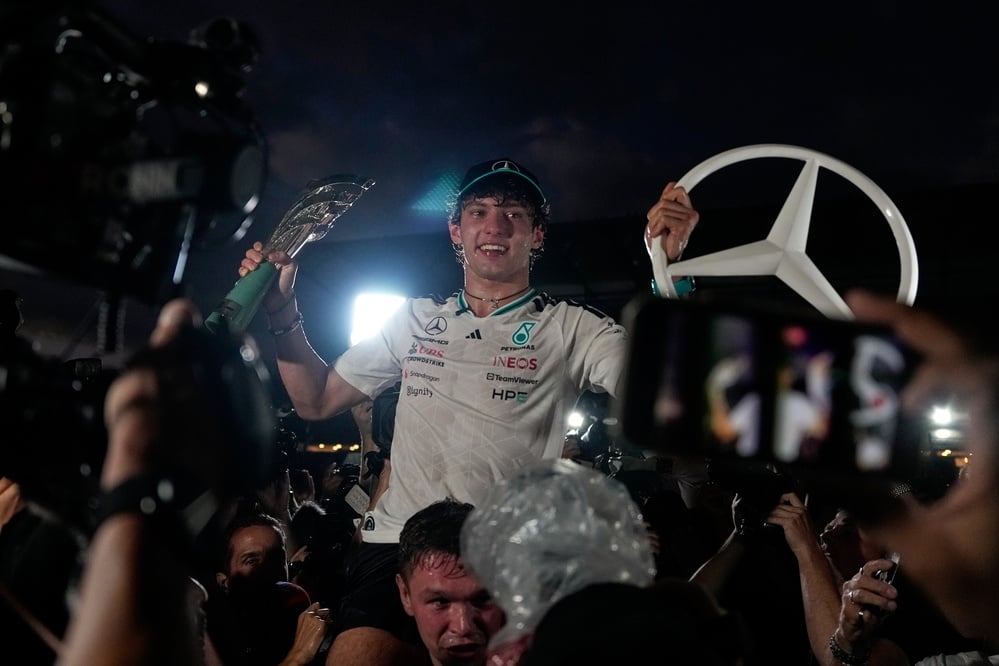
November 02, 2026 · 0 shares
Straightforward sports reporting with factual race results, direct quotes, and BBC attribution, showing no evident ideological or sensational framing.
Automated analysis; not human reviewed.
Limitations: Short sports report culled from BBC; unrelated site links and no explicit byline limit author attribution.
·
55 of 55 available dimensions scored; omitted dimensions are not treated as neutral.
·
Verified supporting quotes for 9 of 55 scored dimensions.
Claim: The report is predominantly factual and attributed rather than subjective commentary.
“Kimi Antonelli clinched his first world title and became the youngest champion in Formula 1 history by finishing third at the Mexico City Grand Prix.” · exact text match
Why: The central claim is presented as a specific race result with placement and event details.
Claim: Language is measured and avoids sensationalism.
“Antonelli – 20 years and 68 days old – finished the race in third, behind Red Bull’s Max Verstappen and Ferrari’s Lewis Hamilton.” · exact text match
Why: The report states results and ages plainly rather than using hyperbolic language.
Claim: The article has moderate interest due to a historic championship and Ferrari tension.
“Antonelli clinched his first world title and became the youngest champion in Formula 1 history” · exact text match
Why: The youngest-champion milestone is a notable sports story.
Claim: The article describes race events without prescribing actions or policies.
“Antonelli also becomes the first Italian to win the F1 title since Alberto Ascari in 1953.” · exact text match
Why: The content is descriptive sports reporting rather than advocacy.
Claim: Visible attribution to BBC and direct quotes support credibility.
“Culled from BBC” · exact text match
“Antonelli had tears mixed with laughter over the radio on the slowing down lap as he proved initially incapable of talking when his team told him he was world champion.” · exact text match
Why: The report names a source and includes specific quoted material.
Claim: The account follows a factual, cause-and-effect race narrative without evident logical fallacies.
“Antonelli drove a composed race amid some hectic action involving the other front-runners in a grand prix interrupted by a red flag that led to a 25-lap sprint to the finish.” · exact text match
Why: The passage reports race events and consequences in a coherent, factual sequence.
Claim: The report attributes sourcing and includes direct quotes.
“Culled from BBC” · exact text match
“After he half-composed himself, he said: “Thank you so much.
We did it. We did it.””
· exact text match
Why: Attribution and direct quotation indicate fair reporting practice.
Claim: The report conveys specific race context, records, and quotes with reasonable clarity.
“That was a secondary story on the day Antonelli made history, smashing Sebastian Vettel’s previous record for being the youngest champion by three years and 66 days.” · exact text match
Why: It supplies concrete historical comparison and context.
Claim: The report is truth-seeking and factual rather than delusional.
“Kimi Antonelli clinched his first world title and became the youngest champion in Formula 1 history by finishing third at the Mexico City Grand Prix.” · exact text match
Why: It presents verifiable race results and records rather than fantastical claims.
Short sports report culled from BBC; unrelated site links and no explicit byline limit author attribution.
November 01, 2026 · 0 shares
Coverage is a detailed, largely factual sports recap with mild celebratory framing of Antonelli's record and dramatic framing of Ferrari's internal conflict.
Automated analysis; not human reviewed.
Limitations: The supplied text is a sports recap; most political and ideological bias dimensions are not applicable.
·
55 of 55 available dimensions scored; omitted dimensions are not treated as neutral.
·
Verified supporting quotes for 18 of 55 scored dimensions.
Claim: The report is predominantly factual and attributed, with opinion confined to quoted or paraphrased figures.
“The standard punishment is 10 seconds, but the stewards took into account as mitigation that Hamilton had also gone off so neither car was in a position to make the corner.” · exact text match
Why: It explains an official penalty decision with specific factual grounds rather than publisher opinion.
Claim: Sensational language is limited; the dominant mode is precise race-result reporting.
“Antonelli - 20 years and 68 days old - finished the race in third, behind Red Bull's Max Verstappen and Ferrari's Lewis Hamilton.” · exact text match
Counterevidence:
“That was a secondary story on the day Antonelli made history, smashing Sebastian Vettel's previous record for being the youngest champion by three years and 66 days.” · exact text match
Why: The lead result is stated with exact age and finishing order, while the word 'smashing' adds only mild dramatic color tied to a factual record margin.
Claim: The report combines a historic title record, a contested first-lap incident, and late-race strategy to create notable sports interest.
“Antonelli became the youngest world champion in Formula 1 history as Max Verstappen wins the Mexico City Grand Prix.” · not found in supplied text
Why: The record-breaking championship and race drama are inherently newsworthy sports developments.
Claim: The report describes race events and steward decisions rather than prescribing what teams or officials should do.
“Verstappen and Hamilton both got on the radio to say Leclerc had to give the position back, but he stayed in the lead and was given a five-second penalty.” · exact text match
Why: It reports the drivers' demands and the stewards' action without the publisher endorsing a required outcome.
Claim: Interpersonal tension at Ferrari is reported as a secondary race storyline rather than as celebrity gossip.
“That was a secondary story on the day Antonelli made history, smashing Sebastian Vettel's previous record for being the youngest champion by three years and 66 days.” · exact text match
Why: The Ferrari conflict is explicitly subordinated to the championship result.
Claim: Publisher opinion is minimal; contested interpretations are attributed to drivers or framed as their arguments.
“Hamilton's argument will be that Leclerc cost him and the team a victory - had they worked together on the first lap, they could have ended it one-two and would probably have run that way to the end given the difficulty of overtaking.” · exact text match
Why: The most evaluative passage is marked as Hamilton's argument rather than stated as fact.
Claim: The report includes detailed race chronology, penalties, pit strategy, and title mathematics rather than reducing the event to a simple headline.
“The only way he could not do so was if George Russell or Hamilton won the race.
Even then, he needed only to finish ninth if it was his team-mate or 10th if it was Hamilton.”
· exact text match
Why: It supplies specific points scenarios that would be omitted in an oversimplified account.
Claim: Official stewards are cited for a specific decision, but the report does not rely on authority as a substitute for explanation.
“The standard punishment is 10 seconds, but the stewards took into account as mitigation that Hamilton had also gone off so neither car was in a position to make the corner.” · exact text match
Why: The authority's reasoning is explained with concrete race facts.
Claim: Confident reporting is supported by specific results, penalties, and stated race scenarios.
“They crossed the line nose to tail, less than two seconds covering all three cars.” · exact text match
Why: The claim is a precise, bounded race observation rather than an unsupported certainty.
Claim: Emotional framing is mild and centered on Antonelli's title reaction while the rest of the report remains procedural.
“Antonelli had tears mixed with laughter over the radio on the slowing down lap as he proved initially incapable of talking when his team told him he was world champion.” · exact text match
Why: It uses emotional imagery for the champion's reaction without making the entire report emotionally charged.
Claim: The report provides detailed, attributed race chronology, penalty explanations, and title scenarios.
“The only way he could not do so was if George Russell or Hamilton won the race.
Even then, he needed only to finish ninth if it was his team-mate or 10th if it was Hamilton.”
· exact text match
Why: Specific points scenarios and steward reasoning are stated with enough detail to be verifiable.
Claim: The report uses a structured, factual race chronology and explains steward reasoning rather than emotional or illogical argument.
“The standard punishment is 10 seconds, but the stewards took into account as mitigation that Hamilton had also gone off so neither car was in a position to make the corner.” · exact text match
Why: It presents a causal explanation for an official penalty in a coherent, evidence-based manner.
Claim: The report relies on observable race data, mechanical failure explanations, and official results rather than superstition.
“A lap later, Valtteri Bottas' Cadillac crashed on lap 45 when its front suspension failed under braking for Turn One, leading initially to a safety car and then the race being stopped when it became clear how long it was going to take to repair the barriers.” · exact text match
Why: It attributes the crash to a mechanical suspension failure and describes the procedural response.
Claim: Speculation is limited to a clearly attributed counterfactual about Hamilton's race.
“Hamilton's argument will be that Leclerc cost him and the team a victory - had they worked together on the first lap, they could have ended it one-two and would probably have run that way to the end given the difficulty of overtaking.” · exact text match
Why: The counterfactual is marked as Hamilton's argument rather than presented as the report's settled fact.
Claim: The report uses straightforward race narrative and attributed claims without strong manipulative techniques.
“Verstappen and Hamilton both got on the radio to say Leclerc had to give the position back, but he stayed in the lead and was given a five-second penalty.” · exact text match
Why: It reports radio demands and the penalty outcome without deceptive urgency or loaded omission.
Claim: The text reads as human-written sports reporting with specific paddock detail and varied narrative structure.
“Antonelli had tears mixed with laughter over the radio on the slowing down lap as he proved initially incapable of talking when his team told him he was world champion.” · exact text match
Why: The specific emotional and procedural detail is consistent with human reporting, though this is a probabilistic judgment.
Claim: The report attributes race events, penalties, and title scenarios with specific detail and avoids unsupported accusations.
“Hamilton's argument will be that Leclerc cost him and the team a victory - had they worked together on the first lap, they could have ended it one-two and would probably have run that way to the end given the difficulty of overtaking.” · exact text match
Why: It frames the disputed claim as Hamilton's argument rather than asserting it as the publisher's own conclusion.
Claim: The report integrates race strategy, penalties, and championship mathematics coherently.
“Antonelli ran a steady fourth in the first stint, behind Leclerc, Verstappen and Hamilton, moving into the lead as others made their pit stops in front of him, and then pitted for fresh tyres just a lap before the safety car which was why Mercedes had elongated his final stint.” · exact text match
Why: It explains pit strategy and its effect on the race outcome in a structured way.
Claim: The report stays anchored to race results, penalties, and attributed statements rather than speculative or delusional claims.
“Kimi Antonelli clinched his first world title and became the youngest champion in Formula 1 history by finishing third at the Mexico City Grand Prix.” · exact text match
Why: The central claim is a concrete sporting result with a stated finishing position.
The supplied text is a sports recap; most political and ideological bias dimensions are not applicable.
November 02, 2026 · 0 shares
A celebratory, quote-driven sports report that leans on emotive color ('sobbed with joy', 'agonising 33-minute halt') while keeping results and standings attributed and specific.
The report covers the Mexico City Grand Prix, the race in which the season's drivers' title was decided, and references the constructors' championship still to be settled.
Automated analysis; not human reviewed.
Limitations: The supplied text includes duplicated headline blocks, social-media embeds, and unrelated related-link headlines, so some framing signals come from page chrome rather than the report itself.
·
55 of 55 available dimensions scored; omitted dimensions are not treated as neutral.
·
Verified supporting quotes for 14 of 55 scored dimensions.
Claim: Mostly factual reporting with some subjective descriptive color.
“He was then mobbed by his pit crew.” · exact text match
Why: Vivid descriptive framing sits alongside factual results.
Claim: The report uses emotive, dramatized phrasing to describe routine race events.
“an agonising 33-minute halt with 25 of the 71 laps remaining” · exact text match
Why: 'Agonising' is a subjective intensifier applied to a neutral scheduling fact.
Claim: The tone is upbeat about the champion's prospects.
““It’s been an incredible season, and to share this podium with Max and Lewis is truly incredible.” · exact text match
Why: Selected quotes emphasize enjoyment and future optimism.
Claim: The text reports events and quotes rather than advocating actions.
““I’m speechless.
I’m trying to process what has just happened,” Antonelli said to the crowd.”
· exact text match
Why: Content is recounting and quotation, with no prescriptions for conduct.
Claim: Minor personal color about the driver's rapport is included.
“said his race engineer Peter Bonnington, a regular target for the young driver’s practical jokes” · exact text match
Why: Light personal anecdote adds human-interest flavor.
Claim: Evaluative language is limited and mostly confined to quoted or descriptive color.
“Mercedes’s Italian wonderkid wins drivers’ championship at 20 years and 68 days” · exact text match
Why: 'Wonderkid' is mildly evaluative but the body is largely factual.
Claim: Complex race events are condensed into brief summary lines.
“There was then another safety car when Lindblad and Piastri collided, with the field released to race again with nine laps to the chequered flag.” · not found in supplied text
Why: Incidents are summarized tersely without detail, though the account remains accurate in outline.
Claim: Authority references are limited to official stewards' decisions and direct quotes.
“The stewards handed Leclerc a five-second penalty, but that did little for Hamilton” · exact text match
Why: Official decisions are cited as facts rather than as persuasive appeals.
Claim: Certainty is largely confined to reported results and standings.
“Antonelli’s overall lead reached an unassailable 119 points after finishing third.” · not found in supplied text
Why: 'Unassailable' is a strong claim but is arithmetic given the points gap.
Claim: The framing is warmly celebratory toward the new champion.
“The first Italian champion since 1953 sobbed with joy over the team radio as he took the chequered flag” · exact text match
Why: Joy-laden description and 'wonderkid' framing set a positive emotional tone.
Claim: The report supplies specific, checkable figures and attributed quotes.
“Mercedes have 630 points in the constructors’ standings to Ferrari’s 504 and could clinch that title in Brazil next weekend.” · exact text match
Why: Concrete standings and attributed statements support visible sourcing, though no independent verification is offered.
Claim: The account proceeds by verifiable results, timings, and attributed statements.
“The stewards handed Leclerc a five-second penalty” · exact text match
Why: Reasoning rests on documented race facts and official decisions.
Claim: The text includes a forward-looking projection about the constructors' title.
“could clinch that title in Brazil next weekend” · exact text match
Why: A hedged forecast about a future race outcome.
Claim: Text shows scraped/aggregated artifacts and duplicated blocks consistent with automated assembly.
“Kimi Antonelli becomes Formula One's youngest world champion in Mexico City. ['Kimi Antonelli becomes Formula One’s youngest world champion in Mexico City'” · exact text match
Why: Repeated headline arrays and word-joiner characters suggest automated scraping, a weak indicator only.
Claim: Quotes and results are attributed to named people and specific figures.
““On the last lap, I just backed off, because I just couldn’t see the track.
I was getting emotional,” Antonelli told a later news conference.”
· exact text match
Why: Direct attribution to a named speaker and setting indicates fair reporting practice.
Claim: The report organizes results, standings, and chronology coherently.
“Verstappen led from the restart, challenged by Hamilton, with Antonelli passing Leclerc.” · exact text match
Why: Clear sequential race narrative with supporting standings.
The supplied text includes duplicated headline blocks, social-media embeds, and unrelated related-link headlines, so some framing signals come from page chrome rather than the report itself.
November 02, 2026 · 0 shares
Celebratory national-pride framing and reliance on official and fan quotes shape the report with limited critical scrutiny.
Automated analysis; not human reviewed.
Limitations: The text is short and celebratory, so evidence for deeper political or ideological framing is limited.
·
9 of 55 available dimensions scored; omitted dimensions are not treated as neutral.
·
Verified supporting quotes for 8 of 9 scored dimensions.
Claim: The report mostly relays events and attributed quotes rather than blending them into subjective commentary.
“Italians on Monday (Nov 2) celebrated the success of Kimi Antonelli, who became Formula 1's youngest world champion at the age of 20 when he clinched the title in Mexico City.” · exact text match
Why: The central statement is event-based and separately attributes reactions.
Claim: The headline and copy are celebratory but restrained, not sensationalized.
“Italy hails youthful Formula 1 champion Kimi Antonelli.” · exact text match
Why: 'Hails' is positive, but the phrasing remains a straightforward news headline rather than shock or hype.
Claim: The framing is upbeat and forward-looking about talent and success.
“Talent and hard work always pay off.” · exact text match
Why: The chosen fan quote reinforces an optimistic uplift narrative.
Claim: The report is primarily descriptive, recounting celebrations and statements without prescribing policy or behavior.
“Several hundred fans watched a screening of the grand prix late on Sunday at the Checco Costa Museum at the Imola F1 race track.” · exact text match
Why: This is event description, not advocacy.
Claim: A political figure is quoted, but the story is not framed as a political or ideological issue.
“Prime Minister Giorgia Meloni took to social media to praise what she called an "extraordinary achievement".” · exact text match
Why: The mention is ceremonial praise within a sports story.
Claim: The article adopts a positive, celebratory emotional tone.
“It's a source of great pride for our country,” · not found in supplied text
Why: The selected quote and surrounding celebration frame the event positively.
Claim: Visible attribution, photo credit, and direct quotes support credibility.
“Mercedes' Kimi Antonelli celebrates with this team after clinching the 2026 Formula One World Championship.
(Photo: Reuters/Eloisa Sanchez)”
· exact text match
Why: The included photo credit and named sources are credibility signals.
Claim: The account is orderly and factual, without irrational or conspiratorial claims.
“He was taken on by Mercedes as an 11-year-old karter when his potential as a Formula 1 driver was apparent.” · exact text match
Why: Background is presented as factual chronology rather than speculative interpretation.
Claim: The report names outlets and sources and uses direct quotations without evident distortion.
“La Stampa newspaper struck a similar tone, with its headline "Kimi nella leggenda" ("Kimi makes history.")” · exact text match
Why: Attribution to a named newspaper and direct headline supports fair reporting practice.
The text is short and celebratory, so evidence for deeper political or ideological framing is limited.
November 02, 2026 · 0 shares
Celebratory sports framing is anchored in specific results, records, and attributed quotes, with only mild sensational wording.
Formula One's world championship is decided by season-long points, allowing a driver to clinch the title before the final race.
Automated analysis; not human reviewed.
Limitations: The supplied text includes unrelated related-headline fragments after the sports report; these were excluded from framing analysis.
·
55 of 55 available dimensions scored; omitted dimensions are not treated as neutral.
·
Verified supporting quotes for 15 of 55 scored dimensions.
Claim: The report is primarily factual, using concrete results, standings, and attributed quotes rather than personal interpretation.
“Kimi Antonelli became Formula One's youngest world champion at 20 years and 68 days old on Sunday when he finished third in the Mexico City Grand Prix behind race winner Max Verstappen and Lewis Hamilton.” · exact text match
Why: The central claim is stated through specific race results and attributed facts.
Claim: There is mild sensational wording in the race description, but it does not dominate the report.
“Sunday's thrilling and crash-hit Mexico City Grand Prix” · exact text match
Why: The phrase adds dramatic color while the rest of the report remains factual.
Claim: The report has a positive, celebratory outlook tied to Antonelli's title.
“I let it all out after achieving one of my biggest dreams.” · exact text match
Why: The quoted reaction emphasizes achievement and positive emotion.
Claim: The record-breaking championship and first-Italian-since-1953 angle make the report notably interesting.
“Kimi Antonelli became Formula One's youngest world champion at 20 years and 68 days old” · exact text match
Why: The youngest-champion milestone is a strong sports-news hook.
Claim: The report is overwhelmingly descriptive, recounting results and records without prescribing action.
“Antonelli is also the first Italian champion since 1953.” · exact text match
Why: The sentence states a record descriptively with no recommendation.
Claim: There is limited human-interest detail, not sustained gossip.
“His parents and sister were there to embrace him when he stepped out of the car.” · exact text match
Why: The family detail is personal but brief and tied to the title moment.
Claim: Publisher opinion is limited to mild descriptive color.
“thrilling and crash-hit” · exact text match
Why: The wording is evaluative but confined to a brief race description.
Claim: Confident wording is generally matched by specific results and records.
“Antonelli is also the first Italian champion since 1953.” · exact text match
Why: The claim is stated firmly with a specific historical marker.
Claim: Celebratory human-interest details and quotes give the report a mildly positive emotional tone.
“His parents and sister were there to embrace him when he stepped out of the car.” · exact text match
Why: The family embrace detail adds a warm celebratory tone.
Claim: Specific records, points, and attributed quotes provide visible factual support.
“The previous recordholder was Germany's Sebastian Vettel, who first became a world champion at age 23 in 2010.” · exact text match
Why: The article includes checkable historical and statistical claims.
Claim: The report proceeds through verifiable race facts, standings, and attributed quotes.
“Antonelli has now risen to 380 points with four races remaining.” · exact text match
Why: Concrete points and results structure the account rather than emotional assertion.
Claim: The report relies on documented sports results rather than superstition.
“Antonelli has now risen to 380 points with four races remaining.” · exact text match
Why: The account is grounded in measurable standings.
Claim: Speculation is limited to a brief note about uncertainty over future races.
“But it remains uncertain whether they will take place, given the geopolitical instability in the region.” · exact text match
Why: The report flags uncertainty rather than forecasting outcomes at length.
Claim: The prose has few strong AI-authorship indicators beyond plain sports reporting structure.
“Antonelli has now risen to 380 points with four races remaining.” · exact text match
Why: The style is generic but not enough to support a strong AI classification.
Claim: The report attributes reactions and avoids presenting quoted emotion as publisher opinion.
“"I'm speechless.
I’m trying to process what has just happened," said Antonelli after finishing the race.”
· not found in supplied text
Why: Direct attribution separates quoted emotion from the publisher's own voice.
Claim: The report is grounded in reported race outcomes and standings.
“Verstappen, meanwhile, claimed his sixth victory at the Mexico City Grand Prix” · exact text match
Why: Specific race outcomes anchor the account.
The supplied text includes unrelated related-headline fragments after the sports report; these were excluded from framing analysis.
November 02, 2026 · 0 shares
Straightforward sports reporting with factual race results, direct quotes, and BBC attribution, showing no evident ideological or sensational framing.
Automated analysis; not human reviewed.
Limitations: Short sports report culled from BBC; unrelated site links and no explicit byline limit author attribution.
·
55 of 55 available dimensions scored; omitted dimensions are not treated as neutral.
·
Verified supporting quotes for 9 of 55 scored dimensions.
Claim: The report is predominantly factual and attributed rather than subjective commentary.
“Kimi Antonelli clinched his first world title and became the youngest champion in Formula 1 history by finishing third at the Mexico City Grand Prix.” · exact text match
Why: The central claim is presented as a specific race result with placement and event details.
Claim: Language is measured and avoids sensationalism.
“Antonelli – 20 years and 68 days old – finished the race in third, behind Red Bull’s Max Verstappen and Ferrari’s Lewis Hamilton.” · exact text match
Why: The report states results and ages plainly rather than using hyperbolic language.
Claim: The article has moderate interest due to a historic championship and Ferrari tension.
“Antonelli clinched his first world title and became the youngest champion in Formula 1 history” · exact text match
Why: The youngest-champion milestone is a notable sports story.
Claim: The article describes race events without prescribing actions or policies.
“Antonelli also becomes the first Italian to win the F1 title since Alberto Ascari in 1953.” · exact text match
Why: The content is descriptive sports reporting rather than advocacy.
Claim: Visible attribution to BBC and direct quotes support credibility.
“Culled from BBC” · exact text match
“Antonelli had tears mixed with laughter over the radio on the slowing down lap as he proved initially incapable of talking when his team told him he was world champion.” · exact text match
Why: The report names a source and includes specific quoted material.
Claim: The account follows a factual, cause-and-effect race narrative without evident logical fallacies.
“Antonelli drove a composed race amid some hectic action involving the other front-runners in a grand prix interrupted by a red flag that led to a 25-lap sprint to the finish.” · exact text match
Why: The passage reports race events and consequences in a coherent, factual sequence.
Claim: The report attributes sourcing and includes direct quotes.
“Culled from BBC” · exact text match
“After he half-composed himself, he said: “Thank you so much.
We did it. We did it.””
· exact text match
Why: Attribution and direct quotation indicate fair reporting practice.
Claim: The report conveys specific race context, records, and quotes with reasonable clarity.
“That was a secondary story on the day Antonelli made history, smashing Sebastian Vettel’s previous record for being the youngest champion by three years and 66 days.” · exact text match
Why: It supplies concrete historical comparison and context.
Claim: The report is truth-seeking and factual rather than delusional.
“Kimi Antonelli clinched his first world title and became the youngest champion in Formula 1 history by finishing third at the Mexico City Grand Prix.” · exact text match
Why: It presents verifiable race results and records rather than fantastical claims.
Short sports report culled from BBC; unrelated site links and no explicit byline limit author attribution.
November 01, 2026 · 0 shares
Coverage is a detailed, largely factual sports recap with mild celebratory framing of Antonelli's record and dramatic framing of Ferrari's internal conflict.
Automated analysis; not human reviewed.
Limitations: The supplied text is a sports recap; most political and ideological bias dimensions are not applicable.
·
55 of 55 available dimensions scored; omitted dimensions are not treated as neutral.
·
Verified supporting quotes for 18 of 55 scored dimensions.
Claim: The report is predominantly factual and attributed, with opinion confined to quoted or paraphrased figures.
“The standard punishment is 10 seconds, but the stewards took into account as mitigation that Hamilton had also gone off so neither car was in a position to make the corner.” · exact text match
Why: It explains an official penalty decision with specific factual grounds rather than publisher opinion.
Claim: Sensational language is limited; the dominant mode is precise race-result reporting.
“Antonelli - 20 years and 68 days old - finished the race in third, behind Red Bull's Max Verstappen and Ferrari's Lewis Hamilton.” · exact text match
Counterevidence:
“That was a secondary story on the day Antonelli made history, smashing Sebastian Vettel's previous record for being the youngest champion by three years and 66 days.” · exact text match
Why: The lead result is stated with exact age and finishing order, while the word 'smashing' adds only mild dramatic color tied to a factual record margin.
Claim: The report combines a historic title record, a contested first-lap incident, and late-race strategy to create notable sports interest.
“Antonelli became the youngest world champion in Formula 1 history as Max Verstappen wins the Mexico City Grand Prix.” · not found in supplied text
Why: The record-breaking championship and race drama are inherently newsworthy sports developments.
Claim: The report describes race events and steward decisions rather than prescribing what teams or officials should do.
“Verstappen and Hamilton both got on the radio to say Leclerc had to give the position back, but he stayed in the lead and was given a five-second penalty.” · exact text match
Why: It reports the drivers' demands and the stewards' action without the publisher endorsing a required outcome.
Claim: Interpersonal tension at Ferrari is reported as a secondary race storyline rather than as celebrity gossip.
“That was a secondary story on the day Antonelli made history, smashing Sebastian Vettel's previous record for being the youngest champion by three years and 66 days.” · exact text match
Why: The Ferrari conflict is explicitly subordinated to the championship result.
Claim: Publisher opinion is minimal; contested interpretations are attributed to drivers or framed as their arguments.
“Hamilton's argument will be that Leclerc cost him and the team a victory - had they worked together on the first lap, they could have ended it one-two and would probably have run that way to the end given the difficulty of overtaking.” · exact text match
Why: The most evaluative passage is marked as Hamilton's argument rather than stated as fact.
Claim: The report includes detailed race chronology, penalties, pit strategy, and title mathematics rather than reducing the event to a simple headline.
“The only way he could not do so was if George Russell or Hamilton won the race.
Even then, he needed only to finish ninth if it was his team-mate or 10th if it was Hamilton.”
· exact text match
Why: It supplies specific points scenarios that would be omitted in an oversimplified account.
Claim: Official stewards are cited for a specific decision, but the report does not rely on authority as a substitute for explanation.
“The standard punishment is 10 seconds, but the stewards took into account as mitigation that Hamilton had also gone off so neither car was in a position to make the corner.” · exact text match
Why: The authority's reasoning is explained with concrete race facts.
Claim: Confident reporting is supported by specific results, penalties, and stated race scenarios.
“They crossed the line nose to tail, less than two seconds covering all three cars.” · exact text match
Why: The claim is a precise, bounded race observation rather than an unsupported certainty.
Claim: Emotional framing is mild and centered on Antonelli's title reaction while the rest of the report remains procedural.
“Antonelli had tears mixed with laughter over the radio on the slowing down lap as he proved initially incapable of talking when his team told him he was world champion.” · exact text match
Why: It uses emotional imagery for the champion's reaction without making the entire report emotionally charged.
Claim: The report provides detailed, attributed race chronology, penalty explanations, and title scenarios.
“The only way he could not do so was if George Russell or Hamilton won the race.
Even then, he needed only to finish ninth if it was his team-mate or 10th if it was Hamilton.”
· exact text match
Why: Specific points scenarios and steward reasoning are stated with enough detail to be verifiable.
Claim: The report uses a structured, factual race chronology and explains steward reasoning rather than emotional or illogical argument.
“The standard punishment is 10 seconds, but the stewards took into account as mitigation that Hamilton had also gone off so neither car was in a position to make the corner.” · exact text match
Why: It presents a causal explanation for an official penalty in a coherent, evidence-based manner.
Claim: The report relies on observable race data, mechanical failure explanations, and official results rather than superstition.
“A lap later, Valtteri Bottas' Cadillac crashed on lap 45 when its front suspension failed under braking for Turn One, leading initially to a safety car and then the race being stopped when it became clear how long it was going to take to repair the barriers.” · exact text match
Why: It attributes the crash to a mechanical suspension failure and describes the procedural response.
Claim: Speculation is limited to a clearly attributed counterfactual about Hamilton's race.
“Hamilton's argument will be that Leclerc cost him and the team a victory - had they worked together on the first lap, they could have ended it one-two and would probably have run that way to the end given the difficulty of overtaking.” · exact text match
Why: The counterfactual is marked as Hamilton's argument rather than presented as the report's settled fact.
Claim: The report uses straightforward race narrative and attributed claims without strong manipulative techniques.
“Verstappen and Hamilton both got on the radio to say Leclerc had to give the position back, but he stayed in the lead and was given a five-second penalty.” · exact text match
Why: It reports radio demands and the penalty outcome without deceptive urgency or loaded omission.
Claim: The text reads as human-written sports reporting with specific paddock detail and varied narrative structure.
“Antonelli had tears mixed with laughter over the radio on the slowing down lap as he proved initially incapable of talking when his team told him he was world champion.” · exact text match
Why: The specific emotional and procedural detail is consistent with human reporting, though this is a probabilistic judgment.
Claim: The report attributes race events, penalties, and title scenarios with specific detail and avoids unsupported accusations.
“Hamilton's argument will be that Leclerc cost him and the team a victory - had they worked together on the first lap, they could have ended it one-two and would probably have run that way to the end given the difficulty of overtaking.” · exact text match
Why: It frames the disputed claim as Hamilton's argument rather than asserting it as the publisher's own conclusion.
Claim: The report integrates race strategy, penalties, and championship mathematics coherently.
“Antonelli ran a steady fourth in the first stint, behind Leclerc, Verstappen and Hamilton, moving into the lead as others made their pit stops in front of him, and then pitted for fresh tyres just a lap before the safety car which was why Mercedes had elongated his final stint.” · exact text match
Why: It explains pit strategy and its effect on the race outcome in a structured way.
Claim: The report stays anchored to race results, penalties, and attributed statements rather than speculative or delusional claims.
“Kimi Antonelli clinched his first world title and became the youngest champion in Formula 1 history by finishing third at the Mexico City Grand Prix.” · exact text match
Why: The central claim is a concrete sporting result with a stated finishing position.
The supplied text is a sports recap; most political and ideological bias dimensions are not applicable.
November 02, 2026 · 0 shares
Straightforward sports reporting with factual race chronology and only minor evaluative framing of team strategy.
Automated analysis; not human reviewed.
Limitations: The supplied text includes duplicated and malformed bracket fragments, but the substantive race report is clear.
·
11 of 55 available dimensions scored; omitted dimensions are not treated as neutral.
·
Verified supporting quotes for 8 of 11 scored dimensions.
Claim: The report is predominantly factual and event-focused, with limited subjective evaluation.
“Max Verstappen was victorious in the Mexican Grand Prix on Sunday.” · exact text match
Counterevidence:
“A smart move by Red Bull gave Verstappen the upper hand over Leclerc.” · exact text match
Why: Most content reports results and chronology, though some strategic moves are characterized evaluatively.
Claim: Tone is measured and non-sensational, centered on race chronology.
“Verstappen kept his lead when the race restarted half an hour later.” · exact text match
Why: The language is plain and event-based rather than dramatic or sensational.
Claim: Mostly factual, with a few evaluative characterizations of team strategy.
“A smart move by Red Bull gave Verstappen the upper hand over Leclerc.” · exact text match
Why: The phrase 'smart move' is an evaluative judgment embedded in an otherwise factual report.
Claim: No political framing or political actors are present.
“Max Verstappen was victorious in the Mexican Grand Prix on Sunday.” · exact text match
Why: The article is a sports race report with no political content.
Claim: Emotional tone is neutral; no strong positive or negative affect is directed at subjects.
“Hamilton finished second, and Antonelli finished third.” · exact text match
Why: The report states outcomes without emotional coloring.
Claim: The report attributes quotes and provides specific race details, though sourcing is limited to the event narrative.
““Ha, I thought all the new penalties were 10 seconds now,” Verstappen said” · exact text match
Why: Direct quotes and concrete race details are present, but sourcing is not independently documented.
Claim: The account follows a coherent causal race narrative rather than emotional or illogical framing.
“Knowing that the Frenchman had to take a five-second penalty, Red Bull timed their pit stop to coincide with Leclerc’s” · exact text match
Why: The report explains strategy in causal, race-logic terms.
Claim: The report includes critical comments from multiple drivers and notes a Ferrari tactical error, showing balanced event coverage.
“which was criticized by Verstappen and Hamilton” · exact text match
Why: It records criticism and strategic mistakes without one-sided praise.
The supplied text includes duplicated and malformed bracket fragments, but the substantive race report is clear.
November 02, 2026 · 0 shares
Celebratory sports framing is anchored in specific results, records, and attributed quotes, with only mild sensational wording.
Formula One's world championship is decided by season-long points, allowing a driver to clinch the title before the final race.
Automated analysis; not human reviewed.
Limitations: The supplied text includes unrelated related-headline fragments after the sports report; these were excluded from framing analysis.
·
55 of 55 available dimensions scored; omitted dimensions are not treated as neutral.
·
Verified supporting quotes for 15 of 55 scored dimensions.
Claim: The report is primarily factual, using concrete results, standings, and attributed quotes rather than personal interpretation.
“Kimi Antonelli became Formula One's youngest world champion at 20 years and 68 days old on Sunday when he finished third in the Mexico City Grand Prix behind race winner Max Verstappen and Lewis Hamilton.” · exact text match
Why: The central claim is stated through specific race results and attributed facts.
Claim: There is mild sensational wording in the race description, but it does not dominate the report.
“Sunday's thrilling and crash-hit Mexico City Grand Prix” · exact text match
Why: The phrase adds dramatic color while the rest of the report remains factual.
Claim: The report has a positive, celebratory outlook tied to Antonelli's title.
“I let it all out after achieving one of my biggest dreams.” · exact text match
Why: The quoted reaction emphasizes achievement and positive emotion.
Claim: The record-breaking championship and first-Italian-since-1953 angle make the report notably interesting.
“Kimi Antonelli became Formula One's youngest world champion at 20 years and 68 days old” · exact text match
Why: The youngest-champion milestone is a strong sports-news hook.
Claim: The report is overwhelmingly descriptive, recounting results and records without prescribing action.
“Antonelli is also the first Italian champion since 1953.” · exact text match
Why: The sentence states a record descriptively with no recommendation.
Claim: There is limited human-interest detail, not sustained gossip.
“His parents and sister were there to embrace him when he stepped out of the car.” · exact text match
Why: The family detail is personal but brief and tied to the title moment.
Claim: Publisher opinion is limited to mild descriptive color.
“thrilling and crash-hit” · exact text match
Why: The wording is evaluative but confined to a brief race description.
Claim: Confident wording is generally matched by specific results and records.
“Antonelli is also the first Italian champion since 1953.” · exact text match
Why: The claim is stated firmly with a specific historical marker.
Claim: Celebratory human-interest details and quotes give the report a mildly positive emotional tone.
“His parents and sister were there to embrace him when he stepped out of the car.” · exact text match
Why: The family embrace detail adds a warm celebratory tone.
Claim: Specific records, points, and attributed quotes provide visible factual support.
“The previous recordholder was Germany's Sebastian Vettel, who first became a world champion at age 23 in 2010.” · exact text match
Why: The article includes checkable historical and statistical claims.
Claim: The report proceeds through verifiable race facts, standings, and attributed quotes.
“Antonelli has now risen to 380 points with four races remaining.” · exact text match
Why: Concrete points and results structure the account rather than emotional assertion.
Claim: The report relies on documented sports results rather than superstition.
“Antonelli has now risen to 380 points with four races remaining.” · exact text match
Why: The account is grounded in measurable standings.
Claim: Speculation is limited to a brief note about uncertainty over future races.
“But it remains uncertain whether they will take place, given the geopolitical instability in the region.” · exact text match
Why: The report flags uncertainty rather than forecasting outcomes at length.
Claim: The prose has few strong AI-authorship indicators beyond plain sports reporting structure.
“Antonelli has now risen to 380 points with four races remaining.” · exact text match
Why: The style is generic but not enough to support a strong AI classification.
Claim: The report attributes reactions and avoids presenting quoted emotion as publisher opinion.
“"I'm speechless.
I’m trying to process what has just happened," said Antonelli after finishing the race.”
· not found in supplied text
Why: Direct attribution separates quoted emotion from the publisher's own voice.
Claim: The report is grounded in reported race outcomes and standings.
“Verstappen, meanwhile, claimed his sixth victory at the Mexico City Grand Prix” · exact text match
Why: Specific race outcomes anchor the account.
The supplied text includes unrelated related-headline fragments after the sports report; these were excluded from framing analysis.
November 02, 2026 · 0 shares
A celebratory, quote-driven sports report that leans on emotive color ('sobbed with joy', 'agonising 33-minute halt') while keeping results and standings attributed and specific.
The report covers the Mexico City Grand Prix, the race in which the season's drivers' title was decided, and references the constructors' championship still to be settled.
Automated analysis; not human reviewed.
Limitations: The supplied text includes duplicated headline blocks, social-media embeds, and unrelated related-link headlines, so some framing signals come from page chrome rather than the report itself.
·
55 of 55 available dimensions scored; omitted dimensions are not treated as neutral.
·
Verified supporting quotes for 14 of 55 scored dimensions.
Claim: Mostly factual reporting with some subjective descriptive color.
“He was then mobbed by his pit crew.” · exact text match
Why: Vivid descriptive framing sits alongside factual results.
Claim: The report uses emotive, dramatized phrasing to describe routine race events.
“an agonising 33-minute halt with 25 of the 71 laps remaining” · exact text match
Why: 'Agonising' is a subjective intensifier applied to a neutral scheduling fact.
Claim: The tone is upbeat about the champion's prospects.
““It’s been an incredible season, and to share this podium with Max and Lewis is truly incredible.” · exact text match
Why: Selected quotes emphasize enjoyment and future optimism.
Claim: The text reports events and quotes rather than advocating actions.
““I’m speechless.
I’m trying to process what has just happened,” Antonelli said to the crowd.”
· exact text match
Why: Content is recounting and quotation, with no prescriptions for conduct.
Claim: Minor personal color about the driver's rapport is included.
“said his race engineer Peter Bonnington, a regular target for the young driver’s practical jokes” · exact text match
Why: Light personal anecdote adds human-interest flavor.
Claim: Evaluative language is limited and mostly confined to quoted or descriptive color.
“Mercedes’s Italian wonderkid wins drivers’ championship at 20 years and 68 days” · exact text match
Why: 'Wonderkid' is mildly evaluative but the body is largely factual.
Claim: Complex race events are condensed into brief summary lines.
“There was then another safety car when Lindblad and Piastri collided, with the field released to race again with nine laps to the chequered flag.” · not found in supplied text
Why: Incidents are summarized tersely without detail, though the account remains accurate in outline.
Claim: Authority references are limited to official stewards' decisions and direct quotes.
“The stewards handed Leclerc a five-second penalty, but that did little for Hamilton” · exact text match
Why: Official decisions are cited as facts rather than as persuasive appeals.
Claim: Certainty is largely confined to reported results and standings.
“Antonelli’s overall lead reached an unassailable 119 points after finishing third.” · not found in supplied text
Why: 'Unassailable' is a strong claim but is arithmetic given the points gap.
Claim: The framing is warmly celebratory toward the new champion.
“The first Italian champion since 1953 sobbed with joy over the team radio as he took the chequered flag” · exact text match
Why: Joy-laden description and 'wonderkid' framing set a positive emotional tone.
Claim: The report supplies specific, checkable figures and attributed quotes.
“Mercedes have 630 points in the constructors’ standings to Ferrari’s 504 and could clinch that title in Brazil next weekend.” · exact text match
Why: Concrete standings and attributed statements support visible sourcing, though no independent verification is offered.
Claim: The account proceeds by verifiable results, timings, and attributed statements.
“The stewards handed Leclerc a five-second penalty” · exact text match
Why: Reasoning rests on documented race facts and official decisions.
Claim: The text includes a forward-looking projection about the constructors' title.
“could clinch that title in Brazil next weekend” · exact text match
Why: A hedged forecast about a future race outcome.
Claim: Text shows scraped/aggregated artifacts and duplicated blocks consistent with automated assembly.
“Kimi Antonelli becomes Formula One's youngest world champion in Mexico City. ['Kimi Antonelli becomes Formula One’s youngest world champion in Mexico City'” · exact text match
Why: Repeated headline arrays and word-joiner characters suggest automated scraping, a weak indicator only.
Claim: Quotes and results are attributed to named people and specific figures.
““On the last lap, I just backed off, because I just couldn’t see the track.
I was getting emotional,” Antonelli told a later news conference.”
· exact text match
Why: Direct attribution to a named speaker and setting indicates fair reporting practice.
Claim: The report organizes results, standings, and chronology coherently.
“Verstappen led from the restart, challenged by Hamilton, with Antonelli passing Leclerc.” · exact text match
Why: Clear sequential race narrative with supporting standings.
The supplied text includes duplicated headline blocks, social-media embeds, and unrelated related-link headlines, so some framing signals come from page chrome rather than the report itself.
November 05, 2026 · 0 shares
The report is largely neutral, fact-based sports coverage with mild sympathetic framing of George Russell’s car-related struggles and occasional evaluative wording.
Formula One awards separate drivers’ and constructors’ championships, with the constructors’ title based on team points.
Automated analysis; not human reviewed.
Limitations: The supplied text includes a block of unrelated headline links after the main F1 report; these were treated as page chrome and excluded from analysis.
·
6 of 55 available dimensions scored; omitted dimensions are not treated as neutral.
·
Verified supporting quotes for 6 of 6 scored dimensions.
Claim: The report is predominantly factual and attribution-based, though some evaluative framing appears.
“Mercedes need to outscore Ferrari by three points or more to be champions.” · exact text match
Counterevidence:
“Blighted by ill-fortune and a series of car failures” · exact text match
Why: The championship arithmetic is concrete and verifiable, while the quoted phrase shows modest subjective framing.
Claim: The lead frames the title chase in measured, factual terms rather than sensational language.
“Kimi Antonelli aims to secure a constructors’ championship for Mercedes at the Sao Paulo Grand Prix, following his historic title win.” · exact text match
Why: The language is straightforward and lacks alarmist or highly emotive cues.
Claim: The report covers a competitive F1 title chase with several notable storylines.
“Sao Paulo: Five celebratory days on from claiming the Formula One world title, Kimi Antonelli will seek to lead Mercedes to the double this weekend by beating Ferrari to take the constructors’ championship at the Sao Paulo Grand Prix.” · exact text match
Why: The drivers’ title aftermath and constructors’ showdown provide inherently newsworthy interest.
Claim: Mild evaluative and loaded wording is present but limited.
“Blighted by ill-fortune and a series of car failures” · exact text match
“dumped Esteban Ocon” · exact text match
Why: The first phrase frames Russell sympathetically; the second uses a colloquial negative verb, showing low but nonzero opinion bias.
Claim: The report uses named sourcing and precise championship figures.
“Deputy technical director Simone Resta conceded, as did team chief Toto Wolff, that Mercedes had failed Russell.” · exact text match
“Mercedes need to outscore Ferrari by three points or more to be champions.” · exact text match
Why: Named officials and specific point margins provide visible sourcing and verifiable detail.
Claim: The report includes limited speculation about drivers’ mindset and race prospects.
“the late-arriving Leclerc may have other things on his mind.” · exact text match
“Last year’s winner and champion Lando Norris of McLaren should not be ruled out on a track where he has started from pole for the last two years.” · exact text match
Why: Both are low-level forecast or opinion statements rather than strongly speculative claims.
The supplied text includes a block of unrelated headline links after the main F1 report; these were treated as page chrome and excluded from analysis.
November 01, 2026 · 0 shares
Financial estimates are attributed to an unnamed person familiar with team finances with a disclosed non-response, while mild pro-commercial boosterism colors the revenue and sponsorship framing.
Automated analysis; not human reviewed.
Limitations: Headline and lede combine a confirmed race result with an anonymously sourced, unpublished revenue projection, so the record-revenue claim rests on a single unnamed source.
·
12 of 55 available dimensions scored; omitted dimensions are not treated as neutral.
·
Verified supporting quotes for 7 of 12 scored dimensions.
Claim: Financial claims are attributed to a named-status source and the company's non-response is disclosed rather than asserted as fact.
“according to someone familiar with F1 team finances.
A Mercedes F1 spokesperson declined to comment.”
· exact text match
Why: Explicit attribution plus disclosure of declined comment shows reported rather than asserted framing.
Claim: The piece presents figures and peer comparisons without sensational language or emotional escalation.
“The three-comma club is an exclusive one in team sports.” · exact text match
Why: Phrasing is analytical and comparative rather than alarmist or hyped.
Claim: The framing emphasizes commercial momentum and record results for the team.
“The commercial business has continued to boom in 2026, with new brands Microsoft, Nu, Vercel, RH (formerly Restoration Hardware) and Zuma partnering with Mercedes.” · exact text match
Why: Language of sustained commercial expansion skews the business framing positive.
Claim: Forward-looking statements describe record outcomes as on track rather than uncertain.
“It will post another profit record and is on track to exceed £200 million ($268 million).” · exact text match
Why: Projected record profit is framed affirmatively, tilting the outlook positive.
Claim: The article reports financial and sporting developments without recommending actions.
“Mercedes is also scoring off the track this year, with annual revenue expected to top” · exact text match
Why: Content is descriptive reporting of results and figures, with no prescriptions.
Claim: A mildly evaluative characterization of commercial performance appears alongside the figures.
“The commercial business has continued to boom in 2026” · exact text match
Why: 'Boom' is a mild evaluative descriptor, though largely supported by listed sponsor deals.
Claim: The article discloses sourcing limits and notes a post-publication correction.
“(This story and its headline have been updated with Sunday’s results.)” · exact text match
Why: Voluntary correction notice and attribution of estimates indicate transparent practice.
Headline and lede combine a confirmed race result with an anonymously sourced, unpublished revenue projection, so the record-revenue claim rests on a single unnamed source.
November 02, 2026 · 0 shares
Celebratory national-pride framing and reliance on official and fan quotes shape the report with limited critical scrutiny.
Automated analysis; not human reviewed.
Limitations: The text is short and celebratory, so evidence for deeper political or ideological framing is limited.
·
9 of 55 available dimensions scored; omitted dimensions are not treated as neutral.
·
Verified supporting quotes for 8 of 9 scored dimensions.
Claim: The report mostly relays events and attributed quotes rather than blending them into subjective commentary.
“Italians on Monday (Nov 2) celebrated the success of Kimi Antonelli, who became Formula 1's youngest world champion at the age of 20 when he clinched the title in Mexico City.” · exact text match
Why: The central statement is event-based and separately attributes reactions.
Claim: The headline and copy are celebratory but restrained, not sensationalized.
“Italy hails youthful Formula 1 champion Kimi Antonelli.” · exact text match
Why: 'Hails' is positive, but the phrasing remains a straightforward news headline rather than shock or hype.
Claim: The framing is upbeat and forward-looking about talent and success.
“Talent and hard work always pay off.” · exact text match
Why: The chosen fan quote reinforces an optimistic uplift narrative.
Claim: The report is primarily descriptive, recounting celebrations and statements without prescribing policy or behavior.
“Several hundred fans watched a screening of the grand prix late on Sunday at the Checco Costa Museum at the Imola F1 race track.” · exact text match
Why: This is event description, not advocacy.
Claim: A political figure is quoted, but the story is not framed as a political or ideological issue.
“Prime Minister Giorgia Meloni took to social media to praise what she called an "extraordinary achievement".” · exact text match
Why: The mention is ceremonial praise within a sports story.
Claim: The article adopts a positive, celebratory emotional tone.
“It's a source of great pride for our country,” · not found in supplied text
Why: The selected quote and surrounding celebration frame the event positively.
Claim: Visible attribution, photo credit, and direct quotes support credibility.
“Mercedes' Kimi Antonelli celebrates with this team after clinching the 2026 Formula One World Championship.
(Photo: Reuters/Eloisa Sanchez)”
· exact text match
Why: The included photo credit and named sources are credibility signals.
Claim: The account is orderly and factual, without irrational or conspiratorial claims.
“He was taken on by Mercedes as an 11-year-old karter when his potential as a Formula 1 driver was apparent.” · exact text match
Why: Background is presented as factual chronology rather than speculative interpretation.
Claim: The report names outlets and sources and uses direct quotations without evident distortion.
“La Stampa newspaper struck a similar tone, with its headline "Kimi nella leggenda" ("Kimi makes history.")” · exact text match
Why: Attribution to a named newspaper and direct headline supports fair reporting practice.
The text is short and celebratory, so evidence for deeper political or ideological framing is limited.
November 02, 2026 · 0 shares
A celebratory, quote-driven sports report that leans on emotive color ('sobbed with joy', 'agonising 33-minute halt') while keeping results and standings attributed and specific.
The report covers the Mexico City Grand Prix, the race in which the season's drivers' title was decided, and references the constructors' championship still to be settled.
Automated analysis; not human reviewed. Limitations: The supplied text includes duplicated headline blocks, social-media embeds, and unrelated related-link headlines, so some framing signals come from page chrome rather than the report itself. · 55 of 55 available dimensions scored; omitted dimensions are not treated as neutral. · Verified supporting quotes for 14 of 55 scored dimensions.
Claim: Mostly factual reporting with some subjective descriptive color.
“He was then mobbed by his pit crew.” · exact text match
Why: Vivid descriptive framing sits alongside factual results.
Claim: The report uses emotive, dramatized phrasing to describe routine race events.
“an agonising 33-minute halt with 25 of the 71 laps remaining” · exact text match
Why: 'Agonising' is a subjective intensifier applied to a neutral scheduling fact.
Claim: The tone is upbeat about the champion's prospects.
““It’s been an incredible season, and to share this podium with Max and Lewis is truly incredible.” · exact text match
Why: Selected quotes emphasize enjoyment and future optimism.
Claim: The text reports events and quotes rather than advocating actions.
““I’m speechless. I’m trying to process what has just happened,” Antonelli said to the crowd.” · exact text match
Why: Content is recounting and quotation, with no prescriptions for conduct.
Claim: Minor personal color about the driver's rapport is included.
“said his race engineer Peter Bonnington, a regular target for the young driver’s practical jokes” · exact text match
Why: Light personal anecdote adds human-interest flavor.
Claim: Evaluative language is limited and mostly confined to quoted or descriptive color.
“Mercedes’s Italian wonderkid wins drivers’ championship at 20 years and 68 days” · exact text match
Why: 'Wonderkid' is mildly evaluative but the body is largely factual.
Claim: Complex race events are condensed into brief summary lines.
“There was then another safety car when Lindblad and Piastri collided, with the field released to race again with nine laps to the chequered flag.” · not found in supplied text
Why: Incidents are summarized tersely without detail, though the account remains accurate in outline.
Claim: Authority references are limited to official stewards' decisions and direct quotes.
“The stewards handed Leclerc a five-second penalty, but that did little for Hamilton” · exact text match
Why: Official decisions are cited as facts rather than as persuasive appeals.
Claim: Certainty is largely confined to reported results and standings.
“Antonelli’s overall lead reached an unassailable 119 points after finishing third.” · not found in supplied text
Why: 'Unassailable' is a strong claim but is arithmetic given the points gap.
Claim: The framing is warmly celebratory toward the new champion.
“The first Italian champion since 1953 sobbed with joy over the team radio as he took the chequered flag” · exact text match
Why: Joy-laden description and 'wonderkid' framing set a positive emotional tone.
Claim: The report supplies specific, checkable figures and attributed quotes.
“Mercedes have 630 points in the constructors’ standings to Ferrari’s 504 and could clinch that title in Brazil next weekend.” · exact text match
Why: Concrete standings and attributed statements support visible sourcing, though no independent verification is offered.
Claim: The account proceeds by verifiable results, timings, and attributed statements.
“The stewards handed Leclerc a five-second penalty” · exact text match
Why: Reasoning rests on documented race facts and official decisions.
Claim: The text includes a forward-looking projection about the constructors' title.
“could clinch that title in Brazil next weekend” · exact text match
Why: A hedged forecast about a future race outcome.
Claim: Text shows scraped/aggregated artifacts and duplicated blocks consistent with automated assembly.
“Kimi Antonelli becomes Formula One's youngest world champion in Mexico City. ['Kimi Antonelli becomes Formula One’s youngest world champion in Mexico City'” · exact text match
Why: Repeated headline arrays and word-joiner characters suggest automated scraping, a weak indicator only.
Claim: Quotes and results are attributed to named people and specific figures.
““On the last lap, I just backed off, because I just couldn’t see the track. I was getting emotional,” Antonelli told a later news conference.” · exact text match
Why: Direct attribution to a named speaker and setting indicates fair reporting practice.
Claim: The report organizes results, standings, and chronology coherently.
“Verstappen led from the restart, challenged by Hamilton, with Antonelli passing Leclerc.” · exact text match
Why: Clear sequential race narrative with supporting standings.
The supplied text includes duplicated headline blocks, social-media embeds, and unrelated related-link headlines, so some framing signals come from page chrome rather than the report itself.
November 01, 2026 · 0 shares
Coverage is a detailed, largely factual sports recap with mild celebratory framing of Antonelli's record and dramatic framing of Ferrari's internal conflict.
Automated analysis; not human reviewed. Limitations: The supplied text is a sports recap; most political and ideological bias dimensions are not applicable. · 55 of 55 available dimensions scored; omitted dimensions are not treated as neutral. · Verified supporting quotes for 18 of 55 scored dimensions.
Claim: The report is predominantly factual and attributed, with opinion confined to quoted or paraphrased figures.
“The standard punishment is 10 seconds, but the stewards took into account as mitigation that Hamilton had also gone off so neither car was in a position to make the corner.” · exact text match
Why: It explains an official penalty decision with specific factual grounds rather than publisher opinion.
Claim: Sensational language is limited; the dominant mode is precise race-result reporting.
“Antonelli - 20 years and 68 days old - finished the race in third, behind Red Bull's Max Verstappen and Ferrari's Lewis Hamilton.” · exact text match
Counterevidence:
“That was a secondary story on the day Antonelli made history, smashing Sebastian Vettel's previous record for being the youngest champion by three years and 66 days.” · exact text match
Why: The lead result is stated with exact age and finishing order, while the word 'smashing' adds only mild dramatic color tied to a factual record margin.
Claim: The report combines a historic title record, a contested first-lap incident, and late-race strategy to create notable sports interest.
“Antonelli became the youngest world champion in Formula 1 history as Max Verstappen wins the Mexico City Grand Prix.” · not found in supplied text
Why: The record-breaking championship and race drama are inherently newsworthy sports developments.
Claim: The report describes race events and steward decisions rather than prescribing what teams or officials should do.
“Verstappen and Hamilton both got on the radio to say Leclerc had to give the position back, but he stayed in the lead and was given a five-second penalty.” · exact text match
Why: It reports the drivers' demands and the stewards' action without the publisher endorsing a required outcome.
Claim: Interpersonal tension at Ferrari is reported as a secondary race storyline rather than as celebrity gossip.
“That was a secondary story on the day Antonelli made history, smashing Sebastian Vettel's previous record for being the youngest champion by three years and 66 days.” · exact text match
Why: The Ferrari conflict is explicitly subordinated to the championship result.
Claim: Publisher opinion is minimal; contested interpretations are attributed to drivers or framed as their arguments.
“Hamilton's argument will be that Leclerc cost him and the team a victory - had they worked together on the first lap, they could have ended it one-two and would probably have run that way to the end given the difficulty of overtaking.” · exact text match
Why: The most evaluative passage is marked as Hamilton's argument rather than stated as fact.
Claim: The report includes detailed race chronology, penalties, pit strategy, and title mathematics rather than reducing the event to a simple headline.
“The only way he could not do so was if George Russell or Hamilton won the race. Even then, he needed only to finish ninth if it was his team-mate or 10th if it was Hamilton.” · exact text match
Why: It supplies specific points scenarios that would be omitted in an oversimplified account.
Claim: Official stewards are cited for a specific decision, but the report does not rely on authority as a substitute for explanation.
“The standard punishment is 10 seconds, but the stewards took into account as mitigation that Hamilton had also gone off so neither car was in a position to make the corner.” · exact text match
Why: The authority's reasoning is explained with concrete race facts.
Claim: Confident reporting is supported by specific results, penalties, and stated race scenarios.
“They crossed the line nose to tail, less than two seconds covering all three cars.” · exact text match
Why: The claim is a precise, bounded race observation rather than an unsupported certainty.
Claim: Emotional framing is mild and centered on Antonelli's title reaction while the rest of the report remains procedural.
“Antonelli had tears mixed with laughter over the radio on the slowing down lap as he proved initially incapable of talking when his team told him he was world champion.” · exact text match
Why: It uses emotional imagery for the champion's reaction without making the entire report emotionally charged.
Claim: The report provides detailed, attributed race chronology, penalty explanations, and title scenarios.
“The only way he could not do so was if George Russell or Hamilton won the race. Even then, he needed only to finish ninth if it was his team-mate or 10th if it was Hamilton.” · exact text match
Why: Specific points scenarios and steward reasoning are stated with enough detail to be verifiable.
Claim: The report uses a structured, factual race chronology and explains steward reasoning rather than emotional or illogical argument.
“The standard punishment is 10 seconds, but the stewards took into account as mitigation that Hamilton had also gone off so neither car was in a position to make the corner.” · exact text match
Why: It presents a causal explanation for an official penalty in a coherent, evidence-based manner.
Claim: The report relies on observable race data, mechanical failure explanations, and official results rather than superstition.
“A lap later, Valtteri Bottas' Cadillac crashed on lap 45 when its front suspension failed under braking for Turn One, leading initially to a safety car and then the race being stopped when it became clear how long it was going to take to repair the barriers.” · exact text match
Why: It attributes the crash to a mechanical suspension failure and describes the procedural response.
Claim: Speculation is limited to a clearly attributed counterfactual about Hamilton's race.
“Hamilton's argument will be that Leclerc cost him and the team a victory - had they worked together on the first lap, they could have ended it one-two and would probably have run that way to the end given the difficulty of overtaking.” · exact text match
Why: The counterfactual is marked as Hamilton's argument rather than presented as the report's settled fact.
Claim: The report uses straightforward race narrative and attributed claims without strong manipulative techniques.
“Verstappen and Hamilton both got on the radio to say Leclerc had to give the position back, but he stayed in the lead and was given a five-second penalty.” · exact text match
Why: It reports radio demands and the penalty outcome without deceptive urgency or loaded omission.
Claim: The text reads as human-written sports reporting with specific paddock detail and varied narrative structure.
“Antonelli had tears mixed with laughter over the radio on the slowing down lap as he proved initially incapable of talking when his team told him he was world champion.” · exact text match
Why: The specific emotional and procedural detail is consistent with human reporting, though this is a probabilistic judgment.
Claim: The report attributes race events, penalties, and title scenarios with specific detail and avoids unsupported accusations.
“Hamilton's argument will be that Leclerc cost him and the team a victory - had they worked together on the first lap, they could have ended it one-two and would probably have run that way to the end given the difficulty of overtaking.” · exact text match
Why: It frames the disputed claim as Hamilton's argument rather than asserting it as the publisher's own conclusion.
Claim: The report integrates race strategy, penalties, and championship mathematics coherently.
“Antonelli ran a steady fourth in the first stint, behind Leclerc, Verstappen and Hamilton, moving into the lead as others made their pit stops in front of him, and then pitted for fresh tyres just a lap before the safety car which was why Mercedes had elongated his final stint.” · exact text match
Why: It explains pit strategy and its effect on the race outcome in a structured way.
Claim: The report stays anchored to race results, penalties, and attributed statements rather than speculative or delusional claims.
“Kimi Antonelli clinched his first world title and became the youngest champion in Formula 1 history by finishing third at the Mexico City Grand Prix.” · exact text match
Why: The central claim is a concrete sporting result with a stated finishing position.
The supplied text is a sports recap; most political and ideological bias dimensions are not applicable.
November 02, 2026 · 0 shares
Celebratory sports framing is anchored in specific results, records, and attributed quotes, with only mild sensational wording.
Formula One's world championship is decided by season-long points, allowing a driver to clinch the title before the final race.
Automated analysis; not human reviewed. Limitations: The supplied text includes unrelated related-headline fragments after the sports report; these were excluded from framing analysis. · 55 of 55 available dimensions scored; omitted dimensions are not treated as neutral. · Verified supporting quotes for 15 of 55 scored dimensions.
Claim: The report is primarily factual, using concrete results, standings, and attributed quotes rather than personal interpretation.
“Kimi Antonelli became Formula One's youngest world champion at 20 years and 68 days old on Sunday when he finished third in the Mexico City Grand Prix behind race winner Max Verstappen and Lewis Hamilton.” · exact text match
Why: The central claim is stated through specific race results and attributed facts.
Claim: There is mild sensational wording in the race description, but it does not dominate the report.
“Sunday's thrilling and crash-hit Mexico City Grand Prix” · exact text match
Why: The phrase adds dramatic color while the rest of the report remains factual.
Claim: The report has a positive, celebratory outlook tied to Antonelli's title.
“I let it all out after achieving one of my biggest dreams.” · exact text match
Why: The quoted reaction emphasizes achievement and positive emotion.
Claim: The record-breaking championship and first-Italian-since-1953 angle make the report notably interesting.
“Kimi Antonelli became Formula One's youngest world champion at 20 years and 68 days old” · exact text match
Why: The youngest-champion milestone is a strong sports-news hook.
Claim: The report is overwhelmingly descriptive, recounting results and records without prescribing action.
“Antonelli is also the first Italian champion since 1953.” · exact text match
Why: The sentence states a record descriptively with no recommendation.
Claim: There is limited human-interest detail, not sustained gossip.
“His parents and sister were there to embrace him when he stepped out of the car.” · exact text match
Why: The family detail is personal but brief and tied to the title moment.
Claim: Publisher opinion is limited to mild descriptive color.
“thrilling and crash-hit” · exact text match
Why: The wording is evaluative but confined to a brief race description.
Claim: Confident wording is generally matched by specific results and records.
“Antonelli is also the first Italian champion since 1953.” · exact text match
Why: The claim is stated firmly with a specific historical marker.
Claim: Celebratory human-interest details and quotes give the report a mildly positive emotional tone.
“His parents and sister were there to embrace him when he stepped out of the car.” · exact text match
Why: The family embrace detail adds a warm celebratory tone.
Claim: Specific records, points, and attributed quotes provide visible factual support.
“The previous recordholder was Germany's Sebastian Vettel, who first became a world champion at age 23 in 2010.” · exact text match
Why: The article includes checkable historical and statistical claims.
Claim: The report proceeds through verifiable race facts, standings, and attributed quotes.
“Antonelli has now risen to 380 points with four races remaining.” · exact text match
Why: Concrete points and results structure the account rather than emotional assertion.
Claim: The report relies on documented sports results rather than superstition.
“Antonelli has now risen to 380 points with four races remaining.” · exact text match
Why: The account is grounded in measurable standings.
Claim: Speculation is limited to a brief note about uncertainty over future races.
“But it remains uncertain whether they will take place, given the geopolitical instability in the region.” · exact text match
Why: The report flags uncertainty rather than forecasting outcomes at length.
Claim: The prose has few strong AI-authorship indicators beyond plain sports reporting structure.
“Antonelli has now risen to 380 points with four races remaining.” · exact text match
Why: The style is generic but not enough to support a strong AI classification.
Claim: The report attributes reactions and avoids presenting quoted emotion as publisher opinion.
“"I'm speechless. I’m trying to process what has just happened," said Antonelli after finishing the race.” · not found in supplied text
Why: Direct attribution separates quoted emotion from the publisher's own voice.
Claim: The report is grounded in reported race outcomes and standings.
“Verstappen, meanwhile, claimed his sixth victory at the Mexico City Grand Prix” · exact text match
Why: Specific race outcomes anchor the account.
The supplied text includes unrelated related-headline fragments after the sports report; these were excluded from framing analysis.
November 02, 2026 · 0 shares
Straightforward sports reporting with factual race chronology and only minor evaluative framing of team strategy.
Automated analysis; not human reviewed. Limitations: The supplied text includes duplicated and malformed bracket fragments, but the substantive race report is clear. · 11 of 55 available dimensions scored; omitted dimensions are not treated as neutral. · Verified supporting quotes for 8 of 11 scored dimensions.
Claim: The report is predominantly factual and event-focused, with limited subjective evaluation.
“Max Verstappen was victorious in the Mexican Grand Prix on Sunday.” · exact text match
Counterevidence:
“A smart move by Red Bull gave Verstappen the upper hand over Leclerc.” · exact text match
Why: Most content reports results and chronology, though some strategic moves are characterized evaluatively.
Claim: Tone is measured and non-sensational, centered on race chronology.
“Verstappen kept his lead when the race restarted half an hour later.” · exact text match
Why: The language is plain and event-based rather than dramatic or sensational.
Claim: Mostly factual, with a few evaluative characterizations of team strategy.
“A smart move by Red Bull gave Verstappen the upper hand over Leclerc.” · exact text match
Why: The phrase 'smart move' is an evaluative judgment embedded in an otherwise factual report.
Claim: No political framing or political actors are present.
“Max Verstappen was victorious in the Mexican Grand Prix on Sunday.” · exact text match
Why: The article is a sports race report with no political content.
Claim: Emotional tone is neutral; no strong positive or negative affect is directed at subjects.
“Hamilton finished second, and Antonelli finished third.” · exact text match
Why: The report states outcomes without emotional coloring.
Claim: The report attributes quotes and provides specific race details, though sourcing is limited to the event narrative.
““Ha, I thought all the new penalties were 10 seconds now,” Verstappen said” · exact text match
Why: Direct quotes and concrete race details are present, but sourcing is not independently documented.
Claim: The account follows a coherent causal race narrative rather than emotional or illogical framing.
“Knowing that the Frenchman had to take a five-second penalty, Red Bull timed their pit stop to coincide with Leclerc’s” · exact text match
Why: The report explains strategy in causal, race-logic terms.
Claim: The report includes critical comments from multiple drivers and notes a Ferrari tactical error, showing balanced event coverage.
“which was criticized by Verstappen and Hamilton” · exact text match
Why: It records criticism and strategic mistakes without one-sided praise.
The supplied text includes duplicated and malformed bracket fragments, but the substantive race report is clear.
The report is largely factual race narration but uses celebratory and evaluative language around Antonelli's title and Leclerc's penalty.
The report assumes familiarity with Formula 1 race weekends, tyre compounds, safety cars, red flags, and post-race penalties.
Automated analysis; not human reviewed. Limitations: The supplied text includes apparent future/alternate 2026 season details and some garbled list fragments; bias scores are limited to the visible race-report framing. · 9 of 55 available dimensions scored; omitted dimensions are not treated as neutral. · Verified supporting quotes for 9 of 9 scored dimensions.
Claim: The race report mixes factual play-by-play with evaluative characterizations of drivers and penalties.
“underlined his mature title winning campaign with a controlled drive” · exact text match
“which was deemed rather soft by both Verstappen and his own team-mate” · exact text match
Why: Evaluative adjectives and a judgment about penalty severity make the framing partly subjective, though most content is factual.
Claim: Dramatic and celebratory language heightens the race narrative beyond neutral reporting.
“Kimi Antonelli has written history by becoming Formula 1's youngest-ever world champion” · exact text match
“A tearful Antonelli cruised across the finish in third to soak in his drivers' world championship” · exact text match
Why: Historic and emotional descriptors add a modest sensational tone to an otherwise factual race report.
Claim: The report uses dramatic race turns and a historic title to sustain reader interest.
“The race would receive another fresh twist when Arvid Lindblad crashed out of seventh after tangling with Piastri, bringing out another safety car.” · exact text match
Why: The article emphasizes twists, crashes, and a record-setting championship to maintain engagement.
Claim: The article is overwhelmingly descriptive race narration rather than advocacy or prescription.
“Verstappen seized control of the race during the only pitstop of the race on lap 28 of 71, leapfrogging early leader Charles Leclerc” · exact text match
Why: The passage narrates race events without recommending actions or policies.
Claim: Mostly factual, with limited evaluative opinion in descriptors and penalty commentary.
“which was deemed rather soft by both Verstappen and his own team-mate” · exact text match
Why: The penalty characterization is evaluative, but it is a small part of a largely factual report.
Claim: The publisher frames Antonelli's title with positive, celebratory emotion.
“A tearful Antonelli cruised across the finish in third to soak in his drivers' world championship” · exact text match
Why: The tearful celebration language gives the title narrative a positive emotional charge.
Claim: Specific lap numbers, penalties, quotes, and medical outcomes provide verifiable detail and attribution.
“The Monegasque only received a five-second penalty for leaving the track and gaining an advantage” · exact text match
“Bottas was taken to the medical centre for precautionary checks and was released without injuries.” · exact text match
Why: Concrete race details and attributed quotes support a credible reporting presentation within the supplied text.
Claim: The report attributes quotes and race incidents to named drivers and teams with specific details.
“"I got pushed off by my own team-mate," Hamilton rued” · exact text match
“Bottas was taken to the medical centre for precautionary checks and was released without injuries.” · exact text match
Why: Named attribution and specific incident details indicate generally fair reporting practices.
Claim: The report conveys detailed strategic and race-order information with technical context.
“the Dutchman the only frontrunner to start on medium tyres instead of softs” · exact text match
“Helped by Leclerc's additional five-second hold, Verstappen was able to jump the Ferrari in pitlane” · exact text match
Why: Specific tyre, pit-stop, and penalty details show above-average technical reporting.
The supplied text includes apparent future/alternate 2026 season details and some garbled list fragments; bias scores are limited to the visible race-report framing.
November 01, 2026 · 0 shares
Coverage is a detailed, largely factual sports recap with mild celebratory framing of Antonelli's record and dramatic framing of Ferrari's internal conflict.
Automated analysis; not human reviewed. Limitations: The supplied text is a sports recap; most political and ideological bias dimensions are not applicable. · 55 of 55 available dimensions scored; omitted dimensions are not treated as neutral. · Verified supporting quotes for 18 of 55 scored dimensions.
Claim: The report is predominantly factual and attributed, with opinion confined to quoted or paraphrased figures.
“The standard punishment is 10 seconds, but the stewards took into account as mitigation that Hamilton had also gone off so neither car was in a position to make the corner.” · exact text match
Why: It explains an official penalty decision with specific factual grounds rather than publisher opinion.
Claim: Sensational language is limited; the dominant mode is precise race-result reporting.
“Antonelli - 20 years and 68 days old - finished the race in third, behind Red Bull's Max Verstappen and Ferrari's Lewis Hamilton.” · exact text match
Counterevidence:
“That was a secondary story on the day Antonelli made history, smashing Sebastian Vettel's previous record for being the youngest champion by three years and 66 days.” · exact text match
Why: The lead result is stated with exact age and finishing order, while the word 'smashing' adds only mild dramatic color tied to a factual record margin.
Claim: The report combines a historic title record, a contested first-lap incident, and late-race strategy to create notable sports interest.
“Antonelli became the youngest world champion in Formula 1 history as Max Verstappen wins the Mexico City Grand Prix.” · not found in supplied text
Why: The record-breaking championship and race drama are inherently newsworthy sports developments.
Claim: The report describes race events and steward decisions rather than prescribing what teams or officials should do.
“Verstappen and Hamilton both got on the radio to say Leclerc had to give the position back, but he stayed in the lead and was given a five-second penalty.” · exact text match
Why: It reports the drivers' demands and the stewards' action without the publisher endorsing a required outcome.
Claim: Interpersonal tension at Ferrari is reported as a secondary race storyline rather than as celebrity gossip.
“That was a secondary story on the day Antonelli made history, smashing Sebastian Vettel's previous record for being the youngest champion by three years and 66 days.” · exact text match
Why: The Ferrari conflict is explicitly subordinated to the championship result.
Claim: Publisher opinion is minimal; contested interpretations are attributed to drivers or framed as their arguments.
“Hamilton's argument will be that Leclerc cost him and the team a victory - had they worked together on the first lap, they could have ended it one-two and would probably have run that way to the end given the difficulty of overtaking.” · exact text match
Why: The most evaluative passage is marked as Hamilton's argument rather than stated as fact.
Claim: The report includes detailed race chronology, penalties, pit strategy, and title mathematics rather than reducing the event to a simple headline.
“The only way he could not do so was if George Russell or Hamilton won the race. Even then, he needed only to finish ninth if it was his team-mate or 10th if it was Hamilton.” · exact text match
Why: It supplies specific points scenarios that would be omitted in an oversimplified account.
Claim: Official stewards are cited for a specific decision, but the report does not rely on authority as a substitute for explanation.
“The standard punishment is 10 seconds, but the stewards took into account as mitigation that Hamilton had also gone off so neither car was in a position to make the corner.” · exact text match
Why: The authority's reasoning is explained with concrete race facts.
Claim: Confident reporting is supported by specific results, penalties, and stated race scenarios.
“They crossed the line nose to tail, less than two seconds covering all three cars.” · exact text match
Why: The claim is a precise, bounded race observation rather than an unsupported certainty.
Claim: Emotional framing is mild and centered on Antonelli's title reaction while the rest of the report remains procedural.
“Antonelli had tears mixed with laughter over the radio on the slowing down lap as he proved initially incapable of talking when his team told him he was world champion.” · exact text match
Why: It uses emotional imagery for the champion's reaction without making the entire report emotionally charged.
Claim: The report provides detailed, attributed race chronology, penalty explanations, and title scenarios.
“The only way he could not do so was if George Russell or Hamilton won the race. Even then, he needed only to finish ninth if it was his team-mate or 10th if it was Hamilton.” · exact text match
Why: Specific points scenarios and steward reasoning are stated with enough detail to be verifiable.
Claim: The report uses a structured, factual race chronology and explains steward reasoning rather than emotional or illogical argument.
“The standard punishment is 10 seconds, but the stewards took into account as mitigation that Hamilton had also gone off so neither car was in a position to make the corner.” · exact text match
Why: It presents a causal explanation for an official penalty in a coherent, evidence-based manner.
Claim: The report relies on observable race data, mechanical failure explanations, and official results rather than superstition.
“A lap later, Valtteri Bottas' Cadillac crashed on lap 45 when its front suspension failed under braking for Turn One, leading initially to a safety car and then the race being stopped when it became clear how long it was going to take to repair the barriers.” · exact text match
Why: It attributes the crash to a mechanical suspension failure and describes the procedural response.
Claim: Speculation is limited to a clearly attributed counterfactual about Hamilton's race.
“Hamilton's argument will be that Leclerc cost him and the team a victory - had they worked together on the first lap, they could have ended it one-two and would probably have run that way to the end given the difficulty of overtaking.” · exact text match
Why: The counterfactual is marked as Hamilton's argument rather than presented as the report's settled fact.
Claim: The report uses straightforward race narrative and attributed claims without strong manipulative techniques.
“Verstappen and Hamilton both got on the radio to say Leclerc had to give the position back, but he stayed in the lead and was given a five-second penalty.” · exact text match
Why: It reports radio demands and the penalty outcome without deceptive urgency or loaded omission.
Claim: The text reads as human-written sports reporting with specific paddock detail and varied narrative structure.
“Antonelli had tears mixed with laughter over the radio on the slowing down lap as he proved initially incapable of talking when his team told him he was world champion.” · exact text match
Why: The specific emotional and procedural detail is consistent with human reporting, though this is a probabilistic judgment.
Claim: The report attributes race events, penalties, and title scenarios with specific detail and avoids unsupported accusations.
“Hamilton's argument will be that Leclerc cost him and the team a victory - had they worked together on the first lap, they could have ended it one-two and would probably have run that way to the end given the difficulty of overtaking.” · exact text match
Why: It frames the disputed claim as Hamilton's argument rather than asserting it as the publisher's own conclusion.
Claim: The report integrates race strategy, penalties, and championship mathematics coherently.
“Antonelli ran a steady fourth in the first stint, behind Leclerc, Verstappen and Hamilton, moving into the lead as others made their pit stops in front of him, and then pitted for fresh tyres just a lap before the safety car which was why Mercedes had elongated his final stint.” · exact text match
Why: It explains pit strategy and its effect on the race outcome in a structured way.
Claim: The report stays anchored to race results, penalties, and attributed statements rather than speculative or delusional claims.
“Kimi Antonelli clinched his first world title and became the youngest champion in Formula 1 history by finishing third at the Mexico City Grand Prix.” · exact text match
Why: The central claim is a concrete sporting result with a stated finishing position.
The supplied text is a sports recap; most political and ideological bias dimensions are not applicable.
November 05, 2026 · 0 shares
The report is largely neutral, fact-based sports coverage with mild sympathetic framing of George Russell’s car-related struggles and occasional evaluative wording.
Formula One awards separate drivers’ and constructors’ championships, with the constructors’ title based on team points.
Automated analysis; not human reviewed. Limitations: The supplied text includes a block of unrelated headline links after the main F1 report; these were treated as page chrome and excluded from analysis. · 6 of 55 available dimensions scored; omitted dimensions are not treated as neutral. · Verified supporting quotes for 6 of 6 scored dimensions.
Claim: The report is predominantly factual and attribution-based, though some evaluative framing appears.
“Mercedes need to outscore Ferrari by three points or more to be champions.” · exact text match
Counterevidence:
“Blighted by ill-fortune and a series of car failures” · exact text match
Why: The championship arithmetic is concrete and verifiable, while the quoted phrase shows modest subjective framing.
Claim: The lead frames the title chase in measured, factual terms rather than sensational language.
“Kimi Antonelli aims to secure a constructors’ championship for Mercedes at the Sao Paulo Grand Prix, following his historic title win.” · exact text match
Why: The language is straightforward and lacks alarmist or highly emotive cues.
Claim: The report covers a competitive F1 title chase with several notable storylines.
“Sao Paulo: Five celebratory days on from claiming the Formula One world title, Kimi Antonelli will seek to lead Mercedes to the double this weekend by beating Ferrari to take the constructors’ championship at the Sao Paulo Grand Prix.” · exact text match
Why: The drivers’ title aftermath and constructors’ showdown provide inherently newsworthy interest.
Claim: Mild evaluative and loaded wording is present but limited.
“Blighted by ill-fortune and a series of car failures” · exact text match
“dumped Esteban Ocon” · exact text match
Why: The first phrase frames Russell sympathetically; the second uses a colloquial negative verb, showing low but nonzero opinion bias.
Claim: The report uses named sourcing and precise championship figures.
“Deputy technical director Simone Resta conceded, as did team chief Toto Wolff, that Mercedes had failed Russell.” · exact text match
“Mercedes need to outscore Ferrari by three points or more to be champions.” · exact text match
Why: Named officials and specific point margins provide visible sourcing and verifiable detail.
Claim: The report includes limited speculation about drivers’ mindset and race prospects.
“the late-arriving Leclerc may have other things on his mind.” · exact text match
“Last year’s winner and champion Lando Norris of McLaren should not be ruled out on a track where he has started from pole for the last two years.” · exact text match
Why: Both are low-level forecast or opinion statements rather than strongly speculative claims.
The supplied text includes a block of unrelated headline links after the main F1 report; these were treated as page chrome and excluded from analysis.
November 02, 2026 · 0 shares
Frames a social-media reaction as a dramatic 'breaks silence' personal story, with sympathetic and mildly sensational emotional emphasis.
Automated analysis; not human reviewed. Limitations: The supplied text mixes the main Russell report with unrelated headlines and page chrome; bias scores are based only on the substantive Russell passage. · 7 of 55 available dimensions scored; omitted dimensions are not treated as neutral. · Verified supporting quotes for 6 of 7 scored dimensions.
Claim: The report frames the item around Russell’s personal feelings rather than purely race outcomes.
“heartfelt message” · exact text match
Why: The publisher’s own wording foregrounds emotion and personal reflection.
Claim: The headline uses dramatic 'breaks silence' phrasing for a social-media statement.
“George Russell breaks silence with heartfelt message after Kimi Antonelli's F1 title win.” · exact text match
Why: 'Breaks silence' adds dramatic emphasis beyond the underlying event.
Claim: The article includes evaluative language such as calling Russell a clear title favourite.
“Russell entered the 2026 season as a clear favourite to win the title.” · exact text match
Why: The phrase is an assessment presented without explicit sourcing in the supplied text.
Claim: Coverage leans sympathetic and personal, highlighting Russell’s disappointment and congratulations.
“heartfelt message” · exact text match
“Now feels like a pretty suitable moment to speak from the heart” · exact text match
Why: The publisher selects and highlights emotionally expressive framing and quotes.
Claim: Claims are attributed to Russell’s social-media message and direct quotes, with uncertainty flagged.
“The Briton admitted that "2026 was not meant to be my year" in a long message to his fans on social media” · exact text match
“appears to have prompted a message to his fans” · exact text match
Why: Direct attribution and hedged language are visible in the supplied report.
Claim: The article speculates about the cause of Russell’s social-media post.
“The 28-year-old's absence from the post-race media sessions appears to have prompted a message to his fans.” · not found in supplied text
Why: The hedged 'appears to have prompted' explicitly offers a causal inference.
Claim: The report is coherent and includes standings context around Russell’s situation.
“While his sixth-place finish in Mexico dropped him from second to fourth, there are still only 16 points between Max Verstappen in second and Charles Leclerc in fifth.” · exact text match
Why: The passage supplies relevant quantitative context in a clear structure.
The supplied text mixes the main Russell report with unrelated headlines and page chrome; bias scores are based only on the substantive Russell passage.
November 01, 2026 · 0 shares
Financial estimates are attributed to an unnamed person familiar with team finances with a disclosed non-response, while mild pro-commercial boosterism colors the revenue and sponsorship framing.
Automated analysis; not human reviewed. Limitations: Headline and lede combine a confirmed race result with an anonymously sourced, unpublished revenue projection, so the record-revenue claim rests on a single unnamed source. · 12 of 55 available dimensions scored; omitted dimensions are not treated as neutral. · Verified supporting quotes for 7 of 12 scored dimensions.
Claim: Financial claims are attributed to a named-status source and the company's non-response is disclosed rather than asserted as fact.
“according to someone familiar with F1 team finances. A Mercedes F1 spokesperson declined to comment.” · exact text match
Why: Explicit attribution plus disclosure of declined comment shows reported rather than asserted framing.
Claim: The piece presents figures and peer comparisons without sensational language or emotional escalation.
“The three-comma club is an exclusive one in team sports.” · exact text match
Why: Phrasing is analytical and comparative rather than alarmist or hyped.
Claim: The framing emphasizes commercial momentum and record results for the team.
“The commercial business has continued to boom in 2026, with new brands Microsoft, Nu, Vercel, RH (formerly Restoration Hardware) and Zuma partnering with Mercedes.” · exact text match
Why: Language of sustained commercial expansion skews the business framing positive.
Claim: Forward-looking statements describe record outcomes as on track rather than uncertain.
“It will post another profit record and is on track to exceed £200 million ($268 million).” · exact text match
Why: Projected record profit is framed affirmatively, tilting the outlook positive.
Claim: The article reports financial and sporting developments without recommending actions.
“Mercedes is also scoring off the track this year, with annual revenue expected to top” · exact text match
Why: Content is descriptive reporting of results and figures, with no prescriptions.
Claim: A mildly evaluative characterization of commercial performance appears alongside the figures.
“The commercial business has continued to boom in 2026” · exact text match
Why: 'Boom' is a mild evaluative descriptor, though largely supported by listed sponsor deals.
Claim: The article discloses sourcing limits and notes a post-publication correction.
“(This story and its headline have been updated with Sunday’s results.)” · exact text match
Why: Voluntary correction notice and attribution of estimates indicate transparent practice.
Headline and lede combine a confirmed race result with an anonymously sourced, unpublished revenue projection, so the record-revenue claim rests on a single unnamed source.
Mainstream Sports Media
November 02, 2026 · 0 shares
Celebratory framing presents Antonelli’s title as proof of destined all-time greatness, leaning heavily on champion testimonials and emotional narrative.
Automated analysis; not human reviewed. Limitations: The supplied text includes BBC page chrome, video placeholders, and related-link snippets; the analysis uses only the main Antonelli article body. · 55 of 55 available dimensions scored; omitted dimensions are not treated as neutral. · Verified supporting quotes for 11 of 55 scored dimensions.
Claim: The publisher frames the title through evaluative, symbolic judgments rather than neutral description.
“Antonelli seems destined to join them among the list of all-time greats of the sport, judging by the scale of his achievement this year.” · exact text match
“it speaks volumes for the level at which Antonelli has performed” · exact text match
Why: These are the publisher’s own evaluative conclusions about greatness and performance.
Claim: The headline uses heightened, dramatic language to frame the achievement.
“How Antonelli 'blew everyone away' to make F1 history.” · exact text match
Why: The quoted phrase and 'make F1 history' give the headline a dramatic, promotional edge.
Claim: The publisher adopts an optimistic forecast about Antonelli’s future career.
“I don't see anything else other than him getting better and better.” · not found in supplied text
Why: A selected quote is used to support a strongly optimistic trajectory for Antonelli.
Claim: The publisher emphasizes symbolic and dramatic hooks around the title.
“Twelve world titles on one podium - Max Verstappen and Lewis Hamilton hold Kimi Antonelli aloft” · exact text match
Why: The podium image is framed as a memorable sporting moment.
Claim: The text is primarily descriptive of the race outcome and surrounding reactions.
“Just after Kimi Antonelli clinched his first title to become the youngest world champion in Formula 1 history” · exact text match
Why: The main structure reports what happened and what figures said rather than prescribing action.
Claim: The article includes substantial evaluative commentary by the publisher.
“That has not made it the most exciting season to watch, but it speaks volumes for the level at which Antonelli has performed.” · exact text match
Why: The sentence combines the publisher’s judgment about the season with an assessment of Antonelli.
Claim: The article uses the stature of champion drivers as a key basis for establishing Antonelli’s greatness.
“Coming from the two most successful champions on the current grid, the men who are first and third in the all-time list of F1 race-winners, it meant something.” · exact text match
Why: The argument leans on the authority and achievements of Hamilton and Verstappen.
Claim: The framing conveys strong certainty about Antonelli’s exceptional talent.
“no-one is going to doubt his incredible talent” · exact text match
Why: A sweeping certainty claim is selected and supported by champion testimony, though the surrounding prose is partly hedged.
Claim: The publisher centers a strongly positive, emotional celebration of Antonelli.
“I was already crying basically and I couldn't see clearly ahead” · not found in supplied text
Why: The selected quote emphasizes emotional catharsis around the title win.
Claim: The report is broadly credible in its visible sourcing and contextual qualification.
“said 1996 world champion Damon Hill, commentating for BBC Radio 5 live” · exact text match
“Had the comparative performance between Russell and Antonelli carried on as it did last year, this championship may well have had a different complexion.” · exact text match
Why: It names sources, quotes them directly, and acknowledges alternative interpretations of the season.
Claim: The publisher forecasts Antonelli’s long-term greatness beyond the immediate title result.
“Antonelli seems destined to join them among the list of all-time greats of the sport” · exact text match
Why: This is a forward-looking assessment of career trajectory rather than a reported fact.
Claim: The report largely attributes opinions and uses named sources rather than presenting them as unowned fact.
“said 1996 world champion Damon Hill, commentating for BBC Radio 5 live” · exact text match
Why: Named attribution and direct quotation show observable fairness in sourcing.
Claim: The article includes contextual caveats about car performance and teammate comparison.
“Had the comparative performance between Russell and Antonelli carried on as it did last year, this championship may well have had a different complexion.” · exact text match
Why: This shows analytical context beyond simple celebration.
The supplied text includes BBC page chrome, video placeholders, and related-link snippets; the analysis uses only the main Antonelli article body.
November 02, 2026 · 0 shares
Framing is celebratory and vivid, casting the title as historic destiny through heroic epithets ('the curly-haired kid from Bologna etching his name alongside the sport’s immortals') while keeping the racing facts and driver quotes attributable.
Automated analysis; not human reviewed. Limitations: The supplied text contains duplicated paragraphs and interspersed sign-in boilerplate, but the substantive sports report is sufficiently intact for classification. · 9 of 55 available dimensions scored; omitted dimensions are not treated as neutral. · Verified supporting quotes for 9 of 9 scored dimensions.
Claim: The report narrates the title win with evaluative, scene-setting language rather than flat factual description.
“It was an overtake fitting of a world champion.” · exact text match
Why: Direct evaluative judgment inserted by the publisher signals subjective narration.
Claim: The prose is heightened and dramatic in describing the championship outcome.
“As the Day of the Dead celebrations raged across town, F1 gave birth to its latest champion” · exact text match
Why: Dramatic, atmospheric phrasing is sensational in register.
Claim: The framing is celebratory and upbeat about the champion's achievement.
“The Foro Sol stadium erupted as Antonelli drove through on the final lap, triggering a fiesta to welcome in the history-making champion.” · exact text match
Why: Triumphal, festive framing indicates positive emotional valence.
Claim: The piece uses vivid detail and narrative color to sustain reader interest.
“The 20-year-old arrived on Sunday hand in hand with younger sister Maggie and, with mum Veronica and dad Marco here, the Antonellis were ready to celebrate.” · exact text match
Why: Personal, scene-level detail adds narrative engagement beyond bare results.
Claim: The article recounts events and results rather than advocating actions or policies.
“Antonelli now led and extended his first stint until lap 44. He rejoined fourth.” · exact text match
Why: Sequential factual reporting without recommendation indicates descriptive mode.
Claim: The publisher inserts its own evaluative verdicts on the performance.
“Antonelli’s thumping win in Austin last weekend – a sizzling demonstration of his champion credentials – made Sunday’s blast around the Autodromo Hermanos Rodriguez far more routine.” · exact text match
Why: Adjectival judgments ('sizzling', 'thumping') are the outlet's opinion, not reported fact.
Claim: The account carries a strongly positive, celebratory emotional tone.
“the curly-haired kid from Bologna etching his name alongside the sport’s immortals” · exact text match
Why: Affectionate, heroic characterization conveys positive emotion.
Claim: The report is largely sourced through attributable driver quotes and race facts, supporting moderate credibility.
“Hamilton grumbled: “He should just give the positions back.”” · exact text match
Why: Direct quotation and specific race details are verifiable reporting practices, offset by dramatic framing.
Claim: The article attributes claims to drivers and observable replays rather than asserting them unsourced.
“Replays showed his front-left suspension failed down the straight.” · exact text match
Why: Explicit attribution to replay evidence is an observable fairness/accuracy signal, though much of the piece is narrative.
The supplied text contains duplicated paragraphs and interspersed sign-in boilerplate, but the substantive sports report is sufficiently intact for classification.
Helium Bias
Story Blindspots
November 05, 2026 · 0 shares
The report is largely neutral, fact-based sports coverage with mild sympathetic framing of George Russell’s car-related struggles and occasional evaluative wording.
Formula One awards separate drivers’ and constructors’ championships, with the constructors’ title based on team points.
Automated analysis; not human reviewed. Limitations: The supplied text includes a block of unrelated headline links after the main F1 report; these were treated as page chrome and excluded from analysis. · 6 of 55 available dimensions scored; omitted dimensions are not treated as neutral. · Verified supporting quotes for 6 of 6 scored dimensions.
Claim: The report is predominantly factual and attribution-based, though some evaluative framing appears.
“Mercedes need to outscore Ferrari by three points or more to be champions.” · exact text match
Counterevidence:
“Blighted by ill-fortune and a series of car failures” · exact text match
Why: The championship arithmetic is concrete and verifiable, while the quoted phrase shows modest subjective framing.
Claim: The lead frames the title chase in measured, factual terms rather than sensational language.
“Kimi Antonelli aims to secure a constructors’ championship for Mercedes at the Sao Paulo Grand Prix, following his historic title win.” · exact text match
Why: The language is straightforward and lacks alarmist or highly emotive cues.
Claim: The report covers a competitive F1 title chase with several notable storylines.
“Sao Paulo: Five celebratory days on from claiming the Formula One world title, Kimi Antonelli will seek to lead Mercedes to the double this weekend by beating Ferrari to take the constructors’ championship at the Sao Paulo Grand Prix.” · exact text match
Why: The drivers’ title aftermath and constructors’ showdown provide inherently newsworthy interest.
Claim: Mild evaluative and loaded wording is present but limited.
“Blighted by ill-fortune and a series of car failures” · exact text match
“dumped Esteban Ocon” · exact text match
Why: The first phrase frames Russell sympathetically; the second uses a colloquial negative verb, showing low but nonzero opinion bias.
Claim: The report uses named sourcing and precise championship figures.
“Deputy technical director Simone Resta conceded, as did team chief Toto Wolff, that Mercedes had failed Russell.” · exact text match
“Mercedes need to outscore Ferrari by three points or more to be champions.” · exact text match
Why: Named officials and specific point margins provide visible sourcing and verifiable detail.
Claim: The report includes limited speculation about drivers’ mindset and race prospects.
“the late-arriving Leclerc may have other things on his mind.” · exact text match
“Last year’s winner and champion Lando Norris of McLaren should not be ruled out on a track where he has started from pole for the last two years.” · exact text match
Why: Both are low-level forecast or opinion statements rather than strongly speculative claims.
The supplied text includes a block of unrelated headline links after the main F1 report; these were treated as page chrome and excluded from analysis.
November 01, 2026 · 0 shares
Financial estimates are attributed to an unnamed person familiar with team finances with a disclosed non-response, while mild pro-commercial boosterism colors the revenue and sponsorship framing.
Automated analysis; not human reviewed. Limitations: Headline and lede combine a confirmed race result with an anonymously sourced, unpublished revenue projection, so the record-revenue claim rests on a single unnamed source. · 12 of 55 available dimensions scored; omitted dimensions are not treated as neutral. · Verified supporting quotes for 7 of 12 scored dimensions.
Claim: Financial claims are attributed to a named-status source and the company's non-response is disclosed rather than asserted as fact.
“according to someone familiar with F1 team finances. A Mercedes F1 spokesperson declined to comment.” · exact text match
Why: Explicit attribution plus disclosure of declined comment shows reported rather than asserted framing.
Claim: The piece presents figures and peer comparisons without sensational language or emotional escalation.
“The three-comma club is an exclusive one in team sports.” · exact text match
Why: Phrasing is analytical and comparative rather than alarmist or hyped.
Claim: The framing emphasizes commercial momentum and record results for the team.
“The commercial business has continued to boom in 2026, with new brands Microsoft, Nu, Vercel, RH (formerly Restoration Hardware) and Zuma partnering with Mercedes.” · exact text match
Why: Language of sustained commercial expansion skews the business framing positive.
Claim: Forward-looking statements describe record outcomes as on track rather than uncertain.
“It will post another profit record and is on track to exceed £200 million ($268 million).” · exact text match
Why: Projected record profit is framed affirmatively, tilting the outlook positive.
Claim: The article reports financial and sporting developments without recommending actions.
“Mercedes is also scoring off the track this year, with annual revenue expected to top” · exact text match
Why: Content is descriptive reporting of results and figures, with no prescriptions.
Claim: A mildly evaluative characterization of commercial performance appears alongside the figures.
“The commercial business has continued to boom in 2026” · exact text match
Why: 'Boom' is a mild evaluative descriptor, though largely supported by listed sponsor deals.
Claim: The article discloses sourcing limits and notes a post-publication correction.
“(This story and its headline have been updated with Sunday’s results.)” · exact text match
Why: Voluntary correction notice and attribution of estimates indicate transparent practice.
Headline and lede combine a confirmed race result with an anonymously sourced, unpublished revenue projection, so the record-revenue claim rests on a single unnamed source.
November 02, 2026 · 0 shares
Celebratory sports framing is anchored in specific results, records, and attributed quotes, with only mild sensational wording.
Formula One's world championship is decided by season-long points, allowing a driver to clinch the title before the final race.
Automated analysis; not human reviewed. Limitations: The supplied text includes unrelated related-headline fragments after the sports report; these were excluded from framing analysis. · 55 of 55 available dimensions scored; omitted dimensions are not treated as neutral. · Verified supporting quotes for 15 of 55 scored dimensions.
Claim: The report is primarily factual, using concrete results, standings, and attributed quotes rather than personal interpretation.
“Kimi Antonelli became Formula One's youngest world champion at 20 years and 68 days old on Sunday when he finished third in the Mexico City Grand Prix behind race winner Max Verstappen and Lewis Hamilton.” · exact text match
Why: The central claim is stated through specific race results and attributed facts.
Claim: There is mild sensational wording in the race description, but it does not dominate the report.
“Sunday's thrilling and crash-hit Mexico City Grand Prix” · exact text match
Why: The phrase adds dramatic color while the rest of the report remains factual.
Claim: The report has a positive, celebratory outlook tied to Antonelli's title.
“I let it all out after achieving one of my biggest dreams.” · exact text match
Why: The quoted reaction emphasizes achievement and positive emotion.
Claim: The record-breaking championship and first-Italian-since-1953 angle make the report notably interesting.
“Kimi Antonelli became Formula One's youngest world champion at 20 years and 68 days old” · exact text match
Why: The youngest-champion milestone is a strong sports-news hook.
Claim: The report is overwhelmingly descriptive, recounting results and records without prescribing action.
“Antonelli is also the first Italian champion since 1953.” · exact text match
Why: The sentence states a record descriptively with no recommendation.
Claim: There is limited human-interest detail, not sustained gossip.
“His parents and sister were there to embrace him when he stepped out of the car.” · exact text match
Why: The family detail is personal but brief and tied to the title moment.
Claim: Publisher opinion is limited to mild descriptive color.
“thrilling and crash-hit” · exact text match
Why: The wording is evaluative but confined to a brief race description.
Claim: Confident wording is generally matched by specific results and records.
“Antonelli is also the first Italian champion since 1953.” · exact text match
Why: The claim is stated firmly with a specific historical marker.
Claim: Celebratory human-interest details and quotes give the report a mildly positive emotional tone.
“His parents and sister were there to embrace him when he stepped out of the car.” · exact text match
Why: The family embrace detail adds a warm celebratory tone.
Claim: Specific records, points, and attributed quotes provide visible factual support.
“The previous recordholder was Germany's Sebastian Vettel, who first became a world champion at age 23 in 2010.” · exact text match
Why: The article includes checkable historical and statistical claims.
Claim: The report proceeds through verifiable race facts, standings, and attributed quotes.
“Antonelli has now risen to 380 points with four races remaining.” · exact text match
Why: Concrete points and results structure the account rather than emotional assertion.
Claim: The report relies on documented sports results rather than superstition.
“Antonelli has now risen to 380 points with four races remaining.” · exact text match
Why: The account is grounded in measurable standings.
Claim: Speculation is limited to a brief note about uncertainty over future races.
“But it remains uncertain whether they will take place, given the geopolitical instability in the region.” · exact text match
Why: The report flags uncertainty rather than forecasting outcomes at length.
Claim: The prose has few strong AI-authorship indicators beyond plain sports reporting structure.
“Antonelli has now risen to 380 points with four races remaining.” · exact text match
Why: The style is generic but not enough to support a strong AI classification.
Claim: The report attributes reactions and avoids presenting quoted emotion as publisher opinion.
“"I'm speechless. I’m trying to process what has just happened," said Antonelli after finishing the race.” · not found in supplied text
Why: Direct attribution separates quoted emotion from the publisher's own voice.
Claim: The report is grounded in reported race outcomes and standings.
“Verstappen, meanwhile, claimed his sixth victory at the Mexico City Grand Prix” · exact text match
Why: Specific race outcomes anchor the account.
The supplied text includes unrelated related-headline fragments after the sports report; these were excluded from framing analysis.
November 02, 2026 · 0 shares
Framing is celebratory and vivid, casting the title as historic destiny through heroic epithets ('the curly-haired kid from Bologna etching his name alongside the sport’s immortals') while keeping the racing facts and driver quotes attributable.
Automated analysis; not human reviewed. Limitations: The supplied text contains duplicated paragraphs and interspersed sign-in boilerplate, but the substantive sports report is sufficiently intact for classification. · 9 of 55 available dimensions scored; omitted dimensions are not treated as neutral. · Verified supporting quotes for 9 of 9 scored dimensions.
Claim: The report narrates the title win with evaluative, scene-setting language rather than flat factual description.
“It was an overtake fitting of a world champion.” · exact text match
Why: Direct evaluative judgment inserted by the publisher signals subjective narration.
Claim: The prose is heightened and dramatic in describing the championship outcome.
“As the Day of the Dead celebrations raged across town, F1 gave birth to its latest champion” · exact text match
Why: Dramatic, atmospheric phrasing is sensational in register.
Claim: The framing is celebratory and upbeat about the champion's achievement.
“The Foro Sol stadium erupted as Antonelli drove through on the final lap, triggering a fiesta to welcome in the history-making champion.” · exact text match
Why: Triumphal, festive framing indicates positive emotional valence.
Claim: The piece uses vivid detail and narrative color to sustain reader interest.
“The 20-year-old arrived on Sunday hand in hand with younger sister Maggie and, with mum Veronica and dad Marco here, the Antonellis were ready to celebrate.” · exact text match
Why: Personal, scene-level detail adds narrative engagement beyond bare results.
Claim: The article recounts events and results rather than advocating actions or policies.
“Antonelli now led and extended his first stint until lap 44. He rejoined fourth.” · exact text match
Why: Sequential factual reporting without recommendation indicates descriptive mode.
Claim: The publisher inserts its own evaluative verdicts on the performance.
“Antonelli’s thumping win in Austin last weekend – a sizzling demonstration of his champion credentials – made Sunday’s blast around the Autodromo Hermanos Rodriguez far more routine.” · exact text match
Why: Adjectival judgments ('sizzling', 'thumping') are the outlet's opinion, not reported fact.
Claim: The account carries a strongly positive, celebratory emotional tone.
“the curly-haired kid from Bologna etching his name alongside the sport’s immortals” · exact text match
Why: Affectionate, heroic characterization conveys positive emotion.
Claim: The report is largely sourced through attributable driver quotes and race facts, supporting moderate credibility.
“Hamilton grumbled: “He should just give the positions back.”” · exact text match
Why: Direct quotation and specific race details are verifiable reporting practices, offset by dramatic framing.
Claim: The article attributes claims to drivers and observable replays rather than asserting them unsourced.
“Replays showed his front-left suspension failed down the straight.” · exact text match
Why: Explicit attribution to replay evidence is an observable fairness/accuracy signal, though much of the piece is narrative.
The supplied text contains duplicated paragraphs and interspersed sign-in boilerplate, but the substantive sports report is sufficiently intact for classification.
November 02, 2026 · 0 shares
Celebratory sports framing is anchored in specific results, records, and attributed quotes, with only mild sensational wording.
Formula One's world championship is decided by season-long points, allowing a driver to clinch the title before the final race.
Automated analysis; not human reviewed. Limitations: The supplied text includes unrelated related-headline fragments after the sports report; these were excluded from framing analysis. · 55 of 55 available dimensions scored; omitted dimensions are not treated as neutral. · Verified supporting quotes for 15 of 55 scored dimensions.
Claim: The report is primarily factual, using concrete results, standings, and attributed quotes rather than personal interpretation.
“Kimi Antonelli became Formula One's youngest world champion at 20 years and 68 days old on Sunday when he finished third in the Mexico City Grand Prix behind race winner Max Verstappen and Lewis Hamilton.” · exact text match
Why: The central claim is stated through specific race results and attributed facts.
Claim: There is mild sensational wording in the race description, but it does not dominate the report.
“Sunday's thrilling and crash-hit Mexico City Grand Prix” · exact text match
Why: The phrase adds dramatic color while the rest of the report remains factual.
Claim: The report has a positive, celebratory outlook tied to Antonelli's title.
“I let it all out after achieving one of my biggest dreams.” · exact text match
Why: The quoted reaction emphasizes achievement and positive emotion.
Claim: The record-breaking championship and first-Italian-since-1953 angle make the report notably interesting.
“Kimi Antonelli became Formula One's youngest world champion at 20 years and 68 days old” · exact text match
Why: The youngest-champion milestone is a strong sports-news hook.
Claim: The report is overwhelmingly descriptive, recounting results and records without prescribing action.
“Antonelli is also the first Italian champion since 1953.” · exact text match
Why: The sentence states a record descriptively with no recommendation.
Claim: There is limited human-interest detail, not sustained gossip.
“His parents and sister were there to embrace him when he stepped out of the car.” · exact text match
Why: The family detail is personal but brief and tied to the title moment.
Claim: Publisher opinion is limited to mild descriptive color.
“thrilling and crash-hit” · exact text match
Why: The wording is evaluative but confined to a brief race description.
Claim: Confident wording is generally matched by specific results and records.
“Antonelli is also the first Italian champion since 1953.” · exact text match
Why: The claim is stated firmly with a specific historical marker.
Claim: Celebratory human-interest details and quotes give the report a mildly positive emotional tone.
“His parents and sister were there to embrace him when he stepped out of the car.” · exact text match
Why: The family embrace detail adds a warm celebratory tone.
Claim: Specific records, points, and attributed quotes provide visible factual support.
“The previous recordholder was Germany's Sebastian Vettel, who first became a world champion at age 23 in 2010.” · exact text match
Why: The article includes checkable historical and statistical claims.
Claim: The report proceeds through verifiable race facts, standings, and attributed quotes.
“Antonelli has now risen to 380 points with four races remaining.” · exact text match
Why: Concrete points and results structure the account rather than emotional assertion.
Claim: The report relies on documented sports results rather than superstition.
“Antonelli has now risen to 380 points with four races remaining.” · exact text match
Why: The account is grounded in measurable standings.
Claim: Speculation is limited to a brief note about uncertainty over future races.
“But it remains uncertain whether they will take place, given the geopolitical instability in the region.” · exact text match
Why: The report flags uncertainty rather than forecasting outcomes at length.
Claim: The prose has few strong AI-authorship indicators beyond plain sports reporting structure.
“Antonelli has now risen to 380 points with four races remaining.” · exact text match
Why: The style is generic but not enough to support a strong AI classification.
Claim: The report attributes reactions and avoids presenting quoted emotion as publisher opinion.
“"I'm speechless. I’m trying to process what has just happened," said Antonelli after finishing the race.” · not found in supplied text
Why: Direct attribution separates quoted emotion from the publisher's own voice.
Claim: The report is grounded in reported race outcomes and standings.
“Verstappen, meanwhile, claimed his sixth victory at the Mexico City Grand Prix” · exact text match
Why: Specific race outcomes anchor the account.
The supplied text includes unrelated related-headline fragments after the sports report; these were excluded from framing analysis.
November 02, 2026 · 0 shares
Straightforward sports reporting with factual race results, direct quotes, and BBC attribution, showing no evident ideological or sensational framing.
Automated analysis; not human reviewed. Limitations: Short sports report culled from BBC; unrelated site links and no explicit byline limit author attribution. · 55 of 55 available dimensions scored; omitted dimensions are not treated as neutral. · Verified supporting quotes for 9 of 55 scored dimensions.
Claim: The report is predominantly factual and attributed rather than subjective commentary.
“Kimi Antonelli clinched his first world title and became the youngest champion in Formula 1 history by finishing third at the Mexico City Grand Prix.” · exact text match
Why: The central claim is presented as a specific race result with placement and event details.
Claim: Language is measured and avoids sensationalism.
“Antonelli – 20 years and 68 days old – finished the race in third, behind Red Bull’s Max Verstappen and Ferrari’s Lewis Hamilton.” · exact text match
Why: The report states results and ages plainly rather than using hyperbolic language.
Claim: The article has moderate interest due to a historic championship and Ferrari tension.
“Antonelli clinched his first world title and became the youngest champion in Formula 1 history” · exact text match
Why: The youngest-champion milestone is a notable sports story.
Claim: The article describes race events without prescribing actions or policies.
“Antonelli also becomes the first Italian to win the F1 title since Alberto Ascari in 1953.” · exact text match
Why: The content is descriptive sports reporting rather than advocacy.
Claim: Visible attribution to BBC and direct quotes support credibility.
“Culled from BBC” · exact text match
“Antonelli had tears mixed with laughter over the radio on the slowing down lap as he proved initially incapable of talking when his team told him he was world champion.” · exact text match
Why: The report names a source and includes specific quoted material.
Claim: The account follows a factual, cause-and-effect race narrative without evident logical fallacies.
“Antonelli drove a composed race amid some hectic action involving the other front-runners in a grand prix interrupted by a red flag that led to a 25-lap sprint to the finish.” · exact text match
Why: The passage reports race events and consequences in a coherent, factual sequence.
Claim: The report attributes sourcing and includes direct quotes.
“Culled from BBC” · exact text match
“After he half-composed himself, he said: “Thank you so much. We did it. We did it.”” · exact text match
Why: Attribution and direct quotation indicate fair reporting practice.
Claim: The report conveys specific race context, records, and quotes with reasonable clarity.
“That was a secondary story on the day Antonelli made history, smashing Sebastian Vettel’s previous record for being the youngest champion by three years and 66 days.” · exact text match
Why: It supplies concrete historical comparison and context.
Claim: The report is truth-seeking and factual rather than delusional.
“Kimi Antonelli clinched his first world title and became the youngest champion in Formula 1 history by finishing third at the Mexico City Grand Prix.” · exact text match
Why: It presents verifiable race results and records rather than fantastical claims.
Short sports report culled from BBC; unrelated site links and no explicit byline limit author attribution.
November 02, 2026 · 0 shares
A celebratory, quote-driven sports report that leans on emotive color ('sobbed with joy', 'agonising 33-minute halt') while keeping results and standings attributed and specific.
The report covers the Mexico City Grand Prix, the race in which the season's drivers' title was decided, and references the constructors' championship still to be settled.
Automated analysis; not human reviewed. Limitations: The supplied text includes duplicated headline blocks, social-media embeds, and unrelated related-link headlines, so some framing signals come from page chrome rather than the report itself. · 55 of 55 available dimensions scored; omitted dimensions are not treated as neutral. · Verified supporting quotes for 14 of 55 scored dimensions.
Claim: Mostly factual reporting with some subjective descriptive color.
“He was then mobbed by his pit crew.” · exact text match
Why: Vivid descriptive framing sits alongside factual results.
Claim: The report uses emotive, dramatized phrasing to describe routine race events.
“an agonising 33-minute halt with 25 of the 71 laps remaining” · exact text match
Why: 'Agonising' is a subjective intensifier applied to a neutral scheduling fact.
Claim: The tone is upbeat about the champion's prospects.
““It’s been an incredible season, and to share this podium with Max and Lewis is truly incredible.” · exact text match
Why: Selected quotes emphasize enjoyment and future optimism.
Claim: The text reports events and quotes rather than advocating actions.
““I’m speechless. I’m trying to process what has just happened,” Antonelli said to the crowd.” · exact text match
Why: Content is recounting and quotation, with no prescriptions for conduct.
Claim: Minor personal color about the driver's rapport is included.
“said his race engineer Peter Bonnington, a regular target for the young driver’s practical jokes” · exact text match
Why: Light personal anecdote adds human-interest flavor.
Claim: Evaluative language is limited and mostly confined to quoted or descriptive color.
“Mercedes’s Italian wonderkid wins drivers’ championship at 20 years and 68 days” · exact text match
Why: 'Wonderkid' is mildly evaluative but the body is largely factual.
Claim: Complex race events are condensed into brief summary lines.
“There was then another safety car when Lindblad and Piastri collided, with the field released to race again with nine laps to the chequered flag.” · not found in supplied text
Why: Incidents are summarized tersely without detail, though the account remains accurate in outline.
Claim: Authority references are limited to official stewards' decisions and direct quotes.
“The stewards handed Leclerc a five-second penalty, but that did little for Hamilton” · exact text match
Why: Official decisions are cited as facts rather than as persuasive appeals.
Claim: Certainty is largely confined to reported results and standings.
“Antonelli’s overall lead reached an unassailable 119 points after finishing third.” · not found in supplied text
Why: 'Unassailable' is a strong claim but is arithmetic given the points gap.
Claim: The framing is warmly celebratory toward the new champion.
“The first Italian champion since 1953 sobbed with joy over the team radio as he took the chequered flag” · exact text match
Why: Joy-laden description and 'wonderkid' framing set a positive emotional tone.
Claim: The report supplies specific, checkable figures and attributed quotes.
“Mercedes have 630 points in the constructors’ standings to Ferrari’s 504 and could clinch that title in Brazil next weekend.” · exact text match
Why: Concrete standings and attributed statements support visible sourcing, though no independent verification is offered.
Claim: The account proceeds by verifiable results, timings, and attributed statements.
“The stewards handed Leclerc a five-second penalty” · exact text match
Why: Reasoning rests on documented race facts and official decisions.
Claim: The text includes a forward-looking projection about the constructors' title.
“could clinch that title in Brazil next weekend” · exact text match
Why: A hedged forecast about a future race outcome.
Claim: Text shows scraped/aggregated artifacts and duplicated blocks consistent with automated assembly.
“Kimi Antonelli becomes Formula One's youngest world champion in Mexico City. ['Kimi Antonelli becomes Formula One’s youngest world champion in Mexico City'” · exact text match
Why: Repeated headline arrays and word-joiner characters suggest automated scraping, a weak indicator only.
Claim: Quotes and results are attributed to named people and specific figures.
““On the last lap, I just backed off, because I just couldn’t see the track. I was getting emotional,” Antonelli told a later news conference.” · exact text match
Why: Direct attribution to a named speaker and setting indicates fair reporting practice.
Claim: The report organizes results, standings, and chronology coherently.
“Verstappen led from the restart, challenged by Hamilton, with Antonelli passing Leclerc.” · exact text match
Why: Clear sequential race narrative with supporting standings.
The supplied text includes duplicated headline blocks, social-media embeds, and unrelated related-link headlines, so some framing signals come from page chrome rather than the report itself.
November 05, 2026 · 0 shares
The report is largely neutral, fact-based sports coverage with mild sympathetic framing of George Russell’s car-related struggles and occasional evaluative wording.
Formula One awards separate drivers’ and constructors’ championships, with the constructors’ title based on team points.
Automated analysis; not human reviewed. Limitations: The supplied text includes a block of unrelated headline links after the main F1 report; these were treated as page chrome and excluded from analysis. · 6 of 55 available dimensions scored; omitted dimensions are not treated as neutral. · Verified supporting quotes for 6 of 6 scored dimensions.
Claim: The report is predominantly factual and attribution-based, though some evaluative framing appears.
“Mercedes need to outscore Ferrari by three points or more to be champions.” · exact text match
Counterevidence:
“Blighted by ill-fortune and a series of car failures” · exact text match
Why: The championship arithmetic is concrete and verifiable, while the quoted phrase shows modest subjective framing.
Claim: The lead frames the title chase in measured, factual terms rather than sensational language.
“Kimi Antonelli aims to secure a constructors’ championship for Mercedes at the Sao Paulo Grand Prix, following his historic title win.” · exact text match
Why: The language is straightforward and lacks alarmist or highly emotive cues.
Claim: The report covers a competitive F1 title chase with several notable storylines.
“Sao Paulo: Five celebratory days on from claiming the Formula One world title, Kimi Antonelli will seek to lead Mercedes to the double this weekend by beating Ferrari to take the constructors’ championship at the Sao Paulo Grand Prix.” · exact text match
Why: The drivers’ title aftermath and constructors’ showdown provide inherently newsworthy interest.
Claim: Mild evaluative and loaded wording is present but limited.
“Blighted by ill-fortune and a series of car failures” · exact text match
“dumped Esteban Ocon” · exact text match
Why: The first phrase frames Russell sympathetically; the second uses a colloquial negative verb, showing low but nonzero opinion bias.
Claim: The report uses named sourcing and precise championship figures.
“Deputy technical director Simone Resta conceded, as did team chief Toto Wolff, that Mercedes had failed Russell.” · exact text match
“Mercedes need to outscore Ferrari by three points or more to be champions.” · exact text match
Why: Named officials and specific point margins provide visible sourcing and verifiable detail.
Claim: The report includes limited speculation about drivers’ mindset and race prospects.
“the late-arriving Leclerc may have other things on his mind.” · exact text match
“Last year’s winner and champion Lando Norris of McLaren should not be ruled out on a track where he has started from pole for the last two years.” · exact text match
Why: Both are low-level forecast or opinion statements rather than strongly speculative claims.
The supplied text includes a block of unrelated headline links after the main F1 report; these were treated as page chrome and excluded from analysis.
November 02, 2026 · 0 shares
A celebratory, quote-driven sports report that leans on emotive color ('sobbed with joy', 'agonising 33-minute halt') while keeping results and standings attributed and specific.
The report covers the Mexico City Grand Prix, the race in which the season's drivers' title was decided, and references the constructors' championship still to be settled.
Automated analysis; not human reviewed. Limitations: The supplied text includes duplicated headline blocks, social-media embeds, and unrelated related-link headlines, so some framing signals come from page chrome rather than the report itself. · 55 of 55 available dimensions scored; omitted dimensions are not treated as neutral. · Verified supporting quotes for 14 of 55 scored dimensions.
Claim: Mostly factual reporting with some subjective descriptive color.
“He was then mobbed by his pit crew.” · exact text match
Why: Vivid descriptive framing sits alongside factual results.
Claim: The report uses emotive, dramatized phrasing to describe routine race events.
“an agonising 33-minute halt with 25 of the 71 laps remaining” · exact text match
Why: 'Agonising' is a subjective intensifier applied to a neutral scheduling fact.
Claim: The tone is upbeat about the champion's prospects.
““It’s been an incredible season, and to share this podium with Max and Lewis is truly incredible.” · exact text match
Why: Selected quotes emphasize enjoyment and future optimism.
Claim: The text reports events and quotes rather than advocating actions.
““I’m speechless. I’m trying to process what has just happened,” Antonelli said to the crowd.” · exact text match
Why: Content is recounting and quotation, with no prescriptions for conduct.
Claim: Minor personal color about the driver's rapport is included.
“said his race engineer Peter Bonnington, a regular target for the young driver’s practical jokes” · exact text match
Why: Light personal anecdote adds human-interest flavor.
Claim: Evaluative language is limited and mostly confined to quoted or descriptive color.
“Mercedes’s Italian wonderkid wins drivers’ championship at 20 years and 68 days” · exact text match
Why: 'Wonderkid' is mildly evaluative but the body is largely factual.
Claim: Complex race events are condensed into brief summary lines.
“There was then another safety car when Lindblad and Piastri collided, with the field released to race again with nine laps to the chequered flag.” · not found in supplied text
Why: Incidents are summarized tersely without detail, though the account remains accurate in outline.
Claim: Authority references are limited to official stewards' decisions and direct quotes.
“The stewards handed Leclerc a five-second penalty, but that did little for Hamilton” · exact text match
Why: Official decisions are cited as facts rather than as persuasive appeals.
Claim: Certainty is largely confined to reported results and standings.
“Antonelli’s overall lead reached an unassailable 119 points after finishing third.” · not found in supplied text
Why: 'Unassailable' is a strong claim but is arithmetic given the points gap.
Claim: The framing is warmly celebratory toward the new champion.
“The first Italian champion since 1953 sobbed with joy over the team radio as he took the chequered flag” · exact text match
Why: Joy-laden description and 'wonderkid' framing set a positive emotional tone.
Claim: The report supplies specific, checkable figures and attributed quotes.
“Mercedes have 630 points in the constructors’ standings to Ferrari’s 504 and could clinch that title in Brazil next weekend.” · exact text match
Why: Concrete standings and attributed statements support visible sourcing, though no independent verification is offered.
Claim: The account proceeds by verifiable results, timings, and attributed statements.
“The stewards handed Leclerc a five-second penalty” · exact text match
Why: Reasoning rests on documented race facts and official decisions.
Claim: The text includes a forward-looking projection about the constructors' title.
“could clinch that title in Brazil next weekend” · exact text match
Why: A hedged forecast about a future race outcome.
Claim: Text shows scraped/aggregated artifacts and duplicated blocks consistent with automated assembly.
“Kimi Antonelli becomes Formula One's youngest world champion in Mexico City. ['Kimi Antonelli becomes Formula One’s youngest world champion in Mexico City'” · exact text match
Why: Repeated headline arrays and word-joiner characters suggest automated scraping, a weak indicator only.
Claim: Quotes and results are attributed to named people and specific figures.
““On the last lap, I just backed off, because I just couldn’t see the track. I was getting emotional,” Antonelli told a later news conference.” · exact text match
Why: Direct attribution to a named speaker and setting indicates fair reporting practice.
Claim: The report organizes results, standings, and chronology coherently.
“Verstappen led from the restart, challenged by Hamilton, with Antonelli passing Leclerc.” · exact text match
Why: Clear sequential race narrative with supporting standings.
The supplied text includes duplicated headline blocks, social-media embeds, and unrelated related-link headlines, so some framing signals come from page chrome rather than the report itself.
November 02, 2026 · 0 shares
Framing is celebratory and vivid, casting the title as historic destiny through heroic epithets ('the curly-haired kid from Bologna etching his name alongside the sport’s immortals') while keeping the racing facts and driver quotes attributable.
Automated analysis; not human reviewed. Limitations: The supplied text contains duplicated paragraphs and interspersed sign-in boilerplate, but the substantive sports report is sufficiently intact for classification. · 9 of 55 available dimensions scored; omitted dimensions are not treated as neutral. · Verified supporting quotes for 9 of 9 scored dimensions.
Claim: The report narrates the title win with evaluative, scene-setting language rather than flat factual description.
“It was an overtake fitting of a world champion.” · exact text match
Why: Direct evaluative judgment inserted by the publisher signals subjective narration.
Claim: The prose is heightened and dramatic in describing the championship outcome.
“As the Day of the Dead celebrations raged across town, F1 gave birth to its latest champion” · exact text match
Why: Dramatic, atmospheric phrasing is sensational in register.
Claim: The framing is celebratory and upbeat about the champion's achievement.
“The Foro Sol stadium erupted as Antonelli drove through on the final lap, triggering a fiesta to welcome in the history-making champion.” · exact text match
Why: Triumphal, festive framing indicates positive emotional valence.
Claim: The piece uses vivid detail and narrative color to sustain reader interest.
“The 20-year-old arrived on Sunday hand in hand with younger sister Maggie and, with mum Veronica and dad Marco here, the Antonellis were ready to celebrate.” · exact text match
Why: Personal, scene-level detail adds narrative engagement beyond bare results.
Claim: The article recounts events and results rather than advocating actions or policies.
“Antonelli now led and extended his first stint until lap 44. He rejoined fourth.” · exact text match
Why: Sequential factual reporting without recommendation indicates descriptive mode.
Claim: The publisher inserts its own evaluative verdicts on the performance.
“Antonelli’s thumping win in Austin last weekend – a sizzling demonstration of his champion credentials – made Sunday’s blast around the Autodromo Hermanos Rodriguez far more routine.” · exact text match
Why: Adjectival judgments ('sizzling', 'thumping') are the outlet's opinion, not reported fact.
Claim: The account carries a strongly positive, celebratory emotional tone.
“the curly-haired kid from Bologna etching his name alongside the sport’s immortals” · exact text match
Why: Affectionate, heroic characterization conveys positive emotion.
Claim: The report is largely sourced through attributable driver quotes and race facts, supporting moderate credibility.
“Hamilton grumbled: “He should just give the positions back.”” · exact text match
Why: Direct quotation and specific race details are verifiable reporting practices, offset by dramatic framing.
Claim: The article attributes claims to drivers and observable replays rather than asserting them unsourced.
“Replays showed his front-left suspension failed down the straight.” · exact text match
Why: Explicit attribution to replay evidence is an observable fairness/accuracy signal, though much of the piece is narrative.
The supplied text contains duplicated paragraphs and interspersed sign-in boilerplate, but the substantive sports report is sufficiently intact for classification.
November 02, 2026 · 0 shares
Celebratory, color-saturated sports prose frames Antonelli's title as historic destiny, with vivid scene-setting and evaluative asides layered over otherwise attributed race facts.
Automated analysis; not human reviewed. Limitations: The supplied text is duplicated and contains typographical errors, and no byline, sourcing or official results citation is provided, limiting verification of the reported records and standings. · 10 of 55 available dimensions scored; omitted dimensions are not treated as neutral. · Verified supporting quotes for 7 of 10 scored dimensions.
Claim: The report uses evaluative, image-laden language rather than neutral description.
“the curly-haired kid from Bologna etching his name alongside the sport’s immortals” · exact text match
Why: Romantic, figurative characterization of the driver signals subjective narration.
Claim: The prose dramatizes the event with heightened, spectacle-oriented phrasing.
“The Foro Sol stadium erupted as Antonelli drove through on the final lap, triggering a fiesta to welcome in the history-making champion.” · exact text match
Why: Erupting stadium and fiesta imagery is sensational scene-painting beyond bare reporting.
Claim: The article reports what happened rather than advocating actions or policies.
“Max Verstappen claimed a sixth win in Mexico, as he fought off Hamilton at a second race start” · exact text match
Why: Content is event description with no prescriptive recommendations.
Claim: The writer inserts explicit evaluative judgments about performance.
“It was an overtake fitting of a world champion.” · exact text match
Why: Direct assessment of the maneuver is the author's opinion, not reported fact.
Claim: Competitive context is compressed into a single causal assertion.
“Mercedes delivered the grid’s dominant car but team-mate Russell was heavy title favourite.” · exact text match
Why: Reduces season dynamics to car dominance and favourite status without elaboration.
Claim: The tone is warmly celebratory toward the new champion.
“Antonelli’s extraordinary march to the crown in his second season in the sport was completed under the Mexico City sun.” · exact text match
Why: Admiring adjectives convey a positive emotional valence.
Claim: The account includes countervailing detail that tempers the celebratory frame.
“After a debut season where Antonelli struggled, even raising doubts whether he would complete it, few would have backed him to storm to the championship in the manner he has” · exact text match
Why: Acknowledging prior struggles and low expectations shows some fairness in framing.
The supplied text is duplicated and contains typographical errors, and no byline, sourcing or official results citation is provided, limiting verification of the reported records and standings.
November 04, 2026 · 0 shares
Publisher frames Kimi Antonelli’s number choice as a notable tradition-defying human-interest story, using direct quotes and mild editorial emphasis rather than political or sensational language.
Automated analysis; not human reviewed. Limitations: Article contains future-dated F1 championship details and promotional boilerplate; analysis is limited to the substantive sports text, and external verification of those future claims is unavailable. · 7 of 55 available dimensions scored; omitted dimensions are not treated as neutral. · Verified supporting quotes for 5 of 7 scored dimensions.
Claim: The report is primarily attributed factual sports reporting rather than subjective commentary.
“Kimi Antonelli has explained his decision to reject the chance to use car #1 for his 2027 F1 title defence.” · exact text match
Counterevidence:
“Remarkably, since its return to F1 in 2010, it will mean that none of Mercedes' three world champions will have elected to use the #1” · exact text match
Why: The article is built around a confirmed driver decision and attributed quotes, with only limited evaluative framing.
Claim: The article avoids strongly sensational language, relying on factual statements and mild emphasis.
“Antonelli has confirmed that he will not be changing from his personal race number of #12 for next season” · exact text match
Counterevidence:
“Remarkably, since its return to F1 in 2010, it will mean that none of Mercedes' three world champions will have elected to use the #1” · exact text match
Why: Most wording reports the decision and quotes directly; the single 'Remarkably' adds mild editorial color but does not dominate.
Claim: The article describes Antonelli’s decision and surrounding records without prescribing behavior or policy.
“Antonelli has confirmed that he will not be changing from his personal race number of #12 for next season” · exact text match
Why: The text reports what Antonelli said and did rather than advocating what drivers or officials should do.
Claim: There is limited opinion or editorializing, mainly one evaluative adverb and framed quotes.
“Remarkably, since its return to F1 in 2010, it will mean that none of Mercedes' three world champions will have elected to use the #1” · exact text match
Why: The article is mostly factful and quote-driven, with only minor editorial emphasis.
Claim: The report gives direct attribution to the driver’s media comments and quotes at length.
“he told media, including RacingNews365.” · exact text match
Why: Direct quotes and named media access support credibility, though the supplied text lacks an author byline and external verification.
Claim: The article presents the driver’s stated reasons and context with direct quotation and no evident deceptive omission.
“I'll stay with number 12 because, obviously, it's a very special number for me, but also it's a way for me to stay grounded, to stay humble, and I feel like keeping number 12 allows me to have a new point where to start and build on everything again and try to improve.” · not found in supplied text
Why: Extended direct quotation and contextual explanation indicate fair presentation within the supplied text.
Article contains future-dated F1 championship details and promotional boilerplate; analysis is limited to the substantive sports text, and external verification of those future claims is unavailable.
November 02, 2026 · 0 shares
Celebratory framing presents Antonelli’s title as proof of destined all-time greatness, leaning heavily on champion testimonials and emotional narrative.
Automated analysis; not human reviewed.
Limitations: The supplied text includes BBC page chrome, video placeholders, and related-link snippets; the analysis uses only the main Antonelli article body.
·
55 of 55 available dimensions scored; omitted dimensions are not treated as neutral.
·
Verified supporting quotes for 11 of 55 scored dimensions.
Claim: The publisher frames the title through evaluative, symbolic judgments rather than neutral description.
“Antonelli seems destined to join them among the list of all-time greats of the sport, judging by the scale of his achievement this year.” · exact text match
“it speaks volumes for the level at which Antonelli has performed” · exact text match
Why: These are the publisher’s own evaluative conclusions about greatness and performance.
Claim: The headline uses heightened, dramatic language to frame the achievement.
“How Antonelli 'blew everyone away' to make F1 history.” · exact text match
Why: The quoted phrase and 'make F1 history' give the headline a dramatic, promotional edge.
Claim: The publisher adopts an optimistic forecast about Antonelli’s future career.
“I don't see anything else other than him getting better and better.” · not found in supplied text
Why: A selected quote is used to support a strongly optimistic trajectory for Antonelli.
Claim: The publisher emphasizes symbolic and dramatic hooks around the title.
“Twelve world titles on one podium - Max Verstappen and Lewis Hamilton hold Kimi Antonelli aloft” · exact text match
Why: The podium image is framed as a memorable sporting moment.
Claim: The text is primarily descriptive of the race outcome and surrounding reactions.
“Just after Kimi Antonelli clinched his first title to become the youngest world champion in Formula 1 history” · exact text match
Why: The main structure reports what happened and what figures said rather than prescribing action.
Claim: The article includes substantial evaluative commentary by the publisher.
“That has not made it the most exciting season to watch, but it speaks volumes for the level at which Antonelli has performed.” · exact text match
Why: The sentence combines the publisher’s judgment about the season with an assessment of Antonelli.
Claim: The article uses the stature of champion drivers as a key basis for establishing Antonelli’s greatness.
“Coming from the two most successful champions on the current grid, the men who are first and third in the all-time list of F1 race-winners, it meant something.” · exact text match
Why: The argument leans on the authority and achievements of Hamilton and Verstappen.
Claim: The framing conveys strong certainty about Antonelli’s exceptional talent.
“no-one is going to doubt his incredible talent” · exact text match
Why: A sweeping certainty claim is selected and supported by champion testimony, though the surrounding prose is partly hedged.
Claim: The publisher centers a strongly positive, emotional celebration of Antonelli.
“I was already crying basically and I couldn't see clearly ahead” · not found in supplied text
Why: The selected quote emphasizes emotional catharsis around the title win.
Claim: The report is broadly credible in its visible sourcing and contextual qualification.
“said 1996 world champion Damon Hill, commentating for BBC Radio 5 live” · exact text match
“Had the comparative performance between Russell and Antonelli carried on as it did last year, this championship may well have had a different complexion.” · exact text match
Why: It names sources, quotes them directly, and acknowledges alternative interpretations of the season.
Claim: The publisher forecasts Antonelli’s long-term greatness beyond the immediate title result.
“Antonelli seems destined to join them among the list of all-time greats of the sport” · exact text match
Why: This is a forward-looking assessment of career trajectory rather than a reported fact.
Claim: The report largely attributes opinions and uses named sources rather than presenting them as unowned fact.
“said 1996 world champion Damon Hill, commentating for BBC Radio 5 live” · exact text match
Why: Named attribution and direct quotation show observable fairness in sourcing.
Claim: The article includes contextual caveats about car performance and teammate comparison.
“Had the comparative performance between Russell and Antonelli carried on as it did last year, this championship may well have had a different complexion.” · exact text match
Why: This shows analytical context beyond simple celebration.
The supplied text includes BBC page chrome, video placeholders, and related-link snippets; the analysis uses only the main Antonelli article body.
November 01, 2026 · 0 shares
Coverage is a detailed, largely factual sports recap with mild celebratory framing of Antonelli's record and dramatic framing of Ferrari's internal conflict.
Automated analysis; not human reviewed.
Limitations: The supplied text is a sports recap; most political and ideological bias dimensions are not applicable.
·
55 of 55 available dimensions scored; omitted dimensions are not treated as neutral.
·
Verified supporting quotes for 18 of 55 scored dimensions.
Claim: The report is predominantly factual and attributed, with opinion confined to quoted or paraphrased figures.
“The standard punishment is 10 seconds, but the stewards took into account as mitigation that Hamilton had also gone off so neither car was in a position to make the corner.” · exact text match
Why: It explains an official penalty decision with specific factual grounds rather than publisher opinion.
Claim: Sensational language is limited; the dominant mode is precise race-result reporting.
“Antonelli - 20 years and 68 days old - finished the race in third, behind Red Bull's Max Verstappen and Ferrari's Lewis Hamilton.” · exact text match
Counterevidence:
“That was a secondary story on the day Antonelli made history, smashing Sebastian Vettel's previous record for being the youngest champion by three years and 66 days.” · exact text match
Why: The lead result is stated with exact age and finishing order, while the word 'smashing' adds only mild dramatic color tied to a factual record margin.
Claim: The report combines a historic title record, a contested first-lap incident, and late-race strategy to create notable sports interest.
“Antonelli became the youngest world champion in Formula 1 history as Max Verstappen wins the Mexico City Grand Prix.” · not found in supplied text
Why: The record-breaking championship and race drama are inherently newsworthy sports developments.
Claim: The report describes race events and steward decisions rather than prescribing what teams or officials should do.
“Verstappen and Hamilton both got on the radio to say Leclerc had to give the position back, but he stayed in the lead and was given a five-second penalty.” · exact text match
Why: It reports the drivers' demands and the stewards' action without the publisher endorsing a required outcome.
Claim: Interpersonal tension at Ferrari is reported as a secondary race storyline rather than as celebrity gossip.
“That was a secondary story on the day Antonelli made history, smashing Sebastian Vettel's previous record for being the youngest champion by three years and 66 days.” · exact text match
Why: The Ferrari conflict is explicitly subordinated to the championship result.
Claim: Publisher opinion is minimal; contested interpretations are attributed to drivers or framed as their arguments.
“Hamilton's argument will be that Leclerc cost him and the team a victory - had they worked together on the first lap, they could have ended it one-two and would probably have run that way to the end given the difficulty of overtaking.” · exact text match
Why: The most evaluative passage is marked as Hamilton's argument rather than stated as fact.
Claim: The report includes detailed race chronology, penalties, pit strategy, and title mathematics rather than reducing the event to a simple headline.
“The only way he could not do so was if George Russell or Hamilton won the race.
Even then, he needed only to finish ninth if it was his team-mate or 10th if it was Hamilton.”
· exact text match
Why: It supplies specific points scenarios that would be omitted in an oversimplified account.
Claim: Official stewards are cited for a specific decision, but the report does not rely on authority as a substitute for explanation.
“The standard punishment is 10 seconds, but the stewards took into account as mitigation that Hamilton had also gone off so neither car was in a position to make the corner.” · exact text match
Why: The authority's reasoning is explained with concrete race facts.
Claim: Confident reporting is supported by specific results, penalties, and stated race scenarios.
“They crossed the line nose to tail, less than two seconds covering all three cars.” · exact text match
Why: The claim is a precise, bounded race observation rather than an unsupported certainty.
Claim: Emotional framing is mild and centered on Antonelli's title reaction while the rest of the report remains procedural.
“Antonelli had tears mixed with laughter over the radio on the slowing down lap as he proved initially incapable of talking when his team told him he was world champion.” · exact text match
Why: It uses emotional imagery for the champion's reaction without making the entire report emotionally charged.
Claim: The report provides detailed, attributed race chronology, penalty explanations, and title scenarios.
“The only way he could not do so was if George Russell or Hamilton won the race.
Even then, he needed only to finish ninth if it was his team-mate or 10th if it was Hamilton.”
· exact text match
Why: Specific points scenarios and steward reasoning are stated with enough detail to be verifiable.
Claim: The report uses a structured, factual race chronology and explains steward reasoning rather than emotional or illogical argument.
“The standard punishment is 10 seconds, but the stewards took into account as mitigation that Hamilton had also gone off so neither car was in a position to make the corner.” · exact text match
Why: It presents a causal explanation for an official penalty in a coherent, evidence-based manner.
Claim: The report relies on observable race data, mechanical failure explanations, and official results rather than superstition.
“A lap later, Valtteri Bottas' Cadillac crashed on lap 45 when its front suspension failed under braking for Turn One, leading initially to a safety car and then the race being stopped when it became clear how long it was going to take to repair the barriers.” · exact text match
Why: It attributes the crash to a mechanical suspension failure and describes the procedural response.
Claim: Speculation is limited to a clearly attributed counterfactual about Hamilton's race.
“Hamilton's argument will be that Leclerc cost him and the team a victory - had they worked together on the first lap, they could have ended it one-two and would probably have run that way to the end given the difficulty of overtaking.” · exact text match
Why: The counterfactual is marked as Hamilton's argument rather than presented as the report's settled fact.
Claim: The report uses straightforward race narrative and attributed claims without strong manipulative techniques.
“Verstappen and Hamilton both got on the radio to say Leclerc had to give the position back, but he stayed in the lead and was given a five-second penalty.” · exact text match
Why: It reports radio demands and the penalty outcome without deceptive urgency or loaded omission.
Claim: The text reads as human-written sports reporting with specific paddock detail and varied narrative structure.
“Antonelli had tears mixed with laughter over the radio on the slowing down lap as he proved initially incapable of talking when his team told him he was world champion.” · exact text match
Why: The specific emotional and procedural detail is consistent with human reporting, though this is a probabilistic judgment.
Claim: The report attributes race events, penalties, and title scenarios with specific detail and avoids unsupported accusations.
“Hamilton's argument will be that Leclerc cost him and the team a victory - had they worked together on the first lap, they could have ended it one-two and would probably have run that way to the end given the difficulty of overtaking.” · exact text match
Why: It frames the disputed claim as Hamilton's argument rather than asserting it as the publisher's own conclusion.
Claim: The report integrates race strategy, penalties, and championship mathematics coherently.
“Antonelli ran a steady fourth in the first stint, behind Leclerc, Verstappen and Hamilton, moving into the lead as others made their pit stops in front of him, and then pitted for fresh tyres just a lap before the safety car which was why Mercedes had elongated his final stint.” · exact text match
Why: It explains pit strategy and its effect on the race outcome in a structured way.
Claim: The report stays anchored to race results, penalties, and attributed statements rather than speculative or delusional claims.
“Kimi Antonelli clinched his first world title and became the youngest champion in Formula 1 history by finishing third at the Mexico City Grand Prix.” · exact text match
Why: The central claim is a concrete sporting result with a stated finishing position.
The supplied text is a sports recap; most political and ideological bias dimensions are not applicable.
The report is largely factual race narration but uses celebratory and evaluative language around Antonelli's title and Leclerc's penalty.
The report assumes familiarity with Formula 1 race weekends, tyre compounds, safety cars, red flags, and post-race penalties.
Automated analysis; not human reviewed.
Limitations: The supplied text includes apparent future/alternate 2026 season details and some garbled list fragments; bias scores are limited to the visible race-report framing.
·
9 of 55 available dimensions scored; omitted dimensions are not treated as neutral.
·
Verified supporting quotes for 9 of 9 scored dimensions.
Claim: The race report mixes factual play-by-play with evaluative characterizations of drivers and penalties.
“underlined his mature title winning campaign with a controlled drive” · exact text match
“which was deemed rather soft by both Verstappen and his own team-mate” · exact text match
Why: Evaluative adjectives and a judgment about penalty severity make the framing partly subjective, though most content is factual.
Claim: Dramatic and celebratory language heightens the race narrative beyond neutral reporting.
“Kimi Antonelli has written history by becoming Formula 1's youngest-ever world champion” · exact text match
“A tearful Antonelli cruised across the finish in third to soak in his drivers' world championship” · exact text match
Why: Historic and emotional descriptors add a modest sensational tone to an otherwise factual race report.
Claim: The report uses dramatic race turns and a historic title to sustain reader interest.
“The race would receive another fresh twist when Arvid Lindblad crashed out of seventh after tangling with Piastri, bringing out another safety car.” · exact text match
Why: The article emphasizes twists, crashes, and a record-setting championship to maintain engagement.
Claim: The article is overwhelmingly descriptive race narration rather than advocacy or prescription.
“Verstappen seized control of the race during the only pitstop of the race on lap 28 of 71, leapfrogging early leader Charles Leclerc” · exact text match
Why: The passage narrates race events without recommending actions or policies.
Claim: Mostly factual, with limited evaluative opinion in descriptors and penalty commentary.
“which was deemed rather soft by both Verstappen and his own team-mate” · exact text match
Why: The penalty characterization is evaluative, but it is a small part of a largely factual report.
Claim: The publisher frames Antonelli's title with positive, celebratory emotion.
“A tearful Antonelli cruised across the finish in third to soak in his drivers' world championship” · exact text match
Why: The tearful celebration language gives the title narrative a positive emotional charge.
Claim: Specific lap numbers, penalties, quotes, and medical outcomes provide verifiable detail and attribution.
“The Monegasque only received a five-second penalty for leaving the track and gaining an advantage” · exact text match
“Bottas was taken to the medical centre for precautionary checks and was released without injuries.” · exact text match
Why: Concrete race details and attributed quotes support a credible reporting presentation within the supplied text.
Claim: The report attributes quotes and race incidents to named drivers and teams with specific details.
“"I got pushed off by my own team-mate," Hamilton rued” · exact text match
“Bottas was taken to the medical centre for precautionary checks and was released without injuries.” · exact text match
Why: Named attribution and specific incident details indicate generally fair reporting practices.
Claim: The report conveys detailed strategic and race-order information with technical context.
“the Dutchman the only frontrunner to start on medium tyres instead of softs” · exact text match
“Helped by Leclerc's additional five-second hold, Verstappen was able to jump the Ferrari in pitlane” · exact text match
Why: Specific tyre, pit-stop, and penalty details show above-average technical reporting.
The supplied text includes apparent future/alternate 2026 season details and some garbled list fragments; bias scores are limited to the visible race-report framing.
November 02, 2026 · 0 shares
A celebratory, quote-driven sports report that leans on emotive color ('sobbed with joy', 'agonising 33-minute halt') while keeping results and standings attributed and specific.
The report covers the Mexico City Grand Prix, the race in which the season's drivers' title was decided, and references the constructors' championship still to be settled.
Automated analysis; not human reviewed.
Limitations: The supplied text includes duplicated headline blocks, social-media embeds, and unrelated related-link headlines, so some framing signals come from page chrome rather than the report itself.
·
55 of 55 available dimensions scored; omitted dimensions are not treated as neutral.
·
Verified supporting quotes for 14 of 55 scored dimensions.
Claim: Mostly factual reporting with some subjective descriptive color.
“He was then mobbed by his pit crew.” · exact text match
Why: Vivid descriptive framing sits alongside factual results.
Claim: The report uses emotive, dramatized phrasing to describe routine race events.
“an agonising 33-minute halt with 25 of the 71 laps remaining” · exact text match
Why: 'Agonising' is a subjective intensifier applied to a neutral scheduling fact.
Claim: The tone is upbeat about the champion's prospects.
““It’s been an incredible season, and to share this podium with Max and Lewis is truly incredible.” · exact text match
Why: Selected quotes emphasize enjoyment and future optimism.
Claim: The text reports events and quotes rather than advocating actions.
““I’m speechless.
I’m trying to process what has just happened,” Antonelli said to the crowd.”
· exact text match
Why: Content is recounting and quotation, with no prescriptions for conduct.
Claim: Minor personal color about the driver's rapport is included.
“said his race engineer Peter Bonnington, a regular target for the young driver’s practical jokes” · exact text match
Why: Light personal anecdote adds human-interest flavor.
Claim: Evaluative language is limited and mostly confined to quoted or descriptive color.
“Mercedes’s Italian wonderkid wins drivers’ championship at 20 years and 68 days” · exact text match
Why: 'Wonderkid' is mildly evaluative but the body is largely factual.
Claim: Complex race events are condensed into brief summary lines.
“There was then another safety car when Lindblad and Piastri collided, with the field released to race again with nine laps to the chequered flag.” · not found in supplied text
Why: Incidents are summarized tersely without detail, though the account remains accurate in outline.
Claim: Authority references are limited to official stewards' decisions and direct quotes.
“The stewards handed Leclerc a five-second penalty, but that did little for Hamilton” · exact text match
Why: Official decisions are cited as facts rather than as persuasive appeals.
Claim: Certainty is largely confined to reported results and standings.
“Antonelli’s overall lead reached an unassailable 119 points after finishing third.” · not found in supplied text
Why: 'Unassailable' is a strong claim but is arithmetic given the points gap.
Claim: The framing is warmly celebratory toward the new champion.
“The first Italian champion since 1953 sobbed with joy over the team radio as he took the chequered flag” · exact text match
Why: Joy-laden description and 'wonderkid' framing set a positive emotional tone.
Claim: The report supplies specific, checkable figures and attributed quotes.
“Mercedes have 630 points in the constructors’ standings to Ferrari’s 504 and could clinch that title in Brazil next weekend.” · exact text match
Why: Concrete standings and attributed statements support visible sourcing, though no independent verification is offered.
Claim: The account proceeds by verifiable results, timings, and attributed statements.
“The stewards handed Leclerc a five-second penalty” · exact text match
Why: Reasoning rests on documented race facts and official decisions.
Claim: The text includes a forward-looking projection about the constructors' title.
“could clinch that title in Brazil next weekend” · exact text match
Why: A hedged forecast about a future race outcome.
Claim: Text shows scraped/aggregated artifacts and duplicated blocks consistent with automated assembly.
“Kimi Antonelli becomes Formula One's youngest world champion in Mexico City. ['Kimi Antonelli becomes Formula One’s youngest world champion in Mexico City'” · exact text match
Why: Repeated headline arrays and word-joiner characters suggest automated scraping, a weak indicator only.
Claim: Quotes and results are attributed to named people and specific figures.
““On the last lap, I just backed off, because I just couldn’t see the track.
I was getting emotional,” Antonelli told a later news conference.”
· exact text match
Why: Direct attribution to a named speaker and setting indicates fair reporting practice.
Claim: The report organizes results, standings, and chronology coherently.
“Verstappen led from the restart, challenged by Hamilton, with Antonelli passing Leclerc.” · exact text match
Why: Clear sequential race narrative with supporting standings.
The supplied text includes duplicated headline blocks, social-media embeds, and unrelated related-link headlines, so some framing signals come from page chrome rather than the report itself.
November 02, 2026 · 0 shares
Straightforward sports reporting with factual race results, direct quotes, and BBC attribution, showing no evident ideological or sensational framing.
Automated analysis; not human reviewed.
Limitations: Short sports report culled from BBC; unrelated site links and no explicit byline limit author attribution.
·
55 of 55 available dimensions scored; omitted dimensions are not treated as neutral.
·
Verified supporting quotes for 9 of 55 scored dimensions.
Claim: The report is predominantly factual and attributed rather than subjective commentary.
“Kimi Antonelli clinched his first world title and became the youngest champion in Formula 1 history by finishing third at the Mexico City Grand Prix.” · exact text match
Why: The central claim is presented as a specific race result with placement and event details.
Claim: Language is measured and avoids sensationalism.
“Antonelli – 20 years and 68 days old – finished the race in third, behind Red Bull’s Max Verstappen and Ferrari’s Lewis Hamilton.” · exact text match
Why: The report states results and ages plainly rather than using hyperbolic language.
Claim: The article has moderate interest due to a historic championship and Ferrari tension.
“Antonelli clinched his first world title and became the youngest champion in Formula 1 history” · exact text match
Why: The youngest-champion milestone is a notable sports story.
Claim: The article describes race events without prescribing actions or policies.
“Antonelli also becomes the first Italian to win the F1 title since Alberto Ascari in 1953.” · exact text match
Why: The content is descriptive sports reporting rather than advocacy.
Claim: Visible attribution to BBC and direct quotes support credibility.
“Culled from BBC” · exact text match
“Antonelli had tears mixed with laughter over the radio on the slowing down lap as he proved initially incapable of talking when his team told him he was world champion.” · exact text match
Why: The report names a source and includes specific quoted material.
Claim: The account follows a factual, cause-and-effect race narrative without evident logical fallacies.
“Antonelli drove a composed race amid some hectic action involving the other front-runners in a grand prix interrupted by a red flag that led to a 25-lap sprint to the finish.” · exact text match
Why: The passage reports race events and consequences in a coherent, factual sequence.
Claim: The report attributes sourcing and includes direct quotes.
“Culled from BBC” · exact text match
“After he half-composed himself, he said: “Thank you so much.
We did it. We did it.””
· exact text match
Why: Attribution and direct quotation indicate fair reporting practice.
Claim: The report conveys specific race context, records, and quotes with reasonable clarity.
“That was a secondary story on the day Antonelli made history, smashing Sebastian Vettel’s previous record for being the youngest champion by three years and 66 days.” · exact text match
Why: It supplies concrete historical comparison and context.
Claim: The report is truth-seeking and factual rather than delusional.
“Kimi Antonelli clinched his first world title and became the youngest champion in Formula 1 history by finishing third at the Mexico City Grand Prix.” · exact text match
Why: It presents verifiable race results and records rather than fantastical claims.
Short sports report culled from BBC; unrelated site links and no explicit byline limit author attribution.
November 01, 2026 · 0 shares
Financial estimates are attributed to an unnamed person familiar with team finances with a disclosed non-response, while mild pro-commercial boosterism colors the revenue and sponsorship framing.
Automated analysis; not human reviewed.
Limitations: Headline and lede combine a confirmed race result with an anonymously sourced, unpublished revenue projection, so the record-revenue claim rests on a single unnamed source.
·
12 of 55 available dimensions scored; omitted dimensions are not treated as neutral.
·
Verified supporting quotes for 7 of 12 scored dimensions.
Claim: Financial claims are attributed to a named-status source and the company's non-response is disclosed rather than asserted as fact.
“according to someone familiar with F1 team finances.
A Mercedes F1 spokesperson declined to comment.”
· exact text match
Why: Explicit attribution plus disclosure of declined comment shows reported rather than asserted framing.
Claim: The piece presents figures and peer comparisons without sensational language or emotional escalation.
“The three-comma club is an exclusive one in team sports.” · exact text match
Why: Phrasing is analytical and comparative rather than alarmist or hyped.
Claim: The framing emphasizes commercial momentum and record results for the team.
“The commercial business has continued to boom in 2026, with new brands Microsoft, Nu, Vercel, RH (formerly Restoration Hardware) and Zuma partnering with Mercedes.” · exact text match
Why: Language of sustained commercial expansion skews the business framing positive.
Claim: Forward-looking statements describe record outcomes as on track rather than uncertain.
“It will post another profit record and is on track to exceed £200 million ($268 million).” · exact text match
Why: Projected record profit is framed affirmatively, tilting the outlook positive.
Claim: The article reports financial and sporting developments without recommending actions.
“Mercedes is also scoring off the track this year, with annual revenue expected to top” · exact text match
Why: Content is descriptive reporting of results and figures, with no prescriptions.
Claim: A mildly evaluative characterization of commercial performance appears alongside the figures.
“The commercial business has continued to boom in 2026” · exact text match
Why: 'Boom' is a mild evaluative descriptor, though largely supported by listed sponsor deals.
Claim: The article discloses sourcing limits and notes a post-publication correction.
“(This story and its headline have been updated with Sunday’s results.)” · exact text match
Why: Voluntary correction notice and attribution of estimates indicate transparent practice.
Headline and lede combine a confirmed race result with an anonymously sourced, unpublished revenue projection, so the record-revenue claim rests on a single unnamed source.
November 02, 2026 · 0 shares
Promotional, future-oriented framing amplifies a Mercedes executive’s marketability claims about Antonelli while presenting them largely through quoted optimism.
Automated analysis; not human reviewed.
Limitations: The supplied text contains scraped related-link fragments and duplicated passages; the substantive Antonelli report is sufficient for analysis.
·
6 of 55 available dimensions scored; omitted dimensions are not treated as neutral.
·
Verified supporting quotes for 6 of 6 scored dimensions.
Claim: The report frames Antonelli’s future in strongly positive, upward terms.
“Kimi’s on a very, very steep upslope at the moment” · exact text match
Why: The quoted language presents Antonelli’s trajectory as sharply positive and rising.
Claim: The report’s central claim is an attributed opinion about Antonelli’s potential.
“believes Antonelli has the capacity to follow legendary biker Rossi” · exact text match
Why: The headline and lead rely on a team executive’s evaluative judgment about future potential.
Claim: The report leans on a Mercedes executive’s authority for claims about Antonelli’s marketability.
“his boss has said” · exact text match
“Lord told City AM” · exact text match
Why: The marketability and future-standing claims are grounded primarily in the team boss’s statements.
Claim: The report attributes claims to a named team executive and includes specific race and financial details.
“Lord told City AM” · exact text match
“finished third in Mexico City on Sunday but won his first Formula 1 title” · exact text match
Why: Named sourcing and concrete factual details support credibility, though promotional framing limits it.
Claim: The report adopts promotional marketability language around Antonelli and Mercedes.
“He’s a hot property because he’s redefining a very big benchmark in terms of youngest world champion” · exact text match
“In terms of marketability” · exact text match
Why: The article foregrounds commercial appeal and uses promotional phrasing drawn from a team executive.
Claim: The report foregrounds forecasts about Antonelli’s future global standing.
“Antonelli can be the next Valentino Rossi for Italy, Mercedes boss says.” · exact text match
“we’re going to see that he is connected far beyond the borders of his home nation” · exact text match
Why: The central framing is a forward-looking comparison and prediction rather than a completed event.
The supplied text contains scraped related-link fragments and duplicated passages; the substantive Antonelli report is sufficient for analysis.
Dramatic, celebratory framing and hyperbole elevate Antonelli’s record title while casting Ferrari’s intra-team clash as a bitter internal war.
Formula 1's Drivers' Championship is decided by season-long points, so a third-place finish can secure the title if no rival can close the points gap.
Automated analysis; not human reviewed.
Limitations: The text is a short, highly stylized sports report with duplicated headline variants; political and policy bias dimensions are not meaningfully assessable.
·
7 of 55 available dimensions scored; omitted dimensions are not treated as neutral.
·
Verified supporting quotes for 7 of 7 scored dimensions.
Claim: The report frames the race through dramatic, evaluative language rather than neutral description.
“His rise has been nothing short of a fairytale.” · exact text match
Why: An evaluative characterization of a driver's career is subjective commentary, not neutral reportage.
Claim: The article uses hyperbolic, event-dramatizing language to heighten the race narrative.
“Formula 1 history didn’t just get written at the Autódromo Hermanos Rodríguez.
It got shattered into a million pieces.”
· exact text match
Why: The shattered-history metaphor is sensational emphasis beyond bare results.
Claim: The publisher embeds evaluative opinions, such as calling Antonelli's rise a fairytale and Ferrari's day an internal war.
“His rise has been nothing short of a fairytale.” · exact text match
Why: Fairytale is an opinionated characterization of the career trajectory.
Claim: The causal account compresses Verstappen's win into a Ferrari collision that paved the way, minimizing other race factors.
“a bitter Ferrari collision paved the way for Max Verstappen's victory” · exact text match
Why: It reduces a complex race outcome to a single-team collision narrative.
Claim: The report asserts that the 2026 season belongs to Antonelli as a settled conclusion.
“But while Ferrari licks its wounds, the 2026 season belongs to young Kimi.” · exact text match
Why: The certainty of the season-ownership claim exceeds a race report's evidential scope.
Claim: The framing is emotionally positive toward Antonelli and dramatizes Ferrari's conflict.
“Yet behind Kimi's pure joy, the race behind him descended into a firestorm over at Ferrari.” · exact text match
Why: 'Pure joy' and 'firestorm' carry strong positive and negative emotional coloring.
Claim: The close forecasts future Ferrari internal consequences rather than reporting only confirmed events.
“Ferrari leaves Mexico facing a frosty meeting and brutal questions about how they manage their drivers.” · exact text match
Why: This is a forecast about future team dynamics, not a reported result.
The text is a short, highly stylized sports report with duplicated headline variants; political and policy bias dimensions are not meaningfully assessable.
November 02, 2026 · 0 shares
Straightforward sports reporting with factual race results, direct quotes, and BBC attribution, showing no evident ideological or sensational framing.
Automated analysis; not human reviewed.
Limitations: Short sports report culled from BBC; unrelated site links and no explicit byline limit author attribution.
·
55 of 55 available dimensions scored; omitted dimensions are not treated as neutral.
·
Verified supporting quotes for 9 of 55 scored dimensions.
Claim: The report is predominantly factual and attributed rather than subjective commentary.
“Kimi Antonelli clinched his first world title and became the youngest champion in Formula 1 history by finishing third at the Mexico City Grand Prix.” · exact text match
Why: The central claim is presented as a specific race result with placement and event details.
Claim: Language is measured and avoids sensationalism.
“Antonelli – 20 years and 68 days old – finished the race in third, behind Red Bull’s Max Verstappen and Ferrari’s Lewis Hamilton.” · exact text match
Why: The report states results and ages plainly rather than using hyperbolic language.
Claim: The article has moderate interest due to a historic championship and Ferrari tension.
“Antonelli clinched his first world title and became the youngest champion in Formula 1 history” · exact text match
Why: The youngest-champion milestone is a notable sports story.
Claim: The article describes race events without prescribing actions or policies.
“Antonelli also becomes the first Italian to win the F1 title since Alberto Ascari in 1953.” · exact text match
Why: The content is descriptive sports reporting rather than advocacy.
Claim: Visible attribution to BBC and direct quotes support credibility.
“Culled from BBC” · exact text match
“Antonelli had tears mixed with laughter over the radio on the slowing down lap as he proved initially incapable of talking when his team told him he was world champion.” · exact text match
Why: The report names a source and includes specific quoted material.
Claim: The account follows a factual, cause-and-effect race narrative without evident logical fallacies.
“Antonelli drove a composed race amid some hectic action involving the other front-runners in a grand prix interrupted by a red flag that led to a 25-lap sprint to the finish.” · exact text match
Why: The passage reports race events and consequences in a coherent, factual sequence.
Claim: The report attributes sourcing and includes direct quotes.
“Culled from BBC” · exact text match
“After he half-composed himself, he said: “Thank you so much.
We did it. We did it.””
· exact text match
Why: Attribution and direct quotation indicate fair reporting practice.
Claim: The report conveys specific race context, records, and quotes with reasonable clarity.
“That was a secondary story on the day Antonelli made history, smashing Sebastian Vettel’s previous record for being the youngest champion by three years and 66 days.” · exact text match
Why: It supplies concrete historical comparison and context.
Claim: The report is truth-seeking and factual rather than delusional.
“Kimi Antonelli clinched his first world title and became the youngest champion in Formula 1 history by finishing third at the Mexico City Grand Prix.” · exact text match
Why: It presents verifiable race results and records rather than fantastical claims.
Short sports report culled from BBC; unrelated site links and no explicit byline limit author attribution.
November 02, 2026 · 0 shares
Frames a social-media reaction as a dramatic 'breaks silence' personal story, with sympathetic and mildly sensational emotional emphasis.
Automated analysis; not human reviewed.
Limitations: The supplied text mixes the main Russell report with unrelated headlines and page chrome; bias scores are based only on the substantive Russell passage.
·
7 of 55 available dimensions scored; omitted dimensions are not treated as neutral.
·
Verified supporting quotes for 6 of 7 scored dimensions.
Claim: The report frames the item around Russell’s personal feelings rather than purely race outcomes.
“heartfelt message” · exact text match
Why: The publisher’s own wording foregrounds emotion and personal reflection.
Claim: The headline uses dramatic 'breaks silence' phrasing for a social-media statement.
“George Russell breaks silence with heartfelt message after Kimi Antonelli's F1 title win.” · exact text match
Why: 'Breaks silence' adds dramatic emphasis beyond the underlying event.
Claim: The article includes evaluative language such as calling Russell a clear title favourite.
“Russell entered the 2026 season as a clear favourite to win the title.” · exact text match
Why: The phrase is an assessment presented without explicit sourcing in the supplied text.
Claim: Coverage leans sympathetic and personal, highlighting Russell’s disappointment and congratulations.
“heartfelt message” · exact text match
“Now feels like a pretty suitable moment to speak from the heart” · exact text match
Why: The publisher selects and highlights emotionally expressive framing and quotes.
Claim: Claims are attributed to Russell’s social-media message and direct quotes, with uncertainty flagged.
“The Briton admitted that "2026 was not meant to be my year" in a long message to his fans on social media” · exact text match
“appears to have prompted a message to his fans” · exact text match
Why: Direct attribution and hedged language are visible in the supplied report.
Claim: The article speculates about the cause of Russell’s social-media post.
“The 28-year-old's absence from the post-race media sessions appears to have prompted a message to his fans.” · not found in supplied text
Why: The hedged 'appears to have prompted' explicitly offers a causal inference.
Claim: The report is coherent and includes standings context around Russell’s situation.
“While his sixth-place finish in Mexico dropped him from second to fourth, there are still only 16 points between Max Verstappen in second and Charles Leclerc in fifth.” · exact text match
Why: The passage supplies relevant quantitative context in a clear structure.
The supplied text mixes the main Russell report with unrelated headlines and page chrome; bias scores are based only on the substantive Russell passage.
November 05, 2026 · 0 shares
The report is largely neutral, fact-based sports coverage with mild sympathetic framing of George Russell’s car-related struggles and occasional evaluative wording.
Formula One awards separate drivers’ and constructors’ championships, with the constructors’ title based on team points.
Automated analysis; not human reviewed.
Limitations: The supplied text includes a block of unrelated headline links after the main F1 report; these were treated as page chrome and excluded from analysis.
·
6 of 55 available dimensions scored; omitted dimensions are not treated as neutral.
·
Verified supporting quotes for 6 of 6 scored dimensions.
Claim: The report is predominantly factual and attribution-based, though some evaluative framing appears.
“Mercedes need to outscore Ferrari by three points or more to be champions.” · exact text match
Counterevidence:
“Blighted by ill-fortune and a series of car failures” · exact text match
Why: The championship arithmetic is concrete and verifiable, while the quoted phrase shows modest subjective framing.
Claim: The lead frames the title chase in measured, factual terms rather than sensational language.
“Kimi Antonelli aims to secure a constructors’ championship for Mercedes at the Sao Paulo Grand Prix, following his historic title win.” · exact text match
Why: The language is straightforward and lacks alarmist or highly emotive cues.
Claim: The report covers a competitive F1 title chase with several notable storylines.
“Sao Paulo: Five celebratory days on from claiming the Formula One world title, Kimi Antonelli will seek to lead Mercedes to the double this weekend by beating Ferrari to take the constructors’ championship at the Sao Paulo Grand Prix.” · exact text match
Why: The drivers’ title aftermath and constructors’ showdown provide inherently newsworthy interest.
Claim: Mild evaluative and loaded wording is present but limited.
“Blighted by ill-fortune and a series of car failures” · exact text match
“dumped Esteban Ocon” · exact text match
Why: The first phrase frames Russell sympathetically; the second uses a colloquial negative verb, showing low but nonzero opinion bias.
Claim: The report uses named sourcing and precise championship figures.
“Deputy technical director Simone Resta conceded, as did team chief Toto Wolff, that Mercedes had failed Russell.” · exact text match
“Mercedes need to outscore Ferrari by three points or more to be champions.” · exact text match
Why: Named officials and specific point margins provide visible sourcing and verifiable detail.
Claim: The report includes limited speculation about drivers’ mindset and race prospects.
“the late-arriving Leclerc may have other things on his mind.” · exact text match
“Last year’s winner and champion Lando Norris of McLaren should not be ruled out on a track where he has started from pole for the last two years.” · exact text match
Why: Both are low-level forecast or opinion statements rather than strongly speculative claims.
The supplied text includes a block of unrelated headline links after the main F1 report; these were treated as page chrome and excluded from analysis.
Framing is neutral and descriptive, with mild human-interest color rather than ideological or sensational language.
Automated analysis; not human reviewed.
Limitations: Only a brief excerpt is available, limiting assessment of sourcing and full framing.
·
55 of 55 available dimensions scored; omitted dimensions are not treated as neutral.
·
Verified supporting quotes for 3 of 55 scored dimensions.
Claim: The report is predominantly factual and descriptive, with only light subjective color.
“there was a slightly slowermotor race being run inthe suburbs of Rīga” · exact text match
Counterevidence:
“a slightly older but no less remarkable personality” · exact text match
Why: Mostly factual event description, though a subjective phrase appears.
Claim: The piece avoids sensational language and presents the rally result in measured terms.
“there was a slightly slowermotor race being run inthe suburbs of Rīga” · exact text match
Why: The wording is restrained and descriptive rather than dramatic.
Claim: The article describes an event without prescribing actions or policies.
“Latvian Prime Minister Kulbergs enjoys his rally passion with weekend win.” · exact text match
Why: The text reports a result and context without advocacy.
Only a brief excerpt is available, limiting assessment of sourcing and full framing.
November 02, 2026 · 0 shares
Celebratory sports framing is anchored in specific results, records, and attributed quotes, with only mild sensational wording.
Formula One's world championship is decided by season-long points, allowing a driver to clinch the title before the final race.
Automated analysis; not human reviewed.
Limitations: The supplied text includes unrelated related-headline fragments after the sports report; these were excluded from framing analysis.
·
55 of 55 available dimensions scored; omitted dimensions are not treated as neutral.
·
Verified supporting quotes for 15 of 55 scored dimensions.
Claim: The report is primarily factual, using concrete results, standings, and attributed quotes rather than personal interpretation.
“Kimi Antonelli became Formula One's youngest world champion at 20 years and 68 days old on Sunday when he finished third in the Mexico City Grand Prix behind race winner Max Verstappen and Lewis Hamilton.” · exact text match
Why: The central claim is stated through specific race results and attributed facts.
Claim: There is mild sensational wording in the race description, but it does not dominate the report.
“Sunday's thrilling and crash-hit Mexico City Grand Prix” · exact text match
Why: The phrase adds dramatic color while the rest of the report remains factual.
Claim: The report has a positive, celebratory outlook tied to Antonelli's title.
“I let it all out after achieving one of my biggest dreams.” · exact text match
Why: The quoted reaction emphasizes achievement and positive emotion.
Claim: The record-breaking championship and first-Italian-since-1953 angle make the report notably interesting.
“Kimi Antonelli became Formula One's youngest world champion at 20 years and 68 days old” · exact text match
Why: The youngest-champion milestone is a strong sports-news hook.
Claim: The report is overwhelmingly descriptive, recounting results and records without prescribing action.
“Antonelli is also the first Italian champion since 1953.” · exact text match
Why: The sentence states a record descriptively with no recommendation.
Claim: There is limited human-interest detail, not sustained gossip.
“His parents and sister were there to embrace him when he stepped out of the car.” · exact text match
Why: The family detail is personal but brief and tied to the title moment.
Claim: Publisher opinion is limited to mild descriptive color.
“thrilling and crash-hit” · exact text match
Why: The wording is evaluative but confined to a brief race description.
Claim: Confident wording is generally matched by specific results and records.
“Antonelli is also the first Italian champion since 1953.” · exact text match
Why: The claim is stated firmly with a specific historical marker.
Claim: Celebratory human-interest details and quotes give the report a mildly positive emotional tone.
“His parents and sister were there to embrace him when he stepped out of the car.” · exact text match
Why: The family embrace detail adds a warm celebratory tone.
Claim: Specific records, points, and attributed quotes provide visible factual support.
“The previous recordholder was Germany's Sebastian Vettel, who first became a world champion at age 23 in 2010.” · exact text match
Why: The article includes checkable historical and statistical claims.
Claim: The report proceeds through verifiable race facts, standings, and attributed quotes.
“Antonelli has now risen to 380 points with four races remaining.” · exact text match
Why: Concrete points and results structure the account rather than emotional assertion.
Claim: The report relies on documented sports results rather than superstition.
“Antonelli has now risen to 380 points with four races remaining.” · exact text match
Why: The account is grounded in measurable standings.
Claim: Speculation is limited to a brief note about uncertainty over future races.
“But it remains uncertain whether they will take place, given the geopolitical instability in the region.” · exact text match
Why: The report flags uncertainty rather than forecasting outcomes at length.
Claim: The prose has few strong AI-authorship indicators beyond plain sports reporting structure.
“Antonelli has now risen to 380 points with four races remaining.” · exact text match
Why: The style is generic but not enough to support a strong AI classification.
Claim: The report attributes reactions and avoids presenting quoted emotion as publisher opinion.
“"I'm speechless.
I’m trying to process what has just happened," said Antonelli after finishing the race.”
· not found in supplied text
Why: Direct attribution separates quoted emotion from the publisher's own voice.
Claim: The report is grounded in reported race outcomes and standings.
“Verstappen, meanwhile, claimed his sixth victory at the Mexico City Grand Prix” · exact text match
Why: Specific race outcomes anchor the account.
The supplied text includes unrelated related-headline fragments after the sports report; these were excluded from framing analysis.
November 02, 2026 · 0 shares
Content is limited to a single headline-style item with no body text, leaving framing largely unobservable and neutral in what is stated.
Automated analysis; not human reviewed. Limitations: Only a headline and a link-share line are present; no article body, sourcing, or detail is available, so most bias dimensions cannot be evidenced.
Only a headline and a link-share line are present; no article body, sourcing, or detail is available, so most bias dimensions cannot be evidenced.
November 02, 2026 · 0 shares
No substantive article content is present beyond a submitted link title, so publisher framing cannot be assessed.
Automated analysis; not human reviewed. Limitations: The input contains only a brief user-submitted headline and link metadata, with no article body, so no bias dimension is supported.
The input contains only a brief user-submitted headline and link metadata, with no article body, so no bias dimension is supported.
November 02, 2026 · 0 shares
Celebratory national-pride framing and reliance on official and fan quotes shape the report with limited critical scrutiny.
Automated analysis; not human reviewed. Limitations: The text is short and celebratory, so evidence for deeper political or ideological framing is limited. · 9 of 55 available dimensions scored; omitted dimensions are not treated as neutral. · Verified supporting quotes for 8 of 9 scored dimensions.
Claim: The report mostly relays events and attributed quotes rather than blending them into subjective commentary.
“Italians on Monday (Nov 2) celebrated the success of Kimi Antonelli, who became Formula 1's youngest world champion at the age of 20 when he clinched the title in Mexico City.” · exact text match
Why: The central statement is event-based and separately attributes reactions.
Claim: The headline and copy are celebratory but restrained, not sensationalized.
“Italy hails youthful Formula 1 champion Kimi Antonelli.” · exact text match
Why: 'Hails' is positive, but the phrasing remains a straightforward news headline rather than shock or hype.
Claim: The framing is upbeat and forward-looking about talent and success.
“Talent and hard work always pay off.” · exact text match
Why: The chosen fan quote reinforces an optimistic uplift narrative.
Claim: The report is primarily descriptive, recounting celebrations and statements without prescribing policy or behavior.
“Several hundred fans watched a screening of the grand prix late on Sunday at the Checco Costa Museum at the Imola F1 race track.” · exact text match
Why: This is event description, not advocacy.
Claim: A political figure is quoted, but the story is not framed as a political or ideological issue.
“Prime Minister Giorgia Meloni took to social media to praise what she called an "extraordinary achievement".” · exact text match
Why: The mention is ceremonial praise within a sports story.
Claim: The article adopts a positive, celebratory emotional tone.
“It's a source of great pride for our country,” · not found in supplied text
Why: The selected quote and surrounding celebration frame the event positively.
Claim: Visible attribution, photo credit, and direct quotes support credibility.
“Mercedes' Kimi Antonelli celebrates with this team after clinching the 2026 Formula One World Championship. (Photo: Reuters/Eloisa Sanchez)” · exact text match
Why: The included photo credit and named sources are credibility signals.
Claim: The account is orderly and factual, without irrational or conspiratorial claims.
“He was taken on by Mercedes as an 11-year-old karter when his potential as a Formula 1 driver was apparent.” · exact text match
Why: Background is presented as factual chronology rather than speculative interpretation.
Claim: The report names outlets and sources and uses direct quotations without evident distortion.
“La Stampa newspaper struck a similar tone, with its headline "Kimi nella leggenda" ("Kimi makes history.")” · exact text match
Why: Attribution to a named newspaper and direct headline supports fair reporting practice.
The text is short and celebratory, so evidence for deeper political or ideological framing is limited.
November 01, 2026 · 0 shares
Financial estimates are attributed to an unnamed person familiar with team finances with a disclosed non-response, while mild pro-commercial boosterism colors the revenue and sponsorship framing.
Automated analysis; not human reviewed. Limitations: Headline and lede combine a confirmed race result with an anonymously sourced, unpublished revenue projection, so the record-revenue claim rests on a single unnamed source. · 12 of 55 available dimensions scored; omitted dimensions are not treated as neutral. · Verified supporting quotes for 7 of 12 scored dimensions.
Claim: Financial claims are attributed to a named-status source and the company's non-response is disclosed rather than asserted as fact.
“according to someone familiar with F1 team finances. A Mercedes F1 spokesperson declined to comment.” · exact text match
Why: Explicit attribution plus disclosure of declined comment shows reported rather than asserted framing.
Claim: The piece presents figures and peer comparisons without sensational language or emotional escalation.
“The three-comma club is an exclusive one in team sports.” · exact text match
Why: Phrasing is analytical and comparative rather than alarmist or hyped.
Claim: The framing emphasizes commercial momentum and record results for the team.
“The commercial business has continued to boom in 2026, with new brands Microsoft, Nu, Vercel, RH (formerly Restoration Hardware) and Zuma partnering with Mercedes.” · exact text match
Why: Language of sustained commercial expansion skews the business framing positive.
Claim: Forward-looking statements describe record outcomes as on track rather than uncertain.
“It will post another profit record and is on track to exceed £200 million ($268 million).” · exact text match
Why: Projected record profit is framed affirmatively, tilting the outlook positive.
Claim: The article reports financial and sporting developments without recommending actions.
“Mercedes is also scoring off the track this year, with annual revenue expected to top” · exact text match
Why: Content is descriptive reporting of results and figures, with no prescriptions.
Claim: A mildly evaluative characterization of commercial performance appears alongside the figures.
“The commercial business has continued to boom in 2026” · exact text match
Why: 'Boom' is a mild evaluative descriptor, though largely supported by listed sponsor deals.
Claim: The article discloses sourcing limits and notes a post-publication correction.
“(This story and its headline have been updated with Sunday’s results.)” · exact text match
Why: Voluntary correction notice and attribution of estimates indicate transparent practice.
Headline and lede combine a confirmed race result with an anonymously sourced, unpublished revenue projection, so the record-revenue claim rests on a single unnamed source.
November 05, 2026 · 0 shares
The report is largely neutral, fact-based sports coverage with mild sympathetic framing of George Russell’s car-related struggles and occasional evaluative wording.
Formula One awards separate drivers’ and constructors’ championships, with the constructors’ title based on team points.
Automated analysis; not human reviewed. Limitations: The supplied text includes a block of unrelated headline links after the main F1 report; these were treated as page chrome and excluded from analysis. · 6 of 55 available dimensions scored; omitted dimensions are not treated as neutral. · Verified supporting quotes for 6 of 6 scored dimensions.
Claim: The report is predominantly factual and attribution-based, though some evaluative framing appears.
“Mercedes need to outscore Ferrari by three points or more to be champions.” · exact text match
Counterevidence:
“Blighted by ill-fortune and a series of car failures” · exact text match
Why: The championship arithmetic is concrete and verifiable, while the quoted phrase shows modest subjective framing.
Claim: The lead frames the title chase in measured, factual terms rather than sensational language.
“Kimi Antonelli aims to secure a constructors’ championship for Mercedes at the Sao Paulo Grand Prix, following his historic title win.” · exact text match
Why: The language is straightforward and lacks alarmist or highly emotive cues.
Claim: The report covers a competitive F1 title chase with several notable storylines.
“Sao Paulo: Five celebratory days on from claiming the Formula One world title, Kimi Antonelli will seek to lead Mercedes to the double this weekend by beating Ferrari to take the constructors’ championship at the Sao Paulo Grand Prix.” · exact text match
Why: The drivers’ title aftermath and constructors’ showdown provide inherently newsworthy interest.
Claim: Mild evaluative and loaded wording is present but limited.
“Blighted by ill-fortune and a series of car failures” · exact text match
“dumped Esteban Ocon” · exact text match
Why: The first phrase frames Russell sympathetically; the second uses a colloquial negative verb, showing low but nonzero opinion bias.
Claim: The report uses named sourcing and precise championship figures.
“Deputy technical director Simone Resta conceded, as did team chief Toto Wolff, that Mercedes had failed Russell.” · exact text match
“Mercedes need to outscore Ferrari by three points or more to be champions.” · exact text match
Why: Named officials and specific point margins provide visible sourcing and verifiable detail.
Claim: The report includes limited speculation about drivers’ mindset and race prospects.
“the late-arriving Leclerc may have other things on his mind.” · exact text match
“Last year’s winner and champion Lando Norris of McLaren should not be ruled out on a track where he has started from pole for the last two years.” · exact text match
Why: Both are low-level forecast or opinion statements rather than strongly speculative claims.
The supplied text includes a block of unrelated headline links after the main F1 report; these were treated as page chrome and excluded from analysis.

2026 © Helium Trades
Privacy Policy & Disclosure
* Disclaimer: Nothing on this website constitutes investment advice, performance data or any recommendation that any particular security, portfolio of securities, transaction or investment strategy is suitable for any specific person. Helium Trades is not responsible in any way for the accuracy
of any model predictions or price data. Any mention of a particular security and related prediction data is not a recommendation to buy or sell that security. Investments in securities involve the risk of loss. Past performance is no guarantee of future results. Helium Trades is not responsible for any of your investment decisions,
you should consult a financial expert before engaging in any transaction.
Helium Research Assistant

How can I help you today?
Ask any question about this page.


