See whether Helium helps you make better-informed decisions. Try every Pro Trader feature for 30 days. No credit card required.
Try every Pro Trader feature for 30 days. No credit card required.
Factual, attribution-forward disaster brief with a calm, non-ideological and non-speculative framing.
Helium Analysis
Limitations: Initial reports only; damage and casualty information remains preliminary.
·
9 of 56 available dimensions scored; omitted dimensions are not treated as neutral.
·
Verified supporting quotes for 9 of 9 scored dimensions.
Claim: The framing is event-centered and factual rather than subjective commentary.
“A magnitude 6.9 earthquake shook the Andes in central Peru on Friday with no immediate reports of damage or casualties.” · exact text match
Why: Reports observable details and attributed reports without subjective interpretation.
Claim: The article reports the quake and local reaction in measured, non-sensational terms.
“A magnitude 6.9 earthquake shook the Andes in central Peru on Friday with no immediate reports of damage or casualties.” · exact text match
Why: No alarmist language, dramatic adjectives, or exaggerated consequences are used.
Claim: The report is descriptive, supplying event coordinates and depth without recommendations.
“Its epicentre was in the Andes, 34 kilometres (21 miles) north of Junin, at a depth of 108 kilometres (67 miles).” · exact text match
Why: It provides factual details and no advocacy or prescribed action.
Claim: The tone is calm and neutral rather than emotionally charged.
“Peru's Geophysical Institute said no damage or casualties had been reported.” · exact text match
Why: Neutral official statement and factual reporting support a zero/neutral emotional classification.
Claim: The report shows high credibility through official attribution, precise measurements, and preliminary qualifications.
“The US Geological Survey said the earthquake struck at 7:09 pm local time (0900 GMT Saturday).” · exact text match
“Peru's Geophysical Institute said no damage or casualties had been reported.” · exact text match
Why: Named agencies, specific data, and uncertainty language support trustworthiness within the supplied text.
Claim: The report presents seismic facts and official attributions without emotional or speculative reasoning.
“The US Geological Survey said the earthquake struck at 7:09 pm local time (0900 GMT Saturday).” · exact text match
“Peru's Geophysical Institute said no damage or casualties had been reported.” · exact text match
Why: Specific attributed data and no speculative argument support a strongly rational classification.
Claim: The article uses an empirical geological frame, citing seismic agencies and fault-line context.
“The US Geological Survey said the earthquake struck at 7:09 pm local time (0900 GMT Saturday).” · exact text match
“Peru lies along the "Ring of Fire", a 40,000-kilometre (25,000-mile) arc of volcanoes and fault lines around the Pacific Basin, where most of the world's earthquakes occur.” · exact text match
Why: Scientific agency data and geological explanation indicate empirical rather than superstitious framing.
Claim: The report names official sources and qualifies the damage/casualty information as preliminary.
“The US Geological Survey said the earthquake struck at 7:09 pm local time (0900 GMT Saturday).” · exact text match
“Peru's Geophysical Institute said no damage or casualties had been reported.” · exact text match
Why: Clear attribution and tentative phrasing indicate high internal fairness and honesty.
Claim: The article is concise but information-dense, covering key seismic data, official reports, local impact, and prior quake context.
“Its epicentre was in the Andes, 34 kilometres (21 miles) north of Junin, at a depth of 108 kilometres (67 miles).” · exact text match
“In August, a 6.7 magnitude earthquake in the Peruvian Andes left two people injured and damaged several homes, health centres and schools, while in July, a 5.5-magnitude quake in the Junín region resulted in six deaths and 30 injuries.” · exact text match
Why: Specific measurements and relevant historical comparisons support above-average informational intelligence.
Initial reports only; damage and casualty information remains preliminary.
November 21, 2026 · 0 shares
A concise, attribution-heavy natural-disaster report presents official seismic data without partisan or sensational framing.
Helium Analysis
Limitations: Substantive earthquake report is very brief and has no byline; unrelated headline lists and boilerplate in the supplied text were excluded.
·
8 of 56 available dimensions scored; omitted dimensions are not treated as neutral.
·
Verified supporting quotes for 8 of 8 scored dimensions.
Claim: The report is objective and attributed to named scientific agencies.
“The US Geological Survey said the earthquake struck at 7:09 p.m. local time (0900 GMT Saturday).” · exact text match
“Peru’s Geophysical Institute said no damage or casualties had been reported and there was no threat of a tsunami.” · exact text match
Why: Both statements attribute seismic details and impact assessments to named scientific agencies rather than offering subjective interpretation.
Claim: The report avoids sensational language and emphasizes measured official assessments.
“with no immediate reports of damage or casualties” · exact text match
“there was no threat of a tsunami” · exact text match
Why: The phrasing is restrained and does not dramatize the earthquake or its effects.
Claim: The report describes events without prescribing actions or policies.
“The earthquake was felt in the Peruvian capital, prompting residents to rush into the streets.” · exact text match
Why: The sentence reports observed effects and behavior rather than recommending any response.
Claim: The report maintains a neutral emotional tone.
“Peru’s Geophysical Institute said no damage or casualties had been reported and there was no threat of a tsunami.” · exact text match
Why: The wording is factual and unemotional, with no amplification of fear or distress.
Claim: The report is credible in its visible sourcing and uncertainty handling.
“The US Geological Survey said the earthquake struck at 7:09 p.m. local time (0900 GMT Saturday).” · exact text match
“Peru’s Geophysical Institute said no damage or casualties had been reported and there was no threat of a tsunami.” · exact text match
Why: It cites authoritative agencies, provides specific measurements, and qualifies casualty reports as not yet reported.
Claim: The report relies on quantitative seismic data and named official sources.
“The US Geological Survey said the earthquake struck at 7:09 p.m. local time (0900 GMT Saturday).” · exact text match
“Its epicenter was in the Andes, 34 kilometers (21 miles) north of Junin, at a depth of 108 kilometers (67 miles).” · exact text match
Why: Specific measurements and agency attribution support a rational, fact-based presentation.
Claim: The report is grounded in seismological measurements and official scientific institutions.
“Its epicenter was in the Andes, 34 kilometers (21 miles) north of Junin, at a depth of 108 kilometers (67 miles).” · exact text match
Why: Use of quantified epicenter and depth data reflects empirical scientific reporting rather than superstition.
Claim: The report uses careful attribution and preserved uncertainty about immediate effects.
“Peru’s Geophysical Institute said no damage or casualties had been reported and there was no threat of a tsunami.” · exact text match
Why: Attributing the assessment and saying casualties “had been reported” rather than asserting a definitive absence indicates careful epistemic practice.
Substantive earthquake report is very brief and has no byline; unrelated headline lists and boilerplate in the supplied text were excluded.
November 21, 2026 · 0 shares
A restrained, attribution-heavy wire brief prioritizes official preliminary data over partisan or emotional framing.
Helium Analysis
Limitations: The supplied text includes unrelated trailing headlines and an agency credit rather than a personal byline; analysis is confined to the earthquake brief.
·
9 of 56 available dimensions scored; omitted dimensions are not treated as neutral.
·
Verified supporting quotes for 9 of 9 scored dimensions.
Claim: The report presents attributed official facts without subjective commentary.
“the Geophysical Institute of Peru (IGP) reported, with a preliminary report showing no deaths or serious damage” · exact text match
Why: It relies on agency attribution and preliminary caveats rather than evaluative language.
Claim: Impact is described in measured, non-sensational terms.
“with a preliminary report showing no deaths or serious damage” · exact text match
Why: The wording is cautious and attributed, with no dramatic emphasis.
Claim: The report is descriptive, focusing on event data and official updates rather than prescribing action.
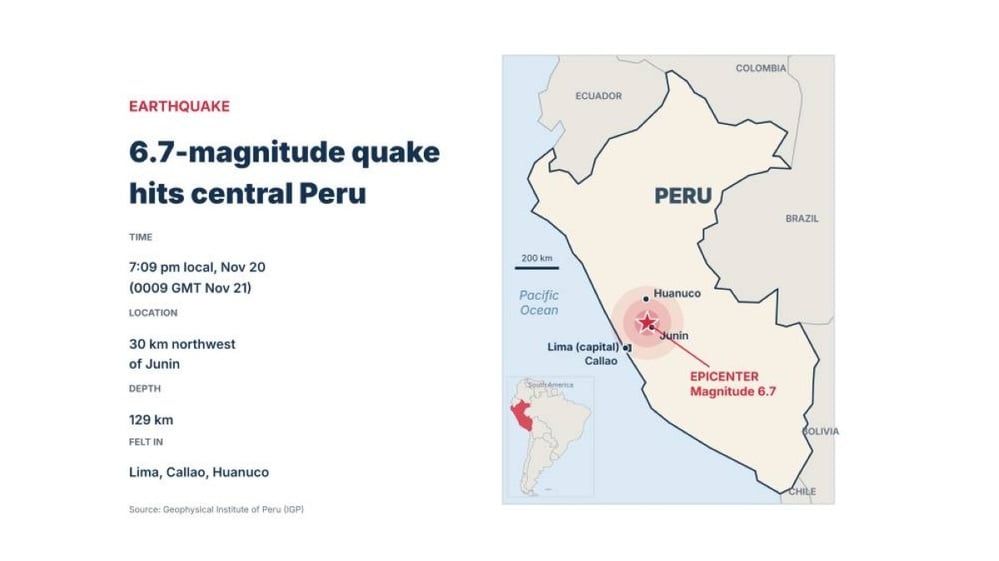
“The quake struck at 7:09 pm (0009 GMT Saturday), 30 kilometers northwest of the city of Junin, at a depth of 129 kilometers.” · exact text match
Why: It describes what happened and official monitoring without policy advocacy.
Claim: The article uses neutral technical and observational language rather than emotive language.
“the quake was felt with moderate to strong intensity” · exact text match
Why: The phrasing is factual and lacks positive or negative emotional valence.
Claim: Credibility is supported by named official sources and cautious preliminary language.
“the Geophysical Institute of Peru (IGP) reported” · exact text match
“with a preliminary report showing no deaths or serious damage” · exact text match
Why: Visible sourcing and preliminary caveats support reliability within a short wire brief.
Claim: The report uses seismological context and source attribution rather than emotional or magical reasoning.
“Seismologists say the country experiences at least 400 earthquakes a year, three-quarters of which are too weak to be felt.” · exact text match
Why: It contextualizes the event with scientific seismological information.
Claim: Geological science is used to explain the event’s context.
“Peru lies on the Pacific Ring of Fire, an arc of intense seismic activity stretching from Japan through Southeast Asia and across the Pacific basin.” · exact text match
Why: The article situates the earthquake in scientific rather than superstitious explanation.
Claim: The report uses cautious attribution and preliminary qualifiers.
“with a preliminary report showing no deaths or serious damage” · exact text match
“IGP President Hernando Tavera told AFP” · exact text match
Why: It labels preliminary findings and attributes claims to named agencies and persons.
Claim: The report is concise but includes location, depth, official response, and seismic context.
“The quake struck at 7:09 pm (0009 GMT Saturday), 30 kilometers northwest of the city of Junin, at a depth of 129 kilometers.” · exact text match
Why: It provides structured, relevant details without extraneous speculation.
The supplied text includes unrelated trailing headlines and an agency credit rather than a personal byline; analysis is confined to the earthquake brief.
November 21, 2026 · 0 shares
Neutral, attribution-driven hazard reporting foregrounds official seismic measurements and provisional damage assessments while avoiding ideological or emotional escalation.
Helium Analysis
Limitations: The supplied text includes unrelated appended headlines and a separate Japan earthquake section, so extraction and scoring focus on the substantive Peru earthquake report while noting the directly relevant Japan alert.
·
7 of 56 available dimensions scored; omitted dimensions are not treated as neutral.
·
Verified supporting quotes for 6 of 7 scored dimensions.
Claim: Damage and impact claims are presented through attributed preliminary assessments rather than subjective commentary.
“A 6.7-magnitude earthquake struck central Peru on Friday, the Peruvian Geophysical Institute reported, with a preliminary report indicating no fatalities or serious damage from the tremor.” · exact text match
Why: The report attributes the main claim and explicitly labels it preliminary, supporting objective framing.
Claim: Even where it mentions landslides and people fleeing into streets, the report keeps to measured, attributed language rather than sensational escalation.
“"The ground shaking was intense.
We have no reports of damage at the moment, but there have been landslides and rockfalls on the hillsides," Hernando Tavera, president of the Geophysical Institute of Peru, told AFP.”
· exact text match
Why: Dramatic details are contained in direct attributed quotation with caveats, not amplified by the publisher.
Claim: The tone remains neutral when reporting both damage uncertainty and official responses.
“No tsunami warning, advisory, watch or threat had been issued, the US Tsunami Warning System said.” · exact text match
Why: The language is procedural and factual rather than emotionally charged.
Claim: Credibility is supported by multiple named official sources, direct quotation, and provisional wording.
“No tsunami warning, advisory, watch or threat had been issued, the US Tsunami Warning System said.” · exact text match
Why: Clear attribution to a relevant authority and absence of unsupported claims in the supplied text.
Claim: The account is structured around quantitative seismic data and attributed official assessments rather than emotional or speculative reasoning.
“The earthquake occurred at 7.09pm (0009 GMT Saturday), 30 kilometers (18 miles) northwest of the city of Junin, at a depth of 129 kilometers.” · exact text match
Why: Precise measurements and attributed sourcing indicate rational/empirical reporting.
Claim: The article grounds the event in seismological measurements and geographic explanation rather than superstition.
“Peru is situated on the so-called Pacific Ring of Fire — an arc of intense seismic activity stretching from Japan through Southeast Asia and across the Pacific basin.” · exact text match
Why: Scientific-geographic context supports strong empirical/scientific framing.
Claim: The report clearly distinguishes preliminary and monitored information and attributes it to named institutions.
“Peru's National Emergency Operation Center (COEN) reported the quake was felt with moderate to strong intensity and that "monitoring continues in vulnerable areas."” · not found in supplied text
Why: Named source and explicit monitoring caveat show transparent reporting.
The supplied text includes unrelated appended headlines and a separate Japan earthquake section, so extraction and scoring focus on the substantive Peru earthquake report while noting the directly relevant Japan alert.
November 21, 2026 · 0 shares
A restrained, attribution-heavy Reuters wire report frames the earthquake through official seismic data and caveated damage reports while avoiding emotive, partisan, or prescriptive language.
Helium Analysis
Limitations: Brief Reuters wire item with no personal byline; unrelated headline fragments embedded in the supplied text were excluded as non-article elements.
·
8 of 56 available dimensions scored; omitted dimensions are not treated as neutral.
·
Verified supporting quotes for 8 of 8 scored dimensions.
Claim: Earthquake details are presented as attributed factual observations rather than subjective commentary.
“The quake, which was felt in the capital Lima, struck in the Andean region of Junin at a depth of 129 km, according to Peru's Geophysical Institute.” · exact text match
Why: Attribution to a geophysical institute and absence of evaluative language support a strongly objective classification.
Claim: Impact reporting is restrained and caveated rather than dramatic.
“though there were no immediate reports of casualties or significant damage” · exact text match
Why: The wording emphasizes immediate uncertainty and avoids alarmist descriptors.
Claim: The text describes the earthquake and response without prescribing actions or policy.
“In Lima, residents evacuated their homes, and television footage showed lawmakers leaving Congress.” · exact text match
Why: The account reports observed behavior and official information without advocacy.
Claim: Language remains dispassionate and does not impose negative or positive emotional valence.
“though there were no immediate reports of casualties or significant damage” · exact text match
Why: Neutral casualty/damage phrasing supports a measured unemotional score of 0.
Claim: Visible sourcing and caveats support high credibility.
“according to Peru's Geophysical Institute” · exact text match
“The US Tsunami Warning System said there was no tsunami threat following the earthquake.” · exact text match
Why: Multiple named official sources and explicit uncertainty markers are present.
Claim: The report relies on empirical seismic data and official assessments rather than irrational or supernatural claims.
“according to Peru's Geophysical Institute” · exact text match
“The US Tsunami Warning System said there was no tsunami threat following the earthquake.” · exact text match
Why: Use of scientific and official sources evidences rational framing.
Claim: The report explains the earthquake through seismological and tectonic context rather than superstition.
“Peru lies along the Pacific Ring of Fire, a seismically active zone where tectonic plate movements frequently trigger quakes.” · exact text match
Why: Explicit tectonic explanation supports a scientific/empirical classification.
Claim: Claims are attributed and uncertainty is explicitly caveated.
“Vicente Quispe, a local council member in Junin province, about 320 km (200 miles) east of Lima, told local broadcaster RPP that the authorities had not received reports of damage following the strong tremor.” · exact text match
Why: Named sourcing and direct quotation show internally observable fairness and honesty signals.
Brief Reuters wire item with no personal byline; unrelated headline fragments embedded in the supplied text were excluded as non-article elements.
November 21, 2026 · 0 shares
Straight news framing with attributed seismic data, explicit no-damage caveats, and restrained language.
Helium Analysis
Limitations: No byline or publication date is supplied; related-link snippets were excluded.
·
6 of 56 available dimensions scored; omitted dimensions are not treated as neutral.
·
Verified supporting quotes for 6 of 6 scored dimensions.
Claim: The report is framed as factual, attributed news rather than subjective interpretation.
“the German Research Centre for Geosciences said” · exact text match
“there were no immediate reports of casualties or significant damage” · exact text match
Why: The text relies on named scientific and official sources and explicitly qualifies damage reports.
Claim: The language is restrained and does not sensationalize the earthquake.
“there were no immediate reports of casualties or significant damage” · exact text match
“there was no tsunami threat after the earthquake” · exact text match
Why: The report emphasizes limited confirmed impact and absence of tsunami threat instead of dramatic imagery or alarm.
Claim: The report uses multiple named seismic and tsunami authorities and attributes key figures to them.
“according to Peru’s Geophysical Institute” · exact text match
“The US Tsunami Warning System said there was no tsunami threat after the earthquake.” · exact text match
Why: Named institutions and attributed measurements increase visible credibility in the supplied text.
Claim: The report uses measured seismological details and official assessments rather than irrational or emotive claims.
“struck in the Andean region of Junin at a depth of 129km, according to Peru’s Geophysical Institute” · exact text match
“The US Tsunami Warning System said there was no tsunami threat after the earthquake.” · exact text match
Why: Specific depth, location, and tsunami assessment are attributed to relevant authorities.
Claim: The report frames the event through geoscientific institutions and seismic measurements.
“German Research Centre for Geosciences” · exact text match
“Peru’s Geophysical Institute” · exact text match
Why: The causal and measurement framing is empirical and geoscientific rather than superstitious.
Claim: The report includes official caveats and does not overstate damage or casualties.
“So far, no damage has been reported.” · exact text match
“there were no immediate reports of casualties or significant damage” · exact text match
Why: The text repeatedly qualifies impact with attributed absence-of-damage language.
No byline or publication date is supplied; related-link snippets were excluded.
Factual, attribution-forward disaster brief with a calm, non-ideological and non-speculative framing.
Helium Analysis
Limitations: Initial reports only; damage and casualty information remains preliminary.
·
9 of 56 available dimensions scored; omitted dimensions are not treated as neutral.
·
Verified supporting quotes for 9 of 9 scored dimensions.
Claim: The framing is event-centered and factual rather than subjective commentary.
“A magnitude 6.9 earthquake shook the Andes in central Peru on Friday with no immediate reports of damage or casualties.” · exact text match
Why: Reports observable details and attributed reports without subjective interpretation.
Claim: The article reports the quake and local reaction in measured, non-sensational terms.
“A magnitude 6.9 earthquake shook the Andes in central Peru on Friday with no immediate reports of damage or casualties.” · exact text match
Why: No alarmist language, dramatic adjectives, or exaggerated consequences are used.
Claim: The report is descriptive, supplying event coordinates and depth without recommendations.
“Its epicentre was in the Andes, 34 kilometres (21 miles) north of Junin, at a depth of 108 kilometres (67 miles).” · exact text match
Why: It provides factual details and no advocacy or prescribed action.
Claim: The tone is calm and neutral rather than emotionally charged.
“Peru's Geophysical Institute said no damage or casualties had been reported.” · exact text match
Why: Neutral official statement and factual reporting support a zero/neutral emotional classification.
Claim: The report shows high credibility through official attribution, precise measurements, and preliminary qualifications.
“The US Geological Survey said the earthquake struck at 7:09 pm local time (0900 GMT Saturday).” · exact text match
“Peru's Geophysical Institute said no damage or casualties had been reported.” · exact text match
Why: Named agencies, specific data, and uncertainty language support trustworthiness within the supplied text.
Claim: The report presents seismic facts and official attributions without emotional or speculative reasoning.
“The US Geological Survey said the earthquake struck at 7:09 pm local time (0900 GMT Saturday).” · exact text match
“Peru's Geophysical Institute said no damage or casualties had been reported.” · exact text match
Why: Specific attributed data and no speculative argument support a strongly rational classification.
Claim: The article uses an empirical geological frame, citing seismic agencies and fault-line context.
“The US Geological Survey said the earthquake struck at 7:09 pm local time (0900 GMT Saturday).” · exact text match
“Peru lies along the "Ring of Fire", a 40,000-kilometre (25,000-mile) arc of volcanoes and fault lines around the Pacific Basin, where most of the world's earthquakes occur.” · exact text match
Why: Scientific agency data and geological explanation indicate empirical rather than superstitious framing.
Claim: The report names official sources and qualifies the damage/casualty information as preliminary.
“The US Geological Survey said the earthquake struck at 7:09 pm local time (0900 GMT Saturday).” · exact text match
“Peru's Geophysical Institute said no damage or casualties had been reported.” · exact text match
Why: Clear attribution and tentative phrasing indicate high internal fairness and honesty.
Claim: The article is concise but information-dense, covering key seismic data, official reports, local impact, and prior quake context.
“Its epicentre was in the Andes, 34 kilometres (21 miles) north of Junin, at a depth of 108 kilometres (67 miles).” · exact text match
“In August, a 6.7 magnitude earthquake in the Peruvian Andes left two people injured and damaged several homes, health centres and schools, while in July, a 5.5-magnitude quake in the Junín region resulted in six deaths and 30 injuries.” · exact text match
Why: Specific measurements and relevant historical comparisons support above-average informational intelligence.
Initial reports only; damage and casualty information remains preliminary.
November 21, 2026 · 0 shares
A restrained, attribution-heavy Reuters wire report frames the earthquake through official seismic data and caveated damage reports while avoiding emotive, partisan, or prescriptive language.
Helium Analysis
Limitations: Brief Reuters wire item with no personal byline; unrelated headline fragments embedded in the supplied text were excluded as non-article elements.
·
8 of 56 available dimensions scored; omitted dimensions are not treated as neutral.
·
Verified supporting quotes for 8 of 8 scored dimensions.
Claim: Earthquake details are presented as attributed factual observations rather than subjective commentary.
“The quake, which was felt in the capital Lima, struck in the Andean region of Junin at a depth of 129 km, according to Peru's Geophysical Institute.” · exact text match
Why: Attribution to a geophysical institute and absence of evaluative language support a strongly objective classification.
Claim: Impact reporting is restrained and caveated rather than dramatic.
“though there were no immediate reports of casualties or significant damage” · exact text match
Why: The wording emphasizes immediate uncertainty and avoids alarmist descriptors.
Claim: The text describes the earthquake and response without prescribing actions or policy.
“In Lima, residents evacuated their homes, and television footage showed lawmakers leaving Congress.” · exact text match
Why: The account reports observed behavior and official information without advocacy.
Claim: Language remains dispassionate and does not impose negative or positive emotional valence.
“though there were no immediate reports of casualties or significant damage” · exact text match
Why: Neutral casualty/damage phrasing supports a measured unemotional score of 0.
Claim: Visible sourcing and caveats support high credibility.
“according to Peru's Geophysical Institute” · exact text match
“The US Tsunami Warning System said there was no tsunami threat following the earthquake.” · exact text match
Why: Multiple named official sources and explicit uncertainty markers are present.
Claim: The report relies on empirical seismic data and official assessments rather than irrational or supernatural claims.
“according to Peru's Geophysical Institute” · exact text match
“The US Tsunami Warning System said there was no tsunami threat following the earthquake.” · exact text match
Why: Use of scientific and official sources evidences rational framing.
Claim: The report explains the earthquake through seismological and tectonic context rather than superstition.
“Peru lies along the Pacific Ring of Fire, a seismically active zone where tectonic plate movements frequently trigger quakes.” · exact text match
Why: Explicit tectonic explanation supports a scientific/empirical classification.
Claim: Claims are attributed and uncertainty is explicitly caveated.
“Vicente Quispe, a local council member in Junin province, about 320 km (200 miles) east of Lima, told local broadcaster RPP that the authorities had not received reports of damage following the strong tremor.” · exact text match
Why: Named sourcing and direct quotation show internally observable fairness and honesty signals.
Brief Reuters wire item with no personal byline; unrelated headline fragments embedded in the supplied text were excluded as non-article elements.
November 21, 2026 · 0 shares
A restrained, attribution-heavy wire brief prioritizes official preliminary data over partisan or emotional framing.
Helium Analysis
Limitations: The supplied text includes unrelated trailing headlines and an agency credit rather than a personal byline; analysis is confined to the earthquake brief.
·
9 of 56 available dimensions scored; omitted dimensions are not treated as neutral.
·
Verified supporting quotes for 9 of 9 scored dimensions.
Claim: The report presents attributed official facts without subjective commentary.
“the Geophysical Institute of Peru (IGP) reported, with a preliminary report showing no deaths or serious damage” · exact text match
Why: It relies on agency attribution and preliminary caveats rather than evaluative language.
Claim: Impact is described in measured, non-sensational terms.
“with a preliminary report showing no deaths or serious damage” · exact text match
Why: The wording is cautious and attributed, with no dramatic emphasis.
Claim: The report is descriptive, focusing on event data and official updates rather than prescribing action.
“The quake struck at 7:09 pm (0009 GMT Saturday), 30 kilometers northwest of the city of Junin, at a depth of 129 kilometers.” · exact text match
Why: It describes what happened and official monitoring without policy advocacy.
Claim: The article uses neutral technical and observational language rather than emotive language.
“the quake was felt with moderate to strong intensity” · exact text match
Why: The phrasing is factual and lacks positive or negative emotional valence.
Claim: Credibility is supported by named official sources and cautious preliminary language.
“the Geophysical Institute of Peru (IGP) reported” · exact text match
“with a preliminary report showing no deaths or serious damage” · exact text match
Why: Visible sourcing and preliminary caveats support reliability within a short wire brief.
Claim: The report uses seismological context and source attribution rather than emotional or magical reasoning.
“Seismologists say the country experiences at least 400 earthquakes a year, three-quarters of which are too weak to be felt.” · exact text match
Why: It contextualizes the event with scientific seismological information.
Claim: Geological science is used to explain the event’s context.
“Peru lies on the Pacific Ring of Fire, an arc of intense seismic activity stretching from Japan through Southeast Asia and across the Pacific basin.” · exact text match
Why: The article situates the earthquake in scientific rather than superstitious explanation.
Claim: The report uses cautious attribution and preliminary qualifiers.
“with a preliminary report showing no deaths or serious damage” · exact text match
“IGP President Hernando Tavera told AFP” · exact text match
Why: It labels preliminary findings and attributes claims to named agencies and persons.
Claim: The report is concise but includes location, depth, official response, and seismic context.
“The quake struck at 7:09 pm (0009 GMT Saturday), 30 kilometers northwest of the city of Junin, at a depth of 129 kilometers.” · exact text match
Why: It provides structured, relevant details without extraneous speculation.
The supplied text includes unrelated trailing headlines and an agency credit rather than a personal byline; analysis is confined to the earthquake brief.
November 21, 2026 · 0 shares
A restrained, attribution-heavy Reuters wire report frames the earthquake through official seismic data and caveated damage reports while avoiding emotive, partisan, or prescriptive language.
Helium Analysis
Limitations: Brief Reuters wire item with no personal byline; unrelated headline fragments embedded in the supplied text were excluded as non-article elements.
·
8 of 56 available dimensions scored; omitted dimensions are not treated as neutral.
·
Verified supporting quotes for 8 of 8 scored dimensions.
Claim: Earthquake details are presented as attributed factual observations rather than subjective commentary.
“The quake, which was felt in the capital Lima, struck in the Andean region of Junin at a depth of 129 km, according to Peru's Geophysical Institute.” · exact text match
Why: Attribution to a geophysical institute and absence of evaluative language support a strongly objective classification.
Claim: Impact reporting is restrained and caveated rather than dramatic.
“though there were no immediate reports of casualties or significant damage” · exact text match
Why: The wording emphasizes immediate uncertainty and avoids alarmist descriptors.
Claim: The text describes the earthquake and response without prescribing actions or policy.
“In Lima, residents evacuated their homes, and television footage showed lawmakers leaving Congress.” · exact text match
Why: The account reports observed behavior and official information without advocacy.
Claim: Language remains dispassionate and does not impose negative or positive emotional valence.
“though there were no immediate reports of casualties or significant damage” · exact text match
Why: Neutral casualty/damage phrasing supports a measured unemotional score of 0.
Claim: Visible sourcing and caveats support high credibility.
“according to Peru's Geophysical Institute” · exact text match
“The US Tsunami Warning System said there was no tsunami threat following the earthquake.” · exact text match
Why: Multiple named official sources and explicit uncertainty markers are present.
Claim: The report relies on empirical seismic data and official assessments rather than irrational or supernatural claims.
“according to Peru's Geophysical Institute” · exact text match
“The US Tsunami Warning System said there was no tsunami threat following the earthquake.” · exact text match
Why: Use of scientific and official sources evidences rational framing.
Claim: The report explains the earthquake through seismological and tectonic context rather than superstition.
“Peru lies along the Pacific Ring of Fire, a seismically active zone where tectonic plate movements frequently trigger quakes.” · exact text match
Why: Explicit tectonic explanation supports a scientific/empirical classification.
Claim: Claims are attributed and uncertainty is explicitly caveated.
“Vicente Quispe, a local council member in Junin province, about 320 km (200 miles) east of Lima, told local broadcaster RPP that the authorities had not received reports of damage following the strong tremor.” · exact text match
Why: Named sourcing and direct quotation show internally observable fairness and honesty signals.
Brief Reuters wire item with no personal byline; unrelated headline fragments embedded in the supplied text were excluded as non-article elements.
November 21, 2026 · 0 shares
Neutral, attribution-driven hazard reporting foregrounds official seismic measurements and provisional damage assessments while avoiding ideological or emotional escalation.
Helium Analysis
Limitations: The supplied text includes unrelated appended headlines and a separate Japan earthquake section, so extraction and scoring focus on the substantive Peru earthquake report while noting the directly relevant Japan alert.
·
7 of 56 available dimensions scored; omitted dimensions are not treated as neutral.
·
Verified supporting quotes for 6 of 7 scored dimensions.
Claim: Damage and impact claims are presented through attributed preliminary assessments rather than subjective commentary.
“A 6.7-magnitude earthquake struck central Peru on Friday, the Peruvian Geophysical Institute reported, with a preliminary report indicating no fatalities or serious damage from the tremor.” · exact text match
Why: The report attributes the main claim and explicitly labels it preliminary, supporting objective framing.
Claim: Even where it mentions landslides and people fleeing into streets, the report keeps to measured, attributed language rather than sensational escalation.
“"The ground shaking was intense.
We have no reports of damage at the moment, but there have been landslides and rockfalls on the hillsides," Hernando Tavera, president of the Geophysical Institute of Peru, told AFP.”
· exact text match
Why: Dramatic details are contained in direct attributed quotation with caveats, not amplified by the publisher.
Claim: The tone remains neutral when reporting both damage uncertainty and official responses.
“No tsunami warning, advisory, watch or threat had been issued, the US Tsunami Warning System said.” · exact text match
Why: The language is procedural and factual rather than emotionally charged.
Claim: Credibility is supported by multiple named official sources, direct quotation, and provisional wording.
“No tsunami warning, advisory, watch or threat had been issued, the US Tsunami Warning System said.” · exact text match
Why: Clear attribution to a relevant authority and absence of unsupported claims in the supplied text.
Claim: The account is structured around quantitative seismic data and attributed official assessments rather than emotional or speculative reasoning.
“The earthquake occurred at 7.09pm (0009 GMT Saturday), 30 kilometers (18 miles) northwest of the city of Junin, at a depth of 129 kilometers.” · exact text match
Why: Precise measurements and attributed sourcing indicate rational/empirical reporting.
Claim: The article grounds the event in seismological measurements and geographic explanation rather than superstition.
“Peru is situated on the so-called Pacific Ring of Fire — an arc of intense seismic activity stretching from Japan through Southeast Asia and across the Pacific basin.” · exact text match
Why: Scientific-geographic context supports strong empirical/scientific framing.
Claim: The report clearly distinguishes preliminary and monitored information and attributes it to named institutions.
“Peru's National Emergency Operation Center (COEN) reported the quake was felt with moderate to strong intensity and that "monitoring continues in vulnerable areas."” · not found in supplied text
Why: Named source and explicit monitoring caveat show transparent reporting.
The supplied text includes unrelated appended headlines and a separate Japan earthquake section, so extraction and scoring focus on the substantive Peru earthquake report while noting the directly relevant Japan alert.
November 20, 2026 · 0 shares
The publisher frames the earthquake sequence in a restrained, attribution-heavy manner, centering USGS measurements and probabilistic aftershock forecasts while avoiding sensational language.
Helium Analysis
Limitations: The supplied text contains duplicated or truncated snippet formatting and related-article links; analysis is limited to the substantive earthquake report.
·
7 of 56 available dimensions scored; omitted dimensions are not treated as neutral.
·
Verified supporting quotes for 7 of 7 scored dimensions.
Claim: The report grounds key earthquake details in attributed USGS measurements rather than subjective description.
“The U.S. Geological Survey placed its depth at 6.7 kilometers, or roughly four miles beneath the surface.” · exact text match
Why: The attribution to a named scientific agency and precise measurement supports a strongly objective classification.
Claim: The report avoids sensational framing by noting no immediate damage and no expected tsunami.
“There were no immediate reports of injuries or damage.” · exact text match
“No tsunami was expected following the inland earthquake.” · exact text match
Why: These restrained, factual statements reduce alarm and support an objective rather than sensational classification.
Claim: The report primarily describes what happened rather than prescribing actions or outcomes.
“A magnitude 5.0 earthquake struck near Pinnacles in central California late Thursday, followed by a series of smaller tremors.” · exact text match
Counterevidence:
“The USGS ShakeAlert earthquake early warning system also activated, sending notifications that urged people to drop, cover and hold on.” · exact text match
Why: The main text is descriptive, and the only prescriptive language is attributed to an official alert system.
Claim: The report shows visible sourcing to USGS and explicit uncertainty around forecasts.
“The U.S. Geological Survey placed its depth at 6.7 kilometers, or roughly four miles beneath the surface.” · exact text match
“Those figures described probabilities for the coming week, rather than a prediction that a particular earthquake would occur.” · exact text match
Why: Named attribution and an explicit probabilistic caveat support a high credibility classification.
Claim: The report distinguishes probabilistic aftershock forecasts from deterministic earthquake predictions.
“Those figures described probabilities for the coming week, rather than a prediction that a particular earthquake would occur.” · exact text match
Why: The explicit caveat limits the forecast's epistemic status, supporting a strongly rational classification.
Claim: The report relies on quantitative seismological data and probabilities rather than superstition or speculation.
“An initial USGS aftershock forecast put the chance of at least one magnitude 3.0 or greater earthquake during the following week at 66%.” · exact text match
“The forecast placed the likelihood of a magnitude 6.0 or greater earthquake below 1%.” · exact text match
Why: The use of USGS probabilities and quantitative thresholds supports a strongly scientific classification.
Claim: The report transparently notes revised magnitude estimates as reports were updated.
“Preliminary readings varied as the reports were updated: the earthquake was initially measured at magnitude 5.4, then reported as 5.1, while updated accounts listed it at 5.
0.”
· exact text match
Why: Disclosing revisions and preliminary uncertainty is an internal fairness and honesty signal supporting high integrity.
The supplied text contains duplicated or truncated snippet formatting and related-article links; analysis is limited to the substantive earthquake report.
November 20, 2026 · 0 shares
Straightforward local breaking-news framing relies on attributed seismic data and official preliminarily assessed damage reports, with only a brief preparedness prompt.
Helium Analysis
Limitations: Assessment is limited to a short local breaking-news report whose central claims rest on preliminary official information; related-headline list was excluded as page chrome.
·
11 of 56 available dimensions scored; omitted dimensions are not treated as neutral.
·
Verified supporting quotes for 11 of 11 scored dimensions.
Claim: The report's central framing is event-focused and avoids partisan or ideological labels.
“Magnitude 4.4 earthquake strikes Commerce area, USGS says.” · exact text match
Why: The headline and body address a natural event and official response without liberal or conservative political framing.
Claim: The report gives both resident observations and official statements without populist or elitist framing.
“Residents said they felt the quake in Marina Del Rey, Hawthorne, Van Nuys, Pico Rivera, and other parts of Southern California.” · exact text match
“Mayor Karen Bass said there are no reports of operational impacts, even at LAX.” · exact text match
Why: Inclusion of both public and official accounts supports neutral treatment on this dimension.
Claim: The report presents attributed facts and official statements rather than subjective interpretation.
“according to the U.S. Geological Survey” · exact text match
“There were no immediate reports of serious injuries or major damage.” · exact text match
Why: Sourcing and measured language keep the account objective.
Claim: The event is reported in measured, non-sensational terms.
“There were no immediate reports of serious injuries or major damage.” · exact text match
Why: The report avoids dramatic adjectives or alarmist framing about the quake.
Claim: The report primarily describes the earthquake and official response, with only a brief preparedness prompt.
“There were no immediate reports of serious injuries or major damage.” · exact text match
Counterevidence:
“ABC7 has compiled a list of items that are important to have in your earthquake kit so that you're prepared for "the big one."” · not found in supplied text
Why: Most content is descriptive, but the earthquake-kit line is prescriptive, qualifying the score.
Claim: The tone remains neutral and unemotional despite covering a potentially alarming event.
“There were no immediate reports of serious injuries or major damage.” · exact text match
Why: No emotional intensifiers or fear appeal appear in the central report.
Claim: The report provides named-source attribution and appropriately caveats the absence of immediate damage reports.
“The Los Angeles Fire Department said it remained in earthquake alert mode after the temblor until shortly before 4:30 a.m.” · exact text match
“Mayor Karen Bass said there are no reports of operational impacts, even at LAX.” · exact text match
Why: Multiple official sources and preliminary language support credibility.
Claim: The report is framed around quantified seismic data and attributed official assessments rather than irrational or emotional claims.
“The earthquake struck at 3:25 a.m. and was initially measured at a magnitude of 4.2, the USGS said.” · exact text match
Why: Precise magnitude, timing, and agency attribution indicate rational/empirical framing.
Claim: The report grounds the event in USGS seismic measurement rather than superstition or speculative causation.
“A magnitude 4.4 earthquake struck the Commerce area early Friday morning, according to the U.S. Geological Survey.” · exact text match
Why: Direct scientific-agency attribution and magnitude reporting support a strongly scientific framing.
Claim: The report transparently attributes seismic data and official response claims to named agencies and officials.
“according to the U.S. Geological Survey” · exact text match
“the LAFD said in a statement” · exact text match
Why: Clear attribution and caveated preliminary reports support high integrity.
Claim: The report is concise and organized around verifiable seismic facts and official response details.
“The earthquake struck at 3:25 a.m. and was initially measured at a magnitude of 4.2, the USGS said.” · exact text match
Why: Clear structure and relevant quantities indicate above-average article intelligence.
Assessment is limited to a short local breaking-news report whose central claims rest on preliminary official information; related-headline list was excluded as page chrome.
November 21, 2026 · 0 shares
The framing is a narrowly factual earthquake brief, relying on GeoNet data and quantified felt reports without sensational or political language.
Helium Analysis
Limitations: The supplied text includes duplicated paragraphs and unrelated headline fragments; the analysis is limited to the earthquake report.
·
56 of 56 available dimensions scored; omitted dimensions are not treated as neutral.
·
Verified supporting quotes for 56 of 56 scored dimensions.
Claim: The earthquake report contains no liberal or conservative political framing.
“A magnitude 4.5 earthquake struck 20km northeast of Hanmer Springs on Saturday night” · exact text match
Why: The text reports a natural event with no political actors, policies, or ideological language.
Claim: The report shows no populist or elitist framing.
“The shallow quake prompted reports from across the region.” · exact text match
Why: Public felt reports are presented factually without populist or elitist appeals.
Claim: The report does not address freedom, authority, or state-control questions.
“A magnitude 4.5 earthquake struck 20km northeast of Hanmer Springs on Saturday night” · exact text match
Why: Natural-event news with no libertarian or authoritarian framing.
Claim: The report uses attributed measurements and felt-report counts rather than subjective narrative.
“The quake hit at 8.59pm at a depth of 5km, according to GeoNet.” · exact text match
Why: Quantified, attributed event details indicate objective reporting.
Claim: The framing is measured and avoids sensational language despite covering an earthquake.
“Of those, 95 people described the shaking as light, 72 as weak, 17 as moderate, one as strong and one as extreme.” · exact text match
Why: Detailed distribution of felt reports is presented without alarmist wording.
Claim: The report contains no market or financial framing.
“A magnitude 4.5 earthquake struck 20km northeast of Hanmer Springs on Saturday night” · exact text match
Why: No bearish or bullish financial content is present.
Claim: The report maintains a neutral tone without optimistic or pessimistic framing.
“The shallow quake prompted reports from across the region.” · exact text match
Why: The event is described factually without positive or negative outlook language.
Claim: The report is routine natural-event news presented with limited contextual detail.
“The quake hit at 8.59pm at a depth of 5km, according to GeoNet.” · exact text match
Why: The content is straightforward factual brief reporting rather than analysis or narrative.
Claim: The report describes the earthquake and public reports without prescribing actions or policies.
“The shallow quake prompted reports from across the region.” · exact text match
Why: No recommendations or prescriptions appear.
Claim: The report contains no foreign-policy or military framing.
“A magnitude 4.5 earthquake struck 20km northeast of Hanmer Springs on Saturday night” · exact text match
Why: No dovish or hawkish content is present.
Claim: The report does not use fearful or alarmist language.
“Of those, 95 people described the shaking as light, 72 as weak, 17 as moderate, one as strong and one as extreme.” · exact text match
Why: The felt effects are reported in measured distribution rather than fear-inducing terms.
Claim: The report does not rely on circular argumentation.
“A magnitude 4.5 earthquake struck 20km northeast of Hanmer Springs on Saturday night” · exact text match
Why: It presents event data without argumentative reasoning.
Claim: The report contains no gossip or personal-life content.
“The quake hit at 8.59pm at a depth of 5km, according to GeoNet.” · exact text match
Why: Seismic event facts are unrelated to gossip.
Claim: The report is fact-based and avoids evaluative commentary.
“The quake hit at 8.59pm at a depth of 5km, according to GeoNet.” · exact text match
Why: Attribution to GeoNet and specific details appear without stated opinion.
Claim: The report contains no political framing, actors, or policy claims.
“A magnitude 4.5 earthquake struck 20km northeast of Hanmer Springs on Saturday night” · exact text match
Why: Natural-event reporting with no political content.
Claim: The report gives limited but specific factual detail without extended analysis.
“The quake hit at 8.59pm at a depth of 5km, according to GeoNet.” · exact text match
Why: The brief is simple by nature but includes precise magnitude, time, depth, and felt-report data.
Claim: The report cites GeoNet for seismic data rather than using authority as a substitute for argument.
“according to GeoNet” · exact text match
Why: The authority citation is a standard source attribution for factual measurements.
Claim: The report maintains a straightforward, non-immature tone.
“The shallow quake prompted reports from across the region.” · exact text match
Why: No provocative or juvenile language appears.
Claim: The report presents observations without circular reasoning.
“The quake hit at 8.59pm at a depth of 5km, according to GeoNet.” · exact text match
Why: No argumentative reasoning structure is present.
Claim: The report does not amplify or cover for any actor's response.
“The shallow quake prompted reports from across the region.” · exact text match
Why: It reports public felt reports without evaluating institutional response.
Claim: The report does not frame victims or victimhood.
“Of those, 95 people described the shaking as light, 72 as weak, 17 as moderate, one as strong and one as extreme.” · exact text match
Why: Felt reports are counted neutrally, with no victimization narrative.
Claim: The article attributes key seismic details to GeoNet and does not assert beyond the supplied observations.
“The quake hit at 8.59pm at a depth of 5km, according to GeoNet.” · exact text match
Why: Attribution and exact measurements indicate calibrated confidence.
Claim: The substantive earthquake report is not promotional or spam-like.
“The quake hit at 8.59pm at a depth of 5km, according to GeoNet.” · exact text match
Why: The report consists of factual event information rather than promotional filler.
Claim: The report is free of ideological framing.
“The quake hit at 8.59pm at a depth of 5km, according to GeoNet.” · exact text match
Why: Seismic facts are presented without ideological claims.
Claim: The report shows no pro- or anti-establishment framing.
“The quake hit at 8.59pm at a depth of 5km, according to GeoNet.” · exact text match
Why: A scientific agency is cited for data without broader establishment commentary.
Claim: The tone remains emotionally neutral, presenting felt reports numerically.
“Of those, 95 people described the shaking as light, 72 as weak, 17 as moderate, one as strong and one as extreme.” · exact text match
Why: Quantified public responses are neutral rather than emotionally charged.
Claim: The report does not compare parties or apply differential standards.
“A magnitude 4.5 earthquake struck 20km northeast of Hanmer Springs on Saturday night” · exact text match
Why: No competing actors or standards are present.
Claim: The report shows visible attribution to GeoNet and specific quantitative felt-report data.
“The quake hit at 8.59pm at a depth of 5km, according to GeoNet.” · exact text match
Why: Named-source attribution and exact figures support credibility, though no correction practices are observable.
Claim: The report is organized around attributed seismic measurements and observed public reports.
“The quake hit at 8.59pm at a depth of 5km, according to GeoNet.” · exact text match
Why: Specific quantified details and named-source attribution indicate rational factual reporting.
Claim: The substantive report contains no advertorial framing.
“A magnitude 4.5 earthquake struck 20km northeast of Hanmer Springs on Saturday night” · exact text match
Why: No product, service, or marketing content appears in the earthquake report.
Claim: The framing is empirical, centering seismic magnitude, depth, timing, and monitoring data.
“The quake hit at 8.59pm at a depth of 5km, according to GeoNet.” · exact text match
Why: Use of geophysical measurements rather than supernatural or superstitious explanation.
Claim: The report has limited evidence of AI authorship.
“The quake hit at 8.59pm at a depth of 5km, according to GeoNet.” · exact text match
Why: Short factual prose offers weak authorship signal, so the classification is uncertain.
Claim: The report fairly presents attributed seismic data and a range of felt experiences.
“Of those, 95 people described the shaking as light, 72 as weak, 17 as moderate, one as strong and one as extreme.” · exact text match
Why: Inclusive reporting of mild and extreme felt reports plus attribution supports fairness.
Claim: The report is clear and factual but limited in depth.
“Of those, 95 people described the shaking as light, 72 as weak, 17 as moderate, one as strong and one as extreme.” · exact text match
Why: The data presentation is precise, though the brief has limited analysis.
Claim: The report is truth-seeking and evidence-bound rather than delusional.
“A magnitude 4.5 earthquake struck 20km northeast of Hanmer Springs on Saturday night” · exact text match
Why: It reports observed seismic details and public felt reports without fantastical claims.
Claim: The report contains no terrorism-related content.
“A magnitude 4.5 earthquake struck 20km northeast of Hanmer Springs on Saturday night” · exact text match
Why: The subject is a natural earthquake, not terrorism.
Claim: The report contains no fraud-related framing.
“The quake hit at 8.59pm at a depth of 5km, according to GeoNet.” · exact text match
Why: No fraud, scam, or deceptive-gain content is present.
Claim: The report contains no Marxist or class-conflict framing.
“A magnitude 4.5 earthquake struck 20km northeast of Hanmer Springs on Saturday night” · exact text match
Why: No class analysis or Marxist ideology appears.
Claim: The report contains no Islamist or religious-political framing.
“The shallow quake prompted reports from across the region.” · exact text match
Why: No religious or Islamist content is present.
Claim: The report contains no anti-Jewish content.
“A magnitude 4.5 earthquake struck 20km northeast of Hanmer Springs on Saturday night” · exact text match
Why: No group generalizations or anti-Semitic claims appear.
Claim: The report contains no anti-LGBT content.
“The quake hit at 8.59pm at a depth of 5km, according to GeoNet.” · exact text match
Why: No sexual-orientation or gender-identity content appears.
Claim: The report contains no racial or ethnic generalization.
“A magnitude 4.5 earthquake struck 20km northeast of Hanmer Springs on Saturday night” · exact text match
Why: No racial content or group blame appears.
Claim: The report contains no identity-politics or woke framing.
“A magnitude 4.5 earthquake struck 20km northeast of Hanmer Springs on Saturday night” · exact text match
Why: No identity-group power framing or prescriptive remedies appear.
Claim: The report contains no cruel or immoral framing.
“The shallow quake prompted reports from across the region.” · exact text match
Why: The event is reported neutrally without cruel language.
Claim: The report contains no virtue-signaling language.
“Of those, 95 people described the shaking as light, 72 as weak, 17 as moderate, one as strong and one as extreme.” · exact text match
Why: The tone is informational rather than moral self-presentation.
Claim: The report contains no conspiratorial framing.
“The shallow quake prompted reports from across the region.” · exact text match
Why: It relies on standard seismic monitoring and public reports without conspiracy claims.
Claim: The report contains no compassion-based advocacy involving self-harm tradeoffs.
“The quake hit at 8.59pm at a depth of 5km, according to GeoNet.” · exact text match
Why: No empathy or self-harm policy content appears.
Claim: The report does not blame a person or group for the earthquake.
“A magnitude 4.5 earthquake struck 20km northeast of Hanmer Springs on Saturday night” · exact text match
Why: The event is described as a natural occurrence without scapegoating.
Claim: The report does not apply incompatible standards to comparable cases.
“The shallow quake prompted reports from across the region.” · exact text match
Why: No comparative moral or political standards are invoked.
Claim: The report relies on empirical seismic data rather than rejecting reason or evidence.
“The quake hit at 8.59pm at a depth of 5km, according to GeoNet.” · exact text match
Why: Use of geophysical measurements supports an evidence-based frame.
The supplied text includes duplicated paragraphs and unrelated headline fragments; the analysis is limited to the earthquake report.
November 22, 2026 · 0 shares
The report is a brief, attributed factual bulletin that relies on the National Centre for Seismology and presents precise seismic parameters without ideological or sensational framing.
Helium Analysis
Limitations: Very short single-source bulletin; the NCS quote lists the year as 2026.
·
7 of 56 available dimensions scored; omitted dimensions are not treated as neutral.
·
Verified supporting quotes for 7 of 7 scored dimensions.
Claim: The report presents seismological measurements as attributed facts from NCS without subjective interpretation.
“In a post on X, the NCS reported that the earthquake occurred at 2:35:57 AM Indian Standard Time (IST), at a depth of 95 kilometres.” · exact text match
Why: The sentence attributes precise quantitative data to a named source and adds no evaluative language.
Claim: The wording remains factual and avoids sensational language or emotional escalation.
“Further details are awaited.” · exact text match
Why: The report explicitly notes incomplete information without dramatizing the earthquake.
Claim: The report has no discernible positive or negative emotional valence; it is a neutral factual notice.
“Further details are awaited.” · exact text match
Why: This closing line is procedural and unemotional, with no praise, blame, fear, or reassurance.
Claim: The bulletin is credible in its visible sourcing and uncertainty handling, though based on a single agency account.
“In a post on X, the NCS reported that the earthquake occurred at 2:35:57 AM Indian Standard Time (IST), at a depth of 95 kilometres.” · exact text match
“Further details are awaited.” · exact text match
Why: A named seismological source and precise parameters are paired with an explicit caveat that details are pending.
Claim: The report is structured around verifiable seismic parameters and source attribution rather than irrational or emotive claims.
“The earthquake was recorded at latitude 24.404 North and longitude 94.616 East, with its epicentre located in Myanmar, the NCS stated.” · exact text match
Why: Coordinates and attribution provide a rational, empirical basis for the report.
Claim: The earthquake is framed through seismological measurements rather than superstition or supernatural explanation.
“The earthquake was recorded at latitude 24.404 North and longitude 94.616 East, with its epicentre located in Myanmar, the NCS stated.” · exact text match
Why: Use of coordinates, magnitude, and depth from NCS reflects empirical/scientific framing.
Claim: The report shows observable fairness and honesty by attributing data to NCS and flagging that details are pending.
“according to the National Centre for Seismology (NCS)” · exact text match
“Further details are awaited.” · exact text match
Why: Attribution and explicit uncertainty support internal honesty signals, though the text is very brief.
Very short single-source bulletin; the NCS quote lists the year as 2026.
Factual, attribution-forward disaster brief with a calm, non-ideological and non-speculative framing.
Helium Analysis Limitations: Initial reports only; damage and casualty information remains preliminary. · 9 of 56 available dimensions scored; omitted dimensions are not treated as neutral. · Verified supporting quotes for 9 of 9 scored dimensions.
Claim: The framing is event-centered and factual rather than subjective commentary.
“A magnitude 6.9 earthquake shook the Andes in central Peru on Friday with no immediate reports of damage or casualties.” · exact text match
Why: Reports observable details and attributed reports without subjective interpretation.
Claim: The article reports the quake and local reaction in measured, non-sensational terms.
“A magnitude 6.9 earthquake shook the Andes in central Peru on Friday with no immediate reports of damage or casualties.” · exact text match
Why: No alarmist language, dramatic adjectives, or exaggerated consequences are used.
Claim: The report is descriptive, supplying event coordinates and depth without recommendations.
“Its epicentre was in the Andes, 34 kilometres (21 miles) north of Junin, at a depth of 108 kilometres (67 miles).” · exact text match
Why: It provides factual details and no advocacy or prescribed action.
Claim: The tone is calm and neutral rather than emotionally charged.
“Peru's Geophysical Institute said no damage or casualties had been reported.” · exact text match
Why: Neutral official statement and factual reporting support a zero/neutral emotional classification.
Claim: The report shows high credibility through official attribution, precise measurements, and preliminary qualifications.
“The US Geological Survey said the earthquake struck at 7:09 pm local time (0900 GMT Saturday).” · exact text match
“Peru's Geophysical Institute said no damage or casualties had been reported.” · exact text match
Why: Named agencies, specific data, and uncertainty language support trustworthiness within the supplied text.
Claim: The report presents seismic facts and official attributions without emotional or speculative reasoning.
“The US Geological Survey said the earthquake struck at 7:09 pm local time (0900 GMT Saturday).” · exact text match
“Peru's Geophysical Institute said no damage or casualties had been reported.” · exact text match
Why: Specific attributed data and no speculative argument support a strongly rational classification.
Claim: The article uses an empirical geological frame, citing seismic agencies and fault-line context.
“The US Geological Survey said the earthquake struck at 7:09 pm local time (0900 GMT Saturday).” · exact text match
“Peru lies along the "Ring of Fire", a 40,000-kilometre (25,000-mile) arc of volcanoes and fault lines around the Pacific Basin, where most of the world's earthquakes occur.” · exact text match
Why: Scientific agency data and geological explanation indicate empirical rather than superstitious framing.
Claim: The report names official sources and qualifies the damage/casualty information as preliminary.
“The US Geological Survey said the earthquake struck at 7:09 pm local time (0900 GMT Saturday).” · exact text match
“Peru's Geophysical Institute said no damage or casualties had been reported.” · exact text match
Why: Clear attribution and tentative phrasing indicate high internal fairness and honesty.
Claim: The article is concise but information-dense, covering key seismic data, official reports, local impact, and prior quake context.
“Its epicentre was in the Andes, 34 kilometres (21 miles) north of Junin, at a depth of 108 kilometres (67 miles).” · exact text match
“In August, a 6.7 magnitude earthquake in the Peruvian Andes left two people injured and damaged several homes, health centres and schools, while in July, a 5.5-magnitude quake in the Junín region resulted in six deaths and 30 injuries.” · exact text match
Why: Specific measurements and relevant historical comparisons support above-average informational intelligence.
Initial reports only; damage and casualty information remains preliminary.
November 21, 2026 · 0 shares
A concise, attribution-heavy natural-disaster report presents official seismic data without partisan or sensational framing.
Helium Analysis Limitations: Substantive earthquake report is very brief and has no byline; unrelated headline lists and boilerplate in the supplied text were excluded. · 8 of 56 available dimensions scored; omitted dimensions are not treated as neutral. · Verified supporting quotes for 8 of 8 scored dimensions.
Claim: The report is objective and attributed to named scientific agencies.
“The US Geological Survey said the earthquake struck at 7:09 p.m. local time (0900 GMT Saturday).” · exact text match
“Peru’s Geophysical Institute said no damage or casualties had been reported and there was no threat of a tsunami.” · exact text match
Why: Both statements attribute seismic details and impact assessments to named scientific agencies rather than offering subjective interpretation.
Claim: The report avoids sensational language and emphasizes measured official assessments.
“with no immediate reports of damage or casualties” · exact text match
“there was no threat of a tsunami” · exact text match
Why: The phrasing is restrained and does not dramatize the earthquake or its effects.
Claim: The report describes events without prescribing actions or policies.
“The earthquake was felt in the Peruvian capital, prompting residents to rush into the streets.” · exact text match
Why: The sentence reports observed effects and behavior rather than recommending any response.
Claim: The report maintains a neutral emotional tone.
“Peru’s Geophysical Institute said no damage or casualties had been reported and there was no threat of a tsunami.” · exact text match
Why: The wording is factual and unemotional, with no amplification of fear or distress.
Claim: The report is credible in its visible sourcing and uncertainty handling.
“The US Geological Survey said the earthquake struck at 7:09 p.m. local time (0900 GMT Saturday).” · exact text match
“Peru’s Geophysical Institute said no damage or casualties had been reported and there was no threat of a tsunami.” · exact text match
Why: It cites authoritative agencies, provides specific measurements, and qualifies casualty reports as not yet reported.
Claim: The report relies on quantitative seismic data and named official sources.
“The US Geological Survey said the earthquake struck at 7:09 p.m. local time (0900 GMT Saturday).” · exact text match
“Its epicenter was in the Andes, 34 kilometers (21 miles) north of Junin, at a depth of 108 kilometers (67 miles).” · exact text match
Why: Specific measurements and agency attribution support a rational, fact-based presentation.
Claim: The report is grounded in seismological measurements and official scientific institutions.
“Its epicenter was in the Andes, 34 kilometers (21 miles) north of Junin, at a depth of 108 kilometers (67 miles).” · exact text match
Why: Use of quantified epicenter and depth data reflects empirical scientific reporting rather than superstition.
Claim: The report uses careful attribution and preserved uncertainty about immediate effects.
“Peru’s Geophysical Institute said no damage or casualties had been reported and there was no threat of a tsunami.” · exact text match
Why: Attributing the assessment and saying casualties “had been reported” rather than asserting a definitive absence indicates careful epistemic practice.
Substantive earthquake report is very brief and has no byline; unrelated headline lists and boilerplate in the supplied text were excluded.
November 21, 2026 · 0 shares
A restrained, attribution-heavy Reuters wire report frames the earthquake through official seismic data and caveated damage reports while avoiding emotive, partisan, or prescriptive language.
Helium Analysis Limitations: Brief Reuters wire item with no personal byline; unrelated headline fragments embedded in the supplied text were excluded as non-article elements. · 8 of 56 available dimensions scored; omitted dimensions are not treated as neutral. · Verified supporting quotes for 8 of 8 scored dimensions.
Claim: Earthquake details are presented as attributed factual observations rather than subjective commentary.
“The quake, which was felt in the capital Lima, struck in the Andean region of Junin at a depth of 129 km, according to Peru's Geophysical Institute.” · exact text match
Why: Attribution to a geophysical institute and absence of evaluative language support a strongly objective classification.
Claim: Impact reporting is restrained and caveated rather than dramatic.
“though there were no immediate reports of casualties or significant damage” · exact text match
Why: The wording emphasizes immediate uncertainty and avoids alarmist descriptors.
Claim: The text describes the earthquake and response without prescribing actions or policy.
“In Lima, residents evacuated their homes, and television footage showed lawmakers leaving Congress.” · exact text match
Why: The account reports observed behavior and official information without advocacy.
Claim: Language remains dispassionate and does not impose negative or positive emotional valence.
“though there were no immediate reports of casualties or significant damage” · exact text match
Why: Neutral casualty/damage phrasing supports a measured unemotional score of 0.
Claim: Visible sourcing and caveats support high credibility.
“according to Peru's Geophysical Institute” · exact text match
“The US Tsunami Warning System said there was no tsunami threat following the earthquake.” · exact text match
Why: Multiple named official sources and explicit uncertainty markers are present.
Claim: The report relies on empirical seismic data and official assessments rather than irrational or supernatural claims.
“according to Peru's Geophysical Institute” · exact text match
“The US Tsunami Warning System said there was no tsunami threat following the earthquake.” · exact text match
Why: Use of scientific and official sources evidences rational framing.
Claim: The report explains the earthquake through seismological and tectonic context rather than superstition.
“Peru lies along the Pacific Ring of Fire, a seismically active zone where tectonic plate movements frequently trigger quakes.” · exact text match
Why: Explicit tectonic explanation supports a scientific/empirical classification.
Claim: Claims are attributed and uncertainty is explicitly caveated.
“Vicente Quispe, a local council member in Junin province, about 320 km (200 miles) east of Lima, told local broadcaster RPP that the authorities had not received reports of damage following the strong tremor.” · exact text match
Why: Named sourcing and direct quotation show internally observable fairness and honesty signals.
Brief Reuters wire item with no personal byline; unrelated headline fragments embedded in the supplied text were excluded as non-article elements.
November 21, 2026 · 0 shares
Straight news framing with attributed seismic data, explicit no-damage caveats, and restrained language.
Helium Analysis Limitations: No byline or publication date is supplied; related-link snippets were excluded. · 6 of 56 available dimensions scored; omitted dimensions are not treated as neutral. · Verified supporting quotes for 6 of 6 scored dimensions.
Claim: The report is framed as factual, attributed news rather than subjective interpretation.
“the German Research Centre for Geosciences said” · exact text match
“there were no immediate reports of casualties or significant damage” · exact text match
Why: The text relies on named scientific and official sources and explicitly qualifies damage reports.
Claim: The language is restrained and does not sensationalize the earthquake.
“there were no immediate reports of casualties or significant damage” · exact text match
“there was no tsunami threat after the earthquake” · exact text match
Why: The report emphasizes limited confirmed impact and absence of tsunami threat instead of dramatic imagery or alarm.
Claim: The report uses multiple named seismic and tsunami authorities and attributes key figures to them.
“according to Peru’s Geophysical Institute” · exact text match
“The US Tsunami Warning System said there was no tsunami threat after the earthquake.” · exact text match
Why: Named institutions and attributed measurements increase visible credibility in the supplied text.
Claim: The report uses measured seismological details and official assessments rather than irrational or emotive claims.
“struck in the Andean region of Junin at a depth of 129km, according to Peru’s Geophysical Institute” · exact text match
“The US Tsunami Warning System said there was no tsunami threat after the earthquake.” · exact text match
Why: Specific depth, location, and tsunami assessment are attributed to relevant authorities.
Claim: The report frames the event through geoscientific institutions and seismic measurements.
“German Research Centre for Geosciences” · exact text match
“Peru’s Geophysical Institute” · exact text match
Why: The causal and measurement framing is empirical and geoscientific rather than superstitious.
Claim: The report includes official caveats and does not overstate damage or casualties.
“So far, no damage has been reported.” · exact text match
“there were no immediate reports of casualties or significant damage” · exact text match
Why: The text repeatedly qualifies impact with attributed absence-of-damage language.
No byline or publication date is supplied; related-link snippets were excluded.
November 21, 2026 · 0 shares
A restrained, attribution-heavy wire brief prioritizes official preliminary data over partisan or emotional framing.
Helium Analysis Limitations: The supplied text includes unrelated trailing headlines and an agency credit rather than a personal byline; analysis is confined to the earthquake brief. · 9 of 56 available dimensions scored; omitted dimensions are not treated as neutral. · Verified supporting quotes for 9 of 9 scored dimensions.
Claim: The report presents attributed official facts without subjective commentary.
“the Geophysical Institute of Peru (IGP) reported, with a preliminary report showing no deaths or serious damage” · exact text match
Why: It relies on agency attribution and preliminary caveats rather than evaluative language.
Claim: Impact is described in measured, non-sensational terms.
“with a preliminary report showing no deaths or serious damage” · exact text match
Why: The wording is cautious and attributed, with no dramatic emphasis.
Claim: The report is descriptive, focusing on event data and official updates rather than prescribing action.
“The quake struck at 7:09 pm (0009 GMT Saturday), 30 kilometers northwest of the city of Junin, at a depth of 129 kilometers.” · exact text match
Why: It describes what happened and official monitoring without policy advocacy.
Claim: The article uses neutral technical and observational language rather than emotive language.
“the quake was felt with moderate to strong intensity” · exact text match
Why: The phrasing is factual and lacks positive or negative emotional valence.
Claim: Credibility is supported by named official sources and cautious preliminary language.
“the Geophysical Institute of Peru (IGP) reported” · exact text match
“with a preliminary report showing no deaths or serious damage” · exact text match
Why: Visible sourcing and preliminary caveats support reliability within a short wire brief.
Claim: The report uses seismological context and source attribution rather than emotional or magical reasoning.
“Seismologists say the country experiences at least 400 earthquakes a year, three-quarters of which are too weak to be felt.” · exact text match
Why: It contextualizes the event with scientific seismological information.
Claim: Geological science is used to explain the event’s context.
“Peru lies on the Pacific Ring of Fire, an arc of intense seismic activity stretching from Japan through Southeast Asia and across the Pacific basin.” · exact text match
Why: The article situates the earthquake in scientific rather than superstitious explanation.
Claim: The report uses cautious attribution and preliminary qualifiers.
“with a preliminary report showing no deaths or serious damage” · exact text match
“IGP President Hernando Tavera told AFP” · exact text match
Why: It labels preliminary findings and attributes claims to named agencies and persons.
Claim: The report is concise but includes location, depth, official response, and seismic context.
“The quake struck at 7:09 pm (0009 GMT Saturday), 30 kilometers northwest of the city of Junin, at a depth of 129 kilometers.” · exact text match
Why: It provides structured, relevant details without extraneous speculation.
The supplied text includes unrelated trailing headlines and an agency credit rather than a personal byline; analysis is confined to the earthquake brief.
November 21, 2026 · 0 shares
Neutral, attribution-driven hazard reporting foregrounds official seismic measurements and provisional damage assessments while avoiding ideological or emotional escalation.
Helium Analysis Limitations: The supplied text includes unrelated appended headlines and a separate Japan earthquake section, so extraction and scoring focus on the substantive Peru earthquake report while noting the directly relevant Japan alert. · 7 of 56 available dimensions scored; omitted dimensions are not treated as neutral. · Verified supporting quotes for 6 of 7 scored dimensions.
Claim: Damage and impact claims are presented through attributed preliminary assessments rather than subjective commentary.
“A 6.7-magnitude earthquake struck central Peru on Friday, the Peruvian Geophysical Institute reported, with a preliminary report indicating no fatalities or serious damage from the tremor.” · exact text match
Why: The report attributes the main claim and explicitly labels it preliminary, supporting objective framing.
Claim: Even where it mentions landslides and people fleeing into streets, the report keeps to measured, attributed language rather than sensational escalation.
“"The ground shaking was intense. We have no reports of damage at the moment, but there have been landslides and rockfalls on the hillsides," Hernando Tavera, president of the Geophysical Institute of Peru, told AFP.” · exact text match
Why: Dramatic details are contained in direct attributed quotation with caveats, not amplified by the publisher.
Claim: The tone remains neutral when reporting both damage uncertainty and official responses.
“No tsunami warning, advisory, watch or threat had been issued, the US Tsunami Warning System said.” · exact text match
Why: The language is procedural and factual rather than emotionally charged.
Claim: Credibility is supported by multiple named official sources, direct quotation, and provisional wording.
“No tsunami warning, advisory, watch or threat had been issued, the US Tsunami Warning System said.” · exact text match
Why: Clear attribution to a relevant authority and absence of unsupported claims in the supplied text.
Claim: The account is structured around quantitative seismic data and attributed official assessments rather than emotional or speculative reasoning.
“The earthquake occurred at 7.09pm (0009 GMT Saturday), 30 kilometers (18 miles) northwest of the city of Junin, at a depth of 129 kilometers.” · exact text match
Why: Precise measurements and attributed sourcing indicate rational/empirical reporting.
Claim: The article grounds the event in seismological measurements and geographic explanation rather than superstition.
“Peru is situated on the so-called Pacific Ring of Fire — an arc of intense seismic activity stretching from Japan through Southeast Asia and across the Pacific basin.” · exact text match
Why: Scientific-geographic context supports strong empirical/scientific framing.
Claim: The report clearly distinguishes preliminary and monitored information and attributes it to named institutions.
“Peru's National Emergency Operation Center (COEN) reported the quake was felt with moderate to strong intensity and that "monitoring continues in vulnerable areas."” · not found in supplied text
Why: Named source and explicit monitoring caveat show transparent reporting.
The supplied text includes unrelated appended headlines and a separate Japan earthquake section, so extraction and scoring focus on the substantive Peru earthquake report while noting the directly relevant Japan alert.
November 21, 2026 · 0 shares
A restrained, attribution-heavy Reuters wire report frames the earthquake through official seismic data and caveated damage reports while avoiding emotive, partisan, or prescriptive language.
Helium Analysis Limitations: Brief Reuters wire item with no personal byline; unrelated headline fragments embedded in the supplied text were excluded as non-article elements. · 8 of 56 available dimensions scored; omitted dimensions are not treated as neutral. · Verified supporting quotes for 8 of 8 scored dimensions.
Claim: Earthquake details are presented as attributed factual observations rather than subjective commentary.
“The quake, which was felt in the capital Lima, struck in the Andean region of Junin at a depth of 129 km, according to Peru's Geophysical Institute.” · exact text match
Why: Attribution to a geophysical institute and absence of evaluative language support a strongly objective classification.
Claim: Impact reporting is restrained and caveated rather than dramatic.
“though there were no immediate reports of casualties or significant damage” · exact text match
Why: The wording emphasizes immediate uncertainty and avoids alarmist descriptors.
Claim: The text describes the earthquake and response without prescribing actions or policy.
“In Lima, residents evacuated their homes, and television footage showed lawmakers leaving Congress.” · exact text match
Why: The account reports observed behavior and official information without advocacy.
Claim: Language remains dispassionate and does not impose negative or positive emotional valence.
“though there were no immediate reports of casualties or significant damage” · exact text match
Why: Neutral casualty/damage phrasing supports a measured unemotional score of 0.
Claim: Visible sourcing and caveats support high credibility.
“according to Peru's Geophysical Institute” · exact text match
“The US Tsunami Warning System said there was no tsunami threat following the earthquake.” · exact text match
Why: Multiple named official sources and explicit uncertainty markers are present.
Claim: The report relies on empirical seismic data and official assessments rather than irrational or supernatural claims.
“according to Peru's Geophysical Institute” · exact text match
“The US Tsunami Warning System said there was no tsunami threat following the earthquake.” · exact text match
Why: Use of scientific and official sources evidences rational framing.
Claim: The report explains the earthquake through seismological and tectonic context rather than superstition.
“Peru lies along the Pacific Ring of Fire, a seismically active zone where tectonic plate movements frequently trigger quakes.” · exact text match
Why: Explicit tectonic explanation supports a scientific/empirical classification.
Claim: Claims are attributed and uncertainty is explicitly caveated.
“Vicente Quispe, a local council member in Junin province, about 320 km (200 miles) east of Lima, told local broadcaster RPP that the authorities had not received reports of damage following the strong tremor.” · exact text match
Why: Named sourcing and direct quotation show internally observable fairness and honesty signals.
Brief Reuters wire item with no personal byline; unrelated headline fragments embedded in the supplied text were excluded as non-article elements.
Peruvian Government and Emergency Agencies
November 21, 2026 · 0 shares
A restrained, attribution-heavy wire brief prioritizes official preliminary data over partisan or emotional framing.
Helium Analysis Limitations: The supplied text includes unrelated trailing headlines and an agency credit rather than a personal byline; analysis is confined to the earthquake brief. · 9 of 56 available dimensions scored; omitted dimensions are not treated as neutral. · Verified supporting quotes for 9 of 9 scored dimensions.
Claim: The report presents attributed official facts without subjective commentary.
“the Geophysical Institute of Peru (IGP) reported, with a preliminary report showing no deaths or serious damage” · exact text match
Why: It relies on agency attribution and preliminary caveats rather than evaluative language.
Claim: Impact is described in measured, non-sensational terms.
“with a preliminary report showing no deaths or serious damage” · exact text match
Why: The wording is cautious and attributed, with no dramatic emphasis.
Claim: The report is descriptive, focusing on event data and official updates rather than prescribing action.
“The quake struck at 7:09 pm (0009 GMT Saturday), 30 kilometers northwest of the city of Junin, at a depth of 129 kilometers.” · exact text match
Why: It describes what happened and official monitoring without policy advocacy.
Claim: The article uses neutral technical and observational language rather than emotive language.
“the quake was felt with moderate to strong intensity” · exact text match
Why: The phrasing is factual and lacks positive or negative emotional valence.
Claim: Credibility is supported by named official sources and cautious preliminary language.
“the Geophysical Institute of Peru (IGP) reported” · exact text match
“with a preliminary report showing no deaths or serious damage” · exact text match
Why: Visible sourcing and preliminary caveats support reliability within a short wire brief.
Claim: The report uses seismological context and source attribution rather than emotional or magical reasoning.
“Seismologists say the country experiences at least 400 earthquakes a year, three-quarters of which are too weak to be felt.” · exact text match
Why: It contextualizes the event with scientific seismological information.
Claim: Geological science is used to explain the event’s context.
“Peru lies on the Pacific Ring of Fire, an arc of intense seismic activity stretching from Japan through Southeast Asia and across the Pacific basin.” · exact text match
Why: The article situates the earthquake in scientific rather than superstitious explanation.
Claim: The report uses cautious attribution and preliminary qualifiers.
“with a preliminary report showing no deaths or serious damage” · exact text match
“IGP President Hernando Tavera told AFP” · exact text match
Why: It labels preliminary findings and attributes claims to named agencies and persons.
Claim: The report is concise but includes location, depth, official response, and seismic context.
“The quake struck at 7:09 pm (0009 GMT Saturday), 30 kilometers northwest of the city of Junin, at a depth of 129 kilometers.” · exact text match
Why: It provides structured, relevant details without extraneous speculation.
The supplied text includes unrelated trailing headlines and an agency credit rather than a personal byline; analysis is confined to the earthquake brief.
November 21, 2026 · 0 shares
Neutral, attribution-driven hazard reporting foregrounds official seismic measurements and provisional damage assessments while avoiding ideological or emotional escalation.
Helium Analysis Limitations: The supplied text includes unrelated appended headlines and a separate Japan earthquake section, so extraction and scoring focus on the substantive Peru earthquake report while noting the directly relevant Japan alert. · 7 of 56 available dimensions scored; omitted dimensions are not treated as neutral. · Verified supporting quotes for 6 of 7 scored dimensions.
Claim: Damage and impact claims are presented through attributed preliminary assessments rather than subjective commentary.
“A 6.7-magnitude earthquake struck central Peru on Friday, the Peruvian Geophysical Institute reported, with a preliminary report indicating no fatalities or serious damage from the tremor.” · exact text match
Why: The report attributes the main claim and explicitly labels it preliminary, supporting objective framing.
Claim: Even where it mentions landslides and people fleeing into streets, the report keeps to measured, attributed language rather than sensational escalation.
“"The ground shaking was intense. We have no reports of damage at the moment, but there have been landslides and rockfalls on the hillsides," Hernando Tavera, president of the Geophysical Institute of Peru, told AFP.” · exact text match
Why: Dramatic details are contained in direct attributed quotation with caveats, not amplified by the publisher.
Claim: The tone remains neutral when reporting both damage uncertainty and official responses.
“No tsunami warning, advisory, watch or threat had been issued, the US Tsunami Warning System said.” · exact text match
Why: The language is procedural and factual rather than emotionally charged.
Claim: Credibility is supported by multiple named official sources, direct quotation, and provisional wording.
“No tsunami warning, advisory, watch or threat had been issued, the US Tsunami Warning System said.” · exact text match
Why: Clear attribution to a relevant authority and absence of unsupported claims in the supplied text.
Claim: The account is structured around quantitative seismic data and attributed official assessments rather than emotional or speculative reasoning.
“The earthquake occurred at 7.09pm (0009 GMT Saturday), 30 kilometers (18 miles) northwest of the city of Junin, at a depth of 129 kilometers.” · exact text match
Why: Precise measurements and attributed sourcing indicate rational/empirical reporting.
Claim: The article grounds the event in seismological measurements and geographic explanation rather than superstition.
“Peru is situated on the so-called Pacific Ring of Fire — an arc of intense seismic activity stretching from Japan through Southeast Asia and across the Pacific basin.” · exact text match
Why: Scientific-geographic context supports strong empirical/scientific framing.
Claim: The report clearly distinguishes preliminary and monitored information and attributes it to named institutions.
“Peru's National Emergency Operation Center (COEN) reported the quake was felt with moderate to strong intensity and that "monitoring continues in vulnerable areas."” · not found in supplied text
Why: Named source and explicit monitoring caveat show transparent reporting.
The supplied text includes unrelated appended headlines and a separate Japan earthquake section, so extraction and scoring focus on the substantive Peru earthquake report while noting the directly relevant Japan alert.
November 21, 2026 · 0 shares
A concise, attribution-heavy natural-disaster report presents official seismic data without partisan or sensational framing.
Helium Analysis Limitations: Substantive earthquake report is very brief and has no byline; unrelated headline lists and boilerplate in the supplied text were excluded. · 8 of 56 available dimensions scored; omitted dimensions are not treated as neutral. · Verified supporting quotes for 8 of 8 scored dimensions.
Claim: The report is objective and attributed to named scientific agencies.
“The US Geological Survey said the earthquake struck at 7:09 p.m. local time (0900 GMT Saturday).” · exact text match
“Peru’s Geophysical Institute said no damage or casualties had been reported and there was no threat of a tsunami.” · exact text match
Why: Both statements attribute seismic details and impact assessments to named scientific agencies rather than offering subjective interpretation.
Claim: The report avoids sensational language and emphasizes measured official assessments.
“with no immediate reports of damage or casualties” · exact text match
“there was no threat of a tsunami” · exact text match
Why: The phrasing is restrained and does not dramatize the earthquake or its effects.
Claim: The report describes events without prescribing actions or policies.
“The earthquake was felt in the Peruvian capital, prompting residents to rush into the streets.” · exact text match
Why: The sentence reports observed effects and behavior rather than recommending any response.
Claim: The report maintains a neutral emotional tone.
“Peru’s Geophysical Institute said no damage or casualties had been reported and there was no threat of a tsunami.” · exact text match
Why: The wording is factual and unemotional, with no amplification of fear or distress.
Claim: The report is credible in its visible sourcing and uncertainty handling.
“The US Geological Survey said the earthquake struck at 7:09 p.m. local time (0900 GMT Saturday).” · exact text match
“Peru’s Geophysical Institute said no damage or casualties had been reported and there was no threat of a tsunami.” · exact text match
Why: It cites authoritative agencies, provides specific measurements, and qualifies casualty reports as not yet reported.
Claim: The report relies on quantitative seismic data and named official sources.
“The US Geological Survey said the earthquake struck at 7:09 p.m. local time (0900 GMT Saturday).” · exact text match
“Its epicenter was in the Andes, 34 kilometers (21 miles) north of Junin, at a depth of 108 kilometers (67 miles).” · exact text match
Why: Specific measurements and agency attribution support a rational, fact-based presentation.
Claim: The report is grounded in seismological measurements and official scientific institutions.
“Its epicenter was in the Andes, 34 kilometers (21 miles) north of Junin, at a depth of 108 kilometers (67 miles).” · exact text match
Why: Use of quantified epicenter and depth data reflects empirical scientific reporting rather than superstition.
Claim: The report uses careful attribution and preserved uncertainty about immediate effects.
“Peru’s Geophysical Institute said no damage or casualties had been reported and there was no threat of a tsunami.” · exact text match
Why: Attributing the assessment and saying casualties “had been reported” rather than asserting a definitive absence indicates careful epistemic practice.
Substantive earthquake report is very brief and has no byline; unrelated headline lists and boilerplate in the supplied text were excluded.
November 21, 2026 · 0 shares
A restrained, attribution-heavy wire brief prioritizes official preliminary data over partisan or emotional framing.
Helium Analysis Limitations: The supplied text includes unrelated trailing headlines and an agency credit rather than a personal byline; analysis is confined to the earthquake brief. · 9 of 56 available dimensions scored; omitted dimensions are not treated as neutral. · Verified supporting quotes for 9 of 9 scored dimensions.
Claim: The report presents attributed official facts without subjective commentary.
“the Geophysical Institute of Peru (IGP) reported, with a preliminary report showing no deaths or serious damage” · exact text match
Why: It relies on agency attribution and preliminary caveats rather than evaluative language.
Claim: Impact is described in measured, non-sensational terms.
“with a preliminary report showing no deaths or serious damage” · exact text match
Why: The wording is cautious and attributed, with no dramatic emphasis.
Claim: The report is descriptive, focusing on event data and official updates rather than prescribing action.
“The quake struck at 7:09 pm (0009 GMT Saturday), 30 kilometers northwest of the city of Junin, at a depth of 129 kilometers.” · exact text match
Why: It describes what happened and official monitoring without policy advocacy.
Claim: The article uses neutral technical and observational language rather than emotive language.
“the quake was felt with moderate to strong intensity” · exact text match
Why: The phrasing is factual and lacks positive or negative emotional valence.
Claim: Credibility is supported by named official sources and cautious preliminary language.
“the Geophysical Institute of Peru (IGP) reported” · exact text match
“with a preliminary report showing no deaths or serious damage” · exact text match
Why: Visible sourcing and preliminary caveats support reliability within a short wire brief.
Claim: The report uses seismological context and source attribution rather than emotional or magical reasoning.
“Seismologists say the country experiences at least 400 earthquakes a year, three-quarters of which are too weak to be felt.” · exact text match
Why: It contextualizes the event with scientific seismological information.
Claim: Geological science is used to explain the event’s context.
“Peru lies on the Pacific Ring of Fire, an arc of intense seismic activity stretching from Japan through Southeast Asia and across the Pacific basin.” · exact text match
Why: The article situates the earthquake in scientific rather than superstitious explanation.
Claim: The report uses cautious attribution and preliminary qualifiers.
“with a preliminary report showing no deaths or serious damage” · exact text match
“IGP President Hernando Tavera told AFP” · exact text match
Why: It labels preliminary findings and attributes claims to named agencies and persons.
Claim: The report is concise but includes location, depth, official response, and seismic context.
“The quake struck at 7:09 pm (0009 GMT Saturday), 30 kilometers northwest of the city of Junin, at a depth of 129 kilometers.” · exact text match
Why: It provides structured, relevant details without extraneous speculation.
The supplied text includes unrelated trailing headlines and an agency credit rather than a personal byline; analysis is confined to the earthquake brief.
International Wire Services
November 21, 2026 · 0 shares
A restrained, attribution-heavy Reuters wire report frames the earthquake through official seismic data and caveated damage reports while avoiding emotive, partisan, or prescriptive language.
Helium Analysis Limitations: Brief Reuters wire item with no personal byline; unrelated headline fragments embedded in the supplied text were excluded as non-article elements. · 8 of 56 available dimensions scored; omitted dimensions are not treated as neutral. · Verified supporting quotes for 8 of 8 scored dimensions.
Claim: Earthquake details are presented as attributed factual observations rather than subjective commentary.
“The quake, which was felt in the capital Lima, struck in the Andean region of Junin at a depth of 129 km, according to Peru's Geophysical Institute.” · exact text match
Why: Attribution to a geophysical institute and absence of evaluative language support a strongly objective classification.
Claim: Impact reporting is restrained and caveated rather than dramatic.
“though there were no immediate reports of casualties or significant damage” · exact text match
Why: The wording emphasizes immediate uncertainty and avoids alarmist descriptors.
Claim: The text describes the earthquake and response without prescribing actions or policy.
“In Lima, residents evacuated their homes, and television footage showed lawmakers leaving Congress.” · exact text match
Why: The account reports observed behavior and official information without advocacy.
Claim: Language remains dispassionate and does not impose negative or positive emotional valence.
“though there were no immediate reports of casualties or significant damage” · exact text match
Why: Neutral casualty/damage phrasing supports a measured unemotional score of 0.
Claim: Visible sourcing and caveats support high credibility.
“according to Peru's Geophysical Institute” · exact text match
“The US Tsunami Warning System said there was no tsunami threat following the earthquake.” · exact text match
Why: Multiple named official sources and explicit uncertainty markers are present.
Claim: The report relies on empirical seismic data and official assessments rather than irrational or supernatural claims.
“according to Peru's Geophysical Institute” · exact text match
“The US Tsunami Warning System said there was no tsunami threat following the earthquake.” · exact text match
Why: Use of scientific and official sources evidences rational framing.
Claim: The report explains the earthquake through seismological and tectonic context rather than superstition.
“Peru lies along the Pacific Ring of Fire, a seismically active zone where tectonic plate movements frequently trigger quakes.” · exact text match
Why: Explicit tectonic explanation supports a scientific/empirical classification.
Claim: Claims are attributed and uncertainty is explicitly caveated.
“Vicente Quispe, a local council member in Junin province, about 320 km (200 miles) east of Lima, told local broadcaster RPP that the authorities had not received reports of damage following the strong tremor.” · exact text match
Why: Named sourcing and direct quotation show internally observable fairness and honesty signals.
Brief Reuters wire item with no personal byline; unrelated headline fragments embedded in the supplied text were excluded as non-article elements.
November 21, 2026 · 0 shares
Straight news framing with attributed seismic data, explicit no-damage caveats, and restrained language.
Helium Analysis Limitations: No byline or publication date is supplied; related-link snippets were excluded. · 6 of 56 available dimensions scored; omitted dimensions are not treated as neutral. · Verified supporting quotes for 6 of 6 scored dimensions.
Claim: The report is framed as factual, attributed news rather than subjective interpretation.
“the German Research Centre for Geosciences said” · exact text match
“there were no immediate reports of casualties or significant damage” · exact text match
Why: The text relies on named scientific and official sources and explicitly qualifies damage reports.
Claim: The language is restrained and does not sensationalize the earthquake.
“there were no immediate reports of casualties or significant damage” · exact text match
“there was no tsunami threat after the earthquake” · exact text match
Why: The report emphasizes limited confirmed impact and absence of tsunami threat instead of dramatic imagery or alarm.
Claim: The report uses multiple named seismic and tsunami authorities and attributes key figures to them.
“according to Peru’s Geophysical Institute” · exact text match
“The US Tsunami Warning System said there was no tsunami threat after the earthquake.” · exact text match
Why: Named institutions and attributed measurements increase visible credibility in the supplied text.
Claim: The report uses measured seismological details and official assessments rather than irrational or emotive claims.
“struck in the Andean region of Junin at a depth of 129km, according to Peru’s Geophysical Institute” · exact text match
“The US Tsunami Warning System said there was no tsunami threat after the earthquake.” · exact text match
Why: Specific depth, location, and tsunami assessment are attributed to relevant authorities.
Claim: The report frames the event through geoscientific institutions and seismic measurements.
“German Research Centre for Geosciences” · exact text match
“Peru’s Geophysical Institute” · exact text match
Why: The causal and measurement framing is empirical and geoscientific rather than superstitious.
Claim: The report includes official caveats and does not overstate damage or casualties.
“So far, no damage has been reported.” · exact text match
“there were no immediate reports of casualties or significant damage” · exact text match
Why: The text repeatedly qualifies impact with attributed absence-of-damage language.
No byline or publication date is supplied; related-link snippets were excluded.
November 21, 2026 · 0 shares
A restrained, attribution-heavy wire brief prioritizes official preliminary data over partisan or emotional framing.
Helium Analysis Limitations: The supplied text includes unrelated trailing headlines and an agency credit rather than a personal byline; analysis is confined to the earthquake brief. · 9 of 56 available dimensions scored; omitted dimensions are not treated as neutral. · Verified supporting quotes for 9 of 9 scored dimensions.
Claim: The report presents attributed official facts without subjective commentary.
“the Geophysical Institute of Peru (IGP) reported, with a preliminary report showing no deaths or serious damage” · exact text match
Why: It relies on agency attribution and preliminary caveats rather than evaluative language.
Claim: Impact is described in measured, non-sensational terms.
“with a preliminary report showing no deaths or serious damage” · exact text match
Why: The wording is cautious and attributed, with no dramatic emphasis.
Claim: The report is descriptive, focusing on event data and official updates rather than prescribing action.
“The quake struck at 7:09 pm (0009 GMT Saturday), 30 kilometers northwest of the city of Junin, at a depth of 129 kilometers.” · exact text match
Why: It describes what happened and official monitoring without policy advocacy.
Claim: The article uses neutral technical and observational language rather than emotive language.
“the quake was felt with moderate to strong intensity” · exact text match
Why: The phrasing is factual and lacks positive or negative emotional valence.
Claim: Credibility is supported by named official sources and cautious preliminary language.
“the Geophysical Institute of Peru (IGP) reported” · exact text match
“with a preliminary report showing no deaths or serious damage” · exact text match
Why: Visible sourcing and preliminary caveats support reliability within a short wire brief.
Claim: The report uses seismological context and source attribution rather than emotional or magical reasoning.
“Seismologists say the country experiences at least 400 earthquakes a year, three-quarters of which are too weak to be felt.” · exact text match
Why: It contextualizes the event with scientific seismological information.
Claim: Geological science is used to explain the event’s context.
“Peru lies on the Pacific Ring of Fire, an arc of intense seismic activity stretching from Japan through Southeast Asia and across the Pacific basin.” · exact text match
Why: The article situates the earthquake in scientific rather than superstitious explanation.
Claim: The report uses cautious attribution and preliminary qualifiers.
“with a preliminary report showing no deaths or serious damage” · exact text match
“IGP President Hernando Tavera told AFP” · exact text match
Why: It labels preliminary findings and attributes claims to named agencies and persons.
Claim: The report is concise but includes location, depth, official response, and seismic context.
“The quake struck at 7:09 pm (0009 GMT Saturday), 30 kilometers northwest of the city of Junin, at a depth of 129 kilometers.” · exact text match
Why: It provides structured, relevant details without extraneous speculation.
The supplied text includes unrelated trailing headlines and an agency credit rather than a personal byline; analysis is confined to the earthquake brief.
November 21, 2026 · 0 shares
Neutral, attribution-driven hazard reporting foregrounds official seismic measurements and provisional damage assessments while avoiding ideological or emotional escalation.
Helium Analysis Limitations: The supplied text includes unrelated appended headlines and a separate Japan earthquake section, so extraction and scoring focus on the substantive Peru earthquake report while noting the directly relevant Japan alert. · 7 of 56 available dimensions scored; omitted dimensions are not treated as neutral. · Verified supporting quotes for 6 of 7 scored dimensions.
Claim: Damage and impact claims are presented through attributed preliminary assessments rather than subjective commentary.
“A 6.7-magnitude earthquake struck central Peru on Friday, the Peruvian Geophysical Institute reported, with a preliminary report indicating no fatalities or serious damage from the tremor.” · exact text match
Why: The report attributes the main claim and explicitly labels it preliminary, supporting objective framing.
Claim: Even where it mentions landslides and people fleeing into streets, the report keeps to measured, attributed language rather than sensational escalation.
“"The ground shaking was intense. We have no reports of damage at the moment, but there have been landslides and rockfalls on the hillsides," Hernando Tavera, president of the Geophysical Institute of Peru, told AFP.” · exact text match
Why: Dramatic details are contained in direct attributed quotation with caveats, not amplified by the publisher.
Claim: The tone remains neutral when reporting both damage uncertainty and official responses.
“No tsunami warning, advisory, watch or threat had been issued, the US Tsunami Warning System said.” · exact text match
Why: The language is procedural and factual rather than emotionally charged.
Claim: Credibility is supported by multiple named official sources, direct quotation, and provisional wording.
“No tsunami warning, advisory, watch or threat had been issued, the US Tsunami Warning System said.” · exact text match
Why: Clear attribution to a relevant authority and absence of unsupported claims in the supplied text.
Claim: The account is structured around quantitative seismic data and attributed official assessments rather than emotional or speculative reasoning.
“The earthquake occurred at 7.09pm (0009 GMT Saturday), 30 kilometers (18 miles) northwest of the city of Junin, at a depth of 129 kilometers.” · exact text match
Why: Precise measurements and attributed sourcing indicate rational/empirical reporting.
Claim: The article grounds the event in seismological measurements and geographic explanation rather than superstition.
“Peru is situated on the so-called Pacific Ring of Fire — an arc of intense seismic activity stretching from Japan through Southeast Asia and across the Pacific basin.” · exact text match
Why: Scientific-geographic context supports strong empirical/scientific framing.
Claim: The report clearly distinguishes preliminary and monitored information and attributes it to named institutions.
“Peru's National Emergency Operation Center (COEN) reported the quake was felt with moderate to strong intensity and that "monitoring continues in vulnerable areas."” · not found in supplied text
Why: Named source and explicit monitoring caveat show transparent reporting.
The supplied text includes unrelated appended headlines and a separate Japan earthquake section, so extraction and scoring focus on the substantive Peru earthquake report while noting the directly relevant Japan alert.
November 21, 2026 · 0 shares
A restrained, attribution-heavy Reuters wire report frames the earthquake through official seismic data and caveated damage reports while avoiding emotive, partisan, or prescriptive language.
Helium Analysis Limitations: Brief Reuters wire item with no personal byline; unrelated headline fragments embedded in the supplied text were excluded as non-article elements. · 8 of 56 available dimensions scored; omitted dimensions are not treated as neutral. · Verified supporting quotes for 8 of 8 scored dimensions.
Claim: Earthquake details are presented as attributed factual observations rather than subjective commentary.
“The quake, which was felt in the capital Lima, struck in the Andean region of Junin at a depth of 129 km, according to Peru's Geophysical Institute.” · exact text match
Why: Attribution to a geophysical institute and absence of evaluative language support a strongly objective classification.
Claim: Impact reporting is restrained and caveated rather than dramatic.
“though there were no immediate reports of casualties or significant damage” · exact text match
Why: The wording emphasizes immediate uncertainty and avoids alarmist descriptors.
Claim: The text describes the earthquake and response without prescribing actions or policy.
“In Lima, residents evacuated their homes, and television footage showed lawmakers leaving Congress.” · exact text match
Why: The account reports observed behavior and official information without advocacy.
Claim: Language remains dispassionate and does not impose negative or positive emotional valence.
“though there were no immediate reports of casualties or significant damage” · exact text match
Why: Neutral casualty/damage phrasing supports a measured unemotional score of 0.
Claim: Visible sourcing and caveats support high credibility.
“according to Peru's Geophysical Institute” · exact text match
“The US Tsunami Warning System said there was no tsunami threat following the earthquake.” · exact text match
Why: Multiple named official sources and explicit uncertainty markers are present.
Claim: The report relies on empirical seismic data and official assessments rather than irrational or supernatural claims.
“according to Peru's Geophysical Institute” · exact text match
“The US Tsunami Warning System said there was no tsunami threat following the earthquake.” · exact text match
Why: Use of scientific and official sources evidences rational framing.
Claim: The report explains the earthquake through seismological and tectonic context rather than superstition.
“Peru lies along the Pacific Ring of Fire, a seismically active zone where tectonic plate movements frequently trigger quakes.” · exact text match
Why: Explicit tectonic explanation supports a scientific/empirical classification.
Claim: Claims are attributed and uncertainty is explicitly caveated.
“Vicente Quispe, a local council member in Junin province, about 320 km (200 miles) east of Lima, told local broadcaster RPP that the authorities had not received reports of damage following the strong tremor.” · exact text match
Why: Named sourcing and direct quotation show internally observable fairness and honesty signals.
Brief Reuters wire item with no personal byline; unrelated headline fragments embedded in the supplied text were excluded as non-article elements.
Factual, attribution-forward disaster brief with a calm, non-ideological and non-speculative framing.
Helium Analysis Limitations: Initial reports only; damage and casualty information remains preliminary. · 9 of 56 available dimensions scored; omitted dimensions are not treated as neutral. · Verified supporting quotes for 9 of 9 scored dimensions.
Claim: The framing is event-centered and factual rather than subjective commentary.
“A magnitude 6.9 earthquake shook the Andes in central Peru on Friday with no immediate reports of damage or casualties.” · exact text match
Why: Reports observable details and attributed reports without subjective interpretation.
Claim: The article reports the quake and local reaction in measured, non-sensational terms.
“A magnitude 6.9 earthquake shook the Andes in central Peru on Friday with no immediate reports of damage or casualties.” · exact text match
Why: No alarmist language, dramatic adjectives, or exaggerated consequences are used.
Claim: The report is descriptive, supplying event coordinates and depth without recommendations.
“Its epicentre was in the Andes, 34 kilometres (21 miles) north of Junin, at a depth of 108 kilometres (67 miles).” · exact text match
Why: It provides factual details and no advocacy or prescribed action.
Claim: The tone is calm and neutral rather than emotionally charged.
“Peru's Geophysical Institute said no damage or casualties had been reported.” · exact text match
Why: Neutral official statement and factual reporting support a zero/neutral emotional classification.
Claim: The report shows high credibility through official attribution, precise measurements, and preliminary qualifications.
“The US Geological Survey said the earthquake struck at 7:09 pm local time (0900 GMT Saturday).” · exact text match
“Peru's Geophysical Institute said no damage or casualties had been reported.” · exact text match
Why: Named agencies, specific data, and uncertainty language support trustworthiness within the supplied text.
Claim: The report presents seismic facts and official attributions without emotional or speculative reasoning.
“The US Geological Survey said the earthquake struck at 7:09 pm local time (0900 GMT Saturday).” · exact text match
“Peru's Geophysical Institute said no damage or casualties had been reported.” · exact text match
Why: Specific attributed data and no speculative argument support a strongly rational classification.
Claim: The article uses an empirical geological frame, citing seismic agencies and fault-line context.
“The US Geological Survey said the earthquake struck at 7:09 pm local time (0900 GMT Saturday).” · exact text match
“Peru lies along the "Ring of Fire", a 40,000-kilometre (25,000-mile) arc of volcanoes and fault lines around the Pacific Basin, where most of the world's earthquakes occur.” · exact text match
Why: Scientific agency data and geological explanation indicate empirical rather than superstitious framing.
Claim: The report names official sources and qualifies the damage/casualty information as preliminary.
“The US Geological Survey said the earthquake struck at 7:09 pm local time (0900 GMT Saturday).” · exact text match
“Peru's Geophysical Institute said no damage or casualties had been reported.” · exact text match
Why: Clear attribution and tentative phrasing indicate high internal fairness and honesty.
Claim: The article is concise but information-dense, covering key seismic data, official reports, local impact, and prior quake context.
“Its epicentre was in the Andes, 34 kilometres (21 miles) north of Junin, at a depth of 108 kilometres (67 miles).” · exact text match
“In August, a 6.7 magnitude earthquake in the Peruvian Andes left two people injured and damaged several homes, health centres and schools, while in July, a 5.5-magnitude quake in the Junín region resulted in six deaths and 30 injuries.” · exact text match
Why: Specific measurements and relevant historical comparisons support above-average informational intelligence.
Initial reports only; damage and casualty information remains preliminary.
November 21, 2026 · 0 shares
Neutral, attribution-driven hazard reporting foregrounds official seismic measurements and provisional damage assessments while avoiding ideological or emotional escalation.
Helium Analysis Limitations: The supplied text includes unrelated appended headlines and a separate Japan earthquake section, so extraction and scoring focus on the substantive Peru earthquake report while noting the directly relevant Japan alert. · 7 of 56 available dimensions scored; omitted dimensions are not treated as neutral. · Verified supporting quotes for 6 of 7 scored dimensions.
Claim: Damage and impact claims are presented through attributed preliminary assessments rather than subjective commentary.
“A 6.7-magnitude earthquake struck central Peru on Friday, the Peruvian Geophysical Institute reported, with a preliminary report indicating no fatalities or serious damage from the tremor.” · exact text match
Why: The report attributes the main claim and explicitly labels it preliminary, supporting objective framing.
Claim: Even where it mentions landslides and people fleeing into streets, the report keeps to measured, attributed language rather than sensational escalation.
“"The ground shaking was intense. We have no reports of damage at the moment, but there have been landslides and rockfalls on the hillsides," Hernando Tavera, president of the Geophysical Institute of Peru, told AFP.” · exact text match
Why: Dramatic details are contained in direct attributed quotation with caveats, not amplified by the publisher.
Claim: The tone remains neutral when reporting both damage uncertainty and official responses.
“No tsunami warning, advisory, watch or threat had been issued, the US Tsunami Warning System said.” · exact text match
Why: The language is procedural and factual rather than emotionally charged.
Claim: Credibility is supported by multiple named official sources, direct quotation, and provisional wording.
“No tsunami warning, advisory, watch or threat had been issued, the US Tsunami Warning System said.” · exact text match
Why: Clear attribution to a relevant authority and absence of unsupported claims in the supplied text.
Claim: The account is structured around quantitative seismic data and attributed official assessments rather than emotional or speculative reasoning.
“The earthquake occurred at 7.09pm (0009 GMT Saturday), 30 kilometers (18 miles) northwest of the city of Junin, at a depth of 129 kilometers.” · exact text match
Why: Precise measurements and attributed sourcing indicate rational/empirical reporting.
Claim: The article grounds the event in seismological measurements and geographic explanation rather than superstition.
“Peru is situated on the so-called Pacific Ring of Fire — an arc of intense seismic activity stretching from Japan through Southeast Asia and across the Pacific basin.” · exact text match
Why: Scientific-geographic context supports strong empirical/scientific framing.
Claim: The report clearly distinguishes preliminary and monitored information and attributes it to named institutions.
“Peru's National Emergency Operation Center (COEN) reported the quake was felt with moderate to strong intensity and that "monitoring continues in vulnerable areas."” · not found in supplied text
Why: Named source and explicit monitoring caveat show transparent reporting.
The supplied text includes unrelated appended headlines and a separate Japan earthquake section, so extraction and scoring focus on the substantive Peru earthquake report while noting the directly relevant Japan alert.
Local Residents and Social Media
November 21, 2026 · 0 shares
A restrained, attribution-heavy Reuters wire report frames the earthquake through official seismic data and caveated damage reports while avoiding emotive, partisan, or prescriptive language.
Helium Analysis Limitations: Brief Reuters wire item with no personal byline; unrelated headline fragments embedded in the supplied text were excluded as non-article elements. · 8 of 56 available dimensions scored; omitted dimensions are not treated as neutral. · Verified supporting quotes for 8 of 8 scored dimensions.
Claim: Earthquake details are presented as attributed factual observations rather than subjective commentary.
“The quake, which was felt in the capital Lima, struck in the Andean region of Junin at a depth of 129 km, according to Peru's Geophysical Institute.” · exact text match
Why: Attribution to a geophysical institute and absence of evaluative language support a strongly objective classification.
Claim: Impact reporting is restrained and caveated rather than dramatic.
“though there were no immediate reports of casualties or significant damage” · exact text match
Why: The wording emphasizes immediate uncertainty and avoids alarmist descriptors.
Claim: The text describes the earthquake and response without prescribing actions or policy.
“In Lima, residents evacuated their homes, and television footage showed lawmakers leaving Congress.” · exact text match
Why: The account reports observed behavior and official information without advocacy.
Claim: Language remains dispassionate and does not impose negative or positive emotional valence.
“though there were no immediate reports of casualties or significant damage” · exact text match
Why: Neutral casualty/damage phrasing supports a measured unemotional score of 0.
Claim: Visible sourcing and caveats support high credibility.
“according to Peru's Geophysical Institute” · exact text match
“The US Tsunami Warning System said there was no tsunami threat following the earthquake.” · exact text match
Why: Multiple named official sources and explicit uncertainty markers are present.
Claim: The report relies on empirical seismic data and official assessments rather than irrational or supernatural claims.
“according to Peru's Geophysical Institute” · exact text match
“The US Tsunami Warning System said there was no tsunami threat following the earthquake.” · exact text match
Why: Use of scientific and official sources evidences rational framing.
Claim: The report explains the earthquake through seismological and tectonic context rather than superstition.
“Peru lies along the Pacific Ring of Fire, a seismically active zone where tectonic plate movements frequently trigger quakes.” · exact text match
Why: Explicit tectonic explanation supports a scientific/empirical classification.
Claim: Claims are attributed and uncertainty is explicitly caveated.
“Vicente Quispe, a local council member in Junin province, about 320 km (200 miles) east of Lima, told local broadcaster RPP that the authorities had not received reports of damage following the strong tremor.” · exact text match
Why: Named sourcing and direct quotation show internally observable fairness and honesty signals.
Brief Reuters wire item with no personal byline; unrelated headline fragments embedded in the supplied text were excluded as non-article elements.
November 21, 2026 · 0 shares
A concise, attribution-heavy natural-disaster report presents official seismic data without partisan or sensational framing.
Helium Analysis Limitations: Substantive earthquake report is very brief and has no byline; unrelated headline lists and boilerplate in the supplied text were excluded. · 8 of 56 available dimensions scored; omitted dimensions are not treated as neutral. · Verified supporting quotes for 8 of 8 scored dimensions.
Claim: The report is objective and attributed to named scientific agencies.
“The US Geological Survey said the earthquake struck at 7:09 p.m. local time (0900 GMT Saturday).” · exact text match
“Peru’s Geophysical Institute said no damage or casualties had been reported and there was no threat of a tsunami.” · exact text match
Why: Both statements attribute seismic details and impact assessments to named scientific agencies rather than offering subjective interpretation.
Claim: The report avoids sensational language and emphasizes measured official assessments.
“with no immediate reports of damage or casualties” · exact text match
“there was no threat of a tsunami” · exact text match
Why: The phrasing is restrained and does not dramatize the earthquake or its effects.
Claim: The report describes events without prescribing actions or policies.
“The earthquake was felt in the Peruvian capital, prompting residents to rush into the streets.” · exact text match
Why: The sentence reports observed effects and behavior rather than recommending any response.
Claim: The report maintains a neutral emotional tone.
“Peru’s Geophysical Institute said no damage or casualties had been reported and there was no threat of a tsunami.” · exact text match
Why: The wording is factual and unemotional, with no amplification of fear or distress.
Claim: The report is credible in its visible sourcing and uncertainty handling.
“The US Geological Survey said the earthquake struck at 7:09 p.m. local time (0900 GMT Saturday).” · exact text match
“Peru’s Geophysical Institute said no damage or casualties had been reported and there was no threat of a tsunami.” · exact text match
Why: It cites authoritative agencies, provides specific measurements, and qualifies casualty reports as not yet reported.
Claim: The report relies on quantitative seismic data and named official sources.
“The US Geological Survey said the earthquake struck at 7:09 p.m. local time (0900 GMT Saturday).” · exact text match
“Its epicenter was in the Andes, 34 kilometers (21 miles) north of Junin, at a depth of 108 kilometers (67 miles).” · exact text match
Why: Specific measurements and agency attribution support a rational, fact-based presentation.
Claim: The report is grounded in seismological measurements and official scientific institutions.
“Its epicenter was in the Andes, 34 kilometers (21 miles) north of Junin, at a depth of 108 kilometers (67 miles).” · exact text match
Why: Use of quantified epicenter and depth data reflects empirical scientific reporting rather than superstition.
Claim: The report uses careful attribution and preserved uncertainty about immediate effects.
“Peru’s Geophysical Institute said no damage or casualties had been reported and there was no threat of a tsunami.” · exact text match
Why: Attributing the assessment and saying casualties “had been reported” rather than asserting a definitive absence indicates careful epistemic practice.
Substantive earthquake report is very brief and has no byline; unrelated headline lists and boilerplate in the supplied text were excluded.
Helium Bias
Story Blindspots
November 21, 2026 · 0 shares
A restrained, attribution-heavy wire brief prioritizes official preliminary data over partisan or emotional framing.
Helium Analysis Limitations: The supplied text includes unrelated trailing headlines and an agency credit rather than a personal byline; analysis is confined to the earthquake brief. · 9 of 56 available dimensions scored; omitted dimensions are not treated as neutral. · Verified supporting quotes for 9 of 9 scored dimensions.
Claim: The report presents attributed official facts without subjective commentary.
“the Geophysical Institute of Peru (IGP) reported, with a preliminary report showing no deaths or serious damage” · exact text match
Why: It relies on agency attribution and preliminary caveats rather than evaluative language.
Claim: Impact is described in measured, non-sensational terms.
“with a preliminary report showing no deaths or serious damage” · exact text match
Why: The wording is cautious and attributed, with no dramatic emphasis.
Claim: The report is descriptive, focusing on event data and official updates rather than prescribing action.
“The quake struck at 7:09 pm (0009 GMT Saturday), 30 kilometers northwest of the city of Junin, at a depth of 129 kilometers.” · exact text match
Why: It describes what happened and official monitoring without policy advocacy.
Claim: The article uses neutral technical and observational language rather than emotive language.
“the quake was felt with moderate to strong intensity” · exact text match
Why: The phrasing is factual and lacks positive or negative emotional valence.
Claim: Credibility is supported by named official sources and cautious preliminary language.
“the Geophysical Institute of Peru (IGP) reported” · exact text match
“with a preliminary report showing no deaths or serious damage” · exact text match
Why: Visible sourcing and preliminary caveats support reliability within a short wire brief.
Claim: The report uses seismological context and source attribution rather than emotional or magical reasoning.
“Seismologists say the country experiences at least 400 earthquakes a year, three-quarters of which are too weak to be felt.” · exact text match
Why: It contextualizes the event with scientific seismological information.
Claim: Geological science is used to explain the event’s context.
“Peru lies on the Pacific Ring of Fire, an arc of intense seismic activity stretching from Japan through Southeast Asia and across the Pacific basin.” · exact text match
Why: The article situates the earthquake in scientific rather than superstitious explanation.
Claim: The report uses cautious attribution and preliminary qualifiers.
“with a preliminary report showing no deaths or serious damage” · exact text match
“IGP President Hernando Tavera told AFP” · exact text match
Why: It labels preliminary findings and attributes claims to named agencies and persons.
Claim: The report is concise but includes location, depth, official response, and seismic context.
“The quake struck at 7:09 pm (0009 GMT Saturday), 30 kilometers northwest of the city of Junin, at a depth of 129 kilometers.” · exact text match
Why: It provides structured, relevant details without extraneous speculation.
The supplied text includes unrelated trailing headlines and an agency credit rather than a personal byline; analysis is confined to the earthquake brief.
Factual, attribution-forward disaster brief with a calm, non-ideological and non-speculative framing.
Helium Analysis Limitations: Initial reports only; damage and casualty information remains preliminary. · 9 of 56 available dimensions scored; omitted dimensions are not treated as neutral. · Verified supporting quotes for 9 of 9 scored dimensions.
Claim: The framing is event-centered and factual rather than subjective commentary.
“A magnitude 6.9 earthquake shook the Andes in central Peru on Friday with no immediate reports of damage or casualties.” · exact text match
Why: Reports observable details and attributed reports without subjective interpretation.
Claim: The article reports the quake and local reaction in measured, non-sensational terms.
“A magnitude 6.9 earthquake shook the Andes in central Peru on Friday with no immediate reports of damage or casualties.” · exact text match
Why: No alarmist language, dramatic adjectives, or exaggerated consequences are used.
Claim: The report is descriptive, supplying event coordinates and depth without recommendations.
“Its epicentre was in the Andes, 34 kilometres (21 miles) north of Junin, at a depth of 108 kilometres (67 miles).” · exact text match
Why: It provides factual details and no advocacy or prescribed action.
Claim: The tone is calm and neutral rather than emotionally charged.
“Peru's Geophysical Institute said no damage or casualties had been reported.” · exact text match
Why: Neutral official statement and factual reporting support a zero/neutral emotional classification.
Claim: The report shows high credibility through official attribution, precise measurements, and preliminary qualifications.
“The US Geological Survey said the earthquake struck at 7:09 pm local time (0900 GMT Saturday).” · exact text match
“Peru's Geophysical Institute said no damage or casualties had been reported.” · exact text match
Why: Named agencies, specific data, and uncertainty language support trustworthiness within the supplied text.
Claim: The report presents seismic facts and official attributions without emotional or speculative reasoning.
“The US Geological Survey said the earthquake struck at 7:09 pm local time (0900 GMT Saturday).” · exact text match
“Peru's Geophysical Institute said no damage or casualties had been reported.” · exact text match
Why: Specific attributed data and no speculative argument support a strongly rational classification.
Claim: The article uses an empirical geological frame, citing seismic agencies and fault-line context.
“The US Geological Survey said the earthquake struck at 7:09 pm local time (0900 GMT Saturday).” · exact text match
“Peru lies along the "Ring of Fire", a 40,000-kilometre (25,000-mile) arc of volcanoes and fault lines around the Pacific Basin, where most of the world's earthquakes occur.” · exact text match
Why: Scientific agency data and geological explanation indicate empirical rather than superstitious framing.
Claim: The report names official sources and qualifies the damage/casualty information as preliminary.
“The US Geological Survey said the earthquake struck at 7:09 pm local time (0900 GMT Saturday).” · exact text match
“Peru's Geophysical Institute said no damage or casualties had been reported.” · exact text match
Why: Clear attribution and tentative phrasing indicate high internal fairness and honesty.
Claim: The article is concise but information-dense, covering key seismic data, official reports, local impact, and prior quake context.
“Its epicentre was in the Andes, 34 kilometres (21 miles) north of Junin, at a depth of 108 kilometres (67 miles).” · exact text match
“In August, a 6.7 magnitude earthquake in the Peruvian Andes left two people injured and damaged several homes, health centres and schools, while in July, a 5.5-magnitude quake in the Junín region resulted in six deaths and 30 injuries.” · exact text match
Why: Specific measurements and relevant historical comparisons support above-average informational intelligence.
Initial reports only; damage and casualty information remains preliminary.
November 21, 2026 · 0 shares
A restrained, attribution-heavy Reuters wire report frames the earthquake through official seismic data and caveated damage reports while avoiding emotive, partisan, or prescriptive language.
Helium Analysis Limitations: Brief Reuters wire item with no personal byline; unrelated headline fragments embedded in the supplied text were excluded as non-article elements. · 8 of 56 available dimensions scored; omitted dimensions are not treated as neutral. · Verified supporting quotes for 8 of 8 scored dimensions.
Claim: Earthquake details are presented as attributed factual observations rather than subjective commentary.
“The quake, which was felt in the capital Lima, struck in the Andean region of Junin at a depth of 129 km, according to Peru's Geophysical Institute.” · exact text match
Why: Attribution to a geophysical institute and absence of evaluative language support a strongly objective classification.
Claim: Impact reporting is restrained and caveated rather than dramatic.
“though there were no immediate reports of casualties or significant damage” · exact text match
Why: The wording emphasizes immediate uncertainty and avoids alarmist descriptors.
Claim: The text describes the earthquake and response without prescribing actions or policy.
“In Lima, residents evacuated their homes, and television footage showed lawmakers leaving Congress.” · exact text match
Why: The account reports observed behavior and official information without advocacy.
Claim: Language remains dispassionate and does not impose negative or positive emotional valence.
“though there were no immediate reports of casualties or significant damage” · exact text match
Why: Neutral casualty/damage phrasing supports a measured unemotional score of 0.
Claim: Visible sourcing and caveats support high credibility.
“according to Peru's Geophysical Institute” · exact text match
“The US Tsunami Warning System said there was no tsunami threat following the earthquake.” · exact text match
Why: Multiple named official sources and explicit uncertainty markers are present.
Claim: The report relies on empirical seismic data and official assessments rather than irrational or supernatural claims.
“according to Peru's Geophysical Institute” · exact text match
“The US Tsunami Warning System said there was no tsunami threat following the earthquake.” · exact text match
Why: Use of scientific and official sources evidences rational framing.
Claim: The report explains the earthquake through seismological and tectonic context rather than superstition.
“Peru lies along the Pacific Ring of Fire, a seismically active zone where tectonic plate movements frequently trigger quakes.” · exact text match
Why: Explicit tectonic explanation supports a scientific/empirical classification.
Claim: Claims are attributed and uncertainty is explicitly caveated.
“Vicente Quispe, a local council member in Junin province, about 320 km (200 miles) east of Lima, told local broadcaster RPP that the authorities had not received reports of damage following the strong tremor.” · exact text match
Why: Named sourcing and direct quotation show internally observable fairness and honesty signals.
Brief Reuters wire item with no personal byline; unrelated headline fragments embedded in the supplied text were excluded as non-article elements.
November 21, 2026 · 0 shares
Straight news framing with attributed seismic data, explicit no-damage caveats, and restrained language.
Helium Analysis Limitations: No byline or publication date is supplied; related-link snippets were excluded. · 6 of 56 available dimensions scored; omitted dimensions are not treated as neutral. · Verified supporting quotes for 6 of 6 scored dimensions.
Claim: The report is framed as factual, attributed news rather than subjective interpretation.
“the German Research Centre for Geosciences said” · exact text match
“there were no immediate reports of casualties or significant damage” · exact text match
Why: The text relies on named scientific and official sources and explicitly qualifies damage reports.
Claim: The language is restrained and does not sensationalize the earthquake.
“there were no immediate reports of casualties or significant damage” · exact text match
“there was no tsunami threat after the earthquake” · exact text match
Why: The report emphasizes limited confirmed impact and absence of tsunami threat instead of dramatic imagery or alarm.
Claim: The report uses multiple named seismic and tsunami authorities and attributes key figures to them.
“according to Peru’s Geophysical Institute” · exact text match
“The US Tsunami Warning System said there was no tsunami threat after the earthquake.” · exact text match
Why: Named institutions and attributed measurements increase visible credibility in the supplied text.
Claim: The report uses measured seismological details and official assessments rather than irrational or emotive claims.
“struck in the Andean region of Junin at a depth of 129km, according to Peru’s Geophysical Institute” · exact text match
“The US Tsunami Warning System said there was no tsunami threat after the earthquake.” · exact text match
Why: Specific depth, location, and tsunami assessment are attributed to relevant authorities.
Claim: The report frames the event through geoscientific institutions and seismic measurements.
“German Research Centre for Geosciences” · exact text match
“Peru’s Geophysical Institute” · exact text match
Why: The causal and measurement framing is empirical and geoscientific rather than superstitious.
Claim: The report includes official caveats and does not overstate damage or casualties.
“So far, no damage has been reported.” · exact text match
“there were no immediate reports of casualties or significant damage” · exact text match
Why: The text repeatedly qualifies impact with attributed absence-of-damage language.
No byline or publication date is supplied; related-link snippets were excluded.
November 21, 2026 · 0 shares
A restrained, attribution-heavy wire brief prioritizes official preliminary data over partisan or emotional framing.
Helium Analysis Limitations: The supplied text includes unrelated trailing headlines and an agency credit rather than a personal byline; analysis is confined to the earthquake brief. · 9 of 56 available dimensions scored; omitted dimensions are not treated as neutral. · Verified supporting quotes for 9 of 9 scored dimensions.
Claim: The report presents attributed official facts without subjective commentary.
“the Geophysical Institute of Peru (IGP) reported, with a preliminary report showing no deaths or serious damage” · exact text match
Why: It relies on agency attribution and preliminary caveats rather than evaluative language.
Claim: Impact is described in measured, non-sensational terms.
“with a preliminary report showing no deaths or serious damage” · exact text match
Why: The wording is cautious and attributed, with no dramatic emphasis.
Claim: The report is descriptive, focusing on event data and official updates rather than prescribing action.
“The quake struck at 7:09 pm (0009 GMT Saturday), 30 kilometers northwest of the city of Junin, at a depth of 129 kilometers.” · exact text match
Why: It describes what happened and official monitoring without policy advocacy.
Claim: The article uses neutral technical and observational language rather than emotive language.
“the quake was felt with moderate to strong intensity” · exact text match
Why: The phrasing is factual and lacks positive or negative emotional valence.
Claim: Credibility is supported by named official sources and cautious preliminary language.
“the Geophysical Institute of Peru (IGP) reported” · exact text match
“with a preliminary report showing no deaths or serious damage” · exact text match
Why: Visible sourcing and preliminary caveats support reliability within a short wire brief.
Claim: The report uses seismological context and source attribution rather than emotional or magical reasoning.
“Seismologists say the country experiences at least 400 earthquakes a year, three-quarters of which are too weak to be felt.” · exact text match
Why: It contextualizes the event with scientific seismological information.
Claim: Geological science is used to explain the event’s context.
“Peru lies on the Pacific Ring of Fire, an arc of intense seismic activity stretching from Japan through Southeast Asia and across the Pacific basin.” · exact text match
Why: The article situates the earthquake in scientific rather than superstitious explanation.
Claim: The report uses cautious attribution and preliminary qualifiers.
“with a preliminary report showing no deaths or serious damage” · exact text match
“IGP President Hernando Tavera told AFP” · exact text match
Why: It labels preliminary findings and attributes claims to named agencies and persons.
Claim: The report is concise but includes location, depth, official response, and seismic context.
“The quake struck at 7:09 pm (0009 GMT Saturday), 30 kilometers northwest of the city of Junin, at a depth of 129 kilometers.” · exact text match
Why: It provides structured, relevant details without extraneous speculation.
The supplied text includes unrelated trailing headlines and an agency credit rather than a personal byline; analysis is confined to the earthquake brief.
November 21, 2026 · 0 shares
Neutral, attribution-driven hazard reporting foregrounds official seismic measurements and provisional damage assessments while avoiding ideological or emotional escalation.
Helium Analysis Limitations: The supplied text includes unrelated appended headlines and a separate Japan earthquake section, so extraction and scoring focus on the substantive Peru earthquake report while noting the directly relevant Japan alert. · 7 of 56 available dimensions scored; omitted dimensions are not treated as neutral. · Verified supporting quotes for 6 of 7 scored dimensions.
Claim: Damage and impact claims are presented through attributed preliminary assessments rather than subjective commentary.
“A 6.7-magnitude earthquake struck central Peru on Friday, the Peruvian Geophysical Institute reported, with a preliminary report indicating no fatalities or serious damage from the tremor.” · exact text match
Why: The report attributes the main claim and explicitly labels it preliminary, supporting objective framing.
Claim: Even where it mentions landslides and people fleeing into streets, the report keeps to measured, attributed language rather than sensational escalation.
“"The ground shaking was intense. We have no reports of damage at the moment, but there have been landslides and rockfalls on the hillsides," Hernando Tavera, president of the Geophysical Institute of Peru, told AFP.” · exact text match
Why: Dramatic details are contained in direct attributed quotation with caveats, not amplified by the publisher.
Claim: The tone remains neutral when reporting both damage uncertainty and official responses.
“No tsunami warning, advisory, watch or threat had been issued, the US Tsunami Warning System said.” · exact text match
Why: The language is procedural and factual rather than emotionally charged.
Claim: Credibility is supported by multiple named official sources, direct quotation, and provisional wording.
“No tsunami warning, advisory, watch or threat had been issued, the US Tsunami Warning System said.” · exact text match
Why: Clear attribution to a relevant authority and absence of unsupported claims in the supplied text.
Claim: The account is structured around quantitative seismic data and attributed official assessments rather than emotional or speculative reasoning.
“The earthquake occurred at 7.09pm (0009 GMT Saturday), 30 kilometers (18 miles) northwest of the city of Junin, at a depth of 129 kilometers.” · exact text match
Why: Precise measurements and attributed sourcing indicate rational/empirical reporting.
Claim: The article grounds the event in seismological measurements and geographic explanation rather than superstition.
“Peru is situated on the so-called Pacific Ring of Fire — an arc of intense seismic activity stretching from Japan through Southeast Asia and across the Pacific basin.” · exact text match
Why: Scientific-geographic context supports strong empirical/scientific framing.
Claim: The report clearly distinguishes preliminary and monitored information and attributes it to named institutions.
“Peru's National Emergency Operation Center (COEN) reported the quake was felt with moderate to strong intensity and that "monitoring continues in vulnerable areas."” · not found in supplied text
Why: Named source and explicit monitoring caveat show transparent reporting.
The supplied text includes unrelated appended headlines and a separate Japan earthquake section, so extraction and scoring focus on the substantive Peru earthquake report while noting the directly relevant Japan alert.
Factual, attribution-forward disaster brief with a calm, non-ideological and non-speculative framing.
Helium Analysis Limitations: Initial reports only; damage and casualty information remains preliminary. · 9 of 56 available dimensions scored; omitted dimensions are not treated as neutral. · Verified supporting quotes for 9 of 9 scored dimensions.
Claim: The framing is event-centered and factual rather than subjective commentary.
“A magnitude 6.9 earthquake shook the Andes in central Peru on Friday with no immediate reports of damage or casualties.” · exact text match
Why: Reports observable details and attributed reports without subjective interpretation.
Claim: The article reports the quake and local reaction in measured, non-sensational terms.
“A magnitude 6.9 earthquake shook the Andes in central Peru on Friday with no immediate reports of damage or casualties.” · exact text match
Why: No alarmist language, dramatic adjectives, or exaggerated consequences are used.
Claim: The report is descriptive, supplying event coordinates and depth without recommendations.
“Its epicentre was in the Andes, 34 kilometres (21 miles) north of Junin, at a depth of 108 kilometres (67 miles).” · exact text match
Why: It provides factual details and no advocacy or prescribed action.
Claim: The tone is calm and neutral rather than emotionally charged.
“Peru's Geophysical Institute said no damage or casualties had been reported.” · exact text match
Why: Neutral official statement and factual reporting support a zero/neutral emotional classification.
Claim: The report shows high credibility through official attribution, precise measurements, and preliminary qualifications.
“The US Geological Survey said the earthquake struck at 7:09 pm local time (0900 GMT Saturday).” · exact text match
“Peru's Geophysical Institute said no damage or casualties had been reported.” · exact text match
Why: Named agencies, specific data, and uncertainty language support trustworthiness within the supplied text.
Claim: The report presents seismic facts and official attributions without emotional or speculative reasoning.
“The US Geological Survey said the earthquake struck at 7:09 pm local time (0900 GMT Saturday).” · exact text match
“Peru's Geophysical Institute said no damage or casualties had been reported.” · exact text match
Why: Specific attributed data and no speculative argument support a strongly rational classification.
Claim: The article uses an empirical geological frame, citing seismic agencies and fault-line context.
“The US Geological Survey said the earthquake struck at 7:09 pm local time (0900 GMT Saturday).” · exact text match
“Peru lies along the "Ring of Fire", a 40,000-kilometre (25,000-mile) arc of volcanoes and fault lines around the Pacific Basin, where most of the world's earthquakes occur.” · exact text match
Why: Scientific agency data and geological explanation indicate empirical rather than superstitious framing.
Claim: The report names official sources and qualifies the damage/casualty information as preliminary.
“The US Geological Survey said the earthquake struck at 7:09 pm local time (0900 GMT Saturday).” · exact text match
“Peru's Geophysical Institute said no damage or casualties had been reported.” · exact text match
Why: Clear attribution and tentative phrasing indicate high internal fairness and honesty.
Claim: The article is concise but information-dense, covering key seismic data, official reports, local impact, and prior quake context.
“Its epicentre was in the Andes, 34 kilometres (21 miles) north of Junin, at a depth of 108 kilometres (67 miles).” · exact text match
“In August, a 6.7 magnitude earthquake in the Peruvian Andes left two people injured and damaged several homes, health centres and schools, while in July, a 5.5-magnitude quake in the Junín region resulted in six deaths and 30 injuries.” · exact text match
Why: Specific measurements and relevant historical comparisons support above-average informational intelligence.
Initial reports only; damage and casualty information remains preliminary.
November 21, 2026 · 0 shares
A restrained, attribution-heavy wire brief prioritizes official preliminary data over partisan or emotional framing.
Helium Analysis Limitations: The supplied text includes unrelated trailing headlines and an agency credit rather than a personal byline; analysis is confined to the earthquake brief. · 9 of 56 available dimensions scored; omitted dimensions are not treated as neutral. · Verified supporting quotes for 9 of 9 scored dimensions.
Claim: The report presents attributed official facts without subjective commentary.
“the Geophysical Institute of Peru (IGP) reported, with a preliminary report showing no deaths or serious damage” · exact text match
Why: It relies on agency attribution and preliminary caveats rather than evaluative language.
Claim: Impact is described in measured, non-sensational terms.
“with a preliminary report showing no deaths or serious damage” · exact text match
Why: The wording is cautious and attributed, with no dramatic emphasis.
Claim: The report is descriptive, focusing on event data and official updates rather than prescribing action.
“The quake struck at 7:09 pm (0009 GMT Saturday), 30 kilometers northwest of the city of Junin, at a depth of 129 kilometers.” · exact text match
Why: It describes what happened and official monitoring without policy advocacy.
Claim: The article uses neutral technical and observational language rather than emotive language.
“the quake was felt with moderate to strong intensity” · exact text match
Why: The phrasing is factual and lacks positive or negative emotional valence.
Claim: Credibility is supported by named official sources and cautious preliminary language.
“the Geophysical Institute of Peru (IGP) reported” · exact text match
“with a preliminary report showing no deaths or serious damage” · exact text match
Why: Visible sourcing and preliminary caveats support reliability within a short wire brief.
Claim: The report uses seismological context and source attribution rather than emotional or magical reasoning.
“Seismologists say the country experiences at least 400 earthquakes a year, three-quarters of which are too weak to be felt.” · exact text match
Why: It contextualizes the event with scientific seismological information.
Claim: Geological science is used to explain the event’s context.
“Peru lies on the Pacific Ring of Fire, an arc of intense seismic activity stretching from Japan through Southeast Asia and across the Pacific basin.” · exact text match
Why: The article situates the earthquake in scientific rather than superstitious explanation.
Claim: The report uses cautious attribution and preliminary qualifiers.
“with a preliminary report showing no deaths or serious damage” · exact text match
“IGP President Hernando Tavera told AFP” · exact text match
Why: It labels preliminary findings and attributes claims to named agencies and persons.
Claim: The report is concise but includes location, depth, official response, and seismic context.
“The quake struck at 7:09 pm (0009 GMT Saturday), 30 kilometers northwest of the city of Junin, at a depth of 129 kilometers.” · exact text match
Why: It provides structured, relevant details without extraneous speculation.
The supplied text includes unrelated trailing headlines and an agency credit rather than a personal byline; analysis is confined to the earthquake brief.
November 21, 2026 · 0 shares
Neutral, attribution-driven hazard reporting foregrounds official seismic measurements and provisional damage assessments while avoiding ideological or emotional escalation.
Helium Analysis Limitations: The supplied text includes unrelated appended headlines and a separate Japan earthquake section, so extraction and scoring focus on the substantive Peru earthquake report while noting the directly relevant Japan alert. · 7 of 56 available dimensions scored; omitted dimensions are not treated as neutral. · Verified supporting quotes for 6 of 7 scored dimensions.
Claim: Damage and impact claims are presented through attributed preliminary assessments rather than subjective commentary.
“A 6.7-magnitude earthquake struck central Peru on Friday, the Peruvian Geophysical Institute reported, with a preliminary report indicating no fatalities or serious damage from the tremor.” · exact text match
Why: The report attributes the main claim and explicitly labels it preliminary, supporting objective framing.
Claim: Even where it mentions landslides and people fleeing into streets, the report keeps to measured, attributed language rather than sensational escalation.
“"The ground shaking was intense. We have no reports of damage at the moment, but there have been landslides and rockfalls on the hillsides," Hernando Tavera, president of the Geophysical Institute of Peru, told AFP.” · exact text match
Why: Dramatic details are contained in direct attributed quotation with caveats, not amplified by the publisher.
Claim: The tone remains neutral when reporting both damage uncertainty and official responses.
“No tsunami warning, advisory, watch or threat had been issued, the US Tsunami Warning System said.” · exact text match
Why: The language is procedural and factual rather than emotionally charged.
Claim: Credibility is supported by multiple named official sources, direct quotation, and provisional wording.
“No tsunami warning, advisory, watch or threat had been issued, the US Tsunami Warning System said.” · exact text match
Why: Clear attribution to a relevant authority and absence of unsupported claims in the supplied text.
Claim: The account is structured around quantitative seismic data and attributed official assessments rather than emotional or speculative reasoning.
“The earthquake occurred at 7.09pm (0009 GMT Saturday), 30 kilometers (18 miles) northwest of the city of Junin, at a depth of 129 kilometers.” · exact text match
Why: Precise measurements and attributed sourcing indicate rational/empirical reporting.
Claim: The article grounds the event in seismological measurements and geographic explanation rather than superstition.
“Peru is situated on the so-called Pacific Ring of Fire — an arc of intense seismic activity stretching from Japan through Southeast Asia and across the Pacific basin.” · exact text match
Why: Scientific-geographic context supports strong empirical/scientific framing.
Claim: The report clearly distinguishes preliminary and monitored information and attributes it to named institutions.
“Peru's National Emergency Operation Center (COEN) reported the quake was felt with moderate to strong intensity and that "monitoring continues in vulnerable areas."” · not found in supplied text
Why: Named source and explicit monitoring caveat show transparent reporting.
The supplied text includes unrelated appended headlines and a separate Japan earthquake section, so extraction and scoring focus on the substantive Peru earthquake report while noting the directly relevant Japan alert.
November 21, 2026 · 0 shares
A restrained, attribution-heavy Reuters wire report frames the earthquake through official seismic data and caveated damage reports while avoiding emotive, partisan, or prescriptive language.
Helium Analysis Limitations: Brief Reuters wire item with no personal byline; unrelated headline fragments embedded in the supplied text were excluded as non-article elements. · 8 of 56 available dimensions scored; omitted dimensions are not treated as neutral. · Verified supporting quotes for 8 of 8 scored dimensions.
Claim: Earthquake details are presented as attributed factual observations rather than subjective commentary.
“The quake, which was felt in the capital Lima, struck in the Andean region of Junin at a depth of 129 km, according to Peru's Geophysical Institute.” · exact text match
Why: Attribution to a geophysical institute and absence of evaluative language support a strongly objective classification.
Claim: Impact reporting is restrained and caveated rather than dramatic.
“though there were no immediate reports of casualties or significant damage” · exact text match
Why: The wording emphasizes immediate uncertainty and avoids alarmist descriptors.
Claim: The text describes the earthquake and response without prescribing actions or policy.
“In Lima, residents evacuated their homes, and television footage showed lawmakers leaving Congress.” · exact text match
Why: The account reports observed behavior and official information without advocacy.
Claim: Language remains dispassionate and does not impose negative or positive emotional valence.
“though there were no immediate reports of casualties or significant damage” · exact text match
Why: Neutral casualty/damage phrasing supports a measured unemotional score of 0.
Claim: Visible sourcing and caveats support high credibility.
“according to Peru's Geophysical Institute” · exact text match
“The US Tsunami Warning System said there was no tsunami threat following the earthquake.” · exact text match
Why: Multiple named official sources and explicit uncertainty markers are present.
Claim: The report relies on empirical seismic data and official assessments rather than irrational or supernatural claims.
“according to Peru's Geophysical Institute” · exact text match
“The US Tsunami Warning System said there was no tsunami threat following the earthquake.” · exact text match
Why: Use of scientific and official sources evidences rational framing.
Claim: The report explains the earthquake through seismological and tectonic context rather than superstition.
“Peru lies along the Pacific Ring of Fire, a seismically active zone where tectonic plate movements frequently trigger quakes.” · exact text match
Why: Explicit tectonic explanation supports a scientific/empirical classification.
Claim: Claims are attributed and uncertainty is explicitly caveated.
“Vicente Quispe, a local council member in Junin province, about 320 km (200 miles) east of Lima, told local broadcaster RPP that the authorities had not received reports of damage following the strong tremor.” · exact text match
Why: Named sourcing and direct quotation show internally observable fairness and honesty signals.
Brief Reuters wire item with no personal byline; unrelated headline fragments embedded in the supplied text were excluded as non-article elements.
November 21, 2026 · 0 shares
Straight news framing with attributed seismic data, explicit no-damage caveats, and restrained language.
Helium Analysis Limitations: No byline or publication date is supplied; related-link snippets were excluded. · 6 of 56 available dimensions scored; omitted dimensions are not treated as neutral. · Verified supporting quotes for 6 of 6 scored dimensions.
Claim: The report is framed as factual, attributed news rather than subjective interpretation.
“the German Research Centre for Geosciences said” · exact text match
“there were no immediate reports of casualties or significant damage” · exact text match
Why: The text relies on named scientific and official sources and explicitly qualifies damage reports.
Claim: The language is restrained and does not sensationalize the earthquake.
“there were no immediate reports of casualties or significant damage” · exact text match
“there was no tsunami threat after the earthquake” · exact text match
Why: The report emphasizes limited confirmed impact and absence of tsunami threat instead of dramatic imagery or alarm.
Claim: The report uses multiple named seismic and tsunami authorities and attributes key figures to them.
“according to Peru’s Geophysical Institute” · exact text match
“The US Tsunami Warning System said there was no tsunami threat after the earthquake.” · exact text match
Why: Named institutions and attributed measurements increase visible credibility in the supplied text.
Claim: The report uses measured seismological details and official assessments rather than irrational or emotive claims.
“struck in the Andean region of Junin at a depth of 129km, according to Peru’s Geophysical Institute” · exact text match
“The US Tsunami Warning System said there was no tsunami threat after the earthquake.” · exact text match
Why: Specific depth, location, and tsunami assessment are attributed to relevant authorities.
Claim: The report frames the event through geoscientific institutions and seismic measurements.
“German Research Centre for Geosciences” · exact text match
“Peru’s Geophysical Institute” · exact text match
Why: The causal and measurement framing is empirical and geoscientific rather than superstitious.
Claim: The report includes official caveats and does not overstate damage or casualties.
“So far, no damage has been reported.” · exact text match
“there were no immediate reports of casualties or significant damage” · exact text match
Why: The text repeatedly qualifies impact with attributed absence-of-damage language.
No byline or publication date is supplied; related-link snippets were excluded.
Factual, attribution-forward disaster brief with a calm, non-ideological and non-speculative framing.
Helium Analysis Limitations: Initial reports only; damage and casualty information remains preliminary. · 9 of 56 available dimensions scored; omitted dimensions are not treated as neutral. · Verified supporting quotes for 9 of 9 scored dimensions.
Claim: The framing is event-centered and factual rather than subjective commentary.
“A magnitude 6.9 earthquake shook the Andes in central Peru on Friday with no immediate reports of damage or casualties.” · exact text match
Why: Reports observable details and attributed reports without subjective interpretation.
Claim: The article reports the quake and local reaction in measured, non-sensational terms.
“A magnitude 6.9 earthquake shook the Andes in central Peru on Friday with no immediate reports of damage or casualties.” · exact text match
Why: No alarmist language, dramatic adjectives, or exaggerated consequences are used.
Claim: The report is descriptive, supplying event coordinates and depth without recommendations.
“Its epicentre was in the Andes, 34 kilometres (21 miles) north of Junin, at a depth of 108 kilometres (67 miles).” · exact text match
Why: It provides factual details and no advocacy or prescribed action.
Claim: The tone is calm and neutral rather than emotionally charged.
“Peru's Geophysical Institute said no damage or casualties had been reported.” · exact text match
Why: Neutral official statement and factual reporting support a zero/neutral emotional classification.
Claim: The report shows high credibility through official attribution, precise measurements, and preliminary qualifications.
“The US Geological Survey said the earthquake struck at 7:09 pm local time (0900 GMT Saturday).” · exact text match
“Peru's Geophysical Institute said no damage or casualties had been reported.” · exact text match
Why: Named agencies, specific data, and uncertainty language support trustworthiness within the supplied text.
Claim: The report presents seismic facts and official attributions without emotional or speculative reasoning.
“The US Geological Survey said the earthquake struck at 7:09 pm local time (0900 GMT Saturday).” · exact text match
“Peru's Geophysical Institute said no damage or casualties had been reported.” · exact text match
Why: Specific attributed data and no speculative argument support a strongly rational classification.
Claim: The article uses an empirical geological frame, citing seismic agencies and fault-line context.
“The US Geological Survey said the earthquake struck at 7:09 pm local time (0900 GMT Saturday).” · exact text match
“Peru lies along the "Ring of Fire", a 40,000-kilometre (25,000-mile) arc of volcanoes and fault lines around the Pacific Basin, where most of the world's earthquakes occur.” · exact text match
Why: Scientific agency data and geological explanation indicate empirical rather than superstitious framing.
Claim: The report names official sources and qualifies the damage/casualty information as preliminary.
“The US Geological Survey said the earthquake struck at 7:09 pm local time (0900 GMT Saturday).” · exact text match
“Peru's Geophysical Institute said no damage or casualties had been reported.” · exact text match
Why: Clear attribution and tentative phrasing indicate high internal fairness and honesty.
Claim: The article is concise but information-dense, covering key seismic data, official reports, local impact, and prior quake context.
“Its epicentre was in the Andes, 34 kilometres (21 miles) north of Junin, at a depth of 108 kilometres (67 miles).” · exact text match
“In August, a 6.7 magnitude earthquake in the Peruvian Andes left two people injured and damaged several homes, health centres and schools, while in July, a 5.5-magnitude quake in the Junín region resulted in six deaths and 30 injuries.” · exact text match
Why: Specific measurements and relevant historical comparisons support above-average informational intelligence.
Initial reports only; damage and casualty information remains preliminary.
November 21, 2026 · 0 shares
A restrained, attribution-heavy wire brief prioritizes official preliminary data over partisan or emotional framing.
Helium Analysis Limitations: The supplied text includes unrelated trailing headlines and an agency credit rather than a personal byline; analysis is confined to the earthquake brief. · 9 of 56 available dimensions scored; omitted dimensions are not treated as neutral. · Verified supporting quotes for 9 of 9 scored dimensions.
Claim: The report presents attributed official facts without subjective commentary.
“the Geophysical Institute of Peru (IGP) reported, with a preliminary report showing no deaths or serious damage” · exact text match
Why: It relies on agency attribution and preliminary caveats rather than evaluative language.
Claim: Impact is described in measured, non-sensational terms.
“with a preliminary report showing no deaths or serious damage” · exact text match
Why: The wording is cautious and attributed, with no dramatic emphasis.
Claim: The report is descriptive, focusing on event data and official updates rather than prescribing action.
“The quake struck at 7:09 pm (0009 GMT Saturday), 30 kilometers northwest of the city of Junin, at a depth of 129 kilometers.” · exact text match
Why: It describes what happened and official monitoring without policy advocacy.
Claim: The article uses neutral technical and observational language rather than emotive language.
“the quake was felt with moderate to strong intensity” · exact text match
Why: The phrasing is factual and lacks positive or negative emotional valence.
Claim: Credibility is supported by named official sources and cautious preliminary language.
“the Geophysical Institute of Peru (IGP) reported” · exact text match
“with a preliminary report showing no deaths or serious damage” · exact text match
Why: Visible sourcing and preliminary caveats support reliability within a short wire brief.
Claim: The report uses seismological context and source attribution rather than emotional or magical reasoning.
“Seismologists say the country experiences at least 400 earthquakes a year, three-quarters of which are too weak to be felt.” · exact text match
Why: It contextualizes the event with scientific seismological information.
Claim: Geological science is used to explain the event’s context.
“Peru lies on the Pacific Ring of Fire, an arc of intense seismic activity stretching from Japan through Southeast Asia and across the Pacific basin.” · exact text match
Why: The article situates the earthquake in scientific rather than superstitious explanation.
Claim: The report uses cautious attribution and preliminary qualifiers.
“with a preliminary report showing no deaths or serious damage” · exact text match
“IGP President Hernando Tavera told AFP” · exact text match
Why: It labels preliminary findings and attributes claims to named agencies and persons.
Claim: The report is concise but includes location, depth, official response, and seismic context.
“The quake struck at 7:09 pm (0009 GMT Saturday), 30 kilometers northwest of the city of Junin, at a depth of 129 kilometers.” · exact text match
Why: It provides structured, relevant details without extraneous speculation.
The supplied text includes unrelated trailing headlines and an agency credit rather than a personal byline; analysis is confined to the earthquake brief.
November 21, 2026 · 0 shares
A restrained, attribution-heavy Reuters wire report frames the earthquake through official seismic data and caveated damage reports while avoiding emotive, partisan, or prescriptive language.
Helium Analysis
Limitations: Brief Reuters wire item with no personal byline; unrelated headline fragments embedded in the supplied text were excluded as non-article elements.
·
8 of 56 available dimensions scored; omitted dimensions are not treated as neutral.
·
Verified supporting quotes for 8 of 8 scored dimensions.
Claim: Earthquake details are presented as attributed factual observations rather than subjective commentary.
“The quake, which was felt in the capital Lima, struck in the Andean region of Junin at a depth of 129 km, according to Peru's Geophysical Institute.” · exact text match
Why: Attribution to a geophysical institute and absence of evaluative language support a strongly objective classification.
Claim: Impact reporting is restrained and caveated rather than dramatic.
“though there were no immediate reports of casualties or significant damage” · exact text match
Why: The wording emphasizes immediate uncertainty and avoids alarmist descriptors.
Claim: The text describes the earthquake and response without prescribing actions or policy.
“In Lima, residents evacuated their homes, and television footage showed lawmakers leaving Congress.” · exact text match
Why: The account reports observed behavior and official information without advocacy.
Claim: Language remains dispassionate and does not impose negative or positive emotional valence.
“though there were no immediate reports of casualties or significant damage” · exact text match
Why: Neutral casualty/damage phrasing supports a measured unemotional score of 0.
Claim: Visible sourcing and caveats support high credibility.
“according to Peru's Geophysical Institute” · exact text match
“The US Tsunami Warning System said there was no tsunami threat following the earthquake.” · exact text match
Why: Multiple named official sources and explicit uncertainty markers are present.
Claim: The report relies on empirical seismic data and official assessments rather than irrational or supernatural claims.
“according to Peru's Geophysical Institute” · exact text match
“The US Tsunami Warning System said there was no tsunami threat following the earthquake.” · exact text match
Why: Use of scientific and official sources evidences rational framing.
Claim: The report explains the earthquake through seismological and tectonic context rather than superstition.
“Peru lies along the Pacific Ring of Fire, a seismically active zone where tectonic plate movements frequently trigger quakes.” · exact text match
Why: Explicit tectonic explanation supports a scientific/empirical classification.
Claim: Claims are attributed and uncertainty is explicitly caveated.
“Vicente Quispe, a local council member in Junin province, about 320 km (200 miles) east of Lima, told local broadcaster RPP that the authorities had not received reports of damage following the strong tremor.” · exact text match
Why: Named sourcing and direct quotation show internally observable fairness and honesty signals.
Brief Reuters wire item with no personal byline; unrelated headline fragments embedded in the supplied text were excluded as non-article elements.
November 21, 2026 · 0 shares
Straight news framing with attributed seismic data, explicit no-damage caveats, and restrained language.
Helium Analysis
Limitations: No byline or publication date is supplied; related-link snippets were excluded.
·
6 of 56 available dimensions scored; omitted dimensions are not treated as neutral.
·
Verified supporting quotes for 6 of 6 scored dimensions.
Claim: The report is framed as factual, attributed news rather than subjective interpretation.
“the German Research Centre for Geosciences said” · exact text match
“there were no immediate reports of casualties or significant damage” · exact text match
Why: The text relies on named scientific and official sources and explicitly qualifies damage reports.
Claim: The language is restrained and does not sensationalize the earthquake.
“there were no immediate reports of casualties or significant damage” · exact text match
“there was no tsunami threat after the earthquake” · exact text match
Why: The report emphasizes limited confirmed impact and absence of tsunami threat instead of dramatic imagery or alarm.
Claim: The report uses multiple named seismic and tsunami authorities and attributes key figures to them.
“according to Peru’s Geophysical Institute” · exact text match
“The US Tsunami Warning System said there was no tsunami threat after the earthquake.” · exact text match
Why: Named institutions and attributed measurements increase visible credibility in the supplied text.
Claim: The report uses measured seismological details and official assessments rather than irrational or emotive claims.
“struck in the Andean region of Junin at a depth of 129km, according to Peru’s Geophysical Institute” · exact text match
“The US Tsunami Warning System said there was no tsunami threat after the earthquake.” · exact text match
Why: Specific depth, location, and tsunami assessment are attributed to relevant authorities.
Claim: The report frames the event through geoscientific institutions and seismic measurements.
“German Research Centre for Geosciences” · exact text match
“Peru’s Geophysical Institute” · exact text match
Why: The causal and measurement framing is empirical and geoscientific rather than superstitious.
Claim: The report includes official caveats and does not overstate damage or casualties.
“So far, no damage has been reported.” · exact text match
“there were no immediate reports of casualties or significant damage” · exact text match
Why: The text repeatedly qualifies impact with attributed absence-of-damage language.
No byline or publication date is supplied; related-link snippets were excluded.
November 21, 2026 · 0 shares
A restrained, attribution-heavy wire brief prioritizes official preliminary data over partisan or emotional framing.
Helium Analysis
Limitations: The supplied text includes unrelated trailing headlines and an agency credit rather than a personal byline; analysis is confined to the earthquake brief.
·
9 of 56 available dimensions scored; omitted dimensions are not treated as neutral.
·
Verified supporting quotes for 9 of 9 scored dimensions.
Claim: The report presents attributed official facts without subjective commentary.
“the Geophysical Institute of Peru (IGP) reported, with a preliminary report showing no deaths or serious damage” · exact text match
Why: It relies on agency attribution and preliminary caveats rather than evaluative language.
Claim: Impact is described in measured, non-sensational terms.
“with a preliminary report showing no deaths or serious damage” · exact text match
Why: The wording is cautious and attributed, with no dramatic emphasis.
Claim: The report is descriptive, focusing on event data and official updates rather than prescribing action.
“The quake struck at 7:09 pm (0009 GMT Saturday), 30 kilometers northwest of the city of Junin, at a depth of 129 kilometers.” · exact text match
Why: It describes what happened and official monitoring without policy advocacy.
Claim: The article uses neutral technical and observational language rather than emotive language.
“the quake was felt with moderate to strong intensity” · exact text match
Why: The phrasing is factual and lacks positive or negative emotional valence.
Claim: Credibility is supported by named official sources and cautious preliminary language.
“the Geophysical Institute of Peru (IGP) reported” · exact text match
“with a preliminary report showing no deaths or serious damage” · exact text match
Why: Visible sourcing and preliminary caveats support reliability within a short wire brief.
Claim: The report uses seismological context and source attribution rather than emotional or magical reasoning.
“Seismologists say the country experiences at least 400 earthquakes a year, three-quarters of which are too weak to be felt.” · exact text match
Why: It contextualizes the event with scientific seismological information.
Claim: Geological science is used to explain the event’s context.
“Peru lies on the Pacific Ring of Fire, an arc of intense seismic activity stretching from Japan through Southeast Asia and across the Pacific basin.” · exact text match
Why: The article situates the earthquake in scientific rather than superstitious explanation.
Claim: The report uses cautious attribution and preliminary qualifiers.
“with a preliminary report showing no deaths or serious damage” · exact text match
“IGP President Hernando Tavera told AFP” · exact text match
Why: It labels preliminary findings and attributes claims to named agencies and persons.
Claim: The report is concise but includes location, depth, official response, and seismic context.
“The quake struck at 7:09 pm (0009 GMT Saturday), 30 kilometers northwest of the city of Junin, at a depth of 129 kilometers.” · exact text match
Why: It provides structured, relevant details without extraneous speculation.
The supplied text includes unrelated trailing headlines and an agency credit rather than a personal byline; analysis is confined to the earthquake brief.
November 21, 2026 · 0 shares
Neutral, attribution-driven hazard reporting foregrounds official seismic measurements and provisional damage assessments while avoiding ideological or emotional escalation.
Helium Analysis
Limitations: The supplied text includes unrelated appended headlines and a separate Japan earthquake section, so extraction and scoring focus on the substantive Peru earthquake report while noting the directly relevant Japan alert.
·
7 of 56 available dimensions scored; omitted dimensions are not treated as neutral.
·
Verified supporting quotes for 6 of 7 scored dimensions.
Claim: Damage and impact claims are presented through attributed preliminary assessments rather than subjective commentary.
“A 6.7-magnitude earthquake struck central Peru on Friday, the Peruvian Geophysical Institute reported, with a preliminary report indicating no fatalities or serious damage from the tremor.” · exact text match
Why: The report attributes the main claim and explicitly labels it preliminary, supporting objective framing.
Claim: Even where it mentions landslides and people fleeing into streets, the report keeps to measured, attributed language rather than sensational escalation.
“"The ground shaking was intense.
We have no reports of damage at the moment, but there have been landslides and rockfalls on the hillsides," Hernando Tavera, president of the Geophysical Institute of Peru, told AFP.”
· exact text match
Why: Dramatic details are contained in direct attributed quotation with caveats, not amplified by the publisher.
Claim: The tone remains neutral when reporting both damage uncertainty and official responses.
“No tsunami warning, advisory, watch or threat had been issued, the US Tsunami Warning System said.” · exact text match
Why: The language is procedural and factual rather than emotionally charged.
Claim: Credibility is supported by multiple named official sources, direct quotation, and provisional wording.
“No tsunami warning, advisory, watch or threat had been issued, the US Tsunami Warning System said.” · exact text match
Why: Clear attribution to a relevant authority and absence of unsupported claims in the supplied text.
Claim: The account is structured around quantitative seismic data and attributed official assessments rather than emotional or speculative reasoning.
“The earthquake occurred at 7.09pm (0009 GMT Saturday), 30 kilometers (18 miles) northwest of the city of Junin, at a depth of 129 kilometers.” · exact text match
Why: Precise measurements and attributed sourcing indicate rational/empirical reporting.
Claim: The article grounds the event in seismological measurements and geographic explanation rather than superstition.
“Peru is situated on the so-called Pacific Ring of Fire — an arc of intense seismic activity stretching from Japan through Southeast Asia and across the Pacific basin.” · exact text match
Why: Scientific-geographic context supports strong empirical/scientific framing.
Claim: The report clearly distinguishes preliminary and monitored information and attributes it to named institutions.
“Peru's National Emergency Operation Center (COEN) reported the quake was felt with moderate to strong intensity and that "monitoring continues in vulnerable areas."” · not found in supplied text
Why: Named source and explicit monitoring caveat show transparent reporting.
The supplied text includes unrelated appended headlines and a separate Japan earthquake section, so extraction and scoring focus on the substantive Peru earthquake report while noting the directly relevant Japan alert.
November 21, 2026 · 0 shares
A concise, attribution-heavy natural-disaster report presents official seismic data without partisan or sensational framing.
Helium Analysis
Limitations: Substantive earthquake report is very brief and has no byline; unrelated headline lists and boilerplate in the supplied text were excluded.
·
8 of 56 available dimensions scored; omitted dimensions are not treated as neutral.
·
Verified supporting quotes for 8 of 8 scored dimensions.
Claim: The report is objective and attributed to named scientific agencies.
“The US Geological Survey said the earthquake struck at 7:09 p.m. local time (0900 GMT Saturday).” · exact text match
“Peru’s Geophysical Institute said no damage or casualties had been reported and there was no threat of a tsunami.” · exact text match
Why: Both statements attribute seismic details and impact assessments to named scientific agencies rather than offering subjective interpretation.
Claim: The report avoids sensational language and emphasizes measured official assessments.
“with no immediate reports of damage or casualties” · exact text match
“there was no threat of a tsunami” · exact text match
Why: The phrasing is restrained and does not dramatize the earthquake or its effects.
Claim: The report describes events without prescribing actions or policies.
“The earthquake was felt in the Peruvian capital, prompting residents to rush into the streets.” · exact text match
Why: The sentence reports observed effects and behavior rather than recommending any response.
Claim: The report maintains a neutral emotional tone.
“Peru’s Geophysical Institute said no damage or casualties had been reported and there was no threat of a tsunami.” · exact text match
Why: The wording is factual and unemotional, with no amplification of fear or distress.
Claim: The report is credible in its visible sourcing and uncertainty handling.
“The US Geological Survey said the earthquake struck at 7:09 p.m. local time (0900 GMT Saturday).” · exact text match
“Peru’s Geophysical Institute said no damage or casualties had been reported and there was no threat of a tsunami.” · exact text match
Why: It cites authoritative agencies, provides specific measurements, and qualifies casualty reports as not yet reported.
Claim: The report relies on quantitative seismic data and named official sources.
“The US Geological Survey said the earthquake struck at 7:09 p.m. local time (0900 GMT Saturday).” · exact text match
“Its epicenter was in the Andes, 34 kilometers (21 miles) north of Junin, at a depth of 108 kilometers (67 miles).” · exact text match
Why: Specific measurements and agency attribution support a rational, fact-based presentation.
Claim: The report is grounded in seismological measurements and official scientific institutions.
“Its epicenter was in the Andes, 34 kilometers (21 miles) north of Junin, at a depth of 108 kilometers (67 miles).” · exact text match
Why: Use of quantified epicenter and depth data reflects empirical scientific reporting rather than superstition.
Claim: The report uses careful attribution and preserved uncertainty about immediate effects.
“Peru’s Geophysical Institute said no damage or casualties had been reported and there was no threat of a tsunami.” · exact text match
Why: Attributing the assessment and saying casualties “had been reported” rather than asserting a definitive absence indicates careful epistemic practice.
Substantive earthquake report is very brief and has no byline; unrelated headline lists and boilerplate in the supplied text were excluded.
Factual, attribution-forward disaster brief with a calm, non-ideological and non-speculative framing.
Helium Analysis
Limitations: Initial reports only; damage and casualty information remains preliminary.
·
9 of 56 available dimensions scored; omitted dimensions are not treated as neutral.
·
Verified supporting quotes for 9 of 9 scored dimensions.
Claim: The framing is event-centered and factual rather than subjective commentary.
“A magnitude 6.9 earthquake shook the Andes in central Peru on Friday with no immediate reports of damage or casualties.” · exact text match
Why: Reports observable details and attributed reports without subjective interpretation.
Claim: The article reports the quake and local reaction in measured, non-sensational terms.
“A magnitude 6.9 earthquake shook the Andes in central Peru on Friday with no immediate reports of damage or casualties.” · exact text match
Why: No alarmist language, dramatic adjectives, or exaggerated consequences are used.
Claim: The report is descriptive, supplying event coordinates and depth without recommendations.
“Its epicentre was in the Andes, 34 kilometres (21 miles) north of Junin, at a depth of 108 kilometres (67 miles).” · exact text match
Why: It provides factual details and no advocacy or prescribed action.
Claim: The tone is calm and neutral rather than emotionally charged.
“Peru's Geophysical Institute said no damage or casualties had been reported.” · exact text match
Why: Neutral official statement and factual reporting support a zero/neutral emotional classification.
Claim: The report shows high credibility through official attribution, precise measurements, and preliminary qualifications.
“The US Geological Survey said the earthquake struck at 7:09 pm local time (0900 GMT Saturday).” · exact text match
“Peru's Geophysical Institute said no damage or casualties had been reported.” · exact text match
Why: Named agencies, specific data, and uncertainty language support trustworthiness within the supplied text.
Claim: The report presents seismic facts and official attributions without emotional or speculative reasoning.
“The US Geological Survey said the earthquake struck at 7:09 pm local time (0900 GMT Saturday).” · exact text match
“Peru's Geophysical Institute said no damage or casualties had been reported.” · exact text match
Why: Specific attributed data and no speculative argument support a strongly rational classification.
Claim: The article uses an empirical geological frame, citing seismic agencies and fault-line context.
“The US Geological Survey said the earthquake struck at 7:09 pm local time (0900 GMT Saturday).” · exact text match
“Peru lies along the "Ring of Fire", a 40,000-kilometre (25,000-mile) arc of volcanoes and fault lines around the Pacific Basin, where most of the world's earthquakes occur.” · exact text match
Why: Scientific agency data and geological explanation indicate empirical rather than superstitious framing.
Claim: The report names official sources and qualifies the damage/casualty information as preliminary.
“The US Geological Survey said the earthquake struck at 7:09 pm local time (0900 GMT Saturday).” · exact text match
“Peru's Geophysical Institute said no damage or casualties had been reported.” · exact text match
Why: Clear attribution and tentative phrasing indicate high internal fairness and honesty.
Claim: The article is concise but information-dense, covering key seismic data, official reports, local impact, and prior quake context.
“Its epicentre was in the Andes, 34 kilometres (21 miles) north of Junin, at a depth of 108 kilometres (67 miles).” · exact text match
“In August, a 6.7 magnitude earthquake in the Peruvian Andes left two people injured and damaged several homes, health centres and schools, while in July, a 5.5-magnitude quake in the Junín region resulted in six deaths and 30 injuries.” · exact text match
Why: Specific measurements and relevant historical comparisons support above-average informational intelligence.
Initial reports only; damage and casualty information remains preliminary.
November 21, 2026 · 0 shares
A restrained, attribution-heavy Reuters wire report frames the earthquake through official seismic data and caveated damage reports while avoiding emotive, partisan, or prescriptive language.
Helium Analysis
Limitations: Brief Reuters wire item with no personal byline; unrelated headline fragments embedded in the supplied text were excluded as non-article elements.
·
8 of 56 available dimensions scored; omitted dimensions are not treated as neutral.
·
Verified supporting quotes for 8 of 8 scored dimensions.
Claim: Earthquake details are presented as attributed factual observations rather than subjective commentary.
“The quake, which was felt in the capital Lima, struck in the Andean region of Junin at a depth of 129 km, according to Peru's Geophysical Institute.” · exact text match
Why: Attribution to a geophysical institute and absence of evaluative language support a strongly objective classification.
Claim: Impact reporting is restrained and caveated rather than dramatic.
“though there were no immediate reports of casualties or significant damage” · exact text match
Why: The wording emphasizes immediate uncertainty and avoids alarmist descriptors.
Claim: The text describes the earthquake and response without prescribing actions or policy.
“In Lima, residents evacuated their homes, and television footage showed lawmakers leaving Congress.” · exact text match
Why: The account reports observed behavior and official information without advocacy.
Claim: Language remains dispassionate and does not impose negative or positive emotional valence.
“though there were no immediate reports of casualties or significant damage” · exact text match
Why: Neutral casualty/damage phrasing supports a measured unemotional score of 0.
Claim: Visible sourcing and caveats support high credibility.
“according to Peru's Geophysical Institute” · exact text match
“The US Tsunami Warning System said there was no tsunami threat following the earthquake.” · exact text match
Why: Multiple named official sources and explicit uncertainty markers are present.
Claim: The report relies on empirical seismic data and official assessments rather than irrational or supernatural claims.
“according to Peru's Geophysical Institute” · exact text match
“The US Tsunami Warning System said there was no tsunami threat following the earthquake.” · exact text match
Why: Use of scientific and official sources evidences rational framing.
Claim: The report explains the earthquake through seismological and tectonic context rather than superstition.
“Peru lies along the Pacific Ring of Fire, a seismically active zone where tectonic plate movements frequently trigger quakes.” · exact text match
Why: Explicit tectonic explanation supports a scientific/empirical classification.
Claim: Claims are attributed and uncertainty is explicitly caveated.
“Vicente Quispe, a local council member in Junin province, about 320 km (200 miles) east of Lima, told local broadcaster RPP that the authorities had not received reports of damage following the strong tremor.” · exact text match
Why: Named sourcing and direct quotation show internally observable fairness and honesty signals.
Brief Reuters wire item with no personal byline; unrelated headline fragments embedded in the supplied text were excluded as non-article elements.
November 21, 2026 · 0 shares
Neutral, attribution-driven hazard reporting foregrounds official seismic measurements and provisional damage assessments while avoiding ideological or emotional escalation.
Helium Analysis
Limitations: The supplied text includes unrelated appended headlines and a separate Japan earthquake section, so extraction and scoring focus on the substantive Peru earthquake report while noting the directly relevant Japan alert.
·
7 of 56 available dimensions scored; omitted dimensions are not treated as neutral.
·
Verified supporting quotes for 6 of 7 scored dimensions.
Claim: Damage and impact claims are presented through attributed preliminary assessments rather than subjective commentary.
“A 6.7-magnitude earthquake struck central Peru on Friday, the Peruvian Geophysical Institute reported, with a preliminary report indicating no fatalities or serious damage from the tremor.” · exact text match
Why: The report attributes the main claim and explicitly labels it preliminary, supporting objective framing.
Claim: Even where it mentions landslides and people fleeing into streets, the report keeps to measured, attributed language rather than sensational escalation.
“"The ground shaking was intense.
We have no reports of damage at the moment, but there have been landslides and rockfalls on the hillsides," Hernando Tavera, president of the Geophysical Institute of Peru, told AFP.”
· exact text match
Why: Dramatic details are contained in direct attributed quotation with caveats, not amplified by the publisher.
Claim: The tone remains neutral when reporting both damage uncertainty and official responses.
“No tsunami warning, advisory, watch or threat had been issued, the US Tsunami Warning System said.” · exact text match
Why: The language is procedural and factual rather than emotionally charged.
Claim: Credibility is supported by multiple named official sources, direct quotation, and provisional wording.
“No tsunami warning, advisory, watch or threat had been issued, the US Tsunami Warning System said.” · exact text match
Why: Clear attribution to a relevant authority and absence of unsupported claims in the supplied text.
Claim: The account is structured around quantitative seismic data and attributed official assessments rather than emotional or speculative reasoning.
“The earthquake occurred at 7.09pm (0009 GMT Saturday), 30 kilometers (18 miles) northwest of the city of Junin, at a depth of 129 kilometers.” · exact text match
Why: Precise measurements and attributed sourcing indicate rational/empirical reporting.
Claim: The article grounds the event in seismological measurements and geographic explanation rather than superstition.
“Peru is situated on the so-called Pacific Ring of Fire — an arc of intense seismic activity stretching from Japan through Southeast Asia and across the Pacific basin.” · exact text match
Why: Scientific-geographic context supports strong empirical/scientific framing.
Claim: The report clearly distinguishes preliminary and monitored information and attributes it to named institutions.
“Peru's National Emergency Operation Center (COEN) reported the quake was felt with moderate to strong intensity and that "monitoring continues in vulnerable areas."” · not found in supplied text
Why: Named source and explicit monitoring caveat show transparent reporting.
The supplied text includes unrelated appended headlines and a separate Japan earthquake section, so extraction and scoring focus on the substantive Peru earthquake report while noting the directly relevant Japan alert.
Factual, attribution-forward disaster brief with a calm, non-ideological and non-speculative framing.
Helium Analysis
Limitations: Initial reports only; damage and casualty information remains preliminary.
·
9 of 56 available dimensions scored; omitted dimensions are not treated as neutral.
·
Verified supporting quotes for 9 of 9 scored dimensions.
Claim: The framing is event-centered and factual rather than subjective commentary.
“A magnitude 6.9 earthquake shook the Andes in central Peru on Friday with no immediate reports of damage or casualties.” · exact text match
Why: Reports observable details and attributed reports without subjective interpretation.
Claim: The article reports the quake and local reaction in measured, non-sensational terms.
“A magnitude 6.9 earthquake shook the Andes in central Peru on Friday with no immediate reports of damage or casualties.” · exact text match
Why: No alarmist language, dramatic adjectives, or exaggerated consequences are used.
Claim: The report is descriptive, supplying event coordinates and depth without recommendations.
“Its epicentre was in the Andes, 34 kilometres (21 miles) north of Junin, at a depth of 108 kilometres (67 miles).” · exact text match
Why: It provides factual details and no advocacy or prescribed action.
Claim: The tone is calm and neutral rather than emotionally charged.
“Peru's Geophysical Institute said no damage or casualties had been reported.” · exact text match
Why: Neutral official statement and factual reporting support a zero/neutral emotional classification.
Claim: The report shows high credibility through official attribution, precise measurements, and preliminary qualifications.
“The US Geological Survey said the earthquake struck at 7:09 pm local time (0900 GMT Saturday).” · exact text match
“Peru's Geophysical Institute said no damage or casualties had been reported.” · exact text match
Why: Named agencies, specific data, and uncertainty language support trustworthiness within the supplied text.
Claim: The report presents seismic facts and official attributions without emotional or speculative reasoning.
“The US Geological Survey said the earthquake struck at 7:09 pm local time (0900 GMT Saturday).” · exact text match
“Peru's Geophysical Institute said no damage or casualties had been reported.” · exact text match
Why: Specific attributed data and no speculative argument support a strongly rational classification.
Claim: The article uses an empirical geological frame, citing seismic agencies and fault-line context.
“The US Geological Survey said the earthquake struck at 7:09 pm local time (0900 GMT Saturday).” · exact text match
“Peru lies along the "Ring of Fire", a 40,000-kilometre (25,000-mile) arc of volcanoes and fault lines around the Pacific Basin, where most of the world's earthquakes occur.” · exact text match
Why: Scientific agency data and geological explanation indicate empirical rather than superstitious framing.
Claim: The report names official sources and qualifies the damage/casualty information as preliminary.
“The US Geological Survey said the earthquake struck at 7:09 pm local time (0900 GMT Saturday).” · exact text match
“Peru's Geophysical Institute said no damage or casualties had been reported.” · exact text match
Why: Clear attribution and tentative phrasing indicate high internal fairness and honesty.
Claim: The article is concise but information-dense, covering key seismic data, official reports, local impact, and prior quake context.
“Its epicentre was in the Andes, 34 kilometres (21 miles) north of Junin, at a depth of 108 kilometres (67 miles).” · exact text match
“In August, a 6.7 magnitude earthquake in the Peruvian Andes left two people injured and damaged several homes, health centres and schools, while in July, a 5.5-magnitude quake in the Junín region resulted in six deaths and 30 injuries.” · exact text match
Why: Specific measurements and relevant historical comparisons support above-average informational intelligence.
Initial reports only; damage and casualty information remains preliminary.
November 20, 2026 · 0 shares
The publisher frames the earthquake sequence in a restrained, attribution-heavy manner, centering USGS measurements and probabilistic aftershock forecasts while avoiding sensational language.
Helium Analysis
Limitations: The supplied text contains duplicated or truncated snippet formatting and related-article links; analysis is limited to the substantive earthquake report.
·
7 of 56 available dimensions scored; omitted dimensions are not treated as neutral.
·
Verified supporting quotes for 7 of 7 scored dimensions.
Claim: The report grounds key earthquake details in attributed USGS measurements rather than subjective description.
“The U.S. Geological Survey placed its depth at 6.7 kilometers, or roughly four miles beneath the surface.” · exact text match
Why: The attribution to a named scientific agency and precise measurement supports a strongly objective classification.
Claim: The report avoids sensational framing by noting no immediate damage and no expected tsunami.
“There were no immediate reports of injuries or damage.” · exact text match
“No tsunami was expected following the inland earthquake.” · exact text match
Why: These restrained, factual statements reduce alarm and support an objective rather than sensational classification.
Claim: The report primarily describes what happened rather than prescribing actions or outcomes.
“A magnitude 5.0 earthquake struck near Pinnacles in central California late Thursday, followed by a series of smaller tremors.” · exact text match
Counterevidence:
“The USGS ShakeAlert earthquake early warning system also activated, sending notifications that urged people to drop, cover and hold on.” · exact text match
Why: The main text is descriptive, and the only prescriptive language is attributed to an official alert system.
Claim: The report shows visible sourcing to USGS and explicit uncertainty around forecasts.
“The U.S. Geological Survey placed its depth at 6.7 kilometers, or roughly four miles beneath the surface.” · exact text match
“Those figures described probabilities for the coming week, rather than a prediction that a particular earthquake would occur.” · exact text match
Why: Named attribution and an explicit probabilistic caveat support a high credibility classification.
Claim: The report distinguishes probabilistic aftershock forecasts from deterministic earthquake predictions.
“Those figures described probabilities for the coming week, rather than a prediction that a particular earthquake would occur.” · exact text match
Why: The explicit caveat limits the forecast's epistemic status, supporting a strongly rational classification.
Claim: The report relies on quantitative seismological data and probabilities rather than superstition or speculation.
“An initial USGS aftershock forecast put the chance of at least one magnitude 3.0 or greater earthquake during the following week at 66%.” · exact text match
“The forecast placed the likelihood of a magnitude 6.0 or greater earthquake below 1%.” · exact text match
Why: The use of USGS probabilities and quantitative thresholds supports a strongly scientific classification.
Claim: The report transparently notes revised magnitude estimates as reports were updated.
“Preliminary readings varied as the reports were updated: the earthquake was initially measured at magnitude 5.4, then reported as 5.1, while updated accounts listed it at 5.
0.”
· exact text match
Why: Disclosing revisions and preliminary uncertainty is an internal fairness and honesty signal supporting high integrity.
The supplied text contains duplicated or truncated snippet formatting and related-article links; analysis is limited to the substantive earthquake report.
November 20, 2026 · 0 shares
Straightforward local breaking-news framing relies on attributed seismic data and official preliminarily assessed damage reports, with only a brief preparedness prompt.
Helium Analysis
Limitations: Assessment is limited to a short local breaking-news report whose central claims rest on preliminary official information; related-headline list was excluded as page chrome.
·
11 of 56 available dimensions scored; omitted dimensions are not treated as neutral.
·
Verified supporting quotes for 11 of 11 scored dimensions.
Claim: The report's central framing is event-focused and avoids partisan or ideological labels.
“Magnitude 4.4 earthquake strikes Commerce area, USGS says.” · exact text match
Why: The headline and body address a natural event and official response without liberal or conservative political framing.
Claim: The report gives both resident observations and official statements without populist or elitist framing.
“Residents said they felt the quake in Marina Del Rey, Hawthorne, Van Nuys, Pico Rivera, and other parts of Southern California.” · exact text match
“Mayor Karen Bass said there are no reports of operational impacts, even at LAX.” · exact text match
Why: Inclusion of both public and official accounts supports neutral treatment on this dimension.
Claim: The report presents attributed facts and official statements rather than subjective interpretation.
“according to the U.S. Geological Survey” · exact text match
“There were no immediate reports of serious injuries or major damage.” · exact text match
Why: Sourcing and measured language keep the account objective.
Claim: The event is reported in measured, non-sensational terms.
“There were no immediate reports of serious injuries or major damage.” · exact text match
Why: The report avoids dramatic adjectives or alarmist framing about the quake.
Claim: The report primarily describes the earthquake and official response, with only a brief preparedness prompt.
“There were no immediate reports of serious injuries or major damage.” · exact text match
Counterevidence:
“ABC7 has compiled a list of items that are important to have in your earthquake kit so that you're prepared for "the big one."” · not found in supplied text
Why: Most content is descriptive, but the earthquake-kit line is prescriptive, qualifying the score.
Claim: The tone remains neutral and unemotional despite covering a potentially alarming event.
“There were no immediate reports of serious injuries or major damage.” · exact text match
Why: No emotional intensifiers or fear appeal appear in the central report.
Claim: The report provides named-source attribution and appropriately caveats the absence of immediate damage reports.
“The Los Angeles Fire Department said it remained in earthquake alert mode after the temblor until shortly before 4:30 a.m.” · exact text match
“Mayor Karen Bass said there are no reports of operational impacts, even at LAX.” · exact text match
Why: Multiple official sources and preliminary language support credibility.
Claim: The report is framed around quantified seismic data and attributed official assessments rather than irrational or emotional claims.
“The earthquake struck at 3:25 a.m. and was initially measured at a magnitude of 4.2, the USGS said.” · exact text match
Why: Precise magnitude, timing, and agency attribution indicate rational/empirical framing.
Claim: The report grounds the event in USGS seismic measurement rather than superstition or speculative causation.
“A magnitude 4.4 earthquake struck the Commerce area early Friday morning, according to the U.S. Geological Survey.” · exact text match
Why: Direct scientific-agency attribution and magnitude reporting support a strongly scientific framing.
Claim: The report transparently attributes seismic data and official response claims to named agencies and officials.
“according to the U.S. Geological Survey” · exact text match
“the LAFD said in a statement” · exact text match
Why: Clear attribution and caveated preliminary reports support high integrity.
Claim: The report is concise and organized around verifiable seismic facts and official response details.
“The earthquake struck at 3:25 a.m. and was initially measured at a magnitude of 4.2, the USGS said.” · exact text match
Why: Clear structure and relevant quantities indicate above-average article intelligence.
Assessment is limited to a short local breaking-news report whose central claims rest on preliminary official information; related-headline list was excluded as page chrome.
November 21, 2026 · 0 shares
The framing is a narrowly factual earthquake brief, relying on GeoNet data and quantified felt reports without sensational or political language.
Helium Analysis
Limitations: The supplied text includes duplicated paragraphs and unrelated headline fragments; the analysis is limited to the earthquake report.
·
56 of 56 available dimensions scored; omitted dimensions are not treated as neutral.
·
Verified supporting quotes for 56 of 56 scored dimensions.
Claim: The earthquake report contains no liberal or conservative political framing.
“A magnitude 4.5 earthquake struck 20km northeast of Hanmer Springs on Saturday night” · exact text match
Why: The text reports a natural event with no political actors, policies, or ideological language.
Claim: The report shows no populist or elitist framing.
“The shallow quake prompted reports from across the region.” · exact text match
Why: Public felt reports are presented factually without populist or elitist appeals.
Claim: The report does not address freedom, authority, or state-control questions.
“A magnitude 4.5 earthquake struck 20km northeast of Hanmer Springs on Saturday night” · exact text match
Why: Natural-event news with no libertarian or authoritarian framing.
Claim: The report uses attributed measurements and felt-report counts rather than subjective narrative.
“The quake hit at 8.59pm at a depth of 5km, according to GeoNet.” · exact text match
Why: Quantified, attributed event details indicate objective reporting.
Claim: The framing is measured and avoids sensational language despite covering an earthquake.
“Of those, 95 people described the shaking as light, 72 as weak, 17 as moderate, one as strong and one as extreme.” · exact text match
Why: Detailed distribution of felt reports is presented without alarmist wording.
Claim: The report contains no market or financial framing.
“A magnitude 4.5 earthquake struck 20km northeast of Hanmer Springs on Saturday night” · exact text match
Why: No bearish or bullish financial content is present.
Claim: The report maintains a neutral tone without optimistic or pessimistic framing.
“The shallow quake prompted reports from across the region.” · exact text match
Why: The event is described factually without positive or negative outlook language.
Claim: The report is routine natural-event news presented with limited contextual detail.
“The quake hit at 8.59pm at a depth of 5km, according to GeoNet.” · exact text match
Why: The content is straightforward factual brief reporting rather than analysis or narrative.
Claim: The report describes the earthquake and public reports without prescribing actions or policies.
“The shallow quake prompted reports from across the region.” · exact text match
Why: No recommendations or prescriptions appear.
Claim: The report contains no foreign-policy or military framing.
“A magnitude 4.5 earthquake struck 20km northeast of Hanmer Springs on Saturday night” · exact text match
Why: No dovish or hawkish content is present.
Claim: The report does not use fearful or alarmist language.
“Of those, 95 people described the shaking as light, 72 as weak, 17 as moderate, one as strong and one as extreme.” · exact text match
Why: The felt effects are reported in measured distribution rather than fear-inducing terms.
Claim: The report does not rely on circular argumentation.
“A magnitude 4.5 earthquake struck 20km northeast of Hanmer Springs on Saturday night” · exact text match
Why: It presents event data without argumentative reasoning.
Claim: The report contains no gossip or personal-life content.
“The quake hit at 8.59pm at a depth of 5km, according to GeoNet.” · exact text match
Why: Seismic event facts are unrelated to gossip.
Claim: The report is fact-based and avoids evaluative commentary.
“The quake hit at 8.59pm at a depth of 5km, according to GeoNet.” · exact text match
Why: Attribution to GeoNet and specific details appear without stated opinion.
Claim: The report contains no political framing, actors, or policy claims.
“A magnitude 4.5 earthquake struck 20km northeast of Hanmer Springs on Saturday night” · exact text match
Why: Natural-event reporting with no political content.
Claim: The report gives limited but specific factual detail without extended analysis.
“The quake hit at 8.59pm at a depth of 5km, according to GeoNet.” · exact text match
Why: The brief is simple by nature but includes precise magnitude, time, depth, and felt-report data.
Claim: The report cites GeoNet for seismic data rather than using authority as a substitute for argument.
“according to GeoNet” · exact text match
Why: The authority citation is a standard source attribution for factual measurements.
Claim: The report maintains a straightforward, non-immature tone.
“The shallow quake prompted reports from across the region.” · exact text match
Why: No provocative or juvenile language appears.
Claim: The report presents observations without circular reasoning.
“The quake hit at 8.59pm at a depth of 5km, according to GeoNet.” · exact text match
Why: No argumentative reasoning structure is present.
Claim: The report does not amplify or cover for any actor's response.
“The shallow quake prompted reports from across the region.” · exact text match
Why: It reports public felt reports without evaluating institutional response.
Claim: The report does not frame victims or victimhood.
“Of those, 95 people described the shaking as light, 72 as weak, 17 as moderate, one as strong and one as extreme.” · exact text match
Why: Felt reports are counted neutrally, with no victimization narrative.
Claim: The article attributes key seismic details to GeoNet and does not assert beyond the supplied observations.
“The quake hit at 8.59pm at a depth of 5km, according to GeoNet.” · exact text match
Why: Attribution and exact measurements indicate calibrated confidence.
Claim: The substantive earthquake report is not promotional or spam-like.
“The quake hit at 8.59pm at a depth of 5km, according to GeoNet.” · exact text match
Why: The report consists of factual event information rather than promotional filler.
Claim: The report is free of ideological framing.
“The quake hit at 8.59pm at a depth of 5km, according to GeoNet.” · exact text match
Why: Seismic facts are presented without ideological claims.
Claim: The report shows no pro- or anti-establishment framing.
“The quake hit at 8.59pm at a depth of 5km, according to GeoNet.” · exact text match
Why: A scientific agency is cited for data without broader establishment commentary.
Claim: The tone remains emotionally neutral, presenting felt reports numerically.
“Of those, 95 people described the shaking as light, 72 as weak, 17 as moderate, one as strong and one as extreme.” · exact text match
Why: Quantified public responses are neutral rather than emotionally charged.
Claim: The report does not compare parties or apply differential standards.
“A magnitude 4.5 earthquake struck 20km northeast of Hanmer Springs on Saturday night” · exact text match
Why: No competing actors or standards are present.
Claim: The report shows visible attribution to GeoNet and specific quantitative felt-report data.
“The quake hit at 8.59pm at a depth of 5km, according to GeoNet.” · exact text match
Why: Named-source attribution and exact figures support credibility, though no correction practices are observable.
Claim: The report is organized around attributed seismic measurements and observed public reports.
“The quake hit at 8.59pm at a depth of 5km, according to GeoNet.” · exact text match
Why: Specific quantified details and named-source attribution indicate rational factual reporting.
Claim: The substantive report contains no advertorial framing.
“A magnitude 4.5 earthquake struck 20km northeast of Hanmer Springs on Saturday night” · exact text match
Why: No product, service, or marketing content appears in the earthquake report.
Claim: The framing is empirical, centering seismic magnitude, depth, timing, and monitoring data.
“The quake hit at 8.59pm at a depth of 5km, according to GeoNet.” · exact text match
Why: Use of geophysical measurements rather than supernatural or superstitious explanation.
Claim: The report has limited evidence of AI authorship.
“The quake hit at 8.59pm at a depth of 5km, according to GeoNet.” · exact text match
Why: Short factual prose offers weak authorship signal, so the classification is uncertain.
Claim: The report fairly presents attributed seismic data and a range of felt experiences.
“Of those, 95 people described the shaking as light, 72 as weak, 17 as moderate, one as strong and one as extreme.” · exact text match
Why: Inclusive reporting of mild and extreme felt reports plus attribution supports fairness.
Claim: The report is clear and factual but limited in depth.
“Of those, 95 people described the shaking as light, 72 as weak, 17 as moderate, one as strong and one as extreme.” · exact text match
Why: The data presentation is precise, though the brief has limited analysis.
Claim: The report is truth-seeking and evidence-bound rather than delusional.
“A magnitude 4.5 earthquake struck 20km northeast of Hanmer Springs on Saturday night” · exact text match
Why: It reports observed seismic details and public felt reports without fantastical claims.
Claim: The report contains no terrorism-related content.
“A magnitude 4.5 earthquake struck 20km northeast of Hanmer Springs on Saturday night” · exact text match
Why: The subject is a natural earthquake, not terrorism.
Claim: The report contains no fraud-related framing.
“The quake hit at 8.59pm at a depth of 5km, according to GeoNet.” · exact text match
Why: No fraud, scam, or deceptive-gain content is present.
Claim: The report contains no Marxist or class-conflict framing.
“A magnitude 4.5 earthquake struck 20km northeast of Hanmer Springs on Saturday night” · exact text match
Why: No class analysis or Marxist ideology appears.
Claim: The report contains no Islamist or religious-political framing.
“The shallow quake prompted reports from across the region.” · exact text match
Why: No religious or Islamist content is present.
Claim: The report contains no anti-Jewish content.
“A magnitude 4.5 earthquake struck 20km northeast of Hanmer Springs on Saturday night” · exact text match
Why: No group generalizations or anti-Semitic claims appear.
Claim: The report contains no anti-LGBT content.
“The quake hit at 8.59pm at a depth of 5km, according to GeoNet.” · exact text match
Why: No sexual-orientation or gender-identity content appears.
Claim: The report contains no racial or ethnic generalization.
“A magnitude 4.5 earthquake struck 20km northeast of Hanmer Springs on Saturday night” · exact text match
Why: No racial content or group blame appears.
Claim: The report contains no identity-politics or woke framing.
“A magnitude 4.5 earthquake struck 20km northeast of Hanmer Springs on Saturday night” · exact text match
Why: No identity-group power framing or prescriptive remedies appear.
Claim: The report contains no cruel or immoral framing.
“The shallow quake prompted reports from across the region.” · exact text match
Why: The event is reported neutrally without cruel language.
Claim: The report contains no virtue-signaling language.
“Of those, 95 people described the shaking as light, 72 as weak, 17 as moderate, one as strong and one as extreme.” · exact text match
Why: The tone is informational rather than moral self-presentation.
Claim: The report contains no conspiratorial framing.
“The shallow quake prompted reports from across the region.” · exact text match
Why: It relies on standard seismic monitoring and public reports without conspiracy claims.
Claim: The report contains no compassion-based advocacy involving self-harm tradeoffs.
“The quake hit at 8.59pm at a depth of 5km, according to GeoNet.” · exact text match
Why: No empathy or self-harm policy content appears.
Claim: The report does not blame a person or group for the earthquake.
“A magnitude 4.5 earthquake struck 20km northeast of Hanmer Springs on Saturday night” · exact text match
Why: The event is described as a natural occurrence without scapegoating.
Claim: The report does not apply incompatible standards to comparable cases.
“The shallow quake prompted reports from across the region.” · exact text match
Why: No comparative moral or political standards are invoked.
Claim: The report relies on empirical seismic data rather than rejecting reason or evidence.
“The quake hit at 8.59pm at a depth of 5km, according to GeoNet.” · exact text match
Why: Use of geophysical measurements supports an evidence-based frame.
The supplied text includes duplicated paragraphs and unrelated headline fragments; the analysis is limited to the earthquake report.
November 22, 2026 · 0 shares
The report is a brief, attributed factual bulletin that relies on the National Centre for Seismology and presents precise seismic parameters without ideological or sensational framing.
Helium Analysis
Limitations: Very short single-source bulletin; the NCS quote lists the year as 2026.
·
7 of 56 available dimensions scored; omitted dimensions are not treated as neutral.
·
Verified supporting quotes for 7 of 7 scored dimensions.
Claim: The report presents seismological measurements as attributed facts from NCS without subjective interpretation.
“In a post on X, the NCS reported that the earthquake occurred at 2:35:57 AM Indian Standard Time (IST), at a depth of 95 kilometres.” · exact text match
Why: The sentence attributes precise quantitative data to a named source and adds no evaluative language.
Claim: The wording remains factual and avoids sensational language or emotional escalation.
“Further details are awaited.” · exact text match
Why: The report explicitly notes incomplete information without dramatizing the earthquake.
Claim: The report has no discernible positive or negative emotional valence; it is a neutral factual notice.
“Further details are awaited.” · exact text match
Why: This closing line is procedural and unemotional, with no praise, blame, fear, or reassurance.
Claim: The bulletin is credible in its visible sourcing and uncertainty handling, though based on a single agency account.
“In a post on X, the NCS reported that the earthquake occurred at 2:35:57 AM Indian Standard Time (IST), at a depth of 95 kilometres.” · exact text match
“Further details are awaited.” · exact text match
Why: A named seismological source and precise parameters are paired with an explicit caveat that details are pending.
Claim: The report is structured around verifiable seismic parameters and source attribution rather than irrational or emotive claims.
“The earthquake was recorded at latitude 24.404 North and longitude 94.616 East, with its epicentre located in Myanmar, the NCS stated.” · exact text match
Why: Coordinates and attribution provide a rational, empirical basis for the report.
Claim: The earthquake is framed through seismological measurements rather than superstition or supernatural explanation.
“The earthquake was recorded at latitude 24.404 North and longitude 94.616 East, with its epicentre located in Myanmar, the NCS stated.” · exact text match
Why: Use of coordinates, magnitude, and depth from NCS reflects empirical/scientific framing.
Claim: The report shows observable fairness and honesty by attributing data to NCS and flagging that details are pending.
“according to the National Centre for Seismology (NCS)” · exact text match
“Further details are awaited.” · exact text match
Why: Attribution and explicit uncertainty support internal honesty signals, though the text is very brief.
Very short single-source bulletin; the NCS quote lists the year as 2026.



Click points to explore news by date. News sentiment ranges from -10 (very negative) to +10 (very positive) where 0 is neutral.
2026 © Helium Trades
Privacy Policy & Disclosure
* Disclaimer: Nothing on this website constitutes investment advice, performance data or any recommendation that any particular security, portfolio of securities, transaction or investment strategy is suitable for any specific person. Helium Trades is not responsible in any way for the accuracy
of any model predictions or price data. Any mention of a particular security and related prediction data is not a recommendation to buy or sell that security. Investments in securities involve the risk of loss. Past performance is no guarantee of future results. Helium Trades is not responsible for any of your investment decisions,
you should consult a financial expert before engaging in any transaction.
Helium Research Assistant

How can I help you today?
Ask any question about this page.