See whether Helium helps you make better-informed decisions. Try every Pro Trader feature for 30 days. No credit card required.
Try every Pro Trader feature for 30 days. No credit card required.
October 02, 2026 · 0 shares
A factual, attributed news brief relays a protest-linked Delhi Metro station closure and the protesters' allegations without endorsing them.
Automated analysis; not human reviewed.
Limitations: The article supplies no publication date or byline, so the 'Friday' timing and the author's perspective cannot be assessed.
·
6 of 55 available dimensions scored; omitted dimensions are not treated as neutral.
·
Verified supporting quotes for 5 of 6 scored dimensions.
Claim: The piece reports sourced operational details and attributes protest demands rather than offering its own assessment.
“Entry and exit at Janpath, Patel Chowk, Central Secretariat, Rajiv Chowk, Seva Teerth, Mandi House, Lok Kalyan Marg, INA, Chawri Bazar, Ramakrishna Ashram Marg and New Delhi stations will remain closed till further notice, the DMRC said in a post on X.” · exact text match
“The Aam Aadmi Party, All India Students' Association (AISA), National Students' Union of India (NSUI) and Indian Youth Congress (IYC) have announced protests at Jantar Mantar, demanding the resignation of Chief Election Commissioner Gyanesh Kumar and alleging mass deletion of voters.” · exact text match
Why: All statements are sourced or attributed, and the accusation is explicitly labeled 'alleging'.
Claim: The language is restrained and administrative, with no emotional or dramatic framing.
“However, the interchange facility will remain available at Rajiv Chowk, Mandi House, New Delhi and Central Secretariat stations, it said.” · exact text match
Why: The sentence is neutral and procedural, with no adjectives, urgency, or heightened emphasis.
Claim: The text describes events without recommending a response or adopting a normative position.
“The Delhi Metro closed entry and exit at 11 stations on Friday, including Rajiv Chowk, Central Secretariat and Jantar Mantar, after the AAP and student unions announced protests.” · exact text match
Why: The sentence reports an action and its stated context; no imperative or judgment follows.
Claim: The article maintains an unemotional, neutral register throughout.
“The Delhi Metro closed entry and exit at 11 stations on Friday, including Rajiv Chowk, Central Secretariat and Jantar Mantar, after the AAP and student unions announced protests.” · exact text match
Why: The language is factual and free of emotional or value-laden terms.
Claim: The article is credible because it relies on a named official source and attributes demands to named organizations.
“the DMRC said in a post on X.” · exact text match
“The Aam Aadmi Party, All India Students' Association (AISA), National Students' Union of India (NSUI) and Indian Youth Congress (IYC) have announced protests at Jantar Mantar.” · not found in supplied text
Why: Named attribution and explicit marking of an accusation support the report's trustworthiness.
Claim: The report signals fairness by attributing operational details to DMRC and marking the voter-deletion claim as an allegation.
“demanding the resignation of Chief Election Commissioner Gyanesh Kumar and alleging mass deletion of voters.” · exact text match
“the DMRC said in a post on X.” · exact text match
Why: The accusation is not asserted as fact, and the source of the closure information is named.
The article supplies no publication date or byline, so the 'Friday' timing and the author's perspective cannot be assessed.
October 02, 2026 · 0 shares
Reports the protest primarily as a law-and-order logistics story, leading with the prohibitory order and police rationale while placing organizers' grievances at the end without commentary.
Section 163 of the Bharatiya Nagarik Suraksha Sanhita (BNSS) is a legal provision enabling prohibitory orders; Jantar Mantar is a well-known New Delhi protest venue.
Automated analysis; not human reviewed.
Limitations: The supplied article text is a brief, unattributed police-report item with duplicated paragraphs, leaving little unique editorial content to analyze.
·
7 of 55 available dimensions scored; omitted dimensions are not treated as neutral.
·
Verified supporting quotes for 7 of 7 scored dimensions.
Claim: The report shows no left-right ideological leaning in language or selection.
“Delhi Police has denied permission for the proposed protest, which has been called by the All India Students' Association (AISA), Rajya Sabha MP Manoj Jha and advocate Prashant Bhushan.” · exact text match
“The organisers have raised concerns over electoral rolls and the ongoing Special Intensive Revision (SIR) exercise and have sought action against Kumar.” · exact text match
Why: Both police action and organizer grievances are reported without endorsing either side or using ideological labels.
Claim: The reporting is factual and attributed, with no subjective interpretation in the publisher's own voice.
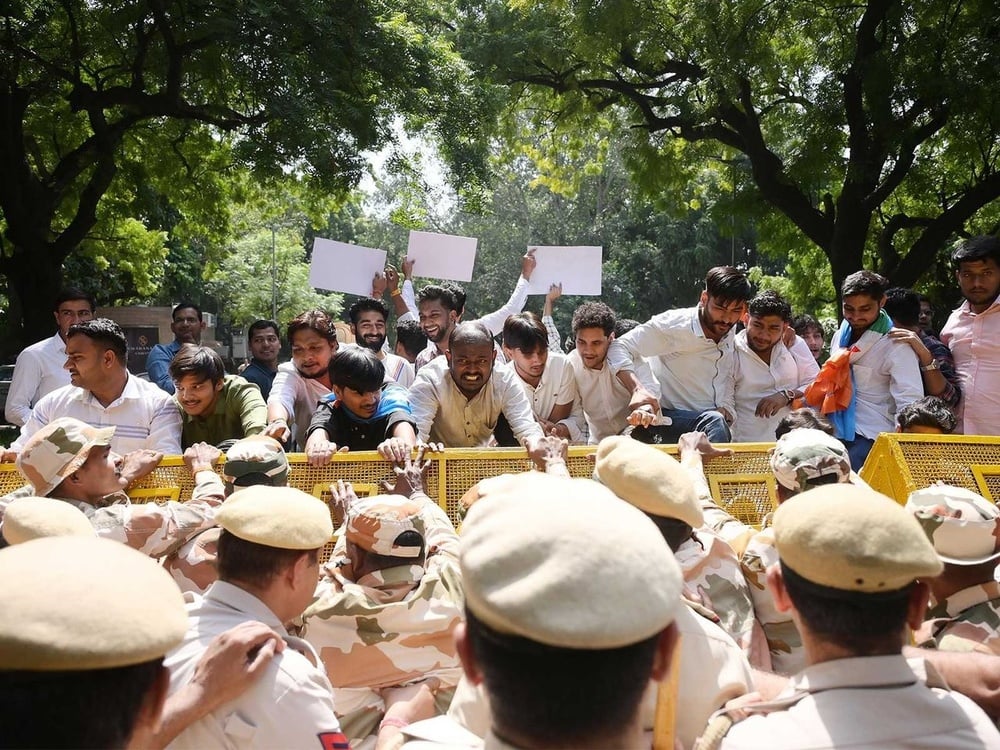
“Prohibitory orders under Section 163 of the Bharatiya Nagarik Suraksha Sanhita (BNSS) have been imposed across the New Delhi district ahead of a proposed protest at Jantar Mantar against Chief Election Commissioner Gyanesh Kumar, police said on Friday.” · exact text match
Why: The lead sentence attributes the central claim to police and uses no evaluative adjectives.
Claim: The article uses restrained, procedural language and avoids sensationalism.
“Police sources said around 3,000 to 4,000 people were expected to attend the gathering.” · exact text match
Why: The attendance estimate is attributed and presented flatly, without dramatic or charged framing.
Claim: The article is purely descriptive and offers no recommendations or preferred outcome.
“The order bars, without prior written permission, public gatherings or assemblies of five or more people, processions, demonstrations, picketing and dharnas.” · exact text match
“Additional Delhi Police and Central Armed Police Forces personnel have been deployed at Jantar Mantar and other sensitive locations in the New Delhi district.” · exact text match
Why: It lists restrictions and deployments without telling readers what ought to be done.
Claim: The article maintains a neutral emotional register with no positive or negative valence imposed by the publisher.
“The protest was scheduled for 11 am on Gandhi Jayanti.” · exact text match
“Barricades have also been put up to regulate movement and prevent unauthorised gatherings.” · exact text match
Why: Specifics are delivered without charged terms, alarm, or emotional appeals.
Claim: The text is credible on its face because it relies on attributed police and organizer statements and contains no anonymous editorial assertions.
“Prohibitory orders under Section 163 of the Bharatiya Nagarik Suraksha Sanhita (BNSS) have been imposed across the New Delhi district ahead of a proposed protest at Jantar Mantar against Chief Election Commissioner Gyanesh Kumar, police said on Friday.” · exact text match
“Police sources said around 3,000 to 4,000 people were expected to attend the gathering.” · exact text match
Why: Claims are sourced to police, police sources, or organizers; the text does not contradict itself, though independent verification is not supplied.
Claim: The report is transparently attributed and gives the organizers' position alongside police statements.
“"The order has been enforced to ensure public safety, maintain public order and facilitate smooth traffic movement," a senior police officer said.” · exact text match
“The organisers have raised concerns over electoral rolls and the ongoing Special Intensive Revision (SIR) exercise and have sought action against Kumar.” · exact text match
Why: The publisher separates reported claims from its own voice and includes both official and organizing perspectives.
The supplied article text is a brief, unattributed police-report item with duplicated paragraphs, leaving little unique editorial content to analyze.
October 02, 2026 · 0 shares
A factual, attributed news brief relays a protest-linked Delhi Metro station closure and the protesters' allegations without endorsing them.
Automated analysis; not human reviewed.
Limitations: The article supplies no publication date or byline, so the 'Friday' timing and the author's perspective cannot be assessed.
·
6 of 55 available dimensions scored; omitted dimensions are not treated as neutral.
·
Verified supporting quotes for 5 of 6 scored dimensions.
Claim: The piece reports sourced operational details and attributes protest demands rather than offering its own assessment.
“Entry and exit at Janpath, Patel Chowk, Central Secretariat, Rajiv Chowk, Seva Teerth, Mandi House, Lok Kalyan Marg, INA, Chawri Bazar, Ramakrishna Ashram Marg and New Delhi stations will remain closed till further notice, the DMRC said in a post on X.” · exact text match
“The Aam Aadmi Party, All India Students' Association (AISA), National Students' Union of India (NSUI) and Indian Youth Congress (IYC) have announced protests at Jantar Mantar, demanding the resignation of Chief Election Commissioner Gyanesh Kumar and alleging mass deletion of voters.” · exact text match
Why: All statements are sourced or attributed, and the accusation is explicitly labeled 'alleging'.
Claim: The language is restrained and administrative, with no emotional or dramatic framing.
“However, the interchange facility will remain available at Rajiv Chowk, Mandi House, New Delhi and Central Secretariat stations, it said.” · exact text match
Why: The sentence is neutral and procedural, with no adjectives, urgency, or heightened emphasis.
Claim: The text describes events without recommending a response or adopting a normative position.
“The Delhi Metro closed entry and exit at 11 stations on Friday, including Rajiv Chowk, Central Secretariat and Jantar Mantar, after the AAP and student unions announced protests.” · exact text match
Why: The sentence reports an action and its stated context; no imperative or judgment follows.
Claim: The article maintains an unemotional, neutral register throughout.
“The Delhi Metro closed entry and exit at 11 stations on Friday, including Rajiv Chowk, Central Secretariat and Jantar Mantar, after the AAP and student unions announced protests.” · exact text match
Why: The language is factual and free of emotional or value-laden terms.
Claim: The article is credible because it relies on a named official source and attributes demands to named organizations.
“the DMRC said in a post on X.” · exact text match
“The Aam Aadmi Party, All India Students' Association (AISA), National Students' Union of India (NSUI) and Indian Youth Congress (IYC) have announced protests at Jantar Mantar.” · not found in supplied text
Why: Named attribution and explicit marking of an accusation support the report's trustworthiness.
Claim: The report signals fairness by attributing operational details to DMRC and marking the voter-deletion claim as an allegation.
“demanding the resignation of Chief Election Commissioner Gyanesh Kumar and alleging mass deletion of voters.” · exact text match
“the DMRC said in a post on X.” · exact text match
Why: The accusation is not asserted as fact, and the source of the closure information is named.
The article supplies no publication date or byline, so the 'Friday' timing and the author's perspective cannot be assessed.
October 02, 2026 · 0 shares
A plain wire-style presentation relays the arrest count and names of detained politicians through police and BBC Hindi attribution, with no editorializing.
Jantar Mantar is a designated public protest site in central Delhi.
Automated analysis; not human reviewed.
Limitations: The article text is truncated after 'Other established opposition parties […]' and is mixed with site markup and related headlines; this analysis covers only the substantive report.
·
5 of 55 available dimensions scored; omitted dimensions are not treated as neutral.
·
Verified supporting quotes for 5 of 5 scored dimensions.
Claim: The report is politically neutral, relaying both the protest demand and the arrests without endorsement.
“The Cockroach Janata Party (CJP) launched the protest on Thursday demanding Kumar’s resignation.” · exact text match
“Those arrested include students as well as several opposition leaders.” · exact text match
Why: No judgment of the protest or police is offered; both statements are factual descriptions.
Claim: The report avoids subjective interpretation and relies on attributed reporting.
“More than 700 people were reportedly arrested from Jantar Mantar in Delhi alone.” · exact text match
“According to BBC Hindi, Aam Aadmi Party leader and former Delhi Chief Minister Atishi, and former minister Saurabh Bharadwaj were among those arrested.” · exact text match
Why: Use of 'reportedly' and 'According to BBC Hindi' signals sourcing rather than the publisher's own assertion.
Claim: The report is plain and non-sensational despite a large arrest figure.
“More than 700 people have been arrested by police during protests in India demanding the resignation of Chief Election Commissioner Gyanesh Kumar.” · exact text match
Why: No emotive adjectives, dramatic verbs, or alarmist framing are used.
Claim: The text is purely descriptive and makes no call to action or recommendation.
“Those arrested include students as well as several opposition leaders.” · exact text match
Why: The sentences report events and people without prescribing what should happen.
Claim: The article shows moderate credibility through hedged figures and named external attribution.
“More than 700 people were reportedly arrested from Jantar Mantar in Delhi alone.” · exact text match
“According to BBC Hindi, Aam Aadmi Party leader and former Delhi Chief Minister Atishi, and former minister Saurabh Bharadwaj were among those arrested.” · exact text match
Why: Attribution and hedging are present, but the only named source is a media outlet and no direct police statements are quoted.
The article text is truncated after 'Other established opposition parties […]' and is mixed with site markup and related headlines; this analysis covers only the substantive report.
October 03, 2026 · 0 shares
Framing is neutral and administrative, centered on police FIRs and legal provisions, with detainees listed without editorial commentary.
Jantar Mantar is a customary protest venue in New Delhi; the Special Intensive Revision (SIR) is an Election Commission electoral-roll update process that had drawn opposition allegations before this protest.
Automated analysis; not human reviewed.
Limitations: The main limitation is that the supplied article is a police-sourced wire report; no substantive independent account from protesters or the Election Commission appears.
·
2 of 55 available dimensions scored; omitted dimensions are not treated as neutral.
·
Verified supporting quotes for 2 of 2 scored dimensions.
Claim: The report is objectively framed, relying on attributed police statements and statutory detail rather than publisher opinion.
“a senior police officer said” · exact text match
“according to police” · exact text match
Why: Every substantive claim about the protest is attributed to police or framed as an FIR detail, with no evaluative or emotive language.
Claim: The report avoids sensationalizing a potentially dramatic mass-detention event.
“Nearly 1,000 people were detained from Jantar Mantar and surrounding areas as police and paramilitary personnel prevented large groups from reaching the protest site.” · exact text match
Why: The highest-impact detail is presented as a plain count and outcome, without hyperbolic adjectives, exclamation, or victimization framing.
The main limitation is that the supplied article is a police-sourced wire report; no substantive independent account from protesters or the Election Commission appears.
October 02, 2026 · 0 shares
A plain wire-style presentation relays the arrest count and names of detained politicians through police and BBC Hindi attribution, with no editorializing.
Jantar Mantar is a designated public protest site in central Delhi.
Automated analysis; not human reviewed.
Limitations: The article text is truncated after 'Other established opposition parties […]' and is mixed with site markup and related headlines; this analysis covers only the substantive report.
·
5 of 55 available dimensions scored; omitted dimensions are not treated as neutral.
·
Verified supporting quotes for 5 of 5 scored dimensions.
Claim: The report is politically neutral, relaying both the protest demand and the arrests without endorsement.
“The Cockroach Janata Party (CJP) launched the protest on Thursday demanding Kumar’s resignation.” · exact text match
“Those arrested include students as well as several opposition leaders.” · exact text match
Why: No judgment of the protest or police is offered; both statements are factual descriptions.
Claim: The report avoids subjective interpretation and relies on attributed reporting.
“More than 700 people were reportedly arrested from Jantar Mantar in Delhi alone.” · exact text match
“According to BBC Hindi, Aam Aadmi Party leader and former Delhi Chief Minister Atishi, and former minister Saurabh Bharadwaj were among those arrested.” · exact text match
Why: Use of 'reportedly' and 'According to BBC Hindi' signals sourcing rather than the publisher's own assertion.
Claim: The report is plain and non-sensational despite a large arrest figure.
“More than 700 people have been arrested by police during protests in India demanding the resignation of Chief Election Commissioner Gyanesh Kumar.” · exact text match
Why: No emotive adjectives, dramatic verbs, or alarmist framing are used.
Claim: The text is purely descriptive and makes no call to action or recommendation.
“Those arrested include students as well as several opposition leaders.” · exact text match
Why: The sentences report events and people without prescribing what should happen.
Claim: The article shows moderate credibility through hedged figures and named external attribution.
“More than 700 people were reportedly arrested from Jantar Mantar in Delhi alone.” · exact text match
“According to BBC Hindi, Aam Aadmi Party leader and former Delhi Chief Minister Atishi, and former minister Saurabh Bharadwaj were among those arrested.” · exact text match
Why: Attribution and hedging are present, but the only named source is a media outlet and no direct police statements are quoted.
The article text is truncated after 'Other established opposition parties […]' and is mixed with site markup and related headlines; this analysis covers only the substantive report.
October 03, 2026 · 0 shares
Coverage frames the story primarily around opposition protesters' grievances and police restrictions, while including official responses as secondary context.
The Election Commission of India is the constitutional body responsible for electoral rolls; a special intensive revision is an official voter-list update process.
Section 163 of the Bharatiya Nagarik Suraksha Sanhita is the legal basis for prohibitory orders restricting assembly in the area.
Automated analysis; not human reviewed.
Limitations: No author byline or publication date is supplied; the embedded related-link headlines were treated as page chrome, and no external verification of the cited Indian Express/PTI reporting was possible.
·
7 of 55 available dimensions scored; omitted dimensions are not treated as neutral.
·
Verified supporting quotes for 7 of 7 scored dimensions.
Claim: The article leans liberal in its selection and emphasis by foregrounding opposition protesters' grievances and state restrictions against the CEC and police, while presenting the official response as secondary.
“The protesters have raised concerns about the functioning of the Election Commission and its handling of the special intensive revision of electoral rolls.” · exact text match
“The authorities had on Friday also suspended internet services in areas around Jantar Mantar, while the main protest area was barricaded.” · exact text match
Counterevidence:
“The police have said that permission has not been granted for any demonstration and that orders prohibiting a gathering of five or more persons under Section 163 of the Bharatiya Nagarik Suraksha Sanhita remain in force in the New Delhi district.” · exact text match
Why: The detailed attention to protest grievances and police restrictions, with official explanations included but not foregrounded, supports a liberal/left framing; the inclusion of police and EC statements lowers confidence.
Claim: The article reports in an objective, attributed style rather than offering the reporter's subjective judgments.
“The protesters have raised concerns about the functioning of the Election Commission and its handling of the special intensive revision of electoral rolls.” · exact text match
“Kumar has not yet commented on The Indian Express’ investigation.
However, after the report was published, the Election Commission had said that “operational queries or inputs raised by commission members during draft stages are part of standard administrative practice” to safeguard voter rights.”
· exact text match
Why: Statements are attributed to protesters, police, The Indian Express, and the Election Commission, with no un-attributed evaluative claims by the reporter.
Claim: The report is un-sensational in tone and wording.
“Lawyer Prashant Bhushan, activist Yogendra Yadav and All India Students’ Association chief Neha Bora were among those detained at Delhi’s Jantar Mantar on Saturday during a protest to demand the resignation of Chief Election Commissioner Gyanesh Kumar.” · exact text match
Why: The central event is described in routine, neutral language; no dramatic adjectives or fear-based phrasing appears in the substantive report.
Claim: The article describes events and attributed demands without prescribing action.
“The Opposition has also demanded the removal of Kumar.” · exact text match
“The protesters have raised concerns about the functioning of the Election Commission and its handling of the special intensive revision of electoral rolls.” · exact text match
Why: Calls for resignation are attributed to protesters and opposition; the article itself does not issue a recommendation or imperative.
Claim: The article is highly political, centering on an opposition demand and electoral-administration controversy.
“Rajya Sabha MP Kapil Sibal had also marched to the site of the demonstration, demanding the resignation of Chief Election Commissioner Gyanesh Kumar.” · exact text match
“The Opposition has also demanded the removal of Kumar.” · exact text match
Why: The actors, subject matter, and demands are explicitly partisan and electoral, making the report political by topic and framing.
Claim: The article's visible sourcing and careful attribution make it highly credible on its face.
“According to The Indian Express investigation, Sandhu and Joshi had reportedly objected to changes to Form 6, appeals against the inclusion of voters in West Bengal and the handling of voter data in Goa, among other matters.” · exact text match
“The police have also registered three first information reports in connection with Friday’s demonstration, reported PTI.” · exact text match
Why: It names the investigating outlet, attributes police information, uses 'reportedly' to mark uncertainty, and includes the institutional response.
Claim: The article demonstrates internal fairness by attributing reports and including the Election Commission's response to the allegations.
“The police have also registered three first information reports in connection with Friday’s demonstration, reported PTI.” · exact text match
“Kumar has not yet commented on The Indian Express’ investigation.
However, after the report was published, the Election Commission had said that “operational queries or inputs raised by commission members during draft stages are part of standard administrative practice” to safeguard voter rights.”
· exact text match
Why: It names its sources (PTI, The Indian Express, Scroll), reports the accused party's non-comment, and includes the Commission's standard-practice defense.
No author byline or publication date is supplied; the embedded related-link headlines were treated as page chrome, and no external verification of the cited Indian Express/PTI reporting was possible.
October 03, 2026 · 0 shares
Framing is neutral and administrative, centered on police FIRs and legal provisions, with detainees listed without editorial commentary.
Jantar Mantar is a customary protest venue in New Delhi; the Special Intensive Revision (SIR) is an Election Commission electoral-roll update process that had drawn opposition allegations before this protest.
Automated analysis; not human reviewed.
Limitations: The main limitation is that the supplied article is a police-sourced wire report; no substantive independent account from protesters or the Election Commission appears.
·
2 of 55 available dimensions scored; omitted dimensions are not treated as neutral.
·
Verified supporting quotes for 2 of 2 scored dimensions.
Claim: The report is objectively framed, relying on attributed police statements and statutory detail rather than publisher opinion.
“a senior police officer said” · exact text match
“according to police” · exact text match
Why: Every substantive claim about the protest is attributed to police or framed as an FIR detail, with no evaluative or emotive language.
Claim: The report avoids sensationalizing a potentially dramatic mass-detention event.
“Nearly 1,000 people were detained from Jantar Mantar and surrounding areas as police and paramilitary personnel prevented large groups from reaching the protest site.” · exact text match
Why: The highest-impact detail is presented as a plain count and outcome, without hyperbolic adjectives, exclamation, or victimization framing.
The main limitation is that the supplied article is a police-sourced wire report; no substantive independent account from protesters or the Election Commission appears.
The coverage is straight-news and descriptive, relaying official FIR details and attributed opposition allegations without endorsing either side.
Automated analysis; not human reviewed.
Limitations: No named reporter or publisher appears in the supplied text, and the article is a short wire-style summary, limiting analysis to the visible text.
·
4 of 55 available dimensions scored; omitted dimensions are not treated as neutral.
·
Verified supporting quotes for 4 of 4 scored dimensions.
Claim: The article is nonpartisan in presentation, pairing police and legal details with attributed opposition statements rather than endorsing a side.
“Two FIRs were registered at the Parliament Street (Sansad Marg) Police Station, while one FIR was filed at the Connaught Place Police Station.” · exact text match
“Congress General Secretary KC Venugopal said the Congress and INDIA bloc leaders were prepared to face arrest, alleging that the votes of common people were being "snatched" through the Election Commission of India.” · exact text match
Why: Official procedural facts are reported alongside an attributed opposition claim, and the publisher does not add editorial endorsement or rebuttal.
Claim: The report uses neutral, fact-reporting language and clearly attributes opinion to named sources.
“At least three FIRs have been registered by the Delhi Police in connection with the mass protest held near Jantar Mantar on October 2 against Chief Election Commissioner Gyanesh Kumar.” · exact text match
“Congress General Secretary KC Venugopal said the Congress and INDIA bloc leaders were prepared to face arrest, alleging that the votes of common people were being "snatched" through the Election Commission of India.” · exact text match
Why: The first quote is a declarative police-report statement; the second attributes a charged allegation to a named politician, showing separation of fact and opinion.
Claim: The writing is restrained and avoids hype or emotional language in the publisher's own voice.
“The police are investigating the matter.” · exact text match
“The demonstration was held amid heightened security in central Delhi after police denied permission for the proposed protest and imposed prohibitory restrictions under Section 163 of the Bharatiya Nagarik Suraksha Sanhita (BNSS), 2023.” · exact text match
Why: The prose is procedural and even-paced, with emotional or charged wording confined to attributed quotations.
Claim: The article provides specific, checkable details and named attributed sources.
“The cases have been registered under Sections 223, 221, 132, and 3(5) of the Bharatiya Nyaya Sanhita (BNS) for violating prohibitory orders, obstructing public servants, and unlawful assembly.” · exact text match
“The controversy came after a report in The Indian Express said that Election Commissioners Sukhbir Singh Sandhu and Vivek Joshi had formally raised objections on at least 14 occasions over a 10-month period regarding decisions concerning electoral rolls, voter registration and the Commission's technology systems.” · exact text match
Why: Visible specificity—police stations, legal sections, a named publication, and named officials—supports reliability, though independent verification is outside the supplied text.
No named reporter or publisher appears in the supplied text, and the article is a short wire-style summary, limiting analysis to the visible text.
October 04, 2026 · 0 shares
Framed as a police-accountability controversy, with opposition and press-body allegations presented in detail while police response is summarized mainly as a procedural transfer.
Jantar Mantar in New Delhi is a customary protest venue; in India, an FIR is the formal complaint that initiates a police investigation.
Automated analysis; not human reviewed.
Limitations: The supplied excerpt contains duplicated passages and sidebar headlines; only the main article body was used for analysis.
·
6 of 55 available dimensions scored; omitted dimensions are not treated as neutral.
·
Verified supporting quotes for 3 of 6 scored dimensions.
Claim: The article uses attributed language and includes the police response when relaying unproven allegations.
“Congress MP Rahul Gandhi, the CJP and AISA have claimed that Delhi Police personnel sexually assaulted and groped women journalists at a protest in Jantar Mantar.” · exact text match
“In a tweet, the Delhi Police said they received complaints of sexual harassment by three women journalists at the protest site and transferred them to the Crime Branch for a "fair and impartial enquiry".” · exact text match
Why: The lead marks the core accusations as claims and includes the police's procedural response, rather than asserting the groping as established fact.
Claim: The report is built around a political confrontation between the opposition and the Union Home Ministry over police conduct.
“Congress leader Rahul Gandhi on Saturday demanded answers from Union Home Minister Amit Shah after three women journalists claimed they were sexually assaulted and groped by the Delhi Police personnel during a protest at Jantar Mantar.” · exact text match
“Demonstrations were held there demanding the resignation of Chief Election Commissioner Gyanesh Kumar after the Opposition accused him of irregularities during SIR and deleted votes to benefit the BJP.” · exact text match
Why: The story's selection and lead center on Rahul Gandhi's demand and the opposition's electoral allegations, making partisan accountability the primary frame.
Claim: The article focuses on politicians', activists', and press bodies' reactions rather than on the complainants' own accounts or details of the alleged incidents.
“Congress leader Rahul Gandhi on Saturday demanded answers from Union Home Minister Amit Shah after three women journalists claimed they were sexually assaulted and groped by the Delhi Police personnel during a protest at Jantar Mantar.” · exact text match
“In a statement, the Press Club of India said it was "shocked and dismayed at the Delhi Police's actions against and treatment of journalists during the protests at Jantar Mantar".” · not found in supplied text
Why: After noting that complaints were filed, the article devotes most of its space to statements by Rahul Gandhi, CJP, AISA, and the Press Club, making the response to the event the main content.
Claim: The article's structure and emphasis are weighted against the police and the central government, with no government defense beyond the transfer statement.
“A government that fears registering even one woman’s complaint – what exactly is it protecting? Delhi Police comes under the Ministry of Home Affairs.
Amit Shah ji, where are you? You have to answer for this, he wrote.”
· not found in supplied text
“In a statement, the Press Club of India said it was "shocked and dismayed at the Delhi Police's actions against and treatment of journalists during the protests at Jantar Mantar".” · not found in supplied text
Why: The quoted criticism is attributed, but the article makes it the centerpiece and offers no named police or government rebuttal beyond the procedural transfer.
This creates an anti-establishment slant.
Claim: The article has strong visible sourcing, naming institutions, officers, political leaders, and a specific police statement.
“On 03-10-26, during the protest in New Delhi area, while being in law and order situation, allegations of sexual harassment were made by three female journalists against police officers.” · exact text match
“CJP founder Abhijeet Dipke alleged that the woman journalist had been refused to file an FIR against the alleged misconduct.” · exact text match
Why: It gives an exact police statement, named accusers/spokespeople, and direct quotes, while using 'alleged' to flag unverified accusations.
Claim: The publisher signals fairness by naming sources, attributing statements, and preserving the distinction between allegation and confirmation.
“Congress MP Rahul Gandhi, the CJP and AISA have claimed that Delhi Police personnel sexually assaulted and groped women journalists at a protest in Jantar Mantar.” · exact text match
“CJP spokesperson Saurav Das accused ACP Vivek Bhagat of misbehaving with the woman journalist and touching her inappropriately.” · not found in supplied text
Why: The article repeatedly uses 'claimed,' 'alleged,' and 'accused' with named speakers, preventing the reports from being presented as established fact.
The supplied excerpt contains duplicated passages and sidebar headlines; only the main article body was used for analysis.
October 04, 2026 · 0 shares
The framing is rights-and-accountability oriented, foregrounding a journalist's sexual assault allegation, the police's initial non-response, and opposition demands for an FIR while also noting the police's referral for inquiry.
Automated analysis; not human reviewed.
Limitations: The supplied text is a truncated story with no byline or publication identity, so author-specific framing and full surrounding context could not be assessed.
·
6 of 55 available dimensions scored; omitted dimensions are not treated as neutral.
·
Verified supporting quotes for 6 of 6 scored dimensions.
Claim: The report is written objectively, using attributed claims and explicit uncertainty rather than adopting the allegation as fact.
“A journalist alleged on Saturday that a senior Delhi Police officer sexually assaulted her while she was covering protests at Jantar Mantar.” · exact text match
“It was unclear whether the Delhi Police was referring to the allegations against Bhagat or to separate complaints of sexual assault.” · exact text match
Why: Repeated attribution with 'alleged' and an explicit statement of ambiguity keeps the presentation objective.
Claim: The coverage is descriptive, narrating events and statements without issuing recommendations or commands.
“In a video shared by Cockroach Janta Party founder Abhijeet Dipke, the journalist alleged that Assistant Commissioner of Police Vivek Bhagat groped her while she was making a video of the detention of student leader Neha Bora at Delhi’s Jantar Mantar on Saturday during a protest demanding the resignation of Chief Election Commissioner Gyanesh Kumar.” · exact text match
“The New Delhi district police has received their complaints and transferred them to the Crime Branch at Kamla Market for a “fair and impartial enquiry” against the police officers, it said.” · exact text match
Why: The article mainly recounts who did and said what, with no editorial prescription.
Claim: The article is strongly political in subject and sourcing, centering on a protest against a constitutional office-holder and including opposition-party criticism.
“during a protest demanding the resignation of Chief Election Commissioner Gyanesh Kumar” · exact text match
“Congress leader Rahul Gandhi also asked why there had been a delay in registering an FIR in the case.” · exact text match
Why: The core event is a political protest and a major opposition leader's statement is included, making the report politically salient.
Claim: The publisher's own narrative voice is emotionally neutral, keeping emotive language inside direct quotations.
“The journalist said that she went to the Parliament Street police station to file a complaint, but no action was taken.” · exact text match
“The Delhi Police said on Sunday that three journalists had made allegations of sexual harassment “in context of the emergent law and order situation” a day earlier, ANI reported.” · exact text match
Why: The framing relies on neutral verbs such as 'said' and 'alleged'; emotional phrases such as 'gripped by fear' appear only in Rahul Gandhi's quoted remark.
Claim: The article is highly credible in its visible practices: it names sources, attributes claims, and flags unresolved ambiguity.
“The Delhi Police said on Sunday that three journalists had made allegations of sexual harassment “in context of the emergent law and order situation” a day earlier, ANI reported.” · exact text match
“It was unclear whether the Delhi Police was referring to the allegations against Bhagat or to separate complaints of sexual assault.” · exact text match
Why: Citing ANI, clearly attributing statements, and explicitly noting uncertainty support a high credibility rating.
Claim: The article reasons in a measured, evidence-bound way, preserving uncertainty instead of leaping to conclusions.
“It was unclear whether the Delhi Police was referring to the allegations against Bhagat or to separate complaints of sexual assault.” · exact text match
“The Delhi Police said on Sunday that three journalists had made allegations of sexual harassment “in context of the emergent law and order situation” a day earlier, ANI reported.” · exact text match
Why: The text flags unresolved ambiguity and attributes official statements, reflecting rational epistemic restraint.
The supplied text is a truncated story with no byline or publication identity, so author-specific framing and full surrounding context could not be assessed.
October 04, 2026 · 0 shares
The coverage is measured and attribution-heavy but response-centric, centering on the police transfer of the complaints and Rahul Gandhi's political criticism rather than on the complainants' own accounts.
The protest at Jantar Mantar, a designated protest venue in New Delhi, was part of demonstrations demanding the CEC's ouster; related-item headlines in the supplied text say Delhi Police registered three FIRs over the protest and nearly 700 people were detained in the capital.
Automated analysis; not human reviewed.
Limitations: The supplied text does not name the publisher, byline, or publication date; the framing analysis is based solely on the article body and embedded related headlines.
·
55 of 55 available dimensions scored; omitted dimensions are not treated as neutral.
·
Verified supporting quotes for 7 of 55 scored dimensions.
Claim: The report shows no partisan preference; it attributes the police response and Rahul Gandhi’s criticism rather than endorsing either.
“The New Delhi district police have handed the complaints to the Crime Branch for an enquiry, police said on Sunday (October 4).” · exact text match
“Rahul said that the Delhi Police comes under the Ministry of Home Affairs and questioned why an FIR had not been registered.” · exact text match
Why: Both the government/police action and the opposition criticism are reported with attribution; no editorial conclusion prefers one side.
Claim: The article's own voice is objective, limiting itself to allegations and attributed statements.
“Three women journalists have complained of sexual harassment by Delhi Police personnel during Saturday’s (October 3) protest at Jantar Mantar.” · exact text match
“The Crime Branch will record statements from the three journalists and others connected to the complaints, an officer said.” · exact text match
Why: It uses 'complained' and 'allegations' and attributes procedural detail to an officer rather than asserting the facts.
Claim: The report is non-sensational even while covering a charged protest and sexual harassment allegations.
“The complaints concern alleged incidents involving police personnel who were deployed at the protest to maintain law and order.” · exact text match
Why: The only emotionally charged language appears inside Rahul Gandhi's quoted post, not in the publisher's narration.
Claim: The article is descriptive, reporting actions and statements without issuing recommendations.
“The New Delhi district police have handed the complaints to the Crime Branch for an enquiry, police said on Sunday (October 4).” · exact text match
Why: The report's own sentences describe police process and quote others' demands; it does not call for action.
Claim: The framing centers on the institutional and political response to the complaints more than on the complainants' accounts.
“The allegations have also drawn a response from Leader of the Opposition in the Lok Sabha Rahul Gandhi.” · exact text match
Why: Substantive reporting is devoted to police transfers, Delhi Police statements, and Rahul Gandhi's reaction; the alleged incidents themselves are not described in detail.
Claim: The article is credible on its face because it sources and attributes its factual statements.
“police said on Sunday (October 4)” · exact text match
“an officer said” · exact text match
Why: It names the institutional source, Delhi Police, and an officer for procedural details, and labels underlying claims as allegations.
Claim: The article gives both the police's administrative response and the opposition's criticism, with clear attribution.
““New Delhi District has received their complaints and the same are transferred to Crime Branch for fair and impartial enquiry,” it added.” · exact text match
“Rahul said that the Delhi Police comes under the Ministry of Home Affairs and questioned why an FIR had not been registered.” · exact text match
Why: No party's account is presented as unqualified fact, and the publisher does not suppress the critical response.
The supplied text does not name the publisher, byline, or publication date; the framing analysis is based solely on the article body and embedded related headlines.
Reporting frames the CJP protest as a righteous, popular rebuke of an alleged BJP-EC voter-roll purge, with little countervailing sourcing.
The Cockroach Janta Party (CJP) is a protest group led by Abhijeet Dipke; Jantar Mantar is a well-known protest venue in New Delhi; the Special Intensive Revision (SIR) is an Election Commission voter-list update process.
Automated analysis; not human reviewed.
Limitations: The supplied text is a single story without the Election Commission's detailed response or independent verification of voter-roll claims, so framing judgments rely on the article's internal emphasis and selection.
·
10 of 55 available dimensions scored; omitted dimensions are not treated as neutral.
·
Verified supporting quotes for 10 of 10 scored dimensions.
Claim: The piece adopts a liberal/left framing sympathetic to anti-BJP protesters and treats their allegations as credible.
“Mumbai’s overwhelming response to the Cockroach Janta Party’s protest demanding Chief Election Commissioner Gyanesh Kumar’s resignation is a shot in the arm for the CJP” · exact text match
“Mumbai had sent a clear message to those in power” · exact text match
Why: Editorializing adjectives and the selected narrative align the coverage with the protesters' anti-BJP, pro-democracy position.
Claim: The article celebrates ordinary people's protest against 'those in power', a populist framing.
“Mumbai had sent a clear message to those in power, echoing one of the posters: “Suno Sarkar, Ab Ki Baar, Jhola Uthalo Yaar.”” · exact text match
Why: It presents 'the people' as a unified moral force arrayed against an out-of-touch government.
Claim: News reporting is blended with subjective editorial evaluation.
“Mumbai’s overwhelming response to the Cockroach Janta Party’s protest demanding Chief Election Commissioner Gyanesh Kumar’s resignation is a shot in the arm for the CJP” · exact text match
Why: Words such as 'overwhelming response' and 'shot in the arm' evaluate rather than merely describe.
Claim: The article strikes a positive, buoyant tone about the protest's momentum.
“Mumbai’s overwhelming response to the Cockroach Janta Party’s protest demanding Chief Election Commissioner Gyanesh Kumar’s resignation is a shot in the arm for the CJP” · exact text match
“Mumbai had sent a clear message to those in power” · exact text match
Why: The framing highlights success and public affirmation rather than obstacles or doubts.
Claim: The report is substantially opinionated in tone even while reporting facts.
“Mumbai’s overwhelming response to the Cockroach Janta Party’s protest demanding Chief Election Commissioner Gyanesh Kumar’s resignation is a shot in the arm for the CJP” · exact text match
Why: This sentence states a judgment about political momentum, not an observed fact.
Claim: The article is deeply political, covering a partisan protest and adopting its adversarial framing.
“Mumbai had sent a clear message to those in power” · exact text match
Why: It is entirely about a political conflict and frames the outcome as a rebuke to the ruling party.
Claim: The article asserts strong conclusions about public sentiment beyond what the event can establish.
“Mumbai’s overwhelming response to the Cockroach Janta Party’s protest demanding Chief Election Commissioner Gyanesh Kumar’s resignation is a shot in the arm for the CJP” · exact text match
Why: 'Overwhelming response' generalizes from an unsystematically observed crowd to a definitive political signal.
Claim: The coverage is anti-establishment, favoring challengers to the incumbent government and Election Commission.
“CJP gets a Mumbai boost.” · exact text match
“Mumbai had sent a clear message to those in power” · exact text match
Why: The presentation treats a protest against national institutions as a welcome development and a rebuke to power.
Claim: The tone is emotionally positive, emphasizing enthusiasm and moral purpose.
“Mumbai’s overwhelming response to the Cockroach Janta Party’s protest demanding Chief Election Commissioner Gyanesh Kumar’s resignation is a shot in the arm for the CJP” · exact text match
Why: The publication's own language conveys excitement and approval in a news report.
Claim: The article shows moderate credibility through named sources, attributed allegations, and specific event details.
“demanding the resignation of Chief Election Commissioner Gyanesh Kumar over alleged irregularities in voter rolls” · exact text match
Counterevidence:
“Mumbai’s overwhelming response to the Cockroach Janta Party’s protest demanding Chief Election Commissioner Gyanesh Kumar’s resignation is a shot in the arm for the CJP” · exact text match
Why: It flags the central accusation as 'alleged' and identifies protesters and officials by name, though one-sided framing lowers full credibility.
The supplied text is a single story without the Election Commission's detailed response or independent verification of voter-roll claims, so framing judgments rely on the article's internal emphasis and selection.
October 04, 2026 · 0 shares
Framing leads with an opposition organizer's accusation that Delhi Police are 'henchmen of Amit Shah' and relays the protest's complaints without an official response, producing a protest-sympathetic, anti-establishment frame.
Automated analysis; not human reviewed.
Limitations: The supplied text is duplicated and truncated mid-sentence, and the final section mixes unrelated headlines; I treated the first coherent report as the article.
·
4 of 55 available dimensions scored; omitted dimensions are not treated as neutral.
·
Verified supporting quotes for 4 of 4 scored dimensions.
Claim: The report's selection gives a one-sided platform to an anti-BJP activist's characterization of police conduct, a liberal/oppositional framing.
“Delhi Police needs to stop acting like henchmen of Amit Shah.
By crushing dissent and cracking down on peaceful protesters, Delhi Police is bringing nothing but shame to the institution and the country.”
· exact text match
“Momentum grew after protesters have raised issues of "vote theft" and removal of voters' names.” · verified after text normalization
Counterevidence:
“The demonstrations focus on alleged irregularities in the Special Intensive Revision (SIR) of electoral rolls and demand the resignation of Chief Election Commissioner Gyanesh Kumar.” · exact text match
Why: The core is an attributed political accusation, but the absence of any official response and the use of 'Momentum grew' align the report with the protest side.
Claim: The framing emphasizes the right to protest against police coercion, a civil-libertarian stance.
“accusing the force of suppressing peaceful dissent and targeting students and activists.” · exact text match
“reiterating that dissent is a democratic right that cannot be crushed by intimidation or force.” · exact text match
Why: The opening and selected quote center on state suppression and legitimate dissent without presenting the police's rationale for detentions.
Claim: The report is squarely political, covering opposition-organized protest and election-administration conflict.
“The demonstrations focus on alleged irregularities in the Special Intensive Revision (SIR) of electoral rolls and demand the resignation of Chief Election Commissioner Gyanesh Kumar.” · exact text match
Why: The named participants are political parties and student groups, and the demand targets a constitutional officeholder.
Claim: The article is anti-establishment, foregrounding protest demands against electoral authorities and the chief election commissioner.
“The demonstrations focus on alleged irregularities in the Special Intensive Revision (SIR) of electoral rolls and demand the resignation of Chief Election Commissioner Gyanesh Kumar.” · exact text match
“Momentum grew after protesters have raised issues of "vote theft" and removal of voters' names.” · verified after text normalization
Why: Even while using 'alleged' and 'reportedly', the report amplifies challenger demands against the election administration and treats 'vote theft' as momentum.
The supplied text is duplicated and truncated mid-sentence, and the final section mixes unrelated headlines; I treated the first coherent report as the article.
October 03, 2026 · 0 shares
Activists' grievances and police detentions receive the most prominent framing, while the Election Commission's rebuttal is relegated to a brief closing assertion.
Automated analysis; not human reviewed.
Limitations: Only the supplied article text was available; no independent verification of detention numbers, police permissions, or the commissioners' objections is possible.
·
21 of 55 available dimensions scored; omitted dimensions are not treated as neutral.
·
Verified supporting quotes for 3 of 21 scored dimensions.
Claim: The report presents both protester allegations and the Election Commission's rebuttal with attribution, avoiding outright endorsement of either side.
“The protesters are opposing the SIR exercise and alleging irregularities in the revision of electoral rolls.” · exact text match
“Election Commission has asserted that differing views and observations are a normal part of deliberations in any institution and that all its orders carry full legal sanction and follow established statutory procedures.” · exact text match
Why: Most reporting uses attributed claims, though the phrase 'red flags' adds a mildly interpretive framing.
Claim: The report is centered on a political controversy over the Election Commission and electoral roll revision.
“The fresh mobilisation came after AISA national president Neha Bora, who was among those detained on Friday, called on activists to return to Jantar Mantar at 1 pm and continue their protest demanding Kumar’s resignation and raising concerns over the Special Intensive Revision (SIR) of electoral rolls.” · exact text match
Why: The subject matter is explicitly political, involving political and student groups, the Election Commission, and a demand for a constitutional officeholder's resignation.
Claim: The article names parties, attributes disputed assertions, and includes the institution's response.
“The demonstration comes days after The Indian Express reported that Election Commissioners Sukhbir Singh Sandhu and Vivek Joshi had objected on record at least 14 times over the previous 10 months to decisions and orders on the SIR that they said were issued without their knowledge or recommendation.” · exact text match
“Election Commission has asserted that differing views and observations are a normal part of deliberations in any institution and that all its orders carry full legal sanction and follow established statutory procedures.” · exact text match
Why: Competing claims are attributed to named or identifiable sources, and the disputed nature of allegations is marked by verbs such as 'asserted' and 'alleging'.
Only the supplied article text was available; no independent verification of detention numbers, police permissions, or the commissioners' objections is possible.
The coverage is straight-news and descriptive, relaying official FIR details and attributed opposition allegations without endorsing either side.
Automated analysis; not human reviewed. Limitations: No named reporter or publisher appears in the supplied text, and the article is a short wire-style summary, limiting analysis to the visible text. · 4 of 55 available dimensions scored; omitted dimensions are not treated as neutral. · Verified supporting quotes for 4 of 4 scored dimensions.
Claim: The article is nonpartisan in presentation, pairing police and legal details with attributed opposition statements rather than endorsing a side.
“Two FIRs were registered at the Parliament Street (Sansad Marg) Police Station, while one FIR was filed at the Connaught Place Police Station.” · exact text match
“Congress General Secretary KC Venugopal said the Congress and INDIA bloc leaders were prepared to face arrest, alleging that the votes of common people were being "snatched" through the Election Commission of India.” · exact text match
Why: Official procedural facts are reported alongside an attributed opposition claim, and the publisher does not add editorial endorsement or rebuttal.
Claim: The report uses neutral, fact-reporting language and clearly attributes opinion to named sources.
“At least three FIRs have been registered by the Delhi Police in connection with the mass protest held near Jantar Mantar on October 2 against Chief Election Commissioner Gyanesh Kumar.” · exact text match
“Congress General Secretary KC Venugopal said the Congress and INDIA bloc leaders were prepared to face arrest, alleging that the votes of common people were being "snatched" through the Election Commission of India.” · exact text match
Why: The first quote is a declarative police-report statement; the second attributes a charged allegation to a named politician, showing separation of fact and opinion.
Claim: The writing is restrained and avoids hype or emotional language in the publisher's own voice.
“The police are investigating the matter.” · exact text match
“The demonstration was held amid heightened security in central Delhi after police denied permission for the proposed protest and imposed prohibitory restrictions under Section 163 of the Bharatiya Nagarik Suraksha Sanhita (BNSS), 2023.” · exact text match
Why: The prose is procedural and even-paced, with emotional or charged wording confined to attributed quotations.
Claim: The article provides specific, checkable details and named attributed sources.
“The cases have been registered under Sections 223, 221, 132, and 3(5) of the Bharatiya Nyaya Sanhita (BNS) for violating prohibitory orders, obstructing public servants, and unlawful assembly.” · exact text match
“The controversy came after a report in The Indian Express said that Election Commissioners Sukhbir Singh Sandhu and Vivek Joshi had formally raised objections on at least 14 occasions over a 10-month period regarding decisions concerning electoral rolls, voter registration and the Commission's technology systems.” · exact text match
Why: Visible specificity—police stations, legal sections, a named publication, and named officials—supports reliability, though independent verification is outside the supplied text.
No named reporter or publisher appears in the supplied text, and the article is a short wire-style summary, limiting analysis to the visible text.
October 03, 2026 · 0 shares
Framing is neutral and administrative, centered on police FIRs and legal provisions, with detainees listed without editorial commentary.
Jantar Mantar is a customary protest venue in New Delhi; the Special Intensive Revision (SIR) is an Election Commission electoral-roll update process that had drawn opposition allegations before this protest.
Automated analysis; not human reviewed. Limitations: The main limitation is that the supplied article is a police-sourced wire report; no substantive independent account from protesters or the Election Commission appears. · 2 of 55 available dimensions scored; omitted dimensions are not treated as neutral. · Verified supporting quotes for 2 of 2 scored dimensions.
Claim: The report is objectively framed, relying on attributed police statements and statutory detail rather than publisher opinion.
“a senior police officer said” · exact text match
“according to police” · exact text match
Why: Every substantive claim about the protest is attributed to police or framed as an FIR detail, with no evaluative or emotive language.
Claim: The report avoids sensationalizing a potentially dramatic mass-detention event.
“Nearly 1,000 people were detained from Jantar Mantar and surrounding areas as police and paramilitary personnel prevented large groups from reaching the protest site.” · exact text match
Why: The highest-impact detail is presented as a plain count and outcome, without hyperbolic adjectives, exclamation, or victimization framing.
The main limitation is that the supplied article is a police-sourced wire report; no substantive independent account from protesters or the Election Commission appears.
The coverage is straight-news and descriptive, relaying official FIR details and attributed opposition allegations without endorsing either side.
Automated analysis; not human reviewed. Limitations: No named reporter or publisher appears in the supplied text, and the article is a short wire-style summary, limiting analysis to the visible text. · 4 of 55 available dimensions scored; omitted dimensions are not treated as neutral. · Verified supporting quotes for 4 of 4 scored dimensions.
Claim: The article is nonpartisan in presentation, pairing police and legal details with attributed opposition statements rather than endorsing a side.
“Two FIRs were registered at the Parliament Street (Sansad Marg) Police Station, while one FIR was filed at the Connaught Place Police Station.” · exact text match
“Congress General Secretary KC Venugopal said the Congress and INDIA bloc leaders were prepared to face arrest, alleging that the votes of common people were being "snatched" through the Election Commission of India.” · exact text match
Why: Official procedural facts are reported alongside an attributed opposition claim, and the publisher does not add editorial endorsement or rebuttal.
Claim: The report uses neutral, fact-reporting language and clearly attributes opinion to named sources.
“At least three FIRs have been registered by the Delhi Police in connection with the mass protest held near Jantar Mantar on October 2 against Chief Election Commissioner Gyanesh Kumar.” · exact text match
“Congress General Secretary KC Venugopal said the Congress and INDIA bloc leaders were prepared to face arrest, alleging that the votes of common people were being "snatched" through the Election Commission of India.” · exact text match
Why: The first quote is a declarative police-report statement; the second attributes a charged allegation to a named politician, showing separation of fact and opinion.
Claim: The writing is restrained and avoids hype or emotional language in the publisher's own voice.
“The police are investigating the matter.” · exact text match
“The demonstration was held amid heightened security in central Delhi after police denied permission for the proposed protest and imposed prohibitory restrictions under Section 163 of the Bharatiya Nagarik Suraksha Sanhita (BNSS), 2023.” · exact text match
Why: The prose is procedural and even-paced, with emotional or charged wording confined to attributed quotations.
Claim: The article provides specific, checkable details and named attributed sources.
“The cases have been registered under Sections 223, 221, 132, and 3(5) of the Bharatiya Nyaya Sanhita (BNS) for violating prohibitory orders, obstructing public servants, and unlawful assembly.” · exact text match
“The controversy came after a report in The Indian Express said that Election Commissioners Sukhbir Singh Sandhu and Vivek Joshi had formally raised objections on at least 14 occasions over a 10-month period regarding decisions concerning electoral rolls, voter registration and the Commission's technology systems.” · exact text match
Why: Visible specificity—police stations, legal sections, a named publication, and named officials—supports reliability, though independent verification is outside the supplied text.
No named reporter or publisher appears in the supplied text, and the article is a short wire-style summary, limiting analysis to the visible text.
October 03, 2026 · 0 shares
Coverage frames the story primarily around opposition protesters' grievances and police restrictions, while including official responses as secondary context.
The Election Commission of India is the constitutional body responsible for electoral rolls; a special intensive revision is an official voter-list update process. Section 163 of the Bharatiya Nagarik Suraksha Sanhita is the legal basis for prohibitory orders restricting assembly in the area.
Automated analysis; not human reviewed. Limitations: No author byline or publication date is supplied; the embedded related-link headlines were treated as page chrome, and no external verification of the cited Indian Express/PTI reporting was possible. · 7 of 55 available dimensions scored; omitted dimensions are not treated as neutral. · Verified supporting quotes for 7 of 7 scored dimensions.
Claim: The article leans liberal in its selection and emphasis by foregrounding opposition protesters' grievances and state restrictions against the CEC and police, while presenting the official response as secondary.
“The protesters have raised concerns about the functioning of the Election Commission and its handling of the special intensive revision of electoral rolls.” · exact text match
“The authorities had on Friday also suspended internet services in areas around Jantar Mantar, while the main protest area was barricaded.” · exact text match
Counterevidence:
“The police have said that permission has not been granted for any demonstration and that orders prohibiting a gathering of five or more persons under Section 163 of the Bharatiya Nagarik Suraksha Sanhita remain in force in the New Delhi district.” · exact text match
Why: The detailed attention to protest grievances and police restrictions, with official explanations included but not foregrounded, supports a liberal/left framing; the inclusion of police and EC statements lowers confidence.
Claim: The article reports in an objective, attributed style rather than offering the reporter's subjective judgments.
“The protesters have raised concerns about the functioning of the Election Commission and its handling of the special intensive revision of electoral rolls.” · exact text match
“Kumar has not yet commented on The Indian Express’ investigation. However, after the report was published, the Election Commission had said that “operational queries or inputs raised by commission members during draft stages are part of standard administrative practice” to safeguard voter rights.” · exact text match
Why: Statements are attributed to protesters, police, The Indian Express, and the Election Commission, with no un-attributed evaluative claims by the reporter.
Claim: The report is un-sensational in tone and wording.
“Lawyer Prashant Bhushan, activist Yogendra Yadav and All India Students’ Association chief Neha Bora were among those detained at Delhi’s Jantar Mantar on Saturday during a protest to demand the resignation of Chief Election Commissioner Gyanesh Kumar.” · exact text match
Why: The central event is described in routine, neutral language; no dramatic adjectives or fear-based phrasing appears in the substantive report.
Claim: The article describes events and attributed demands without prescribing action.
“The Opposition has also demanded the removal of Kumar.” · exact text match
“The protesters have raised concerns about the functioning of the Election Commission and its handling of the special intensive revision of electoral rolls.” · exact text match
Why: Calls for resignation are attributed to protesters and opposition; the article itself does not issue a recommendation or imperative.
Claim: The article is highly political, centering on an opposition demand and electoral-administration controversy.
“Rajya Sabha MP Kapil Sibal had also marched to the site of the demonstration, demanding the resignation of Chief Election Commissioner Gyanesh Kumar.” · exact text match
“The Opposition has also demanded the removal of Kumar.” · exact text match
Why: The actors, subject matter, and demands are explicitly partisan and electoral, making the report political by topic and framing.
Claim: The article's visible sourcing and careful attribution make it highly credible on its face.
“According to The Indian Express investigation, Sandhu and Joshi had reportedly objected to changes to Form 6, appeals against the inclusion of voters in West Bengal and the handling of voter data in Goa, among other matters.” · exact text match
“The police have also registered three first information reports in connection with Friday’s demonstration, reported PTI.” · exact text match
Why: It names the investigating outlet, attributes police information, uses 'reportedly' to mark uncertainty, and includes the institutional response.
Claim: The article demonstrates internal fairness by attributing reports and including the Election Commission's response to the allegations.
“The police have also registered three first information reports in connection with Friday’s demonstration, reported PTI.” · exact text match
“Kumar has not yet commented on The Indian Express’ investigation. However, after the report was published, the Election Commission had said that “operational queries or inputs raised by commission members during draft stages are part of standard administrative practice” to safeguard voter rights.” · exact text match
Why: It names its sources (PTI, The Indian Express, Scroll), reports the accused party's non-comment, and includes the Commission's standard-practice defense.
No author byline or publication date is supplied; the embedded related-link headlines were treated as page chrome, and no external verification of the cited Indian Express/PTI reporting was possible.
October 04, 2026 · 0 shares
The framing is rights-and-accountability oriented, foregrounding a journalist's sexual assault allegation, the police's initial non-response, and opposition demands for an FIR while also noting the police's referral for inquiry.
Automated analysis; not human reviewed. Limitations: The supplied text is a truncated story with no byline or publication identity, so author-specific framing and full surrounding context could not be assessed. · 6 of 55 available dimensions scored; omitted dimensions are not treated as neutral. · Verified supporting quotes for 6 of 6 scored dimensions.
Claim: The report is written objectively, using attributed claims and explicit uncertainty rather than adopting the allegation as fact.
“A journalist alleged on Saturday that a senior Delhi Police officer sexually assaulted her while she was covering protests at Jantar Mantar.” · exact text match
“It was unclear whether the Delhi Police was referring to the allegations against Bhagat or to separate complaints of sexual assault.” · exact text match
Why: Repeated attribution with 'alleged' and an explicit statement of ambiguity keeps the presentation objective.
Claim: The coverage is descriptive, narrating events and statements without issuing recommendations or commands.
“In a video shared by Cockroach Janta Party founder Abhijeet Dipke, the journalist alleged that Assistant Commissioner of Police Vivek Bhagat groped her while she was making a video of the detention of student leader Neha Bora at Delhi’s Jantar Mantar on Saturday during a protest demanding the resignation of Chief Election Commissioner Gyanesh Kumar.” · exact text match
“The New Delhi district police has received their complaints and transferred them to the Crime Branch at Kamla Market for a “fair and impartial enquiry” against the police officers, it said.” · exact text match
Why: The article mainly recounts who did and said what, with no editorial prescription.
Claim: The article is strongly political in subject and sourcing, centering on a protest against a constitutional office-holder and including opposition-party criticism.
“during a protest demanding the resignation of Chief Election Commissioner Gyanesh Kumar” · exact text match
“Congress leader Rahul Gandhi also asked why there had been a delay in registering an FIR in the case.” · exact text match
Why: The core event is a political protest and a major opposition leader's statement is included, making the report politically salient.
Claim: The publisher's own narrative voice is emotionally neutral, keeping emotive language inside direct quotations.
“The journalist said that she went to the Parliament Street police station to file a complaint, but no action was taken.” · exact text match
“The Delhi Police said on Sunday that three journalists had made allegations of sexual harassment “in context of the emergent law and order situation” a day earlier, ANI reported.” · exact text match
Why: The framing relies on neutral verbs such as 'said' and 'alleged'; emotional phrases such as 'gripped by fear' appear only in Rahul Gandhi's quoted remark.
Claim: The article is highly credible in its visible practices: it names sources, attributes claims, and flags unresolved ambiguity.
“The Delhi Police said on Sunday that three journalists had made allegations of sexual harassment “in context of the emergent law and order situation” a day earlier, ANI reported.” · exact text match
“It was unclear whether the Delhi Police was referring to the allegations against Bhagat or to separate complaints of sexual assault.” · exact text match
Why: Citing ANI, clearly attributing statements, and explicitly noting uncertainty support a high credibility rating.
Claim: The article reasons in a measured, evidence-bound way, preserving uncertainty instead of leaping to conclusions.
“It was unclear whether the Delhi Police was referring to the allegations against Bhagat or to separate complaints of sexual assault.” · exact text match
“The Delhi Police said on Sunday that three journalists had made allegations of sexual harassment “in context of the emergent law and order situation” a day earlier, ANI reported.” · exact text match
Why: The text flags unresolved ambiguity and attributes official statements, reflecting rational epistemic restraint.
The supplied text is a truncated story with no byline or publication identity, so author-specific framing and full surrounding context could not be assessed.
October 04, 2026 · 0 shares
The coverage is measured and attribution-heavy but response-centric, centering on the police transfer of the complaints and Rahul Gandhi's political criticism rather than on the complainants' own accounts.
The protest at Jantar Mantar, a designated protest venue in New Delhi, was part of demonstrations demanding the CEC's ouster; related-item headlines in the supplied text say Delhi Police registered three FIRs over the protest and nearly 700 people were detained in the capital.
Automated analysis; not human reviewed. Limitations: The supplied text does not name the publisher, byline, or publication date; the framing analysis is based solely on the article body and embedded related headlines. · 55 of 55 available dimensions scored; omitted dimensions are not treated as neutral. · Verified supporting quotes for 7 of 55 scored dimensions.
Claim: The report shows no partisan preference; it attributes the police response and Rahul Gandhi’s criticism rather than endorsing either.
“The New Delhi district police have handed the complaints to the Crime Branch for an enquiry, police said on Sunday (October 4).” · exact text match
“Rahul said that the Delhi Police comes under the Ministry of Home Affairs and questioned why an FIR had not been registered.” · exact text match
Why: Both the government/police action and the opposition criticism are reported with attribution; no editorial conclusion prefers one side.
Claim: The article's own voice is objective, limiting itself to allegations and attributed statements.
“Three women journalists have complained of sexual harassment by Delhi Police personnel during Saturday’s (October 3) protest at Jantar Mantar.” · exact text match
“The Crime Branch will record statements from the three journalists and others connected to the complaints, an officer said.” · exact text match
Why: It uses 'complained' and 'allegations' and attributes procedural detail to an officer rather than asserting the facts.
Claim: The report is non-sensational even while covering a charged protest and sexual harassment allegations.
“The complaints concern alleged incidents involving police personnel who were deployed at the protest to maintain law and order.” · exact text match
Why: The only emotionally charged language appears inside Rahul Gandhi's quoted post, not in the publisher's narration.
Claim: The article is descriptive, reporting actions and statements without issuing recommendations.
“The New Delhi district police have handed the complaints to the Crime Branch for an enquiry, police said on Sunday (October 4).” · exact text match
Why: The report's own sentences describe police process and quote others' demands; it does not call for action.
Claim: The framing centers on the institutional and political response to the complaints more than on the complainants' accounts.
“The allegations have also drawn a response from Leader of the Opposition in the Lok Sabha Rahul Gandhi.” · exact text match
Why: Substantive reporting is devoted to police transfers, Delhi Police statements, and Rahul Gandhi's reaction; the alleged incidents themselves are not described in detail.
Claim: The article is credible on its face because it sources and attributes its factual statements.
“police said on Sunday (October 4)” · exact text match
“an officer said” · exact text match
Why: It names the institutional source, Delhi Police, and an officer for procedural details, and labels underlying claims as allegations.
Claim: The article gives both the police's administrative response and the opposition's criticism, with clear attribution.
““New Delhi District has received their complaints and the same are transferred to Crime Branch for fair and impartial enquiry,” it added.” · exact text match
“Rahul said that the Delhi Police comes under the Ministry of Home Affairs and questioned why an FIR had not been registered.” · exact text match
Why: No party's account is presented as unqualified fact, and the publisher does not suppress the critical response.
The supplied text does not name the publisher, byline, or publication date; the framing analysis is based solely on the article body and embedded related headlines.
October 04, 2026 · 0 shares
Framed as a police-accountability controversy, with opposition and press-body allegations presented in detail while police response is summarized mainly as a procedural transfer.
Jantar Mantar in New Delhi is a customary protest venue; in India, an FIR is the formal complaint that initiates a police investigation.
Automated analysis; not human reviewed. Limitations: The supplied excerpt contains duplicated passages and sidebar headlines; only the main article body was used for analysis. · 6 of 55 available dimensions scored; omitted dimensions are not treated as neutral. · Verified supporting quotes for 3 of 6 scored dimensions.
Claim: The article uses attributed language and includes the police response when relaying unproven allegations.
“Congress MP Rahul Gandhi, the CJP and AISA have claimed that Delhi Police personnel sexually assaulted and groped women journalists at a protest in Jantar Mantar.” · exact text match
“In a tweet, the Delhi Police said they received complaints of sexual harassment by three women journalists at the protest site and transferred them to the Crime Branch for a "fair and impartial enquiry".” · exact text match
Why: The lead marks the core accusations as claims and includes the police's procedural response, rather than asserting the groping as established fact.
Claim: The report is built around a political confrontation between the opposition and the Union Home Ministry over police conduct.
“Congress leader Rahul Gandhi on Saturday demanded answers from Union Home Minister Amit Shah after three women journalists claimed they were sexually assaulted and groped by the Delhi Police personnel during a protest at Jantar Mantar.” · exact text match
“Demonstrations were held there demanding the resignation of Chief Election Commissioner Gyanesh Kumar after the Opposition accused him of irregularities during SIR and deleted votes to benefit the BJP.” · exact text match
Why: The story's selection and lead center on Rahul Gandhi's demand and the opposition's electoral allegations, making partisan accountability the primary frame.
Claim: The article focuses on politicians', activists', and press bodies' reactions rather than on the complainants' own accounts or details of the alleged incidents.
“Congress leader Rahul Gandhi on Saturday demanded answers from Union Home Minister Amit Shah after three women journalists claimed they were sexually assaulted and groped by the Delhi Police personnel during a protest at Jantar Mantar.” · exact text match
“In a statement, the Press Club of India said it was "shocked and dismayed at the Delhi Police's actions against and treatment of journalists during the protests at Jantar Mantar".” · not found in supplied text
Why: After noting that complaints were filed, the article devotes most of its space to statements by Rahul Gandhi, CJP, AISA, and the Press Club, making the response to the event the main content.
Claim: The article's structure and emphasis are weighted against the police and the central government, with no government defense beyond the transfer statement.
“A government that fears registering even one woman’s complaint – what exactly is it protecting? Delhi Police comes under the Ministry of Home Affairs. Amit Shah ji, where are you? You have to answer for this, he wrote.” · not found in supplied text
“In a statement, the Press Club of India said it was "shocked and dismayed at the Delhi Police's actions against and treatment of journalists during the protests at Jantar Mantar".” · not found in supplied text
Why: The quoted criticism is attributed, but the article makes it the centerpiece and offers no named police or government rebuttal beyond the procedural transfer. This creates an anti-establishment slant.
Claim: The article has strong visible sourcing, naming institutions, officers, political leaders, and a specific police statement.
“On 03-10-26, during the protest in New Delhi area, while being in law and order situation, allegations of sexual harassment were made by three female journalists against police officers.” · exact text match
“CJP founder Abhijeet Dipke alleged that the woman journalist had been refused to file an FIR against the alleged misconduct.” · exact text match
Why: It gives an exact police statement, named accusers/spokespeople, and direct quotes, while using 'alleged' to flag unverified accusations.
Claim: The publisher signals fairness by naming sources, attributing statements, and preserving the distinction between allegation and confirmation.
“Congress MP Rahul Gandhi, the CJP and AISA have claimed that Delhi Police personnel sexually assaulted and groped women journalists at a protest in Jantar Mantar.” · exact text match
“CJP spokesperson Saurav Das accused ACP Vivek Bhagat of misbehaving with the woman journalist and touching her inappropriately.” · not found in supplied text
Why: The article repeatedly uses 'claimed,' 'alleged,' and 'accused' with named speakers, preventing the reports from being presented as established fact.
The supplied excerpt contains duplicated passages and sidebar headlines; only the main article body was used for analysis.
Story Blindspots
October 02, 2026 · 0 shares
A plain wire-style presentation relays the arrest count and names of detained politicians through police and BBC Hindi attribution, with no editorializing.
Jantar Mantar is a designated public protest site in central Delhi.
Automated analysis; not human reviewed. Limitations: The article text is truncated after 'Other established opposition parties […]' and is mixed with site markup and related headlines; this analysis covers only the substantive report. · 5 of 55 available dimensions scored; omitted dimensions are not treated as neutral. · Verified supporting quotes for 5 of 5 scored dimensions.
Claim: The report is politically neutral, relaying both the protest demand and the arrests without endorsement.
“The Cockroach Janata Party (CJP) launched the protest on Thursday demanding Kumar’s resignation.” · exact text match
“Those arrested include students as well as several opposition leaders.” · exact text match
Why: No judgment of the protest or police is offered; both statements are factual descriptions.
Claim: The report avoids subjective interpretation and relies on attributed reporting.
“More than 700 people were reportedly arrested from Jantar Mantar in Delhi alone.” · exact text match
“According to BBC Hindi, Aam Aadmi Party leader and former Delhi Chief Minister Atishi, and former minister Saurabh Bharadwaj were among those arrested.” · exact text match
Why: Use of 'reportedly' and 'According to BBC Hindi' signals sourcing rather than the publisher's own assertion.
Claim: The report is plain and non-sensational despite a large arrest figure.
“More than 700 people have been arrested by police during protests in India demanding the resignation of Chief Election Commissioner Gyanesh Kumar.” · exact text match
Why: No emotive adjectives, dramatic verbs, or alarmist framing are used.
Claim: The text is purely descriptive and makes no call to action or recommendation.
“Those arrested include students as well as several opposition leaders.” · exact text match
Why: The sentences report events and people without prescribing what should happen.
Claim: The article shows moderate credibility through hedged figures and named external attribution.
“More than 700 people were reportedly arrested from Jantar Mantar in Delhi alone.” · exact text match
“According to BBC Hindi, Aam Aadmi Party leader and former Delhi Chief Minister Atishi, and former minister Saurabh Bharadwaj were among those arrested.” · exact text match
Why: Attribution and hedging are present, but the only named source is a media outlet and no direct police statements are quoted.
The article text is truncated after 'Other established opposition parties […]' and is mixed with site markup and related headlines; this analysis covers only the substantive report.
Reporting frames the CJP protest as a righteous, popular rebuke of an alleged BJP-EC voter-roll purge, with little countervailing sourcing.
The Cockroach Janta Party (CJP) is a protest group led by Abhijeet Dipke; Jantar Mantar is a well-known protest venue in New Delhi; the Special Intensive Revision (SIR) is an Election Commission voter-list update process.
Automated analysis; not human reviewed. Limitations: The supplied text is a single story without the Election Commission's detailed response or independent verification of voter-roll claims, so framing judgments rely on the article's internal emphasis and selection. · 10 of 55 available dimensions scored; omitted dimensions are not treated as neutral. · Verified supporting quotes for 10 of 10 scored dimensions.
Claim: The piece adopts a liberal/left framing sympathetic to anti-BJP protesters and treats their allegations as credible.
“Mumbai’s overwhelming response to the Cockroach Janta Party’s protest demanding Chief Election Commissioner Gyanesh Kumar’s resignation is a shot in the arm for the CJP” · exact text match
“Mumbai had sent a clear message to those in power” · exact text match
Why: Editorializing adjectives and the selected narrative align the coverage with the protesters' anti-BJP, pro-democracy position.
Claim: The article celebrates ordinary people's protest against 'those in power', a populist framing.
“Mumbai had sent a clear message to those in power, echoing one of the posters: “Suno Sarkar, Ab Ki Baar, Jhola Uthalo Yaar.”” · exact text match
Why: It presents 'the people' as a unified moral force arrayed against an out-of-touch government.
Claim: News reporting is blended with subjective editorial evaluation.
“Mumbai’s overwhelming response to the Cockroach Janta Party’s protest demanding Chief Election Commissioner Gyanesh Kumar’s resignation is a shot in the arm for the CJP” · exact text match
Why: Words such as 'overwhelming response' and 'shot in the arm' evaluate rather than merely describe.
Claim: The article strikes a positive, buoyant tone about the protest's momentum.
“Mumbai’s overwhelming response to the Cockroach Janta Party’s protest demanding Chief Election Commissioner Gyanesh Kumar’s resignation is a shot in the arm for the CJP” · exact text match
“Mumbai had sent a clear message to those in power” · exact text match
Why: The framing highlights success and public affirmation rather than obstacles or doubts.
Claim: The report is substantially opinionated in tone even while reporting facts.
“Mumbai’s overwhelming response to the Cockroach Janta Party’s protest demanding Chief Election Commissioner Gyanesh Kumar’s resignation is a shot in the arm for the CJP” · exact text match
Why: This sentence states a judgment about political momentum, not an observed fact.
Claim: The article is deeply political, covering a partisan protest and adopting its adversarial framing.
“Mumbai had sent a clear message to those in power” · exact text match
Why: It is entirely about a political conflict and frames the outcome as a rebuke to the ruling party.
Claim: The article asserts strong conclusions about public sentiment beyond what the event can establish.
“Mumbai’s overwhelming response to the Cockroach Janta Party’s protest demanding Chief Election Commissioner Gyanesh Kumar’s resignation is a shot in the arm for the CJP” · exact text match
Why: 'Overwhelming response' generalizes from an unsystematically observed crowd to a definitive political signal.
Claim: The coverage is anti-establishment, favoring challengers to the incumbent government and Election Commission.
“CJP gets a Mumbai boost.” · exact text match
“Mumbai had sent a clear message to those in power” · exact text match
Why: The presentation treats a protest against national institutions as a welcome development and a rebuke to power.
Claim: The tone is emotionally positive, emphasizing enthusiasm and moral purpose.
“Mumbai’s overwhelming response to the Cockroach Janta Party’s protest demanding Chief Election Commissioner Gyanesh Kumar’s resignation is a shot in the arm for the CJP” · exact text match
Why: The publication's own language conveys excitement and approval in a news report.
Claim: The article shows moderate credibility through named sources, attributed allegations, and specific event details.
“demanding the resignation of Chief Election Commissioner Gyanesh Kumar over alleged irregularities in voter rolls” · exact text match
Counterevidence:
“Mumbai’s overwhelming response to the Cockroach Janta Party’s protest demanding Chief Election Commissioner Gyanesh Kumar’s resignation is a shot in the arm for the CJP” · exact text match
Why: It flags the central accusation as 'alleged' and identifies protesters and officials by name, though one-sided framing lowers full credibility.
The supplied text is a single story without the Election Commission's detailed response or independent verification of voter-roll claims, so framing judgments rely on the article's internal emphasis and selection.
October 03, 2026 · 0 shares
Activists' grievances and police detentions receive the most prominent framing, while the Election Commission's rebuttal is relegated to a brief closing assertion.
Automated analysis; not human reviewed. Limitations: Only the supplied article text was available; no independent verification of detention numbers, police permissions, or the commissioners' objections is possible. · 21 of 55 available dimensions scored; omitted dimensions are not treated as neutral. · Verified supporting quotes for 3 of 21 scored dimensions.
Claim: The report presents both protester allegations and the Election Commission's rebuttal with attribution, avoiding outright endorsement of either side.
“The protesters are opposing the SIR exercise and alleging irregularities in the revision of electoral rolls.” · exact text match
“Election Commission has asserted that differing views and observations are a normal part of deliberations in any institution and that all its orders carry full legal sanction and follow established statutory procedures.” · exact text match
Why: Most reporting uses attributed claims, though the phrase 'red flags' adds a mildly interpretive framing.
Claim: The report is centered on a political controversy over the Election Commission and electoral roll revision.
“The fresh mobilisation came after AISA national president Neha Bora, who was among those detained on Friday, called on activists to return to Jantar Mantar at 1 pm and continue their protest demanding Kumar’s resignation and raising concerns over the Special Intensive Revision (SIR) of electoral rolls.” · exact text match
Why: The subject matter is explicitly political, involving political and student groups, the Election Commission, and a demand for a constitutional officeholder's resignation.
Claim: The article names parties, attributes disputed assertions, and includes the institution's response.
“The demonstration comes days after The Indian Express reported that Election Commissioners Sukhbir Singh Sandhu and Vivek Joshi had objected on record at least 14 times over the previous 10 months to decisions and orders on the SIR that they said were issued without their knowledge or recommendation.” · exact text match
“Election Commission has asserted that differing views and observations are a normal part of deliberations in any institution and that all its orders carry full legal sanction and follow established statutory procedures.” · exact text match
Why: Competing claims are attributed to named or identifiable sources, and the disputed nature of allegations is marked by verbs such as 'asserted' and 'alleging'.
Only the supplied article text was available; no independent verification of detention numbers, police permissions, or the commissioners' objections is possible.
October 04, 2026 · 0 shares
The framing is rights-and-accountability oriented, foregrounding a journalist's sexual assault allegation, the police's initial non-response, and opposition demands for an FIR while also noting the police's referral for inquiry.
Automated analysis; not human reviewed. Limitations: The supplied text is a truncated story with no byline or publication identity, so author-specific framing and full surrounding context could not be assessed. · 6 of 55 available dimensions scored; omitted dimensions are not treated as neutral. · Verified supporting quotes for 6 of 6 scored dimensions.
Claim: The report is written objectively, using attributed claims and explicit uncertainty rather than adopting the allegation as fact.
“A journalist alleged on Saturday that a senior Delhi Police officer sexually assaulted her while she was covering protests at Jantar Mantar.” · exact text match
“It was unclear whether the Delhi Police was referring to the allegations against Bhagat or to separate complaints of sexual assault.” · exact text match
Why: Repeated attribution with 'alleged' and an explicit statement of ambiguity keeps the presentation objective.
Claim: The coverage is descriptive, narrating events and statements without issuing recommendations or commands.
“In a video shared by Cockroach Janta Party founder Abhijeet Dipke, the journalist alleged that Assistant Commissioner of Police Vivek Bhagat groped her while she was making a video of the detention of student leader Neha Bora at Delhi’s Jantar Mantar on Saturday during a protest demanding the resignation of Chief Election Commissioner Gyanesh Kumar.” · exact text match
“The New Delhi district police has received their complaints and transferred them to the Crime Branch at Kamla Market for a “fair and impartial enquiry” against the police officers, it said.” · exact text match
Why: The article mainly recounts who did and said what, with no editorial prescription.
Claim: The article is strongly political in subject and sourcing, centering on a protest against a constitutional office-holder and including opposition-party criticism.
“during a protest demanding the resignation of Chief Election Commissioner Gyanesh Kumar” · exact text match
“Congress leader Rahul Gandhi also asked why there had been a delay in registering an FIR in the case.” · exact text match
Why: The core event is a political protest and a major opposition leader's statement is included, making the report politically salient.
Claim: The publisher's own narrative voice is emotionally neutral, keeping emotive language inside direct quotations.
“The journalist said that she went to the Parliament Street police station to file a complaint, but no action was taken.” · exact text match
“The Delhi Police said on Sunday that three journalists had made allegations of sexual harassment “in context of the emergent law and order situation” a day earlier, ANI reported.” · exact text match
Why: The framing relies on neutral verbs such as 'said' and 'alleged'; emotional phrases such as 'gripped by fear' appear only in Rahul Gandhi's quoted remark.
Claim: The article is highly credible in its visible practices: it names sources, attributes claims, and flags unresolved ambiguity.
“The Delhi Police said on Sunday that three journalists had made allegations of sexual harassment “in context of the emergent law and order situation” a day earlier, ANI reported.” · exact text match
“It was unclear whether the Delhi Police was referring to the allegations against Bhagat or to separate complaints of sexual assault.” · exact text match
Why: Citing ANI, clearly attributing statements, and explicitly noting uncertainty support a high credibility rating.
Claim: The article reasons in a measured, evidence-bound way, preserving uncertainty instead of leaping to conclusions.
“It was unclear whether the Delhi Police was referring to the allegations against Bhagat or to separate complaints of sexual assault.” · exact text match
“The Delhi Police said on Sunday that three journalists had made allegations of sexual harassment “in context of the emergent law and order situation” a day earlier, ANI reported.” · exact text match
Why: The text flags unresolved ambiguity and attributes official statements, reflecting rational epistemic restraint.
The supplied text is a truncated story with no byline or publication identity, so author-specific framing and full surrounding context could not be assessed.
October 04, 2026 · 0 shares
The coverage is measured and attribution-heavy but response-centric, centering on the police transfer of the complaints and Rahul Gandhi's political criticism rather than on the complainants' own accounts.
The protest at Jantar Mantar, a designated protest venue in New Delhi, was part of demonstrations demanding the CEC's ouster; related-item headlines in the supplied text say Delhi Police registered three FIRs over the protest and nearly 700 people were detained in the capital.
Automated analysis; not human reviewed. Limitations: The supplied text does not name the publisher, byline, or publication date; the framing analysis is based solely on the article body and embedded related headlines. · 55 of 55 available dimensions scored; omitted dimensions are not treated as neutral. · Verified supporting quotes for 7 of 55 scored dimensions.
Claim: The report shows no partisan preference; it attributes the police response and Rahul Gandhi’s criticism rather than endorsing either.
“The New Delhi district police have handed the complaints to the Crime Branch for an enquiry, police said on Sunday (October 4).” · exact text match
“Rahul said that the Delhi Police comes under the Ministry of Home Affairs and questioned why an FIR had not been registered.” · exact text match
Why: Both the government/police action and the opposition criticism are reported with attribution; no editorial conclusion prefers one side.
Claim: The article's own voice is objective, limiting itself to allegations and attributed statements.
“Three women journalists have complained of sexual harassment by Delhi Police personnel during Saturday’s (October 3) protest at Jantar Mantar.” · exact text match
“The Crime Branch will record statements from the three journalists and others connected to the complaints, an officer said.” · exact text match
Why: It uses 'complained' and 'allegations' and attributes procedural detail to an officer rather than asserting the facts.
Claim: The report is non-sensational even while covering a charged protest and sexual harassment allegations.
“The complaints concern alleged incidents involving police personnel who were deployed at the protest to maintain law and order.” · exact text match
Why: The only emotionally charged language appears inside Rahul Gandhi's quoted post, not in the publisher's narration.
Claim: The article is descriptive, reporting actions and statements without issuing recommendations.
“The New Delhi district police have handed the complaints to the Crime Branch for an enquiry, police said on Sunday (October 4).” · exact text match
Why: The report's own sentences describe police process and quote others' demands; it does not call for action.
Claim: The framing centers on the institutional and political response to the complaints more than on the complainants' accounts.
“The allegations have also drawn a response from Leader of the Opposition in the Lok Sabha Rahul Gandhi.” · exact text match
Why: Substantive reporting is devoted to police transfers, Delhi Police statements, and Rahul Gandhi's reaction; the alleged incidents themselves are not described in detail.
Claim: The article is credible on its face because it sources and attributes its factual statements.
“police said on Sunday (October 4)” · exact text match
“an officer said” · exact text match
Why: It names the institutional source, Delhi Police, and an officer for procedural details, and labels underlying claims as allegations.
Claim: The article gives both the police's administrative response and the opposition's criticism, with clear attribution.
““New Delhi District has received their complaints and the same are transferred to Crime Branch for fair and impartial enquiry,” it added.” · exact text match
“Rahul said that the Delhi Police comes under the Ministry of Home Affairs and questioned why an FIR had not been registered.” · exact text match
Why: No party's account is presented as unqualified fact, and the publisher does not suppress the critical response.
The supplied text does not name the publisher, byline, or publication date; the framing analysis is based solely on the article body and embedded related headlines.
October 04, 2026 · 0 shares
Framed as a police-accountability controversy, with opposition and press-body allegations presented in detail while police response is summarized mainly as a procedural transfer.
Jantar Mantar in New Delhi is a customary protest venue; in India, an FIR is the formal complaint that initiates a police investigation.
Automated analysis; not human reviewed. Limitations: The supplied excerpt contains duplicated passages and sidebar headlines; only the main article body was used for analysis. · 6 of 55 available dimensions scored; omitted dimensions are not treated as neutral. · Verified supporting quotes for 3 of 6 scored dimensions.
Claim: The article uses attributed language and includes the police response when relaying unproven allegations.
“Congress MP Rahul Gandhi, the CJP and AISA have claimed that Delhi Police personnel sexually assaulted and groped women journalists at a protest in Jantar Mantar.” · exact text match
“In a tweet, the Delhi Police said they received complaints of sexual harassment by three women journalists at the protest site and transferred them to the Crime Branch for a "fair and impartial enquiry".” · exact text match
Why: The lead marks the core accusations as claims and includes the police's procedural response, rather than asserting the groping as established fact.
Claim: The report is built around a political confrontation between the opposition and the Union Home Ministry over police conduct.
“Congress leader Rahul Gandhi on Saturday demanded answers from Union Home Minister Amit Shah after three women journalists claimed they were sexually assaulted and groped by the Delhi Police personnel during a protest at Jantar Mantar.” · exact text match
“Demonstrations were held there demanding the resignation of Chief Election Commissioner Gyanesh Kumar after the Opposition accused him of irregularities during SIR and deleted votes to benefit the BJP.” · exact text match
Why: The story's selection and lead center on Rahul Gandhi's demand and the opposition's electoral allegations, making partisan accountability the primary frame.
Claim: The article focuses on politicians', activists', and press bodies' reactions rather than on the complainants' own accounts or details of the alleged incidents.
“Congress leader Rahul Gandhi on Saturday demanded answers from Union Home Minister Amit Shah after three women journalists claimed they were sexually assaulted and groped by the Delhi Police personnel during a protest at Jantar Mantar.” · exact text match
“In a statement, the Press Club of India said it was "shocked and dismayed at the Delhi Police's actions against and treatment of journalists during the protests at Jantar Mantar".” · not found in supplied text
Why: After noting that complaints were filed, the article devotes most of its space to statements by Rahul Gandhi, CJP, AISA, and the Press Club, making the response to the event the main content.
Claim: The article's structure and emphasis are weighted against the police and the central government, with no government defense beyond the transfer statement.
“A government that fears registering even one woman’s complaint – what exactly is it protecting? Delhi Police comes under the Ministry of Home Affairs. Amit Shah ji, where are you? You have to answer for this, he wrote.” · not found in supplied text
“In a statement, the Press Club of India said it was "shocked and dismayed at the Delhi Police's actions against and treatment of journalists during the protests at Jantar Mantar".” · not found in supplied text
Why: The quoted criticism is attributed, but the article makes it the centerpiece and offers no named police or government rebuttal beyond the procedural transfer. This creates an anti-establishment slant.
Claim: The article has strong visible sourcing, naming institutions, officers, political leaders, and a specific police statement.
“On 03-10-26, during the protest in New Delhi area, while being in law and order situation, allegations of sexual harassment were made by three female journalists against police officers.” · exact text match
“CJP founder Abhijeet Dipke alleged that the woman journalist had been refused to file an FIR against the alleged misconduct.” · exact text match
Why: It gives an exact police statement, named accusers/spokespeople, and direct quotes, while using 'alleged' to flag unverified accusations.
Claim: The publisher signals fairness by naming sources, attributing statements, and preserving the distinction between allegation and confirmation.
“Congress MP Rahul Gandhi, the CJP and AISA have claimed that Delhi Police personnel sexually assaulted and groped women journalists at a protest in Jantar Mantar.” · exact text match
“CJP spokesperson Saurav Das accused ACP Vivek Bhagat of misbehaving with the woman journalist and touching her inappropriately.” · not found in supplied text
Why: The article repeatedly uses 'claimed,' 'alleged,' and 'accused' with named speakers, preventing the reports from being presented as established fact.
The supplied excerpt contains duplicated passages and sidebar headlines; only the main article body was used for analysis.
The coverage is straight-news and descriptive, relaying official FIR details and attributed opposition allegations without endorsing either side.
Automated analysis; not human reviewed. Limitations: No named reporter or publisher appears in the supplied text, and the article is a short wire-style summary, limiting analysis to the visible text. · 4 of 55 available dimensions scored; omitted dimensions are not treated as neutral. · Verified supporting quotes for 4 of 4 scored dimensions.
Claim: The article is nonpartisan in presentation, pairing police and legal details with attributed opposition statements rather than endorsing a side.
“Two FIRs were registered at the Parliament Street (Sansad Marg) Police Station, while one FIR was filed at the Connaught Place Police Station.” · exact text match
“Congress General Secretary KC Venugopal said the Congress and INDIA bloc leaders were prepared to face arrest, alleging that the votes of common people were being "snatched" through the Election Commission of India.” · exact text match
Why: Official procedural facts are reported alongside an attributed opposition claim, and the publisher does not add editorial endorsement or rebuttal.
Claim: The report uses neutral, fact-reporting language and clearly attributes opinion to named sources.
“At least three FIRs have been registered by the Delhi Police in connection with the mass protest held near Jantar Mantar on October 2 against Chief Election Commissioner Gyanesh Kumar.” · exact text match
“Congress General Secretary KC Venugopal said the Congress and INDIA bloc leaders were prepared to face arrest, alleging that the votes of common people were being "snatched" through the Election Commission of India.” · exact text match
Why: The first quote is a declarative police-report statement; the second attributes a charged allegation to a named politician, showing separation of fact and opinion.
Claim: The writing is restrained and avoids hype or emotional language in the publisher's own voice.
“The police are investigating the matter.” · exact text match
“The demonstration was held amid heightened security in central Delhi after police denied permission for the proposed protest and imposed prohibitory restrictions under Section 163 of the Bharatiya Nagarik Suraksha Sanhita (BNSS), 2023.” · exact text match
Why: The prose is procedural and even-paced, with emotional or charged wording confined to attributed quotations.
Claim: The article provides specific, checkable details and named attributed sources.
“The cases have been registered under Sections 223, 221, 132, and 3(5) of the Bharatiya Nyaya Sanhita (BNS) for violating prohibitory orders, obstructing public servants, and unlawful assembly.” · exact text match
“The controversy came after a report in The Indian Express said that Election Commissioners Sukhbir Singh Sandhu and Vivek Joshi had formally raised objections on at least 14 occasions over a 10-month period regarding decisions concerning electoral rolls, voter registration and the Commission's technology systems.” · exact text match
Why: Visible specificity—police stations, legal sections, a named publication, and named officials—supports reliability, though independent verification is outside the supplied text.
No named reporter or publisher appears in the supplied text, and the article is a short wire-style summary, limiting analysis to the visible text.
October 02, 2026 · 0 shares
Reports the protest primarily as a law-and-order logistics story, leading with the prohibitory order and police rationale while placing organizers' grievances at the end without commentary.
Section 163 of the Bharatiya Nagarik Suraksha Sanhita (BNSS) is a legal provision enabling prohibitory orders; Jantar Mantar is a well-known New Delhi protest venue.
Automated analysis; not human reviewed. Limitations: The supplied article text is a brief, unattributed police-report item with duplicated paragraphs, leaving little unique editorial content to analyze. · 7 of 55 available dimensions scored; omitted dimensions are not treated as neutral. · Verified supporting quotes for 7 of 7 scored dimensions.
Claim: The report shows no left-right ideological leaning in language or selection.
“Delhi Police has denied permission for the proposed protest, which has been called by the All India Students' Association (AISA), Rajya Sabha MP Manoj Jha and advocate Prashant Bhushan.” · exact text match
“The organisers have raised concerns over electoral rolls and the ongoing Special Intensive Revision (SIR) exercise and have sought action against Kumar.” · exact text match
Why: Both police action and organizer grievances are reported without endorsing either side or using ideological labels.
Claim: The reporting is factual and attributed, with no subjective interpretation in the publisher's own voice.
“Prohibitory orders under Section 163 of the Bharatiya Nagarik Suraksha Sanhita (BNSS) have been imposed across the New Delhi district ahead of a proposed protest at Jantar Mantar against Chief Election Commissioner Gyanesh Kumar, police said on Friday.” · exact text match
Why: The lead sentence attributes the central claim to police and uses no evaluative adjectives.
Claim: The article uses restrained, procedural language and avoids sensationalism.
“Police sources said around 3,000 to 4,000 people were expected to attend the gathering.” · exact text match
Why: The attendance estimate is attributed and presented flatly, without dramatic or charged framing.
Claim: The article is purely descriptive and offers no recommendations or preferred outcome.
“The order bars, without prior written permission, public gatherings or assemblies of five or more people, processions, demonstrations, picketing and dharnas.” · exact text match
“Additional Delhi Police and Central Armed Police Forces personnel have been deployed at Jantar Mantar and other sensitive locations in the New Delhi district.” · exact text match
Why: It lists restrictions and deployments without telling readers what ought to be done.
Claim: The article maintains a neutral emotional register with no positive or negative valence imposed by the publisher.
“The protest was scheduled for 11 am on Gandhi Jayanti.” · exact text match
“Barricades have also been put up to regulate movement and prevent unauthorised gatherings.” · exact text match
Why: Specifics are delivered without charged terms, alarm, or emotional appeals.
Claim: The text is credible on its face because it relies on attributed police and organizer statements and contains no anonymous editorial assertions.
“Prohibitory orders under Section 163 of the Bharatiya Nagarik Suraksha Sanhita (BNSS) have been imposed across the New Delhi district ahead of a proposed protest at Jantar Mantar against Chief Election Commissioner Gyanesh Kumar, police said on Friday.” · exact text match
“Police sources said around 3,000 to 4,000 people were expected to attend the gathering.” · exact text match
Why: Claims are sourced to police, police sources, or organizers; the text does not contradict itself, though independent verification is not supplied.
Claim: The report is transparently attributed and gives the organizers' position alongside police statements.
“"The order has been enforced to ensure public safety, maintain public order and facilitate smooth traffic movement," a senior police officer said.” · exact text match
“The organisers have raised concerns over electoral rolls and the ongoing Special Intensive Revision (SIR) exercise and have sought action against Kumar.” · exact text match
Why: The publisher separates reported claims from its own voice and includes both official and organizing perspectives.
The supplied article text is a brief, unattributed police-report item with duplicated paragraphs, leaving little unique editorial content to analyze.
October 02, 2026 · 0 shares
A factual, attributed news brief relays a protest-linked Delhi Metro station closure and the protesters' allegations without endorsing them.
Automated analysis; not human reviewed. Limitations: The article supplies no publication date or byline, so the 'Friday' timing and the author's perspective cannot be assessed. · 6 of 55 available dimensions scored; omitted dimensions are not treated as neutral. · Verified supporting quotes for 5 of 6 scored dimensions.
Claim: The piece reports sourced operational details and attributes protest demands rather than offering its own assessment.
“Entry and exit at Janpath, Patel Chowk, Central Secretariat, Rajiv Chowk, Seva Teerth, Mandi House, Lok Kalyan Marg, INA, Chawri Bazar, Ramakrishna Ashram Marg and New Delhi stations will remain closed till further notice, the DMRC said in a post on X.” · exact text match
“The Aam Aadmi Party, All India Students' Association (AISA), National Students' Union of India (NSUI) and Indian Youth Congress (IYC) have announced protests at Jantar Mantar, demanding the resignation of Chief Election Commissioner Gyanesh Kumar and alleging mass deletion of voters.” · exact text match
Why: All statements are sourced or attributed, and the accusation is explicitly labeled 'alleging'.
Claim: The language is restrained and administrative, with no emotional or dramatic framing.
“However, the interchange facility will remain available at Rajiv Chowk, Mandi House, New Delhi and Central Secretariat stations, it said.” · exact text match
Why: The sentence is neutral and procedural, with no adjectives, urgency, or heightened emphasis.
Claim: The text describes events without recommending a response or adopting a normative position.
“The Delhi Metro closed entry and exit at 11 stations on Friday, including Rajiv Chowk, Central Secretariat and Jantar Mantar, after the AAP and student unions announced protests.” · exact text match
Why: The sentence reports an action and its stated context; no imperative or judgment follows.
Claim: The article maintains an unemotional, neutral register throughout.
“The Delhi Metro closed entry and exit at 11 stations on Friday, including Rajiv Chowk, Central Secretariat and Jantar Mantar, after the AAP and student unions announced protests.” · exact text match
Why: The language is factual and free of emotional or value-laden terms.
Claim: The article is credible because it relies on a named official source and attributes demands to named organizations.
“the DMRC said in a post on X.” · exact text match
“The Aam Aadmi Party, All India Students' Association (AISA), National Students' Union of India (NSUI) and Indian Youth Congress (IYC) have announced protests at Jantar Mantar.” · not found in supplied text
Why: Named attribution and explicit marking of an accusation support the report's trustworthiness.
Claim: The report signals fairness by attributing operational details to DMRC and marking the voter-deletion claim as an allegation.
“demanding the resignation of Chief Election Commissioner Gyanesh Kumar and alleging mass deletion of voters.” · exact text match
“the DMRC said in a post on X.” · exact text match
Why: The accusation is not asserted as fact, and the source of the closure information is named.
The article supplies no publication date or byline, so the 'Friday' timing and the author's perspective cannot be assessed.
October 03, 2026 · 0 shares
Framing is neutral and administrative, centered on police FIRs and legal provisions, with detainees listed without editorial commentary.
Jantar Mantar is a customary protest venue in New Delhi; the Special Intensive Revision (SIR) is an Election Commission electoral-roll update process that had drawn opposition allegations before this protest.
Automated analysis; not human reviewed. Limitations: The main limitation is that the supplied article is a police-sourced wire report; no substantive independent account from protesters or the Election Commission appears. · 2 of 55 available dimensions scored; omitted dimensions are not treated as neutral. · Verified supporting quotes for 2 of 2 scored dimensions.
Claim: The report is objectively framed, relying on attributed police statements and statutory detail rather than publisher opinion.
“a senior police officer said” · exact text match
“according to police” · exact text match
Why: Every substantive claim about the protest is attributed to police or framed as an FIR detail, with no evaluative or emotive language.
Claim: The report avoids sensationalizing a potentially dramatic mass-detention event.
“Nearly 1,000 people were detained from Jantar Mantar and surrounding areas as police and paramilitary personnel prevented large groups from reaching the protest site.” · exact text match
Why: The highest-impact detail is presented as a plain count and outcome, without hyperbolic adjectives, exclamation, or victimization framing.
The main limitation is that the supplied article is a police-sourced wire report; no substantive independent account from protesters or the Election Commission appears.
The coverage is straight-news and descriptive, relaying official FIR details and attributed opposition allegations without endorsing either side.
Automated analysis; not human reviewed. Limitations: No named reporter or publisher appears in the supplied text, and the article is a short wire-style summary, limiting analysis to the visible text. · 4 of 55 available dimensions scored; omitted dimensions are not treated as neutral. · Verified supporting quotes for 4 of 4 scored dimensions.
Claim: The article is nonpartisan in presentation, pairing police and legal details with attributed opposition statements rather than endorsing a side.
“Two FIRs were registered at the Parliament Street (Sansad Marg) Police Station, while one FIR was filed at the Connaught Place Police Station.” · exact text match
“Congress General Secretary KC Venugopal said the Congress and INDIA bloc leaders were prepared to face arrest, alleging that the votes of common people were being "snatched" through the Election Commission of India.” · exact text match
Why: Official procedural facts are reported alongside an attributed opposition claim, and the publisher does not add editorial endorsement or rebuttal.
Claim: The report uses neutral, fact-reporting language and clearly attributes opinion to named sources.
“At least three FIRs have been registered by the Delhi Police in connection with the mass protest held near Jantar Mantar on October 2 against Chief Election Commissioner Gyanesh Kumar.” · exact text match
“Congress General Secretary KC Venugopal said the Congress and INDIA bloc leaders were prepared to face arrest, alleging that the votes of common people were being "snatched" through the Election Commission of India.” · exact text match
Why: The first quote is a declarative police-report statement; the second attributes a charged allegation to a named politician, showing separation of fact and opinion.
Claim: The writing is restrained and avoids hype or emotional language in the publisher's own voice.
“The police are investigating the matter.” · exact text match
“The demonstration was held amid heightened security in central Delhi after police denied permission for the proposed protest and imposed prohibitory restrictions under Section 163 of the Bharatiya Nagarik Suraksha Sanhita (BNSS), 2023.” · exact text match
Why: The prose is procedural and even-paced, with emotional or charged wording confined to attributed quotations.
Claim: The article provides specific, checkable details and named attributed sources.
“The cases have been registered under Sections 223, 221, 132, and 3(5) of the Bharatiya Nyaya Sanhita (BNS) for violating prohibitory orders, obstructing public servants, and unlawful assembly.” · exact text match
“The controversy came after a report in The Indian Express said that Election Commissioners Sukhbir Singh Sandhu and Vivek Joshi had formally raised objections on at least 14 occasions over a 10-month period regarding decisions concerning electoral rolls, voter registration and the Commission's technology systems.” · exact text match
Why: Visible specificity—police stations, legal sections, a named publication, and named officials—supports reliability, though independent verification is outside the supplied text.
No named reporter or publisher appears in the supplied text, and the article is a short wire-style summary, limiting analysis to the visible text.
October 03, 2026 · 0 shares
Coverage frames the story primarily around opposition protesters' grievances and police restrictions, while including official responses as secondary context.
The Election Commission of India is the constitutional body responsible for electoral rolls; a special intensive revision is an official voter-list update process.
Section 163 of the Bharatiya Nagarik Suraksha Sanhita is the legal basis for prohibitory orders restricting assembly in the area.
Automated analysis; not human reviewed.
Limitations: No author byline or publication date is supplied; the embedded related-link headlines were treated as page chrome, and no external verification of the cited Indian Express/PTI reporting was possible.
·
7 of 55 available dimensions scored; omitted dimensions are not treated as neutral.
·
Verified supporting quotes for 7 of 7 scored dimensions.
Claim: The article leans liberal in its selection and emphasis by foregrounding opposition protesters' grievances and state restrictions against the CEC and police, while presenting the official response as secondary.
“The protesters have raised concerns about the functioning of the Election Commission and its handling of the special intensive revision of electoral rolls.” · exact text match
“The authorities had on Friday also suspended internet services in areas around Jantar Mantar, while the main protest area was barricaded.” · exact text match
Counterevidence:
“The police have said that permission has not been granted for any demonstration and that orders prohibiting a gathering of five or more persons under Section 163 of the Bharatiya Nagarik Suraksha Sanhita remain in force in the New Delhi district.” · exact text match
Why: The detailed attention to protest grievances and police restrictions, with official explanations included but not foregrounded, supports a liberal/left framing; the inclusion of police and EC statements lowers confidence.
Claim: The article reports in an objective, attributed style rather than offering the reporter's subjective judgments.
“The protesters have raised concerns about the functioning of the Election Commission and its handling of the special intensive revision of electoral rolls.” · exact text match
“Kumar has not yet commented on The Indian Express’ investigation.
However, after the report was published, the Election Commission had said that “operational queries or inputs raised by commission members during draft stages are part of standard administrative practice” to safeguard voter rights.”
· exact text match
Why: Statements are attributed to protesters, police, The Indian Express, and the Election Commission, with no un-attributed evaluative claims by the reporter.
Claim: The report is un-sensational in tone and wording.
“Lawyer Prashant Bhushan, activist Yogendra Yadav and All India Students’ Association chief Neha Bora were among those detained at Delhi’s Jantar Mantar on Saturday during a protest to demand the resignation of Chief Election Commissioner Gyanesh Kumar.” · exact text match
Why: The central event is described in routine, neutral language; no dramatic adjectives or fear-based phrasing appears in the substantive report.
Claim: The article describes events and attributed demands without prescribing action.
“The Opposition has also demanded the removal of Kumar.” · exact text match
“The protesters have raised concerns about the functioning of the Election Commission and its handling of the special intensive revision of electoral rolls.” · exact text match
Why: Calls for resignation are attributed to protesters and opposition; the article itself does not issue a recommendation or imperative.
Claim: The article is highly political, centering on an opposition demand and electoral-administration controversy.
“Rajya Sabha MP Kapil Sibal had also marched to the site of the demonstration, demanding the resignation of Chief Election Commissioner Gyanesh Kumar.” · exact text match
“The Opposition has also demanded the removal of Kumar.” · exact text match
Why: The actors, subject matter, and demands are explicitly partisan and electoral, making the report political by topic and framing.
Claim: The article's visible sourcing and careful attribution make it highly credible on its face.
“According to The Indian Express investigation, Sandhu and Joshi had reportedly objected to changes to Form 6, appeals against the inclusion of voters in West Bengal and the handling of voter data in Goa, among other matters.” · exact text match
“The police have also registered three first information reports in connection with Friday’s demonstration, reported PTI.” · exact text match
Why: It names the investigating outlet, attributes police information, uses 'reportedly' to mark uncertainty, and includes the institutional response.
Claim: The article demonstrates internal fairness by attributing reports and including the Election Commission's response to the allegations.
“The police have also registered three first information reports in connection with Friday’s demonstration, reported PTI.” · exact text match
“Kumar has not yet commented on The Indian Express’ investigation.
However, after the report was published, the Election Commission had said that “operational queries or inputs raised by commission members during draft stages are part of standard administrative practice” to safeguard voter rights.”
· exact text match
Why: It names its sources (PTI, The Indian Express, Scroll), reports the accused party's non-comment, and includes the Commission's standard-practice defense.
No author byline or publication date is supplied; the embedded related-link headlines were treated as page chrome, and no external verification of the cited Indian Express/PTI reporting was possible.
October 04, 2026 · 0 shares
The framing is rights-and-accountability oriented, foregrounding a journalist's sexual assault allegation, the police's initial non-response, and opposition demands for an FIR while also noting the police's referral for inquiry.
Automated analysis; not human reviewed.
Limitations: The supplied text is a truncated story with no byline or publication identity, so author-specific framing and full surrounding context could not be assessed.
·
6 of 55 available dimensions scored; omitted dimensions are not treated as neutral.
·
Verified supporting quotes for 6 of 6 scored dimensions.
Claim: The report is written objectively, using attributed claims and explicit uncertainty rather than adopting the allegation as fact.
“A journalist alleged on Saturday that a senior Delhi Police officer sexually assaulted her while she was covering protests at Jantar Mantar.” · exact text match
“It was unclear whether the Delhi Police was referring to the allegations against Bhagat or to separate complaints of sexual assault.” · exact text match
Why: Repeated attribution with 'alleged' and an explicit statement of ambiguity keeps the presentation objective.
Claim: The coverage is descriptive, narrating events and statements without issuing recommendations or commands.
“In a video shared by Cockroach Janta Party founder Abhijeet Dipke, the journalist alleged that Assistant Commissioner of Police Vivek Bhagat groped her while she was making a video of the detention of student leader Neha Bora at Delhi’s Jantar Mantar on Saturday during a protest demanding the resignation of Chief Election Commissioner Gyanesh Kumar.” · exact text match
“The New Delhi district police has received their complaints and transferred them to the Crime Branch at Kamla Market for a “fair and impartial enquiry” against the police officers, it said.” · exact text match
Why: The article mainly recounts who did and said what, with no editorial prescription.
Claim: The article is strongly political in subject and sourcing, centering on a protest against a constitutional office-holder and including opposition-party criticism.
“during a protest demanding the resignation of Chief Election Commissioner Gyanesh Kumar” · exact text match
“Congress leader Rahul Gandhi also asked why there had been a delay in registering an FIR in the case.” · exact text match
Why: The core event is a political protest and a major opposition leader's statement is included, making the report politically salient.
Claim: The publisher's own narrative voice is emotionally neutral, keeping emotive language inside direct quotations.
“The journalist said that she went to the Parliament Street police station to file a complaint, but no action was taken.” · exact text match
“The Delhi Police said on Sunday that three journalists had made allegations of sexual harassment “in context of the emergent law and order situation” a day earlier, ANI reported.” · exact text match
Why: The framing relies on neutral verbs such as 'said' and 'alleged'; emotional phrases such as 'gripped by fear' appear only in Rahul Gandhi's quoted remark.
Claim: The article is highly credible in its visible practices: it names sources, attributes claims, and flags unresolved ambiguity.
“The Delhi Police said on Sunday that three journalists had made allegations of sexual harassment “in context of the emergent law and order situation” a day earlier, ANI reported.” · exact text match
“It was unclear whether the Delhi Police was referring to the allegations against Bhagat or to separate complaints of sexual assault.” · exact text match
Why: Citing ANI, clearly attributing statements, and explicitly noting uncertainty support a high credibility rating.
Claim: The article reasons in a measured, evidence-bound way, preserving uncertainty instead of leaping to conclusions.
“It was unclear whether the Delhi Police was referring to the allegations against Bhagat or to separate complaints of sexual assault.” · exact text match
“The Delhi Police said on Sunday that three journalists had made allegations of sexual harassment “in context of the emergent law and order situation” a day earlier, ANI reported.” · exact text match
Why: The text flags unresolved ambiguity and attributes official statements, reflecting rational epistemic restraint.
The supplied text is a truncated story with no byline or publication identity, so author-specific framing and full surrounding context could not be assessed.
October 03, 2026 · 0 shares
Framing is neutral and administrative, centered on police FIRs and legal provisions, with detainees listed without editorial commentary.
Jantar Mantar is a customary protest venue in New Delhi; the Special Intensive Revision (SIR) is an Election Commission electoral-roll update process that had drawn opposition allegations before this protest.
Automated analysis; not human reviewed.
Limitations: The main limitation is that the supplied article is a police-sourced wire report; no substantive independent account from protesters or the Election Commission appears.
·
2 of 55 available dimensions scored; omitted dimensions are not treated as neutral.
·
Verified supporting quotes for 2 of 2 scored dimensions.
Claim: The report is objectively framed, relying on attributed police statements and statutory detail rather than publisher opinion.
“a senior police officer said” · exact text match
“according to police” · exact text match
Why: Every substantive claim about the protest is attributed to police or framed as an FIR detail, with no evaluative or emotive language.
Claim: The report avoids sensationalizing a potentially dramatic mass-detention event.
“Nearly 1,000 people were detained from Jantar Mantar and surrounding areas as police and paramilitary personnel prevented large groups from reaching the protest site.” · exact text match
Why: The highest-impact detail is presented as a plain count and outcome, without hyperbolic adjectives, exclamation, or victimization framing.
The main limitation is that the supplied article is a police-sourced wire report; no substantive independent account from protesters or the Election Commission appears.
October 04, 2026 · 0 shares
The coverage is measured and attribution-heavy but response-centric, centering on the police transfer of the complaints and Rahul Gandhi's political criticism rather than on the complainants' own accounts.
The protest at Jantar Mantar, a designated protest venue in New Delhi, was part of demonstrations demanding the CEC's ouster; related-item headlines in the supplied text say Delhi Police registered three FIRs over the protest and nearly 700 people were detained in the capital.
Automated analysis; not human reviewed.
Limitations: The supplied text does not name the publisher, byline, or publication date; the framing analysis is based solely on the article body and embedded related headlines.
·
55 of 55 available dimensions scored; omitted dimensions are not treated as neutral.
·
Verified supporting quotes for 7 of 55 scored dimensions.
Claim: The report shows no partisan preference; it attributes the police response and Rahul Gandhi’s criticism rather than endorsing either.
“The New Delhi district police have handed the complaints to the Crime Branch for an enquiry, police said on Sunday (October 4).” · exact text match
“Rahul said that the Delhi Police comes under the Ministry of Home Affairs and questioned why an FIR had not been registered.” · exact text match
Why: Both the government/police action and the opposition criticism are reported with attribution; no editorial conclusion prefers one side.
Claim: The article's own voice is objective, limiting itself to allegations and attributed statements.
“Three women journalists have complained of sexual harassment by Delhi Police personnel during Saturday’s (October 3) protest at Jantar Mantar.” · exact text match
“The Crime Branch will record statements from the three journalists and others connected to the complaints, an officer said.” · exact text match
Why: It uses 'complained' and 'allegations' and attributes procedural detail to an officer rather than asserting the facts.
Claim: The report is non-sensational even while covering a charged protest and sexual harassment allegations.
“The complaints concern alleged incidents involving police personnel who were deployed at the protest to maintain law and order.” · exact text match
Why: The only emotionally charged language appears inside Rahul Gandhi's quoted post, not in the publisher's narration.
Claim: The article is descriptive, reporting actions and statements without issuing recommendations.
“The New Delhi district police have handed the complaints to the Crime Branch for an enquiry, police said on Sunday (October 4).” · exact text match
Why: The report's own sentences describe police process and quote others' demands; it does not call for action.
Claim: The framing centers on the institutional and political response to the complaints more than on the complainants' accounts.
“The allegations have also drawn a response from Leader of the Opposition in the Lok Sabha Rahul Gandhi.” · exact text match
Why: Substantive reporting is devoted to police transfers, Delhi Police statements, and Rahul Gandhi's reaction; the alleged incidents themselves are not described in detail.
Claim: The article is credible on its face because it sources and attributes its factual statements.
“police said on Sunday (October 4)” · exact text match
“an officer said” · exact text match
Why: It names the institutional source, Delhi Police, and an officer for procedural details, and labels underlying claims as allegations.
Claim: The article gives both the police's administrative response and the opposition's criticism, with clear attribution.
““New Delhi District has received their complaints and the same are transferred to Crime Branch for fair and impartial enquiry,” it added.” · exact text match
“Rahul said that the Delhi Police comes under the Ministry of Home Affairs and questioned why an FIR had not been registered.” · exact text match
Why: No party's account is presented as unqualified fact, and the publisher does not suppress the critical response.
The supplied text does not name the publisher, byline, or publication date; the framing analysis is based solely on the article body and embedded related headlines.
Reporting frames the CJP protest as a righteous, popular rebuke of an alleged BJP-EC voter-roll purge, with little countervailing sourcing.
The Cockroach Janta Party (CJP) is a protest group led by Abhijeet Dipke; Jantar Mantar is a well-known protest venue in New Delhi; the Special Intensive Revision (SIR) is an Election Commission voter-list update process.
Automated analysis; not human reviewed.
Limitations: The supplied text is a single story without the Election Commission's detailed response or independent verification of voter-roll claims, so framing judgments rely on the article's internal emphasis and selection.
·
10 of 55 available dimensions scored; omitted dimensions are not treated as neutral.
·
Verified supporting quotes for 10 of 10 scored dimensions.
Claim: The piece adopts a liberal/left framing sympathetic to anti-BJP protesters and treats their allegations as credible.
“Mumbai’s overwhelming response to the Cockroach Janta Party’s protest demanding Chief Election Commissioner Gyanesh Kumar’s resignation is a shot in the arm for the CJP” · exact text match
“Mumbai had sent a clear message to those in power” · exact text match
Why: Editorializing adjectives and the selected narrative align the coverage with the protesters' anti-BJP, pro-democracy position.
Claim: The article celebrates ordinary people's protest against 'those in power', a populist framing.
“Mumbai had sent a clear message to those in power, echoing one of the posters: “Suno Sarkar, Ab Ki Baar, Jhola Uthalo Yaar.”” · exact text match
Why: It presents 'the people' as a unified moral force arrayed against an out-of-touch government.
Claim: News reporting is blended with subjective editorial evaluation.
“Mumbai’s overwhelming response to the Cockroach Janta Party’s protest demanding Chief Election Commissioner Gyanesh Kumar’s resignation is a shot in the arm for the CJP” · exact text match
Why: Words such as 'overwhelming response' and 'shot in the arm' evaluate rather than merely describe.
Claim: The article strikes a positive, buoyant tone about the protest's momentum.
“Mumbai’s overwhelming response to the Cockroach Janta Party’s protest demanding Chief Election Commissioner Gyanesh Kumar’s resignation is a shot in the arm for the CJP” · exact text match
“Mumbai had sent a clear message to those in power” · exact text match
Why: The framing highlights success and public affirmation rather than obstacles or doubts.
Claim: The report is substantially opinionated in tone even while reporting facts.
“Mumbai’s overwhelming response to the Cockroach Janta Party’s protest demanding Chief Election Commissioner Gyanesh Kumar’s resignation is a shot in the arm for the CJP” · exact text match
Why: This sentence states a judgment about political momentum, not an observed fact.
Claim: The article is deeply political, covering a partisan protest and adopting its adversarial framing.
“Mumbai had sent a clear message to those in power” · exact text match
Why: It is entirely about a political conflict and frames the outcome as a rebuke to the ruling party.
Claim: The article asserts strong conclusions about public sentiment beyond what the event can establish.
“Mumbai’s overwhelming response to the Cockroach Janta Party’s protest demanding Chief Election Commissioner Gyanesh Kumar’s resignation is a shot in the arm for the CJP” · exact text match
Why: 'Overwhelming response' generalizes from an unsystematically observed crowd to a definitive political signal.
Claim: The coverage is anti-establishment, favoring challengers to the incumbent government and Election Commission.
“CJP gets a Mumbai boost.” · exact text match
“Mumbai had sent a clear message to those in power” · exact text match
Why: The presentation treats a protest against national institutions as a welcome development and a rebuke to power.
Claim: The tone is emotionally positive, emphasizing enthusiasm and moral purpose.
“Mumbai’s overwhelming response to the Cockroach Janta Party’s protest demanding Chief Election Commissioner Gyanesh Kumar’s resignation is a shot in the arm for the CJP” · exact text match
Why: The publication's own language conveys excitement and approval in a news report.
Claim: The article shows moderate credibility through named sources, attributed allegations, and specific event details.
“demanding the resignation of Chief Election Commissioner Gyanesh Kumar over alleged irregularities in voter rolls” · exact text match
Counterevidence:
“Mumbai’s overwhelming response to the Cockroach Janta Party’s protest demanding Chief Election Commissioner Gyanesh Kumar’s resignation is a shot in the arm for the CJP” · exact text match
Why: It flags the central accusation as 'alleged' and identifies protesters and officials by name, though one-sided framing lowers full credibility.
The supplied text is a single story without the Election Commission's detailed response or independent verification of voter-roll claims, so framing judgments rely on the article's internal emphasis and selection.
October 04, 2026 · 0 shares
Framed as a police-accountability controversy, with opposition and press-body allegations presented in detail while police response is summarized mainly as a procedural transfer.
Jantar Mantar in New Delhi is a customary protest venue; in India, an FIR is the formal complaint that initiates a police investigation.
Automated analysis; not human reviewed.
Limitations: The supplied excerpt contains duplicated passages and sidebar headlines; only the main article body was used for analysis.
·
6 of 55 available dimensions scored; omitted dimensions are not treated as neutral.
·
Verified supporting quotes for 3 of 6 scored dimensions.
Claim: The article uses attributed language and includes the police response when relaying unproven allegations.
“Congress MP Rahul Gandhi, the CJP and AISA have claimed that Delhi Police personnel sexually assaulted and groped women journalists at a protest in Jantar Mantar.” · exact text match
“In a tweet, the Delhi Police said they received complaints of sexual harassment by three women journalists at the protest site and transferred them to the Crime Branch for a "fair and impartial enquiry".” · exact text match
Why: The lead marks the core accusations as claims and includes the police's procedural response, rather than asserting the groping as established fact.
Claim: The report is built around a political confrontation between the opposition and the Union Home Ministry over police conduct.
“Congress leader Rahul Gandhi on Saturday demanded answers from Union Home Minister Amit Shah after three women journalists claimed they were sexually assaulted and groped by the Delhi Police personnel during a protest at Jantar Mantar.” · exact text match
“Demonstrations were held there demanding the resignation of Chief Election Commissioner Gyanesh Kumar after the Opposition accused him of irregularities during SIR and deleted votes to benefit the BJP.” · exact text match
Why: The story's selection and lead center on Rahul Gandhi's demand and the opposition's electoral allegations, making partisan accountability the primary frame.
Claim: The article focuses on politicians', activists', and press bodies' reactions rather than on the complainants' own accounts or details of the alleged incidents.
“Congress leader Rahul Gandhi on Saturday demanded answers from Union Home Minister Amit Shah after three women journalists claimed they were sexually assaulted and groped by the Delhi Police personnel during a protest at Jantar Mantar.” · exact text match
“In a statement, the Press Club of India said it was "shocked and dismayed at the Delhi Police's actions against and treatment of journalists during the protests at Jantar Mantar".” · not found in supplied text
Why: After noting that complaints were filed, the article devotes most of its space to statements by Rahul Gandhi, CJP, AISA, and the Press Club, making the response to the event the main content.
Claim: The article's structure and emphasis are weighted against the police and the central government, with no government defense beyond the transfer statement.
“A government that fears registering even one woman’s complaint – what exactly is it protecting? Delhi Police comes under the Ministry of Home Affairs.
Amit Shah ji, where are you? You have to answer for this, he wrote.”
· not found in supplied text
“In a statement, the Press Club of India said it was "shocked and dismayed at the Delhi Police's actions against and treatment of journalists during the protests at Jantar Mantar".” · not found in supplied text
Why: The quoted criticism is attributed, but the article makes it the centerpiece and offers no named police or government rebuttal beyond the procedural transfer.
This creates an anti-establishment slant.
Claim: The article has strong visible sourcing, naming institutions, officers, political leaders, and a specific police statement.
“On 03-10-26, during the protest in New Delhi area, while being in law and order situation, allegations of sexual harassment were made by three female journalists against police officers.” · exact text match
“CJP founder Abhijeet Dipke alleged that the woman journalist had been refused to file an FIR against the alleged misconduct.” · exact text match
Why: It gives an exact police statement, named accusers/spokespeople, and direct quotes, while using 'alleged' to flag unverified accusations.
Claim: The publisher signals fairness by naming sources, attributing statements, and preserving the distinction between allegation and confirmation.
“Congress MP Rahul Gandhi, the CJP and AISA have claimed that Delhi Police personnel sexually assaulted and groped women journalists at a protest in Jantar Mantar.” · exact text match
“CJP spokesperson Saurav Das accused ACP Vivek Bhagat of misbehaving with the woman journalist and touching her inappropriately.” · not found in supplied text
Why: The article repeatedly uses 'claimed,' 'alleged,' and 'accused' with named speakers, preventing the reports from being presented as established fact.
The supplied excerpt contains duplicated passages and sidebar headlines; only the main article body was used for analysis.
October 03, 2026 · 0 shares
Activists' grievances and police detentions receive the most prominent framing, while the Election Commission's rebuttal is relegated to a brief closing assertion.
Automated analysis; not human reviewed.
Limitations: Only the supplied article text was available; no independent verification of detention numbers, police permissions, or the commissioners' objections is possible.
·
21 of 55 available dimensions scored; omitted dimensions are not treated as neutral.
·
Verified supporting quotes for 3 of 21 scored dimensions.
Claim: The report presents both protester allegations and the Election Commission's rebuttal with attribution, avoiding outright endorsement of either side.
“The protesters are opposing the SIR exercise and alleging irregularities in the revision of electoral rolls.” · exact text match
“Election Commission has asserted that differing views and observations are a normal part of deliberations in any institution and that all its orders carry full legal sanction and follow established statutory procedures.” · exact text match
Why: Most reporting uses attributed claims, though the phrase 'red flags' adds a mildly interpretive framing.
Claim: The report is centered on a political controversy over the Election Commission and electoral roll revision.
“The fresh mobilisation came after AISA national president Neha Bora, who was among those detained on Friday, called on activists to return to Jantar Mantar at 1 pm and continue their protest demanding Kumar’s resignation and raising concerns over the Special Intensive Revision (SIR) of electoral rolls.” · exact text match
Why: The subject matter is explicitly political, involving political and student groups, the Election Commission, and a demand for a constitutional officeholder's resignation.
Claim: The article names parties, attributes disputed assertions, and includes the institution's response.
“The demonstration comes days after The Indian Express reported that Election Commissioners Sukhbir Singh Sandhu and Vivek Joshi had objected on record at least 14 times over the previous 10 months to decisions and orders on the SIR that they said were issued without their knowledge or recommendation.” · exact text match
“Election Commission has asserted that differing views and observations are a normal part of deliberations in any institution and that all its orders carry full legal sanction and follow established statutory procedures.” · exact text match
Why: Competing claims are attributed to named or identifiable sources, and the disputed nature of allegations is marked by verbs such as 'asserted' and 'alleging'.
Only the supplied article text was available; no independent verification of detention numbers, police permissions, or the commissioners' objections is possible.
October 01, 2026 · 0 shares
The dominant framing is administrative and source-driven, presenting the planned protest as a logistics and public-order matter rather than as a political cause.
Automated analysis; not human reviewed.
Limitations: The supplied article text is truncated mid-sentence and contains concatenated fragments, limiting full-context assessment of the publisher's framing.
·
4 of 55 available dimensions scored; omitted dimensions are not treated as neutral.
·
Verified supporting quotes for 4 of 4 scored dimensions.
Claim: The report relies on attributed statements and neutral description rather than subjective judgment.
“officials said” · exact text match
“sources said” · exact text match
Why: Facts are attributed to institutional sources and the language is descriptive, not evaluative.
Claim: The security response is described in a dry, procedural register without dramatic or alarming vocabulary.
“Security has been intensified at Jantar Mantar and key points in New Delhi district, with CAPF personnel deployed alongside Delhi Police teams.” · exact text match
Why: The wording is matter-of-fact and logistics-focused, showing no sensational amplification.
Claim: The report is unemotional, listing expected participants and security measures without praise, blame, or alarm.
“AAP senior leaders and workers, members of Indian Youth Congress (IYC) and others are expected to attend the protest” · exact text match
Why: The sentence conveys participation and expectation neutrally, supporting an emotionally neutral score.
Claim: The text shows visible sourcing, attribution, and epistemic hedging consistent with credible wire reporting.
“officials said” · exact text match
“sources said” · exact text match
“is not expected to join the protest on Friday” · exact text match
Why: Claims are attributed to officials and sources, and expectations are explicitly hedged as 'expected' / 'not expected'.
The supplied article text is truncated mid-sentence and contains concatenated fragments, limiting full-context assessment of the publisher's framing.
October 02, 2026 · 0 shares
Reports the protest primarily as a law-and-order logistics story, leading with the prohibitory order and police rationale while placing organizers' grievances at the end without commentary.
Section 163 of the Bharatiya Nagarik Suraksha Sanhita (BNSS) is a legal provision enabling prohibitory orders; Jantar Mantar is a well-known New Delhi protest venue.
Automated analysis; not human reviewed.
Limitations: The supplied article text is a brief, unattributed police-report item with duplicated paragraphs, leaving little unique editorial content to analyze.
·
7 of 55 available dimensions scored; omitted dimensions are not treated as neutral.
·
Verified supporting quotes for 7 of 7 scored dimensions.
Claim: The report shows no left-right ideological leaning in language or selection.
“Delhi Police has denied permission for the proposed protest, which has been called by the All India Students' Association (AISA), Rajya Sabha MP Manoj Jha and advocate Prashant Bhushan.” · exact text match
“The organisers have raised concerns over electoral rolls and the ongoing Special Intensive Revision (SIR) exercise and have sought action against Kumar.” · exact text match
Why: Both police action and organizer grievances are reported without endorsing either side or using ideological labels.
Claim: The reporting is factual and attributed, with no subjective interpretation in the publisher's own voice.
“Prohibitory orders under Section 163 of the Bharatiya Nagarik Suraksha Sanhita (BNSS) have been imposed across the New Delhi district ahead of a proposed protest at Jantar Mantar against Chief Election Commissioner Gyanesh Kumar, police said on Friday.” · exact text match
Why: The lead sentence attributes the central claim to police and uses no evaluative adjectives.
Claim: The article uses restrained, procedural language and avoids sensationalism.
“Police sources said around 3,000 to 4,000 people were expected to attend the gathering.” · exact text match
Why: The attendance estimate is attributed and presented flatly, without dramatic or charged framing.
Claim: The article is purely descriptive and offers no recommendations or preferred outcome.
“The order bars, without prior written permission, public gatherings or assemblies of five or more people, processions, demonstrations, picketing and dharnas.” · exact text match
“Additional Delhi Police and Central Armed Police Forces personnel have been deployed at Jantar Mantar and other sensitive locations in the New Delhi district.” · exact text match
Why: It lists restrictions and deployments without telling readers what ought to be done.
Claim: The article maintains a neutral emotional register with no positive or negative valence imposed by the publisher.
“The protest was scheduled for 11 am on Gandhi Jayanti.” · exact text match
“Barricades have also been put up to regulate movement and prevent unauthorised gatherings.” · exact text match
Why: Specifics are delivered without charged terms, alarm, or emotional appeals.
Claim: The text is credible on its face because it relies on attributed police and organizer statements and contains no anonymous editorial assertions.
“Prohibitory orders under Section 163 of the Bharatiya Nagarik Suraksha Sanhita (BNSS) have been imposed across the New Delhi district ahead of a proposed protest at Jantar Mantar against Chief Election Commissioner Gyanesh Kumar, police said on Friday.” · exact text match
“Police sources said around 3,000 to 4,000 people were expected to attend the gathering.” · exact text match
Why: Claims are sourced to police, police sources, or organizers; the text does not contradict itself, though independent verification is not supplied.
Claim: The report is transparently attributed and gives the organizers' position alongside police statements.
“"The order has been enforced to ensure public safety, maintain public order and facilitate smooth traffic movement," a senior police officer said.” · exact text match
“The organisers have raised concerns over electoral rolls and the ongoing Special Intensive Revision (SIR) exercise and have sought action against Kumar.” · exact text match
Why: The publisher separates reported claims from its own voice and includes both official and organizing perspectives.
The supplied article text is a brief, unattributed police-report item with duplicated paragraphs, leaving little unique editorial content to analyze.
October 04, 2026 · 0 shares
The framing pairs a bare detention headline with a first-person accusation against Delhi Police, presenting the police conduct from the protester's viewpoint.
AAP is the Aam Aadmi Party, an Indian political party; India Gate and Jantar Mantar are New Delhi protest locations.
Automated analysis; not human reviewed.
Limitations: The supplied excerpt is minimal and contains no byline, date, police response, or surrounding context, so classifications are based only on the headline and embedded tweet.
·
2 of 55 available dimensions scored; omitted dimensions are not treated as neutral.
·
Verified supporting quotes for 2 of 2 scored dimensions.
Claim: The item combines a factual headline with an unverified first-person accusation, making the overall framing partly subjective.
“These r my shoes in the air.At India Gate today, @DelhiPolice turned me upside down so that my face is not captured by cameras.” · exact text match
Why: The protester's subjective account is reproduced verbatim without a named source, verification, or an 'alleged' qualifier, giving the item a first-person perspective on police conduct.
Claim: The report is centered on a party political protest and detentions, so it is political content.
“AAP leaders, workers detained during India Gate-Jantar Mantar protest.” · exact text match
Why: The headline names a political party and a protest site, and the quoted tweet concerns police actions at that protest.
The supplied excerpt is minimal and contains no byline, date, police response, or surrounding context, so classifications are based only on the headline and embedded tweet.
October 02, 2026 · 0 shares
A plain wire-style presentation relays the arrest count and names of detained politicians through police and BBC Hindi attribution, with no editorializing.
Jantar Mantar is a designated public protest site in central Delhi.
Automated analysis; not human reviewed.
Limitations: The article text is truncated after 'Other established opposition parties […]' and is mixed with site markup and related headlines; this analysis covers only the substantive report.
·
5 of 55 available dimensions scored; omitted dimensions are not treated as neutral.
·
Verified supporting quotes for 5 of 5 scored dimensions.
Claim: The report is politically neutral, relaying both the protest demand and the arrests without endorsement.
“The Cockroach Janata Party (CJP) launched the protest on Thursday demanding Kumar’s resignation.” · exact text match
“Those arrested include students as well as several opposition leaders.” · exact text match
Why: No judgment of the protest or police is offered; both statements are factual descriptions.
Claim: The report avoids subjective interpretation and relies on attributed reporting.
“More than 700 people were reportedly arrested from Jantar Mantar in Delhi alone.” · exact text match
“According to BBC Hindi, Aam Aadmi Party leader and former Delhi Chief Minister Atishi, and former minister Saurabh Bharadwaj were among those arrested.” · exact text match
Why: Use of 'reportedly' and 'According to BBC Hindi' signals sourcing rather than the publisher's own assertion.
Claim: The report is plain and non-sensational despite a large arrest figure.
“More than 700 people have been arrested by police during protests in India demanding the resignation of Chief Election Commissioner Gyanesh Kumar.” · exact text match
Why: No emotive adjectives, dramatic verbs, or alarmist framing are used.
Claim: The text is purely descriptive and makes no call to action or recommendation.
“Those arrested include students as well as several opposition leaders.” · exact text match
Why: The sentences report events and people without prescribing what should happen.
Claim: The article shows moderate credibility through hedged figures and named external attribution.
“More than 700 people were reportedly arrested from Jantar Mantar in Delhi alone.” · exact text match
“According to BBC Hindi, Aam Aadmi Party leader and former Delhi Chief Minister Atishi, and former minister Saurabh Bharadwaj were among those arrested.” · exact text match
Why: Attribution and hedging are present, but the only named source is a media outlet and no direct police statements are quoted.
The article text is truncated after 'Other established opposition parties […]' and is mixed with site markup and related headlines; this analysis covers only the substantive report.
The coverage is straight-news and descriptive, relaying official FIR details and attributed opposition allegations without endorsing either side.
Automated analysis; not human reviewed.
Limitations: No named reporter or publisher appears in the supplied text, and the article is a short wire-style summary, limiting analysis to the visible text.
·
4 of 55 available dimensions scored; omitted dimensions are not treated as neutral.
·
Verified supporting quotes for 4 of 4 scored dimensions.
Claim: The article is nonpartisan in presentation, pairing police and legal details with attributed opposition statements rather than endorsing a side.
“Two FIRs were registered at the Parliament Street (Sansad Marg) Police Station, while one FIR was filed at the Connaught Place Police Station.” · exact text match
“Congress General Secretary KC Venugopal said the Congress and INDIA bloc leaders were prepared to face arrest, alleging that the votes of common people were being "snatched" through the Election Commission of India.” · exact text match
Why: Official procedural facts are reported alongside an attributed opposition claim, and the publisher does not add editorial endorsement or rebuttal.
Claim: The report uses neutral, fact-reporting language and clearly attributes opinion to named sources.
“At least three FIRs have been registered by the Delhi Police in connection with the mass protest held near Jantar Mantar on October 2 against Chief Election Commissioner Gyanesh Kumar.” · exact text match
“Congress General Secretary KC Venugopal said the Congress and INDIA bloc leaders were prepared to face arrest, alleging that the votes of common people were being "snatched" through the Election Commission of India.” · exact text match
Why: The first quote is a declarative police-report statement; the second attributes a charged allegation to a named politician, showing separation of fact and opinion.
Claim: The writing is restrained and avoids hype or emotional language in the publisher's own voice.
“The police are investigating the matter.” · exact text match
“The demonstration was held amid heightened security in central Delhi after police denied permission for the proposed protest and imposed prohibitory restrictions under Section 163 of the Bharatiya Nagarik Suraksha Sanhita (BNSS), 2023.” · exact text match
Why: The prose is procedural and even-paced, with emotional or charged wording confined to attributed quotations.
Claim: The article provides specific, checkable details and named attributed sources.
“The cases have been registered under Sections 223, 221, 132, and 3(5) of the Bharatiya Nyaya Sanhita (BNS) for violating prohibitory orders, obstructing public servants, and unlawful assembly.” · exact text match
“The controversy came after a report in The Indian Express said that Election Commissioners Sukhbir Singh Sandhu and Vivek Joshi had formally raised objections on at least 14 occasions over a 10-month period regarding decisions concerning electoral rolls, voter registration and the Commission's technology systems.” · exact text match
Why: Visible specificity—police stations, legal sections, a named publication, and named officials—supports reliability, though independent verification is outside the supplied text.
No named reporter or publisher appears in the supplied text, and the article is a short wire-style summary, limiting analysis to the visible text.
October 03, 2026 · 0 shares
Activists' grievances and police detentions receive the most prominent framing, while the Election Commission's rebuttal is relegated to a brief closing assertion.
Automated analysis; not human reviewed.
Limitations: Only the supplied article text was available; no independent verification of detention numbers, police permissions, or the commissioners' objections is possible.
·
21 of 55 available dimensions scored; omitted dimensions are not treated as neutral.
·
Verified supporting quotes for 3 of 21 scored dimensions.
Claim: The report presents both protester allegations and the Election Commission's rebuttal with attribution, avoiding outright endorsement of either side.
“The protesters are opposing the SIR exercise and alleging irregularities in the revision of electoral rolls.” · exact text match
“Election Commission has asserted that differing views and observations are a normal part of deliberations in any institution and that all its orders carry full legal sanction and follow established statutory procedures.” · exact text match
Why: Most reporting uses attributed claims, though the phrase 'red flags' adds a mildly interpretive framing.
Claim: The report is centered on a political controversy over the Election Commission and electoral roll revision.
“The fresh mobilisation came after AISA national president Neha Bora, who was among those detained on Friday, called on activists to return to Jantar Mantar at 1 pm and continue their protest demanding Kumar’s resignation and raising concerns over the Special Intensive Revision (SIR) of electoral rolls.” · exact text match
Why: The subject matter is explicitly political, involving political and student groups, the Election Commission, and a demand for a constitutional officeholder's resignation.
Claim: The article names parties, attributes disputed assertions, and includes the institution's response.
“The demonstration comes days after The Indian Express reported that Election Commissioners Sukhbir Singh Sandhu and Vivek Joshi had objected on record at least 14 times over the previous 10 months to decisions and orders on the SIR that they said were issued without their knowledge or recommendation.” · exact text match
“Election Commission has asserted that differing views and observations are a normal part of deliberations in any institution and that all its orders carry full legal sanction and follow established statutory procedures.” · exact text match
Why: Competing claims are attributed to named or identifiable sources, and the disputed nature of allegations is marked by verbs such as 'asserted' and 'alleging'.
Only the supplied article text was available; no independent verification of detention numbers, police permissions, or the commissioners' objections is possible.
Reporting frames the CJP protest as a righteous, popular rebuke of an alleged BJP-EC voter-roll purge, with little countervailing sourcing.
The Cockroach Janta Party (CJP) is a protest group led by Abhijeet Dipke; Jantar Mantar is a well-known protest venue in New Delhi; the Special Intensive Revision (SIR) is an Election Commission voter-list update process.
Automated analysis; not human reviewed.
Limitations: The supplied text is a single story without the Election Commission's detailed response or independent verification of voter-roll claims, so framing judgments rely on the article's internal emphasis and selection.
·
10 of 55 available dimensions scored; omitted dimensions are not treated as neutral.
·
Verified supporting quotes for 10 of 10 scored dimensions.
Claim: The piece adopts a liberal/left framing sympathetic to anti-BJP protesters and treats their allegations as credible.
“Mumbai’s overwhelming response to the Cockroach Janta Party’s protest demanding Chief Election Commissioner Gyanesh Kumar’s resignation is a shot in the arm for the CJP” · exact text match
“Mumbai had sent a clear message to those in power” · exact text match
Why: Editorializing adjectives and the selected narrative align the coverage with the protesters' anti-BJP, pro-democracy position.
Claim: The article celebrates ordinary people's protest against 'those in power', a populist framing.
“Mumbai had sent a clear message to those in power, echoing one of the posters: “Suno Sarkar, Ab Ki Baar, Jhola Uthalo Yaar.”” · exact text match
Why: It presents 'the people' as a unified moral force arrayed against an out-of-touch government.
Claim: News reporting is blended with subjective editorial evaluation.
“Mumbai’s overwhelming response to the Cockroach Janta Party’s protest demanding Chief Election Commissioner Gyanesh Kumar’s resignation is a shot in the arm for the CJP” · exact text match
Why: Words such as 'overwhelming response' and 'shot in the arm' evaluate rather than merely describe.
Claim: The article strikes a positive, buoyant tone about the protest's momentum.
“Mumbai’s overwhelming response to the Cockroach Janta Party’s protest demanding Chief Election Commissioner Gyanesh Kumar’s resignation is a shot in the arm for the CJP” · exact text match
“Mumbai had sent a clear message to those in power” · exact text match
Why: The framing highlights success and public affirmation rather than obstacles or doubts.
Claim: The report is substantially opinionated in tone even while reporting facts.
“Mumbai’s overwhelming response to the Cockroach Janta Party’s protest demanding Chief Election Commissioner Gyanesh Kumar’s resignation is a shot in the arm for the CJP” · exact text match
Why: This sentence states a judgment about political momentum, not an observed fact.
Claim: The article is deeply political, covering a partisan protest and adopting its adversarial framing.
“Mumbai had sent a clear message to those in power” · exact text match
Why: It is entirely about a political conflict and frames the outcome as a rebuke to the ruling party.
Claim: The article asserts strong conclusions about public sentiment beyond what the event can establish.
“Mumbai’s overwhelming response to the Cockroach Janta Party’s protest demanding Chief Election Commissioner Gyanesh Kumar’s resignation is a shot in the arm for the CJP” · exact text match
Why: 'Overwhelming response' generalizes from an unsystematically observed crowd to a definitive political signal.
Claim: The coverage is anti-establishment, favoring challengers to the incumbent government and Election Commission.
“CJP gets a Mumbai boost.” · exact text match
“Mumbai had sent a clear message to those in power” · exact text match
Why: The presentation treats a protest against national institutions as a welcome development and a rebuke to power.
Claim: The tone is emotionally positive, emphasizing enthusiasm and moral purpose.
“Mumbai’s overwhelming response to the Cockroach Janta Party’s protest demanding Chief Election Commissioner Gyanesh Kumar’s resignation is a shot in the arm for the CJP” · exact text match
Why: The publication's own language conveys excitement and approval in a news report.
Claim: The article shows moderate credibility through named sources, attributed allegations, and specific event details.
“demanding the resignation of Chief Election Commissioner Gyanesh Kumar over alleged irregularities in voter rolls” · exact text match
Counterevidence:
“Mumbai’s overwhelming response to the Cockroach Janta Party’s protest demanding Chief Election Commissioner Gyanesh Kumar’s resignation is a shot in the arm for the CJP” · exact text match
Why: It flags the central accusation as 'alleged' and identifies protesters and officials by name, though one-sided framing lowers full credibility.
The supplied text is a single story without the Election Commission's detailed response or independent verification of voter-roll claims, so framing judgments rely on the article's internal emphasis and selection.
Reporting frames the CJP protest as a righteous, popular rebuke of an alleged BJP-EC voter-roll purge, with little countervailing sourcing.
The Cockroach Janta Party (CJP) is a protest group led by Abhijeet Dipke; Jantar Mantar is a well-known protest venue in New Delhi; the Special Intensive Revision (SIR) is an Election Commission voter-list update process.
Automated analysis; not human reviewed.
Limitations: The supplied text is a single story without the Election Commission's detailed response or independent verification of voter-roll claims, so framing judgments rely on the article's internal emphasis and selection.
·
10 of 55 available dimensions scored; omitted dimensions are not treated as neutral.
·
Verified supporting quotes for 10 of 10 scored dimensions.
Claim: The piece adopts a liberal/left framing sympathetic to anti-BJP protesters and treats their allegations as credible.
“Mumbai’s overwhelming response to the Cockroach Janta Party’s protest demanding Chief Election Commissioner Gyanesh Kumar’s resignation is a shot in the arm for the CJP” · exact text match
“Mumbai had sent a clear message to those in power” · exact text match
Why: Editorializing adjectives and the selected narrative align the coverage with the protesters' anti-BJP, pro-democracy position.
Claim: The article celebrates ordinary people's protest against 'those in power', a populist framing.
“Mumbai had sent a clear message to those in power, echoing one of the posters: “Suno Sarkar, Ab Ki Baar, Jhola Uthalo Yaar.”” · exact text match
Why: It presents 'the people' as a unified moral force arrayed against an out-of-touch government.
Claim: News reporting is blended with subjective editorial evaluation.
“Mumbai’s overwhelming response to the Cockroach Janta Party’s protest demanding Chief Election Commissioner Gyanesh Kumar’s resignation is a shot in the arm for the CJP” · exact text match
Why: Words such as 'overwhelming response' and 'shot in the arm' evaluate rather than merely describe.
Claim: The article strikes a positive, buoyant tone about the protest's momentum.
“Mumbai’s overwhelming response to the Cockroach Janta Party’s protest demanding Chief Election Commissioner Gyanesh Kumar’s resignation is a shot in the arm for the CJP” · exact text match
“Mumbai had sent a clear message to those in power” · exact text match
Why: The framing highlights success and public affirmation rather than obstacles or doubts.
Claim: The report is substantially opinionated in tone even while reporting facts.
“Mumbai’s overwhelming response to the Cockroach Janta Party’s protest demanding Chief Election Commissioner Gyanesh Kumar’s resignation is a shot in the arm for the CJP” · exact text match
Why: This sentence states a judgment about political momentum, not an observed fact.
Claim: The article is deeply political, covering a partisan protest and adopting its adversarial framing.
“Mumbai had sent a clear message to those in power” · exact text match
Why: It is entirely about a political conflict and frames the outcome as a rebuke to the ruling party.
Claim: The article asserts strong conclusions about public sentiment beyond what the event can establish.
“Mumbai’s overwhelming response to the Cockroach Janta Party’s protest demanding Chief Election Commissioner Gyanesh Kumar’s resignation is a shot in the arm for the CJP” · exact text match
Why: 'Overwhelming response' generalizes from an unsystematically observed crowd to a definitive political signal.
Claim: The coverage is anti-establishment, favoring challengers to the incumbent government and Election Commission.
“CJP gets a Mumbai boost.” · exact text match
“Mumbai had sent a clear message to those in power” · exact text match
Why: The presentation treats a protest against national institutions as a welcome development and a rebuke to power.
Claim: The tone is emotionally positive, emphasizing enthusiasm and moral purpose.
“Mumbai’s overwhelming response to the Cockroach Janta Party’s protest demanding Chief Election Commissioner Gyanesh Kumar’s resignation is a shot in the arm for the CJP” · exact text match
Why: The publication's own language conveys excitement and approval in a news report.
Claim: The article shows moderate credibility through named sources, attributed allegations, and specific event details.
“demanding the resignation of Chief Election Commissioner Gyanesh Kumar over alleged irregularities in voter rolls” · exact text match
Counterevidence:
“Mumbai’s overwhelming response to the Cockroach Janta Party’s protest demanding Chief Election Commissioner Gyanesh Kumar’s resignation is a shot in the arm for the CJP” · exact text match
Why: It flags the central accusation as 'alleged' and identifies protesters and officials by name, though one-sided framing lowers full credibility.
The supplied text is a single story without the Election Commission's detailed response or independent verification of voter-roll claims, so framing judgments rely on the article's internal emphasis and selection.
October 04, 2026 · 0 shares
The coverage is measured and attribution-heavy but response-centric, centering on the police transfer of the complaints and Rahul Gandhi's political criticism rather than on the complainants' own accounts.
The protest at Jantar Mantar, a designated protest venue in New Delhi, was part of demonstrations demanding the CEC's ouster; related-item headlines in the supplied text say Delhi Police registered three FIRs over the protest and nearly 700 people were detained in the capital.
Automated analysis; not human reviewed.
Limitations: The supplied text does not name the publisher, byline, or publication date; the framing analysis is based solely on the article body and embedded related headlines.
·
55 of 55 available dimensions scored; omitted dimensions are not treated as neutral.
·
Verified supporting quotes for 7 of 55 scored dimensions.
Claim: The report shows no partisan preference; it attributes the police response and Rahul Gandhi’s criticism rather than endorsing either.
“The New Delhi district police have handed the complaints to the Crime Branch for an enquiry, police said on Sunday (October 4).” · exact text match
“Rahul said that the Delhi Police comes under the Ministry of Home Affairs and questioned why an FIR had not been registered.” · exact text match
Why: Both the government/police action and the opposition criticism are reported with attribution; no editorial conclusion prefers one side.
Claim: The article's own voice is objective, limiting itself to allegations and attributed statements.
“Three women journalists have complained of sexual harassment by Delhi Police personnel during Saturday’s (October 3) protest at Jantar Mantar.” · exact text match
“The Crime Branch will record statements from the three journalists and others connected to the complaints, an officer said.” · exact text match
Why: It uses 'complained' and 'allegations' and attributes procedural detail to an officer rather than asserting the facts.
Claim: The report is non-sensational even while covering a charged protest and sexual harassment allegations.
“The complaints concern alleged incidents involving police personnel who were deployed at the protest to maintain law and order.” · exact text match
Why: The only emotionally charged language appears inside Rahul Gandhi's quoted post, not in the publisher's narration.
Claim: The article is descriptive, reporting actions and statements without issuing recommendations.
“The New Delhi district police have handed the complaints to the Crime Branch for an enquiry, police said on Sunday (October 4).” · exact text match
Why: The report's own sentences describe police process and quote others' demands; it does not call for action.
Claim: The framing centers on the institutional and political response to the complaints more than on the complainants' accounts.
“The allegations have also drawn a response from Leader of the Opposition in the Lok Sabha Rahul Gandhi.” · exact text match
Why: Substantive reporting is devoted to police transfers, Delhi Police statements, and Rahul Gandhi's reaction; the alleged incidents themselves are not described in detail.
Claim: The article is credible on its face because it sources and attributes its factual statements.
“police said on Sunday (October 4)” · exact text match
“an officer said” · exact text match
Why: It names the institutional source, Delhi Police, and an officer for procedural details, and labels underlying claims as allegations.
Claim: The article gives both the police's administrative response and the opposition's criticism, with clear attribution.
““New Delhi District has received their complaints and the same are transferred to Crime Branch for fair and impartial enquiry,” it added.” · exact text match
“Rahul said that the Delhi Police comes under the Ministry of Home Affairs and questioned why an FIR had not been registered.” · exact text match
Why: No party's account is presented as unqualified fact, and the publisher does not suppress the critical response.
The supplied text does not name the publisher, byline, or publication date; the framing analysis is based solely on the article body and embedded related headlines.
October 03, 2026 · 0 shares
Activists' grievances and police detentions receive the most prominent framing, while the Election Commission's rebuttal is relegated to a brief closing assertion.
Automated analysis; not human reviewed. Limitations: Only the supplied article text was available; no independent verification of detention numbers, police permissions, or the commissioners' objections is possible. · 21 of 55 available dimensions scored; omitted dimensions are not treated as neutral. · Verified supporting quotes for 3 of 21 scored dimensions.
Claim: The report presents both protester allegations and the Election Commission's rebuttal with attribution, avoiding outright endorsement of either side.
“The protesters are opposing the SIR exercise and alleging irregularities in the revision of electoral rolls.” · exact text match
“Election Commission has asserted that differing views and observations are a normal part of deliberations in any institution and that all its orders carry full legal sanction and follow established statutory procedures.” · exact text match
Why: Most reporting uses attributed claims, though the phrase 'red flags' adds a mildly interpretive framing.
Claim: The report is centered on a political controversy over the Election Commission and electoral roll revision.
“The fresh mobilisation came after AISA national president Neha Bora, who was among those detained on Friday, called on activists to return to Jantar Mantar at 1 pm and continue their protest demanding Kumar’s resignation and raising concerns over the Special Intensive Revision (SIR) of electoral rolls.” · exact text match
Why: The subject matter is explicitly political, involving political and student groups, the Election Commission, and a demand for a constitutional officeholder's resignation.
Claim: The article names parties, attributes disputed assertions, and includes the institution's response.
“The demonstration comes days after The Indian Express reported that Election Commissioners Sukhbir Singh Sandhu and Vivek Joshi had objected on record at least 14 times over the previous 10 months to decisions and orders on the SIR that they said were issued without their knowledge or recommendation.” · exact text match
“Election Commission has asserted that differing views and observations are a normal part of deliberations in any institution and that all its orders carry full legal sanction and follow established statutory procedures.” · exact text match
Why: Competing claims are attributed to named or identifiable sources, and the disputed nature of allegations is marked by verbs such as 'asserted' and 'alleging'.
Only the supplied article text was available; no independent verification of detention numbers, police permissions, or the commissioners' objections is possible.
2026 © Helium Trades
Privacy Policy & Disclosure
* Disclaimer: Nothing on this website constitutes investment advice, performance data or any recommendation that any particular security, portfolio of securities, transaction or investment strategy is suitable for any specific person. Helium Trades is not responsible in any way for the accuracy
of any model predictions or price data. Any mention of a particular security and related prediction data is not a recommendation to buy or sell that security. Investments in securities involve the risk of loss. Past performance is no guarantee of future results. Helium Trades is not responsible for any of your investment decisions,
you should consult a financial expert before engaging in any transaction.
Helium Research Assistant

How can I help you today?
Ask any question about this page.