See whether Helium helps you make better-informed decisions. Try every Pro Trader feature for 30 days. No credit card required.
Try every Pro Trader feature for 30 days. No credit card required.
October 15, 2026 · 0 shares
The report uses official attribution and factual casualty details, with emotional language confined to a quoted presidential statement.
Automated analysis; not human reviewed.
Limitations: The supplied text is a truncated snippet; the headline states at least 29 killed while the body specifies 28 pupils and a teacher, so the total is inferred.
·
4 of 55 available dimensions scored; omitted dimensions are not treated as neutral.
·
Verified supporting quotes for 4 of 4 scored dimensions.
Claim: The publisher frames the report through attributed official statements and factual casualty details rather than subjective commentary.
“The owner of the school has been arrested, police say, as investigations are carried out into the structure of the building.” · exact text match
Why: The sentence attributes the arrest and investigation to police, indicating a factual, attribution-based framing.
Claim: The publisher reports the death toll and cause in plain, non-sensational language.
“At least 28 pupils and a teacher have been killed after a school roof collapse in Peshawar, Pakistan” · exact text match
Why: The sentence states the casualty count and cause directly without sensational adjectives.
Claim: The report's credibility is supported by multiple official attributions and specific details.
“Mohammad Asim, spokesperson for Peshawar’s Lady Reading Hospital, says at least 19 other people are injured – and the children are aged between 6 and 12 years old.” · exact text match
“In a statement, the office of Pakistan’s President Asif Ali Zardari says “this heart-wrenching tragedy has plunged the entire nation into shock”.” · exact text match
Why: Named spokesperson and presidential statement provide verifiable attribution.
Claim: The report transparently attributes key claims to police, local officials, and a hospital spokesperson.
“The owner of the school has been arrested, police say, as investigations are carried out into the structure of the building.” · exact text match
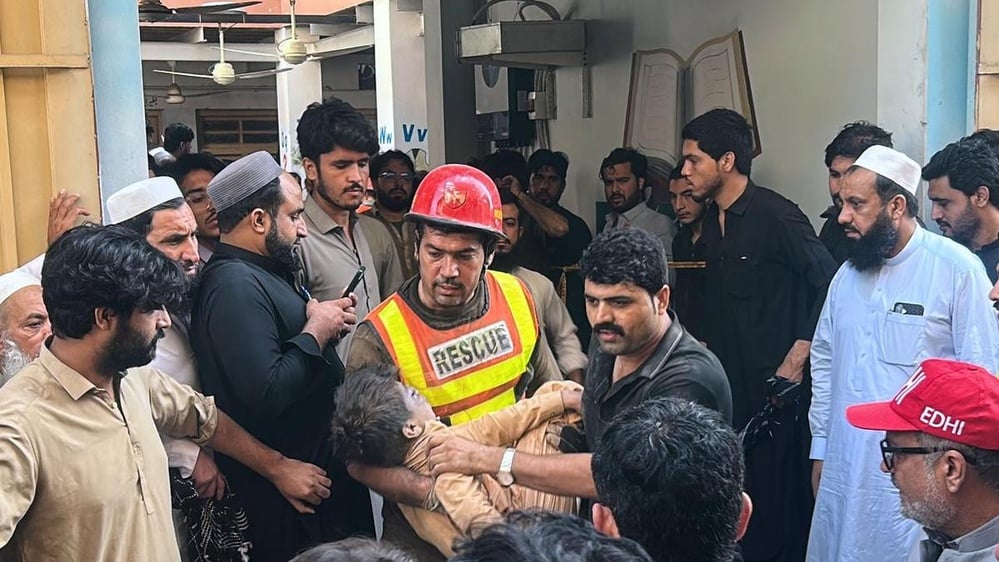
“A local official says emergency services were first alerted to the incident at the private Al-Khair school in the Dir Colony neighbourhood at 08:48 local time (04:48 BST).” · exact text match
Why: Multiple named and attributed sources signal fairness and honesty in sourcing.
The supplied text is a truncated snippet; the headline states at least 29 killed while the body specifies 28 pupils and a teacher, so the total is inferred.
October 15, 2026 · 0 shares
Publisher framing is predominantly factual and attribution-driven, relying on named hospital, police, and government sources with minimal overt ideological or sensational language.
Automated analysis; not human reviewed.
Limitations: The supplied text is a live-update compilation with conflicting interim death tolls and timestamps; analysis is limited to the provided snippets.
·
13 of 55 available dimensions scored; omitted dimensions are not treated as neutral.
·
Verified supporting quotes for 11 of 13 scored dimensions.
Claim: No left-right partisan framing is evident; coverage centers on casualty figures, official accountability, and rescue operations.
“At least 34 people have been killed after a school roof collapsed in Pakistan, with hospitals saying the large majority are children under the age of 13” · exact text match
“Police confirm owner of school arrested following roof collapse” · exact text match
Why: The report uses neutral disaster and accountability language without ideological cues.
Claim: Publisher's own framing is objective, with casualty counts and claims tied to named institutions and officials.
“The most recent official figures say at least 34 people have died following the roof collapse at Al-Khair school earlier this morning.” · exact text match
“According to preliminary investigations, the building was structurally weak, which led to the collapse.” · exact text match
Why: Key figures and causal claims are attributed and characterized by evidentiary status.
Claim: The coverage is grave but avoids sensational embellishment beyond the factual severity of child deaths.
“At least 34 people have been killed after a school roof collapsed in Pakistan, with hospitals saying the large majority are children under the age of 13” · exact text match
“Rescue workers and residents searched the rubble for hours, concerned more children could be trapped” · exact text match
Why: The language reports scale and rescue concern without graphic or hyperbolic publisher-added descriptors.
Claim: The event is high-interest: a deadly child-casualty school collapse with arrest and official investigation.
“More than 30 children killed in Pakistan school roof collapse as owner arrested” · exact text match
“Rescue officials fear that more children and people are buried under the debris, so the death toll could yet increase further.” · exact text match
Why: The story combines significant loss of life, rescue drama, and accountability questions.
Claim: The publisher remains largely descriptive; policy prescriptions are quoted from officials rather than advanced in the publisher's voice.
“Police confirm owner of school arrested following roof collapse” · exact text match
“PM Sharif has called for a transparent investigation” · exact text match
Why: The report narrates events and relays official calls without itself prescribing policy.
Claim: Political actors and government responses appear, but the core framing remains a disaster and accountability story.
“PM Sharif has called for a transparent investigation” · exact text match
“The governor of Khyber Pakhtunkhwa says the loss of children in a school roof collapse is "deeply heartbreaking".” · exact text match
Why: Political responses are included without partisan or ideological analysis.
Claim: Several segments are devoted to official reactions and condolences, though they are part of live updates.
“PM Sharif has called for a transparent investigation” · exact text match
“President expresses 'profound shock and grief' in statement” · exact text match
Why: Named officials' responses receive repeated standalone coverage.
Claim: The coverage carries a negative, somber emotional valence appropriate to a deadly child-casualty event.
“This heart-wrenching tragedy has plunged the entire nation into shock” · exact text match
“My heartfelt condolences and prayers are with the bereaved families” · exact text match
Why: Selected official quotes and framing emphasize grief and shock, though mostly through attribution.
Claim: The report is broadly credible due to named sourcing, attribution, and preliminary-status qualifiers.
“Lady Reading Hospital reported 33 people dead - including 32 children and a teacher - and Naseerullah Khan Babar Memorial Hospital reported one child dead.” · exact text match
“According to preliminary investigations, the building was structurally weak, which led to the collapse.” · exact text match
Why: Factual claims are tied to named institutions and appropriately marked as preliminary where applicable.
Claim: The article emphasizes attributed investigation and evidence gathering over irrational speculation.
“We will examine whether there were any violations of building codes; we intend to conduct a thorough inquiry and gather all the facts.” · exact text match
“Police will look into whether the building had previously been inspected, Farhan Ahmed said.” · not found in supplied text
Why: Cause and responsibility are framed as matters for structured police inquiry and fact collection.
Claim: Human authorship signals are explicit through named editors and reporters and live-reporting structure.
“Edited by Tom Spender and Tinshui Yeung, with Bilal Ahmed reporting from Peshawar and Usman Zahid in Islamabad” · exact text match
Why: The text contains editorial and reporting credits and live-update timestamps typical of human newsroom production.
Claim: The report shows high integrity through consistent named sourcing and attribution.
“Mohammad Asim, spokesperson for Peshawar's Lady Reading Hospital, says at least 19 others are injured - some critically” · exact text match
“Police official Dr Mian Saeed has been giving more details about the collapsed school building.” · not found in supplied text
Why: Statements are attributed to specific officials and institutions rather than asserted anonymously.
Claim: The article is detailed, coherent, and context-rich for a breaking-news live report.
“He told journalists that the three-storey structure in a very narrow street had roof slabs that were substandard.” · exact text match
“There were three affected classrooms, one on each floor, accommodating around 110 students with 30 in the top class, 40 in the middle and 45 on the ground floor.” · exact text match
Why: It organizes casualty counts, structural details, rescue timelines, and official responses with clarity.
The supplied text is a live-update compilation with conflicting interim death tolls and timestamps; analysis is limited to the provided snippets.
October 15, 2026 · 0 shares
Sober, attribution-driven breaking-news framing that relays official casualty figures and government condolences while explicitly hedging the death toll and leaving the collapse's cause undetermined.
Automated analysis; not human reviewed.
Limitations: The supplied text is fragmentary: the outlet name is stripped out (e.g., before the correspondent reference), no explicit byline is given, and unrelated site headlines are mixed in, so completeness of the article's framing cannot be verified.
·
11 of 55 available dimensions scored; omitted dimensions are not treated as neutral.
·
Verified supporting quotes for 11 of 11 scored dimensions.
Claim: The report contains no ideological or partisan framing, presenting a non-political disaster account.
“The incident happened on Thursday at Al-Khair Education Centre, a private school in Peshawar, the capital of Khyber Pakhtunkhwa province.” · exact text match
Why: Purely factual accident reporting with no policy, ideological, or partisan language anywhere in the supplied text.
Claim: The reporting voice is factual and attributed rather than opinionated.
“The roof of a school in northwestern Pakistan has collapsed, killing at least 28 students and a teacher and injuring more than 50 others, authorities said.” · exact text match
Why: Every casualty claim is attributed to authorities or named officials; the text contains no editorial commentary.
Claim: The headline and lede state the disaster plainly without dramatic embellishment.
“School roof collapses in northwestern Pakistan, killing at least 29 people.” · exact text match
Why: Matter-of-fact wording; the gravity comes from the facts themselves, not loaded or urgent language.
Claim: The narrative voice is neutral in outlook, pairing recovery progress with hedged warnings.
“Hours after the collapse, rescue officials said everyone trapped under the rubble had been recovered.” · exact text match
Counterevidence:
““The casualties are likely to rise.
Dozens of wounded students are in hospital.
Some of them are in a serious condition,” he added.”
· exact text match
Why: Negative and positive elements are both attributed and hedged; the publisher's own voice neither laments nor reassures.
Claim: A mass-casualty school collapse killing young children is high-stakes breaking news.
“School roof collapses in northwestern Pakistan, killing at least 29 people.” · exact text match
“All the children killed or injured were age 13 or younger, he said.” · exact text match
Why: A rare, high-death-toll disaster involving children carries broad public significance.
Claim: The piece describes events and relays official reaction without prescribing solutions in its own voice.
“Hours after the collapse, rescue officials said everyone trapped under the rubble had been recovered.” · exact text match
Counterevidence:
““Ensuring the safety and protection of our children must remain paramount,” he added.” · not found in supplied text
Why: The only prescriptive statement is quoted from Deputy Prime Minister Ishaq Dar; the publisher's voice remains descriptive.
Claim: The publisher's own voice stays unemotional and procedural; emotive language appears only in an attributed official quote.
“The hospital has declared an emergency as medical staff treat the wounded.” · exact text match
Counterevidence:
““Our children are our most precious asset, and every such loss is a tragedy for the entire country.” · exact text match
Why: The narrative voice is neutral; the quoted condolence is attributed to Deputy PM Ishaq Dar, not the publisher.
Claim: Multiple named official sources and preserved uncertainty support above-average credibility.
“Lady Reading Hospital spokesman Mohammad Asim confirmed the casualties” · exact text match
“Reporting from Islamabad, ’s Kamal Hyder said the school had about 350 registered students.” · exact text match
Why: Claims are anchored to identifiable officials and hedged where uncertain; the text shows no independent verification, so not scored higher.
Claim: The report's epistemic practice is evidence-based, leaving the cause explicitly undetermined.
“Authorities said an investigation has been ordered” · exact text match
Why: No speculative causal claims are made; uncertainty about the cause is preserved rather than filled in.
Claim: The report is transparent about sourcing and avoids presenting estimates as established fact.
“Lady Reading Hospital spokesman Mohammad Asim confirmed the casualties, saying some of the injured were in critical condition.” · exact text match
Why: Named sources, explicit attribution, and hedged figures ('at least', 'more than 50') are visible honesty signals.
Claim: Concise, well-structured reporting with layered sourcing and appropriate hedging.
“At least 28 students and one teacher killed in incident at Al-Khair Education Centre, a private school in Peshawar.” · exact text match
Why: Precise subheading and a tight lede-detail-official reaction structure indicate competent execution for a breaking-news brief.
The supplied text is fragmentary: the outlet name is stripped out (e.g., before the correspondent reference), no explicit byline is given, and unrelated site headlines are mixed in, so completeness of the article's framing cannot be verified.
October 15, 2026 · 0 shares
Tightly attributed, hedged breaking-news coverage that relays official accounts of a deadly school roof collapse and a cautious debris-based reconstruction without editorial or emotional framing.
Automated analysis; not human reviewed.
Limitations: The supplied text is a duplicated scrape with truncated outlet names, and the opening headline says 18 deaths while the body reports 27, leaving the authoritative toll ambiguous.
·
10 of 55 available dimensions scored; omitted dimensions are not treated as neutral.
·
Verified supporting quotes for 6 of 10 scored dimensions.
Claim: No left- or right-leaning framing appears; the government response is relayed neutrally.
“The school's owner has been arrested, the city's police chief confirmed, and the governor of Khyber Pakhtunkhwa has ordered a safety audit of all schools in the province” · not found in supplied text
Why: The story is non-political and official actions are described without endorsement or criticism.
Claim: Coverage states facts with attribution and hedges uncertain claims rather than offering opinion.
“according to hospital officials” · exact text match
“Based on the condition of the debris, it appears that when the roof of the upper-floor classroom collapsed” · exact text match
Why: Key claims are sourced and uncertainty is marked with 'appears' and 'did not appear to have'.
Claim: Prose remains plain and restrained despite the deadly subject matter.
“More than a dozen others are injured, with some in a critical condition.” · exact text match
Why: Casualty information is stated flatly without dramatic or emotive language.
Claim: Mass child casualties plus an arrest and a province-wide audit make the story high-interest.
“At least 27 pupils and a teacher have been killed after a school roof collapsed” · exact text match
Why: A mass-casualty disaster with accountability developments is inherently significant news.
Claim: Reporting describes events without advocating measures; the safety audit is conveyed as the governor's action.
“the governor of Khyber Pakhtunkhwa has ordered a safety audit of all schools in the province” · exact text match
Why: Corrective measures appear only as reported official decisions and quotes, not publisher prescriptions.
Claim: Tone is unemotional and factual throughout the fatality reporting.
“At least 27 pupils and a teacher have been killed after a school roof collapsed in the north-western Pakistani city of Peshawar, according to hospital officials.” · exact text match
Why: The gravest information is delivered in neutral, sourced declarative sentences.
Claim: Multiple independent official sources are cited for the key claims.
“"The children in the affected classroom were trapped under the debris," the official, Bilal Faizi, said.” · exact text match
“The school's owner has been arrested, the city's police chief confirmed” · not found in supplied text
Why: Hospital, rescue, police, and gubernatorial sources are cited, though the supplied scrape truncates some outlet attributions.
Claim: The reconstruction is grounded in observable debris conditions and attributed official accounts.
“Based on the condition of the debris, it appears that when the roof of the upper-floor classroom collapsed, the falling rubble crashed through into the classroom below.” · not found in supplied text
Why: Reasoning from physical evidence with explicit hedging rather than assertion.
Claim: Claims are attributed to named or role-identified officials with hedging where uncertain.
“"The children in the affected classroom were trapped under the debris," the official, Bilal Faizi, said.” · exact text match
“according to emergency official Arif Khattak” · exact text match
Why: Multiple officials are identified by name and uncertain judgments are flagged as appearances.
Claim: The report reconstructs the collapse mechanism from debris evidence and supplies structural detail plus context of prior failures.
“Based on the condition of the debris, it appears that when the roof of the upper-floor classroom collapsed, the falling rubble crashed through into the classroom below.” · not found in supplied text
“which did not appear to have a conventional reinforced concrete roof.
Instead, it had prefabricated roofing slabs.”
· exact text match
Why: Mechanistic reconstruction, structural specifics, and comparative incidents show above-average reporting depth.
The supplied text is a duplicated scrape with truncated outlet names, and the opening headline says 18 deaths while the body reports 27, leaving the authoritative toll ambiguous.
October 15, 2026 · 0 shares
Straight, attribution-heavy breaking-news framing dominates, with official casualty figures presented as preliminary and no partisan or ideological angle.
Automated analysis; not human reviewed.
Limitations: The supplied text includes substantial subscription and navigation headline material unrelated to the main report; analysis is limited to the substantive school-collapse article.
·
10 of 55 available dimensions scored; omitted dimensions are not treated as neutral.
·
Verified supporting quotes for 10 of 10 scored dimensions.
Claim: The report contains no partisan political framing.
“At least 27 students, most younger than 13, were killed in Pakistan on Thursday, along with a teacher, when a school roof collapsed during classes in the northwestern city of Peshawar, authorities said, warning that the death toll could rise.” · exact text match
Why: The report focuses on a disaster and official casualty information without left-right political labels or ideological framing.
Claim: The report relies on official sources without framing elites against the public.
“said government official Bilal Faizi” · exact text match
“Peshawar police chief Mian Saeed said” · exact text match
Why: Official voices are quoted for facts and assessments, but no populist or elitist ideological narrative is constructed.
Claim: The report is predominantly objective and attribution-based.
““We have taken out at least 45 children,” said district emergency officer Iftikhar Khan, adding that more were reported to be buried in the rubble.” · exact text match
Why: Casualty and rescue information is tied to named officials and direct quotations.
Claim: The report is mostly objective with limited vivid imagery.
“Television images showed ambulances rushing to the site at the privately run Al-Khair Education Center while rescuers pulled bloodied students from the rubble.” · exact text match
Why: The description is vivid but remains factual and attributed to television images.
Claim: The report contains mild fear-inducing uncertainty about the toll.
“warning that the death toll could rise” · exact text match
Why: The possibility of a rising death toll is highlighted but not exaggerated into rage-bait.
Claim: The main report is non-political.
“Authorities said an investigation had been ordered to determine the cause.” · exact text match
Why: The article addresses a disaster response and cause investigation, not political actors or policy disputes.
Claim: The report carries a negative emotional tone due to the tragedy.
“rescuers pulled bloodied students from the rubble” · exact text match
Why: The imagery and casualty language are somber and negative, though appropriate to the event.
Claim: The report has strong credibility signals through named sourcing and attributed figures.
“Peshawar police chief Mian Saeed said he feared the death toll could rise as just 47 of the 110 students in three classrooms at the time had been rescued.” · exact text match
Why: Specific counts and claims are attributed to named officials and hospital representatives.
Claim: The report is rational and evidence-bound rather than irrational.
“Authorities said an investigation had been ordered to determine the cause.” · exact text match
Why: It attributes claims to officials and calls for an investigation instead of asserting speculative causes.
Claim: The report shows fair, transparent handling of competing or missing comment.
“There was no immediate comment from school officials.” · exact text match
Why: It notes the absence of school-official comment rather than implying a response.
The supplied text includes substantial subscription and navigation headline material unrelated to the main report; analysis is limited to the substantive school-collapse article.
October 15, 2026 · 0 shares
Publisher framing is predominantly factual and attribution-driven, relying on named hospital, police, and government sources with minimal overt ideological or sensational language.
Automated analysis; not human reviewed.
Limitations: The supplied text is a live-update compilation with conflicting interim death tolls and timestamps; analysis is limited to the provided snippets.
·
13 of 55 available dimensions scored; omitted dimensions are not treated as neutral.
·
Verified supporting quotes for 11 of 13 scored dimensions.
Claim: No left-right partisan framing is evident; coverage centers on casualty figures, official accountability, and rescue operations.
“At least 34 people have been killed after a school roof collapsed in Pakistan, with hospitals saying the large majority are children under the age of 13” · exact text match
“Police confirm owner of school arrested following roof collapse” · exact text match
Why: The report uses neutral disaster and accountability language without ideological cues.
Claim: Publisher's own framing is objective, with casualty counts and claims tied to named institutions and officials.
“The most recent official figures say at least 34 people have died following the roof collapse at Al-Khair school earlier this morning.” · exact text match
“According to preliminary investigations, the building was structurally weak, which led to the collapse.” · exact text match
Why: Key figures and causal claims are attributed and characterized by evidentiary status.
Claim: The coverage is grave but avoids sensational embellishment beyond the factual severity of child deaths.
“At least 34 people have been killed after a school roof collapsed in Pakistan, with hospitals saying the large majority are children under the age of 13” · exact text match
“Rescue workers and residents searched the rubble for hours, concerned more children could be trapped” · exact text match
Why: The language reports scale and rescue concern without graphic or hyperbolic publisher-added descriptors.
Claim: The event is high-interest: a deadly child-casualty school collapse with arrest and official investigation.
“More than 30 children killed in Pakistan school roof collapse as owner arrested” · exact text match
“Rescue officials fear that more children and people are buried under the debris, so the death toll could yet increase further.” · exact text match
Why: The story combines significant loss of life, rescue drama, and accountability questions.
Claim: The publisher remains largely descriptive; policy prescriptions are quoted from officials rather than advanced in the publisher's voice.
“Police confirm owner of school arrested following roof collapse” · exact text match
“PM Sharif has called for a transparent investigation” · exact text match
Why: The report narrates events and relays official calls without itself prescribing policy.
Claim: Political actors and government responses appear, but the core framing remains a disaster and accountability story.
“PM Sharif has called for a transparent investigation” · exact text match
“The governor of Khyber Pakhtunkhwa says the loss of children in a school roof collapse is "deeply heartbreaking".” · exact text match
Why: Political responses are included without partisan or ideological analysis.
Claim: Several segments are devoted to official reactions and condolences, though they are part of live updates.
“PM Sharif has called for a transparent investigation” · exact text match
“President expresses 'profound shock and grief' in statement” · exact text match
Why: Named officials' responses receive repeated standalone coverage.
Claim: The coverage carries a negative, somber emotional valence appropriate to a deadly child-casualty event.
“This heart-wrenching tragedy has plunged the entire nation into shock” · exact text match
“My heartfelt condolences and prayers are with the bereaved families” · exact text match
Why: Selected official quotes and framing emphasize grief and shock, though mostly through attribution.
Claim: The report is broadly credible due to named sourcing, attribution, and preliminary-status qualifiers.
“Lady Reading Hospital reported 33 people dead - including 32 children and a teacher - and Naseerullah Khan Babar Memorial Hospital reported one child dead.” · exact text match
“According to preliminary investigations, the building was structurally weak, which led to the collapse.” · exact text match
Why: Factual claims are tied to named institutions and appropriately marked as preliminary where applicable.
Claim: The article emphasizes attributed investigation and evidence gathering over irrational speculation.
“We will examine whether there were any violations of building codes; we intend to conduct a thorough inquiry and gather all the facts.” · exact text match
“Police will look into whether the building had previously been inspected, Farhan Ahmed said.” · not found in supplied text
Why: Cause and responsibility are framed as matters for structured police inquiry and fact collection.
Claim: Human authorship signals are explicit through named editors and reporters and live-reporting structure.
“Edited by Tom Spender and Tinshui Yeung, with Bilal Ahmed reporting from Peshawar and Usman Zahid in Islamabad” · exact text match
Why: The text contains editorial and reporting credits and live-update timestamps typical of human newsroom production.
Claim: The report shows high integrity through consistent named sourcing and attribution.
“Mohammad Asim, spokesperson for Peshawar's Lady Reading Hospital, says at least 19 others are injured - some critically” · exact text match
“Police official Dr Mian Saeed has been giving more details about the collapsed school building.” · not found in supplied text
Why: Statements are attributed to specific officials and institutions rather than asserted anonymously.
Claim: The article is detailed, coherent, and context-rich for a breaking-news live report.
“He told journalists that the three-storey structure in a very narrow street had roof slabs that were substandard.” · exact text match
“There were three affected classrooms, one on each floor, accommodating around 110 students with 30 in the top class, 40 in the middle and 45 on the ground floor.” · exact text match
Why: It organizes casualty counts, structural details, rescue timelines, and official responses with clarity.
The supplied text is a live-update compilation with conflicting interim death tolls and timestamps; analysis is limited to the provided snippets.
October 15, 2026 · 0 shares
The report maintains a measured, official-source-based tone with no evident ideological framing or sensationalism.
Automated analysis; not human reviewed.
Limitations: The supplied text is brief and contains some duplicated fragmentary strings after the main report, which were excluded as scrape metadata.
·
7 of 55 available dimensions scored; omitted dimensions are not treated as neutral.
·
Verified supporting quotes for 7 of 7 scored dimensions.
Claim: The report contains no left-right ideological framing; it attributes casualty figures to police and hospital officials.
“According to Lady Reading Hospital spokesperson Muhammad Asim, 28 students, including six girls, and a lady teacher were killed in the incident.” · exact text match
Why: Attribution to non-partisan officials without ideological labels indicates neutral left-right framing.
Claim: The report is objective, relying on named official sources for key facts.
“Peshawar Capital City Police chief Mian Saeed said.” · exact text match
Why: Named attribution rather than personal commentary supports high objectivity.
Claim: The report avoids sensational language, presenting the collapse and response in measured terms.
“Peshawar Deputy Commissioner Afaq Wazir has ordered a probe into the building collapse.” · exact text match
Why: Factual, unexcited phrasing indicates low sensationalism.
Claim: The report describes events and official actions without prescribing policy or moral remedies.
“Rescue teams were clearing the debris and searching for children and school staff who might still be trapped beneath the collapsed structure.” · exact text match
Why: Focus on descriptive reporting of rescue efforts rather than advocacy supports descriptive bias.
Claim: The report is highly credible due to consistent attribution to police, hospital, and government officials.
“Peshawar Capital City Police chief Mian Saeed said.” · exact text match
Why: Named sourcing and lack of unsupported assertions support high credibility.
Claim: The report is evidence-bound and acknowledges uncertainty about trapped victims.
“Rescue teams were clearing the debris and searching for children and school staff who might still be trapped beneath the collapsed structure.” · exact text match
Why: Hedged language and reliance on official sources reflect rational, non-speculative reporting.
Claim: The report identifies multiple named sources and distinguishes attributed claims.
“According to Lady Reading Hospital spokesperson Muhammad Asim, 28 students, including six girls, and a lady teacher were killed in the incident.” · exact text match
Why: Clear sourcing and named officials indicate high integrity.
The supplied text is brief and contains some duplicated fragmentary strings after the main report, which were excluded as scrape metadata.
October 15, 2026 · 0 shares
Restrained, multiply-attributed wire-style disaster reporting that frames a deadly school collapse within Pakistan's recurring pattern of poorly enforced construction standards and prior fatal infrastructure failures.
Automated analysis; not human reviewed.
Limitations: The outlet names after 'told' are stripped in the supplied text, and no full date or byline is given, limiting source and timing verification.
·
7 of 55 available dimensions scored; omitted dimensions are not treated as neutral.
·
Verified supporting quotes for 7 of 7 scored dimensions.
Claim: Framing is objective, attributing the death toll, injuries, and cause to named officials rather than asserting them directly.
“Twenty-eight children and a teacher were killed and dozens injured when the roof of a school in northern Pakistan collapsed on Thursday morning, authorities said.” · exact text match
“Forty-seven children were injured, Asim Khan, spokesperson for the Lady Reading Hospital in Peshawar” · exact text match
Why: Multiple named official sources and hedged tolls show attributed, objective reporting.
Claim: The framing is factual and restrained, without sensationalized language despite the high death toll.
“Pakistan school roof collapse kills at least 28 children and one teacher” · exact text match
“Building collapses are a common problem in Pakistan.
Construction standards in the country are often poorly enforced, and many structures are built with substandard materials.”
· exact text match
Why: A plain factual headline and measured contextual prose rather than emotive amplification.
Claim: The report links the collapse to a recent pattern of fatal infrastructure failures, raising its newsworthiness.
“The collapse comes just weeks after a fire tore through a hospital in the capital Islamabad, killing at least 14 newborns and sparking widespread anger and multiple arrests.” · exact text match
“In July, a roof collapse at a tutoring center under construction in Pakistan’s eastern city of Lahore killed at least 14 schoolchildren, police and rescue officials said at the time.” · exact text match
Why: A mass-casualty event tied to a systemic pattern and prior tragedies makes the report substantive.
Claim: The framing is descriptive; the only prescription, a comprehensive investigation, is attributed to the president.
“Building collapses are a common problem in Pakistan.
Construction standards in the country are often poorly enforced, and many structures are built with substandard materials.”
· exact text match
“called for a comprehensive investigation into the cause of the deadly collapse” · exact text match
Why: The report describes conditions and quotes officials' calls without prescribing its own remedies.
Claim: The publisher's prose stays emotionally neutral; emotive language appears only inside attributed quotes.
“Pakistan’s President Asif Ali Zardari called the incident a “heart-wrenching tragedy” and called for a comprehensive investigation into the cause of the deadly collapse.” · exact text match
“Twenty-eight children and a teacher were killed and dozens injured when the roof of a school in northern Pakistan collapsed on Thursday morning, authorities said.” · exact text match
Why: Grief language is quoted from the president while the report's own wording remains factual.
Claim: Visible credibility signals include named sources, hedged tolls, and attribution to the Associated Press and an official inquiry.
“Local residents were among the first people to reach the scene, and rescue workers arrived within minutes, The Associated Press reported citing eyewitnesses.” · exact text match
“An inquiry found that the nursery had no fire alarm or sprinkler system and that the hospital lacked detailed procedures and training for responding to fires and other emergencies.” · exact text match
Why: Multi-source attribution and preserved uncertainty support high visible credibility.
Claim: The framing shows honesty signals: attribution to officials, hedged figures, and preserved epistemic status for past events.
“In July, a roof collapse at a tutoring center under construction in Pakistan’s eastern city of Lahore killed at least 14 schoolchildren, police and rescue officials said at the time.” · exact text match
“An inquiry found that the nursery had no fire alarm or sprinkler system and that the hospital lacked detailed procedures and training for responding to fires and other emergencies.” · exact text match
Why: Claims are sourced, hedged with 'at least,' and time-stamped rather than stated as bare fact.
The outlet names after 'told' are stripped in the supplied text, and no full date or byline is given, limiting source and timing verification.
October 15, 2026 · 0 shares
Publisher framing is predominantly factual and attribution-driven, relying on named hospital, police, and government sources with minimal overt ideological or sensational language.
Automated analysis; not human reviewed.
Limitations: The supplied text is a live-update compilation with conflicting interim death tolls and timestamps; analysis is limited to the provided snippets.
·
13 of 55 available dimensions scored; omitted dimensions are not treated as neutral.
·
Verified supporting quotes for 11 of 13 scored dimensions.
Claim: No left-right partisan framing is evident; coverage centers on casualty figures, official accountability, and rescue operations.
“At least 34 people have been killed after a school roof collapsed in Pakistan, with hospitals saying the large majority are children under the age of 13” · exact text match
“Police confirm owner of school arrested following roof collapse” · exact text match
Why: The report uses neutral disaster and accountability language without ideological cues.
Claim: Publisher's own framing is objective, with casualty counts and claims tied to named institutions and officials.
“The most recent official figures say at least 34 people have died following the roof collapse at Al-Khair school earlier this morning.” · exact text match
“According to preliminary investigations, the building was structurally weak, which led to the collapse.” · exact text match
Why: Key figures and causal claims are attributed and characterized by evidentiary status.
Claim: The coverage is grave but avoids sensational embellishment beyond the factual severity of child deaths.
“At least 34 people have been killed after a school roof collapsed in Pakistan, with hospitals saying the large majority are children under the age of 13” · exact text match
“Rescue workers and residents searched the rubble for hours, concerned more children could be trapped” · exact text match
Why: The language reports scale and rescue concern without graphic or hyperbolic publisher-added descriptors.
Claim: The event is high-interest: a deadly child-casualty school collapse with arrest and official investigation.
“More than 30 children killed in Pakistan school roof collapse as owner arrested” · exact text match
“Rescue officials fear that more children and people are buried under the debris, so the death toll could yet increase further.” · exact text match
Why: The story combines significant loss of life, rescue drama, and accountability questions.
Claim: The publisher remains largely descriptive; policy prescriptions are quoted from officials rather than advanced in the publisher's voice.
“Police confirm owner of school arrested following roof collapse” · exact text match
“PM Sharif has called for a transparent investigation” · exact text match
Why: The report narrates events and relays official calls without itself prescribing policy.
Claim: Political actors and government responses appear, but the core framing remains a disaster and accountability story.
“PM Sharif has called for a transparent investigation” · exact text match
“The governor of Khyber Pakhtunkhwa says the loss of children in a school roof collapse is "deeply heartbreaking".” · exact text match
Why: Political responses are included without partisan or ideological analysis.
Claim: Several segments are devoted to official reactions and condolences, though they are part of live updates.
“PM Sharif has called for a transparent investigation” · exact text match
“President expresses 'profound shock and grief' in statement” · exact text match
Why: Named officials' responses receive repeated standalone coverage.
Claim: The coverage carries a negative, somber emotional valence appropriate to a deadly child-casualty event.
“This heart-wrenching tragedy has plunged the entire nation into shock” · exact text match
“My heartfelt condolences and prayers are with the bereaved families” · exact text match
Why: Selected official quotes and framing emphasize grief and shock, though mostly through attribution.
Claim: The report is broadly credible due to named sourcing, attribution, and preliminary-status qualifiers.
“Lady Reading Hospital reported 33 people dead - including 32 children and a teacher - and Naseerullah Khan Babar Memorial Hospital reported one child dead.” · exact text match
“According to preliminary investigations, the building was structurally weak, which led to the collapse.” · exact text match
Why: Factual claims are tied to named institutions and appropriately marked as preliminary where applicable.
Claim: The article emphasizes attributed investigation and evidence gathering over irrational speculation.
“We will examine whether there were any violations of building codes; we intend to conduct a thorough inquiry and gather all the facts.” · exact text match
“Police will look into whether the building had previously been inspected, Farhan Ahmed said.” · not found in supplied text
Why: Cause and responsibility are framed as matters for structured police inquiry and fact collection.
Claim: Human authorship signals are explicit through named editors and reporters and live-reporting structure.
“Edited by Tom Spender and Tinshui Yeung, with Bilal Ahmed reporting from Peshawar and Usman Zahid in Islamabad” · exact text match
Why: The text contains editorial and reporting credits and live-update timestamps typical of human newsroom production.
Claim: The report shows high integrity through consistent named sourcing and attribution.
“Mohammad Asim, spokesperson for Peshawar's Lady Reading Hospital, says at least 19 others are injured - some critically” · exact text match
“Police official Dr Mian Saeed has been giving more details about the collapsed school building.” · not found in supplied text
Why: Statements are attributed to specific officials and institutions rather than asserted anonymously.
Claim: The article is detailed, coherent, and context-rich for a breaking-news live report.
“He told journalists that the three-storey structure in a very narrow street had roof slabs that were substandard.” · exact text match
“There were three affected classrooms, one on each floor, accommodating around 110 students with 30 in the top class, 40 in the middle and 45 on the ground floor.” · exact text match
Why: It organizes casualty counts, structural details, rescue timelines, and official responses with clarity.
The supplied text is a live-update compilation with conflicting interim death tolls and timestamps; analysis is limited to the provided snippets.
October 15, 2026 · 0 shares
The report uses neutral wire-service framing with repeated attribution to named officials and local media and acknowledges that further details are awaited.
Automated analysis; not human reviewed.
Limitations: The supplied text is a short wire report with a duplicated headline-list artifact and no author byline.
·
55 of 55 available dimensions scored; omitted dimensions are not treated as neutral.
·
Verified supporting quotes for 6 of 55 scored dimensions.
Claim: The report attributes casualty figures and details to external sources rather than asserting them subjectively.
“according to local media reports” · exact text match
“Lady Reading Hospital spokesperson Muhammad Asim said, according to Pakistani newspaper Dawn.” · exact text match
Why: Attribution to named officials and local media indicates objective reporting.
Claim: The report uses restrained, factual language and avoids sensational embellishment.
“Rescue teams were conducting an operation at the site, with further details about the circumstances of the collapse awaited.” · exact text match
Why: No emotive adjectives or dramatic framing appear in the description.
Claim: The article describes the collapse, rescue response, and background without prescribing policy or moral action.
“Building collapses are a recurring problem in Pakistan, where concerns have been raised over the enforcement of safety regulations and the quality of construction materials.” · exact text match
Why: The sentence reports existing concerns but does not advocate for a specific remedy.
Claim: The report cites multiple named sources and acknowledges unresolved details.
“Rescue 1122 spokesperson Bilal Ahmed Faizi earlier said rescue personnel had transported around 20 people, including students and teachers, to hospitals for treatment.” · exact text match
“with further details about the circumstances of the collapse awaited.” · exact text match
Why: Sourcing and acknowledged uncertainty support high credibility.
Claim: The report grounds claims in attribution and acknowledges that details are still pending.
“according to local media reports” · exact text match
“with further details about the circumstances of the collapse awaited.” · exact text match
Why: Explicit sourcing and uncertainty indicate rational reporting.
Claim: The article transparently attributes information to named officials and a newspaper.
“Lady Reading Hospital spokesperson Muhammad Asim said, according to Pakistani newspaper Dawn.” · exact text match
Why: Transparent sourcing and avoidance of unsupported assertions suggest high integrity.
The supplied text is a short wire report with a duplicated headline-list artifact and no author byline.
October 15, 2026 · 0 shares
Publisher framing is a bare factual report on a deadly school roof collapse and owner arrest, with no evident ideological framing but also no sourcing or context.
Automated analysis; not human reviewed.
Limitations: The article text is limited to a headline and one sentence, so many bias dimensions cannot be assessed.
·
3 of 55 available dimensions scored; omitted dimensions are not treated as neutral.
·
Verified supporting quotes for 3 of 3 scored dimensions.
Claim: The report is framed objectively, presenting the event as a factual occurrence without subjective commentary.
“At least 33 students and one teacher have been killed after the roof collapsed at a school in Pakistan.” · exact text match
Why: The sentence states a quantifiable outcome and event without evaluative or interpretive language.
Claim: The headline is direct and factual rather than sensationalized.
“Pakistan school roof collapse kills 33 children as owner arrested.” · exact text match
Why: The headline states the death toll and arrest without hyperbolic adjectives or exclamatory framing.
Claim: The report is descriptive, offering no recommendations or normative prescriptions.
“At least 33 students and one teacher have been killed after the roof collapsed at a school in Pakistan.” · exact text match
Why: The text reports what happened without telling readers what should be done.
The article text is limited to a headline and one sentence, so many bias dimensions cannot be assessed.
October 15, 2026 · 0 shares
Tightly attributed, hedged breaking-news coverage that relays official accounts of a deadly school roof collapse and a cautious debris-based reconstruction without editorial or emotional framing.
Automated analysis; not human reviewed.
Limitations: The supplied text is a duplicated scrape with truncated outlet names, and the opening headline says 18 deaths while the body reports 27, leaving the authoritative toll ambiguous.
·
10 of 55 available dimensions scored; omitted dimensions are not treated as neutral.
·
Verified supporting quotes for 6 of 10 scored dimensions.
Claim: No left- or right-leaning framing appears; the government response is relayed neutrally.
“The school's owner has been arrested, the city's police chief confirmed, and the governor of Khyber Pakhtunkhwa has ordered a safety audit of all schools in the province” · not found in supplied text
Why: The story is non-political and official actions are described without endorsement or criticism.
Claim: Coverage states facts with attribution and hedges uncertain claims rather than offering opinion.
“according to hospital officials” · exact text match
“Based on the condition of the debris, it appears that when the roof of the upper-floor classroom collapsed” · exact text match
Why: Key claims are sourced and uncertainty is marked with 'appears' and 'did not appear to have'.
Claim: Prose remains plain and restrained despite the deadly subject matter.
“More than a dozen others are injured, with some in a critical condition.” · exact text match
Why: Casualty information is stated flatly without dramatic or emotive language.
Claim: Mass child casualties plus an arrest and a province-wide audit make the story high-interest.
“At least 27 pupils and a teacher have been killed after a school roof collapsed” · exact text match
Why: A mass-casualty disaster with accountability developments is inherently significant news.
Claim: Reporting describes events without advocating measures; the safety audit is conveyed as the governor's action.
“the governor of Khyber Pakhtunkhwa has ordered a safety audit of all schools in the province” · exact text match
Why: Corrective measures appear only as reported official decisions and quotes, not publisher prescriptions.
Claim: Tone is unemotional and factual throughout the fatality reporting.
“At least 27 pupils and a teacher have been killed after a school roof collapsed in the north-western Pakistani city of Peshawar, according to hospital officials.” · exact text match
Why: The gravest information is delivered in neutral, sourced declarative sentences.
Claim: Multiple independent official sources are cited for the key claims.
“"The children in the affected classroom were trapped under the debris," the official, Bilal Faizi, said.” · exact text match
“The school's owner has been arrested, the city's police chief confirmed” · not found in supplied text
Why: Hospital, rescue, police, and gubernatorial sources are cited, though the supplied scrape truncates some outlet attributions.
Claim: The reconstruction is grounded in observable debris conditions and attributed official accounts.
“Based on the condition of the debris, it appears that when the roof of the upper-floor classroom collapsed, the falling rubble crashed through into the classroom below.” · not found in supplied text
Why: Reasoning from physical evidence with explicit hedging rather than assertion.
Claim: Claims are attributed to named or role-identified officials with hedging where uncertain.
“"The children in the affected classroom were trapped under the debris," the official, Bilal Faizi, said.” · exact text match
“according to emergency official Arif Khattak” · exact text match
Why: Multiple officials are identified by name and uncertain judgments are flagged as appearances.
Claim: The report reconstructs the collapse mechanism from debris evidence and supplies structural detail plus context of prior failures.
“Based on the condition of the debris, it appears that when the roof of the upper-floor classroom collapsed, the falling rubble crashed through into the classroom below.” · not found in supplied text
“which did not appear to have a conventional reinforced concrete roof.
Instead, it had prefabricated roofing slabs.”
· exact text match
Why: Mechanistic reconstruction, structural specifics, and comparative incidents show above-average reporting depth.
The supplied text is a duplicated scrape with truncated outlet names, and the opening headline says 18 deaths while the body reports 27, leaving the authoritative toll ambiguous.
October 15, 2026 · 0 shares
Neutral live-blog framing with official attribution, explicit acknowledgment of unknowns, and no evident ideological or sensational cues.
Automated analysis; not human reviewed.
Limitations: The supplied text is a live-blog compilation with duplicate and updated snippets; casualty figures vary across updates, limiting certainty.
·
5 of 55 available dimensions scored; omitted dimensions are not treated as neutral.
·
Verified supporting quotes for 4 of 5 scored dimensions.
Claim: The report attributes casualty and response claims to officials and avoids subjective commentary.
“According to a hospital spokesperson, the dead and injured are all children are up to the age of 13.” · exact text match
“In a statement, the office of Pakistan's President Asif Ali Zardari says "this heart-wrenching tragedy has plunged the entire nation into shock".” · not found in supplied text
Why: Uses attribution for figures and official statements; emotional language is quoted, not adopted.
Claim: The publisher's framing is factual and restrained, not sensational.
“What we do and don't know about the school roof collapse” · exact text match
“The name of the school has not officially been released and the teacher and children killed have not been publicly named yet.” · exact text match
Why: Explicitly separates knowns from unknowns and avoids dramatic language in its own voice.
Claim: The report provides named and institutional sourcing and openly notes unknowns.
“Mohammad Asim, spokesperson for Peshawar's Lady Reading Hospital, says all of the pupils who died were under 13” · exact text match
“The name of the school has not officially been released and the teacher and children killed have not been publicly named yet.” · exact text match
Why: Named hospital spokesperson and explicit acknowledgment of unconfirmed names support credibility.
Claim: The article presents a coherent factual account with uncertainty acknowledged, not irrational reasoning.
“Rescue officials fear that more children and people are buried under the debris, so the death toll could yet increase further.” · exact text match
“The name of the school has not officially been released and the teacher and children killed have not been publicly named yet.” · exact text match
Why: Acknowledges provisional information and avoids unfounded causal claims.
Claim: The publisher shows fairness and honesty by distinguishing known facts from unknowns and attributing statements.
“What we do and don't know about the school roof collapse” · exact text match
“Rescue officials fear that more children and people are buried under the debris, so the death toll could yet increase further.” · exact text match
Why: Signals transparency about incomplete information and source attribution.
The supplied text is a live-blog compilation with duplicate and updated snippets; casualty figures vary across updates, limiting certainty.
October 15, 2026 · 0 shares
The brief centers on an official diplomatic condolence response to a deadly Peshawar school roof collapse, using empathetic but minimally contextualized language.
Peshawar is a city in Pakistan.
Automated analysis; not human reviewed.
Limitations: The supplied article is extremely brief and includes scrape/boilerplate artifacts, limiting assessment of framing and bias to tone and attribution.
·
6 of 55 available dimensions scored; omitted dimensions are not treated as neutral.
·
Verified supporting quotes for 6 of 6 scored dimensions.
Claim: The report uses the subjective evaluative term 'tragic' in its own framing of the collapse.
“tragic school roof collapse” · exact text match
Why: The adjective 'tragic' is an evaluative characterization, supporting slight subjectivity.
Claim: The report is descriptive and contains no recommendations or prescriptions.
“The Chinese Embassy in Pakistan has expressed deep sorrow over the tragic school roof collapse in Peshawar, which resulted in the loss of young lives.” · exact text match
Why: The sentence reports a statement and outcome without advocating any action, supporting a strongly descriptive classification.
Claim: The report includes a mild evaluative characterization of the event as 'tragic.'
“tragic school roof collapse” · exact text match
Why: The adjective 'tragic' is an evaluative term, indicating slight opinionated framing.
Claim: The report concerns a diplomatic actor's official response to a public tragedy, making its subject matter political.
“Chinese Embassy expresses condolences over Peshawar school roof collapse.” · exact text match
“The Chinese Embassy in Pakistan has expressed deep sorrow over the tragic school roof collapse in Peshawar, which resulted in the loss of young lives.” · exact text match
Why: The focus on an embassy's condolence statement and cross-border diplomatic reaction gives the brief a political/diplomatic framing, though no ideological position is advanced.
Claim: The report centers on the Chinese Embassy's condolence response rather than detailing the school roof collapse itself.
“Chinese Embassy expresses condolences over Peshawar school roof collapse.” · exact text match
“The Chinese Embassy in Pakistan has expressed deep sorrow over the tragic school roof collapse in Peshawar, which resulted in the loss of young lives.” · exact text match
Why: The headline and body focus on the embassy's expression of condolences, making the response the central reported development.
Claim: The report carries a negative, sorrowful emotional tone.
“deep sorrow” · exact text match
“loss of young lives” · exact text match
Why: The words convey sorrow and loss, supporting a mildly negative emotional framing tied to the event.
The supplied article is extremely brief and includes scrape/boilerplate artifacts, limiting assessment of framing and bias to tone and attribution.
October 15, 2026 · 0 shares
The report uses official attribution and factual casualty details, with emotional language confined to a quoted presidential statement.
Automated analysis; not human reviewed. Limitations: The supplied text is a truncated snippet; the headline states at least 29 killed while the body specifies 28 pupils and a teacher, so the total is inferred. · 4 of 55 available dimensions scored; omitted dimensions are not treated as neutral. · Verified supporting quotes for 4 of 4 scored dimensions.
Claim: The publisher frames the report through attributed official statements and factual casualty details rather than subjective commentary.
“The owner of the school has been arrested, police say, as investigations are carried out into the structure of the building.” · exact text match
Why: The sentence attributes the arrest and investigation to police, indicating a factual, attribution-based framing.
Claim: The publisher reports the death toll and cause in plain, non-sensational language.
“At least 28 pupils and a teacher have been killed after a school roof collapse in Peshawar, Pakistan” · exact text match
Why: The sentence states the casualty count and cause directly without sensational adjectives.
Claim: The report's credibility is supported by multiple official attributions and specific details.
“Mohammad Asim, spokesperson for Peshawar’s Lady Reading Hospital, says at least 19 other people are injured – and the children are aged between 6 and 12 years old.” · exact text match
“In a statement, the office of Pakistan’s President Asif Ali Zardari says “this heart-wrenching tragedy has plunged the entire nation into shock”.” · exact text match
Why: Named spokesperson and presidential statement provide verifiable attribution.
Claim: The report transparently attributes key claims to police, local officials, and a hospital spokesperson.
“The owner of the school has been arrested, police say, as investigations are carried out into the structure of the building.” · exact text match
“A local official says emergency services were first alerted to the incident at the private Al-Khair school in the Dir Colony neighbourhood at 08:48 local time (04:48 BST).” · exact text match
Why: Multiple named and attributed sources signal fairness and honesty in sourcing.
The supplied text is a truncated snippet; the headline states at least 29 killed while the body specifies 28 pupils and a teacher, so the total is inferred.
October 15, 2026 · 0 shares
Publisher framing is predominantly factual and attribution-driven, relying on named hospital, police, and government sources with minimal overt ideological or sensational language.
Automated analysis; not human reviewed. Limitations: The supplied text is a live-update compilation with conflicting interim death tolls and timestamps; analysis is limited to the provided snippets. · 13 of 55 available dimensions scored; omitted dimensions are not treated as neutral. · Verified supporting quotes for 11 of 13 scored dimensions.
Claim: No left-right partisan framing is evident; coverage centers on casualty figures, official accountability, and rescue operations.
“At least 34 people have been killed after a school roof collapsed in Pakistan, with hospitals saying the large majority are children under the age of 13” · exact text match
“Police confirm owner of school arrested following roof collapse” · exact text match
Why: The report uses neutral disaster and accountability language without ideological cues.
Claim: Publisher's own framing is objective, with casualty counts and claims tied to named institutions and officials.
“The most recent official figures say at least 34 people have died following the roof collapse at Al-Khair school earlier this morning.” · exact text match
“According to preliminary investigations, the building was structurally weak, which led to the collapse.” · exact text match
Why: Key figures and causal claims are attributed and characterized by evidentiary status.
Claim: The coverage is grave but avoids sensational embellishment beyond the factual severity of child deaths.
“At least 34 people have been killed after a school roof collapsed in Pakistan, with hospitals saying the large majority are children under the age of 13” · exact text match
“Rescue workers and residents searched the rubble for hours, concerned more children could be trapped” · exact text match
Why: The language reports scale and rescue concern without graphic or hyperbolic publisher-added descriptors.
Claim: The event is high-interest: a deadly child-casualty school collapse with arrest and official investigation.
“More than 30 children killed in Pakistan school roof collapse as owner arrested” · exact text match
“Rescue officials fear that more children and people are buried under the debris, so the death toll could yet increase further.” · exact text match
Why: The story combines significant loss of life, rescue drama, and accountability questions.
Claim: The publisher remains largely descriptive; policy prescriptions are quoted from officials rather than advanced in the publisher's voice.
“Police confirm owner of school arrested following roof collapse” · exact text match
“PM Sharif has called for a transparent investigation” · exact text match
Why: The report narrates events and relays official calls without itself prescribing policy.
Claim: Political actors and government responses appear, but the core framing remains a disaster and accountability story.
“PM Sharif has called for a transparent investigation” · exact text match
“The governor of Khyber Pakhtunkhwa says the loss of children in a school roof collapse is "deeply heartbreaking".” · exact text match
Why: Political responses are included without partisan or ideological analysis.
Claim: Several segments are devoted to official reactions and condolences, though they are part of live updates.
“PM Sharif has called for a transparent investigation” · exact text match
“President expresses 'profound shock and grief' in statement” · exact text match
Why: Named officials' responses receive repeated standalone coverage.
Claim: The coverage carries a negative, somber emotional valence appropriate to a deadly child-casualty event.
“This heart-wrenching tragedy has plunged the entire nation into shock” · exact text match
“My heartfelt condolences and prayers are with the bereaved families” · exact text match
Why: Selected official quotes and framing emphasize grief and shock, though mostly through attribution.
Claim: The report is broadly credible due to named sourcing, attribution, and preliminary-status qualifiers.
“Lady Reading Hospital reported 33 people dead - including 32 children and a teacher - and Naseerullah Khan Babar Memorial Hospital reported one child dead.” · exact text match
“According to preliminary investigations, the building was structurally weak, which led to the collapse.” · exact text match
Why: Factual claims are tied to named institutions and appropriately marked as preliminary where applicable.
Claim: The article emphasizes attributed investigation and evidence gathering over irrational speculation.
“We will examine whether there were any violations of building codes; we intend to conduct a thorough inquiry and gather all the facts.” · exact text match
“Police will look into whether the building had previously been inspected, Farhan Ahmed said.” · not found in supplied text
Why: Cause and responsibility are framed as matters for structured police inquiry and fact collection.
Claim: Human authorship signals are explicit through named editors and reporters and live-reporting structure.
“Edited by Tom Spender and Tinshui Yeung, with Bilal Ahmed reporting from Peshawar and Usman Zahid in Islamabad” · exact text match
Why: The text contains editorial and reporting credits and live-update timestamps typical of human newsroom production.
Claim: The report shows high integrity through consistent named sourcing and attribution.
“Mohammad Asim, spokesperson for Peshawar's Lady Reading Hospital, says at least 19 others are injured - some critically” · exact text match
“Police official Dr Mian Saeed has been giving more details about the collapsed school building.” · not found in supplied text
Why: Statements are attributed to specific officials and institutions rather than asserted anonymously.
Claim: The article is detailed, coherent, and context-rich for a breaking-news live report.
“He told journalists that the three-storey structure in a very narrow street had roof slabs that were substandard.” · exact text match
“There were three affected classrooms, one on each floor, accommodating around 110 students with 30 in the top class, 40 in the middle and 45 on the ground floor.” · exact text match
Why: It organizes casualty counts, structural details, rescue timelines, and official responses with clarity.
The supplied text is a live-update compilation with conflicting interim death tolls and timestamps; analysis is limited to the provided snippets.
October 15, 2026 · 0 shares
Tightly attributed, hedged breaking-news coverage that relays official accounts of a deadly school roof collapse and a cautious debris-based reconstruction without editorial or emotional framing.
Automated analysis; not human reviewed. Limitations: The supplied text is a duplicated scrape with truncated outlet names, and the opening headline says 18 deaths while the body reports 27, leaving the authoritative toll ambiguous. · 10 of 55 available dimensions scored; omitted dimensions are not treated as neutral. · Verified supporting quotes for 6 of 10 scored dimensions.
Claim: No left- or right-leaning framing appears; the government response is relayed neutrally.
“The school's owner has been arrested, the city's police chief confirmed, and the governor of Khyber Pakhtunkhwa has ordered a safety audit of all schools in the province” · not found in supplied text
Why: The story is non-political and official actions are described without endorsement or criticism.
Claim: Coverage states facts with attribution and hedges uncertain claims rather than offering opinion.
“according to hospital officials” · exact text match
“Based on the condition of the debris, it appears that when the roof of the upper-floor classroom collapsed” · exact text match
Why: Key claims are sourced and uncertainty is marked with 'appears' and 'did not appear to have'.
Claim: Prose remains plain and restrained despite the deadly subject matter.
“More than a dozen others are injured, with some in a critical condition.” · exact text match
Why: Casualty information is stated flatly without dramatic or emotive language.
Claim: Mass child casualties plus an arrest and a province-wide audit make the story high-interest.
“At least 27 pupils and a teacher have been killed after a school roof collapsed” · exact text match
Why: A mass-casualty disaster with accountability developments is inherently significant news.
Claim: Reporting describes events without advocating measures; the safety audit is conveyed as the governor's action.
“the governor of Khyber Pakhtunkhwa has ordered a safety audit of all schools in the province” · exact text match
Why: Corrective measures appear only as reported official decisions and quotes, not publisher prescriptions.
Claim: Tone is unemotional and factual throughout the fatality reporting.
“At least 27 pupils and a teacher have been killed after a school roof collapsed in the north-western Pakistani city of Peshawar, according to hospital officials.” · exact text match
Why: The gravest information is delivered in neutral, sourced declarative sentences.
Claim: Multiple independent official sources are cited for the key claims.
“"The children in the affected classroom were trapped under the debris," the official, Bilal Faizi, said.” · exact text match
“The school's owner has been arrested, the city's police chief confirmed” · not found in supplied text
Why: Hospital, rescue, police, and gubernatorial sources are cited, though the supplied scrape truncates some outlet attributions.
Claim: The reconstruction is grounded in observable debris conditions and attributed official accounts.
“Based on the condition of the debris, it appears that when the roof of the upper-floor classroom collapsed, the falling rubble crashed through into the classroom below.” · not found in supplied text
Why: Reasoning from physical evidence with explicit hedging rather than assertion.
Claim: Claims are attributed to named or role-identified officials with hedging where uncertain.
“"The children in the affected classroom were trapped under the debris," the official, Bilal Faizi, said.” · exact text match
“according to emergency official Arif Khattak” · exact text match
Why: Multiple officials are identified by name and uncertain judgments are flagged as appearances.
Claim: The report reconstructs the collapse mechanism from debris evidence and supplies structural detail plus context of prior failures.
“Based on the condition of the debris, it appears that when the roof of the upper-floor classroom collapsed, the falling rubble crashed through into the classroom below.” · not found in supplied text
“which did not appear to have a conventional reinforced concrete roof. Instead, it had prefabricated roofing slabs.” · exact text match
Why: Mechanistic reconstruction, structural specifics, and comparative incidents show above-average reporting depth.
The supplied text is a duplicated scrape with truncated outlet names, and the opening headline says 18 deaths while the body reports 27, leaving the authoritative toll ambiguous.
October 15, 2026 · 0 shares
Tightly attributed, hedged breaking-news coverage that relays official accounts of a deadly school roof collapse and a cautious debris-based reconstruction without editorial or emotional framing.
Automated analysis; not human reviewed. Limitations: The supplied text is a duplicated scrape with truncated outlet names, and the opening headline says 18 deaths while the body reports 27, leaving the authoritative toll ambiguous. · 10 of 55 available dimensions scored; omitted dimensions are not treated as neutral. · Verified supporting quotes for 6 of 10 scored dimensions.
Claim: No left- or right-leaning framing appears; the government response is relayed neutrally.
“The school's owner has been arrested, the city's police chief confirmed, and the governor of Khyber Pakhtunkhwa has ordered a safety audit of all schools in the province” · not found in supplied text
Why: The story is non-political and official actions are described without endorsement or criticism.
Claim: Coverage states facts with attribution and hedges uncertain claims rather than offering opinion.
“according to hospital officials” · exact text match
“Based on the condition of the debris, it appears that when the roof of the upper-floor classroom collapsed” · exact text match
Why: Key claims are sourced and uncertainty is marked with 'appears' and 'did not appear to have'.
Claim: Prose remains plain and restrained despite the deadly subject matter.
“More than a dozen others are injured, with some in a critical condition.” · exact text match
Why: Casualty information is stated flatly without dramatic or emotive language.
Claim: Mass child casualties plus an arrest and a province-wide audit make the story high-interest.
“At least 27 pupils and a teacher have been killed after a school roof collapsed” · exact text match
Why: A mass-casualty disaster with accountability developments is inherently significant news.
Claim: Reporting describes events without advocating measures; the safety audit is conveyed as the governor's action.
“the governor of Khyber Pakhtunkhwa has ordered a safety audit of all schools in the province” · exact text match
Why: Corrective measures appear only as reported official decisions and quotes, not publisher prescriptions.
Claim: Tone is unemotional and factual throughout the fatality reporting.
“At least 27 pupils and a teacher have been killed after a school roof collapsed in the north-western Pakistani city of Peshawar, according to hospital officials.” · exact text match
Why: The gravest information is delivered in neutral, sourced declarative sentences.
Claim: Multiple independent official sources are cited for the key claims.
“"The children in the affected classroom were trapped under the debris," the official, Bilal Faizi, said.” · exact text match
“The school's owner has been arrested, the city's police chief confirmed” · not found in supplied text
Why: Hospital, rescue, police, and gubernatorial sources are cited, though the supplied scrape truncates some outlet attributions.
Claim: The reconstruction is grounded in observable debris conditions and attributed official accounts.
“Based on the condition of the debris, it appears that when the roof of the upper-floor classroom collapsed, the falling rubble crashed through into the classroom below.” · not found in supplied text
Why: Reasoning from physical evidence with explicit hedging rather than assertion.
Claim: Claims are attributed to named or role-identified officials with hedging where uncertain.
“"The children in the affected classroom were trapped under the debris," the official, Bilal Faizi, said.” · exact text match
“according to emergency official Arif Khattak” · exact text match
Why: Multiple officials are identified by name and uncertain judgments are flagged as appearances.
Claim: The report reconstructs the collapse mechanism from debris evidence and supplies structural detail plus context of prior failures.
“Based on the condition of the debris, it appears that when the roof of the upper-floor classroom collapsed, the falling rubble crashed through into the classroom below.” · not found in supplied text
“which did not appear to have a conventional reinforced concrete roof. Instead, it had prefabricated roofing slabs.” · exact text match
Why: Mechanistic reconstruction, structural specifics, and comparative incidents show above-average reporting depth.
The supplied text is a duplicated scrape with truncated outlet names, and the opening headline says 18 deaths while the body reports 27, leaving the authoritative toll ambiguous.
October 15, 2026 · 0 shares
Restrained, multiply-attributed wire-style disaster reporting that frames a deadly school collapse within Pakistan's recurring pattern of poorly enforced construction standards and prior fatal infrastructure failures.
Automated analysis; not human reviewed. Limitations: The outlet names after 'told' are stripped in the supplied text, and no full date or byline is given, limiting source and timing verification. · 7 of 55 available dimensions scored; omitted dimensions are not treated as neutral. · Verified supporting quotes for 7 of 7 scored dimensions.
Claim: Framing is objective, attributing the death toll, injuries, and cause to named officials rather than asserting them directly.
“Twenty-eight children and a teacher were killed and dozens injured when the roof of a school in northern Pakistan collapsed on Thursday morning, authorities said.” · exact text match
“Forty-seven children were injured, Asim Khan, spokesperson for the Lady Reading Hospital in Peshawar” · exact text match
Why: Multiple named official sources and hedged tolls show attributed, objective reporting.
Claim: The framing is factual and restrained, without sensationalized language despite the high death toll.
“Pakistan school roof collapse kills at least 28 children and one teacher” · exact text match
“Building collapses are a common problem in Pakistan. Construction standards in the country are often poorly enforced, and many structures are built with substandard materials.” · exact text match
Why: A plain factual headline and measured contextual prose rather than emotive amplification.
Claim: The report links the collapse to a recent pattern of fatal infrastructure failures, raising its newsworthiness.
“The collapse comes just weeks after a fire tore through a hospital in the capital Islamabad, killing at least 14 newborns and sparking widespread anger and multiple arrests.” · exact text match
“In July, a roof collapse at a tutoring center under construction in Pakistan’s eastern city of Lahore killed at least 14 schoolchildren, police and rescue officials said at the time.” · exact text match
Why: A mass-casualty event tied to a systemic pattern and prior tragedies makes the report substantive.
Claim: The framing is descriptive; the only prescription, a comprehensive investigation, is attributed to the president.
“Building collapses are a common problem in Pakistan. Construction standards in the country are often poorly enforced, and many structures are built with substandard materials.” · exact text match
“called for a comprehensive investigation into the cause of the deadly collapse” · exact text match
Why: The report describes conditions and quotes officials' calls without prescribing its own remedies.
Claim: The publisher's prose stays emotionally neutral; emotive language appears only inside attributed quotes.
“Pakistan’s President Asif Ali Zardari called the incident a “heart-wrenching tragedy” and called for a comprehensive investigation into the cause of the deadly collapse.” · exact text match
“Twenty-eight children and a teacher were killed and dozens injured when the roof of a school in northern Pakistan collapsed on Thursday morning, authorities said.” · exact text match
Why: Grief language is quoted from the president while the report's own wording remains factual.
Claim: Visible credibility signals include named sources, hedged tolls, and attribution to the Associated Press and an official inquiry.
“Local residents were among the first people to reach the scene, and rescue workers arrived within minutes, The Associated Press reported citing eyewitnesses.” · exact text match
“An inquiry found that the nursery had no fire alarm or sprinkler system and that the hospital lacked detailed procedures and training for responding to fires and other emergencies.” · exact text match
Why: Multi-source attribution and preserved uncertainty support high visible credibility.
Claim: The framing shows honesty signals: attribution to officials, hedged figures, and preserved epistemic status for past events.
“In July, a roof collapse at a tutoring center under construction in Pakistan’s eastern city of Lahore killed at least 14 schoolchildren, police and rescue officials said at the time.” · exact text match
“An inquiry found that the nursery had no fire alarm or sprinkler system and that the hospital lacked detailed procedures and training for responding to fires and other emergencies.” · exact text match
Why: Claims are sourced, hedged with 'at least,' and time-stamped rather than stated as bare fact.
The outlet names after 'told' are stripped in the supplied text, and no full date or byline is given, limiting source and timing verification.
Pakistani Government Officials
October 15, 2026 · 0 shares
A sober, fully attributed wire-style disaster report that presents casualty figures, official statements, and recurring-collapse context without editorializing, sensationalism, or ideological slant.
Automated analysis; not human reviewed. Limitations: The report gives no cause for this specific collapse and dates events only relatively ('Thursday', 'June this year', 'In 2025') with no publication date, limiting causal and chronological verification. · 11 of 55 available dimensions scored; omitted dimensions are not treated as neutral. · Verified supporting quotes for 10 of 11 scored dimensions.
Claim: No left/right ideological framing appears in the report's selection or wording.
“At least 17 children and a teacher were killed and more than 40 people injured when the roof of a private school collapsed in Peshawar, the capital of Pakistan's Khyber Pakhtunkhwa province, on Thursday, police said.” · exact text match
Why: A disaster report attributed to police with no partisan framing supports measured neutrality on the political axis.
Claim: Every key claim is attributed to named officials with no editorial voice.
“Lady Reading Hospital spokesperson Muhammad Asim said an emergency was declared at the hospital to treat the injured.” · exact text match
Why: Consistent attribution and absence of opinion language indicate measured absence of subjectivity.
Claim: Headline and body state the death toll plainly without emotive or graphic amplification.
“17 children killed, over 40 injured as school roof collapses in Pakistan's Peshawar” · exact text match
Why: A declarative factual headline with sober body copy shows no sensationalist trait.
Claim: A mass-casualty school collapse involving young children, with recurring-pattern context, is high-significance news.
“All the children killed in the incident were aged 13 or younger, he said.” · exact text match
Why: A child mass-casualty disaster with contextual pattern of similar collapses is broadly compelling subject matter.
Claim: The report recounts events and context without advocating any policy response.
“Rescue teams were clearing the debris and searching for children and school staff who might still be trapped beneath the collapsed structure.” · exact text match
Why: Content is event-focused with no prescriptions or calls to action, placing it firmly on the descriptive pole.
Claim: Content is non-political apart from a routine, attributed prime-ministerial condolence.
“Pakistan's Prime Minister Shehbaz Sharif in a statement expressed "deep sorrow and grief over the loss of precious lives".” · not found in supplied text
Why: The government response is reported as news rather than advocacy, supporting a non-political classification.
Claim: An unattributed sentence reduces building collapses mainly to poor safety standards and shoddy materials.
“Roof and building collapses are common across Pakistan, mainly because of poor safety standards and shoddy construction materials in the South Asian country of more than 240 million people.” · exact text match
Why: A broad causal generalization stated as fact without a named source is a mild simplification within otherwise careful reporting.
Claim: Narration stays unemotional; sorrow appears only inside an attributed official statement.
“expressed "deep sorrow and grief over the loss of precious lives"” · exact text match
Why: Emotive language is quoted from the Prime Minister's statement rather than adopted by the reporter, supporting measured neutrality.
Claim: Key facts rest on named police, hospital, and rescue sources.
“The incident occurred in Dir Colony in the inner city area, Peshawar Capital City Police chief Mian Saeed said.” · exact text match
Why: Visible sourcing practice is strong and figures are hedged, though the supplied text permits no external verification.
Claim: Casualty figures are hedged and multi-sourced, and ongoing uncertainty about trapped victims is flagged.
“Rescue teams were clearing the debris and searching for children and school staff who might still be trapped beneath the collapsed structure.” · exact text match
“At least 17 children and a teacher were killed” · exact text match
Why: Hedged wording ('at least', 'might still be trapped') plus consistent attribution are internally observable honesty signals.
Claim: The brief is well-structured and adds comparative context on prior collapses.
“In June this year more than a dozen children were killed in a roof collapse at a tutoring centre in the eastern city of Lahore.” · exact text match
Why: Attribution plus pattern context elevates it above a bare-bones casualty brief, though it remains standard wire reporting.
The report gives no cause for this specific collapse and dates events only relatively ('Thursday', 'June this year', 'In 2025') with no publication date, limiting causal and chronological verification.
October 15, 2026 · 0 shares
The report uses official attribution and factual casualty details, with emotional language confined to a quoted presidential statement.
Automated analysis; not human reviewed. Limitations: The supplied text is a truncated snippet; the headline states at least 29 killed while the body specifies 28 pupils and a teacher, so the total is inferred. · 4 of 55 available dimensions scored; omitted dimensions are not treated as neutral. · Verified supporting quotes for 4 of 4 scored dimensions.
Claim: The publisher frames the report through attributed official statements and factual casualty details rather than subjective commentary.
“The owner of the school has been arrested, police say, as investigations are carried out into the structure of the building.” · exact text match
Why: The sentence attributes the arrest and investigation to police, indicating a factual, attribution-based framing.
Claim: The publisher reports the death toll and cause in plain, non-sensational language.
“At least 28 pupils and a teacher have been killed after a school roof collapse in Peshawar, Pakistan” · exact text match
Why: The sentence states the casualty count and cause directly without sensational adjectives.
Claim: The report's credibility is supported by multiple official attributions and specific details.
“Mohammad Asim, spokesperson for Peshawar’s Lady Reading Hospital, says at least 19 other people are injured – and the children are aged between 6 and 12 years old.” · exact text match
“In a statement, the office of Pakistan’s President Asif Ali Zardari says “this heart-wrenching tragedy has plunged the entire nation into shock”.” · exact text match
Why: Named spokesperson and presidential statement provide verifiable attribution.
Claim: The report transparently attributes key claims to police, local officials, and a hospital spokesperson.
“The owner of the school has been arrested, police say, as investigations are carried out into the structure of the building.” · exact text match
“A local official says emergency services were first alerted to the incident at the private Al-Khair school in the Dir Colony neighbourhood at 08:48 local time (04:48 BST).” · exact text match
Why: Multiple named and attributed sources signal fairness and honesty in sourcing.
The supplied text is a truncated snippet; the headline states at least 29 killed while the body specifies 28 pupils and a teacher, so the total is inferred.
October 15, 2026 · 0 shares
Restrained, multiply-attributed wire-style disaster reporting that frames a deadly school collapse within Pakistan's recurring pattern of poorly enforced construction standards and prior fatal infrastructure failures.
Automated analysis; not human reviewed. Limitations: The outlet names after 'told' are stripped in the supplied text, and no full date or byline is given, limiting source and timing verification. · 7 of 55 available dimensions scored; omitted dimensions are not treated as neutral. · Verified supporting quotes for 7 of 7 scored dimensions.
Claim: Framing is objective, attributing the death toll, injuries, and cause to named officials rather than asserting them directly.
“Twenty-eight children and a teacher were killed and dozens injured when the roof of a school in northern Pakistan collapsed on Thursday morning, authorities said.” · exact text match
“Forty-seven children were injured, Asim Khan, spokesperson for the Lady Reading Hospital in Peshawar” · exact text match
Why: Multiple named official sources and hedged tolls show attributed, objective reporting.
Claim: The framing is factual and restrained, without sensationalized language despite the high death toll.
“Pakistan school roof collapse kills at least 28 children and one teacher” · exact text match
“Building collapses are a common problem in Pakistan. Construction standards in the country are often poorly enforced, and many structures are built with substandard materials.” · exact text match
Why: A plain factual headline and measured contextual prose rather than emotive amplification.
Claim: The report links the collapse to a recent pattern of fatal infrastructure failures, raising its newsworthiness.
“The collapse comes just weeks after a fire tore through a hospital in the capital Islamabad, killing at least 14 newborns and sparking widespread anger and multiple arrests.” · exact text match
“In July, a roof collapse at a tutoring center under construction in Pakistan’s eastern city of Lahore killed at least 14 schoolchildren, police and rescue officials said at the time.” · exact text match
Why: A mass-casualty event tied to a systemic pattern and prior tragedies makes the report substantive.
Claim: The framing is descriptive; the only prescription, a comprehensive investigation, is attributed to the president.
“Building collapses are a common problem in Pakistan. Construction standards in the country are often poorly enforced, and many structures are built with substandard materials.” · exact text match
“called for a comprehensive investigation into the cause of the deadly collapse” · exact text match
Why: The report describes conditions and quotes officials' calls without prescribing its own remedies.
Claim: The publisher's prose stays emotionally neutral; emotive language appears only inside attributed quotes.
“Pakistan’s President Asif Ali Zardari called the incident a “heart-wrenching tragedy” and called for a comprehensive investigation into the cause of the deadly collapse.” · exact text match
“Twenty-eight children and a teacher were killed and dozens injured when the roof of a school in northern Pakistan collapsed on Thursday morning, authorities said.” · exact text match
Why: Grief language is quoted from the president while the report's own wording remains factual.
Claim: Visible credibility signals include named sources, hedged tolls, and attribution to the Associated Press and an official inquiry.
“Local residents were among the first people to reach the scene, and rescue workers arrived within minutes, The Associated Press reported citing eyewitnesses.” · exact text match
“An inquiry found that the nursery had no fire alarm or sprinkler system and that the hospital lacked detailed procedures and training for responding to fires and other emergencies.” · exact text match
Why: Multi-source attribution and preserved uncertainty support high visible credibility.
Claim: The framing shows honesty signals: attribution to officials, hedged figures, and preserved epistemic status for past events.
“In July, a roof collapse at a tutoring center under construction in Pakistan’s eastern city of Lahore killed at least 14 schoolchildren, police and rescue officials said at the time.” · exact text match
“An inquiry found that the nursery had no fire alarm or sprinkler system and that the hospital lacked detailed procedures and training for responding to fires and other emergencies.” · exact text match
Why: Claims are sourced, hedged with 'at least,' and time-stamped rather than stated as bare fact.
The outlet names after 'told' are stripped in the supplied text, and no full date or byline is given, limiting source and timing verification.
October 15, 2026 · 0 shares
Sober, attribution-driven breaking-news framing that relays official casualty figures and government condolences while explicitly hedging the death toll and leaving the collapse's cause undetermined.
Automated analysis; not human reviewed. Limitations: The supplied text is fragmentary: the outlet name is stripped out (e.g., before the correspondent reference), no explicit byline is given, and unrelated site headlines are mixed in, so completeness of the article's framing cannot be verified. · 11 of 55 available dimensions scored; omitted dimensions are not treated as neutral. · Verified supporting quotes for 11 of 11 scored dimensions.
Claim: The report contains no ideological or partisan framing, presenting a non-political disaster account.
“The incident happened on Thursday at Al-Khair Education Centre, a private school in Peshawar, the capital of Khyber Pakhtunkhwa province.” · exact text match
Why: Purely factual accident reporting with no policy, ideological, or partisan language anywhere in the supplied text.
Claim: The reporting voice is factual and attributed rather than opinionated.
“The roof of a school in northwestern Pakistan has collapsed, killing at least 28 students and a teacher and injuring more than 50 others, authorities said.” · exact text match
Why: Every casualty claim is attributed to authorities or named officials; the text contains no editorial commentary.
Claim: The headline and lede state the disaster plainly without dramatic embellishment.
“School roof collapses in northwestern Pakistan, killing at least 29 people.” · exact text match
Why: Matter-of-fact wording; the gravity comes from the facts themselves, not loaded or urgent language.
Claim: The narrative voice is neutral in outlook, pairing recovery progress with hedged warnings.
“Hours after the collapse, rescue officials said everyone trapped under the rubble had been recovered.” · exact text match
Counterevidence:
““The casualties are likely to rise. Dozens of wounded students are in hospital. Some of them are in a serious condition,” he added.” · exact text match
Why: Negative and positive elements are both attributed and hedged; the publisher's own voice neither laments nor reassures.
Claim: A mass-casualty school collapse killing young children is high-stakes breaking news.
“School roof collapses in northwestern Pakistan, killing at least 29 people.” · exact text match
“All the children killed or injured were age 13 or younger, he said.” · exact text match
Why: A rare, high-death-toll disaster involving children carries broad public significance.
Claim: The piece describes events and relays official reaction without prescribing solutions in its own voice.
“Hours after the collapse, rescue officials said everyone trapped under the rubble had been recovered.” · exact text match
Counterevidence:
““Ensuring the safety and protection of our children must remain paramount,” he added.” · not found in supplied text
Why: The only prescriptive statement is quoted from Deputy Prime Minister Ishaq Dar; the publisher's voice remains descriptive.
Claim: The publisher's own voice stays unemotional and procedural; emotive language appears only in an attributed official quote.
“The hospital has declared an emergency as medical staff treat the wounded.” · exact text match
Counterevidence:
““Our children are our most precious asset, and every such loss is a tragedy for the entire country.” · exact text match
Why: The narrative voice is neutral; the quoted condolence is attributed to Deputy PM Ishaq Dar, not the publisher.
Claim: Multiple named official sources and preserved uncertainty support above-average credibility.
“Lady Reading Hospital spokesman Mohammad Asim confirmed the casualties” · exact text match
“Reporting from Islamabad, ’s Kamal Hyder said the school had about 350 registered students.” · exact text match
Why: Claims are anchored to identifiable officials and hedged where uncertain; the text shows no independent verification, so not scored higher.
Claim: The report's epistemic practice is evidence-based, leaving the cause explicitly undetermined.
“Authorities said an investigation has been ordered” · exact text match
Why: No speculative causal claims are made; uncertainty about the cause is preserved rather than filled in.
Claim: The report is transparent about sourcing and avoids presenting estimates as established fact.
“Lady Reading Hospital spokesman Mohammad Asim confirmed the casualties, saying some of the injured were in critical condition.” · exact text match
Why: Named sources, explicit attribution, and hedged figures ('at least', 'more than 50') are visible honesty signals.
Claim: Concise, well-structured reporting with layered sourcing and appropriate hedging.
“At least 28 students and one teacher killed in incident at Al-Khair Education Centre, a private school in Peshawar.” · exact text match
Why: Precise subheading and a tight lede-detail-official reaction structure indicate competent execution for a breaking-news brief.
The supplied text is fragmentary: the outlet name is stripped out (e.g., before the correspondent reference), no explicit byline is given, and unrelated site headlines are mixed in, so completeness of the article's framing cannot be verified.
October 15, 2026 · 0 shares
Tightly attributed, hedged breaking-news coverage that relays official accounts of a deadly school roof collapse and a cautious debris-based reconstruction without editorial or emotional framing.
Automated analysis; not human reviewed. Limitations: The supplied text is a duplicated scrape with truncated outlet names, and the opening headline says 18 deaths while the body reports 27, leaving the authoritative toll ambiguous. · 10 of 55 available dimensions scored; omitted dimensions are not treated as neutral. · Verified supporting quotes for 6 of 10 scored dimensions.
Claim: No left- or right-leaning framing appears; the government response is relayed neutrally.
“The school's owner has been arrested, the city's police chief confirmed, and the governor of Khyber Pakhtunkhwa has ordered a safety audit of all schools in the province” · not found in supplied text
Why: The story is non-political and official actions are described without endorsement or criticism.
Claim: Coverage states facts with attribution and hedges uncertain claims rather than offering opinion.
“according to hospital officials” · exact text match
“Based on the condition of the debris, it appears that when the roof of the upper-floor classroom collapsed” · exact text match
Why: Key claims are sourced and uncertainty is marked with 'appears' and 'did not appear to have'.
Claim: Prose remains plain and restrained despite the deadly subject matter.
“More than a dozen others are injured, with some in a critical condition.” · exact text match
Why: Casualty information is stated flatly without dramatic or emotive language.
Claim: Mass child casualties plus an arrest and a province-wide audit make the story high-interest.
“At least 27 pupils and a teacher have been killed after a school roof collapsed” · exact text match
Why: A mass-casualty disaster with accountability developments is inherently significant news.
Claim: Reporting describes events without advocating measures; the safety audit is conveyed as the governor's action.
“the governor of Khyber Pakhtunkhwa has ordered a safety audit of all schools in the province” · exact text match
Why: Corrective measures appear only as reported official decisions and quotes, not publisher prescriptions.
Claim: Tone is unemotional and factual throughout the fatality reporting.
“At least 27 pupils and a teacher have been killed after a school roof collapsed in the north-western Pakistani city of Peshawar, according to hospital officials.” · exact text match
Why: The gravest information is delivered in neutral, sourced declarative sentences.
Claim: Multiple independent official sources are cited for the key claims.
“"The children in the affected classroom were trapped under the debris," the official, Bilal Faizi, said.” · exact text match
“The school's owner has been arrested, the city's police chief confirmed” · not found in supplied text
Why: Hospital, rescue, police, and gubernatorial sources are cited, though the supplied scrape truncates some outlet attributions.
Claim: The reconstruction is grounded in observable debris conditions and attributed official accounts.
“Based on the condition of the debris, it appears that when the roof of the upper-floor classroom collapsed, the falling rubble crashed through into the classroom below.” · not found in supplied text
Why: Reasoning from physical evidence with explicit hedging rather than assertion.
Claim: Claims are attributed to named or role-identified officials with hedging where uncertain.
“"The children in the affected classroom were trapped under the debris," the official, Bilal Faizi, said.” · exact text match
“according to emergency official Arif Khattak” · exact text match
Why: Multiple officials are identified by name and uncertain judgments are flagged as appearances.
Claim: The report reconstructs the collapse mechanism from debris evidence and supplies structural detail plus context of prior failures.
“Based on the condition of the debris, it appears that when the roof of the upper-floor classroom collapsed, the falling rubble crashed through into the classroom below.” · not found in supplied text
“which did not appear to have a conventional reinforced concrete roof. Instead, it had prefabricated roofing slabs.” · exact text match
Why: Mechanistic reconstruction, structural specifics, and comparative incidents show above-average reporting depth.
The supplied text is a duplicated scrape with truncated outlet names, and the opening headline says 18 deaths while the body reports 27, leaving the authoritative toll ambiguous.
October 15, 2026 · 0 shares
Restrained, multiply-attributed wire-style disaster reporting that frames a deadly school collapse within Pakistan's recurring pattern of poorly enforced construction standards and prior fatal infrastructure failures.
Automated analysis; not human reviewed. Limitations: The outlet names after 'told' are stripped in the supplied text, and no full date or byline is given, limiting source and timing verification. · 7 of 55 available dimensions scored; omitted dimensions are not treated as neutral. · Verified supporting quotes for 7 of 7 scored dimensions.
Claim: Framing is objective, attributing the death toll, injuries, and cause to named officials rather than asserting them directly.
“Twenty-eight children and a teacher were killed and dozens injured when the roof of a school in northern Pakistan collapsed on Thursday morning, authorities said.” · exact text match
“Forty-seven children were injured, Asim Khan, spokesperson for the Lady Reading Hospital in Peshawar” · exact text match
Why: Multiple named official sources and hedged tolls show attributed, objective reporting.
Claim: The framing is factual and restrained, without sensationalized language despite the high death toll.
“Pakistan school roof collapse kills at least 28 children and one teacher” · exact text match
“Building collapses are a common problem in Pakistan. Construction standards in the country are often poorly enforced, and many structures are built with substandard materials.” · exact text match
Why: A plain factual headline and measured contextual prose rather than emotive amplification.
Claim: The report links the collapse to a recent pattern of fatal infrastructure failures, raising its newsworthiness.
“The collapse comes just weeks after a fire tore through a hospital in the capital Islamabad, killing at least 14 newborns and sparking widespread anger and multiple arrests.” · exact text match
“In July, a roof collapse at a tutoring center under construction in Pakistan’s eastern city of Lahore killed at least 14 schoolchildren, police and rescue officials said at the time.” · exact text match
Why: A mass-casualty event tied to a systemic pattern and prior tragedies makes the report substantive.
Claim: The framing is descriptive; the only prescription, a comprehensive investigation, is attributed to the president.
“Building collapses are a common problem in Pakistan. Construction standards in the country are often poorly enforced, and many structures are built with substandard materials.” · exact text match
“called for a comprehensive investigation into the cause of the deadly collapse” · exact text match
Why: The report describes conditions and quotes officials' calls without prescribing its own remedies.
Claim: The publisher's prose stays emotionally neutral; emotive language appears only inside attributed quotes.
“Pakistan’s President Asif Ali Zardari called the incident a “heart-wrenching tragedy” and called for a comprehensive investigation into the cause of the deadly collapse.” · exact text match
“Twenty-eight children and a teacher were killed and dozens injured when the roof of a school in northern Pakistan collapsed on Thursday morning, authorities said.” · exact text match
Why: Grief language is quoted from the president while the report's own wording remains factual.
Claim: Visible credibility signals include named sources, hedged tolls, and attribution to the Associated Press and an official inquiry.
“Local residents were among the first people to reach the scene, and rescue workers arrived within minutes, The Associated Press reported citing eyewitnesses.” · exact text match
“An inquiry found that the nursery had no fire alarm or sprinkler system and that the hospital lacked detailed procedures and training for responding to fires and other emergencies.” · exact text match
Why: Multi-source attribution and preserved uncertainty support high visible credibility.
Claim: The framing shows honesty signals: attribution to officials, hedged figures, and preserved epistemic status for past events.
“In July, a roof collapse at a tutoring center under construction in Pakistan’s eastern city of Lahore killed at least 14 schoolchildren, police and rescue officials said at the time.” · exact text match
“An inquiry found that the nursery had no fire alarm or sprinkler system and that the hospital lacked detailed procedures and training for responding to fires and other emergencies.” · exact text match
Why: Claims are sourced, hedged with 'at least,' and time-stamped rather than stated as bare fact.
The outlet names after 'told' are stripped in the supplied text, and no full date or byline is given, limiting source and timing verification.
Police and Rescue Authorities
October 15, 2026 · 0 shares
Publisher framing is predominantly factual and attribution-driven, relying on named hospital, police, and government sources with minimal overt ideological or sensational language.
Automated analysis; not human reviewed. Limitations: The supplied text is a live-update compilation with conflicting interim death tolls and timestamps; analysis is limited to the provided snippets. · 13 of 55 available dimensions scored; omitted dimensions are not treated as neutral. · Verified supporting quotes for 11 of 13 scored dimensions.
Claim: No left-right partisan framing is evident; coverage centers on casualty figures, official accountability, and rescue operations.
“At least 34 people have been killed after a school roof collapsed in Pakistan, with hospitals saying the large majority are children under the age of 13” · exact text match
“Police confirm owner of school arrested following roof collapse” · exact text match
Why: The report uses neutral disaster and accountability language without ideological cues.
Claim: Publisher's own framing is objective, with casualty counts and claims tied to named institutions and officials.
“The most recent official figures say at least 34 people have died following the roof collapse at Al-Khair school earlier this morning.” · exact text match
“According to preliminary investigations, the building was structurally weak, which led to the collapse.” · exact text match
Why: Key figures and causal claims are attributed and characterized by evidentiary status.
Claim: The coverage is grave but avoids sensational embellishment beyond the factual severity of child deaths.
“At least 34 people have been killed after a school roof collapsed in Pakistan, with hospitals saying the large majority are children under the age of 13” · exact text match
“Rescue workers and residents searched the rubble for hours, concerned more children could be trapped” · exact text match
Why: The language reports scale and rescue concern without graphic or hyperbolic publisher-added descriptors.
Claim: The event is high-interest: a deadly child-casualty school collapse with arrest and official investigation.
“More than 30 children killed in Pakistan school roof collapse as owner arrested” · exact text match
“Rescue officials fear that more children and people are buried under the debris, so the death toll could yet increase further.” · exact text match
Why: The story combines significant loss of life, rescue drama, and accountability questions.
Claim: The publisher remains largely descriptive; policy prescriptions are quoted from officials rather than advanced in the publisher's voice.
“Police confirm owner of school arrested following roof collapse” · exact text match
“PM Sharif has called for a transparent investigation” · exact text match
Why: The report narrates events and relays official calls without itself prescribing policy.
Claim: Political actors and government responses appear, but the core framing remains a disaster and accountability story.
“PM Sharif has called for a transparent investigation” · exact text match
“The governor of Khyber Pakhtunkhwa says the loss of children in a school roof collapse is "deeply heartbreaking".” · exact text match
Why: Political responses are included without partisan or ideological analysis.
Claim: Several segments are devoted to official reactions and condolences, though they are part of live updates.
“PM Sharif has called for a transparent investigation” · exact text match
“President expresses 'profound shock and grief' in statement” · exact text match
Why: Named officials' responses receive repeated standalone coverage.
Claim: The coverage carries a negative, somber emotional valence appropriate to a deadly child-casualty event.
“This heart-wrenching tragedy has plunged the entire nation into shock” · exact text match
“My heartfelt condolences and prayers are with the bereaved families” · exact text match
Why: Selected official quotes and framing emphasize grief and shock, though mostly through attribution.
Claim: The report is broadly credible due to named sourcing, attribution, and preliminary-status qualifiers.
“Lady Reading Hospital reported 33 people dead - including 32 children and a teacher - and Naseerullah Khan Babar Memorial Hospital reported one child dead.” · exact text match
“According to preliminary investigations, the building was structurally weak, which led to the collapse.” · exact text match
Why: Factual claims are tied to named institutions and appropriately marked as preliminary where applicable.
Claim: The article emphasizes attributed investigation and evidence gathering over irrational speculation.
“We will examine whether there were any violations of building codes; we intend to conduct a thorough inquiry and gather all the facts.” · exact text match
“Police will look into whether the building had previously been inspected, Farhan Ahmed said.” · not found in supplied text
Why: Cause and responsibility are framed as matters for structured police inquiry and fact collection.
Claim: Human authorship signals are explicit through named editors and reporters and live-reporting structure.
“Edited by Tom Spender and Tinshui Yeung, with Bilal Ahmed reporting from Peshawar and Usman Zahid in Islamabad” · exact text match
Why: The text contains editorial and reporting credits and live-update timestamps typical of human newsroom production.
Claim: The report shows high integrity through consistent named sourcing and attribution.
“Mohammad Asim, spokesperson for Peshawar's Lady Reading Hospital, says at least 19 others are injured - some critically” · exact text match
“Police official Dr Mian Saeed has been giving more details about the collapsed school building.” · not found in supplied text
Why: Statements are attributed to specific officials and institutions rather than asserted anonymously.
Claim: The article is detailed, coherent, and context-rich for a breaking-news live report.
“He told journalists that the three-storey structure in a very narrow street had roof slabs that were substandard.” · exact text match
“There were three affected classrooms, one on each floor, accommodating around 110 students with 30 in the top class, 40 in the middle and 45 on the ground floor.” · exact text match
Why: It organizes casualty counts, structural details, rescue timelines, and official responses with clarity.
The supplied text is a live-update compilation with conflicting interim death tolls and timestamps; analysis is limited to the provided snippets.
October 15, 2026 · 0 shares
The report is predominantly neutral and attribution-based, with vivid casualty details but no partisan or ideological framing.
Automated analysis; not human reviewed. Limitations: Only a short wire-service report is supplied; casualty figures are provisional and attributed to officials, with no formal investigation findings. · 8 of 55 available dimensions scored; omitted dimensions are not treated as neutral. · Verified supporting quotes for 8 of 8 scored dimensions.
Claim: The report relies on named officials and direct attributions rather than subjective commentary.
“Peshawar police chief Mian Saeed said he feared the death toll could rise” · exact text match
Why: Attributed statements and lack of evaluative language support high objectivity.
Claim: The article uses some vivid casualty imagery but remains largely factual and attributed.
“Television images showed ambulances rushing to the site at the privately-run Al-Khair Education Center school while rescuers pulled bloodied students from the rubble.” · exact text match
Why: Graphic detail is present but sourced to television images, not sensational editorializing.
Claim: The report describes events and official actions without prescribing policy or behavior.
“Authorities said an investigation had been ordered to determine the cause.” · exact text match
Why: It reports an official investigation order, not a recommendation or prescription.
Claim: The article conveys alarm through reported fears of a rising death toll and graphic rescue imagery.
“warning that the death toll could rise” · exact text match
“bloodied students” · exact text match
Why: Fear-inducing language is present but tied to official warnings and factual detail.
Claim: The report attributes key claims to multiple named officials and notes missing comment from school officials.
“Peshawar police chief Mian Saeed said he feared the death toll could rise” · exact text match
“There was no immediate comment from school officials.” · exact text match
Why: Named sourcing and acknowledgment of non-response support credibility.
Claim: The article reports official fears that the death toll could rise, a forward-looking uncertainty.
“warning that the death toll could rise” · exact text match
Why: Speculative element is present but attributed to authorities.
Claim: The article includes balanced attribution and notes the absence of school comment.
“There was no immediate comment from school officials.” · exact text match
Why: Acknowledging lack of response is a fairness signal.
Claim: The report is clear, organized, and uses named sourcing and sequential details.
“A rescue official said the ceiling came down on the students after the roof of a higher floor collapsed, crumpling the two storeys.” · exact text match
Why: Clear cause-and-effect reporting supports above-average article intelligence.
Only a short wire-service report is supplied; casualty figures are provisional and attributed to officials, with no formal investigation findings.
October 15, 2026 · 0 shares
Straight, attribution-heavy breaking-news framing dominates, with official casualty figures presented as preliminary and no partisan or ideological angle.
Automated analysis; not human reviewed. Limitations: The supplied text includes substantial subscription and navigation headline material unrelated to the main report; analysis is limited to the substantive school-collapse article. · 10 of 55 available dimensions scored; omitted dimensions are not treated as neutral. · Verified supporting quotes for 10 of 10 scored dimensions.
Claim: The report contains no partisan political framing.
“At least 27 students, most younger than 13, were killed in Pakistan on Thursday, along with a teacher, when a school roof collapsed during classes in the northwestern city of Peshawar, authorities said, warning that the death toll could rise.” · exact text match
Why: The report focuses on a disaster and official casualty information without left-right political labels or ideological framing.
Claim: The report relies on official sources without framing elites against the public.
“said government official Bilal Faizi” · exact text match
“Peshawar police chief Mian Saeed said” · exact text match
Why: Official voices are quoted for facts and assessments, but no populist or elitist ideological narrative is constructed.
Claim: The report is predominantly objective and attribution-based.
““We have taken out at least 45 children,” said district emergency officer Iftikhar Khan, adding that more were reported to be buried in the rubble.” · exact text match
Why: Casualty and rescue information is tied to named officials and direct quotations.
Claim: The report is mostly objective with limited vivid imagery.
“Television images showed ambulances rushing to the site at the privately run Al-Khair Education Center while rescuers pulled bloodied students from the rubble.” · exact text match
Why: The description is vivid but remains factual and attributed to television images.
Claim: The report contains mild fear-inducing uncertainty about the toll.
“warning that the death toll could rise” · exact text match
Why: The possibility of a rising death toll is highlighted but not exaggerated into rage-bait.
Claim: The main report is non-political.
“Authorities said an investigation had been ordered to determine the cause.” · exact text match
Why: The article addresses a disaster response and cause investigation, not political actors or policy disputes.
Claim: The report carries a negative emotional tone due to the tragedy.
“rescuers pulled bloodied students from the rubble” · exact text match
Why: The imagery and casualty language are somber and negative, though appropriate to the event.
Claim: The report has strong credibility signals through named sourcing and attributed figures.
“Peshawar police chief Mian Saeed said he feared the death toll could rise as just 47 of the 110 students in three classrooms at the time had been rescued.” · exact text match
Why: Specific counts and claims are attributed to named officials and hospital representatives.
Claim: The report is rational and evidence-bound rather than irrational.
“Authorities said an investigation had been ordered to determine the cause.” · exact text match
Why: It attributes claims to officials and calls for an investigation instead of asserting speculative causes.
Claim: The report shows fair, transparent handling of competing or missing comment.
“There was no immediate comment from school officials.” · exact text match
Why: It notes the absence of school-official comment rather than implying a response.
The supplied text includes substantial subscription and navigation headline material unrelated to the main report; analysis is limited to the substantive school-collapse article.
October 15, 2026 · 0 shares
The report uses official attribution and factual casualty details, with emotional language confined to a quoted presidential statement.
Automated analysis; not human reviewed. Limitations: The supplied text is a truncated snippet; the headline states at least 29 killed while the body specifies 28 pupils and a teacher, so the total is inferred. · 4 of 55 available dimensions scored; omitted dimensions are not treated as neutral. · Verified supporting quotes for 4 of 4 scored dimensions.
Claim: The publisher frames the report through attributed official statements and factual casualty details rather than subjective commentary.
“The owner of the school has been arrested, police say, as investigations are carried out into the structure of the building.” · exact text match
Why: The sentence attributes the arrest and investigation to police, indicating a factual, attribution-based framing.
Claim: The publisher reports the death toll and cause in plain, non-sensational language.
“At least 28 pupils and a teacher have been killed after a school roof collapse in Peshawar, Pakistan” · exact text match
Why: The sentence states the casualty count and cause directly without sensational adjectives.
Claim: The report's credibility is supported by multiple official attributions and specific details.
“Mohammad Asim, spokesperson for Peshawar’s Lady Reading Hospital, says at least 19 other people are injured – and the children are aged between 6 and 12 years old.” · exact text match
“In a statement, the office of Pakistan’s President Asif Ali Zardari says “this heart-wrenching tragedy has plunged the entire nation into shock”.” · exact text match
Why: Named spokesperson and presidential statement provide verifiable attribution.
Claim: The report transparently attributes key claims to police, local officials, and a hospital spokesperson.
“The owner of the school has been arrested, police say, as investigations are carried out into the structure of the building.” · exact text match
“A local official says emergency services were first alerted to the incident at the private Al-Khair school in the Dir Colony neighbourhood at 08:48 local time (04:48 BST).” · exact text match
Why: Multiple named and attributed sources signal fairness and honesty in sourcing.
The supplied text is a truncated snippet; the headline states at least 29 killed while the body specifies 28 pupils and a teacher, so the total is inferred.
October 15, 2026 · 0 shares
The report adopts a straight-news casualty-and-rescue framing, attributing the death toll and injuries to named hospital and emergency-service officials without partisan or sensational language.
Automated analysis; not human reviewed. Limitations: The supplied article text includes a malformed, truncated list of fragments after the rescue spokesman sentence, so the full original framing and any omitted context cannot be fully assessed. · 9 of 55 available dimensions scored; omitted dimensions are not treated as neutral. · Verified supporting quotes for 9 of 9 scored dimensions.
Claim: No left-right partisan framing appears in the supplied text.
“Twenty-seven pupils and a teacher were killed on Thursday after a roof collapsed at a school in the northwest Pakistani city of Peshawar, a hospital official said.” · exact text match
Why: The sentence reports a disaster and attributes the toll to a hospital official without partisan or ideological labels.
Claim: The report does not pit ordinary people against elites or privilege elite voices beyond routine official sourcing.
“A spokesman for the emergency rescue service in Khyber Pakhtunkhwa province said the schoolchildren were crushed and trapped after the roof gave way.” · exact text match
Why: Official sourcing supplies rescue facts, not a populist or elitist narrative.
Claim: The report neither advocates expanded state authority nor restricts individual liberty.
“The hospital declared an emergency as medical staff treated the wounded.” · exact text match
Why: Emergency response is reported as an event, not as a policy endorsement.
Claim: The report is highly objective, relying on named officials and direct quotation.
““When the Rescue 1122 emergency response teams arrived at the scene, they found that one roof had collapsed on to another, causing the classroom below to be crushed and trapping children inside,” spokesman Bilal Ahmad Faizi said.” · exact text match
Why: Directly quoting a named rescue spokesman with concrete details supports a strongly objective classification.
Claim: The report is restrained and not sensational, stating casualties and rescue facts without sensational language.
“Twenty-seven pupils and a teacher were killed on Thursday after a roof collapsed at a school in the northwest Pakistani city of Peshawar, a hospital official said.” · exact text match
Why: The lede is sober and attributional, without sensational adjectives or fear-mongering.
Claim: The report is descriptive and does not prescribe policy or advocacy.
“The hospital declared an emergency as medical staff treated the wounded.” · exact text match
Why: It describes emergency actions without recommending what authorities or readers should do.
Claim: The report is highly credible, using multiple named official sources and verbatim quotation.
“A spokesman for the emergency rescue service in Khyber Pakhtunkhwa province said the schoolchildren were crushed and trapped after the roof gave way.” · exact text match
““When the Rescue 1122 emergency response teams arrived at the scene, they found that one roof had collapsed on to another, causing the classroom below to be crushed and trapping children inside,” spokesman Bilal Ahmad Faizi said.” · exact text match
Why: Named hospital and rescue-service officials and direct quotes provide strong visible credibility signals.
Claim: The report is rational and factual, using confirmed counts and attributed details rather than emotional or illogical claims.
“Asim Khan from Peshawar’s Lady Reading Hospital confirmed the toll, adding that over 30 people were injured, with six believed to be in a critical condition.” · exact text match
Why: Named confirmation and quantified casualty details indicate rational reporting.
Claim: The report displays high integrity through named sourcing, attributed tolls, and direct quotation.
“Asim Khan from Peshawar’s Lady Reading Hospital confirmed the toll, adding that over 30 people were injured, with six believed to be in a critical condition.” · exact text match
Why: Named official attribution and explicit uncertainty ('believed to be') indicate fair, honest reporting.
The supplied article text includes a malformed, truncated list of fragments after the rescue spokesman sentence, so the full original framing and any omitted context cannot be fully assessed.
Provincial Accountability Voices
October 15, 2026 · 0 shares
Tightly attributed, hedged breaking-news coverage that relays official accounts of a deadly school roof collapse and a cautious debris-based reconstruction without editorial or emotional framing.
Automated analysis; not human reviewed. Limitations: The supplied text is a duplicated scrape with truncated outlet names, and the opening headline says 18 deaths while the body reports 27, leaving the authoritative toll ambiguous. · 10 of 55 available dimensions scored; omitted dimensions are not treated as neutral. · Verified supporting quotes for 6 of 10 scored dimensions.
Claim: No left- or right-leaning framing appears; the government response is relayed neutrally.
“The school's owner has been arrested, the city's police chief confirmed, and the governor of Khyber Pakhtunkhwa has ordered a safety audit of all schools in the province” · not found in supplied text
Why: The story is non-political and official actions are described without endorsement or criticism.
Claim: Coverage states facts with attribution and hedges uncertain claims rather than offering opinion.
“according to hospital officials” · exact text match
“Based on the condition of the debris, it appears that when the roof of the upper-floor classroom collapsed” · exact text match
Why: Key claims are sourced and uncertainty is marked with 'appears' and 'did not appear to have'.
Claim: Prose remains plain and restrained despite the deadly subject matter.
“More than a dozen others are injured, with some in a critical condition.” · exact text match
Why: Casualty information is stated flatly without dramatic or emotive language.
Claim: Mass child casualties plus an arrest and a province-wide audit make the story high-interest.
“At least 27 pupils and a teacher have been killed after a school roof collapsed” · exact text match
Why: A mass-casualty disaster with accountability developments is inherently significant news.
Claim: Reporting describes events without advocating measures; the safety audit is conveyed as the governor's action.
“the governor of Khyber Pakhtunkhwa has ordered a safety audit of all schools in the province” · exact text match
Why: Corrective measures appear only as reported official decisions and quotes, not publisher prescriptions.
Claim: Tone is unemotional and factual throughout the fatality reporting.
“At least 27 pupils and a teacher have been killed after a school roof collapsed in the north-western Pakistani city of Peshawar, according to hospital officials.” · exact text match
Why: The gravest information is delivered in neutral, sourced declarative sentences.
Claim: Multiple independent official sources are cited for the key claims.
“"The children in the affected classroom were trapped under the debris," the official, Bilal Faizi, said.” · exact text match
“The school's owner has been arrested, the city's police chief confirmed” · not found in supplied text
Why: Hospital, rescue, police, and gubernatorial sources are cited, though the supplied scrape truncates some outlet attributions.
Claim: The reconstruction is grounded in observable debris conditions and attributed official accounts.
“Based on the condition of the debris, it appears that when the roof of the upper-floor classroom collapsed, the falling rubble crashed through into the classroom below.” · not found in supplied text
Why: Reasoning from physical evidence with explicit hedging rather than assertion.
Claim: Claims are attributed to named or role-identified officials with hedging where uncertain.
“"The children in the affected classroom were trapped under the debris," the official, Bilal Faizi, said.” · exact text match
“according to emergency official Arif Khattak” · exact text match
Why: Multiple officials are identified by name and uncertain judgments are flagged as appearances.
Claim: The report reconstructs the collapse mechanism from debris evidence and supplies structural detail plus context of prior failures.
“Based on the condition of the debris, it appears that when the roof of the upper-floor classroom collapsed, the falling rubble crashed through into the classroom below.” · not found in supplied text
“which did not appear to have a conventional reinforced concrete roof. Instead, it had prefabricated roofing slabs.” · exact text match
Why: Mechanistic reconstruction, structural specifics, and comparative incidents show above-average reporting depth.
The supplied text is a duplicated scrape with truncated outlet names, and the opening headline says 18 deaths while the body reports 27, leaving the authoritative toll ambiguous.
October 15, 2026 · 0 shares
A sober, fully attributed wire-style disaster report that presents casualty figures, official statements, and recurring-collapse context without editorializing, sensationalism, or ideological slant.
Automated analysis; not human reviewed. Limitations: The report gives no cause for this specific collapse and dates events only relatively ('Thursday', 'June this year', 'In 2025') with no publication date, limiting causal and chronological verification. · 11 of 55 available dimensions scored; omitted dimensions are not treated as neutral. · Verified supporting quotes for 10 of 11 scored dimensions.
Claim: No left/right ideological framing appears in the report's selection or wording.
“At least 17 children and a teacher were killed and more than 40 people injured when the roof of a private school collapsed in Peshawar, the capital of Pakistan's Khyber Pakhtunkhwa province, on Thursday, police said.” · exact text match
Why: A disaster report attributed to police with no partisan framing supports measured neutrality on the political axis.
Claim: Every key claim is attributed to named officials with no editorial voice.
“Lady Reading Hospital spokesperson Muhammad Asim said an emergency was declared at the hospital to treat the injured.” · exact text match
Why: Consistent attribution and absence of opinion language indicate measured absence of subjectivity.
Claim: Headline and body state the death toll plainly without emotive or graphic amplification.
“17 children killed, over 40 injured as school roof collapses in Pakistan's Peshawar” · exact text match
Why: A declarative factual headline with sober body copy shows no sensationalist trait.
Claim: A mass-casualty school collapse involving young children, with recurring-pattern context, is high-significance news.
“All the children killed in the incident were aged 13 or younger, he said.” · exact text match
Why: A child mass-casualty disaster with contextual pattern of similar collapses is broadly compelling subject matter.
Claim: The report recounts events and context without advocating any policy response.
“Rescue teams were clearing the debris and searching for children and school staff who might still be trapped beneath the collapsed structure.” · exact text match
Why: Content is event-focused with no prescriptions or calls to action, placing it firmly on the descriptive pole.
Claim: Content is non-political apart from a routine, attributed prime-ministerial condolence.
“Pakistan's Prime Minister Shehbaz Sharif in a statement expressed "deep sorrow and grief over the loss of precious lives".” · not found in supplied text
Why: The government response is reported as news rather than advocacy, supporting a non-political classification.
Claim: An unattributed sentence reduces building collapses mainly to poor safety standards and shoddy materials.
“Roof and building collapses are common across Pakistan, mainly because of poor safety standards and shoddy construction materials in the South Asian country of more than 240 million people.” · exact text match
Why: A broad causal generalization stated as fact without a named source is a mild simplification within otherwise careful reporting.
Claim: Narration stays unemotional; sorrow appears only inside an attributed official statement.
“expressed "deep sorrow and grief over the loss of precious lives"” · exact text match
Why: Emotive language is quoted from the Prime Minister's statement rather than adopted by the reporter, supporting measured neutrality.
Claim: Key facts rest on named police, hospital, and rescue sources.
“The incident occurred in Dir Colony in the inner city area, Peshawar Capital City Police chief Mian Saeed said.” · exact text match
Why: Visible sourcing practice is strong and figures are hedged, though the supplied text permits no external verification.
Claim: Casualty figures are hedged and multi-sourced, and ongoing uncertainty about trapped victims is flagged.
“Rescue teams were clearing the debris and searching for children and school staff who might still be trapped beneath the collapsed structure.” · exact text match
“At least 17 children and a teacher were killed” · exact text match
Why: Hedged wording ('at least', 'might still be trapped') plus consistent attribution are internally observable honesty signals.
Claim: The brief is well-structured and adds comparative context on prior collapses.
“In June this year more than a dozen children were killed in a roof collapse at a tutoring centre in the eastern city of Lahore.” · exact text match
Why: Attribution plus pattern context elevates it above a bare-bones casualty brief, though it remains standard wire reporting.
The report gives no cause for this specific collapse and dates events only relatively ('Thursday', 'June this year', 'In 2025') with no publication date, limiting causal and chronological verification.
October 15, 2026 · 0 shares
The framing is predominantly factual and attribution-based, foregrounding casualty figures and named official accounts while briefly contextualizing weak enforcement of construction standards.
Automated analysis; not human reviewed. Limitations: The supplied text is a short wire-style report without byline or publication metadata; related headline fragments at the end are ignored. · 5 of 55 available dimensions scored; omitted dimensions are not treated as neutral. · Verified supporting quotes for 5 of 5 scored dimensions.
Claim: The report presents casualties and official assessments in a factual, attribution-based manner rather than through subjective commentary.
“At least 27 students, mostly below the age of 13, were fatally struck when their classroom roof gave way in Peshawar City, in the country's north-west, on Thursday morning.” · exact text match
Why: The sentence states verifiable incident details and attributes subsequent assessments to named officials, supporting a strongly objective framing.
Claim: The report avoids sensational language and uses measured, attributed descriptions of injuries and rescue efforts.
“Dozens more people were injured and taken to Lady Reading Hospital, spokesman Mohamed Asim said.” · exact text match
Why: The phrasing is plain and attributional, without emotive or hyperbolic language, indicating low sensationalism.
Claim: The report is descriptive, detailing the incident and official response without prescribing policy remedies.
“Building collapses are common in Pakistan, where construction standards are often poorly enforced.” · exact text match
Why: Context is offered as explanation rather than a policy demand, supporting a descriptive rather than prescriptive stance.
Claim: Sourcing is transparent, with named officials and local media cited and uncertainty marked.
“The owner of the school has been arrested and an inquiry ordered, police official Mian Saeed said.” · exact text match
Why: Named attribution and clear separation of official claims from reported facts support high credibility.
Claim: The report notes uncertainty and attributes key details to officials rather than asserting unverified blame.
“Several children were hit by steel rods and were in a critical condition, he said, amid fears the death toll could rise.” · exact text match
Why: Explicitly marking fear and uncertainty and attributing it to a spokesman signals honest reporting and fair treatment of developing facts.
The supplied text is a short wire-style report without byline or publication metadata; related headline fragments at the end are ignored.
Diplomatic/International
October 15, 2026 · 0 shares
The brief centers on an official diplomatic condolence response to a deadly Peshawar school roof collapse, using empathetic but minimally contextualized language.
Peshawar is a city in Pakistan.
Automated analysis; not human reviewed. Limitations: The supplied article is extremely brief and includes scrape/boilerplate artifacts, limiting assessment of framing and bias to tone and attribution. · 6 of 55 available dimensions scored; omitted dimensions are not treated as neutral. · Verified supporting quotes for 6 of 6 scored dimensions.
Claim: The report uses the subjective evaluative term 'tragic' in its own framing of the collapse.
“tragic school roof collapse” · exact text match
Why: The adjective 'tragic' is an evaluative characterization, supporting slight subjectivity.
Claim: The report is descriptive and contains no recommendations or prescriptions.
“The Chinese Embassy in Pakistan has expressed deep sorrow over the tragic school roof collapse in Peshawar, which resulted in the loss of young lives.” · exact text match
Why: The sentence reports a statement and outcome without advocating any action, supporting a strongly descriptive classification.
Claim: The report includes a mild evaluative characterization of the event as 'tragic.'
“tragic school roof collapse” · exact text match
Why: The adjective 'tragic' is an evaluative term, indicating slight opinionated framing.
Claim: The report concerns a diplomatic actor's official response to a public tragedy, making its subject matter political.
“Chinese Embassy expresses condolences over Peshawar school roof collapse.” · exact text match
“The Chinese Embassy in Pakistan has expressed deep sorrow over the tragic school roof collapse in Peshawar, which resulted in the loss of young lives.” · exact text match
Why: The focus on an embassy's condolence statement and cross-border diplomatic reaction gives the brief a political/diplomatic framing, though no ideological position is advanced.
Claim: The report centers on the Chinese Embassy's condolence response rather than detailing the school roof collapse itself.
“Chinese Embassy expresses condolences over Peshawar school roof collapse.” · exact text match
“The Chinese Embassy in Pakistan has expressed deep sorrow over the tragic school roof collapse in Peshawar, which resulted in the loss of young lives.” · exact text match
Why: The headline and body focus on the embassy's expression of condolences, making the response the central reported development.
Claim: The report carries a negative, sorrowful emotional tone.
“deep sorrow” · exact text match
“loss of young lives” · exact text match
Why: The words convey sorrow and loss, supporting a mildly negative emotional framing tied to the event.
The supplied article is extremely brief and includes scrape/boilerplate artifacts, limiting assessment of framing and bias to tone and attribution.
October 15, 2026 · 0 shares
The report uses official attribution and factual casualty details, with emotional language confined to a quoted presidential statement.
Automated analysis; not human reviewed. Limitations: The supplied text is a truncated snippet; the headline states at least 29 killed while the body specifies 28 pupils and a teacher, so the total is inferred. · 4 of 55 available dimensions scored; omitted dimensions are not treated as neutral. · Verified supporting quotes for 4 of 4 scored dimensions.
Claim: The publisher frames the report through attributed official statements and factual casualty details rather than subjective commentary.
“The owner of the school has been arrested, police say, as investigations are carried out into the structure of the building.” · exact text match
Why: The sentence attributes the arrest and investigation to police, indicating a factual, attribution-based framing.
Claim: The publisher reports the death toll and cause in plain, non-sensational language.
“At least 28 pupils and a teacher have been killed after a school roof collapse in Peshawar, Pakistan” · exact text match
Why: The sentence states the casualty count and cause directly without sensational adjectives.
Claim: The report's credibility is supported by multiple official attributions and specific details.
“Mohammad Asim, spokesperson for Peshawar’s Lady Reading Hospital, says at least 19 other people are injured – and the children are aged between 6 and 12 years old.” · exact text match
“In a statement, the office of Pakistan’s President Asif Ali Zardari says “this heart-wrenching tragedy has plunged the entire nation into shock”.” · exact text match
Why: Named spokesperson and presidential statement provide verifiable attribution.
Claim: The report transparently attributes key claims to police, local officials, and a hospital spokesperson.
“The owner of the school has been arrested, police say, as investigations are carried out into the structure of the building.” · exact text match
“A local official says emergency services were first alerted to the incident at the private Al-Khair school in the Dir Colony neighbourhood at 08:48 local time (04:48 BST).” · exact text match
Why: Multiple named and attributed sources signal fairness and honesty in sourcing.
The supplied text is a truncated snippet; the headline states at least 29 killed while the body specifies 28 pupils and a teacher, so the total is inferred.
October 15, 2026 · 0 shares
Restrained, multiply-attributed wire-style disaster reporting that frames a deadly school collapse within Pakistan's recurring pattern of poorly enforced construction standards and prior fatal infrastructure failures.
Automated analysis; not human reviewed. Limitations: The outlet names after 'told' are stripped in the supplied text, and no full date or byline is given, limiting source and timing verification. · 7 of 55 available dimensions scored; omitted dimensions are not treated as neutral. · Verified supporting quotes for 7 of 7 scored dimensions.
Claim: Framing is objective, attributing the death toll, injuries, and cause to named officials rather than asserting them directly.
“Twenty-eight children and a teacher were killed and dozens injured when the roof of a school in northern Pakistan collapsed on Thursday morning, authorities said.” · exact text match
“Forty-seven children were injured, Asim Khan, spokesperson for the Lady Reading Hospital in Peshawar” · exact text match
Why: Multiple named official sources and hedged tolls show attributed, objective reporting.
Claim: The framing is factual and restrained, without sensationalized language despite the high death toll.
“Pakistan school roof collapse kills at least 28 children and one teacher” · exact text match
“Building collapses are a common problem in Pakistan. Construction standards in the country are often poorly enforced, and many structures are built with substandard materials.” · exact text match
Why: A plain factual headline and measured contextual prose rather than emotive amplification.
Claim: The report links the collapse to a recent pattern of fatal infrastructure failures, raising its newsworthiness.
“The collapse comes just weeks after a fire tore through a hospital in the capital Islamabad, killing at least 14 newborns and sparking widespread anger and multiple arrests.” · exact text match
“In July, a roof collapse at a tutoring center under construction in Pakistan’s eastern city of Lahore killed at least 14 schoolchildren, police and rescue officials said at the time.” · exact text match
Why: A mass-casualty event tied to a systemic pattern and prior tragedies makes the report substantive.
Claim: The framing is descriptive; the only prescription, a comprehensive investigation, is attributed to the president.
“Building collapses are a common problem in Pakistan. Construction standards in the country are often poorly enforced, and many structures are built with substandard materials.” · exact text match
“called for a comprehensive investigation into the cause of the deadly collapse” · exact text match
Why: The report describes conditions and quotes officials' calls without prescribing its own remedies.
Claim: The publisher's prose stays emotionally neutral; emotive language appears only inside attributed quotes.
“Pakistan’s President Asif Ali Zardari called the incident a “heart-wrenching tragedy” and called for a comprehensive investigation into the cause of the deadly collapse.” · exact text match
“Twenty-eight children and a teacher were killed and dozens injured when the roof of a school in northern Pakistan collapsed on Thursday morning, authorities said.” · exact text match
Why: Grief language is quoted from the president while the report's own wording remains factual.
Claim: Visible credibility signals include named sources, hedged tolls, and attribution to the Associated Press and an official inquiry.
“Local residents were among the first people to reach the scene, and rescue workers arrived within minutes, The Associated Press reported citing eyewitnesses.” · exact text match
“An inquiry found that the nursery had no fire alarm or sprinkler system and that the hospital lacked detailed procedures and training for responding to fires and other emergencies.” · exact text match
Why: Multi-source attribution and preserved uncertainty support high visible credibility.
Claim: The framing shows honesty signals: attribution to officials, hedged figures, and preserved epistemic status for past events.
“In July, a roof collapse at a tutoring center under construction in Pakistan’s eastern city of Lahore killed at least 14 schoolchildren, police and rescue officials said at the time.” · exact text match
“An inquiry found that the nursery had no fire alarm or sprinkler system and that the hospital lacked detailed procedures and training for responding to fires and other emergencies.” · exact text match
Why: Claims are sourced, hedged with 'at least,' and time-stamped rather than stated as bare fact.
The outlet names after 'told' are stripped in the supplied text, and no full date or byline is given, limiting source and timing verification.
October 15, 2026 · 0 shares
Straight, attribution-heavy breaking-news framing dominates, with official casualty figures presented as preliminary and no partisan or ideological angle.
Automated analysis; not human reviewed. Limitations: The supplied text includes substantial subscription and navigation headline material unrelated to the main report; analysis is limited to the substantive school-collapse article. · 10 of 55 available dimensions scored; omitted dimensions are not treated as neutral. · Verified supporting quotes for 10 of 10 scored dimensions.
Claim: The report contains no partisan political framing.
“At least 27 students, most younger than 13, were killed in Pakistan on Thursday, along with a teacher, when a school roof collapsed during classes in the northwestern city of Peshawar, authorities said, warning that the death toll could rise.” · exact text match
Why: The report focuses on a disaster and official casualty information without left-right political labels or ideological framing.
Claim: The report relies on official sources without framing elites against the public.
“said government official Bilal Faizi” · exact text match
“Peshawar police chief Mian Saeed said” · exact text match
Why: Official voices are quoted for facts and assessments, but no populist or elitist ideological narrative is constructed.
Claim: The report is predominantly objective and attribution-based.
““We have taken out at least 45 children,” said district emergency officer Iftikhar Khan, adding that more were reported to be buried in the rubble.” · exact text match
Why: Casualty and rescue information is tied to named officials and direct quotations.
Claim: The report is mostly objective with limited vivid imagery.
“Television images showed ambulances rushing to the site at the privately run Al-Khair Education Center while rescuers pulled bloodied students from the rubble.” · exact text match
Why: The description is vivid but remains factual and attributed to television images.
Claim: The report contains mild fear-inducing uncertainty about the toll.
“warning that the death toll could rise” · exact text match
Why: The possibility of a rising death toll is highlighted but not exaggerated into rage-bait.
Claim: The main report is non-political.
“Authorities said an investigation had been ordered to determine the cause.” · exact text match
Why: The article addresses a disaster response and cause investigation, not political actors or policy disputes.
Claim: The report carries a negative emotional tone due to the tragedy.
“rescuers pulled bloodied students from the rubble” · exact text match
Why: The imagery and casualty language are somber and negative, though appropriate to the event.
Claim: The report has strong credibility signals through named sourcing and attributed figures.
“Peshawar police chief Mian Saeed said he feared the death toll could rise as just 47 of the 110 students in three classrooms at the time had been rescued.” · exact text match
Why: Specific counts and claims are attributed to named officials and hospital representatives.
Claim: The report is rational and evidence-bound rather than irrational.
“Authorities said an investigation had been ordered to determine the cause.” · exact text match
Why: It attributes claims to officials and calls for an investigation instead of asserting speculative causes.
Claim: The report shows fair, transparent handling of competing or missing comment.
“There was no immediate comment from school officials.” · exact text match
Why: It notes the absence of school-official comment rather than implying a response.
The supplied text includes substantial subscription and navigation headline material unrelated to the main report; analysis is limited to the substantive school-collapse article.
Public/Social Media
Helium Bias
Story Blindspots
October 15, 2026 · 0 shares
The report uses neutral wire-service framing with repeated attribution to named officials and local media and acknowledges that further details are awaited.
Automated analysis; not human reviewed. Limitations: The supplied text is a short wire report with a duplicated headline-list artifact and no author byline. · 55 of 55 available dimensions scored; omitted dimensions are not treated as neutral. · Verified supporting quotes for 6 of 55 scored dimensions.
Claim: The report attributes casualty figures and details to external sources rather than asserting them subjectively.
“according to local media reports” · exact text match
“Lady Reading Hospital spokesperson Muhammad Asim said, according to Pakistani newspaper Dawn.” · exact text match
Why: Attribution to named officials and local media indicates objective reporting.
Claim: The report uses restrained, factual language and avoids sensational embellishment.
“Rescue teams were conducting an operation at the site, with further details about the circumstances of the collapse awaited.” · exact text match
Why: No emotive adjectives or dramatic framing appear in the description.
Claim: The article describes the collapse, rescue response, and background without prescribing policy or moral action.
“Building collapses are a recurring problem in Pakistan, where concerns have been raised over the enforcement of safety regulations and the quality of construction materials.” · exact text match
Why: The sentence reports existing concerns but does not advocate for a specific remedy.
Claim: The report cites multiple named sources and acknowledges unresolved details.
“Rescue 1122 spokesperson Bilal Ahmed Faizi earlier said rescue personnel had transported around 20 people, including students and teachers, to hospitals for treatment.” · exact text match
“with further details about the circumstances of the collapse awaited.” · exact text match
Why: Sourcing and acknowledged uncertainty support high credibility.
Claim: The report grounds claims in attribution and acknowledges that details are still pending.
“according to local media reports” · exact text match
“with further details about the circumstances of the collapse awaited.” · exact text match
Why: Explicit sourcing and uncertainty indicate rational reporting.
Claim: The article transparently attributes information to named officials and a newspaper.
“Lady Reading Hospital spokesperson Muhammad Asim said, according to Pakistani newspaper Dawn.” · exact text match
Why: Transparent sourcing and avoidance of unsupported assertions suggest high integrity.
The supplied text is a short wire report with a duplicated headline-list artifact and no author byline.
October 15, 2026 · 0 shares
Neutral live-blog framing with official attribution, explicit acknowledgment of unknowns, and no evident ideological or sensational cues.
Automated analysis; not human reviewed. Limitations: The supplied text is a live-blog compilation with duplicate and updated snippets; casualty figures vary across updates, limiting certainty. · 5 of 55 available dimensions scored; omitted dimensions are not treated as neutral. · Verified supporting quotes for 4 of 5 scored dimensions.
Claim: The report attributes casualty and response claims to officials and avoids subjective commentary.
“According to a hospital spokesperson, the dead and injured are all children are up to the age of 13.” · exact text match
“In a statement, the office of Pakistan's President Asif Ali Zardari says "this heart-wrenching tragedy has plunged the entire nation into shock".” · not found in supplied text
Why: Uses attribution for figures and official statements; emotional language is quoted, not adopted.
Claim: The publisher's framing is factual and restrained, not sensational.
“What we do and don't know about the school roof collapse” · exact text match
“The name of the school has not officially been released and the teacher and children killed have not been publicly named yet.” · exact text match
Why: Explicitly separates knowns from unknowns and avoids dramatic language in its own voice.
Claim: The report provides named and institutional sourcing and openly notes unknowns.
“Mohammad Asim, spokesperson for Peshawar's Lady Reading Hospital, says all of the pupils who died were under 13” · exact text match
“The name of the school has not officially been released and the teacher and children killed have not been publicly named yet.” · exact text match
Why: Named hospital spokesperson and explicit acknowledgment of unconfirmed names support credibility.
Claim: The article presents a coherent factual account with uncertainty acknowledged, not irrational reasoning.
“Rescue officials fear that more children and people are buried under the debris, so the death toll could yet increase further.” · exact text match
“The name of the school has not officially been released and the teacher and children killed have not been publicly named yet.” · exact text match
Why: Acknowledges provisional information and avoids unfounded causal claims.
Claim: The publisher shows fairness and honesty by distinguishing known facts from unknowns and attributing statements.
“What we do and don't know about the school roof collapse” · exact text match
“Rescue officials fear that more children and people are buried under the debris, so the death toll could yet increase further.” · exact text match
Why: Signals transparency about incomplete information and source attribution.
The supplied text is a live-blog compilation with duplicate and updated snippets; casualty figures vary across updates, limiting certainty.
October 15, 2026 · 0 shares
Straight, attribution-heavy breaking-news framing dominates, with official casualty figures presented as preliminary and no partisan or ideological angle.
Automated analysis; not human reviewed. Limitations: The supplied text includes substantial subscription and navigation headline material unrelated to the main report; analysis is limited to the substantive school-collapse article. · 10 of 55 available dimensions scored; omitted dimensions are not treated as neutral. · Verified supporting quotes for 10 of 10 scored dimensions.
Claim: The report contains no partisan political framing.
“At least 27 students, most younger than 13, were killed in Pakistan on Thursday, along with a teacher, when a school roof collapsed during classes in the northwestern city of Peshawar, authorities said, warning that the death toll could rise.” · exact text match
Why: The report focuses on a disaster and official casualty information without left-right political labels or ideological framing.
Claim: The report relies on official sources without framing elites against the public.
“said government official Bilal Faizi” · exact text match
“Peshawar police chief Mian Saeed said” · exact text match
Why: Official voices are quoted for facts and assessments, but no populist or elitist ideological narrative is constructed.
Claim: The report is predominantly objective and attribution-based.
““We have taken out at least 45 children,” said district emergency officer Iftikhar Khan, adding that more were reported to be buried in the rubble.” · exact text match
Why: Casualty and rescue information is tied to named officials and direct quotations.
Claim: The report is mostly objective with limited vivid imagery.
“Television images showed ambulances rushing to the site at the privately run Al-Khair Education Center while rescuers pulled bloodied students from the rubble.” · exact text match
Why: The description is vivid but remains factual and attributed to television images.
Claim: The report contains mild fear-inducing uncertainty about the toll.
“warning that the death toll could rise” · exact text match
Why: The possibility of a rising death toll is highlighted but not exaggerated into rage-bait.
Claim: The main report is non-political.
“Authorities said an investigation had been ordered to determine the cause.” · exact text match
Why: The article addresses a disaster response and cause investigation, not political actors or policy disputes.
Claim: The report carries a negative emotional tone due to the tragedy.
“rescuers pulled bloodied students from the rubble” · exact text match
Why: The imagery and casualty language are somber and negative, though appropriate to the event.
Claim: The report has strong credibility signals through named sourcing and attributed figures.
“Peshawar police chief Mian Saeed said he feared the death toll could rise as just 47 of the 110 students in three classrooms at the time had been rescued.” · exact text match
Why: Specific counts and claims are attributed to named officials and hospital representatives.
Claim: The report is rational and evidence-bound rather than irrational.
“Authorities said an investigation had been ordered to determine the cause.” · exact text match
Why: It attributes claims to officials and calls for an investigation instead of asserting speculative causes.
Claim: The report shows fair, transparent handling of competing or missing comment.
“There was no immediate comment from school officials.” · exact text match
Why: It notes the absence of school-official comment rather than implying a response.
The supplied text includes substantial subscription and navigation headline material unrelated to the main report; analysis is limited to the substantive school-collapse article.
October 15, 2026 · 0 shares
The report uses official attribution and factual casualty details, with emotional language confined to a quoted presidential statement.
Automated analysis; not human reviewed. Limitations: The supplied text is a truncated snippet; the headline states at least 29 killed while the body specifies 28 pupils and a teacher, so the total is inferred. · 4 of 55 available dimensions scored; omitted dimensions are not treated as neutral. · Verified supporting quotes for 4 of 4 scored dimensions.
Claim: The publisher frames the report through attributed official statements and factual casualty details rather than subjective commentary.
“The owner of the school has been arrested, police say, as investigations are carried out into the structure of the building.” · exact text match
Why: The sentence attributes the arrest and investigation to police, indicating a factual, attribution-based framing.
Claim: The publisher reports the death toll and cause in plain, non-sensational language.
“At least 28 pupils and a teacher have been killed after a school roof collapse in Peshawar, Pakistan” · exact text match
Why: The sentence states the casualty count and cause directly without sensational adjectives.
Claim: The report's credibility is supported by multiple official attributions and specific details.
“Mohammad Asim, spokesperson for Peshawar’s Lady Reading Hospital, says at least 19 other people are injured – and the children are aged between 6 and 12 years old.” · exact text match
“In a statement, the office of Pakistan’s President Asif Ali Zardari says “this heart-wrenching tragedy has plunged the entire nation into shock”.” · exact text match
Why: Named spokesperson and presidential statement provide verifiable attribution.
Claim: The report transparently attributes key claims to police, local officials, and a hospital spokesperson.
“The owner of the school has been arrested, police say, as investigations are carried out into the structure of the building.” · exact text match
“A local official says emergency services were first alerted to the incident at the private Al-Khair school in the Dir Colony neighbourhood at 08:48 local time (04:48 BST).” · exact text match
Why: Multiple named and attributed sources signal fairness and honesty in sourcing.
The supplied text is a truncated snippet; the headline states at least 29 killed while the body specifies 28 pupils and a teacher, so the total is inferred.
October 15, 2026 · 0 shares
Publisher framing is predominantly factual and attribution-driven, relying on named hospital, police, and government sources with minimal overt ideological or sensational language.
Automated analysis; not human reviewed. Limitations: The supplied text is a live-update compilation with conflicting interim death tolls and timestamps; analysis is limited to the provided snippets. · 13 of 55 available dimensions scored; omitted dimensions are not treated as neutral. · Verified supporting quotes for 11 of 13 scored dimensions.
Claim: No left-right partisan framing is evident; coverage centers on casualty figures, official accountability, and rescue operations.
“At least 34 people have been killed after a school roof collapsed in Pakistan, with hospitals saying the large majority are children under the age of 13” · exact text match
“Police confirm owner of school arrested following roof collapse” · exact text match
Why: The report uses neutral disaster and accountability language without ideological cues.
Claim: Publisher's own framing is objective, with casualty counts and claims tied to named institutions and officials.
“The most recent official figures say at least 34 people have died following the roof collapse at Al-Khair school earlier this morning.” · exact text match
“According to preliminary investigations, the building was structurally weak, which led to the collapse.” · exact text match
Why: Key figures and causal claims are attributed and characterized by evidentiary status.
Claim: The coverage is grave but avoids sensational embellishment beyond the factual severity of child deaths.
“At least 34 people have been killed after a school roof collapsed in Pakistan, with hospitals saying the large majority are children under the age of 13” · exact text match
“Rescue workers and residents searched the rubble for hours, concerned more children could be trapped” · exact text match
Why: The language reports scale and rescue concern without graphic or hyperbolic publisher-added descriptors.
Claim: The event is high-interest: a deadly child-casualty school collapse with arrest and official investigation.
“More than 30 children killed in Pakistan school roof collapse as owner arrested” · exact text match
“Rescue officials fear that more children and people are buried under the debris, so the death toll could yet increase further.” · exact text match
Why: The story combines significant loss of life, rescue drama, and accountability questions.
Claim: The publisher remains largely descriptive; policy prescriptions are quoted from officials rather than advanced in the publisher's voice.
“Police confirm owner of school arrested following roof collapse” · exact text match
“PM Sharif has called for a transparent investigation” · exact text match
Why: The report narrates events and relays official calls without itself prescribing policy.
Claim: Political actors and government responses appear, but the core framing remains a disaster and accountability story.
“PM Sharif has called for a transparent investigation” · exact text match
“The governor of Khyber Pakhtunkhwa says the loss of children in a school roof collapse is "deeply heartbreaking".” · exact text match
Why: Political responses are included without partisan or ideological analysis.
Claim: Several segments are devoted to official reactions and condolences, though they are part of live updates.
“PM Sharif has called for a transparent investigation” · exact text match
“President expresses 'profound shock and grief' in statement” · exact text match
Why: Named officials' responses receive repeated standalone coverage.
Claim: The coverage carries a negative, somber emotional valence appropriate to a deadly child-casualty event.
“This heart-wrenching tragedy has plunged the entire nation into shock” · exact text match
“My heartfelt condolences and prayers are with the bereaved families” · exact text match
Why: Selected official quotes and framing emphasize grief and shock, though mostly through attribution.
Claim: The report is broadly credible due to named sourcing, attribution, and preliminary-status qualifiers.
“Lady Reading Hospital reported 33 people dead - including 32 children and a teacher - and Naseerullah Khan Babar Memorial Hospital reported one child dead.” · exact text match
“According to preliminary investigations, the building was structurally weak, which led to the collapse.” · exact text match
Why: Factual claims are tied to named institutions and appropriately marked as preliminary where applicable.
Claim: The article emphasizes attributed investigation and evidence gathering over irrational speculation.
“We will examine whether there were any violations of building codes; we intend to conduct a thorough inquiry and gather all the facts.” · exact text match
“Police will look into whether the building had previously been inspected, Farhan Ahmed said.” · not found in supplied text
Why: Cause and responsibility are framed as matters for structured police inquiry and fact collection.
Claim: Human authorship signals are explicit through named editors and reporters and live-reporting structure.
“Edited by Tom Spender and Tinshui Yeung, with Bilal Ahmed reporting from Peshawar and Usman Zahid in Islamabad” · exact text match
Why: The text contains editorial and reporting credits and live-update timestamps typical of human newsroom production.
Claim: The report shows high integrity through consistent named sourcing and attribution.
“Mohammad Asim, spokesperson for Peshawar's Lady Reading Hospital, says at least 19 others are injured - some critically” · exact text match
“Police official Dr Mian Saeed has been giving more details about the collapsed school building.” · not found in supplied text
Why: Statements are attributed to specific officials and institutions rather than asserted anonymously.
Claim: The article is detailed, coherent, and context-rich for a breaking-news live report.
“He told journalists that the three-storey structure in a very narrow street had roof slabs that were substandard.” · exact text match
“There were three affected classrooms, one on each floor, accommodating around 110 students with 30 in the top class, 40 in the middle and 45 on the ground floor.” · exact text match
Why: It organizes casualty counts, structural details, rescue timelines, and official responses with clarity.
The supplied text is a live-update compilation with conflicting interim death tolls and timestamps; analysis is limited to the provided snippets.
October 15, 2026 · 0 shares
Publisher framing is a bare factual report on a deadly school roof collapse and owner arrest, with no evident ideological framing but also no sourcing or context.
Automated analysis; not human reviewed. Limitations: The article text is limited to a headline and one sentence, so many bias dimensions cannot be assessed. · 3 of 55 available dimensions scored; omitted dimensions are not treated as neutral. · Verified supporting quotes for 3 of 3 scored dimensions.
Claim: The report is framed objectively, presenting the event as a factual occurrence without subjective commentary.
“At least 33 students and one teacher have been killed after the roof collapsed at a school in Pakistan.” · exact text match
Why: The sentence states a quantifiable outcome and event without evaluative or interpretive language.
Claim: The headline is direct and factual rather than sensationalized.
“Pakistan school roof collapse kills 33 children as owner arrested.” · exact text match
Why: The headline states the death toll and arrest without hyperbolic adjectives or exclamatory framing.
Claim: The report is descriptive, offering no recommendations or normative prescriptions.
“At least 33 students and one teacher have been killed after the roof collapsed at a school in Pakistan.” · exact text match
Why: The text reports what happened without telling readers what should be done.
The article text is limited to a headline and one sentence, so many bias dimensions cannot be assessed.
October 15, 2026 · 0 shares
Sober, attribution-driven breaking-news framing that relays official casualty figures and government condolences while explicitly hedging the death toll and leaving the collapse's cause undetermined.
Automated analysis; not human reviewed. Limitations: The supplied text is fragmentary: the outlet name is stripped out (e.g., before the correspondent reference), no explicit byline is given, and unrelated site headlines are mixed in, so completeness of the article's framing cannot be verified. · 11 of 55 available dimensions scored; omitted dimensions are not treated as neutral. · Verified supporting quotes for 11 of 11 scored dimensions.
Claim: The report contains no ideological or partisan framing, presenting a non-political disaster account.
“The incident happened on Thursday at Al-Khair Education Centre, a private school in Peshawar, the capital of Khyber Pakhtunkhwa province.” · exact text match
Why: Purely factual accident reporting with no policy, ideological, or partisan language anywhere in the supplied text.
Claim: The reporting voice is factual and attributed rather than opinionated.
“The roof of a school in northwestern Pakistan has collapsed, killing at least 28 students and a teacher and injuring more than 50 others, authorities said.” · exact text match
Why: Every casualty claim is attributed to authorities or named officials; the text contains no editorial commentary.
Claim: The headline and lede state the disaster plainly without dramatic embellishment.
“School roof collapses in northwestern Pakistan, killing at least 29 people.” · exact text match
Why: Matter-of-fact wording; the gravity comes from the facts themselves, not loaded or urgent language.
Claim: The narrative voice is neutral in outlook, pairing recovery progress with hedged warnings.
“Hours after the collapse, rescue officials said everyone trapped under the rubble had been recovered.” · exact text match
Counterevidence:
““The casualties are likely to rise. Dozens of wounded students are in hospital. Some of them are in a serious condition,” he added.” · exact text match
Why: Negative and positive elements are both attributed and hedged; the publisher's own voice neither laments nor reassures.
Claim: A mass-casualty school collapse killing young children is high-stakes breaking news.
“School roof collapses in northwestern Pakistan, killing at least 29 people.” · exact text match
“All the children killed or injured were age 13 or younger, he said.” · exact text match
Why: A rare, high-death-toll disaster involving children carries broad public significance.
Claim: The piece describes events and relays official reaction without prescribing solutions in its own voice.
“Hours after the collapse, rescue officials said everyone trapped under the rubble had been recovered.” · exact text match
Counterevidence:
““Ensuring the safety and protection of our children must remain paramount,” he added.” · not found in supplied text
Why: The only prescriptive statement is quoted from Deputy Prime Minister Ishaq Dar; the publisher's voice remains descriptive.
Claim: The publisher's own voice stays unemotional and procedural; emotive language appears only in an attributed official quote.
“The hospital has declared an emergency as medical staff treat the wounded.” · exact text match
Counterevidence:
““Our children are our most precious asset, and every such loss is a tragedy for the entire country.” · exact text match
Why: The narrative voice is neutral; the quoted condolence is attributed to Deputy PM Ishaq Dar, not the publisher.
Claim: Multiple named official sources and preserved uncertainty support above-average credibility.
“Lady Reading Hospital spokesman Mohammad Asim confirmed the casualties” · exact text match
“Reporting from Islamabad, ’s Kamal Hyder said the school had about 350 registered students.” · exact text match
Why: Claims are anchored to identifiable officials and hedged where uncertain; the text shows no independent verification, so not scored higher.
Claim: The report's epistemic practice is evidence-based, leaving the cause explicitly undetermined.
“Authorities said an investigation has been ordered” · exact text match
Why: No speculative causal claims are made; uncertainty about the cause is preserved rather than filled in.
Claim: The report is transparent about sourcing and avoids presenting estimates as established fact.
“Lady Reading Hospital spokesman Mohammad Asim confirmed the casualties, saying some of the injured were in critical condition.” · exact text match
Why: Named sources, explicit attribution, and hedged figures ('at least', 'more than 50') are visible honesty signals.
Claim: Concise, well-structured reporting with layered sourcing and appropriate hedging.
“At least 28 students and one teacher killed in incident at Al-Khair Education Centre, a private school in Peshawar.” · exact text match
Why: Precise subheading and a tight lede-detail-official reaction structure indicate competent execution for a breaking-news brief.
The supplied text is fragmentary: the outlet name is stripped out (e.g., before the correspondent reference), no explicit byline is given, and unrelated site headlines are mixed in, so completeness of the article's framing cannot be verified.
October 15, 2026 · 0 shares
Publisher framing is predominantly factual and attribution-driven, relying on named hospital, police, and government sources with minimal overt ideological or sensational language.
Automated analysis; not human reviewed. Limitations: The supplied text is a live-update compilation with conflicting interim death tolls and timestamps; analysis is limited to the provided snippets. · 13 of 55 available dimensions scored; omitted dimensions are not treated as neutral. · Verified supporting quotes for 11 of 13 scored dimensions.
Claim: No left-right partisan framing is evident; coverage centers on casualty figures, official accountability, and rescue operations.
“At least 34 people have been killed after a school roof collapsed in Pakistan, with hospitals saying the large majority are children under the age of 13” · exact text match
“Police confirm owner of school arrested following roof collapse” · exact text match
Why: The report uses neutral disaster and accountability language without ideological cues.
Claim: Publisher's own framing is objective, with casualty counts and claims tied to named institutions and officials.
“The most recent official figures say at least 34 people have died following the roof collapse at Al-Khair school earlier this morning.” · exact text match
“According to preliminary investigations, the building was structurally weak, which led to the collapse.” · exact text match
Why: Key figures and causal claims are attributed and characterized by evidentiary status.
Claim: The coverage is grave but avoids sensational embellishment beyond the factual severity of child deaths.
“At least 34 people have been killed after a school roof collapsed in Pakistan, with hospitals saying the large majority are children under the age of 13” · exact text match
“Rescue workers and residents searched the rubble for hours, concerned more children could be trapped” · exact text match
Why: The language reports scale and rescue concern without graphic or hyperbolic publisher-added descriptors.
Claim: The event is high-interest: a deadly child-casualty school collapse with arrest and official investigation.
“More than 30 children killed in Pakistan school roof collapse as owner arrested” · exact text match
“Rescue officials fear that more children and people are buried under the debris, so the death toll could yet increase further.” · exact text match
Why: The story combines significant loss of life, rescue drama, and accountability questions.
Claim: The publisher remains largely descriptive; policy prescriptions are quoted from officials rather than advanced in the publisher's voice.
“Police confirm owner of school arrested following roof collapse” · exact text match
“PM Sharif has called for a transparent investigation” · exact text match
Why: The report narrates events and relays official calls without itself prescribing policy.
Claim: Political actors and government responses appear, but the core framing remains a disaster and accountability story.
“PM Sharif has called for a transparent investigation” · exact text match
“The governor of Khyber Pakhtunkhwa says the loss of children in a school roof collapse is "deeply heartbreaking".” · exact text match
Why: Political responses are included without partisan or ideological analysis.
Claim: Several segments are devoted to official reactions and condolences, though they are part of live updates.
“PM Sharif has called for a transparent investigation” · exact text match
“President expresses 'profound shock and grief' in statement” · exact text match
Why: Named officials' responses receive repeated standalone coverage.
Claim: The coverage carries a negative, somber emotional valence appropriate to a deadly child-casualty event.
“This heart-wrenching tragedy has plunged the entire nation into shock” · exact text match
“My heartfelt condolences and prayers are with the bereaved families” · exact text match
Why: Selected official quotes and framing emphasize grief and shock, though mostly through attribution.
Claim: The report is broadly credible due to named sourcing, attribution, and preliminary-status qualifiers.
“Lady Reading Hospital reported 33 people dead - including 32 children and a teacher - and Naseerullah Khan Babar Memorial Hospital reported one child dead.” · exact text match
“According to preliminary investigations, the building was structurally weak, which led to the collapse.” · exact text match
Why: Factual claims are tied to named institutions and appropriately marked as preliminary where applicable.
Claim: The article emphasizes attributed investigation and evidence gathering over irrational speculation.
“We will examine whether there were any violations of building codes; we intend to conduct a thorough inquiry and gather all the facts.” · exact text match
“Police will look into whether the building had previously been inspected, Farhan Ahmed said.” · not found in supplied text
Why: Cause and responsibility are framed as matters for structured police inquiry and fact collection.
Claim: Human authorship signals are explicit through named editors and reporters and live-reporting structure.
“Edited by Tom Spender and Tinshui Yeung, with Bilal Ahmed reporting from Peshawar and Usman Zahid in Islamabad” · exact text match
Why: The text contains editorial and reporting credits and live-update timestamps typical of human newsroom production.
Claim: The report shows high integrity through consistent named sourcing and attribution.
“Mohammad Asim, spokesperson for Peshawar's Lady Reading Hospital, says at least 19 others are injured - some critically” · exact text match
“Police official Dr Mian Saeed has been giving more details about the collapsed school building.” · not found in supplied text
Why: Statements are attributed to specific officials and institutions rather than asserted anonymously.
Claim: The article is detailed, coherent, and context-rich for a breaking-news live report.
“He told journalists that the three-storey structure in a very narrow street had roof slabs that were substandard.” · exact text match
“There were three affected classrooms, one on each floor, accommodating around 110 students with 30 in the top class, 40 in the middle and 45 on the ground floor.” · exact text match
Why: It organizes casualty counts, structural details, rescue timelines, and official responses with clarity.
The supplied text is a live-update compilation with conflicting interim death tolls and timestamps; analysis is limited to the provided snippets.
October 15, 2026 · 0 shares
Sober, attribution-driven breaking-news framing that relays official casualty figures and government condolences while explicitly hedging the death toll and leaving the collapse's cause undetermined.
Automated analysis; not human reviewed. Limitations: The supplied text is fragmentary: the outlet name is stripped out (e.g., before the correspondent reference), no explicit byline is given, and unrelated site headlines are mixed in, so completeness of the article's framing cannot be verified. · 11 of 55 available dimensions scored; omitted dimensions are not treated as neutral. · Verified supporting quotes for 11 of 11 scored dimensions.
Claim: The report contains no ideological or partisan framing, presenting a non-political disaster account.
“The incident happened on Thursday at Al-Khair Education Centre, a private school in Peshawar, the capital of Khyber Pakhtunkhwa province.” · exact text match
Why: Purely factual accident reporting with no policy, ideological, or partisan language anywhere in the supplied text.
Claim: The reporting voice is factual and attributed rather than opinionated.
“The roof of a school in northwestern Pakistan has collapsed, killing at least 28 students and a teacher and injuring more than 50 others, authorities said.” · exact text match
Why: Every casualty claim is attributed to authorities or named officials; the text contains no editorial commentary.
Claim: The headline and lede state the disaster plainly without dramatic embellishment.
“School roof collapses in northwestern Pakistan, killing at least 29 people.” · exact text match
Why: Matter-of-fact wording; the gravity comes from the facts themselves, not loaded or urgent language.
Claim: The narrative voice is neutral in outlook, pairing recovery progress with hedged warnings.
“Hours after the collapse, rescue officials said everyone trapped under the rubble had been recovered.” · exact text match
Counterevidence:
““The casualties are likely to rise. Dozens of wounded students are in hospital. Some of them are in a serious condition,” he added.” · exact text match
Why: Negative and positive elements are both attributed and hedged; the publisher's own voice neither laments nor reassures.
Claim: A mass-casualty school collapse killing young children is high-stakes breaking news.
“School roof collapses in northwestern Pakistan, killing at least 29 people.” · exact text match
“All the children killed or injured were age 13 or younger, he said.” · exact text match
Why: A rare, high-death-toll disaster involving children carries broad public significance.
Claim: The piece describes events and relays official reaction without prescribing solutions in its own voice.
“Hours after the collapse, rescue officials said everyone trapped under the rubble had been recovered.” · exact text match
Counterevidence:
““Ensuring the safety and protection of our children must remain paramount,” he added.” · not found in supplied text
Why: The only prescriptive statement is quoted from Deputy Prime Minister Ishaq Dar; the publisher's voice remains descriptive.
Claim: The publisher's own voice stays unemotional and procedural; emotive language appears only in an attributed official quote.
“The hospital has declared an emergency as medical staff treat the wounded.” · exact text match
Counterevidence:
““Our children are our most precious asset, and every such loss is a tragedy for the entire country.” · exact text match
Why: The narrative voice is neutral; the quoted condolence is attributed to Deputy PM Ishaq Dar, not the publisher.
Claim: Multiple named official sources and preserved uncertainty support above-average credibility.
“Lady Reading Hospital spokesman Mohammad Asim confirmed the casualties” · exact text match
“Reporting from Islamabad, ’s Kamal Hyder said the school had about 350 registered students.” · exact text match
Why: Claims are anchored to identifiable officials and hedged where uncertain; the text shows no independent verification, so not scored higher.
Claim: The report's epistemic practice is evidence-based, leaving the cause explicitly undetermined.
“Authorities said an investigation has been ordered” · exact text match
Why: No speculative causal claims are made; uncertainty about the cause is preserved rather than filled in.
Claim: The report is transparent about sourcing and avoids presenting estimates as established fact.
“Lady Reading Hospital spokesman Mohammad Asim confirmed the casualties, saying some of the injured were in critical condition.” · exact text match
Why: Named sources, explicit attribution, and hedged figures ('at least', 'more than 50') are visible honesty signals.
Claim: Concise, well-structured reporting with layered sourcing and appropriate hedging.
“At least 28 students and one teacher killed in incident at Al-Khair Education Centre, a private school in Peshawar.” · exact text match
Why: Precise subheading and a tight lede-detail-official reaction structure indicate competent execution for a breaking-news brief.
The supplied text is fragmentary: the outlet name is stripped out (e.g., before the correspondent reference), no explicit byline is given, and unrelated site headlines are mixed in, so completeness of the article's framing cannot be verified.
October 15, 2026 · 0 shares
The report maintains a measured, official-source-based tone with no evident ideological framing or sensationalism.
Automated analysis; not human reviewed. Limitations: The supplied text is brief and contains some duplicated fragmentary strings after the main report, which were excluded as scrape metadata. · 7 of 55 available dimensions scored; omitted dimensions are not treated as neutral. · Verified supporting quotes for 7 of 7 scored dimensions.
Claim: The report contains no left-right ideological framing; it attributes casualty figures to police and hospital officials.
“According to Lady Reading Hospital spokesperson Muhammad Asim, 28 students, including six girls, and a lady teacher were killed in the incident.” · exact text match
Why: Attribution to non-partisan officials without ideological labels indicates neutral left-right framing.
Claim: The report is objective, relying on named official sources for key facts.
“Peshawar Capital City Police chief Mian Saeed said.” · exact text match
Why: Named attribution rather than personal commentary supports high objectivity.
Claim: The report avoids sensational language, presenting the collapse and response in measured terms.
“Peshawar Deputy Commissioner Afaq Wazir has ordered a probe into the building collapse.” · exact text match
Why: Factual, unexcited phrasing indicates low sensationalism.
Claim: The report describes events and official actions without prescribing policy or moral remedies.
“Rescue teams were clearing the debris and searching for children and school staff who might still be trapped beneath the collapsed structure.” · exact text match
Why: Focus on descriptive reporting of rescue efforts rather than advocacy supports descriptive bias.
Claim: The report is highly credible due to consistent attribution to police, hospital, and government officials.
“Peshawar Capital City Police chief Mian Saeed said.” · exact text match
Why: Named sourcing and lack of unsupported assertions support high credibility.
Claim: The report is evidence-bound and acknowledges uncertainty about trapped victims.
“Rescue teams were clearing the debris and searching for children and school staff who might still be trapped beneath the collapsed structure.” · exact text match
Why: Hedged language and reliance on official sources reflect rational, non-speculative reporting.
Claim: The report identifies multiple named sources and distinguishes attributed claims.
“According to Lady Reading Hospital spokesperson Muhammad Asim, 28 students, including six girls, and a lady teacher were killed in the incident.” · exact text match
Why: Clear sourcing and named officials indicate high integrity.
The supplied text is brief and contains some duplicated fragmentary strings after the main report, which were excluded as scrape metadata.
October 15, 2026 · 0 shares
Publisher framing is predominantly factual and attribution-driven, relying on named hospital, police, and government sources with minimal overt ideological or sensational language.
Automated analysis; not human reviewed. Limitations: The supplied text is a live-update compilation with conflicting interim death tolls and timestamps; analysis is limited to the provided snippets. · 13 of 55 available dimensions scored; omitted dimensions are not treated as neutral. · Verified supporting quotes for 11 of 13 scored dimensions.
Claim: No left-right partisan framing is evident; coverage centers on casualty figures, official accountability, and rescue operations.
“At least 34 people have been killed after a school roof collapsed in Pakistan, with hospitals saying the large majority are children under the age of 13” · exact text match
“Police confirm owner of school arrested following roof collapse” · exact text match
Why: The report uses neutral disaster and accountability language without ideological cues.
Claim: Publisher's own framing is objective, with casualty counts and claims tied to named institutions and officials.
“The most recent official figures say at least 34 people have died following the roof collapse at Al-Khair school earlier this morning.” · exact text match
“According to preliminary investigations, the building was structurally weak, which led to the collapse.” · exact text match
Why: Key figures and causal claims are attributed and characterized by evidentiary status.
Claim: The coverage is grave but avoids sensational embellishment beyond the factual severity of child deaths.
“At least 34 people have been killed after a school roof collapsed in Pakistan, with hospitals saying the large majority are children under the age of 13” · exact text match
“Rescue workers and residents searched the rubble for hours, concerned more children could be trapped” · exact text match
Why: The language reports scale and rescue concern without graphic or hyperbolic publisher-added descriptors.
Claim: The event is high-interest: a deadly child-casualty school collapse with arrest and official investigation.
“More than 30 children killed in Pakistan school roof collapse as owner arrested” · exact text match
“Rescue officials fear that more children and people are buried under the debris, so the death toll could yet increase further.” · exact text match
Why: The story combines significant loss of life, rescue drama, and accountability questions.
Claim: The publisher remains largely descriptive; policy prescriptions are quoted from officials rather than advanced in the publisher's voice.
“Police confirm owner of school arrested following roof collapse” · exact text match
“PM Sharif has called for a transparent investigation” · exact text match
Why: The report narrates events and relays official calls without itself prescribing policy.
Claim: Political actors and government responses appear, but the core framing remains a disaster and accountability story.
“PM Sharif has called for a transparent investigation” · exact text match
“The governor of Khyber Pakhtunkhwa says the loss of children in a school roof collapse is "deeply heartbreaking".” · exact text match
Why: Political responses are included without partisan or ideological analysis.
Claim: Several segments are devoted to official reactions and condolences, though they are part of live updates.
“PM Sharif has called for a transparent investigation” · exact text match
“President expresses 'profound shock and grief' in statement” · exact text match
Why: Named officials' responses receive repeated standalone coverage.
Claim: The coverage carries a negative, somber emotional valence appropriate to a deadly child-casualty event.
“This heart-wrenching tragedy has plunged the entire nation into shock” · exact text match
“My heartfelt condolences and prayers are with the bereaved families” · exact text match
Why: Selected official quotes and framing emphasize grief and shock, though mostly through attribution.
Claim: The report is broadly credible due to named sourcing, attribution, and preliminary-status qualifiers.
“Lady Reading Hospital reported 33 people dead - including 32 children and a teacher - and Naseerullah Khan Babar Memorial Hospital reported one child dead.” · exact text match
“According to preliminary investigations, the building was structurally weak, which led to the collapse.” · exact text match
Why: Factual claims are tied to named institutions and appropriately marked as preliminary where applicable.
Claim: The article emphasizes attributed investigation and evidence gathering over irrational speculation.
“We will examine whether there were any violations of building codes; we intend to conduct a thorough inquiry and gather all the facts.” · exact text match
“Police will look into whether the building had previously been inspected, Farhan Ahmed said.” · not found in supplied text
Why: Cause and responsibility are framed as matters for structured police inquiry and fact collection.
Claim: Human authorship signals are explicit through named editors and reporters and live-reporting structure.
“Edited by Tom Spender and Tinshui Yeung, with Bilal Ahmed reporting from Peshawar and Usman Zahid in Islamabad” · exact text match
Why: The text contains editorial and reporting credits and live-update timestamps typical of human newsroom production.
Claim: The report shows high integrity through consistent named sourcing and attribution.
“Mohammad Asim, spokesperson for Peshawar's Lady Reading Hospital, says at least 19 others are injured - some critically” · exact text match
“Police official Dr Mian Saeed has been giving more details about the collapsed school building.” · not found in supplied text
Why: Statements are attributed to specific officials and institutions rather than asserted anonymously.
Claim: The article is detailed, coherent, and context-rich for a breaking-news live report.
“He told journalists that the three-storey structure in a very narrow street had roof slabs that were substandard.” · exact text match
“There were three affected classrooms, one on each floor, accommodating around 110 students with 30 in the top class, 40 in the middle and 45 on the ground floor.” · exact text match
Why: It organizes casualty counts, structural details, rescue timelines, and official responses with clarity.
The supplied text is a live-update compilation with conflicting interim death tolls and timestamps; analysis is limited to the provided snippets.
October 15, 2026 · 0 shares
Tightly attributed, hedged breaking-news coverage that relays official accounts of a deadly school roof collapse and a cautious debris-based reconstruction without editorial or emotional framing.
Automated analysis; not human reviewed. Limitations: The supplied text is a duplicated scrape with truncated outlet names, and the opening headline says 18 deaths while the body reports 27, leaving the authoritative toll ambiguous. · 10 of 55 available dimensions scored; omitted dimensions are not treated as neutral. · Verified supporting quotes for 6 of 10 scored dimensions.
Claim: No left- or right-leaning framing appears; the government response is relayed neutrally.
“The school's owner has been arrested, the city's police chief confirmed, and the governor of Khyber Pakhtunkhwa has ordered a safety audit of all schools in the province” · not found in supplied text
Why: The story is non-political and official actions are described without endorsement or criticism.
Claim: Coverage states facts with attribution and hedges uncertain claims rather than offering opinion.
“according to hospital officials” · exact text match
“Based on the condition of the debris, it appears that when the roof of the upper-floor classroom collapsed” · exact text match
Why: Key claims are sourced and uncertainty is marked with 'appears' and 'did not appear to have'.
Claim: Prose remains plain and restrained despite the deadly subject matter.
“More than a dozen others are injured, with some in a critical condition.” · exact text match
Why: Casualty information is stated flatly without dramatic or emotive language.
Claim: Mass child casualties plus an arrest and a province-wide audit make the story high-interest.
“At least 27 pupils and a teacher have been killed after a school roof collapsed” · exact text match
Why: A mass-casualty disaster with accountability developments is inherently significant news.
Claim: Reporting describes events without advocating measures; the safety audit is conveyed as the governor's action.
“the governor of Khyber Pakhtunkhwa has ordered a safety audit of all schools in the province” · exact text match
Why: Corrective measures appear only as reported official decisions and quotes, not publisher prescriptions.
Claim: Tone is unemotional and factual throughout the fatality reporting.
“At least 27 pupils and a teacher have been killed after a school roof collapsed in the north-western Pakistani city of Peshawar, according to hospital officials.” · exact text match
Why: The gravest information is delivered in neutral, sourced declarative sentences.
Claim: Multiple independent official sources are cited for the key claims.
“"The children in the affected classroom were trapped under the debris," the official, Bilal Faizi, said.” · exact text match
“The school's owner has been arrested, the city's police chief confirmed” · not found in supplied text
Why: Hospital, rescue, police, and gubernatorial sources are cited, though the supplied scrape truncates some outlet attributions.
Claim: The reconstruction is grounded in observable debris conditions and attributed official accounts.
“Based on the condition of the debris, it appears that when the roof of the upper-floor classroom collapsed, the falling rubble crashed through into the classroom below.” · not found in supplied text
Why: Reasoning from physical evidence with explicit hedging rather than assertion.
Claim: Claims are attributed to named or role-identified officials with hedging where uncertain.
“"The children in the affected classroom were trapped under the debris," the official, Bilal Faizi, said.” · exact text match
“according to emergency official Arif Khattak” · exact text match
Why: Multiple officials are identified by name and uncertain judgments are flagged as appearances.
Claim: The report reconstructs the collapse mechanism from debris evidence and supplies structural detail plus context of prior failures.
“Based on the condition of the debris, it appears that when the roof of the upper-floor classroom collapsed, the falling rubble crashed through into the classroom below.” · not found in supplied text
“which did not appear to have a conventional reinforced concrete roof. Instead, it had prefabricated roofing slabs.” · exact text match
Why: Mechanistic reconstruction, structural specifics, and comparative incidents show above-average reporting depth.
The supplied text is a duplicated scrape with truncated outlet names, and the opening headline says 18 deaths while the body reports 27, leaving the authoritative toll ambiguous.
October 15, 2026 · 0 shares
Restrained, multiply-attributed wire-style disaster reporting that frames a deadly school collapse within Pakistan's recurring pattern of poorly enforced construction standards and prior fatal infrastructure failures.
Automated analysis; not human reviewed. Limitations: The outlet names after 'told' are stripped in the supplied text, and no full date or byline is given, limiting source and timing verification. · 7 of 55 available dimensions scored; omitted dimensions are not treated as neutral. · Verified supporting quotes for 7 of 7 scored dimensions.
Claim: Framing is objective, attributing the death toll, injuries, and cause to named officials rather than asserting them directly.
“Twenty-eight children and a teacher were killed and dozens injured when the roof of a school in northern Pakistan collapsed on Thursday morning, authorities said.” · exact text match
“Forty-seven children were injured, Asim Khan, spokesperson for the Lady Reading Hospital in Peshawar” · exact text match
Why: Multiple named official sources and hedged tolls show attributed, objective reporting.
Claim: The framing is factual and restrained, without sensationalized language despite the high death toll.
“Pakistan school roof collapse kills at least 28 children and one teacher” · exact text match
“Building collapses are a common problem in Pakistan. Construction standards in the country are often poorly enforced, and many structures are built with substandard materials.” · exact text match
Why: A plain factual headline and measured contextual prose rather than emotive amplification.
Claim: The report links the collapse to a recent pattern of fatal infrastructure failures, raising its newsworthiness.
“The collapse comes just weeks after a fire tore through a hospital in the capital Islamabad, killing at least 14 newborns and sparking widespread anger and multiple arrests.” · exact text match
“In July, a roof collapse at a tutoring center under construction in Pakistan’s eastern city of Lahore killed at least 14 schoolchildren, police and rescue officials said at the time.” · exact text match
Why: A mass-casualty event tied to a systemic pattern and prior tragedies makes the report substantive.
Claim: The framing is descriptive; the only prescription, a comprehensive investigation, is attributed to the president.
“Building collapses are a common problem in Pakistan. Construction standards in the country are often poorly enforced, and many structures are built with substandard materials.” · exact text match
“called for a comprehensive investigation into the cause of the deadly collapse” · exact text match
Why: The report describes conditions and quotes officials' calls without prescribing its own remedies.
Claim: The publisher's prose stays emotionally neutral; emotive language appears only inside attributed quotes.
“Pakistan’s President Asif Ali Zardari called the incident a “heart-wrenching tragedy” and called for a comprehensive investigation into the cause of the deadly collapse.” · exact text match
“Twenty-eight children and a teacher were killed and dozens injured when the roof of a school in northern Pakistan collapsed on Thursday morning, authorities said.” · exact text match
Why: Grief language is quoted from the president while the report's own wording remains factual.
Claim: Visible credibility signals include named sources, hedged tolls, and attribution to the Associated Press and an official inquiry.
“Local residents were among the first people to reach the scene, and rescue workers arrived within minutes, The Associated Press reported citing eyewitnesses.” · exact text match
“An inquiry found that the nursery had no fire alarm or sprinkler system and that the hospital lacked detailed procedures and training for responding to fires and other emergencies.” · exact text match
Why: Multi-source attribution and preserved uncertainty support high visible credibility.
Claim: The framing shows honesty signals: attribution to officials, hedged figures, and preserved epistemic status for past events.
“In July, a roof collapse at a tutoring center under construction in Pakistan’s eastern city of Lahore killed at least 14 schoolchildren, police and rescue officials said at the time.” · exact text match
“An inquiry found that the nursery had no fire alarm or sprinkler system and that the hospital lacked detailed procedures and training for responding to fires and other emergencies.” · exact text match
Why: Claims are sourced, hedged with 'at least,' and time-stamped rather than stated as bare fact.
The outlet names after 'told' are stripped in the supplied text, and no full date or byline is given, limiting source and timing verification.
October 15, 2026 · 0 shares
Publisher framing is predominantly factual and attribution-driven, relying on named hospital, police, and government sources with minimal overt ideological or sensational language.
Automated analysis; not human reviewed. Limitations: The supplied text is a live-update compilation with conflicting interim death tolls and timestamps; analysis is limited to the provided snippets. · 13 of 55 available dimensions scored; omitted dimensions are not treated as neutral. · Verified supporting quotes for 11 of 13 scored dimensions.
Claim: No left-right partisan framing is evident; coverage centers on casualty figures, official accountability, and rescue operations.
“At least 34 people have been killed after a school roof collapsed in Pakistan, with hospitals saying the large majority are children under the age of 13” · exact text match
“Police confirm owner of school arrested following roof collapse” · exact text match
Why: The report uses neutral disaster and accountability language without ideological cues.
Claim: Publisher's own framing is objective, with casualty counts and claims tied to named institutions and officials.
“The most recent official figures say at least 34 people have died following the roof collapse at Al-Khair school earlier this morning.” · exact text match
“According to preliminary investigations, the building was structurally weak, which led to the collapse.” · exact text match
Why: Key figures and causal claims are attributed and characterized by evidentiary status.
Claim: The coverage is grave but avoids sensational embellishment beyond the factual severity of child deaths.
“At least 34 people have been killed after a school roof collapsed in Pakistan, with hospitals saying the large majority are children under the age of 13” · exact text match
“Rescue workers and residents searched the rubble for hours, concerned more children could be trapped” · exact text match
Why: The language reports scale and rescue concern without graphic or hyperbolic publisher-added descriptors.
Claim: The event is high-interest: a deadly child-casualty school collapse with arrest and official investigation.
“More than 30 children killed in Pakistan school roof collapse as owner arrested” · exact text match
“Rescue officials fear that more children and people are buried under the debris, so the death toll could yet increase further.” · exact text match
Why: The story combines significant loss of life, rescue drama, and accountability questions.
Claim: The publisher remains largely descriptive; policy prescriptions are quoted from officials rather than advanced in the publisher's voice.
“Police confirm owner of school arrested following roof collapse” · exact text match
“PM Sharif has called for a transparent investigation” · exact text match
Why: The report narrates events and relays official calls without itself prescribing policy.
Claim: Political actors and government responses appear, but the core framing remains a disaster and accountability story.
“PM Sharif has called for a transparent investigation” · exact text match
“The governor of Khyber Pakhtunkhwa says the loss of children in a school roof collapse is "deeply heartbreaking".” · exact text match
Why: Political responses are included without partisan or ideological analysis.
Claim: Several segments are devoted to official reactions and condolences, though they are part of live updates.
“PM Sharif has called for a transparent investigation” · exact text match
“President expresses 'profound shock and grief' in statement” · exact text match
Why: Named officials' responses receive repeated standalone coverage.
Claim: The coverage carries a negative, somber emotional valence appropriate to a deadly child-casualty event.
“This heart-wrenching tragedy has plunged the entire nation into shock” · exact text match
“My heartfelt condolences and prayers are with the bereaved families” · exact text match
Why: Selected official quotes and framing emphasize grief and shock, though mostly through attribution.
Claim: The report is broadly credible due to named sourcing, attribution, and preliminary-status qualifiers.
“Lady Reading Hospital reported 33 people dead - including 32 children and a teacher - and Naseerullah Khan Babar Memorial Hospital reported one child dead.” · exact text match
“According to preliminary investigations, the building was structurally weak, which led to the collapse.” · exact text match
Why: Factual claims are tied to named institutions and appropriately marked as preliminary where applicable.
Claim: The article emphasizes attributed investigation and evidence gathering over irrational speculation.
“We will examine whether there were any violations of building codes; we intend to conduct a thorough inquiry and gather all the facts.” · exact text match
“Police will look into whether the building had previously been inspected, Farhan Ahmed said.” · not found in supplied text
Why: Cause and responsibility are framed as matters for structured police inquiry and fact collection.
Claim: Human authorship signals are explicit through named editors and reporters and live-reporting structure.
“Edited by Tom Spender and Tinshui Yeung, with Bilal Ahmed reporting from Peshawar and Usman Zahid in Islamabad” · exact text match
Why: The text contains editorial and reporting credits and live-update timestamps typical of human newsroom production.
Claim: The report shows high integrity through consistent named sourcing and attribution.
“Mohammad Asim, spokesperson for Peshawar's Lady Reading Hospital, says at least 19 others are injured - some critically” · exact text match
“Police official Dr Mian Saeed has been giving more details about the collapsed school building.” · not found in supplied text
Why: Statements are attributed to specific officials and institutions rather than asserted anonymously.
Claim: The article is detailed, coherent, and context-rich for a breaking-news live report.
“He told journalists that the three-storey structure in a very narrow street had roof slabs that were substandard.” · exact text match
“There were three affected classrooms, one on each floor, accommodating around 110 students with 30 in the top class, 40 in the middle and 45 on the ground floor.” · exact text match
Why: It organizes casualty counts, structural details, rescue timelines, and official responses with clarity.
The supplied text is a live-update compilation with conflicting interim death tolls and timestamps; analysis is limited to the provided snippets.
October 15, 2026 · 0 shares
The report uses neutral wire-service framing with repeated attribution to named officials and local media and acknowledges that further details are awaited.
Automated analysis; not human reviewed. Limitations: The supplied text is a short wire report with a duplicated headline-list artifact and no author byline. · 55 of 55 available dimensions scored; omitted dimensions are not treated as neutral. · Verified supporting quotes for 6 of 55 scored dimensions.
Claim: The report attributes casualty figures and details to external sources rather than asserting them subjectively.
“according to local media reports” · exact text match
“Lady Reading Hospital spokesperson Muhammad Asim said, according to Pakistani newspaper Dawn.” · exact text match
Why: Attribution to named officials and local media indicates objective reporting.
Claim: The report uses restrained, factual language and avoids sensational embellishment.
“Rescue teams were conducting an operation at the site, with further details about the circumstances of the collapse awaited.” · exact text match
Why: No emotive adjectives or dramatic framing appear in the description.
Claim: The article describes the collapse, rescue response, and background without prescribing policy or moral action.
“Building collapses are a recurring problem in Pakistan, where concerns have been raised over the enforcement of safety regulations and the quality of construction materials.” · exact text match
Why: The sentence reports existing concerns but does not advocate for a specific remedy.
Claim: The report cites multiple named sources and acknowledges unresolved details.
“Rescue 1122 spokesperson Bilal Ahmed Faizi earlier said rescue personnel had transported around 20 people, including students and teachers, to hospitals for treatment.” · exact text match
“with further details about the circumstances of the collapse awaited.” · exact text match
Why: Sourcing and acknowledged uncertainty support high credibility.
Claim: The report grounds claims in attribution and acknowledges that details are still pending.
“according to local media reports” · exact text match
“with further details about the circumstances of the collapse awaited.” · exact text match
Why: Explicit sourcing and uncertainty indicate rational reporting.
Claim: The article transparently attributes information to named officials and a newspaper.
“Lady Reading Hospital spokesperson Muhammad Asim said, according to Pakistani newspaper Dawn.” · exact text match
Why: Transparent sourcing and avoidance of unsupported assertions suggest high integrity.
The supplied text is a short wire report with a duplicated headline-list artifact and no author byline.
October 15, 2026 · 0 shares
Neutral live-blog framing with official attribution, explicit acknowledgment of unknowns, and no evident ideological or sensational cues.
Automated analysis; not human reviewed. Limitations: The supplied text is a live-blog compilation with duplicate and updated snippets; casualty figures vary across updates, limiting certainty. · 5 of 55 available dimensions scored; omitted dimensions are not treated as neutral. · Verified supporting quotes for 4 of 5 scored dimensions.
Claim: The report attributes casualty and response claims to officials and avoids subjective commentary.
“According to a hospital spokesperson, the dead and injured are all children are up to the age of 13.” · exact text match
“In a statement, the office of Pakistan's President Asif Ali Zardari says "this heart-wrenching tragedy has plunged the entire nation into shock".” · not found in supplied text
Why: Uses attribution for figures and official statements; emotional language is quoted, not adopted.
Claim: The publisher's framing is factual and restrained, not sensational.
“What we do and don't know about the school roof collapse” · exact text match
“The name of the school has not officially been released and the teacher and children killed have not been publicly named yet.” · exact text match
Why: Explicitly separates knowns from unknowns and avoids dramatic language in its own voice.
Claim: The report provides named and institutional sourcing and openly notes unknowns.
“Mohammad Asim, spokesperson for Peshawar's Lady Reading Hospital, says all of the pupils who died were under 13” · exact text match
“The name of the school has not officially been released and the teacher and children killed have not been publicly named yet.” · exact text match
Why: Named hospital spokesperson and explicit acknowledgment of unconfirmed names support credibility.
Claim: The article presents a coherent factual account with uncertainty acknowledged, not irrational reasoning.
“Rescue officials fear that more children and people are buried under the debris, so the death toll could yet increase further.” · exact text match
“The name of the school has not officially been released and the teacher and children killed have not been publicly named yet.” · exact text match
Why: Acknowledges provisional information and avoids unfounded causal claims.
Claim: The publisher shows fairness and honesty by distinguishing known facts from unknowns and attributing statements.
“What we do and don't know about the school roof collapse” · exact text match
“Rescue officials fear that more children and people are buried under the debris, so the death toll could yet increase further.” · exact text match
Why: Signals transparency about incomplete information and source attribution.
The supplied text is a live-blog compilation with duplicate and updated snippets; casualty figures vary across updates, limiting certainty.
October 15, 2026 · 0 shares
Straight, attribution-heavy breaking-news framing dominates, with official casualty figures presented as preliminary and no partisan or ideological angle.
Automated analysis; not human reviewed. Limitations: The supplied text includes substantial subscription and navigation headline material unrelated to the main report; analysis is limited to the substantive school-collapse article. · 10 of 55 available dimensions scored; omitted dimensions are not treated as neutral. · Verified supporting quotes for 10 of 10 scored dimensions.
Claim: The report contains no partisan political framing.
“At least 27 students, most younger than 13, were killed in Pakistan on Thursday, along with a teacher, when a school roof collapsed during classes in the northwestern city of Peshawar, authorities said, warning that the death toll could rise.” · exact text match
Why: The report focuses on a disaster and official casualty information without left-right political labels or ideological framing.
Claim: The report relies on official sources without framing elites against the public.
“said government official Bilal Faizi” · exact text match
“Peshawar police chief Mian Saeed said” · exact text match
Why: Official voices are quoted for facts and assessments, but no populist or elitist ideological narrative is constructed.
Claim: The report is predominantly objective and attribution-based.
““We have taken out at least 45 children,” said district emergency officer Iftikhar Khan, adding that more were reported to be buried in the rubble.” · exact text match
Why: Casualty and rescue information is tied to named officials and direct quotations.
Claim: The report is mostly objective with limited vivid imagery.
“Television images showed ambulances rushing to the site at the privately run Al-Khair Education Center while rescuers pulled bloodied students from the rubble.” · exact text match
Why: The description is vivid but remains factual and attributed to television images.
Claim: The report contains mild fear-inducing uncertainty about the toll.
“warning that the death toll could rise” · exact text match
Why: The possibility of a rising death toll is highlighted but not exaggerated into rage-bait.
Claim: The main report is non-political.
“Authorities said an investigation had been ordered to determine the cause.” · exact text match
Why: The article addresses a disaster response and cause investigation, not political actors or policy disputes.
Claim: The report carries a negative emotional tone due to the tragedy.
“rescuers pulled bloodied students from the rubble” · exact text match
Why: The imagery and casualty language are somber and negative, though appropriate to the event.
Claim: The report has strong credibility signals through named sourcing and attributed figures.
“Peshawar police chief Mian Saeed said he feared the death toll could rise as just 47 of the 110 students in three classrooms at the time had been rescued.” · exact text match
Why: Specific counts and claims are attributed to named officials and hospital representatives.
Claim: The report is rational and evidence-bound rather than irrational.
“Authorities said an investigation had been ordered to determine the cause.” · exact text match
Why: It attributes claims to officials and calls for an investigation instead of asserting speculative causes.
Claim: The report shows fair, transparent handling of competing or missing comment.
“There was no immediate comment from school officials.” · exact text match
Why: It notes the absence of school-official comment rather than implying a response.
The supplied text includes substantial subscription and navigation headline material unrelated to the main report; analysis is limited to the substantive school-collapse article.
October 15, 2026 · 0 shares
Sober, attribution-driven breaking-news framing that relays official casualty figures and government condolences while explicitly hedging the death toll and leaving the collapse's cause undetermined.
Automated analysis; not human reviewed. Limitations: The supplied text is fragmentary: the outlet name is stripped out (e.g., before the correspondent reference), no explicit byline is given, and unrelated site headlines are mixed in, so completeness of the article's framing cannot be verified. · 11 of 55 available dimensions scored; omitted dimensions are not treated as neutral. · Verified supporting quotes for 11 of 11 scored dimensions.
Claim: The report contains no ideological or partisan framing, presenting a non-political disaster account.
“The incident happened on Thursday at Al-Khair Education Centre, a private school in Peshawar, the capital of Khyber Pakhtunkhwa province.” · exact text match
Why: Purely factual accident reporting with no policy, ideological, or partisan language anywhere in the supplied text.
Claim: The reporting voice is factual and attributed rather than opinionated.
“The roof of a school in northwestern Pakistan has collapsed, killing at least 28 students and a teacher and injuring more than 50 others, authorities said.” · exact text match
Why: Every casualty claim is attributed to authorities or named officials; the text contains no editorial commentary.
Claim: The headline and lede state the disaster plainly without dramatic embellishment.
“School roof collapses in northwestern Pakistan, killing at least 29 people.” · exact text match
Why: Matter-of-fact wording; the gravity comes from the facts themselves, not loaded or urgent language.
Claim: The narrative voice is neutral in outlook, pairing recovery progress with hedged warnings.
“Hours after the collapse, rescue officials said everyone trapped under the rubble had been recovered.” · exact text match
Counterevidence:
““The casualties are likely to rise. Dozens of wounded students are in hospital. Some of them are in a serious condition,” he added.” · exact text match
Why: Negative and positive elements are both attributed and hedged; the publisher's own voice neither laments nor reassures.
Claim: A mass-casualty school collapse killing young children is high-stakes breaking news.
“School roof collapses in northwestern Pakistan, killing at least 29 people.” · exact text match
“All the children killed or injured were age 13 or younger, he said.” · exact text match
Why: A rare, high-death-toll disaster involving children carries broad public significance.
Claim: The piece describes events and relays official reaction without prescribing solutions in its own voice.
“Hours after the collapse, rescue officials said everyone trapped under the rubble had been recovered.” · exact text match
Counterevidence:
““Ensuring the safety and protection of our children must remain paramount,” he added.” · not found in supplied text
Why: The only prescriptive statement is quoted from Deputy Prime Minister Ishaq Dar; the publisher's voice remains descriptive.
Claim: The publisher's own voice stays unemotional and procedural; emotive language appears only in an attributed official quote.
“The hospital has declared an emergency as medical staff treat the wounded.” · exact text match
Counterevidence:
““Our children are our most precious asset, and every such loss is a tragedy for the entire country.” · exact text match
Why: The narrative voice is neutral; the quoted condolence is attributed to Deputy PM Ishaq Dar, not the publisher.
Claim: Multiple named official sources and preserved uncertainty support above-average credibility.
“Lady Reading Hospital spokesman Mohammad Asim confirmed the casualties” · exact text match
“Reporting from Islamabad, ’s Kamal Hyder said the school had about 350 registered students.” · exact text match
Why: Claims are anchored to identifiable officials and hedged where uncertain; the text shows no independent verification, so not scored higher.
Claim: The report's epistemic practice is evidence-based, leaving the cause explicitly undetermined.
“Authorities said an investigation has been ordered” · exact text match
Why: No speculative causal claims are made; uncertainty about the cause is preserved rather than filled in.
Claim: The report is transparent about sourcing and avoids presenting estimates as established fact.
“Lady Reading Hospital spokesman Mohammad Asim confirmed the casualties, saying some of the injured were in critical condition.” · exact text match
Why: Named sources, explicit attribution, and hedged figures ('at least', 'more than 50') are visible honesty signals.
Claim: Concise, well-structured reporting with layered sourcing and appropriate hedging.
“At least 28 students and one teacher killed in incident at Al-Khair Education Centre, a private school in Peshawar.” · exact text match
Why: Precise subheading and a tight lede-detail-official reaction structure indicate competent execution for a breaking-news brief.
The supplied text is fragmentary: the outlet name is stripped out (e.g., before the correspondent reference), no explicit byline is given, and unrelated site headlines are mixed in, so completeness of the article's framing cannot be verified.
October 15, 2026 · 0 shares
Publisher framing is predominantly factual and attribution-driven, relying on named hospital, police, and government sources with minimal overt ideological or sensational language.
Automated analysis; not human reviewed. Limitations: The supplied text is a live-update compilation with conflicting interim death tolls and timestamps; analysis is limited to the provided snippets. · 13 of 55 available dimensions scored; omitted dimensions are not treated as neutral. · Verified supporting quotes for 11 of 13 scored dimensions.
Claim: No left-right partisan framing is evident; coverage centers on casualty figures, official accountability, and rescue operations.
“At least 34 people have been killed after a school roof collapsed in Pakistan, with hospitals saying the large majority are children under the age of 13” · exact text match
“Police confirm owner of school arrested following roof collapse” · exact text match
Why: The report uses neutral disaster and accountability language without ideological cues.
Claim: Publisher's own framing is objective, with casualty counts and claims tied to named institutions and officials.
“The most recent official figures say at least 34 people have died following the roof collapse at Al-Khair school earlier this morning.” · exact text match
“According to preliminary investigations, the building was structurally weak, which led to the collapse.” · exact text match
Why: Key figures and causal claims are attributed and characterized by evidentiary status.
Claim: The coverage is grave but avoids sensational embellishment beyond the factual severity of child deaths.
“At least 34 people have been killed after a school roof collapsed in Pakistan, with hospitals saying the large majority are children under the age of 13” · exact text match
“Rescue workers and residents searched the rubble for hours, concerned more children could be trapped” · exact text match
Why: The language reports scale and rescue concern without graphic or hyperbolic publisher-added descriptors.
Claim: The event is high-interest: a deadly child-casualty school collapse with arrest and official investigation.
“More than 30 children killed in Pakistan school roof collapse as owner arrested” · exact text match
“Rescue officials fear that more children and people are buried under the debris, so the death toll could yet increase further.” · exact text match
Why: The story combines significant loss of life, rescue drama, and accountability questions.
Claim: The publisher remains largely descriptive; policy prescriptions are quoted from officials rather than advanced in the publisher's voice.
“Police confirm owner of school arrested following roof collapse” · exact text match
“PM Sharif has called for a transparent investigation” · exact text match
Why: The report narrates events and relays official calls without itself prescribing policy.
Claim: Political actors and government responses appear, but the core framing remains a disaster and accountability story.
“PM Sharif has called for a transparent investigation” · exact text match
“The governor of Khyber Pakhtunkhwa says the loss of children in a school roof collapse is "deeply heartbreaking".” · exact text match
Why: Political responses are included without partisan or ideological analysis.
Claim: Several segments are devoted to official reactions and condolences, though they are part of live updates.
“PM Sharif has called for a transparent investigation” · exact text match
“President expresses 'profound shock and grief' in statement” · exact text match
Why: Named officials' responses receive repeated standalone coverage.
Claim: The coverage carries a negative, somber emotional valence appropriate to a deadly child-casualty event.
“This heart-wrenching tragedy has plunged the entire nation into shock” · exact text match
“My heartfelt condolences and prayers are with the bereaved families” · exact text match
Why: Selected official quotes and framing emphasize grief and shock, though mostly through attribution.
Claim: The report is broadly credible due to named sourcing, attribution, and preliminary-status qualifiers.
“Lady Reading Hospital reported 33 people dead - including 32 children and a teacher - and Naseerullah Khan Babar Memorial Hospital reported one child dead.” · exact text match
“According to preliminary investigations, the building was structurally weak, which led to the collapse.” · exact text match
Why: Factual claims are tied to named institutions and appropriately marked as preliminary where applicable.
Claim: The article emphasizes attributed investigation and evidence gathering over irrational speculation.
“We will examine whether there were any violations of building codes; we intend to conduct a thorough inquiry and gather all the facts.” · exact text match
“Police will look into whether the building had previously been inspected, Farhan Ahmed said.” · not found in supplied text
Why: Cause and responsibility are framed as matters for structured police inquiry and fact collection.
Claim: Human authorship signals are explicit through named editors and reporters and live-reporting structure.
“Edited by Tom Spender and Tinshui Yeung, with Bilal Ahmed reporting from Peshawar and Usman Zahid in Islamabad” · exact text match
Why: The text contains editorial and reporting credits and live-update timestamps typical of human newsroom production.
Claim: The report shows high integrity through consistent named sourcing and attribution.
“Mohammad Asim, spokesperson for Peshawar's Lady Reading Hospital, says at least 19 others are injured - some critically” · exact text match
“Police official Dr Mian Saeed has been giving more details about the collapsed school building.” · not found in supplied text
Why: Statements are attributed to specific officials and institutions rather than asserted anonymously.
Claim: The article is detailed, coherent, and context-rich for a breaking-news live report.
“He told journalists that the three-storey structure in a very narrow street had roof slabs that were substandard.” · exact text match
“There were three affected classrooms, one on each floor, accommodating around 110 students with 30 in the top class, 40 in the middle and 45 on the ground floor.” · exact text match
Why: It organizes casualty counts, structural details, rescue timelines, and official responses with clarity.
The supplied text is a live-update compilation with conflicting interim death tolls and timestamps; analysis is limited to the provided snippets.
October 15, 2026 · 0 shares
Publisher framing is a bare factual report on a deadly school roof collapse and owner arrest, with no evident ideological framing but also no sourcing or context.
Automated analysis; not human reviewed. Limitations: The article text is limited to a headline and one sentence, so many bias dimensions cannot be assessed. · 3 of 55 available dimensions scored; omitted dimensions are not treated as neutral. · Verified supporting quotes for 3 of 3 scored dimensions.
Claim: The report is framed objectively, presenting the event as a factual occurrence without subjective commentary.
“At least 33 students and one teacher have been killed after the roof collapsed at a school in Pakistan.” · exact text match
Why: The sentence states a quantifiable outcome and event without evaluative or interpretive language.
Claim: The headline is direct and factual rather than sensationalized.
“Pakistan school roof collapse kills 33 children as owner arrested.” · exact text match
Why: The headline states the death toll and arrest without hyperbolic adjectives or exclamatory framing.
Claim: The report is descriptive, offering no recommendations or normative prescriptions.
“At least 33 students and one teacher have been killed after the roof collapsed at a school in Pakistan.” · exact text match
Why: The text reports what happened without telling readers what should be done.
The article text is limited to a headline and one sentence, so many bias dimensions cannot be assessed.
October 15, 2026 · 0 shares
Publisher framing is predominantly factual and attribution-driven, relying on named hospital, police, and government sources with minimal overt ideological or sensational language.
Automated analysis; not human reviewed. Limitations: The supplied text is a live-update compilation with conflicting interim death tolls and timestamps; analysis is limited to the provided snippets. · 13 of 55 available dimensions scored; omitted dimensions are not treated as neutral. · Verified supporting quotes for 11 of 13 scored dimensions.
Claim: No left-right partisan framing is evident; coverage centers on casualty figures, official accountability, and rescue operations.
“At least 34 people have been killed after a school roof collapsed in Pakistan, with hospitals saying the large majority are children under the age of 13” · exact text match
“Police confirm owner of school arrested following roof collapse” · exact text match
Why: The report uses neutral disaster and accountability language without ideological cues.
Claim: Publisher's own framing is objective, with casualty counts and claims tied to named institutions and officials.
“The most recent official figures say at least 34 people have died following the roof collapse at Al-Khair school earlier this morning.” · exact text match
“According to preliminary investigations, the building was structurally weak, which led to the collapse.” · exact text match
Why: Key figures and causal claims are attributed and characterized by evidentiary status.
Claim: The coverage is grave but avoids sensational embellishment beyond the factual severity of child deaths.
“At least 34 people have been killed after a school roof collapsed in Pakistan, with hospitals saying the large majority are children under the age of 13” · exact text match
“Rescue workers and residents searched the rubble for hours, concerned more children could be trapped” · exact text match
Why: The language reports scale and rescue concern without graphic or hyperbolic publisher-added descriptors.
Claim: The event is high-interest: a deadly child-casualty school collapse with arrest and official investigation.
“More than 30 children killed in Pakistan school roof collapse as owner arrested” · exact text match
“Rescue officials fear that more children and people are buried under the debris, so the death toll could yet increase further.” · exact text match
Why: The story combines significant loss of life, rescue drama, and accountability questions.
Claim: The publisher remains largely descriptive; policy prescriptions are quoted from officials rather than advanced in the publisher's voice.
“Police confirm owner of school arrested following roof collapse” · exact text match
“PM Sharif has called for a transparent investigation” · exact text match
Why: The report narrates events and relays official calls without itself prescribing policy.
Claim: Political actors and government responses appear, but the core framing remains a disaster and accountability story.
“PM Sharif has called for a transparent investigation” · exact text match
“The governor of Khyber Pakhtunkhwa says the loss of children in a school roof collapse is "deeply heartbreaking".” · exact text match
Why: Political responses are included without partisan or ideological analysis.
Claim: Several segments are devoted to official reactions and condolences, though they are part of live updates.
“PM Sharif has called for a transparent investigation” · exact text match
“President expresses 'profound shock and grief' in statement” · exact text match
Why: Named officials' responses receive repeated standalone coverage.
Claim: The coverage carries a negative, somber emotional valence appropriate to a deadly child-casualty event.
“This heart-wrenching tragedy has plunged the entire nation into shock” · exact text match
“My heartfelt condolences and prayers are with the bereaved families” · exact text match
Why: Selected official quotes and framing emphasize grief and shock, though mostly through attribution.
Claim: The report is broadly credible due to named sourcing, attribution, and preliminary-status qualifiers.
“Lady Reading Hospital reported 33 people dead - including 32 children and a teacher - and Naseerullah Khan Babar Memorial Hospital reported one child dead.” · exact text match
“According to preliminary investigations, the building was structurally weak, which led to the collapse.” · exact text match
Why: Factual claims are tied to named institutions and appropriately marked as preliminary where applicable.
Claim: The article emphasizes attributed investigation and evidence gathering over irrational speculation.
“We will examine whether there were any violations of building codes; we intend to conduct a thorough inquiry and gather all the facts.” · exact text match
“Police will look into whether the building had previously been inspected, Farhan Ahmed said.” · not found in supplied text
Why: Cause and responsibility are framed as matters for structured police inquiry and fact collection.
Claim: Human authorship signals are explicit through named editors and reporters and live-reporting structure.
“Edited by Tom Spender and Tinshui Yeung, with Bilal Ahmed reporting from Peshawar and Usman Zahid in Islamabad” · exact text match
Why: The text contains editorial and reporting credits and live-update timestamps typical of human newsroom production.
Claim: The report shows high integrity through consistent named sourcing and attribution.
“Mohammad Asim, spokesperson for Peshawar's Lady Reading Hospital, says at least 19 others are injured - some critically” · exact text match
“Police official Dr Mian Saeed has been giving more details about the collapsed school building.” · not found in supplied text
Why: Statements are attributed to specific officials and institutions rather than asserted anonymously.
Claim: The article is detailed, coherent, and context-rich for a breaking-news live report.
“He told journalists that the three-storey structure in a very narrow street had roof slabs that were substandard.” · exact text match
“There were three affected classrooms, one on each floor, accommodating around 110 students with 30 in the top class, 40 in the middle and 45 on the ground floor.” · exact text match
Why: It organizes casualty counts, structural details, rescue timelines, and official responses with clarity.
The supplied text is a live-update compilation with conflicting interim death tolls and timestamps; analysis is limited to the provided snippets.
October 15, 2026 · 0 shares
The report maintains a measured, official-source-based tone with no evident ideological framing or sensationalism.
Automated analysis; not human reviewed. Limitations: The supplied text is brief and contains some duplicated fragmentary strings after the main report, which were excluded as scrape metadata. · 7 of 55 available dimensions scored; omitted dimensions are not treated as neutral. · Verified supporting quotes for 7 of 7 scored dimensions.
Claim: The report contains no left-right ideological framing; it attributes casualty figures to police and hospital officials.
“According to Lady Reading Hospital spokesperson Muhammad Asim, 28 students, including six girls, and a lady teacher were killed in the incident.” · exact text match
Why: Attribution to non-partisan officials without ideological labels indicates neutral left-right framing.
Claim: The report is objective, relying on named official sources for key facts.
“Peshawar Capital City Police chief Mian Saeed said.” · exact text match
Why: Named attribution rather than personal commentary supports high objectivity.
Claim: The report avoids sensational language, presenting the collapse and response in measured terms.
“Peshawar Deputy Commissioner Afaq Wazir has ordered a probe into the building collapse.” · exact text match
Why: Factual, unexcited phrasing indicates low sensationalism.
Claim: The report describes events and official actions without prescribing policy or moral remedies.
“Rescue teams were clearing the debris and searching for children and school staff who might still be trapped beneath the collapsed structure.” · exact text match
Why: Focus on descriptive reporting of rescue efforts rather than advocacy supports descriptive bias.
Claim: The report is highly credible due to consistent attribution to police, hospital, and government officials.
“Peshawar Capital City Police chief Mian Saeed said.” · exact text match
Why: Named sourcing and lack of unsupported assertions support high credibility.
Claim: The report is evidence-bound and acknowledges uncertainty about trapped victims.
“Rescue teams were clearing the debris and searching for children and school staff who might still be trapped beneath the collapsed structure.” · exact text match
Why: Hedged language and reliance on official sources reflect rational, non-speculative reporting.
Claim: The report identifies multiple named sources and distinguishes attributed claims.
“According to Lady Reading Hospital spokesperson Muhammad Asim, 28 students, including six girls, and a lady teacher were killed in the incident.” · exact text match
Why: Clear sourcing and named officials indicate high integrity.
The supplied text is brief and contains some duplicated fragmentary strings after the main report, which were excluded as scrape metadata.
October 15, 2026 · 0 shares
The report uses official attribution and factual casualty details, with emotional language confined to a quoted presidential statement.
Automated analysis; not human reviewed. Limitations: The supplied text is a truncated snippet; the headline states at least 29 killed while the body specifies 28 pupils and a teacher, so the total is inferred. · 4 of 55 available dimensions scored; omitted dimensions are not treated as neutral. · Verified supporting quotes for 4 of 4 scored dimensions.
Claim: The publisher frames the report through attributed official statements and factual casualty details rather than subjective commentary.
“The owner of the school has been arrested, police say, as investigations are carried out into the structure of the building.” · exact text match
Why: The sentence attributes the arrest and investigation to police, indicating a factual, attribution-based framing.
Claim: The publisher reports the death toll and cause in plain, non-sensational language.
“At least 28 pupils and a teacher have been killed after a school roof collapse in Peshawar, Pakistan” · exact text match
Why: The sentence states the casualty count and cause directly without sensational adjectives.
Claim: The report's credibility is supported by multiple official attributions and specific details.
“Mohammad Asim, spokesperson for Peshawar’s Lady Reading Hospital, says at least 19 other people are injured – and the children are aged between 6 and 12 years old.” · exact text match
“In a statement, the office of Pakistan’s President Asif Ali Zardari says “this heart-wrenching tragedy has plunged the entire nation into shock”.” · exact text match
Why: Named spokesperson and presidential statement provide verifiable attribution.
Claim: The report transparently attributes key claims to police, local officials, and a hospital spokesperson.
“The owner of the school has been arrested, police say, as investigations are carried out into the structure of the building.” · exact text match
“A local official says emergency services were first alerted to the incident at the private Al-Khair school in the Dir Colony neighbourhood at 08:48 local time (04:48 BST).” · exact text match
Why: Multiple named and attributed sources signal fairness and honesty in sourcing.
The supplied text is a truncated snippet; the headline states at least 29 killed while the body specifies 28 pupils and a teacher, so the total is inferred.
October 15, 2026 · 0 shares
The report maintains a measured, official-source-based tone with no evident ideological framing or sensationalism.
Automated analysis; not human reviewed. Limitations: The supplied text is brief and contains some duplicated fragmentary strings after the main report, which were excluded as scrape metadata. · 7 of 55 available dimensions scored; omitted dimensions are not treated as neutral. · Verified supporting quotes for 7 of 7 scored dimensions.
Claim: The report contains no left-right ideological framing; it attributes casualty figures to police and hospital officials.
“According to Lady Reading Hospital spokesperson Muhammad Asim, 28 students, including six girls, and a lady teacher were killed in the incident.” · exact text match
Why: Attribution to non-partisan officials without ideological labels indicates neutral left-right framing.
Claim: The report is objective, relying on named official sources for key facts.
“Peshawar Capital City Police chief Mian Saeed said.” · exact text match
Why: Named attribution rather than personal commentary supports high objectivity.
Claim: The report avoids sensational language, presenting the collapse and response in measured terms.
“Peshawar Deputy Commissioner Afaq Wazir has ordered a probe into the building collapse.” · exact text match
Why: Factual, unexcited phrasing indicates low sensationalism.
Claim: The report describes events and official actions without prescribing policy or moral remedies.
“Rescue teams were clearing the debris and searching for children and school staff who might still be trapped beneath the collapsed structure.” · exact text match
Why: Focus on descriptive reporting of rescue efforts rather than advocacy supports descriptive bias.
Claim: The report is highly credible due to consistent attribution to police, hospital, and government officials.
“Peshawar Capital City Police chief Mian Saeed said.” · exact text match
Why: Named sourcing and lack of unsupported assertions support high credibility.
Claim: The report is evidence-bound and acknowledges uncertainty about trapped victims.
“Rescue teams were clearing the debris and searching for children and school staff who might still be trapped beneath the collapsed structure.” · exact text match
Why: Hedged language and reliance on official sources reflect rational, non-speculative reporting.
Claim: The report identifies multiple named sources and distinguishes attributed claims.
“According to Lady Reading Hospital spokesperson Muhammad Asim, 28 students, including six girls, and a lady teacher were killed in the incident.” · exact text match
Why: Clear sourcing and named officials indicate high integrity.
The supplied text is brief and contains some duplicated fragmentary strings after the main report, which were excluded as scrape metadata.
October 15, 2026 · 0 shares
Tightly attributed, hedged breaking-news coverage that relays official accounts of a deadly school roof collapse and a cautious debris-based reconstruction without editorial or emotional framing.
Automated analysis; not human reviewed. Limitations: The supplied text is a duplicated scrape with truncated outlet names, and the opening headline says 18 deaths while the body reports 27, leaving the authoritative toll ambiguous. · 10 of 55 available dimensions scored; omitted dimensions are not treated as neutral. · Verified supporting quotes for 6 of 10 scored dimensions.
Claim: No left- or right-leaning framing appears; the government response is relayed neutrally.
“The school's owner has been arrested, the city's police chief confirmed, and the governor of Khyber Pakhtunkhwa has ordered a safety audit of all schools in the province” · not found in supplied text
Why: The story is non-political and official actions are described without endorsement or criticism.
Claim: Coverage states facts with attribution and hedges uncertain claims rather than offering opinion.
“according to hospital officials” · exact text match
“Based on the condition of the debris, it appears that when the roof of the upper-floor classroom collapsed” · exact text match
Why: Key claims are sourced and uncertainty is marked with 'appears' and 'did not appear to have'.
Claim: Prose remains plain and restrained despite the deadly subject matter.
“More than a dozen others are injured, with some in a critical condition.” · exact text match
Why: Casualty information is stated flatly without dramatic or emotive language.
Claim: Mass child casualties plus an arrest and a province-wide audit make the story high-interest.
“At least 27 pupils and a teacher have been killed after a school roof collapsed” · exact text match
Why: A mass-casualty disaster with accountability developments is inherently significant news.
Claim: Reporting describes events without advocating measures; the safety audit is conveyed as the governor's action.
“the governor of Khyber Pakhtunkhwa has ordered a safety audit of all schools in the province” · exact text match
Why: Corrective measures appear only as reported official decisions and quotes, not publisher prescriptions.
Claim: Tone is unemotional and factual throughout the fatality reporting.
“At least 27 pupils and a teacher have been killed after a school roof collapsed in the north-western Pakistani city of Peshawar, according to hospital officials.” · exact text match
Why: The gravest information is delivered in neutral, sourced declarative sentences.
Claim: Multiple independent official sources are cited for the key claims.
“"The children in the affected classroom were trapped under the debris," the official, Bilal Faizi, said.” · exact text match
“The school's owner has been arrested, the city's police chief confirmed” · not found in supplied text
Why: Hospital, rescue, police, and gubernatorial sources are cited, though the supplied scrape truncates some outlet attributions.
Claim: The reconstruction is grounded in observable debris conditions and attributed official accounts.
“Based on the condition of the debris, it appears that when the roof of the upper-floor classroom collapsed, the falling rubble crashed through into the classroom below.” · not found in supplied text
Why: Reasoning from physical evidence with explicit hedging rather than assertion.
Claim: Claims are attributed to named or role-identified officials with hedging where uncertain.
“"The children in the affected classroom were trapped under the debris," the official, Bilal Faizi, said.” · exact text match
“according to emergency official Arif Khattak” · exact text match
Why: Multiple officials are identified by name and uncertain judgments are flagged as appearances.
Claim: The report reconstructs the collapse mechanism from debris evidence and supplies structural detail plus context of prior failures.
“Based on the condition of the debris, it appears that when the roof of the upper-floor classroom collapsed, the falling rubble crashed through into the classroom below.” · not found in supplied text
“which did not appear to have a conventional reinforced concrete roof. Instead, it had prefabricated roofing slabs.” · exact text match
Why: Mechanistic reconstruction, structural specifics, and comparative incidents show above-average reporting depth.
The supplied text is a duplicated scrape with truncated outlet names, and the opening headline says 18 deaths while the body reports 27, leaving the authoritative toll ambiguous.
October 15, 2026 · 0 shares
Publisher framing is predominantly factual and attribution-driven, relying on named hospital, police, and government sources with minimal overt ideological or sensational language.
Automated analysis; not human reviewed.
Limitations: The supplied text is a live-update compilation with conflicting interim death tolls and timestamps; analysis is limited to the provided snippets.
·
13 of 55 available dimensions scored; omitted dimensions are not treated as neutral.
·
Verified supporting quotes for 11 of 13 scored dimensions.
Claim: No left-right partisan framing is evident; coverage centers on casualty figures, official accountability, and rescue operations.
“At least 34 people have been killed after a school roof collapsed in Pakistan, with hospitals saying the large majority are children under the age of 13” · exact text match
“Police confirm owner of school arrested following roof collapse” · exact text match
Why: The report uses neutral disaster and accountability language without ideological cues.
Claim: Publisher's own framing is objective, with casualty counts and claims tied to named institutions and officials.
“The most recent official figures say at least 34 people have died following the roof collapse at Al-Khair school earlier this morning.” · exact text match
“According to preliminary investigations, the building was structurally weak, which led to the collapse.” · exact text match
Why: Key figures and causal claims are attributed and characterized by evidentiary status.
Claim: The coverage is grave but avoids sensational embellishment beyond the factual severity of child deaths.
“At least 34 people have been killed after a school roof collapsed in Pakistan, with hospitals saying the large majority are children under the age of 13” · exact text match
“Rescue workers and residents searched the rubble for hours, concerned more children could be trapped” · exact text match
Why: The language reports scale and rescue concern without graphic or hyperbolic publisher-added descriptors.
Claim: The event is high-interest: a deadly child-casualty school collapse with arrest and official investigation.
“More than 30 children killed in Pakistan school roof collapse as owner arrested” · exact text match
“Rescue officials fear that more children and people are buried under the debris, so the death toll could yet increase further.” · exact text match
Why: The story combines significant loss of life, rescue drama, and accountability questions.
Claim: The publisher remains largely descriptive; policy prescriptions are quoted from officials rather than advanced in the publisher's voice.
“Police confirm owner of school arrested following roof collapse” · exact text match
“PM Sharif has called for a transparent investigation” · exact text match
Why: The report narrates events and relays official calls without itself prescribing policy.
Claim: Political actors and government responses appear, but the core framing remains a disaster and accountability story.
“PM Sharif has called for a transparent investigation” · exact text match
“The governor of Khyber Pakhtunkhwa says the loss of children in a school roof collapse is "deeply heartbreaking".” · exact text match
Why: Political responses are included without partisan or ideological analysis.
Claim: Several segments are devoted to official reactions and condolences, though they are part of live updates.
“PM Sharif has called for a transparent investigation” · exact text match
“President expresses 'profound shock and grief' in statement” · exact text match
Why: Named officials' responses receive repeated standalone coverage.
Claim: The coverage carries a negative, somber emotional valence appropriate to a deadly child-casualty event.
“This heart-wrenching tragedy has plunged the entire nation into shock” · exact text match
“My heartfelt condolences and prayers are with the bereaved families” · exact text match
Why: Selected official quotes and framing emphasize grief and shock, though mostly through attribution.
Claim: The report is broadly credible due to named sourcing, attribution, and preliminary-status qualifiers.
“Lady Reading Hospital reported 33 people dead - including 32 children and a teacher - and Naseerullah Khan Babar Memorial Hospital reported one child dead.” · exact text match
“According to preliminary investigations, the building was structurally weak, which led to the collapse.” · exact text match
Why: Factual claims are tied to named institutions and appropriately marked as preliminary where applicable.
Claim: The article emphasizes attributed investigation and evidence gathering over irrational speculation.
“We will examine whether there were any violations of building codes; we intend to conduct a thorough inquiry and gather all the facts.” · exact text match
“Police will look into whether the building had previously been inspected, Farhan Ahmed said.” · not found in supplied text
Why: Cause and responsibility are framed as matters for structured police inquiry and fact collection.
Claim: Human authorship signals are explicit through named editors and reporters and live-reporting structure.
“Edited by Tom Spender and Tinshui Yeung, with Bilal Ahmed reporting from Peshawar and Usman Zahid in Islamabad” · exact text match
Why: The text contains editorial and reporting credits and live-update timestamps typical of human newsroom production.
Claim: The report shows high integrity through consistent named sourcing and attribution.
“Mohammad Asim, spokesperson for Peshawar's Lady Reading Hospital, says at least 19 others are injured - some critically” · exact text match
“Police official Dr Mian Saeed has been giving more details about the collapsed school building.” · not found in supplied text
Why: Statements are attributed to specific officials and institutions rather than asserted anonymously.
Claim: The article is detailed, coherent, and context-rich for a breaking-news live report.
“He told journalists that the three-storey structure in a very narrow street had roof slabs that were substandard.” · exact text match
“There were three affected classrooms, one on each floor, accommodating around 110 students with 30 in the top class, 40 in the middle and 45 on the ground floor.” · exact text match
Why: It organizes casualty counts, structural details, rescue timelines, and official responses with clarity.
The supplied text is a live-update compilation with conflicting interim death tolls and timestamps; analysis is limited to the provided snippets.
October 15, 2026 · 0 shares
Tightly attributed, hedged breaking-news coverage that relays official accounts of a deadly school roof collapse and a cautious debris-based reconstruction without editorial or emotional framing.
Automated analysis; not human reviewed.
Limitations: The supplied text is a duplicated scrape with truncated outlet names, and the opening headline says 18 deaths while the body reports 27, leaving the authoritative toll ambiguous.
·
10 of 55 available dimensions scored; omitted dimensions are not treated as neutral.
·
Verified supporting quotes for 6 of 10 scored dimensions.
Claim: No left- or right-leaning framing appears; the government response is relayed neutrally.
“The school's owner has been arrested, the city's police chief confirmed, and the governor of Khyber Pakhtunkhwa has ordered a safety audit of all schools in the province” · not found in supplied text
Why: The story is non-political and official actions are described without endorsement or criticism.
Claim: Coverage states facts with attribution and hedges uncertain claims rather than offering opinion.
“according to hospital officials” · exact text match
“Based on the condition of the debris, it appears that when the roof of the upper-floor classroom collapsed” · exact text match
Why: Key claims are sourced and uncertainty is marked with 'appears' and 'did not appear to have'.
Claim: Prose remains plain and restrained despite the deadly subject matter.
“More than a dozen others are injured, with some in a critical condition.” · exact text match
Why: Casualty information is stated flatly without dramatic or emotive language.
Claim: Mass child casualties plus an arrest and a province-wide audit make the story high-interest.
“At least 27 pupils and a teacher have been killed after a school roof collapsed” · exact text match
Why: A mass-casualty disaster with accountability developments is inherently significant news.
Claim: Reporting describes events without advocating measures; the safety audit is conveyed as the governor's action.
“the governor of Khyber Pakhtunkhwa has ordered a safety audit of all schools in the province” · exact text match
Why: Corrective measures appear only as reported official decisions and quotes, not publisher prescriptions.
Claim: Tone is unemotional and factual throughout the fatality reporting.
“At least 27 pupils and a teacher have been killed after a school roof collapsed in the north-western Pakistani city of Peshawar, according to hospital officials.” · exact text match
Why: The gravest information is delivered in neutral, sourced declarative sentences.
Claim: Multiple independent official sources are cited for the key claims.
“"The children in the affected classroom were trapped under the debris," the official, Bilal Faizi, said.” · exact text match
“The school's owner has been arrested, the city's police chief confirmed” · not found in supplied text
Why: Hospital, rescue, police, and gubernatorial sources are cited, though the supplied scrape truncates some outlet attributions.
Claim: The reconstruction is grounded in observable debris conditions and attributed official accounts.
“Based on the condition of the debris, it appears that when the roof of the upper-floor classroom collapsed, the falling rubble crashed through into the classroom below.” · not found in supplied text
Why: Reasoning from physical evidence with explicit hedging rather than assertion.
Claim: Claims are attributed to named or role-identified officials with hedging where uncertain.
“"The children in the affected classroom were trapped under the debris," the official, Bilal Faizi, said.” · exact text match
“according to emergency official Arif Khattak” · exact text match
Why: Multiple officials are identified by name and uncertain judgments are flagged as appearances.
Claim: The report reconstructs the collapse mechanism from debris evidence and supplies structural detail plus context of prior failures.
“Based on the condition of the debris, it appears that when the roof of the upper-floor classroom collapsed, the falling rubble crashed through into the classroom below.” · not found in supplied text
“which did not appear to have a conventional reinforced concrete roof.
Instead, it had prefabricated roofing slabs.”
· exact text match
Why: Mechanistic reconstruction, structural specifics, and comparative incidents show above-average reporting depth.
The supplied text is a duplicated scrape with truncated outlet names, and the opening headline says 18 deaths while the body reports 27, leaving the authoritative toll ambiguous.
October 15, 2026 · 0 shares
Restrained, multiply-attributed wire-style disaster reporting that frames a deadly school collapse within Pakistan's recurring pattern of poorly enforced construction standards and prior fatal infrastructure failures.
Automated analysis; not human reviewed.
Limitations: The outlet names after 'told' are stripped in the supplied text, and no full date or byline is given, limiting source and timing verification.
·
7 of 55 available dimensions scored; omitted dimensions are not treated as neutral.
·
Verified supporting quotes for 7 of 7 scored dimensions.
Claim: Framing is objective, attributing the death toll, injuries, and cause to named officials rather than asserting them directly.
“Twenty-eight children and a teacher were killed and dozens injured when the roof of a school in northern Pakistan collapsed on Thursday morning, authorities said.” · exact text match
“Forty-seven children were injured, Asim Khan, spokesperson for the Lady Reading Hospital in Peshawar” · exact text match
Why: Multiple named official sources and hedged tolls show attributed, objective reporting.
Claim: The framing is factual and restrained, without sensationalized language despite the high death toll.
“Pakistan school roof collapse kills at least 28 children and one teacher” · exact text match
“Building collapses are a common problem in Pakistan.
Construction standards in the country are often poorly enforced, and many structures are built with substandard materials.”
· exact text match
Why: A plain factual headline and measured contextual prose rather than emotive amplification.
Claim: The report links the collapse to a recent pattern of fatal infrastructure failures, raising its newsworthiness.
“The collapse comes just weeks after a fire tore through a hospital in the capital Islamabad, killing at least 14 newborns and sparking widespread anger and multiple arrests.” · exact text match
“In July, a roof collapse at a tutoring center under construction in Pakistan’s eastern city of Lahore killed at least 14 schoolchildren, police and rescue officials said at the time.” · exact text match
Why: A mass-casualty event tied to a systemic pattern and prior tragedies makes the report substantive.
Claim: The framing is descriptive; the only prescription, a comprehensive investigation, is attributed to the president.
“Building collapses are a common problem in Pakistan.
Construction standards in the country are often poorly enforced, and many structures are built with substandard materials.”
· exact text match
“called for a comprehensive investigation into the cause of the deadly collapse” · exact text match
Why: The report describes conditions and quotes officials' calls without prescribing its own remedies.
Claim: The publisher's prose stays emotionally neutral; emotive language appears only inside attributed quotes.
“Pakistan’s President Asif Ali Zardari called the incident a “heart-wrenching tragedy” and called for a comprehensive investigation into the cause of the deadly collapse.” · exact text match
“Twenty-eight children and a teacher were killed and dozens injured when the roof of a school in northern Pakistan collapsed on Thursday morning, authorities said.” · exact text match
Why: Grief language is quoted from the president while the report's own wording remains factual.
Claim: Visible credibility signals include named sources, hedged tolls, and attribution to the Associated Press and an official inquiry.
“Local residents were among the first people to reach the scene, and rescue workers arrived within minutes, The Associated Press reported citing eyewitnesses.” · exact text match
“An inquiry found that the nursery had no fire alarm or sprinkler system and that the hospital lacked detailed procedures and training for responding to fires and other emergencies.” · exact text match
Why: Multi-source attribution and preserved uncertainty support high visible credibility.
Claim: The framing shows honesty signals: attribution to officials, hedged figures, and preserved epistemic status for past events.
“In July, a roof collapse at a tutoring center under construction in Pakistan’s eastern city of Lahore killed at least 14 schoolchildren, police and rescue officials said at the time.” · exact text match
“An inquiry found that the nursery had no fire alarm or sprinkler system and that the hospital lacked detailed procedures and training for responding to fires and other emergencies.” · exact text match
Why: Claims are sourced, hedged with 'at least,' and time-stamped rather than stated as bare fact.
The outlet names after 'told' are stripped in the supplied text, and no full date or byline is given, limiting source and timing verification.
October 15, 2026 · 0 shares
Sober, attribution-driven breaking-news framing that relays official casualty figures and government condolences while explicitly hedging the death toll and leaving the collapse's cause undetermined.
Automated analysis; not human reviewed.
Limitations: The supplied text is fragmentary: the outlet name is stripped out (e.g., before the correspondent reference), no explicit byline is given, and unrelated site headlines are mixed in, so completeness of the article's framing cannot be verified.
·
11 of 55 available dimensions scored; omitted dimensions are not treated as neutral.
·
Verified supporting quotes for 11 of 11 scored dimensions.
Claim: The report contains no ideological or partisan framing, presenting a non-political disaster account.
“The incident happened on Thursday at Al-Khair Education Centre, a private school in Peshawar, the capital of Khyber Pakhtunkhwa province.” · exact text match
Why: Purely factual accident reporting with no policy, ideological, or partisan language anywhere in the supplied text.
Claim: The reporting voice is factual and attributed rather than opinionated.
“The roof of a school in northwestern Pakistan has collapsed, killing at least 28 students and a teacher and injuring more than 50 others, authorities said.” · exact text match
Why: Every casualty claim is attributed to authorities or named officials; the text contains no editorial commentary.
Claim: The headline and lede state the disaster plainly without dramatic embellishment.
“School roof collapses in northwestern Pakistan, killing at least 29 people.” · exact text match
Why: Matter-of-fact wording; the gravity comes from the facts themselves, not loaded or urgent language.
Claim: The narrative voice is neutral in outlook, pairing recovery progress with hedged warnings.
“Hours after the collapse, rescue officials said everyone trapped under the rubble had been recovered.” · exact text match
Counterevidence:
““The casualties are likely to rise.
Dozens of wounded students are in hospital.
Some of them are in a serious condition,” he added.”
· exact text match
Why: Negative and positive elements are both attributed and hedged; the publisher's own voice neither laments nor reassures.
Claim: A mass-casualty school collapse killing young children is high-stakes breaking news.
“School roof collapses in northwestern Pakistan, killing at least 29 people.” · exact text match
“All the children killed or injured were age 13 or younger, he said.” · exact text match
Why: A rare, high-death-toll disaster involving children carries broad public significance.
Claim: The piece describes events and relays official reaction without prescribing solutions in its own voice.
“Hours after the collapse, rescue officials said everyone trapped under the rubble had been recovered.” · exact text match
Counterevidence:
““Ensuring the safety and protection of our children must remain paramount,” he added.” · not found in supplied text
Why: The only prescriptive statement is quoted from Deputy Prime Minister Ishaq Dar; the publisher's voice remains descriptive.
Claim: The publisher's own voice stays unemotional and procedural; emotive language appears only in an attributed official quote.
“The hospital has declared an emergency as medical staff treat the wounded.” · exact text match
Counterevidence:
““Our children are our most precious asset, and every such loss is a tragedy for the entire country.” · exact text match
Why: The narrative voice is neutral; the quoted condolence is attributed to Deputy PM Ishaq Dar, not the publisher.
Claim: Multiple named official sources and preserved uncertainty support above-average credibility.
“Lady Reading Hospital spokesman Mohammad Asim confirmed the casualties” · exact text match
“Reporting from Islamabad, ’s Kamal Hyder said the school had about 350 registered students.” · exact text match
Why: Claims are anchored to identifiable officials and hedged where uncertain; the text shows no independent verification, so not scored higher.
Claim: The report's epistemic practice is evidence-based, leaving the cause explicitly undetermined.
“Authorities said an investigation has been ordered” · exact text match
Why: No speculative causal claims are made; uncertainty about the cause is preserved rather than filled in.
Claim: The report is transparent about sourcing and avoids presenting estimates as established fact.
“Lady Reading Hospital spokesman Mohammad Asim confirmed the casualties, saying some of the injured were in critical condition.” · exact text match
Why: Named sources, explicit attribution, and hedged figures ('at least', 'more than 50') are visible honesty signals.
Claim: Concise, well-structured reporting with layered sourcing and appropriate hedging.
“At least 28 students and one teacher killed in incident at Al-Khair Education Centre, a private school in Peshawar.” · exact text match
Why: Precise subheading and a tight lede-detail-official reaction structure indicate competent execution for a breaking-news brief.
The supplied text is fragmentary: the outlet name is stripped out (e.g., before the correspondent reference), no explicit byline is given, and unrelated site headlines are mixed in, so completeness of the article's framing cannot be verified.
October 15, 2026 · 0 shares
Straight, attribution-heavy breaking-news framing dominates, with official casualty figures presented as preliminary and no partisan or ideological angle.
Automated analysis; not human reviewed.
Limitations: The supplied text includes substantial subscription and navigation headline material unrelated to the main report; analysis is limited to the substantive school-collapse article.
·
10 of 55 available dimensions scored; omitted dimensions are not treated as neutral.
·
Verified supporting quotes for 10 of 10 scored dimensions.
Claim: The report contains no partisan political framing.
“At least 27 students, most younger than 13, were killed in Pakistan on Thursday, along with a teacher, when a school roof collapsed during classes in the northwestern city of Peshawar, authorities said, warning that the death toll could rise.” · exact text match
Why: The report focuses on a disaster and official casualty information without left-right political labels or ideological framing.
Claim: The report relies on official sources without framing elites against the public.
“said government official Bilal Faizi” · exact text match
“Peshawar police chief Mian Saeed said” · exact text match
Why: Official voices are quoted for facts and assessments, but no populist or elitist ideological narrative is constructed.
Claim: The report is predominantly objective and attribution-based.
““We have taken out at least 45 children,” said district emergency officer Iftikhar Khan, adding that more were reported to be buried in the rubble.” · exact text match
Why: Casualty and rescue information is tied to named officials and direct quotations.
Claim: The report is mostly objective with limited vivid imagery.
“Television images showed ambulances rushing to the site at the privately run Al-Khair Education Center while rescuers pulled bloodied students from the rubble.” · exact text match
Why: The description is vivid but remains factual and attributed to television images.
Claim: The report contains mild fear-inducing uncertainty about the toll.
“warning that the death toll could rise” · exact text match
Why: The possibility of a rising death toll is highlighted but not exaggerated into rage-bait.
Claim: The main report is non-political.
“Authorities said an investigation had been ordered to determine the cause.” · exact text match
Why: The article addresses a disaster response and cause investigation, not political actors or policy disputes.
Claim: The report carries a negative emotional tone due to the tragedy.
“rescuers pulled bloodied students from the rubble” · exact text match
Why: The imagery and casualty language are somber and negative, though appropriate to the event.
Claim: The report has strong credibility signals through named sourcing and attributed figures.
“Peshawar police chief Mian Saeed said he feared the death toll could rise as just 47 of the 110 students in three classrooms at the time had been rescued.” · exact text match
Why: Specific counts and claims are attributed to named officials and hospital representatives.
Claim: The report is rational and evidence-bound rather than irrational.
“Authorities said an investigation had been ordered to determine the cause.” · exact text match
Why: It attributes claims to officials and calls for an investigation instead of asserting speculative causes.
Claim: The report shows fair, transparent handling of competing or missing comment.
“There was no immediate comment from school officials.” · exact text match
Why: It notes the absence of school-official comment rather than implying a response.
The supplied text includes substantial subscription and navigation headline material unrelated to the main report; analysis is limited to the substantive school-collapse article.
October 15, 2026 · 0 shares
A sober, fully attributed wire-style disaster report that presents casualty figures, official statements, and recurring-collapse context without editorializing, sensationalism, or ideological slant.
Automated analysis; not human reviewed.
Limitations: The report gives no cause for this specific collapse and dates events only relatively ('Thursday', 'June this year', 'In 2025') with no publication date, limiting causal and chronological verification.
·
11 of 55 available dimensions scored; omitted dimensions are not treated as neutral.
·
Verified supporting quotes for 10 of 11 scored dimensions.
Claim: No left/right ideological framing appears in the report's selection or wording.
“At least 17 children and a teacher were killed and more than 40 people injured when the roof of a private school collapsed in Peshawar, the capital of Pakistan's Khyber Pakhtunkhwa province, on Thursday, police said.” · exact text match
Why: A disaster report attributed to police with no partisan framing supports measured neutrality on the political axis.
Claim: Every key claim is attributed to named officials with no editorial voice.
“Lady Reading Hospital spokesperson Muhammad Asim said an emergency was declared at the hospital to treat the injured.” · exact text match
Why: Consistent attribution and absence of opinion language indicate measured absence of subjectivity.
Claim: Headline and body state the death toll plainly without emotive or graphic amplification.
“17 children killed, over 40 injured as school roof collapses in Pakistan's Peshawar” · exact text match
Why: A declarative factual headline with sober body copy shows no sensationalist trait.
Claim: A mass-casualty school collapse involving young children, with recurring-pattern context, is high-significance news.
“All the children killed in the incident were aged 13 or younger, he said.” · exact text match
Why: A child mass-casualty disaster with contextual pattern of similar collapses is broadly compelling subject matter.
Claim: The report recounts events and context without advocating any policy response.
“Rescue teams were clearing the debris and searching for children and school staff who might still be trapped beneath the collapsed structure.” · exact text match
Why: Content is event-focused with no prescriptions or calls to action, placing it firmly on the descriptive pole.
Claim: Content is non-political apart from a routine, attributed prime-ministerial condolence.
“Pakistan's Prime Minister Shehbaz Sharif in a statement expressed "deep sorrow and grief over the loss of precious lives".” · not found in supplied text
Why: The government response is reported as news rather than advocacy, supporting a non-political classification.
Claim: An unattributed sentence reduces building collapses mainly to poor safety standards and shoddy materials.
“Roof and building collapses are common across Pakistan, mainly because of poor safety standards and shoddy construction materials in the South Asian country of more than 240 million people.” · exact text match
Why: A broad causal generalization stated as fact without a named source is a mild simplification within otherwise careful reporting.
Claim: Narration stays unemotional; sorrow appears only inside an attributed official statement.
“expressed "deep sorrow and grief over the loss of precious lives"” · exact text match
Why: Emotive language is quoted from the Prime Minister's statement rather than adopted by the reporter, supporting measured neutrality.
Claim: Key facts rest on named police, hospital, and rescue sources.
“The incident occurred in Dir Colony in the inner city area, Peshawar Capital City Police chief Mian Saeed said.” · exact text match
Why: Visible sourcing practice is strong and figures are hedged, though the supplied text permits no external verification.
Claim: Casualty figures are hedged and multi-sourced, and ongoing uncertainty about trapped victims is flagged.
“Rescue teams were clearing the debris and searching for children and school staff who might still be trapped beneath the collapsed structure.” · exact text match
“At least 17 children and a teacher were killed” · exact text match
Why: Hedged wording ('at least', 'might still be trapped') plus consistent attribution are internally observable honesty signals.
Claim: The brief is well-structured and adds comparative context on prior collapses.
“In June this year more than a dozen children were killed in a roof collapse at a tutoring centre in the eastern city of Lahore.” · exact text match
Why: Attribution plus pattern context elevates it above a bare-bones casualty brief, though it remains standard wire reporting.
The report gives no cause for this specific collapse and dates events only relatively ('Thursday', 'June this year', 'In 2025') with no publication date, limiting causal and chronological verification.
October 15, 2026 · 0 shares
The report maintains a measured, official-source-based tone with no evident ideological framing or sensationalism.
Automated analysis; not human reviewed.
Limitations: The supplied text is brief and contains some duplicated fragmentary strings after the main report, which were excluded as scrape metadata.
·
7 of 55 available dimensions scored; omitted dimensions are not treated as neutral.
·
Verified supporting quotes for 7 of 7 scored dimensions.
Claim: The report contains no left-right ideological framing; it attributes casualty figures to police and hospital officials.
“According to Lady Reading Hospital spokesperson Muhammad Asim, 28 students, including six girls, and a lady teacher were killed in the incident.” · exact text match
Why: Attribution to non-partisan officials without ideological labels indicates neutral left-right framing.
Claim: The report is objective, relying on named official sources for key facts.
“Peshawar Capital City Police chief Mian Saeed said.” · exact text match
Why: Named attribution rather than personal commentary supports high objectivity.
Claim: The report avoids sensational language, presenting the collapse and response in measured terms.
“Peshawar Deputy Commissioner Afaq Wazir has ordered a probe into the building collapse.” · exact text match
Why: Factual, unexcited phrasing indicates low sensationalism.
Claim: The report describes events and official actions without prescribing policy or moral remedies.
“Rescue teams were clearing the debris and searching for children and school staff who might still be trapped beneath the collapsed structure.” · exact text match
Why: Focus on descriptive reporting of rescue efforts rather than advocacy supports descriptive bias.
Claim: The report is highly credible due to consistent attribution to police, hospital, and government officials.
“Peshawar Capital City Police chief Mian Saeed said.” · exact text match
Why: Named sourcing and lack of unsupported assertions support high credibility.
Claim: The report is evidence-bound and acknowledges uncertainty about trapped victims.
“Rescue teams were clearing the debris and searching for children and school staff who might still be trapped beneath the collapsed structure.” · exact text match
Why: Hedged language and reliance on official sources reflect rational, non-speculative reporting.
Claim: The report identifies multiple named sources and distinguishes attributed claims.
“According to Lady Reading Hospital spokesperson Muhammad Asim, 28 students, including six girls, and a lady teacher were killed in the incident.” · exact text match
Why: Clear sourcing and named officials indicate high integrity.
The supplied text is brief and contains some duplicated fragmentary strings after the main report, which were excluded as scrape metadata.
October 15, 2026 · 0 shares
Restrained, multiply-attributed wire-style disaster reporting that frames a deadly school collapse within Pakistan's recurring pattern of poorly enforced construction standards and prior fatal infrastructure failures.
Automated analysis; not human reviewed.
Limitations: The outlet names after 'told' are stripped in the supplied text, and no full date or byline is given, limiting source and timing verification.
·
7 of 55 available dimensions scored; omitted dimensions are not treated as neutral.
·
Verified supporting quotes for 7 of 7 scored dimensions.
Claim: Framing is objective, attributing the death toll, injuries, and cause to named officials rather than asserting them directly.
“Twenty-eight children and a teacher were killed and dozens injured when the roof of a school in northern Pakistan collapsed on Thursday morning, authorities said.” · exact text match
“Forty-seven children were injured, Asim Khan, spokesperson for the Lady Reading Hospital in Peshawar” · exact text match
Why: Multiple named official sources and hedged tolls show attributed, objective reporting.
Claim: The framing is factual and restrained, without sensationalized language despite the high death toll.
“Pakistan school roof collapse kills at least 28 children and one teacher” · exact text match
“Building collapses are a common problem in Pakistan.
Construction standards in the country are often poorly enforced, and many structures are built with substandard materials.”
· exact text match
Why: A plain factual headline and measured contextual prose rather than emotive amplification.
Claim: The report links the collapse to a recent pattern of fatal infrastructure failures, raising its newsworthiness.
“The collapse comes just weeks after a fire tore through a hospital in the capital Islamabad, killing at least 14 newborns and sparking widespread anger and multiple arrests.” · exact text match
“In July, a roof collapse at a tutoring center under construction in Pakistan’s eastern city of Lahore killed at least 14 schoolchildren, police and rescue officials said at the time.” · exact text match
Why: A mass-casualty event tied to a systemic pattern and prior tragedies makes the report substantive.
Claim: The framing is descriptive; the only prescription, a comprehensive investigation, is attributed to the president.
“Building collapses are a common problem in Pakistan.
Construction standards in the country are often poorly enforced, and many structures are built with substandard materials.”
· exact text match
“called for a comprehensive investigation into the cause of the deadly collapse” · exact text match
Why: The report describes conditions and quotes officials' calls without prescribing its own remedies.
Claim: The publisher's prose stays emotionally neutral; emotive language appears only inside attributed quotes.
“Pakistan’s President Asif Ali Zardari called the incident a “heart-wrenching tragedy” and called for a comprehensive investigation into the cause of the deadly collapse.” · exact text match
“Twenty-eight children and a teacher were killed and dozens injured when the roof of a school in northern Pakistan collapsed on Thursday morning, authorities said.” · exact text match
Why: Grief language is quoted from the president while the report's own wording remains factual.
Claim: Visible credibility signals include named sources, hedged tolls, and attribution to the Associated Press and an official inquiry.
“Local residents were among the first people to reach the scene, and rescue workers arrived within minutes, The Associated Press reported citing eyewitnesses.” · exact text match
“An inquiry found that the nursery had no fire alarm or sprinkler system and that the hospital lacked detailed procedures and training for responding to fires and other emergencies.” · exact text match
Why: Multi-source attribution and preserved uncertainty support high visible credibility.
Claim: The framing shows honesty signals: attribution to officials, hedged figures, and preserved epistemic status for past events.
“In July, a roof collapse at a tutoring center under construction in Pakistan’s eastern city of Lahore killed at least 14 schoolchildren, police and rescue officials said at the time.” · exact text match
“An inquiry found that the nursery had no fire alarm or sprinkler system and that the hospital lacked detailed procedures and training for responding to fires and other emergencies.” · exact text match
Why: Claims are sourced, hedged with 'at least,' and time-stamped rather than stated as bare fact.
The outlet names after 'told' are stripped in the supplied text, and no full date or byline is given, limiting source and timing verification.
October 15, 2026 · 0 shares
Tightly attributed, hedged breaking-news coverage that relays official accounts of a deadly school roof collapse and a cautious debris-based reconstruction without editorial or emotional framing.
Automated analysis; not human reviewed.
Limitations: The supplied text is a duplicated scrape with truncated outlet names, and the opening headline says 18 deaths while the body reports 27, leaving the authoritative toll ambiguous.
·
10 of 55 available dimensions scored; omitted dimensions are not treated as neutral.
·
Verified supporting quotes for 6 of 10 scored dimensions.
Claim: No left- or right-leaning framing appears; the government response is relayed neutrally.
“The school's owner has been arrested, the city's police chief confirmed, and the governor of Khyber Pakhtunkhwa has ordered a safety audit of all schools in the province” · not found in supplied text
Why: The story is non-political and official actions are described without endorsement or criticism.
Claim: Coverage states facts with attribution and hedges uncertain claims rather than offering opinion.
“according to hospital officials” · exact text match
“Based on the condition of the debris, it appears that when the roof of the upper-floor classroom collapsed” · exact text match
Why: Key claims are sourced and uncertainty is marked with 'appears' and 'did not appear to have'.
Claim: Prose remains plain and restrained despite the deadly subject matter.
“More than a dozen others are injured, with some in a critical condition.” · exact text match
Why: Casualty information is stated flatly without dramatic or emotive language.
Claim: Mass child casualties plus an arrest and a province-wide audit make the story high-interest.
“At least 27 pupils and a teacher have been killed after a school roof collapsed” · exact text match
Why: A mass-casualty disaster with accountability developments is inherently significant news.
Claim: Reporting describes events without advocating measures; the safety audit is conveyed as the governor's action.
“the governor of Khyber Pakhtunkhwa has ordered a safety audit of all schools in the province” · exact text match
Why: Corrective measures appear only as reported official decisions and quotes, not publisher prescriptions.
Claim: Tone is unemotional and factual throughout the fatality reporting.
“At least 27 pupils and a teacher have been killed after a school roof collapsed in the north-western Pakistani city of Peshawar, according to hospital officials.” · exact text match
Why: The gravest information is delivered in neutral, sourced declarative sentences.
Claim: Multiple independent official sources are cited for the key claims.
“"The children in the affected classroom were trapped under the debris," the official, Bilal Faizi, said.” · exact text match
“The school's owner has been arrested, the city's police chief confirmed” · not found in supplied text
Why: Hospital, rescue, police, and gubernatorial sources are cited, though the supplied scrape truncates some outlet attributions.
Claim: The reconstruction is grounded in observable debris conditions and attributed official accounts.
“Based on the condition of the debris, it appears that when the roof of the upper-floor classroom collapsed, the falling rubble crashed through into the classroom below.” · not found in supplied text
Why: Reasoning from physical evidence with explicit hedging rather than assertion.
Claim: Claims are attributed to named or role-identified officials with hedging where uncertain.
“"The children in the affected classroom were trapped under the debris," the official, Bilal Faizi, said.” · exact text match
“according to emergency official Arif Khattak” · exact text match
Why: Multiple officials are identified by name and uncertain judgments are flagged as appearances.
Claim: The report reconstructs the collapse mechanism from debris evidence and supplies structural detail plus context of prior failures.
“Based on the condition of the debris, it appears that when the roof of the upper-floor classroom collapsed, the falling rubble crashed through into the classroom below.” · not found in supplied text
“which did not appear to have a conventional reinforced concrete roof.
Instead, it had prefabricated roofing slabs.”
· exact text match
Why: Mechanistic reconstruction, structural specifics, and comparative incidents show above-average reporting depth.
The supplied text is a duplicated scrape with truncated outlet names, and the opening headline says 18 deaths while the body reports 27, leaving the authoritative toll ambiguous.
October 15, 2026 · 0 shares
Publisher framing is predominantly factual and attribution-driven, relying on named hospital, police, and government sources with minimal overt ideological or sensational language.
Automated analysis; not human reviewed.
Limitations: The supplied text is a live-update compilation with conflicting interim death tolls and timestamps; analysis is limited to the provided snippets.
·
13 of 55 available dimensions scored; omitted dimensions are not treated as neutral.
·
Verified supporting quotes for 11 of 13 scored dimensions.
Claim: No left-right partisan framing is evident; coverage centers on casualty figures, official accountability, and rescue operations.
“At least 34 people have been killed after a school roof collapsed in Pakistan, with hospitals saying the large majority are children under the age of 13” · exact text match
“Police confirm owner of school arrested following roof collapse” · exact text match
Why: The report uses neutral disaster and accountability language without ideological cues.
Claim: Publisher's own framing is objective, with casualty counts and claims tied to named institutions and officials.
“The most recent official figures say at least 34 people have died following the roof collapse at Al-Khair school earlier this morning.” · exact text match
“According to preliminary investigations, the building was structurally weak, which led to the collapse.” · exact text match
Why: Key figures and causal claims are attributed and characterized by evidentiary status.
Claim: The coverage is grave but avoids sensational embellishment beyond the factual severity of child deaths.
“At least 34 people have been killed after a school roof collapsed in Pakistan, with hospitals saying the large majority are children under the age of 13” · exact text match
“Rescue workers and residents searched the rubble for hours, concerned more children could be trapped” · exact text match
Why: The language reports scale and rescue concern without graphic or hyperbolic publisher-added descriptors.
Claim: The event is high-interest: a deadly child-casualty school collapse with arrest and official investigation.
“More than 30 children killed in Pakistan school roof collapse as owner arrested” · exact text match
“Rescue officials fear that more children and people are buried under the debris, so the death toll could yet increase further.” · exact text match
Why: The story combines significant loss of life, rescue drama, and accountability questions.
Claim: The publisher remains largely descriptive; policy prescriptions are quoted from officials rather than advanced in the publisher's voice.
“Police confirm owner of school arrested following roof collapse” · exact text match
“PM Sharif has called for a transparent investigation” · exact text match
Why: The report narrates events and relays official calls without itself prescribing policy.
Claim: Political actors and government responses appear, but the core framing remains a disaster and accountability story.
“PM Sharif has called for a transparent investigation” · exact text match
“The governor of Khyber Pakhtunkhwa says the loss of children in a school roof collapse is "deeply heartbreaking".” · exact text match
Why: Political responses are included without partisan or ideological analysis.
Claim: Several segments are devoted to official reactions and condolences, though they are part of live updates.
“PM Sharif has called for a transparent investigation” · exact text match
“President expresses 'profound shock and grief' in statement” · exact text match
Why: Named officials' responses receive repeated standalone coverage.
Claim: The coverage carries a negative, somber emotional valence appropriate to a deadly child-casualty event.
“This heart-wrenching tragedy has plunged the entire nation into shock” · exact text match
“My heartfelt condolences and prayers are with the bereaved families” · exact text match
Why: Selected official quotes and framing emphasize grief and shock, though mostly through attribution.
Claim: The report is broadly credible due to named sourcing, attribution, and preliminary-status qualifiers.
“Lady Reading Hospital reported 33 people dead - including 32 children and a teacher - and Naseerullah Khan Babar Memorial Hospital reported one child dead.” · exact text match
“According to preliminary investigations, the building was structurally weak, which led to the collapse.” · exact text match
Why: Factual claims are tied to named institutions and appropriately marked as preliminary where applicable.
Claim: The article emphasizes attributed investigation and evidence gathering over irrational speculation.
“We will examine whether there were any violations of building codes; we intend to conduct a thorough inquiry and gather all the facts.” · exact text match
“Police will look into whether the building had previously been inspected, Farhan Ahmed said.” · not found in supplied text
Why: Cause and responsibility are framed as matters for structured police inquiry and fact collection.
Claim: Human authorship signals are explicit through named editors and reporters and live-reporting structure.
“Edited by Tom Spender and Tinshui Yeung, with Bilal Ahmed reporting from Peshawar and Usman Zahid in Islamabad” · exact text match
Why: The text contains editorial and reporting credits and live-update timestamps typical of human newsroom production.
Claim: The report shows high integrity through consistent named sourcing and attribution.
“Mohammad Asim, spokesperson for Peshawar's Lady Reading Hospital, says at least 19 others are injured - some critically” · exact text match
“Police official Dr Mian Saeed has been giving more details about the collapsed school building.” · not found in supplied text
Why: Statements are attributed to specific officials and institutions rather than asserted anonymously.
Claim: The article is detailed, coherent, and context-rich for a breaking-news live report.
“He told journalists that the three-storey structure in a very narrow street had roof slabs that were substandard.” · exact text match
“There were three affected classrooms, one on each floor, accommodating around 110 students with 30 in the top class, 40 in the middle and 45 on the ground floor.” · exact text match
Why: It organizes casualty counts, structural details, rescue timelines, and official responses with clarity.
The supplied text is a live-update compilation with conflicting interim death tolls and timestamps; analysis is limited to the provided snippets.
October 15, 2026 · 0 shares
Neutral, wire-service phrasing presents the child death toll and school owner arrest as sequential facts without explaining the legal link.
Automated analysis; not human reviewed.
Limitations: The supplied article is only two sentences and lacks sourcing, detailed context, and explanation of the arrest, limiting assessment of publisher framing and several bias dimensions.
·
7 of 55 available dimensions scored; omitted dimensions are not treated as neutral.
·
Verified supporting quotes for 7 of 7 scored dimensions.
Claim: The report presents the event through factual, third-person statements without subjective commentary.
“At least 28 children and their teacher have died after a school roof collapsed in Pakistan.” · exact text match
Why: The sentence states a death toll and location without evaluative language or personal perspective.
Claim: The report avoids sensational adjectives or dramatic embellishment despite covering child deaths.
“At least 28 children and their teacher have died” · exact text match
Why: The death toll is stated plainly; no intensifiers or emotional adjectives are used.
Claim: The report is descriptive, offering no recommendations or prescriptions.
“At least 28 children and their teacher have died after a school roof collapsed in Pakistan.” · exact text match
Why: It reports what happened without stating what should be done.
Claim: The report is fact-focused and contains no explicit opinion.
“At least 28 children and their teacher have died after a school roof collapsed in Pakistan.” · exact text match
Why: The text states reported facts without expressing a viewpoint.
Claim: The report is non-political in its supplied text.
“School owner arrested after dozens of children killed in roof collapse.
At least 28 children and their teacher have died after a school roof collapsed in Pakistan.”
· exact text match
Why: No political actors, parties, policies, or ideological frames are mentioned.
Claim: The death-toll language is appropriately hedged with 'at least' rather than claiming an exact total.
“At least 28 children and their teacher have died” · exact text match
Why: The phrase 'at least' signals uncertainty about the final casualty count.
The supplied article is only two sentences and lacks sourcing, detailed context, and explanation of the arrest, limiting assessment of publisher framing and several bias dimensions.
October 15, 2026 · 0 shares
The report uses neutral wire-service framing with repeated attribution to named officials and local media and acknowledges that further details are awaited.
Automated analysis; not human reviewed.
Limitations: The supplied text is a short wire report with a duplicated headline-list artifact and no author byline.
·
55 of 55 available dimensions scored; omitted dimensions are not treated as neutral.
·
Verified supporting quotes for 6 of 55 scored dimensions.
Claim: The report attributes casualty figures and details to external sources rather than asserting them subjectively.
“according to local media reports” · exact text match
“Lady Reading Hospital spokesperson Muhammad Asim said, according to Pakistani newspaper Dawn.” · exact text match
Why: Attribution to named officials and local media indicates objective reporting.
Claim: The report uses restrained, factual language and avoids sensational embellishment.
“Rescue teams were conducting an operation at the site, with further details about the circumstances of the collapse awaited.” · exact text match
Why: No emotive adjectives or dramatic framing appear in the description.
Claim: The article describes the collapse, rescue response, and background without prescribing policy or moral action.
“Building collapses are a recurring problem in Pakistan, where concerns have been raised over the enforcement of safety regulations and the quality of construction materials.” · exact text match
Why: The sentence reports existing concerns but does not advocate for a specific remedy.
Claim: The report cites multiple named sources and acknowledges unresolved details.
“Rescue 1122 spokesperson Bilal Ahmed Faizi earlier said rescue personnel had transported around 20 people, including students and teachers, to hospitals for treatment.” · exact text match
“with further details about the circumstances of the collapse awaited.” · exact text match
Why: Sourcing and acknowledged uncertainty support high credibility.
Claim: The report grounds claims in attribution and acknowledges that details are still pending.
“according to local media reports” · exact text match
“with further details about the circumstances of the collapse awaited.” · exact text match
Why: Explicit sourcing and uncertainty indicate rational reporting.
Claim: The article transparently attributes information to named officials and a newspaper.
“Lady Reading Hospital spokesperson Muhammad Asim said, according to Pakistani newspaper Dawn.” · exact text match
Why: Transparent sourcing and avoidance of unsupported assertions suggest high integrity.
The supplied text is a short wire report with a duplicated headline-list artifact and no author byline.
October 15, 2026 · 0 shares
Publisher framing is a bare factual report on a deadly school roof collapse and owner arrest, with no evident ideological framing but also no sourcing or context.
Automated analysis; not human reviewed.
Limitations: The article text is limited to a headline and one sentence, so many bias dimensions cannot be assessed.
·
3 of 55 available dimensions scored; omitted dimensions are not treated as neutral.
·
Verified supporting quotes for 3 of 3 scored dimensions.
Claim: The report is framed objectively, presenting the event as a factual occurrence without subjective commentary.
“At least 33 students and one teacher have been killed after the roof collapsed at a school in Pakistan.” · exact text match
Why: The sentence states a quantifiable outcome and event without evaluative or interpretive language.
Claim: The headline is direct and factual rather than sensationalized.
“Pakistan school roof collapse kills 33 children as owner arrested.” · exact text match
Why: The headline states the death toll and arrest without hyperbolic adjectives or exclamatory framing.
Claim: The report is descriptive, offering no recommendations or normative prescriptions.
“At least 33 students and one teacher have been killed after the roof collapsed at a school in Pakistan.” · exact text match
Why: The text reports what happened without telling readers what should be done.
The article text is limited to a headline and one sentence, so many bias dimensions cannot be assessed.
The report is a straight news account that relies on attributed police, hospital, and government statements, with no evident ideological or sensational framing.
Automated analysis; not human reviewed.
Limitations: The supplied text includes subscription and comment boilerplate; only the news report was analyzed.
·
10 of 55 available dimensions scored; omitted dimensions are not treated as neutral.
·
Verified supporting quotes for 10 of 10 scored dimensions.
Claim: The report contains no left-right ideological framing; it focuses on casualties and official response to a disaster.
“police said” · exact text match
“Lady Reading Hospital spokesperson Muhammad Asim said” · exact text match
Why: No partisan or ideological language appears; sourcing is official and event-focused.
Claim: The report is highly objective, presenting casualty figures and rescue details through attributed official statements without subjective commentary.
“police said” · exact text match
“Rescue officials said” · exact text match
Why: Facts are sourced to police and rescue officials, not the author's viewpoint.
Claim: The report is objective rather than sensational, using factual wording about deaths and injuries without hyperbolic or emotive language.
“At least 17 children and a teacher were killed and more than 40 people were injured when the roof of a private school collapsed” · exact text match
“police said” · exact text match
Why: The headline and lede state a tragic toll but rely on factual, attributed reporting.
Claim: The report is fact-focused and does not present the publisher's opinion as fact.
“police said” · exact text match
“he said” · exact text match
Why: Statements are consistently attributed to officials.
Claim: The report is non-political in framing, centering on a disaster and official response rather than partisan analysis.
“Prime Minister Shehbaz Sharif expressed deep grief over the loss of life in the mishap” · exact text match
Why: The prime minister's reaction is reported as official response, not political advocacy.
Claim: The report avoids overconfidence by using hedged casualty and rescue language.
“At least 17 children and a teacher were killed” · exact text match
“might still be trapped” · exact text match
Why: “At least” and “might” signal appropriate uncertainty.
Claim: The report is credible due to multiple named official sources and attributed statements, though it lacks independent verification.
“police said” · exact text match
“Lady Reading Hospital spokesperson Muhammad Asim said” · exact text match
Why: Visible sourcing and attribution support credibility.
Claim: The report is rational and evidence-bound, attributing claims to named officials and avoiding unsupported causal speculation.
“police said” · exact text match
“Rescue officials said” · exact text match
Why: Official attribution and hedged language indicate rational reporting.
Claim: The report shows high integrity through clear attribution to named officials and no evident manipulation or omission of source status.
“police said” · exact text match
“Lady Reading Hospital spokesperson Muhammad Asim said” · exact text match
Why: Named official sources and straightforward reporting support fairness and honesty signals.
The supplied text includes subscription and comment boilerplate; only the news report was analyzed.
October 15, 2026 · 0 shares
Publisher framing is a bare factual report on a deadly school roof collapse and owner arrest, with no evident ideological framing but also no sourcing or context.
Automated analysis; not human reviewed.
Limitations: The article text is limited to a headline and one sentence, so many bias dimensions cannot be assessed.
·
3 of 55 available dimensions scored; omitted dimensions are not treated as neutral.
·
Verified supporting quotes for 3 of 3 scored dimensions.
Claim: The report is framed objectively, presenting the event as a factual occurrence without subjective commentary.
“At least 33 students and one teacher have been killed after the roof collapsed at a school in Pakistan.” · exact text match
Why: The sentence states a quantifiable outcome and event without evaluative or interpretive language.
Claim: The headline is direct and factual rather than sensationalized.
“Pakistan school roof collapse kills 33 children as owner arrested.” · exact text match
Why: The headline states the death toll and arrest without hyperbolic adjectives or exclamatory framing.
Claim: The report is descriptive, offering no recommendations or normative prescriptions.
“At least 33 students and one teacher have been killed after the roof collapsed at a school in Pakistan.” · exact text match
Why: The text reports what happened without telling readers what should be done.
The article text is limited to a headline and one sentence, so many bias dimensions cannot be assessed.
October 15, 2026 · 0 shares
The brief centers on an official diplomatic condolence response to a deadly Peshawar school roof collapse, using empathetic but minimally contextualized language.
Peshawar is a city in Pakistan.
Automated analysis; not human reviewed.
Limitations: The supplied article is extremely brief and includes scrape/boilerplate artifacts, limiting assessment of framing and bias to tone and attribution.
·
6 of 55 available dimensions scored; omitted dimensions are not treated as neutral.
·
Verified supporting quotes for 6 of 6 scored dimensions.
Claim: The report uses the subjective evaluative term 'tragic' in its own framing of the collapse.
“tragic school roof collapse” · exact text match
Why: The adjective 'tragic' is an evaluative characterization, supporting slight subjectivity.
Claim: The report is descriptive and contains no recommendations or prescriptions.
“The Chinese Embassy in Pakistan has expressed deep sorrow over the tragic school roof collapse in Peshawar, which resulted in the loss of young lives.” · exact text match
Why: The sentence reports a statement and outcome without advocating any action, supporting a strongly descriptive classification.
Claim: The report includes a mild evaluative characterization of the event as 'tragic.'
“tragic school roof collapse” · exact text match
Why: The adjective 'tragic' is an evaluative term, indicating slight opinionated framing.
Claim: The report concerns a diplomatic actor's official response to a public tragedy, making its subject matter political.
“Chinese Embassy expresses condolences over Peshawar school roof collapse.” · exact text match
“The Chinese Embassy in Pakistan has expressed deep sorrow over the tragic school roof collapse in Peshawar, which resulted in the loss of young lives.” · exact text match
Why: The focus on an embassy's condolence statement and cross-border diplomatic reaction gives the brief a political/diplomatic framing, though no ideological position is advanced.
Claim: The report centers on the Chinese Embassy's condolence response rather than detailing the school roof collapse itself.
“Chinese Embassy expresses condolences over Peshawar school roof collapse.” · exact text match
“The Chinese Embassy in Pakistan has expressed deep sorrow over the tragic school roof collapse in Peshawar, which resulted in the loss of young lives.” · exact text match
Why: The headline and body focus on the embassy's expression of condolences, making the response the central reported development.
Claim: The report carries a negative, sorrowful emotional tone.
“deep sorrow” · exact text match
“loss of young lives” · exact text match
Why: The words convey sorrow and loss, supporting a mildly negative emotional framing tied to the event.
The supplied article is extremely brief and includes scrape/boilerplate artifacts, limiting assessment of framing and bias to tone and attribution.
October 15, 2026 · 0 shares
Tightly attributed, hedged breaking-news coverage that relays official accounts of a deadly school roof collapse and a cautious debris-based reconstruction without editorial or emotional framing.
Automated analysis; not human reviewed. Limitations: The supplied text is a duplicated scrape with truncated outlet names, and the opening headline says 18 deaths while the body reports 27, leaving the authoritative toll ambiguous. · 10 of 55 available dimensions scored; omitted dimensions are not treated as neutral. · Verified supporting quotes for 6 of 10 scored dimensions.
Claim: No left- or right-leaning framing appears; the government response is relayed neutrally.
“The school's owner has been arrested, the city's police chief confirmed, and the governor of Khyber Pakhtunkhwa has ordered a safety audit of all schools in the province” · not found in supplied text
Why: The story is non-political and official actions are described without endorsement or criticism.
Claim: Coverage states facts with attribution and hedges uncertain claims rather than offering opinion.
“according to hospital officials” · exact text match
“Based on the condition of the debris, it appears that when the roof of the upper-floor classroom collapsed” · exact text match
Why: Key claims are sourced and uncertainty is marked with 'appears' and 'did not appear to have'.
Claim: Prose remains plain and restrained despite the deadly subject matter.
“More than a dozen others are injured, with some in a critical condition.” · exact text match
Why: Casualty information is stated flatly without dramatic or emotive language.
Claim: Mass child casualties plus an arrest and a province-wide audit make the story high-interest.
“At least 27 pupils and a teacher have been killed after a school roof collapsed” · exact text match
Why: A mass-casualty disaster with accountability developments is inherently significant news.
Claim: Reporting describes events without advocating measures; the safety audit is conveyed as the governor's action.
“the governor of Khyber Pakhtunkhwa has ordered a safety audit of all schools in the province” · exact text match
Why: Corrective measures appear only as reported official decisions and quotes, not publisher prescriptions.
Claim: Tone is unemotional and factual throughout the fatality reporting.
“At least 27 pupils and a teacher have been killed after a school roof collapsed in the north-western Pakistani city of Peshawar, according to hospital officials.” · exact text match
Why: The gravest information is delivered in neutral, sourced declarative sentences.
Claim: Multiple independent official sources are cited for the key claims.
“"The children in the affected classroom were trapped under the debris," the official, Bilal Faizi, said.” · exact text match
“The school's owner has been arrested, the city's police chief confirmed” · not found in supplied text
Why: Hospital, rescue, police, and gubernatorial sources are cited, though the supplied scrape truncates some outlet attributions.
Claim: The reconstruction is grounded in observable debris conditions and attributed official accounts.
“Based on the condition of the debris, it appears that when the roof of the upper-floor classroom collapsed, the falling rubble crashed through into the classroom below.” · not found in supplied text
Why: Reasoning from physical evidence with explicit hedging rather than assertion.
Claim: Claims are attributed to named or role-identified officials with hedging where uncertain.
“"The children in the affected classroom were trapped under the debris," the official, Bilal Faizi, said.” · exact text match
“according to emergency official Arif Khattak” · exact text match
Why: Multiple officials are identified by name and uncertain judgments are flagged as appearances.
Claim: The report reconstructs the collapse mechanism from debris evidence and supplies structural detail plus context of prior failures.
“Based on the condition of the debris, it appears that when the roof of the upper-floor classroom collapsed, the falling rubble crashed through into the classroom below.” · not found in supplied text
“which did not appear to have a conventional reinforced concrete roof. Instead, it had prefabricated roofing slabs.” · exact text match
Why: Mechanistic reconstruction, structural specifics, and comparative incidents show above-average reporting depth.
The supplied text is a duplicated scrape with truncated outlet names, and the opening headline says 18 deaths while the body reports 27, leaving the authoritative toll ambiguous.
October 15, 2026 · 0 shares
Restrained, multiply-attributed wire-style disaster reporting that frames a deadly school collapse within Pakistan's recurring pattern of poorly enforced construction standards and prior fatal infrastructure failures.
Automated analysis; not human reviewed. Limitations: The outlet names after 'told' are stripped in the supplied text, and no full date or byline is given, limiting source and timing verification. · 7 of 55 available dimensions scored; omitted dimensions are not treated as neutral. · Verified supporting quotes for 7 of 7 scored dimensions.
Claim: Framing is objective, attributing the death toll, injuries, and cause to named officials rather than asserting them directly.
“Twenty-eight children and a teacher were killed and dozens injured when the roof of a school in northern Pakistan collapsed on Thursday morning, authorities said.” · exact text match
“Forty-seven children were injured, Asim Khan, spokesperson for the Lady Reading Hospital in Peshawar” · exact text match
Why: Multiple named official sources and hedged tolls show attributed, objective reporting.
Claim: The framing is factual and restrained, without sensationalized language despite the high death toll.
“Pakistan school roof collapse kills at least 28 children and one teacher” · exact text match
“Building collapses are a common problem in Pakistan. Construction standards in the country are often poorly enforced, and many structures are built with substandard materials.” · exact text match
Why: A plain factual headline and measured contextual prose rather than emotive amplification.
Claim: The report links the collapse to a recent pattern of fatal infrastructure failures, raising its newsworthiness.
“The collapse comes just weeks after a fire tore through a hospital in the capital Islamabad, killing at least 14 newborns and sparking widespread anger and multiple arrests.” · exact text match
“In July, a roof collapse at a tutoring center under construction in Pakistan’s eastern city of Lahore killed at least 14 schoolchildren, police and rescue officials said at the time.” · exact text match
Why: A mass-casualty event tied to a systemic pattern and prior tragedies makes the report substantive.
Claim: The framing is descriptive; the only prescription, a comprehensive investigation, is attributed to the president.
“Building collapses are a common problem in Pakistan. Construction standards in the country are often poorly enforced, and many structures are built with substandard materials.” · exact text match
“called for a comprehensive investigation into the cause of the deadly collapse” · exact text match
Why: The report describes conditions and quotes officials' calls without prescribing its own remedies.
Claim: The publisher's prose stays emotionally neutral; emotive language appears only inside attributed quotes.
“Pakistan’s President Asif Ali Zardari called the incident a “heart-wrenching tragedy” and called for a comprehensive investigation into the cause of the deadly collapse.” · exact text match
“Twenty-eight children and a teacher were killed and dozens injured when the roof of a school in northern Pakistan collapsed on Thursday morning, authorities said.” · exact text match
Why: Grief language is quoted from the president while the report's own wording remains factual.
Claim: Visible credibility signals include named sources, hedged tolls, and attribution to the Associated Press and an official inquiry.
“Local residents were among the first people to reach the scene, and rescue workers arrived within minutes, The Associated Press reported citing eyewitnesses.” · exact text match
“An inquiry found that the nursery had no fire alarm or sprinkler system and that the hospital lacked detailed procedures and training for responding to fires and other emergencies.” · exact text match
Why: Multi-source attribution and preserved uncertainty support high visible credibility.
Claim: The framing shows honesty signals: attribution to officials, hedged figures, and preserved epistemic status for past events.
“In July, a roof collapse at a tutoring center under construction in Pakistan’s eastern city of Lahore killed at least 14 schoolchildren, police and rescue officials said at the time.” · exact text match
“An inquiry found that the nursery had no fire alarm or sprinkler system and that the hospital lacked detailed procedures and training for responding to fires and other emergencies.” · exact text match
Why: Claims are sourced, hedged with 'at least,' and time-stamped rather than stated as bare fact.
The outlet names after 'told' are stripped in the supplied text, and no full date or byline is given, limiting source and timing verification.
2026 © Helium Trades
Privacy Policy & Disclosure
* Disclaimer: Nothing on this website constitutes investment advice, performance data or any recommendation that any particular security, portfolio of securities, transaction or investment strategy is suitable for any specific person. Helium Trades is not responsible in any way for the accuracy
of any model predictions or price data. Any mention of a particular security and related prediction data is not a recommendation to buy or sell that security. Investments in securities involve the risk of loss. Past performance is no guarantee of future results. Helium Trades is not responsible for any of your investment decisions,
you should consult a financial expert before engaging in any transaction.
Helium Research Assistant

How can I help you today?
Ask any question about this page.