See whether Helium helps you make better-informed decisions. Try every Pro Trader feature for 30 days. No credit card required.
Try every Pro Trader feature for 30 days. No credit card required.
September 28, 2026 · 0 shares
The eviction of an 87-year-old Madrid tenant is framed as the symbolic trigger for a broad, data-rich explanation of Spain's housing affordability crisis, emphasizing supply deficits, ownership concentration, and the limited social housing stock.
Automated analysis; not human reviewed.
Limitations: The supplied text is a composite of headline, deck, article body, and promotional boilerplate; I analyzed only the substantive housing report and cannot independently verify the cited statistics.
·
7 of 55 available dimensions scored; omitted dimensions are not treated as neutral.
·
Verified supporting quotes for 7 of 7 scored dimensions.
Claim: The framing treats housing unaffordability as a structural problem that falls hardest on renters and that a small social-housing stock cannot cushion.
“In Spain, when private rents rise rapidly, there is only a relatively small public stock able to absorb households that can no longer afford them.” · exact text match
Why: The sentence highlights the inadequacy of public housing without explicitly endorsing a party or policy.
Claim: The report is built on attributed statistics and named institutions rather than personal impressions.
“According to INE data, in 2024, 28.1% of people renting a home at market rates were spending more than 40% of their disposable income on housing costs.” · exact text match
Why: Most quantitative claims are sourced to INE, Idealista, the Bank of Spain, the European Commission, and the College of Registrars.
Claim: Despite the emotional eviction, the tone stays matter-of-fact and contextual.
“The case triggered protests that quickly spread beyond Madrid.” · exact text match
Why: The eviction is described plainly and used as an entry point to data rather than as a source of outrage.
Claim: The report explains causes and context but stops short of demanding a particular policy.
“Part of the answer lies in the consequences of the previous property crisis.” · exact text match
Why: It says 'part of the answer lies in' past causes, a descriptive-explanatory move, rather than a prescription.
Claim: The report is centered on a politically contested eviction and intergovernmental blame.
“The central government, the Madrid regional administration, the city council, the owner and tenants' organisations have disagreed over who is responsible and what measures could have been taken to avoid the eviction.” · exact text match
Why: The housing issue is presented as an unresolved political dispute, though no candidate or party is endorsed.
Claim: The report resists monocausal explanations and weighs multiple data-backed factors.
“Experts stress that there is no single explanation, but a fundamental imbalance lies behind the current situation.” · exact text match
Why: It connects construction, demographics, tourism, ownership structure, and social-housing supply rather than resting on a single cause.
Claim: The report consistently attributes claims and distinguishes the tenant union's account from official data.
“According to the Madrid Tenants' Union, following a change of ownership there was a proposed rent increase from about 500 euros to 2,650 euros a month, later reduced to 1,650.” · exact text match
Why: Allegations and statistics are labeled with their sources, and no anonymous or unverifiable assertion is presented as fact.
The supplied text is a composite of headline, deck, article body, and promotional boilerplate; I analyzed only the substantive housing report and cannot independently verify the cited statistics.
September 28, 2026 · 0 shares
Framing centers tenant-union and progressive parliamentary voices, presenting Spain's housing crisis as a conflict between corporate speculation and ordinary people while treating government action as insufficient.
Automated analysis; not human reviewed.
Limitations: The supplied text is a rush transcript mixing the publisher's narration with heavily quoted activist and politician advocacy, so the boundary between the publisher's own framing and interviewee opinion is partly ambiguous.
·
4 of 55 available dimensions scored; omitted dimensions are not treated as neutral.
·
Verified supporting quotes for 4 of 4 scored dimensions.
Claim: The article is overtly political, centered on a protest movement, a proposed government decree, and coalition-government dynamics.
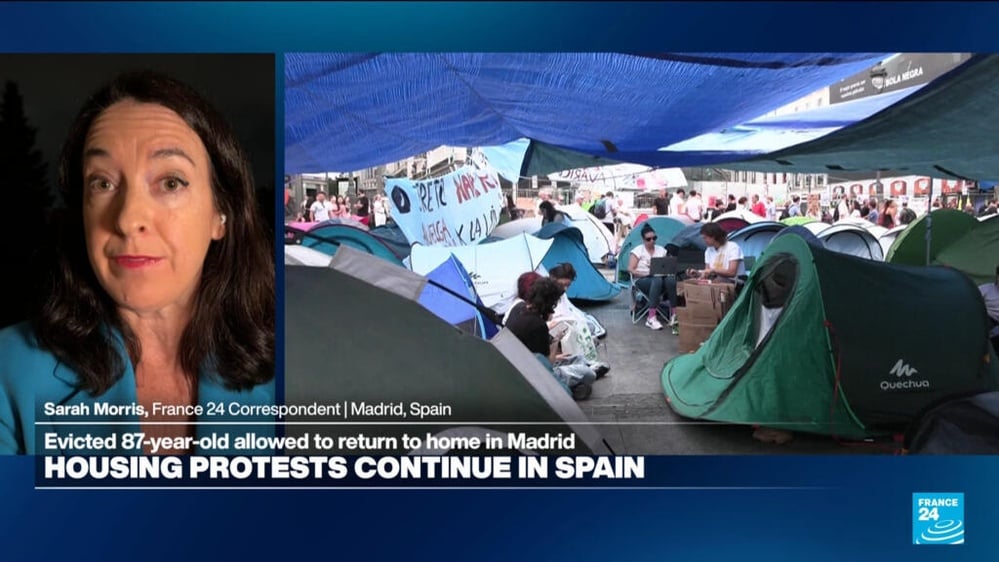
“Over 600 protesters are now camped outside Madrid’s regional government headquarters demanding new tenant protections.” · exact text match
Why: The report's central subject is a political protest targeting regional government, and it includes extended commentary by a member of parliament about coalition politics.
Claim: The report names its sources, quotes directly, and discloses transcript uncertainty, supporting basic credibility.
“Sabina Carrau is the spokesperson for the Sindicato de Inquilinas, the Madrid Tenants’ Union” · exact text match
“This is a rush transcript.
Copy may not be in its final form.”
· exact text match
Why: Specific named sources and direct quotes are present, but the lack of opposing perspectives and the provisional transcript caveat keep confidence moderate.
Claim: The publisher's framing is critical of corporate housing investment, treating it as harmful speculation.
“after an investment fund bought her apartment building and more than tripled, or more, her rent” · exact text match
“sparked nationwide protests against corporate greed and wealth inequality” · exact text match
Why: The proximate cause is attributed to an investment fund's rent increase, and the reaction is summarized as being against 'corporate greed.'
Claim: The piece shows observable transparency by labeling the transcript as provisional and identifying interviewees by name and role.
“This is a rush transcript.
Copy may not be in its final form.”
· exact text match
Why: Disclosure of possible transcript error is a concrete honesty signal, though the overall one-sided framing limits a higher score.
The supplied text is a rush transcript mixing the publisher's narration with heavily quoted activist and politician advocacy, so the boundary between the publisher's own framing and interviewee opinion is partly ambiguous.
September 28, 2026 · 0 shares
Framing centers tenant-union and progressive parliamentary voices, presenting Spain's housing crisis as a conflict between corporate speculation and ordinary people while treating government action as insufficient.
Automated analysis; not human reviewed.
Limitations: The supplied text is a rush transcript mixing the publisher's narration with heavily quoted activist and politician advocacy, so the boundary between the publisher's own framing and interviewee opinion is partly ambiguous.
·
4 of 55 available dimensions scored; omitted dimensions are not treated as neutral.
·
Verified supporting quotes for 4 of 4 scored dimensions.
Claim: The article is overtly political, centered on a protest movement, a proposed government decree, and coalition-government dynamics.
“Over 600 protesters are now camped outside Madrid’s regional government headquarters demanding new tenant protections.” · exact text match
Why: The report's central subject is a political protest targeting regional government, and it includes extended commentary by a member of parliament about coalition politics.
Claim: The report names its sources, quotes directly, and discloses transcript uncertainty, supporting basic credibility.
“Sabina Carrau is the spokesperson for the Sindicato de Inquilinas, the Madrid Tenants’ Union” · exact text match
“This is a rush transcript.
Copy may not be in its final form.”
· exact text match
Why: Specific named sources and direct quotes are present, but the lack of opposing perspectives and the provisional transcript caveat keep confidence moderate.
Claim: The publisher's framing is critical of corporate housing investment, treating it as harmful speculation.
“after an investment fund bought her apartment building and more than tripled, or more, her rent” · exact text match
“sparked nationwide protests against corporate greed and wealth inequality” · exact text match
Why: The proximate cause is attributed to an investment fund's rent increase, and the reaction is summarized as being against 'corporate greed.'
Claim: The piece shows observable transparency by labeling the transcript as provisional and identifying interviewees by name and role.
“This is a rush transcript.
Copy may not be in its final form.”
· exact text match
Why: Disclosure of possible transcript error is a concrete honesty signal, though the overall one-sided framing limits a higher score.
The supplied text is a rush transcript mixing the publisher's narration with heavily quoted activist and politician advocacy, so the boundary between the publisher's own framing and interviewee opinion is partly ambiguous.
September 29, 2026 · 0 shares
Framing dramatizes the eviction of an elderly woman as a human-interest flashpoint and implicitly validates nationwide protests over Spain's housing crisis.
Automated analysis; not human reviewed.
Limitations: Only a headline/snippet was supplied, so framing is assessed from that alone; no full article, sourcing, or policy context was available.
·
7 of 55 available dimensions scored; omitted dimensions are not treated as neutral.
·
Verified supporting quotes for 7 of 7 scored dimensions.
Claim: The framing is subjective, presenting the eviction through an emotionally charged human-interest lens.
“The moment an 87-year-old woman is evicted on a stretcher” · exact text match
Why: Selecting the image of an elderly woman on a stretcher frames the event as a poignant human tragedy rather than a neutral legal proceeding.
Claim: The headline uses dramatic visual and metaphorical language to heighten emotional impact.
“The moment an 87-year-old woman is evicted on a stretcher” · exact text match
“lightning rod for nationwide protests against Spain’s housing crisis” · exact text match
Why: 'Moment' and 'on a stretcher' stage a vivid scene, while 'lightning rod' turns the eviction into a symbolic flashpoint instead of a routine legal event.
Claim: The headline highlights an unusual and dramatic detail likely to draw reader interest.
“The moment an 87-year-old woman is evicted on a stretcher” · exact text match
Why: A specific, vivid visual detail makes the story stand out as notably attention-grabbing.
Claim: The headline uses a distressing image to provoke outrage.
“The moment an 87-year-old woman is evicted on a stretcher” · exact text match
Why: The vivid physical detail is emotionally loaded and provocative, emphasizing the shocking circumstances of the eviction.
Claim: The story is framed around national protest and a systemic crisis, giving it a clear political charge.
“nationwide protests against Spain’s housing crisis” · exact text match
Why: Linking the eviction to nationwide protests and a 'housing crisis' places the event in a context of collective action and policy failure.
Claim: The evictee is portrayed primarily as a helpless victim.
“87-year-old woman is evicted on a stretcher” · exact text match
Why: Highlighting her age and stretcher status emphasizes vulnerability and places the woman squarely in a victim role.
Claim: The article's emotional valence is negative, evoking sympathy and outrage at the eviction.
“The moment an 87-year-old woman is evicted on a stretcher” · exact text match
Why: The image of an elderly woman evicted on a stretcher carries a strong negative emotional charge and invites moral indignation.
Only a headline/snippet was supplied, so framing is assessed from that alone; no full article, sourcing, or policy context was available.
September 28, 2026 · 0 shares
Framing centers tenant-union and progressive parliamentary voices, presenting Spain's housing crisis as a conflict between corporate speculation and ordinary people while treating government action as insufficient.
Automated analysis; not human reviewed.
Limitations: The supplied text is a rush transcript mixing the publisher's narration with heavily quoted activist and politician advocacy, so the boundary between the publisher's own framing and interviewee opinion is partly ambiguous.
·
4 of 55 available dimensions scored; omitted dimensions are not treated as neutral.
·
Verified supporting quotes for 4 of 4 scored dimensions.
Claim: The article is overtly political, centered on a protest movement, a proposed government decree, and coalition-government dynamics.
“Over 600 protesters are now camped outside Madrid’s regional government headquarters demanding new tenant protections.” · exact text match
Why: The report's central subject is a political protest targeting regional government, and it includes extended commentary by a member of parliament about coalition politics.
Claim: The report names its sources, quotes directly, and discloses transcript uncertainty, supporting basic credibility.
“Sabina Carrau is the spokesperson for the Sindicato de Inquilinas, the Madrid Tenants’ Union” · exact text match
“This is a rush transcript.
Copy may not be in its final form.”
· exact text match
Why: Specific named sources and direct quotes are present, but the lack of opposing perspectives and the provisional transcript caveat keep confidence moderate.
Claim: The publisher's framing is critical of corporate housing investment, treating it as harmful speculation.
“after an investment fund bought her apartment building and more than tripled, or more, her rent” · exact text match
“sparked nationwide protests against corporate greed and wealth inequality” · exact text match
Why: The proximate cause is attributed to an investment fund's rent increase, and the reaction is summarized as being against 'corporate greed.'
Claim: The piece shows observable transparency by labeling the transcript as provisional and identifying interviewees by name and role.
“This is a rush transcript.
Copy may not be in its final form.”
· exact text match
Why: Disclosure of possible transcript error is a concrete honesty signal, though the overall one-sided framing limits a higher score.
The supplied text is a rush transcript mixing the publisher's narration with heavily quoted activist and politician advocacy, so the boundary between the publisher's own framing and interviewee opinion is partly ambiguous.
October 03, 2026 · 0 shares
The coverage is detached and attributed, reporting protest, police, and government details without endorsing any side.
Automated analysis; not human reviewed.
Limitations: No byline, publication name, or exact date is present in the supplied text, so publisher-specific framing cannot be assessed.
·
5 of 55 available dimensions scored; omitted dimensions are not treated as neutral.
·
Verified supporting quotes for 5 of 5 scored dimensions.
Claim: The article presents events through attributed, source-based reporting rather than subjective commentary.
“About 70,000 protesters took part in Saturday’s demonstration in Madrid, the Spanish government said.” · exact text match
“Sanchez’s office refused to comment on the reports.” · exact text match
Why: Numbers are attributed to the government and an official refusal to comment is included, showing a detached, source-based approach.
Claim: The article reports conflict plainly and includes a contextual detail that reduces sensationalism.
“In the southeastern city of Valencia, demonstrators clashed with police who fired rubber bullets and tear gas to break up protests.” · exact text match
“Other demonstrations in 50 Spanish cities were peaceful.” · exact text match
Why: Clashes are reported in one flat sentence and immediately balanced by the peaceful-statistics line, with no dramatic adjectives or emotional buildup.
Claim: The article describes events and attributed statements without issuing recommendations or moral directives.
“Tens of thousands of people took to the streets of Madrid and other Spanish cities on Saturday” · exact text match
“Other demonstrations in 50 Spanish cities were peaceful.” · exact text match
Why: The reporting remains observational and does not prescribe what protesters, police, or politicians should do.
Claim: The article supports its key claims with named or institutional sourcing and clearly attributes secondary reports.
“Valeria Racu, spokesperson for the Tenants Union, told reporters in Madrid that a general strike would be called after talks with labour unions.” · exact text match
“Spanish Prime Minister Pedro Sanchez might call a snap election for November after the legislation failed to pass, Spanish media reported on Friday” · exact text match
Why: The strike plan is attributed to a named spokesperson and the election speculation to Spanish media reports, not asserted by the article as fact.
Claim: The article signals fairness by attributing contested figures and including an official refusal to comment.
“Sanchez’s office refused to comment on the reports.” · exact text match
“About 70,000 protesters took part in Saturday’s demonstration in Madrid, the Spanish government said.” · exact text match
Why: Both the administration's non-comment and the official turnout figure are reported without presenting speculation as confirmed fact.
No byline, publication name, or exact date is present in the supplied text, so publisher-specific framing cannot be assessed.
October 03, 2026 · 0 shares
The coverage is detached and attributed, reporting protest, police, and government details without endorsing any side.
Automated analysis; not human reviewed.
Limitations: No byline, publication name, or exact date is present in the supplied text, so publisher-specific framing cannot be assessed.
·
5 of 55 available dimensions scored; omitted dimensions are not treated as neutral.
·
Verified supporting quotes for 5 of 5 scored dimensions.
Claim: The article presents events through attributed, source-based reporting rather than subjective commentary.
“About 70,000 protesters took part in Saturday’s demonstration in Madrid, the Spanish government said.” · exact text match
“Sanchez’s office refused to comment on the reports.” · exact text match
Why: Numbers are attributed to the government and an official refusal to comment is included, showing a detached, source-based approach.
Claim: The article reports conflict plainly and includes a contextual detail that reduces sensationalism.
“In the southeastern city of Valencia, demonstrators clashed with police who fired rubber bullets and tear gas to break up protests.” · exact text match
“Other demonstrations in 50 Spanish cities were peaceful.” · exact text match
Why: Clashes are reported in one flat sentence and immediately balanced by the peaceful-statistics line, with no dramatic adjectives or emotional buildup.
Claim: The article describes events and attributed statements without issuing recommendations or moral directives.
“Tens of thousands of people took to the streets of Madrid and other Spanish cities on Saturday” · exact text match
“Other demonstrations in 50 Spanish cities were peaceful.” · exact text match
Why: The reporting remains observational and does not prescribe what protesters, police, or politicians should do.
Claim: The article supports its key claims with named or institutional sourcing and clearly attributes secondary reports.
“Valeria Racu, spokesperson for the Tenants Union, told reporters in Madrid that a general strike would be called after talks with labour unions.” · exact text match
“Spanish Prime Minister Pedro Sanchez might call a snap election for November after the legislation failed to pass, Spanish media reported on Friday” · exact text match
Why: The strike plan is attributed to a named spokesperson and the election speculation to Spanish media reports, not asserted by the article as fact.
Claim: The article signals fairness by attributing contested figures and including an official refusal to comment.
“Sanchez’s office refused to comment on the reports.” · exact text match
“About 70,000 protesters took part in Saturday’s demonstration in Madrid, the Spanish government said.” · exact text match
Why: Both the administration's non-comment and the official turnout figure are reported without presenting speculation as confirmed fact.
No byline, publication name, or exact date is present in the supplied text, so publisher-specific framing cannot be assessed.
September 28, 2026 · 0 shares
Framing centers tenant-union and progressive parliamentary voices, presenting Spain's housing crisis as a conflict between corporate speculation and ordinary people while treating government action as insufficient.
Automated analysis; not human reviewed.
Limitations: The supplied text is a rush transcript mixing the publisher's narration with heavily quoted activist and politician advocacy, so the boundary between the publisher's own framing and interviewee opinion is partly ambiguous.
·
4 of 55 available dimensions scored; omitted dimensions are not treated as neutral.
·
Verified supporting quotes for 4 of 4 scored dimensions.
Claim: The article is overtly political, centered on a protest movement, a proposed government decree, and coalition-government dynamics.
“Over 600 protesters are now camped outside Madrid’s regional government headquarters demanding new tenant protections.” · exact text match
Why: The report's central subject is a political protest targeting regional government, and it includes extended commentary by a member of parliament about coalition politics.
Claim: The report names its sources, quotes directly, and discloses transcript uncertainty, supporting basic credibility.
“Sabina Carrau is the spokesperson for the Sindicato de Inquilinas, the Madrid Tenants’ Union” · exact text match
“This is a rush transcript.
Copy may not be in its final form.”
· exact text match
Why: Specific named sources and direct quotes are present, but the lack of opposing perspectives and the provisional transcript caveat keep confidence moderate.
Claim: The publisher's framing is critical of corporate housing investment, treating it as harmful speculation.
“after an investment fund bought her apartment building and more than tripled, or more, her rent” · exact text match
“sparked nationwide protests against corporate greed and wealth inequality” · exact text match
Why: The proximate cause is attributed to an investment fund's rent increase, and the reaction is summarized as being against 'corporate greed.'
Claim: The piece shows observable transparency by labeling the transcript as provisional and identifying interviewees by name and role.
“This is a rush transcript.
Copy may not be in its final form.”
· exact text match
Why: Disclosure of possible transcript error is a concrete honesty signal, though the overall one-sided framing limits a higher score.
The supplied text is a rush transcript mixing the publisher's narration with heavily quoted activist and politician advocacy, so the boundary between the publisher's own framing and interviewee opinion is partly ambiguous.
The headline frames the cabinet members' own consensus statement as a settled Spanish agreement, and the body offers no independent verification or detail.
Automated analysis; not human reviewed. Limitations: The supplied text is a truncated snippet consisting of a headline and one sentence, so the full policy package and the factual basis for the ministers' consensus cannot be assessed.
The supplied text is a truncated snippet consisting of a headline and one sentence, so the full policy package and the factual basis for the ministers' consensus cannot be assessed.
October 03, 2026 · 0 shares
The coverage is detached and attributed, reporting protest, police, and government details without endorsing any side.
Automated analysis; not human reviewed.
Limitations: No byline, publication name, or exact date is present in the supplied text, so publisher-specific framing cannot be assessed.
·
5 of 55 available dimensions scored; omitted dimensions are not treated as neutral.
·
Verified supporting quotes for 5 of 5 scored dimensions.
Claim: The article presents events through attributed, source-based reporting rather than subjective commentary.
“About 70,000 protesters took part in Saturday’s demonstration in Madrid, the Spanish government said.” · exact text match
“Sanchez’s office refused to comment on the reports.” · exact text match
Why: Numbers are attributed to the government and an official refusal to comment is included, showing a detached, source-based approach.
Claim: The article reports conflict plainly and includes a contextual detail that reduces sensationalism.
“In the southeastern city of Valencia, demonstrators clashed with police who fired rubber bullets and tear gas to break up protests.” · exact text match
“Other demonstrations in 50 Spanish cities were peaceful.” · exact text match
Why: Clashes are reported in one flat sentence and immediately balanced by the peaceful-statistics line, with no dramatic adjectives or emotional buildup.
Claim: The article describes events and attributed statements without issuing recommendations or moral directives.
“Tens of thousands of people took to the streets of Madrid and other Spanish cities on Saturday” · exact text match
“Other demonstrations in 50 Spanish cities were peaceful.” · exact text match
Why: The reporting remains observational and does not prescribe what protesters, police, or politicians should do.
Claim: The article supports its key claims with named or institutional sourcing and clearly attributes secondary reports.
“Valeria Racu, spokesperson for the Tenants Union, told reporters in Madrid that a general strike would be called after talks with labour unions.” · exact text match
“Spanish Prime Minister Pedro Sanchez might call a snap election for November after the legislation failed to pass, Spanish media reported on Friday” · exact text match
Why: The strike plan is attributed to a named spokesperson and the election speculation to Spanish media reports, not asserted by the article as fact.
Claim: The article signals fairness by attributing contested figures and including an official refusal to comment.
“Sanchez’s office refused to comment on the reports.” · exact text match
“About 70,000 protesters took part in Saturday’s demonstration in Madrid, the Spanish government said.” · exact text match
Why: Both the administration's non-comment and the official turnout figure are reported without presenting speculation as confirmed fact.
No byline, publication name, or exact date is present in the supplied text, so publisher-specific framing cannot be assessed.
September 28, 2026 · 0 shares
The eviction of an 87-year-old Madrid tenant is framed as the symbolic trigger for a broad, data-rich explanation of Spain's housing affordability crisis, emphasizing supply deficits, ownership concentration, and the limited social housing stock.
Automated analysis; not human reviewed.
Limitations: The supplied text is a composite of headline, deck, article body, and promotional boilerplate; I analyzed only the substantive housing report and cannot independently verify the cited statistics.
·
7 of 55 available dimensions scored; omitted dimensions are not treated as neutral.
·
Verified supporting quotes for 7 of 7 scored dimensions.
Claim: The framing treats housing unaffordability as a structural problem that falls hardest on renters and that a small social-housing stock cannot cushion.
“In Spain, when private rents rise rapidly, there is only a relatively small public stock able to absorb households that can no longer afford them.” · exact text match
Why: The sentence highlights the inadequacy of public housing without explicitly endorsing a party or policy.
Claim: The report is built on attributed statistics and named institutions rather than personal impressions.
“According to INE data, in 2024, 28.1% of people renting a home at market rates were spending more than 40% of their disposable income on housing costs.” · exact text match
Why: Most quantitative claims are sourced to INE, Idealista, the Bank of Spain, the European Commission, and the College of Registrars.
Claim: Despite the emotional eviction, the tone stays matter-of-fact and contextual.
“The case triggered protests that quickly spread beyond Madrid.” · exact text match
Why: The eviction is described plainly and used as an entry point to data rather than as a source of outrage.
Claim: The report explains causes and context but stops short of demanding a particular policy.
“Part of the answer lies in the consequences of the previous property crisis.” · exact text match
Why: It says 'part of the answer lies in' past causes, a descriptive-explanatory move, rather than a prescription.
Claim: The report is centered on a politically contested eviction and intergovernmental blame.
“The central government, the Madrid regional administration, the city council, the owner and tenants' organisations have disagreed over who is responsible and what measures could have been taken to avoid the eviction.” · exact text match
Why: The housing issue is presented as an unresolved political dispute, though no candidate or party is endorsed.
Claim: The report resists monocausal explanations and weighs multiple data-backed factors.
“Experts stress that there is no single explanation, but a fundamental imbalance lies behind the current situation.” · exact text match
Why: It connects construction, demographics, tourism, ownership structure, and social-housing supply rather than resting on a single cause.
Claim: The report consistently attributes claims and distinguishes the tenant union's account from official data.
“According to the Madrid Tenants' Union, following a change of ownership there was a proposed rent increase from about 500 euros to 2,650 euros a month, later reduced to 1,650.” · exact text match
Why: Allegations and statistics are labeled with their sources, and no anonymous or unverifiable assertion is presented as fact.
The supplied text is a composite of headline, deck, article body, and promotional boilerplate; I analyzed only the substantive housing report and cannot independently verify the cited statistics.
September 28, 2026 · 0 shares
Framing centers tenant-union and progressive parliamentary voices, presenting Spain's housing crisis as a conflict between corporate speculation and ordinary people while treating government action as insufficient.
Automated analysis; not human reviewed. Limitations: The supplied text is a rush transcript mixing the publisher's narration with heavily quoted activist and politician advocacy, so the boundary between the publisher's own framing and interviewee opinion is partly ambiguous. · 4 of 55 available dimensions scored; omitted dimensions are not treated as neutral. · Verified supporting quotes for 4 of 4 scored dimensions.
Claim: The article is overtly political, centered on a protest movement, a proposed government decree, and coalition-government dynamics.
“Over 600 protesters are now camped outside Madrid’s regional government headquarters demanding new tenant protections.” · exact text match
Why: The report's central subject is a political protest targeting regional government, and it includes extended commentary by a member of parliament about coalition politics.
Claim: The report names its sources, quotes directly, and discloses transcript uncertainty, supporting basic credibility.
“Sabina Carrau is the spokesperson for the Sindicato de Inquilinas, the Madrid Tenants’ Union” · exact text match
“This is a rush transcript. Copy may not be in its final form.” · exact text match
Why: Specific named sources and direct quotes are present, but the lack of opposing perspectives and the provisional transcript caveat keep confidence moderate.
Claim: The publisher's framing is critical of corporate housing investment, treating it as harmful speculation.
“after an investment fund bought her apartment building and more than tripled, or more, her rent” · exact text match
“sparked nationwide protests against corporate greed and wealth inequality” · exact text match
Why: The proximate cause is attributed to an investment fund's rent increase, and the reaction is summarized as being against 'corporate greed.'
Claim: The piece shows observable transparency by labeling the transcript as provisional and identifying interviewees by name and role.
“This is a rush transcript. Copy may not be in its final form.” · exact text match
Why: Disclosure of possible transcript error is a concrete honesty signal, though the overall one-sided framing limits a higher score.
The supplied text is a rush transcript mixing the publisher's narration with heavily quoted activist and politician advocacy, so the boundary between the publisher's own framing and interviewee opinion is partly ambiguous.
September 28, 2026 · 0 shares
The eviction of an 87-year-old Madrid tenant is framed as the symbolic trigger for a broad, data-rich explanation of Spain's housing affordability crisis, emphasizing supply deficits, ownership concentration, and the limited social housing stock.
Automated analysis; not human reviewed. Limitations: The supplied text is a composite of headline, deck, article body, and promotional boilerplate; I analyzed only the substantive housing report and cannot independently verify the cited statistics. · 7 of 55 available dimensions scored; omitted dimensions are not treated as neutral. · Verified supporting quotes for 7 of 7 scored dimensions.
Claim: The framing treats housing unaffordability as a structural problem that falls hardest on renters and that a small social-housing stock cannot cushion.
“In Spain, when private rents rise rapidly, there is only a relatively small public stock able to absorb households that can no longer afford them.” · exact text match
Why: The sentence highlights the inadequacy of public housing without explicitly endorsing a party or policy.
Claim: The report is built on attributed statistics and named institutions rather than personal impressions.
“According to INE data, in 2024, 28.1% of people renting a home at market rates were spending more than 40% of their disposable income on housing costs.” · exact text match
Why: Most quantitative claims are sourced to INE, Idealista, the Bank of Spain, the European Commission, and the College of Registrars.
Claim: Despite the emotional eviction, the tone stays matter-of-fact and contextual.
“The case triggered protests that quickly spread beyond Madrid.” · exact text match
Why: The eviction is described plainly and used as an entry point to data rather than as a source of outrage.
Claim: The report explains causes and context but stops short of demanding a particular policy.
“Part of the answer lies in the consequences of the previous property crisis.” · exact text match
Why: It says 'part of the answer lies in' past causes, a descriptive-explanatory move, rather than a prescription.
Claim: The report is centered on a politically contested eviction and intergovernmental blame.
“The central government, the Madrid regional administration, the city council, the owner and tenants' organisations have disagreed over who is responsible and what measures could have been taken to avoid the eviction.” · exact text match
Why: The housing issue is presented as an unresolved political dispute, though no candidate or party is endorsed.
Claim: The report resists monocausal explanations and weighs multiple data-backed factors.
“Experts stress that there is no single explanation, but a fundamental imbalance lies behind the current situation.” · exact text match
Why: It connects construction, demographics, tourism, ownership structure, and social-housing supply rather than resting on a single cause.
Claim: The report consistently attributes claims and distinguishes the tenant union's account from official data.
“According to the Madrid Tenants' Union, following a change of ownership there was a proposed rent increase from about 500 euros to 2,650 euros a month, later reduced to 1,650.” · exact text match
Why: Allegations and statistics are labeled with their sources, and no anonymous or unverifiable assertion is presented as fact.
The supplied text is a composite of headline, deck, article body, and promotional boilerplate; I analyzed only the substantive housing report and cannot independently verify the cited statistics.
September 28, 2026 · 0 shares
The eviction of an 87-year-old Madrid tenant is framed as the symbolic trigger for a broad, data-rich explanation of Spain's housing affordability crisis, emphasizing supply deficits, ownership concentration, and the limited social housing stock.
Automated analysis; not human reviewed. Limitations: The supplied text is a composite of headline, deck, article body, and promotional boilerplate; I analyzed only the substantive housing report and cannot independently verify the cited statistics. · 7 of 55 available dimensions scored; omitted dimensions are not treated as neutral. · Verified supporting quotes for 7 of 7 scored dimensions.
Claim: The framing treats housing unaffordability as a structural problem that falls hardest on renters and that a small social-housing stock cannot cushion.
“In Spain, when private rents rise rapidly, there is only a relatively small public stock able to absorb households that can no longer afford them.” · exact text match
Why: The sentence highlights the inadequacy of public housing without explicitly endorsing a party or policy.
Claim: The report is built on attributed statistics and named institutions rather than personal impressions.
“According to INE data, in 2024, 28.1% of people renting a home at market rates were spending more than 40% of their disposable income on housing costs.” · exact text match
Why: Most quantitative claims are sourced to INE, Idealista, the Bank of Spain, the European Commission, and the College of Registrars.
Claim: Despite the emotional eviction, the tone stays matter-of-fact and contextual.
“The case triggered protests that quickly spread beyond Madrid.” · exact text match
Why: The eviction is described plainly and used as an entry point to data rather than as a source of outrage.
Claim: The report explains causes and context but stops short of demanding a particular policy.
“Part of the answer lies in the consequences of the previous property crisis.” · exact text match
Why: It says 'part of the answer lies in' past causes, a descriptive-explanatory move, rather than a prescription.
Claim: The report is centered on a politically contested eviction and intergovernmental blame.
“The central government, the Madrid regional administration, the city council, the owner and tenants' organisations have disagreed over who is responsible and what measures could have been taken to avoid the eviction.” · exact text match
Why: The housing issue is presented as an unresolved political dispute, though no candidate or party is endorsed.
Claim: The report resists monocausal explanations and weighs multiple data-backed factors.
“Experts stress that there is no single explanation, but a fundamental imbalance lies behind the current situation.” · exact text match
Why: It connects construction, demographics, tourism, ownership structure, and social-housing supply rather than resting on a single cause.
Claim: The report consistently attributes claims and distinguishes the tenant union's account from official data.
“According to the Madrid Tenants' Union, following a change of ownership there was a proposed rent increase from about 500 euros to 2,650 euros a month, later reduced to 1,650.” · exact text match
Why: Allegations and statistics are labeled with their sources, and no anonymous or unverifiable assertion is presented as fact.
The supplied text is a composite of headline, deck, article body, and promotional boilerplate; I analyzed only the substantive housing report and cannot independently verify the cited statistics.
October 03, 2026 · 0 shares
The coverage is detached and attributed, reporting protest, police, and government details without endorsing any side.
Automated analysis; not human reviewed. Limitations: No byline, publication name, or exact date is present in the supplied text, so publisher-specific framing cannot be assessed. · 5 of 55 available dimensions scored; omitted dimensions are not treated as neutral. · Verified supporting quotes for 5 of 5 scored dimensions.
Claim: The article presents events through attributed, source-based reporting rather than subjective commentary.
“About 70,000 protesters took part in Saturday’s demonstration in Madrid, the Spanish government said.” · exact text match
“Sanchez’s office refused to comment on the reports.” · exact text match
Why: Numbers are attributed to the government and an official refusal to comment is included, showing a detached, source-based approach.
Claim: The article reports conflict plainly and includes a contextual detail that reduces sensationalism.
“In the southeastern city of Valencia, demonstrators clashed with police who fired rubber bullets and tear gas to break up protests.” · exact text match
“Other demonstrations in 50 Spanish cities were peaceful.” · exact text match
Why: Clashes are reported in one flat sentence and immediately balanced by the peaceful-statistics line, with no dramatic adjectives or emotional buildup.
Claim: The article describes events and attributed statements without issuing recommendations or moral directives.
“Tens of thousands of people took to the streets of Madrid and other Spanish cities on Saturday” · exact text match
“Other demonstrations in 50 Spanish cities were peaceful.” · exact text match
Why: The reporting remains observational and does not prescribe what protesters, police, or politicians should do.
Claim: The article supports its key claims with named or institutional sourcing and clearly attributes secondary reports.
“Valeria Racu, spokesperson for the Tenants Union, told reporters in Madrid that a general strike would be called after talks with labour unions.” · exact text match
“Spanish Prime Minister Pedro Sanchez might call a snap election for November after the legislation failed to pass, Spanish media reported on Friday” · exact text match
Why: The strike plan is attributed to a named spokesperson and the election speculation to Spanish media reports, not asserted by the article as fact.
Claim: The article signals fairness by attributing contested figures and including an official refusal to comment.
“Sanchez’s office refused to comment on the reports.” · exact text match
“About 70,000 protesters took part in Saturday’s demonstration in Madrid, the Spanish government said.” · exact text match
Why: Both the administration's non-comment and the official turnout figure are reported without presenting speculation as confirmed fact.
No byline, publication name, or exact date is present in the supplied text, so publisher-specific framing cannot be assessed.
Tenant movement / progressive left
September 28, 2026 · 0 shares
Framing centers tenant-union and progressive parliamentary voices, presenting Spain's housing crisis as a conflict between corporate speculation and ordinary people while treating government action as insufficient.
Automated analysis; not human reviewed. Limitations: The supplied text is a rush transcript mixing the publisher's narration with heavily quoted activist and politician advocacy, so the boundary between the publisher's own framing and interviewee opinion is partly ambiguous. · 4 of 55 available dimensions scored; omitted dimensions are not treated as neutral. · Verified supporting quotes for 4 of 4 scored dimensions.
Claim: The article is overtly political, centered on a protest movement, a proposed government decree, and coalition-government dynamics.
“Over 600 protesters are now camped outside Madrid’s regional government headquarters demanding new tenant protections.” · exact text match
Why: The report's central subject is a political protest targeting regional government, and it includes extended commentary by a member of parliament about coalition politics.
Claim: The report names its sources, quotes directly, and discloses transcript uncertainty, supporting basic credibility.
“Sabina Carrau is the spokesperson for the Sindicato de Inquilinas, the Madrid Tenants’ Union” · exact text match
“This is a rush transcript. Copy may not be in its final form.” · exact text match
Why: Specific named sources and direct quotes are present, but the lack of opposing perspectives and the provisional transcript caveat keep confidence moderate.
Claim: The publisher's framing is critical of corporate housing investment, treating it as harmful speculation.
“after an investment fund bought her apartment building and more than tripled, or more, her rent” · exact text match
“sparked nationwide protests against corporate greed and wealth inequality” · exact text match
Why: The proximate cause is attributed to an investment fund's rent increase, and the reaction is summarized as being against 'corporate greed.'
Claim: The piece shows observable transparency by labeling the transcript as provisional and identifying interviewees by name and role.
“This is a rush transcript. Copy may not be in its final form.” · exact text match
Why: Disclosure of possible transcript error is a concrete honesty signal, though the overall one-sided framing limits a higher score.
The supplied text is a rush transcript mixing the publisher's narration with heavily quoted activist and politician advocacy, so the boundary between the publisher's own framing and interviewee opinion is partly ambiguous.
Framing centers tenant activists' demands as legitimate, portrays the Spanish government's housing response as inadequate, and uses the interview to press an elected official on perceived hypocrisy over Western Sahara.
Spain has faced a growing housing affordability crisis, with tenant unions organizing against evictions and demanding rent regulation. The Western Sahara issue stems from Spain's former colony, now split between Moroccan occupation and the Polisario Front, and has been a point of tension in Spanish politics.
Automated analysis; not human reviewed. Limitations: The supplied article text is fragmented, containing transcript excerpts, unrelated headlines, and page artifacts; the analysis relies primarily on the coherent interview portion. · 6 of 55 available dimensions scored; omitted dimensions are not treated as neutral. · Verified supporting quotes for 5 of 6 scored dimensions.
Claim: The framing is liberal, favoring tenant rights and criticizing the left-wing government from the left.
“this is an exactly perfect example of how is the hypocrisy of socialism” · not found in supplied text
“We want to change the whole system.” · exact text match
Why: The text presents the MP's radical critique and the activist's demands without counter-argument, indicating alignment with the liberal/left perspective.
Claim: The framing is populist, presenting grassroots protesters as the legitimate voice against the government.
“Protesters, camped in tents with sleeping bags in the Puerta del Sol plaza, say they won’t leave unless meaningful government action is taken.” · exact text match
“we are demanding” · exact text match
Why: The description of persistent protesters and the use of 'we are demanding' positions ordinary citizens against state inaction.
Claim: The framing blends reported facts with partisan perspectives.
“Protesters, camped in tents with sleeping bags in the Puerta del Sol plaza, say they won’t leave unless meaningful government action is taken.” · exact text match
“another occupation, Morocco-occupied Western Sahara” · exact text match
Why: The first quote is neutral description; the second adopts the activist's characterization of Western Sahara as an occupation.
Claim: The text is highly political, centered on policy, protest, and electoral politics.
“set to be debated by Spain’s government this week” · exact text match
“what’s going to be discussed tomorrow in the Council of Ministers” · exact text match
Why: The content focuses on government process and protest demands, making politics the central subject.
Claim: The framing is anti-establishment, endorsing systemic change over incremental reform.
“We want to change the whole system.” · exact text match
Why: The interviewee's goal to replace the system is presented as a positive demand without challenge.
Claim: The article is intellectually substantive, referencing specific political structures and movement history.
“I think the colleague from the Sindicato de Inquilinas explained it very well.” · exact text match
“we are kind of semi-federal states” · exact text match
Why: The discussion engages with institutional details and organized labor, indicating a complex treatment.
The supplied article text is fragmented, containing transcript excerpts, unrelated headlines, and page artifacts; the analysis relies primarily on the coherent interview portion.
Framing centers tenant activists' demands as legitimate, portrays the Spanish government's housing response as inadequate, and uses the interview to press an elected official on perceived hypocrisy over Western Sahara.
Spain has faced a growing housing affordability crisis, with tenant unions organizing against evictions and demanding rent regulation. The Western Sahara issue stems from Spain's former colony, now split between Moroccan occupation and the Polisario Front, and has been a point of tension in Spanish politics.
Automated analysis; not human reviewed. Limitations: The supplied article text is fragmented, containing transcript excerpts, unrelated headlines, and page artifacts; the analysis relies primarily on the coherent interview portion. · 6 of 55 available dimensions scored; omitted dimensions are not treated as neutral. · Verified supporting quotes for 5 of 6 scored dimensions.
Claim: The framing is liberal, favoring tenant rights and criticizing the left-wing government from the left.
“this is an exactly perfect example of how is the hypocrisy of socialism” · not found in supplied text
“We want to change the whole system.” · exact text match
Why: The text presents the MP's radical critique and the activist's demands without counter-argument, indicating alignment with the liberal/left perspective.
Claim: The framing is populist, presenting grassroots protesters as the legitimate voice against the government.
“Protesters, camped in tents with sleeping bags in the Puerta del Sol plaza, say they won’t leave unless meaningful government action is taken.” · exact text match
“we are demanding” · exact text match
Why: The description of persistent protesters and the use of 'we are demanding' positions ordinary citizens against state inaction.
Claim: The framing blends reported facts with partisan perspectives.
“Protesters, camped in tents with sleeping bags in the Puerta del Sol plaza, say they won’t leave unless meaningful government action is taken.” · exact text match
“another occupation, Morocco-occupied Western Sahara” · exact text match
Why: The first quote is neutral description; the second adopts the activist's characterization of Western Sahara as an occupation.
Claim: The text is highly political, centered on policy, protest, and electoral politics.
“set to be debated by Spain’s government this week” · exact text match
“what’s going to be discussed tomorrow in the Council of Ministers” · exact text match
Why: The content focuses on government process and protest demands, making politics the central subject.
Claim: The framing is anti-establishment, endorsing systemic change over incremental reform.
“We want to change the whole system.” · exact text match
Why: The interviewee's goal to replace the system is presented as a positive demand without challenge.
Claim: The article is intellectually substantive, referencing specific political structures and movement history.
“I think the colleague from the Sindicato de Inquilinas explained it very well.” · exact text match
“we are kind of semi-federal states” · exact text match
Why: The discussion engages with institutional details and organized labor, indicating a complex treatment.
The supplied article text is fragmented, containing transcript excerpts, unrelated headlines, and page artifacts; the analysis relies primarily on the coherent interview portion.
September 28, 2026 · 0 shares
The eviction of an 87-year-old Madrid tenant is framed as the symbolic trigger for a broad, data-rich explanation of Spain's housing affordability crisis, emphasizing supply deficits, ownership concentration, and the limited social housing stock.
Automated analysis; not human reviewed. Limitations: The supplied text is a composite of headline, deck, article body, and promotional boilerplate; I analyzed only the substantive housing report and cannot independently verify the cited statistics. · 7 of 55 available dimensions scored; omitted dimensions are not treated as neutral. · Verified supporting quotes for 7 of 7 scored dimensions.
Claim: The framing treats housing unaffordability as a structural problem that falls hardest on renters and that a small social-housing stock cannot cushion.
“In Spain, when private rents rise rapidly, there is only a relatively small public stock able to absorb households that can no longer afford them.” · exact text match
Why: The sentence highlights the inadequacy of public housing without explicitly endorsing a party or policy.
Claim: The report is built on attributed statistics and named institutions rather than personal impressions.
“According to INE data, in 2024, 28.1% of people renting a home at market rates were spending more than 40% of their disposable income on housing costs.” · exact text match
Why: Most quantitative claims are sourced to INE, Idealista, the Bank of Spain, the European Commission, and the College of Registrars.
Claim: Despite the emotional eviction, the tone stays matter-of-fact and contextual.
“The case triggered protests that quickly spread beyond Madrid.” · exact text match
Why: The eviction is described plainly and used as an entry point to data rather than as a source of outrage.
Claim: The report explains causes and context but stops short of demanding a particular policy.
“Part of the answer lies in the consequences of the previous property crisis.” · exact text match
Why: It says 'part of the answer lies in' past causes, a descriptive-explanatory move, rather than a prescription.
Claim: The report is centered on a politically contested eviction and intergovernmental blame.
“The central government, the Madrid regional administration, the city council, the owner and tenants' organisations have disagreed over who is responsible and what measures could have been taken to avoid the eviction.” · exact text match
Why: The housing issue is presented as an unresolved political dispute, though no candidate or party is endorsed.
Claim: The report resists monocausal explanations and weighs multiple data-backed factors.
“Experts stress that there is no single explanation, but a fundamental imbalance lies behind the current situation.” · exact text match
Why: It connects construction, demographics, tourism, ownership structure, and social-housing supply rather than resting on a single cause.
Claim: The report consistently attributes claims and distinguishes the tenant union's account from official data.
“According to the Madrid Tenants' Union, following a change of ownership there was a proposed rent increase from about 500 euros to 2,650 euros a month, later reduced to 1,650.” · exact text match
Why: Allegations and statistics are labeled with their sources, and no anonymous or unverifiable assertion is presented as fact.
The supplied text is a composite of headline, deck, article body, and promotional boilerplate; I analyzed only the substantive housing report and cannot independently verify the cited statistics.
September 28, 2026 · 0 shares
Framing centers tenant-union and progressive parliamentary voices, presenting Spain's housing crisis as a conflict between corporate speculation and ordinary people while treating government action as insufficient.
Automated analysis; not human reviewed. Limitations: The supplied text is a rush transcript mixing the publisher's narration with heavily quoted activist and politician advocacy, so the boundary between the publisher's own framing and interviewee opinion is partly ambiguous. · 4 of 55 available dimensions scored; omitted dimensions are not treated as neutral. · Verified supporting quotes for 4 of 4 scored dimensions.
Claim: The article is overtly political, centered on a protest movement, a proposed government decree, and coalition-government dynamics.
“Over 600 protesters are now camped outside Madrid’s regional government headquarters demanding new tenant protections.” · exact text match
Why: The report's central subject is a political protest targeting regional government, and it includes extended commentary by a member of parliament about coalition politics.
Claim: The report names its sources, quotes directly, and discloses transcript uncertainty, supporting basic credibility.
“Sabina Carrau is the spokesperson for the Sindicato de Inquilinas, the Madrid Tenants’ Union” · exact text match
“This is a rush transcript. Copy may not be in its final form.” · exact text match
Why: Specific named sources and direct quotes are present, but the lack of opposing perspectives and the provisional transcript caveat keep confidence moderate.
Claim: The publisher's framing is critical of corporate housing investment, treating it as harmful speculation.
“after an investment fund bought her apartment building and more than tripled, or more, her rent” · exact text match
“sparked nationwide protests against corporate greed and wealth inequality” · exact text match
Why: The proximate cause is attributed to an investment fund's rent increase, and the reaction is summarized as being against 'corporate greed.'
Claim: The piece shows observable transparency by labeling the transcript as provisional and identifying interviewees by name and role.
“This is a rush transcript. Copy may not be in its final form.” · exact text match
Why: Disclosure of possible transcript error is a concrete honesty signal, though the overall one-sided framing limits a higher score.
The supplied text is a rush transcript mixing the publisher's narration with heavily quoted activist and politician advocacy, so the boundary between the publisher's own framing and interviewee opinion is partly ambiguous.
Framing centers tenant activists' demands as legitimate, portrays the Spanish government's housing response as inadequate, and uses the interview to press an elected official on perceived hypocrisy over Western Sahara.
Spain has faced a growing housing affordability crisis, with tenant unions organizing against evictions and demanding rent regulation. The Western Sahara issue stems from Spain's former colony, now split between Moroccan occupation and the Polisario Front, and has been a point of tension in Spanish politics.
Automated analysis; not human reviewed. Limitations: The supplied article text is fragmented, containing transcript excerpts, unrelated headlines, and page artifacts; the analysis relies primarily on the coherent interview portion. · 6 of 55 available dimensions scored; omitted dimensions are not treated as neutral. · Verified supporting quotes for 5 of 6 scored dimensions.
Claim: The framing is liberal, favoring tenant rights and criticizing the left-wing government from the left.
“this is an exactly perfect example of how is the hypocrisy of socialism” · not found in supplied text
“We want to change the whole system.” · exact text match
Why: The text presents the MP's radical critique and the activist's demands without counter-argument, indicating alignment with the liberal/left perspective.
Claim: The framing is populist, presenting grassroots protesters as the legitimate voice against the government.
“Protesters, camped in tents with sleeping bags in the Puerta del Sol plaza, say they won’t leave unless meaningful government action is taken.” · exact text match
“we are demanding” · exact text match
Why: The description of persistent protesters and the use of 'we are demanding' positions ordinary citizens against state inaction.
Claim: The framing blends reported facts with partisan perspectives.
“Protesters, camped in tents with sleeping bags in the Puerta del Sol plaza, say they won’t leave unless meaningful government action is taken.” · exact text match
“another occupation, Morocco-occupied Western Sahara” · exact text match
Why: The first quote is neutral description; the second adopts the activist's characterization of Western Sahara as an occupation.
Claim: The text is highly political, centered on policy, protest, and electoral politics.
“set to be debated by Spain’s government this week” · exact text match
“what’s going to be discussed tomorrow in the Council of Ministers” · exact text match
Why: The content focuses on government process and protest demands, making politics the central subject.
Claim: The framing is anti-establishment, endorsing systemic change over incremental reform.
“We want to change the whole system.” · exact text match
Why: The interviewee's goal to replace the system is presented as a positive demand without challenge.
Claim: The article is intellectually substantive, referencing specific political structures and movement history.
“I think the colleague from the Sindicato de Inquilinas explained it very well.” · exact text match
“we are kind of semi-federal states” · exact text match
Why: The discussion engages with institutional details and organized labor, indicating a complex treatment.
The supplied article text is fragmented, containing transcript excerpts, unrelated headlines, and page artifacts; the analysis relies primarily on the coherent interview portion.
Government / Sánchez (PSOE-Sumar coalition)
The headline frames the cabinet members' own consensus statement as a settled Spanish agreement, and the body offers no independent verification or detail.
Automated analysis; not human reviewed. Limitations: The supplied text is a truncated snippet consisting of a headline and one sentence, so the full policy package and the factual basis for the ministers' consensus cannot be assessed.
The supplied text is a truncated snippet consisting of a headline and one sentence, so the full policy package and the factual basis for the ministers' consensus cannot be assessed.
October 03, 2026 · 0 shares
The coverage is detached and attributed, reporting protest, police, and government details without endorsing any side.
Automated analysis; not human reviewed. Limitations: No byline, publication name, or exact date is present in the supplied text, so publisher-specific framing cannot be assessed. · 5 of 55 available dimensions scored; omitted dimensions are not treated as neutral. · Verified supporting quotes for 5 of 5 scored dimensions.
Claim: The article presents events through attributed, source-based reporting rather than subjective commentary.
“About 70,000 protesters took part in Saturday’s demonstration in Madrid, the Spanish government said.” · exact text match
“Sanchez’s office refused to comment on the reports.” · exact text match
Why: Numbers are attributed to the government and an official refusal to comment is included, showing a detached, source-based approach.
Claim: The article reports conflict plainly and includes a contextual detail that reduces sensationalism.
“In the southeastern city of Valencia, demonstrators clashed with police who fired rubber bullets and tear gas to break up protests.” · exact text match
“Other demonstrations in 50 Spanish cities were peaceful.” · exact text match
Why: Clashes are reported in one flat sentence and immediately balanced by the peaceful-statistics line, with no dramatic adjectives or emotional buildup.
Claim: The article describes events and attributed statements without issuing recommendations or moral directives.
“Tens of thousands of people took to the streets of Madrid and other Spanish cities on Saturday” · exact text match
“Other demonstrations in 50 Spanish cities were peaceful.” · exact text match
Why: The reporting remains observational and does not prescribe what protesters, police, or politicians should do.
Claim: The article supports its key claims with named or institutional sourcing and clearly attributes secondary reports.
“Valeria Racu, spokesperson for the Tenants Union, told reporters in Madrid that a general strike would be called after talks with labour unions.” · exact text match
“Spanish Prime Minister Pedro Sanchez might call a snap election for November after the legislation failed to pass, Spanish media reported on Friday” · exact text match
Why: The strike plan is attributed to a named spokesperson and the election speculation to Spanish media reports, not asserted by the article as fact.
Claim: The article signals fairness by attributing contested figures and including an official refusal to comment.
“Sanchez’s office refused to comment on the reports.” · exact text match
“About 70,000 protesters took part in Saturday’s demonstration in Madrid, the Spanish government said.” · exact text match
Why: Both the administration's non-comment and the official turnout figure are reported without presenting speculation as confirmed fact.
No byline, publication name, or exact date is present in the supplied text, so publisher-specific framing cannot be assessed.
October 03, 2026 · 0 shares
The coverage is detached and attributed, reporting protest, police, and government details without endorsing any side.
Automated analysis; not human reviewed. Limitations: No byline, publication name, or exact date is present in the supplied text, so publisher-specific framing cannot be assessed. · 5 of 55 available dimensions scored; omitted dimensions are not treated as neutral. · Verified supporting quotes for 5 of 5 scored dimensions.
Claim: The article presents events through attributed, source-based reporting rather than subjective commentary.
“About 70,000 protesters took part in Saturday’s demonstration in Madrid, the Spanish government said.” · exact text match
“Sanchez’s office refused to comment on the reports.” · exact text match
Why: Numbers are attributed to the government and an official refusal to comment is included, showing a detached, source-based approach.
Claim: The article reports conflict plainly and includes a contextual detail that reduces sensationalism.
“In the southeastern city of Valencia, demonstrators clashed with police who fired rubber bullets and tear gas to break up protests.” · exact text match
“Other demonstrations in 50 Spanish cities were peaceful.” · exact text match
Why: Clashes are reported in one flat sentence and immediately balanced by the peaceful-statistics line, with no dramatic adjectives or emotional buildup.
Claim: The article describes events and attributed statements without issuing recommendations or moral directives.
“Tens of thousands of people took to the streets of Madrid and other Spanish cities on Saturday” · exact text match
“Other demonstrations in 50 Spanish cities were peaceful.” · exact text match
Why: The reporting remains observational and does not prescribe what protesters, police, or politicians should do.
Claim: The article supports its key claims with named or institutional sourcing and clearly attributes secondary reports.
“Valeria Racu, spokesperson for the Tenants Union, told reporters in Madrid that a general strike would be called after talks with labour unions.” · exact text match
“Spanish Prime Minister Pedro Sanchez might call a snap election for November after the legislation failed to pass, Spanish media reported on Friday” · exact text match
Why: The strike plan is attributed to a named spokesperson and the election speculation to Spanish media reports, not asserted by the article as fact.
Claim: The article signals fairness by attributing contested figures and including an official refusal to comment.
“Sanchez’s office refused to comment on the reports.” · exact text match
“About 70,000 protesters took part in Saturday’s demonstration in Madrid, the Spanish government said.” · exact text match
Why: Both the administration's non-comment and the official turnout figure are reported without presenting speculation as confirmed fact.
No byline, publication name, or exact date is present in the supplied text, so publisher-specific framing cannot be assessed.
Regional/local government blame-shifting
September 28, 2026 · 0 shares
The eviction of an 87-year-old Madrid tenant is framed as the symbolic trigger for a broad, data-rich explanation of Spain's housing affordability crisis, emphasizing supply deficits, ownership concentration, and the limited social housing stock.
Automated analysis; not human reviewed. Limitations: The supplied text is a composite of headline, deck, article body, and promotional boilerplate; I analyzed only the substantive housing report and cannot independently verify the cited statistics. · 7 of 55 available dimensions scored; omitted dimensions are not treated as neutral. · Verified supporting quotes for 7 of 7 scored dimensions.
Claim: The framing treats housing unaffordability as a structural problem that falls hardest on renters and that a small social-housing stock cannot cushion.
“In Spain, when private rents rise rapidly, there is only a relatively small public stock able to absorb households that can no longer afford them.” · exact text match
Why: The sentence highlights the inadequacy of public housing without explicitly endorsing a party or policy.
Claim: The report is built on attributed statistics and named institutions rather than personal impressions.
“According to INE data, in 2024, 28.1% of people renting a home at market rates were spending more than 40% of their disposable income on housing costs.” · exact text match
Why: Most quantitative claims are sourced to INE, Idealista, the Bank of Spain, the European Commission, and the College of Registrars.
Claim: Despite the emotional eviction, the tone stays matter-of-fact and contextual.
“The case triggered protests that quickly spread beyond Madrid.” · exact text match
Why: The eviction is described plainly and used as an entry point to data rather than as a source of outrage.
Claim: The report explains causes and context but stops short of demanding a particular policy.
“Part of the answer lies in the consequences of the previous property crisis.” · exact text match
Why: It says 'part of the answer lies in' past causes, a descriptive-explanatory move, rather than a prescription.
Claim: The report is centered on a politically contested eviction and intergovernmental blame.
“The central government, the Madrid regional administration, the city council, the owner and tenants' organisations have disagreed over who is responsible and what measures could have been taken to avoid the eviction.” · exact text match
Why: The housing issue is presented as an unresolved political dispute, though no candidate or party is endorsed.
Claim: The report resists monocausal explanations and weighs multiple data-backed factors.
“Experts stress that there is no single explanation, but a fundamental imbalance lies behind the current situation.” · exact text match
Why: It connects construction, demographics, tourism, ownership structure, and social-housing supply rather than resting on a single cause.
Claim: The report consistently attributes claims and distinguishes the tenant union's account from official data.
“According to the Madrid Tenants' Union, following a change of ownership there was a proposed rent increase from about 500 euros to 2,650 euros a month, later reduced to 1,650.” · exact text match
Why: Allegations and statistics are labeled with their sources, and no anonymous or unverifiable assertion is presented as fact.
The supplied text is a composite of headline, deck, article body, and promotional boilerplate; I analyzed only the substantive housing report and cannot independently verify the cited statistics.
September 28, 2026 · 0 shares
Framing centers tenant-union and progressive parliamentary voices, presenting Spain's housing crisis as a conflict between corporate speculation and ordinary people while treating government action as insufficient.
Automated analysis; not human reviewed. Limitations: The supplied text is a rush transcript mixing the publisher's narration with heavily quoted activist and politician advocacy, so the boundary between the publisher's own framing and interviewee opinion is partly ambiguous. · 4 of 55 available dimensions scored; omitted dimensions are not treated as neutral. · Verified supporting quotes for 4 of 4 scored dimensions.
Claim: The article is overtly political, centered on a protest movement, a proposed government decree, and coalition-government dynamics.
“Over 600 protesters are now camped outside Madrid’s regional government headquarters demanding new tenant protections.” · exact text match
Why: The report's central subject is a political protest targeting regional government, and it includes extended commentary by a member of parliament about coalition politics.
Claim: The report names its sources, quotes directly, and discloses transcript uncertainty, supporting basic credibility.
“Sabina Carrau is the spokesperson for the Sindicato de Inquilinas, the Madrid Tenants’ Union” · exact text match
“This is a rush transcript. Copy may not be in its final form.” · exact text match
Why: Specific named sources and direct quotes are present, but the lack of opposing perspectives and the provisional transcript caveat keep confidence moderate.
Claim: The publisher's framing is critical of corporate housing investment, treating it as harmful speculation.
“after an investment fund bought her apartment building and more than tripled, or more, her rent” · exact text match
“sparked nationwide protests against corporate greed and wealth inequality” · exact text match
Why: The proximate cause is attributed to an investment fund's rent increase, and the reaction is summarized as being against 'corporate greed.'
Claim: The piece shows observable transparency by labeling the transcript as provisional and identifying interviewees by name and role.
“This is a rush transcript. Copy may not be in its final form.” · exact text match
Why: Disclosure of possible transcript error is a concrete honesty signal, though the overall one-sided framing limits a higher score.
The supplied text is a rush transcript mixing the publisher's narration with heavily quoted activist and politician advocacy, so the boundary between the publisher's own framing and interviewee opinion is partly ambiguous.
September 28, 2026 · 0 shares
The eviction of an 87-year-old Madrid tenant is framed as the symbolic trigger for a broad, data-rich explanation of Spain's housing affordability crisis, emphasizing supply deficits, ownership concentration, and the limited social housing stock.
Automated analysis; not human reviewed. Limitations: The supplied text is a composite of headline, deck, article body, and promotional boilerplate; I analyzed only the substantive housing report and cannot independently verify the cited statistics. · 7 of 55 available dimensions scored; omitted dimensions are not treated as neutral. · Verified supporting quotes for 7 of 7 scored dimensions.
Claim: The framing treats housing unaffordability as a structural problem that falls hardest on renters and that a small social-housing stock cannot cushion.
“In Spain, when private rents rise rapidly, there is only a relatively small public stock able to absorb households that can no longer afford them.” · exact text match
Why: The sentence highlights the inadequacy of public housing without explicitly endorsing a party or policy.
Claim: The report is built on attributed statistics and named institutions rather than personal impressions.
“According to INE data, in 2024, 28.1% of people renting a home at market rates were spending more than 40% of their disposable income on housing costs.” · exact text match
Why: Most quantitative claims are sourced to INE, Idealista, the Bank of Spain, the European Commission, and the College of Registrars.
Claim: Despite the emotional eviction, the tone stays matter-of-fact and contextual.
“The case triggered protests that quickly spread beyond Madrid.” · exact text match
Why: The eviction is described plainly and used as an entry point to data rather than as a source of outrage.
Claim: The report explains causes and context but stops short of demanding a particular policy.
“Part of the answer lies in the consequences of the previous property crisis.” · exact text match
Why: It says 'part of the answer lies in' past causes, a descriptive-explanatory move, rather than a prescription.
Claim: The report is centered on a politically contested eviction and intergovernmental blame.
“The central government, the Madrid regional administration, the city council, the owner and tenants' organisations have disagreed over who is responsible and what measures could have been taken to avoid the eviction.” · exact text match
Why: The housing issue is presented as an unresolved political dispute, though no candidate or party is endorsed.
Claim: The report resists monocausal explanations and weighs multiple data-backed factors.
“Experts stress that there is no single explanation, but a fundamental imbalance lies behind the current situation.” · exact text match
Why: It connects construction, demographics, tourism, ownership structure, and social-housing supply rather than resting on a single cause.
Claim: The report consistently attributes claims and distinguishes the tenant union's account from official data.
“According to the Madrid Tenants' Union, following a change of ownership there was a proposed rent increase from about 500 euros to 2,650 euros a month, later reduced to 1,650.” · exact text match
Why: Allegations and statistics are labeled with their sources, and no anonymous or unverifiable assertion is presented as fact.
The supplied text is a composite of headline, deck, article body, and promotional boilerplate; I analyzed only the substantive housing report and cannot independently verify the cited statistics.
Helium Bias
September 28, 2026 · 0 shares
The eviction of an 87-year-old Madrid tenant is framed as the symbolic trigger for a broad, data-rich explanation of Spain's housing affordability crisis, emphasizing supply deficits, ownership concentration, and the limited social housing stock.
Automated analysis; not human reviewed. Limitations: The supplied text is a composite of headline, deck, article body, and promotional boilerplate; I analyzed only the substantive housing report and cannot independently verify the cited statistics. · 7 of 55 available dimensions scored; omitted dimensions are not treated as neutral. · Verified supporting quotes for 7 of 7 scored dimensions.
Claim: The framing treats housing unaffordability as a structural problem that falls hardest on renters and that a small social-housing stock cannot cushion.
“In Spain, when private rents rise rapidly, there is only a relatively small public stock able to absorb households that can no longer afford them.” · exact text match
Why: The sentence highlights the inadequacy of public housing without explicitly endorsing a party or policy.
Claim: The report is built on attributed statistics and named institutions rather than personal impressions.
“According to INE data, in 2024, 28.1% of people renting a home at market rates were spending more than 40% of their disposable income on housing costs.” · exact text match
Why: Most quantitative claims are sourced to INE, Idealista, the Bank of Spain, the European Commission, and the College of Registrars.
Claim: Despite the emotional eviction, the tone stays matter-of-fact and contextual.
“The case triggered protests that quickly spread beyond Madrid.” · exact text match
Why: The eviction is described plainly and used as an entry point to data rather than as a source of outrage.
Claim: The report explains causes and context but stops short of demanding a particular policy.
“Part of the answer lies in the consequences of the previous property crisis.” · exact text match
Why: It says 'part of the answer lies in' past causes, a descriptive-explanatory move, rather than a prescription.
Claim: The report is centered on a politically contested eviction and intergovernmental blame.
“The central government, the Madrid regional administration, the city council, the owner and tenants' organisations have disagreed over who is responsible and what measures could have been taken to avoid the eviction.” · exact text match
Why: The housing issue is presented as an unresolved political dispute, though no candidate or party is endorsed.
Claim: The report resists monocausal explanations and weighs multiple data-backed factors.
“Experts stress that there is no single explanation, but a fundamental imbalance lies behind the current situation.” · exact text match
Why: It connects construction, demographics, tourism, ownership structure, and social-housing supply rather than resting on a single cause.
Claim: The report consistently attributes claims and distinguishes the tenant union's account from official data.
“According to the Madrid Tenants' Union, following a change of ownership there was a proposed rent increase from about 500 euros to 2,650 euros a month, later reduced to 1,650.” · exact text match
Why: Allegations and statistics are labeled with their sources, and no anonymous or unverifiable assertion is presented as fact.
The supplied text is a composite of headline, deck, article body, and promotional boilerplate; I analyzed only the substantive housing report and cannot independently verify the cited statistics.
September 28, 2026 · 0 shares
Framing centers tenant-union and progressive parliamentary voices, presenting Spain's housing crisis as a conflict between corporate speculation and ordinary people while treating government action as insufficient.
Automated analysis; not human reviewed. Limitations: The supplied text is a rush transcript mixing the publisher's narration with heavily quoted activist and politician advocacy, so the boundary between the publisher's own framing and interviewee opinion is partly ambiguous. · 4 of 55 available dimensions scored; omitted dimensions are not treated as neutral. · Verified supporting quotes for 4 of 4 scored dimensions.
Claim: The article is overtly political, centered on a protest movement, a proposed government decree, and coalition-government dynamics.
“Over 600 protesters are now camped outside Madrid’s regional government headquarters demanding new tenant protections.” · exact text match
Why: The report's central subject is a political protest targeting regional government, and it includes extended commentary by a member of parliament about coalition politics.
Claim: The report names its sources, quotes directly, and discloses transcript uncertainty, supporting basic credibility.
“Sabina Carrau is the spokesperson for the Sindicato de Inquilinas, the Madrid Tenants’ Union” · exact text match
“This is a rush transcript. Copy may not be in its final form.” · exact text match
Why: Specific named sources and direct quotes are present, but the lack of opposing perspectives and the provisional transcript caveat keep confidence moderate.
Claim: The publisher's framing is critical of corporate housing investment, treating it as harmful speculation.
“after an investment fund bought her apartment building and more than tripled, or more, her rent” · exact text match
“sparked nationwide protests against corporate greed and wealth inequality” · exact text match
Why: The proximate cause is attributed to an investment fund's rent increase, and the reaction is summarized as being against 'corporate greed.'
Claim: The piece shows observable transparency by labeling the transcript as provisional and identifying interviewees by name and role.
“This is a rush transcript. Copy may not be in its final form.” · exact text match
Why: Disclosure of possible transcript error is a concrete honesty signal, though the overall one-sided framing limits a higher score.
The supplied text is a rush transcript mixing the publisher's narration with heavily quoted activist and politician advocacy, so the boundary between the publisher's own framing and interviewee opinion is partly ambiguous.
Framing centers tenant activists' demands as legitimate, portrays the Spanish government's housing response as inadequate, and uses the interview to press an elected official on perceived hypocrisy over Western Sahara.
Spain has faced a growing housing affordability crisis, with tenant unions organizing against evictions and demanding rent regulation. The Western Sahara issue stems from Spain's former colony, now split between Moroccan occupation and the Polisario Front, and has been a point of tension in Spanish politics.
Automated analysis; not human reviewed. Limitations: The supplied article text is fragmented, containing transcript excerpts, unrelated headlines, and page artifacts; the analysis relies primarily on the coherent interview portion. · 6 of 55 available dimensions scored; omitted dimensions are not treated as neutral. · Verified supporting quotes for 5 of 6 scored dimensions.
Claim: The framing is liberal, favoring tenant rights and criticizing the left-wing government from the left.
“this is an exactly perfect example of how is the hypocrisy of socialism” · not found in supplied text
“We want to change the whole system.” · exact text match
Why: The text presents the MP's radical critique and the activist's demands without counter-argument, indicating alignment with the liberal/left perspective.
Claim: The framing is populist, presenting grassroots protesters as the legitimate voice against the government.
“Protesters, camped in tents with sleeping bags in the Puerta del Sol plaza, say they won’t leave unless meaningful government action is taken.” · exact text match
“we are demanding” · exact text match
Why: The description of persistent protesters and the use of 'we are demanding' positions ordinary citizens against state inaction.
Claim: The framing blends reported facts with partisan perspectives.
“Protesters, camped in tents with sleeping bags in the Puerta del Sol plaza, say they won’t leave unless meaningful government action is taken.” · exact text match
“another occupation, Morocco-occupied Western Sahara” · exact text match
Why: The first quote is neutral description; the second adopts the activist's characterization of Western Sahara as an occupation.
Claim: The text is highly political, centered on policy, protest, and electoral politics.
“set to be debated by Spain’s government this week” · exact text match
“what’s going to be discussed tomorrow in the Council of Ministers” · exact text match
Why: The content focuses on government process and protest demands, making politics the central subject.
Claim: The framing is anti-establishment, endorsing systemic change over incremental reform.
“We want to change the whole system.” · exact text match
Why: The interviewee's goal to replace the system is presented as a positive demand without challenge.
Claim: The article is intellectually substantive, referencing specific political structures and movement history.
“I think the colleague from the Sindicato de Inquilinas explained it very well.” · exact text match
“we are kind of semi-federal states” · exact text match
Why: The discussion engages with institutional details and organized labor, indicating a complex treatment.
The supplied article text is fragmented, containing transcript excerpts, unrelated headlines, and page artifacts; the analysis relies primarily on the coherent interview portion.
October 03, 2026 · 0 shares
The coverage is detached and attributed, reporting protest, police, and government details without endorsing any side.
Automated analysis; not human reviewed. Limitations: No byline, publication name, or exact date is present in the supplied text, so publisher-specific framing cannot be assessed. · 5 of 55 available dimensions scored; omitted dimensions are not treated as neutral. · Verified supporting quotes for 5 of 5 scored dimensions.
Claim: The article presents events through attributed, source-based reporting rather than subjective commentary.
“About 70,000 protesters took part in Saturday’s demonstration in Madrid, the Spanish government said.” · exact text match
“Sanchez’s office refused to comment on the reports.” · exact text match
Why: Numbers are attributed to the government and an official refusal to comment is included, showing a detached, source-based approach.
Claim: The article reports conflict plainly and includes a contextual detail that reduces sensationalism.
“In the southeastern city of Valencia, demonstrators clashed with police who fired rubber bullets and tear gas to break up protests.” · exact text match
“Other demonstrations in 50 Spanish cities were peaceful.” · exact text match
Why: Clashes are reported in one flat sentence and immediately balanced by the peaceful-statistics line, with no dramatic adjectives or emotional buildup.
Claim: The article describes events and attributed statements without issuing recommendations or moral directives.
“Tens of thousands of people took to the streets of Madrid and other Spanish cities on Saturday” · exact text match
“Other demonstrations in 50 Spanish cities were peaceful.” · exact text match
Why: The reporting remains observational and does not prescribe what protesters, police, or politicians should do.
Claim: The article supports its key claims with named or institutional sourcing and clearly attributes secondary reports.
“Valeria Racu, spokesperson for the Tenants Union, told reporters in Madrid that a general strike would be called after talks with labour unions.” · exact text match
“Spanish Prime Minister Pedro Sanchez might call a snap election for November after the legislation failed to pass, Spanish media reported on Friday” · exact text match
Why: The strike plan is attributed to a named spokesperson and the election speculation to Spanish media reports, not asserted by the article as fact.
Claim: The article signals fairness by attributing contested figures and including an official refusal to comment.
“Sanchez’s office refused to comment on the reports.” · exact text match
“About 70,000 protesters took part in Saturday’s demonstration in Madrid, the Spanish government said.” · exact text match
Why: Both the administration's non-comment and the official turnout figure are reported without presenting speculation as confirmed fact.
No byline, publication name, or exact date is present in the supplied text, so publisher-specific framing cannot be assessed.
October 03, 2026 · 0 shares
The coverage is detached and attributed, reporting protest, police, and government details without endorsing any side.
Automated analysis; not human reviewed. Limitations: No byline, publication name, or exact date is present in the supplied text, so publisher-specific framing cannot be assessed. · 5 of 55 available dimensions scored; omitted dimensions are not treated as neutral. · Verified supporting quotes for 5 of 5 scored dimensions.
Claim: The article presents events through attributed, source-based reporting rather than subjective commentary.
“About 70,000 protesters took part in Saturday’s demonstration in Madrid, the Spanish government said.” · exact text match
“Sanchez’s office refused to comment on the reports.” · exact text match
Why: Numbers are attributed to the government and an official refusal to comment is included, showing a detached, source-based approach.
Claim: The article reports conflict plainly and includes a contextual detail that reduces sensationalism.
“In the southeastern city of Valencia, demonstrators clashed with police who fired rubber bullets and tear gas to break up protests.” · exact text match
“Other demonstrations in 50 Spanish cities were peaceful.” · exact text match
Why: Clashes are reported in one flat sentence and immediately balanced by the peaceful-statistics line, with no dramatic adjectives or emotional buildup.
Claim: The article describes events and attributed statements without issuing recommendations or moral directives.
“Tens of thousands of people took to the streets of Madrid and other Spanish cities on Saturday” · exact text match
“Other demonstrations in 50 Spanish cities were peaceful.” · exact text match
Why: The reporting remains observational and does not prescribe what protesters, police, or politicians should do.
Claim: The article supports its key claims with named or institutional sourcing and clearly attributes secondary reports.
“Valeria Racu, spokesperson for the Tenants Union, told reporters in Madrid that a general strike would be called after talks with labour unions.” · exact text match
“Spanish Prime Minister Pedro Sanchez might call a snap election for November after the legislation failed to pass, Spanish media reported on Friday” · exact text match
Why: The strike plan is attributed to a named spokesperson and the election speculation to Spanish media reports, not asserted by the article as fact.
Claim: The article signals fairness by attributing contested figures and including an official refusal to comment.
“Sanchez’s office refused to comment on the reports.” · exact text match
“About 70,000 protesters took part in Saturday’s demonstration in Madrid, the Spanish government said.” · exact text match
Why: Both the administration's non-comment and the official turnout figure are reported without presenting speculation as confirmed fact.
No byline, publication name, or exact date is present in the supplied text, so publisher-specific framing cannot be assessed.
Story Blindspots
September 28, 2026 · 0 shares
The eviction of an 87-year-old Madrid tenant is framed as the symbolic trigger for a broad, data-rich explanation of Spain's housing affordability crisis, emphasizing supply deficits, ownership concentration, and the limited social housing stock.
Automated analysis; not human reviewed. Limitations: The supplied text is a composite of headline, deck, article body, and promotional boilerplate; I analyzed only the substantive housing report and cannot independently verify the cited statistics. · 7 of 55 available dimensions scored; omitted dimensions are not treated as neutral. · Verified supporting quotes for 7 of 7 scored dimensions.
Claim: The framing treats housing unaffordability as a structural problem that falls hardest on renters and that a small social-housing stock cannot cushion.
“In Spain, when private rents rise rapidly, there is only a relatively small public stock able to absorb households that can no longer afford them.” · exact text match
Why: The sentence highlights the inadequacy of public housing without explicitly endorsing a party or policy.
Claim: The report is built on attributed statistics and named institutions rather than personal impressions.
“According to INE data, in 2024, 28.1% of people renting a home at market rates were spending more than 40% of their disposable income on housing costs.” · exact text match
Why: Most quantitative claims are sourced to INE, Idealista, the Bank of Spain, the European Commission, and the College of Registrars.
Claim: Despite the emotional eviction, the tone stays matter-of-fact and contextual.
“The case triggered protests that quickly spread beyond Madrid.” · exact text match
Why: The eviction is described plainly and used as an entry point to data rather than as a source of outrage.
Claim: The report explains causes and context but stops short of demanding a particular policy.
“Part of the answer lies in the consequences of the previous property crisis.” · exact text match
Why: It says 'part of the answer lies in' past causes, a descriptive-explanatory move, rather than a prescription.
Claim: The report is centered on a politically contested eviction and intergovernmental blame.
“The central government, the Madrid regional administration, the city council, the owner and tenants' organisations have disagreed over who is responsible and what measures could have been taken to avoid the eviction.” · exact text match
Why: The housing issue is presented as an unresolved political dispute, though no candidate or party is endorsed.
Claim: The report resists monocausal explanations and weighs multiple data-backed factors.
“Experts stress that there is no single explanation, but a fundamental imbalance lies behind the current situation.” · exact text match
Why: It connects construction, demographics, tourism, ownership structure, and social-housing supply rather than resting on a single cause.
Claim: The report consistently attributes claims and distinguishes the tenant union's account from official data.
“According to the Madrid Tenants' Union, following a change of ownership there was a proposed rent increase from about 500 euros to 2,650 euros a month, later reduced to 1,650.” · exact text match
Why: Allegations and statistics are labeled with their sources, and no anonymous or unverifiable assertion is presented as fact.
The supplied text is a composite of headline, deck, article body, and promotional boilerplate; I analyzed only the substantive housing report and cannot independently verify the cited statistics.
The headline frames the cabinet members' own consensus statement as a settled Spanish agreement, and the body offers no independent verification or detail.
Automated analysis; not human reviewed. Limitations: The supplied text is a truncated snippet consisting of a headline and one sentence, so the full policy package and the factual basis for the ministers' consensus cannot be assessed.
The supplied text is a truncated snippet consisting of a headline and one sentence, so the full policy package and the factual basis for the ministers' consensus cannot be assessed.
October 03, 2026 · 0 shares
The coverage is detached and attributed, reporting protest, police, and government details without endorsing any side.
Automated analysis; not human reviewed. Limitations: No byline, publication name, or exact date is present in the supplied text, so publisher-specific framing cannot be assessed. · 5 of 55 available dimensions scored; omitted dimensions are not treated as neutral. · Verified supporting quotes for 5 of 5 scored dimensions.
Claim: The article presents events through attributed, source-based reporting rather than subjective commentary.
“About 70,000 protesters took part in Saturday’s demonstration in Madrid, the Spanish government said.” · exact text match
“Sanchez’s office refused to comment on the reports.” · exact text match
Why: Numbers are attributed to the government and an official refusal to comment is included, showing a detached, source-based approach.
Claim: The article reports conflict plainly and includes a contextual detail that reduces sensationalism.
“In the southeastern city of Valencia, demonstrators clashed with police who fired rubber bullets and tear gas to break up protests.” · exact text match
“Other demonstrations in 50 Spanish cities were peaceful.” · exact text match
Why: Clashes are reported in one flat sentence and immediately balanced by the peaceful-statistics line, with no dramatic adjectives or emotional buildup.
Claim: The article describes events and attributed statements without issuing recommendations or moral directives.
“Tens of thousands of people took to the streets of Madrid and other Spanish cities on Saturday” · exact text match
“Other demonstrations in 50 Spanish cities were peaceful.” · exact text match
Why: The reporting remains observational and does not prescribe what protesters, police, or politicians should do.
Claim: The article supports its key claims with named or institutional sourcing and clearly attributes secondary reports.
“Valeria Racu, spokesperson for the Tenants Union, told reporters in Madrid that a general strike would be called after talks with labour unions.” · exact text match
“Spanish Prime Minister Pedro Sanchez might call a snap election for November after the legislation failed to pass, Spanish media reported on Friday” · exact text match
Why: The strike plan is attributed to a named spokesperson and the election speculation to Spanish media reports, not asserted by the article as fact.
Claim: The article signals fairness by attributing contested figures and including an official refusal to comment.
“Sanchez’s office refused to comment on the reports.” · exact text match
“About 70,000 protesters took part in Saturday’s demonstration in Madrid, the Spanish government said.” · exact text match
Why: Both the administration's non-comment and the official turnout figure are reported without presenting speculation as confirmed fact.
No byline, publication name, or exact date is present in the supplied text, so publisher-specific framing cannot be assessed.
September 28, 2026 · 0 shares
The eviction of an 87-year-old Madrid tenant is framed as the symbolic trigger for a broad, data-rich explanation of Spain's housing affordability crisis, emphasizing supply deficits, ownership concentration, and the limited social housing stock.
Automated analysis; not human reviewed. Limitations: The supplied text is a composite of headline, deck, article body, and promotional boilerplate; I analyzed only the substantive housing report and cannot independently verify the cited statistics. · 7 of 55 available dimensions scored; omitted dimensions are not treated as neutral. · Verified supporting quotes for 7 of 7 scored dimensions.
Claim: The framing treats housing unaffordability as a structural problem that falls hardest on renters and that a small social-housing stock cannot cushion.
“In Spain, when private rents rise rapidly, there is only a relatively small public stock able to absorb households that can no longer afford them.” · exact text match
Why: The sentence highlights the inadequacy of public housing without explicitly endorsing a party or policy.
Claim: The report is built on attributed statistics and named institutions rather than personal impressions.
“According to INE data, in 2024, 28.1% of people renting a home at market rates were spending more than 40% of their disposable income on housing costs.” · exact text match
Why: Most quantitative claims are sourced to INE, Idealista, the Bank of Spain, the European Commission, and the College of Registrars.
Claim: Despite the emotional eviction, the tone stays matter-of-fact and contextual.
“The case triggered protests that quickly spread beyond Madrid.” · exact text match
Why: The eviction is described plainly and used as an entry point to data rather than as a source of outrage.
Claim: The report explains causes and context but stops short of demanding a particular policy.
“Part of the answer lies in the consequences of the previous property crisis.” · exact text match
Why: It says 'part of the answer lies in' past causes, a descriptive-explanatory move, rather than a prescription.
Claim: The report is centered on a politically contested eviction and intergovernmental blame.
“The central government, the Madrid regional administration, the city council, the owner and tenants' organisations have disagreed over who is responsible and what measures could have been taken to avoid the eviction.” · exact text match
Why: The housing issue is presented as an unresolved political dispute, though no candidate or party is endorsed.
Claim: The report resists monocausal explanations and weighs multiple data-backed factors.
“Experts stress that there is no single explanation, but a fundamental imbalance lies behind the current situation.” · exact text match
Why: It connects construction, demographics, tourism, ownership structure, and social-housing supply rather than resting on a single cause.
Claim: The report consistently attributes claims and distinguishes the tenant union's account from official data.
“According to the Madrid Tenants' Union, following a change of ownership there was a proposed rent increase from about 500 euros to 2,650 euros a month, later reduced to 1,650.” · exact text match
Why: Allegations and statistics are labeled with their sources, and no anonymous or unverifiable assertion is presented as fact.
The supplied text is a composite of headline, deck, article body, and promotional boilerplate; I analyzed only the substantive housing report and cannot independently verify the cited statistics.
September 28, 2026 · 0 shares
Framing centers tenant-union and progressive parliamentary voices, presenting Spain's housing crisis as a conflict between corporate speculation and ordinary people while treating government action as insufficient.
Automated analysis; not human reviewed. Limitations: The supplied text is a rush transcript mixing the publisher's narration with heavily quoted activist and politician advocacy, so the boundary between the publisher's own framing and interviewee opinion is partly ambiguous. · 4 of 55 available dimensions scored; omitted dimensions are not treated as neutral. · Verified supporting quotes for 4 of 4 scored dimensions.
Claim: The article is overtly political, centered on a protest movement, a proposed government decree, and coalition-government dynamics.
“Over 600 protesters are now camped outside Madrid’s regional government headquarters demanding new tenant protections.” · exact text match
Why: The report's central subject is a political protest targeting regional government, and it includes extended commentary by a member of parliament about coalition politics.
Claim: The report names its sources, quotes directly, and discloses transcript uncertainty, supporting basic credibility.
“Sabina Carrau is the spokesperson for the Sindicato de Inquilinas, the Madrid Tenants’ Union” · exact text match
“This is a rush transcript. Copy may not be in its final form.” · exact text match
Why: Specific named sources and direct quotes are present, but the lack of opposing perspectives and the provisional transcript caveat keep confidence moderate.
Claim: The publisher's framing is critical of corporate housing investment, treating it as harmful speculation.
“after an investment fund bought her apartment building and more than tripled, or more, her rent” · exact text match
“sparked nationwide protests against corporate greed and wealth inequality” · exact text match
Why: The proximate cause is attributed to an investment fund's rent increase, and the reaction is summarized as being against 'corporate greed.'
Claim: The piece shows observable transparency by labeling the transcript as provisional and identifying interviewees by name and role.
“This is a rush transcript. Copy may not be in its final form.” · exact text match
Why: Disclosure of possible transcript error is a concrete honesty signal, though the overall one-sided framing limits a higher score.
The supplied text is a rush transcript mixing the publisher's narration with heavily quoted activist and politician advocacy, so the boundary between the publisher's own framing and interviewee opinion is partly ambiguous.
September 28, 2026 · 0 shares
Framing centers tenant-union and progressive parliamentary voices, presenting Spain's housing crisis as a conflict between corporate speculation and ordinary people while treating government action as insufficient.
Automated analysis; not human reviewed. Limitations: The supplied text is a rush transcript mixing the publisher's narration with heavily quoted activist and politician advocacy, so the boundary between the publisher's own framing and interviewee opinion is partly ambiguous. · 4 of 55 available dimensions scored; omitted dimensions are not treated as neutral. · Verified supporting quotes for 4 of 4 scored dimensions.
Claim: The article is overtly political, centered on a protest movement, a proposed government decree, and coalition-government dynamics.
“Over 600 protesters are now camped outside Madrid’s regional government headquarters demanding new tenant protections.” · exact text match
Why: The report's central subject is a political protest targeting regional government, and it includes extended commentary by a member of parliament about coalition politics.
Claim: The report names its sources, quotes directly, and discloses transcript uncertainty, supporting basic credibility.
“Sabina Carrau is the spokesperson for the Sindicato de Inquilinas, the Madrid Tenants’ Union” · exact text match
“This is a rush transcript. Copy may not be in its final form.” · exact text match
Why: Specific named sources and direct quotes are present, but the lack of opposing perspectives and the provisional transcript caveat keep confidence moderate.
Claim: The publisher's framing is critical of corporate housing investment, treating it as harmful speculation.
“after an investment fund bought her apartment building and more than tripled, or more, her rent” · exact text match
“sparked nationwide protests against corporate greed and wealth inequality” · exact text match
Why: The proximate cause is attributed to an investment fund's rent increase, and the reaction is summarized as being against 'corporate greed.'
Claim: The piece shows observable transparency by labeling the transcript as provisional and identifying interviewees by name and role.
“This is a rush transcript. Copy may not be in its final form.” · exact text match
Why: Disclosure of possible transcript error is a concrete honesty signal, though the overall one-sided framing limits a higher score.
The supplied text is a rush transcript mixing the publisher's narration with heavily quoted activist and politician advocacy, so the boundary between the publisher's own framing and interviewee opinion is partly ambiguous.
October 03, 2026 · 0 shares
The coverage is detached and attributed, reporting protest, police, and government details without endorsing any side.
Automated analysis; not human reviewed. Limitations: No byline, publication name, or exact date is present in the supplied text, so publisher-specific framing cannot be assessed. · 5 of 55 available dimensions scored; omitted dimensions are not treated as neutral. · Verified supporting quotes for 5 of 5 scored dimensions.
Claim: The article presents events through attributed, source-based reporting rather than subjective commentary.
“About 70,000 protesters took part in Saturday’s demonstration in Madrid, the Spanish government said.” · exact text match
“Sanchez’s office refused to comment on the reports.” · exact text match
Why: Numbers are attributed to the government and an official refusal to comment is included, showing a detached, source-based approach.
Claim: The article reports conflict plainly and includes a contextual detail that reduces sensationalism.
“In the southeastern city of Valencia, demonstrators clashed with police who fired rubber bullets and tear gas to break up protests.” · exact text match
“Other demonstrations in 50 Spanish cities were peaceful.” · exact text match
Why: Clashes are reported in one flat sentence and immediately balanced by the peaceful-statistics line, with no dramatic adjectives or emotional buildup.
Claim: The article describes events and attributed statements without issuing recommendations or moral directives.
“Tens of thousands of people took to the streets of Madrid and other Spanish cities on Saturday” · exact text match
“Other demonstrations in 50 Spanish cities were peaceful.” · exact text match
Why: The reporting remains observational and does not prescribe what protesters, police, or politicians should do.
Claim: The article supports its key claims with named or institutional sourcing and clearly attributes secondary reports.
“Valeria Racu, spokesperson for the Tenants Union, told reporters in Madrid that a general strike would be called after talks with labour unions.” · exact text match
“Spanish Prime Minister Pedro Sanchez might call a snap election for November after the legislation failed to pass, Spanish media reported on Friday” · exact text match
Why: The strike plan is attributed to a named spokesperson and the election speculation to Spanish media reports, not asserted by the article as fact.
Claim: The article signals fairness by attributing contested figures and including an official refusal to comment.
“Sanchez’s office refused to comment on the reports.” · exact text match
“About 70,000 protesters took part in Saturday’s demonstration in Madrid, the Spanish government said.” · exact text match
Why: Both the administration's non-comment and the official turnout figure are reported without presenting speculation as confirmed fact.
No byline, publication name, or exact date is present in the supplied text, so publisher-specific framing cannot be assessed.
The headline frames the cabinet members' own consensus statement as a settled Spanish agreement, and the body offers no independent verification or detail.
Automated analysis; not human reviewed. Limitations: The supplied text is a truncated snippet consisting of a headline and one sentence, so the full policy package and the factual basis for the ministers' consensus cannot be assessed.
The supplied text is a truncated snippet consisting of a headline and one sentence, so the full policy package and the factual basis for the ministers' consensus cannot be assessed.
September 28, 2026 · 0 shares
Framing centers tenant-union and progressive parliamentary voices, presenting Spain's housing crisis as a conflict between corporate speculation and ordinary people while treating government action as insufficient.
Automated analysis; not human reviewed. Limitations: The supplied text is a rush transcript mixing the publisher's narration with heavily quoted activist and politician advocacy, so the boundary between the publisher's own framing and interviewee opinion is partly ambiguous. · 4 of 55 available dimensions scored; omitted dimensions are not treated as neutral. · Verified supporting quotes for 4 of 4 scored dimensions.
Claim: The article is overtly political, centered on a protest movement, a proposed government decree, and coalition-government dynamics.
“Over 600 protesters are now camped outside Madrid’s regional government headquarters demanding new tenant protections.” · exact text match
Why: The report's central subject is a political protest targeting regional government, and it includes extended commentary by a member of parliament about coalition politics.
Claim: The report names its sources, quotes directly, and discloses transcript uncertainty, supporting basic credibility.
“Sabina Carrau is the spokesperson for the Sindicato de Inquilinas, the Madrid Tenants’ Union” · exact text match
“This is a rush transcript. Copy may not be in its final form.” · exact text match
Why: Specific named sources and direct quotes are present, but the lack of opposing perspectives and the provisional transcript caveat keep confidence moderate.
Claim: The publisher's framing is critical of corporate housing investment, treating it as harmful speculation.
“after an investment fund bought her apartment building and more than tripled, or more, her rent” · exact text match
“sparked nationwide protests against corporate greed and wealth inequality” · exact text match
Why: The proximate cause is attributed to an investment fund's rent increase, and the reaction is summarized as being against 'corporate greed.'
Claim: The piece shows observable transparency by labeling the transcript as provisional and identifying interviewees by name and role.
“This is a rush transcript. Copy may not be in its final form.” · exact text match
Why: Disclosure of possible transcript error is a concrete honesty signal, though the overall one-sided framing limits a higher score.
The supplied text is a rush transcript mixing the publisher's narration with heavily quoted activist and politician advocacy, so the boundary between the publisher's own framing and interviewee opinion is partly ambiguous.
October 03, 2026 · 0 shares
The coverage is detached and attributed, reporting protest, police, and government details without endorsing any side.
Automated analysis; not human reviewed. Limitations: No byline, publication name, or exact date is present in the supplied text, so publisher-specific framing cannot be assessed. · 5 of 55 available dimensions scored; omitted dimensions are not treated as neutral. · Verified supporting quotes for 5 of 5 scored dimensions.
Claim: The article presents events through attributed, source-based reporting rather than subjective commentary.
“About 70,000 protesters took part in Saturday’s demonstration in Madrid, the Spanish government said.” · exact text match
“Sanchez’s office refused to comment on the reports.” · exact text match
Why: Numbers are attributed to the government and an official refusal to comment is included, showing a detached, source-based approach.
Claim: The article reports conflict plainly and includes a contextual detail that reduces sensationalism.
“In the southeastern city of Valencia, demonstrators clashed with police who fired rubber bullets and tear gas to break up protests.” · exact text match
“Other demonstrations in 50 Spanish cities were peaceful.” · exact text match
Why: Clashes are reported in one flat sentence and immediately balanced by the peaceful-statistics line, with no dramatic adjectives or emotional buildup.
Claim: The article describes events and attributed statements without issuing recommendations or moral directives.
“Tens of thousands of people took to the streets of Madrid and other Spanish cities on Saturday” · exact text match
“Other demonstrations in 50 Spanish cities were peaceful.” · exact text match
Why: The reporting remains observational and does not prescribe what protesters, police, or politicians should do.
Claim: The article supports its key claims with named or institutional sourcing and clearly attributes secondary reports.
“Valeria Racu, spokesperson for the Tenants Union, told reporters in Madrid that a general strike would be called after talks with labour unions.” · exact text match
“Spanish Prime Minister Pedro Sanchez might call a snap election for November after the legislation failed to pass, Spanish media reported on Friday” · exact text match
Why: The strike plan is attributed to a named spokesperson and the election speculation to Spanish media reports, not asserted by the article as fact.
Claim: The article signals fairness by attributing contested figures and including an official refusal to comment.
“Sanchez’s office refused to comment on the reports.” · exact text match
“About 70,000 protesters took part in Saturday’s demonstration in Madrid, the Spanish government said.” · exact text match
Why: Both the administration's non-comment and the official turnout figure are reported without presenting speculation as confirmed fact.
No byline, publication name, or exact date is present in the supplied text, so publisher-specific framing cannot be assessed.
September 29, 2026 · 0 shares
The framing is neutral, event-focused reporting that relays protester anger and demands without endorsing or contesting them.
Automated analysis; not human reviewed. Limitations: The analysis is based only on a short video caption, not the full broadcast report, so visible framing is limited to this excerpt. · 7 of 55 available dimensions scored; omitted dimensions are not treated as neutral. · Verified supporting quotes for 7 of 7 scored dimensions.
Claim: The brief is limited to observable facts and attributed details, with no subjective evaluation.
“around 2,000 protesters gathered on Monday night to demand ambitious measures during a visit by Sanchez” · exact text match
Why: Precise turnout figures and named contextual details indicate an objective, factual style.
Claim: The text reports protest events and grievances without sensationalizing them.
“Protesters angered by Spain's chronic housing crisis and the eviction of a pensioner camped in central Madrid for a third night on Monday” · exact text match
Why: Emotional words such as 'angered' are attributed to protesters, while the overall wording stays restrained and factual.
Claim: No policy prescriptions or recommendations are offered.
“maintaining pressure on the government ahead of a key cabinet meeting” · exact text match
Why: The text simply describes events and pressure, without telling the government or protesters what to do.
Claim: The text contains no first-person or evaluative judgments.
“around 2,000 protesters gathered on Monday night to demand ambitious measures” · exact text match
Why: Wording is factual and neutral, with no opinionated adjectives or editorial commentary.
Claim: The reporting is emotionally neutral, even when conveying protester anger.
“FRANCE 24's Sarah Morris reports from Madrid, Spain.” · exact text match
Why: The closing reporter attribution is unemotional, and the body text stays descriptive rather than impassioned.
Claim: Visible attribution to a named reporter and outlet supports reliability.
“FRANCE 24's Sarah Morris reports from Madrid, Spain.” · exact text match
Why: A named correspondent and outlet are visible, though the caption does not show additional sourcing or verification details.
The analysis is based only on a short video caption, not the full broadcast report, so visible framing is limited to this excerpt.
September 28, 2026 · 0 shares
The eviction of an 87-year-old Madrid tenant is framed as the symbolic trigger for a broad, data-rich explanation of Spain's housing affordability crisis, emphasizing supply deficits, ownership concentration, and the limited social housing stock.
Automated analysis; not human reviewed. Limitations: The supplied text is a composite of headline, deck, article body, and promotional boilerplate; I analyzed only the substantive housing report and cannot independently verify the cited statistics. · 7 of 55 available dimensions scored; omitted dimensions are not treated as neutral. · Verified supporting quotes for 7 of 7 scored dimensions.
Claim: The framing treats housing unaffordability as a structural problem that falls hardest on renters and that a small social-housing stock cannot cushion.
“In Spain, when private rents rise rapidly, there is only a relatively small public stock able to absorb households that can no longer afford them.” · exact text match
Why: The sentence highlights the inadequacy of public housing without explicitly endorsing a party or policy.
Claim: The report is built on attributed statistics and named institutions rather than personal impressions.
“According to INE data, in 2024, 28.1% of people renting a home at market rates were spending more than 40% of their disposable income on housing costs.” · exact text match
Why: Most quantitative claims are sourced to INE, Idealista, the Bank of Spain, the European Commission, and the College of Registrars.
Claim: Despite the emotional eviction, the tone stays matter-of-fact and contextual.
“The case triggered protests that quickly spread beyond Madrid.” · exact text match
Why: The eviction is described plainly and used as an entry point to data rather than as a source of outrage.
Claim: The report explains causes and context but stops short of demanding a particular policy.
“Part of the answer lies in the consequences of the previous property crisis.” · exact text match
Why: It says 'part of the answer lies in' past causes, a descriptive-explanatory move, rather than a prescription.
Claim: The report is centered on a politically contested eviction and intergovernmental blame.
“The central government, the Madrid regional administration, the city council, the owner and tenants' organisations have disagreed over who is responsible and what measures could have been taken to avoid the eviction.” · exact text match
Why: The housing issue is presented as an unresolved political dispute, though no candidate or party is endorsed.
Claim: The report resists monocausal explanations and weighs multiple data-backed factors.
“Experts stress that there is no single explanation, but a fundamental imbalance lies behind the current situation.” · exact text match
Why: It connects construction, demographics, tourism, ownership structure, and social-housing supply rather than resting on a single cause.
Claim: The report consistently attributes claims and distinguishes the tenant union's account from official data.
“According to the Madrid Tenants' Union, following a change of ownership there was a proposed rent increase from about 500 euros to 2,650 euros a month, later reduced to 1,650.” · exact text match
Why: Allegations and statistics are labeled with their sources, and no anonymous or unverifiable assertion is presented as fact.
The supplied text is a composite of headline, deck, article body, and promotional boilerplate; I analyzed only the substantive housing report and cannot independently verify the cited statistics.
September 28, 2026 · 0 shares
Framing centers tenant-union and progressive parliamentary voices, presenting Spain's housing crisis as a conflict between corporate speculation and ordinary people while treating government action as insufficient.
Automated analysis; not human reviewed.
Limitations: The supplied text is a rush transcript mixing the publisher's narration with heavily quoted activist and politician advocacy, so the boundary between the publisher's own framing and interviewee opinion is partly ambiguous.
·
4 of 55 available dimensions scored; omitted dimensions are not treated as neutral.
·
Verified supporting quotes for 4 of 4 scored dimensions.
Claim: The article is overtly political, centered on a protest movement, a proposed government decree, and coalition-government dynamics.
“Over 600 protesters are now camped outside Madrid’s regional government headquarters demanding new tenant protections.” · exact text match
Why: The report's central subject is a political protest targeting regional government, and it includes extended commentary by a member of parliament about coalition politics.
Claim: The report names its sources, quotes directly, and discloses transcript uncertainty, supporting basic credibility.
“Sabina Carrau is the spokesperson for the Sindicato de Inquilinas, the Madrid Tenants’ Union” · exact text match
“This is a rush transcript.
Copy may not be in its final form.”
· exact text match
Why: Specific named sources and direct quotes are present, but the lack of opposing perspectives and the provisional transcript caveat keep confidence moderate.
Claim: The publisher's framing is critical of corporate housing investment, treating it as harmful speculation.
“after an investment fund bought her apartment building and more than tripled, or more, her rent” · exact text match
“sparked nationwide protests against corporate greed and wealth inequality” · exact text match
Why: The proximate cause is attributed to an investment fund's rent increase, and the reaction is summarized as being against 'corporate greed.'
Claim: The piece shows observable transparency by labeling the transcript as provisional and identifying interviewees by name and role.
“This is a rush transcript.
Copy may not be in its final form.”
· exact text match
Why: Disclosure of possible transcript error is a concrete honesty signal, though the overall one-sided framing limits a higher score.
The supplied text is a rush transcript mixing the publisher's narration with heavily quoted activist and politician advocacy, so the boundary between the publisher's own framing and interviewee opinion is partly ambiguous.
Framing centers tenant activists' demands as legitimate, portrays the Spanish government's housing response as inadequate, and uses the interview to press an elected official on perceived hypocrisy over Western Sahara.
Spain has faced a growing housing affordability crisis, with tenant unions organizing against evictions and demanding rent regulation.
The Western Sahara issue stems from Spain's former colony, now split between Moroccan occupation and the Polisario Front, and has been a point of tension in Spanish politics.
Automated analysis; not human reviewed.
Limitations: The supplied article text is fragmented, containing transcript excerpts, unrelated headlines, and page artifacts; the analysis relies primarily on the coherent interview portion.
·
6 of 55 available dimensions scored; omitted dimensions are not treated as neutral.
·
Verified supporting quotes for 5 of 6 scored dimensions.
Claim: The framing is liberal, favoring tenant rights and criticizing the left-wing government from the left.
“this is an exactly perfect example of how is the hypocrisy of socialism” · not found in supplied text
“We want to change the whole system.” · exact text match
Why: The text presents the MP's radical critique and the activist's demands without counter-argument, indicating alignment with the liberal/left perspective.
Claim: The framing is populist, presenting grassroots protesters as the legitimate voice against the government.
“Protesters, camped in tents with sleeping bags in the Puerta del Sol plaza, say they won’t leave unless meaningful government action is taken.” · exact text match
“we are demanding” · exact text match
Why: The description of persistent protesters and the use of 'we are demanding' positions ordinary citizens against state inaction.
Claim: The framing blends reported facts with partisan perspectives.
“Protesters, camped in tents with sleeping bags in the Puerta del Sol plaza, say they won’t leave unless meaningful government action is taken.” · exact text match
“another occupation, Morocco-occupied Western Sahara” · exact text match
Why: The first quote is neutral description; the second adopts the activist's characterization of Western Sahara as an occupation.
Claim: The text is highly political, centered on policy, protest, and electoral politics.
“set to be debated by Spain’s government this week” · exact text match
“what’s going to be discussed tomorrow in the Council of Ministers” · exact text match
Why: The content focuses on government process and protest demands, making politics the central subject.
Claim: The framing is anti-establishment, endorsing systemic change over incremental reform.
“We want to change the whole system.” · exact text match
Why: The interviewee's goal to replace the system is presented as a positive demand without challenge.
Claim: The article is intellectually substantive, referencing specific political structures and movement history.
“I think the colleague from the Sindicato de Inquilinas explained it very well.” · exact text match
“we are kind of semi-federal states” · exact text match
Why: The discussion engages with institutional details and organized labor, indicating a complex treatment.
The supplied article text is fragmented, containing transcript excerpts, unrelated headlines, and page artifacts; the analysis relies primarily on the coherent interview portion.
September 29, 2026 · 0 shares
The framing is neutral, event-focused reporting that relays protester anger and demands without endorsing or contesting them.
Automated analysis; not human reviewed.
Limitations: The analysis is based only on a short video caption, not the full broadcast report, so visible framing is limited to this excerpt.
·
7 of 55 available dimensions scored; omitted dimensions are not treated as neutral.
·
Verified supporting quotes for 7 of 7 scored dimensions.
Claim: The brief is limited to observable facts and attributed details, with no subjective evaluation.
“around 2,000 protesters gathered on Monday night to demand ambitious measures during a visit by Sanchez” · exact text match
Why: Precise turnout figures and named contextual details indicate an objective, factual style.
Claim: The text reports protest events and grievances without sensationalizing them.
“Protesters angered by Spain's chronic housing crisis and the eviction of a pensioner camped in central Madrid for a third night on Monday” · exact text match
Why: Emotional words such as 'angered' are attributed to protesters, while the overall wording stays restrained and factual.
Claim: No policy prescriptions or recommendations are offered.
“maintaining pressure on the government ahead of a key cabinet meeting” · exact text match
Why: The text simply describes events and pressure, without telling the government or protesters what to do.
Claim: The text contains no first-person or evaluative judgments.
“around 2,000 protesters gathered on Monday night to demand ambitious measures” · exact text match
Why: Wording is factual and neutral, with no opinionated adjectives or editorial commentary.
Claim: The reporting is emotionally neutral, even when conveying protester anger.
“FRANCE 24's Sarah Morris reports from Madrid, Spain.” · exact text match
Why: The closing reporter attribution is unemotional, and the body text stays descriptive rather than impassioned.
Claim: Visible attribution to a named reporter and outlet supports reliability.
“FRANCE 24's Sarah Morris reports from Madrid, Spain.” · exact text match
Why: A named correspondent and outlet are visible, though the caption does not show additional sourcing or verification details.
The analysis is based only on a short video caption, not the full broadcast report, so visible framing is limited to this excerpt.
October 02, 2026 · 0 shares
Demonstrators' grievances and demands dominate the framing, with Spain's housing situation presented as a crisis requiring long-term security and no official or opposing perspective included.
Automated analysis; not human reviewed.
Limitations: The substantive article is very short and mixed with unrelated promotional/list text; no byline, publication date, or named sources were available for verification.
·
4 of 55 available dimensions scored; omitted dimensions are not treated as neutral.
·
Verified supporting quotes for 3 of 4 scored dimensions.
Claim: The report is predominantly objective and observational, with only mild subjective framing in its crisis language.
“Footage shows people dancing and holding signs reading 'vultures out' as they call on MPs to back measures to tackle soaring rents and evictions.” · exact text match
Counterevidence:
“Spain's housing crisis” · exact text match
“soaring rents and evictions” · exact text match
Why: The core reporting relies on observable footage and attributed statements, but the publisher's own phrases 'housing crisis' and 'soaring rents' inject characterization.
Claim: The article describes participants' demands rather than prescribing policy itself.
“Homeowners and tenants argue that temporary fixes are not enough and that people need long-term security in their homes.” · not found in supplied text
Why: The demands are attributed to protesters, homeowners, and tenants; the article does not advocate a solution in its own voice.
Claim: The report is framed around a political protest and parliamentary action.
“ahead of a key parliamentary vote on 2 October” · exact text match
“call on MPs to back measures” · exact text match
Why: The subject is explicitly political, connecting street protest to a parliamentary vote and demands directed at MPs.
Claim: The article shows basic journalistic sourcing through observable footage and attributed statements, though no named sources or specific bill details are provided.
“Footage shows people dancing and holding signs” · exact text match
“They say young adults should not have to live with their parents into their thirties” · exact text match
Why: The piece supports its account with footage and clearly attributes demonstrators' claims, but lacks named sources, data, and independent verification.
The substantive article is very short and mixed with unrelated promotional/list text; no byline, publication date, or named sources were available for verification.
October 03, 2026 · 0 shares
The coverage is detached and attributed, reporting protest, police, and government details without endorsing any side.
Automated analysis; not human reviewed.
Limitations: No byline, publication name, or exact date is present in the supplied text, so publisher-specific framing cannot be assessed.
·
5 of 55 available dimensions scored; omitted dimensions are not treated as neutral.
·
Verified supporting quotes for 5 of 5 scored dimensions.
Claim: The article presents events through attributed, source-based reporting rather than subjective commentary.
“About 70,000 protesters took part in Saturday’s demonstration in Madrid, the Spanish government said.” · exact text match
“Sanchez’s office refused to comment on the reports.” · exact text match
Why: Numbers are attributed to the government and an official refusal to comment is included, showing a detached, source-based approach.
Claim: The article reports conflict plainly and includes a contextual detail that reduces sensationalism.
“In the southeastern city of Valencia, demonstrators clashed with police who fired rubber bullets and tear gas to break up protests.” · exact text match
“Other demonstrations in 50 Spanish cities were peaceful.” · exact text match
Why: Clashes are reported in one flat sentence and immediately balanced by the peaceful-statistics line, with no dramatic adjectives or emotional buildup.
Claim: The article describes events and attributed statements without issuing recommendations or moral directives.
“Tens of thousands of people took to the streets of Madrid and other Spanish cities on Saturday” · exact text match
“Other demonstrations in 50 Spanish cities were peaceful.” · exact text match
Why: The reporting remains observational and does not prescribe what protesters, police, or politicians should do.
Claim: The article supports its key claims with named or institutional sourcing and clearly attributes secondary reports.
“Valeria Racu, spokesperson for the Tenants Union, told reporters in Madrid that a general strike would be called after talks with labour unions.” · exact text match
“Spanish Prime Minister Pedro Sanchez might call a snap election for November after the legislation failed to pass, Spanish media reported on Friday” · exact text match
Why: The strike plan is attributed to a named spokesperson and the election speculation to Spanish media reports, not asserted by the article as fact.
Claim: The article signals fairness by attributing contested figures and including an official refusal to comment.
“Sanchez’s office refused to comment on the reports.” · exact text match
“About 70,000 protesters took part in Saturday’s demonstration in Madrid, the Spanish government said.” · exact text match
Why: Both the administration's non-comment and the official turnout figure are reported without presenting speculation as confirmed fact.
No byline, publication name, or exact date is present in the supplied text, so publisher-specific framing cannot be assessed.
September 28, 2026 · 0 shares
The eviction of an 87-year-old Madrid tenant is framed as the symbolic trigger for a broad, data-rich explanation of Spain's housing affordability crisis, emphasizing supply deficits, ownership concentration, and the limited social housing stock.
Automated analysis; not human reviewed.
Limitations: The supplied text is a composite of headline, deck, article body, and promotional boilerplate; I analyzed only the substantive housing report and cannot independently verify the cited statistics.
·
7 of 55 available dimensions scored; omitted dimensions are not treated as neutral.
·
Verified supporting quotes for 7 of 7 scored dimensions.
Claim: The framing treats housing unaffordability as a structural problem that falls hardest on renters and that a small social-housing stock cannot cushion.
“In Spain, when private rents rise rapidly, there is only a relatively small public stock able to absorb households that can no longer afford them.” · exact text match
Why: The sentence highlights the inadequacy of public housing without explicitly endorsing a party or policy.
Claim: The report is built on attributed statistics and named institutions rather than personal impressions.
“According to INE data, in 2024, 28.1% of people renting a home at market rates were spending more than 40% of their disposable income on housing costs.” · exact text match
Why: Most quantitative claims are sourced to INE, Idealista, the Bank of Spain, the European Commission, and the College of Registrars.
Claim: Despite the emotional eviction, the tone stays matter-of-fact and contextual.
“The case triggered protests that quickly spread beyond Madrid.” · exact text match
Why: The eviction is described plainly and used as an entry point to data rather than as a source of outrage.
Claim: The report explains causes and context but stops short of demanding a particular policy.
“Part of the answer lies in the consequences of the previous property crisis.” · exact text match
Why: It says 'part of the answer lies in' past causes, a descriptive-explanatory move, rather than a prescription.
Claim: The report is centered on a politically contested eviction and intergovernmental blame.
“The central government, the Madrid regional administration, the city council, the owner and tenants' organisations have disagreed over who is responsible and what measures could have been taken to avoid the eviction.” · exact text match
Why: The housing issue is presented as an unresolved political dispute, though no candidate or party is endorsed.
Claim: The report resists monocausal explanations and weighs multiple data-backed factors.
“Experts stress that there is no single explanation, but a fundamental imbalance lies behind the current situation.” · exact text match
Why: It connects construction, demographics, tourism, ownership structure, and social-housing supply rather than resting on a single cause.
Claim: The report consistently attributes claims and distinguishes the tenant union's account from official data.
“According to the Madrid Tenants' Union, following a change of ownership there was a proposed rent increase from about 500 euros to 2,650 euros a month, later reduced to 1,650.” · exact text match
Why: Allegations and statistics are labeled with their sources, and no anonymous or unverifiable assertion is presented as fact.
The supplied text is a composite of headline, deck, article body, and promotional boilerplate; I analyzed only the substantive housing report and cannot independently verify the cited statistics.
The headline frames the cabinet members' own consensus statement as a settled Spanish agreement, and the body offers no independent verification or detail.
Automated analysis; not human reviewed. Limitations: The supplied text is a truncated snippet consisting of a headline and one sentence, so the full policy package and the factual basis for the ministers' consensus cannot be assessed.
The supplied text is a truncated snippet consisting of a headline and one sentence, so the full policy package and the factual basis for the ministers' consensus cannot be assessed.
October 03, 2026 · 0 shares
The coverage is detached and attributed, reporting protest, police, and government details without endorsing any side.
Automated analysis; not human reviewed.
Limitations: No byline, publication name, or exact date is present in the supplied text, so publisher-specific framing cannot be assessed.
·
5 of 55 available dimensions scored; omitted dimensions are not treated as neutral.
·
Verified supporting quotes for 5 of 5 scored dimensions.
Claim: The article presents events through attributed, source-based reporting rather than subjective commentary.
“About 70,000 protesters took part in Saturday’s demonstration in Madrid, the Spanish government said.” · exact text match
“Sanchez’s office refused to comment on the reports.” · exact text match
Why: Numbers are attributed to the government and an official refusal to comment is included, showing a detached, source-based approach.
Claim: The article reports conflict plainly and includes a contextual detail that reduces sensationalism.
“In the southeastern city of Valencia, demonstrators clashed with police who fired rubber bullets and tear gas to break up protests.” · exact text match
“Other demonstrations in 50 Spanish cities were peaceful.” · exact text match
Why: Clashes are reported in one flat sentence and immediately balanced by the peaceful-statistics line, with no dramatic adjectives or emotional buildup.
Claim: The article describes events and attributed statements without issuing recommendations or moral directives.
“Tens of thousands of people took to the streets of Madrid and other Spanish cities on Saturday” · exact text match
“Other demonstrations in 50 Spanish cities were peaceful.” · exact text match
Why: The reporting remains observational and does not prescribe what protesters, police, or politicians should do.
Claim: The article supports its key claims with named or institutional sourcing and clearly attributes secondary reports.
“Valeria Racu, spokesperson for the Tenants Union, told reporters in Madrid that a general strike would be called after talks with labour unions.” · exact text match
“Spanish Prime Minister Pedro Sanchez might call a snap election for November after the legislation failed to pass, Spanish media reported on Friday” · exact text match
Why: The strike plan is attributed to a named spokesperson and the election speculation to Spanish media reports, not asserted by the article as fact.
Claim: The article signals fairness by attributing contested figures and including an official refusal to comment.
“Sanchez’s office refused to comment on the reports.” · exact text match
“About 70,000 protesters took part in Saturday’s demonstration in Madrid, the Spanish government said.” · exact text match
Why: Both the administration's non-comment and the official turnout figure are reported without presenting speculation as confirmed fact.
No byline, publication name, or exact date is present in the supplied text, so publisher-specific framing cannot be assessed.
October 03, 2026 · 0 shares
The coverage is detached and attributed, reporting protest, police, and government details without endorsing any side.
Automated analysis; not human reviewed.
Limitations: No byline, publication name, or exact date is present in the supplied text, so publisher-specific framing cannot be assessed.
·
5 of 55 available dimensions scored; omitted dimensions are not treated as neutral.
·
Verified supporting quotes for 5 of 5 scored dimensions.
Claim: The article presents events through attributed, source-based reporting rather than subjective commentary.
“About 70,000 protesters took part in Saturday’s demonstration in Madrid, the Spanish government said.” · exact text match
“Sanchez’s office refused to comment on the reports.” · exact text match
Why: Numbers are attributed to the government and an official refusal to comment is included, showing a detached, source-based approach.
Claim: The article reports conflict plainly and includes a contextual detail that reduces sensationalism.
“In the southeastern city of Valencia, demonstrators clashed with police who fired rubber bullets and tear gas to break up protests.” · exact text match
“Other demonstrations in 50 Spanish cities were peaceful.” · exact text match
Why: Clashes are reported in one flat sentence and immediately balanced by the peaceful-statistics line, with no dramatic adjectives or emotional buildup.
Claim: The article describes events and attributed statements without issuing recommendations or moral directives.
“Tens of thousands of people took to the streets of Madrid and other Spanish cities on Saturday” · exact text match
“Other demonstrations in 50 Spanish cities were peaceful.” · exact text match
Why: The reporting remains observational and does not prescribe what protesters, police, or politicians should do.
Claim: The article supports its key claims with named or institutional sourcing and clearly attributes secondary reports.
“Valeria Racu, spokesperson for the Tenants Union, told reporters in Madrid that a general strike would be called after talks with labour unions.” · exact text match
“Spanish Prime Minister Pedro Sanchez might call a snap election for November after the legislation failed to pass, Spanish media reported on Friday” · exact text match
Why: The strike plan is attributed to a named spokesperson and the election speculation to Spanish media reports, not asserted by the article as fact.
Claim: The article signals fairness by attributing contested figures and including an official refusal to comment.
“Sanchez’s office refused to comment on the reports.” · exact text match
“About 70,000 protesters took part in Saturday’s demonstration in Madrid, the Spanish government said.” · exact text match
Why: Both the administration's non-comment and the official turnout figure are reported without presenting speculation as confirmed fact.
No byline, publication name, or exact date is present in the supplied text, so publisher-specific framing cannot be assessed.
September 28, 2026 · 0 shares
The eviction of an 87-year-old Madrid tenant is framed as the symbolic trigger for a broad, data-rich explanation of Spain's housing affordability crisis, emphasizing supply deficits, ownership concentration, and the limited social housing stock.
Automated analysis; not human reviewed. Limitations: The supplied text is a composite of headline, deck, article body, and promotional boilerplate; I analyzed only the substantive housing report and cannot independently verify the cited statistics. · 7 of 55 available dimensions scored; omitted dimensions are not treated as neutral. · Verified supporting quotes for 7 of 7 scored dimensions.
Claim: The framing treats housing unaffordability as a structural problem that falls hardest on renters and that a small social-housing stock cannot cushion.
“In Spain, when private rents rise rapidly, there is only a relatively small public stock able to absorb households that can no longer afford them.” · exact text match
Why: The sentence highlights the inadequacy of public housing without explicitly endorsing a party or policy.
Claim: The report is built on attributed statistics and named institutions rather than personal impressions.
“According to INE data, in 2024, 28.1% of people renting a home at market rates were spending more than 40% of their disposable income on housing costs.” · exact text match
Why: Most quantitative claims are sourced to INE, Idealista, the Bank of Spain, the European Commission, and the College of Registrars.
Claim: Despite the emotional eviction, the tone stays matter-of-fact and contextual.
“The case triggered protests that quickly spread beyond Madrid.” · exact text match
Why: The eviction is described plainly and used as an entry point to data rather than as a source of outrage.
Claim: The report explains causes and context but stops short of demanding a particular policy.
“Part of the answer lies in the consequences of the previous property crisis.” · exact text match
Why: It says 'part of the answer lies in' past causes, a descriptive-explanatory move, rather than a prescription.
Claim: The report is centered on a politically contested eviction and intergovernmental blame.
“The central government, the Madrid regional administration, the city council, the owner and tenants' organisations have disagreed over who is responsible and what measures could have been taken to avoid the eviction.” · exact text match
Why: The housing issue is presented as an unresolved political dispute, though no candidate or party is endorsed.
Claim: The report resists monocausal explanations and weighs multiple data-backed factors.
“Experts stress that there is no single explanation, but a fundamental imbalance lies behind the current situation.” · exact text match
Why: It connects construction, demographics, tourism, ownership structure, and social-housing supply rather than resting on a single cause.
Claim: The report consistently attributes claims and distinguishes the tenant union's account from official data.
“According to the Madrid Tenants' Union, following a change of ownership there was a proposed rent increase from about 500 euros to 2,650 euros a month, later reduced to 1,650.” · exact text match
Why: Allegations and statistics are labeled with their sources, and no anonymous or unverifiable assertion is presented as fact.
The supplied text is a composite of headline, deck, article body, and promotional boilerplate; I analyzed only the substantive housing report and cannot independently verify the cited statistics.
September 28, 2026 · 0 shares
The eviction of an 87-year-old Madrid tenant is framed as the symbolic trigger for a broad, data-rich explanation of Spain's housing affordability crisis, emphasizing supply deficits, ownership concentration, and the limited social housing stock.
Automated analysis; not human reviewed. Limitations: The supplied text is a composite of headline, deck, article body, and promotional boilerplate; I analyzed only the substantive housing report and cannot independently verify the cited statistics. · 7 of 55 available dimensions scored; omitted dimensions are not treated as neutral. · Verified supporting quotes for 7 of 7 scored dimensions.
Claim: The framing treats housing unaffordability as a structural problem that falls hardest on renters and that a small social-housing stock cannot cushion.
“In Spain, when private rents rise rapidly, there is only a relatively small public stock able to absorb households that can no longer afford them.” · exact text match
Why: The sentence highlights the inadequacy of public housing without explicitly endorsing a party or policy.
Claim: The report is built on attributed statistics and named institutions rather than personal impressions.
“According to INE data, in 2024, 28.1% of people renting a home at market rates were spending more than 40% of their disposable income on housing costs.” · exact text match
Why: Most quantitative claims are sourced to INE, Idealista, the Bank of Spain, the European Commission, and the College of Registrars.
Claim: Despite the emotional eviction, the tone stays matter-of-fact and contextual.
“The case triggered protests that quickly spread beyond Madrid.” · exact text match
Why: The eviction is described plainly and used as an entry point to data rather than as a source of outrage.
Claim: The report explains causes and context but stops short of demanding a particular policy.
“Part of the answer lies in the consequences of the previous property crisis.” · exact text match
Why: It says 'part of the answer lies in' past causes, a descriptive-explanatory move, rather than a prescription.
Claim: The report is centered on a politically contested eviction and intergovernmental blame.
“The central government, the Madrid regional administration, the city council, the owner and tenants' organisations have disagreed over who is responsible and what measures could have been taken to avoid the eviction.” · exact text match
Why: The housing issue is presented as an unresolved political dispute, though no candidate or party is endorsed.
Claim: The report resists monocausal explanations and weighs multiple data-backed factors.
“Experts stress that there is no single explanation, but a fundamental imbalance lies behind the current situation.” · exact text match
Why: It connects construction, demographics, tourism, ownership structure, and social-housing supply rather than resting on a single cause.
Claim: The report consistently attributes claims and distinguishes the tenant union's account from official data.
“According to the Madrid Tenants' Union, following a change of ownership there was a proposed rent increase from about 500 euros to 2,650 euros a month, later reduced to 1,650.” · exact text match
Why: Allegations and statistics are labeled with their sources, and no anonymous or unverifiable assertion is presented as fact.
The supplied text is a composite of headline, deck, article body, and promotional boilerplate; I analyzed only the substantive housing report and cannot independently verify the cited statistics.
September 28, 2026 · 0 shares
Framing centers tenant-union and progressive parliamentary voices, presenting Spain's housing crisis as a conflict between corporate speculation and ordinary people while treating government action as insufficient.
Automated analysis; not human reviewed. Limitations: The supplied text is a rush transcript mixing the publisher's narration with heavily quoted activist and politician advocacy, so the boundary between the publisher's own framing and interviewee opinion is partly ambiguous. · 4 of 55 available dimensions scored; omitted dimensions are not treated as neutral. · Verified supporting quotes for 4 of 4 scored dimensions.
Claim: The article is overtly political, centered on a protest movement, a proposed government decree, and coalition-government dynamics.
“Over 600 protesters are now camped outside Madrid’s regional government headquarters demanding new tenant protections.” · exact text match
Why: The report's central subject is a political protest targeting regional government, and it includes extended commentary by a member of parliament about coalition politics.
Claim: The report names its sources, quotes directly, and discloses transcript uncertainty, supporting basic credibility.
“Sabina Carrau is the spokesperson for the Sindicato de Inquilinas, the Madrid Tenants’ Union” · exact text match
“This is a rush transcript. Copy may not be in its final form.” · exact text match
Why: Specific named sources and direct quotes are present, but the lack of opposing perspectives and the provisional transcript caveat keep confidence moderate.
Claim: The publisher's framing is critical of corporate housing investment, treating it as harmful speculation.
“after an investment fund bought her apartment building and more than tripled, or more, her rent” · exact text match
“sparked nationwide protests against corporate greed and wealth inequality” · exact text match
Why: The proximate cause is attributed to an investment fund's rent increase, and the reaction is summarized as being against 'corporate greed.'
Claim: The piece shows observable transparency by labeling the transcript as provisional and identifying interviewees by name and role.
“This is a rush transcript. Copy may not be in its final form.” · exact text match
Why: Disclosure of possible transcript error is a concrete honesty signal, though the overall one-sided framing limits a higher score.
The supplied text is a rush transcript mixing the publisher's narration with heavily quoted activist and politician advocacy, so the boundary between the publisher's own framing and interviewee opinion is partly ambiguous.
The headline frames the cabinet members' own consensus statement as a settled Spanish agreement, and the body offers no independent verification or detail.
Automated analysis; not human reviewed. Limitations: The supplied text is a truncated snippet consisting of a headline and one sentence, so the full policy package and the factual basis for the ministers' consensus cannot be assessed.
The supplied text is a truncated snippet consisting of a headline and one sentence, so the full policy package and the factual basis for the ministers' consensus cannot be assessed.
October 03, 2026 · 0 shares
The coverage is detached and attributed, reporting protest, police, and government details without endorsing any side.
Automated analysis; not human reviewed. Limitations: No byline, publication name, or exact date is present in the supplied text, so publisher-specific framing cannot be assessed. · 5 of 55 available dimensions scored; omitted dimensions are not treated as neutral. · Verified supporting quotes for 5 of 5 scored dimensions.
Claim: The article presents events through attributed, source-based reporting rather than subjective commentary.
“About 70,000 protesters took part in Saturday’s demonstration in Madrid, the Spanish government said.” · exact text match
“Sanchez’s office refused to comment on the reports.” · exact text match
Why: Numbers are attributed to the government and an official refusal to comment is included, showing a detached, source-based approach.
Claim: The article reports conflict plainly and includes a contextual detail that reduces sensationalism.
“In the southeastern city of Valencia, demonstrators clashed with police who fired rubber bullets and tear gas to break up protests.” · exact text match
“Other demonstrations in 50 Spanish cities were peaceful.” · exact text match
Why: Clashes are reported in one flat sentence and immediately balanced by the peaceful-statistics line, with no dramatic adjectives or emotional buildup.
Claim: The article describes events and attributed statements without issuing recommendations or moral directives.
“Tens of thousands of people took to the streets of Madrid and other Spanish cities on Saturday” · exact text match
“Other demonstrations in 50 Spanish cities were peaceful.” · exact text match
Why: The reporting remains observational and does not prescribe what protesters, police, or politicians should do.
Claim: The article supports its key claims with named or institutional sourcing and clearly attributes secondary reports.
“Valeria Racu, spokesperson for the Tenants Union, told reporters in Madrid that a general strike would be called after talks with labour unions.” · exact text match
“Spanish Prime Minister Pedro Sanchez might call a snap election for November after the legislation failed to pass, Spanish media reported on Friday” · exact text match
Why: The strike plan is attributed to a named spokesperson and the election speculation to Spanish media reports, not asserted by the article as fact.
Claim: The article signals fairness by attributing contested figures and including an official refusal to comment.
“Sanchez’s office refused to comment on the reports.” · exact text match
“About 70,000 protesters took part in Saturday’s demonstration in Madrid, the Spanish government said.” · exact text match
Why: Both the administration's non-comment and the official turnout figure are reported without presenting speculation as confirmed fact.
No byline, publication name, or exact date is present in the supplied text, so publisher-specific framing cannot be assessed.



2026 © Helium Trades
Privacy Policy & Disclosure
* Disclaimer: Nothing on this website constitutes investment advice, performance data or any recommendation that any particular security, portfolio of securities, transaction or investment strategy is suitable for any specific person. Helium Trades is not responsible in any way for the accuracy
of any model predictions or price data. Any mention of a particular security and related prediction data is not a recommendation to buy or sell that security. Investments in securities involve the risk of loss. Past performance is no guarantee of future results. Helium Trades is not responsible for any of your investment decisions,
you should consult a financial expert before engaging in any transaction.
Helium Research Assistant

How can I help you today?
Ask any question about this page.