See whether Helium helps you make better-informed decisions. Try every Pro Trader feature for 30 days. No credit card required.
Try every Pro Trader feature for 30 days. No credit card required.
November 18, 2026 · 0 shares
Official-source-driven and developmentalist framing presents presidential agreements and infrastructure projects in largely upbeat, unexamined terms.
The East African Community (EAC) is a regional intergovernmental bloc; the summit concerns two of its member presidents and long-running cross-border infrastructure projects.
Helium Analysis
Limitations: The text includes related-link and navigation fragments and lacks a byline or independent sourcing beyond official statements; scoring is limited to the substantive summit report.
·
10 of 56 available dimensions scored; omitted dimensions are not treated as neutral.
·
Verified supporting quotes for 10 of 10 scored dimensions.
Claim: The report frames the summit around presidential authority and ministerial directives rather than citizen-level debate.
“They directed their respective ministries and relevant authorities to accelerate implementation of the Memorandum of Understanding signed in August 2026 for the development of Tanga into a Regional Energy Hub.” · exact text match
Counterevidence:
“Suluhu called for faster implementation of agreements signed by the two governments, arguing that the value of bilateral engagements should be measured by the results delivered to citizens rather than the commitments made on paper.” · exact text match
Why: Decisive action is attributed to leaders directing state institutions, though one passage invokes citizens as the measure of results.
Claim: The report is largely objective, with evaluative statements attributed to named leaders rather than adopted by the narrator.
“Addressing a joint press briefing after the meeting, Museveni said East African countries must deepen economic integration by exploiting their natural resources, developing their productive capacities, securing markets and investing in efficient transport and communication infrastructure.” · exact text match
Why: The integration argument is explicitly attributed to Museveni, indicating descriptive attribution rather than unmarked subjectivity.
Claim: The report uses measured, technical language rather than sensational or emotive framing.
“The two Presidents also reviewed progress on the East African Crude Oil Pipeline, which is now 93.9 per cent complete, and called for the remaining construction works, testing, commissioning and preparations for commercial operations to be expedited.” · exact text match
Why: Specific project status and technical steps are presented without alarming or hyperbolic language.
Claim: The report frames the pipeline and regional projects in bullish terms, emphasizing investment and economic transformation.
“Its completion is expected to strengthen regional energy cooperation, attract investment, create employment opportunities and support economic transformation in Uganda, Tanzania and the wider region.” · exact text match
Why: The narrator highlights investment attraction, job creation, and economic transformation as expected outcomes, producing an upbeat market-oriented framing.
Claim: The report presents the infrastructure agreements with an optimistic expectation of regional benefits.
“The railway is expected to improve connectivity between the two countries, ease the movement of goods and passengers, reduce transportation and logistics costs and strengthen regional trade.” · exact text match
Why: A string of positive expected outcomes is presented without balancing costs or risks.
Claim: The report is predominantly descriptive, reporting agreements and statements rather than prescribing policy in its own voice.
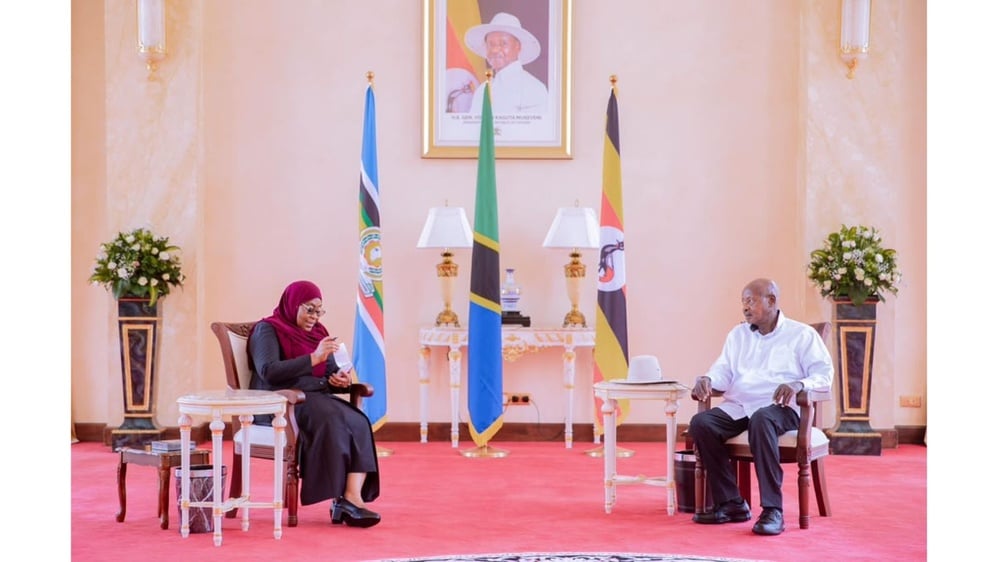
“The agreement was reached during bilateral talks between the two leaders at State House, Entebbe, on Wednesday, November 18, 2026, as part of Suluhu’s two-day State Visit to Uganda.” · exact text match
Why: The narrator records the meeting and agreement as facts rather than issuing recommendations.
Claim: The report is heavily political in subject and framing, focused on presidents, bilateral state visits, and intergovernmental agreements.
“President Yoweri Museveni and his Tanzanian counterpart, Samia Suluhu Hassan have agreed to fast-track the construction of major regional infrastructure projects, including the East African Crude Oil Pipeline (EACOP), the Standard Gauge Railway (SGR) and cross-border energy connections.” · exact text match
Why: The central actors and developments are heads of state and state-to-state agreements, making the content strongly political.
Claim: The report adopts a pro-establishment frame by centering official leaders, communiqués, and ministerial implementation without independent or opposition voices.
“In their joint communiqué, the two leaders expressed concern over persistent Non-Tariff Barriers (NTBs), which they said increase the cost of doing business, undermine competitiveness and limit the benefits of regional integration.” · exact text match
Why: The narrative is structured around official government positions and documents, with no non-official challenge or independent scrutiny.
Claim: The substantive report shows strong attribution and sourcing through named leaders, a joint communiqué, dates, and specific project figures.
“In their joint communiqué, the two leaders expressed concern over persistent Non-Tariff Barriers (NTBs), which they said increase the cost of doing business, undermine competitiveness and limit the benefits of regional integration.” · exact text match
“The two Presidents also reviewed progress on the East African Crude Oil Pipeline, which is now 93.9 per cent complete, and called for the remaining construction works, testing, commissioning and preparations for commercial operations to be expedited.” · exact text match
Why: Named attributions and concrete details provide visible sourcing, though the report relies on official accounts without independent verification.
Claim: The report favors coordinated regional and joint investment approaches over separate national projects.
“Museveni urged the two countries to adopt a coordinated approach to investment across the petroleum industry, warning that pursuing separate national projects without regional planning could result in duplicated infrastructure, increased costs and lost economic opportunities.” · exact text match
Why: The framing treats regional collective planning and joint investment as preferable to unilateral national action.
The text includes related-link and navigation fragments and lacks a byline or independent sourcing beyond official statements; scoring is limited to the substantive summit report.
November 18, 2026 · 0 shares
Neutral, official-source-driven framing presents the bilateral agreement as a cooperative trade and infrastructure initiative without partisan or sensational language.
Helium Analysis
Limitations: The supplied text contains duplicated passages and unrelated headline fragments, so the analysis is limited to the coherent trade-cooperation article content.
·
8 of 56 available dimensions scored; omitted dimensions are not treated as neutral.
·
Verified supporting quotes for 8 of 8 scored dimensions.
Claim: The report is anchored in dated, named-official reporting rather than subjective commentary.
“The agreement was reached on Wednesday, November 18, 2026, during President Samia Suluhu Hassan’s two-day State Visit to Uganda.” · exact text match
Why: The report relies on specific dates, named officials, locations, and attributed statements, supporting an objective framing.
Claim: The language is measured and policy-focused, avoiding dramatic or sensational cues.
“Tanzania and Uganda have agreed to fast-track the removal of trade barriers, improve market access for their goods and strengthen transport links in a renewed push to expand bilateral trade and investment.” · exact text match
Why: The phrasing is policy-oriented and lacks sensational or alarmist language.
Claim: The report mainly describes the agreement and attributed positions rather than issuing its own prescriptions.
“Tanzania and Uganda have agreed to fast-track the removal of trade barriers, improve market access for their goods and strengthen transport links” · exact text match
Why: The central text is descriptive reporting of an agreement and official statements, not publisher advocacy.
Claim: The report centers on heads of state and government-to-government negotiations.
“President Samia Suluhu Hassan’s two-day State Visit to Uganda” · exact text match
“where the two leaders held bilateral talks on strengthening diplomatic and economic relations” · exact text match
Why: The content is framed around presidential diplomacy and official bilateral policy, making political content evident.
Claim: The report frames the agreement through official state leaders without independent sourcing.
“Both leaders called for the speedy implementation of agreements reached during the bilateral talks” · exact text match
Why: Official leaders are the primary voices and the initiative is presented as a state-led agreement, giving a mild pro-establishment framing.
Claim: Named officials, dates, locations, and direct quotes provide visible sourcing.
“The agreement was reached on Wednesday, November 18, 2026, during President Samia Suluhu Hassan’s two-day State Visit to Uganda.” · exact text match
“President Museveni said Uganda planned to build a smaller oil refinery in Hoima while supporting the development of a much larger refinery in Tanga, Tanzania.” · exact text match
Why: Specific attribution and verifiable details support moderate-to-high visible credibility, though no independent verification is supplied.
Claim: The report’s framing follows a means-end policy discussion rather than emotional or illogical reasoning.
“Their discussions focused on increasing trade and investment, improving access to each other’s markets and addressing bottlenecks affecting the cross-border movement of goods.” · exact text match
Why: The article organizes facts around trade barriers, transport bottlenecks, and policy implementation rather than emotive or fallacious appeals.
Claim: The report attributes claims clearly to named officials and presents both leaders’ statements.
“President Hassan said the two countries had made progress in implementing previous agreements covering trade, investment, energy, transport and infrastructure” · exact text match
“President Museveni, meanwhile, said trade between the two neighbours should be driven by mutual demand” · exact text match
Why: Clear attribution and inclusion of both leaders’ positions support internally observable fairness and honesty signals.
The supplied text contains duplicated passages and unrelated headline fragments, so the analysis is limited to the coherent trade-cooperation article content.
November 18, 2026 · 0 shares
Official-source-driven and developmentalist framing presents presidential agreements and infrastructure projects in largely upbeat, unexamined terms.
The East African Community (EAC) is a regional intergovernmental bloc; the summit concerns two of its member presidents and long-running cross-border infrastructure projects.
Helium Analysis
Limitations: The text includes related-link and navigation fragments and lacks a byline or independent sourcing beyond official statements; scoring is limited to the substantive summit report.
·
10 of 56 available dimensions scored; omitted dimensions are not treated as neutral.
·
Verified supporting quotes for 10 of 10 scored dimensions.
Claim: The report frames the summit around presidential authority and ministerial directives rather than citizen-level debate.
“They directed their respective ministries and relevant authorities to accelerate implementation of the Memorandum of Understanding signed in August 2026 for the development of Tanga into a Regional Energy Hub.” · exact text match
Counterevidence:
“Suluhu called for faster implementation of agreements signed by the two governments, arguing that the value of bilateral engagements should be measured by the results delivered to citizens rather than the commitments made on paper.” · exact text match
Why: Decisive action is attributed to leaders directing state institutions, though one passage invokes citizens as the measure of results.
Claim: The report is largely objective, with evaluative statements attributed to named leaders rather than adopted by the narrator.
“Addressing a joint press briefing after the meeting, Museveni said East African countries must deepen economic integration by exploiting their natural resources, developing their productive capacities, securing markets and investing in efficient transport and communication infrastructure.” · exact text match
Why: The integration argument is explicitly attributed to Museveni, indicating descriptive attribution rather than unmarked subjectivity.
Claim: The report uses measured, technical language rather than sensational or emotive framing.
“The two Presidents also reviewed progress on the East African Crude Oil Pipeline, which is now 93.9 per cent complete, and called for the remaining construction works, testing, commissioning and preparations for commercial operations to be expedited.” · exact text match
Why: Specific project status and technical steps are presented without alarming or hyperbolic language.
Claim: The report frames the pipeline and regional projects in bullish terms, emphasizing investment and economic transformation.
“Its completion is expected to strengthen regional energy cooperation, attract investment, create employment opportunities and support economic transformation in Uganda, Tanzania and the wider region.” · exact text match
Why: The narrator highlights investment attraction, job creation, and economic transformation as expected outcomes, producing an upbeat market-oriented framing.
Claim: The report presents the infrastructure agreements with an optimistic expectation of regional benefits.
“The railway is expected to improve connectivity between the two countries, ease the movement of goods and passengers, reduce transportation and logistics costs and strengthen regional trade.” · exact text match
Why: A string of positive expected outcomes is presented without balancing costs or risks.
Claim: The report is predominantly descriptive, reporting agreements and statements rather than prescribing policy in its own voice.
“The agreement was reached during bilateral talks between the two leaders at State House, Entebbe, on Wednesday, November 18, 2026, as part of Suluhu’s two-day State Visit to Uganda.” · exact text match
Why: The narrator records the meeting and agreement as facts rather than issuing recommendations.
Claim: The report is heavily political in subject and framing, focused on presidents, bilateral state visits, and intergovernmental agreements.
“President Yoweri Museveni and his Tanzanian counterpart, Samia Suluhu Hassan have agreed to fast-track the construction of major regional infrastructure projects, including the East African Crude Oil Pipeline (EACOP), the Standard Gauge Railway (SGR) and cross-border energy connections.” · exact text match
Why: The central actors and developments are heads of state and state-to-state agreements, making the content strongly political.
Claim: The report adopts a pro-establishment frame by centering official leaders, communiqués, and ministerial implementation without independent or opposition voices.
“In their joint communiqué, the two leaders expressed concern over persistent Non-Tariff Barriers (NTBs), which they said increase the cost of doing business, undermine competitiveness and limit the benefits of regional integration.” · exact text match
Why: The narrative is structured around official government positions and documents, with no non-official challenge or independent scrutiny.
Claim: The substantive report shows strong attribution and sourcing through named leaders, a joint communiqué, dates, and specific project figures.
“In their joint communiqué, the two leaders expressed concern over persistent Non-Tariff Barriers (NTBs), which they said increase the cost of doing business, undermine competitiveness and limit the benefits of regional integration.” · exact text match
“The two Presidents also reviewed progress on the East African Crude Oil Pipeline, which is now 93.9 per cent complete, and called for the remaining construction works, testing, commissioning and preparations for commercial operations to be expedited.” · exact text match
Why: Named attributions and concrete details provide visible sourcing, though the report relies on official accounts without independent verification.
Claim: The report favors coordinated regional and joint investment approaches over separate national projects.
“Museveni urged the two countries to adopt a coordinated approach to investment across the petroleum industry, warning that pursuing separate national projects without regional planning could result in duplicated infrastructure, increased costs and lost economic opportunities.” · exact text match
Why: The framing treats regional collective planning and joint investment as preferable to unilateral national action.
The text includes related-link and navigation fragments and lacks a byline or independent sourcing beyond official statements; scoring is limited to the substantive summit report.
November 19, 2026 · 0 shares
Neutral, attribution-based infrastructure-news framing presents official project claims while explicitly noting unresolved cost and timetable details.
Helium Analysis
Limitations: The supplied text includes duplicated navigation and comment boilerplate around a short news brief; analysis is limited to the substantive railway paragraphs, and no independent verification of official claims is possible from the excerpt.
·
14 of 56 available dimensions scored; omitted dimensions are not treated as neutral.
·
Verified supporting quotes for 14 of 14 scored dimensions.
Claim: The report contains no discernible left-right ideological framing.
“The proposed line would pass through Lusahunga and Murongo/Kikagati before reaching Mpondwe.” · exact text match
Why: The substantive report is limited to infrastructure and regional trade details without partisan or ideological language.
Claim: The report does not adopt a populist or elitist stance.
“The leaders witnessed the signing of a framework agreement at State House in Entebbe on November 18, during Hassan’s two-day state visit.” · exact text match
Why: It reports official proceedings neutrally without framing the project through a populist-elite conflict.
Claim: The report does not frame the project in libertarian-authoritarian terms.
“They directed their governments to speed up feasibility studies, technical designs and financing plans.” · exact text match
Why: Government direction is reported as a factual planning step, not as an ideological endorsement of state authority.
Claim: The report attributes projected benefits to the presidents and flags unresolved project details rather than asserting them as settled.
“The presidents said it could improve regional trade, cut transport costs and open a new rail gateway to eastern DRC.” · exact text match
“The project’s cost and construction timetable have not yet been established.” · exact text match
Why: Attribution and explicit uncertainty indicate objective, non-subjective framing.
Claim: The report uses dry procedural detail and no sensational or emotive language.
“The leaders witnessed the signing of a framework agreement at State House in Entebbe on November 18, during Hassan’s two-day state visit.” · exact text match
Why: Neutral procedural reporting supports a strongly objective, non-sensational classification.
Claim: The report primarily describes the route, signing, and planning steps rather than advocating a policy outcome.
“The proposed line would pass through Lusahunga and Murongo/Kikagati before reaching Mpondwe.” · exact text match
Why: Route and procedural detail are reported descriptively without publisher recommendations.
Claim: The report has no evident dovish or hawkish foreign-policy framing.
“The railway is planned to reach the Ugandan border; onward rail links into eastern DRC would be needed to connect the Congolese market directly.” · exact text match
Why: Cross-border infrastructure is described without military, security, or conflict-oriented framing.
Claim: The report remains factually neutral and does not editorialize on the railway’s merits.
“The project’s cost and construction timetable have not yet been established.” · exact text match
Why: Explicit uncertainty and neutral procedural reporting indicate low opinion bias.
Claim: The report involves political leaders and a bilateral agreement but does not advance a partisan political agenda.
“Ugandan President Yoweri Museveni and Tanzanian President Samia Suluhu Hassan have agreed to accelerate preparations for a Standard Gauge Railway that would connect Isaka in Tanzania to Mpondwe, on Uganda’s border with the Democratic Republic of Congo.” · exact text match
Why: Political actors are central to the reported event, but the framing is administrative and project-focused rather than ideological.
Claim: The report notes implementation gaps and onward-link requirements rather than flattening the project into a simple success story.
“The railway is planned to reach the Ugandan border; onward rail links into eastern DRC would be needed to connect the Congolese market directly.” · exact text match
Why: Acknowledging unresolved links reduces oversimplification.
Claim: The report uses tentative language for benefits and explicitly states that key cost and schedule facts are unknown.
“The presidents said it could improve regional trade, cut transport costs and open a new rail gateway to eastern DRC.” · exact text match
“The project’s cost and construction timetable have not yet been established.” · exact text match
Why: Could and not yet established cabin certainty within the supplied evidence.
Claim: The report is concise but attributes claims to presidents and discloses unresolved financial and scheduling details.
“Earlier tripartite discussions and a route survey involving Uganda, Tanzania and DRC laid groundwork for the proposal, with the African Development Bank supporting project preparation.” · exact text match
“The project’s cost and construction timetable have not yet been established.” · exact text match
Why: Attribution, background, and caveats support credibility, though sourcing is brief and lacks independent verification.
Claim: The report foregrounds procedural facts and explicitly notes missing cost and timetable information.
“The project’s cost and construction timetable have not yet been established.” · exact text match
Why: Cautious qualification of unknowns supports rational, evidence-bound framing.
Claim: The report discloses key unknowns and attributes benefit claims instead of presenting them as established fact.
“The presidents said it could improve regional trade, cut transport costs and open a new rail gateway to eastern DRC.” · exact text match
“The project’s cost and construction timetable have not yet been established.” · exact text match
Why: Attribution and caveats are visible fairness and honesty signals.
The supplied text includes duplicated navigation and comment boilerplate around a short news brief; analysis is limited to the substantive railway paragraphs, and no independent verification of official claims is possible from the excerpt.
November 18, 2026 · 0 shares
Neutral, official-source-driven framing presents the bilateral agreement as a cooperative trade and infrastructure initiative without partisan or sensational language.
Helium Analysis
Limitations: The supplied text contains duplicated passages and unrelated headline fragments, so the analysis is limited to the coherent trade-cooperation article content.
·
8 of 56 available dimensions scored; omitted dimensions are not treated as neutral.
·
Verified supporting quotes for 8 of 8 scored dimensions.
Claim: The report is anchored in dated, named-official reporting rather than subjective commentary.
“The agreement was reached on Wednesday, November 18, 2026, during President Samia Suluhu Hassan’s two-day State Visit to Uganda.” · exact text match
Why: The report relies on specific dates, named officials, locations, and attributed statements, supporting an objective framing.
Claim: The language is measured and policy-focused, avoiding dramatic or sensational cues.
“Tanzania and Uganda have agreed to fast-track the removal of trade barriers, improve market access for their goods and strengthen transport links in a renewed push to expand bilateral trade and investment.” · exact text match
Why: The phrasing is policy-oriented and lacks sensational or alarmist language.
Claim: The report mainly describes the agreement and attributed positions rather than issuing its own prescriptions.
“Tanzania and Uganda have agreed to fast-track the removal of trade barriers, improve market access for their goods and strengthen transport links” · exact text match
Why: The central text is descriptive reporting of an agreement and official statements, not publisher advocacy.
Claim: The report centers on heads of state and government-to-government negotiations.
“President Samia Suluhu Hassan’s two-day State Visit to Uganda” · exact text match
“where the two leaders held bilateral talks on strengthening diplomatic and economic relations” · exact text match
Why: The content is framed around presidential diplomacy and official bilateral policy, making political content evident.
Claim: The report frames the agreement through official state leaders without independent sourcing.
“Both leaders called for the speedy implementation of agreements reached during the bilateral talks” · exact text match
Why: Official leaders are the primary voices and the initiative is presented as a state-led agreement, giving a mild pro-establishment framing.
Claim: Named officials, dates, locations, and direct quotes provide visible sourcing.
“The agreement was reached on Wednesday, November 18, 2026, during President Samia Suluhu Hassan’s two-day State Visit to Uganda.” · exact text match
“President Museveni said Uganda planned to build a smaller oil refinery in Hoima while supporting the development of a much larger refinery in Tanga, Tanzania.” · exact text match
Why: Specific attribution and verifiable details support moderate-to-high visible credibility, though no independent verification is supplied.
Claim: The report’s framing follows a means-end policy discussion rather than emotional or illogical reasoning.
“Their discussions focused on increasing trade and investment, improving access to each other’s markets and addressing bottlenecks affecting the cross-border movement of goods.” · exact text match
Why: The article organizes facts around trade barriers, transport bottlenecks, and policy implementation rather than emotive or fallacious appeals.
Claim: The report attributes claims clearly to named officials and presents both leaders’ statements.
“President Hassan said the two countries had made progress in implementing previous agreements covering trade, investment, energy, transport and infrastructure” · exact text match
“President Museveni, meanwhile, said trade between the two neighbours should be driven by mutual demand” · exact text match
Why: Clear attribution and inclusion of both leaders’ positions support internally observable fairness and honesty signals.
The supplied text contains duplicated passages and unrelated headline fragments, so the analysis is limited to the coherent trade-cooperation article content.
November 18, 2026 · 0 shares
Neutral, official-source-driven framing presents the bilateral agreement as a cooperative trade and infrastructure initiative without partisan or sensational language.
Helium Analysis
Limitations: The supplied text contains duplicated passages and unrelated headline fragments, so the analysis is limited to the coherent trade-cooperation article content.
·
8 of 56 available dimensions scored; omitted dimensions are not treated as neutral.
·
Verified supporting quotes for 8 of 8 scored dimensions.
Claim: The report is anchored in dated, named-official reporting rather than subjective commentary.
“The agreement was reached on Wednesday, November 18, 2026, during President Samia Suluhu Hassan’s two-day State Visit to Uganda.” · exact text match
Why: The report relies on specific dates, named officials, locations, and attributed statements, supporting an objective framing.
Claim: The language is measured and policy-focused, avoiding dramatic or sensational cues.
“Tanzania and Uganda have agreed to fast-track the removal of trade barriers, improve market access for their goods and strengthen transport links in a renewed push to expand bilateral trade and investment.” · exact text match
Why: The phrasing is policy-oriented and lacks sensational or alarmist language.
Claim: The report mainly describes the agreement and attributed positions rather than issuing its own prescriptions.
“Tanzania and Uganda have agreed to fast-track the removal of trade barriers, improve market access for their goods and strengthen transport links” · exact text match
Why: The central text is descriptive reporting of an agreement and official statements, not publisher advocacy.
Claim: The report centers on heads of state and government-to-government negotiations.
“President Samia Suluhu Hassan’s two-day State Visit to Uganda” · exact text match
“where the two leaders held bilateral talks on strengthening diplomatic and economic relations” · exact text match
Why: The content is framed around presidential diplomacy and official bilateral policy, making political content evident.
Claim: The report frames the agreement through official state leaders without independent sourcing.
“Both leaders called for the speedy implementation of agreements reached during the bilateral talks” · exact text match
Why: Official leaders are the primary voices and the initiative is presented as a state-led agreement, giving a mild pro-establishment framing.
Claim: Named officials, dates, locations, and direct quotes provide visible sourcing.
“The agreement was reached on Wednesday, November 18, 2026, during President Samia Suluhu Hassan’s two-day State Visit to Uganda.” · exact text match
“President Museveni said Uganda planned to build a smaller oil refinery in Hoima while supporting the development of a much larger refinery in Tanga, Tanzania.” · exact text match
Why: Specific attribution and verifiable details support moderate-to-high visible credibility, though no independent verification is supplied.
Claim: The report’s framing follows a means-end policy discussion rather than emotional or illogical reasoning.
“Their discussions focused on increasing trade and investment, improving access to each other’s markets and addressing bottlenecks affecting the cross-border movement of goods.” · exact text match
Why: The article organizes facts around trade barriers, transport bottlenecks, and policy implementation rather than emotive or fallacious appeals.
Claim: The report attributes claims clearly to named officials and presents both leaders’ statements.
“President Hassan said the two countries had made progress in implementing previous agreements covering trade, investment, energy, transport and infrastructure” · exact text match
“President Museveni, meanwhile, said trade between the two neighbours should be driven by mutual demand” · exact text match
Why: Clear attribution and inclusion of both leaders’ positions support internally observable fairness and honesty signals.
The supplied text contains duplicated passages and unrelated headline fragments, so the analysis is limited to the coherent trade-cooperation article content.
November 19, 2026 · 0 shares
The report frames the plant launch through official, pro-investment sources, presenting state-led industrialization and Chinese investment as straightforward regional benefits without independent scrutiny.
Helium Analysis
Limitations: The supplied text is a short official launch report with no independent sourcing or critical perspectives, limiting verification of claimed benefits.
·
10 of 56 available dimensions scored; omitted dimensions are not treated as neutral.
·
Verified supporting quotes for 10 of 10 scored dimensions.
Claim: The report centers the launch on presidents, a senior ambassador, and a company managing director rather than ordinary workers or independent local voices.
“Ugandan President Yoweri Museveni and visiting Tanzanian President Samia Suluhu Hassan on Thursday jointly launched a 30-million-U.S.-dollar Chinese-invested vehicle assembly plant” · exact text match
“Chinese Ambassador to Uganda Wu Guangrong said the presence of the two presidents at the launch demonstrated their commitment” · exact text match
Why: High-level officials and executives dominate the account, with no non-elite sourcing.
Claim: The report uses measured, non-sensational language to describe the launch.
“jointly launched a 30-million-U.S.-dollar Chinese-invested vehicle assembly plant in central Uganda” · exact text match
“according to a statement issued by State House of Uganda” · exact text match
Why: The article reports the event with plain, factual phrasing and no sensational or alarmist language.
Claim: The article frames the investment and regional industrialization in positive, forward-looking terms.
“expected to strengthen Uganda's automotive manufacturing capacity, create jobs and deepen industrial and trade cooperation” · exact text match
“describing the continent as the business center of the future” · exact text match
Why: The report highlights expected benefits and uses a strongly optimistic description of Africa's economic future.
Claim: The article uses evaluative, favorable language about the project and regional industrialization.
“highlighting efforts to promote regional industrialization and manufacturing” · exact text match
“Hassan described the investment as an important milestone” · exact text match
Why: The publisher's own phrasing and selected quotes convey approval rather than neutral description alone.
Claim: The report is framed around presidential policy advocacy and regional industrial policy.
“He also called for the establishment of a unified African market to support local manufacturing” · exact text match
“She also called for complementary industrial policies and harmonized regulations among East African Community member states” · exact text match
Why: The article gives substantial space to policy prescriptions from heads of state.
Claim: Claims about the plant's significance and benefits rest mainly on presidents, an ambassador, and a State House statement.
“according to a statement issued by State House of Uganda” · exact text match
“Hassan described the investment as an important milestone in Uganda's industrialization drive” · exact text match
Why: The article repeatedly uses official authorities to establish the project's importance and benefits.
Claim: The report adopts the official state framing of the plant launch and regional industrialization.
“according to a statement issued by State House of Uganda” · exact text match
“Chinese Ambassador to Uganda Wu Guangrong said the presence of the two presidents at the launch demonstrated their commitment to industrial development and regional economic cooperation” · exact text match
Why: The account relies on State House and diplomatic officials and echoes their positive framing.
Claim: The account promotes Chinese investment and the Double Q plant in favorable, promotional terms.
“highlighting efforts to promote regional industrialization and manufacturing” · exact text match
“The Ugandan president encouraged more Chinese companies to invest in Africa” · exact text match
Why: The article's framing and selected quotes present the investment as a model to be expanded.
Claim: The article presents a specific company's investment and expansion plans in positive terms without corporate scrutiny.
“Wu commended Double Q Company Limited for expanding from construction materials and vehicle sales into local vehicle assembly” · exact text match
“Double Q Company Limited Managing Director Lin Yu said the company planned to expand into passenger vehicles and electric trucks” · exact text match
Why: The company is praised and its expansion plans are reported without any critical or independent assessment.
Claim: The report includes forward-looking projections and plans about industrial development and company expansion.
“expected to strengthen Uganda's automotive manufacturing capacity, create jobs and deepen industrial and trade cooperation” · exact text match
“planned to expand into passenger vehicles and electric trucks” · exact text match
Why: The article relies on expected benefits and announced future plans rather than only completed outcomes.
The supplied text is a short official launch report with no independent sourcing or critical perspectives, limiting verification of claimed benefits.
November 18, 2026 · 0 shares
Neutral, official-source-driven framing presents the bilateral agreement as a cooperative trade and infrastructure initiative without partisan or sensational language.
Helium Analysis
Limitations: The supplied text contains duplicated passages and unrelated headline fragments, so the analysis is limited to the coherent trade-cooperation article content.
·
8 of 56 available dimensions scored; omitted dimensions are not treated as neutral.
·
Verified supporting quotes for 8 of 8 scored dimensions.
Claim: The report is anchored in dated, named-official reporting rather than subjective commentary.
“The agreement was reached on Wednesday, November 18, 2026, during President Samia Suluhu Hassan’s two-day State Visit to Uganda.” · exact text match
Why: The report relies on specific dates, named officials, locations, and attributed statements, supporting an objective framing.
Claim: The language is measured and policy-focused, avoiding dramatic or sensational cues.
“Tanzania and Uganda have agreed to fast-track the removal of trade barriers, improve market access for their goods and strengthen transport links in a renewed push to expand bilateral trade and investment.” · exact text match
Why: The phrasing is policy-oriented and lacks sensational or alarmist language.
Claim: The report mainly describes the agreement and attributed positions rather than issuing its own prescriptions.
“Tanzania and Uganda have agreed to fast-track the removal of trade barriers, improve market access for their goods and strengthen transport links” · exact text match
Why: The central text is descriptive reporting of an agreement and official statements, not publisher advocacy.
Claim: The report centers on heads of state and government-to-government negotiations.
“President Samia Suluhu Hassan’s two-day State Visit to Uganda” · exact text match
“where the two leaders held bilateral talks on strengthening diplomatic and economic relations” · exact text match
Why: The content is framed around presidential diplomacy and official bilateral policy, making political content evident.
Claim: The report frames the agreement through official state leaders without independent sourcing.
“Both leaders called for the speedy implementation of agreements reached during the bilateral talks” · exact text match
Why: Official leaders are the primary voices and the initiative is presented as a state-led agreement, giving a mild pro-establishment framing.
Claim: Named officials, dates, locations, and direct quotes provide visible sourcing.
“The agreement was reached on Wednesday, November 18, 2026, during President Samia Suluhu Hassan’s two-day State Visit to Uganda.” · exact text match
“President Museveni said Uganda planned to build a smaller oil refinery in Hoima while supporting the development of a much larger refinery in Tanga, Tanzania.” · exact text match
Why: Specific attribution and verifiable details support moderate-to-high visible credibility, though no independent verification is supplied.
Claim: The report’s framing follows a means-end policy discussion rather than emotional or illogical reasoning.
“Their discussions focused on increasing trade and investment, improving access to each other’s markets and addressing bottlenecks affecting the cross-border movement of goods.” · exact text match
Why: The article organizes facts around trade barriers, transport bottlenecks, and policy implementation rather than emotive or fallacious appeals.
Claim: The report attributes claims clearly to named officials and presents both leaders’ statements.
“President Hassan said the two countries had made progress in implementing previous agreements covering trade, investment, energy, transport and infrastructure” · exact text match
“President Museveni, meanwhile, said trade between the two neighbours should be driven by mutual demand” · exact text match
Why: Clear attribution and inclusion of both leaders’ positions support internally observable fairness and honesty signals.
The supplied text contains duplicated passages and unrelated headline fragments, so the analysis is limited to the coherent trade-cooperation article content.
The report is mostly neutral and attributed but frames the reconciliation initiative through the unresolved exclusion of the main opposition party and the open question of whether broad consensus is possible without it.
Helium Analysis
Limitations: The supplied article text is very brief and appears scraped, so the bias assessment is limited to the short summary content available.
·
9 of 56 available dimensions scored; omitted dimensions are not treated as neutral.
·
Verified supporting quotes for 9 of 9 scored dimensions.
Claim: The report largely confines itself to attributed statements and factual descriptions rather than subjective commentary.
“PRESIDENT Samia Suluhu Hassan has proposed the creation of a Reconciliation Commission to guide political dialogue and support Tanzania’s constitutional reform process” · exact text match
Why: The central claim is presented as an attributed proposal, with little evaluative language.
Claim: The language is restrained and does not use sensational or emotive framing.
“However, the absence of the main opposition party, CHADEMA, has drawn attention.” · exact text match
Why: The opposition caveat is stated factually rather than sensationally.
Claim: The report describes a political proposal and reactions without advocating a preferred policy outcome.
“Speaking during talks with political party leaders at State House in Dar es Salaam, Samia said meaningful dialogue is necessary to lay the foundation for lasting reforms and national unity.” · exact text match
Why: The statement reports what the president said rather than prescribing action to readers.
Claim: Mostly factual reporting with only limited analytical framing in the closing question.
“The central question remains whether Tanzania’s reconciliation initiative can achieve broad national consensus while a major opposition party remains outside the process.” · exact text match
Why: The open question adds mild interpretation but no explicit editorial opinion.
Claim: The article is centrally about a political negotiation and constitutional reform process.
“PRESIDENT Samia Suluhu Hassan has proposed the creation of a Reconciliation Commission to guide political dialogue and support Tanzania’s constitutional reform process” · exact text match
Why: The subject is explicitly political.
Claim: The report notes the missing opposition and its conditions, avoiding a one-sided account.
“The party has previously stated that it will not participate in reconciliation talks unless its chairman, Tundu Lissu, is released and the process includes an independent international mediator.” · exact text match
Why: It acknowledges complicating conditions, though the brief format limits depth.
Claim: The report names actors and sources and flags the opposition's absence and conditions.
“The meeting, organised by the Political Parties Council, is being viewed by supporters as an important step toward easing political tensions and promoting stability ahead of future elections.” · exact text match
“However, the absence of the main opposition party, CHADEMA, has drawn attention.” · exact text match
Why: Attribution and explicit caveats support credibility in the supplied text.
Claim: The report presents the opposition's conditions and frames the outcome as an open question rather than a settled conclusion.
“The party has previously stated that it will not participate in reconciliation talks unless its chairman, Tundu Lissu, is released and the process includes an independent international mediator.” · exact text match
“The central question remains whether Tanzania’s reconciliation initiative can achieve broad national consensus while a major opposition party remains outside the process.” · exact text match
Why: Attribution and explicit uncertainty support a rational, evidence-bound presentation.
Claim: The report includes balancing information about the main opposition party's absence and preconditions.
“However, the absence of the main opposition party, CHADEMA, has drawn attention.” · exact text match
“The party has previously stated that it will not participate in reconciliation talks unless its chairman, Tundu Lissu, is released and the process includes an independent international mediator.” · exact text match
Why: Disclosing a material limitation on the initiative supports fairness in the supplied text.
The supplied article text is very brief and appears scraped, so the bias assessment is limited to the short summary content available.
November 19, 2026 · 0 shares
Official-announcement framing relies on a single police spokesperson statement and presents the presidential police conference as routine news without independent sourcing or critical context.
Helium Analysis
Limitations: The supplied text is a truncated, aggregated brief with repeated headline fragments and no full article body, limiting assessment of broader framing.
·
6 of 56 available dimensions scored; omitted dimensions are not treated as neutral.
·
Verified supporting quotes for 5 of 6 scored dimensions.
Claim: The report attributes the conference agenda to an official statement rather than offering subjective commentary.
“According to a statement issued by Police Force Spokesperson David Misime, the conference will focus on evaluating the Police Force’s performance over the past year, setting strategic priorities and discussing measures to further strengthen security across the country.” · exact text match
Why: The quote shows the report is built on attributed, factual announcement language rather than subjective interpretation.
Claim: The text uses neutral procedural language about the meeting's purpose rather than sensational wording.
“The meeting will also provide an opportunity for senior officers to discuss ways of enhancing cooperation between the Police Force, the public and other stakeholders to ensure security and community well-being.” · exact text match
Why: The quoted language is calm and administrative, with no emotive or sensational phrasing.
Claim: The report describes a scheduled conference and its agenda rather than prescribing reader action or policy.
“The conference will focus on evaluating the Police Force’s performance over the past year, setting strategic priorities and discussing measures to further strengthen security across the country.” · not found in supplied text
Why: The quote outlines planned activities and priorities without advocating what readers or officials should do.
Claim: The report centers on a presidential opening of a senior police conference.
“PRESIDENT Samia Suluhu Hassan is expected to officially open the 2026 Annual Conference of Senior Police Officers” · exact text match
Why: The central event involves the president and police leadership, making the report substantially governmental and political.
Claim: The report relies on an official police spokesperson as the source for the conference agenda.
“According to a statement issued by Police Force Spokesperson David Misime” · exact text match
Why: The only cited source is an official police spokesperson, giving the report a mild establishment-centered framing without independent perspectives.
Claim: The report names an official source and hedges future attendance with 'expected'.
“According to a statement issued by Police Force Spokesperson David Misime” · exact text match
“PRESIDENT Samia Suluhu Hassan is expected to officially open the 2026 Annual Conference of Senior Police Officers” · exact text match
Why: Named attribution and the word 'expected' provide visible sourcing and uncertainty, though the report remains single-source.
The supplied text is a truncated, aggregated brief with repeated headline fragments and no full article body, limiting assessment of broader framing.
November 20, 2026 · 0 shares
Neutral official-event reporting frames the presidential police-school visit factually, without overt ideological, sensational, or evaluative language.
Helium Analysis
Limitations: The supplied text is a short event brief with unrelated sidebar headlines and page prompts, so analysis is limited to its official-event framing.
·
5 of 56 available dimensions scored; omitted dimensions are not treated as neutral.
·
Verified supporting quotes for 5 of 5 scored dimensions.
Claim: The report presents the presidential visit as a factual, attributed event without evaluative commentary.
“President Samia Suluhu Hassan has arrived at the Tanzania Police School (TPS) in Moshi, Kilimanjaro Region, for the opening of the 2026 Annual General Meeting of senior police officers.” · exact text match
Why: The sentence states an event and purpose in neutral, factual terms.
Claim: The meeting agenda is described in measured, non-sensational language.
“The meeting will also review the implementation of the force’s responsibilities in 2026 and discuss strategies to strengthen national security.” · exact text match
Why: Uses plain institutional language and future agenda items without alarm or emotive emphasis.
Claim: The report describes scheduled proceedings rather than prescribing policies or outcomes.
“During the meeting, Regional Police Commanders (RPCs) are expected to receive directives from the Commander-in-Chief aimed at improving the Police Force’s performance.” · exact text match
Why: It reports what is expected to happen at the meeting, not an editorial recommendation.
Claim: The report is political in subject because it centers on a presidential appearance and senior government/police officials.
“President Samia Suluhu Hassan has arrived at the Tanzania Police School (TPS) in Moshi, Kilimanjaro Region, for the opening of the 2026 Annual General Meeting of senior police officers.” · exact text match
Why: The event involves the president, police leadership, and government officials, though the report does not express partisan opinion.
Claim: The brief provides official titles and a State House photo attribution, but it is a short official-event report without independent sourcing.
“PHOTO | STATE HOUSE” · verified after text normalization
Why: A named photo source and official titles are visible credibility signals, while the lack of independent sourcing limits the score.
The supplied text is a short event brief with unrelated sidebar headlines and page prompts, so analysis is limited to its official-event framing.
November 18, 2026 · 0 shares
Official-source-driven and developmentalist framing presents presidential agreements and infrastructure projects in largely upbeat, unexamined terms.
The East African Community (EAC) is a regional intergovernmental bloc; the summit concerns two of its member presidents and long-running cross-border infrastructure projects.
Helium Analysis Limitations: The text includes related-link and navigation fragments and lacks a byline or independent sourcing beyond official statements; scoring is limited to the substantive summit report. · 10 of 56 available dimensions scored; omitted dimensions are not treated as neutral. · Verified supporting quotes for 10 of 10 scored dimensions.
Claim: The report frames the summit around presidential authority and ministerial directives rather than citizen-level debate.
“They directed their respective ministries and relevant authorities to accelerate implementation of the Memorandum of Understanding signed in August 2026 for the development of Tanga into a Regional Energy Hub.” · exact text match
Counterevidence:
“Suluhu called for faster implementation of agreements signed by the two governments, arguing that the value of bilateral engagements should be measured by the results delivered to citizens rather than the commitments made on paper.” · exact text match
Why: Decisive action is attributed to leaders directing state institutions, though one passage invokes citizens as the measure of results.
Claim: The report is largely objective, with evaluative statements attributed to named leaders rather than adopted by the narrator.
“Addressing a joint press briefing after the meeting, Museveni said East African countries must deepen economic integration by exploiting their natural resources, developing their productive capacities, securing markets and investing in efficient transport and communication infrastructure.” · exact text match
Why: The integration argument is explicitly attributed to Museveni, indicating descriptive attribution rather than unmarked subjectivity.
Claim: The report uses measured, technical language rather than sensational or emotive framing.
“The two Presidents also reviewed progress on the East African Crude Oil Pipeline, which is now 93.9 per cent complete, and called for the remaining construction works, testing, commissioning and preparations for commercial operations to be expedited.” · exact text match
Why: Specific project status and technical steps are presented without alarming or hyperbolic language.
Claim: The report frames the pipeline and regional projects in bullish terms, emphasizing investment and economic transformation.
“Its completion is expected to strengthen regional energy cooperation, attract investment, create employment opportunities and support economic transformation in Uganda, Tanzania and the wider region.” · exact text match
Why: The narrator highlights investment attraction, job creation, and economic transformation as expected outcomes, producing an upbeat market-oriented framing.
Claim: The report presents the infrastructure agreements with an optimistic expectation of regional benefits.
“The railway is expected to improve connectivity between the two countries, ease the movement of goods and passengers, reduce transportation and logistics costs and strengthen regional trade.” · exact text match
Why: A string of positive expected outcomes is presented without balancing costs or risks.
Claim: The report is predominantly descriptive, reporting agreements and statements rather than prescribing policy in its own voice.
“The agreement was reached during bilateral talks between the two leaders at State House, Entebbe, on Wednesday, November 18, 2026, as part of Suluhu’s two-day State Visit to Uganda.” · exact text match
Why: The narrator records the meeting and agreement as facts rather than issuing recommendations.
Claim: The report is heavily political in subject and framing, focused on presidents, bilateral state visits, and intergovernmental agreements.
“President Yoweri Museveni and his Tanzanian counterpart, Samia Suluhu Hassan have agreed to fast-track the construction of major regional infrastructure projects, including the East African Crude Oil Pipeline (EACOP), the Standard Gauge Railway (SGR) and cross-border energy connections.” · exact text match
Why: The central actors and developments are heads of state and state-to-state agreements, making the content strongly political.
Claim: The report adopts a pro-establishment frame by centering official leaders, communiqués, and ministerial implementation without independent or opposition voices.
“In their joint communiqué, the two leaders expressed concern over persistent Non-Tariff Barriers (NTBs), which they said increase the cost of doing business, undermine competitiveness and limit the benefits of regional integration.” · exact text match
Why: The narrative is structured around official government positions and documents, with no non-official challenge or independent scrutiny.
Claim: The substantive report shows strong attribution and sourcing through named leaders, a joint communiqué, dates, and specific project figures.
“In their joint communiqué, the two leaders expressed concern over persistent Non-Tariff Barriers (NTBs), which they said increase the cost of doing business, undermine competitiveness and limit the benefits of regional integration.” · exact text match
“The two Presidents also reviewed progress on the East African Crude Oil Pipeline, which is now 93.9 per cent complete, and called for the remaining construction works, testing, commissioning and preparations for commercial operations to be expedited.” · exact text match
Why: Named attributions and concrete details provide visible sourcing, though the report relies on official accounts without independent verification.
Claim: The report favors coordinated regional and joint investment approaches over separate national projects.
“Museveni urged the two countries to adopt a coordinated approach to investment across the petroleum industry, warning that pursuing separate national projects without regional planning could result in duplicated infrastructure, increased costs and lost economic opportunities.” · exact text match
Why: The framing treats regional collective planning and joint investment as preferable to unilateral national action.
The text includes related-link and navigation fragments and lacks a byline or independent sourcing beyond official statements; scoring is limited to the substantive summit report.
November 19, 2026 · 0 shares
Neutral, attribution-based infrastructure-news framing presents official project claims while explicitly noting unresolved cost and timetable details.
Helium Analysis Limitations: The supplied text includes duplicated navigation and comment boilerplate around a short news brief; analysis is limited to the substantive railway paragraphs, and no independent verification of official claims is possible from the excerpt. · 14 of 56 available dimensions scored; omitted dimensions are not treated as neutral. · Verified supporting quotes for 14 of 14 scored dimensions.
Claim: The report contains no discernible left-right ideological framing.
“The proposed line would pass through Lusahunga and Murongo/Kikagati before reaching Mpondwe.” · exact text match
Why: The substantive report is limited to infrastructure and regional trade details without partisan or ideological language.
Claim: The report does not adopt a populist or elitist stance.
“The leaders witnessed the signing of a framework agreement at State House in Entebbe on November 18, during Hassan’s two-day state visit.” · exact text match
Why: It reports official proceedings neutrally without framing the project through a populist-elite conflict.
Claim: The report does not frame the project in libertarian-authoritarian terms.
“They directed their governments to speed up feasibility studies, technical designs and financing plans.” · exact text match
Why: Government direction is reported as a factual planning step, not as an ideological endorsement of state authority.
Claim: The report attributes projected benefits to the presidents and flags unresolved project details rather than asserting them as settled.
“The presidents said it could improve regional trade, cut transport costs and open a new rail gateway to eastern DRC.” · exact text match
“The project’s cost and construction timetable have not yet been established.” · exact text match
Why: Attribution and explicit uncertainty indicate objective, non-subjective framing.
Claim: The report uses dry procedural detail and no sensational or emotive language.
“The leaders witnessed the signing of a framework agreement at State House in Entebbe on November 18, during Hassan’s two-day state visit.” · exact text match
Why: Neutral procedural reporting supports a strongly objective, non-sensational classification.
Claim: The report primarily describes the route, signing, and planning steps rather than advocating a policy outcome.
“The proposed line would pass through Lusahunga and Murongo/Kikagati before reaching Mpondwe.” · exact text match
Why: Route and procedural detail are reported descriptively without publisher recommendations.
Claim: The report has no evident dovish or hawkish foreign-policy framing.
“The railway is planned to reach the Ugandan border; onward rail links into eastern DRC would be needed to connect the Congolese market directly.” · exact text match
Why: Cross-border infrastructure is described without military, security, or conflict-oriented framing.
Claim: The report remains factually neutral and does not editorialize on the railway’s merits.
“The project’s cost and construction timetable have not yet been established.” · exact text match
Why: Explicit uncertainty and neutral procedural reporting indicate low opinion bias.
Claim: The report involves political leaders and a bilateral agreement but does not advance a partisan political agenda.
“Ugandan President Yoweri Museveni and Tanzanian President Samia Suluhu Hassan have agreed to accelerate preparations for a Standard Gauge Railway that would connect Isaka in Tanzania to Mpondwe, on Uganda’s border with the Democratic Republic of Congo.” · exact text match
Why: Political actors are central to the reported event, but the framing is administrative and project-focused rather than ideological.
Claim: The report notes implementation gaps and onward-link requirements rather than flattening the project into a simple success story.
“The railway is planned to reach the Ugandan border; onward rail links into eastern DRC would be needed to connect the Congolese market directly.” · exact text match
Why: Acknowledging unresolved links reduces oversimplification.
Claim: The report uses tentative language for benefits and explicitly states that key cost and schedule facts are unknown.
“The presidents said it could improve regional trade, cut transport costs and open a new rail gateway to eastern DRC.” · exact text match
“The project’s cost and construction timetable have not yet been established.” · exact text match
Why: Could and not yet established cabin certainty within the supplied evidence.
Claim: The report is concise but attributes claims to presidents and discloses unresolved financial and scheduling details.
“Earlier tripartite discussions and a route survey involving Uganda, Tanzania and DRC laid groundwork for the proposal, with the African Development Bank supporting project preparation.” · exact text match
“The project’s cost and construction timetable have not yet been established.” · exact text match
Why: Attribution, background, and caveats support credibility, though sourcing is brief and lacks independent verification.
Claim: The report foregrounds procedural facts and explicitly notes missing cost and timetable information.
“The project’s cost and construction timetable have not yet been established.” · exact text match
Why: Cautious qualification of unknowns supports rational, evidence-bound framing.
Claim: The report discloses key unknowns and attributes benefit claims instead of presenting them as established fact.
“The presidents said it could improve regional trade, cut transport costs and open a new rail gateway to eastern DRC.” · exact text match
“The project’s cost and construction timetable have not yet been established.” · exact text match
Why: Attribution and caveats are visible fairness and honesty signals.
The supplied text includes duplicated navigation and comment boilerplate around a short news brief; analysis is limited to the substantive railway paragraphs, and no independent verification of official claims is possible from the excerpt.
November 19, 2026 · 0 shares
The report frames the plant launch through official, pro-investment sources, presenting state-led industrialization and Chinese investment as straightforward regional benefits without independent scrutiny.
Helium Analysis Limitations: The supplied text is a short official launch report with no independent sourcing or critical perspectives, limiting verification of claimed benefits. · 10 of 56 available dimensions scored; omitted dimensions are not treated as neutral. · Verified supporting quotes for 10 of 10 scored dimensions.
Claim: The report centers the launch on presidents, a senior ambassador, and a company managing director rather than ordinary workers or independent local voices.
“Ugandan President Yoweri Museveni and visiting Tanzanian President Samia Suluhu Hassan on Thursday jointly launched a 30-million-U.S.-dollar Chinese-invested vehicle assembly plant” · exact text match
“Chinese Ambassador to Uganda Wu Guangrong said the presence of the two presidents at the launch demonstrated their commitment” · exact text match
Why: High-level officials and executives dominate the account, with no non-elite sourcing.
Claim: The report uses measured, non-sensational language to describe the launch.
“jointly launched a 30-million-U.S.-dollar Chinese-invested vehicle assembly plant in central Uganda” · exact text match
“according to a statement issued by State House of Uganda” · exact text match
Why: The article reports the event with plain, factual phrasing and no sensational or alarmist language.
Claim: The article frames the investment and regional industrialization in positive, forward-looking terms.
“expected to strengthen Uganda's automotive manufacturing capacity, create jobs and deepen industrial and trade cooperation” · exact text match
“describing the continent as the business center of the future” · exact text match
Why: The report highlights expected benefits and uses a strongly optimistic description of Africa's economic future.
Claim: The article uses evaluative, favorable language about the project and regional industrialization.
“highlighting efforts to promote regional industrialization and manufacturing” · exact text match
“Hassan described the investment as an important milestone” · exact text match
Why: The publisher's own phrasing and selected quotes convey approval rather than neutral description alone.
Claim: The report is framed around presidential policy advocacy and regional industrial policy.
“He also called for the establishment of a unified African market to support local manufacturing” · exact text match
“She also called for complementary industrial policies and harmonized regulations among East African Community member states” · exact text match
Why: The article gives substantial space to policy prescriptions from heads of state.
Claim: Claims about the plant's significance and benefits rest mainly on presidents, an ambassador, and a State House statement.
“according to a statement issued by State House of Uganda” · exact text match
“Hassan described the investment as an important milestone in Uganda's industrialization drive” · exact text match
Why: The article repeatedly uses official authorities to establish the project's importance and benefits.
Claim: The report adopts the official state framing of the plant launch and regional industrialization.
“according to a statement issued by State House of Uganda” · exact text match
“Chinese Ambassador to Uganda Wu Guangrong said the presence of the two presidents at the launch demonstrated their commitment to industrial development and regional economic cooperation” · exact text match
Why: The account relies on State House and diplomatic officials and echoes their positive framing.
Claim: The account promotes Chinese investment and the Double Q plant in favorable, promotional terms.
“highlighting efforts to promote regional industrialization and manufacturing” · exact text match
“The Ugandan president encouraged more Chinese companies to invest in Africa” · exact text match
Why: The article's framing and selected quotes present the investment as a model to be expanded.
Claim: The article presents a specific company's investment and expansion plans in positive terms without corporate scrutiny.
“Wu commended Double Q Company Limited for expanding from construction materials and vehicle sales into local vehicle assembly” · exact text match
“Double Q Company Limited Managing Director Lin Yu said the company planned to expand into passenger vehicles and electric trucks” · exact text match
Why: The company is praised and its expansion plans are reported without any critical or independent assessment.
Claim: The report includes forward-looking projections and plans about industrial development and company expansion.
“expected to strengthen Uganda's automotive manufacturing capacity, create jobs and deepen industrial and trade cooperation” · exact text match
“planned to expand into passenger vehicles and electric trucks” · exact text match
Why: The article relies on expected benefits and announced future plans rather than only completed outcomes.
The supplied text is a short official launch report with no independent sourcing or critical perspectives, limiting verification of claimed benefits.
The report is mostly neutral and attributed but frames the reconciliation initiative through the unresolved exclusion of the main opposition party and the open question of whether broad consensus is possible without it.
Helium Analysis Limitations: The supplied article text is very brief and appears scraped, so the bias assessment is limited to the short summary content available. · 9 of 56 available dimensions scored; omitted dimensions are not treated as neutral. · Verified supporting quotes for 9 of 9 scored dimensions.
Claim: The report largely confines itself to attributed statements and factual descriptions rather than subjective commentary.
“PRESIDENT Samia Suluhu Hassan has proposed the creation of a Reconciliation Commission to guide political dialogue and support Tanzania’s constitutional reform process” · exact text match
Why: The central claim is presented as an attributed proposal, with little evaluative language.
Claim: The language is restrained and does not use sensational or emotive framing.
“However, the absence of the main opposition party, CHADEMA, has drawn attention.” · exact text match
Why: The opposition caveat is stated factually rather than sensationally.
Claim: The report describes a political proposal and reactions without advocating a preferred policy outcome.
“Speaking during talks with political party leaders at State House in Dar es Salaam, Samia said meaningful dialogue is necessary to lay the foundation for lasting reforms and national unity.” · exact text match
Why: The statement reports what the president said rather than prescribing action to readers.
Claim: Mostly factual reporting with only limited analytical framing in the closing question.
“The central question remains whether Tanzania’s reconciliation initiative can achieve broad national consensus while a major opposition party remains outside the process.” · exact text match
Why: The open question adds mild interpretation but no explicit editorial opinion.
Claim: The article is centrally about a political negotiation and constitutional reform process.
“PRESIDENT Samia Suluhu Hassan has proposed the creation of a Reconciliation Commission to guide political dialogue and support Tanzania’s constitutional reform process” · exact text match
Why: The subject is explicitly political.
Claim: The report notes the missing opposition and its conditions, avoiding a one-sided account.
“The party has previously stated that it will not participate in reconciliation talks unless its chairman, Tundu Lissu, is released and the process includes an independent international mediator.” · exact text match
Why: It acknowledges complicating conditions, though the brief format limits depth.
Claim: The report names actors and sources and flags the opposition's absence and conditions.
“The meeting, organised by the Political Parties Council, is being viewed by supporters as an important step toward easing political tensions and promoting stability ahead of future elections.” · exact text match
“However, the absence of the main opposition party, CHADEMA, has drawn attention.” · exact text match
Why: Attribution and explicit caveats support credibility in the supplied text.
Claim: The report presents the opposition's conditions and frames the outcome as an open question rather than a settled conclusion.
“The party has previously stated that it will not participate in reconciliation talks unless its chairman, Tundu Lissu, is released and the process includes an independent international mediator.” · exact text match
“The central question remains whether Tanzania’s reconciliation initiative can achieve broad national consensus while a major opposition party remains outside the process.” · exact text match
Why: Attribution and explicit uncertainty support a rational, evidence-bound presentation.
Claim: The report includes balancing information about the main opposition party's absence and preconditions.
“However, the absence of the main opposition party, CHADEMA, has drawn attention.” · exact text match
“The party has previously stated that it will not participate in reconciliation talks unless its chairman, Tundu Lissu, is released and the process includes an independent international mediator.” · exact text match
Why: Disclosing a material limitation on the initiative supports fairness in the supplied text.
The supplied article text is very brief and appears scraped, so the bias assessment is limited to the short summary content available.
Official Uganda/Tanzania Developmentalist View
November 18, 2026 · 0 shares
Official-source-driven and developmentalist framing presents presidential agreements and infrastructure projects in largely upbeat, unexamined terms.
The East African Community (EAC) is a regional intergovernmental bloc; the summit concerns two of its member presidents and long-running cross-border infrastructure projects.
Helium Analysis Limitations: The text includes related-link and navigation fragments and lacks a byline or independent sourcing beyond official statements; scoring is limited to the substantive summit report. · 10 of 56 available dimensions scored; omitted dimensions are not treated as neutral. · Verified supporting quotes for 10 of 10 scored dimensions.
Claim: The report frames the summit around presidential authority and ministerial directives rather than citizen-level debate.
“They directed their respective ministries and relevant authorities to accelerate implementation of the Memorandum of Understanding signed in August 2026 for the development of Tanga into a Regional Energy Hub.” · exact text match
Counterevidence:
“Suluhu called for faster implementation of agreements signed by the two governments, arguing that the value of bilateral engagements should be measured by the results delivered to citizens rather than the commitments made on paper.” · exact text match
Why: Decisive action is attributed to leaders directing state institutions, though one passage invokes citizens as the measure of results.
Claim: The report is largely objective, with evaluative statements attributed to named leaders rather than adopted by the narrator.
“Addressing a joint press briefing after the meeting, Museveni said East African countries must deepen economic integration by exploiting their natural resources, developing their productive capacities, securing markets and investing in efficient transport and communication infrastructure.” · exact text match
Why: The integration argument is explicitly attributed to Museveni, indicating descriptive attribution rather than unmarked subjectivity.
Claim: The report uses measured, technical language rather than sensational or emotive framing.
“The two Presidents also reviewed progress on the East African Crude Oil Pipeline, which is now 93.9 per cent complete, and called for the remaining construction works, testing, commissioning and preparations for commercial operations to be expedited.” · exact text match
Why: Specific project status and technical steps are presented without alarming or hyperbolic language.
Claim: The report frames the pipeline and regional projects in bullish terms, emphasizing investment and economic transformation.
“Its completion is expected to strengthen regional energy cooperation, attract investment, create employment opportunities and support economic transformation in Uganda, Tanzania and the wider region.” · exact text match
Why: The narrator highlights investment attraction, job creation, and economic transformation as expected outcomes, producing an upbeat market-oriented framing.
Claim: The report presents the infrastructure agreements with an optimistic expectation of regional benefits.
“The railway is expected to improve connectivity between the two countries, ease the movement of goods and passengers, reduce transportation and logistics costs and strengthen regional trade.” · exact text match
Why: A string of positive expected outcomes is presented without balancing costs or risks.
Claim: The report is predominantly descriptive, reporting agreements and statements rather than prescribing policy in its own voice.
“The agreement was reached during bilateral talks between the two leaders at State House, Entebbe, on Wednesday, November 18, 2026, as part of Suluhu’s two-day State Visit to Uganda.” · exact text match
Why: The narrator records the meeting and agreement as facts rather than issuing recommendations.
Claim: The report is heavily political in subject and framing, focused on presidents, bilateral state visits, and intergovernmental agreements.
“President Yoweri Museveni and his Tanzanian counterpart, Samia Suluhu Hassan have agreed to fast-track the construction of major regional infrastructure projects, including the East African Crude Oil Pipeline (EACOP), the Standard Gauge Railway (SGR) and cross-border energy connections.” · exact text match
Why: The central actors and developments are heads of state and state-to-state agreements, making the content strongly political.
Claim: The report adopts a pro-establishment frame by centering official leaders, communiqués, and ministerial implementation without independent or opposition voices.
“In their joint communiqué, the two leaders expressed concern over persistent Non-Tariff Barriers (NTBs), which they said increase the cost of doing business, undermine competitiveness and limit the benefits of regional integration.” · exact text match
Why: The narrative is structured around official government positions and documents, with no non-official challenge or independent scrutiny.
Claim: The substantive report shows strong attribution and sourcing through named leaders, a joint communiqué, dates, and specific project figures.
“In their joint communiqué, the two leaders expressed concern over persistent Non-Tariff Barriers (NTBs), which they said increase the cost of doing business, undermine competitiveness and limit the benefits of regional integration.” · exact text match
“The two Presidents also reviewed progress on the East African Crude Oil Pipeline, which is now 93.9 per cent complete, and called for the remaining construction works, testing, commissioning and preparations for commercial operations to be expedited.” · exact text match
Why: Named attributions and concrete details provide visible sourcing, though the report relies on official accounts without independent verification.
Claim: The report favors coordinated regional and joint investment approaches over separate national projects.
“Museveni urged the two countries to adopt a coordinated approach to investment across the petroleum industry, warning that pursuing separate national projects without regional planning could result in duplicated infrastructure, increased costs and lost economic opportunities.” · exact text match
Why: The framing treats regional collective planning and joint investment as preferable to unilateral national action.
The text includes related-link and navigation fragments and lacks a byline or independent sourcing beyond official statements; scoring is limited to the substantive summit report.
November 19, 2026 · 0 shares
Neutral, attribution-based infrastructure-news framing presents official project claims while explicitly noting unresolved cost and timetable details.
Helium Analysis Limitations: The supplied text includes duplicated navigation and comment boilerplate around a short news brief; analysis is limited to the substantive railway paragraphs, and no independent verification of official claims is possible from the excerpt. · 14 of 56 available dimensions scored; omitted dimensions are not treated as neutral. · Verified supporting quotes for 14 of 14 scored dimensions.
Claim: The report contains no discernible left-right ideological framing.
“The proposed line would pass through Lusahunga and Murongo/Kikagati before reaching Mpondwe.” · exact text match
Why: The substantive report is limited to infrastructure and regional trade details without partisan or ideological language.
Claim: The report does not adopt a populist or elitist stance.
“The leaders witnessed the signing of a framework agreement at State House in Entebbe on November 18, during Hassan’s two-day state visit.” · exact text match
Why: It reports official proceedings neutrally without framing the project through a populist-elite conflict.
Claim: The report does not frame the project in libertarian-authoritarian terms.
“They directed their governments to speed up feasibility studies, technical designs and financing plans.” · exact text match
Why: Government direction is reported as a factual planning step, not as an ideological endorsement of state authority.
Claim: The report attributes projected benefits to the presidents and flags unresolved project details rather than asserting them as settled.
“The presidents said it could improve regional trade, cut transport costs and open a new rail gateway to eastern DRC.” · exact text match
“The project’s cost and construction timetable have not yet been established.” · exact text match
Why: Attribution and explicit uncertainty indicate objective, non-subjective framing.
Claim: The report uses dry procedural detail and no sensational or emotive language.
“The leaders witnessed the signing of a framework agreement at State House in Entebbe on November 18, during Hassan’s two-day state visit.” · exact text match
Why: Neutral procedural reporting supports a strongly objective, non-sensational classification.
Claim: The report primarily describes the route, signing, and planning steps rather than advocating a policy outcome.
“The proposed line would pass through Lusahunga and Murongo/Kikagati before reaching Mpondwe.” · exact text match
Why: Route and procedural detail are reported descriptively without publisher recommendations.
Claim: The report has no evident dovish or hawkish foreign-policy framing.
“The railway is planned to reach the Ugandan border; onward rail links into eastern DRC would be needed to connect the Congolese market directly.” · exact text match
Why: Cross-border infrastructure is described without military, security, or conflict-oriented framing.
Claim: The report remains factually neutral and does not editorialize on the railway’s merits.
“The project’s cost and construction timetable have not yet been established.” · exact text match
Why: Explicit uncertainty and neutral procedural reporting indicate low opinion bias.
Claim: The report involves political leaders and a bilateral agreement but does not advance a partisan political agenda.
“Ugandan President Yoweri Museveni and Tanzanian President Samia Suluhu Hassan have agreed to accelerate preparations for a Standard Gauge Railway that would connect Isaka in Tanzania to Mpondwe, on Uganda’s border with the Democratic Republic of Congo.” · exact text match
Why: Political actors are central to the reported event, but the framing is administrative and project-focused rather than ideological.
Claim: The report notes implementation gaps and onward-link requirements rather than flattening the project into a simple success story.
“The railway is planned to reach the Ugandan border; onward rail links into eastern DRC would be needed to connect the Congolese market directly.” · exact text match
Why: Acknowledging unresolved links reduces oversimplification.
Claim: The report uses tentative language for benefits and explicitly states that key cost and schedule facts are unknown.
“The presidents said it could improve regional trade, cut transport costs and open a new rail gateway to eastern DRC.” · exact text match
“The project’s cost and construction timetable have not yet been established.” · exact text match
Why: Could and not yet established cabin certainty within the supplied evidence.
Claim: The report is concise but attributes claims to presidents and discloses unresolved financial and scheduling details.
“Earlier tripartite discussions and a route survey involving Uganda, Tanzania and DRC laid groundwork for the proposal, with the African Development Bank supporting project preparation.” · exact text match
“The project’s cost and construction timetable have not yet been established.” · exact text match
Why: Attribution, background, and caveats support credibility, though sourcing is brief and lacks independent verification.
Claim: The report foregrounds procedural facts and explicitly notes missing cost and timetable information.
“The project’s cost and construction timetable have not yet been established.” · exact text match
Why: Cautious qualification of unknowns supports rational, evidence-bound framing.
Claim: The report discloses key unknowns and attributes benefit claims instead of presenting them as established fact.
“The presidents said it could improve regional trade, cut transport costs and open a new rail gateway to eastern DRC.” · exact text match
“The project’s cost and construction timetable have not yet been established.” · exact text match
Why: Attribution and caveats are visible fairness and honesty signals.
The supplied text includes duplicated navigation and comment boilerplate around a short news brief; analysis is limited to the substantive railway paragraphs, and no independent verification of official claims is possible from the excerpt.
November 18, 2026 · 0 shares
Neutral, official-source-driven framing presents the bilateral agreement as a cooperative trade and infrastructure initiative without partisan or sensational language.
Helium Analysis Limitations: The supplied text contains duplicated passages and unrelated headline fragments, so the analysis is limited to the coherent trade-cooperation article content. · 8 of 56 available dimensions scored; omitted dimensions are not treated as neutral. · Verified supporting quotes for 8 of 8 scored dimensions.
Claim: The report is anchored in dated, named-official reporting rather than subjective commentary.
“The agreement was reached on Wednesday, November 18, 2026, during President Samia Suluhu Hassan’s two-day State Visit to Uganda.” · exact text match
Why: The report relies on specific dates, named officials, locations, and attributed statements, supporting an objective framing.
Claim: The language is measured and policy-focused, avoiding dramatic or sensational cues.
“Tanzania and Uganda have agreed to fast-track the removal of trade barriers, improve market access for their goods and strengthen transport links in a renewed push to expand bilateral trade and investment.” · exact text match
Why: The phrasing is policy-oriented and lacks sensational or alarmist language.
Claim: The report mainly describes the agreement and attributed positions rather than issuing its own prescriptions.
“Tanzania and Uganda have agreed to fast-track the removal of trade barriers, improve market access for their goods and strengthen transport links” · exact text match
Why: The central text is descriptive reporting of an agreement and official statements, not publisher advocacy.
Claim: The report centers on heads of state and government-to-government negotiations.
“President Samia Suluhu Hassan’s two-day State Visit to Uganda” · exact text match
“where the two leaders held bilateral talks on strengthening diplomatic and economic relations” · exact text match
Why: The content is framed around presidential diplomacy and official bilateral policy, making political content evident.
Claim: The report frames the agreement through official state leaders without independent sourcing.
“Both leaders called for the speedy implementation of agreements reached during the bilateral talks” · exact text match
Why: Official leaders are the primary voices and the initiative is presented as a state-led agreement, giving a mild pro-establishment framing.
Claim: Named officials, dates, locations, and direct quotes provide visible sourcing.
“The agreement was reached on Wednesday, November 18, 2026, during President Samia Suluhu Hassan’s two-day State Visit to Uganda.” · exact text match
“President Museveni said Uganda planned to build a smaller oil refinery in Hoima while supporting the development of a much larger refinery in Tanga, Tanzania.” · exact text match
Why: Specific attribution and verifiable details support moderate-to-high visible credibility, though no independent verification is supplied.
Claim: The report’s framing follows a means-end policy discussion rather than emotional or illogical reasoning.
“Their discussions focused on increasing trade and investment, improving access to each other’s markets and addressing bottlenecks affecting the cross-border movement of goods.” · exact text match
Why: The article organizes facts around trade barriers, transport bottlenecks, and policy implementation rather than emotive or fallacious appeals.
Claim: The report attributes claims clearly to named officials and presents both leaders’ statements.
“President Hassan said the two countries had made progress in implementing previous agreements covering trade, investment, energy, transport and infrastructure” · exact text match
“President Museveni, meanwhile, said trade between the two neighbours should be driven by mutual demand” · exact text match
Why: Clear attribution and inclusion of both leaders’ positions support internally observable fairness and honesty signals.
The supplied text contains duplicated passages and unrelated headline fragments, so the analysis is limited to the coherent trade-cooperation article content.
November 18, 2026 · 0 shares
Official-source-driven and developmentalist framing presents presidential agreements and infrastructure projects in largely upbeat, unexamined terms.
The East African Community (EAC) is a regional intergovernmental bloc; the summit concerns two of its member presidents and long-running cross-border infrastructure projects.
Helium Analysis Limitations: The text includes related-link and navigation fragments and lacks a byline or independent sourcing beyond official statements; scoring is limited to the substantive summit report. · 10 of 56 available dimensions scored; omitted dimensions are not treated as neutral. · Verified supporting quotes for 10 of 10 scored dimensions.
Claim: The report frames the summit around presidential authority and ministerial directives rather than citizen-level debate.
“They directed their respective ministries and relevant authorities to accelerate implementation of the Memorandum of Understanding signed in August 2026 for the development of Tanga into a Regional Energy Hub.” · exact text match
Counterevidence:
“Suluhu called for faster implementation of agreements signed by the two governments, arguing that the value of bilateral engagements should be measured by the results delivered to citizens rather than the commitments made on paper.” · exact text match
Why: Decisive action is attributed to leaders directing state institutions, though one passage invokes citizens as the measure of results.
Claim: The report is largely objective, with evaluative statements attributed to named leaders rather than adopted by the narrator.
“Addressing a joint press briefing after the meeting, Museveni said East African countries must deepen economic integration by exploiting their natural resources, developing their productive capacities, securing markets and investing in efficient transport and communication infrastructure.” · exact text match
Why: The integration argument is explicitly attributed to Museveni, indicating descriptive attribution rather than unmarked subjectivity.
Claim: The report uses measured, technical language rather than sensational or emotive framing.
“The two Presidents also reviewed progress on the East African Crude Oil Pipeline, which is now 93.9 per cent complete, and called for the remaining construction works, testing, commissioning and preparations for commercial operations to be expedited.” · exact text match
Why: Specific project status and technical steps are presented without alarming or hyperbolic language.
Claim: The report frames the pipeline and regional projects in bullish terms, emphasizing investment and economic transformation.
“Its completion is expected to strengthen regional energy cooperation, attract investment, create employment opportunities and support economic transformation in Uganda, Tanzania and the wider region.” · exact text match
Why: The narrator highlights investment attraction, job creation, and economic transformation as expected outcomes, producing an upbeat market-oriented framing.
Claim: The report presents the infrastructure agreements with an optimistic expectation of regional benefits.
“The railway is expected to improve connectivity between the two countries, ease the movement of goods and passengers, reduce transportation and logistics costs and strengthen regional trade.” · exact text match
Why: A string of positive expected outcomes is presented without balancing costs or risks.
Claim: The report is predominantly descriptive, reporting agreements and statements rather than prescribing policy in its own voice.
“The agreement was reached during bilateral talks between the two leaders at State House, Entebbe, on Wednesday, November 18, 2026, as part of Suluhu’s two-day State Visit to Uganda.” · exact text match
Why: The narrator records the meeting and agreement as facts rather than issuing recommendations.
Claim: The report is heavily political in subject and framing, focused on presidents, bilateral state visits, and intergovernmental agreements.
“President Yoweri Museveni and his Tanzanian counterpart, Samia Suluhu Hassan have agreed to fast-track the construction of major regional infrastructure projects, including the East African Crude Oil Pipeline (EACOP), the Standard Gauge Railway (SGR) and cross-border energy connections.” · exact text match
Why: The central actors and developments are heads of state and state-to-state agreements, making the content strongly political.
Claim: The report adopts a pro-establishment frame by centering official leaders, communiqués, and ministerial implementation without independent or opposition voices.
“In their joint communiqué, the two leaders expressed concern over persistent Non-Tariff Barriers (NTBs), which they said increase the cost of doing business, undermine competitiveness and limit the benefits of regional integration.” · exact text match
Why: The narrative is structured around official government positions and documents, with no non-official challenge or independent scrutiny.
Claim: The substantive report shows strong attribution and sourcing through named leaders, a joint communiqué, dates, and specific project figures.
“In their joint communiqué, the two leaders expressed concern over persistent Non-Tariff Barriers (NTBs), which they said increase the cost of doing business, undermine competitiveness and limit the benefits of regional integration.” · exact text match
“The two Presidents also reviewed progress on the East African Crude Oil Pipeline, which is now 93.9 per cent complete, and called for the remaining construction works, testing, commissioning and preparations for commercial operations to be expedited.” · exact text match
Why: Named attributions and concrete details provide visible sourcing, though the report relies on official accounts without independent verification.
Claim: The report favors coordinated regional and joint investment approaches over separate national projects.
“Museveni urged the two countries to adopt a coordinated approach to investment across the petroleum industry, warning that pursuing separate national projects without regional planning could result in duplicated infrastructure, increased costs and lost economic opportunities.” · exact text match
Why: The framing treats regional collective planning and joint investment as preferable to unilateral national action.
The text includes related-link and navigation fragments and lacks a byline or independent sourcing beyond official statements; scoring is limited to the substantive summit report.
Chinese Investment/Industrialization Framing
November 19, 2026 · 0 shares
The report frames the plant launch through official, pro-investment sources, presenting state-led industrialization and Chinese investment as straightforward regional benefits without independent scrutiny.
Helium Analysis Limitations: The supplied text is a short official launch report with no independent sourcing or critical perspectives, limiting verification of claimed benefits. · 10 of 56 available dimensions scored; omitted dimensions are not treated as neutral. · Verified supporting quotes for 10 of 10 scored dimensions.
Claim: The report centers the launch on presidents, a senior ambassador, and a company managing director rather than ordinary workers or independent local voices.
“Ugandan President Yoweri Museveni and visiting Tanzanian President Samia Suluhu Hassan on Thursday jointly launched a 30-million-U.S.-dollar Chinese-invested vehicle assembly plant” · exact text match
“Chinese Ambassador to Uganda Wu Guangrong said the presence of the two presidents at the launch demonstrated their commitment” · exact text match
Why: High-level officials and executives dominate the account, with no non-elite sourcing.
Claim: The report uses measured, non-sensational language to describe the launch.
“jointly launched a 30-million-U.S.-dollar Chinese-invested vehicle assembly plant in central Uganda” · exact text match
“according to a statement issued by State House of Uganda” · exact text match
Why: The article reports the event with plain, factual phrasing and no sensational or alarmist language.
Claim: The article frames the investment and regional industrialization in positive, forward-looking terms.
“expected to strengthen Uganda's automotive manufacturing capacity, create jobs and deepen industrial and trade cooperation” · exact text match
“describing the continent as the business center of the future” · exact text match
Why: The report highlights expected benefits and uses a strongly optimistic description of Africa's economic future.
Claim: The article uses evaluative, favorable language about the project and regional industrialization.
“highlighting efforts to promote regional industrialization and manufacturing” · exact text match
“Hassan described the investment as an important milestone” · exact text match
Why: The publisher's own phrasing and selected quotes convey approval rather than neutral description alone.
Claim: The report is framed around presidential policy advocacy and regional industrial policy.
“He also called for the establishment of a unified African market to support local manufacturing” · exact text match
“She also called for complementary industrial policies and harmonized regulations among East African Community member states” · exact text match
Why: The article gives substantial space to policy prescriptions from heads of state.
Claim: Claims about the plant's significance and benefits rest mainly on presidents, an ambassador, and a State House statement.
“according to a statement issued by State House of Uganda” · exact text match
“Hassan described the investment as an important milestone in Uganda's industrialization drive” · exact text match
Why: The article repeatedly uses official authorities to establish the project's importance and benefits.
Claim: The report adopts the official state framing of the plant launch and regional industrialization.
“according to a statement issued by State House of Uganda” · exact text match
“Chinese Ambassador to Uganda Wu Guangrong said the presence of the two presidents at the launch demonstrated their commitment to industrial development and regional economic cooperation” · exact text match
Why: The account relies on State House and diplomatic officials and echoes their positive framing.
Claim: The account promotes Chinese investment and the Double Q plant in favorable, promotional terms.
“highlighting efforts to promote regional industrialization and manufacturing” · exact text match
“The Ugandan president encouraged more Chinese companies to invest in Africa” · exact text match
Why: The article's framing and selected quotes present the investment as a model to be expanded.
Claim: The article presents a specific company's investment and expansion plans in positive terms without corporate scrutiny.
“Wu commended Double Q Company Limited for expanding from construction materials and vehicle sales into local vehicle assembly” · exact text match
“Double Q Company Limited Managing Director Lin Yu said the company planned to expand into passenger vehicles and electric trucks” · exact text match
Why: The company is praised and its expansion plans are reported without any critical or independent assessment.
Claim: The report includes forward-looking projections and plans about industrial development and company expansion.
“expected to strengthen Uganda's automotive manufacturing capacity, create jobs and deepen industrial and trade cooperation” · exact text match
“planned to expand into passenger vehicles and electric trucks” · exact text match
Why: The article relies on expected benefits and announced future plans rather than only completed outcomes.
The supplied text is a short official launch report with no independent sourcing or critical perspectives, limiting verification of claimed benefits.
Skeptical Infrastructure/Regional Analyst View
November 19, 2026 · 0 shares
Neutral, attribution-based infrastructure-news framing presents official project claims while explicitly noting unresolved cost and timetable details.
Helium Analysis Limitations: The supplied text includes duplicated navigation and comment boilerplate around a short news brief; analysis is limited to the substantive railway paragraphs, and no independent verification of official claims is possible from the excerpt. · 14 of 56 available dimensions scored; omitted dimensions are not treated as neutral. · Verified supporting quotes for 14 of 14 scored dimensions.
Claim: The report contains no discernible left-right ideological framing.
“The proposed line would pass through Lusahunga and Murongo/Kikagati before reaching Mpondwe.” · exact text match
Why: The substantive report is limited to infrastructure and regional trade details without partisan or ideological language.
Claim: The report does not adopt a populist or elitist stance.
“The leaders witnessed the signing of a framework agreement at State House in Entebbe on November 18, during Hassan’s two-day state visit.” · exact text match
Why: It reports official proceedings neutrally without framing the project through a populist-elite conflict.
Claim: The report does not frame the project in libertarian-authoritarian terms.
“They directed their governments to speed up feasibility studies, technical designs and financing plans.” · exact text match
Why: Government direction is reported as a factual planning step, not as an ideological endorsement of state authority.
Claim: The report attributes projected benefits to the presidents and flags unresolved project details rather than asserting them as settled.
“The presidents said it could improve regional trade, cut transport costs and open a new rail gateway to eastern DRC.” · exact text match
“The project’s cost and construction timetable have not yet been established.” · exact text match
Why: Attribution and explicit uncertainty indicate objective, non-subjective framing.
Claim: The report uses dry procedural detail and no sensational or emotive language.
“The leaders witnessed the signing of a framework agreement at State House in Entebbe on November 18, during Hassan’s two-day state visit.” · exact text match
Why: Neutral procedural reporting supports a strongly objective, non-sensational classification.
Claim: The report primarily describes the route, signing, and planning steps rather than advocating a policy outcome.
“The proposed line would pass through Lusahunga and Murongo/Kikagati before reaching Mpondwe.” · exact text match
Why: Route and procedural detail are reported descriptively without publisher recommendations.
Claim: The report has no evident dovish or hawkish foreign-policy framing.
“The railway is planned to reach the Ugandan border; onward rail links into eastern DRC would be needed to connect the Congolese market directly.” · exact text match
Why: Cross-border infrastructure is described without military, security, or conflict-oriented framing.
Claim: The report remains factually neutral and does not editorialize on the railway’s merits.
“The project’s cost and construction timetable have not yet been established.” · exact text match
Why: Explicit uncertainty and neutral procedural reporting indicate low opinion bias.
Claim: The report involves political leaders and a bilateral agreement but does not advance a partisan political agenda.
“Ugandan President Yoweri Museveni and Tanzanian President Samia Suluhu Hassan have agreed to accelerate preparations for a Standard Gauge Railway that would connect Isaka in Tanzania to Mpondwe, on Uganda’s border with the Democratic Republic of Congo.” · exact text match
Why: Political actors are central to the reported event, but the framing is administrative and project-focused rather than ideological.
Claim: The report notes implementation gaps and onward-link requirements rather than flattening the project into a simple success story.
“The railway is planned to reach the Ugandan border; onward rail links into eastern DRC would be needed to connect the Congolese market directly.” · exact text match
Why: Acknowledging unresolved links reduces oversimplification.
Claim: The report uses tentative language for benefits and explicitly states that key cost and schedule facts are unknown.
“The presidents said it could improve regional trade, cut transport costs and open a new rail gateway to eastern DRC.” · exact text match
“The project’s cost and construction timetable have not yet been established.” · exact text match
Why: Could and not yet established cabin certainty within the supplied evidence.
Claim: The report is concise but attributes claims to presidents and discloses unresolved financial and scheduling details.
“Earlier tripartite discussions and a route survey involving Uganda, Tanzania and DRC laid groundwork for the proposal, with the African Development Bank supporting project preparation.” · exact text match
“The project’s cost and construction timetable have not yet been established.” · exact text match
Why: Attribution, background, and caveats support credibility, though sourcing is brief and lacks independent verification.
Claim: The report foregrounds procedural facts and explicitly notes missing cost and timetable information.
“The project’s cost and construction timetable have not yet been established.” · exact text match
Why: Cautious qualification of unknowns supports rational, evidence-bound framing.
Claim: The report discloses key unknowns and attributes benefit claims instead of presenting them as established fact.
“The presidents said it could improve regional trade, cut transport costs and open a new rail gateway to eastern DRC.” · exact text match
“The project’s cost and construction timetable have not yet been established.” · exact text match
Why: Attribution and caveats are visible fairness and honesty signals.
The supplied text includes duplicated navigation and comment boilerplate around a short news brief; analysis is limited to the substantive railway paragraphs, and no independent verification of official claims is possible from the excerpt.
November 18, 2026 · 0 shares
Official-source-driven and developmentalist framing presents presidential agreements and infrastructure projects in largely upbeat, unexamined terms.
The East African Community (EAC) is a regional intergovernmental bloc; the summit concerns two of its member presidents and long-running cross-border infrastructure projects.
Helium Analysis Limitations: The text includes related-link and navigation fragments and lacks a byline or independent sourcing beyond official statements; scoring is limited to the substantive summit report. · 10 of 56 available dimensions scored; omitted dimensions are not treated as neutral. · Verified supporting quotes for 10 of 10 scored dimensions.
Claim: The report frames the summit around presidential authority and ministerial directives rather than citizen-level debate.
“They directed their respective ministries and relevant authorities to accelerate implementation of the Memorandum of Understanding signed in August 2026 for the development of Tanga into a Regional Energy Hub.” · exact text match
Counterevidence:
“Suluhu called for faster implementation of agreements signed by the two governments, arguing that the value of bilateral engagements should be measured by the results delivered to citizens rather than the commitments made on paper.” · exact text match
Why: Decisive action is attributed to leaders directing state institutions, though one passage invokes citizens as the measure of results.
Claim: The report is largely objective, with evaluative statements attributed to named leaders rather than adopted by the narrator.
“Addressing a joint press briefing after the meeting, Museveni said East African countries must deepen economic integration by exploiting their natural resources, developing their productive capacities, securing markets and investing in efficient transport and communication infrastructure.” · exact text match
Why: The integration argument is explicitly attributed to Museveni, indicating descriptive attribution rather than unmarked subjectivity.
Claim: The report uses measured, technical language rather than sensational or emotive framing.
“The two Presidents also reviewed progress on the East African Crude Oil Pipeline, which is now 93.9 per cent complete, and called for the remaining construction works, testing, commissioning and preparations for commercial operations to be expedited.” · exact text match
Why: Specific project status and technical steps are presented without alarming or hyperbolic language.
Claim: The report frames the pipeline and regional projects in bullish terms, emphasizing investment and economic transformation.
“Its completion is expected to strengthen regional energy cooperation, attract investment, create employment opportunities and support economic transformation in Uganda, Tanzania and the wider region.” · exact text match
Why: The narrator highlights investment attraction, job creation, and economic transformation as expected outcomes, producing an upbeat market-oriented framing.
Claim: The report presents the infrastructure agreements with an optimistic expectation of regional benefits.
“The railway is expected to improve connectivity between the two countries, ease the movement of goods and passengers, reduce transportation and logistics costs and strengthen regional trade.” · exact text match
Why: A string of positive expected outcomes is presented without balancing costs or risks.
Claim: The report is predominantly descriptive, reporting agreements and statements rather than prescribing policy in its own voice.
“The agreement was reached during bilateral talks between the two leaders at State House, Entebbe, on Wednesday, November 18, 2026, as part of Suluhu’s two-day State Visit to Uganda.” · exact text match
Why: The narrator records the meeting and agreement as facts rather than issuing recommendations.
Claim: The report is heavily political in subject and framing, focused on presidents, bilateral state visits, and intergovernmental agreements.
“President Yoweri Museveni and his Tanzanian counterpart, Samia Suluhu Hassan have agreed to fast-track the construction of major regional infrastructure projects, including the East African Crude Oil Pipeline (EACOP), the Standard Gauge Railway (SGR) and cross-border energy connections.” · exact text match
Why: The central actors and developments are heads of state and state-to-state agreements, making the content strongly political.
Claim: The report adopts a pro-establishment frame by centering official leaders, communiqués, and ministerial implementation without independent or opposition voices.
“In their joint communiqué, the two leaders expressed concern over persistent Non-Tariff Barriers (NTBs), which they said increase the cost of doing business, undermine competitiveness and limit the benefits of regional integration.” · exact text match
Why: The narrative is structured around official government positions and documents, with no non-official challenge or independent scrutiny.
Claim: The substantive report shows strong attribution and sourcing through named leaders, a joint communiqué, dates, and specific project figures.
“In their joint communiqué, the two leaders expressed concern over persistent Non-Tariff Barriers (NTBs), which they said increase the cost of doing business, undermine competitiveness and limit the benefits of regional integration.” · exact text match
“The two Presidents also reviewed progress on the East African Crude Oil Pipeline, which is now 93.9 per cent complete, and called for the remaining construction works, testing, commissioning and preparations for commercial operations to be expedited.” · exact text match
Why: Named attributions and concrete details provide visible sourcing, though the report relies on official accounts without independent verification.
Claim: The report favors coordinated regional and joint investment approaches over separate national projects.
“Museveni urged the two countries to adopt a coordinated approach to investment across the petroleum industry, warning that pursuing separate national projects without regional planning could result in duplicated infrastructure, increased costs and lost economic opportunities.” · exact text match
Why: The framing treats regional collective planning and joint investment as preferable to unilateral national action.
The text includes related-link and navigation fragments and lacks a byline or independent sourcing beyond official statements; scoring is limited to the substantive summit report.
November 19, 2026 · 0 shares
Neutral, attribution-based infrastructure-news framing presents official project claims while explicitly noting unresolved cost and timetable details.
Helium Analysis Limitations: The supplied text includes duplicated navigation and comment boilerplate around a short news brief; analysis is limited to the substantive railway paragraphs, and no independent verification of official claims is possible from the excerpt. · 14 of 56 available dimensions scored; omitted dimensions are not treated as neutral. · Verified supporting quotes for 14 of 14 scored dimensions.
Claim: The report contains no discernible left-right ideological framing.
“The proposed line would pass through Lusahunga and Murongo/Kikagati before reaching Mpondwe.” · exact text match
Why: The substantive report is limited to infrastructure and regional trade details without partisan or ideological language.
Claim: The report does not adopt a populist or elitist stance.
“The leaders witnessed the signing of a framework agreement at State House in Entebbe on November 18, during Hassan’s two-day state visit.” · exact text match
Why: It reports official proceedings neutrally without framing the project through a populist-elite conflict.
Claim: The report does not frame the project in libertarian-authoritarian terms.
“They directed their governments to speed up feasibility studies, technical designs and financing plans.” · exact text match
Why: Government direction is reported as a factual planning step, not as an ideological endorsement of state authority.
Claim: The report attributes projected benefits to the presidents and flags unresolved project details rather than asserting them as settled.
“The presidents said it could improve regional trade, cut transport costs and open a new rail gateway to eastern DRC.” · exact text match
“The project’s cost and construction timetable have not yet been established.” · exact text match
Why: Attribution and explicit uncertainty indicate objective, non-subjective framing.
Claim: The report uses dry procedural detail and no sensational or emotive language.
“The leaders witnessed the signing of a framework agreement at State House in Entebbe on November 18, during Hassan’s two-day state visit.” · exact text match
Why: Neutral procedural reporting supports a strongly objective, non-sensational classification.
Claim: The report primarily describes the route, signing, and planning steps rather than advocating a policy outcome.
“The proposed line would pass through Lusahunga and Murongo/Kikagati before reaching Mpondwe.” · exact text match
Why: Route and procedural detail are reported descriptively without publisher recommendations.
Claim: The report has no evident dovish or hawkish foreign-policy framing.
“The railway is planned to reach the Ugandan border; onward rail links into eastern DRC would be needed to connect the Congolese market directly.” · exact text match
Why: Cross-border infrastructure is described without military, security, or conflict-oriented framing.
Claim: The report remains factually neutral and does not editorialize on the railway’s merits.
“The project’s cost and construction timetable have not yet been established.” · exact text match
Why: Explicit uncertainty and neutral procedural reporting indicate low opinion bias.
Claim: The report involves political leaders and a bilateral agreement but does not advance a partisan political agenda.
“Ugandan President Yoweri Museveni and Tanzanian President Samia Suluhu Hassan have agreed to accelerate preparations for a Standard Gauge Railway that would connect Isaka in Tanzania to Mpondwe, on Uganda’s border with the Democratic Republic of Congo.” · exact text match
Why: Political actors are central to the reported event, but the framing is administrative and project-focused rather than ideological.
Claim: The report notes implementation gaps and onward-link requirements rather than flattening the project into a simple success story.
“The railway is planned to reach the Ugandan border; onward rail links into eastern DRC would be needed to connect the Congolese market directly.” · exact text match
Why: Acknowledging unresolved links reduces oversimplification.
Claim: The report uses tentative language for benefits and explicitly states that key cost and schedule facts are unknown.
“The presidents said it could improve regional trade, cut transport costs and open a new rail gateway to eastern DRC.” · exact text match
“The project’s cost and construction timetable have not yet been established.” · exact text match
Why: Could and not yet established cabin certainty within the supplied evidence.
Claim: The report is concise but attributes claims to presidents and discloses unresolved financial and scheduling details.
“Earlier tripartite discussions and a route survey involving Uganda, Tanzania and DRC laid groundwork for the proposal, with the African Development Bank supporting project preparation.” · exact text match
“The project’s cost and construction timetable have not yet been established.” · exact text match
Why: Attribution, background, and caveats support credibility, though sourcing is brief and lacks independent verification.
Claim: The report foregrounds procedural facts and explicitly notes missing cost and timetable information.
“The project’s cost and construction timetable have not yet been established.” · exact text match
Why: Cautious qualification of unknowns supports rational, evidence-bound framing.
Claim: The report discloses key unknowns and attributes benefit claims instead of presenting them as established fact.
“The presidents said it could improve regional trade, cut transport costs and open a new rail gateway to eastern DRC.” · exact text match
“The project’s cost and construction timetable have not yet been established.” · exact text match
Why: Attribution and caveats are visible fairness and honesty signals.
The supplied text includes duplicated navigation and comment boilerplate around a short news brief; analysis is limited to the substantive railway paragraphs, and no independent verification of official claims is possible from the excerpt.
Tanzanian Opposition/Democratic Accountability View
The report is mostly neutral and attributed but frames the reconciliation initiative through the unresolved exclusion of the main opposition party and the open question of whether broad consensus is possible without it.
Helium Analysis Limitations: The supplied article text is very brief and appears scraped, so the bias assessment is limited to the short summary content available. · 9 of 56 available dimensions scored; omitted dimensions are not treated as neutral. · Verified supporting quotes for 9 of 9 scored dimensions.
Claim: The report largely confines itself to attributed statements and factual descriptions rather than subjective commentary.
“PRESIDENT Samia Suluhu Hassan has proposed the creation of a Reconciliation Commission to guide political dialogue and support Tanzania’s constitutional reform process” · exact text match
Why: The central claim is presented as an attributed proposal, with little evaluative language.
Claim: The language is restrained and does not use sensational or emotive framing.
“However, the absence of the main opposition party, CHADEMA, has drawn attention.” · exact text match
Why: The opposition caveat is stated factually rather than sensationally.
Claim: The report describes a political proposal and reactions without advocating a preferred policy outcome.
“Speaking during talks with political party leaders at State House in Dar es Salaam, Samia said meaningful dialogue is necessary to lay the foundation for lasting reforms and national unity.” · exact text match
Why: The statement reports what the president said rather than prescribing action to readers.
Claim: Mostly factual reporting with only limited analytical framing in the closing question.
“The central question remains whether Tanzania’s reconciliation initiative can achieve broad national consensus while a major opposition party remains outside the process.” · exact text match
Why: The open question adds mild interpretation but no explicit editorial opinion.
Claim: The article is centrally about a political negotiation and constitutional reform process.
“PRESIDENT Samia Suluhu Hassan has proposed the creation of a Reconciliation Commission to guide political dialogue and support Tanzania’s constitutional reform process” · exact text match
Why: The subject is explicitly political.
Claim: The report notes the missing opposition and its conditions, avoiding a one-sided account.
“The party has previously stated that it will not participate in reconciliation talks unless its chairman, Tundu Lissu, is released and the process includes an independent international mediator.” · exact text match
Why: It acknowledges complicating conditions, though the brief format limits depth.
Claim: The report names actors and sources and flags the opposition's absence and conditions.
“The meeting, organised by the Political Parties Council, is being viewed by supporters as an important step toward easing political tensions and promoting stability ahead of future elections.” · exact text match
“However, the absence of the main opposition party, CHADEMA, has drawn attention.” · exact text match
Why: Attribution and explicit caveats support credibility in the supplied text.
Claim: The report presents the opposition's conditions and frames the outcome as an open question rather than a settled conclusion.
“The party has previously stated that it will not participate in reconciliation talks unless its chairman, Tundu Lissu, is released and the process includes an independent international mediator.” · exact text match
“The central question remains whether Tanzania’s reconciliation initiative can achieve broad national consensus while a major opposition party remains outside the process.” · exact text match
Why: Attribution and explicit uncertainty support a rational, evidence-bound presentation.
Claim: The report includes balancing information about the main opposition party's absence and preconditions.
“However, the absence of the main opposition party, CHADEMA, has drawn attention.” · exact text match
“The party has previously stated that it will not participate in reconciliation talks unless its chairman, Tundu Lissu, is released and the process includes an independent international mediator.” · exact text match
Why: Disclosing a material limitation on the initiative supports fairness in the supplied text.
The supplied article text is very brief and appears scraped, so the bias assessment is limited to the short summary content available.
Helium Bias
Story Blindspots
November 18, 2026 · 0 shares
Official-source-driven and developmentalist framing presents presidential agreements and infrastructure projects in largely upbeat, unexamined terms.
The East African Community (EAC) is a regional intergovernmental bloc; the summit concerns two of its member presidents and long-running cross-border infrastructure projects.
Helium Analysis Limitations: The text includes related-link and navigation fragments and lacks a byline or independent sourcing beyond official statements; scoring is limited to the substantive summit report. · 10 of 56 available dimensions scored; omitted dimensions are not treated as neutral. · Verified supporting quotes for 10 of 10 scored dimensions.
Claim: The report frames the summit around presidential authority and ministerial directives rather than citizen-level debate.
“They directed their respective ministries and relevant authorities to accelerate implementation of the Memorandum of Understanding signed in August 2026 for the development of Tanga into a Regional Energy Hub.” · exact text match
Counterevidence:
“Suluhu called for faster implementation of agreements signed by the two governments, arguing that the value of bilateral engagements should be measured by the results delivered to citizens rather than the commitments made on paper.” · exact text match
Why: Decisive action is attributed to leaders directing state institutions, though one passage invokes citizens as the measure of results.
Claim: The report is largely objective, with evaluative statements attributed to named leaders rather than adopted by the narrator.
“Addressing a joint press briefing after the meeting, Museveni said East African countries must deepen economic integration by exploiting their natural resources, developing their productive capacities, securing markets and investing in efficient transport and communication infrastructure.” · exact text match
Why: The integration argument is explicitly attributed to Museveni, indicating descriptive attribution rather than unmarked subjectivity.
Claim: The report uses measured, technical language rather than sensational or emotive framing.
“The two Presidents also reviewed progress on the East African Crude Oil Pipeline, which is now 93.9 per cent complete, and called for the remaining construction works, testing, commissioning and preparations for commercial operations to be expedited.” · exact text match
Why: Specific project status and technical steps are presented without alarming or hyperbolic language.
Claim: The report frames the pipeline and regional projects in bullish terms, emphasizing investment and economic transformation.
“Its completion is expected to strengthen regional energy cooperation, attract investment, create employment opportunities and support economic transformation in Uganda, Tanzania and the wider region.” · exact text match
Why: The narrator highlights investment attraction, job creation, and economic transformation as expected outcomes, producing an upbeat market-oriented framing.
Claim: The report presents the infrastructure agreements with an optimistic expectation of regional benefits.
“The railway is expected to improve connectivity between the two countries, ease the movement of goods and passengers, reduce transportation and logistics costs and strengthen regional trade.” · exact text match
Why: A string of positive expected outcomes is presented without balancing costs or risks.
Claim: The report is predominantly descriptive, reporting agreements and statements rather than prescribing policy in its own voice.
“The agreement was reached during bilateral talks between the two leaders at State House, Entebbe, on Wednesday, November 18, 2026, as part of Suluhu’s two-day State Visit to Uganda.” · exact text match
Why: The narrator records the meeting and agreement as facts rather than issuing recommendations.
Claim: The report is heavily political in subject and framing, focused on presidents, bilateral state visits, and intergovernmental agreements.
“President Yoweri Museveni and his Tanzanian counterpart, Samia Suluhu Hassan have agreed to fast-track the construction of major regional infrastructure projects, including the East African Crude Oil Pipeline (EACOP), the Standard Gauge Railway (SGR) and cross-border energy connections.” · exact text match
Why: The central actors and developments are heads of state and state-to-state agreements, making the content strongly political.
Claim: The report adopts a pro-establishment frame by centering official leaders, communiqués, and ministerial implementation without independent or opposition voices.
“In their joint communiqué, the two leaders expressed concern over persistent Non-Tariff Barriers (NTBs), which they said increase the cost of doing business, undermine competitiveness and limit the benefits of regional integration.” · exact text match
Why: The narrative is structured around official government positions and documents, with no non-official challenge or independent scrutiny.
Claim: The substantive report shows strong attribution and sourcing through named leaders, a joint communiqué, dates, and specific project figures.
“In their joint communiqué, the two leaders expressed concern over persistent Non-Tariff Barriers (NTBs), which they said increase the cost of doing business, undermine competitiveness and limit the benefits of regional integration.” · exact text match
“The two Presidents also reviewed progress on the East African Crude Oil Pipeline, which is now 93.9 per cent complete, and called for the remaining construction works, testing, commissioning and preparations for commercial operations to be expedited.” · exact text match
Why: Named attributions and concrete details provide visible sourcing, though the report relies on official accounts without independent verification.
Claim: The report favors coordinated regional and joint investment approaches over separate national projects.
“Museveni urged the two countries to adopt a coordinated approach to investment across the petroleum industry, warning that pursuing separate national projects without regional planning could result in duplicated infrastructure, increased costs and lost economic opportunities.” · exact text match
Why: The framing treats regional collective planning and joint investment as preferable to unilateral national action.
The text includes related-link and navigation fragments and lacks a byline or independent sourcing beyond official statements; scoring is limited to the substantive summit report.
November 19, 2026 · 0 shares
Neutral, attribution-based infrastructure-news framing presents official project claims while explicitly noting unresolved cost and timetable details.
Helium Analysis Limitations: The supplied text includes duplicated navigation and comment boilerplate around a short news brief; analysis is limited to the substantive railway paragraphs, and no independent verification of official claims is possible from the excerpt. · 14 of 56 available dimensions scored; omitted dimensions are not treated as neutral. · Verified supporting quotes for 14 of 14 scored dimensions.
Claim: The report contains no discernible left-right ideological framing.
“The proposed line would pass through Lusahunga and Murongo/Kikagati before reaching Mpondwe.” · exact text match
Why: The substantive report is limited to infrastructure and regional trade details without partisan or ideological language.
Claim: The report does not adopt a populist or elitist stance.
“The leaders witnessed the signing of a framework agreement at State House in Entebbe on November 18, during Hassan’s two-day state visit.” · exact text match
Why: It reports official proceedings neutrally without framing the project through a populist-elite conflict.
Claim: The report does not frame the project in libertarian-authoritarian terms.
“They directed their governments to speed up feasibility studies, technical designs and financing plans.” · exact text match
Why: Government direction is reported as a factual planning step, not as an ideological endorsement of state authority.
Claim: The report attributes projected benefits to the presidents and flags unresolved project details rather than asserting them as settled.
“The presidents said it could improve regional trade, cut transport costs and open a new rail gateway to eastern DRC.” · exact text match
“The project’s cost and construction timetable have not yet been established.” · exact text match
Why: Attribution and explicit uncertainty indicate objective, non-subjective framing.
Claim: The report uses dry procedural detail and no sensational or emotive language.
“The leaders witnessed the signing of a framework agreement at State House in Entebbe on November 18, during Hassan’s two-day state visit.” · exact text match
Why: Neutral procedural reporting supports a strongly objective, non-sensational classification.
Claim: The report primarily describes the route, signing, and planning steps rather than advocating a policy outcome.
“The proposed line would pass through Lusahunga and Murongo/Kikagati before reaching Mpondwe.” · exact text match
Why: Route and procedural detail are reported descriptively without publisher recommendations.
Claim: The report has no evident dovish or hawkish foreign-policy framing.
“The railway is planned to reach the Ugandan border; onward rail links into eastern DRC would be needed to connect the Congolese market directly.” · exact text match
Why: Cross-border infrastructure is described without military, security, or conflict-oriented framing.
Claim: The report remains factually neutral and does not editorialize on the railway’s merits.
“The project’s cost and construction timetable have not yet been established.” · exact text match
Why: Explicit uncertainty and neutral procedural reporting indicate low opinion bias.
Claim: The report involves political leaders and a bilateral agreement but does not advance a partisan political agenda.
“Ugandan President Yoweri Museveni and Tanzanian President Samia Suluhu Hassan have agreed to accelerate preparations for a Standard Gauge Railway that would connect Isaka in Tanzania to Mpondwe, on Uganda’s border with the Democratic Republic of Congo.” · exact text match
Why: Political actors are central to the reported event, but the framing is administrative and project-focused rather than ideological.
Claim: The report notes implementation gaps and onward-link requirements rather than flattening the project into a simple success story.
“The railway is planned to reach the Ugandan border; onward rail links into eastern DRC would be needed to connect the Congolese market directly.” · exact text match
Why: Acknowledging unresolved links reduces oversimplification.
Claim: The report uses tentative language for benefits and explicitly states that key cost and schedule facts are unknown.
“The presidents said it could improve regional trade, cut transport costs and open a new rail gateway to eastern DRC.” · exact text match
“The project’s cost and construction timetable have not yet been established.” · exact text match
Why: Could and not yet established cabin certainty within the supplied evidence.
Claim: The report is concise but attributes claims to presidents and discloses unresolved financial and scheduling details.
“Earlier tripartite discussions and a route survey involving Uganda, Tanzania and DRC laid groundwork for the proposal, with the African Development Bank supporting project preparation.” · exact text match
“The project’s cost and construction timetable have not yet been established.” · exact text match
Why: Attribution, background, and caveats support credibility, though sourcing is brief and lacks independent verification.
Claim: The report foregrounds procedural facts and explicitly notes missing cost and timetable information.
“The project’s cost and construction timetable have not yet been established.” · exact text match
Why: Cautious qualification of unknowns supports rational, evidence-bound framing.
Claim: The report discloses key unknowns and attributes benefit claims instead of presenting them as established fact.
“The presidents said it could improve regional trade, cut transport costs and open a new rail gateway to eastern DRC.” · exact text match
“The project’s cost and construction timetable have not yet been established.” · exact text match
Why: Attribution and caveats are visible fairness and honesty signals.
The supplied text includes duplicated navigation and comment boilerplate around a short news brief; analysis is limited to the substantive railway paragraphs, and no independent verification of official claims is possible from the excerpt.
The report is mostly neutral and attributed but frames the reconciliation initiative through the unresolved exclusion of the main opposition party and the open question of whether broad consensus is possible without it.
Helium Analysis Limitations: The supplied article text is very brief and appears scraped, so the bias assessment is limited to the short summary content available. · 9 of 56 available dimensions scored; omitted dimensions are not treated as neutral. · Verified supporting quotes for 9 of 9 scored dimensions.
Claim: The report largely confines itself to attributed statements and factual descriptions rather than subjective commentary.
“PRESIDENT Samia Suluhu Hassan has proposed the creation of a Reconciliation Commission to guide political dialogue and support Tanzania’s constitutional reform process” · exact text match
Why: The central claim is presented as an attributed proposal, with little evaluative language.
Claim: The language is restrained and does not use sensational or emotive framing.
“However, the absence of the main opposition party, CHADEMA, has drawn attention.” · exact text match
Why: The opposition caveat is stated factually rather than sensationally.
Claim: The report describes a political proposal and reactions without advocating a preferred policy outcome.
“Speaking during talks with political party leaders at State House in Dar es Salaam, Samia said meaningful dialogue is necessary to lay the foundation for lasting reforms and national unity.” · exact text match
Why: The statement reports what the president said rather than prescribing action to readers.
Claim: Mostly factual reporting with only limited analytical framing in the closing question.
“The central question remains whether Tanzania’s reconciliation initiative can achieve broad national consensus while a major opposition party remains outside the process.” · exact text match
Why: The open question adds mild interpretation but no explicit editorial opinion.
Claim: The article is centrally about a political negotiation and constitutional reform process.
“PRESIDENT Samia Suluhu Hassan has proposed the creation of a Reconciliation Commission to guide political dialogue and support Tanzania’s constitutional reform process” · exact text match
Why: The subject is explicitly political.
Claim: The report notes the missing opposition and its conditions, avoiding a one-sided account.
“The party has previously stated that it will not participate in reconciliation talks unless its chairman, Tundu Lissu, is released and the process includes an independent international mediator.” · exact text match
Why: It acknowledges complicating conditions, though the brief format limits depth.
Claim: The report names actors and sources and flags the opposition's absence and conditions.
“The meeting, organised by the Political Parties Council, is being viewed by supporters as an important step toward easing political tensions and promoting stability ahead of future elections.” · exact text match
“However, the absence of the main opposition party, CHADEMA, has drawn attention.” · exact text match
Why: Attribution and explicit caveats support credibility in the supplied text.
Claim: The report presents the opposition's conditions and frames the outcome as an open question rather than a settled conclusion.
“The party has previously stated that it will not participate in reconciliation talks unless its chairman, Tundu Lissu, is released and the process includes an independent international mediator.” · exact text match
“The central question remains whether Tanzania’s reconciliation initiative can achieve broad national consensus while a major opposition party remains outside the process.” · exact text match
Why: Attribution and explicit uncertainty support a rational, evidence-bound presentation.
Claim: The report includes balancing information about the main opposition party's absence and preconditions.
“However, the absence of the main opposition party, CHADEMA, has drawn attention.” · exact text match
“The party has previously stated that it will not participate in reconciliation talks unless its chairman, Tundu Lissu, is released and the process includes an independent international mediator.” · exact text match
Why: Disclosing a material limitation on the initiative supports fairness in the supplied text.
The supplied article text is very brief and appears scraped, so the bias assessment is limited to the short summary content available.
November 19, 2026 · 0 shares
Official-announcement framing relies on a single police spokesperson statement and presents the presidential police conference as routine news without independent sourcing or critical context.
Helium Analysis Limitations: The supplied text is a truncated, aggregated brief with repeated headline fragments and no full article body, limiting assessment of broader framing. · 6 of 56 available dimensions scored; omitted dimensions are not treated as neutral. · Verified supporting quotes for 5 of 6 scored dimensions.
Claim: The report attributes the conference agenda to an official statement rather than offering subjective commentary.
“According to a statement issued by Police Force Spokesperson David Misime, the conference will focus on evaluating the Police Force’s performance over the past year, setting strategic priorities and discussing measures to further strengthen security across the country.” · exact text match
Why: The quote shows the report is built on attributed, factual announcement language rather than subjective interpretation.
Claim: The text uses neutral procedural language about the meeting's purpose rather than sensational wording.
“The meeting will also provide an opportunity for senior officers to discuss ways of enhancing cooperation between the Police Force, the public and other stakeholders to ensure security and community well-being.” · exact text match
Why: The quoted language is calm and administrative, with no emotive or sensational phrasing.
Claim: The report describes a scheduled conference and its agenda rather than prescribing reader action or policy.
“The conference will focus on evaluating the Police Force’s performance over the past year, setting strategic priorities and discussing measures to further strengthen security across the country.” · not found in supplied text
Why: The quote outlines planned activities and priorities without advocating what readers or officials should do.
Claim: The report centers on a presidential opening of a senior police conference.
“PRESIDENT Samia Suluhu Hassan is expected to officially open the 2026 Annual Conference of Senior Police Officers” · exact text match
Why: The central event involves the president and police leadership, making the report substantially governmental and political.
Claim: The report relies on an official police spokesperson as the source for the conference agenda.
“According to a statement issued by Police Force Spokesperson David Misime” · exact text match
Why: The only cited source is an official police spokesperson, giving the report a mild establishment-centered framing without independent perspectives.
Claim: The report names an official source and hedges future attendance with 'expected'.
“According to a statement issued by Police Force Spokesperson David Misime” · exact text match
“PRESIDENT Samia Suluhu Hassan is expected to officially open the 2026 Annual Conference of Senior Police Officers” · exact text match
Why: Named attribution and the word 'expected' provide visible sourcing and uncertainty, though the report remains single-source.
The supplied text is a truncated, aggregated brief with repeated headline fragments and no full article body, limiting assessment of broader framing.
November 20, 2026 · 0 shares
Neutral official-event reporting frames the presidential police-school visit factually, without overt ideological, sensational, or evaluative language.
Helium Analysis Limitations: The supplied text is a short event brief with unrelated sidebar headlines and page prompts, so analysis is limited to its official-event framing. · 5 of 56 available dimensions scored; omitted dimensions are not treated as neutral. · Verified supporting quotes for 5 of 5 scored dimensions.
Claim: The report presents the presidential visit as a factual, attributed event without evaluative commentary.
“President Samia Suluhu Hassan has arrived at the Tanzania Police School (TPS) in Moshi, Kilimanjaro Region, for the opening of the 2026 Annual General Meeting of senior police officers.” · exact text match
Why: The sentence states an event and purpose in neutral, factual terms.
Claim: The meeting agenda is described in measured, non-sensational language.
“The meeting will also review the implementation of the force’s responsibilities in 2026 and discuss strategies to strengthen national security.” · exact text match
Why: Uses plain institutional language and future agenda items without alarm or emotive emphasis.
Claim: The report describes scheduled proceedings rather than prescribing policies or outcomes.
“During the meeting, Regional Police Commanders (RPCs) are expected to receive directives from the Commander-in-Chief aimed at improving the Police Force’s performance.” · exact text match
Why: It reports what is expected to happen at the meeting, not an editorial recommendation.
Claim: The report is political in subject because it centers on a presidential appearance and senior government/police officials.
“President Samia Suluhu Hassan has arrived at the Tanzania Police School (TPS) in Moshi, Kilimanjaro Region, for the opening of the 2026 Annual General Meeting of senior police officers.” · exact text match
Why: The event involves the president, police leadership, and government officials, though the report does not express partisan opinion.
Claim: The brief provides official titles and a State House photo attribution, but it is a short official-event report without independent sourcing.
“PHOTO | STATE HOUSE” · verified after text normalization
Why: A named photo source and official titles are visible credibility signals, while the lack of independent sourcing limits the score.
The supplied text is a short event brief with unrelated sidebar headlines and page prompts, so analysis is limited to its official-event framing.
November 19, 2026 · 0 shares
Neutral, attribution-based infrastructure-news framing presents official project claims while explicitly noting unresolved cost and timetable details.
Helium Analysis Limitations: The supplied text includes duplicated navigation and comment boilerplate around a short news brief; analysis is limited to the substantive railway paragraphs, and no independent verification of official claims is possible from the excerpt. · 14 of 56 available dimensions scored; omitted dimensions are not treated as neutral. · Verified supporting quotes for 14 of 14 scored dimensions.
Claim: The report contains no discernible left-right ideological framing.
“The proposed line would pass through Lusahunga and Murongo/Kikagati before reaching Mpondwe.” · exact text match
Why: The substantive report is limited to infrastructure and regional trade details without partisan or ideological language.
Claim: The report does not adopt a populist or elitist stance.
“The leaders witnessed the signing of a framework agreement at State House in Entebbe on November 18, during Hassan’s two-day state visit.” · exact text match
Why: It reports official proceedings neutrally without framing the project through a populist-elite conflict.
Claim: The report does not frame the project in libertarian-authoritarian terms.
“They directed their governments to speed up feasibility studies, technical designs and financing plans.” · exact text match
Why: Government direction is reported as a factual planning step, not as an ideological endorsement of state authority.
Claim: The report attributes projected benefits to the presidents and flags unresolved project details rather than asserting them as settled.
“The presidents said it could improve regional trade, cut transport costs and open a new rail gateway to eastern DRC.” · exact text match
“The project’s cost and construction timetable have not yet been established.” · exact text match
Why: Attribution and explicit uncertainty indicate objective, non-subjective framing.
Claim: The report uses dry procedural detail and no sensational or emotive language.
“The leaders witnessed the signing of a framework agreement at State House in Entebbe on November 18, during Hassan’s two-day state visit.” · exact text match
Why: Neutral procedural reporting supports a strongly objective, non-sensational classification.
Claim: The report primarily describes the route, signing, and planning steps rather than advocating a policy outcome.
“The proposed line would pass through Lusahunga and Murongo/Kikagati before reaching Mpondwe.” · exact text match
Why: Route and procedural detail are reported descriptively without publisher recommendations.
Claim: The report has no evident dovish or hawkish foreign-policy framing.
“The railway is planned to reach the Ugandan border; onward rail links into eastern DRC would be needed to connect the Congolese market directly.” · exact text match
Why: Cross-border infrastructure is described without military, security, or conflict-oriented framing.
Claim: The report remains factually neutral and does not editorialize on the railway’s merits.
“The project’s cost and construction timetable have not yet been established.” · exact text match
Why: Explicit uncertainty and neutral procedural reporting indicate low opinion bias.
Claim: The report involves political leaders and a bilateral agreement but does not advance a partisan political agenda.
“Ugandan President Yoweri Museveni and Tanzanian President Samia Suluhu Hassan have agreed to accelerate preparations for a Standard Gauge Railway that would connect Isaka in Tanzania to Mpondwe, on Uganda’s border with the Democratic Republic of Congo.” · exact text match
Why: Political actors are central to the reported event, but the framing is administrative and project-focused rather than ideological.
Claim: The report notes implementation gaps and onward-link requirements rather than flattening the project into a simple success story.
“The railway is planned to reach the Ugandan border; onward rail links into eastern DRC would be needed to connect the Congolese market directly.” · exact text match
Why: Acknowledging unresolved links reduces oversimplification.
Claim: The report uses tentative language for benefits and explicitly states that key cost and schedule facts are unknown.
“The presidents said it could improve regional trade, cut transport costs and open a new rail gateway to eastern DRC.” · exact text match
“The project’s cost and construction timetable have not yet been established.” · exact text match
Why: Could and not yet established cabin certainty within the supplied evidence.
Claim: The report is concise but attributes claims to presidents and discloses unresolved financial and scheduling details.
“Earlier tripartite discussions and a route survey involving Uganda, Tanzania and DRC laid groundwork for the proposal, with the African Development Bank supporting project preparation.” · exact text match
“The project’s cost and construction timetable have not yet been established.” · exact text match
Why: Attribution, background, and caveats support credibility, though sourcing is brief and lacks independent verification.
Claim: The report foregrounds procedural facts and explicitly notes missing cost and timetable information.
“The project’s cost and construction timetable have not yet been established.” · exact text match
Why: Cautious qualification of unknowns supports rational, evidence-bound framing.
Claim: The report discloses key unknowns and attributes benefit claims instead of presenting them as established fact.
“The presidents said it could improve regional trade, cut transport costs and open a new rail gateway to eastern DRC.” · exact text match
“The project’s cost and construction timetable have not yet been established.” · exact text match
Why: Attribution and caveats are visible fairness and honesty signals.
The supplied text includes duplicated navigation and comment boilerplate around a short news brief; analysis is limited to the substantive railway paragraphs, and no independent verification of official claims is possible from the excerpt.
November 18, 2026 · 0 shares
Official-source-driven and developmentalist framing presents presidential agreements and infrastructure projects in largely upbeat, unexamined terms.
The East African Community (EAC) is a regional intergovernmental bloc; the summit concerns two of its member presidents and long-running cross-border infrastructure projects.
Helium Analysis Limitations: The text includes related-link and navigation fragments and lacks a byline or independent sourcing beyond official statements; scoring is limited to the substantive summit report. · 10 of 56 available dimensions scored; omitted dimensions are not treated as neutral. · Verified supporting quotes for 10 of 10 scored dimensions.
Claim: The report frames the summit around presidential authority and ministerial directives rather than citizen-level debate.
“They directed their respective ministries and relevant authorities to accelerate implementation of the Memorandum of Understanding signed in August 2026 for the development of Tanga into a Regional Energy Hub.” · exact text match
Counterevidence:
“Suluhu called for faster implementation of agreements signed by the two governments, arguing that the value of bilateral engagements should be measured by the results delivered to citizens rather than the commitments made on paper.” · exact text match
Why: Decisive action is attributed to leaders directing state institutions, though one passage invokes citizens as the measure of results.
Claim: The report is largely objective, with evaluative statements attributed to named leaders rather than adopted by the narrator.
“Addressing a joint press briefing after the meeting, Museveni said East African countries must deepen economic integration by exploiting their natural resources, developing their productive capacities, securing markets and investing in efficient transport and communication infrastructure.” · exact text match
Why: The integration argument is explicitly attributed to Museveni, indicating descriptive attribution rather than unmarked subjectivity.
Claim: The report uses measured, technical language rather than sensational or emotive framing.
“The two Presidents also reviewed progress on the East African Crude Oil Pipeline, which is now 93.9 per cent complete, and called for the remaining construction works, testing, commissioning and preparations for commercial operations to be expedited.” · exact text match
Why: Specific project status and technical steps are presented without alarming or hyperbolic language.
Claim: The report frames the pipeline and regional projects in bullish terms, emphasizing investment and economic transformation.
“Its completion is expected to strengthen regional energy cooperation, attract investment, create employment opportunities and support economic transformation in Uganda, Tanzania and the wider region.” · exact text match
Why: The narrator highlights investment attraction, job creation, and economic transformation as expected outcomes, producing an upbeat market-oriented framing.
Claim: The report presents the infrastructure agreements with an optimistic expectation of regional benefits.
“The railway is expected to improve connectivity between the two countries, ease the movement of goods and passengers, reduce transportation and logistics costs and strengthen regional trade.” · exact text match
Why: A string of positive expected outcomes is presented without balancing costs or risks.
Claim: The report is predominantly descriptive, reporting agreements and statements rather than prescribing policy in its own voice.
“The agreement was reached during bilateral talks between the two leaders at State House, Entebbe, on Wednesday, November 18, 2026, as part of Suluhu’s two-day State Visit to Uganda.” · exact text match
Why: The narrator records the meeting and agreement as facts rather than issuing recommendations.
Claim: The report is heavily political in subject and framing, focused on presidents, bilateral state visits, and intergovernmental agreements.
“President Yoweri Museveni and his Tanzanian counterpart, Samia Suluhu Hassan have agreed to fast-track the construction of major regional infrastructure projects, including the East African Crude Oil Pipeline (EACOP), the Standard Gauge Railway (SGR) and cross-border energy connections.” · exact text match
Why: The central actors and developments are heads of state and state-to-state agreements, making the content strongly political.
Claim: The report adopts a pro-establishment frame by centering official leaders, communiqués, and ministerial implementation without independent or opposition voices.
“In their joint communiqué, the two leaders expressed concern over persistent Non-Tariff Barriers (NTBs), which they said increase the cost of doing business, undermine competitiveness and limit the benefits of regional integration.” · exact text match
Why: The narrative is structured around official government positions and documents, with no non-official challenge or independent scrutiny.
Claim: The substantive report shows strong attribution and sourcing through named leaders, a joint communiqué, dates, and specific project figures.
“In their joint communiqué, the two leaders expressed concern over persistent Non-Tariff Barriers (NTBs), which they said increase the cost of doing business, undermine competitiveness and limit the benefits of regional integration.” · exact text match
“The two Presidents also reviewed progress on the East African Crude Oil Pipeline, which is now 93.9 per cent complete, and called for the remaining construction works, testing, commissioning and preparations for commercial operations to be expedited.” · exact text match
Why: Named attributions and concrete details provide visible sourcing, though the report relies on official accounts without independent verification.
Claim: The report favors coordinated regional and joint investment approaches over separate national projects.
“Museveni urged the two countries to adopt a coordinated approach to investment across the petroleum industry, warning that pursuing separate national projects without regional planning could result in duplicated infrastructure, increased costs and lost economic opportunities.” · exact text match
Why: The framing treats regional collective planning and joint investment as preferable to unilateral national action.
The text includes related-link and navigation fragments and lacks a byline or independent sourcing beyond official statements; scoring is limited to the substantive summit report.
November 18, 2026 · 0 shares
Neutral, official-source-driven framing presents the bilateral agreement as a cooperative trade and infrastructure initiative without partisan or sensational language.
Helium Analysis Limitations: The supplied text contains duplicated passages and unrelated headline fragments, so the analysis is limited to the coherent trade-cooperation article content. · 8 of 56 available dimensions scored; omitted dimensions are not treated as neutral. · Verified supporting quotes for 8 of 8 scored dimensions.
Claim: The report is anchored in dated, named-official reporting rather than subjective commentary.
“The agreement was reached on Wednesday, November 18, 2026, during President Samia Suluhu Hassan’s two-day State Visit to Uganda.” · exact text match
Why: The report relies on specific dates, named officials, locations, and attributed statements, supporting an objective framing.
Claim: The language is measured and policy-focused, avoiding dramatic or sensational cues.
“Tanzania and Uganda have agreed to fast-track the removal of trade barriers, improve market access for their goods and strengthen transport links in a renewed push to expand bilateral trade and investment.” · exact text match
Why: The phrasing is policy-oriented and lacks sensational or alarmist language.
Claim: The report mainly describes the agreement and attributed positions rather than issuing its own prescriptions.
“Tanzania and Uganda have agreed to fast-track the removal of trade barriers, improve market access for their goods and strengthen transport links” · exact text match
Why: The central text is descriptive reporting of an agreement and official statements, not publisher advocacy.
Claim: The report centers on heads of state and government-to-government negotiations.
“President Samia Suluhu Hassan’s two-day State Visit to Uganda” · exact text match
“where the two leaders held bilateral talks on strengthening diplomatic and economic relations” · exact text match
Why: The content is framed around presidential diplomacy and official bilateral policy, making political content evident.
Claim: The report frames the agreement through official state leaders without independent sourcing.
“Both leaders called for the speedy implementation of agreements reached during the bilateral talks” · exact text match
Why: Official leaders are the primary voices and the initiative is presented as a state-led agreement, giving a mild pro-establishment framing.
Claim: Named officials, dates, locations, and direct quotes provide visible sourcing.
“The agreement was reached on Wednesday, November 18, 2026, during President Samia Suluhu Hassan’s two-day State Visit to Uganda.” · exact text match
“President Museveni said Uganda planned to build a smaller oil refinery in Hoima while supporting the development of a much larger refinery in Tanga, Tanzania.” · exact text match
Why: Specific attribution and verifiable details support moderate-to-high visible credibility, though no independent verification is supplied.
Claim: The report’s framing follows a means-end policy discussion rather than emotional or illogical reasoning.
“Their discussions focused on increasing trade and investment, improving access to each other’s markets and addressing bottlenecks affecting the cross-border movement of goods.” · exact text match
Why: The article organizes facts around trade barriers, transport bottlenecks, and policy implementation rather than emotive or fallacious appeals.
Claim: The report attributes claims clearly to named officials and presents both leaders’ statements.
“President Hassan said the two countries had made progress in implementing previous agreements covering trade, investment, energy, transport and infrastructure” · exact text match
“President Museveni, meanwhile, said trade between the two neighbours should be driven by mutual demand” · exact text match
Why: Clear attribution and inclusion of both leaders’ positions support internally observable fairness and honesty signals.
The supplied text contains duplicated passages and unrelated headline fragments, so the analysis is limited to the coherent trade-cooperation article content.
November 19, 2026 · 0 shares
The report frames the plant launch through official, pro-investment sources, presenting state-led industrialization and Chinese investment as straightforward regional benefits without independent scrutiny.
Helium Analysis Limitations: The supplied text is a short official launch report with no independent sourcing or critical perspectives, limiting verification of claimed benefits. · 10 of 56 available dimensions scored; omitted dimensions are not treated as neutral. · Verified supporting quotes for 10 of 10 scored dimensions.
Claim: The report centers the launch on presidents, a senior ambassador, and a company managing director rather than ordinary workers or independent local voices.
“Ugandan President Yoweri Museveni and visiting Tanzanian President Samia Suluhu Hassan on Thursday jointly launched a 30-million-U.S.-dollar Chinese-invested vehicle assembly plant” · exact text match
“Chinese Ambassador to Uganda Wu Guangrong said the presence of the two presidents at the launch demonstrated their commitment” · exact text match
Why: High-level officials and executives dominate the account, with no non-elite sourcing.
Claim: The report uses measured, non-sensational language to describe the launch.
“jointly launched a 30-million-U.S.-dollar Chinese-invested vehicle assembly plant in central Uganda” · exact text match
“according to a statement issued by State House of Uganda” · exact text match
Why: The article reports the event with plain, factual phrasing and no sensational or alarmist language.
Claim: The article frames the investment and regional industrialization in positive, forward-looking terms.
“expected to strengthen Uganda's automotive manufacturing capacity, create jobs and deepen industrial and trade cooperation” · exact text match
“describing the continent as the business center of the future” · exact text match
Why: The report highlights expected benefits and uses a strongly optimistic description of Africa's economic future.
Claim: The article uses evaluative, favorable language about the project and regional industrialization.
“highlighting efforts to promote regional industrialization and manufacturing” · exact text match
“Hassan described the investment as an important milestone” · exact text match
Why: The publisher's own phrasing and selected quotes convey approval rather than neutral description alone.
Claim: The report is framed around presidential policy advocacy and regional industrial policy.
“He also called for the establishment of a unified African market to support local manufacturing” · exact text match
“She also called for complementary industrial policies and harmonized regulations among East African Community member states” · exact text match
Why: The article gives substantial space to policy prescriptions from heads of state.
Claim: Claims about the plant's significance and benefits rest mainly on presidents, an ambassador, and a State House statement.
“according to a statement issued by State House of Uganda” · exact text match
“Hassan described the investment as an important milestone in Uganda's industrialization drive” · exact text match
Why: The article repeatedly uses official authorities to establish the project's importance and benefits.
Claim: The report adopts the official state framing of the plant launch and regional industrialization.
“according to a statement issued by State House of Uganda” · exact text match
“Chinese Ambassador to Uganda Wu Guangrong said the presence of the two presidents at the launch demonstrated their commitment to industrial development and regional economic cooperation” · exact text match
Why: The account relies on State House and diplomatic officials and echoes their positive framing.
Claim: The account promotes Chinese investment and the Double Q plant in favorable, promotional terms.
“highlighting efforts to promote regional industrialization and manufacturing” · exact text match
“The Ugandan president encouraged more Chinese companies to invest in Africa” · exact text match
Why: The article's framing and selected quotes present the investment as a model to be expanded.
Claim: The article presents a specific company's investment and expansion plans in positive terms without corporate scrutiny.
“Wu commended Double Q Company Limited for expanding from construction materials and vehicle sales into local vehicle assembly” · exact text match
“Double Q Company Limited Managing Director Lin Yu said the company planned to expand into passenger vehicles and electric trucks” · exact text match
Why: The company is praised and its expansion plans are reported without any critical or independent assessment.
Claim: The report includes forward-looking projections and plans about industrial development and company expansion.
“expected to strengthen Uganda's automotive manufacturing capacity, create jobs and deepen industrial and trade cooperation” · exact text match
“planned to expand into passenger vehicles and electric trucks” · exact text match
Why: The article relies on expected benefits and announced future plans rather than only completed outcomes.
The supplied text is a short official launch report with no independent sourcing or critical perspectives, limiting verification of claimed benefits.
November 18, 2026 · 0 shares
Official-source-driven and developmentalist framing presents presidential agreements and infrastructure projects in largely upbeat, unexamined terms.
The East African Community (EAC) is a regional intergovernmental bloc; the summit concerns two of its member presidents and long-running cross-border infrastructure projects.
Helium Analysis
Limitations: The text includes related-link and navigation fragments and lacks a byline or independent sourcing beyond official statements; scoring is limited to the substantive summit report.
·
10 of 56 available dimensions scored; omitted dimensions are not treated as neutral.
·
Verified supporting quotes for 10 of 10 scored dimensions.
Claim: The report frames the summit around presidential authority and ministerial directives rather than citizen-level debate.
“They directed their respective ministries and relevant authorities to accelerate implementation of the Memorandum of Understanding signed in August 2026 for the development of Tanga into a Regional Energy Hub.” · exact text match
Counterevidence:
“Suluhu called for faster implementation of agreements signed by the two governments, arguing that the value of bilateral engagements should be measured by the results delivered to citizens rather than the commitments made on paper.” · exact text match
Why: Decisive action is attributed to leaders directing state institutions, though one passage invokes citizens as the measure of results.
Claim: The report is largely objective, with evaluative statements attributed to named leaders rather than adopted by the narrator.
“Addressing a joint press briefing after the meeting, Museveni said East African countries must deepen economic integration by exploiting their natural resources, developing their productive capacities, securing markets and investing in efficient transport and communication infrastructure.” · exact text match
Why: The integration argument is explicitly attributed to Museveni, indicating descriptive attribution rather than unmarked subjectivity.
Claim: The report uses measured, technical language rather than sensational or emotive framing.
“The two Presidents also reviewed progress on the East African Crude Oil Pipeline, which is now 93.9 per cent complete, and called for the remaining construction works, testing, commissioning and preparations for commercial operations to be expedited.” · exact text match
Why: Specific project status and technical steps are presented without alarming or hyperbolic language.
Claim: The report frames the pipeline and regional projects in bullish terms, emphasizing investment and economic transformation.
“Its completion is expected to strengthen regional energy cooperation, attract investment, create employment opportunities and support economic transformation in Uganda, Tanzania and the wider region.” · exact text match
Why: The narrator highlights investment attraction, job creation, and economic transformation as expected outcomes, producing an upbeat market-oriented framing.
Claim: The report presents the infrastructure agreements with an optimistic expectation of regional benefits.
“The railway is expected to improve connectivity between the two countries, ease the movement of goods and passengers, reduce transportation and logistics costs and strengthen regional trade.” · exact text match
Why: A string of positive expected outcomes is presented without balancing costs or risks.
Claim: The report is predominantly descriptive, reporting agreements and statements rather than prescribing policy in its own voice.
“The agreement was reached during bilateral talks between the two leaders at State House, Entebbe, on Wednesday, November 18, 2026, as part of Suluhu’s two-day State Visit to Uganda.” · exact text match
Why: The narrator records the meeting and agreement as facts rather than issuing recommendations.
Claim: The report is heavily political in subject and framing, focused on presidents, bilateral state visits, and intergovernmental agreements.
“President Yoweri Museveni and his Tanzanian counterpart, Samia Suluhu Hassan have agreed to fast-track the construction of major regional infrastructure projects, including the East African Crude Oil Pipeline (EACOP), the Standard Gauge Railway (SGR) and cross-border energy connections.” · exact text match
Why: The central actors and developments are heads of state and state-to-state agreements, making the content strongly political.
Claim: The report adopts a pro-establishment frame by centering official leaders, communiqués, and ministerial implementation without independent or opposition voices.
“In their joint communiqué, the two leaders expressed concern over persistent Non-Tariff Barriers (NTBs), which they said increase the cost of doing business, undermine competitiveness and limit the benefits of regional integration.” · exact text match
Why: The narrative is structured around official government positions and documents, with no non-official challenge or independent scrutiny.
Claim: The substantive report shows strong attribution and sourcing through named leaders, a joint communiqué, dates, and specific project figures.
“In their joint communiqué, the two leaders expressed concern over persistent Non-Tariff Barriers (NTBs), which they said increase the cost of doing business, undermine competitiveness and limit the benefits of regional integration.” · exact text match
“The two Presidents also reviewed progress on the East African Crude Oil Pipeline, which is now 93.9 per cent complete, and called for the remaining construction works, testing, commissioning and preparations for commercial operations to be expedited.” · exact text match
Why: Named attributions and concrete details provide visible sourcing, though the report relies on official accounts without independent verification.
Claim: The report favors coordinated regional and joint investment approaches over separate national projects.
“Museveni urged the two countries to adopt a coordinated approach to investment across the petroleum industry, warning that pursuing separate national projects without regional planning could result in duplicated infrastructure, increased costs and lost economic opportunities.” · exact text match
Why: The framing treats regional collective planning and joint investment as preferable to unilateral national action.
The text includes related-link and navigation fragments and lacks a byline or independent sourcing beyond official statements; scoring is limited to the substantive summit report.
November 18, 2026 · 0 shares
Neutral, official-source-driven framing presents the bilateral agreement as a cooperative trade and infrastructure initiative without partisan or sensational language.
Helium Analysis
Limitations: The supplied text contains duplicated passages and unrelated headline fragments, so the analysis is limited to the coherent trade-cooperation article content.
·
8 of 56 available dimensions scored; omitted dimensions are not treated as neutral.
·
Verified supporting quotes for 8 of 8 scored dimensions.
Claim: The report is anchored in dated, named-official reporting rather than subjective commentary.
“The agreement was reached on Wednesday, November 18, 2026, during President Samia Suluhu Hassan’s two-day State Visit to Uganda.” · exact text match
Why: The report relies on specific dates, named officials, locations, and attributed statements, supporting an objective framing.
Claim: The language is measured and policy-focused, avoiding dramatic or sensational cues.
“Tanzania and Uganda have agreed to fast-track the removal of trade barriers, improve market access for their goods and strengthen transport links in a renewed push to expand bilateral trade and investment.” · exact text match
Why: The phrasing is policy-oriented and lacks sensational or alarmist language.
Claim: The report mainly describes the agreement and attributed positions rather than issuing its own prescriptions.
“Tanzania and Uganda have agreed to fast-track the removal of trade barriers, improve market access for their goods and strengthen transport links” · exact text match
Why: The central text is descriptive reporting of an agreement and official statements, not publisher advocacy.
Claim: The report centers on heads of state and government-to-government negotiations.
“President Samia Suluhu Hassan’s two-day State Visit to Uganda” · exact text match
“where the two leaders held bilateral talks on strengthening diplomatic and economic relations” · exact text match
Why: The content is framed around presidential diplomacy and official bilateral policy, making political content evident.
Claim: The report frames the agreement through official state leaders without independent sourcing.
“Both leaders called for the speedy implementation of agreements reached during the bilateral talks” · exact text match
Why: Official leaders are the primary voices and the initiative is presented as a state-led agreement, giving a mild pro-establishment framing.
Claim: Named officials, dates, locations, and direct quotes provide visible sourcing.
“The agreement was reached on Wednesday, November 18, 2026, during President Samia Suluhu Hassan’s two-day State Visit to Uganda.” · exact text match
“President Museveni said Uganda planned to build a smaller oil refinery in Hoima while supporting the development of a much larger refinery in Tanga, Tanzania.” · exact text match
Why: Specific attribution and verifiable details support moderate-to-high visible credibility, though no independent verification is supplied.
Claim: The report’s framing follows a means-end policy discussion rather than emotional or illogical reasoning.
“Their discussions focused on increasing trade and investment, improving access to each other’s markets and addressing bottlenecks affecting the cross-border movement of goods.” · exact text match
Why: The article organizes facts around trade barriers, transport bottlenecks, and policy implementation rather than emotive or fallacious appeals.
Claim: The report attributes claims clearly to named officials and presents both leaders’ statements.
“President Hassan said the two countries had made progress in implementing previous agreements covering trade, investment, energy, transport and infrastructure” · exact text match
“President Museveni, meanwhile, said trade between the two neighbours should be driven by mutual demand” · exact text match
Why: Clear attribution and inclusion of both leaders’ positions support internally observable fairness and honesty signals.
The supplied text contains duplicated passages and unrelated headline fragments, so the analysis is limited to the coherent trade-cooperation article content.
November 19, 2026 · 0 shares
Neutral, attribution-based infrastructure-news framing presents official project claims while explicitly noting unresolved cost and timetable details.
Helium Analysis
Limitations: The supplied text includes duplicated navigation and comment boilerplate around a short news brief; analysis is limited to the substantive railway paragraphs, and no independent verification of official claims is possible from the excerpt.
·
14 of 56 available dimensions scored; omitted dimensions are not treated as neutral.
·
Verified supporting quotes for 14 of 14 scored dimensions.
Claim: The report contains no discernible left-right ideological framing.
“The proposed line would pass through Lusahunga and Murongo/Kikagati before reaching Mpondwe.” · exact text match
Why: The substantive report is limited to infrastructure and regional trade details without partisan or ideological language.
Claim: The report does not adopt a populist or elitist stance.
“The leaders witnessed the signing of a framework agreement at State House in Entebbe on November 18, during Hassan’s two-day state visit.” · exact text match
Why: It reports official proceedings neutrally without framing the project through a populist-elite conflict.
Claim: The report does not frame the project in libertarian-authoritarian terms.
“They directed their governments to speed up feasibility studies, technical designs and financing plans.” · exact text match
Why: Government direction is reported as a factual planning step, not as an ideological endorsement of state authority.
Claim: The report attributes projected benefits to the presidents and flags unresolved project details rather than asserting them as settled.
“The presidents said it could improve regional trade, cut transport costs and open a new rail gateway to eastern DRC.” · exact text match
“The project’s cost and construction timetable have not yet been established.” · exact text match
Why: Attribution and explicit uncertainty indicate objective, non-subjective framing.
Claim: The report uses dry procedural detail and no sensational or emotive language.
“The leaders witnessed the signing of a framework agreement at State House in Entebbe on November 18, during Hassan’s two-day state visit.” · exact text match
Why: Neutral procedural reporting supports a strongly objective, non-sensational classification.
Claim: The report primarily describes the route, signing, and planning steps rather than advocating a policy outcome.
“The proposed line would pass through Lusahunga and Murongo/Kikagati before reaching Mpondwe.” · exact text match
Why: Route and procedural detail are reported descriptively without publisher recommendations.
Claim: The report has no evident dovish or hawkish foreign-policy framing.
“The railway is planned to reach the Ugandan border; onward rail links into eastern DRC would be needed to connect the Congolese market directly.” · exact text match
Why: Cross-border infrastructure is described without military, security, or conflict-oriented framing.
Claim: The report remains factually neutral and does not editorialize on the railway’s merits.
“The project’s cost and construction timetable have not yet been established.” · exact text match
Why: Explicit uncertainty and neutral procedural reporting indicate low opinion bias.
Claim: The report involves political leaders and a bilateral agreement but does not advance a partisan political agenda.
“Ugandan President Yoweri Museveni and Tanzanian President Samia Suluhu Hassan have agreed to accelerate preparations for a Standard Gauge Railway that would connect Isaka in Tanzania to Mpondwe, on Uganda’s border with the Democratic Republic of Congo.” · exact text match
Why: Political actors are central to the reported event, but the framing is administrative and project-focused rather than ideological.
Claim: The report notes implementation gaps and onward-link requirements rather than flattening the project into a simple success story.
“The railway is planned to reach the Ugandan border; onward rail links into eastern DRC would be needed to connect the Congolese market directly.” · exact text match
Why: Acknowledging unresolved links reduces oversimplification.
Claim: The report uses tentative language for benefits and explicitly states that key cost and schedule facts are unknown.
“The presidents said it could improve regional trade, cut transport costs and open a new rail gateway to eastern DRC.” · exact text match
“The project’s cost and construction timetable have not yet been established.” · exact text match
Why: Could and not yet established cabin certainty within the supplied evidence.
Claim: The report is concise but attributes claims to presidents and discloses unresolved financial and scheduling details.
“Earlier tripartite discussions and a route survey involving Uganda, Tanzania and DRC laid groundwork for the proposal, with the African Development Bank supporting project preparation.” · exact text match
“The project’s cost and construction timetable have not yet been established.” · exact text match
Why: Attribution, background, and caveats support credibility, though sourcing is brief and lacks independent verification.
Claim: The report foregrounds procedural facts and explicitly notes missing cost and timetable information.
“The project’s cost and construction timetable have not yet been established.” · exact text match
Why: Cautious qualification of unknowns supports rational, evidence-bound framing.
Claim: The report discloses key unknowns and attributes benefit claims instead of presenting them as established fact.
“The presidents said it could improve regional trade, cut transport costs and open a new rail gateway to eastern DRC.” · exact text match
“The project’s cost and construction timetable have not yet been established.” · exact text match
Why: Attribution and caveats are visible fairness and honesty signals.
The supplied text includes duplicated navigation and comment boilerplate around a short news brief; analysis is limited to the substantive railway paragraphs, and no independent verification of official claims is possible from the excerpt.
November 19, 2026 · 0 shares
The report frames the plant launch through official, pro-investment sources, presenting state-led industrialization and Chinese investment as straightforward regional benefits without independent scrutiny.
Helium Analysis
Limitations: The supplied text is a short official launch report with no independent sourcing or critical perspectives, limiting verification of claimed benefits.
·
10 of 56 available dimensions scored; omitted dimensions are not treated as neutral.
·
Verified supporting quotes for 10 of 10 scored dimensions.
Claim: The report centers the launch on presidents, a senior ambassador, and a company managing director rather than ordinary workers or independent local voices.
“Ugandan President Yoweri Museveni and visiting Tanzanian President Samia Suluhu Hassan on Thursday jointly launched a 30-million-U.S.-dollar Chinese-invested vehicle assembly plant” · exact text match
“Chinese Ambassador to Uganda Wu Guangrong said the presence of the two presidents at the launch demonstrated their commitment” · exact text match
Why: High-level officials and executives dominate the account, with no non-elite sourcing.
Claim: The report uses measured, non-sensational language to describe the launch.
“jointly launched a 30-million-U.S.-dollar Chinese-invested vehicle assembly plant in central Uganda” · exact text match
“according to a statement issued by State House of Uganda” · exact text match
Why: The article reports the event with plain, factual phrasing and no sensational or alarmist language.
Claim: The article frames the investment and regional industrialization in positive, forward-looking terms.
“expected to strengthen Uganda's automotive manufacturing capacity, create jobs and deepen industrial and trade cooperation” · exact text match
“describing the continent as the business center of the future” · exact text match
Why: The report highlights expected benefits and uses a strongly optimistic description of Africa's economic future.
Claim: The article uses evaluative, favorable language about the project and regional industrialization.
“highlighting efforts to promote regional industrialization and manufacturing” · exact text match
“Hassan described the investment as an important milestone” · exact text match
Why: The publisher's own phrasing and selected quotes convey approval rather than neutral description alone.
Claim: The report is framed around presidential policy advocacy and regional industrial policy.
“He also called for the establishment of a unified African market to support local manufacturing” · exact text match
“She also called for complementary industrial policies and harmonized regulations among East African Community member states” · exact text match
Why: The article gives substantial space to policy prescriptions from heads of state.
Claim: Claims about the plant's significance and benefits rest mainly on presidents, an ambassador, and a State House statement.
“according to a statement issued by State House of Uganda” · exact text match
“Hassan described the investment as an important milestone in Uganda's industrialization drive” · exact text match
Why: The article repeatedly uses official authorities to establish the project's importance and benefits.
Claim: The report adopts the official state framing of the plant launch and regional industrialization.
“according to a statement issued by State House of Uganda” · exact text match
“Chinese Ambassador to Uganda Wu Guangrong said the presence of the two presidents at the launch demonstrated their commitment to industrial development and regional economic cooperation” · exact text match
Why: The account relies on State House and diplomatic officials and echoes their positive framing.
Claim: The account promotes Chinese investment and the Double Q plant in favorable, promotional terms.
“highlighting efforts to promote regional industrialization and manufacturing” · exact text match
“The Ugandan president encouraged more Chinese companies to invest in Africa” · exact text match
Why: The article's framing and selected quotes present the investment as a model to be expanded.
Claim: The article presents a specific company's investment and expansion plans in positive terms without corporate scrutiny.
“Wu commended Double Q Company Limited for expanding from construction materials and vehicle sales into local vehicle assembly” · exact text match
“Double Q Company Limited Managing Director Lin Yu said the company planned to expand into passenger vehicles and electric trucks” · exact text match
Why: The company is praised and its expansion plans are reported without any critical or independent assessment.
Claim: The report includes forward-looking projections and plans about industrial development and company expansion.
“expected to strengthen Uganda's automotive manufacturing capacity, create jobs and deepen industrial and trade cooperation” · exact text match
“planned to expand into passenger vehicles and electric trucks” · exact text match
Why: The article relies on expected benefits and announced future plans rather than only completed outcomes.
The supplied text is a short official launch report with no independent sourcing or critical perspectives, limiting verification of claimed benefits.
November 19, 2026 · 0 shares
Official-announcement framing relies on a single police spokesperson statement and presents the presidential police conference as routine news without independent sourcing or critical context.
Helium Analysis
Limitations: The supplied text is a truncated, aggregated brief with repeated headline fragments and no full article body, limiting assessment of broader framing.
·
6 of 56 available dimensions scored; omitted dimensions are not treated as neutral.
·
Verified supporting quotes for 5 of 6 scored dimensions.
Claim: The report attributes the conference agenda to an official statement rather than offering subjective commentary.
“According to a statement issued by Police Force Spokesperson David Misime, the conference will focus on evaluating the Police Force’s performance over the past year, setting strategic priorities and discussing measures to further strengthen security across the country.” · exact text match
Why: The quote shows the report is built on attributed, factual announcement language rather than subjective interpretation.
Claim: The text uses neutral procedural language about the meeting's purpose rather than sensational wording.
“The meeting will also provide an opportunity for senior officers to discuss ways of enhancing cooperation between the Police Force, the public and other stakeholders to ensure security and community well-being.” · exact text match
Why: The quoted language is calm and administrative, with no emotive or sensational phrasing.
Claim: The report describes a scheduled conference and its agenda rather than prescribing reader action or policy.
“The conference will focus on evaluating the Police Force’s performance over the past year, setting strategic priorities and discussing measures to further strengthen security across the country.” · not found in supplied text
Why: The quote outlines planned activities and priorities without advocating what readers or officials should do.
Claim: The report centers on a presidential opening of a senior police conference.
“PRESIDENT Samia Suluhu Hassan is expected to officially open the 2026 Annual Conference of Senior Police Officers” · exact text match
Why: The central event involves the president and police leadership, making the report substantially governmental and political.
Claim: The report relies on an official police spokesperson as the source for the conference agenda.
“According to a statement issued by Police Force Spokesperson David Misime” · exact text match
Why: The only cited source is an official police spokesperson, giving the report a mild establishment-centered framing without independent perspectives.
Claim: The report names an official source and hedges future attendance with 'expected'.
“According to a statement issued by Police Force Spokesperson David Misime” · exact text match
“PRESIDENT Samia Suluhu Hassan is expected to officially open the 2026 Annual Conference of Senior Police Officers” · exact text match
Why: Named attribution and the word 'expected' provide visible sourcing and uncertainty, though the report remains single-source.
The supplied text is a truncated, aggregated brief with repeated headline fragments and no full article body, limiting assessment of broader framing.
November 20, 2026 · 0 shares
Framing centers on a top-down presidential directive and assurance, relaying official commitments without independent sourcing or critical context.
Helium Analysis
Limitations: Short scraped excerpt with no author byline and a single official source; the stated date of November 19, 2026 is unverified.
·
6 of 56 available dimensions scored; omitted dimensions are not treated as neutral.
·
Verified supporting quotes for 6 of 6 scored dimensions.
Claim: The report attributes claims to officials and presents them as reported facts rather than overt publisher commentary.
“She said the government had allocated more than 500bn/- to address water supply challenges in Arusha Region.” · exact text match
Why: The publisher mostly relays attributed official statements in a factual register, though the account remains one-sided.
Claim: The framing is dry and procedural rather than sensational.
“The President issued the directive in Arusha yesterday, November 19, 2026” · exact text match
Why: The language is factual and procedural, without emotional or sensational wording.
Claim: The report is explicitly governmental in subject, centering on a presidential directive to a ministry.
“PRESIDENT Samia Suluhu Hassan has directed the Ministry of Water to address persistent water shortages in Arumeru District, Arusha Region” · exact text match
Why: The central action is a directive by the president to a government ministry, making the report clearly political/governmental.
Claim: The reported action relies on presidential authority rather than independent evidence of water delivery.
“The President issued the directive in Arusha yesterday, November 19, 2026” · exact text match
Why: The legitimacy of the development is presented through the president’s directive, not through verified implementation data.
Claim: The report is structured around the official response and assurance rather than the shortage’s causes or independent assessment.
“President assures residents of reliable water supply, directs that communities near source benefit first” · exact text match
Why: The article focuses on the government’s response and promise, with little beyond the official announcement.
Claim: The report centers the official government line and presidential assurance.
“The President issued the directive in Arusha yesterday, November 19, 2026” · exact text match
Why: The account is organized around the president’s directive and assurance, with no independent scrutiny or alternative perspectives.
Short scraped excerpt with no author byline and a single official source; the stated date of November 19, 2026 is unverified.
The report is mostly neutral and attributed but frames the reconciliation initiative through the unresolved exclusion of the main opposition party and the open question of whether broad consensus is possible without it.
Helium Analysis
Limitations: The supplied article text is very brief and appears scraped, so the bias assessment is limited to the short summary content available.
·
9 of 56 available dimensions scored; omitted dimensions are not treated as neutral.
·
Verified supporting quotes for 9 of 9 scored dimensions.
Claim: The report largely confines itself to attributed statements and factual descriptions rather than subjective commentary.
“PRESIDENT Samia Suluhu Hassan has proposed the creation of a Reconciliation Commission to guide political dialogue and support Tanzania’s constitutional reform process” · exact text match
Why: The central claim is presented as an attributed proposal, with little evaluative language.
Claim: The language is restrained and does not use sensational or emotive framing.
“However, the absence of the main opposition party, CHADEMA, has drawn attention.” · exact text match
Why: The opposition caveat is stated factually rather than sensationally.
Claim: The report describes a political proposal and reactions without advocating a preferred policy outcome.
“Speaking during talks with political party leaders at State House in Dar es Salaam, Samia said meaningful dialogue is necessary to lay the foundation for lasting reforms and national unity.” · exact text match
Why: The statement reports what the president said rather than prescribing action to readers.
Claim: Mostly factual reporting with only limited analytical framing in the closing question.
“The central question remains whether Tanzania’s reconciliation initiative can achieve broad national consensus while a major opposition party remains outside the process.” · exact text match
Why: The open question adds mild interpretation but no explicit editorial opinion.
Claim: The article is centrally about a political negotiation and constitutional reform process.
“PRESIDENT Samia Suluhu Hassan has proposed the creation of a Reconciliation Commission to guide political dialogue and support Tanzania’s constitutional reform process” · exact text match
Why: The subject is explicitly political.
Claim: The report notes the missing opposition and its conditions, avoiding a one-sided account.
“The party has previously stated that it will not participate in reconciliation talks unless its chairman, Tundu Lissu, is released and the process includes an independent international mediator.” · exact text match
Why: It acknowledges complicating conditions, though the brief format limits depth.
Claim: The report names actors and sources and flags the opposition's absence and conditions.
“The meeting, organised by the Political Parties Council, is being viewed by supporters as an important step toward easing political tensions and promoting stability ahead of future elections.” · exact text match
“However, the absence of the main opposition party, CHADEMA, has drawn attention.” · exact text match
Why: Attribution and explicit caveats support credibility in the supplied text.
Claim: The report presents the opposition's conditions and frames the outcome as an open question rather than a settled conclusion.
“The party has previously stated that it will not participate in reconciliation talks unless its chairman, Tundu Lissu, is released and the process includes an independent international mediator.” · exact text match
“The central question remains whether Tanzania’s reconciliation initiative can achieve broad national consensus while a major opposition party remains outside the process.” · exact text match
Why: Attribution and explicit uncertainty support a rational, evidence-bound presentation.
Claim: The report includes balancing information about the main opposition party's absence and preconditions.
“However, the absence of the main opposition party, CHADEMA, has drawn attention.” · exact text match
“The party has previously stated that it will not participate in reconciliation talks unless its chairman, Tundu Lissu, is released and the process includes an independent international mediator.” · exact text match
Why: Disclosing a material limitation on the initiative supports fairness in the supplied text.
The supplied article text is very brief and appears scraped, so the bias assessment is limited to the short summary content available.
November 18, 2026 · 0 shares
Official-source-driven and developmentalist framing presents presidential agreements and infrastructure projects in largely upbeat, unexamined terms.
The East African Community (EAC) is a regional intergovernmental bloc; the summit concerns two of its member presidents and long-running cross-border infrastructure projects.
Helium Analysis
Limitations: The text includes related-link and navigation fragments and lacks a byline or independent sourcing beyond official statements; scoring is limited to the substantive summit report.
·
10 of 56 available dimensions scored; omitted dimensions are not treated as neutral.
·
Verified supporting quotes for 10 of 10 scored dimensions.
Claim: The report frames the summit around presidential authority and ministerial directives rather than citizen-level debate.
“They directed their respective ministries and relevant authorities to accelerate implementation of the Memorandum of Understanding signed in August 2026 for the development of Tanga into a Regional Energy Hub.” · exact text match
Counterevidence:
“Suluhu called for faster implementation of agreements signed by the two governments, arguing that the value of bilateral engagements should be measured by the results delivered to citizens rather than the commitments made on paper.” · exact text match
Why: Decisive action is attributed to leaders directing state institutions, though one passage invokes citizens as the measure of results.
Claim: The report is largely objective, with evaluative statements attributed to named leaders rather than adopted by the narrator.
“Addressing a joint press briefing after the meeting, Museveni said East African countries must deepen economic integration by exploiting their natural resources, developing their productive capacities, securing markets and investing in efficient transport and communication infrastructure.” · exact text match
Why: The integration argument is explicitly attributed to Museveni, indicating descriptive attribution rather than unmarked subjectivity.
Claim: The report uses measured, technical language rather than sensational or emotive framing.
“The two Presidents also reviewed progress on the East African Crude Oil Pipeline, which is now 93.9 per cent complete, and called for the remaining construction works, testing, commissioning and preparations for commercial operations to be expedited.” · exact text match
Why: Specific project status and technical steps are presented without alarming or hyperbolic language.
Claim: The report frames the pipeline and regional projects in bullish terms, emphasizing investment and economic transformation.
“Its completion is expected to strengthen regional energy cooperation, attract investment, create employment opportunities and support economic transformation in Uganda, Tanzania and the wider region.” · exact text match
Why: The narrator highlights investment attraction, job creation, and economic transformation as expected outcomes, producing an upbeat market-oriented framing.
Claim: The report presents the infrastructure agreements with an optimistic expectation of regional benefits.
“The railway is expected to improve connectivity between the two countries, ease the movement of goods and passengers, reduce transportation and logistics costs and strengthen regional trade.” · exact text match
Why: A string of positive expected outcomes is presented without balancing costs or risks.
Claim: The report is predominantly descriptive, reporting agreements and statements rather than prescribing policy in its own voice.
“The agreement was reached during bilateral talks between the two leaders at State House, Entebbe, on Wednesday, November 18, 2026, as part of Suluhu’s two-day State Visit to Uganda.” · exact text match
Why: The narrator records the meeting and agreement as facts rather than issuing recommendations.
Claim: The report is heavily political in subject and framing, focused on presidents, bilateral state visits, and intergovernmental agreements.
“President Yoweri Museveni and his Tanzanian counterpart, Samia Suluhu Hassan have agreed to fast-track the construction of major regional infrastructure projects, including the East African Crude Oil Pipeline (EACOP), the Standard Gauge Railway (SGR) and cross-border energy connections.” · exact text match
Why: The central actors and developments are heads of state and state-to-state agreements, making the content strongly political.
Claim: The report adopts a pro-establishment frame by centering official leaders, communiqués, and ministerial implementation without independent or opposition voices.
“In their joint communiqué, the two leaders expressed concern over persistent Non-Tariff Barriers (NTBs), which they said increase the cost of doing business, undermine competitiveness and limit the benefits of regional integration.” · exact text match
Why: The narrative is structured around official government positions and documents, with no non-official challenge or independent scrutiny.
Claim: The substantive report shows strong attribution and sourcing through named leaders, a joint communiqué, dates, and specific project figures.
“In their joint communiqué, the two leaders expressed concern over persistent Non-Tariff Barriers (NTBs), which they said increase the cost of doing business, undermine competitiveness and limit the benefits of regional integration.” · exact text match
“The two Presidents also reviewed progress on the East African Crude Oil Pipeline, which is now 93.9 per cent complete, and called for the remaining construction works, testing, commissioning and preparations for commercial operations to be expedited.” · exact text match
Why: Named attributions and concrete details provide visible sourcing, though the report relies on official accounts without independent verification.
Claim: The report favors coordinated regional and joint investment approaches over separate national projects.
“Museveni urged the two countries to adopt a coordinated approach to investment across the petroleum industry, warning that pursuing separate national projects without regional planning could result in duplicated infrastructure, increased costs and lost economic opportunities.” · exact text match
Why: The framing treats regional collective planning and joint investment as preferable to unilateral national action.
The text includes related-link and navigation fragments and lacks a byline or independent sourcing beyond official statements; scoring is limited to the substantive summit report.
November 18, 2026 · 0 shares
Neutral, official-source-driven framing presents the bilateral agreement as a cooperative trade and infrastructure initiative without partisan or sensational language.
Helium Analysis
Limitations: The supplied text contains duplicated passages and unrelated headline fragments, so the analysis is limited to the coherent trade-cooperation article content.
·
8 of 56 available dimensions scored; omitted dimensions are not treated as neutral.
·
Verified supporting quotes for 8 of 8 scored dimensions.
Claim: The report is anchored in dated, named-official reporting rather than subjective commentary.
“The agreement was reached on Wednesday, November 18, 2026, during President Samia Suluhu Hassan’s two-day State Visit to Uganda.” · exact text match
Why: The report relies on specific dates, named officials, locations, and attributed statements, supporting an objective framing.
Claim: The language is measured and policy-focused, avoiding dramatic or sensational cues.
“Tanzania and Uganda have agreed to fast-track the removal of trade barriers, improve market access for their goods and strengthen transport links in a renewed push to expand bilateral trade and investment.” · exact text match
Why: The phrasing is policy-oriented and lacks sensational or alarmist language.
Claim: The report mainly describes the agreement and attributed positions rather than issuing its own prescriptions.
“Tanzania and Uganda have agreed to fast-track the removal of trade barriers, improve market access for their goods and strengthen transport links” · exact text match
Why: The central text is descriptive reporting of an agreement and official statements, not publisher advocacy.
Claim: The report centers on heads of state and government-to-government negotiations.
“President Samia Suluhu Hassan’s two-day State Visit to Uganda” · exact text match
“where the two leaders held bilateral talks on strengthening diplomatic and economic relations” · exact text match
Why: The content is framed around presidential diplomacy and official bilateral policy, making political content evident.
Claim: The report frames the agreement through official state leaders without independent sourcing.
“Both leaders called for the speedy implementation of agreements reached during the bilateral talks” · exact text match
Why: Official leaders are the primary voices and the initiative is presented as a state-led agreement, giving a mild pro-establishment framing.
Claim: Named officials, dates, locations, and direct quotes provide visible sourcing.
“The agreement was reached on Wednesday, November 18, 2026, during President Samia Suluhu Hassan’s two-day State Visit to Uganda.” · exact text match
“President Museveni said Uganda planned to build a smaller oil refinery in Hoima while supporting the development of a much larger refinery in Tanga, Tanzania.” · exact text match
Why: Specific attribution and verifiable details support moderate-to-high visible credibility, though no independent verification is supplied.
Claim: The report’s framing follows a means-end policy discussion rather than emotional or illogical reasoning.
“Their discussions focused on increasing trade and investment, improving access to each other’s markets and addressing bottlenecks affecting the cross-border movement of goods.” · exact text match
Why: The article organizes facts around trade barriers, transport bottlenecks, and policy implementation rather than emotive or fallacious appeals.
Claim: The report attributes claims clearly to named officials and presents both leaders’ statements.
“President Hassan said the two countries had made progress in implementing previous agreements covering trade, investment, energy, transport and infrastructure” · exact text match
“President Museveni, meanwhile, said trade between the two neighbours should be driven by mutual demand” · exact text match
Why: Clear attribution and inclusion of both leaders’ positions support internally observable fairness and honesty signals.
The supplied text contains duplicated passages and unrelated headline fragments, so the analysis is limited to the coherent trade-cooperation article content.
November 18, 2026 · 0 shares
Official-source-driven and developmentalist framing presents presidential agreements and infrastructure projects in largely upbeat, unexamined terms.
The East African Community (EAC) is a regional intergovernmental bloc; the summit concerns two of its member presidents and long-running cross-border infrastructure projects.
Helium Analysis Limitations: The text includes related-link and navigation fragments and lacks a byline or independent sourcing beyond official statements; scoring is limited to the substantive summit report. · 10 of 56 available dimensions scored; omitted dimensions are not treated as neutral. · Verified supporting quotes for 10 of 10 scored dimensions.
Claim: The report frames the summit around presidential authority and ministerial directives rather than citizen-level debate.
“They directed their respective ministries and relevant authorities to accelerate implementation of the Memorandum of Understanding signed in August 2026 for the development of Tanga into a Regional Energy Hub.” · exact text match
Counterevidence:
“Suluhu called for faster implementation of agreements signed by the two governments, arguing that the value of bilateral engagements should be measured by the results delivered to citizens rather than the commitments made on paper.” · exact text match
Why: Decisive action is attributed to leaders directing state institutions, though one passage invokes citizens as the measure of results.
Claim: The report is largely objective, with evaluative statements attributed to named leaders rather than adopted by the narrator.
“Addressing a joint press briefing after the meeting, Museveni said East African countries must deepen economic integration by exploiting their natural resources, developing their productive capacities, securing markets and investing in efficient transport and communication infrastructure.” · exact text match
Why: The integration argument is explicitly attributed to Museveni, indicating descriptive attribution rather than unmarked subjectivity.
Claim: The report uses measured, technical language rather than sensational or emotive framing.
“The two Presidents also reviewed progress on the East African Crude Oil Pipeline, which is now 93.9 per cent complete, and called for the remaining construction works, testing, commissioning and preparations for commercial operations to be expedited.” · exact text match
Why: Specific project status and technical steps are presented without alarming or hyperbolic language.
Claim: The report frames the pipeline and regional projects in bullish terms, emphasizing investment and economic transformation.
“Its completion is expected to strengthen regional energy cooperation, attract investment, create employment opportunities and support economic transformation in Uganda, Tanzania and the wider region.” · exact text match
Why: The narrator highlights investment attraction, job creation, and economic transformation as expected outcomes, producing an upbeat market-oriented framing.
Claim: The report presents the infrastructure agreements with an optimistic expectation of regional benefits.
“The railway is expected to improve connectivity between the two countries, ease the movement of goods and passengers, reduce transportation and logistics costs and strengthen regional trade.” · exact text match
Why: A string of positive expected outcomes is presented without balancing costs or risks.
Claim: The report is predominantly descriptive, reporting agreements and statements rather than prescribing policy in its own voice.
“The agreement was reached during bilateral talks between the two leaders at State House, Entebbe, on Wednesday, November 18, 2026, as part of Suluhu’s two-day State Visit to Uganda.” · exact text match
Why: The narrator records the meeting and agreement as facts rather than issuing recommendations.
Claim: The report is heavily political in subject and framing, focused on presidents, bilateral state visits, and intergovernmental agreements.
“President Yoweri Museveni and his Tanzanian counterpart, Samia Suluhu Hassan have agreed to fast-track the construction of major regional infrastructure projects, including the East African Crude Oil Pipeline (EACOP), the Standard Gauge Railway (SGR) and cross-border energy connections.” · exact text match
Why: The central actors and developments are heads of state and state-to-state agreements, making the content strongly political.
Claim: The report adopts a pro-establishment frame by centering official leaders, communiqués, and ministerial implementation without independent or opposition voices.
“In their joint communiqué, the two leaders expressed concern over persistent Non-Tariff Barriers (NTBs), which they said increase the cost of doing business, undermine competitiveness and limit the benefits of regional integration.” · exact text match
Why: The narrative is structured around official government positions and documents, with no non-official challenge or independent scrutiny.
Claim: The substantive report shows strong attribution and sourcing through named leaders, a joint communiqué, dates, and specific project figures.
“In their joint communiqué, the two leaders expressed concern over persistent Non-Tariff Barriers (NTBs), which they said increase the cost of doing business, undermine competitiveness and limit the benefits of regional integration.” · exact text match
“The two Presidents also reviewed progress on the East African Crude Oil Pipeline, which is now 93.9 per cent complete, and called for the remaining construction works, testing, commissioning and preparations for commercial operations to be expedited.” · exact text match
Why: Named attributions and concrete details provide visible sourcing, though the report relies on official accounts without independent verification.
Claim: The report favors coordinated regional and joint investment approaches over separate national projects.
“Museveni urged the two countries to adopt a coordinated approach to investment across the petroleum industry, warning that pursuing separate national projects without regional planning could result in duplicated infrastructure, increased costs and lost economic opportunities.” · exact text match
Why: The framing treats regional collective planning and joint investment as preferable to unilateral national action.
The text includes related-link and navigation fragments and lacks a byline or independent sourcing beyond official statements; scoring is limited to the substantive summit report.
November 19, 2026 · 0 shares
Neutral, attribution-based infrastructure-news framing presents official project claims while explicitly noting unresolved cost and timetable details.
Helium Analysis Limitations: The supplied text includes duplicated navigation and comment boilerplate around a short news brief; analysis is limited to the substantive railway paragraphs, and no independent verification of official claims is possible from the excerpt. · 14 of 56 available dimensions scored; omitted dimensions are not treated as neutral. · Verified supporting quotes for 14 of 14 scored dimensions.
Claim: The report contains no discernible left-right ideological framing.
“The proposed line would pass through Lusahunga and Murongo/Kikagati before reaching Mpondwe.” · exact text match
Why: The substantive report is limited to infrastructure and regional trade details without partisan or ideological language.
Claim: The report does not adopt a populist or elitist stance.
“The leaders witnessed the signing of a framework agreement at State House in Entebbe on November 18, during Hassan’s two-day state visit.” · exact text match
Why: It reports official proceedings neutrally without framing the project through a populist-elite conflict.
Claim: The report does not frame the project in libertarian-authoritarian terms.
“They directed their governments to speed up feasibility studies, technical designs and financing plans.” · exact text match
Why: Government direction is reported as a factual planning step, not as an ideological endorsement of state authority.
Claim: The report attributes projected benefits to the presidents and flags unresolved project details rather than asserting them as settled.
“The presidents said it could improve regional trade, cut transport costs and open a new rail gateway to eastern DRC.” · exact text match
“The project’s cost and construction timetable have not yet been established.” · exact text match
Why: Attribution and explicit uncertainty indicate objective, non-subjective framing.
Claim: The report uses dry procedural detail and no sensational or emotive language.
“The leaders witnessed the signing of a framework agreement at State House in Entebbe on November 18, during Hassan’s two-day state visit.” · exact text match
Why: Neutral procedural reporting supports a strongly objective, non-sensational classification.
Claim: The report primarily describes the route, signing, and planning steps rather than advocating a policy outcome.
“The proposed line would pass through Lusahunga and Murongo/Kikagati before reaching Mpondwe.” · exact text match
Why: Route and procedural detail are reported descriptively without publisher recommendations.
Claim: The report has no evident dovish or hawkish foreign-policy framing.
“The railway is planned to reach the Ugandan border; onward rail links into eastern DRC would be needed to connect the Congolese market directly.” · exact text match
Why: Cross-border infrastructure is described without military, security, or conflict-oriented framing.
Claim: The report remains factually neutral and does not editorialize on the railway’s merits.
“The project’s cost and construction timetable have not yet been established.” · exact text match
Why: Explicit uncertainty and neutral procedural reporting indicate low opinion bias.
Claim: The report involves political leaders and a bilateral agreement but does not advance a partisan political agenda.
“Ugandan President Yoweri Museveni and Tanzanian President Samia Suluhu Hassan have agreed to accelerate preparations for a Standard Gauge Railway that would connect Isaka in Tanzania to Mpondwe, on Uganda’s border with the Democratic Republic of Congo.” · exact text match
Why: Political actors are central to the reported event, but the framing is administrative and project-focused rather than ideological.
Claim: The report notes implementation gaps and onward-link requirements rather than flattening the project into a simple success story.
“The railway is planned to reach the Ugandan border; onward rail links into eastern DRC would be needed to connect the Congolese market directly.” · exact text match
Why: Acknowledging unresolved links reduces oversimplification.
Claim: The report uses tentative language for benefits and explicitly states that key cost and schedule facts are unknown.
“The presidents said it could improve regional trade, cut transport costs and open a new rail gateway to eastern DRC.” · exact text match
“The project’s cost and construction timetable have not yet been established.” · exact text match
Why: Could and not yet established cabin certainty within the supplied evidence.
Claim: The report is concise but attributes claims to presidents and discloses unresolved financial and scheduling details.
“Earlier tripartite discussions and a route survey involving Uganda, Tanzania and DRC laid groundwork for the proposal, with the African Development Bank supporting project preparation.” · exact text match
“The project’s cost and construction timetable have not yet been established.” · exact text match
Why: Attribution, background, and caveats support credibility, though sourcing is brief and lacks independent verification.
Claim: The report foregrounds procedural facts and explicitly notes missing cost and timetable information.
“The project’s cost and construction timetable have not yet been established.” · exact text match
Why: Cautious qualification of unknowns supports rational, evidence-bound framing.
Claim: The report discloses key unknowns and attributes benefit claims instead of presenting them as established fact.
“The presidents said it could improve regional trade, cut transport costs and open a new rail gateway to eastern DRC.” · exact text match
“The project’s cost and construction timetable have not yet been established.” · exact text match
Why: Attribution and caveats are visible fairness and honesty signals.
The supplied text includes duplicated navigation and comment boilerplate around a short news brief; analysis is limited to the substantive railway paragraphs, and no independent verification of official claims is possible from the excerpt.
November 19, 2026 · 0 shares
The report frames the plant launch through official, pro-investment sources, presenting state-led industrialization and Chinese investment as straightforward regional benefits without independent scrutiny.
Helium Analysis Limitations: The supplied text is a short official launch report with no independent sourcing or critical perspectives, limiting verification of claimed benefits. · 10 of 56 available dimensions scored; omitted dimensions are not treated as neutral. · Verified supporting quotes for 10 of 10 scored dimensions.
Claim: The report centers the launch on presidents, a senior ambassador, and a company managing director rather than ordinary workers or independent local voices.
“Ugandan President Yoweri Museveni and visiting Tanzanian President Samia Suluhu Hassan on Thursday jointly launched a 30-million-U.S.-dollar Chinese-invested vehicle assembly plant” · exact text match
“Chinese Ambassador to Uganda Wu Guangrong said the presence of the two presidents at the launch demonstrated their commitment” · exact text match
Why: High-level officials and executives dominate the account, with no non-elite sourcing.
Claim: The report uses measured, non-sensational language to describe the launch.
“jointly launched a 30-million-U.S.-dollar Chinese-invested vehicle assembly plant in central Uganda” · exact text match
“according to a statement issued by State House of Uganda” · exact text match
Why: The article reports the event with plain, factual phrasing and no sensational or alarmist language.
Claim: The article frames the investment and regional industrialization in positive, forward-looking terms.
“expected to strengthen Uganda's automotive manufacturing capacity, create jobs and deepen industrial and trade cooperation” · exact text match
“describing the continent as the business center of the future” · exact text match
Why: The report highlights expected benefits and uses a strongly optimistic description of Africa's economic future.
Claim: The article uses evaluative, favorable language about the project and regional industrialization.
“highlighting efforts to promote regional industrialization and manufacturing” · exact text match
“Hassan described the investment as an important milestone” · exact text match
Why: The publisher's own phrasing and selected quotes convey approval rather than neutral description alone.
Claim: The report is framed around presidential policy advocacy and regional industrial policy.
“He also called for the establishment of a unified African market to support local manufacturing” · exact text match
“She also called for complementary industrial policies and harmonized regulations among East African Community member states” · exact text match
Why: The article gives substantial space to policy prescriptions from heads of state.
Claim: Claims about the plant's significance and benefits rest mainly on presidents, an ambassador, and a State House statement.
“according to a statement issued by State House of Uganda” · exact text match
“Hassan described the investment as an important milestone in Uganda's industrialization drive” · exact text match
Why: The article repeatedly uses official authorities to establish the project's importance and benefits.
Claim: The report adopts the official state framing of the plant launch and regional industrialization.
“according to a statement issued by State House of Uganda” · exact text match
“Chinese Ambassador to Uganda Wu Guangrong said the presence of the two presidents at the launch demonstrated their commitment to industrial development and regional economic cooperation” · exact text match
Why: The account relies on State House and diplomatic officials and echoes their positive framing.
Claim: The account promotes Chinese investment and the Double Q plant in favorable, promotional terms.
“highlighting efforts to promote regional industrialization and manufacturing” · exact text match
“The Ugandan president encouraged more Chinese companies to invest in Africa” · exact text match
Why: The article's framing and selected quotes present the investment as a model to be expanded.
Claim: The article presents a specific company's investment and expansion plans in positive terms without corporate scrutiny.
“Wu commended Double Q Company Limited for expanding from construction materials and vehicle sales into local vehicle assembly” · exact text match
“Double Q Company Limited Managing Director Lin Yu said the company planned to expand into passenger vehicles and electric trucks” · exact text match
Why: The company is praised and its expansion plans are reported without any critical or independent assessment.
Claim: The report includes forward-looking projections and plans about industrial development and company expansion.
“expected to strengthen Uganda's automotive manufacturing capacity, create jobs and deepen industrial and trade cooperation” · exact text match
“planned to expand into passenger vehicles and electric trucks” · exact text match
Why: The article relies on expected benefits and announced future plans rather than only completed outcomes.
The supplied text is a short official launch report with no independent sourcing or critical perspectives, limiting verification of claimed benefits.
The report is mostly neutral and attributed but frames the reconciliation initiative through the unresolved exclusion of the main opposition party and the open question of whether broad consensus is possible without it.
Helium Analysis Limitations: The supplied article text is very brief and appears scraped, so the bias assessment is limited to the short summary content available. · 9 of 56 available dimensions scored; omitted dimensions are not treated as neutral. · Verified supporting quotes for 9 of 9 scored dimensions.
Claim: The report largely confines itself to attributed statements and factual descriptions rather than subjective commentary.
“PRESIDENT Samia Suluhu Hassan has proposed the creation of a Reconciliation Commission to guide political dialogue and support Tanzania’s constitutional reform process” · exact text match
Why: The central claim is presented as an attributed proposal, with little evaluative language.
Claim: The language is restrained and does not use sensational or emotive framing.
“However, the absence of the main opposition party, CHADEMA, has drawn attention.” · exact text match
Why: The opposition caveat is stated factually rather than sensationally.
Claim: The report describes a political proposal and reactions without advocating a preferred policy outcome.
“Speaking during talks with political party leaders at State House in Dar es Salaam, Samia said meaningful dialogue is necessary to lay the foundation for lasting reforms and national unity.” · exact text match
Why: The statement reports what the president said rather than prescribing action to readers.
Claim: Mostly factual reporting with only limited analytical framing in the closing question.
“The central question remains whether Tanzania’s reconciliation initiative can achieve broad national consensus while a major opposition party remains outside the process.” · exact text match
Why: The open question adds mild interpretation but no explicit editorial opinion.
Claim: The article is centrally about a political negotiation and constitutional reform process.
“PRESIDENT Samia Suluhu Hassan has proposed the creation of a Reconciliation Commission to guide political dialogue and support Tanzania’s constitutional reform process” · exact text match
Why: The subject is explicitly political.
Claim: The report notes the missing opposition and its conditions, avoiding a one-sided account.
“The party has previously stated that it will not participate in reconciliation talks unless its chairman, Tundu Lissu, is released and the process includes an independent international mediator.” · exact text match
Why: It acknowledges complicating conditions, though the brief format limits depth.
Claim: The report names actors and sources and flags the opposition's absence and conditions.
“The meeting, organised by the Political Parties Council, is being viewed by supporters as an important step toward easing political tensions and promoting stability ahead of future elections.” · exact text match
“However, the absence of the main opposition party, CHADEMA, has drawn attention.” · exact text match
Why: Attribution and explicit caveats support credibility in the supplied text.
Claim: The report presents the opposition's conditions and frames the outcome as an open question rather than a settled conclusion.
“The party has previously stated that it will not participate in reconciliation talks unless its chairman, Tundu Lissu, is released and the process includes an independent international mediator.” · exact text match
“The central question remains whether Tanzania’s reconciliation initiative can achieve broad national consensus while a major opposition party remains outside the process.” · exact text match
Why: Attribution and explicit uncertainty support a rational, evidence-bound presentation.
Claim: The report includes balancing information about the main opposition party's absence and preconditions.
“However, the absence of the main opposition party, CHADEMA, has drawn attention.” · exact text match
“The party has previously stated that it will not participate in reconciliation talks unless its chairman, Tundu Lissu, is released and the process includes an independent international mediator.” · exact text match
Why: Disclosing a material limitation on the initiative supports fairness in the supplied text.
The supplied article text is very brief and appears scraped, so the bias assessment is limited to the short summary content available.

2026 © Helium Trades
Privacy Policy & Disclosure
* Disclaimer: Nothing on this website constitutes investment advice, performance data or any recommendation that any particular security, portfolio of securities, transaction or investment strategy is suitable for any specific person. Helium Trades is not responsible in any way for the accuracy
of any model predictions or price data. Any mention of a particular security and related prediction data is not a recommendation to buy or sell that security. Investments in securities involve the risk of loss. Past performance is no guarantee of future results. Helium Trades is not responsible for any of your investment decisions,
you should consult a financial expert before engaging in any transaction.
Helium Research Assistant

How can I help you today?
Ask any question about this page.


