See whether Helium helps you make better-informed decisions. Try every Pro Trader feature for 30 days. No credit card required.
Try every Pro Trader feature for 30 days. No credit card required.
The corpus is Outside Online, confirmed by self-referential sourcing ('coroner Rebecca Shankles confirmed to Outside'
September 29, 2026 · 0 shares
Frames four Washington hiking deaths as a single-week emergency while otherwise using expert quotes and accident statistics to deliver safety advice.
Automated analysis; not human reviewed. Limitations: The source text’s internal timeline is inconsistent ('single week' vs. 'less than a month'), which lowers confidence in scoring any fear or sensationalism framing. · 4 of 55 available dimensions scored; omitted dimensions are not treated as neutral. · Verified supporting quotes for 4 of 4 scored dimensions.
Claim: The reporting is largely factual and attribute-heavy, with little direct authorial opinion.
“Gehring died of extensive blunt trauma, coroner Rebecca Shankles confirmed to Outside.” · exact text match
“According to National Park Service mortality data, roughly 30 people die every year in U.S. national parks.” · exact text match
Why: Most claims are attributed to named officials, agencies, or datasets, and the text relays expert quotes rather than author judgments.
Claim: The article is heavily prescriptive, instructing hikers what gear and behaviors to use.
“Hikers should always be aware of their surrounding areas.” · exact text match
“Always bring a headlamp, including one additional light source in case it dies.” · exact text match
“Perhaps most importantly, know when to turn around.” · exact text match
Why: A large share of the text consists of explicit should-statements and step-by-step preparedness instructions.
Claim: The article cites named officials, agencies, and statistical sources for its key claims.
“coroner Rebecca Shankles confirmed to Outside” · exact text match
“according to the Skagit County Sheriff’s Office” · exact text match
“According to National Park Service mortality data” · exact text match
Counterevidence:
“After four tragic hiker deaths in Washington in a single week” · exact text match
Why: Sourcing is explicit and verifiable, but the lede’s 'single week' timeline conflicts with the body’s 'less than a month' timeline, slightly reducing precision.
Claim: The article is grounded in empirical accident statistics and expert reasoning rather than speculation.
“Since the American Alpine Club started tracking in 1951, Washington has had more reported accidents than any other state or region, Climbing reported in February.” · exact text match
“Washington has 2,134 climber accidents recorded since 1951, followed by California, with 1,798 accidents.” · exact text match
Why: The safety argument uses quantified historical records and attributed expert statements rather than conjecture.
The source text’s internal timeline is inconsistent ('single week' vs. 'less than a month'), which lowers confidence in scoring any fear or sensationalism framing.
October 06, 2026 · 0 shares
The article maintains a measured, expert-attributed explanatory tone, quoting multiple named researchers without advancing an ideological or sensational framing.
Detraining refers to the loss of fitness gains such as strength or stamina after stopping exercise; its timeline varies by individual activity level and type of exercise cessation.
Automated analysis; not human reviewed. Limitations: The article text as supplied appears truncated, with an opening bracket fragment and missing section headers, which limits assessment of structure. · 45 of 55 available dimensions scored; omitted dimensions are not treated as neutral. · Verified supporting quotes for 8 of 45 scored dimensions.
Claim: The article presents attributed expert statements and study findings rather than the writer's personal opinions.
“Kevin Murach, associate professor of Nutrition and Exercise Physiology and principal investigator of the Molecular Muscle Mass Regulation Laboratory at the University of Missouri, told Outside.” · exact text match
Why: Consistent attribution to named external experts indicates an objective reporting stance.
Claim: The tone is measured and explanatory rather than sensationalized.
““With a week off, ‘we can be assured that there’s really no change in fitness,’ Greg Grosicki, staff research scientist at wearable health and fitness technology brand WHOOP, told Outside.” · not found in supplied text
Why: Calm, qualified phrasing without alarm or exaggeration supports low sensationalism.
Claim: The article describes physiological changes without directing readers how to act.
“But overall, the trajectory follows a uniform pattern in the body, with decreases in aerobic capacity and psychological shifts occurring first, then muscular changes hitting later.” · exact text match
Why: Explanatory, declarative framing rather than advice-giving supports a descriptive classification.
Claim: The article leans heavily on credentialed expert and institutional authority for its claims.
“Farah Hameed, medical director of Women’s Health Rehabilitation at NewYork-Presbyterian/Columbia University Irving Medical Center, told Outside.” · exact text match
Why: Extensive reliance on named authorities and institutional titles, though typical for health reporting, supports elevated appeal-to-authority.
Claim: The article draws almost exclusively on mainstream academic and institutional sources.
“Greg Grosicki, staff research scientist at wearable health and fitness technology brand WHOOP, told Outside.” · exact text match
Why: Use of established institutions and brands without alternative or dissenting frames suggests mild pro-establishment orientation.
Claim: The article is well-sourced with named experts, studies, and acknowledged evidence limits.
“It’s unethical for us to figure that out,” Grosicki said. The benefits of exercise are so well-known that it would be unfair to ask someone who regularly works out to stop for a prolonged period, he explained.” · not found in supplied text
Why: Named sources, referenced studies, and candid acknowledgment of ethical limits on research support high credibility.
Claim: The article relies on named expert interviews and cited studies rather than emotional or fallacious reasoning.
““Our bodies are incredibly adaptable,” Jacque Crockford, director of product development at the American Council on Exercise (ACE), told Outside.” · exact text match
Why: Sourcing to credentialed experts and citing specific studies supports a rational, evidence-based classification.
Claim: The article uses physiological mechanisms and peer-reviewed findings rather than superstitious reasoning.
“Changes in enzymes in the muscles can make them less adept at turning fatty acids into fuel, Murach said.” · exact text match
Why: Mechanistic, empirical explanation supports a strongly scientific classification.
Claim: The article discloses its reporting method and limits of the evidence.
“How we reported this: The writer, Erica Sloan, is a health journalist. She interviewed four experts for additional context on how the body responds to detraining over weeks to months.” · exact text match
Why: Explicit reporting-method disclosure and acknowledgment of research limits indicate fairness and honesty signals.
Claim: The article synthesizes multiple expert perspectives and study findings into a structured timeline.
“A 2024 review of studies on detraining effects among older adults found that breaks ranging from ten days to 16 weeks were linked to decreases in cognitive ability, particularly in executive function, which includes core skills like planning, multitasking, and emotional control.” · exact text match
Why: Integration of specific studies and expert quotes into a coherent explanatory structure indicates above-average article intelligence.
The article text as supplied appears truncated, with an opening bracket fragment and missing section headers, which limits assessment of structure.
October 01, 2026 · 0 shares
Outside frames outdoor fear as a desirable “sweet spot” and uses that framing to promote its own October story series.
Automated analysis; not human reviewed. Limitations: The supplied text is a short promotional editorial with a first-person anecdote, so bias ratings largely reflect tone and marketing rather than independent news reporting, and the underlying study is not independently verified. · 5 of 55 available dimensions scored; omitted dimensions are not treated as neutral. · Verified supporting quotes for 5 of 5 scored dimensions.
Claim: The article centers the author’s personal memories and feelings.
“More than 20 years later, I vividly recall details from that trip” · exact text match
“letting our imaginations fly” · exact text match
Why: The piece is built around a first-person anecdote and subjective emotional responses rather than detached reporting.
Claim: The article uses spooky folklore and dramatic imagery to create atmosphere.
“phantom drumbeats and an aggressive white pickup truck that vanished after trying to run visitors off the road” · exact text match
Counterevidence:
“Gray Cloud Island was, supposedly, built on an ancient burial ground” · exact text match
Why: The reported phenomena are framed as legend and hearsay, but the imagery and framing are chosen for a sensational, spooky-season effect.
Claim: The piece is promotional and opinionated rather than neutral reporting.
“for many outdoors enthusiasts, there’s nothing as exhilarating as being scared outside” · exact text match
“We’re leaning into that legacy for the month of October, when we’ll celebrate spooky season with our “It’s Dark Outside” collection.” · exact text match
Why: The article asserts a subjective value and directly promotes a series, showing opinion-led framing.
Claim: The tone is enthusiastic and positive about scary outdoor experiences.
“there’s nothing as exhilarating as being scared outside” · exact text match
“A scary story can make your heart race in the best possible way” · exact text match
Why: The article repeatedly describes fear outdoors in positive, excited language rather than neutral or cautionary terms.
Claim: The article functions as a promotional announcement for the publisher’s own series.
“Each day, we’ll highlight a new story: some from our vault of classic, creepy long reads, others highlighting our best service on adventuring through haunted trails or abandoned ghost towns, and some brand new scary stories, too.” · exact text match
Why: The prose explicitly introduces and markets a specific editorial product rather than simply reporting news.
The supplied text is a short promotional editorial with a first-person anecdote, so bias ratings largely reflect tone and marketing rather than independent news reporting, and the underlying study is not independently verified.
January 11, 2024 · 13 shares
The article is focused on running and its developments, providing a positive and informative overview without exhibiting any identifiable bias.
January 23, 2024 · 2 shares
An article focusing on luxury trail running retreats lacks political affiliation or controversy, instead detailing the author's experience at each resort.
Three clusters dominate:
September 13, 2026 · 0 shares
A promotional deal roundup using enthusiastic, urgency-laden sales language to frame discounted ski jackets as must-buy opportunities.
Automated analysis; not human reviewed.
Limitations: The supplied text is truncated with ellipses, obscuring some product names and context; prices and product identity could not be independently verified.
·
8 of 54 available dimensions scored; omitted dimensions are not treated as neutral. ·
Verified supporting quotes for 8 of 8 scored dimensions.
Claim: Product assessments are framed as subjective tester opinions and aesthetic judgments rather than neutral specifications.
“Our one gripe was the price, but the 37 percent discount at the time of writing significantly reduces the sting.”
· exact text match
“Meanwhile, the semi-baggy silhouette accommodates layering and looks damn good when it’s time to get clipped up on a park booter or a backcountry line.”
· exact text match
Why: The recommendations rely on evaluative language such as 'gripe' and 'looks damn good' rather than verifiable metrics. Claim: The roundup uses heightened, urgent language to dramatize discounts and inventory.
“Another blazing bargain for backcountry-bound skiers”
· exact text match
“Inventory is low, at least at Evo where we found the deepest discount, so get on a move on like you’re fighting for first tracks on a powder day.”
· exact text match
Why: Exclamatory deal language and a powder-day comparison amplify excitement about purchasing. Claim: The outlook is positive, framing current deals as favorable opportunities for buyers.
“you can get them for a lot less”
· exact text match
“you can walk away with a decent ski jacket for under a hundred bucks.”
· exact text match
Why: The article emphasizes benefits and savings, conveying a positive consumer outlook. Claim: The article tells readers what to buy and when to act, rather than merely describing products.
“Don’t sleep on this one!”
· exact text match
“so get on a move on like you’re fighting for first tracks on a powder day.”
· exact text match
Why: Direct commands and urgency tell readers to purchase. Claim: Recommendations are driven by personal preference and evaluation, not just product specs.
“These are the jackets our testers would actually buy—and right now, you can get them for a lot less.”
· exact text match
“Don’t sleep on this one!”
· exact text match
Why: The article centers on what testers would buy and issues direct advice, which is opinionated rather than neutral. Claim: The article invokes tester expertise and industry consensus to support product claims.
“These are the jackets our testers would actually buy—and right now, you can get them for a lot less.”
· exact text match
“It’s no secret that Gore-Tex is the industry leader when it comes to waterproof and breathable membranes.”
· exact text match
Why: It leans on 'our testers' and an asserted industry consensus rather than presenting independent test data. Claim: The tone is enthusiastic and positive, using excited endorsements of the products.
“Don’t sleep on this one!”
· exact text match
“The minimalist shell is a beast in-bounds, too, and there’s an RFID pass pocket on the forearm for skiers who rely on chairlifts one day and skintracks the next.”
· exact text match
Why: Exclamatory endorsement and 'beast' convey positive emotion rather than neutral reporting. Claim: The content functions as promotional deal advertising, repeatedly pushing discounts and urgency.
“Factor in the current discount of up to 60% off, and you can walk away with a decent ski jacket for under a hundred bucks.”
· exact text match
“Don’t sleep on this one!”
· exact text match
Counterevidence:
“Our one gripe was the price, but the 37 percent discount at the time of writing significantly reduces the sting.”
· exact text match
Why: Sales-oriented phrasing and repeated discount framing promote purchasing rather than informing neutrally. The supplied text is truncated with ellipses, obscuring some product names and context; prices and product identity could not be independently verified.
The 13 Best September Deals on Tester-Approved Ski Jackets
Article Analysis
Hidden Assumptions
Bias Dimensions
Inspect evidence · 90% classification confidence
Inspect evidence · 85% classification confidence
Inspect evidence · 80% classification confidence
Inspect evidence · 90% classification confidence
Inspect evidence · 90% classification confidence
Inspect evidence · 75% classification confidence
Inspect evidence · 80% classification confidence
Inspect evidence · 85% classification confidence
Analysis Self-Critique
The article is a first-person product endorsement that frames performance denim through personal experience and affiliate links, with no pretense of neutral reporting.
Performance denim refers to cotton fibers woven with synthetic threads such as stretchy elastane and cooling, sweat-wicking recycled polyester; traditional 100% cotton denim is stiff, restricts movement, and stays wet.
Automated analysis; not human reviewed. Limitations: Based strictly on the provided excerpt; the article's substantive remainder was not supplied and the overall assessment relies on the visible affiliate roundup. · 12 of 55 available dimensions scored; omitted dimensions are not treated as neutral. · Verified supporting quotes for 12 of 12 scored dimensions.
Claim: The article is framed almost entirely around the author's personal experience and preferences rather than neutral product evaluation.
“I don’t have much tolerance for uncomfortable clothing, especially pants.” · exact text match
Why: First-person subjective framing dominates the product assessments.
Claim: The product recommendations are promotional but delivered in a calm, non-sensational first-person voice.
“I’ve been wearing the Ripton Superlight Jean for over a year and love them for their light weight, mobility, and breathability—they’re the only jeans I’ll consider wearing in temps above 60 degrees.” · exact text match
Why: No exaggerated hype or alarming language; the tone is enthusiastic but measured.
Claim: The article goes beyond describing performance denim to prescribing specific purchases.
“Here are some of their jeans and shorts I’ve worn and recommend.” · exact text match
Why: The author explicitly recommends particular products to buy.
Claim: The content is overwhelmingly the author's personal opinion and taste rather than neutral reporting.
“They have stretched with me on hikes and made me feel like I’m wearing sweatshorts around town, all while looking like a responsible mom on her way to the grocery store (when in fact, I’m heading to a trail).” · exact text match
Why: Evaluative first-person judgments dominate.
Claim: The article discloses its affiliate relationship but offers no independent testing, specs beyond basic material composition, or contrary evidence.
“A blend of cotton, polyester, and spandex makes them stretchy and quicker-drying than straight-up cotton denim.” · exact text match
Why: Limited evidentiary basis beyond personal anecdotes reduces observable credibility despite disclosure.
Claim: The article functions as a promotional affiliate roundup with linked product endorsements and purchase incentives.
“If you buy through our links, we may earn an affiliate commission.” · exact text match
Why: Affiliate monetization plus direct recommendations make it advertorial in function.
Claim: The article favorably profiles and promotes specific commercial brands without any critical scrutiny.
“Duer and Ripton are two performance denim brands that have impressed me.” · exact text match
Why: Brands are treated positively in a promotional roundup.
Claim: The article asserts product performance based on the author's limited personal testing rather than broader evidence.
“I’ve also run—yes, run—in Ripton’s Trail Daemon Jorts.” · exact text match
Why: Claims extrapolate from a single user's experience.
Claim: The article uses one-sided product praise and affiliate incentives while omitting any negative testing or comparison with unaffiliated alternatives.
“Both brands have expanded their performance denim lines and are creeping into the outdoor space. Here are some of their jeans and shorts I’ve worn and recommend.” · exact text match
Why: Material omission of critical testing and reliance on affiliate framing indicates mild manipulation.
Claim: The article contains personal anecdotal details and inconsistent editing blemishes typical of human authorship.
“I’ve worn them comfortably on a long plane ride, on a scramble mid-hike, and even to the rock-climbing gym for a session with the hubs.” · exact text match
Why: Specific lifestyle anecdotes, slang, and structural oddities reduce the likelihood of AI authorship.
Claim: The article discloses its affiliate relationship and names specific tested products, but product claims rest solely on the author's personal testing.
“If you buy through our links, we may earn an affiliate commission. This supports our mission to get more people active and outside.” · exact text match
Why: Affiliate disclosure is transparent, but the single-source personal-test basis limits observable integrity signals.
Based strictly on the provided excerpt; the article's substantive remainder was not supplied and the overall assessment relies on the visible affiliate roundup.
September 29, 2026 · 0 shares
An affiliate-linked gear roundup packages uniformly enthusiastic tester praise as reader-driven shopping inspiration, with no critical caveats.
Automated analysis; not human reviewed. Limitations: The supplied text is an excerpted listicle; the original full reviews and click data underpinning the rankings were not provided. · 6 of 55 available dimensions scored; omitted dimensions are not treated as neutral. · Verified supporting quotes for 5 of 6 scored dimensions.
Claim: Descriptions blend some objective specs with first-person subjective impressions, but the emphasized language is subjective.
“The shoe felt truly therapeutic during my sorest steps around the neighborhood.” · exact text match
Counterevidence:
“With an R-Value of 4.5 and a weight (in regular mummy size) of 13 ounces” · exact text match
Why: First-person sensory and emotional language dominates, though measurable specs are included.
Claim: Reader demand and product performance are presented in unabashedly positive terms.
“Readers couldn’t stop clicking on in September” · not found in supplied text
“performing like a shirt twice as expensive” · exact text match
Why: The listicle frames consumer interest and product quality as overwhelmingly strong, with no downside indicators.
Claim: The framing emphasizes excitement and inspiration for upcoming outdoor activities.
“gear to fuel their excitement for the fall adventures ahead” · exact text match
“the list might just spark some inspiration for your own adventures” · exact text match
Why: Both the intro and conclusion cast purchases as beneficial and motivating.
Claim: The product descriptions are overwhelmingly evaluative and subjective rather than neutral specifications.
“The Ora Recovery Slide 3s were cushy as hell—just as you might expect from the brand that made us fall in love with maximalist shoes.” · exact text match
“the sharpest (dare we say coolest?) boots we tested” · exact text match
Why: Load-bearing adjectives and superlatives express tester opinion.
Claim: Positive emotional language and enthusiasm are pervasive.
“cushy as hell” · exact text match
“that made us fall in love with maximalist shoes” · exact text match
“dare we say coolest?” · exact text match
Why: The copy is saturated with strongly positive, emotionally colored expressions.
Claim: The post is structured as an affiliate-commerce roundup, explicitly earning commission on purchases while promoting products.
“If you buy through our links, we may earn an affiliate commission. This supports our mission to get more people active and outside.” · exact text match
Why: Direct disclosure of monetization plus all-positive product promotion signals advertorial framing.
The supplied text is an excerpted listicle; the original full reviews and click data underpinning the rankings were not provided.
September 30, 2026 · 0 shares
A gear roundup is framed as cowboy-vetted expertise, with admiring testimonials and affiliate commerce driving product recommendations.
Automated analysis; not human reviewed. Limitations: The supplied text is an excerpt from a larger listicle; the full article, any author corrections, and independent product-testing data were not available. · 4 of 55 available dimensions scored; omitted dimensions are not treated as neutral. · Verified supporting quotes for 3 of 4 scored dimensions.
Claim: The framing is subjective, relying on personal impressions and superlatives rather than neutral product reporting.
“I’ve never met anyone who’s harder on their gear.” · exact text match
“What I came away with is a surprising list of gear that those of us who don’t ride broncs or herd sheep can still use to be prepared when we head into the backcountry.” · exact text match
Why: The narrator uses first-person judgments and 'surprising' to frame the picks, evaluating gear through personal experience and enthusiasm.
Claim: The recommendations are justified by the occupational authority of the interviewees rather than by comparative testing.
“What to Know: Ranchers and cowboys test outdoor gear harder than anyone, working outside year-round across hundreds of thousands of acres—where failure is not an option.” · exact text match
“Here are 10 items they swear by, including military-grade stainless steel sunglasses, a versatile knife, and a cowboy-approved cowboy hat.” · exact text match
Why: The article elevates the interviewees' status as extreme gear testers and treats their 'swear by' endorsements as the basis for recommending products.
Claim: The report shows moderately strong surface credibility through named interviewees, specific locations, and quantified details, while lacking independent verification.
“John Helle and his two sons, Evan and Weston, run 10,000 sheep on 100,000 acres in western Montana.” · exact text match
“Ross Griffin, a saddle bronc rider from Tularosa, New Mexico whom I interviewed in the parking lot of the Dillon Jaycees rodeo, said he regularly puts 50,000 miles on his truck each year.” · not found in supplied text
Counterevidence:
“What to Know: Ranchers and cowboys test outdoor gear harder than anyone, working outside year-round across hundreds of thousands of acres—where failure is not an option.” · exact text match
Why: The piece names sources and gives concrete units, but its superlative framing and lack of testing data limit trustworthiness beyond reported opinion.
Claim: The report is promotional, recommending specific branded products and disclosing affiliate revenue.
“If you buy through our links, we may earn an affiliate commission. This supports our mission to get more people active and outside.” · exact text match
“Here are 10 items they swear by, including military-grade stainless steel sunglasses, a versatile knife, and a cowboy-approved cowboy hat.” · exact text match
Why: The text explicitly solicits purchases through affiliate links and presents the featured items in uniformly positive, sales-oriented language.
The supplied text is an excerpt from a larger listicle; the full article, any author corrections, and independent product-testing data were not available.
October 07, 2026 · 0 shares
The piece is a commerce-driven shopping guide that relies on affiliate monetization and Oprah's celebrity endorsement, blending promotional enthusiasm with light product caveats.
Automated analysis; not human reviewed. Limitations: No author byline or email appears in the supplied text; product availability may have changed since publication. · 10 of 55 available dimensions scored; omitted dimensions are not treated as neutral. · Verified supporting quotes for 9 of 10 scored dimensions.
Claim: The article uses mildly sensational, hyperbolic phrasing to promote the outfit and products.
“an instantly iconic hiking look” · exact text match
“a cocoon of warmth” · exact text match
Why: Exaggerated descriptors add promotional sensationalism while still mostly reporting product details.
Claim: The piece largely describes outfits while adding mild recommendations and shopping direction.
“go straight to REI—do not pass Go” · exact text match
Why: Mostly descriptive product reporting with some light prescriptive guidance.
Claim: The article mixes personal opinion and experience into product descriptions.
“I can personally vouch for this outfit” · exact text match
“it was insanely comfortable from tip to tail” · exact text match
Why: Subjective personal endorsements feature prominently.
Claim: The article includes affiliate disclosure, specific brand and product details, and honest caveats.
“The sweatpants run small, while the sweatshirts run large.” · exact text match
Why: Disclosure and balanced product notes support credibility within a shopping-guide format.
Claim: The article functions as a shopping guide with affiliate links and product promotion.
“we may earn an affiliate commission” · exact text match
Why: Direct commerce and promotional structure indicate strong advertising bias.
Claim: The article favorably promotes branded outdoor and apparel companies through affiliate links.
“Aviator Nation has plenty of similar looks you can still shop” · exact text match
Why: The framing is pro-brand and commercial.
Claim: The article includes mild speculation about product durability and fit.
“I’d expect it to pill and snag on brushy trails” · exact text match
Why: One forecasting comment about fabric performance.
Claim: The article uses a mild scarcity nudge and promotional framing but is mostly transparent.
“her exact outfit is no longer available” · exact text match
Why: Limited availability creates mild urgency but lacks strong manipulative technique.
Claim: The article discloses its affiliate relationship and provides balanced product caveats.
“If you buy through our links, we may earn an affiliate commission.” · exact text match
“I’d expect it to pill and snag on brushy trails” · exact text match
Why: The affiliate disclosure and honest downsides signal high integrity.
No author byline or email appears in the supplied text; product availability may have changed since publication.
October 06, 2026 · 0 shares
The text is an uncritical promotional advertorial for Hypershell exoskeletons, presenting marketing claims as fact without independent reporting or sourcing.
Automated analysis; not human reviewed. Limitations: The supplied text is promotional advertorial and truncated mid-sentence for the X Max S section; specs are vendor-style claims without independent verification. · 8 of 55 available dimensions scored; omitted dimensions are not treated as neutral. · Verified supporting quotes for 8 of 8 scored dimensions.
Claim: The text uses promotional, futuristic language rather than neutral reporting.
“Sounds futuristic, right? Well the future is here” · exact text match
Why: Sensational and hype-oriented phrasing supports a high sensational bias score.
Claim: The article prescribes purchases and gift-giving rather than describing events neutrally.
“give the gift of movement this upcoming holiday season” · exact text match
Why: Direct consumer recommendation makes the text prescriptive.
Claim: The article asserts subjective praise and marketing opinions as fact.
“the most impressive part? HyperIntuition™ AI system” · exact text match
Why: Unsupported superlatives and brand praise reflect opinionated promotional prose.
Claim: Specific performance claims are stated with certainty without cited testing or independent sources.
“0.31-second response time and 97.5% gait synchronization” · exact text match
Why: Precise metrics presented as fact without any source attribution indicate overconfidence relative to supplied support.
Claim: The content uses repetitive promotional phrases and calls to action typical of advertising.
“This makes for the perfect opportunity to give the gift of movement this upcoming holiday season to someone in your life.” · exact text match
Why: Gift-season framing and promotional repetition indicate spam-like marketing rather than neutral reporting.
Claim: No author, independent sourcing, or verification is present; claims are vendor-provided.
“Hypershell is an outdoor tech company focused on enhancing human performance.” · verified after text normalization
Why: Self-promotional vendor language and absent external sourcing reduce credibility.
Claim: The text is structured as promotional copy for Hypershell X Series exoskeletons with discount promotion and product pitches.
“now through Thanksgiving, Hypershell is offering Fall Prime Day deals on their new X Series models” · exact text match
Why: The article functions as marketing content with discount calls, product guides, and vendor mission language.
Claim: The content is simple promotional copy with limited analysis or sourcing.
“Here’s a guide to the X Series lineup.” · exact text match
Why: Low analytical depth and marketing structure suggest below-average article intelligence.
The supplied text is promotional advertorial and truncated mid-sentence for the X Max S section; specs are vendor-style claims without independent verification.
October 01, 2026 · 0 shares
An enthusiastic, advertorial-style first look presents the jacket as a versatile high-performance system through superlatives and technical specs, with no critical evaluation.
Automated analysis; not human reviewed. Limitations: The text is a promotional product feature with no byline, independent testing, or critical data, and the source block was duplicated; scores therefore rely on the article's explicit marketing claims. · 10 of 55 available dimensions scored; omitted dimensions are not treated as neutral. · Verified supporting quotes for 10 of 10 scored dimensions.
Claim: The jacket is evaluated with subjective superlatives rather than neutral description.
“It provides superior heat retention for subzero camp conditions and extreme cold-weather protection” · exact text match
“Bottom line: This versatile system is ready for anything.” · exact text match
Why: Technical specifications are mixed with evaluative, unqualified praise.
Claim: The product is described in attention-grabbing, exaggerated language.
“a winter-busting system combining the warmth of the puffy jacket with the bomber protection of the exterior shell” · exact text match
“Bottom line: This versatile system is ready for anything.” · exact text match
Why: Juiced descriptors and an all-purpose endorsement raise the tone above plain product reporting.
Claim: The product is framed in uniformly positive, confident terms with no drawbacks.
“High-performance waterproofing that’s better for the environment and human health? More good news.” · exact text match
“Bottom line: This versatile system is ready for anything.” · exact text match
Why: Every feature is presented as beneficial, with no negative or cautious note.
Claim: The text asserts opinions about performance as if they were established facts.
“It provides superior heat retention for subzero camp conditions and extreme cold-weather protection” · exact text match
“Bottom line: This versatile system is ready for anything.” · exact text match
Why: Unqualified evaluative statements dominate the product description.
Claim: The text leans on brand heritage and self-description as support for product quality.
“New from CAMEL, a U.S.-based brand rooted in Italian craftsmanship with more than 60 years of history behind it” · exact text match
“CAMEL is a specialized outdoor brand focused on high performance, high-tech parameters, and high protection.” · exact text match
Why: The article uses brand history and the company's own positioning rather than independent evidence.
Claim: Certainty is expressed beyond what the supplied article supports.
“Translation: It will keep you dry in the wettest conditions, from continuous torrential rain to heavy blizzards.” · exact text match
“Bottom line: This versatile system is ready for anything.” · exact text match
Why: Absolute guarantees are made with no testing, verification, or caveat.
Claim: Credibility is reduced by lack of sourcing, attribution, or uncertainty in support of absolute product claims.
“Translation: It will keep you dry in the wettest conditions, from continuous torrential rain to heavy blizzards.” · exact text match
“New from CAMEL, a U.S.-based brand rooted in Italian craftsmanship with more than 60 years of history behind it” · exact text match
Why: No independent test data, author byline, or caveat is provided to support the performance promises.
Claim: The article functions as promotional copy for the product.
“New from CAMEL, a U.S.-based brand rooted in Italian craftsmanship with more than 60 years of history behind it” · exact text match
“Bottom line: This versatile system is ready for anything.” · exact text match
Why: It repeatedly praises the brand, concludes with a sales-style endorsement, and offers no critical assessment.
Claim: The text is strongly favorable to the CAMEL brand and its product.
“CAMEL is a specialized outdoor brand focused on high performance, high-tech parameters, and high protection.” · exact text match
“High-performance waterproofing that’s better for the environment and human health? More good news.” · exact text match
Why: The article amplifies the company's self-description and adds favorable commentary.
Claim: The text uses one-sided, absolute promotional claims and omits limitations or comparisons.
“Translation: It will keep you dry in the wettest conditions, from continuous torrential rain to heavy blizzards.” · exact text match
“Bottom line: This versatile system is ready for anything.” · exact text match
Why: Claims are framed as certain and complete, with no contrary evidence or caveats.
The text is a promotional product feature with no byline, independent testing, or critical data, and the source block was duplicated; scores therefore rely on the article's explicit marketing claims.
Purely commercial framing that uses a fall activity roundup as a hook to promote a paid mobile-protection service through positive emotional language.
Automated analysis; not human reviewed. Limitations: The supplied text is only a promotional headline/tagline stub with no full-article content; classification is based entirely on that brief snippet. · 7 of 55 available dimensions scored; omitted dimensions are not treated as neutral. · Verified supporting quotes for 7 of 7 scored dimensions.
Claim: The content is uniformly subjective, making experiential and evaluative appeals.
“Fill your weekends with these adventures, and get peace of mind with Verizon Mobile Protect” · exact text match
Why: Both clauses rely on subjective valuations: 'adventures' and 'peace of mind.'
Claim: The text frames the product and activities with positive expectations.
“Fill your weekends with these adventures, and get peace of mind” · exact text match
Why: It promises enjoyable experiences and emotional security, both optimistic outcomes.
Claim: The text delivers a subjective recommendation rather than factual reporting.
“get peace of mind with Verizon Mobile Protect” · exact text match
Why: It urges the reader toward a specific product conclusion using an unverifiable emotional promise.
Claim: The text is low-information promotional fluff with no substantive reporting.
“Fill your weekends with these adventures, and get peace of mind with Verizon Mobile Protect” · exact text match
Why: The sentence strings together a vague activity promise and an emotional phrase, typical of ad-blurb content.
Claim: The text uses positive emotional language as a persuasive tool.
“peace of mind” · exact text match
Why: The phrase directly invokes a positive emotional state in the service of promotion.
Claim: The text is entirely promotional content for a commercial service.
“get peace of mind with Verizon Mobile Protect” · exact text match
Why: The only substantive clause is a direct product pitch for a paid service.
Claim: The text endorses a specific corporation's paid offering to readers.
“get peace of mind with Verizon Mobile Protect” · exact text match
Why: It promotes a Verizon service in favorable terms, serving the corporation's interest.
The supplied text is only a promotional headline/tagline stub with no full-article content; classification is based entirely on that brief snippet.
The article is a first-person product endorsement that frames performance denim through personal experience and affiliate links, with no pretense of neutral reporting.
Performance denim refers to cotton fibers woven with synthetic threads such as stretchy elastane and cooling, sweat-wicking recycled polyester; traditional 100% cotton denim is stiff, restricts movement, and stays wet.
Automated analysis; not human reviewed. Limitations: Based strictly on the provided excerpt; the article's substantive remainder was not supplied and the overall assessment relies on the visible affiliate roundup. · 12 of 55 available dimensions scored; omitted dimensions are not treated as neutral. · Verified supporting quotes for 12 of 12 scored dimensions.
Claim: The article is framed almost entirely around the author's personal experience and preferences rather than neutral product evaluation.
“I don’t have much tolerance for uncomfortable clothing, especially pants.” · exact text match
Why: First-person subjective framing dominates the product assessments.
Claim: The product recommendations are promotional but delivered in a calm, non-sensational first-person voice.
“I’ve been wearing the Ripton Superlight Jean for over a year and love them for their light weight, mobility, and breathability—they’re the only jeans I’ll consider wearing in temps above 60 degrees.” · exact text match
Why: No exaggerated hype or alarming language; the tone is enthusiastic but measured.
Claim: The article goes beyond describing performance denim to prescribing specific purchases.
“Here are some of their jeans and shorts I’ve worn and recommend.” · exact text match
Why: The author explicitly recommends particular products to buy.
Claim: The content is overwhelmingly the author's personal opinion and taste rather than neutral reporting.
“They have stretched with me on hikes and made me feel like I’m wearing sweatshorts around town, all while looking like a responsible mom on her way to the grocery store (when in fact, I’m heading to a trail).” · exact text match
Why: Evaluative first-person judgments dominate.
Claim: The article discloses its affiliate relationship but offers no independent testing, specs beyond basic material composition, or contrary evidence.
“A blend of cotton, polyester, and spandex makes them stretchy and quicker-drying than straight-up cotton denim.” · exact text match
Why: Limited evidentiary basis beyond personal anecdotes reduces observable credibility despite disclosure.
Claim: The article functions as a promotional affiliate roundup with linked product endorsements and purchase incentives.
“If you buy through our links, we may earn an affiliate commission.” · exact text match
Why: Affiliate monetization plus direct recommendations make it advertorial in function.
Claim: The article favorably profiles and promotes specific commercial brands without any critical scrutiny.
“Duer and Ripton are two performance denim brands that have impressed me.” · exact text match
Why: Brands are treated positively in a promotional roundup.
Claim: The article asserts product performance based on the author's limited personal testing rather than broader evidence.
“I’ve also run—yes, run—in Ripton’s Trail Daemon Jorts.” · exact text match
Why: Claims extrapolate from a single user's experience.
Claim: The article uses one-sided product praise and affiliate incentives while omitting any negative testing or comparison with unaffiliated alternatives.
“Both brands have expanded their performance denim lines and are creeping into the outdoor space. Here are some of their jeans and shorts I’ve worn and recommend.” · exact text match
Why: Material omission of critical testing and reliance on affiliate framing indicates mild manipulation.
Claim: The article contains personal anecdotal details and inconsistent editing blemishes typical of human authorship.
“I’ve worn them comfortably on a long plane ride, on a scramble mid-hike, and even to the rock-climbing gym for a session with the hubs.” · exact text match
Why: Specific lifestyle anecdotes, slang, and structural oddities reduce the likelihood of AI authorship.
Claim: The article discloses its affiliate relationship and names specific tested products, but product claims rest solely on the author's personal testing.
“If you buy through our links, we may earn an affiliate commission. This supports our mission to get more people active and outside.” · exact text match
Why: Affiliate disclosure is transparent, but the single-source personal-test basis limits observable integrity signals.
Based strictly on the provided excerpt; the article's substantive remainder was not supplied and the overall assessment relies on the visible affiliate roundup.
September 21, 2026 · 0 shares
Frames the event chiefly as a recovery setback, combining concrete damage details with the headline's interpretive 'Setting Back Recovery' claim.
Automated analysis; not human reviewed. Limitations: Analysis is limited to a headline and a single lede sentence; the trailing 'The post' suggests a truncated excerpt. No body, byline, or attribution for the initial flood is available, so the assessment rests on the visible framing. · 6 of 55 available dimensions scored; omitted dimensions are not treated as neutral. · Verified supporting quotes for 6 of 6 scored dimensions.
Claim: The text is predominantly objective, reporting date, location, and damage types without overt subjectivity.
“A second flash flood hit Grand Canyon National Park on September 16, destroying temporary worker housing and damaging water infrastructure near Bright Angel Canyon.” · exact text match
Counterevidence:
“Another Flash Flood Hit the Grand Canyon, Setting Back Recovery From a Deadly Flood Weeks Ago.” · exact text match
Why: The lede presents observable facts; only the headline's 'Setting Back Recovery' is interpretive, and it does not override the factual core.
Claim: The text avoids sensational or dramatic language, stating destruction matter-of-factly.
“A second flash flood hit Grand Canyon National Park on September 16, destroying temporary worker housing and damaging water infrastructure near Bright Angel Canyon.” · exact text match
Why: No intensifiers, exclamation marks, or emotive verbs; the description is plainly reportorial.
Claim: The text is descriptive, limited to what occurred and with no prescription or recommendation.
“A second flash flood hit Grand Canyon National Park on September 16, destroying temporary worker housing and damaging water infrastructure near Bright Angel Canyon.” · exact text match
Why: No modal obligation, directive, or policy stance appears; the text states events.
Claim: A trace of opinion appears in the headline's characterization of the flood as setting back recovery; otherwise the text is factual.
“Another Flash Flood Hit the Grand Canyon, Setting Back Recovery From a Deadly Flood Weeks Ago.” · exact text match
Why: 'Setting Back Recovery' evaluates the event relative to a recovery timeline, an interpretation rather than a purely factual statement.
Claim: The emotional valence is neutral overall; negative outcomes are reported without emotional loading.
“A second flash flood hit Grand Canyon National Park on September 16, destroying temporary worker housing and damaging water infrastructure near Bright Angel Canyon.” · exact text match
Counterevidence:
“Setting Back Recovery From a Deadly Flood Weeks Ago.” · exact text match
Why: The core sentence is a neutral factual account; 'Deadly' is an accurate descriptor, and no emotional intensifiers appear.
Claim: The report is causally coherent and free of logical fallacy.
“A second flash flood hit Grand Canyon National Park on September 16, destroying temporary worker housing and damaging water infrastructure near Bright Angel Canyon.” · exact text match
Counterevidence:
“Another Flash Flood Hit the Grand Canyon, Setting Back Recovery From a Deadly Flood Weeks Ago.” · exact text match
Why: The causal link from flood to damage is sound; 'Setting Back Recovery' is an interpretation but a reasonable inference.
Analysis is limited to a headline and a single lede sentence; the trailing 'The post' suggests a truncated excerpt. No body, byline, or attribution for the initial flood is available, so the assessment rests on the visible framing.
September 29, 2026 · 0 shares
Framing emphasizes the human and economic toll of an avalanche on Nepal's mountaineering industry, using named officials and comparisons to recent disasters.
Automated analysis; not human reviewed. Limitations: Only one supplied text; no outside verification of on-the-ground details or casualty counts was possible.
Only one supplied text; no outside verification of on-the-ground details or casualty counts was possible.
September 29, 2026 · 0 shares
Frames four Washington hiking deaths as a single-week emergency while otherwise using expert quotes and accident statistics to deliver safety advice.
Automated analysis; not human reviewed. Limitations: The source text’s internal timeline is inconsistent ('single week' vs. 'less than a month'), which lowers confidence in scoring any fear or sensationalism framing. · 4 of 55 available dimensions scored; omitted dimensions are not treated as neutral. · Verified supporting quotes for 4 of 4 scored dimensions.
Claim: The reporting is largely factual and attribute-heavy, with little direct authorial opinion.
“Gehring died of extensive blunt trauma, coroner Rebecca Shankles confirmed to Outside.” · exact text match
“According to National Park Service mortality data, roughly 30 people die every year in U.S. national parks.” · exact text match
Why: Most claims are attributed to named officials, agencies, or datasets, and the text relays expert quotes rather than author judgments.
Claim: The article is heavily prescriptive, instructing hikers what gear and behaviors to use.
“Hikers should always be aware of their surrounding areas.” · exact text match
“Always bring a headlamp, including one additional light source in case it dies.” · exact text match
“Perhaps most importantly, know when to turn around.” · exact text match
Why: A large share of the text consists of explicit should-statements and step-by-step preparedness instructions.
Claim: The article cites named officials, agencies, and statistical sources for its key claims.
“coroner Rebecca Shankles confirmed to Outside” · exact text match
“according to the Skagit County Sheriff’s Office” · exact text match
“According to National Park Service mortality data” · exact text match
Counterevidence:
“After four tragic hiker deaths in Washington in a single week” · exact text match
Why: Sourcing is explicit and verifiable, but the lede’s 'single week' timeline conflicts with the body’s 'less than a month' timeline, slightly reducing precision.
Claim: The article is grounded in empirical accident statistics and expert reasoning rather than speculation.
“Since the American Alpine Club started tracking in 1951, Washington has had more reported accidents than any other state or region, Climbing reported in February.” · exact text match
“Washington has 2,134 climber accidents recorded since 1951, followed by California, with 1,798 accidents.” · exact text match
Why: The safety argument uses quantified historical records and attributed expert statements rather than conjecture.
The source text’s internal timeline is inconsistent ('single week' vs. 'less than a month'), which lowers confidence in scoring any fear or sensationalism framing.
Framing centers on a heroic K-9 rescue, presenting law-enforcement sources and backcountry safety advice approvingly.
Automated analysis; not human reviewed. Limitations: The supplied text is truncated and contains repeated paragraphs, so later content may be incomplete. · 6 of 55 available dimensions scored; omitted dimensions are not treated as neutral. · Verified supporting quotes for 6 of 6 scored dimensions.
Claim: The report is largely factual and sourced, but the framing is warmly subjective.
“Officials told Outside that Arch’s strong nose was needed to find the kids, due to the rugged nature of the Rocky Mountain backcountry where they went missing.” · exact text match
Counterevidence:
“Meet Archie, the Very Good Dog Who Found Them.” · exact text match
Why: Most sentences report attributed facts, yet the headline and hero-dog language add a subjective emotional lens.
Claim: The narrative emphasizes a successful rescue and positive expectations for the K-9 team.
“Archie’s quick work saved the three children” · exact text match
““I see us using Archie a lot more now,” she told Outside.” · exact text match
Why: The outcome is presented as triumphant and forward-looking.
Claim: The text includes explicit behavioral directives for parents and children.
“Hoffman says that parents should teach their kids to stop moving when they are lost.” · exact text match
“If they see somebody with either a uniform—search and rescue normally wear bright colors— go to them. And if they encounter law enforcement, say to them, ‘I’m missing.’” · exact text match
Why: Direct 'should' instructions and quoted commands make the piece partly prescriptive.
Claim: The article uses warm, affectionate language toward the dog and rescuers.
“Meet Archie, the Very Good Dog Who Found Them.” · exact text match
“Archie’s quick work saved the three children” · exact text match
Why: Terms like 'very good dog' and 'saved' elicit positive emotion, matching the human-interest framing.
Claim: The visible sourcing and direct attribution make the report highly credible.
“Additional search details—including the timeline, search methods, and terrain near the Midland Bike Trail—were corroborated using official statements from the Chaffee County Sheriff’s Office.” · exact text match
Why: Named interviewer, official statements, and direct quotes support trustworthiness; no signs of fabrication are visible in the supplied text.
Claim: The piece shows high internal integrity through transparent reporting disclosures.
“How We Reported This Story: Outside interviewed Deputy Kendra Hoffman of the Chaffee County Sheriff’s Office, who coordinated the response and detailed how a two-year-old yellow Labrador named Archie located the three missing children 1.5 miles from their campsite.” · exact text match
Why: The methodology note and named sources demonstrate transparency about how facts were gathered.
The supplied text is truncated and contains repeated paragraphs, so later content may be incomplete.
A dramatic human-interest encounter is framed as an extremely rare, defensive wildlife event, with explicit sourcing and expert safety context.
Automated analysis; not human reviewed. Limitations: The account relies on one participant's recollection of a chaotic 20-to-30-second fight, with no independent corroboration or completed official incident report in the text. · 4 of 55 available dimensions scored; omitted dimensions are not treated as neutral. · Verified supporting quotes for 3 of 4 scored dimensions.
Claim: The closing framing is optimistic, treating the encounter as a rare incident that should not deter people from outdoor recreation.
“Take knowledge, skill, and bear spray with you. But you don’t need to take fear with you.” · exact text match
Why: The article selects a reassuring expert quote as the takeaway, nudging the tone toward reassurance despite also listing fatal attacks.
Claim: The article is centered on an unusual, dramatic human-interest incident: a photographer kicking a mountain lion to save his dog.
“A Wyoming photographer kicked a mountain lion in the face to save his Labrador near Yellowstone.” · exact text match
Why: The core event is inherently out of the ordinary and is presented as a compelling survival anecdote.
Claim: The report uses named sources, attributes key determinations, and distinguishes what is known from what is unverified.
“According to Borkhus, the Wyoming Game and Fish Department (WGFD) returned to the area and determined the cat was likely a juvenile based on its behavior.” · exact text match
“Joshua Lisbon, a researcher with the Mountain Lion Foundation, told Outside that these types of attacks are 'extremely rare,' and the state has never recorded a fatal mountain lion attack.” · not found in supplied text
Why: Attribution is consistently explicit, and the article marks the incident report as pending, so the claims are visibly sourced rather than presented as unverified fact.
Claim: The reporting displays high integrity through an explicit methodology note and a commitment to update once official records are available.
“How We Reported This Story: Outside interviewed wildlife photographer Adam Borkhus to get a firsthand account of his encounter with a mountain lion in the Wyoming wilderness. We also spoke with a researcher from the Mountain Lion Foundation to contextualize the rarity of cougar attacks and provide expert advice on backcountry safety.” · exact text match
“Outside contacted Wyoming Game and Fish for a copy of the incident report but had not received a response as of this writing. We will update the story if we receive a response.” · exact text match
Why: The publisher discloses its reporting methods and explicitly flags missing official documentation, signaling honesty about verification limits.
The account relies on one participant's recollection of a chaotic 20-to-30-second fight, with no independent corroboration or completed official incident report in the text.
October 01, 2026 · 0 shares
Coverage packages a park-policy dispute as a bipartisan oddity, using dense baseball-pun framing and an editorializing 'off-base' verdict.
Grand Teton National Park is a federally protected Wyoming park managed by the National Park Service under the Department of the Interior, with rules intended to preserve wildlife and natural conditions.
Automated analysis; not human reviewed. Limitations: The supplied text contains no direct statements from Major League Baseball or Interior Department officials in favor of the game, so I could not compare supporting arguments. · 4 of 55 available dimensions scored; omitted dimensions are not treated as neutral. · Verified supporting quotes for 4 of 4 scored dimensions.
Claim: The coverage is nonpartisan, presenting opposition from both Democrats and Republicans without endorsing a party.
“A growing chorus of Republicans and Democrats in Wyoming have balked at the idea.” · exact text match
“It turns out, it’s not just lefties like Gireau who think the ordeal is an unforced error.” · exact text match
Why: The text explicitly highlights bipartisan opposition and quotes both a Democratic state senator and Republican federal officials, with no pro- or anti-party language.
Claim: The report uses playful baseball-pun language and calls the story an oddball item, mildly sensationalizing the news.
“amid one of the more oddball national park stories in recent memory” · exact text match
“The WaPo revelation came as a curveball to local elected officials in nearby Jackson, Wyoming.” · exact text match
Why: The pervasive baseball idioms and 'oddball' characterization inject entertainment framing, though the underlying facts are reported straightforwardly.
Claim: The reporter injects an evaluative judgment into the news summary.
“In total, the whole project seemed off-base for what the park stands for, which is unfettered access to pristine public lands.” · exact text match
Why: This line offers the reporter's own conclusion that the project is inappropriate, though 'seemed' softens it and other positions are attributed to officials.
Claim: The article demonstrates strong visible sourcing through named officials, a dated report, and direct quotations.
“On September 26, the Washington Post reported that officials from Major League Baseball and the Trump Administration were in talks to stage a professional baseball game inside the Wyoming park.” · exact text match
“In a statement provided to Outside, Wyoming Senator John Barrasso, a Republican, was more diplomatic in his opposition to the game plan.” · exact text match
Why: It attributes the original story, names the officials quoted, and includes the White House statement, providing a verifiable evidentiary base.
The supplied text contains no direct statements from Major League Baseball or Interior Department officials in favor of the game, so I could not compare supporting arguments.
September 21, 2026 · 0 shares
A glowing first-person product endorsement that frames the shoe as changing the writer's mind through a playful sports metaphor.
Automated analysis; not human reviewed. Limitations: The supplied text is only a headline/standfirst, so the full article's context, disclosures, and supporting details are unavailable; scoring is based on this limited text. · 4 of 55 available dimensions scored; omitted dimensions are not treated as neutral. · Verified supporting quotes for 4 of 4 scored dimensions.
Claim: The text is a first-person evaluation rather than an objective or data-driven report.
“I used to think of gravel shoes as the pickleball of running shoes.” · exact text match
“Then Salomon served up an ace.” · exact text match
Why: The phrasing expresses personal opinion and uses a metaphorical, subjective comparison rather than offering verifiable product information.
Claim: The text is overwhelmingly opinionated and personal endorsement.
“The Salomon Aero Blaze 4 GRVL Made Me Believe In Gravel Running Shoes.” · exact text match
“I used to think of gravel shoes as the pickleball of running shoes.” · exact text match
Why: The substantive content is the writer's belief and personal shift in attitude, with no supporting facts or caveats.
Claim: The text is positively enthusiastic rather than emotionally neutral.
“Made Me Believe In Gravel Running Shoes” · exact text match
“Then Salomon served up an ace.” · exact text match
Why: The language conveys admiration and an enthusiastic shift in attitude.
Claim: The text reads as promotional marketing for the named shoe.
“The Salomon Aero Blaze 4 GRVL Made Me Believe In Gravel Running Shoes.” · exact text match
“Then Salomon served up an ace.” · exact text match
Why: It features an unqualified product endorsement, a conversion narrative, and praise framed as a sports metaphor, matching promotional framing.
The supplied text is only a headline/standfirst, so the full article's context, disclosures, and supporting details are unavailable; scoring is based on this limited text.
September 29, 2026 · 0 shares
Strongly leverages registered-dietitian authority to deliver prescriptive, encouraging fueling instructions rather than neutral reporting.
Automated analysis; not human reviewed. Limitations: Input is a single health-advice article; no independent validation of the cited experts' claims or physiology mechanisms was available. · 5 of 55 available dimensions scored; omitted dimensions are not treated as neutral. · Verified supporting quotes for 4 of 5 scored dimensions.
Claim: The tone frames cool-weather running and fueling as an improvement and a manageable challenge.
“Luckily, the dropping temps can make consuming the right amount of fuel easier—if you know how to adjust.” · exact text match
Why: The word 'Luckily' and the later reassurance 'Don’t panic' give the instructions a positive, encouraging cast.
Claim: The article issues direct behavioral instructions for how runners should fuel.
“Aim for 1 to 4 grams of carbohydrate per kilogram of body weight, 1 to 4 hours before a run.” · exact text match
Why: The imperative 'Aim for' and detailed numeric targets tell readers what to do, not merely describe what dietitians say.
Claim: The article discloses its reporting method, names expert sources, and provides a reproducible formula.
“Reporting Note: To report this story, author and registered dietitian Roxana Ehsani spoke with two fellow registered dietitians about adjusting carbohydrate fueling plans in the cooler weather.” · exact text match
“[(Pre-run weight − Post-run weight) × 16 + fluid consumed] / hours = sweat rate (ounces / hour)” · exact text match
Why: Visible sourcing, named credentials, and a specific formula give the text traceable support, though it does not cite research studies.
Claim: Causal claims are grounded in physiological explanation, such as blood flow and digestion in heat.
“Blood moves toward the skin to help you sweat and cool your core body temperature, which means there’s less blood available to your digestive tract.” · exact text match
Why: The explanation uses an empirical physiological mechanism and a quantitative formula, with no supernatural or non-empirical appeals.
Input is a single health-advice article; no independent validation of the cited experts' claims or physiology mechanisms was available.
October 06, 2026 · 0 shares
The article maintains a measured, expert-attributed explanatory tone, quoting multiple named researchers without advancing an ideological or sensational framing.
Detraining refers to the loss of fitness gains such as strength or stamina after stopping exercise; its timeline varies by individual activity level and type of exercise cessation.
Automated analysis; not human reviewed. Limitations: The article text as supplied appears truncated, with an opening bracket fragment and missing section headers, which limits assessment of structure. · 45 of 55 available dimensions scored; omitted dimensions are not treated as neutral. · Verified supporting quotes for 8 of 45 scored dimensions.
Claim: The article presents attributed expert statements and study findings rather than the writer's personal opinions.
“Kevin Murach, associate professor of Nutrition and Exercise Physiology and principal investigator of the Molecular Muscle Mass Regulation Laboratory at the University of Missouri, told Outside.” · exact text match
Why: Consistent attribution to named external experts indicates an objective reporting stance.
Claim: The tone is measured and explanatory rather than sensationalized.
““With a week off, ‘we can be assured that there’s really no change in fitness,’ Greg Grosicki, staff research scientist at wearable health and fitness technology brand WHOOP, told Outside.” · not found in supplied text
Why: Calm, qualified phrasing without alarm or exaggeration supports low sensationalism.
Claim: The article describes physiological changes without directing readers how to act.
“But overall, the trajectory follows a uniform pattern in the body, with decreases in aerobic capacity and psychological shifts occurring first, then muscular changes hitting later.” · exact text match
Why: Explanatory, declarative framing rather than advice-giving supports a descriptive classification.
Claim: The article leans heavily on credentialed expert and institutional authority for its claims.
“Farah Hameed, medical director of Women’s Health Rehabilitation at NewYork-Presbyterian/Columbia University Irving Medical Center, told Outside.” · exact text match
Why: Extensive reliance on named authorities and institutional titles, though typical for health reporting, supports elevated appeal-to-authority.
Claim: The article draws almost exclusively on mainstream academic and institutional sources.
“Greg Grosicki, staff research scientist at wearable health and fitness technology brand WHOOP, told Outside.” · exact text match
Why: Use of established institutions and brands without alternative or dissenting frames suggests mild pro-establishment orientation.
Claim: The article is well-sourced with named experts, studies, and acknowledged evidence limits.
“It’s unethical for us to figure that out,” Grosicki said. The benefits of exercise are so well-known that it would be unfair to ask someone who regularly works out to stop for a prolonged period, he explained.” · not found in supplied text
Why: Named sources, referenced studies, and candid acknowledgment of ethical limits on research support high credibility.
Claim: The article relies on named expert interviews and cited studies rather than emotional or fallacious reasoning.
““Our bodies are incredibly adaptable,” Jacque Crockford, director of product development at the American Council on Exercise (ACE), told Outside.” · exact text match
Why: Sourcing to credentialed experts and citing specific studies supports a rational, evidence-based classification.
Claim: The article uses physiological mechanisms and peer-reviewed findings rather than superstitious reasoning.
“Changes in enzymes in the muscles can make them less adept at turning fatty acids into fuel, Murach said.” · exact text match
Why: Mechanistic, empirical explanation supports a strongly scientific classification.
Claim: The article discloses its reporting method and limits of the evidence.
“How we reported this: The writer, Erica Sloan, is a health journalist. She interviewed four experts for additional context on how the body responds to detraining over weeks to months.” · exact text match
Why: Explicit reporting-method disclosure and acknowledgment of research limits indicate fairness and honesty signals.
Claim: The article synthesizes multiple expert perspectives and study findings into a structured timeline.
“A 2024 review of studies on detraining effects among older adults found that breaks ranging from ten days to 16 weeks were linked to decreases in cognitive ability, particularly in executive function, which includes core skills like planning, multitasking, and emotional control.” · exact text match
Why: Integration of specific studies and expert quotes into a coherent explanatory structure indicates above-average article intelligence.
The article text as supplied appears truncated, with an opening bracket fragment and missing section headers, which limits assessment of structure.
September 13, 2026 · 0 shares
Framing is prescriptive and mildly alarmist: it warns that feet are likely compromised, invokes uncited research, and presents an expert-endorsed five-minute yoga routine as the fix.
Automated analysis; not human reviewed. Limitations: Only visible excerpt content was available; no publication date or full citations were supplied, so bias judgments rely on visible wording. · 11 of 54 available dimensions scored; omitted dimensions are not treated as neutral. · Verified supporting quotes for 10 of 11 scored dimensions.
Claim: Exercise cues rely on subjective internal sensation and metaphorical energy imagery.
“Think of it as an energetic bridge that draws energy up from the ground through your feet.” · exact text match
“Focus on: The physical sensation in your feet.” · exact text match
Why: The instructions direct attention to felt experience and an 'energetic' mechanism rather than measurable biomechanics alone.
Claim: The opening uses alarm and absolute phrasing to frame ordinary foot health as a crisis.
“Bad news: your feet are likely chronically compromised.” · exact text match
“despite the fact that you rely on them for literally each step you take.” · exact text match
Why: 'Bad news' and 'literally each step' exaggerate the urgency and frequency of foot use, sensationalizing the health warning.
Claim: The piece concludes that simple, consistent exercises will provide durable benefits.
“It’s possible to improve the mechanics of your feet and ankles with simple stretching and strengthening exercises.” · exact text match
“Over time, those daily five-minute foot exercises and foot stretches will build a resilient, lasting capacity of your feet to carry you gracefully, on the mat and on the trails.” · exact text match
Why: Despite the alarming opener, the emphasis on achievable improvement and lasting capacity makes the overall framing optimistic.
Claim: The piece is primarily made of direct instructions to perform exercises and focus on specific sensations.
“Focus on: The intense activation in your toes and arches. Lift your heels as high as you can rather than letting them hover.” · exact text match
“Learn to lean your weight back a bit, using the front toes strictly for fine-tuning your balance.” · exact text match
Why: Most sentences instruct the reader on how to move, making the piece prescriptive rather than descriptive.
Claim: The text motivates with a warning about progressive foot damage and pain.
“Bad news: your feet are likely chronically compromised.” · exact text match
“Eventually, this repetitive strain can compound and become a painful issue throughout your body.” · exact text match
Why: The warning language is designed to create concern before presenting the recommended routine.
Claim: The piece is framed as advice with value judgments rather than neutral reporting.
“Bad news: your feet are likely chronically compromised.” · exact text match
“Over time, those daily five-minute foot exercises and foot stretches will build a resilient, lasting capacity of your feet to carry you gracefully, on the mat and on the trails.” · exact text match
Why: It editorializes about foot health and promises an elegant outcome, making the content opinionated advice.
Claim: A complex physiological process is condensed into a linear cause-and-effect story.
“Without that structural support, your inner arches start to flatten, making your ankles roll inward. As a result, it’s natural to subconsciously dump more of your weight into your knees and ankles.” · exact text match
Why: The presentation of foot mechanics is deterministic, with no caveats or confounding factors.
Claim: A yoga teacher's uncited reference to research is used to validate the article's biomechanical claims.
“According to Crahan, research continues to demonstrate the influence of the foot on movement quality throughout the body.” · exact text match
“'The foot is the body’s primary interface with the ground,' says Devon Crahan, yoga teacher and owner of Intentional Yoga, a hot yoga studio based in Michigan.” · not found in supplied text
Why: The cited support is a named practitioner and an unspecified 'research' claim rather than actual studies or foot-biomechanics experts.
Claim: Benefits are stated with certainty rather than as conditional or individual results.
“Over time, those daily five-minute foot exercises and foot stretches will build a resilient, lasting capacity of your feet to carry you gracefully, on the mat and on the trails.” · exact text match
Counterevidence:
“When practiced consistently, even a simple 5-minute foot yoga routine can help protect your feet, your body mechanics, and your balance in everyday life and on the trails.” · exact text match
Why: 'Will build' asserts a guaranteed outcome from the routine, going beyond the cited expert opinion or uncited research.
Claim: Visible sourcing is weak: one named yoga teacher, an unspecified 'research' reference, and no cited studies or publication date.
“According to Crahan, research continues to demonstrate the influence of the foot on movement quality throughout the body.” · exact text match
Why: The central evidence is an uncited claim attributed to a yoga teacher, limiting the reader's ability to verify the assertions.
Claim: Future outcomes are forecast as likely consequences of the exercises.
“In turn, this can help you rewire any subconscious walking habits that could lead to chronic foot strain.” · exact text match
“Over time, those daily five-minute foot exercises and foot stretches will build a resilient, lasting capacity of your feet to carry you gracefully, on the mat and on the trails.” · exact text match
Why: These are unverified predictions about long-term changes in movement patterns and foot capacity.
Only visible excerpt content was available; no publication date or full citations were supplied, so bias judgments rely on visible wording.
September 16, 2026 · 0 shares
A first-person emotional essay frames running without metrics as a liberating way to endure grief and heartbreak.
Automated analysis; not human reviewed. Limitations: Only a truncated excerpt of the article was supplied; the full essay and publisher context were unavailable. · 1 of 54 available dimensions scored; omitted dimensions are not treated as neutral. · Verified supporting quotes for 1 of 1 scored dimensions.
Claim: The article is a highly subjective first-person narrative centered on internal emotional states and personal sensation.
“It was liberating.” · exact text match
“For the first time in weeks, I was in my body and not in my head.” · exact text match
Why: The narrative's claims are grounded in personal feeling and subjective experience rather than external reporting or measurable outcomes.
Only a truncated excerpt of the article was supplied; the full essay and publisher context were unavailable.
Framing is a sentimental first-person narrative that presents hunting as a bridge for intergenerational disagreement, with no political or journalistic analysis.
Automated analysis; not human reviewed. Limitations: The supplied text is only a two-sentence excerpt, so assessments are limited to its explicit content and cannot reflect the full article. · 1 of 55 available dimensions scored; omitted dimensions are not treated as neutral. · Verified supporting quotes for 1 of 1 scored dimensions.
Claim: Uses subjective first-person emotional framing rather than objective reporting.
“I thought my dad and I didn’t agree on anything anymore. Then, I asked him to take me hunting.” · exact text match
Why: The text is entirely personal reflection without external facts, data, or verification.
The supplied text is only a two-sentence excerpt, so assessments are limited to its explicit content and cannot reflect the full article.
September 28, 2026 · 0 shares
A first-person travel essay combines dramatic personal anecdotes of violence and danger with risk-management advice and expert quotes, ultimately framing solo travel as risky for women yet empowering and worthwhile.
Solo travel safety and risk assessment for women has been a recurring topic in travel media, especially after viral 'man vs. bear' debates and reported attacks on hiking trails. The author is writing a first-person essay, not a news report.
Automated analysis; not human reviewed. Limitations: The supplied text is a first-person essay with unverifiable personal anecdotes and emotional framing, which limits the objectivity of bias assessments. · 19 of 55 available dimensions scored; omitted dimensions are not treated as neutral. · Verified supporting quotes for 17 of 19 scored dimensions.
Claim: The article emphasizes women’s safety concerns and personal empowerment, but does not stake out political positions.
“For solo travelers, especially those who identify as women, weighing the risks is more complicated.” · not found in supplied text
Why: The focus on women’s experiences and empowerment has a mild progressive tilt, but there is no clear liberal or conservative policy stance.
Claim: The article presents personal responsibility and self-protection measures as the primary response to risks.
“Hiking doesn’t happen without two cans of bear spray on my hip.” · exact text match
“Flights aren’t purchased unless I can afford to stay in a neighborhood I deem safe.” · exact text match
Why: The focus on individual choices rather than government regulation is consistent with a mildly libertarian framing.
Claim: The article is a first-person narrative with subjective judgments and personal anecdotes.
“My rose-colored glasses have gone from mint condition to shattered.” · not found in supplied text
Why: The personal memoir format and subjective language make it clear the article is not an objective news report.
Claim: The article promotes solo travel as worthwhile and provides advice for doing it safely.
“The pull of the unknown has always pushed adventurers past the point most people would consider reasonable” · exact text match
Why: The article is a travel essay that encourages engagement with solo travel by sharing risk-management strategies.
Claim: The article concludes that rewards outweigh risks despite recounting trauma and danger.
“I acknowledge the risks. Still, I don’t wait until the epilogue to discover that the rewards far outweigh them.” · exact text match
Why: The final message is optimistic about continued adventuring.
Claim: The article contains vivid personal anecdotes and recent news tie-ins.
“After surviving a knife assault while hiking abroad and a bear charge close to home in Montana, a veteran traveler explains how she manages risk” · exact text match
Why: The dramatic incidents make the piece engaging.
Claim: The article name-drops a missing-person case and a recent attack but does not speculate about celebrities or private lives.
“Sally Grace Contarino, meanwhile, has been missing since June.” · exact text match
Why: The inclusion of a missing-person case adds a newsy element but is not gossip.
Claim: The article is clearly an opinion/personal essay, not a factual news report.
“I’m no longer the naive 18-year-old who rolled her eyes at her mom.” · exact text match
Why: The first-person reflections and advice are opinionated even when they include facts.
Claim: The article does not focus on political debates or candidates.
“The man vs. bear debate—where someone is asked whether they’d rather encounter a man or a bear while in the woods alone—went viral because it tapped into two legitimate fears.” · exact text match
Why: The only political-adjacent element is the mention of the man vs. bear debate, which is more cultural than partisan.
Claim: The article simplifies complex risk assessment into personal strategies.
“Finally, I never override my gut.” · exact text match
Why: The advice is straightforward but not oversimplified to a misleading extent.
Claim: The article quotes expert sources to validate the author's perspective.
““Trusting your intuition is probably the best thing you could do,” says Nicole Snell, CEO of Girls Fight Back.” · exact text match
“agrees Katie d’Autremont, a licensed clinical professional counselor.” · exact text match
Why: Expert opinions are used to support the narrative, but the article also relies heavily on personal experience, making authority appeal moderate.
Claim: The article is confident in its risk-management approach and the efficacy of intuition.
“Trusting your intuition is probably the best thing you could do” · exact text match
Why: The author is confident, but expert quotes balance the certainty.
Claim: The article is emotionally charged, recounting trauma and triumph.
“Returning with a broken version of her daughter beat flying home with a body bag.” · exact text match
Why: The language is dramatic and emotional, but the overall tone is reflective.
Claim: The article provides personal testimony and expert quotes, but no external verification.
“It took time and therapy to put the pieces back together.” · exact text match
Why: The first-person account is credible for a personal narrative, but unverifiable details and a promotional tone limit credibility.
Claim: The article advocates evidence-based risk assessment and experts' distinction between possibility and probability.
““There’s an important distinction between something being possible and something being probable,” agrees Katie d’Autremont, a licensed clinical professional counselor.” · exact text match
Why: The piece explicitly endorses a rational approach to risk, though it also emphasizes intuition.
Claim: The article does not favor corporations, but mentions staying in highly-rated hotels and using private guides.
“I splurged on a tiny room at a highly-rated hotel with 24/7 security.” · exact text match
Why: No clear pro-corporate stance; the mention of commercial services is incidental.
Claim: The article uses emotional anecdotes to persuade readers about solo travel safety.
“My mom got on that plane she used to joke about. But she didn’t complain. Returning with a broken version of her daughter beat flying home with a body bag.” · verified after text normalization
Why: The emotional appeal is observable, but it is not deceptive or materially omissive.
Claim: The article shows human-specific personal narrative and unique details.
“I’m about to hike up Lone Mountain,” reads her last text to her friends.” · exact text match
Why: The text has a natural first-person voice and no obvious AI patterns.
Claim: The article includes specific statistics, expert quotes, and a coherent argument.
“Nearly two decades and 75 countries later” · exact text match
“In August, a 27-year-old mother reported she was slashed by a stranger while hiking the Havasupai Trail near Grand Canyon National Park.” · exact text match
Why: The article is thoughtful and informed, though memoir-based.
The supplied text is a first-person essay with unverifiable personal anecdotes and emotional framing, which limits the objectivity of bias assessments.
September 17, 2026 · 0 shares
An awe-struck first-person travel feature treats manta-ray encounters as spiritual and frames conservation, citizen science, and responsible tourism as the expedition's central value.
Automated analysis; not human reviewed. Limitations: The analysis is based on a single first-person feature narrative with no independent verification; experiential framing may inflate subjectivity and opinion scores. · 6 of 55 available dimensions scored; omitted dimensions are not treated as neutral. · Verified supporting quotes for 6 of 6 scored dimensions.
Claim: The piece presents the experience through the author's emotions and personal meaning-making rather than neutral reporting.
“An immense wave of awe washes over me; my eyes water behind my mask.” · exact text match
“Diving this far out, deep in the blue, felt like a spiritual, mysterious realm to me.” · exact text match
Why: The narrative is explicitly first-person and built around awe, tears, and spiritual feeling.
Claim: Despite naming threats, the article frames the outlook for manta rays and tourism as hopeful.
“Responsible tourism, however, plays a powerful role in protecting the manta rays.” · exact text match
“the fact that these creatures still trust us in this world feels like heaven enough.” · exact text match
Why: Threats are acknowledged but followed by affirmations of tourism's protective role and a hopeful close.
Claim: The article mixes value-laden judgments with descriptive reporting.
“these manta rays (and other endangered species) are more valuable alive than dead.” · exact text match
“Diving this far out, deep in the blue, felt like a spiritual, mysterious realm to me.” · exact text match
Why: The text states conservation values and spiritual interpretations as part of the writer's account.
Claim: The piece leans on named scientific and professional authority for key claims about manta rays and conservation.
“Robert Rubin, PhD, the region’s foremost expert on these “flying carpets of ebony silk,” as he calls them, has been studying gigantic oceanic manta rays in Mexico for more than three decades.” · exact text match
“The founder and director of the Pacific Manta Research Group, he believes manta rays are sentient, intelligent creatures that merit protection.” · exact text match
Why: The expert's title and status are used to support the sentience-and-protection framing, though first-person observation and attributed data are also present.
Claim: The language is emotionally positive and awe-struck rather than detached.
“An immense wave of awe washes over me; my eyes water behind my mask.” · exact text match
“felt like a spiritual, mysterious realm to me.” · exact text match
Why: The writer repeatedly describes awe, tears, elation, and 'heaven' in connection with the dives.
Claim: The account is visibly sourced and attributes expert claims and research metrics.
“When they look back at photo sets taken 10 to 40 years ago, 95 percent of those animals have made at least two appearances, says Kumli.” · exact text match
“Robert Rubin, PhD, the region’s foremost expert on these “flying carpets of ebony silk,” as he calls them, has been studying gigantic oceanic manta rays in Mexico for more than three decades.” · exact text match
Why: Specific quantitative research claims are attributed to a named project manager, and the featured researcher is identified, giving the feature a credible evidentiary base.
The analysis is based on a single first-person feature narrative with no independent verification; experiential framing may inflate subjectivity and opinion scores.
October 06, 2026 · 0 shares
The article is a first-person experiential feature that adopts a distinctly lighthearted, self-deprecating tone and frames the event positively while largely avoiding contested political or factual claims.
Ötillö is a Swedish endurance race series combining open-water swimming and trail running; it expanded to North America by purchasing the U.S. Odyssey series in 2023.
Automated analysis; not human reviewed. Limitations: The article is primarily a first-person experiential feature, so political and ideological bias dimensions have little applicability; bias scores reflect this limited scope. · 9 of 55 available dimensions scored; omitted dimensions are not treated as neutral. · Verified supporting quotes for 0 of 9 scored dimensions.
The article is primarily a first-person experiential feature, so political and ideological bias dimensions have little applicability; bias scores reflect this limited scope.
News items show strong visible sourcing and integrity practices: methodology notes and updating commitments
A dramatic human-interest encounter is framed as an extremely rare, defensive wildlife event, with explicit sourcing and expert safety context.
Automated analysis; not human reviewed. Limitations: The account relies on one participant's recollection of a chaotic 20-to-30-second fight, with no independent corroboration or completed official incident report in the text. · 4 of 55 available dimensions scored; omitted dimensions are not treated as neutral. · Verified supporting quotes for 3 of 4 scored dimensions.
Claim: The closing framing is optimistic, treating the encounter as a rare incident that should not deter people from outdoor recreation.
“Take knowledge, skill, and bear spray with you. But you don’t need to take fear with you.” · exact text match
Why: The article selects a reassuring expert quote as the takeaway, nudging the tone toward reassurance despite also listing fatal attacks.
Claim: The article is centered on an unusual, dramatic human-interest incident: a photographer kicking a mountain lion to save his dog.
“A Wyoming photographer kicked a mountain lion in the face to save his Labrador near Yellowstone.” · exact text match
Why: The core event is inherently out of the ordinary and is presented as a compelling survival anecdote.
Claim: The report uses named sources, attributes key determinations, and distinguishes what is known from what is unverified.
“According to Borkhus, the Wyoming Game and Fish Department (WGFD) returned to the area and determined the cat was likely a juvenile based on its behavior.” · exact text match
“Joshua Lisbon, a researcher with the Mountain Lion Foundation, told Outside that these types of attacks are 'extremely rare,' and the state has never recorded a fatal mountain lion attack.” · not found in supplied text
Why: Attribution is consistently explicit, and the article marks the incident report as pending, so the claims are visibly sourced rather than presented as unverified fact.
Claim: The reporting displays high integrity through an explicit methodology note and a commitment to update once official records are available.
“How We Reported This Story: Outside interviewed wildlife photographer Adam Borkhus to get a firsthand account of his encounter with a mountain lion in the Wyoming wilderness. We also spoke with a researcher from the Mountain Lion Foundation to contextualize the rarity of cougar attacks and provide expert advice on backcountry safety.” · exact text match
“Outside contacted Wyoming Game and Fish for a copy of the incident report but had not received a response as of this writing. We will update the story if we receive a response.” · exact text match
Why: The publisher discloses its reporting methods and explicitly flags missing official documentation, signaling honesty about verification limits.
The account relies on one participant's recollection of a chaotic 20-to-30-second fight, with no independent corroboration or completed official incident report in the text.
Framing centers on a heroic K-9 rescue, presenting law-enforcement sources and backcountry safety advice approvingly.
Automated analysis; not human reviewed. Limitations: The supplied text is truncated and contains repeated paragraphs, so later content may be incomplete. · 6 of 55 available dimensions scored; omitted dimensions are not treated as neutral. · Verified supporting quotes for 6 of 6 scored dimensions.
Claim: The report is largely factual and sourced, but the framing is warmly subjective.
“Officials told Outside that Arch’s strong nose was needed to find the kids, due to the rugged nature of the Rocky Mountain backcountry where they went missing.” · exact text match
Counterevidence:
“Meet Archie, the Very Good Dog Who Found Them.” · exact text match
Why: Most sentences report attributed facts, yet the headline and hero-dog language add a subjective emotional lens.
Claim: The narrative emphasizes a successful rescue and positive expectations for the K-9 team.
“Archie’s quick work saved the three children” · exact text match
““I see us using Archie a lot more now,” she told Outside.” · exact text match
Why: The outcome is presented as triumphant and forward-looking.
Claim: The text includes explicit behavioral directives for parents and children.
“Hoffman says that parents should teach their kids to stop moving when they are lost.” · exact text match
“If they see somebody with either a uniform—search and rescue normally wear bright colors— go to them. And if they encounter law enforcement, say to them, ‘I’m missing.’” · exact text match
Why: Direct 'should' instructions and quoted commands make the piece partly prescriptive.
Claim: The article uses warm, affectionate language toward the dog and rescuers.
“Meet Archie, the Very Good Dog Who Found Them.” · exact text match
“Archie’s quick work saved the three children” · exact text match
Why: Terms like 'very good dog' and 'saved' elicit positive emotion, matching the human-interest framing.
Claim: The visible sourcing and direct attribution make the report highly credible.
“Additional search details—including the timeline, search methods, and terrain near the Midland Bike Trail—were corroborated using official statements from the Chaffee County Sheriff’s Office.” · exact text match
Why: Named interviewer, official statements, and direct quotes support trustworthiness; no signs of fabrication are visible in the supplied text.
Claim: The piece shows high internal integrity through transparent reporting disclosures.
“How We Reported This Story: Outside interviewed Deputy Kendra Hoffman of the Chaffee County Sheriff’s Office, who coordinated the response and detailed how a two-year-old yellow Labrador named Archie located the three missing children 1.5 miles from their campsite.” · exact text match
Why: The methodology note and named sources demonstrate transparency about how facts were gathered.
The supplied text is truncated and contains repeated paragraphs, so later content may be incomplete.
October 06, 2026 · 0 shares
The article maintains a measured, expert-attributed explanatory tone, quoting multiple named researchers without advancing an ideological or sensational framing.
Detraining refers to the loss of fitness gains such as strength or stamina after stopping exercise; its timeline varies by individual activity level and type of exercise cessation.
Automated analysis; not human reviewed. Limitations: The article text as supplied appears truncated, with an opening bracket fragment and missing section headers, which limits assessment of structure. · 45 of 55 available dimensions scored; omitted dimensions are not treated as neutral. · Verified supporting quotes for 8 of 45 scored dimensions.
Claim: The article presents attributed expert statements and study findings rather than the writer's personal opinions.
“Kevin Murach, associate professor of Nutrition and Exercise Physiology and principal investigator of the Molecular Muscle Mass Regulation Laboratory at the University of Missouri, told Outside.” · exact text match
Why: Consistent attribution to named external experts indicates an objective reporting stance.
Claim: The tone is measured and explanatory rather than sensationalized.
““With a week off, ‘we can be assured that there’s really no change in fitness,’ Greg Grosicki, staff research scientist at wearable health and fitness technology brand WHOOP, told Outside.” · not found in supplied text
Why: Calm, qualified phrasing without alarm or exaggeration supports low sensationalism.
Claim: The article describes physiological changes without directing readers how to act.
“But overall, the trajectory follows a uniform pattern in the body, with decreases in aerobic capacity and psychological shifts occurring first, then muscular changes hitting later.” · exact text match
Why: Explanatory, declarative framing rather than advice-giving supports a descriptive classification.
Claim: The article leans heavily on credentialed expert and institutional authority for its claims.
“Farah Hameed, medical director of Women’s Health Rehabilitation at NewYork-Presbyterian/Columbia University Irving Medical Center, told Outside.” · exact text match
Why: Extensive reliance on named authorities and institutional titles, though typical for health reporting, supports elevated appeal-to-authority.
Claim: The article draws almost exclusively on mainstream academic and institutional sources.
“Greg Grosicki, staff research scientist at wearable health and fitness technology brand WHOOP, told Outside.” · exact text match
Why: Use of established institutions and brands without alternative or dissenting frames suggests mild pro-establishment orientation.
Claim: The article is well-sourced with named experts, studies, and acknowledged evidence limits.
“It’s unethical for us to figure that out,” Grosicki said. The benefits of exercise are so well-known that it would be unfair to ask someone who regularly works out to stop for a prolonged period, he explained.” · not found in supplied text
Why: Named sources, referenced studies, and candid acknowledgment of ethical limits on research support high credibility.
Claim: The article relies on named expert interviews and cited studies rather than emotional or fallacious reasoning.
““Our bodies are incredibly adaptable,” Jacque Crockford, director of product development at the American Council on Exercise (ACE), told Outside.” · exact text match
Why: Sourcing to credentialed experts and citing specific studies supports a rational, evidence-based classification.
Claim: The article uses physiological mechanisms and peer-reviewed findings rather than superstitious reasoning.
“Changes in enzymes in the muscles can make them less adept at turning fatty acids into fuel, Murach said.” · exact text match
Why: Mechanistic, empirical explanation supports a strongly scientific classification.
Claim: The article discloses its reporting method and limits of the evidence.
“How we reported this: The writer, Erica Sloan, is a health journalist. She interviewed four experts for additional context on how the body responds to detraining over weeks to months.” · exact text match
Why: Explicit reporting-method disclosure and acknowledgment of research limits indicate fairness and honesty signals.
Claim: The article synthesizes multiple expert perspectives and study findings into a structured timeline.
“A 2024 review of studies on detraining effects among older adults found that breaks ranging from ten days to 16 weeks were linked to decreases in cognitive ability, particularly in executive function, which includes core skills like planning, multitasking, and emotional control.” · exact text match
Why: Integration of specific studies and expert quotes into a coherent explanatory structure indicates above-average article intelligence.
The article text as supplied appears truncated, with an opening bracket fragment and missing section headers, which limits assessment of structure.
A dramatic human-interest encounter is framed as an extremely rare, defensive wildlife event, with explicit sourcing and expert safety context.
Automated analysis; not human reviewed. Limitations: The account relies on one participant's recollection of a chaotic 20-to-30-second fight, with no independent corroboration or completed official incident report in the text. · 4 of 55 available dimensions scored; omitted dimensions are not treated as neutral. · Verified supporting quotes for 3 of 4 scored dimensions.
Claim: The closing framing is optimistic, treating the encounter as a rare incident that should not deter people from outdoor recreation.
“Take knowledge, skill, and bear spray with you. But you don’t need to take fear with you.” · exact text match
Why: The article selects a reassuring expert quote as the takeaway, nudging the tone toward reassurance despite also listing fatal attacks.
Claim: The article is centered on an unusual, dramatic human-interest incident: a photographer kicking a mountain lion to save his dog.
“A Wyoming photographer kicked a mountain lion in the face to save his Labrador near Yellowstone.” · exact text match
Why: The core event is inherently out of the ordinary and is presented as a compelling survival anecdote.
Claim: The report uses named sources, attributes key determinations, and distinguishes what is known from what is unverified.
“According to Borkhus, the Wyoming Game and Fish Department (WGFD) returned to the area and determined the cat was likely a juvenile based on its behavior.” · exact text match
“Joshua Lisbon, a researcher with the Mountain Lion Foundation, told Outside that these types of attacks are 'extremely rare,' and the state has never recorded a fatal mountain lion attack.” · not found in supplied text
Why: Attribution is consistently explicit, and the article marks the incident report as pending, so the claims are visibly sourced rather than presented as unverified fact.
Claim: The reporting displays high integrity through an explicit methodology note and a commitment to update once official records are available.
“How We Reported This Story: Outside interviewed wildlife photographer Adam Borkhus to get a firsthand account of his encounter with a mountain lion in the Wyoming wilderness. We also spoke with a researcher from the Mountain Lion Foundation to contextualize the rarity of cougar attacks and provide expert advice on backcountry safety.” · exact text match
“Outside contacted Wyoming Game and Fish for a copy of the incident report but had not received a response as of this writing. We will update the story if we receive a response.” · exact text match
Why: The publisher discloses its reporting methods and explicitly flags missing official documentation, signaling honesty about verification limits.
The account relies on one participant's recollection of a chaotic 20-to-30-second fight, with no independent corroboration or completed official incident report in the text.
September 28, 2026 · 0 shares
A first-person travel essay combines dramatic personal anecdotes of violence and danger with risk-management advice and expert quotes, ultimately framing solo travel as risky for women yet empowering and worthwhile.
Solo travel safety and risk assessment for women has been a recurring topic in travel media, especially after viral 'man vs. bear' debates and reported attacks on hiking trails. The author is writing a first-person essay, not a news report.
Automated analysis; not human reviewed. Limitations: The supplied text is a first-person essay with unverifiable personal anecdotes and emotional framing, which limits the objectivity of bias assessments. · 19 of 55 available dimensions scored; omitted dimensions are not treated as neutral. · Verified supporting quotes for 17 of 19 scored dimensions.
Claim: The article emphasizes women’s safety concerns and personal empowerment, but does not stake out political positions.
“For solo travelers, especially those who identify as women, weighing the risks is more complicated.” · not found in supplied text
Why: The focus on women’s experiences and empowerment has a mild progressive tilt, but there is no clear liberal or conservative policy stance.
Claim: The article presents personal responsibility and self-protection measures as the primary response to risks.
“Hiking doesn’t happen without two cans of bear spray on my hip.” · exact text match
“Flights aren’t purchased unless I can afford to stay in a neighborhood I deem safe.” · exact text match
Why: The focus on individual choices rather than government regulation is consistent with a mildly libertarian framing.
Claim: The article is a first-person narrative with subjective judgments and personal anecdotes.
“My rose-colored glasses have gone from mint condition to shattered.” · not found in supplied text
Why: The personal memoir format and subjective language make it clear the article is not an objective news report.
Claim: The article promotes solo travel as worthwhile and provides advice for doing it safely.
“The pull of the unknown has always pushed adventurers past the point most people would consider reasonable” · exact text match
Why: The article is a travel essay that encourages engagement with solo travel by sharing risk-management strategies.
Claim: The article concludes that rewards outweigh risks despite recounting trauma and danger.
“I acknowledge the risks. Still, I don’t wait until the epilogue to discover that the rewards far outweigh them.” · exact text match
Why: The final message is optimistic about continued adventuring.
Claim: The article contains vivid personal anecdotes and recent news tie-ins.
“After surviving a knife assault while hiking abroad and a bear charge close to home in Montana, a veteran traveler explains how she manages risk” · exact text match
Why: The dramatic incidents make the piece engaging.
Claim: The article name-drops a missing-person case and a recent attack but does not speculate about celebrities or private lives.
“Sally Grace Contarino, meanwhile, has been missing since June.” · exact text match
Why: The inclusion of a missing-person case adds a newsy element but is not gossip.
Claim: The article is clearly an opinion/personal essay, not a factual news report.
“I’m no longer the naive 18-year-old who rolled her eyes at her mom.” · exact text match
Why: The first-person reflections and advice are opinionated even when they include facts.
Claim: The article does not focus on political debates or candidates.
“The man vs. bear debate—where someone is asked whether they’d rather encounter a man or a bear while in the woods alone—went viral because it tapped into two legitimate fears.” · exact text match
Why: The only political-adjacent element is the mention of the man vs. bear debate, which is more cultural than partisan.
Claim: The article simplifies complex risk assessment into personal strategies.
“Finally, I never override my gut.” · exact text match
Why: The advice is straightforward but not oversimplified to a misleading extent.
Claim: The article quotes expert sources to validate the author's perspective.
““Trusting your intuition is probably the best thing you could do,” says Nicole Snell, CEO of Girls Fight Back.” · exact text match
“agrees Katie d’Autremont, a licensed clinical professional counselor.” · exact text match
Why: Expert opinions are used to support the narrative, but the article also relies heavily on personal experience, making authority appeal moderate.
Claim: The article is confident in its risk-management approach and the efficacy of intuition.
“Trusting your intuition is probably the best thing you could do” · exact text match
Why: The author is confident, but expert quotes balance the certainty.
Claim: The article is emotionally charged, recounting trauma and triumph.
“Returning with a broken version of her daughter beat flying home with a body bag.” · exact text match
Why: The language is dramatic and emotional, but the overall tone is reflective.
Claim: The article provides personal testimony and expert quotes, but no external verification.
“It took time and therapy to put the pieces back together.” · exact text match
Why: The first-person account is credible for a personal narrative, but unverifiable details and a promotional tone limit credibility.
Claim: The article advocates evidence-based risk assessment and experts' distinction between possibility and probability.
““There’s an important distinction between something being possible and something being probable,” agrees Katie d’Autremont, a licensed clinical professional counselor.” · exact text match
Why: The piece explicitly endorses a rational approach to risk, though it also emphasizes intuition.
Claim: The article does not favor corporations, but mentions staying in highly-rated hotels and using private guides.
“I splurged on a tiny room at a highly-rated hotel with 24/7 security.” · exact text match
Why: No clear pro-corporate stance; the mention of commercial services is incidental.
Claim: The article uses emotional anecdotes to persuade readers about solo travel safety.
“My mom got on that plane she used to joke about. But she didn’t complain. Returning with a broken version of her daughter beat flying home with a body bag.” · verified after text normalization
Why: The emotional appeal is observable, but it is not deceptive or materially omissive.
Claim: The article shows human-specific personal narrative and unique details.
“I’m about to hike up Lone Mountain,” reads her last text to her friends.” · exact text match
Why: The text has a natural first-person voice and no obvious AI patterns.
Claim: The article includes specific statistics, expert quotes, and a coherent argument.
“Nearly two decades and 75 countries later” · exact text match
“In August, a 27-year-old mother reported she was slashed by a stranger while hiking the Havasupai Trail near Grand Canyon National Park.” · exact text match
Why: The article is thoughtful and informed, though memoir-based.
The supplied text is a first-person essay with unverifiable personal anecdotes and emotional framing, which limits the objectivity of bias assessments.
Framing centers on a heroic K-9 rescue, presenting law-enforcement sources and backcountry safety advice approvingly.
Automated analysis; not human reviewed. Limitations: The supplied text is truncated and contains repeated paragraphs, so later content may be incomplete. · 6 of 55 available dimensions scored; omitted dimensions are not treated as neutral. · Verified supporting quotes for 6 of 6 scored dimensions.
Claim: The report is largely factual and sourced, but the framing is warmly subjective.
“Officials told Outside that Arch’s strong nose was needed to find the kids, due to the rugged nature of the Rocky Mountain backcountry where they went missing.” · exact text match
Counterevidence:
“Meet Archie, the Very Good Dog Who Found Them.” · exact text match
Why: Most sentences report attributed facts, yet the headline and hero-dog language add a subjective emotional lens.
Claim: The narrative emphasizes a successful rescue and positive expectations for the K-9 team.
“Archie’s quick work saved the three children” · exact text match
““I see us using Archie a lot more now,” she told Outside.” · exact text match
Why: The outcome is presented as triumphant and forward-looking.
Claim: The text includes explicit behavioral directives for parents and children.
“Hoffman says that parents should teach their kids to stop moving when they are lost.” · exact text match
“If they see somebody with either a uniform—search and rescue normally wear bright colors— go to them. And if they encounter law enforcement, say to them, ‘I’m missing.’” · exact text match
Why: Direct 'should' instructions and quoted commands make the piece partly prescriptive.
Claim: The article uses warm, affectionate language toward the dog and rescuers.
“Meet Archie, the Very Good Dog Who Found Them.” · exact text match
“Archie’s quick work saved the three children” · exact text match
Why: Terms like 'very good dog' and 'saved' elicit positive emotion, matching the human-interest framing.
Claim: The visible sourcing and direct attribution make the report highly credible.
“Additional search details—including the timeline, search methods, and terrain near the Midland Bike Trail—were corroborated using official statements from the Chaffee County Sheriff’s Office.” · exact text match
Why: Named interviewer, official statements, and direct quotes support trustworthiness; no signs of fabrication are visible in the supplied text.
Claim: The piece shows high internal integrity through transparent reporting disclosures.
“How We Reported This Story: Outside interviewed Deputy Kendra Hoffman of the Chaffee County Sheriff’s Office, who coordinated the response and detailed how a two-year-old yellow Labrador named Archie located the three missing children 1.5 miles from their campsite.” · exact text match
Why: The methodology note and named sources demonstrate transparency about how facts were gathered.
The supplied text is truncated and contains repeated paragraphs, so later content may be incomplete.
September 17, 2026 · 0 shares
Promotional travel copy uses glowing superlatives and sensory language to market West Virginia state parks as an autumn destination.
Automated analysis; not human reviewed. Limitations: The supplied text is promotional with no byline, publication date, or independent sourcing, so the analysis is limited to the visible marketing copy. · 5 of 55 available dimensions scored; omitted dimensions are not treated as neutral. · Verified supporting quotes for 5 of 5 scored dimensions.
Claim: The framing emphasizes aesthetic and emotional experience rather than neutral or informational description.
“With a kaleidoscope of foliage marching over the rolling hills and complementing the deep greens of the pines, fall in the Mountain State is something to behold.” · exact text match
Why: Sensory and evaluative phrasing characterizes the natural scenery in subjective terms rather than reporting facts about it.
Claim: The overall tone is uniformly celebratory and positive about autumn in West Virginia.
“There’s no better way to end an autumn day than by returning to a forest cabin.” · exact text match
“fall in the Mountain State is something to behold.” · exact text match
Why: The copy presents every experience in glowing, enthusiastic terms with no negative or qualified elements.
Claim: The copy directs readers to specific activities and places rather than merely describing them.
“Here’s where—and how—to see the show across West Virginia’s State Parks.” · exact text match
“One of the best places to lay your head come fall is the scenic Blackwater Falls State Park.” · exact text match
Why: Imperatives and recommendations tell readers what to do, where to stay, and what to look for.
Claim: Superlative and evaluative judgments are presented as recommendations rather than verified comparisons.
“There’s no better way to end an autumn day than by returning to a forest cabin.” · exact text match
“One of the best places to lay your head come fall is the scenic Blackwater Falls State Park.” · exact text match
Why: Claims like 'no better way' and 'best places' express subjective preference without supporting evidence.
Claim: The content functions as promotional marketing for West Virginia state parks and tourism programs.
“Discover Fall at Its Best in West Virginia’s State Parks.” · verified after text normalization
“See them all, check in, and earn prizes with the West Virginia Waterfall Trail.” · exact text match
Why: The lead is a direct invitation to visit, and the trail details promote a rewards program, matching a marketing purpose.
The supplied text is promotional with no byline, publication date, or independent sourcing, so the analysis is limited to the visible marketing copy.
Destination-marketing copy presents McDowell County in uniformly glowing, superlative terms, framing it as a seamless outdoor getaway without any critical or countervailing information.
Automated analysis; not human reviewed. Limitations: The supplied text is an unsigned destination-marketing feature, so promotional bias is highly salient while factual claims cannot be independently verified from the text; no counterpoints or external sourcing appear. · 4 of 55 available dimensions scored; omitted dimensions are not treated as neutral. · Verified supporting quotes for 4 of 4 scored dimensions.
Claim: The article uses subjective, evaluative language as if it were factual description.
“Marion and Old Fort are a dream for active travelers, offering easy access to hiking, backpacking, biking, paddling, and more.” · exact text match
“And the fall color? As good as it gets.” · exact text match
Why: Quality judgments such as 'dream' and 'as good as it gets' are asserted without supporting data or attribution.
Claim: The article is uniformly celebratory and positive, with no negative or qualifying content about the destination.
“They welcome you with Appalachian hospitality and fill your cup with adventure.” · exact text match
“And the fall color? As good as it gets.” · exact text match
Why: Every statement about McDowell County is promotional and enthusiastic, omitting any costs, risks, or drawbacks.
Claim: The article presents promotional judgments as established facts.
“What makes a getaway here so satisfying is a product of partnership” · exact text match
“you’ll find top-tier trails and adventure infrastructure.” · exact text match
Why: Causal and evaluative claims about why the destination is satisfying and trail quality are asserted without evidence or attributed sources.
Claim: The article functions as destination marketing, presenting McDowell County tourism with uniformly positive endorsements and direct promotion of local businesses.
“Destination McDowell is the official tourism resource for McDowell County, North Carolina, located at the base of the Blue Ridge Mountains in western North Carolina.” · exact text match
“Retreat into the mountains at the Switzerland Inn, stay trailside at Copper Ridge at Grier Village, glamp or park your RV at Wunderland Resort” · exact text match
Why: The text identifies the official tourism body, names specific lodging businesses to entice visitors, and contains no negative or qualifying information.
The supplied text is an unsigned destination-marketing feature, so promotional bias is highly salient while factual claims cannot be independently verified from the text; no counterpoints or external sourcing appear.
September 21, 2026 · 0 shares
Promotional travel framing that repeatedly uses secrecy and discovery language to present seven unnamed ski towns as unverified standouts.
Only a headline and promotional standfirst are present in the supplied text; no town names, data, or journalistic body are included to verify or elaborate the claims.
Automated analysis; not human reviewed. Limitations: Only a headline and standfirst were available, so classifications rest on a few promotional phrases with no body text to test the claims. · 2 of 55 available dimensions scored; omitted dimensions are not treated as neutral. · Verified supporting quotes for 2 of 2 scored dimensions.
Claim: The teaser uses secrecy and discovery language to present destinations as hidden gems, a sensational hook rather than an objective descriptor.
“These 7 Secret Ski Towns” · exact text match
“Discover secret powder stashes” · exact text match
Why: The repeated 'secret' and the imperative 'discover' are promotional hooks; the language is mildly sensational but lacks strong emotional or fear-based loading.
Claim: The copy states subjective judgments as if they were attributes of the towns themselves.
“America's Most Down-to-Earth” · exact text match
“underrated ski towns” · exact text match
“great après spots” · exact text match
Why: The superlative 'most down-to-earth,' the evaluation 'underrated,' and the praise 'great' are opinion terms typical of travel-list promotion rather than factual reporting.
Only a headline and standfirst were available, so classifications rest on a few promotional phrases with no body text to test the claims.
September 29, 2026 · 0 shares
Frames four Washington hiking deaths as a single-week emergency while otherwise using expert quotes and accident statistics to deliver safety advice.
Automated analysis; not human reviewed. Limitations: The source text’s internal timeline is inconsistent ('single week' vs. 'less than a month'), which lowers confidence in scoring any fear or sensationalism framing. · 4 of 55 available dimensions scored; omitted dimensions are not treated as neutral. · Verified supporting quotes for 4 of 4 scored dimensions.
Claim: The reporting is largely factual and attribute-heavy, with little direct authorial opinion.
“Gehring died of extensive blunt trauma, coroner Rebecca Shankles confirmed to Outside.” · exact text match
“According to National Park Service mortality data, roughly 30 people die every year in U.S. national parks.” · exact text match
Why: Most claims are attributed to named officials, agencies, or datasets, and the text relays expert quotes rather than author judgments.
Claim: The article is heavily prescriptive, instructing hikers what gear and behaviors to use.
“Hikers should always be aware of their surrounding areas.” · exact text match
“Always bring a headlamp, including one additional light source in case it dies.” · exact text match
“Perhaps most importantly, know when to turn around.” · exact text match
Why: A large share of the text consists of explicit should-statements and step-by-step preparedness instructions.
Claim: The article cites named officials, agencies, and statistical sources for its key claims.
“coroner Rebecca Shankles confirmed to Outside” · exact text match
“according to the Skagit County Sheriff’s Office” · exact text match
“According to National Park Service mortality data” · exact text match
Counterevidence:
“After four tragic hiker deaths in Washington in a single week” · exact text match
Why: Sourcing is explicit and verifiable, but the lede’s 'single week' timeline conflicts with the body’s 'less than a month' timeline, slightly reducing precision.
Claim: The article is grounded in empirical accident statistics and expert reasoning rather than speculation.
“Since the American Alpine Club started tracking in 1951, Washington has had more reported accidents than any other state or region, Climbing reported in February.” · exact text match
“Washington has 2,134 climber accidents recorded since 1951, followed by California, with 1,798 accidents.” · exact text match
Why: The safety argument uses quantified historical records and attributed expert statements rather than conjecture.
The source text’s internal timeline is inconsistent ('single week' vs. 'less than a month'), which lowers confidence in scoring any fear or sensationalism framing.
A pro-outdoor, pro-consumer recreation orientation: leisure and gear are treated as inherently positive and solvable via products and expert tips
September 29, 2026 · 0 shares
An affiliate-linked gear roundup packages uniformly enthusiastic tester praise as reader-driven shopping inspiration, with no critical caveats.
Automated analysis; not human reviewed. Limitations: The supplied text is an excerpted listicle; the original full reviews and click data underpinning the rankings were not provided. · 6 of 55 available dimensions scored; omitted dimensions are not treated as neutral. · Verified supporting quotes for 5 of 6 scored dimensions.
Claim: Descriptions blend some objective specs with first-person subjective impressions, but the emphasized language is subjective.
“The shoe felt truly therapeutic during my sorest steps around the neighborhood.” · exact text match
Counterevidence:
“With an R-Value of 4.5 and a weight (in regular mummy size) of 13 ounces” · exact text match
Why: First-person sensory and emotional language dominates, though measurable specs are included.
Claim: Reader demand and product performance are presented in unabashedly positive terms.
“Readers couldn’t stop clicking on in September” · not found in supplied text
“performing like a shirt twice as expensive” · exact text match
Why: The listicle frames consumer interest and product quality as overwhelmingly strong, with no downside indicators.
Claim: The framing emphasizes excitement and inspiration for upcoming outdoor activities.
“gear to fuel their excitement for the fall adventures ahead” · exact text match
“the list might just spark some inspiration for your own adventures” · exact text match
Why: Both the intro and conclusion cast purchases as beneficial and motivating.
Claim: The product descriptions are overwhelmingly evaluative and subjective rather than neutral specifications.
“The Ora Recovery Slide 3s were cushy as hell—just as you might expect from the brand that made us fall in love with maximalist shoes.” · exact text match
“the sharpest (dare we say coolest?) boots we tested” · exact text match
Why: Load-bearing adjectives and superlatives express tester opinion.
Claim: Positive emotional language and enthusiasm are pervasive.
“cushy as hell” · exact text match
“that made us fall in love with maximalist shoes” · exact text match
“dare we say coolest?” · exact text match
Why: The copy is saturated with strongly positive, emotionally colored expressions.
Claim: The post is structured as an affiliate-commerce roundup, explicitly earning commission on purchases while promoting products.
“If you buy through our links, we may earn an affiliate commission. This supports our mission to get more people active and outside.” · exact text match
Why: Direct disclosure of monetization plus all-positive product promotion signals advertorial framing.
The supplied text is an excerpted listicle; the original full reviews and click data underpinning the rankings were not provided.
September 30, 2026 · 0 shares
A gear roundup is framed as cowboy-vetted expertise, with admiring testimonials and affiliate commerce driving product recommendations.
Automated analysis; not human reviewed. Limitations: The supplied text is an excerpt from a larger listicle; the full article, any author corrections, and independent product-testing data were not available. · 4 of 55 available dimensions scored; omitted dimensions are not treated as neutral. · Verified supporting quotes for 3 of 4 scored dimensions.
Claim: The framing is subjective, relying on personal impressions and superlatives rather than neutral product reporting.
“I’ve never met anyone who’s harder on their gear.” · exact text match
“What I came away with is a surprising list of gear that those of us who don’t ride broncs or herd sheep can still use to be prepared when we head into the backcountry.” · exact text match
Why: The narrator uses first-person judgments and 'surprising' to frame the picks, evaluating gear through personal experience and enthusiasm.
Claim: The recommendations are justified by the occupational authority of the interviewees rather than by comparative testing.
“What to Know: Ranchers and cowboys test outdoor gear harder than anyone, working outside year-round across hundreds of thousands of acres—where failure is not an option.” · exact text match
“Here are 10 items they swear by, including military-grade stainless steel sunglasses, a versatile knife, and a cowboy-approved cowboy hat.” · exact text match
Why: The article elevates the interviewees' status as extreme gear testers and treats their 'swear by' endorsements as the basis for recommending products.
Claim: The report shows moderately strong surface credibility through named interviewees, specific locations, and quantified details, while lacking independent verification.
“John Helle and his two sons, Evan and Weston, run 10,000 sheep on 100,000 acres in western Montana.” · exact text match
“Ross Griffin, a saddle bronc rider from Tularosa, New Mexico whom I interviewed in the parking lot of the Dillon Jaycees rodeo, said he regularly puts 50,000 miles on his truck each year.” · not found in supplied text
Counterevidence:
“What to Know: Ranchers and cowboys test outdoor gear harder than anyone, working outside year-round across hundreds of thousands of acres—where failure is not an option.” · exact text match
Why: The piece names sources and gives concrete units, but its superlative framing and lack of testing data limit trustworthiness beyond reported opinion.
Claim: The report is promotional, recommending specific branded products and disclosing affiliate revenue.
“If you buy through our links, we may earn an affiliate commission. This supports our mission to get more people active and outside.” · exact text match
“Here are 10 items they swear by, including military-grade stainless steel sunglasses, a versatile knife, and a cowboy-approved cowboy hat.” · exact text match
Why: The text explicitly solicits purchases through affiliate links and presents the featured items in uniformly positive, sales-oriented language.
The supplied text is an excerpt from a larger listicle; the full article, any author corrections, and independent product-testing data were not available.
Destination-marketing copy presents McDowell County in uniformly glowing, superlative terms, framing it as a seamless outdoor getaway without any critical or countervailing information.
Automated analysis; not human reviewed. Limitations: The supplied text is an unsigned destination-marketing feature, so promotional bias is highly salient while factual claims cannot be independently verified from the text; no counterpoints or external sourcing appear. · 4 of 55 available dimensions scored; omitted dimensions are not treated as neutral. · Verified supporting quotes for 4 of 4 scored dimensions.
Claim: The article uses subjective, evaluative language as if it were factual description.
“Marion and Old Fort are a dream for active travelers, offering easy access to hiking, backpacking, biking, paddling, and more.” · exact text match
“And the fall color? As good as it gets.” · exact text match
Why: Quality judgments such as 'dream' and 'as good as it gets' are asserted without supporting data or attribution.
Claim: The article is uniformly celebratory and positive, with no negative or qualifying content about the destination.
“They welcome you with Appalachian hospitality and fill your cup with adventure.” · exact text match
“And the fall color? As good as it gets.” · exact text match
Why: Every statement about McDowell County is promotional and enthusiastic, omitting any costs, risks, or drawbacks.
Claim: The article presents promotional judgments as established facts.
“What makes a getaway here so satisfying is a product of partnership” · exact text match
“you’ll find top-tier trails and adventure infrastructure.” · exact text match
Why: Causal and evaluative claims about why the destination is satisfying and trail quality are asserted without evidence or attributed sources.
Claim: The article functions as destination marketing, presenting McDowell County tourism with uniformly positive endorsements and direct promotion of local businesses.
“Destination McDowell is the official tourism resource for McDowell County, North Carolina, located at the base of the Blue Ridge Mountains in western North Carolina.” · exact text match
“Retreat into the mountains at the Switzerland Inn, stay trailside at Copper Ridge at Grier Village, glamp or park your RV at Wunderland Resort” · exact text match
Why: The text identifies the official tourism body, names specific lodging businesses to entice visitors, and contains no negative or qualifying information.
The supplied text is an unsigned destination-marketing feature, so promotional bias is highly salient while factual claims cannot be independently verified from the text; no counterpoints or external sourcing appear.
September 17, 2026 · 0 shares
Frames the warm autumn of 2001 as an ignored climate warning and argues environmental preservation is the unifying national cause needed after 9/11.
Automated analysis; not human reviewed. Limitations: The supplied text is a first-person essay without external sourcing; its climate and factual claims cannot be independently verified from the text, so classification relies on the author's stated framing. · 8 of 55 available dimensions scored; omitted dimensions are not treated as neutral. · Verified supporting quotes for 7 of 8 scored dimensions.
Claim: The piece is presented as first-person memory and reflection, not neutral reporting.
“I don’t think that’s much of a mystery. I think it’s the weather.” · exact text match
Why: The central claim is offered as personal judgment built from memory rather than as verified fact.
Claim: The essay frames the country's post-9/11 unity as lost and natural-world reliability as imperiled.
“And then, slowly over twenty-five years, that version of the country slipped away.” · exact text match
Why: The dominant movement of the essay is loss and decline, with only a tentative commitment to keep running.
Claim: The piece explicitly urges a prescription: preserving the natural world should be the unifying cause.
“saving the natural world is the unifying cause we desperately need today” · exact text match
Why: The title states what the country 'desperately need[s]', a clear call to action rather than description.
Claim: The essay's thesis is framed as opinion and advocacy rather than factual reporting.
“I don’t think that’s much of a mystery. I think it’s the weather.” · exact text match
Why: The argument rests on personal 'I think' statements and first-person reflection.
Claim: The essay addresses what the country should unite around, making a national civic claim.
“What he didn’t say was what, exactly, we’re supposed to unite around.” · exact text match
“I think it’s the weather.” · exact text match
Why: It answers a question about collective national purpose, not just weather or running.
Claim: The complex question of a unifying national cause is reduced to climate and weather.
“I don’t think that’s much of a mystery. I think it’s the weather.” · exact text match
Why: It collapses a complex civic question into one cause, without considering alternative or complementing frameworks.
Claim: The essay endorses a collective unifying cause over individual priorities.
“saving the natural world is the unifying cause we desperately need today” · exact text match
Why: Prescribing a single cause for the country to rally around prioritizes collective solidarity.
The supplied text is a first-person essay without external sourcing; its climate and factual claims cannot be independently verified from the text, so classification relies on the author's stated framing.
September 17, 2026 · 0 shares
An awe-struck first-person travel feature treats manta-ray encounters as spiritual and frames conservation, citizen science, and responsible tourism as the expedition's central value.
Automated analysis; not human reviewed. Limitations: The analysis is based on a single first-person feature narrative with no independent verification; experiential framing may inflate subjectivity and opinion scores. · 6 of 55 available dimensions scored; omitted dimensions are not treated as neutral. · Verified supporting quotes for 6 of 6 scored dimensions.
Claim: The piece presents the experience through the author's emotions and personal meaning-making rather than neutral reporting.
“An immense wave of awe washes over me; my eyes water behind my mask.” · exact text match
“Diving this far out, deep in the blue, felt like a spiritual, mysterious realm to me.” · exact text match
Why: The narrative is explicitly first-person and built around awe, tears, and spiritual feeling.
Claim: Despite naming threats, the article frames the outlook for manta rays and tourism as hopeful.
“Responsible tourism, however, plays a powerful role in protecting the manta rays.” · exact text match
“the fact that these creatures still trust us in this world feels like heaven enough.” · exact text match
Why: Threats are acknowledged but followed by affirmations of tourism's protective role and a hopeful close.
Claim: The article mixes value-laden judgments with descriptive reporting.
“these manta rays (and other endangered species) are more valuable alive than dead.” · exact text match
“Diving this far out, deep in the blue, felt like a spiritual, mysterious realm to me.” · exact text match
Why: The text states conservation values and spiritual interpretations as part of the writer's account.
Claim: The piece leans on named scientific and professional authority for key claims about manta rays and conservation.
“Robert Rubin, PhD, the region’s foremost expert on these “flying carpets of ebony silk,” as he calls them, has been studying gigantic oceanic manta rays in Mexico for more than three decades.” · exact text match
“The founder and director of the Pacific Manta Research Group, he believes manta rays are sentient, intelligent creatures that merit protection.” · exact text match
Why: The expert's title and status are used to support the sentience-and-protection framing, though first-person observation and attributed data are also present.
Claim: The language is emotionally positive and awe-struck rather than detached.
“An immense wave of awe washes over me; my eyes water behind my mask.” · exact text match
“felt like a spiritual, mysterious realm to me.” · exact text match
Why: The writer repeatedly describes awe, tears, elation, and 'heaven' in connection with the dives.
Claim: The account is visibly sourced and attributes expert claims and research metrics.
“When they look back at photo sets taken 10 to 40 years ago, 95 percent of those animals have made at least two appearances, says Kumli.” · exact text match
“Robert Rubin, PhD, the region’s foremost expert on these “flying carpets of ebony silk,” as he calls them, has been studying gigantic oceanic manta rays in Mexico for more than three decades.” · exact text match
Why: Specific quantitative research claims are attributed to a named project manager, and the featured researcher is identified, giving the feature a credible evidentiary base.
The analysis is based on a single first-person feature narrative with no independent verification; experiential framing may inflate subjectivity and opinion scores.
October 01, 2026 · 0 shares
Coverage packages a park-policy dispute as a bipartisan oddity, using dense baseball-pun framing and an editorializing 'off-base' verdict.
Grand Teton National Park is a federally protected Wyoming park managed by the National Park Service under the Department of the Interior, with rules intended to preserve wildlife and natural conditions.
Automated analysis; not human reviewed. Limitations: The supplied text contains no direct statements from Major League Baseball or Interior Department officials in favor of the game, so I could not compare supporting arguments. · 4 of 55 available dimensions scored; omitted dimensions are not treated as neutral. · Verified supporting quotes for 4 of 4 scored dimensions.
Claim: The coverage is nonpartisan, presenting opposition from both Democrats and Republicans without endorsing a party.
“A growing chorus of Republicans and Democrats in Wyoming have balked at the idea.” · exact text match
“It turns out, it’s not just lefties like Gireau who think the ordeal is an unforced error.” · exact text match
Why: The text explicitly highlights bipartisan opposition and quotes both a Democratic state senator and Republican federal officials, with no pro- or anti-party language.
Claim: The report uses playful baseball-pun language and calls the story an oddball item, mildly sensationalizing the news.
“amid one of the more oddball national park stories in recent memory” · exact text match
“The WaPo revelation came as a curveball to local elected officials in nearby Jackson, Wyoming.” · exact text match
Why: The pervasive baseball idioms and 'oddball' characterization inject entertainment framing, though the underlying facts are reported straightforwardly.
Claim: The reporter injects an evaluative judgment into the news summary.
“In total, the whole project seemed off-base for what the park stands for, which is unfettered access to pristine public lands.” · exact text match
Why: This line offers the reporter's own conclusion that the project is inappropriate, though 'seemed' softens it and other positions are attributed to officials.
Claim: The article demonstrates strong visible sourcing through named officials, a dated report, and direct quotations.
“On September 26, the Washington Post reported that officials from Major League Baseball and the Trump Administration were in talks to stage a professional baseball game inside the Wyoming park.” · exact text match
“In a statement provided to Outside, Wyoming Senator John Barrasso, a Republican, was more diplomatic in his opposition to the game plan.” · exact text match
Why: It attributes the original story, names the officials quoted, and includes the White House statement, providing a verifiable evidentiary base.
The supplied text contains no direct statements from Major League Baseball or Interior Department officials in favor of the game, so I could not compare supporting arguments.
AI authorship is a probabilistic hypothesis only; the presence of transparent 'How We Reported This Story' notes
A dramatic human-interest encounter is framed as an extremely rare, defensive wildlife event, with explicit sourcing and expert safety context.
Automated analysis; not human reviewed. Limitations: The account relies on one participant's recollection of a chaotic 20-to-30-second fight, with no independent corroboration or completed official incident report in the text. · 4 of 55 available dimensions scored; omitted dimensions are not treated as neutral. · Verified supporting quotes for 3 of 4 scored dimensions.
Claim: The closing framing is optimistic, treating the encounter as a rare incident that should not deter people from outdoor recreation.
“Take knowledge, skill, and bear spray with you. But you don’t need to take fear with you.” · exact text match
Why: The article selects a reassuring expert quote as the takeaway, nudging the tone toward reassurance despite also listing fatal attacks.
Claim: The article is centered on an unusual, dramatic human-interest incident: a photographer kicking a mountain lion to save his dog.
“A Wyoming photographer kicked a mountain lion in the face to save his Labrador near Yellowstone.” · exact text match
Why: The core event is inherently out of the ordinary and is presented as a compelling survival anecdote.
Claim: The report uses named sources, attributes key determinations, and distinguishes what is known from what is unverified.
“According to Borkhus, the Wyoming Game and Fish Department (WGFD) returned to the area and determined the cat was likely a juvenile based on its behavior.” · exact text match
“Joshua Lisbon, a researcher with the Mountain Lion Foundation, told Outside that these types of attacks are 'extremely rare,' and the state has never recorded a fatal mountain lion attack.” · not found in supplied text
Why: Attribution is consistently explicit, and the article marks the incident report as pending, so the claims are visibly sourced rather than presented as unverified fact.
Claim: The reporting displays high integrity through an explicit methodology note and a commitment to update once official records are available.
“How We Reported This Story: Outside interviewed wildlife photographer Adam Borkhus to get a firsthand account of his encounter with a mountain lion in the Wyoming wilderness. We also spoke with a researcher from the Mountain Lion Foundation to contextualize the rarity of cougar attacks and provide expert advice on backcountry safety.” · exact text match
“Outside contacted Wyoming Game and Fish for a copy of the incident report but had not received a response as of this writing. We will update the story if we receive a response.” · exact text match
Why: The publisher discloses its reporting methods and explicitly flags missing official documentation, signaling honesty about verification limits.
The account relies on one participant's recollection of a chaotic 20-to-30-second fight, with no independent corroboration or completed official incident report in the text.
Framing centers on a heroic K-9 rescue, presenting law-enforcement sources and backcountry safety advice approvingly.
Automated analysis; not human reviewed. Limitations: The supplied text is truncated and contains repeated paragraphs, so later content may be incomplete. · 6 of 55 available dimensions scored; omitted dimensions are not treated as neutral. · Verified supporting quotes for 6 of 6 scored dimensions.
Claim: The report is largely factual and sourced, but the framing is warmly subjective.
“Officials told Outside that Arch’s strong nose was needed to find the kids, due to the rugged nature of the Rocky Mountain backcountry where they went missing.” · exact text match
Counterevidence:
“Meet Archie, the Very Good Dog Who Found Them.” · exact text match
Why: Most sentences report attributed facts, yet the headline and hero-dog language add a subjective emotional lens.
Claim: The narrative emphasizes a successful rescue and positive expectations for the K-9 team.
“Archie’s quick work saved the three children” · exact text match
““I see us using Archie a lot more now,” she told Outside.” · exact text match
Why: The outcome is presented as triumphant and forward-looking.
Claim: The text includes explicit behavioral directives for parents and children.
“Hoffman says that parents should teach their kids to stop moving when they are lost.” · exact text match
“If they see somebody with either a uniform—search and rescue normally wear bright colors— go to them. And if they encounter law enforcement, say to them, ‘I’m missing.’” · exact text match
Why: Direct 'should' instructions and quoted commands make the piece partly prescriptive.
Claim: The article uses warm, affectionate language toward the dog and rescuers.
“Meet Archie, the Very Good Dog Who Found Them.” · exact text match
“Archie’s quick work saved the three children” · exact text match
Why: Terms like 'very good dog' and 'saved' elicit positive emotion, matching the human-interest framing.
Claim: The visible sourcing and direct attribution make the report highly credible.
“Additional search details—including the timeline, search methods, and terrain near the Midland Bike Trail—were corroborated using official statements from the Chaffee County Sheriff’s Office.” · exact text match
Why: Named interviewer, official statements, and direct quotes support trustworthiness; no signs of fabrication are visible in the supplied text.
Claim: The piece shows high internal integrity through transparent reporting disclosures.
“How We Reported This Story: Outside interviewed Deputy Kendra Hoffman of the Chaffee County Sheriff’s Office, who coordinated the response and detailed how a two-year-old yellow Labrador named Archie located the three missing children 1.5 miles from their campsite.” · exact text match
Why: The methodology note and named sources demonstrate transparency about how facts were gathered.
The supplied text is truncated and contains repeated paragraphs, so later content may be incomplete.
September 29, 2026 · 0 shares
Strongly leverages registered-dietitian authority to deliver prescriptive, encouraging fueling instructions rather than neutral reporting.
Automated analysis; not human reviewed. Limitations: Input is a single health-advice article; no independent validation of the cited experts' claims or physiology mechanisms was available. · 5 of 55 available dimensions scored; omitted dimensions are not treated as neutral. · Verified supporting quotes for 4 of 5 scored dimensions.
Claim: The tone frames cool-weather running and fueling as an improvement and a manageable challenge.
“Luckily, the dropping temps can make consuming the right amount of fuel easier—if you know how to adjust.” · exact text match
Why: The word 'Luckily' and the later reassurance 'Don’t panic' give the instructions a positive, encouraging cast.
Claim: The article issues direct behavioral instructions for how runners should fuel.
“Aim for 1 to 4 grams of carbohydrate per kilogram of body weight, 1 to 4 hours before a run.” · exact text match
Why: The imperative 'Aim for' and detailed numeric targets tell readers what to do, not merely describe what dietitians say.
Claim: The article discloses its reporting method, names expert sources, and provides a reproducible formula.
“Reporting Note: To report this story, author and registered dietitian Roxana Ehsani spoke with two fellow registered dietitians about adjusting carbohydrate fueling plans in the cooler weather.” · exact text match
“[(Pre-run weight − Post-run weight) × 16 + fluid consumed] / hours = sweat rate (ounces / hour)” · exact text match
Why: Visible sourcing, named credentials, and a specific formula give the text traceable support, though it does not cite research studies.
Claim: Causal claims are grounded in physiological explanation, such as blood flow and digestion in heat.
“Blood moves toward the skin to help you sweat and cool your core body temperature, which means there’s less blood available to your digestive tract.” · exact text match
Why: The explanation uses an empirical physiological mechanism and a quantitative formula, with no supernatural or non-empirical appeals.
Input is a single health-advice article; no independent validation of the cited experts' claims or physiology mechanisms was available.
October 06, 2026 · 0 shares
The text is an uncritical promotional advertorial for Hypershell exoskeletons, presenting marketing claims as fact without independent reporting or sourcing.
Automated analysis; not human reviewed. Limitations: The supplied text is promotional advertorial and truncated mid-sentence for the X Max S section; specs are vendor-style claims without independent verification. · 8 of 55 available dimensions scored; omitted dimensions are not treated as neutral. · Verified supporting quotes for 8 of 8 scored dimensions.
Claim: The text uses promotional, futuristic language rather than neutral reporting.
“Sounds futuristic, right? Well the future is here” · exact text match
Why: Sensational and hype-oriented phrasing supports a high sensational bias score.
Claim: The article prescribes purchases and gift-giving rather than describing events neutrally.
“give the gift of movement this upcoming holiday season” · exact text match
Why: Direct consumer recommendation makes the text prescriptive.
Claim: The article asserts subjective praise and marketing opinions as fact.
“the most impressive part? HyperIntuition™ AI system” · exact text match
Why: Unsupported superlatives and brand praise reflect opinionated promotional prose.
Claim: Specific performance claims are stated with certainty without cited testing or independent sources.
“0.31-second response time and 97.5% gait synchronization” · exact text match
Why: Precise metrics presented as fact without any source attribution indicate overconfidence relative to supplied support.
Claim: The content uses repetitive promotional phrases and calls to action typical of advertising.
“This makes for the perfect opportunity to give the gift of movement this upcoming holiday season to someone in your life.” · exact text match
Why: Gift-season framing and promotional repetition indicate spam-like marketing rather than neutral reporting.
Claim: No author, independent sourcing, or verification is present; claims are vendor-provided.
“Hypershell is an outdoor tech company focused on enhancing human performance.” · verified after text normalization
Why: Self-promotional vendor language and absent external sourcing reduce credibility.
Claim: The text is structured as promotional copy for Hypershell X Series exoskeletons with discount promotion and product pitches.
“now through Thanksgiving, Hypershell is offering Fall Prime Day deals on their new X Series models” · exact text match
Why: The article functions as marketing content with discount calls, product guides, and vendor mission language.
Claim: The content is simple promotional copy with limited analysis or sourcing.
“Here’s a guide to the X Series lineup.” · exact text match
Why: Low analytical depth and marketing structure suggest below-average article intelligence.
The supplied text is promotional advertorial and truncated mid-sentence for the X Max S section; specs are vendor-style claims without independent verification.
Purely commercial framing that uses a fall activity roundup as a hook to promote a paid mobile-protection service through positive emotional language.
Automated analysis; not human reviewed. Limitations: The supplied text is only a promotional headline/tagline stub with no full-article content; classification is based entirely on that brief snippet. · 7 of 55 available dimensions scored; omitted dimensions are not treated as neutral. · Verified supporting quotes for 7 of 7 scored dimensions.
Claim: The content is uniformly subjective, making experiential and evaluative appeals.
“Fill your weekends with these adventures, and get peace of mind with Verizon Mobile Protect” · exact text match
Why: Both clauses rely on subjective valuations: 'adventures' and 'peace of mind.'
Claim: The text frames the product and activities with positive expectations.
“Fill your weekends with these adventures, and get peace of mind” · exact text match
Why: It promises enjoyable experiences and emotional security, both optimistic outcomes.
Claim: The text delivers a subjective recommendation rather than factual reporting.
“get peace of mind with Verizon Mobile Protect” · exact text match
Why: It urges the reader toward a specific product conclusion using an unverifiable emotional promise.
Claim: The text is low-information promotional fluff with no substantive reporting.
“Fill your weekends with these adventures, and get peace of mind with Verizon Mobile Protect” · exact text match
Why: The sentence strings together a vague activity promise and an emotional phrase, typical of ad-blurb content.
Claim: The text uses positive emotional language as a persuasive tool.
“peace of mind” · exact text match
Why: The phrase directly invokes a positive emotional state in the service of promotion.
Claim: The text is entirely promotional content for a commercial service.
“get peace of mind with Verizon Mobile Protect” · exact text match
Why: The only substantive clause is a direct product pitch for a paid service.
Claim: The text endorses a specific corporation's paid offering to readers.
“get peace of mind with Verizon Mobile Protect” · exact text match
Why: It promotes a Verizon service in favorable terms, serving the corporation's interest.
The supplied text is only a promotional headline/tagline stub with no full-article content; classification is based entirely on that brief snippet.
September 21, 2026 · 0 shares
Promotional wellness framing presents a five-minute stretch routine as a complete joint-and-back reset tied to resuming outdoor activities.
Automated analysis; not human reviewed. Limitations: The supplied text is very short and truncated, so framing assessments rest on a single headline and sentence rather than a full article body. · 2 of 55 available dimensions scored; omitted dimensions are not treated as neutral. · Verified supporting quotes for 2 of 2 scored dimensions.
Claim: The text reduces relief for back and joint stiffness to a single five-minute routine described as a full reset.
“This five-minute stretch routine can give your back and joints a full reset” · exact text match
Why: The phrase 'full reset' collapses potentially varied causes and treatments for back and joint stiffness into one simple five-minute outcome, even with the modal 'can'.
Claim: The text uses outcome-focused benefit language to present the routine.
“This five-minute stretch routine can give your back and joints a full reset” · exact text match
“so you can get back to doing all the outdoor activities you love.” · exact text match
Why: The wording promises a desirable physical result and lifestyle benefit without neutral sourcing or verification, fitting promotional framing.
The supplied text is very short and truncated, so framing assessments rest on a single headline and sentence rather than a full article body.
September 13, 2026 · 0 shares
Framing is prescriptive and mildly alarmist: it warns that feet are likely compromised, invokes uncited research, and presents an expert-endorsed five-minute yoga routine as the fix.
Automated analysis; not human reviewed. Limitations: Only visible excerpt content was available; no publication date or full citations were supplied, so bias judgments rely on visible wording. · 11 of 54 available dimensions scored; omitted dimensions are not treated as neutral. · Verified supporting quotes for 10 of 11 scored dimensions.
Claim: Exercise cues rely on subjective internal sensation and metaphorical energy imagery.
“Think of it as an energetic bridge that draws energy up from the ground through your feet.” · exact text match
“Focus on: The physical sensation in your feet.” · exact text match
Why: The instructions direct attention to felt experience and an 'energetic' mechanism rather than measurable biomechanics alone.
Claim: The opening uses alarm and absolute phrasing to frame ordinary foot health as a crisis.
“Bad news: your feet are likely chronically compromised.” · exact text match
“despite the fact that you rely on them for literally each step you take.” · exact text match
Why: 'Bad news' and 'literally each step' exaggerate the urgency and frequency of foot use, sensationalizing the health warning.
Claim: The piece concludes that simple, consistent exercises will provide durable benefits.
“It’s possible to improve the mechanics of your feet and ankles with simple stretching and strengthening exercises.” · exact text match
“Over time, those daily five-minute foot exercises and foot stretches will build a resilient, lasting capacity of your feet to carry you gracefully, on the mat and on the trails.” · exact text match
Why: Despite the alarming opener, the emphasis on achievable improvement and lasting capacity makes the overall framing optimistic.
Claim: The piece is primarily made of direct instructions to perform exercises and focus on specific sensations.
“Focus on: The intense activation in your toes and arches. Lift your heels as high as you can rather than letting them hover.” · exact text match
“Learn to lean your weight back a bit, using the front toes strictly for fine-tuning your balance.” · exact text match
Why: Most sentences instruct the reader on how to move, making the piece prescriptive rather than descriptive.
Claim: The text motivates with a warning about progressive foot damage and pain.
“Bad news: your feet are likely chronically compromised.” · exact text match
“Eventually, this repetitive strain can compound and become a painful issue throughout your body.” · exact text match
Why: The warning language is designed to create concern before presenting the recommended routine.
Claim: The piece is framed as advice with value judgments rather than neutral reporting.
“Bad news: your feet are likely chronically compromised.” · exact text match
“Over time, those daily five-minute foot exercises and foot stretches will build a resilient, lasting capacity of your feet to carry you gracefully, on the mat and on the trails.” · exact text match
Why: It editorializes about foot health and promises an elegant outcome, making the content opinionated advice.
Claim: A complex physiological process is condensed into a linear cause-and-effect story.
“Without that structural support, your inner arches start to flatten, making your ankles roll inward. As a result, it’s natural to subconsciously dump more of your weight into your knees and ankles.” · exact text match
Why: The presentation of foot mechanics is deterministic, with no caveats or confounding factors.
Claim: A yoga teacher's uncited reference to research is used to validate the article's biomechanical claims.
“According to Crahan, research continues to demonstrate the influence of the foot on movement quality throughout the body.” · exact text match
“'The foot is the body’s primary interface with the ground,' says Devon Crahan, yoga teacher and owner of Intentional Yoga, a hot yoga studio based in Michigan.” · not found in supplied text
Why: The cited support is a named practitioner and an unspecified 'research' claim rather than actual studies or foot-biomechanics experts.
Claim: Benefits are stated with certainty rather than as conditional or individual results.
“Over time, those daily five-minute foot exercises and foot stretches will build a resilient, lasting capacity of your feet to carry you gracefully, on the mat and on the trails.” · exact text match
Counterevidence:
“When practiced consistently, even a simple 5-minute foot yoga routine can help protect your feet, your body mechanics, and your balance in everyday life and on the trails.” · exact text match
Why: 'Will build' asserts a guaranteed outcome from the routine, going beyond the cited expert opinion or uncited research.
Claim: Visible sourcing is weak: one named yoga teacher, an unspecified 'research' reference, and no cited studies or publication date.
“According to Crahan, research continues to demonstrate the influence of the foot on movement quality throughout the body.” · exact text match
Why: The central evidence is an uncited claim attributed to a yoga teacher, limiting the reader's ability to verify the assertions.
Claim: Future outcomes are forecast as likely consequences of the exercises.
“In turn, this can help you rewire any subconscious walking habits that could lead to chronic foot strain.” · exact text match
“Over time, those daily five-minute foot exercises and foot stretches will build a resilient, lasting capacity of your feet to carry you gracefully, on the mat and on the trails.” · exact text match
Why: These are unverified predictions about long-term changes in movement patterns and foot capacity.
Only visible excerpt content was available; no publication date or full citations were supplied, so bias judgments rely on visible wording.
September 17, 2026 · 0 shares
An awe-struck first-person travel feature treats manta-ray encounters as spiritual and frames conservation, citizen science, and responsible tourism as the expedition's central value.
Automated analysis; not human reviewed. Limitations: The analysis is based on a single first-person feature narrative with no independent verification; experiential framing may inflate subjectivity and opinion scores. · 6 of 55 available dimensions scored; omitted dimensions are not treated as neutral. · Verified supporting quotes for 6 of 6 scored dimensions.
Claim: The piece presents the experience through the author's emotions and personal meaning-making rather than neutral reporting.
“An immense wave of awe washes over me; my eyes water behind my mask.” · exact text match
“Diving this far out, deep in the blue, felt like a spiritual, mysterious realm to me.” · exact text match
Why: The narrative is explicitly first-person and built around awe, tears, and spiritual feeling.
Claim: Despite naming threats, the article frames the outlook for manta rays and tourism as hopeful.
“Responsible tourism, however, plays a powerful role in protecting the manta rays.” · exact text match
“the fact that these creatures still trust us in this world feels like heaven enough.” · exact text match
Why: Threats are acknowledged but followed by affirmations of tourism's protective role and a hopeful close.
Claim: The article mixes value-laden judgments with descriptive reporting.
“these manta rays (and other endangered species) are more valuable alive than dead.” · exact text match
“Diving this far out, deep in the blue, felt like a spiritual, mysterious realm to me.” · exact text match
Why: The text states conservation values and spiritual interpretations as part of the writer's account.
Claim: The piece leans on named scientific and professional authority for key claims about manta rays and conservation.
“Robert Rubin, PhD, the region’s foremost expert on these “flying carpets of ebony silk,” as he calls them, has been studying gigantic oceanic manta rays in Mexico for more than three decades.” · exact text match
“The founder and director of the Pacific Manta Research Group, he believes manta rays are sentient, intelligent creatures that merit protection.” · exact text match
Why: The expert's title and status are used to support the sentience-and-protection framing, though first-person observation and attributed data are also present.
Claim: The language is emotionally positive and awe-struck rather than detached.
“An immense wave of awe washes over me; my eyes water behind my mask.” · exact text match
“felt like a spiritual, mysterious realm to me.” · exact text match
Why: The writer repeatedly describes awe, tears, elation, and 'heaven' in connection with the dives.
Claim: The account is visibly sourced and attributes expert claims and research metrics.
“When they look back at photo sets taken 10 to 40 years ago, 95 percent of those animals have made at least two appearances, says Kumli.” · exact text match
“Robert Rubin, PhD, the region’s foremost expert on these “flying carpets of ebony silk,” as he calls them, has been studying gigantic oceanic manta rays in Mexico for more than three decades.” · exact text match
Why: Specific quantitative research claims are attributed to a named project manager, and the featured researcher is identified, giving the feature a credible evidentiary base.
The analysis is based on a single first-person feature narrative with no independent verification; experiential framing may inflate subjectivity and opinion scores.
September 13, 2026 · 0 shares
A promotional deal roundup using enthusiastic, urgency-laden sales language to frame discounted ski jackets as must-buy opportunities.
Automated analysis; not human reviewed. Limitations: The supplied text is truncated with ellipses, obscuring some product names and context; prices and product identity could not be independently verified. · 8 of 54 available dimensions scored; omitted dimensions are not treated as neutral. · Verified supporting quotes for 8 of 8 scored dimensions.
Claim: Product assessments are framed as subjective tester opinions and aesthetic judgments rather than neutral specifications.
“Our one gripe was the price, but the 37 percent discount at the time of writing significantly reduces the sting.” · exact text match
“Meanwhile, the semi-baggy silhouette accommodates layering and looks damn good when it’s time to get clipped up on a park booter or a backcountry line.” · exact text match
Why: The recommendations rely on evaluative language such as 'gripe' and 'looks damn good' rather than verifiable metrics.
Claim: The roundup uses heightened, urgent language to dramatize discounts and inventory.
“Another blazing bargain for backcountry-bound skiers” · exact text match
“Inventory is low, at least at Evo where we found the deepest discount, so get on a move on like you’re fighting for first tracks on a powder day.” · exact text match
Why: Exclamatory deal language and a powder-day comparison amplify excitement about purchasing.
Claim: The outlook is positive, framing current deals as favorable opportunities for buyers.
“you can get them for a lot less” · exact text match
“you can walk away with a decent ski jacket for under a hundred bucks.” · exact text match
Why: The article emphasizes benefits and savings, conveying a positive consumer outlook.
Claim: The article tells readers what to buy and when to act, rather than merely describing products.
“Don’t sleep on this one!” · exact text match
“so get on a move on like you’re fighting for first tracks on a powder day.” · exact text match
Why: Direct commands and urgency tell readers to purchase.
Claim: Recommendations are driven by personal preference and evaluation, not just product specs.
“These are the jackets our testers would actually buy—and right now, you can get them for a lot less.” · exact text match
“Don’t sleep on this one!” · exact text match
Why: The article centers on what testers would buy and issues direct advice, which is opinionated rather than neutral.
Claim: The article invokes tester expertise and industry consensus to support product claims.
“These are the jackets our testers would actually buy—and right now, you can get them for a lot less.” · exact text match
“It’s no secret that Gore-Tex is the industry leader when it comes to waterproof and breathable membranes.” · exact text match
Why: It leans on 'our testers' and an asserted industry consensus rather than presenting independent test data.
Claim: The tone is enthusiastic and positive, using excited endorsements of the products.
“Don’t sleep on this one!” · exact text match
“The minimalist shell is a beast in-bounds, too, and there’s an RFID pass pocket on the forearm for skiers who rely on chairlifts one day and skintracks the next.” · exact text match
Why: Exclamatory endorsement and 'beast' convey positive emotion rather than neutral reporting.
Claim: The content functions as promotional deal advertising, repeatedly pushing discounts and urgency.
“Factor in the current discount of up to 60% off, and you can walk away with a decent ski jacket for under a hundred bucks.” · exact text match
“Don’t sleep on this one!” · exact text match
Counterevidence:
“Our one gripe was the price, but the 37 percent discount at the time of writing significantly reduces the sting.” · exact text match
Why: Sales-oriented phrasing and repeated discount framing promote purchasing rather than informing neutrally.
The supplied text is truncated with ellipses, obscuring some product names and context; prices and product identity could not be independently verified.
October 01, 2026 · 0 shares
An enthusiastic, advertorial-style first look presents the jacket as a versatile high-performance system through superlatives and technical specs, with no critical evaluation.
Automated analysis; not human reviewed. Limitations: The text is a promotional product feature with no byline, independent testing, or critical data, and the source block was duplicated; scores therefore rely on the article's explicit marketing claims. · 10 of 55 available dimensions scored; omitted dimensions are not treated as neutral. · Verified supporting quotes for 10 of 10 scored dimensions.
Claim: The jacket is evaluated with subjective superlatives rather than neutral description.
“It provides superior heat retention for subzero camp conditions and extreme cold-weather protection” · exact text match
“Bottom line: This versatile system is ready for anything.” · exact text match
Why: Technical specifications are mixed with evaluative, unqualified praise.
Claim: The product is described in attention-grabbing, exaggerated language.
“a winter-busting system combining the warmth of the puffy jacket with the bomber protection of the exterior shell” · exact text match
“Bottom line: This versatile system is ready for anything.” · exact text match
Why: Juiced descriptors and an all-purpose endorsement raise the tone above plain product reporting.
Claim: The product is framed in uniformly positive, confident terms with no drawbacks.
“High-performance waterproofing that’s better for the environment and human health? More good news.” · exact text match
“Bottom line: This versatile system is ready for anything.” · exact text match
Why: Every feature is presented as beneficial, with no negative or cautious note.
Claim: The text asserts opinions about performance as if they were established facts.
“It provides superior heat retention for subzero camp conditions and extreme cold-weather protection” · exact text match
“Bottom line: This versatile system is ready for anything.” · exact text match
Why: Unqualified evaluative statements dominate the product description.
Claim: The text leans on brand heritage and self-description as support for product quality.
“New from CAMEL, a U.S.-based brand rooted in Italian craftsmanship with more than 60 years of history behind it” · exact text match
“CAMEL is a specialized outdoor brand focused on high performance, high-tech parameters, and high protection.” · exact text match
Why: The article uses brand history and the company's own positioning rather than independent evidence.
Claim: Certainty is expressed beyond what the supplied article supports.
“Translation: It will keep you dry in the wettest conditions, from continuous torrential rain to heavy blizzards.” · exact text match
“Bottom line: This versatile system is ready for anything.” · exact text match
Why: Absolute guarantees are made with no testing, verification, or caveat.
Claim: Credibility is reduced by lack of sourcing, attribution, or uncertainty in support of absolute product claims.
“Translation: It will keep you dry in the wettest conditions, from continuous torrential rain to heavy blizzards.” · exact text match
“New from CAMEL, a U.S.-based brand rooted in Italian craftsmanship with more than 60 years of history behind it” · exact text match
Why: No independent test data, author byline, or caveat is provided to support the performance promises.
Claim: The article functions as promotional copy for the product.
“New from CAMEL, a U.S.-based brand rooted in Italian craftsmanship with more than 60 years of history behind it” · exact text match
“Bottom line: This versatile system is ready for anything.” · exact text match
Why: It repeatedly praises the brand, concludes with a sales-style endorsement, and offers no critical assessment.
Claim: The text is strongly favorable to the CAMEL brand and its product.
“CAMEL is a specialized outdoor brand focused on high performance, high-tech parameters, and high protection.” · exact text match
“High-performance waterproofing that’s better for the environment and human health? More good news.” · exact text match
Why: The article amplifies the company's self-description and adds favorable commentary.
Claim: The text uses one-sided, absolute promotional claims and omits limitations or comparisons.
“Translation: It will keep you dry in the wettest conditions, from continuous torrential rain to heavy blizzards.” · exact text match
“Bottom line: This versatile system is ready for anything.” · exact text match
Why: Claims are framed as certain and complete, with no contrary evidence or caveats.
The text is a promotional product feature with no byline, independent testing, or critical data, and the source block was duplicated; scores therefore rely on the article's explicit marketing claims.
October 06, 2026 · 0 shares
The text is an uncritical promotional advertorial for Hypershell exoskeletons, presenting marketing claims as fact without independent reporting or sourcing.
Automated analysis; not human reviewed. Limitations: The supplied text is promotional advertorial and truncated mid-sentence for the X Max S section; specs are vendor-style claims without independent verification. · 8 of 55 available dimensions scored; omitted dimensions are not treated as neutral. · Verified supporting quotes for 8 of 8 scored dimensions.
Claim: The text uses promotional, futuristic language rather than neutral reporting.
“Sounds futuristic, right? Well the future is here” · exact text match
Why: Sensational and hype-oriented phrasing supports a high sensational bias score.
Claim: The article prescribes purchases and gift-giving rather than describing events neutrally.
“give the gift of movement this upcoming holiday season” · exact text match
Why: Direct consumer recommendation makes the text prescriptive.
Claim: The article asserts subjective praise and marketing opinions as fact.
“the most impressive part? HyperIntuition™ AI system” · exact text match
Why: Unsupported superlatives and brand praise reflect opinionated promotional prose.
Claim: Specific performance claims are stated with certainty without cited testing or independent sources.
“0.31-second response time and 97.5% gait synchronization” · exact text match
Why: Precise metrics presented as fact without any source attribution indicate overconfidence relative to supplied support.
Claim: The content uses repetitive promotional phrases and calls to action typical of advertising.
“This makes for the perfect opportunity to give the gift of movement this upcoming holiday season to someone in your life.” · exact text match
Why: Gift-season framing and promotional repetition indicate spam-like marketing rather than neutral reporting.
Claim: No author, independent sourcing, or verification is present; claims are vendor-provided.
“Hypershell is an outdoor tech company focused on enhancing human performance.” · verified after text normalization
Why: Self-promotional vendor language and absent external sourcing reduce credibility.
Claim: The text is structured as promotional copy for Hypershell X Series exoskeletons with discount promotion and product pitches.
“now through Thanksgiving, Hypershell is offering Fall Prime Day deals on their new X Series models” · exact text match
Why: The article functions as marketing content with discount calls, product guides, and vendor mission language.
Claim: The content is simple promotional copy with limited analysis or sourcing.
“Here’s a guide to the X Series lineup.” · exact text match
Why: Low analytical depth and marketing structure suggest below-average article intelligence.
The supplied text is promotional advertorial and truncated mid-sentence for the X Max S section; specs are vendor-style claims without independent verification.
Highest: sourcing integrity in hard news
A dramatic human-interest encounter is framed as an extremely rare, defensive wildlife event, with explicit sourcing and expert safety context.
Automated analysis; not human reviewed. Limitations: The account relies on one participant's recollection of a chaotic 20-to-30-second fight, with no independent corroboration or completed official incident report in the text. · 4 of 55 available dimensions scored; omitted dimensions are not treated as neutral. · Verified supporting quotes for 3 of 4 scored dimensions.
Claim: The closing framing is optimistic, treating the encounter as a rare incident that should not deter people from outdoor recreation.
“Take knowledge, skill, and bear spray with you. But you don’t need to take fear with you.” · exact text match
Why: The article selects a reassuring expert quote as the takeaway, nudging the tone toward reassurance despite also listing fatal attacks.
Claim: The article is centered on an unusual, dramatic human-interest incident: a photographer kicking a mountain lion to save his dog.
“A Wyoming photographer kicked a mountain lion in the face to save his Labrador near Yellowstone.” · exact text match
Why: The core event is inherently out of the ordinary and is presented as a compelling survival anecdote.
Claim: The report uses named sources, attributes key determinations, and distinguishes what is known from what is unverified.
“According to Borkhus, the Wyoming Game and Fish Department (WGFD) returned to the area and determined the cat was likely a juvenile based on its behavior.” · exact text match
“Joshua Lisbon, a researcher with the Mountain Lion Foundation, told Outside that these types of attacks are 'extremely rare,' and the state has never recorded a fatal mountain lion attack.” · not found in supplied text
Why: Attribution is consistently explicit, and the article marks the incident report as pending, so the claims are visibly sourced rather than presented as unverified fact.
Claim: The reporting displays high integrity through an explicit methodology note and a commitment to update once official records are available.
“How We Reported This Story: Outside interviewed wildlife photographer Adam Borkhus to get a firsthand account of his encounter with a mountain lion in the Wyoming wilderness. We also spoke with a researcher from the Mountain Lion Foundation to contextualize the rarity of cougar attacks and provide expert advice on backcountry safety.” · exact text match
“Outside contacted Wyoming Game and Fish for a copy of the incident report but had not received a response as of this writing. We will update the story if we receive a response.” · exact text match
Why: The publisher discloses its reporting methods and explicitly flags missing official documentation, signaling honesty about verification limits.
The account relies on one participant's recollection of a chaotic 20-to-30-second fight, with no independent corroboration or completed official incident report in the text.
Framing centers on a heroic K-9 rescue, presenting law-enforcement sources and backcountry safety advice approvingly.
Automated analysis; not human reviewed. Limitations: The supplied text is truncated and contains repeated paragraphs, so later content may be incomplete. · 6 of 55 available dimensions scored; omitted dimensions are not treated as neutral. · Verified supporting quotes for 6 of 6 scored dimensions.
Claim: The report is largely factual and sourced, but the framing is warmly subjective.
“Officials told Outside that Arch’s strong nose was needed to find the kids, due to the rugged nature of the Rocky Mountain backcountry where they went missing.” · exact text match
Counterevidence:
“Meet Archie, the Very Good Dog Who Found Them.” · exact text match
Why: Most sentences report attributed facts, yet the headline and hero-dog language add a subjective emotional lens.
Claim: The narrative emphasizes a successful rescue and positive expectations for the K-9 team.
“Archie’s quick work saved the three children” · exact text match
““I see us using Archie a lot more now,” she told Outside.” · exact text match
Why: The outcome is presented as triumphant and forward-looking.
Claim: The text includes explicit behavioral directives for parents and children.
“Hoffman says that parents should teach their kids to stop moving when they are lost.” · exact text match
“If they see somebody with either a uniform—search and rescue normally wear bright colors— go to them. And if they encounter law enforcement, say to them, ‘I’m missing.’” · exact text match
Why: Direct 'should' instructions and quoted commands make the piece partly prescriptive.
Claim: The article uses warm, affectionate language toward the dog and rescuers.
“Meet Archie, the Very Good Dog Who Found Them.” · exact text match
“Archie’s quick work saved the three children” · exact text match
Why: Terms like 'very good dog' and 'saved' elicit positive emotion, matching the human-interest framing.
Claim: The visible sourcing and direct attribution make the report highly credible.
“Additional search details—including the timeline, search methods, and terrain near the Midland Bike Trail—were corroborated using official statements from the Chaffee County Sheriff’s Office.” · exact text match
Why: Named interviewer, official statements, and direct quotes support trustworthiness; no signs of fabrication are visible in the supplied text.
Claim: The piece shows high internal integrity through transparent reporting disclosures.
“How We Reported This Story: Outside interviewed Deputy Kendra Hoffman of the Chaffee County Sheriff’s Office, who coordinated the response and detailed how a two-year-old yellow Labrador named Archie located the three missing children 1.5 miles from their campsite.” · exact text match
Why: The methodology note and named sources demonstrate transparency about how facts were gathered.
The supplied text is truncated and contains repeated paragraphs, so later content may be incomplete.
October 01, 2026 · 0 shares
Outside frames outdoor fear as a desirable “sweet spot” and uses that framing to promote its own October story series.
Automated analysis; not human reviewed. Limitations: The supplied text is a short promotional editorial with a first-person anecdote, so bias ratings largely reflect tone and marketing rather than independent news reporting, and the underlying study is not independently verified. · 5 of 55 available dimensions scored; omitted dimensions are not treated as neutral. · Verified supporting quotes for 5 of 5 scored dimensions.
Claim: The article centers the author’s personal memories and feelings.
“More than 20 years later, I vividly recall details from that trip” · exact text match
“letting our imaginations fly” · exact text match
Why: The piece is built around a first-person anecdote and subjective emotional responses rather than detached reporting.
Claim: The article uses spooky folklore and dramatic imagery to create atmosphere.
“phantom drumbeats and an aggressive white pickup truck that vanished after trying to run visitors off the road” · exact text match
Counterevidence:
“Gray Cloud Island was, supposedly, built on an ancient burial ground” · exact text match
Why: The reported phenomena are framed as legend and hearsay, but the imagery and framing are chosen for a sensational, spooky-season effect.
Claim: The piece is promotional and opinionated rather than neutral reporting.
“for many outdoors enthusiasts, there’s nothing as exhilarating as being scared outside” · exact text match
“We’re leaning into that legacy for the month of October, when we’ll celebrate spooky season with our “It’s Dark Outside” collection.” · exact text match
Why: The article asserts a subjective value and directly promotes a series, showing opinion-led framing.
Claim: The tone is enthusiastic and positive about scary outdoor experiences.
“there’s nothing as exhilarating as being scared outside” · exact text match
“A scary story can make your heart race in the best possible way” · exact text match
Why: The article repeatedly describes fear outdoors in positive, excited language rather than neutral or cautionary terms.
Claim: The article functions as a promotional announcement for the publisher’s own series.
“Each day, we’ll highlight a new story: some from our vault of classic, creepy long reads, others highlighting our best service on adventuring through haunted trails or abandoned ghost towns, and some brand new scary stories, too.” · exact text match
Why: The prose explicitly introduces and markets a specific editorial product rather than simply reporting news.
The supplied text is a short promotional editorial with a first-person anecdote, so bias ratings largely reflect tone and marketing rather than independent news reporting, and the underlying study is not independently verified.
October 06, 2026 · 0 shares
The article is a first-person experiential feature that adopts a distinctly lighthearted, self-deprecating tone and frames the event positively while largely avoiding contested political or factual claims.
Ötillö is a Swedish endurance race series combining open-water swimming and trail running; it expanded to North America by purchasing the U.S. Odyssey series in 2023.
Automated analysis; not human reviewed. Limitations: The article is primarily a first-person experiential feature, so political and ideological bias dimensions have little applicability; bias scores reflect this limited scope. · 9 of 55 available dimensions scored; omitted dimensions are not treated as neutral. · Verified supporting quotes for 0 of 9 scored dimensions.
The article is primarily a first-person experiential feature, so political and ideological bias dimensions have little applicability; bias scores reflect this limited scope.
October 06, 2026 · 0 shares
The article maintains a measured, expert-attributed explanatory tone, quoting multiple named researchers without advancing an ideological or sensational framing.
Detraining refers to the loss of fitness gains such as strength or stamina after stopping exercise; its timeline varies by individual activity level and type of exercise cessation.
Automated analysis; not human reviewed. Limitations: The article text as supplied appears truncated, with an opening bracket fragment and missing section headers, which limits assessment of structure. · 45 of 55 available dimensions scored; omitted dimensions are not treated as neutral. · Verified supporting quotes for 8 of 45 scored dimensions.
Claim: The article presents attributed expert statements and study findings rather than the writer's personal opinions.
“Kevin Murach, associate professor of Nutrition and Exercise Physiology and principal investigator of the Molecular Muscle Mass Regulation Laboratory at the University of Missouri, told Outside.” · exact text match
Why: Consistent attribution to named external experts indicates an objective reporting stance.
Claim: The tone is measured and explanatory rather than sensationalized.
““With a week off, ‘we can be assured that there’s really no change in fitness,’ Greg Grosicki, staff research scientist at wearable health and fitness technology brand WHOOP, told Outside.” · not found in supplied text
Why: Calm, qualified phrasing without alarm or exaggeration supports low sensationalism.
Claim: The article describes physiological changes without directing readers how to act.
“But overall, the trajectory follows a uniform pattern in the body, with decreases in aerobic capacity and psychological shifts occurring first, then muscular changes hitting later.” · exact text match
Why: Explanatory, declarative framing rather than advice-giving supports a descriptive classification.
Claim: The article leans heavily on credentialed expert and institutional authority for its claims.
“Farah Hameed, medical director of Women’s Health Rehabilitation at NewYork-Presbyterian/Columbia University Irving Medical Center, told Outside.” · exact text match
Why: Extensive reliance on named authorities and institutional titles, though typical for health reporting, supports elevated appeal-to-authority.
Claim: The article draws almost exclusively on mainstream academic and institutional sources.
“Greg Grosicki, staff research scientist at wearable health and fitness technology brand WHOOP, told Outside.” · exact text match
Why: Use of established institutions and brands without alternative or dissenting frames suggests mild pro-establishment orientation.
Claim: The article is well-sourced with named experts, studies, and acknowledged evidence limits.
“It’s unethical for us to figure that out,” Grosicki said. The benefits of exercise are so well-known that it would be unfair to ask someone who regularly works out to stop for a prolonged period, he explained.” · not found in supplied text
Why: Named sources, referenced studies, and candid acknowledgment of ethical limits on research support high credibility.
Claim: The article relies on named expert interviews and cited studies rather than emotional or fallacious reasoning.
““Our bodies are incredibly adaptable,” Jacque Crockford, director of product development at the American Council on Exercise (ACE), told Outside.” · exact text match
Why: Sourcing to credentialed experts and citing specific studies supports a rational, evidence-based classification.
Claim: The article uses physiological mechanisms and peer-reviewed findings rather than superstitious reasoning.
“Changes in enzymes in the muscles can make them less adept at turning fatty acids into fuel, Murach said.” · exact text match
Why: Mechanistic, empirical explanation supports a strongly scientific classification.
Claim: The article discloses its reporting method and limits of the evidence.
“How we reported this: The writer, Erica Sloan, is a health journalist. She interviewed four experts for additional context on how the body responds to detraining over weeks to months.” · exact text match
Why: Explicit reporting-method disclosure and acknowledgment of research limits indicate fairness and honesty signals.
Claim: The article synthesizes multiple expert perspectives and study findings into a structured timeline.
“A 2024 review of studies on detraining effects among older adults found that breaks ranging from ten days to 16 weeks were linked to decreases in cognitive ability, particularly in executive function, which includes core skills like planning, multitasking, and emotional control.” · exact text match
Why: Integration of specific studies and expert quotes into a coherent explanatory structure indicates above-average article intelligence.
The article text as supplied appears truncated, with an opening bracket fragment and missing section headers, which limits assessment of structure.
September 29, 2026 · 0 shares
Strongly leverages registered-dietitian authority to deliver prescriptive, encouraging fueling instructions rather than neutral reporting.
Automated analysis; not human reviewed. Limitations: Input is a single health-advice article; no independent validation of the cited experts' claims or physiology mechanisms was available. · 5 of 55 available dimensions scored; omitted dimensions are not treated as neutral. · Verified supporting quotes for 4 of 5 scored dimensions.
Claim: The tone frames cool-weather running and fueling as an improvement and a manageable challenge.
“Luckily, the dropping temps can make consuming the right amount of fuel easier—if you know how to adjust.” · exact text match
Why: The word 'Luckily' and the later reassurance 'Don’t panic' give the instructions a positive, encouraging cast.
Claim: The article issues direct behavioral instructions for how runners should fuel.
“Aim for 1 to 4 grams of carbohydrate per kilogram of body weight, 1 to 4 hours before a run.” · exact text match
Why: The imperative 'Aim for' and detailed numeric targets tell readers what to do, not merely describe what dietitians say.
Claim: The article discloses its reporting method, names expert sources, and provides a reproducible formula.
“Reporting Note: To report this story, author and registered dietitian Roxana Ehsani spoke with two fellow registered dietitians about adjusting carbohydrate fueling plans in the cooler weather.” · exact text match
“[(Pre-run weight − Post-run weight) × 16 + fluid consumed] / hours = sweat rate (ounces / hour)” · exact text match
Why: Visible sourcing, named credentials, and a specific formula give the text traceable support, though it does not cite research studies.
Claim: Causal claims are grounded in physiological explanation, such as blood flow and digestion in heat.
“Blood moves toward the skin to help you sweat and cool your core body temperature, which means there’s less blood available to your digestive tract.” · exact text match
Why: The explanation uses an empirical physiological mechanism and a quantitative formula, with no supernatural or non-empirical appeals.
Input is a single health-advice article; no independent validation of the cited experts' claims or physiology mechanisms was available.
October 06, 2026 · 0 shares
The text is an uncritical promotional advertorial for Hypershell exoskeletons, presenting marketing claims as fact without independent reporting or sourcing.
Automated analysis; not human reviewed. Limitations: The supplied text is promotional advertorial and truncated mid-sentence for the X Max S section; specs are vendor-style claims without independent verification. · 8 of 55 available dimensions scored; omitted dimensions are not treated as neutral. · Verified supporting quotes for 8 of 8 scored dimensions.
Claim: The text uses promotional, futuristic language rather than neutral reporting.
“Sounds futuristic, right? Well the future is here” · exact text match
Why: Sensational and hype-oriented phrasing supports a high sensational bias score.
Claim: The article prescribes purchases and gift-giving rather than describing events neutrally.
“give the gift of movement this upcoming holiday season” · exact text match
Why: Direct consumer recommendation makes the text prescriptive.
Claim: The article asserts subjective praise and marketing opinions as fact.
“the most impressive part? HyperIntuition™ AI system” · exact text match
Why: Unsupported superlatives and brand praise reflect opinionated promotional prose.
Claim: Specific performance claims are stated with certainty without cited testing or independent sources.
“0.31-second response time and 97.5% gait synchronization” · exact text match
Why: Precise metrics presented as fact without any source attribution indicate overconfidence relative to supplied support.
Claim: The content uses repetitive promotional phrases and calls to action typical of advertising.
“This makes for the perfect opportunity to give the gift of movement this upcoming holiday season to someone in your life.” · exact text match
Why: Gift-season framing and promotional repetition indicate spam-like marketing rather than neutral reporting.
Claim: No author, independent sourcing, or verification is present; claims are vendor-provided.
“Hypershell is an outdoor tech company focused on enhancing human performance.” · verified after text normalization
Why: Self-promotional vendor language and absent external sourcing reduce credibility.
Claim: The text is structured as promotional copy for Hypershell X Series exoskeletons with discount promotion and product pitches.
“now through Thanksgiving, Hypershell is offering Fall Prime Day deals on their new X Series models” · exact text match
Why: The article functions as marketing content with discount calls, product guides, and vendor mission language.
Claim: The content is simple promotional copy with limited analysis or sourcing.
“Here’s a guide to the X Series lineup.” · exact text match
Why: Low analytical depth and marketing structure suggest below-average article intelligence.
The supplied text is promotional advertorial and truncated mid-sentence for the X Max S section; specs are vendor-style claims without independent verification.
Purely commercial framing that uses a fall activity roundup as a hook to promote a paid mobile-protection service through positive emotional language.
Automated analysis; not human reviewed. Limitations: The supplied text is only a promotional headline/tagline stub with no full-article content; classification is based entirely on that brief snippet. · 7 of 55 available dimensions scored; omitted dimensions are not treated as neutral. · Verified supporting quotes for 7 of 7 scored dimensions.
Claim: The content is uniformly subjective, making experiential and evaluative appeals.
“Fill your weekends with these adventures, and get peace of mind with Verizon Mobile Protect” · exact text match
Why: Both clauses rely on subjective valuations: 'adventures' and 'peace of mind.'
Claim: The text frames the product and activities with positive expectations.
“Fill your weekends with these adventures, and get peace of mind” · exact text match
Why: It promises enjoyable experiences and emotional security, both optimistic outcomes.
Claim: The text delivers a subjective recommendation rather than factual reporting.
“get peace of mind with Verizon Mobile Protect” · exact text match
Why: It urges the reader toward a specific product conclusion using an unverifiable emotional promise.
Claim: The text is low-information promotional fluff with no substantive reporting.
“Fill your weekends with these adventures, and get peace of mind with Verizon Mobile Protect” · exact text match
Why: The sentence strings together a vague activity promise and an emotional phrase, typical of ad-blurb content.
Claim: The text uses positive emotional language as a persuasive tool.
“peace of mind” · exact text match
Why: The phrase directly invokes a positive emotional state in the service of promotion.
Claim: The text is entirely promotional content for a commercial service.
“get peace of mind with Verizon Mobile Protect” · exact text match
Why: The only substantive clause is a direct product pitch for a paid service.
Claim: The text endorses a specific corporation's paid offering to readers.
“get peace of mind with Verizon Mobile Protect” · exact text match
Why: It promotes a Verizon service in favorable terms, serving the corporation's interest.
The supplied text is only a promotional headline/tagline stub with no full-article content; classification is based entirely on that brief snippet.
September 29, 2026 · 0 shares
An affiliate-linked gear roundup packages uniformly enthusiastic tester praise as reader-driven shopping inspiration, with no critical caveats.
Automated analysis; not human reviewed. Limitations: The supplied text is an excerpted listicle; the original full reviews and click data underpinning the rankings were not provided. · 6 of 55 available dimensions scored; omitted dimensions are not treated as neutral. · Verified supporting quotes for 5 of 6 scored dimensions.
Claim: Descriptions blend some objective specs with first-person subjective impressions, but the emphasized language is subjective.
“The shoe felt truly therapeutic during my sorest steps around the neighborhood.” · exact text match
Counterevidence:
“With an R-Value of 4.5 and a weight (in regular mummy size) of 13 ounces” · exact text match
Why: First-person sensory and emotional language dominates, though measurable specs are included.
Claim: Reader demand and product performance are presented in unabashedly positive terms.
“Readers couldn’t stop clicking on in September” · not found in supplied text
“performing like a shirt twice as expensive” · exact text match
Why: The listicle frames consumer interest and product quality as overwhelmingly strong, with no downside indicators.
Claim: The framing emphasizes excitement and inspiration for upcoming outdoor activities.
“gear to fuel their excitement for the fall adventures ahead” · exact text match
“the list might just spark some inspiration for your own adventures” · exact text match
Why: Both the intro and conclusion cast purchases as beneficial and motivating.
Claim: The product descriptions are overwhelmingly evaluative and subjective rather than neutral specifications.
“The Ora Recovery Slide 3s were cushy as hell—just as you might expect from the brand that made us fall in love with maximalist shoes.” · exact text match
“the sharpest (dare we say coolest?) boots we tested” · exact text match
Why: Load-bearing adjectives and superlatives express tester opinion.
Claim: Positive emotional language and enthusiasm are pervasive.
“cushy as hell” · exact text match
“that made us fall in love with maximalist shoes” · exact text match
“dare we say coolest?” · exact text match
Why: The copy is saturated with strongly positive, emotionally colored expressions.
Claim: The post is structured as an affiliate-commerce roundup, explicitly earning commission on purchases while promoting products.
“If you buy through our links, we may earn an affiliate commission. This supports our mission to get more people active and outside.” · exact text match
Why: Direct disclosure of monetization plus all-positive product promotion signals advertorial framing.
The supplied text is an excerpted listicle; the original full reviews and click data underpinning the rankings were not provided.
October 01, 2026 · 0 shares
An enthusiastic, advertorial-style first look presents the jacket as a versatile high-performance system through superlatives and technical specs, with no critical evaluation.
Automated analysis; not human reviewed. Limitations: The text is a promotional product feature with no byline, independent testing, or critical data, and the source block was duplicated; scores therefore rely on the article's explicit marketing claims. · 10 of 55 available dimensions scored; omitted dimensions are not treated as neutral. · Verified supporting quotes for 10 of 10 scored dimensions.
Claim: The jacket is evaluated with subjective superlatives rather than neutral description.
“It provides superior heat retention for subzero camp conditions and extreme cold-weather protection” · exact text match
“Bottom line: This versatile system is ready for anything.” · exact text match
Why: Technical specifications are mixed with evaluative, unqualified praise.
Claim: The product is described in attention-grabbing, exaggerated language.
“a winter-busting system combining the warmth of the puffy jacket with the bomber protection of the exterior shell” · exact text match
“Bottom line: This versatile system is ready for anything.” · exact text match
Why: Juiced descriptors and an all-purpose endorsement raise the tone above plain product reporting.
Claim: The product is framed in uniformly positive, confident terms with no drawbacks.
“High-performance waterproofing that’s better for the environment and human health? More good news.” · exact text match
“Bottom line: This versatile system is ready for anything.” · exact text match
Why: Every feature is presented as beneficial, with no negative or cautious note.
Claim: The text asserts opinions about performance as if they were established facts.
“It provides superior heat retention for subzero camp conditions and extreme cold-weather protection” · exact text match
“Bottom line: This versatile system is ready for anything.” · exact text match
Why: Unqualified evaluative statements dominate the product description.
Claim: The text leans on brand heritage and self-description as support for product quality.
“New from CAMEL, a U.S.-based brand rooted in Italian craftsmanship with more than 60 years of history behind it” · exact text match
“CAMEL is a specialized outdoor brand focused on high performance, high-tech parameters, and high protection.” · exact text match
Why: The article uses brand history and the company's own positioning rather than independent evidence.
Claim: Certainty is expressed beyond what the supplied article supports.
“Translation: It will keep you dry in the wettest conditions, from continuous torrential rain to heavy blizzards.” · exact text match
“Bottom line: This versatile system is ready for anything.” · exact text match
Why: Absolute guarantees are made with no testing, verification, or caveat.
Claim: Credibility is reduced by lack of sourcing, attribution, or uncertainty in support of absolute product claims.
“Translation: It will keep you dry in the wettest conditions, from continuous torrential rain to heavy blizzards.” · exact text match
“New from CAMEL, a U.S.-based brand rooted in Italian craftsmanship with more than 60 years of history behind it” · exact text match
Why: No independent test data, author byline, or caveat is provided to support the performance promises.
Claim: The article functions as promotional copy for the product.
“New from CAMEL, a U.S.-based brand rooted in Italian craftsmanship with more than 60 years of history behind it” · exact text match
“Bottom line: This versatile system is ready for anything.” · exact text match
Why: It repeatedly praises the brand, concludes with a sales-style endorsement, and offers no critical assessment.
Claim: The text is strongly favorable to the CAMEL brand and its product.
“CAMEL is a specialized outdoor brand focused on high performance, high-tech parameters, and high protection.” · exact text match
“High-performance waterproofing that’s better for the environment and human health? More good news.” · exact text match
Why: The article amplifies the company's self-description and adds favorable commentary.
Claim: The text uses one-sided, absolute promotional claims and omits limitations or comparisons.
“Translation: It will keep you dry in the wettest conditions, from continuous torrential rain to heavy blizzards.” · exact text match
“Bottom line: This versatile system is ready for anything.” · exact text match
Why: Claims are framed as certain and complete, with no contrary evidence or caveats.
The text is a promotional product feature with no byline, independent testing, or critical data, and the source block was duplicated; scores therefore rely on the article's explicit marketing claims.
The article is a first-person product endorsement that frames performance denim through personal experience and affiliate links, with no pretense of neutral reporting.
Performance denim refers to cotton fibers woven with synthetic threads such as stretchy elastane and cooling, sweat-wicking recycled polyester; traditional 100% cotton denim is stiff, restricts movement, and stays wet.
Automated analysis; not human reviewed. Limitations: Based strictly on the provided excerpt; the article's substantive remainder was not supplied and the overall assessment relies on the visible affiliate roundup. · 12 of 55 available dimensions scored; omitted dimensions are not treated as neutral. · Verified supporting quotes for 12 of 12 scored dimensions.
Claim: The article is framed almost entirely around the author's personal experience and preferences rather than neutral product evaluation.
“I don’t have much tolerance for uncomfortable clothing, especially pants.” · exact text match
Why: First-person subjective framing dominates the product assessments.
Claim: The product recommendations are promotional but delivered in a calm, non-sensational first-person voice.
“I’ve been wearing the Ripton Superlight Jean for over a year and love them for their light weight, mobility, and breathability—they’re the only jeans I’ll consider wearing in temps above 60 degrees.” · exact text match
Why: No exaggerated hype or alarming language; the tone is enthusiastic but measured.
Claim: The article goes beyond describing performance denim to prescribing specific purchases.
“Here are some of their jeans and shorts I’ve worn and recommend.” · exact text match
Why: The author explicitly recommends particular products to buy.
Claim: The content is overwhelmingly the author's personal opinion and taste rather than neutral reporting.
“They have stretched with me on hikes and made me feel like I’m wearing sweatshorts around town, all while looking like a responsible mom on her way to the grocery store (when in fact, I’m heading to a trail).” · exact text match
Why: Evaluative first-person judgments dominate.
Claim: The article discloses its affiliate relationship but offers no independent testing, specs beyond basic material composition, or contrary evidence.
“A blend of cotton, polyester, and spandex makes them stretchy and quicker-drying than straight-up cotton denim.” · exact text match
Why: Limited evidentiary basis beyond personal anecdotes reduces observable credibility despite disclosure.
Claim: The article functions as a promotional affiliate roundup with linked product endorsements and purchase incentives.
“If you buy through our links, we may earn an affiliate commission.” · exact text match
Why: Affiliate monetization plus direct recommendations make it advertorial in function.
Claim: The article favorably profiles and promotes specific commercial brands without any critical scrutiny.
“Duer and Ripton are two performance denim brands that have impressed me.” · exact text match
Why: Brands are treated positively in a promotional roundup.
Claim: The article asserts product performance based on the author's limited personal testing rather than broader evidence.
“I’ve also run—yes, run—in Ripton’s Trail Daemon Jorts.” · exact text match
Why: Claims extrapolate from a single user's experience.
Claim: The article uses one-sided product praise and affiliate incentives while omitting any negative testing or comparison with unaffiliated alternatives.
“Both brands have expanded their performance denim lines and are creeping into the outdoor space. Here are some of their jeans and shorts I’ve worn and recommend.” · exact text match
Why: Material omission of critical testing and reliance on affiliate framing indicates mild manipulation.
Claim: The article contains personal anecdotal details and inconsistent editing blemishes typical of human authorship.
“I’ve worn them comfortably on a long plane ride, on a scramble mid-hike, and even to the rock-climbing gym for a session with the hubs.” · exact text match
Why: Specific lifestyle anecdotes, slang, and structural oddities reduce the likelihood of AI authorship.
Claim: The article discloses its affiliate relationship and names specific tested products, but product claims rest solely on the author's personal testing.
“If you buy through our links, we may earn an affiliate commission. This supports our mission to get more people active and outside.” · exact text match
Why: Affiliate disclosure is transparent, but the single-source personal-test basis limits observable integrity signals.
Based strictly on the provided excerpt; the article's substantive remainder was not supplied and the overall assessment relies on the visible affiliate roundup.
September 13, 2026 · 0 shares
Framing is prescriptive and mildly alarmist: it warns that feet are likely compromised, invokes uncited research, and presents an expert-endorsed five-minute yoga routine as the fix.
Automated analysis; not human reviewed. Limitations: Only visible excerpt content was available; no publication date or full citations were supplied, so bias judgments rely on visible wording. · 11 of 54 available dimensions scored; omitted dimensions are not treated as neutral. · Verified supporting quotes for 10 of 11 scored dimensions.
Claim: Exercise cues rely on subjective internal sensation and metaphorical energy imagery.
“Think of it as an energetic bridge that draws energy up from the ground through your feet.” · exact text match
“Focus on: The physical sensation in your feet.” · exact text match
Why: The instructions direct attention to felt experience and an 'energetic' mechanism rather than measurable biomechanics alone.
Claim: The opening uses alarm and absolute phrasing to frame ordinary foot health as a crisis.
“Bad news: your feet are likely chronically compromised.” · exact text match
“despite the fact that you rely on them for literally each step you take.” · exact text match
Why: 'Bad news' and 'literally each step' exaggerate the urgency and frequency of foot use, sensationalizing the health warning.
Claim: The piece concludes that simple, consistent exercises will provide durable benefits.
“It’s possible to improve the mechanics of your feet and ankles with simple stretching and strengthening exercises.” · exact text match
“Over time, those daily five-minute foot exercises and foot stretches will build a resilient, lasting capacity of your feet to carry you gracefully, on the mat and on the trails.” · exact text match
Why: Despite the alarming opener, the emphasis on achievable improvement and lasting capacity makes the overall framing optimistic.
Claim: The piece is primarily made of direct instructions to perform exercises and focus on specific sensations.
“Focus on: The intense activation in your toes and arches. Lift your heels as high as you can rather than letting them hover.” · exact text match
“Learn to lean your weight back a bit, using the front toes strictly for fine-tuning your balance.” · exact text match
Why: Most sentences instruct the reader on how to move, making the piece prescriptive rather than descriptive.
Claim: The text motivates with a warning about progressive foot damage and pain.
“Bad news: your feet are likely chronically compromised.” · exact text match
“Eventually, this repetitive strain can compound and become a painful issue throughout your body.” · exact text match
Why: The warning language is designed to create concern before presenting the recommended routine.
Claim: The piece is framed as advice with value judgments rather than neutral reporting.
“Bad news: your feet are likely chronically compromised.” · exact text match
“Over time, those daily five-minute foot exercises and foot stretches will build a resilient, lasting capacity of your feet to carry you gracefully, on the mat and on the trails.” · exact text match
Why: It editorializes about foot health and promises an elegant outcome, making the content opinionated advice.
Claim: A complex physiological process is condensed into a linear cause-and-effect story.
“Without that structural support, your inner arches start to flatten, making your ankles roll inward. As a result, it’s natural to subconsciously dump more of your weight into your knees and ankles.” · exact text match
Why: The presentation of foot mechanics is deterministic, with no caveats or confounding factors.
Claim: A yoga teacher's uncited reference to research is used to validate the article's biomechanical claims.
“According to Crahan, research continues to demonstrate the influence of the foot on movement quality throughout the body.” · exact text match
“'The foot is the body’s primary interface with the ground,' says Devon Crahan, yoga teacher and owner of Intentional Yoga, a hot yoga studio based in Michigan.” · not found in supplied text
Why: The cited support is a named practitioner and an unspecified 'research' claim rather than actual studies or foot-biomechanics experts.
Claim: Benefits are stated with certainty rather than as conditional or individual results.
“Over time, those daily five-minute foot exercises and foot stretches will build a resilient, lasting capacity of your feet to carry you gracefully, on the mat and on the trails.” · exact text match
Counterevidence:
“When practiced consistently, even a simple 5-minute foot yoga routine can help protect your feet, your body mechanics, and your balance in everyday life and on the trails.” · exact text match
Why: 'Will build' asserts a guaranteed outcome from the routine, going beyond the cited expert opinion or uncited research.
Claim: Visible sourcing is weak: one named yoga teacher, an unspecified 'research' reference, and no cited studies or publication date.
“According to Crahan, research continues to demonstrate the influence of the foot on movement quality throughout the body.” · exact text match
Why: The central evidence is an uncited claim attributed to a yoga teacher, limiting the reader's ability to verify the assertions.
Claim: Future outcomes are forecast as likely consequences of the exercises.
“In turn, this can help you rewire any subconscious walking habits that could lead to chronic foot strain.” · exact text match
“Over time, those daily five-minute foot exercises and foot stretches will build a resilient, lasting capacity of your feet to carry you gracefully, on the mat and on the trails.” · exact text match
Why: These are unverified predictions about long-term changes in movement patterns and foot capacity.
Only visible excerpt content was available; no publication date or full citations were supplied, so bias judgments rely on visible wording.
September 30, 2026 · 0 shares
A gear roundup is framed as cowboy-vetted expertise, with admiring testimonials and affiliate commerce driving product recommendations.
Automated analysis; not human reviewed. Limitations: The supplied text is an excerpt from a larger listicle; the full article, any author corrections, and independent product-testing data were not available. · 4 of 55 available dimensions scored; omitted dimensions are not treated as neutral. · Verified supporting quotes for 3 of 4 scored dimensions.
Claim: The framing is subjective, relying on personal impressions and superlatives rather than neutral product reporting.
“I’ve never met anyone who’s harder on their gear.” · exact text match
“What I came away with is a surprising list of gear that those of us who don’t ride broncs or herd sheep can still use to be prepared when we head into the backcountry.” · exact text match
Why: The narrator uses first-person judgments and 'surprising' to frame the picks, evaluating gear through personal experience and enthusiasm.
Claim: The recommendations are justified by the occupational authority of the interviewees rather than by comparative testing.
“What to Know: Ranchers and cowboys test outdoor gear harder than anyone, working outside year-round across hundreds of thousands of acres—where failure is not an option.” · exact text match
“Here are 10 items they swear by, including military-grade stainless steel sunglasses, a versatile knife, and a cowboy-approved cowboy hat.” · exact text match
Why: The article elevates the interviewees' status as extreme gear testers and treats their 'swear by' endorsements as the basis for recommending products.
Claim: The report shows moderately strong surface credibility through named interviewees, specific locations, and quantified details, while lacking independent verification.
“John Helle and his two sons, Evan and Weston, run 10,000 sheep on 100,000 acres in western Montana.” · exact text match
“Ross Griffin, a saddle bronc rider from Tularosa, New Mexico whom I interviewed in the parking lot of the Dillon Jaycees rodeo, said he regularly puts 50,000 miles on his truck each year.” · not found in supplied text
Counterevidence:
“What to Know: Ranchers and cowboys test outdoor gear harder than anyone, working outside year-round across hundreds of thousands of acres—where failure is not an option.” · exact text match
Why: The piece names sources and gives concrete units, but its superlative framing and lack of testing data limit trustworthiness beyond reported opinion.
Claim: The report is promotional, recommending specific branded products and disclosing affiliate revenue.
“If you buy through our links, we may earn an affiliate commission. This supports our mission to get more people active and outside.” · exact text match
“Here are 10 items they swear by, including military-grade stainless steel sunglasses, a versatile knife, and a cowboy-approved cowboy hat.” · exact text match
Why: The text explicitly solicits purchases through affiliate links and presents the featured items in uniformly positive, sales-oriented language.
The supplied text is an excerpt from a larger listicle; the full article, any author corrections, and independent product-testing data were not available.
Automated source summary · Updated October 12, 2026 · Not human reviewed. Check recent article panels for claim-level evidence when available.
Weighted source-level patterns from recent analyzed coverage. Open recent articles below to inspect score-specific evidence and limitations when available.
🗞️ Objective <—> Subjective 👁️ 11
🚨 Sensational25
📉 Bearish <—> Bullish 📈8
😩 Pessimistic <—> Optimistic 🌞21
💡 Boring <—> Interesting22
📝 Prescriptive30
😨 Fearful10
💭 Opinion100
Oversimplification14
🏛️ Appeal to Authority24
👀 Covering Responses18
😤 Overconfidence34
🏴 Anti-establishment <—> Pro-establishment 📺9
❌ Low Credibility <—> High Credibility ✅27
🧠 Rational <—> Irrational 🤪-7
🤑 Advertising38
💔 Low Integrity <—> High Integrity ❤️23
🪨 Low Intelligence <—> High Intelligence 🦉50
✊ Woke10
🎭 Virtue Signaling36
🦊 Anti-Corporate <—> Pro-Corporate 👔11
🎲 Speculation19
🐍 Manipulative42
💊 Big Pharma24
🔵 Liberal <—> Conservative 🔴-3
🧢 Populist <—> Elitist 🎩1
🗽 Libertarian <—> Authoritarian 🚔0
📞 Begging the Question2
🗣️ Gossip0
🗳 Political4
🍼 Immature2
😢 Victimization4
🗑️ Spam4
🔒 Ideological4
📏📏 Double Standard0
🔪 Cruel0
🔍 Truth-seeking <—> Delusion 🌀-2
🐐 Scapegoating0
🔬 Scientific <—> Superstitious 🔮-5
👤 Individualist <—> Collectivist 👥2
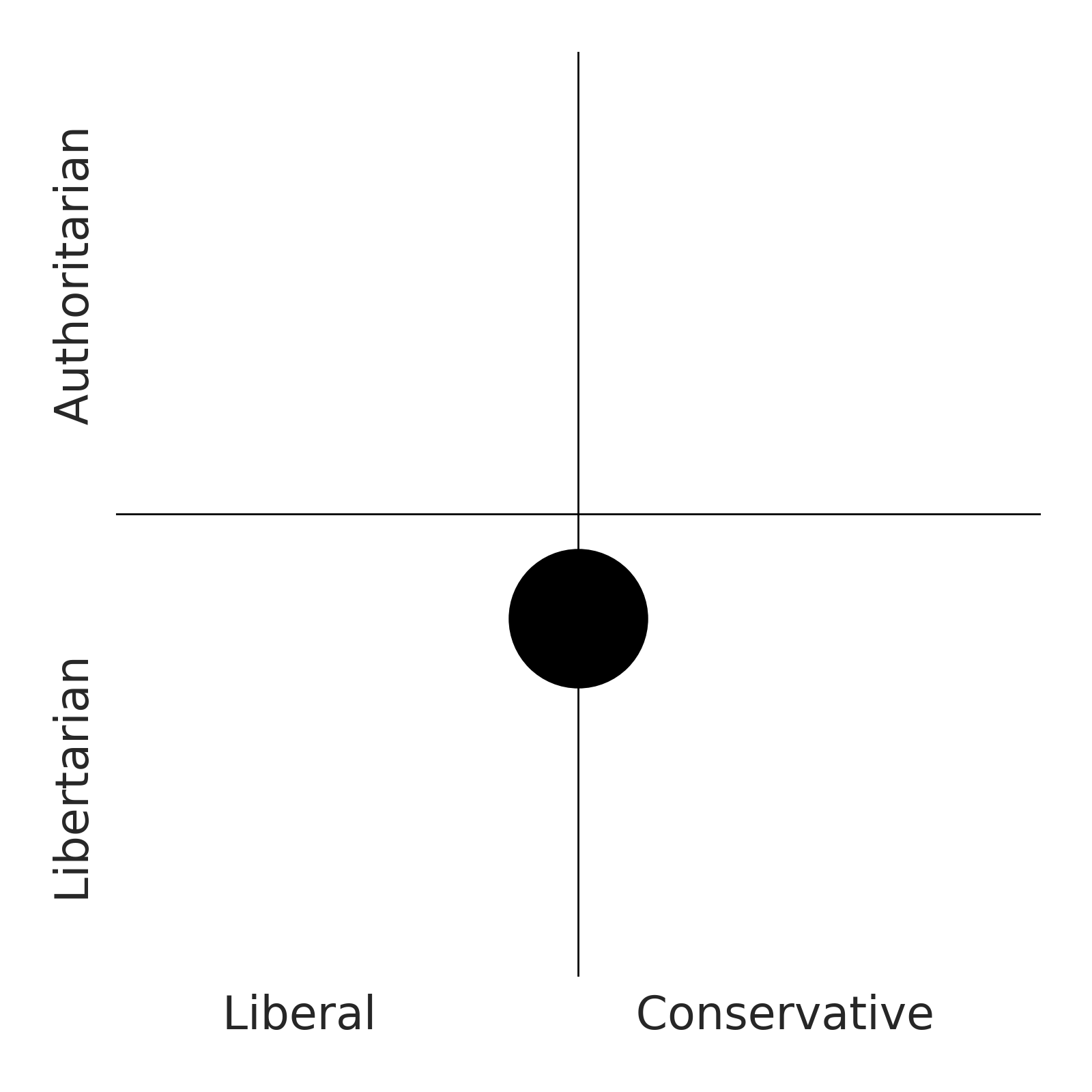
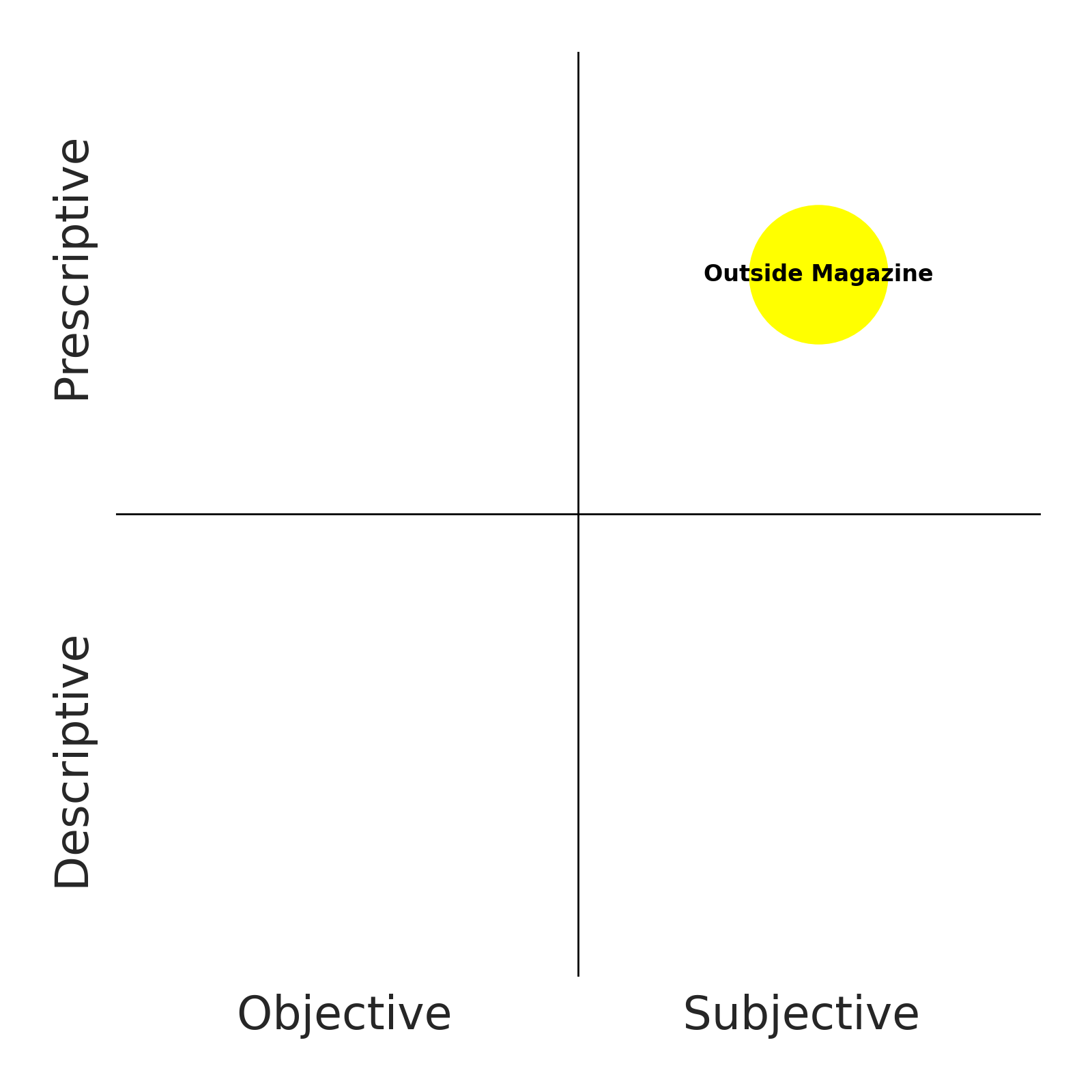
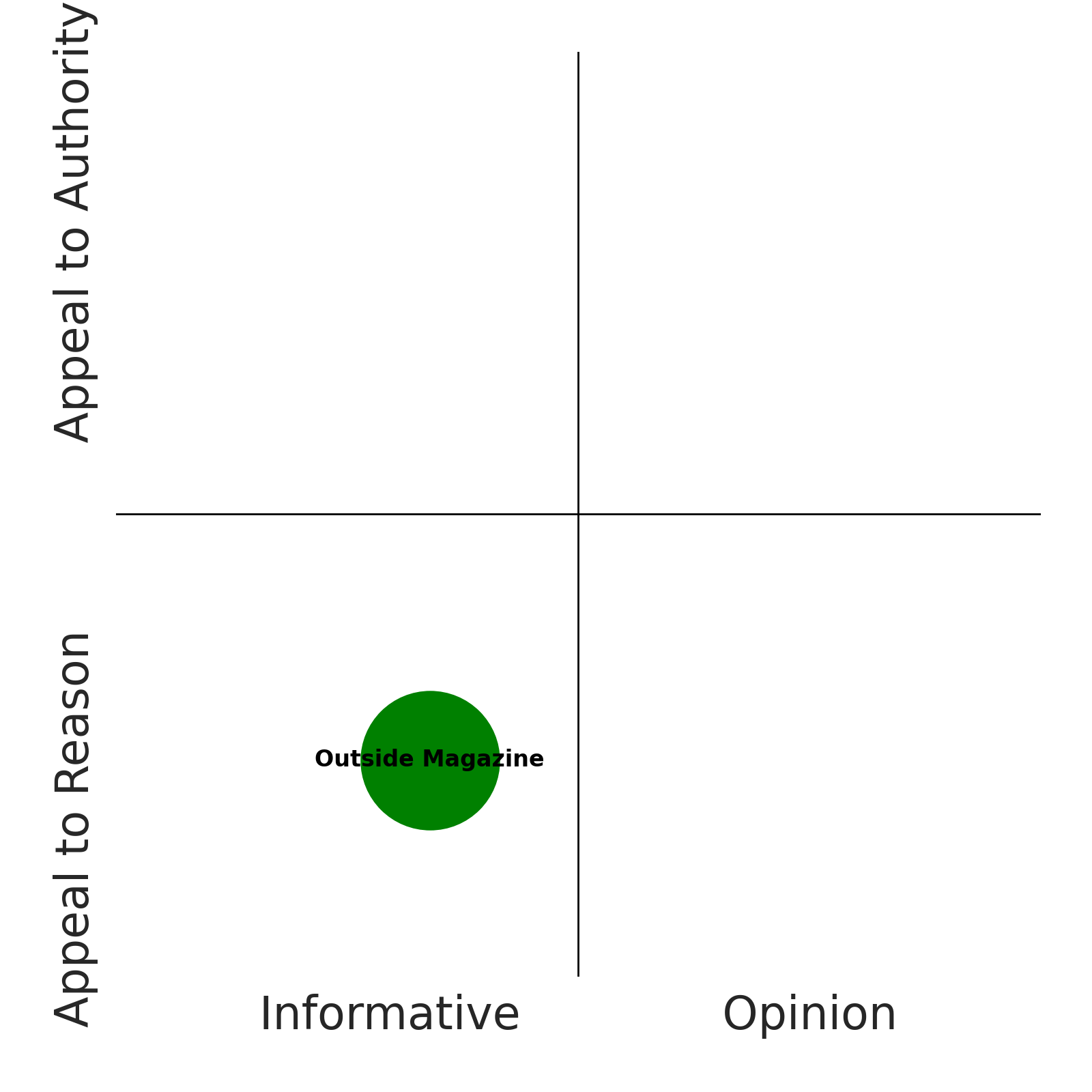
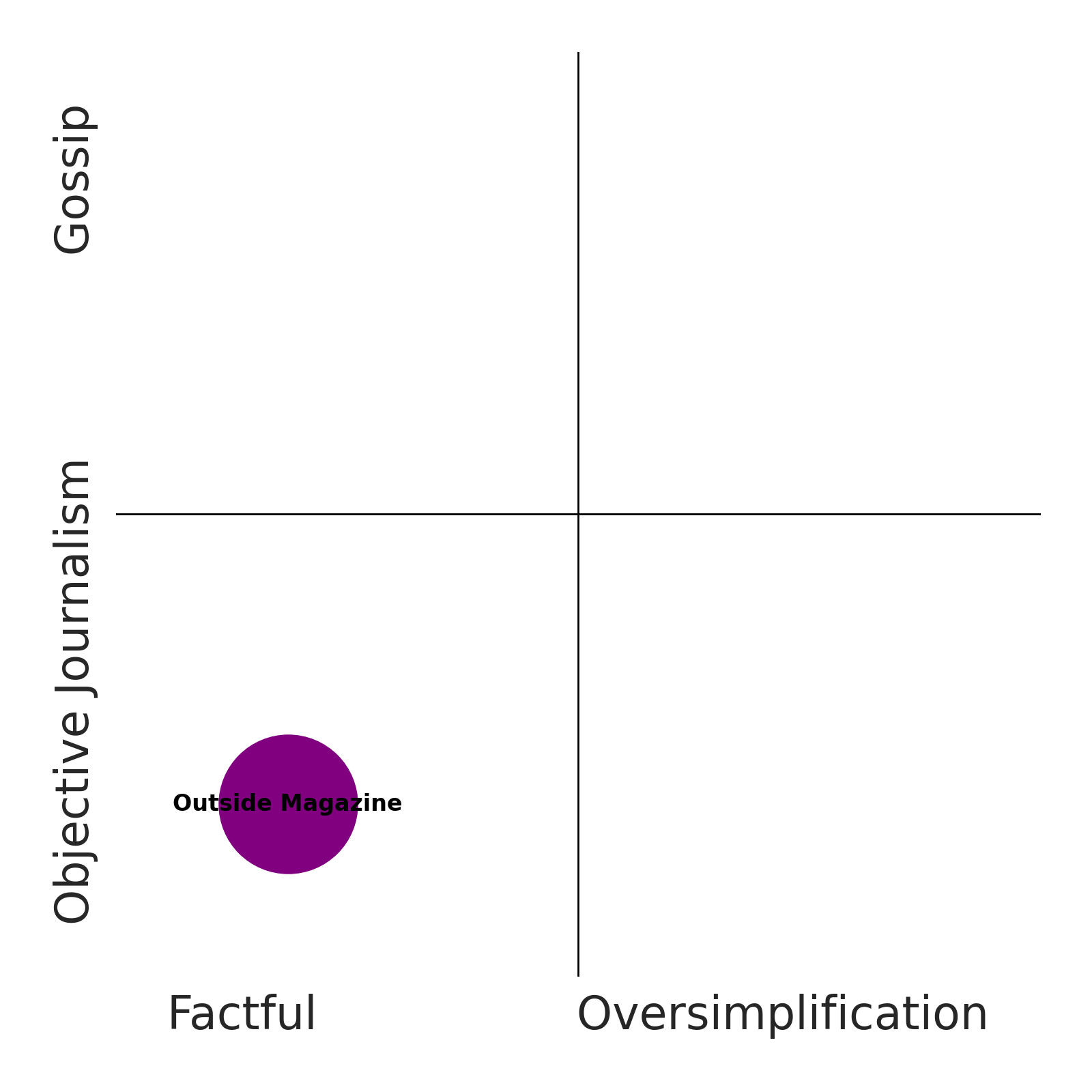
2026 © Helium Trades
Privacy Policy & Disclosure
* Disclaimer: Nothing on this website constitutes investment advice, performance data or any recommendation that any particular security, portfolio of securities, transaction or investment strategy is suitable for any specific person. Helium Trades is not responsible in any way for the accuracy
of any model predictions or price data. Any mention of a particular security and related prediction data is not a recommendation to buy or sell that security. Investments in securities involve the risk of loss. Past performance is no guarantee of future results. Helium Trades is not responsible for any of your investment decisions,
you should consult a financial expert before engaging in any transaction.
Helium Research Assistant

How can I help you today?
Ask any question about Outside Magazine bias.


