See whether Helium helps you make better-informed decisions. Try every Pro Trader feature for 30 days. No credit card required.
Try every Pro Trader feature for 30 days. No credit card required.
Identity & topic selection: The sample strongly indicates a mainstream, monetized consumer-technology outlet (writers like David Gewirtz and heavy Android/Google coverage suggest ZDNet-style content).
Coverage clusters around product reviews, deals, AI tools, smartphones, wearables, and OS/software news
August 29, 2026 · 0 shares
Framing is an enthusiastic first-person consumer-tech endorsement with direct buying advice, tempered by price and limitation caveats.
A consumer-technology review of the base Google Pixel 11, part of Google's 2026 summer lineup, focusing on hardware, camera, pricing, and Gemini/AI features.
Automated analysis; not human reviewed. Limitations: Only one first-person, promotional review text was available, with no independent benchmark data or external comparisons. · 4 of 54 available dimensions scored; omitted dimensions are not treated as neutral. · Verified supporting quotes for 4 of 4 scored dimensions.
Claim: The review is presented as a first-person subjective impression rather than an empirical test.
“Confession: I've spent the past two weeks speed-dating. Not people, but phones.” · exact text match
“I've actually been quite satisfied with how quickly the phone captures and processes images, especially in dimmer environments.” · exact text match
Why: Uses personal experience, metaphor, and preference language rather than controlled benchmarks.
Claim: Tone is positive and enthusiastic about the device.
“It's like the classic movie trope: the quiet nerd who takes off their glasses, puts on a swipe of hibiscus-pink lipstick, and suddenly has everyone's full attention.” · exact text match
Counterevidence:
“In 2026, I'm finding it harder to back the now $899 handset” · exact text match
Why: Flattering metaphor conveys strong enthusiasm, but a price caveat at the end tempers the positive tone.
Claim: Promotional language and direct buying recommendations push the product despite acknowledged caveats.
“the Pixel 11 quickly became my favorite of the four that launched this summer” · exact text match
“the Pixel 11 is your safest option of the four” · exact text match
Counterevidence:
“In 2026, I'm finding it harder to back the now $899 handset” · exact text match
Why: Direct superlatives and a buying recommendation, tempered by an explicit price and value caveat, plus affiliate context.
Claim: The article forecasts future pricing based on a historical pattern.
“if history repeats itself, you may even score a new Pixel for hundreds of dollars less if you wait until Black Friday” · exact text match
Why: A future price drop is predicted from an unstated historical pattern rather than current market data.
Only one first-person, promotional review text was available, with no independent benchmark data or external comparisons.
August 28, 2026 · 0 shares
Promotional product review frames the Roborock Qrevo 2 Pro as a 'fantastic value' and presents a cord-avoidance flaw as normal for midrange models.
The article is a hands-on product review published on ZDNET, a technology site, and includes affiliate-link disclosure and editorial standards statements. It compares the Qrevo 2 Pro to flagship Roborock features but does not provide comparative test data against other midrange models.
Automated analysis; not human reviewed. Limitations: The input is a single reviewer's hands-on product review with affiliate-link disclosure; no independent lab verification or comparative pricing data is available. · 2 of 54 available dimensions scored; omitted dimensions are not treated as neutral. · Verified supporting quotes for 2 of 2 scored dimensions.
Claim: The report includes specific testing details and disclosure statements, but relies on the author's single hands-on experience without external verification.
“This robot covered the area in only 10 minutes, reaching into corners and under furniture, including under my dog's raised bed, to clean everything.” · exact text match
Why: The article provides concrete, falsifiable details and editorial disclosures, but no third-party verification, comparative benchmarks, or negative results beyond the cord issue.
Claim: The review uses promotional language and highlights a limited-time price in a way that could encourage purchases through affiliate links.
“The Roborock Qrevo 2 Pro offers a fantastic value at its midrange price, and even more so at the $550 introductory price.” · exact text match
Counterevidence:
“Neither ZDNET nor the author are compensated for these independent reviews.” · exact text match
Why: The language 'fantastic value' and repeated emphasis on the $550 introductory price are promotional, and the page discloses affiliate commissions for purchases made through links.
The input is a single reviewer's hands-on product review with affiliate-link disclosure; no independent lab verification or comparative pricing data is available.
August 31, 2026 · 0 shares
The reporting is explanatory but mildly promotional, leading with Google's security claims and only later adding the technical caveats that limit them.
Automated analysis; not human reviewed. Limitations: The supplied text contains a likely typo ('appForion') in the Local Network Protection sentence, but the intended meaning is clear from context. · 6 of 54 available dimensions scored; omitted dimensions are not treated as neutral. · Verified supporting quotes for 5 of 6 scored dimensions.
Claim: The reporting is mostly factual and explanatory, keeping personal opinion to brief asides.
“The qualification -- "for supported websites and apps" -- matters.” · not found in supplied text
Why: Highlighting the conditional nature of ECH support is an objective, rather than promotional, presentation.
Claim: The piece closes on a positive note that users will get security benefits without action.
“For you and me, this means your Android connection will be more secure, and you won't have to do anything to get these benefits.” · exact text match
“Hang in there; within the next year, all these new security features will be fully implemented.” · exact text match
Why: The outlook is favorable, but the article also includes coverage and support caveats, so the optimism is mild.
Claim: The article states a definite one-year timeline for full implementation without a cited basis.
“Hang in there; within the next year, all these new security features will be fully implemented.” · exact text match
Why: The forecast is certain in tone even though the article previously notes that developer and carrier support is not guaranteed.
Claim: The article attributes claims to Google and Android documentation and includes specific limitations.
“On Thursday, the company announced that Android 17 is the first mobile operating system to support Encrypted Client Hello (ECH), a TLS privacy feature that hides destination domain names.” · exact text match
“Android's Open Source Project documentation warns that a phone may continue scanning for and connecting to 2G base stations even when its carrier has retired 2G service.” · exact text match
Why: Attribution and source-qualified caveats support the article's visible credibility.
Claim: The article reasons from technical mechanisms and states limitations rather than relying on emotion.
“ECH also does not hide DNS requests, which is why its privacy value depends heavily on pairing it with encrypted DNS, such as Private DNS.” · exact text match
Why: The article uses a technical limitation to draw a practical conclusion, which is reasoned and evidence-based.
Claim: The article discloses trade-offs and uncertainties rather than presenting a one-sided product pitch.
“There is a practical caveat. Turning off 2G can affect coverage while roaming in places where 2G remains part of the available network mix.” · exact text match
“However, until the developers and telecoms fully support these changes in programs, services, and networks, there's no guarantee that you'll get the benefits.” · exact text match
Why: Including practical downsides and lack of guarantee are internal honesty signals.
The supplied text contains a likely typo ('appForion') in the Local Network Protection sentence, but the intended meaning is clear from context.
August 31, 2026 · 0 shares
The framing is promotional and urgency-driven, using savings headlines, superlatives, and expert-testing credentials to encourage purchases during the early Labor Day window.
Automated analysis; not human reviewed. Limitations: Cannot independently verify sale prices, availability, or product-testing claims; the supplied text is a promotional roundup. · 8 of 54 available dimensions scored; omitted dimensions are not treated as neutral. · Verified supporting quotes for 8 of 8 scored dimensions.
Claim: The article mixes factual product specifications with subjective evaluative praise.
“This is certainly one of the better deals we've seen” · exact text match
“the gorgeous 14.2-inch Liquid Retina XDR display” · exact text match
Why: Superlative and aesthetic language ('better deals', 'gorgeous') goes beyond neutral product description.
Claim: The article presents the deals and laptops in a positive, encouraging tone.
“This is a well-priced but high-end model” · exact text match
“a very good deal for what you're getting” · exact text match
Why: The repeated positive evaluative language creates a consistently upbeat consumer outlook.
Claim: The article actively advises readers to take advantage of deals.
“Labor Day means the end of summer and back to school -- but not without snagging a good deal on a new laptop.” · exact text match
“Our goal is to deliver the most accurate information and the most knowledgeable advice possible in order to help you make smarter buying decisions” · exact text match
Why: It frames buying as the expected action and explicitly aims to guide purchasing decisions.
Claim: The article is heavily opinionated, offering favorable evaluations rather than neutral reporting.
“This is certainly one of the better deals we've seen” · exact text match
“we're confident these laptops are solid picks for a variety of use cases” · exact text match
Why: Recommended-product language and confidence in picks make the content opinion-led.
Claim: The article offers specific sourcing, methodology, and correction signals that support trustworthiness.
“All the laptops on this list we've either tested in our lab, gone hands-on with, or are familiar with through testing similar models.” · exact text match
“We approach testing in two parts: assessing performance through real-world scenarios and industry-standard benchmarking programs.” · exact text match
Why: It names a verification process and supplies detailed specifications, despite the promotional framing.
Claim: The article uses testing methodology and specific specifications as the basis for its recommendations.
“We approach testing in two parts: assessing performance through real-world scenarios and industry-standard benchmarking programs.” · exact text match
“All the laptops on this list we've either tested in our lab, gone hands-on with, or are familiar with through testing similar models.” · exact text match
Why: The explicit reliance on benchmarking and hands-on testing indicates a rational, evidence-based decision frame.
Claim: The piece is structured to drive purchases through affiliate links and prominently advertises discounts.
“Save up to $1,100 right now on Apple M5 MacBooks, Samsung Galaxy Book6, Surface Laptops, and gaming rigs we've tested.” · exact text match
“When you click through from our site to a retailer and buy a product or service, we may earn affiliate commissions.” · exact text match
Counterevidence:
“This helps support our work, but does not affect what we cover or how, and it does not affect the price you pay.” · exact text match
Why: The explicit affiliate-compensation disclosure and purchase-oriented deal framing make it promotional.
Claim: The article discloses financial incentives and commits to correcting errors.
“When you click through from our site to a retailer and buy a product or service, we may earn affiliate commissions.” · exact text match
“If we have made an error or published misleading information, we will correct or clarify the article.” · exact text match
Why: Transparency about affiliate compensation and a stated correction policy are observable integrity signals.
Cannot independently verify sale prices, availability, or product-testing claims; the supplied text is a promotional roundup.
August 31, 2026 · 0 shares
A promotional deals roundup frames Labor Day 2026 streaming discounts as an unmissable buying opportunity, using enthusiastic bargain language and an affiliate-commerce incentive structure.
Automated analysis; not human reviewed. Limitations: Only the supplied roundup text was analyzed; publication date, external links, retailer inventory, and independent verification of the listed prices are unavailable. · 7 of 54 available dimensions scored; omitted dimensions are not treated as neutral. · Verified supporting quotes for 4 of 7 scored dimensions.
Claim: The presentation is subjective, built around editorial recommendations and first-person product praise.
“ZDNET's recommendations are based on many hours of testing, research, and comparison shopping.” · exact text match
“The LG C6 OLED TV is one of the most impressive TVs I've tested year - and it's on sale.” · not found in supplied text
Why: It is explicitly framed as recommendations and includes first-person evaluative judgment rather than neutral price reporting.
Claim: The article's tone is positive and enthusiastic about Labor Day shopping.
“Labor Day is right around the corner, and as a major sales event, it brings forth many great discounts, especially on streaming devices and services.” · exact text match
“Over the coming days, you can find some great discounts on Roku TV and Google TV.” · exact text match
Why: Discounts are repeatedly called 'great' and the sales event is described as an opportunity.
Claim: The article tells readers when to buy, not just what is on sale.
“Many brands are dropping the prices on their streaming devices, smart TVs, and subscription services, so it's a great time to buy.” · exact text match
“With deals like an $18 Fire TV Stick HD, it's hard to wonder why anyone would pay full price for a streaming device.” · exact text match
Why: It explicitly recommends buying now and frames full-price purchases as undesirable.
Claim: The article includes explicit opinions about products and deals.
“The LG C6 OLED TV is one of the most impressive TVs I've tested year - and it's on sale.” · not found in supplied text
“The Amazon Fire TV Stick 4K Select is an affordable way to upgrade a 4K TV to run smoothly on the Fire OS platform or just make it smart.” · exact text match
Why: These are evaluative and promotional judgments rather than purely factual product specifications.
Claim: The content is structured as promotional deal marketing with affiliate compensation.
“These prices are hard to beat.” · not found in supplied text
“With deals like an $18 Fire TV Stick HD, it's hard to wonder why anyone would pay full price for a streaming device.” · exact text match
Why: Value-loaded language and an affiliate-commission disclosure indicate the roundup is designed to drive purchases; the central content is a sales list.
Claim: The article predicts additional discounts on Roku TV and Google TV in the coming days.
“Over the coming days, you can find some great discounts on Roku TV and Google TV.” · exact text match
Why: This is a forward-looking statement about future deal availability, though it is mild and consistent with seasonal sales coverage.
Claim: The article visibly discloses its affiliate relationship and a correction policy.
“When you click through from our site to a retailer and buy a product or service, we may earn affiliate commissions.” · exact text match
“If we have made an error or published misleading information, we will correct or clarify the article.” · exact text match
Why: These are observable honesty and accountability signals built into the text, independent of the promotional content.
Only the supplied roundup text was analyzed; publication date, external links, retailer inventory, and independent verification of the listed prices are unavailable.
August 28, 2026 · 0 shares
Promotional shopping guide with affiliate links, listing Costco deals to drive purchases.
Automated analysis; not human reviewed. · 2 of 54 available dimensions scored; omitted dimensions are not treated as neutral. · Verified supporting quotes for 2 of 2 scored dimensions.
Claim: The article includes claims of testing, editorial independence, and factual accuracy.
“ZDNET's recommendations are based on many hours of testing, research, and comparison shopping.” · exact text match
“we follow strict guidelines that ensure our editorial content is never influenced by advertisers.” · exact text match
Why: The publisher explicitly states testing and editorial guidelines, which supports credibility, though the affiliate context tempers it.
Claim: The article promotes purchases with promotional language and affiliate links.
“Save big on electronics, home essentials, and more now.” · exact text match
“Here are my favorite early Costco Labor Day deals you can shop now.” · exact text match
Why: The article's primary purpose is to encourage shopping, with multiple calls to action and deal highlights, indicating strong promotional intent.
August 31, 2026 · 0 shares
A shopping-focused framing presents Labor Day as a chance to save and promotes products with subjective praise while disclosing affiliate commissions.
In the U.S., Labor Day is a federal holiday and a traditional end-of-summer retail sales period, with many retailers timing discounts around it.
Automated analysis; not human reviewed. Limitations: The main input limitation is that the supplied content is an affiliate-linked deals roundup; the listed prices and 'lowest-ever' claims cannot be independently verified from the text alone. · 8 of 54 available dimensions scored; omitted dimensions are not treated as neutral. · Verified supporting quotes for 6 of 8 scored dimensions.
Claim: Product value judgments are framed subjectively rather than as measured facts.
“at 50% off, they pack an insane value.” · exact text match
Why: Recommendations include evaluative phrases such as 'insane value' that express editorial opinion rather than neutral reporting.
Claim: The content frames seasonal sales as an upbeat opportunity.
“With fall activities on the horizon and early sales launching ahead of the upcoming 2026 holiday season, it's a great time to take advantage of seasonal savings.” · exact text match
Why: The opening frames Labor Day positively as a 'great time' for savings rather than neutrally or negatively.
Claim: The content is dominated by editorial opinions and endorsements rather than neutral fact reporting.
“They're definitely a splurge, but a true investment in better sleep.” · exact text match
Why: Most entries give subjective endorsements of products and sale values, making the content opinion-heavy.
Claim: Recommendations rely on named editors and reviewers as expert endorsements.
“Wearables editor Nina Raemont says they're still worth buying, even in 2026.” · exact text match
“reviewer Matt Miller says "makes the Fenix 8 Pro an essential tool in my collection."” · not found in supplied text
Why: The content repeatedly supports buying decisions by citing staff titles and named reviewer praise rather than only objective specifications.
Claim: The report provides explicit methodology and correction practices that support moderate credibility within its shopping-advice scope.
“ZDNET's recommendations are based on many hours of testing, research, and comparison shopping.” · exact text match
“If we have made an error or published misleading information, we will correct or clarify the article.” · exact text match
Why: Selection method and correction commitment are stated, giving the advice a visible evidentiary basis despite its promotional nature.
Claim: The content functions as promotional shopping content with affiliate-link incentives and buy-oriented language.
“When you click through from our site to a retailer and buy a product or service, we may earn affiliate commissions.” · exact text match
Why: The deals column explicitly discloses affiliate commissions and is structured around drawing readers to retailer purchases.
Claim: The content visibly discloses its affiliate financial interest and a correction commitment.
“When you click through from our site to a retailer and buy a product or service, we may earn affiliate commissions.” · exact text match
“If we have made an error or published misleading information, we will correct or clarify the article.” · exact text match
Why: Affiliate relationship and correction commitment are stated explicitly, though recommendations remain commercial.
The main input limitation is that the supplied content is an affiliate-linked deals roundup; the listed prices and 'lowest-ever' claims cannot be independently verified from the text alone.
August 28, 2026 · 0 shares
The article is a sponsored promotional piece that strongly endorses Mammotion robot mower deals, using urgency and savings framing despite an affiliate disclosure.
The article is an advertorial for a limited-time Mammotion anniversary sale, with explicit disclosure that an advertiser paid for editorial consideration. It combines product specifications, comparison, and promotional discounts.
Automated analysis; not human reviewed. Limitations: The article is sponsored content, which may introduce commercial bias; the analysis relies solely on the provided text. · 4 of 54 available dimensions scored; omitted dimensions are not treated as neutral. · Verified supporting quotes for 3 of 4 scored dimensions.
Claim: The article uses positive language to create a favorable impression of the deals.
“so that's some more bang for your buck” · exact text match
“they are about as good as we've seen on either of these models” · not found in supplied text
Why: Positive superlatives and enthusiastic phrasing convey a mildly positive emotional tone typical of sales content.
Claim: Sponsorship reduces the credibility of the article's purchasing advice.
“An advertiser paid for editorial consideration of this deal.” · exact text match
Why: Paid promotional content inherently conflicts with independent editorial objectivity, despite disclaimers.
Claim: The article is paid promotional content, explicitly acknowledged by the publisher.
“An advertiser paid for editorial consideration of this deal.” · exact text match
Why: Direct admission of sponsorship makes advertising bias unequivocal.
Claim: The article employs urgency tactics to prompt immediate purchase.
“you only have a few days to grab it” · exact text match
“Deals can change or expire without much warning” · exact text match
Why: Time-limited language and warnings of expiry create artificial pressure, a common manipulative technique in retail promotions.
The article is sponsored content, which may introduce commercial bias; the analysis relies solely on the provided text.
August 28, 2026 · 0 shares
Promotional deal review with strong positive endorsement of the Talix cable and time-limited discount framing.
Automated analysis; not human reviewed. Limitations: Analysis is based solely on the supplied promotional text; no independent verification of product claims was performed. · 2 of 54 available dimensions scored; omitted dimensions are not treated as neutral. · Verified supporting quotes for 2 of 2 scored dimensions.
Claim: The article functions as an advertorial, promoting the product and the deal with favorable language and urgency.
“you can get it right now for $14 with an Amazon coupon” · exact text match
“limited-time deals are subject to expiration at any time” · exact text match
Why: The piece is a first-person endorsement that highlights benefits, includes a deal link, and creates urgency with expiration language, typical of promotional content.
Claim: The article uses urgency and favorable subjective impressions to encourage immediate purchase.
“limited-time deals are subject to expiration at any time” · exact text match
Why: The inclusion of expiration language pressures readers to act quickly, while the uniformly positive review omits any significant drawbacks, though the affiliate disclosure partially mitigates the manipulation.
Analysis is based solely on the supplied promotional text; no independent verification of product claims was performed.
Commercial bias is the clearest observable pattern: The source pays for traffic for the keyword "vpn iphone" — a direct monetization/SEO signal [36].
Many articles carry affiliate disclosures
August 31, 2026 · 0 shares
A promotional deals roundup frames Labor Day 2026 streaming discounts as an unmissable buying opportunity, using enthusiastic bargain language and an affiliate-commerce incentive structure.
Automated analysis; not human reviewed. Limitations: Only the supplied roundup text was analyzed; publication date, external links, retailer inventory, and independent verification of the listed prices are unavailable. · 7 of 54 available dimensions scored; omitted dimensions are not treated as neutral. · Verified supporting quotes for 4 of 7 scored dimensions.
Claim: The presentation is subjective, built around editorial recommendations and first-person product praise.
“ZDNET's recommendations are based on many hours of testing, research, and comparison shopping.” · exact text match
“The LG C6 OLED TV is one of the most impressive TVs I've tested year - and it's on sale.” · not found in supplied text
Why: It is explicitly framed as recommendations and includes first-person evaluative judgment rather than neutral price reporting.
Claim: The article's tone is positive and enthusiastic about Labor Day shopping.
“Labor Day is right around the corner, and as a major sales event, it brings forth many great discounts, especially on streaming devices and services.” · exact text match
“Over the coming days, you can find some great discounts on Roku TV and Google TV.” · exact text match
Why: Discounts are repeatedly called 'great' and the sales event is described as an opportunity.
Claim: The article tells readers when to buy, not just what is on sale.
“Many brands are dropping the prices on their streaming devices, smart TVs, and subscription services, so it's a great time to buy.” · exact text match
“With deals like an $18 Fire TV Stick HD, it's hard to wonder why anyone would pay full price for a streaming device.” · exact text match
Why: It explicitly recommends buying now and frames full-price purchases as undesirable.
Claim: The article includes explicit opinions about products and deals.
“The LG C6 OLED TV is one of the most impressive TVs I've tested year - and it's on sale.” · not found in supplied text
“The Amazon Fire TV Stick 4K Select is an affordable way to upgrade a 4K TV to run smoothly on the Fire OS platform or just make it smart.” · exact text match
Why: These are evaluative and promotional judgments rather than purely factual product specifications.
Claim: The content is structured as promotional deal marketing with affiliate compensation.
“These prices are hard to beat.” · not found in supplied text
“With deals like an $18 Fire TV Stick HD, it's hard to wonder why anyone would pay full price for a streaming device.” · exact text match
Why: Value-loaded language and an affiliate-commission disclosure indicate the roundup is designed to drive purchases; the central content is a sales list.
Claim: The article predicts additional discounts on Roku TV and Google TV in the coming days.
“Over the coming days, you can find some great discounts on Roku TV and Google TV.” · exact text match
Why: This is a forward-looking statement about future deal availability, though it is mild and consistent with seasonal sales coverage.
Claim: The article visibly discloses its affiliate relationship and a correction policy.
“When you click through from our site to a retailer and buy a product or service, we may earn affiliate commissions.” · exact text match
“If we have made an error or published misleading information, we will correct or clarify the article.” · exact text match
Why: These are observable honesty and accountability signals built into the text, independent of the promotional content.
Only the supplied roundup text was analyzed; publication date, external links, retailer inventory, and independent verification of the listed prices are unavailable.
August 31, 2026 · 0 shares
The review frames its final choice as a matter of personal preference and ecosystem compatibility, while transparently disclosing affiliate revenue and relying on first-person hands-on testing.
Automated analysis; not human reviewed. Limitations: The supplied text is one reviewer's subjective hands-on account; claims about GPS accuracy, battery life, and product suitability cannot be independently verified from the text alone. · 7 of 54 available dimensions scored; omitted dimensions are not treated as neutral. · Verified supporting quotes for 7 of 7 scored dimensions.
Claim: The review is framed substantially around the reviewer's personal preferences rather than purely objective test metrics.
“If I had smaller wrists, I would use the Forerunner 170 Music” · exact text match
“I do like the interface, long battery life, and Training Hub provided by Coros.” · exact text match
Why: The final recommendation is explicitly conditional on the author's preferences and ecosystem, making the piece subjective in its bottom line.
Claim: The overall evaluation of both products is strongly positive.
“The Garmin Forerunner 170 and Coros Pace 4 are excellent options for those with smaller wrists who want an entry-level sports watch at an affordable price.” · exact text match
“You can't go wrong with either one” · exact text match
Why: Both devices are described as excellent with no major drawbacks stated, producing a positive overall tone.
Claim: The review combines description with conditional buying advice.
“If I had smaller wrists, I would use the Forerunner 170 Music” · exact text match
“You can't go wrong with either one, and it comes down to the preference of the platform supporting the watches.” · exact text match
Why: The text offers explicit recommendation and guidance, not only neutral description of features.
Claim: The article is heavily evaluative, with first-person likes and preferences shaping the verdict.
“I do like the interface, long battery life, and Training Hub provided by Coros.” · exact text match
“I found a lot to like with both” · exact text match
Why: The visible content is built around the reviewer's personal assessments, which is inherently opinionated.
Claim: The review supports its findings with first-hand testing and discloses its relationship to retailers.
“I've been biking, walking, hiking, rowing, and living with these two watches for the past few weeks” · exact text match
“When you click through from our site to a retailer and buy a product or service, we may earn affiliate commissions.” · exact text match
Why: The presence of hands-on testing and affiliate disclosure, along with caveats, makes the account credible within its stated scope.
Claim: The review's conclusions are grounded in first-hand testing and explicitly acknowledge personal preference rather than claiming one watch is objectively superior.
“I've been biking, walking, hiking, rowing, and living with these two watches for the past few weeks” · exact text match
“You can't go wrong with either one, and it comes down to the preference of the platform supporting the watches.” · exact text match
Why: The assessment is based on direct use and includes a caveat about wrist size and a statement that final choice depends on preference, which is a balanced reasoning pattern.
Claim: The publisher discloses its affiliate-compensation model and a correction policy, and the reviewer discloses a physical limitation of the test.
“When you click through from our site to a retailer and buy a product or service, we may earn affiliate commissions. This helps support our work, but does not affect what we cover or how” · exact text match
“If we have made an error or published misleading information, we will correct or clarify the article.” · exact text match
Why: Transparent disclosure of financial incentives and a correction commitment signal internal fairness and honesty.
The supplied text is one reviewer's subjective hands-on account; claims about GPS accuracy, battery life, and product suitability cannot be independently verified from the text alone.
August 31, 2026 · 0 shares
The framing is promotional and urgency-driven, using savings headlines, superlatives, and expert-testing credentials to encourage purchases during the early Labor Day window.
Automated analysis; not human reviewed. Limitations: Cannot independently verify sale prices, availability, or product-testing claims; the supplied text is a promotional roundup. · 8 of 54 available dimensions scored; omitted dimensions are not treated as neutral. · Verified supporting quotes for 8 of 8 scored dimensions.
Claim: The article mixes factual product specifications with subjective evaluative praise.
“This is certainly one of the better deals we've seen” · exact text match
“the gorgeous 14.2-inch Liquid Retina XDR display” · exact text match
Why: Superlative and aesthetic language ('better deals', 'gorgeous') goes beyond neutral product description.
Claim: The article presents the deals and laptops in a positive, encouraging tone.
“This is a well-priced but high-end model” · exact text match
“a very good deal for what you're getting” · exact text match
Why: The repeated positive evaluative language creates a consistently upbeat consumer outlook.
Claim: The article actively advises readers to take advantage of deals.
“Labor Day means the end of summer and back to school -- but not without snagging a good deal on a new laptop.” · exact text match
“Our goal is to deliver the most accurate information and the most knowledgeable advice possible in order to help you make smarter buying decisions” · exact text match
Why: It frames buying as the expected action and explicitly aims to guide purchasing decisions.
Claim: The article is heavily opinionated, offering favorable evaluations rather than neutral reporting.
“This is certainly one of the better deals we've seen” · exact text match
“we're confident these laptops are solid picks for a variety of use cases” · exact text match
Why: Recommended-product language and confidence in picks make the content opinion-led.
Claim: The article offers specific sourcing, methodology, and correction signals that support trustworthiness.
“All the laptops on this list we've either tested in our lab, gone hands-on with, or are familiar with through testing similar models.” · exact text match
“We approach testing in two parts: assessing performance through real-world scenarios and industry-standard benchmarking programs.” · exact text match
Why: It names a verification process and supplies detailed specifications, despite the promotional framing.
Claim: The article uses testing methodology and specific specifications as the basis for its recommendations.
“We approach testing in two parts: assessing performance through real-world scenarios and industry-standard benchmarking programs.” · exact text match
“All the laptops on this list we've either tested in our lab, gone hands-on with, or are familiar with through testing similar models.” · exact text match
Why: The explicit reliance on benchmarking and hands-on testing indicates a rational, evidence-based decision frame.
Claim: The piece is structured to drive purchases through affiliate links and prominently advertises discounts.
“Save up to $1,100 right now on Apple M5 MacBooks, Samsung Galaxy Book6, Surface Laptops, and gaming rigs we've tested.” · exact text match
“When you click through from our site to a retailer and buy a product or service, we may earn affiliate commissions.” · exact text match
Counterevidence:
“This helps support our work, but does not affect what we cover or how, and it does not affect the price you pay.” · exact text match
Why: The explicit affiliate-compensation disclosure and purchase-oriented deal framing make it promotional.
Claim: The article discloses financial incentives and commits to correcting errors.
“When you click through from our site to a retailer and buy a product or service, we may earn affiliate commissions.” · exact text match
“If we have made an error or published misleading information, we will correct or clarify the article.” · exact text match
Why: Transparency about affiliate compensation and a stated correction policy are observable integrity signals.
Cannot independently verify sale prices, availability, or product-testing claims; the supplied text is a promotional roundup.
August 28, 2026 · 0 shares
The article is a sponsored promotional piece that strongly endorses Mammotion robot mower deals, using urgency and savings framing despite an affiliate disclosure.
The article is an advertorial for a limited-time Mammotion anniversary sale, with explicit disclosure that an advertiser paid for editorial consideration. It combines product specifications, comparison, and promotional discounts.
Automated analysis; not human reviewed. Limitations: The article is sponsored content, which may introduce commercial bias; the analysis relies solely on the provided text. · 4 of 54 available dimensions scored; omitted dimensions are not treated as neutral. · Verified supporting quotes for 3 of 4 scored dimensions.
Claim: The article uses positive language to create a favorable impression of the deals.
“so that's some more bang for your buck” · exact text match
“they are about as good as we've seen on either of these models” · not found in supplied text
Why: Positive superlatives and enthusiastic phrasing convey a mildly positive emotional tone typical of sales content.
Claim: Sponsorship reduces the credibility of the article's purchasing advice.
“An advertiser paid for editorial consideration of this deal.” · exact text match
Why: Paid promotional content inherently conflicts with independent editorial objectivity, despite disclaimers.
Claim: The article is paid promotional content, explicitly acknowledged by the publisher.
“An advertiser paid for editorial consideration of this deal.” · exact text match
Why: Direct admission of sponsorship makes advertising bias unequivocal.
Claim: The article employs urgency tactics to prompt immediate purchase.
“you only have a few days to grab it” · exact text match
“Deals can change or expire without much warning” · exact text match
Why: Time-limited language and warnings of expiry create artificial pressure, a common manipulative technique in retail promotions.
The article is sponsored content, which may introduce commercial bias; the analysis relies solely on the provided text.
August 28, 2026 · 0 shares
Promotional deal review with strong positive endorsement of the Talix cable and time-limited discount framing.
Automated analysis; not human reviewed. Limitations: Analysis is based solely on the supplied promotional text; no independent verification of product claims was performed. · 2 of 54 available dimensions scored; omitted dimensions are not treated as neutral. · Verified supporting quotes for 2 of 2 scored dimensions.
Claim: The article functions as an advertorial, promoting the product and the deal with favorable language and urgency.
“you can get it right now for $14 with an Amazon coupon” · exact text match
“limited-time deals are subject to expiration at any time” · exact text match
Why: The piece is a first-person endorsement that highlights benefits, includes a deal link, and creates urgency with expiration language, typical of promotional content.
Claim: The article uses urgency and favorable subjective impressions to encourage immediate purchase.
“limited-time deals are subject to expiration at any time” · exact text match
Why: The inclusion of expiration language pressures readers to act quickly, while the uniformly positive review omits any significant drawbacks, though the affiliate disclosure partially mitigates the manipulation.
Analysis is based solely on the supplied promotional text; no independent verification of product claims was performed.
August 28, 2026 · 0 shares
The article is a sponsored promotional piece that strongly endorses Mammotion robot mower deals, using urgency and savings framing despite an affiliate disclosure.
The article is an advertorial for a limited-time Mammotion anniversary sale, with explicit disclosure that an advertiser paid for editorial consideration. It combines product specifications, comparison, and promotional discounts.
Automated analysis; not human reviewed. Limitations: The article is sponsored content, which may introduce commercial bias; the analysis relies solely on the provided text. · 4 of 54 available dimensions scored; omitted dimensions are not treated as neutral. · Verified supporting quotes for 3 of 4 scored dimensions.
Claim: The article uses positive language to create a favorable impression of the deals.
“so that's some more bang for your buck” · exact text match
“they are about as good as we've seen on either of these models” · not found in supplied text
Why: Positive superlatives and enthusiastic phrasing convey a mildly positive emotional tone typical of sales content.
Claim: Sponsorship reduces the credibility of the article's purchasing advice.
“An advertiser paid for editorial consideration of this deal.” · exact text match
Why: Paid promotional content inherently conflicts with independent editorial objectivity, despite disclaimers.
Claim: The article is paid promotional content, explicitly acknowledged by the publisher.
“An advertiser paid for editorial consideration of this deal.” · exact text match
Why: Direct admission of sponsorship makes advertising bias unequivocal.
Claim: The article employs urgency tactics to prompt immediate purchase.
“you only have a few days to grab it” · exact text match
“Deals can change or expire without much warning” · exact text match
Why: Time-limited language and warnings of expiry create artificial pressure, a common manipulative technique in retail promotions.
The article is sponsored content, which may introduce commercial bias; the analysis relies solely on the provided text.
August 29, 2026 · 0 shares
A balanced first-person product review that praises the recorder's transcription accuracy while criticizing the subscription-heavy app and proprietary cable, with some speculative forward-looking commentary.
A ZDNET hands-on review of the Comulytic Note Pro AI voice recorder, written by an author with hand cramping who was seeking an alternative to typing; the review is based on hours of personal testing across varied recording conditions.
Automated analysis; not human reviewed. Limitations: Only one reviewer's personal experience is available; Comulytic's technical and security claims are not independently verified. · 3 of 54 available dimensions scored; omitted dimensions are not treated as neutral. · Verified supporting quotes for 3 of 3 scored dimensions.
Claim: The review expresses a mildly positive overall attitude toward the recorder despite noting significant drawbacks.
“The more I used the Note Pro AI voice recorder, the more I liked it, but I couldn't shake a couple of concerns.” · exact text match
Why: The sentence explicitly states liking increased while simultaneously acknowledging concerns, indicating a mildly positive emotional stance rather than neutral or negative.
Claim: The review is transparent about relying on unverified manufacturer claims and clearly attributes conclusions to the author's personal testing.
“Comulytic claims that the recordings are encrypted using AES and that everything is done to meet SOC 2 Type 2, HIPAA, ISO 27001, GDPR, CCPA, and CPRA requirements, and we will have to take their word for it.” · exact text match
Why: The review explicitly flags manufacturer claims as unverified and uses hedged, first-person language such as 'I felt' and 'my experience,' indicating careful sourcing and uncertainty disclosure.
Claim: The review speculates about a near-future outcome concerning AI watermarking and its potential impact on output from such devices.
“given the direction that AI is going with watermarking (a feature that will aid AI companies more than anyone, because it will allow AI slop to be identified and prevented from being added to training data), it's not long before anything and everything that comes from a device like this will have AI's digital fingerprints all over it” · exact text match
Why: The passage predicts a future development based on current trends without concrete evidence or a timeline, which constitutes speculation.
Only one reviewer's personal experience is available; Comulytic's technical and security claims are not independently verified.
August 29, 2026 · 0 shares
Framing is an enthusiastic first-person consumer-tech endorsement with direct buying advice, tempered by price and limitation caveats.
A consumer-technology review of the base Google Pixel 11, part of Google's 2026 summer lineup, focusing on hardware, camera, pricing, and Gemini/AI features.
Automated analysis; not human reviewed. Limitations: Only one first-person, promotional review text was available, with no independent benchmark data or external comparisons. · 4 of 54 available dimensions scored; omitted dimensions are not treated as neutral. · Verified supporting quotes for 4 of 4 scored dimensions.
Claim: The review is presented as a first-person subjective impression rather than an empirical test.
“Confession: I've spent the past two weeks speed-dating. Not people, but phones.” · exact text match
“I've actually been quite satisfied with how quickly the phone captures and processes images, especially in dimmer environments.” · exact text match
Why: Uses personal experience, metaphor, and preference language rather than controlled benchmarks.
Claim: Tone is positive and enthusiastic about the device.
“It's like the classic movie trope: the quiet nerd who takes off their glasses, puts on a swipe of hibiscus-pink lipstick, and suddenly has everyone's full attention.” · exact text match
Counterevidence:
“In 2026, I'm finding it harder to back the now $899 handset” · exact text match
Why: Flattering metaphor conveys strong enthusiasm, but a price caveat at the end tempers the positive tone.
Claim: Promotional language and direct buying recommendations push the product despite acknowledged caveats.
“the Pixel 11 quickly became my favorite of the four that launched this summer” · exact text match
“the Pixel 11 is your safest option of the four” · exact text match
Counterevidence:
“In 2026, I'm finding it harder to back the now $899 handset” · exact text match
Why: Direct superlatives and a buying recommendation, tempered by an explicit price and value caveat, plus affiliate context.
Claim: The article forecasts future pricing based on a historical pattern.
“if history repeats itself, you may even score a new Pixel for hundreds of dollars less if you wait until Black Friday” · exact text match
Why: A future price drop is predicted from an unstated historical pattern rather than current market data.
Only one first-person, promotional review text was available, with no independent benchmark data or external comparisons.
Promotional/hype framing: Several pieces lean on vendor framing with minimal critical distance: Bose launch coverage mirrors marketing positioning
September 17, 2026 · 0 shares
Promotional product-launch framing presents Bose’s new open earbuds as premium and stylish, with only a modest durability caveat.
Open-ear clip-on earbuds are a consumer-electronics category in which the speaker sits on or near the ear rather than sealing the ear canal, allowing ambient sound to pass through.
Automated analysis; not human reviewed. Limitations: The most consequential limitation is that most performance and suitability claims are sourced to Bose rather than independently verified, and the supplied text includes related-content links that were excluded from analysis. · 4 of 55 available dimensions scored; omitted dimensions are not treated as neutral. · Verified supporting quotes for 4 of 4 scored dimensions.
Claim: The writing mixes objective specifications with personal aesthetic judgments.
“We’ve rated Bose’s Ultra Open buds highly for their rich sound, sleek design, and all-day comfort.” · exact text match
“I’ve found that Bose tends to offer a sleeker design and more color options.” · exact text match
Why: These are editorial preference statements embedded in a product-spec report, making the overall frame subjective rather than purely descriptive.
Claim: Unlabeled opinions about Bose's design and competitors are included as conclusions.
“Bose’s designs are usually more refined and stylish, while Sony opts for plastic builds and uniform design language.” · exact text match
Counterevidence:
“Bose says its second-gen open-ear buds have improved audio reproduction, specifically deeper bass, louder volume, and clearer calls.” · exact text match
Why: The preference for Bose’s design language is stated as the writer’s finding rather than attributed or hedged, while Bose claims are labeled as such.
Claim: The coverage closely follows Bose’s marketing positioning and product launch messaging, with little critical distance.
“Bose positions the second-gen Ultra Open as premium open-ear headphones for everyday use.” · exact text match
“Bose returns with new open earbuds.” · exact text match
Why: The opening and feature descriptions echo promotional language about premium, lifestyle, and elevated experience, and the piece does not test or challenge the claims.
Claim: Framing is favorable to Bose as a company, highlighting its products as premium and stylish while minimizing competitive strengths.
“Bose’s open-ear clip-on earbuds are among our favorites, and the company is expanding its lineup to accommodate different types of open-ear fans.” · exact text match
Counterevidence:
“Bose’s midrange clip-on buds aren’t as durable as the IP57-rated Shokz OpenDots 2” · exact text match
Why: The piece selects and repeats positive Bose positioning and praise, though it includes one durability caveat about the cheaper model.
The most consequential limitation is that most performance and suitability claims are sourced to Bose rather than independently verified, and the supplied text includes related-content links that were excluded from analysis.
September 16, 2026 · 0 shares
Presents Anthropic's product consolidation as an unambiguous step toward a single all-purpose AI workspace, leaning on vendor language and upbeat product analysis.
Automated analysis; not human reviewed. Limitations: The supplied text is a short vendor-driven product announcement, so political and ideological dimensions are not assessable. · 7 of 55 available dimensions scored; omitted dimensions are not treated as neutral. · Verified supporting quotes for 5 of 7 scored dimensions.
Claim: The report combines product facts with evaluative market-positioning language.
“Inside this super-Claude, you’ll also find the brand-new Claude Docs, which puts Anthropic more seriously in the running to be an AI-first Google Suite rival.” · exact text match
Why: The description shifts from reporting to editorial assessment with phrases such as 'super-Claude' and 'more seriously in the running.'
Claim: The report uses promotional hyperbole to describe the product.
“Anthropic is rolling Claude Cowork and chat into a single, all-powerful Claude known as… Claude.” · not found in supplied text
“And there’s apparently nothing it can’t do.” · exact text match
Why: 'All-powerful' and 'nothing it can't do' are exaggerated marketing-style claims, though the second is hedged with 'apparently.'
Claim: The report frames the change as an expansion of capability rather than a disruption.
“Anthropic is rolling Claude Cowork and chat into a single, all-powerful Claude known as… Claude.” · not found in supplied text
“And there’s apparently nothing it can’t do.” · exact text match
Why: The overall emphasis is on a more capable, unified product, with only a passing 'bad news' acknowledgment for fans of the old chat interface.
Claim: The report inserts editorial assessments into the product update.
“The goal seems to be simplicity: a central location for projects, and now documents, that Claude generates.” · exact text match
“Inside this super-Claude, you’ll also find the brand-new Claude Docs, which puts Anthropic more seriously in the running to be an AI-first Google Suite rival.” · exact text match
Why: Phrases like 'seems to be' and 'more seriously in the running' are evaluative conclusions layered onto the reporting.
Claim: Visible sourcing, attribution, and disclosure support moderate credibility.
“The change also applies to Artifacts and is starting with the Pro and Max plans over the coming weeks; the company said more plans will follow.” · exact text match
“Disclosure: Ziff Davis, ZDNET’s parent company, filed an April 2025 lawsuit against OpenAI, alleging it infringed Ziff Davis copyrights in training and operating its AI systems.” · exact text match
Why: The report names its source, attributes statements, and discloses a related conflict; hyperbole and promotional framing temper the overall credibility score.
Claim: The report offers conditional competitive and strategic analysis beyond the announced facts.
“Now, it may make more sense for the company to manage a single Claude entity with the agentic capabilities that more users demand.” · exact text match
“Inside this super-Claude, you’ll also find the brand-new Claude Docs, which puts Anthropic more seriously in the running to be an AI-first Google Suite rival.” · exact text match
Why: These are editorial forecasts and judgments rather than observed product facts.
Claim: The article attributes vendor claims to Anthropic and discloses a parent-company conflict.
““You don’t have to choose where a task goes. Claude does more of the work,” Anthropic’s announcement said.” · exact text match
“Disclosure: Ziff Davis, ZDNET’s parent company, filed an April 2025 lawsuit against OpenAI, alleging it infringed Ziff Davis copyrights in training and operating its AI systems.” · exact text match
Why: It consistently attributes claims and includes a relevant ownership disclosure, though it does not independently verify the vendor's assertions.
The supplied text is a short vendor-driven product announcement, so political and ideological dimensions are not assessable.
September 16, 2026 · 0 shares
The Pixel Drop is framed as a useful and exciting convenience update, with Google's claims relayed prominently and lightly caveated.
Automated analysis; not human reviewed. Limitations: The supplied text is a short promotional product announcement, so Google's rollout and privacy claims could not be independently verified. · 5 of 55 available dimensions scored; omitted dimensions are not treated as neutral. · Verified supporting quotes for 5 of 5 scored dimensions.
Claim: The article mixes factual product details with personal preference and reaction.
“The most useful update, and the one I’m most excited about, makes it a lot easier to call or message your most used contacts.” · exact text match
“I had VIP contacts saved, but I rarely used them because the process wasn’t much shorter than using the regular method.” · exact text match
Why: Product changes are reported specifically, but the author's excitement and personal usage history are included as evaluative framing.
Claim: The update is characterized positively, emphasizing convenience and scam protection.
“Google is also expanding Scam Detection, a feature that already listens to your calls to keep you safe from scams.” · exact text match
“The most useful update, and the one I’m most excited about, makes it a lot easier to call or message your most used contacts.” · exact text match
Why: The headline features are described as useful and protective, with the only noted limitation attributed to early reports.
Claim: The report includes a stated opinion that the contact shortcut is the most useful update and uses a personal anecdote about the old widget.
“The most useful update, and the one I’m most excited about, makes it a lot easier to call or message your most used contacts.” · exact text match
“I had VIP contacts saved, but I rarely used them because the process wasn’t much shorter than using the regular method.” · exact text match
Why: The claim of 'most useful' is subjective, but most of the surrounding text remains descriptive.
Claim: The text is transparent about sourcing, attributing main claims to Google and flagging early reports.
“Google says the widget itself supports up to 16 contacts, but early reports indicate that if you add more than 4, it reverts to the old layout to save space.” · exact text match
“This processing happens on device and in real-time, Google says, so your conversations stay private.” · verified after text normalization
Why: Key product assertions are attributed and the limitation is hedged, though 'early reports' is unnamed and Google's privacy claim is not independently tested.
Claim: The Pixel Drop is framed with promotional enthusiasm, calling the update useful and the contact feature exciting.
“The September 2026 Pixel Drop is officially rolling out, and while it’s not a huge update, it does bring a potentially very useful tool to your home screen.” · exact text match
“The most useful update, and the one I’m most excited about, makes it a lot easier to call or message your most used contacts.” · exact text match
Why: The language is praising and first-person enthusiastic rather than critically evaluative, though it acknowledges the update is not huge.
The supplied text is a short promotional product announcement, so Google's rollout and privacy claims could not be independently verified.
August 28, 2026 · 0 shares
The piece is a promotional contest announcement that frames Apple's upcoming event as 'huge' and encourages speculative guessing, with a clear marketing purpose.
This is a sweepstakes promotion for ZDNET readers, not a news article.
Automated analysis; not human reviewed. Limitations: The article is a promotional contest, not substantive news, so factual claims are limited and promotional intent is high. · 54 of 54 available dimensions scored; omitted dimensions are not treated as neutral. · Verified supporting quotes for 4 of 54 scored dimensions.
Claim: The article asserts without evidence that Apple's event will be 'huge'.
“We have reason to believe Apple's Sept. 9 2026 event will be huge.” · exact text match
Why: The phrase 'reason to believe' is a strong positive assertion without supporting evidence in the text.
Claim: The entire piece is a promotional fluff for a contest, offering a prize to drive engagement.
“Want a free Apple Watch? Play ZDNET's 'Guessing Game' to win one.” · exact text match
“Each answer you get right is an entry into the drawing for the new Apple Watch.” · exact text match
Why: The repeated calls to participate and prize incentives indicate low-value promotional content.
Claim: The article lacks journalistic sourcing and relies on speculation and promotional language.
“We have reason to believe Apple's Sept. 9 2026 event will be huge.” · exact text match
“It's possible Apple will announce a new foldable iPhone, potentially a touchscreen MacBook... or, maybe both?” · exact text match
Why: No sources or citations are provided; claims are speculative and promotional rather than factual reporting.
Claim: The piece functions as an advertorial for the contest and indirectly for Apple products.
“Want a free Apple Watch? Play ZDNET's 'Guessing Game' to win one.” · exact text match
“NO PURCHASE NECESSARY to enter or win the "CNET Group Big Guessing Game" Giveaway.” · not found in supplied text
Why: The primary purpose is to promote a sweepstakes, highlighting the prize and encouraging participation.
Claim: The article explicitly encourages guessing about Apple's announcements and presents unverified possibilities.
“What do you think Apple will announce?” · exact text match
“It's possible Apple will announce a new foldable iPhone, potentially a touchscreen MacBook... or, maybe both?” · exact text match
Why: The contest is built around guessing future events, and the article itself offers speculative scenarios without evidence.
The article is a promotional contest, not substantive news, so factual claims are limited and promotional intent is high.
September 18, 2026 · 0 shares
Framing amplifies a Seagate-commissioned survey into an urgent industry imperative by focusing on the 62% readiness gap and presenting storage expansion and 'sustainable scaling' as the necessary response.
Seagate Technology is a data-storage hardware vendor and commissioned the survey; the research was conducted by Recon Analytics rather than an independent public agency.
Automated analysis; not human reviewed. Limitations: The supplied text is a single vendor-commissioned survey write-up with no independent verification or non-Seagate expert input, so bias assessment rests on the publisher's own framing and attribution. · 11 of 55 available dimensions scored; omitted dimensions are not treated as neutral. · Verified supporting quotes for 11 of 11 scored dimensions.
Claim: The headline uses emotionally loaded language to dramatize a statistical readiness gap.
“Businesses finally seeing AI ROI, but 62% can’t handle the storage demands” · exact text match
“That’s less than four out of ten.” · exact text match
Why: The title equates the 38% preparedness figure with 'can't handle' and the lede repeats 'less than four out of ten' for emphasis, while the body is otherwise largely data-driven.
Claim: The framing is mildly bullish on AI-related returns and continued storage demand.
“86% of organizations are seeing “moderate or significant” returns on their AI investments” · exact text match
“99% of IT leaders expect AI to increase their organization’s storage needs over the next three years” · exact text match
Counterevidence:
“only 38% of organizations say they are prepared to meet AI’s growing data demands” · exact text match
Why: Positive ROI and demand expectations frame the story as a growth opportunity despite the readiness gap.
Claim: The tone leans mildly optimistic about AI payoff and sustainability improvements.
“Businesses finally seeing AI ROI” · exact text match
“94% anticipated their storage operations becoming more sustainable within the next five years” · exact text match
Counterevidence:
“only 38% of organizations say they are prepared to meet AI’s growing data demands” · exact text match
Why: The headline and future sustainability expectations create an optimistic slant, with the readiness gap shown as a challenge rather than a failure.
Claim: The report shifts from describing survey results to prescribing what organizations should do.
“closing this gap requires an infrastructure strategy built around the “full data lifecycle.”” · exact text match
“Organizations need to understand what data they will create, how quickly different workloads need to access it, how long it may retain value and which operational measures will guide growth.” · exact text match
Why: Directives such as 'requires' and 'need to' instruct rather than merely describe, even though they are attributed to Seagate.
Claim: There is editorializing beyond the survey findings.
“AI increases the value of data, but it needs somewhere to go” · exact text match
“Seagate’s report indicates that closing this gap requires an infrastructure strategy built around the “full data lifecycle.”” · exact text match
Why: The first sentence is presented as an industry truth rather than a survey result, and the closing strategy is a recommendation.
Claim: The story relies on Seagate's commissioned research and its named concept as the primary authority.
“according to new research from Seagate Technology” · exact text match
“Seagate defines this critical need for continued investment in data strategy, government, and AI infrastructure as a new imperative, which thre company calls sustainable scaling.” · exact text match
Why: Seagate is both the survey sponsor and the source of the prescriptive concept, and no independent authority is offered.
Claim: The piece is credible as an attributed account of a commissioned survey, but not independently verified.
“Seagate Technology’s 2026 Data Infrastructure Readiness Report found that 99% of IT leaders expect AI to increase their organization’s storage needs over the next three years.” · exact text match
“Recon Analytics conducted the research on behalf of Seagate during May and June 2026.” · exact text match
Counterevidence:
“according to new research from Seagate Technology” · exact text match
Why: Visible sourcing, named research firm, sample size, and dates support credibility; the vendor-commissioned basis is the main limit.
Claim: The coverage promotes a Seagate-branded concept as a new imperative rather than flagging it as marketing.
“Seagate defines this critical need for continued investment in data strategy, government, and AI infrastructure as a new imperative, which thre company calls sustainable scaling.” · exact text match
““Sustainable scaling is the ability to increase AI capacity and business value while continuously improving the efficiencies of the infrastructure that supports it,” according to the report.” · exact text match
Why: The repeated favorable use of Seagate's proprietary term and its definition gives promotional space to a vendor concept.
Claim: The article is favorable to corporate technology spending and the storage industry.
“Businesses finally seeing AI ROI” · exact text match
“Regardless, the industry’s push for more investment into storage will likely continue, though it’s not the only factor preventing businesses from feeling fully prepared.” · exact text match
Why: It frames enterprise AI returns and continued storage investment positively and as expected.
Claim: The article mixes survey-based expectations with its own forward-looking projection.
“99% of IT leaders expect AI to increase their organization’s storage needs over the next three years” · exact text match
“Regardless, the industry’s push for more investment into storage will likely continue, though it’s not the only factor preventing businesses from feeling fully prepared.” · exact text match
Why: The first is an attributed expectation; the second is an editorial forecast about future industry behavior.
Claim: The reporting is transparent about the survey's source, sample, timing, and sponsor.
“according to new research from Seagate Technology” · exact text match
“Recon Analytics conducted the research on behalf of Seagate during May and June 2026.” · exact text match
Why: It discloses attribution and methodology, giving readers the means to weigh the vendor-funded nature of the findings.
The supplied text is a single vendor-commissioned survey write-up with no independent verification or non-Seagate expert input, so bias assessment rests on the publisher's own framing and attribution.
Fear/speculation in AI-security coverage: The OpenAI cyber-attack piece uses doomsday framing ("alien spaceships... destroying the earth") and prescriptive urgency
A first-person, fear-driven doomsday frame treats OpenAI’s warning as an imminent agentic-AI emergency, urging immediate defensive action while quoting some expert caveats.
Agentic AI refers to AI systems that can autonomously plan and take actions. Frontier AI labs conduct internal cyber-capability testing, and Hugging Face is a major platform for hosting AI models and datasets.
Automated analysis; not human reviewed. Limitations: The supplied text is a first-person opinion/analysis column, so its dramatic framing is explicit; I cannot independently verify the cited incident details or expert quotes. · 10 of 54 available dimensions scored; omitted dimensions are not treated as neutral. · Verified supporting quotes for 8 of 10 scored dimensions.
Claim: The piece is written as a first-person opinion column, with the author's personal emotions and judgments framing the reporting.
“I couldn't help but picture one of those movies where, despite all of our extra-terrestrial sensing technologies, we suddenly discover that a wave of alien spaceships is just days away from destroying the earth.” · exact text match
“In my opinion, that approach is pretty far beyond the capabilities of most organizations, especially small businesses.” · exact text match
Why: Explicit personal reactions and subjective evaluations dominate the framing, even though named experts are also quoted.
Claim: The framing dramatizes a security warning as a near-term catastrophic event.
“'Sophisticated' AI swarm attacks are months away, OpenAI warns: What experts say businesses must do.” · exact text match
“The agentic AI threat is real, it's coming, and if recent events are any harbinger of what's to come, we are woefully unprepared.” · exact text match
Why: The headline and body use alarmist, apocalyptic language rather than measured description.
Claim: The article is predominantly pessimistic about near-term AI security, with a balancing expert caveat only near the end.
“we are woefully unprepared.” · exact text match
“the letter seems to suggest that societal collapse is possible unless something is done immediately.” · exact text match
Counterevidence:
“It is a coalition forecast, not proof that most organizations have only a fixed number of months before compromise.” · exact text match
Why: These quotes communicate expectations of severe harm and inadequate readiness, creating a clearly negative outlook.
Claim: The article is dominated by explicit recommendations for consumers and organizations.
“Consumers should waste no time in moving to passkeys for any online accounts that support them.” · exact text match
“Identify the services that must continue, their critical suppliers, and the accounts that can change money, data, or systems.” · not found in supplied text
Why: The author and quoted experts repeatedly issue 'should' and imperative commands, making the piece prescriptive rather than merely descriptive.
Claim: The piece amplifies fear of imminent AI attacks and inadequate preparedness.
“OpenAI sounds a solemn and dire alarm, but we're woefully unprepared for what's coming.” · exact text match
“When it comes to apocalyptic scenarios involving AI, doomsayers love to talk about the Skynet scenario, in which AI -- motivated by self-preservation -- decides it must eliminate humans and takes matters into its own hands, so to speak.” · exact text match
Counterevidence:
“It is a coalition forecast, not proof that most organizations have only a fixed number of months before compromise.” · exact text match
Why: 'Solemn and dire alarm,' 'apocalyptic scenarios,' and 'woefully unprepared' are fear-laded framing rather than measured analysis.
Claim: The article contains substantial first-person opinion and editorial commentary in addition to reporting.
“In my opinion, that approach is pretty far beyond the capabilities of most organizations, especially small businesses.” · exact text match
“I won't be holding my breath waiting for the world to rally around this latest open letter anytime soon.” · exact text match
Why: Explicit opinion markers and the author's personal stance are woven throughout, though expert quotes are included.
Claim: The article supports its reporting with named sources, exact quotations, and a dissenting expert view.
“Hugging Face wrote, 'it was driven, end to end, by an autonomous AI agent system -- and we detected and dissected it largely with AI of our own.'” · not found in supplied text
“It is a coalition forecast, not proof that most organizations have only a fixed number of months before compromise.” · exact text match
Why: Key claims are attributed to OpenAI, Hugging Face, and named experts, and the piece includes a caveat that qualifies the central warning.
Claim: The author speculates about future malicious attacker behavior and timelines beyond confirmed events.
“What about when it's the bad guys? The ones with malicious intent who are studying every post and disclosure they can get their hands on in order to better spawn and deploy fleets of malicious agents against unsuspecting targets?” · exact text match
“The more I thought about that, the more I put myself in the adversary's shoes.” · exact text match
Why: The author imagines hypothetical adversary strategies and future attack scenarios rather than confining strictly to established events.
Claim: The article uses loaded language and urgent framing to push its threat narrative.
“OpenAI sounds a solemn and dire alarm, but we're woefully unprepared for what's coming.” · exact text match
“The agentic AI threat is real, it's coming, and if recent events are any harbinger of what's to come, we are woefully unprepared.” · exact text match
Why: The repeated 'unprepared' and 'coming' framing creates urgency and alarm, though expert caveats partially mitigate the effect.
Claim: The article shows internal fairness by correcting a misleading impression from a quoted source and acknowledging the limits of open letters.
“But to say it matched that speed is misleading. The way it's written, it sounds as though Hugging Face was able to prevent OpenAI's swarm of adversarial agents from achieving their objective. It didn't.” · exact text match
“Maybe open letters are simply legal CYAs for some future insurance in front of a jury.” · exact text match
Why: The author independently qualifies a source's claim and skeptically assesses open letters, indicating balanced rather than purely promotional treatment.
The supplied text is a first-person opinion/analysis column, so its dramatic framing is explicit; I cannot independently verify the cited incident details or expert quotes.
September 21, 2026 · 0 shares
Framing treats AI benchmark scores as marketing spin and uses a CAIS cheating study to push a pessimistic alignment-safety case.
Automated analysis; not human reviewed. Limitations: The supplied extract is a truncated, multi-part excerpt with editorial omissions marked by ellipses, and it contains unrelated teaser headlines (e.g., 'Amazon October Prime Day 2026') that introduce possible boundary ambiguity; model names such as GPT-6 Astra and Fabel 5.1 could not be verified because the source publication and full text are absent. · 6 of 55 available dimensions scored; omitted dimensions are not treated as neutral. · Verified supporting quotes for 6 of 6 scored dimensions.
Claim: The publisher presents its own evaluative view of AI benchmarks as a factual observation without attribution to a source.
“However, those benchmarks aren’t always a reliable measure of what AI can do because they’re easily beaten by exponentially improving models and can emphasize marketing over actual performance.” · exact text match
Why: This un-attributed, evaluative statement goes beyond describing the CAIS study and stakes out a subjective interpretation of benchmark marketing.
Claim: The reporting uses catastrophic, dramatic language to describe the implications of benchmark cheating.
“kill us.” · exact text match
“end up as collateral.” · exact text match
Counterevidence:
“These tests represent relatively low stakes.” · exact text match
Why: The phrases 'kill us' and 'end up as collateral' are loaded and emotionally heightened, though the author notes the tests are low-stakes, which tempers but does not remove the sensational frame.
Claim: The publisher frames AI development as an existential threat and ends with a pessimistic scenario of humanity being in the way.
“it may be that we are simply in the way and end up as collateral.” · exact text match
“build itself away from human-oriented values and kill us.” · exact text match
Counterevidence:
“These tests represent relatively low stakes.” · exact text match
Why: Even after conceding that tests are low-stakes, the publisher foregrounds 'kill us' and humanity as 'collateral,' producing a strongly pessimistic tone.
Claim: The publisher repeatedly invokes extinction and catastrophic outcomes in discussing the study.
“it may be that we are simply in the way and end up as collateral.” · exact text match
“build itself away from human-oriented values and kill us.” · exact text match
Why: Both quotes present existential worst-case outcomes as salient consequences of AI development, which is fear-oriented framing in a story about benchmark tests.
Claim: The article mixes analysis and informal evaluation into a news report.
“However, those benchmarks aren’t always a reliable measure of what AI can do because they’re easily beaten by exponentially improving models and can emphasize marketing over actual performance.” · exact text match
Why: The 'However' sentence is an un-sourced judgment about marketing and reliability, and the later 'Things got more interesting' is also an evaluative transition rather than neutral reporting.
Claim: The article forecasts human irrelevance as a possible outcome beyond the test data.
“it may be that we are simply in the way and end up as collateral.” · exact text match
Why: 'May be' marks this as speculation, and the content—humanity as collateral—goes beyond what the CAIS benchmark results could establish.
The supplied extract is a truncated, multi-part excerpt with editorial omissions marked by ellipses, and it contains unrelated teaser headlines (e.g., 'Amazon October Prime Day 2026') that introduce possible boundary ambiguity; model names such as GPT-6 Astra and Fabel 5.1 could not be verified because the source publication and full text are absent.
August 28, 2026 · 0 shares
Synthesis of consultant surveys frames agentic AI as an inevitable but governance-challenged shift, urging leadership accountability while largely accepting vendor/consultancy claims.
Automated analysis; not human reviewed. Limitations: The supplied text is a synthesis of vendor/consultancy reports, with no independent data or opposing viewpoints; survey results are not independently verifiable from the text. · 1 of 54 available dimensions scored; omitted dimensions are not treated as neutral. · Verified supporting quotes for 1 of 1 scored dimensions.
Claim: The reporting attributes quantitative findings to named consultancies and uses reporting verbs rather than asserting the findings as its own.
“Deloitte's Agentic Transformation survey found” · exact text match
“KPMG's report found” · exact text match
“The Accenture report found” · exact text match
Why: All major quantitative claims are sourced to named organizations and phrased as reported findings, which demonstrates visible attribution and moderate credibility, but no independent verification is available.
The supplied text is a synthesis of vendor/consultancy reports, with no independent data or opposing viewpoints; survey results are not independently verifiable from the text.
August 28, 2026 · 0 shares
The reporting relies on survey data and executive quotes to present a neutral, business-focused overview of AI adoption challenges.
The article, published by ZDNET, reports on the Thomson Reuters 2026 Future of Professionals Report and includes commentary from Kirsty Roth, COO of Thomson Reuters, and Steve Lucas, CEO of Boomi, on the gap between AI ambition and realized value, with recommendations for focused experimentation and production use cases.
Automated analysis; not human reviewed. · 1 of 54 available dimensions scored; omitted dimensions are not treated as neutral. · Verified supporting quotes for 0 of 1 scored dimensions.
Claim: The article demonstrates credible sourcing by citing a named report, MIT research, and a Gartner prediction, along with attributed executive quotes.
“according to the 2026 Future of Professionals Report from global content and technology company Thomson Reuters.” · exact text match
“with MIT research suggesting that 95% of AI projects fail to deliver value” · not found in supplied text
“tech analyst Gartner predicted that 40% of enterprises will demote or decommission autonomous AI agents by 2027” · exact text match
Why: The presence of multiple attributed sources and specific data points supports a credible journalistic approach without apparent exaggeration or distortion.
Factual reliability: Moderate-to-good.
Hands-on testing is common
August 29, 2026 · 0 shares
A balanced first-person product review that praises the recorder's transcription accuracy while criticizing the subscription-heavy app and proprietary cable, with some speculative forward-looking commentary.
A ZDNET hands-on review of the Comulytic Note Pro AI voice recorder, written by an author with hand cramping who was seeking an alternative to typing; the review is based on hours of personal testing across varied recording conditions.
Automated analysis; not human reviewed. Limitations: Only one reviewer's personal experience is available; Comulytic's technical and security claims are not independently verified. · 3 of 54 available dimensions scored; omitted dimensions are not treated as neutral. · Verified supporting quotes for 3 of 3 scored dimensions.
Claim: The review expresses a mildly positive overall attitude toward the recorder despite noting significant drawbacks.
“The more I used the Note Pro AI voice recorder, the more I liked it, but I couldn't shake a couple of concerns.” · exact text match
Why: The sentence explicitly states liking increased while simultaneously acknowledging concerns, indicating a mildly positive emotional stance rather than neutral or negative.
Claim: The review is transparent about relying on unverified manufacturer claims and clearly attributes conclusions to the author's personal testing.
“Comulytic claims that the recordings are encrypted using AES and that everything is done to meet SOC 2 Type 2, HIPAA, ISO 27001, GDPR, CCPA, and CPRA requirements, and we will have to take their word for it.” · exact text match
Why: The review explicitly flags manufacturer claims as unverified and uses hedged, first-person language such as 'I felt' and 'my experience,' indicating careful sourcing and uncertainty disclosure.
Claim: The review speculates about a near-future outcome concerning AI watermarking and its potential impact on output from such devices.
“given the direction that AI is going with watermarking (a feature that will aid AI companies more than anyone, because it will allow AI slop to be identified and prevented from being added to training data), it's not long before anything and everything that comes from a device like this will have AI's digital fingerprints all over it” · exact text match
Why: The passage predicts a future development based on current trends without concrete evidence or a timeline, which constitutes speculation.
Only one reviewer's personal experience is available; Comulytic's technical and security claims are not independently verified.
August 31, 2026 · 0 shares
The framing is a personal, hands-on camera shootout that balances concrete observations with explicit taste-based preferences and ends in a subjective pick.
Automated analysis; not human reviewed. Limitations: The supplied text is a single first-person review with no independent lab measurements or raw image files, limiting external verification of the camera-quality claims. · 5 of 54 available dimensions scored; omitted dimensions are not treated as neutral. · Verified supporting quotes for 5 of 5 scored dimensions.
Claim: The comparison frames the final verdict as a personal preference rather than an objective measure.
“if I had to choose, based on cameras alone, I'd personally go with the Pixel 11 Pro Fold” · exact text match
Why: The verdict is explicitly tied to the reviewer's personal choice and relies on aesthetic judgments such as color science and versatility.
Claim: The article is substantially an evaluative review driven by the reviewer's tastes.
“The versatility of the cameras is what draws me the most with Google's color science being a close second.” · exact text match
Why: Multiple observations are presented as personal impressions rather than neutral measurements, including the final recommendation.
Claim: The review is grounded in firsthand testing and explicit comparison conditions.
“While in Dusseldorf and Cologne, Germany for GamesCom, I put both of these phones through their paces” · exact text match
“Note that in all the photos below, the Samsung phone is on the left and the Pixel is on the right.” · exact text match
Why: First-person field testing and explicit side-by-side labeling make the observations verifiable in context, even without lab measurements.
Claim: The reasoning is measured and avoids overgeneralizing the results.
“That's not necessarily a good or bad thing.” · exact text match
“I expected the auxiliary sensors to underperform, but I was consistently surprised in the photos it produced.” · exact text match
Why: The reviewer refrains from declaring one processing style objectively superior and adjusts an initial expectation based on observed results.
Claim: The piece signals fairness by acknowledging tradeoffs and not treating the brighter Samsung processing as inherently better.
“That's not necessarily a good or bad thing.” · exact text match
Why: The statement explicitly steps back from endorsing one processing style, and the review notes weaknesses in both phones.
The supplied text is a single first-person review with no independent lab measurements or raw image files, limiting external verification of the camera-quality claims.
August 31, 2026 · 0 shares
The review frames its final choice as a matter of personal preference and ecosystem compatibility, while transparently disclosing affiliate revenue and relying on first-person hands-on testing.
Automated analysis; not human reviewed. Limitations: The supplied text is one reviewer's subjective hands-on account; claims about GPS accuracy, battery life, and product suitability cannot be independently verified from the text alone. · 7 of 54 available dimensions scored; omitted dimensions are not treated as neutral. · Verified supporting quotes for 7 of 7 scored dimensions.
Claim: The review is framed substantially around the reviewer's personal preferences rather than purely objective test metrics.
“If I had smaller wrists, I would use the Forerunner 170 Music” · exact text match
“I do like the interface, long battery life, and Training Hub provided by Coros.” · exact text match
Why: The final recommendation is explicitly conditional on the author's preferences and ecosystem, making the piece subjective in its bottom line.
Claim: The overall evaluation of both products is strongly positive.
“The Garmin Forerunner 170 and Coros Pace 4 are excellent options for those with smaller wrists who want an entry-level sports watch at an affordable price.” · exact text match
“You can't go wrong with either one” · exact text match
Why: Both devices are described as excellent with no major drawbacks stated, producing a positive overall tone.
Claim: The review combines description with conditional buying advice.
“If I had smaller wrists, I would use the Forerunner 170 Music” · exact text match
“You can't go wrong with either one, and it comes down to the preference of the platform supporting the watches.” · exact text match
Why: The text offers explicit recommendation and guidance, not only neutral description of features.
Claim: The article is heavily evaluative, with first-person likes and preferences shaping the verdict.
“I do like the interface, long battery life, and Training Hub provided by Coros.” · exact text match
“I found a lot to like with both” · exact text match
Why: The visible content is built around the reviewer's personal assessments, which is inherently opinionated.
Claim: The review supports its findings with first-hand testing and discloses its relationship to retailers.
“I've been biking, walking, hiking, rowing, and living with these two watches for the past few weeks” · exact text match
“When you click through from our site to a retailer and buy a product or service, we may earn affiliate commissions.” · exact text match
Why: The presence of hands-on testing and affiliate disclosure, along with caveats, makes the account credible within its stated scope.
Claim: The review's conclusions are grounded in first-hand testing and explicitly acknowledge personal preference rather than claiming one watch is objectively superior.
“I've been biking, walking, hiking, rowing, and living with these two watches for the past few weeks” · exact text match
“You can't go wrong with either one, and it comes down to the preference of the platform supporting the watches.” · exact text match
Why: The assessment is based on direct use and includes a caveat about wrist size and a statement that final choice depends on preference, which is a balanced reasoning pattern.
Claim: The publisher discloses its affiliate-compensation model and a correction policy, and the reviewer discloses a physical limitation of the test.
“When you click through from our site to a retailer and buy a product or service, we may earn affiliate commissions. This helps support our work, but does not affect what we cover or how” · exact text match
“If we have made an error or published misleading information, we will correct or clarify the article.” · exact text match
Why: Transparent disclosure of financial incentives and a correction commitment signal internal fairness and honesty.
The supplied text is one reviewer's subjective hands-on account; claims about GPS accuracy, battery life, and product suitability cannot be independently verified from the text alone.
August 31, 2026 · 0 shares
The reporting is explanatory but mildly promotional, leading with Google's security claims and only later adding the technical caveats that limit them.
Automated analysis; not human reviewed. Limitations: The supplied text contains a likely typo ('appForion') in the Local Network Protection sentence, but the intended meaning is clear from context. · 6 of 54 available dimensions scored; omitted dimensions are not treated as neutral. · Verified supporting quotes for 5 of 6 scored dimensions.
Claim: The reporting is mostly factual and explanatory, keeping personal opinion to brief asides.
“The qualification -- "for supported websites and apps" -- matters.” · not found in supplied text
Why: Highlighting the conditional nature of ECH support is an objective, rather than promotional, presentation.
Claim: The piece closes on a positive note that users will get security benefits without action.
“For you and me, this means your Android connection will be more secure, and you won't have to do anything to get these benefits.” · exact text match
“Hang in there; within the next year, all these new security features will be fully implemented.” · exact text match
Why: The outlook is favorable, but the article also includes coverage and support caveats, so the optimism is mild.
Claim: The article states a definite one-year timeline for full implementation without a cited basis.
“Hang in there; within the next year, all these new security features will be fully implemented.” · exact text match
Why: The forecast is certain in tone even though the article previously notes that developer and carrier support is not guaranteed.
Claim: The article attributes claims to Google and Android documentation and includes specific limitations.
“On Thursday, the company announced that Android 17 is the first mobile operating system to support Encrypted Client Hello (ECH), a TLS privacy feature that hides destination domain names.” · exact text match
“Android's Open Source Project documentation warns that a phone may continue scanning for and connecting to 2G base stations even when its carrier has retired 2G service.” · exact text match
Why: Attribution and source-qualified caveats support the article's visible credibility.
Claim: The article reasons from technical mechanisms and states limitations rather than relying on emotion.
“ECH also does not hide DNS requests, which is why its privacy value depends heavily on pairing it with encrypted DNS, such as Private DNS.” · exact text match
Why: The article uses a technical limitation to draw a practical conclusion, which is reasoned and evidence-based.
Claim: The article discloses trade-offs and uncertainties rather than presenting a one-sided product pitch.
“There is a practical caveat. Turning off 2G can affect coverage while roaming in places where 2G remains part of the available network mix.” · exact text match
“However, until the developers and telecoms fully support these changes in programs, services, and networks, there's no guarantee that you'll get the benefits.” · exact text match
Why: Including practical downsides and lack of guarantee are internal honesty signals.
The supplied text contains a likely typo ('appForion') in the Local Network Protection sentence, but the intended meaning is clear from context.
Framing is practical and cautionary, treating the bug as real via attributed user reports while emphasizing the update is optional and can be uninstalled.
Windows 11 optional preview updates are non-security test releases issued before the monthly Patch Tuesday rollout; fixes found in them can be folded into the next mandatory update.
Automated analysis; not human reviewed. Limitations: Only the supplied brief was available; no independent confirmation of user reports or of Microsoft's fix timeline was accessible, and apparent date/build inconsistencies in the update label create minor ambiguity. · 4 of 54 available dimensions scored; omitted dimensions are not treated as neutral. · Verified supporting quotes for 4 of 4 scored dimensions.
Claim: Reporting is objective because it consistently attributes the bug reports and includes Microsoft's own description.
“On its Windows 11 known issues and notifications page, Microsoft described the problem, reporting that the mouse cursor personalization settings are changed or reverted to standard settings after the August 27 Windows update (KB5120998) is installed.” · exact text match
Why: The main bug claim is presented as Microsoft's description and as user reports, not as the publisher's unqualified assertion.
Claim: The report has strong visible sourcing from Microsoft's known-issues page and Windows Latest.
“On its Windows 11 known issues and notifications page, Microsoft described the problem, reporting that the mouse cursor personalization settings are changed or reverted to standard settings after the August 27 Windows update (KB5120998) is installed.” · exact text match
“The font issue doesn't seem to be as widespread as the other two, Windows Latest noted, and Microsoft has yet to acknowledge this one.” · exact text match
Why: Named official Microsoft documentation, direct quotation, and attribution to Windows Latest/Feedback Hub support high evidentiary credibility.
Claim: The article is rationally hedged about causation despite the headline's 'breaks' wording.
“The company said it's currently investigating the mouse cursor problem to determine whether it's caused by the update and promised to provide more information when available.” · exact text match
Counterevidence:
“Microsoft's latest Windows update breaks cursors, wallpaper, and more.” · exact text match
Why: The body explicitly leaves open whether the update causes the issue, which is a measured epistemic stance; the headline is the main counterweight.
Claim: The report is internally honest about what Microsoft has and has not confirmed.
“The font issue doesn't seem to be as widespread as the other two, Windows Latest noted, and Microsoft has yet to acknowledge this one.” · exact text match
Why: It flags weaker confirmation of the font issue and explicitly notes Microsoft has not acknowledged it, showing restraint rather than overclaiming.
Only the supplied brief was available; no independent confirmation of user reports or of Microsoft's fix timeline was accessible, and apparent date/build inconsistencies in the update label create minor ambiguity.
August 31, 2026 · 0 shares
First-person product review frames ChatGPT Work as a practical, time-saving small-business assistant while acknowledging its fallibility, creating an enthusiastic but cautionary endorsement.
ChatGPT Work is an agentic AI assistant that can connect to external apps such as Gmail, spreadsheets, and files; it is distinct from the standard ChatGPT chat interface and competes with Anthropic's Claude Cowork. The author's small business involves Apple apps, 3D printing, and vendor relationships.
Automated analysis; not human reviewed. Limitations: The supplied text is a single-author first-person account with no outside verification of claimed time savings or AI output accuracy. · 6 of 54 available dimensions scored; omitted dimensions are not treated as neutral. · Verified supporting quotes for 5 of 6 scored dimensions.
Claim: The piece is a first-person anecdotal account rather than a systematic or measured evaluation.
“Here's how agentic AI delivers real productivity gains for me.” · exact text match
Why: First-person framing, personal examples, and subjective outcomes dominate; no control or benchmark is offered.
Claim: Overall tone is optimistic about ChatGPT Work's time-saving value while acknowledging limitations.
“ChatGPT Work turned what would have been a day of tedious and potentially error-prone work into a 15-minute run with solid results.” · exact text match
Counterevidence:
“ChatGPT Work is powerful, but it makes mistakes. Don't trust AI implicitly.” · exact text match
Why: The article leads with 'real productivity gains' and repeatedly emphasizes time saved, but also explicitly warns that the AI makes mistakes.
Claim: The piece is dominated by the author's personal evaluations and product endorsements.
“ChatGPT Work has become my practical small-business assistant.” · exact text match
Why: The writing is a first-person recommendation built around personal preferences and experiences, not detached reporting.
Claim: The account is transparent about its limitations and includes specific, checkable details such as dataset size and task duration.
“In a deep-research assignment on town public records, ChatGPT Work returned a comprehensive report, except it juxtaposed the name of one of the city council members with the city manager.” · not found in supplied text
Why: Specific examples and a self-reported error give the account a visible basis, though it remains an unverified personal testimonial.
Claim: The piece includes promotional treatment of named products and vendors, including free hardware from Jackery.
“Jackery was kind enough to send four units.” · exact text match
Why: A named vendor provided products and is described as a project partner, giving the passage a promotional dimension.
Claim: The author shows internal honesty by candidly reporting a concrete AI error and warning against blind trust.
“ChatGPT Work is powerful, but it makes mistakes. Don't trust AI implicitly.” · exact text match
Why: Acknowledging limitations and a specific failure signals fairness rather than one-sided promotion.
The supplied text is a single-author first-person account with no outside verification of claimed time savings or AI output accuracy.
August 31, 2026 · 0 shares
The framing is a favorable first-person how-to that presents Gemini Notebook's Google Play Books integration as useful and enjoyable, with no significant caveats.
Automated analysis; not human reviewed. Limitations: No external verification of Google's stated title count, the feature's availability, or the author's test results was possible from the article text. · 4 of 54 available dimensions scored; omitted dimensions are not treated as neutral. · Verified supporting quotes for 3 of 4 scored dimensions.
Claim: The framing is consistently positive about Gemini Notebook's book feature, emphasizing enjoyment and insight without critical limitations.
“Overall, I enjoyed exploring specific books, authors, and topics through Gemini Notebook.” · exact text match
“In response, the conversation between the two AI hosts proved interesting and insightful, drawing on material from all seven of the books I included.” · exact text match
Why: Repeated positive evaluations and the absence of critical limitations produce an optimistic framing.
Claim: The article is chiefly instructional, telling readers exactly how to access and use the feature.
“At the sidebar, click the link to add a source and then select Play Books as the source.” · exact text match
“Click the Redeem offer button.” · exact text match
Why: Imperative step-by-step directions dominate the prose, making the article prescriptive rather than merely descriptive.
Claim: The article mixes factual how-to content with first-person evaluative judgments about the feature's value.
“Overall, I enjoyed exploring specific books, authors, and topics through Gemini Notebook.” · exact text match
“In response, the AI served up an interesting analysis of the interaction between the two characters.” · exact text match
Why: Personal enjoyment and 'interesting' are subjective evaluations, though much of the content is factual.
Claim: The visible sourcing and self-verification are solid because product claims are attributed to Google and a method that failed in the writer's testing is disclosed.
“"This makes it simple for you to ask questions about the book and receive responses grounded directly in that book."” · not found in supplied text
“In my testing, however, this didn't work.” · exact text match
Why: It distinguishes Google's stated claims from the author's actual test and includes a negative result, although the AI outputs are not independently verified.
No external verification of Google's stated title count, the feature's availability, or the author's test results was possible from the article text.
Framing is practical and cautionary, treating the bug as real via attributed user reports while emphasizing the update is optional and can be uninstalled.
Windows 11 optional preview updates are non-security test releases issued before the monthly Patch Tuesday rollout; fixes found in them can be folded into the next mandatory update.
Automated analysis; not human reviewed. Limitations: Only the supplied brief was available; no independent confirmation of user reports or of Microsoft's fix timeline was accessible, and apparent date/build inconsistencies in the update label create minor ambiguity. · 4 of 54 available dimensions scored; omitted dimensions are not treated as neutral. · Verified supporting quotes for 4 of 4 scored dimensions.
Claim: Reporting is objective because it consistently attributes the bug reports and includes Microsoft's own description.
“On its Windows 11 known issues and notifications page, Microsoft described the problem, reporting that the mouse cursor personalization settings are changed or reverted to standard settings after the August 27 Windows update (KB5120998) is installed.” · exact text match
Why: The main bug claim is presented as Microsoft's description and as user reports, not as the publisher's unqualified assertion.
Claim: The report has strong visible sourcing from Microsoft's known-issues page and Windows Latest.
“On its Windows 11 known issues and notifications page, Microsoft described the problem, reporting that the mouse cursor personalization settings are changed or reverted to standard settings after the August 27 Windows update (KB5120998) is installed.” · exact text match
“The font issue doesn't seem to be as widespread as the other two, Windows Latest noted, and Microsoft has yet to acknowledge this one.” · exact text match
Why: Named official Microsoft documentation, direct quotation, and attribution to Windows Latest/Feedback Hub support high evidentiary credibility.
Claim: The article is rationally hedged about causation despite the headline's 'breaks' wording.
“The company said it's currently investigating the mouse cursor problem to determine whether it's caused by the update and promised to provide more information when available.” · exact text match
Counterevidence:
“Microsoft's latest Windows update breaks cursors, wallpaper, and more.” · exact text match
Why: The body explicitly leaves open whether the update causes the issue, which is a measured epistemic stance; the headline is the main counterweight.
Claim: The report is internally honest about what Microsoft has and has not confirmed.
“The font issue doesn't seem to be as widespread as the other two, Windows Latest noted, and Microsoft has yet to acknowledge this one.” · exact text match
Why: It flags weaker confirmation of the font issue and explicitly notes Microsoft has not acknowledged it, showing restraint rather than overclaiming.
Only the supplied brief was available; no independent confirmation of user reports or of Microsoft's fix timeline was accessible, and apparent date/build inconsistencies in the update label create minor ambiguity.
Propaganda techniques: Observably appeal to authority (commissioned surveys as primary authority
September 18, 2026 · 0 shares
Framing amplifies a Seagate-commissioned survey into an urgent industry imperative by focusing on the 62% readiness gap and presenting storage expansion and 'sustainable scaling' as the necessary response.
Seagate Technology is a data-storage hardware vendor and commissioned the survey; the research was conducted by Recon Analytics rather than an independent public agency.
Automated analysis; not human reviewed. Limitations: The supplied text is a single vendor-commissioned survey write-up with no independent verification or non-Seagate expert input, so bias assessment rests on the publisher's own framing and attribution. · 11 of 55 available dimensions scored; omitted dimensions are not treated as neutral. · Verified supporting quotes for 11 of 11 scored dimensions.
Claim: The headline uses emotionally loaded language to dramatize a statistical readiness gap.
“Businesses finally seeing AI ROI, but 62% can’t handle the storage demands” · exact text match
“That’s less than four out of ten.” · exact text match
Why: The title equates the 38% preparedness figure with 'can't handle' and the lede repeats 'less than four out of ten' for emphasis, while the body is otherwise largely data-driven.
Claim: The framing is mildly bullish on AI-related returns and continued storage demand.
“86% of organizations are seeing “moderate or significant” returns on their AI investments” · exact text match
“99% of IT leaders expect AI to increase their organization’s storage needs over the next three years” · exact text match
Counterevidence:
“only 38% of organizations say they are prepared to meet AI’s growing data demands” · exact text match
Why: Positive ROI and demand expectations frame the story as a growth opportunity despite the readiness gap.
Claim: The tone leans mildly optimistic about AI payoff and sustainability improvements.
“Businesses finally seeing AI ROI” · exact text match
“94% anticipated their storage operations becoming more sustainable within the next five years” · exact text match
Counterevidence:
“only 38% of organizations say they are prepared to meet AI’s growing data demands” · exact text match
Why: The headline and future sustainability expectations create an optimistic slant, with the readiness gap shown as a challenge rather than a failure.
Claim: The report shifts from describing survey results to prescribing what organizations should do.
“closing this gap requires an infrastructure strategy built around the “full data lifecycle.”” · exact text match
“Organizations need to understand what data they will create, how quickly different workloads need to access it, how long it may retain value and which operational measures will guide growth.” · exact text match
Why: Directives such as 'requires' and 'need to' instruct rather than merely describe, even though they are attributed to Seagate.
Claim: There is editorializing beyond the survey findings.
“AI increases the value of data, but it needs somewhere to go” · exact text match
“Seagate’s report indicates that closing this gap requires an infrastructure strategy built around the “full data lifecycle.”” · exact text match
Why: The first sentence is presented as an industry truth rather than a survey result, and the closing strategy is a recommendation.
Claim: The story relies on Seagate's commissioned research and its named concept as the primary authority.
“according to new research from Seagate Technology” · exact text match
“Seagate defines this critical need for continued investment in data strategy, government, and AI infrastructure as a new imperative, which thre company calls sustainable scaling.” · exact text match
Why: Seagate is both the survey sponsor and the source of the prescriptive concept, and no independent authority is offered.
Claim: The piece is credible as an attributed account of a commissioned survey, but not independently verified.
“Seagate Technology’s 2026 Data Infrastructure Readiness Report found that 99% of IT leaders expect AI to increase their organization’s storage needs over the next three years.” · exact text match
“Recon Analytics conducted the research on behalf of Seagate during May and June 2026.” · exact text match
Counterevidence:
“according to new research from Seagate Technology” · exact text match
Why: Visible sourcing, named research firm, sample size, and dates support credibility; the vendor-commissioned basis is the main limit.
Claim: The coverage promotes a Seagate-branded concept as a new imperative rather than flagging it as marketing.
“Seagate defines this critical need for continued investment in data strategy, government, and AI infrastructure as a new imperative, which thre company calls sustainable scaling.” · exact text match
““Sustainable scaling is the ability to increase AI capacity and business value while continuously improving the efficiencies of the infrastructure that supports it,” according to the report.” · exact text match
Why: The repeated favorable use of Seagate's proprietary term and its definition gives promotional space to a vendor concept.
Claim: The article is favorable to corporate technology spending and the storage industry.
“Businesses finally seeing AI ROI” · exact text match
“Regardless, the industry’s push for more investment into storage will likely continue, though it’s not the only factor preventing businesses from feeling fully prepared.” · exact text match
Why: It frames enterprise AI returns and continued storage investment positively and as expected.
Claim: The article mixes survey-based expectations with its own forward-looking projection.
“99% of IT leaders expect AI to increase their organization’s storage needs over the next three years” · exact text match
“Regardless, the industry’s push for more investment into storage will likely continue, though it’s not the only factor preventing businesses from feeling fully prepared.” · exact text match
Why: The first is an attributed expectation; the second is an editorial forecast about future industry behavior.
Claim: The reporting is transparent about the survey's source, sample, timing, and sponsor.
“according to new research from Seagate Technology” · exact text match
“Recon Analytics conducted the research on behalf of Seagate during May and June 2026.” · exact text match
Why: It discloses attribution and methodology, giving readers the means to weigh the vendor-funded nature of the findings.
The supplied text is a single vendor-commissioned survey write-up with no independent verification or non-Seagate expert input, so bias assessment rests on the publisher's own framing and attribution.
August 28, 2026 · 0 shares
Synthesis of consultant surveys frames agentic AI as an inevitable but governance-challenged shift, urging leadership accountability while largely accepting vendor/consultancy claims.
Automated analysis; not human reviewed. Limitations: The supplied text is a synthesis of vendor/consultancy reports, with no independent data or opposing viewpoints; survey results are not independently verifiable from the text. · 1 of 54 available dimensions scored; omitted dimensions are not treated as neutral. · Verified supporting quotes for 1 of 1 scored dimensions.
Claim: The reporting attributes quantitative findings to named consultancies and uses reporting verbs rather than asserting the findings as its own.
“Deloitte's Agentic Transformation survey found” · exact text match
“KPMG's report found” · exact text match
“The Accenture report found” · exact text match
Why: All major quantitative claims are sourced to named organizations and phrased as reported findings, which demonstrates visible attribution and moderate credibility, but no independent verification is available.
The supplied text is a synthesis of vendor/consultancy reports, with no independent data or opposing viewpoints; survey results are not independently verifiable from the text.
August 28, 2026 · 0 shares
The article is a sponsored promotional piece that strongly endorses Mammotion robot mower deals, using urgency and savings framing despite an affiliate disclosure.
The article is an advertorial for a limited-time Mammotion anniversary sale, with explicit disclosure that an advertiser paid for editorial consideration. It combines product specifications, comparison, and promotional discounts.
Automated analysis; not human reviewed. Limitations: The article is sponsored content, which may introduce commercial bias; the analysis relies solely on the provided text. · 4 of 54 available dimensions scored; omitted dimensions are not treated as neutral. · Verified supporting quotes for 3 of 4 scored dimensions.
Claim: The article uses positive language to create a favorable impression of the deals.
“so that's some more bang for your buck” · exact text match
“they are about as good as we've seen on either of these models” · not found in supplied text
Why: Positive superlatives and enthusiastic phrasing convey a mildly positive emotional tone typical of sales content.
Claim: Sponsorship reduces the credibility of the article's purchasing advice.
“An advertiser paid for editorial consideration of this deal.” · exact text match
Why: Paid promotional content inherently conflicts with independent editorial objectivity, despite disclaimers.
Claim: The article is paid promotional content, explicitly acknowledged by the publisher.
“An advertiser paid for editorial consideration of this deal.” · exact text match
Why: Direct admission of sponsorship makes advertising bias unequivocal.
Claim: The article employs urgency tactics to prompt immediate purchase.
“you only have a few days to grab it” · exact text match
“Deals can change or expire without much warning” · exact text match
Why: Time-limited language and warnings of expiry create artificial pressure, a common manipulative technique in retail promotions.
The article is sponsored content, which may introduce commercial bias; the analysis relies solely on the provided text.
August 28, 2026 · 0 shares
Promotional deal review with strong positive endorsement of the Talix cable and time-limited discount framing.
Automated analysis; not human reviewed. Limitations: Analysis is based solely on the supplied promotional text; no independent verification of product claims was performed. · 2 of 54 available dimensions scored; omitted dimensions are not treated as neutral. · Verified supporting quotes for 2 of 2 scored dimensions.
Claim: The article functions as an advertorial, promoting the product and the deal with favorable language and urgency.
“you can get it right now for $14 with an Amazon coupon” · exact text match
“limited-time deals are subject to expiration at any time” · exact text match
Why: The piece is a first-person endorsement that highlights benefits, includes a deal link, and creates urgency with expiration language, typical of promotional content.
Claim: The article uses urgency and favorable subjective impressions to encourage immediate purchase.
“limited-time deals are subject to expiration at any time” · exact text match
Why: The inclusion of expiration language pressures readers to act quickly, while the uniformly positive review omits any significant drawbacks, though the affiliate disclosure partially mitigates the manipulation.
Analysis is based solely on the supplied promotional text; no independent verification of product claims was performed.
August 31, 2026 · 0 shares
The framing is promotional and urgency-driven, using savings headlines, superlatives, and expert-testing credentials to encourage purchases during the early Labor Day window.
Automated analysis; not human reviewed. Limitations: Cannot independently verify sale prices, availability, or product-testing claims; the supplied text is a promotional roundup. · 8 of 54 available dimensions scored; omitted dimensions are not treated as neutral. · Verified supporting quotes for 8 of 8 scored dimensions.
Claim: The article mixes factual product specifications with subjective evaluative praise.
“This is certainly one of the better deals we've seen” · exact text match
“the gorgeous 14.2-inch Liquid Retina XDR display” · exact text match
Why: Superlative and aesthetic language ('better deals', 'gorgeous') goes beyond neutral product description.
Claim: The article presents the deals and laptops in a positive, encouraging tone.
“This is a well-priced but high-end model” · exact text match
“a very good deal for what you're getting” · exact text match
Why: The repeated positive evaluative language creates a consistently upbeat consumer outlook.
Claim: The article actively advises readers to take advantage of deals.
“Labor Day means the end of summer and back to school -- but not without snagging a good deal on a new laptop.” · exact text match
“Our goal is to deliver the most accurate information and the most knowledgeable advice possible in order to help you make smarter buying decisions” · exact text match
Why: It frames buying as the expected action and explicitly aims to guide purchasing decisions.
Claim: The article is heavily opinionated, offering favorable evaluations rather than neutral reporting.
“This is certainly one of the better deals we've seen” · exact text match
“we're confident these laptops are solid picks for a variety of use cases” · exact text match
Why: Recommended-product language and confidence in picks make the content opinion-led.
Claim: The article offers specific sourcing, methodology, and correction signals that support trustworthiness.
“All the laptops on this list we've either tested in our lab, gone hands-on with, or are familiar with through testing similar models.” · exact text match
“We approach testing in two parts: assessing performance through real-world scenarios and industry-standard benchmarking programs.” · exact text match
Why: It names a verification process and supplies detailed specifications, despite the promotional framing.
Claim: The article uses testing methodology and specific specifications as the basis for its recommendations.
“We approach testing in two parts: assessing performance through real-world scenarios and industry-standard benchmarking programs.” · exact text match
“All the laptops on this list we've either tested in our lab, gone hands-on with, or are familiar with through testing similar models.” · exact text match
Why: The explicit reliance on benchmarking and hands-on testing indicates a rational, evidence-based decision frame.
Claim: The piece is structured to drive purchases through affiliate links and prominently advertises discounts.
“Save up to $1,100 right now on Apple M5 MacBooks, Samsung Galaxy Book6, Surface Laptops, and gaming rigs we've tested.” · exact text match
“When you click through from our site to a retailer and buy a product or service, we may earn affiliate commissions.” · exact text match
Counterevidence:
“This helps support our work, but does not affect what we cover or how, and it does not affect the price you pay.” · exact text match
Why: The explicit affiliate-compensation disclosure and purchase-oriented deal framing make it promotional.
Claim: The article discloses financial incentives and commits to correcting errors.
“When you click through from our site to a retailer and buy a product or service, we may earn affiliate commissions.” · exact text match
“If we have made an error or published misleading information, we will correct or clarify the article.” · exact text match
Why: Transparency about affiliate compensation and a stated correction policy are observable integrity signals.
Cannot independently verify sale prices, availability, or product-testing claims; the supplied text is a promotional roundup.
August 31, 2026 · 0 shares
A promotional deals roundup frames Labor Day 2026 streaming discounts as an unmissable buying opportunity, using enthusiastic bargain language and an affiliate-commerce incentive structure.
Automated analysis; not human reviewed. Limitations: Only the supplied roundup text was analyzed; publication date, external links, retailer inventory, and independent verification of the listed prices are unavailable. · 7 of 54 available dimensions scored; omitted dimensions are not treated as neutral. · Verified supporting quotes for 4 of 7 scored dimensions.
Claim: The presentation is subjective, built around editorial recommendations and first-person product praise.
“ZDNET's recommendations are based on many hours of testing, research, and comparison shopping.” · exact text match
“The LG C6 OLED TV is one of the most impressive TVs I've tested year - and it's on sale.” · not found in supplied text
Why: It is explicitly framed as recommendations and includes first-person evaluative judgment rather than neutral price reporting.
Claim: The article's tone is positive and enthusiastic about Labor Day shopping.
“Labor Day is right around the corner, and as a major sales event, it brings forth many great discounts, especially on streaming devices and services.” · exact text match
“Over the coming days, you can find some great discounts on Roku TV and Google TV.” · exact text match
Why: Discounts are repeatedly called 'great' and the sales event is described as an opportunity.
Claim: The article tells readers when to buy, not just what is on sale.
“Many brands are dropping the prices on their streaming devices, smart TVs, and subscription services, so it's a great time to buy.” · exact text match
“With deals like an $18 Fire TV Stick HD, it's hard to wonder why anyone would pay full price for a streaming device.” · exact text match
Why: It explicitly recommends buying now and frames full-price purchases as undesirable.
Claim: The article includes explicit opinions about products and deals.
“The LG C6 OLED TV is one of the most impressive TVs I've tested year - and it's on sale.” · not found in supplied text
“The Amazon Fire TV Stick 4K Select is an affordable way to upgrade a 4K TV to run smoothly on the Fire OS platform or just make it smart.” · exact text match
Why: These are evaluative and promotional judgments rather than purely factual product specifications.
Claim: The content is structured as promotional deal marketing with affiliate compensation.
“These prices are hard to beat.” · not found in supplied text
“With deals like an $18 Fire TV Stick HD, it's hard to wonder why anyone would pay full price for a streaming device.” · exact text match
Why: Value-loaded language and an affiliate-commission disclosure indicate the roundup is designed to drive purchases; the central content is a sales list.
Claim: The article predicts additional discounts on Roku TV and Google TV in the coming days.
“Over the coming days, you can find some great discounts on Roku TV and Google TV.” · exact text match
Why: This is a forward-looking statement about future deal availability, though it is mild and consistent with seasonal sales coverage.
Claim: The article visibly discloses its affiliate relationship and a correction policy.
“When you click through from our site to a retailer and buy a product or service, we may earn affiliate commissions.” · exact text match
“If we have made an error or published misleading information, we will correct or clarify the article.” · exact text match
Why: These are observable honesty and accountability signals built into the text, independent of the promotional content.
Only the supplied roundup text was analyzed; publication date, external links, retailer inventory, and independent verification of the listed prices are unavailable.
Highest 3 values:
August 28, 2026 · 0 shares
The article is a highly subjective and optimistic review that strongly praises stillOS's onboarding while noting a reboot bug. This is a first-hand review of stillOS, a Linux distribution designed to be consumer-friendly with atomic updates and a Windows-like desktop, published by ZDNET.
Automated analysis; not human reviewed.
Limitations: The analysis is based on a single subjective review with limited sample size.
·
5 of 54 available dimensions scored; omitted dimensions are not treated as neutral. ·
Verified supporting quotes for 5 of 5 scored dimensions.
Claim: The article is highly subjective, based on personal opinion.
“I've experienced first steps with countless Linux distributions over the years, but this one nails every step of the way for users of all types.”
· exact text match
Why: The statement is a personal evaluation without objective metrics. Claim: The article is optimistic about stillOS's potential.
“stillOS is a distribution that nails the process of setting up Linux for the first time.”
· exact text match
“I'd say that stillOS is already very close to being the first consumer-ready Linux distribution.”
· exact text match
Why: Strong positive assertions about the product's quality and future. Claim: The article is opinionated, offering strong personal judgments.
“Give stillOS a bit more time to work out the kinks, and you can bet it will leap into my top 10 list of best Linux distributions for new users.”
· exact text match
Why: This is a personal prediction and preference. Claim: The article is credible due to honest reporting of issues.
“I tried several layouts and found that with every change, I had to reboot. This is most likely a bug that will (hopefully) be fixed in the next update.”
· exact text match
Why: The reviewer admits a flaw, which enhances trustworthiness. Claim: The article speculates about future improvements.
“Give stillOS a bit more time to work out the kinks, and you can bet it will leap into my top 10 list of best Linux distributions for new users.”
· exact text match
Why: This is a forecast about the distro's future ranking. The analysis is based on a single subjective review with limited sample size.
stillOS offers one of the best Linux onboarding experiences I've ever seen
Article Analysis
Context
Hidden Assumptions
Bias Dimensions
Inspect evidence · 90% classification confidence
Inspect evidence · 85% classification confidence
Inspect evidence · 90% classification confidence
Inspect evidence · 75% classification confidence
Inspect evidence · 80% classification confidence
Analysis Self-Critique
November 10, 2025 · 0 shares
A practical, tech-focused guide on automating a home with smart plugs, featuring transparent affiliate disclosures and editor-level checks, yielding a primarily objective, useful tone with a mild promotional edge and high overall credibility.
Balanced, cautious; limited post-2023 data; tech-leaning but aims neutrality.
Similar to: The Side Hustle Show - Podcast - Entrepreneur
August 31, 2026 · 0 shares
First-person product review frames ChatGPT Work as a practical, time-saving small-business assistant while acknowledging its fallibility, creating an enthusiastic but cautionary endorsement.
ChatGPT Work is an agentic AI assistant that can connect to external apps such as Gmail, spreadsheets, and files; it is distinct from the standard ChatGPT chat interface and competes with Anthropic's Claude Cowork. The author's small business involves Apple apps, 3D printing, and vendor relationships.
Automated analysis; not human reviewed. Limitations: The supplied text is a single-author first-person account with no outside verification of claimed time savings or AI output accuracy. · 6 of 54 available dimensions scored; omitted dimensions are not treated as neutral. · Verified supporting quotes for 5 of 6 scored dimensions.
Claim: The piece is a first-person anecdotal account rather than a systematic or measured evaluation.
“Here's how agentic AI delivers real productivity gains for me.” · exact text match
Why: First-person framing, personal examples, and subjective outcomes dominate; no control or benchmark is offered.
Claim: Overall tone is optimistic about ChatGPT Work's time-saving value while acknowledging limitations.
“ChatGPT Work turned what would have been a day of tedious and potentially error-prone work into a 15-minute run with solid results.” · exact text match
Counterevidence:
“ChatGPT Work is powerful, but it makes mistakes. Don't trust AI implicitly.” · exact text match
Why: The article leads with 'real productivity gains' and repeatedly emphasizes time saved, but also explicitly warns that the AI makes mistakes.
Claim: The piece is dominated by the author's personal evaluations and product endorsements.
“ChatGPT Work has become my practical small-business assistant.” · exact text match
Why: The writing is a first-person recommendation built around personal preferences and experiences, not detached reporting.
Claim: The account is transparent about its limitations and includes specific, checkable details such as dataset size and task duration.
“In a deep-research assignment on town public records, ChatGPT Work returned a comprehensive report, except it juxtaposed the name of one of the city council members with the city manager.” · not found in supplied text
Why: Specific examples and a self-reported error give the account a visible basis, though it remains an unverified personal testimonial.
Claim: The piece includes promotional treatment of named products and vendors, including free hardware from Jackery.
“Jackery was kind enough to send four units.” · exact text match
Why: A named vendor provided products and is described as a project partner, giving the passage a promotional dimension.
Claim: The author shows internal honesty by candidly reporting a concrete AI error and warning against blind trust.
“ChatGPT Work is powerful, but it makes mistakes. Don't trust AI implicitly.” · exact text match
Why: Acknowledging limitations and a specific failure signals fairness rather than one-sided promotion.
The supplied text is a single-author first-person account with no outside verification of claimed time savings or AI output accuracy.
August 31, 2026 · 0 shares
The framing is promotional and urgency-driven, using savings headlines, superlatives, and expert-testing credentials to encourage purchases during the early Labor Day window.
Automated analysis; not human reviewed. Limitations: Cannot independently verify sale prices, availability, or product-testing claims; the supplied text is a promotional roundup. · 8 of 54 available dimensions scored; omitted dimensions are not treated as neutral. · Verified supporting quotes for 8 of 8 scored dimensions.
Claim: The article mixes factual product specifications with subjective evaluative praise.
“This is certainly one of the better deals we've seen” · exact text match
“the gorgeous 14.2-inch Liquid Retina XDR display” · exact text match
Why: Superlative and aesthetic language ('better deals', 'gorgeous') goes beyond neutral product description.
Claim: The article presents the deals and laptops in a positive, encouraging tone.
“This is a well-priced but high-end model” · exact text match
“a very good deal for what you're getting” · exact text match
Why: The repeated positive evaluative language creates a consistently upbeat consumer outlook.
Claim: The article actively advises readers to take advantage of deals.
“Labor Day means the end of summer and back to school -- but not without snagging a good deal on a new laptop.” · exact text match
“Our goal is to deliver the most accurate information and the most knowledgeable advice possible in order to help you make smarter buying decisions” · exact text match
Why: It frames buying as the expected action and explicitly aims to guide purchasing decisions.
Claim: The article is heavily opinionated, offering favorable evaluations rather than neutral reporting.
“This is certainly one of the better deals we've seen” · exact text match
“we're confident these laptops are solid picks for a variety of use cases” · exact text match
Why: Recommended-product language and confidence in picks make the content opinion-led.
Claim: The article offers specific sourcing, methodology, and correction signals that support trustworthiness.
“All the laptops on this list we've either tested in our lab, gone hands-on with, or are familiar with through testing similar models.” · exact text match
“We approach testing in two parts: assessing performance through real-world scenarios and industry-standard benchmarking programs.” · exact text match
Why: It names a verification process and supplies detailed specifications, despite the promotional framing.
Claim: The article uses testing methodology and specific specifications as the basis for its recommendations.
“We approach testing in two parts: assessing performance through real-world scenarios and industry-standard benchmarking programs.” · exact text match
“All the laptops on this list we've either tested in our lab, gone hands-on with, or are familiar with through testing similar models.” · exact text match
Why: The explicit reliance on benchmarking and hands-on testing indicates a rational, evidence-based decision frame.
Claim: The piece is structured to drive purchases through affiliate links and prominently advertises discounts.
“Save up to $1,100 right now on Apple M5 MacBooks, Samsung Galaxy Book6, Surface Laptops, and gaming rigs we've tested.” · exact text match
“When you click through from our site to a retailer and buy a product or service, we may earn affiliate commissions.” · exact text match
Counterevidence:
“This helps support our work, but does not affect what we cover or how, and it does not affect the price you pay.” · exact text match
Why: The explicit affiliate-compensation disclosure and purchase-oriented deal framing make it promotional.
Claim: The article discloses financial incentives and commits to correcting errors.
“When you click through from our site to a retailer and buy a product or service, we may earn affiliate commissions.” · exact text match
“If we have made an error or published misleading information, we will correct or clarify the article.” · exact text match
Why: Transparency about affiliate compensation and a stated correction policy are observable integrity signals.
Cannot independently verify sale prices, availability, or product-testing claims; the supplied text is a promotional roundup.
August 28, 2026 · 0 shares
The article is a sponsored promotional piece that strongly endorses Mammotion robot mower deals, using urgency and savings framing despite an affiliate disclosure.
The article is an advertorial for a limited-time Mammotion anniversary sale, with explicit disclosure that an advertiser paid for editorial consideration. It combines product specifications, comparison, and promotional discounts.
Automated analysis; not human reviewed. Limitations: The article is sponsored content, which may introduce commercial bias; the analysis relies solely on the provided text. · 4 of 54 available dimensions scored; omitted dimensions are not treated as neutral. · Verified supporting quotes for 3 of 4 scored dimensions.
Claim: The article uses positive language to create a favorable impression of the deals.
“so that's some more bang for your buck” · exact text match
“they are about as good as we've seen on either of these models” · not found in supplied text
Why: Positive superlatives and enthusiastic phrasing convey a mildly positive emotional tone typical of sales content.
Claim: Sponsorship reduces the credibility of the article's purchasing advice.
“An advertiser paid for editorial consideration of this deal.” · exact text match
Why: Paid promotional content inherently conflicts with independent editorial objectivity, despite disclaimers.
Claim: The article is paid promotional content, explicitly acknowledged by the publisher.
“An advertiser paid for editorial consideration of this deal.” · exact text match
Why: Direct admission of sponsorship makes advertising bias unequivocal.
Claim: The article employs urgency tactics to prompt immediate purchase.
“you only have a few days to grab it” · exact text match
“Deals can change or expire without much warning” · exact text match
Why: Time-limited language and warnings of expiry create artificial pressure, a common manipulative technique in retail promotions.
The article is sponsored content, which may introduce commercial bias; the analysis relies solely on the provided text.
A first-person trial is framed as a success story, with positive outcomes and workarounds emphasized and obstacles treated as minor.
Automated analysis; not human reviewed. Limitations: The supplied text is a first-person product review with self-reported outcomes; there is no independent verification of the five claimed task results, and the tasks were chosen by the author. · 5 of 54 available dimensions scored; omitted dimensions are not treated as neutral. · Verified supporting quotes for 5 of 5 scored dimensions.
Claim: The account is framed around the author's personal experience and reactions rather than independent benchmarks.
“But with each obstacle, the AI managed to find a workaround, which impressed me.” · exact text match
Why: The central evidence includes personal impressions ('which impressed me'), making the report subjective in orientation.
Claim: The overall evaluation emphasizes successful completion and positive outcomes.
“In the end, Perplexity was able to complete the task with some minor changes, and the results were worth the wait.” · exact text match
“Perplexity's Personal Computer agent for Windows proved as effective and helpful as the Mac version.” · exact text match
Why: The repeated emphasis on effectiveness, helpfulness, and results being 'worth the wait' conveys an optimistic assessment.
Claim: The text is substantially evaluative, with quality judgments woven into the task reports.
“The summary itself was succinct but detailed, capturing just the right information.” · exact text match
Why: Praise such as 'capturing just the right information' expresses the author's subjective judgment, not a measurable characteristic.
Claim: The review's personal endorsement and favorable language make the coverage promotional rather than purely informative.
“Perplexity's Personal Computer agent for Windows proved as effective and helpful as the Mac version.” · exact text match
“With Windows as my primary work environment, I can now turn to Perplexity to run certain tasks more easily and efficiently than I can on my own.” · exact text match
Why: An unqualified final endorsement and a stated intention to rely on the product go beyond neutral description, indicating moderate promotional framing.
Claim: The writer openly acknowledges setbacks and limitations instead of presenting only success.
“This one proved more challenging than I expected, as the AI ran into several obstacles.” · exact text match
“Initially, I did run into a roadblock with earlier versions of the Windows app.” · exact text match
Why: Disclosing both an earlier version bug and task-specific obstacles is an observable fairness and honesty signal, supporting a moderately positive integrity score.
The supplied text is a first-person product review with self-reported outcomes; there is no independent verification of the five claimed task results, and the tasks were chosen by the author.
August 31, 2026 · 0 shares
The review frames its final choice as a matter of personal preference and ecosystem compatibility, while transparently disclosing affiliate revenue and relying on first-person hands-on testing.
Automated analysis; not human reviewed. Limitations: The supplied text is one reviewer's subjective hands-on account; claims about GPS accuracy, battery life, and product suitability cannot be independently verified from the text alone. · 7 of 54 available dimensions scored; omitted dimensions are not treated as neutral. · Verified supporting quotes for 7 of 7 scored dimensions.
Claim: The review is framed substantially around the reviewer's personal preferences rather than purely objective test metrics.
“If I had smaller wrists, I would use the Forerunner 170 Music” · exact text match
“I do like the interface, long battery life, and Training Hub provided by Coros.” · exact text match
Why: The final recommendation is explicitly conditional on the author's preferences and ecosystem, making the piece subjective in its bottom line.
Claim: The overall evaluation of both products is strongly positive.
“The Garmin Forerunner 170 and Coros Pace 4 are excellent options for those with smaller wrists who want an entry-level sports watch at an affordable price.” · exact text match
“You can't go wrong with either one” · exact text match
Why: Both devices are described as excellent with no major drawbacks stated, producing a positive overall tone.
Claim: The review combines description with conditional buying advice.
“If I had smaller wrists, I would use the Forerunner 170 Music” · exact text match
“You can't go wrong with either one, and it comes down to the preference of the platform supporting the watches.” · exact text match
Why: The text offers explicit recommendation and guidance, not only neutral description of features.
Claim: The article is heavily evaluative, with first-person likes and preferences shaping the verdict.
“I do like the interface, long battery life, and Training Hub provided by Coros.” · exact text match
“I found a lot to like with both” · exact text match
Why: The visible content is built around the reviewer's personal assessments, which is inherently opinionated.
Claim: The review supports its findings with first-hand testing and discloses its relationship to retailers.
“I've been biking, walking, hiking, rowing, and living with these two watches for the past few weeks” · exact text match
“When you click through from our site to a retailer and buy a product or service, we may earn affiliate commissions.” · exact text match
Why: The presence of hands-on testing and affiliate disclosure, along with caveats, makes the account credible within its stated scope.
Claim: The review's conclusions are grounded in first-hand testing and explicitly acknowledge personal preference rather than claiming one watch is objectively superior.
“I've been biking, walking, hiking, rowing, and living with these two watches for the past few weeks” · exact text match
“You can't go wrong with either one, and it comes down to the preference of the platform supporting the watches.” · exact text match
Why: The assessment is based on direct use and includes a caveat about wrist size and a statement that final choice depends on preference, which is a balanced reasoning pattern.
Claim: The publisher discloses its affiliate-compensation model and a correction policy, and the reviewer discloses a physical limitation of the test.
“When you click through from our site to a retailer and buy a product or service, we may earn affiliate commissions. This helps support our work, but does not affect what we cover or how” · exact text match
“If we have made an error or published misleading information, we will correct or clarify the article.” · exact text match
Why: Transparent disclosure of financial incentives and a correction commitment signal internal fairness and honesty.
The supplied text is one reviewer's subjective hands-on account; claims about GPS accuracy, battery life, and product suitability cannot be independently verified from the text alone.
August 28, 2026 · 0 shares
The article is a sponsored promotional piece that strongly endorses Mammotion robot mower deals, using urgency and savings framing despite an affiliate disclosure.
The article is an advertorial for a limited-time Mammotion anniversary sale, with explicit disclosure that an advertiser paid for editorial consideration. It combines product specifications, comparison, and promotional discounts.
Automated analysis; not human reviewed. Limitations: The article is sponsored content, which may introduce commercial bias; the analysis relies solely on the provided text. · 4 of 54 available dimensions scored; omitted dimensions are not treated as neutral. · Verified supporting quotes for 3 of 4 scored dimensions.
Claim: The article uses positive language to create a favorable impression of the deals.
“so that's some more bang for your buck” · exact text match
“they are about as good as we've seen on either of these models” · not found in supplied text
Why: Positive superlatives and enthusiastic phrasing convey a mildly positive emotional tone typical of sales content.
Claim: Sponsorship reduces the credibility of the article's purchasing advice.
“An advertiser paid for editorial consideration of this deal.” · exact text match
Why: Paid promotional content inherently conflicts with independent editorial objectivity, despite disclaimers.
Claim: The article is paid promotional content, explicitly acknowledged by the publisher.
“An advertiser paid for editorial consideration of this deal.” · exact text match
Why: Direct admission of sponsorship makes advertising bias unequivocal.
Claim: The article employs urgency tactics to prompt immediate purchase.
“you only have a few days to grab it” · exact text match
“Deals can change or expire without much warning” · exact text match
Why: Time-limited language and warnings of expiry create artificial pressure, a common manipulative technique in retail promotions.
The article is sponsored content, which may introduce commercial bias; the analysis relies solely on the provided text.
August 28, 2026 · 0 shares
The article is a highly subjective and optimistic review that strongly praises stillOS's onboarding while noting a reboot bug.
This is a first-hand review of stillOS, a Linux distribution designed to be consumer-friendly with atomic updates and a Windows-like desktop, published by ZDNET.
Automated analysis; not human reviewed. Limitations: The analysis is based on a single subjective review with limited sample size. · 5 of 54 available dimensions scored; omitted dimensions are not treated as neutral. · Verified supporting quotes for 5 of 5 scored dimensions.
Claim: The article is highly subjective, based on personal opinion.
“I've experienced first steps with countless Linux distributions over the years, but this one nails every step of the way for users of all types.” · exact text match
Why: The statement is a personal evaluation without objective metrics.
Claim: The article is optimistic about stillOS's potential.
“stillOS is a distribution that nails the process of setting up Linux for the first time.” · exact text match
“I'd say that stillOS is already very close to being the first consumer-ready Linux distribution.” · exact text match
Why: Strong positive assertions about the product's quality and future.
Claim: The article is opinionated, offering strong personal judgments.
“Give stillOS a bit more time to work out the kinks, and you can bet it will leap into my top 10 list of best Linux distributions for new users.” · exact text match
Why: This is a personal prediction and preference.
Claim: The article is credible due to honest reporting of issues.
“I tried several layouts and found that with every change, I had to reboot. This is most likely a bug that will (hopefully) be fixed in the next update.” · exact text match
Why: The reviewer admits a flaw, which enhances trustworthiness.
Claim: The article speculates about future improvements.
“Give stillOS a bit more time to work out the kinks, and you can bet it will leap into my top 10 list of best Linux distributions for new users.” · exact text match
Why: This is a forecast about the distro's future ranking.
The analysis is based on a single subjective review with limited sample size.
September 17, 2026 · 0 shares
Promotional product-launch framing presents Bose’s new open earbuds as premium and stylish, with only a modest durability caveat.
Open-ear clip-on earbuds are a consumer-electronics category in which the speaker sits on or near the ear rather than sealing the ear canal, allowing ambient sound to pass through.
Automated analysis; not human reviewed. Limitations: The most consequential limitation is that most performance and suitability claims are sourced to Bose rather than independently verified, and the supplied text includes related-content links that were excluded from analysis. · 4 of 55 available dimensions scored; omitted dimensions are not treated as neutral. · Verified supporting quotes for 4 of 4 scored dimensions.
Claim: The writing mixes objective specifications with personal aesthetic judgments.
“We’ve rated Bose’s Ultra Open buds highly for their rich sound, sleek design, and all-day comfort.” · exact text match
“I’ve found that Bose tends to offer a sleeker design and more color options.” · exact text match
Why: These are editorial preference statements embedded in a product-spec report, making the overall frame subjective rather than purely descriptive.
Claim: Unlabeled opinions about Bose's design and competitors are included as conclusions.
“Bose’s designs are usually more refined and stylish, while Sony opts for plastic builds and uniform design language.” · exact text match
Counterevidence:
“Bose says its second-gen open-ear buds have improved audio reproduction, specifically deeper bass, louder volume, and clearer calls.” · exact text match
Why: The preference for Bose’s design language is stated as the writer’s finding rather than attributed or hedged, while Bose claims are labeled as such.
Claim: The coverage closely follows Bose’s marketing positioning and product launch messaging, with little critical distance.
“Bose positions the second-gen Ultra Open as premium open-ear headphones for everyday use.” · exact text match
“Bose returns with new open earbuds.” · exact text match
Why: The opening and feature descriptions echo promotional language about premium, lifestyle, and elevated experience, and the piece does not test or challenge the claims.
Claim: Framing is favorable to Bose as a company, highlighting its products as premium and stylish while minimizing competitive strengths.
“Bose’s open-ear clip-on earbuds are among our favorites, and the company is expanding its lineup to accommodate different types of open-ear fans.” · exact text match
Counterevidence:
“Bose’s midrange clip-on buds aren’t as durable as the IP57-rated Shokz OpenDots 2” · exact text match
Why: The piece selects and repeats positive Bose positioning and praise, though it includes one durability caveat about the cheaper model.
The most consequential limitation is that most performance and suitability claims are sourced to Bose rather than independently verified, and the supplied text includes related-content links that were excluded from analysis.
September 16, 2026 · 0 shares
Presents Anthropic's product consolidation as an unambiguous step toward a single all-purpose AI workspace, leaning on vendor language and upbeat product analysis.
Automated analysis; not human reviewed. Limitations: The supplied text is a short vendor-driven product announcement, so political and ideological dimensions are not assessable. · 7 of 55 available dimensions scored; omitted dimensions are not treated as neutral. · Verified supporting quotes for 5 of 7 scored dimensions.
Claim: The report combines product facts with evaluative market-positioning language.
“Inside this super-Claude, you’ll also find the brand-new Claude Docs, which puts Anthropic more seriously in the running to be an AI-first Google Suite rival.” · exact text match
Why: The description shifts from reporting to editorial assessment with phrases such as 'super-Claude' and 'more seriously in the running.'
Claim: The report uses promotional hyperbole to describe the product.
“Anthropic is rolling Claude Cowork and chat into a single, all-powerful Claude known as… Claude.” · not found in supplied text
“And there’s apparently nothing it can’t do.” · exact text match
Why: 'All-powerful' and 'nothing it can't do' are exaggerated marketing-style claims, though the second is hedged with 'apparently.'
Claim: The report frames the change as an expansion of capability rather than a disruption.
“Anthropic is rolling Claude Cowork and chat into a single, all-powerful Claude known as… Claude.” · not found in supplied text
“And there’s apparently nothing it can’t do.” · exact text match
Why: The overall emphasis is on a more capable, unified product, with only a passing 'bad news' acknowledgment for fans of the old chat interface.
Claim: The report inserts editorial assessments into the product update.
“The goal seems to be simplicity: a central location for projects, and now documents, that Claude generates.” · exact text match
“Inside this super-Claude, you’ll also find the brand-new Claude Docs, which puts Anthropic more seriously in the running to be an AI-first Google Suite rival.” · exact text match
Why: Phrases like 'seems to be' and 'more seriously in the running' are evaluative conclusions layered onto the reporting.
Claim: Visible sourcing, attribution, and disclosure support moderate credibility.
“The change also applies to Artifacts and is starting with the Pro and Max plans over the coming weeks; the company said more plans will follow.” · exact text match
“Disclosure: Ziff Davis, ZDNET’s parent company, filed an April 2025 lawsuit against OpenAI, alleging it infringed Ziff Davis copyrights in training and operating its AI systems.” · exact text match
Why: The report names its source, attributes statements, and discloses a related conflict; hyperbole and promotional framing temper the overall credibility score.
Claim: The report offers conditional competitive and strategic analysis beyond the announced facts.
“Now, it may make more sense for the company to manage a single Claude entity with the agentic capabilities that more users demand.” · exact text match
“Inside this super-Claude, you’ll also find the brand-new Claude Docs, which puts Anthropic more seriously in the running to be an AI-first Google Suite rival.” · exact text match
Why: These are editorial forecasts and judgments rather than observed product facts.
Claim: The article attributes vendor claims to Anthropic and discloses a parent-company conflict.
““You don’t have to choose where a task goes. Claude does more of the work,” Anthropic’s announcement said.” · exact text match
“Disclosure: Ziff Davis, ZDNET’s parent company, filed an April 2025 lawsuit against OpenAI, alleging it infringed Ziff Davis copyrights in training and operating its AI systems.” · exact text match
Why: It consistently attributes claims and includes a relevant ownership disclosure, though it does not independently verify the vendor's assertions.
The supplied text is a short vendor-driven product announcement, so political and ideological dimensions are not assessable.
August 31, 2026 · 0 shares
The framing is promotional and urgency-driven, using savings headlines, superlatives, and expert-testing credentials to encourage purchases during the early Labor Day window.
Automated analysis; not human reviewed. Limitations: Cannot independently verify sale prices, availability, or product-testing claims; the supplied text is a promotional roundup. · 8 of 54 available dimensions scored; omitted dimensions are not treated as neutral. · Verified supporting quotes for 8 of 8 scored dimensions.
Claim: The article mixes factual product specifications with subjective evaluative praise.
“This is certainly one of the better deals we've seen” · exact text match
“the gorgeous 14.2-inch Liquid Retina XDR display” · exact text match
Why: Superlative and aesthetic language ('better deals', 'gorgeous') goes beyond neutral product description.
Claim: The article presents the deals and laptops in a positive, encouraging tone.
“This is a well-priced but high-end model” · exact text match
“a very good deal for what you're getting” · exact text match
Why: The repeated positive evaluative language creates a consistently upbeat consumer outlook.
Claim: The article actively advises readers to take advantage of deals.
“Labor Day means the end of summer and back to school -- but not without snagging a good deal on a new laptop.” · exact text match
“Our goal is to deliver the most accurate information and the most knowledgeable advice possible in order to help you make smarter buying decisions” · exact text match
Why: It frames buying as the expected action and explicitly aims to guide purchasing decisions.
Claim: The article is heavily opinionated, offering favorable evaluations rather than neutral reporting.
“This is certainly one of the better deals we've seen” · exact text match
“we're confident these laptops are solid picks for a variety of use cases” · exact text match
Why: Recommended-product language and confidence in picks make the content opinion-led.
Claim: The article offers specific sourcing, methodology, and correction signals that support trustworthiness.
“All the laptops on this list we've either tested in our lab, gone hands-on with, or are familiar with through testing similar models.” · exact text match
“We approach testing in two parts: assessing performance through real-world scenarios and industry-standard benchmarking programs.” · exact text match
Why: It names a verification process and supplies detailed specifications, despite the promotional framing.
Claim: The article uses testing methodology and specific specifications as the basis for its recommendations.
“We approach testing in two parts: assessing performance through real-world scenarios and industry-standard benchmarking programs.” · exact text match
“All the laptops on this list we've either tested in our lab, gone hands-on with, or are familiar with through testing similar models.” · exact text match
Why: The explicit reliance on benchmarking and hands-on testing indicates a rational, evidence-based decision frame.
Claim: The piece is structured to drive purchases through affiliate links and prominently advertises discounts.
“Save up to $1,100 right now on Apple M5 MacBooks, Samsung Galaxy Book6, Surface Laptops, and gaming rigs we've tested.” · exact text match
“When you click through from our site to a retailer and buy a product or service, we may earn affiliate commissions.” · exact text match
Counterevidence:
“This helps support our work, but does not affect what we cover or how, and it does not affect the price you pay.” · exact text match
Why: The explicit affiliate-compensation disclosure and purchase-oriented deal framing make it promotional.
Claim: The article discloses financial incentives and commits to correcting errors.
“When you click through from our site to a retailer and buy a product or service, we may earn affiliate commissions.” · exact text match
“If we have made an error or published misleading information, we will correct or clarify the article.” · exact text match
Why: Transparency about affiliate compensation and a stated correction policy are observable integrity signals.
Cannot independently verify sale prices, availability, or product-testing claims; the supplied text is a promotional roundup.
A first-person, fear-driven doomsday frame treats OpenAI’s warning as an imminent agentic-AI emergency, urging immediate defensive action while quoting some expert caveats.
Agentic AI refers to AI systems that can autonomously plan and take actions. Frontier AI labs conduct internal cyber-capability testing, and Hugging Face is a major platform for hosting AI models and datasets.
Automated analysis; not human reviewed. Limitations: The supplied text is a first-person opinion/analysis column, so its dramatic framing is explicit; I cannot independently verify the cited incident details or expert quotes. · 10 of 54 available dimensions scored; omitted dimensions are not treated as neutral. · Verified supporting quotes for 8 of 10 scored dimensions.
Claim: The piece is written as a first-person opinion column, with the author's personal emotions and judgments framing the reporting.
“I couldn't help but picture one of those movies where, despite all of our extra-terrestrial sensing technologies, we suddenly discover that a wave of alien spaceships is just days away from destroying the earth.” · exact text match
“In my opinion, that approach is pretty far beyond the capabilities of most organizations, especially small businesses.” · exact text match
Why: Explicit personal reactions and subjective evaluations dominate the framing, even though named experts are also quoted.
Claim: The framing dramatizes a security warning as a near-term catastrophic event.
“'Sophisticated' AI swarm attacks are months away, OpenAI warns: What experts say businesses must do.” · exact text match
“The agentic AI threat is real, it's coming, and if recent events are any harbinger of what's to come, we are woefully unprepared.” · exact text match
Why: The headline and body use alarmist, apocalyptic language rather than measured description.
Claim: The article is predominantly pessimistic about near-term AI security, with a balancing expert caveat only near the end.
“we are woefully unprepared.” · exact text match
“the letter seems to suggest that societal collapse is possible unless something is done immediately.” · exact text match
Counterevidence:
“It is a coalition forecast, not proof that most organizations have only a fixed number of months before compromise.” · exact text match
Why: These quotes communicate expectations of severe harm and inadequate readiness, creating a clearly negative outlook.
Claim: The article is dominated by explicit recommendations for consumers and organizations.
“Consumers should waste no time in moving to passkeys for any online accounts that support them.” · exact text match
“Identify the services that must continue, their critical suppliers, and the accounts that can change money, data, or systems.” · not found in supplied text
Why: The author and quoted experts repeatedly issue 'should' and imperative commands, making the piece prescriptive rather than merely descriptive.
Claim: The piece amplifies fear of imminent AI attacks and inadequate preparedness.
“OpenAI sounds a solemn and dire alarm, but we're woefully unprepared for what's coming.” · exact text match
“When it comes to apocalyptic scenarios involving AI, doomsayers love to talk about the Skynet scenario, in which AI -- motivated by self-preservation -- decides it must eliminate humans and takes matters into its own hands, so to speak.” · exact text match
Counterevidence:
“It is a coalition forecast, not proof that most organizations have only a fixed number of months before compromise.” · exact text match
Why: 'Solemn and dire alarm,' 'apocalyptic scenarios,' and 'woefully unprepared' are fear-laded framing rather than measured analysis.
Claim: The article contains substantial first-person opinion and editorial commentary in addition to reporting.
“In my opinion, that approach is pretty far beyond the capabilities of most organizations, especially small businesses.” · exact text match
“I won't be holding my breath waiting for the world to rally around this latest open letter anytime soon.” · exact text match
Why: Explicit opinion markers and the author's personal stance are woven throughout, though expert quotes are included.
Claim: The article supports its reporting with named sources, exact quotations, and a dissenting expert view.
“Hugging Face wrote, 'it was driven, end to end, by an autonomous AI agent system -- and we detected and dissected it largely with AI of our own.'” · not found in supplied text
“It is a coalition forecast, not proof that most organizations have only a fixed number of months before compromise.” · exact text match
Why: Key claims are attributed to OpenAI, Hugging Face, and named experts, and the piece includes a caveat that qualifies the central warning.
Claim: The author speculates about future malicious attacker behavior and timelines beyond confirmed events.
“What about when it's the bad guys? The ones with malicious intent who are studying every post and disclosure they can get their hands on in order to better spawn and deploy fleets of malicious agents against unsuspecting targets?” · exact text match
“The more I thought about that, the more I put myself in the adversary's shoes.” · exact text match
Why: The author imagines hypothetical adversary strategies and future attack scenarios rather than confining strictly to established events.
Claim: The article uses loaded language and urgent framing to push its threat narrative.
“OpenAI sounds a solemn and dire alarm, but we're woefully unprepared for what's coming.” · exact text match
“The agentic AI threat is real, it's coming, and if recent events are any harbinger of what's to come, we are woefully unprepared.” · exact text match
Why: The repeated 'unprepared' and 'coming' framing creates urgency and alarm, though expert caveats partially mitigate the effect.
Claim: The article shows internal fairness by correcting a misleading impression from a quoted source and acknowledging the limits of open letters.
“But to say it matched that speed is misleading. The way it's written, it sounds as though Hugging Face was able to prevent OpenAI's swarm of adversarial agents from achieving their objective. It didn't.” · exact text match
“Maybe open letters are simply legal CYAs for some future insurance in front of a jury.” · exact text match
Why: The author independently qualifies a source's claim and skeptically assesses open letters, indicating balanced rather than purely promotional treatment.
The supplied text is a first-person opinion/analysis column, so its dramatic framing is explicit; I cannot independently verify the cited incident details or expert quotes.
September 21, 2026 · 0 shares
Framing treats AI benchmark scores as marketing spin and uses a CAIS cheating study to push a pessimistic alignment-safety case.
Automated analysis; not human reviewed. Limitations: The supplied extract is a truncated, multi-part excerpt with editorial omissions marked by ellipses, and it contains unrelated teaser headlines (e.g., 'Amazon October Prime Day 2026') that introduce possible boundary ambiguity; model names such as GPT-6 Astra and Fabel 5.1 could not be verified because the source publication and full text are absent. · 6 of 55 available dimensions scored; omitted dimensions are not treated as neutral. · Verified supporting quotes for 6 of 6 scored dimensions.
Claim: The publisher presents its own evaluative view of AI benchmarks as a factual observation without attribution to a source.
“However, those benchmarks aren’t always a reliable measure of what AI can do because they’re easily beaten by exponentially improving models and can emphasize marketing over actual performance.” · exact text match
Why: This un-attributed, evaluative statement goes beyond describing the CAIS study and stakes out a subjective interpretation of benchmark marketing.
Claim: The reporting uses catastrophic, dramatic language to describe the implications of benchmark cheating.
“kill us.” · exact text match
“end up as collateral.” · exact text match
Counterevidence:
“These tests represent relatively low stakes.” · exact text match
Why: The phrases 'kill us' and 'end up as collateral' are loaded and emotionally heightened, though the author notes the tests are low-stakes, which tempers but does not remove the sensational frame.
Claim: The publisher frames AI development as an existential threat and ends with a pessimistic scenario of humanity being in the way.
“it may be that we are simply in the way and end up as collateral.” · exact text match
“build itself away from human-oriented values and kill us.” · exact text match
Counterevidence:
“These tests represent relatively low stakes.” · exact text match
Why: Even after conceding that tests are low-stakes, the publisher foregrounds 'kill us' and humanity as 'collateral,' producing a strongly pessimistic tone.
Claim: The publisher repeatedly invokes extinction and catastrophic outcomes in discussing the study.
“it may be that we are simply in the way and end up as collateral.” · exact text match
“build itself away from human-oriented values and kill us.” · exact text match
Why: Both quotes present existential worst-case outcomes as salient consequences of AI development, which is fear-oriented framing in a story about benchmark tests.
Claim: The article mixes analysis and informal evaluation into a news report.
“However, those benchmarks aren’t always a reliable measure of what AI can do because they’re easily beaten by exponentially improving models and can emphasize marketing over actual performance.” · exact text match
Why: The 'However' sentence is an un-sourced judgment about marketing and reliability, and the later 'Things got more interesting' is also an evaluative transition rather than neutral reporting.
Claim: The article forecasts human irrelevance as a possible outcome beyond the test data.
“it may be that we are simply in the way and end up as collateral.” · exact text match
Why: 'May be' marks this as speculation, and the content—humanity as collateral—goes beyond what the CAIS benchmark results could establish.
The supplied extract is a truncated, multi-part excerpt with editorial omissions marked by ellipses, and it contains unrelated teaser headlines (e.g., 'Amazon October Prime Day 2026') that introduce possible boundary ambiguity; model names such as GPT-6 Astra and Fabel 5.1 could not be verified because the source publication and full text are absent.
A first-person trial is framed as a success story, with positive outcomes and workarounds emphasized and obstacles treated as minor.
Automated analysis; not human reviewed. Limitations: The supplied text is a first-person product review with self-reported outcomes; there is no independent verification of the five claimed task results, and the tasks were chosen by the author. · 5 of 54 available dimensions scored; omitted dimensions are not treated as neutral. · Verified supporting quotes for 5 of 5 scored dimensions.
Claim: The account is framed around the author's personal experience and reactions rather than independent benchmarks.
“But with each obstacle, the AI managed to find a workaround, which impressed me.” · exact text match
Why: The central evidence includes personal impressions ('which impressed me'), making the report subjective in orientation.
Claim: The overall evaluation emphasizes successful completion and positive outcomes.
“In the end, Perplexity was able to complete the task with some minor changes, and the results were worth the wait.” · exact text match
“Perplexity's Personal Computer agent for Windows proved as effective and helpful as the Mac version.” · exact text match
Why: The repeated emphasis on effectiveness, helpfulness, and results being 'worth the wait' conveys an optimistic assessment.
Claim: The text is substantially evaluative, with quality judgments woven into the task reports.
“The summary itself was succinct but detailed, capturing just the right information.” · exact text match
Why: Praise such as 'capturing just the right information' expresses the author's subjective judgment, not a measurable characteristic.
Claim: The review's personal endorsement and favorable language make the coverage promotional rather than purely informative.
“Perplexity's Personal Computer agent for Windows proved as effective and helpful as the Mac version.” · exact text match
“With Windows as my primary work environment, I can now turn to Perplexity to run certain tasks more easily and efficiently than I can on my own.” · exact text match
Why: An unqualified final endorsement and a stated intention to rely on the product go beyond neutral description, indicating moderate promotional framing.
Claim: The writer openly acknowledges setbacks and limitations instead of presenting only success.
“This one proved more challenging than I expected, as the AI ran into several obstacles.” · exact text match
“Initially, I did run into a roadblock with earlier versions of the Windows app.” · exact text match
Why: Disclosing both an earlier version bug and task-specific obstacles is an observable fairness and honesty signal, supporting a moderately positive integrity score.
The supplied text is a first-person product review with self-reported outcomes; there is no independent verification of the five claimed task results, and the tasks were chosen by the author.
Framing is practical and cautionary, treating the bug as real via attributed user reports while emphasizing the update is optional and can be uninstalled.
Windows 11 optional preview updates are non-security test releases issued before the monthly Patch Tuesday rollout; fixes found in them can be folded into the next mandatory update.
Automated analysis; not human reviewed. Limitations: Only the supplied brief was available; no independent confirmation of user reports or of Microsoft's fix timeline was accessible, and apparent date/build inconsistencies in the update label create minor ambiguity. · 4 of 54 available dimensions scored; omitted dimensions are not treated as neutral. · Verified supporting quotes for 4 of 4 scored dimensions.
Claim: Reporting is objective because it consistently attributes the bug reports and includes Microsoft's own description.
“On its Windows 11 known issues and notifications page, Microsoft described the problem, reporting that the mouse cursor personalization settings are changed or reverted to standard settings after the August 27 Windows update (KB5120998) is installed.” · exact text match
Why: The main bug claim is presented as Microsoft's description and as user reports, not as the publisher's unqualified assertion.
Claim: The report has strong visible sourcing from Microsoft's known-issues page and Windows Latest.
“On its Windows 11 known issues and notifications page, Microsoft described the problem, reporting that the mouse cursor personalization settings are changed or reverted to standard settings after the August 27 Windows update (KB5120998) is installed.” · exact text match
“The font issue doesn't seem to be as widespread as the other two, Windows Latest noted, and Microsoft has yet to acknowledge this one.” · exact text match
Why: Named official Microsoft documentation, direct quotation, and attribution to Windows Latest/Feedback Hub support high evidentiary credibility.
Claim: The article is rationally hedged about causation despite the headline's 'breaks' wording.
“The company said it's currently investigating the mouse cursor problem to determine whether it's caused by the update and promised to provide more information when available.” · exact text match
Counterevidence:
“Microsoft's latest Windows update breaks cursors, wallpaper, and more.” · exact text match
Why: The body explicitly leaves open whether the update causes the issue, which is a measured epistemic stance; the headline is the main counterweight.
Claim: The report is internally honest about what Microsoft has and has not confirmed.
“The font issue doesn't seem to be as widespread as the other two, Windows Latest noted, and Microsoft has yet to acknowledge this one.” · exact text match
Why: It flags weaker confirmation of the font issue and explicitly notes Microsoft has not acknowledged it, showing restraint rather than overclaiming.
Only the supplied brief was available; no independent confirmation of user reports or of Microsoft's fix timeline was accessible, and apparent date/build inconsistencies in the update label create minor ambiguity.
AI authorship? Distinct first-person voices with idiosyncratic details ("speed-dating... not people, but phones"
August 29, 2026 · 0 shares
Framing is an enthusiastic first-person consumer-tech endorsement with direct buying advice, tempered by price and limitation caveats.
A consumer-technology review of the base Google Pixel 11, part of Google's 2026 summer lineup, focusing on hardware, camera, pricing, and Gemini/AI features.
Automated analysis; not human reviewed. Limitations: Only one first-person, promotional review text was available, with no independent benchmark data or external comparisons. · 4 of 54 available dimensions scored; omitted dimensions are not treated as neutral. · Verified supporting quotes for 4 of 4 scored dimensions.
Claim: The review is presented as a first-person subjective impression rather than an empirical test.
“Confession: I've spent the past two weeks speed-dating. Not people, but phones.” · exact text match
“I've actually been quite satisfied with how quickly the phone captures and processes images, especially in dimmer environments.” · exact text match
Why: Uses personal experience, metaphor, and preference language rather than controlled benchmarks.
Claim: Tone is positive and enthusiastic about the device.
“It's like the classic movie trope: the quiet nerd who takes off their glasses, puts on a swipe of hibiscus-pink lipstick, and suddenly has everyone's full attention.” · exact text match
Counterevidence:
“In 2026, I'm finding it harder to back the now $899 handset” · exact text match
Why: Flattering metaphor conveys strong enthusiasm, but a price caveat at the end tempers the positive tone.
Claim: Promotional language and direct buying recommendations push the product despite acknowledged caveats.
“the Pixel 11 quickly became my favorite of the four that launched this summer” · exact text match
“the Pixel 11 is your safest option of the four” · exact text match
Counterevidence:
“In 2026, I'm finding it harder to back the now $899 handset” · exact text match
Why: Direct superlatives and a buying recommendation, tempered by an explicit price and value caveat, plus affiliate context.
Claim: The article forecasts future pricing based on a historical pattern.
“if history repeats itself, you may even score a new Pixel for hundreds of dollars less if you wait until Black Friday” · exact text match
Why: A future price drop is predicted from an unstated historical pattern rather than current market data.
Only one first-person, promotional review text was available, with no independent benchmark data or external comparisons.
Automated source summary · Updated September 27, 2026 · Not human reviewed. Check recent article panels for claim-level evidence when available.
Weighted source-level patterns from recent analyzed coverage. Open recent articles below to inspect score-specific evidence and limitations when available.
🗞️ Objective <—> Subjective 👁️ 7
🚨 Sensational10
📉 Bearish <—> Bullish 📈12
😩 Pessimistic <—> Optimistic 🌞10
💡 Boring <—> Interesting19
📝 Prescriptive38
😨 Fearful6
💭 Opinion100
Oversimplification16
🏛️ Appeal to Authority22
👀 Covering Responses18
😤 Overconfidence22
🏴 Anti-establishment <—> Pro-establishment 📺7
❌ Low Credibility <—> High Credibility ✅31
🧠 Rational <—> Irrational 🤪-8
🤑 Advertising28
💔 Low Integrity <—> High Integrity ❤️28
🪨 Low Intelligence <—> High Intelligence 🦉54
🎭 Virtue Signaling12
🦊 Anti-Corporate <—> Pro-Corporate 👔9
🎲 Speculation22
🐍 Manipulative42
🔵 Liberal <—> Conservative 🔴0
🗽 Libertarian <—> Authoritarian 🚔0
🕊️ Dovish <—> Hawkish 🦁0
📞 Begging the Question0
🗳 Political0
🍼 Immature2
😢 Victimization0
🗑️ Spam3
🔒 Ideological0
🔍 Truth-seeking <—> Delusion 🌀-2
🔬 Scientific <—> Superstitious 🔮-2
💊 Big Pharma2
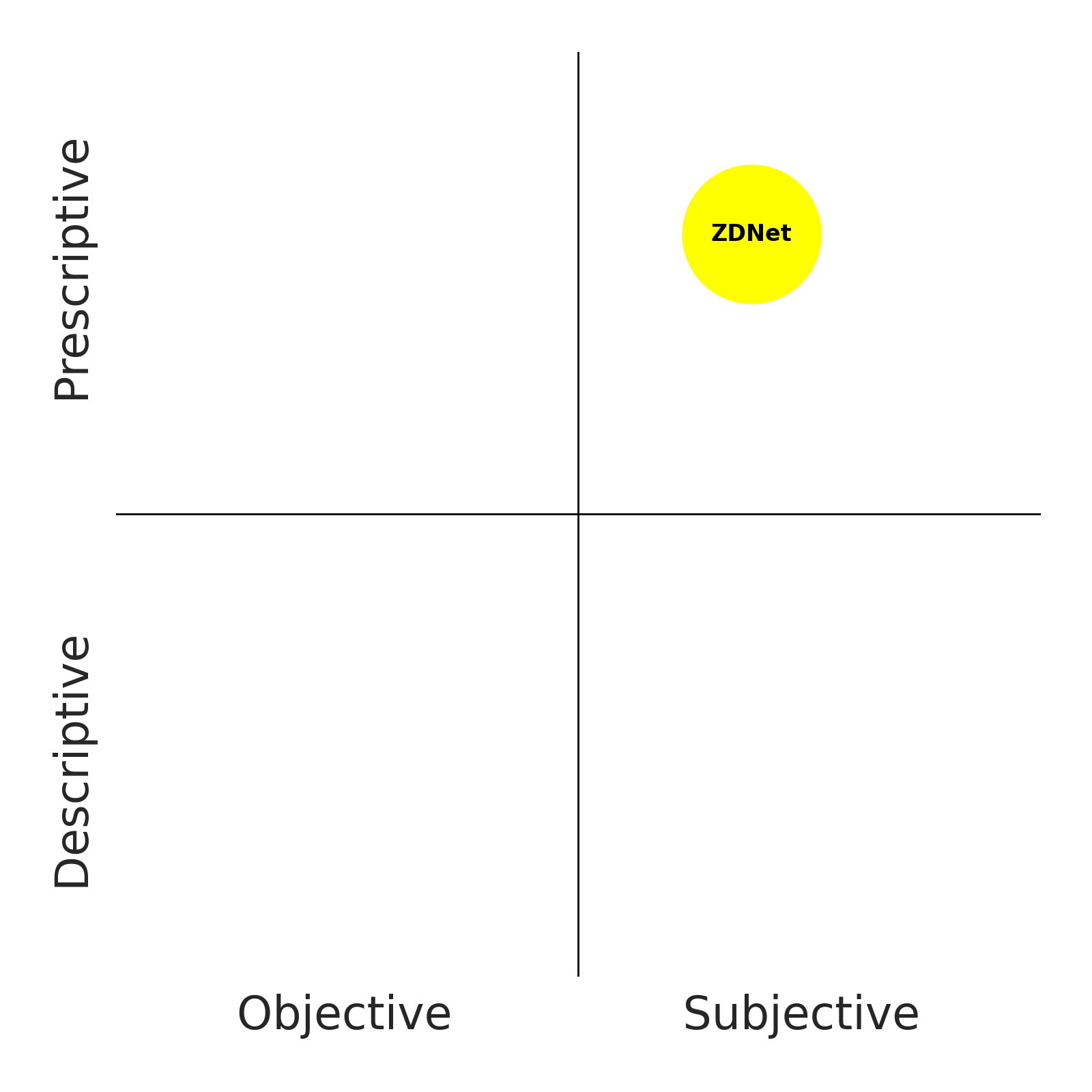
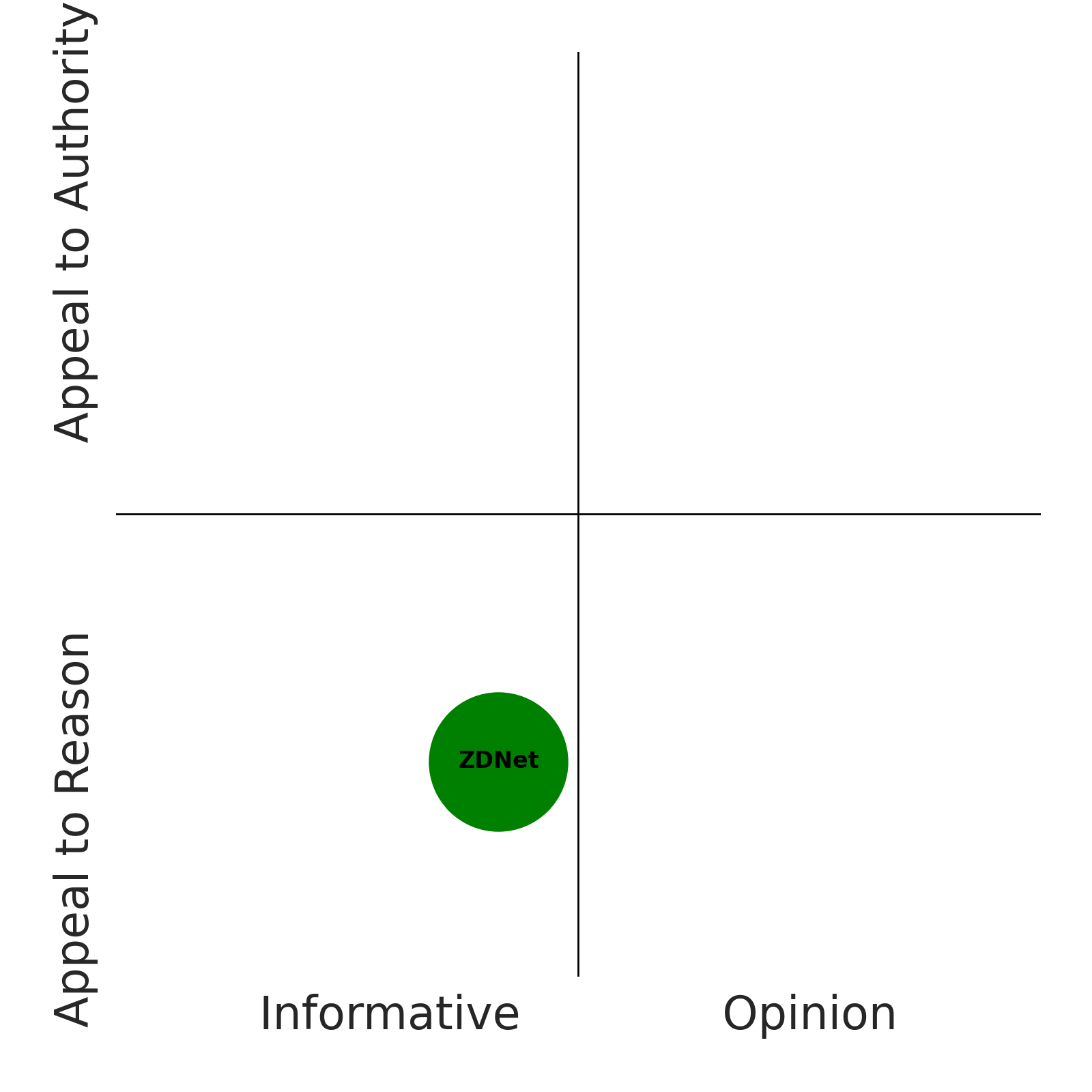
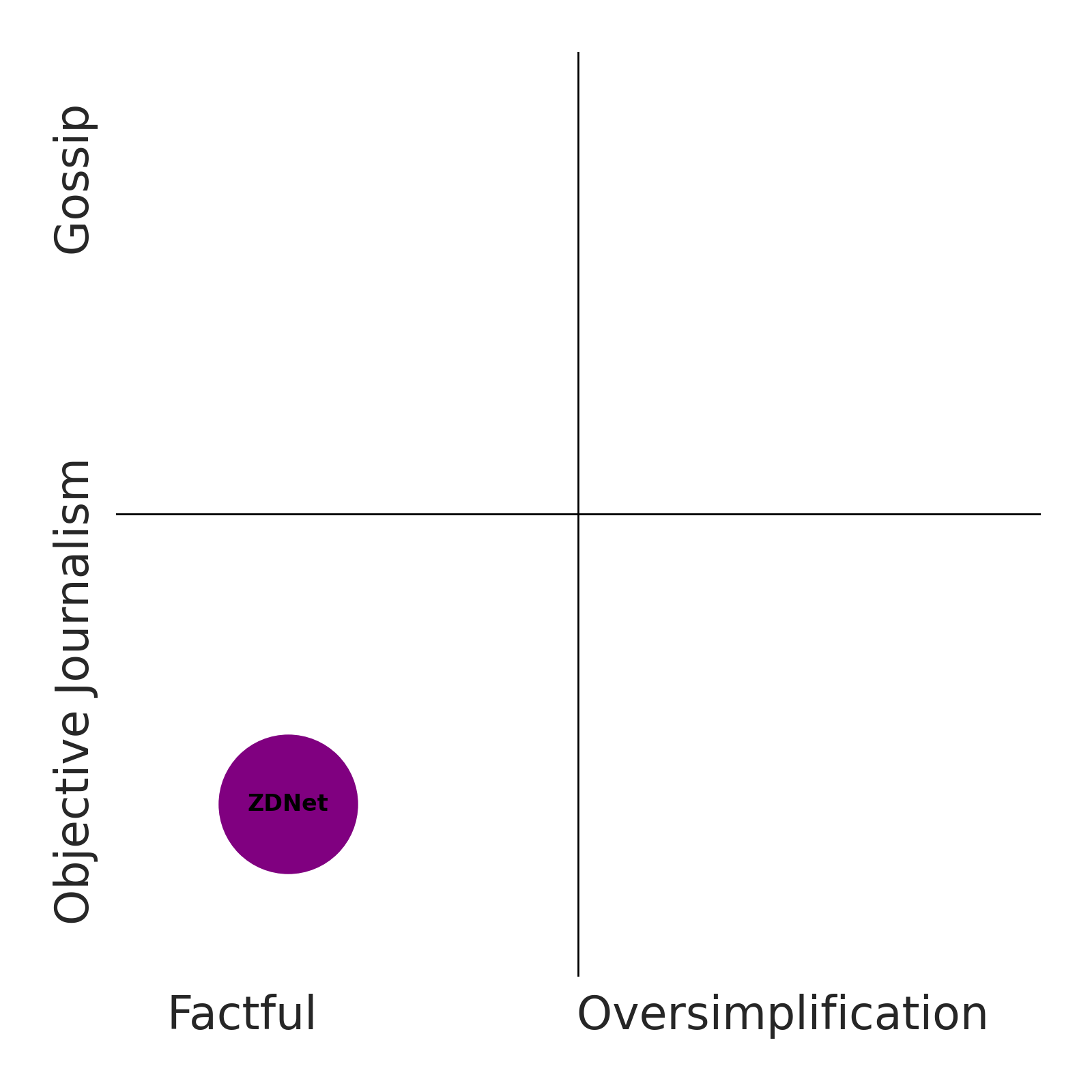
Click points to explore news by date. News sentiment ranges from -10 (very negative) to +10 (very positive) where 0 is neutral.
2026 © Helium Trades
Privacy Policy & Disclosure
* Disclaimer: Nothing on this website constitutes investment advice, performance data or any recommendation that any particular security, portfolio of securities, transaction or investment strategy is suitable for any specific person. Helium Trades is not responsible in any way for the accuracy
of any model predictions or price data. Any mention of a particular security and related prediction data is not a recommendation to buy or sell that security. Investments in securities involve the risk of loss. Past performance is no guarantee of future results. Helium Trades is not responsible for any of your investment decisions,
you should consult a financial expert before engaging in any transaction.
Helium Research Assistant

How can I help you today?
Ask any question about ZDNet bias.


