See whether Helium helps you make better-informed decisions. Try every Pro Trader feature for 30 days. No credit card required.
Try every Pro Trader feature for 30 days. No credit card required.
October 15, 2026 · 0 shares
Publisher framing leans on dramatic sports adjectives such as “all-time classic,” “thrilling,” and “electrifying,” while otherwise reporting the match with named quotes and score details.
Automated analysis; not human reviewed.
Limitations: The supplied text is a live-blog compilation with repeated fragments and unrelated headlines, limiting clean assessment of a single authored narrative.
·
8 of 55 available dimensions scored; omitted dimensions are not treated as neutral.
·
Verified supporting quotes for 4 of 8 scored dimensions.
Claim: Dramatic phrasing heightens the match's stakes and novelty.
“thrilling 24-22 win” · exact text match
“saved Australia from an embarrassing World Cup opening” · exact text match
Why: Both phrases use heightened, sensational framing beyond bare result reporting.
Claim: The publisher selects dramatic narrative elements—debut hat-trick, late winner, injuries—to make the report engaging.
“debutant Jack Bostock scoring a match-winning hat-trick” · exact text match
“all-time Rugby League World Cup classic” · exact text match
Why: These are high-drama details that raise interest.
Claim: The article primarily describes events and outcomes rather than prescribing actions.
“FULL-TIME: Australia 24 def. New Zealand 22” · exact text match
“He's not too good, we'll get some scans for him” · not found in supplied text
Why: It recounts a result and quotes injury comments without advocacy.
Claim: The publisher includes evaluative judgments about what mattered in the match.
“The real story was the battle between Kangaroos fullback Reece Walsh and New Zealand counterpart Kalyn Ponga.” · not found in supplied text
“all-time Rugby League World Cup classic” · exact text match
Why: These are editorial characterizations beyond score and statistics.
Claim: The framing is predominantly positive and excited about the Australian win.
“thrilling 24-22 win” · exact text match
“electrifying debut” · exact text match
Counterevidence:
“suspected broken arm” · exact text match
Why: Positive emotional adjectives dominate the opening summary, though injury news adds negative notes.
Claim: The report uses named attribution and specific match details.
“said Kiwis coach Stacey Jones” · exact text match
“ABC Sport's sideline eye Michael Carayannis has reported” · not found in supplied text
Why: Named sources and specific score/crowd data increase visible credibility.
Claim: The report combines score, statistics, quotes, and tactical observations in a coherent sports analysis.
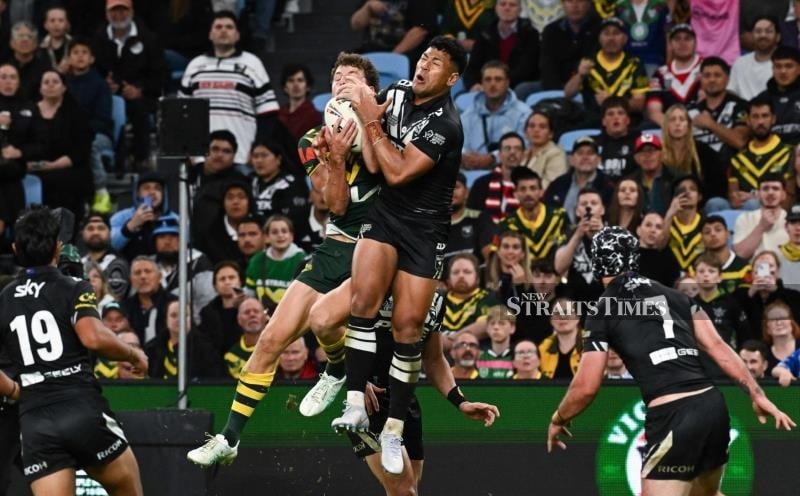
“In front of the biggest crowd for a Sydney Test since the 1970s, the Kangaroos were manhandled and dominated by the Kiwis, who ran for close to 300 more metres.” · exact text match
Why: It supplies comparative metrics and context, though as a live-blog compilation it is fragmentary.
The supplied text is a live-blog compilation with repeated fragments and unrelated headlines, limiting clean assessment of a single authored narrative.
Home-nation sports framing celebrates Australia's narrow World Cup win with mildly sensational, positive language ('SCRAPE,' 'epic,' 'hero') while appropriately hedging injury outcomes as uncertain.
Automated analysis; not human reviewed.
Limitations: The supplied text lacks a byline and named sources, and repeated teaser headlines plus bracket artifacts appear to be page chrome, limiting attribution and sourcing checks.
·
11 of 55 available dimensions scored; omitted dimensions are not treated as neutral.
·
Verified supporting quotes for 11 of 11 scored dimensions.
Claim: Reporting is largely factual but includes mild evaluative framing typical of sports journalism.
“But the real story was the battle between Kangaroos fullback Reece Walsh and New Zealand counterpart Kalyn Ponga.” · exact text match
Counterevidence:
“In front of 41,255 at Allianz Stadium, Kangaroos debutant Jack Bostock scored a hat-trick of tries” · exact text match
Why: The narrative rests on verifiable match facts while adding a few subjective judgments, supporting only a small subjective lean.
Claim: Framing uses mildly sensational sports-page language beyond bare match description.
“Aussies SCRAPE past New Zealand in epic World Cup opener” · exact text match
Counterevidence:
“claiming a 24-22 win over New Zealand” · exact text match
Why: Caps-lock 'SCRAPE' and 'epic' exceed neutral description, though core reporting stays factual and the two-point margin supports 'thrilling'.
Claim: A two-point World Cup opener with a debutant hat-trick, a star fullback duel, and injuries gives moderate reader interest.
“But the real story was the battle between Kangaroos fullback Reece Walsh and New Zealand counterpart Kalyn Ponga.” · exact text match
Why: Narrative hooks (duel, hat-trick debut, injuries) are engaging within the sports genre but not exceptional.
Claim: The piece reports events and player status rather than advocating actions or prescriptions.
“The teams were level 10-10 at the break” · exact text match
Why: Content is match description and injury/selection updates with no policy or action prescriptions.
Claim: Mild evaluative judgments appear alongside factual reporting.
“Walsh didn’t go quietly in his battle with Ponga and also chalked up a solo try for the ages.” · exact text match
Why: Phrases like 'for the ages' and 'the real story was' are opinions layered on fact, keeping a low opinion score.
Claim: A mildly positive, home-team-flavored emotional tone toward Australia pervades the report.
“Jack Bostock was the hero as Australia finished strong to eke out a thrilling victory over New Zealand” · exact text match
Counterevidence:
“But Walters is likely to face a headache after Mitchell Moses limped off soon after halftime with a calf injury.” · exact text match
Why: Hero framing for the Australian scorer tips tone slightly positive, while injury concerns temper it.
Claim: The report presents verifiable details and hedged speculation without named sources.
“The teams were level 10-10 at the break” · exact text match
Why: Specific, checkable facts and hedged language support moderate credibility, while the absence of attributed sources limits it.
Claim: The report rests on specific, internally consistent match facts without irrational claims.
“In front of 41,255 at Allianz Stadium, Kangaroos debutant Jack Bostock scored a hat-trick of tries as Australia narrowly avoided their first home defeat in 11 years.” · exact text match
Why: Concrete, checkable details (score, crowd, scorers) support measured neutrality on rationality.
Claim: Modest, hedged forward-looking commentary about injuries and selection follows.
“there will be significant intrigue through Australia’s campaign as to whether Kevin Walters settles on the Brisbane No.1 or James Tedesco for the fullback jersey.” · exact text match
Why: Future-oriented claims are hedged ('likely to face a headache', 'under a cloud'), supporting only a slight speculative lean.
Claim: The report is specific and hedges uncertain outcomes rather than asserting them as fact.
“he was taken off with 10 minutes left with a wrist injury, his future in the tournament now under a cloud.” · exact text match
Why: Injury implications are framed as uncertain, an honesty signal, but the lack of named sources keeps the score modest.
Claim: Competent, well-structured sports reporting sits modestly above the average baseline.
“In front of 41,255 at Allianz Stadium, Kangaroos debutant Jack Bostock scored a hat-trick of tries as Australia narrowly avoided their first home defeat in 11 years.” · exact text match
Why: The report packs score, venue, crowd, player details, and a selection storyline into coherent, informative prose.
The supplied text lacks a byline and named sources, and repeated teaser headlines plus bracket artifacts appear to be page chrome, limiting attribution and sourcing checks.
October 15, 2026 · 0 shares
The AFP match report uses vivid sports adjectives and a dramatic comeback narrative while remaining event-focused and attributing key claims to named players and the wire service.
Automated analysis; not human reviewed.
Limitations: The supplied text contains duplicated opening lines and unrelated related-article headlines; the analysis is limited to the substantive rugby match report.
·
5 of 55 available dimensions scored; omitted dimensions are not treated as neutral.
·
Verified supporting quotes for 5 of 5 scored dimensions.
Claim: The report mixes factual match narration with evaluative sports adjectives.
“a thrilling victory” · exact text match
“some magic” · exact text match
Why: These are evaluative descriptors, but the surrounding text remains focused on match events and attributed quotes.
Claim: The prose heightens drama with emphatic descriptors.
“It was a sensational try” · exact text match
“a stunning try in the corner” · exact text match
Why: The language intensifies the plays beyond neutral description, consistent with moderate sensational sports framing.
Claim: The framing is positively charged by excitement and admiration for the play.
“a thrilling victory” · exact text match
“some magic” · exact text match
Why: The positive descriptors convey excitement rather than negative emotion or neutral flatness.
Claim: The report provides named attribution, direct quotes, and specific match details.
“said Australia captain Isaah Yeo” · exact text match
“— AFP” · exact text match
Why: Named sources and a wire-service credit support observable credibility signals in the supplied text.
Claim: The report is mostly non-speculative but includes a hedged injury forecast.
“could be without superstar Kalyn Ponga for the rest of the tournament with a possible broken arm” · exact text match
Why: The only notable forecast is explicitly hedged with 'could' and 'possible', so speculation is limited.
The supplied text contains duplicated opening lines and unrelated related-article headlines; the analysis is limited to the substantive rugby match report.
October 15, 2026 · 0 shares
Dramatic, evaluative sports writing frames the match as a scare and the Australian win as possibly undeserved while reporting specific scoring details.
Automated analysis; not human reviewed.
Limitations: The supplied text is a short sports report; most political/ideological bias dimensions are not applicable or lack sufficient evidence.
·
3 of 55 available dimensions scored; omitted dimensions are not treated as neutral.
·
Verified supporting quotes for 3 of 3 scored dimensions.
Claim: The report blends factual match details with subjective evaluative language.
“might generously be described as undeserved” · exact text match
“almost single-handedly stole” · exact text match
Why: The phrases 'undeserved' and 'almost single-handedly stole' are evaluative characterizations rather than neutral match facts.
Claim: The report uses dramatic and sensational framing of the match.
“Australia survive a scare” · exact text match
“extraordinary match” · exact text match
Why: The headline and text employ dramatic language and intensifiers beyond plain reporting.
Claim: The report includes the writer's evaluative opinion about the result.
“might generously be described as undeserved” · exact text match
Why: The phrase asserts a subjective judgment about whether the victory was deserved.
The supplied text is a short sports report; most political/ideological bias dimensions are not applicable or lack sufficient evidence.
October 15, 2026 · 0 shares
Publisher framing leans on dramatic sports adjectives such as “all-time classic,” “thrilling,” and “electrifying,” while otherwise reporting the match with named quotes and score details.
Automated analysis; not human reviewed.
Limitations: The supplied text is a live-blog compilation with repeated fragments and unrelated headlines, limiting clean assessment of a single authored narrative.
·
8 of 55 available dimensions scored; omitted dimensions are not treated as neutral.
·
Verified supporting quotes for 4 of 8 scored dimensions.
Claim: Dramatic phrasing heightens the match's stakes and novelty.
“thrilling 24-22 win” · exact text match
“saved Australia from an embarrassing World Cup opening” · exact text match
Why: Both phrases use heightened, sensational framing beyond bare result reporting.
Claim: The publisher selects dramatic narrative elements—debut hat-trick, late winner, injuries—to make the report engaging.
“debutant Jack Bostock scoring a match-winning hat-trick” · exact text match
“all-time Rugby League World Cup classic” · exact text match
Why: These are high-drama details that raise interest.
Claim: The article primarily describes events and outcomes rather than prescribing actions.
“FULL-TIME: Australia 24 def. New Zealand 22” · exact text match
“He's not too good, we'll get some scans for him” · not found in supplied text
Why: It recounts a result and quotes injury comments without advocacy.
Claim: The publisher includes evaluative judgments about what mattered in the match.
“The real story was the battle between Kangaroos fullback Reece Walsh and New Zealand counterpart Kalyn Ponga.” · not found in supplied text
“all-time Rugby League World Cup classic” · exact text match
Why: These are editorial characterizations beyond score and statistics.
Claim: The framing is predominantly positive and excited about the Australian win.
“thrilling 24-22 win” · exact text match
“electrifying debut” · exact text match
Counterevidence:
“suspected broken arm” · exact text match
Why: Positive emotional adjectives dominate the opening summary, though injury news adds negative notes.
Claim: The report uses named attribution and specific match details.
“said Kiwis coach Stacey Jones” · exact text match
“ABC Sport's sideline eye Michael Carayannis has reported” · not found in supplied text
Why: Named sources and specific score/crowd data increase visible credibility.
Claim: The report combines score, statistics, quotes, and tactical observations in a coherent sports analysis.
“In front of the biggest crowd for a Sydney Test since the 1970s, the Kangaroos were manhandled and dominated by the Kiwis, who ran for close to 300 more metres.” · exact text match
Why: It supplies comparative metrics and context, though as a live-blog compilation it is fragmentary.
The supplied text is a live-blog compilation with repeated fragments and unrelated headlines, limiting clean assessment of a single authored narrative.
October 16, 2026 · 0 shares
Heavily evaluative, highlight-reel sports prose that frames the match through superlatives and emotional crescendo while keeping play-by-play attribution intact.
Automated analysis; not human reviewed.
Limitations: The supplied text includes duplicated paragraphs and blocks of unrelated related-link headlines, likely scrape artifacts; only the match report was analyzed.
·
54 of 55 available dimensions scored; omitted dimensions are not treated as neutral.
·
Verified supporting quotes for 23 of 54 scored dimensions.
Claim: The report is written in evaluative, colorfully subjective language rather than neutral description.
“It was match chock full of barely believable moments, dramatic twists and turns, and superstars stepping up on the biggest stage” · exact text match
Why: Superlative evaluative phrasing conveys the writer's judgment of quality rather than neutral description.
Claim: The framing heightens drama with sensational phrasing about the contest and its finish.
“A final Kiwis assault proved futile as the Kangaroos held on to break New Zealand hearts, but ignite a tournament.” · exact text match
Why: Emotive, heightened language dramatizes the outcome beyond bare reporting.
Claim: The overall tone is upbeat about the match as a spectacle.
“In one of the most stunning starts to a sporting tournament, the Kiwis and Kangaroos played out an absolute classic” · exact text match
Why: Celebratory framing of the event tilts the tone positive.
Claim: The story is presented as a dramatic, high-interest sporting spectacle.
“It will take something special to top the tournament's opening try as the Kiwis struck first in sensational style.” · exact text match
Why: Repeated emphasis on spectacle and drama aims at reader interest.
Claim: The text is almost entirely descriptive play-by-play with no prescriptions or recommendations.
“With the Kiwis forcing a line drop out, Reece Walsh sent it out on the full, Jaymayne Isaako slotting an easy two points.” · exact text match
Why: Descriptive recounting of events with no advocacy indicates strong descriptiveness.
Claim: No conflict or security framing is present; the reported contest is purely sporting.
“The Kangaroos replied with a runaway, Jack Bostock snatching a Jahrome Hughes pass out of the air and streaking away to score.” · exact text match
Why: Absence of any military or conflict vocabulary supports neutrality on this dimension.
Claim: Evaluative opinions about the match's quality are interwoven with reporting.
“It was match chock full of barely believable moments, dramatic twists and turns, and superstars stepping up on the biggest stage” · exact text match
Why: Quality judgments are asserted by the writer rather than attributed.
Claim: The report contains no political content.
“See how the game unfolded in our blog here.” · exact text match
Why: The article content is confined to sports results and injuries.
Claim: Play is recounted in simplified, highlight-level narrative terms.
“Cue more Kangaroos magic, Munster sending it to the skies” · exact text match
Why: Colorful shorthand compresses complex play into one-line summaries.
Claim: No expert or institutional authority is invoked to support claims.
“Kalyn Ponga was replaced by Keano Kini as he trudged off late in the match after playing through pain for the final 20 minutes.” · exact text match
Why: Facts are reported directly without deferring to authorities.
Claim: Tone is enthusiastic but not rage-baiting or juvenile.
“The Kangaroos relief turned to rapture as Bostock got his second” · exact text match
Why: Excitement is expressed in conventional sports-reporting style.
Claim: Claims are supported by specific recounted events rather than restated conclusions.
“the centre sent to the bin as a result as Isaako squared the scores 10-apiece at half-time” · exact text match
Why: Cause-and-effect description of the scoring sequence shows non-circular support.
Claim: The report includes the opposing side's perspective, including New Zealand's attacking spells.
“After an extended period under the pump, it looked as if Ronaldo Mulitalo had stretched the Kiwis advantage” · exact text match
Why: Both teams' passages of play are covered.
Claim: The text does not assert stronger certainty than the reported events support on the central result.
“Australia holding on for an enthralling 24-22 win” · exact text match
Why: The core claim is a settled scoreline, so confident phrasing is supported by the reported result.
Claim: The supplied text is cluttered with repeated paragraphs and unrelated headline lists.
“Knights stars to make Kiwis debuts in squad of brutes” · exact text match
Why: Low-confidence signal likely reflecting page chrome rather than the report itself.
Claim: The tone is emotionally positive and celebratory about the contest.
“The Kangaroos relief turned to rapture as Bostock got his second” · exact text match
Why: Joy-laden vocabulary indicates positive emotional framing.
Claim: The account follows an orderly causal sequence of play with attributed events rather than emotional or illogical reasoning.
“After the Kiwis forced the defending champs again, Australia nabbed another intercept, this time to take the lead” · exact text match
Why: Structured play-by-play with specific actors and sequence indicates reasoning-driven exposition.
Claim: The report relies on observable match events and no supernatural claims.
“Reece Walsh sent it out on the full, Jaymayne Isaako slotting an easy two points.” · exact text match
Why: Empirical, observable description of play supports empirical framing.
Claim: The report includes limited forecast language about tournament consequences.
“Though unlikely to affect the Kiwis semi-final hopes, the loss may come at a different cost” · exact text match
Why: Forecast of future impact is hedged but present.
Claim: Framing is emphatic but does not use deceptive omission or false dichotomy.
“It was match chock full of barely believable moments, dramatic twists and turns, and superstars stepping up on the biggest stage” · exact text match
Why: Loaded wording is stylistic rather than structurally manipulative.
Claim: Duplicated paragraphs and uneven transitions hint at automated composition.
“In one of the most stunning starts to a sporting tournament, the Kiwis and Kangaroos played out an absolute classic to kick off the Rugby League World Cup.” · exact text match
Why: Repetition is equally consistent with scrape artifacts, so confidence is low.
Claim: The report flags the injury as suspected rather than confirmed.
“with Kalyn Ponga forced from the field with a suspected broken arm” · exact text match
Why: Explicit hedging on the injury shows care about epistemic status.
Claim: Statements align with verifiable match events and attributed observations.
“With absolutely no room to move in the left hand corner, Casey McLean managed a miracle” · exact text match
Why: Hyperbole aside, the claims track concrete in-game events.
The supplied text includes duplicated paragraphs and blocks of unrelated related-link headlines, likely scrape artifacts; only the match report was analyzed.
October 15, 2026 · 0 shares
Heroic physical endurance is the dominant frame, expressed through admiring, sensational wording such as 'bravely battled on' and 'sensational 60-metre burst' while injury details remain attributed to team officials.
Automated analysis; not human reviewed.
Limitations: No author byline or publication date is present in the supplied text.
·
4 of 55 available dimensions scored; omitted dimensions are not treated as neutral.
·
Verified supporting quotes for 3 of 4 scored dimensions.
Claim: The article uses evaluative adjectives that color otherwise factual match reporting.
“Thursday's epic World Cup opener” · exact text match
“a sensational 60-metre burst” · exact text match
Why: These are evaluative descriptors beyond neutral match reporting, though the core facts remain attributed and specific.
Claim: The prose amplifies drama through bodily-exertion and epic phrasing.
“exerted himself to the point of throwing up” · exact text match
“dramatic 24-22 victory” · exact text match
Why: The bodily-exertion and dramatic wording heighten the narrative beyond plain description.
Claim: The coverage adopts an admiring positive valence toward players' endurance.
“bravely battled on for 20 minutes” · exact text match
“he toughed it out” · exact text match
Why: Admiring phrasing frames injury tolerance and exhaustion positively.
Claim: The report attributes injury uncertainty to named coaches rather than asserting a diagnosis.
“It's a possible fracture of the arm, but he's going to go for scans” · not found in supplied text
“said Australia head coach Kevin Walters” · exact text match
Why: Named attribution and explicit uncertainty are visible credibility signals in the supplied text.
No author byline or publication date is present in the supplied text.
October 15, 2026 · 0 shares
Dramatic sports-reporting language frames the match as an absolute classic full of barely believable moments and superstar performances.
Automated analysis; not human reviewed.
Limitations: Author byline is absent, and the supplied text includes related-link/newsletter boilerplate that was excluded from analysis.
·
6 of 55 available dimensions scored; omitted dimensions are not treated as neutral.
·
Verified supporting quotes for 6 of 6 scored dimensions.
Claim: The report uses dramatic superlatives and hyperbolic phrasing to frame the match.
“In one of the most stunning starts to a sporting tournament” · exact text match
“absolute classic” · exact text match
Why: Dramatic adjectives and superlatives exceed neutral match reporting.
Claim: The report emphasizes dramatic twists and standout moments to present the match as highly compelling.
“barely believable moments, dramatic twists and turns” · exact text match
“superstars stepping up on the biggest stage” · exact text match
Why: The narrative selection and phrasing aim to convey high interest.
Claim: The report narrates events rather than prescribing actions or policies.
“The Kangaroos replied with a runaway, Jack Bostock snatching a Jahrome Hughes pass out of the air and streaking away to score.” · exact text match
Why: The text is almost entirely descriptive match narration with no prescriptive advocacy.
Claim: The report includes subjective evaluative commentary on the match's quality and significance.
“It will take something special to top the tournament's opening try” · exact text match
“A final Kiwis assault proved futile” · exact text match
Why: Subjective quality judgments and evaluative framing are present alongside factual play-by-play.
Claim: The report uses emotionally charged language, with a positive and excited overall tone and a note of heartbreak for the losing side.
“break New Zealand hearts, but ignite a tournament” · exact text match
“The Kangaroos relief turned to rapture” · exact text match
Why: Emotionally valenced phrasing frames the outcome as exciting and dramatic.
Claim: The report includes speculative assessments about tournament implications and injury cost.
“unlikely to affect the Kiwis semi-final hopes” · exact text match
“the loss may come at a different cost” · exact text match
Why: The text makes forecast and evaluative claims beyond the immediate facts of the match.
Author byline is absent, and the supplied text includes related-link/newsletter boilerplate that was excluded from analysis.
October 16, 2026 · 0 shares
Heavily evaluative, highlight-reel sports prose that frames the match through superlatives and emotional crescendo while keeping play-by-play attribution intact.
Automated analysis; not human reviewed.
Limitations: The supplied text includes duplicated paragraphs and blocks of unrelated related-link headlines, likely scrape artifacts; only the match report was analyzed.
·
54 of 55 available dimensions scored; omitted dimensions are not treated as neutral.
·
Verified supporting quotes for 23 of 54 scored dimensions.
Claim: The report is written in evaluative, colorfully subjective language rather than neutral description.
“It was match chock full of barely believable moments, dramatic twists and turns, and superstars stepping up on the biggest stage” · exact text match
Why: Superlative evaluative phrasing conveys the writer's judgment of quality rather than neutral description.
Claim: The framing heightens drama with sensational phrasing about the contest and its finish.
“A final Kiwis assault proved futile as the Kangaroos held on to break New Zealand hearts, but ignite a tournament.” · exact text match
Why: Emotive, heightened language dramatizes the outcome beyond bare reporting.
Claim: The overall tone is upbeat about the match as a spectacle.
“In one of the most stunning starts to a sporting tournament, the Kiwis and Kangaroos played out an absolute classic” · exact text match
Why: Celebratory framing of the event tilts the tone positive.
Claim: The story is presented as a dramatic, high-interest sporting spectacle.
“It will take something special to top the tournament's opening try as the Kiwis struck first in sensational style.” · exact text match
Why: Repeated emphasis on spectacle and drama aims at reader interest.
Claim: The text is almost entirely descriptive play-by-play with no prescriptions or recommendations.
“With the Kiwis forcing a line drop out, Reece Walsh sent it out on the full, Jaymayne Isaako slotting an easy two points.” · exact text match
Why: Descriptive recounting of events with no advocacy indicates strong descriptiveness.
Claim: No conflict or security framing is present; the reported contest is purely sporting.
“The Kangaroos replied with a runaway, Jack Bostock snatching a Jahrome Hughes pass out of the air and streaking away to score.” · exact text match
Why: Absence of any military or conflict vocabulary supports neutrality on this dimension.
Claim: Evaluative opinions about the match's quality are interwoven with reporting.
“It was match chock full of barely believable moments, dramatic twists and turns, and superstars stepping up on the biggest stage” · exact text match
Why: Quality judgments are asserted by the writer rather than attributed.
Claim: The report contains no political content.
“See how the game unfolded in our blog here.” · exact text match
Why: The article content is confined to sports results and injuries.
Claim: Play is recounted in simplified, highlight-level narrative terms.
“Cue more Kangaroos magic, Munster sending it to the skies” · exact text match
Why: Colorful shorthand compresses complex play into one-line summaries.
Claim: No expert or institutional authority is invoked to support claims.
“Kalyn Ponga was replaced by Keano Kini as he trudged off late in the match after playing through pain for the final 20 minutes.” · exact text match
Why: Facts are reported directly without deferring to authorities.
Claim: Tone is enthusiastic but not rage-baiting or juvenile.
“The Kangaroos relief turned to rapture as Bostock got his second” · exact text match
Why: Excitement is expressed in conventional sports-reporting style.
Claim: Claims are supported by specific recounted events rather than restated conclusions.
“the centre sent to the bin as a result as Isaako squared the scores 10-apiece at half-time” · exact text match
Why: Cause-and-effect description of the scoring sequence shows non-circular support.
Claim: The report includes the opposing side's perspective, including New Zealand's attacking spells.
“After an extended period under the pump, it looked as if Ronaldo Mulitalo had stretched the Kiwis advantage” · exact text match
Why: Both teams' passages of play are covered.
Claim: The text does not assert stronger certainty than the reported events support on the central result.
“Australia holding on for an enthralling 24-22 win” · exact text match
Why: The core claim is a settled scoreline, so confident phrasing is supported by the reported result.
Claim: The supplied text is cluttered with repeated paragraphs and unrelated headline lists.
“Knights stars to make Kiwis debuts in squad of brutes” · exact text match
Why: Low-confidence signal likely reflecting page chrome rather than the report itself.
Claim: The tone is emotionally positive and celebratory about the contest.
“The Kangaroos relief turned to rapture as Bostock got his second” · exact text match
Why: Joy-laden vocabulary indicates positive emotional framing.
Claim: The account follows an orderly causal sequence of play with attributed events rather than emotional or illogical reasoning.
“After the Kiwis forced the defending champs again, Australia nabbed another intercept, this time to take the lead” · exact text match
Why: Structured play-by-play with specific actors and sequence indicates reasoning-driven exposition.
Claim: The report relies on observable match events and no supernatural claims.
“Reece Walsh sent it out on the full, Jaymayne Isaako slotting an easy two points.” · exact text match
Why: Empirical, observable description of play supports empirical framing.
Claim: The report includes limited forecast language about tournament consequences.
“Though unlikely to affect the Kiwis semi-final hopes, the loss may come at a different cost” · exact text match
Why: Forecast of future impact is hedged but present.
Claim: Framing is emphatic but does not use deceptive omission or false dichotomy.
“It was match chock full of barely believable moments, dramatic twists and turns, and superstars stepping up on the biggest stage” · exact text match
Why: Loaded wording is stylistic rather than structurally manipulative.
Claim: Duplicated paragraphs and uneven transitions hint at automated composition.
“In one of the most stunning starts to a sporting tournament, the Kiwis and Kangaroos played out an absolute classic to kick off the Rugby League World Cup.” · exact text match
Why: Repetition is equally consistent with scrape artifacts, so confidence is low.
Claim: The report flags the injury as suspected rather than confirmed.
“with Kalyn Ponga forced from the field with a suspected broken arm” · exact text match
Why: Explicit hedging on the injury shows care about epistemic status.
Claim: Statements align with verifiable match events and attributed observations.
“With absolutely no room to move in the left hand corner, Casey McLean managed a miracle” · exact text match
Why: Hyperbole aside, the claims track concrete in-game events.
The supplied text includes duplicated paragraphs and blocks of unrelated related-link headlines, likely scrape artifacts; only the match report was analyzed.
The framing is an upbeat, fan-oriented sports opinion that argues New Zealand should be favourites and treats a narrow loss as a moral victory pending finals conversion.
The Kiwis are New Zealand’s national rugby league team and the Kangaroos are Australia’s; the match was part of the Rugby League World Cup.
Automated analysis; not human reviewed.
Limitations: The supplied text duplicates the sports article and appends unrelated headline links; analysis is limited to the core article content.
·
10 of 55 available dimensions scored; omitted dimensions are not treated as neutral.
·
Verified supporting quotes for 10 of 10 scored dimensions.
Claim: The article advances an evaluative sports thesis rather than a neutral match report.
“No win, no worries: Why the Kiwis should be favourites to win the Rugby League World Cup.” · exact text match
Why: The headline explicitly argues a preferred conclusion about who should be favourites.
Claim: The prose uses heightened, dramatic language to frame the match and injury.
“Playing through a broken arm for much of the contest was a heroic effort, but the injury likely means his tournament is over.” · exact text match
Why: The phrase 'heroic effort' and dramatic tournament-ending injury framing heighten the narrative.
Claim: The article is optimistic about New Zealand’s tournament prospects despite the loss.
“showed enough to give fans confidence they can convert in the finals.” · exact text match
Why: The line explicitly says the loss gave fans confidence about converting chances in the finals.
Claim: The article moves from describing play to prescribing what should be concluded or settled.
“That debate should be settled now.” · exact text match
Why: The sentence explicitly says a selection debate should be considered resolved.
Claim: The article is primarily an opinion argument built around a stated thesis.
“Why the Kiwis should be favourites to win the Rugby League World Cup.” · exact text match
Why: The headline’s 'should be favourites' is an evaluative claim, and the body supplies reasons for it.
Claim: The article declares a selection debate resolved with little hedging.
“That debate should be settled now.” · exact text match
Why: The imperative certainty about settling a selection question exceeds what a single match and projection can establish.
Claim: The framing praises New Zealand players in emotionally charged terms.
“Playing through a broken arm for much of the contest was a heroic effort” · exact text match
Why: The phrase 'heroic effort' is an affective, admiring characterization.
Claim: The report provides specific match statistics and caveats about missed chances, supporting verifiability.
“New Zealand’s 58% possession and 79% territory was devastating for Australia, but the visitors failed to capitalise fully.” · exact text match
Why: The inclusion of concrete possession and territory figures, plus a caveat, strengthens internal evidentiary quality.
Claim: The article forecasts how New Zealand can succeed in future finals based on the opening match.
“Looking ahead, if the Kiwis continue to win the physical battle, the backline will have every chance to capitalise on the chances they missed in Sydney.” · exact text match
Why: The sentence is explicitly forward-looking and conditional about future performance.
Claim: The article acknowledges that disputed calls were not outrageous, showing internal fairness.
“Two debatable refereeing decisions went against New Zealand, though neither was outrageous and Adam Gee ruled a superbly paced contest.” · exact text match
Why: The qualification 'neither was outrageous' tempers a pro-New Zealand complaint and signals fair acknowledgment.
The supplied text duplicates the sports article and appends unrelated headline links; analysis is limited to the core article content.
October 15, 2026 · 0 shares
Publisher framing leans on dramatic sports adjectives such as “all-time classic,” “thrilling,” and “electrifying,” while otherwise reporting the match with named quotes and score details.
Automated analysis; not human reviewed.
Limitations: The supplied text is a live-blog compilation with repeated fragments and unrelated headlines, limiting clean assessment of a single authored narrative.
·
8 of 55 available dimensions scored; omitted dimensions are not treated as neutral.
·
Verified supporting quotes for 4 of 8 scored dimensions.
Claim: Dramatic phrasing heightens the match's stakes and novelty.
“thrilling 24-22 win” · exact text match
“saved Australia from an embarrassing World Cup opening” · exact text match
Why: Both phrases use heightened, sensational framing beyond bare result reporting.
Claim: The publisher selects dramatic narrative elements—debut hat-trick, late winner, injuries—to make the report engaging.
“debutant Jack Bostock scoring a match-winning hat-trick” · exact text match
“all-time Rugby League World Cup classic” · exact text match
Why: These are high-drama details that raise interest.
Claim: The article primarily describes events and outcomes rather than prescribing actions.
“FULL-TIME: Australia 24 def. New Zealand 22” · exact text match
“He's not too good, we'll get some scans for him” · not found in supplied text
Why: It recounts a result and quotes injury comments without advocacy.
Claim: The publisher includes evaluative judgments about what mattered in the match.
“The real story was the battle between Kangaroos fullback Reece Walsh and New Zealand counterpart Kalyn Ponga.” · not found in supplied text
“all-time Rugby League World Cup classic” · exact text match
Why: These are editorial characterizations beyond score and statistics.
Claim: The framing is predominantly positive and excited about the Australian win.
“thrilling 24-22 win” · exact text match
“electrifying debut” · exact text match
Counterevidence:
“suspected broken arm” · exact text match
Why: Positive emotional adjectives dominate the opening summary, though injury news adds negative notes.
Claim: The report uses named attribution and specific match details.
“said Kiwis coach Stacey Jones” · exact text match
“ABC Sport's sideline eye Michael Carayannis has reported” · not found in supplied text
Why: Named sources and specific score/crowd data increase visible credibility.
Claim: The report combines score, statistics, quotes, and tactical observations in a coherent sports analysis.
“In front of the biggest crowd for a Sydney Test since the 1970s, the Kangaroos were manhandled and dominated by the Kiwis, who ran for close to 300 more metres.” · exact text match
Why: It supplies comparative metrics and context, though as a live-blog compilation it is fragmentary.
The supplied text is a live-blog compilation with repeated fragments and unrelated headlines, limiting clean assessment of a single authored narrative.
Home-nation sports framing celebrates Australia's narrow World Cup win with mildly sensational, positive language ('SCRAPE,' 'epic,' 'hero') while appropriately hedging injury outcomes as uncertain.
Automated analysis; not human reviewed.
Limitations: The supplied text lacks a byline and named sources, and repeated teaser headlines plus bracket artifacts appear to be page chrome, limiting attribution and sourcing checks.
·
11 of 55 available dimensions scored; omitted dimensions are not treated as neutral.
·
Verified supporting quotes for 11 of 11 scored dimensions.
Claim: Reporting is largely factual but includes mild evaluative framing typical of sports journalism.
“But the real story was the battle between Kangaroos fullback Reece Walsh and New Zealand counterpart Kalyn Ponga.” · exact text match
Counterevidence:
“In front of 41,255 at Allianz Stadium, Kangaroos debutant Jack Bostock scored a hat-trick of tries” · exact text match
Why: The narrative rests on verifiable match facts while adding a few subjective judgments, supporting only a small subjective lean.
Claim: Framing uses mildly sensational sports-page language beyond bare match description.
“Aussies SCRAPE past New Zealand in epic World Cup opener” · exact text match
Counterevidence:
“claiming a 24-22 win over New Zealand” · exact text match
Why: Caps-lock 'SCRAPE' and 'epic' exceed neutral description, though core reporting stays factual and the two-point margin supports 'thrilling'.
Claim: A two-point World Cup opener with a debutant hat-trick, a star fullback duel, and injuries gives moderate reader interest.
“But the real story was the battle between Kangaroos fullback Reece Walsh and New Zealand counterpart Kalyn Ponga.” · exact text match
Why: Narrative hooks (duel, hat-trick debut, injuries) are engaging within the sports genre but not exceptional.
Claim: The piece reports events and player status rather than advocating actions or prescriptions.
“The teams were level 10-10 at the break” · exact text match
Why: Content is match description and injury/selection updates with no policy or action prescriptions.
Claim: Mild evaluative judgments appear alongside factual reporting.
“Walsh didn’t go quietly in his battle with Ponga and also chalked up a solo try for the ages.” · exact text match
Why: Phrases like 'for the ages' and 'the real story was' are opinions layered on fact, keeping a low opinion score.
Claim: A mildly positive, home-team-flavored emotional tone toward Australia pervades the report.
“Jack Bostock was the hero as Australia finished strong to eke out a thrilling victory over New Zealand” · exact text match
Counterevidence:
“But Walters is likely to face a headache after Mitchell Moses limped off soon after halftime with a calf injury.” · exact text match
Why: Hero framing for the Australian scorer tips tone slightly positive, while injury concerns temper it.
Claim: The report presents verifiable details and hedged speculation without named sources.
“The teams were level 10-10 at the break” · exact text match
Why: Specific, checkable facts and hedged language support moderate credibility, while the absence of attributed sources limits it.
Claim: The report rests on specific, internally consistent match facts without irrational claims.
“In front of 41,255 at Allianz Stadium, Kangaroos debutant Jack Bostock scored a hat-trick of tries as Australia narrowly avoided their first home defeat in 11 years.” · exact text match
Why: Concrete, checkable details (score, crowd, scorers) support measured neutrality on rationality.
Claim: Modest, hedged forward-looking commentary about injuries and selection follows.
“there will be significant intrigue through Australia’s campaign as to whether Kevin Walters settles on the Brisbane No.1 or James Tedesco for the fullback jersey.” · exact text match
Why: Future-oriented claims are hedged ('likely to face a headache', 'under a cloud'), supporting only a slight speculative lean.
Claim: The report is specific and hedges uncertain outcomes rather than asserting them as fact.
“he was taken off with 10 minutes left with a wrist injury, his future in the tournament now under a cloud.” · exact text match
Why: Injury implications are framed as uncertain, an honesty signal, but the lack of named sources keeps the score modest.
Claim: Competent, well-structured sports reporting sits modestly above the average baseline.
“In front of 41,255 at Allianz Stadium, Kangaroos debutant Jack Bostock scored a hat-trick of tries as Australia narrowly avoided their first home defeat in 11 years.” · exact text match
Why: The report packs score, venue, crowd, player details, and a selection storyline into coherent, informative prose.
The supplied text lacks a byline and named sources, and repeated teaser headlines plus bracket artifacts appear to be page chrome, limiting attribution and sourcing checks.
October 15, 2026 · 0 shares
Heroic physical endurance is the dominant frame, expressed through admiring, sensational wording such as 'bravely battled on' and 'sensational 60-metre burst' while injury details remain attributed to team officials.
Automated analysis; not human reviewed.
Limitations: No author byline or publication date is present in the supplied text.
·
4 of 55 available dimensions scored; omitted dimensions are not treated as neutral.
·
Verified supporting quotes for 3 of 4 scored dimensions.
Claim: The article uses evaluative adjectives that color otherwise factual match reporting.
“Thursday's epic World Cup opener” · exact text match
“a sensational 60-metre burst” · exact text match
Why: These are evaluative descriptors beyond neutral match reporting, though the core facts remain attributed and specific.
Claim: The prose amplifies drama through bodily-exertion and epic phrasing.
“exerted himself to the point of throwing up” · exact text match
“dramatic 24-22 victory” · exact text match
Why: The bodily-exertion and dramatic wording heighten the narrative beyond plain description.
Claim: The coverage adopts an admiring positive valence toward players' endurance.
“bravely battled on for 20 minutes” · exact text match
“he toughed it out” · exact text match
Why: Admiring phrasing frames injury tolerance and exhaustion positively.
Claim: The report attributes injury uncertainty to named coaches rather than asserting a diagnosis.
“It's a possible fracture of the arm, but he's going to go for scans” · not found in supplied text
“said Australia head coach Kevin Walters” · exact text match
Why: Named attribution and explicit uncertainty are visible credibility signals in the supplied text.
No author byline or publication date is present in the supplied text.
October 16, 2026 · 0 shares
The report is neutral and attribution-driven, foregrounding the coach's quoted explanation for France's loss while grounding it in detailed match facts and opposing quotes.
The NRL is Australia's top professional rugby league competition; the Super League is the top European rugby league competition.
Automated analysis; not human reviewed.
Limitations: The supplied text includes a lead France-Samoa match report plus an appended Australia women's match report and unrelated headlines; analysis focuses on the lead article.
·
4 of 55 available dimensions scored; omitted dimensions are not treated as neutral.
·
Verified supporting quotes for 4 of 4 scored dimensions.
Claim: The report keeps subjective causal explanation attributed to the coach and anchors it in match facts.
“France head coach Laurent Frayssinous suggested the growing gap between the NRL and Super League was a huge factor in Friday's 78-4 defeat by Samoa at the Men's Rugby League World Cup.” · exact text match
Why: The potentially subjective explanation is directly attributed to Frayssinous and paired with concrete scoring and squad data, indicating low subjectivity.
Claim: The report uses restrained match-report language despite the heavy scoreline.
“France's sole try came in the first half from Guillermo Aispuro-Bichet.” · exact text match
Why: Specific scoring details and plain wording dominate; the language is not heightened or sensational.
Claim: The report has visible sourcing, direct quotes, and specific match/roster facts.
“France head coach Laurent Frayssinous suggested the growing gap between the NRL and Super League was a huge factor in Friday's 78-4 defeat by Samoa at the Men's Rugby League World Cup.” · exact text match
“All but one of the Samoa squad are with clubs in the NRL, while France's team is largely made up of Super League players, although they do have South Sydney Rabbitohs centre Latrell Siegwalt in their line-up.” · exact text match
Why: Named attribution and precise score/roster details make the report internally checkable, though it relies on one coach's explanation.
Claim: The report is informative and coherent, connecting the result to squad composition and attributed analysis.
“All but one of the Samoa squad are with clubs in the NRL, while France's team is largely made up of Super League players, although they do have South Sydney Rabbitohs centre Latrell Siegwalt in their line-up.” · exact text match
Why: The article supplies relevant comparative context and integrated quotes, indicating above-average sports-report intelligence.
The supplied text includes a lead France-Samoa match report plus an appended Australia women's match report and unrelated headlines; analysis focuses on the lead article.
October 16, 2026 · 0 shares
Framing is result-focused and mildly celebratory, using evaluative sports terms such as 'huge,' 'passing 70,' and 'stroll' to stress Samoa's dominance.
Rugby league tries are worth four points and conversions two, so scoring more than 70 and four tries by one player indicate a dominant attacking performance.
Automated analysis; not human reviewed.
Limitations: The text is only a two-sentence sports brief, limiting evidence for framing and epistemic assessments.
·
4 of 55 available dimensions scored; omitted dimensions are not treated as neutral.
·
Verified supporting quotes for 4 of 4 scored dimensions.
Claim: Evaluative descriptors color an otherwise factual result report.
“The fancied Samoans began their Rugby League World Cup by passing 70 in a stroll against the French in Sydney.” · exact text match
Why: 'Fancied' and 'stroll' are subjective characterizations rather than neutral match facts.
Claim: The report uses charged sports language to emphasize Samoa's dominance.
“huge win” · exact text match
“in a stroll” · exact text match
Why: The evaluative terms heighten the lopsided result beyond a bare scoreline.
Claim: The report is descriptive, stating the match outcome without recommending action.
“Samoa winger scores four tries to spark huge win over France in World Cup opener.” · exact text match
Why: The sentence recounts a result and performance, not a prescription.
Claim: The brief includes mild evaluative opinion alongside factual reporting.
“in a stroll against the French” · exact text match
Why: 'Stroll' frames the match as easy for Samoa, an evaluative judgment.
The text is only a two-sentence sports brief, limiting evidence for framing and epistemic assessments.
A largely factual, attributed sports preview with mild evaluative color and no political or sensational framing.
Automated analysis; not human reviewed.
Limitations: No author byline is supplied; related-article teasers and a promotional predictor line appear alongside the main sports preview.
·
55 of 55 available dimensions scored; omitted dimensions are not treated as neutral.
·
Verified supporting quotes for 6 of 55 scored dimensions.
Claim: The report is predominantly objective, relying on named sources and squad facts with only minor evaluative color.
“England’s squad for Saturday is already known – with Jez Litten, Luke Thompson, Ethan Havard, Sam Walters, Jack Welsby and Matty Ashton all on the bench.” · exact text match
Counterevidence:
“are the unfortunate four to miss out on selection for the clash against Tonga altogether.” · exact text match
Why: The article centers on attributed quotes and specific squad details, while 'unfortunate' is a mild subjective descriptor.
Claim: The piece uses calm, factual sports-preview language rather than sensationalism.
“Only four of those six can be called into action though, making it somewhat of a game of cat and mouse as coaches decide who – and when – to introduce.” · exact text match
Why: The tone is explanatory and measured, with only a mild tactical metaphor.
Claim: The article describes team selection and competition rules without prescribing a course of action.
“Only four of those six can be called into action though, making it somewhat of a game of cat and mouse as coaches decide who – and when – to introduce.” · exact text match
Why: The framing reports how coaches may manage the bench rather than urging a policy or behavior.
Claim: The report is entirely about rugby league selection and rules, with no political framing.
“England boss Brian McDermott will ‘hold his nerve’ when choosing his fourth and final interchange player in this weekend’s World Cup opener against Tonga, with NRL rules in operation.” · exact text match
Why: The subject matter is sports team selection and tournament rules; no political actors, issues, or frames appear.
Claim: Credibility is supported by named attribution, direct quotes, and specific squad and rule details.
“Speaking to the media on Tuesday just after his squad was announced, McDermott – whose work at club level comes in the NRL as an assistant at Gold Coast Titans – discussed the extended bench.” · exact text match
Why: The article identifies the speaker and context and supplies specific, verifiable-style details.
Claim: The article clearly explains the NRL-style bench rule and its tactical rationale through direct coach quotes.
“The reason behind having a six-man bench, which is a positive, is so that you can carry more positional variation.” · exact text match
Why: It provides a concise explanation of how the extended bench affects positional options.
No author byline is supplied; related-article teasers and a promotional predictor line appear alongside the main sports preview.
October 14, 2026 · 0 shares
A short, plainly factual sports brief whose only notable framing is mild promotional warmth ('highly anticipated,' 'renowned rugby league atmosphere') toward the World Cup opener, truncated by a paywall after two paragraphs.
Automated analysis; not human reviewed.
Limitations: The supplied text is truncated by a paywall after two short paragraphs, so analysis rests on the headline and two sentences; related-headline links, newsletter prompts, and paywall text were treated as page chrome and excluded, leaving any deeper framing in the full article unassessable.
·
9 of 55 available dimensions scored; omitted dimensions are not treated as neutral.
·
Verified supporting quotes for 9 of 9 scored dimensions.
Claim: The brief reports verifiable arrival facts with only light color language, staying on the objective side.
“The Lebanon national rugby league team has landed at Jacksons International Airport ahead of their highly anticipated Rugby League World Cup opening match against the Papua New Guinea Kumuls at Santos National Football Stadium” · exact text match
Counterevidence:
“The contingent arrived upbeat following a short preparation camp in Brisbane, eager to experience Port Moresby’s renowned rugby league atmosphere” · exact text match
Why: Concrete who/what/where facts dominate; mood descriptors add mild interpretive color but no opinion advocacy or first-person judgment.
Claim: Framing is routine sports reporting with mild promotional adjectives, not sensationalism.
“ahead of their highly anticipated Rugby League World Cup opening match” · exact text match
Why: Mild hype is the strongest intensity marker; no alarm, superlatives beyond routine sports copy, or urgency tactics appear in the supplied text.
Claim: Tone leans mildly positive, foregrounding the squad's upbeat mood and a celebrated match atmosphere.
“The contingent arrived upbeat following a short preparation camp in Brisbane, eager to experience Port Moresby’s renowned rugby league atmosphere” · exact text match
“ahead of their highly anticipated Rugby League World Cup opening match” · exact text match
Why: Positive descriptors ('upbeat,' 'eager,' 'renowned,' 'highly anticipated') frame the event favorably with no downside mentioned.
Claim: The supplied content is a routine pre-match arrival note with limited depth or novelty.
“For many in the Cedars squad, this marks their first time visiting Papua New Guinea” · exact text match
Why: Standard World Cup build-up logistics with no conflict, data, or unusual development before the text cuts off.
Claim: The report only describes an arrival and upcoming fixture, without any recommendation or normative claim.
“The Lebanon national rugby league team has landed at Jacksons International Airport ahead of their highly anticipated Rugby League World Cup opening match against the Papua New Guinea Kumuls at Santos National Football Stadium” · exact text match
Why: The entire substantive content is event description; no policy view, advice, or prescriptive statement appears anywhere in the snippet.
Claim: Language carries a warm, positive emotional valence rather than a neutral or negative one.
“eager to experience Port Moresby’s renowned rugby league atmosphere” · exact text match
Why: Positive emotion words ('upbeat,' 'eager') dominate the snippet and no negative or charged language appears.
Claim: Mundane, easily verifiable claims with no visible sourcing; credibility signals are neutral in the supplied snippet.
“The Lebanon national rugby league team has landed at Jacksons International Airport” · exact text match
Why: Uncontroversial factual content with no quotations or named sources visible; nothing in the text supports elevated trust or distrust.
Claim: The supplied text shows plain factual statements with no loaded wording or deceptive framing in either direction.
“For many in the Cedars squad, this marks their first time visiting Papua New Guinea” · exact text match
Why: Mundane, checkable claims presented without slant; nothing in the snippet indicates unfairness, omission, or dishonesty, supporting neutrality.
Claim: Competent but basic sports reporting, average for the genre.
“The Lebanon national rugby league team has landed at Jacksons International Airport ahead of their highly anticipated Rugby League World Cup opening match against the Papua New Guinea Kumuls at Santos National Football Stadium” · exact text match
Why: Clear factual writing with correct specifics but no depth, analysis, or errors visible in the short snippet.
The supplied text is truncated by a paywall after two short paragraphs, so analysis rests on the headline and two sentences; related-headline links, newsletter prompts, and paywall text were treated as page chrome and excluded, leaving any deeper framing in the full article unassessable.
October 15, 2026 · 0 shares
Publisher framing leans on dramatic sports adjectives such as “all-time classic,” “thrilling,” and “electrifying,” while otherwise reporting the match with named quotes and score details.
Automated analysis; not human reviewed. Limitations: The supplied text is a live-blog compilation with repeated fragments and unrelated headlines, limiting clean assessment of a single authored narrative. · 8 of 55 available dimensions scored; omitted dimensions are not treated as neutral. · Verified supporting quotes for 4 of 8 scored dimensions.
Claim: Dramatic phrasing heightens the match's stakes and novelty.
“thrilling 24-22 win” · exact text match
“saved Australia from an embarrassing World Cup opening” · exact text match
Why: Both phrases use heightened, sensational framing beyond bare result reporting.
Claim: The publisher selects dramatic narrative elements—debut hat-trick, late winner, injuries—to make the report engaging.
“debutant Jack Bostock scoring a match-winning hat-trick” · exact text match
“all-time Rugby League World Cup classic” · exact text match
Why: These are high-drama details that raise interest.
Claim: The article primarily describes events and outcomes rather than prescribing actions.
“FULL-TIME: Australia 24 def. New Zealand 22” · exact text match
“He's not too good, we'll get some scans for him” · not found in supplied text
Why: It recounts a result and quotes injury comments without advocacy.
Claim: The publisher includes evaluative judgments about what mattered in the match.
“The real story was the battle between Kangaroos fullback Reece Walsh and New Zealand counterpart Kalyn Ponga.” · not found in supplied text
“all-time Rugby League World Cup classic” · exact text match
Why: These are editorial characterizations beyond score and statistics.
Claim: The framing is predominantly positive and excited about the Australian win.
“thrilling 24-22 win” · exact text match
“electrifying debut” · exact text match
Counterevidence:
“suspected broken arm” · exact text match
Why: Positive emotional adjectives dominate the opening summary, though injury news adds negative notes.
Claim: The report uses named attribution and specific match details.
“said Kiwis coach Stacey Jones” · exact text match
“ABC Sport's sideline eye Michael Carayannis has reported” · not found in supplied text
Why: Named sources and specific score/crowd data increase visible credibility.
Claim: The report combines score, statistics, quotes, and tactical observations in a coherent sports analysis.
“In front of the biggest crowd for a Sydney Test since the 1970s, the Kangaroos were manhandled and dominated by the Kiwis, who ran for close to 300 more metres.” · exact text match
Why: It supplies comparative metrics and context, though as a live-blog compilation it is fragmentary.
The supplied text is a live-blog compilation with repeated fragments and unrelated headlines, limiting clean assessment of a single authored narrative.
October 15, 2026 · 0 shares
The AFP match report uses vivid sports adjectives and a dramatic comeback narrative while remaining event-focused and attributing key claims to named players and the wire service.
Automated analysis; not human reviewed. Limitations: The supplied text contains duplicated opening lines and unrelated related-article headlines; the analysis is limited to the substantive rugby match report. · 5 of 55 available dimensions scored; omitted dimensions are not treated as neutral. · Verified supporting quotes for 5 of 5 scored dimensions.
Claim: The report mixes factual match narration with evaluative sports adjectives.
“a thrilling victory” · exact text match
“some magic” · exact text match
Why: These are evaluative descriptors, but the surrounding text remains focused on match events and attributed quotes.
Claim: The prose heightens drama with emphatic descriptors.
“It was a sensational try” · exact text match
“a stunning try in the corner” · exact text match
Why: The language intensifies the plays beyond neutral description, consistent with moderate sensational sports framing.
Claim: The framing is positively charged by excitement and admiration for the play.
“a thrilling victory” · exact text match
“some magic” · exact text match
Why: The positive descriptors convey excitement rather than negative emotion or neutral flatness.
Claim: The report provides named attribution, direct quotes, and specific match details.
“said Australia captain Isaah Yeo” · exact text match
“— AFP” · exact text match
Why: Named sources and a wire-service credit support observable credibility signals in the supplied text.
Claim: The report is mostly non-speculative but includes a hedged injury forecast.
“could be without superstar Kalyn Ponga for the rest of the tournament with a possible broken arm” · exact text match
Why: The only notable forecast is explicitly hedged with 'could' and 'possible', so speculation is limited.
The supplied text contains duplicated opening lines and unrelated related-article headlines; the analysis is limited to the substantive rugby match report.
Home-nation sports framing celebrates Australia's narrow World Cup win with mildly sensational, positive language ('SCRAPE,' 'epic,' 'hero') while appropriately hedging injury outcomes as uncertain.
Automated analysis; not human reviewed. Limitations: The supplied text lacks a byline and named sources, and repeated teaser headlines plus bracket artifacts appear to be page chrome, limiting attribution and sourcing checks. · 11 of 55 available dimensions scored; omitted dimensions are not treated as neutral. · Verified supporting quotes for 11 of 11 scored dimensions.
Claim: Reporting is largely factual but includes mild evaluative framing typical of sports journalism.
“But the real story was the battle between Kangaroos fullback Reece Walsh and New Zealand counterpart Kalyn Ponga.” · exact text match
Counterevidence:
“In front of 41,255 at Allianz Stadium, Kangaroos debutant Jack Bostock scored a hat-trick of tries” · exact text match
Why: The narrative rests on verifiable match facts while adding a few subjective judgments, supporting only a small subjective lean.
Claim: Framing uses mildly sensational sports-page language beyond bare match description.
“Aussies SCRAPE past New Zealand in epic World Cup opener” · exact text match
Counterevidence:
“claiming a 24-22 win over New Zealand” · exact text match
Why: Caps-lock 'SCRAPE' and 'epic' exceed neutral description, though core reporting stays factual and the two-point margin supports 'thrilling'.
Claim: A two-point World Cup opener with a debutant hat-trick, a star fullback duel, and injuries gives moderate reader interest.
“But the real story was the battle between Kangaroos fullback Reece Walsh and New Zealand counterpart Kalyn Ponga.” · exact text match
Why: Narrative hooks (duel, hat-trick debut, injuries) are engaging within the sports genre but not exceptional.
Claim: The piece reports events and player status rather than advocating actions or prescriptions.
“The teams were level 10-10 at the break” · exact text match
Why: Content is match description and injury/selection updates with no policy or action prescriptions.
Claim: Mild evaluative judgments appear alongside factual reporting.
“Walsh didn’t go quietly in his battle with Ponga and also chalked up a solo try for the ages.” · exact text match
Why: Phrases like 'for the ages' and 'the real story was' are opinions layered on fact, keeping a low opinion score.
Claim: A mildly positive, home-team-flavored emotional tone toward Australia pervades the report.
“Jack Bostock was the hero as Australia finished strong to eke out a thrilling victory over New Zealand” · exact text match
Counterevidence:
“But Walters is likely to face a headache after Mitchell Moses limped off soon after halftime with a calf injury.” · exact text match
Why: Hero framing for the Australian scorer tips tone slightly positive, while injury concerns temper it.
Claim: The report presents verifiable details and hedged speculation without named sources.
“The teams were level 10-10 at the break” · exact text match
Why: Specific, checkable facts and hedged language support moderate credibility, while the absence of attributed sources limits it.
Claim: The report rests on specific, internally consistent match facts without irrational claims.
“In front of 41,255 at Allianz Stadium, Kangaroos debutant Jack Bostock scored a hat-trick of tries as Australia narrowly avoided their first home defeat in 11 years.” · exact text match
Why: Concrete, checkable details (score, crowd, scorers) support measured neutrality on rationality.
Claim: Modest, hedged forward-looking commentary about injuries and selection follows.
“there will be significant intrigue through Australia’s campaign as to whether Kevin Walters settles on the Brisbane No.1 or James Tedesco for the fullback jersey.” · exact text match
Why: Future-oriented claims are hedged ('likely to face a headache', 'under a cloud'), supporting only a slight speculative lean.
Claim: The report is specific and hedges uncertain outcomes rather than asserting them as fact.
“he was taken off with 10 minutes left with a wrist injury, his future in the tournament now under a cloud.” · exact text match
Why: Injury implications are framed as uncertain, an honesty signal, but the lack of named sources keeps the score modest.
Claim: Competent, well-structured sports reporting sits modestly above the average baseline.
“In front of 41,255 at Allianz Stadium, Kangaroos debutant Jack Bostock scored a hat-trick of tries as Australia narrowly avoided their first home defeat in 11 years.” · exact text match
Why: The report packs score, venue, crowd, player details, and a selection storyline into coherent, informative prose.
The supplied text lacks a byline and named sources, and repeated teaser headlines plus bracket artifacts appear to be page chrome, limiting attribution and sourcing checks.
October 15, 2026 · 0 shares
Dramatic sports-reporting language frames the match as an absolute classic full of barely believable moments and superstar performances.
Automated analysis; not human reviewed. Limitations: Author byline is absent, and the supplied text includes related-link/newsletter boilerplate that was excluded from analysis. · 6 of 55 available dimensions scored; omitted dimensions are not treated as neutral. · Verified supporting quotes for 6 of 6 scored dimensions.
Claim: The report uses dramatic superlatives and hyperbolic phrasing to frame the match.
“In one of the most stunning starts to a sporting tournament” · exact text match
“absolute classic” · exact text match
Why: Dramatic adjectives and superlatives exceed neutral match reporting.
Claim: The report emphasizes dramatic twists and standout moments to present the match as highly compelling.
“barely believable moments, dramatic twists and turns” · exact text match
“superstars stepping up on the biggest stage” · exact text match
Why: The narrative selection and phrasing aim to convey high interest.
Claim: The report narrates events rather than prescribing actions or policies.
“The Kangaroos replied with a runaway, Jack Bostock snatching a Jahrome Hughes pass out of the air and streaking away to score.” · exact text match
Why: The text is almost entirely descriptive match narration with no prescriptive advocacy.
Claim: The report includes subjective evaluative commentary on the match's quality and significance.
“It will take something special to top the tournament's opening try” · exact text match
“A final Kiwis assault proved futile” · exact text match
Why: Subjective quality judgments and evaluative framing are present alongside factual play-by-play.
Claim: The report uses emotionally charged language, with a positive and excited overall tone and a note of heartbreak for the losing side.
“break New Zealand hearts, but ignite a tournament” · exact text match
“The Kangaroos relief turned to rapture” · exact text match
Why: Emotionally valenced phrasing frames the outcome as exciting and dramatic.
Claim: The report includes speculative assessments about tournament implications and injury cost.
“unlikely to affect the Kiwis semi-final hopes” · exact text match
“the loss may come at a different cost” · exact text match
Why: The text makes forecast and evaluative claims beyond the immediate facts of the match.
Author byline is absent, and the supplied text includes related-link/newsletter boilerplate that was excluded from analysis.
October 15, 2026 · 0 shares
Heroic physical endurance is the dominant frame, expressed through admiring, sensational wording such as 'bravely battled on' and 'sensational 60-metre burst' while injury details remain attributed to team officials.
Automated analysis; not human reviewed. Limitations: No author byline or publication date is present in the supplied text. · 4 of 55 available dimensions scored; omitted dimensions are not treated as neutral. · Verified supporting quotes for 3 of 4 scored dimensions.
Claim: The article uses evaluative adjectives that color otherwise factual match reporting.
“Thursday's epic World Cup opener” · exact text match
“a sensational 60-metre burst” · exact text match
Why: These are evaluative descriptors beyond neutral match reporting, though the core facts remain attributed and specific.
Claim: The prose amplifies drama through bodily-exertion and epic phrasing.
“exerted himself to the point of throwing up” · exact text match
“dramatic 24-22 victory” · exact text match
Why: The bodily-exertion and dramatic wording heighten the narrative beyond plain description.
Claim: The coverage adopts an admiring positive valence toward players' endurance.
“bravely battled on for 20 minutes” · exact text match
“he toughed it out” · exact text match
Why: Admiring phrasing frames injury tolerance and exhaustion positively.
Claim: The report attributes injury uncertainty to named coaches rather than asserting a diagnosis.
“It's a possible fracture of the arm, but he's going to go for scans” · not found in supplied text
“said Australia head coach Kevin Walters” · exact text match
Why: Named attribution and explicit uncertainty are visible credibility signals in the supplied text.
No author byline or publication date is present in the supplied text.
October 15, 2026 · 0 shares
Publisher framing leans on dramatic sports adjectives such as “all-time classic,” “thrilling,” and “electrifying,” while otherwise reporting the match with named quotes and score details.
Automated analysis; not human reviewed. Limitations: The supplied text is a live-blog compilation with repeated fragments and unrelated headlines, limiting clean assessment of a single authored narrative. · 8 of 55 available dimensions scored; omitted dimensions are not treated as neutral. · Verified supporting quotes for 4 of 8 scored dimensions.
Claim: Dramatic phrasing heightens the match's stakes and novelty.
“thrilling 24-22 win” · exact text match
“saved Australia from an embarrassing World Cup opening” · exact text match
Why: Both phrases use heightened, sensational framing beyond bare result reporting.
Claim: The publisher selects dramatic narrative elements—debut hat-trick, late winner, injuries—to make the report engaging.
“debutant Jack Bostock scoring a match-winning hat-trick” · exact text match
“all-time Rugby League World Cup classic” · exact text match
Why: These are high-drama details that raise interest.
Claim: The article primarily describes events and outcomes rather than prescribing actions.
“FULL-TIME: Australia 24 def. New Zealand 22” · exact text match
“He's not too good, we'll get some scans for him” · not found in supplied text
Why: It recounts a result and quotes injury comments without advocacy.
Claim: The publisher includes evaluative judgments about what mattered in the match.
“The real story was the battle between Kangaroos fullback Reece Walsh and New Zealand counterpart Kalyn Ponga.” · not found in supplied text
“all-time Rugby League World Cup classic” · exact text match
Why: These are editorial characterizations beyond score and statistics.
Claim: The framing is predominantly positive and excited about the Australian win.
“thrilling 24-22 win” · exact text match
“electrifying debut” · exact text match
Counterevidence:
“suspected broken arm” · exact text match
Why: Positive emotional adjectives dominate the opening summary, though injury news adds negative notes.
Claim: The report uses named attribution and specific match details.
“said Kiwis coach Stacey Jones” · exact text match
“ABC Sport's sideline eye Michael Carayannis has reported” · not found in supplied text
Why: Named sources and specific score/crowd data increase visible credibility.
Claim: The report combines score, statistics, quotes, and tactical observations in a coherent sports analysis.
“In front of the biggest crowd for a Sydney Test since the 1970s, the Kangaroos were manhandled and dominated by the Kiwis, who ran for close to 300 more metres.” · exact text match
Why: It supplies comparative metrics and context, though as a live-blog compilation it is fragmentary.
The supplied text is a live-blog compilation with repeated fragments and unrelated headlines, limiting clean assessment of a single authored narrative.
The framing is an upbeat, fan-oriented sports opinion that argues New Zealand should be favourites and treats a narrow loss as a moral victory pending finals conversion.
The Kiwis are New Zealand’s national rugby league team and the Kangaroos are Australia’s; the match was part of the Rugby League World Cup.
Automated analysis; not human reviewed. Limitations: The supplied text duplicates the sports article and appends unrelated headline links; analysis is limited to the core article content. · 10 of 55 available dimensions scored; omitted dimensions are not treated as neutral. · Verified supporting quotes for 10 of 10 scored dimensions.
Claim: The article advances an evaluative sports thesis rather than a neutral match report.
“No win, no worries: Why the Kiwis should be favourites to win the Rugby League World Cup.” · exact text match
Why: The headline explicitly argues a preferred conclusion about who should be favourites.
Claim: The prose uses heightened, dramatic language to frame the match and injury.
“Playing through a broken arm for much of the contest was a heroic effort, but the injury likely means his tournament is over.” · exact text match
Why: The phrase 'heroic effort' and dramatic tournament-ending injury framing heighten the narrative.
Claim: The article is optimistic about New Zealand’s tournament prospects despite the loss.
“showed enough to give fans confidence they can convert in the finals.” · exact text match
Why: The line explicitly says the loss gave fans confidence about converting chances in the finals.
Claim: The article moves from describing play to prescribing what should be concluded or settled.
“That debate should be settled now.” · exact text match
Why: The sentence explicitly says a selection debate should be considered resolved.
Claim: The article is primarily an opinion argument built around a stated thesis.
“Why the Kiwis should be favourites to win the Rugby League World Cup.” · exact text match
Why: The headline’s 'should be favourites' is an evaluative claim, and the body supplies reasons for it.
Claim: The article declares a selection debate resolved with little hedging.
“That debate should be settled now.” · exact text match
Why: The imperative certainty about settling a selection question exceeds what a single match and projection can establish.
Claim: The framing praises New Zealand players in emotionally charged terms.
“Playing through a broken arm for much of the contest was a heroic effort” · exact text match
Why: The phrase 'heroic effort' is an affective, admiring characterization.
Claim: The report provides specific match statistics and caveats about missed chances, supporting verifiability.
“New Zealand’s 58% possession and 79% territory was devastating for Australia, but the visitors failed to capitalise fully.” · exact text match
Why: The inclusion of concrete possession and territory figures, plus a caveat, strengthens internal evidentiary quality.
Claim: The article forecasts how New Zealand can succeed in future finals based on the opening match.
“Looking ahead, if the Kiwis continue to win the physical battle, the backline will have every chance to capitalise on the chances they missed in Sydney.” · exact text match
Why: The sentence is explicitly forward-looking and conditional about future performance.
Claim: The article acknowledges that disputed calls were not outrageous, showing internal fairness.
“Two debatable refereeing decisions went against New Zealand, though neither was outrageous and Adam Gee ruled a superbly paced contest.” · exact text match
Why: The qualification 'neither was outrageous' tempers a pro-New Zealand complaint and signals fair acknowledgment.
The supplied text duplicates the sports article and appends unrelated headline links; analysis is limited to the core article content.
October 16, 2026 · 0 shares
The report is neutral and attribution-driven, foregrounding the coach's quoted explanation for France's loss while grounding it in detailed match facts and opposing quotes.
The NRL is Australia's top professional rugby league competition; the Super League is the top European rugby league competition.
Automated analysis; not human reviewed. Limitations: The supplied text includes a lead France-Samoa match report plus an appended Australia women's match report and unrelated headlines; analysis focuses on the lead article. · 4 of 55 available dimensions scored; omitted dimensions are not treated as neutral. · Verified supporting quotes for 4 of 4 scored dimensions.
Claim: The report keeps subjective causal explanation attributed to the coach and anchors it in match facts.
“France head coach Laurent Frayssinous suggested the growing gap between the NRL and Super League was a huge factor in Friday's 78-4 defeat by Samoa at the Men's Rugby League World Cup.” · exact text match
Why: The potentially subjective explanation is directly attributed to Frayssinous and paired with concrete scoring and squad data, indicating low subjectivity.
Claim: The report uses restrained match-report language despite the heavy scoreline.
“France's sole try came in the first half from Guillermo Aispuro-Bichet.” · exact text match
Why: Specific scoring details and plain wording dominate; the language is not heightened or sensational.
Claim: The report has visible sourcing, direct quotes, and specific match/roster facts.
“France head coach Laurent Frayssinous suggested the growing gap between the NRL and Super League was a huge factor in Friday's 78-4 defeat by Samoa at the Men's Rugby League World Cup.” · exact text match
“All but one of the Samoa squad are with clubs in the NRL, while France's team is largely made up of Super League players, although they do have South Sydney Rabbitohs centre Latrell Siegwalt in their line-up.” · exact text match
Why: Named attribution and precise score/roster details make the report internally checkable, though it relies on one coach's explanation.
Claim: The report is informative and coherent, connecting the result to squad composition and attributed analysis.
“All but one of the Samoa squad are with clubs in the NRL, while France's team is largely made up of Super League players, although they do have South Sydney Rabbitohs centre Latrell Siegwalt in their line-up.” · exact text match
Why: The article supplies relevant comparative context and integrated quotes, indicating above-average sports-report intelligence.
The supplied text includes a lead France-Samoa match report plus an appended Australia women's match report and unrelated headlines; analysis focuses on the lead article.
October 16, 2026 · 0 shares
Framing is result-focused and mildly celebratory, using evaluative sports terms such as 'huge,' 'passing 70,' and 'stroll' to stress Samoa's dominance.
Rugby league tries are worth four points and conversions two, so scoring more than 70 and four tries by one player indicate a dominant attacking performance.
Automated analysis; not human reviewed. Limitations: The text is only a two-sentence sports brief, limiting evidence for framing and epistemic assessments. · 4 of 55 available dimensions scored; omitted dimensions are not treated as neutral. · Verified supporting quotes for 4 of 4 scored dimensions.
Claim: Evaluative descriptors color an otherwise factual result report.
“The fancied Samoans began their Rugby League World Cup by passing 70 in a stroll against the French in Sydney.” · exact text match
Why: 'Fancied' and 'stroll' are subjective characterizations rather than neutral match facts.
Claim: The report uses charged sports language to emphasize Samoa's dominance.
“huge win” · exact text match
“in a stroll” · exact text match
Why: The evaluative terms heighten the lopsided result beyond a bare scoreline.
Claim: The report is descriptive, stating the match outcome without recommending action.
“Samoa winger scores four tries to spark huge win over France in World Cup opener.” · exact text match
Why: The sentence recounts a result and performance, not a prescription.
Claim: The brief includes mild evaluative opinion alongside factual reporting.
“in a stroll against the French” · exact text match
Why: 'Stroll' frames the match as easy for Samoa, an evaluative judgment.
The text is only a two-sentence sports brief, limiting evidence for framing and epistemic assessments.
Helium Bias
Story Blindspots
October 15, 2026 · 0 shares
Heroic physical endurance is the dominant frame, expressed through admiring, sensational wording such as 'bravely battled on' and 'sensational 60-metre burst' while injury details remain attributed to team officials.
Automated analysis; not human reviewed. Limitations: No author byline or publication date is present in the supplied text. · 4 of 55 available dimensions scored; omitted dimensions are not treated as neutral. · Verified supporting quotes for 3 of 4 scored dimensions.
Claim: The article uses evaluative adjectives that color otherwise factual match reporting.
“Thursday's epic World Cup opener” · exact text match
“a sensational 60-metre burst” · exact text match
Why: These are evaluative descriptors beyond neutral match reporting, though the core facts remain attributed and specific.
Claim: The prose amplifies drama through bodily-exertion and epic phrasing.
“exerted himself to the point of throwing up” · exact text match
“dramatic 24-22 victory” · exact text match
Why: The bodily-exertion and dramatic wording heighten the narrative beyond plain description.
Claim: The coverage adopts an admiring positive valence toward players' endurance.
“bravely battled on for 20 minutes” · exact text match
“he toughed it out” · exact text match
Why: Admiring phrasing frames injury tolerance and exhaustion positively.
Claim: The report attributes injury uncertainty to named coaches rather than asserting a diagnosis.
“It's a possible fracture of the arm, but he's going to go for scans” · not found in supplied text
“said Australia head coach Kevin Walters” · exact text match
Why: Named attribution and explicit uncertainty are visible credibility signals in the supplied text.
No author byline or publication date is present in the supplied text.
Home-nation sports framing celebrates Australia's narrow World Cup win with mildly sensational, positive language ('SCRAPE,' 'epic,' 'hero') while appropriately hedging injury outcomes as uncertain.
Automated analysis; not human reviewed. Limitations: The supplied text lacks a byline and named sources, and repeated teaser headlines plus bracket artifacts appear to be page chrome, limiting attribution and sourcing checks. · 11 of 55 available dimensions scored; omitted dimensions are not treated as neutral. · Verified supporting quotes for 11 of 11 scored dimensions.
Claim: Reporting is largely factual but includes mild evaluative framing typical of sports journalism.
“But the real story was the battle between Kangaroos fullback Reece Walsh and New Zealand counterpart Kalyn Ponga.” · exact text match
Counterevidence:
“In front of 41,255 at Allianz Stadium, Kangaroos debutant Jack Bostock scored a hat-trick of tries” · exact text match
Why: The narrative rests on verifiable match facts while adding a few subjective judgments, supporting only a small subjective lean.
Claim: Framing uses mildly sensational sports-page language beyond bare match description.
“Aussies SCRAPE past New Zealand in epic World Cup opener” · exact text match
Counterevidence:
“claiming a 24-22 win over New Zealand” · exact text match
Why: Caps-lock 'SCRAPE' and 'epic' exceed neutral description, though core reporting stays factual and the two-point margin supports 'thrilling'.
Claim: A two-point World Cup opener with a debutant hat-trick, a star fullback duel, and injuries gives moderate reader interest.
“But the real story was the battle between Kangaroos fullback Reece Walsh and New Zealand counterpart Kalyn Ponga.” · exact text match
Why: Narrative hooks (duel, hat-trick debut, injuries) are engaging within the sports genre but not exceptional.
Claim: The piece reports events and player status rather than advocating actions or prescriptions.
“The teams were level 10-10 at the break” · exact text match
Why: Content is match description and injury/selection updates with no policy or action prescriptions.
Claim: Mild evaluative judgments appear alongside factual reporting.
“Walsh didn’t go quietly in his battle with Ponga and also chalked up a solo try for the ages.” · exact text match
Why: Phrases like 'for the ages' and 'the real story was' are opinions layered on fact, keeping a low opinion score.
Claim: A mildly positive, home-team-flavored emotional tone toward Australia pervades the report.
“Jack Bostock was the hero as Australia finished strong to eke out a thrilling victory over New Zealand” · exact text match
Counterevidence:
“But Walters is likely to face a headache after Mitchell Moses limped off soon after halftime with a calf injury.” · exact text match
Why: Hero framing for the Australian scorer tips tone slightly positive, while injury concerns temper it.
Claim: The report presents verifiable details and hedged speculation without named sources.
“The teams were level 10-10 at the break” · exact text match
Why: Specific, checkable facts and hedged language support moderate credibility, while the absence of attributed sources limits it.
Claim: The report rests on specific, internally consistent match facts without irrational claims.
“In front of 41,255 at Allianz Stadium, Kangaroos debutant Jack Bostock scored a hat-trick of tries as Australia narrowly avoided their first home defeat in 11 years.” · exact text match
Why: Concrete, checkable details (score, crowd, scorers) support measured neutrality on rationality.
Claim: Modest, hedged forward-looking commentary about injuries and selection follows.
“there will be significant intrigue through Australia’s campaign as to whether Kevin Walters settles on the Brisbane No.1 or James Tedesco for the fullback jersey.” · exact text match
Why: Future-oriented claims are hedged ('likely to face a headache', 'under a cloud'), supporting only a slight speculative lean.
Claim: The report is specific and hedges uncertain outcomes rather than asserting them as fact.
“he was taken off with 10 minutes left with a wrist injury, his future in the tournament now under a cloud.” · exact text match
Why: Injury implications are framed as uncertain, an honesty signal, but the lack of named sources keeps the score modest.
Claim: Competent, well-structured sports reporting sits modestly above the average baseline.
“In front of 41,255 at Allianz Stadium, Kangaroos debutant Jack Bostock scored a hat-trick of tries as Australia narrowly avoided their first home defeat in 11 years.” · exact text match
Why: The report packs score, venue, crowd, player details, and a selection storyline into coherent, informative prose.
The supplied text lacks a byline and named sources, and repeated teaser headlines plus bracket artifacts appear to be page chrome, limiting attribution and sourcing checks.
October 15, 2026 · 0 shares
Heroic physical endurance is the dominant frame, expressed through admiring, sensational wording such as 'bravely battled on' and 'sensational 60-metre burst' while injury details remain attributed to team officials.
Automated analysis; not human reviewed. Limitations: No author byline or publication date is present in the supplied text. · 4 of 55 available dimensions scored; omitted dimensions are not treated as neutral. · Verified supporting quotes for 3 of 4 scored dimensions.
Claim: The article uses evaluative adjectives that color otherwise factual match reporting.
“Thursday's epic World Cup opener” · exact text match
“a sensational 60-metre burst” · exact text match
Why: These are evaluative descriptors beyond neutral match reporting, though the core facts remain attributed and specific.
Claim: The prose amplifies drama through bodily-exertion and epic phrasing.
“exerted himself to the point of throwing up” · exact text match
“dramatic 24-22 victory” · exact text match
Why: The bodily-exertion and dramatic wording heighten the narrative beyond plain description.
Claim: The coverage adopts an admiring positive valence toward players' endurance.
“bravely battled on for 20 minutes” · exact text match
“he toughed it out” · exact text match
Why: Admiring phrasing frames injury tolerance and exhaustion positively.
Claim: The report attributes injury uncertainty to named coaches rather than asserting a diagnosis.
“It's a possible fracture of the arm, but he's going to go for scans” · not found in supplied text
“said Australia head coach Kevin Walters” · exact text match
Why: Named attribution and explicit uncertainty are visible credibility signals in the supplied text.
No author byline or publication date is present in the supplied text.
October 14, 2026 · 0 shares
A short, plainly factual sports brief whose only notable framing is mild promotional warmth ('highly anticipated,' 'renowned rugby league atmosphere') toward the World Cup opener, truncated by a paywall after two paragraphs.
Automated analysis; not human reviewed. Limitations: The supplied text is truncated by a paywall after two short paragraphs, so analysis rests on the headline and two sentences; related-headline links, newsletter prompts, and paywall text were treated as page chrome and excluded, leaving any deeper framing in the full article unassessable. · 9 of 55 available dimensions scored; omitted dimensions are not treated as neutral. · Verified supporting quotes for 9 of 9 scored dimensions.
Claim: The brief reports verifiable arrival facts with only light color language, staying on the objective side.
“The Lebanon national rugby league team has landed at Jacksons International Airport ahead of their highly anticipated Rugby League World Cup opening match against the Papua New Guinea Kumuls at Santos National Football Stadium” · exact text match
Counterevidence:
“The contingent arrived upbeat following a short preparation camp in Brisbane, eager to experience Port Moresby’s renowned rugby league atmosphere” · exact text match
Why: Concrete who/what/where facts dominate; mood descriptors add mild interpretive color but no opinion advocacy or first-person judgment.
Claim: Framing is routine sports reporting with mild promotional adjectives, not sensationalism.
“ahead of their highly anticipated Rugby League World Cup opening match” · exact text match
Why: Mild hype is the strongest intensity marker; no alarm, superlatives beyond routine sports copy, or urgency tactics appear in the supplied text.
Claim: Tone leans mildly positive, foregrounding the squad's upbeat mood and a celebrated match atmosphere.
“The contingent arrived upbeat following a short preparation camp in Brisbane, eager to experience Port Moresby’s renowned rugby league atmosphere” · exact text match
“ahead of their highly anticipated Rugby League World Cup opening match” · exact text match
Why: Positive descriptors ('upbeat,' 'eager,' 'renowned,' 'highly anticipated') frame the event favorably with no downside mentioned.
Claim: The supplied content is a routine pre-match arrival note with limited depth or novelty.
“For many in the Cedars squad, this marks their first time visiting Papua New Guinea” · exact text match
Why: Standard World Cup build-up logistics with no conflict, data, or unusual development before the text cuts off.
Claim: The report only describes an arrival and upcoming fixture, without any recommendation or normative claim.
“The Lebanon national rugby league team has landed at Jacksons International Airport ahead of their highly anticipated Rugby League World Cup opening match against the Papua New Guinea Kumuls at Santos National Football Stadium” · exact text match
Why: The entire substantive content is event description; no policy view, advice, or prescriptive statement appears anywhere in the snippet.
Claim: Language carries a warm, positive emotional valence rather than a neutral or negative one.
“eager to experience Port Moresby’s renowned rugby league atmosphere” · exact text match
Why: Positive emotion words ('upbeat,' 'eager') dominate the snippet and no negative or charged language appears.
Claim: Mundane, easily verifiable claims with no visible sourcing; credibility signals are neutral in the supplied snippet.
“The Lebanon national rugby league team has landed at Jacksons International Airport” · exact text match
Why: Uncontroversial factual content with no quotations or named sources visible; nothing in the text supports elevated trust or distrust.
Claim: The supplied text shows plain factual statements with no loaded wording or deceptive framing in either direction.
“For many in the Cedars squad, this marks their first time visiting Papua New Guinea” · exact text match
Why: Mundane, checkable claims presented without slant; nothing in the snippet indicates unfairness, omission, or dishonesty, supporting neutrality.
Claim: Competent but basic sports reporting, average for the genre.
“The Lebanon national rugby league team has landed at Jacksons International Airport ahead of their highly anticipated Rugby League World Cup opening match against the Papua New Guinea Kumuls at Santos National Football Stadium” · exact text match
Why: Clear factual writing with correct specifics but no depth, analysis, or errors visible in the short snippet.
The supplied text is truncated by a paywall after two short paragraphs, so analysis rests on the headline and two sentences; related-headline links, newsletter prompts, and paywall text were treated as page chrome and excluded, leaving any deeper framing in the full article unassessable.
The framing is an upbeat, fan-oriented sports opinion that argues New Zealand should be favourites and treats a narrow loss as a moral victory pending finals conversion.
The Kiwis are New Zealand’s national rugby league team and the Kangaroos are Australia’s; the match was part of the Rugby League World Cup.
Automated analysis; not human reviewed. Limitations: The supplied text duplicates the sports article and appends unrelated headline links; analysis is limited to the core article content. · 10 of 55 available dimensions scored; omitted dimensions are not treated as neutral. · Verified supporting quotes for 10 of 10 scored dimensions.
Claim: The article advances an evaluative sports thesis rather than a neutral match report.
“No win, no worries: Why the Kiwis should be favourites to win the Rugby League World Cup.” · exact text match
Why: The headline explicitly argues a preferred conclusion about who should be favourites.
Claim: The prose uses heightened, dramatic language to frame the match and injury.
“Playing through a broken arm for much of the contest was a heroic effort, but the injury likely means his tournament is over.” · exact text match
Why: The phrase 'heroic effort' and dramatic tournament-ending injury framing heighten the narrative.
Claim: The article is optimistic about New Zealand’s tournament prospects despite the loss.
“showed enough to give fans confidence they can convert in the finals.” · exact text match
Why: The line explicitly says the loss gave fans confidence about converting chances in the finals.
Claim: The article moves from describing play to prescribing what should be concluded or settled.
“That debate should be settled now.” · exact text match
Why: The sentence explicitly says a selection debate should be considered resolved.
Claim: The article is primarily an opinion argument built around a stated thesis.
“Why the Kiwis should be favourites to win the Rugby League World Cup.” · exact text match
Why: The headline’s 'should be favourites' is an evaluative claim, and the body supplies reasons for it.
Claim: The article declares a selection debate resolved with little hedging.
“That debate should be settled now.” · exact text match
Why: The imperative certainty about settling a selection question exceeds what a single match and projection can establish.
Claim: The framing praises New Zealand players in emotionally charged terms.
“Playing through a broken arm for much of the contest was a heroic effort” · exact text match
Why: The phrase 'heroic effort' is an affective, admiring characterization.
Claim: The report provides specific match statistics and caveats about missed chances, supporting verifiability.
“New Zealand’s 58% possession and 79% territory was devastating for Australia, but the visitors failed to capitalise fully.” · exact text match
Why: The inclusion of concrete possession and territory figures, plus a caveat, strengthens internal evidentiary quality.
Claim: The article forecasts how New Zealand can succeed in future finals based on the opening match.
“Looking ahead, if the Kiwis continue to win the physical battle, the backline will have every chance to capitalise on the chances they missed in Sydney.” · exact text match
Why: The sentence is explicitly forward-looking and conditional about future performance.
Claim: The article acknowledges that disputed calls were not outrageous, showing internal fairness.
“Two debatable refereeing decisions went against New Zealand, though neither was outrageous and Adam Gee ruled a superbly paced contest.” · exact text match
Why: The qualification 'neither was outrageous' tempers a pro-New Zealand complaint and signals fair acknowledgment.
The supplied text duplicates the sports article and appends unrelated headline links; analysis is limited to the core article content.
October 15, 2026 · 0 shares
Dramatic sports-reporting language frames the match as an absolute classic full of barely believable moments and superstar performances.
Automated analysis; not human reviewed. Limitations: Author byline is absent, and the supplied text includes related-link/newsletter boilerplate that was excluded from analysis. · 6 of 55 available dimensions scored; omitted dimensions are not treated as neutral. · Verified supporting quotes for 6 of 6 scored dimensions.
Claim: The report uses dramatic superlatives and hyperbolic phrasing to frame the match.
“In one of the most stunning starts to a sporting tournament” · exact text match
“absolute classic” · exact text match
Why: Dramatic adjectives and superlatives exceed neutral match reporting.
Claim: The report emphasizes dramatic twists and standout moments to present the match as highly compelling.
“barely believable moments, dramatic twists and turns” · exact text match
“superstars stepping up on the biggest stage” · exact text match
Why: The narrative selection and phrasing aim to convey high interest.
Claim: The report narrates events rather than prescribing actions or policies.
“The Kangaroos replied with a runaway, Jack Bostock snatching a Jahrome Hughes pass out of the air and streaking away to score.” · exact text match
Why: The text is almost entirely descriptive match narration with no prescriptive advocacy.
Claim: The report includes subjective evaluative commentary on the match's quality and significance.
“It will take something special to top the tournament's opening try” · exact text match
“A final Kiwis assault proved futile” · exact text match
Why: Subjective quality judgments and evaluative framing are present alongside factual play-by-play.
Claim: The report uses emotionally charged language, with a positive and excited overall tone and a note of heartbreak for the losing side.
“break New Zealand hearts, but ignite a tournament” · exact text match
“The Kangaroos relief turned to rapture” · exact text match
Why: Emotionally valenced phrasing frames the outcome as exciting and dramatic.
Claim: The report includes speculative assessments about tournament implications and injury cost.
“unlikely to affect the Kiwis semi-final hopes” · exact text match
“the loss may come at a different cost” · exact text match
Why: The text makes forecast and evaluative claims beyond the immediate facts of the match.
Author byline is absent, and the supplied text includes related-link/newsletter boilerplate that was excluded from analysis.
October 16, 2026 · 0 shares
Heavily evaluative, highlight-reel sports prose that frames the match through superlatives and emotional crescendo while keeping play-by-play attribution intact.
Automated analysis; not human reviewed. Limitations: The supplied text includes duplicated paragraphs and blocks of unrelated related-link headlines, likely scrape artifacts; only the match report was analyzed. · 54 of 55 available dimensions scored; omitted dimensions are not treated as neutral. · Verified supporting quotes for 23 of 54 scored dimensions.
Claim: The report is written in evaluative, colorfully subjective language rather than neutral description.
“It was match chock full of barely believable moments, dramatic twists and turns, and superstars stepping up on the biggest stage” · exact text match
Why: Superlative evaluative phrasing conveys the writer's judgment of quality rather than neutral description.
Claim: The framing heightens drama with sensational phrasing about the contest and its finish.
“A final Kiwis assault proved futile as the Kangaroos held on to break New Zealand hearts, but ignite a tournament.” · exact text match
Why: Emotive, heightened language dramatizes the outcome beyond bare reporting.
Claim: The overall tone is upbeat about the match as a spectacle.
“In one of the most stunning starts to a sporting tournament, the Kiwis and Kangaroos played out an absolute classic” · exact text match
Why: Celebratory framing of the event tilts the tone positive.
Claim: The story is presented as a dramatic, high-interest sporting spectacle.
“It will take something special to top the tournament's opening try as the Kiwis struck first in sensational style.” · exact text match
Why: Repeated emphasis on spectacle and drama aims at reader interest.
Claim: The text is almost entirely descriptive play-by-play with no prescriptions or recommendations.
“With the Kiwis forcing a line drop out, Reece Walsh sent it out on the full, Jaymayne Isaako slotting an easy two points.” · exact text match
Why: Descriptive recounting of events with no advocacy indicates strong descriptiveness.
Claim: No conflict or security framing is present; the reported contest is purely sporting.
“The Kangaroos replied with a runaway, Jack Bostock snatching a Jahrome Hughes pass out of the air and streaking away to score.” · exact text match
Why: Absence of any military or conflict vocabulary supports neutrality on this dimension.
Claim: Evaluative opinions about the match's quality are interwoven with reporting.
“It was match chock full of barely believable moments, dramatic twists and turns, and superstars stepping up on the biggest stage” · exact text match
Why: Quality judgments are asserted by the writer rather than attributed.
Claim: The report contains no political content.
“See how the game unfolded in our blog here.” · exact text match
Why: The article content is confined to sports results and injuries.
Claim: Play is recounted in simplified, highlight-level narrative terms.
“Cue more Kangaroos magic, Munster sending it to the skies” · exact text match
Why: Colorful shorthand compresses complex play into one-line summaries.
Claim: No expert or institutional authority is invoked to support claims.
“Kalyn Ponga was replaced by Keano Kini as he trudged off late in the match after playing through pain for the final 20 minutes.” · exact text match
Why: Facts are reported directly without deferring to authorities.
Claim: Tone is enthusiastic but not rage-baiting or juvenile.
“The Kangaroos relief turned to rapture as Bostock got his second” · exact text match
Why: Excitement is expressed in conventional sports-reporting style.
Claim: Claims are supported by specific recounted events rather than restated conclusions.
“the centre sent to the bin as a result as Isaako squared the scores 10-apiece at half-time” · exact text match
Why: Cause-and-effect description of the scoring sequence shows non-circular support.
Claim: The report includes the opposing side's perspective, including New Zealand's attacking spells.
“After an extended period under the pump, it looked as if Ronaldo Mulitalo had stretched the Kiwis advantage” · exact text match
Why: Both teams' passages of play are covered.
Claim: The text does not assert stronger certainty than the reported events support on the central result.
“Australia holding on for an enthralling 24-22 win” · exact text match
Why: The core claim is a settled scoreline, so confident phrasing is supported by the reported result.
Claim: The supplied text is cluttered with repeated paragraphs and unrelated headline lists.
“Knights stars to make Kiwis debuts in squad of brutes” · exact text match
Why: Low-confidence signal likely reflecting page chrome rather than the report itself.
Claim: The tone is emotionally positive and celebratory about the contest.
“The Kangaroos relief turned to rapture as Bostock got his second” · exact text match
Why: Joy-laden vocabulary indicates positive emotional framing.
Claim: The account follows an orderly causal sequence of play with attributed events rather than emotional or illogical reasoning.
“After the Kiwis forced the defending champs again, Australia nabbed another intercept, this time to take the lead” · exact text match
Why: Structured play-by-play with specific actors and sequence indicates reasoning-driven exposition.
Claim: The report relies on observable match events and no supernatural claims.
“Reece Walsh sent it out on the full, Jaymayne Isaako slotting an easy two points.” · exact text match
Why: Empirical, observable description of play supports empirical framing.
Claim: The report includes limited forecast language about tournament consequences.
“Though unlikely to affect the Kiwis semi-final hopes, the loss may come at a different cost” · exact text match
Why: Forecast of future impact is hedged but present.
Claim: Framing is emphatic but does not use deceptive omission or false dichotomy.
“It was match chock full of barely believable moments, dramatic twists and turns, and superstars stepping up on the biggest stage” · exact text match
Why: Loaded wording is stylistic rather than structurally manipulative.
Claim: Duplicated paragraphs and uneven transitions hint at automated composition.
“In one of the most stunning starts to a sporting tournament, the Kiwis and Kangaroos played out an absolute classic to kick off the Rugby League World Cup.” · exact text match
Why: Repetition is equally consistent with scrape artifacts, so confidence is low.
Claim: The report flags the injury as suspected rather than confirmed.
“with Kalyn Ponga forced from the field with a suspected broken arm” · exact text match
Why: Explicit hedging on the injury shows care about epistemic status.
Claim: Statements align with verifiable match events and attributed observations.
“With absolutely no room to move in the left hand corner, Casey McLean managed a miracle” · exact text match
Why: Hyperbole aside, the claims track concrete in-game events.
The supplied text includes duplicated paragraphs and blocks of unrelated related-link headlines, likely scrape artifacts; only the match report was analyzed.
October 15, 2026 · 0 shares
Publisher framing leans on dramatic sports adjectives such as “all-time classic,” “thrilling,” and “electrifying,” while otherwise reporting the match with named quotes and score details.
Automated analysis; not human reviewed. Limitations: The supplied text is a live-blog compilation with repeated fragments and unrelated headlines, limiting clean assessment of a single authored narrative. · 8 of 55 available dimensions scored; omitted dimensions are not treated as neutral. · Verified supporting quotes for 4 of 8 scored dimensions.
Claim: Dramatic phrasing heightens the match's stakes and novelty.
“thrilling 24-22 win” · exact text match
“saved Australia from an embarrassing World Cup opening” · exact text match
Why: Both phrases use heightened, sensational framing beyond bare result reporting.
Claim: The publisher selects dramatic narrative elements—debut hat-trick, late winner, injuries—to make the report engaging.
“debutant Jack Bostock scoring a match-winning hat-trick” · exact text match
“all-time Rugby League World Cup classic” · exact text match
Why: These are high-drama details that raise interest.
Claim: The article primarily describes events and outcomes rather than prescribing actions.
“FULL-TIME: Australia 24 def. New Zealand 22” · exact text match
“He's not too good, we'll get some scans for him” · not found in supplied text
Why: It recounts a result and quotes injury comments without advocacy.
Claim: The publisher includes evaluative judgments about what mattered in the match.
“The real story was the battle between Kangaroos fullback Reece Walsh and New Zealand counterpart Kalyn Ponga.” · not found in supplied text
“all-time Rugby League World Cup classic” · exact text match
Why: These are editorial characterizations beyond score and statistics.
Claim: The framing is predominantly positive and excited about the Australian win.
“thrilling 24-22 win” · exact text match
“electrifying debut” · exact text match
Counterevidence:
“suspected broken arm” · exact text match
Why: Positive emotional adjectives dominate the opening summary, though injury news adds negative notes.
Claim: The report uses named attribution and specific match details.
“said Kiwis coach Stacey Jones” · exact text match
“ABC Sport's sideline eye Michael Carayannis has reported” · not found in supplied text
Why: Named sources and specific score/crowd data increase visible credibility.
Claim: The report combines score, statistics, quotes, and tactical observations in a coherent sports analysis.
“In front of the biggest crowd for a Sydney Test since the 1970s, the Kangaroos were manhandled and dominated by the Kiwis, who ran for close to 300 more metres.” · exact text match
Why: It supplies comparative metrics and context, though as a live-blog compilation it is fragmentary.
The supplied text is a live-blog compilation with repeated fragments and unrelated headlines, limiting clean assessment of a single authored narrative.
October 15, 2026 · 0 shares
Dramatic, evaluative sports writing frames the match as a scare and the Australian win as possibly undeserved while reporting specific scoring details.
Automated analysis; not human reviewed. Limitations: The supplied text is a short sports report; most political/ideological bias dimensions are not applicable or lack sufficient evidence. · 3 of 55 available dimensions scored; omitted dimensions are not treated as neutral. · Verified supporting quotes for 3 of 3 scored dimensions.
Claim: The report blends factual match details with subjective evaluative language.
“might generously be described as undeserved” · exact text match
“almost single-handedly stole” · exact text match
Why: The phrases 'undeserved' and 'almost single-handedly stole' are evaluative characterizations rather than neutral match facts.
Claim: The report uses dramatic and sensational framing of the match.
“Australia survive a scare” · exact text match
“extraordinary match” · exact text match
Why: The headline and text employ dramatic language and intensifiers beyond plain reporting.
Claim: The report includes the writer's evaluative opinion about the result.
“might generously be described as undeserved” · exact text match
Why: The phrase asserts a subjective judgment about whether the victory was deserved.
The supplied text is a short sports report; most political/ideological bias dimensions are not applicable or lack sufficient evidence.
October 15, 2026 · 0 shares
Publisher framing leans on dramatic sports adjectives such as “all-time classic,” “thrilling,” and “electrifying,” while otherwise reporting the match with named quotes and score details.
Automated analysis; not human reviewed. Limitations: The supplied text is a live-blog compilation with repeated fragments and unrelated headlines, limiting clean assessment of a single authored narrative. · 8 of 55 available dimensions scored; omitted dimensions are not treated as neutral. · Verified supporting quotes for 4 of 8 scored dimensions.
Claim: Dramatic phrasing heightens the match's stakes and novelty.
“thrilling 24-22 win” · exact text match
“saved Australia from an embarrassing World Cup opening” · exact text match
Why: Both phrases use heightened, sensational framing beyond bare result reporting.
Claim: The publisher selects dramatic narrative elements—debut hat-trick, late winner, injuries—to make the report engaging.
“debutant Jack Bostock scoring a match-winning hat-trick” · exact text match
“all-time Rugby League World Cup classic” · exact text match
Why: These are high-drama details that raise interest.
Claim: The article primarily describes events and outcomes rather than prescribing actions.
“FULL-TIME: Australia 24 def. New Zealand 22” · exact text match
“He's not too good, we'll get some scans for him” · not found in supplied text
Why: It recounts a result and quotes injury comments without advocacy.
Claim: The publisher includes evaluative judgments about what mattered in the match.
“The real story was the battle between Kangaroos fullback Reece Walsh and New Zealand counterpart Kalyn Ponga.” · not found in supplied text
“all-time Rugby League World Cup classic” · exact text match
Why: These are editorial characterizations beyond score and statistics.
Claim: The framing is predominantly positive and excited about the Australian win.
“thrilling 24-22 win” · exact text match
“electrifying debut” · exact text match
Counterevidence:
“suspected broken arm” · exact text match
Why: Positive emotional adjectives dominate the opening summary, though injury news adds negative notes.
Claim: The report uses named attribution and specific match details.
“said Kiwis coach Stacey Jones” · exact text match
“ABC Sport's sideline eye Michael Carayannis has reported” · not found in supplied text
Why: Named sources and specific score/crowd data increase visible credibility.
Claim: The report combines score, statistics, quotes, and tactical observations in a coherent sports analysis.
“In front of the biggest crowd for a Sydney Test since the 1970s, the Kangaroos were manhandled and dominated by the Kiwis, who ran for close to 300 more metres.” · exact text match
Why: It supplies comparative metrics and context, though as a live-blog compilation it is fragmentary.
The supplied text is a live-blog compilation with repeated fragments and unrelated headlines, limiting clean assessment of a single authored narrative.
October 15, 2026 · 0 shares
Heroic physical endurance is the dominant frame, expressed through admiring, sensational wording such as 'bravely battled on' and 'sensational 60-metre burst' while injury details remain attributed to team officials.
Automated analysis; not human reviewed. Limitations: No author byline or publication date is present in the supplied text. · 4 of 55 available dimensions scored; omitted dimensions are not treated as neutral. · Verified supporting quotes for 3 of 4 scored dimensions.
Claim: The article uses evaluative adjectives that color otherwise factual match reporting.
“Thursday's epic World Cup opener” · exact text match
“a sensational 60-metre burst” · exact text match
Why: These are evaluative descriptors beyond neutral match reporting, though the core facts remain attributed and specific.
Claim: The prose amplifies drama through bodily-exertion and epic phrasing.
“exerted himself to the point of throwing up” · exact text match
“dramatic 24-22 victory” · exact text match
Why: The bodily-exertion and dramatic wording heighten the narrative beyond plain description.
Claim: The coverage adopts an admiring positive valence toward players' endurance.
“bravely battled on for 20 minutes” · exact text match
“he toughed it out” · exact text match
Why: Admiring phrasing frames injury tolerance and exhaustion positively.
Claim: The report attributes injury uncertainty to named coaches rather than asserting a diagnosis.
“It's a possible fracture of the arm, but he's going to go for scans” · not found in supplied text
“said Australia head coach Kevin Walters” · exact text match
Why: Named attribution and explicit uncertainty are visible credibility signals in the supplied text.
No author byline or publication date is present in the supplied text.
The framing is an upbeat, fan-oriented sports opinion that argues New Zealand should be favourites and treats a narrow loss as a moral victory pending finals conversion.
The Kiwis are New Zealand’s national rugby league team and the Kangaroos are Australia’s; the match was part of the Rugby League World Cup.
Automated analysis; not human reviewed. Limitations: The supplied text duplicates the sports article and appends unrelated headline links; analysis is limited to the core article content. · 10 of 55 available dimensions scored; omitted dimensions are not treated as neutral. · Verified supporting quotes for 10 of 10 scored dimensions.
Claim: The article advances an evaluative sports thesis rather than a neutral match report.
“No win, no worries: Why the Kiwis should be favourites to win the Rugby League World Cup.” · exact text match
Why: The headline explicitly argues a preferred conclusion about who should be favourites.
Claim: The prose uses heightened, dramatic language to frame the match and injury.
“Playing through a broken arm for much of the contest was a heroic effort, but the injury likely means his tournament is over.” · exact text match
Why: The phrase 'heroic effort' and dramatic tournament-ending injury framing heighten the narrative.
Claim: The article is optimistic about New Zealand’s tournament prospects despite the loss.
“showed enough to give fans confidence they can convert in the finals.” · exact text match
Why: The line explicitly says the loss gave fans confidence about converting chances in the finals.
Claim: The article moves from describing play to prescribing what should be concluded or settled.
“That debate should be settled now.” · exact text match
Why: The sentence explicitly says a selection debate should be considered resolved.
Claim: The article is primarily an opinion argument built around a stated thesis.
“Why the Kiwis should be favourites to win the Rugby League World Cup.” · exact text match
Why: The headline’s 'should be favourites' is an evaluative claim, and the body supplies reasons for it.
Claim: The article declares a selection debate resolved with little hedging.
“That debate should be settled now.” · exact text match
Why: The imperative certainty about settling a selection question exceeds what a single match and projection can establish.
Claim: The framing praises New Zealand players in emotionally charged terms.
“Playing through a broken arm for much of the contest was a heroic effort” · exact text match
Why: The phrase 'heroic effort' is an affective, admiring characterization.
Claim: The report provides specific match statistics and caveats about missed chances, supporting verifiability.
“New Zealand’s 58% possession and 79% territory was devastating for Australia, but the visitors failed to capitalise fully.” · exact text match
Why: The inclusion of concrete possession and territory figures, plus a caveat, strengthens internal evidentiary quality.
Claim: The article forecasts how New Zealand can succeed in future finals based on the opening match.
“Looking ahead, if the Kiwis continue to win the physical battle, the backline will have every chance to capitalise on the chances they missed in Sydney.” · exact text match
Why: The sentence is explicitly forward-looking and conditional about future performance.
Claim: The article acknowledges that disputed calls were not outrageous, showing internal fairness.
“Two debatable refereeing decisions went against New Zealand, though neither was outrageous and Adam Gee ruled a superbly paced contest.” · exact text match
Why: The qualification 'neither was outrageous' tempers a pro-New Zealand complaint and signals fair acknowledgment.
The supplied text duplicates the sports article and appends unrelated headline links; analysis is limited to the core article content.
October 15, 2026 · 0 shares
Heroic physical endurance is the dominant frame, expressed through admiring, sensational wording such as 'bravely battled on' and 'sensational 60-metre burst' while injury details remain attributed to team officials.
Automated analysis; not human reviewed. Limitations: No author byline or publication date is present in the supplied text. · 4 of 55 available dimensions scored; omitted dimensions are not treated as neutral. · Verified supporting quotes for 3 of 4 scored dimensions.
Claim: The article uses evaluative adjectives that color otherwise factual match reporting.
“Thursday's epic World Cup opener” · exact text match
“a sensational 60-metre burst” · exact text match
Why: These are evaluative descriptors beyond neutral match reporting, though the core facts remain attributed and specific.
Claim: The prose amplifies drama through bodily-exertion and epic phrasing.
“exerted himself to the point of throwing up” · exact text match
“dramatic 24-22 victory” · exact text match
Why: The bodily-exertion and dramatic wording heighten the narrative beyond plain description.
Claim: The coverage adopts an admiring positive valence toward players' endurance.
“bravely battled on for 20 minutes” · exact text match
“he toughed it out” · exact text match
Why: Admiring phrasing frames injury tolerance and exhaustion positively.
Claim: The report attributes injury uncertainty to named coaches rather than asserting a diagnosis.
“It's a possible fracture of the arm, but he's going to go for scans” · not found in supplied text
“said Australia head coach Kevin Walters” · exact text match
Why: Named attribution and explicit uncertainty are visible credibility signals in the supplied text.
No author byline or publication date is present in the supplied text.
Home-nation sports framing celebrates Australia's narrow World Cup win with mildly sensational, positive language ('SCRAPE,' 'epic,' 'hero') while appropriately hedging injury outcomes as uncertain.
Automated analysis; not human reviewed. Limitations: The supplied text lacks a byline and named sources, and repeated teaser headlines plus bracket artifacts appear to be page chrome, limiting attribution and sourcing checks. · 11 of 55 available dimensions scored; omitted dimensions are not treated as neutral. · Verified supporting quotes for 11 of 11 scored dimensions.
Claim: Reporting is largely factual but includes mild evaluative framing typical of sports journalism.
“But the real story was the battle between Kangaroos fullback Reece Walsh and New Zealand counterpart Kalyn Ponga.” · exact text match
Counterevidence:
“In front of 41,255 at Allianz Stadium, Kangaroos debutant Jack Bostock scored a hat-trick of tries” · exact text match
Why: The narrative rests on verifiable match facts while adding a few subjective judgments, supporting only a small subjective lean.
Claim: Framing uses mildly sensational sports-page language beyond bare match description.
“Aussies SCRAPE past New Zealand in epic World Cup opener” · exact text match
Counterevidence:
“claiming a 24-22 win over New Zealand” · exact text match
Why: Caps-lock 'SCRAPE' and 'epic' exceed neutral description, though core reporting stays factual and the two-point margin supports 'thrilling'.
Claim: A two-point World Cup opener with a debutant hat-trick, a star fullback duel, and injuries gives moderate reader interest.
“But the real story was the battle between Kangaroos fullback Reece Walsh and New Zealand counterpart Kalyn Ponga.” · exact text match
Why: Narrative hooks (duel, hat-trick debut, injuries) are engaging within the sports genre but not exceptional.
Claim: The piece reports events and player status rather than advocating actions or prescriptions.
“The teams were level 10-10 at the break” · exact text match
Why: Content is match description and injury/selection updates with no policy or action prescriptions.
Claim: Mild evaluative judgments appear alongside factual reporting.
“Walsh didn’t go quietly in his battle with Ponga and also chalked up a solo try for the ages.” · exact text match
Why: Phrases like 'for the ages' and 'the real story was' are opinions layered on fact, keeping a low opinion score.
Claim: A mildly positive, home-team-flavored emotional tone toward Australia pervades the report.
“Jack Bostock was the hero as Australia finished strong to eke out a thrilling victory over New Zealand” · exact text match
Counterevidence:
“But Walters is likely to face a headache after Mitchell Moses limped off soon after halftime with a calf injury.” · exact text match
Why: Hero framing for the Australian scorer tips tone slightly positive, while injury concerns temper it.
Claim: The report presents verifiable details and hedged speculation without named sources.
“The teams were level 10-10 at the break” · exact text match
Why: Specific, checkable facts and hedged language support moderate credibility, while the absence of attributed sources limits it.
Claim: The report rests on specific, internally consistent match facts without irrational claims.
“In front of 41,255 at Allianz Stadium, Kangaroos debutant Jack Bostock scored a hat-trick of tries as Australia narrowly avoided their first home defeat in 11 years.” · exact text match
Why: Concrete, checkable details (score, crowd, scorers) support measured neutrality on rationality.
Claim: Modest, hedged forward-looking commentary about injuries and selection follows.
“there will be significant intrigue through Australia’s campaign as to whether Kevin Walters settles on the Brisbane No.1 or James Tedesco for the fullback jersey.” · exact text match
Why: Future-oriented claims are hedged ('likely to face a headache', 'under a cloud'), supporting only a slight speculative lean.
Claim: The report is specific and hedges uncertain outcomes rather than asserting them as fact.
“he was taken off with 10 minutes left with a wrist injury, his future in the tournament now under a cloud.” · exact text match
Why: Injury implications are framed as uncertain, an honesty signal, but the lack of named sources keeps the score modest.
Claim: Competent, well-structured sports reporting sits modestly above the average baseline.
“In front of 41,255 at Allianz Stadium, Kangaroos debutant Jack Bostock scored a hat-trick of tries as Australia narrowly avoided their first home defeat in 11 years.” · exact text match
Why: The report packs score, venue, crowd, player details, and a selection storyline into coherent, informative prose.
The supplied text lacks a byline and named sources, and repeated teaser headlines plus bracket artifacts appear to be page chrome, limiting attribution and sourcing checks.
October 15, 2026 · 0 shares
Heroic physical endurance is the dominant frame, expressed through admiring, sensational wording such as 'bravely battled on' and 'sensational 60-metre burst' while injury details remain attributed to team officials.
Automated analysis; not human reviewed. Limitations: No author byline or publication date is present in the supplied text. · 4 of 55 available dimensions scored; omitted dimensions are not treated as neutral. · Verified supporting quotes for 3 of 4 scored dimensions.
Claim: The article uses evaluative adjectives that color otherwise factual match reporting.
“Thursday's epic World Cup opener” · exact text match
“a sensational 60-metre burst” · exact text match
Why: These are evaluative descriptors beyond neutral match reporting, though the core facts remain attributed and specific.
Claim: The prose amplifies drama through bodily-exertion and epic phrasing.
“exerted himself to the point of throwing up” · exact text match
“dramatic 24-22 victory” · exact text match
Why: The bodily-exertion and dramatic wording heighten the narrative beyond plain description.
Claim: The coverage adopts an admiring positive valence toward players' endurance.
“bravely battled on for 20 minutes” · exact text match
“he toughed it out” · exact text match
Why: Admiring phrasing frames injury tolerance and exhaustion positively.
Claim: The report attributes injury uncertainty to named coaches rather than asserting a diagnosis.
“It's a possible fracture of the arm, but he's going to go for scans” · not found in supplied text
“said Australia head coach Kevin Walters” · exact text match
Why: Named attribution and explicit uncertainty are visible credibility signals in the supplied text.
No author byline or publication date is present in the supplied text.
October 16, 2026 · 0 shares
The report is neutral and attribution-driven, foregrounding the coach's quoted explanation for France's loss while grounding it in detailed match facts and opposing quotes.
The NRL is Australia's top professional rugby league competition; the Super League is the top European rugby league competition.
Automated analysis; not human reviewed. Limitations: The supplied text includes a lead France-Samoa match report plus an appended Australia women's match report and unrelated headlines; analysis focuses on the lead article. · 4 of 55 available dimensions scored; omitted dimensions are not treated as neutral. · Verified supporting quotes for 4 of 4 scored dimensions.
Claim: The report keeps subjective causal explanation attributed to the coach and anchors it in match facts.
“France head coach Laurent Frayssinous suggested the growing gap between the NRL and Super League was a huge factor in Friday's 78-4 defeat by Samoa at the Men's Rugby League World Cup.” · exact text match
Why: The potentially subjective explanation is directly attributed to Frayssinous and paired with concrete scoring and squad data, indicating low subjectivity.
Claim: The report uses restrained match-report language despite the heavy scoreline.
“France's sole try came in the first half from Guillermo Aispuro-Bichet.” · exact text match
Why: Specific scoring details and plain wording dominate; the language is not heightened or sensational.
Claim: The report has visible sourcing, direct quotes, and specific match/roster facts.
“France head coach Laurent Frayssinous suggested the growing gap between the NRL and Super League was a huge factor in Friday's 78-4 defeat by Samoa at the Men's Rugby League World Cup.” · exact text match
“All but one of the Samoa squad are with clubs in the NRL, while France's team is largely made up of Super League players, although they do have South Sydney Rabbitohs centre Latrell Siegwalt in their line-up.” · exact text match
Why: Named attribution and precise score/roster details make the report internally checkable, though it relies on one coach's explanation.
Claim: The report is informative and coherent, connecting the result to squad composition and attributed analysis.
“All but one of the Samoa squad are with clubs in the NRL, while France's team is largely made up of Super League players, although they do have South Sydney Rabbitohs centre Latrell Siegwalt in their line-up.” · exact text match
Why: The article supplies relevant comparative context and integrated quotes, indicating above-average sports-report intelligence.
The supplied text includes a lead France-Samoa match report plus an appended Australia women's match report and unrelated headlines; analysis focuses on the lead article.
October 15, 2026 · 0 shares
Publisher framing leans on dramatic sports adjectives such as “all-time classic,” “thrilling,” and “electrifying,” while otherwise reporting the match with named quotes and score details.
Automated analysis; not human reviewed.
Limitations: The supplied text is a live-blog compilation with repeated fragments and unrelated headlines, limiting clean assessment of a single authored narrative.
·
8 of 55 available dimensions scored; omitted dimensions are not treated as neutral.
·
Verified supporting quotes for 4 of 8 scored dimensions.
Claim: Dramatic phrasing heightens the match's stakes and novelty.
“thrilling 24-22 win” · exact text match
“saved Australia from an embarrassing World Cup opening” · exact text match
Why: Both phrases use heightened, sensational framing beyond bare result reporting.
Claim: The publisher selects dramatic narrative elements—debut hat-trick, late winner, injuries—to make the report engaging.
“debutant Jack Bostock scoring a match-winning hat-trick” · exact text match
“all-time Rugby League World Cup classic” · exact text match
Why: These are high-drama details that raise interest.
Claim: The article primarily describes events and outcomes rather than prescribing actions.
“FULL-TIME: Australia 24 def. New Zealand 22” · exact text match
“He's not too good, we'll get some scans for him” · not found in supplied text
Why: It recounts a result and quotes injury comments without advocacy.
Claim: The publisher includes evaluative judgments about what mattered in the match.
“The real story was the battle between Kangaroos fullback Reece Walsh and New Zealand counterpart Kalyn Ponga.” · not found in supplied text
“all-time Rugby League World Cup classic” · exact text match
Why: These are editorial characterizations beyond score and statistics.
Claim: The framing is predominantly positive and excited about the Australian win.
“thrilling 24-22 win” · exact text match
“electrifying debut” · exact text match
Counterevidence:
“suspected broken arm” · exact text match
Why: Positive emotional adjectives dominate the opening summary, though injury news adds negative notes.
Claim: The report uses named attribution and specific match details.
“said Kiwis coach Stacey Jones” · exact text match
“ABC Sport's sideline eye Michael Carayannis has reported” · not found in supplied text
Why: Named sources and specific score/crowd data increase visible credibility.
Claim: The report combines score, statistics, quotes, and tactical observations in a coherent sports analysis.
“In front of the biggest crowd for a Sydney Test since the 1970s, the Kangaroos were manhandled and dominated by the Kiwis, who ran for close to 300 more metres.” · exact text match
Why: It supplies comparative metrics and context, though as a live-blog compilation it is fragmentary.
The supplied text is a live-blog compilation with repeated fragments and unrelated headlines, limiting clean assessment of a single authored narrative.
October 15, 2026 · 0 shares
Dramatic sports-reporting language frames the match as an absolute classic full of barely believable moments and superstar performances.
Automated analysis; not human reviewed.
Limitations: Author byline is absent, and the supplied text includes related-link/newsletter boilerplate that was excluded from analysis.
·
6 of 55 available dimensions scored; omitted dimensions are not treated as neutral.
·
Verified supporting quotes for 6 of 6 scored dimensions.
Claim: The report uses dramatic superlatives and hyperbolic phrasing to frame the match.
“In one of the most stunning starts to a sporting tournament” · exact text match
“absolute classic” · exact text match
Why: Dramatic adjectives and superlatives exceed neutral match reporting.
Claim: The report emphasizes dramatic twists and standout moments to present the match as highly compelling.
“barely believable moments, dramatic twists and turns” · exact text match
“superstars stepping up on the biggest stage” · exact text match
Why: The narrative selection and phrasing aim to convey high interest.
Claim: The report narrates events rather than prescribing actions or policies.
“The Kangaroos replied with a runaway, Jack Bostock snatching a Jahrome Hughes pass out of the air and streaking away to score.” · exact text match
Why: The text is almost entirely descriptive match narration with no prescriptive advocacy.
Claim: The report includes subjective evaluative commentary on the match's quality and significance.
“It will take something special to top the tournament's opening try” · exact text match
“A final Kiwis assault proved futile” · exact text match
Why: Subjective quality judgments and evaluative framing are present alongside factual play-by-play.
Claim: The report uses emotionally charged language, with a positive and excited overall tone and a note of heartbreak for the losing side.
“break New Zealand hearts, but ignite a tournament” · exact text match
“The Kangaroos relief turned to rapture” · exact text match
Why: Emotionally valenced phrasing frames the outcome as exciting and dramatic.
Claim: The report includes speculative assessments about tournament implications and injury cost.
“unlikely to affect the Kiwis semi-final hopes” · exact text match
“the loss may come at a different cost” · exact text match
Why: The text makes forecast and evaluative claims beyond the immediate facts of the match.
Author byline is absent, and the supplied text includes related-link/newsletter boilerplate that was excluded from analysis.
October 16, 2026 · 0 shares
Heavily evaluative, highlight-reel sports prose that frames the match through superlatives and emotional crescendo while keeping play-by-play attribution intact.
Automated analysis; not human reviewed.
Limitations: The supplied text includes duplicated paragraphs and blocks of unrelated related-link headlines, likely scrape artifacts; only the match report was analyzed.
·
54 of 55 available dimensions scored; omitted dimensions are not treated as neutral.
·
Verified supporting quotes for 23 of 54 scored dimensions.
Claim: The report is written in evaluative, colorfully subjective language rather than neutral description.
“It was match chock full of barely believable moments, dramatic twists and turns, and superstars stepping up on the biggest stage” · exact text match
Why: Superlative evaluative phrasing conveys the writer's judgment of quality rather than neutral description.
Claim: The framing heightens drama with sensational phrasing about the contest and its finish.
“A final Kiwis assault proved futile as the Kangaroos held on to break New Zealand hearts, but ignite a tournament.” · exact text match
Why: Emotive, heightened language dramatizes the outcome beyond bare reporting.
Claim: The overall tone is upbeat about the match as a spectacle.
“In one of the most stunning starts to a sporting tournament, the Kiwis and Kangaroos played out an absolute classic” · exact text match
Why: Celebratory framing of the event tilts the tone positive.
Claim: The story is presented as a dramatic, high-interest sporting spectacle.
“It will take something special to top the tournament's opening try as the Kiwis struck first in sensational style.” · exact text match
Why: Repeated emphasis on spectacle and drama aims at reader interest.
Claim: The text is almost entirely descriptive play-by-play with no prescriptions or recommendations.
“With the Kiwis forcing a line drop out, Reece Walsh sent it out on the full, Jaymayne Isaako slotting an easy two points.” · exact text match
Why: Descriptive recounting of events with no advocacy indicates strong descriptiveness.
Claim: No conflict or security framing is present; the reported contest is purely sporting.
“The Kangaroos replied with a runaway, Jack Bostock snatching a Jahrome Hughes pass out of the air and streaking away to score.” · exact text match
Why: Absence of any military or conflict vocabulary supports neutrality on this dimension.
Claim: Evaluative opinions about the match's quality are interwoven with reporting.
“It was match chock full of barely believable moments, dramatic twists and turns, and superstars stepping up on the biggest stage” · exact text match
Why: Quality judgments are asserted by the writer rather than attributed.
Claim: The report contains no political content.
“See how the game unfolded in our blog here.” · exact text match
Why: The article content is confined to sports results and injuries.
Claim: Play is recounted in simplified, highlight-level narrative terms.
“Cue more Kangaroos magic, Munster sending it to the skies” · exact text match
Why: Colorful shorthand compresses complex play into one-line summaries.
Claim: No expert or institutional authority is invoked to support claims.
“Kalyn Ponga was replaced by Keano Kini as he trudged off late in the match after playing through pain for the final 20 minutes.” · exact text match
Why: Facts are reported directly without deferring to authorities.
Claim: Tone is enthusiastic but not rage-baiting or juvenile.
“The Kangaroos relief turned to rapture as Bostock got his second” · exact text match
Why: Excitement is expressed in conventional sports-reporting style.
Claim: Claims are supported by specific recounted events rather than restated conclusions.
“the centre sent to the bin as a result as Isaako squared the scores 10-apiece at half-time” · exact text match
Why: Cause-and-effect description of the scoring sequence shows non-circular support.
Claim: The report includes the opposing side's perspective, including New Zealand's attacking spells.
“After an extended period under the pump, it looked as if Ronaldo Mulitalo had stretched the Kiwis advantage” · exact text match
Why: Both teams' passages of play are covered.
Claim: The text does not assert stronger certainty than the reported events support on the central result.
“Australia holding on for an enthralling 24-22 win” · exact text match
Why: The core claim is a settled scoreline, so confident phrasing is supported by the reported result.
Claim: The supplied text is cluttered with repeated paragraphs and unrelated headline lists.
“Knights stars to make Kiwis debuts in squad of brutes” · exact text match
Why: Low-confidence signal likely reflecting page chrome rather than the report itself.
Claim: The tone is emotionally positive and celebratory about the contest.
“The Kangaroos relief turned to rapture as Bostock got his second” · exact text match
Why: Joy-laden vocabulary indicates positive emotional framing.
Claim: The account follows an orderly causal sequence of play with attributed events rather than emotional or illogical reasoning.
“After the Kiwis forced the defending champs again, Australia nabbed another intercept, this time to take the lead” · exact text match
Why: Structured play-by-play with specific actors and sequence indicates reasoning-driven exposition.
Claim: The report relies on observable match events and no supernatural claims.
“Reece Walsh sent it out on the full, Jaymayne Isaako slotting an easy two points.” · exact text match
Why: Empirical, observable description of play supports empirical framing.
Claim: The report includes limited forecast language about tournament consequences.
“Though unlikely to affect the Kiwis semi-final hopes, the loss may come at a different cost” · exact text match
Why: Forecast of future impact is hedged but present.
Claim: Framing is emphatic but does not use deceptive omission or false dichotomy.
“It was match chock full of barely believable moments, dramatic twists and turns, and superstars stepping up on the biggest stage” · exact text match
Why: Loaded wording is stylistic rather than structurally manipulative.
Claim: Duplicated paragraphs and uneven transitions hint at automated composition.
“In one of the most stunning starts to a sporting tournament, the Kiwis and Kangaroos played out an absolute classic to kick off the Rugby League World Cup.” · exact text match
Why: Repetition is equally consistent with scrape artifacts, so confidence is low.
Claim: The report flags the injury as suspected rather than confirmed.
“with Kalyn Ponga forced from the field with a suspected broken arm” · exact text match
Why: Explicit hedging on the injury shows care about epistemic status.
Claim: Statements align with verifiable match events and attributed observations.
“With absolutely no room to move in the left hand corner, Casey McLean managed a miracle” · exact text match
Why: Hyperbole aside, the claims track concrete in-game events.
The supplied text includes duplicated paragraphs and blocks of unrelated related-link headlines, likely scrape artifacts; only the match report was analyzed.
October 15, 2026 · 0 shares
The AFP match report uses vivid sports adjectives and a dramatic comeback narrative while remaining event-focused and attributing key claims to named players and the wire service.
Automated analysis; not human reviewed.
Limitations: The supplied text contains duplicated opening lines and unrelated related-article headlines; the analysis is limited to the substantive rugby match report.
·
5 of 55 available dimensions scored; omitted dimensions are not treated as neutral.
·
Verified supporting quotes for 5 of 5 scored dimensions.
Claim: The report mixes factual match narration with evaluative sports adjectives.
“a thrilling victory” · exact text match
“some magic” · exact text match
Why: These are evaluative descriptors, but the surrounding text remains focused on match events and attributed quotes.
Claim: The prose heightens drama with emphatic descriptors.
“It was a sensational try” · exact text match
“a stunning try in the corner” · exact text match
Why: The language intensifies the plays beyond neutral description, consistent with moderate sensational sports framing.
Claim: The framing is positively charged by excitement and admiration for the play.
“a thrilling victory” · exact text match
“some magic” · exact text match
Why: The positive descriptors convey excitement rather than negative emotion or neutral flatness.
Claim: The report provides named attribution, direct quotes, and specific match details.
“said Australia captain Isaah Yeo” · exact text match
“— AFP” · exact text match
Why: Named sources and a wire-service credit support observable credibility signals in the supplied text.
Claim: The report is mostly non-speculative but includes a hedged injury forecast.
“could be without superstar Kalyn Ponga for the rest of the tournament with a possible broken arm” · exact text match
Why: The only notable forecast is explicitly hedged with 'could' and 'possible', so speculation is limited.
The supplied text contains duplicated opening lines and unrelated related-article headlines; the analysis is limited to the substantive rugby match report.
October 15, 2026 · 0 shares
The sports brief is predominantly factual but uses the unattributed evaluative adjective 'thrilling' to frame the two-point result as exciting.
Automated analysis; not human reviewed.
Limitations: The supplied text is a very short sports snippet; no full article body or sourcing details are available.
·
4 of 55 available dimensions scored; omitted dimensions are not treated as neutral.
·
Verified supporting quotes for 4 of 4 scored dimensions.
Claim: The report characterizes the match with the evaluative adjective 'thrilling'.
“thrilling victory” · exact text match
Why: The adjective is a subjective assessment rather than a neutral description of the score or outcome.
Claim: The report uses mildly sensational language to describe the match.
“thrilling victory” · exact text match
Why: The word 'thrilling' heightens the drama beyond the factual scoreline.
Claim: The report includes an evaluative opinion about the match's quality.
“thrilling victory” · exact text match
Why: Calling the victory 'thrilling' is an opinionated characterization, though it is limited to one phrase.
Claim: The report uses positive emotional language about the outcome.
“thrilling victory” · exact text match
Why: The term 'thrilling' conveys positive excitement about the match.
The supplied text is a very short sports snippet; no full article body or sourcing details are available.
The framing is an upbeat, fan-oriented sports opinion that argues New Zealand should be favourites and treats a narrow loss as a moral victory pending finals conversion.
The Kiwis are New Zealand’s national rugby league team and the Kangaroos are Australia’s; the match was part of the Rugby League World Cup.
Automated analysis; not human reviewed.
Limitations: The supplied text duplicates the sports article and appends unrelated headline links; analysis is limited to the core article content.
·
10 of 55 available dimensions scored; omitted dimensions are not treated as neutral.
·
Verified supporting quotes for 10 of 10 scored dimensions.
Claim: The article advances an evaluative sports thesis rather than a neutral match report.
“No win, no worries: Why the Kiwis should be favourites to win the Rugby League World Cup.” · exact text match
Why: The headline explicitly argues a preferred conclusion about who should be favourites.
Claim: The prose uses heightened, dramatic language to frame the match and injury.
“Playing through a broken arm for much of the contest was a heroic effort, but the injury likely means his tournament is over.” · exact text match
Why: The phrase 'heroic effort' and dramatic tournament-ending injury framing heighten the narrative.
Claim: The article is optimistic about New Zealand’s tournament prospects despite the loss.
“showed enough to give fans confidence they can convert in the finals.” · exact text match
Why: The line explicitly says the loss gave fans confidence about converting chances in the finals.
Claim: The article moves from describing play to prescribing what should be concluded or settled.
“That debate should be settled now.” · exact text match
Why: The sentence explicitly says a selection debate should be considered resolved.
Claim: The article is primarily an opinion argument built around a stated thesis.
“Why the Kiwis should be favourites to win the Rugby League World Cup.” · exact text match
Why: The headline’s 'should be favourites' is an evaluative claim, and the body supplies reasons for it.
Claim: The article declares a selection debate resolved with little hedging.
“That debate should be settled now.” · exact text match
Why: The imperative certainty about settling a selection question exceeds what a single match and projection can establish.
Claim: The framing praises New Zealand players in emotionally charged terms.
“Playing through a broken arm for much of the contest was a heroic effort” · exact text match
Why: The phrase 'heroic effort' is an affective, admiring characterization.
Claim: The report provides specific match statistics and caveats about missed chances, supporting verifiability.
“New Zealand’s 58% possession and 79% territory was devastating for Australia, but the visitors failed to capitalise fully.” · exact text match
Why: The inclusion of concrete possession and territory figures, plus a caveat, strengthens internal evidentiary quality.
Claim: The article forecasts how New Zealand can succeed in future finals based on the opening match.
“Looking ahead, if the Kiwis continue to win the physical battle, the backline will have every chance to capitalise on the chances they missed in Sydney.” · exact text match
Why: The sentence is explicitly forward-looking and conditional about future performance.
Claim: The article acknowledges that disputed calls were not outrageous, showing internal fairness.
“Two debatable refereeing decisions went against New Zealand, though neither was outrageous and Adam Gee ruled a superbly paced contest.” · exact text match
Why: The qualification 'neither was outrageous' tempers a pro-New Zealand complaint and signals fair acknowledgment.
The supplied text duplicates the sports article and appends unrelated headline links; analysis is limited to the core article content.
October 15, 2026 · 0 shares
The sports report uses vivid, hyperbolic event color and evaluative language to frame the Rugby League World Cup opener as an exciting, successful spectacle, while its central factual claims remain largely descriptive.
Automated analysis; not human reviewed.
Limitations: The supplied text is a short excerpt without a byline or publication date, limiting bias scoring to its brief sports-commentary framing.
·
5 of 55 available dimensions scored; omitted dimensions are not treated as neutral.
·
Verified supporting quotes for 5 of 5 scored dimensions.
Claim: The report uses vivid, hyperbolic spectacle language to dramatize the event.
“Fireworks.
Lasers.
Shimmering projections.”
· exact text match
“Allianz Stadium was lit up like a Las Vegas casino.” · exact text match
Why: The staccato list and casino simile frame the opener as a highly sensational spectacle rather than a neutral match report.
Claim: The article frames the tournament and opener in strongly positive, upbeat terms.
“tournament promises fireworks on the pitch as well as off” · exact text match
“This was intended to be a bold new era for rugby league.” · exact text match
Why: The language emphasizes promise, excitement, and a positive new era.
Claim: The report includes evaluative judgments presented as conclusions.
“it’s players and fans who are the winners” · exact text match
“it’s a culture clash that delights as many people as it offends” · exact text match
Why: The text asserts who 'winners' are and characterizes audience reactions evaluatively.
Claim: The article's tone is positive and excited rather than neutral.
“Fireworks.
Lasers.
Shimmering projections.”
· exact text match
“delights as many people as it offends” · exact text match
Why: The vivid imagery and emotional audience framing convey positive excitement.
Claim: The report forecasts excitement and competitiveness beyond the reported facts of the opener.
“Rugby League World Cup is up for grabs” · exact text match
“tournament promises fireworks on the pitch as well as off” · exact text match
Why: These statements predict future tournament drama and open competition rather than merely describing the match.
The supplied text is a short excerpt without a byline or publication date, limiting bias scoring to its brief sports-commentary framing.
October 16, 2026 · 0 shares
The report is neutral and attribution-driven, foregrounding the coach's quoted explanation for France's loss while grounding it in detailed match facts and opposing quotes.
The NRL is Australia's top professional rugby league competition; the Super League is the top European rugby league competition.
Automated analysis; not human reviewed.
Limitations: The supplied text includes a lead France-Samoa match report plus an appended Australia women's match report and unrelated headlines; analysis focuses on the lead article.
·
4 of 55 available dimensions scored; omitted dimensions are not treated as neutral.
·
Verified supporting quotes for 4 of 4 scored dimensions.
Claim: The report keeps subjective causal explanation attributed to the coach and anchors it in match facts.
“France head coach Laurent Frayssinous suggested the growing gap between the NRL and Super League was a huge factor in Friday's 78-4 defeat by Samoa at the Men's Rugby League World Cup.” · exact text match
Why: The potentially subjective explanation is directly attributed to Frayssinous and paired with concrete scoring and squad data, indicating low subjectivity.
Claim: The report uses restrained match-report language despite the heavy scoreline.
“France's sole try came in the first half from Guillermo Aispuro-Bichet.” · exact text match
Why: Specific scoring details and plain wording dominate; the language is not heightened or sensational.
Claim: The report has visible sourcing, direct quotes, and specific match/roster facts.
“France head coach Laurent Frayssinous suggested the growing gap between the NRL and Super League was a huge factor in Friday's 78-4 defeat by Samoa at the Men's Rugby League World Cup.” · exact text match
“All but one of the Samoa squad are with clubs in the NRL, while France's team is largely made up of Super League players, although they do have South Sydney Rabbitohs centre Latrell Siegwalt in their line-up.” · exact text match
Why: Named attribution and precise score/roster details make the report internally checkable, though it relies on one coach's explanation.
Claim: The report is informative and coherent, connecting the result to squad composition and attributed analysis.
“All but one of the Samoa squad are with clubs in the NRL, while France's team is largely made up of Super League players, although they do have South Sydney Rabbitohs centre Latrell Siegwalt in their line-up.” · exact text match
Why: The article supplies relevant comparative context and integrated quotes, indicating above-average sports-report intelligence.
The supplied text includes a lead France-Samoa match report plus an appended Australia women's match report and unrelated headlines; analysis focuses on the lead article.
Home-nation sports framing celebrates Australia's narrow World Cup win with mildly sensational, positive language ('SCRAPE,' 'epic,' 'hero') while appropriately hedging injury outcomes as uncertain.
Automated analysis; not human reviewed.
Limitations: The supplied text lacks a byline and named sources, and repeated teaser headlines plus bracket artifacts appear to be page chrome, limiting attribution and sourcing checks.
·
11 of 55 available dimensions scored; omitted dimensions are not treated as neutral.
·
Verified supporting quotes for 11 of 11 scored dimensions.
Claim: Reporting is largely factual but includes mild evaluative framing typical of sports journalism.
“But the real story was the battle between Kangaroos fullback Reece Walsh and New Zealand counterpart Kalyn Ponga.” · exact text match
Counterevidence:
“In front of 41,255 at Allianz Stadium, Kangaroos debutant Jack Bostock scored a hat-trick of tries” · exact text match
Why: The narrative rests on verifiable match facts while adding a few subjective judgments, supporting only a small subjective lean.
Claim: Framing uses mildly sensational sports-page language beyond bare match description.
“Aussies SCRAPE past New Zealand in epic World Cup opener” · exact text match
Counterevidence:
“claiming a 24-22 win over New Zealand” · exact text match
Why: Caps-lock 'SCRAPE' and 'epic' exceed neutral description, though core reporting stays factual and the two-point margin supports 'thrilling'.
Claim: A two-point World Cup opener with a debutant hat-trick, a star fullback duel, and injuries gives moderate reader interest.
“But the real story was the battle between Kangaroos fullback Reece Walsh and New Zealand counterpart Kalyn Ponga.” · exact text match
Why: Narrative hooks (duel, hat-trick debut, injuries) are engaging within the sports genre but not exceptional.
Claim: The piece reports events and player status rather than advocating actions or prescriptions.
“The teams were level 10-10 at the break” · exact text match
Why: Content is match description and injury/selection updates with no policy or action prescriptions.
Claim: Mild evaluative judgments appear alongside factual reporting.
“Walsh didn’t go quietly in his battle with Ponga and also chalked up a solo try for the ages.” · exact text match
Why: Phrases like 'for the ages' and 'the real story was' are opinions layered on fact, keeping a low opinion score.
Claim: A mildly positive, home-team-flavored emotional tone toward Australia pervades the report.
“Jack Bostock was the hero as Australia finished strong to eke out a thrilling victory over New Zealand” · exact text match
Counterevidence:
“But Walters is likely to face a headache after Mitchell Moses limped off soon after halftime with a calf injury.” · exact text match
Why: Hero framing for the Australian scorer tips tone slightly positive, while injury concerns temper it.
Claim: The report presents verifiable details and hedged speculation without named sources.
“The teams were level 10-10 at the break” · exact text match
Why: Specific, checkable facts and hedged language support moderate credibility, while the absence of attributed sources limits it.
Claim: The report rests on specific, internally consistent match facts without irrational claims.
“In front of 41,255 at Allianz Stadium, Kangaroos debutant Jack Bostock scored a hat-trick of tries as Australia narrowly avoided their first home defeat in 11 years.” · exact text match
Why: Concrete, checkable details (score, crowd, scorers) support measured neutrality on rationality.
Claim: Modest, hedged forward-looking commentary about injuries and selection follows.
“there will be significant intrigue through Australia’s campaign as to whether Kevin Walters settles on the Brisbane No.1 or James Tedesco for the fullback jersey.” · exact text match
Why: Future-oriented claims are hedged ('likely to face a headache', 'under a cloud'), supporting only a slight speculative lean.
Claim: The report is specific and hedges uncertain outcomes rather than asserting them as fact.
“he was taken off with 10 minutes left with a wrist injury, his future in the tournament now under a cloud.” · exact text match
Why: Injury implications are framed as uncertain, an honesty signal, but the lack of named sources keeps the score modest.
Claim: Competent, well-structured sports reporting sits modestly above the average baseline.
“In front of 41,255 at Allianz Stadium, Kangaroos debutant Jack Bostock scored a hat-trick of tries as Australia narrowly avoided their first home defeat in 11 years.” · exact text match
Why: The report packs score, venue, crowd, player details, and a selection storyline into coherent, informative prose.
The supplied text lacks a byline and named sources, and repeated teaser headlines plus bracket artifacts appear to be page chrome, limiting attribution and sourcing checks.
October 15, 2026 · 0 shares
Publisher framing leans on dramatic sports adjectives such as “all-time classic,” “thrilling,” and “electrifying,” while otherwise reporting the match with named quotes and score details.
Automated analysis; not human reviewed.
Limitations: The supplied text is a live-blog compilation with repeated fragments and unrelated headlines, limiting clean assessment of a single authored narrative.
·
8 of 55 available dimensions scored; omitted dimensions are not treated as neutral.
·
Verified supporting quotes for 4 of 8 scored dimensions.
Claim: Dramatic phrasing heightens the match's stakes and novelty.
“thrilling 24-22 win” · exact text match
“saved Australia from an embarrassing World Cup opening” · exact text match
Why: Both phrases use heightened, sensational framing beyond bare result reporting.
Claim: The publisher selects dramatic narrative elements—debut hat-trick, late winner, injuries—to make the report engaging.
“debutant Jack Bostock scoring a match-winning hat-trick” · exact text match
“all-time Rugby League World Cup classic” · exact text match
Why: These are high-drama details that raise interest.
Claim: The article primarily describes events and outcomes rather than prescribing actions.
“FULL-TIME: Australia 24 def. New Zealand 22” · exact text match
“He's not too good, we'll get some scans for him” · not found in supplied text
Why: It recounts a result and quotes injury comments without advocacy.
Claim: The publisher includes evaluative judgments about what mattered in the match.
“The real story was the battle between Kangaroos fullback Reece Walsh and New Zealand counterpart Kalyn Ponga.” · not found in supplied text
“all-time Rugby League World Cup classic” · exact text match
Why: These are editorial characterizations beyond score and statistics.
Claim: The framing is predominantly positive and excited about the Australian win.
“thrilling 24-22 win” · exact text match
“electrifying debut” · exact text match
Counterevidence:
“suspected broken arm” · exact text match
Why: Positive emotional adjectives dominate the opening summary, though injury news adds negative notes.
Claim: The report uses named attribution and specific match details.
“said Kiwis coach Stacey Jones” · exact text match
“ABC Sport's sideline eye Michael Carayannis has reported” · not found in supplied text
Why: Named sources and specific score/crowd data increase visible credibility.
Claim: The report combines score, statistics, quotes, and tactical observations in a coherent sports analysis.
“In front of the biggest crowd for a Sydney Test since the 1970s, the Kangaroos were manhandled and dominated by the Kiwis, who ran for close to 300 more metres.” · exact text match
Why: It supplies comparative metrics and context, though as a live-blog compilation it is fragmentary.
The supplied text is a live-blog compilation with repeated fragments and unrelated headlines, limiting clean assessment of a single authored narrative.
October 16, 2026 · 0 shares
A public-safety advisory framing dominates, using named police attribution and concrete prior-incident examples while largely avoiding sensational or partisan language.
Automated analysis; not human reviewed.
Limitations: The supplied text contains duplicated article content and unrelated headline links; no author or publication date is provided.
·
7 of 55 available dimensions scored; omitted dimensions are not treated as neutral.
·
Verified supporting quotes for 7 of 7 scored dimensions.
Claim: The report is built around attributed police statements and specific incidents rather than subjective commentary.
“Superintendent Riki Whiu said in a statement” · exact text match
“Police say this behaviour puts people at risk” · exact text match
Why: Named attribution and factual incident reporting indicate an objective rather than subjective frame.
Claim: Injury and brawl details are reported factually without alarmist or sensational adjectives.
“One person was seriously injured after they slid off a moving car they were sitting on and were run over.” · exact text match
Why: Serious events are stated plainly as context for safety advice rather than dramatized.
Claim: There is a mild fear appeal through recounting a serious injury and prior disorder, though it remains a public-safety advisory.
“One person was seriously injured after they slid off a moving car they were sitting on and were run over.” · exact text match
Why: The injury detail supports low-level fear framing without alarmist language or rage-baiting.
Claim: No partisan or policy-political framing is present; the report focuses on public safety.
“police are warning fans to celebrate safely and respectfully.” · exact text match
Why: The article addresses fan behavior and safety rather than political actors or ideology.
Claim: Credibility is supported by a named police official and specific prior incidents.
“Superintendent Riki Whiu said in a statement” · exact text match
“At the 2017 World Cup, six people were arrested after a brawl involving about 200 Samoan and Tongan supporters in an Ōtara carpark.” · exact text match
Why: Attribution to a named official and concrete historical details make the report verifiable in form.
Claim: Safety advice is presented with causal reasoning and concrete examples of risk.
“High-risk driving behaviours, including riding on top of vehicles or on bonnets, and hanging out of windows, can have serious consequences.” · exact text match
Why: The warning links specific behaviours to likely consequences in a reasoned manner.
Claim: The report quotes direct safety advice and avoids misleading characterizations of fan groups.
“Backing your team and country should not compromise anyone’s safety.” · exact text match
Why: Direct quotation and measured framing support fair, honest presentation.
The supplied text contains duplicated article content and unrelated headline links; no author or publication date is provided.
October 16, 2026 · 0 shares
The report is neutral and attribution-driven, foregrounding the coach's quoted explanation for France's loss while grounding it in detailed match facts and opposing quotes.
The NRL is Australia's top professional rugby league competition; the Super League is the top European rugby league competition.
Automated analysis; not human reviewed.
Limitations: The supplied text includes a lead France-Samoa match report plus an appended Australia women's match report and unrelated headlines; analysis focuses on the lead article.
·
4 of 55 available dimensions scored; omitted dimensions are not treated as neutral.
·
Verified supporting quotes for 4 of 4 scored dimensions.
Claim: The report keeps subjective causal explanation attributed to the coach and anchors it in match facts.
“France head coach Laurent Frayssinous suggested the growing gap between the NRL and Super League was a huge factor in Friday's 78-4 defeat by Samoa at the Men's Rugby League World Cup.” · exact text match
Why: The potentially subjective explanation is directly attributed to Frayssinous and paired with concrete scoring and squad data, indicating low subjectivity.
Claim: The report uses restrained match-report language despite the heavy scoreline.
“France's sole try came in the first half from Guillermo Aispuro-Bichet.” · exact text match
Why: Specific scoring details and plain wording dominate; the language is not heightened or sensational.
Claim: The report has visible sourcing, direct quotes, and specific match/roster facts.
“France head coach Laurent Frayssinous suggested the growing gap between the NRL and Super League was a huge factor in Friday's 78-4 defeat by Samoa at the Men's Rugby League World Cup.” · exact text match
“All but one of the Samoa squad are with clubs in the NRL, while France's team is largely made up of Super League players, although they do have South Sydney Rabbitohs centre Latrell Siegwalt in their line-up.” · exact text match
Why: Named attribution and precise score/roster details make the report internally checkable, though it relies on one coach's explanation.
Claim: The report is informative and coherent, connecting the result to squad composition and attributed analysis.
“All but one of the Samoa squad are with clubs in the NRL, while France's team is largely made up of Super League players, although they do have South Sydney Rabbitohs centre Latrell Siegwalt in their line-up.” · exact text match
Why: The article supplies relevant comparative context and integrated quotes, indicating above-average sports-report intelligence.
The supplied text includes a lead France-Samoa match report plus an appended Australia women's match report and unrelated headlines; analysis focuses on the lead article.
The framing is an upbeat, fan-oriented sports opinion that argues New Zealand should be favourites and treats a narrow loss as a moral victory pending finals conversion.
The Kiwis are New Zealand’s national rugby league team and the Kangaroos are Australia’s; the match was part of the Rugby League World Cup.
Automated analysis; not human reviewed. Limitations: The supplied text duplicates the sports article and appends unrelated headline links; analysis is limited to the core article content. · 10 of 55 available dimensions scored; omitted dimensions are not treated as neutral. · Verified supporting quotes for 10 of 10 scored dimensions.
Claim: The article advances an evaluative sports thesis rather than a neutral match report.
“No win, no worries: Why the Kiwis should be favourites to win the Rugby League World Cup.” · exact text match
Why: The headline explicitly argues a preferred conclusion about who should be favourites.
Claim: The prose uses heightened, dramatic language to frame the match and injury.
“Playing through a broken arm for much of the contest was a heroic effort, but the injury likely means his tournament is over.” · exact text match
Why: The phrase 'heroic effort' and dramatic tournament-ending injury framing heighten the narrative.
Claim: The article is optimistic about New Zealand’s tournament prospects despite the loss.
“showed enough to give fans confidence they can convert in the finals.” · exact text match
Why: The line explicitly says the loss gave fans confidence about converting chances in the finals.
Claim: The article moves from describing play to prescribing what should be concluded or settled.
“That debate should be settled now.” · exact text match
Why: The sentence explicitly says a selection debate should be considered resolved.
Claim: The article is primarily an opinion argument built around a stated thesis.
“Why the Kiwis should be favourites to win the Rugby League World Cup.” · exact text match
Why: The headline’s 'should be favourites' is an evaluative claim, and the body supplies reasons for it.
Claim: The article declares a selection debate resolved with little hedging.
“That debate should be settled now.” · exact text match
Why: The imperative certainty about settling a selection question exceeds what a single match and projection can establish.
Claim: The framing praises New Zealand players in emotionally charged terms.
“Playing through a broken arm for much of the contest was a heroic effort” · exact text match
Why: The phrase 'heroic effort' is an affective, admiring characterization.
Claim: The report provides specific match statistics and caveats about missed chances, supporting verifiability.
“New Zealand’s 58% possession and 79% territory was devastating for Australia, but the visitors failed to capitalise fully.” · exact text match
Why: The inclusion of concrete possession and territory figures, plus a caveat, strengthens internal evidentiary quality.
Claim: The article forecasts how New Zealand can succeed in future finals based on the opening match.
“Looking ahead, if the Kiwis continue to win the physical battle, the backline will have every chance to capitalise on the chances they missed in Sydney.” · exact text match
Why: The sentence is explicitly forward-looking and conditional about future performance.
Claim: The article acknowledges that disputed calls were not outrageous, showing internal fairness.
“Two debatable refereeing decisions went against New Zealand, though neither was outrageous and Adam Gee ruled a superbly paced contest.” · exact text match
Why: The qualification 'neither was outrageous' tempers a pro-New Zealand complaint and signals fair acknowledgment.
The supplied text duplicates the sports article and appends unrelated headline links; analysis is limited to the core article content.
October 15, 2026 · 0 shares
Dramatic sports-reporting language frames the match as an absolute classic full of barely believable moments and superstar performances.
Automated analysis; not human reviewed. Limitations: Author byline is absent, and the supplied text includes related-link/newsletter boilerplate that was excluded from analysis. · 6 of 55 available dimensions scored; omitted dimensions are not treated as neutral. · Verified supporting quotes for 6 of 6 scored dimensions.
Claim: The report uses dramatic superlatives and hyperbolic phrasing to frame the match.
“In one of the most stunning starts to a sporting tournament” · exact text match
“absolute classic” · exact text match
Why: Dramatic adjectives and superlatives exceed neutral match reporting.
Claim: The report emphasizes dramatic twists and standout moments to present the match as highly compelling.
“barely believable moments, dramatic twists and turns” · exact text match
“superstars stepping up on the biggest stage” · exact text match
Why: The narrative selection and phrasing aim to convey high interest.
Claim: The report narrates events rather than prescribing actions or policies.
“The Kangaroos replied with a runaway, Jack Bostock snatching a Jahrome Hughes pass out of the air and streaking away to score.” · exact text match
Why: The text is almost entirely descriptive match narration with no prescriptive advocacy.
Claim: The report includes subjective evaluative commentary on the match's quality and significance.
“It will take something special to top the tournament's opening try” · exact text match
“A final Kiwis assault proved futile” · exact text match
Why: Subjective quality judgments and evaluative framing are present alongside factual play-by-play.
Claim: The report uses emotionally charged language, with a positive and excited overall tone and a note of heartbreak for the losing side.
“break New Zealand hearts, but ignite a tournament” · exact text match
“The Kangaroos relief turned to rapture” · exact text match
Why: Emotionally valenced phrasing frames the outcome as exciting and dramatic.
Claim: The report includes speculative assessments about tournament implications and injury cost.
“unlikely to affect the Kiwis semi-final hopes” · exact text match
“the loss may come at a different cost” · exact text match
Why: The text makes forecast and evaluative claims beyond the immediate facts of the match.
Author byline is absent, and the supplied text includes related-link/newsletter boilerplate that was excluded from analysis.
October 13, 2026 · 0 shares
Nostalgic sports framing casts dual-eligible stars as Kiwis losses — 'missed opportunities', 'slipped through the Kiwis' hands', 'defect' — though the piece stays largely descriptive, hedged, and well-attributed.
State of Origin is the annual New South Wales versus Queensland representative series, widely regarded as rugby league's most prestigious domestic honor in Australia; eligibility for it previously conflicted with representing New Zealand, shaping the dual-eligible players' choices described.
Automated analysis; not human reviewed. Limitations: The supplied text omits a byline and publication date and embeds truncated photo-caption metadata among body paragraphs, limiting attribution and dating checks. · 9 of 55 available dimensions scored; omitted dimensions are not treated as neutral. · Verified supporting quotes for 9 of 9 scored dimensions.
Claim: The report mixes factual recounting with evaluative, NZ-perspective color rather than staying strictly neutral.
“But his parents sadly talked him out of it” · exact text match
“Taumalolo's defection to Tonga before the Kiwis World Cup side was named in 2017 was legendary.” · exact text match
Why: Editorializing words like 'sadly' and 'legendary' express the publisher's evaluative stance alongside the facts.
Claim: Mild hype and dramatic framing appear but remain within normal sports-feature bounds.
“Taumalolo's defection to Tonga before the Kiwis World Cup side was named in 2017 was legendary.” · exact text match
“kicking off the Pasifika rugby league revolution that's still going strong to this day.” · exact text match
Why: Superlatives like 'legendary' and 'revolution' dramatize events without materially distorting the reported facts.
Claim: The piece offers unusual, specific anecdotes likely engaging to rugby league readers.
“His great grandfather Puti Tipene 'Steve' Watene was the first ever Māori to captain the Kiwis all the way back in 1936.” · exact text match
“The four-time Premiership-winning half and Luai's former teammate has admitted he once considered making himself eligible for New Zealand - before his parents intervened.” · exact text match
Why: Concrete, little-known personal and historical details give the roundup human-interest depth.
Claim: The feature recounts history and player choices without advocacy or recommendations.
“We take a look at some of the biggest players who have slipped through the Kiwis' hands:” · exact text match
Why: The piece is a descriptive roundup of past decisions and rule facts rather than a call to action.
Claim: A player's international choice is reduced to a single institutional cause.
“In the end it all boiled down to the NZRL not moving fast enough” · exact text match
Why: The Tamou decision is attributed to one factor despite the described competing recruitment pressure and personal ties.
Claim: Claims are attributed to named sources and institutions with dates.
“When asked by the New Zealand Herald back in 2025, Jones said the Kiwis "had players in our wider [30-man] squad that are in other squads.” · exact text match
“He had applied to the International Rugby League (IRL) for the eligibility switch, but was initially turned down.” · exact text match
Why: Named-source quotes, procedural detail on IRL decisions, and hedged rumors support above-average credibility for a sports feature.
Claim: The article includes hedged forecasts that rule changes may trigger a wave of players choosing New Zealand.
“It could mark the beginning of a new wave of dual-eligible talent choosing to represent the Kiwis.” · exact text match
“could we one day see Luai pull on the black and white jumper again? Maybe - but probably not.” · exact text match
Why: Forward-looking conjecture is present but explicitly hedged, keeping the speculative element modest.
Claim: The publisher hedges uncertain claims and presents players' stated reasons fairly.
“with Kiwis coach Stacey Jones reportedly keen for his services” · exact text match
“Maybe - but probably not.” · exact text match
Why: Use of 'reportedly' and candid uncertainty about Luai's prospects signal honest handling rather than overclaiming.
Claim: The piece connects eligibility rule mechanics to concrete player outcomes with dates and named sources.
“The path has been made clearer by changes to the eligibility rules that now allow New Zealand internationals to play State of Origin.” · exact text match
“He had applied to the International Rugby League (IRL) for the eligibility switch, but was initially turned down.” · exact text match
Why: Causal linking of rule changes to selection outcomes plus procedural specificity indicates above-average craft for sports journalism.
The supplied text omits a byline and publication date and embeds truncated photo-caption metadata among body paragraphs, limiting attribution and dating checks.
October 15, 2026 · 0 shares
The sports report uses vivid, hyperbolic event color and evaluative language to frame the Rugby League World Cup opener as an exciting, successful spectacle, while its central factual claims remain largely descriptive.
Automated analysis; not human reviewed. Limitations: The supplied text is a short excerpt without a byline or publication date, limiting bias scoring to its brief sports-commentary framing. · 5 of 55 available dimensions scored; omitted dimensions are not treated as neutral. · Verified supporting quotes for 5 of 5 scored dimensions.
Claim: The report uses vivid, hyperbolic spectacle language to dramatize the event.
“Fireworks. Lasers. Shimmering projections.” · exact text match
“Allianz Stadium was lit up like a Las Vegas casino.” · exact text match
Why: The staccato list and casino simile frame the opener as a highly sensational spectacle rather than a neutral match report.
Claim: The article frames the tournament and opener in strongly positive, upbeat terms.
“tournament promises fireworks on the pitch as well as off” · exact text match
“This was intended to be a bold new era for rugby league.” · exact text match
Why: The language emphasizes promise, excitement, and a positive new era.
Claim: The report includes evaluative judgments presented as conclusions.
“it’s players and fans who are the winners” · exact text match
“it’s a culture clash that delights as many people as it offends” · exact text match
Why: The text asserts who 'winners' are and characterizes audience reactions evaluatively.
Claim: The article's tone is positive and excited rather than neutral.
“Fireworks. Lasers. Shimmering projections.” · exact text match
“delights as many people as it offends” · exact text match
Why: The vivid imagery and emotional audience framing convey positive excitement.
Claim: The report forecasts excitement and competitiveness beyond the reported facts of the opener.
“Rugby League World Cup is up for grabs” · exact text match
“tournament promises fireworks on the pitch as well as off” · exact text match
Why: These statements predict future tournament drama and open competition rather than merely describing the match.
The supplied text is a short excerpt without a byline or publication date, limiting bias scoring to its brief sports-commentary framing.
October 16, 2026 · 0 shares
The report is neutral and attribution-driven, foregrounding the coach's quoted explanation for France's loss while grounding it in detailed match facts and opposing quotes.
The NRL is Australia's top professional rugby league competition; the Super League is the top European rugby league competition.
Automated analysis; not human reviewed. Limitations: The supplied text includes a lead France-Samoa match report plus an appended Australia women's match report and unrelated headlines; analysis focuses on the lead article. · 4 of 55 available dimensions scored; omitted dimensions are not treated as neutral. · Verified supporting quotes for 4 of 4 scored dimensions.
Claim: The report keeps subjective causal explanation attributed to the coach and anchors it in match facts.
“France head coach Laurent Frayssinous suggested the growing gap between the NRL and Super League was a huge factor in Friday's 78-4 defeat by Samoa at the Men's Rugby League World Cup.” · exact text match
Why: The potentially subjective explanation is directly attributed to Frayssinous and paired with concrete scoring and squad data, indicating low subjectivity.
Claim: The report uses restrained match-report language despite the heavy scoreline.
“France's sole try came in the first half from Guillermo Aispuro-Bichet.” · exact text match
Why: Specific scoring details and plain wording dominate; the language is not heightened or sensational.
Claim: The report has visible sourcing, direct quotes, and specific match/roster facts.
“France head coach Laurent Frayssinous suggested the growing gap between the NRL and Super League was a huge factor in Friday's 78-4 defeat by Samoa at the Men's Rugby League World Cup.” · exact text match
“All but one of the Samoa squad are with clubs in the NRL, while France's team is largely made up of Super League players, although they do have South Sydney Rabbitohs centre Latrell Siegwalt in their line-up.” · exact text match
Why: Named attribution and precise score/roster details make the report internally checkable, though it relies on one coach's explanation.
Claim: The report is informative and coherent, connecting the result to squad composition and attributed analysis.
“All but one of the Samoa squad are with clubs in the NRL, while France's team is largely made up of Super League players, although they do have South Sydney Rabbitohs centre Latrell Siegwalt in their line-up.” · exact text match
Why: The article supplies relevant comparative context and integrated quotes, indicating above-average sports-report intelligence.
The supplied text includes a lead France-Samoa match report plus an appended Australia women's match report and unrelated headlines; analysis focuses on the lead article.
Click points to explore news by date. News sentiment ranges from -10 (very negative) to +10 (very positive) where 0 is neutral.
2026 © Helium Trades
Privacy Policy & Disclosure
* Disclaimer: Nothing on this website constitutes investment advice, performance data or any recommendation that any particular security, portfolio of securities, transaction or investment strategy is suitable for any specific person. Helium Trades is not responsible in any way for the accuracy
of any model predictions or price data. Any mention of a particular security and related prediction data is not a recommendation to buy or sell that security. Investments in securities involve the risk of loss. Past performance is no guarantee of future results. Helium Trades is not responsible for any of your investment decisions,
you should consult a financial expert before engaging in any transaction.
Helium Research Assistant

How can I help you today?
Ask any question about this page.