See whether Helium helps you make better-informed decisions. Try every Pro Trader feature for 30 days. No credit card required.
Try every Pro Trader feature for 30 days. No credit card required.
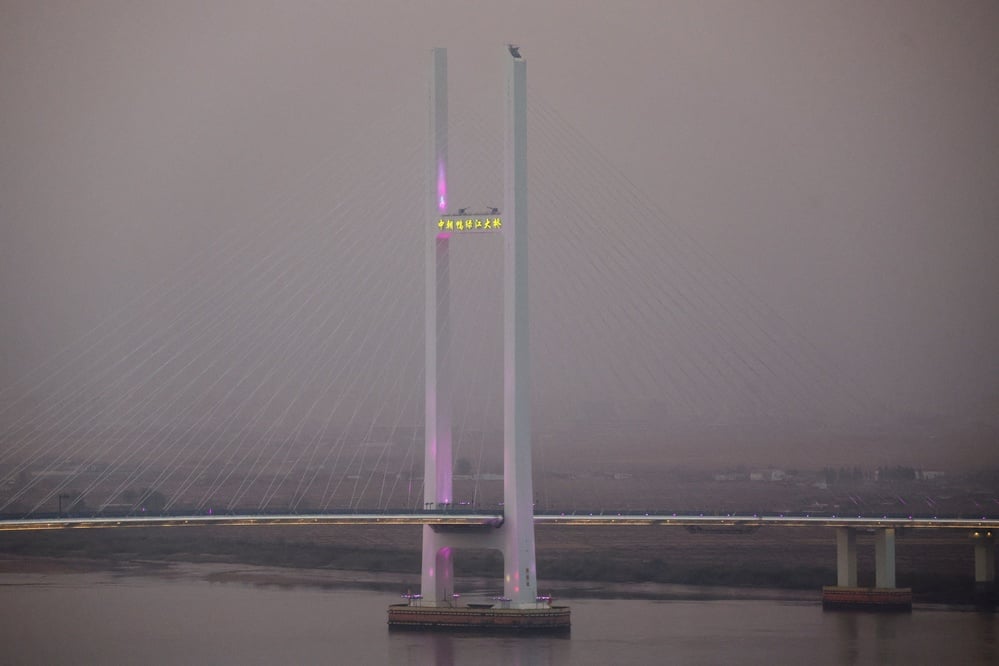
October 15, 2026 · 0 shares
Terse, source-free wire-style reporting of the bridge opening in plainly factual language, with only conventional, mildly evaluative descriptors for North Korea ('isolated nuclear-armed,' 'reclusive') and no editorial stance.
Automated analysis; not human reviewed.
Limitations: The excerpt omits a publication date, byline, and named sources, and gives only 'Thursday' without a calendar date, so the opening's exact timing and sourcing cannot be verified.
·
11 of 55 available dimensions scored; omitted dimensions are not treated as neutral.
·
Verified supporting quotes for 8 of 11 scored dimensions.
Claim: The brief reports the bridge opening as a neutral fact with no ideological or partisan framing.
“A big new bridge linking China and North Korea opened on Thursday, 12 years after its completion, deepening economic ties between the Asian giant and its isolated nuclear-armed neighbor.” · exact text match
Why: Pure event reporting with standard descriptors and no policy stance or ideological advocacy in either direction.
Claim: The brief is overwhelmingly factual, with conventional characterizing language as its only subjective element.
“Hundreds of people gathered on the Chinese side for the opening of the 3,026-meter New Yalu River Bridge.” · not found in supplied text
Counterevidence:
“its isolated nuclear-armed neighbor” · exact text match
Why: Specific dates, figures, and events dominate; standard evaluative descriptors like 'isolated' and 'reclusive' keep the score mildly objective rather than fully neutral.
Claim: The headline and lead state the event plainly without alarm, urgency, or exaggeration.
“New bridge between China and North Korea opens.” · exact text match
Why: A plain declarative headline over a lead built on dates, dimensions, and attendance; no dramatizing or loaded language appears.
Claim: The unusual 12-year gap between the bridge's completion and opening makes the story distinctively newsworthy.
“12 years after its completion” · exact text match
Why: A major cross-border project dormant since 2014 finally opening is an uncommon development that stands out from routine infrastructure news.
Claim: The report contains no recommendations, judgments, or calls to action.
“Hundreds of people gathered on the Chinese side for the opening of the 3,026-meter New Yalu River Bridge.” · not found in supplied text
Why: Every sentence describes an event or background fact; nothing prescribes what governments or readers should do.
Claim: The report stays fact-based, with only a mild interpretive clause about economic ties.
“A big new bridge linking China and North Korea opened on Thursday, 12 years after its completion” · exact text match
Why: Declarative event reporting throughout; the lone interpretive element ('deepening economic ties') is standard background, not opinion.
Claim: The subject is China–North Korea relations, but the treatment remains neutral and non-partisan.
“a vital source of diplomatic, economic and political support for the reclusive nuclear state” · exact text match
Why: The topic carries inherent geopolitical salience, yet the report offers no political stance or partisan angle.
Claim: The brief is a short, source-free wire item whose claims are specific and plausible but entirely unattributed.
“Hundreds of people gathered on the Chinese side for the opening of the 3,026-meter New Yalu River Bridge.” · not found in supplied text
Counterevidence:
“China is North Korea’s largest trading partner and a vital source of diplomatic, economic and political support for the reclusive nuclear state” · exact text match
Why: Checkable specifics support believability, but no sources, quotes, or attribution appear anywhere in the text, keeping credibility neutral rather than high.
Claim: The brief makes concrete, checkable claims without fallacious or irrational reasoning.
“The bridge was completed in 2014 but its opening was delayed due to a lack of connecting roads and customs facilities on the North Korean side.” · exact text match
Why: The stated cause-and-delay account is specific and internally consistent; no unsupported leaps or fallacies appear.
Claim: The brief presents specific, falsifiable facts without visible distortion or spin.
“The bridge was completed in 2014 but its opening was delayed due to a lack of connecting roads and customs facilities on the North Korean side.” · exact text match
Counterevidence:
“China is North Korea’s largest trading partner and a vital source of diplomatic, economic and political support for the reclusive nuclear state” · exact text match
Why: Concrete dates, dimensions, and causes are reported plainly; key background claims are asserted without any named source, modestly tempering the score.
Claim: The brief is a competent, concise news item of average analytical depth.
“DANDONG, CHINA – A big new bridge linking China and North Korea opened on Thursday, 12 years after its completion, deepening economic ties between the Asian giant and its isolated nuclear-armed neighbor.” · exact text match
Why: The lead efficiently conveys event, place, and significance, but the item is very short, with no sourcing, analysis, or added context.
The excerpt omits a publication date, byline, and named sources, and gives only 'Thursday' without a calendar date, so the opening's exact timing and sourcing cannot be verified.
October 15, 2026 · 0 shares
Straight, unemotional trade-infrastructure reporting whose main observable framing is a mildly positive trade-revival angle resting on one attributed expert projection and closing with a tempering visa caveat.
Automated analysis; not human reviewed.
Limitations: The input is a compiled news page mixing the bridge report with unrelated sidebar headlines and empty strings, and the bridge report itself carries no byline or primary-source attribution, so the opening event cannot be independently verified from the text.
·
14 of 55 available dimensions scored; omitted dimensions are not treated as neutral.
·
Verified supporting quotes for 14 of 14 scored dimensions.
Claim: Reporting is ideologically neutral, framing the bridge purely as a trade-infrastructure development.
“China and North Korea opened a new four-lane road bridge on Thursday, 15 October, ending a 12-year delay and creating a major new route for cross-border trade.” · exact text match
Why: The lead and body contain no left- or right-leaning valence; the event is covered as an economic fact.
Claim: Neither populist nor elitist framing appears; resident sentiment and academic expertise are both presented neutrally.
“Residents in Dandong hope the new link will bring more business and improve living standards across the border” · exact text match
Why: Ordinary residents and a university expert are cited without anti-elite or technocratic framing.
Claim: Predominantly objective reporting that attributes projections and includes a tempering caveat, with only mild editorial phrasing.
“Completed in 2014, the bridge had stood unused for 12 years because connecting roads and customs facilities on the North Korean side were not finished.” · exact text match
“although North Korea has yet to resume issuing tourist visas to Chinese visitors.” · exact text match
Why: Verifiable specifics, attribution of projections, and a disclosed limiting fact indicate objective practice; only soft characterizations like 'significant step' appear.
Claim: No sensational language; the opening, including the crowd scene, is described plainly.
“Hundreds of people gathered in Dandong on Thursday to watch as lorries began crossing in both directions” · exact text match
Why: The scene is reported descriptively without alarm, hype, or exaggerated stakes.
Claim: Mildly bullish economic framing casts the opening as a major step in trade revival.
“ending a 12-year delay and creating a major new route for cross-border trade” · exact text match
“marks a significant step in efforts to revive trade between the two countries” · exact text match
Counterevidence:
“North Korea has yet to resume issuing tourist visas to Chinese visitors” · exact text match
Why: Positive trade-outlook language dominates, tempered only by the visa caveat; this is not a markets commentary, so the lean stays mild.
Claim: Mildly optimistic outlook centered on projected traffic growth and residents' business hopes.
“could triple or quadruple cargo traffic” · exact text match
“hope the new link will bring more business and improve living standards across the border” · exact text match
Counterevidence:
“North Korea has yet to resume issuing tourist visas to Chinese visitors” · exact text match
Why: Forward-looking gains are foregrounded while the visa caveat and 12-year delay history keep the tilt modest.
Claim: Moderately engaging story: a completed megaproject idle for 12 years suddenly opening with trade stakes.
“the bridge had stood unused for 12 years” · exact text match
Why: The long idle period, historic bridge context, and cargo-growth projection give the item above-average interest.
Claim: Purely descriptive reporting with no policy recommendations or calls to action.
“Its official opening marks a significant step in efforts to revive trade between the two countries after years of strained relations and pandemic-era border restrictions.” · exact text match
Why: The text reports the event, its causes, and expectations without advocating any course of action.
Claim: Reportorial tone with slight positive warmth from the celebratory scene description.
“some decorated with Chinese and North Korean flags and flowers” · exact text match
Why: Festive imagery lends mild positive color while the rest of the text stays factual and unemotional.
Claim: High visible credibility from precise, checkable figures, a named institutional source, and hedged claims.
“The 3,026-metre, four-lane New Yalu River Bridge links the Chinese border city of Dandong with Sinuiju in North Korea.” · exact text match
“Lim Eul-chul, a North Korea expert at Kyungnam University, estimated” · exact text match
Why: Specific dimensions, dates, and a sourced estimate support trustworthiness within the supplied text; no corrections or visible sourcing gaps appear, though the opening event itself is not independently attributed.
Claim: Reasoned, fact-based reporting with dated specifics, causal explanation, and a hedged expert estimate.
“Lim Eul-chul, a North Korea expert at Kyungnam University, estimated that the new crossing could triple or quadruple cargo traffic” · exact text match
Why: Key claims are attributed and quantified rather than asserted, and the delay is causally explained; no fallacious reasoning appears.
Claim: Modest speculation limited to hedged, attributed forward-looking statements.
“The crossing is expected to ease freight transport and reduce reliance on the ageing Sino-Korean Friendship Bridge” · exact text match
“estimated that the new crossing could triple or quadruple cargo traffic” · exact text match
Why: Forecasting language is present but hedged ('expected to', 'could') and attributed, keeping speculation at a low level.
Claim: Even-handed handling: the key projection is attributed and a limiting fact is disclosed alongside the positive framing.
“although North Korea has yet to resume issuing tourist visas to Chinese visitors.” · exact text match
“Lim Eul-chul, a North Korea expert at Kyungnam University, estimated” · exact text match
Why: Disclosing the visa limitation and sourcing the growth estimate are internal honesty and fairness signals rather than one-sided promotion.
Claim: Competent, information-dense brief that supplies the cause of the delay, historical context, an attributed projection, and a caveat.
“The crossing is expected to ease freight transport and reduce reliance on the ageing Sino-Korean Friendship Bridge nearby, which has carried much of the cross-border traffic since 1943.” · exact text match
Why: The report situates the event within cross-border trade history rather than merely announcing it, though its analysis stays shallow.
The input is a compiled news page mixing the bridge report with unrelated sidebar headlines and empty strings, and the bridge report itself carries no byline or primary-source attribution, so the opening event cannot be independently verified from the text.
October 15, 2026 · 0 shares
Publisher framing is straight wire-service reportage that foregrounds official and expert voices while using conventional geopolitical descriptors such as 'isolated nuclear-armed neighbour' and 'vital diplomatic and political backer'.
Automated analysis; not human reviewed.
Limitations: The text appears to be syndicated wire copy republished with appended unrelated headlines; no author is identified, limiting certainty about the local publisher's own framing versus AFP's.
·
11 of 55 available dimensions scored; omitted dimensions are not treated as neutral.
·
Verified supporting quotes for 9 of 11 scored dimensions.
Claim: Interpretive framing relies on governing elites and a credentialed expert.
“Chinese Premier Li Qiang said” · exact text match
“Lim Eul-chul, a North Korea expert at Kyungnam University” · exact text match
Why: The significance of the bridge is assessed mainly through official and expert voices.
Claim: Publisher framing separates reported facts from attributed opinions.
“AFP reporters at the scene said” · exact text match
“Lim told AFP” · exact text match
Why: The article marks eyewitness reporting and expert commentary as attributed statements.
Claim: The article uses measured event-reporting language rather than sensationalism.
“Trucks bearing the nations' flags began moving in both directions late morning” · exact text match
“Hundreds of people gathered on Thursday in the northern Chinese border town of Dandong” · exact text match
Why: It describes the scene and logistics without dramatic or fear-amplifying language.
Claim: The article reports conditions and events without prescribing policy responses.
“The new bridge is not the only border crossing between the two countries.” · exact text match
“The structure was completed in 2014 but its opening was delayed” · exact text match
Why: It supplies descriptive details and background rather than advocacy.
Claim: The article is centrally framed around interstate diplomacy, official statements, and military developments.
“Chinese Premier Li Qiang said that the bridge symbolised Beijing's friendship with Pyongyang” · not found in supplied text
“North Korea test-fired two types of cruise missile from a submarine” · exact text match
Why: These are political and geopolitical developments rather than non-political matters.
Claim: Official government and institutional sources dominate the framing of the bridge's significance.
“Chinese Premier Li Qiang said” · exact text match
“South Korea's unification ministry told AFP” · not found in supplied text
Why: The article relies on state officials and ministries to interpret the event.
Claim: Visible sourcing and attribution support a credible presentation.
“AFP reporters at the scene said” · exact text match
“according to the official Korean Central News Agency (KCNA)” · exact text match
Why: The article distinguishes its own reporting from agency reports and official claims.
Claim: The report presents a coherent, evidence-attributed account of the bridge opening.
“The structure was completed in 2014 but its opening was delayed due to a lack of connecting roads and customs facilities on the North Korean side” · exact text match
“Lim told AFP” · exact text match
Why: It gives causal background and attributes assessments rather than making unsupported assertions.
Claim: Forecasts are limited and explicitly attributed to an expert.
“The new crossing will make such shipments much easier and more efficient” · exact text match
“will will triple of quadruple cargo traffic” · exact text match
Why: The main speculative estimate about cargo traffic is not presented as the publisher's own certain prediction.
Claim: Major claims are attributed to identified news agencies and experts.
“South Korea's Yonhap news agency reported” · exact text match
“Xinhua reported” · exact text match
Why: Multiple named attributions support observable fairness and sourcing integrity.
Claim: The report is competently structured with event details, timeline, reactions, and relevant geopolitical context.
“The opening came a day after North Korea test-fired two types of cruise missile from a submarine” · exact text match
“The structure was completed in 2014 but its opening was delayed” · exact text match
Why: It synthesizes current event, historical delay, and regional context in a clear sequence.
The text appears to be syndicated wire copy republished with appended unrelated headlines; no author is identified, limiting certainty about the local publisher's own framing versus AFP's.
October 15, 2026 · 0 shares
Publisher framing is straight wire-service reportage that foregrounds official and expert voices while using conventional geopolitical descriptors such as 'isolated nuclear-armed neighbour' and 'vital diplomatic and political backer'.
Automated analysis; not human reviewed.
Limitations: The text appears to be syndicated wire copy republished with appended unrelated headlines; no author is identified, limiting certainty about the local publisher's own framing versus AFP's.
·
11 of 55 available dimensions scored; omitted dimensions are not treated as neutral.
·
Verified supporting quotes for 9 of 11 scored dimensions.
Claim: Interpretive framing relies on governing elites and a credentialed expert.
“Chinese Premier Li Qiang said” · exact text match
“Lim Eul-chul, a North Korea expert at Kyungnam University” · exact text match
Why: The significance of the bridge is assessed mainly through official and expert voices.
Claim: Publisher framing separates reported facts from attributed opinions.
“AFP reporters at the scene said” · exact text match
“Lim told AFP” · exact text match
Why: The article marks eyewitness reporting and expert commentary as attributed statements.
Claim: The article uses measured event-reporting language rather than sensationalism.
“Trucks bearing the nations' flags began moving in both directions late morning” · exact text match
“Hundreds of people gathered on Thursday in the northern Chinese border town of Dandong” · exact text match
Why: It describes the scene and logistics without dramatic or fear-amplifying language.
Claim: The article reports conditions and events without prescribing policy responses.
“The new bridge is not the only border crossing between the two countries.” · exact text match
“The structure was completed in 2014 but its opening was delayed” · exact text match
Why: It supplies descriptive details and background rather than advocacy.
Claim: The article is centrally framed around interstate diplomacy, official statements, and military developments.
“Chinese Premier Li Qiang said that the bridge symbolised Beijing's friendship with Pyongyang” · not found in supplied text
“North Korea test-fired two types of cruise missile from a submarine” · exact text match
Why: These are political and geopolitical developments rather than non-political matters.
Claim: Official government and institutional sources dominate the framing of the bridge's significance.
“Chinese Premier Li Qiang said” · exact text match
“South Korea's unification ministry told AFP” · not found in supplied text
Why: The article relies on state officials and ministries to interpret the event.
Claim: Visible sourcing and attribution support a credible presentation.
“AFP reporters at the scene said” · exact text match
“according to the official Korean Central News Agency (KCNA)” · exact text match
Why: The article distinguishes its own reporting from agency reports and official claims.
Claim: The report presents a coherent, evidence-attributed account of the bridge opening.
“The structure was completed in 2014 but its opening was delayed due to a lack of connecting roads and customs facilities on the North Korean side” · exact text match
“Lim told AFP” · exact text match
Why: It gives causal background and attributes assessments rather than making unsupported assertions.
Claim: Forecasts are limited and explicitly attributed to an expert.
“The new crossing will make such shipments much easier and more efficient” · exact text match
“will will triple of quadruple cargo traffic” · exact text match
Why: The main speculative estimate about cargo traffic is not presented as the publisher's own certain prediction.
Claim: Major claims are attributed to identified news agencies and experts.
“South Korea's Yonhap news agency reported” · exact text match
“Xinhua reported” · exact text match
Why: Multiple named attributions support observable fairness and sourcing integrity.
Claim: The report is competently structured with event details, timeline, reactions, and relevant geopolitical context.
“The opening came a day after North Korea test-fired two types of cruise missile from a submarine” · exact text match
“The structure was completed in 2014 but its opening was delayed” · exact text match
Why: It synthesizes current event, historical delay, and regional context in a clear sequence.
The text appears to be syndicated wire copy republished with appended unrelated headlines; no author is identified, limiting certainty about the local publisher's own framing versus AFP's.
October 15, 2026 · 0 shares
Straight, unemotional trade-infrastructure reporting whose main observable framing is a mildly positive trade-revival angle resting on one attributed expert projection and closing with a tempering visa caveat.
Automated analysis; not human reviewed.
Limitations: The input is a compiled news page mixing the bridge report with unrelated sidebar headlines and empty strings, and the bridge report itself carries no byline or primary-source attribution, so the opening event cannot be independently verified from the text.
·
14 of 55 available dimensions scored; omitted dimensions are not treated as neutral.
·
Verified supporting quotes for 14 of 14 scored dimensions.
Claim: Reporting is ideologically neutral, framing the bridge purely as a trade-infrastructure development.
“China and North Korea opened a new four-lane road bridge on Thursday, 15 October, ending a 12-year delay and creating a major new route for cross-border trade.” · exact text match
Why: The lead and body contain no left- or right-leaning valence; the event is covered as an economic fact.
Claim: Neither populist nor elitist framing appears; resident sentiment and academic expertise are both presented neutrally.
“Residents in Dandong hope the new link will bring more business and improve living standards across the border” · exact text match
Why: Ordinary residents and a university expert are cited without anti-elite or technocratic framing.
Claim: Predominantly objective reporting that attributes projections and includes a tempering caveat, with only mild editorial phrasing.
“Completed in 2014, the bridge had stood unused for 12 years because connecting roads and customs facilities on the North Korean side were not finished.” · exact text match
“although North Korea has yet to resume issuing tourist visas to Chinese visitors.” · exact text match
Why: Verifiable specifics, attribution of projections, and a disclosed limiting fact indicate objective practice; only soft characterizations like 'significant step' appear.
Claim: No sensational language; the opening, including the crowd scene, is described plainly.
“Hundreds of people gathered in Dandong on Thursday to watch as lorries began crossing in both directions” · exact text match
Why: The scene is reported descriptively without alarm, hype, or exaggerated stakes.
Claim: Mildly bullish economic framing casts the opening as a major step in trade revival.
“ending a 12-year delay and creating a major new route for cross-border trade” · exact text match
“marks a significant step in efforts to revive trade between the two countries” · exact text match
Counterevidence:
“North Korea has yet to resume issuing tourist visas to Chinese visitors” · exact text match
Why: Positive trade-outlook language dominates, tempered only by the visa caveat; this is not a markets commentary, so the lean stays mild.
Claim: Mildly optimistic outlook centered on projected traffic growth and residents' business hopes.
“could triple or quadruple cargo traffic” · exact text match
“hope the new link will bring more business and improve living standards across the border” · exact text match
Counterevidence:
“North Korea has yet to resume issuing tourist visas to Chinese visitors” · exact text match
Why: Forward-looking gains are foregrounded while the visa caveat and 12-year delay history keep the tilt modest.
Claim: Moderately engaging story: a completed megaproject idle for 12 years suddenly opening with trade stakes.
“the bridge had stood unused for 12 years” · exact text match
Why: The long idle period, historic bridge context, and cargo-growth projection give the item above-average interest.
Claim: Purely descriptive reporting with no policy recommendations or calls to action.
“Its official opening marks a significant step in efforts to revive trade between the two countries after years of strained relations and pandemic-era border restrictions.” · exact text match
Why: The text reports the event, its causes, and expectations without advocating any course of action.
Claim: Reportorial tone with slight positive warmth from the celebratory scene description.
“some decorated with Chinese and North Korean flags and flowers” · exact text match
Why: Festive imagery lends mild positive color while the rest of the text stays factual and unemotional.
Claim: High visible credibility from precise, checkable figures, a named institutional source, and hedged claims.
“The 3,026-metre, four-lane New Yalu River Bridge links the Chinese border city of Dandong with Sinuiju in North Korea.” · exact text match
“Lim Eul-chul, a North Korea expert at Kyungnam University, estimated” · exact text match
Why: Specific dimensions, dates, and a sourced estimate support trustworthiness within the supplied text; no corrections or visible sourcing gaps appear, though the opening event itself is not independently attributed.
Claim: Reasoned, fact-based reporting with dated specifics, causal explanation, and a hedged expert estimate.
“Lim Eul-chul, a North Korea expert at Kyungnam University, estimated that the new crossing could triple or quadruple cargo traffic” · exact text match
Why: Key claims are attributed and quantified rather than asserted, and the delay is causally explained; no fallacious reasoning appears.
Claim: Modest speculation limited to hedged, attributed forward-looking statements.
“The crossing is expected to ease freight transport and reduce reliance on the ageing Sino-Korean Friendship Bridge” · exact text match
“estimated that the new crossing could triple or quadruple cargo traffic” · exact text match
Why: Forecasting language is present but hedged ('expected to', 'could') and attributed, keeping speculation at a low level.
Claim: Even-handed handling: the key projection is attributed and a limiting fact is disclosed alongside the positive framing.
“although North Korea has yet to resume issuing tourist visas to Chinese visitors.” · exact text match
“Lim Eul-chul, a North Korea expert at Kyungnam University, estimated” · exact text match
Why: Disclosing the visa limitation and sourcing the growth estimate are internal honesty and fairness signals rather than one-sided promotion.
Claim: Competent, information-dense brief that supplies the cause of the delay, historical context, an attributed projection, and a caveat.
“The crossing is expected to ease freight transport and reduce reliance on the ageing Sino-Korean Friendship Bridge nearby, which has carried much of the cross-border traffic since 1943.” · exact text match
Why: The report situates the event within cross-border trade history rather than merely announcing it, though its analysis stays shallow.
The input is a compiled news page mixing the bridge report with unrelated sidebar headlines and empty strings, and the bridge report itself carries no byline or primary-source attribution, so the opening event cannot be independently verified from the text.
October 14, 2026 · 0 shares
Reporting leans on attributed wire-style sourcing from Chinese state media and a South Korean newspaper, lightly editorialized by labeling the 12-year delay 'unexplained' and situating the opening 'amid warming relations' without support.
Automated analysis; not human reviewed.
Limitations: The supplied text is a truncated snippet with duplicated lines; the headline's 'unexplained' label is never substantiated because the cause of the 12-year delay is absent from the text, and the opening date beyond 'Thursday' is unspecified.
·
12 of 55 available dimensions scored; omitted dimensions are not treated as neutral.
·
Verified supporting quotes for 12 of 12 scored dimensions.
Claim: Claims are attributed or explicitly hedged, with one unattributed interpretive context line.
“is expected to become a major trade route between the two countries” · exact text match
Counterevidence:
“will be officially opened amid warming relations between the two countries” · exact text match
Why: The trade-route claim is framed as an expectation, but the warming-relations framing is the publisher's own unattributed characterization.
Claim: Reporting is predominantly plain and attributed, with only mild headline dramatization.
“The two countries will hold an opening ceremony to mark the official opening of the New Yalu River Bridge, Chinese state news agency Xinhua reported on Wednesday morning.” · exact text match
“Last week, signs that the bridge would soon open were spotted, including vehicles crossing and traffic lights and bridge indicators being activated, according to South Korean newspaper The Chosun Daily.” · exact text match
Why: Declarative, sourced content with hedged expectations; only the words 'finally' and 'unexplained' add drama.
Claim: The cross-border economic outlook is framed positively.
“is expected to become a major trade route between the two countries” · exact text match
Why: A positive trade forecast with no caveats gives the piece a mildly bullish economic lean.
Claim: The development is framed positively without downsides or caveats.
“will be officially opened amid warming relations between the two countries” · exact text match
“is expected to become a major trade route between the two countries” · exact text match
Why: Positive context (warming relations, major trade route) is presented with no risks, costs, or skeptical counterpoints.
Claim: The subject is a notable geopolitical oddity: a completed bridge idle for 12 years.
“A bridge between China and North Korea that was completed 12 years ago will finally open on Thursday.” · exact text match
Why: A long-unexplained delay on a strategic China–North Korea crossing is an unusual, newsworthy development.
Claim: The report describes events without recommendations or normative judgments.
“The bridge links the Chinese city of Dandong with Sinuiju and is expected to become a major trade route between the two countries.” · exact text match
Why: Purely factual description of the bridge, its route, and expected function; no policy prescriptions appear.
Claim: Light editorial characterization is embedded in otherwise factual reporting.
“will be officially opened amid warming relations between the two countries” · exact text match
Why: The warming-relations framing and 'unexplained' label are unattributed characterizations rather than sourced analysis.
Claim: Subject matter is bilateral geopolitics, treated as an infrastructure story.
“will be officially opened amid warming relations between the two countries” · exact text match
Why: The only political element is the warming-relations framing; no partisan or ideological positioning appears.
Claim: Sourcing is attributed and state-media status is disclosed, though no independent verification or delay explanation is offered.
“Chinese state news agency Xinhua reported on Wednesday morning” · exact text match
“according to South Korean newspaper The Chosun Daily” · exact text match
Why: Named, disclosed sources with hedged claims support credibility; the lack of independent confirmation or context limits it.
Claim: One forward-looking claim is included alongside factual reporting.
“is expected to become a major trade route between the two countries” · exact text match
Why: The trade-route forecast is hedged as an expectation, keeping speculation minimal.
Claim: Claims are attributed to named sources and the state status of Xinhua is disclosed.
“Chinese state news agency Xinhua reported on Wednesday morning” · exact text match
“according to South Korean newspaper The Chosun Daily” · exact text match
Why: Honest sourcing labels, including disclosure of state media, support fair presentation; no distortions are visible.
Claim: Concise, well-attributed report with key specifics but no analysis of the delay.
“The bridge links the Chinese city of Dandong with Sinuiju and is expected to become a major trade route between the two countries.” · exact text match
Why: Essential facts, sources, and hedged expectations are conveyed efficiently, though the 'unexplained' delay is never explored.
The supplied text is a truncated snippet with duplicated lines; the headline's 'unexplained' label is never substantiated because the cause of the 12-year delay is absent from the text, and the opening date beyond 'Thursday' is unspecified.
The framing is largely factual and measured, using official Chinese optimism about a 'new chapter' while including an analyst's caution about dependence and sanctions.
Automated analysis; not human reviewed.
Limitations: The supplied text is a short, partially duplicated scraped article without byline or clear publisher metadata; some bias dimensions cannot be confidently assessed from this limited content.
·
55 of 55 available dimensions scored; omitted dimensions are not treated as neutral.
·
Verified supporting quotes for 8 of 55 scored dimensions.
Claim: The report is predominantly objective and attributed, presenting official and analyst perspectives without adopting a first-person or emotive stance.
“Chinese Premier Li Qiang said in a video address at the opening, as reported by Xinhua news agency.” · exact text match
“North Korea has not yet responded to these reports.” · exact text match
Why: Attribution to named sources and an explicit non-response note indicate an objective, non-subjective presentation.
Claim: The tone is measured and non-sensational, avoiding dramatic or alarmist language.
“the bridge is unlikely to lead immediately to a full-scale return to pre-sanctions trade” · exact text match
Why: The quoted analyst caveat uses measured language rather than sensational framing.
Claim: The framing leans mildly optimistic by highlighting trade revival and benefits, while retaining a cautionary note.
“relations are entering a new phase, embarking on a new chapter” · exact text match
“strongly promote economic and trade cooperation” · exact text match
Why: Official optimism and projected benefits dominate the opening framing, though the analyst caveat limits the positive tilt.
Claim: The article is primarily descriptive, reporting the bridge opening and its stated purposes rather than prescribing policy actions.
“China and North Korea have officially opened its long-delayed key bridge” · exact text match
Why: The lead sentence reports an event and its intended effects without urging a course of action.
Claim: The report is substantially political, centering on China-North Korea diplomatic ties, sanctions, and leader-level summits.
“following two recent leader-level summits” · exact text match
“against the world’s sanctions” · exact text match
Why: The article's central subject is bilateral political and strategic relations, not merely commerce.
Claim: Credibility is supported by named attribution to Chinese Premier Li Qiang via Xinhua and explicit uncertainty about North Korean response.
“Chinese Premier Li Qiang said in a video address at the opening, as reported by Xinhua news agency.” · exact text match
“North Korea has not yet responded to these reports.” · exact text match
Why: Named sourcing and acknowledgment of non-response indicate moderate-to-high credibility in the supplied text.
Claim: The report shows fairness signals by quoting a cautionary analyst view and noting North Korea has not responded.
“North Korea has not yet responded to these reports.” · exact text match
“analysts note North Korea remains wary of becoming overly dependent on China.” · exact text match
Why: Including an unconfirmed-response note and a counterpoint to the official optimism supports internal fairness and honesty.
Claim: The article demonstrates average-to-above-average intelligence by situating the bridge opening in trade, sanctions, and dependency analysis.
“analysts note North Korea remains wary of becoming overly dependent on China.” · exact text match
Why: The inclusion of an expert caveat about dependency adds analytic depth beyond a simple event report.
The supplied text is a short, partially duplicated scraped article without byline or clear publisher metadata; some bias dimensions cannot be confidently assessed from this limited content.
October 15, 2026 · 0 shares
Wire-style reporting attributes every claim to named officials, analysts, and residents and flags unverified details, with no discernible ideological or directional slant.
A series of UN sanctions over North Korea's missile and nuclear weapons development banned flows of goods and workers; China is by far Pyongyang's largest trading partner, and China and Russia have since questioned the bans' legitimacy and efficacy, with Russia accused by the US and South Korea of supplying sensitive military assistance to the North in return for Pyongyang's help in the Ukraine war.
Automated analysis; not human reviewed.
Limitations: Supplied text is a partial page capture mixing the article body with navigation, games promotions, and subscription boilerplate; no byline is given, and the event year rests on a photo caption dated Oct 14, 2026.
·
9 of 55 available dimensions scored; omitted dimensions are not treated as neutral.
·
Verified supporting quotes for 8 of 9 scored dimensions.
Claim: Key claims are attributed to named officials, agencies, and officials rather than asserted by the publisher.
“"(Bilateral) relations are entering a new phase, embarking on a new chapter," Chinese Premier Li Qiang said in a video address at the opening, the official Xinhua news agency said.” · exact text match
“The bridge opening was "effectively the first visible case" of adoption of agreements struck at a June summit of leaders, a South Korean Unification Ministry official said on Thursday.” · exact text match
Why: Consistent attribution of claims to identifiable sources indicates objective-leaning reporting with minimal editorializing.
Claim: A potentially dramatic development is covered in plain, factual language.
“The 3km New Yalu River Bridge was completed in 2014 but remained unused until now.” · exact text match
“Trucks festooned with the national flags of the neighbours drove across the long-delayed 3km New Yalu River Bridge” · exact text match
Why: Restrained description without alarmist or emotive framing supports an objective-leaning classification.
Claim: Upbeat voices are balanced by analyst caution about trade prospects.
“"Once the bridge opens, this place will become much livelier, attracting more tourists," said another Dandong resident, surnamed Xie.” · exact text match
Counterevidence:
“"The bridge is unlikely to lead immediately to a full-scale return to pre-sanctions trade," said Lim Eul-chul at Kyungnam University's Institute for Far Eastern Studies.” · not found in supplied text
Why: Hopeful resident remarks and cautious expert assessment net out to measured neutrality.
Claim: The story centers on a major border crossing idle for over a decade before opening.
“The 3km New Yalu River Bridge was completed in 2014 but remained unused until now.” · exact text match
Why: An unusual, long-delayed infrastructure opening with geopolitical context is substantively notable.
Claim: The report explains events and context without advocating policy positions.
“The delay in opening the bridge was a setback for Dandong, whose economy thrived in the early 21st century as the primary trade gateway to North Korea's isolated economy.” · exact text match
Why: Explanatory background with no calls to action indicates descriptive framing.
Claim: Named sources, specific figures with caveats, and disclosed gaps support strong visible credibility.
“China's exports to North Korea rose to a six-year high of US$2.3 billion last year, an increase of 25 per cent on the year.
Still, that was well below levels before UN sanctions tightened in 2017.”
· exact text match
“but the North Korea's state media have yet to report on the event” · exact text match
Why: Quantified data, attributed sourcing, and acknowledged uncertainty reflect solid visible epistemic practice.
Claim: Assessment is grounded in hedged expert judgment and quantified context rather than assertion.
“"The bridge is unlikely to lead immediately to a full-scale return to pre-sanctions trade," said Lim Eul-chul at Kyungnam University's Institute for Far Eastern Studies.” · not found in supplied text
“Despite the potential economic boost from active trade, however, analysts said North Korea remains cautious of greater dependence on China.” · exact text match
Why: Hedged claims, expert sourcing, and contextual qualification support measured, reason-based reporting.
Claim: Allegations are framed as accusations and an unverified aspect is disclosed.
“Russia is accused by countries such as the US and South Korea of supplying sensitive military assistance to the North in return for Pyongyang's help in fighting the war in Ukraine.” · exact text match
“but the North Korea's state media have yet to report on the event” · exact text match
Why: Attributed allegations and transparency about unreported confirmation are visible honesty signals.
Claim: The report integrates quantified data, expert analysis, historical context, and multiple perspectives.
“Despite the potential economic boost from active trade, however, analysts said North Korea remains cautious of greater dependence on China.” · exact text match
“That remains the busiest of about 15 crossing points along the roughly 1,350km border.” · exact text match
Why: Structured synthesis of data, context, and diverse viewpoints indicates above-average informational quality.
Supplied text is a partial page capture mixing the article body with navigation, games promotions, and subscription boilerplate; no byline is given, and the event year rests on a photo caption dated Oct 14, 2026.
October 15, 2026 · 0 shares
Straight, unemotional trade-infrastructure reporting whose main observable framing is a mildly positive trade-revival angle resting on one attributed expert projection and closing with a tempering visa caveat.
Automated analysis; not human reviewed.
Limitations: The input is a compiled news page mixing the bridge report with unrelated sidebar headlines and empty strings, and the bridge report itself carries no byline or primary-source attribution, so the opening event cannot be independently verified from the text.
·
14 of 55 available dimensions scored; omitted dimensions are not treated as neutral.
·
Verified supporting quotes for 14 of 14 scored dimensions.
Claim: Reporting is ideologically neutral, framing the bridge purely as a trade-infrastructure development.
“China and North Korea opened a new four-lane road bridge on Thursday, 15 October, ending a 12-year delay and creating a major new route for cross-border trade.” · exact text match
Why: The lead and body contain no left- or right-leaning valence; the event is covered as an economic fact.
Claim: Neither populist nor elitist framing appears; resident sentiment and academic expertise are both presented neutrally.
“Residents in Dandong hope the new link will bring more business and improve living standards across the border” · exact text match
Why: Ordinary residents and a university expert are cited without anti-elite or technocratic framing.
Claim: Predominantly objective reporting that attributes projections and includes a tempering caveat, with only mild editorial phrasing.
“Completed in 2014, the bridge had stood unused for 12 years because connecting roads and customs facilities on the North Korean side were not finished.” · exact text match
“although North Korea has yet to resume issuing tourist visas to Chinese visitors.” · exact text match
Why: Verifiable specifics, attribution of projections, and a disclosed limiting fact indicate objective practice; only soft characterizations like 'significant step' appear.
Claim: No sensational language; the opening, including the crowd scene, is described plainly.
“Hundreds of people gathered in Dandong on Thursday to watch as lorries began crossing in both directions” · exact text match
Why: The scene is reported descriptively without alarm, hype, or exaggerated stakes.
Claim: Mildly bullish economic framing casts the opening as a major step in trade revival.
“ending a 12-year delay and creating a major new route for cross-border trade” · exact text match
“marks a significant step in efforts to revive trade between the two countries” · exact text match
Counterevidence:
“North Korea has yet to resume issuing tourist visas to Chinese visitors” · exact text match
Why: Positive trade-outlook language dominates, tempered only by the visa caveat; this is not a markets commentary, so the lean stays mild.
Claim: Mildly optimistic outlook centered on projected traffic growth and residents' business hopes.
“could triple or quadruple cargo traffic” · exact text match
“hope the new link will bring more business and improve living standards across the border” · exact text match
Counterevidence:
“North Korea has yet to resume issuing tourist visas to Chinese visitors” · exact text match
Why: Forward-looking gains are foregrounded while the visa caveat and 12-year delay history keep the tilt modest.
Claim: Moderately engaging story: a completed megaproject idle for 12 years suddenly opening with trade stakes.
“the bridge had stood unused for 12 years” · exact text match
Why: The long idle period, historic bridge context, and cargo-growth projection give the item above-average interest.
Claim: Purely descriptive reporting with no policy recommendations or calls to action.
“Its official opening marks a significant step in efforts to revive trade between the two countries after years of strained relations and pandemic-era border restrictions.” · exact text match
Why: The text reports the event, its causes, and expectations without advocating any course of action.
Claim: Reportorial tone with slight positive warmth from the celebratory scene description.
“some decorated with Chinese and North Korean flags and flowers” · exact text match
Why: Festive imagery lends mild positive color while the rest of the text stays factual and unemotional.
Claim: High visible credibility from precise, checkable figures, a named institutional source, and hedged claims.
“The 3,026-metre, four-lane New Yalu River Bridge links the Chinese border city of Dandong with Sinuiju in North Korea.” · exact text match
“Lim Eul-chul, a North Korea expert at Kyungnam University, estimated” · exact text match
Why: Specific dimensions, dates, and a sourced estimate support trustworthiness within the supplied text; no corrections or visible sourcing gaps appear, though the opening event itself is not independently attributed.
Claim: Reasoned, fact-based reporting with dated specifics, causal explanation, and a hedged expert estimate.
“Lim Eul-chul, a North Korea expert at Kyungnam University, estimated that the new crossing could triple or quadruple cargo traffic” · exact text match
Why: Key claims are attributed and quantified rather than asserted, and the delay is causally explained; no fallacious reasoning appears.
Claim: Modest speculation limited to hedged, attributed forward-looking statements.
“The crossing is expected to ease freight transport and reduce reliance on the ageing Sino-Korean Friendship Bridge” · exact text match
“estimated that the new crossing could triple or quadruple cargo traffic” · exact text match
Why: Forecasting language is present but hedged ('expected to', 'could') and attributed, keeping speculation at a low level.
Claim: Even-handed handling: the key projection is attributed and a limiting fact is disclosed alongside the positive framing.
“although North Korea has yet to resume issuing tourist visas to Chinese visitors.” · exact text match
“Lim Eul-chul, a North Korea expert at Kyungnam University, estimated” · exact text match
Why: Disclosing the visa limitation and sourcing the growth estimate are internal honesty and fairness signals rather than one-sided promotion.
Claim: Competent, information-dense brief that supplies the cause of the delay, historical context, an attributed projection, and a caveat.
“The crossing is expected to ease freight transport and reduce reliance on the ageing Sino-Korean Friendship Bridge nearby, which has carried much of the cross-border traffic since 1943.” · exact text match
Why: The report situates the event within cross-border trade history rather than merely announcing it, though its analysis stays shallow.
The input is a compiled news page mixing the bridge report with unrelated sidebar headlines and empty strings, and the bridge report itself carries no byline or primary-source attribution, so the opening event cannot be independently verified from the text.
October 15, 2026 · 0 shares
Publisher framing is straight wire-service reportage that foregrounds official and expert voices while using conventional geopolitical descriptors such as 'isolated nuclear-armed neighbour' and 'vital diplomatic and political backer'.
Automated analysis; not human reviewed.
Limitations: The text appears to be syndicated wire copy republished with appended unrelated headlines; no author is identified, limiting certainty about the local publisher's own framing versus AFP's.
·
11 of 55 available dimensions scored; omitted dimensions are not treated as neutral.
·
Verified supporting quotes for 9 of 11 scored dimensions.
Claim: Interpretive framing relies on governing elites and a credentialed expert.
“Chinese Premier Li Qiang said” · exact text match
“Lim Eul-chul, a North Korea expert at Kyungnam University” · exact text match
Why: The significance of the bridge is assessed mainly through official and expert voices.
Claim: Publisher framing separates reported facts from attributed opinions.
“AFP reporters at the scene said” · exact text match
“Lim told AFP” · exact text match
Why: The article marks eyewitness reporting and expert commentary as attributed statements.
Claim: The article uses measured event-reporting language rather than sensationalism.
“Trucks bearing the nations' flags began moving in both directions late morning” · exact text match
“Hundreds of people gathered on Thursday in the northern Chinese border town of Dandong” · exact text match
Why: It describes the scene and logistics without dramatic or fear-amplifying language.
Claim: The article reports conditions and events without prescribing policy responses.
“The new bridge is not the only border crossing between the two countries.” · exact text match
“The structure was completed in 2014 but its opening was delayed” · exact text match
Why: It supplies descriptive details and background rather than advocacy.
Claim: The article is centrally framed around interstate diplomacy, official statements, and military developments.
“Chinese Premier Li Qiang said that the bridge symbolised Beijing's friendship with Pyongyang” · not found in supplied text
“North Korea test-fired two types of cruise missile from a submarine” · exact text match
Why: These are political and geopolitical developments rather than non-political matters.
Claim: Official government and institutional sources dominate the framing of the bridge's significance.
“Chinese Premier Li Qiang said” · exact text match
“South Korea's unification ministry told AFP” · not found in supplied text
Why: The article relies on state officials and ministries to interpret the event.
Claim: Visible sourcing and attribution support a credible presentation.
“AFP reporters at the scene said” · exact text match
“according to the official Korean Central News Agency (KCNA)” · exact text match
Why: The article distinguishes its own reporting from agency reports and official claims.
Claim: The report presents a coherent, evidence-attributed account of the bridge opening.
“The structure was completed in 2014 but its opening was delayed due to a lack of connecting roads and customs facilities on the North Korean side” · exact text match
“Lim told AFP” · exact text match
Why: It gives causal background and attributes assessments rather than making unsupported assertions.
Claim: Forecasts are limited and explicitly attributed to an expert.
“The new crossing will make such shipments much easier and more efficient” · exact text match
“will will triple of quadruple cargo traffic” · exact text match
Why: The main speculative estimate about cargo traffic is not presented as the publisher's own certain prediction.
Claim: Major claims are attributed to identified news agencies and experts.
“South Korea's Yonhap news agency reported” · exact text match
“Xinhua reported” · exact text match
Why: Multiple named attributions support observable fairness and sourcing integrity.
Claim: The report is competently structured with event details, timeline, reactions, and relevant geopolitical context.
“The opening came a day after North Korea test-fired two types of cruise missile from a submarine” · exact text match
“The structure was completed in 2014 but its opening was delayed” · exact text match
Why: It synthesizes current event, historical delay, and regional context in a clear sequence.
The text appears to be syndicated wire copy republished with appended unrelated headlines; no author is identified, limiting certainty about the local publisher's own framing versus AFP's.
The framing is largely factual and measured, using official Chinese optimism about a 'new chapter' while including an analyst's caution about dependence and sanctions.
Automated analysis; not human reviewed.
Limitations: The supplied text is a short, partially duplicated scraped article without byline or clear publisher metadata; some bias dimensions cannot be confidently assessed from this limited content.
·
55 of 55 available dimensions scored; omitted dimensions are not treated as neutral.
·
Verified supporting quotes for 8 of 55 scored dimensions.
Claim: The report is predominantly objective and attributed, presenting official and analyst perspectives without adopting a first-person or emotive stance.
“Chinese Premier Li Qiang said in a video address at the opening, as reported by Xinhua news agency.” · exact text match
“North Korea has not yet responded to these reports.” · exact text match
Why: Attribution to named sources and an explicit non-response note indicate an objective, non-subjective presentation.
Claim: The tone is measured and non-sensational, avoiding dramatic or alarmist language.
“the bridge is unlikely to lead immediately to a full-scale return to pre-sanctions trade” · exact text match
Why: The quoted analyst caveat uses measured language rather than sensational framing.
Claim: The framing leans mildly optimistic by highlighting trade revival and benefits, while retaining a cautionary note.
“relations are entering a new phase, embarking on a new chapter” · exact text match
“strongly promote economic and trade cooperation” · exact text match
Why: Official optimism and projected benefits dominate the opening framing, though the analyst caveat limits the positive tilt.
Claim: The article is primarily descriptive, reporting the bridge opening and its stated purposes rather than prescribing policy actions.
“China and North Korea have officially opened its long-delayed key bridge” · exact text match
Why: The lead sentence reports an event and its intended effects without urging a course of action.
Claim: The report is substantially political, centering on China-North Korea diplomatic ties, sanctions, and leader-level summits.
“following two recent leader-level summits” · exact text match
“against the world’s sanctions” · exact text match
Why: The article's central subject is bilateral political and strategic relations, not merely commerce.
Claim: Credibility is supported by named attribution to Chinese Premier Li Qiang via Xinhua and explicit uncertainty about North Korean response.
“Chinese Premier Li Qiang said in a video address at the opening, as reported by Xinhua news agency.” · exact text match
“North Korea has not yet responded to these reports.” · exact text match
Why: Named sourcing and acknowledgment of non-response indicate moderate-to-high credibility in the supplied text.
Claim: The report shows fairness signals by quoting a cautionary analyst view and noting North Korea has not responded.
“North Korea has not yet responded to these reports.” · exact text match
“analysts note North Korea remains wary of becoming overly dependent on China.” · exact text match
Why: Including an unconfirmed-response note and a counterpoint to the official optimism supports internal fairness and honesty.
Claim: The article demonstrates average-to-above-average intelligence by situating the bridge opening in trade, sanctions, and dependency analysis.
“analysts note North Korea remains wary of becoming overly dependent on China.” · exact text match
Why: The inclusion of an expert caveat about dependency adds analytic depth beyond a simple event report.
The supplied text is a short, partially duplicated scraped article without byline or clear publisher metadata; some bias dimensions cannot be confidently assessed from this limited content.
October 15, 2026 · 0 shares
Measured, heavily attributed geopolitical reporting that frames the bridge opening as part of Beijing's effort to reassert influence over Pyongyang while relying on Chinese state media for the central event.
Automated analysis; not human reviewed.
Limitations: The publisher's name is stripped from the supplied text (e.g., 'tells the .'), and the bridge opening is attributed only to Chinese state media, so the central event cannot be independently verified from this input.
·
13 of 55 available dimensions scored; omitted dimensions are not treated as neutral.
·
Verified supporting quotes for 12 of 13 scored dimensions.
Claim: No left-right valence: Beijing's official position and critical expert assessments are presented side by side without partisan framing.
“It is an "important facility for connectivity" between the two countries, Chinese Foreign Ministry spokesperson Mao Ning said on Wednesday” · exact text match
“shows what a difficult partner Pyongyang can be for Beijing” · exact text match
Why: Official praise and expert criticism of both governments receive neutral, attributed treatment with no ideological or partisan coloring.
Claim: Interpretive and causal claims are attributed to named experts or hedged as observers' views rather than asserted in the publisher's own voice.
“Observers say one reason is that North Korea has grown closer to Russia because of the Ukraine war.” · exact text match
“says Leif-Eric Easley, a professor at Ewha University in Seoul.” · exact text match
Why: Evaluations of Beijing's motives and the relationship's trajectory are consistently sourced.
Claim: A geopolitically charged story is delivered in plain, non-alarmist language.
“A long-delayed road bridge linking China and North Korea has opened, Chinese state media report, as trade ties improve between the neighbours.” · exact text match
Why: The lede states the event and its source plainly, without urgency framing or loaded descriptors.
Claim: A single infrastructure event is connected to nuclear testing, alliance politics, and the Russia factor.
“Kim Jong Un conducted a nuclear test in 2017 and has since ramped up tests of banned ballistic missiles - all of which increased US wariness, and strengthened its military alliances with South Korea and Japan.” · exact text match
Why: The report layers sanctions, alliance, and great-power competition context onto the bridge opening.
Claim: The report describes events and quoted analysis without urging any policy course.
“Its launch, initially slated for 2014, had been indefinitely postponed after North Korea halted construction of its roads and customs facilities, as relations with Beijing turned frosty.” · exact text match
Why: Content is historical and explanatory; no actor is told what to do.
Claim: The subject matter is international politics: sanctions, a defence treaty, nuclear tests, and summit diplomacy.
“Beijing and Pyongyang are long-standing allies with a mutual defence treaty, the only one that China has with any country.” · exact text match
Why: The substance is statecraft and security policy, though the report carries no partisan advocacy.
Claim: Tone remains even, reporting both improving ties and frictions without emotive coloring.
“Last year, bilateral trade reached $2.7bn, marking a recovery to pre-pandemic levels, mostly fuelled by Chinese exports to North Korea.” · exact text match
Why: Positive developments and constraints are stated in neutral, factual language throughout.
Claim: Sourcing is transparent and uncertainty is flagged, with the main limitation of state-media sourcing for the opening itself disclosed.
“Chinese state media report” · exact text match
“Chinese Foreign Ministry spokesperson Mao Ning said on Wednesday” · exact text match
Why: Primary claims and official responses are attributed to identifiable sources, and estimates are hedged throughout.
Claim: Forecasts and factual claims are paired with stated reasoning and explicit uncertainty markers.
“China is well aware of these concerns, so trade is more likely to grow gradually.” · exact text match
“At least 2,300 North Korean soldiers are believed to have died fighting for Russia in Ukraine.” · exact text match
Why: The trade outlook is argued from sanctions and Pyongyang's import fears, and unverifiable casualty figures are hedged as beliefs rather than asserted.
Claim: Attributed forecasts and motive attributions about trade and Beijing's strategy appear alongside the factual reporting.
“A sharp and sudden increase in trade across the border is "unlikely" as the UN sanctions on North Korea remain in effect” · exact text match
“So Beijing is believed to be trying to reassert its sway over Pyongyang by rekindling ties.” · exact text match
Why: Forward-looking and motive claims are present but framed as expert views or beliefs.
Claim: Source types are disclosed and unverified figures are marked as estimates or beliefs.
“Chinese state media report” · exact text match
“In 2024, Russia was estimated to have sent more than a billion barrels of oil as payment for Pyongyang's weapons and troops.” · exact text match
Why: The primary event's source class is named and contested figures are hedged, indicating honest handling of uncertainty.
Claim: The report supplies historical, comparative, and causal context for a single infrastructure event.
“The New Yalu River Bridge is an alternative to the decades-old Sino-Korean Friendship Bridge, which was built between 1937 and 1943 during Imperial Japan's occupation of the region.” · exact text match
“Last month, North Korea and Russia opened their first road bridge, which Russian state media said would allow the movement of up to 300 vehicles and more than 2,000 people every day.” · exact text match
Why: Context spans bridge history, the parallel Russia-North Korea opening, sanctions, and expert analysis rather than the headline event alone.
Claim: The epistemic practice is reality-testing: hedged claims are balanced with a critical counterpoint rather than a comforting narrative.
“But the long delay, including North Korea's pandemic self-isolation and domestic socioeconomic crackdowns, shows what a difficult partner Pyongyang can be for Beijing.” · not found in supplied text
Why: A skeptical counterweight to the thaw narrative is included alongside the attributed positive signals.
The publisher's name is stripped from the supplied text (e.g., 'tells the .'), and the bridge opening is attributed only to Chinese state media, so the central event cannot be independently verified from this input.
October 15, 2026 · 0 shares
Straight, unemotional trade-infrastructure reporting whose main observable framing is a mildly positive trade-revival angle resting on one attributed expert projection and closing with a tempering visa caveat.
Automated analysis; not human reviewed.
Limitations: The input is a compiled news page mixing the bridge report with unrelated sidebar headlines and empty strings, and the bridge report itself carries no byline or primary-source attribution, so the opening event cannot be independently verified from the text.
·
14 of 55 available dimensions scored; omitted dimensions are not treated as neutral.
·
Verified supporting quotes for 14 of 14 scored dimensions.
Claim: Reporting is ideologically neutral, framing the bridge purely as a trade-infrastructure development.
“China and North Korea opened a new four-lane road bridge on Thursday, 15 October, ending a 12-year delay and creating a major new route for cross-border trade.” · exact text match
Why: The lead and body contain no left- or right-leaning valence; the event is covered as an economic fact.
Claim: Neither populist nor elitist framing appears; resident sentiment and academic expertise are both presented neutrally.
“Residents in Dandong hope the new link will bring more business and improve living standards across the border” · exact text match
Why: Ordinary residents and a university expert are cited without anti-elite or technocratic framing.
Claim: Predominantly objective reporting that attributes projections and includes a tempering caveat, with only mild editorial phrasing.
“Completed in 2014, the bridge had stood unused for 12 years because connecting roads and customs facilities on the North Korean side were not finished.” · exact text match
“although North Korea has yet to resume issuing tourist visas to Chinese visitors.” · exact text match
Why: Verifiable specifics, attribution of projections, and a disclosed limiting fact indicate objective practice; only soft characterizations like 'significant step' appear.
Claim: No sensational language; the opening, including the crowd scene, is described plainly.
“Hundreds of people gathered in Dandong on Thursday to watch as lorries began crossing in both directions” · exact text match
Why: The scene is reported descriptively without alarm, hype, or exaggerated stakes.
Claim: Mildly bullish economic framing casts the opening as a major step in trade revival.
“ending a 12-year delay and creating a major new route for cross-border trade” · exact text match
“marks a significant step in efforts to revive trade between the two countries” · exact text match
Counterevidence:
“North Korea has yet to resume issuing tourist visas to Chinese visitors” · exact text match
Why: Positive trade-outlook language dominates, tempered only by the visa caveat; this is not a markets commentary, so the lean stays mild.
Claim: Mildly optimistic outlook centered on projected traffic growth and residents' business hopes.
“could triple or quadruple cargo traffic” · exact text match
“hope the new link will bring more business and improve living standards across the border” · exact text match
Counterevidence:
“North Korea has yet to resume issuing tourist visas to Chinese visitors” · exact text match
Why: Forward-looking gains are foregrounded while the visa caveat and 12-year delay history keep the tilt modest.
Claim: Moderately engaging story: a completed megaproject idle for 12 years suddenly opening with trade stakes.
“the bridge had stood unused for 12 years” · exact text match
Why: The long idle period, historic bridge context, and cargo-growth projection give the item above-average interest.
Claim: Purely descriptive reporting with no policy recommendations or calls to action.
“Its official opening marks a significant step in efforts to revive trade between the two countries after years of strained relations and pandemic-era border restrictions.” · exact text match
Why: The text reports the event, its causes, and expectations without advocating any course of action.
Claim: Reportorial tone with slight positive warmth from the celebratory scene description.
“some decorated with Chinese and North Korean flags and flowers” · exact text match
Why: Festive imagery lends mild positive color while the rest of the text stays factual and unemotional.
Claim: High visible credibility from precise, checkable figures, a named institutional source, and hedged claims.
“The 3,026-metre, four-lane New Yalu River Bridge links the Chinese border city of Dandong with Sinuiju in North Korea.” · exact text match
“Lim Eul-chul, a North Korea expert at Kyungnam University, estimated” · exact text match
Why: Specific dimensions, dates, and a sourced estimate support trustworthiness within the supplied text; no corrections or visible sourcing gaps appear, though the opening event itself is not independently attributed.
Claim: Reasoned, fact-based reporting with dated specifics, causal explanation, and a hedged expert estimate.
“Lim Eul-chul, a North Korea expert at Kyungnam University, estimated that the new crossing could triple or quadruple cargo traffic” · exact text match
Why: Key claims are attributed and quantified rather than asserted, and the delay is causally explained; no fallacious reasoning appears.
Claim: Modest speculation limited to hedged, attributed forward-looking statements.
“The crossing is expected to ease freight transport and reduce reliance on the ageing Sino-Korean Friendship Bridge” · exact text match
“estimated that the new crossing could triple or quadruple cargo traffic” · exact text match
Why: Forecasting language is present but hedged ('expected to', 'could') and attributed, keeping speculation at a low level.
Claim: Even-handed handling: the key projection is attributed and a limiting fact is disclosed alongside the positive framing.
“although North Korea has yet to resume issuing tourist visas to Chinese visitors.” · exact text match
“Lim Eul-chul, a North Korea expert at Kyungnam University, estimated” · exact text match
Why: Disclosing the visa limitation and sourcing the growth estimate are internal honesty and fairness signals rather than one-sided promotion.
Claim: Competent, information-dense brief that supplies the cause of the delay, historical context, an attributed projection, and a caveat.
“The crossing is expected to ease freight transport and reduce reliance on the ageing Sino-Korean Friendship Bridge nearby, which has carried much of the cross-border traffic since 1943.” · exact text match
Why: The report situates the event within cross-border trade history rather than merely announcing it, though its analysis stays shallow.
The input is a compiled news page mixing the bridge report with unrelated sidebar headlines and empty strings, and the bridge report itself carries no byline or primary-source attribution, so the opening event cannot be independently verified from the text.
October 15, 2026 · 0 shares
Publisher framing is straight wire-service reportage that foregrounds official and expert voices while using conventional geopolitical descriptors such as 'isolated nuclear-armed neighbour' and 'vital diplomatic and political backer'.
Automated analysis; not human reviewed.
Limitations: The text appears to be syndicated wire copy republished with appended unrelated headlines; no author is identified, limiting certainty about the local publisher's own framing versus AFP's.
·
11 of 55 available dimensions scored; omitted dimensions are not treated as neutral.
·
Verified supporting quotes for 9 of 11 scored dimensions.
Claim: Interpretive framing relies on governing elites and a credentialed expert.
“Chinese Premier Li Qiang said” · exact text match
“Lim Eul-chul, a North Korea expert at Kyungnam University” · exact text match
Why: The significance of the bridge is assessed mainly through official and expert voices.
Claim: Publisher framing separates reported facts from attributed opinions.
“AFP reporters at the scene said” · exact text match
“Lim told AFP” · exact text match
Why: The article marks eyewitness reporting and expert commentary as attributed statements.
Claim: The article uses measured event-reporting language rather than sensationalism.
“Trucks bearing the nations' flags began moving in both directions late morning” · exact text match
“Hundreds of people gathered on Thursday in the northern Chinese border town of Dandong” · exact text match
Why: It describes the scene and logistics without dramatic or fear-amplifying language.
Claim: The article reports conditions and events without prescribing policy responses.
“The new bridge is not the only border crossing between the two countries.” · exact text match
“The structure was completed in 2014 but its opening was delayed” · exact text match
Why: It supplies descriptive details and background rather than advocacy.
Claim: The article is centrally framed around interstate diplomacy, official statements, and military developments.
“Chinese Premier Li Qiang said that the bridge symbolised Beijing's friendship with Pyongyang” · not found in supplied text
“North Korea test-fired two types of cruise missile from a submarine” · exact text match
Why: These are political and geopolitical developments rather than non-political matters.
Claim: Official government and institutional sources dominate the framing of the bridge's significance.
“Chinese Premier Li Qiang said” · exact text match
“South Korea's unification ministry told AFP” · not found in supplied text
Why: The article relies on state officials and ministries to interpret the event.
Claim: Visible sourcing and attribution support a credible presentation.
“AFP reporters at the scene said” · exact text match
“according to the official Korean Central News Agency (KCNA)” · exact text match
Why: The article distinguishes its own reporting from agency reports and official claims.
Claim: The report presents a coherent, evidence-attributed account of the bridge opening.
“The structure was completed in 2014 but its opening was delayed due to a lack of connecting roads and customs facilities on the North Korean side” · exact text match
“Lim told AFP” · exact text match
Why: It gives causal background and attributes assessments rather than making unsupported assertions.
Claim: Forecasts are limited and explicitly attributed to an expert.
“The new crossing will make such shipments much easier and more efficient” · exact text match
“will will triple of quadruple cargo traffic” · exact text match
Why: The main speculative estimate about cargo traffic is not presented as the publisher's own certain prediction.
Claim: Major claims are attributed to identified news agencies and experts.
“South Korea's Yonhap news agency reported” · exact text match
“Xinhua reported” · exact text match
Why: Multiple named attributions support observable fairness and sourcing integrity.
Claim: The report is competently structured with event details, timeline, reactions, and relevant geopolitical context.
“The opening came a day after North Korea test-fired two types of cruise missile from a submarine” · exact text match
“The structure was completed in 2014 but its opening was delayed” · exact text match
Why: It synthesizes current event, historical delay, and regional context in a clear sequence.
The text appears to be syndicated wire copy republished with appended unrelated headlines; no author is identified, limiting certainty about the local publisher's own framing versus AFP's.
October 15, 2026 · 0 shares
Neutral wire-style reporting whose strongest observable feature is dense multi-source attribution — on-scene AFP reporters, KCNA, Yonhap, both governments' officials, analysts, and a local resident — with no discernible editorial slant.
Automated analysis; not human reviewed.
Limitations: The supplied text is a scrape with duplicated list fragments, one sentence cut off mid-thought, a typo ('every say'), and no byline or publication date, so completeness and publication details cannot be fully verified.
·
15 of 55 available dimensions scored; omitted dimensions are not treated as neutral.
·
Verified supporting quotes for 12 of 15 scored dimensions.
Claim: No left-right ideological framing; both governments' statements are quoted without editorial weighting.
“South Korea's unification ministry told AFP that Seoul is "closely monitoring" the situation regarding the bridge's opening.” · not found in supplied text
“"The New Yalu River Bridge is an important facility for connectivity between the two countries," Chinese foreign ministry spokesperson Mao Ning told a regular briefing on Wednesday.” · exact text match
Why: Balanced attribution to Seoul's and Beijing's officials on a bilateral story, with no ideological language anywhere in the text.
Claim: Ordinary residents and officials/experts appear as equally weighted quoted sources with no populist or elitist framing.
“"It's great," one woman who came to watch told AFP” · exact text match
“Ahn Chan-il, a researcher originally from North Korea, told AFP” · exact text match
Why: An unnamed border-town resident and an expert researcher are both treated as ordinary sources, without elevation or condescension.
Claim: State border controls and their easing are described without any stance on state power versus individual liberty.
“North Korea also sealed its borders during the Covid-19 pandemic” · exact text match
“Trucks bearing the nations' flags began moving in both directions late morning” · exact text match
Why: Border closure and reopening are relayed as observable facts without endorsing or condemning either government's controls.
Claim: The account sticks to observable events and attributed statements with no editorial opinion.
“AFP reporters at the scene said” · exact text match
“analysts say” · exact text match
Why: On-scene observation and third-party judgments are attributed rather than presented as the publisher's own view.
Claim: A missile test a day before the opening is reported as flat, sourced context without dramatization.
“The opening came a day after North Korea test-fired two types of cruise missile from a submarine, according to the official Korean Central News Agency (KCNA).” · exact text match
Why: A potentially alarming security event is stated plainly with attribution and no charged language.
Claim: Sourced optimism about trade is balanced by cautionary facts about isolation and weapons testing.
“"The bridge could become a conduit for China's abundant goods and resources to flow into North Korea and give its economy a significant boost," he said.” · exact text match
Counterevidence:
“The opening came a day after North Korea test-fired two types of cruise missile from a submarine” · exact text match
Why: Positive expectations and sober security context appear in comparable measure without an overall upbeat or downbeat slant.
Claim: A 12-year completion-to-opening gap, a same-week missile test, and a parallel Russia bridge give the story layered context.
“opened on Thursday, 12 years after its completion” · exact text match
“The opening came a day after North Korea test-fired two types of cruise missile from a submarine” · exact text match
Why: Unusual timing and multiple geopolitical threads make a routine infrastructure event comparatively noteworthy.
Claim: The report describes events, causes, and reactions without recommending any course of action.
“The four-lane structure was completed in 2014 but its opening was delayed due to a lack of connecting roads and customs facilities on the North Korean side” · exact text match
Why: Explanatory content is attributed reporting of causes and facts, not policy advice.
Claim: Security and engagement developments are conveyed without any war-or-peace advocacy.
“test-fired two types of cruise missile from a submarine, according to the official Korean Central News Agency (KCNA)” · exact text match
“South Korea's unification ministry told AFP that Seoul is "closely monitoring" the situation” · not found in supplied text
Why: The missile test and Seoul's response are reported as attributed facts with no call for escalation or accommodation.
Claim: The subject is inter-state diplomacy and security, framed around trade and infrastructure without ideological advocacy.
“South Korea's unification ministry told AFP that Seoul is "closely monitoring" the situation” · not found in supplied text
“Chinese foreign ministry spokesperson Mao Ning told a regular briefing on Wednesday” · exact text match
Why: Government statements and a weapons test make the content political, but the framing carries no partisan or ideological slant.
Claim: The narrator's tone stays emotionally neutral; visible emotion is confined to a quoted resident.
“"It's great," one woman who came to watch told AFP” · exact text match
“some of the North Korean vehicles decorated with flowers” · exact text match
Why: Scene description and quotes carry the color, while the reporting voice stays flat and descriptive.
Claim: On-scene reporting, precise details, and multiple named sources support the account.
“AFP reporters at the scene said” · exact text match
“Hundreds of people gathered on Thursday on the Chinese side for the opening of the 3,026-meter (9,927-feet) New Yalu River vehicle bridge.” · exact text match
Why: Direct observation, exact measurements, and named official, agency, and expert sources give the account strong visible support.
Claim: Assertions are consistently attributed and hedged, with no unsupported or illogical claims.
“according to the official Korean Central News Agency (KCNA)” · exact text match
“South Korea's Yonhap news agency reported” · exact text match
Why: Even state-media and rival-agency claims are labeled by source instead of asserted as fact.
Claim: Consistent attribution, hedging, and disclosure of anonymity reflect fair, honest reporting.
“according to the official Korean Central News Agency (KCNA)” · exact text match
“she said, without wishing to be named” · exact text match
Why: State-media claims are labeled and an unnamed local source's anonymity is transparently disclosed.
Claim: The report adds causal and comparative context beyond the basic event.
“The four-lane structure was completed in 2014 but its opening was delayed due to a lack of connecting roads and customs facilities on the North Korean side” · exact text match
“The opening of the New Yalu River Bridge comes just more than a month after North Korea and Russia opened their first road bridge” · exact text match
Why: Explaining the delay's cause and situating the opening within broader realignment is solid explanatory work for a brief.
The supplied text is a scrape with duplicated list fragments, one sentence cut off mid-thought, a typo ('every say'), and no byline or publication date, so completeness and publication details cannot be fully verified.
October 15, 2026 · 0 shares
Measured, heavily attributed geopolitical reporting that frames the bridge opening as part of Beijing's effort to reassert influence over Pyongyang while relying on Chinese state media for the central event.
Automated analysis; not human reviewed.
Limitations: The publisher's name is stripped from the supplied text (e.g., 'tells the .'), and the bridge opening is attributed only to Chinese state media, so the central event cannot be independently verified from this input.
·
13 of 55 available dimensions scored; omitted dimensions are not treated as neutral.
·
Verified supporting quotes for 12 of 13 scored dimensions.
Claim: No left-right valence: Beijing's official position and critical expert assessments are presented side by side without partisan framing.
“It is an "important facility for connectivity" between the two countries, Chinese Foreign Ministry spokesperson Mao Ning said on Wednesday” · exact text match
“shows what a difficult partner Pyongyang can be for Beijing” · exact text match
Why: Official praise and expert criticism of both governments receive neutral, attributed treatment with no ideological or partisan coloring.
Claim: Interpretive and causal claims are attributed to named experts or hedged as observers' views rather than asserted in the publisher's own voice.
“Observers say one reason is that North Korea has grown closer to Russia because of the Ukraine war.” · exact text match
“says Leif-Eric Easley, a professor at Ewha University in Seoul.” · exact text match
Why: Evaluations of Beijing's motives and the relationship's trajectory are consistently sourced.
Claim: A geopolitically charged story is delivered in plain, non-alarmist language.
“A long-delayed road bridge linking China and North Korea has opened, Chinese state media report, as trade ties improve between the neighbours.” · exact text match
Why: The lede states the event and its source plainly, without urgency framing or loaded descriptors.
Claim: A single infrastructure event is connected to nuclear testing, alliance politics, and the Russia factor.
“Kim Jong Un conducted a nuclear test in 2017 and has since ramped up tests of banned ballistic missiles - all of which increased US wariness, and strengthened its military alliances with South Korea and Japan.” · exact text match
Why: The report layers sanctions, alliance, and great-power competition context onto the bridge opening.
Claim: The report describes events and quoted analysis without urging any policy course.
“Its launch, initially slated for 2014, had been indefinitely postponed after North Korea halted construction of its roads and customs facilities, as relations with Beijing turned frosty.” · exact text match
Why: Content is historical and explanatory; no actor is told what to do.
Claim: The subject matter is international politics: sanctions, a defence treaty, nuclear tests, and summit diplomacy.
“Beijing and Pyongyang are long-standing allies with a mutual defence treaty, the only one that China has with any country.” · exact text match
Why: The substance is statecraft and security policy, though the report carries no partisan advocacy.
Claim: Tone remains even, reporting both improving ties and frictions without emotive coloring.
“Last year, bilateral trade reached $2.7bn, marking a recovery to pre-pandemic levels, mostly fuelled by Chinese exports to North Korea.” · exact text match
Why: Positive developments and constraints are stated in neutral, factual language throughout.
Claim: Sourcing is transparent and uncertainty is flagged, with the main limitation of state-media sourcing for the opening itself disclosed.
“Chinese state media report” · exact text match
“Chinese Foreign Ministry spokesperson Mao Ning said on Wednesday” · exact text match
Why: Primary claims and official responses are attributed to identifiable sources, and estimates are hedged throughout.
Claim: Forecasts and factual claims are paired with stated reasoning and explicit uncertainty markers.
“China is well aware of these concerns, so trade is more likely to grow gradually.” · exact text match
“At least 2,300 North Korean soldiers are believed to have died fighting for Russia in Ukraine.” · exact text match
Why: The trade outlook is argued from sanctions and Pyongyang's import fears, and unverifiable casualty figures are hedged as beliefs rather than asserted.
Claim: Attributed forecasts and motive attributions about trade and Beijing's strategy appear alongside the factual reporting.
“A sharp and sudden increase in trade across the border is "unlikely" as the UN sanctions on North Korea remain in effect” · exact text match
“So Beijing is believed to be trying to reassert its sway over Pyongyang by rekindling ties.” · exact text match
Why: Forward-looking and motive claims are present but framed as expert views or beliefs.
Claim: Source types are disclosed and unverified figures are marked as estimates or beliefs.
“Chinese state media report” · exact text match
“In 2024, Russia was estimated to have sent more than a billion barrels of oil as payment for Pyongyang's weapons and troops.” · exact text match
Why: The primary event's source class is named and contested figures are hedged, indicating honest handling of uncertainty.
Claim: The report supplies historical, comparative, and causal context for a single infrastructure event.
“The New Yalu River Bridge is an alternative to the decades-old Sino-Korean Friendship Bridge, which was built between 1937 and 1943 during Imperial Japan's occupation of the region.” · exact text match
“Last month, North Korea and Russia opened their first road bridge, which Russian state media said would allow the movement of up to 300 vehicles and more than 2,000 people every day.” · exact text match
Why: Context spans bridge history, the parallel Russia-North Korea opening, sanctions, and expert analysis rather than the headline event alone.
Claim: The epistemic practice is reality-testing: hedged claims are balanced with a critical counterpoint rather than a comforting narrative.
“But the long delay, including North Korea's pandemic self-isolation and domestic socioeconomic crackdowns, shows what a difficult partner Pyongyang can be for Beijing.” · not found in supplied text
Why: A skeptical counterweight to the thaw narrative is included alongside the attributed positive signals.
The publisher's name is stripped from the supplied text (e.g., 'tells the .'), and the bridge opening is attributed only to Chinese state media, so the central event cannot be independently verified from this input.
The framing is largely factual and measured, using official Chinese optimism about a 'new chapter' while including an analyst's caution about dependence and sanctions.
Automated analysis; not human reviewed.
Limitations: The supplied text is a short, partially duplicated scraped article without byline or clear publisher metadata; some bias dimensions cannot be confidently assessed from this limited content.
·
55 of 55 available dimensions scored; omitted dimensions are not treated as neutral.
·
Verified supporting quotes for 8 of 55 scored dimensions.
Claim: The report is predominantly objective and attributed, presenting official and analyst perspectives without adopting a first-person or emotive stance.
“Chinese Premier Li Qiang said in a video address at the opening, as reported by Xinhua news agency.” · exact text match
“North Korea has not yet responded to these reports.” · exact text match
Why: Attribution to named sources and an explicit non-response note indicate an objective, non-subjective presentation.
Claim: The tone is measured and non-sensational, avoiding dramatic or alarmist language.
“the bridge is unlikely to lead immediately to a full-scale return to pre-sanctions trade” · exact text match
Why: The quoted analyst caveat uses measured language rather than sensational framing.
Claim: The framing leans mildly optimistic by highlighting trade revival and benefits, while retaining a cautionary note.
“relations are entering a new phase, embarking on a new chapter” · exact text match
“strongly promote economic and trade cooperation” · exact text match
Why: Official optimism and projected benefits dominate the opening framing, though the analyst caveat limits the positive tilt.
Claim: The article is primarily descriptive, reporting the bridge opening and its stated purposes rather than prescribing policy actions.
“China and North Korea have officially opened its long-delayed key bridge” · exact text match
Why: The lead sentence reports an event and its intended effects without urging a course of action.
Claim: The report is substantially political, centering on China-North Korea diplomatic ties, sanctions, and leader-level summits.
“following two recent leader-level summits” · exact text match
“against the world’s sanctions” · exact text match
Why: The article's central subject is bilateral political and strategic relations, not merely commerce.
Claim: Credibility is supported by named attribution to Chinese Premier Li Qiang via Xinhua and explicit uncertainty about North Korean response.
“Chinese Premier Li Qiang said in a video address at the opening, as reported by Xinhua news agency.” · exact text match
“North Korea has not yet responded to these reports.” · exact text match
Why: Named sourcing and acknowledgment of non-response indicate moderate-to-high credibility in the supplied text.
Claim: The report shows fairness signals by quoting a cautionary analyst view and noting North Korea has not responded.
“North Korea has not yet responded to these reports.” · exact text match
“analysts note North Korea remains wary of becoming overly dependent on China.” · exact text match
Why: Including an unconfirmed-response note and a counterpoint to the official optimism supports internal fairness and honesty.
Claim: The article demonstrates average-to-above-average intelligence by situating the bridge opening in trade, sanctions, and dependency analysis.
“analysts note North Korea remains wary of becoming overly dependent on China.” · exact text match
Why: The inclusion of an expert caveat about dependency adds analytic depth beyond a simple event report.
The supplied text is a short, partially duplicated scraped article without byline or clear publisher metadata; some bias dimensions cannot be confidently assessed from this limited content.
October 15, 2026 · 0 shares
Measured, heavily attributed geopolitical reporting that frames the bridge opening as part of Beijing's effort to reassert influence over Pyongyang while relying on Chinese state media for the central event.
Automated analysis; not human reviewed.
Limitations: The publisher's name is stripped from the supplied text (e.g., 'tells the .'), and the bridge opening is attributed only to Chinese state media, so the central event cannot be independently verified from this input.
·
13 of 55 available dimensions scored; omitted dimensions are not treated as neutral.
·
Verified supporting quotes for 12 of 13 scored dimensions.
Claim: No left-right valence: Beijing's official position and critical expert assessments are presented side by side without partisan framing.
“It is an "important facility for connectivity" between the two countries, Chinese Foreign Ministry spokesperson Mao Ning said on Wednesday” · exact text match
“shows what a difficult partner Pyongyang can be for Beijing” · exact text match
Why: Official praise and expert criticism of both governments receive neutral, attributed treatment with no ideological or partisan coloring.
Claim: Interpretive and causal claims are attributed to named experts or hedged as observers' views rather than asserted in the publisher's own voice.
“Observers say one reason is that North Korea has grown closer to Russia because of the Ukraine war.” · exact text match
“says Leif-Eric Easley, a professor at Ewha University in Seoul.” · exact text match
Why: Evaluations of Beijing's motives and the relationship's trajectory are consistently sourced.
Claim: A geopolitically charged story is delivered in plain, non-alarmist language.
“A long-delayed road bridge linking China and North Korea has opened, Chinese state media report, as trade ties improve between the neighbours.” · exact text match
Why: The lede states the event and its source plainly, without urgency framing or loaded descriptors.
Claim: A single infrastructure event is connected to nuclear testing, alliance politics, and the Russia factor.
“Kim Jong Un conducted a nuclear test in 2017 and has since ramped up tests of banned ballistic missiles - all of which increased US wariness, and strengthened its military alliances with South Korea and Japan.” · exact text match
Why: The report layers sanctions, alliance, and great-power competition context onto the bridge opening.
Claim: The report describes events and quoted analysis without urging any policy course.
“Its launch, initially slated for 2014, had been indefinitely postponed after North Korea halted construction of its roads and customs facilities, as relations with Beijing turned frosty.” · exact text match
Why: Content is historical and explanatory; no actor is told what to do.
Claim: The subject matter is international politics: sanctions, a defence treaty, nuclear tests, and summit diplomacy.
“Beijing and Pyongyang are long-standing allies with a mutual defence treaty, the only one that China has with any country.” · exact text match
Why: The substance is statecraft and security policy, though the report carries no partisan advocacy.
Claim: Tone remains even, reporting both improving ties and frictions without emotive coloring.
“Last year, bilateral trade reached $2.7bn, marking a recovery to pre-pandemic levels, mostly fuelled by Chinese exports to North Korea.” · exact text match
Why: Positive developments and constraints are stated in neutral, factual language throughout.
Claim: Sourcing is transparent and uncertainty is flagged, with the main limitation of state-media sourcing for the opening itself disclosed.
“Chinese state media report” · exact text match
“Chinese Foreign Ministry spokesperson Mao Ning said on Wednesday” · exact text match
Why: Primary claims and official responses are attributed to identifiable sources, and estimates are hedged throughout.
Claim: Forecasts and factual claims are paired with stated reasoning and explicit uncertainty markers.
“China is well aware of these concerns, so trade is more likely to grow gradually.” · exact text match
“At least 2,300 North Korean soldiers are believed to have died fighting for Russia in Ukraine.” · exact text match
Why: The trade outlook is argued from sanctions and Pyongyang's import fears, and unverifiable casualty figures are hedged as beliefs rather than asserted.
Claim: Attributed forecasts and motive attributions about trade and Beijing's strategy appear alongside the factual reporting.
“A sharp and sudden increase in trade across the border is "unlikely" as the UN sanctions on North Korea remain in effect” · exact text match
“So Beijing is believed to be trying to reassert its sway over Pyongyang by rekindling ties.” · exact text match
Why: Forward-looking and motive claims are present but framed as expert views or beliefs.
Claim: Source types are disclosed and unverified figures are marked as estimates or beliefs.
“Chinese state media report” · exact text match
“In 2024, Russia was estimated to have sent more than a billion barrels of oil as payment for Pyongyang's weapons and troops.” · exact text match
Why: The primary event's source class is named and contested figures are hedged, indicating honest handling of uncertainty.
Claim: The report supplies historical, comparative, and causal context for a single infrastructure event.
“The New Yalu River Bridge is an alternative to the decades-old Sino-Korean Friendship Bridge, which was built between 1937 and 1943 during Imperial Japan's occupation of the region.” · exact text match
“Last month, North Korea and Russia opened their first road bridge, which Russian state media said would allow the movement of up to 300 vehicles and more than 2,000 people every day.” · exact text match
Why: Context spans bridge history, the parallel Russia-North Korea opening, sanctions, and expert analysis rather than the headline event alone.
Claim: The epistemic practice is reality-testing: hedged claims are balanced with a critical counterpoint rather than a comforting narrative.
“But the long delay, including North Korea's pandemic self-isolation and domestic socioeconomic crackdowns, shows what a difficult partner Pyongyang can be for Beijing.” · not found in supplied text
Why: A skeptical counterweight to the thaw narrative is included alongside the attributed positive signals.
The publisher's name is stripped from the supplied text (e.g., 'tells the .'), and the bridge opening is attributed only to Chinese state media, so the central event cannot be independently verified from this input.
The report frames the bridge opening as a modest, analyst-contextualized trade development, relying heavily on a single think-tank expert while largely excluding North Korean or Chinese official voices.
The UN ramped up sanctions on North Korea in 2017 over its banned weapons programmes following a nuclear test, and North Korea sealed its borders during the pandemic, both of which sharply reduced China-North Korea trade.
Automated analysis; not human reviewed.
Limitations: The supplied text is truncated mid-sentence ('Commerce betwee') and includes duplicated passages, limiting full assessment.
·
55 of 55 available dimensions scored; omitted dimensions are not treated as neutral.
·
Verified supporting quotes for 20 of 55 scored dimensions.
Claim: The article reports the bridge opening without partisan political framing.
“North Korea has opened two major bridges connecting it to key trading partners in September” · exact text match
Why: The reporting focuses on trade and diplomacy without clear left-right ideological cues.
Claim: The article leans on institutional think-tank analysis rather than popular or grassroots voices.
“wrote Kim Gyu-beom, an associate research fellow at the Institute for National Security Strategy (INSS), in a recent report” · exact text match
Why: Framing relies on elite analysts rather than broad popular perspectives.
Claim: The article mostly reports verified facts with limited subjective coloring.
“An opening ceremony was held on Thursday morning, according to China’s official Xinhua News Agency.” · exact text match
Why: Attribution to Xinhua anchors the factual claim.
Claim: The article is factual rather than sensational.
“Construction for the crossing was completed in 2014, but the bridge went unused for 12 years” · exact text match
Why: Plain description of timeline lacks sensational language.
Claim: The article frames the development as a mild positive for trade.
“The bridge is expected to spur trade in goods and ease bottlenecks in cross-border freight traffic.” · exact text match
Why: Optimistic economic expectation, though modest.
Claim: The article carries a mildly optimistic tone about trade.
“China-bound North Korean exports of food, alcohol and cosmetics are expected to pick up” · exact text match
Why: Forward-looking positive expectations.
Claim: The article has moderate interest due to regional trade and geopolitics.
“In June, Chinese President Xi Jinping visited Pyongyang for his first overseas trip of the year.” · exact text match
Why: Geopolitical detail adds interest.
Claim: The article describes developments without prescribing action.
“North Korea may have considered its massive trade deficit with China in the decision to resume work on the bridge” · exact text match
Why: Analysis is descriptive.
Claim: No military or security prescription is offered.
“Trade volume between Pyongyang and Beijing dropped sharply after the United Nations ramped up sanctions on North Korea in 2017 over its banned weapons programmes” · exact text match
Why: Sanctions context is reported neutrally.
Claim: The article includes some expert opinion alongside facts.
“Pyongyang could have viewed the long-stalled bridge “a sort of bargaining chip”” · exact text match
Why: Speculative expert viewpoint is included.
Claim: The article is political in covering North Korea-China diplomacy.
“Chinese President Xi Jinping visited Pyongyang for his first overseas trip of the year.” · exact text match
Why: Subject matter is inherently political.
Claim: The article simplifies complex trade and geopolitical dynamics.
“North Korea may have considered its massive trade deficit with China in the decision to resume work on the bridge” · exact text match
Why: Single-factor explanation may oversimplify.
Claim: The article heavily cites a think-tank expert.
“wrote Kim Gyu-beom, an associate research fellow at the Institute for National Security Strategy (INSS)” · exact text match
Why: Expert authority is a central evidentiary pillar.
Claim: The article hedges with 'may have' and 'could have'.
“North Korea may have considered its massive trade deficit with China” · exact text match
Why: Use of modals indicates calibrated uncertainty.
Claim: The article relies on establishment think-tank and official sources.
“wrote Kim Gyu-beom, an associate research fellow at the Institute for National Security Strategy (INSS)” · exact text match
Why: Framing reflects institutional perspectives.
Claim: The article shows reasonable sourcing and attribution.
“according to China’s official Xinhua News Agency” · exact text match
Why: Official attribution and named expert support credibility.
Claim: The article gives reasoned, empirical context for the bridge opening.
“Trade volume between Pyongyang and Beijing dropped sharply after the United Nations ramped up sanctions on North Korea in 2017” · exact text match
Why: Causal history is presented in a logical manner.
Claim: The article speculates about Pyongyang's motives.
“Pyongyang could have viewed the long-stalled bridge “a sort of bargaining chip”” · exact text match
Why: Forecasting and motive inference are present.
Claim: No strong AI-writing indicators are evident.
“BLOOMBERG” · exact text match
Why: Prose and attribution pattern suggest human-written agency copy.
Claim: The article transparently attributes expert and official sources.
“according to China’s official Xinhua News Agency” · exact text match
Why: Clear sourcing supports integrity.
The supplied text is truncated mid-sentence ('Commerce betwee') and includes duplicated passages, limiting full assessment.
October 15, 2026 · 0 shares
Publisher framing is straight wire-service reportage that foregrounds official and expert voices while using conventional geopolitical descriptors such as 'isolated nuclear-armed neighbour' and 'vital diplomatic and political backer'.
Automated analysis; not human reviewed.
Limitations: The text appears to be syndicated wire copy republished with appended unrelated headlines; no author is identified, limiting certainty about the local publisher's own framing versus AFP's.
·
11 of 55 available dimensions scored; omitted dimensions are not treated as neutral.
·
Verified supporting quotes for 9 of 11 scored dimensions.
Claim: Interpretive framing relies on governing elites and a credentialed expert.
“Chinese Premier Li Qiang said” · exact text match
“Lim Eul-chul, a North Korea expert at Kyungnam University” · exact text match
Why: The significance of the bridge is assessed mainly through official and expert voices.
Claim: Publisher framing separates reported facts from attributed opinions.
“AFP reporters at the scene said” · exact text match
“Lim told AFP” · exact text match
Why: The article marks eyewitness reporting and expert commentary as attributed statements.
Claim: The article uses measured event-reporting language rather than sensationalism.
“Trucks bearing the nations' flags began moving in both directions late morning” · exact text match
“Hundreds of people gathered on Thursday in the northern Chinese border town of Dandong” · exact text match
Why: It describes the scene and logistics without dramatic or fear-amplifying language.
Claim: The article reports conditions and events without prescribing policy responses.
“The new bridge is not the only border crossing between the two countries.” · exact text match
“The structure was completed in 2014 but its opening was delayed” · exact text match
Why: It supplies descriptive details and background rather than advocacy.
Claim: The article is centrally framed around interstate diplomacy, official statements, and military developments.
“Chinese Premier Li Qiang said that the bridge symbolised Beijing's friendship with Pyongyang” · not found in supplied text
“North Korea test-fired two types of cruise missile from a submarine” · exact text match
Why: These are political and geopolitical developments rather than non-political matters.
Claim: Official government and institutional sources dominate the framing of the bridge's significance.
“Chinese Premier Li Qiang said” · exact text match
“South Korea's unification ministry told AFP” · not found in supplied text
Why: The article relies on state officials and ministries to interpret the event.
Claim: Visible sourcing and attribution support a credible presentation.
“AFP reporters at the scene said” · exact text match
“according to the official Korean Central News Agency (KCNA)” · exact text match
Why: The article distinguishes its own reporting from agency reports and official claims.
Claim: The report presents a coherent, evidence-attributed account of the bridge opening.
“The structure was completed in 2014 but its opening was delayed due to a lack of connecting roads and customs facilities on the North Korean side” · exact text match
“Lim told AFP” · exact text match
Why: It gives causal background and attributes assessments rather than making unsupported assertions.
Claim: Forecasts are limited and explicitly attributed to an expert.
“The new crossing will make such shipments much easier and more efficient” · exact text match
“will will triple of quadruple cargo traffic” · exact text match
Why: The main speculative estimate about cargo traffic is not presented as the publisher's own certain prediction.
Claim: Major claims are attributed to identified news agencies and experts.
“South Korea's Yonhap news agency reported” · exact text match
“Xinhua reported” · exact text match
Why: Multiple named attributions support observable fairness and sourcing integrity.
Claim: The report is competently structured with event details, timeline, reactions, and relevant geopolitical context.
“The opening came a day after North Korea test-fired two types of cruise missile from a submarine” · exact text match
“The structure was completed in 2014 but its opening was delayed” · exact text match
Why: It synthesizes current event, historical delay, and regional context in a clear sequence.
The text appears to be syndicated wire copy republished with appended unrelated headlines; no author is identified, limiting certainty about the local publisher's own framing versus AFP's.
October 15, 2026 · 0 shares
Publisher framing is straight wire-service reportage that foregrounds official and expert voices while using conventional geopolitical descriptors such as 'isolated nuclear-armed neighbour' and 'vital diplomatic and political backer'.
Automated analysis; not human reviewed.
Limitations: The text appears to be syndicated wire copy republished with appended unrelated headlines; no author is identified, limiting certainty about the local publisher's own framing versus AFP's.
·
11 of 55 available dimensions scored; omitted dimensions are not treated as neutral.
·
Verified supporting quotes for 9 of 11 scored dimensions.
Claim: Interpretive framing relies on governing elites and a credentialed expert.
“Chinese Premier Li Qiang said” · exact text match
“Lim Eul-chul, a North Korea expert at Kyungnam University” · exact text match
Why: The significance of the bridge is assessed mainly through official and expert voices.
Claim: Publisher framing separates reported facts from attributed opinions.
“AFP reporters at the scene said” · exact text match
“Lim told AFP” · exact text match
Why: The article marks eyewitness reporting and expert commentary as attributed statements.
Claim: The article uses measured event-reporting language rather than sensationalism.
“Trucks bearing the nations' flags began moving in both directions late morning” · exact text match
“Hundreds of people gathered on Thursday in the northern Chinese border town of Dandong” · exact text match
Why: It describes the scene and logistics without dramatic or fear-amplifying language.
Claim: The article reports conditions and events without prescribing policy responses.
“The new bridge is not the only border crossing between the two countries.” · exact text match
“The structure was completed in 2014 but its opening was delayed” · exact text match
Why: It supplies descriptive details and background rather than advocacy.
Claim: The article is centrally framed around interstate diplomacy, official statements, and military developments.
“Chinese Premier Li Qiang said that the bridge symbolised Beijing's friendship with Pyongyang” · not found in supplied text
“North Korea test-fired two types of cruise missile from a submarine” · exact text match
Why: These are political and geopolitical developments rather than non-political matters.
Claim: Official government and institutional sources dominate the framing of the bridge's significance.
“Chinese Premier Li Qiang said” · exact text match
“South Korea's unification ministry told AFP” · not found in supplied text
Why: The article relies on state officials and ministries to interpret the event.
Claim: Visible sourcing and attribution support a credible presentation.
“AFP reporters at the scene said” · exact text match
“according to the official Korean Central News Agency (KCNA)” · exact text match
Why: The article distinguishes its own reporting from agency reports and official claims.
Claim: The report presents a coherent, evidence-attributed account of the bridge opening.
“The structure was completed in 2014 but its opening was delayed due to a lack of connecting roads and customs facilities on the North Korean side” · exact text match
“Lim told AFP” · exact text match
Why: It gives causal background and attributes assessments rather than making unsupported assertions.
Claim: Forecasts are limited and explicitly attributed to an expert.
“The new crossing will make such shipments much easier and more efficient” · exact text match
“will will triple of quadruple cargo traffic” · exact text match
Why: The main speculative estimate about cargo traffic is not presented as the publisher's own certain prediction.
Claim: Major claims are attributed to identified news agencies and experts.
“South Korea's Yonhap news agency reported” · exact text match
“Xinhua reported” · exact text match
Why: Multiple named attributions support observable fairness and sourcing integrity.
Claim: The report is competently structured with event details, timeline, reactions, and relevant geopolitical context.
“The opening came a day after North Korea test-fired two types of cruise missile from a submarine” · exact text match
“The structure was completed in 2014 but its opening was delayed” · exact text match
Why: It synthesizes current event, historical delay, and regional context in a clear sequence.
The text appears to be syndicated wire copy republished with appended unrelated headlines; no author is identified, limiting certainty about the local publisher's own framing versus AFP's.
October 15, 2026 · 0 shares
Neutral wire-style reporting whose strongest observable feature is dense multi-source attribution — on-scene AFP reporters, KCNA, Yonhap, both governments' officials, analysts, and a local resident — with no discernible editorial slant.
Automated analysis; not human reviewed.
Limitations: The supplied text is a scrape with duplicated list fragments, one sentence cut off mid-thought, a typo ('every say'), and no byline or publication date, so completeness and publication details cannot be fully verified.
·
15 of 55 available dimensions scored; omitted dimensions are not treated as neutral.
·
Verified supporting quotes for 12 of 15 scored dimensions.
Claim: No left-right ideological framing; both governments' statements are quoted without editorial weighting.
“South Korea's unification ministry told AFP that Seoul is "closely monitoring" the situation regarding the bridge's opening.” · not found in supplied text
“"The New Yalu River Bridge is an important facility for connectivity between the two countries," Chinese foreign ministry spokesperson Mao Ning told a regular briefing on Wednesday.” · exact text match
Why: Balanced attribution to Seoul's and Beijing's officials on a bilateral story, with no ideological language anywhere in the text.
Claim: Ordinary residents and officials/experts appear as equally weighted quoted sources with no populist or elitist framing.
“"It's great," one woman who came to watch told AFP” · exact text match
“Ahn Chan-il, a researcher originally from North Korea, told AFP” · exact text match
Why: An unnamed border-town resident and an expert researcher are both treated as ordinary sources, without elevation or condescension.
Claim: State border controls and their easing are described without any stance on state power versus individual liberty.
“North Korea also sealed its borders during the Covid-19 pandemic” · exact text match
“Trucks bearing the nations' flags began moving in both directions late morning” · exact text match
Why: Border closure and reopening are relayed as observable facts without endorsing or condemning either government's controls.
Claim: The account sticks to observable events and attributed statements with no editorial opinion.
“AFP reporters at the scene said” · exact text match
“analysts say” · exact text match
Why: On-scene observation and third-party judgments are attributed rather than presented as the publisher's own view.
Claim: A missile test a day before the opening is reported as flat, sourced context without dramatization.
“The opening came a day after North Korea test-fired two types of cruise missile from a submarine, according to the official Korean Central News Agency (KCNA).” · exact text match
Why: A potentially alarming security event is stated plainly with attribution and no charged language.
Claim: Sourced optimism about trade is balanced by cautionary facts about isolation and weapons testing.
“"The bridge could become a conduit for China's abundant goods and resources to flow into North Korea and give its economy a significant boost," he said.” · exact text match
Counterevidence:
“The opening came a day after North Korea test-fired two types of cruise missile from a submarine” · exact text match
Why: Positive expectations and sober security context appear in comparable measure without an overall upbeat or downbeat slant.
Claim: A 12-year completion-to-opening gap, a same-week missile test, and a parallel Russia bridge give the story layered context.
“opened on Thursday, 12 years after its completion” · exact text match
“The opening came a day after North Korea test-fired two types of cruise missile from a submarine” · exact text match
Why: Unusual timing and multiple geopolitical threads make a routine infrastructure event comparatively noteworthy.
Claim: The report describes events, causes, and reactions without recommending any course of action.
“The four-lane structure was completed in 2014 but its opening was delayed due to a lack of connecting roads and customs facilities on the North Korean side” · exact text match
Why: Explanatory content is attributed reporting of causes and facts, not policy advice.
Claim: Security and engagement developments are conveyed without any war-or-peace advocacy.
“test-fired two types of cruise missile from a submarine, according to the official Korean Central News Agency (KCNA)” · exact text match
“South Korea's unification ministry told AFP that Seoul is "closely monitoring" the situation” · not found in supplied text
Why: The missile test and Seoul's response are reported as attributed facts with no call for escalation or accommodation.
Claim: The subject is inter-state diplomacy and security, framed around trade and infrastructure without ideological advocacy.
“South Korea's unification ministry told AFP that Seoul is "closely monitoring" the situation” · not found in supplied text
“Chinese foreign ministry spokesperson Mao Ning told a regular briefing on Wednesday” · exact text match
Why: Government statements and a weapons test make the content political, but the framing carries no partisan or ideological slant.
Claim: The narrator's tone stays emotionally neutral; visible emotion is confined to a quoted resident.
“"It's great," one woman who came to watch told AFP” · exact text match
“some of the North Korean vehicles decorated with flowers” · exact text match
Why: Scene description and quotes carry the color, while the reporting voice stays flat and descriptive.
Claim: On-scene reporting, precise details, and multiple named sources support the account.
“AFP reporters at the scene said” · exact text match
“Hundreds of people gathered on Thursday on the Chinese side for the opening of the 3,026-meter (9,927-feet) New Yalu River vehicle bridge.” · exact text match
Why: Direct observation, exact measurements, and named official, agency, and expert sources give the account strong visible support.
Claim: Assertions are consistently attributed and hedged, with no unsupported or illogical claims.
“according to the official Korean Central News Agency (KCNA)” · exact text match
“South Korea's Yonhap news agency reported” · exact text match
Why: Even state-media and rival-agency claims are labeled by source instead of asserted as fact.
Claim: Consistent attribution, hedging, and disclosure of anonymity reflect fair, honest reporting.
“according to the official Korean Central News Agency (KCNA)” · exact text match
“she said, without wishing to be named” · exact text match
Why: State-media claims are labeled and an unnamed local source's anonymity is transparently disclosed.
Claim: The report adds causal and comparative context beyond the basic event.
“The four-lane structure was completed in 2014 but its opening was delayed due to a lack of connecting roads and customs facilities on the North Korean side” · exact text match
“The opening of the New Yalu River Bridge comes just more than a month after North Korea and Russia opened their first road bridge” · exact text match
Why: Explaining the delay's cause and situating the opening within broader realignment is solid explanatory work for a brief.
The supplied text is a scrape with duplicated list fragments, one sentence cut off mid-thought, a typo ('every say'), and no byline or publication date, so completeness and publication details cannot be fully verified.
October 15, 2026 · 0 shares
Wire-style reporting attributes every claim to named officials, analysts, and residents and flags unverified details, with no discernible ideological or directional slant.
A series of UN sanctions over North Korea's missile and nuclear weapons development banned flows of goods and workers; China is by far Pyongyang's largest trading partner, and China and Russia have since questioned the bans' legitimacy and efficacy, with Russia accused by the US and South Korea of supplying sensitive military assistance to the North in return for Pyongyang's help in the Ukraine war.
Automated analysis; not human reviewed.
Limitations: Supplied text is a partial page capture mixing the article body with navigation, games promotions, and subscription boilerplate; no byline is given, and the event year rests on a photo caption dated Oct 14, 2026.
·
9 of 55 available dimensions scored; omitted dimensions are not treated as neutral.
·
Verified supporting quotes for 8 of 9 scored dimensions.
Claim: Key claims are attributed to named officials, agencies, and officials rather than asserted by the publisher.
“"(Bilateral) relations are entering a new phase, embarking on a new chapter," Chinese Premier Li Qiang said in a video address at the opening, the official Xinhua news agency said.” · exact text match
“The bridge opening was "effectively the first visible case" of adoption of agreements struck at a June summit of leaders, a South Korean Unification Ministry official said on Thursday.” · exact text match
Why: Consistent attribution of claims to identifiable sources indicates objective-leaning reporting with minimal editorializing.
Claim: A potentially dramatic development is covered in plain, factual language.
“The 3km New Yalu River Bridge was completed in 2014 but remained unused until now.” · exact text match
“Trucks festooned with the national flags of the neighbours drove across the long-delayed 3km New Yalu River Bridge” · exact text match
Why: Restrained description without alarmist or emotive framing supports an objective-leaning classification.
Claim: Upbeat voices are balanced by analyst caution about trade prospects.
“"Once the bridge opens, this place will become much livelier, attracting more tourists," said another Dandong resident, surnamed Xie.” · exact text match
Counterevidence:
“"The bridge is unlikely to lead immediately to a full-scale return to pre-sanctions trade," said Lim Eul-chul at Kyungnam University's Institute for Far Eastern Studies.” · not found in supplied text
Why: Hopeful resident remarks and cautious expert assessment net out to measured neutrality.
Claim: The story centers on a major border crossing idle for over a decade before opening.
“The 3km New Yalu River Bridge was completed in 2014 but remained unused until now.” · exact text match
Why: An unusual, long-delayed infrastructure opening with geopolitical context is substantively notable.
Claim: The report explains events and context without advocating policy positions.
“The delay in opening the bridge was a setback for Dandong, whose economy thrived in the early 21st century as the primary trade gateway to North Korea's isolated economy.” · exact text match
Why: Explanatory background with no calls to action indicates descriptive framing.
Claim: Named sources, specific figures with caveats, and disclosed gaps support strong visible credibility.
“China's exports to North Korea rose to a six-year high of US$2.3 billion last year, an increase of 25 per cent on the year.
Still, that was well below levels before UN sanctions tightened in 2017.”
· exact text match
“but the North Korea's state media have yet to report on the event” · exact text match
Why: Quantified data, attributed sourcing, and acknowledged uncertainty reflect solid visible epistemic practice.
Claim: Assessment is grounded in hedged expert judgment and quantified context rather than assertion.
“"The bridge is unlikely to lead immediately to a full-scale return to pre-sanctions trade," said Lim Eul-chul at Kyungnam University's Institute for Far Eastern Studies.” · not found in supplied text
“Despite the potential economic boost from active trade, however, analysts said North Korea remains cautious of greater dependence on China.” · exact text match
Why: Hedged claims, expert sourcing, and contextual qualification support measured, reason-based reporting.
Claim: Allegations are framed as accusations and an unverified aspect is disclosed.
“Russia is accused by countries such as the US and South Korea of supplying sensitive military assistance to the North in return for Pyongyang's help in fighting the war in Ukraine.” · exact text match
“but the North Korea's state media have yet to report on the event” · exact text match
Why: Attributed allegations and transparency about unreported confirmation are visible honesty signals.
Claim: The report integrates quantified data, expert analysis, historical context, and multiple perspectives.
“Despite the potential economic boost from active trade, however, analysts said North Korea remains cautious of greater dependence on China.” · exact text match
“That remains the busiest of about 15 crossing points along the roughly 1,350km border.” · exact text match
Why: Structured synthesis of data, context, and diverse viewpoints indicates above-average informational quality.
Supplied text is a partial page capture mixing the article body with navigation, games promotions, and subscription boilerplate; no byline is given, and the event year rests on a photo caption dated Oct 14, 2026.
October 15, 2026 · 0 shares
Straight, unemotional trade-infrastructure reporting whose main observable framing is a mildly positive trade-revival angle resting on one attributed expert projection and closing with a tempering visa caveat.
Automated analysis; not human reviewed. Limitations: The input is a compiled news page mixing the bridge report with unrelated sidebar headlines and empty strings, and the bridge report itself carries no byline or primary-source attribution, so the opening event cannot be independently verified from the text. · 14 of 55 available dimensions scored; omitted dimensions are not treated as neutral. · Verified supporting quotes for 14 of 14 scored dimensions.
Claim: Reporting is ideologically neutral, framing the bridge purely as a trade-infrastructure development.
“China and North Korea opened a new four-lane road bridge on Thursday, 15 October, ending a 12-year delay and creating a major new route for cross-border trade.” · exact text match
Why: The lead and body contain no left- or right-leaning valence; the event is covered as an economic fact.
Claim: Neither populist nor elitist framing appears; resident sentiment and academic expertise are both presented neutrally.
“Residents in Dandong hope the new link will bring more business and improve living standards across the border” · exact text match
Why: Ordinary residents and a university expert are cited without anti-elite or technocratic framing.
Claim: Predominantly objective reporting that attributes projections and includes a tempering caveat, with only mild editorial phrasing.
“Completed in 2014, the bridge had stood unused for 12 years because connecting roads and customs facilities on the North Korean side were not finished.” · exact text match
“although North Korea has yet to resume issuing tourist visas to Chinese visitors.” · exact text match
Why: Verifiable specifics, attribution of projections, and a disclosed limiting fact indicate objective practice; only soft characterizations like 'significant step' appear.
Claim: No sensational language; the opening, including the crowd scene, is described plainly.
“Hundreds of people gathered in Dandong on Thursday to watch as lorries began crossing in both directions” · exact text match
Why: The scene is reported descriptively without alarm, hype, or exaggerated stakes.
Claim: Mildly bullish economic framing casts the opening as a major step in trade revival.
“ending a 12-year delay and creating a major new route for cross-border trade” · exact text match
“marks a significant step in efforts to revive trade between the two countries” · exact text match
Counterevidence:
“North Korea has yet to resume issuing tourist visas to Chinese visitors” · exact text match
Why: Positive trade-outlook language dominates, tempered only by the visa caveat; this is not a markets commentary, so the lean stays mild.
Claim: Mildly optimistic outlook centered on projected traffic growth and residents' business hopes.
“could triple or quadruple cargo traffic” · exact text match
“hope the new link will bring more business and improve living standards across the border” · exact text match
Counterevidence:
“North Korea has yet to resume issuing tourist visas to Chinese visitors” · exact text match
Why: Forward-looking gains are foregrounded while the visa caveat and 12-year delay history keep the tilt modest.
Claim: Moderately engaging story: a completed megaproject idle for 12 years suddenly opening with trade stakes.
“the bridge had stood unused for 12 years” · exact text match
Why: The long idle period, historic bridge context, and cargo-growth projection give the item above-average interest.
Claim: Purely descriptive reporting with no policy recommendations or calls to action.
“Its official opening marks a significant step in efforts to revive trade between the two countries after years of strained relations and pandemic-era border restrictions.” · exact text match
Why: The text reports the event, its causes, and expectations without advocating any course of action.
Claim: Reportorial tone with slight positive warmth from the celebratory scene description.
“some decorated with Chinese and North Korean flags and flowers” · exact text match
Why: Festive imagery lends mild positive color while the rest of the text stays factual and unemotional.
Claim: High visible credibility from precise, checkable figures, a named institutional source, and hedged claims.
“The 3,026-metre, four-lane New Yalu River Bridge links the Chinese border city of Dandong with Sinuiju in North Korea.” · exact text match
“Lim Eul-chul, a North Korea expert at Kyungnam University, estimated” · exact text match
Why: Specific dimensions, dates, and a sourced estimate support trustworthiness within the supplied text; no corrections or visible sourcing gaps appear, though the opening event itself is not independently attributed.
Claim: Reasoned, fact-based reporting with dated specifics, causal explanation, and a hedged expert estimate.
“Lim Eul-chul, a North Korea expert at Kyungnam University, estimated that the new crossing could triple or quadruple cargo traffic” · exact text match
Why: Key claims are attributed and quantified rather than asserted, and the delay is causally explained; no fallacious reasoning appears.
Claim: Modest speculation limited to hedged, attributed forward-looking statements.
“The crossing is expected to ease freight transport and reduce reliance on the ageing Sino-Korean Friendship Bridge” · exact text match
“estimated that the new crossing could triple or quadruple cargo traffic” · exact text match
Why: Forecasting language is present but hedged ('expected to', 'could') and attributed, keeping speculation at a low level.
Claim: Even-handed handling: the key projection is attributed and a limiting fact is disclosed alongside the positive framing.
“although North Korea has yet to resume issuing tourist visas to Chinese visitors.” · exact text match
“Lim Eul-chul, a North Korea expert at Kyungnam University, estimated” · exact text match
Why: Disclosing the visa limitation and sourcing the growth estimate are internal honesty and fairness signals rather than one-sided promotion.
Claim: Competent, information-dense brief that supplies the cause of the delay, historical context, an attributed projection, and a caveat.
“The crossing is expected to ease freight transport and reduce reliance on the ageing Sino-Korean Friendship Bridge nearby, which has carried much of the cross-border traffic since 1943.” · exact text match
Why: The report situates the event within cross-border trade history rather than merely announcing it, though its analysis stays shallow.
The input is a compiled news page mixing the bridge report with unrelated sidebar headlines and empty strings, and the bridge report itself carries no byline or primary-source attribution, so the opening event cannot be independently verified from the text.
October 15, 2026 · 0 shares
Publisher framing is straight wire-service reportage that foregrounds official and expert voices while using conventional geopolitical descriptors such as 'isolated nuclear-armed neighbour' and 'vital diplomatic and political backer'.
Automated analysis; not human reviewed. Limitations: The text appears to be syndicated wire copy republished with appended unrelated headlines; no author is identified, limiting certainty about the local publisher's own framing versus AFP's. · 11 of 55 available dimensions scored; omitted dimensions are not treated as neutral. · Verified supporting quotes for 9 of 11 scored dimensions.
Claim: Interpretive framing relies on governing elites and a credentialed expert.
“Chinese Premier Li Qiang said” · exact text match
“Lim Eul-chul, a North Korea expert at Kyungnam University” · exact text match
Why: The significance of the bridge is assessed mainly through official and expert voices.
Claim: Publisher framing separates reported facts from attributed opinions.
“AFP reporters at the scene said” · exact text match
“Lim told AFP” · exact text match
Why: The article marks eyewitness reporting and expert commentary as attributed statements.
Claim: The article uses measured event-reporting language rather than sensationalism.
“Trucks bearing the nations' flags began moving in both directions late morning” · exact text match
“Hundreds of people gathered on Thursday in the northern Chinese border town of Dandong” · exact text match
Why: It describes the scene and logistics without dramatic or fear-amplifying language.
Claim: The article reports conditions and events without prescribing policy responses.
“The new bridge is not the only border crossing between the two countries.” · exact text match
“The structure was completed in 2014 but its opening was delayed” · exact text match
Why: It supplies descriptive details and background rather than advocacy.
Claim: The article is centrally framed around interstate diplomacy, official statements, and military developments.
“Chinese Premier Li Qiang said that the bridge symbolised Beijing's friendship with Pyongyang” · not found in supplied text
“North Korea test-fired two types of cruise missile from a submarine” · exact text match
Why: These are political and geopolitical developments rather than non-political matters.
Claim: Official government and institutional sources dominate the framing of the bridge's significance.
“Chinese Premier Li Qiang said” · exact text match
“South Korea's unification ministry told AFP” · not found in supplied text
Why: The article relies on state officials and ministries to interpret the event.
Claim: Visible sourcing and attribution support a credible presentation.
“AFP reporters at the scene said” · exact text match
“according to the official Korean Central News Agency (KCNA)” · exact text match
Why: The article distinguishes its own reporting from agency reports and official claims.
Claim: The report presents a coherent, evidence-attributed account of the bridge opening.
“The structure was completed in 2014 but its opening was delayed due to a lack of connecting roads and customs facilities on the North Korean side” · exact text match
“Lim told AFP” · exact text match
Why: It gives causal background and attributes assessments rather than making unsupported assertions.
Claim: Forecasts are limited and explicitly attributed to an expert.
“The new crossing will make such shipments much easier and more efficient” · exact text match
“will will triple of quadruple cargo traffic” · exact text match
Why: The main speculative estimate about cargo traffic is not presented as the publisher's own certain prediction.
Claim: Major claims are attributed to identified news agencies and experts.
“South Korea's Yonhap news agency reported” · exact text match
“Xinhua reported” · exact text match
Why: Multiple named attributions support observable fairness and sourcing integrity.
Claim: The report is competently structured with event details, timeline, reactions, and relevant geopolitical context.
“The opening came a day after North Korea test-fired two types of cruise missile from a submarine” · exact text match
“The structure was completed in 2014 but its opening was delayed” · exact text match
Why: It synthesizes current event, historical delay, and regional context in a clear sequence.
The text appears to be syndicated wire copy republished with appended unrelated headlines; no author is identified, limiting certainty about the local publisher's own framing versus AFP's.
October 15, 2026 · 0 shares
Neutral wire-style reporting whose strongest observable feature is dense multi-source attribution — on-scene AFP reporters, KCNA, Yonhap, both governments' officials, analysts, and a local resident — with no discernible editorial slant.
Automated analysis; not human reviewed. Limitations: The supplied text is a scrape with duplicated list fragments, one sentence cut off mid-thought, a typo ('every say'), and no byline or publication date, so completeness and publication details cannot be fully verified. · 15 of 55 available dimensions scored; omitted dimensions are not treated as neutral. · Verified supporting quotes for 12 of 15 scored dimensions.
Claim: No left-right ideological framing; both governments' statements are quoted without editorial weighting.
“South Korea's unification ministry told AFP that Seoul is "closely monitoring" the situation regarding the bridge's opening.” · not found in supplied text
“"The New Yalu River Bridge is an important facility for connectivity between the two countries," Chinese foreign ministry spokesperson Mao Ning told a regular briefing on Wednesday.” · exact text match
Why: Balanced attribution to Seoul's and Beijing's officials on a bilateral story, with no ideological language anywhere in the text.
Claim: Ordinary residents and officials/experts appear as equally weighted quoted sources with no populist or elitist framing.
“"It's great," one woman who came to watch told AFP” · exact text match
“Ahn Chan-il, a researcher originally from North Korea, told AFP” · exact text match
Why: An unnamed border-town resident and an expert researcher are both treated as ordinary sources, without elevation or condescension.
Claim: State border controls and their easing are described without any stance on state power versus individual liberty.
“North Korea also sealed its borders during the Covid-19 pandemic” · exact text match
“Trucks bearing the nations' flags began moving in both directions late morning” · exact text match
Why: Border closure and reopening are relayed as observable facts without endorsing or condemning either government's controls.
Claim: The account sticks to observable events and attributed statements with no editorial opinion.
“AFP reporters at the scene said” · exact text match
“analysts say” · exact text match
Why: On-scene observation and third-party judgments are attributed rather than presented as the publisher's own view.
Claim: A missile test a day before the opening is reported as flat, sourced context without dramatization.
“The opening came a day after North Korea test-fired two types of cruise missile from a submarine, according to the official Korean Central News Agency (KCNA).” · exact text match
Why: A potentially alarming security event is stated plainly with attribution and no charged language.
Claim: Sourced optimism about trade is balanced by cautionary facts about isolation and weapons testing.
“"The bridge could become a conduit for China's abundant goods and resources to flow into North Korea and give its economy a significant boost," he said.” · exact text match
Counterevidence:
“The opening came a day after North Korea test-fired two types of cruise missile from a submarine” · exact text match
Why: Positive expectations and sober security context appear in comparable measure without an overall upbeat or downbeat slant.
Claim: A 12-year completion-to-opening gap, a same-week missile test, and a parallel Russia bridge give the story layered context.
“opened on Thursday, 12 years after its completion” · exact text match
“The opening came a day after North Korea test-fired two types of cruise missile from a submarine” · exact text match
Why: Unusual timing and multiple geopolitical threads make a routine infrastructure event comparatively noteworthy.
Claim: The report describes events, causes, and reactions without recommending any course of action.
“The four-lane structure was completed in 2014 but its opening was delayed due to a lack of connecting roads and customs facilities on the North Korean side” · exact text match
Why: Explanatory content is attributed reporting of causes and facts, not policy advice.
Claim: Security and engagement developments are conveyed without any war-or-peace advocacy.
“test-fired two types of cruise missile from a submarine, according to the official Korean Central News Agency (KCNA)” · exact text match
“South Korea's unification ministry told AFP that Seoul is "closely monitoring" the situation” · not found in supplied text
Why: The missile test and Seoul's response are reported as attributed facts with no call for escalation or accommodation.
Claim: The subject is inter-state diplomacy and security, framed around trade and infrastructure without ideological advocacy.
“South Korea's unification ministry told AFP that Seoul is "closely monitoring" the situation” · not found in supplied text
“Chinese foreign ministry spokesperson Mao Ning told a regular briefing on Wednesday” · exact text match
Why: Government statements and a weapons test make the content political, but the framing carries no partisan or ideological slant.
Claim: The narrator's tone stays emotionally neutral; visible emotion is confined to a quoted resident.
“"It's great," one woman who came to watch told AFP” · exact text match
“some of the North Korean vehicles decorated with flowers” · exact text match
Why: Scene description and quotes carry the color, while the reporting voice stays flat and descriptive.
Claim: On-scene reporting, precise details, and multiple named sources support the account.
“AFP reporters at the scene said” · exact text match
“Hundreds of people gathered on Thursday on the Chinese side for the opening of the 3,026-meter (9,927-feet) New Yalu River vehicle bridge.” · exact text match
Why: Direct observation, exact measurements, and named official, agency, and expert sources give the account strong visible support.
Claim: Assertions are consistently attributed and hedged, with no unsupported or illogical claims.
“according to the official Korean Central News Agency (KCNA)” · exact text match
“South Korea's Yonhap news agency reported” · exact text match
Why: Even state-media and rival-agency claims are labeled by source instead of asserted as fact.
Claim: Consistent attribution, hedging, and disclosure of anonymity reflect fair, honest reporting.
“according to the official Korean Central News Agency (KCNA)” · exact text match
“she said, without wishing to be named” · exact text match
Why: State-media claims are labeled and an unnamed local source's anonymity is transparently disclosed.
Claim: The report adds causal and comparative context beyond the basic event.
“The four-lane structure was completed in 2014 but its opening was delayed due to a lack of connecting roads and customs facilities on the North Korean side” · exact text match
“The opening of the New Yalu River Bridge comes just more than a month after North Korea and Russia opened their first road bridge” · exact text match
Why: Explaining the delay's cause and situating the opening within broader realignment is solid explanatory work for a brief.
The supplied text is a scrape with duplicated list fragments, one sentence cut off mid-thought, a typo ('every say'), and no byline or publication date, so completeness and publication details cannot be fully verified.
The framing is largely factual and measured, using official Chinese optimism about a 'new chapter' while including an analyst's caution about dependence and sanctions.
Automated analysis; not human reviewed. Limitations: The supplied text is a short, partially duplicated scraped article without byline or clear publisher metadata; some bias dimensions cannot be confidently assessed from this limited content. · 55 of 55 available dimensions scored; omitted dimensions are not treated as neutral. · Verified supporting quotes for 8 of 55 scored dimensions.
Claim: The report is predominantly objective and attributed, presenting official and analyst perspectives without adopting a first-person or emotive stance.
“Chinese Premier Li Qiang said in a video address at the opening, as reported by Xinhua news agency.” · exact text match
“North Korea has not yet responded to these reports.” · exact text match
Why: Attribution to named sources and an explicit non-response note indicate an objective, non-subjective presentation.
Claim: The tone is measured and non-sensational, avoiding dramatic or alarmist language.
“the bridge is unlikely to lead immediately to a full-scale return to pre-sanctions trade” · exact text match
Why: The quoted analyst caveat uses measured language rather than sensational framing.
Claim: The framing leans mildly optimistic by highlighting trade revival and benefits, while retaining a cautionary note.
“relations are entering a new phase, embarking on a new chapter” · exact text match
“strongly promote economic and trade cooperation” · exact text match
Why: Official optimism and projected benefits dominate the opening framing, though the analyst caveat limits the positive tilt.
Claim: The article is primarily descriptive, reporting the bridge opening and its stated purposes rather than prescribing policy actions.
“China and North Korea have officially opened its long-delayed key bridge” · exact text match
Why: The lead sentence reports an event and its intended effects without urging a course of action.
Claim: The report is substantially political, centering on China-North Korea diplomatic ties, sanctions, and leader-level summits.
“following two recent leader-level summits” · exact text match
“against the world’s sanctions” · exact text match
Why: The article's central subject is bilateral political and strategic relations, not merely commerce.
Claim: Credibility is supported by named attribution to Chinese Premier Li Qiang via Xinhua and explicit uncertainty about North Korean response.
“Chinese Premier Li Qiang said in a video address at the opening, as reported by Xinhua news agency.” · exact text match
“North Korea has not yet responded to these reports.” · exact text match
Why: Named sourcing and acknowledgment of non-response indicate moderate-to-high credibility in the supplied text.
Claim: The report shows fairness signals by quoting a cautionary analyst view and noting North Korea has not responded.
“North Korea has not yet responded to these reports.” · exact text match
“analysts note North Korea remains wary of becoming overly dependent on China.” · exact text match
Why: Including an unconfirmed-response note and a counterpoint to the official optimism supports internal fairness and honesty.
Claim: The article demonstrates average-to-above-average intelligence by situating the bridge opening in trade, sanctions, and dependency analysis.
“analysts note North Korea remains wary of becoming overly dependent on China.” · exact text match
Why: The inclusion of an expert caveat about dependency adds analytic depth beyond a simple event report.
The supplied text is a short, partially duplicated scraped article without byline or clear publisher metadata; some bias dimensions cannot be confidently assessed from this limited content.
October 15, 2026 · 0 shares
Wire-style reporting attributes every claim to named officials, analysts, and residents and flags unverified details, with no discernible ideological or directional slant.
A series of UN sanctions over North Korea's missile and nuclear weapons development banned flows of goods and workers; China is by far Pyongyang's largest trading partner, and China and Russia have since questioned the bans' legitimacy and efficacy, with Russia accused by the US and South Korea of supplying sensitive military assistance to the North in return for Pyongyang's help in the Ukraine war.
Automated analysis; not human reviewed. Limitations: Supplied text is a partial page capture mixing the article body with navigation, games promotions, and subscription boilerplate; no byline is given, and the event year rests on a photo caption dated Oct 14, 2026. · 9 of 55 available dimensions scored; omitted dimensions are not treated as neutral. · Verified supporting quotes for 8 of 9 scored dimensions.
Claim: Key claims are attributed to named officials, agencies, and officials rather than asserted by the publisher.
“"(Bilateral) relations are entering a new phase, embarking on a new chapter," Chinese Premier Li Qiang said in a video address at the opening, the official Xinhua news agency said.” · exact text match
“The bridge opening was "effectively the first visible case" of adoption of agreements struck at a June summit of leaders, a South Korean Unification Ministry official said on Thursday.” · exact text match
Why: Consistent attribution of claims to identifiable sources indicates objective-leaning reporting with minimal editorializing.
Claim: A potentially dramatic development is covered in plain, factual language.
“The 3km New Yalu River Bridge was completed in 2014 but remained unused until now.” · exact text match
“Trucks festooned with the national flags of the neighbours drove across the long-delayed 3km New Yalu River Bridge” · exact text match
Why: Restrained description without alarmist or emotive framing supports an objective-leaning classification.
Claim: Upbeat voices are balanced by analyst caution about trade prospects.
“"Once the bridge opens, this place will become much livelier, attracting more tourists," said another Dandong resident, surnamed Xie.” · exact text match
Counterevidence:
“"The bridge is unlikely to lead immediately to a full-scale return to pre-sanctions trade," said Lim Eul-chul at Kyungnam University's Institute for Far Eastern Studies.” · not found in supplied text
Why: Hopeful resident remarks and cautious expert assessment net out to measured neutrality.
Claim: The story centers on a major border crossing idle for over a decade before opening.
“The 3km New Yalu River Bridge was completed in 2014 but remained unused until now.” · exact text match
Why: An unusual, long-delayed infrastructure opening with geopolitical context is substantively notable.
Claim: The report explains events and context without advocating policy positions.
“The delay in opening the bridge was a setback for Dandong, whose economy thrived in the early 21st century as the primary trade gateway to North Korea's isolated economy.” · exact text match
Why: Explanatory background with no calls to action indicates descriptive framing.
Claim: Named sources, specific figures with caveats, and disclosed gaps support strong visible credibility.
“China's exports to North Korea rose to a six-year high of US$2.3 billion last year, an increase of 25 per cent on the year. Still, that was well below levels before UN sanctions tightened in 2017.” · exact text match
“but the North Korea's state media have yet to report on the event” · exact text match
Why: Quantified data, attributed sourcing, and acknowledged uncertainty reflect solid visible epistemic practice.
Claim: Assessment is grounded in hedged expert judgment and quantified context rather than assertion.
“"The bridge is unlikely to lead immediately to a full-scale return to pre-sanctions trade," said Lim Eul-chul at Kyungnam University's Institute for Far Eastern Studies.” · not found in supplied text
“Despite the potential economic boost from active trade, however, analysts said North Korea remains cautious of greater dependence on China.” · exact text match
Why: Hedged claims, expert sourcing, and contextual qualification support measured, reason-based reporting.
Claim: Allegations are framed as accusations and an unverified aspect is disclosed.
“Russia is accused by countries such as the US and South Korea of supplying sensitive military assistance to the North in return for Pyongyang's help in fighting the war in Ukraine.” · exact text match
“but the North Korea's state media have yet to report on the event” · exact text match
Why: Attributed allegations and transparency about unreported confirmation are visible honesty signals.
Claim: The report integrates quantified data, expert analysis, historical context, and multiple perspectives.
“Despite the potential economic boost from active trade, however, analysts said North Korea remains cautious of greater dependence on China.” · exact text match
“That remains the busiest of about 15 crossing points along the roughly 1,350km border.” · exact text match
Why: Structured synthesis of data, context, and diverse viewpoints indicates above-average informational quality.
Supplied text is a partial page capture mixing the article body with navigation, games promotions, and subscription boilerplate; no byline is given, and the event year rests on a photo caption dated Oct 14, 2026.
The framing is largely factual and measured, using official Chinese optimism about a 'new chapter' while including an analyst's caution about dependence and sanctions.
Automated analysis; not human reviewed. Limitations: The supplied text is a short, partially duplicated scraped article without byline or clear publisher metadata; some bias dimensions cannot be confidently assessed from this limited content. · 55 of 55 available dimensions scored; omitted dimensions are not treated as neutral. · Verified supporting quotes for 8 of 55 scored dimensions.
Claim: The report is predominantly objective and attributed, presenting official and analyst perspectives without adopting a first-person or emotive stance.
“Chinese Premier Li Qiang said in a video address at the opening, as reported by Xinhua news agency.” · exact text match
“North Korea has not yet responded to these reports.” · exact text match
Why: Attribution to named sources and an explicit non-response note indicate an objective, non-subjective presentation.
Claim: The tone is measured and non-sensational, avoiding dramatic or alarmist language.
“the bridge is unlikely to lead immediately to a full-scale return to pre-sanctions trade” · exact text match
Why: The quoted analyst caveat uses measured language rather than sensational framing.
Claim: The framing leans mildly optimistic by highlighting trade revival and benefits, while retaining a cautionary note.
“relations are entering a new phase, embarking on a new chapter” · exact text match
“strongly promote economic and trade cooperation” · exact text match
Why: Official optimism and projected benefits dominate the opening framing, though the analyst caveat limits the positive tilt.
Claim: The article is primarily descriptive, reporting the bridge opening and its stated purposes rather than prescribing policy actions.
“China and North Korea have officially opened its long-delayed key bridge” · exact text match
Why: The lead sentence reports an event and its intended effects without urging a course of action.
Claim: The report is substantially political, centering on China-North Korea diplomatic ties, sanctions, and leader-level summits.
“following two recent leader-level summits” · exact text match
“against the world’s sanctions” · exact text match
Why: The article's central subject is bilateral political and strategic relations, not merely commerce.
Claim: Credibility is supported by named attribution to Chinese Premier Li Qiang via Xinhua and explicit uncertainty about North Korean response.
“Chinese Premier Li Qiang said in a video address at the opening, as reported by Xinhua news agency.” · exact text match
“North Korea has not yet responded to these reports.” · exact text match
Why: Named sourcing and acknowledgment of non-response indicate moderate-to-high credibility in the supplied text.
Claim: The report shows fairness signals by quoting a cautionary analyst view and noting North Korea has not responded.
“North Korea has not yet responded to these reports.” · exact text match
“analysts note North Korea remains wary of becoming overly dependent on China.” · exact text match
Why: Including an unconfirmed-response note and a counterpoint to the official optimism supports internal fairness and honesty.
Claim: The article demonstrates average-to-above-average intelligence by situating the bridge opening in trade, sanctions, and dependency analysis.
“analysts note North Korea remains wary of becoming overly dependent on China.” · exact text match
Why: The inclusion of an expert caveat about dependency adds analytic depth beyond a simple event report.
The supplied text is a short, partially duplicated scraped article without byline or clear publisher metadata; some bias dimensions cannot be confidently assessed from this limited content.
October 15, 2026 · 0 shares
Measured, heavily attributed geopolitical reporting that frames the bridge opening as part of Beijing's effort to reassert influence over Pyongyang while relying on Chinese state media for the central event.
Automated analysis; not human reviewed. Limitations: The publisher's name is stripped from the supplied text (e.g., 'tells the .'), and the bridge opening is attributed only to Chinese state media, so the central event cannot be independently verified from this input. · 13 of 55 available dimensions scored; omitted dimensions are not treated as neutral. · Verified supporting quotes for 12 of 13 scored dimensions.
Claim: No left-right valence: Beijing's official position and critical expert assessments are presented side by side without partisan framing.
“It is an "important facility for connectivity" between the two countries, Chinese Foreign Ministry spokesperson Mao Ning said on Wednesday” · exact text match
“shows what a difficult partner Pyongyang can be for Beijing” · exact text match
Why: Official praise and expert criticism of both governments receive neutral, attributed treatment with no ideological or partisan coloring.
Claim: Interpretive and causal claims are attributed to named experts or hedged as observers' views rather than asserted in the publisher's own voice.
“Observers say one reason is that North Korea has grown closer to Russia because of the Ukraine war.” · exact text match
“says Leif-Eric Easley, a professor at Ewha University in Seoul.” · exact text match
Why: Evaluations of Beijing's motives and the relationship's trajectory are consistently sourced.
Claim: A geopolitically charged story is delivered in plain, non-alarmist language.
“A long-delayed road bridge linking China and North Korea has opened, Chinese state media report, as trade ties improve between the neighbours.” · exact text match
Why: The lede states the event and its source plainly, without urgency framing or loaded descriptors.
Claim: A single infrastructure event is connected to nuclear testing, alliance politics, and the Russia factor.
“Kim Jong Un conducted a nuclear test in 2017 and has since ramped up tests of banned ballistic missiles - all of which increased US wariness, and strengthened its military alliances with South Korea and Japan.” · exact text match
Why: The report layers sanctions, alliance, and great-power competition context onto the bridge opening.
Claim: The report describes events and quoted analysis without urging any policy course.
“Its launch, initially slated for 2014, had been indefinitely postponed after North Korea halted construction of its roads and customs facilities, as relations with Beijing turned frosty.” · exact text match
Why: Content is historical and explanatory; no actor is told what to do.
Claim: The subject matter is international politics: sanctions, a defence treaty, nuclear tests, and summit diplomacy.
“Beijing and Pyongyang are long-standing allies with a mutual defence treaty, the only one that China has with any country.” · exact text match
Why: The substance is statecraft and security policy, though the report carries no partisan advocacy.
Claim: Tone remains even, reporting both improving ties and frictions without emotive coloring.
“Last year, bilateral trade reached $2.7bn, marking a recovery to pre-pandemic levels, mostly fuelled by Chinese exports to North Korea.” · exact text match
Why: Positive developments and constraints are stated in neutral, factual language throughout.
Claim: Sourcing is transparent and uncertainty is flagged, with the main limitation of state-media sourcing for the opening itself disclosed.
“Chinese state media report” · exact text match
“Chinese Foreign Ministry spokesperson Mao Ning said on Wednesday” · exact text match
Why: Primary claims and official responses are attributed to identifiable sources, and estimates are hedged throughout.
Claim: Forecasts and factual claims are paired with stated reasoning and explicit uncertainty markers.
“China is well aware of these concerns, so trade is more likely to grow gradually.” · exact text match
“At least 2,300 North Korean soldiers are believed to have died fighting for Russia in Ukraine.” · exact text match
Why: The trade outlook is argued from sanctions and Pyongyang's import fears, and unverifiable casualty figures are hedged as beliefs rather than asserted.
Claim: Attributed forecasts and motive attributions about trade and Beijing's strategy appear alongside the factual reporting.
“A sharp and sudden increase in trade across the border is "unlikely" as the UN sanctions on North Korea remain in effect” · exact text match
“So Beijing is believed to be trying to reassert its sway over Pyongyang by rekindling ties.” · exact text match
Why: Forward-looking and motive claims are present but framed as expert views or beliefs.
Claim: Source types are disclosed and unverified figures are marked as estimates or beliefs.
“Chinese state media report” · exact text match
“In 2024, Russia was estimated to have sent more than a billion barrels of oil as payment for Pyongyang's weapons and troops.” · exact text match
Why: The primary event's source class is named and contested figures are hedged, indicating honest handling of uncertainty.
Claim: The report supplies historical, comparative, and causal context for a single infrastructure event.
“The New Yalu River Bridge is an alternative to the decades-old Sino-Korean Friendship Bridge, which was built between 1937 and 1943 during Imperial Japan's occupation of the region.” · exact text match
“Last month, North Korea and Russia opened their first road bridge, which Russian state media said would allow the movement of up to 300 vehicles and more than 2,000 people every day.” · exact text match
Why: Context spans bridge history, the parallel Russia-North Korea opening, sanctions, and expert analysis rather than the headline event alone.
Claim: The epistemic practice is reality-testing: hedged claims are balanced with a critical counterpoint rather than a comforting narrative.
“But the long delay, including North Korea's pandemic self-isolation and domestic socioeconomic crackdowns, shows what a difficult partner Pyongyang can be for Beijing.” · not found in supplied text
Why: A skeptical counterweight to the thaw narrative is included alongside the attributed positive signals.
The publisher's name is stripped from the supplied text (e.g., 'tells the .'), and the bridge opening is attributed only to Chinese state media, so the central event cannot be independently verified from this input.
October 15, 2026 · 0 shares
Wire-style reporting attributes every claim to named officials, analysts, and residents and flags unverified details, with no discernible ideological or directional slant.
A series of UN sanctions over North Korea's missile and nuclear weapons development banned flows of goods and workers; China is by far Pyongyang's largest trading partner, and China and Russia have since questioned the bans' legitimacy and efficacy, with Russia accused by the US and South Korea of supplying sensitive military assistance to the North in return for Pyongyang's help in the Ukraine war.
Automated analysis; not human reviewed. Limitations: Supplied text is a partial page capture mixing the article body with navigation, games promotions, and subscription boilerplate; no byline is given, and the event year rests on a photo caption dated Oct 14, 2026. · 9 of 55 available dimensions scored; omitted dimensions are not treated as neutral. · Verified supporting quotes for 8 of 9 scored dimensions.
Claim: Key claims are attributed to named officials, agencies, and officials rather than asserted by the publisher.
“"(Bilateral) relations are entering a new phase, embarking on a new chapter," Chinese Premier Li Qiang said in a video address at the opening, the official Xinhua news agency said.” · exact text match
“The bridge opening was "effectively the first visible case" of adoption of agreements struck at a June summit of leaders, a South Korean Unification Ministry official said on Thursday.” · exact text match
Why: Consistent attribution of claims to identifiable sources indicates objective-leaning reporting with minimal editorializing.
Claim: A potentially dramatic development is covered in plain, factual language.
“The 3km New Yalu River Bridge was completed in 2014 but remained unused until now.” · exact text match
“Trucks festooned with the national flags of the neighbours drove across the long-delayed 3km New Yalu River Bridge” · exact text match
Why: Restrained description without alarmist or emotive framing supports an objective-leaning classification.
Claim: Upbeat voices are balanced by analyst caution about trade prospects.
“"Once the bridge opens, this place will become much livelier, attracting more tourists," said another Dandong resident, surnamed Xie.” · exact text match
Counterevidence:
“"The bridge is unlikely to lead immediately to a full-scale return to pre-sanctions trade," said Lim Eul-chul at Kyungnam University's Institute for Far Eastern Studies.” · not found in supplied text
Why: Hopeful resident remarks and cautious expert assessment net out to measured neutrality.
Claim: The story centers on a major border crossing idle for over a decade before opening.
“The 3km New Yalu River Bridge was completed in 2014 but remained unused until now.” · exact text match
Why: An unusual, long-delayed infrastructure opening with geopolitical context is substantively notable.
Claim: The report explains events and context without advocating policy positions.
“The delay in opening the bridge was a setback for Dandong, whose economy thrived in the early 21st century as the primary trade gateway to North Korea's isolated economy.” · exact text match
Why: Explanatory background with no calls to action indicates descriptive framing.
Claim: Named sources, specific figures with caveats, and disclosed gaps support strong visible credibility.
“China's exports to North Korea rose to a six-year high of US$2.3 billion last year, an increase of 25 per cent on the year. Still, that was well below levels before UN sanctions tightened in 2017.” · exact text match
“but the North Korea's state media have yet to report on the event” · exact text match
Why: Quantified data, attributed sourcing, and acknowledged uncertainty reflect solid visible epistemic practice.
Claim: Assessment is grounded in hedged expert judgment and quantified context rather than assertion.
“"The bridge is unlikely to lead immediately to a full-scale return to pre-sanctions trade," said Lim Eul-chul at Kyungnam University's Institute for Far Eastern Studies.” · not found in supplied text
“Despite the potential economic boost from active trade, however, analysts said North Korea remains cautious of greater dependence on China.” · exact text match
Why: Hedged claims, expert sourcing, and contextual qualification support measured, reason-based reporting.
Claim: Allegations are framed as accusations and an unverified aspect is disclosed.
“Russia is accused by countries such as the US and South Korea of supplying sensitive military assistance to the North in return for Pyongyang's help in fighting the war in Ukraine.” · exact text match
“but the North Korea's state media have yet to report on the event” · exact text match
Why: Attributed allegations and transparency about unreported confirmation are visible honesty signals.
Claim: The report integrates quantified data, expert analysis, historical context, and multiple perspectives.
“Despite the potential economic boost from active trade, however, analysts said North Korea remains cautious of greater dependence on China.” · exact text match
“That remains the busiest of about 15 crossing points along the roughly 1,350km border.” · exact text match
Why: Structured synthesis of data, context, and diverse viewpoints indicates above-average informational quality.
Supplied text is a partial page capture mixing the article body with navigation, games promotions, and subscription boilerplate; no byline is given, and the event year rests on a photo caption dated Oct 14, 2026.
October 15, 2026 · 0 shares
Measured, heavily attributed geopolitical reporting that frames the bridge opening as part of Beijing's effort to reassert influence over Pyongyang while relying on Chinese state media for the central event.
Automated analysis; not human reviewed. Limitations: The publisher's name is stripped from the supplied text (e.g., 'tells the .'), and the bridge opening is attributed only to Chinese state media, so the central event cannot be independently verified from this input. · 13 of 55 available dimensions scored; omitted dimensions are not treated as neutral. · Verified supporting quotes for 12 of 13 scored dimensions.
Claim: No left-right valence: Beijing's official position and critical expert assessments are presented side by side without partisan framing.
“It is an "important facility for connectivity" between the two countries, Chinese Foreign Ministry spokesperson Mao Ning said on Wednesday” · exact text match
“shows what a difficult partner Pyongyang can be for Beijing” · exact text match
Why: Official praise and expert criticism of both governments receive neutral, attributed treatment with no ideological or partisan coloring.
Claim: Interpretive and causal claims are attributed to named experts or hedged as observers' views rather than asserted in the publisher's own voice.
“Observers say one reason is that North Korea has grown closer to Russia because of the Ukraine war.” · exact text match
“says Leif-Eric Easley, a professor at Ewha University in Seoul.” · exact text match
Why: Evaluations of Beijing's motives and the relationship's trajectory are consistently sourced.
Claim: A geopolitically charged story is delivered in plain, non-alarmist language.
“A long-delayed road bridge linking China and North Korea has opened, Chinese state media report, as trade ties improve between the neighbours.” · exact text match
Why: The lede states the event and its source plainly, without urgency framing or loaded descriptors.
Claim: A single infrastructure event is connected to nuclear testing, alliance politics, and the Russia factor.
“Kim Jong Un conducted a nuclear test in 2017 and has since ramped up tests of banned ballistic missiles - all of which increased US wariness, and strengthened its military alliances with South Korea and Japan.” · exact text match
Why: The report layers sanctions, alliance, and great-power competition context onto the bridge opening.
Claim: The report describes events and quoted analysis without urging any policy course.
“Its launch, initially slated for 2014, had been indefinitely postponed after North Korea halted construction of its roads and customs facilities, as relations with Beijing turned frosty.” · exact text match
Why: Content is historical and explanatory; no actor is told what to do.
Claim: The subject matter is international politics: sanctions, a defence treaty, nuclear tests, and summit diplomacy.
“Beijing and Pyongyang are long-standing allies with a mutual defence treaty, the only one that China has with any country.” · exact text match
Why: The substance is statecraft and security policy, though the report carries no partisan advocacy.
Claim: Tone remains even, reporting both improving ties and frictions without emotive coloring.
“Last year, bilateral trade reached $2.7bn, marking a recovery to pre-pandemic levels, mostly fuelled by Chinese exports to North Korea.” · exact text match
Why: Positive developments and constraints are stated in neutral, factual language throughout.
Claim: Sourcing is transparent and uncertainty is flagged, with the main limitation of state-media sourcing for the opening itself disclosed.
“Chinese state media report” · exact text match
“Chinese Foreign Ministry spokesperson Mao Ning said on Wednesday” · exact text match
Why: Primary claims and official responses are attributed to identifiable sources, and estimates are hedged throughout.
Claim: Forecasts and factual claims are paired with stated reasoning and explicit uncertainty markers.
“China is well aware of these concerns, so trade is more likely to grow gradually.” · exact text match
“At least 2,300 North Korean soldiers are believed to have died fighting for Russia in Ukraine.” · exact text match
Why: The trade outlook is argued from sanctions and Pyongyang's import fears, and unverifiable casualty figures are hedged as beliefs rather than asserted.
Claim: Attributed forecasts and motive attributions about trade and Beijing's strategy appear alongside the factual reporting.
“A sharp and sudden increase in trade across the border is "unlikely" as the UN sanctions on North Korea remain in effect” · exact text match
“So Beijing is believed to be trying to reassert its sway over Pyongyang by rekindling ties.” · exact text match
Why: Forward-looking and motive claims are present but framed as expert views or beliefs.
Claim: Source types are disclosed and unverified figures are marked as estimates or beliefs.
“Chinese state media report” · exact text match
“In 2024, Russia was estimated to have sent more than a billion barrels of oil as payment for Pyongyang's weapons and troops.” · exact text match
Why: The primary event's source class is named and contested figures are hedged, indicating honest handling of uncertainty.
Claim: The report supplies historical, comparative, and causal context for a single infrastructure event.
“The New Yalu River Bridge is an alternative to the decades-old Sino-Korean Friendship Bridge, which was built between 1937 and 1943 during Imperial Japan's occupation of the region.” · exact text match
“Last month, North Korea and Russia opened their first road bridge, which Russian state media said would allow the movement of up to 300 vehicles and more than 2,000 people every day.” · exact text match
Why: Context spans bridge history, the parallel Russia-North Korea opening, sanctions, and expert analysis rather than the headline event alone.
Claim: The epistemic practice is reality-testing: hedged claims are balanced with a critical counterpoint rather than a comforting narrative.
“But the long delay, including North Korea's pandemic self-isolation and domestic socioeconomic crackdowns, shows what a difficult partner Pyongyang can be for Beijing.” · not found in supplied text
Why: A skeptical counterweight to the thaw narrative is included alongside the attributed positive signals.
The publisher's name is stripped from the supplied text (e.g., 'tells the .'), and the bridge opening is attributed only to Chinese state media, so the central event cannot be independently verified from this input.
The framing is largely factual and measured, using official Chinese optimism about a 'new chapter' while including an analyst's caution about dependence and sanctions.
Automated analysis; not human reviewed. Limitations: The supplied text is a short, partially duplicated scraped article without byline or clear publisher metadata; some bias dimensions cannot be confidently assessed from this limited content. · 55 of 55 available dimensions scored; omitted dimensions are not treated as neutral. · Verified supporting quotes for 8 of 55 scored dimensions.
Claim: The report is predominantly objective and attributed, presenting official and analyst perspectives without adopting a first-person or emotive stance.
“Chinese Premier Li Qiang said in a video address at the opening, as reported by Xinhua news agency.” · exact text match
“North Korea has not yet responded to these reports.” · exact text match
Why: Attribution to named sources and an explicit non-response note indicate an objective, non-subjective presentation.
Claim: The tone is measured and non-sensational, avoiding dramatic or alarmist language.
“the bridge is unlikely to lead immediately to a full-scale return to pre-sanctions trade” · exact text match
Why: The quoted analyst caveat uses measured language rather than sensational framing.
Claim: The framing leans mildly optimistic by highlighting trade revival and benefits, while retaining a cautionary note.
“relations are entering a new phase, embarking on a new chapter” · exact text match
“strongly promote economic and trade cooperation” · exact text match
Why: Official optimism and projected benefits dominate the opening framing, though the analyst caveat limits the positive tilt.
Claim: The article is primarily descriptive, reporting the bridge opening and its stated purposes rather than prescribing policy actions.
“China and North Korea have officially opened its long-delayed key bridge” · exact text match
Why: The lead sentence reports an event and its intended effects without urging a course of action.
Claim: The report is substantially political, centering on China-North Korea diplomatic ties, sanctions, and leader-level summits.
“following two recent leader-level summits” · exact text match
“against the world’s sanctions” · exact text match
Why: The article's central subject is bilateral political and strategic relations, not merely commerce.
Claim: Credibility is supported by named attribution to Chinese Premier Li Qiang via Xinhua and explicit uncertainty about North Korean response.
“Chinese Premier Li Qiang said in a video address at the opening, as reported by Xinhua news agency.” · exact text match
“North Korea has not yet responded to these reports.” · exact text match
Why: Named sourcing and acknowledgment of non-response indicate moderate-to-high credibility in the supplied text.
Claim: The report shows fairness signals by quoting a cautionary analyst view and noting North Korea has not responded.
“North Korea has not yet responded to these reports.” · exact text match
“analysts note North Korea remains wary of becoming overly dependent on China.” · exact text match
Why: Including an unconfirmed-response note and a counterpoint to the official optimism supports internal fairness and honesty.
Claim: The article demonstrates average-to-above-average intelligence by situating the bridge opening in trade, sanctions, and dependency analysis.
“analysts note North Korea remains wary of becoming overly dependent on China.” · exact text match
Why: The inclusion of an expert caveat about dependency adds analytic depth beyond a simple event report.
The supplied text is a short, partially duplicated scraped article without byline or clear publisher metadata; some bias dimensions cannot be confidently assessed from this limited content.
October 15, 2026 · 0 shares
Straight, unemotional trade-infrastructure reporting whose main observable framing is a mildly positive trade-revival angle resting on one attributed expert projection and closing with a tempering visa caveat.
Automated analysis; not human reviewed. Limitations: The input is a compiled news page mixing the bridge report with unrelated sidebar headlines and empty strings, and the bridge report itself carries no byline or primary-source attribution, so the opening event cannot be independently verified from the text. · 14 of 55 available dimensions scored; omitted dimensions are not treated as neutral. · Verified supporting quotes for 14 of 14 scored dimensions.
Claim: Reporting is ideologically neutral, framing the bridge purely as a trade-infrastructure development.
“China and North Korea opened a new four-lane road bridge on Thursday, 15 October, ending a 12-year delay and creating a major new route for cross-border trade.” · exact text match
Why: The lead and body contain no left- or right-leaning valence; the event is covered as an economic fact.
Claim: Neither populist nor elitist framing appears; resident sentiment and academic expertise are both presented neutrally.
“Residents in Dandong hope the new link will bring more business and improve living standards across the border” · exact text match
Why: Ordinary residents and a university expert are cited without anti-elite or technocratic framing.
Claim: Predominantly objective reporting that attributes projections and includes a tempering caveat, with only mild editorial phrasing.
“Completed in 2014, the bridge had stood unused for 12 years because connecting roads and customs facilities on the North Korean side were not finished.” · exact text match
“although North Korea has yet to resume issuing tourist visas to Chinese visitors.” · exact text match
Why: Verifiable specifics, attribution of projections, and a disclosed limiting fact indicate objective practice; only soft characterizations like 'significant step' appear.
Claim: No sensational language; the opening, including the crowd scene, is described plainly.
“Hundreds of people gathered in Dandong on Thursday to watch as lorries began crossing in both directions” · exact text match
Why: The scene is reported descriptively without alarm, hype, or exaggerated stakes.
Claim: Mildly bullish economic framing casts the opening as a major step in trade revival.
“ending a 12-year delay and creating a major new route for cross-border trade” · exact text match
“marks a significant step in efforts to revive trade between the two countries” · exact text match
Counterevidence:
“North Korea has yet to resume issuing tourist visas to Chinese visitors” · exact text match
Why: Positive trade-outlook language dominates, tempered only by the visa caveat; this is not a markets commentary, so the lean stays mild.
Claim: Mildly optimistic outlook centered on projected traffic growth and residents' business hopes.
“could triple or quadruple cargo traffic” · exact text match
“hope the new link will bring more business and improve living standards across the border” · exact text match
Counterevidence:
“North Korea has yet to resume issuing tourist visas to Chinese visitors” · exact text match
Why: Forward-looking gains are foregrounded while the visa caveat and 12-year delay history keep the tilt modest.
Claim: Moderately engaging story: a completed megaproject idle for 12 years suddenly opening with trade stakes.
“the bridge had stood unused for 12 years” · exact text match
Why: The long idle period, historic bridge context, and cargo-growth projection give the item above-average interest.
Claim: Purely descriptive reporting with no policy recommendations or calls to action.
“Its official opening marks a significant step in efforts to revive trade between the two countries after years of strained relations and pandemic-era border restrictions.” · exact text match
Why: The text reports the event, its causes, and expectations without advocating any course of action.
Claim: Reportorial tone with slight positive warmth from the celebratory scene description.
“some decorated with Chinese and North Korean flags and flowers” · exact text match
Why: Festive imagery lends mild positive color while the rest of the text stays factual and unemotional.
Claim: High visible credibility from precise, checkable figures, a named institutional source, and hedged claims.
“The 3,026-metre, four-lane New Yalu River Bridge links the Chinese border city of Dandong with Sinuiju in North Korea.” · exact text match
“Lim Eul-chul, a North Korea expert at Kyungnam University, estimated” · exact text match
Why: Specific dimensions, dates, and a sourced estimate support trustworthiness within the supplied text; no corrections or visible sourcing gaps appear, though the opening event itself is not independently attributed.
Claim: Reasoned, fact-based reporting with dated specifics, causal explanation, and a hedged expert estimate.
“Lim Eul-chul, a North Korea expert at Kyungnam University, estimated that the new crossing could triple or quadruple cargo traffic” · exact text match
Why: Key claims are attributed and quantified rather than asserted, and the delay is causally explained; no fallacious reasoning appears.
Claim: Modest speculation limited to hedged, attributed forward-looking statements.
“The crossing is expected to ease freight transport and reduce reliance on the ageing Sino-Korean Friendship Bridge” · exact text match
“estimated that the new crossing could triple or quadruple cargo traffic” · exact text match
Why: Forecasting language is present but hedged ('expected to', 'could') and attributed, keeping speculation at a low level.
Claim: Even-handed handling: the key projection is attributed and a limiting fact is disclosed alongside the positive framing.
“although North Korea has yet to resume issuing tourist visas to Chinese visitors.” · exact text match
“Lim Eul-chul, a North Korea expert at Kyungnam University, estimated” · exact text match
Why: Disclosing the visa limitation and sourcing the growth estimate are internal honesty and fairness signals rather than one-sided promotion.
Claim: Competent, information-dense brief that supplies the cause of the delay, historical context, an attributed projection, and a caveat.
“The crossing is expected to ease freight transport and reduce reliance on the ageing Sino-Korean Friendship Bridge nearby, which has carried much of the cross-border traffic since 1943.” · exact text match
Why: The report situates the event within cross-border trade history rather than merely announcing it, though its analysis stays shallow.
The input is a compiled news page mixing the bridge report with unrelated sidebar headlines and empty strings, and the bridge report itself carries no byline or primary-source attribution, so the opening event cannot be independently verified from the text.
October 15, 2026 · 0 shares
Neutral wire-style reporting whose strongest observable feature is dense multi-source attribution — on-scene AFP reporters, KCNA, Yonhap, both governments' officials, analysts, and a local resident — with no discernible editorial slant.
Automated analysis; not human reviewed. Limitations: The supplied text is a scrape with duplicated list fragments, one sentence cut off mid-thought, a typo ('every say'), and no byline or publication date, so completeness and publication details cannot be fully verified. · 15 of 55 available dimensions scored; omitted dimensions are not treated as neutral. · Verified supporting quotes for 12 of 15 scored dimensions.
Claim: No left-right ideological framing; both governments' statements are quoted without editorial weighting.
“South Korea's unification ministry told AFP that Seoul is "closely monitoring" the situation regarding the bridge's opening.” · not found in supplied text
“"The New Yalu River Bridge is an important facility for connectivity between the two countries," Chinese foreign ministry spokesperson Mao Ning told a regular briefing on Wednesday.” · exact text match
Why: Balanced attribution to Seoul's and Beijing's officials on a bilateral story, with no ideological language anywhere in the text.
Claim: Ordinary residents and officials/experts appear as equally weighted quoted sources with no populist or elitist framing.
“"It's great," one woman who came to watch told AFP” · exact text match
“Ahn Chan-il, a researcher originally from North Korea, told AFP” · exact text match
Why: An unnamed border-town resident and an expert researcher are both treated as ordinary sources, without elevation or condescension.
Claim: State border controls and their easing are described without any stance on state power versus individual liberty.
“North Korea also sealed its borders during the Covid-19 pandemic” · exact text match
“Trucks bearing the nations' flags began moving in both directions late morning” · exact text match
Why: Border closure and reopening are relayed as observable facts without endorsing or condemning either government's controls.
Claim: The account sticks to observable events and attributed statements with no editorial opinion.
“AFP reporters at the scene said” · exact text match
“analysts say” · exact text match
Why: On-scene observation and third-party judgments are attributed rather than presented as the publisher's own view.
Claim: A missile test a day before the opening is reported as flat, sourced context without dramatization.
“The opening came a day after North Korea test-fired two types of cruise missile from a submarine, according to the official Korean Central News Agency (KCNA).” · exact text match
Why: A potentially alarming security event is stated plainly with attribution and no charged language.
Claim: Sourced optimism about trade is balanced by cautionary facts about isolation and weapons testing.
“"The bridge could become a conduit for China's abundant goods and resources to flow into North Korea and give its economy a significant boost," he said.” · exact text match
Counterevidence:
“The opening came a day after North Korea test-fired two types of cruise missile from a submarine” · exact text match
Why: Positive expectations and sober security context appear in comparable measure without an overall upbeat or downbeat slant.
Claim: A 12-year completion-to-opening gap, a same-week missile test, and a parallel Russia bridge give the story layered context.
“opened on Thursday, 12 years after its completion” · exact text match
“The opening came a day after North Korea test-fired two types of cruise missile from a submarine” · exact text match
Why: Unusual timing and multiple geopolitical threads make a routine infrastructure event comparatively noteworthy.
Claim: The report describes events, causes, and reactions without recommending any course of action.
“The four-lane structure was completed in 2014 but its opening was delayed due to a lack of connecting roads and customs facilities on the North Korean side” · exact text match
Why: Explanatory content is attributed reporting of causes and facts, not policy advice.
Claim: Security and engagement developments are conveyed without any war-or-peace advocacy.
“test-fired two types of cruise missile from a submarine, according to the official Korean Central News Agency (KCNA)” · exact text match
“South Korea's unification ministry told AFP that Seoul is "closely monitoring" the situation” · not found in supplied text
Why: The missile test and Seoul's response are reported as attributed facts with no call for escalation or accommodation.
Claim: The subject is inter-state diplomacy and security, framed around trade and infrastructure without ideological advocacy.
“South Korea's unification ministry told AFP that Seoul is "closely monitoring" the situation” · not found in supplied text
“Chinese foreign ministry spokesperson Mao Ning told a regular briefing on Wednesday” · exact text match
Why: Government statements and a weapons test make the content political, but the framing carries no partisan or ideological slant.
Claim: The narrator's tone stays emotionally neutral; visible emotion is confined to a quoted resident.
“"It's great," one woman who came to watch told AFP” · exact text match
“some of the North Korean vehicles decorated with flowers” · exact text match
Why: Scene description and quotes carry the color, while the reporting voice stays flat and descriptive.
Claim: On-scene reporting, precise details, and multiple named sources support the account.
“AFP reporters at the scene said” · exact text match
“Hundreds of people gathered on Thursday on the Chinese side for the opening of the 3,026-meter (9,927-feet) New Yalu River vehicle bridge.” · exact text match
Why: Direct observation, exact measurements, and named official, agency, and expert sources give the account strong visible support.
Claim: Assertions are consistently attributed and hedged, with no unsupported or illogical claims.
“according to the official Korean Central News Agency (KCNA)” · exact text match
“South Korea's Yonhap news agency reported” · exact text match
Why: Even state-media and rival-agency claims are labeled by source instead of asserted as fact.
Claim: Consistent attribution, hedging, and disclosure of anonymity reflect fair, honest reporting.
“according to the official Korean Central News Agency (KCNA)” · exact text match
“she said, without wishing to be named” · exact text match
Why: State-media claims are labeled and an unnamed local source's anonymity is transparently disclosed.
Claim: The report adds causal and comparative context beyond the basic event.
“The four-lane structure was completed in 2014 but its opening was delayed due to a lack of connecting roads and customs facilities on the North Korean side” · exact text match
“The opening of the New Yalu River Bridge comes just more than a month after North Korea and Russia opened their first road bridge” · exact text match
Why: Explaining the delay's cause and situating the opening within broader realignment is solid explanatory work for a brief.
The supplied text is a scrape with duplicated list fragments, one sentence cut off mid-thought, a typo ('every say'), and no byline or publication date, so completeness and publication details cannot be fully verified.
Chinese Official / State Media Framing
October 14, 2026 · 0 shares
Reporting leans on attributed wire-style sourcing from Chinese state media and a South Korean newspaper, lightly editorialized by labeling the 12-year delay 'unexplained' and situating the opening 'amid warming relations' without support.
Automated analysis; not human reviewed. Limitations: The supplied text is a truncated snippet with duplicated lines; the headline's 'unexplained' label is never substantiated because the cause of the 12-year delay is absent from the text, and the opening date beyond 'Thursday' is unspecified. · 12 of 55 available dimensions scored; omitted dimensions are not treated as neutral. · Verified supporting quotes for 12 of 12 scored dimensions.
Claim: Claims are attributed or explicitly hedged, with one unattributed interpretive context line.
“is expected to become a major trade route between the two countries” · exact text match
Counterevidence:
“will be officially opened amid warming relations between the two countries” · exact text match
Why: The trade-route claim is framed as an expectation, but the warming-relations framing is the publisher's own unattributed characterization.
Claim: Reporting is predominantly plain and attributed, with only mild headline dramatization.
“The two countries will hold an opening ceremony to mark the official opening of the New Yalu River Bridge, Chinese state news agency Xinhua reported on Wednesday morning.” · exact text match
“Last week, signs that the bridge would soon open were spotted, including vehicles crossing and traffic lights and bridge indicators being activated, according to South Korean newspaper The Chosun Daily.” · exact text match
Why: Declarative, sourced content with hedged expectations; only the words 'finally' and 'unexplained' add drama.
Claim: The cross-border economic outlook is framed positively.
“is expected to become a major trade route between the two countries” · exact text match
Why: A positive trade forecast with no caveats gives the piece a mildly bullish economic lean.
Claim: The development is framed positively without downsides or caveats.
“will be officially opened amid warming relations between the two countries” · exact text match
“is expected to become a major trade route between the two countries” · exact text match
Why: Positive context (warming relations, major trade route) is presented with no risks, costs, or skeptical counterpoints.
Claim: The subject is a notable geopolitical oddity: a completed bridge idle for 12 years.
“A bridge between China and North Korea that was completed 12 years ago will finally open on Thursday.” · exact text match
Why: A long-unexplained delay on a strategic China–North Korea crossing is an unusual, newsworthy development.
Claim: The report describes events without recommendations or normative judgments.
“The bridge links the Chinese city of Dandong with Sinuiju and is expected to become a major trade route between the two countries.” · exact text match
Why: Purely factual description of the bridge, its route, and expected function; no policy prescriptions appear.
Claim: Light editorial characterization is embedded in otherwise factual reporting.
“will be officially opened amid warming relations between the two countries” · exact text match
Why: The warming-relations framing and 'unexplained' label are unattributed characterizations rather than sourced analysis.
Claim: Subject matter is bilateral geopolitics, treated as an infrastructure story.
“will be officially opened amid warming relations between the two countries” · exact text match
Why: The only political element is the warming-relations framing; no partisan or ideological positioning appears.
Claim: Sourcing is attributed and state-media status is disclosed, though no independent verification or delay explanation is offered.
“Chinese state news agency Xinhua reported on Wednesday morning” · exact text match
“according to South Korean newspaper The Chosun Daily” · exact text match
Why: Named, disclosed sources with hedged claims support credibility; the lack of independent confirmation or context limits it.
Claim: One forward-looking claim is included alongside factual reporting.
“is expected to become a major trade route between the two countries” · exact text match
Why: The trade-route forecast is hedged as an expectation, keeping speculation minimal.
Claim: Claims are attributed to named sources and the state status of Xinhua is disclosed.
“Chinese state news agency Xinhua reported on Wednesday morning” · exact text match
“according to South Korean newspaper The Chosun Daily” · exact text match
Why: Honest sourcing labels, including disclosure of state media, support fair presentation; no distortions are visible.
Claim: Concise, well-attributed report with key specifics but no analysis of the delay.
“The bridge links the Chinese city of Dandong with Sinuiju and is expected to become a major trade route between the two countries.” · exact text match
Why: Essential facts, sources, and hedged expectations are conveyed efficiently, though the 'unexplained' delay is never explored.
The supplied text is a truncated snippet with duplicated lines; the headline's 'unexplained' label is never substantiated because the cause of the 12-year delay is absent from the text, and the opening date beyond 'Thursday' is unspecified.
The framing is largely factual and measured, using official Chinese optimism about a 'new chapter' while including an analyst's caution about dependence and sanctions.
Automated analysis; not human reviewed. Limitations: The supplied text is a short, partially duplicated scraped article without byline or clear publisher metadata; some bias dimensions cannot be confidently assessed from this limited content. · 55 of 55 available dimensions scored; omitted dimensions are not treated as neutral. · Verified supporting quotes for 8 of 55 scored dimensions.
Claim: The report is predominantly objective and attributed, presenting official and analyst perspectives without adopting a first-person or emotive stance.
“Chinese Premier Li Qiang said in a video address at the opening, as reported by Xinhua news agency.” · exact text match
“North Korea has not yet responded to these reports.” · exact text match
Why: Attribution to named sources and an explicit non-response note indicate an objective, non-subjective presentation.
Claim: The tone is measured and non-sensational, avoiding dramatic or alarmist language.
“the bridge is unlikely to lead immediately to a full-scale return to pre-sanctions trade” · exact text match
Why: The quoted analyst caveat uses measured language rather than sensational framing.
Claim: The framing leans mildly optimistic by highlighting trade revival and benefits, while retaining a cautionary note.
“relations are entering a new phase, embarking on a new chapter” · exact text match
“strongly promote economic and trade cooperation” · exact text match
Why: Official optimism and projected benefits dominate the opening framing, though the analyst caveat limits the positive tilt.
Claim: The article is primarily descriptive, reporting the bridge opening and its stated purposes rather than prescribing policy actions.
“China and North Korea have officially opened its long-delayed key bridge” · exact text match
Why: The lead sentence reports an event and its intended effects without urging a course of action.
Claim: The report is substantially political, centering on China-North Korea diplomatic ties, sanctions, and leader-level summits.
“following two recent leader-level summits” · exact text match
“against the world’s sanctions” · exact text match
Why: The article's central subject is bilateral political and strategic relations, not merely commerce.
Claim: Credibility is supported by named attribution to Chinese Premier Li Qiang via Xinhua and explicit uncertainty about North Korean response.
“Chinese Premier Li Qiang said in a video address at the opening, as reported by Xinhua news agency.” · exact text match
“North Korea has not yet responded to these reports.” · exact text match
Why: Named sourcing and acknowledgment of non-response indicate moderate-to-high credibility in the supplied text.
Claim: The report shows fairness signals by quoting a cautionary analyst view and noting North Korea has not responded.
“North Korea has not yet responded to these reports.” · exact text match
“analysts note North Korea remains wary of becoming overly dependent on China.” · exact text match
Why: Including an unconfirmed-response note and a counterpoint to the official optimism supports internal fairness and honesty.
Claim: The article demonstrates average-to-above-average intelligence by situating the bridge opening in trade, sanctions, and dependency analysis.
“analysts note North Korea remains wary of becoming overly dependent on China.” · exact text match
Why: The inclusion of an expert caveat about dependency adds analytic depth beyond a simple event report.
The supplied text is a short, partially duplicated scraped article without byline or clear publisher metadata; some bias dimensions cannot be confidently assessed from this limited content.
October 15, 2026 · 0 shares
Wire-style reporting attributes every claim to named officials, analysts, and residents and flags unverified details, with no discernible ideological or directional slant.
A series of UN sanctions over North Korea's missile and nuclear weapons development banned flows of goods and workers; China is by far Pyongyang's largest trading partner, and China and Russia have since questioned the bans' legitimacy and efficacy, with Russia accused by the US and South Korea of supplying sensitive military assistance to the North in return for Pyongyang's help in the Ukraine war.
Automated analysis; not human reviewed. Limitations: Supplied text is a partial page capture mixing the article body with navigation, games promotions, and subscription boilerplate; no byline is given, and the event year rests on a photo caption dated Oct 14, 2026. · 9 of 55 available dimensions scored; omitted dimensions are not treated as neutral. · Verified supporting quotes for 8 of 9 scored dimensions.
Claim: Key claims are attributed to named officials, agencies, and officials rather than asserted by the publisher.
“"(Bilateral) relations are entering a new phase, embarking on a new chapter," Chinese Premier Li Qiang said in a video address at the opening, the official Xinhua news agency said.” · exact text match
“The bridge opening was "effectively the first visible case" of adoption of agreements struck at a June summit of leaders, a South Korean Unification Ministry official said on Thursday.” · exact text match
Why: Consistent attribution of claims to identifiable sources indicates objective-leaning reporting with minimal editorializing.
Claim: A potentially dramatic development is covered in plain, factual language.
“The 3km New Yalu River Bridge was completed in 2014 but remained unused until now.” · exact text match
“Trucks festooned with the national flags of the neighbours drove across the long-delayed 3km New Yalu River Bridge” · exact text match
Why: Restrained description without alarmist or emotive framing supports an objective-leaning classification.
Claim: Upbeat voices are balanced by analyst caution about trade prospects.
“"Once the bridge opens, this place will become much livelier, attracting more tourists," said another Dandong resident, surnamed Xie.” · exact text match
Counterevidence:
“"The bridge is unlikely to lead immediately to a full-scale return to pre-sanctions trade," said Lim Eul-chul at Kyungnam University's Institute for Far Eastern Studies.” · not found in supplied text
Why: Hopeful resident remarks and cautious expert assessment net out to measured neutrality.
Claim: The story centers on a major border crossing idle for over a decade before opening.
“The 3km New Yalu River Bridge was completed in 2014 but remained unused until now.” · exact text match
Why: An unusual, long-delayed infrastructure opening with geopolitical context is substantively notable.
Claim: The report explains events and context without advocating policy positions.
“The delay in opening the bridge was a setback for Dandong, whose economy thrived in the early 21st century as the primary trade gateway to North Korea's isolated economy.” · exact text match
Why: Explanatory background with no calls to action indicates descriptive framing.
Claim: Named sources, specific figures with caveats, and disclosed gaps support strong visible credibility.
“China's exports to North Korea rose to a six-year high of US$2.3 billion last year, an increase of 25 per cent on the year. Still, that was well below levels before UN sanctions tightened in 2017.” · exact text match
“but the North Korea's state media have yet to report on the event” · exact text match
Why: Quantified data, attributed sourcing, and acknowledged uncertainty reflect solid visible epistemic practice.
Claim: Assessment is grounded in hedged expert judgment and quantified context rather than assertion.
“"The bridge is unlikely to lead immediately to a full-scale return to pre-sanctions trade," said Lim Eul-chul at Kyungnam University's Institute for Far Eastern Studies.” · not found in supplied text
“Despite the potential economic boost from active trade, however, analysts said North Korea remains cautious of greater dependence on China.” · exact text match
Why: Hedged claims, expert sourcing, and contextual qualification support measured, reason-based reporting.
Claim: Allegations are framed as accusations and an unverified aspect is disclosed.
“Russia is accused by countries such as the US and South Korea of supplying sensitive military assistance to the North in return for Pyongyang's help in fighting the war in Ukraine.” · exact text match
“but the North Korea's state media have yet to report on the event” · exact text match
Why: Attributed allegations and transparency about unreported confirmation are visible honesty signals.
Claim: The report integrates quantified data, expert analysis, historical context, and multiple perspectives.
“Despite the potential economic boost from active trade, however, analysts said North Korea remains cautious of greater dependence on China.” · exact text match
“That remains the busiest of about 15 crossing points along the roughly 1,350km border.” · exact text match
Why: Structured synthesis of data, context, and diverse viewpoints indicates above-average informational quality.
Supplied text is a partial page capture mixing the article body with navigation, games promotions, and subscription boilerplate; no byline is given, and the event year rests on a photo caption dated Oct 14, 2026.
The framing is largely factual and measured, using official Chinese optimism about a 'new chapter' while including an analyst's caution about dependence and sanctions.
Automated analysis; not human reviewed. Limitations: The supplied text is a short, partially duplicated scraped article without byline or clear publisher metadata; some bias dimensions cannot be confidently assessed from this limited content. · 55 of 55 available dimensions scored; omitted dimensions are not treated as neutral. · Verified supporting quotes for 8 of 55 scored dimensions.
Claim: The report is predominantly objective and attributed, presenting official and analyst perspectives without adopting a first-person or emotive stance.
“Chinese Premier Li Qiang said in a video address at the opening, as reported by Xinhua news agency.” · exact text match
“North Korea has not yet responded to these reports.” · exact text match
Why: Attribution to named sources and an explicit non-response note indicate an objective, non-subjective presentation.
Claim: The tone is measured and non-sensational, avoiding dramatic or alarmist language.
“the bridge is unlikely to lead immediately to a full-scale return to pre-sanctions trade” · exact text match
Why: The quoted analyst caveat uses measured language rather than sensational framing.
Claim: The framing leans mildly optimistic by highlighting trade revival and benefits, while retaining a cautionary note.
“relations are entering a new phase, embarking on a new chapter” · exact text match
“strongly promote economic and trade cooperation” · exact text match
Why: Official optimism and projected benefits dominate the opening framing, though the analyst caveat limits the positive tilt.
Claim: The article is primarily descriptive, reporting the bridge opening and its stated purposes rather than prescribing policy actions.
“China and North Korea have officially opened its long-delayed key bridge” · exact text match
Why: The lead sentence reports an event and its intended effects without urging a course of action.
Claim: The report is substantially political, centering on China-North Korea diplomatic ties, sanctions, and leader-level summits.
“following two recent leader-level summits” · exact text match
“against the world’s sanctions” · exact text match
Why: The article's central subject is bilateral political and strategic relations, not merely commerce.
Claim: Credibility is supported by named attribution to Chinese Premier Li Qiang via Xinhua and explicit uncertainty about North Korean response.
“Chinese Premier Li Qiang said in a video address at the opening, as reported by Xinhua news agency.” · exact text match
“North Korea has not yet responded to these reports.” · exact text match
Why: Named sourcing and acknowledgment of non-response indicate moderate-to-high credibility in the supplied text.
Claim: The report shows fairness signals by quoting a cautionary analyst view and noting North Korea has not responded.
“North Korea has not yet responded to these reports.” · exact text match
“analysts note North Korea remains wary of becoming overly dependent on China.” · exact text match
Why: Including an unconfirmed-response note and a counterpoint to the official optimism supports internal fairness and honesty.
Claim: The article demonstrates average-to-above-average intelligence by situating the bridge opening in trade, sanctions, and dependency analysis.
“analysts note North Korea remains wary of becoming overly dependent on China.” · exact text match
Why: The inclusion of an expert caveat about dependency adds analytic depth beyond a simple event report.
The supplied text is a short, partially duplicated scraped article without byline or clear publisher metadata; some bias dimensions cannot be confidently assessed from this limited content.
October 15, 2026 · 0 shares
Wire-style reporting attributes every claim to named officials, analysts, and residents and flags unverified details, with no discernible ideological or directional slant.
A series of UN sanctions over North Korea's missile and nuclear weapons development banned flows of goods and workers; China is by far Pyongyang's largest trading partner, and China and Russia have since questioned the bans' legitimacy and efficacy, with Russia accused by the US and South Korea of supplying sensitive military assistance to the North in return for Pyongyang's help in the Ukraine war.
Automated analysis; not human reviewed. Limitations: Supplied text is a partial page capture mixing the article body with navigation, games promotions, and subscription boilerplate; no byline is given, and the event year rests on a photo caption dated Oct 14, 2026. · 9 of 55 available dimensions scored; omitted dimensions are not treated as neutral. · Verified supporting quotes for 8 of 9 scored dimensions.
Claim: Key claims are attributed to named officials, agencies, and officials rather than asserted by the publisher.
“"(Bilateral) relations are entering a new phase, embarking on a new chapter," Chinese Premier Li Qiang said in a video address at the opening, the official Xinhua news agency said.” · exact text match
“The bridge opening was "effectively the first visible case" of adoption of agreements struck at a June summit of leaders, a South Korean Unification Ministry official said on Thursday.” · exact text match
Why: Consistent attribution of claims to identifiable sources indicates objective-leaning reporting with minimal editorializing.
Claim: A potentially dramatic development is covered in plain, factual language.
“The 3km New Yalu River Bridge was completed in 2014 but remained unused until now.” · exact text match
“Trucks festooned with the national flags of the neighbours drove across the long-delayed 3km New Yalu River Bridge” · exact text match
Why: Restrained description without alarmist or emotive framing supports an objective-leaning classification.
Claim: Upbeat voices are balanced by analyst caution about trade prospects.
“"Once the bridge opens, this place will become much livelier, attracting more tourists," said another Dandong resident, surnamed Xie.” · exact text match
Counterevidence:
“"The bridge is unlikely to lead immediately to a full-scale return to pre-sanctions trade," said Lim Eul-chul at Kyungnam University's Institute for Far Eastern Studies.” · not found in supplied text
Why: Hopeful resident remarks and cautious expert assessment net out to measured neutrality.
Claim: The story centers on a major border crossing idle for over a decade before opening.
“The 3km New Yalu River Bridge was completed in 2014 but remained unused until now.” · exact text match
Why: An unusual, long-delayed infrastructure opening with geopolitical context is substantively notable.
Claim: The report explains events and context without advocating policy positions.
“The delay in opening the bridge was a setback for Dandong, whose economy thrived in the early 21st century as the primary trade gateway to North Korea's isolated economy.” · exact text match
Why: Explanatory background with no calls to action indicates descriptive framing.
Claim: Named sources, specific figures with caveats, and disclosed gaps support strong visible credibility.
“China's exports to North Korea rose to a six-year high of US$2.3 billion last year, an increase of 25 per cent on the year. Still, that was well below levels before UN sanctions tightened in 2017.” · exact text match
“but the North Korea's state media have yet to report on the event” · exact text match
Why: Quantified data, attributed sourcing, and acknowledged uncertainty reflect solid visible epistemic practice.
Claim: Assessment is grounded in hedged expert judgment and quantified context rather than assertion.
“"The bridge is unlikely to lead immediately to a full-scale return to pre-sanctions trade," said Lim Eul-chul at Kyungnam University's Institute for Far Eastern Studies.” · not found in supplied text
“Despite the potential economic boost from active trade, however, analysts said North Korea remains cautious of greater dependence on China.” · exact text match
Why: Hedged claims, expert sourcing, and contextual qualification support measured, reason-based reporting.
Claim: Allegations are framed as accusations and an unverified aspect is disclosed.
“Russia is accused by countries such as the US and South Korea of supplying sensitive military assistance to the North in return for Pyongyang's help in fighting the war in Ukraine.” · exact text match
“but the North Korea's state media have yet to report on the event” · exact text match
Why: Attributed allegations and transparency about unreported confirmation are visible honesty signals.
Claim: The report integrates quantified data, expert analysis, historical context, and multiple perspectives.
“Despite the potential economic boost from active trade, however, analysts said North Korea remains cautious of greater dependence on China.” · exact text match
“That remains the busiest of about 15 crossing points along the roughly 1,350km border.” · exact text match
Why: Structured synthesis of data, context, and diverse viewpoints indicates above-average informational quality.
Supplied text is a partial page capture mixing the article body with navigation, games promotions, and subscription boilerplate; no byline is given, and the event year rests on a photo caption dated Oct 14, 2026.
October 15, 2026 · 0 shares
Measured, heavily attributed geopolitical reporting that frames the bridge opening as part of Beijing's effort to reassert influence over Pyongyang while relying on Chinese state media for the central event.
Automated analysis; not human reviewed. Limitations: The publisher's name is stripped from the supplied text (e.g., 'tells the .'), and the bridge opening is attributed only to Chinese state media, so the central event cannot be independently verified from this input. · 13 of 55 available dimensions scored; omitted dimensions are not treated as neutral. · Verified supporting quotes for 12 of 13 scored dimensions.
Claim: No left-right valence: Beijing's official position and critical expert assessments are presented side by side without partisan framing.
“It is an "important facility for connectivity" between the two countries, Chinese Foreign Ministry spokesperson Mao Ning said on Wednesday” · exact text match
“shows what a difficult partner Pyongyang can be for Beijing” · exact text match
Why: Official praise and expert criticism of both governments receive neutral, attributed treatment with no ideological or partisan coloring.
Claim: Interpretive and causal claims are attributed to named experts or hedged as observers' views rather than asserted in the publisher's own voice.
“Observers say one reason is that North Korea has grown closer to Russia because of the Ukraine war.” · exact text match
“says Leif-Eric Easley, a professor at Ewha University in Seoul.” · exact text match
Why: Evaluations of Beijing's motives and the relationship's trajectory are consistently sourced.
Claim: A geopolitically charged story is delivered in plain, non-alarmist language.
“A long-delayed road bridge linking China and North Korea has opened, Chinese state media report, as trade ties improve between the neighbours.” · exact text match
Why: The lede states the event and its source plainly, without urgency framing or loaded descriptors.
Claim: A single infrastructure event is connected to nuclear testing, alliance politics, and the Russia factor.
“Kim Jong Un conducted a nuclear test in 2017 and has since ramped up tests of banned ballistic missiles - all of which increased US wariness, and strengthened its military alliances with South Korea and Japan.” · exact text match
Why: The report layers sanctions, alliance, and great-power competition context onto the bridge opening.
Claim: The report describes events and quoted analysis without urging any policy course.
“Its launch, initially slated for 2014, had been indefinitely postponed after North Korea halted construction of its roads and customs facilities, as relations with Beijing turned frosty.” · exact text match
Why: Content is historical and explanatory; no actor is told what to do.
Claim: The subject matter is international politics: sanctions, a defence treaty, nuclear tests, and summit diplomacy.
“Beijing and Pyongyang are long-standing allies with a mutual defence treaty, the only one that China has with any country.” · exact text match
Why: The substance is statecraft and security policy, though the report carries no partisan advocacy.
Claim: Tone remains even, reporting both improving ties and frictions without emotive coloring.
“Last year, bilateral trade reached $2.7bn, marking a recovery to pre-pandemic levels, mostly fuelled by Chinese exports to North Korea.” · exact text match
Why: Positive developments and constraints are stated in neutral, factual language throughout.
Claim: Sourcing is transparent and uncertainty is flagged, with the main limitation of state-media sourcing for the opening itself disclosed.
“Chinese state media report” · exact text match
“Chinese Foreign Ministry spokesperson Mao Ning said on Wednesday” · exact text match
Why: Primary claims and official responses are attributed to identifiable sources, and estimates are hedged throughout.
Claim: Forecasts and factual claims are paired with stated reasoning and explicit uncertainty markers.
“China is well aware of these concerns, so trade is more likely to grow gradually.” · exact text match
“At least 2,300 North Korean soldiers are believed to have died fighting for Russia in Ukraine.” · exact text match
Why: The trade outlook is argued from sanctions and Pyongyang's import fears, and unverifiable casualty figures are hedged as beliefs rather than asserted.
Claim: Attributed forecasts and motive attributions about trade and Beijing's strategy appear alongside the factual reporting.
“A sharp and sudden increase in trade across the border is "unlikely" as the UN sanctions on North Korea remain in effect” · exact text match
“So Beijing is believed to be trying to reassert its sway over Pyongyang by rekindling ties.” · exact text match
Why: Forward-looking and motive claims are present but framed as expert views or beliefs.
Claim: Source types are disclosed and unverified figures are marked as estimates or beliefs.
“Chinese state media report” · exact text match
“In 2024, Russia was estimated to have sent more than a billion barrels of oil as payment for Pyongyang's weapons and troops.” · exact text match
Why: The primary event's source class is named and contested figures are hedged, indicating honest handling of uncertainty.
Claim: The report supplies historical, comparative, and causal context for a single infrastructure event.
“The New Yalu River Bridge is an alternative to the decades-old Sino-Korean Friendship Bridge, which was built between 1937 and 1943 during Imperial Japan's occupation of the region.” · exact text match
“Last month, North Korea and Russia opened their first road bridge, which Russian state media said would allow the movement of up to 300 vehicles and more than 2,000 people every day.” · exact text match
Why: Context spans bridge history, the parallel Russia-North Korea opening, sanctions, and expert analysis rather than the headline event alone.
Claim: The epistemic practice is reality-testing: hedged claims are balanced with a critical counterpoint rather than a comforting narrative.
“But the long delay, including North Korea's pandemic self-isolation and domestic socioeconomic crackdowns, shows what a difficult partner Pyongyang can be for Beijing.” · not found in supplied text
Why: A skeptical counterweight to the thaw narrative is included alongside the attributed positive signals.
The publisher's name is stripped from the supplied text (e.g., 'tells the .'), and the bridge opening is attributed only to Chinese state media, so the central event cannot be independently verified from this input.
South Korean / Analyst Caution
The framing is largely factual and measured, using official Chinese optimism about a 'new chapter' while including an analyst's caution about dependence and sanctions.
Automated analysis; not human reviewed. Limitations: The supplied text is a short, partially duplicated scraped article without byline or clear publisher metadata; some bias dimensions cannot be confidently assessed from this limited content. · 55 of 55 available dimensions scored; omitted dimensions are not treated as neutral. · Verified supporting quotes for 8 of 55 scored dimensions.
Claim: The report is predominantly objective and attributed, presenting official and analyst perspectives without adopting a first-person or emotive stance.
“Chinese Premier Li Qiang said in a video address at the opening, as reported by Xinhua news agency.” · exact text match
“North Korea has not yet responded to these reports.” · exact text match
Why: Attribution to named sources and an explicit non-response note indicate an objective, non-subjective presentation.
Claim: The tone is measured and non-sensational, avoiding dramatic or alarmist language.
“the bridge is unlikely to lead immediately to a full-scale return to pre-sanctions trade” · exact text match
Why: The quoted analyst caveat uses measured language rather than sensational framing.
Claim: The framing leans mildly optimistic by highlighting trade revival and benefits, while retaining a cautionary note.
“relations are entering a new phase, embarking on a new chapter” · exact text match
“strongly promote economic and trade cooperation” · exact text match
Why: Official optimism and projected benefits dominate the opening framing, though the analyst caveat limits the positive tilt.
Claim: The article is primarily descriptive, reporting the bridge opening and its stated purposes rather than prescribing policy actions.
“China and North Korea have officially opened its long-delayed key bridge” · exact text match
Why: The lead sentence reports an event and its intended effects without urging a course of action.
Claim: The report is substantially political, centering on China-North Korea diplomatic ties, sanctions, and leader-level summits.
“following two recent leader-level summits” · exact text match
“against the world’s sanctions” · exact text match
Why: The article's central subject is bilateral political and strategic relations, not merely commerce.
Claim: Credibility is supported by named attribution to Chinese Premier Li Qiang via Xinhua and explicit uncertainty about North Korean response.
“Chinese Premier Li Qiang said in a video address at the opening, as reported by Xinhua news agency.” · exact text match
“North Korea has not yet responded to these reports.” · exact text match
Why: Named sourcing and acknowledgment of non-response indicate moderate-to-high credibility in the supplied text.
Claim: The report shows fairness signals by quoting a cautionary analyst view and noting North Korea has not responded.
“North Korea has not yet responded to these reports.” · exact text match
“analysts note North Korea remains wary of becoming overly dependent on China.” · exact text match
Why: Including an unconfirmed-response note and a counterpoint to the official optimism supports internal fairness and honesty.
Claim: The article demonstrates average-to-above-average intelligence by situating the bridge opening in trade, sanctions, and dependency analysis.
“analysts note North Korea remains wary of becoming overly dependent on China.” · exact text match
Why: The inclusion of an expert caveat about dependency adds analytic depth beyond a simple event report.
The supplied text is a short, partially duplicated scraped article without byline or clear publisher metadata; some bias dimensions cannot be confidently assessed from this limited content.
October 15, 2026 · 0 shares
Wire-style reporting attributes every claim to named officials, analysts, and residents and flags unverified details, with no discernible ideological or directional slant.
A series of UN sanctions over North Korea's missile and nuclear weapons development banned flows of goods and workers; China is by far Pyongyang's largest trading partner, and China and Russia have since questioned the bans' legitimacy and efficacy, with Russia accused by the US and South Korea of supplying sensitive military assistance to the North in return for Pyongyang's help in the Ukraine war.
Automated analysis; not human reviewed. Limitations: Supplied text is a partial page capture mixing the article body with navigation, games promotions, and subscription boilerplate; no byline is given, and the event year rests on a photo caption dated Oct 14, 2026. · 9 of 55 available dimensions scored; omitted dimensions are not treated as neutral. · Verified supporting quotes for 8 of 9 scored dimensions.
Claim: Key claims are attributed to named officials, agencies, and officials rather than asserted by the publisher.
“"(Bilateral) relations are entering a new phase, embarking on a new chapter," Chinese Premier Li Qiang said in a video address at the opening, the official Xinhua news agency said.” · exact text match
“The bridge opening was "effectively the first visible case" of adoption of agreements struck at a June summit of leaders, a South Korean Unification Ministry official said on Thursday.” · exact text match
Why: Consistent attribution of claims to identifiable sources indicates objective-leaning reporting with minimal editorializing.
Claim: A potentially dramatic development is covered in plain, factual language.
“The 3km New Yalu River Bridge was completed in 2014 but remained unused until now.” · exact text match
“Trucks festooned with the national flags of the neighbours drove across the long-delayed 3km New Yalu River Bridge” · exact text match
Why: Restrained description without alarmist or emotive framing supports an objective-leaning classification.
Claim: Upbeat voices are balanced by analyst caution about trade prospects.
“"Once the bridge opens, this place will become much livelier, attracting more tourists," said another Dandong resident, surnamed Xie.” · exact text match
Counterevidence:
“"The bridge is unlikely to lead immediately to a full-scale return to pre-sanctions trade," said Lim Eul-chul at Kyungnam University's Institute for Far Eastern Studies.” · not found in supplied text
Why: Hopeful resident remarks and cautious expert assessment net out to measured neutrality.
Claim: The story centers on a major border crossing idle for over a decade before opening.
“The 3km New Yalu River Bridge was completed in 2014 but remained unused until now.” · exact text match
Why: An unusual, long-delayed infrastructure opening with geopolitical context is substantively notable.
Claim: The report explains events and context without advocating policy positions.
“The delay in opening the bridge was a setback for Dandong, whose economy thrived in the early 21st century as the primary trade gateway to North Korea's isolated economy.” · exact text match
Why: Explanatory background with no calls to action indicates descriptive framing.
Claim: Named sources, specific figures with caveats, and disclosed gaps support strong visible credibility.
“China's exports to North Korea rose to a six-year high of US$2.3 billion last year, an increase of 25 per cent on the year. Still, that was well below levels before UN sanctions tightened in 2017.” · exact text match
“but the North Korea's state media have yet to report on the event” · exact text match
Why: Quantified data, attributed sourcing, and acknowledged uncertainty reflect solid visible epistemic practice.
Claim: Assessment is grounded in hedged expert judgment and quantified context rather than assertion.
“"The bridge is unlikely to lead immediately to a full-scale return to pre-sanctions trade," said Lim Eul-chul at Kyungnam University's Institute for Far Eastern Studies.” · not found in supplied text
“Despite the potential economic boost from active trade, however, analysts said North Korea remains cautious of greater dependence on China.” · exact text match
Why: Hedged claims, expert sourcing, and contextual qualification support measured, reason-based reporting.
Claim: Allegations are framed as accusations and an unverified aspect is disclosed.
“Russia is accused by countries such as the US and South Korea of supplying sensitive military assistance to the North in return for Pyongyang's help in fighting the war in Ukraine.” · exact text match
“but the North Korea's state media have yet to report on the event” · exact text match
Why: Attributed allegations and transparency about unreported confirmation are visible honesty signals.
Claim: The report integrates quantified data, expert analysis, historical context, and multiple perspectives.
“Despite the potential economic boost from active trade, however, analysts said North Korea remains cautious of greater dependence on China.” · exact text match
“That remains the busiest of about 15 crossing points along the roughly 1,350km border.” · exact text match
Why: Structured synthesis of data, context, and diverse viewpoints indicates above-average informational quality.
Supplied text is a partial page capture mixing the article body with navigation, games promotions, and subscription boilerplate; no byline is given, and the event year rests on a photo caption dated Oct 14, 2026.
October 15, 2026 · 0 shares
Measured, heavily attributed geopolitical reporting that frames the bridge opening as part of Beijing's effort to reassert influence over Pyongyang while relying on Chinese state media for the central event.
Automated analysis; not human reviewed. Limitations: The publisher's name is stripped from the supplied text (e.g., 'tells the .'), and the bridge opening is attributed only to Chinese state media, so the central event cannot be independently verified from this input. · 13 of 55 available dimensions scored; omitted dimensions are not treated as neutral. · Verified supporting quotes for 12 of 13 scored dimensions.
Claim: No left-right valence: Beijing's official position and critical expert assessments are presented side by side without partisan framing.
“It is an "important facility for connectivity" between the two countries, Chinese Foreign Ministry spokesperson Mao Ning said on Wednesday” · exact text match
“shows what a difficult partner Pyongyang can be for Beijing” · exact text match
Why: Official praise and expert criticism of both governments receive neutral, attributed treatment with no ideological or partisan coloring.
Claim: Interpretive and causal claims are attributed to named experts or hedged as observers' views rather than asserted in the publisher's own voice.
“Observers say one reason is that North Korea has grown closer to Russia because of the Ukraine war.” · exact text match
“says Leif-Eric Easley, a professor at Ewha University in Seoul.” · exact text match
Why: Evaluations of Beijing's motives and the relationship's trajectory are consistently sourced.
Claim: A geopolitically charged story is delivered in plain, non-alarmist language.
“A long-delayed road bridge linking China and North Korea has opened, Chinese state media report, as trade ties improve between the neighbours.” · exact text match
Why: The lede states the event and its source plainly, without urgency framing or loaded descriptors.
Claim: A single infrastructure event is connected to nuclear testing, alliance politics, and the Russia factor.
“Kim Jong Un conducted a nuclear test in 2017 and has since ramped up tests of banned ballistic missiles - all of which increased US wariness, and strengthened its military alliances with South Korea and Japan.” · exact text match
Why: The report layers sanctions, alliance, and great-power competition context onto the bridge opening.
Claim: The report describes events and quoted analysis without urging any policy course.
“Its launch, initially slated for 2014, had been indefinitely postponed after North Korea halted construction of its roads and customs facilities, as relations with Beijing turned frosty.” · exact text match
Why: Content is historical and explanatory; no actor is told what to do.
Claim: The subject matter is international politics: sanctions, a defence treaty, nuclear tests, and summit diplomacy.
“Beijing and Pyongyang are long-standing allies with a mutual defence treaty, the only one that China has with any country.” · exact text match
Why: The substance is statecraft and security policy, though the report carries no partisan advocacy.
Claim: Tone remains even, reporting both improving ties and frictions without emotive coloring.
“Last year, bilateral trade reached $2.7bn, marking a recovery to pre-pandemic levels, mostly fuelled by Chinese exports to North Korea.” · exact text match
Why: Positive developments and constraints are stated in neutral, factual language throughout.
Claim: Sourcing is transparent and uncertainty is flagged, with the main limitation of state-media sourcing for the opening itself disclosed.
“Chinese state media report” · exact text match
“Chinese Foreign Ministry spokesperson Mao Ning said on Wednesday” · exact text match
Why: Primary claims and official responses are attributed to identifiable sources, and estimates are hedged throughout.
Claim: Forecasts and factual claims are paired with stated reasoning and explicit uncertainty markers.
“China is well aware of these concerns, so trade is more likely to grow gradually.” · exact text match
“At least 2,300 North Korean soldiers are believed to have died fighting for Russia in Ukraine.” · exact text match
Why: The trade outlook is argued from sanctions and Pyongyang's import fears, and unverifiable casualty figures are hedged as beliefs rather than asserted.
Claim: Attributed forecasts and motive attributions about trade and Beijing's strategy appear alongside the factual reporting.
“A sharp and sudden increase in trade across the border is "unlikely" as the UN sanctions on North Korea remain in effect” · exact text match
“So Beijing is believed to be trying to reassert its sway over Pyongyang by rekindling ties.” · exact text match
Why: Forward-looking and motive claims are present but framed as expert views or beliefs.
Claim: Source types are disclosed and unverified figures are marked as estimates or beliefs.
“Chinese state media report” · exact text match
“In 2024, Russia was estimated to have sent more than a billion barrels of oil as payment for Pyongyang's weapons and troops.” · exact text match
Why: The primary event's source class is named and contested figures are hedged, indicating honest handling of uncertainty.
Claim: The report supplies historical, comparative, and causal context for a single infrastructure event.
“The New Yalu River Bridge is an alternative to the decades-old Sino-Korean Friendship Bridge, which was built between 1937 and 1943 during Imperial Japan's occupation of the region.” · exact text match
“Last month, North Korea and Russia opened their first road bridge, which Russian state media said would allow the movement of up to 300 vehicles and more than 2,000 people every day.” · exact text match
Why: Context spans bridge history, the parallel Russia-North Korea opening, sanctions, and expert analysis rather than the headline event alone.
Claim: The epistemic practice is reality-testing: hedged claims are balanced with a critical counterpoint rather than a comforting narrative.
“But the long delay, including North Korea's pandemic self-isolation and domestic socioeconomic crackdowns, shows what a difficult partner Pyongyang can be for Beijing.” · not found in supplied text
Why: A skeptical counterweight to the thaw narrative is included alongside the attributed positive signals.
The publisher's name is stripped from the supplied text (e.g., 'tells the .'), and the bridge opening is attributed only to Chinese state media, so the central event cannot be independently verified from this input.
The report frames the bridge opening as a modest, analyst-contextualized trade development, relying heavily on a single think-tank expert while largely excluding North Korean or Chinese official voices.
The UN ramped up sanctions on North Korea in 2017 over its banned weapons programmes following a nuclear test, and North Korea sealed its borders during the pandemic, both of which sharply reduced China-North Korea trade.
Automated analysis; not human reviewed. Limitations: The supplied text is truncated mid-sentence ('Commerce betwee') and includes duplicated passages, limiting full assessment. · 55 of 55 available dimensions scored; omitted dimensions are not treated as neutral. · Verified supporting quotes for 20 of 55 scored dimensions.
Claim: The article reports the bridge opening without partisan political framing.
“North Korea has opened two major bridges connecting it to key trading partners in September” · exact text match
Why: The reporting focuses on trade and diplomacy without clear left-right ideological cues.
Claim: The article leans on institutional think-tank analysis rather than popular or grassroots voices.
“wrote Kim Gyu-beom, an associate research fellow at the Institute for National Security Strategy (INSS), in a recent report” · exact text match
Why: Framing relies on elite analysts rather than broad popular perspectives.
Claim: The article mostly reports verified facts with limited subjective coloring.
“An opening ceremony was held on Thursday morning, according to China’s official Xinhua News Agency.” · exact text match
Why: Attribution to Xinhua anchors the factual claim.
Claim: The article is factual rather than sensational.
“Construction for the crossing was completed in 2014, but the bridge went unused for 12 years” · exact text match
Why: Plain description of timeline lacks sensational language.
Claim: The article frames the development as a mild positive for trade.
“The bridge is expected to spur trade in goods and ease bottlenecks in cross-border freight traffic.” · exact text match
Why: Optimistic economic expectation, though modest.
Claim: The article carries a mildly optimistic tone about trade.
“China-bound North Korean exports of food, alcohol and cosmetics are expected to pick up” · exact text match
Why: Forward-looking positive expectations.
Claim: The article has moderate interest due to regional trade and geopolitics.
“In June, Chinese President Xi Jinping visited Pyongyang for his first overseas trip of the year.” · exact text match
Why: Geopolitical detail adds interest.
Claim: The article describes developments without prescribing action.
“North Korea may have considered its massive trade deficit with China in the decision to resume work on the bridge” · exact text match
Why: Analysis is descriptive.
Claim: No military or security prescription is offered.
“Trade volume between Pyongyang and Beijing dropped sharply after the United Nations ramped up sanctions on North Korea in 2017 over its banned weapons programmes” · exact text match
Why: Sanctions context is reported neutrally.
Claim: The article includes some expert opinion alongside facts.
“Pyongyang could have viewed the long-stalled bridge “a sort of bargaining chip”” · exact text match
Why: Speculative expert viewpoint is included.
Claim: The article is political in covering North Korea-China diplomacy.
“Chinese President Xi Jinping visited Pyongyang for his first overseas trip of the year.” · exact text match
Why: Subject matter is inherently political.
Claim: The article simplifies complex trade and geopolitical dynamics.
“North Korea may have considered its massive trade deficit with China in the decision to resume work on the bridge” · exact text match
Why: Single-factor explanation may oversimplify.
Claim: The article heavily cites a think-tank expert.
“wrote Kim Gyu-beom, an associate research fellow at the Institute for National Security Strategy (INSS)” · exact text match
Why: Expert authority is a central evidentiary pillar.
Claim: The article hedges with 'may have' and 'could have'.
“North Korea may have considered its massive trade deficit with China” · exact text match
Why: Use of modals indicates calibrated uncertainty.
Claim: The article relies on establishment think-tank and official sources.
“wrote Kim Gyu-beom, an associate research fellow at the Institute for National Security Strategy (INSS)” · exact text match
Why: Framing reflects institutional perspectives.
Claim: The article shows reasonable sourcing and attribution.
“according to China’s official Xinhua News Agency” · exact text match
Why: Official attribution and named expert support credibility.
Claim: The article gives reasoned, empirical context for the bridge opening.
“Trade volume between Pyongyang and Beijing dropped sharply after the United Nations ramped up sanctions on North Korea in 2017” · exact text match
Why: Causal history is presented in a logical manner.
Claim: The article speculates about Pyongyang's motives.
“Pyongyang could have viewed the long-stalled bridge “a sort of bargaining chip”” · exact text match
Why: Forecasting and motive inference are present.
Claim: No strong AI-writing indicators are evident.
“BLOOMBERG” · exact text match
Why: Prose and attribution pattern suggest human-written agency copy.
Claim: The article transparently attributes expert and official sources.
“according to China’s official Xinhua News Agency” · exact text match
Why: Clear sourcing supports integrity.
The supplied text is truncated mid-sentence ('Commerce betwee') and includes duplicated passages, limiting full assessment.
October 15, 2026 · 0 shares
Wire-style reporting attributes every claim to named officials, analysts, and residents and flags unverified details, with no discernible ideological or directional slant.
A series of UN sanctions over North Korea's missile and nuclear weapons development banned flows of goods and workers; China is by far Pyongyang's largest trading partner, and China and Russia have since questioned the bans' legitimacy and efficacy, with Russia accused by the US and South Korea of supplying sensitive military assistance to the North in return for Pyongyang's help in the Ukraine war.
Automated analysis; not human reviewed. Limitations: Supplied text is a partial page capture mixing the article body with navigation, games promotions, and subscription boilerplate; no byline is given, and the event year rests on a photo caption dated Oct 14, 2026. · 9 of 55 available dimensions scored; omitted dimensions are not treated as neutral. · Verified supporting quotes for 8 of 9 scored dimensions.
Claim: Key claims are attributed to named officials, agencies, and officials rather than asserted by the publisher.
“"(Bilateral) relations are entering a new phase, embarking on a new chapter," Chinese Premier Li Qiang said in a video address at the opening, the official Xinhua news agency said.” · exact text match
“The bridge opening was "effectively the first visible case" of adoption of agreements struck at a June summit of leaders, a South Korean Unification Ministry official said on Thursday.” · exact text match
Why: Consistent attribution of claims to identifiable sources indicates objective-leaning reporting with minimal editorializing.
Claim: A potentially dramatic development is covered in plain, factual language.
“The 3km New Yalu River Bridge was completed in 2014 but remained unused until now.” · exact text match
“Trucks festooned with the national flags of the neighbours drove across the long-delayed 3km New Yalu River Bridge” · exact text match
Why: Restrained description without alarmist or emotive framing supports an objective-leaning classification.
Claim: Upbeat voices are balanced by analyst caution about trade prospects.
“"Once the bridge opens, this place will become much livelier, attracting more tourists," said another Dandong resident, surnamed Xie.” · exact text match
Counterevidence:
“"The bridge is unlikely to lead immediately to a full-scale return to pre-sanctions trade," said Lim Eul-chul at Kyungnam University's Institute for Far Eastern Studies.” · not found in supplied text
Why: Hopeful resident remarks and cautious expert assessment net out to measured neutrality.
Claim: The story centers on a major border crossing idle for over a decade before opening.
“The 3km New Yalu River Bridge was completed in 2014 but remained unused until now.” · exact text match
Why: An unusual, long-delayed infrastructure opening with geopolitical context is substantively notable.
Claim: The report explains events and context without advocating policy positions.
“The delay in opening the bridge was a setback for Dandong, whose economy thrived in the early 21st century as the primary trade gateway to North Korea's isolated economy.” · exact text match
Why: Explanatory background with no calls to action indicates descriptive framing.
Claim: Named sources, specific figures with caveats, and disclosed gaps support strong visible credibility.
“China's exports to North Korea rose to a six-year high of US$2.3 billion last year, an increase of 25 per cent on the year. Still, that was well below levels before UN sanctions tightened in 2017.” · exact text match
“but the North Korea's state media have yet to report on the event” · exact text match
Why: Quantified data, attributed sourcing, and acknowledged uncertainty reflect solid visible epistemic practice.
Claim: Assessment is grounded in hedged expert judgment and quantified context rather than assertion.
“"The bridge is unlikely to lead immediately to a full-scale return to pre-sanctions trade," said Lim Eul-chul at Kyungnam University's Institute for Far Eastern Studies.” · not found in supplied text
“Despite the potential economic boost from active trade, however, analysts said North Korea remains cautious of greater dependence on China.” · exact text match
Why: Hedged claims, expert sourcing, and contextual qualification support measured, reason-based reporting.
Claim: Allegations are framed as accusations and an unverified aspect is disclosed.
“Russia is accused by countries such as the US and South Korea of supplying sensitive military assistance to the North in return for Pyongyang's help in fighting the war in Ukraine.” · exact text match
“but the North Korea's state media have yet to report on the event” · exact text match
Why: Attributed allegations and transparency about unreported confirmation are visible honesty signals.
Claim: The report integrates quantified data, expert analysis, historical context, and multiple perspectives.
“Despite the potential economic boost from active trade, however, analysts said North Korea remains cautious of greater dependence on China.” · exact text match
“That remains the busiest of about 15 crossing points along the roughly 1,350km border.” · exact text match
Why: Structured synthesis of data, context, and diverse viewpoints indicates above-average informational quality.
Supplied text is a partial page capture mixing the article body with navigation, games promotions, and subscription boilerplate; no byline is given, and the event year rests on a photo caption dated Oct 14, 2026.
Helium Bias
October 15, 2026 · 0 shares
Measured, heavily attributed geopolitical reporting that frames the bridge opening as part of Beijing's effort to reassert influence over Pyongyang while relying on Chinese state media for the central event.
Automated analysis; not human reviewed. Limitations: The publisher's name is stripped from the supplied text (e.g., 'tells the .'), and the bridge opening is attributed only to Chinese state media, so the central event cannot be independently verified from this input. · 13 of 55 available dimensions scored; omitted dimensions are not treated as neutral. · Verified supporting quotes for 12 of 13 scored dimensions.
Claim: No left-right valence: Beijing's official position and critical expert assessments are presented side by side without partisan framing.
“It is an "important facility for connectivity" between the two countries, Chinese Foreign Ministry spokesperson Mao Ning said on Wednesday” · exact text match
“shows what a difficult partner Pyongyang can be for Beijing” · exact text match
Why: Official praise and expert criticism of both governments receive neutral, attributed treatment with no ideological or partisan coloring.
Claim: Interpretive and causal claims are attributed to named experts or hedged as observers' views rather than asserted in the publisher's own voice.
“Observers say one reason is that North Korea has grown closer to Russia because of the Ukraine war.” · exact text match
“says Leif-Eric Easley, a professor at Ewha University in Seoul.” · exact text match
Why: Evaluations of Beijing's motives and the relationship's trajectory are consistently sourced.
Claim: A geopolitically charged story is delivered in plain, non-alarmist language.
“A long-delayed road bridge linking China and North Korea has opened, Chinese state media report, as trade ties improve between the neighbours.” · exact text match
Why: The lede states the event and its source plainly, without urgency framing or loaded descriptors.
Claim: A single infrastructure event is connected to nuclear testing, alliance politics, and the Russia factor.
“Kim Jong Un conducted a nuclear test in 2017 and has since ramped up tests of banned ballistic missiles - all of which increased US wariness, and strengthened its military alliances with South Korea and Japan.” · exact text match
Why: The report layers sanctions, alliance, and great-power competition context onto the bridge opening.
Claim: The report describes events and quoted analysis without urging any policy course.
“Its launch, initially slated for 2014, had been indefinitely postponed after North Korea halted construction of its roads and customs facilities, as relations with Beijing turned frosty.” · exact text match
Why: Content is historical and explanatory; no actor is told what to do.
Claim: The subject matter is international politics: sanctions, a defence treaty, nuclear tests, and summit diplomacy.
“Beijing and Pyongyang are long-standing allies with a mutual defence treaty, the only one that China has with any country.” · exact text match
Why: The substance is statecraft and security policy, though the report carries no partisan advocacy.
Claim: Tone remains even, reporting both improving ties and frictions without emotive coloring.
“Last year, bilateral trade reached $2.7bn, marking a recovery to pre-pandemic levels, mostly fuelled by Chinese exports to North Korea.” · exact text match
Why: Positive developments and constraints are stated in neutral, factual language throughout.
Claim: Sourcing is transparent and uncertainty is flagged, with the main limitation of state-media sourcing for the opening itself disclosed.
“Chinese state media report” · exact text match
“Chinese Foreign Ministry spokesperson Mao Ning said on Wednesday” · exact text match
Why: Primary claims and official responses are attributed to identifiable sources, and estimates are hedged throughout.
Claim: Forecasts and factual claims are paired with stated reasoning and explicit uncertainty markers.
“China is well aware of these concerns, so trade is more likely to grow gradually.” · exact text match
“At least 2,300 North Korean soldiers are believed to have died fighting for Russia in Ukraine.” · exact text match
Why: The trade outlook is argued from sanctions and Pyongyang's import fears, and unverifiable casualty figures are hedged as beliefs rather than asserted.
Claim: Attributed forecasts and motive attributions about trade and Beijing's strategy appear alongside the factual reporting.
“A sharp and sudden increase in trade across the border is "unlikely" as the UN sanctions on North Korea remain in effect” · exact text match
“So Beijing is believed to be trying to reassert its sway over Pyongyang by rekindling ties.” · exact text match
Why: Forward-looking and motive claims are present but framed as expert views or beliefs.
Claim: Source types are disclosed and unverified figures are marked as estimates or beliefs.
“Chinese state media report” · exact text match
“In 2024, Russia was estimated to have sent more than a billion barrels of oil as payment for Pyongyang's weapons and troops.” · exact text match
Why: The primary event's source class is named and contested figures are hedged, indicating honest handling of uncertainty.
Claim: The report supplies historical, comparative, and causal context for a single infrastructure event.
“The New Yalu River Bridge is an alternative to the decades-old Sino-Korean Friendship Bridge, which was built between 1937 and 1943 during Imperial Japan's occupation of the region.” · exact text match
“Last month, North Korea and Russia opened their first road bridge, which Russian state media said would allow the movement of up to 300 vehicles and more than 2,000 people every day.” · exact text match
Why: Context spans bridge history, the parallel Russia-North Korea opening, sanctions, and expert analysis rather than the headline event alone.
Claim: The epistemic practice is reality-testing: hedged claims are balanced with a critical counterpoint rather than a comforting narrative.
“But the long delay, including North Korea's pandemic self-isolation and domestic socioeconomic crackdowns, shows what a difficult partner Pyongyang can be for Beijing.” · not found in supplied text
Why: A skeptical counterweight to the thaw narrative is included alongside the attributed positive signals.
The publisher's name is stripped from the supplied text (e.g., 'tells the .'), and the bridge opening is attributed only to Chinese state media, so the central event cannot be independently verified from this input.
October 14, 2026 · 0 shares
Reporting leans on attributed wire-style sourcing from Chinese state media and a South Korean newspaper, lightly editorialized by labeling the 12-year delay 'unexplained' and situating the opening 'amid warming relations' without support.
Automated analysis; not human reviewed. Limitations: The supplied text is a truncated snippet with duplicated lines; the headline's 'unexplained' label is never substantiated because the cause of the 12-year delay is absent from the text, and the opening date beyond 'Thursday' is unspecified. · 12 of 55 available dimensions scored; omitted dimensions are not treated as neutral. · Verified supporting quotes for 12 of 12 scored dimensions.
Claim: Claims are attributed or explicitly hedged, with one unattributed interpretive context line.
“is expected to become a major trade route between the two countries” · exact text match
Counterevidence:
“will be officially opened amid warming relations between the two countries” · exact text match
Why: The trade-route claim is framed as an expectation, but the warming-relations framing is the publisher's own unattributed characterization.
Claim: Reporting is predominantly plain and attributed, with only mild headline dramatization.
“The two countries will hold an opening ceremony to mark the official opening of the New Yalu River Bridge, Chinese state news agency Xinhua reported on Wednesday morning.” · exact text match
“Last week, signs that the bridge would soon open were spotted, including vehicles crossing and traffic lights and bridge indicators being activated, according to South Korean newspaper The Chosun Daily.” · exact text match
Why: Declarative, sourced content with hedged expectations; only the words 'finally' and 'unexplained' add drama.
Claim: The cross-border economic outlook is framed positively.
“is expected to become a major trade route between the two countries” · exact text match
Why: A positive trade forecast with no caveats gives the piece a mildly bullish economic lean.
Claim: The development is framed positively without downsides or caveats.
“will be officially opened amid warming relations between the two countries” · exact text match
“is expected to become a major trade route between the two countries” · exact text match
Why: Positive context (warming relations, major trade route) is presented with no risks, costs, or skeptical counterpoints.
Claim: The subject is a notable geopolitical oddity: a completed bridge idle for 12 years.
“A bridge between China and North Korea that was completed 12 years ago will finally open on Thursday.” · exact text match
Why: A long-unexplained delay on a strategic China–North Korea crossing is an unusual, newsworthy development.
Claim: The report describes events without recommendations or normative judgments.
“The bridge links the Chinese city of Dandong with Sinuiju and is expected to become a major trade route between the two countries.” · exact text match
Why: Purely factual description of the bridge, its route, and expected function; no policy prescriptions appear.
Claim: Light editorial characterization is embedded in otherwise factual reporting.
“will be officially opened amid warming relations between the two countries” · exact text match
Why: The warming-relations framing and 'unexplained' label are unattributed characterizations rather than sourced analysis.
Claim: Subject matter is bilateral geopolitics, treated as an infrastructure story.
“will be officially opened amid warming relations between the two countries” · exact text match
Why: The only political element is the warming-relations framing; no partisan or ideological positioning appears.
Claim: Sourcing is attributed and state-media status is disclosed, though no independent verification or delay explanation is offered.
“Chinese state news agency Xinhua reported on Wednesday morning” · exact text match
“according to South Korean newspaper The Chosun Daily” · exact text match
Why: Named, disclosed sources with hedged claims support credibility; the lack of independent confirmation or context limits it.
Claim: One forward-looking claim is included alongside factual reporting.
“is expected to become a major trade route between the two countries” · exact text match
Why: The trade-route forecast is hedged as an expectation, keeping speculation minimal.
Claim: Claims are attributed to named sources and the state status of Xinhua is disclosed.
“Chinese state news agency Xinhua reported on Wednesday morning” · exact text match
“according to South Korean newspaper The Chosun Daily” · exact text match
Why: Honest sourcing labels, including disclosure of state media, support fair presentation; no distortions are visible.
Claim: Concise, well-attributed report with key specifics but no analysis of the delay.
“The bridge links the Chinese city of Dandong with Sinuiju and is expected to become a major trade route between the two countries.” · exact text match
Why: Essential facts, sources, and hedged expectations are conveyed efficiently, though the 'unexplained' delay is never explored.
The supplied text is a truncated snippet with duplicated lines; the headline's 'unexplained' label is never substantiated because the cause of the 12-year delay is absent from the text, and the opening date beyond 'Thursday' is unspecified.
Story Blindspots
October 15, 2026 · 0 shares
Measured, heavily attributed geopolitical reporting that frames the bridge opening as part of Beijing's effort to reassert influence over Pyongyang while relying on Chinese state media for the central event.
Automated analysis; not human reviewed. Limitations: The publisher's name is stripped from the supplied text (e.g., 'tells the .'), and the bridge opening is attributed only to Chinese state media, so the central event cannot be independently verified from this input. · 13 of 55 available dimensions scored; omitted dimensions are not treated as neutral. · Verified supporting quotes for 12 of 13 scored dimensions.
Claim: No left-right valence: Beijing's official position and critical expert assessments are presented side by side without partisan framing.
“It is an "important facility for connectivity" between the two countries, Chinese Foreign Ministry spokesperson Mao Ning said on Wednesday” · exact text match
“shows what a difficult partner Pyongyang can be for Beijing” · exact text match
Why: Official praise and expert criticism of both governments receive neutral, attributed treatment with no ideological or partisan coloring.
Claim: Interpretive and causal claims are attributed to named experts or hedged as observers' views rather than asserted in the publisher's own voice.
“Observers say one reason is that North Korea has grown closer to Russia because of the Ukraine war.” · exact text match
“says Leif-Eric Easley, a professor at Ewha University in Seoul.” · exact text match
Why: Evaluations of Beijing's motives and the relationship's trajectory are consistently sourced.
Claim: A geopolitically charged story is delivered in plain, non-alarmist language.
“A long-delayed road bridge linking China and North Korea has opened, Chinese state media report, as trade ties improve between the neighbours.” · exact text match
Why: The lede states the event and its source plainly, without urgency framing or loaded descriptors.
Claim: A single infrastructure event is connected to nuclear testing, alliance politics, and the Russia factor.
“Kim Jong Un conducted a nuclear test in 2017 and has since ramped up tests of banned ballistic missiles - all of which increased US wariness, and strengthened its military alliances with South Korea and Japan.” · exact text match
Why: The report layers sanctions, alliance, and great-power competition context onto the bridge opening.
Claim: The report describes events and quoted analysis without urging any policy course.
“Its launch, initially slated for 2014, had been indefinitely postponed after North Korea halted construction of its roads and customs facilities, as relations with Beijing turned frosty.” · exact text match
Why: Content is historical and explanatory; no actor is told what to do.
Claim: The subject matter is international politics: sanctions, a defence treaty, nuclear tests, and summit diplomacy.
“Beijing and Pyongyang are long-standing allies with a mutual defence treaty, the only one that China has with any country.” · exact text match
Why: The substance is statecraft and security policy, though the report carries no partisan advocacy.
Claim: Tone remains even, reporting both improving ties and frictions without emotive coloring.
“Last year, bilateral trade reached $2.7bn, marking a recovery to pre-pandemic levels, mostly fuelled by Chinese exports to North Korea.” · exact text match
Why: Positive developments and constraints are stated in neutral, factual language throughout.
Claim: Sourcing is transparent and uncertainty is flagged, with the main limitation of state-media sourcing for the opening itself disclosed.
“Chinese state media report” · exact text match
“Chinese Foreign Ministry spokesperson Mao Ning said on Wednesday” · exact text match
Why: Primary claims and official responses are attributed to identifiable sources, and estimates are hedged throughout.
Claim: Forecasts and factual claims are paired with stated reasoning and explicit uncertainty markers.
“China is well aware of these concerns, so trade is more likely to grow gradually.” · exact text match
“At least 2,300 North Korean soldiers are believed to have died fighting for Russia in Ukraine.” · exact text match
Why: The trade outlook is argued from sanctions and Pyongyang's import fears, and unverifiable casualty figures are hedged as beliefs rather than asserted.
Claim: Attributed forecasts and motive attributions about trade and Beijing's strategy appear alongside the factual reporting.
“A sharp and sudden increase in trade across the border is "unlikely" as the UN sanctions on North Korea remain in effect” · exact text match
“So Beijing is believed to be trying to reassert its sway over Pyongyang by rekindling ties.” · exact text match
Why: Forward-looking and motive claims are present but framed as expert views or beliefs.
Claim: Source types are disclosed and unverified figures are marked as estimates or beliefs.
“Chinese state media report” · exact text match
“In 2024, Russia was estimated to have sent more than a billion barrels of oil as payment for Pyongyang's weapons and troops.” · exact text match
Why: The primary event's source class is named and contested figures are hedged, indicating honest handling of uncertainty.
Claim: The report supplies historical, comparative, and causal context for a single infrastructure event.
“The New Yalu River Bridge is an alternative to the decades-old Sino-Korean Friendship Bridge, which was built between 1937 and 1943 during Imperial Japan's occupation of the region.” · exact text match
“Last month, North Korea and Russia opened their first road bridge, which Russian state media said would allow the movement of up to 300 vehicles and more than 2,000 people every day.” · exact text match
Why: Context spans bridge history, the parallel Russia-North Korea opening, sanctions, and expert analysis rather than the headline event alone.
Claim: The epistemic practice is reality-testing: hedged claims are balanced with a critical counterpoint rather than a comforting narrative.
“But the long delay, including North Korea's pandemic self-isolation and domestic socioeconomic crackdowns, shows what a difficult partner Pyongyang can be for Beijing.” · not found in supplied text
Why: A skeptical counterweight to the thaw narrative is included alongside the attributed positive signals.
The publisher's name is stripped from the supplied text (e.g., 'tells the .'), and the bridge opening is attributed only to Chinese state media, so the central event cannot be independently verified from this input.
October 14, 2026 · 0 shares
Reporting leans on attributed wire-style sourcing from Chinese state media and a South Korean newspaper, lightly editorialized by labeling the 12-year delay 'unexplained' and situating the opening 'amid warming relations' without support.
Automated analysis; not human reviewed. Limitations: The supplied text is a truncated snippet with duplicated lines; the headline's 'unexplained' label is never substantiated because the cause of the 12-year delay is absent from the text, and the opening date beyond 'Thursday' is unspecified. · 12 of 55 available dimensions scored; omitted dimensions are not treated as neutral. · Verified supporting quotes for 12 of 12 scored dimensions.
Claim: Claims are attributed or explicitly hedged, with one unattributed interpretive context line.
“is expected to become a major trade route between the two countries” · exact text match
Counterevidence:
“will be officially opened amid warming relations between the two countries” · exact text match
Why: The trade-route claim is framed as an expectation, but the warming-relations framing is the publisher's own unattributed characterization.
Claim: Reporting is predominantly plain and attributed, with only mild headline dramatization.
“The two countries will hold an opening ceremony to mark the official opening of the New Yalu River Bridge, Chinese state news agency Xinhua reported on Wednesday morning.” · exact text match
“Last week, signs that the bridge would soon open were spotted, including vehicles crossing and traffic lights and bridge indicators being activated, according to South Korean newspaper The Chosun Daily.” · exact text match
Why: Declarative, sourced content with hedged expectations; only the words 'finally' and 'unexplained' add drama.
Claim: The cross-border economic outlook is framed positively.
“is expected to become a major trade route between the two countries” · exact text match
Why: A positive trade forecast with no caveats gives the piece a mildly bullish economic lean.
Claim: The development is framed positively without downsides or caveats.
“will be officially opened amid warming relations between the two countries” · exact text match
“is expected to become a major trade route between the two countries” · exact text match
Why: Positive context (warming relations, major trade route) is presented with no risks, costs, or skeptical counterpoints.
Claim: The subject is a notable geopolitical oddity: a completed bridge idle for 12 years.
“A bridge between China and North Korea that was completed 12 years ago will finally open on Thursday.” · exact text match
Why: A long-unexplained delay on a strategic China–North Korea crossing is an unusual, newsworthy development.
Claim: The report describes events without recommendations or normative judgments.
“The bridge links the Chinese city of Dandong with Sinuiju and is expected to become a major trade route between the two countries.” · exact text match
Why: Purely factual description of the bridge, its route, and expected function; no policy prescriptions appear.
Claim: Light editorial characterization is embedded in otherwise factual reporting.
“will be officially opened amid warming relations between the two countries” · exact text match
Why: The warming-relations framing and 'unexplained' label are unattributed characterizations rather than sourced analysis.
Claim: Subject matter is bilateral geopolitics, treated as an infrastructure story.
“will be officially opened amid warming relations between the two countries” · exact text match
Why: The only political element is the warming-relations framing; no partisan or ideological positioning appears.
Claim: Sourcing is attributed and state-media status is disclosed, though no independent verification or delay explanation is offered.
“Chinese state news agency Xinhua reported on Wednesday morning” · exact text match
“according to South Korean newspaper The Chosun Daily” · exact text match
Why: Named, disclosed sources with hedged claims support credibility; the lack of independent confirmation or context limits it.
Claim: One forward-looking claim is included alongside factual reporting.
“is expected to become a major trade route between the two countries” · exact text match
Why: The trade-route forecast is hedged as an expectation, keeping speculation minimal.
Claim: Claims are attributed to named sources and the state status of Xinhua is disclosed.
“Chinese state news agency Xinhua reported on Wednesday morning” · exact text match
“according to South Korean newspaper The Chosun Daily” · exact text match
Why: Honest sourcing labels, including disclosure of state media, support fair presentation; no distortions are visible.
Claim: Concise, well-attributed report with key specifics but no analysis of the delay.
“The bridge links the Chinese city of Dandong with Sinuiju and is expected to become a major trade route between the two countries.” · exact text match
Why: Essential facts, sources, and hedged expectations are conveyed efficiently, though the 'unexplained' delay is never explored.
The supplied text is a truncated snippet with duplicated lines; the headline's 'unexplained' label is never substantiated because the cause of the 12-year delay is absent from the text, and the opening date beyond 'Thursday' is unspecified.
October 15, 2026 · 0 shares
Wire-style reporting attributes every claim to named officials, analysts, and residents and flags unverified details, with no discernible ideological or directional slant.
A series of UN sanctions over North Korea's missile and nuclear weapons development banned flows of goods and workers; China is by far Pyongyang's largest trading partner, and China and Russia have since questioned the bans' legitimacy and efficacy, with Russia accused by the US and South Korea of supplying sensitive military assistance to the North in return for Pyongyang's help in the Ukraine war.
Automated analysis; not human reviewed. Limitations: Supplied text is a partial page capture mixing the article body with navigation, games promotions, and subscription boilerplate; no byline is given, and the event year rests on a photo caption dated Oct 14, 2026. · 9 of 55 available dimensions scored; omitted dimensions are not treated as neutral. · Verified supporting quotes for 8 of 9 scored dimensions.
Claim: Key claims are attributed to named officials, agencies, and officials rather than asserted by the publisher.
“"(Bilateral) relations are entering a new phase, embarking on a new chapter," Chinese Premier Li Qiang said in a video address at the opening, the official Xinhua news agency said.” · exact text match
“The bridge opening was "effectively the first visible case" of adoption of agreements struck at a June summit of leaders, a South Korean Unification Ministry official said on Thursday.” · exact text match
Why: Consistent attribution of claims to identifiable sources indicates objective-leaning reporting with minimal editorializing.
Claim: A potentially dramatic development is covered in plain, factual language.
“The 3km New Yalu River Bridge was completed in 2014 but remained unused until now.” · exact text match
“Trucks festooned with the national flags of the neighbours drove across the long-delayed 3km New Yalu River Bridge” · exact text match
Why: Restrained description without alarmist or emotive framing supports an objective-leaning classification.
Claim: Upbeat voices are balanced by analyst caution about trade prospects.
“"Once the bridge opens, this place will become much livelier, attracting more tourists," said another Dandong resident, surnamed Xie.” · exact text match
Counterevidence:
“"The bridge is unlikely to lead immediately to a full-scale return to pre-sanctions trade," said Lim Eul-chul at Kyungnam University's Institute for Far Eastern Studies.” · not found in supplied text
Why: Hopeful resident remarks and cautious expert assessment net out to measured neutrality.
Claim: The story centers on a major border crossing idle for over a decade before opening.
“The 3km New Yalu River Bridge was completed in 2014 but remained unused until now.” · exact text match
Why: An unusual, long-delayed infrastructure opening with geopolitical context is substantively notable.
Claim: The report explains events and context without advocating policy positions.
“The delay in opening the bridge was a setback for Dandong, whose economy thrived in the early 21st century as the primary trade gateway to North Korea's isolated economy.” · exact text match
Why: Explanatory background with no calls to action indicates descriptive framing.
Claim: Named sources, specific figures with caveats, and disclosed gaps support strong visible credibility.
“China's exports to North Korea rose to a six-year high of US$2.3 billion last year, an increase of 25 per cent on the year. Still, that was well below levels before UN sanctions tightened in 2017.” · exact text match
“but the North Korea's state media have yet to report on the event” · exact text match
Why: Quantified data, attributed sourcing, and acknowledged uncertainty reflect solid visible epistemic practice.
Claim: Assessment is grounded in hedged expert judgment and quantified context rather than assertion.
“"The bridge is unlikely to lead immediately to a full-scale return to pre-sanctions trade," said Lim Eul-chul at Kyungnam University's Institute for Far Eastern Studies.” · not found in supplied text
“Despite the potential economic boost from active trade, however, analysts said North Korea remains cautious of greater dependence on China.” · exact text match
Why: Hedged claims, expert sourcing, and contextual qualification support measured, reason-based reporting.
Claim: Allegations are framed as accusations and an unverified aspect is disclosed.
“Russia is accused by countries such as the US and South Korea of supplying sensitive military assistance to the North in return for Pyongyang's help in fighting the war in Ukraine.” · exact text match
“but the North Korea's state media have yet to report on the event” · exact text match
Why: Attributed allegations and transparency about unreported confirmation are visible honesty signals.
Claim: The report integrates quantified data, expert analysis, historical context, and multiple perspectives.
“Despite the potential economic boost from active trade, however, analysts said North Korea remains cautious of greater dependence on China.” · exact text match
“That remains the busiest of about 15 crossing points along the roughly 1,350km border.” · exact text match
Why: Structured synthesis of data, context, and diverse viewpoints indicates above-average informational quality.
Supplied text is a partial page capture mixing the article body with navigation, games promotions, and subscription boilerplate; no byline is given, and the event year rests on a photo caption dated Oct 14, 2026.
October 15, 2026 · 0 shares
Publisher framing is straight wire-service reportage that foregrounds official and expert voices while using conventional geopolitical descriptors such as 'isolated nuclear-armed neighbour' and 'vital diplomatic and political backer'.
Automated analysis; not human reviewed. Limitations: The text appears to be syndicated wire copy republished with appended unrelated headlines; no author is identified, limiting certainty about the local publisher's own framing versus AFP's. · 11 of 55 available dimensions scored; omitted dimensions are not treated as neutral. · Verified supporting quotes for 9 of 11 scored dimensions.
Claim: Interpretive framing relies on governing elites and a credentialed expert.
“Chinese Premier Li Qiang said” · exact text match
“Lim Eul-chul, a North Korea expert at Kyungnam University” · exact text match
Why: The significance of the bridge is assessed mainly through official and expert voices.
Claim: Publisher framing separates reported facts from attributed opinions.
“AFP reporters at the scene said” · exact text match
“Lim told AFP” · exact text match
Why: The article marks eyewitness reporting and expert commentary as attributed statements.
Claim: The article uses measured event-reporting language rather than sensationalism.
“Trucks bearing the nations' flags began moving in both directions late morning” · exact text match
“Hundreds of people gathered on Thursday in the northern Chinese border town of Dandong” · exact text match
Why: It describes the scene and logistics without dramatic or fear-amplifying language.
Claim: The article reports conditions and events without prescribing policy responses.
“The new bridge is not the only border crossing between the two countries.” · exact text match
“The structure was completed in 2014 but its opening was delayed” · exact text match
Why: It supplies descriptive details and background rather than advocacy.
Claim: The article is centrally framed around interstate diplomacy, official statements, and military developments.
“Chinese Premier Li Qiang said that the bridge symbolised Beijing's friendship with Pyongyang” · not found in supplied text
“North Korea test-fired two types of cruise missile from a submarine” · exact text match
Why: These are political and geopolitical developments rather than non-political matters.
Claim: Official government and institutional sources dominate the framing of the bridge's significance.
“Chinese Premier Li Qiang said” · exact text match
“South Korea's unification ministry told AFP” · not found in supplied text
Why: The article relies on state officials and ministries to interpret the event.
Claim: Visible sourcing and attribution support a credible presentation.
“AFP reporters at the scene said” · exact text match
“according to the official Korean Central News Agency (KCNA)” · exact text match
Why: The article distinguishes its own reporting from agency reports and official claims.
Claim: The report presents a coherent, evidence-attributed account of the bridge opening.
“The structure was completed in 2014 but its opening was delayed due to a lack of connecting roads and customs facilities on the North Korean side” · exact text match
“Lim told AFP” · exact text match
Why: It gives causal background and attributes assessments rather than making unsupported assertions.
Claim: Forecasts are limited and explicitly attributed to an expert.
“The new crossing will make such shipments much easier and more efficient” · exact text match
“will will triple of quadruple cargo traffic” · exact text match
Why: The main speculative estimate about cargo traffic is not presented as the publisher's own certain prediction.
Claim: Major claims are attributed to identified news agencies and experts.
“South Korea's Yonhap news agency reported” · exact text match
“Xinhua reported” · exact text match
Why: Multiple named attributions support observable fairness and sourcing integrity.
Claim: The report is competently structured with event details, timeline, reactions, and relevant geopolitical context.
“The opening came a day after North Korea test-fired two types of cruise missile from a submarine” · exact text match
“The structure was completed in 2014 but its opening was delayed” · exact text match
Why: It synthesizes current event, historical delay, and regional context in a clear sequence.
The text appears to be syndicated wire copy republished with appended unrelated headlines; no author is identified, limiting certainty about the local publisher's own framing versus AFP's.
October 14, 2026 · 0 shares
Reporting leans on attributed wire-style sourcing from Chinese state media and a South Korean newspaper, lightly editorialized by labeling the 12-year delay 'unexplained' and situating the opening 'amid warming relations' without support.
Automated analysis; not human reviewed. Limitations: The supplied text is a truncated snippet with duplicated lines; the headline's 'unexplained' label is never substantiated because the cause of the 12-year delay is absent from the text, and the opening date beyond 'Thursday' is unspecified. · 12 of 55 available dimensions scored; omitted dimensions are not treated as neutral. · Verified supporting quotes for 12 of 12 scored dimensions.
Claim: Claims are attributed or explicitly hedged, with one unattributed interpretive context line.
“is expected to become a major trade route between the two countries” · exact text match
Counterevidence:
“will be officially opened amid warming relations between the two countries” · exact text match
Why: The trade-route claim is framed as an expectation, but the warming-relations framing is the publisher's own unattributed characterization.
Claim: Reporting is predominantly plain and attributed, with only mild headline dramatization.
“The two countries will hold an opening ceremony to mark the official opening of the New Yalu River Bridge, Chinese state news agency Xinhua reported on Wednesday morning.” · exact text match
“Last week, signs that the bridge would soon open were spotted, including vehicles crossing and traffic lights and bridge indicators being activated, according to South Korean newspaper The Chosun Daily.” · exact text match
Why: Declarative, sourced content with hedged expectations; only the words 'finally' and 'unexplained' add drama.
Claim: The cross-border economic outlook is framed positively.
“is expected to become a major trade route between the two countries” · exact text match
Why: A positive trade forecast with no caveats gives the piece a mildly bullish economic lean.
Claim: The development is framed positively without downsides or caveats.
“will be officially opened amid warming relations between the two countries” · exact text match
“is expected to become a major trade route between the two countries” · exact text match
Why: Positive context (warming relations, major trade route) is presented with no risks, costs, or skeptical counterpoints.
Claim: The subject is a notable geopolitical oddity: a completed bridge idle for 12 years.
“A bridge between China and North Korea that was completed 12 years ago will finally open on Thursday.” · exact text match
Why: A long-unexplained delay on a strategic China–North Korea crossing is an unusual, newsworthy development.
Claim: The report describes events without recommendations or normative judgments.
“The bridge links the Chinese city of Dandong with Sinuiju and is expected to become a major trade route between the two countries.” · exact text match
Why: Purely factual description of the bridge, its route, and expected function; no policy prescriptions appear.
Claim: Light editorial characterization is embedded in otherwise factual reporting.
“will be officially opened amid warming relations between the two countries” · exact text match
Why: The warming-relations framing and 'unexplained' label are unattributed characterizations rather than sourced analysis.
Claim: Subject matter is bilateral geopolitics, treated as an infrastructure story.
“will be officially opened amid warming relations between the two countries” · exact text match
Why: The only political element is the warming-relations framing; no partisan or ideological positioning appears.
Claim: Sourcing is attributed and state-media status is disclosed, though no independent verification or delay explanation is offered.
“Chinese state news agency Xinhua reported on Wednesday morning” · exact text match
“according to South Korean newspaper The Chosun Daily” · exact text match
Why: Named, disclosed sources with hedged claims support credibility; the lack of independent confirmation or context limits it.
Claim: One forward-looking claim is included alongside factual reporting.
“is expected to become a major trade route between the two countries” · exact text match
Why: The trade-route forecast is hedged as an expectation, keeping speculation minimal.
Claim: Claims are attributed to named sources and the state status of Xinhua is disclosed.
“Chinese state news agency Xinhua reported on Wednesday morning” · exact text match
“according to South Korean newspaper The Chosun Daily” · exact text match
Why: Honest sourcing labels, including disclosure of state media, support fair presentation; no distortions are visible.
Claim: Concise, well-attributed report with key specifics but no analysis of the delay.
“The bridge links the Chinese city of Dandong with Sinuiju and is expected to become a major trade route between the two countries.” · exact text match
Why: Essential facts, sources, and hedged expectations are conveyed efficiently, though the 'unexplained' delay is never explored.
The supplied text is a truncated snippet with duplicated lines; the headline's 'unexplained' label is never substantiated because the cause of the 12-year delay is absent from the text, and the opening date beyond 'Thursday' is unspecified.
October 15, 2026 · 0 shares
Straight, unemotional trade-infrastructure reporting whose main observable framing is a mildly positive trade-revival angle resting on one attributed expert projection and closing with a tempering visa caveat.
Automated analysis; not human reviewed. Limitations: The input is a compiled news page mixing the bridge report with unrelated sidebar headlines and empty strings, and the bridge report itself carries no byline or primary-source attribution, so the opening event cannot be independently verified from the text. · 14 of 55 available dimensions scored; omitted dimensions are not treated as neutral. · Verified supporting quotes for 14 of 14 scored dimensions.
Claim: Reporting is ideologically neutral, framing the bridge purely as a trade-infrastructure development.
“China and North Korea opened a new four-lane road bridge on Thursday, 15 October, ending a 12-year delay and creating a major new route for cross-border trade.” · exact text match
Why: The lead and body contain no left- or right-leaning valence; the event is covered as an economic fact.
Claim: Neither populist nor elitist framing appears; resident sentiment and academic expertise are both presented neutrally.
“Residents in Dandong hope the new link will bring more business and improve living standards across the border” · exact text match
Why: Ordinary residents and a university expert are cited without anti-elite or technocratic framing.
Claim: Predominantly objective reporting that attributes projections and includes a tempering caveat, with only mild editorial phrasing.
“Completed in 2014, the bridge had stood unused for 12 years because connecting roads and customs facilities on the North Korean side were not finished.” · exact text match
“although North Korea has yet to resume issuing tourist visas to Chinese visitors.” · exact text match
Why: Verifiable specifics, attribution of projections, and a disclosed limiting fact indicate objective practice; only soft characterizations like 'significant step' appear.
Claim: No sensational language; the opening, including the crowd scene, is described plainly.
“Hundreds of people gathered in Dandong on Thursday to watch as lorries began crossing in both directions” · exact text match
Why: The scene is reported descriptively without alarm, hype, or exaggerated stakes.
Claim: Mildly bullish economic framing casts the opening as a major step in trade revival.
“ending a 12-year delay and creating a major new route for cross-border trade” · exact text match
“marks a significant step in efforts to revive trade between the two countries” · exact text match
Counterevidence:
“North Korea has yet to resume issuing tourist visas to Chinese visitors” · exact text match
Why: Positive trade-outlook language dominates, tempered only by the visa caveat; this is not a markets commentary, so the lean stays mild.
Claim: Mildly optimistic outlook centered on projected traffic growth and residents' business hopes.
“could triple or quadruple cargo traffic” · exact text match
“hope the new link will bring more business and improve living standards across the border” · exact text match
Counterevidence:
“North Korea has yet to resume issuing tourist visas to Chinese visitors” · exact text match
Why: Forward-looking gains are foregrounded while the visa caveat and 12-year delay history keep the tilt modest.
Claim: Moderately engaging story: a completed megaproject idle for 12 years suddenly opening with trade stakes.
“the bridge had stood unused for 12 years” · exact text match
Why: The long idle period, historic bridge context, and cargo-growth projection give the item above-average interest.
Claim: Purely descriptive reporting with no policy recommendations or calls to action.
“Its official opening marks a significant step in efforts to revive trade between the two countries after years of strained relations and pandemic-era border restrictions.” · exact text match
Why: The text reports the event, its causes, and expectations without advocating any course of action.
Claim: Reportorial tone with slight positive warmth from the celebratory scene description.
“some decorated with Chinese and North Korean flags and flowers” · exact text match
Why: Festive imagery lends mild positive color while the rest of the text stays factual and unemotional.
Claim: High visible credibility from precise, checkable figures, a named institutional source, and hedged claims.
“The 3,026-metre, four-lane New Yalu River Bridge links the Chinese border city of Dandong with Sinuiju in North Korea.” · exact text match
“Lim Eul-chul, a North Korea expert at Kyungnam University, estimated” · exact text match
Why: Specific dimensions, dates, and a sourced estimate support trustworthiness within the supplied text; no corrections or visible sourcing gaps appear, though the opening event itself is not independently attributed.
Claim: Reasoned, fact-based reporting with dated specifics, causal explanation, and a hedged expert estimate.
“Lim Eul-chul, a North Korea expert at Kyungnam University, estimated that the new crossing could triple or quadruple cargo traffic” · exact text match
Why: Key claims are attributed and quantified rather than asserted, and the delay is causally explained; no fallacious reasoning appears.
Claim: Modest speculation limited to hedged, attributed forward-looking statements.
“The crossing is expected to ease freight transport and reduce reliance on the ageing Sino-Korean Friendship Bridge” · exact text match
“estimated that the new crossing could triple or quadruple cargo traffic” · exact text match
Why: Forecasting language is present but hedged ('expected to', 'could') and attributed, keeping speculation at a low level.
Claim: Even-handed handling: the key projection is attributed and a limiting fact is disclosed alongside the positive framing.
“although North Korea has yet to resume issuing tourist visas to Chinese visitors.” · exact text match
“Lim Eul-chul, a North Korea expert at Kyungnam University, estimated” · exact text match
Why: Disclosing the visa limitation and sourcing the growth estimate are internal honesty and fairness signals rather than one-sided promotion.
Claim: Competent, information-dense brief that supplies the cause of the delay, historical context, an attributed projection, and a caveat.
“The crossing is expected to ease freight transport and reduce reliance on the ageing Sino-Korean Friendship Bridge nearby, which has carried much of the cross-border traffic since 1943.” · exact text match
Why: The report situates the event within cross-border trade history rather than merely announcing it, though its analysis stays shallow.
The input is a compiled news page mixing the bridge report with unrelated sidebar headlines and empty strings, and the bridge report itself carries no byline or primary-source attribution, so the opening event cannot be independently verified from the text.
October 15, 2026 · 0 shares
Neutral wire-style reporting whose strongest observable feature is dense multi-source attribution — on-scene AFP reporters, KCNA, Yonhap, both governments' officials, analysts, and a local resident — with no discernible editorial slant.
Automated analysis; not human reviewed. Limitations: The supplied text is a scrape with duplicated list fragments, one sentence cut off mid-thought, a typo ('every say'), and no byline or publication date, so completeness and publication details cannot be fully verified. · 15 of 55 available dimensions scored; omitted dimensions are not treated as neutral. · Verified supporting quotes for 12 of 15 scored dimensions.
Claim: No left-right ideological framing; both governments' statements are quoted without editorial weighting.
“South Korea's unification ministry told AFP that Seoul is "closely monitoring" the situation regarding the bridge's opening.” · not found in supplied text
“"The New Yalu River Bridge is an important facility for connectivity between the two countries," Chinese foreign ministry spokesperson Mao Ning told a regular briefing on Wednesday.” · exact text match
Why: Balanced attribution to Seoul's and Beijing's officials on a bilateral story, with no ideological language anywhere in the text.
Claim: Ordinary residents and officials/experts appear as equally weighted quoted sources with no populist or elitist framing.
“"It's great," one woman who came to watch told AFP” · exact text match
“Ahn Chan-il, a researcher originally from North Korea, told AFP” · exact text match
Why: An unnamed border-town resident and an expert researcher are both treated as ordinary sources, without elevation or condescension.
Claim: State border controls and their easing are described without any stance on state power versus individual liberty.
“North Korea also sealed its borders during the Covid-19 pandemic” · exact text match
“Trucks bearing the nations' flags began moving in both directions late morning” · exact text match
Why: Border closure and reopening are relayed as observable facts without endorsing or condemning either government's controls.
Claim: The account sticks to observable events and attributed statements with no editorial opinion.
“AFP reporters at the scene said” · exact text match
“analysts say” · exact text match
Why: On-scene observation and third-party judgments are attributed rather than presented as the publisher's own view.
Claim: A missile test a day before the opening is reported as flat, sourced context without dramatization.
“The opening came a day after North Korea test-fired two types of cruise missile from a submarine, according to the official Korean Central News Agency (KCNA).” · exact text match
Why: A potentially alarming security event is stated plainly with attribution and no charged language.
Claim: Sourced optimism about trade is balanced by cautionary facts about isolation and weapons testing.
“"The bridge could become a conduit for China's abundant goods and resources to flow into North Korea and give its economy a significant boost," he said.” · exact text match
Counterevidence:
“The opening came a day after North Korea test-fired two types of cruise missile from a submarine” · exact text match
Why: Positive expectations and sober security context appear in comparable measure without an overall upbeat or downbeat slant.
Claim: A 12-year completion-to-opening gap, a same-week missile test, and a parallel Russia bridge give the story layered context.
“opened on Thursday, 12 years after its completion” · exact text match
“The opening came a day after North Korea test-fired two types of cruise missile from a submarine” · exact text match
Why: Unusual timing and multiple geopolitical threads make a routine infrastructure event comparatively noteworthy.
Claim: The report describes events, causes, and reactions without recommending any course of action.
“The four-lane structure was completed in 2014 but its opening was delayed due to a lack of connecting roads and customs facilities on the North Korean side” · exact text match
Why: Explanatory content is attributed reporting of causes and facts, not policy advice.
Claim: Security and engagement developments are conveyed without any war-or-peace advocacy.
“test-fired two types of cruise missile from a submarine, according to the official Korean Central News Agency (KCNA)” · exact text match
“South Korea's unification ministry told AFP that Seoul is "closely monitoring" the situation” · not found in supplied text
Why: The missile test and Seoul's response are reported as attributed facts with no call for escalation or accommodation.
Claim: The subject is inter-state diplomacy and security, framed around trade and infrastructure without ideological advocacy.
“South Korea's unification ministry told AFP that Seoul is "closely monitoring" the situation” · not found in supplied text
“Chinese foreign ministry spokesperson Mao Ning told a regular briefing on Wednesday” · exact text match
Why: Government statements and a weapons test make the content political, but the framing carries no partisan or ideological slant.
Claim: The narrator's tone stays emotionally neutral; visible emotion is confined to a quoted resident.
“"It's great," one woman who came to watch told AFP” · exact text match
“some of the North Korean vehicles decorated with flowers” · exact text match
Why: Scene description and quotes carry the color, while the reporting voice stays flat and descriptive.
Claim: On-scene reporting, precise details, and multiple named sources support the account.
“AFP reporters at the scene said” · exact text match
“Hundreds of people gathered on Thursday on the Chinese side for the opening of the 3,026-meter (9,927-feet) New Yalu River vehicle bridge.” · exact text match
Why: Direct observation, exact measurements, and named official, agency, and expert sources give the account strong visible support.
Claim: Assertions are consistently attributed and hedged, with no unsupported or illogical claims.
“according to the official Korean Central News Agency (KCNA)” · exact text match
“South Korea's Yonhap news agency reported” · exact text match
Why: Even state-media and rival-agency claims are labeled by source instead of asserted as fact.
Claim: Consistent attribution, hedging, and disclosure of anonymity reflect fair, honest reporting.
“according to the official Korean Central News Agency (KCNA)” · exact text match
“she said, without wishing to be named” · exact text match
Why: State-media claims are labeled and an unnamed local source's anonymity is transparently disclosed.
Claim: The report adds causal and comparative context beyond the basic event.
“The four-lane structure was completed in 2014 but its opening was delayed due to a lack of connecting roads and customs facilities on the North Korean side” · exact text match
“The opening of the New Yalu River Bridge comes just more than a month after North Korea and Russia opened their first road bridge” · exact text match
Why: Explaining the delay's cause and situating the opening within broader realignment is solid explanatory work for a brief.
The supplied text is a scrape with duplicated list fragments, one sentence cut off mid-thought, a typo ('every say'), and no byline or publication date, so completeness and publication details cannot be fully verified.
October 15, 2026 · 0 shares
Publisher framing is straight wire-service reportage that foregrounds official and expert voices while using conventional geopolitical descriptors such as 'isolated nuclear-armed neighbour' and 'vital diplomatic and political backer'.
Automated analysis; not human reviewed. Limitations: The text appears to be syndicated wire copy republished with appended unrelated headlines; no author is identified, limiting certainty about the local publisher's own framing versus AFP's. · 11 of 55 available dimensions scored; omitted dimensions are not treated as neutral. · Verified supporting quotes for 9 of 11 scored dimensions.
Claim: Interpretive framing relies on governing elites and a credentialed expert.
“Chinese Premier Li Qiang said” · exact text match
“Lim Eul-chul, a North Korea expert at Kyungnam University” · exact text match
Why: The significance of the bridge is assessed mainly through official and expert voices.
Claim: Publisher framing separates reported facts from attributed opinions.
“AFP reporters at the scene said” · exact text match
“Lim told AFP” · exact text match
Why: The article marks eyewitness reporting and expert commentary as attributed statements.
Claim: The article uses measured event-reporting language rather than sensationalism.
“Trucks bearing the nations' flags began moving in both directions late morning” · exact text match
“Hundreds of people gathered on Thursday in the northern Chinese border town of Dandong” · exact text match
Why: It describes the scene and logistics without dramatic or fear-amplifying language.
Claim: The article reports conditions and events without prescribing policy responses.
“The new bridge is not the only border crossing between the two countries.” · exact text match
“The structure was completed in 2014 but its opening was delayed” · exact text match
Why: It supplies descriptive details and background rather than advocacy.
Claim: The article is centrally framed around interstate diplomacy, official statements, and military developments.
“Chinese Premier Li Qiang said that the bridge symbolised Beijing's friendship with Pyongyang” · not found in supplied text
“North Korea test-fired two types of cruise missile from a submarine” · exact text match
Why: These are political and geopolitical developments rather than non-political matters.
Claim: Official government and institutional sources dominate the framing of the bridge's significance.
“Chinese Premier Li Qiang said” · exact text match
“South Korea's unification ministry told AFP” · not found in supplied text
Why: The article relies on state officials and ministries to interpret the event.
Claim: Visible sourcing and attribution support a credible presentation.
“AFP reporters at the scene said” · exact text match
“according to the official Korean Central News Agency (KCNA)” · exact text match
Why: The article distinguishes its own reporting from agency reports and official claims.
Claim: The report presents a coherent, evidence-attributed account of the bridge opening.
“The structure was completed in 2014 but its opening was delayed due to a lack of connecting roads and customs facilities on the North Korean side” · exact text match
“Lim told AFP” · exact text match
Why: It gives causal background and attributes assessments rather than making unsupported assertions.
Claim: Forecasts are limited and explicitly attributed to an expert.
“The new crossing will make such shipments much easier and more efficient” · exact text match
“will will triple of quadruple cargo traffic” · exact text match
Why: The main speculative estimate about cargo traffic is not presented as the publisher's own certain prediction.
Claim: Major claims are attributed to identified news agencies and experts.
“South Korea's Yonhap news agency reported” · exact text match
“Xinhua reported” · exact text match
Why: Multiple named attributions support observable fairness and sourcing integrity.
Claim: The report is competently structured with event details, timeline, reactions, and relevant geopolitical context.
“The opening came a day after North Korea test-fired two types of cruise missile from a submarine” · exact text match
“The structure was completed in 2014 but its opening was delayed” · exact text match
Why: It synthesizes current event, historical delay, and regional context in a clear sequence.
The text appears to be syndicated wire copy republished with appended unrelated headlines; no author is identified, limiting certainty about the local publisher's own framing versus AFP's.
October 15, 2026 · 0 shares
Neutral wire-style reporting whose strongest observable feature is dense multi-source attribution — on-scene AFP reporters, KCNA, Yonhap, both governments' officials, analysts, and a local resident — with no discernible editorial slant.
Automated analysis; not human reviewed. Limitations: The supplied text is a scrape with duplicated list fragments, one sentence cut off mid-thought, a typo ('every say'), and no byline or publication date, so completeness and publication details cannot be fully verified. · 15 of 55 available dimensions scored; omitted dimensions are not treated as neutral. · Verified supporting quotes for 12 of 15 scored dimensions.
Claim: No left-right ideological framing; both governments' statements are quoted without editorial weighting.
“South Korea's unification ministry told AFP that Seoul is "closely monitoring" the situation regarding the bridge's opening.” · not found in supplied text
“"The New Yalu River Bridge is an important facility for connectivity between the two countries," Chinese foreign ministry spokesperson Mao Ning told a regular briefing on Wednesday.” · exact text match
Why: Balanced attribution to Seoul's and Beijing's officials on a bilateral story, with no ideological language anywhere in the text.
Claim: Ordinary residents and officials/experts appear as equally weighted quoted sources with no populist or elitist framing.
“"It's great," one woman who came to watch told AFP” · exact text match
“Ahn Chan-il, a researcher originally from North Korea, told AFP” · exact text match
Why: An unnamed border-town resident and an expert researcher are both treated as ordinary sources, without elevation or condescension.
Claim: State border controls and their easing are described without any stance on state power versus individual liberty.
“North Korea also sealed its borders during the Covid-19 pandemic” · exact text match
“Trucks bearing the nations' flags began moving in both directions late morning” · exact text match
Why: Border closure and reopening are relayed as observable facts without endorsing or condemning either government's controls.
Claim: The account sticks to observable events and attributed statements with no editorial opinion.
“AFP reporters at the scene said” · exact text match
“analysts say” · exact text match
Why: On-scene observation and third-party judgments are attributed rather than presented as the publisher's own view.
Claim: A missile test a day before the opening is reported as flat, sourced context without dramatization.
“The opening came a day after North Korea test-fired two types of cruise missile from a submarine, according to the official Korean Central News Agency (KCNA).” · exact text match
Why: A potentially alarming security event is stated plainly with attribution and no charged language.
Claim: Sourced optimism about trade is balanced by cautionary facts about isolation and weapons testing.
“"The bridge could become a conduit for China's abundant goods and resources to flow into North Korea and give its economy a significant boost," he said.” · exact text match
Counterevidence:
“The opening came a day after North Korea test-fired two types of cruise missile from a submarine” · exact text match
Why: Positive expectations and sober security context appear in comparable measure without an overall upbeat or downbeat slant.
Claim: A 12-year completion-to-opening gap, a same-week missile test, and a parallel Russia bridge give the story layered context.
“opened on Thursday, 12 years after its completion” · exact text match
“The opening came a day after North Korea test-fired two types of cruise missile from a submarine” · exact text match
Why: Unusual timing and multiple geopolitical threads make a routine infrastructure event comparatively noteworthy.
Claim: The report describes events, causes, and reactions without recommending any course of action.
“The four-lane structure was completed in 2014 but its opening was delayed due to a lack of connecting roads and customs facilities on the North Korean side” · exact text match
Why: Explanatory content is attributed reporting of causes and facts, not policy advice.
Claim: Security and engagement developments are conveyed without any war-or-peace advocacy.
“test-fired two types of cruise missile from a submarine, according to the official Korean Central News Agency (KCNA)” · exact text match
“South Korea's unification ministry told AFP that Seoul is "closely monitoring" the situation” · not found in supplied text
Why: The missile test and Seoul's response are reported as attributed facts with no call for escalation or accommodation.
Claim: The subject is inter-state diplomacy and security, framed around trade and infrastructure without ideological advocacy.
“South Korea's unification ministry told AFP that Seoul is "closely monitoring" the situation” · not found in supplied text
“Chinese foreign ministry spokesperson Mao Ning told a regular briefing on Wednesday” · exact text match
Why: Government statements and a weapons test make the content political, but the framing carries no partisan or ideological slant.
Claim: The narrator's tone stays emotionally neutral; visible emotion is confined to a quoted resident.
“"It's great," one woman who came to watch told AFP” · exact text match
“some of the North Korean vehicles decorated with flowers” · exact text match
Why: Scene description and quotes carry the color, while the reporting voice stays flat and descriptive.
Claim: On-scene reporting, precise details, and multiple named sources support the account.
“AFP reporters at the scene said” · exact text match
“Hundreds of people gathered on Thursday on the Chinese side for the opening of the 3,026-meter (9,927-feet) New Yalu River vehicle bridge.” · exact text match
Why: Direct observation, exact measurements, and named official, agency, and expert sources give the account strong visible support.
Claim: Assertions are consistently attributed and hedged, with no unsupported or illogical claims.
“according to the official Korean Central News Agency (KCNA)” · exact text match
“South Korea's Yonhap news agency reported” · exact text match
Why: Even state-media and rival-agency claims are labeled by source instead of asserted as fact.
Claim: Consistent attribution, hedging, and disclosure of anonymity reflect fair, honest reporting.
“according to the official Korean Central News Agency (KCNA)” · exact text match
“she said, without wishing to be named” · exact text match
Why: State-media claims are labeled and an unnamed local source's anonymity is transparently disclosed.
Claim: The report adds causal and comparative context beyond the basic event.
“The four-lane structure was completed in 2014 but its opening was delayed due to a lack of connecting roads and customs facilities on the North Korean side” · exact text match
“The opening of the New Yalu River Bridge comes just more than a month after North Korea and Russia opened their first road bridge” · exact text match
Why: Explaining the delay's cause and situating the opening within broader realignment is solid explanatory work for a brief.
The supplied text is a scrape with duplicated list fragments, one sentence cut off mid-thought, a typo ('every say'), and no byline or publication date, so completeness and publication details cannot be fully verified.
October 15, 2026 · 0 shares
Publisher framing is straight wire-service reportage that foregrounds official and expert voices while using conventional geopolitical descriptors such as 'isolated nuclear-armed neighbour' and 'vital diplomatic and political backer'.
Automated analysis; not human reviewed. Limitations: The text appears to be syndicated wire copy republished with appended unrelated headlines; no author is identified, limiting certainty about the local publisher's own framing versus AFP's. · 11 of 55 available dimensions scored; omitted dimensions are not treated as neutral. · Verified supporting quotes for 9 of 11 scored dimensions.
Claim: Interpretive framing relies on governing elites and a credentialed expert.
“Chinese Premier Li Qiang said” · exact text match
“Lim Eul-chul, a North Korea expert at Kyungnam University” · exact text match
Why: The significance of the bridge is assessed mainly through official and expert voices.
Claim: Publisher framing separates reported facts from attributed opinions.
“AFP reporters at the scene said” · exact text match
“Lim told AFP” · exact text match
Why: The article marks eyewitness reporting and expert commentary as attributed statements.
Claim: The article uses measured event-reporting language rather than sensationalism.
“Trucks bearing the nations' flags began moving in both directions late morning” · exact text match
“Hundreds of people gathered on Thursday in the northern Chinese border town of Dandong” · exact text match
Why: It describes the scene and logistics without dramatic or fear-amplifying language.
Claim: The article reports conditions and events without prescribing policy responses.
“The new bridge is not the only border crossing between the two countries.” · exact text match
“The structure was completed in 2014 but its opening was delayed” · exact text match
Why: It supplies descriptive details and background rather than advocacy.
Claim: The article is centrally framed around interstate diplomacy, official statements, and military developments.
“Chinese Premier Li Qiang said that the bridge symbolised Beijing's friendship with Pyongyang” · not found in supplied text
“North Korea test-fired two types of cruise missile from a submarine” · exact text match
Why: These are political and geopolitical developments rather than non-political matters.
Claim: Official government and institutional sources dominate the framing of the bridge's significance.
“Chinese Premier Li Qiang said” · exact text match
“South Korea's unification ministry told AFP” · not found in supplied text
Why: The article relies on state officials and ministries to interpret the event.
Claim: Visible sourcing and attribution support a credible presentation.
“AFP reporters at the scene said” · exact text match
“according to the official Korean Central News Agency (KCNA)” · exact text match
Why: The article distinguishes its own reporting from agency reports and official claims.
Claim: The report presents a coherent, evidence-attributed account of the bridge opening.
“The structure was completed in 2014 but its opening was delayed due to a lack of connecting roads and customs facilities on the North Korean side” · exact text match
“Lim told AFP” · exact text match
Why: It gives causal background and attributes assessments rather than making unsupported assertions.
Claim: Forecasts are limited and explicitly attributed to an expert.
“The new crossing will make such shipments much easier and more efficient” · exact text match
“will will triple of quadruple cargo traffic” · exact text match
Why: The main speculative estimate about cargo traffic is not presented as the publisher's own certain prediction.
Claim: Major claims are attributed to identified news agencies and experts.
“South Korea's Yonhap news agency reported” · exact text match
“Xinhua reported” · exact text match
Why: Multiple named attributions support observable fairness and sourcing integrity.
Claim: The report is competently structured with event details, timeline, reactions, and relevant geopolitical context.
“The opening came a day after North Korea test-fired two types of cruise missile from a submarine” · exact text match
“The structure was completed in 2014 but its opening was delayed” · exact text match
Why: It synthesizes current event, historical delay, and regional context in a clear sequence.
The text appears to be syndicated wire copy republished with appended unrelated headlines; no author is identified, limiting certainty about the local publisher's own framing versus AFP's.
October 15, 2026 · 0 shares
Straight, unemotional trade-infrastructure reporting whose main observable framing is a mildly positive trade-revival angle resting on one attributed expert projection and closing with a tempering visa caveat.
Automated analysis; not human reviewed. Limitations: The input is a compiled news page mixing the bridge report with unrelated sidebar headlines and empty strings, and the bridge report itself carries no byline or primary-source attribution, so the opening event cannot be independently verified from the text. · 14 of 55 available dimensions scored; omitted dimensions are not treated as neutral. · Verified supporting quotes for 14 of 14 scored dimensions.
Claim: Reporting is ideologically neutral, framing the bridge purely as a trade-infrastructure development.
“China and North Korea opened a new four-lane road bridge on Thursday, 15 October, ending a 12-year delay and creating a major new route for cross-border trade.” · exact text match
Why: The lead and body contain no left- or right-leaning valence; the event is covered as an economic fact.
Claim: Neither populist nor elitist framing appears; resident sentiment and academic expertise are both presented neutrally.
“Residents in Dandong hope the new link will bring more business and improve living standards across the border” · exact text match
Why: Ordinary residents and a university expert are cited without anti-elite or technocratic framing.
Claim: Predominantly objective reporting that attributes projections and includes a tempering caveat, with only mild editorial phrasing.
“Completed in 2014, the bridge had stood unused for 12 years because connecting roads and customs facilities on the North Korean side were not finished.” · exact text match
“although North Korea has yet to resume issuing tourist visas to Chinese visitors.” · exact text match
Why: Verifiable specifics, attribution of projections, and a disclosed limiting fact indicate objective practice; only soft characterizations like 'significant step' appear.
Claim: No sensational language; the opening, including the crowd scene, is described plainly.
“Hundreds of people gathered in Dandong on Thursday to watch as lorries began crossing in both directions” · exact text match
Why: The scene is reported descriptively without alarm, hype, or exaggerated stakes.
Claim: Mildly bullish economic framing casts the opening as a major step in trade revival.
“ending a 12-year delay and creating a major new route for cross-border trade” · exact text match
“marks a significant step in efforts to revive trade between the two countries” · exact text match
Counterevidence:
“North Korea has yet to resume issuing tourist visas to Chinese visitors” · exact text match
Why: Positive trade-outlook language dominates, tempered only by the visa caveat; this is not a markets commentary, so the lean stays mild.
Claim: Mildly optimistic outlook centered on projected traffic growth and residents' business hopes.
“could triple or quadruple cargo traffic” · exact text match
“hope the new link will bring more business and improve living standards across the border” · exact text match
Counterevidence:
“North Korea has yet to resume issuing tourist visas to Chinese visitors” · exact text match
Why: Forward-looking gains are foregrounded while the visa caveat and 12-year delay history keep the tilt modest.
Claim: Moderately engaging story: a completed megaproject idle for 12 years suddenly opening with trade stakes.
“the bridge had stood unused for 12 years” · exact text match
Why: The long idle period, historic bridge context, and cargo-growth projection give the item above-average interest.
Claim: Purely descriptive reporting with no policy recommendations or calls to action.
“Its official opening marks a significant step in efforts to revive trade between the two countries after years of strained relations and pandemic-era border restrictions.” · exact text match
Why: The text reports the event, its causes, and expectations without advocating any course of action.
Claim: Reportorial tone with slight positive warmth from the celebratory scene description.
“some decorated with Chinese and North Korean flags and flowers” · exact text match
Why: Festive imagery lends mild positive color while the rest of the text stays factual and unemotional.
Claim: High visible credibility from precise, checkable figures, a named institutional source, and hedged claims.
“The 3,026-metre, four-lane New Yalu River Bridge links the Chinese border city of Dandong with Sinuiju in North Korea.” · exact text match
“Lim Eul-chul, a North Korea expert at Kyungnam University, estimated” · exact text match
Why: Specific dimensions, dates, and a sourced estimate support trustworthiness within the supplied text; no corrections or visible sourcing gaps appear, though the opening event itself is not independently attributed.
Claim: Reasoned, fact-based reporting with dated specifics, causal explanation, and a hedged expert estimate.
“Lim Eul-chul, a North Korea expert at Kyungnam University, estimated that the new crossing could triple or quadruple cargo traffic” · exact text match
Why: Key claims are attributed and quantified rather than asserted, and the delay is causally explained; no fallacious reasoning appears.
Claim: Modest speculation limited to hedged, attributed forward-looking statements.
“The crossing is expected to ease freight transport and reduce reliance on the ageing Sino-Korean Friendship Bridge” · exact text match
“estimated that the new crossing could triple or quadruple cargo traffic” · exact text match
Why: Forecasting language is present but hedged ('expected to', 'could') and attributed, keeping speculation at a low level.
Claim: Even-handed handling: the key projection is attributed and a limiting fact is disclosed alongside the positive framing.
“although North Korea has yet to resume issuing tourist visas to Chinese visitors.” · exact text match
“Lim Eul-chul, a North Korea expert at Kyungnam University, estimated” · exact text match
Why: Disclosing the visa limitation and sourcing the growth estimate are internal honesty and fairness signals rather than one-sided promotion.
Claim: Competent, information-dense brief that supplies the cause of the delay, historical context, an attributed projection, and a caveat.
“The crossing is expected to ease freight transport and reduce reliance on the ageing Sino-Korean Friendship Bridge nearby, which has carried much of the cross-border traffic since 1943.” · exact text match
Why: The report situates the event within cross-border trade history rather than merely announcing it, though its analysis stays shallow.
The input is a compiled news page mixing the bridge report with unrelated sidebar headlines and empty strings, and the bridge report itself carries no byline or primary-source attribution, so the opening event cannot be independently verified from the text.
October 15, 2026 · 0 shares
Neutral wire-style reporting whose strongest observable feature is dense multi-source attribution — on-scene AFP reporters, KCNA, Yonhap, both governments' officials, analysts, and a local resident — with no discernible editorial slant.
Automated analysis; not human reviewed. Limitations: The supplied text is a scrape with duplicated list fragments, one sentence cut off mid-thought, a typo ('every say'), and no byline or publication date, so completeness and publication details cannot be fully verified. · 15 of 55 available dimensions scored; omitted dimensions are not treated as neutral. · Verified supporting quotes for 12 of 15 scored dimensions.
Claim: No left-right ideological framing; both governments' statements are quoted without editorial weighting.
“South Korea's unification ministry told AFP that Seoul is "closely monitoring" the situation regarding the bridge's opening.” · not found in supplied text
“"The New Yalu River Bridge is an important facility for connectivity between the two countries," Chinese foreign ministry spokesperson Mao Ning told a regular briefing on Wednesday.” · exact text match
Why: Balanced attribution to Seoul's and Beijing's officials on a bilateral story, with no ideological language anywhere in the text.
Claim: Ordinary residents and officials/experts appear as equally weighted quoted sources with no populist or elitist framing.
“"It's great," one woman who came to watch told AFP” · exact text match
“Ahn Chan-il, a researcher originally from North Korea, told AFP” · exact text match
Why: An unnamed border-town resident and an expert researcher are both treated as ordinary sources, without elevation or condescension.
Claim: State border controls and their easing are described without any stance on state power versus individual liberty.
“North Korea also sealed its borders during the Covid-19 pandemic” · exact text match
“Trucks bearing the nations' flags began moving in both directions late morning” · exact text match
Why: Border closure and reopening are relayed as observable facts without endorsing or condemning either government's controls.
Claim: The account sticks to observable events and attributed statements with no editorial opinion.
“AFP reporters at the scene said” · exact text match
“analysts say” · exact text match
Why: On-scene observation and third-party judgments are attributed rather than presented as the publisher's own view.
Claim: A missile test a day before the opening is reported as flat, sourced context without dramatization.
“The opening came a day after North Korea test-fired two types of cruise missile from a submarine, according to the official Korean Central News Agency (KCNA).” · exact text match
Why: A potentially alarming security event is stated plainly with attribution and no charged language.
Claim: Sourced optimism about trade is balanced by cautionary facts about isolation and weapons testing.
“"The bridge could become a conduit for China's abundant goods and resources to flow into North Korea and give its economy a significant boost," he said.” · exact text match
Counterevidence:
“The opening came a day after North Korea test-fired two types of cruise missile from a submarine” · exact text match
Why: Positive expectations and sober security context appear in comparable measure without an overall upbeat or downbeat slant.
Claim: A 12-year completion-to-opening gap, a same-week missile test, and a parallel Russia bridge give the story layered context.
“opened on Thursday, 12 years after its completion” · exact text match
“The opening came a day after North Korea test-fired two types of cruise missile from a submarine” · exact text match
Why: Unusual timing and multiple geopolitical threads make a routine infrastructure event comparatively noteworthy.
Claim: The report describes events, causes, and reactions without recommending any course of action.
“The four-lane structure was completed in 2014 but its opening was delayed due to a lack of connecting roads and customs facilities on the North Korean side” · exact text match
Why: Explanatory content is attributed reporting of causes and facts, not policy advice.
Claim: Security and engagement developments are conveyed without any war-or-peace advocacy.
“test-fired two types of cruise missile from a submarine, according to the official Korean Central News Agency (KCNA)” · exact text match
“South Korea's unification ministry told AFP that Seoul is "closely monitoring" the situation” · not found in supplied text
Why: The missile test and Seoul's response are reported as attributed facts with no call for escalation or accommodation.
Claim: The subject is inter-state diplomacy and security, framed around trade and infrastructure without ideological advocacy.
“South Korea's unification ministry told AFP that Seoul is "closely monitoring" the situation” · not found in supplied text
“Chinese foreign ministry spokesperson Mao Ning told a regular briefing on Wednesday” · exact text match
Why: Government statements and a weapons test make the content political, but the framing carries no partisan or ideological slant.
Claim: The narrator's tone stays emotionally neutral; visible emotion is confined to a quoted resident.
“"It's great," one woman who came to watch told AFP” · exact text match
“some of the North Korean vehicles decorated with flowers” · exact text match
Why: Scene description and quotes carry the color, while the reporting voice stays flat and descriptive.
Claim: On-scene reporting, precise details, and multiple named sources support the account.
“AFP reporters at the scene said” · exact text match
“Hundreds of people gathered on Thursday on the Chinese side for the opening of the 3,026-meter (9,927-feet) New Yalu River vehicle bridge.” · exact text match
Why: Direct observation, exact measurements, and named official, agency, and expert sources give the account strong visible support.
Claim: Assertions are consistently attributed and hedged, with no unsupported or illogical claims.
“according to the official Korean Central News Agency (KCNA)” · exact text match
“South Korea's Yonhap news agency reported” · exact text match
Why: Even state-media and rival-agency claims are labeled by source instead of asserted as fact.
Claim: Consistent attribution, hedging, and disclosure of anonymity reflect fair, honest reporting.
“according to the official Korean Central News Agency (KCNA)” · exact text match
“she said, without wishing to be named” · exact text match
Why: State-media claims are labeled and an unnamed local source's anonymity is transparently disclosed.
Claim: The report adds causal and comparative context beyond the basic event.
“The four-lane structure was completed in 2014 but its opening was delayed due to a lack of connecting roads and customs facilities on the North Korean side” · exact text match
“The opening of the New Yalu River Bridge comes just more than a month after North Korea and Russia opened their first road bridge” · exact text match
Why: Explaining the delay's cause and situating the opening within broader realignment is solid explanatory work for a brief.
The supplied text is a scrape with duplicated list fragments, one sentence cut off mid-thought, a typo ('every say'), and no byline or publication date, so completeness and publication details cannot be fully verified.
October 15, 2026 · 0 shares
The report frames the bridge opening through a geopolitical threat lens, emphasizing that closer China-North Korea ties are likely to unsettle regional countries and raising fears with a think-tank quote about stark implications for the U.S. and allies.
Automated analysis; not human reviewed. Limitations: The supplied article text is very short and duplicated, limiting bias assessment to a brief news report and one attributed quote. · 9 of 55 available dimensions scored; omitted dimensions are not treated as neutral. · Verified supporting quotes for 9 of 9 scored dimensions.
Claim: The report mixes factual reporting with subjective predictions about regional reactions and strategic implications.
“likely to unsettle regional countries” · exact text match
“raising fears across the region” · exact text match
Why: The article states facts but also includes unverified forecasts and interpretive framing about how others will respond.
Claim: The report uses mildly sensational threat language about the bridge opening’s consequences.
“raising fears across the region” · exact text match
“The implications for the United States and its allies are stark” · exact text match
Why: The phrasing leans toward dramatic consequence framing, though not tabloid-level sensationalism.
Claim: The report uses fear-oriented framing about regional insecurity from closer China-North Korea ties.
“raising fears across the region” · exact text match
“The implications for the United States and its allies are stark” · exact text match
Why: The language emphasizes fear and stark consequences, though it remains measured and partly attributed.
Claim: The article incorporates evaluative geopolitical opinion alongside its factual report.
“likely to unsettle regional countries” · exact text match
“The implications for the United States and its allies are stark” · exact text match
Why: It includes a quoted think-tank assessment and reporter-voiced implication that the development will unsettle regional countries.
Claim: The article is heavily political, centering on China-U.S. strategic competition, North Korea denuclearization, and implications for the United States and its allies.
“China’s strategic competition with the US” · exact text match
“The implications for the United States and its allies are stark” · exact text match
Why: The reported development is framed through geopolitics and alliance security rather than nonpolitical matters.
Claim: The article’s tone is negative and cautionary about the bridge opening’s geopolitical meaning.
“raising fears across the region” · exact text match
“The implications for the United States and its allies are stark” · exact text match
Why: The language conveys concern and alarm rather than a neutral or positive emotional register.
Claim: The article provides specific details and attributes its strongest implication to a named think tank.
“The 3 km (1.9 mile) Yalu River Bridge was first proposed more than 12 years ago” · exact text match
“the Sydney-based Lowy Institute wrote” · exact text match
Why: Specific measurements, timeline, and source attribution support credibility, though the short text limits verification.
Claim: The report forecasts regional and strategic consequences that are not established by the immediate event.
“likely to unsettle regional countries” · exact text match
“The implications for the United States and its allies are stark” · exact text match
Why: The article moves from the bridge opening to predicted fears and implications, which are forward-looking assessments.
Claim: The article transparently attributes its starkest assessment to a named external source.
“the Sydney-based Lowy Institute wrote” · exact text match
Why: Clear attribution reduces the appearance of presenting the think tank’s view as the reporter’s own.
The supplied article text is very short and duplicated, limiting bias assessment to a brief news report and one attributed quote.
October 15, 2026 · 0 shares
The report frames the bridge opening through a geopolitical threat lens, emphasizing that closer China-North Korea ties are likely to unsettle regional countries and raising fears with a think-tank quote about stark implications for the U.S. and allies.
Automated analysis; not human reviewed. Limitations: The supplied article text is very short and duplicated, limiting bias assessment to a brief news report and one attributed quote. · 9 of 55 available dimensions scored; omitted dimensions are not treated as neutral. · Verified supporting quotes for 9 of 9 scored dimensions.
Claim: The report mixes factual reporting with subjective predictions about regional reactions and strategic implications.
“likely to unsettle regional countries” · exact text match
“raising fears across the region” · exact text match
Why: The article states facts but also includes unverified forecasts and interpretive framing about how others will respond.
Claim: The report uses mildly sensational threat language about the bridge opening’s consequences.
“raising fears across the region” · exact text match
“The implications for the United States and its allies are stark” · exact text match
Why: The phrasing leans toward dramatic consequence framing, though not tabloid-level sensationalism.
Claim: The report uses fear-oriented framing about regional insecurity from closer China-North Korea ties.
“raising fears across the region” · exact text match
“The implications for the United States and its allies are stark” · exact text match
Why: The language emphasizes fear and stark consequences, though it remains measured and partly attributed.
Claim: The article incorporates evaluative geopolitical opinion alongside its factual report.
“likely to unsettle regional countries” · exact text match
“The implications for the United States and its allies are stark” · exact text match
Why: It includes a quoted think-tank assessment and reporter-voiced implication that the development will unsettle regional countries.
Claim: The article is heavily political, centering on China-U.S. strategic competition, North Korea denuclearization, and implications for the United States and its allies.
“China’s strategic competition with the US” · exact text match
“The implications for the United States and its allies are stark” · exact text match
Why: The reported development is framed through geopolitics and alliance security rather than nonpolitical matters.
Claim: The article’s tone is negative and cautionary about the bridge opening’s geopolitical meaning.
“raising fears across the region” · exact text match
“The implications for the United States and its allies are stark” · exact text match
Why: The language conveys concern and alarm rather than a neutral or positive emotional register.
Claim: The article provides specific details and attributes its strongest implication to a named think tank.
“The 3 km (1.9 mile) Yalu River Bridge was first proposed more than 12 years ago” · exact text match
“the Sydney-based Lowy Institute wrote” · exact text match
Why: Specific measurements, timeline, and source attribution support credibility, though the short text limits verification.
Claim: The report forecasts regional and strategic consequences that are not established by the immediate event.
“likely to unsettle regional countries” · exact text match
“The implications for the United States and its allies are stark” · exact text match
Why: The article moves from the bridge opening to predicted fears and implications, which are forward-looking assessments.
Claim: The article transparently attributes its starkest assessment to a named external source.
“the Sydney-based Lowy Institute wrote” · exact text match
Why: Clear attribution reduces the appearance of presenting the think tank’s view as the reporter’s own.
The supplied article text is very short and duplicated, limiting bias assessment to a brief news report and one attributed quote.
The report frames the bridge opening as a modest, analyst-contextualized trade development, relying heavily on a single think-tank expert while largely excluding North Korean or Chinese official voices.
The UN ramped up sanctions on North Korea in 2017 over its banned weapons programmes following a nuclear test, and North Korea sealed its borders during the pandemic, both of which sharply reduced China-North Korea trade.
Automated analysis; not human reviewed. Limitations: The supplied text is truncated mid-sentence ('Commerce betwee') and includes duplicated passages, limiting full assessment. · 55 of 55 available dimensions scored; omitted dimensions are not treated as neutral. · Verified supporting quotes for 20 of 55 scored dimensions.
Claim: The article reports the bridge opening without partisan political framing.
“North Korea has opened two major bridges connecting it to key trading partners in September” · exact text match
Why: The reporting focuses on trade and diplomacy without clear left-right ideological cues.
Claim: The article leans on institutional think-tank analysis rather than popular or grassroots voices.
“wrote Kim Gyu-beom, an associate research fellow at the Institute for National Security Strategy (INSS), in a recent report” · exact text match
Why: Framing relies on elite analysts rather than broad popular perspectives.
Claim: The article mostly reports verified facts with limited subjective coloring.
“An opening ceremony was held on Thursday morning, according to China’s official Xinhua News Agency.” · exact text match
Why: Attribution to Xinhua anchors the factual claim.
Claim: The article is factual rather than sensational.
“Construction for the crossing was completed in 2014, but the bridge went unused for 12 years” · exact text match
Why: Plain description of timeline lacks sensational language.
Claim: The article frames the development as a mild positive for trade.
“The bridge is expected to spur trade in goods and ease bottlenecks in cross-border freight traffic.” · exact text match
Why: Optimistic economic expectation, though modest.
Claim: The article carries a mildly optimistic tone about trade.
“China-bound North Korean exports of food, alcohol and cosmetics are expected to pick up” · exact text match
Why: Forward-looking positive expectations.
Claim: The article has moderate interest due to regional trade and geopolitics.
“In June, Chinese President Xi Jinping visited Pyongyang for his first overseas trip of the year.” · exact text match
Why: Geopolitical detail adds interest.
Claim: The article describes developments without prescribing action.
“North Korea may have considered its massive trade deficit with China in the decision to resume work on the bridge” · exact text match
Why: Analysis is descriptive.
Claim: No military or security prescription is offered.
“Trade volume between Pyongyang and Beijing dropped sharply after the United Nations ramped up sanctions on North Korea in 2017 over its banned weapons programmes” · exact text match
Why: Sanctions context is reported neutrally.
Claim: The article includes some expert opinion alongside facts.
“Pyongyang could have viewed the long-stalled bridge “a sort of bargaining chip”” · exact text match
Why: Speculative expert viewpoint is included.
Claim: The article is political in covering North Korea-China diplomacy.
“Chinese President Xi Jinping visited Pyongyang for his first overseas trip of the year.” · exact text match
Why: Subject matter is inherently political.
Claim: The article simplifies complex trade and geopolitical dynamics.
“North Korea may have considered its massive trade deficit with China in the decision to resume work on the bridge” · exact text match
Why: Single-factor explanation may oversimplify.
Claim: The article heavily cites a think-tank expert.
“wrote Kim Gyu-beom, an associate research fellow at the Institute for National Security Strategy (INSS)” · exact text match
Why: Expert authority is a central evidentiary pillar.
Claim: The article hedges with 'may have' and 'could have'.
“North Korea may have considered its massive trade deficit with China” · exact text match
Why: Use of modals indicates calibrated uncertainty.
Claim: The article relies on establishment think-tank and official sources.
“wrote Kim Gyu-beom, an associate research fellow at the Institute for National Security Strategy (INSS)” · exact text match
Why: Framing reflects institutional perspectives.
Claim: The article shows reasonable sourcing and attribution.
“according to China’s official Xinhua News Agency” · exact text match
Why: Official attribution and named expert support credibility.
Claim: The article gives reasoned, empirical context for the bridge opening.
“Trade volume between Pyongyang and Beijing dropped sharply after the United Nations ramped up sanctions on North Korea in 2017” · exact text match
Why: Causal history is presented in a logical manner.
Claim: The article speculates about Pyongyang's motives.
“Pyongyang could have viewed the long-stalled bridge “a sort of bargaining chip”” · exact text match
Why: Forecasting and motive inference are present.
Claim: No strong AI-writing indicators are evident.
“BLOOMBERG” · exact text match
Why: Prose and attribution pattern suggest human-written agency copy.
Claim: The article transparently attributes expert and official sources.
“according to China’s official Xinhua News Agency” · exact text match
Why: Clear sourcing supports integrity.
The supplied text is truncated mid-sentence ('Commerce betwee') and includes duplicated passages, limiting full assessment.
October 14, 2026 · 0 shares
Reporting leans on attributed wire-style sourcing from Chinese state media and a South Korean newspaper, lightly editorialized by labeling the 12-year delay 'unexplained' and situating the opening 'amid warming relations' without support.
Automated analysis; not human reviewed. Limitations: The supplied text is a truncated snippet with duplicated lines; the headline's 'unexplained' label is never substantiated because the cause of the 12-year delay is absent from the text, and the opening date beyond 'Thursday' is unspecified. · 12 of 55 available dimensions scored; omitted dimensions are not treated as neutral. · Verified supporting quotes for 12 of 12 scored dimensions.
Claim: Claims are attributed or explicitly hedged, with one unattributed interpretive context line.
“is expected to become a major trade route between the two countries” · exact text match
Counterevidence:
“will be officially opened amid warming relations between the two countries” · exact text match
Why: The trade-route claim is framed as an expectation, but the warming-relations framing is the publisher's own unattributed characterization.
Claim: Reporting is predominantly plain and attributed, with only mild headline dramatization.
“The two countries will hold an opening ceremony to mark the official opening of the New Yalu River Bridge, Chinese state news agency Xinhua reported on Wednesday morning.” · exact text match
“Last week, signs that the bridge would soon open were spotted, including vehicles crossing and traffic lights and bridge indicators being activated, according to South Korean newspaper The Chosun Daily.” · exact text match
Why: Declarative, sourced content with hedged expectations; only the words 'finally' and 'unexplained' add drama.
Claim: The cross-border economic outlook is framed positively.
“is expected to become a major trade route between the two countries” · exact text match
Why: A positive trade forecast with no caveats gives the piece a mildly bullish economic lean.
Claim: The development is framed positively without downsides or caveats.
“will be officially opened amid warming relations between the two countries” · exact text match
“is expected to become a major trade route between the two countries” · exact text match
Why: Positive context (warming relations, major trade route) is presented with no risks, costs, or skeptical counterpoints.
Claim: The subject is a notable geopolitical oddity: a completed bridge idle for 12 years.
“A bridge between China and North Korea that was completed 12 years ago will finally open on Thursday.” · exact text match
Why: A long-unexplained delay on a strategic China–North Korea crossing is an unusual, newsworthy development.
Claim: The report describes events without recommendations or normative judgments.
“The bridge links the Chinese city of Dandong with Sinuiju and is expected to become a major trade route between the two countries.” · exact text match
Why: Purely factual description of the bridge, its route, and expected function; no policy prescriptions appear.
Claim: Light editorial characterization is embedded in otherwise factual reporting.
“will be officially opened amid warming relations between the two countries” · exact text match
Why: The warming-relations framing and 'unexplained' label are unattributed characterizations rather than sourced analysis.
Claim: Subject matter is bilateral geopolitics, treated as an infrastructure story.
“will be officially opened amid warming relations between the two countries” · exact text match
Why: The only political element is the warming-relations framing; no partisan or ideological positioning appears.
Claim: Sourcing is attributed and state-media status is disclosed, though no independent verification or delay explanation is offered.
“Chinese state news agency Xinhua reported on Wednesday morning” · exact text match
“according to South Korean newspaper The Chosun Daily” · exact text match
Why: Named, disclosed sources with hedged claims support credibility; the lack of independent confirmation or context limits it.
Claim: One forward-looking claim is included alongside factual reporting.
“is expected to become a major trade route between the two countries” · exact text match
Why: The trade-route forecast is hedged as an expectation, keeping speculation minimal.
Claim: Claims are attributed to named sources and the state status of Xinhua is disclosed.
“Chinese state news agency Xinhua reported on Wednesday morning” · exact text match
“according to South Korean newspaper The Chosun Daily” · exact text match
Why: Honest sourcing labels, including disclosure of state media, support fair presentation; no distortions are visible.
Claim: Concise, well-attributed report with key specifics but no analysis of the delay.
“The bridge links the Chinese city of Dandong with Sinuiju and is expected to become a major trade route between the two countries.” · exact text match
Why: Essential facts, sources, and hedged expectations are conveyed efficiently, though the 'unexplained' delay is never explored.
The supplied text is a truncated snippet with duplicated lines; the headline's 'unexplained' label is never substantiated because the cause of the 12-year delay is absent from the text, and the opening date beyond 'Thursday' is unspecified.
October 15, 2026 · 0 shares
Neutral wire-style reporting whose strongest observable feature is dense multi-source attribution — on-scene AFP reporters, KCNA, Yonhap, both governments' officials, analysts, and a local resident — with no discernible editorial slant.
Automated analysis; not human reviewed. Limitations: The supplied text is a scrape with duplicated list fragments, one sentence cut off mid-thought, a typo ('every say'), and no byline or publication date, so completeness and publication details cannot be fully verified. · 15 of 55 available dimensions scored; omitted dimensions are not treated as neutral. · Verified supporting quotes for 12 of 15 scored dimensions.
Claim: No left-right ideological framing; both governments' statements are quoted without editorial weighting.
“South Korea's unification ministry told AFP that Seoul is "closely monitoring" the situation regarding the bridge's opening.” · not found in supplied text
“"The New Yalu River Bridge is an important facility for connectivity between the two countries," Chinese foreign ministry spokesperson Mao Ning told a regular briefing on Wednesday.” · exact text match
Why: Balanced attribution to Seoul's and Beijing's officials on a bilateral story, with no ideological language anywhere in the text.
Claim: Ordinary residents and officials/experts appear as equally weighted quoted sources with no populist or elitist framing.
“"It's great," one woman who came to watch told AFP” · exact text match
“Ahn Chan-il, a researcher originally from North Korea, told AFP” · exact text match
Why: An unnamed border-town resident and an expert researcher are both treated as ordinary sources, without elevation or condescension.
Claim: State border controls and their easing are described without any stance on state power versus individual liberty.
“North Korea also sealed its borders during the Covid-19 pandemic” · exact text match
“Trucks bearing the nations' flags began moving in both directions late morning” · exact text match
Why: Border closure and reopening are relayed as observable facts without endorsing or condemning either government's controls.
Claim: The account sticks to observable events and attributed statements with no editorial opinion.
“AFP reporters at the scene said” · exact text match
“analysts say” · exact text match
Why: On-scene observation and third-party judgments are attributed rather than presented as the publisher's own view.
Claim: A missile test a day before the opening is reported as flat, sourced context without dramatization.
“The opening came a day after North Korea test-fired two types of cruise missile from a submarine, according to the official Korean Central News Agency (KCNA).” · exact text match
Why: A potentially alarming security event is stated plainly with attribution and no charged language.
Claim: Sourced optimism about trade is balanced by cautionary facts about isolation and weapons testing.
“"The bridge could become a conduit for China's abundant goods and resources to flow into North Korea and give its economy a significant boost," he said.” · exact text match
Counterevidence:
“The opening came a day after North Korea test-fired two types of cruise missile from a submarine” · exact text match
Why: Positive expectations and sober security context appear in comparable measure without an overall upbeat or downbeat slant.
Claim: A 12-year completion-to-opening gap, a same-week missile test, and a parallel Russia bridge give the story layered context.
“opened on Thursday, 12 years after its completion” · exact text match
“The opening came a day after North Korea test-fired two types of cruise missile from a submarine” · exact text match
Why: Unusual timing and multiple geopolitical threads make a routine infrastructure event comparatively noteworthy.
Claim: The report describes events, causes, and reactions without recommending any course of action.
“The four-lane structure was completed in 2014 but its opening was delayed due to a lack of connecting roads and customs facilities on the North Korean side” · exact text match
Why: Explanatory content is attributed reporting of causes and facts, not policy advice.
Claim: Security and engagement developments are conveyed without any war-or-peace advocacy.
“test-fired two types of cruise missile from a submarine, according to the official Korean Central News Agency (KCNA)” · exact text match
“South Korea's unification ministry told AFP that Seoul is "closely monitoring" the situation” · not found in supplied text
Why: The missile test and Seoul's response are reported as attributed facts with no call for escalation or accommodation.
Claim: The subject is inter-state diplomacy and security, framed around trade and infrastructure without ideological advocacy.
“South Korea's unification ministry told AFP that Seoul is "closely monitoring" the situation” · not found in supplied text
“Chinese foreign ministry spokesperson Mao Ning told a regular briefing on Wednesday” · exact text match
Why: Government statements and a weapons test make the content political, but the framing carries no partisan or ideological slant.
Claim: The narrator's tone stays emotionally neutral; visible emotion is confined to a quoted resident.
“"It's great," one woman who came to watch told AFP” · exact text match
“some of the North Korean vehicles decorated with flowers” · exact text match
Why: Scene description and quotes carry the color, while the reporting voice stays flat and descriptive.
Claim: On-scene reporting, precise details, and multiple named sources support the account.
“AFP reporters at the scene said” · exact text match
“Hundreds of people gathered on Thursday on the Chinese side for the opening of the 3,026-meter (9,927-feet) New Yalu River vehicle bridge.” · exact text match
Why: Direct observation, exact measurements, and named official, agency, and expert sources give the account strong visible support.
Claim: Assertions are consistently attributed and hedged, with no unsupported or illogical claims.
“according to the official Korean Central News Agency (KCNA)” · exact text match
“South Korea's Yonhap news agency reported” · exact text match
Why: Even state-media and rival-agency claims are labeled by source instead of asserted as fact.
Claim: Consistent attribution, hedging, and disclosure of anonymity reflect fair, honest reporting.
“according to the official Korean Central News Agency (KCNA)” · exact text match
“she said, without wishing to be named” · exact text match
Why: State-media claims are labeled and an unnamed local source's anonymity is transparently disclosed.
Claim: The report adds causal and comparative context beyond the basic event.
“The four-lane structure was completed in 2014 but its opening was delayed due to a lack of connecting roads and customs facilities on the North Korean side” · exact text match
“The opening of the New Yalu River Bridge comes just more than a month after North Korea and Russia opened their first road bridge” · exact text match
Why: Explaining the delay's cause and situating the opening within broader realignment is solid explanatory work for a brief.
The supplied text is a scrape with duplicated list fragments, one sentence cut off mid-thought, a typo ('every say'), and no byline or publication date, so completeness and publication details cannot be fully verified.
The framing is largely factual and measured, using official Chinese optimism about a 'new chapter' while including an analyst's caution about dependence and sanctions.
Automated analysis; not human reviewed. Limitations: The supplied text is a short, partially duplicated scraped article without byline or clear publisher metadata; some bias dimensions cannot be confidently assessed from this limited content. · 55 of 55 available dimensions scored; omitted dimensions are not treated as neutral. · Verified supporting quotes for 8 of 55 scored dimensions.
Claim: The report is predominantly objective and attributed, presenting official and analyst perspectives without adopting a first-person or emotive stance.
“Chinese Premier Li Qiang said in a video address at the opening, as reported by Xinhua news agency.” · exact text match
“North Korea has not yet responded to these reports.” · exact text match
Why: Attribution to named sources and an explicit non-response note indicate an objective, non-subjective presentation.
Claim: The tone is measured and non-sensational, avoiding dramatic or alarmist language.
“the bridge is unlikely to lead immediately to a full-scale return to pre-sanctions trade” · exact text match
Why: The quoted analyst caveat uses measured language rather than sensational framing.
Claim: The framing leans mildly optimistic by highlighting trade revival and benefits, while retaining a cautionary note.
“relations are entering a new phase, embarking on a new chapter” · exact text match
“strongly promote economic and trade cooperation” · exact text match
Why: Official optimism and projected benefits dominate the opening framing, though the analyst caveat limits the positive tilt.
Claim: The article is primarily descriptive, reporting the bridge opening and its stated purposes rather than prescribing policy actions.
“China and North Korea have officially opened its long-delayed key bridge” · exact text match
Why: The lead sentence reports an event and its intended effects without urging a course of action.
Claim: The report is substantially political, centering on China-North Korea diplomatic ties, sanctions, and leader-level summits.
“following two recent leader-level summits” · exact text match
“against the world’s sanctions” · exact text match
Why: The article's central subject is bilateral political and strategic relations, not merely commerce.
Claim: Credibility is supported by named attribution to Chinese Premier Li Qiang via Xinhua and explicit uncertainty about North Korean response.
“Chinese Premier Li Qiang said in a video address at the opening, as reported by Xinhua news agency.” · exact text match
“North Korea has not yet responded to these reports.” · exact text match
Why: Named sourcing and acknowledgment of non-response indicate moderate-to-high credibility in the supplied text.
Claim: The report shows fairness signals by quoting a cautionary analyst view and noting North Korea has not responded.
“North Korea has not yet responded to these reports.” · exact text match
“analysts note North Korea remains wary of becoming overly dependent on China.” · exact text match
Why: Including an unconfirmed-response note and a counterpoint to the official optimism supports internal fairness and honesty.
Claim: The article demonstrates average-to-above-average intelligence by situating the bridge opening in trade, sanctions, and dependency analysis.
“analysts note North Korea remains wary of becoming overly dependent on China.” · exact text match
Why: The inclusion of an expert caveat about dependency adds analytic depth beyond a simple event report.
The supplied text is a short, partially duplicated scraped article without byline or clear publisher metadata; some bias dimensions cannot be confidently assessed from this limited content.
October 15, 2026 · 0 shares
Measured, heavily attributed geopolitical reporting that frames the bridge opening as part of Beijing's effort to reassert influence over Pyongyang while relying on Chinese state media for the central event.
Automated analysis; not human reviewed. Limitations: The publisher's name is stripped from the supplied text (e.g., 'tells the .'), and the bridge opening is attributed only to Chinese state media, so the central event cannot be independently verified from this input. · 13 of 55 available dimensions scored; omitted dimensions are not treated as neutral. · Verified supporting quotes for 12 of 13 scored dimensions.
Claim: No left-right valence: Beijing's official position and critical expert assessments are presented side by side without partisan framing.
“It is an "important facility for connectivity" between the two countries, Chinese Foreign Ministry spokesperson Mao Ning said on Wednesday” · exact text match
“shows what a difficult partner Pyongyang can be for Beijing” · exact text match
Why: Official praise and expert criticism of both governments receive neutral, attributed treatment with no ideological or partisan coloring.
Claim: Interpretive and causal claims are attributed to named experts or hedged as observers' views rather than asserted in the publisher's own voice.
“Observers say one reason is that North Korea has grown closer to Russia because of the Ukraine war.” · exact text match
“says Leif-Eric Easley, a professor at Ewha University in Seoul.” · exact text match
Why: Evaluations of Beijing's motives and the relationship's trajectory are consistently sourced.
Claim: A geopolitically charged story is delivered in plain, non-alarmist language.
“A long-delayed road bridge linking China and North Korea has opened, Chinese state media report, as trade ties improve between the neighbours.” · exact text match
Why: The lede states the event and its source plainly, without urgency framing or loaded descriptors.
Claim: A single infrastructure event is connected to nuclear testing, alliance politics, and the Russia factor.
“Kim Jong Un conducted a nuclear test in 2017 and has since ramped up tests of banned ballistic missiles - all of which increased US wariness, and strengthened its military alliances with South Korea and Japan.” · exact text match
Why: The report layers sanctions, alliance, and great-power competition context onto the bridge opening.
Claim: The report describes events and quoted analysis without urging any policy course.
“Its launch, initially slated for 2014, had been indefinitely postponed after North Korea halted construction of its roads and customs facilities, as relations with Beijing turned frosty.” · exact text match
Why: Content is historical and explanatory; no actor is told what to do.
Claim: The subject matter is international politics: sanctions, a defence treaty, nuclear tests, and summit diplomacy.
“Beijing and Pyongyang are long-standing allies with a mutual defence treaty, the only one that China has with any country.” · exact text match
Why: The substance is statecraft and security policy, though the report carries no partisan advocacy.
Claim: Tone remains even, reporting both improving ties and frictions without emotive coloring.
“Last year, bilateral trade reached $2.7bn, marking a recovery to pre-pandemic levels, mostly fuelled by Chinese exports to North Korea.” · exact text match
Why: Positive developments and constraints are stated in neutral, factual language throughout.
Claim: Sourcing is transparent and uncertainty is flagged, with the main limitation of state-media sourcing for the opening itself disclosed.
“Chinese state media report” · exact text match
“Chinese Foreign Ministry spokesperson Mao Ning said on Wednesday” · exact text match
Why: Primary claims and official responses are attributed to identifiable sources, and estimates are hedged throughout.
Claim: Forecasts and factual claims are paired with stated reasoning and explicit uncertainty markers.
“China is well aware of these concerns, so trade is more likely to grow gradually.” · exact text match
“At least 2,300 North Korean soldiers are believed to have died fighting for Russia in Ukraine.” · exact text match
Why: The trade outlook is argued from sanctions and Pyongyang's import fears, and unverifiable casualty figures are hedged as beliefs rather than asserted.
Claim: Attributed forecasts and motive attributions about trade and Beijing's strategy appear alongside the factual reporting.
“A sharp and sudden increase in trade across the border is "unlikely" as the UN sanctions on North Korea remain in effect” · exact text match
“So Beijing is believed to be trying to reassert its sway over Pyongyang by rekindling ties.” · exact text match
Why: Forward-looking and motive claims are present but framed as expert views or beliefs.
Claim: Source types are disclosed and unverified figures are marked as estimates or beliefs.
“Chinese state media report” · exact text match
“In 2024, Russia was estimated to have sent more than a billion barrels of oil as payment for Pyongyang's weapons and troops.” · exact text match
Why: The primary event's source class is named and contested figures are hedged, indicating honest handling of uncertainty.
Claim: The report supplies historical, comparative, and causal context for a single infrastructure event.
“The New Yalu River Bridge is an alternative to the decades-old Sino-Korean Friendship Bridge, which was built between 1937 and 1943 during Imperial Japan's occupation of the region.” · exact text match
“Last month, North Korea and Russia opened their first road bridge, which Russian state media said would allow the movement of up to 300 vehicles and more than 2,000 people every day.” · exact text match
Why: Context spans bridge history, the parallel Russia-North Korea opening, sanctions, and expert analysis rather than the headline event alone.
Claim: The epistemic practice is reality-testing: hedged claims are balanced with a critical counterpoint rather than a comforting narrative.
“But the long delay, including North Korea's pandemic self-isolation and domestic socioeconomic crackdowns, shows what a difficult partner Pyongyang can be for Beijing.” · not found in supplied text
Why: A skeptical counterweight to the thaw narrative is included alongside the attributed positive signals.
The publisher's name is stripped from the supplied text (e.g., 'tells the .'), and the bridge opening is attributed only to Chinese state media, so the central event cannot be independently verified from this input.
October 15, 2026 · 0 shares
Wire-style reporting attributes every claim to named officials, analysts, and residents and flags unverified details, with no discernible ideological or directional slant.
A series of UN sanctions over North Korea's missile and nuclear weapons development banned flows of goods and workers; China is by far Pyongyang's largest trading partner, and China and Russia have since questioned the bans' legitimacy and efficacy, with Russia accused by the US and South Korea of supplying sensitive military assistance to the North in return for Pyongyang's help in the Ukraine war.
Automated analysis; not human reviewed. Limitations: Supplied text is a partial page capture mixing the article body with navigation, games promotions, and subscription boilerplate; no byline is given, and the event year rests on a photo caption dated Oct 14, 2026. · 9 of 55 available dimensions scored; omitted dimensions are not treated as neutral. · Verified supporting quotes for 8 of 9 scored dimensions.
Claim: Key claims are attributed to named officials, agencies, and officials rather than asserted by the publisher.
“"(Bilateral) relations are entering a new phase, embarking on a new chapter," Chinese Premier Li Qiang said in a video address at the opening, the official Xinhua news agency said.” · exact text match
“The bridge opening was "effectively the first visible case" of adoption of agreements struck at a June summit of leaders, a South Korean Unification Ministry official said on Thursday.” · exact text match
Why: Consistent attribution of claims to identifiable sources indicates objective-leaning reporting with minimal editorializing.
Claim: A potentially dramatic development is covered in plain, factual language.
“The 3km New Yalu River Bridge was completed in 2014 but remained unused until now.” · exact text match
“Trucks festooned with the national flags of the neighbours drove across the long-delayed 3km New Yalu River Bridge” · exact text match
Why: Restrained description without alarmist or emotive framing supports an objective-leaning classification.
Claim: Upbeat voices are balanced by analyst caution about trade prospects.
“"Once the bridge opens, this place will become much livelier, attracting more tourists," said another Dandong resident, surnamed Xie.” · exact text match
Counterevidence:
“"The bridge is unlikely to lead immediately to a full-scale return to pre-sanctions trade," said Lim Eul-chul at Kyungnam University's Institute for Far Eastern Studies.” · not found in supplied text
Why: Hopeful resident remarks and cautious expert assessment net out to measured neutrality.
Claim: The story centers on a major border crossing idle for over a decade before opening.
“The 3km New Yalu River Bridge was completed in 2014 but remained unused until now.” · exact text match
Why: An unusual, long-delayed infrastructure opening with geopolitical context is substantively notable.
Claim: The report explains events and context without advocating policy positions.
“The delay in opening the bridge was a setback for Dandong, whose economy thrived in the early 21st century as the primary trade gateway to North Korea's isolated economy.” · exact text match
Why: Explanatory background with no calls to action indicates descriptive framing.
Claim: Named sources, specific figures with caveats, and disclosed gaps support strong visible credibility.
“China's exports to North Korea rose to a six-year high of US$2.3 billion last year, an increase of 25 per cent on the year. Still, that was well below levels before UN sanctions tightened in 2017.” · exact text match
“but the North Korea's state media have yet to report on the event” · exact text match
Why: Quantified data, attributed sourcing, and acknowledged uncertainty reflect solid visible epistemic practice.
Claim: Assessment is grounded in hedged expert judgment and quantified context rather than assertion.
“"The bridge is unlikely to lead immediately to a full-scale return to pre-sanctions trade," said Lim Eul-chul at Kyungnam University's Institute for Far Eastern Studies.” · not found in supplied text
“Despite the potential economic boost from active trade, however, analysts said North Korea remains cautious of greater dependence on China.” · exact text match
Why: Hedged claims, expert sourcing, and contextual qualification support measured, reason-based reporting.
Claim: Allegations are framed as accusations and an unverified aspect is disclosed.
“Russia is accused by countries such as the US and South Korea of supplying sensitive military assistance to the North in return for Pyongyang's help in fighting the war in Ukraine.” · exact text match
“but the North Korea's state media have yet to report on the event” · exact text match
Why: Attributed allegations and transparency about unreported confirmation are visible honesty signals.
Claim: The report integrates quantified data, expert analysis, historical context, and multiple perspectives.
“Despite the potential economic boost from active trade, however, analysts said North Korea remains cautious of greater dependence on China.” · exact text match
“That remains the busiest of about 15 crossing points along the roughly 1,350km border.” · exact text match
Why: Structured synthesis of data, context, and diverse viewpoints indicates above-average informational quality.
Supplied text is a partial page capture mixing the article body with navigation, games promotions, and subscription boilerplate; no byline is given, and the event year rests on a photo caption dated Oct 14, 2026.
October 15, 2026 · 0 shares
Straight, unemotional trade-infrastructure reporting whose main observable framing is a mildly positive trade-revival angle resting on one attributed expert projection and closing with a tempering visa caveat.
Automated analysis; not human reviewed. Limitations: The input is a compiled news page mixing the bridge report with unrelated sidebar headlines and empty strings, and the bridge report itself carries no byline or primary-source attribution, so the opening event cannot be independently verified from the text. · 14 of 55 available dimensions scored; omitted dimensions are not treated as neutral. · Verified supporting quotes for 14 of 14 scored dimensions.
Claim: Reporting is ideologically neutral, framing the bridge purely as a trade-infrastructure development.
“China and North Korea opened a new four-lane road bridge on Thursday, 15 October, ending a 12-year delay and creating a major new route for cross-border trade.” · exact text match
Why: The lead and body contain no left- or right-leaning valence; the event is covered as an economic fact.
Claim: Neither populist nor elitist framing appears; resident sentiment and academic expertise are both presented neutrally.
“Residents in Dandong hope the new link will bring more business and improve living standards across the border” · exact text match
Why: Ordinary residents and a university expert are cited without anti-elite or technocratic framing.
Claim: Predominantly objective reporting that attributes projections and includes a tempering caveat, with only mild editorial phrasing.
“Completed in 2014, the bridge had stood unused for 12 years because connecting roads and customs facilities on the North Korean side were not finished.” · exact text match
“although North Korea has yet to resume issuing tourist visas to Chinese visitors.” · exact text match
Why: Verifiable specifics, attribution of projections, and a disclosed limiting fact indicate objective practice; only soft characterizations like 'significant step' appear.
Claim: No sensational language; the opening, including the crowd scene, is described plainly.
“Hundreds of people gathered in Dandong on Thursday to watch as lorries began crossing in both directions” · exact text match
Why: The scene is reported descriptively without alarm, hype, or exaggerated stakes.
Claim: Mildly bullish economic framing casts the opening as a major step in trade revival.
“ending a 12-year delay and creating a major new route for cross-border trade” · exact text match
“marks a significant step in efforts to revive trade between the two countries” · exact text match
Counterevidence:
“North Korea has yet to resume issuing tourist visas to Chinese visitors” · exact text match
Why: Positive trade-outlook language dominates, tempered only by the visa caveat; this is not a markets commentary, so the lean stays mild.
Claim: Mildly optimistic outlook centered on projected traffic growth and residents' business hopes.
“could triple or quadruple cargo traffic” · exact text match
“hope the new link will bring more business and improve living standards across the border” · exact text match
Counterevidence:
“North Korea has yet to resume issuing tourist visas to Chinese visitors” · exact text match
Why: Forward-looking gains are foregrounded while the visa caveat and 12-year delay history keep the tilt modest.
Claim: Moderately engaging story: a completed megaproject idle for 12 years suddenly opening with trade stakes.
“the bridge had stood unused for 12 years” · exact text match
Why: The long idle period, historic bridge context, and cargo-growth projection give the item above-average interest.
Claim: Purely descriptive reporting with no policy recommendations or calls to action.
“Its official opening marks a significant step in efforts to revive trade between the two countries after years of strained relations and pandemic-era border restrictions.” · exact text match
Why: The text reports the event, its causes, and expectations without advocating any course of action.
Claim: Reportorial tone with slight positive warmth from the celebratory scene description.
“some decorated with Chinese and North Korean flags and flowers” · exact text match
Why: Festive imagery lends mild positive color while the rest of the text stays factual and unemotional.
Claim: High visible credibility from precise, checkable figures, a named institutional source, and hedged claims.
“The 3,026-metre, four-lane New Yalu River Bridge links the Chinese border city of Dandong with Sinuiju in North Korea.” · exact text match
“Lim Eul-chul, a North Korea expert at Kyungnam University, estimated” · exact text match
Why: Specific dimensions, dates, and a sourced estimate support trustworthiness within the supplied text; no corrections or visible sourcing gaps appear, though the opening event itself is not independently attributed.
Claim: Reasoned, fact-based reporting with dated specifics, causal explanation, and a hedged expert estimate.
“Lim Eul-chul, a North Korea expert at Kyungnam University, estimated that the new crossing could triple or quadruple cargo traffic” · exact text match
Why: Key claims are attributed and quantified rather than asserted, and the delay is causally explained; no fallacious reasoning appears.
Claim: Modest speculation limited to hedged, attributed forward-looking statements.
“The crossing is expected to ease freight transport and reduce reliance on the ageing Sino-Korean Friendship Bridge” · exact text match
“estimated that the new crossing could triple or quadruple cargo traffic” · exact text match
Why: Forecasting language is present but hedged ('expected to', 'could') and attributed, keeping speculation at a low level.
Claim: Even-handed handling: the key projection is attributed and a limiting fact is disclosed alongside the positive framing.
“although North Korea has yet to resume issuing tourist visas to Chinese visitors.” · exact text match
“Lim Eul-chul, a North Korea expert at Kyungnam University, estimated” · exact text match
Why: Disclosing the visa limitation and sourcing the growth estimate are internal honesty and fairness signals rather than one-sided promotion.
Claim: Competent, information-dense brief that supplies the cause of the delay, historical context, an attributed projection, and a caveat.
“The crossing is expected to ease freight transport and reduce reliance on the ageing Sino-Korean Friendship Bridge nearby, which has carried much of the cross-border traffic since 1943.” · exact text match
Why: The report situates the event within cross-border trade history rather than merely announcing it, though its analysis stays shallow.
The input is a compiled news page mixing the bridge report with unrelated sidebar headlines and empty strings, and the bridge report itself carries no byline or primary-source attribution, so the opening event cannot be independently verified from the text.
October 15, 2026 · 0 shares
Publisher framing is straight wire-service reportage that foregrounds official and expert voices while using conventional geopolitical descriptors such as 'isolated nuclear-armed neighbour' and 'vital diplomatic and political backer'.
Automated analysis; not human reviewed. Limitations: The text appears to be syndicated wire copy republished with appended unrelated headlines; no author is identified, limiting certainty about the local publisher's own framing versus AFP's. · 11 of 55 available dimensions scored; omitted dimensions are not treated as neutral. · Verified supporting quotes for 9 of 11 scored dimensions.
Claim: Interpretive framing relies on governing elites and a credentialed expert.
“Chinese Premier Li Qiang said” · exact text match
“Lim Eul-chul, a North Korea expert at Kyungnam University” · exact text match
Why: The significance of the bridge is assessed mainly through official and expert voices.
Claim: Publisher framing separates reported facts from attributed opinions.
“AFP reporters at the scene said” · exact text match
“Lim told AFP” · exact text match
Why: The article marks eyewitness reporting and expert commentary as attributed statements.
Claim: The article uses measured event-reporting language rather than sensationalism.
“Trucks bearing the nations' flags began moving in both directions late morning” · exact text match
“Hundreds of people gathered on Thursday in the northern Chinese border town of Dandong” · exact text match
Why: It describes the scene and logistics without dramatic or fear-amplifying language.
Claim: The article reports conditions and events without prescribing policy responses.
“The new bridge is not the only border crossing between the two countries.” · exact text match
“The structure was completed in 2014 but its opening was delayed” · exact text match
Why: It supplies descriptive details and background rather than advocacy.
Claim: The article is centrally framed around interstate diplomacy, official statements, and military developments.
“Chinese Premier Li Qiang said that the bridge symbolised Beijing's friendship with Pyongyang” · not found in supplied text
“North Korea test-fired two types of cruise missile from a submarine” · exact text match
Why: These are political and geopolitical developments rather than non-political matters.
Claim: Official government and institutional sources dominate the framing of the bridge's significance.
“Chinese Premier Li Qiang said” · exact text match
“South Korea's unification ministry told AFP” · not found in supplied text
Why: The article relies on state officials and ministries to interpret the event.
Claim: Visible sourcing and attribution support a credible presentation.
“AFP reporters at the scene said” · exact text match
“according to the official Korean Central News Agency (KCNA)” · exact text match
Why: The article distinguishes its own reporting from agency reports and official claims.
Claim: The report presents a coherent, evidence-attributed account of the bridge opening.
“The structure was completed in 2014 but its opening was delayed due to a lack of connecting roads and customs facilities on the North Korean side” · exact text match
“Lim told AFP” · exact text match
Why: It gives causal background and attributes assessments rather than making unsupported assertions.
Claim: Forecasts are limited and explicitly attributed to an expert.
“The new crossing will make such shipments much easier and more efficient” · exact text match
“will will triple of quadruple cargo traffic” · exact text match
Why: The main speculative estimate about cargo traffic is not presented as the publisher's own certain prediction.
Claim: Major claims are attributed to identified news agencies and experts.
“South Korea's Yonhap news agency reported” · exact text match
“Xinhua reported” · exact text match
Why: Multiple named attributions support observable fairness and sourcing integrity.
Claim: The report is competently structured with event details, timeline, reactions, and relevant geopolitical context.
“The opening came a day after North Korea test-fired two types of cruise missile from a submarine” · exact text match
“The structure was completed in 2014 but its opening was delayed” · exact text match
Why: It synthesizes current event, historical delay, and regional context in a clear sequence.
The text appears to be syndicated wire copy republished with appended unrelated headlines; no author is identified, limiting certainty about the local publisher's own framing versus AFP's.
October 15, 2026 · 0 shares
Measured, heavily attributed geopolitical reporting that frames the bridge opening as part of Beijing's effort to reassert influence over Pyongyang while relying on Chinese state media for the central event.
Automated analysis; not human reviewed. Limitations: The publisher's name is stripped from the supplied text (e.g., 'tells the .'), and the bridge opening is attributed only to Chinese state media, so the central event cannot be independently verified from this input. · 13 of 55 available dimensions scored; omitted dimensions are not treated as neutral. · Verified supporting quotes for 12 of 13 scored dimensions.
Claim: No left-right valence: Beijing's official position and critical expert assessments are presented side by side without partisan framing.
“It is an "important facility for connectivity" between the two countries, Chinese Foreign Ministry spokesperson Mao Ning said on Wednesday” · exact text match
“shows what a difficult partner Pyongyang can be for Beijing” · exact text match
Why: Official praise and expert criticism of both governments receive neutral, attributed treatment with no ideological or partisan coloring.
Claim: Interpretive and causal claims are attributed to named experts or hedged as observers' views rather than asserted in the publisher's own voice.
“Observers say one reason is that North Korea has grown closer to Russia because of the Ukraine war.” · exact text match
“says Leif-Eric Easley, a professor at Ewha University in Seoul.” · exact text match
Why: Evaluations of Beijing's motives and the relationship's trajectory are consistently sourced.
Claim: A geopolitically charged story is delivered in plain, non-alarmist language.
“A long-delayed road bridge linking China and North Korea has opened, Chinese state media report, as trade ties improve between the neighbours.” · exact text match
Why: The lede states the event and its source plainly, without urgency framing or loaded descriptors.
Claim: A single infrastructure event is connected to nuclear testing, alliance politics, and the Russia factor.
“Kim Jong Un conducted a nuclear test in 2017 and has since ramped up tests of banned ballistic missiles - all of which increased US wariness, and strengthened its military alliances with South Korea and Japan.” · exact text match
Why: The report layers sanctions, alliance, and great-power competition context onto the bridge opening.
Claim: The report describes events and quoted analysis without urging any policy course.
“Its launch, initially slated for 2014, had been indefinitely postponed after North Korea halted construction of its roads and customs facilities, as relations with Beijing turned frosty.” · exact text match
Why: Content is historical and explanatory; no actor is told what to do.
Claim: The subject matter is international politics: sanctions, a defence treaty, nuclear tests, and summit diplomacy.
“Beijing and Pyongyang are long-standing allies with a mutual defence treaty, the only one that China has with any country.” · exact text match
Why: The substance is statecraft and security policy, though the report carries no partisan advocacy.
Claim: Tone remains even, reporting both improving ties and frictions without emotive coloring.
“Last year, bilateral trade reached $2.7bn, marking a recovery to pre-pandemic levels, mostly fuelled by Chinese exports to North Korea.” · exact text match
Why: Positive developments and constraints are stated in neutral, factual language throughout.
Claim: Sourcing is transparent and uncertainty is flagged, with the main limitation of state-media sourcing for the opening itself disclosed.
“Chinese state media report” · exact text match
“Chinese Foreign Ministry spokesperson Mao Ning said on Wednesday” · exact text match
Why: Primary claims and official responses are attributed to identifiable sources, and estimates are hedged throughout.
Claim: Forecasts and factual claims are paired with stated reasoning and explicit uncertainty markers.
“China is well aware of these concerns, so trade is more likely to grow gradually.” · exact text match
“At least 2,300 North Korean soldiers are believed to have died fighting for Russia in Ukraine.” · exact text match
Why: The trade outlook is argued from sanctions and Pyongyang's import fears, and unverifiable casualty figures are hedged as beliefs rather than asserted.
Claim: Attributed forecasts and motive attributions about trade and Beijing's strategy appear alongside the factual reporting.
“A sharp and sudden increase in trade across the border is "unlikely" as the UN sanctions on North Korea remain in effect” · exact text match
“So Beijing is believed to be trying to reassert its sway over Pyongyang by rekindling ties.” · exact text match
Why: Forward-looking and motive claims are present but framed as expert views or beliefs.
Claim: Source types are disclosed and unverified figures are marked as estimates or beliefs.
“Chinese state media report” · exact text match
“In 2024, Russia was estimated to have sent more than a billion barrels of oil as payment for Pyongyang's weapons and troops.” · exact text match
Why: The primary event's source class is named and contested figures are hedged, indicating honest handling of uncertainty.
Claim: The report supplies historical, comparative, and causal context for a single infrastructure event.
“The New Yalu River Bridge is an alternative to the decades-old Sino-Korean Friendship Bridge, which was built between 1937 and 1943 during Imperial Japan's occupation of the region.” · exact text match
“Last month, North Korea and Russia opened their first road bridge, which Russian state media said would allow the movement of up to 300 vehicles and more than 2,000 people every day.” · exact text match
Why: Context spans bridge history, the parallel Russia-North Korea opening, sanctions, and expert analysis rather than the headline event alone.
Claim: The epistemic practice is reality-testing: hedged claims are balanced with a critical counterpoint rather than a comforting narrative.
“But the long delay, including North Korea's pandemic self-isolation and domestic socioeconomic crackdowns, shows what a difficult partner Pyongyang can be for Beijing.” · not found in supplied text
Why: A skeptical counterweight to the thaw narrative is included alongside the attributed positive signals.
The publisher's name is stripped from the supplied text (e.g., 'tells the .'), and the bridge opening is attributed only to Chinese state media, so the central event cannot be independently verified from this input.
October 15, 2026 · 0 shares
Wire-style reporting attributes every claim to named officials, analysts, and residents and flags unverified details, with no discernible ideological or directional slant.
A series of UN sanctions over North Korea's missile and nuclear weapons development banned flows of goods and workers; China is by far Pyongyang's largest trading partner, and China and Russia have since questioned the bans' legitimacy and efficacy, with Russia accused by the US and South Korea of supplying sensitive military assistance to the North in return for Pyongyang's help in the Ukraine war.
Automated analysis; not human reviewed. Limitations: Supplied text is a partial page capture mixing the article body with navigation, games promotions, and subscription boilerplate; no byline is given, and the event year rests on a photo caption dated Oct 14, 2026. · 9 of 55 available dimensions scored; omitted dimensions are not treated as neutral. · Verified supporting quotes for 8 of 9 scored dimensions.
Claim: Key claims are attributed to named officials, agencies, and officials rather than asserted by the publisher.
“"(Bilateral) relations are entering a new phase, embarking on a new chapter," Chinese Premier Li Qiang said in a video address at the opening, the official Xinhua news agency said.” · exact text match
“The bridge opening was "effectively the first visible case" of adoption of agreements struck at a June summit of leaders, a South Korean Unification Ministry official said on Thursday.” · exact text match
Why: Consistent attribution of claims to identifiable sources indicates objective-leaning reporting with minimal editorializing.
Claim: A potentially dramatic development is covered in plain, factual language.
“The 3km New Yalu River Bridge was completed in 2014 but remained unused until now.” · exact text match
“Trucks festooned with the national flags of the neighbours drove across the long-delayed 3km New Yalu River Bridge” · exact text match
Why: Restrained description without alarmist or emotive framing supports an objective-leaning classification.
Claim: Upbeat voices are balanced by analyst caution about trade prospects.
“"Once the bridge opens, this place will become much livelier, attracting more tourists," said another Dandong resident, surnamed Xie.” · exact text match
Counterevidence:
“"The bridge is unlikely to lead immediately to a full-scale return to pre-sanctions trade," said Lim Eul-chul at Kyungnam University's Institute for Far Eastern Studies.” · not found in supplied text
Why: Hopeful resident remarks and cautious expert assessment net out to measured neutrality.
Claim: The story centers on a major border crossing idle for over a decade before opening.
“The 3km New Yalu River Bridge was completed in 2014 but remained unused until now.” · exact text match
Why: An unusual, long-delayed infrastructure opening with geopolitical context is substantively notable.
Claim: The report explains events and context without advocating policy positions.
“The delay in opening the bridge was a setback for Dandong, whose economy thrived in the early 21st century as the primary trade gateway to North Korea's isolated economy.” · exact text match
Why: Explanatory background with no calls to action indicates descriptive framing.
Claim: Named sources, specific figures with caveats, and disclosed gaps support strong visible credibility.
“China's exports to North Korea rose to a six-year high of US$2.3 billion last year, an increase of 25 per cent on the year. Still, that was well below levels before UN sanctions tightened in 2017.” · exact text match
“but the North Korea's state media have yet to report on the event” · exact text match
Why: Quantified data, attributed sourcing, and acknowledged uncertainty reflect solid visible epistemic practice.
Claim: Assessment is grounded in hedged expert judgment and quantified context rather than assertion.
“"The bridge is unlikely to lead immediately to a full-scale return to pre-sanctions trade," said Lim Eul-chul at Kyungnam University's Institute for Far Eastern Studies.” · not found in supplied text
“Despite the potential economic boost from active trade, however, analysts said North Korea remains cautious of greater dependence on China.” · exact text match
Why: Hedged claims, expert sourcing, and contextual qualification support measured, reason-based reporting.
Claim: Allegations are framed as accusations and an unverified aspect is disclosed.
“Russia is accused by countries such as the US and South Korea of supplying sensitive military assistance to the North in return for Pyongyang's help in fighting the war in Ukraine.” · exact text match
“but the North Korea's state media have yet to report on the event” · exact text match
Why: Attributed allegations and transparency about unreported confirmation are visible honesty signals.
Claim: The report integrates quantified data, expert analysis, historical context, and multiple perspectives.
“Despite the potential economic boost from active trade, however, analysts said North Korea remains cautious of greater dependence on China.” · exact text match
“That remains the busiest of about 15 crossing points along the roughly 1,350km border.” · exact text match
Why: Structured synthesis of data, context, and diverse viewpoints indicates above-average informational quality.
Supplied text is a partial page capture mixing the article body with navigation, games promotions, and subscription boilerplate; no byline is given, and the event year rests on a photo caption dated Oct 14, 2026.
October 15, 2026 · 0 shares
Publisher framing is straight wire-service reportage that foregrounds official and expert voices while using conventional geopolitical descriptors such as 'isolated nuclear-armed neighbour' and 'vital diplomatic and political backer'.
Automated analysis; not human reviewed. Limitations: The text appears to be syndicated wire copy republished with appended unrelated headlines; no author is identified, limiting certainty about the local publisher's own framing versus AFP's. · 11 of 55 available dimensions scored; omitted dimensions are not treated as neutral. · Verified supporting quotes for 9 of 11 scored dimensions.
Claim: Interpretive framing relies on governing elites and a credentialed expert.
“Chinese Premier Li Qiang said” · exact text match
“Lim Eul-chul, a North Korea expert at Kyungnam University” · exact text match
Why: The significance of the bridge is assessed mainly through official and expert voices.
Claim: Publisher framing separates reported facts from attributed opinions.
“AFP reporters at the scene said” · exact text match
“Lim told AFP” · exact text match
Why: The article marks eyewitness reporting and expert commentary as attributed statements.
Claim: The article uses measured event-reporting language rather than sensationalism.
“Trucks bearing the nations' flags began moving in both directions late morning” · exact text match
“Hundreds of people gathered on Thursday in the northern Chinese border town of Dandong” · exact text match
Why: It describes the scene and logistics without dramatic or fear-amplifying language.
Claim: The article reports conditions and events without prescribing policy responses.
“The new bridge is not the only border crossing between the two countries.” · exact text match
“The structure was completed in 2014 but its opening was delayed” · exact text match
Why: It supplies descriptive details and background rather than advocacy.
Claim: The article is centrally framed around interstate diplomacy, official statements, and military developments.
“Chinese Premier Li Qiang said that the bridge symbolised Beijing's friendship with Pyongyang” · not found in supplied text
“North Korea test-fired two types of cruise missile from a submarine” · exact text match
Why: These are political and geopolitical developments rather than non-political matters.
Claim: Official government and institutional sources dominate the framing of the bridge's significance.
“Chinese Premier Li Qiang said” · exact text match
“South Korea's unification ministry told AFP” · not found in supplied text
Why: The article relies on state officials and ministries to interpret the event.
Claim: Visible sourcing and attribution support a credible presentation.
“AFP reporters at the scene said” · exact text match
“according to the official Korean Central News Agency (KCNA)” · exact text match
Why: The article distinguishes its own reporting from agency reports and official claims.
Claim: The report presents a coherent, evidence-attributed account of the bridge opening.
“The structure was completed in 2014 but its opening was delayed due to a lack of connecting roads and customs facilities on the North Korean side” · exact text match
“Lim told AFP” · exact text match
Why: It gives causal background and attributes assessments rather than making unsupported assertions.
Claim: Forecasts are limited and explicitly attributed to an expert.
“The new crossing will make such shipments much easier and more efficient” · exact text match
“will will triple of quadruple cargo traffic” · exact text match
Why: The main speculative estimate about cargo traffic is not presented as the publisher's own certain prediction.
Claim: Major claims are attributed to identified news agencies and experts.
“South Korea's Yonhap news agency reported” · exact text match
“Xinhua reported” · exact text match
Why: Multiple named attributions support observable fairness and sourcing integrity.
Claim: The report is competently structured with event details, timeline, reactions, and relevant geopolitical context.
“The opening came a day after North Korea test-fired two types of cruise missile from a submarine” · exact text match
“The structure was completed in 2014 but its opening was delayed” · exact text match
Why: It synthesizes current event, historical delay, and regional context in a clear sequence.
The text appears to be syndicated wire copy republished with appended unrelated headlines; no author is identified, limiting certainty about the local publisher's own framing versus AFP's.
October 15, 2026 · 0 shares
Neutral wire-style reporting whose strongest observable feature is dense multi-source attribution — on-scene AFP reporters, KCNA, Yonhap, both governments' officials, analysts, and a local resident — with no discernible editorial slant.
Automated analysis; not human reviewed. Limitations: The supplied text is a scrape with duplicated list fragments, one sentence cut off mid-thought, a typo ('every say'), and no byline or publication date, so completeness and publication details cannot be fully verified. · 15 of 55 available dimensions scored; omitted dimensions are not treated as neutral. · Verified supporting quotes for 12 of 15 scored dimensions.
Claim: No left-right ideological framing; both governments' statements are quoted without editorial weighting.
“South Korea's unification ministry told AFP that Seoul is "closely monitoring" the situation regarding the bridge's opening.” · not found in supplied text
“"The New Yalu River Bridge is an important facility for connectivity between the two countries," Chinese foreign ministry spokesperson Mao Ning told a regular briefing on Wednesday.” · exact text match
Why: Balanced attribution to Seoul's and Beijing's officials on a bilateral story, with no ideological language anywhere in the text.
Claim: Ordinary residents and officials/experts appear as equally weighted quoted sources with no populist or elitist framing.
“"It's great," one woman who came to watch told AFP” · exact text match
“Ahn Chan-il, a researcher originally from North Korea, told AFP” · exact text match
Why: An unnamed border-town resident and an expert researcher are both treated as ordinary sources, without elevation or condescension.
Claim: State border controls and their easing are described without any stance on state power versus individual liberty.
“North Korea also sealed its borders during the Covid-19 pandemic” · exact text match
“Trucks bearing the nations' flags began moving in both directions late morning” · exact text match
Why: Border closure and reopening are relayed as observable facts without endorsing or condemning either government's controls.
Claim: The account sticks to observable events and attributed statements with no editorial opinion.
“AFP reporters at the scene said” · exact text match
“analysts say” · exact text match
Why: On-scene observation and third-party judgments are attributed rather than presented as the publisher's own view.
Claim: A missile test a day before the opening is reported as flat, sourced context without dramatization.
“The opening came a day after North Korea test-fired two types of cruise missile from a submarine, according to the official Korean Central News Agency (KCNA).” · exact text match
Why: A potentially alarming security event is stated plainly with attribution and no charged language.
Claim: Sourced optimism about trade is balanced by cautionary facts about isolation and weapons testing.
“"The bridge could become a conduit for China's abundant goods and resources to flow into North Korea and give its economy a significant boost," he said.” · exact text match
Counterevidence:
“The opening came a day after North Korea test-fired two types of cruise missile from a submarine” · exact text match
Why: Positive expectations and sober security context appear in comparable measure without an overall upbeat or downbeat slant.
Claim: A 12-year completion-to-opening gap, a same-week missile test, and a parallel Russia bridge give the story layered context.
“opened on Thursday, 12 years after its completion” · exact text match
“The opening came a day after North Korea test-fired two types of cruise missile from a submarine” · exact text match
Why: Unusual timing and multiple geopolitical threads make a routine infrastructure event comparatively noteworthy.
Claim: The report describes events, causes, and reactions without recommending any course of action.
“The four-lane structure was completed in 2014 but its opening was delayed due to a lack of connecting roads and customs facilities on the North Korean side” · exact text match
Why: Explanatory content is attributed reporting of causes and facts, not policy advice.
Claim: Security and engagement developments are conveyed without any war-or-peace advocacy.
“test-fired two types of cruise missile from a submarine, according to the official Korean Central News Agency (KCNA)” · exact text match
“South Korea's unification ministry told AFP that Seoul is "closely monitoring" the situation” · not found in supplied text
Why: The missile test and Seoul's response are reported as attributed facts with no call for escalation or accommodation.
Claim: The subject is inter-state diplomacy and security, framed around trade and infrastructure without ideological advocacy.
“South Korea's unification ministry told AFP that Seoul is "closely monitoring" the situation” · not found in supplied text
“Chinese foreign ministry spokesperson Mao Ning told a regular briefing on Wednesday” · exact text match
Why: Government statements and a weapons test make the content political, but the framing carries no partisan or ideological slant.
Claim: The narrator's tone stays emotionally neutral; visible emotion is confined to a quoted resident.
“"It's great," one woman who came to watch told AFP” · exact text match
“some of the North Korean vehicles decorated with flowers” · exact text match
Why: Scene description and quotes carry the color, while the reporting voice stays flat and descriptive.
Claim: On-scene reporting, precise details, and multiple named sources support the account.
“AFP reporters at the scene said” · exact text match
“Hundreds of people gathered on Thursday on the Chinese side for the opening of the 3,026-meter (9,927-feet) New Yalu River vehicle bridge.” · exact text match
Why: Direct observation, exact measurements, and named official, agency, and expert sources give the account strong visible support.
Claim: Assertions are consistently attributed and hedged, with no unsupported or illogical claims.
“according to the official Korean Central News Agency (KCNA)” · exact text match
“South Korea's Yonhap news agency reported” · exact text match
Why: Even state-media and rival-agency claims are labeled by source instead of asserted as fact.
Claim: Consistent attribution, hedging, and disclosure of anonymity reflect fair, honest reporting.
“according to the official Korean Central News Agency (KCNA)” · exact text match
“she said, without wishing to be named” · exact text match
Why: State-media claims are labeled and an unnamed local source's anonymity is transparently disclosed.
Claim: The report adds causal and comparative context beyond the basic event.
“The four-lane structure was completed in 2014 but its opening was delayed due to a lack of connecting roads and customs facilities on the North Korean side” · exact text match
“The opening of the New Yalu River Bridge comes just more than a month after North Korea and Russia opened their first road bridge” · exact text match
Why: Explaining the delay's cause and situating the opening within broader realignment is solid explanatory work for a brief.
The supplied text is a scrape with duplicated list fragments, one sentence cut off mid-thought, a typo ('every say'), and no byline or publication date, so completeness and publication details cannot be fully verified.
October 15, 2026 · 0 shares
Publisher framing is straight wire-service reportage that foregrounds official and expert voices while using conventional geopolitical descriptors such as 'isolated nuclear-armed neighbour' and 'vital diplomatic and political backer'.
Automated analysis; not human reviewed. Limitations: The text appears to be syndicated wire copy republished with appended unrelated headlines; no author is identified, limiting certainty about the local publisher's own framing versus AFP's. · 11 of 55 available dimensions scored; omitted dimensions are not treated as neutral. · Verified supporting quotes for 9 of 11 scored dimensions.
Claim: Interpretive framing relies on governing elites and a credentialed expert.
“Chinese Premier Li Qiang said” · exact text match
“Lim Eul-chul, a North Korea expert at Kyungnam University” · exact text match
Why: The significance of the bridge is assessed mainly through official and expert voices.
Claim: Publisher framing separates reported facts from attributed opinions.
“AFP reporters at the scene said” · exact text match
“Lim told AFP” · exact text match
Why: The article marks eyewitness reporting and expert commentary as attributed statements.
Claim: The article uses measured event-reporting language rather than sensationalism.
“Trucks bearing the nations' flags began moving in both directions late morning” · exact text match
“Hundreds of people gathered on Thursday in the northern Chinese border town of Dandong” · exact text match
Why: It describes the scene and logistics without dramatic or fear-amplifying language.
Claim: The article reports conditions and events without prescribing policy responses.
“The new bridge is not the only border crossing between the two countries.” · exact text match
“The structure was completed in 2014 but its opening was delayed” · exact text match
Why: It supplies descriptive details and background rather than advocacy.
Claim: The article is centrally framed around interstate diplomacy, official statements, and military developments.
“Chinese Premier Li Qiang said that the bridge symbolised Beijing's friendship with Pyongyang” · not found in supplied text
“North Korea test-fired two types of cruise missile from a submarine” · exact text match
Why: These are political and geopolitical developments rather than non-political matters.
Claim: Official government and institutional sources dominate the framing of the bridge's significance.
“Chinese Premier Li Qiang said” · exact text match
“South Korea's unification ministry told AFP” · not found in supplied text
Why: The article relies on state officials and ministries to interpret the event.
Claim: Visible sourcing and attribution support a credible presentation.
“AFP reporters at the scene said” · exact text match
“according to the official Korean Central News Agency (KCNA)” · exact text match
Why: The article distinguishes its own reporting from agency reports and official claims.
Claim: The report presents a coherent, evidence-attributed account of the bridge opening.
“The structure was completed in 2014 but its opening was delayed due to a lack of connecting roads and customs facilities on the North Korean side” · exact text match
“Lim told AFP” · exact text match
Why: It gives causal background and attributes assessments rather than making unsupported assertions.
Claim: Forecasts are limited and explicitly attributed to an expert.
“The new crossing will make such shipments much easier and more efficient” · exact text match
“will will triple of quadruple cargo traffic” · exact text match
Why: The main speculative estimate about cargo traffic is not presented as the publisher's own certain prediction.
Claim: Major claims are attributed to identified news agencies and experts.
“South Korea's Yonhap news agency reported” · exact text match
“Xinhua reported” · exact text match
Why: Multiple named attributions support observable fairness and sourcing integrity.
Claim: The report is competently structured with event details, timeline, reactions, and relevant geopolitical context.
“The opening came a day after North Korea test-fired two types of cruise missile from a submarine” · exact text match
“The structure was completed in 2014 but its opening was delayed” · exact text match
Why: It synthesizes current event, historical delay, and regional context in a clear sequence.
The text appears to be syndicated wire copy republished with appended unrelated headlines; no author is identified, limiting certainty about the local publisher's own framing versus AFP's.
October 15, 2026 · 0 shares
Publisher framing is straight wire-service reportage that foregrounds official and expert voices while using conventional geopolitical descriptors such as 'isolated nuclear-armed neighbour' and 'vital diplomatic and political backer'.
Automated analysis; not human reviewed. Limitations: The text appears to be syndicated wire copy republished with appended unrelated headlines; no author is identified, limiting certainty about the local publisher's own framing versus AFP's. · 11 of 55 available dimensions scored; omitted dimensions are not treated as neutral. · Verified supporting quotes for 9 of 11 scored dimensions.
Claim: Interpretive framing relies on governing elites and a credentialed expert.
“Chinese Premier Li Qiang said” · exact text match
“Lim Eul-chul, a North Korea expert at Kyungnam University” · exact text match
Why: The significance of the bridge is assessed mainly through official and expert voices.
Claim: Publisher framing separates reported facts from attributed opinions.
“AFP reporters at the scene said” · exact text match
“Lim told AFP” · exact text match
Why: The article marks eyewitness reporting and expert commentary as attributed statements.
Claim: The article uses measured event-reporting language rather than sensationalism.
“Trucks bearing the nations' flags began moving in both directions late morning” · exact text match
“Hundreds of people gathered on Thursday in the northern Chinese border town of Dandong” · exact text match
Why: It describes the scene and logistics without dramatic or fear-amplifying language.
Claim: The article reports conditions and events without prescribing policy responses.
“The new bridge is not the only border crossing between the two countries.” · exact text match
“The structure was completed in 2014 but its opening was delayed” · exact text match
Why: It supplies descriptive details and background rather than advocacy.
Claim: The article is centrally framed around interstate diplomacy, official statements, and military developments.
“Chinese Premier Li Qiang said that the bridge symbolised Beijing's friendship with Pyongyang” · not found in supplied text
“North Korea test-fired two types of cruise missile from a submarine” · exact text match
Why: These are political and geopolitical developments rather than non-political matters.
Claim: Official government and institutional sources dominate the framing of the bridge's significance.
“Chinese Premier Li Qiang said” · exact text match
“South Korea's unification ministry told AFP” · not found in supplied text
Why: The article relies on state officials and ministries to interpret the event.
Claim: Visible sourcing and attribution support a credible presentation.
“AFP reporters at the scene said” · exact text match
“according to the official Korean Central News Agency (KCNA)” · exact text match
Why: The article distinguishes its own reporting from agency reports and official claims.
Claim: The report presents a coherent, evidence-attributed account of the bridge opening.
“The structure was completed in 2014 but its opening was delayed due to a lack of connecting roads and customs facilities on the North Korean side” · exact text match
“Lim told AFP” · exact text match
Why: It gives causal background and attributes assessments rather than making unsupported assertions.
Claim: Forecasts are limited and explicitly attributed to an expert.
“The new crossing will make such shipments much easier and more efficient” · exact text match
“will will triple of quadruple cargo traffic” · exact text match
Why: The main speculative estimate about cargo traffic is not presented as the publisher's own certain prediction.
Claim: Major claims are attributed to identified news agencies and experts.
“South Korea's Yonhap news agency reported” · exact text match
“Xinhua reported” · exact text match
Why: Multiple named attributions support observable fairness and sourcing integrity.
Claim: The report is competently structured with event details, timeline, reactions, and relevant geopolitical context.
“The opening came a day after North Korea test-fired two types of cruise missile from a submarine” · exact text match
“The structure was completed in 2014 but its opening was delayed” · exact text match
Why: It synthesizes current event, historical delay, and regional context in a clear sequence.
The text appears to be syndicated wire copy republished with appended unrelated headlines; no author is identified, limiting certainty about the local publisher's own framing versus AFP's.
The report frames the bridge opening as a modest, analyst-contextualized trade development, relying heavily on a single think-tank expert while largely excluding North Korean or Chinese official voices.
The UN ramped up sanctions on North Korea in 2017 over its banned weapons programmes following a nuclear test, and North Korea sealed its borders during the pandemic, both of which sharply reduced China-North Korea trade.
Automated analysis; not human reviewed. Limitations: The supplied text is truncated mid-sentence ('Commerce betwee') and includes duplicated passages, limiting full assessment. · 55 of 55 available dimensions scored; omitted dimensions are not treated as neutral. · Verified supporting quotes for 20 of 55 scored dimensions.
Claim: The article reports the bridge opening without partisan political framing.
“North Korea has opened two major bridges connecting it to key trading partners in September” · exact text match
Why: The reporting focuses on trade and diplomacy without clear left-right ideological cues.
Claim: The article leans on institutional think-tank analysis rather than popular or grassroots voices.
“wrote Kim Gyu-beom, an associate research fellow at the Institute for National Security Strategy (INSS), in a recent report” · exact text match
Why: Framing relies on elite analysts rather than broad popular perspectives.
Claim: The article mostly reports verified facts with limited subjective coloring.
“An opening ceremony was held on Thursday morning, according to China’s official Xinhua News Agency.” · exact text match
Why: Attribution to Xinhua anchors the factual claim.
Claim: The article is factual rather than sensational.
“Construction for the crossing was completed in 2014, but the bridge went unused for 12 years” · exact text match
Why: Plain description of timeline lacks sensational language.
Claim: The article frames the development as a mild positive for trade.
“The bridge is expected to spur trade in goods and ease bottlenecks in cross-border freight traffic.” · exact text match
Why: Optimistic economic expectation, though modest.
Claim: The article carries a mildly optimistic tone about trade.
“China-bound North Korean exports of food, alcohol and cosmetics are expected to pick up” · exact text match
Why: Forward-looking positive expectations.
Claim: The article has moderate interest due to regional trade and geopolitics.
“In June, Chinese President Xi Jinping visited Pyongyang for his first overseas trip of the year.” · exact text match
Why: Geopolitical detail adds interest.
Claim: The article describes developments without prescribing action.
“North Korea may have considered its massive trade deficit with China in the decision to resume work on the bridge” · exact text match
Why: Analysis is descriptive.
Claim: No military or security prescription is offered.
“Trade volume between Pyongyang and Beijing dropped sharply after the United Nations ramped up sanctions on North Korea in 2017 over its banned weapons programmes” · exact text match
Why: Sanctions context is reported neutrally.
Claim: The article includes some expert opinion alongside facts.
“Pyongyang could have viewed the long-stalled bridge “a sort of bargaining chip”” · exact text match
Why: Speculative expert viewpoint is included.
Claim: The article is political in covering North Korea-China diplomacy.
“Chinese President Xi Jinping visited Pyongyang for his first overseas trip of the year.” · exact text match
Why: Subject matter is inherently political.
Claim: The article simplifies complex trade and geopolitical dynamics.
“North Korea may have considered its massive trade deficit with China in the decision to resume work on the bridge” · exact text match
Why: Single-factor explanation may oversimplify.
Claim: The article heavily cites a think-tank expert.
“wrote Kim Gyu-beom, an associate research fellow at the Institute for National Security Strategy (INSS)” · exact text match
Why: Expert authority is a central evidentiary pillar.
Claim: The article hedges with 'may have' and 'could have'.
“North Korea may have considered its massive trade deficit with China” · exact text match
Why: Use of modals indicates calibrated uncertainty.
Claim: The article relies on establishment think-tank and official sources.
“wrote Kim Gyu-beom, an associate research fellow at the Institute for National Security Strategy (INSS)” · exact text match
Why: Framing reflects institutional perspectives.
Claim: The article shows reasonable sourcing and attribution.
“according to China’s official Xinhua News Agency” · exact text match
Why: Official attribution and named expert support credibility.
Claim: The article gives reasoned, empirical context for the bridge opening.
“Trade volume between Pyongyang and Beijing dropped sharply after the United Nations ramped up sanctions on North Korea in 2017” · exact text match
Why: Causal history is presented in a logical manner.
Claim: The article speculates about Pyongyang's motives.
“Pyongyang could have viewed the long-stalled bridge “a sort of bargaining chip”” · exact text match
Why: Forecasting and motive inference are present.
Claim: No strong AI-writing indicators are evident.
“BLOOMBERG” · exact text match
Why: Prose and attribution pattern suggest human-written agency copy.
Claim: The article transparently attributes expert and official sources.
“according to China’s official Xinhua News Agency” · exact text match
Why: Clear sourcing supports integrity.
The supplied text is truncated mid-sentence ('Commerce betwee') and includes duplicated passages, limiting full assessment.
October 15, 2026 · 0 shares
Measured, heavily attributed geopolitical reporting that frames the bridge opening as part of Beijing's effort to reassert influence over Pyongyang while relying on Chinese state media for the central event.
Automated analysis; not human reviewed. Limitations: The publisher's name is stripped from the supplied text (e.g., 'tells the .'), and the bridge opening is attributed only to Chinese state media, so the central event cannot be independently verified from this input. · 13 of 55 available dimensions scored; omitted dimensions are not treated as neutral. · Verified supporting quotes for 12 of 13 scored dimensions.
Claim: No left-right valence: Beijing's official position and critical expert assessments are presented side by side without partisan framing.
“It is an "important facility for connectivity" between the two countries, Chinese Foreign Ministry spokesperson Mao Ning said on Wednesday” · exact text match
“shows what a difficult partner Pyongyang can be for Beijing” · exact text match
Why: Official praise and expert criticism of both governments receive neutral, attributed treatment with no ideological or partisan coloring.
Claim: Interpretive and causal claims are attributed to named experts or hedged as observers' views rather than asserted in the publisher's own voice.
“Observers say one reason is that North Korea has grown closer to Russia because of the Ukraine war.” · exact text match
“says Leif-Eric Easley, a professor at Ewha University in Seoul.” · exact text match
Why: Evaluations of Beijing's motives and the relationship's trajectory are consistently sourced.
Claim: A geopolitically charged story is delivered in plain, non-alarmist language.
“A long-delayed road bridge linking China and North Korea has opened, Chinese state media report, as trade ties improve between the neighbours.” · exact text match
Why: The lede states the event and its source plainly, without urgency framing or loaded descriptors.
Claim: A single infrastructure event is connected to nuclear testing, alliance politics, and the Russia factor.
“Kim Jong Un conducted a nuclear test in 2017 and has since ramped up tests of banned ballistic missiles - all of which increased US wariness, and strengthened its military alliances with South Korea and Japan.” · exact text match
Why: The report layers sanctions, alliance, and great-power competition context onto the bridge opening.
Claim: The report describes events and quoted analysis without urging any policy course.
“Its launch, initially slated for 2014, had been indefinitely postponed after North Korea halted construction of its roads and customs facilities, as relations with Beijing turned frosty.” · exact text match
Why: Content is historical and explanatory; no actor is told what to do.
Claim: The subject matter is international politics: sanctions, a defence treaty, nuclear tests, and summit diplomacy.
“Beijing and Pyongyang are long-standing allies with a mutual defence treaty, the only one that China has with any country.” · exact text match
Why: The substance is statecraft and security policy, though the report carries no partisan advocacy.
Claim: Tone remains even, reporting both improving ties and frictions without emotive coloring.
“Last year, bilateral trade reached $2.7bn, marking a recovery to pre-pandemic levels, mostly fuelled by Chinese exports to North Korea.” · exact text match
Why: Positive developments and constraints are stated in neutral, factual language throughout.
Claim: Sourcing is transparent and uncertainty is flagged, with the main limitation of state-media sourcing for the opening itself disclosed.
“Chinese state media report” · exact text match
“Chinese Foreign Ministry spokesperson Mao Ning said on Wednesday” · exact text match
Why: Primary claims and official responses are attributed to identifiable sources, and estimates are hedged throughout.
Claim: Forecasts and factual claims are paired with stated reasoning and explicit uncertainty markers.
“China is well aware of these concerns, so trade is more likely to grow gradually.” · exact text match
“At least 2,300 North Korean soldiers are believed to have died fighting for Russia in Ukraine.” · exact text match
Why: The trade outlook is argued from sanctions and Pyongyang's import fears, and unverifiable casualty figures are hedged as beliefs rather than asserted.
Claim: Attributed forecasts and motive attributions about trade and Beijing's strategy appear alongside the factual reporting.
“A sharp and sudden increase in trade across the border is "unlikely" as the UN sanctions on North Korea remain in effect” · exact text match
“So Beijing is believed to be trying to reassert its sway over Pyongyang by rekindling ties.” · exact text match
Why: Forward-looking and motive claims are present but framed as expert views or beliefs.
Claim: Source types are disclosed and unverified figures are marked as estimates or beliefs.
“Chinese state media report” · exact text match
“In 2024, Russia was estimated to have sent more than a billion barrels of oil as payment for Pyongyang's weapons and troops.” · exact text match
Why: The primary event's source class is named and contested figures are hedged, indicating honest handling of uncertainty.
Claim: The report supplies historical, comparative, and causal context for a single infrastructure event.
“The New Yalu River Bridge is an alternative to the decades-old Sino-Korean Friendship Bridge, which was built between 1937 and 1943 during Imperial Japan's occupation of the region.” · exact text match
“Last month, North Korea and Russia opened their first road bridge, which Russian state media said would allow the movement of up to 300 vehicles and more than 2,000 people every day.” · exact text match
Why: Context spans bridge history, the parallel Russia-North Korea opening, sanctions, and expert analysis rather than the headline event alone.
Claim: The epistemic practice is reality-testing: hedged claims are balanced with a critical counterpoint rather than a comforting narrative.
“But the long delay, including North Korea's pandemic self-isolation and domestic socioeconomic crackdowns, shows what a difficult partner Pyongyang can be for Beijing.” · not found in supplied text
Why: A skeptical counterweight to the thaw narrative is included alongside the attributed positive signals.
The publisher's name is stripped from the supplied text (e.g., 'tells the .'), and the bridge opening is attributed only to Chinese state media, so the central event cannot be independently verified from this input.
October 15, 2026 · 0 shares
Wire-style reporting attributes every claim to named officials, analysts, and residents and flags unverified details, with no discernible ideological or directional slant.
A series of UN sanctions over North Korea's missile and nuclear weapons development banned flows of goods and workers; China is by far Pyongyang's largest trading partner, and China and Russia have since questioned the bans' legitimacy and efficacy, with Russia accused by the US and South Korea of supplying sensitive military assistance to the North in return for Pyongyang's help in the Ukraine war.
Automated analysis; not human reviewed.
Limitations: Supplied text is a partial page capture mixing the article body with navigation, games promotions, and subscription boilerplate; no byline is given, and the event year rests on a photo caption dated Oct 14, 2026.
·
9 of 55 available dimensions scored; omitted dimensions are not treated as neutral.
·
Verified supporting quotes for 8 of 9 scored dimensions.
Claim: Key claims are attributed to named officials, agencies, and officials rather than asserted by the publisher.
“"(Bilateral) relations are entering a new phase, embarking on a new chapter," Chinese Premier Li Qiang said in a video address at the opening, the official Xinhua news agency said.” · exact text match
“The bridge opening was "effectively the first visible case" of adoption of agreements struck at a June summit of leaders, a South Korean Unification Ministry official said on Thursday.” · exact text match
Why: Consistent attribution of claims to identifiable sources indicates objective-leaning reporting with minimal editorializing.
Claim: A potentially dramatic development is covered in plain, factual language.
“The 3km New Yalu River Bridge was completed in 2014 but remained unused until now.” · exact text match
“Trucks festooned with the national flags of the neighbours drove across the long-delayed 3km New Yalu River Bridge” · exact text match
Why: Restrained description without alarmist or emotive framing supports an objective-leaning classification.
Claim: Upbeat voices are balanced by analyst caution about trade prospects.
“"Once the bridge opens, this place will become much livelier, attracting more tourists," said another Dandong resident, surnamed Xie.” · exact text match
Counterevidence:
“"The bridge is unlikely to lead immediately to a full-scale return to pre-sanctions trade," said Lim Eul-chul at Kyungnam University's Institute for Far Eastern Studies.” · not found in supplied text
Why: Hopeful resident remarks and cautious expert assessment net out to measured neutrality.
Claim: The story centers on a major border crossing idle for over a decade before opening.
“The 3km New Yalu River Bridge was completed in 2014 but remained unused until now.” · exact text match
Why: An unusual, long-delayed infrastructure opening with geopolitical context is substantively notable.
Claim: The report explains events and context without advocating policy positions.
“The delay in opening the bridge was a setback for Dandong, whose economy thrived in the early 21st century as the primary trade gateway to North Korea's isolated economy.” · exact text match
Why: Explanatory background with no calls to action indicates descriptive framing.
Claim: Named sources, specific figures with caveats, and disclosed gaps support strong visible credibility.
“China's exports to North Korea rose to a six-year high of US$2.3 billion last year, an increase of 25 per cent on the year.
Still, that was well below levels before UN sanctions tightened in 2017.”
· exact text match
“but the North Korea's state media have yet to report on the event” · exact text match
Why: Quantified data, attributed sourcing, and acknowledged uncertainty reflect solid visible epistemic practice.
Claim: Assessment is grounded in hedged expert judgment and quantified context rather than assertion.
“"The bridge is unlikely to lead immediately to a full-scale return to pre-sanctions trade," said Lim Eul-chul at Kyungnam University's Institute for Far Eastern Studies.” · not found in supplied text
“Despite the potential economic boost from active trade, however, analysts said North Korea remains cautious of greater dependence on China.” · exact text match
Why: Hedged claims, expert sourcing, and contextual qualification support measured, reason-based reporting.
Claim: Allegations are framed as accusations and an unverified aspect is disclosed.
“Russia is accused by countries such as the US and South Korea of supplying sensitive military assistance to the North in return for Pyongyang's help in fighting the war in Ukraine.” · exact text match
“but the North Korea's state media have yet to report on the event” · exact text match
Why: Attributed allegations and transparency about unreported confirmation are visible honesty signals.
Claim: The report integrates quantified data, expert analysis, historical context, and multiple perspectives.
“Despite the potential economic boost from active trade, however, analysts said North Korea remains cautious of greater dependence on China.” · exact text match
“That remains the busiest of about 15 crossing points along the roughly 1,350km border.” · exact text match
Why: Structured synthesis of data, context, and diverse viewpoints indicates above-average informational quality.
Supplied text is a partial page capture mixing the article body with navigation, games promotions, and subscription boilerplate; no byline is given, and the event year rests on a photo caption dated Oct 14, 2026.
The framing is largely factual and measured, using official Chinese optimism about a 'new chapter' while including an analyst's caution about dependence and sanctions.
Automated analysis; not human reviewed.
Limitations: The supplied text is a short, partially duplicated scraped article without byline or clear publisher metadata; some bias dimensions cannot be confidently assessed from this limited content.
·
55 of 55 available dimensions scored; omitted dimensions are not treated as neutral.
·
Verified supporting quotes for 8 of 55 scored dimensions.
Claim: The report is predominantly objective and attributed, presenting official and analyst perspectives without adopting a first-person or emotive stance.
“Chinese Premier Li Qiang said in a video address at the opening, as reported by Xinhua news agency.” · exact text match
“North Korea has not yet responded to these reports.” · exact text match
Why: Attribution to named sources and an explicit non-response note indicate an objective, non-subjective presentation.
Claim: The tone is measured and non-sensational, avoiding dramatic or alarmist language.
“the bridge is unlikely to lead immediately to a full-scale return to pre-sanctions trade” · exact text match
Why: The quoted analyst caveat uses measured language rather than sensational framing.
Claim: The framing leans mildly optimistic by highlighting trade revival and benefits, while retaining a cautionary note.
“relations are entering a new phase, embarking on a new chapter” · exact text match
“strongly promote economic and trade cooperation” · exact text match
Why: Official optimism and projected benefits dominate the opening framing, though the analyst caveat limits the positive tilt.
Claim: The article is primarily descriptive, reporting the bridge opening and its stated purposes rather than prescribing policy actions.
“China and North Korea have officially opened its long-delayed key bridge” · exact text match
Why: The lead sentence reports an event and its intended effects without urging a course of action.
Claim: The report is substantially political, centering on China-North Korea diplomatic ties, sanctions, and leader-level summits.
“following two recent leader-level summits” · exact text match
“against the world’s sanctions” · exact text match
Why: The article's central subject is bilateral political and strategic relations, not merely commerce.
Claim: Credibility is supported by named attribution to Chinese Premier Li Qiang via Xinhua and explicit uncertainty about North Korean response.
“Chinese Premier Li Qiang said in a video address at the opening, as reported by Xinhua news agency.” · exact text match
“North Korea has not yet responded to these reports.” · exact text match
Why: Named sourcing and acknowledgment of non-response indicate moderate-to-high credibility in the supplied text.
Claim: The report shows fairness signals by quoting a cautionary analyst view and noting North Korea has not responded.
“North Korea has not yet responded to these reports.” · exact text match
“analysts note North Korea remains wary of becoming overly dependent on China.” · exact text match
Why: Including an unconfirmed-response note and a counterpoint to the official optimism supports internal fairness and honesty.
Claim: The article demonstrates average-to-above-average intelligence by situating the bridge opening in trade, sanctions, and dependency analysis.
“analysts note North Korea remains wary of becoming overly dependent on China.” · exact text match
Why: The inclusion of an expert caveat about dependency adds analytic depth beyond a simple event report.
The supplied text is a short, partially duplicated scraped article without byline or clear publisher metadata; some bias dimensions cannot be confidently assessed from this limited content.
October 14, 2026 · 0 shares
Reporting leans on attributed wire-style sourcing from Chinese state media and a South Korean newspaper, lightly editorialized by labeling the 12-year delay 'unexplained' and situating the opening 'amid warming relations' without support.
Automated analysis; not human reviewed.
Limitations: The supplied text is a truncated snippet with duplicated lines; the headline's 'unexplained' label is never substantiated because the cause of the 12-year delay is absent from the text, and the opening date beyond 'Thursday' is unspecified.
·
12 of 55 available dimensions scored; omitted dimensions are not treated as neutral.
·
Verified supporting quotes for 12 of 12 scored dimensions.
Claim: Claims are attributed or explicitly hedged, with one unattributed interpretive context line.
“is expected to become a major trade route between the two countries” · exact text match
Counterevidence:
“will be officially opened amid warming relations between the two countries” · exact text match
Why: The trade-route claim is framed as an expectation, but the warming-relations framing is the publisher's own unattributed characterization.
Claim: Reporting is predominantly plain and attributed, with only mild headline dramatization.
“The two countries will hold an opening ceremony to mark the official opening of the New Yalu River Bridge, Chinese state news agency Xinhua reported on Wednesday morning.” · exact text match
“Last week, signs that the bridge would soon open were spotted, including vehicles crossing and traffic lights and bridge indicators being activated, according to South Korean newspaper The Chosun Daily.” · exact text match
Why: Declarative, sourced content with hedged expectations; only the words 'finally' and 'unexplained' add drama.
Claim: The cross-border economic outlook is framed positively.
“is expected to become a major trade route between the two countries” · exact text match
Why: A positive trade forecast with no caveats gives the piece a mildly bullish economic lean.
Claim: The development is framed positively without downsides or caveats.
“will be officially opened amid warming relations between the two countries” · exact text match
“is expected to become a major trade route between the two countries” · exact text match
Why: Positive context (warming relations, major trade route) is presented with no risks, costs, or skeptical counterpoints.
Claim: The subject is a notable geopolitical oddity: a completed bridge idle for 12 years.
“A bridge between China and North Korea that was completed 12 years ago will finally open on Thursday.” · exact text match
Why: A long-unexplained delay on a strategic China–North Korea crossing is an unusual, newsworthy development.
Claim: The report describes events without recommendations or normative judgments.
“The bridge links the Chinese city of Dandong with Sinuiju and is expected to become a major trade route between the two countries.” · exact text match
Why: Purely factual description of the bridge, its route, and expected function; no policy prescriptions appear.
Claim: Light editorial characterization is embedded in otherwise factual reporting.
“will be officially opened amid warming relations between the two countries” · exact text match
Why: The warming-relations framing and 'unexplained' label are unattributed characterizations rather than sourced analysis.
Claim: Subject matter is bilateral geopolitics, treated as an infrastructure story.
“will be officially opened amid warming relations between the two countries” · exact text match
Why: The only political element is the warming-relations framing; no partisan or ideological positioning appears.
Claim: Sourcing is attributed and state-media status is disclosed, though no independent verification or delay explanation is offered.
“Chinese state news agency Xinhua reported on Wednesday morning” · exact text match
“according to South Korean newspaper The Chosun Daily” · exact text match
Why: Named, disclosed sources with hedged claims support credibility; the lack of independent confirmation or context limits it.
Claim: One forward-looking claim is included alongside factual reporting.
“is expected to become a major trade route between the two countries” · exact text match
Why: The trade-route forecast is hedged as an expectation, keeping speculation minimal.
Claim: Claims are attributed to named sources and the state status of Xinhua is disclosed.
“Chinese state news agency Xinhua reported on Wednesday morning” · exact text match
“according to South Korean newspaper The Chosun Daily” · exact text match
Why: Honest sourcing labels, including disclosure of state media, support fair presentation; no distortions are visible.
Claim: Concise, well-attributed report with key specifics but no analysis of the delay.
“The bridge links the Chinese city of Dandong with Sinuiju and is expected to become a major trade route between the two countries.” · exact text match
Why: Essential facts, sources, and hedged expectations are conveyed efficiently, though the 'unexplained' delay is never explored.
The supplied text is a truncated snippet with duplicated lines; the headline's 'unexplained' label is never substantiated because the cause of the 12-year delay is absent from the text, and the opening date beyond 'Thursday' is unspecified.
October 15, 2026 · 0 shares
A neutral, descriptive framing presents the bridge opening as a factual cross-border development without sensational or ideological language.
Automated analysis; not human reviewed.
Limitations: The article is extremely brief; no named officials or detailed sourcing beyond a reporter attribution limits assessment of several bias dimensions.
·
5 of 55 available dimensions scored; omitted dimensions are not treated as neutral.
·
Verified supporting quotes for 5 of 5 scored dimensions.
Claim: The report is framed objectively, presenting verifiable facts without subjective commentary or evaluative language.
“China and North Korea officially opened their most significant land border crossing on Thursday, aiming to rejuvenate trade and commerce after years of strained ties and pandemic-related disruptions.” · exact text match
Why: The sentence states a factual event and attributed purpose without personal or ideological evaluation.
Claim: The report avoids sensational language or dramatic framing.
“Trucks festooned with the national flags of the neighbours drove across the long-delayed 3-km (2-mile) New Yalu River Bridge” · exact text match
Why: The description is concrete and measured, with no alarmist or hyperbolic wording.
Claim: The article is descriptive rather than prescriptive, reporting the bridge opening and stated aims without advocating policies.
“China and North Korea officially opened their most significant land border crossing on Thursday, aiming to rejuvenate trade and commerce after years of strained ties and pandemic-related disruptions.” · exact text match
Why: It describes the event and its purpose but does not recommend or demand action.
Claim: The report has a moderate political subject because it concerns cross-border relations between China and North Korea.
“China and North Korea officially opened their most significant land border crossing on Thursday” · exact text match
Why: The event involves two governments and international relations, making the article political in content.
Claim: The report maintains a neutral emotional tone.
“China and North Korea officially opened their most significant land border crossing on Thursday” · exact text match
Why: The sentence is factual and contains no positive or negative emotional language.
The article is extremely brief; no named officials or detailed sourcing beyond a reporter attribution limits assessment of several bias dimensions.
October 15, 2026 · 0 shares
Terse, source-free wire-style reporting of the bridge opening in plainly factual language, with only conventional, mildly evaluative descriptors for North Korea ('isolated nuclear-armed,' 'reclusive') and no editorial stance.
Automated analysis; not human reviewed.
Limitations: The excerpt omits a publication date, byline, and named sources, and gives only 'Thursday' without a calendar date, so the opening's exact timing and sourcing cannot be verified.
·
11 of 55 available dimensions scored; omitted dimensions are not treated as neutral.
·
Verified supporting quotes for 8 of 11 scored dimensions.
Claim: The brief reports the bridge opening as a neutral fact with no ideological or partisan framing.
“A big new bridge linking China and North Korea opened on Thursday, 12 years after its completion, deepening economic ties between the Asian giant and its isolated nuclear-armed neighbor.” · exact text match
Why: Pure event reporting with standard descriptors and no policy stance or ideological advocacy in either direction.
Claim: The brief is overwhelmingly factual, with conventional characterizing language as its only subjective element.
“Hundreds of people gathered on the Chinese side for the opening of the 3,026-meter New Yalu River Bridge.” · not found in supplied text
Counterevidence:
“its isolated nuclear-armed neighbor” · exact text match
Why: Specific dates, figures, and events dominate; standard evaluative descriptors like 'isolated' and 'reclusive' keep the score mildly objective rather than fully neutral.
Claim: The headline and lead state the event plainly without alarm, urgency, or exaggeration.
“New bridge between China and North Korea opens.” · exact text match
Why: A plain declarative headline over a lead built on dates, dimensions, and attendance; no dramatizing or loaded language appears.
Claim: The unusual 12-year gap between the bridge's completion and opening makes the story distinctively newsworthy.
“12 years after its completion” · exact text match
Why: A major cross-border project dormant since 2014 finally opening is an uncommon development that stands out from routine infrastructure news.
Claim: The report contains no recommendations, judgments, or calls to action.
“Hundreds of people gathered on the Chinese side for the opening of the 3,026-meter New Yalu River Bridge.” · not found in supplied text
Why: Every sentence describes an event or background fact; nothing prescribes what governments or readers should do.
Claim: The report stays fact-based, with only a mild interpretive clause about economic ties.
“A big new bridge linking China and North Korea opened on Thursday, 12 years after its completion” · exact text match
Why: Declarative event reporting throughout; the lone interpretive element ('deepening economic ties') is standard background, not opinion.
Claim: The subject is China–North Korea relations, but the treatment remains neutral and non-partisan.
“a vital source of diplomatic, economic and political support for the reclusive nuclear state” · exact text match
Why: The topic carries inherent geopolitical salience, yet the report offers no political stance or partisan angle.
Claim: The brief is a short, source-free wire item whose claims are specific and plausible but entirely unattributed.
“Hundreds of people gathered on the Chinese side for the opening of the 3,026-meter New Yalu River Bridge.” · not found in supplied text
Counterevidence:
“China is North Korea’s largest trading partner and a vital source of diplomatic, economic and political support for the reclusive nuclear state” · exact text match
Why: Checkable specifics support believability, but no sources, quotes, or attribution appear anywhere in the text, keeping credibility neutral rather than high.
Claim: The brief makes concrete, checkable claims without fallacious or irrational reasoning.
“The bridge was completed in 2014 but its opening was delayed due to a lack of connecting roads and customs facilities on the North Korean side.” · exact text match
Why: The stated cause-and-delay account is specific and internally consistent; no unsupported leaps or fallacies appear.
Claim: The brief presents specific, falsifiable facts without visible distortion or spin.
“The bridge was completed in 2014 but its opening was delayed due to a lack of connecting roads and customs facilities on the North Korean side.” · exact text match
Counterevidence:
“China is North Korea’s largest trading partner and a vital source of diplomatic, economic and political support for the reclusive nuclear state” · exact text match
Why: Concrete dates, dimensions, and causes are reported plainly; key background claims are asserted without any named source, modestly tempering the score.
Claim: The brief is a competent, concise news item of average analytical depth.
“DANDONG, CHINA – A big new bridge linking China and North Korea opened on Thursday, 12 years after its completion, deepening economic ties between the Asian giant and its isolated nuclear-armed neighbor.” · exact text match
Why: The lead efficiently conveys event, place, and significance, but the item is very short, with no sourcing, analysis, or added context.
The excerpt omits a publication date, byline, and named sources, and gives only 'Thursday' without a calendar date, so the opening's exact timing and sourcing cannot be verified.
October 15, 2026 · 0 shares
Publisher framing is straight wire-service reportage that foregrounds official and expert voices while using conventional geopolitical descriptors such as 'isolated nuclear-armed neighbour' and 'vital diplomatic and political backer'.
Automated analysis; not human reviewed.
Limitations: The text appears to be syndicated wire copy republished with appended unrelated headlines; no author is identified, limiting certainty about the local publisher's own framing versus AFP's.
·
11 of 55 available dimensions scored; omitted dimensions are not treated as neutral.
·
Verified supporting quotes for 9 of 11 scored dimensions.
Claim: Interpretive framing relies on governing elites and a credentialed expert.
“Chinese Premier Li Qiang said” · exact text match
“Lim Eul-chul, a North Korea expert at Kyungnam University” · exact text match
Why: The significance of the bridge is assessed mainly through official and expert voices.
Claim: Publisher framing separates reported facts from attributed opinions.
“AFP reporters at the scene said” · exact text match
“Lim told AFP” · exact text match
Why: The article marks eyewitness reporting and expert commentary as attributed statements.
Claim: The article uses measured event-reporting language rather than sensationalism.
“Trucks bearing the nations' flags began moving in both directions late morning” · exact text match
“Hundreds of people gathered on Thursday in the northern Chinese border town of Dandong” · exact text match
Why: It describes the scene and logistics without dramatic or fear-amplifying language.
Claim: The article reports conditions and events without prescribing policy responses.
“The new bridge is not the only border crossing between the two countries.” · exact text match
“The structure was completed in 2014 but its opening was delayed” · exact text match
Why: It supplies descriptive details and background rather than advocacy.
Claim: The article is centrally framed around interstate diplomacy, official statements, and military developments.
“Chinese Premier Li Qiang said that the bridge symbolised Beijing's friendship with Pyongyang” · not found in supplied text
“North Korea test-fired two types of cruise missile from a submarine” · exact text match
Why: These are political and geopolitical developments rather than non-political matters.
Claim: Official government and institutional sources dominate the framing of the bridge's significance.
“Chinese Premier Li Qiang said” · exact text match
“South Korea's unification ministry told AFP” · not found in supplied text
Why: The article relies on state officials and ministries to interpret the event.
Claim: Visible sourcing and attribution support a credible presentation.
“AFP reporters at the scene said” · exact text match
“according to the official Korean Central News Agency (KCNA)” · exact text match
Why: The article distinguishes its own reporting from agency reports and official claims.
Claim: The report presents a coherent, evidence-attributed account of the bridge opening.
“The structure was completed in 2014 but its opening was delayed due to a lack of connecting roads and customs facilities on the North Korean side” · exact text match
“Lim told AFP” · exact text match
Why: It gives causal background and attributes assessments rather than making unsupported assertions.
Claim: Forecasts are limited and explicitly attributed to an expert.
“The new crossing will make such shipments much easier and more efficient” · exact text match
“will will triple of quadruple cargo traffic” · exact text match
Why: The main speculative estimate about cargo traffic is not presented as the publisher's own certain prediction.
Claim: Major claims are attributed to identified news agencies and experts.
“South Korea's Yonhap news agency reported” · exact text match
“Xinhua reported” · exact text match
Why: Multiple named attributions support observable fairness and sourcing integrity.
Claim: The report is competently structured with event details, timeline, reactions, and relevant geopolitical context.
“The opening came a day after North Korea test-fired two types of cruise missile from a submarine” · exact text match
“The structure was completed in 2014 but its opening was delayed” · exact text match
Why: It synthesizes current event, historical delay, and regional context in a clear sequence.
The text appears to be syndicated wire copy republished with appended unrelated headlines; no author is identified, limiting certainty about the local publisher's own framing versus AFP's.
October 15, 2026 · 0 shares
Neutral wire-style reporting whose strongest observable feature is dense multi-source attribution — on-scene AFP reporters, KCNA, Yonhap, both governments' officials, analysts, and a local resident — with no discernible editorial slant.
Automated analysis; not human reviewed.
Limitations: The supplied text is a scrape with duplicated list fragments, one sentence cut off mid-thought, a typo ('every say'), and no byline or publication date, so completeness and publication details cannot be fully verified.
·
15 of 55 available dimensions scored; omitted dimensions are not treated as neutral.
·
Verified supporting quotes for 12 of 15 scored dimensions.
Claim: No left-right ideological framing; both governments' statements are quoted without editorial weighting.
“South Korea's unification ministry told AFP that Seoul is "closely monitoring" the situation regarding the bridge's opening.” · not found in supplied text
“"The New Yalu River Bridge is an important facility for connectivity between the two countries," Chinese foreign ministry spokesperson Mao Ning told a regular briefing on Wednesday.” · exact text match
Why: Balanced attribution to Seoul's and Beijing's officials on a bilateral story, with no ideological language anywhere in the text.
Claim: Ordinary residents and officials/experts appear as equally weighted quoted sources with no populist or elitist framing.
“"It's great," one woman who came to watch told AFP” · exact text match
“Ahn Chan-il, a researcher originally from North Korea, told AFP” · exact text match
Why: An unnamed border-town resident and an expert researcher are both treated as ordinary sources, without elevation or condescension.
Claim: State border controls and their easing are described without any stance on state power versus individual liberty.
“North Korea also sealed its borders during the Covid-19 pandemic” · exact text match
“Trucks bearing the nations' flags began moving in both directions late morning” · exact text match
Why: Border closure and reopening are relayed as observable facts without endorsing or condemning either government's controls.
Claim: The account sticks to observable events and attributed statements with no editorial opinion.
“AFP reporters at the scene said” · exact text match
“analysts say” · exact text match
Why: On-scene observation and third-party judgments are attributed rather than presented as the publisher's own view.
Claim: A missile test a day before the opening is reported as flat, sourced context without dramatization.
“The opening came a day after North Korea test-fired two types of cruise missile from a submarine, according to the official Korean Central News Agency (KCNA).” · exact text match
Why: A potentially alarming security event is stated plainly with attribution and no charged language.
Claim: Sourced optimism about trade is balanced by cautionary facts about isolation and weapons testing.
“"The bridge could become a conduit for China's abundant goods and resources to flow into North Korea and give its economy a significant boost," he said.” · exact text match
Counterevidence:
“The opening came a day after North Korea test-fired two types of cruise missile from a submarine” · exact text match
Why: Positive expectations and sober security context appear in comparable measure without an overall upbeat or downbeat slant.
Claim: A 12-year completion-to-opening gap, a same-week missile test, and a parallel Russia bridge give the story layered context.
“opened on Thursday, 12 years after its completion” · exact text match
“The opening came a day after North Korea test-fired two types of cruise missile from a submarine” · exact text match
Why: Unusual timing and multiple geopolitical threads make a routine infrastructure event comparatively noteworthy.
Claim: The report describes events, causes, and reactions without recommending any course of action.
“The four-lane structure was completed in 2014 but its opening was delayed due to a lack of connecting roads and customs facilities on the North Korean side” · exact text match
Why: Explanatory content is attributed reporting of causes and facts, not policy advice.
Claim: Security and engagement developments are conveyed without any war-or-peace advocacy.
“test-fired two types of cruise missile from a submarine, according to the official Korean Central News Agency (KCNA)” · exact text match
“South Korea's unification ministry told AFP that Seoul is "closely monitoring" the situation” · not found in supplied text
Why: The missile test and Seoul's response are reported as attributed facts with no call for escalation or accommodation.
Claim: The subject is inter-state diplomacy and security, framed around trade and infrastructure without ideological advocacy.
“South Korea's unification ministry told AFP that Seoul is "closely monitoring" the situation” · not found in supplied text
“Chinese foreign ministry spokesperson Mao Ning told a regular briefing on Wednesday” · exact text match
Why: Government statements and a weapons test make the content political, but the framing carries no partisan or ideological slant.
Claim: The narrator's tone stays emotionally neutral; visible emotion is confined to a quoted resident.
“"It's great," one woman who came to watch told AFP” · exact text match
“some of the North Korean vehicles decorated with flowers” · exact text match
Why: Scene description and quotes carry the color, while the reporting voice stays flat and descriptive.
Claim: On-scene reporting, precise details, and multiple named sources support the account.
“AFP reporters at the scene said” · exact text match
“Hundreds of people gathered on Thursday on the Chinese side for the opening of the 3,026-meter (9,927-feet) New Yalu River vehicle bridge.” · exact text match
Why: Direct observation, exact measurements, and named official, agency, and expert sources give the account strong visible support.
Claim: Assertions are consistently attributed and hedged, with no unsupported or illogical claims.
“according to the official Korean Central News Agency (KCNA)” · exact text match
“South Korea's Yonhap news agency reported” · exact text match
Why: Even state-media and rival-agency claims are labeled by source instead of asserted as fact.
Claim: Consistent attribution, hedging, and disclosure of anonymity reflect fair, honest reporting.
“according to the official Korean Central News Agency (KCNA)” · exact text match
“she said, without wishing to be named” · exact text match
Why: State-media claims are labeled and an unnamed local source's anonymity is transparently disclosed.
Claim: The report adds causal and comparative context beyond the basic event.
“The four-lane structure was completed in 2014 but its opening was delayed due to a lack of connecting roads and customs facilities on the North Korean side” · exact text match
“The opening of the New Yalu River Bridge comes just more than a month after North Korea and Russia opened their first road bridge” · exact text match
Why: Explaining the delay's cause and situating the opening within broader realignment is solid explanatory work for a brief.
The supplied text is a scrape with duplicated list fragments, one sentence cut off mid-thought, a typo ('every say'), and no byline or publication date, so completeness and publication details cannot be fully verified.
The framing is largely factual and measured, using official Chinese optimism about a 'new chapter' while including an analyst's caution about dependence and sanctions.
Automated analysis; not human reviewed.
Limitations: The supplied text is a short, partially duplicated scraped article without byline or clear publisher metadata; some bias dimensions cannot be confidently assessed from this limited content.
·
55 of 55 available dimensions scored; omitted dimensions are not treated as neutral.
·
Verified supporting quotes for 8 of 55 scored dimensions.
Claim: The report is predominantly objective and attributed, presenting official and analyst perspectives without adopting a first-person or emotive stance.
“Chinese Premier Li Qiang said in a video address at the opening, as reported by Xinhua news agency.” · exact text match
“North Korea has not yet responded to these reports.” · exact text match
Why: Attribution to named sources and an explicit non-response note indicate an objective, non-subjective presentation.
Claim: The tone is measured and non-sensational, avoiding dramatic or alarmist language.
“the bridge is unlikely to lead immediately to a full-scale return to pre-sanctions trade” · exact text match
Why: The quoted analyst caveat uses measured language rather than sensational framing.
Claim: The framing leans mildly optimistic by highlighting trade revival and benefits, while retaining a cautionary note.
“relations are entering a new phase, embarking on a new chapter” · exact text match
“strongly promote economic and trade cooperation” · exact text match
Why: Official optimism and projected benefits dominate the opening framing, though the analyst caveat limits the positive tilt.
Claim: The article is primarily descriptive, reporting the bridge opening and its stated purposes rather than prescribing policy actions.
“China and North Korea have officially opened its long-delayed key bridge” · exact text match
Why: The lead sentence reports an event and its intended effects without urging a course of action.
Claim: The report is substantially political, centering on China-North Korea diplomatic ties, sanctions, and leader-level summits.
“following two recent leader-level summits” · exact text match
“against the world’s sanctions” · exact text match
Why: The article's central subject is bilateral political and strategic relations, not merely commerce.
Claim: Credibility is supported by named attribution to Chinese Premier Li Qiang via Xinhua and explicit uncertainty about North Korean response.
“Chinese Premier Li Qiang said in a video address at the opening, as reported by Xinhua news agency.” · exact text match
“North Korea has not yet responded to these reports.” · exact text match
Why: Named sourcing and acknowledgment of non-response indicate moderate-to-high credibility in the supplied text.
Claim: The report shows fairness signals by quoting a cautionary analyst view and noting North Korea has not responded.
“North Korea has not yet responded to these reports.” · exact text match
“analysts note North Korea remains wary of becoming overly dependent on China.” · exact text match
Why: Including an unconfirmed-response note and a counterpoint to the official optimism supports internal fairness and honesty.
Claim: The article demonstrates average-to-above-average intelligence by situating the bridge opening in trade, sanctions, and dependency analysis.
“analysts note North Korea remains wary of becoming overly dependent on China.” · exact text match
Why: The inclusion of an expert caveat about dependency adds analytic depth beyond a simple event report.
The supplied text is a short, partially duplicated scraped article without byline or clear publisher metadata; some bias dimensions cannot be confidently assessed from this limited content.
October 15, 2026 · 0 shares
Measured, heavily attributed geopolitical reporting that frames the bridge opening as part of Beijing's effort to reassert influence over Pyongyang while relying on Chinese state media for the central event.
Automated analysis; not human reviewed.
Limitations: The publisher's name is stripped from the supplied text (e.g., 'tells the .'), and the bridge opening is attributed only to Chinese state media, so the central event cannot be independently verified from this input.
·
13 of 55 available dimensions scored; omitted dimensions are not treated as neutral.
·
Verified supporting quotes for 12 of 13 scored dimensions.
Claim: No left-right valence: Beijing's official position and critical expert assessments are presented side by side without partisan framing.
“It is an "important facility for connectivity" between the two countries, Chinese Foreign Ministry spokesperson Mao Ning said on Wednesday” · exact text match
“shows what a difficult partner Pyongyang can be for Beijing” · exact text match
Why: Official praise and expert criticism of both governments receive neutral, attributed treatment with no ideological or partisan coloring.
Claim: Interpretive and causal claims are attributed to named experts or hedged as observers' views rather than asserted in the publisher's own voice.
“Observers say one reason is that North Korea has grown closer to Russia because of the Ukraine war.” · exact text match
“says Leif-Eric Easley, a professor at Ewha University in Seoul.” · exact text match
Why: Evaluations of Beijing's motives and the relationship's trajectory are consistently sourced.
Claim: A geopolitically charged story is delivered in plain, non-alarmist language.
“A long-delayed road bridge linking China and North Korea has opened, Chinese state media report, as trade ties improve between the neighbours.” · exact text match
Why: The lede states the event and its source plainly, without urgency framing or loaded descriptors.
Claim: A single infrastructure event is connected to nuclear testing, alliance politics, and the Russia factor.
“Kim Jong Un conducted a nuclear test in 2017 and has since ramped up tests of banned ballistic missiles - all of which increased US wariness, and strengthened its military alliances with South Korea and Japan.” · exact text match
Why: The report layers sanctions, alliance, and great-power competition context onto the bridge opening.
Claim: The report describes events and quoted analysis without urging any policy course.
“Its launch, initially slated for 2014, had been indefinitely postponed after North Korea halted construction of its roads and customs facilities, as relations with Beijing turned frosty.” · exact text match
Why: Content is historical and explanatory; no actor is told what to do.
Claim: The subject matter is international politics: sanctions, a defence treaty, nuclear tests, and summit diplomacy.
“Beijing and Pyongyang are long-standing allies with a mutual defence treaty, the only one that China has with any country.” · exact text match
Why: The substance is statecraft and security policy, though the report carries no partisan advocacy.
Claim: Tone remains even, reporting both improving ties and frictions without emotive coloring.
“Last year, bilateral trade reached $2.7bn, marking a recovery to pre-pandemic levels, mostly fuelled by Chinese exports to North Korea.” · exact text match
Why: Positive developments and constraints are stated in neutral, factual language throughout.
Claim: Sourcing is transparent and uncertainty is flagged, with the main limitation of state-media sourcing for the opening itself disclosed.
“Chinese state media report” · exact text match
“Chinese Foreign Ministry spokesperson Mao Ning said on Wednesday” · exact text match
Why: Primary claims and official responses are attributed to identifiable sources, and estimates are hedged throughout.
Claim: Forecasts and factual claims are paired with stated reasoning and explicit uncertainty markers.
“China is well aware of these concerns, so trade is more likely to grow gradually.” · exact text match
“At least 2,300 North Korean soldiers are believed to have died fighting for Russia in Ukraine.” · exact text match
Why: The trade outlook is argued from sanctions and Pyongyang's import fears, and unverifiable casualty figures are hedged as beliefs rather than asserted.
Claim: Attributed forecasts and motive attributions about trade and Beijing's strategy appear alongside the factual reporting.
“A sharp and sudden increase in trade across the border is "unlikely" as the UN sanctions on North Korea remain in effect” · exact text match
“So Beijing is believed to be trying to reassert its sway over Pyongyang by rekindling ties.” · exact text match
Why: Forward-looking and motive claims are present but framed as expert views or beliefs.
Claim: Source types are disclosed and unverified figures are marked as estimates or beliefs.
“Chinese state media report” · exact text match
“In 2024, Russia was estimated to have sent more than a billion barrels of oil as payment for Pyongyang's weapons and troops.” · exact text match
Why: The primary event's source class is named and contested figures are hedged, indicating honest handling of uncertainty.
Claim: The report supplies historical, comparative, and causal context for a single infrastructure event.
“The New Yalu River Bridge is an alternative to the decades-old Sino-Korean Friendship Bridge, which was built between 1937 and 1943 during Imperial Japan's occupation of the region.” · exact text match
“Last month, North Korea and Russia opened their first road bridge, which Russian state media said would allow the movement of up to 300 vehicles and more than 2,000 people every day.” · exact text match
Why: Context spans bridge history, the parallel Russia-North Korea opening, sanctions, and expert analysis rather than the headline event alone.
Claim: The epistemic practice is reality-testing: hedged claims are balanced with a critical counterpoint rather than a comforting narrative.
“But the long delay, including North Korea's pandemic self-isolation and domestic socioeconomic crackdowns, shows what a difficult partner Pyongyang can be for Beijing.” · not found in supplied text
Why: A skeptical counterweight to the thaw narrative is included alongside the attributed positive signals.
The publisher's name is stripped from the supplied text (e.g., 'tells the .'), and the bridge opening is attributed only to Chinese state media, so the central event cannot be independently verified from this input.
October 15, 2026 · 0 shares
The report frames the bridge opening through a geopolitical threat lens, emphasizing that closer China-North Korea ties are likely to unsettle regional countries and raising fears with a think-tank quote about stark implications for the U.S. and allies.
Automated analysis; not human reviewed.
Limitations: The supplied article text is very short and duplicated, limiting bias assessment to a brief news report and one attributed quote.
·
9 of 55 available dimensions scored; omitted dimensions are not treated as neutral.
·
Verified supporting quotes for 9 of 9 scored dimensions.
Claim: The report mixes factual reporting with subjective predictions about regional reactions and strategic implications.
“likely to unsettle regional countries” · exact text match
“raising fears across the region” · exact text match
Why: The article states facts but also includes unverified forecasts and interpretive framing about how others will respond.
Claim: The report uses mildly sensational threat language about the bridge opening’s consequences.
“raising fears across the region” · exact text match
“The implications for the United States and its allies are stark” · exact text match
Why: The phrasing leans toward dramatic consequence framing, though not tabloid-level sensationalism.
Claim: The report uses fear-oriented framing about regional insecurity from closer China-North Korea ties.
“raising fears across the region” · exact text match
“The implications for the United States and its allies are stark” · exact text match
Why: The language emphasizes fear and stark consequences, though it remains measured and partly attributed.
Claim: The article incorporates evaluative geopolitical opinion alongside its factual report.
“likely to unsettle regional countries” · exact text match
“The implications for the United States and its allies are stark” · exact text match
Why: It includes a quoted think-tank assessment and reporter-voiced implication that the development will unsettle regional countries.
Claim: The article is heavily political, centering on China-U.S. strategic competition, North Korea denuclearization, and implications for the United States and its allies.
“China’s strategic competition with the US” · exact text match
“The implications for the United States and its allies are stark” · exact text match
Why: The reported development is framed through geopolitics and alliance security rather than nonpolitical matters.
Claim: The article’s tone is negative and cautionary about the bridge opening’s geopolitical meaning.
“raising fears across the region” · exact text match
“The implications for the United States and its allies are stark” · exact text match
Why: The language conveys concern and alarm rather than a neutral or positive emotional register.
Claim: The article provides specific details and attributes its strongest implication to a named think tank.
“The 3 km (1.9 mile) Yalu River Bridge was first proposed more than 12 years ago” · exact text match
“the Sydney-based Lowy Institute wrote” · exact text match
Why: Specific measurements, timeline, and source attribution support credibility, though the short text limits verification.
Claim: The report forecasts regional and strategic consequences that are not established by the immediate event.
“likely to unsettle regional countries” · exact text match
“The implications for the United States and its allies are stark” · exact text match
Why: The article moves from the bridge opening to predicted fears and implications, which are forward-looking assessments.
Claim: The article transparently attributes its starkest assessment to a named external source.
“the Sydney-based Lowy Institute wrote” · exact text match
Why: Clear attribution reduces the appearance of presenting the think tank’s view as the reporter’s own.
The supplied article text is very short and duplicated, limiting bias assessment to a brief news report and one attributed quote.
October 15, 2026 · 0 shares
The report frames the bridge opening through a geopolitical threat lens, emphasizing that closer China-North Korea ties are likely to unsettle regional countries and raising fears with a think-tank quote about stark implications for the U.S. and allies.
Automated analysis; not human reviewed.
Limitations: The supplied article text is very short and duplicated, limiting bias assessment to a brief news report and one attributed quote.
·
9 of 55 available dimensions scored; omitted dimensions are not treated as neutral.
·
Verified supporting quotes for 9 of 9 scored dimensions.
Claim: The report mixes factual reporting with subjective predictions about regional reactions and strategic implications.
“likely to unsettle regional countries” · exact text match
“raising fears across the region” · exact text match
Why: The article states facts but also includes unverified forecasts and interpretive framing about how others will respond.
Claim: The report uses mildly sensational threat language about the bridge opening’s consequences.
“raising fears across the region” · exact text match
“The implications for the United States and its allies are stark” · exact text match
Why: The phrasing leans toward dramatic consequence framing, though not tabloid-level sensationalism.
Claim: The report uses fear-oriented framing about regional insecurity from closer China-North Korea ties.
“raising fears across the region” · exact text match
“The implications for the United States and its allies are stark” · exact text match
Why: The language emphasizes fear and stark consequences, though it remains measured and partly attributed.
Claim: The article incorporates evaluative geopolitical opinion alongside its factual report.
“likely to unsettle regional countries” · exact text match
“The implications for the United States and its allies are stark” · exact text match
Why: It includes a quoted think-tank assessment and reporter-voiced implication that the development will unsettle regional countries.
Claim: The article is heavily political, centering on China-U.S. strategic competition, North Korea denuclearization, and implications for the United States and its allies.
“China’s strategic competition with the US” · exact text match
“The implications for the United States and its allies are stark” · exact text match
Why: The reported development is framed through geopolitics and alliance security rather than nonpolitical matters.
Claim: The article’s tone is negative and cautionary about the bridge opening’s geopolitical meaning.
“raising fears across the region” · exact text match
“The implications for the United States and its allies are stark” · exact text match
Why: The language conveys concern and alarm rather than a neutral or positive emotional register.
Claim: The article provides specific details and attributes its strongest implication to a named think tank.
“The 3 km (1.9 mile) Yalu River Bridge was first proposed more than 12 years ago” · exact text match
“the Sydney-based Lowy Institute wrote” · exact text match
Why: Specific measurements, timeline, and source attribution support credibility, though the short text limits verification.
Claim: The report forecasts regional and strategic consequences that are not established by the immediate event.
“likely to unsettle regional countries” · exact text match
“The implications for the United States and its allies are stark” · exact text match
Why: The article moves from the bridge opening to predicted fears and implications, which are forward-looking assessments.
Claim: The article transparently attributes its starkest assessment to a named external source.
“the Sydney-based Lowy Institute wrote” · exact text match
Why: Clear attribution reduces the appearance of presenting the think tank’s view as the reporter’s own.
The supplied article text is very short and duplicated, limiting bias assessment to a brief news report and one attributed quote.
October 15, 2026 · 0 shares
Measured, heavily attributed geopolitical reporting that frames the bridge opening as part of Beijing's effort to reassert influence over Pyongyang while relying on Chinese state media for the central event.
Automated analysis; not human reviewed.
Limitations: The publisher's name is stripped from the supplied text (e.g., 'tells the .'), and the bridge opening is attributed only to Chinese state media, so the central event cannot be independently verified from this input.
·
13 of 55 available dimensions scored; omitted dimensions are not treated as neutral.
·
Verified supporting quotes for 12 of 13 scored dimensions.
Claim: No left-right valence: Beijing's official position and critical expert assessments are presented side by side without partisan framing.
“It is an "important facility for connectivity" between the two countries, Chinese Foreign Ministry spokesperson Mao Ning said on Wednesday” · exact text match
“shows what a difficult partner Pyongyang can be for Beijing” · exact text match
Why: Official praise and expert criticism of both governments receive neutral, attributed treatment with no ideological or partisan coloring.
Claim: Interpretive and causal claims are attributed to named experts or hedged as observers' views rather than asserted in the publisher's own voice.
“Observers say one reason is that North Korea has grown closer to Russia because of the Ukraine war.” · exact text match
“says Leif-Eric Easley, a professor at Ewha University in Seoul.” · exact text match
Why: Evaluations of Beijing's motives and the relationship's trajectory are consistently sourced.
Claim: A geopolitically charged story is delivered in plain, non-alarmist language.
“A long-delayed road bridge linking China and North Korea has opened, Chinese state media report, as trade ties improve between the neighbours.” · exact text match
Why: The lede states the event and its source plainly, without urgency framing or loaded descriptors.
Claim: A single infrastructure event is connected to nuclear testing, alliance politics, and the Russia factor.
“Kim Jong Un conducted a nuclear test in 2017 and has since ramped up tests of banned ballistic missiles - all of which increased US wariness, and strengthened its military alliances with South Korea and Japan.” · exact text match
Why: The report layers sanctions, alliance, and great-power competition context onto the bridge opening.
Claim: The report describes events and quoted analysis without urging any policy course.
“Its launch, initially slated for 2014, had been indefinitely postponed after North Korea halted construction of its roads and customs facilities, as relations with Beijing turned frosty.” · exact text match
Why: Content is historical and explanatory; no actor is told what to do.
Claim: The subject matter is international politics: sanctions, a defence treaty, nuclear tests, and summit diplomacy.
“Beijing and Pyongyang are long-standing allies with a mutual defence treaty, the only one that China has with any country.” · exact text match
Why: The substance is statecraft and security policy, though the report carries no partisan advocacy.
Claim: Tone remains even, reporting both improving ties and frictions without emotive coloring.
“Last year, bilateral trade reached $2.7bn, marking a recovery to pre-pandemic levels, mostly fuelled by Chinese exports to North Korea.” · exact text match
Why: Positive developments and constraints are stated in neutral, factual language throughout.
Claim: Sourcing is transparent and uncertainty is flagged, with the main limitation of state-media sourcing for the opening itself disclosed.
“Chinese state media report” · exact text match
“Chinese Foreign Ministry spokesperson Mao Ning said on Wednesday” · exact text match
Why: Primary claims and official responses are attributed to identifiable sources, and estimates are hedged throughout.
Claim: Forecasts and factual claims are paired with stated reasoning and explicit uncertainty markers.
“China is well aware of these concerns, so trade is more likely to grow gradually.” · exact text match
“At least 2,300 North Korean soldiers are believed to have died fighting for Russia in Ukraine.” · exact text match
Why: The trade outlook is argued from sanctions and Pyongyang's import fears, and unverifiable casualty figures are hedged as beliefs rather than asserted.
Claim: Attributed forecasts and motive attributions about trade and Beijing's strategy appear alongside the factual reporting.
“A sharp and sudden increase in trade across the border is "unlikely" as the UN sanctions on North Korea remain in effect” · exact text match
“So Beijing is believed to be trying to reassert its sway over Pyongyang by rekindling ties.” · exact text match
Why: Forward-looking and motive claims are present but framed as expert views or beliefs.
Claim: Source types are disclosed and unverified figures are marked as estimates or beliefs.
“Chinese state media report” · exact text match
“In 2024, Russia was estimated to have sent more than a billion barrels of oil as payment for Pyongyang's weapons and troops.” · exact text match
Why: The primary event's source class is named and contested figures are hedged, indicating honest handling of uncertainty.
Claim: The report supplies historical, comparative, and causal context for a single infrastructure event.
“The New Yalu River Bridge is an alternative to the decades-old Sino-Korean Friendship Bridge, which was built between 1937 and 1943 during Imperial Japan's occupation of the region.” · exact text match
“Last month, North Korea and Russia opened their first road bridge, which Russian state media said would allow the movement of up to 300 vehicles and more than 2,000 people every day.” · exact text match
Why: Context spans bridge history, the parallel Russia-North Korea opening, sanctions, and expert analysis rather than the headline event alone.
Claim: The epistemic practice is reality-testing: hedged claims are balanced with a critical counterpoint rather than a comforting narrative.
“But the long delay, including North Korea's pandemic self-isolation and domestic socioeconomic crackdowns, shows what a difficult partner Pyongyang can be for Beijing.” · not found in supplied text
Why: A skeptical counterweight to the thaw narrative is included alongside the attributed positive signals.
The publisher's name is stripped from the supplied text (e.g., 'tells the .'), and the bridge opening is attributed only to Chinese state media, so the central event cannot be independently verified from this input.
October 15, 2026 · 0 shares
Wire-style reporting attributes every claim to named officials, analysts, and residents and flags unverified details, with no discernible ideological or directional slant.
A series of UN sanctions over North Korea's missile and nuclear weapons development banned flows of goods and workers; China is by far Pyongyang's largest trading partner, and China and Russia have since questioned the bans' legitimacy and efficacy, with Russia accused by the US and South Korea of supplying sensitive military assistance to the North in return for Pyongyang's help in the Ukraine war.
Automated analysis; not human reviewed.
Limitations: Supplied text is a partial page capture mixing the article body with navigation, games promotions, and subscription boilerplate; no byline is given, and the event year rests on a photo caption dated Oct 14, 2026.
·
9 of 55 available dimensions scored; omitted dimensions are not treated as neutral.
·
Verified supporting quotes for 8 of 9 scored dimensions.
Claim: Key claims are attributed to named officials, agencies, and officials rather than asserted by the publisher.
“"(Bilateral) relations are entering a new phase, embarking on a new chapter," Chinese Premier Li Qiang said in a video address at the opening, the official Xinhua news agency said.” · exact text match
“The bridge opening was "effectively the first visible case" of adoption of agreements struck at a June summit of leaders, a South Korean Unification Ministry official said on Thursday.” · exact text match
Why: Consistent attribution of claims to identifiable sources indicates objective-leaning reporting with minimal editorializing.
Claim: A potentially dramatic development is covered in plain, factual language.
“The 3km New Yalu River Bridge was completed in 2014 but remained unused until now.” · exact text match
“Trucks festooned with the national flags of the neighbours drove across the long-delayed 3km New Yalu River Bridge” · exact text match
Why: Restrained description without alarmist or emotive framing supports an objective-leaning classification.
Claim: Upbeat voices are balanced by analyst caution about trade prospects.
“"Once the bridge opens, this place will become much livelier, attracting more tourists," said another Dandong resident, surnamed Xie.” · exact text match
Counterevidence:
“"The bridge is unlikely to lead immediately to a full-scale return to pre-sanctions trade," said Lim Eul-chul at Kyungnam University's Institute for Far Eastern Studies.” · not found in supplied text
Why: Hopeful resident remarks and cautious expert assessment net out to measured neutrality.
Claim: The story centers on a major border crossing idle for over a decade before opening.
“The 3km New Yalu River Bridge was completed in 2014 but remained unused until now.” · exact text match
Why: An unusual, long-delayed infrastructure opening with geopolitical context is substantively notable.
Claim: The report explains events and context without advocating policy positions.
“The delay in opening the bridge was a setback for Dandong, whose economy thrived in the early 21st century as the primary trade gateway to North Korea's isolated economy.” · exact text match
Why: Explanatory background with no calls to action indicates descriptive framing.
Claim: Named sources, specific figures with caveats, and disclosed gaps support strong visible credibility.
“China's exports to North Korea rose to a six-year high of US$2.3 billion last year, an increase of 25 per cent on the year.
Still, that was well below levels before UN sanctions tightened in 2017.”
· exact text match
“but the North Korea's state media have yet to report on the event” · exact text match
Why: Quantified data, attributed sourcing, and acknowledged uncertainty reflect solid visible epistemic practice.
Claim: Assessment is grounded in hedged expert judgment and quantified context rather than assertion.
“"The bridge is unlikely to lead immediately to a full-scale return to pre-sanctions trade," said Lim Eul-chul at Kyungnam University's Institute for Far Eastern Studies.” · not found in supplied text
“Despite the potential economic boost from active trade, however, analysts said North Korea remains cautious of greater dependence on China.” · exact text match
Why: Hedged claims, expert sourcing, and contextual qualification support measured, reason-based reporting.
Claim: Allegations are framed as accusations and an unverified aspect is disclosed.
“Russia is accused by countries such as the US and South Korea of supplying sensitive military assistance to the North in return for Pyongyang's help in fighting the war in Ukraine.” · exact text match
“but the North Korea's state media have yet to report on the event” · exact text match
Why: Attributed allegations and transparency about unreported confirmation are visible honesty signals.
Claim: The report integrates quantified data, expert analysis, historical context, and multiple perspectives.
“Despite the potential economic boost from active trade, however, analysts said North Korea remains cautious of greater dependence on China.” · exact text match
“That remains the busiest of about 15 crossing points along the roughly 1,350km border.” · exact text match
Why: Structured synthesis of data, context, and diverse viewpoints indicates above-average informational quality.
Supplied text is a partial page capture mixing the article body with navigation, games promotions, and subscription boilerplate; no byline is given, and the event year rests on a photo caption dated Oct 14, 2026.
October 15, 2026 · 0 shares
Measured, heavily attributed geopolitical reporting that frames the bridge opening as part of Beijing's effort to reassert influence over Pyongyang while relying on Chinese state media for the central event.
Automated analysis; not human reviewed.
Limitations: The publisher's name is stripped from the supplied text (e.g., 'tells the .'), and the bridge opening is attributed only to Chinese state media, so the central event cannot be independently verified from this input.
·
13 of 55 available dimensions scored; omitted dimensions are not treated as neutral.
·
Verified supporting quotes for 12 of 13 scored dimensions.
Claim: No left-right valence: Beijing's official position and critical expert assessments are presented side by side without partisan framing.
“It is an "important facility for connectivity" between the two countries, Chinese Foreign Ministry spokesperson Mao Ning said on Wednesday” · exact text match
“shows what a difficult partner Pyongyang can be for Beijing” · exact text match
Why: Official praise and expert criticism of both governments receive neutral, attributed treatment with no ideological or partisan coloring.
Claim: Interpretive and causal claims are attributed to named experts or hedged as observers' views rather than asserted in the publisher's own voice.
“Observers say one reason is that North Korea has grown closer to Russia because of the Ukraine war.” · exact text match
“says Leif-Eric Easley, a professor at Ewha University in Seoul.” · exact text match
Why: Evaluations of Beijing's motives and the relationship's trajectory are consistently sourced.
Claim: A geopolitically charged story is delivered in plain, non-alarmist language.
“A long-delayed road bridge linking China and North Korea has opened, Chinese state media report, as trade ties improve between the neighbours.” · exact text match
Why: The lede states the event and its source plainly, without urgency framing or loaded descriptors.
Claim: A single infrastructure event is connected to nuclear testing, alliance politics, and the Russia factor.
“Kim Jong Un conducted a nuclear test in 2017 and has since ramped up tests of banned ballistic missiles - all of which increased US wariness, and strengthened its military alliances with South Korea and Japan.” · exact text match
Why: The report layers sanctions, alliance, and great-power competition context onto the bridge opening.
Claim: The report describes events and quoted analysis without urging any policy course.
“Its launch, initially slated for 2014, had been indefinitely postponed after North Korea halted construction of its roads and customs facilities, as relations with Beijing turned frosty.” · exact text match
Why: Content is historical and explanatory; no actor is told what to do.
Claim: The subject matter is international politics: sanctions, a defence treaty, nuclear tests, and summit diplomacy.
“Beijing and Pyongyang are long-standing allies with a mutual defence treaty, the only one that China has with any country.” · exact text match
Why: The substance is statecraft and security policy, though the report carries no partisan advocacy.
Claim: Tone remains even, reporting both improving ties and frictions without emotive coloring.
“Last year, bilateral trade reached $2.7bn, marking a recovery to pre-pandemic levels, mostly fuelled by Chinese exports to North Korea.” · exact text match
Why: Positive developments and constraints are stated in neutral, factual language throughout.
Claim: Sourcing is transparent and uncertainty is flagged, with the main limitation of state-media sourcing for the opening itself disclosed.
“Chinese state media report” · exact text match
“Chinese Foreign Ministry spokesperson Mao Ning said on Wednesday” · exact text match
Why: Primary claims and official responses are attributed to identifiable sources, and estimates are hedged throughout.
Claim: Forecasts and factual claims are paired with stated reasoning and explicit uncertainty markers.
“China is well aware of these concerns, so trade is more likely to grow gradually.” · exact text match
“At least 2,300 North Korean soldiers are believed to have died fighting for Russia in Ukraine.” · exact text match
Why: The trade outlook is argued from sanctions and Pyongyang's import fears, and unverifiable casualty figures are hedged as beliefs rather than asserted.
Claim: Attributed forecasts and motive attributions about trade and Beijing's strategy appear alongside the factual reporting.
“A sharp and sudden increase in trade across the border is "unlikely" as the UN sanctions on North Korea remain in effect” · exact text match
“So Beijing is believed to be trying to reassert its sway over Pyongyang by rekindling ties.” · exact text match
Why: Forward-looking and motive claims are present but framed as expert views or beliefs.
Claim: Source types are disclosed and unverified figures are marked as estimates or beliefs.
“Chinese state media report” · exact text match
“In 2024, Russia was estimated to have sent more than a billion barrels of oil as payment for Pyongyang's weapons and troops.” · exact text match
Why: The primary event's source class is named and contested figures are hedged, indicating honest handling of uncertainty.
Claim: The report supplies historical, comparative, and causal context for a single infrastructure event.
“The New Yalu River Bridge is an alternative to the decades-old Sino-Korean Friendship Bridge, which was built between 1937 and 1943 during Imperial Japan's occupation of the region.” · exact text match
“Last month, North Korea and Russia opened their first road bridge, which Russian state media said would allow the movement of up to 300 vehicles and more than 2,000 people every day.” · exact text match
Why: Context spans bridge history, the parallel Russia-North Korea opening, sanctions, and expert analysis rather than the headline event alone.
Claim: The epistemic practice is reality-testing: hedged claims are balanced with a critical counterpoint rather than a comforting narrative.
“But the long delay, including North Korea's pandemic self-isolation and domestic socioeconomic crackdowns, shows what a difficult partner Pyongyang can be for Beijing.” · not found in supplied text
Why: A skeptical counterweight to the thaw narrative is included alongside the attributed positive signals.
The publisher's name is stripped from the supplied text (e.g., 'tells the .'), and the bridge opening is attributed only to Chinese state media, so the central event cannot be independently verified from this input.
October 14, 2026 · 0 shares
Reporting leans on attributed wire-style sourcing from Chinese state media and a South Korean newspaper, lightly editorialized by labeling the 12-year delay 'unexplained' and situating the opening 'amid warming relations' without support.
Automated analysis; not human reviewed.
Limitations: The supplied text is a truncated snippet with duplicated lines; the headline's 'unexplained' label is never substantiated because the cause of the 12-year delay is absent from the text, and the opening date beyond 'Thursday' is unspecified.
·
12 of 55 available dimensions scored; omitted dimensions are not treated as neutral.
·
Verified supporting quotes for 12 of 12 scored dimensions.
Claim: Claims are attributed or explicitly hedged, with one unattributed interpretive context line.
“is expected to become a major trade route between the two countries” · exact text match
Counterevidence:
“will be officially opened amid warming relations between the two countries” · exact text match
Why: The trade-route claim is framed as an expectation, but the warming-relations framing is the publisher's own unattributed characterization.
Claim: Reporting is predominantly plain and attributed, with only mild headline dramatization.
“The two countries will hold an opening ceremony to mark the official opening of the New Yalu River Bridge, Chinese state news agency Xinhua reported on Wednesday morning.” · exact text match
“Last week, signs that the bridge would soon open were spotted, including vehicles crossing and traffic lights and bridge indicators being activated, according to South Korean newspaper The Chosun Daily.” · exact text match
Why: Declarative, sourced content with hedged expectations; only the words 'finally' and 'unexplained' add drama.
Claim: The cross-border economic outlook is framed positively.
“is expected to become a major trade route between the two countries” · exact text match
Why: A positive trade forecast with no caveats gives the piece a mildly bullish economic lean.
Claim: The development is framed positively without downsides or caveats.
“will be officially opened amid warming relations between the two countries” · exact text match
“is expected to become a major trade route between the two countries” · exact text match
Why: Positive context (warming relations, major trade route) is presented with no risks, costs, or skeptical counterpoints.
Claim: The subject is a notable geopolitical oddity: a completed bridge idle for 12 years.
“A bridge between China and North Korea that was completed 12 years ago will finally open on Thursday.” · exact text match
Why: A long-unexplained delay on a strategic China–North Korea crossing is an unusual, newsworthy development.
Claim: The report describes events without recommendations or normative judgments.
“The bridge links the Chinese city of Dandong with Sinuiju and is expected to become a major trade route between the two countries.” · exact text match
Why: Purely factual description of the bridge, its route, and expected function; no policy prescriptions appear.
Claim: Light editorial characterization is embedded in otherwise factual reporting.
“will be officially opened amid warming relations between the two countries” · exact text match
Why: The warming-relations framing and 'unexplained' label are unattributed characterizations rather than sourced analysis.
Claim: Subject matter is bilateral geopolitics, treated as an infrastructure story.
“will be officially opened amid warming relations between the two countries” · exact text match
Why: The only political element is the warming-relations framing; no partisan or ideological positioning appears.
Claim: Sourcing is attributed and state-media status is disclosed, though no independent verification or delay explanation is offered.
“Chinese state news agency Xinhua reported on Wednesday morning” · exact text match
“according to South Korean newspaper The Chosun Daily” · exact text match
Why: Named, disclosed sources with hedged claims support credibility; the lack of independent confirmation or context limits it.
Claim: One forward-looking claim is included alongside factual reporting.
“is expected to become a major trade route between the two countries” · exact text match
Why: The trade-route forecast is hedged as an expectation, keeping speculation minimal.
Claim: Claims are attributed to named sources and the state status of Xinhua is disclosed.
“Chinese state news agency Xinhua reported on Wednesday morning” · exact text match
“according to South Korean newspaper The Chosun Daily” · exact text match
Why: Honest sourcing labels, including disclosure of state media, support fair presentation; no distortions are visible.
Claim: Concise, well-attributed report with key specifics but no analysis of the delay.
“The bridge links the Chinese city of Dandong with Sinuiju and is expected to become a major trade route between the two countries.” · exact text match
Why: Essential facts, sources, and hedged expectations are conveyed efficiently, though the 'unexplained' delay is never explored.
The supplied text is a truncated snippet with duplicated lines; the headline's 'unexplained' label is never substantiated because the cause of the 12-year delay is absent from the text, and the opening date beyond 'Thursday' is unspecified.
October 15, 2026 · 0 shares
Measured, heavily attributed geopolitical reporting that frames the bridge opening as part of Beijing's effort to reassert influence over Pyongyang while relying on Chinese state media for the central event.
Automated analysis; not human reviewed.
Limitations: The publisher's name is stripped from the supplied text (e.g., 'tells the .'), and the bridge opening is attributed only to Chinese state media, so the central event cannot be independently verified from this input.
·
13 of 55 available dimensions scored; omitted dimensions are not treated as neutral.
·
Verified supporting quotes for 12 of 13 scored dimensions.
Claim: No left-right valence: Beijing's official position and critical expert assessments are presented side by side without partisan framing.
“It is an "important facility for connectivity" between the two countries, Chinese Foreign Ministry spokesperson Mao Ning said on Wednesday” · exact text match
“shows what a difficult partner Pyongyang can be for Beijing” · exact text match
Why: Official praise and expert criticism of both governments receive neutral, attributed treatment with no ideological or partisan coloring.
Claim: Interpretive and causal claims are attributed to named experts or hedged as observers' views rather than asserted in the publisher's own voice.
“Observers say one reason is that North Korea has grown closer to Russia because of the Ukraine war.” · exact text match
“says Leif-Eric Easley, a professor at Ewha University in Seoul.” · exact text match
Why: Evaluations of Beijing's motives and the relationship's trajectory are consistently sourced.
Claim: A geopolitically charged story is delivered in plain, non-alarmist language.
“A long-delayed road bridge linking China and North Korea has opened, Chinese state media report, as trade ties improve between the neighbours.” · exact text match
Why: The lede states the event and its source plainly, without urgency framing or loaded descriptors.
Claim: A single infrastructure event is connected to nuclear testing, alliance politics, and the Russia factor.
“Kim Jong Un conducted a nuclear test in 2017 and has since ramped up tests of banned ballistic missiles - all of which increased US wariness, and strengthened its military alliances with South Korea and Japan.” · exact text match
Why: The report layers sanctions, alliance, and great-power competition context onto the bridge opening.
Claim: The report describes events and quoted analysis without urging any policy course.
“Its launch, initially slated for 2014, had been indefinitely postponed after North Korea halted construction of its roads and customs facilities, as relations with Beijing turned frosty.” · exact text match
Why: Content is historical and explanatory; no actor is told what to do.
Claim: The subject matter is international politics: sanctions, a defence treaty, nuclear tests, and summit diplomacy.
“Beijing and Pyongyang are long-standing allies with a mutual defence treaty, the only one that China has with any country.” · exact text match
Why: The substance is statecraft and security policy, though the report carries no partisan advocacy.
Claim: Tone remains even, reporting both improving ties and frictions without emotive coloring.
“Last year, bilateral trade reached $2.7bn, marking a recovery to pre-pandemic levels, mostly fuelled by Chinese exports to North Korea.” · exact text match
Why: Positive developments and constraints are stated in neutral, factual language throughout.
Claim: Sourcing is transparent and uncertainty is flagged, with the main limitation of state-media sourcing for the opening itself disclosed.
“Chinese state media report” · exact text match
“Chinese Foreign Ministry spokesperson Mao Ning said on Wednesday” · exact text match
Why: Primary claims and official responses are attributed to identifiable sources, and estimates are hedged throughout.
Claim: Forecasts and factual claims are paired with stated reasoning and explicit uncertainty markers.
“China is well aware of these concerns, so trade is more likely to grow gradually.” · exact text match
“At least 2,300 North Korean soldiers are believed to have died fighting for Russia in Ukraine.” · exact text match
Why: The trade outlook is argued from sanctions and Pyongyang's import fears, and unverifiable casualty figures are hedged as beliefs rather than asserted.
Claim: Attributed forecasts and motive attributions about trade and Beijing's strategy appear alongside the factual reporting.
“A sharp and sudden increase in trade across the border is "unlikely" as the UN sanctions on North Korea remain in effect” · exact text match
“So Beijing is believed to be trying to reassert its sway over Pyongyang by rekindling ties.” · exact text match
Why: Forward-looking and motive claims are present but framed as expert views or beliefs.
Claim: Source types are disclosed and unverified figures are marked as estimates or beliefs.
“Chinese state media report” · exact text match
“In 2024, Russia was estimated to have sent more than a billion barrels of oil as payment for Pyongyang's weapons and troops.” · exact text match
Why: The primary event's source class is named and contested figures are hedged, indicating honest handling of uncertainty.
Claim: The report supplies historical, comparative, and causal context for a single infrastructure event.
“The New Yalu River Bridge is an alternative to the decades-old Sino-Korean Friendship Bridge, which was built between 1937 and 1943 during Imperial Japan's occupation of the region.” · exact text match
“Last month, North Korea and Russia opened their first road bridge, which Russian state media said would allow the movement of up to 300 vehicles and more than 2,000 people every day.” · exact text match
Why: Context spans bridge history, the parallel Russia-North Korea opening, sanctions, and expert analysis rather than the headline event alone.
Claim: The epistemic practice is reality-testing: hedged claims are balanced with a critical counterpoint rather than a comforting narrative.
“But the long delay, including North Korea's pandemic self-isolation and domestic socioeconomic crackdowns, shows what a difficult partner Pyongyang can be for Beijing.” · not found in supplied text
Why: A skeptical counterweight to the thaw narrative is included alongside the attributed positive signals.
The publisher's name is stripped from the supplied text (e.g., 'tells the .'), and the bridge opening is attributed only to Chinese state media, so the central event cannot be independently verified from this input.
The report frames the bridge opening as a modest, analyst-contextualized trade development, relying heavily on a single think-tank expert while largely excluding North Korean or Chinese official voices.
The UN ramped up sanctions on North Korea in 2017 over its banned weapons programmes following a nuclear test, and North Korea sealed its borders during the pandemic, both of which sharply reduced China-North Korea trade.
Automated analysis; not human reviewed.
Limitations: The supplied text is truncated mid-sentence ('Commerce betwee') and includes duplicated passages, limiting full assessment.
·
55 of 55 available dimensions scored; omitted dimensions are not treated as neutral.
·
Verified supporting quotes for 20 of 55 scored dimensions.
Claim: The article reports the bridge opening without partisan political framing.
“North Korea has opened two major bridges connecting it to key trading partners in September” · exact text match
Why: The reporting focuses on trade and diplomacy without clear left-right ideological cues.
Claim: The article leans on institutional think-tank analysis rather than popular or grassroots voices.
“wrote Kim Gyu-beom, an associate research fellow at the Institute for National Security Strategy (INSS), in a recent report” · exact text match
Why: Framing relies on elite analysts rather than broad popular perspectives.
Claim: The article mostly reports verified facts with limited subjective coloring.
“An opening ceremony was held on Thursday morning, according to China’s official Xinhua News Agency.” · exact text match
Why: Attribution to Xinhua anchors the factual claim.
Claim: The article is factual rather than sensational.
“Construction for the crossing was completed in 2014, but the bridge went unused for 12 years” · exact text match
Why: Plain description of timeline lacks sensational language.
Claim: The article frames the development as a mild positive for trade.
“The bridge is expected to spur trade in goods and ease bottlenecks in cross-border freight traffic.” · exact text match
Why: Optimistic economic expectation, though modest.
Claim: The article carries a mildly optimistic tone about trade.
“China-bound North Korean exports of food, alcohol and cosmetics are expected to pick up” · exact text match
Why: Forward-looking positive expectations.
Claim: The article has moderate interest due to regional trade and geopolitics.
“In June, Chinese President Xi Jinping visited Pyongyang for his first overseas trip of the year.” · exact text match
Why: Geopolitical detail adds interest.
Claim: The article describes developments without prescribing action.
“North Korea may have considered its massive trade deficit with China in the decision to resume work on the bridge” · exact text match
Why: Analysis is descriptive.
Claim: No military or security prescription is offered.
“Trade volume between Pyongyang and Beijing dropped sharply after the United Nations ramped up sanctions on North Korea in 2017 over its banned weapons programmes” · exact text match
Why: Sanctions context is reported neutrally.
Claim: The article includes some expert opinion alongside facts.
“Pyongyang could have viewed the long-stalled bridge “a sort of bargaining chip”” · exact text match
Why: Speculative expert viewpoint is included.
Claim: The article is political in covering North Korea-China diplomacy.
“Chinese President Xi Jinping visited Pyongyang for his first overseas trip of the year.” · exact text match
Why: Subject matter is inherently political.
Claim: The article simplifies complex trade and geopolitical dynamics.
“North Korea may have considered its massive trade deficit with China in the decision to resume work on the bridge” · exact text match
Why: Single-factor explanation may oversimplify.
Claim: The article heavily cites a think-tank expert.
“wrote Kim Gyu-beom, an associate research fellow at the Institute for National Security Strategy (INSS)” · exact text match
Why: Expert authority is a central evidentiary pillar.
Claim: The article hedges with 'may have' and 'could have'.
“North Korea may have considered its massive trade deficit with China” · exact text match
Why: Use of modals indicates calibrated uncertainty.
Claim: The article relies on establishment think-tank and official sources.
“wrote Kim Gyu-beom, an associate research fellow at the Institute for National Security Strategy (INSS)” · exact text match
Why: Framing reflects institutional perspectives.
Claim: The article shows reasonable sourcing and attribution.
“according to China’s official Xinhua News Agency” · exact text match
Why: Official attribution and named expert support credibility.
Claim: The article gives reasoned, empirical context for the bridge opening.
“Trade volume between Pyongyang and Beijing dropped sharply after the United Nations ramped up sanctions on North Korea in 2017” · exact text match
Why: Causal history is presented in a logical manner.
Claim: The article speculates about Pyongyang's motives.
“Pyongyang could have viewed the long-stalled bridge “a sort of bargaining chip”” · exact text match
Why: Forecasting and motive inference are present.
Claim: No strong AI-writing indicators are evident.
“BLOOMBERG” · exact text match
Why: Prose and attribution pattern suggest human-written agency copy.
Claim: The article transparently attributes expert and official sources.
“according to China’s official Xinhua News Agency” · exact text match
Why: Clear sourcing supports integrity.
The supplied text is truncated mid-sentence ('Commerce betwee') and includes duplicated passages, limiting full assessment.
October 14, 2026 · 0 shares
Reporting leans on attributed wire-style sourcing from Chinese state media and a South Korean newspaper, lightly editorialized by labeling the 12-year delay 'unexplained' and situating the opening 'amid warming relations' without support.
Automated analysis; not human reviewed.
Limitations: The supplied text is a truncated snippet with duplicated lines; the headline's 'unexplained' label is never substantiated because the cause of the 12-year delay is absent from the text, and the opening date beyond 'Thursday' is unspecified.
·
12 of 55 available dimensions scored; omitted dimensions are not treated as neutral.
·
Verified supporting quotes for 12 of 12 scored dimensions.
Claim: Claims are attributed or explicitly hedged, with one unattributed interpretive context line.
“is expected to become a major trade route between the two countries” · exact text match
Counterevidence:
“will be officially opened amid warming relations between the two countries” · exact text match
Why: The trade-route claim is framed as an expectation, but the warming-relations framing is the publisher's own unattributed characterization.
Claim: Reporting is predominantly plain and attributed, with only mild headline dramatization.
“The two countries will hold an opening ceremony to mark the official opening of the New Yalu River Bridge, Chinese state news agency Xinhua reported on Wednesday morning.” · exact text match
“Last week, signs that the bridge would soon open were spotted, including vehicles crossing and traffic lights and bridge indicators being activated, according to South Korean newspaper The Chosun Daily.” · exact text match
Why: Declarative, sourced content with hedged expectations; only the words 'finally' and 'unexplained' add drama.
Claim: The cross-border economic outlook is framed positively.
“is expected to become a major trade route between the two countries” · exact text match
Why: A positive trade forecast with no caveats gives the piece a mildly bullish economic lean.
Claim: The development is framed positively without downsides or caveats.
“will be officially opened amid warming relations between the two countries” · exact text match
“is expected to become a major trade route between the two countries” · exact text match
Why: Positive context (warming relations, major trade route) is presented with no risks, costs, or skeptical counterpoints.
Claim: The subject is a notable geopolitical oddity: a completed bridge idle for 12 years.
“A bridge between China and North Korea that was completed 12 years ago will finally open on Thursday.” · exact text match
Why: A long-unexplained delay on a strategic China–North Korea crossing is an unusual, newsworthy development.
Claim: The report describes events without recommendations or normative judgments.
“The bridge links the Chinese city of Dandong with Sinuiju and is expected to become a major trade route between the two countries.” · exact text match
Why: Purely factual description of the bridge, its route, and expected function; no policy prescriptions appear.
Claim: Light editorial characterization is embedded in otherwise factual reporting.
“will be officially opened amid warming relations between the two countries” · exact text match
Why: The warming-relations framing and 'unexplained' label are unattributed characterizations rather than sourced analysis.
Claim: Subject matter is bilateral geopolitics, treated as an infrastructure story.
“will be officially opened amid warming relations between the two countries” · exact text match
Why: The only political element is the warming-relations framing; no partisan or ideological positioning appears.
Claim: Sourcing is attributed and state-media status is disclosed, though no independent verification or delay explanation is offered.
“Chinese state news agency Xinhua reported on Wednesday morning” · exact text match
“according to South Korean newspaper The Chosun Daily” · exact text match
Why: Named, disclosed sources with hedged claims support credibility; the lack of independent confirmation or context limits it.
Claim: One forward-looking claim is included alongside factual reporting.
“is expected to become a major trade route between the two countries” · exact text match
Why: The trade-route forecast is hedged as an expectation, keeping speculation minimal.
Claim: Claims are attributed to named sources and the state status of Xinhua is disclosed.
“Chinese state news agency Xinhua reported on Wednesday morning” · exact text match
“according to South Korean newspaper The Chosun Daily” · exact text match
Why: Honest sourcing labels, including disclosure of state media, support fair presentation; no distortions are visible.
Claim: Concise, well-attributed report with key specifics but no analysis of the delay.
“The bridge links the Chinese city of Dandong with Sinuiju and is expected to become a major trade route between the two countries.” · exact text match
Why: Essential facts, sources, and hedged expectations are conveyed efficiently, though the 'unexplained' delay is never explored.
The supplied text is a truncated snippet with duplicated lines; the headline's 'unexplained' label is never substantiated because the cause of the 12-year delay is absent from the text, and the opening date beyond 'Thursday' is unspecified.
October 15, 2026 · 0 shares
Publisher framing is straight wire-service reportage that foregrounds official and expert voices while using conventional geopolitical descriptors such as 'isolated nuclear-armed neighbour' and 'vital diplomatic and political backer'.
Automated analysis; not human reviewed.
Limitations: The text appears to be syndicated wire copy republished with appended unrelated headlines; no author is identified, limiting certainty about the local publisher's own framing versus AFP's.
·
11 of 55 available dimensions scored; omitted dimensions are not treated as neutral.
·
Verified supporting quotes for 9 of 11 scored dimensions.
Claim: Interpretive framing relies on governing elites and a credentialed expert.
“Chinese Premier Li Qiang said” · exact text match
“Lim Eul-chul, a North Korea expert at Kyungnam University” · exact text match
Why: The significance of the bridge is assessed mainly through official and expert voices.
Claim: Publisher framing separates reported facts from attributed opinions.
“AFP reporters at the scene said” · exact text match
“Lim told AFP” · exact text match
Why: The article marks eyewitness reporting and expert commentary as attributed statements.
Claim: The article uses measured event-reporting language rather than sensationalism.
“Trucks bearing the nations' flags began moving in both directions late morning” · exact text match
“Hundreds of people gathered on Thursday in the northern Chinese border town of Dandong” · exact text match
Why: It describes the scene and logistics without dramatic or fear-amplifying language.
Claim: The article reports conditions and events without prescribing policy responses.
“The new bridge is not the only border crossing between the two countries.” · exact text match
“The structure was completed in 2014 but its opening was delayed” · exact text match
Why: It supplies descriptive details and background rather than advocacy.
Claim: The article is centrally framed around interstate diplomacy, official statements, and military developments.
“Chinese Premier Li Qiang said that the bridge symbolised Beijing's friendship with Pyongyang” · not found in supplied text
“North Korea test-fired two types of cruise missile from a submarine” · exact text match
Why: These are political and geopolitical developments rather than non-political matters.
Claim: Official government and institutional sources dominate the framing of the bridge's significance.
“Chinese Premier Li Qiang said” · exact text match
“South Korea's unification ministry told AFP” · not found in supplied text
Why: The article relies on state officials and ministries to interpret the event.
Claim: Visible sourcing and attribution support a credible presentation.
“AFP reporters at the scene said” · exact text match
“according to the official Korean Central News Agency (KCNA)” · exact text match
Why: The article distinguishes its own reporting from agency reports and official claims.
Claim: The report presents a coherent, evidence-attributed account of the bridge opening.
“The structure was completed in 2014 but its opening was delayed due to a lack of connecting roads and customs facilities on the North Korean side” · exact text match
“Lim told AFP” · exact text match
Why: It gives causal background and attributes assessments rather than making unsupported assertions.
Claim: Forecasts are limited and explicitly attributed to an expert.
“The new crossing will make such shipments much easier and more efficient” · exact text match
“will will triple of quadruple cargo traffic” · exact text match
Why: The main speculative estimate about cargo traffic is not presented as the publisher's own certain prediction.
Claim: Major claims are attributed to identified news agencies and experts.
“South Korea's Yonhap news agency reported” · exact text match
“Xinhua reported” · exact text match
Why: Multiple named attributions support observable fairness and sourcing integrity.
Claim: The report is competently structured with event details, timeline, reactions, and relevant geopolitical context.
“The opening came a day after North Korea test-fired two types of cruise missile from a submarine” · exact text match
“The structure was completed in 2014 but its opening was delayed” · exact text match
Why: It synthesizes current event, historical delay, and regional context in a clear sequence.
The text appears to be syndicated wire copy republished with appended unrelated headlines; no author is identified, limiting certainty about the local publisher's own framing versus AFP's.
October 15, 2026 · 0 shares
Measured, heavily attributed geopolitical reporting that frames the bridge opening as part of Beijing's effort to reassert influence over Pyongyang while relying on Chinese state media for the central event.
Automated analysis; not human reviewed. Limitations: The publisher's name is stripped from the supplied text (e.g., 'tells the .'), and the bridge opening is attributed only to Chinese state media, so the central event cannot be independently verified from this input. · 13 of 55 available dimensions scored; omitted dimensions are not treated as neutral. · Verified supporting quotes for 12 of 13 scored dimensions.
Claim: No left-right valence: Beijing's official position and critical expert assessments are presented side by side without partisan framing.
“It is an "important facility for connectivity" between the two countries, Chinese Foreign Ministry spokesperson Mao Ning said on Wednesday” · exact text match
“shows what a difficult partner Pyongyang can be for Beijing” · exact text match
Why: Official praise and expert criticism of both governments receive neutral, attributed treatment with no ideological or partisan coloring.
Claim: Interpretive and causal claims are attributed to named experts or hedged as observers' views rather than asserted in the publisher's own voice.
“Observers say one reason is that North Korea has grown closer to Russia because of the Ukraine war.” · exact text match
“says Leif-Eric Easley, a professor at Ewha University in Seoul.” · exact text match
Why: Evaluations of Beijing's motives and the relationship's trajectory are consistently sourced.
Claim: A geopolitically charged story is delivered in plain, non-alarmist language.
“A long-delayed road bridge linking China and North Korea has opened, Chinese state media report, as trade ties improve between the neighbours.” · exact text match
Why: The lede states the event and its source plainly, without urgency framing or loaded descriptors.
Claim: A single infrastructure event is connected to nuclear testing, alliance politics, and the Russia factor.
“Kim Jong Un conducted a nuclear test in 2017 and has since ramped up tests of banned ballistic missiles - all of which increased US wariness, and strengthened its military alliances with South Korea and Japan.” · exact text match
Why: The report layers sanctions, alliance, and great-power competition context onto the bridge opening.
Claim: The report describes events and quoted analysis without urging any policy course.
“Its launch, initially slated for 2014, had been indefinitely postponed after North Korea halted construction of its roads and customs facilities, as relations with Beijing turned frosty.” · exact text match
Why: Content is historical and explanatory; no actor is told what to do.
Claim: The subject matter is international politics: sanctions, a defence treaty, nuclear tests, and summit diplomacy.
“Beijing and Pyongyang are long-standing allies with a mutual defence treaty, the only one that China has with any country.” · exact text match
Why: The substance is statecraft and security policy, though the report carries no partisan advocacy.
Claim: Tone remains even, reporting both improving ties and frictions without emotive coloring.
“Last year, bilateral trade reached $2.7bn, marking a recovery to pre-pandemic levels, mostly fuelled by Chinese exports to North Korea.” · exact text match
Why: Positive developments and constraints are stated in neutral, factual language throughout.
Claim: Sourcing is transparent and uncertainty is flagged, with the main limitation of state-media sourcing for the opening itself disclosed.
“Chinese state media report” · exact text match
“Chinese Foreign Ministry spokesperson Mao Ning said on Wednesday” · exact text match
Why: Primary claims and official responses are attributed to identifiable sources, and estimates are hedged throughout.
Claim: Forecasts and factual claims are paired with stated reasoning and explicit uncertainty markers.
“China is well aware of these concerns, so trade is more likely to grow gradually.” · exact text match
“At least 2,300 North Korean soldiers are believed to have died fighting for Russia in Ukraine.” · exact text match
Why: The trade outlook is argued from sanctions and Pyongyang's import fears, and unverifiable casualty figures are hedged as beliefs rather than asserted.
Claim: Attributed forecasts and motive attributions about trade and Beijing's strategy appear alongside the factual reporting.
“A sharp and sudden increase in trade across the border is "unlikely" as the UN sanctions on North Korea remain in effect” · exact text match
“So Beijing is believed to be trying to reassert its sway over Pyongyang by rekindling ties.” · exact text match
Why: Forward-looking and motive claims are present but framed as expert views or beliefs.
Claim: Source types are disclosed and unverified figures are marked as estimates or beliefs.
“Chinese state media report” · exact text match
“In 2024, Russia was estimated to have sent more than a billion barrels of oil as payment for Pyongyang's weapons and troops.” · exact text match
Why: The primary event's source class is named and contested figures are hedged, indicating honest handling of uncertainty.
Claim: The report supplies historical, comparative, and causal context for a single infrastructure event.
“The New Yalu River Bridge is an alternative to the decades-old Sino-Korean Friendship Bridge, which was built between 1937 and 1943 during Imperial Japan's occupation of the region.” · exact text match
“Last month, North Korea and Russia opened their first road bridge, which Russian state media said would allow the movement of up to 300 vehicles and more than 2,000 people every day.” · exact text match
Why: Context spans bridge history, the parallel Russia-North Korea opening, sanctions, and expert analysis rather than the headline event alone.
Claim: The epistemic practice is reality-testing: hedged claims are balanced with a critical counterpoint rather than a comforting narrative.
“But the long delay, including North Korea's pandemic self-isolation and domestic socioeconomic crackdowns, shows what a difficult partner Pyongyang can be for Beijing.” · not found in supplied text
Why: A skeptical counterweight to the thaw narrative is included alongside the attributed positive signals.
The publisher's name is stripped from the supplied text (e.g., 'tells the .'), and the bridge opening is attributed only to Chinese state media, so the central event cannot be independently verified from this input.
October 15, 2026 · 0 shares
The report frames the bridge opening through a geopolitical threat lens, emphasizing that closer China-North Korea ties are likely to unsettle regional countries and raising fears with a think-tank quote about stark implications for the U.S. and allies.
Automated analysis; not human reviewed. Limitations: The supplied article text is very short and duplicated, limiting bias assessment to a brief news report and one attributed quote. · 9 of 55 available dimensions scored; omitted dimensions are not treated as neutral. · Verified supporting quotes for 9 of 9 scored dimensions.
Claim: The report mixes factual reporting with subjective predictions about regional reactions and strategic implications.
“likely to unsettle regional countries” · exact text match
“raising fears across the region” · exact text match
Why: The article states facts but also includes unverified forecasts and interpretive framing about how others will respond.
Claim: The report uses mildly sensational threat language about the bridge opening’s consequences.
“raising fears across the region” · exact text match
“The implications for the United States and its allies are stark” · exact text match
Why: The phrasing leans toward dramatic consequence framing, though not tabloid-level sensationalism.
Claim: The report uses fear-oriented framing about regional insecurity from closer China-North Korea ties.
“raising fears across the region” · exact text match
“The implications for the United States and its allies are stark” · exact text match
Why: The language emphasizes fear and stark consequences, though it remains measured and partly attributed.
Claim: The article incorporates evaluative geopolitical opinion alongside its factual report.
“likely to unsettle regional countries” · exact text match
“The implications for the United States and its allies are stark” · exact text match
Why: It includes a quoted think-tank assessment and reporter-voiced implication that the development will unsettle regional countries.
Claim: The article is heavily political, centering on China-U.S. strategic competition, North Korea denuclearization, and implications for the United States and its allies.
“China’s strategic competition with the US” · exact text match
“The implications for the United States and its allies are stark” · exact text match
Why: The reported development is framed through geopolitics and alliance security rather than nonpolitical matters.
Claim: The article’s tone is negative and cautionary about the bridge opening’s geopolitical meaning.
“raising fears across the region” · exact text match
“The implications for the United States and its allies are stark” · exact text match
Why: The language conveys concern and alarm rather than a neutral or positive emotional register.
Claim: The article provides specific details and attributes its strongest implication to a named think tank.
“The 3 km (1.9 mile) Yalu River Bridge was first proposed more than 12 years ago” · exact text match
“the Sydney-based Lowy Institute wrote” · exact text match
Why: Specific measurements, timeline, and source attribution support credibility, though the short text limits verification.
Claim: The report forecasts regional and strategic consequences that are not established by the immediate event.
“likely to unsettle regional countries” · exact text match
“The implications for the United States and its allies are stark” · exact text match
Why: The article moves from the bridge opening to predicted fears and implications, which are forward-looking assessments.
Claim: The article transparently attributes its starkest assessment to a named external source.
“the Sydney-based Lowy Institute wrote” · exact text match
Why: Clear attribution reduces the appearance of presenting the think tank’s view as the reporter’s own.
The supplied article text is very short and duplicated, limiting bias assessment to a brief news report and one attributed quote.



2026 © Helium Trades
Privacy Policy & Disclosure
* Disclaimer: Nothing on this website constitutes investment advice, performance data or any recommendation that any particular security, portfolio of securities, transaction or investment strategy is suitable for any specific person. Helium Trades is not responsible in any way for the accuracy
of any model predictions or price data. Any mention of a particular security and related prediction data is not a recommendation to buy or sell that security. Investments in securities involve the risk of loss. Past performance is no guarantee of future results. Helium Trades is not responsible for any of your investment decisions,
you should consult a financial expert before engaging in any transaction.
Helium Research Assistant

How can I help you today?
Ask any question about this page.


