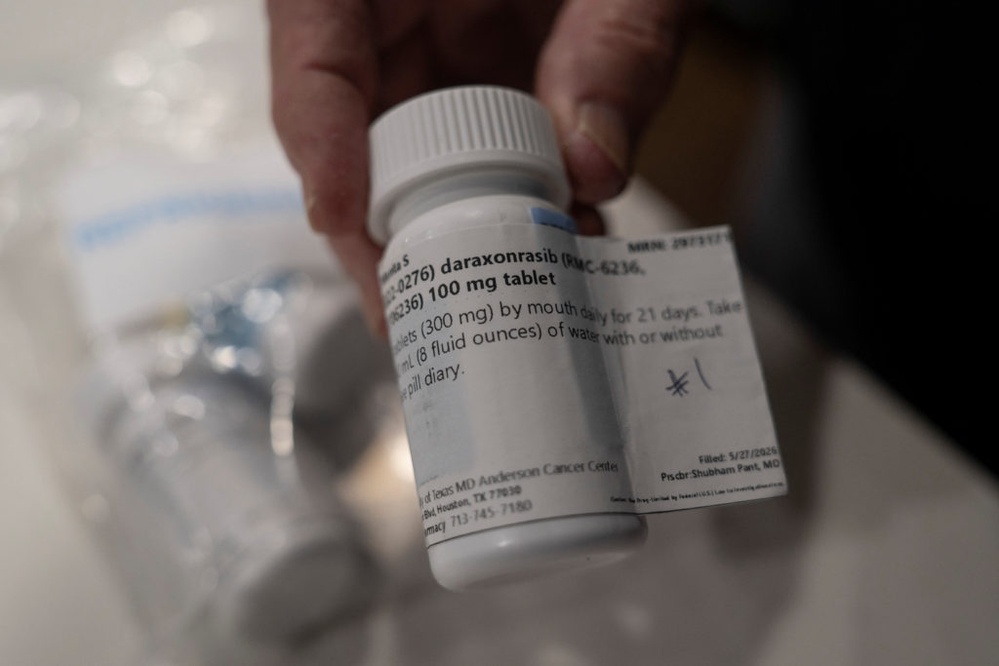
Coverage portrays the breakthrough as a cautiously optimistic advance, citing substantial but not curative survival gains from a KRAS-targeting pill, noting sponsor involvement and expedited regulatory plans, and stressing the need for independent confirmation and longer follow-up.
Report summarizes a randomized trial showing daraxonrasib nearly doubles median survival in metastatic pancreatic cancer compared with chemotherapy, with durable responses and manageable side effects, while not curing the disease and noting sponsor involvement and regulatory review.
Text-based; may overemphasize progress, underplay limitations
May 31, 2026 · 0 shares
Overall, coverage is data-driven and cautiously optimistic about daraxonrasib’s survival benefit, while not misrepresenting limitations, highlighting side effects and ongoing follow-up, and noting regulatory steps, yielding a mild pro-advancement bias grounded in trial transparency and expert commentary.
Reports on a randomized trial of daraxonrasib in metastatic pancreatic cancer showing median overall survival of 13.2 months vs 6.7 months in 500 patients, with manageable side effects, NEJM publication, and ASCO presentation; notes not curative and ongoing follow-up.
Bias toward mainstream medical sources; may understate limitations.
May 31, 2026 · 0 shares
Balanced, evidence-based review with cautious optimism for combination immunotherapies in KRAS-mutant PDAC, acknowledging monotherapy limits, detailing TME-driven immunosuppression with dense stroma and metabolic adaptations, and highlighting multimodal strategies, novel immunotherapies, delivery technologies, and biomarker-driven precision directions.
This is a scientific review describing the aggressiveness of PDAC, the high prevalence of KRAS mutations, immunosuppressive TME features, resistance to ICIs, and proposed multimodal combination strategies and biomarkers.
Data-driven, cautious optimism; could underreport negative/failed trials.
May 31, 2026 · 0 shares
Overall, coverage is data-driven and cautiously optimistic about daraxonrasib’s survival benefit, while not misrepresenting limitations, highlighting side effects and ongoing follow-up, and noting regulatory steps, yielding a mild pro-advancement bias grounded in trial transparency and expert commentary.
Reports on a randomized trial of daraxonrasib in metastatic pancreatic cancer showing median overall survival of 13.2 months vs 6.7 months in 500 patients, with manageable side effects, NEJM publication, and ASCO presentation; notes not curative and ongoing follow-up.
Bias toward mainstream medical sources; may understate limitations.
May 31, 2026 · 0 shares
Overall, coverage is evidence-based and cautiously optimistic: it foregrounds robust trial data (60% death-risk reduction; median survival gains; reduced severe side effects) while noting limitations (not curative, durability of benefit, ongoing follow-up, and potential industry funding influence), balancing expert quotes with regulatory progress and patient anecdotes to present a nuanced, credible portrayal of an early but promising advancement in pancreatic cancer treatment.
500-patient randomized trial in metastatic pancreatic cancer shows daraxonrasib extending median survival and reducing death risk compared with standard chemotherapy, with regulatory steps under consideration and sponsor funding noted.
I rely on text; may overvalue reported data and quotes while underemphasizing limitations.
May 31, 2026 · 0 shares
Moderate advertising bias toward daraxonrasib and KRAS-targeted therapy is evident, highlighting dramatic survival gains and positive expert praise while offering limited critical discussion of trial limitations.
ASCO presentation of a 500-patient international trial of a KRAS-targeted therapy in advanced pancreatic cancer, detailing longer survival and a favorable safety profile, with calls for UK trial access.
Propensity to echo positive trial framing; limited broader context.
June 01, 2026 · 0 shares
An optimistic, data-driven portrayal of an experimental cancer drug with strong efficacy signals (median survival, PFS, and response rates) and broad applicability claims, framed as investigational with regulatory review ongoing and potential to change standard care, while noting no unexpected safety concerns.
Phase 3 trial results for an experimental pancreatic cancer drug show substantial survival benefits and tolerable safety profile; reported data come from a large randomized study with expert commentary.
Limited to training data; aims for neutrality but may miss latest trials.
Coverage portrays the breakthrough as a cautiously optimistic advance, citing substantial but not curative survival gains from a KRAS-targeting pill, noting sponsor involvement and expedited regulatory plans, and stressing the need for independent confirmation and longer follow-up.
Report summarizes a randomized trial showing daraxonrasib nearly doubles median survival in metastatic pancreatic cancer compared with chemotherapy, with durable responses and manageable side effects, while not curing the disease and noting sponsor involvement and regulatory review.
Text-based; may overemphasize progress, underplay limitations
May 31, 2026 · 0 shares
Moderate advertising bias toward daraxonrasib and KRAS-targeted therapy is evident, highlighting dramatic survival gains and positive expert praise while offering limited critical discussion of trial limitations.
ASCO presentation of a 500-patient international trial of a KRAS-targeted therapy in advanced pancreatic cancer, detailing longer survival and a favorable safety profile, with calls for UK trial access.
Propensity to echo positive trial framing; limited broader context.
June 01, 2026 · 0 shares
An optimistic, data-driven portrayal of an experimental cancer drug with strong efficacy signals (median survival, PFS, and response rates) and broad applicability claims, framed as investigational with regulatory review ongoing and potential to change standard care, while noting no unexpected safety concerns.
Phase 3 trial results for an experimental pancreatic cancer drug show substantial survival benefits and tolerable safety profile; reported data come from a large randomized study with expert commentary.
Limited to training data; aims for neutrality but may miss latest trials.
May 31, 2026 · 0 shares
Overall, coverage is data-driven and cautiously optimistic about daraxonrasib’s survival benefit, while not misrepresenting limitations, highlighting side effects and ongoing follow-up, and noting regulatory steps, yielding a mild pro-advancement bias grounded in trial transparency and expert commentary.
Reports on a randomized trial of daraxonrasib in metastatic pancreatic cancer showing median overall survival of 13.2 months vs 6.7 months in 500 patients, with manageable side effects, NEJM publication, and ASCO presentation; notes not curative and ongoing follow-up.
Bias toward mainstream medical sources; may understate limitations.
May 31, 2026 · 0 shares
Moderate advertising bias toward daraxonrasib and KRAS-targeted therapy is evident, highlighting dramatic survival gains and positive expert praise while offering limited critical discussion of trial limitations.
ASCO presentation of a 500-patient international trial of a KRAS-targeted therapy in advanced pancreatic cancer, detailing longer survival and a favorable safety profile, with calls for UK trial access.
Propensity to echo positive trial framing; limited broader context.
May 31, 2026 · 0 shares
Overall, coverage is data-driven and cautiously optimistic about daraxonrasib’s survival benefit, while not misrepresenting limitations, highlighting side effects and ongoing follow-up, and noting regulatory steps, yielding a mild pro-advancement bias grounded in trial transparency and expert commentary.
Reports on a randomized trial of daraxonrasib in metastatic pancreatic cancer showing median overall survival of 13.2 months vs 6.7 months in 500 patients, with manageable side effects, NEJM publication, and ASCO presentation; notes not curative and ongoing follow-up.
Bias toward mainstream medical sources; may understate limitations.
May 31, 2026 · 0 shares
Overall, coverage is data-driven and cautiously optimistic about daraxonrasib’s survival benefit, while not misrepresenting limitations, highlighting side effects and ongoing follow-up, and noting regulatory steps, yielding a mild pro-advancement bias grounded in trial transparency and expert commentary.
Reports on a randomized trial of daraxonrasib in metastatic pancreatic cancer showing median overall survival of 13.2 months vs 6.7 months in 500 patients, with manageable side effects, NEJM publication, and ASCO presentation; notes not curative and ongoing follow-up.
Bias toward mainstream medical sources; may understate limitations.
May 31, 2026 · 0 shares
Moderate advertising bias toward daraxonrasib and KRAS-targeted therapy is evident, highlighting dramatic survival gains and positive expert praise while offering limited critical discussion of trial limitations.
ASCO presentation of a 500-patient international trial of a KRAS-targeted therapy in advanced pancreatic cancer, detailing longer survival and a favorable safety profile, with calls for UK trial access.
Propensity to echo positive trial framing; limited broader context.
May 31, 2026 · 0 shares
Overall, coverage is data-driven and cautiously optimistic about daraxonrasib’s survival benefit, while not misrepresenting limitations, highlighting side effects and ongoing follow-up, and noting regulatory steps, yielding a mild pro-advancement bias grounded in trial transparency and expert commentary.
Reports on a randomized trial of daraxonrasib in metastatic pancreatic cancer showing median overall survival of 13.2 months vs 6.7 months in 500 patients, with manageable side effects, NEJM publication, and ASCO presentation; notes not curative and ongoing follow-up.
Bias toward mainstream medical sources; may understate limitations.
May 31, 2026 · 0 shares
Promotes cautious optimism about sponsor-funded KRAS-targeting therapy, highlighting substantial survival gains and tolerable side effects while acknowledging not curative status, regulatory steps, and the potential to alter standard care, with clinical praise and an emphasis on future research.
Fact-based report on a randomized trial showing daraxonrasib improves survival in metastatic pancreatic cancer, with regulatory context and industry funding disclosed.
May overemphasize novelty in medical-news from training data
Coverage portrays the breakthrough as a cautiously optimistic advance, citing substantial but not curative survival gains from a KRAS-targeting pill, noting sponsor involvement and expedited regulatory plans, and stressing the need for independent confirmation and longer follow-up.
Report summarizes a randomized trial showing daraxonrasib nearly doubles median survival in metastatic pancreatic cancer compared with chemotherapy, with durable responses and manageable side effects, while not curing the disease and noting sponsor involvement and regulatory review.
Text-based; may overemphasize progress, underplay limitations
Bias is predominantly objective and data-driven, presenting explicit performance metrics with confidence intervals from a retrospective cohort, with mild optimism about clinical utility but no sensational framing.
Retrospective cohort study evaluating EPISEEK-MCED performance in detecting PDAC across disease stages against healthy controls.
Rely on provided text; may miss unreported limitations.
Technique-focused, neutral tone with cautious language on translational potential and no detectable political, ideological, or sensational framing.
Five PDAC surgical specimens and normal pancreatic tissue were imaged with autofluorescence-based 3D LSFM; ML-assisted segmentation resolved 3D microarchitecture and enabled downstream histochemical analysis.
AI training data may underrepresent niche PDAC imaging methods.
May 31, 2026 · 0 shares
Overall, coverage is data-driven and cautiously optimistic about daraxonrasib’s survival benefit, while not misrepresenting limitations, highlighting side effects and ongoing follow-up, and noting regulatory steps, yielding a mild pro-advancement bias grounded in trial transparency and expert commentary.
Reports on a randomized trial of daraxonrasib in metastatic pancreatic cancer showing median overall survival of 13.2 months vs 6.7 months in 500 patients, with manageable side effects, NEJM publication, and ASCO presentation; notes not curative and ongoing follow-up.
Bias toward mainstream medical sources; may understate limitations.
May 31, 2026 · 0 shares
Overall, coverage is evidence-based and cautiously optimistic: it foregrounds robust trial data (60% death-risk reduction; median survival gains; reduced severe side effects) while noting limitations (not curative, durability of benefit, ongoing follow-up, and potential industry funding influence), balancing expert quotes with regulatory progress and patient anecdotes to present a nuanced, credible portrayal of an early but promising advancement in pancreatic cancer treatment.
500-patient randomized trial in metastatic pancreatic cancer shows daraxonrasib extending median survival and reducing death risk compared with standard chemotherapy, with regulatory steps under consideration and sponsor funding noted.
I rely on text; may overvalue reported data and quotes while underemphasizing limitations.
May 31, 2026 · 0 shares
Moderate advertising bias toward daraxonrasib and KRAS-targeted therapy is evident, highlighting dramatic survival gains and positive expert praise while offering limited critical discussion of trial limitations.
ASCO presentation of a 500-patient international trial of a KRAS-targeted therapy in advanced pancreatic cancer, detailing longer survival and a favorable safety profile, with calls for UK trial access.
Propensity to echo positive trial framing; limited broader context.
June 01, 2026 · 0 shares
An optimistic, data-driven portrayal of an experimental cancer drug with strong efficacy signals (median survival, PFS, and response rates) and broad applicability claims, framed as investigational with regulatory review ongoing and potential to change standard care, while noting no unexpected safety concerns.
Phase 3 trial results for an experimental pancreatic cancer drug show substantial survival benefits and tolerable safety profile; reported data come from a large randomized study with expert commentary.
Limited to training data; aims for neutrality but may miss latest trials.
Coverage portrays the breakthrough as a cautiously optimistic advance, citing substantial but not curative survival gains from a KRAS-targeting pill, noting sponsor involvement and expedited regulatory plans, and stressing the need for independent confirmation and longer follow-up.
Report summarizes a randomized trial showing daraxonrasib nearly doubles median survival in metastatic pancreatic cancer compared with chemotherapy, with durable responses and manageable side effects, while not curing the disease and noting sponsor involvement and regulatory review.
Text-based; may overemphasize progress, underplay limitations
May 31, 2026 · 0 shares
Overall, coverage is data-driven and cautiously optimistic about daraxonrasib’s survival benefit, while not misrepresenting limitations, highlighting side effects and ongoing follow-up, and noting regulatory steps, yielding a mild pro-advancement bias grounded in trial transparency and expert commentary.
Reports on a randomized trial of daraxonrasib in metastatic pancreatic cancer showing median overall survival of 13.2 months vs 6.7 months in 500 patients, with manageable side effects, NEJM publication, and ASCO presentation; notes not curative and ongoing follow-up.
Bias toward mainstream medical sources; may understate limitations.
May 31, 2026 · 0 shares
Moderate advertising bias toward daraxonrasib and KRAS-targeted therapy is evident, highlighting dramatic survival gains and positive expert praise while offering limited critical discussion of trial limitations.
ASCO presentation of a 500-patient international trial of a KRAS-targeted therapy in advanced pancreatic cancer, detailing longer survival and a favorable safety profile, with calls for UK trial access.
Propensity to echo positive trial framing; limited broader context.
May 31, 2026 · 0 shares
Overall, coverage is data-driven and cautiously optimistic about daraxonrasib’s survival benefit, while not misrepresenting limitations, highlighting side effects and ongoing follow-up, and noting regulatory steps, yielding a mild pro-advancement bias grounded in trial transparency and expert commentary.
Reports on a randomized trial of daraxonrasib in metastatic pancreatic cancer showing median overall survival of 13.2 months vs 6.7 months in 500 patients, with manageable side effects, NEJM publication, and ASCO presentation; notes not curative and ongoing follow-up.
Bias toward mainstream medical sources; may understate limitations.
May 31, 2026 · 0 shares
Promotes cautious optimism about sponsor-funded KRAS-targeting therapy, highlighting substantial survival gains and tolerable side effects while acknowledging not curative status, regulatory steps, and the potential to alter standard care, with clinical praise and an emphasis on future research.
Fact-based report on a randomized trial showing daraxonrasib improves survival in metastatic pancreatic cancer, with regulatory context and industry funding disclosed.
May overemphasize novelty in medical-news from training data
Coverage portrays the breakthrough as a cautiously optimistic advance, citing substantial but not curative survival gains from a KRAS-targeting pill, noting sponsor involvement and expedited regulatory plans, and stressing the need for independent confirmation and longer follow-up.
Report summarizes a randomized trial showing daraxonrasib nearly doubles median survival in metastatic pancreatic cancer compared with chemotherapy, with durable responses and manageable side effects, while not curing the disease and noting sponsor involvement and regulatory review.
Text-based; may overemphasize progress, underplay limitations
Clinical-efficacy lens vs evidence-caution lens (plus diagnostics ecosystem)
May 31, 2026 · 0 shares
Overall, coverage is data-driven and cautiously optimistic about daraxonrasib’s survival benefit, while not misrepresenting limitations, highlighting side effects and ongoing follow-up, and noting regulatory steps, yielding a mild pro-advancement bias grounded in trial transparency and expert commentary.
Reports on a randomized trial of daraxonrasib in metastatic pancreatic cancer showing median overall survival of 13.2 months vs 6.7 months in 500 patients, with manageable side effects, NEJM publication, and ASCO presentation; notes not curative and ongoing follow-up.
Bias toward mainstream medical sources; may understate limitations.
May 31, 2026 · 0 shares
Overall, coverage is evidence-based and cautiously optimistic: it foregrounds robust trial data (60% death-risk reduction; median survival gains; reduced severe side effects) while noting limitations (not curative, durability of benefit, ongoing follow-up, and potential industry funding influence), balancing expert quotes with regulatory progress and patient anecdotes to present a nuanced, credible portrayal of an early but promising advancement in pancreatic cancer treatment.
500-patient randomized trial in metastatic pancreatic cancer shows daraxonrasib extending median survival and reducing death risk compared with standard chemotherapy, with regulatory steps under consideration and sponsor funding noted.
I rely on text; may overvalue reported data and quotes while underemphasizing limitations.
June 01, 2026 · 0 shares
An optimistic, data-driven portrayal of an experimental cancer drug with strong efficacy signals (median survival, PFS, and response rates) and broad applicability claims, framed as investigational with regulatory review ongoing and potential to change standard care, while noting no unexpected safety concerns.
Phase 3 trial results for an experimental pancreatic cancer drug show substantial survival benefits and tolerable safety profile; reported data come from a large randomized study with expert commentary.
Limited to training data; aims for neutrality but may miss latest trials.
Coverage portrays the breakthrough as a cautiously optimistic advance, citing substantial but not curative survival gains from a KRAS-targeting pill, noting sponsor involvement and expedited regulatory plans, and stressing the need for independent confirmation and longer follow-up.
Report summarizes a randomized trial showing daraxonrasib nearly doubles median survival in metastatic pancreatic cancer compared with chemotherapy, with durable responses and manageable side effects, while not curing the disease and noting sponsor involvement and regulatory review.
Text-based; may overemphasize progress, underplay limitations
May 31, 2026 · 0 shares
Overall, coverage is data-driven and cautiously optimistic about daraxonrasib’s survival benefit, while not misrepresenting limitations, highlighting side effects and ongoing follow-up, and noting regulatory steps, yielding a mild pro-advancement bias grounded in trial transparency and expert commentary.
Reports on a randomized trial of daraxonrasib in metastatic pancreatic cancer showing median overall survival of 13.2 months vs 6.7 months in 500 patients, with manageable side effects, NEJM publication, and ASCO presentation; notes not curative and ongoing follow-up.
Bias toward mainstream medical sources; may understate limitations.
May 31, 2026 · 0 shares
Overall, coverage is data-driven and cautiously optimistic about daraxonrasib’s survival benefit, while not misrepresenting limitations, highlighting side effects and ongoing follow-up, and noting regulatory steps, yielding a mild pro-advancement bias grounded in trial transparency and expert commentary.
Reports on a randomized trial of daraxonrasib in metastatic pancreatic cancer showing median overall survival of 13.2 months vs 6.7 months in 500 patients, with manageable side effects, NEJM publication, and ASCO presentation; notes not curative and ongoing follow-up.
Bias toward mainstream medical sources; may understate limitations.
May 31, 2026 · 0 shares
Promotes cautious optimism about sponsor-funded KRAS-targeting therapy, highlighting substantial survival gains and tolerable side effects while acknowledging not curative status, regulatory steps, and the potential to alter standard care, with clinical praise and an emphasis on future research.
Fact-based report on a randomized trial showing daraxonrasib improves survival in metastatic pancreatic cancer, with regulatory context and industry funding disclosed.
May overemphasize novelty in medical-news from training data
Coverage portrays the breakthrough as a cautiously optimistic advance, citing substantial but not curative survival gains from a KRAS-targeting pill, noting sponsor involvement and expedited regulatory plans, and stressing the need for independent confirmation and longer follow-up.
Report summarizes a randomized trial showing daraxonrasib nearly doubles median survival in metastatic pancreatic cancer compared with chemotherapy, with durable responses and manageable side effects, while not curing the disease and noting sponsor involvement and regulatory review.
Text-based; may overemphasize progress, underplay limitations
May 31, 2026 · 0 shares
Overall, coverage is data-driven and cautiously optimistic about daraxonrasib’s survival benefit, while not misrepresenting limitations, highlighting side effects and ongoing follow-up, and noting regulatory steps, yielding a mild pro-advancement bias grounded in trial transparency and expert commentary.
Reports on a randomized trial of daraxonrasib in metastatic pancreatic cancer showing median overall survival of 13.2 months vs 6.7 months in 500 patients, with manageable side effects, NEJM publication, and ASCO presentation; notes not curative and ongoing follow-up.
Bias toward mainstream medical sources; may understate limitations.
May 31, 2026 · 0 shares
Moderate advertising bias toward daraxonrasib and KRAS-targeted therapy is evident, highlighting dramatic survival gains and positive expert praise while offering limited critical discussion of trial limitations.
ASCO presentation of a 500-patient international trial of a KRAS-targeted therapy in advanced pancreatic cancer, detailing longer survival and a favorable safety profile, with calls for UK trial access.
Propensity to echo positive trial framing; limited broader context.
May 31, 2026 · 0 shares
Promotes cautious optimism about sponsor-funded KRAS-targeting therapy, highlighting substantial survival gains and tolerable side effects while acknowledging not curative status, regulatory steps, and the potential to alter standard care, with clinical praise and an emphasis on future research.
Fact-based report on a randomized trial showing daraxonrasib improves survival in metastatic pancreatic cancer, with regulatory context and industry funding disclosed.
May overemphasize novelty in medical-news from training data
Coverage portrays the breakthrough as a cautiously optimistic advance, citing substantial but not curative survival gains from a KRAS-targeting pill, noting sponsor involvement and expedited regulatory plans, and stressing the need for independent confirmation and longer follow-up.
Report summarizes a randomized trial showing daraxonrasib nearly doubles median survival in metastatic pancreatic cancer compared with chemotherapy, with durable responses and manageable side effects, while not curing the disease and noting sponsor involvement and regulatory review.
Text-based; may overemphasize progress, underplay limitations
Bias is predominantly objective and data-driven, presenting explicit performance metrics with confidence intervals from a retrospective cohort, with mild optimism about clinical utility but no sensational framing.
Retrospective cohort study evaluating EPISEEK-MCED performance in detecting PDAC across disease stages against healthy controls.
Rely on provided text; may miss unreported limitations.
Technique-focused, neutral tone with cautious language on translational potential and no detectable political, ideological, or sensational framing.
Five PDAC surgical specimens and normal pancreatic tissue were imaged with autofluorescence-based 3D LSFM; ML-assisted segmentation resolved 3D microarchitecture and enabled downstream histochemical analysis.
AI training data may underrepresent niche PDAC imaging methods.
May 31, 2026 · 0 shares
Balanced, evidence-based review with cautious optimism for combination immunotherapies in KRAS-mutant PDAC, acknowledging monotherapy limits, detailing TME-driven immunosuppression with dense stroma and metabolic adaptations, and highlighting multimodal strategies, novel immunotherapies, delivery technologies, and biomarker-driven precision directions.
This is a scientific review describing the aggressiveness of PDAC, the high prevalence of KRAS mutations, immunosuppressive TME features, resistance to ICIs, and proposed multimodal combination strategies and biomarkers.
Data-driven, cautious optimism; could underreport negative/failed trials.
May 31, 2026 · 0 shares
Moderate advertising bias toward daraxonrasib and KRAS-targeted therapy is evident, highlighting dramatic survival gains and positive expert praise while offering limited critical discussion of trial limitations.
ASCO presentation of a 500-patient international trial of a KRAS-targeted therapy in advanced pancreatic cancer, detailing longer survival and a favorable safety profile, with calls for UK trial access.
Propensity to echo positive trial framing; limited broader context.
June 01, 2026 · 0 shares
An optimistic, data-driven portrayal of an experimental cancer drug with strong efficacy signals (median survival, PFS, and response rates) and broad applicability claims, framed as investigational with regulatory review ongoing and potential to change standard care, while noting no unexpected safety concerns.
Phase 3 trial results for an experimental pancreatic cancer drug show substantial survival benefits and tolerable safety profile; reported data come from a large randomized study with expert commentary.
Limited to training data; aims for neutrality but may miss latest trials.
Helium Bias
May 31, 2026 · 0 shares
Overall, coverage is data-driven and cautiously optimistic about daraxonrasib’s survival benefit, while not misrepresenting limitations, highlighting side effects and ongoing follow-up, and noting regulatory steps, yielding a mild pro-advancement bias grounded in trial transparency and expert commentary.
Reports on a randomized trial of daraxonrasib in metastatic pancreatic cancer showing median overall survival of 13.2 months vs 6.7 months in 500 patients, with manageable side effects, NEJM publication, and ASCO presentation; notes not curative and ongoing follow-up.
Bias toward mainstream medical sources; may understate limitations.
May 31, 2026 · 0 shares
Overall, coverage is evidence-based and cautiously optimistic: it foregrounds robust trial data (60% death-risk reduction; median survival gains; reduced severe side effects) while noting limitations (not curative, durability of benefit, ongoing follow-up, and potential industry funding influence), balancing expert quotes with regulatory progress and patient anecdotes to present a nuanced, credible portrayal of an early but promising advancement in pancreatic cancer treatment.
500-patient randomized trial in metastatic pancreatic cancer shows daraxonrasib extending median survival and reducing death risk compared with standard chemotherapy, with regulatory steps under consideration and sponsor funding noted.
I rely on text; may overvalue reported data and quotes while underemphasizing limitations.
Coverage portrays the breakthrough as a cautiously optimistic advance, citing substantial but not curative survival gains from a KRAS-targeting pill, noting sponsor involvement and expedited regulatory plans, and stressing the need for independent confirmation and longer follow-up.
Report summarizes a randomized trial showing daraxonrasib nearly doubles median survival in metastatic pancreatic cancer compared with chemotherapy, with durable responses and manageable side effects, while not curing the disease and noting sponsor involvement and regulatory review.
Text-based; may overemphasize progress, underplay limitations
Coverage portrays the breakthrough as a cautiously optimistic advance, citing substantial but not curative survival gains from a KRAS-targeting pill, noting sponsor involvement and expedited regulatory plans, and stressing the need for independent confirmation and longer follow-up.
Report summarizes a randomized trial showing daraxonrasib nearly doubles median survival in metastatic pancreatic cancer compared with chemotherapy, with durable responses and manageable side effects, while not curing the disease and noting sponsor involvement and regulatory review.
Text-based; may overemphasize progress, underplay limitations
May 31, 2026 · 0 shares
Overall, coverage is data-driven and cautiously optimistic about daraxonrasib’s survival benefit, while not misrepresenting limitations, highlighting side effects and ongoing follow-up, and noting regulatory steps, yielding a mild pro-advancement bias grounded in trial transparency and expert commentary.
Reports on a randomized trial of daraxonrasib in metastatic pancreatic cancer showing median overall survival of 13.2 months vs 6.7 months in 500 patients, with manageable side effects, NEJM publication, and ASCO presentation; notes not curative and ongoing follow-up.
Bias toward mainstream medical sources; may understate limitations.
Coverage portrays the breakthrough as a cautiously optimistic advance, citing substantial but not curative survival gains from a KRAS-targeting pill, noting sponsor involvement and expedited regulatory plans, and stressing the need for independent confirmation and longer follow-up.
Report summarizes a randomized trial showing daraxonrasib nearly doubles median survival in metastatic pancreatic cancer compared with chemotherapy, with durable responses and manageable side effects, while not curing the disease and noting sponsor involvement and regulatory review.
Text-based; may overemphasize progress, underplay limitations
June 01, 2026 · 0 shares
An optimistic, data-driven portrayal of an experimental cancer drug with strong efficacy signals (median survival, PFS, and response rates) and broad applicability claims, framed as investigational with regulatory review ongoing and potential to change standard care, while noting no unexpected safety concerns.
Phase 3 trial results for an experimental pancreatic cancer drug show substantial survival benefits and tolerable safety profile; reported data come from a large randomized study with expert commentary.
Limited to training data; aims for neutrality but may miss latest trials.
Story Blindspots
May 31, 2026 · 0 shares
Moderate advertising bias toward daraxonrasib and KRAS-targeted therapy is evident, highlighting dramatic survival gains and positive expert praise while offering limited critical discussion of trial limitations.
ASCO presentation of a 500-patient international trial of a KRAS-targeted therapy in advanced pancreatic cancer, detailing longer survival and a favorable safety profile, with calls for UK trial access.
Propensity to echo positive trial framing; limited broader context.
June 01, 2026 · 0 shares
An optimistic, data-driven portrayal of an experimental cancer drug with strong efficacy signals (median survival, PFS, and response rates) and broad applicability claims, framed as investigational with regulatory review ongoing and potential to change standard care, while noting no unexpected safety concerns.
Phase 3 trial results for an experimental pancreatic cancer drug show substantial survival benefits and tolerable safety profile; reported data come from a large randomized study with expert commentary.
Limited to training data; aims for neutrality but may miss latest trials.
May 31, 2026 · 0 shares
Overall, coverage is data-driven and cautiously optimistic about daraxonrasib’s survival benefit, while not misrepresenting limitations, highlighting side effects and ongoing follow-up, and noting regulatory steps, yielding a mild pro-advancement bias grounded in trial transparency and expert commentary.
Reports on a randomized trial of daraxonrasib in metastatic pancreatic cancer showing median overall survival of 13.2 months vs 6.7 months in 500 patients, with manageable side effects, NEJM publication, and ASCO presentation; notes not curative and ongoing follow-up.
Bias toward mainstream medical sources; may understate limitations.
May 31, 2026 · 0 shares
Overall, coverage is evidence-based and cautiously optimistic: it foregrounds robust trial data (60% death-risk reduction; median survival gains; reduced severe side effects) while noting limitations (not curative, durability of benefit, ongoing follow-up, and potential industry funding influence), balancing expert quotes with regulatory progress and patient anecdotes to present a nuanced, credible portrayal of an early but promising advancement in pancreatic cancer treatment.
500-patient randomized trial in metastatic pancreatic cancer shows daraxonrasib extending median survival and reducing death risk compared with standard chemotherapy, with regulatory steps under consideration and sponsor funding noted.
I rely on text; may overvalue reported data and quotes while underemphasizing limitations.
May 31, 2026 · 0 shares
Moderate advertising bias toward daraxonrasib and KRAS-targeted therapy is evident, highlighting dramatic survival gains and positive expert praise while offering limited critical discussion of trial limitations.
ASCO presentation of a 500-patient international trial of a KRAS-targeted therapy in advanced pancreatic cancer, detailing longer survival and a favorable safety profile, with calls for UK trial access.
Propensity to echo positive trial framing; limited broader context.
May 31, 2026 · 0 shares
Overall, coverage is data-driven and cautiously optimistic about daraxonrasib’s survival benefit, while not misrepresenting limitations, highlighting side effects and ongoing follow-up, and noting regulatory steps, yielding a mild pro-advancement bias grounded in trial transparency and expert commentary.
Reports on a randomized trial of daraxonrasib in metastatic pancreatic cancer showing median overall survival of 13.2 months vs 6.7 months in 500 patients, with manageable side effects, NEJM publication, and ASCO presentation; notes not curative and ongoing follow-up.
Bias toward mainstream medical sources; may understate limitations.
May 31, 2026 · 0 shares
Promotes cautious optimism about sponsor-funded KRAS-targeting therapy, highlighting substantial survival gains and tolerable side effects while acknowledging not curative status, regulatory steps, and the potential to alter standard care, with clinical praise and an emphasis on future research.
Fact-based report on a randomized trial showing daraxonrasib improves survival in metastatic pancreatic cancer, with regulatory context and industry funding disclosed.
May overemphasize novelty in medical-news from training data
Bias is predominantly objective and data-driven, presenting explicit performance metrics with confidence intervals from a retrospective cohort, with mild optimism about clinical utility but no sensational framing.
Retrospective cohort study evaluating EPISEEK-MCED performance in detecting PDAC across disease stages against healthy controls.
Rely on provided text; may miss unreported limitations.
Technique-focused, neutral tone with cautious language on translational potential and no detectable political, ideological, or sensational framing.
Five PDAC surgical specimens and normal pancreatic tissue were imaged with autofluorescence-based 3D LSFM; ML-assisted segmentation resolved 3D microarchitecture and enabled downstream histochemical analysis.
AI training data may underrepresent niche PDAC imaging methods.
May 31, 2026 · 0 shares
Overall, coverage is data-driven and cautiously optimistic about daraxonrasib’s survival benefit, while not misrepresenting limitations, highlighting side effects and ongoing follow-up, and noting regulatory steps, yielding a mild pro-advancement bias grounded in trial transparency and expert commentary.
Reports on a randomized trial of daraxonrasib in metastatic pancreatic cancer showing median overall survival of 13.2 months vs 6.7 months in 500 patients, with manageable side effects, NEJM publication, and ASCO presentation; notes not curative and ongoing follow-up.
Bias toward mainstream medical sources; may understate limitations.
May 31, 2026 · 0 shares
Overall, coverage is evidence-based and cautiously optimistic: it foregrounds robust trial data (60% death-risk reduction; median survival gains; reduced severe side effects) while noting limitations (not curative, durability of benefit, ongoing follow-up, and potential industry funding influence), balancing expert quotes with regulatory progress and patient anecdotes to present a nuanced, credible portrayal of an early but promising advancement in pancreatic cancer treatment.
500-patient randomized trial in metastatic pancreatic cancer shows daraxonrasib extending median survival and reducing death risk compared with standard chemotherapy, with regulatory steps under consideration and sponsor funding noted.
I rely on text; may overvalue reported data and quotes while underemphasizing limitations.
May 31, 2026 · 0 shares
Moderate advertising bias toward daraxonrasib and KRAS-targeted therapy is evident, highlighting dramatic survival gains and positive expert praise while offering limited critical discussion of trial limitations.
ASCO presentation of a 500-patient international trial of a KRAS-targeted therapy in advanced pancreatic cancer, detailing longer survival and a favorable safety profile, with calls for UK trial access.
Propensity to echo positive trial framing; limited broader context.
June 01, 2026 · 0 shares
An optimistic, data-driven portrayal of an experimental cancer drug with strong efficacy signals (median survival, PFS, and response rates) and broad applicability claims, framed as investigational with regulatory review ongoing and potential to change standard care, while noting no unexpected safety concerns.
Phase 3 trial results for an experimental pancreatic cancer drug show substantial survival benefits and tolerable safety profile; reported data come from a large randomized study with expert commentary.
Limited to training data; aims for neutrality but may miss latest trials.
Coverage portrays the breakthrough as a cautiously optimistic advance, citing substantial but not curative survival gains from a KRAS-targeting pill, noting sponsor involvement and expedited regulatory plans, and stressing the need for independent confirmation and longer follow-up.
Report summarizes a randomized trial showing daraxonrasib nearly doubles median survival in metastatic pancreatic cancer compared with chemotherapy, with durable responses and manageable side effects, while not curing the disease and noting sponsor involvement and regulatory review.
Text-based; may overemphasize progress, underplay limitations
May 31, 2026 · 0 shares
Overall, coverage is data-driven and cautiously optimistic about daraxonrasib’s survival benefit, while not misrepresenting limitations, highlighting side effects and ongoing follow-up, and noting regulatory steps, yielding a mild pro-advancement bias grounded in trial transparency and expert commentary.
Reports on a randomized trial of daraxonrasib in metastatic pancreatic cancer showing median overall survival of 13.2 months vs 6.7 months in 500 patients, with manageable side effects, NEJM publication, and ASCO presentation; notes not curative and ongoing follow-up.
Bias toward mainstream medical sources; may understate limitations.
May 31, 2026 · 0 shares
Moderate advertising bias toward daraxonrasib and KRAS-targeted therapy is evident, highlighting dramatic survival gains and positive expert praise while offering limited critical discussion of trial limitations.
ASCO presentation of a 500-patient international trial of a KRAS-targeted therapy in advanced pancreatic cancer, detailing longer survival and a favorable safety profile, with calls for UK trial access.
Propensity to echo positive trial framing; limited broader context.
May 31, 2026 · 0 shares
Overall, coverage is data-driven and cautiously optimistic about daraxonrasib’s survival benefit, while not misrepresenting limitations, highlighting side effects and ongoing follow-up, and noting regulatory steps, yielding a mild pro-advancement bias grounded in trial transparency and expert commentary.
Reports on a randomized trial of daraxonrasib in metastatic pancreatic cancer showing median overall survival of 13.2 months vs 6.7 months in 500 patients, with manageable side effects, NEJM publication, and ASCO presentation; notes not curative and ongoing follow-up.
Bias toward mainstream medical sources; may understate limitations.
May 31, 2026 · 0 shares
Overall, coverage is data-driven and cautiously optimistic about daraxonrasib’s survival benefit, while not misrepresenting limitations, highlighting side effects and ongoing follow-up, and noting regulatory steps, yielding a mild pro-advancement bias grounded in trial transparency and expert commentary.
Reports on a randomized trial of daraxonrasib in metastatic pancreatic cancer showing median overall survival of 13.2 months vs 6.7 months in 500 patients, with manageable side effects, NEJM publication, and ASCO presentation; notes not curative and ongoing follow-up.
Bias toward mainstream medical sources; may understate limitations.
May 31, 2026 · 0 shares
Promotes cautious optimism about sponsor-funded KRAS-targeting therapy, highlighting substantial survival gains and tolerable side effects while acknowledging not curative status, regulatory steps, and the potential to alter standard care, with clinical praise and an emphasis on future research.
Fact-based report on a randomized trial showing daraxonrasib improves survival in metastatic pancreatic cancer, with regulatory context and industry funding disclosed.
May overemphasize novelty in medical-news from training data
Coverage portrays the breakthrough as a cautiously optimistic advance, citing substantial but not curative survival gains from a KRAS-targeting pill, noting sponsor involvement and expedited regulatory plans, and stressing the need for independent confirmation and longer follow-up.
Report summarizes a randomized trial showing daraxonrasib nearly doubles median survival in metastatic pancreatic cancer compared with chemotherapy, with durable responses and manageable side effects, while not curing the disease and noting sponsor involvement and regulatory review.
Text-based; may overemphasize progress, underplay limitations
Bias is predominantly objective and data-driven, presenting explicit performance metrics with confidence intervals from a retrospective cohort, with mild optimism about clinical utility but no sensational framing.
Retrospective cohort study evaluating EPISEEK-MCED performance in detecting PDAC across disease stages against healthy controls.
Rely on provided text; may miss unreported limitations.
Technique-focused, neutral tone with cautious language on translational potential and no detectable political, ideological, or sensational framing.
Five PDAC surgical specimens and normal pancreatic tissue were imaged with autofluorescence-based 3D LSFM; ML-assisted segmentation resolved 3D microarchitecture and enabled downstream histochemical analysis.
AI training data may underrepresent niche PDAC imaging methods.
Bias is predominantly objective and data-driven, presenting explicit performance metrics with confidence intervals from a retrospective cohort, with mild optimism about clinical utility but no sensational framing.
Retrospective cohort study evaluating EPISEEK-MCED performance in detecting PDAC across disease stages against healthy controls.
Rely on provided text; may miss unreported limitations.
Technique-focused, neutral tone with cautious language on translational potential and no detectable political, ideological, or sensational framing.
Five PDAC surgical specimens and normal pancreatic tissue were imaged with autofluorescence-based 3D LSFM; ML-assisted segmentation resolved 3D microarchitecture and enabled downstream histochemical analysis.
AI training data may underrepresent niche PDAC imaging methods.
Coverage portrays the breakthrough as a cautiously optimistic advance, citing substantial but not curative survival gains from a KRAS-targeting pill, noting sponsor involvement and expedited regulatory plans, and stressing the need for independent confirmation and longer follow-up.
Report summarizes a randomized trial showing daraxonrasib nearly doubles median survival in metastatic pancreatic cancer compared with chemotherapy, with durable responses and manageable side effects, while not curing the disease and noting sponsor involvement and regulatory review.
Text-based; may overemphasize progress, underplay limitations
May 31, 2026 · 0 shares
Overall, coverage is data-driven and cautiously optimistic about daraxonrasib’s survival benefit, while not misrepresenting limitations, highlighting side effects and ongoing follow-up, and noting regulatory steps, yielding a mild pro-advancement bias grounded in trial transparency and expert commentary.
Reports on a randomized trial of daraxonrasib in metastatic pancreatic cancer showing median overall survival of 13.2 months vs 6.7 months in 500 patients, with manageable side effects, NEJM publication, and ASCO presentation; notes not curative and ongoing follow-up.
Bias toward mainstream medical sources; may understate limitations.
May 31, 2026 · 0 shares
Balanced, evidence-based review with cautious optimism for combination immunotherapies in KRAS-mutant PDAC, acknowledging monotherapy limits, detailing TME-driven immunosuppression with dense stroma and metabolic adaptations, and highlighting multimodal strategies, novel immunotherapies, delivery technologies, and biomarker-driven precision directions.
This is a scientific review describing the aggressiveness of PDAC, the high prevalence of KRAS mutations, immunosuppressive TME features, resistance to ICIs, and proposed multimodal combination strategies and biomarkers.
Data-driven, cautious optimism; could underreport negative/failed trials.
May 31, 2026 · 0 shares
Overall, coverage is data-driven and cautiously optimistic about daraxonrasib’s survival benefit, while not misrepresenting limitations, highlighting side effects and ongoing follow-up, and noting regulatory steps, yielding a mild pro-advancement bias grounded in trial transparency and expert commentary.
Reports on a randomized trial of daraxonrasib in metastatic pancreatic cancer showing median overall survival of 13.2 months vs 6.7 months in 500 patients, with manageable side effects, NEJM publication, and ASCO presentation; notes not curative and ongoing follow-up.
Bias toward mainstream medical sources; may understate limitations.
May 31, 2026 · 0 shares
Overall, coverage is evidence-based and cautiously optimistic: it foregrounds robust trial data (60% death-risk reduction; median survival gains; reduced severe side effects) while noting limitations (not curative, durability of benefit, ongoing follow-up, and potential industry funding influence), balancing expert quotes with regulatory progress and patient anecdotes to present a nuanced, credible portrayal of an early but promising advancement in pancreatic cancer treatment.
500-patient randomized trial in metastatic pancreatic cancer shows daraxonrasib extending median survival and reducing death risk compared with standard chemotherapy, with regulatory steps under consideration and sponsor funding noted.
I rely on text; may overvalue reported data and quotes while underemphasizing limitations.
May 31, 2026 · 0 shares
Moderate advertising bias toward daraxonrasib and KRAS-targeted therapy is evident, highlighting dramatic survival gains and positive expert praise while offering limited critical discussion of trial limitations.
ASCO presentation of a 500-patient international trial of a KRAS-targeted therapy in advanced pancreatic cancer, detailing longer survival and a favorable safety profile, with calls for UK trial access.
Propensity to echo positive trial framing; limited broader context.
June 01, 2026 · 0 shares
An optimistic, data-driven portrayal of an experimental cancer drug with strong efficacy signals (median survival, PFS, and response rates) and broad applicability claims, framed as investigational with regulatory review ongoing and potential to change standard care, while noting no unexpected safety concerns.
Phase 3 trial results for an experimental pancreatic cancer drug show substantial survival benefits and tolerable safety profile; reported data come from a large randomized study with expert commentary.
Limited to training data; aims for neutrality but may miss latest trials.
Coverage portrays the breakthrough as a cautiously optimistic advance, citing substantial but not curative survival gains from a KRAS-targeting pill, noting sponsor involvement and expedited regulatory plans, and stressing the need for independent confirmation and longer follow-up.
Report summarizes a randomized trial showing daraxonrasib nearly doubles median survival in metastatic pancreatic cancer compared with chemotherapy, with durable responses and manageable side effects, while not curing the disease and noting sponsor involvement and regulatory review.
Text-based; may overemphasize progress, underplay limitations
May 31, 2026 · 0 shares
Overall, coverage is data-driven and cautiously optimistic about daraxonrasib’s survival benefit, while not misrepresenting limitations, highlighting side effects and ongoing follow-up, and noting regulatory steps, yielding a mild pro-advancement bias grounded in trial transparency and expert commentary.
Reports on a randomized trial of daraxonrasib in metastatic pancreatic cancer showing median overall survival of 13.2 months vs 6.7 months in 500 patients, with manageable side effects, NEJM publication, and ASCO presentation; notes not curative and ongoing follow-up.
Bias toward mainstream medical sources; may understate limitations.
May 31, 2026 · 0 shares
Overall, coverage is data-driven and cautiously optimistic about daraxonrasib’s survival benefit, while not misrepresenting limitations, highlighting side effects and ongoing follow-up, and noting regulatory steps, yielding a mild pro-advancement bias grounded in trial transparency and expert commentary.
Reports on a randomized trial of daraxonrasib in metastatic pancreatic cancer showing median overall survival of 13.2 months vs 6.7 months in 500 patients, with manageable side effects, NEJM publication, and ASCO presentation; notes not curative and ongoing follow-up.
Bias toward mainstream medical sources; may understate limitations.
Coverage portrays the breakthrough as a cautiously optimistic advance, citing substantial but not curative survival gains from a KRAS-targeting pill, noting sponsor involvement and expedited regulatory plans, and stressing the need for independent confirmation and longer follow-up.
Report summarizes a randomized trial showing daraxonrasib nearly doubles median survival in metastatic pancreatic cancer compared with chemotherapy, with durable responses and manageable side effects, while not curing the disease and noting sponsor involvement and regulatory review.
Text-based; may overemphasize progress, underplay limitations
May 31, 2026 · 0 shares
Overall, coverage is data-driven and cautiously optimistic about daraxonrasib’s survival benefit, while not misrepresenting limitations, highlighting side effects and ongoing follow-up, and noting regulatory steps, yielding a mild pro-advancement bias grounded in trial transparency and expert commentary.
Reports on a randomized trial of daraxonrasib in metastatic pancreatic cancer showing median overall survival of 13.2 months vs 6.7 months in 500 patients, with manageable side effects, NEJM publication, and ASCO presentation; notes not curative and ongoing follow-up.
Bias toward mainstream medical sources; may understate limitations.
May 31, 2026 · 0 shares
Promotes cautious optimism about sponsor-funded KRAS-targeting therapy, highlighting substantial survival gains and tolerable side effects while acknowledging not curative status, regulatory steps, and the potential to alter standard care, with clinical praise and an emphasis on future research.
Fact-based report on a randomized trial showing daraxonrasib improves survival in metastatic pancreatic cancer, with regulatory context and industry funding disclosed.
May overemphasize novelty in medical-news from training data
Coverage portrays the breakthrough as a cautiously optimistic advance, citing substantial but not curative survival gains from a KRAS-targeting pill, noting sponsor involvement and expedited regulatory plans, and stressing the need for independent confirmation and longer follow-up.
Report summarizes a randomized trial showing daraxonrasib nearly doubles median survival in metastatic pancreatic cancer compared with chemotherapy, with durable responses and manageable side effects, while not curing the disease and noting sponsor involvement and regulatory review.
Text-based; may overemphasize progress, underplay limitations
May 31, 2026 · 0 shares
Moderate advertising bias toward daraxonrasib and KRAS-targeted therapy is evident, highlighting dramatic survival gains and positive expert praise while offering limited critical discussion of trial limitations.
ASCO presentation of a 500-patient international trial of a KRAS-targeted therapy in advanced pancreatic cancer, detailing longer survival and a favorable safety profile, with calls for UK trial access.
Propensity to echo positive trial framing; limited broader context.
Bias is predominantly objective and data-driven, presenting explicit performance metrics with confidence intervals from a retrospective cohort, with mild optimism about clinical utility but no sensational framing.
Retrospective cohort study evaluating EPISEEK-MCED performance in detecting PDAC across disease stages against healthy controls.
Rely on provided text; may miss unreported limitations.
Technique-focused, neutral tone with cautious language on translational potential and no detectable political, ideological, or sensational framing.
Five PDAC surgical specimens and normal pancreatic tissue were imaged with autofluorescence-based 3D LSFM; ML-assisted segmentation resolved 3D microarchitecture and enabled downstream histochemical analysis.
AI training data may underrepresent niche PDAC imaging methods.
May 31, 2026 · 0 shares
Overall, coverage is data-driven and cautiously optimistic about daraxonrasib’s survival benefit, while not misrepresenting limitations, highlighting side effects and ongoing follow-up, and noting regulatory steps, yielding a mild pro-advancement bias grounded in trial transparency and expert commentary.
Reports on a randomized trial of daraxonrasib in metastatic pancreatic cancer showing median overall survival of 13.2 months vs 6.7 months in 500 patients, with manageable side effects, NEJM publication, and ASCO presentation; notes not curative and ongoing follow-up.
Bias toward mainstream medical sources; may understate limitations.
May 31, 2026 · 0 shares
Overall, coverage is data-driven and cautiously optimistic about daraxonrasib’s survival benefit, while not misrepresenting limitations, highlighting side effects and ongoing follow-up, and noting regulatory steps, yielding a mild pro-advancement bias grounded in trial transparency and expert commentary.
Reports on a randomized trial of daraxonrasib in metastatic pancreatic cancer showing median overall survival of 13.2 months vs 6.7 months in 500 patients, with manageable side effects, NEJM publication, and ASCO presentation; notes not curative and ongoing follow-up.
Bias toward mainstream medical sources; may understate limitations.
Bias is predominantly objective and data-driven, presenting explicit performance metrics with confidence intervals from a retrospective cohort, with mild optimism about clinical utility but no sensational framing.
Retrospective cohort study evaluating EPISEEK-MCED performance in detecting PDAC across disease stages against healthy controls.
Rely on provided text; may miss unreported limitations.
Coverage portrays the breakthrough as a cautiously optimistic advance, citing substantial but not curative survival gains from a KRAS-targeting pill, noting sponsor involvement and expedited regulatory plans, and stressing the need for independent confirmation and longer follow-up.
Report summarizes a randomized trial showing daraxonrasib nearly doubles median survival in metastatic pancreatic cancer compared with chemotherapy, with durable responses and manageable side effects, while not curing the disease and noting sponsor involvement and regulatory review.
Text-based; may overemphasize progress, underplay limitations
2026 © Helium Trades
Privacy Policy & Disclosure
* Disclaimer: Nothing on this website constitutes investment advice, performance data or any recommendation that any particular security, portfolio of securities, transaction or investment strategy is suitable for any specific person. Helium Trades is not responsible in any way for the accuracy
of any model predictions or price data. Any mention of a particular security and related prediction data is not a recommendation to buy or sell that security. Investments in securities involve the risk of loss. Past performance is no guarantee of future results. Helium Trades is not responsible for any of your investment decisions,
you should consult a financial expert before engaging in any transaction.
AI Assistant

How can I help you today?
Ask any question about this page.