See whether Helium helps you make better-informed decisions. Try every Pro Trader feature for 30 days. No credit card required.
Try every Pro Trader feature for 30 days. No credit card required.
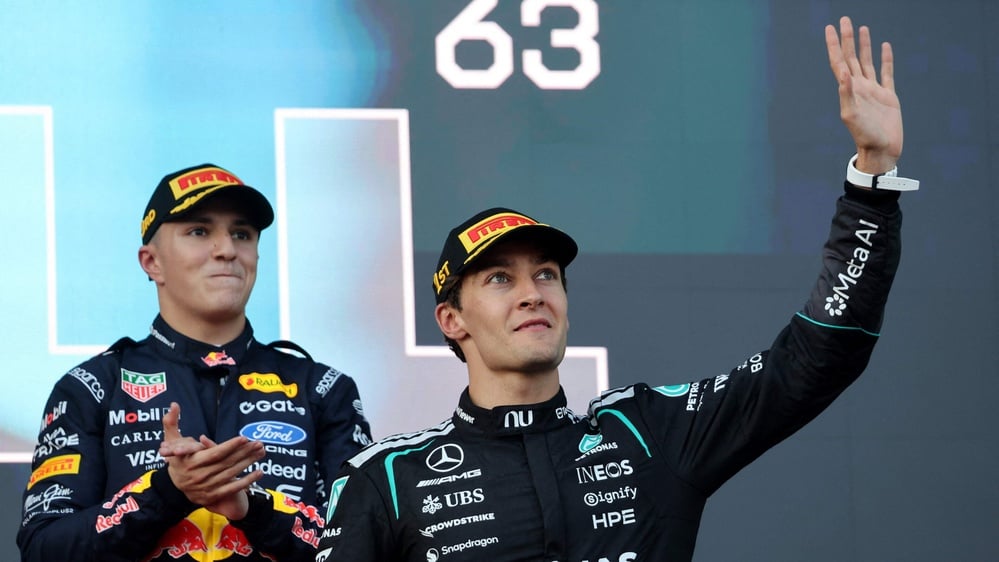
September 26, 2026 · 0 shares
Presents the Azerbaijan Grand Prix as a neutral, data-forward sports-news report, with subjective color confined to motorsport idioms and a direct driver quote.
Automated analysis; not human reviewed.
Limitations: Only a brief, single-source race report was supplied, so broader editorial patterns cannot be assessed.
·
4 of 55 available dimensions scored; omitted dimensions are not treated as neutral.
·
Verified supporting quotes for 4 of 4 scored dimensions.
Claim: Reporting focuses on verifiable race results, margins, and standings rather than interpretation.
“The win around the Baku street track was the eighth of Russell’s career, third of the season and his first since the Austrian Grand Prix at the end of June.” · exact text match
Why: The central statements are specific racing facts, and the only subjective coloring appears in conventional sports metaphors rather than in the factual claims.
Claim: The report stays close to race statistics and avoids sensational exaggeration.
“It allowed him to close the gap in the overall standings to Italian championship leader Antonelli by 15 points to 66 after 15 rounds.” · exact text match
Why: A key transition is expressed with exact points figures and round count, showing preference for data over hype.
Claim: The publisher's own tone is emotionally neutral.
“Charles Leclerc took fourth for Ferrari ahead of the 20-year-old Italian.” · exact text match
Why: The sentence is flatly informational; the only emotional language in the report appears inside Russell's quoted reaction.
Claim: The article provides specific, attributable reporting.
“Russell took the flag 0.196 seconds ahead of the flying Dutchman, who started eighth but crossed the line nearly side-by-side with his Mercedes rival after two safety car phases” · exact text match
““It’s amazing to be back on the top step of the podium,” said Russell.” · exact text match
Why: It gives an exact margin, starting position, race context, and a directly quoted driver, with no anonymous assertions.
Only a brief, single-source race report was supplied, so broader editorial patterns cannot be assessed.
September 27, 2026 · 0 shares
Framing runs as straightforward sports news centered on Russell's victory, mixing precise race facts with vivid language and driver quotes while avoiding political or commercial slant.
Automated analysis; not human reviewed.
Limitations: The single supplied wire text lacks external race data and independent verification, limiting scoring to internal evidence.
·
5 of 55 available dimensions scored; omitted dimensions are not treated as neutral.
·
Verified supporting quotes for 5 of 5 scored dimensions.
Claim: The report is predominantly factual, organized around results and times rather than opinion.
“George Russell has held off Max Verstappen for his first Formula 1 win in three months to cut into Kimi Antonelli's standings lead” · exact text match
Why: The lead states a verifiable race result, and the rest of the report supplies timings, grid positions, and attributed quotes.
Claim: The tone is factual but intermittently heightened by dramatic sports clichés.
“A dramatic finish with the checkered flag in sight” · exact text match
“George Russell took a Formula 1 win in the blink of an eye” · exact text match
Why: Precise race facts are balanced by theatrical phrases, so the framing is objective with mild sensational coloring.
Claim: The report describes what happened without prescribing judgments or remedies.
“Russell cut Mercedes teammate Kimi Antonelli’s standings lead from 81 points to 66 as the Italian recovered from 16th on the grid to finish fifth” · exact text match
Why: The sentence narrates an outcome with numeric results; no recommendation, call to action, or moral judgment follows.
Claim: The report is credible on its face due to specific numbers, named participants, dateline, and AP photo credits.
“Russell held off Max Verstappen by just .196 of a second to win the Azerbaijan Grand Prix on Saturday” · exact text match
Why: Precise timing and the dateline provide concrete, verifiable anchoring, though no external verification is available in this text.
Claim: The piece shows high internal fairness by separating driver quotes from reported facts and attributing them.
““My teammate’s had an incredible season.
He’s been pretty flawless throughout, but now we’re getting to crunch time,” Russell said.”
· exact text match
Why: Driver statements are explicitly framed as quotes, and results are stated independently.
The single supplied wire text lacks external race data and independent verification, limiting scoring to internal evidence.
September 26, 2026 · 0 shares
A factual race report whose framing uses dramatic adjectives and personal assessments to cast Russell's victory as a resilient comeback and Antonelli's fifth place as damage limitation.
The Azerbaijan Grand Prix is an event in the 2025 Formula One season; Antonelli entered Baku as Mercedes' championship leader and Russell's team-mate, with eight rounds remaining after the race.
Automated analysis; not human reviewed.
Limitations: Input is a single sports-news article; no independent verification of race facts or quote accuracy is available.
·
6 of 55 available dimensions scored; omitted dimensions are not treated as neutral.
·
Verified supporting quotes for 5 of 6 scored dimensions.
Claim: The report combines race data with evaluative adjectives that assign value to performances and moments.
“Russell had been imperious as he took pole by the best part of a second on Friday” · exact text match
“Another dismal weekend for Aston Martin” · exact text match
Why: Terms like 'imperious' and 'dismal' judge quality rather than neutrally describe it, though the body supplies extensive factual detail.
Claim: The race narrative emphasizes excitement and tension.
“George Russell held off Max Verstappen in a thrilling finale to claim victory in the Azerbaijan Grand Prix by just a tenth of a second” · exact text match
“chaos ensued behind” · exact text match
Why: The chosen words foreground drama and entertainment value common to sports coverage, but the reporting remains structured around race facts.
Claim: The article emphasizes positive outlooks for Mercedes and its drivers.
“Antonelli remains an overwhelming favourite for the title” · exact text match
“the result provides the Brit with a huge confidence boost” · exact text match
Counterevidence:
“While Russell still has an enormous task on his hands to catch Antonelli” · exact text match
Why: Both phrasings point to favorable championship standing and morale, although the article also notes Russell's 'enormous task.'
Claim: The writing stays in descriptive, narrative mode without issuing recommendations.
“The field poured into the pits during the stoppage before a short-lived restart at the start of lap 36” · exact text match
Why: The passage recounts what happened chronologically rather than telling readers what should happen.
Claim: The article contains authorial value judgments about teams and hypothetical outcomes.
“Another dismal weekend for Aston Martin” · exact text match
“It would have been extremely cruel for Russell to miss out on victory” · exact text match
Why: 'Dismal' and 'extremely cruel' are editorial evaluations, not neutral observations, giving the text a mildly opinionated tone.
Claim: The report grounds its account in attributed quotes, exact figures, and named incidents.
“Russell said: "The first half of the race felt pretty plain-sailing, getting the gap.” · not found in supplied text
“Colapinto apologised for what he described as " a big mistake"” · not found in supplied text
Why: Direct quotations and specific numbers (0.196s, 66 points, 160 points) give the account a clear sourcing basis.
Input is a single sports-news article; no independent verification of race facts or quote accuracy is available.
September 27, 2026 · 0 shares
A quote-led sports report frames Russell's Azerbaijan triumph as a confidence-driven turnaround, using his own statements and teammate context without editorial advocacy.
Automated analysis; not human reviewed.
Limitations: Supplied text mixes the main sports report with unrelated headlines and a self-promotional blurb; only the main sports report was assessed.
·
4 of 55 available dimensions scored; omitted dimensions are not treated as neutral.
·
Verified supporting quotes for 4 of 4 scored dimensions.
Claim: Reporting style is primarily factual and attribution-heavy, with a mildly favorable opening characterization.
““I think I never lost that faith in myself,” said Russell” · exact text match
“Antonelli, however, said he had his worst weekend of the season.” · exact text match
Counterevidence:
“after a resounding return to form with victory in Saturday’s Azerbaijan Grand Prix” · exact text match
Why: Statements are usually attributed to drivers or grounded in race statistics; the opening's 'resounding return to form' is the main evaluative phrase.
Claim: The report describes events and quotes without issuing recommendations.
“He started 16th after crashing out of qualifying and finished fifth in the race.” · exact text match
Why: The piece relays outcomes and statements, with no imperative or normative advice.
Claim: The report provides named sources, direct quotes, and specific figures that support verification.
“That allowed Russell to narrow the gap to Antonelli at the head of the standings from 81 points to 66.” · exact text match
““I think I never lost that faith in myself,” said Russell” · exact text match
Why: Attribution to named drivers and precise numerical details give the text a credible evidentiary base, though statistics are not independently checked.
Claim: The report balances the winner's perspective with the teammate's contrasting account.
“Antonelli, however, said he had his worst weekend of the season.” · exact text match
“The Italian has scored eight wins to Russell’s three” · exact text match
Why: Including Antonelli's poor weekend and the overall wins comparison provides context rather than one-sided promotion of Russell.
Supplied text mixes the main sports report with unrelated headlines and a self-promotional blurb; only the main sports report was assessed.
September 27, 2026 · 0 shares
Framing runs as straightforward sports news centered on Russell's victory, mixing precise race facts with vivid language and driver quotes while avoiding political or commercial slant.
Automated analysis; not human reviewed.
Limitations: The single supplied wire text lacks external race data and independent verification, limiting scoring to internal evidence.
·
5 of 55 available dimensions scored; omitted dimensions are not treated as neutral.
·
Verified supporting quotes for 5 of 5 scored dimensions.
Claim: The report is predominantly factual, organized around results and times rather than opinion.
“George Russell has held off Max Verstappen for his first Formula 1 win in three months to cut into Kimi Antonelli's standings lead” · exact text match
Why: The lead states a verifiable race result, and the rest of the report supplies timings, grid positions, and attributed quotes.
Claim: The tone is factual but intermittently heightened by dramatic sports clichés.
“A dramatic finish with the checkered flag in sight” · exact text match
“George Russell took a Formula 1 win in the blink of an eye” · exact text match
Why: Precise race facts are balanced by theatrical phrases, so the framing is objective with mild sensational coloring.
Claim: The report describes what happened without prescribing judgments or remedies.
“Russell cut Mercedes teammate Kimi Antonelli’s standings lead from 81 points to 66 as the Italian recovered from 16th on the grid to finish fifth” · exact text match
Why: The sentence narrates an outcome with numeric results; no recommendation, call to action, or moral judgment follows.
Claim: The report is credible on its face due to specific numbers, named participants, dateline, and AP photo credits.
“Russell held off Max Verstappen by just .196 of a second to win the Azerbaijan Grand Prix on Saturday” · exact text match
Why: Precise timing and the dateline provide concrete, verifiable anchoring, though no external verification is available in this text.
Claim: The piece shows high internal fairness by separating driver quotes from reported facts and attributing them.
““My teammate’s had an incredible season.
He’s been pretty flawless throughout, but now we’re getting to crunch time,” Russell said.”
· exact text match
Why: Driver statements are explicitly framed as quotes, and results are stated independently.
The single supplied wire text lacks external race data and independent verification, limiting scoring to internal evidence.
September 26, 2026 · 0 shares
Presents the Azerbaijan Grand Prix as a neutral, data-forward sports-news report, with subjective color confined to motorsport idioms and a direct driver quote.
Automated analysis; not human reviewed.
Limitations: Only a brief, single-source race report was supplied, so broader editorial patterns cannot be assessed.
·
4 of 55 available dimensions scored; omitted dimensions are not treated as neutral.
·
Verified supporting quotes for 4 of 4 scored dimensions.
Claim: Reporting focuses on verifiable race results, margins, and standings rather than interpretation.
“The win around the Baku street track was the eighth of Russell’s career, third of the season and his first since the Austrian Grand Prix at the end of June.” · exact text match
Why: The central statements are specific racing facts, and the only subjective coloring appears in conventional sports metaphors rather than in the factual claims.
Claim: The report stays close to race statistics and avoids sensational exaggeration.
“It allowed him to close the gap in the overall standings to Italian championship leader Antonelli by 15 points to 66 after 15 rounds.” · exact text match
Why: A key transition is expressed with exact points figures and round count, showing preference for data over hype.
Claim: The publisher's own tone is emotionally neutral.
“Charles Leclerc took fourth for Ferrari ahead of the 20-year-old Italian.” · exact text match
Why: The sentence is flatly informational; the only emotional language in the report appears inside Russell's quoted reaction.
Claim: The article provides specific, attributable reporting.
“Russell took the flag 0.196 seconds ahead of the flying Dutchman, who started eighth but crossed the line nearly side-by-side with his Mercedes rival after two safety car phases” · exact text match
““It’s amazing to be back on the top step of the podium,” said Russell.” · exact text match
Why: It gives an exact margin, starting position, race context, and a directly quoted driver, with no anonymous assertions.
Only a brief, single-source race report was supplied, so broader editorial patterns cannot be assessed.
September 26, 2026 · 0 shares
A factual race report whose framing uses dramatic adjectives and personal assessments to cast Russell's victory as a resilient comeback and Antonelli's fifth place as damage limitation.
The Azerbaijan Grand Prix is an event in the 2025 Formula One season; Antonelli entered Baku as Mercedes' championship leader and Russell's team-mate, with eight rounds remaining after the race.
Automated analysis; not human reviewed.
Limitations: Input is a single sports-news article; no independent verification of race facts or quote accuracy is available.
·
6 of 55 available dimensions scored; omitted dimensions are not treated as neutral.
·
Verified supporting quotes for 5 of 6 scored dimensions.
Claim: The report combines race data with evaluative adjectives that assign value to performances and moments.
“Russell had been imperious as he took pole by the best part of a second on Friday” · exact text match
“Another dismal weekend for Aston Martin” · exact text match
Why: Terms like 'imperious' and 'dismal' judge quality rather than neutrally describe it, though the body supplies extensive factual detail.
Claim: The race narrative emphasizes excitement and tension.
“George Russell held off Max Verstappen in a thrilling finale to claim victory in the Azerbaijan Grand Prix by just a tenth of a second” · exact text match
“chaos ensued behind” · exact text match
Why: The chosen words foreground drama and entertainment value common to sports coverage, but the reporting remains structured around race facts.
Claim: The article emphasizes positive outlooks for Mercedes and its drivers.
“Antonelli remains an overwhelming favourite for the title” · exact text match
“the result provides the Brit with a huge confidence boost” · exact text match
Counterevidence:
“While Russell still has an enormous task on his hands to catch Antonelli” · exact text match
Why: Both phrasings point to favorable championship standing and morale, although the article also notes Russell's 'enormous task.'
Claim: The writing stays in descriptive, narrative mode without issuing recommendations.
“The field poured into the pits during the stoppage before a short-lived restart at the start of lap 36” · exact text match
Why: The passage recounts what happened chronologically rather than telling readers what should happen.
Claim: The article contains authorial value judgments about teams and hypothetical outcomes.
“Another dismal weekend for Aston Martin” · exact text match
“It would have been extremely cruel for Russell to miss out on victory” · exact text match
Why: 'Dismal' and 'extremely cruel' are editorial evaluations, not neutral observations, giving the text a mildly opinionated tone.
Claim: The report grounds its account in attributed quotes, exact figures, and named incidents.
“Russell said: "The first half of the race felt pretty plain-sailing, getting the gap.” · not found in supplied text
“Colapinto apologised for what he described as " a big mistake"” · not found in supplied text
Why: Direct quotations and specific numbers (0.196s, 66 points, 160 points) give the account a clear sourcing basis.
Input is a single sports-news article; no independent verification of race facts or quote accuracy is available.
September 25, 2026 · 0 shares
The publisher frames Antonelli's crash as a consequential championship moment while keeping the delivery objective and quote-driven.
Automated analysis; not human reviewed.
Limitations: The supplied text is a single report; timing figures and quotes cannot be independently verified.
·
3 of 55 available dimensions scored; omitted dimensions are not treated as neutral.
·
Verified supporting quotes for 3 of 3 scored dimensions.
Claim: The article mostly reports events and quotes factually, with occasional evaluative descriptors.
“Antonelli was 0.252secs behind Russell in final practice on Friday, 0.092secs quicker than the Briton after his first lap in qualifying and then made his mistake on his second.” · exact text match
Counterevidence:
“Team-mate George Russell, his closest pursuer in the title race, starts from pole after a dominant performance.” · exact text match
Why: The core account is built on specific times, session events, and direct quotations, but evaluative phrases like 'dominant performance' temper the objectivity.
Claim: The report is strictly descriptive and does not prescribe actions or judgments beyond quoted remarks.
“Antonelli was 0.252secs behind Russell in final practice on Friday, 0.092secs quicker than the Briton after his first lap in qualifying and then made his mistake on his second.” · exact text match
Why: The article narrates qualifying events, times, and outcomes without recommending any course of action.
Claim: The article supports its account with named sources, direct quotations, and precise figures.
“Already from Q1 the engine was 0.5secs down on the straight compared to my team-mate and they can't explain or understand why.” · exact text match
“Antonelli was 0.252secs behind Russell in final practice on Friday, 0.092secs quicker than the Briton after his first lap in qualifying and then made his mistake on his second.” · exact text match
Why: Attribution to drivers and specific performance numbers provide verifiable detail, though the article does not independently verify the claims.
The supplied text is a single report; timing figures and quotes cannot be independently verified.
September 25, 2026 · 0 shares
The reporting frames Antonelli's crash as a costly self-inflicted error, highlighting Russell's dominant pole while balancing the driver's own technical explanation with modest concern about overtaking.
Formula 1 qualifying uses a knockout format of Q1, Q2, and Q3; drivers who fail to set a time in Q2 start behind those who did, which explains Antonelli's 16th-place grid spot.
Automated analysis; not human reviewed.
·
6 of 55 available dimensions scored; omitted dimensions are not treated as neutral.
·
Verified supporting quotes for 6 of 6 scored dimensions.
Claim: Reporting mixes factual race details with colorful, judgment-laden language.
“To add insult to injury, Mercedes proved the class of the field in Baku as team-mate George Russell demolished the competition to take pole by eight tenths” · exact text match
“the Italian put in a drive for the ages with a spectacular comeback to win the Italian GP in Monza” · exact text match
Why: Most statements are factual and attributed, but phrases like 'demolished the competition' and 'drive for the ages' are subjective flourishes.
Claim: The report stays mostly factual but uses mild sensational sports idioms.
“team-mate George Russell demolished the competition to take pole by eight tenths” · exact text match
“a drive for the ages with a spectacular comeback” · exact text match
Why: Superlatives and dramatic idioms appear, but they describe real, specific outcomes and are not the main mode of reporting.
Claim: Framing is balanced between acknowledged difficulty and guarded hope.
“Obviously, it's going to be a bit harder than Monza because it's a bit harder to overtake here” · exact text match
“I believe we can still do a good race.” · exact text match
Why: The report includes both a difficulty warning and a hopeful expectation, producing no net tilt.
Claim: The piece describes events and quotes plans without telling readers what should happen.
“Antonelli's first lap had already qualified him for Q2, but with the Italian unable to take part, he is facing a comeback in the Azerbaijan Grand Prix on Saturday from 16th on the grid.” · exact text match
Why: Even the race strategy is reported as Antonelli's own quoted plan rather than a recommendation.
Claim: The report explains the crash through concrete mechanical and environmental causes rather than fate or emotion.
“I had a lot more headwind compared to the lap before, so the front just was much stronger, and I turned in roughly in the same spot, but obviously the car turned more and I clipped the wall.” · exact text match
Why: The chosen explanation is causal and technical, with no supernatural or emotional attribution.
Claim: The report includes a limited counterfactual inference about what Antonelli lost.
“meaning Antonelli likely cost himself a front-row start” · exact text match
Why: This is an inference about an outcome that did not occur, but it is hedged with 'likely'.
September 26, 2026 · 0 shares
Presents the Azerbaijan Grand Prix as a neutral, data-forward sports-news report, with subjective color confined to motorsport idioms and a direct driver quote.
Automated analysis; not human reviewed.
Limitations: Only a brief, single-source race report was supplied, so broader editorial patterns cannot be assessed.
·
4 of 55 available dimensions scored; omitted dimensions are not treated as neutral.
·
Verified supporting quotes for 4 of 4 scored dimensions.
Claim: Reporting focuses on verifiable race results, margins, and standings rather than interpretation.
“The win around the Baku street track was the eighth of Russell’s career, third of the season and his first since the Austrian Grand Prix at the end of June.” · exact text match
Why: The central statements are specific racing facts, and the only subjective coloring appears in conventional sports metaphors rather than in the factual claims.
Claim: The report stays close to race statistics and avoids sensational exaggeration.
“It allowed him to close the gap in the overall standings to Italian championship leader Antonelli by 15 points to 66 after 15 rounds.” · exact text match
Why: A key transition is expressed with exact points figures and round count, showing preference for data over hype.
Claim: The publisher's own tone is emotionally neutral.
“Charles Leclerc took fourth for Ferrari ahead of the 20-year-old Italian.” · exact text match
Why: The sentence is flatly informational; the only emotional language in the report appears inside Russell's quoted reaction.
Claim: The article provides specific, attributable reporting.
“Russell took the flag 0.196 seconds ahead of the flying Dutchman, who started eighth but crossed the line nearly side-by-side with his Mercedes rival after two safety car phases” · exact text match
““It’s amazing to be back on the top step of the podium,” said Russell.” · exact text match
Why: It gives an exact margin, starting position, race context, and a directly quoted driver, with no anonymous assertions.
Only a brief, single-source race report was supplied, so broader editorial patterns cannot be assessed.
September 26, 2026 · 0 shares
A factual race report whose framing uses dramatic adjectives and personal assessments to cast Russell's victory as a resilient comeback and Antonelli's fifth place as damage limitation.
The Azerbaijan Grand Prix is an event in the 2025 Formula One season; Antonelli entered Baku as Mercedes' championship leader and Russell's team-mate, with eight rounds remaining after the race.
Automated analysis; not human reviewed.
Limitations: Input is a single sports-news article; no independent verification of race facts or quote accuracy is available.
·
6 of 55 available dimensions scored; omitted dimensions are not treated as neutral.
·
Verified supporting quotes for 5 of 6 scored dimensions.
Claim: The report combines race data with evaluative adjectives that assign value to performances and moments.
“Russell had been imperious as he took pole by the best part of a second on Friday” · exact text match
“Another dismal weekend for Aston Martin” · exact text match
Why: Terms like 'imperious' and 'dismal' judge quality rather than neutrally describe it, though the body supplies extensive factual detail.
Claim: The race narrative emphasizes excitement and tension.
“George Russell held off Max Verstappen in a thrilling finale to claim victory in the Azerbaijan Grand Prix by just a tenth of a second” · exact text match
“chaos ensued behind” · exact text match
Why: The chosen words foreground drama and entertainment value common to sports coverage, but the reporting remains structured around race facts.
Claim: The article emphasizes positive outlooks for Mercedes and its drivers.
“Antonelli remains an overwhelming favourite for the title” · exact text match
“the result provides the Brit with a huge confidence boost” · exact text match
Counterevidence:
“While Russell still has an enormous task on his hands to catch Antonelli” · exact text match
Why: Both phrasings point to favorable championship standing and morale, although the article also notes Russell's 'enormous task.'
Claim: The writing stays in descriptive, narrative mode without issuing recommendations.
“The field poured into the pits during the stoppage before a short-lived restart at the start of lap 36” · exact text match
Why: The passage recounts what happened chronologically rather than telling readers what should happen.
Claim: The article contains authorial value judgments about teams and hypothetical outcomes.
“Another dismal weekend for Aston Martin” · exact text match
“It would have been extremely cruel for Russell to miss out on victory” · exact text match
Why: 'Dismal' and 'extremely cruel' are editorial evaluations, not neutral observations, giving the text a mildly opinionated tone.
Claim: The report grounds its account in attributed quotes, exact figures, and named incidents.
“Russell said: "The first half of the race felt pretty plain-sailing, getting the gap.” · not found in supplied text
“Colapinto apologised for what he described as " a big mistake"” · not found in supplied text
Why: Direct quotations and specific numbers (0.196s, 66 points, 160 points) give the account a clear sourcing basis.
Input is a single sports-news article; no independent verification of race facts or quote accuracy is available.
September 26, 2026 · 0 shares
Balanced sports reporting frames the collision as a disciplinary controversy, giving equal weight to Norris's ban demand, Colapinto's apology, opposing drivers' objections, and the official grid penalty without endorsing a side.
Automated analysis; not human reviewed.
Limitations: The input contains unrelated sidebar headlines and a likely location inconsistency ('Bahrain Grand Prix in Malaysia'); analysis is limited to the main report and treats that detail as unverified.
·
4 of 55 available dimensions scored; omitted dimensions are not treated as neutral.
·
Verified supporting quotes for 1 of 4 scored dimensions.
Claim: The report presents multiple attributed perspectives and official facts without endorsing an opinion.
“Mercedes' Russell said: "That's too harsh."” · not found in supplied text
Why: Including the opposing view and the official penalty, while attributing all 'should' statements to drivers, supports an objective rather than subjective frame.
Claim: The reporting stays descriptive, relaying attributed calls and official decisions rather than issuing its own prescription.
“Colapinto was given a 10-second penalty in the race” · exact text match
Why: The only prescriptive language appears inside quoted remarks; the publisher's own sentence is a factual account of the penalty.
Claim: The report is credible due to named sourcing, direct quotes, and verifiable official penalty details.
“Norris told BBC Radio 5 Live: "Give him a ban. It's quite simple."” · not found in supplied text
“Colapinto was given a 10-second penalty in the race” · exact text match
Why: Statement sources and the race penalty are specified, giving the reader concrete details to verify.
Claim: The report is internally fair, giving space to Norris, Colapinto, Russell, and Verstappen and identifying sources.
“Norris told BBC Radio 5 Live: "Give him a ban. It's quite simple."” · not found in supplied text
“Colapinto said: "I can be sorry to everyone.
It's been a big mistake, of course.
I just locked up and then I was very out of control."”
· not found in supplied text
Why: Both the call for a ban and the apology are presented with clear attribution and no editorial slant.
The input contains unrelated sidebar headlines and a likely location inconsistency ('Bahrain Grand Prix in Malaysia'); analysis is limited to the main report and treats that detail as unverified.
September 27, 2026 · 0 shares
Framing is balanced and event-focused, though the subheadline's 'slams' adds mild dramatic emphasis to Norris's penalty call.
Automated analysis; not human reviewed.
Limitations: The supplied text is a standalone sports brief; no official race transcript or full event context was available for verification.
·
5 of 55 available dimensions scored; omitted dimensions are not treated as neutral.
·
Verified supporting quotes for 5 of 5 scored dimensions.
Claim: The report uses attributed quotes and neutral narration rather than the publisher's own judgments.
““If you cause a crash on a restart like this, you should have at least a one-race ban,” said Norris after chalking up his first retirement from a race since the Monaco Grand Prix in early June.” · exact text match
Counterevidence:
““Norris slams Colapinto for 'careless' crash that ended his race”” · verified after text normalization
Why: Norris's opinion is presented as a direct quotation, and the surrounding text reports facts without endorsing his call.
Claim: The subheadline uses the emotionally charged verb 'slams,' giving the report a slightly sensational edge.
“Norris slams Colapinto for 'careless' crash that ended his race” · exact text match
Counterevidence:
“Race winner George Russell had some sympathy for the 23-year-old, saying a ban would have been too harsh.” · exact text match
Why: The verb 'slams' is stronger than the neutral 'called for' in the body, but the overall body remains factual and balanced.
Claim: The report is descriptive, recording events and reactions without prescribing a penalty outcome.
“Colapinto initially continued before pulling into the pits to retire.
He was given a 10-second time penalty, but as he was already out, that will now be converted into a five-place grid penalty at the next race in Malaysia on October 4.”
· exact text match
Why: Penalty details and race actions are stated factually, with no call to action or editorial recommendation.
Claim: Visible attribution and specific penalty facts make the report credible on its face.
“He was given a 10-second time penalty, but as he was already out, that will now be converted into a five-place grid penalty at the next race in Malaysia on October 4.” · exact text match
Why: The article names speakers, quotes them directly, and includes specific, checkable race-report details.
Claim: The reporting is fair because it includes both the penalized driver's explanation and the drivers who disagreed with the ban.
““It shouldn’t happen, and it was locking up and completely out of control, so not a lot I could do,” the Argentinian added.” · exact text match
““I think, personally, race bans should come from drivers intentionally doing something very dangerous and very reckless,” said the Mercedes driver.” · exact text match
Why: Space is given to Colapinto's defense and to Russell's argument that intent matters, balancing Norris's harsh call.
The supplied text is a standalone sports brief; no official race transcript or full event context was available for verification.
September 26, 2026 · 0 shares
A factual race report whose framing uses dramatic adjectives and personal assessments to cast Russell's victory as a resilient comeback and Antonelli's fifth place as damage limitation.
The Azerbaijan Grand Prix is an event in the 2025 Formula One season; Antonelli entered Baku as Mercedes' championship leader and Russell's team-mate, with eight rounds remaining after the race.
Automated analysis; not human reviewed.
Limitations: Input is a single sports-news article; no independent verification of race facts or quote accuracy is available.
·
6 of 55 available dimensions scored; omitted dimensions are not treated as neutral.
·
Verified supporting quotes for 5 of 6 scored dimensions.
Claim: The report combines race data with evaluative adjectives that assign value to performances and moments.
“Russell had been imperious as he took pole by the best part of a second on Friday” · exact text match
“Another dismal weekend for Aston Martin” · exact text match
Why: Terms like 'imperious' and 'dismal' judge quality rather than neutrally describe it, though the body supplies extensive factual detail.
Claim: The race narrative emphasizes excitement and tension.
“George Russell held off Max Verstappen in a thrilling finale to claim victory in the Azerbaijan Grand Prix by just a tenth of a second” · exact text match
“chaos ensued behind” · exact text match
Why: The chosen words foreground drama and entertainment value common to sports coverage, but the reporting remains structured around race facts.
Claim: The article emphasizes positive outlooks for Mercedes and its drivers.
“Antonelli remains an overwhelming favourite for the title” · exact text match
“the result provides the Brit with a huge confidence boost” · exact text match
Counterevidence:
“While Russell still has an enormous task on his hands to catch Antonelli” · exact text match
Why: Both phrasings point to favorable championship standing and morale, although the article also notes Russell's 'enormous task.'
Claim: The writing stays in descriptive, narrative mode without issuing recommendations.
“The field poured into the pits during the stoppage before a short-lived restart at the start of lap 36” · exact text match
Why: The passage recounts what happened chronologically rather than telling readers what should happen.
Claim: The article contains authorial value judgments about teams and hypothetical outcomes.
“Another dismal weekend for Aston Martin” · exact text match
“It would have been extremely cruel for Russell to miss out on victory” · exact text match
Why: 'Dismal' and 'extremely cruel' are editorial evaluations, not neutral observations, giving the text a mildly opinionated tone.
Claim: The report grounds its account in attributed quotes, exact figures, and named incidents.
“Russell said: "The first half of the race felt pretty plain-sailing, getting the gap.” · not found in supplied text
“Colapinto apologised for what he described as " a big mistake"” · not found in supplied text
Why: Direct quotations and specific numbers (0.196s, 66 points, 160 points) give the account a clear sourcing basis.
Input is a single sports-news article; no independent verification of race facts or quote accuracy is available.
September 27, 2026 · 0 shares
Framing centres on condemning fan abuse toward Lando Norris and characterizes the episode as part of a pattern tied to Franco Colapinto's fanbase.
Automated analysis; not human reviewed.
Limitations: The supplied text is a brief excerpt with no named sources, direct quotes, or incident details, limiting verification; the 'defending world champion' reference is also ambiguous.
·
1 of 55 available dimensions scored; omitted dimensions are not treated as neutral.
·
Verified supporting quotes for 1 of 1 scored dimensions.
Claim: Norris is explicitly framed as a victim of online abuse, with the report centering on that harm.
“Lando Norris has been the victim of a wave of online abuse” · exact text match
Why: The explicit 'victim' wording and repeated focus on the abuse place the report's emphasis on Norris's victimhood.
The supplied text is a brief excerpt with no named sources, direct quotes, or incident details, limiting verification; the 'defending world champion' reference is also ambiguous.
September 27, 2026 · 0 shares
Framing runs as straightforward sports news centered on Russell's victory, mixing precise race facts with vivid language and driver quotes while avoiding political or commercial slant.
Automated analysis; not human reviewed.
Limitations: The single supplied wire text lacks external race data and independent verification, limiting scoring to internal evidence.
·
5 of 55 available dimensions scored; omitted dimensions are not treated as neutral.
·
Verified supporting quotes for 5 of 5 scored dimensions.
Claim: The report is predominantly factual, organized around results and times rather than opinion.
“George Russell has held off Max Verstappen for his first Formula 1 win in three months to cut into Kimi Antonelli's standings lead” · exact text match
Why: The lead states a verifiable race result, and the rest of the report supplies timings, grid positions, and attributed quotes.
Claim: The tone is factual but intermittently heightened by dramatic sports clichés.
“A dramatic finish with the checkered flag in sight” · exact text match
“George Russell took a Formula 1 win in the blink of an eye” · exact text match
Why: Precise race facts are balanced by theatrical phrases, so the framing is objective with mild sensational coloring.
Claim: The report describes what happened without prescribing judgments or remedies.
“Russell cut Mercedes teammate Kimi Antonelli’s standings lead from 81 points to 66 as the Italian recovered from 16th on the grid to finish fifth” · exact text match
Why: The sentence narrates an outcome with numeric results; no recommendation, call to action, or moral judgment follows.
Claim: The report is credible on its face due to specific numbers, named participants, dateline, and AP photo credits.
“Russell held off Max Verstappen by just .196 of a second to win the Azerbaijan Grand Prix on Saturday” · exact text match
Why: Precise timing and the dateline provide concrete, verifiable anchoring, though no external verification is available in this text.
Claim: The piece shows high internal fairness by separating driver quotes from reported facts and attributing them.
““My teammate’s had an incredible season.
He’s been pretty flawless throughout, but now we’re getting to crunch time,” Russell said.”
· exact text match
Why: Driver statements are explicitly framed as quotes, and results are stated independently.
The single supplied wire text lacks external race data and independent verification, limiting scoring to internal evidence.
September 26, 2026 · 0 shares
A factual race report whose framing uses dramatic adjectives and personal assessments to cast Russell's victory as a resilient comeback and Antonelli's fifth place as damage limitation.
The Azerbaijan Grand Prix is an event in the 2025 Formula One season; Antonelli entered Baku as Mercedes' championship leader and Russell's team-mate, with eight rounds remaining after the race.
Automated analysis; not human reviewed.
Limitations: Input is a single sports-news article; no independent verification of race facts or quote accuracy is available.
·
6 of 55 available dimensions scored; omitted dimensions are not treated as neutral.
·
Verified supporting quotes for 5 of 6 scored dimensions.
Claim: The report combines race data with evaluative adjectives that assign value to performances and moments.
“Russell had been imperious as he took pole by the best part of a second on Friday” · exact text match
“Another dismal weekend for Aston Martin” · exact text match
Why: Terms like 'imperious' and 'dismal' judge quality rather than neutrally describe it, though the body supplies extensive factual detail.
Claim: The race narrative emphasizes excitement and tension.
“George Russell held off Max Verstappen in a thrilling finale to claim victory in the Azerbaijan Grand Prix by just a tenth of a second” · exact text match
“chaos ensued behind” · exact text match
Why: The chosen words foreground drama and entertainment value common to sports coverage, but the reporting remains structured around race facts.
Claim: The article emphasizes positive outlooks for Mercedes and its drivers.
“Antonelli remains an overwhelming favourite for the title” · exact text match
“the result provides the Brit with a huge confidence boost” · exact text match
Counterevidence:
“While Russell still has an enormous task on his hands to catch Antonelli” · exact text match
Why: Both phrasings point to favorable championship standing and morale, although the article also notes Russell's 'enormous task.'
Claim: The writing stays in descriptive, narrative mode without issuing recommendations.
“The field poured into the pits during the stoppage before a short-lived restart at the start of lap 36” · exact text match
Why: The passage recounts what happened chronologically rather than telling readers what should happen.
Claim: The article contains authorial value judgments about teams and hypothetical outcomes.
“Another dismal weekend for Aston Martin” · exact text match
“It would have been extremely cruel for Russell to miss out on victory” · exact text match
Why: 'Dismal' and 'extremely cruel' are editorial evaluations, not neutral observations, giving the text a mildly opinionated tone.
Claim: The report grounds its account in attributed quotes, exact figures, and named incidents.
“Russell said: "The first half of the race felt pretty plain-sailing, getting the gap.” · not found in supplied text
“Colapinto apologised for what he described as " a big mistake"” · not found in supplied text
Why: Direct quotations and specific numbers (0.196s, 66 points, 160 points) give the account a clear sourcing basis.
Input is a single sports-news article; no independent verification of race facts or quote accuracy is available.
September 27, 2026 · 0 shares
Framing is balanced and event-focused, though the subheadline's 'slams' adds mild dramatic emphasis to Norris's penalty call.
Automated analysis; not human reviewed.
Limitations: The supplied text is a standalone sports brief; no official race transcript or full event context was available for verification.
·
5 of 55 available dimensions scored; omitted dimensions are not treated as neutral.
·
Verified supporting quotes for 5 of 5 scored dimensions.
Claim: The report uses attributed quotes and neutral narration rather than the publisher's own judgments.
““If you cause a crash on a restart like this, you should have at least a one-race ban,” said Norris after chalking up his first retirement from a race since the Monaco Grand Prix in early June.” · exact text match
Counterevidence:
““Norris slams Colapinto for 'careless' crash that ended his race”” · verified after text normalization
Why: Norris's opinion is presented as a direct quotation, and the surrounding text reports facts without endorsing his call.
Claim: The subheadline uses the emotionally charged verb 'slams,' giving the report a slightly sensational edge.
“Norris slams Colapinto for 'careless' crash that ended his race” · exact text match
Counterevidence:
“Race winner George Russell had some sympathy for the 23-year-old, saying a ban would have been too harsh.” · exact text match
Why: The verb 'slams' is stronger than the neutral 'called for' in the body, but the overall body remains factual and balanced.
Claim: The report is descriptive, recording events and reactions without prescribing a penalty outcome.
“Colapinto initially continued before pulling into the pits to retire.
He was given a 10-second time penalty, but as he was already out, that will now be converted into a five-place grid penalty at the next race in Malaysia on October 4.”
· exact text match
Why: Penalty details and race actions are stated factually, with no call to action or editorial recommendation.
Claim: Visible attribution and specific penalty facts make the report credible on its face.
“He was given a 10-second time penalty, but as he was already out, that will now be converted into a five-place grid penalty at the next race in Malaysia on October 4.” · exact text match
Why: The article names speakers, quotes them directly, and includes specific, checkable race-report details.
Claim: The reporting is fair because it includes both the penalized driver's explanation and the drivers who disagreed with the ban.
““It shouldn’t happen, and it was locking up and completely out of control, so not a lot I could do,” the Argentinian added.” · exact text match
““I think, personally, race bans should come from drivers intentionally doing something very dangerous and very reckless,” said the Mercedes driver.” · exact text match
Why: Space is given to Colapinto's defense and to Russell's argument that intent matters, balancing Norris's harsh call.
The supplied text is a standalone sports brief; no official race transcript or full event context was available for verification.
September 27, 2026 · 0 shares
A quote-led sports report frames Russell's Azerbaijan triumph as a confidence-driven turnaround, using his own statements and teammate context without editorial advocacy.
Automated analysis; not human reviewed. Limitations: Supplied text mixes the main sports report with unrelated headlines and a self-promotional blurb; only the main sports report was assessed. · 4 of 55 available dimensions scored; omitted dimensions are not treated as neutral. · Verified supporting quotes for 4 of 4 scored dimensions.
Claim: Reporting style is primarily factual and attribution-heavy, with a mildly favorable opening characterization.
““I think I never lost that faith in myself,” said Russell” · exact text match
“Antonelli, however, said he had his worst weekend of the season.” · exact text match
Counterevidence:
“after a resounding return to form with victory in Saturday’s Azerbaijan Grand Prix” · exact text match
Why: Statements are usually attributed to drivers or grounded in race statistics; the opening's 'resounding return to form' is the main evaluative phrase.
Claim: The report describes events and quotes without issuing recommendations.
“He started 16th after crashing out of qualifying and finished fifth in the race.” · exact text match
Why: The piece relays outcomes and statements, with no imperative or normative advice.
Claim: The report provides named sources, direct quotes, and specific figures that support verification.
“That allowed Russell to narrow the gap to Antonelli at the head of the standings from 81 points to 66.” · exact text match
““I think I never lost that faith in myself,” said Russell” · exact text match
Why: Attribution to named drivers and precise numerical details give the text a credible evidentiary base, though statistics are not independently checked.
Claim: The report balances the winner's perspective with the teammate's contrasting account.
“Antonelli, however, said he had his worst weekend of the season.” · exact text match
“The Italian has scored eight wins to Russell’s three” · exact text match
Why: Including Antonelli's poor weekend and the overall wins comparison provides context rather than one-sided promotion of Russell.
Supplied text mixes the main sports report with unrelated headlines and a self-promotional blurb; only the main sports report was assessed.
September 26, 2026 · 0 shares
A factual race report whose framing uses dramatic adjectives and personal assessments to cast Russell's victory as a resilient comeback and Antonelli's fifth place as damage limitation.
The Azerbaijan Grand Prix is an event in the 2025 Formula One season; Antonelli entered Baku as Mercedes' championship leader and Russell's team-mate, with eight rounds remaining after the race.
Automated analysis; not human reviewed. Limitations: Input is a single sports-news article; no independent verification of race facts or quote accuracy is available. · 6 of 55 available dimensions scored; omitted dimensions are not treated as neutral. · Verified supporting quotes for 5 of 6 scored dimensions.
Claim: The report combines race data with evaluative adjectives that assign value to performances and moments.
“Russell had been imperious as he took pole by the best part of a second on Friday” · exact text match
“Another dismal weekend for Aston Martin” · exact text match
Why: Terms like 'imperious' and 'dismal' judge quality rather than neutrally describe it, though the body supplies extensive factual detail.
Claim: The race narrative emphasizes excitement and tension.
“George Russell held off Max Verstappen in a thrilling finale to claim victory in the Azerbaijan Grand Prix by just a tenth of a second” · exact text match
“chaos ensued behind” · exact text match
Why: The chosen words foreground drama and entertainment value common to sports coverage, but the reporting remains structured around race facts.
Claim: The article emphasizes positive outlooks for Mercedes and its drivers.
“Antonelli remains an overwhelming favourite for the title” · exact text match
“the result provides the Brit with a huge confidence boost” · exact text match
Counterevidence:
“While Russell still has an enormous task on his hands to catch Antonelli” · exact text match
Why: Both phrasings point to favorable championship standing and morale, although the article also notes Russell's 'enormous task.'
Claim: The writing stays in descriptive, narrative mode without issuing recommendations.
“The field poured into the pits during the stoppage before a short-lived restart at the start of lap 36” · exact text match
Why: The passage recounts what happened chronologically rather than telling readers what should happen.
Claim: The article contains authorial value judgments about teams and hypothetical outcomes.
“Another dismal weekend for Aston Martin” · exact text match
“It would have been extremely cruel for Russell to miss out on victory” · exact text match
Why: 'Dismal' and 'extremely cruel' are editorial evaluations, not neutral observations, giving the text a mildly opinionated tone.
Claim: The report grounds its account in attributed quotes, exact figures, and named incidents.
“Russell said: "The first half of the race felt pretty plain-sailing, getting the gap.” · not found in supplied text
“Colapinto apologised for what he described as " a big mistake"” · not found in supplied text
Why: Direct quotations and specific numbers (0.196s, 66 points, 160 points) give the account a clear sourcing basis.
Input is a single sports-news article; no independent verification of race facts or quote accuracy is available.
September 26, 2026 · 0 shares
Presents the Azerbaijan Grand Prix as a neutral, data-forward sports-news report, with subjective color confined to motorsport idioms and a direct driver quote.
Automated analysis; not human reviewed. Limitations: Only a brief, single-source race report was supplied, so broader editorial patterns cannot be assessed. · 4 of 55 available dimensions scored; omitted dimensions are not treated as neutral. · Verified supporting quotes for 4 of 4 scored dimensions.
Claim: Reporting focuses on verifiable race results, margins, and standings rather than interpretation.
“The win around the Baku street track was the eighth of Russell’s career, third of the season and his first since the Austrian Grand Prix at the end of June.” · exact text match
Why: The central statements are specific racing facts, and the only subjective coloring appears in conventional sports metaphors rather than in the factual claims.
Claim: The report stays close to race statistics and avoids sensational exaggeration.
“It allowed him to close the gap in the overall standings to Italian championship leader Antonelli by 15 points to 66 after 15 rounds.” · exact text match
Why: A key transition is expressed with exact points figures and round count, showing preference for data over hype.
Claim: The publisher's own tone is emotionally neutral.
“Charles Leclerc took fourth for Ferrari ahead of the 20-year-old Italian.” · exact text match
Why: The sentence is flatly informational; the only emotional language in the report appears inside Russell's quoted reaction.
Claim: The article provides specific, attributable reporting.
“Russell took the flag 0.196 seconds ahead of the flying Dutchman, who started eighth but crossed the line nearly side-by-side with his Mercedes rival after two safety car phases” · exact text match
““It’s amazing to be back on the top step of the podium,” said Russell.” · exact text match
Why: It gives an exact margin, starting position, race context, and a directly quoted driver, with no anonymous assertions.
Only a brief, single-source race report was supplied, so broader editorial patterns cannot be assessed.
September 26, 2026 · 0 shares
Plain wire-style race reporting sticks to qualifying results, lap-time gaps, and attributed driver quotes, with no overt editorial framing.
Formula 1 qualifying is split into knockout sessions that set the starting grid, with drivers' fastest completed laps determining their starting positions.
Automated analysis; not human reviewed. Limitations: The supplied text is a short sports wire item with no independent verification, team statements, or broader contextual data, so analysis is limited to the text's surface content. · 3 of 55 available dimensions scored; omitted dimensions are not treated as neutral. · Verified supporting quotes for 3 of 3 scored dimensions.
Claim: Most sentences present verifiable qualifying results, times, grid positions, and attributed quotes rather than opinion.
“George Russell took pole position for the Azerbaijan Grand Prix after Formula 1 standings leader Kimi Antonelli hit the wall in qualifying Friday.” · exact text match
“Ferrari's Charles Leclerc was .837 of a second off the pace in second and Oscar Piastri was third-fastest for McLaren, .001 further back.” · exact text match
Why: The framing is limited to outcomes and measurements, and subjective statements are attributed to drivers rather than asserted by the publisher.
Claim: The tone is plain and understated, with crashes and results described factually rather than dramatically.
“Antonelli is set to start Saturday's race in 16th place on the grid after he clipped the wall and damaged a wheel and suspension in the first part of qualifying.” · exact text match
Why: The incident is described with mechanical precision and no dramatic or alarmist language.
Claim: The reporting uses attributed quotes, specific timing margins, and AP photo credits, consistent with standard wire-report sourcing.
““When I crossed the line and I saw the gap. I was shocked. I knew the lap was was great,” Russell said.” · exact text match
“Mercedes driver George Russell of Britain steers his car during the qualifying session for the Azerbaijan F1 Grand Prix, in Baku, Azerbaijan, Friday, Sept. 25, 2026. Credit: AP/Darko Bandic” · exact text match
Why: Verbatim quotes, explicit times, and photo credits support visible sourcing and attribution, though the text alone cannot verify external facts.
The supplied text is a short sports wire item with no independent verification, team statements, or broader contextual data, so analysis is limited to the text's surface content.
September 25, 2026 · 0 shares
The publisher frames Antonelli's crash as a consequential championship moment while keeping the delivery objective and quote-driven.
Automated analysis; not human reviewed. Limitations: The supplied text is a single report; timing figures and quotes cannot be independently verified. · 3 of 55 available dimensions scored; omitted dimensions are not treated as neutral. · Verified supporting quotes for 3 of 3 scored dimensions.
Claim: The article mostly reports events and quotes factually, with occasional evaluative descriptors.
“Antonelli was 0.252secs behind Russell in final practice on Friday, 0.092secs quicker than the Briton after his first lap in qualifying and then made his mistake on his second.” · exact text match
Counterevidence:
“Team-mate George Russell, his closest pursuer in the title race, starts from pole after a dominant performance.” · exact text match
Why: The core account is built on specific times, session events, and direct quotations, but evaluative phrases like 'dominant performance' temper the objectivity.
Claim: The report is strictly descriptive and does not prescribe actions or judgments beyond quoted remarks.
“Antonelli was 0.252secs behind Russell in final practice on Friday, 0.092secs quicker than the Briton after his first lap in qualifying and then made his mistake on his second.” · exact text match
Why: The article narrates qualifying events, times, and outcomes without recommending any course of action.
Claim: The article supports its account with named sources, direct quotations, and precise figures.
“Already from Q1 the engine was 0.5secs down on the straight compared to my team-mate and they can't explain or understand why.” · exact text match
“Antonelli was 0.252secs behind Russell in final practice on Friday, 0.092secs quicker than the Briton after his first lap in qualifying and then made his mistake on his second.” · exact text match
Why: Attribution to drivers and specific performance numbers provide verifiable detail, though the article does not independently verify the claims.
The supplied text is a single report; timing figures and quotes cannot be independently verified.
September 26, 2026 · 0 shares
Presents the Azerbaijan Grand Prix as a neutral, data-forward sports-news report, with subjective color confined to motorsport idioms and a direct driver quote.
Automated analysis; not human reviewed. Limitations: Only a brief, single-source race report was supplied, so broader editorial patterns cannot be assessed. · 4 of 55 available dimensions scored; omitted dimensions are not treated as neutral. · Verified supporting quotes for 4 of 4 scored dimensions.
Claim: Reporting focuses on verifiable race results, margins, and standings rather than interpretation.
“The win around the Baku street track was the eighth of Russell’s career, third of the season and his first since the Austrian Grand Prix at the end of June.” · exact text match
Why: The central statements are specific racing facts, and the only subjective coloring appears in conventional sports metaphors rather than in the factual claims.
Claim: The report stays close to race statistics and avoids sensational exaggeration.
“It allowed him to close the gap in the overall standings to Italian championship leader Antonelli by 15 points to 66 after 15 rounds.” · exact text match
Why: A key transition is expressed with exact points figures and round count, showing preference for data over hype.
Claim: The publisher's own tone is emotionally neutral.
“Charles Leclerc took fourth for Ferrari ahead of the 20-year-old Italian.” · exact text match
Why: The sentence is flatly informational; the only emotional language in the report appears inside Russell's quoted reaction.
Claim: The article provides specific, attributable reporting.
“Russell took the flag 0.196 seconds ahead of the flying Dutchman, who started eighth but crossed the line nearly side-by-side with his Mercedes rival after two safety car phases” · exact text match
““It’s amazing to be back on the top step of the podium,” said Russell.” · exact text match
Why: It gives an exact margin, starting position, race context, and a directly quoted driver, with no anonymous assertions.
Only a brief, single-source race report was supplied, so broader editorial patterns cannot be assessed.
September 26, 2026 · 0 shares
A factual race report whose framing uses dramatic adjectives and personal assessments to cast Russell's victory as a resilient comeback and Antonelli's fifth place as damage limitation.
The Azerbaijan Grand Prix is an event in the 2025 Formula One season; Antonelli entered Baku as Mercedes' championship leader and Russell's team-mate, with eight rounds remaining after the race.
Automated analysis; not human reviewed. Limitations: Input is a single sports-news article; no independent verification of race facts or quote accuracy is available. · 6 of 55 available dimensions scored; omitted dimensions are not treated as neutral. · Verified supporting quotes for 5 of 6 scored dimensions.
Claim: The report combines race data with evaluative adjectives that assign value to performances and moments.
“Russell had been imperious as he took pole by the best part of a second on Friday” · exact text match
“Another dismal weekend for Aston Martin” · exact text match
Why: Terms like 'imperious' and 'dismal' judge quality rather than neutrally describe it, though the body supplies extensive factual detail.
Claim: The race narrative emphasizes excitement and tension.
“George Russell held off Max Verstappen in a thrilling finale to claim victory in the Azerbaijan Grand Prix by just a tenth of a second” · exact text match
“chaos ensued behind” · exact text match
Why: The chosen words foreground drama and entertainment value common to sports coverage, but the reporting remains structured around race facts.
Claim: The article emphasizes positive outlooks for Mercedes and its drivers.
“Antonelli remains an overwhelming favourite for the title” · exact text match
“the result provides the Brit with a huge confidence boost” · exact text match
Counterevidence:
“While Russell still has an enormous task on his hands to catch Antonelli” · exact text match
Why: Both phrasings point to favorable championship standing and morale, although the article also notes Russell's 'enormous task.'
Claim: The writing stays in descriptive, narrative mode without issuing recommendations.
“The field poured into the pits during the stoppage before a short-lived restart at the start of lap 36” · exact text match
Why: The passage recounts what happened chronologically rather than telling readers what should happen.
Claim: The article contains authorial value judgments about teams and hypothetical outcomes.
“Another dismal weekend for Aston Martin” · exact text match
“It would have been extremely cruel for Russell to miss out on victory” · exact text match
Why: 'Dismal' and 'extremely cruel' are editorial evaluations, not neutral observations, giving the text a mildly opinionated tone.
Claim: The report grounds its account in attributed quotes, exact figures, and named incidents.
“Russell said: "The first half of the race felt pretty plain-sailing, getting the gap.” · not found in supplied text
“Colapinto apologised for what he described as " a big mistake"” · not found in supplied text
Why: Direct quotations and specific numbers (0.196s, 66 points, 160 points) give the account a clear sourcing basis.
Input is a single sports-news article; no independent verification of race facts or quote accuracy is available.
September 27, 2026 · 0 shares
Framing runs as straightforward sports news centered on Russell's victory, mixing precise race facts with vivid language and driver quotes while avoiding political or commercial slant.
Automated analysis; not human reviewed. Limitations: The single supplied wire text lacks external race data and independent verification, limiting scoring to internal evidence. · 5 of 55 available dimensions scored; omitted dimensions are not treated as neutral. · Verified supporting quotes for 5 of 5 scored dimensions.
Claim: The report is predominantly factual, organized around results and times rather than opinion.
“George Russell has held off Max Verstappen for his first Formula 1 win in three months to cut into Kimi Antonelli's standings lead” · exact text match
Why: The lead states a verifiable race result, and the rest of the report supplies timings, grid positions, and attributed quotes.
Claim: The tone is factual but intermittently heightened by dramatic sports clichés.
“A dramatic finish with the checkered flag in sight” · exact text match
“George Russell took a Formula 1 win in the blink of an eye” · exact text match
Why: Precise race facts are balanced by theatrical phrases, so the framing is objective with mild sensational coloring.
Claim: The report describes what happened without prescribing judgments or remedies.
“Russell cut Mercedes teammate Kimi Antonelli’s standings lead from 81 points to 66 as the Italian recovered from 16th on the grid to finish fifth” · exact text match
Why: The sentence narrates an outcome with numeric results; no recommendation, call to action, or moral judgment follows.
Claim: The report is credible on its face due to specific numbers, named participants, dateline, and AP photo credits.
“Russell held off Max Verstappen by just .196 of a second to win the Azerbaijan Grand Prix on Saturday” · exact text match
Why: Precise timing and the dateline provide concrete, verifiable anchoring, though no external verification is available in this text.
Claim: The piece shows high internal fairness by separating driver quotes from reported facts and attributing them.
““My teammate’s had an incredible season. He’s been pretty flawless throughout, but now we’re getting to crunch time,” Russell said.” · exact text match
Why: Driver statements are explicitly framed as quotes, and results are stated independently.
The single supplied wire text lacks external race data and independent verification, limiting scoring to internal evidence.
September 25, 2026 · 0 shares
The publisher frames Antonelli's crash as a consequential championship moment while keeping the delivery objective and quote-driven.
Automated analysis; not human reviewed. Limitations: The supplied text is a single report; timing figures and quotes cannot be independently verified. · 3 of 55 available dimensions scored; omitted dimensions are not treated as neutral. · Verified supporting quotes for 3 of 3 scored dimensions.
Claim: The article mostly reports events and quotes factually, with occasional evaluative descriptors.
“Antonelli was 0.252secs behind Russell in final practice on Friday, 0.092secs quicker than the Briton after his first lap in qualifying and then made his mistake on his second.” · exact text match
Counterevidence:
“Team-mate George Russell, his closest pursuer in the title race, starts from pole after a dominant performance.” · exact text match
Why: The core account is built on specific times, session events, and direct quotations, but evaluative phrases like 'dominant performance' temper the objectivity.
Claim: The report is strictly descriptive and does not prescribe actions or judgments beyond quoted remarks.
“Antonelli was 0.252secs behind Russell in final practice on Friday, 0.092secs quicker than the Briton after his first lap in qualifying and then made his mistake on his second.” · exact text match
Why: The article narrates qualifying events, times, and outcomes without recommending any course of action.
Claim: The article supports its account with named sources, direct quotations, and precise figures.
“Already from Q1 the engine was 0.5secs down on the straight compared to my team-mate and they can't explain or understand why.” · exact text match
“Antonelli was 0.252secs behind Russell in final practice on Friday, 0.092secs quicker than the Briton after his first lap in qualifying and then made his mistake on his second.” · exact text match
Why: Attribution to drivers and specific performance numbers provide verifiable detail, though the article does not independently verify the claims.
The supplied text is a single report; timing figures and quotes cannot be independently verified.
September 25, 2026 · 0 shares
The reporting frames Antonelli's crash as a costly self-inflicted error, highlighting Russell's dominant pole while balancing the driver's own technical explanation with modest concern about overtaking.
Formula 1 qualifying uses a knockout format of Q1, Q2, and Q3; drivers who fail to set a time in Q2 start behind those who did, which explains Antonelli's 16th-place grid spot.
Automated analysis; not human reviewed. · 6 of 55 available dimensions scored; omitted dimensions are not treated as neutral. · Verified supporting quotes for 6 of 6 scored dimensions.
Claim: Reporting mixes factual race details with colorful, judgment-laden language.
“To add insult to injury, Mercedes proved the class of the field in Baku as team-mate George Russell demolished the competition to take pole by eight tenths” · exact text match
“the Italian put in a drive for the ages with a spectacular comeback to win the Italian GP in Monza” · exact text match
Why: Most statements are factual and attributed, but phrases like 'demolished the competition' and 'drive for the ages' are subjective flourishes.
Claim: The report stays mostly factual but uses mild sensational sports idioms.
“team-mate George Russell demolished the competition to take pole by eight tenths” · exact text match
“a drive for the ages with a spectacular comeback” · exact text match
Why: Superlatives and dramatic idioms appear, but they describe real, specific outcomes and are not the main mode of reporting.
Claim: Framing is balanced between acknowledged difficulty and guarded hope.
“Obviously, it's going to be a bit harder than Monza because it's a bit harder to overtake here” · exact text match
“I believe we can still do a good race.” · exact text match
Why: The report includes both a difficulty warning and a hopeful expectation, producing no net tilt.
Claim: The piece describes events and quotes plans without telling readers what should happen.
“Antonelli's first lap had already qualified him for Q2, but with the Italian unable to take part, he is facing a comeback in the Azerbaijan Grand Prix on Saturday from 16th on the grid.” · exact text match
Why: Even the race strategy is reported as Antonelli's own quoted plan rather than a recommendation.
Claim: The report explains the crash through concrete mechanical and environmental causes rather than fate or emotion.
“I had a lot more headwind compared to the lap before, so the front just was much stronger, and I turned in roughly in the same spot, but obviously the car turned more and I clipped the wall.” · exact text match
Why: The chosen explanation is causal and technical, with no supernatural or emotional attribution.
Claim: The report includes a limited counterfactual inference about what Antonelli lost.
“meaning Antonelli likely cost himself a front-row start” · exact text match
Why: This is an inference about an outcome that did not occur, but it is hedged with 'likely'.
September 26, 2026 · 0 shares
A factual race report whose framing uses dramatic adjectives and personal assessments to cast Russell's victory as a resilient comeback and Antonelli's fifth place as damage limitation.
The Azerbaijan Grand Prix is an event in the 2025 Formula One season; Antonelli entered Baku as Mercedes' championship leader and Russell's team-mate, with eight rounds remaining after the race.
Automated analysis; not human reviewed. Limitations: Input is a single sports-news article; no independent verification of race facts or quote accuracy is available. · 6 of 55 available dimensions scored; omitted dimensions are not treated as neutral. · Verified supporting quotes for 5 of 6 scored dimensions.
Claim: The report combines race data with evaluative adjectives that assign value to performances and moments.
“Russell had been imperious as he took pole by the best part of a second on Friday” · exact text match
“Another dismal weekend for Aston Martin” · exact text match
Why: Terms like 'imperious' and 'dismal' judge quality rather than neutrally describe it, though the body supplies extensive factual detail.
Claim: The race narrative emphasizes excitement and tension.
“George Russell held off Max Verstappen in a thrilling finale to claim victory in the Azerbaijan Grand Prix by just a tenth of a second” · exact text match
“chaos ensued behind” · exact text match
Why: The chosen words foreground drama and entertainment value common to sports coverage, but the reporting remains structured around race facts.
Claim: The article emphasizes positive outlooks for Mercedes and its drivers.
“Antonelli remains an overwhelming favourite for the title” · exact text match
“the result provides the Brit with a huge confidence boost” · exact text match
Counterevidence:
“While Russell still has an enormous task on his hands to catch Antonelli” · exact text match
Why: Both phrasings point to favorable championship standing and morale, although the article also notes Russell's 'enormous task.'
Claim: The writing stays in descriptive, narrative mode without issuing recommendations.
“The field poured into the pits during the stoppage before a short-lived restart at the start of lap 36” · exact text match
Why: The passage recounts what happened chronologically rather than telling readers what should happen.
Claim: The article contains authorial value judgments about teams and hypothetical outcomes.
“Another dismal weekend for Aston Martin” · exact text match
“It would have been extremely cruel for Russell to miss out on victory” · exact text match
Why: 'Dismal' and 'extremely cruel' are editorial evaluations, not neutral observations, giving the text a mildly opinionated tone.
Claim: The report grounds its account in attributed quotes, exact figures, and named incidents.
“Russell said: "The first half of the race felt pretty plain-sailing, getting the gap.” · not found in supplied text
“Colapinto apologised for what he described as " a big mistake"” · not found in supplied text
Why: Direct quotations and specific numbers (0.196s, 66 points, 160 points) give the account a clear sourcing basis.
Input is a single sports-news article; no independent verification of race facts or quote accuracy is available.
September 26, 2026 · 0 shares
Plain wire-style race reporting sticks to qualifying results, lap-time gaps, and attributed driver quotes, with no overt editorial framing.
Formula 1 qualifying is split into knockout sessions that set the starting grid, with drivers' fastest completed laps determining their starting positions.
Automated analysis; not human reviewed. Limitations: The supplied text is a short sports wire item with no independent verification, team statements, or broader contextual data, so analysis is limited to the text's surface content. · 3 of 55 available dimensions scored; omitted dimensions are not treated as neutral. · Verified supporting quotes for 3 of 3 scored dimensions.
Claim: Most sentences present verifiable qualifying results, times, grid positions, and attributed quotes rather than opinion.
“George Russell took pole position for the Azerbaijan Grand Prix after Formula 1 standings leader Kimi Antonelli hit the wall in qualifying Friday.” · exact text match
“Ferrari's Charles Leclerc was .837 of a second off the pace in second and Oscar Piastri was third-fastest for McLaren, .001 further back.” · exact text match
Why: The framing is limited to outcomes and measurements, and subjective statements are attributed to drivers rather than asserted by the publisher.
Claim: The tone is plain and understated, with crashes and results described factually rather than dramatically.
“Antonelli is set to start Saturday's race in 16th place on the grid after he clipped the wall and damaged a wheel and suspension in the first part of qualifying.” · exact text match
Why: The incident is described with mechanical precision and no dramatic or alarmist language.
Claim: The reporting uses attributed quotes, specific timing margins, and AP photo credits, consistent with standard wire-report sourcing.
““When I crossed the line and I saw the gap. I was shocked. I knew the lap was was great,” Russell said.” · exact text match
“Mercedes driver George Russell of Britain steers his car during the qualifying session for the Azerbaijan F1 Grand Prix, in Baku, Azerbaijan, Friday, Sept. 25, 2026. Credit: AP/Darko Bandic” · exact text match
Why: Verbatim quotes, explicit times, and photo credits support visible sourcing and attribution, though the text alone cannot verify external facts.
The supplied text is a short sports wire item with no independent verification, team statements, or broader contextual data, so analysis is limited to the text's surface content.
September 26, 2026 · 0 shares
Balanced sports reporting frames the collision as a disciplinary controversy, giving equal weight to Norris's ban demand, Colapinto's apology, opposing drivers' objections, and the official grid penalty without endorsing a side.
Automated analysis; not human reviewed. Limitations: The input contains unrelated sidebar headlines and a likely location inconsistency ('Bahrain Grand Prix in Malaysia'); analysis is limited to the main report and treats that detail as unverified. · 4 of 55 available dimensions scored; omitted dimensions are not treated as neutral. · Verified supporting quotes for 1 of 4 scored dimensions.
Claim: The report presents multiple attributed perspectives and official facts without endorsing an opinion.
“Mercedes' Russell said: "That's too harsh."” · not found in supplied text
Why: Including the opposing view and the official penalty, while attributing all 'should' statements to drivers, supports an objective rather than subjective frame.
Claim: The reporting stays descriptive, relaying attributed calls and official decisions rather than issuing its own prescription.
“Colapinto was given a 10-second penalty in the race” · exact text match
Why: The only prescriptive language appears inside quoted remarks; the publisher's own sentence is a factual account of the penalty.
Claim: The report is credible due to named sourcing, direct quotes, and verifiable official penalty details.
“Norris told BBC Radio 5 Live: "Give him a ban. It's quite simple."” · not found in supplied text
“Colapinto was given a 10-second penalty in the race” · exact text match
Why: Statement sources and the race penalty are specified, giving the reader concrete details to verify.
Claim: The report is internally fair, giving space to Norris, Colapinto, Russell, and Verstappen and identifying sources.
“Norris told BBC Radio 5 Live: "Give him a ban. It's quite simple."” · not found in supplied text
“Colapinto said: "I can be sorry to everyone. It's been a big mistake, of course. I just locked up and then I was very out of control."” · not found in supplied text
Why: Both the call for a ban and the apology are presented with clear attribution and no editorial slant.
The input contains unrelated sidebar headlines and a likely location inconsistency ('Bahrain Grand Prix in Malaysia'); analysis is limited to the main report and treats that detail as unverified.
September 27, 2026 · 0 shares
Framing is balanced and event-focused, though the subheadline's 'slams' adds mild dramatic emphasis to Norris's penalty call.
Automated analysis; not human reviewed. Limitations: The supplied text is a standalone sports brief; no official race transcript or full event context was available for verification. · 5 of 55 available dimensions scored; omitted dimensions are not treated as neutral. · Verified supporting quotes for 5 of 5 scored dimensions.
Claim: The report uses attributed quotes and neutral narration rather than the publisher's own judgments.
““If you cause a crash on a restart like this, you should have at least a one-race ban,” said Norris after chalking up his first retirement from a race since the Monaco Grand Prix in early June.” · exact text match
Counterevidence:
““Norris slams Colapinto for 'careless' crash that ended his race”” · verified after text normalization
Why: Norris's opinion is presented as a direct quotation, and the surrounding text reports facts without endorsing his call.
Claim: The subheadline uses the emotionally charged verb 'slams,' giving the report a slightly sensational edge.
“Norris slams Colapinto for 'careless' crash that ended his race” · exact text match
Counterevidence:
“Race winner George Russell had some sympathy for the 23-year-old, saying a ban would have been too harsh.” · exact text match
Why: The verb 'slams' is stronger than the neutral 'called for' in the body, but the overall body remains factual and balanced.
Claim: The report is descriptive, recording events and reactions without prescribing a penalty outcome.
“Colapinto initially continued before pulling into the pits to retire. He was given a 10-second time penalty, but as he was already out, that will now be converted into a five-place grid penalty at the next race in Malaysia on October 4.” · exact text match
Why: Penalty details and race actions are stated factually, with no call to action or editorial recommendation.
Claim: Visible attribution and specific penalty facts make the report credible on its face.
“He was given a 10-second time penalty, but as he was already out, that will now be converted into a five-place grid penalty at the next race in Malaysia on October 4.” · exact text match
Why: The article names speakers, quotes them directly, and includes specific, checkable race-report details.
Claim: The reporting is fair because it includes both the penalized driver's explanation and the drivers who disagreed with the ban.
““It shouldn’t happen, and it was locking up and completely out of control, so not a lot I could do,” the Argentinian added.” · exact text match
““I think, personally, race bans should come from drivers intentionally doing something very dangerous and very reckless,” said the Mercedes driver.” · exact text match
Why: Space is given to Colapinto's defense and to Russell's argument that intent matters, balancing Norris's harsh call.
The supplied text is a standalone sports brief; no official race transcript or full event context was available for verification.
September 26, 2026 · 0 shares
A factual race report whose framing uses dramatic adjectives and personal assessments to cast Russell's victory as a resilient comeback and Antonelli's fifth place as damage limitation.
The Azerbaijan Grand Prix is an event in the 2025 Formula One season; Antonelli entered Baku as Mercedes' championship leader and Russell's team-mate, with eight rounds remaining after the race.
Automated analysis; not human reviewed. Limitations: Input is a single sports-news article; no independent verification of race facts or quote accuracy is available. · 6 of 55 available dimensions scored; omitted dimensions are not treated as neutral. · Verified supporting quotes for 5 of 6 scored dimensions.
Claim: The report combines race data with evaluative adjectives that assign value to performances and moments.
“Russell had been imperious as he took pole by the best part of a second on Friday” · exact text match
“Another dismal weekend for Aston Martin” · exact text match
Why: Terms like 'imperious' and 'dismal' judge quality rather than neutrally describe it, though the body supplies extensive factual detail.
Claim: The race narrative emphasizes excitement and tension.
“George Russell held off Max Verstappen in a thrilling finale to claim victory in the Azerbaijan Grand Prix by just a tenth of a second” · exact text match
“chaos ensued behind” · exact text match
Why: The chosen words foreground drama and entertainment value common to sports coverage, but the reporting remains structured around race facts.
Claim: The article emphasizes positive outlooks for Mercedes and its drivers.
“Antonelli remains an overwhelming favourite for the title” · exact text match
“the result provides the Brit with a huge confidence boost” · exact text match
Counterevidence:
“While Russell still has an enormous task on his hands to catch Antonelli” · exact text match
Why: Both phrasings point to favorable championship standing and morale, although the article also notes Russell's 'enormous task.'
Claim: The writing stays in descriptive, narrative mode without issuing recommendations.
“The field poured into the pits during the stoppage before a short-lived restart at the start of lap 36” · exact text match
Why: The passage recounts what happened chronologically rather than telling readers what should happen.
Claim: The article contains authorial value judgments about teams and hypothetical outcomes.
“Another dismal weekend for Aston Martin” · exact text match
“It would have been extremely cruel for Russell to miss out on victory” · exact text match
Why: 'Dismal' and 'extremely cruel' are editorial evaluations, not neutral observations, giving the text a mildly opinionated tone.
Claim: The report grounds its account in attributed quotes, exact figures, and named incidents.
“Russell said: "The first half of the race felt pretty plain-sailing, getting the gap.” · not found in supplied text
“Colapinto apologised for what he described as " a big mistake"” · not found in supplied text
Why: Direct quotations and specific numbers (0.196s, 66 points, 160 points) give the account a clear sourcing basis.
Input is a single sports-news article; no independent verification of race facts or quote accuracy is available.
September 27, 2026 · 0 shares
Framing centres on condemning fan abuse toward Lando Norris and characterizes the episode as part of a pattern tied to Franco Colapinto's fanbase.
Automated analysis; not human reviewed. Limitations: The supplied text is a brief excerpt with no named sources, direct quotes, or incident details, limiting verification; the 'defending world champion' reference is also ambiguous. · 1 of 55 available dimensions scored; omitted dimensions are not treated as neutral. · Verified supporting quotes for 1 of 1 scored dimensions.
Claim: Norris is explicitly framed as a victim of online abuse, with the report centering on that harm.
“Lando Norris has been the victim of a wave of online abuse” · exact text match
Why: The explicit 'victim' wording and repeated focus on the abuse place the report's emphasis on Norris's victimhood.
The supplied text is a brief excerpt with no named sources, direct quotes, or incident details, limiting verification; the 'defending world champion' reference is also ambiguous.
September 26, 2026 · 0 shares
Plain wire-style race reporting sticks to qualifying results, lap-time gaps, and attributed driver quotes, with no overt editorial framing.
Formula 1 qualifying is split into knockout sessions that set the starting grid, with drivers' fastest completed laps determining their starting positions.
Automated analysis; not human reviewed. Limitations: The supplied text is a short sports wire item with no independent verification, team statements, or broader contextual data, so analysis is limited to the text's surface content. · 3 of 55 available dimensions scored; omitted dimensions are not treated as neutral. · Verified supporting quotes for 3 of 3 scored dimensions.
Claim: Most sentences present verifiable qualifying results, times, grid positions, and attributed quotes rather than opinion.
“George Russell took pole position for the Azerbaijan Grand Prix after Formula 1 standings leader Kimi Antonelli hit the wall in qualifying Friday.” · exact text match
“Ferrari's Charles Leclerc was .837 of a second off the pace in second and Oscar Piastri was third-fastest for McLaren, .001 further back.” · exact text match
Why: The framing is limited to outcomes and measurements, and subjective statements are attributed to drivers rather than asserted by the publisher.
Claim: The tone is plain and understated, with crashes and results described factually rather than dramatically.
“Antonelli is set to start Saturday's race in 16th place on the grid after he clipped the wall and damaged a wheel and suspension in the first part of qualifying.” · exact text match
Why: The incident is described with mechanical precision and no dramatic or alarmist language.
Claim: The reporting uses attributed quotes, specific timing margins, and AP photo credits, consistent with standard wire-report sourcing.
““When I crossed the line and I saw the gap. I was shocked. I knew the lap was was great,” Russell said.” · exact text match
“Mercedes driver George Russell of Britain steers his car during the qualifying session for the Azerbaijan F1 Grand Prix, in Baku, Azerbaijan, Friday, Sept. 25, 2026. Credit: AP/Darko Bandic” · exact text match
Why: Verbatim quotes, explicit times, and photo credits support visible sourcing and attribution, though the text alone cannot verify external facts.
The supplied text is a short sports wire item with no independent verification, team statements, or broader contextual data, so analysis is limited to the text's surface content.
September 26, 2026 · 0 shares
Balanced sports reporting frames the collision as a disciplinary controversy, giving equal weight to Norris's ban demand, Colapinto's apology, opposing drivers' objections, and the official grid penalty without endorsing a side.
Automated analysis; not human reviewed. Limitations: The input contains unrelated sidebar headlines and a likely location inconsistency ('Bahrain Grand Prix in Malaysia'); analysis is limited to the main report and treats that detail as unverified. · 4 of 55 available dimensions scored; omitted dimensions are not treated as neutral. · Verified supporting quotes for 1 of 4 scored dimensions.
Claim: The report presents multiple attributed perspectives and official facts without endorsing an opinion.
“Mercedes' Russell said: "That's too harsh."” · not found in supplied text
Why: Including the opposing view and the official penalty, while attributing all 'should' statements to drivers, supports an objective rather than subjective frame.
Claim: The reporting stays descriptive, relaying attributed calls and official decisions rather than issuing its own prescription.
“Colapinto was given a 10-second penalty in the race” · exact text match
Why: The only prescriptive language appears inside quoted remarks; the publisher's own sentence is a factual account of the penalty.
Claim: The report is credible due to named sourcing, direct quotes, and verifiable official penalty details.
“Norris told BBC Radio 5 Live: "Give him a ban. It's quite simple."” · not found in supplied text
“Colapinto was given a 10-second penalty in the race” · exact text match
Why: Statement sources and the race penalty are specified, giving the reader concrete details to verify.
Claim: The report is internally fair, giving space to Norris, Colapinto, Russell, and Verstappen and identifying sources.
“Norris told BBC Radio 5 Live: "Give him a ban. It's quite simple."” · not found in supplied text
“Colapinto said: "I can be sorry to everyone. It's been a big mistake, of course. I just locked up and then I was very out of control."” · not found in supplied text
Why: Both the call for a ban and the apology are presented with clear attribution and no editorial slant.
The input contains unrelated sidebar headlines and a likely location inconsistency ('Bahrain Grand Prix in Malaysia'); analysis is limited to the main report and treats that detail as unverified.
September 26, 2026 · 0 shares
A factual race report whose framing uses dramatic adjectives and personal assessments to cast Russell's victory as a resilient comeback and Antonelli's fifth place as damage limitation.
The Azerbaijan Grand Prix is an event in the 2025 Formula One season; Antonelli entered Baku as Mercedes' championship leader and Russell's team-mate, with eight rounds remaining after the race.
Automated analysis; not human reviewed. Limitations: Input is a single sports-news article; no independent verification of race facts or quote accuracy is available. · 6 of 55 available dimensions scored; omitted dimensions are not treated as neutral. · Verified supporting quotes for 5 of 6 scored dimensions.
Claim: The report combines race data with evaluative adjectives that assign value to performances and moments.
“Russell had been imperious as he took pole by the best part of a second on Friday” · exact text match
“Another dismal weekend for Aston Martin” · exact text match
Why: Terms like 'imperious' and 'dismal' judge quality rather than neutrally describe it, though the body supplies extensive factual detail.
Claim: The race narrative emphasizes excitement and tension.
“George Russell held off Max Verstappen in a thrilling finale to claim victory in the Azerbaijan Grand Prix by just a tenth of a second” · exact text match
“chaos ensued behind” · exact text match
Why: The chosen words foreground drama and entertainment value common to sports coverage, but the reporting remains structured around race facts.
Claim: The article emphasizes positive outlooks for Mercedes and its drivers.
“Antonelli remains an overwhelming favourite for the title” · exact text match
“the result provides the Brit with a huge confidence boost” · exact text match
Counterevidence:
“While Russell still has an enormous task on his hands to catch Antonelli” · exact text match
Why: Both phrasings point to favorable championship standing and morale, although the article also notes Russell's 'enormous task.'
Claim: The writing stays in descriptive, narrative mode without issuing recommendations.
“The field poured into the pits during the stoppage before a short-lived restart at the start of lap 36” · exact text match
Why: The passage recounts what happened chronologically rather than telling readers what should happen.
Claim: The article contains authorial value judgments about teams and hypothetical outcomes.
“Another dismal weekend for Aston Martin” · exact text match
“It would have been extremely cruel for Russell to miss out on victory” · exact text match
Why: 'Dismal' and 'extremely cruel' are editorial evaluations, not neutral observations, giving the text a mildly opinionated tone.
Claim: The report grounds its account in attributed quotes, exact figures, and named incidents.
“Russell said: "The first half of the race felt pretty plain-sailing, getting the gap.” · not found in supplied text
“Colapinto apologised for what he described as " a big mistake"” · not found in supplied text
Why: Direct quotations and specific numbers (0.196s, 66 points, 160 points) give the account a clear sourcing basis.
Input is a single sports-news article; no independent verification of race facts or quote accuracy is available.
September 26, 2026 · 0 shares
Presents the Azerbaijan Grand Prix as a neutral, data-forward sports-news report, with subjective color confined to motorsport idioms and a direct driver quote.
Automated analysis; not human reviewed. Limitations: Only a brief, single-source race report was supplied, so broader editorial patterns cannot be assessed. · 4 of 55 available dimensions scored; omitted dimensions are not treated as neutral. · Verified supporting quotes for 4 of 4 scored dimensions.
Claim: Reporting focuses on verifiable race results, margins, and standings rather than interpretation.
“The win around the Baku street track was the eighth of Russell’s career, third of the season and his first since the Austrian Grand Prix at the end of June.” · exact text match
Why: The central statements are specific racing facts, and the only subjective coloring appears in conventional sports metaphors rather than in the factual claims.
Claim: The report stays close to race statistics and avoids sensational exaggeration.
“It allowed him to close the gap in the overall standings to Italian championship leader Antonelli by 15 points to 66 after 15 rounds.” · exact text match
Why: A key transition is expressed with exact points figures and round count, showing preference for data over hype.
Claim: The publisher's own tone is emotionally neutral.
“Charles Leclerc took fourth for Ferrari ahead of the 20-year-old Italian.” · exact text match
Why: The sentence is flatly informational; the only emotional language in the report appears inside Russell's quoted reaction.
Claim: The article provides specific, attributable reporting.
“Russell took the flag 0.196 seconds ahead of the flying Dutchman, who started eighth but crossed the line nearly side-by-side with his Mercedes rival after two safety car phases” · exact text match
““It’s amazing to be back on the top step of the podium,” said Russell.” · exact text match
Why: It gives an exact margin, starting position, race context, and a directly quoted driver, with no anonymous assertions.
Only a brief, single-source race report was supplied, so broader editorial patterns cannot be assessed.
Russell-Mercedes Resurgence View
September 27, 2026 · 0 shares
A quote-led sports report frames Russell's Azerbaijan triumph as a confidence-driven turnaround, using his own statements and teammate context without editorial advocacy.
Automated analysis; not human reviewed. Limitations: Supplied text mixes the main sports report with unrelated headlines and a self-promotional blurb; only the main sports report was assessed. · 4 of 55 available dimensions scored; omitted dimensions are not treated as neutral. · Verified supporting quotes for 4 of 4 scored dimensions.
Claim: Reporting style is primarily factual and attribution-heavy, with a mildly favorable opening characterization.
““I think I never lost that faith in myself,” said Russell” · exact text match
“Antonelli, however, said he had his worst weekend of the season.” · exact text match
Counterevidence:
“after a resounding return to form with victory in Saturday’s Azerbaijan Grand Prix” · exact text match
Why: Statements are usually attributed to drivers or grounded in race statistics; the opening's 'resounding return to form' is the main evaluative phrase.
Claim: The report describes events and quotes without issuing recommendations.
“He started 16th after crashing out of qualifying and finished fifth in the race.” · exact text match
Why: The piece relays outcomes and statements, with no imperative or normative advice.
Claim: The report provides named sources, direct quotes, and specific figures that support verification.
“That allowed Russell to narrow the gap to Antonelli at the head of the standings from 81 points to 66.” · exact text match
““I think I never lost that faith in myself,” said Russell” · exact text match
Why: Attribution to named drivers and precise numerical details give the text a credible evidentiary base, though statistics are not independently checked.
Claim: The report balances the winner's perspective with the teammate's contrasting account.
“Antonelli, however, said he had his worst weekend of the season.” · exact text match
“The Italian has scored eight wins to Russell’s three” · exact text match
Why: Including Antonelli's poor weekend and the overall wins comparison provides context rather than one-sided promotion of Russell.
Supplied text mixes the main sports report with unrelated headlines and a self-promotional blurb; only the main sports report was assessed.
September 26, 2026 · 0 shares
Presents the Azerbaijan Grand Prix as a neutral, data-forward sports-news report, with subjective color confined to motorsport idioms and a direct driver quote.
Automated analysis; not human reviewed. Limitations: Only a brief, single-source race report was supplied, so broader editorial patterns cannot be assessed. · 4 of 55 available dimensions scored; omitted dimensions are not treated as neutral. · Verified supporting quotes for 4 of 4 scored dimensions.
Claim: Reporting focuses on verifiable race results, margins, and standings rather than interpretation.
“The win around the Baku street track was the eighth of Russell’s career, third of the season and his first since the Austrian Grand Prix at the end of June.” · exact text match
Why: The central statements are specific racing facts, and the only subjective coloring appears in conventional sports metaphors rather than in the factual claims.
Claim: The report stays close to race statistics and avoids sensational exaggeration.
“It allowed him to close the gap in the overall standings to Italian championship leader Antonelli by 15 points to 66 after 15 rounds.” · exact text match
Why: A key transition is expressed with exact points figures and round count, showing preference for data over hype.
Claim: The publisher's own tone is emotionally neutral.
“Charles Leclerc took fourth for Ferrari ahead of the 20-year-old Italian.” · exact text match
Why: The sentence is flatly informational; the only emotional language in the report appears inside Russell's quoted reaction.
Claim: The article provides specific, attributable reporting.
“Russell took the flag 0.196 seconds ahead of the flying Dutchman, who started eighth but crossed the line nearly side-by-side with his Mercedes rival after two safety car phases” · exact text match
““It’s amazing to be back on the top step of the podium,” said Russell.” · exact text match
Why: It gives an exact margin, starting position, race context, and a directly quoted driver, with no anonymous assertions.
Only a brief, single-source race report was supplied, so broader editorial patterns cannot be assessed.
September 26, 2026 · 0 shares
A factual race report whose framing uses dramatic adjectives and personal assessments to cast Russell's victory as a resilient comeback and Antonelli's fifth place as damage limitation.
The Azerbaijan Grand Prix is an event in the 2025 Formula One season; Antonelli entered Baku as Mercedes' championship leader and Russell's team-mate, with eight rounds remaining after the race.
Automated analysis; not human reviewed. Limitations: Input is a single sports-news article; no independent verification of race facts or quote accuracy is available. · 6 of 55 available dimensions scored; omitted dimensions are not treated as neutral. · Verified supporting quotes for 5 of 6 scored dimensions.
Claim: The report combines race data with evaluative adjectives that assign value to performances and moments.
“Russell had been imperious as he took pole by the best part of a second on Friday” · exact text match
“Another dismal weekend for Aston Martin” · exact text match
Why: Terms like 'imperious' and 'dismal' judge quality rather than neutrally describe it, though the body supplies extensive factual detail.
Claim: The race narrative emphasizes excitement and tension.
“George Russell held off Max Verstappen in a thrilling finale to claim victory in the Azerbaijan Grand Prix by just a tenth of a second” · exact text match
“chaos ensued behind” · exact text match
Why: The chosen words foreground drama and entertainment value common to sports coverage, but the reporting remains structured around race facts.
Claim: The article emphasizes positive outlooks for Mercedes and its drivers.
“Antonelli remains an overwhelming favourite for the title” · exact text match
“the result provides the Brit with a huge confidence boost” · exact text match
Counterevidence:
“While Russell still has an enormous task on his hands to catch Antonelli” · exact text match
Why: Both phrasings point to favorable championship standing and morale, although the article also notes Russell's 'enormous task.'
Claim: The writing stays in descriptive, narrative mode without issuing recommendations.
“The field poured into the pits during the stoppage before a short-lived restart at the start of lap 36” · exact text match
Why: The passage recounts what happened chronologically rather than telling readers what should happen.
Claim: The article contains authorial value judgments about teams and hypothetical outcomes.
“Another dismal weekend for Aston Martin” · exact text match
“It would have been extremely cruel for Russell to miss out on victory” · exact text match
Why: 'Dismal' and 'extremely cruel' are editorial evaluations, not neutral observations, giving the text a mildly opinionated tone.
Claim: The report grounds its account in attributed quotes, exact figures, and named incidents.
“Russell said: "The first half of the race felt pretty plain-sailing, getting the gap.” · not found in supplied text
“Colapinto apologised for what he described as " a big mistake"” · not found in supplied text
Why: Direct quotations and specific numbers (0.196s, 66 points, 160 points) give the account a clear sourcing basis.
Input is a single sports-news article; no independent verification of race facts or quote accuracy is available.
September 27, 2026 · 0 shares
A quote-led sports report frames Russell's Azerbaijan triumph as a confidence-driven turnaround, using his own statements and teammate context without editorial advocacy.
Automated analysis; not human reviewed. Limitations: Supplied text mixes the main sports report with unrelated headlines and a self-promotional blurb; only the main sports report was assessed. · 4 of 55 available dimensions scored; omitted dimensions are not treated as neutral. · Verified supporting quotes for 4 of 4 scored dimensions.
Claim: Reporting style is primarily factual and attribution-heavy, with a mildly favorable opening characterization.
““I think I never lost that faith in myself,” said Russell” · exact text match
“Antonelli, however, said he had his worst weekend of the season.” · exact text match
Counterevidence:
“after a resounding return to form with victory in Saturday’s Azerbaijan Grand Prix” · exact text match
Why: Statements are usually attributed to drivers or grounded in race statistics; the opening's 'resounding return to form' is the main evaluative phrase.
Claim: The report describes events and quotes without issuing recommendations.
“He started 16th after crashing out of qualifying and finished fifth in the race.” · exact text match
Why: The piece relays outcomes and statements, with no imperative or normative advice.
Claim: The report provides named sources, direct quotes, and specific figures that support verification.
“That allowed Russell to narrow the gap to Antonelli at the head of the standings from 81 points to 66.” · exact text match
““I think I never lost that faith in myself,” said Russell” · exact text match
Why: Attribution to named drivers and precise numerical details give the text a credible evidentiary base, though statistics are not independently checked.
Claim: The report balances the winner's perspective with the teammate's contrasting account.
“Antonelli, however, said he had his worst weekend of the season.” · exact text match
“The Italian has scored eight wins to Russell’s three” · exact text match
Why: Including Antonelli's poor weekend and the overall wins comparison provides context rather than one-sided promotion of Russell.
Supplied text mixes the main sports report with unrelated headlines and a self-promotional blurb; only the main sports report was assessed.
Antonelli Damage-Limitation View
September 26, 2026 · 0 shares
A factual race report whose framing uses dramatic adjectives and personal assessments to cast Russell's victory as a resilient comeback and Antonelli's fifth place as damage limitation.
The Azerbaijan Grand Prix is an event in the 2025 Formula One season; Antonelli entered Baku as Mercedes' championship leader and Russell's team-mate, with eight rounds remaining after the race.
Automated analysis; not human reviewed. Limitations: Input is a single sports-news article; no independent verification of race facts or quote accuracy is available. · 6 of 55 available dimensions scored; omitted dimensions are not treated as neutral. · Verified supporting quotes for 5 of 6 scored dimensions.
Claim: The report combines race data with evaluative adjectives that assign value to performances and moments.
“Russell had been imperious as he took pole by the best part of a second on Friday” · exact text match
“Another dismal weekend for Aston Martin” · exact text match
Why: Terms like 'imperious' and 'dismal' judge quality rather than neutrally describe it, though the body supplies extensive factual detail.
Claim: The race narrative emphasizes excitement and tension.
“George Russell held off Max Verstappen in a thrilling finale to claim victory in the Azerbaijan Grand Prix by just a tenth of a second” · exact text match
“chaos ensued behind” · exact text match
Why: The chosen words foreground drama and entertainment value common to sports coverage, but the reporting remains structured around race facts.
Claim: The article emphasizes positive outlooks for Mercedes and its drivers.
“Antonelli remains an overwhelming favourite for the title” · exact text match
“the result provides the Brit with a huge confidence boost” · exact text match
Counterevidence:
“While Russell still has an enormous task on his hands to catch Antonelli” · exact text match
Why: Both phrasings point to favorable championship standing and morale, although the article also notes Russell's 'enormous task.'
Claim: The writing stays in descriptive, narrative mode without issuing recommendations.
“The field poured into the pits during the stoppage before a short-lived restart at the start of lap 36” · exact text match
Why: The passage recounts what happened chronologically rather than telling readers what should happen.
Claim: The article contains authorial value judgments about teams and hypothetical outcomes.
“Another dismal weekend for Aston Martin” · exact text match
“It would have been extremely cruel for Russell to miss out on victory” · exact text match
Why: 'Dismal' and 'extremely cruel' are editorial evaluations, not neutral observations, giving the text a mildly opinionated tone.
Claim: The report grounds its account in attributed quotes, exact figures, and named incidents.
“Russell said: "The first half of the race felt pretty plain-sailing, getting the gap.” · not found in supplied text
“Colapinto apologised for what he described as " a big mistake"” · not found in supplied text
Why: Direct quotations and specific numbers (0.196s, 66 points, 160 points) give the account a clear sourcing basis.
Input is a single sports-news article; no independent verification of race facts or quote accuracy is available.
September 26, 2026 · 0 shares
Presents the Azerbaijan Grand Prix as a neutral, data-forward sports-news report, with subjective color confined to motorsport idioms and a direct driver quote.
Automated analysis; not human reviewed. Limitations: Only a brief, single-source race report was supplied, so broader editorial patterns cannot be assessed. · 4 of 55 available dimensions scored; omitted dimensions are not treated as neutral. · Verified supporting quotes for 4 of 4 scored dimensions.
Claim: Reporting focuses on verifiable race results, margins, and standings rather than interpretation.
“The win around the Baku street track was the eighth of Russell’s career, third of the season and his first since the Austrian Grand Prix at the end of June.” · exact text match
Why: The central statements are specific racing facts, and the only subjective coloring appears in conventional sports metaphors rather than in the factual claims.
Claim: The report stays close to race statistics and avoids sensational exaggeration.
“It allowed him to close the gap in the overall standings to Italian championship leader Antonelli by 15 points to 66 after 15 rounds.” · exact text match
Why: A key transition is expressed with exact points figures and round count, showing preference for data over hype.
Claim: The publisher's own tone is emotionally neutral.
“Charles Leclerc took fourth for Ferrari ahead of the 20-year-old Italian.” · exact text match
Why: The sentence is flatly informational; the only emotional language in the report appears inside Russell's quoted reaction.
Claim: The article provides specific, attributable reporting.
“Russell took the flag 0.196 seconds ahead of the flying Dutchman, who started eighth but crossed the line nearly side-by-side with his Mercedes rival after two safety car phases” · exact text match
““It’s amazing to be back on the top step of the podium,” said Russell.” · exact text match
Why: It gives an exact margin, starting position, race context, and a directly quoted driver, with no anonymous assertions.
Only a brief, single-source race report was supplied, so broader editorial patterns cannot be assessed.
September 26, 2026 · 0 shares
Plain wire-style race reporting sticks to qualifying results, lap-time gaps, and attributed driver quotes, with no overt editorial framing.
Formula 1 qualifying is split into knockout sessions that set the starting grid, with drivers' fastest completed laps determining their starting positions.
Automated analysis; not human reviewed. Limitations: The supplied text is a short sports wire item with no independent verification, team statements, or broader contextual data, so analysis is limited to the text's surface content. · 3 of 55 available dimensions scored; omitted dimensions are not treated as neutral. · Verified supporting quotes for 3 of 3 scored dimensions.
Claim: Most sentences present verifiable qualifying results, times, grid positions, and attributed quotes rather than opinion.
“George Russell took pole position for the Azerbaijan Grand Prix after Formula 1 standings leader Kimi Antonelli hit the wall in qualifying Friday.” · exact text match
“Ferrari's Charles Leclerc was .837 of a second off the pace in second and Oscar Piastri was third-fastest for McLaren, .001 further back.” · exact text match
Why: The framing is limited to outcomes and measurements, and subjective statements are attributed to drivers rather than asserted by the publisher.
Claim: The tone is plain and understated, with crashes and results described factually rather than dramatically.
“Antonelli is set to start Saturday's race in 16th place on the grid after he clipped the wall and damaged a wheel and suspension in the first part of qualifying.” · exact text match
Why: The incident is described with mechanical precision and no dramatic or alarmist language.
Claim: The reporting uses attributed quotes, specific timing margins, and AP photo credits, consistent with standard wire-report sourcing.
““When I crossed the line and I saw the gap. I was shocked. I knew the lap was was great,” Russell said.” · exact text match
“Mercedes driver George Russell of Britain steers his car during the qualifying session for the Azerbaijan F1 Grand Prix, in Baku, Azerbaijan, Friday, Sept. 25, 2026. Credit: AP/Darko Bandic” · exact text match
Why: Verbatim quotes, explicit times, and photo credits support visible sourcing and attribution, though the text alone cannot verify external facts.
The supplied text is a short sports wire item with no independent verification, team statements, or broader contextual data, so analysis is limited to the text's surface content.
September 25, 2026 · 0 shares
The reporting frames Antonelli's crash as a costly self-inflicted error, highlighting Russell's dominant pole while balancing the driver's own technical explanation with modest concern about overtaking.
Formula 1 qualifying uses a knockout format of Q1, Q2, and Q3; drivers who fail to set a time in Q2 start behind those who did, which explains Antonelli's 16th-place grid spot.
Automated analysis; not human reviewed. · 6 of 55 available dimensions scored; omitted dimensions are not treated as neutral. · Verified supporting quotes for 6 of 6 scored dimensions.
Claim: Reporting mixes factual race details with colorful, judgment-laden language.
“To add insult to injury, Mercedes proved the class of the field in Baku as team-mate George Russell demolished the competition to take pole by eight tenths” · exact text match
“the Italian put in a drive for the ages with a spectacular comeback to win the Italian GP in Monza” · exact text match
Why: Most statements are factual and attributed, but phrases like 'demolished the competition' and 'drive for the ages' are subjective flourishes.
Claim: The report stays mostly factual but uses mild sensational sports idioms.
“team-mate George Russell demolished the competition to take pole by eight tenths” · exact text match
“a drive for the ages with a spectacular comeback” · exact text match
Why: Superlatives and dramatic idioms appear, but they describe real, specific outcomes and are not the main mode of reporting.
Claim: Framing is balanced between acknowledged difficulty and guarded hope.
“Obviously, it's going to be a bit harder than Monza because it's a bit harder to overtake here” · exact text match
“I believe we can still do a good race.” · exact text match
Why: The report includes both a difficulty warning and a hopeful expectation, producing no net tilt.
Claim: The piece describes events and quotes plans without telling readers what should happen.
“Antonelli's first lap had already qualified him for Q2, but with the Italian unable to take part, he is facing a comeback in the Azerbaijan Grand Prix on Saturday from 16th on the grid.” · exact text match
Why: Even the race strategy is reported as Antonelli's own quoted plan rather than a recommendation.
Claim: The report explains the crash through concrete mechanical and environmental causes rather than fate or emotion.
“I had a lot more headwind compared to the lap before, so the front just was much stronger, and I turned in roughly in the same spot, but obviously the car turned more and I clipped the wall.” · exact text match
Why: The chosen explanation is causal and technical, with no supernatural or emotional attribution.
Claim: The report includes a limited counterfactual inference about what Antonelli lost.
“meaning Antonelli likely cost himself a front-row start” · exact text match
Why: This is an inference about an outcome that did not occur, but it is hedged with 'likely'.
September 25, 2026 · 0 shares
The publisher frames Antonelli's crash as a consequential championship moment while keeping the delivery objective and quote-driven.
Automated analysis; not human reviewed. Limitations: The supplied text is a single report; timing figures and quotes cannot be independently verified. · 3 of 55 available dimensions scored; omitted dimensions are not treated as neutral. · Verified supporting quotes for 3 of 3 scored dimensions.
Claim: The article mostly reports events and quotes factually, with occasional evaluative descriptors.
“Antonelli was 0.252secs behind Russell in final practice on Friday, 0.092secs quicker than the Briton after his first lap in qualifying and then made his mistake on his second.” · exact text match
Counterevidence:
“Team-mate George Russell, his closest pursuer in the title race, starts from pole after a dominant performance.” · exact text match
Why: The core account is built on specific times, session events, and direct quotations, but evaluative phrases like 'dominant performance' temper the objectivity.
Claim: The report is strictly descriptive and does not prescribe actions or judgments beyond quoted remarks.
“Antonelli was 0.252secs behind Russell in final practice on Friday, 0.092secs quicker than the Briton after his first lap in qualifying and then made his mistake on his second.” · exact text match
Why: The article narrates qualifying events, times, and outcomes without recommending any course of action.
Claim: The article supports its account with named sources, direct quotations, and precise figures.
“Already from Q1 the engine was 0.5secs down on the straight compared to my team-mate and they can't explain or understand why.” · exact text match
“Antonelli was 0.252secs behind Russell in final practice on Friday, 0.092secs quicker than the Briton after his first lap in qualifying and then made his mistake on his second.” · exact text match
Why: Attribution to drivers and specific performance numbers provide verifiable detail, though the article does not independently verify the claims.
The supplied text is a single report; timing figures and quotes cannot be independently verified.
September 25, 2026 · 0 shares
The reporting frames Antonelli's crash as a costly self-inflicted error, highlighting Russell's dominant pole while balancing the driver's own technical explanation with modest concern about overtaking.
Formula 1 qualifying uses a knockout format of Q1, Q2, and Q3; drivers who fail to set a time in Q2 start behind those who did, which explains Antonelli's 16th-place grid spot.
Automated analysis; not human reviewed. · 6 of 55 available dimensions scored; omitted dimensions are not treated as neutral. · Verified supporting quotes for 6 of 6 scored dimensions.
Claim: Reporting mixes factual race details with colorful, judgment-laden language.
“To add insult to injury, Mercedes proved the class of the field in Baku as team-mate George Russell demolished the competition to take pole by eight tenths” · exact text match
“the Italian put in a drive for the ages with a spectacular comeback to win the Italian GP in Monza” · exact text match
Why: Most statements are factual and attributed, but phrases like 'demolished the competition' and 'drive for the ages' are subjective flourishes.
Claim: The report stays mostly factual but uses mild sensational sports idioms.
“team-mate George Russell demolished the competition to take pole by eight tenths” · exact text match
“a drive for the ages with a spectacular comeback” · exact text match
Why: Superlatives and dramatic idioms appear, but they describe real, specific outcomes and are not the main mode of reporting.
Claim: Framing is balanced between acknowledged difficulty and guarded hope.
“Obviously, it's going to be a bit harder than Monza because it's a bit harder to overtake here” · exact text match
“I believe we can still do a good race.” · exact text match
Why: The report includes both a difficulty warning and a hopeful expectation, producing no net tilt.
Claim: The piece describes events and quotes plans without telling readers what should happen.
“Antonelli's first lap had already qualified him for Q2, but with the Italian unable to take part, he is facing a comeback in the Azerbaijan Grand Prix on Saturday from 16th on the grid.” · exact text match
Why: Even the race strategy is reported as Antonelli's own quoted plan rather than a recommendation.
Claim: The report explains the crash through concrete mechanical and environmental causes rather than fate or emotion.
“I had a lot more headwind compared to the lap before, so the front just was much stronger, and I turned in roughly in the same spot, but obviously the car turned more and I clipped the wall.” · exact text match
Why: The chosen explanation is causal and technical, with no supernatural or emotional attribution.
Claim: The report includes a limited counterfactual inference about what Antonelli lost.
“meaning Antonelli likely cost himself a front-row start” · exact text match
Why: This is an inference about an outcome that did not occur, but it is hedged with 'likely'.
Norris Hard-Line Safety View
September 26, 2026 · 0 shares
Balanced sports reporting frames the collision as a disciplinary controversy, giving equal weight to Norris's ban demand, Colapinto's apology, opposing drivers' objections, and the official grid penalty without endorsing a side.
Automated analysis; not human reviewed. Limitations: The input contains unrelated sidebar headlines and a likely location inconsistency ('Bahrain Grand Prix in Malaysia'); analysis is limited to the main report and treats that detail as unverified. · 4 of 55 available dimensions scored; omitted dimensions are not treated as neutral. · Verified supporting quotes for 1 of 4 scored dimensions.
Claim: The report presents multiple attributed perspectives and official facts without endorsing an opinion.
“Mercedes' Russell said: "That's too harsh."” · not found in supplied text
Why: Including the opposing view and the official penalty, while attributing all 'should' statements to drivers, supports an objective rather than subjective frame.
Claim: The reporting stays descriptive, relaying attributed calls and official decisions rather than issuing its own prescription.
“Colapinto was given a 10-second penalty in the race” · exact text match
Why: The only prescriptive language appears inside quoted remarks; the publisher's own sentence is a factual account of the penalty.
Claim: The report is credible due to named sourcing, direct quotes, and verifiable official penalty details.
“Norris told BBC Radio 5 Live: "Give him a ban. It's quite simple."” · not found in supplied text
“Colapinto was given a 10-second penalty in the race” · exact text match
Why: Statement sources and the race penalty are specified, giving the reader concrete details to verify.
Claim: The report is internally fair, giving space to Norris, Colapinto, Russell, and Verstappen and identifying sources.
“Norris told BBC Radio 5 Live: "Give him a ban. It's quite simple."” · not found in supplied text
“Colapinto said: "I can be sorry to everyone. It's been a big mistake, of course. I just locked up and then I was very out of control."” · not found in supplied text
Why: Both the call for a ban and the apology are presented with clear attribution and no editorial slant.
The input contains unrelated sidebar headlines and a likely location inconsistency ('Bahrain Grand Prix in Malaysia'); analysis is limited to the main report and treats that detail as unverified.
September 27, 2026 · 0 shares
Framing is balanced and event-focused, though the subheadline's 'slams' adds mild dramatic emphasis to Norris's penalty call.
Automated analysis; not human reviewed. Limitations: The supplied text is a standalone sports brief; no official race transcript or full event context was available for verification. · 5 of 55 available dimensions scored; omitted dimensions are not treated as neutral. · Verified supporting quotes for 5 of 5 scored dimensions.
Claim: The report uses attributed quotes and neutral narration rather than the publisher's own judgments.
““If you cause a crash on a restart like this, you should have at least a one-race ban,” said Norris after chalking up his first retirement from a race since the Monaco Grand Prix in early June.” · exact text match
Counterevidence:
““Norris slams Colapinto for 'careless' crash that ended his race”” · verified after text normalization
Why: Norris's opinion is presented as a direct quotation, and the surrounding text reports facts without endorsing his call.
Claim: The subheadline uses the emotionally charged verb 'slams,' giving the report a slightly sensational edge.
“Norris slams Colapinto for 'careless' crash that ended his race” · exact text match
Counterevidence:
“Race winner George Russell had some sympathy for the 23-year-old, saying a ban would have been too harsh.” · exact text match
Why: The verb 'slams' is stronger than the neutral 'called for' in the body, but the overall body remains factual and balanced.
Claim: The report is descriptive, recording events and reactions without prescribing a penalty outcome.
“Colapinto initially continued before pulling into the pits to retire. He was given a 10-second time penalty, but as he was already out, that will now be converted into a five-place grid penalty at the next race in Malaysia on October 4.” · exact text match
Why: Penalty details and race actions are stated factually, with no call to action or editorial recommendation.
Claim: Visible attribution and specific penalty facts make the report credible on its face.
“He was given a 10-second time penalty, but as he was already out, that will now be converted into a five-place grid penalty at the next race in Malaysia on October 4.” · exact text match
Why: The article names speakers, quotes them directly, and includes specific, checkable race-report details.
Claim: The reporting is fair because it includes both the penalized driver's explanation and the drivers who disagreed with the ban.
““It shouldn’t happen, and it was locking up and completely out of control, so not a lot I could do,” the Argentinian added.” · exact text match
““I think, personally, race bans should come from drivers intentionally doing something very dangerous and very reckless,” said the Mercedes driver.” · exact text match
Why: Space is given to Colapinto's defense and to Russell's argument that intent matters, balancing Norris's harsh call.
The supplied text is a standalone sports brief; no official race transcript or full event context was available for verification.
September 27, 2026 · 0 shares
Framing is balanced and event-focused, though the subheadline's 'slams' adds mild dramatic emphasis to Norris's penalty call.
Automated analysis; not human reviewed. Limitations: The supplied text is a standalone sports brief; no official race transcript or full event context was available for verification. · 5 of 55 available dimensions scored; omitted dimensions are not treated as neutral. · Verified supporting quotes for 5 of 5 scored dimensions.
Claim: The report uses attributed quotes and neutral narration rather than the publisher's own judgments.
““If you cause a crash on a restart like this, you should have at least a one-race ban,” said Norris after chalking up his first retirement from a race since the Monaco Grand Prix in early June.” · exact text match
Counterevidence:
““Norris slams Colapinto for 'careless' crash that ended his race”” · verified after text normalization
Why: Norris's opinion is presented as a direct quotation, and the surrounding text reports facts without endorsing his call.
Claim: The subheadline uses the emotionally charged verb 'slams,' giving the report a slightly sensational edge.
“Norris slams Colapinto for 'careless' crash that ended his race” · exact text match
Counterevidence:
“Race winner George Russell had some sympathy for the 23-year-old, saying a ban would have been too harsh.” · exact text match
Why: The verb 'slams' is stronger than the neutral 'called for' in the body, but the overall body remains factual and balanced.
Claim: The report is descriptive, recording events and reactions without prescribing a penalty outcome.
“Colapinto initially continued before pulling into the pits to retire. He was given a 10-second time penalty, but as he was already out, that will now be converted into a five-place grid penalty at the next race in Malaysia on October 4.” · exact text match
Why: Penalty details and race actions are stated factually, with no call to action or editorial recommendation.
Claim: Visible attribution and specific penalty facts make the report credible on its face.
“He was given a 10-second time penalty, but as he was already out, that will now be converted into a five-place grid penalty at the next race in Malaysia on October 4.” · exact text match
Why: The article names speakers, quotes them directly, and includes specific, checkable race-report details.
Claim: The reporting is fair because it includes both the penalized driver's explanation and the drivers who disagreed with the ban.
““It shouldn’t happen, and it was locking up and completely out of control, so not a lot I could do,” the Argentinian added.” · exact text match
““I think, personally, race bans should come from drivers intentionally doing something very dangerous and very reckless,” said the Mercedes driver.” · exact text match
Why: Space is given to Colapinto's defense and to Russell's argument that intent matters, balancing Norris's harsh call.
The supplied text is a standalone sports brief; no official race transcript or full event context was available for verification.
September 27, 2026 · 0 shares
Framing centres on condemning fan abuse toward Lando Norris and characterizes the episode as part of a pattern tied to Franco Colapinto's fanbase.
Automated analysis; not human reviewed. Limitations: The supplied text is a brief excerpt with no named sources, direct quotes, or incident details, limiting verification; the 'defending world champion' reference is also ambiguous. · 1 of 55 available dimensions scored; omitted dimensions are not treated as neutral. · Verified supporting quotes for 1 of 1 scored dimensions.
Claim: Norris is explicitly framed as a victim of online abuse, with the report centering on that harm.
“Lando Norris has been the victim of a wave of online abuse” · exact text match
Why: The explicit 'victim' wording and repeated focus on the abuse place the report's emphasis on Norris's victimhood.
The supplied text is a brief excerpt with no named sources, direct quotes, or incident details, limiting verification; the 'defending world champion' reference is also ambiguous.
Lenient Peer View (Russell/Verstappen)
September 26, 2026 · 0 shares
Balanced sports reporting frames the collision as a disciplinary controversy, giving equal weight to Norris's ban demand, Colapinto's apology, opposing drivers' objections, and the official grid penalty without endorsing a side.
Automated analysis; not human reviewed. Limitations: The input contains unrelated sidebar headlines and a likely location inconsistency ('Bahrain Grand Prix in Malaysia'); analysis is limited to the main report and treats that detail as unverified. · 4 of 55 available dimensions scored; omitted dimensions are not treated as neutral. · Verified supporting quotes for 1 of 4 scored dimensions.
Claim: The report presents multiple attributed perspectives and official facts without endorsing an opinion.
“Mercedes' Russell said: "That's too harsh."” · not found in supplied text
Why: Including the opposing view and the official penalty, while attributing all 'should' statements to drivers, supports an objective rather than subjective frame.
Claim: The reporting stays descriptive, relaying attributed calls and official decisions rather than issuing its own prescription.
“Colapinto was given a 10-second penalty in the race” · exact text match
Why: The only prescriptive language appears inside quoted remarks; the publisher's own sentence is a factual account of the penalty.
Claim: The report is credible due to named sourcing, direct quotes, and verifiable official penalty details.
“Norris told BBC Radio 5 Live: "Give him a ban. It's quite simple."” · not found in supplied text
“Colapinto was given a 10-second penalty in the race” · exact text match
Why: Statement sources and the race penalty are specified, giving the reader concrete details to verify.
Claim: The report is internally fair, giving space to Norris, Colapinto, Russell, and Verstappen and identifying sources.
“Norris told BBC Radio 5 Live: "Give him a ban. It's quite simple."” · not found in supplied text
“Colapinto said: "I can be sorry to everyone. It's been a big mistake, of course. I just locked up and then I was very out of control."” · not found in supplied text
Why: Both the call for a ban and the apology are presented with clear attribution and no editorial slant.
The input contains unrelated sidebar headlines and a likely location inconsistency ('Bahrain Grand Prix in Malaysia'); analysis is limited to the main report and treats that detail as unverified.
September 27, 2026 · 0 shares
Framing is balanced and event-focused, though the subheadline's 'slams' adds mild dramatic emphasis to Norris's penalty call.
Automated analysis; not human reviewed. Limitations: The supplied text is a standalone sports brief; no official race transcript or full event context was available for verification. · 5 of 55 available dimensions scored; omitted dimensions are not treated as neutral. · Verified supporting quotes for 5 of 5 scored dimensions.
Claim: The report uses attributed quotes and neutral narration rather than the publisher's own judgments.
““If you cause a crash on a restart like this, you should have at least a one-race ban,” said Norris after chalking up his first retirement from a race since the Monaco Grand Prix in early June.” · exact text match
Counterevidence:
““Norris slams Colapinto for 'careless' crash that ended his race”” · verified after text normalization
Why: Norris's opinion is presented as a direct quotation, and the surrounding text reports facts without endorsing his call.
Claim: The subheadline uses the emotionally charged verb 'slams,' giving the report a slightly sensational edge.
“Norris slams Colapinto for 'careless' crash that ended his race” · exact text match
Counterevidence:
“Race winner George Russell had some sympathy for the 23-year-old, saying a ban would have been too harsh.” · exact text match
Why: The verb 'slams' is stronger than the neutral 'called for' in the body, but the overall body remains factual and balanced.
Claim: The report is descriptive, recording events and reactions without prescribing a penalty outcome.
“Colapinto initially continued before pulling into the pits to retire. He was given a 10-second time penalty, but as he was already out, that will now be converted into a five-place grid penalty at the next race in Malaysia on October 4.” · exact text match
Why: Penalty details and race actions are stated factually, with no call to action or editorial recommendation.
Claim: Visible attribution and specific penalty facts make the report credible on its face.
“He was given a 10-second time penalty, but as he was already out, that will now be converted into a five-place grid penalty at the next race in Malaysia on October 4.” · exact text match
Why: The article names speakers, quotes them directly, and includes specific, checkable race-report details.
Claim: The reporting is fair because it includes both the penalized driver's explanation and the drivers who disagreed with the ban.
““It shouldn’t happen, and it was locking up and completely out of control, so not a lot I could do,” the Argentinian added.” · exact text match
““I think, personally, race bans should come from drivers intentionally doing something very dangerous and very reckless,” said the Mercedes driver.” · exact text match
Why: Space is given to Colapinto's defense and to Russell's argument that intent matters, balancing Norris's harsh call.
The supplied text is a standalone sports brief; no official race transcript or full event context was available for verification.
Alpine/Colapinto View
September 26, 2026 · 0 shares
Balanced sports reporting frames the collision as a disciplinary controversy, giving equal weight to Norris's ban demand, Colapinto's apology, opposing drivers' objections, and the official grid penalty without endorsing a side.
Automated analysis; not human reviewed. Limitations: The input contains unrelated sidebar headlines and a likely location inconsistency ('Bahrain Grand Prix in Malaysia'); analysis is limited to the main report and treats that detail as unverified. · 4 of 55 available dimensions scored; omitted dimensions are not treated as neutral. · Verified supporting quotes for 1 of 4 scored dimensions.
Claim: The report presents multiple attributed perspectives and official facts without endorsing an opinion.
“Mercedes' Russell said: "That's too harsh."” · not found in supplied text
Why: Including the opposing view and the official penalty, while attributing all 'should' statements to drivers, supports an objective rather than subjective frame.
Claim: The reporting stays descriptive, relaying attributed calls and official decisions rather than issuing its own prescription.
“Colapinto was given a 10-second penalty in the race” · exact text match
Why: The only prescriptive language appears inside quoted remarks; the publisher's own sentence is a factual account of the penalty.
Claim: The report is credible due to named sourcing, direct quotes, and verifiable official penalty details.
“Norris told BBC Radio 5 Live: "Give him a ban. It's quite simple."” · not found in supplied text
“Colapinto was given a 10-second penalty in the race” · exact text match
Why: Statement sources and the race penalty are specified, giving the reader concrete details to verify.
Claim: The report is internally fair, giving space to Norris, Colapinto, Russell, and Verstappen and identifying sources.
“Norris told BBC Radio 5 Live: "Give him a ban. It's quite simple."” · not found in supplied text
“Colapinto said: "I can be sorry to everyone. It's been a big mistake, of course. I just locked up and then I was very out of control."” · not found in supplied text
Why: Both the call for a ban and the apology are presented with clear attribution and no editorial slant.
The input contains unrelated sidebar headlines and a likely location inconsistency ('Bahrain Grand Prix in Malaysia'); analysis is limited to the main report and treats that detail as unverified.
September 26, 2026 · 0 shares
A factual race report whose framing uses dramatic adjectives and personal assessments to cast Russell's victory as a resilient comeback and Antonelli's fifth place as damage limitation.
The Azerbaijan Grand Prix is an event in the 2025 Formula One season; Antonelli entered Baku as Mercedes' championship leader and Russell's team-mate, with eight rounds remaining after the race.
Automated analysis; not human reviewed. Limitations: Input is a single sports-news article; no independent verification of race facts or quote accuracy is available. · 6 of 55 available dimensions scored; omitted dimensions are not treated as neutral. · Verified supporting quotes for 5 of 6 scored dimensions.
Claim: The report combines race data with evaluative adjectives that assign value to performances and moments.
“Russell had been imperious as he took pole by the best part of a second on Friday” · exact text match
“Another dismal weekend for Aston Martin” · exact text match
Why: Terms like 'imperious' and 'dismal' judge quality rather than neutrally describe it, though the body supplies extensive factual detail.
Claim: The race narrative emphasizes excitement and tension.
“George Russell held off Max Verstappen in a thrilling finale to claim victory in the Azerbaijan Grand Prix by just a tenth of a second” · exact text match
“chaos ensued behind” · exact text match
Why: The chosen words foreground drama and entertainment value common to sports coverage, but the reporting remains structured around race facts.
Claim: The article emphasizes positive outlooks for Mercedes and its drivers.
“Antonelli remains an overwhelming favourite for the title” · exact text match
“the result provides the Brit with a huge confidence boost” · exact text match
Counterevidence:
“While Russell still has an enormous task on his hands to catch Antonelli” · exact text match
Why: Both phrasings point to favorable championship standing and morale, although the article also notes Russell's 'enormous task.'
Claim: The writing stays in descriptive, narrative mode without issuing recommendations.
“The field poured into the pits during the stoppage before a short-lived restart at the start of lap 36” · exact text match
Why: The passage recounts what happened chronologically rather than telling readers what should happen.
Claim: The article contains authorial value judgments about teams and hypothetical outcomes.
“Another dismal weekend for Aston Martin” · exact text match
“It would have been extremely cruel for Russell to miss out on victory” · exact text match
Why: 'Dismal' and 'extremely cruel' are editorial evaluations, not neutral observations, giving the text a mildly opinionated tone.
Claim: The report grounds its account in attributed quotes, exact figures, and named incidents.
“Russell said: "The first half of the race felt pretty plain-sailing, getting the gap.” · not found in supplied text
“Colapinto apologised for what he described as " a big mistake"” · not found in supplied text
Why: Direct quotations and specific numbers (0.196s, 66 points, 160 points) give the account a clear sourcing basis.
Input is a single sports-news article; no independent verification of race facts or quote accuracy is available.
September 26, 2026 · 0 shares
Balanced sports reporting frames the collision as a disciplinary controversy, giving equal weight to Norris's ban demand, Colapinto's apology, opposing drivers' objections, and the official grid penalty without endorsing a side.
Automated analysis; not human reviewed. Limitations: The input contains unrelated sidebar headlines and a likely location inconsistency ('Bahrain Grand Prix in Malaysia'); analysis is limited to the main report and treats that detail as unverified. · 4 of 55 available dimensions scored; omitted dimensions are not treated as neutral. · Verified supporting quotes for 1 of 4 scored dimensions.
Claim: The report presents multiple attributed perspectives and official facts without endorsing an opinion.
“Mercedes' Russell said: "That's too harsh."” · not found in supplied text
Why: Including the opposing view and the official penalty, while attributing all 'should' statements to drivers, supports an objective rather than subjective frame.
Claim: The reporting stays descriptive, relaying attributed calls and official decisions rather than issuing its own prescription.
“Colapinto was given a 10-second penalty in the race” · exact text match
Why: The only prescriptive language appears inside quoted remarks; the publisher's own sentence is a factual account of the penalty.
Claim: The report is credible due to named sourcing, direct quotes, and verifiable official penalty details.
“Norris told BBC Radio 5 Live: "Give him a ban. It's quite simple."” · not found in supplied text
“Colapinto was given a 10-second penalty in the race” · exact text match
Why: Statement sources and the race penalty are specified, giving the reader concrete details to verify.
Claim: The report is internally fair, giving space to Norris, Colapinto, Russell, and Verstappen and identifying sources.
“Norris told BBC Radio 5 Live: "Give him a ban. It's quite simple."” · not found in supplied text
“Colapinto said: "I can be sorry to everyone. It's been a big mistake, of course. I just locked up and then I was very out of control."” · not found in supplied text
Why: Both the call for a ban and the apology are presented with clear attribution and no editorial slant.
The input contains unrelated sidebar headlines and a likely location inconsistency ('Bahrain Grand Prix in Malaysia'); analysis is limited to the main report and treats that detail as unverified.
September 27, 2026 · 0 shares
Framing centres on condemning fan abuse toward Lando Norris and characterizes the episode as part of a pattern tied to Franco Colapinto's fanbase.
Automated analysis; not human reviewed. Limitations: The supplied text is a brief excerpt with no named sources, direct quotes, or incident details, limiting verification; the 'defending world champion' reference is also ambiguous. · 1 of 55 available dimensions scored; omitted dimensions are not treated as neutral. · Verified supporting quotes for 1 of 1 scored dimensions.
Claim: Norris is explicitly framed as a victim of online abuse, with the report centering on that harm.
“Lando Norris has been the victim of a wave of online abuse” · exact text match
Why: The explicit 'victim' wording and repeated focus on the abuse place the report's emphasis on Norris's victimhood.
The supplied text is a brief excerpt with no named sources, direct quotes, or incident details, limiting verification; the 'defending world champion' reference is also ambiguous.
Red Bull Optimism
September 26, 2026 · 0 shares
Presents the Azerbaijan Grand Prix as a neutral, data-forward sports-news report, with subjective color confined to motorsport idioms and a direct driver quote.
Automated analysis; not human reviewed. Limitations: Only a brief, single-source race report was supplied, so broader editorial patterns cannot be assessed. · 4 of 55 available dimensions scored; omitted dimensions are not treated as neutral. · Verified supporting quotes for 4 of 4 scored dimensions.
Claim: Reporting focuses on verifiable race results, margins, and standings rather than interpretation.
“The win around the Baku street track was the eighth of Russell’s career, third of the season and his first since the Austrian Grand Prix at the end of June.” · exact text match
Why: The central statements are specific racing facts, and the only subjective coloring appears in conventional sports metaphors rather than in the factual claims.
Claim: The report stays close to race statistics and avoids sensational exaggeration.
“It allowed him to close the gap in the overall standings to Italian championship leader Antonelli by 15 points to 66 after 15 rounds.” · exact text match
Why: A key transition is expressed with exact points figures and round count, showing preference for data over hype.
Claim: The publisher's own tone is emotionally neutral.
“Charles Leclerc took fourth for Ferrari ahead of the 20-year-old Italian.” · exact text match
Why: The sentence is flatly informational; the only emotional language in the report appears inside Russell's quoted reaction.
Claim: The article provides specific, attributable reporting.
“Russell took the flag 0.196 seconds ahead of the flying Dutchman, who started eighth but crossed the line nearly side-by-side with his Mercedes rival after two safety car phases” · exact text match
““It’s amazing to be back on the top step of the podium,” said Russell.” · exact text match
Why: It gives an exact margin, starting position, race context, and a directly quoted driver, with no anonymous assertions.
Only a brief, single-source race report was supplied, so broader editorial patterns cannot be assessed.
September 27, 2026 · 0 shares
Framing runs as straightforward sports news centered on Russell's victory, mixing precise race facts with vivid language and driver quotes while avoiding political or commercial slant.
Automated analysis; not human reviewed. Limitations: The single supplied wire text lacks external race data and independent verification, limiting scoring to internal evidence. · 5 of 55 available dimensions scored; omitted dimensions are not treated as neutral. · Verified supporting quotes for 5 of 5 scored dimensions.
Claim: The report is predominantly factual, organized around results and times rather than opinion.
“George Russell has held off Max Verstappen for his first Formula 1 win in three months to cut into Kimi Antonelli's standings lead” · exact text match
Why: The lead states a verifiable race result, and the rest of the report supplies timings, grid positions, and attributed quotes.
Claim: The tone is factual but intermittently heightened by dramatic sports clichés.
“A dramatic finish with the checkered flag in sight” · exact text match
“George Russell took a Formula 1 win in the blink of an eye” · exact text match
Why: Precise race facts are balanced by theatrical phrases, so the framing is objective with mild sensational coloring.
Claim: The report describes what happened without prescribing judgments or remedies.
“Russell cut Mercedes teammate Kimi Antonelli’s standings lead from 81 points to 66 as the Italian recovered from 16th on the grid to finish fifth” · exact text match
Why: The sentence narrates an outcome with numeric results; no recommendation, call to action, or moral judgment follows.
Claim: The report is credible on its face due to specific numbers, named participants, dateline, and AP photo credits.
“Russell held off Max Verstappen by just .196 of a second to win the Azerbaijan Grand Prix on Saturday” · exact text match
Why: Precise timing and the dateline provide concrete, verifiable anchoring, though no external verification is available in this text.
Claim: The piece shows high internal fairness by separating driver quotes from reported facts and attributing them.
““My teammate’s had an incredible season. He’s been pretty flawless throughout, but now we’re getting to crunch time,” Russell said.” · exact text match
Why: Driver statements are explicitly framed as quotes, and results are stated independently.
The single supplied wire text lacks external race data and independent verification, limiting scoring to internal evidence.
September 26, 2026 · 0 shares
A factual race report whose framing uses dramatic adjectives and personal assessments to cast Russell's victory as a resilient comeback and Antonelli's fifth place as damage limitation.
The Azerbaijan Grand Prix is an event in the 2025 Formula One season; Antonelli entered Baku as Mercedes' championship leader and Russell's team-mate, with eight rounds remaining after the race.
Automated analysis; not human reviewed. Limitations: Input is a single sports-news article; no independent verification of race facts or quote accuracy is available. · 6 of 55 available dimensions scored; omitted dimensions are not treated as neutral. · Verified supporting quotes for 5 of 6 scored dimensions.
Claim: The report combines race data with evaluative adjectives that assign value to performances and moments.
“Russell had been imperious as he took pole by the best part of a second on Friday” · exact text match
“Another dismal weekend for Aston Martin” · exact text match
Why: Terms like 'imperious' and 'dismal' judge quality rather than neutrally describe it, though the body supplies extensive factual detail.
Claim: The race narrative emphasizes excitement and tension.
“George Russell held off Max Verstappen in a thrilling finale to claim victory in the Azerbaijan Grand Prix by just a tenth of a second” · exact text match
“chaos ensued behind” · exact text match
Why: The chosen words foreground drama and entertainment value common to sports coverage, but the reporting remains structured around race facts.
Claim: The article emphasizes positive outlooks for Mercedes and its drivers.
“Antonelli remains an overwhelming favourite for the title” · exact text match
“the result provides the Brit with a huge confidence boost” · exact text match
Counterevidence:
“While Russell still has an enormous task on his hands to catch Antonelli” · exact text match
Why: Both phrasings point to favorable championship standing and morale, although the article also notes Russell's 'enormous task.'
Claim: The writing stays in descriptive, narrative mode without issuing recommendations.
“The field poured into the pits during the stoppage before a short-lived restart at the start of lap 36” · exact text match
Why: The passage recounts what happened chronologically rather than telling readers what should happen.
Claim: The article contains authorial value judgments about teams and hypothetical outcomes.
“Another dismal weekend for Aston Martin” · exact text match
“It would have been extremely cruel for Russell to miss out on victory” · exact text match
Why: 'Dismal' and 'extremely cruel' are editorial evaluations, not neutral observations, giving the text a mildly opinionated tone.
Claim: The report grounds its account in attributed quotes, exact figures, and named incidents.
“Russell said: "The first half of the race felt pretty plain-sailing, getting the gap.” · not found in supplied text
“Colapinto apologised for what he described as " a big mistake"” · not found in supplied text
Why: Direct quotations and specific numbers (0.196s, 66 points, 160 points) give the account a clear sourcing basis.
Input is a single sports-news article; no independent verification of race facts or quote accuracy is available.
September 26, 2026 · 0 shares
Plain wire-style race reporting sticks to qualifying results, lap-time gaps, and attributed driver quotes, with no overt editorial framing.
Formula 1 qualifying is split into knockout sessions that set the starting grid, with drivers' fastest completed laps determining their starting positions.
Automated analysis; not human reviewed. Limitations: The supplied text is a short sports wire item with no independent verification, team statements, or broader contextual data, so analysis is limited to the text's surface content. · 3 of 55 available dimensions scored; omitted dimensions are not treated as neutral. · Verified supporting quotes for 3 of 3 scored dimensions.
Claim: Most sentences present verifiable qualifying results, times, grid positions, and attributed quotes rather than opinion.
“George Russell took pole position for the Azerbaijan Grand Prix after Formula 1 standings leader Kimi Antonelli hit the wall in qualifying Friday.” · exact text match
“Ferrari's Charles Leclerc was .837 of a second off the pace in second and Oscar Piastri was third-fastest for McLaren, .001 further back.” · exact text match
Why: The framing is limited to outcomes and measurements, and subjective statements are attributed to drivers rather than asserted by the publisher.
Claim: The tone is plain and understated, with crashes and results described factually rather than dramatically.
“Antonelli is set to start Saturday's race in 16th place on the grid after he clipped the wall and damaged a wheel and suspension in the first part of qualifying.” · exact text match
Why: The incident is described with mechanical precision and no dramatic or alarmist language.
Claim: The reporting uses attributed quotes, specific timing margins, and AP photo credits, consistent with standard wire-report sourcing.
““When I crossed the line and I saw the gap. I was shocked. I knew the lap was was great,” Russell said.” · exact text match
“Mercedes driver George Russell of Britain steers his car during the qualifying session for the Azerbaijan F1 Grand Prix, in Baku, Azerbaijan, Friday, Sept. 25, 2026. Credit: AP/Darko Bandic” · exact text match
Why: Verbatim quotes, explicit times, and photo credits support visible sourcing and attribution, though the text alone cannot verify external facts.
The supplied text is a short sports wire item with no independent verification, team statements, or broader contextual data, so analysis is limited to the text's surface content.
September 25, 2026 · 0 shares
The publisher frames Antonelli's crash as a consequential championship moment while keeping the delivery objective and quote-driven.
Automated analysis; not human reviewed. Limitations: The supplied text is a single report; timing figures and quotes cannot be independently verified. · 3 of 55 available dimensions scored; omitted dimensions are not treated as neutral. · Verified supporting quotes for 3 of 3 scored dimensions.
Claim: The article mostly reports events and quotes factually, with occasional evaluative descriptors.
“Antonelli was 0.252secs behind Russell in final practice on Friday, 0.092secs quicker than the Briton after his first lap in qualifying and then made his mistake on his second.” · exact text match
Counterevidence:
“Team-mate George Russell, his closest pursuer in the title race, starts from pole after a dominant performance.” · exact text match
Why: The core account is built on specific times, session events, and direct quotations, but evaluative phrases like 'dominant performance' temper the objectivity.
Claim: The report is strictly descriptive and does not prescribe actions or judgments beyond quoted remarks.
“Antonelli was 0.252secs behind Russell in final practice on Friday, 0.092secs quicker than the Briton after his first lap in qualifying and then made his mistake on his second.” · exact text match
Why: The article narrates qualifying events, times, and outcomes without recommending any course of action.
Claim: The article supports its account with named sources, direct quotations, and precise figures.
“Already from Q1 the engine was 0.5secs down on the straight compared to my team-mate and they can't explain or understand why.” · exact text match
“Antonelli was 0.252secs behind Russell in final practice on Friday, 0.092secs quicker than the Briton after his first lap in qualifying and then made his mistake on his second.” · exact text match
Why: Attribution to drivers and specific performance numbers provide verifiable detail, though the article does not independently verify the claims.
The supplied text is a single report; timing figures and quotes cannot be independently verified.
Azerbaijani Ceremonial/State Framing
September 26, 2026 · 0 shares
A source-attributing, unadorned race-result brief lists winners and ceremony officials without commentary, emotional language, or editorial spin.
Automated analysis; not human reviewed. Limitations: The supplied text compiles a short Formula 1 story with unrelated headline teasers; only the F1 passage was analyzed because the other items are not part of this report. · 4 of 55 available dimensions scored; omitted dimensions are not treated as neutral. · Verified supporting quotes for 4 of 4 scored dimensions.
Claim: The report states race results and award presenters without subjective evaluation or editorial language.
“Modern.az reports that British pilot George Russell of the “Mercedes” team won the 1st prize.” · exact text match
Why: The sentence is a direct factual statement with attribution; no adjectives, judgments, or framing words appear.
Claim: The report uses neutral, understated language and makes no emotional or alarming appeals.
“Their awards were presented by Anar Alakbarov, president of the Azerbaijan Automobile Federation, Farid Gayibov, minister of youth and sports, and Mohammed Ben Sulayem, president of the International Automobile Federation.” · exact text match
Why: The only additional detail is a straightforward list of officials, avoiding hype or dramatic wording.
Claim: The text carries no positive or negative emotional charge.
“Max Verstappen from the Netherlands from “Red Bull” took second place, and his teammate Isak Hacar took third place.” · exact text match
Why: Placement and nationality are stated matter-of-factly with no excitement, disappointment, or value judgment.
Claim: The article shows basic sourcing and specific verifiable details, but makes no independent verification claims.
“Modern.az reports that British pilot George Russell of the “Mercedes” team won the 1st prize.” · exact text match
Why: It attributes the outcome to Modern.az and includes named officials and titles, though it offers no on-the-record interviews or documentation.
The supplied text compiles a short Formula 1 story with unrelated headline teasers; only the F1 passage was analyzed because the other items are not part of this report.
September 26, 2026 · 0 shares
A bare, routine race-status bulletin reported with explicit attribution to Modern.az and no editorial framing, emotional coloring, or commentary.
Automated analysis; not human reviewed. Limitations: The supplied text embeds the brief Formula 2 bulletin among many unrelated headline teasers, so only the main race item was analyzed; the non-standard term 'pilots' for drivers suggests possible machine translation, which could affect nuance. · 8 of 55 available dimensions scored; omitted dimensions are not treated as neutral. · Verified supporting quotes for 8 of 8 scored dimensions.
Claim: The bulletin is purely factual, containing no subjective evaluation, speculation, or emotive expression.
“The second main race of the Formula 2 Azerbaijan Grand Prix has started in Baku.” · exact text match
“Modern.az reports that 22 pilots from 11 teams are competing in the session.” · exact text match
Why: The sentences state observable facts or attribute a count to Modern.az, with no evaluative adjectives or commentary.
Claim: The report uses no sensationalist or dramatic language to frame the race update.
“The main race of the day will be the main race of the Formula 1 Azerbaijan Grand Prix.” · exact text match
“The race will start at 15:00.” · exact text match
Why: The schedule is stated plainly without exclamation, hyperbole, or emotive emphasis.
Claim: The update is a routine, minimally detailed race-status announcement with low novelty.
“The second main race of the Formula 2 Azerbaijan Grand Prix has started in Baku.” · exact text match
Why: The content is limited to a start announcement, a participant count, and a start time, offering no analysis or human interest.
Claim: The content describes an ongoing event and a schedule, prescribing nothing.
“The main race of the day will be the main race of the Formula 1 Azerbaijan Grand Prix.” · exact text match
Why: Every sentence reports what is happening or what is scheduled, with no recommendations, imperatives, or calls to action.
Claim: The report is emotionally neutral, conveying neither positive nor negative affect.
“Modern.az reports that 22 pilots from 11 teams are competing in the session.” · exact text match
Why: The language is affectless and transactional, limited to factual reporting.
Claim: The bulletin is credible as a straightforward race-day report with specific, attributed, and checkable claims.
“Modern.az reports that 22 pilots from 11 teams are competing in the session.” · exact text match
“The race will start at 15:00.” · exact text match
Why: Claims are specific and one is explicitly attributed, but no independent verification is available in the supplied text.
Claim: The text is a plain factual statement with no emotional appeal, logical fallacy, or rhetorical manipulation.
“The second main race of the Formula 2 Azerbaijan Grand Prix has started in Baku.” · exact text match
Why: The update advances only a factual claim and a schedule, with no reasoning distortion or affective appeal.
Claim: The reporting shows visible fairness and honesty signals, chiefly explicit attribution of the participant count.
“Modern.az reports that 22 pilots from 11 teams are competing in the session.” · exact text match
Why: Attribution of the count to Modern.az is a transparency signal, but the brevity of the bulletin limits the strength of integrity evidence.
The supplied text embeds the brief Formula 2 bulletin among many unrelated headline teasers, so only the main race item was analyzed; the non-standard term 'pilots' for drivers suggests possible machine translation, which could affect nuance.
Fan/Social Media View
Geopolitical Reality View
September 27, 2026 · 0 shares
Framing runs as straightforward sports news centered on Russell's victory, mixing precise race facts with vivid language and driver quotes while avoiding political or commercial slant.
Automated analysis; not human reviewed. Limitations: The single supplied wire text lacks external race data and independent verification, limiting scoring to internal evidence. · 5 of 55 available dimensions scored; omitted dimensions are not treated as neutral. · Verified supporting quotes for 5 of 5 scored dimensions.
Claim: The report is predominantly factual, organized around results and times rather than opinion.
“George Russell has held off Max Verstappen for his first Formula 1 win in three months to cut into Kimi Antonelli's standings lead” · exact text match
Why: The lead states a verifiable race result, and the rest of the report supplies timings, grid positions, and attributed quotes.
Claim: The tone is factual but intermittently heightened by dramatic sports clichés.
“A dramatic finish with the checkered flag in sight” · exact text match
“George Russell took a Formula 1 win in the blink of an eye” · exact text match
Why: Precise race facts are balanced by theatrical phrases, so the framing is objective with mild sensational coloring.
Claim: The report describes what happened without prescribing judgments or remedies.
“Russell cut Mercedes teammate Kimi Antonelli’s standings lead from 81 points to 66 as the Italian recovered from 16th on the grid to finish fifth” · exact text match
Why: The sentence narrates an outcome with numeric results; no recommendation, call to action, or moral judgment follows.
Claim: The report is credible on its face due to specific numbers, named participants, dateline, and AP photo credits.
“Russell held off Max Verstappen by just .196 of a second to win the Azerbaijan Grand Prix on Saturday” · exact text match
Why: Precise timing and the dateline provide concrete, verifiable anchoring, though no external verification is available in this text.
Claim: The piece shows high internal fairness by separating driver quotes from reported facts and attributing them.
““My teammate’s had an incredible season. He’s been pretty flawless throughout, but now we’re getting to crunch time,” Russell said.” · exact text match
Why: Driver statements are explicitly framed as quotes, and results are stated independently.
The single supplied wire text lacks external race data and independent verification, limiting scoring to internal evidence.
September 26, 2026 · 0 shares
A factual race report whose framing uses dramatic adjectives and personal assessments to cast Russell's victory as a resilient comeback and Antonelli's fifth place as damage limitation.
The Azerbaijan Grand Prix is an event in the 2025 Formula One season; Antonelli entered Baku as Mercedes' championship leader and Russell's team-mate, with eight rounds remaining after the race.
Automated analysis; not human reviewed. Limitations: Input is a single sports-news article; no independent verification of race facts or quote accuracy is available. · 6 of 55 available dimensions scored; omitted dimensions are not treated as neutral. · Verified supporting quotes for 5 of 6 scored dimensions.
Claim: The report combines race data with evaluative adjectives that assign value to performances and moments.
“Russell had been imperious as he took pole by the best part of a second on Friday” · exact text match
“Another dismal weekend for Aston Martin” · exact text match
Why: Terms like 'imperious' and 'dismal' judge quality rather than neutrally describe it, though the body supplies extensive factual detail.
Claim: The race narrative emphasizes excitement and tension.
“George Russell held off Max Verstappen in a thrilling finale to claim victory in the Azerbaijan Grand Prix by just a tenth of a second” · exact text match
“chaos ensued behind” · exact text match
Why: The chosen words foreground drama and entertainment value common to sports coverage, but the reporting remains structured around race facts.
Claim: The article emphasizes positive outlooks for Mercedes and its drivers.
“Antonelli remains an overwhelming favourite for the title” · exact text match
“the result provides the Brit with a huge confidence boost” · exact text match
Counterevidence:
“While Russell still has an enormous task on his hands to catch Antonelli” · exact text match
Why: Both phrasings point to favorable championship standing and morale, although the article also notes Russell's 'enormous task.'
Claim: The writing stays in descriptive, narrative mode without issuing recommendations.
“The field poured into the pits during the stoppage before a short-lived restart at the start of lap 36” · exact text match
Why: The passage recounts what happened chronologically rather than telling readers what should happen.
Claim: The article contains authorial value judgments about teams and hypothetical outcomes.
“Another dismal weekend for Aston Martin” · exact text match
“It would have been extremely cruel for Russell to miss out on victory” · exact text match
Why: 'Dismal' and 'extremely cruel' are editorial evaluations, not neutral observations, giving the text a mildly opinionated tone.
Claim: The report grounds its account in attributed quotes, exact figures, and named incidents.
“Russell said: "The first half of the race felt pretty plain-sailing, getting the gap.” · not found in supplied text
“Colapinto apologised for what he described as " a big mistake"” · not found in supplied text
Why: Direct quotations and specific numbers (0.196s, 66 points, 160 points) give the account a clear sourcing basis.
Input is a single sports-news article; no independent verification of race facts or quote accuracy is available.
September 27, 2026 · 0 shares
Framing is balanced and event-focused, though the subheadline's 'slams' adds mild dramatic emphasis to Norris's penalty call.
Automated analysis; not human reviewed. Limitations: The supplied text is a standalone sports brief; no official race transcript or full event context was available for verification. · 5 of 55 available dimensions scored; omitted dimensions are not treated as neutral. · Verified supporting quotes for 5 of 5 scored dimensions.
Claim: The report uses attributed quotes and neutral narration rather than the publisher's own judgments.
““If you cause a crash on a restart like this, you should have at least a one-race ban,” said Norris after chalking up his first retirement from a race since the Monaco Grand Prix in early June.” · exact text match
Counterevidence:
““Norris slams Colapinto for 'careless' crash that ended his race”” · verified after text normalization
Why: Norris's opinion is presented as a direct quotation, and the surrounding text reports facts without endorsing his call.
Claim: The subheadline uses the emotionally charged verb 'slams,' giving the report a slightly sensational edge.
“Norris slams Colapinto for 'careless' crash that ended his race” · exact text match
Counterevidence:
“Race winner George Russell had some sympathy for the 23-year-old, saying a ban would have been too harsh.” · exact text match
Why: The verb 'slams' is stronger than the neutral 'called for' in the body, but the overall body remains factual and balanced.
Claim: The report is descriptive, recording events and reactions without prescribing a penalty outcome.
“Colapinto initially continued before pulling into the pits to retire. He was given a 10-second time penalty, but as he was already out, that will now be converted into a five-place grid penalty at the next race in Malaysia on October 4.” · exact text match
Why: Penalty details and race actions are stated factually, with no call to action or editorial recommendation.
Claim: Visible attribution and specific penalty facts make the report credible on its face.
“He was given a 10-second time penalty, but as he was already out, that will now be converted into a five-place grid penalty at the next race in Malaysia on October 4.” · exact text match
Why: The article names speakers, quotes them directly, and includes specific, checkable race-report details.
Claim: The reporting is fair because it includes both the penalized driver's explanation and the drivers who disagreed with the ban.
““It shouldn’t happen, and it was locking up and completely out of control, so not a lot I could do,” the Argentinian added.” · exact text match
““I think, personally, race bans should come from drivers intentionally doing something very dangerous and very reckless,” said the Mercedes driver.” · exact text match
Why: Space is given to Colapinto's defense and to Russell's argument that intent matters, balancing Norris's harsh call.
The supplied text is a standalone sports brief; no official race transcript or full event context was available for verification.
Helium Bias
September 27, 2026 · 0 shares
A quote-led sports report frames Russell's Azerbaijan triumph as a confidence-driven turnaround, using his own statements and teammate context without editorial advocacy.
Automated analysis; not human reviewed. Limitations: Supplied text mixes the main sports report with unrelated headlines and a self-promotional blurb; only the main sports report was assessed. · 4 of 55 available dimensions scored; omitted dimensions are not treated as neutral. · Verified supporting quotes for 4 of 4 scored dimensions.
Claim: Reporting style is primarily factual and attribution-heavy, with a mildly favorable opening characterization.
““I think I never lost that faith in myself,” said Russell” · exact text match
“Antonelli, however, said he had his worst weekend of the season.” · exact text match
Counterevidence:
“after a resounding return to form with victory in Saturday’s Azerbaijan Grand Prix” · exact text match
Why: Statements are usually attributed to drivers or grounded in race statistics; the opening's 'resounding return to form' is the main evaluative phrase.
Claim: The report describes events and quotes without issuing recommendations.
“He started 16th after crashing out of qualifying and finished fifth in the race.” · exact text match
Why: The piece relays outcomes and statements, with no imperative or normative advice.
Claim: The report provides named sources, direct quotes, and specific figures that support verification.
“That allowed Russell to narrow the gap to Antonelli at the head of the standings from 81 points to 66.” · exact text match
““I think I never lost that faith in myself,” said Russell” · exact text match
Why: Attribution to named drivers and precise numerical details give the text a credible evidentiary base, though statistics are not independently checked.
Claim: The report balances the winner's perspective with the teammate's contrasting account.
“Antonelli, however, said he had his worst weekend of the season.” · exact text match
“The Italian has scored eight wins to Russell’s three” · exact text match
Why: Including Antonelli's poor weekend and the overall wins comparison provides context rather than one-sided promotion of Russell.
Supplied text mixes the main sports report with unrelated headlines and a self-promotional blurb; only the main sports report was assessed.
September 26, 2026 · 0 shares
A factual race report whose framing uses dramatic adjectives and personal assessments to cast Russell's victory as a resilient comeback and Antonelli's fifth place as damage limitation.
The Azerbaijan Grand Prix is an event in the 2025 Formula One season; Antonelli entered Baku as Mercedes' championship leader and Russell's team-mate, with eight rounds remaining after the race.
Automated analysis; not human reviewed. Limitations: Input is a single sports-news article; no independent verification of race facts or quote accuracy is available. · 6 of 55 available dimensions scored; omitted dimensions are not treated as neutral. · Verified supporting quotes for 5 of 6 scored dimensions.
Claim: The report combines race data with evaluative adjectives that assign value to performances and moments.
“Russell had been imperious as he took pole by the best part of a second on Friday” · exact text match
“Another dismal weekend for Aston Martin” · exact text match
Why: Terms like 'imperious' and 'dismal' judge quality rather than neutrally describe it, though the body supplies extensive factual detail.
Claim: The race narrative emphasizes excitement and tension.
“George Russell held off Max Verstappen in a thrilling finale to claim victory in the Azerbaijan Grand Prix by just a tenth of a second” · exact text match
“chaos ensued behind” · exact text match
Why: The chosen words foreground drama and entertainment value common to sports coverage, but the reporting remains structured around race facts.
Claim: The article emphasizes positive outlooks for Mercedes and its drivers.
“Antonelli remains an overwhelming favourite for the title” · exact text match
“the result provides the Brit with a huge confidence boost” · exact text match
Counterevidence:
“While Russell still has an enormous task on his hands to catch Antonelli” · exact text match
Why: Both phrasings point to favorable championship standing and morale, although the article also notes Russell's 'enormous task.'
Claim: The writing stays in descriptive, narrative mode without issuing recommendations.
“The field poured into the pits during the stoppage before a short-lived restart at the start of lap 36” · exact text match
Why: The passage recounts what happened chronologically rather than telling readers what should happen.
Claim: The article contains authorial value judgments about teams and hypothetical outcomes.
“Another dismal weekend for Aston Martin” · exact text match
“It would have been extremely cruel for Russell to miss out on victory” · exact text match
Why: 'Dismal' and 'extremely cruel' are editorial evaluations, not neutral observations, giving the text a mildly opinionated tone.
Claim: The report grounds its account in attributed quotes, exact figures, and named incidents.
“Russell said: "The first half of the race felt pretty plain-sailing, getting the gap.” · not found in supplied text
“Colapinto apologised for what he described as " a big mistake"” · not found in supplied text
Why: Direct quotations and specific numbers (0.196s, 66 points, 160 points) give the account a clear sourcing basis.
Input is a single sports-news article; no independent verification of race facts or quote accuracy is available.
Story Blindspots
September 26, 2026 · 0 shares
Balanced sports reporting frames the collision as a disciplinary controversy, giving equal weight to Norris's ban demand, Colapinto's apology, opposing drivers' objections, and the official grid penalty without endorsing a side.
Automated analysis; not human reviewed. Limitations: The input contains unrelated sidebar headlines and a likely location inconsistency ('Bahrain Grand Prix in Malaysia'); analysis is limited to the main report and treats that detail as unverified. · 4 of 55 available dimensions scored; omitted dimensions are not treated as neutral. · Verified supporting quotes for 1 of 4 scored dimensions.
Claim: The report presents multiple attributed perspectives and official facts without endorsing an opinion.
“Mercedes' Russell said: "That's too harsh."” · not found in supplied text
Why: Including the opposing view and the official penalty, while attributing all 'should' statements to drivers, supports an objective rather than subjective frame.
Claim: The reporting stays descriptive, relaying attributed calls and official decisions rather than issuing its own prescription.
“Colapinto was given a 10-second penalty in the race” · exact text match
Why: The only prescriptive language appears inside quoted remarks; the publisher's own sentence is a factual account of the penalty.
Claim: The report is credible due to named sourcing, direct quotes, and verifiable official penalty details.
“Norris told BBC Radio 5 Live: "Give him a ban. It's quite simple."” · not found in supplied text
“Colapinto was given a 10-second penalty in the race” · exact text match
Why: Statement sources and the race penalty are specified, giving the reader concrete details to verify.
Claim: The report is internally fair, giving space to Norris, Colapinto, Russell, and Verstappen and identifying sources.
“Norris told BBC Radio 5 Live: "Give him a ban. It's quite simple."” · not found in supplied text
“Colapinto said: "I can be sorry to everyone. It's been a big mistake, of course. I just locked up and then I was very out of control."” · not found in supplied text
Why: Both the call for a ban and the apology are presented with clear attribution and no editorial slant.
The input contains unrelated sidebar headlines and a likely location inconsistency ('Bahrain Grand Prix in Malaysia'); analysis is limited to the main report and treats that detail as unverified.
September 27, 2026 · 0 shares
Framing centres on condemning fan abuse toward Lando Norris and characterizes the episode as part of a pattern tied to Franco Colapinto's fanbase.
Automated analysis; not human reviewed. Limitations: The supplied text is a brief excerpt with no named sources, direct quotes, or incident details, limiting verification; the 'defending world champion' reference is also ambiguous. · 1 of 55 available dimensions scored; omitted dimensions are not treated as neutral. · Verified supporting quotes for 1 of 1 scored dimensions.
Claim: Norris is explicitly framed as a victim of online abuse, with the report centering on that harm.
“Lando Norris has been the victim of a wave of online abuse” · exact text match
Why: The explicit 'victim' wording and repeated focus on the abuse place the report's emphasis on Norris's victimhood.
The supplied text is a brief excerpt with no named sources, direct quotes, or incident details, limiting verification; the 'defending world champion' reference is also ambiguous.
September 25, 2026 · 0 shares
The publisher frames Antonelli's crash as a consequential championship moment while keeping the delivery objective and quote-driven.
Automated analysis; not human reviewed. Limitations: The supplied text is a single report; timing figures and quotes cannot be independently verified. · 3 of 55 available dimensions scored; omitted dimensions are not treated as neutral. · Verified supporting quotes for 3 of 3 scored dimensions.
Claim: The article mostly reports events and quotes factually, with occasional evaluative descriptors.
“Antonelli was 0.252secs behind Russell in final practice on Friday, 0.092secs quicker than the Briton after his first lap in qualifying and then made his mistake on his second.” · exact text match
Counterevidence:
“Team-mate George Russell, his closest pursuer in the title race, starts from pole after a dominant performance.” · exact text match
Why: The core account is built on specific times, session events, and direct quotations, but evaluative phrases like 'dominant performance' temper the objectivity.
Claim: The report is strictly descriptive and does not prescribe actions or judgments beyond quoted remarks.
“Antonelli was 0.252secs behind Russell in final practice on Friday, 0.092secs quicker than the Briton after his first lap in qualifying and then made his mistake on his second.” · exact text match
Why: The article narrates qualifying events, times, and outcomes without recommending any course of action.
Claim: The article supports its account with named sources, direct quotations, and precise figures.
“Already from Q1 the engine was 0.5secs down on the straight compared to my team-mate and they can't explain or understand why.” · exact text match
“Antonelli was 0.252secs behind Russell in final practice on Friday, 0.092secs quicker than the Briton after his first lap in qualifying and then made his mistake on his second.” · exact text match
Why: Attribution to drivers and specific performance numbers provide verifiable detail, though the article does not independently verify the claims.
The supplied text is a single report; timing figures and quotes cannot be independently verified.
September 25, 2026 · 0 shares
The reporting frames Antonelli's crash as a costly self-inflicted error, highlighting Russell's dominant pole while balancing the driver's own technical explanation with modest concern about overtaking.
Formula 1 qualifying uses a knockout format of Q1, Q2, and Q3; drivers who fail to set a time in Q2 start behind those who did, which explains Antonelli's 16th-place grid spot.
Automated analysis; not human reviewed. · 6 of 55 available dimensions scored; omitted dimensions are not treated as neutral. · Verified supporting quotes for 6 of 6 scored dimensions.
Claim: Reporting mixes factual race details with colorful, judgment-laden language.
“To add insult to injury, Mercedes proved the class of the field in Baku as team-mate George Russell demolished the competition to take pole by eight tenths” · exact text match
“the Italian put in a drive for the ages with a spectacular comeback to win the Italian GP in Monza” · exact text match
Why: Most statements are factual and attributed, but phrases like 'demolished the competition' and 'drive for the ages' are subjective flourishes.
Claim: The report stays mostly factual but uses mild sensational sports idioms.
“team-mate George Russell demolished the competition to take pole by eight tenths” · exact text match
“a drive for the ages with a spectacular comeback” · exact text match
Why: Superlatives and dramatic idioms appear, but they describe real, specific outcomes and are not the main mode of reporting.
Claim: Framing is balanced between acknowledged difficulty and guarded hope.
“Obviously, it's going to be a bit harder than Monza because it's a bit harder to overtake here” · exact text match
“I believe we can still do a good race.” · exact text match
Why: The report includes both a difficulty warning and a hopeful expectation, producing no net tilt.
Claim: The piece describes events and quotes plans without telling readers what should happen.
“Antonelli's first lap had already qualified him for Q2, but with the Italian unable to take part, he is facing a comeback in the Azerbaijan Grand Prix on Saturday from 16th on the grid.” · exact text match
Why: Even the race strategy is reported as Antonelli's own quoted plan rather than a recommendation.
Claim: The report explains the crash through concrete mechanical and environmental causes rather than fate or emotion.
“I had a lot more headwind compared to the lap before, so the front just was much stronger, and I turned in roughly in the same spot, but obviously the car turned more and I clipped the wall.” · exact text match
Why: The chosen explanation is causal and technical, with no supernatural or emotional attribution.
Claim: The report includes a limited counterfactual inference about what Antonelli lost.
“meaning Antonelli likely cost himself a front-row start” · exact text match
Why: This is an inference about an outcome that did not occur, but it is hedged with 'likely'.
September 26, 2026 · 0 shares
A factual race report whose framing uses dramatic adjectives and personal assessments to cast Russell's victory as a resilient comeback and Antonelli's fifth place as damage limitation.
The Azerbaijan Grand Prix is an event in the 2025 Formula One season; Antonelli entered Baku as Mercedes' championship leader and Russell's team-mate, with eight rounds remaining after the race.
Automated analysis; not human reviewed. Limitations: Input is a single sports-news article; no independent verification of race facts or quote accuracy is available. · 6 of 55 available dimensions scored; omitted dimensions are not treated as neutral. · Verified supporting quotes for 5 of 6 scored dimensions.
Claim: The report combines race data with evaluative adjectives that assign value to performances and moments.
“Russell had been imperious as he took pole by the best part of a second on Friday” · exact text match
“Another dismal weekend for Aston Martin” · exact text match
Why: Terms like 'imperious' and 'dismal' judge quality rather than neutrally describe it, though the body supplies extensive factual detail.
Claim: The race narrative emphasizes excitement and tension.
“George Russell held off Max Verstappen in a thrilling finale to claim victory in the Azerbaijan Grand Prix by just a tenth of a second” · exact text match
“chaos ensued behind” · exact text match
Why: The chosen words foreground drama and entertainment value common to sports coverage, but the reporting remains structured around race facts.
Claim: The article emphasizes positive outlooks for Mercedes and its drivers.
“Antonelli remains an overwhelming favourite for the title” · exact text match
“the result provides the Brit with a huge confidence boost” · exact text match
Counterevidence:
“While Russell still has an enormous task on his hands to catch Antonelli” · exact text match
Why: Both phrasings point to favorable championship standing and morale, although the article also notes Russell's 'enormous task.'
Claim: The writing stays in descriptive, narrative mode without issuing recommendations.
“The field poured into the pits during the stoppage before a short-lived restart at the start of lap 36” · exact text match
Why: The passage recounts what happened chronologically rather than telling readers what should happen.
Claim: The article contains authorial value judgments about teams and hypothetical outcomes.
“Another dismal weekend for Aston Martin” · exact text match
“It would have been extremely cruel for Russell to miss out on victory” · exact text match
Why: 'Dismal' and 'extremely cruel' are editorial evaluations, not neutral observations, giving the text a mildly opinionated tone.
Claim: The report grounds its account in attributed quotes, exact figures, and named incidents.
“Russell said: "The first half of the race felt pretty plain-sailing, getting the gap.” · not found in supplied text
“Colapinto apologised for what he described as " a big mistake"” · not found in supplied text
Why: Direct quotations and specific numbers (0.196s, 66 points, 160 points) give the account a clear sourcing basis.
Input is a single sports-news article; no independent verification of race facts or quote accuracy is available.
September 26, 2026 · 0 shares
Balanced sports reporting frames the collision as a disciplinary controversy, giving equal weight to Norris's ban demand, Colapinto's apology, opposing drivers' objections, and the official grid penalty without endorsing a side.
Automated analysis; not human reviewed. Limitations: The input contains unrelated sidebar headlines and a likely location inconsistency ('Bahrain Grand Prix in Malaysia'); analysis is limited to the main report and treats that detail as unverified. · 4 of 55 available dimensions scored; omitted dimensions are not treated as neutral. · Verified supporting quotes for 1 of 4 scored dimensions.
Claim: The report presents multiple attributed perspectives and official facts without endorsing an opinion.
“Mercedes' Russell said: "That's too harsh."” · not found in supplied text
Why: Including the opposing view and the official penalty, while attributing all 'should' statements to drivers, supports an objective rather than subjective frame.
Claim: The reporting stays descriptive, relaying attributed calls and official decisions rather than issuing its own prescription.
“Colapinto was given a 10-second penalty in the race” · exact text match
Why: The only prescriptive language appears inside quoted remarks; the publisher's own sentence is a factual account of the penalty.
Claim: The report is credible due to named sourcing, direct quotes, and verifiable official penalty details.
“Norris told BBC Radio 5 Live: "Give him a ban. It's quite simple."” · not found in supplied text
“Colapinto was given a 10-second penalty in the race” · exact text match
Why: Statement sources and the race penalty are specified, giving the reader concrete details to verify.
Claim: The report is internally fair, giving space to Norris, Colapinto, Russell, and Verstappen and identifying sources.
“Norris told BBC Radio 5 Live: "Give him a ban. It's quite simple."” · not found in supplied text
“Colapinto said: "I can be sorry to everyone. It's been a big mistake, of course. I just locked up and then I was very out of control."” · not found in supplied text
Why: Both the call for a ban and the apology are presented with clear attribution and no editorial slant.
The input contains unrelated sidebar headlines and a likely location inconsistency ('Bahrain Grand Prix in Malaysia'); analysis is limited to the main report and treats that detail as unverified.
September 26, 2026 · 0 shares
Balanced sports reporting frames the collision as a disciplinary controversy, giving equal weight to Norris's ban demand, Colapinto's apology, opposing drivers' objections, and the official grid penalty without endorsing a side.
Automated analysis; not human reviewed. Limitations: The input contains unrelated sidebar headlines and a likely location inconsistency ('Bahrain Grand Prix in Malaysia'); analysis is limited to the main report and treats that detail as unverified. · 4 of 55 available dimensions scored; omitted dimensions are not treated as neutral. · Verified supporting quotes for 1 of 4 scored dimensions.
Claim: The report presents multiple attributed perspectives and official facts without endorsing an opinion.
“Mercedes' Russell said: "That's too harsh."” · not found in supplied text
Why: Including the opposing view and the official penalty, while attributing all 'should' statements to drivers, supports an objective rather than subjective frame.
Claim: The reporting stays descriptive, relaying attributed calls and official decisions rather than issuing its own prescription.
“Colapinto was given a 10-second penalty in the race” · exact text match
Why: The only prescriptive language appears inside quoted remarks; the publisher's own sentence is a factual account of the penalty.
Claim: The report is credible due to named sourcing, direct quotes, and verifiable official penalty details.
“Norris told BBC Radio 5 Live: "Give him a ban. It's quite simple."” · not found in supplied text
“Colapinto was given a 10-second penalty in the race” · exact text match
Why: Statement sources and the race penalty are specified, giving the reader concrete details to verify.
Claim: The report is internally fair, giving space to Norris, Colapinto, Russell, and Verstappen and identifying sources.
“Norris told BBC Radio 5 Live: "Give him a ban. It's quite simple."” · not found in supplied text
“Colapinto said: "I can be sorry to everyone. It's been a big mistake, of course. I just locked up and then I was very out of control."” · not found in supplied text
Why: Both the call for a ban and the apology are presented with clear attribution and no editorial slant.
The input contains unrelated sidebar headlines and a likely location inconsistency ('Bahrain Grand Prix in Malaysia'); analysis is limited to the main report and treats that detail as unverified.
September 27, 2026 · 0 shares
Framing is balanced and event-focused, though the subheadline's 'slams' adds mild dramatic emphasis to Norris's penalty call.
Automated analysis; not human reviewed. Limitations: The supplied text is a standalone sports brief; no official race transcript or full event context was available for verification. · 5 of 55 available dimensions scored; omitted dimensions are not treated as neutral. · Verified supporting quotes for 5 of 5 scored dimensions.
Claim: The report uses attributed quotes and neutral narration rather than the publisher's own judgments.
““If you cause a crash on a restart like this, you should have at least a one-race ban,” said Norris after chalking up his first retirement from a race since the Monaco Grand Prix in early June.” · exact text match
Counterevidence:
““Norris slams Colapinto for 'careless' crash that ended his race”” · verified after text normalization
Why: Norris's opinion is presented as a direct quotation, and the surrounding text reports facts without endorsing his call.
Claim: The subheadline uses the emotionally charged verb 'slams,' giving the report a slightly sensational edge.
“Norris slams Colapinto for 'careless' crash that ended his race” · exact text match
Counterevidence:
“Race winner George Russell had some sympathy for the 23-year-old, saying a ban would have been too harsh.” · exact text match
Why: The verb 'slams' is stronger than the neutral 'called for' in the body, but the overall body remains factual and balanced.
Claim: The report is descriptive, recording events and reactions without prescribing a penalty outcome.
“Colapinto initially continued before pulling into the pits to retire. He was given a 10-second time penalty, but as he was already out, that will now be converted into a five-place grid penalty at the next race in Malaysia on October 4.” · exact text match
Why: Penalty details and race actions are stated factually, with no call to action or editorial recommendation.
Claim: Visible attribution and specific penalty facts make the report credible on its face.
“He was given a 10-second time penalty, but as he was already out, that will now be converted into a five-place grid penalty at the next race in Malaysia on October 4.” · exact text match
Why: The article names speakers, quotes them directly, and includes specific, checkable race-report details.
Claim: The reporting is fair because it includes both the penalized driver's explanation and the drivers who disagreed with the ban.
““It shouldn’t happen, and it was locking up and completely out of control, so not a lot I could do,” the Argentinian added.” · exact text match
““I think, personally, race bans should come from drivers intentionally doing something very dangerous and very reckless,” said the Mercedes driver.” · exact text match
Why: Space is given to Colapinto's defense and to Russell's argument that intent matters, balancing Norris's harsh call.
The supplied text is a standalone sports brief; no official race transcript or full event context was available for verification.
September 26, 2026 · 0 shares
A factual race report whose framing uses dramatic adjectives and personal assessments to cast Russell's victory as a resilient comeback and Antonelli's fifth place as damage limitation.
The Azerbaijan Grand Prix is an event in the 2025 Formula One season; Antonelli entered Baku as Mercedes' championship leader and Russell's team-mate, with eight rounds remaining after the race.
Automated analysis; not human reviewed. Limitations: Input is a single sports-news article; no independent verification of race facts or quote accuracy is available. · 6 of 55 available dimensions scored; omitted dimensions are not treated as neutral. · Verified supporting quotes for 5 of 6 scored dimensions.
Claim: The report combines race data with evaluative adjectives that assign value to performances and moments.
“Russell had been imperious as he took pole by the best part of a second on Friday” · exact text match
“Another dismal weekend for Aston Martin” · exact text match
Why: Terms like 'imperious' and 'dismal' judge quality rather than neutrally describe it, though the body supplies extensive factual detail.
Claim: The race narrative emphasizes excitement and tension.
“George Russell held off Max Verstappen in a thrilling finale to claim victory in the Azerbaijan Grand Prix by just a tenth of a second” · exact text match
“chaos ensued behind” · exact text match
Why: The chosen words foreground drama and entertainment value common to sports coverage, but the reporting remains structured around race facts.
Claim: The article emphasizes positive outlooks for Mercedes and its drivers.
“Antonelli remains an overwhelming favourite for the title” · exact text match
“the result provides the Brit with a huge confidence boost” · exact text match
Counterevidence:
“While Russell still has an enormous task on his hands to catch Antonelli” · exact text match
Why: Both phrasings point to favorable championship standing and morale, although the article also notes Russell's 'enormous task.'
Claim: The writing stays in descriptive, narrative mode without issuing recommendations.
“The field poured into the pits during the stoppage before a short-lived restart at the start of lap 36” · exact text match
Why: The passage recounts what happened chronologically rather than telling readers what should happen.
Claim: The article contains authorial value judgments about teams and hypothetical outcomes.
“Another dismal weekend for Aston Martin” · exact text match
“It would have been extremely cruel for Russell to miss out on victory” · exact text match
Why: 'Dismal' and 'extremely cruel' are editorial evaluations, not neutral observations, giving the text a mildly opinionated tone.
Claim: The report grounds its account in attributed quotes, exact figures, and named incidents.
“Russell said: "The first half of the race felt pretty plain-sailing, getting the gap.” · not found in supplied text
“Colapinto apologised for what he described as " a big mistake"” · not found in supplied text
Why: Direct quotations and specific numbers (0.196s, 66 points, 160 points) give the account a clear sourcing basis.
Input is a single sports-news article; no independent verification of race facts or quote accuracy is available.
September 26, 2026 · 0 shares
Balanced sports reporting frames the collision as a disciplinary controversy, giving equal weight to Norris's ban demand, Colapinto's apology, opposing drivers' objections, and the official grid penalty without endorsing a side.
Automated analysis; not human reviewed. Limitations: The input contains unrelated sidebar headlines and a likely location inconsistency ('Bahrain Grand Prix in Malaysia'); analysis is limited to the main report and treats that detail as unverified. · 4 of 55 available dimensions scored; omitted dimensions are not treated as neutral. · Verified supporting quotes for 1 of 4 scored dimensions.
Claim: The report presents multiple attributed perspectives and official facts without endorsing an opinion.
“Mercedes' Russell said: "That's too harsh."” · not found in supplied text
Why: Including the opposing view and the official penalty, while attributing all 'should' statements to drivers, supports an objective rather than subjective frame.
Claim: The reporting stays descriptive, relaying attributed calls and official decisions rather than issuing its own prescription.
“Colapinto was given a 10-second penalty in the race” · exact text match
Why: The only prescriptive language appears inside quoted remarks; the publisher's own sentence is a factual account of the penalty.
Claim: The report is credible due to named sourcing, direct quotes, and verifiable official penalty details.
“Norris told BBC Radio 5 Live: "Give him a ban. It's quite simple."” · not found in supplied text
“Colapinto was given a 10-second penalty in the race” · exact text match
Why: Statement sources and the race penalty are specified, giving the reader concrete details to verify.
Claim: The report is internally fair, giving space to Norris, Colapinto, Russell, and Verstappen and identifying sources.
“Norris told BBC Radio 5 Live: "Give him a ban. It's quite simple."” · not found in supplied text
“Colapinto said: "I can be sorry to everyone. It's been a big mistake, of course. I just locked up and then I was very out of control."” · not found in supplied text
Why: Both the call for a ban and the apology are presented with clear attribution and no editorial slant.
The input contains unrelated sidebar headlines and a likely location inconsistency ('Bahrain Grand Prix in Malaysia'); analysis is limited to the main report and treats that detail as unverified.
September 27, 2026 · 0 shares
Framing is balanced and event-focused, though the subheadline's 'slams' adds mild dramatic emphasis to Norris's penalty call.
Automated analysis; not human reviewed. Limitations: The supplied text is a standalone sports brief; no official race transcript or full event context was available for verification. · 5 of 55 available dimensions scored; omitted dimensions are not treated as neutral. · Verified supporting quotes for 5 of 5 scored dimensions.
Claim: The report uses attributed quotes and neutral narration rather than the publisher's own judgments.
““If you cause a crash on a restart like this, you should have at least a one-race ban,” said Norris after chalking up his first retirement from a race since the Monaco Grand Prix in early June.” · exact text match
Counterevidence:
““Norris slams Colapinto for 'careless' crash that ended his race”” · verified after text normalization
Why: Norris's opinion is presented as a direct quotation, and the surrounding text reports facts without endorsing his call.
Claim: The subheadline uses the emotionally charged verb 'slams,' giving the report a slightly sensational edge.
“Norris slams Colapinto for 'careless' crash that ended his race” · exact text match
Counterevidence:
“Race winner George Russell had some sympathy for the 23-year-old, saying a ban would have been too harsh.” · exact text match
Why: The verb 'slams' is stronger than the neutral 'called for' in the body, but the overall body remains factual and balanced.
Claim: The report is descriptive, recording events and reactions without prescribing a penalty outcome.
“Colapinto initially continued before pulling into the pits to retire. He was given a 10-second time penalty, but as he was already out, that will now be converted into a five-place grid penalty at the next race in Malaysia on October 4.” · exact text match
Why: Penalty details and race actions are stated factually, with no call to action or editorial recommendation.
Claim: Visible attribution and specific penalty facts make the report credible on its face.
“He was given a 10-second time penalty, but as he was already out, that will now be converted into a five-place grid penalty at the next race in Malaysia on October 4.” · exact text match
Why: The article names speakers, quotes them directly, and includes specific, checkable race-report details.
Claim: The reporting is fair because it includes both the penalized driver's explanation and the drivers who disagreed with the ban.
““It shouldn’t happen, and it was locking up and completely out of control, so not a lot I could do,” the Argentinian added.” · exact text match
““I think, personally, race bans should come from drivers intentionally doing something very dangerous and very reckless,” said the Mercedes driver.” · exact text match
Why: Space is given to Colapinto's defense and to Russell's argument that intent matters, balancing Norris's harsh call.
The supplied text is a standalone sports brief; no official race transcript or full event context was available for verification.
September 25, 2026 · 0 shares
The publisher frames Antonelli's crash as a consequential championship moment while keeping the delivery objective and quote-driven.
Automated analysis; not human reviewed. Limitations: The supplied text is a single report; timing figures and quotes cannot be independently verified. · 3 of 55 available dimensions scored; omitted dimensions are not treated as neutral. · Verified supporting quotes for 3 of 3 scored dimensions.
Claim: The article mostly reports events and quotes factually, with occasional evaluative descriptors.
“Antonelli was 0.252secs behind Russell in final practice on Friday, 0.092secs quicker than the Briton after his first lap in qualifying and then made his mistake on his second.” · exact text match
Counterevidence:
“Team-mate George Russell, his closest pursuer in the title race, starts from pole after a dominant performance.” · exact text match
Why: The core account is built on specific times, session events, and direct quotations, but evaluative phrases like 'dominant performance' temper the objectivity.
Claim: The report is strictly descriptive and does not prescribe actions or judgments beyond quoted remarks.
“Antonelli was 0.252secs behind Russell in final practice on Friday, 0.092secs quicker than the Briton after his first lap in qualifying and then made his mistake on his second.” · exact text match
Why: The article narrates qualifying events, times, and outcomes without recommending any course of action.
Claim: The article supports its account with named sources, direct quotations, and precise figures.
“Already from Q1 the engine was 0.5secs down on the straight compared to my team-mate and they can't explain or understand why.” · exact text match
“Antonelli was 0.252secs behind Russell in final practice on Friday, 0.092secs quicker than the Briton after his first lap in qualifying and then made his mistake on his second.” · exact text match
Why: Attribution to drivers and specific performance numbers provide verifiable detail, though the article does not independently verify the claims.
The supplied text is a single report; timing figures and quotes cannot be independently verified.
September 25, 2026 · 0 shares
The reporting frames Antonelli's crash as a costly self-inflicted error, highlighting Russell's dominant pole while balancing the driver's own technical explanation with modest concern about overtaking.
Formula 1 qualifying uses a knockout format of Q1, Q2, and Q3; drivers who fail to set a time in Q2 start behind those who did, which explains Antonelli's 16th-place grid spot.
Automated analysis; not human reviewed. · 6 of 55 available dimensions scored; omitted dimensions are not treated as neutral. · Verified supporting quotes for 6 of 6 scored dimensions.
Claim: Reporting mixes factual race details with colorful, judgment-laden language.
“To add insult to injury, Mercedes proved the class of the field in Baku as team-mate George Russell demolished the competition to take pole by eight tenths” · exact text match
“the Italian put in a drive for the ages with a spectacular comeback to win the Italian GP in Monza” · exact text match
Why: Most statements are factual and attributed, but phrases like 'demolished the competition' and 'drive for the ages' are subjective flourishes.
Claim: The report stays mostly factual but uses mild sensational sports idioms.
“team-mate George Russell demolished the competition to take pole by eight tenths” · exact text match
“a drive for the ages with a spectacular comeback” · exact text match
Why: Superlatives and dramatic idioms appear, but they describe real, specific outcomes and are not the main mode of reporting.
Claim: Framing is balanced between acknowledged difficulty and guarded hope.
“Obviously, it's going to be a bit harder than Monza because it's a bit harder to overtake here” · exact text match
“I believe we can still do a good race.” · exact text match
Why: The report includes both a difficulty warning and a hopeful expectation, producing no net tilt.
Claim: The piece describes events and quotes plans without telling readers what should happen.
“Antonelli's first lap had already qualified him for Q2, but with the Italian unable to take part, he is facing a comeback in the Azerbaijan Grand Prix on Saturday from 16th on the grid.” · exact text match
Why: Even the race strategy is reported as Antonelli's own quoted plan rather than a recommendation.
Claim: The report explains the crash through concrete mechanical and environmental causes rather than fate or emotion.
“I had a lot more headwind compared to the lap before, so the front just was much stronger, and I turned in roughly in the same spot, but obviously the car turned more and I clipped the wall.” · exact text match
Why: The chosen explanation is causal and technical, with no supernatural or emotional attribution.
Claim: The report includes a limited counterfactual inference about what Antonelli lost.
“meaning Antonelli likely cost himself a front-row start” · exact text match
Why: This is an inference about an outcome that did not occur, but it is hedged with 'likely'.
September 26, 2026 · 0 shares
Presents the Azerbaijan Grand Prix as a neutral, data-forward sports-news report, with subjective color confined to motorsport idioms and a direct driver quote.
Automated analysis; not human reviewed. Limitations: Only a brief, single-source race report was supplied, so broader editorial patterns cannot be assessed. · 4 of 55 available dimensions scored; omitted dimensions are not treated as neutral. · Verified supporting quotes for 4 of 4 scored dimensions.
Claim: Reporting focuses on verifiable race results, margins, and standings rather than interpretation.
“The win around the Baku street track was the eighth of Russell’s career, third of the season and his first since the Austrian Grand Prix at the end of June.” · exact text match
Why: The central statements are specific racing facts, and the only subjective coloring appears in conventional sports metaphors rather than in the factual claims.
Claim: The report stays close to race statistics and avoids sensational exaggeration.
“It allowed him to close the gap in the overall standings to Italian championship leader Antonelli by 15 points to 66 after 15 rounds.” · exact text match
Why: A key transition is expressed with exact points figures and round count, showing preference for data over hype.
Claim: The publisher's own tone is emotionally neutral.
“Charles Leclerc took fourth for Ferrari ahead of the 20-year-old Italian.” · exact text match
Why: The sentence is flatly informational; the only emotional language in the report appears inside Russell's quoted reaction.
Claim: The article provides specific, attributable reporting.
“Russell took the flag 0.196 seconds ahead of the flying Dutchman, who started eighth but crossed the line nearly side-by-side with his Mercedes rival after two safety car phases” · exact text match
““It’s amazing to be back on the top step of the podium,” said Russell.” · exact text match
Why: It gives an exact margin, starting position, race context, and a directly quoted driver, with no anonymous assertions.
Only a brief, single-source race report was supplied, so broader editorial patterns cannot be assessed.
September 26, 2026 · 0 shares
A factual race report whose framing uses dramatic adjectives and personal assessments to cast Russell's victory as a resilient comeback and Antonelli's fifth place as damage limitation.
The Azerbaijan Grand Prix is an event in the 2025 Formula One season; Antonelli entered Baku as Mercedes' championship leader and Russell's team-mate, with eight rounds remaining after the race.
Automated analysis; not human reviewed. Limitations: Input is a single sports-news article; no independent verification of race facts or quote accuracy is available. · 6 of 55 available dimensions scored; omitted dimensions are not treated as neutral. · Verified supporting quotes for 5 of 6 scored dimensions.
Claim: The report combines race data with evaluative adjectives that assign value to performances and moments.
“Russell had been imperious as he took pole by the best part of a second on Friday” · exact text match
“Another dismal weekend for Aston Martin” · exact text match
Why: Terms like 'imperious' and 'dismal' judge quality rather than neutrally describe it, though the body supplies extensive factual detail.
Claim: The race narrative emphasizes excitement and tension.
“George Russell held off Max Verstappen in a thrilling finale to claim victory in the Azerbaijan Grand Prix by just a tenth of a second” · exact text match
“chaos ensued behind” · exact text match
Why: The chosen words foreground drama and entertainment value common to sports coverage, but the reporting remains structured around race facts.
Claim: The article emphasizes positive outlooks for Mercedes and its drivers.
“Antonelli remains an overwhelming favourite for the title” · exact text match
“the result provides the Brit with a huge confidence boost” · exact text match
Counterevidence:
“While Russell still has an enormous task on his hands to catch Antonelli” · exact text match
Why: Both phrasings point to favorable championship standing and morale, although the article also notes Russell's 'enormous task.'
Claim: The writing stays in descriptive, narrative mode without issuing recommendations.
“The field poured into the pits during the stoppage before a short-lived restart at the start of lap 36” · exact text match
Why: The passage recounts what happened chronologically rather than telling readers what should happen.
Claim: The article contains authorial value judgments about teams and hypothetical outcomes.
“Another dismal weekend for Aston Martin” · exact text match
“It would have been extremely cruel for Russell to miss out on victory” · exact text match
Why: 'Dismal' and 'extremely cruel' are editorial evaluations, not neutral observations, giving the text a mildly opinionated tone.
Claim: The report grounds its account in attributed quotes, exact figures, and named incidents.
“Russell said: "The first half of the race felt pretty plain-sailing, getting the gap.” · not found in supplied text
“Colapinto apologised for what he described as " a big mistake"” · not found in supplied text
Why: Direct quotations and specific numbers (0.196s, 66 points, 160 points) give the account a clear sourcing basis.
Input is a single sports-news article; no independent verification of race facts or quote accuracy is available.
September 27, 2026 · 0 shares
Framing runs as straightforward sports news centered on Russell's victory, mixing precise race facts with vivid language and driver quotes while avoiding political or commercial slant.
Automated analysis; not human reviewed. Limitations: The single supplied wire text lacks external race data and independent verification, limiting scoring to internal evidence. · 5 of 55 available dimensions scored; omitted dimensions are not treated as neutral. · Verified supporting quotes for 5 of 5 scored dimensions.
Claim: The report is predominantly factual, organized around results and times rather than opinion.
“George Russell has held off Max Verstappen for his first Formula 1 win in three months to cut into Kimi Antonelli's standings lead” · exact text match
Why: The lead states a verifiable race result, and the rest of the report supplies timings, grid positions, and attributed quotes.
Claim: The tone is factual but intermittently heightened by dramatic sports clichés.
“A dramatic finish with the checkered flag in sight” · exact text match
“George Russell took a Formula 1 win in the blink of an eye” · exact text match
Why: Precise race facts are balanced by theatrical phrases, so the framing is objective with mild sensational coloring.
Claim: The report describes what happened without prescribing judgments or remedies.
“Russell cut Mercedes teammate Kimi Antonelli’s standings lead from 81 points to 66 as the Italian recovered from 16th on the grid to finish fifth” · exact text match
Why: The sentence narrates an outcome with numeric results; no recommendation, call to action, or moral judgment follows.
Claim: The report is credible on its face due to specific numbers, named participants, dateline, and AP photo credits.
“Russell held off Max Verstappen by just .196 of a second to win the Azerbaijan Grand Prix on Saturday” · exact text match
Why: Precise timing and the dateline provide concrete, verifiable anchoring, though no external verification is available in this text.
Claim: The piece shows high internal fairness by separating driver quotes from reported facts and attributing them.
““My teammate’s had an incredible season. He’s been pretty flawless throughout, but now we’re getting to crunch time,” Russell said.” · exact text match
Why: Driver statements are explicitly framed as quotes, and results are stated independently.
The single supplied wire text lacks external race data and independent verification, limiting scoring to internal evidence.
September 26, 2026 · 0 shares
A factual race report whose framing uses dramatic adjectives and personal assessments to cast Russell's victory as a resilient comeback and Antonelli's fifth place as damage limitation.
The Azerbaijan Grand Prix is an event in the 2025 Formula One season; Antonelli entered Baku as Mercedes' championship leader and Russell's team-mate, with eight rounds remaining after the race.
Automated analysis; not human reviewed. Limitations: Input is a single sports-news article; no independent verification of race facts or quote accuracy is available. · 6 of 55 available dimensions scored; omitted dimensions are not treated as neutral. · Verified supporting quotes for 5 of 6 scored dimensions.
Claim: The report combines race data with evaluative adjectives that assign value to performances and moments.
“Russell had been imperious as he took pole by the best part of a second on Friday” · exact text match
“Another dismal weekend for Aston Martin” · exact text match
Why: Terms like 'imperious' and 'dismal' judge quality rather than neutrally describe it, though the body supplies extensive factual detail.
Claim: The race narrative emphasizes excitement and tension.
“George Russell held off Max Verstappen in a thrilling finale to claim victory in the Azerbaijan Grand Prix by just a tenth of a second” · exact text match
“chaos ensued behind” · exact text match
Why: The chosen words foreground drama and entertainment value common to sports coverage, but the reporting remains structured around race facts.
Claim: The article emphasizes positive outlooks for Mercedes and its drivers.
“Antonelli remains an overwhelming favourite for the title” · exact text match
“the result provides the Brit with a huge confidence boost” · exact text match
Counterevidence:
“While Russell still has an enormous task on his hands to catch Antonelli” · exact text match
Why: Both phrasings point to favorable championship standing and morale, although the article also notes Russell's 'enormous task.'
Claim: The writing stays in descriptive, narrative mode without issuing recommendations.
“The field poured into the pits during the stoppage before a short-lived restart at the start of lap 36” · exact text match
Why: The passage recounts what happened chronologically rather than telling readers what should happen.
Claim: The article contains authorial value judgments about teams and hypothetical outcomes.
“Another dismal weekend for Aston Martin” · exact text match
“It would have been extremely cruel for Russell to miss out on victory” · exact text match
Why: 'Dismal' and 'extremely cruel' are editorial evaluations, not neutral observations, giving the text a mildly opinionated tone.
Claim: The report grounds its account in attributed quotes, exact figures, and named incidents.
“Russell said: "The first half of the race felt pretty plain-sailing, getting the gap.” · not found in supplied text
“Colapinto apologised for what he described as " a big mistake"” · not found in supplied text
Why: Direct quotations and specific numbers (0.196s, 66 points, 160 points) give the account a clear sourcing basis.
Input is a single sports-news article; no independent verification of race facts or quote accuracy is available.
September 27, 2026 · 0 shares
Framing is balanced and event-focused, though the subheadline's 'slams' adds mild dramatic emphasis to Norris's penalty call.
Automated analysis; not human reviewed. Limitations: The supplied text is a standalone sports brief; no official race transcript or full event context was available for verification. · 5 of 55 available dimensions scored; omitted dimensions are not treated as neutral. · Verified supporting quotes for 5 of 5 scored dimensions.
Claim: The report uses attributed quotes and neutral narration rather than the publisher's own judgments.
““If you cause a crash on a restart like this, you should have at least a one-race ban,” said Norris after chalking up his first retirement from a race since the Monaco Grand Prix in early June.” · exact text match
Counterevidence:
““Norris slams Colapinto for 'careless' crash that ended his race”” · verified after text normalization
Why: Norris's opinion is presented as a direct quotation, and the surrounding text reports facts without endorsing his call.
Claim: The subheadline uses the emotionally charged verb 'slams,' giving the report a slightly sensational edge.
“Norris slams Colapinto for 'careless' crash that ended his race” · exact text match
Counterevidence:
“Race winner George Russell had some sympathy for the 23-year-old, saying a ban would have been too harsh.” · exact text match
Why: The verb 'slams' is stronger than the neutral 'called for' in the body, but the overall body remains factual and balanced.
Claim: The report is descriptive, recording events and reactions without prescribing a penalty outcome.
“Colapinto initially continued before pulling into the pits to retire. He was given a 10-second time penalty, but as he was already out, that will now be converted into a five-place grid penalty at the next race in Malaysia on October 4.” · exact text match
Why: Penalty details and race actions are stated factually, with no call to action or editorial recommendation.
Claim: Visible attribution and specific penalty facts make the report credible on its face.
“He was given a 10-second time penalty, but as he was already out, that will now be converted into a five-place grid penalty at the next race in Malaysia on October 4.” · exact text match
Why: The article names speakers, quotes them directly, and includes specific, checkable race-report details.
Claim: The reporting is fair because it includes both the penalized driver's explanation and the drivers who disagreed with the ban.
““It shouldn’t happen, and it was locking up and completely out of control, so not a lot I could do,” the Argentinian added.” · exact text match
““I think, personally, race bans should come from drivers intentionally doing something very dangerous and very reckless,” said the Mercedes driver.” · exact text match
Why: Space is given to Colapinto's defense and to Russell's argument that intent matters, balancing Norris's harsh call.
The supplied text is a standalone sports brief; no official race transcript or full event context was available for verification.
September 27, 2026 · 0 shares
Framing centres on condemning fan abuse toward Lando Norris and characterizes the episode as part of a pattern tied to Franco Colapinto's fanbase.
Automated analysis; not human reviewed. Limitations: The supplied text is a brief excerpt with no named sources, direct quotes, or incident details, limiting verification; the 'defending world champion' reference is also ambiguous. · 1 of 55 available dimensions scored; omitted dimensions are not treated as neutral. · Verified supporting quotes for 1 of 1 scored dimensions.
Claim: Norris is explicitly framed as a victim of online abuse, with the report centering on that harm.
“Lando Norris has been the victim of a wave of online abuse” · exact text match
Why: The explicit 'victim' wording and repeated focus on the abuse place the report's emphasis on Norris's victimhood.
The supplied text is a brief excerpt with no named sources, direct quotes, or incident details, limiting verification; the 'defending world champion' reference is also ambiguous.
September 26, 2026 · 0 shares
A factual race report whose framing uses dramatic adjectives and personal assessments to cast Russell's victory as a resilient comeback and Antonelli's fifth place as damage limitation.
The Azerbaijan Grand Prix is an event in the 2025 Formula One season; Antonelli entered Baku as Mercedes' championship leader and Russell's team-mate, with eight rounds remaining after the race.
Automated analysis; not human reviewed.
Limitations: Input is a single sports-news article; no independent verification of race facts or quote accuracy is available.
·
6 of 55 available dimensions scored; omitted dimensions are not treated as neutral.
·
Verified supporting quotes for 5 of 6 scored dimensions.
Claim: The report combines race data with evaluative adjectives that assign value to performances and moments.
“Russell had been imperious as he took pole by the best part of a second on Friday” · exact text match
“Another dismal weekend for Aston Martin” · exact text match
Why: Terms like 'imperious' and 'dismal' judge quality rather than neutrally describe it, though the body supplies extensive factual detail.
Claim: The race narrative emphasizes excitement and tension.
“George Russell held off Max Verstappen in a thrilling finale to claim victory in the Azerbaijan Grand Prix by just a tenth of a second” · exact text match
“chaos ensued behind” · exact text match
Why: The chosen words foreground drama and entertainment value common to sports coverage, but the reporting remains structured around race facts.
Claim: The article emphasizes positive outlooks for Mercedes and its drivers.
“Antonelli remains an overwhelming favourite for the title” · exact text match
“the result provides the Brit with a huge confidence boost” · exact text match
Counterevidence:
“While Russell still has an enormous task on his hands to catch Antonelli” · exact text match
Why: Both phrasings point to favorable championship standing and morale, although the article also notes Russell's 'enormous task.'
Claim: The writing stays in descriptive, narrative mode without issuing recommendations.
“The field poured into the pits during the stoppage before a short-lived restart at the start of lap 36” · exact text match
Why: The passage recounts what happened chronologically rather than telling readers what should happen.
Claim: The article contains authorial value judgments about teams and hypothetical outcomes.
“Another dismal weekend for Aston Martin” · exact text match
“It would have been extremely cruel for Russell to miss out on victory” · exact text match
Why: 'Dismal' and 'extremely cruel' are editorial evaluations, not neutral observations, giving the text a mildly opinionated tone.
Claim: The report grounds its account in attributed quotes, exact figures, and named incidents.
“Russell said: "The first half of the race felt pretty plain-sailing, getting the gap.” · not found in supplied text
“Colapinto apologised for what he described as " a big mistake"” · not found in supplied text
Why: Direct quotations and specific numbers (0.196s, 66 points, 160 points) give the account a clear sourcing basis.
Input is a single sports-news article; no independent verification of race facts or quote accuracy is available.
September 27, 2026 · 0 shares
Framing runs as straightforward sports news centered on Russell's victory, mixing precise race facts with vivid language and driver quotes while avoiding political or commercial slant.
Automated analysis; not human reviewed.
Limitations: The single supplied wire text lacks external race data and independent verification, limiting scoring to internal evidence.
·
5 of 55 available dimensions scored; omitted dimensions are not treated as neutral.
·
Verified supporting quotes for 5 of 5 scored dimensions.
Claim: The report is predominantly factual, organized around results and times rather than opinion.
“George Russell has held off Max Verstappen for his first Formula 1 win in three months to cut into Kimi Antonelli's standings lead” · exact text match
Why: The lead states a verifiable race result, and the rest of the report supplies timings, grid positions, and attributed quotes.
Claim: The tone is factual but intermittently heightened by dramatic sports clichés.
“A dramatic finish with the checkered flag in sight” · exact text match
“George Russell took a Formula 1 win in the blink of an eye” · exact text match
Why: Precise race facts are balanced by theatrical phrases, so the framing is objective with mild sensational coloring.
Claim: The report describes what happened without prescribing judgments or remedies.
“Russell cut Mercedes teammate Kimi Antonelli’s standings lead from 81 points to 66 as the Italian recovered from 16th on the grid to finish fifth” · exact text match
Why: The sentence narrates an outcome with numeric results; no recommendation, call to action, or moral judgment follows.
Claim: The report is credible on its face due to specific numbers, named participants, dateline, and AP photo credits.
“Russell held off Max Verstappen by just .196 of a second to win the Azerbaijan Grand Prix on Saturday” · exact text match
Why: Precise timing and the dateline provide concrete, verifiable anchoring, though no external verification is available in this text.
Claim: The piece shows high internal fairness by separating driver quotes from reported facts and attributing them.
““My teammate’s had an incredible season.
He’s been pretty flawless throughout, but now we’re getting to crunch time,” Russell said.”
· exact text match
Why: Driver statements are explicitly framed as quotes, and results are stated independently.
The single supplied wire text lacks external race data and independent verification, limiting scoring to internal evidence.
September 26, 2026 · 0 shares
Plain wire-style race reporting sticks to qualifying results, lap-time gaps, and attributed driver quotes, with no overt editorial framing.
Formula 1 qualifying is split into knockout sessions that set the starting grid, with drivers' fastest completed laps determining their starting positions.
Automated analysis; not human reviewed.
Limitations: The supplied text is a short sports wire item with no independent verification, team statements, or broader contextual data, so analysis is limited to the text's surface content.
·
3 of 55 available dimensions scored; omitted dimensions are not treated as neutral.
·
Verified supporting quotes for 3 of 3 scored dimensions.
Claim: Most sentences present verifiable qualifying results, times, grid positions, and attributed quotes rather than opinion.
“George Russell took pole position for the Azerbaijan Grand Prix after Formula 1 standings leader Kimi Antonelli hit the wall in qualifying Friday.” · exact text match
“Ferrari's Charles Leclerc was .837 of a second off the pace in second and Oscar Piastri was third-fastest for McLaren, .001 further back.” · exact text match
Why: The framing is limited to outcomes and measurements, and subjective statements are attributed to drivers rather than asserted by the publisher.
Claim: The tone is plain and understated, with crashes and results described factually rather than dramatically.
“Antonelli is set to start Saturday's race in 16th place on the grid after he clipped the wall and damaged a wheel and suspension in the first part of qualifying.” · exact text match
Why: The incident is described with mechanical precision and no dramatic or alarmist language.
Claim: The reporting uses attributed quotes, specific timing margins, and AP photo credits, consistent with standard wire-report sourcing.
““When I crossed the line and I saw the gap. I was shocked.
I knew the lap was was great,” Russell said.”
· exact text match
“Mercedes driver George Russell of Britain steers his car during the qualifying session for the Azerbaijan F1 Grand Prix, in Baku, Azerbaijan, Friday, Sept.
25, 2026. Credit: AP/Darko Bandic”
· exact text match
Why: Verbatim quotes, explicit times, and photo credits support visible sourcing and attribution, though the text alone cannot verify external facts.
The supplied text is a short sports wire item with no independent verification, team statements, or broader contextual data, so analysis is limited to the text's surface content.
September 26, 2026 · 0 shares
Balanced sports reporting frames the collision as a disciplinary controversy, giving equal weight to Norris's ban demand, Colapinto's apology, opposing drivers' objections, and the official grid penalty without endorsing a side.
Automated analysis; not human reviewed.
Limitations: The input contains unrelated sidebar headlines and a likely location inconsistency ('Bahrain Grand Prix in Malaysia'); analysis is limited to the main report and treats that detail as unverified.
·
4 of 55 available dimensions scored; omitted dimensions are not treated as neutral.
·
Verified supporting quotes for 1 of 4 scored dimensions.
Claim: The report presents multiple attributed perspectives and official facts without endorsing an opinion.
“Mercedes' Russell said: "That's too harsh."” · not found in supplied text
Why: Including the opposing view and the official penalty, while attributing all 'should' statements to drivers, supports an objective rather than subjective frame.
Claim: The reporting stays descriptive, relaying attributed calls and official decisions rather than issuing its own prescription.
“Colapinto was given a 10-second penalty in the race” · exact text match
Why: The only prescriptive language appears inside quoted remarks; the publisher's own sentence is a factual account of the penalty.
Claim: The report is credible due to named sourcing, direct quotes, and verifiable official penalty details.
“Norris told BBC Radio 5 Live: "Give him a ban. It's quite simple."” · not found in supplied text
“Colapinto was given a 10-second penalty in the race” · exact text match
Why: Statement sources and the race penalty are specified, giving the reader concrete details to verify.
Claim: The report is internally fair, giving space to Norris, Colapinto, Russell, and Verstappen and identifying sources.
“Norris told BBC Radio 5 Live: "Give him a ban. It's quite simple."” · not found in supplied text
“Colapinto said: "I can be sorry to everyone.
It's been a big mistake, of course.
I just locked up and then I was very out of control."”
· not found in supplied text
Why: Both the call for a ban and the apology are presented with clear attribution and no editorial slant.
The input contains unrelated sidebar headlines and a likely location inconsistency ('Bahrain Grand Prix in Malaysia'); analysis is limited to the main report and treats that detail as unverified.
September 25, 2026 · 0 shares
The publisher frames Antonelli's crash as a consequential championship moment while keeping the delivery objective and quote-driven.
Automated analysis; not human reviewed.
Limitations: The supplied text is a single report; timing figures and quotes cannot be independently verified.
·
3 of 55 available dimensions scored; omitted dimensions are not treated as neutral.
·
Verified supporting quotes for 3 of 3 scored dimensions.
Claim: The article mostly reports events and quotes factually, with occasional evaluative descriptors.
“Antonelli was 0.252secs behind Russell in final practice on Friday, 0.092secs quicker than the Briton after his first lap in qualifying and then made his mistake on his second.” · exact text match
Counterevidence:
“Team-mate George Russell, his closest pursuer in the title race, starts from pole after a dominant performance.” · exact text match
Why: The core account is built on specific times, session events, and direct quotations, but evaluative phrases like 'dominant performance' temper the objectivity.
Claim: The report is strictly descriptive and does not prescribe actions or judgments beyond quoted remarks.
“Antonelli was 0.252secs behind Russell in final practice on Friday, 0.092secs quicker than the Briton after his first lap in qualifying and then made his mistake on his second.” · exact text match
Why: The article narrates qualifying events, times, and outcomes without recommending any course of action.
Claim: The article supports its account with named sources, direct quotations, and precise figures.
“Already from Q1 the engine was 0.5secs down on the straight compared to my team-mate and they can't explain or understand why.” · exact text match
“Antonelli was 0.252secs behind Russell in final practice on Friday, 0.092secs quicker than the Briton after his first lap in qualifying and then made his mistake on his second.” · exact text match
Why: Attribution to drivers and specific performance numbers provide verifiable detail, though the article does not independently verify the claims.
The supplied text is a single report; timing figures and quotes cannot be independently verified.
September 25, 2026 · 0 shares
The reporting frames Antonelli's crash as a costly self-inflicted error, highlighting Russell's dominant pole while balancing the driver's own technical explanation with modest concern about overtaking.
Formula 1 qualifying uses a knockout format of Q1, Q2, and Q3; drivers who fail to set a time in Q2 start behind those who did, which explains Antonelli's 16th-place grid spot.
Automated analysis; not human reviewed.
·
6 of 55 available dimensions scored; omitted dimensions are not treated as neutral.
·
Verified supporting quotes for 6 of 6 scored dimensions.
Claim: Reporting mixes factual race details with colorful, judgment-laden language.
“To add insult to injury, Mercedes proved the class of the field in Baku as team-mate George Russell demolished the competition to take pole by eight tenths” · exact text match
“the Italian put in a drive for the ages with a spectacular comeback to win the Italian GP in Monza” · exact text match
Why: Most statements are factual and attributed, but phrases like 'demolished the competition' and 'drive for the ages' are subjective flourishes.
Claim: The report stays mostly factual but uses mild sensational sports idioms.
“team-mate George Russell demolished the competition to take pole by eight tenths” · exact text match
“a drive for the ages with a spectacular comeback” · exact text match
Why: Superlatives and dramatic idioms appear, but they describe real, specific outcomes and are not the main mode of reporting.
Claim: Framing is balanced between acknowledged difficulty and guarded hope.
“Obviously, it's going to be a bit harder than Monza because it's a bit harder to overtake here” · exact text match
“I believe we can still do a good race.” · exact text match
Why: The report includes both a difficulty warning and a hopeful expectation, producing no net tilt.
Claim: The piece describes events and quotes plans without telling readers what should happen.
“Antonelli's first lap had already qualified him for Q2, but with the Italian unable to take part, he is facing a comeback in the Azerbaijan Grand Prix on Saturday from 16th on the grid.” · exact text match
Why: Even the race strategy is reported as Antonelli's own quoted plan rather than a recommendation.
Claim: The report explains the crash through concrete mechanical and environmental causes rather than fate or emotion.
“I had a lot more headwind compared to the lap before, so the front just was much stronger, and I turned in roughly in the same spot, but obviously the car turned more and I clipped the wall.” · exact text match
Why: The chosen explanation is causal and technical, with no supernatural or emotional attribution.
Claim: The report includes a limited counterfactual inference about what Antonelli lost.
“meaning Antonelli likely cost himself a front-row start” · exact text match
Why: This is an inference about an outcome that did not occur, but it is hedged with 'likely'.
September 25, 2026 · 0 shares
The publisher frames Antonelli's crash as a consequential championship moment while keeping the delivery objective and quote-driven.
Automated analysis; not human reviewed.
Limitations: The supplied text is a single report; timing figures and quotes cannot be independently verified.
·
3 of 55 available dimensions scored; omitted dimensions are not treated as neutral.
·
Verified supporting quotes for 3 of 3 scored dimensions.
Claim: The article mostly reports events and quotes factually, with occasional evaluative descriptors.
“Antonelli was 0.252secs behind Russell in final practice on Friday, 0.092secs quicker than the Briton after his first lap in qualifying and then made his mistake on his second.” · exact text match
Counterevidence:
“Team-mate George Russell, his closest pursuer in the title race, starts from pole after a dominant performance.” · exact text match
Why: The core account is built on specific times, session events, and direct quotations, but evaluative phrases like 'dominant performance' temper the objectivity.
Claim: The report is strictly descriptive and does not prescribe actions or judgments beyond quoted remarks.
“Antonelli was 0.252secs behind Russell in final practice on Friday, 0.092secs quicker than the Briton after his first lap in qualifying and then made his mistake on his second.” · exact text match
Why: The article narrates qualifying events, times, and outcomes without recommending any course of action.
Claim: The article supports its account with named sources, direct quotations, and precise figures.
“Already from Q1 the engine was 0.5secs down on the straight compared to my team-mate and they can't explain or understand why.” · exact text match
“Antonelli was 0.252secs behind Russell in final practice on Friday, 0.092secs quicker than the Briton after his first lap in qualifying and then made his mistake on his second.” · exact text match
Why: Attribution to drivers and specific performance numbers provide verifiable detail, though the article does not independently verify the claims.
The supplied text is a single report; timing figures and quotes cannot be independently verified.
September 27, 2026 · 0 shares
Framing centres on condemning fan abuse toward Lando Norris and characterizes the episode as part of a pattern tied to Franco Colapinto's fanbase.
Automated analysis; not human reviewed.
Limitations: The supplied text is a brief excerpt with no named sources, direct quotes, or incident details, limiting verification; the 'defending world champion' reference is also ambiguous.
·
1 of 55 available dimensions scored; omitted dimensions are not treated as neutral.
·
Verified supporting quotes for 1 of 1 scored dimensions.
Claim: Norris is explicitly framed as a victim of online abuse, with the report centering on that harm.
“Lando Norris has been the victim of a wave of online abuse” · exact text match
Why: The explicit 'victim' wording and repeated focus on the abuse place the report's emphasis on Norris's victimhood.
The supplied text is a brief excerpt with no named sources, direct quotes, or incident details, limiting verification; the 'defending world champion' reference is also ambiguous.
September 25, 2026 · 0 shares
Framing centers on the Mercedes team's contrasting qualifying fortunes, emphasizing Russell's dominant pole and Antonelli's early Q1 exit.
Automated analysis; not human reviewed. Limitations: The supplied text is a brief headline-style snippet without qualifying data, penalty specifics, or the actual grid order.
The supplied text is a brief headline-style snippet without qualifying data, penalty specifics, or the actual grid order.
September 25, 2026 · 0 shares
The framing is strictly procedural: results and penalties are relayed as neutral logistics, with a clear caveat that the grid awaits FIA confirmation.
In Formula 1, qualifying sets the starting order, but the FIA can apply grid penalties for exceeding allotted power-unit component changes or for track infringements such as ignoring yellow flags.
Automated analysis; not human reviewed.
Limitations: The supplied text is a truncated and partially concatenated scrape, so only clearly separated qualifying and penalty statements were used for scoring; the grid list beyond second place was not usable.
·
5 of 55 available dimensions scored; omitted dimensions are not treated as neutral.
·
Verified supporting quotes for 5 of 5 scored dimensions.
Claim: The report is exclusively factual and avoids subjective evaluation.
“George Russell took pole position in qualifying for the 2026 Formula 1 Azerbaijan Grand Prix.” · exact text match
“Carlos Sainz got a five-place grid penalty for a yellow-flag infringement” · exact text match
Why: The statements report qualifying and penalty outcomes plainly, with no evaluative or opinionated language.
Claim: No sensational or dramatic language is used to frame the race or penalties.
“The Aston Martins of Fernando Alonso and Lance Stroll have been sent to the back of the grid after multiple power unit component changes” · exact text match
Why: The penalty is described in neutral, procedural terms rather than as a controversy or drama.
Claim: The report describes the situation and does not advocate a position or outcome.
“Fernando Alonso and Lance Stroll have been sent to the back of the grid” · exact text match
Why: The content simply states a logistical outcome; no recommendation, demand, or policy position appears.
Claim: The tone is neutral and unemotional.
“Carlos Sainz got a five-place grid penalty for a yellow-flag infringement” · exact text match
Why: Penalty news is delivered plainly, without positive or negative emotional loading.
Claim: The report provides specific, checkable details and flags the grid as pending FIA confirmation.
“Carlos Sainz got a five-place grid penalty for a yellow-flag infringement” · exact text match
“pending official confirmation by the FIA” · exact text match
Why: Penalty details are precise and the provisional status of the grid is explicit, though no named source is cited.
The supplied text is a truncated and partially concatenated scrape, so only clearly separated qualifying and penalty statements were used for scoring; the grid list beyond second place was not usable.
September 26, 2026 · 0 shares
A source-attributing, unadorned race-result brief lists winners and ceremony officials without commentary, emotional language, or editorial spin.
Automated analysis; not human reviewed.
Limitations: The supplied text compiles a short Formula 1 story with unrelated headline teasers; only the F1 passage was analyzed because the other items are not part of this report.
·
4 of 55 available dimensions scored; omitted dimensions are not treated as neutral.
·
Verified supporting quotes for 4 of 4 scored dimensions.
Claim: The report states race results and award presenters without subjective evaluation or editorial language.
“Modern.az reports that British pilot George Russell of the “Mercedes” team won the 1st prize.” · exact text match
Why: The sentence is a direct factual statement with attribution; no adjectives, judgments, or framing words appear.
Claim: The report uses neutral, understated language and makes no emotional or alarming appeals.
“Their awards were presented by Anar Alakbarov, president of the Azerbaijan Automobile Federation, Farid Gayibov, minister of youth and sports, and Mohammed Ben Sulayem, president of the International Automobile Federation.” · exact text match
Why: The only additional detail is a straightforward list of officials, avoiding hype or dramatic wording.
Claim: The text carries no positive or negative emotional charge.
“Max Verstappen from the Netherlands from “Red Bull” took second place, and his teammate Isak Hacar took third place.” · exact text match
Why: Placement and nationality are stated matter-of-factly with no excitement, disappointment, or value judgment.
Claim: The article shows basic sourcing and specific verifiable details, but makes no independent verification claims.
“Modern.az reports that British pilot George Russell of the “Mercedes” team won the 1st prize.” · exact text match
Why: It attributes the outcome to Modern.az and includes named officials and titles, though it offers no on-the-record interviews or documentation.
The supplied text compiles a short Formula 1 story with unrelated headline teasers; only the F1 passage was analyzed because the other items are not part of this report.
September 26, 2026 · 0 shares
A bare, routine race-status bulletin reported with explicit attribution to Modern.az and no editorial framing, emotional coloring, or commentary.
Automated analysis; not human reviewed.
Limitations: The supplied text embeds the brief Formula 2 bulletin among many unrelated headline teasers, so only the main race item was analyzed; the non-standard term 'pilots' for drivers suggests possible machine translation, which could affect nuance.
·
8 of 55 available dimensions scored; omitted dimensions are not treated as neutral.
·
Verified supporting quotes for 8 of 8 scored dimensions.
Claim: The bulletin is purely factual, containing no subjective evaluation, speculation, or emotive expression.
“The second main race of the Formula 2 Azerbaijan Grand Prix has started in Baku.” · exact text match
“Modern.az reports that 22 pilots from 11 teams are competing in the session.” · exact text match
Why: The sentences state observable facts or attribute a count to Modern.az, with no evaluative adjectives or commentary.
Claim: The report uses no sensationalist or dramatic language to frame the race update.
“The main race of the day will be the main race of the Formula 1 Azerbaijan Grand Prix.” · exact text match
“The race will start at 15:00.” · exact text match
Why: The schedule is stated plainly without exclamation, hyperbole, or emotive emphasis.
Claim: The update is a routine, minimally detailed race-status announcement with low novelty.
“The second main race of the Formula 2 Azerbaijan Grand Prix has started in Baku.” · exact text match
Why: The content is limited to a start announcement, a participant count, and a start time, offering no analysis or human interest.
Claim: The content describes an ongoing event and a schedule, prescribing nothing.
“The main race of the day will be the main race of the Formula 1 Azerbaijan Grand Prix.” · exact text match
Why: Every sentence reports what is happening or what is scheduled, with no recommendations, imperatives, or calls to action.
Claim: The report is emotionally neutral, conveying neither positive nor negative affect.
“Modern.az reports that 22 pilots from 11 teams are competing in the session.” · exact text match
Why: The language is affectless and transactional, limited to factual reporting.
Claim: The bulletin is credible as a straightforward race-day report with specific, attributed, and checkable claims.
“Modern.az reports that 22 pilots from 11 teams are competing in the session.” · exact text match
“The race will start at 15:00.” · exact text match
Why: Claims are specific and one is explicitly attributed, but no independent verification is available in the supplied text.
Claim: The text is a plain factual statement with no emotional appeal, logical fallacy, or rhetorical manipulation.
“The second main race of the Formula 2 Azerbaijan Grand Prix has started in Baku.” · exact text match
Why: The update advances only a factual claim and a schedule, with no reasoning distortion or affective appeal.
Claim: The reporting shows visible fairness and honesty signals, chiefly explicit attribution of the participant count.
“Modern.az reports that 22 pilots from 11 teams are competing in the session.” · exact text match
Why: Attribution of the count to Modern.az is a transparency signal, but the brevity of the bulletin limits the strength of integrity evidence.
The supplied text embeds the brief Formula 2 bulletin among many unrelated headline teasers, so only the main race item was analyzed; the non-standard term 'pilots' for drivers suggests possible machine translation, which could affect nuance.
September 27, 2026 · 0 shares
A quote-led sports report frames Russell's Azerbaijan triumph as a confidence-driven turnaround, using his own statements and teammate context without editorial advocacy.
Automated analysis; not human reviewed.
Limitations: Supplied text mixes the main sports report with unrelated headlines and a self-promotional blurb; only the main sports report was assessed.
·
4 of 55 available dimensions scored; omitted dimensions are not treated as neutral.
·
Verified supporting quotes for 4 of 4 scored dimensions.
Claim: Reporting style is primarily factual and attribution-heavy, with a mildly favorable opening characterization.
““I think I never lost that faith in myself,” said Russell” · exact text match
“Antonelli, however, said he had his worst weekend of the season.” · exact text match
Counterevidence:
“after a resounding return to form with victory in Saturday’s Azerbaijan Grand Prix” · exact text match
Why: Statements are usually attributed to drivers or grounded in race statistics; the opening's 'resounding return to form' is the main evaluative phrase.
Claim: The report describes events and quotes without issuing recommendations.
“He started 16th after crashing out of qualifying and finished fifth in the race.” · exact text match
Why: The piece relays outcomes and statements, with no imperative or normative advice.
Claim: The report provides named sources, direct quotes, and specific figures that support verification.
“That allowed Russell to narrow the gap to Antonelli at the head of the standings from 81 points to 66.” · exact text match
““I think I never lost that faith in myself,” said Russell” · exact text match
Why: Attribution to named drivers and precise numerical details give the text a credible evidentiary base, though statistics are not independently checked.
Claim: The report balances the winner's perspective with the teammate's contrasting account.
“Antonelli, however, said he had his worst weekend of the season.” · exact text match
“The Italian has scored eight wins to Russell’s three” · exact text match
Why: Including Antonelli's poor weekend and the overall wins comparison provides context rather than one-sided promotion of Russell.
Supplied text mixes the main sports report with unrelated headlines and a self-promotional blurb; only the main sports report was assessed.
September 26, 2026 · 0 shares
A race result is delivered as a straightforward win, while the title-race outlook is framed as a 'big fight' for the winner.
Automated analysis; not human reviewed.
Limitations: The supplied text is only a headline and subheading, so framing analysis is limited to that brief wording.
·
1 of 55 available dimensions scored; omitted dimensions are not treated as neutral.
·
Verified supporting quotes for 1 of 1 scored dimensions.
Claim: The headline forecasts a difficult title-race challenge for Russell.
“faces big fight to overhaul team-mate in title race” · exact text match
Why: It predicts the shape of the title race without supporting evidence.
The supplied text is only a headline and subheading, so framing analysis is limited to that brief wording.
September 26, 2026 · 0 shares
A race result is delivered as a straightforward win, while the title-race outlook is framed as a 'big fight' for the winner.
Automated analysis; not human reviewed.
Limitations: The supplied text is only a headline and subheading, so framing analysis is limited to that brief wording.
·
1 of 55 available dimensions scored; omitted dimensions are not treated as neutral.
·
Verified supporting quotes for 1 of 1 scored dimensions.
Claim: The headline forecasts a difficult title-race challenge for Russell.
“faces big fight to overhaul team-mate in title race” · exact text match
Why: It predicts the shape of the title race without supporting evidence.
The supplied text is only a headline and subheading, so framing analysis is limited to that brief wording.
September 26, 2026 · 0 shares
The framing is neutral and event-focused: race order, lap-by-lap incidents, and direct driver quotes dominate, with no evident political or ideological slant.
Automated analysis; not human reviewed.
Limitations: The supplied text is a truncated race report without a publication date or byline, and the exact post-race championship point gap is not stated.
·
3 of 55 available dimensions scored; omitted dimensions are not treated as neutral.
·
Verified supporting quotes for 3 of 3 scored dimensions.
Claim: The report is descriptive and factual, with only minor vivid language.
“On lap 35, Alex Albon drove his Williams into a wall, bringing out the safety car which allowed the field to concertina.” · exact text match
“Antonelli, who led Russell by 81 points ahead of the race but started from 16th after a crash in qualifying, climbed through the field to finish fifth.” · exact text match
Counterevidence:
“Both drivers for the struggling French team were in position for top-10 finishes.” · exact text match
Why: The text consists mainly of race chronology, times, lap numbers, positions, and direct quotes; only one subjective adjective ('struggling') and mildly dramatic verb choices color the account.
Claim: The report stays in descriptive mode and never tells readers what should happen.
“On lap 35, Alex Albon drove his Williams into a wall, bringing out the safety car which allowed the field to concertina.” · exact text match
Why: No imperative, recommendation, or evaluative prescription appears anywhere in the text; all sentences narrate events or quote participants.
Claim: The report demonstrates high sourcing and attribution standards.
““That was a fast last lap. He was touching,” said Russell at the finish.” · exact text match
““The final lap George lost boost and I got close, but it was not enough,” the four-time world champion said.” · exact text match
Why: Key claims are attributed to named drivers, specific lap numbers and margins are given, and no speculative or unverified assertions are added.
The supplied text is a truncated race report without a publication date or byline, and the exact post-race championship point gap is not stated.
September 27, 2026 · 0 shares
Framing is balanced and event-focused, though the subheadline's 'slams' adds mild dramatic emphasis to Norris's penalty call.
Automated analysis; not human reviewed.
Limitations: The supplied text is a standalone sports brief; no official race transcript or full event context was available for verification.
·
5 of 55 available dimensions scored; omitted dimensions are not treated as neutral.
·
Verified supporting quotes for 5 of 5 scored dimensions.
Claim: The report uses attributed quotes and neutral narration rather than the publisher's own judgments.
““If you cause a crash on a restart like this, you should have at least a one-race ban,” said Norris after chalking up his first retirement from a race since the Monaco Grand Prix in early June.” · exact text match
Counterevidence:
““Norris slams Colapinto for 'careless' crash that ended his race”” · verified after text normalization
Why: Norris's opinion is presented as a direct quotation, and the surrounding text reports facts without endorsing his call.
Claim: The subheadline uses the emotionally charged verb 'slams,' giving the report a slightly sensational edge.
“Norris slams Colapinto for 'careless' crash that ended his race” · exact text match
Counterevidence:
“Race winner George Russell had some sympathy for the 23-year-old, saying a ban would have been too harsh.” · exact text match
Why: The verb 'slams' is stronger than the neutral 'called for' in the body, but the overall body remains factual and balanced.
Claim: The report is descriptive, recording events and reactions without prescribing a penalty outcome.
“Colapinto initially continued before pulling into the pits to retire.
He was given a 10-second time penalty, but as he was already out, that will now be converted into a five-place grid penalty at the next race in Malaysia on October 4.”
· exact text match
Why: Penalty details and race actions are stated factually, with no call to action or editorial recommendation.
Claim: Visible attribution and specific penalty facts make the report credible on its face.
“He was given a 10-second time penalty, but as he was already out, that will now be converted into a five-place grid penalty at the next race in Malaysia on October 4.” · exact text match
Why: The article names speakers, quotes them directly, and includes specific, checkable race-report details.
Claim: The reporting is fair because it includes both the penalized driver's explanation and the drivers who disagreed with the ban.
““It shouldn’t happen, and it was locking up and completely out of control, so not a lot I could do,” the Argentinian added.” · exact text match
““I think, personally, race bans should come from drivers intentionally doing something very dangerous and very reckless,” said the Mercedes driver.” · exact text match
Why: Space is given to Colapinto's defense and to Russell's argument that intent matters, balancing Norris's harsh call.
The supplied text is a standalone sports brief; no official race transcript or full event context was available for verification.
September 26, 2026 · 0 shares
Balanced sports reporting frames the collision as a disciplinary controversy, giving equal weight to Norris's ban demand, Colapinto's apology, opposing drivers' objections, and the official grid penalty without endorsing a side.
Automated analysis; not human reviewed.
Limitations: The input contains unrelated sidebar headlines and a likely location inconsistency ('Bahrain Grand Prix in Malaysia'); analysis is limited to the main report and treats that detail as unverified.
·
4 of 55 available dimensions scored; omitted dimensions are not treated as neutral.
·
Verified supporting quotes for 1 of 4 scored dimensions.
Claim: The report presents multiple attributed perspectives and official facts without endorsing an opinion.
“Mercedes' Russell said: "That's too harsh."” · not found in supplied text
Why: Including the opposing view and the official penalty, while attributing all 'should' statements to drivers, supports an objective rather than subjective frame.
Claim: The reporting stays descriptive, relaying attributed calls and official decisions rather than issuing its own prescription.
“Colapinto was given a 10-second penalty in the race” · exact text match
Why: The only prescriptive language appears inside quoted remarks; the publisher's own sentence is a factual account of the penalty.
Claim: The report is credible due to named sourcing, direct quotes, and verifiable official penalty details.
“Norris told BBC Radio 5 Live: "Give him a ban. It's quite simple."” · not found in supplied text
“Colapinto was given a 10-second penalty in the race” · exact text match
Why: Statement sources and the race penalty are specified, giving the reader concrete details to verify.
Claim: The report is internally fair, giving space to Norris, Colapinto, Russell, and Verstappen and identifying sources.
“Norris told BBC Radio 5 Live: "Give him a ban. It's quite simple."” · not found in supplied text
“Colapinto said: "I can be sorry to everyone.
It's been a big mistake, of course.
I just locked up and then I was very out of control."”
· not found in supplied text
Why: Both the call for a ban and the apology are presented with clear attribution and no editorial slant.
The input contains unrelated sidebar headlines and a likely location inconsistency ('Bahrain Grand Prix in Malaysia'); analysis is limited to the main report and treats that detail as unverified.
September 27, 2026 · 0 shares
Framing centres on condemning fan abuse toward Lando Norris and characterizes the episode as part of a pattern tied to Franco Colapinto's fanbase.
Automated analysis; not human reviewed.
Limitations: The supplied text is a brief excerpt with no named sources, direct quotes, or incident details, limiting verification; the 'defending world champion' reference is also ambiguous.
·
1 of 55 available dimensions scored; omitted dimensions are not treated as neutral.
·
Verified supporting quotes for 1 of 1 scored dimensions.
Claim: Norris is explicitly framed as a victim of online abuse, with the report centering on that harm.
“Lando Norris has been the victim of a wave of online abuse” · exact text match
Why: The explicit 'victim' wording and repeated focus on the abuse place the report's emphasis on Norris's victimhood.
The supplied text is a brief excerpt with no named sources, direct quotes, or incident details, limiting verification; the 'defending world champion' reference is also ambiguous.
September 26, 2026 · 0 shares
Plain wire-style race reporting sticks to qualifying results, lap-time gaps, and attributed driver quotes, with no overt editorial framing.
Formula 1 qualifying is split into knockout sessions that set the starting grid, with drivers' fastest completed laps determining their starting positions.
Automated analysis; not human reviewed.
Limitations: The supplied text is a short sports wire item with no independent verification, team statements, or broader contextual data, so analysis is limited to the text's surface content.
·
3 of 55 available dimensions scored; omitted dimensions are not treated as neutral.
·
Verified supporting quotes for 3 of 3 scored dimensions.
Claim: Most sentences present verifiable qualifying results, times, grid positions, and attributed quotes rather than opinion.
“George Russell took pole position for the Azerbaijan Grand Prix after Formula 1 standings leader Kimi Antonelli hit the wall in qualifying Friday.” · exact text match
“Ferrari's Charles Leclerc was .837 of a second off the pace in second and Oscar Piastri was third-fastest for McLaren, .001 further back.” · exact text match
Why: The framing is limited to outcomes and measurements, and subjective statements are attributed to drivers rather than asserted by the publisher.
Claim: The tone is plain and understated, with crashes and results described factually rather than dramatically.
“Antonelli is set to start Saturday's race in 16th place on the grid after he clipped the wall and damaged a wheel and suspension in the first part of qualifying.” · exact text match
Why: The incident is described with mechanical precision and no dramatic or alarmist language.
Claim: The reporting uses attributed quotes, specific timing margins, and AP photo credits, consistent with standard wire-report sourcing.
““When I crossed the line and I saw the gap. I was shocked.
I knew the lap was was great,” Russell said.”
· exact text match
“Mercedes driver George Russell of Britain steers his car during the qualifying session for the Azerbaijan F1 Grand Prix, in Baku, Azerbaijan, Friday, Sept.
25, 2026. Credit: AP/Darko Bandic”
· exact text match
Why: Verbatim quotes, explicit times, and photo credits support visible sourcing and attribution, though the text alone cannot verify external facts.
The supplied text is a short sports wire item with no independent verification, team statements, or broader contextual data, so analysis is limited to the text's surface content.
September 26, 2026 · 0 shares
Presents the Azerbaijan Grand Prix as a neutral, data-forward sports-news report, with subjective color confined to motorsport idioms and a direct driver quote.
Automated analysis; not human reviewed. Limitations: Only a brief, single-source race report was supplied, so broader editorial patterns cannot be assessed. · 4 of 55 available dimensions scored; omitted dimensions are not treated as neutral. · Verified supporting quotes for 4 of 4 scored dimensions.
Claim: Reporting focuses on verifiable race results, margins, and standings rather than interpretation.
“The win around the Baku street track was the eighth of Russell’s career, third of the season and his first since the Austrian Grand Prix at the end of June.” · exact text match
Why: The central statements are specific racing facts, and the only subjective coloring appears in conventional sports metaphors rather than in the factual claims.
Claim: The report stays close to race statistics and avoids sensational exaggeration.
“It allowed him to close the gap in the overall standings to Italian championship leader Antonelli by 15 points to 66 after 15 rounds.” · exact text match
Why: A key transition is expressed with exact points figures and round count, showing preference for data over hype.
Claim: The publisher's own tone is emotionally neutral.
“Charles Leclerc took fourth for Ferrari ahead of the 20-year-old Italian.” · exact text match
Why: The sentence is flatly informational; the only emotional language in the report appears inside Russell's quoted reaction.
Claim: The article provides specific, attributable reporting.
“Russell took the flag 0.196 seconds ahead of the flying Dutchman, who started eighth but crossed the line nearly side-by-side with his Mercedes rival after two safety car phases” · exact text match
““It’s amazing to be back on the top step of the podium,” said Russell.” · exact text match
Why: It gives an exact margin, starting position, race context, and a directly quoted driver, with no anonymous assertions.
Only a brief, single-source race report was supplied, so broader editorial patterns cannot be assessed.
September 26, 2026 · 0 shares
A factual race report whose framing uses dramatic adjectives and personal assessments to cast Russell's victory as a resilient comeback and Antonelli's fifth place as damage limitation.
The Azerbaijan Grand Prix is an event in the 2025 Formula One season; Antonelli entered Baku as Mercedes' championship leader and Russell's team-mate, with eight rounds remaining after the race.
Automated analysis; not human reviewed. Limitations: Input is a single sports-news article; no independent verification of race facts or quote accuracy is available. · 6 of 55 available dimensions scored; omitted dimensions are not treated as neutral. · Verified supporting quotes for 5 of 6 scored dimensions.
Claim: The report combines race data with evaluative adjectives that assign value to performances and moments.
“Russell had been imperious as he took pole by the best part of a second on Friday” · exact text match
“Another dismal weekend for Aston Martin” · exact text match
Why: Terms like 'imperious' and 'dismal' judge quality rather than neutrally describe it, though the body supplies extensive factual detail.
Claim: The race narrative emphasizes excitement and tension.
“George Russell held off Max Verstappen in a thrilling finale to claim victory in the Azerbaijan Grand Prix by just a tenth of a second” · exact text match
“chaos ensued behind” · exact text match
Why: The chosen words foreground drama and entertainment value common to sports coverage, but the reporting remains structured around race facts.
Claim: The article emphasizes positive outlooks for Mercedes and its drivers.
“Antonelli remains an overwhelming favourite for the title” · exact text match
“the result provides the Brit with a huge confidence boost” · exact text match
Counterevidence:
“While Russell still has an enormous task on his hands to catch Antonelli” · exact text match
Why: Both phrasings point to favorable championship standing and morale, although the article also notes Russell's 'enormous task.'
Claim: The writing stays in descriptive, narrative mode without issuing recommendations.
“The field poured into the pits during the stoppage before a short-lived restart at the start of lap 36” · exact text match
Why: The passage recounts what happened chronologically rather than telling readers what should happen.
Claim: The article contains authorial value judgments about teams and hypothetical outcomes.
“Another dismal weekend for Aston Martin” · exact text match
“It would have been extremely cruel for Russell to miss out on victory” · exact text match
Why: 'Dismal' and 'extremely cruel' are editorial evaluations, not neutral observations, giving the text a mildly opinionated tone.
Claim: The report grounds its account in attributed quotes, exact figures, and named incidents.
“Russell said: "The first half of the race felt pretty plain-sailing, getting the gap.” · not found in supplied text
“Colapinto apologised for what he described as " a big mistake"” · not found in supplied text
Why: Direct quotations and specific numbers (0.196s, 66 points, 160 points) give the account a clear sourcing basis.
Input is a single sports-news article; no independent verification of race facts or quote accuracy is available.
September 26, 2026 · 0 shares
Balanced sports reporting frames the collision as a disciplinary controversy, giving equal weight to Norris's ban demand, Colapinto's apology, opposing drivers' objections, and the official grid penalty without endorsing a side.
Automated analysis; not human reviewed. Limitations: The input contains unrelated sidebar headlines and a likely location inconsistency ('Bahrain Grand Prix in Malaysia'); analysis is limited to the main report and treats that detail as unverified. · 4 of 55 available dimensions scored; omitted dimensions are not treated as neutral. · Verified supporting quotes for 1 of 4 scored dimensions.
Claim: The report presents multiple attributed perspectives and official facts without endorsing an opinion.
“Mercedes' Russell said: "That's too harsh."” · not found in supplied text
Why: Including the opposing view and the official penalty, while attributing all 'should' statements to drivers, supports an objective rather than subjective frame.
Claim: The reporting stays descriptive, relaying attributed calls and official decisions rather than issuing its own prescription.
“Colapinto was given a 10-second penalty in the race” · exact text match
Why: The only prescriptive language appears inside quoted remarks; the publisher's own sentence is a factual account of the penalty.
Claim: The report is credible due to named sourcing, direct quotes, and verifiable official penalty details.
“Norris told BBC Radio 5 Live: "Give him a ban. It's quite simple."” · not found in supplied text
“Colapinto was given a 10-second penalty in the race” · exact text match
Why: Statement sources and the race penalty are specified, giving the reader concrete details to verify.
Claim: The report is internally fair, giving space to Norris, Colapinto, Russell, and Verstappen and identifying sources.
“Norris told BBC Radio 5 Live: "Give him a ban. It's quite simple."” · not found in supplied text
“Colapinto said: "I can be sorry to everyone. It's been a big mistake, of course. I just locked up and then I was very out of control."” · not found in supplied text
Why: Both the call for a ban and the apology are presented with clear attribution and no editorial slant.
The input contains unrelated sidebar headlines and a likely location inconsistency ('Bahrain Grand Prix in Malaysia'); analysis is limited to the main report and treats that detail as unverified.
September 27, 2026 · 0 shares
Framing is balanced and event-focused, though the subheadline's 'slams' adds mild dramatic emphasis to Norris's penalty call.
Automated analysis; not human reviewed. Limitations: The supplied text is a standalone sports brief; no official race transcript or full event context was available for verification. · 5 of 55 available dimensions scored; omitted dimensions are not treated as neutral. · Verified supporting quotes for 5 of 5 scored dimensions.
Claim: The report uses attributed quotes and neutral narration rather than the publisher's own judgments.
““If you cause a crash on a restart like this, you should have at least a one-race ban,” said Norris after chalking up his first retirement from a race since the Monaco Grand Prix in early June.” · exact text match
Counterevidence:
““Norris slams Colapinto for 'careless' crash that ended his race”” · verified after text normalization
Why: Norris's opinion is presented as a direct quotation, and the surrounding text reports facts without endorsing his call.
Claim: The subheadline uses the emotionally charged verb 'slams,' giving the report a slightly sensational edge.
“Norris slams Colapinto for 'careless' crash that ended his race” · exact text match
Counterevidence:
“Race winner George Russell had some sympathy for the 23-year-old, saying a ban would have been too harsh.” · exact text match
Why: The verb 'slams' is stronger than the neutral 'called for' in the body, but the overall body remains factual and balanced.
Claim: The report is descriptive, recording events and reactions without prescribing a penalty outcome.
“Colapinto initially continued before pulling into the pits to retire. He was given a 10-second time penalty, but as he was already out, that will now be converted into a five-place grid penalty at the next race in Malaysia on October 4.” · exact text match
Why: Penalty details and race actions are stated factually, with no call to action or editorial recommendation.
Claim: Visible attribution and specific penalty facts make the report credible on its face.
“He was given a 10-second time penalty, but as he was already out, that will now be converted into a five-place grid penalty at the next race in Malaysia on October 4.” · exact text match
Why: The article names speakers, quotes them directly, and includes specific, checkable race-report details.
Claim: The reporting is fair because it includes both the penalized driver's explanation and the drivers who disagreed with the ban.
““It shouldn’t happen, and it was locking up and completely out of control, so not a lot I could do,” the Argentinian added.” · exact text match
““I think, personally, race bans should come from drivers intentionally doing something very dangerous and very reckless,” said the Mercedes driver.” · exact text match
Why: Space is given to Colapinto's defense and to Russell's argument that intent matters, balancing Norris's harsh call.
The supplied text is a standalone sports brief; no official race transcript or full event context was available for verification.
September 27, 2026 · 0 shares
Framing centres on condemning fan abuse toward Lando Norris and characterizes the episode as part of a pattern tied to Franco Colapinto's fanbase.
Automated analysis; not human reviewed. Limitations: The supplied text is a brief excerpt with no named sources, direct quotes, or incident details, limiting verification; the 'defending world champion' reference is also ambiguous. · 1 of 55 available dimensions scored; omitted dimensions are not treated as neutral. · Verified supporting quotes for 1 of 1 scored dimensions.
Claim: Norris is explicitly framed as a victim of online abuse, with the report centering on that harm.
“Lando Norris has been the victim of a wave of online abuse” · exact text match
Why: The explicit 'victim' wording and repeated focus on the abuse place the report's emphasis on Norris's victimhood.
The supplied text is a brief excerpt with no named sources, direct quotes, or incident details, limiting verification; the 'defending world champion' reference is also ambiguous.
September 27, 2026 · 0 shares
Framing runs as straightforward sports news centered on Russell's victory, mixing precise race facts with vivid language and driver quotes while avoiding political or commercial slant.
Automated analysis; not human reviewed. Limitations: The single supplied wire text lacks external race data and independent verification, limiting scoring to internal evidence. · 5 of 55 available dimensions scored; omitted dimensions are not treated as neutral. · Verified supporting quotes for 5 of 5 scored dimensions.
Claim: The report is predominantly factual, organized around results and times rather than opinion.
“George Russell has held off Max Verstappen for his first Formula 1 win in three months to cut into Kimi Antonelli's standings lead” · exact text match
Why: The lead states a verifiable race result, and the rest of the report supplies timings, grid positions, and attributed quotes.
Claim: The tone is factual but intermittently heightened by dramatic sports clichés.
“A dramatic finish with the checkered flag in sight” · exact text match
“George Russell took a Formula 1 win in the blink of an eye” · exact text match
Why: Precise race facts are balanced by theatrical phrases, so the framing is objective with mild sensational coloring.
Claim: The report describes what happened without prescribing judgments or remedies.
“Russell cut Mercedes teammate Kimi Antonelli’s standings lead from 81 points to 66 as the Italian recovered from 16th on the grid to finish fifth” · exact text match
Why: The sentence narrates an outcome with numeric results; no recommendation, call to action, or moral judgment follows.
Claim: The report is credible on its face due to specific numbers, named participants, dateline, and AP photo credits.
“Russell held off Max Verstappen by just .196 of a second to win the Azerbaijan Grand Prix on Saturday” · exact text match
Why: Precise timing and the dateline provide concrete, verifiable anchoring, though no external verification is available in this text.
Claim: The piece shows high internal fairness by separating driver quotes from reported facts and attributing them.
““My teammate’s had an incredible season. He’s been pretty flawless throughout, but now we’re getting to crunch time,” Russell said.” · exact text match
Why: Driver statements are explicitly framed as quotes, and results are stated independently.
The single supplied wire text lacks external race data and independent verification, limiting scoring to internal evidence.
September 26, 2026 · 0 shares
A factual race report whose framing uses dramatic adjectives and personal assessments to cast Russell's victory as a resilient comeback and Antonelli's fifth place as damage limitation.
The Azerbaijan Grand Prix is an event in the 2025 Formula One season; Antonelli entered Baku as Mercedes' championship leader and Russell's team-mate, with eight rounds remaining after the race.
Automated analysis; not human reviewed. Limitations: Input is a single sports-news article; no independent verification of race facts or quote accuracy is available. · 6 of 55 available dimensions scored; omitted dimensions are not treated as neutral. · Verified supporting quotes for 5 of 6 scored dimensions.
Claim: The report combines race data with evaluative adjectives that assign value to performances and moments.
“Russell had been imperious as he took pole by the best part of a second on Friday” · exact text match
“Another dismal weekend for Aston Martin” · exact text match
Why: Terms like 'imperious' and 'dismal' judge quality rather than neutrally describe it, though the body supplies extensive factual detail.
Claim: The race narrative emphasizes excitement and tension.
“George Russell held off Max Verstappen in a thrilling finale to claim victory in the Azerbaijan Grand Prix by just a tenth of a second” · exact text match
“chaos ensued behind” · exact text match
Why: The chosen words foreground drama and entertainment value common to sports coverage, but the reporting remains structured around race facts.
Claim: The article emphasizes positive outlooks for Mercedes and its drivers.
“Antonelli remains an overwhelming favourite for the title” · exact text match
“the result provides the Brit with a huge confidence boost” · exact text match
Counterevidence:
“While Russell still has an enormous task on his hands to catch Antonelli” · exact text match
Why: Both phrasings point to favorable championship standing and morale, although the article also notes Russell's 'enormous task.'
Claim: The writing stays in descriptive, narrative mode without issuing recommendations.
“The field poured into the pits during the stoppage before a short-lived restart at the start of lap 36” · exact text match
Why: The passage recounts what happened chronologically rather than telling readers what should happen.
Claim: The article contains authorial value judgments about teams and hypothetical outcomes.
“Another dismal weekend for Aston Martin” · exact text match
“It would have been extremely cruel for Russell to miss out on victory” · exact text match
Why: 'Dismal' and 'extremely cruel' are editorial evaluations, not neutral observations, giving the text a mildly opinionated tone.
Claim: The report grounds its account in attributed quotes, exact figures, and named incidents.
“Russell said: "The first half of the race felt pretty plain-sailing, getting the gap.” · not found in supplied text
“Colapinto apologised for what he described as " a big mistake"” · not found in supplied text
Why: Direct quotations and specific numbers (0.196s, 66 points, 160 points) give the account a clear sourcing basis.
Input is a single sports-news article; no independent verification of race facts or quote accuracy is available.
September 27, 2026 · 0 shares
Framing centres on condemning fan abuse toward Lando Norris and characterizes the episode as part of a pattern tied to Franco Colapinto's fanbase.
Automated analysis; not human reviewed. Limitations: The supplied text is a brief excerpt with no named sources, direct quotes, or incident details, limiting verification; the 'defending world champion' reference is also ambiguous. · 1 of 55 available dimensions scored; omitted dimensions are not treated as neutral. · Verified supporting quotes for 1 of 1 scored dimensions.
Claim: Norris is explicitly framed as a victim of online abuse, with the report centering on that harm.
“Lando Norris has been the victim of a wave of online abuse” · exact text match
Why: The explicit 'victim' wording and repeated focus on the abuse place the report's emphasis on Norris's victimhood.
The supplied text is a brief excerpt with no named sources, direct quotes, or incident details, limiting verification; the 'defending world champion' reference is also ambiguous.


2026 © Helium Trades
Privacy Policy & Disclosure
* Disclaimer: Nothing on this website constitutes investment advice, performance data or any recommendation that any particular security, portfolio of securities, transaction or investment strategy is suitable for any specific person. Helium Trades is not responsible in any way for the accuracy
of any model predictions or price data. Any mention of a particular security and related prediction data is not a recommendation to buy or sell that security. Investments in securities involve the risk of loss. Past performance is no guarantee of future results. Helium Trades is not responsible for any of your investment decisions,
you should consult a financial expert before engaging in any transaction.
Helium Research Assistant

How can I help you today?
Ask any question about this page.


