See whether Helium helps you make better-informed decisions. Try every Pro Trader feature for 30 days. No credit card required.
Try every Pro Trader feature for 30 days. No credit card required.
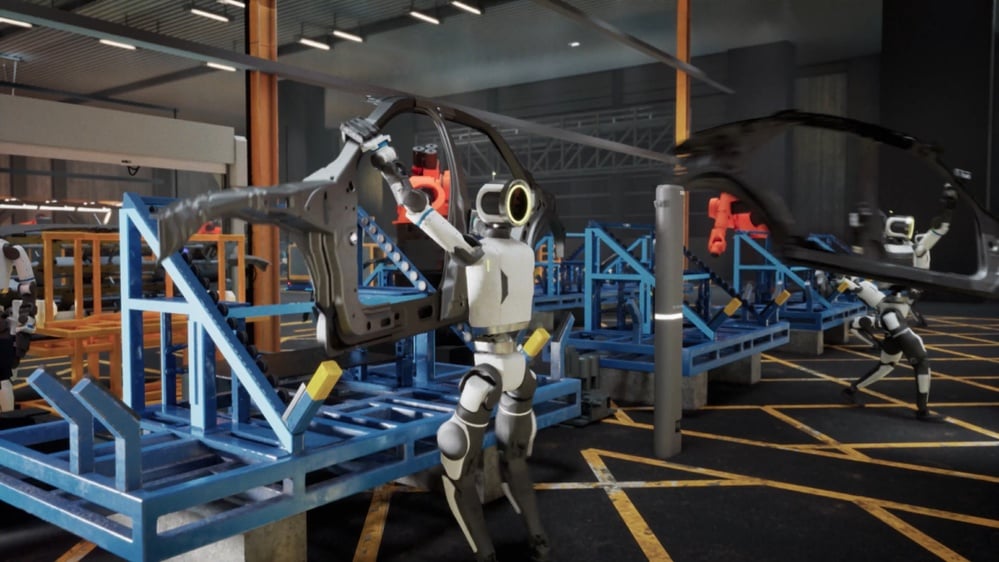
Nuanced, evidence-driven report on Hyundai's Atlas humanoid robots, labor union pushback, and cost/deployment implications, balancing worker concerns with corporate and industry context while citing multiple sources.
Technology/business analysis of Hyundai's Atlas humanoid robots, labor union responses, deployment economics, and broader automation trends in the auto industry.
Automated analysis; not human reviewed.
Limitations: Case-specific: text blends labor, technology, and economic data; potential bias toward emphasizing fear in headlines, but includes multiple credible sources and counterpoints.
·
1 of 52 available dimensions scored; omitted dimensions are not treated as neutral.
·
Verified supporting quotes for 0 of 1 scored dimensions.
Claim: Reporting frames humanoid-robot adoption as a source of fear driving labor action.
“Fear of humanoid robots spurs human workers to strike at Hyundai auto factory.” · exact text match
“The car industry’s first factory stoppage addressing humanoid robots, according to The Wall Street Journal.” · not found in supplied text
Counterevidence:
“Roach described human hands with their sense of feel and touch as being necessary for handling soft car parts such as hoses, wires, carpets, and trim panels.” · exact text match
“"the humanoid robots won’t pose a threat to the human workforce."” · not found in supplied text
Why: Headlines emphasize fear and labor action, but direct statements from Hyundai management counter the notion of an imminent threat to workers.
Ambiguity about neutrality; emphasis on fear framing may overstate sentiment unless weighed against official counters.
Nuanced, evidence-driven report on Hyundai's Atlas humanoid robots, labor union pushback, and cost/deployment implications, balancing worker concerns with corporate and industry context while citing multiple sources.
Technology/business analysis of Hyundai's Atlas humanoid robots, labor union responses, deployment economics, and broader automation trends in the auto industry.
Automated analysis; not human reviewed.
Limitations: Case-specific: text blends labor, technology, and economic data; potential bias toward emphasizing fear in headlines, but includes multiple credible sources and counterpoints.
·
1 of 52 available dimensions scored; omitted dimensions are not treated as neutral.
·
Verified supporting quotes for 0 of 1 scored dimensions.
Claim: Reporting frames humanoid-robot adoption as a source of fear driving labor action.
“Fear of humanoid robots spurs human workers to strike at Hyundai auto factory.” · exact text match
“The car industry’s first factory stoppage addressing humanoid robots, according to The Wall Street Journal.” · not found in supplied text
Counterevidence:
“Roach described human hands with their sense of feel and touch as being necessary for handling soft car parts such as hoses, wires, carpets, and trim panels.” · exact text match
“"the humanoid robots won’t pose a threat to the human workforce."” · not found in supplied text
Why: Headlines emphasize fear and labor action, but direct statements from Hyundai management counter the notion of an imminent threat to workers.
Ambiguity about neutrality; emphasis on fear framing may overstate sentiment unless weighed against official counters.
Technically data-driven, but with a pro-automation tilt, foregrounding company-reported success rates and milestones while downplaying limitations.
Technology-focused report on Xiaomi's humanoid robot achieving high task success rates in EV assembly lines, including new tasks and rival demonstrations.
Automated analysis; not human reviewed.
·
18 of 52 available dimensions scored; omitted dimensions are not treated as neutral.
·
Supporting quotes supplied for 0 of 18 scored dimensions; exact matching was not run.
My bias: cautious about hype; confidence 0.55
July 17, 2026 · 0 shares
Neutral, technically oriented framing with no political tilt; emphasizes empirical MPKPE improvements and Labs openness/privacy values.
Technical abstract describing scaling Behavior Foundation Models for humanoid robots, outlining three core components, empirical MPKPE improvements from simulation to real-world deployment, and a Labs framework emphasizing openness and privacy.
Automated analysis; not human reviewed.
Limitations: Case-specific excerpt; limited external validation; cannot assess full publication context; possible marketing language in Labs section; interpretive uncertainty.
·
52 of 52 available dimensions scored; omitted dimensions are not treated as neutral.
·
Verified supporting quotes for 0 of 52 scored dimensions.
Excerpt lacks broader context; limited data present.
Promotes a faster, cheaper 'Learn to Teach' reinforcement-learning framework for two-legged humanoid walking while acknowledging skepticism, testing on real hardware, and funding disclosures, resulting in a mildly pro-innovation but cautious bias.
Georgia Tech researchers describe a faster, cheaper Learn-to-Teach reinforcement-learning framework for humanoid locomotion, validated in simulation and on hardware, with funding from ONR, USDA, and NSF, and presented at IEEE ICRA.
Automated analysis; not human reviewed.
Limitations: Concise, case-specific limitations and plausible alternative interpretations.
·
8 of 52 available dimensions scored; omitted dimensions are not treated as neutral.
·
Verified supporting quotes for 1 of 8 scored dimensions.
Claim: The approach is interesting due to its generality and potential cross-robot application.
“"Learn to Teach" training framework is designed to be generic.
It can be used for other robots with other configurations.”
· verified after text normalization
Counterevidence:
“"There are two problems with this approach..."” · not found in supplied text
Why: Novelty and potential generalization enhance perceived interest.
Claim: The piece foregrounds established venues and funders to frame credibility.
“"Wu presented the team’s training framework at the IEEE International Conference on Robotics and Automation, the world’s largest gathering of robotics researchers."” · exact text match
“"This research was supported by the Office of Naval Research, grant No. N000142312223; the U.S. Department of Agriculture, grant No. 2023-67021-41397; and the National Science Foundation, grant Nos. IIS-1924978, CMMI-2144309, and FRR-2328254."” · not found in supplied text
“"Zhao, who co-advises Wu with CSE Assistant Professor Anqi Wu, said the control system performed better even than the controller provided by the robot’s manufacturer."” · exact text match
Counterevidence:
“"Any opinions, findings, and conclusions or recommendations expressed in this material are those of the authors and do not necessarily reflect the views of any funding agency."” · not found in supplied text
Why: Anchoring to IEEE ICRA and funding agencies creates authority; standard disclaimer moderates that stance.
Claim: The reporting presents a rational, measured view that includes both skepticism and potential success.
“"We were kind of skeptical, even though in simulation it looked not terrible, but not great."” · not found in supplied text
“"There are two problems with this approach," Wu said.
"It takes too much time to train them sequentially.
Then, you’re wasting a lot of information that’s been gathered by the teacher."”
· verified after text normalization
“"The teacher can gradually teach the student what they’ve learned along the way."” · verified after text normalization
Counterevidence:
“"Somehow our very efficient training recipe here can actually work for all kinds of terrain and environments," said Wu.” · not found in supplied text
Why: Balanced presentation of skepticism and optimism reflects rational assessment rather than irrational enthusiasm.
Claim: The article emphasizes efficiency and applicability of the method.
“"His method is computationally faster and cheaper than the leading approaches for training robotic controllers."” · not found in supplied text
“"The researchers’ solution? Train the teacher and the student at the same time."” · exact text match
Counterevidence:
“"Any opinions, findings, and conclusions or recommendations expressed in this material are those of the authors and do not necessarily reflect the views of any funding agency."” · not found in supplied text
Why: Explicit efficiency claims are present, but funding-disclaimer language tempers promotional tone.
Claim: The article frames the work in a rigorous scientific framework with simulation + hardware testing.
“"This kind of machine learning method teaches a robotic controller how to behave through a simulated environment where a “teacher” agent is developed first."” · not found in supplied text
“"The teacher explores the simulation and learns how to move.
Then it distills what’s it learned and teaches a new agent, a “student” robot, how to operate."”
· not found in supplied text
“"Learn to Teach" training framework is designed to be generic.
It can be used for other robots with other configurations.”
· verified after text normalization
Counterevidence:
“"There are two problems with this approach," Wu said.
"It takes too much time to train them sequentially.
Then, you’re wasting a lot of information that’s been gathered by the teacher."”
· verified after text normalization
“"Training time is money when it comes to these simulations, because they require many hours of computation using expensive-to-use GPU chips."” · exact text match
Why: Empirical description of RL methods and simulation-based training supports a scientific framing; acknowledged limits temper certainty.
Claim: The article includes a disclosure about authors' views vs. funders, supporting integrity.
“"Any opinions, findings, and conclusions or recommendations expressed in this material are those of the authors and do not necessarily reflect the views of any funding agency."” · not found in supplied text
Counterevidence:
“"This research was supported by the Office of Naval Research..."” · not found in supplied text
Why: Explicit attribution and funder disclaimer promote integrity, though funding acknowledgment can introduce potential framing.
Claim: The piece presents a coherent, structured account of method and outcomes.
“"Feiyang Wu led development of a new kind of whole-body controller that allowed the humanoid robot to traverse all those varied surfaces."” · not found in supplied text
“"Zhao... said the control system performed better even than the controller provided by the robot’s manufacturer."” · not found in supplied text
Counterevidence:
“"This research was supported by the Office of Naval Research..."” · not found in supplied text
Why: Clear presentation of method and hardware testing supports perceived intelligence of the report.
GT press release framing; lacks independent peer-review data.
July 17, 2026 · 0 shares
Neutral-to-mildly positive framing: emphasis on Labs' openness, community, excellence, and user data privacy alongside claims of robust, internally validated sim-to-real results for a novel multi-modal audio-driven humanoid control framework, with limited external verification noted.
Technical robotics paper describing a multi-modal audio-driven framework for humanoid control, validated in simulation and on a Unitree G1, with emphasis on Labs' openness/privacy values.
Automated analysis; not human reviewed.
Limitations: Concise, case-specific limitations and plausible alternative interpretations.
·
52 of 52 available dimensions scored; omitted dimensions are not treated as neutral.
·
Verified supporting quotes for 5 of 52 scored dimensions.
Claim: No political framing detected; text centers on technology and collaboration values.
“Labs values openness, community, excellence, and user data privacy.” · not found in supplied text
“is committed to these values and only works with partners that adhere to them.” · exact text match
Why: Content focuses on organizational values and technical aims rather than political ideology.
Claim: Content is technically engaging for audiences in robotics, with a focus on multi-modal audio-driven control.
“Semantic Audio-driven Understanding for Dynamic Humanoid Whole Body Control.” · exact text match
Why: Field-specific interest indicated; not universal.
Claim: The language blends descriptive description with prescriptive capabilities (to enable, to map, to schedule).
“In this work, we introduce a novel multi-modal orchestration framework for semantic audio-driven humanoid control, enabling robots to autonomously select and execute appropriate motion skills in real time.” · exact text match
Why: Descriptive content coexists with prescriptive capability claims.
Claim: Credibility derives from stated validation (simulation/Unitree G1) and links to supplementary materials; external verification not described.
“We validate the approach in simulation and on a Unitree G1 humanoid, showing robust sim-to-real transfer and consistent audio-conditioned policy selection.” · exact text match
Why: Internal validation statements support credibility but lack independent confirmation in the excerpt.
Claim: Indicators of high internal integrity through explicit values and partner-standards statements.
“Labs is a framework that allows collaborators to develop and share new features directly on our website.” · verified after text normalization
“Both individuals and organizations that work with Labs have embraced and accepted our values of openness, community, excellence, and user data privacy.” · exact text match
“is committed to these values and only works with partners that adhere to them.” · exact text match
Why: Explicit values and commitments imply integrity; external verification is not described.
Claim: Text demonstrates technical sophistication in multi-modal signaling and sim-to-real transfer for humanoid robotics.
“Recent advances in humanoid robotics and reinforcement learning have enabled the acquisition of highly expressive whole-body motion policies.” · exact text match
“We validate the approach in simulation and on a Unitree G1 humanoid, showing robust sim-to-real transfer and consistent audio-conditioned policy selection.” · exact text match
Why: Presence of multiple technical claims suggests above-average technical intelligence within the article.
Text-only evaluation; may miss broader publication context and external validation signals.
July 14, 2026 · 0 shares
Coverage neutrally reports LimX Dynamics' nearly $200 million funding at a 15 billion yuan ($2.2 billion) valuation to develop autonomous humanoid robots, notes European investors, and features Oli's display in Shenzhen with minimal evaluative language and no evident ideological framing.
Technology startup LimX Dynamics raised nearly $200 million at a 15 billion yuan ($2.2 billion) valuation to advance autonomous humanoid robots, with European investors participating, and Oli showcased in Shenzhen.
I may overemphasize funding details; accuracy 0.6
July 16, 2026 · 0 shares
Framing is broadly favorable toward Hyundai's bid to take full control of Boston Dynamics and toward Atlas development, echoing Bloomberg's positive language about a potential windfall and strategic end-to-end AI robotics advancement with limited critical scrutiny.
Reporting on Hyundai's potential full acquisition of Boston Dynamics and the Atlas program, including Bloomberg-sourced framing, production timelines, and technology partnerships.
Automated analysis; not human reviewed.
Limitations: Concise, case-specific limitations and plausible alternative interpretations.
·
2 of 52 available dimensions scored; omitted dimensions are not treated as neutral.
·
Verified supporting quotes for 0 of 2 scored dimensions.
Claim: The article frames Hyundai's acquisition as a windfall and strategic advantage, indicating a pro-corporate tilt.
“As Bloomberg notes, the acquisition could be a massive windfall for Hyundai, as companies move towards the development of physical AI products.” · exact text match
“"Through this integrated approach, the group aims to accelerate the development, validation and commercialization of Physical AI technologies and robotics solutions," Hyundai told Bloomberg in a statement.” · not found in supplied text
“If the deal pushes through, Hyundai will have full ownership of Boston Dynamics.” · exact text match
Why: Positive language around ownership gain and strategic capability suggests favorable framing toward Hyundai.
Ambiguity: lacks critical risk/regulatory context; relies on Bloomberg framing.
Nuanced, evidence-driven report on Hyundai's Atlas humanoid robots, labor union pushback, and cost/deployment implications, balancing worker concerns with corporate and industry context while citing multiple sources.
Technology/business analysis of Hyundai's Atlas humanoid robots, labor union responses, deployment economics, and broader automation trends in the auto industry.
Automated analysis; not human reviewed. Limitations: Case-specific: text blends labor, technology, and economic data; potential bias toward emphasizing fear in headlines, but includes multiple credible sources and counterpoints. · 1 of 52 available dimensions scored; omitted dimensions are not treated as neutral. · Verified supporting quotes for 0 of 1 scored dimensions.
Claim: Reporting frames humanoid-robot adoption as a source of fear driving labor action.
“Fear of humanoid robots spurs human workers to strike at Hyundai auto factory.” · exact text match
“The car industry’s first factory stoppage addressing humanoid robots, according to The Wall Street Journal.” · not found in supplied text
Counterevidence:
“Roach described human hands with their sense of feel and touch as being necessary for handling soft car parts such as hoses, wires, carpets, and trim panels.” · exact text match
“"the humanoid robots won’t pose a threat to the human workforce."” · not found in supplied text
Why: Headlines emphasize fear and labor action, but direct statements from Hyundai management counter the notion of an imminent threat to workers.
Ambiguity about neutrality; emphasis on fear framing may overstate sentiment unless weighed against official counters.
July 17, 2026 · 0 shares
Neutral, technically oriented framing with no political tilt; emphasizes empirical MPKPE improvements and Labs openness/privacy values.
Technical abstract describing scaling Behavior Foundation Models for humanoid robots, outlining three core components, empirical MPKPE improvements from simulation to real-world deployment, and a Labs framework emphasizing openness and privacy.
Automated analysis; not human reviewed. Limitations: Case-specific excerpt; limited external validation; cannot assess full publication context; possible marketing language in Labs section; interpretive uncertainty. · 52 of 52 available dimensions scored; omitted dimensions are not treated as neutral. · Verified supporting quotes for 0 of 52 scored dimensions.
Excerpt lacks broader context; limited data present.
Promotes a faster, cheaper 'Learn to Teach' reinforcement-learning framework for two-legged humanoid walking while acknowledging skepticism, testing on real hardware, and funding disclosures, resulting in a mildly pro-innovation but cautious bias.
Georgia Tech researchers describe a faster, cheaper Learn-to-Teach reinforcement-learning framework for humanoid locomotion, validated in simulation and on hardware, with funding from ONR, USDA, and NSF, and presented at IEEE ICRA.
Automated analysis; not human reviewed. Limitations: Concise, case-specific limitations and plausible alternative interpretations. · 8 of 52 available dimensions scored; omitted dimensions are not treated as neutral. · Verified supporting quotes for 1 of 8 scored dimensions.
Claim: The approach is interesting due to its generality and potential cross-robot application.
“"Learn to Teach" training framework is designed to be generic. It can be used for other robots with other configurations.” · verified after text normalization
Counterevidence:
“"There are two problems with this approach..."” · not found in supplied text
Why: Novelty and potential generalization enhance perceived interest.
Claim: The piece foregrounds established venues and funders to frame credibility.
“"Wu presented the team’s training framework at the IEEE International Conference on Robotics and Automation, the world’s largest gathering of robotics researchers."” · exact text match
“"This research was supported by the Office of Naval Research, grant No. N000142312223; the U.S. Department of Agriculture, grant No. 2023-67021-41397; and the National Science Foundation, grant Nos. IIS-1924978, CMMI-2144309, and FRR-2328254."” · not found in supplied text
“"Zhao, who co-advises Wu with CSE Assistant Professor Anqi Wu, said the control system performed better even than the controller provided by the robot’s manufacturer."” · exact text match
Counterevidence:
“"Any opinions, findings, and conclusions or recommendations expressed in this material are those of the authors and do not necessarily reflect the views of any funding agency."” · not found in supplied text
Why: Anchoring to IEEE ICRA and funding agencies creates authority; standard disclaimer moderates that stance.
Claim: The reporting presents a rational, measured view that includes both skepticism and potential success.
“"We were kind of skeptical, even though in simulation it looked not terrible, but not great."” · not found in supplied text
“"There are two problems with this approach," Wu said. "It takes too much time to train them sequentially. Then, you’re wasting a lot of information that’s been gathered by the teacher."” · verified after text normalization
“"The teacher can gradually teach the student what they’ve learned along the way."” · verified after text normalization
Counterevidence:
“"Somehow our very efficient training recipe here can actually work for all kinds of terrain and environments," said Wu.” · not found in supplied text
Why: Balanced presentation of skepticism and optimism reflects rational assessment rather than irrational enthusiasm.
Claim: The article emphasizes efficiency and applicability of the method.
“"His method is computationally faster and cheaper than the leading approaches for training robotic controllers."” · not found in supplied text
“"The researchers’ solution? Train the teacher and the student at the same time."” · exact text match
Counterevidence:
“"Any opinions, findings, and conclusions or recommendations expressed in this material are those of the authors and do not necessarily reflect the views of any funding agency."” · not found in supplied text
Why: Explicit efficiency claims are present, but funding-disclaimer language tempers promotional tone.
Claim: The article frames the work in a rigorous scientific framework with simulation + hardware testing.
“"This kind of machine learning method teaches a robotic controller how to behave through a simulated environment where a “teacher” agent is developed first."” · not found in supplied text
“"The teacher explores the simulation and learns how to move. Then it distills what’s it learned and teaches a new agent, a “student” robot, how to operate."” · not found in supplied text
“"Learn to Teach" training framework is designed to be generic. It can be used for other robots with other configurations.” · verified after text normalization
Counterevidence:
“"There are two problems with this approach," Wu said. "It takes too much time to train them sequentially. Then, you’re wasting a lot of information that’s been gathered by the teacher."” · verified after text normalization
“"Training time is money when it comes to these simulations, because they require many hours of computation using expensive-to-use GPU chips."” · exact text match
Why: Empirical description of RL methods and simulation-based training supports a scientific framing; acknowledged limits temper certainty.
Claim: The article includes a disclosure about authors' views vs. funders, supporting integrity.
“"Any opinions, findings, and conclusions or recommendations expressed in this material are those of the authors and do not necessarily reflect the views of any funding agency."” · not found in supplied text
Counterevidence:
“"This research was supported by the Office of Naval Research..."” · not found in supplied text
Why: Explicit attribution and funder disclaimer promote integrity, though funding acknowledgment can introduce potential framing.
Claim: The piece presents a coherent, structured account of method and outcomes.
“"Feiyang Wu led development of a new kind of whole-body controller that allowed the humanoid robot to traverse all those varied surfaces."” · not found in supplied text
“"Zhao... said the control system performed better even than the controller provided by the robot’s manufacturer."” · not found in supplied text
Counterevidence:
“"This research was supported by the Office of Naval Research..."” · not found in supplied text
Why: Clear presentation of method and hardware testing supports perceived intelligence of the report.
GT press release framing; lacks independent peer-review data.
July 17, 2026 · 0 shares
Neutral-to-mildly positive framing: emphasis on Labs' openness, community, excellence, and user data privacy alongside claims of robust, internally validated sim-to-real results for a novel multi-modal audio-driven humanoid control framework, with limited external verification noted.
Technical robotics paper describing a multi-modal audio-driven framework for humanoid control, validated in simulation and on a Unitree G1, with emphasis on Labs' openness/privacy values.
Automated analysis; not human reviewed. Limitations: Concise, case-specific limitations and plausible alternative interpretations. · 52 of 52 available dimensions scored; omitted dimensions are not treated as neutral. · Verified supporting quotes for 5 of 52 scored dimensions.
Claim: No political framing detected; text centers on technology and collaboration values.
“Labs values openness, community, excellence, and user data privacy.” · not found in supplied text
“is committed to these values and only works with partners that adhere to them.” · exact text match
Why: Content focuses on organizational values and technical aims rather than political ideology.
Claim: Content is technically engaging for audiences in robotics, with a focus on multi-modal audio-driven control.
“Semantic Audio-driven Understanding for Dynamic Humanoid Whole Body Control.” · exact text match
Why: Field-specific interest indicated; not universal.
Claim: The language blends descriptive description with prescriptive capabilities (to enable, to map, to schedule).
“In this work, we introduce a novel multi-modal orchestration framework for semantic audio-driven humanoid control, enabling robots to autonomously select and execute appropriate motion skills in real time.” · exact text match
Why: Descriptive content coexists with prescriptive capability claims.
Claim: Credibility derives from stated validation (simulation/Unitree G1) and links to supplementary materials; external verification not described.
“We validate the approach in simulation and on a Unitree G1 humanoid, showing robust sim-to-real transfer and consistent audio-conditioned policy selection.” · exact text match
Why: Internal validation statements support credibility but lack independent confirmation in the excerpt.
Claim: Indicators of high internal integrity through explicit values and partner-standards statements.
“Labs is a framework that allows collaborators to develop and share new features directly on our website.” · verified after text normalization
“Both individuals and organizations that work with Labs have embraced and accepted our values of openness, community, excellence, and user data privacy.” · exact text match
“is committed to these values and only works with partners that adhere to them.” · exact text match
Why: Explicit values and commitments imply integrity; external verification is not described.
Claim: Text demonstrates technical sophistication in multi-modal signaling and sim-to-real transfer for humanoid robotics.
“Recent advances in humanoid robotics and reinforcement learning have enabled the acquisition of highly expressive whole-body motion policies.” · exact text match
“We validate the approach in simulation and on a Unitree G1 humanoid, showing robust sim-to-real transfer and consistent audio-conditioned policy selection.” · exact text match
Why: Presence of multiple technical claims suggests above-average technical intelligence within the article.
Text-only evaluation; may miss broader publication context and external validation signals.
Story Blindspots
Technically data-driven, but with a pro-automation tilt, foregrounding company-reported success rates and milestones while downplaying limitations.
Technology-focused report on Xiaomi's humanoid robot achieving high task success rates in EV assembly lines, including new tasks and rival demonstrations.
Automated analysis; not human reviewed. · 18 of 52 available dimensions scored; omitted dimensions are not treated as neutral. · Supporting quotes supplied for 0 of 18 scored dimensions; exact matching was not run.
My bias: cautious about hype; confidence 0.55
Nuanced, evidence-driven report on Hyundai's Atlas humanoid robots, labor union pushback, and cost/deployment implications, balancing worker concerns with corporate and industry context while citing multiple sources.
Technology/business analysis of Hyundai's Atlas humanoid robots, labor union responses, deployment economics, and broader automation trends in the auto industry.
Automated analysis; not human reviewed. Limitations: Case-specific: text blends labor, technology, and economic data; potential bias toward emphasizing fear in headlines, but includes multiple credible sources and counterpoints. · 1 of 52 available dimensions scored; omitted dimensions are not treated as neutral. · Verified supporting quotes for 0 of 1 scored dimensions.
Claim: Reporting frames humanoid-robot adoption as a source of fear driving labor action.
“Fear of humanoid robots spurs human workers to strike at Hyundai auto factory.” · exact text match
“The car industry’s first factory stoppage addressing humanoid robots, according to The Wall Street Journal.” · not found in supplied text
Counterevidence:
“Roach described human hands with their sense of feel and touch as being necessary for handling soft car parts such as hoses, wires, carpets, and trim panels.” · exact text match
“"the humanoid robots won’t pose a threat to the human workforce."” · not found in supplied text
Why: Headlines emphasize fear and labor action, but direct statements from Hyundai management counter the notion of an imminent threat to workers.
Ambiguity about neutrality; emphasis on fear framing may overstate sentiment unless weighed against official counters.
July 17, 2026 · 0 shares
Neutral, technically oriented framing with no political tilt; emphasizes empirical MPKPE improvements and Labs openness/privacy values.
Technical abstract describing scaling Behavior Foundation Models for humanoid robots, outlining three core components, empirical MPKPE improvements from simulation to real-world deployment, and a Labs framework emphasizing openness and privacy.
Automated analysis; not human reviewed. Limitations: Case-specific excerpt; limited external validation; cannot assess full publication context; possible marketing language in Labs section; interpretive uncertainty. · 52 of 52 available dimensions scored; omitted dimensions are not treated as neutral. · Verified supporting quotes for 0 of 52 scored dimensions.
Excerpt lacks broader context; limited data present.
Promotes a faster, cheaper 'Learn to Teach' reinforcement-learning framework for two-legged humanoid walking while acknowledging skepticism, testing on real hardware, and funding disclosures, resulting in a mildly pro-innovation but cautious bias.
Georgia Tech researchers describe a faster, cheaper Learn-to-Teach reinforcement-learning framework for humanoid locomotion, validated in simulation and on hardware, with funding from ONR, USDA, and NSF, and presented at IEEE ICRA.
Automated analysis; not human reviewed. Limitations: Concise, case-specific limitations and plausible alternative interpretations. · 8 of 52 available dimensions scored; omitted dimensions are not treated as neutral. · Verified supporting quotes for 1 of 8 scored dimensions.
Claim: The approach is interesting due to its generality and potential cross-robot application.
“"Learn to Teach" training framework is designed to be generic. It can be used for other robots with other configurations.” · verified after text normalization
Counterevidence:
“"There are two problems with this approach..."” · not found in supplied text
Why: Novelty and potential generalization enhance perceived interest.
Claim: The piece foregrounds established venues and funders to frame credibility.
“"Wu presented the team’s training framework at the IEEE International Conference on Robotics and Automation, the world’s largest gathering of robotics researchers."” · exact text match
“"This research was supported by the Office of Naval Research, grant No. N000142312223; the U.S. Department of Agriculture, grant No. 2023-67021-41397; and the National Science Foundation, grant Nos. IIS-1924978, CMMI-2144309, and FRR-2328254."” · not found in supplied text
“"Zhao, who co-advises Wu with CSE Assistant Professor Anqi Wu, said the control system performed better even than the controller provided by the robot’s manufacturer."” · exact text match
Counterevidence:
“"Any opinions, findings, and conclusions or recommendations expressed in this material are those of the authors and do not necessarily reflect the views of any funding agency."” · not found in supplied text
Why: Anchoring to IEEE ICRA and funding agencies creates authority; standard disclaimer moderates that stance.
Claim: The reporting presents a rational, measured view that includes both skepticism and potential success.
“"We were kind of skeptical, even though in simulation it looked not terrible, but not great."” · not found in supplied text
“"There are two problems with this approach," Wu said. "It takes too much time to train them sequentially. Then, you’re wasting a lot of information that’s been gathered by the teacher."” · verified after text normalization
“"The teacher can gradually teach the student what they’ve learned along the way."” · verified after text normalization
Counterevidence:
“"Somehow our very efficient training recipe here can actually work for all kinds of terrain and environments," said Wu.” · not found in supplied text
Why: Balanced presentation of skepticism and optimism reflects rational assessment rather than irrational enthusiasm.
Claim: The article emphasizes efficiency and applicability of the method.
“"His method is computationally faster and cheaper than the leading approaches for training robotic controllers."” · not found in supplied text
“"The researchers’ solution? Train the teacher and the student at the same time."” · exact text match
Counterevidence:
“"Any opinions, findings, and conclusions or recommendations expressed in this material are those of the authors and do not necessarily reflect the views of any funding agency."” · not found in supplied text
Why: Explicit efficiency claims are present, but funding-disclaimer language tempers promotional tone.
Claim: The article frames the work in a rigorous scientific framework with simulation + hardware testing.
“"This kind of machine learning method teaches a robotic controller how to behave through a simulated environment where a “teacher” agent is developed first."” · not found in supplied text
“"The teacher explores the simulation and learns how to move. Then it distills what’s it learned and teaches a new agent, a “student” robot, how to operate."” · not found in supplied text
“"Learn to Teach" training framework is designed to be generic. It can be used for other robots with other configurations.” · verified after text normalization
Counterevidence:
“"There are two problems with this approach," Wu said. "It takes too much time to train them sequentially. Then, you’re wasting a lot of information that’s been gathered by the teacher."” · verified after text normalization
“"Training time is money when it comes to these simulations, because they require many hours of computation using expensive-to-use GPU chips."” · exact text match
Why: Empirical description of RL methods and simulation-based training supports a scientific framing; acknowledged limits temper certainty.
Claim: The article includes a disclosure about authors' views vs. funders, supporting integrity.
“"Any opinions, findings, and conclusions or recommendations expressed in this material are those of the authors and do not necessarily reflect the views of any funding agency."” · not found in supplied text
Counterevidence:
“"This research was supported by the Office of Naval Research..."” · not found in supplied text
Why: Explicit attribution and funder disclaimer promote integrity, though funding acknowledgment can introduce potential framing.
Claim: The piece presents a coherent, structured account of method and outcomes.
“"Feiyang Wu led development of a new kind of whole-body controller that allowed the humanoid robot to traverse all those varied surfaces."” · not found in supplied text
“"Zhao... said the control system performed better even than the controller provided by the robot’s manufacturer."” · not found in supplied text
Counterevidence:
“"This research was supported by the Office of Naval Research..."” · not found in supplied text
Why: Clear presentation of method and hardware testing supports perceived intelligence of the report.
GT press release framing; lacks independent peer-review data.
July 17, 2026 · 0 shares
Neutral-to-mildly positive framing: emphasis on Labs' openness, community, excellence, and user data privacy alongside claims of robust, internally validated sim-to-real results for a novel multi-modal audio-driven humanoid control framework, with limited external verification noted.
Technical robotics paper describing a multi-modal audio-driven framework for humanoid control, validated in simulation and on a Unitree G1, with emphasis on Labs' openness/privacy values.
Automated analysis; not human reviewed. Limitations: Concise, case-specific limitations and plausible alternative interpretations. · 52 of 52 available dimensions scored; omitted dimensions are not treated as neutral. · Verified supporting quotes for 5 of 52 scored dimensions.
Claim: No political framing detected; text centers on technology and collaboration values.
“Labs values openness, community, excellence, and user data privacy.” · not found in supplied text
“is committed to these values and only works with partners that adhere to them.” · exact text match
Why: Content focuses on organizational values and technical aims rather than political ideology.
Claim: Content is technically engaging for audiences in robotics, with a focus on multi-modal audio-driven control.
“Semantic Audio-driven Understanding for Dynamic Humanoid Whole Body Control.” · exact text match
Why: Field-specific interest indicated; not universal.
Claim: The language blends descriptive description with prescriptive capabilities (to enable, to map, to schedule).
“In this work, we introduce a novel multi-modal orchestration framework for semantic audio-driven humanoid control, enabling robots to autonomously select and execute appropriate motion skills in real time.” · exact text match
Why: Descriptive content coexists with prescriptive capability claims.
Claim: Credibility derives from stated validation (simulation/Unitree G1) and links to supplementary materials; external verification not described.
“We validate the approach in simulation and on a Unitree G1 humanoid, showing robust sim-to-real transfer and consistent audio-conditioned policy selection.” · exact text match
Why: Internal validation statements support credibility but lack independent confirmation in the excerpt.
Claim: Indicators of high internal integrity through explicit values and partner-standards statements.
“Labs is a framework that allows collaborators to develop and share new features directly on our website.” · verified after text normalization
“Both individuals and organizations that work with Labs have embraced and accepted our values of openness, community, excellence, and user data privacy.” · exact text match
“is committed to these values and only works with partners that adhere to them.” · exact text match
Why: Explicit values and commitments imply integrity; external verification is not described.
Claim: Text demonstrates technical sophistication in multi-modal signaling and sim-to-real transfer for humanoid robotics.
“Recent advances in humanoid robotics and reinforcement learning have enabled the acquisition of highly expressive whole-body motion policies.” · exact text match
“We validate the approach in simulation and on a Unitree G1 humanoid, showing robust sim-to-real transfer and consistent audio-conditioned policy selection.” · exact text match
Why: Presence of multiple technical claims suggests above-average technical intelligence within the article.
Text-only evaluation; may miss broader publication context and external validation signals.
July 16, 2026 · 0 shares
Framing is broadly favorable toward Hyundai's bid to take full control of Boston Dynamics and toward Atlas development, echoing Bloomberg's positive language about a potential windfall and strategic end-to-end AI robotics advancement with limited critical scrutiny.
Reporting on Hyundai's potential full acquisition of Boston Dynamics and the Atlas program, including Bloomberg-sourced framing, production timelines, and technology partnerships.
Automated analysis; not human reviewed. Limitations: Concise, case-specific limitations and plausible alternative interpretations. · 2 of 52 available dimensions scored; omitted dimensions are not treated as neutral. · Verified supporting quotes for 0 of 2 scored dimensions.
Claim: The article frames Hyundai's acquisition as a windfall and strategic advantage, indicating a pro-corporate tilt.
“As Bloomberg notes, the acquisition could be a massive windfall for Hyundai, as companies move towards the development of physical AI products.” · exact text match
“"Through this integrated approach, the group aims to accelerate the development, validation and commercialization of Physical AI technologies and robotics solutions," Hyundai told Bloomberg in a statement.” · not found in supplied text
“If the deal pushes through, Hyundai will have full ownership of Boston Dynamics.” · exact text match
Why: Positive language around ownership gain and strategic capability suggests favorable framing toward Hyundai.
Ambiguity: lacks critical risk/regulatory context; relies on Bloomberg framing.
Nuanced, evidence-driven report on Hyundai's Atlas humanoid robots, labor union pushback, and cost/deployment implications, balancing worker concerns with corporate and industry context while citing multiple sources.
Technology/business analysis of Hyundai's Atlas humanoid robots, labor union responses, deployment economics, and broader automation trends in the auto industry.
Automated analysis; not human reviewed. Limitations: Case-specific: text blends labor, technology, and economic data; potential bias toward emphasizing fear in headlines, but includes multiple credible sources and counterpoints. · 1 of 52 available dimensions scored; omitted dimensions are not treated as neutral. · Verified supporting quotes for 0 of 1 scored dimensions.
Claim: Reporting frames humanoid-robot adoption as a source of fear driving labor action.
“Fear of humanoid robots spurs human workers to strike at Hyundai auto factory.” · exact text match
“The car industry’s first factory stoppage addressing humanoid robots, according to The Wall Street Journal.” · not found in supplied text
Counterevidence:
“Roach described human hands with their sense of feel and touch as being necessary for handling soft car parts such as hoses, wires, carpets, and trim panels.” · exact text match
“"the humanoid robots won’t pose a threat to the human workforce."” · not found in supplied text
Why: Headlines emphasize fear and labor action, but direct statements from Hyundai management counter the notion of an imminent threat to workers.
Ambiguity about neutrality; emphasis on fear framing may overstate sentiment unless weighed against official counters.
Nuanced, evidence-driven report on Hyundai's Atlas humanoid robots, labor union pushback, and cost/deployment implications, balancing worker concerns with corporate and industry context while citing multiple sources.
Technology/business analysis of Hyundai's Atlas humanoid robots, labor union responses, deployment economics, and broader automation trends in the auto industry.
Automated analysis; not human reviewed. Limitations: Case-specific: text blends labor, technology, and economic data; potential bias toward emphasizing fear in headlines, but includes multiple credible sources and counterpoints. · 1 of 52 available dimensions scored; omitted dimensions are not treated as neutral. · Verified supporting quotes for 0 of 1 scored dimensions.
Claim: Reporting frames humanoid-robot adoption as a source of fear driving labor action.
“Fear of humanoid robots spurs human workers to strike at Hyundai auto factory.” · exact text match
“The car industry’s first factory stoppage addressing humanoid robots, according to The Wall Street Journal.” · not found in supplied text
Counterevidence:
“Roach described human hands with their sense of feel and touch as being necessary for handling soft car parts such as hoses, wires, carpets, and trim panels.” · exact text match
“"the humanoid robots won’t pose a threat to the human workforce."” · not found in supplied text
Why: Headlines emphasize fear and labor action, but direct statements from Hyundai management counter the notion of an imminent threat to workers.
Ambiguity about neutrality; emphasis on fear framing may overstate sentiment unless weighed against official counters.
Nuanced, evidence-driven report on Hyundai's Atlas humanoid robots, labor union pushback, and cost/deployment implications, balancing worker concerns with corporate and industry context while citing multiple sources.
Technology/business analysis of Hyundai's Atlas humanoid robots, labor union responses, deployment economics, and broader automation trends in the auto industry.
Automated analysis; not human reviewed. Limitations: Case-specific: text blends labor, technology, and economic data; potential bias toward emphasizing fear in headlines, but includes multiple credible sources and counterpoints. · 1 of 52 available dimensions scored; omitted dimensions are not treated as neutral. · Verified supporting quotes for 0 of 1 scored dimensions.
Claim: Reporting frames humanoid-robot adoption as a source of fear driving labor action.
“Fear of humanoid robots spurs human workers to strike at Hyundai auto factory.” · exact text match
“The car industry’s first factory stoppage addressing humanoid robots, according to The Wall Street Journal.” · not found in supplied text
Counterevidence:
“Roach described human hands with their sense of feel and touch as being necessary for handling soft car parts such as hoses, wires, carpets, and trim panels.” · exact text match
“"the humanoid robots won’t pose a threat to the human workforce."” · not found in supplied text
Why: Headlines emphasize fear and labor action, but direct statements from Hyundai management counter the notion of an imminent threat to workers.
Ambiguity about neutrality; emphasis on fear framing may overstate sentiment unless weighed against official counters.
July 17, 2026 · 0 shares
Neutral, technically oriented framing with no political tilt; emphasizes empirical MPKPE improvements and Labs openness/privacy values.
Technical abstract describing scaling Behavior Foundation Models for humanoid robots, outlining three core components, empirical MPKPE improvements from simulation to real-world deployment, and a Labs framework emphasizing openness and privacy.
Automated analysis; not human reviewed. Limitations: Case-specific excerpt; limited external validation; cannot assess full publication context; possible marketing language in Labs section; interpretive uncertainty. · 52 of 52 available dimensions scored; omitted dimensions are not treated as neutral. · Verified supporting quotes for 0 of 52 scored dimensions.
Excerpt lacks broader context; limited data present.
Promotes a faster, cheaper 'Learn to Teach' reinforcement-learning framework for two-legged humanoid walking while acknowledging skepticism, testing on real hardware, and funding disclosures, resulting in a mildly pro-innovation but cautious bias.
Georgia Tech researchers describe a faster, cheaper Learn-to-Teach reinforcement-learning framework for humanoid locomotion, validated in simulation and on hardware, with funding from ONR, USDA, and NSF, and presented at IEEE ICRA.
Automated analysis; not human reviewed. Limitations: Concise, case-specific limitations and plausible alternative interpretations. · 8 of 52 available dimensions scored; omitted dimensions are not treated as neutral. · Verified supporting quotes for 1 of 8 scored dimensions.
Claim: The approach is interesting due to its generality and potential cross-robot application.
“"Learn to Teach" training framework is designed to be generic. It can be used for other robots with other configurations.” · verified after text normalization
Counterevidence:
“"There are two problems with this approach..."” · not found in supplied text
Why: Novelty and potential generalization enhance perceived interest.
Claim: The piece foregrounds established venues and funders to frame credibility.
“"Wu presented the team’s training framework at the IEEE International Conference on Robotics and Automation, the world’s largest gathering of robotics researchers."” · exact text match
“"This research was supported by the Office of Naval Research, grant No. N000142312223; the U.S. Department of Agriculture, grant No. 2023-67021-41397; and the National Science Foundation, grant Nos. IIS-1924978, CMMI-2144309, and FRR-2328254."” · not found in supplied text
“"Zhao, who co-advises Wu with CSE Assistant Professor Anqi Wu, said the control system performed better even than the controller provided by the robot’s manufacturer."” · exact text match
Counterevidence:
“"Any opinions, findings, and conclusions or recommendations expressed in this material are those of the authors and do not necessarily reflect the views of any funding agency."” · not found in supplied text
Why: Anchoring to IEEE ICRA and funding agencies creates authority; standard disclaimer moderates that stance.
Claim: The reporting presents a rational, measured view that includes both skepticism and potential success.
“"We were kind of skeptical, even though in simulation it looked not terrible, but not great."” · not found in supplied text
“"There are two problems with this approach," Wu said. "It takes too much time to train them sequentially. Then, you’re wasting a lot of information that’s been gathered by the teacher."” · verified after text normalization
“"The teacher can gradually teach the student what they’ve learned along the way."” · verified after text normalization
Counterevidence:
“"Somehow our very efficient training recipe here can actually work for all kinds of terrain and environments," said Wu.” · not found in supplied text
Why: Balanced presentation of skepticism and optimism reflects rational assessment rather than irrational enthusiasm.
Claim: The article emphasizes efficiency and applicability of the method.
“"His method is computationally faster and cheaper than the leading approaches for training robotic controllers."” · not found in supplied text
“"The researchers’ solution? Train the teacher and the student at the same time."” · exact text match
Counterevidence:
“"Any opinions, findings, and conclusions or recommendations expressed in this material are those of the authors and do not necessarily reflect the views of any funding agency."” · not found in supplied text
Why: Explicit efficiency claims are present, but funding-disclaimer language tempers promotional tone.
Claim: The article frames the work in a rigorous scientific framework with simulation + hardware testing.
“"This kind of machine learning method teaches a robotic controller how to behave through a simulated environment where a “teacher” agent is developed first."” · not found in supplied text
“"The teacher explores the simulation and learns how to move. Then it distills what’s it learned and teaches a new agent, a “student” robot, how to operate."” · not found in supplied text
“"Learn to Teach" training framework is designed to be generic. It can be used for other robots with other configurations.” · verified after text normalization
Counterevidence:
“"There are two problems with this approach," Wu said. "It takes too much time to train them sequentially. Then, you’re wasting a lot of information that’s been gathered by the teacher."” · verified after text normalization
“"Training time is money when it comes to these simulations, because they require many hours of computation using expensive-to-use GPU chips."” · exact text match
Why: Empirical description of RL methods and simulation-based training supports a scientific framing; acknowledged limits temper certainty.
Claim: The article includes a disclosure about authors' views vs. funders, supporting integrity.
“"Any opinions, findings, and conclusions or recommendations expressed in this material are those of the authors and do not necessarily reflect the views of any funding agency."” · not found in supplied text
Counterevidence:
“"This research was supported by the Office of Naval Research..."” · not found in supplied text
Why: Explicit attribution and funder disclaimer promote integrity, though funding acknowledgment can introduce potential framing.
Claim: The piece presents a coherent, structured account of method and outcomes.
“"Feiyang Wu led development of a new kind of whole-body controller that allowed the humanoid robot to traverse all those varied surfaces."” · not found in supplied text
“"Zhao... said the control system performed better even than the controller provided by the robot’s manufacturer."” · not found in supplied text
Counterevidence:
“"This research was supported by the Office of Naval Research..."” · not found in supplied text
Why: Clear presentation of method and hardware testing supports perceived intelligence of the report.
GT press release framing; lacks independent peer-review data.
July 17, 2026 · 0 shares
Neutral-to-mildly positive framing: emphasis on Labs' openness, community, excellence, and user data privacy alongside claims of robust, internally validated sim-to-real results for a novel multi-modal audio-driven humanoid control framework, with limited external verification noted.
Technical robotics paper describing a multi-modal audio-driven framework for humanoid control, validated in simulation and on a Unitree G1, with emphasis on Labs' openness/privacy values.
Automated analysis; not human reviewed. Limitations: Concise, case-specific limitations and plausible alternative interpretations. · 52 of 52 available dimensions scored; omitted dimensions are not treated as neutral. · Verified supporting quotes for 5 of 52 scored dimensions.
Claim: No political framing detected; text centers on technology and collaboration values.
“Labs values openness, community, excellence, and user data privacy.” · not found in supplied text
“is committed to these values and only works with partners that adhere to them.” · exact text match
Why: Content focuses on organizational values and technical aims rather than political ideology.
Claim: Content is technically engaging for audiences in robotics, with a focus on multi-modal audio-driven control.
“Semantic Audio-driven Understanding for Dynamic Humanoid Whole Body Control.” · exact text match
Why: Field-specific interest indicated; not universal.
Claim: The language blends descriptive description with prescriptive capabilities (to enable, to map, to schedule).
“In this work, we introduce a novel multi-modal orchestration framework for semantic audio-driven humanoid control, enabling robots to autonomously select and execute appropriate motion skills in real time.” · exact text match
Why: Descriptive content coexists with prescriptive capability claims.
Claim: Credibility derives from stated validation (simulation/Unitree G1) and links to supplementary materials; external verification not described.
“We validate the approach in simulation and on a Unitree G1 humanoid, showing robust sim-to-real transfer and consistent audio-conditioned policy selection.” · exact text match
Why: Internal validation statements support credibility but lack independent confirmation in the excerpt.
Claim: Indicators of high internal integrity through explicit values and partner-standards statements.
“Labs is a framework that allows collaborators to develop and share new features directly on our website.” · verified after text normalization
“Both individuals and organizations that work with Labs have embraced and accepted our values of openness, community, excellence, and user data privacy.” · exact text match
“is committed to these values and only works with partners that adhere to them.” · exact text match
Why: Explicit values and commitments imply integrity; external verification is not described.
Claim: Text demonstrates technical sophistication in multi-modal signaling and sim-to-real transfer for humanoid robotics.
“Recent advances in humanoid robotics and reinforcement learning have enabled the acquisition of highly expressive whole-body motion policies.” · exact text match
“We validate the approach in simulation and on a Unitree G1 humanoid, showing robust sim-to-real transfer and consistent audio-conditioned policy selection.” · exact text match
Why: Presence of multiple technical claims suggests above-average technical intelligence within the article.
Text-only evaluation; may miss broader publication context and external validation signals.
Nuanced, evidence-driven report on Hyundai's Atlas humanoid robots, labor union pushback, and cost/deployment implications, balancing worker concerns with corporate and industry context while citing multiple sources.
Technology/business analysis of Hyundai's Atlas humanoid robots, labor union responses, deployment economics, and broader automation trends in the auto industry.
Automated analysis; not human reviewed.
Limitations: Case-specific: text blends labor, technology, and economic data; potential bias toward emphasizing fear in headlines, but includes multiple credible sources and counterpoints.
·
1 of 52 available dimensions scored; omitted dimensions are not treated as neutral.
·
Verified supporting quotes for 0 of 1 scored dimensions.
Claim: Reporting frames humanoid-robot adoption as a source of fear driving labor action.
“Fear of humanoid robots spurs human workers to strike at Hyundai auto factory.” · exact text match
“The car industry’s first factory stoppage addressing humanoid robots, according to The Wall Street Journal.” · not found in supplied text
Counterevidence:
“Roach described human hands with their sense of feel and touch as being necessary for handling soft car parts such as hoses, wires, carpets, and trim panels.” · exact text match
“"the humanoid robots won’t pose a threat to the human workforce."” · not found in supplied text
Why: Headlines emphasize fear and labor action, but direct statements from Hyundai management counter the notion of an imminent threat to workers.
Ambiguity about neutrality; emphasis on fear framing may overstate sentiment unless weighed against official counters.
Nuanced, evidence-driven report on Hyundai's Atlas humanoid robots, labor union pushback, and cost/deployment implications, balancing worker concerns with corporate and industry context while citing multiple sources.
Technology/business analysis of Hyundai's Atlas humanoid robots, labor union responses, deployment economics, and broader automation trends in the auto industry.
Automated analysis; not human reviewed.
Limitations: Case-specific: text blends labor, technology, and economic data; potential bias toward emphasizing fear in headlines, but includes multiple credible sources and counterpoints.
·
1 of 52 available dimensions scored; omitted dimensions are not treated as neutral.
·
Verified supporting quotes for 0 of 1 scored dimensions.
Claim: Reporting frames humanoid-robot adoption as a source of fear driving labor action.
“Fear of humanoid robots spurs human workers to strike at Hyundai auto factory.” · exact text match
“The car industry’s first factory stoppage addressing humanoid robots, according to The Wall Street Journal.” · not found in supplied text
Counterevidence:
“Roach described human hands with their sense of feel and touch as being necessary for handling soft car parts such as hoses, wires, carpets, and trim panels.” · exact text match
“"the humanoid robots won’t pose a threat to the human workforce."” · not found in supplied text
Why: Headlines emphasize fear and labor action, but direct statements from Hyundai management counter the notion of an imminent threat to workers.
Ambiguity about neutrality; emphasis on fear framing may overstate sentiment unless weighed against official counters.
Technically data-driven, but with a pro-automation tilt, foregrounding company-reported success rates and milestones while downplaying limitations.
Technology-focused report on Xiaomi's humanoid robot achieving high task success rates in EV assembly lines, including new tasks and rival demonstrations.
Automated analysis; not human reviewed.
·
18 of 52 available dimensions scored; omitted dimensions are not treated as neutral.
·
Supporting quotes supplied for 0 of 18 scored dimensions; exact matching was not run.
My bias: cautious about hype; confidence 0.55
July 17, 2026 · 0 shares
Neutral, technically oriented framing with no political tilt; emphasizes empirical MPKPE improvements and Labs openness/privacy values.
Technical abstract describing scaling Behavior Foundation Models for humanoid robots, outlining three core components, empirical MPKPE improvements from simulation to real-world deployment, and a Labs framework emphasizing openness and privacy.
Automated analysis; not human reviewed.
Limitations: Case-specific excerpt; limited external validation; cannot assess full publication context; possible marketing language in Labs section; interpretive uncertainty.
·
52 of 52 available dimensions scored; omitted dimensions are not treated as neutral.
·
Verified supporting quotes for 0 of 52 scored dimensions.
Excerpt lacks broader context; limited data present.
Promotes a faster, cheaper 'Learn to Teach' reinforcement-learning framework for two-legged humanoid walking while acknowledging skepticism, testing on real hardware, and funding disclosures, resulting in a mildly pro-innovation but cautious bias.
Georgia Tech researchers describe a faster, cheaper Learn-to-Teach reinforcement-learning framework for humanoid locomotion, validated in simulation and on hardware, with funding from ONR, USDA, and NSF, and presented at IEEE ICRA.
Automated analysis; not human reviewed.
Limitations: Concise, case-specific limitations and plausible alternative interpretations.
·
8 of 52 available dimensions scored; omitted dimensions are not treated as neutral.
·
Verified supporting quotes for 1 of 8 scored dimensions.
Claim: The approach is interesting due to its generality and potential cross-robot application.
“"Learn to Teach" training framework is designed to be generic.
It can be used for other robots with other configurations.”
· verified after text normalization
Counterevidence:
“"There are two problems with this approach..."” · not found in supplied text
Why: Novelty and potential generalization enhance perceived interest.
Claim: The piece foregrounds established venues and funders to frame credibility.
“"Wu presented the team’s training framework at the IEEE International Conference on Robotics and Automation, the world’s largest gathering of robotics researchers."” · exact text match
“"This research was supported by the Office of Naval Research, grant No. N000142312223; the U.S. Department of Agriculture, grant No. 2023-67021-41397; and the National Science Foundation, grant Nos. IIS-1924978, CMMI-2144309, and FRR-2328254."” · not found in supplied text
“"Zhao, who co-advises Wu with CSE Assistant Professor Anqi Wu, said the control system performed better even than the controller provided by the robot’s manufacturer."” · exact text match
Counterevidence:
“"Any opinions, findings, and conclusions or recommendations expressed in this material are those of the authors and do not necessarily reflect the views of any funding agency."” · not found in supplied text
Why: Anchoring to IEEE ICRA and funding agencies creates authority; standard disclaimer moderates that stance.
Claim: The reporting presents a rational, measured view that includes both skepticism and potential success.
“"We were kind of skeptical, even though in simulation it looked not terrible, but not great."” · not found in supplied text
“"There are two problems with this approach," Wu said.
"It takes too much time to train them sequentially.
Then, you’re wasting a lot of information that’s been gathered by the teacher."”
· verified after text normalization
“"The teacher can gradually teach the student what they’ve learned along the way."” · verified after text normalization
Counterevidence:
“"Somehow our very efficient training recipe here can actually work for all kinds of terrain and environments," said Wu.” · not found in supplied text
Why: Balanced presentation of skepticism and optimism reflects rational assessment rather than irrational enthusiasm.
Claim: The article emphasizes efficiency and applicability of the method.
“"His method is computationally faster and cheaper than the leading approaches for training robotic controllers."” · not found in supplied text
“"The researchers’ solution? Train the teacher and the student at the same time."” · exact text match
Counterevidence:
“"Any opinions, findings, and conclusions or recommendations expressed in this material are those of the authors and do not necessarily reflect the views of any funding agency."” · not found in supplied text
Why: Explicit efficiency claims are present, but funding-disclaimer language tempers promotional tone.
Claim: The article frames the work in a rigorous scientific framework with simulation + hardware testing.
“"This kind of machine learning method teaches a robotic controller how to behave through a simulated environment where a “teacher” agent is developed first."” · not found in supplied text
“"The teacher explores the simulation and learns how to move.
Then it distills what’s it learned and teaches a new agent, a “student” robot, how to operate."”
· not found in supplied text
“"Learn to Teach" training framework is designed to be generic.
It can be used for other robots with other configurations.”
· verified after text normalization
Counterevidence:
“"There are two problems with this approach," Wu said.
"It takes too much time to train them sequentially.
Then, you’re wasting a lot of information that’s been gathered by the teacher."”
· verified after text normalization
“"Training time is money when it comes to these simulations, because they require many hours of computation using expensive-to-use GPU chips."” · exact text match
Why: Empirical description of RL methods and simulation-based training supports a scientific framing; acknowledged limits temper certainty.
Claim: The article includes a disclosure about authors' views vs. funders, supporting integrity.
“"Any opinions, findings, and conclusions or recommendations expressed in this material are those of the authors and do not necessarily reflect the views of any funding agency."” · not found in supplied text
Counterevidence:
“"This research was supported by the Office of Naval Research..."” · not found in supplied text
Why: Explicit attribution and funder disclaimer promote integrity, though funding acknowledgment can introduce potential framing.
Claim: The piece presents a coherent, structured account of method and outcomes.
“"Feiyang Wu led development of a new kind of whole-body controller that allowed the humanoid robot to traverse all those varied surfaces."” · not found in supplied text
“"Zhao... said the control system performed better even than the controller provided by the robot’s manufacturer."” · not found in supplied text
Counterevidence:
“"This research was supported by the Office of Naval Research..."” · not found in supplied text
Why: Clear presentation of method and hardware testing supports perceived intelligence of the report.
GT press release framing; lacks independent peer-review data.
July 17, 2026 · 0 shares
Neutral-to-mildly positive framing: emphasis on Labs' openness, community, excellence, and user data privacy alongside claims of robust, internally validated sim-to-real results for a novel multi-modal audio-driven humanoid control framework, with limited external verification noted.
Technical robotics paper describing a multi-modal audio-driven framework for humanoid control, validated in simulation and on a Unitree G1, with emphasis on Labs' openness/privacy values.
Automated analysis; not human reviewed.
Limitations: Concise, case-specific limitations and plausible alternative interpretations.
·
52 of 52 available dimensions scored; omitted dimensions are not treated as neutral.
·
Verified supporting quotes for 5 of 52 scored dimensions.
Claim: No political framing detected; text centers on technology and collaboration values.
“Labs values openness, community, excellence, and user data privacy.” · not found in supplied text
“is committed to these values and only works with partners that adhere to them.” · exact text match
Why: Content focuses on organizational values and technical aims rather than political ideology.
Claim: Content is technically engaging for audiences in robotics, with a focus on multi-modal audio-driven control.
“Semantic Audio-driven Understanding for Dynamic Humanoid Whole Body Control.” · exact text match
Why: Field-specific interest indicated; not universal.
Claim: The language blends descriptive description with prescriptive capabilities (to enable, to map, to schedule).
“In this work, we introduce a novel multi-modal orchestration framework for semantic audio-driven humanoid control, enabling robots to autonomously select and execute appropriate motion skills in real time.” · exact text match
Why: Descriptive content coexists with prescriptive capability claims.
Claim: Credibility derives from stated validation (simulation/Unitree G1) and links to supplementary materials; external verification not described.
“We validate the approach in simulation and on a Unitree G1 humanoid, showing robust sim-to-real transfer and consistent audio-conditioned policy selection.” · exact text match
Why: Internal validation statements support credibility but lack independent confirmation in the excerpt.
Claim: Indicators of high internal integrity through explicit values and partner-standards statements.
“Labs is a framework that allows collaborators to develop and share new features directly on our website.” · verified after text normalization
“Both individuals and organizations that work with Labs have embraced and accepted our values of openness, community, excellence, and user data privacy.” · exact text match
“is committed to these values and only works with partners that adhere to them.” · exact text match
Why: Explicit values and commitments imply integrity; external verification is not described.
Claim: Text demonstrates technical sophistication in multi-modal signaling and sim-to-real transfer for humanoid robotics.
“Recent advances in humanoid robotics and reinforcement learning have enabled the acquisition of highly expressive whole-body motion policies.” · exact text match
“We validate the approach in simulation and on a Unitree G1 humanoid, showing robust sim-to-real transfer and consistent audio-conditioned policy selection.” · exact text match
Why: Presence of multiple technical claims suggests above-average technical intelligence within the article.
Text-only evaluation; may miss broader publication context and external validation signals.
July 17, 2026 · 0 shares
Neutral, technically oriented framing with no political tilt; emphasizes empirical MPKPE improvements and Labs openness/privacy values.
Technical abstract describing scaling Behavior Foundation Models for humanoid robots, outlining three core components, empirical MPKPE improvements from simulation to real-world deployment, and a Labs framework emphasizing openness and privacy.
Automated analysis; not human reviewed.
Limitations: Case-specific excerpt; limited external validation; cannot assess full publication context; possible marketing language in Labs section; interpretive uncertainty.
·
52 of 52 available dimensions scored; omitted dimensions are not treated as neutral.
·
Verified supporting quotes for 0 of 52 scored dimensions.
Excerpt lacks broader context; limited data present.
Promotes a faster, cheaper 'Learn to Teach' reinforcement-learning framework for two-legged humanoid walking while acknowledging skepticism, testing on real hardware, and funding disclosures, resulting in a mildly pro-innovation but cautious bias.
Georgia Tech researchers describe a faster, cheaper Learn-to-Teach reinforcement-learning framework for humanoid locomotion, validated in simulation and on hardware, with funding from ONR, USDA, and NSF, and presented at IEEE ICRA.
Automated analysis; not human reviewed.
Limitations: Concise, case-specific limitations and plausible alternative interpretations.
·
8 of 52 available dimensions scored; omitted dimensions are not treated as neutral.
·
Verified supporting quotes for 1 of 8 scored dimensions.
Claim: The approach is interesting due to its generality and potential cross-robot application.
“"Learn to Teach" training framework is designed to be generic.
It can be used for other robots with other configurations.”
· verified after text normalization
Counterevidence:
“"There are two problems with this approach..."” · not found in supplied text
Why: Novelty and potential generalization enhance perceived interest.
Claim: The piece foregrounds established venues and funders to frame credibility.
“"Wu presented the team’s training framework at the IEEE International Conference on Robotics and Automation, the world’s largest gathering of robotics researchers."” · exact text match
“"This research was supported by the Office of Naval Research, grant No. N000142312223; the U.S. Department of Agriculture, grant No. 2023-67021-41397; and the National Science Foundation, grant Nos. IIS-1924978, CMMI-2144309, and FRR-2328254."” · not found in supplied text
“"Zhao, who co-advises Wu with CSE Assistant Professor Anqi Wu, said the control system performed better even than the controller provided by the robot’s manufacturer."” · exact text match
Counterevidence:
“"Any opinions, findings, and conclusions or recommendations expressed in this material are those of the authors and do not necessarily reflect the views of any funding agency."” · not found in supplied text
Why: Anchoring to IEEE ICRA and funding agencies creates authority; standard disclaimer moderates that stance.
Claim: The reporting presents a rational, measured view that includes both skepticism and potential success.
“"We were kind of skeptical, even though in simulation it looked not terrible, but not great."” · not found in supplied text
“"There are two problems with this approach," Wu said.
"It takes too much time to train them sequentially.
Then, you’re wasting a lot of information that’s been gathered by the teacher."”
· verified after text normalization
“"The teacher can gradually teach the student what they’ve learned along the way."” · verified after text normalization
Counterevidence:
“"Somehow our very efficient training recipe here can actually work for all kinds of terrain and environments," said Wu.” · not found in supplied text
Why: Balanced presentation of skepticism and optimism reflects rational assessment rather than irrational enthusiasm.
Claim: The article emphasizes efficiency and applicability of the method.
“"His method is computationally faster and cheaper than the leading approaches for training robotic controllers."” · not found in supplied text
“"The researchers’ solution? Train the teacher and the student at the same time."” · exact text match
Counterevidence:
“"Any opinions, findings, and conclusions or recommendations expressed in this material are those of the authors and do not necessarily reflect the views of any funding agency."” · not found in supplied text
Why: Explicit efficiency claims are present, but funding-disclaimer language tempers promotional tone.
Claim: The article frames the work in a rigorous scientific framework with simulation + hardware testing.
“"This kind of machine learning method teaches a robotic controller how to behave through a simulated environment where a “teacher” agent is developed first."” · not found in supplied text
“"The teacher explores the simulation and learns how to move.
Then it distills what’s it learned and teaches a new agent, a “student” robot, how to operate."”
· not found in supplied text
“"Learn to Teach" training framework is designed to be generic.
It can be used for other robots with other configurations.”
· verified after text normalization
Counterevidence:
“"There are two problems with this approach," Wu said.
"It takes too much time to train them sequentially.
Then, you’re wasting a lot of information that’s been gathered by the teacher."”
· verified after text normalization
“"Training time is money when it comes to these simulations, because they require many hours of computation using expensive-to-use GPU chips."” · exact text match
Why: Empirical description of RL methods and simulation-based training supports a scientific framing; acknowledged limits temper certainty.
Claim: The article includes a disclosure about authors' views vs. funders, supporting integrity.
“"Any opinions, findings, and conclusions or recommendations expressed in this material are those of the authors and do not necessarily reflect the views of any funding agency."” · not found in supplied text
Counterevidence:
“"This research was supported by the Office of Naval Research..."” · not found in supplied text
Why: Explicit attribution and funder disclaimer promote integrity, though funding acknowledgment can introduce potential framing.
Claim: The piece presents a coherent, structured account of method and outcomes.
“"Feiyang Wu led development of a new kind of whole-body controller that allowed the humanoid robot to traverse all those varied surfaces."” · not found in supplied text
“"Zhao... said the control system performed better even than the controller provided by the robot’s manufacturer."” · not found in supplied text
Counterevidence:
“"This research was supported by the Office of Naval Research..."” · not found in supplied text
Why: Clear presentation of method and hardware testing supports perceived intelligence of the report.
GT press release framing; lacks independent peer-review data.
July 17, 2026 · 0 shares
Neutral-to-mildly positive framing: emphasis on Labs' openness, community, excellence, and user data privacy alongside claims of robust, internally validated sim-to-real results for a novel multi-modal audio-driven humanoid control framework, with limited external verification noted.
Technical robotics paper describing a multi-modal audio-driven framework for humanoid control, validated in simulation and on a Unitree G1, with emphasis on Labs' openness/privacy values.
Automated analysis; not human reviewed.
Limitations: Concise, case-specific limitations and plausible alternative interpretations.
·
52 of 52 available dimensions scored; omitted dimensions are not treated as neutral.
·
Verified supporting quotes for 5 of 52 scored dimensions.
Claim: No political framing detected; text centers on technology and collaboration values.
“Labs values openness, community, excellence, and user data privacy.” · not found in supplied text
“is committed to these values and only works with partners that adhere to them.” · exact text match
Why: Content focuses on organizational values and technical aims rather than political ideology.
Claim: Content is technically engaging for audiences in robotics, with a focus on multi-modal audio-driven control.
“Semantic Audio-driven Understanding for Dynamic Humanoid Whole Body Control.” · exact text match
Why: Field-specific interest indicated; not universal.
Claim: The language blends descriptive description with prescriptive capabilities (to enable, to map, to schedule).
“In this work, we introduce a novel multi-modal orchestration framework for semantic audio-driven humanoid control, enabling robots to autonomously select and execute appropriate motion skills in real time.” · exact text match
Why: Descriptive content coexists with prescriptive capability claims.
Claim: Credibility derives from stated validation (simulation/Unitree G1) and links to supplementary materials; external verification not described.
“We validate the approach in simulation and on a Unitree G1 humanoid, showing robust sim-to-real transfer and consistent audio-conditioned policy selection.” · exact text match
Why: Internal validation statements support credibility but lack independent confirmation in the excerpt.
Claim: Indicators of high internal integrity through explicit values and partner-standards statements.
“Labs is a framework that allows collaborators to develop and share new features directly on our website.” · verified after text normalization
“Both individuals and organizations that work with Labs have embraced and accepted our values of openness, community, excellence, and user data privacy.” · exact text match
“is committed to these values and only works with partners that adhere to them.” · exact text match
Why: Explicit values and commitments imply integrity; external verification is not described.
Claim: Text demonstrates technical sophistication in multi-modal signaling and sim-to-real transfer for humanoid robotics.
“Recent advances in humanoid robotics and reinforcement learning have enabled the acquisition of highly expressive whole-body motion policies.” · exact text match
“We validate the approach in simulation and on a Unitree G1 humanoid, showing robust sim-to-real transfer and consistent audio-conditioned policy selection.” · exact text match
Why: Presence of multiple technical claims suggests above-average technical intelligence within the article.
Text-only evaluation; may miss broader publication context and external validation signals.
July 14, 2026 · 0 shares
Coverage neutrally reports LimX Dynamics' nearly $200 million funding at a 15 billion yuan ($2.2 billion) valuation to develop autonomous humanoid robots, notes European investors, and features Oli's display in Shenzhen with minimal evaluative language and no evident ideological framing.
Technology startup LimX Dynamics raised nearly $200 million at a 15 billion yuan ($2.2 billion) valuation to advance autonomous humanoid robots, with European investors participating, and Oli showcased in Shenzhen.
I may overemphasize funding details; accuracy 0.6
July 16, 2026 · 0 shares
Framing is broadly favorable toward Hyundai's bid to take full control of Boston Dynamics and toward Atlas development, echoing Bloomberg's positive language about a potential windfall and strategic end-to-end AI robotics advancement with limited critical scrutiny.
Reporting on Hyundai's potential full acquisition of Boston Dynamics and the Atlas program, including Bloomberg-sourced framing, production timelines, and technology partnerships.
Automated analysis; not human reviewed.
Limitations: Concise, case-specific limitations and plausible alternative interpretations.
·
2 of 52 available dimensions scored; omitted dimensions are not treated as neutral.
·
Verified supporting quotes for 0 of 2 scored dimensions.
Claim: The article frames Hyundai's acquisition as a windfall and strategic advantage, indicating a pro-corporate tilt.
“As Bloomberg notes, the acquisition could be a massive windfall for Hyundai, as companies move towards the development of physical AI products.” · exact text match
“"Through this integrated approach, the group aims to accelerate the development, validation and commercialization of Physical AI technologies and robotics solutions," Hyundai told Bloomberg in a statement.” · not found in supplied text
“If the deal pushes through, Hyundai will have full ownership of Boston Dynamics.” · exact text match
Why: Positive language around ownership gain and strategic capability suggests favorable framing toward Hyundai.
Ambiguity: lacks critical risk/regulatory context; relies on Bloomberg framing.
Nuanced, evidence-driven report on Hyundai's Atlas humanoid robots, labor union pushback, and cost/deployment implications, balancing worker concerns with corporate and industry context while citing multiple sources.
Technology/business analysis of Hyundai's Atlas humanoid robots, labor union responses, deployment economics, and broader automation trends in the auto industry.
Automated analysis; not human reviewed.
Limitations: Case-specific: text blends labor, technology, and economic data; potential bias toward emphasizing fear in headlines, but includes multiple credible sources and counterpoints.
·
1 of 52 available dimensions scored; omitted dimensions are not treated as neutral.
·
Verified supporting quotes for 0 of 1 scored dimensions.
Claim: Reporting frames humanoid-robot adoption as a source of fear driving labor action.
“Fear of humanoid robots spurs human workers to strike at Hyundai auto factory.” · exact text match
“The car industry’s first factory stoppage addressing humanoid robots, according to The Wall Street Journal.” · not found in supplied text
Counterevidence:
“Roach described human hands with their sense of feel and touch as being necessary for handling soft car parts such as hoses, wires, carpets, and trim panels.” · exact text match
“"the humanoid robots won’t pose a threat to the human workforce."” · not found in supplied text
Why: Headlines emphasize fear and labor action, but direct statements from Hyundai management counter the notion of an imminent threat to workers.
Ambiguity about neutrality; emphasis on fear framing may overstate sentiment unless weighed against official counters.
Nuanced, evidence-driven report on Hyundai's Atlas humanoid robots, labor union pushback, and cost/deployment implications, balancing worker concerns with corporate and industry context while citing multiple sources.
Technology/business analysis of Hyundai's Atlas humanoid robots, labor union responses, deployment economics, and broader automation trends in the auto industry.
Automated analysis; not human reviewed.
Limitations: Case-specific: text blends labor, technology, and economic data; potential bias toward emphasizing fear in headlines, but includes multiple credible sources and counterpoints.
·
1 of 52 available dimensions scored; omitted dimensions are not treated as neutral.
·
Verified supporting quotes for 0 of 1 scored dimensions.
Claim: Reporting frames humanoid-robot adoption as a source of fear driving labor action.
“Fear of humanoid robots spurs human workers to strike at Hyundai auto factory.” · exact text match
“The car industry’s first factory stoppage addressing humanoid robots, according to The Wall Street Journal.” · not found in supplied text
Counterevidence:
“Roach described human hands with their sense of feel and touch as being necessary for handling soft car parts such as hoses, wires, carpets, and trim panels.” · exact text match
“"the humanoid robots won’t pose a threat to the human workforce."” · not found in supplied text
Why: Headlines emphasize fear and labor action, but direct statements from Hyundai management counter the notion of an imminent threat to workers.
Ambiguity about neutrality; emphasis on fear framing may overstate sentiment unless weighed against official counters.
Technically data-driven, but with a pro-automation tilt, foregrounding company-reported success rates and milestones while downplaying limitations.
Technology-focused report on Xiaomi's humanoid robot achieving high task success rates in EV assembly lines, including new tasks and rival demonstrations.
Automated analysis; not human reviewed.
·
18 of 52 available dimensions scored; omitted dimensions are not treated as neutral.
·
Supporting quotes supplied for 0 of 18 scored dimensions; exact matching was not run.
My bias: cautious about hype; confidence 0.55
July 17, 2026 · 0 shares
Neutral, technically oriented framing with no political tilt; emphasizes empirical MPKPE improvements and Labs openness/privacy values.
Technical abstract describing scaling Behavior Foundation Models for humanoid robots, outlining three core components, empirical MPKPE improvements from simulation to real-world deployment, and a Labs framework emphasizing openness and privacy.
Automated analysis; not human reviewed.
Limitations: Case-specific excerpt; limited external validation; cannot assess full publication context; possible marketing language in Labs section; interpretive uncertainty.
·
52 of 52 available dimensions scored; omitted dimensions are not treated as neutral.
·
Verified supporting quotes for 0 of 52 scored dimensions.
Excerpt lacks broader context; limited data present.
Promotes a faster, cheaper 'Learn to Teach' reinforcement-learning framework for two-legged humanoid walking while acknowledging skepticism, testing on real hardware, and funding disclosures, resulting in a mildly pro-innovation but cautious bias.
Georgia Tech researchers describe a faster, cheaper Learn-to-Teach reinforcement-learning framework for humanoid locomotion, validated in simulation and on hardware, with funding from ONR, USDA, and NSF, and presented at IEEE ICRA.
Automated analysis; not human reviewed.
Limitations: Concise, case-specific limitations and plausible alternative interpretations.
·
8 of 52 available dimensions scored; omitted dimensions are not treated as neutral.
·
Verified supporting quotes for 1 of 8 scored dimensions.
Claim: The approach is interesting due to its generality and potential cross-robot application.
“"Learn to Teach" training framework is designed to be generic.
It can be used for other robots with other configurations.”
· verified after text normalization
Counterevidence:
“"There are two problems with this approach..."” · not found in supplied text
Why: Novelty and potential generalization enhance perceived interest.
Claim: The piece foregrounds established venues and funders to frame credibility.
“"Wu presented the team’s training framework at the IEEE International Conference on Robotics and Automation, the world’s largest gathering of robotics researchers."” · exact text match
“"This research was supported by the Office of Naval Research, grant No. N000142312223; the U.S. Department of Agriculture, grant No. 2023-67021-41397; and the National Science Foundation, grant Nos. IIS-1924978, CMMI-2144309, and FRR-2328254."” · not found in supplied text
“"Zhao, who co-advises Wu with CSE Assistant Professor Anqi Wu, said the control system performed better even than the controller provided by the robot’s manufacturer."” · exact text match
Counterevidence:
“"Any opinions, findings, and conclusions or recommendations expressed in this material are those of the authors and do not necessarily reflect the views of any funding agency."” · not found in supplied text
Why: Anchoring to IEEE ICRA and funding agencies creates authority; standard disclaimer moderates that stance.
Claim: The reporting presents a rational, measured view that includes both skepticism and potential success.
“"We were kind of skeptical, even though in simulation it looked not terrible, but not great."” · not found in supplied text
“"There are two problems with this approach," Wu said.
"It takes too much time to train them sequentially.
Then, you’re wasting a lot of information that’s been gathered by the teacher."”
· verified after text normalization
“"The teacher can gradually teach the student what they’ve learned along the way."” · verified after text normalization
Counterevidence:
“"Somehow our very efficient training recipe here can actually work for all kinds of terrain and environments," said Wu.” · not found in supplied text
Why: Balanced presentation of skepticism and optimism reflects rational assessment rather than irrational enthusiasm.
Claim: The article emphasizes efficiency and applicability of the method.
“"His method is computationally faster and cheaper than the leading approaches for training robotic controllers."” · not found in supplied text
“"The researchers’ solution? Train the teacher and the student at the same time."” · exact text match
Counterevidence:
“"Any opinions, findings, and conclusions or recommendations expressed in this material are those of the authors and do not necessarily reflect the views of any funding agency."” · not found in supplied text
Why: Explicit efficiency claims are present, but funding-disclaimer language tempers promotional tone.
Claim: The article frames the work in a rigorous scientific framework with simulation + hardware testing.
“"This kind of machine learning method teaches a robotic controller how to behave through a simulated environment where a “teacher” agent is developed first."” · not found in supplied text
“"The teacher explores the simulation and learns how to move.
Then it distills what’s it learned and teaches a new agent, a “student” robot, how to operate."”
· not found in supplied text
“"Learn to Teach" training framework is designed to be generic.
It can be used for other robots with other configurations.”
· verified after text normalization
Counterevidence:
“"There are two problems with this approach," Wu said.
"It takes too much time to train them sequentially.
Then, you’re wasting a lot of information that’s been gathered by the teacher."”
· verified after text normalization
“"Training time is money when it comes to these simulations, because they require many hours of computation using expensive-to-use GPU chips."” · exact text match
Why: Empirical description of RL methods and simulation-based training supports a scientific framing; acknowledged limits temper certainty.
Claim: The article includes a disclosure about authors' views vs. funders, supporting integrity.
“"Any opinions, findings, and conclusions or recommendations expressed in this material are those of the authors and do not necessarily reflect the views of any funding agency."” · not found in supplied text
Counterevidence:
“"This research was supported by the Office of Naval Research..."” · not found in supplied text
Why: Explicit attribution and funder disclaimer promote integrity, though funding acknowledgment can introduce potential framing.
Claim: The piece presents a coherent, structured account of method and outcomes.
“"Feiyang Wu led development of a new kind of whole-body controller that allowed the humanoid robot to traverse all those varied surfaces."” · not found in supplied text
“"Zhao... said the control system performed better even than the controller provided by the robot’s manufacturer."” · not found in supplied text
Counterevidence:
“"This research was supported by the Office of Naval Research..."” · not found in supplied text
Why: Clear presentation of method and hardware testing supports perceived intelligence of the report.
GT press release framing; lacks independent peer-review data.
July 17, 2026 · 0 shares
Neutral-to-mildly positive framing: emphasis on Labs' openness, community, excellence, and user data privacy alongside claims of robust, internally validated sim-to-real results for a novel multi-modal audio-driven humanoid control framework, with limited external verification noted.
Technical robotics paper describing a multi-modal audio-driven framework for humanoid control, validated in simulation and on a Unitree G1, with emphasis on Labs' openness/privacy values.
Automated analysis; not human reviewed.
Limitations: Concise, case-specific limitations and plausible alternative interpretations.
·
52 of 52 available dimensions scored; omitted dimensions are not treated as neutral.
·
Verified supporting quotes for 5 of 52 scored dimensions.
Claim: No political framing detected; text centers on technology and collaboration values.
“Labs values openness, community, excellence, and user data privacy.” · not found in supplied text
“is committed to these values and only works with partners that adhere to them.” · exact text match
Why: Content focuses on organizational values and technical aims rather than political ideology.
Claim: Content is technically engaging for audiences in robotics, with a focus on multi-modal audio-driven control.
“Semantic Audio-driven Understanding for Dynamic Humanoid Whole Body Control.” · exact text match
Why: Field-specific interest indicated; not universal.
Claim: The language blends descriptive description with prescriptive capabilities (to enable, to map, to schedule).
“In this work, we introduce a novel multi-modal orchestration framework for semantic audio-driven humanoid control, enabling robots to autonomously select and execute appropriate motion skills in real time.” · exact text match
Why: Descriptive content coexists with prescriptive capability claims.
Claim: Credibility derives from stated validation (simulation/Unitree G1) and links to supplementary materials; external verification not described.
“We validate the approach in simulation and on a Unitree G1 humanoid, showing robust sim-to-real transfer and consistent audio-conditioned policy selection.” · exact text match
Why: Internal validation statements support credibility but lack independent confirmation in the excerpt.
Claim: Indicators of high internal integrity through explicit values and partner-standards statements.
“Labs is a framework that allows collaborators to develop and share new features directly on our website.” · verified after text normalization
“Both individuals and organizations that work with Labs have embraced and accepted our values of openness, community, excellence, and user data privacy.” · exact text match
“is committed to these values and only works with partners that adhere to them.” · exact text match
Why: Explicit values and commitments imply integrity; external verification is not described.
Claim: Text demonstrates technical sophistication in multi-modal signaling and sim-to-real transfer for humanoid robotics.
“Recent advances in humanoid robotics and reinforcement learning have enabled the acquisition of highly expressive whole-body motion policies.” · exact text match
“We validate the approach in simulation and on a Unitree G1 humanoid, showing robust sim-to-real transfer and consistent audio-conditioned policy selection.” · exact text match
Why: Presence of multiple technical claims suggests above-average technical intelligence within the article.
Text-only evaluation; may miss broader publication context and external validation signals.
Nuanced, evidence-driven report on Hyundai's Atlas humanoid robots, labor union pushback, and cost/deployment implications, balancing worker concerns with corporate and industry context while citing multiple sources.
Technology/business analysis of Hyundai's Atlas humanoid robots, labor union responses, deployment economics, and broader automation trends in the auto industry.
Automated analysis; not human reviewed. Limitations: Case-specific: text blends labor, technology, and economic data; potential bias toward emphasizing fear in headlines, but includes multiple credible sources and counterpoints. · 1 of 52 available dimensions scored; omitted dimensions are not treated as neutral. · Verified supporting quotes for 0 of 1 scored dimensions.
Claim: Reporting frames humanoid-robot adoption as a source of fear driving labor action.
“Fear of humanoid robots spurs human workers to strike at Hyundai auto factory.” · exact text match
“The car industry’s first factory stoppage addressing humanoid robots, according to The Wall Street Journal.” · not found in supplied text
Counterevidence:
“Roach described human hands with their sense of feel and touch as being necessary for handling soft car parts such as hoses, wires, carpets, and trim panels.” · exact text match
“"the humanoid robots won’t pose a threat to the human workforce."” · not found in supplied text
Why: Headlines emphasize fear and labor action, but direct statements from Hyundai management counter the notion of an imminent threat to workers.
Ambiguity about neutrality; emphasis on fear framing may overstate sentiment unless weighed against official counters.
Technically data-driven, but with a pro-automation tilt, foregrounding company-reported success rates and milestones while downplaying limitations.
Technology-focused report on Xiaomi's humanoid robot achieving high task success rates in EV assembly lines, including new tasks and rival demonstrations.
Automated analysis; not human reviewed. · 18 of 52 available dimensions scored; omitted dimensions are not treated as neutral. · Supporting quotes supplied for 0 of 18 scored dimensions; exact matching was not run.
My bias: cautious about hype; confidence 0.55
July 17, 2026 · 0 shares
Neutral, technically oriented framing with no political tilt; emphasizes empirical MPKPE improvements and Labs openness/privacy values.
Technical abstract describing scaling Behavior Foundation Models for humanoid robots, outlining three core components, empirical MPKPE improvements from simulation to real-world deployment, and a Labs framework emphasizing openness and privacy.
Automated analysis; not human reviewed. Limitations: Case-specific excerpt; limited external validation; cannot assess full publication context; possible marketing language in Labs section; interpretive uncertainty. · 52 of 52 available dimensions scored; omitted dimensions are not treated as neutral. · Verified supporting quotes for 0 of 52 scored dimensions.
Excerpt lacks broader context; limited data present.
Promotes a faster, cheaper 'Learn to Teach' reinforcement-learning framework for two-legged humanoid walking while acknowledging skepticism, testing on real hardware, and funding disclosures, resulting in a mildly pro-innovation but cautious bias.
Georgia Tech researchers describe a faster, cheaper Learn-to-Teach reinforcement-learning framework for humanoid locomotion, validated in simulation and on hardware, with funding from ONR, USDA, and NSF, and presented at IEEE ICRA.
Automated analysis; not human reviewed. Limitations: Concise, case-specific limitations and plausible alternative interpretations. · 8 of 52 available dimensions scored; omitted dimensions are not treated as neutral. · Verified supporting quotes for 1 of 8 scored dimensions.
Claim: The approach is interesting due to its generality and potential cross-robot application.
“"Learn to Teach" training framework is designed to be generic. It can be used for other robots with other configurations.” · verified after text normalization
Counterevidence:
“"There are two problems with this approach..."” · not found in supplied text
Why: Novelty and potential generalization enhance perceived interest.
Claim: The piece foregrounds established venues and funders to frame credibility.
“"Wu presented the team’s training framework at the IEEE International Conference on Robotics and Automation, the world’s largest gathering of robotics researchers."” · exact text match
“"This research was supported by the Office of Naval Research, grant No. N000142312223; the U.S. Department of Agriculture, grant No. 2023-67021-41397; and the National Science Foundation, grant Nos. IIS-1924978, CMMI-2144309, and FRR-2328254."” · not found in supplied text
“"Zhao, who co-advises Wu with CSE Assistant Professor Anqi Wu, said the control system performed better even than the controller provided by the robot’s manufacturer."” · exact text match
Counterevidence:
“"Any opinions, findings, and conclusions or recommendations expressed in this material are those of the authors and do not necessarily reflect the views of any funding agency."” · not found in supplied text
Why: Anchoring to IEEE ICRA and funding agencies creates authority; standard disclaimer moderates that stance.
Claim: The reporting presents a rational, measured view that includes both skepticism and potential success.
“"We were kind of skeptical, even though in simulation it looked not terrible, but not great."” · not found in supplied text
“"There are two problems with this approach," Wu said. "It takes too much time to train them sequentially. Then, you’re wasting a lot of information that’s been gathered by the teacher."” · verified after text normalization
“"The teacher can gradually teach the student what they’ve learned along the way."” · verified after text normalization
Counterevidence:
“"Somehow our very efficient training recipe here can actually work for all kinds of terrain and environments," said Wu.” · not found in supplied text
Why: Balanced presentation of skepticism and optimism reflects rational assessment rather than irrational enthusiasm.
Claim: The article emphasizes efficiency and applicability of the method.
“"His method is computationally faster and cheaper than the leading approaches for training robotic controllers."” · not found in supplied text
“"The researchers’ solution? Train the teacher and the student at the same time."” · exact text match
Counterevidence:
“"Any opinions, findings, and conclusions or recommendations expressed in this material are those of the authors and do not necessarily reflect the views of any funding agency."” · not found in supplied text
Why: Explicit efficiency claims are present, but funding-disclaimer language tempers promotional tone.
Claim: The article frames the work in a rigorous scientific framework with simulation + hardware testing.
“"This kind of machine learning method teaches a robotic controller how to behave through a simulated environment where a “teacher” agent is developed first."” · not found in supplied text
“"The teacher explores the simulation and learns how to move. Then it distills what’s it learned and teaches a new agent, a “student” robot, how to operate."” · not found in supplied text
“"Learn to Teach" training framework is designed to be generic. It can be used for other robots with other configurations.” · verified after text normalization
Counterevidence:
“"There are two problems with this approach," Wu said. "It takes too much time to train them sequentially. Then, you’re wasting a lot of information that’s been gathered by the teacher."” · verified after text normalization
“"Training time is money when it comes to these simulations, because they require many hours of computation using expensive-to-use GPU chips."” · exact text match
Why: Empirical description of RL methods and simulation-based training supports a scientific framing; acknowledged limits temper certainty.
Claim: The article includes a disclosure about authors' views vs. funders, supporting integrity.
“"Any opinions, findings, and conclusions or recommendations expressed in this material are those of the authors and do not necessarily reflect the views of any funding agency."” · not found in supplied text
Counterevidence:
“"This research was supported by the Office of Naval Research..."” · not found in supplied text
Why: Explicit attribution and funder disclaimer promote integrity, though funding acknowledgment can introduce potential framing.
Claim: The piece presents a coherent, structured account of method and outcomes.
“"Feiyang Wu led development of a new kind of whole-body controller that allowed the humanoid robot to traverse all those varied surfaces."” · not found in supplied text
“"Zhao... said the control system performed better even than the controller provided by the robot’s manufacturer."” · not found in supplied text
Counterevidence:
“"This research was supported by the Office of Naval Research..."” · not found in supplied text
Why: Clear presentation of method and hardware testing supports perceived intelligence of the report.
GT press release framing; lacks independent peer-review data.
July 17, 2026 · 0 shares
Neutral-to-mildly positive framing: emphasis on Labs' openness, community, excellence, and user data privacy alongside claims of robust, internally validated sim-to-real results for a novel multi-modal audio-driven humanoid control framework, with limited external verification noted.
Technical robotics paper describing a multi-modal audio-driven framework for humanoid control, validated in simulation and on a Unitree G1, with emphasis on Labs' openness/privacy values.
Automated analysis; not human reviewed. Limitations: Concise, case-specific limitations and plausible alternative interpretations. · 52 of 52 available dimensions scored; omitted dimensions are not treated as neutral. · Verified supporting quotes for 5 of 52 scored dimensions.
Claim: No political framing detected; text centers on technology and collaboration values.
“Labs values openness, community, excellence, and user data privacy.” · not found in supplied text
“is committed to these values and only works with partners that adhere to them.” · exact text match
Why: Content focuses on organizational values and technical aims rather than political ideology.
Claim: Content is technically engaging for audiences in robotics, with a focus on multi-modal audio-driven control.
“Semantic Audio-driven Understanding for Dynamic Humanoid Whole Body Control.” · exact text match
Why: Field-specific interest indicated; not universal.
Claim: The language blends descriptive description with prescriptive capabilities (to enable, to map, to schedule).
“In this work, we introduce a novel multi-modal orchestration framework for semantic audio-driven humanoid control, enabling robots to autonomously select and execute appropriate motion skills in real time.” · exact text match
Why: Descriptive content coexists with prescriptive capability claims.
Claim: Credibility derives from stated validation (simulation/Unitree G1) and links to supplementary materials; external verification not described.
“We validate the approach in simulation and on a Unitree G1 humanoid, showing robust sim-to-real transfer and consistent audio-conditioned policy selection.” · exact text match
Why: Internal validation statements support credibility but lack independent confirmation in the excerpt.
Claim: Indicators of high internal integrity through explicit values and partner-standards statements.
“Labs is a framework that allows collaborators to develop and share new features directly on our website.” · verified after text normalization
“Both individuals and organizations that work with Labs have embraced and accepted our values of openness, community, excellence, and user data privacy.” · exact text match
“is committed to these values and only works with partners that adhere to them.” · exact text match
Why: Explicit values and commitments imply integrity; external verification is not described.
Claim: Text demonstrates technical sophistication in multi-modal signaling and sim-to-real transfer for humanoid robotics.
“Recent advances in humanoid robotics and reinforcement learning have enabled the acquisition of highly expressive whole-body motion policies.” · exact text match
“We validate the approach in simulation and on a Unitree G1 humanoid, showing robust sim-to-real transfer and consistent audio-conditioned policy selection.” · exact text match
Why: Presence of multiple technical claims suggests above-average technical intelligence within the article.
Text-only evaluation; may miss broader publication context and external validation signals.
Nuanced, evidence-driven report on Hyundai's Atlas humanoid robots, labor union pushback, and cost/deployment implications, balancing worker concerns with corporate and industry context while citing multiple sources.
Technology/business analysis of Hyundai's Atlas humanoid robots, labor union responses, deployment economics, and broader automation trends in the auto industry.
Automated analysis; not human reviewed. Limitations: Case-specific: text blends labor, technology, and economic data; potential bias toward emphasizing fear in headlines, but includes multiple credible sources and counterpoints. · 1 of 52 available dimensions scored; omitted dimensions are not treated as neutral. · Verified supporting quotes for 0 of 1 scored dimensions.
Claim: Reporting frames humanoid-robot adoption as a source of fear driving labor action.
“Fear of humanoid robots spurs human workers to strike at Hyundai auto factory.” · exact text match
“The car industry’s first factory stoppage addressing humanoid robots, according to The Wall Street Journal.” · not found in supplied text
Counterevidence:
“Roach described human hands with their sense of feel and touch as being necessary for handling soft car parts such as hoses, wires, carpets, and trim panels.” · exact text match
“"the humanoid robots won’t pose a threat to the human workforce."” · not found in supplied text
Why: Headlines emphasize fear and labor action, but direct statements from Hyundai management counter the notion of an imminent threat to workers.
Ambiguity about neutrality; emphasis on fear framing may overstate sentiment unless weighed against official counters.



2026 © Helium Trades
Privacy Policy & Disclosure
* Disclaimer: Nothing on this website constitutes investment advice, performance data or any recommendation that any particular security, portfolio of securities, transaction or investment strategy is suitable for any specific person. Helium Trades is not responsible in any way for the accuracy
of any model predictions or price data. Any mention of a particular security and related prediction data is not a recommendation to buy or sell that security. Investments in securities involve the risk of loss. Past performance is no guarantee of future results. Helium Trades is not responsible for any of your investment decisions,
you should consult a financial expert before engaging in any transaction.
Helium Research Assistant

How can I help you today?
Ask any question about this page.


