See whether Helium helps you make better-informed decisions. Try every Pro Trader feature for 30 days. No credit card required.
Try every Pro Trader feature for 30 days. No credit card required.
November 19, 2026 · 0 shares
The report is predominantly neutral and attribution-driven, presenting the genocide finding as the ICJ’s legally binding conclusion while noting Myanmar’s rejected defense and the court’s enforcement limits.
Helium Analysis
Limitations: No author byline or publication date appears in the supplied text; scores reflect the visible article content only.
·
56 of 56 available dimensions scored; omitted dimensions are not treated as neutral.
·
Verified supporting quotes for 8 of 56 scored dimensions.
Claim: The report is primarily objective and attribution-driven rather than subjective.
“The court said that evidence showed Myanmar forces killed about 10,000 Rohingya.” · exact text match
Why: The statement attributes the casualty estimate to the court’s evidence finding, illustrating factual reporting.
Claim: The report is not sensational; grave findings are presented through attributed legal language.
“perpetrated widespread acts of sexual violence, as well as acts of extreme violence against children” · exact text match
Why: The severity is conveyed as the court’s finding, not through publisher hype or shock language.
Claim: The article is predominantly descriptive, reporting the ruling and its context rather than prescribing action.
“The decision marks the first time the court has ruled that a state committed genocide.” · exact text match
Why: This is a factual description of the ruling’s legal significance, not a publisher call to action.
Claim: The article is mostly fact-based but includes minor evaluative framing such as 'brutal' and 'respected'.
“brutal 2017 military operation” · exact text match
Why: The adjective adds evaluative coloring in otherwise attributed reporting, supporting a low opinion-bias score.
Claim: The report is substantially political in subject matter, including diplomatic responses to the ruling.
“U.K. Foreign Secretary Ed Miliband said his government was expelling Myanmar's defence attaché from the U.K.” · not found in supplied text
Why: The article covers an international legal ruling and state diplomatic reactions, making political content central.
Claim: The report has high credibility through attribution to the court and inclusion of Myanmar’s rejected defense.
“The court's 15-judge panel — which included Navi Pillay, the respected international jurist who won the Nobel Peace Prize last month — rejected Myanmar's defence that the 2017 campaign was a legitimate operation against insurgents.” · exact text match
Why: The article names the court, vote context, and rejected defense, supporting visible sourcing and fair attribution.
Claim: The report uses legal definitions and contextual reasoning rather than emotive or irrational argument.
“The intent to destroy a group in whole or in part is a key element in establishing whether crimes amount to genocide under international law.” · exact text match
Why: The article explains the legal standard and attributes findings to the court, supporting a rational/legal framing.
Claim: The report shows high internal fairness by noting the ruling’s binding status and its enforcement limitations.
“The court's rulings are final and legally binding, but it has no way to enforce it beyond reporting noncompliance to the UN Security Council.” · exact text match
Why: Including the enforcement caveat materially qualifies the significance of the ruling and signals fair contextualization.
Claim: The article is relatively intelligent, supplying legal context, prior cases, and caveats.
“South Africa has accused Israel of breaching the genocide convention during its offensive in Gaza, a claim Israel vehemently denies.” · exact text match
Why: Including other pending genocide cases and a denial shows contextual breadth and nuance.
No author byline or publication date appears in the supplied text; scores reflect the visible article content only.
November 19, 2026 · 0 shares
Coverage is largely neutral and evidence-bound, relying on direct ICJ quotes and attributed expert commentary while including Myanmar’s stated rationale, though the headline’s 'guilty' wording is legally imprecise.
Helium Analysis
Limitations: The supplied text duplicates the main article and appends unrelated related-link headlines; analysis is based on the main ICJ verdict report.
·
12 of 56 available dimensions scored; omitted dimensions are not treated as neutral.
·
Verified supporting quotes for 12 of 12 scored dimensions.
Claim: Framing is predominantly objective, built on attributed court findings rather than subjective commentary.
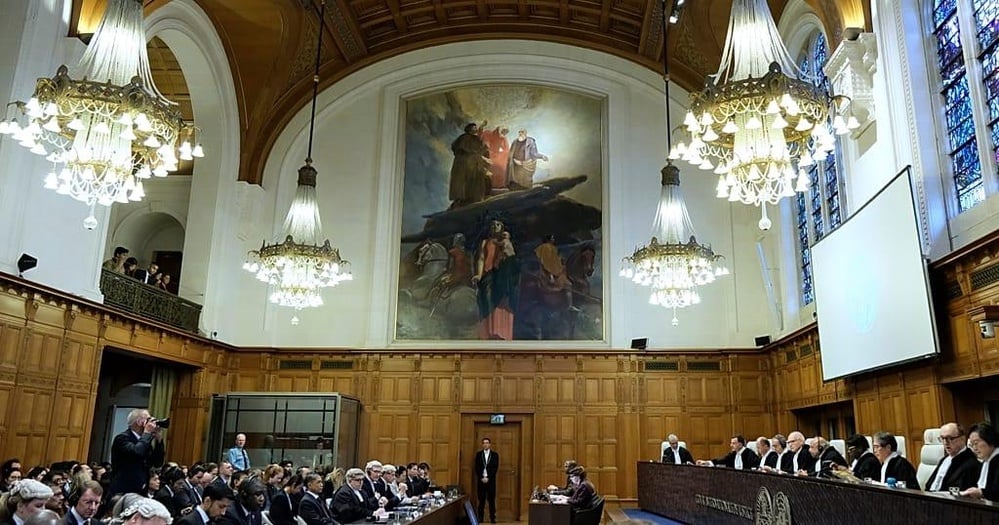
“ICJ President Yuji Iwasawa said the court, in a 9-6 decision, found that Myanmar “has committed genocide against the Rohingya group in northern Rakhine state, in violation of its obligations under the Genocide Convention”.” · exact text match
Why: The central claim is presented through a direct quote from the court president rather than the publisher's own opinion.
Claim: Sensationalism is low; grave findings are conveyed through formal legal and factual language.
“The International Court of Justice (ICJ) at The Hague delivered its judgement on Thursday about the military crackdown that drove more than 730,000 mainly Muslim Rohingya to flee to neighbouring Bangladesh.” · exact text match
Why: The sentence reports court action and displacement with restrained factual phrasing.
Claim: The report is mainly descriptive of the ICJ ruling and its ordered remedies rather than publisher advocacy.
“Myanmar is now obliged to provide reparations and restitution “as a result of Myanmar’s wrongful acts”, Iwasawa said.” · exact text match
Why: The obligations are reported as the court's findings rather than as the publisher's prescriptions.
Claim: Publisher opinion is minimal; analysis is attributed to named experts.
“said Toby Cadman, an international human rights lawyer” · exact text match
Why: Legal interpretation is attributed to an expert rather than asserted in the publisher's voice.
Claim: The report is politically framed around state accountability, international institutions, and enforcement.
“This includes whether the issue goes before the UN Security Council and whether there are sanctions, or other remedies that the court can order to ensure it is enforced.” · exact text match
Why: It centers UN Security Council action, sanctions, and international legal enforcement.
Claim: The report relies heavily on institutional and expert authority to establish the ruling's significance.
“said Toby Cadman, an international human rights lawyer” · exact text match
“Amnesty International said in a statement.” · exact text match
Why: It repeatedly cites the ICJ, a named lawyer, and Amnesty to support interpretation.
Claim: The article's emotional valence is strongly negative, reflecting the genocide findings and victim displacement.
“They’ve been waiting for 10 years for any kind of justice” · exact text match
Why: The victim-focused quote and surrounding atrocity reporting produce a negative emotional valence.
Claim: Credibility is high because the report uses direct court quotes, named experts, and UN-attributed figures.
“ICJ President Yuji Iwasawa said the court, in a 9-6 decision, found that Myanmar “has committed genocide against the Rohingya group in northern Rakhine state, in violation of its obligations under the Genocide Convention”.” · exact text match
“More than 1.3 million Rohingya remain displaced across South and Southeast Asia, including 1.2 million in sprawling refugee camps in Cox’s Bazar in Bangladesh, according to the UN.” · exact text match
Why: Direct attribution to court officials, experts, and UN data supports visible credibility.
Claim: The report grounds the genocide finding in legal inference and evidence rather than irrational assertion.
“The ICJ said that the “only reasonable inference” from evidence of widespread atrocities by Myanmar security forces is that they had the intent to destroy a “substantial part” of the Rohingya minority.” · exact text match
Why: The quoted court inference and surrounding evidence-based framing support a rational presentation.
Claim: Speculation is limited and attributed to an expert discussing enforcement and next steps.
“Cadman said that the situation does not come to an end with the ICJ’s ruling and a lot will depend on what comes next.” · exact text match
Why: The forward-looking statement is explicitly attributed and framed as uncertainty.
Claim: The report demonstrates high integrity by including Myanmar's defense and attributing all legal findings and reactions.
“Myanmar claimed its crackdown was in response to attacks on police posts by fighters from the Arakan Rohingya Salvation Army (ARSA).” · exact text match
Why: Including the accused state's stated rationale and attributing claims to named sources shows fairness.
Claim: The article explains the high legal threshold for proving genocidal intent and the limits of enforcement.
“The hardest part of any genocide case is proving specific intent to destroy a group in whole or in part – an extremely high bar – said Toby Cadman, an international human rights lawyer.” · exact text match
Why: It supplies nuanced legal context rather than merely reporting the verdict.
The supplied text duplicates the main article and appends unrelated related-link headlines; analysis is based on the main ICJ verdict report.
November 19, 2026 · 0 shares
Strongly sympathetic to Rohingya victims and centered on the ICJ’s historic accountability finding, with emotive survivor testimony and moral condemnation balanced by court attribution, Myanmar’s denial, and enforcement caveats.
The Rohingya are a mostly Muslim minority in Buddhist-majority Myanmar; the ICJ is the UN’s principal judicial organ.
Helium Analysis
Limitations: The supplied text includes appended unrelated news snippets after the main CNN report; these were excluded, and the main report appears truncated at the top.
·
20 of 56 available dimensions scored; omitted dimensions are not treated as neutral.
·
Verified supporting quotes for 20 of 20 scored dimensions.
Claim: The report gives mild left-leaning valence by casting the Trump administration as hostile to international justice while centering minority victim protection.
“the broader idea of international justice has come under fire from the Trump administration” · exact text match
“already on a campaign to “dismantle” another institution, the International Criminal Court” · exact text match
Counterevidence:
“its UN ambassador Mike Waltz accused the ICJ of trying to lower the threshold for a genocide verdict in the Myanmar case” · exact text match
Why: Mildly critical framing of Trump-era policy is balanced by quoted administration criticism.
Claim: UN judicial and human-rights authorities are presented as the central legitimate voices on the ruling.
“the United Nations’ top court found Thursday” · exact text match
“UN human rights chief Volker Türk on Thursday applauded” · exact text match
Why: Deference to international institutions indicates a mild elitist/institutional orientation.
Claim: Emotive language and survivor testimony add subjective moral weight to the legal report.
“harrowing stories from Rohingya who saw their family members raped or killed by soldiers” · exact text match
“streams of terrified people fleeing burning villages on foot” · exact text match
Why: Vivid, emotionally charged description makes the framing somewhat subjective.
Claim: Historic and dramatic language heightens the ruling’s significance beyond neutral legal description.
“The historic judgement marks the first time” · exact text match
“an unprecedented ruling that survivors of the atrocities have waited almost a decade to hear” · exact text match
Why: Superlatives and dramatic phrasing indicate mild sensational emphasis.
Claim: The report centers a landmark first in the ICJ’s history with major humanitarian stakes.
“the first time the International Court of Justice (ICJ), also known as the World Court, has held a state accountable for genocide in its 80-year history” · exact text match
Why: Landmark legal and humanitarian content is highly interesting.
Claim: The report mainly describes the court’s findings and orders rather than asserting its own policy prescriptions.
“The ICJ ordered Myanmar to make reparations to the Rohingya” · exact text match
“It also ordered Myanmar to ensure their future protection from discrimination and persecution” · exact text match
Why: Court orders are reported descriptively, not as the publisher’s own demands.
Claim: Graphic atrocity descriptions evoke fear and horror, though they are used to document genocide rather than to bait emotion.
“looting, burning and slaughtering their inhabitants” · exact text match
“streams of terrified people fleeing burning villages on foot” · exact text match
Why: Frightening imagery is present but contextually tied to the reported atrocities.
Claim: The report is mostly factual and attributed, with limited evaluative language such as 'historic' and 'unprecedented'.
“The historic judgement” · exact text match
“an unprecedented ruling” · exact text match
Why: Evaluative adjectives are present but limited.
Claim: The ruling is situated in international political conflict, including Trump administration criticism and the Israel case.
“comes at a time when the broader idea of international justice has come under fire from the Trump administration” · exact text match
“the ICJ allowed South Africa to bring a case against Israel over its war with Hamas in Gaza” · exact text match
Why: Explicit political context makes the report highly political.
Claim: The report acknowledges enforcement limits and control of Rakhine State, avoiding a simple accountability narrative.
“the court – which hears disputes between states – doesn’t have the power to enforce its decisions” · exact text match
“the military-backed government is not in control” · exact text match
Why: Caveats and complexity keep oversimplification low.
Claim: The report relies heavily on ICJ and UN authority to establish the ruling’s significance.
“the United Nations’ top court found Thursday” · exact text match
“UN human rights chief Volker Türk on Thursday applauded” · exact text match
Why: Authority-heavy sourcing is appropriate for legal reporting but still prominent.
Claim: Survivor suffering and statelessness are central to the narrative.
“long-persecuted Rohingya minority” · exact text match
“We have known nothing but statelessness” · exact text match
Why: The framing is strongly victim-centered, though appropriate to genocide coverage.
Claim: Certainty is calibrated through the close vote and explicit compliance caveats.
“by nine votes to six” · exact text match
“It is unlikelyMyanmar will adhere” · exact text match
Why: The report avoids presenting enforcement as assured.
Claim: The ICJ and UN are treated as legitimate accountability institutions.
“the United Nations’ top court found Thursday” · exact text match
“UN human rights chief Volker Türk on Thursday applauded” · exact text match
Why: Institutional authority is foregrounded, indicating mild pro-establishment framing.
Claim: The tone is heavily negative and harrowing, grounded in atrocity reporting.
“harrowing stories” · exact text match
“The suffering, misery and humiliation inflicted on the Rohingya by the Myanmar state is a stain on the conscience of humanity” · exact text match
Why: Negative emotional language dominates the description.
Claim: The report names sources, attributes findings and quotes, and notes denial and enforcement limits.
“presiding judge Iwasawa Yuji said” · exact text match
“Myanmar had denied its “clearance operations” were intended to destroy the Rohingya population” · exact text match
Why: Visible sourcing and caveats support high credibility.
Claim: The ruling is framed through legal evidence, witness testimony, and a reasoned inference of genocidal intent.
“After seven years of weighing evidence and hearing witness testimony” · exact text match
“The court is of the view that the only reasonable inference that can explain Myanmar’s actions is an intention to destroy” · exact text match
Why: Legal reasoning and evidence are foregrounded, supporting a rational orientation.
Claim: The report makes only a limited forecast about Myanmar’s compliance, flagged as unlikely.
“It is unlikelyMyanmar will adhere” · exact text match
Why: Minimal forecasting beyond the reported facts.
Claim: The report includes Myanmar’s denial, enforcement limits, and contested political reactions.
“Myanmar had denied its “clearance operations” were intended to destroy the Rohingya population” · exact text match
“the court – which hears disputes between states – doesn’t have the power to enforce its decisions” · exact text match
Why: Inclusion of counterclaims and limitations signals high internal fairness.
Claim: The report integrates legal findings, historical context, survivor testimony, and enforcement constraints.
“After seven years of weighing evidence and hearing witness testimony” · exact text match
“the court – which hears disputes between states – doesn’t have the power to enforce its decisions” · exact text match
Why: Layered context and sourcing indicate high article intelligence.
The supplied text includes appended unrelated news snippets after the main CNN report; these were excluded, and the main report appears truncated at the top.
November 19, 2026 · 0 shares
Coverage is largely neutral and evidence-bound, relying on direct ICJ quotes and attributed expert commentary while including Myanmar’s stated rationale, though the headline’s 'guilty' wording is legally imprecise.
Helium Analysis
Limitations: The supplied text duplicates the main article and appends unrelated related-link headlines; analysis is based on the main ICJ verdict report.
·
12 of 56 available dimensions scored; omitted dimensions are not treated as neutral.
·
Verified supporting quotes for 12 of 12 scored dimensions.
Claim: Framing is predominantly objective, built on attributed court findings rather than subjective commentary.
“ICJ President Yuji Iwasawa said the court, in a 9-6 decision, found that Myanmar “has committed genocide against the Rohingya group in northern Rakhine state, in violation of its obligations under the Genocide Convention”.” · exact text match
Why: The central claim is presented through a direct quote from the court president rather than the publisher's own opinion.
Claim: Sensationalism is low; grave findings are conveyed through formal legal and factual language.
“The International Court of Justice (ICJ) at The Hague delivered its judgement on Thursday about the military crackdown that drove more than 730,000 mainly Muslim Rohingya to flee to neighbouring Bangladesh.” · exact text match
Why: The sentence reports court action and displacement with restrained factual phrasing.
Claim: The report is mainly descriptive of the ICJ ruling and its ordered remedies rather than publisher advocacy.
“Myanmar is now obliged to provide reparations and restitution “as a result of Myanmar’s wrongful acts”, Iwasawa said.” · exact text match
Why: The obligations are reported as the court's findings rather than as the publisher's prescriptions.
Claim: Publisher opinion is minimal; analysis is attributed to named experts.
“said Toby Cadman, an international human rights lawyer” · exact text match
Why: Legal interpretation is attributed to an expert rather than asserted in the publisher's voice.
Claim: The report is politically framed around state accountability, international institutions, and enforcement.
“This includes whether the issue goes before the UN Security Council and whether there are sanctions, or other remedies that the court can order to ensure it is enforced.” · exact text match
Why: It centers UN Security Council action, sanctions, and international legal enforcement.
Claim: The report relies heavily on institutional and expert authority to establish the ruling's significance.
“said Toby Cadman, an international human rights lawyer” · exact text match
“Amnesty International said in a statement.” · exact text match
Why: It repeatedly cites the ICJ, a named lawyer, and Amnesty to support interpretation.
Claim: The article's emotional valence is strongly negative, reflecting the genocide findings and victim displacement.
“They’ve been waiting for 10 years for any kind of justice” · exact text match
Why: The victim-focused quote and surrounding atrocity reporting produce a negative emotional valence.
Claim: Credibility is high because the report uses direct court quotes, named experts, and UN-attributed figures.
“ICJ President Yuji Iwasawa said the court, in a 9-6 decision, found that Myanmar “has committed genocide against the Rohingya group in northern Rakhine state, in violation of its obligations under the Genocide Convention”.” · exact text match
“More than 1.3 million Rohingya remain displaced across South and Southeast Asia, including 1.2 million in sprawling refugee camps in Cox’s Bazar in Bangladesh, according to the UN.” · exact text match
Why: Direct attribution to court officials, experts, and UN data supports visible credibility.
Claim: The report grounds the genocide finding in legal inference and evidence rather than irrational assertion.
“The ICJ said that the “only reasonable inference” from evidence of widespread atrocities by Myanmar security forces is that they had the intent to destroy a “substantial part” of the Rohingya minority.” · exact text match
Why: The quoted court inference and surrounding evidence-based framing support a rational presentation.
Claim: Speculation is limited and attributed to an expert discussing enforcement and next steps.
“Cadman said that the situation does not come to an end with the ICJ’s ruling and a lot will depend on what comes next.” · exact text match
Why: The forward-looking statement is explicitly attributed and framed as uncertainty.
Claim: The report demonstrates high integrity by including Myanmar's defense and attributing all legal findings and reactions.
“Myanmar claimed its crackdown was in response to attacks on police posts by fighters from the Arakan Rohingya Salvation Army (ARSA).” · exact text match
Why: Including the accused state's stated rationale and attributing claims to named sources shows fairness.
Claim: The article explains the high legal threshold for proving genocidal intent and the limits of enforcement.
“The hardest part of any genocide case is proving specific intent to destroy a group in whole or in part – an extremely high bar – said Toby Cadman, an international human rights lawyer.” · exact text match
Why: It supplies nuanced legal context rather than merely reporting the verdict.
The supplied text duplicates the main article and appends unrelated related-link headlines; analysis is based on the main ICJ verdict report.
November 19, 2026 · 0 shares
The report is predominantly neutral and attribution-driven, presenting the genocide finding as the ICJ’s legally binding conclusion while noting Myanmar’s rejected defense and the court’s enforcement limits.
Helium Analysis
Limitations: No author byline or publication date appears in the supplied text; scores reflect the visible article content only.
·
56 of 56 available dimensions scored; omitted dimensions are not treated as neutral.
·
Verified supporting quotes for 8 of 56 scored dimensions.
Claim: The report is primarily objective and attribution-driven rather than subjective.
“The court said that evidence showed Myanmar forces killed about 10,000 Rohingya.” · exact text match
Why: The statement attributes the casualty estimate to the court’s evidence finding, illustrating factual reporting.
Claim: The report is not sensational; grave findings are presented through attributed legal language.
“perpetrated widespread acts of sexual violence, as well as acts of extreme violence against children” · exact text match
Why: The severity is conveyed as the court’s finding, not through publisher hype or shock language.
Claim: The article is predominantly descriptive, reporting the ruling and its context rather than prescribing action.
“The decision marks the first time the court has ruled that a state committed genocide.” · exact text match
Why: This is a factual description of the ruling’s legal significance, not a publisher call to action.
Claim: The article is mostly fact-based but includes minor evaluative framing such as 'brutal' and 'respected'.
“brutal 2017 military operation” · exact text match
Why: The adjective adds evaluative coloring in otherwise attributed reporting, supporting a low opinion-bias score.
Claim: The report is substantially political in subject matter, including diplomatic responses to the ruling.
“U.K. Foreign Secretary Ed Miliband said his government was expelling Myanmar's defence attaché from the U.K.” · not found in supplied text
Why: The article covers an international legal ruling and state diplomatic reactions, making political content central.
Claim: The report has high credibility through attribution to the court and inclusion of Myanmar’s rejected defense.
“The court's 15-judge panel — which included Navi Pillay, the respected international jurist who won the Nobel Peace Prize last month — rejected Myanmar's defence that the 2017 campaign was a legitimate operation against insurgents.” · exact text match
Why: The article names the court, vote context, and rejected defense, supporting visible sourcing and fair attribution.
Claim: The report uses legal definitions and contextual reasoning rather than emotive or irrational argument.
“The intent to destroy a group in whole or in part is a key element in establishing whether crimes amount to genocide under international law.” · exact text match
Why: The article explains the legal standard and attributes findings to the court, supporting a rational/legal framing.
Claim: The report shows high internal fairness by noting the ruling’s binding status and its enforcement limitations.
“The court's rulings are final and legally binding, but it has no way to enforce it beyond reporting noncompliance to the UN Security Council.” · exact text match
Why: Including the enforcement caveat materially qualifies the significance of the ruling and signals fair contextualization.
Claim: The article is relatively intelligent, supplying legal context, prior cases, and caveats.
“South Africa has accused Israel of breaching the genocide convention during its offensive in Gaza, a claim Israel vehemently denies.” · exact text match
Why: Including other pending genocide cases and a denial shows contextual breadth and nuance.
No author byline or publication date appears in the supplied text; scores reflect the visible article content only.
November 19, 2026 · 0 shares
Strongly sympathetic to Rohingya victims and centered on the ICJ’s historic accountability finding, with emotive survivor testimony and moral condemnation balanced by court attribution, Myanmar’s denial, and enforcement caveats.
The Rohingya are a mostly Muslim minority in Buddhist-majority Myanmar; the ICJ is the UN’s principal judicial organ.
Helium Analysis
Limitations: The supplied text includes appended unrelated news snippets after the main CNN report; these were excluded, and the main report appears truncated at the top.
·
20 of 56 available dimensions scored; omitted dimensions are not treated as neutral.
·
Verified supporting quotes for 20 of 20 scored dimensions.
Claim: The report gives mild left-leaning valence by casting the Trump administration as hostile to international justice while centering minority victim protection.
“the broader idea of international justice has come under fire from the Trump administration” · exact text match
“already on a campaign to “dismantle” another institution, the International Criminal Court” · exact text match
Counterevidence:
“its UN ambassador Mike Waltz accused the ICJ of trying to lower the threshold for a genocide verdict in the Myanmar case” · exact text match
Why: Mildly critical framing of Trump-era policy is balanced by quoted administration criticism.
Claim: UN judicial and human-rights authorities are presented as the central legitimate voices on the ruling.
“the United Nations’ top court found Thursday” · exact text match
“UN human rights chief Volker Türk on Thursday applauded” · exact text match
Why: Deference to international institutions indicates a mild elitist/institutional orientation.
Claim: Emotive language and survivor testimony add subjective moral weight to the legal report.
“harrowing stories from Rohingya who saw their family members raped or killed by soldiers” · exact text match
“streams of terrified people fleeing burning villages on foot” · exact text match
Why: Vivid, emotionally charged description makes the framing somewhat subjective.
Claim: Historic and dramatic language heightens the ruling’s significance beyond neutral legal description.
“The historic judgement marks the first time” · exact text match
“an unprecedented ruling that survivors of the atrocities have waited almost a decade to hear” · exact text match
Why: Superlatives and dramatic phrasing indicate mild sensational emphasis.
Claim: The report centers a landmark first in the ICJ’s history with major humanitarian stakes.
“the first time the International Court of Justice (ICJ), also known as the World Court, has held a state accountable for genocide in its 80-year history” · exact text match
Why: Landmark legal and humanitarian content is highly interesting.
Claim: The report mainly describes the court’s findings and orders rather than asserting its own policy prescriptions.
“The ICJ ordered Myanmar to make reparations to the Rohingya” · exact text match
“It also ordered Myanmar to ensure their future protection from discrimination and persecution” · exact text match
Why: Court orders are reported descriptively, not as the publisher’s own demands.
Claim: Graphic atrocity descriptions evoke fear and horror, though they are used to document genocide rather than to bait emotion.
“looting, burning and slaughtering their inhabitants” · exact text match
“streams of terrified people fleeing burning villages on foot” · exact text match
Why: Frightening imagery is present but contextually tied to the reported atrocities.
Claim: The report is mostly factual and attributed, with limited evaluative language such as 'historic' and 'unprecedented'.
“The historic judgement” · exact text match
“an unprecedented ruling” · exact text match
Why: Evaluative adjectives are present but limited.
Claim: The ruling is situated in international political conflict, including Trump administration criticism and the Israel case.
“comes at a time when the broader idea of international justice has come under fire from the Trump administration” · exact text match
“the ICJ allowed South Africa to bring a case against Israel over its war with Hamas in Gaza” · exact text match
Why: Explicit political context makes the report highly political.
Claim: The report acknowledges enforcement limits and control of Rakhine State, avoiding a simple accountability narrative.
“the court – which hears disputes between states – doesn’t have the power to enforce its decisions” · exact text match
“the military-backed government is not in control” · exact text match
Why: Caveats and complexity keep oversimplification low.
Claim: The report relies heavily on ICJ and UN authority to establish the ruling’s significance.
“the United Nations’ top court found Thursday” · exact text match
“UN human rights chief Volker Türk on Thursday applauded” · exact text match
Why: Authority-heavy sourcing is appropriate for legal reporting but still prominent.
Claim: Survivor suffering and statelessness are central to the narrative.
“long-persecuted Rohingya minority” · exact text match
“We have known nothing but statelessness” · exact text match
Why: The framing is strongly victim-centered, though appropriate to genocide coverage.
Claim: Certainty is calibrated through the close vote and explicit compliance caveats.
“by nine votes to six” · exact text match
“It is unlikelyMyanmar will adhere” · exact text match
Why: The report avoids presenting enforcement as assured.
Claim: The ICJ and UN are treated as legitimate accountability institutions.
“the United Nations’ top court found Thursday” · exact text match
“UN human rights chief Volker Türk on Thursday applauded” · exact text match
Why: Institutional authority is foregrounded, indicating mild pro-establishment framing.
Claim: The tone is heavily negative and harrowing, grounded in atrocity reporting.
“harrowing stories” · exact text match
“The suffering, misery and humiliation inflicted on the Rohingya by the Myanmar state is a stain on the conscience of humanity” · exact text match
Why: Negative emotional language dominates the description.
Claim: The report names sources, attributes findings and quotes, and notes denial and enforcement limits.
“presiding judge Iwasawa Yuji said” · exact text match
“Myanmar had denied its “clearance operations” were intended to destroy the Rohingya population” · exact text match
Why: Visible sourcing and caveats support high credibility.
Claim: The ruling is framed through legal evidence, witness testimony, and a reasoned inference of genocidal intent.
“After seven years of weighing evidence and hearing witness testimony” · exact text match
“The court is of the view that the only reasonable inference that can explain Myanmar’s actions is an intention to destroy” · exact text match
Why: Legal reasoning and evidence are foregrounded, supporting a rational orientation.
Claim: The report makes only a limited forecast about Myanmar’s compliance, flagged as unlikely.
“It is unlikelyMyanmar will adhere” · exact text match
Why: Minimal forecasting beyond the reported facts.
Claim: The report includes Myanmar’s denial, enforcement limits, and contested political reactions.
“Myanmar had denied its “clearance operations” were intended to destroy the Rohingya population” · exact text match
“the court – which hears disputes between states – doesn’t have the power to enforce its decisions” · exact text match
Why: Inclusion of counterclaims and limitations signals high internal fairness.
Claim: The report integrates legal findings, historical context, survivor testimony, and enforcement constraints.
“After seven years of weighing evidence and hearing witness testimony” · exact text match
“the court – which hears disputes between states – doesn’t have the power to enforce its decisions” · exact text match
Why: Layered context and sourcing indicate high article intelligence.
The supplied text includes appended unrelated news snippets after the main CNN report; these were excluded, and the main report appears truncated at the top.
Framing is human-rights victim-centered and emotionally sympathetic, anchoring the ICJ genocide ruling in a Rohingya widow's grief and joy while still attributing the legal finding to the court and including Myanmar's denial.
Helium Analysis
Limitations: The supplied text includes duplicated fragments and a photo caption dated Nov 19, 2026, while the ruling is otherwise dated only as 'Thursday (Nov 19)'; the exact verdict year is ambiguous.
·
11 of 56 available dimensions scored; omitted dimensions are not treated as neutral.
·
Verified supporting quotes for 10 of 11 scored dimensions.
Claim: The narrative leans subjective by foregrounding one widow's emotional testimony.
“"My heart is filled with joy to hear that justice is finally being served."” · exact text match
“"I begged them not to take him," she said.
"I held onto him, but a soldier cut my hand with a machete and dragged him away.
That was the last time I saw him alive."”
· exact text match
Counterevidence:
“The International Court of Justice (ICJ) ruled that thousands of killings and widespread sexual violence by Myanmar's security forces against the Rohingya in 2017 amounted to state-sponsored genocide, delivering a final verdict in a case brought to the court by Gambia.” · exact text match
Why: Personal testimony drives the story, qualified by a factual court ruling.
Claim: Emotive and graphic human-interest details heighten the story's impact beyond a bare legal report.
“From her ramshackle hut, surrounded by the makeshift homes of more than a million Rohingya refugees like her, Rahama Khatun watched quietly on her smartphone as judges at the United Nations' top court read out a judgement she had long awaited.” · exact text match
“Her pregnancy made the journey agonising, leaving her legs so swollen that she could barely walk.” · exact text match
Why: Vivid imagery and bodily suffering are used prominently.
Claim: The story combines a historic genocide ruling with a personal refugee narrative.
“which marked only the fourth time since the Nazi Holocaust that an international court ruled that the legal threshold to prove genocide had been met.” · exact text match
“From her ramshackle hut, surrounded by the makeshift homes of more than a million Rohingya refugees like her, Rahama Khatun watched quietly on her smartphone as judges at the United Nations' top court read out a judgement she had long awaited.” · exact text match
Why: Milestone legal outcome and individual testimony increase narrative interest.
Claim: Publisher framing is mainly descriptive, reporting legal findings and testimony rather than issuing its own prescriptions.
“Myanmar's military later jailed seven soldiers for 10 years for the Inn Din killings, but they were released early after less than a year in prison.” · exact text match
Counterevidence:
“"The world must recognise what happened and ensure those responsible are held accountable."” · not found in supplied text
Why: Descriptive narration dominates, while the only explicit prescription is quoted from the widow.
Claim: Graphic atrocity details create a fearful, harrowing tone.
“Myanmar's military carried out mass executions of men and boys, committed widespread rape of Rohingya women and burned or razed hundreds of villages during so-called clearance operations, the court found.” · exact text match
Why: The report recounts severe violence, though soberly and with attribution.
Claim: The subject is a politically charged state accountability and citizenship dispute.
“The International Court of Justice (ICJ) ruled that thousands of killings and widespread sexual violence by Myanmar's security forces against the Rohingya in 2017 amounted to state-sponsored genocide, delivering a final verdict in a case brought to the court by Gambia.” · exact text match
“"Not as stateless refugees, but as equal citizens with full rights, dignity, freedom, and the citizenship we have always deserved."” · exact text match
Why: State genocide ruling and citizenship claims make political framing substantial but not partisan.
Claim: The report is strongly organized around Rohingya victimhood and suffering.
“"We have carried this pain for so long," Khatun said ahead of the verdict” · exact text match
“"After years of suffering, persecution, and displacement, we hope this historic verdict will pave the way for us to return to our homeland," she said.” · exact text match
Why: Victim testimony and persecution language dominate the human-interest frame.
Claim: Credibility is high because central claims are tied to the ICJ, Reuters reporting, and recorded responses.
“The International Court of Justice (ICJ) ruled that thousands of killings and widespread sexual violence by Myanmar's security forces against the Rohingya in 2017 amounted to state-sponsored genocide, delivering a final verdict in a case brought to the court by Gambia.” · exact text match
“Myanmar's military-led government did not immediately respond to a request for comment on the ruling.” · exact text match
Why: Sourcing, attribution, and response inclusion support trustworthiness.
Claim: The report grounds its central claim in an ICJ finding and a Reuters investigation rather than speculation.
“the court found.” · exact text match
“according to a Reuters investigation.” · exact text match
Why: Attribution to a court and an investigation supports a rational, evidence-oriented classification.
Claim: The report shows high internal fairness through attribution and inclusion of the accused government's denial.
“according to a Reuters investigation” · exact text match
“It has previously described Gambia's allegations as "flawed and unfounded in fact and law" and said its opponents have used "biased reports" based on unreliable evidence.” · not found in supplied text
Why: It identifies sourcing and gives Myanmar's position.
Claim: The article supplies legal-historical context and a coherent narrative.
“which marked only the fourth time since the Nazi Holocaust that an international court ruled that the legal threshold to prove genocide had been met.” · exact text match
“following a 2021 coup that triggered a nationwide civil war.” · exact text match
Why: Contextualization and structure indicate above-average article intelligence.
The supplied text includes duplicated fragments and a photo caption dated Nov 19, 2026, while the ruling is otherwise dated only as 'Thursday (Nov 19)'; the exact verdict year is ambiguous.
November 19, 2026 · 0 shares
Coverage is largely neutral and evidence-bound, relying on direct ICJ quotes and attributed expert commentary while including Myanmar’s stated rationale, though the headline’s 'guilty' wording is legally imprecise.
Helium Analysis
Limitations: The supplied text duplicates the main article and appends unrelated related-link headlines; analysis is based on the main ICJ verdict report.
·
12 of 56 available dimensions scored; omitted dimensions are not treated as neutral.
·
Verified supporting quotes for 12 of 12 scored dimensions.
Claim: Framing is predominantly objective, built on attributed court findings rather than subjective commentary.
“ICJ President Yuji Iwasawa said the court, in a 9-6 decision, found that Myanmar “has committed genocide against the Rohingya group in northern Rakhine state, in violation of its obligations under the Genocide Convention”.” · exact text match
Why: The central claim is presented through a direct quote from the court president rather than the publisher's own opinion.
Claim: Sensationalism is low; grave findings are conveyed through formal legal and factual language.
“The International Court of Justice (ICJ) at The Hague delivered its judgement on Thursday about the military crackdown that drove more than 730,000 mainly Muslim Rohingya to flee to neighbouring Bangladesh.” · exact text match
Why: The sentence reports court action and displacement with restrained factual phrasing.
Claim: The report is mainly descriptive of the ICJ ruling and its ordered remedies rather than publisher advocacy.
“Myanmar is now obliged to provide reparations and restitution “as a result of Myanmar’s wrongful acts”, Iwasawa said.” · exact text match
Why: The obligations are reported as the court's findings rather than as the publisher's prescriptions.
Claim: Publisher opinion is minimal; analysis is attributed to named experts.
“said Toby Cadman, an international human rights lawyer” · exact text match
Why: Legal interpretation is attributed to an expert rather than asserted in the publisher's voice.
Claim: The report is politically framed around state accountability, international institutions, and enforcement.
“This includes whether the issue goes before the UN Security Council and whether there are sanctions, or other remedies that the court can order to ensure it is enforced.” · exact text match
Why: It centers UN Security Council action, sanctions, and international legal enforcement.
Claim: The report relies heavily on institutional and expert authority to establish the ruling's significance.
“said Toby Cadman, an international human rights lawyer” · exact text match
“Amnesty International said in a statement.” · exact text match
Why: It repeatedly cites the ICJ, a named lawyer, and Amnesty to support interpretation.
Claim: The article's emotional valence is strongly negative, reflecting the genocide findings and victim displacement.
“They’ve been waiting for 10 years for any kind of justice” · exact text match
Why: The victim-focused quote and surrounding atrocity reporting produce a negative emotional valence.
Claim: Credibility is high because the report uses direct court quotes, named experts, and UN-attributed figures.
“ICJ President Yuji Iwasawa said the court, in a 9-6 decision, found that Myanmar “has committed genocide against the Rohingya group in northern Rakhine state, in violation of its obligations under the Genocide Convention”.” · exact text match
“More than 1.3 million Rohingya remain displaced across South and Southeast Asia, including 1.2 million in sprawling refugee camps in Cox’s Bazar in Bangladesh, according to the UN.” · exact text match
Why: Direct attribution to court officials, experts, and UN data supports visible credibility.
Claim: The report grounds the genocide finding in legal inference and evidence rather than irrational assertion.
“The ICJ said that the “only reasonable inference” from evidence of widespread atrocities by Myanmar security forces is that they had the intent to destroy a “substantial part” of the Rohingya minority.” · exact text match
Why: The quoted court inference and surrounding evidence-based framing support a rational presentation.
Claim: Speculation is limited and attributed to an expert discussing enforcement and next steps.
“Cadman said that the situation does not come to an end with the ICJ’s ruling and a lot will depend on what comes next.” · exact text match
Why: The forward-looking statement is explicitly attributed and framed as uncertainty.
Claim: The report demonstrates high integrity by including Myanmar's defense and attributing all legal findings and reactions.
“Myanmar claimed its crackdown was in response to attacks on police posts by fighters from the Arakan Rohingya Salvation Army (ARSA).” · exact text match
Why: Including the accused state's stated rationale and attributing claims to named sources shows fairness.
Claim: The article explains the high legal threshold for proving genocidal intent and the limits of enforcement.
“The hardest part of any genocide case is proving specific intent to destroy a group in whole or in part – an extremely high bar – said Toby Cadman, an international human rights lawyer.” · exact text match
Why: It supplies nuanced legal context rather than merely reporting the verdict.
The supplied text duplicates the main article and appends unrelated related-link headlines; analysis is based on the main ICJ verdict report.
November 19, 2026 · 0 shares
Strongly sympathetic to Rohingya victims and centered on the ICJ’s historic accountability finding, with emotive survivor testimony and moral condemnation balanced by court attribution, Myanmar’s denial, and enforcement caveats.
The Rohingya are a mostly Muslim minority in Buddhist-majority Myanmar; the ICJ is the UN’s principal judicial organ.
Helium Analysis
Limitations: The supplied text includes appended unrelated news snippets after the main CNN report; these were excluded, and the main report appears truncated at the top.
·
20 of 56 available dimensions scored; omitted dimensions are not treated as neutral.
·
Verified supporting quotes for 20 of 20 scored dimensions.
Claim: The report gives mild left-leaning valence by casting the Trump administration as hostile to international justice while centering minority victim protection.
“the broader idea of international justice has come under fire from the Trump administration” · exact text match
“already on a campaign to “dismantle” another institution, the International Criminal Court” · exact text match
Counterevidence:
“its UN ambassador Mike Waltz accused the ICJ of trying to lower the threshold for a genocide verdict in the Myanmar case” · exact text match
Why: Mildly critical framing of Trump-era policy is balanced by quoted administration criticism.
Claim: UN judicial and human-rights authorities are presented as the central legitimate voices on the ruling.
“the United Nations’ top court found Thursday” · exact text match
“UN human rights chief Volker Türk on Thursday applauded” · exact text match
Why: Deference to international institutions indicates a mild elitist/institutional orientation.
Claim: Emotive language and survivor testimony add subjective moral weight to the legal report.
“harrowing stories from Rohingya who saw their family members raped or killed by soldiers” · exact text match
“streams of terrified people fleeing burning villages on foot” · exact text match
Why: Vivid, emotionally charged description makes the framing somewhat subjective.
Claim: Historic and dramatic language heightens the ruling’s significance beyond neutral legal description.
“The historic judgement marks the first time” · exact text match
“an unprecedented ruling that survivors of the atrocities have waited almost a decade to hear” · exact text match
Why: Superlatives and dramatic phrasing indicate mild sensational emphasis.
Claim: The report centers a landmark first in the ICJ’s history with major humanitarian stakes.
“the first time the International Court of Justice (ICJ), also known as the World Court, has held a state accountable for genocide in its 80-year history” · exact text match
Why: Landmark legal and humanitarian content is highly interesting.
Claim: The report mainly describes the court’s findings and orders rather than asserting its own policy prescriptions.
“The ICJ ordered Myanmar to make reparations to the Rohingya” · exact text match
“It also ordered Myanmar to ensure their future protection from discrimination and persecution” · exact text match
Why: Court orders are reported descriptively, not as the publisher’s own demands.
Claim: Graphic atrocity descriptions evoke fear and horror, though they are used to document genocide rather than to bait emotion.
“looting, burning and slaughtering their inhabitants” · exact text match
“streams of terrified people fleeing burning villages on foot” · exact text match
Why: Frightening imagery is present but contextually tied to the reported atrocities.
Claim: The report is mostly factual and attributed, with limited evaluative language such as 'historic' and 'unprecedented'.
“The historic judgement” · exact text match
“an unprecedented ruling” · exact text match
Why: Evaluative adjectives are present but limited.
Claim: The ruling is situated in international political conflict, including Trump administration criticism and the Israel case.
“comes at a time when the broader idea of international justice has come under fire from the Trump administration” · exact text match
“the ICJ allowed South Africa to bring a case against Israel over its war with Hamas in Gaza” · exact text match
Why: Explicit political context makes the report highly political.
Claim: The report acknowledges enforcement limits and control of Rakhine State, avoiding a simple accountability narrative.
“the court – which hears disputes between states – doesn’t have the power to enforce its decisions” · exact text match
“the military-backed government is not in control” · exact text match
Why: Caveats and complexity keep oversimplification low.
Claim: The report relies heavily on ICJ and UN authority to establish the ruling’s significance.
“the United Nations’ top court found Thursday” · exact text match
“UN human rights chief Volker Türk on Thursday applauded” · exact text match
Why: Authority-heavy sourcing is appropriate for legal reporting but still prominent.
Claim: Survivor suffering and statelessness are central to the narrative.
“long-persecuted Rohingya minority” · exact text match
“We have known nothing but statelessness” · exact text match
Why: The framing is strongly victim-centered, though appropriate to genocide coverage.
Claim: Certainty is calibrated through the close vote and explicit compliance caveats.
“by nine votes to six” · exact text match
“It is unlikelyMyanmar will adhere” · exact text match
Why: The report avoids presenting enforcement as assured.
Claim: The ICJ and UN are treated as legitimate accountability institutions.
“the United Nations’ top court found Thursday” · exact text match
“UN human rights chief Volker Türk on Thursday applauded” · exact text match
Why: Institutional authority is foregrounded, indicating mild pro-establishment framing.
Claim: The tone is heavily negative and harrowing, grounded in atrocity reporting.
“harrowing stories” · exact text match
“The suffering, misery and humiliation inflicted on the Rohingya by the Myanmar state is a stain on the conscience of humanity” · exact text match
Why: Negative emotional language dominates the description.
Claim: The report names sources, attributes findings and quotes, and notes denial and enforcement limits.
“presiding judge Iwasawa Yuji said” · exact text match
“Myanmar had denied its “clearance operations” were intended to destroy the Rohingya population” · exact text match
Why: Visible sourcing and caveats support high credibility.
Claim: The ruling is framed through legal evidence, witness testimony, and a reasoned inference of genocidal intent.
“After seven years of weighing evidence and hearing witness testimony” · exact text match
“The court is of the view that the only reasonable inference that can explain Myanmar’s actions is an intention to destroy” · exact text match
Why: Legal reasoning and evidence are foregrounded, supporting a rational orientation.
Claim: The report makes only a limited forecast about Myanmar’s compliance, flagged as unlikely.
“It is unlikelyMyanmar will adhere” · exact text match
Why: Minimal forecasting beyond the reported facts.
Claim: The report includes Myanmar’s denial, enforcement limits, and contested political reactions.
“Myanmar had denied its “clearance operations” were intended to destroy the Rohingya population” · exact text match
“the court – which hears disputes between states – doesn’t have the power to enforce its decisions” · exact text match
Why: Inclusion of counterclaims and limitations signals high internal fairness.
Claim: The report integrates legal findings, historical context, survivor testimony, and enforcement constraints.
“After seven years of weighing evidence and hearing witness testimony” · exact text match
“the court – which hears disputes between states – doesn’t have the power to enforce its decisions” · exact text match
Why: Layered context and sourcing indicate high article intelligence.
The supplied text includes appended unrelated news snippets after the main CNN report; these were excluded, and the main report appears truncated at the top.
November 19, 2026 · 0 shares
Coverage is largely neutral and evidence-bound, relying on direct ICJ quotes and attributed expert commentary while including Myanmar’s stated rationale, though the headline’s 'guilty' wording is legally imprecise.
Helium Analysis
Limitations: The supplied text duplicates the main article and appends unrelated related-link headlines; analysis is based on the main ICJ verdict report.
·
12 of 56 available dimensions scored; omitted dimensions are not treated as neutral.
·
Verified supporting quotes for 12 of 12 scored dimensions.
Claim: Framing is predominantly objective, built on attributed court findings rather than subjective commentary.
“ICJ President Yuji Iwasawa said the court, in a 9-6 decision, found that Myanmar “has committed genocide against the Rohingya group in northern Rakhine state, in violation of its obligations under the Genocide Convention”.” · exact text match
Why: The central claim is presented through a direct quote from the court president rather than the publisher's own opinion.
Claim: Sensationalism is low; grave findings are conveyed through formal legal and factual language.
“The International Court of Justice (ICJ) at The Hague delivered its judgement on Thursday about the military crackdown that drove more than 730,000 mainly Muslim Rohingya to flee to neighbouring Bangladesh.” · exact text match
Why: The sentence reports court action and displacement with restrained factual phrasing.
Claim: The report is mainly descriptive of the ICJ ruling and its ordered remedies rather than publisher advocacy.
“Myanmar is now obliged to provide reparations and restitution “as a result of Myanmar’s wrongful acts”, Iwasawa said.” · exact text match
Why: The obligations are reported as the court's findings rather than as the publisher's prescriptions.
Claim: Publisher opinion is minimal; analysis is attributed to named experts.
“said Toby Cadman, an international human rights lawyer” · exact text match
Why: Legal interpretation is attributed to an expert rather than asserted in the publisher's voice.
Claim: The report is politically framed around state accountability, international institutions, and enforcement.
“This includes whether the issue goes before the UN Security Council and whether there are sanctions, or other remedies that the court can order to ensure it is enforced.” · exact text match
Why: It centers UN Security Council action, sanctions, and international legal enforcement.
Claim: The report relies heavily on institutional and expert authority to establish the ruling's significance.
“said Toby Cadman, an international human rights lawyer” · exact text match
“Amnesty International said in a statement.” · exact text match
Why: It repeatedly cites the ICJ, a named lawyer, and Amnesty to support interpretation.
Claim: The article's emotional valence is strongly negative, reflecting the genocide findings and victim displacement.
“They’ve been waiting for 10 years for any kind of justice” · exact text match
Why: The victim-focused quote and surrounding atrocity reporting produce a negative emotional valence.
Claim: Credibility is high because the report uses direct court quotes, named experts, and UN-attributed figures.
“ICJ President Yuji Iwasawa said the court, in a 9-6 decision, found that Myanmar “has committed genocide against the Rohingya group in northern Rakhine state, in violation of its obligations under the Genocide Convention”.” · exact text match
“More than 1.3 million Rohingya remain displaced across South and Southeast Asia, including 1.2 million in sprawling refugee camps in Cox’s Bazar in Bangladesh, according to the UN.” · exact text match
Why: Direct attribution to court officials, experts, and UN data supports visible credibility.
Claim: The report grounds the genocide finding in legal inference and evidence rather than irrational assertion.
“The ICJ said that the “only reasonable inference” from evidence of widespread atrocities by Myanmar security forces is that they had the intent to destroy a “substantial part” of the Rohingya minority.” · exact text match
Why: The quoted court inference and surrounding evidence-based framing support a rational presentation.
Claim: Speculation is limited and attributed to an expert discussing enforcement and next steps.
“Cadman said that the situation does not come to an end with the ICJ’s ruling and a lot will depend on what comes next.” · exact text match
Why: The forward-looking statement is explicitly attributed and framed as uncertainty.
Claim: The report demonstrates high integrity by including Myanmar's defense and attributing all legal findings and reactions.
“Myanmar claimed its crackdown was in response to attacks on police posts by fighters from the Arakan Rohingya Salvation Army (ARSA).” · exact text match
Why: Including the accused state's stated rationale and attributing claims to named sources shows fairness.
Claim: The article explains the high legal threshold for proving genocidal intent and the limits of enforcement.
“The hardest part of any genocide case is proving specific intent to destroy a group in whole or in part – an extremely high bar – said Toby Cadman, an international human rights lawyer.” · exact text match
Why: It supplies nuanced legal context rather than merely reporting the verdict.
The supplied text duplicates the main article and appends unrelated related-link headlines; analysis is based on the main ICJ verdict report.
November 19, 2026 · 0 shares
Strongly sympathetic to Rohingya victims and centered on the ICJ’s historic accountability finding, with emotive survivor testimony and moral condemnation balanced by court attribution, Myanmar’s denial, and enforcement caveats.
The Rohingya are a mostly Muslim minority in Buddhist-majority Myanmar; the ICJ is the UN’s principal judicial organ.
Helium Analysis
Limitations: The supplied text includes appended unrelated news snippets after the main CNN report; these were excluded, and the main report appears truncated at the top.
·
20 of 56 available dimensions scored; omitted dimensions are not treated as neutral.
·
Verified supporting quotes for 20 of 20 scored dimensions.
Claim: The report gives mild left-leaning valence by casting the Trump administration as hostile to international justice while centering minority victim protection.
“the broader idea of international justice has come under fire from the Trump administration” · exact text match
“already on a campaign to “dismantle” another institution, the International Criminal Court” · exact text match
Counterevidence:
“its UN ambassador Mike Waltz accused the ICJ of trying to lower the threshold for a genocide verdict in the Myanmar case” · exact text match
Why: Mildly critical framing of Trump-era policy is balanced by quoted administration criticism.
Claim: UN judicial and human-rights authorities are presented as the central legitimate voices on the ruling.
“the United Nations’ top court found Thursday” · exact text match
“UN human rights chief Volker Türk on Thursday applauded” · exact text match
Why: Deference to international institutions indicates a mild elitist/institutional orientation.
Claim: Emotive language and survivor testimony add subjective moral weight to the legal report.
“harrowing stories from Rohingya who saw their family members raped or killed by soldiers” · exact text match
“streams of terrified people fleeing burning villages on foot” · exact text match
Why: Vivid, emotionally charged description makes the framing somewhat subjective.
Claim: Historic and dramatic language heightens the ruling’s significance beyond neutral legal description.
“The historic judgement marks the first time” · exact text match
“an unprecedented ruling that survivors of the atrocities have waited almost a decade to hear” · exact text match
Why: Superlatives and dramatic phrasing indicate mild sensational emphasis.
Claim: The report centers a landmark first in the ICJ’s history with major humanitarian stakes.
“the first time the International Court of Justice (ICJ), also known as the World Court, has held a state accountable for genocide in its 80-year history” · exact text match
Why: Landmark legal and humanitarian content is highly interesting.
Claim: The report mainly describes the court’s findings and orders rather than asserting its own policy prescriptions.
“The ICJ ordered Myanmar to make reparations to the Rohingya” · exact text match
“It also ordered Myanmar to ensure their future protection from discrimination and persecution” · exact text match
Why: Court orders are reported descriptively, not as the publisher’s own demands.
Claim: Graphic atrocity descriptions evoke fear and horror, though they are used to document genocide rather than to bait emotion.
“looting, burning and slaughtering their inhabitants” · exact text match
“streams of terrified people fleeing burning villages on foot” · exact text match
Why: Frightening imagery is present but contextually tied to the reported atrocities.
Claim: The report is mostly factual and attributed, with limited evaluative language such as 'historic' and 'unprecedented'.
“The historic judgement” · exact text match
“an unprecedented ruling” · exact text match
Why: Evaluative adjectives are present but limited.
Claim: The ruling is situated in international political conflict, including Trump administration criticism and the Israel case.
“comes at a time when the broader idea of international justice has come under fire from the Trump administration” · exact text match
“the ICJ allowed South Africa to bring a case against Israel over its war with Hamas in Gaza” · exact text match
Why: Explicit political context makes the report highly political.
Claim: The report acknowledges enforcement limits and control of Rakhine State, avoiding a simple accountability narrative.
“the court – which hears disputes between states – doesn’t have the power to enforce its decisions” · exact text match
“the military-backed government is not in control” · exact text match
Why: Caveats and complexity keep oversimplification low.
Claim: The report relies heavily on ICJ and UN authority to establish the ruling’s significance.
“the United Nations’ top court found Thursday” · exact text match
“UN human rights chief Volker Türk on Thursday applauded” · exact text match
Why: Authority-heavy sourcing is appropriate for legal reporting but still prominent.
Claim: Survivor suffering and statelessness are central to the narrative.
“long-persecuted Rohingya minority” · exact text match
“We have known nothing but statelessness” · exact text match
Why: The framing is strongly victim-centered, though appropriate to genocide coverage.
Claim: Certainty is calibrated through the close vote and explicit compliance caveats.
“by nine votes to six” · exact text match
“It is unlikelyMyanmar will adhere” · exact text match
Why: The report avoids presenting enforcement as assured.
Claim: The ICJ and UN are treated as legitimate accountability institutions.
“the United Nations’ top court found Thursday” · exact text match
“UN human rights chief Volker Türk on Thursday applauded” · exact text match
Why: Institutional authority is foregrounded, indicating mild pro-establishment framing.
Claim: The tone is heavily negative and harrowing, grounded in atrocity reporting.
“harrowing stories” · exact text match
“The suffering, misery and humiliation inflicted on the Rohingya by the Myanmar state is a stain on the conscience of humanity” · exact text match
Why: Negative emotional language dominates the description.
Claim: The report names sources, attributes findings and quotes, and notes denial and enforcement limits.
“presiding judge Iwasawa Yuji said” · exact text match
“Myanmar had denied its “clearance operations” were intended to destroy the Rohingya population” · exact text match
Why: Visible sourcing and caveats support high credibility.
Claim: The ruling is framed through legal evidence, witness testimony, and a reasoned inference of genocidal intent.
“After seven years of weighing evidence and hearing witness testimony” · exact text match
“The court is of the view that the only reasonable inference that can explain Myanmar’s actions is an intention to destroy” · exact text match
Why: Legal reasoning and evidence are foregrounded, supporting a rational orientation.
Claim: The report makes only a limited forecast about Myanmar’s compliance, flagged as unlikely.
“It is unlikelyMyanmar will adhere” · exact text match
Why: Minimal forecasting beyond the reported facts.
Claim: The report includes Myanmar’s denial, enforcement limits, and contested political reactions.
“Myanmar had denied its “clearance operations” were intended to destroy the Rohingya population” · exact text match
“the court – which hears disputes between states – doesn’t have the power to enforce its decisions” · exact text match
Why: Inclusion of counterclaims and limitations signals high internal fairness.
Claim: The report integrates legal findings, historical context, survivor testimony, and enforcement constraints.
“After seven years of weighing evidence and hearing witness testimony” · exact text match
“the court – which hears disputes between states – doesn’t have the power to enforce its decisions” · exact text match
Why: Layered context and sourcing indicate high article intelligence.
The supplied text includes appended unrelated news snippets after the main CNN report; these were excluded, and the main report appears truncated at the top.
November 19, 2026 · 0 shares
The report is predominantly neutral and attribution-driven, presenting the genocide finding as the ICJ’s legally binding conclusion while noting Myanmar’s rejected defense and the court’s enforcement limits.
Helium Analysis
Limitations: No author byline or publication date appears in the supplied text; scores reflect the visible article content only.
·
56 of 56 available dimensions scored; omitted dimensions are not treated as neutral.
·
Verified supporting quotes for 8 of 56 scored dimensions.
Claim: The report is primarily objective and attribution-driven rather than subjective.
“The court said that evidence showed Myanmar forces killed about 10,000 Rohingya.” · exact text match
Why: The statement attributes the casualty estimate to the court’s evidence finding, illustrating factual reporting.
Claim: The report is not sensational; grave findings are presented through attributed legal language.
“perpetrated widespread acts of sexual violence, as well as acts of extreme violence against children” · exact text match
Why: The severity is conveyed as the court’s finding, not through publisher hype or shock language.
Claim: The article is predominantly descriptive, reporting the ruling and its context rather than prescribing action.
“The decision marks the first time the court has ruled that a state committed genocide.” · exact text match
Why: This is a factual description of the ruling’s legal significance, not a publisher call to action.
Claim: The article is mostly fact-based but includes minor evaluative framing such as 'brutal' and 'respected'.
“brutal 2017 military operation” · exact text match
Why: The adjective adds evaluative coloring in otherwise attributed reporting, supporting a low opinion-bias score.
Claim: The report is substantially political in subject matter, including diplomatic responses to the ruling.
“U.K. Foreign Secretary Ed Miliband said his government was expelling Myanmar's defence attaché from the U.K.” · not found in supplied text
Why: The article covers an international legal ruling and state diplomatic reactions, making political content central.
Claim: The report has high credibility through attribution to the court and inclusion of Myanmar’s rejected defense.
“The court's 15-judge panel — which included Navi Pillay, the respected international jurist who won the Nobel Peace Prize last month — rejected Myanmar's defence that the 2017 campaign was a legitimate operation against insurgents.” · exact text match
Why: The article names the court, vote context, and rejected defense, supporting visible sourcing and fair attribution.
Claim: The report uses legal definitions and contextual reasoning rather than emotive or irrational argument.
“The intent to destroy a group in whole or in part is a key element in establishing whether crimes amount to genocide under international law.” · exact text match
Why: The article explains the legal standard and attributes findings to the court, supporting a rational/legal framing.
Claim: The report shows high internal fairness by noting the ruling’s binding status and its enforcement limitations.
“The court's rulings are final and legally binding, but it has no way to enforce it beyond reporting noncompliance to the UN Security Council.” · exact text match
Why: Including the enforcement caveat materially qualifies the significance of the ruling and signals fair contextualization.
Claim: The article is relatively intelligent, supplying legal context, prior cases, and caveats.
“South Africa has accused Israel of breaching the genocide convention during its offensive in Gaza, a claim Israel vehemently denies.” · exact text match
Why: Including other pending genocide cases and a denial shows contextual breadth and nuance.
No author byline or publication date appears in the supplied text; scores reflect the visible article content only.
November 19, 2026 · 0 shares
Coverage is largely neutral and evidence-bound, relying on direct ICJ quotes and attributed expert commentary while including Myanmar’s stated rationale, though the headline’s 'guilty' wording is legally imprecise.
Helium Analysis Limitations: The supplied text duplicates the main article and appends unrelated related-link headlines; analysis is based on the main ICJ verdict report. · 12 of 56 available dimensions scored; omitted dimensions are not treated as neutral. · Verified supporting quotes for 12 of 12 scored dimensions.
Claim: Framing is predominantly objective, built on attributed court findings rather than subjective commentary.
“ICJ President Yuji Iwasawa said the court, in a 9-6 decision, found that Myanmar “has committed genocide against the Rohingya group in northern Rakhine state, in violation of its obligations under the Genocide Convention”.” · exact text match
Why: The central claim is presented through a direct quote from the court president rather than the publisher's own opinion.
Claim: Sensationalism is low; grave findings are conveyed through formal legal and factual language.
“The International Court of Justice (ICJ) at The Hague delivered its judgement on Thursday about the military crackdown that drove more than 730,000 mainly Muslim Rohingya to flee to neighbouring Bangladesh.” · exact text match
Why: The sentence reports court action and displacement with restrained factual phrasing.
Claim: The report is mainly descriptive of the ICJ ruling and its ordered remedies rather than publisher advocacy.
“Myanmar is now obliged to provide reparations and restitution “as a result of Myanmar’s wrongful acts”, Iwasawa said.” · exact text match
Why: The obligations are reported as the court's findings rather than as the publisher's prescriptions.
Claim: Publisher opinion is minimal; analysis is attributed to named experts.
“said Toby Cadman, an international human rights lawyer” · exact text match
Why: Legal interpretation is attributed to an expert rather than asserted in the publisher's voice.
Claim: The report is politically framed around state accountability, international institutions, and enforcement.
“This includes whether the issue goes before the UN Security Council and whether there are sanctions, or other remedies that the court can order to ensure it is enforced.” · exact text match
Why: It centers UN Security Council action, sanctions, and international legal enforcement.
Claim: The report relies heavily on institutional and expert authority to establish the ruling's significance.
“said Toby Cadman, an international human rights lawyer” · exact text match
“Amnesty International said in a statement.” · exact text match
Why: It repeatedly cites the ICJ, a named lawyer, and Amnesty to support interpretation.
Claim: The article's emotional valence is strongly negative, reflecting the genocide findings and victim displacement.
“They’ve been waiting for 10 years for any kind of justice” · exact text match
Why: The victim-focused quote and surrounding atrocity reporting produce a negative emotional valence.
Claim: Credibility is high because the report uses direct court quotes, named experts, and UN-attributed figures.
“ICJ President Yuji Iwasawa said the court, in a 9-6 decision, found that Myanmar “has committed genocide against the Rohingya group in northern Rakhine state, in violation of its obligations under the Genocide Convention”.” · exact text match
“More than 1.3 million Rohingya remain displaced across South and Southeast Asia, including 1.2 million in sprawling refugee camps in Cox’s Bazar in Bangladesh, according to the UN.” · exact text match
Why: Direct attribution to court officials, experts, and UN data supports visible credibility.
Claim: The report grounds the genocide finding in legal inference and evidence rather than irrational assertion.
“The ICJ said that the “only reasonable inference” from evidence of widespread atrocities by Myanmar security forces is that they had the intent to destroy a “substantial part” of the Rohingya minority.” · exact text match
Why: The quoted court inference and surrounding evidence-based framing support a rational presentation.
Claim: Speculation is limited and attributed to an expert discussing enforcement and next steps.
“Cadman said that the situation does not come to an end with the ICJ’s ruling and a lot will depend on what comes next.” · exact text match
Why: The forward-looking statement is explicitly attributed and framed as uncertainty.
Claim: The report demonstrates high integrity by including Myanmar's defense and attributing all legal findings and reactions.
“Myanmar claimed its crackdown was in response to attacks on police posts by fighters from the Arakan Rohingya Salvation Army (ARSA).” · exact text match
Why: Including the accused state's stated rationale and attributing claims to named sources shows fairness.
Claim: The article explains the high legal threshold for proving genocidal intent and the limits of enforcement.
“The hardest part of any genocide case is proving specific intent to destroy a group in whole or in part – an extremely high bar – said Toby Cadman, an international human rights lawyer.” · exact text match
Why: It supplies nuanced legal context rather than merely reporting the verdict.
The supplied text duplicates the main article and appends unrelated related-link headlines; analysis is based on the main ICJ verdict report.
November 19, 2026 · 0 shares
The report is predominantly neutral and attribution-driven, presenting the genocide finding as the ICJ’s legally binding conclusion while noting Myanmar’s rejected defense and the court’s enforcement limits.
Helium Analysis Limitations: No author byline or publication date appears in the supplied text; scores reflect the visible article content only. · 56 of 56 available dimensions scored; omitted dimensions are not treated as neutral. · Verified supporting quotes for 8 of 56 scored dimensions.
Claim: The report is primarily objective and attribution-driven rather than subjective.
“The court said that evidence showed Myanmar forces killed about 10,000 Rohingya.” · exact text match
Why: The statement attributes the casualty estimate to the court’s evidence finding, illustrating factual reporting.
Claim: The report is not sensational; grave findings are presented through attributed legal language.
“perpetrated widespread acts of sexual violence, as well as acts of extreme violence against children” · exact text match
Why: The severity is conveyed as the court’s finding, not through publisher hype or shock language.
Claim: The article is predominantly descriptive, reporting the ruling and its context rather than prescribing action.
“The decision marks the first time the court has ruled that a state committed genocide.” · exact text match
Why: This is a factual description of the ruling’s legal significance, not a publisher call to action.
Claim: The article is mostly fact-based but includes minor evaluative framing such as 'brutal' and 'respected'.
“brutal 2017 military operation” · exact text match
Why: The adjective adds evaluative coloring in otherwise attributed reporting, supporting a low opinion-bias score.
Claim: The report is substantially political in subject matter, including diplomatic responses to the ruling.
“U.K. Foreign Secretary Ed Miliband said his government was expelling Myanmar's defence attaché from the U.K.” · not found in supplied text
Why: The article covers an international legal ruling and state diplomatic reactions, making political content central.
Claim: The report has high credibility through attribution to the court and inclusion of Myanmar’s rejected defense.
“The court's 15-judge panel — which included Navi Pillay, the respected international jurist who won the Nobel Peace Prize last month — rejected Myanmar's defence that the 2017 campaign was a legitimate operation against insurgents.” · exact text match
Why: The article names the court, vote context, and rejected defense, supporting visible sourcing and fair attribution.
Claim: The report uses legal definitions and contextual reasoning rather than emotive or irrational argument.
“The intent to destroy a group in whole or in part is a key element in establishing whether crimes amount to genocide under international law.” · exact text match
Why: The article explains the legal standard and attributes findings to the court, supporting a rational/legal framing.
Claim: The report shows high internal fairness by noting the ruling’s binding status and its enforcement limitations.
“The court's rulings are final and legally binding, but it has no way to enforce it beyond reporting noncompliance to the UN Security Council.” · exact text match
Why: Including the enforcement caveat materially qualifies the significance of the ruling and signals fair contextualization.
Claim: The article is relatively intelligent, supplying legal context, prior cases, and caveats.
“South Africa has accused Israel of breaching the genocide convention during its offensive in Gaza, a claim Israel vehemently denies.” · exact text match
Why: Including other pending genocide cases and a denial shows contextual breadth and nuance.
No author byline or publication date appears in the supplied text; scores reflect the visible article content only.
November 19, 2026 · 0 shares
Strongly sympathetic to Rohingya victims and centered on the ICJ’s historic accountability finding, with emotive survivor testimony and moral condemnation balanced by court attribution, Myanmar’s denial, and enforcement caveats.
The Rohingya are a mostly Muslim minority in Buddhist-majority Myanmar; the ICJ is the UN’s principal judicial organ.
Helium Analysis Limitations: The supplied text includes appended unrelated news snippets after the main CNN report; these were excluded, and the main report appears truncated at the top. · 20 of 56 available dimensions scored; omitted dimensions are not treated as neutral. · Verified supporting quotes for 20 of 20 scored dimensions.
Claim: The report gives mild left-leaning valence by casting the Trump administration as hostile to international justice while centering minority victim protection.
“the broader idea of international justice has come under fire from the Trump administration” · exact text match
“already on a campaign to “dismantle” another institution, the International Criminal Court” · exact text match
Counterevidence:
“its UN ambassador Mike Waltz accused the ICJ of trying to lower the threshold for a genocide verdict in the Myanmar case” · exact text match
Why: Mildly critical framing of Trump-era policy is balanced by quoted administration criticism.
Claim: UN judicial and human-rights authorities are presented as the central legitimate voices on the ruling.
“the United Nations’ top court found Thursday” · exact text match
“UN human rights chief Volker Türk on Thursday applauded” · exact text match
Why: Deference to international institutions indicates a mild elitist/institutional orientation.
Claim: Emotive language and survivor testimony add subjective moral weight to the legal report.
“harrowing stories from Rohingya who saw their family members raped or killed by soldiers” · exact text match
“streams of terrified people fleeing burning villages on foot” · exact text match
Why: Vivid, emotionally charged description makes the framing somewhat subjective.
Claim: Historic and dramatic language heightens the ruling’s significance beyond neutral legal description.
“The historic judgement marks the first time” · exact text match
“an unprecedented ruling that survivors of the atrocities have waited almost a decade to hear” · exact text match
Why: Superlatives and dramatic phrasing indicate mild sensational emphasis.
Claim: The report centers a landmark first in the ICJ’s history with major humanitarian stakes.
“the first time the International Court of Justice (ICJ), also known as the World Court, has held a state accountable for genocide in its 80-year history” · exact text match
Why: Landmark legal and humanitarian content is highly interesting.
Claim: The report mainly describes the court’s findings and orders rather than asserting its own policy prescriptions.
“The ICJ ordered Myanmar to make reparations to the Rohingya” · exact text match
“It also ordered Myanmar to ensure their future protection from discrimination and persecution” · exact text match
Why: Court orders are reported descriptively, not as the publisher’s own demands.
Claim: Graphic atrocity descriptions evoke fear and horror, though they are used to document genocide rather than to bait emotion.
“looting, burning and slaughtering their inhabitants” · exact text match
“streams of terrified people fleeing burning villages on foot” · exact text match
Why: Frightening imagery is present but contextually tied to the reported atrocities.
Claim: The report is mostly factual and attributed, with limited evaluative language such as 'historic' and 'unprecedented'.
“The historic judgement” · exact text match
“an unprecedented ruling” · exact text match
Why: Evaluative adjectives are present but limited.
Claim: The ruling is situated in international political conflict, including Trump administration criticism and the Israel case.
“comes at a time when the broader idea of international justice has come under fire from the Trump administration” · exact text match
“the ICJ allowed South Africa to bring a case against Israel over its war with Hamas in Gaza” · exact text match
Why: Explicit political context makes the report highly political.
Claim: The report acknowledges enforcement limits and control of Rakhine State, avoiding a simple accountability narrative.
“the court – which hears disputes between states – doesn’t have the power to enforce its decisions” · exact text match
“the military-backed government is not in control” · exact text match
Why: Caveats and complexity keep oversimplification low.
Claim: The report relies heavily on ICJ and UN authority to establish the ruling’s significance.
“the United Nations’ top court found Thursday” · exact text match
“UN human rights chief Volker Türk on Thursday applauded” · exact text match
Why: Authority-heavy sourcing is appropriate for legal reporting but still prominent.
Claim: Survivor suffering and statelessness are central to the narrative.
“long-persecuted Rohingya minority” · exact text match
“We have known nothing but statelessness” · exact text match
Why: The framing is strongly victim-centered, though appropriate to genocide coverage.
Claim: Certainty is calibrated through the close vote and explicit compliance caveats.
“by nine votes to six” · exact text match
“It is unlikelyMyanmar will adhere” · exact text match
Why: The report avoids presenting enforcement as assured.
Claim: The ICJ and UN are treated as legitimate accountability institutions.
“the United Nations’ top court found Thursday” · exact text match
“UN human rights chief Volker Türk on Thursday applauded” · exact text match
Why: Institutional authority is foregrounded, indicating mild pro-establishment framing.
Claim: The tone is heavily negative and harrowing, grounded in atrocity reporting.
“harrowing stories” · exact text match
“The suffering, misery and humiliation inflicted on the Rohingya by the Myanmar state is a stain on the conscience of humanity” · exact text match
Why: Negative emotional language dominates the description.
Claim: The report names sources, attributes findings and quotes, and notes denial and enforcement limits.
“presiding judge Iwasawa Yuji said” · exact text match
“Myanmar had denied its “clearance operations” were intended to destroy the Rohingya population” · exact text match
Why: Visible sourcing and caveats support high credibility.
Claim: The ruling is framed through legal evidence, witness testimony, and a reasoned inference of genocidal intent.
“After seven years of weighing evidence and hearing witness testimony” · exact text match
“The court is of the view that the only reasonable inference that can explain Myanmar’s actions is an intention to destroy” · exact text match
Why: Legal reasoning and evidence are foregrounded, supporting a rational orientation.
Claim: The report makes only a limited forecast about Myanmar’s compliance, flagged as unlikely.
“It is unlikelyMyanmar will adhere” · exact text match
Why: Minimal forecasting beyond the reported facts.
Claim: The report includes Myanmar’s denial, enforcement limits, and contested political reactions.
“Myanmar had denied its “clearance operations” were intended to destroy the Rohingya population” · exact text match
“the court – which hears disputes between states – doesn’t have the power to enforce its decisions” · exact text match
Why: Inclusion of counterclaims and limitations signals high internal fairness.
Claim: The report integrates legal findings, historical context, survivor testimony, and enforcement constraints.
“After seven years of weighing evidence and hearing witness testimony” · exact text match
“the court – which hears disputes between states – doesn’t have the power to enforce its decisions” · exact text match
Why: Layered context and sourcing indicate high article intelligence.
The supplied text includes appended unrelated news snippets after the main CNN report; these were excluded, and the main report appears truncated at the top.
November 19, 2026 · 0 shares
Coverage is largely neutral and evidence-bound, relying on direct ICJ quotes and attributed expert commentary while including Myanmar’s stated rationale, though the headline’s 'guilty' wording is legally imprecise.
Helium Analysis Limitations: The supplied text duplicates the main article and appends unrelated related-link headlines; analysis is based on the main ICJ verdict report. · 12 of 56 available dimensions scored; omitted dimensions are not treated as neutral. · Verified supporting quotes for 12 of 12 scored dimensions.
Claim: Framing is predominantly objective, built on attributed court findings rather than subjective commentary.
“ICJ President Yuji Iwasawa said the court, in a 9-6 decision, found that Myanmar “has committed genocide against the Rohingya group in northern Rakhine state, in violation of its obligations under the Genocide Convention”.” · exact text match
Why: The central claim is presented through a direct quote from the court president rather than the publisher's own opinion.
Claim: Sensationalism is low; grave findings are conveyed through formal legal and factual language.
“The International Court of Justice (ICJ) at The Hague delivered its judgement on Thursday about the military crackdown that drove more than 730,000 mainly Muslim Rohingya to flee to neighbouring Bangladesh.” · exact text match
Why: The sentence reports court action and displacement with restrained factual phrasing.
Claim: The report is mainly descriptive of the ICJ ruling and its ordered remedies rather than publisher advocacy.
“Myanmar is now obliged to provide reparations and restitution “as a result of Myanmar’s wrongful acts”, Iwasawa said.” · exact text match
Why: The obligations are reported as the court's findings rather than as the publisher's prescriptions.
Claim: Publisher opinion is minimal; analysis is attributed to named experts.
“said Toby Cadman, an international human rights lawyer” · exact text match
Why: Legal interpretation is attributed to an expert rather than asserted in the publisher's voice.
Claim: The report is politically framed around state accountability, international institutions, and enforcement.
“This includes whether the issue goes before the UN Security Council and whether there are sanctions, or other remedies that the court can order to ensure it is enforced.” · exact text match
Why: It centers UN Security Council action, sanctions, and international legal enforcement.
Claim: The report relies heavily on institutional and expert authority to establish the ruling's significance.
“said Toby Cadman, an international human rights lawyer” · exact text match
“Amnesty International said in a statement.” · exact text match
Why: It repeatedly cites the ICJ, a named lawyer, and Amnesty to support interpretation.
Claim: The article's emotional valence is strongly negative, reflecting the genocide findings and victim displacement.
“They’ve been waiting for 10 years for any kind of justice” · exact text match
Why: The victim-focused quote and surrounding atrocity reporting produce a negative emotional valence.
Claim: Credibility is high because the report uses direct court quotes, named experts, and UN-attributed figures.
“ICJ President Yuji Iwasawa said the court, in a 9-6 decision, found that Myanmar “has committed genocide against the Rohingya group in northern Rakhine state, in violation of its obligations under the Genocide Convention”.” · exact text match
“More than 1.3 million Rohingya remain displaced across South and Southeast Asia, including 1.2 million in sprawling refugee camps in Cox’s Bazar in Bangladesh, according to the UN.” · exact text match
Why: Direct attribution to court officials, experts, and UN data supports visible credibility.
Claim: The report grounds the genocide finding in legal inference and evidence rather than irrational assertion.
“The ICJ said that the “only reasonable inference” from evidence of widespread atrocities by Myanmar security forces is that they had the intent to destroy a “substantial part” of the Rohingya minority.” · exact text match
Why: The quoted court inference and surrounding evidence-based framing support a rational presentation.
Claim: Speculation is limited and attributed to an expert discussing enforcement and next steps.
“Cadman said that the situation does not come to an end with the ICJ’s ruling and a lot will depend on what comes next.” · exact text match
Why: The forward-looking statement is explicitly attributed and framed as uncertainty.
Claim: The report demonstrates high integrity by including Myanmar's defense and attributing all legal findings and reactions.
“Myanmar claimed its crackdown was in response to attacks on police posts by fighters from the Arakan Rohingya Salvation Army (ARSA).” · exact text match
Why: Including the accused state's stated rationale and attributing claims to named sources shows fairness.
Claim: The article explains the high legal threshold for proving genocidal intent and the limits of enforcement.
“The hardest part of any genocide case is proving specific intent to destroy a group in whole or in part – an extremely high bar – said Toby Cadman, an international human rights lawyer.” · exact text match
Why: It supplies nuanced legal context rather than merely reporting the verdict.
The supplied text duplicates the main article and appends unrelated related-link headlines; analysis is based on the main ICJ verdict report.
November 19, 2026 · 0 shares
Strongly sympathetic to Rohingya victims and centered on the ICJ’s historic accountability finding, with emotive survivor testimony and moral condemnation balanced by court attribution, Myanmar’s denial, and enforcement caveats.
The Rohingya are a mostly Muslim minority in Buddhist-majority Myanmar; the ICJ is the UN’s principal judicial organ.
Helium Analysis Limitations: The supplied text includes appended unrelated news snippets after the main CNN report; these were excluded, and the main report appears truncated at the top. · 20 of 56 available dimensions scored; omitted dimensions are not treated as neutral. · Verified supporting quotes for 20 of 20 scored dimensions.
Claim: The report gives mild left-leaning valence by casting the Trump administration as hostile to international justice while centering minority victim protection.
“the broader idea of international justice has come under fire from the Trump administration” · exact text match
“already on a campaign to “dismantle” another institution, the International Criminal Court” · exact text match
Counterevidence:
“its UN ambassador Mike Waltz accused the ICJ of trying to lower the threshold for a genocide verdict in the Myanmar case” · exact text match
Why: Mildly critical framing of Trump-era policy is balanced by quoted administration criticism.
Claim: UN judicial and human-rights authorities are presented as the central legitimate voices on the ruling.
“the United Nations’ top court found Thursday” · exact text match
“UN human rights chief Volker Türk on Thursday applauded” · exact text match
Why: Deference to international institutions indicates a mild elitist/institutional orientation.
Claim: Emotive language and survivor testimony add subjective moral weight to the legal report.
“harrowing stories from Rohingya who saw their family members raped or killed by soldiers” · exact text match
“streams of terrified people fleeing burning villages on foot” · exact text match
Why: Vivid, emotionally charged description makes the framing somewhat subjective.
Claim: Historic and dramatic language heightens the ruling’s significance beyond neutral legal description.
“The historic judgement marks the first time” · exact text match
“an unprecedented ruling that survivors of the atrocities have waited almost a decade to hear” · exact text match
Why: Superlatives and dramatic phrasing indicate mild sensational emphasis.
Claim: The report centers a landmark first in the ICJ’s history with major humanitarian stakes.
“the first time the International Court of Justice (ICJ), also known as the World Court, has held a state accountable for genocide in its 80-year history” · exact text match
Why: Landmark legal and humanitarian content is highly interesting.
Claim: The report mainly describes the court’s findings and orders rather than asserting its own policy prescriptions.
“The ICJ ordered Myanmar to make reparations to the Rohingya” · exact text match
“It also ordered Myanmar to ensure their future protection from discrimination and persecution” · exact text match
Why: Court orders are reported descriptively, not as the publisher’s own demands.
Claim: Graphic atrocity descriptions evoke fear and horror, though they are used to document genocide rather than to bait emotion.
“looting, burning and slaughtering their inhabitants” · exact text match
“streams of terrified people fleeing burning villages on foot” · exact text match
Why: Frightening imagery is present but contextually tied to the reported atrocities.
Claim: The report is mostly factual and attributed, with limited evaluative language such as 'historic' and 'unprecedented'.
“The historic judgement” · exact text match
“an unprecedented ruling” · exact text match
Why: Evaluative adjectives are present but limited.
Claim: The ruling is situated in international political conflict, including Trump administration criticism and the Israel case.
“comes at a time when the broader idea of international justice has come under fire from the Trump administration” · exact text match
“the ICJ allowed South Africa to bring a case against Israel over its war with Hamas in Gaza” · exact text match
Why: Explicit political context makes the report highly political.
Claim: The report acknowledges enforcement limits and control of Rakhine State, avoiding a simple accountability narrative.
“the court – which hears disputes between states – doesn’t have the power to enforce its decisions” · exact text match
“the military-backed government is not in control” · exact text match
Why: Caveats and complexity keep oversimplification low.
Claim: The report relies heavily on ICJ and UN authority to establish the ruling’s significance.
“the United Nations’ top court found Thursday” · exact text match
“UN human rights chief Volker Türk on Thursday applauded” · exact text match
Why: Authority-heavy sourcing is appropriate for legal reporting but still prominent.
Claim: Survivor suffering and statelessness are central to the narrative.
“long-persecuted Rohingya minority” · exact text match
“We have known nothing but statelessness” · exact text match
Why: The framing is strongly victim-centered, though appropriate to genocide coverage.
Claim: Certainty is calibrated through the close vote and explicit compliance caveats.
“by nine votes to six” · exact text match
“It is unlikelyMyanmar will adhere” · exact text match
Why: The report avoids presenting enforcement as assured.
Claim: The ICJ and UN are treated as legitimate accountability institutions.
“the United Nations’ top court found Thursday” · exact text match
“UN human rights chief Volker Türk on Thursday applauded” · exact text match
Why: Institutional authority is foregrounded, indicating mild pro-establishment framing.
Claim: The tone is heavily negative and harrowing, grounded in atrocity reporting.
“harrowing stories” · exact text match
“The suffering, misery and humiliation inflicted on the Rohingya by the Myanmar state is a stain on the conscience of humanity” · exact text match
Why: Negative emotional language dominates the description.
Claim: The report names sources, attributes findings and quotes, and notes denial and enforcement limits.
“presiding judge Iwasawa Yuji said” · exact text match
“Myanmar had denied its “clearance operations” were intended to destroy the Rohingya population” · exact text match
Why: Visible sourcing and caveats support high credibility.
Claim: The ruling is framed through legal evidence, witness testimony, and a reasoned inference of genocidal intent.
“After seven years of weighing evidence and hearing witness testimony” · exact text match
“The court is of the view that the only reasonable inference that can explain Myanmar’s actions is an intention to destroy” · exact text match
Why: Legal reasoning and evidence are foregrounded, supporting a rational orientation.
Claim: The report makes only a limited forecast about Myanmar’s compliance, flagged as unlikely.
“It is unlikelyMyanmar will adhere” · exact text match
Why: Minimal forecasting beyond the reported facts.
Claim: The report includes Myanmar’s denial, enforcement limits, and contested political reactions.
“Myanmar had denied its “clearance operations” were intended to destroy the Rohingya population” · exact text match
“the court – which hears disputes between states – doesn’t have the power to enforce its decisions” · exact text match
Why: Inclusion of counterclaims and limitations signals high internal fairness.
Claim: The report integrates legal findings, historical context, survivor testimony, and enforcement constraints.
“After seven years of weighing evidence and hearing witness testimony” · exact text match
“the court – which hears disputes between states – doesn’t have the power to enforce its decisions” · exact text match
Why: Layered context and sourcing indicate high article intelligence.
The supplied text includes appended unrelated news snippets after the main CNN report; these were excluded, and the main report appears truncated at the top.
November 19, 2026 · 0 shares
The report is predominantly neutral and attribution-driven, presenting the genocide finding as the ICJ’s legally binding conclusion while noting Myanmar’s rejected defense and the court’s enforcement limits.
Helium Analysis Limitations: No author byline or publication date appears in the supplied text; scores reflect the visible article content only. · 56 of 56 available dimensions scored; omitted dimensions are not treated as neutral. · Verified supporting quotes for 8 of 56 scored dimensions.
Claim: The report is primarily objective and attribution-driven rather than subjective.
“The court said that evidence showed Myanmar forces killed about 10,000 Rohingya.” · exact text match
Why: The statement attributes the casualty estimate to the court’s evidence finding, illustrating factual reporting.
Claim: The report is not sensational; grave findings are presented through attributed legal language.
“perpetrated widespread acts of sexual violence, as well as acts of extreme violence against children” · exact text match
Why: The severity is conveyed as the court’s finding, not through publisher hype or shock language.
Claim: The article is predominantly descriptive, reporting the ruling and its context rather than prescribing action.
“The decision marks the first time the court has ruled that a state committed genocide.” · exact text match
Why: This is a factual description of the ruling’s legal significance, not a publisher call to action.
Claim: The article is mostly fact-based but includes minor evaluative framing such as 'brutal' and 'respected'.
“brutal 2017 military operation” · exact text match
Why: The adjective adds evaluative coloring in otherwise attributed reporting, supporting a low opinion-bias score.
Claim: The report is substantially political in subject matter, including diplomatic responses to the ruling.
“U.K. Foreign Secretary Ed Miliband said his government was expelling Myanmar's defence attaché from the U.K.” · not found in supplied text
Why: The article covers an international legal ruling and state diplomatic reactions, making political content central.
Claim: The report has high credibility through attribution to the court and inclusion of Myanmar’s rejected defense.
“The court's 15-judge panel — which included Navi Pillay, the respected international jurist who won the Nobel Peace Prize last month — rejected Myanmar's defence that the 2017 campaign was a legitimate operation against insurgents.” · exact text match
Why: The article names the court, vote context, and rejected defense, supporting visible sourcing and fair attribution.
Claim: The report uses legal definitions and contextual reasoning rather than emotive or irrational argument.
“The intent to destroy a group in whole or in part is a key element in establishing whether crimes amount to genocide under international law.” · exact text match
Why: The article explains the legal standard and attributes findings to the court, supporting a rational/legal framing.
Claim: The report shows high internal fairness by noting the ruling’s binding status and its enforcement limitations.
“The court's rulings are final and legally binding, but it has no way to enforce it beyond reporting noncompliance to the UN Security Council.” · exact text match
Why: Including the enforcement caveat materially qualifies the significance of the ruling and signals fair contextualization.
Claim: The article is relatively intelligent, supplying legal context, prior cases, and caveats.
“South Africa has accused Israel of breaching the genocide convention during its offensive in Gaza, a claim Israel vehemently denies.” · exact text match
Why: Including other pending genocide cases and a denial shows contextual breadth and nuance.
No author byline or publication date appears in the supplied text; scores reflect the visible article content only.
Rohingya survivors and human-rights advocates
Framing is human-rights victim-centered and emotionally sympathetic, anchoring the ICJ genocide ruling in a Rohingya widow's grief and joy while still attributing the legal finding to the court and including Myanmar's denial.
Helium Analysis Limitations: The supplied text includes duplicated fragments and a photo caption dated Nov 19, 2026, while the ruling is otherwise dated only as 'Thursday (Nov 19)'; the exact verdict year is ambiguous. · 11 of 56 available dimensions scored; omitted dimensions are not treated as neutral. · Verified supporting quotes for 10 of 11 scored dimensions.
Claim: The narrative leans subjective by foregrounding one widow's emotional testimony.
“"My heart is filled with joy to hear that justice is finally being served."” · exact text match
“"I begged them not to take him," she said. "I held onto him, but a soldier cut my hand with a machete and dragged him away. That was the last time I saw him alive."” · exact text match
Counterevidence:
“The International Court of Justice (ICJ) ruled that thousands of killings and widespread sexual violence by Myanmar's security forces against the Rohingya in 2017 amounted to state-sponsored genocide, delivering a final verdict in a case brought to the court by Gambia.” · exact text match
Why: Personal testimony drives the story, qualified by a factual court ruling.
Claim: Emotive and graphic human-interest details heighten the story's impact beyond a bare legal report.
“From her ramshackle hut, surrounded by the makeshift homes of more than a million Rohingya refugees like her, Rahama Khatun watched quietly on her smartphone as judges at the United Nations' top court read out a judgement she had long awaited.” · exact text match
“Her pregnancy made the journey agonising, leaving her legs so swollen that she could barely walk.” · exact text match
Why: Vivid imagery and bodily suffering are used prominently.
Claim: The story combines a historic genocide ruling with a personal refugee narrative.
“which marked only the fourth time since the Nazi Holocaust that an international court ruled that the legal threshold to prove genocide had been met.” · exact text match
“From her ramshackle hut, surrounded by the makeshift homes of more than a million Rohingya refugees like her, Rahama Khatun watched quietly on her smartphone as judges at the United Nations' top court read out a judgement she had long awaited.” · exact text match
Why: Milestone legal outcome and individual testimony increase narrative interest.
Claim: Publisher framing is mainly descriptive, reporting legal findings and testimony rather than issuing its own prescriptions.
“Myanmar's military later jailed seven soldiers for 10 years for the Inn Din killings, but they were released early after less than a year in prison.” · exact text match
Counterevidence:
“"The world must recognise what happened and ensure those responsible are held accountable."” · not found in supplied text
Why: Descriptive narration dominates, while the only explicit prescription is quoted from the widow.
Claim: Graphic atrocity details create a fearful, harrowing tone.
“Myanmar's military carried out mass executions of men and boys, committed widespread rape of Rohingya women and burned or razed hundreds of villages during so-called clearance operations, the court found.” · exact text match
Why: The report recounts severe violence, though soberly and with attribution.
Claim: The subject is a politically charged state accountability and citizenship dispute.
“The International Court of Justice (ICJ) ruled that thousands of killings and widespread sexual violence by Myanmar's security forces against the Rohingya in 2017 amounted to state-sponsored genocide, delivering a final verdict in a case brought to the court by Gambia.” · exact text match
“"Not as stateless refugees, but as equal citizens with full rights, dignity, freedom, and the citizenship we have always deserved."” · exact text match
Why: State genocide ruling and citizenship claims make political framing substantial but not partisan.
Claim: The report is strongly organized around Rohingya victimhood and suffering.
“"We have carried this pain for so long," Khatun said ahead of the verdict” · exact text match
“"After years of suffering, persecution, and displacement, we hope this historic verdict will pave the way for us to return to our homeland," she said.” · exact text match
Why: Victim testimony and persecution language dominate the human-interest frame.
Claim: Credibility is high because central claims are tied to the ICJ, Reuters reporting, and recorded responses.
“The International Court of Justice (ICJ) ruled that thousands of killings and widespread sexual violence by Myanmar's security forces against the Rohingya in 2017 amounted to state-sponsored genocide, delivering a final verdict in a case brought to the court by Gambia.” · exact text match
“Myanmar's military-led government did not immediately respond to a request for comment on the ruling.” · exact text match
Why: Sourcing, attribution, and response inclusion support trustworthiness.
Claim: The report grounds its central claim in an ICJ finding and a Reuters investigation rather than speculation.
“the court found.” · exact text match
“according to a Reuters investigation.” · exact text match
Why: Attribution to a court and an investigation supports a rational, evidence-oriented classification.
Claim: The report shows high internal fairness through attribution and inclusion of the accused government's denial.
“according to a Reuters investigation” · exact text match
“It has previously described Gambia's allegations as "flawed and unfounded in fact and law" and said its opponents have used "biased reports" based on unreliable evidence.” · not found in supplied text
Why: It identifies sourcing and gives Myanmar's position.
Claim: The article supplies legal-historical context and a coherent narrative.
“which marked only the fourth time since the Nazi Holocaust that an international court ruled that the legal threshold to prove genocide had been met.” · exact text match
“following a 2021 coup that triggered a nationwide civil war.” · exact text match
Why: Contextualization and structure indicate above-average article intelligence.
The supplied text includes duplicated fragments and a photo caption dated Nov 19, 2026, while the ruling is otherwise dated only as 'Thursday (Nov 19)'; the exact verdict year is ambiguous.
November 20, 2026 · 0 shares
The report frames the ICJ genocide ruling as a historic accountability milestone, using morally charged language and survivor testimony while noting the court lacks enforcement power.
Helium Analysis Limitations: The supplied text is a short, byline-free report with unrelated recommended-story items; scoring is limited to the main article text. · 13 of 56 available dimensions scored; omitted dimensions are not treated as neutral. · Verified supporting quotes for 13 of 13 scored dimensions.
Claim: The report uses evaluative framing around the ruling’s significance.
“The historic judgement marks the first time” · exact text match
“For the Rohingya, the ICJ’s judgment is a “turning point.”” · exact text match
Why: Words like 'historic' and 'turning point' add interpretive significance beyond bare facts.
Claim: The report uses vivid and morally charged language to describe the atrocities.
“looting, burning and slaughtering their inhabitants” · exact text match
“unprecedented ruling that survivors of the atrocities have waited almost a decade to hear” · exact text match
Why: These phrases heighten the emotional impact while still reporting the court finding.
Claim: The article highlights the ruling as a rare and consequential first.
“first time the International Court of Justice (ICJ), also known as the World Court, has held a state accountable for genocide in its 80-year history” · exact text match
Why: The first-ever state genocide accountability finding is inherently newsworthy.
Claim: The report primarily describes the ruling and legal process rather than prescribing a policy response.
“Myanmar committed genocide against the country’s long-persecuted Rohingya minority, the United Nations’ top court found Thursday” · exact text match
“Its orders, however, are sent to the UN Security Council, which could decide to implement the court’s ruling through a resolution.” · exact text match
Why: The text explains what the court found and what may follow without advocating action.
Claim: The report includes some evaluative language alongside attributed facts.
“The historic judgement marks the first time” · exact text match
“For the Rohingya, the ICJ’s judgment is a “turning point.”” · exact text match
Why: Evaluative terms are present but limited and largely tied to the ruling’s significance.
Claim: The report situates the ruling in international justice politics.
“also comes at a time when the broader idea of international justice has come under fire from the Trump administration.” · exact text match
“Its orders, however, are sent to the UN Security Council, which could decide to implement the court’s ruling through a resolution.” · exact text match
Why: The story connects the legal ruling to political actors and international institutions.
Claim: The report relies on the ICJ’s institutional authority to establish the genocide finding.
“the United Nations’ top court found Thursday” · exact text match
“The ICJ’s rulings are final and binding” · exact text match
Why: The court’s status and binding character are central to the report’s presentation.
Claim: The report strongly centers Rohingya victimhood and survivor suffering.
“long-persecuted Rohingya minority” · exact text match
“who was just 12 years old when he was driven from his home” · exact text match
Why: Victim-focused framing is prominent, though appropriate to a genocide report.
Claim: The report carries a strongly negative emotional valence in describing the atrocities.
“looting, burning and slaughtering their inhabitants” · exact text match
“survivors of the atrocities” · exact text match
Why: Vivid harm language and reference to atrocities produce a negative emotional tone.
Claim: The report provides specific vote counts, legal-process caveats, and attributed testimony.
“The court’s decision – by nine votes to six” · exact text match
“The ICJ’s rulings are final and binding, but the court – which hears disputes between states – doesn’t have the power to enforce its decisions.” · exact text match
Why: Specific procedural details and acknowledged limits support credible reporting within the supplied text.
Claim: The report includes procedural and enforcement caveats rather than presenting the ruling as automatically enforceable.
“The ICJ’s rulings are final and binding, but the court – which hears disputes between states – doesn’t have the power to enforce its decisions.” · exact text match
Why: The caveat about enforcement demonstrates measured, rational legal context.
Claim: The report includes procedural detail and acknowledges the court’s enforcement limits.
“The court’s decision – by nine votes to six” · exact text match
“The ICJ’s rulings are final and binding, but the court – which hears disputes between states – doesn’t have the power to enforce its decisions.” · exact text match
Why: Disclosing the vote and enforcement limitation signals fair, transparent reporting.
Claim: The article provides legal context and a concise factual account of the ruling’s limits.
“The ICJ’s rulings are final and binding, but the court – which hears disputes between states – doesn’t have the power to enforce its decisions.” · exact text match
“Between 2016 and 2017, the military in Buddhist-majority Myanmar targeted villages and towns home to Rohingya communities” · exact text match
Why: Inclusion of enforcement limits and historical context indicates above-average explanatory depth.
The supplied text is a short, byline-free report with unrelated recommended-story items; scoring is limited to the main article text.
November 14, 2026 · 0 shares
The report frames the ICJ case through a sympathetic, victim-centered human-rights lens while retaining substantial attributed legal reporting and some emotive language.
Helium Analysis Limitations: The supplied text includes scraped related-link and comment-form material; the bias assessment is limited to the identifiable ICJ/ASEAN article content. · 13 of 55 available dimensions scored; omitted dimensions are not treated as neutral. · Verified supporting quotes for 11 of 13 scored dimensions.
Claim: The report adopts a sympathetic minority-rights framing of the Rohingya case.
“marginalised Muslim Rohingya minority” · exact text match
Why: The phrasing emphasizes a marginalized minority and aligns with liberal humanitarian priorities.
Claim: Contested claims are attributed to the court or activists rather than presented as the reporter’s opinion.
“The Hague case dates back to 2017, when Myanmar is accused of breaching the United Nations Genocide Convention by brutalising the Rohingya.” · exact text match
“Rohingya activists say the pending judgement should haunt the minds of ASEAN leaders” · exact text match
Why: Use of 'accused' and explicit activist attribution supports an objective framing.
Claim: Emotive wording heightens the stakes around the verdict.
“The world is anxiously waiting for a verdict” · exact text match
“should haunt the minds of ASEAN leaders” · exact text match
Why: Anxiety and haunting language add sensational emphasis to an otherwise procedural report.
Claim: The report emphasizes grave allegations and suffering, giving it a pessimistic cast.
“mass killings, rape and arson targeting the Rohingya” · exact text match
Why: The focus on atrocities and victim suffering produces a negative, pessimistic tone.
Claim: The report mainly describes the legal case and diplomatic schedule rather than prescribing a policy course.
“ASEAN bloc members are carefully waiting for the ICJ ruling which could change their relations with Myanmar.” · exact text match
Why: The sentence describes a diplomatic situation without directly advocating a response.
Claim: The report uses anxiety and haunting language about the ruling’s consequences.
“The world is anxiously waiting for a verdict” · exact text match
“should haunt the minds of ASEAN leaders” · exact text match
Why: Anxiety and haunting imagery are fear-laden framing devices.
Claim: The report is centered on international legal and diplomatic politics.
“ASEAN are scheduled to meet on Sunday(Nov15-17) in the Philippines.” · not found in supplied text
Why: The ICJ ruling and ASEAN summit are explicitly political-diplomatic subject matter.
Claim: The report foregrounds Rohingya victimhood and activist grievance.
“marginalised Muslim Rohingya minority” · exact text match
“destroyed our lives, our futures and our possessions” · exact text match
Why: The framing centers the Rohingya as victims and highlights personal loss.
Claim: The report’s tone is negative and sympathetic toward Rohingya suffering.
“We are waiting to see what the outcome will be on that day, the judgement for everything we have been experiencing for generations” · exact text match
Why: The quoted testimony adds a negative, sympathetic emotional charge.
Claim: The report names institutions, dates, and sources and includes attributed quotations.
“The International Court of Justice (ICJ) is scheduled to convene on Thursday.” · exact text match
“ASEAN are scheduled to meet on Sunday(Nov15-17) in the Philippines.” · not found in supplied text
Why: Specific institutional and scheduling details support visible sourcing and verifiability.
Claim: The report grounds the dispute in legal procedure and distinguishes state from individual culpability.
“The judgement due Thursday will weigh state culpability, not individual guilt.” · exact text match
Why: The legal distinction indicates a rational, procedural framing rather than an emotive one.
Claim: The report distinguishes legal issues and attributes activist statements.
“The judgement due Thursday will weigh state culpability, not individual guilt.” · exact text match
“Rohingya activists say the pending judgement should haunt the minds of ASEAN leaders” · exact text match
Why: Clear attribution and legal qualification show fair, honest handling.
Claim: The report explains the legal distinction between state and individual culpability.
“The judgement due Thursday will weigh state culpability, not individual guilt.” · exact text match
Why: Clarifying the scope of the judgment reflects above-average explanatory intelligence.
The supplied text includes scraped related-link and comment-form material; the bias assessment is limited to the identifiable ICJ/ASEAN article content.
Myanmar military government
Framing is human-rights victim-centered and emotionally sympathetic, anchoring the ICJ genocide ruling in a Rohingya widow's grief and joy while still attributing the legal finding to the court and including Myanmar's denial.
Helium Analysis Limitations: The supplied text includes duplicated fragments and a photo caption dated Nov 19, 2026, while the ruling is otherwise dated only as 'Thursday (Nov 19)'; the exact verdict year is ambiguous. · 11 of 56 available dimensions scored; omitted dimensions are not treated as neutral. · Verified supporting quotes for 10 of 11 scored dimensions.
Claim: The narrative leans subjective by foregrounding one widow's emotional testimony.
“"My heart is filled with joy to hear that justice is finally being served."” · exact text match
“"I begged them not to take him," she said. "I held onto him, but a soldier cut my hand with a machete and dragged him away. That was the last time I saw him alive."” · exact text match
Counterevidence:
“The International Court of Justice (ICJ) ruled that thousands of killings and widespread sexual violence by Myanmar's security forces against the Rohingya in 2017 amounted to state-sponsored genocide, delivering a final verdict in a case brought to the court by Gambia.” · exact text match
Why: Personal testimony drives the story, qualified by a factual court ruling.
Claim: Emotive and graphic human-interest details heighten the story's impact beyond a bare legal report.
“From her ramshackle hut, surrounded by the makeshift homes of more than a million Rohingya refugees like her, Rahama Khatun watched quietly on her smartphone as judges at the United Nations' top court read out a judgement she had long awaited.” · exact text match
“Her pregnancy made the journey agonising, leaving her legs so swollen that she could barely walk.” · exact text match
Why: Vivid imagery and bodily suffering are used prominently.
Claim: The story combines a historic genocide ruling with a personal refugee narrative.
“which marked only the fourth time since the Nazi Holocaust that an international court ruled that the legal threshold to prove genocide had been met.” · exact text match
“From her ramshackle hut, surrounded by the makeshift homes of more than a million Rohingya refugees like her, Rahama Khatun watched quietly on her smartphone as judges at the United Nations' top court read out a judgement she had long awaited.” · exact text match
Why: Milestone legal outcome and individual testimony increase narrative interest.
Claim: Publisher framing is mainly descriptive, reporting legal findings and testimony rather than issuing its own prescriptions.
“Myanmar's military later jailed seven soldiers for 10 years for the Inn Din killings, but they were released early after less than a year in prison.” · exact text match
Counterevidence:
“"The world must recognise what happened and ensure those responsible are held accountable."” · not found in supplied text
Why: Descriptive narration dominates, while the only explicit prescription is quoted from the widow.
Claim: Graphic atrocity details create a fearful, harrowing tone.
“Myanmar's military carried out mass executions of men and boys, committed widespread rape of Rohingya women and burned or razed hundreds of villages during so-called clearance operations, the court found.” · exact text match
Why: The report recounts severe violence, though soberly and with attribution.
Claim: The subject is a politically charged state accountability and citizenship dispute.
“The International Court of Justice (ICJ) ruled that thousands of killings and widespread sexual violence by Myanmar's security forces against the Rohingya in 2017 amounted to state-sponsored genocide, delivering a final verdict in a case brought to the court by Gambia.” · exact text match
“"Not as stateless refugees, but as equal citizens with full rights, dignity, freedom, and the citizenship we have always deserved."” · exact text match
Why: State genocide ruling and citizenship claims make political framing substantial but not partisan.
Claim: The report is strongly organized around Rohingya victimhood and suffering.
“"We have carried this pain for so long," Khatun said ahead of the verdict” · exact text match
“"After years of suffering, persecution, and displacement, we hope this historic verdict will pave the way for us to return to our homeland," she said.” · exact text match
Why: Victim testimony and persecution language dominate the human-interest frame.
Claim: Credibility is high because central claims are tied to the ICJ, Reuters reporting, and recorded responses.
“The International Court of Justice (ICJ) ruled that thousands of killings and widespread sexual violence by Myanmar's security forces against the Rohingya in 2017 amounted to state-sponsored genocide, delivering a final verdict in a case brought to the court by Gambia.” · exact text match
“Myanmar's military-led government did not immediately respond to a request for comment on the ruling.” · exact text match
Why: Sourcing, attribution, and response inclusion support trustworthiness.
Claim: The report grounds its central claim in an ICJ finding and a Reuters investigation rather than speculation.
“the court found.” · exact text match
“according to a Reuters investigation.” · exact text match
Why: Attribution to a court and an investigation supports a rational, evidence-oriented classification.
Claim: The report shows high internal fairness through attribution and inclusion of the accused government's denial.
“according to a Reuters investigation” · exact text match
“It has previously described Gambia's allegations as "flawed and unfounded in fact and law" and said its opponents have used "biased reports" based on unreliable evidence.” · not found in supplied text
Why: It identifies sourcing and gives Myanmar's position.
Claim: The article supplies legal-historical context and a coherent narrative.
“which marked only the fourth time since the Nazi Holocaust that an international court ruled that the legal threshold to prove genocide had been met.” · exact text match
“following a 2021 coup that triggered a nationwide civil war.” · exact text match
Why: Contextualization and structure indicate above-average article intelligence.
The supplied text includes duplicated fragments and a photo caption dated Nov 19, 2026, while the ruling is otherwise dated only as 'Thursday (Nov 19)'; the exact verdict year is ambiguous.
November 19, 2026 · 0 shares
Coverage is largely neutral and evidence-bound, relying on direct ICJ quotes and attributed expert commentary while including Myanmar’s stated rationale, though the headline’s 'guilty' wording is legally imprecise.
Helium Analysis Limitations: The supplied text duplicates the main article and appends unrelated related-link headlines; analysis is based on the main ICJ verdict report. · 12 of 56 available dimensions scored; omitted dimensions are not treated as neutral. · Verified supporting quotes for 12 of 12 scored dimensions.
Claim: Framing is predominantly objective, built on attributed court findings rather than subjective commentary.
“ICJ President Yuji Iwasawa said the court, in a 9-6 decision, found that Myanmar “has committed genocide against the Rohingya group in northern Rakhine state, in violation of its obligations under the Genocide Convention”.” · exact text match
Why: The central claim is presented through a direct quote from the court president rather than the publisher's own opinion.
Claim: Sensationalism is low; grave findings are conveyed through formal legal and factual language.
“The International Court of Justice (ICJ) at The Hague delivered its judgement on Thursday about the military crackdown that drove more than 730,000 mainly Muslim Rohingya to flee to neighbouring Bangladesh.” · exact text match
Why: The sentence reports court action and displacement with restrained factual phrasing.
Claim: The report is mainly descriptive of the ICJ ruling and its ordered remedies rather than publisher advocacy.
“Myanmar is now obliged to provide reparations and restitution “as a result of Myanmar’s wrongful acts”, Iwasawa said.” · exact text match
Why: The obligations are reported as the court's findings rather than as the publisher's prescriptions.
Claim: Publisher opinion is minimal; analysis is attributed to named experts.
“said Toby Cadman, an international human rights lawyer” · exact text match
Why: Legal interpretation is attributed to an expert rather than asserted in the publisher's voice.
Claim: The report is politically framed around state accountability, international institutions, and enforcement.
“This includes whether the issue goes before the UN Security Council and whether there are sanctions, or other remedies that the court can order to ensure it is enforced.” · exact text match
Why: It centers UN Security Council action, sanctions, and international legal enforcement.
Claim: The report relies heavily on institutional and expert authority to establish the ruling's significance.
“said Toby Cadman, an international human rights lawyer” · exact text match
“Amnesty International said in a statement.” · exact text match
Why: It repeatedly cites the ICJ, a named lawyer, and Amnesty to support interpretation.
Claim: The article's emotional valence is strongly negative, reflecting the genocide findings and victim displacement.
“They’ve been waiting for 10 years for any kind of justice” · exact text match
Why: The victim-focused quote and surrounding atrocity reporting produce a negative emotional valence.
Claim: Credibility is high because the report uses direct court quotes, named experts, and UN-attributed figures.
“ICJ President Yuji Iwasawa said the court, in a 9-6 decision, found that Myanmar “has committed genocide against the Rohingya group in northern Rakhine state, in violation of its obligations under the Genocide Convention”.” · exact text match
“More than 1.3 million Rohingya remain displaced across South and Southeast Asia, including 1.2 million in sprawling refugee camps in Cox’s Bazar in Bangladesh, according to the UN.” · exact text match
Why: Direct attribution to court officials, experts, and UN data supports visible credibility.
Claim: The report grounds the genocide finding in legal inference and evidence rather than irrational assertion.
“The ICJ said that the “only reasonable inference” from evidence of widespread atrocities by Myanmar security forces is that they had the intent to destroy a “substantial part” of the Rohingya minority.” · exact text match
Why: The quoted court inference and surrounding evidence-based framing support a rational presentation.
Claim: Speculation is limited and attributed to an expert discussing enforcement and next steps.
“Cadman said that the situation does not come to an end with the ICJ’s ruling and a lot will depend on what comes next.” · exact text match
Why: The forward-looking statement is explicitly attributed and framed as uncertainty.
Claim: The report demonstrates high integrity by including Myanmar's defense and attributing all legal findings and reactions.
“Myanmar claimed its crackdown was in response to attacks on police posts by fighters from the Arakan Rohingya Salvation Army (ARSA).” · exact text match
Why: Including the accused state's stated rationale and attributing claims to named sources shows fairness.
Claim: The article explains the high legal threshold for proving genocidal intent and the limits of enforcement.
“The hardest part of any genocide case is proving specific intent to destroy a group in whole or in part – an extremely high bar – said Toby Cadman, an international human rights lawyer.” · exact text match
Why: It supplies nuanced legal context rather than merely reporting the verdict.
The supplied text duplicates the main article and appends unrelated related-link headlines; analysis is based on the main ICJ verdict report.
November 19, 2026 · 0 shares
Strongly sympathetic to Rohingya victims and centered on the ICJ’s historic accountability finding, with emotive survivor testimony and moral condemnation balanced by court attribution, Myanmar’s denial, and enforcement caveats.
The Rohingya are a mostly Muslim minority in Buddhist-majority Myanmar; the ICJ is the UN’s principal judicial organ.
Helium Analysis Limitations: The supplied text includes appended unrelated news snippets after the main CNN report; these were excluded, and the main report appears truncated at the top. · 20 of 56 available dimensions scored; omitted dimensions are not treated as neutral. · Verified supporting quotes for 20 of 20 scored dimensions.
Claim: The report gives mild left-leaning valence by casting the Trump administration as hostile to international justice while centering minority victim protection.
“the broader idea of international justice has come under fire from the Trump administration” · exact text match
“already on a campaign to “dismantle” another institution, the International Criminal Court” · exact text match
Counterevidence:
“its UN ambassador Mike Waltz accused the ICJ of trying to lower the threshold for a genocide verdict in the Myanmar case” · exact text match
Why: Mildly critical framing of Trump-era policy is balanced by quoted administration criticism.
Claim: UN judicial and human-rights authorities are presented as the central legitimate voices on the ruling.
“the United Nations’ top court found Thursday” · exact text match
“UN human rights chief Volker Türk on Thursday applauded” · exact text match
Why: Deference to international institutions indicates a mild elitist/institutional orientation.
Claim: Emotive language and survivor testimony add subjective moral weight to the legal report.
“harrowing stories from Rohingya who saw their family members raped or killed by soldiers” · exact text match
“streams of terrified people fleeing burning villages on foot” · exact text match
Why: Vivid, emotionally charged description makes the framing somewhat subjective.
Claim: Historic and dramatic language heightens the ruling’s significance beyond neutral legal description.
“The historic judgement marks the first time” · exact text match
“an unprecedented ruling that survivors of the atrocities have waited almost a decade to hear” · exact text match
Why: Superlatives and dramatic phrasing indicate mild sensational emphasis.
Claim: The report centers a landmark first in the ICJ’s history with major humanitarian stakes.
“the first time the International Court of Justice (ICJ), also known as the World Court, has held a state accountable for genocide in its 80-year history” · exact text match
Why: Landmark legal and humanitarian content is highly interesting.
Claim: The report mainly describes the court’s findings and orders rather than asserting its own policy prescriptions.
“The ICJ ordered Myanmar to make reparations to the Rohingya” · exact text match
“It also ordered Myanmar to ensure their future protection from discrimination and persecution” · exact text match
Why: Court orders are reported descriptively, not as the publisher’s own demands.
Claim: Graphic atrocity descriptions evoke fear and horror, though they are used to document genocide rather than to bait emotion.
“looting, burning and slaughtering their inhabitants” · exact text match
“streams of terrified people fleeing burning villages on foot” · exact text match
Why: Frightening imagery is present but contextually tied to the reported atrocities.
Claim: The report is mostly factual and attributed, with limited evaluative language such as 'historic' and 'unprecedented'.
“The historic judgement” · exact text match
“an unprecedented ruling” · exact text match
Why: Evaluative adjectives are present but limited.
Claim: The ruling is situated in international political conflict, including Trump administration criticism and the Israel case.
“comes at a time when the broader idea of international justice has come under fire from the Trump administration” · exact text match
“the ICJ allowed South Africa to bring a case against Israel over its war with Hamas in Gaza” · exact text match
Why: Explicit political context makes the report highly political.
Claim: The report acknowledges enforcement limits and control of Rakhine State, avoiding a simple accountability narrative.
“the court – which hears disputes between states – doesn’t have the power to enforce its decisions” · exact text match
“the military-backed government is not in control” · exact text match
Why: Caveats and complexity keep oversimplification low.
Claim: The report relies heavily on ICJ and UN authority to establish the ruling’s significance.
“the United Nations’ top court found Thursday” · exact text match
“UN human rights chief Volker Türk on Thursday applauded” · exact text match
Why: Authority-heavy sourcing is appropriate for legal reporting but still prominent.
Claim: Survivor suffering and statelessness are central to the narrative.
“long-persecuted Rohingya minority” · exact text match
“We have known nothing but statelessness” · exact text match
Why: The framing is strongly victim-centered, though appropriate to genocide coverage.
Claim: Certainty is calibrated through the close vote and explicit compliance caveats.
“by nine votes to six” · exact text match
“It is unlikelyMyanmar will adhere” · exact text match
Why: The report avoids presenting enforcement as assured.
Claim: The ICJ and UN are treated as legitimate accountability institutions.
“the United Nations’ top court found Thursday” · exact text match
“UN human rights chief Volker Türk on Thursday applauded” · exact text match
Why: Institutional authority is foregrounded, indicating mild pro-establishment framing.
Claim: The tone is heavily negative and harrowing, grounded in atrocity reporting.
“harrowing stories” · exact text match
“The suffering, misery and humiliation inflicted on the Rohingya by the Myanmar state is a stain on the conscience of humanity” · exact text match
Why: Negative emotional language dominates the description.
Claim: The report names sources, attributes findings and quotes, and notes denial and enforcement limits.
“presiding judge Iwasawa Yuji said” · exact text match
“Myanmar had denied its “clearance operations” were intended to destroy the Rohingya population” · exact text match
Why: Visible sourcing and caveats support high credibility.
Claim: The ruling is framed through legal evidence, witness testimony, and a reasoned inference of genocidal intent.
“After seven years of weighing evidence and hearing witness testimony” · exact text match
“The court is of the view that the only reasonable inference that can explain Myanmar’s actions is an intention to destroy” · exact text match
Why: Legal reasoning and evidence are foregrounded, supporting a rational orientation.
Claim: The report makes only a limited forecast about Myanmar’s compliance, flagged as unlikely.
“It is unlikelyMyanmar will adhere” · exact text match
Why: Minimal forecasting beyond the reported facts.
Claim: The report includes Myanmar’s denial, enforcement limits, and contested political reactions.
“Myanmar had denied its “clearance operations” were intended to destroy the Rohingya population” · exact text match
“the court – which hears disputes between states – doesn’t have the power to enforce its decisions” · exact text match
Why: Inclusion of counterclaims and limitations signals high internal fairness.
Claim: The report integrates legal findings, historical context, survivor testimony, and enforcement constraints.
“After seven years of weighing evidence and hearing witness testimony” · exact text match
“the court – which hears disputes between states – doesn’t have the power to enforce its decisions” · exact text match
Why: Layered context and sourcing indicate high article intelligence.
The supplied text includes appended unrelated news snippets after the main CNN report; these were excluded, and the main report appears truncated at the top.
November 19, 2026 · 0 shares
Strongly sympathetic to Rohingya victims and centered on the ICJ’s historic accountability finding, with emotive survivor testimony and moral condemnation balanced by court attribution, Myanmar’s denial, and enforcement caveats.
The Rohingya are a mostly Muslim minority in Buddhist-majority Myanmar; the ICJ is the UN’s principal judicial organ.
Helium Analysis Limitations: The supplied text includes appended unrelated news snippets after the main CNN report; these were excluded, and the main report appears truncated at the top. · 20 of 56 available dimensions scored; omitted dimensions are not treated as neutral. · Verified supporting quotes for 20 of 20 scored dimensions.
Claim: The report gives mild left-leaning valence by casting the Trump administration as hostile to international justice while centering minority victim protection.
“the broader idea of international justice has come under fire from the Trump administration” · exact text match
“already on a campaign to “dismantle” another institution, the International Criminal Court” · exact text match
Counterevidence:
“its UN ambassador Mike Waltz accused the ICJ of trying to lower the threshold for a genocide verdict in the Myanmar case” · exact text match
Why: Mildly critical framing of Trump-era policy is balanced by quoted administration criticism.
Claim: UN judicial and human-rights authorities are presented as the central legitimate voices on the ruling.
“the United Nations’ top court found Thursday” · exact text match
“UN human rights chief Volker Türk on Thursday applauded” · exact text match
Why: Deference to international institutions indicates a mild elitist/institutional orientation.
Claim: Emotive language and survivor testimony add subjective moral weight to the legal report.
“harrowing stories from Rohingya who saw their family members raped or killed by soldiers” · exact text match
“streams of terrified people fleeing burning villages on foot” · exact text match
Why: Vivid, emotionally charged description makes the framing somewhat subjective.
Claim: Historic and dramatic language heightens the ruling’s significance beyond neutral legal description.
“The historic judgement marks the first time” · exact text match
“an unprecedented ruling that survivors of the atrocities have waited almost a decade to hear” · exact text match
Why: Superlatives and dramatic phrasing indicate mild sensational emphasis.
Claim: The report centers a landmark first in the ICJ’s history with major humanitarian stakes.
“the first time the International Court of Justice (ICJ), also known as the World Court, has held a state accountable for genocide in its 80-year history” · exact text match
Why: Landmark legal and humanitarian content is highly interesting.
Claim: The report mainly describes the court’s findings and orders rather than asserting its own policy prescriptions.
“The ICJ ordered Myanmar to make reparations to the Rohingya” · exact text match
“It also ordered Myanmar to ensure their future protection from discrimination and persecution” · exact text match
Why: Court orders are reported descriptively, not as the publisher’s own demands.
Claim: Graphic atrocity descriptions evoke fear and horror, though they are used to document genocide rather than to bait emotion.
“looting, burning and slaughtering their inhabitants” · exact text match
“streams of terrified people fleeing burning villages on foot” · exact text match
Why: Frightening imagery is present but contextually tied to the reported atrocities.
Claim: The report is mostly factual and attributed, with limited evaluative language such as 'historic' and 'unprecedented'.
“The historic judgement” · exact text match
“an unprecedented ruling” · exact text match
Why: Evaluative adjectives are present but limited.
Claim: The ruling is situated in international political conflict, including Trump administration criticism and the Israel case.
“comes at a time when the broader idea of international justice has come under fire from the Trump administration” · exact text match
“the ICJ allowed South Africa to bring a case against Israel over its war with Hamas in Gaza” · exact text match
Why: Explicit political context makes the report highly political.
Claim: The report acknowledges enforcement limits and control of Rakhine State, avoiding a simple accountability narrative.
“the court – which hears disputes between states – doesn’t have the power to enforce its decisions” · exact text match
“the military-backed government is not in control” · exact text match
Why: Caveats and complexity keep oversimplification low.
Claim: The report relies heavily on ICJ and UN authority to establish the ruling’s significance.
“the United Nations’ top court found Thursday” · exact text match
“UN human rights chief Volker Türk on Thursday applauded” · exact text match
Why: Authority-heavy sourcing is appropriate for legal reporting but still prominent.
Claim: Survivor suffering and statelessness are central to the narrative.
“long-persecuted Rohingya minority” · exact text match
“We have known nothing but statelessness” · exact text match
Why: The framing is strongly victim-centered, though appropriate to genocide coverage.
Claim: Certainty is calibrated through the close vote and explicit compliance caveats.
“by nine votes to six” · exact text match
“It is unlikelyMyanmar will adhere” · exact text match
Why: The report avoids presenting enforcement as assured.
Claim: The ICJ and UN are treated as legitimate accountability institutions.
“the United Nations’ top court found Thursday” · exact text match
“UN human rights chief Volker Türk on Thursday applauded” · exact text match
Why: Institutional authority is foregrounded, indicating mild pro-establishment framing.
Claim: The tone is heavily negative and harrowing, grounded in atrocity reporting.
“harrowing stories” · exact text match
“The suffering, misery and humiliation inflicted on the Rohingya by the Myanmar state is a stain on the conscience of humanity” · exact text match
Why: Negative emotional language dominates the description.
Claim: The report names sources, attributes findings and quotes, and notes denial and enforcement limits.
“presiding judge Iwasawa Yuji said” · exact text match
“Myanmar had denied its “clearance operations” were intended to destroy the Rohingya population” · exact text match
Why: Visible sourcing and caveats support high credibility.
Claim: The ruling is framed through legal evidence, witness testimony, and a reasoned inference of genocidal intent.
“After seven years of weighing evidence and hearing witness testimony” · exact text match
“The court is of the view that the only reasonable inference that can explain Myanmar’s actions is an intention to destroy” · exact text match
Why: Legal reasoning and evidence are foregrounded, supporting a rational orientation.
Claim: The report makes only a limited forecast about Myanmar’s compliance, flagged as unlikely.
“It is unlikelyMyanmar will adhere” · exact text match
Why: Minimal forecasting beyond the reported facts.
Claim: The report includes Myanmar’s denial, enforcement limits, and contested political reactions.
“Myanmar had denied its “clearance operations” were intended to destroy the Rohingya population” · exact text match
“the court – which hears disputes between states – doesn’t have the power to enforce its decisions” · exact text match
Why: Inclusion of counterclaims and limitations signals high internal fairness.
Claim: The report integrates legal findings, historical context, survivor testimony, and enforcement constraints.
“After seven years of weighing evidence and hearing witness testimony” · exact text match
“the court – which hears disputes between states – doesn’t have the power to enforce its decisions” · exact text match
Why: Layered context and sourcing indicate high article intelligence.
The supplied text includes appended unrelated news snippets after the main CNN report; these were excluded, and the main report appears truncated at the top.
Sovereignty skeptics / cautious legal commentators
November 15, 2026 · 0 shares
The strongest observable framing is the use of dramatic superlatives and historical comparisons to elevate the pending ICJ judgment, paired with speculative assertions about its implications for the Israel case.
The ICJ is the United Nations' principal judicial organ for disputes between states; the report refers to a separate ICJ case concerning allegations against Israel.
Helium Analysis Limitations: The supplied text is very brief—apparently a headline/subhead plus two body sentences—limiting assessment of the full article's sourcing and framing. · 5 of 55 available dimensions scored; omitted dimensions are not treated as neutral. · Verified supporting quotes for 5 of 5 scored dimensions.
Claim: The report uses evaluative language to frame the ICJ case as historically pivotal rather than merely reporting the pending judgment.
“landmark case that will set a critical 21st-century benchmark” · exact text match
Why: The phrases 'landmark' and 'critical benchmark' are evaluative characterizations beyond neutral procedural description.
Claim: The report heightens the judgment's importance with superlative, dramatic framing.
“one of the most significant moments in international law since the end of the second world war” · exact text match
Why: The superlative historical comparison amplifies the event's significance beyond the bare facts of a pending ruling.
Claim: The report includes evaluative characterizations of the case's gravity and significance.
“gravest of all international crimes” · exact text match
“landmark case” · exact text match
Why: Calling genocide the 'gravest' crime and the case 'landmark' are evaluative framing choices.
Claim: The report asserts definite future legal significance for a ruling that has not yet been issued.
“will set a critical 21st-century benchmark” · exact text match
“will have implications for case against Israel” · exact text match
Why: The confident 'will' statements go beyond the supplied evidence about an upcoming judgment.
Claim: The report forecasts the ruling's historical and legal impact before the judgment is delivered.
“could become one of the most significant moments in international law since the end of the second world war” · exact text match
“will have implications for case against Israel” · exact text match
Why: Both statements project consequences before the judgment, with the second asserting future implications.
The supplied text is very brief—apparently a headline/subhead plus two body sentences—limiting assessment of the full article's sourcing and framing.
November 19, 2026 · 0 shares
The report is predominantly neutral and attribution-driven, presenting the genocide finding as the ICJ’s legally binding conclusion while noting Myanmar’s rejected defense and the court’s enforcement limits.
Helium Analysis Limitations: No author byline or publication date appears in the supplied text; scores reflect the visible article content only. · 56 of 56 available dimensions scored; omitted dimensions are not treated as neutral. · Verified supporting quotes for 8 of 56 scored dimensions.
Claim: The report is primarily objective and attribution-driven rather than subjective.
“The court said that evidence showed Myanmar forces killed about 10,000 Rohingya.” · exact text match
Why: The statement attributes the casualty estimate to the court’s evidence finding, illustrating factual reporting.
Claim: The report is not sensational; grave findings are presented through attributed legal language.
“perpetrated widespread acts of sexual violence, as well as acts of extreme violence against children” · exact text match
Why: The severity is conveyed as the court’s finding, not through publisher hype or shock language.
Claim: The article is predominantly descriptive, reporting the ruling and its context rather than prescribing action.
“The decision marks the first time the court has ruled that a state committed genocide.” · exact text match
Why: This is a factual description of the ruling’s legal significance, not a publisher call to action.
Claim: The article is mostly fact-based but includes minor evaluative framing such as 'brutal' and 'respected'.
“brutal 2017 military operation” · exact text match
Why: The adjective adds evaluative coloring in otherwise attributed reporting, supporting a low opinion-bias score.
Claim: The report is substantially political in subject matter, including diplomatic responses to the ruling.
“U.K. Foreign Secretary Ed Miliband said his government was expelling Myanmar's defence attaché from the U.K.” · not found in supplied text
Why: The article covers an international legal ruling and state diplomatic reactions, making political content central.
Claim: The report has high credibility through attribution to the court and inclusion of Myanmar’s rejected defense.
“The court's 15-judge panel — which included Navi Pillay, the respected international jurist who won the Nobel Peace Prize last month — rejected Myanmar's defence that the 2017 campaign was a legitimate operation against insurgents.” · exact text match
Why: The article names the court, vote context, and rejected defense, supporting visible sourcing and fair attribution.
Claim: The report uses legal definitions and contextual reasoning rather than emotive or irrational argument.
“The intent to destroy a group in whole or in part is a key element in establishing whether crimes amount to genocide under international law.” · exact text match
Why: The article explains the legal standard and attributes findings to the court, supporting a rational/legal framing.
Claim: The report shows high internal fairness by noting the ruling’s binding status and its enforcement limitations.
“The court's rulings are final and legally binding, but it has no way to enforce it beyond reporting noncompliance to the UN Security Council.” · exact text match
Why: Including the enforcement caveat materially qualifies the significance of the ruling and signals fair contextualization.
Claim: The article is relatively intelligent, supplying legal context, prior cases, and caveats.
“South Africa has accused Israel of breaching the genocide convention during its offensive in Gaza, a claim Israel vehemently denies.” · exact text match
Why: Including other pending genocide cases and a denial shows contextual breadth and nuance.
No author byline or publication date appears in the supplied text; scores reflect the visible article content only.
November 20, 2026 · 0 shares
The report frames the ICJ genocide ruling as a historic accountability milestone, using morally charged language and survivor testimony while noting the court lacks enforcement power.
Helium Analysis Limitations: The supplied text is a short, byline-free report with unrelated recommended-story items; scoring is limited to the main article text. · 13 of 56 available dimensions scored; omitted dimensions are not treated as neutral. · Verified supporting quotes for 13 of 13 scored dimensions.
Claim: The report uses evaluative framing around the ruling’s significance.
“The historic judgement marks the first time” · exact text match
“For the Rohingya, the ICJ’s judgment is a “turning point.”” · exact text match
Why: Words like 'historic' and 'turning point' add interpretive significance beyond bare facts.
Claim: The report uses vivid and morally charged language to describe the atrocities.
“looting, burning and slaughtering their inhabitants” · exact text match
“unprecedented ruling that survivors of the atrocities have waited almost a decade to hear” · exact text match
Why: These phrases heighten the emotional impact while still reporting the court finding.
Claim: The article highlights the ruling as a rare and consequential first.
“first time the International Court of Justice (ICJ), also known as the World Court, has held a state accountable for genocide in its 80-year history” · exact text match
Why: The first-ever state genocide accountability finding is inherently newsworthy.
Claim: The report primarily describes the ruling and legal process rather than prescribing a policy response.
“Myanmar committed genocide against the country’s long-persecuted Rohingya minority, the United Nations’ top court found Thursday” · exact text match
“Its orders, however, are sent to the UN Security Council, which could decide to implement the court’s ruling through a resolution.” · exact text match
Why: The text explains what the court found and what may follow without advocating action.
Claim: The report includes some evaluative language alongside attributed facts.
“The historic judgement marks the first time” · exact text match
“For the Rohingya, the ICJ’s judgment is a “turning point.”” · exact text match
Why: Evaluative terms are present but limited and largely tied to the ruling’s significance.
Claim: The report situates the ruling in international justice politics.
“also comes at a time when the broader idea of international justice has come under fire from the Trump administration.” · exact text match
“Its orders, however, are sent to the UN Security Council, which could decide to implement the court’s ruling through a resolution.” · exact text match
Why: The story connects the legal ruling to political actors and international institutions.
Claim: The report relies on the ICJ’s institutional authority to establish the genocide finding.
“the United Nations’ top court found Thursday” · exact text match
“The ICJ’s rulings are final and binding” · exact text match
Why: The court’s status and binding character are central to the report’s presentation.
Claim: The report strongly centers Rohingya victimhood and survivor suffering.
“long-persecuted Rohingya minority” · exact text match
“who was just 12 years old when he was driven from his home” · exact text match
Why: Victim-focused framing is prominent, though appropriate to a genocide report.
Claim: The report carries a strongly negative emotional valence in describing the atrocities.
“looting, burning and slaughtering their inhabitants” · exact text match
“survivors of the atrocities” · exact text match
Why: Vivid harm language and reference to atrocities produce a negative emotional tone.
Claim: The report provides specific vote counts, legal-process caveats, and attributed testimony.
“The court’s decision – by nine votes to six” · exact text match
“The ICJ’s rulings are final and binding, but the court – which hears disputes between states – doesn’t have the power to enforce its decisions.” · exact text match
Why: Specific procedural details and acknowledged limits support credible reporting within the supplied text.
Claim: The report includes procedural and enforcement caveats rather than presenting the ruling as automatically enforceable.
“The ICJ’s rulings are final and binding, but the court – which hears disputes between states – doesn’t have the power to enforce its decisions.” · exact text match
Why: The caveat about enforcement demonstrates measured, rational legal context.
Claim: The report includes procedural detail and acknowledges the court’s enforcement limits.
“The court’s decision – by nine votes to six” · exact text match
“The ICJ’s rulings are final and binding, but the court – which hears disputes between states – doesn’t have the power to enforce its decisions.” · exact text match
Why: Disclosing the vote and enforcement limitation signals fair, transparent reporting.
Claim: The article provides legal context and a concise factual account of the ruling’s limits.
“The ICJ’s rulings are final and binding, but the court – which hears disputes between states – doesn’t have the power to enforce its decisions.” · exact text match
“Between 2016 and 2017, the military in Buddhist-majority Myanmar targeted villages and towns home to Rohingya communities” · exact text match
Why: Inclusion of enforcement limits and historical context indicates above-average explanatory depth.
The supplied text is a short, byline-free report with unrelated recommended-story items; scoring is limited to the main article text.
Enforcement realists
November 19, 2026 · 0 shares
The report is predominantly neutral and attribution-driven, presenting the genocide finding as the ICJ’s legally binding conclusion while noting Myanmar’s rejected defense and the court’s enforcement limits.
Helium Analysis Limitations: No author byline or publication date appears in the supplied text; scores reflect the visible article content only. · 56 of 56 available dimensions scored; omitted dimensions are not treated as neutral. · Verified supporting quotes for 8 of 56 scored dimensions.
Claim: The report is primarily objective and attribution-driven rather than subjective.
“The court said that evidence showed Myanmar forces killed about 10,000 Rohingya.” · exact text match
Why: The statement attributes the casualty estimate to the court’s evidence finding, illustrating factual reporting.
Claim: The report is not sensational; grave findings are presented through attributed legal language.
“perpetrated widespread acts of sexual violence, as well as acts of extreme violence against children” · exact text match
Why: The severity is conveyed as the court’s finding, not through publisher hype or shock language.
Claim: The article is predominantly descriptive, reporting the ruling and its context rather than prescribing action.
“The decision marks the first time the court has ruled that a state committed genocide.” · exact text match
Why: This is a factual description of the ruling’s legal significance, not a publisher call to action.
Claim: The article is mostly fact-based but includes minor evaluative framing such as 'brutal' and 'respected'.
“brutal 2017 military operation” · exact text match
Why: The adjective adds evaluative coloring in otherwise attributed reporting, supporting a low opinion-bias score.
Claim: The report is substantially political in subject matter, including diplomatic responses to the ruling.
“U.K. Foreign Secretary Ed Miliband said his government was expelling Myanmar's defence attaché from the U.K.” · not found in supplied text
Why: The article covers an international legal ruling and state diplomatic reactions, making political content central.
Claim: The report has high credibility through attribution to the court and inclusion of Myanmar’s rejected defense.
“The court's 15-judge panel — which included Navi Pillay, the respected international jurist who won the Nobel Peace Prize last month — rejected Myanmar's defence that the 2017 campaign was a legitimate operation against insurgents.” · exact text match
Why: The article names the court, vote context, and rejected defense, supporting visible sourcing and fair attribution.
Claim: The report uses legal definitions and contextual reasoning rather than emotive or irrational argument.
“The intent to destroy a group in whole or in part is a key element in establishing whether crimes amount to genocide under international law.” · exact text match
Why: The article explains the legal standard and attributes findings to the court, supporting a rational/legal framing.
Claim: The report shows high internal fairness by noting the ruling’s binding status and its enforcement limitations.
“The court's rulings are final and legally binding, but it has no way to enforce it beyond reporting noncompliance to the UN Security Council.” · exact text match
Why: Including the enforcement caveat materially qualifies the significance of the ruling and signals fair contextualization.
Claim: The article is relatively intelligent, supplying legal context, prior cases, and caveats.
“South Africa has accused Israel of breaching the genocide convention during its offensive in Gaza, a claim Israel vehemently denies.” · exact text match
Why: Including other pending genocide cases and a denial shows contextual breadth and nuance.
No author byline or publication date appears in the supplied text; scores reflect the visible article content only.
November 20, 2026 · 0 shares
The report frames the ICJ genocide ruling as a historic accountability milestone, using morally charged language and survivor testimony while noting the court lacks enforcement power.
Helium Analysis Limitations: The supplied text is a short, byline-free report with unrelated recommended-story items; scoring is limited to the main article text. · 13 of 56 available dimensions scored; omitted dimensions are not treated as neutral. · Verified supporting quotes for 13 of 13 scored dimensions.
Claim: The report uses evaluative framing around the ruling’s significance.
“The historic judgement marks the first time” · exact text match
“For the Rohingya, the ICJ’s judgment is a “turning point.”” · exact text match
Why: Words like 'historic' and 'turning point' add interpretive significance beyond bare facts.
Claim: The report uses vivid and morally charged language to describe the atrocities.
“looting, burning and slaughtering their inhabitants” · exact text match
“unprecedented ruling that survivors of the atrocities have waited almost a decade to hear” · exact text match
Why: These phrases heighten the emotional impact while still reporting the court finding.
Claim: The article highlights the ruling as a rare and consequential first.
“first time the International Court of Justice (ICJ), also known as the World Court, has held a state accountable for genocide in its 80-year history” · exact text match
Why: The first-ever state genocide accountability finding is inherently newsworthy.
Claim: The report primarily describes the ruling and legal process rather than prescribing a policy response.
“Myanmar committed genocide against the country’s long-persecuted Rohingya minority, the United Nations’ top court found Thursday” · exact text match
“Its orders, however, are sent to the UN Security Council, which could decide to implement the court’s ruling through a resolution.” · exact text match
Why: The text explains what the court found and what may follow without advocating action.
Claim: The report includes some evaluative language alongside attributed facts.
“The historic judgement marks the first time” · exact text match
“For the Rohingya, the ICJ’s judgment is a “turning point.”” · exact text match
Why: Evaluative terms are present but limited and largely tied to the ruling’s significance.
Claim: The report situates the ruling in international justice politics.
“also comes at a time when the broader idea of international justice has come under fire from the Trump administration.” · exact text match
“Its orders, however, are sent to the UN Security Council, which could decide to implement the court’s ruling through a resolution.” · exact text match
Why: The story connects the legal ruling to political actors and international institutions.
Claim: The report relies on the ICJ’s institutional authority to establish the genocide finding.
“the United Nations’ top court found Thursday” · exact text match
“The ICJ’s rulings are final and binding” · exact text match
Why: The court’s status and binding character are central to the report’s presentation.
Claim: The report strongly centers Rohingya victimhood and survivor suffering.
“long-persecuted Rohingya minority” · exact text match
“who was just 12 years old when he was driven from his home” · exact text match
Why: Victim-focused framing is prominent, though appropriate to a genocide report.
Claim: The report carries a strongly negative emotional valence in describing the atrocities.
“looting, burning and slaughtering their inhabitants” · exact text match
“survivors of the atrocities” · exact text match
Why: Vivid harm language and reference to atrocities produce a negative emotional tone.
Claim: The report provides specific vote counts, legal-process caveats, and attributed testimony.
“The court’s decision – by nine votes to six” · exact text match
“The ICJ’s rulings are final and binding, but the court – which hears disputes between states – doesn’t have the power to enforce its decisions.” · exact text match
Why: Specific procedural details and acknowledged limits support credible reporting within the supplied text.
Claim: The report includes procedural and enforcement caveats rather than presenting the ruling as automatically enforceable.
“The ICJ’s rulings are final and binding, but the court – which hears disputes between states – doesn’t have the power to enforce its decisions.” · exact text match
Why: The caveat about enforcement demonstrates measured, rational legal context.
Claim: The report includes procedural detail and acknowledges the court’s enforcement limits.
“The court’s decision – by nine votes to six” · exact text match
“The ICJ’s rulings are final and binding, but the court – which hears disputes between states – doesn’t have the power to enforce its decisions.” · exact text match
Why: Disclosing the vote and enforcement limitation signals fair, transparent reporting.
Claim: The article provides legal context and a concise factual account of the ruling’s limits.
“The ICJ’s rulings are final and binding, but the court – which hears disputes between states – doesn’t have the power to enforce its decisions.” · exact text match
“Between 2016 and 2017, the military in Buddhist-majority Myanmar targeted villages and towns home to Rohingya communities” · exact text match
Why: Inclusion of enforcement limits and historical context indicates above-average explanatory depth.
The supplied text is a short, byline-free report with unrelated recommended-story items; scoring is limited to the main article text.
Framing is human-rights victim-centered and emotionally sympathetic, anchoring the ICJ genocide ruling in a Rohingya widow's grief and joy while still attributing the legal finding to the court and including Myanmar's denial.
Helium Analysis Limitations: The supplied text includes duplicated fragments and a photo caption dated Nov 19, 2026, while the ruling is otherwise dated only as 'Thursday (Nov 19)'; the exact verdict year is ambiguous. · 11 of 56 available dimensions scored; omitted dimensions are not treated as neutral. · Verified supporting quotes for 10 of 11 scored dimensions.
Claim: The narrative leans subjective by foregrounding one widow's emotional testimony.
“"My heart is filled with joy to hear that justice is finally being served."” · exact text match
“"I begged them not to take him," she said. "I held onto him, but a soldier cut my hand with a machete and dragged him away. That was the last time I saw him alive."” · exact text match
Counterevidence:
“The International Court of Justice (ICJ) ruled that thousands of killings and widespread sexual violence by Myanmar's security forces against the Rohingya in 2017 amounted to state-sponsored genocide, delivering a final verdict in a case brought to the court by Gambia.” · exact text match
Why: Personal testimony drives the story, qualified by a factual court ruling.
Claim: Emotive and graphic human-interest details heighten the story's impact beyond a bare legal report.
“From her ramshackle hut, surrounded by the makeshift homes of more than a million Rohingya refugees like her, Rahama Khatun watched quietly on her smartphone as judges at the United Nations' top court read out a judgement she had long awaited.” · exact text match
“Her pregnancy made the journey agonising, leaving her legs so swollen that she could barely walk.” · exact text match
Why: Vivid imagery and bodily suffering are used prominently.
Claim: The story combines a historic genocide ruling with a personal refugee narrative.
“which marked only the fourth time since the Nazi Holocaust that an international court ruled that the legal threshold to prove genocide had been met.” · exact text match
“From her ramshackle hut, surrounded by the makeshift homes of more than a million Rohingya refugees like her, Rahama Khatun watched quietly on her smartphone as judges at the United Nations' top court read out a judgement she had long awaited.” · exact text match
Why: Milestone legal outcome and individual testimony increase narrative interest.
Claim: Publisher framing is mainly descriptive, reporting legal findings and testimony rather than issuing its own prescriptions.
“Myanmar's military later jailed seven soldiers for 10 years for the Inn Din killings, but they were released early after less than a year in prison.” · exact text match
Counterevidence:
“"The world must recognise what happened and ensure those responsible are held accountable."” · not found in supplied text
Why: Descriptive narration dominates, while the only explicit prescription is quoted from the widow.
Claim: Graphic atrocity details create a fearful, harrowing tone.
“Myanmar's military carried out mass executions of men and boys, committed widespread rape of Rohingya women and burned or razed hundreds of villages during so-called clearance operations, the court found.” · exact text match
Why: The report recounts severe violence, though soberly and with attribution.
Claim: The subject is a politically charged state accountability and citizenship dispute.
“The International Court of Justice (ICJ) ruled that thousands of killings and widespread sexual violence by Myanmar's security forces against the Rohingya in 2017 amounted to state-sponsored genocide, delivering a final verdict in a case brought to the court by Gambia.” · exact text match
“"Not as stateless refugees, but as equal citizens with full rights, dignity, freedom, and the citizenship we have always deserved."” · exact text match
Why: State genocide ruling and citizenship claims make political framing substantial but not partisan.
Claim: The report is strongly organized around Rohingya victimhood and suffering.
“"We have carried this pain for so long," Khatun said ahead of the verdict” · exact text match
“"After years of suffering, persecution, and displacement, we hope this historic verdict will pave the way for us to return to our homeland," she said.” · exact text match
Why: Victim testimony and persecution language dominate the human-interest frame.
Claim: Credibility is high because central claims are tied to the ICJ, Reuters reporting, and recorded responses.
“The International Court of Justice (ICJ) ruled that thousands of killings and widespread sexual violence by Myanmar's security forces against the Rohingya in 2017 amounted to state-sponsored genocide, delivering a final verdict in a case brought to the court by Gambia.” · exact text match
“Myanmar's military-led government did not immediately respond to a request for comment on the ruling.” · exact text match
Why: Sourcing, attribution, and response inclusion support trustworthiness.
Claim: The report grounds its central claim in an ICJ finding and a Reuters investigation rather than speculation.
“the court found.” · exact text match
“according to a Reuters investigation.” · exact text match
Why: Attribution to a court and an investigation supports a rational, evidence-oriented classification.
Claim: The report shows high internal fairness through attribution and inclusion of the accused government's denial.
“according to a Reuters investigation” · exact text match
“It has previously described Gambia's allegations as "flawed and unfounded in fact and law" and said its opponents have used "biased reports" based on unreliable evidence.” · not found in supplied text
Why: It identifies sourcing and gives Myanmar's position.
Claim: The article supplies legal-historical context and a coherent narrative.
“which marked only the fourth time since the Nazi Holocaust that an international court ruled that the legal threshold to prove genocide had been met.” · exact text match
“following a 2021 coup that triggered a nationwide civil war.” · exact text match
Why: Contextualization and structure indicate above-average article intelligence.
The supplied text includes duplicated fragments and a photo caption dated Nov 19, 2026, while the ruling is otherwise dated only as 'Thursday (Nov 19)'; the exact verdict year is ambiguous.
November 19, 2026 · 0 shares
Coverage is largely neutral and evidence-bound, relying on direct ICJ quotes and attributed expert commentary while including Myanmar’s stated rationale, though the headline’s 'guilty' wording is legally imprecise.
Helium Analysis Limitations: The supplied text duplicates the main article and appends unrelated related-link headlines; analysis is based on the main ICJ verdict report. · 12 of 56 available dimensions scored; omitted dimensions are not treated as neutral. · Verified supporting quotes for 12 of 12 scored dimensions.
Claim: Framing is predominantly objective, built on attributed court findings rather than subjective commentary.
“ICJ President Yuji Iwasawa said the court, in a 9-6 decision, found that Myanmar “has committed genocide against the Rohingya group in northern Rakhine state, in violation of its obligations under the Genocide Convention”.” · exact text match
Why: The central claim is presented through a direct quote from the court president rather than the publisher's own opinion.
Claim: Sensationalism is low; grave findings are conveyed through formal legal and factual language.
“The International Court of Justice (ICJ) at The Hague delivered its judgement on Thursday about the military crackdown that drove more than 730,000 mainly Muslim Rohingya to flee to neighbouring Bangladesh.” · exact text match
Why: The sentence reports court action and displacement with restrained factual phrasing.
Claim: The report is mainly descriptive of the ICJ ruling and its ordered remedies rather than publisher advocacy.
“Myanmar is now obliged to provide reparations and restitution “as a result of Myanmar’s wrongful acts”, Iwasawa said.” · exact text match
Why: The obligations are reported as the court's findings rather than as the publisher's prescriptions.
Claim: Publisher opinion is minimal; analysis is attributed to named experts.
“said Toby Cadman, an international human rights lawyer” · exact text match
Why: Legal interpretation is attributed to an expert rather than asserted in the publisher's voice.
Claim: The report is politically framed around state accountability, international institutions, and enforcement.
“This includes whether the issue goes before the UN Security Council and whether there are sanctions, or other remedies that the court can order to ensure it is enforced.” · exact text match
Why: It centers UN Security Council action, sanctions, and international legal enforcement.
Claim: The report relies heavily on institutional and expert authority to establish the ruling's significance.
“said Toby Cadman, an international human rights lawyer” · exact text match
“Amnesty International said in a statement.” · exact text match
Why: It repeatedly cites the ICJ, a named lawyer, and Amnesty to support interpretation.
Claim: The article's emotional valence is strongly negative, reflecting the genocide findings and victim displacement.
“They’ve been waiting for 10 years for any kind of justice” · exact text match
Why: The victim-focused quote and surrounding atrocity reporting produce a negative emotional valence.
Claim: Credibility is high because the report uses direct court quotes, named experts, and UN-attributed figures.
“ICJ President Yuji Iwasawa said the court, in a 9-6 decision, found that Myanmar “has committed genocide against the Rohingya group in northern Rakhine state, in violation of its obligations under the Genocide Convention”.” · exact text match
“More than 1.3 million Rohingya remain displaced across South and Southeast Asia, including 1.2 million in sprawling refugee camps in Cox’s Bazar in Bangladesh, according to the UN.” · exact text match
Why: Direct attribution to court officials, experts, and UN data supports visible credibility.
Claim: The report grounds the genocide finding in legal inference and evidence rather than irrational assertion.
“The ICJ said that the “only reasonable inference” from evidence of widespread atrocities by Myanmar security forces is that they had the intent to destroy a “substantial part” of the Rohingya minority.” · exact text match
Why: The quoted court inference and surrounding evidence-based framing support a rational presentation.
Claim: Speculation is limited and attributed to an expert discussing enforcement and next steps.
“Cadman said that the situation does not come to an end with the ICJ’s ruling and a lot will depend on what comes next.” · exact text match
Why: The forward-looking statement is explicitly attributed and framed as uncertainty.
Claim: The report demonstrates high integrity by including Myanmar's defense and attributing all legal findings and reactions.
“Myanmar claimed its crackdown was in response to attacks on police posts by fighters from the Arakan Rohingya Salvation Army (ARSA).” · exact text match
Why: Including the accused state's stated rationale and attributing claims to named sources shows fairness.
Claim: The article explains the high legal threshold for proving genocidal intent and the limits of enforcement.
“The hardest part of any genocide case is proving specific intent to destroy a group in whole or in part – an extremely high bar – said Toby Cadman, an international human rights lawyer.” · exact text match
Why: It supplies nuanced legal context rather than merely reporting the verdict.
The supplied text duplicates the main article and appends unrelated related-link headlines; analysis is based on the main ICJ verdict report.
November 19, 2026 · 0 shares
The report is predominantly neutral and attribution-driven, presenting the genocide finding as the ICJ’s legally binding conclusion while noting Myanmar’s rejected defense and the court’s enforcement limits.
Helium Analysis Limitations: No author byline or publication date appears in the supplied text; scores reflect the visible article content only. · 56 of 56 available dimensions scored; omitted dimensions are not treated as neutral. · Verified supporting quotes for 8 of 56 scored dimensions.
Claim: The report is primarily objective and attribution-driven rather than subjective.
“The court said that evidence showed Myanmar forces killed about 10,000 Rohingya.” · exact text match
Why: The statement attributes the casualty estimate to the court’s evidence finding, illustrating factual reporting.
Claim: The report is not sensational; grave findings are presented through attributed legal language.
“perpetrated widespread acts of sexual violence, as well as acts of extreme violence against children” · exact text match
Why: The severity is conveyed as the court’s finding, not through publisher hype or shock language.
Claim: The article is predominantly descriptive, reporting the ruling and its context rather than prescribing action.
“The decision marks the first time the court has ruled that a state committed genocide.” · exact text match
Why: This is a factual description of the ruling’s legal significance, not a publisher call to action.
Claim: The article is mostly fact-based but includes minor evaluative framing such as 'brutal' and 'respected'.
“brutal 2017 military operation” · exact text match
Why: The adjective adds evaluative coloring in otherwise attributed reporting, supporting a low opinion-bias score.
Claim: The report is substantially political in subject matter, including diplomatic responses to the ruling.
“U.K. Foreign Secretary Ed Miliband said his government was expelling Myanmar's defence attaché from the U.K.” · not found in supplied text
Why: The article covers an international legal ruling and state diplomatic reactions, making political content central.
Claim: The report has high credibility through attribution to the court and inclusion of Myanmar’s rejected defense.
“The court's 15-judge panel — which included Navi Pillay, the respected international jurist who won the Nobel Peace Prize last month — rejected Myanmar's defence that the 2017 campaign was a legitimate operation against insurgents.” · exact text match
Why: The article names the court, vote context, and rejected defense, supporting visible sourcing and fair attribution.
Claim: The report uses legal definitions and contextual reasoning rather than emotive or irrational argument.
“The intent to destroy a group in whole or in part is a key element in establishing whether crimes amount to genocide under international law.” · exact text match
Why: The article explains the legal standard and attributes findings to the court, supporting a rational/legal framing.
Claim: The report shows high internal fairness by noting the ruling’s binding status and its enforcement limitations.
“The court's rulings are final and legally binding, but it has no way to enforce it beyond reporting noncompliance to the UN Security Council.” · exact text match
Why: Including the enforcement caveat materially qualifies the significance of the ruling and signals fair contextualization.
Claim: The article is relatively intelligent, supplying legal context, prior cases, and caveats.
“South Africa has accused Israel of breaching the genocide convention during its offensive in Gaza, a claim Israel vehemently denies.” · exact text match
Why: Including other pending genocide cases and a denial shows contextual breadth and nuance.
No author byline or publication date appears in the supplied text; scores reflect the visible article content only.
November 19, 2026 · 0 shares
Strongly sympathetic to Rohingya victims and centered on the ICJ’s historic accountability finding, with emotive survivor testimony and moral condemnation balanced by court attribution, Myanmar’s denial, and enforcement caveats.
The Rohingya are a mostly Muslim minority in Buddhist-majority Myanmar; the ICJ is the UN’s principal judicial organ.
Helium Analysis Limitations: The supplied text includes appended unrelated news snippets after the main CNN report; these were excluded, and the main report appears truncated at the top. · 20 of 56 available dimensions scored; omitted dimensions are not treated as neutral. · Verified supporting quotes for 20 of 20 scored dimensions.
Claim: The report gives mild left-leaning valence by casting the Trump administration as hostile to international justice while centering minority victim protection.
“the broader idea of international justice has come under fire from the Trump administration” · exact text match
“already on a campaign to “dismantle” another institution, the International Criminal Court” · exact text match
Counterevidence:
“its UN ambassador Mike Waltz accused the ICJ of trying to lower the threshold for a genocide verdict in the Myanmar case” · exact text match
Why: Mildly critical framing of Trump-era policy is balanced by quoted administration criticism.
Claim: UN judicial and human-rights authorities are presented as the central legitimate voices on the ruling.
“the United Nations’ top court found Thursday” · exact text match
“UN human rights chief Volker Türk on Thursday applauded” · exact text match
Why: Deference to international institutions indicates a mild elitist/institutional orientation.
Claim: Emotive language and survivor testimony add subjective moral weight to the legal report.
“harrowing stories from Rohingya who saw their family members raped or killed by soldiers” · exact text match
“streams of terrified people fleeing burning villages on foot” · exact text match
Why: Vivid, emotionally charged description makes the framing somewhat subjective.
Claim: Historic and dramatic language heightens the ruling’s significance beyond neutral legal description.
“The historic judgement marks the first time” · exact text match
“an unprecedented ruling that survivors of the atrocities have waited almost a decade to hear” · exact text match
Why: Superlatives and dramatic phrasing indicate mild sensational emphasis.
Claim: The report centers a landmark first in the ICJ’s history with major humanitarian stakes.
“the first time the International Court of Justice (ICJ), also known as the World Court, has held a state accountable for genocide in its 80-year history” · exact text match
Why: Landmark legal and humanitarian content is highly interesting.
Claim: The report mainly describes the court’s findings and orders rather than asserting its own policy prescriptions.
“The ICJ ordered Myanmar to make reparations to the Rohingya” · exact text match
“It also ordered Myanmar to ensure their future protection from discrimination and persecution” · exact text match
Why: Court orders are reported descriptively, not as the publisher’s own demands.
Claim: Graphic atrocity descriptions evoke fear and horror, though they are used to document genocide rather than to bait emotion.
“looting, burning and slaughtering their inhabitants” · exact text match
“streams of terrified people fleeing burning villages on foot” · exact text match
Why: Frightening imagery is present but contextually tied to the reported atrocities.
Claim: The report is mostly factual and attributed, with limited evaluative language such as 'historic' and 'unprecedented'.
“The historic judgement” · exact text match
“an unprecedented ruling” · exact text match
Why: Evaluative adjectives are present but limited.
Claim: The ruling is situated in international political conflict, including Trump administration criticism and the Israel case.
“comes at a time when the broader idea of international justice has come under fire from the Trump administration” · exact text match
“the ICJ allowed South Africa to bring a case against Israel over its war with Hamas in Gaza” · exact text match
Why: Explicit political context makes the report highly political.
Claim: The report acknowledges enforcement limits and control of Rakhine State, avoiding a simple accountability narrative.
“the court – which hears disputes between states – doesn’t have the power to enforce its decisions” · exact text match
“the military-backed government is not in control” · exact text match
Why: Caveats and complexity keep oversimplification low.
Claim: The report relies heavily on ICJ and UN authority to establish the ruling’s significance.
“the United Nations’ top court found Thursday” · exact text match
“UN human rights chief Volker Türk on Thursday applauded” · exact text match
Why: Authority-heavy sourcing is appropriate for legal reporting but still prominent.
Claim: Survivor suffering and statelessness are central to the narrative.
“long-persecuted Rohingya minority” · exact text match
“We have known nothing but statelessness” · exact text match
Why: The framing is strongly victim-centered, though appropriate to genocide coverage.
Claim: Certainty is calibrated through the close vote and explicit compliance caveats.
“by nine votes to six” · exact text match
“It is unlikelyMyanmar will adhere” · exact text match
Why: The report avoids presenting enforcement as assured.
Claim: The ICJ and UN are treated as legitimate accountability institutions.
“the United Nations’ top court found Thursday” · exact text match
“UN human rights chief Volker Türk on Thursday applauded” · exact text match
Why: Institutional authority is foregrounded, indicating mild pro-establishment framing.
Claim: The tone is heavily negative and harrowing, grounded in atrocity reporting.
“harrowing stories” · exact text match
“The suffering, misery and humiliation inflicted on the Rohingya by the Myanmar state is a stain on the conscience of humanity” · exact text match
Why: Negative emotional language dominates the description.
Claim: The report names sources, attributes findings and quotes, and notes denial and enforcement limits.
“presiding judge Iwasawa Yuji said” · exact text match
“Myanmar had denied its “clearance operations” were intended to destroy the Rohingya population” · exact text match
Why: Visible sourcing and caveats support high credibility.
Claim: The ruling is framed through legal evidence, witness testimony, and a reasoned inference of genocidal intent.
“After seven years of weighing evidence and hearing witness testimony” · exact text match
“The court is of the view that the only reasonable inference that can explain Myanmar’s actions is an intention to destroy” · exact text match
Why: Legal reasoning and evidence are foregrounded, supporting a rational orientation.
Claim: The report makes only a limited forecast about Myanmar’s compliance, flagged as unlikely.
“It is unlikelyMyanmar will adhere” · exact text match
Why: Minimal forecasting beyond the reported facts.
Claim: The report includes Myanmar’s denial, enforcement limits, and contested political reactions.
“Myanmar had denied its “clearance operations” were intended to destroy the Rohingya population” · exact text match
“the court – which hears disputes between states – doesn’t have the power to enforce its decisions” · exact text match
Why: Inclusion of counterclaims and limitations signals high internal fairness.
Claim: The report integrates legal findings, historical context, survivor testimony, and enforcement constraints.
“After seven years of weighing evidence and hearing witness testimony” · exact text match
“the court – which hears disputes between states – doesn’t have the power to enforce its decisions” · exact text match
Why: Layered context and sourcing indicate high article intelligence.
The supplied text includes appended unrelated news snippets after the main CNN report; these were excluded, and the main report appears truncated at the top.
November 19, 2026 · 0 shares
The report is predominantly neutral and attribution-driven, presenting the genocide finding as the ICJ’s legally binding conclusion while noting Myanmar’s rejected defense and the court’s enforcement limits.
Helium Analysis Limitations: No author byline or publication date appears in the supplied text; scores reflect the visible article content only. · 56 of 56 available dimensions scored; omitted dimensions are not treated as neutral. · Verified supporting quotes for 8 of 56 scored dimensions.
Claim: The report is primarily objective and attribution-driven rather than subjective.
“The court said that evidence showed Myanmar forces killed about 10,000 Rohingya.” · exact text match
Why: The statement attributes the casualty estimate to the court’s evidence finding, illustrating factual reporting.
Claim: The report is not sensational; grave findings are presented through attributed legal language.
“perpetrated widespread acts of sexual violence, as well as acts of extreme violence against children” · exact text match
Why: The severity is conveyed as the court’s finding, not through publisher hype or shock language.
Claim: The article is predominantly descriptive, reporting the ruling and its context rather than prescribing action.
“The decision marks the first time the court has ruled that a state committed genocide.” · exact text match
Why: This is a factual description of the ruling’s legal significance, not a publisher call to action.
Claim: The article is mostly fact-based but includes minor evaluative framing such as 'brutal' and 'respected'.
“brutal 2017 military operation” · exact text match
Why: The adjective adds evaluative coloring in otherwise attributed reporting, supporting a low opinion-bias score.
Claim: The report is substantially political in subject matter, including diplomatic responses to the ruling.
“U.K. Foreign Secretary Ed Miliband said his government was expelling Myanmar's defence attaché from the U.K.” · not found in supplied text
Why: The article covers an international legal ruling and state diplomatic reactions, making political content central.
Claim: The report has high credibility through attribution to the court and inclusion of Myanmar’s rejected defense.
“The court's 15-judge panel — which included Navi Pillay, the respected international jurist who won the Nobel Peace Prize last month — rejected Myanmar's defence that the 2017 campaign was a legitimate operation against insurgents.” · exact text match
Why: The article names the court, vote context, and rejected defense, supporting visible sourcing and fair attribution.
Claim: The report uses legal definitions and contextual reasoning rather than emotive or irrational argument.
“The intent to destroy a group in whole or in part is a key element in establishing whether crimes amount to genocide under international law.” · exact text match
Why: The article explains the legal standard and attributes findings to the court, supporting a rational/legal framing.
Claim: The report shows high internal fairness by noting the ruling’s binding status and its enforcement limitations.
“The court's rulings are final and legally binding, but it has no way to enforce it beyond reporting noncompliance to the UN Security Council.” · exact text match
Why: Including the enforcement caveat materially qualifies the significance of the ruling and signals fair contextualization.
Claim: The article is relatively intelligent, supplying legal context, prior cases, and caveats.
“South Africa has accused Israel of breaching the genocide convention during its offensive in Gaza, a claim Israel vehemently denies.” · exact text match
Why: Including other pending genocide cases and a denial shows contextual breadth and nuance.
No author byline or publication date appears in the supplied text; scores reflect the visible article content only.
November 19, 2026 · 0 shares
Strongly sympathetic to Rohingya victims and centered on the ICJ’s historic accountability finding, with emotive survivor testimony and moral condemnation balanced by court attribution, Myanmar’s denial, and enforcement caveats.
The Rohingya are a mostly Muslim minority in Buddhist-majority Myanmar; the ICJ is the UN’s principal judicial organ.
Helium Analysis
Limitations: The supplied text includes appended unrelated news snippets after the main CNN report; these were excluded, and the main report appears truncated at the top.
·
20 of 56 available dimensions scored; omitted dimensions are not treated as neutral.
·
Verified supporting quotes for 20 of 20 scored dimensions.
Claim: The report gives mild left-leaning valence by casting the Trump administration as hostile to international justice while centering minority victim protection.
“the broader idea of international justice has come under fire from the Trump administration” · exact text match
“already on a campaign to “dismantle” another institution, the International Criminal Court” · exact text match
Counterevidence:
“its UN ambassador Mike Waltz accused the ICJ of trying to lower the threshold for a genocide verdict in the Myanmar case” · exact text match
Why: Mildly critical framing of Trump-era policy is balanced by quoted administration criticism.
Claim: UN judicial and human-rights authorities are presented as the central legitimate voices on the ruling.
“the United Nations’ top court found Thursday” · exact text match
“UN human rights chief Volker Türk on Thursday applauded” · exact text match
Why: Deference to international institutions indicates a mild elitist/institutional orientation.
Claim: Emotive language and survivor testimony add subjective moral weight to the legal report.
“harrowing stories from Rohingya who saw their family members raped or killed by soldiers” · exact text match
“streams of terrified people fleeing burning villages on foot” · exact text match
Why: Vivid, emotionally charged description makes the framing somewhat subjective.
Claim: Historic and dramatic language heightens the ruling’s significance beyond neutral legal description.
“The historic judgement marks the first time” · exact text match
“an unprecedented ruling that survivors of the atrocities have waited almost a decade to hear” · exact text match
Why: Superlatives and dramatic phrasing indicate mild sensational emphasis.
Claim: The report centers a landmark first in the ICJ’s history with major humanitarian stakes.
“the first time the International Court of Justice (ICJ), also known as the World Court, has held a state accountable for genocide in its 80-year history” · exact text match
Why: Landmark legal and humanitarian content is highly interesting.
Claim: The report mainly describes the court’s findings and orders rather than asserting its own policy prescriptions.
“The ICJ ordered Myanmar to make reparations to the Rohingya” · exact text match
“It also ordered Myanmar to ensure their future protection from discrimination and persecution” · exact text match
Why: Court orders are reported descriptively, not as the publisher’s own demands.
Claim: Graphic atrocity descriptions evoke fear and horror, though they are used to document genocide rather than to bait emotion.
“looting, burning and slaughtering their inhabitants” · exact text match
“streams of terrified people fleeing burning villages on foot” · exact text match
Why: Frightening imagery is present but contextually tied to the reported atrocities.
Claim: The report is mostly factual and attributed, with limited evaluative language such as 'historic' and 'unprecedented'.
“The historic judgement” · exact text match
“an unprecedented ruling” · exact text match
Why: Evaluative adjectives are present but limited.
Claim: The ruling is situated in international political conflict, including Trump administration criticism and the Israel case.
“comes at a time when the broader idea of international justice has come under fire from the Trump administration” · exact text match
“the ICJ allowed South Africa to bring a case against Israel over its war with Hamas in Gaza” · exact text match
Why: Explicit political context makes the report highly political.
Claim: The report acknowledges enforcement limits and control of Rakhine State, avoiding a simple accountability narrative.
“the court – which hears disputes between states – doesn’t have the power to enforce its decisions” · exact text match
“the military-backed government is not in control” · exact text match
Why: Caveats and complexity keep oversimplification low.
Claim: The report relies heavily on ICJ and UN authority to establish the ruling’s significance.
“the United Nations’ top court found Thursday” · exact text match
“UN human rights chief Volker Türk on Thursday applauded” · exact text match
Why: Authority-heavy sourcing is appropriate for legal reporting but still prominent.
Claim: Survivor suffering and statelessness are central to the narrative.
“long-persecuted Rohingya minority” · exact text match
“We have known nothing but statelessness” · exact text match
Why: The framing is strongly victim-centered, though appropriate to genocide coverage.
Claim: Certainty is calibrated through the close vote and explicit compliance caveats.
“by nine votes to six” · exact text match
“It is unlikelyMyanmar will adhere” · exact text match
Why: The report avoids presenting enforcement as assured.
Claim: The ICJ and UN are treated as legitimate accountability institutions.
“the United Nations’ top court found Thursday” · exact text match
“UN human rights chief Volker Türk on Thursday applauded” · exact text match
Why: Institutional authority is foregrounded, indicating mild pro-establishment framing.
Claim: The tone is heavily negative and harrowing, grounded in atrocity reporting.
“harrowing stories” · exact text match
“The suffering, misery and humiliation inflicted on the Rohingya by the Myanmar state is a stain on the conscience of humanity” · exact text match
Why: Negative emotional language dominates the description.
Claim: The report names sources, attributes findings and quotes, and notes denial and enforcement limits.
“presiding judge Iwasawa Yuji said” · exact text match
“Myanmar had denied its “clearance operations” were intended to destroy the Rohingya population” · exact text match
Why: Visible sourcing and caveats support high credibility.
Claim: The ruling is framed through legal evidence, witness testimony, and a reasoned inference of genocidal intent.
“After seven years of weighing evidence and hearing witness testimony” · exact text match
“The court is of the view that the only reasonable inference that can explain Myanmar’s actions is an intention to destroy” · exact text match
Why: Legal reasoning and evidence are foregrounded, supporting a rational orientation.
Claim: The report makes only a limited forecast about Myanmar’s compliance, flagged as unlikely.
“It is unlikelyMyanmar will adhere” · exact text match
Why: Minimal forecasting beyond the reported facts.
Claim: The report includes Myanmar’s denial, enforcement limits, and contested political reactions.
“Myanmar had denied its “clearance operations” were intended to destroy the Rohingya population” · exact text match
“the court – which hears disputes between states – doesn’t have the power to enforce its decisions” · exact text match
Why: Inclusion of counterclaims and limitations signals high internal fairness.
Claim: The report integrates legal findings, historical context, survivor testimony, and enforcement constraints.
“After seven years of weighing evidence and hearing witness testimony” · exact text match
“the court – which hears disputes between states – doesn’t have the power to enforce its decisions” · exact text match
Why: Layered context and sourcing indicate high article intelligence.
The supplied text includes appended unrelated news snippets after the main CNN report; these were excluded, and the main report appears truncated at the top.
November 19, 2026 · 0 shares
The report is predominantly neutral and attribution-driven, presenting the genocide finding as the ICJ’s legally binding conclusion while noting Myanmar’s rejected defense and the court’s enforcement limits.
Helium Analysis
Limitations: No author byline or publication date appears in the supplied text; scores reflect the visible article content only.
·
56 of 56 available dimensions scored; omitted dimensions are not treated as neutral.
·
Verified supporting quotes for 8 of 56 scored dimensions.
Claim: The report is primarily objective and attribution-driven rather than subjective.
“The court said that evidence showed Myanmar forces killed about 10,000 Rohingya.” · exact text match
Why: The statement attributes the casualty estimate to the court’s evidence finding, illustrating factual reporting.
Claim: The report is not sensational; grave findings are presented through attributed legal language.
“perpetrated widespread acts of sexual violence, as well as acts of extreme violence against children” · exact text match
Why: The severity is conveyed as the court’s finding, not through publisher hype or shock language.
Claim: The article is predominantly descriptive, reporting the ruling and its context rather than prescribing action.
“The decision marks the first time the court has ruled that a state committed genocide.” · exact text match
Why: This is a factual description of the ruling’s legal significance, not a publisher call to action.
Claim: The article is mostly fact-based but includes minor evaluative framing such as 'brutal' and 'respected'.
“brutal 2017 military operation” · exact text match
Why: The adjective adds evaluative coloring in otherwise attributed reporting, supporting a low opinion-bias score.
Claim: The report is substantially political in subject matter, including diplomatic responses to the ruling.
“U.K. Foreign Secretary Ed Miliband said his government was expelling Myanmar's defence attaché from the U.K.” · not found in supplied text
Why: The article covers an international legal ruling and state diplomatic reactions, making political content central.
Claim: The report has high credibility through attribution to the court and inclusion of Myanmar’s rejected defense.
“The court's 15-judge panel — which included Navi Pillay, the respected international jurist who won the Nobel Peace Prize last month — rejected Myanmar's defence that the 2017 campaign was a legitimate operation against insurgents.” · exact text match
Why: The article names the court, vote context, and rejected defense, supporting visible sourcing and fair attribution.
Claim: The report uses legal definitions and contextual reasoning rather than emotive or irrational argument.
“The intent to destroy a group in whole or in part is a key element in establishing whether crimes amount to genocide under international law.” · exact text match
Why: The article explains the legal standard and attributes findings to the court, supporting a rational/legal framing.
Claim: The report shows high internal fairness by noting the ruling’s binding status and its enforcement limitations.
“The court's rulings are final and legally binding, but it has no way to enforce it beyond reporting noncompliance to the UN Security Council.” · exact text match
Why: Including the enforcement caveat materially qualifies the significance of the ruling and signals fair contextualization.
Claim: The article is relatively intelligent, supplying legal context, prior cases, and caveats.
“South Africa has accused Israel of breaching the genocide convention during its offensive in Gaza, a claim Israel vehemently denies.” · exact text match
Why: Including other pending genocide cases and a denial shows contextual breadth and nuance.
No author byline or publication date appears in the supplied text; scores reflect the visible article content only.
November 20, 2026 · 0 shares
The report frames the ICJ genocide ruling as a historic accountability milestone, using morally charged language and survivor testimony while noting the court lacks enforcement power.
Helium Analysis
Limitations: The supplied text is a short, byline-free report with unrelated recommended-story items; scoring is limited to the main article text.
·
13 of 56 available dimensions scored; omitted dimensions are not treated as neutral.
·
Verified supporting quotes for 13 of 13 scored dimensions.
Claim: The report uses evaluative framing around the ruling’s significance.
“The historic judgement marks the first time” · exact text match
“For the Rohingya, the ICJ’s judgment is a “turning point.”” · exact text match
Why: Words like 'historic' and 'turning point' add interpretive significance beyond bare facts.
Claim: The report uses vivid and morally charged language to describe the atrocities.
“looting, burning and slaughtering their inhabitants” · exact text match
“unprecedented ruling that survivors of the atrocities have waited almost a decade to hear” · exact text match
Why: These phrases heighten the emotional impact while still reporting the court finding.
Claim: The article highlights the ruling as a rare and consequential first.
“first time the International Court of Justice (ICJ), also known as the World Court, has held a state accountable for genocide in its 80-year history” · exact text match
Why: The first-ever state genocide accountability finding is inherently newsworthy.
Claim: The report primarily describes the ruling and legal process rather than prescribing a policy response.
“Myanmar committed genocide against the country’s long-persecuted Rohingya minority, the United Nations’ top court found Thursday” · exact text match
“Its orders, however, are sent to the UN Security Council, which could decide to implement the court’s ruling through a resolution.” · exact text match
Why: The text explains what the court found and what may follow without advocating action.
Claim: The report includes some evaluative language alongside attributed facts.
“The historic judgement marks the first time” · exact text match
“For the Rohingya, the ICJ’s judgment is a “turning point.”” · exact text match
Why: Evaluative terms are present but limited and largely tied to the ruling’s significance.
Claim: The report situates the ruling in international justice politics.
“also comes at a time when the broader idea of international justice has come under fire from the Trump administration.” · exact text match
“Its orders, however, are sent to the UN Security Council, which could decide to implement the court’s ruling through a resolution.” · exact text match
Why: The story connects the legal ruling to political actors and international institutions.
Claim: The report relies on the ICJ’s institutional authority to establish the genocide finding.
“the United Nations’ top court found Thursday” · exact text match
“The ICJ’s rulings are final and binding” · exact text match
Why: The court’s status and binding character are central to the report’s presentation.
Claim: The report strongly centers Rohingya victimhood and survivor suffering.
“long-persecuted Rohingya minority” · exact text match
“who was just 12 years old when he was driven from his home” · exact text match
Why: Victim-focused framing is prominent, though appropriate to a genocide report.
Claim: The report carries a strongly negative emotional valence in describing the atrocities.
“looting, burning and slaughtering their inhabitants” · exact text match
“survivors of the atrocities” · exact text match
Why: Vivid harm language and reference to atrocities produce a negative emotional tone.
Claim: The report provides specific vote counts, legal-process caveats, and attributed testimony.
“The court’s decision – by nine votes to six” · exact text match
“The ICJ’s rulings are final and binding, but the court – which hears disputes between states – doesn’t have the power to enforce its decisions.” · exact text match
Why: Specific procedural details and acknowledged limits support credible reporting within the supplied text.
Claim: The report includes procedural and enforcement caveats rather than presenting the ruling as automatically enforceable.
“The ICJ’s rulings are final and binding, but the court – which hears disputes between states – doesn’t have the power to enforce its decisions.” · exact text match
Why: The caveat about enforcement demonstrates measured, rational legal context.
Claim: The report includes procedural detail and acknowledges the court’s enforcement limits.
“The court’s decision – by nine votes to six” · exact text match
“The ICJ’s rulings are final and binding, but the court – which hears disputes between states – doesn’t have the power to enforce its decisions.” · exact text match
Why: Disclosing the vote and enforcement limitation signals fair, transparent reporting.
Claim: The article provides legal context and a concise factual account of the ruling’s limits.
“The ICJ’s rulings are final and binding, but the court – which hears disputes between states – doesn’t have the power to enforce its decisions.” · exact text match
“Between 2016 and 2017, the military in Buddhist-majority Myanmar targeted villages and towns home to Rohingya communities” · exact text match
Why: Inclusion of enforcement limits and historical context indicates above-average explanatory depth.
The supplied text is a short, byline-free report with unrelated recommended-story items; scoring is limited to the main article text.
November 19, 2026 · 0 shares
The report is predominantly neutral and attribution-driven, presenting the genocide finding as the ICJ’s legally binding conclusion while noting Myanmar’s rejected defense and the court’s enforcement limits.
Helium Analysis
Limitations: No author byline or publication date appears in the supplied text; scores reflect the visible article content only.
·
56 of 56 available dimensions scored; omitted dimensions are not treated as neutral.
·
Verified supporting quotes for 8 of 56 scored dimensions.
Claim: The report is primarily objective and attribution-driven rather than subjective.
“The court said that evidence showed Myanmar forces killed about 10,000 Rohingya.” · exact text match
Why: The statement attributes the casualty estimate to the court’s evidence finding, illustrating factual reporting.
Claim: The report is not sensational; grave findings are presented through attributed legal language.
“perpetrated widespread acts of sexual violence, as well as acts of extreme violence against children” · exact text match
Why: The severity is conveyed as the court’s finding, not through publisher hype or shock language.
Claim: The article is predominantly descriptive, reporting the ruling and its context rather than prescribing action.
“The decision marks the first time the court has ruled that a state committed genocide.” · exact text match
Why: This is a factual description of the ruling’s legal significance, not a publisher call to action.
Claim: The article is mostly fact-based but includes minor evaluative framing such as 'brutal' and 'respected'.
“brutal 2017 military operation” · exact text match
Why: The adjective adds evaluative coloring in otherwise attributed reporting, supporting a low opinion-bias score.
Claim: The report is substantially political in subject matter, including diplomatic responses to the ruling.
“U.K. Foreign Secretary Ed Miliband said his government was expelling Myanmar's defence attaché from the U.K.” · not found in supplied text
Why: The article covers an international legal ruling and state diplomatic reactions, making political content central.
Claim: The report has high credibility through attribution to the court and inclusion of Myanmar’s rejected defense.
“The court's 15-judge panel — which included Navi Pillay, the respected international jurist who won the Nobel Peace Prize last month — rejected Myanmar's defence that the 2017 campaign was a legitimate operation against insurgents.” · exact text match
Why: The article names the court, vote context, and rejected defense, supporting visible sourcing and fair attribution.
Claim: The report uses legal definitions and contextual reasoning rather than emotive or irrational argument.
“The intent to destroy a group in whole or in part is a key element in establishing whether crimes amount to genocide under international law.” · exact text match
Why: The article explains the legal standard and attributes findings to the court, supporting a rational/legal framing.
Claim: The report shows high internal fairness by noting the ruling’s binding status and its enforcement limitations.
“The court's rulings are final and legally binding, but it has no way to enforce it beyond reporting noncompliance to the UN Security Council.” · exact text match
Why: Including the enforcement caveat materially qualifies the significance of the ruling and signals fair contextualization.
Claim: The article is relatively intelligent, supplying legal context, prior cases, and caveats.
“South Africa has accused Israel of breaching the genocide convention during its offensive in Gaza, a claim Israel vehemently denies.” · exact text match
Why: Including other pending genocide cases and a denial shows contextual breadth and nuance.
No author byline or publication date appears in the supplied text; scores reflect the visible article content only.
November 19, 2026 · 0 shares
Coverage is largely neutral and evidence-bound, relying on direct ICJ quotes and attributed expert commentary while including Myanmar’s stated rationale, though the headline’s 'guilty' wording is legally imprecise.
Helium Analysis
Limitations: The supplied text duplicates the main article and appends unrelated related-link headlines; analysis is based on the main ICJ verdict report.
·
12 of 56 available dimensions scored; omitted dimensions are not treated as neutral.
·
Verified supporting quotes for 12 of 12 scored dimensions.
Claim: Framing is predominantly objective, built on attributed court findings rather than subjective commentary.
“ICJ President Yuji Iwasawa said the court, in a 9-6 decision, found that Myanmar “has committed genocide against the Rohingya group in northern Rakhine state, in violation of its obligations under the Genocide Convention”.” · exact text match
Why: The central claim is presented through a direct quote from the court president rather than the publisher's own opinion.
Claim: Sensationalism is low; grave findings are conveyed through formal legal and factual language.
“The International Court of Justice (ICJ) at The Hague delivered its judgement on Thursday about the military crackdown that drove more than 730,000 mainly Muslim Rohingya to flee to neighbouring Bangladesh.” · exact text match
Why: The sentence reports court action and displacement with restrained factual phrasing.
Claim: The report is mainly descriptive of the ICJ ruling and its ordered remedies rather than publisher advocacy.
“Myanmar is now obliged to provide reparations and restitution “as a result of Myanmar’s wrongful acts”, Iwasawa said.” · exact text match
Why: The obligations are reported as the court's findings rather than as the publisher's prescriptions.
Claim: Publisher opinion is minimal; analysis is attributed to named experts.
“said Toby Cadman, an international human rights lawyer” · exact text match
Why: Legal interpretation is attributed to an expert rather than asserted in the publisher's voice.
Claim: The report is politically framed around state accountability, international institutions, and enforcement.
“This includes whether the issue goes before the UN Security Council and whether there are sanctions, or other remedies that the court can order to ensure it is enforced.” · exact text match
Why: It centers UN Security Council action, sanctions, and international legal enforcement.
Claim: The report relies heavily on institutional and expert authority to establish the ruling's significance.
“said Toby Cadman, an international human rights lawyer” · exact text match
“Amnesty International said in a statement.” · exact text match
Why: It repeatedly cites the ICJ, a named lawyer, and Amnesty to support interpretation.
Claim: The article's emotional valence is strongly negative, reflecting the genocide findings and victim displacement.
“They’ve been waiting for 10 years for any kind of justice” · exact text match
Why: The victim-focused quote and surrounding atrocity reporting produce a negative emotional valence.
Claim: Credibility is high because the report uses direct court quotes, named experts, and UN-attributed figures.
“ICJ President Yuji Iwasawa said the court, in a 9-6 decision, found that Myanmar “has committed genocide against the Rohingya group in northern Rakhine state, in violation of its obligations under the Genocide Convention”.” · exact text match
“More than 1.3 million Rohingya remain displaced across South and Southeast Asia, including 1.2 million in sprawling refugee camps in Cox’s Bazar in Bangladesh, according to the UN.” · exact text match
Why: Direct attribution to court officials, experts, and UN data supports visible credibility.
Claim: The report grounds the genocide finding in legal inference and evidence rather than irrational assertion.
“The ICJ said that the “only reasonable inference” from evidence of widespread atrocities by Myanmar security forces is that they had the intent to destroy a “substantial part” of the Rohingya minority.” · exact text match
Why: The quoted court inference and surrounding evidence-based framing support a rational presentation.
Claim: Speculation is limited and attributed to an expert discussing enforcement and next steps.
“Cadman said that the situation does not come to an end with the ICJ’s ruling and a lot will depend on what comes next.” · exact text match
Why: The forward-looking statement is explicitly attributed and framed as uncertainty.
Claim: The report demonstrates high integrity by including Myanmar's defense and attributing all legal findings and reactions.
“Myanmar claimed its crackdown was in response to attacks on police posts by fighters from the Arakan Rohingya Salvation Army (ARSA).” · exact text match
Why: Including the accused state's stated rationale and attributing claims to named sources shows fairness.
Claim: The article explains the high legal threshold for proving genocidal intent and the limits of enforcement.
“The hardest part of any genocide case is proving specific intent to destroy a group in whole or in part – an extremely high bar – said Toby Cadman, an international human rights lawyer.” · exact text match
Why: It supplies nuanced legal context rather than merely reporting the verdict.
The supplied text duplicates the main article and appends unrelated related-link headlines; analysis is based on the main ICJ verdict report.
Framing is human-rights victim-centered and emotionally sympathetic, anchoring the ICJ genocide ruling in a Rohingya widow's grief and joy while still attributing the legal finding to the court and including Myanmar's denial.
Helium Analysis
Limitations: The supplied text includes duplicated fragments and a photo caption dated Nov 19, 2026, while the ruling is otherwise dated only as 'Thursday (Nov 19)'; the exact verdict year is ambiguous.
·
11 of 56 available dimensions scored; omitted dimensions are not treated as neutral.
·
Verified supporting quotes for 10 of 11 scored dimensions.
Claim: The narrative leans subjective by foregrounding one widow's emotional testimony.
“"My heart is filled with joy to hear that justice is finally being served."” · exact text match
“"I begged them not to take him," she said.
"I held onto him, but a soldier cut my hand with a machete and dragged him away.
That was the last time I saw him alive."”
· exact text match
Counterevidence:
“The International Court of Justice (ICJ) ruled that thousands of killings and widespread sexual violence by Myanmar's security forces against the Rohingya in 2017 amounted to state-sponsored genocide, delivering a final verdict in a case brought to the court by Gambia.” · exact text match
Why: Personal testimony drives the story, qualified by a factual court ruling.
Claim: Emotive and graphic human-interest details heighten the story's impact beyond a bare legal report.
“From her ramshackle hut, surrounded by the makeshift homes of more than a million Rohingya refugees like her, Rahama Khatun watched quietly on her smartphone as judges at the United Nations' top court read out a judgement she had long awaited.” · exact text match
“Her pregnancy made the journey agonising, leaving her legs so swollen that she could barely walk.” · exact text match
Why: Vivid imagery and bodily suffering are used prominently.
Claim: The story combines a historic genocide ruling with a personal refugee narrative.
“which marked only the fourth time since the Nazi Holocaust that an international court ruled that the legal threshold to prove genocide had been met.” · exact text match
“From her ramshackle hut, surrounded by the makeshift homes of more than a million Rohingya refugees like her, Rahama Khatun watched quietly on her smartphone as judges at the United Nations' top court read out a judgement she had long awaited.” · exact text match
Why: Milestone legal outcome and individual testimony increase narrative interest.
Claim: Publisher framing is mainly descriptive, reporting legal findings and testimony rather than issuing its own prescriptions.
“Myanmar's military later jailed seven soldiers for 10 years for the Inn Din killings, but they were released early after less than a year in prison.” · exact text match
Counterevidence:
“"The world must recognise what happened and ensure those responsible are held accountable."” · not found in supplied text
Why: Descriptive narration dominates, while the only explicit prescription is quoted from the widow.
Claim: Graphic atrocity details create a fearful, harrowing tone.
“Myanmar's military carried out mass executions of men and boys, committed widespread rape of Rohingya women and burned or razed hundreds of villages during so-called clearance operations, the court found.” · exact text match
Why: The report recounts severe violence, though soberly and with attribution.
Claim: The subject is a politically charged state accountability and citizenship dispute.
“The International Court of Justice (ICJ) ruled that thousands of killings and widespread sexual violence by Myanmar's security forces against the Rohingya in 2017 amounted to state-sponsored genocide, delivering a final verdict in a case brought to the court by Gambia.” · exact text match
“"Not as stateless refugees, but as equal citizens with full rights, dignity, freedom, and the citizenship we have always deserved."” · exact text match
Why: State genocide ruling and citizenship claims make political framing substantial but not partisan.
Claim: The report is strongly organized around Rohingya victimhood and suffering.
“"We have carried this pain for so long," Khatun said ahead of the verdict” · exact text match
“"After years of suffering, persecution, and displacement, we hope this historic verdict will pave the way for us to return to our homeland," she said.” · exact text match
Why: Victim testimony and persecution language dominate the human-interest frame.
Claim: Credibility is high because central claims are tied to the ICJ, Reuters reporting, and recorded responses.
“The International Court of Justice (ICJ) ruled that thousands of killings and widespread sexual violence by Myanmar's security forces against the Rohingya in 2017 amounted to state-sponsored genocide, delivering a final verdict in a case brought to the court by Gambia.” · exact text match
“Myanmar's military-led government did not immediately respond to a request for comment on the ruling.” · exact text match
Why: Sourcing, attribution, and response inclusion support trustworthiness.
Claim: The report grounds its central claim in an ICJ finding and a Reuters investigation rather than speculation.
“the court found.” · exact text match
“according to a Reuters investigation.” · exact text match
Why: Attribution to a court and an investigation supports a rational, evidence-oriented classification.
Claim: The report shows high internal fairness through attribution and inclusion of the accused government's denial.
“according to a Reuters investigation” · exact text match
“It has previously described Gambia's allegations as "flawed and unfounded in fact and law" and said its opponents have used "biased reports" based on unreliable evidence.” · not found in supplied text
Why: It identifies sourcing and gives Myanmar's position.
Claim: The article supplies legal-historical context and a coherent narrative.
“which marked only the fourth time since the Nazi Holocaust that an international court ruled that the legal threshold to prove genocide had been met.” · exact text match
“following a 2021 coup that triggered a nationwide civil war.” · exact text match
Why: Contextualization and structure indicate above-average article intelligence.
The supplied text includes duplicated fragments and a photo caption dated Nov 19, 2026, while the ruling is otherwise dated only as 'Thursday (Nov 19)'; the exact verdict year is ambiguous.
November 15, 2026 · 0 shares
The strongest observable framing is the use of dramatic superlatives and historical comparisons to elevate the pending ICJ judgment, paired with speculative assertions about its implications for the Israel case.
The ICJ is the United Nations' principal judicial organ for disputes between states; the report refers to a separate ICJ case concerning allegations against Israel.
Helium Analysis
Limitations: The supplied text is very brief—apparently a headline/subhead plus two body sentences—limiting assessment of the full article's sourcing and framing.
·
5 of 55 available dimensions scored; omitted dimensions are not treated as neutral.
·
Verified supporting quotes for 5 of 5 scored dimensions.
Claim: The report uses evaluative language to frame the ICJ case as historically pivotal rather than merely reporting the pending judgment.
“landmark case that will set a critical 21st-century benchmark” · exact text match
Why: The phrases 'landmark' and 'critical benchmark' are evaluative characterizations beyond neutral procedural description.
Claim: The report heightens the judgment's importance with superlative, dramatic framing.
“one of the most significant moments in international law since the end of the second world war” · exact text match
Why: The superlative historical comparison amplifies the event's significance beyond the bare facts of a pending ruling.
Claim: The report includes evaluative characterizations of the case's gravity and significance.
“gravest of all international crimes” · exact text match
“landmark case” · exact text match
Why: Calling genocide the 'gravest' crime and the case 'landmark' are evaluative framing choices.
Claim: The report asserts definite future legal significance for a ruling that has not yet been issued.
“will set a critical 21st-century benchmark” · exact text match
“will have implications for case against Israel” · exact text match
Why: The confident 'will' statements go beyond the supplied evidence about an upcoming judgment.
Claim: The report forecasts the ruling's historical and legal impact before the judgment is delivered.
“could become one of the most significant moments in international law since the end of the second world war” · exact text match
“will have implications for case against Israel” · exact text match
Why: Both statements project consequences before the judgment, with the second asserting future implications.
The supplied text is very brief—apparently a headline/subhead plus two body sentences—limiting assessment of the full article's sourcing and framing.
A one-line headline asserts an ICJ genocide finding and appends an advocacy hashtag, offering no case citation, date, or procedural context.
The ICJ is the principal judicial organ of the United Nations and hears disputes between states, including cases involving the Genocide Convention.
Helium Analysis
Limitations: The supplied text is a single-sentence social post with hashtags, so most framing dimensions lack enough substantive material for confident classification.
·
56 of 56 available dimensions scored; omitted dimensions are not treated as neutral.
·
Verified supporting quotes for 4 of 56 scored dimensions.
Claim: The post combines an attributed legal claim with a subjective advocacy tag.
“#JusticeForRohingya” · exact text match
Why: The core sentence is framed as a court finding, but the hashtag introduces an evaluative frame.
Claim: The text appends an advocacy hashtag to an attributed legal finding.
“#JusticeForRohingya” · exact text match
Why: The hashtag adds a prescriptive justice stance beyond a bare report of the finding.
Claim: The text centers on Myanmar, the ICJ, genocide, and human-rights/justice hashtags.
“Myanmar committed genocide against Rohingya, ICJ finds #Rohingya #Genocide #ICJ #HumanRights #JusticeForRohingya.” · exact text match
Why: The content concerns state conduct, international law, and human-rights advocacy, making it strongly political.
Claim: Sourcing is limited to a bare court attribution with no case citation, date, or link.
“ICJ finds” · exact text match
Why: A named source appears, but the supplied text gives little detail for independent verification.
The supplied text is a single-sentence social post with hashtags, so most framing dimensions lack enough substantive material for confident classification.
November 20, 2026 · 0 shares
The report frames the ICJ genocide ruling as a historic accountability milestone, using morally charged language and survivor testimony while noting the court lacks enforcement power.
Helium Analysis
Limitations: The supplied text is a short, byline-free report with unrelated recommended-story items; scoring is limited to the main article text.
·
13 of 56 available dimensions scored; omitted dimensions are not treated as neutral.
·
Verified supporting quotes for 13 of 13 scored dimensions.
Claim: The report uses evaluative framing around the ruling’s significance.
“The historic judgement marks the first time” · exact text match
“For the Rohingya, the ICJ’s judgment is a “turning point.”” · exact text match
Why: Words like 'historic' and 'turning point' add interpretive significance beyond bare facts.
Claim: The report uses vivid and morally charged language to describe the atrocities.
“looting, burning and slaughtering their inhabitants” · exact text match
“unprecedented ruling that survivors of the atrocities have waited almost a decade to hear” · exact text match
Why: These phrases heighten the emotional impact while still reporting the court finding.
Claim: The article highlights the ruling as a rare and consequential first.
“first time the International Court of Justice (ICJ), also known as the World Court, has held a state accountable for genocide in its 80-year history” · exact text match
Why: The first-ever state genocide accountability finding is inherently newsworthy.
Claim: The report primarily describes the ruling and legal process rather than prescribing a policy response.
“Myanmar committed genocide against the country’s long-persecuted Rohingya minority, the United Nations’ top court found Thursday” · exact text match
“Its orders, however, are sent to the UN Security Council, which could decide to implement the court’s ruling through a resolution.” · exact text match
Why: The text explains what the court found and what may follow without advocating action.
Claim: The report includes some evaluative language alongside attributed facts.
“The historic judgement marks the first time” · exact text match
“For the Rohingya, the ICJ’s judgment is a “turning point.”” · exact text match
Why: Evaluative terms are present but limited and largely tied to the ruling’s significance.
Claim: The report situates the ruling in international justice politics.
“also comes at a time when the broader idea of international justice has come under fire from the Trump administration.” · exact text match
“Its orders, however, are sent to the UN Security Council, which could decide to implement the court’s ruling through a resolution.” · exact text match
Why: The story connects the legal ruling to political actors and international institutions.
Claim: The report relies on the ICJ’s institutional authority to establish the genocide finding.
“the United Nations’ top court found Thursday” · exact text match
“The ICJ’s rulings are final and binding” · exact text match
Why: The court’s status and binding character are central to the report’s presentation.
Claim: The report strongly centers Rohingya victimhood and survivor suffering.
“long-persecuted Rohingya minority” · exact text match
“who was just 12 years old when he was driven from his home” · exact text match
Why: Victim-focused framing is prominent, though appropriate to a genocide report.
Claim: The report carries a strongly negative emotional valence in describing the atrocities.
“looting, burning and slaughtering their inhabitants” · exact text match
“survivors of the atrocities” · exact text match
Why: Vivid harm language and reference to atrocities produce a negative emotional tone.
Claim: The report provides specific vote counts, legal-process caveats, and attributed testimony.
“The court’s decision – by nine votes to six” · exact text match
“The ICJ’s rulings are final and binding, but the court – which hears disputes between states – doesn’t have the power to enforce its decisions.” · exact text match
Why: Specific procedural details and acknowledged limits support credible reporting within the supplied text.
Claim: The report includes procedural and enforcement caveats rather than presenting the ruling as automatically enforceable.
“The ICJ’s rulings are final and binding, but the court – which hears disputes between states – doesn’t have the power to enforce its decisions.” · exact text match
Why: The caveat about enforcement demonstrates measured, rational legal context.
Claim: The report includes procedural detail and acknowledges the court’s enforcement limits.
“The court’s decision – by nine votes to six” · exact text match
“The ICJ’s rulings are final and binding, but the court – which hears disputes between states – doesn’t have the power to enforce its decisions.” · exact text match
Why: Disclosing the vote and enforcement limitation signals fair, transparent reporting.
Claim: The article provides legal context and a concise factual account of the ruling’s limits.
“The ICJ’s rulings are final and binding, but the court – which hears disputes between states – doesn’t have the power to enforce its decisions.” · exact text match
“Between 2016 and 2017, the military in Buddhist-majority Myanmar targeted villages and towns home to Rohingya communities” · exact text match
Why: Inclusion of enforcement limits and historical context indicates above-average explanatory depth.
The supplied text is a short, byline-free report with unrelated recommended-story items; scoring is limited to the main article text.



2026 © Helium Trades
Privacy Policy & Disclosure
* Disclaimer: Nothing on this website constitutes investment advice, performance data or any recommendation that any particular security, portfolio of securities, transaction or investment strategy is suitable for any specific person. Helium Trades is not responsible in any way for the accuracy
of any model predictions or price data. Any mention of a particular security and related prediction data is not a recommendation to buy or sell that security. Investments in securities involve the risk of loss. Past performance is no guarantee of future results. Helium Trades is not responsible for any of your investment decisions,
you should consult a financial expert before engaging in any transaction.
Helium Research Assistant

How can I help you today?
Ask any question about this page.