See whether Helium helps you make better-informed decisions. Try every Pro Trader feature for 30 days. No credit card required.
Try every Pro Trader feature for 30 days. No credit card required.
October 10, 2026 · 0 shares
Reuters reports the crackdown with substantial attribution and includes both opposition allegations and official denials, but foregrounds protest grievances and frames the events as a serious political test for Modi.
The article references a voter-list revision ahead of state elections, prior protests over exam paper leaks, and upcoming state elections beginning in early 2027.
Automated analysis; not human reviewed.
Limitations: Article text appears truncated mid-sentence and includes repeated scraped metadata fragments after the first part, which slightly complicates full-text framing analysis.
·
52 of 55 available dimensions scored; omitted dimensions are not treated as neutral.
·
Verified supporting quotes for 12 of 52 scored dimensions.
Claim: The article subtly frames the events through an anti-incumbent lens by emphasizing government crackdowns and opposition grievances.
“security forces locked down parts of the capital to thwart a rally demanding the resignation of India's election chief” · exact text match
Why: The choice of 'thwart' and focus on official lockdowns frames the government as suppressing protest, a mild liberal-leaning cue, though balanced with denials.
Claim: The article foregrounds mass protests against official election management while including official denials.
“Police detained more than 2,000 protesters and the founder of the "Cockroach" youth movement” · exact text match
Why: Highlighting large-scale detentions and protest demands leans slightly populist, though attribution to officials keeps it modest.
Claim: The article reports extensive state security measures but remains largely descriptive with both protester and official perspectives.
“mobile internet services were suspended in the central business district and dozens of metro stations and markets were shut” · exact text match
Why: Recounting internet suspension and lockdowns without endorsement or condemnation reflects a slightly anti-authoritarian tilt, but the tone is measured.
Claim: The article is objective overall but includes some vivid imagery of police actions.
“police chased them and dragged scores of others into buses” · exact text match
Why: Sensory detail adds mild sensationalism but remains attributed.
Claim: The article largely reports events with limited explicit opinion, though some loaded terms appear.
“thwart a rally” · exact text match
Why: Mostly factual reporting with occasional evaluative word choices.
Claim: The article is centrally political, covering election commissioner protests, detentions, and party allegations.
“demanding the resignation of India's election chief” · exact text match
Why: The entire article revolves around a political protest and election controversy.
Claim: The article reports on anti-establishment protests against the election commissioner and includes establishment responses.
“The movement condemned what it called the "authoritarian detention" of its leaders” · exact text match
Why: Balanced between protester grievances and official denial, slightly neutral.
Claim: The article has a slightly negative emotional tone due to coverage of detentions and protests.
“This is violating the rights of the people and the country will not tolerate this anymore” · exact text match
Why: Protest grievance quote gives a negative emotional slant to the event.
Claim: The article cites Reuters, officials, and named individuals, with attribution and balanced inclusion of opposing views.
“A home ministry official, speaking on condition of anonymity, told Reuters” · exact text match
Why: Strong sourcing and attribution indicate high credibility.
Claim: The article maintains rational reporting with logical structure and sourced information.
“Election Commission data show about 130 million voter entries were removed during the verification exercise” · exact text match
Why: Use of data and attribution indicates rational, level-headed coverage.
Claim: The article includes some forward-looking statements about political impact.
“The demonstrations represent one of the most serious tests yet for Modi” · exact text match
Why: Modest speculation about political consequences, though grounded in current events.
Claim: The article attributes claims to specific sources and includes official denials alongside opposition allegations.
“Kumar has not commented but the Election Commission and the BJP have denied allegations of wrongdoing.” · exact text match
Why: Inclusion of denials and named sources signals fair reporting practices.
Article text appears truncated mid-sentence and includes repeated scraped metadata fragments after the first part, which slightly complicates full-text framing analysis.
October 10, 2026 · 0 shares
Framing is largely neutral and attribution-heavy, with a mild anti-establishment/civil-liberties tilt in describing the security shutdown as a bid to thwart protesters.
Automated analysis; not human reviewed.
Limitations: The key voter-list allegations are contested and the 'seen as a bid to thwart' causal framing is unattributed, limiting certainty about the security shutdown's intent.
·
9 of 55 available dimensions scored; omitted dimensions are not treated as neutral.
·
Verified supporting quotes for 6 of 9 scored dimensions.
Claim: Framing is mostly factual but includes a mildly subjective, passive construction about authorities' intent.
“In what is seen as a bid to thwart protesters arriving in Delhi and the central business district where Jantar Mantar is located, several long-distance trains to the city were cancelled on Friday and 57 metro stations shut from Friday night.” · exact text match
Why: The 'seen as a bid to thwart' phrasing introduces an interpretive causal claim not directly attributed, slightly raising subjectivity.
Claim: The article is largely objective and non-sensational, presenting restrictions in factual terms.
“Central Delhi was sealed on Saturday (Oct 10), with thousands of police and paramilitaries on patrol, metro stations shut, mobile internet suspended and markets closed to guard against a youth protest demanding India's chief election officer quit.” · exact text match
Why: Neutral description of security measures and protest context lacks sensational embellishment.
Claim: The report is centrally about Indian electoral politics, partisan allegations, and a challenge to PM Modi.
“The protest, called by the "Cockroach" youth movement, hopes to draw thousands of demonstrators who want Chief Election Commissioner Gyanesh Kumar to quit over a revision of voter lists that critics say favours Prime Minister Narendra Modi's Bharatiya Janata Party.” · not found in supplied text
Why: The article's focus is electoral politics and partisan contestation, making it highly political.
Claim: There is a mild anti-establishment, civil-liberties tilt in describing security measures as aimed at thwarting protesters.
“In what is seen as a bid to thwart protesters arriving in Delhi and the central business district where Jantar Mantar is located, several long-distance trains to the city were cancelled on Friday and 57 metro stations shut from Friday night.” · exact text match
Why: The unattributed 'bid to thwart' language frames state restrictions skeptically, slightly against the establishment.
Claim: The report has strong visible sourcing and attribution, supporting high credibility.
“Touted by the organisers as a protest to "Save Democracy", it aims to be the biggest of the demonstrations that were launched last week after the Indian Express newspaper reported that Kumar's deputies had questioned and disagreed with him over the revision process that saw some 130 million voter names removed.” · not found in supplied text
Why: Named source (Indian Express), attributed claims, and specific figures support credibility.
Claim: The report is rational and evidence-oriented, citing news reports, police statements, and organizational responses.
“Mobile internet services in a radius of 4 km (2.5 miles) of the protest area were ordered suspended from Friday night to Saturday night, ANI news agency reported citing a government order.” · exact text match
Why: Specific attribution to a news agency and government order supports an empirical, non-irrational presentation.
Claim: The report shows high internal fairness by including allegations and denials from multiple sides.
“Kumar has not commented but the Election Commission and the BJP have denied the allegations.” · exact text match
Why: Including the denied status of key allegations indicates honest, balanced handling.
Claim: The article is contextually intelligent, connecting the protest to prior demonstrations, election timing, and institutional responses.
“It also comes months before a series of key state elections starting in early 2027, including in the BJP-ruled most populous state of Uttar Pradesh.” · exact text match
Why: It situates the event in broader electoral and political context, indicating intelligent reporting.
The key voter-list allegations are contested and the 'seen as a bid to thwart' causal framing is unattributed, limiting certainty about the security shutdown's intent.
October 10, 2026 · 0 shares
Reuters reports the crackdown with substantial attribution and includes both opposition allegations and official denials, but foregrounds protest grievances and frames the events as a serious political test for Modi.
The article references a voter-list revision ahead of state elections, prior protests over exam paper leaks, and upcoming state elections beginning in early 2027.
Automated analysis; not human reviewed.
Limitations: Article text appears truncated mid-sentence and includes repeated scraped metadata fragments after the first part, which slightly complicates full-text framing analysis.
·
52 of 55 available dimensions scored; omitted dimensions are not treated as neutral.
·
Verified supporting quotes for 12 of 52 scored dimensions.
Claim: The article subtly frames the events through an anti-incumbent lens by emphasizing government crackdowns and opposition grievances.
“security forces locked down parts of the capital to thwart a rally demanding the resignation of India's election chief” · exact text match
Why: The choice of 'thwart' and focus on official lockdowns frames the government as suppressing protest, a mild liberal-leaning cue, though balanced with denials.
Claim: The article foregrounds mass protests against official election management while including official denials.
“Police detained more than 2,000 protesters and the founder of the "Cockroach" youth movement” · exact text match
Why: Highlighting large-scale detentions and protest demands leans slightly populist, though attribution to officials keeps it modest.
Claim: The article reports extensive state security measures but remains largely descriptive with both protester and official perspectives.
“mobile internet services were suspended in the central business district and dozens of metro stations and markets were shut” · exact text match
Why: Recounting internet suspension and lockdowns without endorsement or condemnation reflects a slightly anti-authoritarian tilt, but the tone is measured.
Claim: The article is objective overall but includes some vivid imagery of police actions.
“police chased them and dragged scores of others into buses” · exact text match
Why: Sensory detail adds mild sensationalism but remains attributed.
Claim: The article largely reports events with limited explicit opinion, though some loaded terms appear.
“thwart a rally” · exact text match
Why: Mostly factual reporting with occasional evaluative word choices.
Claim: The article is centrally political, covering election commissioner protests, detentions, and party allegations.
“demanding the resignation of India's election chief” · exact text match
Why: The entire article revolves around a political protest and election controversy.
Claim: The article reports on anti-establishment protests against the election commissioner and includes establishment responses.
“The movement condemned what it called the "authoritarian detention" of its leaders” · exact text match
Why: Balanced between protester grievances and official denial, slightly neutral.
Claim: The article has a slightly negative emotional tone due to coverage of detentions and protests.
“This is violating the rights of the people and the country will not tolerate this anymore” · exact text match
Why: Protest grievance quote gives a negative emotional slant to the event.
Claim: The article cites Reuters, officials, and named individuals, with attribution and balanced inclusion of opposing views.
“A home ministry official, speaking on condition of anonymity, told Reuters” · exact text match
Why: Strong sourcing and attribution indicate high credibility.
Claim: The article maintains rational reporting with logical structure and sourced information.
“Election Commission data show about 130 million voter entries were removed during the verification exercise” · exact text match
Why: Use of data and attribution indicates rational, level-headed coverage.
Claim: The article includes some forward-looking statements about political impact.
“The demonstrations represent one of the most serious tests yet for Modi” · exact text match
Why: Modest speculation about political consequences, though grounded in current events.
Claim: The article attributes claims to specific sources and includes official denials alongside opposition allegations.
“Kumar has not commented but the Election Commission and the BJP have denied allegations of wrongdoing.” · exact text match
Why: Inclusion of denials and named sources signals fair reporting practices.
Article text appears truncated mid-sentence and includes repeated scraped metadata fragments after the first part, which slightly complicates full-text framing analysis.
October 11, 2026 · 0 shares
The publisher frames the event through a legal-civil-liberties lens, emphasizing mass detentions, an 'unprecedented security clampdown,' and judicial scrutiny of state authorities while giving limited space to official justification.
Section 163 BNSS is a prohibitory-order provision under Indian criminal procedure; habeas corpus is a writ challenging unlawful detention.
Automated analysis; not human reviewed.
Limitations: The supplied text is a scraped, fragmented article with repeated passages, multiple author bios, and related headlines; the original byline and full article structure are ambiguous.
·
10 of 55 available dimensions scored; omitted dimensions are not treated as neutral.
·
Verified supporting quotes for 10 of 10 scored dimensions.
Claim: The report emphasizes a state security clampdown and mass detention of protesters and opposition figures, a framing that aligns more with civil-liberties concerns than conservative law-and-order priorities.
“The Centre thwarted a potential mass mobilisation at Jantar Mantar on Saturday after an unprecedented security clampdown and the detention of more than 7,000 protesters, including CJP leader Abhijit Dipke, several opposition leaders and YouTuber Dhruv Rathee.” · exact text match
Why: The quote foregrounds mass detentions and an unprecedented clampdown, giving the story a civil-liberties tilt.
Claim: The report frames the dispute through apex-court and legal-elite proceedings rather than populist grassroots voices.
“During a special sitting, a bench of Justices Joymalya Bagchi and V Mohana issued notices to relevant officials in the matter.” · exact text match
Why: The quote centers the Supreme Court and official legal process as the main actors.
Claim: The report highlights judicial limits on detention and protection for peaceful assembly, leaning against coercive state authority.
“"There shall not be illegal detention, except in accordance with the law, particularly in respect of peaceful unarmed assemblage of people beyond the area where 163 BNSS is implemented," it stated.” · exact text match
Why: The quote explicitly protects peaceful unarmed assembly and bars illegal detention.
Claim: The report attributes legal claims to named petitioners and court proceedings rather than presenting authorial subjective impressions.
“The court is also hearing a habeas corpus petition filed by Senior Advocate Menaka Guruswamy against the detention of political leaders.” · exact text match
Counterevidence:
“unprecedented security clampdown” · exact text match
Why: The quote identifies a specific legal filing and petitioner, supporting an objective reporting style.
Claim: The article includes a few evaluative descriptors such as 'unprecedented' amid otherwise factual reporting.
“unprecedented security clampdown” · exact text match
Why: The phrase 'unprecedented' is an evaluative characterization without attribution in the quoted passage.
Claim: The reported development is centrally about protest politics, election administration, and government detention powers.
“The protest call was given by the Cockroach Janta Party and some student organisations to seek the resignation of Chief Election Commissioner Gyanesh Kumar over alleged irregularities in the Special Intensive Revision (SIR) of voter rolls.” · exact text match
Why: The quote ties the story directly to a political demand, an election official, and voter-roll disputes.
Claim: The report attributes contested details to named institutions and sources and includes direct court quotes, supporting credibility.
“He was released several hours later, at around 3 am on Sunday, according to Gurugram Police sources.” · exact text match
Why: The quote provides a time and source attribution for a contested detention detail.
Claim: The report relies on legal procedure, court quotations, and named respondents rather than emotional or irrational claims.
“"We direct the authorities concerned to submit a short affidavit showing cause why contempt proceedings should not be initiated," the court said.” · exact text match
Why: The quoted directive is a formal legal remedy and anchors the report in procedural reasoning.
Claim: The report names respondents, petitioners, and official sources and includes direct court quotations, indicating high observable integrity.
“The contempt plea, filed by advocate Shailendra Mani Tripathi, has arrayed Union Home Secretary Govind Mohan, Delhi Police Commissioner Anurag Kumar and Delhi Metro Rail Corporation chairperson D Thara as respondents.” · exact text match
Why: The quote supplies specific names and legal roles rather than vague attribution.
Claim: The report demonstrates legal and procedural specificity, indicating high intelligence.
“The plea referred to the Supreme Court's October 9 order which was passed while hearing a separate petition against the closure of 57 metro stations and cancellation of trains to Delhi in view of the CJP-led agitation, which was planned for Saturday, October 10.” · exact text match
Why: The quote supplies precise dates, a prior order, and procedural context.
The supplied text is a scraped, fragmented article with repeated passages, multiple author bios, and related headlines; the original byline and full article structure are ambiguous.
October 13, 2026 · 0 shares
Framing condemns the Modi government's response with loaded anti-establishment language ('heavy-handed,' 'brutal,' 'city under siege') and asserts state motives, while sympathetically presenting the protesters' cause and mostly attributing contested allegations.
Jantar Mantar in central Delhi is the capital's designated protest venue, and the INDIA bloc referred to is the coalition of opposition parties behind the protests.
Automated analysis; not human reviewed.
Limitations: Key claims — the government's motives, the education minister's resignation, and protest scale — are asserted without named sources, and no external corroboration is available from the supplied text.
·
20 of 55 available dimensions scored; omitted dimensions are not treated as neutral.
·
Verified supporting quotes for 20 of 20 scored dimensions.
Claim: Framing is critical of the ruling right-of-centre BJP government and sympathetic to the opposition-led protest campaign.
“despite the Narendra Modi government's brutal crackdown on protestors calling for the resignation of Chief Election Commissioner (CEC) Gyanesh Kumar.” · verified after text normalization
Counterevidence:
“The ruling Bharatiya Janata Party has alleged that anti-national and foreign-funded forces have joined hands to destabilize the country.” · exact text match
Why: Unqualified negative characterization is reserved for the governing party while the opposition's campaign is framed sympathetically.
Claim: Framing valorizes ordinary citizens and youth protest against governing power.
“Indiscriminate arrests, detentions, police brutality, and blockades have not been able to demoralize protesters seeking the removal of the chief election commissioner.” · exact text match
Why: The deck casts protesters as resilient common people defying state power, a people-versus-power frame.
Claim: Framing condemns assembly bans, mass preventive detention, internet shutdowns, and transport suspensions as disproportionate state coercion.
“The assembly of five or more persons was prohibited across large parts of the city, and an estimated 30,000 police and paramilitary personnel were deployed.” · exact text match
“On Oct 10, Delhi was a city under siege.” · exact text match
Why: The report frames coercive crowd-control measures as a siege on ordinary civic life, a distinctly anti-authoritarian stance.
Claim: Reporting mixes attributed facts with unqualified evaluative characterizations of the government.
“despite the Narendra Modi government's brutal crackdown on protestors calling for the resignation of Chief Election Commissioner (CEC) Gyanesh Kumar.” · verified after text normalization
Counterevidence:
“Police reportedly asked hotel owners to refrain from accepting fresh room bookings from people coming to the capital.” · exact text match
Why: 'Brutal' is presented as fact rather than attributed allegation, tilting the account subjective.
Claim: Dramatic siege and superlative language heightens the account beyond plain description.
“On Oct 10, Delhi was a city under siege.
Daily life in the capital was suspended to prevent one political gathering.”
· exact text match
“Over the weekend, India stood witness to some unprecedented scenes.” · exact text match
Why: Metaphorical and superlative phrasing amplifies drama, though it tracks real measures like train suspensions.
Claim: The outlook presented is continued escalation and deadlock.
“With the administration designating new locations away from central Delhi as protest venues and the opposition announcing continued protests, the coming few weeks look set for tense conflicts.” · exact text match
Why: The forecast emphasizes worsening conflict with no resolution path.
Claim: Unusual concrete details sustain engagement.
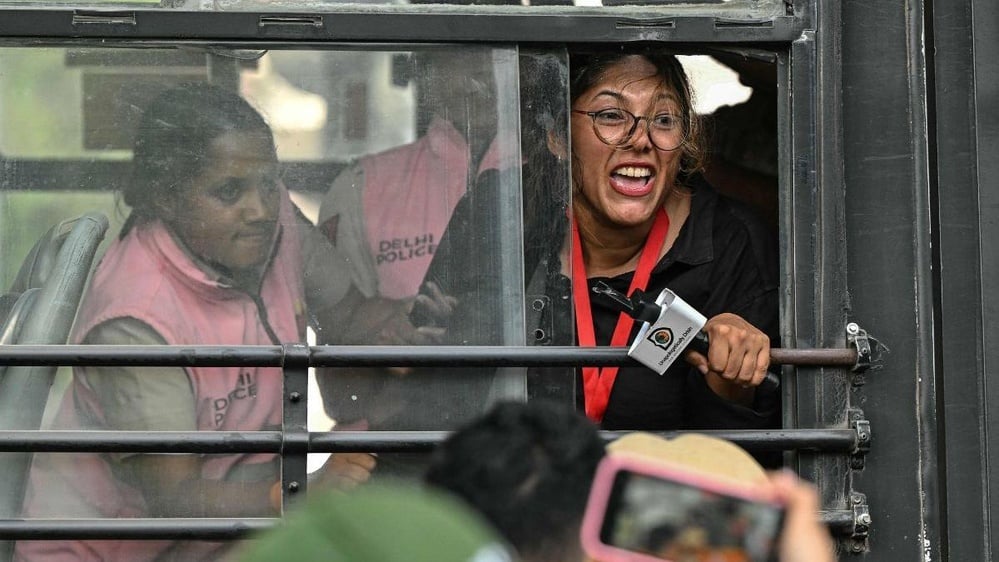
“Early on Saturday morning, the police boarded a flight as soon as it landed in New Delhi to detain three CJP leaders.” · exact text match
Why: Striking specifics like detaining protest leaders off a landing flight make the report distinctive.
Claim: The report describes events and analyzes incentives without advocating actions.
“There does not seem to be an easy way out for the Modi government.
It will not be easy for it to let CEC Kumar go.”
· exact text match
Why: Assessment is analytical rather than prescriptive.
Claim: Author judgments are interwoven with reporting.
“There does not seem to be an easy way out for the Modi government.” · exact text match
Why: Direct evaluative assessments appear alongside factual reporting.
Claim: The entire report centers on partisan conflict between the ruling party and the opposition.
“Monday's protest march drew unprecedented crowds, despite the Narendra Modi government's brutal crackdown on protestors calling for the resignation of Chief Election Commissioner (CEC) Gyanesh Kumar.” · verified after text normalization
Why: Every element — parties, election commission, parliamentarians, courts — is political.
Claim: Protesters are framed as victims of indiscriminate state repression.
“Young people on the streets were indiscriminately detained.
Many alleged police brutality.”
· exact text match
Why: Detention and brutality are foregrounded as suffering inflicted on protesters, with 'indiscriminate' unqualified.
Claim: The government's motive is asserted as fact without sourcing.
“The goal was to foil the satirical youth network Cockroach Janta Party (CJP)'s October 10 protest in New Delhi.” · verified after text normalization
Why: Motive attribution is presented flatly, beyond what attributed evidence in the text shows.
Claim: The framing adopts the protesters' cause as its baseline rather than a neutral vantage.
“Indiscriminate arrests, detentions, police brutality, and blockades have not been able to demoralize protesters seeking the removal of the chief election commissioner.” · exact text match
Why: The deck presumes the justice of the demand and the futility of repression, an ideological starting point.
Claim: Framing sides with street protesters against the ruling government, which is depicted as cornered.
“But its problems are far from over, as the INDIA bloc and the CJP will be holding a wave of protests not only in the national capital but in other major cities as well.” · exact text match
Why: The government is framed as losing control of the situation while protest momentum is foregrounded.
Claim: The tone is tense and negative throughout.
“On Oct 10, Delhi was a city under siege.” · exact text match
Why: Siege imagery and crackdown language convey persistent negative affect.
Claim: Analysis weighs the government's incentives coherently despite loaded descriptive language.
“Conceding ground here could encourage the opposition to aim higher next time.” · exact text match
Why: Strategic reasoning about the costs of conceding to protests is logical and anchored in stated facts.
Claim: The report closes with forward-looking forecasts of continued conflict.
“the coming few weeks look set for tense conflicts.” · exact text match
Why: Explicit forecasting of escalation extends beyond reported events.
Claim: Loaded framing and flat motive assertions steer judgment beyond the evidence presented.
“despite the Narendra Modi government's brutal crackdown on protestors calling for the resignation of Chief Election Commissioner (CEC) Gyanesh Kumar.” · verified after text normalization
Why: Pre-judging the response as 'brutal' and asserting intent exemplify loaded framing rather than neutral description.
Claim: Contested claims are mostly attributed, though some contested characterizations appear as unqualified fact.
“Opposition parties have alleged pro-government bias on a range of issues related to election conduct, including targeted voter roll manipulations.” · exact text match
Counterevidence:
“Indiscriminate arrests, detentions, police brutality, and blockades have not been able to demoralize protesters” · exact text match
Why: Systematic 'alleged'/'reportedly' attribution supports integrity; the deck's flat assertions of brutality and indiscriminateness cap the score.
Claim: Strategic analysis of the government's dilemma demonstrates analytical depth.
“After all, Kumar is the Modi government's appointee.
Conceding ground here could encourage the opposition to aim higher next time.”
· verified after text normalization
Why: The piece reasons through incentives, legal-institutional context, and likely trajectories.
Key claims — the government's motives, the education minister's resignation, and protest scale — are asserted without named sources, and no external corroboration is available from the supplied text.
October 10, 2026 · 0 shares
The framing is largely neutral and attribution-heavy, presenting reported detentions, protest demands, and police restrictions with qualifying language and official rationale.
Automated analysis; not human reviewed.
Limitations: Substantive article text is duplicated and includes related-link items, but the central report is sufficiently clear for analysis.
·
6 of 55 available dimensions scored; omitted dimensions are not treated as neutral.
·
Verified supporting quotes for 6 of 6 scored dimensions.
Claim: The report uses attribution and hedges contested claims rather than asserting them subjectively.
“were reportedly detained” · exact text match
Why: Repeated 'reportedly' marks claims as unverified, reducing subjective assertion.
Claim: The report presents security and protest facts without sensational language.
“The police have denied permission for the proposed demonstration, citing inadequate notice, non-compliance with prescribed guidelines and concerns over public safety and law and order.” · exact text match
Why: It gives official rationale in measured terms rather than dramatizing the crackdown.
Claim: The report is primarily descriptive, not prescriptive.
“The police have denied permission for the proposed demonstration, citing inadequate notice, non-compliance with prescribed guidelines and concerns over public safety and law and order.” · exact text match
Why: It states what occurred and official grounds without advocating a policy or outcome.
Claim: The report is centrally about a political protest and election administration.
“The party has demanded the resignation of Chief Election Commissioner (CEC) Gyanesh Kumar over allegations of electoral irregularities and concerns surrounding the Special Intensive Revision (SIR) of electoral rolls.” · exact text match
Why: The central subject is a protest demanding an election commissioner's resignation and police restrictions around it.
Claim: The report shows visible sourcing, attribution, and caution about unverified details.
“The available reports warn of possible travel disruptions but do not establish that all airport arrivals have been blocked.” · exact text match
“While several reports listed 45 affected stations, an All India Radio report cited restrictions at 57 stations.” · exact text match
Why: It distinguishes what reports establish, notes conflicting counts, and avoids overstatement.
Claim: The report applies fair, internally consistent handling of contested claims and official statements.
“The available reports warn of possible travel disruptions but do not establish that all airport arrivals have been blocked.” · exact text match
Why: It avoids presenting unverified disruption as fact and includes police rationale.
Substantive article text is duplicated and includes related-link items, but the central report is sufficiently clear for analysis.
October 10, 2026 · 0 shares
Framing is largely neutral and attribution-heavy, with a mild anti-establishment/civil-liberties tilt in describing the security shutdown as a bid to thwart protesters.
Automated analysis; not human reviewed.
Limitations: The key voter-list allegations are contested and the 'seen as a bid to thwart' causal framing is unattributed, limiting certainty about the security shutdown's intent.
·
9 of 55 available dimensions scored; omitted dimensions are not treated as neutral.
·
Verified supporting quotes for 6 of 9 scored dimensions.
Claim: Framing is mostly factual but includes a mildly subjective, passive construction about authorities' intent.
“In what is seen as a bid to thwart protesters arriving in Delhi and the central business district where Jantar Mantar is located, several long-distance trains to the city were cancelled on Friday and 57 metro stations shut from Friday night.” · exact text match
Why: The 'seen as a bid to thwart' phrasing introduces an interpretive causal claim not directly attributed, slightly raising subjectivity.
Claim: The article is largely objective and non-sensational, presenting restrictions in factual terms.
“Central Delhi was sealed on Saturday (Oct 10), with thousands of police and paramilitaries on patrol, metro stations shut, mobile internet suspended and markets closed to guard against a youth protest demanding India's chief election officer quit.” · exact text match
Why: Neutral description of security measures and protest context lacks sensational embellishment.
Claim: The report is centrally about Indian electoral politics, partisan allegations, and a challenge to PM Modi.
“The protest, called by the "Cockroach" youth movement, hopes to draw thousands of demonstrators who want Chief Election Commissioner Gyanesh Kumar to quit over a revision of voter lists that critics say favours Prime Minister Narendra Modi's Bharatiya Janata Party.” · not found in supplied text
Why: The article's focus is electoral politics and partisan contestation, making it highly political.
Claim: There is a mild anti-establishment, civil-liberties tilt in describing security measures as aimed at thwarting protesters.
“In what is seen as a bid to thwart protesters arriving in Delhi and the central business district where Jantar Mantar is located, several long-distance trains to the city were cancelled on Friday and 57 metro stations shut from Friday night.” · exact text match
Why: The unattributed 'bid to thwart' language frames state restrictions skeptically, slightly against the establishment.
Claim: The report has strong visible sourcing and attribution, supporting high credibility.
“Touted by the organisers as a protest to "Save Democracy", it aims to be the biggest of the demonstrations that were launched last week after the Indian Express newspaper reported that Kumar's deputies had questioned and disagreed with him over the revision process that saw some 130 million voter names removed.” · not found in supplied text
Why: Named source (Indian Express), attributed claims, and specific figures support credibility.
Claim: The report is rational and evidence-oriented, citing news reports, police statements, and organizational responses.
“Mobile internet services in a radius of 4 km (2.5 miles) of the protest area were ordered suspended from Friday night to Saturday night, ANI news agency reported citing a government order.” · exact text match
Why: Specific attribution to a news agency and government order supports an empirical, non-irrational presentation.
Claim: The report shows high internal fairness by including allegations and denials from multiple sides.
“Kumar has not commented but the Election Commission and the BJP have denied the allegations.” · exact text match
Why: Including the denied status of key allegations indicates honest, balanced handling.
Claim: The article is contextually intelligent, connecting the protest to prior demonstrations, election timing, and institutional responses.
“It also comes months before a series of key state elections starting in early 2027, including in the BJP-ruled most populous state of Uttar Pradesh.” · exact text match
Why: It situates the event in broader electoral and political context, indicating intelligent reporting.
The key voter-list allegations are contested and the 'seen as a bid to thwart' causal framing is unattributed, limiting certainty about the security shutdown's intent.
October 11, 2026 · 0 shares
The publisher frames the event through a legal-civil-liberties lens, emphasizing mass detentions, an 'unprecedented security clampdown,' and judicial scrutiny of state authorities while giving limited space to official justification.
Section 163 BNSS is a prohibitory-order provision under Indian criminal procedure; habeas corpus is a writ challenging unlawful detention.
Automated analysis; not human reviewed.
Limitations: The supplied text is a scraped, fragmented article with repeated passages, multiple author bios, and related headlines; the original byline and full article structure are ambiguous.
·
10 of 55 available dimensions scored; omitted dimensions are not treated as neutral.
·
Verified supporting quotes for 10 of 10 scored dimensions.
Claim: The report emphasizes a state security clampdown and mass detention of protesters and opposition figures, a framing that aligns more with civil-liberties concerns than conservative law-and-order priorities.
“The Centre thwarted a potential mass mobilisation at Jantar Mantar on Saturday after an unprecedented security clampdown and the detention of more than 7,000 protesters, including CJP leader Abhijit Dipke, several opposition leaders and YouTuber Dhruv Rathee.” · exact text match
Why: The quote foregrounds mass detentions and an unprecedented clampdown, giving the story a civil-liberties tilt.
Claim: The report frames the dispute through apex-court and legal-elite proceedings rather than populist grassroots voices.
“During a special sitting, a bench of Justices Joymalya Bagchi and V Mohana issued notices to relevant officials in the matter.” · exact text match
Why: The quote centers the Supreme Court and official legal process as the main actors.
Claim: The report highlights judicial limits on detention and protection for peaceful assembly, leaning against coercive state authority.
“"There shall not be illegal detention, except in accordance with the law, particularly in respect of peaceful unarmed assemblage of people beyond the area where 163 BNSS is implemented," it stated.” · exact text match
Why: The quote explicitly protects peaceful unarmed assembly and bars illegal detention.
Claim: The report attributes legal claims to named petitioners and court proceedings rather than presenting authorial subjective impressions.
“The court is also hearing a habeas corpus petition filed by Senior Advocate Menaka Guruswamy against the detention of political leaders.” · exact text match
Counterevidence:
“unprecedented security clampdown” · exact text match
Why: The quote identifies a specific legal filing and petitioner, supporting an objective reporting style.
Claim: The article includes a few evaluative descriptors such as 'unprecedented' amid otherwise factual reporting.
“unprecedented security clampdown” · exact text match
Why: The phrase 'unprecedented' is an evaluative characterization without attribution in the quoted passage.
Claim: The reported development is centrally about protest politics, election administration, and government detention powers.
“The protest call was given by the Cockroach Janta Party and some student organisations to seek the resignation of Chief Election Commissioner Gyanesh Kumar over alleged irregularities in the Special Intensive Revision (SIR) of voter rolls.” · exact text match
Why: The quote ties the story directly to a political demand, an election official, and voter-roll disputes.
Claim: The report attributes contested details to named institutions and sources and includes direct court quotes, supporting credibility.
“He was released several hours later, at around 3 am on Sunday, according to Gurugram Police sources.” · exact text match
Why: The quote provides a time and source attribution for a contested detention detail.
Claim: The report relies on legal procedure, court quotations, and named respondents rather than emotional or irrational claims.
“"We direct the authorities concerned to submit a short affidavit showing cause why contempt proceedings should not be initiated," the court said.” · exact text match
Why: The quoted directive is a formal legal remedy and anchors the report in procedural reasoning.
Claim: The report names respondents, petitioners, and official sources and includes direct court quotations, indicating high observable integrity.
“The contempt plea, filed by advocate Shailendra Mani Tripathi, has arrayed Union Home Secretary Govind Mohan, Delhi Police Commissioner Anurag Kumar and Delhi Metro Rail Corporation chairperson D Thara as respondents.” · exact text match
Why: The quote supplies specific names and legal roles rather than vague attribution.
Claim: The report demonstrates legal and procedural specificity, indicating high intelligence.
“The plea referred to the Supreme Court's October 9 order which was passed while hearing a separate petition against the closure of 57 metro stations and cancellation of trains to Delhi in view of the CJP-led agitation, which was planned for Saturday, October 10.” · exact text match
Why: The quote supplies precise dates, a prior order, and procedural context.
The supplied text is a scraped, fragmented article with repeated passages, multiple author bios, and related headlines; the original byline and full article structure are ambiguous.
October 12, 2026 · 0 shares
The strongest framing is a measured, institution-centered report that foregrounds the Chief Justice's no-politics and court-functioning message while treating protest-crackdown claims as allegations.
Automated analysis; not human reviewed.
Limitations: The supplied text contains web-scrape artifacts and an unusual party name ('Cockroach Janata Party'); analysis is limited to the substantive article content.
·
6 of 55 available dimensions scored; omitted dimensions are not treated as neutral.
·
Verified supporting quotes for 6 of 6 scored dimensions.
Claim: The report remains largely objective, using attribution and 'alleged' for contested claims.
“the ongoing protests against the alleged crackdown on demonstrators in Delhi” · exact text match
“alleged detention and manhandling of senior lawyers” · exact text match
Why: The article attributes contested events as allegations and avoids adopting them as established facts.
Claim: The article uses measured, non-sensational language and avoids emotive amplification.
“The CJI, however, declined to comment further on the allegations at this stage.” · exact text match
Why: The report presents serious allegations without sensational amplification, using a restrained tone.
Claim: The article is primarily descriptive, reporting court statements and directions rather than prescribing policy.
“The observations came a day after a special bench of justices Joymalya Bagchi and V Mohana issued a series of directions to protect the right to peaceful protest, restore freedom of movement and ensure that no person was detained except in accordance with the procedure established by law.” · exact text match
Why: The article reports what the court said and did without adding prescriptive recommendations.
Claim: The report is framed around a political/legal controversy involving Opposition protests and Supreme Court proceedings.
“The developments follow the Opposition’s decision to march towards the Supreme Court on Monday after the CJI declined a request by Congress president Mallikarjun Kharge and Leader of Opposition Rahul Gandhi to meet him.” · exact text match
Why: The article centers political actors and contest, making political bias high.
Claim: The report is credible, with named sources, specific legal citations, and attributed contested claims.
“a special bench of justices Joymalya Bagchi and V Mohana issued a series of directions” · exact text match
“Section 163 of the Bharatiya Nagarik Suraksha Sanhita (BNSS)” · exact text match
Why: Named sources and legal citations allow verification.
Claim: The article demonstrates high integrity by including both the CJI’s statements and the allegations from senior advocates, with clear attribution.
““I have appealed to the protesters as well but court should not be dragged into any politics,” he said.” · exact text match
“He also raised concerns over the alleged detention and manhandling of senior lawyers, including Dinesh Dwivedi and Shadan Farasat.” · exact text match
Why: It fairly presents multiple relevant voices and attributes contested claims.
The supplied text contains web-scrape artifacts and an unusual party name ('Cockroach Janata Party'); analysis is limited to the substantive article content.
Contested police-conduct and voter-roll claims are consistently framed as attributed allegations within a procedural Supreme Court report, leaving the publisher's own voice nearly invisible.
The Special Intensive Revision (SIR) is an Election Commission of India exercise to revise electoral rolls, and the INDIA bloc is an opposition coalition that includes the Congress party.
Automated analysis; not human reviewed.
Limitations: The text includes no response from Delhi Police or the Election Commission and no account of the Oct 15 hearing itself, so the allegations' accuracy and the court's eventual rulings cannot be assessed from this report alone.
·
12 of 55 available dimensions scored; omitted dimensions are not treated as neutral.
·
Verified supporting quotes for 12 of 12 scored dimensions.
Claim: The report maintains partisan neutrality by attributing all contested electoral and police claims to petitioners and prior reporting.
“alleged irregularities in the Special Intensive Revision (SIR) of electoral rolls” · exact text match
“Congress leader Rahul Gandhi and other INDIA bloc leaders filed a separate petition on Monday challenging the SIR exercise” · exact text match
Why: Both the police-conduct and voter-roll claims are framed as allegations or filings, and the report notes the opposition plea was not heard, without endorsing either side.
Claim: Contested assertions are consistently attributed rather than stated as fact.
“claims that police personnel violated the court’s directions” · exact text match
“alleging large-scale deletion of voters’ names” · exact text match
Why: Repeated markers like 'alleged' and 'claims' separate petitioners' assertions from established events such as the Oct 11 order.
Claim: The body reports detentions and court orders in measured procedural language.
“Several protesters were detained by Delhi Police over the weekend as authorities sought to control the demonstrations.” · exact text match
Counterevidence:
“examines allegations of police excesses” · exact text match
Why: The narrative avoids embellishment, though the headline's 'police excesses' phrasing is somewhat charged.
Claim: The story combines a Supreme Court special sitting, alleged police defiance of its orders, and a disputed electoral-roll revision.
“On October 11, the Supreme Court held a special sitting” · exact text match
“possible contempt proceedings could be taken up together on Thursday” · exact text match
Why: Constitutional-court engagement with alleged non-compliance and voter-list disputes is high-stakes institutional news.
Claim: The article reports events without advocating any course of action.
“The petition seeks, among other reliefs, an independent audit of voter deletions and disclosure of records relating to the Election Commission’s decisions.” · exact text match
Why: Remedies appear only as litigants' relief requests, not as publisher recommendations.
Claim: The article is nearly free of publisher opinion voice.
“alleged illegal detentions and claims that police personnel violated the court’s directions” · exact text match
Why: Even characterizations like 'illegal' sit inside attributed petition concerns rather than the publisher's own assertions.
Claim: The subject is political but the treatment is procedural and even-handed.
“Congress leader Rahul Gandhi and other INDIA bloc leaders filed a separate petition on Monday challenging the SIR exercise” · exact text match
“A Bench of Chief Justice of India Surya Kant and Justices Joymalya Bagchi and V Mohana is hearing the matters” · exact text match
Why: Political actors and the electoral dispute appear as facts of the litigation, not through partisan framing.
Claim: The tone stays flat even when describing detentions and alleged assaults.
“Several protesters were detained by Delhi Police over the weekend as authorities sought to control the demonstrations.” · exact text match
Why: Charged events are rendered in neutral, administrative language without emotive modifiers.
Claim: The report supplies named actors, dates, and sources for each claim, though it omits institutional responses.
“The protests followed a report by The Indian Express alleging that Chief Election Commissioner Gyanesh Kumar had taken several decisions relating to the SIR exercise unilaterally, despite objections from two other Election Commissioners.” · exact text match
“On October 11, the Supreme Court held a special sitting to consider some of these issues and directed the police not to detain peaceful protesters, lawyers and journalists.” · exact text match
Why: Specific attributions and dated court actions support verifiability; the lack of any police or Election Commission response caps the score.
Claim: The report proceeds through verifiable court actions, dates, and filings rather than rhetoric.
“The Bench indicated that the connected petitions concerning alleged non-compliance with its October 11 directions, police action against lawyers and journalists, and possible contempt proceedings could be taken up together on Thursday.” · exact text match
“The court also asked petitioners to rectify filing defects to facilitate the listing of their matters.” · exact text match
Why: Procedural specifics and attributed claims organize the narrative, with no emotive or illogical argumentation.
Claim: The report shows fairness by sourcing each allegation and including details that cut against petitioners.
“However, subsequent petitions alleged that detentions and obstruction of professional duties continued despite the court’s directions.” · exact text match
“This plea was not listed for hearing on Tuesday.” · exact text match
Why: Claims are attributed to petitions and prior reporting, and unfavorable procedural facts about the opposition plea are disclosed.
Claim: The report densely and clearly organizes overlapping petitions, dates, and actors.
“The Bench indicated that the connected petitions concerning alleged non-compliance with its October 11 directions, police action against lawyers and journalists, and possible contempt proceedings could be taken up together on Thursday.” · exact text match
Why: It compresses a complex multi-petition docket into an accurate, navigable account.
The text includes no response from Delhi Police or the Election Commission and no account of the Oct 15 hearing itself, so the allegations' accuracy and the court's eventual rulings cannot be assessed from this report alone.
October 14, 2026 · 0 shares
Sympathetic framing of the shuttered protest site foregrounds activists' shrinking-democratic-space concerns and romanticizes the youth movement, while official justifications appear only as later, briefer counterpoints.
Jantar Mantar is an 18th-century astronomical observatory in central New Delhi; its adjoining roughly 1.6km street was designated a demonstration site in 1993 and served for over three decades as the capital's main authorised protest venue near the seat of political power.
Automated analysis; not human reviewed.
Limitations: The text appears to be AFP wire copy with page remnants ('Sign up now...' and related headlines) mixed in; the publishing outlet is unidentifiable, and Delhi Police stated no reason for the order, limiting assessment of the government's rationale.
·
13 of 55 available dimensions scored; omitted dimensions are not treated as neutral.
·
Verified supporting quotes for 9 of 13 scored dimensions.
Claim: The framing centers civil-liberties concern over restricting dissent, with official justifications as secondary counterpoints.
“The shut down has prompted concerns among activists over shrinking democratic space.” · exact text match
Why: The lead elevates activist concerns about lost democratic space ahead of any official rationale, a civil-liberties emphasis that leans left rather than toward a law-and-order frame.
Claim: The narrative treats restriction of assembly space as a democratic-rights concern rather than primarily a public-order measure.
“'In a democracy, you require spaces where you can protest,' she said.” · not found in supplied text
Why: The publisher spotlights protest-access arguments and civil disobedience while official security and convenience rationales appear later and more briefly, tilting the frame toward assembly freedom.
Claim: Reporting relies on attributed facts and quotes across stakeholders with minimal publisher assertion.
“Some of those living in the Jantar Mantar neighbourhood, however, welcomed the police order.” · exact text match
Why: Contrary views from residents, police, and a former commissioner are attributed and included alongside activist voices, keeping editorial assertion minimal despite mild descriptive coloring.
Claim: Language stays measured even when covering arrests and confrontations.
“were sent to jail for five days for alleged trespassing” · exact text match
Why: The arrests are stated plainly with the qualifier 'alleged', without dramatization, urgency devices, or catastrophic language.
Claim: A historic site's closure, a distinctively named youth movement, arrests, and defiance give the story broad appeal.
“'Jantar Mantar is not just a location but a spirit of resistance that nobody can ever take away,' the group's founder, Abhijeet Dipke, said.” · not found in supplied text
Why: Colorful movement identity and generational defiance add narrative interest beyond a routine administrative order.
Claim: Mild evaluative descriptors appear in the publisher's voice within otherwise attributed reporting.
“For nearly a month, Jantar Mantar transformed into a vibrant hub of Gen-Z dissent” · exact text match
Why: Words like 'vibrant' editorialize the movement favorably, though most evaluations remain attributed to named sources.
Claim: The subject is inherently political: a police order restricting protest amid disputes over electoral rolls and election administration.
“a protest demanding the resignation of India's Chief Election Commissioner Gyanesh Kumar over alleged voter roll irregularities.” · exact text match
Why: Parliament access, the Election Commissioner, voter rolls, and a police order place the story squarely within politics.
Claim: The publisher's framing favors protesters and activists over the authorities' decision.
“the country's most recognisable stage for public dissent officially lost its status as an authorised protest venue” · verified after text normalization
Why: Sympathetic characterizations of the protest site and movement dominate the narrative while police and government positions are briefer, later counterpoints, tilting the piece against the authorities.
Claim: Dated events, multi-institution attribution, and disclosed information gaps support above-average credibility.
“A protester told AFP on Oct 13 that demonstrators would continue to gather at Jantar Mantar despite the police order.” · exact text match
Why: Consistent sourcing (AFP interviews, Hindustan Times, named officials), specific dates, and transparency that police gave no reason indicate careful reporting practice.
Claim: Claims are tied to dated official orders, named sources, and competing accounts rather than assertion.
“'Jantar Mantar as a protest venue has been de-notified,' Delhi Police said in an order issued on Oct 12, without providing a reason.” · not found in supplied text
“'Roads leading to our homes are barricaded, there is noise and garbage, and our daily lives are disrupted,' Varun Seth, a resident, told the Hindustan Times newspaper.” · not found in supplied text
Why: Systematic attribution, specific dates, and inclusion of police, resident, and elite counterpoints reflect reasoned, evidence-bound reporting.
Claim: Mild ordering places the activist concern frame in the lead while the official rationale arrives later.
“But this week, the country's most recognisable stage for public dissent officially lost its status as an authorised protest venue, prompting concerns among activists over shrinking democratic space.” · verified after text normalization
Why: The 'shrinking democratic space' frame opens the piece and the Supreme Court rationale appears several paragraphs later; both sides are still presented, so the emphasis technique is mild.
Claim: The report discloses that police gave no reason, cites the official rationale, and presents voices supporting the shutdown.
“Delhi Police said in an order issued on Oct 12, without providing a reason.” · exact text match
Why: Acknowledging the information gap, quoting the Supreme Court rationale, and including residents and Kiran Bedi on the other side are observable fairness and transparency signals.
Claim: The report integrates history, legal context, and multiple stakeholder perspectives into a coherent account.
“Delhi Police on Oct 13 defended their move, citing a directive from the Supreme Court that 'suitable alternative sites' for protest 'need to be identified and designated'.” · not found in supplied text
Why: Layering the 1993 designation, the court directive, and competing stakeholder views shows organized, informative construction beyond a bare news brief.
The text appears to be AFP wire copy with page remnants ('Sign up now...' and related headlines) mixed in; the publishing outlet is unidentifiable, and Delhi Police stated no reason for the order, limiting assessment of the government's rationale.
Largely neutral, attribution-based reporting that presents the protesters' claims alongside the Election Commission's denial, with the party founder's own social media posts and quotes supplying most of the color.
Automated analysis; not human reviewed.
Limitations: The input is a fragmented list of snippets and related-link headlines rather than a continuous article, so full publisher framing and any omitted context cannot be assessed.
·
8 of 55 available dimensions scored; omitted dimensions are not treated as neutral.
·
Verified supporting quotes for 8 of 8 scored dimensions.
Claim: Contested claims are attributed to sources rather than asserted by the publisher.
“Two top leaders of India's youth-led Cockroach Janta Party (CJP) were sent to jail for five days on Wednesday for alleged trespassing, the party said.” · exact text match
Counterevidence:
“The Election Commission of India, which oversees the voting process in the world's most populous nation, has denied any wrongdoing.” · exact text match
Why: The sentencing claim is sourced to the party and the voter-roll accusation is balanced by the commission's denial, indicating objective reporting rather than editorial assertion.
Claim: The headline and lead report the arrests plainly without exaggerated or emotive language.
“Cockroach Janta Party leaders jailed for 5 days after flag-waving protest at Delhi's Jantar Mantar” · exact text match
Why: The headline states actor, action, and location factually, with no charged adjectives or urgency framing.
Claim: The item pairs an unusually named party with a symbolic flag protest and an election-institution standoff.
“Cockroach Janta Party leaders jailed for 5 days after flag-waving protest at Delhi's Jantar Mantar” · exact text match
Why: The unusual party name and civil-disobedience-style flag waving give the story above-average novelty.
Claim: The text reports events without advocating any policy or action.
“Das and Ranka were detained on Tuesday for entering Jantar Mantar, a day after Delhi Police announced that the Jantar Mantar street in the heart of the capital had been taken off the list of designated official protest sites.” · exact text match
Why: The piece chronicles arrests, security measures, and competing claims without prescribing outcomes or remedies.
Claim: The content centers on India's election commission, the ruling party, and opposition-led protests.
“demanding the resignation of the head of India's election commission, accusing it of manipulating voter rolls to benefit Prime Minister Narendra Modi's ruling party” · exact text match
Why: The subject matter is electoral politics and state institutions, though accusations remain attributed rather than endorsed.
Claim: The prose remains procedural and unemotional toward all parties.
“have been sent to five days judicial custody” · exact text match
Why: The text uses plain procedural phrasing for the arrest and custody with no emotive embellishment in either direction.
Claim: Key claims carry named attribution and the official denial is included, though sourcing for the sentencing is thin.
“Ashutosh Ranka and Saurav Das "have been sent to five days judicial custody", CJP founder Abhijeet Dipke said in a social media post.” · exact text match
Counterevidence:
“The Election Commission of India, which oversees the voting process in the world's most populous nation, has denied any wrongdoing.” · exact text match
Why: Named attribution and inclusion of the commission's denial support basic credibility, while reliance on a single partisan source for the jail term keeps the score moderate.
Claim: The narrative rests on named sources, a posted video, and an official denial rather than unsupported assertion.
“A video posted online by Dipke on Tuesday showed the duo clambering over barricades at Jantar Mantar street” · exact text match
Why: Claims are tied to checkable sources (a video and a social media post) and the opposing official position is included, reflecting evidence-based construction.
The input is a fragmented list of snippets and related-link headlines rather than a continuous article, so full publisher framing and any omitted context cannot be assessed.
Frames India's detentions as arbitrary and implicitly illegitimate by amplifying a UN human-rights call without including Indian government justification or context.
Automated analysis; not human reviewed.
·
5 of 55 available dimensions scored; omitted dimensions are not treated as neutral.
·
Verified supporting quotes for 5 of 5 scored dimensions.
Claim: The post adopts the UN's framing of the detentions as arbitrary without presenting India's position.
“UN Human Rights urges India to immediately release protesters, lawyers and journalists arbitrarily detained around mass protests in Delhi..” · exact text match
Why: The statement is attributed to the UN, but the post endorses the 'arbitrarily detained' characterization without any counterbalancing official response.
Claim: The language is restrained and declarative rather than sensational.
“Restrictions on peaceful assembly must be necessary and proportionate.” · exact text match
Why: The post uses measured human-rights terminology instead of emotive or alarmist phrasing.
Claim: The post embeds a normative judgment that the detentions were arbitrary and the restrictions unjustified.
“arbitrarily detained” · exact text match
Why: Labeling the detentions 'arbitrary' conveys a judgment rather than a purely neutral report of undisputed fact.
Claim: The post is explicitly political, addressing state detention practices and international human-rights pressure on India.
“UN Human Rights urges India to immediately release protesters, lawyers and journalists arbitrarily detained around mass protests in Delhi..” · exact text match
Why: The subject is a government's treatment of protesters and journalists, a core political matter.
Claim: The post is concise, coherent, and uses precise legal-standard language.
“Restrictions on peaceful assembly must be necessary and proportionate.” · exact text match
Why: It accurately invokes the necessity and proportionality standard used in human-rights law.
A terse, attribution-hedged news brief reports mass detention of journalists at Delhi protests and relays press-freedom condemnation of police without editorializing.
Automated analysis; not human reviewed.
Limitations: The supplied text is a single-sentence brief with no named sources, official responses, or contextual details, so event-level verification and several bias dimensions cannot be assessed.
·
5 of 55 available dimensions scored; omitted dimensions are not treated as neutral.
·
Verified supporting quotes for 5 of 5 scored dimensions.
Claim: The brief hedges the core claim and reports the condemnation without evaluative comment, leaning objective.
“More than 30 journalists were reportedly detained” · exact text match
“prompting press freedom groups to condemn police” · exact text match
Why: The attribution marker 'reportedly' plus plain declarative reporting of both the detentions and the condemnation, with no editorial language, supports objectivity.
Claim: No sensational or loaded vocabulary appears; the detention figure is stated plainly.
“More than 30 journalists were reportedly detained” · exact text match
Why: Neutral verbs and absence of dramatizing modifiers indicate no sensationalizing of an inherently dramatic event.
Claim: Mass detention of journalists covering an electoral protest is inherently newsworthy despite the brief's thinness.
“More than 30 journalists were reportedly detained during Delhi protests” · exact text match
Why: The scale (30+ detainees) and press-freedom implications make the event notable.
Claim: The subject matter (electoral rolls, policing, press freedom) is political, though the framing stays non-partisan.
“protests over voter list revision” · exact text match
“press freedom groups to condemn police” · exact text match
Why: The content concerns electoral administration and police conduct, but no party, ideology, or side is endorsed in the text.
Claim: The brief signals uncertainty via 'reportedly' but cites no named source.
“were reportedly detained” · exact text match
Why: Hedged attribution rather than unqualified assertion is a credibility-positive practice, though unnamed sourcing limits verification.
The supplied text is a single-sentence brief with no named sources, official responses, or contextual details, so event-level verification and several bias dimensions cannot be assessed.
October 10, 2026 · 0 shares
Reuters reports the crackdown with substantial attribution and includes both opposition allegations and official denials, but foregrounds protest grievances and frames the events as a serious political test for Modi.
The article references a voter-list revision ahead of state elections, prior protests over exam paper leaks, and upcoming state elections beginning in early 2027.
Automated analysis; not human reviewed. Limitations: Article text appears truncated mid-sentence and includes repeated scraped metadata fragments after the first part, which slightly complicates full-text framing analysis. · 52 of 55 available dimensions scored; omitted dimensions are not treated as neutral. · Verified supporting quotes for 12 of 52 scored dimensions.
Claim: The article subtly frames the events through an anti-incumbent lens by emphasizing government crackdowns and opposition grievances.
“security forces locked down parts of the capital to thwart a rally demanding the resignation of India's election chief” · exact text match
Why: The choice of 'thwart' and focus on official lockdowns frames the government as suppressing protest, a mild liberal-leaning cue, though balanced with denials.
Claim: The article foregrounds mass protests against official election management while including official denials.
“Police detained more than 2,000 protesters and the founder of the "Cockroach" youth movement” · exact text match
Why: Highlighting large-scale detentions and protest demands leans slightly populist, though attribution to officials keeps it modest.
Claim: The article reports extensive state security measures but remains largely descriptive with both protester and official perspectives.
“mobile internet services were suspended in the central business district and dozens of metro stations and markets were shut” · exact text match
Why: Recounting internet suspension and lockdowns without endorsement or condemnation reflects a slightly anti-authoritarian tilt, but the tone is measured.
Claim: The article is objective overall but includes some vivid imagery of police actions.
“police chased them and dragged scores of others into buses” · exact text match
Why: Sensory detail adds mild sensationalism but remains attributed.
Claim: The article largely reports events with limited explicit opinion, though some loaded terms appear.
“thwart a rally” · exact text match
Why: Mostly factual reporting with occasional evaluative word choices.
Claim: The article is centrally political, covering election commissioner protests, detentions, and party allegations.
“demanding the resignation of India's election chief” · exact text match
Why: The entire article revolves around a political protest and election controversy.
Claim: The article reports on anti-establishment protests against the election commissioner and includes establishment responses.
“The movement condemned what it called the "authoritarian detention" of its leaders” · exact text match
Why: Balanced between protester grievances and official denial, slightly neutral.
Claim: The article has a slightly negative emotional tone due to coverage of detentions and protests.
“This is violating the rights of the people and the country will not tolerate this anymore” · exact text match
Why: Protest grievance quote gives a negative emotional slant to the event.
Claim: The article cites Reuters, officials, and named individuals, with attribution and balanced inclusion of opposing views.
“A home ministry official, speaking on condition of anonymity, told Reuters” · exact text match
Why: Strong sourcing and attribution indicate high credibility.
Claim: The article maintains rational reporting with logical structure and sourced information.
“Election Commission data show about 130 million voter entries were removed during the verification exercise” · exact text match
Why: Use of data and attribution indicates rational, level-headed coverage.
Claim: The article includes some forward-looking statements about political impact.
“The demonstrations represent one of the most serious tests yet for Modi” · exact text match
Why: Modest speculation about political consequences, though grounded in current events.
Claim: The article attributes claims to specific sources and includes official denials alongside opposition allegations.
“Kumar has not commented but the Election Commission and the BJP have denied allegations of wrongdoing.” · exact text match
Why: Inclusion of denials and named sources signals fair reporting practices.
Article text appears truncated mid-sentence and includes repeated scraped metadata fragments after the first part, which slightly complicates full-text framing analysis.
October 10, 2026 · 0 shares
Framing is largely neutral and attribution-heavy, with a mild anti-establishment/civil-liberties tilt in describing the security shutdown as a bid to thwart protesters.
Automated analysis; not human reviewed. Limitations: The key voter-list allegations are contested and the 'seen as a bid to thwart' causal framing is unattributed, limiting certainty about the security shutdown's intent. · 9 of 55 available dimensions scored; omitted dimensions are not treated as neutral. · Verified supporting quotes for 6 of 9 scored dimensions.
Claim: Framing is mostly factual but includes a mildly subjective, passive construction about authorities' intent.
“In what is seen as a bid to thwart protesters arriving in Delhi and the central business district where Jantar Mantar is located, several long-distance trains to the city were cancelled on Friday and 57 metro stations shut from Friday night.” · exact text match
Why: The 'seen as a bid to thwart' phrasing introduces an interpretive causal claim not directly attributed, slightly raising subjectivity.
Claim: The article is largely objective and non-sensational, presenting restrictions in factual terms.
“Central Delhi was sealed on Saturday (Oct 10), with thousands of police and paramilitaries on patrol, metro stations shut, mobile internet suspended and markets closed to guard against a youth protest demanding India's chief election officer quit.” · exact text match
Why: Neutral description of security measures and protest context lacks sensational embellishment.
Claim: The report is centrally about Indian electoral politics, partisan allegations, and a challenge to PM Modi.
“The protest, called by the "Cockroach" youth movement, hopes to draw thousands of demonstrators who want Chief Election Commissioner Gyanesh Kumar to quit over a revision of voter lists that critics say favours Prime Minister Narendra Modi's Bharatiya Janata Party.” · not found in supplied text
Why: The article's focus is electoral politics and partisan contestation, making it highly political.
Claim: There is a mild anti-establishment, civil-liberties tilt in describing security measures as aimed at thwarting protesters.
“In what is seen as a bid to thwart protesters arriving in Delhi and the central business district where Jantar Mantar is located, several long-distance trains to the city were cancelled on Friday and 57 metro stations shut from Friday night.” · exact text match
Why: The unattributed 'bid to thwart' language frames state restrictions skeptically, slightly against the establishment.
Claim: The report has strong visible sourcing and attribution, supporting high credibility.
“Touted by the organisers as a protest to "Save Democracy", it aims to be the biggest of the demonstrations that were launched last week after the Indian Express newspaper reported that Kumar's deputies had questioned and disagreed with him over the revision process that saw some 130 million voter names removed.” · not found in supplied text
Why: Named source (Indian Express), attributed claims, and specific figures support credibility.
Claim: The report is rational and evidence-oriented, citing news reports, police statements, and organizational responses.
“Mobile internet services in a radius of 4 km (2.5 miles) of the protest area were ordered suspended from Friday night to Saturday night, ANI news agency reported citing a government order.” · exact text match
Why: Specific attribution to a news agency and government order supports an empirical, non-irrational presentation.
Claim: The report shows high internal fairness by including allegations and denials from multiple sides.
“Kumar has not commented but the Election Commission and the BJP have denied the allegations.” · exact text match
Why: Including the denied status of key allegations indicates honest, balanced handling.
Claim: The article is contextually intelligent, connecting the protest to prior demonstrations, election timing, and institutional responses.
“It also comes months before a series of key state elections starting in early 2027, including in the BJP-ruled most populous state of Uttar Pradesh.” · exact text match
Why: It situates the event in broader electoral and political context, indicating intelligent reporting.
The key voter-list allegations are contested and the 'seen as a bid to thwart' causal framing is unattributed, limiting certainty about the security shutdown's intent.
October 11, 2026 · 0 shares
The publisher frames the event through a legal-civil-liberties lens, emphasizing mass detentions, an 'unprecedented security clampdown,' and judicial scrutiny of state authorities while giving limited space to official justification.
Section 163 BNSS is a prohibitory-order provision under Indian criminal procedure; habeas corpus is a writ challenging unlawful detention.
Automated analysis; not human reviewed. Limitations: The supplied text is a scraped, fragmented article with repeated passages, multiple author bios, and related headlines; the original byline and full article structure are ambiguous. · 10 of 55 available dimensions scored; omitted dimensions are not treated as neutral. · Verified supporting quotes for 10 of 10 scored dimensions.
Claim: The report emphasizes a state security clampdown and mass detention of protesters and opposition figures, a framing that aligns more with civil-liberties concerns than conservative law-and-order priorities.
“The Centre thwarted a potential mass mobilisation at Jantar Mantar on Saturday after an unprecedented security clampdown and the detention of more than 7,000 protesters, including CJP leader Abhijit Dipke, several opposition leaders and YouTuber Dhruv Rathee.” · exact text match
Why: The quote foregrounds mass detentions and an unprecedented clampdown, giving the story a civil-liberties tilt.
Claim: The report frames the dispute through apex-court and legal-elite proceedings rather than populist grassroots voices.
“During a special sitting, a bench of Justices Joymalya Bagchi and V Mohana issued notices to relevant officials in the matter.” · exact text match
Why: The quote centers the Supreme Court and official legal process as the main actors.
Claim: The report highlights judicial limits on detention and protection for peaceful assembly, leaning against coercive state authority.
“"There shall not be illegal detention, except in accordance with the law, particularly in respect of peaceful unarmed assemblage of people beyond the area where 163 BNSS is implemented," it stated.” · exact text match
Why: The quote explicitly protects peaceful unarmed assembly and bars illegal detention.
Claim: The report attributes legal claims to named petitioners and court proceedings rather than presenting authorial subjective impressions.
“The court is also hearing a habeas corpus petition filed by Senior Advocate Menaka Guruswamy against the detention of political leaders.” · exact text match
Counterevidence:
“unprecedented security clampdown” · exact text match
Why: The quote identifies a specific legal filing and petitioner, supporting an objective reporting style.
Claim: The article includes a few evaluative descriptors such as 'unprecedented' amid otherwise factual reporting.
“unprecedented security clampdown” · exact text match
Why: The phrase 'unprecedented' is an evaluative characterization without attribution in the quoted passage.
Claim: The reported development is centrally about protest politics, election administration, and government detention powers.
“The protest call was given by the Cockroach Janta Party and some student organisations to seek the resignation of Chief Election Commissioner Gyanesh Kumar over alleged irregularities in the Special Intensive Revision (SIR) of voter rolls.” · exact text match
Why: The quote ties the story directly to a political demand, an election official, and voter-roll disputes.
Claim: The report attributes contested details to named institutions and sources and includes direct court quotes, supporting credibility.
“He was released several hours later, at around 3 am on Sunday, according to Gurugram Police sources.” · exact text match
Why: The quote provides a time and source attribution for a contested detention detail.
Claim: The report relies on legal procedure, court quotations, and named respondents rather than emotional or irrational claims.
“"We direct the authorities concerned to submit a short affidavit showing cause why contempt proceedings should not be initiated," the court said.” · exact text match
Why: The quoted directive is a formal legal remedy and anchors the report in procedural reasoning.
Claim: The report names respondents, petitioners, and official sources and includes direct court quotations, indicating high observable integrity.
“The contempt plea, filed by advocate Shailendra Mani Tripathi, has arrayed Union Home Secretary Govind Mohan, Delhi Police Commissioner Anurag Kumar and Delhi Metro Rail Corporation chairperson D Thara as respondents.” · exact text match
Why: The quote supplies specific names and legal roles rather than vague attribution.
Claim: The report demonstrates legal and procedural specificity, indicating high intelligence.
“The plea referred to the Supreme Court's October 9 order which was passed while hearing a separate petition against the closure of 57 metro stations and cancellation of trains to Delhi in view of the CJP-led agitation, which was planned for Saturday, October 10.” · exact text match
Why: The quote supplies precise dates, a prior order, and procedural context.
The supplied text is a scraped, fragmented article with repeated passages, multiple author bios, and related headlines; the original byline and full article structure are ambiguous.
The report adopts a civil-libertarian, sympathetic-to-detainees framing that foregrounds alleged police overreach and procedural violations while relying heavily on one lawyer network's accounts.
The protests are against Chief Election Commissioner Gyanesh Kumar; the lawyer network originated during July protests demanding the resignation of then education minister Dharmendra Pradhan.
Automated analysis; not human reviewed. Limitations: The report relies heavily on one lawyer network's accounts and includes no response from Delhi Police or the Union home ministry. · 17 of 55 available dimensions scored; omitted dimensions are not treated as neutral. · Verified supporting quotes for 17 of 17 scored dimensions.
Claim: The report frames the detentions as a civil-liberties and procedural-rights problem, leaning against police or state action.
“That kind of preventive detention is really out of order. It is definitely not lawful.” · exact text match
Why: The highlighted quote challenges the legality of preventive detention and the article emphasizes detentions continuing after a Supreme Court order.
Claim: The report leans libertarian by criticizing preventive detention and lack of legal access.
“Chaudhary said legal access was the biggest obstacle until the Supreme Court sat on Sunday morning.” · exact text match
Why: The article foregrounds obstacles to legal access and calls preventive detention not lawful, aligning with civil-libertarian concerns.
Claim: The report is mostly objective, attributing contested claims to named sources and using qualified language.
“Many allege aggression occurs in detention rather than in custody.” · exact text match
Why: It reports allegations as allegations rather than as established facts.
Claim: The report uses some dramatic framing but remains largely measured.
“A distress call came around 11pm on Sunday.” · exact text match
Why: The opening scene is dramatic, though the body reports details in a restrained manner.
Claim: The report leans pessimistic about the situation, emphasizing distress, injuries, and continuing detentions.
“He said detainees went without food for long stretches.” · exact text match
Why: It foregrounds harm and hardship among detainees.
Claim: The report is notably interesting due to its detailed rapid-response legal network and protest crackdown context.
“We basically worked on creating a rapid response system for the fraternity” · exact text match
Why: The article provides unusual operational details about legal aid during mass detentions.
Claim: The report is primarily descriptive rather than prescriptive.
“The group has devised what Chaudhary calls a “protocol” because most allegations of abuse surface only after a detainee is released.” · exact text match
Why: It explains a protocol and events without the publisher prescribing policy.
Claim: The report has mild fearful framing, highlighting distress, minors, and injuries.
“Thirty to 40 people were being held at Najafgarh in southwest Delhi, five or six of them minors, and some claiming to be injured.” · exact text match
Why: The details of minors and injuries create concern without overt rage-baiting.
Claim: The report includes some opinionated quotes but the publisher's framing remains mostly factual.
“It is working, but in all honesty there should not be a need for this to be working.” · exact text match
Why: The quoted litigator expresses opinion, and the article gives it prominence.
Claim: The report is strongly political, concerning protests against a chief election commissioner and mass detentions.
“protests against chief election commissioner Gyanesh Kumar” · exact text match
Why: The central event involves electoral authority, political parties, student organizations, and state detention.
Claim: The report has moderate victimization framing, focusing on detainees' alleged mistreatment.
“He said detainees went without food for long stretches.” · exact text match
Why: It details alleged deprivations and injuries suffered by detainees.
Claim: The report is somewhat anti-establishment in its critical presentation of police actions.
“The detentions continued regardless.” · exact text match
Why: It emphasizes that detentions continued after a Supreme Court order, implicitly criticizing authorities.
Claim: The report has a negative emotional valence, emphasizing distress and conflict.
“Yesterday it was a battle.” · exact text match
Why: The language conveys hardship and struggle.
Claim: The report appears credible, with named sourcing and specific procedural details.
“Chaudhary said legal access was the biggest obstacle until the Supreme Court sat on Sunday morning.” · exact text match
Why: It names a source, quotes directly, and provides verifiable-sounding details and attribution.
Claim: The report presents a rational, evidence-aware account by distinguishing allegations and mixed reports.
“Chaudhary said the accounts reaching the group describe a mixed picture.” · exact text match
Why: It explicitly acknowledges mixed accounts rather than asserting a uniform narrative.
Claim: The report shows high integrity by attributing claims and acknowledging mixed accounts.
“Chaudhary said the accounts reaching the group describe a mixed picture.” · exact text match
Why: It distinguishes between allegations and verified information and names its source.
Claim: The article is intelligent, providing legal and logistical context for the detention response.
“The group has devised what Chaudhary calls a “protocol” because most allegations of abuse surface only after a detainee is released.” · exact text match
Why: It explains a detailed legal protocol and operational network, showing sophistication.
The report relies heavily on one lawyer network's accounts and includes no response from Delhi Police or the Union home ministry.
October 10, 2026 · 0 shares
Frames the police detentions and sweeping restrictions as a crackdown to suppress a planned demonstration, foregrounding the CJP's condemnation while giving only a terse police security rationale.
Automated analysis; not human reviewed. Limitations: The supplied text includes scraped array markers and unrelated headlines, and no byline or publication date, limiting some framing analysis. · 16 of 55 available dimensions scored; omitted dimensions are not treated as neutral. · Verified supporting quotes for 14 of 16 scored dimensions.
Claim: The report uses a civil-liberties frame against police restrictions, giving it a mild liberal tilt.
“sweeping preventative measures to thwart a planned demonstration” · exact text match
“multi-day crackdown aimed at stopping the CJP’s organized rally” · exact text match
Why: The publisher's own descriptors emphasize suppression of protest rather than law-and-order justification.
Claim: The report leans populist by foregrounding a grassroots party's confrontation with state authorities.
“CJP strongly condemned the police actions” · not found in supplied text
“crackdown aimed at stopping the CJP’s organized rally” · exact text match
Why: The framing aligns the outlet with protest organizers against police/state power.
Claim: The report highlights coercive state restrictions on movement, assembly, and communication, indicating a libertarian tilt.
“converted large parts of the capital into a high-security zone” · exact text match
“complete suspension of mobile internet services within a 4-kilometer radius” · exact text match
Why: The focus on police blockades, metro restrictions, and internet suspension casts state action as overreach.
Claim: The report is largely factual but uses evaluative verbs that slightly increase subjectivity.
“sweeping preventative measures to thwart a planned demonstration” · exact text match
“multi-day crackdown aimed at stopping the CJP’s organized rally” · exact text match
Why: Loaded descriptors like thwart and crackdown add interpretive color to otherwise factual reporting.
Claim: The report has a mild sensational edge through dramatic security imagery but avoids overt sensationalism.
“converted large parts of the capital into a high-security zone” · exact text match
“complete suspension of mobile internet services” · exact text match
Why: The language emphasizes sweeping restrictions, though it remains measured and specific.
Claim: The report is predominantly descriptive, with prescriptions coming from quoted actors rather than the publisher.
“protesters intend to demand the resignation of Chief Election Commissioner Gyanesh Kumar” · exact text match
“the party said in an official statement” · exact text match
Why: Demands and condemnations are attributed, not advanced in the publisher's voice.
Claim: The report contains mild opinion content through evaluative framing and substantial quoted condemnation.
“strongly condemned the police actions” · exact text match
“illegal detention” · exact text match
Why: Evaluative terms appear mostly in quoted party language, limiting the publisher's own opinionation.
Claim: The report is highly political, centering on party leaders, police detention, protest restrictions, and an election commissioner resignation demand.
“demand the resignation of Chief Election Commissioner Gyanesh Kumar” · exact text match
“Cockroach Janta Party (CJP)” · exact text match
Why: The subject matter is explicitly partisan and electoral governance conflict.
Claim: The report foregrounds the CJP's claim of being suppressed and illegally detained, creating a victimization frame.
“sweeping preventative measures to thwart a planned demonstration” · exact text match
“CJP strongly condemned the police actions” · not found in supplied text
Why: The publisher's framing presents the party as targeted by state measures and highlights its condemnation.
Claim: The report leans anti-establishment by framing police action as a crackdown against the CJP rally.
“sweeping preventative measures to thwart a planned demonstration” · exact text match
“crackdown aimed at stopping the CJP’s organized rally” · exact text match
Why: State authorities are portrayed as blocking a political gathering, while the organizers' grievance is foregrounded.
Claim: The report's tone is mildly negative toward police action, driven by crackdown imagery and condemnation.
“strongly condemned the police actions” · exact text match
“sweeping preventative measures to thwart a planned demonstration” · exact text match
Why: The emotional valence is critical rather than neutral-positive, but not highly charged.
Claim: The report has moderate credibility due to specific attributed facts and inclusion of police rationale, but lacks byline, date, and external corroboration in the supplied text.
“Delhi Police officials stated” · exact text match
“the party said in an official statement” · exact text match
Why: Visible attribution supports trustworthiness, while missing verification lowers confidence.
Claim: The report is mostly rational, relying on attributed facts and specific operational details.
“Delhi Police intercepted and detained top leaders” · exact text match
“public demonstration permits for the event were denied due to security concerns and potential law and order” · exact text match
Why: It includes concrete details and an opposing rationale without conspiratorial reasoning.
Claim: The report tilts individualist by emphasizing detained individuals and the fundamental right to movement against state security claims.
“direct violation of our fundamental right to movement” · exact text match
“demanding the immediate and unconditional release of all detained personnel” · exact text match
Why: The framing highlights personal liberty and individual release over collective security rationale.
Claim: The report shows moderate integrity through attribution and inclusion of police rationale, but lacks independent verification in the supplied text.
“Delhi Police officials stated” · exact text match
“the party said in an official statement” · exact text match
Why: Attributing claims to named sides supports fairness, while missing corroboration limits a higher rating.
Claim: The report is above average in intelligence, with specific operational numbers and a clear chronology.
“Over 30 strategic blockade points” · verified after text normalization
“Operations at 45 metro stations across the network have been restricted” · exact text match
Why: Precise quantities and structured detail indicate a relatively intelligent report.
The supplied text includes scraped array markers and unrelated headlines, and no byline or publication date, limiting some framing analysis.
October 14, 2026 · 0 shares
Sympathetic framing of the shuttered protest site foregrounds activists' shrinking-democratic-space concerns and romanticizes the youth movement, while official justifications appear only as later, briefer counterpoints.
Jantar Mantar is an 18th-century astronomical observatory in central New Delhi; its adjoining roughly 1.6km street was designated a demonstration site in 1993 and served for over three decades as the capital's main authorised protest venue near the seat of political power.
Automated analysis; not human reviewed. Limitations: The text appears to be AFP wire copy with page remnants ('Sign up now...' and related headlines) mixed in; the publishing outlet is unidentifiable, and Delhi Police stated no reason for the order, limiting assessment of the government's rationale. · 13 of 55 available dimensions scored; omitted dimensions are not treated as neutral. · Verified supporting quotes for 9 of 13 scored dimensions.
Claim: The framing centers civil-liberties concern over restricting dissent, with official justifications as secondary counterpoints.
“The shut down has prompted concerns among activists over shrinking democratic space.” · exact text match
Why: The lead elevates activist concerns about lost democratic space ahead of any official rationale, a civil-liberties emphasis that leans left rather than toward a law-and-order frame.
Claim: The narrative treats restriction of assembly space as a democratic-rights concern rather than primarily a public-order measure.
“'In a democracy, you require spaces where you can protest,' she said.” · not found in supplied text
Why: The publisher spotlights protest-access arguments and civil disobedience while official security and convenience rationales appear later and more briefly, tilting the frame toward assembly freedom.
Claim: Reporting relies on attributed facts and quotes across stakeholders with minimal publisher assertion.
“Some of those living in the Jantar Mantar neighbourhood, however, welcomed the police order.” · exact text match
Why: Contrary views from residents, police, and a former commissioner are attributed and included alongside activist voices, keeping editorial assertion minimal despite mild descriptive coloring.
Claim: Language stays measured even when covering arrests and confrontations.
“were sent to jail for five days for alleged trespassing” · exact text match
Why: The arrests are stated plainly with the qualifier 'alleged', without dramatization, urgency devices, or catastrophic language.
Claim: A historic site's closure, a distinctively named youth movement, arrests, and defiance give the story broad appeal.
“'Jantar Mantar is not just a location but a spirit of resistance that nobody can ever take away,' the group's founder, Abhijeet Dipke, said.” · not found in supplied text
Why: Colorful movement identity and generational defiance add narrative interest beyond a routine administrative order.
Claim: Mild evaluative descriptors appear in the publisher's voice within otherwise attributed reporting.
“For nearly a month, Jantar Mantar transformed into a vibrant hub of Gen-Z dissent” · exact text match
Why: Words like 'vibrant' editorialize the movement favorably, though most evaluations remain attributed to named sources.
Claim: The subject is inherently political: a police order restricting protest amid disputes over electoral rolls and election administration.
“a protest demanding the resignation of India's Chief Election Commissioner Gyanesh Kumar over alleged voter roll irregularities.” · exact text match
Why: Parliament access, the Election Commissioner, voter rolls, and a police order place the story squarely within politics.
Claim: The publisher's framing favors protesters and activists over the authorities' decision.
“the country's most recognisable stage for public dissent officially lost its status as an authorised protest venue” · verified after text normalization
Why: Sympathetic characterizations of the protest site and movement dominate the narrative while police and government positions are briefer, later counterpoints, tilting the piece against the authorities.
Claim: Dated events, multi-institution attribution, and disclosed information gaps support above-average credibility.
“A protester told AFP on Oct 13 that demonstrators would continue to gather at Jantar Mantar despite the police order.” · exact text match
Why: Consistent sourcing (AFP interviews, Hindustan Times, named officials), specific dates, and transparency that police gave no reason indicate careful reporting practice.
Claim: Claims are tied to dated official orders, named sources, and competing accounts rather than assertion.
“'Jantar Mantar as a protest venue has been de-notified,' Delhi Police said in an order issued on Oct 12, without providing a reason.” · not found in supplied text
“'Roads leading to our homes are barricaded, there is noise and garbage, and our daily lives are disrupted,' Varun Seth, a resident, told the Hindustan Times newspaper.” · not found in supplied text
Why: Systematic attribution, specific dates, and inclusion of police, resident, and elite counterpoints reflect reasoned, evidence-bound reporting.
Claim: Mild ordering places the activist concern frame in the lead while the official rationale arrives later.
“But this week, the country's most recognisable stage for public dissent officially lost its status as an authorised protest venue, prompting concerns among activists over shrinking democratic space.” · verified after text normalization
Why: The 'shrinking democratic space' frame opens the piece and the Supreme Court rationale appears several paragraphs later; both sides are still presented, so the emphasis technique is mild.
Claim: The report discloses that police gave no reason, cites the official rationale, and presents voices supporting the shutdown.
“Delhi Police said in an order issued on Oct 12, without providing a reason.” · exact text match
Why: Acknowledging the information gap, quoting the Supreme Court rationale, and including residents and Kiran Bedi on the other side are observable fairness and transparency signals.
Claim: The report integrates history, legal context, and multiple stakeholder perspectives into a coherent account.
“Delhi Police on Oct 13 defended their move, citing a directive from the Supreme Court that 'suitable alternative sites' for protest 'need to be identified and designated'.” · not found in supplied text
Why: Layering the 1993 designation, the court directive, and competing stakeholder views shows organized, informative construction beyond a bare news brief.
The text appears to be AFP wire copy with page remnants ('Sign up now...' and related headlines) mixed in; the publishing outlet is unidentifiable, and Delhi Police stated no reason for the order, limiting assessment of the government's rationale.
Largely neutral, attribution-based reporting that presents the protesters' claims alongside the Election Commission's denial, with the party founder's own social media posts and quotes supplying most of the color.
Automated analysis; not human reviewed. Limitations: The input is a fragmented list of snippets and related-link headlines rather than a continuous article, so full publisher framing and any omitted context cannot be assessed. · 8 of 55 available dimensions scored; omitted dimensions are not treated as neutral. · Verified supporting quotes for 8 of 8 scored dimensions.
Claim: Contested claims are attributed to sources rather than asserted by the publisher.
“Two top leaders of India's youth-led Cockroach Janta Party (CJP) were sent to jail for five days on Wednesday for alleged trespassing, the party said.” · exact text match
Counterevidence:
“The Election Commission of India, which oversees the voting process in the world's most populous nation, has denied any wrongdoing.” · exact text match
Why: The sentencing claim is sourced to the party and the voter-roll accusation is balanced by the commission's denial, indicating objective reporting rather than editorial assertion.
Claim: The headline and lead report the arrests plainly without exaggerated or emotive language.
“Cockroach Janta Party leaders jailed for 5 days after flag-waving protest at Delhi's Jantar Mantar” · exact text match
Why: The headline states actor, action, and location factually, with no charged adjectives or urgency framing.
Claim: The item pairs an unusually named party with a symbolic flag protest and an election-institution standoff.
“Cockroach Janta Party leaders jailed for 5 days after flag-waving protest at Delhi's Jantar Mantar” · exact text match
Why: The unusual party name and civil-disobedience-style flag waving give the story above-average novelty.
Claim: The text reports events without advocating any policy or action.
“Das and Ranka were detained on Tuesday for entering Jantar Mantar, a day after Delhi Police announced that the Jantar Mantar street in the heart of the capital had been taken off the list of designated official protest sites.” · exact text match
Why: The piece chronicles arrests, security measures, and competing claims without prescribing outcomes or remedies.
Claim: The content centers on India's election commission, the ruling party, and opposition-led protests.
“demanding the resignation of the head of India's election commission, accusing it of manipulating voter rolls to benefit Prime Minister Narendra Modi's ruling party” · exact text match
Why: The subject matter is electoral politics and state institutions, though accusations remain attributed rather than endorsed.
Claim: The prose remains procedural and unemotional toward all parties.
“have been sent to five days judicial custody” · exact text match
Why: The text uses plain procedural phrasing for the arrest and custody with no emotive embellishment in either direction.
Claim: Key claims carry named attribution and the official denial is included, though sourcing for the sentencing is thin.
“Ashutosh Ranka and Saurav Das "have been sent to five days judicial custody", CJP founder Abhijeet Dipke said in a social media post.” · exact text match
Counterevidence:
“The Election Commission of India, which oversees the voting process in the world's most populous nation, has denied any wrongdoing.” · exact text match
Why: Named attribution and inclusion of the commission's denial support basic credibility, while reliance on a single partisan source for the jail term keeps the score moderate.
Claim: The narrative rests on named sources, a posted video, and an official denial rather than unsupported assertion.
“A video posted online by Dipke on Tuesday showed the duo clambering over barricades at Jantar Mantar street” · exact text match
Why: Claims are tied to checkable sources (a video and a social media post) and the opposing official position is included, reflecting evidence-based construction.
The input is a fragmented list of snippets and related-link headlines rather than a continuous article, so full publisher framing and any omitted context cannot be assessed.
Helium Bias
Story Blindspots
October 10, 2026 · 0 shares
Reuters reports the crackdown with substantial attribution and includes both opposition allegations and official denials, but foregrounds protest grievances and frames the events as a serious political test for Modi.
The article references a voter-list revision ahead of state elections, prior protests over exam paper leaks, and upcoming state elections beginning in early 2027.
Automated analysis; not human reviewed. Limitations: Article text appears truncated mid-sentence and includes repeated scraped metadata fragments after the first part, which slightly complicates full-text framing analysis. · 52 of 55 available dimensions scored; omitted dimensions are not treated as neutral. · Verified supporting quotes for 12 of 52 scored dimensions.
Claim: The article subtly frames the events through an anti-incumbent lens by emphasizing government crackdowns and opposition grievances.
“security forces locked down parts of the capital to thwart a rally demanding the resignation of India's election chief” · exact text match
Why: The choice of 'thwart' and focus on official lockdowns frames the government as suppressing protest, a mild liberal-leaning cue, though balanced with denials.
Claim: The article foregrounds mass protests against official election management while including official denials.
“Police detained more than 2,000 protesters and the founder of the "Cockroach" youth movement” · exact text match
Why: Highlighting large-scale detentions and protest demands leans slightly populist, though attribution to officials keeps it modest.
Claim: The article reports extensive state security measures but remains largely descriptive with both protester and official perspectives.
“mobile internet services were suspended in the central business district and dozens of metro stations and markets were shut” · exact text match
Why: Recounting internet suspension and lockdowns without endorsement or condemnation reflects a slightly anti-authoritarian tilt, but the tone is measured.
Claim: The article is objective overall but includes some vivid imagery of police actions.
“police chased them and dragged scores of others into buses” · exact text match
Why: Sensory detail adds mild sensationalism but remains attributed.
Claim: The article largely reports events with limited explicit opinion, though some loaded terms appear.
“thwart a rally” · exact text match
Why: Mostly factual reporting with occasional evaluative word choices.
Claim: The article is centrally political, covering election commissioner protests, detentions, and party allegations.
“demanding the resignation of India's election chief” · exact text match
Why: The entire article revolves around a political protest and election controversy.
Claim: The article reports on anti-establishment protests against the election commissioner and includes establishment responses.
“The movement condemned what it called the "authoritarian detention" of its leaders” · exact text match
Why: Balanced between protester grievances and official denial, slightly neutral.
Claim: The article has a slightly negative emotional tone due to coverage of detentions and protests.
“This is violating the rights of the people and the country will not tolerate this anymore” · exact text match
Why: Protest grievance quote gives a negative emotional slant to the event.
Claim: The article cites Reuters, officials, and named individuals, with attribution and balanced inclusion of opposing views.
“A home ministry official, speaking on condition of anonymity, told Reuters” · exact text match
Why: Strong sourcing and attribution indicate high credibility.
Claim: The article maintains rational reporting with logical structure and sourced information.
“Election Commission data show about 130 million voter entries were removed during the verification exercise” · exact text match
Why: Use of data and attribution indicates rational, level-headed coverage.
Claim: The article includes some forward-looking statements about political impact.
“The demonstrations represent one of the most serious tests yet for Modi” · exact text match
Why: Modest speculation about political consequences, though grounded in current events.
Claim: The article attributes claims to specific sources and includes official denials alongside opposition allegations.
“Kumar has not commented but the Election Commission and the BJP have denied allegations of wrongdoing.” · exact text match
Why: Inclusion of denials and named sources signals fair reporting practices.
Article text appears truncated mid-sentence and includes repeated scraped metadata fragments after the first part, which slightly complicates full-text framing analysis.
October 11, 2026 · 0 shares
The publisher frames the event through a legal-civil-liberties lens, emphasizing mass detentions, an 'unprecedented security clampdown,' and judicial scrutiny of state authorities while giving limited space to official justification.
Section 163 BNSS is a prohibitory-order provision under Indian criminal procedure; habeas corpus is a writ challenging unlawful detention.
Automated analysis; not human reviewed. Limitations: The supplied text is a scraped, fragmented article with repeated passages, multiple author bios, and related headlines; the original byline and full article structure are ambiguous. · 10 of 55 available dimensions scored; omitted dimensions are not treated as neutral. · Verified supporting quotes for 10 of 10 scored dimensions.
Claim: The report emphasizes a state security clampdown and mass detention of protesters and opposition figures, a framing that aligns more with civil-liberties concerns than conservative law-and-order priorities.
“The Centre thwarted a potential mass mobilisation at Jantar Mantar on Saturday after an unprecedented security clampdown and the detention of more than 7,000 protesters, including CJP leader Abhijit Dipke, several opposition leaders and YouTuber Dhruv Rathee.” · exact text match
Why: The quote foregrounds mass detentions and an unprecedented clampdown, giving the story a civil-liberties tilt.
Claim: The report frames the dispute through apex-court and legal-elite proceedings rather than populist grassroots voices.
“During a special sitting, a bench of Justices Joymalya Bagchi and V Mohana issued notices to relevant officials in the matter.” · exact text match
Why: The quote centers the Supreme Court and official legal process as the main actors.
Claim: The report highlights judicial limits on detention and protection for peaceful assembly, leaning against coercive state authority.
“"There shall not be illegal detention, except in accordance with the law, particularly in respect of peaceful unarmed assemblage of people beyond the area where 163 BNSS is implemented," it stated.” · exact text match
Why: The quote explicitly protects peaceful unarmed assembly and bars illegal detention.
Claim: The report attributes legal claims to named petitioners and court proceedings rather than presenting authorial subjective impressions.
“The court is also hearing a habeas corpus petition filed by Senior Advocate Menaka Guruswamy against the detention of political leaders.” · exact text match
Counterevidence:
“unprecedented security clampdown” · exact text match
Why: The quote identifies a specific legal filing and petitioner, supporting an objective reporting style.
Claim: The article includes a few evaluative descriptors such as 'unprecedented' amid otherwise factual reporting.
“unprecedented security clampdown” · exact text match
Why: The phrase 'unprecedented' is an evaluative characterization without attribution in the quoted passage.
Claim: The reported development is centrally about protest politics, election administration, and government detention powers.
“The protest call was given by the Cockroach Janta Party and some student organisations to seek the resignation of Chief Election Commissioner Gyanesh Kumar over alleged irregularities in the Special Intensive Revision (SIR) of voter rolls.” · exact text match
Why: The quote ties the story directly to a political demand, an election official, and voter-roll disputes.
Claim: The report attributes contested details to named institutions and sources and includes direct court quotes, supporting credibility.
“He was released several hours later, at around 3 am on Sunday, according to Gurugram Police sources.” · exact text match
Why: The quote provides a time and source attribution for a contested detention detail.
Claim: The report relies on legal procedure, court quotations, and named respondents rather than emotional or irrational claims.
“"We direct the authorities concerned to submit a short affidavit showing cause why contempt proceedings should not be initiated," the court said.” · exact text match
Why: The quoted directive is a formal legal remedy and anchors the report in procedural reasoning.
Claim: The report names respondents, petitioners, and official sources and includes direct court quotations, indicating high observable integrity.
“The contempt plea, filed by advocate Shailendra Mani Tripathi, has arrayed Union Home Secretary Govind Mohan, Delhi Police Commissioner Anurag Kumar and Delhi Metro Rail Corporation chairperson D Thara as respondents.” · exact text match
Why: The quote supplies specific names and legal roles rather than vague attribution.
Claim: The report demonstrates legal and procedural specificity, indicating high intelligence.
“The plea referred to the Supreme Court's October 9 order which was passed while hearing a separate petition against the closure of 57 metro stations and cancellation of trains to Delhi in view of the CJP-led agitation, which was planned for Saturday, October 10.” · exact text match
Why: The quote supplies precise dates, a prior order, and procedural context.
The supplied text is a scraped, fragmented article with repeated passages, multiple author bios, and related headlines; the original byline and full article structure are ambiguous.
October 10, 2026 · 0 shares
Reuters reports the crackdown with substantial attribution and includes both opposition allegations and official denials, but foregrounds protest grievances and frames the events as a serious political test for Modi.
The article references a voter-list revision ahead of state elections, prior protests over exam paper leaks, and upcoming state elections beginning in early 2027.
Automated analysis; not human reviewed. Limitations: Article text appears truncated mid-sentence and includes repeated scraped metadata fragments after the first part, which slightly complicates full-text framing analysis. · 52 of 55 available dimensions scored; omitted dimensions are not treated as neutral. · Verified supporting quotes for 12 of 52 scored dimensions.
Claim: The article subtly frames the events through an anti-incumbent lens by emphasizing government crackdowns and opposition grievances.
“security forces locked down parts of the capital to thwart a rally demanding the resignation of India's election chief” · exact text match
Why: The choice of 'thwart' and focus on official lockdowns frames the government as suppressing protest, a mild liberal-leaning cue, though balanced with denials.
Claim: The article foregrounds mass protests against official election management while including official denials.
“Police detained more than 2,000 protesters and the founder of the "Cockroach" youth movement” · exact text match
Why: Highlighting large-scale detentions and protest demands leans slightly populist, though attribution to officials keeps it modest.
Claim: The article reports extensive state security measures but remains largely descriptive with both protester and official perspectives.
“mobile internet services were suspended in the central business district and dozens of metro stations and markets were shut” · exact text match
Why: Recounting internet suspension and lockdowns without endorsement or condemnation reflects a slightly anti-authoritarian tilt, but the tone is measured.
Claim: The article is objective overall but includes some vivid imagery of police actions.
“police chased them and dragged scores of others into buses” · exact text match
Why: Sensory detail adds mild sensationalism but remains attributed.
Claim: The article largely reports events with limited explicit opinion, though some loaded terms appear.
“thwart a rally” · exact text match
Why: Mostly factual reporting with occasional evaluative word choices.
Claim: The article is centrally political, covering election commissioner protests, detentions, and party allegations.
“demanding the resignation of India's election chief” · exact text match
Why: The entire article revolves around a political protest and election controversy.
Claim: The article reports on anti-establishment protests against the election commissioner and includes establishment responses.
“The movement condemned what it called the "authoritarian detention" of its leaders” · exact text match
Why: Balanced between protester grievances and official denial, slightly neutral.
Claim: The article has a slightly negative emotional tone due to coverage of detentions and protests.
“This is violating the rights of the people and the country will not tolerate this anymore” · exact text match
Why: Protest grievance quote gives a negative emotional slant to the event.
Claim: The article cites Reuters, officials, and named individuals, with attribution and balanced inclusion of opposing views.
“A home ministry official, speaking on condition of anonymity, told Reuters” · exact text match
Why: Strong sourcing and attribution indicate high credibility.
Claim: The article maintains rational reporting with logical structure and sourced information.
“Election Commission data show about 130 million voter entries were removed during the verification exercise” · exact text match
Why: Use of data and attribution indicates rational, level-headed coverage.
Claim: The article includes some forward-looking statements about political impact.
“The demonstrations represent one of the most serious tests yet for Modi” · exact text match
Why: Modest speculation about political consequences, though grounded in current events.
Claim: The article attributes claims to specific sources and includes official denials alongside opposition allegations.
“Kumar has not commented but the Election Commission and the BJP have denied allegations of wrongdoing.” · exact text match
Why: Inclusion of denials and named sources signals fair reporting practices.
Article text appears truncated mid-sentence and includes repeated scraped metadata fragments after the first part, which slightly complicates full-text framing analysis.
October 10, 2026 · 0 shares
Coverage foregrounds police-security measures and supportive citizen quotes while repeating dehumanizing pest language about protesters and omitting protester perspectives, yielding a pro-establishment, alarmist frame.
Automated analysis; not human reviewed. Limitations: The supplied text mixes related-link headlines with the main report and uses a possibly loaded party name whose official status is unclear; scores apply only to the main report. · 5 of 55 available dimensions scored; omitted dimensions are not treated as neutral. · Verified supporting quotes for 5 of 5 scored dimensions.
Claim: The report frames extensive police and surveillance measures as appropriate and includes supportive citizen voices without critical scrutiny.
“Delhi Police and Rapid Action Force (RAF) personnel have been deployed at railway stations and other sensitive locations.” · exact text match
“Police personnel are conducting security patrols, while drones are being used to monitor the situation.” · exact text match
Why: Uncritical presentation of police deployment, drone monitoring, and citizen support suggests pro-authority framing.
Claim: The headline and quoted language sensationalize disruption and dehumanize protesters.
“Train cancellations leave passengers stranded amid Delhi protest” · exact text match
“cockroaches, flies and mosquitoes” · exact text match
Why: “Stranded” and pest metaphors are emotive and loaded.
Claim: The report is centrally about a political protest and election commissioner.
“CJP protest against Chief Election Commissioner Gyanesh Kumar” · exact text match
Why: The subject matter is explicitly political.
Claim: The report repeats dehumanizing, derogatory language comparing protesters to insects.
“cockroaches, flies and mosquitoes” · exact text match
Why: Insect comparison in quoted material is immature/rage-baiting in tone.
Claim: The report amplifies pro-police/establishment voices while omitting protester perspectives.
“some citizens also expressed support for the Delhi Police” · exact text match
“join the Delhi Police in keeping the national Capital clean” · exact text match
Why: Selective inclusion of police support and absence of protest voice favor establishment.
The supplied text mixes related-link headlines with the main report and uses a possibly loaded party name whose official status is unclear; scores apply only to the main report.
Contested police-conduct and voter-roll claims are consistently framed as attributed allegations within a procedural Supreme Court report, leaving the publisher's own voice nearly invisible.
The Special Intensive Revision (SIR) is an Election Commission of India exercise to revise electoral rolls, and the INDIA bloc is an opposition coalition that includes the Congress party.
Automated analysis; not human reviewed. Limitations: The text includes no response from Delhi Police or the Election Commission and no account of the Oct 15 hearing itself, so the allegations' accuracy and the court's eventual rulings cannot be assessed from this report alone. · 12 of 55 available dimensions scored; omitted dimensions are not treated as neutral. · Verified supporting quotes for 12 of 12 scored dimensions.
Claim: The report maintains partisan neutrality by attributing all contested electoral and police claims to petitioners and prior reporting.
“alleged irregularities in the Special Intensive Revision (SIR) of electoral rolls” · exact text match
“Congress leader Rahul Gandhi and other INDIA bloc leaders filed a separate petition on Monday challenging the SIR exercise” · exact text match
Why: Both the police-conduct and voter-roll claims are framed as allegations or filings, and the report notes the opposition plea was not heard, without endorsing either side.
Claim: Contested assertions are consistently attributed rather than stated as fact.
“claims that police personnel violated the court’s directions” · exact text match
“alleging large-scale deletion of voters’ names” · exact text match
Why: Repeated markers like 'alleged' and 'claims' separate petitioners' assertions from established events such as the Oct 11 order.
Claim: The body reports detentions and court orders in measured procedural language.
“Several protesters were detained by Delhi Police over the weekend as authorities sought to control the demonstrations.” · exact text match
Counterevidence:
“examines allegations of police excesses” · exact text match
Why: The narrative avoids embellishment, though the headline's 'police excesses' phrasing is somewhat charged.
Claim: The story combines a Supreme Court special sitting, alleged police defiance of its orders, and a disputed electoral-roll revision.
“On October 11, the Supreme Court held a special sitting” · exact text match
“possible contempt proceedings could be taken up together on Thursday” · exact text match
Why: Constitutional-court engagement with alleged non-compliance and voter-list disputes is high-stakes institutional news.
Claim: The article reports events without advocating any course of action.
“The petition seeks, among other reliefs, an independent audit of voter deletions and disclosure of records relating to the Election Commission’s decisions.” · exact text match
Why: Remedies appear only as litigants' relief requests, not as publisher recommendations.
Claim: The article is nearly free of publisher opinion voice.
“alleged illegal detentions and claims that police personnel violated the court’s directions” · exact text match
Why: Even characterizations like 'illegal' sit inside attributed petition concerns rather than the publisher's own assertions.
Claim: The subject is political but the treatment is procedural and even-handed.
“Congress leader Rahul Gandhi and other INDIA bloc leaders filed a separate petition on Monday challenging the SIR exercise” · exact text match
“A Bench of Chief Justice of India Surya Kant and Justices Joymalya Bagchi and V Mohana is hearing the matters” · exact text match
Why: Political actors and the electoral dispute appear as facts of the litigation, not through partisan framing.
Claim: The tone stays flat even when describing detentions and alleged assaults.
“Several protesters were detained by Delhi Police over the weekend as authorities sought to control the demonstrations.” · exact text match
Why: Charged events are rendered in neutral, administrative language without emotive modifiers.
Claim: The report supplies named actors, dates, and sources for each claim, though it omits institutional responses.
“The protests followed a report by The Indian Express alleging that Chief Election Commissioner Gyanesh Kumar had taken several decisions relating to the SIR exercise unilaterally, despite objections from two other Election Commissioners.” · exact text match
“On October 11, the Supreme Court held a special sitting to consider some of these issues and directed the police not to detain peaceful protesters, lawyers and journalists.” · exact text match
Why: Specific attributions and dated court actions support verifiability; the lack of any police or Election Commission response caps the score.
Claim: The report proceeds through verifiable court actions, dates, and filings rather than rhetoric.
“The Bench indicated that the connected petitions concerning alleged non-compliance with its October 11 directions, police action against lawyers and journalists, and possible contempt proceedings could be taken up together on Thursday.” · exact text match
“The court also asked petitioners to rectify filing defects to facilitate the listing of their matters.” · exact text match
Why: Procedural specifics and attributed claims organize the narrative, with no emotive or illogical argumentation.
Claim: The report shows fairness by sourcing each allegation and including details that cut against petitioners.
“However, subsequent petitions alleged that detentions and obstruction of professional duties continued despite the court’s directions.” · exact text match
“This plea was not listed for hearing on Tuesday.” · exact text match
Why: Claims are attributed to petitions and prior reporting, and unfavorable procedural facts about the opposition plea are disclosed.
Claim: The report densely and clearly organizes overlapping petitions, dates, and actors.
“The Bench indicated that the connected petitions concerning alleged non-compliance with its October 11 directions, police action against lawyers and journalists, and possible contempt proceedings could be taken up together on Thursday.” · exact text match
Why: It compresses a complex multi-petition docket into an accurate, navigable account.
The text includes no response from Delhi Police or the Election Commission and no account of the Oct 15 hearing itself, so the allegations' accuracy and the court's eventual rulings cannot be assessed from this report alone.
October 14, 2026 · 0 shares
Sympathetic framing of the shuttered protest site foregrounds activists' shrinking-democratic-space concerns and romanticizes the youth movement, while official justifications appear only as later, briefer counterpoints.
Jantar Mantar is an 18th-century astronomical observatory in central New Delhi; its adjoining roughly 1.6km street was designated a demonstration site in 1993 and served for over three decades as the capital's main authorised protest venue near the seat of political power.
Automated analysis; not human reviewed. Limitations: The text appears to be AFP wire copy with page remnants ('Sign up now...' and related headlines) mixed in; the publishing outlet is unidentifiable, and Delhi Police stated no reason for the order, limiting assessment of the government's rationale. · 13 of 55 available dimensions scored; omitted dimensions are not treated as neutral. · Verified supporting quotes for 9 of 13 scored dimensions.
Claim: The framing centers civil-liberties concern over restricting dissent, with official justifications as secondary counterpoints.
“The shut down has prompted concerns among activists over shrinking democratic space.” · exact text match
Why: The lead elevates activist concerns about lost democratic space ahead of any official rationale, a civil-liberties emphasis that leans left rather than toward a law-and-order frame.
Claim: The narrative treats restriction of assembly space as a democratic-rights concern rather than primarily a public-order measure.
“'In a democracy, you require spaces where you can protest,' she said.” · not found in supplied text
Why: The publisher spotlights protest-access arguments and civil disobedience while official security and convenience rationales appear later and more briefly, tilting the frame toward assembly freedom.
Claim: Reporting relies on attributed facts and quotes across stakeholders with minimal publisher assertion.
“Some of those living in the Jantar Mantar neighbourhood, however, welcomed the police order.” · exact text match
Why: Contrary views from residents, police, and a former commissioner are attributed and included alongside activist voices, keeping editorial assertion minimal despite mild descriptive coloring.
Claim: Language stays measured even when covering arrests and confrontations.
“were sent to jail for five days for alleged trespassing” · exact text match
Why: The arrests are stated plainly with the qualifier 'alleged', without dramatization, urgency devices, or catastrophic language.
Claim: A historic site's closure, a distinctively named youth movement, arrests, and defiance give the story broad appeal.
“'Jantar Mantar is not just a location but a spirit of resistance that nobody can ever take away,' the group's founder, Abhijeet Dipke, said.” · not found in supplied text
Why: Colorful movement identity and generational defiance add narrative interest beyond a routine administrative order.
Claim: Mild evaluative descriptors appear in the publisher's voice within otherwise attributed reporting.
“For nearly a month, Jantar Mantar transformed into a vibrant hub of Gen-Z dissent” · exact text match
Why: Words like 'vibrant' editorialize the movement favorably, though most evaluations remain attributed to named sources.
Claim: The subject is inherently political: a police order restricting protest amid disputes over electoral rolls and election administration.
“a protest demanding the resignation of India's Chief Election Commissioner Gyanesh Kumar over alleged voter roll irregularities.” · exact text match
Why: Parliament access, the Election Commissioner, voter rolls, and a police order place the story squarely within politics.
Claim: The publisher's framing favors protesters and activists over the authorities' decision.
“the country's most recognisable stage for public dissent officially lost its status as an authorised protest venue” · verified after text normalization
Why: Sympathetic characterizations of the protest site and movement dominate the narrative while police and government positions are briefer, later counterpoints, tilting the piece against the authorities.
Claim: Dated events, multi-institution attribution, and disclosed information gaps support above-average credibility.
“A protester told AFP on Oct 13 that demonstrators would continue to gather at Jantar Mantar despite the police order.” · exact text match
Why: Consistent sourcing (AFP interviews, Hindustan Times, named officials), specific dates, and transparency that police gave no reason indicate careful reporting practice.
Claim: Claims are tied to dated official orders, named sources, and competing accounts rather than assertion.
“'Jantar Mantar as a protest venue has been de-notified,' Delhi Police said in an order issued on Oct 12, without providing a reason.” · not found in supplied text
“'Roads leading to our homes are barricaded, there is noise and garbage, and our daily lives are disrupted,' Varun Seth, a resident, told the Hindustan Times newspaper.” · not found in supplied text
Why: Systematic attribution, specific dates, and inclusion of police, resident, and elite counterpoints reflect reasoned, evidence-bound reporting.
Claim: Mild ordering places the activist concern frame in the lead while the official rationale arrives later.
“But this week, the country's most recognisable stage for public dissent officially lost its status as an authorised protest venue, prompting concerns among activists over shrinking democratic space.” · verified after text normalization
Why: The 'shrinking democratic space' frame opens the piece and the Supreme Court rationale appears several paragraphs later; both sides are still presented, so the emphasis technique is mild.
Claim: The report discloses that police gave no reason, cites the official rationale, and presents voices supporting the shutdown.
“Delhi Police said in an order issued on Oct 12, without providing a reason.” · exact text match
Why: Acknowledging the information gap, quoting the Supreme Court rationale, and including residents and Kiran Bedi on the other side are observable fairness and transparency signals.
Claim: The report integrates history, legal context, and multiple stakeholder perspectives into a coherent account.
“Delhi Police on Oct 13 defended their move, citing a directive from the Supreme Court that 'suitable alternative sites' for protest 'need to be identified and designated'.” · not found in supplied text
Why: Layering the 1993 designation, the court directive, and competing stakeholder views shows organized, informative construction beyond a bare news brief.
The text appears to be AFP wire copy with page remnants ('Sign up now...' and related headlines) mixed in; the publishing outlet is unidentifiable, and Delhi Police stated no reason for the order, limiting assessment of the government's rationale.
October 10, 2026 · 0 shares
Coverage foregrounds police-security measures and supportive citizen quotes while repeating dehumanizing pest language about protesters and omitting protester perspectives, yielding a pro-establishment, alarmist frame.
Automated analysis; not human reviewed. Limitations: The supplied text mixes related-link headlines with the main report and uses a possibly loaded party name whose official status is unclear; scores apply only to the main report. · 5 of 55 available dimensions scored; omitted dimensions are not treated as neutral. · Verified supporting quotes for 5 of 5 scored dimensions.
Claim: The report frames extensive police and surveillance measures as appropriate and includes supportive citizen voices without critical scrutiny.
“Delhi Police and Rapid Action Force (RAF) personnel have been deployed at railway stations and other sensitive locations.” · exact text match
“Police personnel are conducting security patrols, while drones are being used to monitor the situation.” · exact text match
Why: Uncritical presentation of police deployment, drone monitoring, and citizen support suggests pro-authority framing.
Claim: The headline and quoted language sensationalize disruption and dehumanize protesters.
“Train cancellations leave passengers stranded amid Delhi protest” · exact text match
“cockroaches, flies and mosquitoes” · exact text match
Why: “Stranded” and pest metaphors are emotive and loaded.
Claim: The report is centrally about a political protest and election commissioner.
“CJP protest against Chief Election Commissioner Gyanesh Kumar” · exact text match
Why: The subject matter is explicitly political.
Claim: The report repeats dehumanizing, derogatory language comparing protesters to insects.
“cockroaches, flies and mosquitoes” · exact text match
Why: Insect comparison in quoted material is immature/rage-baiting in tone.
Claim: The report amplifies pro-police/establishment voices while omitting protester perspectives.
“some citizens also expressed support for the Delhi Police” · exact text match
“join the Delhi Police in keeping the national Capital clean” · exact text match
Why: Selective inclusion of police support and absence of protest voice favor establishment.
The supplied text mixes related-link headlines with the main report and uses a possibly loaded party name whose official status is unclear; scores apply only to the main report.
October 10, 2026 · 0 shares
Reuters reports the crackdown with substantial attribution and includes both opposition allegations and official denials, but foregrounds protest grievances and frames the events as a serious political test for Modi.
The article references a voter-list revision ahead of state elections, prior protests over exam paper leaks, and upcoming state elections beginning in early 2027.
Automated analysis; not human reviewed. Limitations: Article text appears truncated mid-sentence and includes repeated scraped metadata fragments after the first part, which slightly complicates full-text framing analysis. · 52 of 55 available dimensions scored; omitted dimensions are not treated as neutral. · Verified supporting quotes for 12 of 52 scored dimensions.
Claim: The article subtly frames the events through an anti-incumbent lens by emphasizing government crackdowns and opposition grievances.
“security forces locked down parts of the capital to thwart a rally demanding the resignation of India's election chief” · exact text match
Why: The choice of 'thwart' and focus on official lockdowns frames the government as suppressing protest, a mild liberal-leaning cue, though balanced with denials.
Claim: The article foregrounds mass protests against official election management while including official denials.
“Police detained more than 2,000 protesters and the founder of the "Cockroach" youth movement” · exact text match
Why: Highlighting large-scale detentions and protest demands leans slightly populist, though attribution to officials keeps it modest.
Claim: The article reports extensive state security measures but remains largely descriptive with both protester and official perspectives.
“mobile internet services were suspended in the central business district and dozens of metro stations and markets were shut” · exact text match
Why: Recounting internet suspension and lockdowns without endorsement or condemnation reflects a slightly anti-authoritarian tilt, but the tone is measured.
Claim: The article is objective overall but includes some vivid imagery of police actions.
“police chased them and dragged scores of others into buses” · exact text match
Why: Sensory detail adds mild sensationalism but remains attributed.
Claim: The article largely reports events with limited explicit opinion, though some loaded terms appear.
“thwart a rally” · exact text match
Why: Mostly factual reporting with occasional evaluative word choices.
Claim: The article is centrally political, covering election commissioner protests, detentions, and party allegations.
“demanding the resignation of India's election chief” · exact text match
Why: The entire article revolves around a political protest and election controversy.
Claim: The article reports on anti-establishment protests against the election commissioner and includes establishment responses.
“The movement condemned what it called the "authoritarian detention" of its leaders” · exact text match
Why: Balanced between protester grievances and official denial, slightly neutral.
Claim: The article has a slightly negative emotional tone due to coverage of detentions and protests.
“This is violating the rights of the people and the country will not tolerate this anymore” · exact text match
Why: Protest grievance quote gives a negative emotional slant to the event.
Claim: The article cites Reuters, officials, and named individuals, with attribution and balanced inclusion of opposing views.
“A home ministry official, speaking on condition of anonymity, told Reuters” · exact text match
Why: Strong sourcing and attribution indicate high credibility.
Claim: The article maintains rational reporting with logical structure and sourced information.
“Election Commission data show about 130 million voter entries were removed during the verification exercise” · exact text match
Why: Use of data and attribution indicates rational, level-headed coverage.
Claim: The article includes some forward-looking statements about political impact.
“The demonstrations represent one of the most serious tests yet for Modi” · exact text match
Why: Modest speculation about political consequences, though grounded in current events.
Claim: The article attributes claims to specific sources and includes official denials alongside opposition allegations.
“Kumar has not commented but the Election Commission and the BJP have denied allegations of wrongdoing.” · exact text match
Why: Inclusion of denials and named sources signals fair reporting practices.
Article text appears truncated mid-sentence and includes repeated scraped metadata fragments after the first part, which slightly complicates full-text framing analysis.
October 10, 2026 · 0 shares
Reuters reports the crackdown with substantial attribution and includes both opposition allegations and official denials, but foregrounds protest grievances and frames the events as a serious political test for Modi.
The article references a voter-list revision ahead of state elections, prior protests over exam paper leaks, and upcoming state elections beginning in early 2027.
Automated analysis; not human reviewed. Limitations: Article text appears truncated mid-sentence and includes repeated scraped metadata fragments after the first part, which slightly complicates full-text framing analysis. · 52 of 55 available dimensions scored; omitted dimensions are not treated as neutral. · Verified supporting quotes for 12 of 52 scored dimensions.
Claim: The article subtly frames the events through an anti-incumbent lens by emphasizing government crackdowns and opposition grievances.
“security forces locked down parts of the capital to thwart a rally demanding the resignation of India's election chief” · exact text match
Why: The choice of 'thwart' and focus on official lockdowns frames the government as suppressing protest, a mild liberal-leaning cue, though balanced with denials.
Claim: The article foregrounds mass protests against official election management while including official denials.
“Police detained more than 2,000 protesters and the founder of the "Cockroach" youth movement” · exact text match
Why: Highlighting large-scale detentions and protest demands leans slightly populist, though attribution to officials keeps it modest.
Claim: The article reports extensive state security measures but remains largely descriptive with both protester and official perspectives.
“mobile internet services were suspended in the central business district and dozens of metro stations and markets were shut” · exact text match
Why: Recounting internet suspension and lockdowns without endorsement or condemnation reflects a slightly anti-authoritarian tilt, but the tone is measured.
Claim: The article is objective overall but includes some vivid imagery of police actions.
“police chased them and dragged scores of others into buses” · exact text match
Why: Sensory detail adds mild sensationalism but remains attributed.
Claim: The article largely reports events with limited explicit opinion, though some loaded terms appear.
“thwart a rally” · exact text match
Why: Mostly factual reporting with occasional evaluative word choices.
Claim: The article is centrally political, covering election commissioner protests, detentions, and party allegations.
“demanding the resignation of India's election chief” · exact text match
Why: The entire article revolves around a political protest and election controversy.
Claim: The article reports on anti-establishment protests against the election commissioner and includes establishment responses.
“The movement condemned what it called the "authoritarian detention" of its leaders” · exact text match
Why: Balanced between protester grievances and official denial, slightly neutral.
Claim: The article has a slightly negative emotional tone due to coverage of detentions and protests.
“This is violating the rights of the people and the country will not tolerate this anymore” · exact text match
Why: Protest grievance quote gives a negative emotional slant to the event.
Claim: The article cites Reuters, officials, and named individuals, with attribution and balanced inclusion of opposing views.
“A home ministry official, speaking on condition of anonymity, told Reuters” · exact text match
Why: Strong sourcing and attribution indicate high credibility.
Claim: The article maintains rational reporting with logical structure and sourced information.
“Election Commission data show about 130 million voter entries were removed during the verification exercise” · exact text match
Why: Use of data and attribution indicates rational, level-headed coverage.
Claim: The article includes some forward-looking statements about political impact.
“The demonstrations represent one of the most serious tests yet for Modi” · exact text match
Why: Modest speculation about political consequences, though grounded in current events.
Claim: The article attributes claims to specific sources and includes official denials alongside opposition allegations.
“Kumar has not commented but the Election Commission and the BJP have denied allegations of wrongdoing.” · exact text match
Why: Inclusion of denials and named sources signals fair reporting practices.
Article text appears truncated mid-sentence and includes repeated scraped metadata fragments after the first part, which slightly complicates full-text framing analysis.
Contested police-conduct and voter-roll claims are consistently framed as attributed allegations within a procedural Supreme Court report, leaving the publisher's own voice nearly invisible.
The Special Intensive Revision (SIR) is an Election Commission of India exercise to revise electoral rolls, and the INDIA bloc is an opposition coalition that includes the Congress party.
Automated analysis; not human reviewed. Limitations: The text includes no response from Delhi Police or the Election Commission and no account of the Oct 15 hearing itself, so the allegations' accuracy and the court's eventual rulings cannot be assessed from this report alone. · 12 of 55 available dimensions scored; omitted dimensions are not treated as neutral. · Verified supporting quotes for 12 of 12 scored dimensions.
Claim: The report maintains partisan neutrality by attributing all contested electoral and police claims to petitioners and prior reporting.
“alleged irregularities in the Special Intensive Revision (SIR) of electoral rolls” · exact text match
“Congress leader Rahul Gandhi and other INDIA bloc leaders filed a separate petition on Monday challenging the SIR exercise” · exact text match
Why: Both the police-conduct and voter-roll claims are framed as allegations or filings, and the report notes the opposition plea was not heard, without endorsing either side.
Claim: Contested assertions are consistently attributed rather than stated as fact.
“claims that police personnel violated the court’s directions” · exact text match
“alleging large-scale deletion of voters’ names” · exact text match
Why: Repeated markers like 'alleged' and 'claims' separate petitioners' assertions from established events such as the Oct 11 order.
Claim: The body reports detentions and court orders in measured procedural language.
“Several protesters were detained by Delhi Police over the weekend as authorities sought to control the demonstrations.” · exact text match
Counterevidence:
“examines allegations of police excesses” · exact text match
Why: The narrative avoids embellishment, though the headline's 'police excesses' phrasing is somewhat charged.
Claim: The story combines a Supreme Court special sitting, alleged police defiance of its orders, and a disputed electoral-roll revision.
“On October 11, the Supreme Court held a special sitting” · exact text match
“possible contempt proceedings could be taken up together on Thursday” · exact text match
Why: Constitutional-court engagement with alleged non-compliance and voter-list disputes is high-stakes institutional news.
Claim: The article reports events without advocating any course of action.
“The petition seeks, among other reliefs, an independent audit of voter deletions and disclosure of records relating to the Election Commission’s decisions.” · exact text match
Why: Remedies appear only as litigants' relief requests, not as publisher recommendations.
Claim: The article is nearly free of publisher opinion voice.
“alleged illegal detentions and claims that police personnel violated the court’s directions” · exact text match
Why: Even characterizations like 'illegal' sit inside attributed petition concerns rather than the publisher's own assertions.
Claim: The subject is political but the treatment is procedural and even-handed.
“Congress leader Rahul Gandhi and other INDIA bloc leaders filed a separate petition on Monday challenging the SIR exercise” · exact text match
“A Bench of Chief Justice of India Surya Kant and Justices Joymalya Bagchi and V Mohana is hearing the matters” · exact text match
Why: Political actors and the electoral dispute appear as facts of the litigation, not through partisan framing.
Claim: The tone stays flat even when describing detentions and alleged assaults.
“Several protesters were detained by Delhi Police over the weekend as authorities sought to control the demonstrations.” · exact text match
Why: Charged events are rendered in neutral, administrative language without emotive modifiers.
Claim: The report supplies named actors, dates, and sources for each claim, though it omits institutional responses.
“The protests followed a report by The Indian Express alleging that Chief Election Commissioner Gyanesh Kumar had taken several decisions relating to the SIR exercise unilaterally, despite objections from two other Election Commissioners.” · exact text match
“On October 11, the Supreme Court held a special sitting to consider some of these issues and directed the police not to detain peaceful protesters, lawyers and journalists.” · exact text match
Why: Specific attributions and dated court actions support verifiability; the lack of any police or Election Commission response caps the score.
Claim: The report proceeds through verifiable court actions, dates, and filings rather than rhetoric.
“The Bench indicated that the connected petitions concerning alleged non-compliance with its October 11 directions, police action against lawyers and journalists, and possible contempt proceedings could be taken up together on Thursday.” · exact text match
“The court also asked petitioners to rectify filing defects to facilitate the listing of their matters.” · exact text match
Why: Procedural specifics and attributed claims organize the narrative, with no emotive or illogical argumentation.
Claim: The report shows fairness by sourcing each allegation and including details that cut against petitioners.
“However, subsequent petitions alleged that detentions and obstruction of professional duties continued despite the court’s directions.” · exact text match
“This plea was not listed for hearing on Tuesday.” · exact text match
Why: Claims are attributed to petitions and prior reporting, and unfavorable procedural facts about the opposition plea are disclosed.
Claim: The report densely and clearly organizes overlapping petitions, dates, and actors.
“The Bench indicated that the connected petitions concerning alleged non-compliance with its October 11 directions, police action against lawyers and journalists, and possible contempt proceedings could be taken up together on Thursday.” · exact text match
Why: It compresses a complex multi-petition docket into an accurate, navigable account.
The text includes no response from Delhi Police or the Election Commission and no account of the Oct 15 hearing itself, so the allegations' accuracy and the court's eventual rulings cannot be assessed from this report alone.
October 10, 2026 · 0 shares
Presents a mostly factual, attribution-aware account of protest security but uses impressionistic and security-heavy framing such as “fortress-like” and “stringent by usual standards.”
Gyanesh Kumar is India's Chief Election Commissioner, and Jantar Mantar is a designated protest site in New Delhi.
Automated analysis; not human reviewed. Limitations: The supplied text is a short, partially formatted news report without a stated author or year; headline and PTI caption are mixed with body copy, limiting framing evidence. · 55 of 55 available dimensions scored; omitted dimensions are not treated as neutral. · Verified supporting quotes for 7 of 55 scored dimensions.
Claim: Uses impressionistic descriptors for security arrangements.
“fortress-like Jantar Mantar” · exact text match
“stringent by usual standards” · exact text match
Why: These terms convey subjective impressions of scale and severity beyond bare factual description.
Claim: Headline and imagery dramatize the security buildup.
“Delhi turns khaki, waves of barricades line streets” · exact text match
“fortress-like Jantar Mantar” · exact text match
Why: Metaphorical headline and vivid descriptors heighten the dramatic tone.
Claim: Describes events and security measures without advocating a policy response.
“The restrictions, stringent by usual standards, were proposed in view of the Cockroach Janta Party's protest at Jantar Mantar” · exact text match
Why: The text reports a rationale for restrictions rather than prescribing action.
Claim: Centers on an electoral protest and allegations against the Chief Election Commissioner.
“Cockroach Janta Party's (CJP) protest” · exact text match
“Kumar is facing allegations of voter-list tampering” · exact text match
Why: The report's central subject is a political protest and electoral administration controversy.
Claim: Attributes contested claims as allegations and supplies specific operational details.
“Kumar is facing allegations of voter-list tampering under the guise of the Special Intensive Revision (SIR) of electoral rolls” · exact text match
“Several members of Delhi Police, accused of excesses during the previous protest, wore body cameras.” · exact text match
Why: Visible attribution and granular detail support credibility, though sources for allegations are not named.
Claim: The report is mostly factual and orderly in its account of security arrangements.
“Constant announcements about the imposition of Section 163 of the Bharatiya Nagarik Suraksha Sanhita (BNSS) were made from loudspeakers at the police station” · exact text match
Why: The text provides sequential operational details rather than emotive or fallacious reasoning.
Claim: Attributes contested claims as allegations and includes specific operational details.
“Kumar is facing allegations of voter-list tampering” · exact text match
“Several members of Delhi Police, accused of excesses during the previous protest, wore body cameras.” · exact text match
Why: Visible attribution and granular reporting support an honest framing, though the sources for the allegations are not named.
The supplied text is a short, partially formatted news report without a stated author or year; headline and PTI caption are mixed with body copy, limiting framing evidence.
The report adopts a civil-libertarian, sympathetic-to-detainees framing that foregrounds alleged police overreach and procedural violations while relying heavily on one lawyer network's accounts.
The protests are against Chief Election Commissioner Gyanesh Kumar; the lawyer network originated during July protests demanding the resignation of then education minister Dharmendra Pradhan.
Automated analysis; not human reviewed. Limitations: The report relies heavily on one lawyer network's accounts and includes no response from Delhi Police or the Union home ministry. · 17 of 55 available dimensions scored; omitted dimensions are not treated as neutral. · Verified supporting quotes for 17 of 17 scored dimensions.
Claim: The report frames the detentions as a civil-liberties and procedural-rights problem, leaning against police or state action.
“That kind of preventive detention is really out of order. It is definitely not lawful.” · exact text match
Why: The highlighted quote challenges the legality of preventive detention and the article emphasizes detentions continuing after a Supreme Court order.
Claim: The report leans libertarian by criticizing preventive detention and lack of legal access.
“Chaudhary said legal access was the biggest obstacle until the Supreme Court sat on Sunday morning.” · exact text match
Why: The article foregrounds obstacles to legal access and calls preventive detention not lawful, aligning with civil-libertarian concerns.
Claim: The report is mostly objective, attributing contested claims to named sources and using qualified language.
“Many allege aggression occurs in detention rather than in custody.” · exact text match
Why: It reports allegations as allegations rather than as established facts.
Claim: The report uses some dramatic framing but remains largely measured.
“A distress call came around 11pm on Sunday.” · exact text match
Why: The opening scene is dramatic, though the body reports details in a restrained manner.
Claim: The report leans pessimistic about the situation, emphasizing distress, injuries, and continuing detentions.
“He said detainees went without food for long stretches.” · exact text match
Why: It foregrounds harm and hardship among detainees.
Claim: The report is notably interesting due to its detailed rapid-response legal network and protest crackdown context.
“We basically worked on creating a rapid response system for the fraternity” · exact text match
Why: The article provides unusual operational details about legal aid during mass detentions.
Claim: The report is primarily descriptive rather than prescriptive.
“The group has devised what Chaudhary calls a “protocol” because most allegations of abuse surface only after a detainee is released.” · exact text match
Why: It explains a protocol and events without the publisher prescribing policy.
Claim: The report has mild fearful framing, highlighting distress, minors, and injuries.
“Thirty to 40 people were being held at Najafgarh in southwest Delhi, five or six of them minors, and some claiming to be injured.” · exact text match
Why: The details of minors and injuries create concern without overt rage-baiting.
Claim: The report includes some opinionated quotes but the publisher's framing remains mostly factual.
“It is working, but in all honesty there should not be a need for this to be working.” · exact text match
Why: The quoted litigator expresses opinion, and the article gives it prominence.
Claim: The report is strongly political, concerning protests against a chief election commissioner and mass detentions.
“protests against chief election commissioner Gyanesh Kumar” · exact text match
Why: The central event involves electoral authority, political parties, student organizations, and state detention.
Claim: The report has moderate victimization framing, focusing on detainees' alleged mistreatment.
“He said detainees went without food for long stretches.” · exact text match
Why: It details alleged deprivations and injuries suffered by detainees.
Claim: The report is somewhat anti-establishment in its critical presentation of police actions.
“The detentions continued regardless.” · exact text match
Why: It emphasizes that detentions continued after a Supreme Court order, implicitly criticizing authorities.
Claim: The report has a negative emotional valence, emphasizing distress and conflict.
“Yesterday it was a battle.” · exact text match
Why: The language conveys hardship and struggle.
Claim: The report appears credible, with named sourcing and specific procedural details.
“Chaudhary said legal access was the biggest obstacle until the Supreme Court sat on Sunday morning.” · exact text match
Why: It names a source, quotes directly, and provides verifiable-sounding details and attribution.
Claim: The report presents a rational, evidence-aware account by distinguishing allegations and mixed reports.
“Chaudhary said the accounts reaching the group describe a mixed picture.” · exact text match
Why: It explicitly acknowledges mixed accounts rather than asserting a uniform narrative.
Claim: The report shows high integrity by attributing claims and acknowledging mixed accounts.
“Chaudhary said the accounts reaching the group describe a mixed picture.” · exact text match
Why: It distinguishes between allegations and verified information and names its source.
Claim: The article is intelligent, providing legal and logistical context for the detention response.
“The group has devised what Chaudhary calls a “protocol” because most allegations of abuse surface only after a detainee is released.” · exact text match
Why: It explains a detailed legal protocol and operational network, showing sophistication.
The report relies heavily on one lawyer network's accounts and includes no response from Delhi Police or the Union home ministry.
October 11, 2026 · 0 shares
The publisher frames the event through a legal-civil-liberties lens, emphasizing mass detentions, an 'unprecedented security clampdown,' and judicial scrutiny of state authorities while giving limited space to official justification.
Section 163 BNSS is a prohibitory-order provision under Indian criminal procedure; habeas corpus is a writ challenging unlawful detention.
Automated analysis; not human reviewed. Limitations: The supplied text is a scraped, fragmented article with repeated passages, multiple author bios, and related headlines; the original byline and full article structure are ambiguous. · 10 of 55 available dimensions scored; omitted dimensions are not treated as neutral. · Verified supporting quotes for 10 of 10 scored dimensions.
Claim: The report emphasizes a state security clampdown and mass detention of protesters and opposition figures, a framing that aligns more with civil-liberties concerns than conservative law-and-order priorities.
“The Centre thwarted a potential mass mobilisation at Jantar Mantar on Saturday after an unprecedented security clampdown and the detention of more than 7,000 protesters, including CJP leader Abhijit Dipke, several opposition leaders and YouTuber Dhruv Rathee.” · exact text match
Why: The quote foregrounds mass detentions and an unprecedented clampdown, giving the story a civil-liberties tilt.
Claim: The report frames the dispute through apex-court and legal-elite proceedings rather than populist grassroots voices.
“During a special sitting, a bench of Justices Joymalya Bagchi and V Mohana issued notices to relevant officials in the matter.” · exact text match
Why: The quote centers the Supreme Court and official legal process as the main actors.
Claim: The report highlights judicial limits on detention and protection for peaceful assembly, leaning against coercive state authority.
“"There shall not be illegal detention, except in accordance with the law, particularly in respect of peaceful unarmed assemblage of people beyond the area where 163 BNSS is implemented," it stated.” · exact text match
Why: The quote explicitly protects peaceful unarmed assembly and bars illegal detention.
Claim: The report attributes legal claims to named petitioners and court proceedings rather than presenting authorial subjective impressions.
“The court is also hearing a habeas corpus petition filed by Senior Advocate Menaka Guruswamy against the detention of political leaders.” · exact text match
Counterevidence:
“unprecedented security clampdown” · exact text match
Why: The quote identifies a specific legal filing and petitioner, supporting an objective reporting style.
Claim: The article includes a few evaluative descriptors such as 'unprecedented' amid otherwise factual reporting.
“unprecedented security clampdown” · exact text match
Why: The phrase 'unprecedented' is an evaluative characterization without attribution in the quoted passage.
Claim: The reported development is centrally about protest politics, election administration, and government detention powers.
“The protest call was given by the Cockroach Janta Party and some student organisations to seek the resignation of Chief Election Commissioner Gyanesh Kumar over alleged irregularities in the Special Intensive Revision (SIR) of voter rolls.” · exact text match
Why: The quote ties the story directly to a political demand, an election official, and voter-roll disputes.
Claim: The report attributes contested details to named institutions and sources and includes direct court quotes, supporting credibility.
“He was released several hours later, at around 3 am on Sunday, according to Gurugram Police sources.” · exact text match
Why: The quote provides a time and source attribution for a contested detention detail.
Claim: The report relies on legal procedure, court quotations, and named respondents rather than emotional or irrational claims.
“"We direct the authorities concerned to submit a short affidavit showing cause why contempt proceedings should not be initiated," the court said.” · exact text match
Why: The quoted directive is a formal legal remedy and anchors the report in procedural reasoning.
Claim: The report names respondents, petitioners, and official sources and includes direct court quotations, indicating high observable integrity.
“The contempt plea, filed by advocate Shailendra Mani Tripathi, has arrayed Union Home Secretary Govind Mohan, Delhi Police Commissioner Anurag Kumar and Delhi Metro Rail Corporation chairperson D Thara as respondents.” · exact text match
Why: The quote supplies specific names and legal roles rather than vague attribution.
Claim: The report demonstrates legal and procedural specificity, indicating high intelligence.
“The plea referred to the Supreme Court's October 9 order which was passed while hearing a separate petition against the closure of 57 metro stations and cancellation of trains to Delhi in view of the CJP-led agitation, which was planned for Saturday, October 10.” · exact text match
Why: The quote supplies precise dates, a prior order, and procedural context.
The supplied text is a scraped, fragmented article with repeated passages, multiple author bios, and related headlines; the original byline and full article structure are ambiguous.
Contested police-conduct and voter-roll claims are consistently framed as attributed allegations within a procedural Supreme Court report, leaving the publisher's own voice nearly invisible.
The Special Intensive Revision (SIR) is an Election Commission of India exercise to revise electoral rolls, and the INDIA bloc is an opposition coalition that includes the Congress party.
Automated analysis; not human reviewed. Limitations: The text includes no response from Delhi Police or the Election Commission and no account of the Oct 15 hearing itself, so the allegations' accuracy and the court's eventual rulings cannot be assessed from this report alone. · 12 of 55 available dimensions scored; omitted dimensions are not treated as neutral. · Verified supporting quotes for 12 of 12 scored dimensions.
Claim: The report maintains partisan neutrality by attributing all contested electoral and police claims to petitioners and prior reporting.
“alleged irregularities in the Special Intensive Revision (SIR) of electoral rolls” · exact text match
“Congress leader Rahul Gandhi and other INDIA bloc leaders filed a separate petition on Monday challenging the SIR exercise” · exact text match
Why: Both the police-conduct and voter-roll claims are framed as allegations or filings, and the report notes the opposition plea was not heard, without endorsing either side.
Claim: Contested assertions are consistently attributed rather than stated as fact.
“claims that police personnel violated the court’s directions” · exact text match
“alleging large-scale deletion of voters’ names” · exact text match
Why: Repeated markers like 'alleged' and 'claims' separate petitioners' assertions from established events such as the Oct 11 order.
Claim: The body reports detentions and court orders in measured procedural language.
“Several protesters were detained by Delhi Police over the weekend as authorities sought to control the demonstrations.” · exact text match
Counterevidence:
“examines allegations of police excesses” · exact text match
Why: The narrative avoids embellishment, though the headline's 'police excesses' phrasing is somewhat charged.
Claim: The story combines a Supreme Court special sitting, alleged police defiance of its orders, and a disputed electoral-roll revision.
“On October 11, the Supreme Court held a special sitting” · exact text match
“possible contempt proceedings could be taken up together on Thursday” · exact text match
Why: Constitutional-court engagement with alleged non-compliance and voter-list disputes is high-stakes institutional news.
Claim: The article reports events without advocating any course of action.
“The petition seeks, among other reliefs, an independent audit of voter deletions and disclosure of records relating to the Election Commission’s decisions.” · exact text match
Why: Remedies appear only as litigants' relief requests, not as publisher recommendations.
Claim: The article is nearly free of publisher opinion voice.
“alleged illegal detentions and claims that police personnel violated the court’s directions” · exact text match
Why: Even characterizations like 'illegal' sit inside attributed petition concerns rather than the publisher's own assertions.
Claim: The subject is political but the treatment is procedural and even-handed.
“Congress leader Rahul Gandhi and other INDIA bloc leaders filed a separate petition on Monday challenging the SIR exercise” · exact text match
“A Bench of Chief Justice of India Surya Kant and Justices Joymalya Bagchi and V Mohana is hearing the matters” · exact text match
Why: Political actors and the electoral dispute appear as facts of the litigation, not through partisan framing.
Claim: The tone stays flat even when describing detentions and alleged assaults.
“Several protesters were detained by Delhi Police over the weekend as authorities sought to control the demonstrations.” · exact text match
Why: Charged events are rendered in neutral, administrative language without emotive modifiers.
Claim: The report supplies named actors, dates, and sources for each claim, though it omits institutional responses.
“The protests followed a report by The Indian Express alleging that Chief Election Commissioner Gyanesh Kumar had taken several decisions relating to the SIR exercise unilaterally, despite objections from two other Election Commissioners.” · exact text match
“On October 11, the Supreme Court held a special sitting to consider some of these issues and directed the police not to detain peaceful protesters, lawyers and journalists.” · exact text match
Why: Specific attributions and dated court actions support verifiability; the lack of any police or Election Commission response caps the score.
Claim: The report proceeds through verifiable court actions, dates, and filings rather than rhetoric.
“The Bench indicated that the connected petitions concerning alleged non-compliance with its October 11 directions, police action against lawyers and journalists, and possible contempt proceedings could be taken up together on Thursday.” · exact text match
“The court also asked petitioners to rectify filing defects to facilitate the listing of their matters.” · exact text match
Why: Procedural specifics and attributed claims organize the narrative, with no emotive or illogical argumentation.
Claim: The report shows fairness by sourcing each allegation and including details that cut against petitioners.
“However, subsequent petitions alleged that detentions and obstruction of professional duties continued despite the court’s directions.” · exact text match
“This plea was not listed for hearing on Tuesday.” · exact text match
Why: Claims are attributed to petitions and prior reporting, and unfavorable procedural facts about the opposition plea are disclosed.
Claim: The report densely and clearly organizes overlapping petitions, dates, and actors.
“The Bench indicated that the connected petitions concerning alleged non-compliance with its October 11 directions, police action against lawyers and journalists, and possible contempt proceedings could be taken up together on Thursday.” · exact text match
Why: It compresses a complex multi-petition docket into an accurate, navigable account.
The text includes no response from Delhi Police or the Election Commission and no account of the Oct 15 hearing itself, so the allegations' accuracy and the court's eventual rulings cannot be assessed from this report alone.
October 13, 2026 · 0 shares
Framing condemns the Modi government's response with loaded anti-establishment language ('heavy-handed,' 'brutal,' 'city under siege') and asserts state motives, while sympathetically presenting the protesters' cause and mostly attributing contested allegations.
Jantar Mantar in central Delhi is the capital's designated protest venue, and the INDIA bloc referred to is the coalition of opposition parties behind the protests.
Automated analysis; not human reviewed.
Limitations: Key claims — the government's motives, the education minister's resignation, and protest scale — are asserted without named sources, and no external corroboration is available from the supplied text.
·
20 of 55 available dimensions scored; omitted dimensions are not treated as neutral.
·
Verified supporting quotes for 20 of 20 scored dimensions.
Claim: Framing is critical of the ruling right-of-centre BJP government and sympathetic to the opposition-led protest campaign.
“despite the Narendra Modi government's brutal crackdown on protestors calling for the resignation of Chief Election Commissioner (CEC) Gyanesh Kumar.” · verified after text normalization
Counterevidence:
“The ruling Bharatiya Janata Party has alleged that anti-national and foreign-funded forces have joined hands to destabilize the country.” · exact text match
Why: Unqualified negative characterization is reserved for the governing party while the opposition's campaign is framed sympathetically.
Claim: Framing valorizes ordinary citizens and youth protest against governing power.
“Indiscriminate arrests, detentions, police brutality, and blockades have not been able to demoralize protesters seeking the removal of the chief election commissioner.” · exact text match
Why: The deck casts protesters as resilient common people defying state power, a people-versus-power frame.
Claim: Framing condemns assembly bans, mass preventive detention, internet shutdowns, and transport suspensions as disproportionate state coercion.
“The assembly of five or more persons was prohibited across large parts of the city, and an estimated 30,000 police and paramilitary personnel were deployed.” · exact text match
“On Oct 10, Delhi was a city under siege.” · exact text match
Why: The report frames coercive crowd-control measures as a siege on ordinary civic life, a distinctly anti-authoritarian stance.
Claim: Reporting mixes attributed facts with unqualified evaluative characterizations of the government.
“despite the Narendra Modi government's brutal crackdown on protestors calling for the resignation of Chief Election Commissioner (CEC) Gyanesh Kumar.” · verified after text normalization
Counterevidence:
“Police reportedly asked hotel owners to refrain from accepting fresh room bookings from people coming to the capital.” · exact text match
Why: 'Brutal' is presented as fact rather than attributed allegation, tilting the account subjective.
Claim: Dramatic siege and superlative language heightens the account beyond plain description.
“On Oct 10, Delhi was a city under siege.
Daily life in the capital was suspended to prevent one political gathering.”
· exact text match
“Over the weekend, India stood witness to some unprecedented scenes.” · exact text match
Why: Metaphorical and superlative phrasing amplifies drama, though it tracks real measures like train suspensions.
Claim: The outlook presented is continued escalation and deadlock.
“With the administration designating new locations away from central Delhi as protest venues and the opposition announcing continued protests, the coming few weeks look set for tense conflicts.” · exact text match
Why: The forecast emphasizes worsening conflict with no resolution path.
Claim: Unusual concrete details sustain engagement.
“Early on Saturday morning, the police boarded a flight as soon as it landed in New Delhi to detain three CJP leaders.” · exact text match
Why: Striking specifics like detaining protest leaders off a landing flight make the report distinctive.
Claim: The report describes events and analyzes incentives without advocating actions.
“There does not seem to be an easy way out for the Modi government.
It will not be easy for it to let CEC Kumar go.”
· exact text match
Why: Assessment is analytical rather than prescriptive.
Claim: Author judgments are interwoven with reporting.
“There does not seem to be an easy way out for the Modi government.” · exact text match
Why: Direct evaluative assessments appear alongside factual reporting.
Claim: The entire report centers on partisan conflict between the ruling party and the opposition.
“Monday's protest march drew unprecedented crowds, despite the Narendra Modi government's brutal crackdown on protestors calling for the resignation of Chief Election Commissioner (CEC) Gyanesh Kumar.” · verified after text normalization
Why: Every element — parties, election commission, parliamentarians, courts — is political.
Claim: Protesters are framed as victims of indiscriminate state repression.
“Young people on the streets were indiscriminately detained.
Many alleged police brutality.”
· exact text match
Why: Detention and brutality are foregrounded as suffering inflicted on protesters, with 'indiscriminate' unqualified.
Claim: The government's motive is asserted as fact without sourcing.
“The goal was to foil the satirical youth network Cockroach Janta Party (CJP)'s October 10 protest in New Delhi.” · verified after text normalization
Why: Motive attribution is presented flatly, beyond what attributed evidence in the text shows.
Claim: The framing adopts the protesters' cause as its baseline rather than a neutral vantage.
“Indiscriminate arrests, detentions, police brutality, and blockades have not been able to demoralize protesters seeking the removal of the chief election commissioner.” · exact text match
Why: The deck presumes the justice of the demand and the futility of repression, an ideological starting point.
Claim: Framing sides with street protesters against the ruling government, which is depicted as cornered.
“But its problems are far from over, as the INDIA bloc and the CJP will be holding a wave of protests not only in the national capital but in other major cities as well.” · exact text match
Why: The government is framed as losing control of the situation while protest momentum is foregrounded.
Claim: The tone is tense and negative throughout.
“On Oct 10, Delhi was a city under siege.” · exact text match
Why: Siege imagery and crackdown language convey persistent negative affect.
Claim: Analysis weighs the government's incentives coherently despite loaded descriptive language.
“Conceding ground here could encourage the opposition to aim higher next time.” · exact text match
Why: Strategic reasoning about the costs of conceding to protests is logical and anchored in stated facts.
Claim: The report closes with forward-looking forecasts of continued conflict.
“the coming few weeks look set for tense conflicts.” · exact text match
Why: Explicit forecasting of escalation extends beyond reported events.
Claim: Loaded framing and flat motive assertions steer judgment beyond the evidence presented.
“despite the Narendra Modi government's brutal crackdown on protestors calling for the resignation of Chief Election Commissioner (CEC) Gyanesh Kumar.” · verified after text normalization
Why: Pre-judging the response as 'brutal' and asserting intent exemplify loaded framing rather than neutral description.
Claim: Contested claims are mostly attributed, though some contested characterizations appear as unqualified fact.
“Opposition parties have alleged pro-government bias on a range of issues related to election conduct, including targeted voter roll manipulations.” · exact text match
Counterevidence:
“Indiscriminate arrests, detentions, police brutality, and blockades have not been able to demoralize protesters” · exact text match
Why: Systematic 'alleged'/'reportedly' attribution supports integrity; the deck's flat assertions of brutality and indiscriminateness cap the score.
Claim: Strategic analysis of the government's dilemma demonstrates analytical depth.
“After all, Kumar is the Modi government's appointee.
Conceding ground here could encourage the opposition to aim higher next time.”
· verified after text normalization
Why: The piece reasons through incentives, legal-institutional context, and likely trajectories.
Key claims — the government's motives, the education minister's resignation, and protest scale — are asserted without named sources, and no external corroboration is available from the supplied text.
The report adopts a largely sympathetic, resistance-framed posture toward the protesters, emphasizing heavy-handed state security measures, detentions, and transport shutdowns while giving prominent voice to critics of the government.
The protest concerns demands for the resignation of Chief Election Commissioner Gyanesh Kumar over allegations about the integrity of India's electoral system; the government has rejected claims that its regulatory and administrative processes are being applied unfairly.
Automated analysis; not human reviewed.
·
53 of 55 available dimensions scored; omitted dimensions are not treated as neutral.
·
Verified supporting quotes for 7 of 53 scored dimensions.
Claim: The framing is left-leaning, emphasizing state coercion against protesters and amplifying opposition and civil-liberties voices over government justification.
“Police have barricaded roads, detained youth leaders and tightened security” · exact text match
Why: The article's selection and emphasis foreground state restrictions and protester grievances while giving only a brief government rejection.
Claim: The article adopts a populist frame, presenting grassroots youth protesters as resisting heavy-handed state and police power.
“Despite the measures, youth protesters have signalled their determination to go ahead with the protest on Saturday.” · exact text match
Why: It centers ordinary protesters' determination against official crackdown measures.
Claim: The report frames state actions as heavy-handed restrictions on assembly and movement.
“Police have barricaded roads, detained youth leaders and tightened security” · exact text match
Why: Detailing detentions, barricades, and Metro closures without defending them supports a libertarian-leaning framing.
Claim: The article is heavily political, centered on electoral-integrity allegations, opposition demands, and state protest prevention.
“The memorandum accused Prime Minister Narendra Modi and Home Minister Amit Shah of the “gross subversion” of India’s electoral system.” · exact text match
Why: Its core subject is a political confrontation over election administration.
Claim: The article emphasizes protesters as targets of detention and restriction, including the detention of a youth activist whose father was killed.
“Authorities detained Abdul Hafiz, a CJP activist from West Bengal, again ahead of the planned protests.” · exact text match
Why: Prominent inclusion of personal hardship and detentions foregrounds protester victimization.
Claim: The report's selection and framing align with an anti-government, civil-liberties ideological posture.
“Descend into quotes criticizing transport disruption and government actions without parallel official defense beyond a brief note.” · not found in supplied text
Why: The absence of substantive government voice other than a single rejection suggests ideological filtering, though the article remains largely descriptive.
Claim: The article leans anti-establishment by highlighting police detentions and government efforts to block the protest while giving opposition concerns prominence.
“The government has not just ensured entire Delhi becomes Jantar Mantar but entire India does” · exact text match
Why: The quoted critique frames government action as expanding protest rather than addressing demands, and the article gives it space.
Claim: Credibility is modest, with multiple specific attributions but also unsourced or one-sided framing.
“according to Jahnavi Sen, managing editor of The Wire” · exact text match
Why: Attribution is present for several claims, but some assertions lack direct sourcing and the article relies on quoted critics.
The report adopts a civil-libertarian, sympathetic-to-detainees framing that foregrounds alleged police overreach and procedural violations while relying heavily on one lawyer network's accounts.
The protests are against Chief Election Commissioner Gyanesh Kumar; the lawyer network originated during July protests demanding the resignation of then education minister Dharmendra Pradhan.
Automated analysis; not human reviewed.
Limitations: The report relies heavily on one lawyer network's accounts and includes no response from Delhi Police or the Union home ministry.
·
17 of 55 available dimensions scored; omitted dimensions are not treated as neutral.
·
Verified supporting quotes for 17 of 17 scored dimensions.
Claim: The report frames the detentions as a civil-liberties and procedural-rights problem, leaning against police or state action.
“That kind of preventive detention is really out of order.
It is definitely not lawful.”
· exact text match
Why: The highlighted quote challenges the legality of preventive detention and the article emphasizes detentions continuing after a Supreme Court order.
Claim: The report leans libertarian by criticizing preventive detention and lack of legal access.
“Chaudhary said legal access was the biggest obstacle until the Supreme Court sat on Sunday morning.” · exact text match
Why: The article foregrounds obstacles to legal access and calls preventive detention not lawful, aligning with civil-libertarian concerns.
Claim: The report is mostly objective, attributing contested claims to named sources and using qualified language.
“Many allege aggression occurs in detention rather than in custody.” · exact text match
Why: It reports allegations as allegations rather than as established facts.
Claim: The report uses some dramatic framing but remains largely measured.
“A distress call came around 11pm on Sunday.” · exact text match
Why: The opening scene is dramatic, though the body reports details in a restrained manner.
Claim: The report leans pessimistic about the situation, emphasizing distress, injuries, and continuing detentions.
“He said detainees went without food for long stretches.” · exact text match
Why: It foregrounds harm and hardship among detainees.
Claim: The report is notably interesting due to its detailed rapid-response legal network and protest crackdown context.
“We basically worked on creating a rapid response system for the fraternity” · exact text match
Why: The article provides unusual operational details about legal aid during mass detentions.
Claim: The report is primarily descriptive rather than prescriptive.
“The group has devised what Chaudhary calls a “protocol” because most allegations of abuse surface only after a detainee is released.” · exact text match
Why: It explains a protocol and events without the publisher prescribing policy.
Claim: The report has mild fearful framing, highlighting distress, minors, and injuries.
“Thirty to 40 people were being held at Najafgarh in southwest Delhi, five or six of them minors, and some claiming to be injured.” · exact text match
Why: The details of minors and injuries create concern without overt rage-baiting.
Claim: The report includes some opinionated quotes but the publisher's framing remains mostly factual.
“It is working, but in all honesty there should not be a need for this to be working.” · exact text match
Why: The quoted litigator expresses opinion, and the article gives it prominence.
Claim: The report is strongly political, concerning protests against a chief election commissioner and mass detentions.
“protests against chief election commissioner Gyanesh Kumar” · exact text match
Why: The central event involves electoral authority, political parties, student organizations, and state detention.
Claim: The report has moderate victimization framing, focusing on detainees' alleged mistreatment.
“He said detainees went without food for long stretches.” · exact text match
Why: It details alleged deprivations and injuries suffered by detainees.
Claim: The report is somewhat anti-establishment in its critical presentation of police actions.
“The detentions continued regardless.” · exact text match
Why: It emphasizes that detentions continued after a Supreme Court order, implicitly criticizing authorities.
Claim: The report has a negative emotional valence, emphasizing distress and conflict.
“Yesterday it was a battle.” · exact text match
Why: The language conveys hardship and struggle.
Claim: The report appears credible, with named sourcing and specific procedural details.
“Chaudhary said legal access was the biggest obstacle until the Supreme Court sat on Sunday morning.” · exact text match
Why: It names a source, quotes directly, and provides verifiable-sounding details and attribution.
Claim: The report presents a rational, evidence-aware account by distinguishing allegations and mixed reports.
“Chaudhary said the accounts reaching the group describe a mixed picture.” · exact text match
Why: It explicitly acknowledges mixed accounts rather than asserting a uniform narrative.
Claim: The report shows high integrity by attributing claims and acknowledging mixed accounts.
“Chaudhary said the accounts reaching the group describe a mixed picture.” · exact text match
Why: It distinguishes between allegations and verified information and names its source.
Claim: The article is intelligent, providing legal and logistical context for the detention response.
“The group has devised what Chaudhary calls a “protocol” because most allegations of abuse surface only after a detainee is released.” · exact text match
Why: It explains a detailed legal protocol and operational network, showing sophistication.
The report relies heavily on one lawyer network's accounts and includes no response from Delhi Police or the Union home ministry.
October 10, 2026 · 0 shares
The supplied text is only a headline and subheading, with no substantive body content beyond a neutral description of protesters staging a demonstration and facing police.
The report adopts a civil-libertarian, sympathetic-to-detainees framing that foregrounds alleged police overreach and procedural violations while relying heavily on one lawyer network's accounts.
The protests are against Chief Election Commissioner Gyanesh Kumar; the lawyer network originated during July protests demanding the resignation of then education minister Dharmendra Pradhan.
Automated analysis; not human reviewed.
Limitations: The report relies heavily on one lawyer network's accounts and includes no response from Delhi Police or the Union home ministry.
·
17 of 55 available dimensions scored; omitted dimensions are not treated as neutral.
·
Verified supporting quotes for 17 of 17 scored dimensions.
Claim: The report frames the detentions as a civil-liberties and procedural-rights problem, leaning against police or state action.
“That kind of preventive detention is really out of order.
It is definitely not lawful.”
· exact text match
Why: The highlighted quote challenges the legality of preventive detention and the article emphasizes detentions continuing after a Supreme Court order.
Claim: The report leans libertarian by criticizing preventive detention and lack of legal access.
“Chaudhary said legal access was the biggest obstacle until the Supreme Court sat on Sunday morning.” · exact text match
Why: The article foregrounds obstacles to legal access and calls preventive detention not lawful, aligning with civil-libertarian concerns.
Claim: The report is mostly objective, attributing contested claims to named sources and using qualified language.
“Many allege aggression occurs in detention rather than in custody.” · exact text match
Why: It reports allegations as allegations rather than as established facts.
Claim: The report uses some dramatic framing but remains largely measured.
“A distress call came around 11pm on Sunday.” · exact text match
Why: The opening scene is dramatic, though the body reports details in a restrained manner.
Claim: The report leans pessimistic about the situation, emphasizing distress, injuries, and continuing detentions.
“He said detainees went without food for long stretches.” · exact text match
Why: It foregrounds harm and hardship among detainees.
Claim: The report is notably interesting due to its detailed rapid-response legal network and protest crackdown context.
“We basically worked on creating a rapid response system for the fraternity” · exact text match
Why: The article provides unusual operational details about legal aid during mass detentions.
Claim: The report is primarily descriptive rather than prescriptive.
“The group has devised what Chaudhary calls a “protocol” because most allegations of abuse surface only after a detainee is released.” · exact text match
Why: It explains a protocol and events without the publisher prescribing policy.
Claim: The report has mild fearful framing, highlighting distress, minors, and injuries.
“Thirty to 40 people were being held at Najafgarh in southwest Delhi, five or six of them minors, and some claiming to be injured.” · exact text match
Why: The details of minors and injuries create concern without overt rage-baiting.
Claim: The report includes some opinionated quotes but the publisher's framing remains mostly factual.
“It is working, but in all honesty there should not be a need for this to be working.” · exact text match
Why: The quoted litigator expresses opinion, and the article gives it prominence.
Claim: The report is strongly political, concerning protests against a chief election commissioner and mass detentions.
“protests against chief election commissioner Gyanesh Kumar” · exact text match
Why: The central event involves electoral authority, political parties, student organizations, and state detention.
Claim: The report has moderate victimization framing, focusing on detainees' alleged mistreatment.
“He said detainees went without food for long stretches.” · exact text match
Why: It details alleged deprivations and injuries suffered by detainees.
Claim: The report is somewhat anti-establishment in its critical presentation of police actions.
“The detentions continued regardless.” · exact text match
Why: It emphasizes that detentions continued after a Supreme Court order, implicitly criticizing authorities.
Claim: The report has a negative emotional valence, emphasizing distress and conflict.
“Yesterday it was a battle.” · exact text match
Why: The language conveys hardship and struggle.
Claim: The report appears credible, with named sourcing and specific procedural details.
“Chaudhary said legal access was the biggest obstacle until the Supreme Court sat on Sunday morning.” · exact text match
Why: It names a source, quotes directly, and provides verifiable-sounding details and attribution.
Claim: The report presents a rational, evidence-aware account by distinguishing allegations and mixed reports.
“Chaudhary said the accounts reaching the group describe a mixed picture.” · exact text match
Why: It explicitly acknowledges mixed accounts rather than asserting a uniform narrative.
Claim: The report shows high integrity by attributing claims and acknowledging mixed accounts.
“Chaudhary said the accounts reaching the group describe a mixed picture.” · exact text match
Why: It distinguishes between allegations and verified information and names its source.
Claim: The article is intelligent, providing legal and logistical context for the detention response.
“The group has devised what Chaudhary calls a “protocol” because most allegations of abuse surface only after a detainee is released.” · exact text match
Why: It explains a detailed legal protocol and operational network, showing sophistication.
The report relies heavily on one lawyer network's accounts and includes no response from Delhi Police or the Union home ministry.
October 10, 2026 · 0 shares
Reuters reports the crackdown with substantial attribution and includes both opposition allegations and official denials, but foregrounds protest grievances and frames the events as a serious political test for Modi.
The article references a voter-list revision ahead of state elections, prior protests over exam paper leaks, and upcoming state elections beginning in early 2027.
Automated analysis; not human reviewed.
Limitations: Article text appears truncated mid-sentence and includes repeated scraped metadata fragments after the first part, which slightly complicates full-text framing analysis.
·
52 of 55 available dimensions scored; omitted dimensions are not treated as neutral.
·
Verified supporting quotes for 12 of 52 scored dimensions.
Claim: The article subtly frames the events through an anti-incumbent lens by emphasizing government crackdowns and opposition grievances.
“security forces locked down parts of the capital to thwart a rally demanding the resignation of India's election chief” · exact text match
Why: The choice of 'thwart' and focus on official lockdowns frames the government as suppressing protest, a mild liberal-leaning cue, though balanced with denials.
Claim: The article foregrounds mass protests against official election management while including official denials.
“Police detained more than 2,000 protesters and the founder of the "Cockroach" youth movement” · exact text match
Why: Highlighting large-scale detentions and protest demands leans slightly populist, though attribution to officials keeps it modest.
Claim: The article reports extensive state security measures but remains largely descriptive with both protester and official perspectives.
“mobile internet services were suspended in the central business district and dozens of metro stations and markets were shut” · exact text match
Why: Recounting internet suspension and lockdowns without endorsement or condemnation reflects a slightly anti-authoritarian tilt, but the tone is measured.
Claim: The article is objective overall but includes some vivid imagery of police actions.
“police chased them and dragged scores of others into buses” · exact text match
Why: Sensory detail adds mild sensationalism but remains attributed.
Claim: The article largely reports events with limited explicit opinion, though some loaded terms appear.
“thwart a rally” · exact text match
Why: Mostly factual reporting with occasional evaluative word choices.
Claim: The article is centrally political, covering election commissioner protests, detentions, and party allegations.
“demanding the resignation of India's election chief” · exact text match
Why: The entire article revolves around a political protest and election controversy.
Claim: The article reports on anti-establishment protests against the election commissioner and includes establishment responses.
“The movement condemned what it called the "authoritarian detention" of its leaders” · exact text match
Why: Balanced between protester grievances and official denial, slightly neutral.
Claim: The article has a slightly negative emotional tone due to coverage of detentions and protests.
“This is violating the rights of the people and the country will not tolerate this anymore” · exact text match
Why: Protest grievance quote gives a negative emotional slant to the event.
Claim: The article cites Reuters, officials, and named individuals, with attribution and balanced inclusion of opposing views.
“A home ministry official, speaking on condition of anonymity, told Reuters” · exact text match
Why: Strong sourcing and attribution indicate high credibility.
Claim: The article maintains rational reporting with logical structure and sourced information.
“Election Commission data show about 130 million voter entries were removed during the verification exercise” · exact text match
Why: Use of data and attribution indicates rational, level-headed coverage.
Claim: The article includes some forward-looking statements about political impact.
“The demonstrations represent one of the most serious tests yet for Modi” · exact text match
Why: Modest speculation about political consequences, though grounded in current events.
Claim: The article attributes claims to specific sources and includes official denials alongside opposition allegations.
“Kumar has not commented but the Election Commission and the BJP have denied allegations of wrongdoing.” · exact text match
Why: Inclusion of denials and named sources signals fair reporting practices.
Article text appears truncated mid-sentence and includes repeated scraped metadata fragments after the first part, which slightly complicates full-text framing analysis.
October 10, 2026 · 0 shares
Publisher framing is largely neutral and attribution-driven, balancing protest demands and detention reports with police silence and official denials.
Automated analysis; not human reviewed.
Limitations: Article text includes related-link headlines and page chrome; these were excluded from analysis.
·
9 of 55 available dimensions scored; omitted dimensions are not treated as neutral.
·
Verified supporting quotes for 7 of 9 scored dimensions.
Claim: The article balances CJP and opposition accusations against the BJP and Election Commission with official denials.
“The CJP - and opposition parties - accuse Kumar of favouring Prime Minister Narendra Modi's Bharatiya Janata Party (BJP) in the way the electoral rolls are being updated.” · exact text match
“The Election Commission and the BJP have denied this.” · exact text match
Why: Both sides of the electoral-roll dispute are stated with attribution, supporting a neutral score.
Claim: Publisher uses attributed claims and avoids authorial judgments.
“The group said its founder Abhijeet Dipke - who began the movement in May after India's Chief Justice likened some jobless young people to "cockroaches" - was detained with other leaders shortly after landing in Delhi.” · not found in supplied text
“Delhi Police has not commented on the detentions, but had refused permission for the protest to take place at Jantar Mantar, a landmark in the Indian capital.” · exact text match
Why: The text repeatedly attributes contested claims and notes official silence, indicating objective framing.
Claim: Coverage is factual rather than sensationalized, though it notes large-scale detentions and security.
“Hundreds of protesters have been detained in Delhi during the latest demonstration by the Gen-Z-led Cockroach Janta Party (CJP) calling for electoral reforms.” · exact text match
“Tens of thousands of security personnel were deployed and roads barricaded ahead of the demonstration, though the CJP insisted it would go ahead.” · exact text match
Why: Quantitative descriptions are used without hyperbolic language, supporting an objective rating.
Claim: The article reports demands and events without prescribing a policy outcome.
“The group - who are not registered as a political party in India - are seeking electoral reforms just months before crucial state elections.” · exact text match
“The CJP - and opposition parties - accuse Kumar of favouring Prime Minister Narendra Modi's Bharatiya Janata Party (BJP) in the way the electoral rolls are being updated.” · exact text match
Why: Demands are described as claims by actors, not endorsed as prescriptions by publisher.
Claim: The article is centrally about political protest, electoral administration, and party accusations.
“Hundreds of protesters have been detained in Delhi during the latest demonstration by the Gen-Z-led Cockroach Janta Party (CJP) calling for electoral reforms.” · exact text match
“The CJP - and opposition parties - accuse Kumar of favouring Prime Minister Narendra Modi's Bharatiya Janata Party (BJP) in the way the electoral rolls are being updated.” · exact text match
Why: The subject matter is explicitly electoral politics.
Claim: Attribution, denial, and uncertainty are present.
“The group said its founder Abhijeet Dipke - who began the movement in May after India's Chief Justice likened some jobless young people to "cockroaches" - was detained with other leaders shortly after landing in Delhi.” · not found in supplied text
“Delhi Police has not commented on the detentions” · exact text match
Why: Claims are attributed and official silence noted, supporting credibility.
Claim: Claims are framed through evidence, attribution, and institutional context rather than irrational assertion.
“Under Kumar's leadership, India's election commission has undertaken a mammoth exercise to update electoral rolls nationwide - it said this was a routine exercise to weed out dead, duplicate or ineligible voters.” · exact text match
“But in many states, the exercise has been shrouded in controversy, with tens of thousands of people alleging they have been wrongly removed.” · exact text match
Why: Both official rationale and allegations are presented, supporting a rational rating.
Claim: The report includes denials, official non-comment, and source attribution.
“Delhi Police has not commented on the detentions, but had refused permission for the protest to take place at Jantar Mantar, a landmark in the Indian capital.” · exact text match
“The Election Commission and the BJP have denied this.” · exact text match
Why: Inclusion of official denial and police non-comment signals high integrity.
Claim: The article provides contextual background and multiple attributed perspectives.
“The CJP first emerged as a major protest movement during weeks of demonstrations over the summer demanding education reforms and the resignation of Education Minister Dharmendra Pradhan.” · exact text match
“Under Kumar's leadership, India's election commission has undertaken a mammoth exercise to update electoral rolls nationwide - it said this was a routine exercise to weed out dead, duplicate or ineligible voters.” · exact text match
Why: Contextual explanation and institutional positions indicate high intelligence.
Article text includes related-link headlines and page chrome; these were excluded from analysis.
October 10, 2026 · 0 shares
The live coverage frames the police response as a heavy-handed crackdown on a largely peaceful protest movement, foregrounding detention, restriction, and civil-liberties complaints while still noting official claims that the march was unauthorized.
Automated analysis; not human reviewed.
Limitations: The supplied text is a live-blog compilation with multiple updates and quotes; bias scores reflect aggregate framing rather than a single authored analytical piece.
·
13 of 55 available dimensions scored; omitted dimensions are not treated as neutral.
·
Verified supporting quotes for 13 of 13 scored dimensions.
Claim: The live coverage uses opposition-sympathetic framing of the police response as a crackdown.
“Police crack down on 'cockroach' protest in Delhi as group says leaders detained” · exact text match
Why: The headline adopts critical language toward authorities and centers the detained group's account, indicating a slight anti-government/liberal lean, though official rationale is included.
Claim: The coverage frames the movement as a grassroots uprising against elite accountability failures.
“Momentum built as the movement tapped into anger over unemployment, exam paper leaks and government accountability” · exact text match
Why: The language emphasizes popular anger and government accountability, a populist framing.
Claim: The coverage foregrounds civil-liberties criticisms of police restrictions.
“Freedom of movement stands completely shackled” · exact text match
“suspension of the internet in the heart of the national capital” · exact text match
Why: Selection of these quotes highlights libertarian objections to state restrictions on movement and internet access.
Claim: The coverage uses dramatic imagery and loaded terms about the security response.
“Delhi feels like it is under siege” · exact text match
“war-like deployment” · exact text match
Why: These phrases sensationalize the security situation beyond neutral description.
Claim: The coverage reports protest demands rather than advocating them.
“The CJP is calling for the resignation of chief election commissioner Gyanesh Kumar.” · exact text match
Why: The demand is stated as an action by protesters, not as the publisher's prescription.
Claim: The coverage uses siege and war-like language that raises alarm.
“Delhi feels like it is under siege” · exact text match
“war-like deployment” · exact text match
Why: Such language can heighten fear or tension, though it describes real security conditions.
Claim: The live coverage includes subjective correspondent observations.
“Delhi feels like it is under siege” · exact text match
Why: The phrase is a figurative judgment rather than purely factual description.
Claim: The article is heavily focused on electoral politics and government accountability.
“The protesters want India's chief election commissioner to resign, saying he is using his powers to favour the Prime Minister Narendra Modi's Bharatiya Janata Party - allegations he denies.” · exact text match
Why: The central conflict concerns election administration, opposition parties, and the prime minister.
Claim: The coverage gives prominence to allegations that peaceful protesters were victimized by police.
“Protesters say the police charged at them with batons as they tried to march to Jantar Mantar” · exact text match
Why: The framing highlights protester harm and police force, though it is attributed as protester claim.
Claim: The coverage amplifies anti-government criticism of the capital being turned into a fortress.
“turns its capital into a fortress” · exact text match
Why: The selected quote frames the government as suppressing questions, an anti-establishment posture.
Claim: The coverage carries a negative emotional tone about the crackdown and restrictions.
“Delhi feels like it is under siege” · exact text match
“baton-charged” · exact text match
Why: Dramatic and forceful imagery produces a negative emotional coloring.
Claim: The coverage shows careful sourcing and caveats.
“according to our reporting” · exact text match
“Police have not confirmed the names or number of people detained.” · exact text match
Why: It distinguishes its reporting from official confirmation and includes uncertainty.
Claim: The coverage attributes disputed claims and notes police non-confirmation.
“Police have not confirmed the names or number of people detained.” · exact text match
“allegations he denies.” · exact text match
Why: Explicit caveats and denial attribution show high internal fairness and honesty signals.
The supplied text is a live-blog compilation with multiple updates and quotes; bias scores reflect aggregate framing rather than a single authored analytical piece.
October 10, 2026 · 0 shares
Framing is largely neutral and attribution-heavy, with a mild anti-establishment/civil-liberties tilt in describing the security shutdown as a bid to thwart protesters.
Automated analysis; not human reviewed.
Limitations: The key voter-list allegations are contested and the 'seen as a bid to thwart' causal framing is unattributed, limiting certainty about the security shutdown's intent.
·
9 of 55 available dimensions scored; omitted dimensions are not treated as neutral.
·
Verified supporting quotes for 6 of 9 scored dimensions.
Claim: Framing is mostly factual but includes a mildly subjective, passive construction about authorities' intent.
“In what is seen as a bid to thwart protesters arriving in Delhi and the central business district where Jantar Mantar is located, several long-distance trains to the city were cancelled on Friday and 57 metro stations shut from Friday night.” · exact text match
Why: The 'seen as a bid to thwart' phrasing introduces an interpretive causal claim not directly attributed, slightly raising subjectivity.
Claim: The article is largely objective and non-sensational, presenting restrictions in factual terms.
“Central Delhi was sealed on Saturday (Oct 10), with thousands of police and paramilitaries on patrol, metro stations shut, mobile internet suspended and markets closed to guard against a youth protest demanding India's chief election officer quit.” · exact text match
Why: Neutral description of security measures and protest context lacks sensational embellishment.
Claim: The report is centrally about Indian electoral politics, partisan allegations, and a challenge to PM Modi.
“The protest, called by the "Cockroach" youth movement, hopes to draw thousands of demonstrators who want Chief Election Commissioner Gyanesh Kumar to quit over a revision of voter lists that critics say favours Prime Minister Narendra Modi's Bharatiya Janata Party.” · not found in supplied text
Why: The article's focus is electoral politics and partisan contestation, making it highly political.
Claim: There is a mild anti-establishment, civil-liberties tilt in describing security measures as aimed at thwarting protesters.
“In what is seen as a bid to thwart protesters arriving in Delhi and the central business district where Jantar Mantar is located, several long-distance trains to the city were cancelled on Friday and 57 metro stations shut from Friday night.” · exact text match
Why: The unattributed 'bid to thwart' language frames state restrictions skeptically, slightly against the establishment.
Claim: The report has strong visible sourcing and attribution, supporting high credibility.
“Touted by the organisers as a protest to "Save Democracy", it aims to be the biggest of the demonstrations that were launched last week after the Indian Express newspaper reported that Kumar's deputies had questioned and disagreed with him over the revision process that saw some 130 million voter names removed.” · not found in supplied text
Why: Named source (Indian Express), attributed claims, and specific figures support credibility.
Claim: The report is rational and evidence-oriented, citing news reports, police statements, and organizational responses.
“Mobile internet services in a radius of 4 km (2.5 miles) of the protest area were ordered suspended from Friday night to Saturday night, ANI news agency reported citing a government order.” · exact text match
Why: Specific attribution to a news agency and government order supports an empirical, non-irrational presentation.
Claim: The report shows high internal fairness by including allegations and denials from multiple sides.
“Kumar has not commented but the Election Commission and the BJP have denied the allegations.” · exact text match
Why: Including the denied status of key allegations indicates honest, balanced handling.
Claim: The article is contextually intelligent, connecting the protest to prior demonstrations, election timing, and institutional responses.
“It also comes months before a series of key state elections starting in early 2027, including in the BJP-ruled most populous state of Uttar Pradesh.” · exact text match
Why: It situates the event in broader electoral and political context, indicating intelligent reporting.
The key voter-list allegations are contested and the 'seen as a bid to thwart' causal framing is unattributed, limiting certainty about the security shutdown's intent.
A terse police-blotter brief that reports the FIR and named accused without commentary, while presenting the alleged casteist slur as established and omitting the journalists' account.
The Scheduled Castes and Scheduled Tribes (Prevention of Atrocities) Act is an Indian law criminalizing caste-based atrocities, including insulting remarks intended to humiliate members of SC/ST communities; an FIR is a complaint-registered police case that precedes investigation and is not a finding of guilt.
Automated analysis; not human reviewed.
Limitations: The supplied text is a headline-plus-brief snippet: details of the protest, the exact alleged words, and the journalists' response are absent, and the slur allegation is known only through the ACP's complaint.
·
6 of 55 available dimensions scored; omitted dimensions are not treated as neutral.
·
Verified supporting quotes for 6 of 6 scored dimensions.
Claim: The brief consists of attributed, checkable factual statements with no opinion or evaluative language.
“The FIR was registered on October 13 at Parliament Street Police Station on the complaint of ACP Vivek Bhagat, who is posted in the Connaught Place subdivision.” · exact text match
Why: Concrete specifics (date, station, named complainant and posting) are reported without editorializing, indicating an objective-leaning report.
Claim: The tone is dry and non-dramatic, with only the standard Indian-news colloquialism 'slapped with' adding mild color to the headline.
“Delhi protest: Journalists slapped with SC/ST Act for casteist slur against ACP.” · exact text match
Why: 'Slapped with' idiomatically means charged, and the body contains no alarmist adjectives, exaggeration, or urgency framing.
Claim: The item is a bare, routine FIR notice with no quotes, detail, or narrative development.
“The case has been registered under provisions of the Scheduled Castes and Scheduled Tribes (Prevention of Atrocities) Act.” · exact text match
Why: A four-sentence snippet reciting registration mechanics indicates below-average reader engagement.
Claim: Sourcing is narrow but specific: the allegation stems from a named police complainant, while no author, outlet, or account from the accused side appears.
“The FIR was registered on October 13 at Parliament Street Police Station on the complaint of ACP Vivek Bhagat, who is posted in the Connaught Place subdivision.” · exact text match
Why: Named complainant, station, and date give checkable anchors, but the absence of the journalists' side or independent sourcing caps credibility at modestly positive.
Claim: The report confines itself to verifiable specifics without argument, speculation, or inferential leaps.
“Journalist Rosy, Gajendra Singh, who is associated with a news portal, and an unidentified person have been named as accused.” · exact text match
Why: Parties and the legal basis are plainly identified, with no unsupported conclusions drawn about guilt or motive.
Claim: The brief transparently identifies both the source of the case, a named complainant, and the accused.
“The FIR was registered on October 13 at Parliament Street Police Station on the complaint of ACP Vivek Bhagat, who is posted in the Connaught Place subdivision.” · exact text match
“Journalist Rosy, Gajendra Singh, who is associated with a news portal, and an unidentified person have been named as accused.” · exact text match
Why: Attributing the case to a named complainant with date and station, and naming the accused, are observable transparency and honesty signals.
The supplied text is a headline-plus-brief snippet: details of the protest, the exact alleged words, and the journalists' response are absent, and the slur allegation is known only through the ACP's complaint.
October 10, 2026 · 0 shares
Coverage foregrounds police-security measures and supportive citizen quotes while repeating dehumanizing pest language about protesters and omitting protester perspectives, yielding a pro-establishment, alarmist frame.
Automated analysis; not human reviewed.
Limitations: The supplied text mixes related-link headlines with the main report and uses a possibly loaded party name whose official status is unclear; scores apply only to the main report.
·
5 of 55 available dimensions scored; omitted dimensions are not treated as neutral.
·
Verified supporting quotes for 5 of 5 scored dimensions.
Claim: The report frames extensive police and surveillance measures as appropriate and includes supportive citizen voices without critical scrutiny.
“Delhi Police and Rapid Action Force (RAF) personnel have been deployed at railway stations and other sensitive locations.” · exact text match
“Police personnel are conducting security patrols, while drones are being used to monitor the situation.” · exact text match
Why: Uncritical presentation of police deployment, drone monitoring, and citizen support suggests pro-authority framing.
Claim: The headline and quoted language sensationalize disruption and dehumanize protesters.
“Train cancellations leave passengers stranded amid Delhi protest” · exact text match
“cockroaches, flies and mosquitoes” · exact text match
Why: “Stranded” and pest metaphors are emotive and loaded.
Claim: The report is centrally about a political protest and election commissioner.
“CJP protest against Chief Election Commissioner Gyanesh Kumar” · exact text match
Why: The subject matter is explicitly political.
Claim: The report repeats dehumanizing, derogatory language comparing protesters to insects.
“cockroaches, flies and mosquitoes” · exact text match
Why: Insect comparison in quoted material is immature/rage-baiting in tone.
Claim: The report amplifies pro-police/establishment voices while omitting protester perspectives.
“some citizens also expressed support for the Delhi Police” · exact text match
“join the Delhi Police in keeping the national Capital clean” · exact text match
Why: Selective inclusion of police support and absence of protest voice favor establishment.
The supplied text mixes related-link headlines with the main report and uses a possibly loaded party name whose official status is unclear; scores apply only to the main report.
October 14, 2026 · 0 shares
Coverage of the dueling Harvard-affiliated letters over the October 10 Delhi protests is largely balanced and attribution-heavy, with only mild editorial color such as 'seized upon' tilting slightly against the BJP's intervention.
SIR refers to the Special Intensive Revision of electoral rolls, a poll-roll revision exercise opposition parties have challenged over alleged irregularities; the October 10 protest at Jantar Mantar, New Delhi's designated protest site, was part of that broader dispute over the Election Commission's credibility.
Automated analysis; not human reviewed.
Limitations: Scrape artifacts (duplicated lead paragraphs, unrelated sidebar headlines) and the unexpanded acronyms 'CJP' and 'SIR' limit verification of the report's original framing and context.
·
12 of 55 available dimensions scored; omitted dimensions are not treated as neutral.
·
Verified supporting quotes for 11 of 12 scored dimensions.
Claim: Statements from both the anti-government and BJP-aligned camps are quoted verbatim with symmetric context and no publisher endorsement of either side.
“"We strongly condemn police brutality, unlawful detention, and violations of constitutional rights of all peaceful protestors," the statement said.” · exact text match
“"Constitutional responsibility, institutional integrity and respect for democratic institutions must take precedence over political convenience," the BJP said.” · exact text match
Counterevidence:
“However, the signatories acknowledged that police actions deserved scrutiny and that civil liberties must be protected.” · exact text match
Why: The publisher presents both camps' own words and adds a neutral structural clarification rather than endorsing either.
Claim: Claims are consistently attributed to their sources rather than asserted by the publisher.
“protesters, lawyers and journalists alleged excessive police force” · not found in supplied text
“more than 7,000 reported detentions” · exact text match
Counterevidence:
“The BJP seized upon the second letter” · exact text match
Why: Allegations and contested figures are hedged and attributed, keeping the reporting descriptive rather than opinionated.
Claim: Mild dramatic conflict framing appears alongside largely factual body copy.
“Harvard Club counters Harvard folks: Two letters, one big fight and BJP joins in” · exact text match
“turning a disagreement among Harvard-associated individuals into another flashpoint” · exact text match
Why: Words like 'fight', 'flashpoint' and 'row' dramatize the conflict, though the substance remains a documented exchange of statements.
Claim: The intra-alumni dispute plus BJP entry makes an unusual multi-party story.
“the BJP has joined the controversy and backed the second group” · exact text match
Why: A Harvard-vs-Harvard clash over an Indian police crackdown, amplified by a national party, is a distinctive development.
Claim: The report closes by framing open questions rather than advocating outcomes.
“One is whether the police violated citizens' constitutional rights of association and dissent.” · exact text match
Why: The ending poses the dispute as unresolved questions instead of prescribing a position.
Claim: Occasional interpretive characterizations appear beyond pure fact reporting.
“turning a disagreement among Harvard-associated individuals into another flashpoint” · exact text match
Why: Verbs like 'seized upon' and 'amplified' editorialize the BJP's role, though such instances are few.
Claim: The story's core subject is a party-political controversy over elections and policing.
“the October 10 protest by the CJP and student organisations against Chief Election Commissioner Gyanesh Kumar over alleged electoral irregularities and the SIR of voter rolls” · exact text match
Why: The entire episode revolves around electoral allegations, constitutional institutions and the ruling party's intervention, though the piece reports rather than campaigns.
Claim: Contested figures and allegations are hedged and attributed, with named actors and dates throughout.
“more than 7,000 reported detentions” · exact text match
“According to the signatories, Farasat was manhandled while trying to prevent a protester's detention.” · exact text match
Why: Systematic attribution ('alleged', 'reported', 'according to the signatories') reflects careful sourcing practice within the supplied text.
Claim: The report separates institutional representation from personal expression and frames two distinct questions instead of conflating them.
“There is, however, an important distinction.” · exact text match
Why: Explicit analytical separation of the Club's clarification from the October 14 letter shows structured, evidence-anchored reasoning.
Claim: The text shows human authorship signals rather than AI-generation patterns.
“(Written by Sushim Mukul)” · exact text match
Why: An explicit named human byline plus irregular, human-style composition (duplicated scraped paragraphs, colloquial transitions) point to human writing.
Claim: The report discloses a key figure's political ties and clarifies the representational limits of both letters.
“Rajat Sethi, who is popular as a political analyst on TV news debates, has links with the BJP.” · exact text match
“Neither of the two competing letters had an official statement from Harvard University itself.” · exact text match
Why: Disclosing Sethi's BJP links while quoting both letters supports fair, transparent handling of a politically entangled story.
Claim: The report adds analytical structure beyond mere event recitation.
“The Harvard Club of India's clarification was an institutional statement about representation, while the October 14 letter was signed by another group of individuals associated with Harvard.” · exact text match
Why: Distinguishing official from personal positions and isolating the two underlying questions shows competent synthesis.
Scrape artifacts (duplicated lead paragraphs, unrelated sidebar headlines) and the unexpanded acronyms 'CJP' and 'SIR' limit verification of the report's original framing and context.
October 10, 2026 · 0 shares
Reuters reports the crackdown with substantial attribution and includes both opposition allegations and official denials, but foregrounds protest grievances and frames the events as a serious political test for Modi.
The article references a voter-list revision ahead of state elections, prior protests over exam paper leaks, and upcoming state elections beginning in early 2027.
Automated analysis; not human reviewed.
Limitations: Article text appears truncated mid-sentence and includes repeated scraped metadata fragments after the first part, which slightly complicates full-text framing analysis.
·
52 of 55 available dimensions scored; omitted dimensions are not treated as neutral.
·
Verified supporting quotes for 12 of 52 scored dimensions.
Claim: The article subtly frames the events through an anti-incumbent lens by emphasizing government crackdowns and opposition grievances.
“security forces locked down parts of the capital to thwart a rally demanding the resignation of India's election chief” · exact text match
Why: The choice of 'thwart' and focus on official lockdowns frames the government as suppressing protest, a mild liberal-leaning cue, though balanced with denials.
Claim: The article foregrounds mass protests against official election management while including official denials.
“Police detained more than 2,000 protesters and the founder of the "Cockroach" youth movement” · exact text match
Why: Highlighting large-scale detentions and protest demands leans slightly populist, though attribution to officials keeps it modest.
Claim: The article reports extensive state security measures but remains largely descriptive with both protester and official perspectives.
“mobile internet services were suspended in the central business district and dozens of metro stations and markets were shut” · exact text match
Why: Recounting internet suspension and lockdowns without endorsement or condemnation reflects a slightly anti-authoritarian tilt, but the tone is measured.
Claim: The article is objective overall but includes some vivid imagery of police actions.
“police chased them and dragged scores of others into buses” · exact text match
Why: Sensory detail adds mild sensationalism but remains attributed.
Claim: The article largely reports events with limited explicit opinion, though some loaded terms appear.
“thwart a rally” · exact text match
Why: Mostly factual reporting with occasional evaluative word choices.
Claim: The article is centrally political, covering election commissioner protests, detentions, and party allegations.
“demanding the resignation of India's election chief” · exact text match
Why: The entire article revolves around a political protest and election controversy.
Claim: The article reports on anti-establishment protests against the election commissioner and includes establishment responses.
“The movement condemned what it called the "authoritarian detention" of its leaders” · exact text match
Why: Balanced between protester grievances and official denial, slightly neutral.
Claim: The article has a slightly negative emotional tone due to coverage of detentions and protests.
“This is violating the rights of the people and the country will not tolerate this anymore” · exact text match
Why: Protest grievance quote gives a negative emotional slant to the event.
Claim: The article cites Reuters, officials, and named individuals, with attribution and balanced inclusion of opposing views.
“A home ministry official, speaking on condition of anonymity, told Reuters” · exact text match
Why: Strong sourcing and attribution indicate high credibility.
Claim: The article maintains rational reporting with logical structure and sourced information.
“Election Commission data show about 130 million voter entries were removed during the verification exercise” · exact text match
Why: Use of data and attribution indicates rational, level-headed coverage.
Claim: The article includes some forward-looking statements about political impact.
“The demonstrations represent one of the most serious tests yet for Modi” · exact text match
Why: Modest speculation about political consequences, though grounded in current events.
Claim: The article attributes claims to specific sources and includes official denials alongside opposition allegations.
“Kumar has not commented but the Election Commission and the BJP have denied allegations of wrongdoing.” · exact text match
Why: Inclusion of denials and named sources signals fair reporting practices.
Article text appears truncated mid-sentence and includes repeated scraped metadata fragments after the first part, which slightly complicates full-text framing analysis.
October 12, 2026 · 0 shares
The strongest framing is a measured, institution-centered report that foregrounds the Chief Justice's no-politics and court-functioning message while treating protest-crackdown claims as allegations.
Automated analysis; not human reviewed.
Limitations: The supplied text contains web-scrape artifacts and an unusual party name ('Cockroach Janata Party'); analysis is limited to the substantive article content.
·
6 of 55 available dimensions scored; omitted dimensions are not treated as neutral.
·
Verified supporting quotes for 6 of 6 scored dimensions.
Claim: The report remains largely objective, using attribution and 'alleged' for contested claims.
“the ongoing protests against the alleged crackdown on demonstrators in Delhi” · exact text match
“alleged detention and manhandling of senior lawyers” · exact text match
Why: The article attributes contested events as allegations and avoids adopting them as established facts.
Claim: The article uses measured, non-sensational language and avoids emotive amplification.
“The CJI, however, declined to comment further on the allegations at this stage.” · exact text match
Why: The report presents serious allegations without sensational amplification, using a restrained tone.
Claim: The article is primarily descriptive, reporting court statements and directions rather than prescribing policy.
“The observations came a day after a special bench of justices Joymalya Bagchi and V Mohana issued a series of directions to protect the right to peaceful protest, restore freedom of movement and ensure that no person was detained except in accordance with the procedure established by law.” · exact text match
Why: The article reports what the court said and did without adding prescriptive recommendations.
Claim: The report is framed around a political/legal controversy involving Opposition protests and Supreme Court proceedings.
“The developments follow the Opposition’s decision to march towards the Supreme Court on Monday after the CJI declined a request by Congress president Mallikarjun Kharge and Leader of Opposition Rahul Gandhi to meet him.” · exact text match
Why: The article centers political actors and contest, making political bias high.
Claim: The report is credible, with named sources, specific legal citations, and attributed contested claims.
“a special bench of justices Joymalya Bagchi and V Mohana issued a series of directions” · exact text match
“Section 163 of the Bharatiya Nagarik Suraksha Sanhita (BNSS)” · exact text match
Why: Named sources and legal citations allow verification.
Claim: The article demonstrates high integrity by including both the CJI’s statements and the allegations from senior advocates, with clear attribution.
““I have appealed to the protesters as well but court should not be dragged into any politics,” he said.” · exact text match
“He also raised concerns over the alleged detention and manhandling of senior lawyers, including Dinesh Dwivedi and Shadan Farasat.” · exact text match
Why: It fairly presents multiple relevant voices and attributes contested claims.
The supplied text contains web-scrape artifacts and an unusual party name ('Cockroach Janata Party'); analysis is limited to the substantive article content.
October 14, 2026 · 0 shares
Sympathetic framing of the shuttered protest site foregrounds activists' shrinking-democratic-space concerns and romanticizes the youth movement, while official justifications appear only as later, briefer counterpoints.
Jantar Mantar is an 18th-century astronomical observatory in central New Delhi; its adjoining roughly 1.6km street was designated a demonstration site in 1993 and served for over three decades as the capital's main authorised protest venue near the seat of political power.
Automated analysis; not human reviewed.
Limitations: The text appears to be AFP wire copy with page remnants ('Sign up now...' and related headlines) mixed in; the publishing outlet is unidentifiable, and Delhi Police stated no reason for the order, limiting assessment of the government's rationale.
·
13 of 55 available dimensions scored; omitted dimensions are not treated as neutral.
·
Verified supporting quotes for 9 of 13 scored dimensions.
Claim: The framing centers civil-liberties concern over restricting dissent, with official justifications as secondary counterpoints.
“The shut down has prompted concerns among activists over shrinking democratic space.” · exact text match
Why: The lead elevates activist concerns about lost democratic space ahead of any official rationale, a civil-liberties emphasis that leans left rather than toward a law-and-order frame.
Claim: The narrative treats restriction of assembly space as a democratic-rights concern rather than primarily a public-order measure.
“'In a democracy, you require spaces where you can protest,' she said.” · not found in supplied text
Why: The publisher spotlights protest-access arguments and civil disobedience while official security and convenience rationales appear later and more briefly, tilting the frame toward assembly freedom.
Claim: Reporting relies on attributed facts and quotes across stakeholders with minimal publisher assertion.
“Some of those living in the Jantar Mantar neighbourhood, however, welcomed the police order.” · exact text match
Why: Contrary views from residents, police, and a former commissioner are attributed and included alongside activist voices, keeping editorial assertion minimal despite mild descriptive coloring.
Claim: Language stays measured even when covering arrests and confrontations.
“were sent to jail for five days for alleged trespassing” · exact text match
Why: The arrests are stated plainly with the qualifier 'alleged', without dramatization, urgency devices, or catastrophic language.
Claim: A historic site's closure, a distinctively named youth movement, arrests, and defiance give the story broad appeal.
“'Jantar Mantar is not just a location but a spirit of resistance that nobody can ever take away,' the group's founder, Abhijeet Dipke, said.” · not found in supplied text
Why: Colorful movement identity and generational defiance add narrative interest beyond a routine administrative order.
Claim: Mild evaluative descriptors appear in the publisher's voice within otherwise attributed reporting.
“For nearly a month, Jantar Mantar transformed into a vibrant hub of Gen-Z dissent” · exact text match
Why: Words like 'vibrant' editorialize the movement favorably, though most evaluations remain attributed to named sources.
Claim: The subject is inherently political: a police order restricting protest amid disputes over electoral rolls and election administration.
“a protest demanding the resignation of India's Chief Election Commissioner Gyanesh Kumar over alleged voter roll irregularities.” · exact text match
Why: Parliament access, the Election Commissioner, voter rolls, and a police order place the story squarely within politics.
Claim: The publisher's framing favors protesters and activists over the authorities' decision.
“the country's most recognisable stage for public dissent officially lost its status as an authorised protest venue” · verified after text normalization
Why: Sympathetic characterizations of the protest site and movement dominate the narrative while police and government positions are briefer, later counterpoints, tilting the piece against the authorities.
Claim: Dated events, multi-institution attribution, and disclosed information gaps support above-average credibility.
“A protester told AFP on Oct 13 that demonstrators would continue to gather at Jantar Mantar despite the police order.” · exact text match
Why: Consistent sourcing (AFP interviews, Hindustan Times, named officials), specific dates, and transparency that police gave no reason indicate careful reporting practice.
Claim: Claims are tied to dated official orders, named sources, and competing accounts rather than assertion.
“'Jantar Mantar as a protest venue has been de-notified,' Delhi Police said in an order issued on Oct 12, without providing a reason.” · not found in supplied text
“'Roads leading to our homes are barricaded, there is noise and garbage, and our daily lives are disrupted,' Varun Seth, a resident, told the Hindustan Times newspaper.” · not found in supplied text
Why: Systematic attribution, specific dates, and inclusion of police, resident, and elite counterpoints reflect reasoned, evidence-bound reporting.
Claim: Mild ordering places the activist concern frame in the lead while the official rationale arrives later.
“But this week, the country's most recognisable stage for public dissent officially lost its status as an authorised protest venue, prompting concerns among activists over shrinking democratic space.” · verified after text normalization
Why: The 'shrinking democratic space' frame opens the piece and the Supreme Court rationale appears several paragraphs later; both sides are still presented, so the emphasis technique is mild.
Claim: The report discloses that police gave no reason, cites the official rationale, and presents voices supporting the shutdown.
“Delhi Police said in an order issued on Oct 12, without providing a reason.” · exact text match
Why: Acknowledging the information gap, quoting the Supreme Court rationale, and including residents and Kiran Bedi on the other side are observable fairness and transparency signals.
Claim: The report integrates history, legal context, and multiple stakeholder perspectives into a coherent account.
“Delhi Police on Oct 13 defended their move, citing a directive from the Supreme Court that 'suitable alternative sites' for protest 'need to be identified and designated'.” · not found in supplied text
Why: Layering the 1993 designation, the court directive, and competing stakeholder views shows organized, informative construction beyond a bare news brief.
The text appears to be AFP wire copy with page remnants ('Sign up now...' and related headlines) mixed in; the publishing outlet is unidentifiable, and Delhi Police stated no reason for the order, limiting assessment of the government's rationale.
October 10, 2026 · 0 shares
Reuters reports the crackdown with substantial attribution and includes both opposition allegations and official denials, but foregrounds protest grievances and frames the events as a serious political test for Modi.
The article references a voter-list revision ahead of state elections, prior protests over exam paper leaks, and upcoming state elections beginning in early 2027.
Automated analysis; not human reviewed.
Limitations: Article text appears truncated mid-sentence and includes repeated scraped metadata fragments after the first part, which slightly complicates full-text framing analysis.
·
52 of 55 available dimensions scored; omitted dimensions are not treated as neutral.
·
Verified supporting quotes for 12 of 52 scored dimensions.
Claim: The article subtly frames the events through an anti-incumbent lens by emphasizing government crackdowns and opposition grievances.
“security forces locked down parts of the capital to thwart a rally demanding the resignation of India's election chief” · exact text match
Why: The choice of 'thwart' and focus on official lockdowns frames the government as suppressing protest, a mild liberal-leaning cue, though balanced with denials.
Claim: The article foregrounds mass protests against official election management while including official denials.
“Police detained more than 2,000 protesters and the founder of the "Cockroach" youth movement” · exact text match
Why: Highlighting large-scale detentions and protest demands leans slightly populist, though attribution to officials keeps it modest.
Claim: The article reports extensive state security measures but remains largely descriptive with both protester and official perspectives.
“mobile internet services were suspended in the central business district and dozens of metro stations and markets were shut” · exact text match
Why: Recounting internet suspension and lockdowns without endorsement or condemnation reflects a slightly anti-authoritarian tilt, but the tone is measured.
Claim: The article is objective overall but includes some vivid imagery of police actions.
“police chased them and dragged scores of others into buses” · exact text match
Why: Sensory detail adds mild sensationalism but remains attributed.
Claim: The article largely reports events with limited explicit opinion, though some loaded terms appear.
“thwart a rally” · exact text match
Why: Mostly factual reporting with occasional evaluative word choices.
Claim: The article is centrally political, covering election commissioner protests, detentions, and party allegations.
“demanding the resignation of India's election chief” · exact text match
Why: The entire article revolves around a political protest and election controversy.
Claim: The article reports on anti-establishment protests against the election commissioner and includes establishment responses.
“The movement condemned what it called the "authoritarian detention" of its leaders” · exact text match
Why: Balanced between protester grievances and official denial, slightly neutral.
Claim: The article has a slightly negative emotional tone due to coverage of detentions and protests.
“This is violating the rights of the people and the country will not tolerate this anymore” · exact text match
Why: Protest grievance quote gives a negative emotional slant to the event.
Claim: The article cites Reuters, officials, and named individuals, with attribution and balanced inclusion of opposing views.
“A home ministry official, speaking on condition of anonymity, told Reuters” · exact text match
Why: Strong sourcing and attribution indicate high credibility.
Claim: The article maintains rational reporting with logical structure and sourced information.
“Election Commission data show about 130 million voter entries were removed during the verification exercise” · exact text match
Why: Use of data and attribution indicates rational, level-headed coverage.
Claim: The article includes some forward-looking statements about political impact.
“The demonstrations represent one of the most serious tests yet for Modi” · exact text match
Why: Modest speculation about political consequences, though grounded in current events.
Claim: The article attributes claims to specific sources and includes official denials alongside opposition allegations.
“Kumar has not commented but the Election Commission and the BJP have denied allegations of wrongdoing.” · exact text match
Why: Inclusion of denials and named sources signals fair reporting practices.
Article text appears truncated mid-sentence and includes repeated scraped metadata fragments after the first part, which slightly complicates full-text framing analysis.
October 11, 2026 · 0 shares
The publisher frames the event through a legal-civil-liberties lens, emphasizing mass detentions, an 'unprecedented security clampdown,' and judicial scrutiny of state authorities while giving limited space to official justification.
Section 163 BNSS is a prohibitory-order provision under Indian criminal procedure; habeas corpus is a writ challenging unlawful detention.
Automated analysis; not human reviewed.
Limitations: The supplied text is a scraped, fragmented article with repeated passages, multiple author bios, and related headlines; the original byline and full article structure are ambiguous.
·
10 of 55 available dimensions scored; omitted dimensions are not treated as neutral.
·
Verified supporting quotes for 10 of 10 scored dimensions.
Claim: The report emphasizes a state security clampdown and mass detention of protesters and opposition figures, a framing that aligns more with civil-liberties concerns than conservative law-and-order priorities.
“The Centre thwarted a potential mass mobilisation at Jantar Mantar on Saturday after an unprecedented security clampdown and the detention of more than 7,000 protesters, including CJP leader Abhijit Dipke, several opposition leaders and YouTuber Dhruv Rathee.” · exact text match
Why: The quote foregrounds mass detentions and an unprecedented clampdown, giving the story a civil-liberties tilt.
Claim: The report frames the dispute through apex-court and legal-elite proceedings rather than populist grassroots voices.
“During a special sitting, a bench of Justices Joymalya Bagchi and V Mohana issued notices to relevant officials in the matter.” · exact text match
Why: The quote centers the Supreme Court and official legal process as the main actors.
Claim: The report highlights judicial limits on detention and protection for peaceful assembly, leaning against coercive state authority.
“"There shall not be illegal detention, except in accordance with the law, particularly in respect of peaceful unarmed assemblage of people beyond the area where 163 BNSS is implemented," it stated.” · exact text match
Why: The quote explicitly protects peaceful unarmed assembly and bars illegal detention.
Claim: The report attributes legal claims to named petitioners and court proceedings rather than presenting authorial subjective impressions.
“The court is also hearing a habeas corpus petition filed by Senior Advocate Menaka Guruswamy against the detention of political leaders.” · exact text match
Counterevidence:
“unprecedented security clampdown” · exact text match
Why: The quote identifies a specific legal filing and petitioner, supporting an objective reporting style.
Claim: The article includes a few evaluative descriptors such as 'unprecedented' amid otherwise factual reporting.
“unprecedented security clampdown” · exact text match
Why: The phrase 'unprecedented' is an evaluative characterization without attribution in the quoted passage.
Claim: The reported development is centrally about protest politics, election administration, and government detention powers.
“The protest call was given by the Cockroach Janta Party and some student organisations to seek the resignation of Chief Election Commissioner Gyanesh Kumar over alleged irregularities in the Special Intensive Revision (SIR) of voter rolls.” · exact text match
Why: The quote ties the story directly to a political demand, an election official, and voter-roll disputes.
Claim: The report attributes contested details to named institutions and sources and includes direct court quotes, supporting credibility.
“He was released several hours later, at around 3 am on Sunday, according to Gurugram Police sources.” · exact text match
Why: The quote provides a time and source attribution for a contested detention detail.
Claim: The report relies on legal procedure, court quotations, and named respondents rather than emotional or irrational claims.
“"We direct the authorities concerned to submit a short affidavit showing cause why contempt proceedings should not be initiated," the court said.” · exact text match
Why: The quoted directive is a formal legal remedy and anchors the report in procedural reasoning.
Claim: The report names respondents, petitioners, and official sources and includes direct court quotations, indicating high observable integrity.
“The contempt plea, filed by advocate Shailendra Mani Tripathi, has arrayed Union Home Secretary Govind Mohan, Delhi Police Commissioner Anurag Kumar and Delhi Metro Rail Corporation chairperson D Thara as respondents.” · exact text match
Why: The quote supplies specific names and legal roles rather than vague attribution.
Claim: The report demonstrates legal and procedural specificity, indicating high intelligence.
“The plea referred to the Supreme Court's October 9 order which was passed while hearing a separate petition against the closure of 57 metro stations and cancellation of trains to Delhi in view of the CJP-led agitation, which was planned for Saturday, October 10.” · exact text match
Why: The quote supplies precise dates, a prior order, and procedural context.
The supplied text is a scraped, fragmented article with repeated passages, multiple author bios, and related headlines; the original byline and full article structure are ambiguous.
2026 © Helium Trades
Privacy Policy & Disclosure
* Disclaimer: Nothing on this website constitutes investment advice, performance data or any recommendation that any particular security, portfolio of securities, transaction or investment strategy is suitable for any specific person. Helium Trades is not responsible in any way for the accuracy
of any model predictions or price data. Any mention of a particular security and related prediction data is not a recommendation to buy or sell that security. Investments in securities involve the risk of loss. Past performance is no guarantee of future results. Helium Trades is not responsible for any of your investment decisions,
you should consult a financial expert before engaging in any transaction.
Helium Research Assistant

How can I help you today?
Ask any question about this page.