See whether Helium helps you make better-informed decisions. Try every Pro Trader feature for 30 days. No credit card required.
Try every Pro Trader feature for 30 days. No credit card required.
October 14, 2026 · 0 shares
Government-dominated sourcing relays the law minister's data and accusations with attribution hedges while the opposition appears only through protest mentions and official characterizations.
Khyber Pakhtunkhwa's provincial government belongs to the opposition PTI, whose jailed founder the article references without naming, while the federal government is led by Prime Minister Shehbaz Sharif's coalition; 'the May 9 events' refers to unrest following the PTI founder's 2023 arrest.
Automated analysis; not human reviewed.
Limitations: Text is a scrape with duplicated paragraphs, an embedded summary line, and an Article 4/45 inconsistency; no direct opposition statements are included, so balance rests on visible sourcing asymmetry.
·
10 of 55 available dimensions scored; omitted dimensions are not treated as neutral.
·
Verified supporting quotes for 10 of 10 scored dimensions.
Claim: Claims, including accusations, are attributed to named officials rather than asserted by the publisher.
“Aaj News reported.” · exact text match
“However, he claimed that” · exact text match
Why: Consistent attribution and hedging keep the report descriptive rather than opinionated.
Claim: The report uses sober procedural language without alarmist or emotionally charged wording.
“The session was later adjourned until 11am on Friday.” · exact text match
“though security remains tight in sensitive areas” · exact text match
Why: Mundane procedural and status details are presented flatly, without dramatic framing.
Claim: The report covers an emergency imposition with concrete statistics, timelines, and coalition maneuvering.
“ratified the presidential proclamation of emergency in Khyber Pakhtunkhwa” · exact text match
Why: A constitutional emergency with quantified security data and party conflict is substantive news.
Claim: Calls to action appear only as attributed statements by officials, with the report itself staying descriptive.
“and called on all political parties to stand with the security forces” · exact text match
Why: The prescriptive appeal is the minister's, reported, not the publisher's own recommendation.
Claim: The content centers on parliamentary procedure, party conflict, and emergency powers.
“passing a government resolution by majority vote despite protests from opposition benches” · exact text match
Why: The entire report concerns party-political contestation over constitutional emergency measures.
Claim: Sourcing is dominated by federal government officials while the opposition appears only through protest mentions and the minister's characterizations.
“despite protests from opposition benches” · exact text match
“He criticised former chief minister Sohail Afridi for prioritising political activity” · exact text match
Why: One-sided access to government framing yields a mild pro-establishment tilt in selection.
Claim: The report attributes its claims to named officials and cites its source and data, supporting verifiability.
“Aaj News reported.” · exact text match
“Citing official data, Tarar said” · exact text match
Why: Visible sourcing and attribution raise the trustworthiness of the supplied text.
Claim: Reporting grounds the emergency in cited constitutional articles, official statistics, and procedural timelines rather than rhetoric.
“under Article 232 of the Constitution” · exact text match
“Citing official data, Tarar said” · exact text match
Why: Constitutional citation and attributed data indicate reasoned, fact-anchored framing.
Claim: The publisher hedges official claims and marks accusations as such instead of asserting them.
“However, he claimed that” · exact text match
“but accused the provincial government of failing to do so” · exact text match
Why: Epistemic hedging ('claimed') and attributed accusation preserve honesty about evidential status.
Claim: The report is a concise, information-dense account with specific articles, dates, names, and figures.
“Citing official data, Tarar said” · exact text match
Why: Specific quantities, constitutional citations, and scheduling detail indicate above-average informational craft.
Text is a scrape with duplicated paragraphs, an embedded summary line, and an Article 4/45 inconsistency; no direct opposition statements are included, so balance rests on visible sourcing asymmetry.
October 14, 2026 · 0 shares
Government-dominated sourcing relays the law minister's data and accusations with attribution hedges while the opposition appears only through protest mentions and official characterizations.
Khyber Pakhtunkhwa's provincial government belongs to the opposition PTI, whose jailed founder the article references without naming, while the federal government is led by Prime Minister Shehbaz Sharif's coalition; 'the May 9 events' refers to unrest following the PTI founder's 2023 arrest.
Automated analysis; not human reviewed.
Limitations: Text is a scrape with duplicated paragraphs, an embedded summary line, and an Article 4/45 inconsistency; no direct opposition statements are included, so balance rests on visible sourcing asymmetry.
·
10 of 55 available dimensions scored; omitted dimensions are not treated as neutral.
·
Verified supporting quotes for 10 of 10 scored dimensions.
Claim: Claims, including accusations, are attributed to named officials rather than asserted by the publisher.
“Aaj News reported.” · exact text match
“However, he claimed that” · exact text match
Why: Consistent attribution and hedging keep the report descriptive rather than opinionated.
Claim: The report uses sober procedural language without alarmist or emotionally charged wording.
“The session was later adjourned until 11am on Friday.” · exact text match
“though security remains tight in sensitive areas” · exact text match
Why: Mundane procedural and status details are presented flatly, without dramatic framing.
Claim: The report covers an emergency imposition with concrete statistics, timelines, and coalition maneuvering.
“ratified the presidential proclamation of emergency in Khyber Pakhtunkhwa” · exact text match
Why: A constitutional emergency with quantified security data and party conflict is substantive news.
Claim: Calls to action appear only as attributed statements by officials, with the report itself staying descriptive.
“and called on all political parties to stand with the security forces” · exact text match
Why: The prescriptive appeal is the minister's, reported, not the publisher's own recommendation.
Claim: The content centers on parliamentary procedure, party conflict, and emergency powers.
“passing a government resolution by majority vote despite protests from opposition benches” · exact text match
Why: The entire report concerns party-political contestation over constitutional emergency measures.
Claim: Sourcing is dominated by federal government officials while the opposition appears only through protest mentions and the minister's characterizations.
“despite protests from opposition benches” · exact text match
“He criticised former chief minister Sohail Afridi for prioritising political activity” · exact text match
Why: One-sided access to government framing yields a mild pro-establishment tilt in selection.
Claim: The report attributes its claims to named officials and cites its source and data, supporting verifiability.
“Aaj News reported.” · exact text match
“Citing official data, Tarar said” · exact text match
Why: Visible sourcing and attribution raise the trustworthiness of the supplied text.
Claim: Reporting grounds the emergency in cited constitutional articles, official statistics, and procedural timelines rather than rhetoric.
“under Article 232 of the Constitution” · exact text match
“Citing official data, Tarar said” · exact text match
Why: Constitutional citation and attributed data indicate reasoned, fact-anchored framing.
Claim: The publisher hedges official claims and marks accusations as such instead of asserting them.
“However, he claimed that” · exact text match
“but accused the provincial government of failing to do so” · exact text match
Why: Epistemic hedging ('claimed') and attributed accusation preserve honesty about evidential status.
Claim: The report is a concise, information-dense account with specific articles, dates, names, and figures.
“Citing official data, Tarar said” · exact text match
Why: Specific quantities, constitutional citations, and scheduling detail indicate above-average informational craft.
Text is a scrape with duplicated paragraphs, an embedded summary line, and an Article 4/45 inconsistency; no direct opposition statements are included, so balance rests on visible sourcing asymmetry.
The report is largely factual and attributable, relying on official declarations, cabinet statements, and named constitutional provisions while giving limited space to the provincial government's or PTI's defense.
Khyber Pakhtunkhwa is a northwestern Pakistani province governed by Imran Khan's PTI party; Pakistan's Constitution allows federal emergency rule in a province under Articles 232 and 234 during security crises or breakdowns of constitutional governance.
Automated analysis; not human reviewed.
Limitations: The article relies heavily on official declarations and cabinet statements, with limited independent sourcing or response from the PTI-led provincial government beyond the protest description.
·
55 of 55 available dimensions scored; omitted dimensions are not treated as neutral.
·
Verified supporting quotes for 10 of 55 scored dimensions.
Claim: The framing is slightly elitist by centering federal executive and cabinet authority over the provincial leadership.
“The federal cabinet endorsed the emergency proposal earlier on Sunday after a special meeting chaired by Prime Minister Shehbaz Sharif to review the worsening security situation.” · exact text match
Why: Elevates federal executive decision-making as the authoritative response.
Claim: The report treats emergency rule and suspension of provincial institutions as a normal constitutional measure, indicating mild authoritarian framing.
“An emergency allows Pakistan's federal government to assume key executive and legislative powers in a province during a security crisis or breakdown of constitutional governance.” · exact text match
Why: Normalizes centralization of power without questioning its implications.
Claim: The article is largely objective, relying on official documents and statements.
“President Asif Ali Zardari issued a proclamation under Articles 232(1) and 234(1) of the Constitution, citing rising terrorist attacks and a breakdown of constitutional machinery in the northwestern province, according to the presidential declaration.” · exact text match
Why: Direct attribution to the presidential declaration.
Claim: The article is mostly descriptive, explaining the emergency's mechanics and citing official declarations, but quotes Pinochet's cabinet framing without rebuttal.
“Under the proclamation, the federal government may direct the provincial governor to assume all or some functions of the provincial government.” · exact text match
Why: Focuses on describing legal powers rather than prescription.
Claim: The report adopts a mildly hawkish tone by emphasizing terrorist attacks and security operations.
“The presidential declaration on Sunday (October 11, 2026) said the emergency was imposed in view of rising terrorist incidents and the grave law and order situation in the province.” · exact text match
Why: Frames the emergency primarily as a security response.
Claim: This is a political story about emergency rule and party conflict.
“Pakistan on Sunday (October 11, 2026) declared an emergency in the northwest Khyber Pakhtunkhwa province over the deteriorating law and order situation, bringing the provincial government led by jailed former prime minister Imran Khan's party to an end.” · exact text match
Why: Centers on a political crisis and government dissolution.
Claim: The article heavily relies on presidential and cabinet statements as authoritative.
“The Cabinet recommended that the Prime Minister advise the President to exercise his constitutional authority and impose an emergency in Khyber Pakhtunkhwa under Articles 232 and 234 of the Constitution of Pakistan, given the gravity of the situation.” · not found in supplied text
Why: Uses official statements as primary evidence.
Claim: The article includes the PTI's protest demands and prior talks but the bulk of the text is official framing, indicating a mild imbalance in covering the response.
“The party’s key demands include an immediate meeting with Khan, access for his personal doctors, the release of his sisters and supporters arrested ahead of the protest, a proper medical check-up for his wife, Bushra Bibi, and hearings in their cases without interference.” · exact text match
Why: Provides some but limited coverage of the opposing side.
Claim: The article states official claims without significant hedging.
“The presidential declaration on Sunday (October 11, 2026) said the emergency was imposed in view of rising terrorist incidents and the grave law and order situation in the province.” · exact text match
Why: Attributes claims to official sources but does not independently verify.
Claim: The article leans slightly pro-establishment by prioritizing federal government and presidential justifications over PTI's opposition.
“The federal cabinet endorsed the emergency proposal earlier on Sunday after a special meeting chaired by Prime Minister Shehbaz Sharif to review the worsening security situation.” · exact text match
Why: Foregrounds federal executive actions and statements.
Claim: The article is credible, with specific legal references, attributed quotes, and named sources, though largely reliant on official statements.
“President Asif Ali Zardari issued a proclamation under Articles 232(1) and 234(1) of the Constitution, citing rising terrorist attacks and a breakdown of constitutional machinery in the northwestern province, according to the presidential declaration.” · exact text match
Why: Clear sourcing and legal specificity.
Claim: The article gives specific constitutional articles and attributed statements, indicating reasonable integrity.
“President Asif Ali Zardari issued a proclamation under Articles 232(1) and 234(1) of the Constitution... according to the presidential declaration.” · not found in supplied text
Why: Provides specific legal references and official attribution.
The article relies heavily on official declarations and cabinet statements, with limited independent sourcing or response from the PTI-led provincial government beyond the protest description.
Framing centers on the federal government's emergency imposition against an opposition-run province, presenting PTI grievances and the terrorism rationale in a largely descriptive, event-driven manner.
Khyber Pakhtunkhwa is governed by Imran Khan's PTI, whose leader has been jailed since 2023 and remains the main political rival of Prime Minister Shehbaz Sharif.
Coverage maintains neutral wire-service framing with attributed claims from federal officials and PTI, though it foregrounds the emergency suspension and opposition crackdown.
Automated analysis; not human reviewed.
Limitations: The supplied text lacks a publication year in the dateline and an author byline, limiting temporal and sourcing context.
·
9 of 55 available dimensions scored; omitted dimensions are not treated as neutral.
·
Verified supporting quotes for 9 of 9 scored dimensions.
Claim: The report relies on attributed claims and official statements rather than the publisher's subjective judgment.
“which accused the provincial administration of failing to tackle militancy” · exact text match
“PTI spokesperson Zulfiquar Bukhari condemned the suspension of the provincial government, describing it as a “disguised coup.”” · exact text match
Why: Contested claims are presented through attribution, indicating a largely objective stance.
Claim: The article uses some dramatic language but attributes the strongest phrases to sources.
“in what the party described as one of the strongest crackdowns in years” · exact text match
“escalating a political standoff” · exact text match
Why: Mild sensational phrasing appears, but the most dramatic terms are quoted or attributed.
Claim: The article is primarily descriptive of events and claims, not prescriptive about what should be done.
“Pakistan’s President Asif Ali Zardari has declared a state of emergency in Khyber Pakhtunkhwa and suspended the provincial government” · exact text match
“The Interior Ministry also announced plans to deploy troops in the province.” · exact text match
Why: The text reports actions and statements without recommending policies, indicating descriptive framing.
Claim: The report is centrally framed around a political standoff and government power struggle.
“escalating a political standoff between the opposition and the federal government” · exact text match
“Pakistan’s President Asif Ali Zardari has declared a state of emergency in Khyber Pakhtunkhwa and suspended the provincial government led by jailed former Prime Minister Imran Khan’s Pakistan Tehreek-e-Insaf (PTI) party” · exact text match
Why: The article's central subject is a political conflict between opposition PTI and federal government, making political bias high.
Claim: Coverage balances federal government justifications with PTI's anti-government condemnation without explicit endorsement.
“which accused the provincial administration of failing to tackle militancy in the province bordering Afghanistan” · exact text match
“describing it as a “disguised coup.”” · exact text match
Why: Both establishment security rationale and opposition criticism are presented through attribution, supporting neutrality.
Claim: Credibility is supported by named officials, wire-service sourcing, and attributed claims.
“A close aide to Afridi told Reuters” · exact text match
“Information Minister Attaullah Tarar announced an 11-member advisory council” · exact text match
Why: Named sources, attribution to Reuters, and official statements support high credibility.
Claim: The report presents a coherent, evidence-attributed account rather than an irrational or fallacious argument.
“The move on Sunday followed a recommendation by Prime Minister Shehbaz Sharif’s Cabinet, which accused the provincial administration of failing to tackle militancy in the province bordering Afghanistan and of deliberately disengaging from counterterrorism efforts.” · exact text match
“PTI spokesperson Zulfiquar Bukhari condemned the suspension of the provincial government, describing it as a “disguised coup.”” · exact text match
Why: Causal linkage and attributed competing claims indicate rational reporting rather than irrational framing.
Claim: The report shows fairness and honesty signals through multiple attributions and inclusion of opposing claims.
“Federal officials said deteriorating security and poor coordination between Islamabad and the provincial government had allowed militants to gain ground.” · exact text match
“PTI spokesperson Zulfiquar Bukhari condemned the suspension of the provincial government, describing it as a “disguised coup.”” · exact text match
Why: Sourcing from federal officials and PTI, with attributed claims, supports a moderately high integrity assessment.
Claim: The report is competently structured and context-aware, summarizing political and security claims.
“The move on Sunday followed a recommendation by Prime Minister Shehbaz Sharif’s Cabinet” · exact text match
“The emergency measures come amid heightened tensions following PTI supporters’ plans to march on Islamabad to demand Khan’s release.” · exact text match
Why: Clear causal and contextual linking suggests above-average article intelligence.
The supplied text lacks a publication year in the dateline and an author byline, limiting temporal and sourcing context.
Coverage maintains neutral wire-service framing with attributed claims from federal officials and PTI, though it foregrounds the emergency suspension and opposition crackdown.
Automated analysis; not human reviewed.
Limitations: The supplied text lacks a publication year in the dateline and an author byline, limiting temporal and sourcing context.
·
9 of 55 available dimensions scored; omitted dimensions are not treated as neutral.
·
Verified supporting quotes for 9 of 9 scored dimensions.
Claim: The report relies on attributed claims and official statements rather than the publisher's subjective judgment.
“which accused the provincial administration of failing to tackle militancy” · exact text match
“PTI spokesperson Zulfiquar Bukhari condemned the suspension of the provincial government, describing it as a “disguised coup.”” · exact text match
Why: Contested claims are presented through attribution, indicating a largely objective stance.
Claim: The article uses some dramatic language but attributes the strongest phrases to sources.
“in what the party described as one of the strongest crackdowns in years” · exact text match
“escalating a political standoff” · exact text match
Why: Mild sensational phrasing appears, but the most dramatic terms are quoted or attributed.
Claim: The article is primarily descriptive of events and claims, not prescriptive about what should be done.
“Pakistan’s President Asif Ali Zardari has declared a state of emergency in Khyber Pakhtunkhwa and suspended the provincial government” · exact text match
“The Interior Ministry also announced plans to deploy troops in the province.” · exact text match
Why: The text reports actions and statements without recommending policies, indicating descriptive framing.
Claim: The report is centrally framed around a political standoff and government power struggle.
“escalating a political standoff between the opposition and the federal government” · exact text match
“Pakistan’s President Asif Ali Zardari has declared a state of emergency in Khyber Pakhtunkhwa and suspended the provincial government led by jailed former Prime Minister Imran Khan’s Pakistan Tehreek-e-Insaf (PTI) party” · exact text match
Why: The article's central subject is a political conflict between opposition PTI and federal government, making political bias high.
Claim: Coverage balances federal government justifications with PTI's anti-government condemnation without explicit endorsement.
“which accused the provincial administration of failing to tackle militancy in the province bordering Afghanistan” · exact text match
“describing it as a “disguised coup.”” · exact text match
Why: Both establishment security rationale and opposition criticism are presented through attribution, supporting neutrality.
Claim: Credibility is supported by named officials, wire-service sourcing, and attributed claims.
“A close aide to Afridi told Reuters” · exact text match
“Information Minister Attaullah Tarar announced an 11-member advisory council” · exact text match
Why: Named sources, attribution to Reuters, and official statements support high credibility.
Claim: The report presents a coherent, evidence-attributed account rather than an irrational or fallacious argument.
“The move on Sunday followed a recommendation by Prime Minister Shehbaz Sharif’s Cabinet, which accused the provincial administration of failing to tackle militancy in the province bordering Afghanistan and of deliberately disengaging from counterterrorism efforts.” · exact text match
“PTI spokesperson Zulfiquar Bukhari condemned the suspension of the provincial government, describing it as a “disguised coup.”” · exact text match
Why: Causal linkage and attributed competing claims indicate rational reporting rather than irrational framing.
Claim: The report shows fairness and honesty signals through multiple attributions and inclusion of opposing claims.
“Federal officials said deteriorating security and poor coordination between Islamabad and the provincial government had allowed militants to gain ground.” · exact text match
“PTI spokesperson Zulfiquar Bukhari condemned the suspension of the provincial government, describing it as a “disguised coup.”” · exact text match
Why: Sourcing from federal officials and PTI, with attributed claims, supports a moderately high integrity assessment.
Claim: The report is competently structured and context-aware, summarizing political and security claims.
“The move on Sunday followed a recommendation by Prime Minister Shehbaz Sharif’s Cabinet” · exact text match
“The emergency measures come amid heightened tensions following PTI supporters’ plans to march on Islamabad to demand Khan’s release.” · exact text match
Why: Clear causal and contextual linking suggests above-average article intelligence.
The supplied text lacks a publication year in the dateline and an author byline, limiting temporal and sourcing context.
October 13, 2026 · 0 shares
Analytical framing casts the constitutional takeover primarily as a coordinated political neutralization of PTI, pairing attributed claims from federal officials and PTI with unattributed inferences about Islamabad's intent.
Tehreek-e-Taliban Pakistan (TTP) is a militant group operating in the Pakistan-Afghanistan border region, and the Afghan Taliban are the governing authority in neighboring Afghanistan.
Automated analysis; not human reviewed.
Limitations: The text omits the year for the October 11 action and mixes in unrelated surrounding-page headlines, so dating must be inferred from the 2024 election reference and some list items are non-article noise.
·
13 of 55 available dimensions scored; omitted dimensions are not treated as neutral.
·
Verified supporting quotes for 13 of 13 scored dimensions.
Claim: Framing emphasizes concentration of power in Islamabad and curtailed provincial political activity, a mild anti-centralization lean.
“restrict street mobilization and limit any form of organized political activity” · exact text match
“For now, the federal government has imposed its will in the province.” · exact text match
Counterevidence:
“It is important to note that security conditions in the province have deteriorated sharply in recent months with a marked rise in militant attacks.” · exact text match
Why: Highlighting restrictions on political activity and 'imposed its will' tilts framing against centralization, though the security rationale is also accepted.
Claim: Contested claims are systematically attributed to the actors making them, with perspective markers for both sides.
“The PTI leadership has questioned these assertions, arguing that security concerns are being leveraged to justify political measures aimed at diminishing the party's footprint in the province.” · verified after text normalization
“From Islamabad's perspective, the core dispute between the two sides centered on counterterrorism policy” · verified after text normalization
Why: Perspective-marked attribution for government and PTI claims indicates largely objective practice despite some authorial interpretation.
Claim: Language stays measured, with only mildly emphatic descriptors and no alarmist phrasing.
“marks a decisive takeover by the federal government of a province that has long been a PTI stronghold” · exact text match
Why: Even the strongest phrasing remains descriptive rather than dramatic or fear-inducing.
Claim: A high-stakes constitutional takeover is analyzed with legal detail and geopolitical implications.
“By deploying the two articles together, the federal government has essentially neutralized PTI's institutional presence in the province.” · verified after text normalization
Why: Significant political development treated with constitutional and strategic depth raises reader interest.
Claim: The piece explains mechanisms and implications without advocating a course of action.
“Whether the new direct-rule arrangement can deliver improved security and reduced terrorist threats will determine whether it ultimately gains public acceptance.” · exact text match
Why: The ending offers conditional assessment of outcomes rather than prescriptions.
Claim: Authorial interpretation about federal intent appears alongside attributed reporting.
“By invoking Articles 232 and 234, the federal government has made a comprehensive effort to deny PTI any realistic prospect of regaining political or institutional influence in KP province in the near term.” · exact text match
Why: This unattributed inference about intent is an opinion embedded in otherwise attributed analysis.
Claim: Content centers on inter-party and center-province power conflict while avoiding partisan advocacy.
“the ruling coalition in Islamabad has remained engaged in an intense political feud with Imran Khan's party.” · verified after text normalization
Why: The subject is intrinsically political, but the framing presents competing claims rather than campaigning for a side.
Claim: Assertions about the federal government's intent exceed what the attributed evidence demonstrates.
“By invoking Articles 232 and 234, the federal government has made a comprehensive effort to deny PTI any realistic prospect of regaining political or institutional influence in KP province in the near term.” · exact text match
Why: Stating intent ('comprehensive effort to deny') as unqualified fact goes beyond sourced support.
Claim: Named officials are quoted with attribution and opposing claims are surfaced.
“Information Minister Attaullah Tarar on Sunday went as far as saying that the PTI-led government had developed a nexus with terrorist groups” · exact text match
“our policies will come from Islamabad … not Kabul, Jalalabad or Kandahar.” · exact text match
Why: Direct attribution of contested statements from identifiable officials supports visible sourcing practices.
Claim: The analysis distinguishes the two constitutional mechanisms and weighs attributed competing claims instead of asserting one narrative.
“However, the two articles address different circumstances and operate within distinct mechanisms.” · exact text match
“It is important to note that security conditions in the province have deteriorated sharply in recent months with a marked rise in militant attacks.” · exact text match
Why: Differentiated legal explanation and fact-anchored context show methodical reasoning rather than assertion.
Claim: A limited, hedged forward-looking forecast about Pakistan's approach to the TTP and Afghan Taliban is included.
“will likely pursue an uncompromising approach toward the Afghan Taliban on issues of militancy, border management, and cross-border sanctuaries.” · exact text match
Why: Hedged ('likely') predictions add modest speculation to an otherwise retrospective analysis.
Claim: Government allegations are presented as allegations and the accused party's rebuttal is included.
“alleging that the provincial administration was obstructing counterterrorism efforts, failing to maintain public order and allowing militant groups space to operate.” · exact text match
“Furthermore, PTI leaders maintain that the central government refused to adopt a consultative approach to address the militancy challenge and also consistently denied party leaders access to consult with Imran Khan, who is languishing in prison.” · exact text match
Why: Preserving the allegation/rebuttal distinction and airing both sides are observable fairness signals.
Claim: The analysis accurately differentiates the two constitutional provisions and their combined political effect.
“Under this provision, the provincial assembly continues to function, but federal laws take precedence in cases of conflict.” · exact text match
“Once implemented, the article suspends the provincial cabinet, transfers executive authority to the federal government or the governor, and permits parliament to exercise the assembly's powers.” · verified after text normalization
Why: Precise, differentiated legal explanation plus strategic implications indicate above-average analytical quality.
The text omits the year for the October 11 action and mixes in unrelated surrounding-page headlines, so dating must be inferred from the 2024 election reference and some list items are non-article noise.
Publisher framing firmly backs the federal security establishment, blaming K-P's elected provincial leadership for the terror surge through political distractions and soft treatment of militants while endorsing Islamabad's direct takeover of provincial security.
Automated analysis; not human reviewed.
Limitations: The excerpt is truncated, unsigned, and undated, offers no response from the K-P provincial government, and does not explain the mechanism by which Islamabad assumed control, limiting balance and verification assessments.
·
26 of 55 available dimensions scored; omitted dimensions are not treated as neutral.
·
Verified supporting quotes for 25 of 26 scored dimensions.
Claim: Editorial favors hard-line counter-militancy policy and rejects negotiation with militants, a conservative security stance.
“The chief minister also insisted on negotiating with terrorists, which directly undermined the federal government and security establishment.” · exact text match
Why: Treating dialogue with militants as a fault and endorsing military elimination of terrorists aligns with a conservative, law-and-order orientation.
Claim: Editorial sides with the central security apparatus against elected provincial leadership.
“as the federal government has taken K-P's elected leadership off the board” · exact text match
Why: Framing the sidelining of elected officials as a positive development reflects an elitist lean favoring security institutions over popular sovereignty.
Claim: Endorses direct central state control of provincial security, superseding elected provincial governance.
“as it will have direct control of the provincial security apparatus” · exact text match
Why: Approving removal of provincial elected authority from security decisions is an authoritarian-centralizing position.
Claim: Editorial voice offers personal evaluation and wishes beyond reported facts.
“If only all parts of the government were working together, the results might have been even better.” · exact text match
Why: Counterfactual lament and evaluative commentary mark a subjective, opinion-driven register.
Claim: Mild dramatization surrounds otherwise sourced security data.
“One of the most concerning findings in the government security reports recently shared with the federal cabinet” · exact text match
Why: Intensifying language frames the figures alarmingly, but the underlying data remains attributed and specific.
Claim: Deterioration-and-failure framing dominates, with only tentative hope at the close.
“We can only hope that the unfortunate series of events that has led us here can be reversed, and K-P sees some semblance of security again” · exact text match
Why: The bulk of the text stresses worsening violence and governance failure, with hope expressed only conditionally.
Claim: Quantified terror-wave data combined with a federal-provincial power struggle.
“terrorist drone attacks more than doubled in the past year, reaching 170 in 2026” · exact text match
Why: Unusual specifics such as drone-attack counts and a takeover of provincial security give the piece above-average news value.
Claim: Editorial pushes preferred governance arrangements rather than merely reporting events.
“If only all parts of the government were working together, the results might have been even better.” · exact text match
Why: Counterfactual prescriptions and endorsement of federal control go beyond neutral description.
Claim: Strongly favors kinetic counterterrorism operations and rejects dialogue with militants.
“eliminating hundreds of terrorists and disrupting militant networks across K-P” · exact text match
“insisted on negotiating with terrorists” · exact text match
Why: Military action is praised and negotiation with militants is condemned as undermining, a clearly hawkish orientation.
Claim: The provincial government's culpability is presupposed from official reports and then used to justify the takeover conclusion.
“flawed policies and its soft approach towards militants” · exact text match
Why: The blame premise comes only from the same security apparatus whose preferred outcome the editorial endorses, leaving the causal premise unestablished.
Claim: Explicit evaluative and desiderative commentary runs through the piece.
“We can only hope that the unfortunate series of events that has led us here can be reversed” · exact text match
Why: First-person-plural hope and judgment language mark clear editorializing.
Claim: Partisan framing of the federal-provincial conflict over security governance.
“has been preoccupied with political activity and rallies in other parts of the country, rather than governing” · exact text match
Why: The piece takes a side in an intergovernmental political dispute and assigns blame to the provincial leadership.
Claim: Attributes the insurgency surge mainly to the provincial leadership's political focus and dialogue stance.
“the provincial government seemed more focused on planning rallies” · exact text match
Why: A complex security deterioration is reduced to one government's distractions and policies, with other drivers unexamined.
Claim: Central factual and evaluative claims rest on unnamed official security reports and cabinet consideration.
“One of the most concerning findings in the government security reports recently shared with the federal cabinet” · exact text match
Why: Anonymous government reports serve as the main warrant for the editorial's indictment of the provincial government.
Claim: Direct causal claims are asserted beyond the supplied support.
“insisted on negotiating with terrorists, which directly undermined the federal government and security establishment” · exact text match
Why: The word 'directly' asserts specific causation that the cited reports, as quoted, do not explicitly establish.
Claim: Adopts the security establishment's counterinsurgency framing as given premises.
“The situation now is remarkably different, as the federal government has taken K-P's elected leadership off the board” · exact text match
Why: Centralized security control is presented as self-evidently the right remedy, reflecting an adopted institutional worldview.
Claim: Editorial aligns with the federal government and security establishment against the elected provincial government.
“Even the security reports explicitly blamed the K-P government's "flawed policies and its soft approach towards militants" for enabling terrorist elements to establish a foothold.” · not found in supplied text
Why: The editorial amplifies the security establishment's own reports to indict the provincial government and treats undermining that establishment as a fault.
Claim: Mildly negative, concerned tone rather than neutral description.
“We can only hope that the unfortunate series of events that has led us here can be reversed” · exact text match
Why: Words like 'unfortunate' convey negative affect, though the overall register stays measured.
Claim: Federal operations are credited while the provincial government is solely faulted for the same security outcome.
“eliminating hundreds of terrorists and disrupting militant networks across K-P” · exact text match
Why: The surge occurred despite ongoing federal operations, yet only provincial failures receive critical scrutiny.
Claim: Specific quantified claims are attributed to government security reports, but sourcing is anonymous and the argument is one-sided.
“terrorist drone attacks more than doubled in the past year, reaching 170 in 2026” · exact text match
Why: Concrete, attributed figures support verifiability in principle, while unsigned advocacy limits trust.
Claim: Argument rests on quantified official figures and specific institutional gaps rather than emotive assertion.
“Terrorist incidents in Khyber-Pakhtunkhwa surged by almost 200% between March 2024 and September 2026” · exact text match
Why: Structured use of statistics, dates, and capacity data supports a largely rational presentation, though causal leaps remain.
Claim: Counterfactual and forward-looking claims supplement the reported facts.
“If only all parts of the government were working together, the results might have been even better.” · exact text match
Why: The piece speculates about what could have been and hopes about what may come.
Claim: Selective emphasis and omission of the criticized government's response shape the narrative.
“the provincial government seemed more focused on planning rallies” · exact text match
Why: Hedged insinuation ('seemed') plus the absence of any provincial rebuttal steers the reader toward the establishment view.
Claim: Blame is laid heavily on the provincial leadership without its side being presented, though key claims are attributed.
“has been preoccupied with political activity and rallies in other parts of the country, rather than governing” · exact text match
Counterevidence:
“Even the security reports explicitly blamed the K-P government” · exact text match
Why: One-sided assignment of fault without the criticized government's response weakens fairness signals, while attribution of the blame claim to official reports partially offsets it.
Claim: Integrates quantitative data, institutional specifics, and a coherent policy argument.
“More than 9,000 police posts remain vacant, the Safe City project is confined to Peshawar, and the CTD faces severe shortages of weapons and trained personnel.” · exact text match
Why: Concrete institutional detail and structured argumentation indicate above-average analytical craft, tempered by one-sidedness.
Claim: Concentrates blame on the provincial government while crediting the federal side without examining federal shortcomings.
“Even late in the game, when the federal cabinet was considering emergency measures, the provincial government seemed more focused on planning rallies.” · exact text match
Why: The federal response is portrayed as capable and hampered only by the province, with no parallel scrutiny of federal policy.
The excerpt is truncated, unsigned, and undated, offers no response from the K-P provincial government, and does not explain the mechanism by which Islamabad assumed control, limiting balance and verification assessments.
Coverage maintains neutral wire-service framing with attributed claims from federal officials and PTI, though it foregrounds the emergency suspension and opposition crackdown.
Automated analysis; not human reviewed.
Limitations: The supplied text lacks a publication year in the dateline and an author byline, limiting temporal and sourcing context.
·
9 of 55 available dimensions scored; omitted dimensions are not treated as neutral.
·
Verified supporting quotes for 9 of 9 scored dimensions.
Claim: The report relies on attributed claims and official statements rather than the publisher's subjective judgment.
“which accused the provincial administration of failing to tackle militancy” · exact text match
“PTI spokesperson Zulfiquar Bukhari condemned the suspension of the provincial government, describing it as a “disguised coup.”” · exact text match
Why: Contested claims are presented through attribution, indicating a largely objective stance.
Claim: The article uses some dramatic language but attributes the strongest phrases to sources.
“in what the party described as one of the strongest crackdowns in years” · exact text match
“escalating a political standoff” · exact text match
Why: Mild sensational phrasing appears, but the most dramatic terms are quoted or attributed.
Claim: The article is primarily descriptive of events and claims, not prescriptive about what should be done.
“Pakistan’s President Asif Ali Zardari has declared a state of emergency in Khyber Pakhtunkhwa and suspended the provincial government” · exact text match
“The Interior Ministry also announced plans to deploy troops in the province.” · exact text match
Why: The text reports actions and statements without recommending policies, indicating descriptive framing.
Claim: The report is centrally framed around a political standoff and government power struggle.
“escalating a political standoff between the opposition and the federal government” · exact text match
“Pakistan’s President Asif Ali Zardari has declared a state of emergency in Khyber Pakhtunkhwa and suspended the provincial government led by jailed former Prime Minister Imran Khan’s Pakistan Tehreek-e-Insaf (PTI) party” · exact text match
Why: The article's central subject is a political conflict between opposition PTI and federal government, making political bias high.
Claim: Coverage balances federal government justifications with PTI's anti-government condemnation without explicit endorsement.
“which accused the provincial administration of failing to tackle militancy in the province bordering Afghanistan” · exact text match
“describing it as a “disguised coup.”” · exact text match
Why: Both establishment security rationale and opposition criticism are presented through attribution, supporting neutrality.
Claim: Credibility is supported by named officials, wire-service sourcing, and attributed claims.
“A close aide to Afridi told Reuters” · exact text match
“Information Minister Attaullah Tarar announced an 11-member advisory council” · exact text match
Why: Named sources, attribution to Reuters, and official statements support high credibility.
Claim: The report presents a coherent, evidence-attributed account rather than an irrational or fallacious argument.
“The move on Sunday followed a recommendation by Prime Minister Shehbaz Sharif’s Cabinet, which accused the provincial administration of failing to tackle militancy in the province bordering Afghanistan and of deliberately disengaging from counterterrorism efforts.” · exact text match
“PTI spokesperson Zulfiquar Bukhari condemned the suspension of the provincial government, describing it as a “disguised coup.”” · exact text match
Why: Causal linkage and attributed competing claims indicate rational reporting rather than irrational framing.
Claim: The report shows fairness and honesty signals through multiple attributions and inclusion of opposing claims.
“Federal officials said deteriorating security and poor coordination between Islamabad and the provincial government had allowed militants to gain ground.” · exact text match
“PTI spokesperson Zulfiquar Bukhari condemned the suspension of the provincial government, describing it as a “disguised coup.”” · exact text match
Why: Sourcing from federal officials and PTI, with attributed claims, supports a moderately high integrity assessment.
Claim: The report is competently structured and context-aware, summarizing political and security claims.
“The move on Sunday followed a recommendation by Prime Minister Shehbaz Sharif’s Cabinet” · exact text match
“The emergency measures come amid heightened tensions following PTI supporters’ plans to march on Islamabad to demand Khan’s release.” · exact text match
Why: Clear causal and contextual linking suggests above-average article intelligence.
The supplied text lacks a publication year in the dateline and an author byline, limiting temporal and sourcing context.
October 12, 2026 · 0 shares
Publisher framing casts Pakistan's emergency takeover of Khyber Pakhtunkhwa as a US-backed military regime crushing pro-democracy dissent, built almost entirely on anti-intervention advocates and human-rights critics while the government's stated terrorism rationale receives one immediately countered sentence.
Imran Khan served as Pakistan's prime minister from 2018 until his 2022 ouster and has been imprisoned since 2023 in cases he calls politically motivated; PTI-backed candidates won the most seats in Pakistan's 2024 general elections amid rigging allegations, which is the dispute referenced in the quoted 'fraudulently stole elections' charge, and Asim Munir became army chief in late 2022.
Automated analysis; not human reviewed.
Limitations: The supplied text is a duplicated scrape lacking a byline and outlet name, and every quoted source is a critic of Pakistan's government or US policy; with no government, military, or White House response included, publisher selection and genuine one-sidedness cannot be fully separated.
·
18 of 55 available dimensions scored; omitted dimensions are not treated as neutral.
·
Verified supporting quotes for 17 of 18 scored dimensions.
Claim: The report editorializes against Trump's Pakistan policy from a progressive orientation.
“Trump has warmly embraced Asim Munir, the military chief who has overseen the crackdown on Khan and his opposition party” · exact text match
Why: Editorial adverb ('warmly') plus selection of only anti-intervention critics aligns the framing with progressive-left coverage of Trump foreign policy.
Claim: The framing centers state repression of an elected opposition as the story's core.
“the nation's government has detained the elected leadership of the last province controlled by jailed former Prime Minister Imran Khan's opposition party” · exact text match
Why: Foregrounding detention of elected leaders and the coup allegation positions the publisher firmly against authoritarian emergency rule.
Claim: Virtually all quoted voices are critics or advocacy groups, with no Pakistani government or US administration rebuttal included.
“the director of the Community Alliance for Peace and Justice—a group advocating against US support for political repression in Pakistan” · exact text match
Why: The featured sources are advocacy and rights organizations; the official rationale appears once and no balancing response is ever presented.
Claim: The headline dramatizes a connection between Trump's diplomacy and the crackdown.
“As Trump Embraces Pakistan's Military Chief, Government Jails Elected Opposition Leaders” · exact text match
Why: The juxtaposition device pairs Trump with repression for dramatic effect, though the body remains comparatively factual.
Claim: A provincial emergency declaration dissolving an elected government is a major development.
“declared a state of emergency on Sunday in the northwestern province of Khyber Pakhtunkhwa, suspending its elected government” · exact text match
Why: The combination of constitutional crisis, mass arrests, and US great-power ties makes the story substantively engaging.
Claim: The report closes on explicit policy demands to cut US support.
“they should not be receiving any training or support from the United States military or intelligence services” · exact text match
Why: Ending the narrative with prescriptive advocacy demands, even quoted, tilts the piece from describing events toward urging action.
Claim: The report amplifies demands to end US military involvement with Pakistan.
“Opponents of US intervention, including Samdani, have renewed calls for the US to cut off support for Pakistan's government.” · exact text match
Why: Featuring anti-intervention demands as the response to the crackdown signals an anti-military-entanglement, dovish lean.
Claim: The piece blends reportage with movement-style advocacy rhetoric.
“siding with them as they fight for their freedom from military rule” · exact text match
Why: Editorialized characterizations and an advocacy closing make it opinion-inflected rather than strictly factual reporting.
Claim: The subject is overtly political, tying US presidential diplomacy to a foreign crackdown.
“As Trump Embraces Pakistan's Military Chief, Government Jails Elected Opposition Leaders” · exact text match
Why: Trump, Congress, US military aid, and regime politics dominate the entire narrative.
Claim: The stated security rationale receives minimal examination before the pretext frame takes over.
“after local leadership failed to stop escalating attacks from Islamist terrorist groups” · exact text match
Why: The terrorism justification appears in one sentence, is never explored, and is immediately countered, reducing a complex security-political situation to a single causal story.
Claim: A disputed account of US-driven removal of Khan is stated as settled fact.
“forced to step down from power in 2022 by a parliamentary vote of no confidence under heavy pressure from the US government” · exact text match
Why: Asserting 'heavy pressure' as fact exceeds the support provided, since the orchestration claim is otherwise only attributed to Khan.
Claim: Every source and frame points in one ideological direction: anti-intervention, pro-opposition.
“Opponents of US intervention, including Samdani, have renewed calls for the US to cut off support for Pakistan's government.” · exact text match
Why: The uniform ideological direction of selected voices, with no counterframe anywhere in the text, reflects a strongly ideological single-lens narrative.
Claim: The publisher labels Pakistan's government a US-backed military regime and sides with anti-establishment critics.
“a critic of Pakistan's US-backed military government” · not found in supplied text
Why: The regime framing embedded in the publisher's own attribution, plus exclusive critic sourcing, positions the outlet against both the Pakistani military establishment and US backing of it.
Claim: Key factual claims are attributed to named outlets and organizations.
“according to The Guardian” · exact text match
Why: Visible attribution to The Guardian, Amnesty International, and NetBlocks supports moderate credibility, though one-sided sourcing caps it.
Claim: The report grounds its claims in named organizations and attributed reporting.
“the internet monitoring organization NetBlocks reported major disruptions to internet service in parts of Khyber Pakhtunkhwa” · exact text match
Why: Cited third-party monitoring data and consistent attribution indicate a largely evidence-based presentation despite some loaded language.
Claim: The official rationale is introduced only to be immediately countered, with no examination of the security situation.
“But PTI leaders described it as a thinly veiled pretext to squash protests” · exact text match
Why: This contrast structure, combined with critic-only sourcing and loaded descriptors like 'US-backed military government,' steers readers toward the pretext interpretation through selection rather than false statements.
Claim: The report includes the government's stated justification and attributes arrest claims to a named outlet.
“Pakistan's government said it declared the state of emergency after local leadership failed to stop escalating attacks from Islamist terrorist groups.” · exact text match
“as have Khan's three sisters, according to The Guardian” · exact text match
Why: Presenting the official rationale and sourcing factual claims reflects baseline honesty and attribution practices despite one-sided sourcing.
Claim: The report integrates analyst, NGO, and monitoring-source perspectives into a contextualized narrative.
“Hussain Nadim, a Pakistani political analyst and lecturer at George Washington University, has argued that Munir has made himself useful to Trump” · exact text match
Why: Multi-source synthesis with named expertise and historical framing indicates above-average compositional craft.
The supplied text is a duplicated scrape lacking a byline and outlet name, and every quoted source is a critic of Pakistan's government or US policy; with no government, military, or White House response included, publisher selection and genuine one-sidedness cannot be fully separated.
October 12, 2026 · 0 shares
Publisher framing casts Pakistan's emergency takeover of Khyber Pakhtunkhwa as a US-backed military regime crushing pro-democracy dissent, built almost entirely on anti-intervention advocates and human-rights critics while the government's stated terrorism rationale receives one immediately countered sentence.
Imran Khan served as Pakistan's prime minister from 2018 until his 2022 ouster and has been imprisoned since 2023 in cases he calls politically motivated; PTI-backed candidates won the most seats in Pakistan's 2024 general elections amid rigging allegations, which is the dispute referenced in the quoted 'fraudulently stole elections' charge, and Asim Munir became army chief in late 2022.
Automated analysis; not human reviewed.
Limitations: The supplied text is a duplicated scrape lacking a byline and outlet name, and every quoted source is a critic of Pakistan's government or US policy; with no government, military, or White House response included, publisher selection and genuine one-sidedness cannot be fully separated.
·
18 of 55 available dimensions scored; omitted dimensions are not treated as neutral.
·
Verified supporting quotes for 17 of 18 scored dimensions.
Claim: The report editorializes against Trump's Pakistan policy from a progressive orientation.
“Trump has warmly embraced Asim Munir, the military chief who has overseen the crackdown on Khan and his opposition party” · exact text match
Why: Editorial adverb ('warmly') plus selection of only anti-intervention critics aligns the framing with progressive-left coverage of Trump foreign policy.
Claim: The framing centers state repression of an elected opposition as the story's core.
“the nation's government has detained the elected leadership of the last province controlled by jailed former Prime Minister Imran Khan's opposition party” · exact text match
Why: Foregrounding detention of elected leaders and the coup allegation positions the publisher firmly against authoritarian emergency rule.
Claim: Virtually all quoted voices are critics or advocacy groups, with no Pakistani government or US administration rebuttal included.
“the director of the Community Alliance for Peace and Justice—a group advocating against US support for political repression in Pakistan” · exact text match
Why: The featured sources are advocacy and rights organizations; the official rationale appears once and no balancing response is ever presented.
Claim: The headline dramatizes a connection between Trump's diplomacy and the crackdown.
“As Trump Embraces Pakistan's Military Chief, Government Jails Elected Opposition Leaders” · exact text match
Why: The juxtaposition device pairs Trump with repression for dramatic effect, though the body remains comparatively factual.
Claim: A provincial emergency declaration dissolving an elected government is a major development.
“declared a state of emergency on Sunday in the northwestern province of Khyber Pakhtunkhwa, suspending its elected government” · exact text match
Why: The combination of constitutional crisis, mass arrests, and US great-power ties makes the story substantively engaging.
Claim: The report closes on explicit policy demands to cut US support.
“they should not be receiving any training or support from the United States military or intelligence services” · exact text match
Why: Ending the narrative with prescriptive advocacy demands, even quoted, tilts the piece from describing events toward urging action.
Claim: The report amplifies demands to end US military involvement with Pakistan.
“Opponents of US intervention, including Samdani, have renewed calls for the US to cut off support for Pakistan's government.” · exact text match
Why: Featuring anti-intervention demands as the response to the crackdown signals an anti-military-entanglement, dovish lean.
Claim: The piece blends reportage with movement-style advocacy rhetoric.
“siding with them as they fight for their freedom from military rule” · exact text match
Why: Editorialized characterizations and an advocacy closing make it opinion-inflected rather than strictly factual reporting.
Claim: The subject is overtly political, tying US presidential diplomacy to a foreign crackdown.
“As Trump Embraces Pakistan's Military Chief, Government Jails Elected Opposition Leaders” · exact text match
Why: Trump, Congress, US military aid, and regime politics dominate the entire narrative.
Claim: The stated security rationale receives minimal examination before the pretext frame takes over.
“after local leadership failed to stop escalating attacks from Islamist terrorist groups” · exact text match
Why: The terrorism justification appears in one sentence, is never explored, and is immediately countered, reducing a complex security-political situation to a single causal story.
Claim: A disputed account of US-driven removal of Khan is stated as settled fact.
“forced to step down from power in 2022 by a parliamentary vote of no confidence under heavy pressure from the US government” · exact text match
Why: Asserting 'heavy pressure' as fact exceeds the support provided, since the orchestration claim is otherwise only attributed to Khan.
Claim: Every source and frame points in one ideological direction: anti-intervention, pro-opposition.
“Opponents of US intervention, including Samdani, have renewed calls for the US to cut off support for Pakistan's government.” · exact text match
Why: The uniform ideological direction of selected voices, with no counterframe anywhere in the text, reflects a strongly ideological single-lens narrative.
Claim: The publisher labels Pakistan's government a US-backed military regime and sides with anti-establishment critics.
“a critic of Pakistan's US-backed military government” · not found in supplied text
Why: The regime framing embedded in the publisher's own attribution, plus exclusive critic sourcing, positions the outlet against both the Pakistani military establishment and US backing of it.
Claim: Key factual claims are attributed to named outlets and organizations.
“according to The Guardian” · exact text match
Why: Visible attribution to The Guardian, Amnesty International, and NetBlocks supports moderate credibility, though one-sided sourcing caps it.
Claim: The report grounds its claims in named organizations and attributed reporting.
“the internet monitoring organization NetBlocks reported major disruptions to internet service in parts of Khyber Pakhtunkhwa” · exact text match
Why: Cited third-party monitoring data and consistent attribution indicate a largely evidence-based presentation despite some loaded language.
Claim: The official rationale is introduced only to be immediately countered, with no examination of the security situation.
“But PTI leaders described it as a thinly veiled pretext to squash protests” · exact text match
Why: This contrast structure, combined with critic-only sourcing and loaded descriptors like 'US-backed military government,' steers readers toward the pretext interpretation through selection rather than false statements.
Claim: The report includes the government's stated justification and attributes arrest claims to a named outlet.
“Pakistan's government said it declared the state of emergency after local leadership failed to stop escalating attacks from Islamist terrorist groups.” · exact text match
“as have Khan's three sisters, according to The Guardian” · exact text match
Why: Presenting the official rationale and sourcing factual claims reflects baseline honesty and attribution practices despite one-sided sourcing.
Claim: The report integrates analyst, NGO, and monitoring-source perspectives into a contextualized narrative.
“Hussain Nadim, a Pakistani political analyst and lecturer at George Washington University, has argued that Munir has made himself useful to Trump” · exact text match
Why: Multi-source synthesis with named expertise and historical framing indicates above-average compositional craft.
The supplied text is a duplicated scrape lacking a byline and outlet name, and every quoted source is a critic of Pakistan's government or US policy; with no government, military, or White House response included, publisher selection and genuine one-sidedness cannot be fully separated.
Coverage maintains neutral wire-service framing with attributed claims from federal officials and PTI, though it foregrounds the emergency suspension and opposition crackdown.
Automated analysis; not human reviewed.
Limitations: The supplied text lacks a publication year in the dateline and an author byline, limiting temporal and sourcing context.
·
9 of 55 available dimensions scored; omitted dimensions are not treated as neutral.
·
Verified supporting quotes for 9 of 9 scored dimensions.
Claim: The report relies on attributed claims and official statements rather than the publisher's subjective judgment.
“which accused the provincial administration of failing to tackle militancy” · exact text match
“PTI spokesperson Zulfiquar Bukhari condemned the suspension of the provincial government, describing it as a “disguised coup.”” · exact text match
Why: Contested claims are presented through attribution, indicating a largely objective stance.
Claim: The article uses some dramatic language but attributes the strongest phrases to sources.
“in what the party described as one of the strongest crackdowns in years” · exact text match
“escalating a political standoff” · exact text match
Why: Mild sensational phrasing appears, but the most dramatic terms are quoted or attributed.
Claim: The article is primarily descriptive of events and claims, not prescriptive about what should be done.
“Pakistan’s President Asif Ali Zardari has declared a state of emergency in Khyber Pakhtunkhwa and suspended the provincial government” · exact text match
“The Interior Ministry also announced plans to deploy troops in the province.” · exact text match
Why: The text reports actions and statements without recommending policies, indicating descriptive framing.
Claim: The report is centrally framed around a political standoff and government power struggle.
“escalating a political standoff between the opposition and the federal government” · exact text match
“Pakistan’s President Asif Ali Zardari has declared a state of emergency in Khyber Pakhtunkhwa and suspended the provincial government led by jailed former Prime Minister Imran Khan’s Pakistan Tehreek-e-Insaf (PTI) party” · exact text match
Why: The article's central subject is a political conflict between opposition PTI and federal government, making political bias high.
Claim: Coverage balances federal government justifications with PTI's anti-government condemnation without explicit endorsement.
“which accused the provincial administration of failing to tackle militancy in the province bordering Afghanistan” · exact text match
“describing it as a “disguised coup.”” · exact text match
Why: Both establishment security rationale and opposition criticism are presented through attribution, supporting neutrality.
Claim: Credibility is supported by named officials, wire-service sourcing, and attributed claims.
“A close aide to Afridi told Reuters” · exact text match
“Information Minister Attaullah Tarar announced an 11-member advisory council” · exact text match
Why: Named sources, attribution to Reuters, and official statements support high credibility.
Claim: The report presents a coherent, evidence-attributed account rather than an irrational or fallacious argument.
“The move on Sunday followed a recommendation by Prime Minister Shehbaz Sharif’s Cabinet, which accused the provincial administration of failing to tackle militancy in the province bordering Afghanistan and of deliberately disengaging from counterterrorism efforts.” · exact text match
“PTI spokesperson Zulfiquar Bukhari condemned the suspension of the provincial government, describing it as a “disguised coup.”” · exact text match
Why: Causal linkage and attributed competing claims indicate rational reporting rather than irrational framing.
Claim: The report shows fairness and honesty signals through multiple attributions and inclusion of opposing claims.
“Federal officials said deteriorating security and poor coordination between Islamabad and the provincial government had allowed militants to gain ground.” · exact text match
“PTI spokesperson Zulfiquar Bukhari condemned the suspension of the provincial government, describing it as a “disguised coup.”” · exact text match
Why: Sourcing from federal officials and PTI, with attributed claims, supports a moderately high integrity assessment.
Claim: The report is competently structured and context-aware, summarizing political and security claims.
“The move on Sunday followed a recommendation by Prime Minister Shehbaz Sharif’s Cabinet” · exact text match
“The emergency measures come amid heightened tensions following PTI supporters’ plans to march on Islamabad to demand Khan’s release.” · exact text match
Why: Clear causal and contextual linking suggests above-average article intelligence.
The supplied text lacks a publication year in the dateline and an author byline, limiting temporal and sourcing context.
October 14, 2026 · 0 shares
Government-dominated sourcing relays the law minister's data and accusations with attribution hedges while the opposition appears only through protest mentions and official characterizations.
Khyber Pakhtunkhwa's provincial government belongs to the opposition PTI, whose jailed founder the article references without naming, while the federal government is led by Prime Minister Shehbaz Sharif's coalition; 'the May 9 events' refers to unrest following the PTI founder's 2023 arrest.
Automated analysis; not human reviewed.
Limitations: Text is a scrape with duplicated paragraphs, an embedded summary line, and an Article 4/45 inconsistency; no direct opposition statements are included, so balance rests on visible sourcing asymmetry.
·
10 of 55 available dimensions scored; omitted dimensions are not treated as neutral.
·
Verified supporting quotes for 10 of 10 scored dimensions.
Claim: Claims, including accusations, are attributed to named officials rather than asserted by the publisher.
“Aaj News reported.” · exact text match
“However, he claimed that” · exact text match
Why: Consistent attribution and hedging keep the report descriptive rather than opinionated.
Claim: The report uses sober procedural language without alarmist or emotionally charged wording.
“The session was later adjourned until 11am on Friday.” · exact text match
“though security remains tight in sensitive areas” · exact text match
Why: Mundane procedural and status details are presented flatly, without dramatic framing.
Claim: The report covers an emergency imposition with concrete statistics, timelines, and coalition maneuvering.
“ratified the presidential proclamation of emergency in Khyber Pakhtunkhwa” · exact text match
Why: A constitutional emergency with quantified security data and party conflict is substantive news.
Claim: Calls to action appear only as attributed statements by officials, with the report itself staying descriptive.
“and called on all political parties to stand with the security forces” · exact text match
Why: The prescriptive appeal is the minister's, reported, not the publisher's own recommendation.
Claim: The content centers on parliamentary procedure, party conflict, and emergency powers.
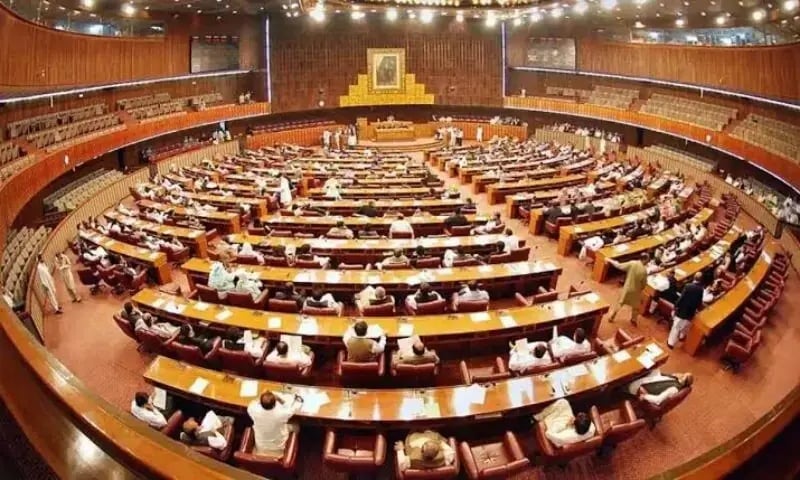
“passing a government resolution by majority vote despite protests from opposition benches” · exact text match
Why: The entire report concerns party-political contestation over constitutional emergency measures.
Claim: Sourcing is dominated by federal government officials while the opposition appears only through protest mentions and the minister's characterizations.
“despite protests from opposition benches” · exact text match
“He criticised former chief minister Sohail Afridi for prioritising political activity” · exact text match
Why: One-sided access to government framing yields a mild pro-establishment tilt in selection.
Claim: The report attributes its claims to named officials and cites its source and data, supporting verifiability.
“Aaj News reported.” · exact text match
“Citing official data, Tarar said” · exact text match
Why: Visible sourcing and attribution raise the trustworthiness of the supplied text.
Claim: Reporting grounds the emergency in cited constitutional articles, official statistics, and procedural timelines rather than rhetoric.
“under Article 232 of the Constitution” · exact text match
“Citing official data, Tarar said” · exact text match
Why: Constitutional citation and attributed data indicate reasoned, fact-anchored framing.
Claim: The publisher hedges official claims and marks accusations as such instead of asserting them.
“However, he claimed that” · exact text match
“but accused the provincial government of failing to do so” · exact text match
Why: Epistemic hedging ('claimed') and attributed accusation preserve honesty about evidential status.
Claim: The report is a concise, information-dense account with specific articles, dates, names, and figures.
“Citing official data, Tarar said” · exact text match
Why: Specific quantities, constitutional citations, and scheduling detail indicate above-average informational craft.
Text is a scrape with duplicated paragraphs, an embedded summary line, and an Article 4/45 inconsistency; no direct opposition statements are included, so balance rests on visible sourcing asymmetry.
October 14, 2026 · 0 shares
Government-dominated sourcing relays the law minister's data and accusations with attribution hedges while the opposition appears only through protest mentions and official characterizations.
Khyber Pakhtunkhwa's provincial government belongs to the opposition PTI, whose jailed founder the article references without naming, while the federal government is led by Prime Minister Shehbaz Sharif's coalition; 'the May 9 events' refers to unrest following the PTI founder's 2023 arrest.
Automated analysis; not human reviewed.
Limitations: Text is a scrape with duplicated paragraphs, an embedded summary line, and an Article 4/45 inconsistency; no direct opposition statements are included, so balance rests on visible sourcing asymmetry.
·
10 of 55 available dimensions scored; omitted dimensions are not treated as neutral.
·
Verified supporting quotes for 10 of 10 scored dimensions.
Claim: Claims, including accusations, are attributed to named officials rather than asserted by the publisher.
“Aaj News reported.” · exact text match
“However, he claimed that” · exact text match
Why: Consistent attribution and hedging keep the report descriptive rather than opinionated.
Claim: The report uses sober procedural language without alarmist or emotionally charged wording.
“The session was later adjourned until 11am on Friday.” · exact text match
“though security remains tight in sensitive areas” · exact text match
Why: Mundane procedural and status details are presented flatly, without dramatic framing.
Claim: The report covers an emergency imposition with concrete statistics, timelines, and coalition maneuvering.
“ratified the presidential proclamation of emergency in Khyber Pakhtunkhwa” · exact text match
Why: A constitutional emergency with quantified security data and party conflict is substantive news.
Claim: Calls to action appear only as attributed statements by officials, with the report itself staying descriptive.
“and called on all political parties to stand with the security forces” · exact text match
Why: The prescriptive appeal is the minister's, reported, not the publisher's own recommendation.
Claim: The content centers on parliamentary procedure, party conflict, and emergency powers.
“passing a government resolution by majority vote despite protests from opposition benches” · exact text match
Why: The entire report concerns party-political contestation over constitutional emergency measures.
Claim: Sourcing is dominated by federal government officials while the opposition appears only through protest mentions and the minister's characterizations.
“despite protests from opposition benches” · exact text match
“He criticised former chief minister Sohail Afridi for prioritising political activity” · exact text match
Why: One-sided access to government framing yields a mild pro-establishment tilt in selection.
Claim: The report attributes its claims to named officials and cites its source and data, supporting verifiability.
“Aaj News reported.” · exact text match
“Citing official data, Tarar said” · exact text match
Why: Visible sourcing and attribution raise the trustworthiness of the supplied text.
Claim: Reporting grounds the emergency in cited constitutional articles, official statistics, and procedural timelines rather than rhetoric.
“under Article 232 of the Constitution” · exact text match
“Citing official data, Tarar said” · exact text match
Why: Constitutional citation and attributed data indicate reasoned, fact-anchored framing.
Claim: The publisher hedges official claims and marks accusations as such instead of asserting them.
“However, he claimed that” · exact text match
“but accused the provincial government of failing to do so” · exact text match
Why: Epistemic hedging ('claimed') and attributed accusation preserve honesty about evidential status.
Claim: The report is a concise, information-dense account with specific articles, dates, names, and figures.
“Citing official data, Tarar said” · exact text match
Why: Specific quantities, constitutional citations, and scheduling detail indicate above-average informational craft.
Text is a scrape with duplicated paragraphs, an embedded summary line, and an Article 4/45 inconsistency; no direct opposition statements are included, so balance rests on visible sourcing asymmetry.
October 13, 2026 · 0 shares
A dry, attribution-heavy relay of an official SBP circular that adds direct quotes and procedural detail without any editorial framing.
Automated analysis; not human reviewed.
Limitations: Accuracy rests entirely on the SBP circular as quoted, with no independent sourcing or explanation for the pending KP endorsement.
·
8 of 55 available dimensions scored; omitted dimensions are not treated as neutral.
·
Verified supporting quotes for 8 of 8 scored dimensions.
Claim: The report conveys the SBP directive through attributed statements and direct circular quotes with no editorial judgment.
“The State Bank of Pakistan (SBP) directed commercial banks on Tuesday to put sugar exports by the mills located in Khyber Pakhtunkhwa’s (KP) on hold till the provincial administration endorses the overseas sales of the commodity.” · exact text match
“according to the circular” · exact text match
Why: Every substantive claim is tied to the SBP circular or named government bodies, leaving no room for publisher opinion.
Claim: Wording stays administrative and procedural, with no alarmist or dramatized language.
“The endorsement of revised quota by the Government of KP will be communicated as and when received from MNFSR [Ministry of National Food Security & Research].” · exact text match
Why: The quoted procedural language and the report's plain phrasing show no sensational framing.
Claim: The item is a routine, dry regulatory brief with limited narrative appeal beyond sector specialists.
“In a circular titled ‘Revised Instructions - Export of 200,000 MT [Metric Ton] of Sugar’” · exact text match
Why: The content is procedural quota administration, offering little drama or broader stakes in the supplied text.
Claim: The report merely describes the central bank's instructions and their sequence without recommending any action or policy.
“Earlier in September 2026, the Economic Coordination Committee (ECC) of the Cabinet allowed export of 200,000 MT of sugar with certain terms and conditions.” · exact text match
Why: The text only recounts decisions and conditions already taken by official bodies, adding no prescriptions of its own.
Claim: The tone is neutral and unemotional throughout.
“Accordingly, authorised dealers [commercial banks] may process the export transactions of eligible sugar mills of Punjab and Sindh as per their revised quotas, subject to [applicable] conditions,” · exact text match
Why: Purely administrative phrasing with no valenced or emotive wording supports a neutral emotional tone.
Claim: Claims are sourced to named institutions with specific dates, quantities, and a named industry association.
“SBP said the MNFSR on October 09, 2026 had communicated the revised province and mill-wise sugar export quotas received from Pakistan Sugar Mills Association (PSMA), along with the correction to the names of three sugar mills.” · exact text match
Why: Visible attribution to the central bank, MNFSR, ECC, and PSMA with dates and tonnage supports trust in the reported content, though no independent sources appear.
Claim: The report quotes the circular verbatim, including the pending KP endorsement, presenting the directive evenhandedly.
“The endorsement from the Government of Khyber Pakhtunkhwa (KP) is still awaited.” · exact text match
Why: Reproducing both what is approved and what remains pending, directly from the circular, is an evenhanded honesty signal.
Claim: The brief is concise yet supplies specific quantities, dates, and institutional names that aid verification.
“The ECC’s decision has also been ratified by the Federal Cabinet.” · exact text match
Why: Tracing the full approval chain plus precise tonnage, dates, and named bodies gives the short report above-average informational density.
Accuracy rests entirely on the SBP circular as quoted, with no independent sourcing or explanation for the pending KP endorsement.
October 14, 2026 · 0 shares
Plainly attributed, low-key reporting that nonetheless amplifies the PTI chairman's court challenge and grievance narrative against the federal emergency with no government response included, producing a mild one-sided, anti-establishment tilt.
Khyber Pakhtunkhwa is the province administered by Gohar's PTI, and the emergency and governor's rule were imposed by Pakistan's federal government, making the dispute a center-versus-province and government-versus-opposition confrontation over constitutional authority.
Automated analysis; not human reviewed.
Limitations: The supplied text is a duplicated, truncated feed capture; the federal government's actual justification for the emergency is never stated, so judgments of one-sidedness may partly reflect missing source text rather than deliberate publisher omission.
·
11 of 55 available dimensions scored; omitted dimensions are not treated as neutral.
·
Verified supporting quotes for 11 of 11 scored dimensions.
Claim: Contested assertions are consistently attributed rather than endorsed, keeping the report largely objective despite one-sided sourcing.
“Gohar claimed that PTI ministers had been picked up and that deputy commissioners (DCs) and district police officers (DPOs) were not listening to the provincial government.” · exact text match
Why: Attribution verbs (claimed, accused, alleged, argued) preserve the line between report and assertion; the missing government-side voice is the main objectivity deduction.
Claim: The language and structure are factual and non-hyperbolic, with no urgency or alarm cues.
“In the petition, the PTI Chairman urged the court to declare the imposition of emergency and governor’s rule null and void.” · exact text match
Why: Plain declarative reporting of a legal filing without loaded adjectives or dramatization indicates an objective rather than sensational register.
Claim: The story's constitutional stakes elevate it above routine political news.
“Gohar also accused the federal government of effectively reviving Article 58(2)(b) of the Constitution by imposing an emergency in Khyber Pakhtunkhwa” · exact text match
Why: A legal test of whether an emergency recreates abolished presidential dissolution powers is a substantively notable question with broad implications.
Claim: The narration stays reportorial, with prescriptive content confined to attributed quotes.
“Gohar maintained that the appropriate response to terrorism should have been to strengthen the provincial government rather than undermine its authority.” · exact text match
Why: Policy prescriptions appear only as the source's stated views; the publisher narrates events and filings without advocating.
Claim: The entire item is party-political conflict over federal-provincial power and protest plans.
“He vowed that PTI would strongly protest against the imposition of emergency in KP.” · exact text match
Why: A party chairman's court challenge, accusations against the federal government, inter-party jabs at PPP, and protest vows make the content intrinsically political.
Claim: The item prominently features PTI grievance and deprivation claims without counterpoint, creating a mild victimization framing.
“He warned that the imposition of emergency would undermine provincial autonomy and alleged that the KP government had already been deprived of its authority” · exact text match
Why: Deprivation-of-authority and detained-ministers claims structure the story, though they are attributed as allegations rather than asserted, keeping the score low.
Claim: The item's substantive content consists solely of an opposition challenge to federal emergency authority, with no federal government position included, tilting framing against the governing establishment.
“Gohar also accused the federal government of effectively reviving Article 58(2)(b) of the Constitution by imposing an emergency in Khyber Pakhtunkhwa, arguing that the move undermined parliamentary democracy and provincial autonomy.” · exact text match
Why: Every argument presented is the opposition's anti-federal case; the government's rationale referenced in the text is never stated, giving the framing a mild anti-establishment lean.
Claim: The report is credible as attributed, context-rich news but lacks independent corroboration or the government's response.
“PESHAWAR: Pakistan Tehreek-e-Insaf (PTI) Chairman Barrister Gohar on Wednesday filed a petition in the Peshawar High Court (PHC) against the imposition of a state of emergency and governor’s rule in Khyber Pakhtunkhwa, ARY News reported.” · exact text match
“Article 58(2)(b), abolished through the Eighteenth Constitutional Amendment in 2010, previously empowered the president to dissolve the National Assembly, paving the way for the dismissal of the prime minister and federal cabinet.” · exact text match
Why: Named sourcing for the filing and accurate-looking constitutional background support credibility; reliance on a single political source without rebuttal limits it.
Claim: The report references the government's justification for the emergency without ever stating it and includes no government response, an observable one-sided omission.
“Earlier, Barrister Gohar Ali Khan challenged the federal government’s justification for imposing an emergency in Khyber Pakhtunkhwa (KP)” · exact text match
Why: Material omission of the counterparty's stated position leaves readers with only the challenger's case; scored mild because claims remain attributed and no loaded framing is used.
Claim: Attribution and hedging practices signal honest reporting despite the absence of the other side.
“Gohar claimed that PTI ministers had been picked up and that deputy commissioners (DCs) and district police officers (DPOs) were not listening to the provincial government.” · exact text match
Why: Consistent use of claimed/alleged/accused instead of assertion is an observable honesty signal; the one-sided sourcing modestly caps the score.
Claim: The item adds explanatory constitutional history beyond bare event reporting.
“Article 58(2)(b), abolished through the Eighteenth Constitutional Amendment in 2010, previously empowered the president to dissolve the National Assembly, paving the way for the dismissal of the prime minister and federal cabinet.” · exact text match
Why: Providing the historical meaning and abolition of Article 58(2)(b) equips readers to evaluate the revival claim, above typical brief-wire depth, though the item remains short.
The supplied text is a duplicated, truncated feed capture; the federal government's actual justification for the emergency is never stated, so judgments of one-sidedness may partly reflect missing source text rather than deliberate publisher omission.
October 13, 2026 · 0 shares
A data-driven, politically non-partisan market report whose bearish, mildly fear-tinged framing leans on emotive headline language and attributed brokerage commentary.
Automated analysis; not human reviewed.
Limitations: The supplied text is a scrape containing unrelated headline links and page fragments; the reference to 'June 2026 corporate results' cannot be reconciled with the report's other events, and the publisher is identified only via a source mention ('Talking to The Express Tribune') rather than an explicit masthead.
·
14 of 55 available dimensions scored; omitted dimensions are not treated as neutral.
·
Verified supporting quotes for 14 of 14 scored dimensions.
Claim: Coverage of the K-P emergency, governor's rule, and police crackdown avoids partisan endorsement or criticism of any side.
“The imposition of governor's rule and emergency measures in parts of K-P, followed by reports of police crackdown, added to political clamour” · exact text match
Why: The contentious political action is reported descriptively with no evaluative language favoring either the government or its opponents.
Claim: The report rests on precise figures and multiple attributed sources with little editorializing.
“shed 1,964.87 points, or 1.18%, to settle at 165,124.41 at the close of trading” · exact text match
“Topline Securities said that the KSE-100 index came under renewed selling pressure” · exact text match
Why: Exact index, volume, and value data plus named analyst attributions indicate objective reporting.
Claim: Dramatic wording frames a moderate 1.18% decline as a plunge amid chaos.
“PSX plunges 1,965 points amid political chaos” · exact text match
“endured a bruising start to the week” · exact text match
Why: Headline verbs and emotive adjectives exceed the neutral register of the underlying figures.
Claim: The framing stresses downside risk and continued volatility while noting possible support.
“further regional escalation could extend the bearish trend” · exact text match
“Further downside pressure cannot be ruled out” · exact text match
Counterevidence:
“value buying at lower levels may provide intermittent support” · exact text match
Why: Both quoted outlooks lead with downside and volatility scenarios, tipping the overall frame bearish despite noted support.
Claim: The mood framing leans toward anxiety and downside rather than recovery.
“stoking fears of further unrest” · exact text match
“kept investors on edge” · exact text match
Counterevidence:
“June 2026 corporate results in the listed space were better than expected” · exact text match
Why: Fear-centered language dominates, with only limited counterweight from positive corporate results.
Claim: Concrete market data tied to an unfolding political crisis gives the report moderate reader interest.
“shed 1,964.87 points, or 1.18%, to settle at 165,124.41 at the close of trading” · exact text match
Why: Specific figures linked to live political events engage finance readers, though the format is routine.
Claim: The report is almost entirely descriptive, with the only investment advice quoted from an analyst.
“Najib advised investors to remain selective, prioritise fundamentally strong stocks and avoid aggressive positions until sentiment stabilised” · exact text match
Why: Prescription appears solely as attributed analyst guidance, not publisher advocacy.
Claim: Fear-centered phrasing recurs but describes reported market sentiment rather than baiting readers.
“stoking fears of further unrest” · exact text match
“fears of a wider regional conflict” · exact text match
Why: Repeated fear language amplifies the unsettled mood while stopping short of alarmism.
Claim: Political turmoil serves as the central explanatory frame for the market move.
“The bearish sentiment followed the federal government's decision to impose emergency in K-P, after President Asif Ali Zardari approved the federal cabinet's recommendation on Sunday” · exact text match
Why: The political development is presented as the primary driver of the sell-off, though without partisan slant.
Claim: The report is well-sourced with precise figures from multiple named brokerages and a market data provider.
“Topline Securities said that the KSE-100 index came under renewed selling pressure, closing at 165,124, down 1,965 points (-1.18%)” · exact text match
“the National Clearing Company reported” · exact text match
Why: Multiple independent attributed sources and exact data support credibility within the supplied text.
Claim: Market moves are explained through identified causes and hedged analyst reasoning rather than rhetoric.
“KTrade Head of Research Fawad Basir attributed the market's weakness to geopolitical uncertainty and heightened tensions in K-P” · exact text match
Why: Causal attributions to specific factors, supported by data and named sources, reflect a reasoned, evidence-based presentation.
Claim: Forward-looking forecasts are included but hedged and attributed.
“market direction is likely to remain volatile, hinging on geopolitical developments and oil prices” · exact text match
“Further downside pressure cannot be ruled out” · exact text match
Why: Forecast content is present but consistently expressed with hedging and source attribution.
Claim: Key claims are consistently attributed and quantified.
“Talking to The Express Tribune, KTrade Head of Research Fawad Basir attributed the market's weakness to geopolitical uncertainty and heightened tensions in K-P” · exact text match
“Foreign investors bought shares worth Rs11.6 million, the National Clearing Company reported.” · exact text match
Why: Named sources and explicit data attribution are visible honesty and transparency signals.
Claim: The report integrates official actions, three brokerages' assessments, and detailed market statistics into a coherent narrative.
“Overall trading volumes increased to 363 million shares compared with Friday's tally of 309.4 million” · exact text match
“KTrade mentioned that selling pressure was broad-based across commercial banks, oil and gas, cement and technology stocks” · exact text match
Why: Synthesis of multiple sources and granular data shows above-average competence for market reporting.
The supplied text is a scrape containing unrelated headline links and page fragments; the reference to 'June 2026 corporate results' cannot be reconciled with the report's other events, and the publisher is identified only via a source mention ('Talking to The Express Tribune') rather than an explicit masthead.
October 14, 2026 · 0 shares
Government-dominated sourcing relays the law minister's data and accusations with attribution hedges while the opposition appears only through protest mentions and official characterizations.
Khyber Pakhtunkhwa's provincial government belongs to the opposition PTI, whose jailed founder the article references without naming, while the federal government is led by Prime Minister Shehbaz Sharif's coalition; 'the May 9 events' refers to unrest following the PTI founder's 2023 arrest.
Automated analysis; not human reviewed. Limitations: Text is a scrape with duplicated paragraphs, an embedded summary line, and an Article 4/45 inconsistency; no direct opposition statements are included, so balance rests on visible sourcing asymmetry. · 10 of 55 available dimensions scored; omitted dimensions are not treated as neutral. · Verified supporting quotes for 10 of 10 scored dimensions.
Claim: Claims, including accusations, are attributed to named officials rather than asserted by the publisher.
“Aaj News reported.” · exact text match
“However, he claimed that” · exact text match
Why: Consistent attribution and hedging keep the report descriptive rather than opinionated.
Claim: The report uses sober procedural language without alarmist or emotionally charged wording.
“The session was later adjourned until 11am on Friday.” · exact text match
“though security remains tight in sensitive areas” · exact text match
Why: Mundane procedural and status details are presented flatly, without dramatic framing.
Claim: The report covers an emergency imposition with concrete statistics, timelines, and coalition maneuvering.
“ratified the presidential proclamation of emergency in Khyber Pakhtunkhwa” · exact text match
Why: A constitutional emergency with quantified security data and party conflict is substantive news.
Claim: Calls to action appear only as attributed statements by officials, with the report itself staying descriptive.
“and called on all political parties to stand with the security forces” · exact text match
Why: The prescriptive appeal is the minister's, reported, not the publisher's own recommendation.
Claim: The content centers on parliamentary procedure, party conflict, and emergency powers.
“passing a government resolution by majority vote despite protests from opposition benches” · exact text match
Why: The entire report concerns party-political contestation over constitutional emergency measures.
Claim: Sourcing is dominated by federal government officials while the opposition appears only through protest mentions and the minister's characterizations.
“despite protests from opposition benches” · exact text match
“He criticised former chief minister Sohail Afridi for prioritising political activity” · exact text match
Why: One-sided access to government framing yields a mild pro-establishment tilt in selection.
Claim: The report attributes its claims to named officials and cites its source and data, supporting verifiability.
“Aaj News reported.” · exact text match
“Citing official data, Tarar said” · exact text match
Why: Visible sourcing and attribution raise the trustworthiness of the supplied text.
Claim: Reporting grounds the emergency in cited constitutional articles, official statistics, and procedural timelines rather than rhetoric.
“under Article 232 of the Constitution” · exact text match
“Citing official data, Tarar said” · exact text match
Why: Constitutional citation and attributed data indicate reasoned, fact-anchored framing.
Claim: The publisher hedges official claims and marks accusations as such instead of asserting them.
“However, he claimed that” · exact text match
“but accused the provincial government of failing to do so” · exact text match
Why: Epistemic hedging ('claimed') and attributed accusation preserve honesty about evidential status.
Claim: The report is a concise, information-dense account with specific articles, dates, names, and figures.
“Citing official data, Tarar said” · exact text match
Why: Specific quantities, constitutional citations, and scheduling detail indicate above-average informational craft.
Text is a scrape with duplicated paragraphs, an embedded summary line, and an Article 4/45 inconsistency; no direct opposition statements are included, so balance rests on visible sourcing asymmetry.
October 14, 2026 · 0 shares
Government-dominated sourcing relays the law minister's data and accusations with attribution hedges while the opposition appears only through protest mentions and official characterizations.
Khyber Pakhtunkhwa's provincial government belongs to the opposition PTI, whose jailed founder the article references without naming, while the federal government is led by Prime Minister Shehbaz Sharif's coalition; 'the May 9 events' refers to unrest following the PTI founder's 2023 arrest.
Automated analysis; not human reviewed. Limitations: Text is a scrape with duplicated paragraphs, an embedded summary line, and an Article 4/45 inconsistency; no direct opposition statements are included, so balance rests on visible sourcing asymmetry. · 10 of 55 available dimensions scored; omitted dimensions are not treated as neutral. · Verified supporting quotes for 10 of 10 scored dimensions.
Claim: Claims, including accusations, are attributed to named officials rather than asserted by the publisher.
“Aaj News reported.” · exact text match
“However, he claimed that” · exact text match
Why: Consistent attribution and hedging keep the report descriptive rather than opinionated.
Claim: The report uses sober procedural language without alarmist or emotionally charged wording.
“The session was later adjourned until 11am on Friday.” · exact text match
“though security remains tight in sensitive areas” · exact text match
Why: Mundane procedural and status details are presented flatly, without dramatic framing.
Claim: The report covers an emergency imposition with concrete statistics, timelines, and coalition maneuvering.
“ratified the presidential proclamation of emergency in Khyber Pakhtunkhwa” · exact text match
Why: A constitutional emergency with quantified security data and party conflict is substantive news.
Claim: Calls to action appear only as attributed statements by officials, with the report itself staying descriptive.
“and called on all political parties to stand with the security forces” · exact text match
Why: The prescriptive appeal is the minister's, reported, not the publisher's own recommendation.
Claim: The content centers on parliamentary procedure, party conflict, and emergency powers.
“passing a government resolution by majority vote despite protests from opposition benches” · exact text match
Why: The entire report concerns party-political contestation over constitutional emergency measures.
Claim: Sourcing is dominated by federal government officials while the opposition appears only through protest mentions and the minister's characterizations.
“despite protests from opposition benches” · exact text match
“He criticised former chief minister Sohail Afridi for prioritising political activity” · exact text match
Why: One-sided access to government framing yields a mild pro-establishment tilt in selection.
Claim: The report attributes its claims to named officials and cites its source and data, supporting verifiability.
“Aaj News reported.” · exact text match
“Citing official data, Tarar said” · exact text match
Why: Visible sourcing and attribution raise the trustworthiness of the supplied text.
Claim: Reporting grounds the emergency in cited constitutional articles, official statistics, and procedural timelines rather than rhetoric.
“under Article 232 of the Constitution” · exact text match
“Citing official data, Tarar said” · exact text match
Why: Constitutional citation and attributed data indicate reasoned, fact-anchored framing.
Claim: The publisher hedges official claims and marks accusations as such instead of asserting them.
“However, he claimed that” · exact text match
“but accused the provincial government of failing to do so” · exact text match
Why: Epistemic hedging ('claimed') and attributed accusation preserve honesty about evidential status.
Claim: The report is a concise, information-dense account with specific articles, dates, names, and figures.
“Citing official data, Tarar said” · exact text match
Why: Specific quantities, constitutional citations, and scheduling detail indicate above-average informational craft.
Text is a scrape with duplicated paragraphs, an embedded summary line, and an Article 4/45 inconsistency; no direct opposition statements are included, so balance rests on visible sourcing asymmetry.
The report is largely factual and attributable, relying on official declarations, cabinet statements, and named constitutional provisions while giving limited space to the provincial government's or PTI's defense.
Khyber Pakhtunkhwa is a northwestern Pakistani province governed by Imran Khan's PTI party; Pakistan's Constitution allows federal emergency rule in a province under Articles 232 and 234 during security crises or breakdowns of constitutional governance.
Automated analysis; not human reviewed. Limitations: The article relies heavily on official declarations and cabinet statements, with limited independent sourcing or response from the PTI-led provincial government beyond the protest description. · 55 of 55 available dimensions scored; omitted dimensions are not treated as neutral. · Verified supporting quotes for 10 of 55 scored dimensions.
Claim: The framing is slightly elitist by centering federal executive and cabinet authority over the provincial leadership.
“The federal cabinet endorsed the emergency proposal earlier on Sunday after a special meeting chaired by Prime Minister Shehbaz Sharif to review the worsening security situation.” · exact text match
Why: Elevates federal executive decision-making as the authoritative response.
Claim: The report treats emergency rule and suspension of provincial institutions as a normal constitutional measure, indicating mild authoritarian framing.
“An emergency allows Pakistan's federal government to assume key executive and legislative powers in a province during a security crisis or breakdown of constitutional governance.” · exact text match
Why: Normalizes centralization of power without questioning its implications.
Claim: The article is largely objective, relying on official documents and statements.
“President Asif Ali Zardari issued a proclamation under Articles 232(1) and 234(1) of the Constitution, citing rising terrorist attacks and a breakdown of constitutional machinery in the northwestern province, according to the presidential declaration.” · exact text match
Why: Direct attribution to the presidential declaration.
Claim: The article is mostly descriptive, explaining the emergency's mechanics and citing official declarations, but quotes Pinochet's cabinet framing without rebuttal.
“Under the proclamation, the federal government may direct the provincial governor to assume all or some functions of the provincial government.” · exact text match
Why: Focuses on describing legal powers rather than prescription.
Claim: The report adopts a mildly hawkish tone by emphasizing terrorist attacks and security operations.
“The presidential declaration on Sunday (October 11, 2026) said the emergency was imposed in view of rising terrorist incidents and the grave law and order situation in the province.” · exact text match
Why: Frames the emergency primarily as a security response.
Claim: This is a political story about emergency rule and party conflict.
“Pakistan on Sunday (October 11, 2026) declared an emergency in the northwest Khyber Pakhtunkhwa province over the deteriorating law and order situation, bringing the provincial government led by jailed former prime minister Imran Khan's party to an end.” · exact text match
Why: Centers on a political crisis and government dissolution.
Claim: The article heavily relies on presidential and cabinet statements as authoritative.
“The Cabinet recommended that the Prime Minister advise the President to exercise his constitutional authority and impose an emergency in Khyber Pakhtunkhwa under Articles 232 and 234 of the Constitution of Pakistan, given the gravity of the situation.” · not found in supplied text
Why: Uses official statements as primary evidence.
Claim: The article includes the PTI's protest demands and prior talks but the bulk of the text is official framing, indicating a mild imbalance in covering the response.
“The party’s key demands include an immediate meeting with Khan, access for his personal doctors, the release of his sisters and supporters arrested ahead of the protest, a proper medical check-up for his wife, Bushra Bibi, and hearings in their cases without interference.” · exact text match
Why: Provides some but limited coverage of the opposing side.
Claim: The article states official claims without significant hedging.
“The presidential declaration on Sunday (October 11, 2026) said the emergency was imposed in view of rising terrorist incidents and the grave law and order situation in the province.” · exact text match
Why: Attributes claims to official sources but does not independently verify.
Claim: The article leans slightly pro-establishment by prioritizing federal government and presidential justifications over PTI's opposition.
“The federal cabinet endorsed the emergency proposal earlier on Sunday after a special meeting chaired by Prime Minister Shehbaz Sharif to review the worsening security situation.” · exact text match
Why: Foregrounds federal executive actions and statements.
Claim: The article is credible, with specific legal references, attributed quotes, and named sources, though largely reliant on official statements.
“President Asif Ali Zardari issued a proclamation under Articles 232(1) and 234(1) of the Constitution, citing rising terrorist attacks and a breakdown of constitutional machinery in the northwestern province, according to the presidential declaration.” · exact text match
Why: Clear sourcing and legal specificity.
Claim: The article gives specific constitutional articles and attributed statements, indicating reasonable integrity.
“President Asif Ali Zardari issued a proclamation under Articles 232(1) and 234(1) of the Constitution... according to the presidential declaration.” · not found in supplied text
Why: Provides specific legal references and official attribution.
The article relies heavily on official declarations and cabinet statements, with limited independent sourcing or response from the PTI-led provincial government beyond the protest description.
Framing centers on the federal government's emergency imposition against an opposition-run province, presenting PTI grievances and the terrorism rationale in a largely descriptive, event-driven manner.
Khyber Pakhtunkhwa is governed by Imran Khan's PTI, whose leader has been jailed since 2023 and remains the main political rival of Prime Minister Shehbaz Sharif.
Coverage maintains neutral wire-service framing with attributed claims from federal officials and PTI, though it foregrounds the emergency suspension and opposition crackdown.
Automated analysis; not human reviewed. Limitations: The supplied text lacks a publication year in the dateline and an author byline, limiting temporal and sourcing context. · 9 of 55 available dimensions scored; omitted dimensions are not treated as neutral. · Verified supporting quotes for 9 of 9 scored dimensions.
Claim: The report relies on attributed claims and official statements rather than the publisher's subjective judgment.
“which accused the provincial administration of failing to tackle militancy” · exact text match
“PTI spokesperson Zulfiquar Bukhari condemned the suspension of the provincial government, describing it as a “disguised coup.”” · exact text match
Why: Contested claims are presented through attribution, indicating a largely objective stance.
Claim: The article uses some dramatic language but attributes the strongest phrases to sources.
“in what the party described as one of the strongest crackdowns in years” · exact text match
“escalating a political standoff” · exact text match
Why: Mild sensational phrasing appears, but the most dramatic terms are quoted or attributed.
Claim: The article is primarily descriptive of events and claims, not prescriptive about what should be done.
“Pakistan’s President Asif Ali Zardari has declared a state of emergency in Khyber Pakhtunkhwa and suspended the provincial government” · exact text match
“The Interior Ministry also announced plans to deploy troops in the province.” · exact text match
Why: The text reports actions and statements without recommending policies, indicating descriptive framing.
Claim: The report is centrally framed around a political standoff and government power struggle.
“escalating a political standoff between the opposition and the federal government” · exact text match
“Pakistan’s President Asif Ali Zardari has declared a state of emergency in Khyber Pakhtunkhwa and suspended the provincial government led by jailed former Prime Minister Imran Khan’s Pakistan Tehreek-e-Insaf (PTI) party” · exact text match
Why: The article's central subject is a political conflict between opposition PTI and federal government, making political bias high.
Claim: Coverage balances federal government justifications with PTI's anti-government condemnation without explicit endorsement.
“which accused the provincial administration of failing to tackle militancy in the province bordering Afghanistan” · exact text match
“describing it as a “disguised coup.”” · exact text match
Why: Both establishment security rationale and opposition criticism are presented through attribution, supporting neutrality.
Claim: Credibility is supported by named officials, wire-service sourcing, and attributed claims.
“A close aide to Afridi told Reuters” · exact text match
“Information Minister Attaullah Tarar announced an 11-member advisory council” · exact text match
Why: Named sources, attribution to Reuters, and official statements support high credibility.
Claim: The report presents a coherent, evidence-attributed account rather than an irrational or fallacious argument.
“The move on Sunday followed a recommendation by Prime Minister Shehbaz Sharif’s Cabinet, which accused the provincial administration of failing to tackle militancy in the province bordering Afghanistan and of deliberately disengaging from counterterrorism efforts.” · exact text match
“PTI spokesperson Zulfiquar Bukhari condemned the suspension of the provincial government, describing it as a “disguised coup.”” · exact text match
Why: Causal linkage and attributed competing claims indicate rational reporting rather than irrational framing.
Claim: The report shows fairness and honesty signals through multiple attributions and inclusion of opposing claims.
“Federal officials said deteriorating security and poor coordination between Islamabad and the provincial government had allowed militants to gain ground.” · exact text match
“PTI spokesperson Zulfiquar Bukhari condemned the suspension of the provincial government, describing it as a “disguised coup.”” · exact text match
Why: Sourcing from federal officials and PTI, with attributed claims, supports a moderately high integrity assessment.
Claim: The report is competently structured and context-aware, summarizing political and security claims.
“The move on Sunday followed a recommendation by Prime Minister Shehbaz Sharif’s Cabinet” · exact text match
“The emergency measures come amid heightened tensions following PTI supporters’ plans to march on Islamabad to demand Khan’s release.” · exact text match
Why: Clear causal and contextual linking suggests above-average article intelligence.
The supplied text lacks a publication year in the dateline and an author byline, limiting temporal and sourcing context.
October 14, 2026 · 0 shares
Government-dominated sourcing relays the law minister's data and accusations with attribution hedges while the opposition appears only through protest mentions and official characterizations.
Khyber Pakhtunkhwa's provincial government belongs to the opposition PTI, whose jailed founder the article references without naming, while the federal government is led by Prime Minister Shehbaz Sharif's coalition; 'the May 9 events' refers to unrest following the PTI founder's 2023 arrest.
Automated analysis; not human reviewed. Limitations: Text is a scrape with duplicated paragraphs, an embedded summary line, and an Article 4/45 inconsistency; no direct opposition statements are included, so balance rests on visible sourcing asymmetry. · 10 of 55 available dimensions scored; omitted dimensions are not treated as neutral. · Verified supporting quotes for 10 of 10 scored dimensions.
Claim: Claims, including accusations, are attributed to named officials rather than asserted by the publisher.
“Aaj News reported.” · exact text match
“However, he claimed that” · exact text match
Why: Consistent attribution and hedging keep the report descriptive rather than opinionated.
Claim: The report uses sober procedural language without alarmist or emotionally charged wording.
“The session was later adjourned until 11am on Friday.” · exact text match
“though security remains tight in sensitive areas” · exact text match
Why: Mundane procedural and status details are presented flatly, without dramatic framing.
Claim: The report covers an emergency imposition with concrete statistics, timelines, and coalition maneuvering.
“ratified the presidential proclamation of emergency in Khyber Pakhtunkhwa” · exact text match
Why: A constitutional emergency with quantified security data and party conflict is substantive news.
Claim: Calls to action appear only as attributed statements by officials, with the report itself staying descriptive.
“and called on all political parties to stand with the security forces” · exact text match
Why: The prescriptive appeal is the minister's, reported, not the publisher's own recommendation.
Claim: The content centers on parliamentary procedure, party conflict, and emergency powers.
“passing a government resolution by majority vote despite protests from opposition benches” · exact text match
Why: The entire report concerns party-political contestation over constitutional emergency measures.
Claim: Sourcing is dominated by federal government officials while the opposition appears only through protest mentions and the minister's characterizations.
“despite protests from opposition benches” · exact text match
“He criticised former chief minister Sohail Afridi for prioritising political activity” · exact text match
Why: One-sided access to government framing yields a mild pro-establishment tilt in selection.
Claim: The report attributes its claims to named officials and cites its source and data, supporting verifiability.
“Aaj News reported.” · exact text match
“Citing official data, Tarar said” · exact text match
Why: Visible sourcing and attribution raise the trustworthiness of the supplied text.
Claim: Reporting grounds the emergency in cited constitutional articles, official statistics, and procedural timelines rather than rhetoric.
“under Article 232 of the Constitution” · exact text match
“Citing official data, Tarar said” · exact text match
Why: Constitutional citation and attributed data indicate reasoned, fact-anchored framing.
Claim: The publisher hedges official claims and marks accusations as such instead of asserting them.
“However, he claimed that” · exact text match
“but accused the provincial government of failing to do so” · exact text match
Why: Epistemic hedging ('claimed') and attributed accusation preserve honesty about evidential status.
Claim: The report is a concise, information-dense account with specific articles, dates, names, and figures.
“Citing official data, Tarar said” · exact text match
Why: Specific quantities, constitutional citations, and scheduling detail indicate above-average informational craft.
Text is a scrape with duplicated paragraphs, an embedded summary line, and an Article 4/45 inconsistency; no direct opposition statements are included, so balance rests on visible sourcing asymmetry.
October 14, 2026 · 0 shares
Government-dominated sourcing relays the law minister's data and accusations with attribution hedges while the opposition appears only through protest mentions and official characterizations.
Khyber Pakhtunkhwa's provincial government belongs to the opposition PTI, whose jailed founder the article references without naming, while the federal government is led by Prime Minister Shehbaz Sharif's coalition; 'the May 9 events' refers to unrest following the PTI founder's 2023 arrest.
Automated analysis; not human reviewed. Limitations: Text is a scrape with duplicated paragraphs, an embedded summary line, and an Article 4/45 inconsistency; no direct opposition statements are included, so balance rests on visible sourcing asymmetry. · 10 of 55 available dimensions scored; omitted dimensions are not treated as neutral. · Verified supporting quotes for 10 of 10 scored dimensions.
Claim: Claims, including accusations, are attributed to named officials rather than asserted by the publisher.
“Aaj News reported.” · exact text match
“However, he claimed that” · exact text match
Why: Consistent attribution and hedging keep the report descriptive rather than opinionated.
Claim: The report uses sober procedural language without alarmist or emotionally charged wording.
“The session was later adjourned until 11am on Friday.” · exact text match
“though security remains tight in sensitive areas” · exact text match
Why: Mundane procedural and status details are presented flatly, without dramatic framing.
Claim: The report covers an emergency imposition with concrete statistics, timelines, and coalition maneuvering.
“ratified the presidential proclamation of emergency in Khyber Pakhtunkhwa” · exact text match
Why: A constitutional emergency with quantified security data and party conflict is substantive news.
Claim: Calls to action appear only as attributed statements by officials, with the report itself staying descriptive.
“and called on all political parties to stand with the security forces” · exact text match
Why: The prescriptive appeal is the minister's, reported, not the publisher's own recommendation.
Claim: The content centers on parliamentary procedure, party conflict, and emergency powers.
“passing a government resolution by majority vote despite protests from opposition benches” · exact text match
Why: The entire report concerns party-political contestation over constitutional emergency measures.
Claim: Sourcing is dominated by federal government officials while the opposition appears only through protest mentions and the minister's characterizations.
“despite protests from opposition benches” · exact text match
“He criticised former chief minister Sohail Afridi for prioritising political activity” · exact text match
Why: One-sided access to government framing yields a mild pro-establishment tilt in selection.
Claim: The report attributes its claims to named officials and cites its source and data, supporting verifiability.
“Aaj News reported.” · exact text match
“Citing official data, Tarar said” · exact text match
Why: Visible sourcing and attribution raise the trustworthiness of the supplied text.
Claim: Reporting grounds the emergency in cited constitutional articles, official statistics, and procedural timelines rather than rhetoric.
“under Article 232 of the Constitution” · exact text match
“Citing official data, Tarar said” · exact text match
Why: Constitutional citation and attributed data indicate reasoned, fact-anchored framing.
Claim: The publisher hedges official claims and marks accusations as such instead of asserting them.
“However, he claimed that” · exact text match
“but accused the provincial government of failing to do so” · exact text match
Why: Epistemic hedging ('claimed') and attributed accusation preserve honesty about evidential status.
Claim: The report is a concise, information-dense account with specific articles, dates, names, and figures.
“Citing official data, Tarar said” · exact text match
Why: Specific quantities, constitutional citations, and scheduling detail indicate above-average informational craft.
Text is a scrape with duplicated paragraphs, an embedded summary line, and an Article 4/45 inconsistency; no direct opposition statements are included, so balance rests on visible sourcing asymmetry.
October 14, 2026 · 0 shares
Government-dominated sourcing relays the law minister's data and accusations with attribution hedges while the opposition appears only through protest mentions and official characterizations.
Khyber Pakhtunkhwa's provincial government belongs to the opposition PTI, whose jailed founder the article references without naming, while the federal government is led by Prime Minister Shehbaz Sharif's coalition; 'the May 9 events' refers to unrest following the PTI founder's 2023 arrest.
Automated analysis; not human reviewed. Limitations: Text is a scrape with duplicated paragraphs, an embedded summary line, and an Article 4/45 inconsistency; no direct opposition statements are included, so balance rests on visible sourcing asymmetry. · 10 of 55 available dimensions scored; omitted dimensions are not treated as neutral. · Verified supporting quotes for 10 of 10 scored dimensions.
Claim: Claims, including accusations, are attributed to named officials rather than asserted by the publisher.
“Aaj News reported.” · exact text match
“However, he claimed that” · exact text match
Why: Consistent attribution and hedging keep the report descriptive rather than opinionated.
Claim: The report uses sober procedural language without alarmist or emotionally charged wording.
“The session was later adjourned until 11am on Friday.” · exact text match
“though security remains tight in sensitive areas” · exact text match
Why: Mundane procedural and status details are presented flatly, without dramatic framing.
Claim: The report covers an emergency imposition with concrete statistics, timelines, and coalition maneuvering.
“ratified the presidential proclamation of emergency in Khyber Pakhtunkhwa” · exact text match
Why: A constitutional emergency with quantified security data and party conflict is substantive news.
Claim: Calls to action appear only as attributed statements by officials, with the report itself staying descriptive.
“and called on all political parties to stand with the security forces” · exact text match
Why: The prescriptive appeal is the minister's, reported, not the publisher's own recommendation.
Claim: The content centers on parliamentary procedure, party conflict, and emergency powers.
“passing a government resolution by majority vote despite protests from opposition benches” · exact text match
Why: The entire report concerns party-political contestation over constitutional emergency measures.
Claim: Sourcing is dominated by federal government officials while the opposition appears only through protest mentions and the minister's characterizations.
“despite protests from opposition benches” · exact text match
“He criticised former chief minister Sohail Afridi for prioritising political activity” · exact text match
Why: One-sided access to government framing yields a mild pro-establishment tilt in selection.
Claim: The report attributes its claims to named officials and cites its source and data, supporting verifiability.
“Aaj News reported.” · exact text match
“Citing official data, Tarar said” · exact text match
Why: Visible sourcing and attribution raise the trustworthiness of the supplied text.
Claim: Reporting grounds the emergency in cited constitutional articles, official statistics, and procedural timelines rather than rhetoric.
“under Article 232 of the Constitution” · exact text match
“Citing official data, Tarar said” · exact text match
Why: Constitutional citation and attributed data indicate reasoned, fact-anchored framing.
Claim: The publisher hedges official claims and marks accusations as such instead of asserting them.
“However, he claimed that” · exact text match
“but accused the provincial government of failing to do so” · exact text match
Why: Epistemic hedging ('claimed') and attributed accusation preserve honesty about evidential status.
Claim: The report is a concise, information-dense account with specific articles, dates, names, and figures.
“Citing official data, Tarar said” · exact text match
Why: Specific quantities, constitutional citations, and scheduling detail indicate above-average informational craft.
Text is a scrape with duplicated paragraphs, an embedded summary line, and an Article 4/45 inconsistency; no direct opposition statements are included, so balance rests on visible sourcing asymmetry.
Publisher framing firmly backs the federal security establishment, blaming K-P's elected provincial leadership for the terror surge through political distractions and soft treatment of militants while endorsing Islamabad's direct takeover of provincial security.
Automated analysis; not human reviewed. Limitations: The excerpt is truncated, unsigned, and undated, offers no response from the K-P provincial government, and does not explain the mechanism by which Islamabad assumed control, limiting balance and verification assessments. · 26 of 55 available dimensions scored; omitted dimensions are not treated as neutral. · Verified supporting quotes for 25 of 26 scored dimensions.
Claim: Editorial favors hard-line counter-militancy policy and rejects negotiation with militants, a conservative security stance.
“The chief minister also insisted on negotiating with terrorists, which directly undermined the federal government and security establishment.” · exact text match
Why: Treating dialogue with militants as a fault and endorsing military elimination of terrorists aligns with a conservative, law-and-order orientation.
Claim: Editorial sides with the central security apparatus against elected provincial leadership.
“as the federal government has taken K-P's elected leadership off the board” · exact text match
Why: Framing the sidelining of elected officials as a positive development reflects an elitist lean favoring security institutions over popular sovereignty.
Claim: Endorses direct central state control of provincial security, superseding elected provincial governance.
“as it will have direct control of the provincial security apparatus” · exact text match
Why: Approving removal of provincial elected authority from security decisions is an authoritarian-centralizing position.
Claim: Editorial voice offers personal evaluation and wishes beyond reported facts.
“If only all parts of the government were working together, the results might have been even better.” · exact text match
Why: Counterfactual lament and evaluative commentary mark a subjective, opinion-driven register.
Claim: Mild dramatization surrounds otherwise sourced security data.
“One of the most concerning findings in the government security reports recently shared with the federal cabinet” · exact text match
Why: Intensifying language frames the figures alarmingly, but the underlying data remains attributed and specific.
Claim: Deterioration-and-failure framing dominates, with only tentative hope at the close.
“We can only hope that the unfortunate series of events that has led us here can be reversed, and K-P sees some semblance of security again” · exact text match
Why: The bulk of the text stresses worsening violence and governance failure, with hope expressed only conditionally.
Claim: Quantified terror-wave data combined with a federal-provincial power struggle.
“terrorist drone attacks more than doubled in the past year, reaching 170 in 2026” · exact text match
Why: Unusual specifics such as drone-attack counts and a takeover of provincial security give the piece above-average news value.
Claim: Editorial pushes preferred governance arrangements rather than merely reporting events.
“If only all parts of the government were working together, the results might have been even better.” · exact text match
Why: Counterfactual prescriptions and endorsement of federal control go beyond neutral description.
Claim: Strongly favors kinetic counterterrorism operations and rejects dialogue with militants.
“eliminating hundreds of terrorists and disrupting militant networks across K-P” · exact text match
“insisted on negotiating with terrorists” · exact text match
Why: Military action is praised and negotiation with militants is condemned as undermining, a clearly hawkish orientation.
Claim: The provincial government's culpability is presupposed from official reports and then used to justify the takeover conclusion.
“flawed policies and its soft approach towards militants” · exact text match
Why: The blame premise comes only from the same security apparatus whose preferred outcome the editorial endorses, leaving the causal premise unestablished.
Claim: Explicit evaluative and desiderative commentary runs through the piece.
“We can only hope that the unfortunate series of events that has led us here can be reversed” · exact text match
Why: First-person-plural hope and judgment language mark clear editorializing.
Claim: Partisan framing of the federal-provincial conflict over security governance.
“has been preoccupied with political activity and rallies in other parts of the country, rather than governing” · exact text match
Why: The piece takes a side in an intergovernmental political dispute and assigns blame to the provincial leadership.
Claim: Attributes the insurgency surge mainly to the provincial leadership's political focus and dialogue stance.
“the provincial government seemed more focused on planning rallies” · exact text match
Why: A complex security deterioration is reduced to one government's distractions and policies, with other drivers unexamined.
Claim: Central factual and evaluative claims rest on unnamed official security reports and cabinet consideration.
“One of the most concerning findings in the government security reports recently shared with the federal cabinet” · exact text match
Why: Anonymous government reports serve as the main warrant for the editorial's indictment of the provincial government.
Claim: Direct causal claims are asserted beyond the supplied support.
“insisted on negotiating with terrorists, which directly undermined the federal government and security establishment” · exact text match
Why: The word 'directly' asserts specific causation that the cited reports, as quoted, do not explicitly establish.
Claim: Adopts the security establishment's counterinsurgency framing as given premises.
“The situation now is remarkably different, as the federal government has taken K-P's elected leadership off the board” · exact text match
Why: Centralized security control is presented as self-evidently the right remedy, reflecting an adopted institutional worldview.
Claim: Editorial aligns with the federal government and security establishment against the elected provincial government.
“Even the security reports explicitly blamed the K-P government's "flawed policies and its soft approach towards militants" for enabling terrorist elements to establish a foothold.” · not found in supplied text
Why: The editorial amplifies the security establishment's own reports to indict the provincial government and treats undermining that establishment as a fault.
Claim: Mildly negative, concerned tone rather than neutral description.
“We can only hope that the unfortunate series of events that has led us here can be reversed” · exact text match
Why: Words like 'unfortunate' convey negative affect, though the overall register stays measured.
Claim: Federal operations are credited while the provincial government is solely faulted for the same security outcome.
“eliminating hundreds of terrorists and disrupting militant networks across K-P” · exact text match
Why: The surge occurred despite ongoing federal operations, yet only provincial failures receive critical scrutiny.
Claim: Specific quantified claims are attributed to government security reports, but sourcing is anonymous and the argument is one-sided.
“terrorist drone attacks more than doubled in the past year, reaching 170 in 2026” · exact text match
Why: Concrete, attributed figures support verifiability in principle, while unsigned advocacy limits trust.
Claim: Argument rests on quantified official figures and specific institutional gaps rather than emotive assertion.
“Terrorist incidents in Khyber-Pakhtunkhwa surged by almost 200% between March 2024 and September 2026” · exact text match
Why: Structured use of statistics, dates, and capacity data supports a largely rational presentation, though causal leaps remain.
Claim: Counterfactual and forward-looking claims supplement the reported facts.
“If only all parts of the government were working together, the results might have been even better.” · exact text match
Why: The piece speculates about what could have been and hopes about what may come.
Claim: Selective emphasis and omission of the criticized government's response shape the narrative.
“the provincial government seemed more focused on planning rallies” · exact text match
Why: Hedged insinuation ('seemed') plus the absence of any provincial rebuttal steers the reader toward the establishment view.
Claim: Blame is laid heavily on the provincial leadership without its side being presented, though key claims are attributed.
“has been preoccupied with political activity and rallies in other parts of the country, rather than governing” · exact text match
Counterevidence:
“Even the security reports explicitly blamed the K-P government” · exact text match
Why: One-sided assignment of fault without the criticized government's response weakens fairness signals, while attribution of the blame claim to official reports partially offsets it.
Claim: Integrates quantitative data, institutional specifics, and a coherent policy argument.
“More than 9,000 police posts remain vacant, the Safe City project is confined to Peshawar, and the CTD faces severe shortages of weapons and trained personnel.” · exact text match
Why: Concrete institutional detail and structured argumentation indicate above-average analytical craft, tempered by one-sidedness.
Claim: Concentrates blame on the provincial government while crediting the federal side without examining federal shortcomings.
“Even late in the game, when the federal cabinet was considering emergency measures, the provincial government seemed more focused on planning rallies.” · exact text match
Why: The federal response is portrayed as capable and hampered only by the province, with no parallel scrutiny of federal policy.
The excerpt is truncated, unsigned, and undated, offers no response from the K-P provincial government, and does not explain the mechanism by which Islamabad assumed control, limiting balance and verification assessments.
October 13, 2026 · 0 shares
A dry, attribution-heavy relay of an official SBP circular that adds direct quotes and procedural detail without any editorial framing.
Automated analysis; not human reviewed. Limitations: Accuracy rests entirely on the SBP circular as quoted, with no independent sourcing or explanation for the pending KP endorsement. · 8 of 55 available dimensions scored; omitted dimensions are not treated as neutral. · Verified supporting quotes for 8 of 8 scored dimensions.
Claim: The report conveys the SBP directive through attributed statements and direct circular quotes with no editorial judgment.
“The State Bank of Pakistan (SBP) directed commercial banks on Tuesday to put sugar exports by the mills located in Khyber Pakhtunkhwa’s (KP) on hold till the provincial administration endorses the overseas sales of the commodity.” · exact text match
“according to the circular” · exact text match
Why: Every substantive claim is tied to the SBP circular or named government bodies, leaving no room for publisher opinion.
Claim: Wording stays administrative and procedural, with no alarmist or dramatized language.
“The endorsement of revised quota by the Government of KP will be communicated as and when received from MNFSR [Ministry of National Food Security & Research].” · exact text match
Why: The quoted procedural language and the report's plain phrasing show no sensational framing.
Claim: The item is a routine, dry regulatory brief with limited narrative appeal beyond sector specialists.
“In a circular titled ‘Revised Instructions - Export of 200,000 MT [Metric Ton] of Sugar’” · exact text match
Why: The content is procedural quota administration, offering little drama or broader stakes in the supplied text.
Claim: The report merely describes the central bank's instructions and their sequence without recommending any action or policy.
“Earlier in September 2026, the Economic Coordination Committee (ECC) of the Cabinet allowed export of 200,000 MT of sugar with certain terms and conditions.” · exact text match
Why: The text only recounts decisions and conditions already taken by official bodies, adding no prescriptions of its own.
Claim: The tone is neutral and unemotional throughout.
“Accordingly, authorised dealers [commercial banks] may process the export transactions of eligible sugar mills of Punjab and Sindh as per their revised quotas, subject to [applicable] conditions,” · exact text match
Why: Purely administrative phrasing with no valenced or emotive wording supports a neutral emotional tone.
Claim: Claims are sourced to named institutions with specific dates, quantities, and a named industry association.
“SBP said the MNFSR on October 09, 2026 had communicated the revised province and mill-wise sugar export quotas received from Pakistan Sugar Mills Association (PSMA), along with the correction to the names of three sugar mills.” · exact text match
Why: Visible attribution to the central bank, MNFSR, ECC, and PSMA with dates and tonnage supports trust in the reported content, though no independent sources appear.
Claim: The report quotes the circular verbatim, including the pending KP endorsement, presenting the directive evenhandedly.
“The endorsement from the Government of Khyber Pakhtunkhwa (KP) is still awaited.” · exact text match
Why: Reproducing both what is approved and what remains pending, directly from the circular, is an evenhanded honesty signal.
Claim: The brief is concise yet supplies specific quantities, dates, and institutional names that aid verification.
“The ECC’s decision has also been ratified by the Federal Cabinet.” · exact text match
Why: Tracing the full approval chain plus precise tonnage, dates, and named bodies gives the short report above-average informational density.
Accuracy rests entirely on the SBP circular as quoted, with no independent sourcing or explanation for the pending KP endorsement.
October 14, 2026 · 0 shares
Plainly attributed, low-key reporting that nonetheless amplifies the PTI chairman's court challenge and grievance narrative against the federal emergency with no government response included, producing a mild one-sided, anti-establishment tilt.
Khyber Pakhtunkhwa is the province administered by Gohar's PTI, and the emergency and governor's rule were imposed by Pakistan's federal government, making the dispute a center-versus-province and government-versus-opposition confrontation over constitutional authority.
Automated analysis; not human reviewed. Limitations: The supplied text is a duplicated, truncated feed capture; the federal government's actual justification for the emergency is never stated, so judgments of one-sidedness may partly reflect missing source text rather than deliberate publisher omission. · 11 of 55 available dimensions scored; omitted dimensions are not treated as neutral. · Verified supporting quotes for 11 of 11 scored dimensions.
Claim: Contested assertions are consistently attributed rather than endorsed, keeping the report largely objective despite one-sided sourcing.
“Gohar claimed that PTI ministers had been picked up and that deputy commissioners (DCs) and district police officers (DPOs) were not listening to the provincial government.” · exact text match
Why: Attribution verbs (claimed, accused, alleged, argued) preserve the line between report and assertion; the missing government-side voice is the main objectivity deduction.
Claim: The language and structure are factual and non-hyperbolic, with no urgency or alarm cues.
“In the petition, the PTI Chairman urged the court to declare the imposition of emergency and governor’s rule null and void.” · exact text match
Why: Plain declarative reporting of a legal filing without loaded adjectives or dramatization indicates an objective rather than sensational register.
Claim: The story's constitutional stakes elevate it above routine political news.
“Gohar also accused the federal government of effectively reviving Article 58(2)(b) of the Constitution by imposing an emergency in Khyber Pakhtunkhwa” · exact text match
Why: A legal test of whether an emergency recreates abolished presidential dissolution powers is a substantively notable question with broad implications.
Claim: The narration stays reportorial, with prescriptive content confined to attributed quotes.
“Gohar maintained that the appropriate response to terrorism should have been to strengthen the provincial government rather than undermine its authority.” · exact text match
Why: Policy prescriptions appear only as the source's stated views; the publisher narrates events and filings without advocating.
Claim: The entire item is party-political conflict over federal-provincial power and protest plans.
“He vowed that PTI would strongly protest against the imposition of emergency in KP.” · exact text match
Why: A party chairman's court challenge, accusations against the federal government, inter-party jabs at PPP, and protest vows make the content intrinsically political.
Claim: The item prominently features PTI grievance and deprivation claims without counterpoint, creating a mild victimization framing.
“He warned that the imposition of emergency would undermine provincial autonomy and alleged that the KP government had already been deprived of its authority” · exact text match
Why: Deprivation-of-authority and detained-ministers claims structure the story, though they are attributed as allegations rather than asserted, keeping the score low.
Claim: The item's substantive content consists solely of an opposition challenge to federal emergency authority, with no federal government position included, tilting framing against the governing establishment.
“Gohar also accused the federal government of effectively reviving Article 58(2)(b) of the Constitution by imposing an emergency in Khyber Pakhtunkhwa, arguing that the move undermined parliamentary democracy and provincial autonomy.” · exact text match
Why: Every argument presented is the opposition's anti-federal case; the government's rationale referenced in the text is never stated, giving the framing a mild anti-establishment lean.
Claim: The report is credible as attributed, context-rich news but lacks independent corroboration or the government's response.
“PESHAWAR: Pakistan Tehreek-e-Insaf (PTI) Chairman Barrister Gohar on Wednesday filed a petition in the Peshawar High Court (PHC) against the imposition of a state of emergency and governor’s rule in Khyber Pakhtunkhwa, ARY News reported.” · exact text match
“Article 58(2)(b), abolished through the Eighteenth Constitutional Amendment in 2010, previously empowered the president to dissolve the National Assembly, paving the way for the dismissal of the prime minister and federal cabinet.” · exact text match
Why: Named sourcing for the filing and accurate-looking constitutional background support credibility; reliance on a single political source without rebuttal limits it.
Claim: The report references the government's justification for the emergency without ever stating it and includes no government response, an observable one-sided omission.
“Earlier, Barrister Gohar Ali Khan challenged the federal government’s justification for imposing an emergency in Khyber Pakhtunkhwa (KP)” · exact text match
Why: Material omission of the counterparty's stated position leaves readers with only the challenger's case; scored mild because claims remain attributed and no loaded framing is used.
Claim: Attribution and hedging practices signal honest reporting despite the absence of the other side.
“Gohar claimed that PTI ministers had been picked up and that deputy commissioners (DCs) and district police officers (DPOs) were not listening to the provincial government.” · exact text match
Why: Consistent use of claimed/alleged/accused instead of assertion is an observable honesty signal; the one-sided sourcing modestly caps the score.
Claim: The item adds explanatory constitutional history beyond bare event reporting.
“Article 58(2)(b), abolished through the Eighteenth Constitutional Amendment in 2010, previously empowered the president to dissolve the National Assembly, paving the way for the dismissal of the prime minister and federal cabinet.” · exact text match
Why: Providing the historical meaning and abolition of Article 58(2)(b) equips readers to evaluate the revival claim, above typical brief-wire depth, though the item remains short.
The supplied text is a duplicated, truncated feed capture; the federal government's actual justification for the emergency is never stated, so judgments of one-sidedness may partly reflect missing source text rather than deliberate publisher omission.
October 13, 2026 · 0 shares
A data-driven, politically non-partisan market report whose bearish, mildly fear-tinged framing leans on emotive headline language and attributed brokerage commentary.
Automated analysis; not human reviewed. Limitations: The supplied text is a scrape containing unrelated headline links and page fragments; the reference to 'June 2026 corporate results' cannot be reconciled with the report's other events, and the publisher is identified only via a source mention ('Talking to The Express Tribune') rather than an explicit masthead. · 14 of 55 available dimensions scored; omitted dimensions are not treated as neutral. · Verified supporting quotes for 14 of 14 scored dimensions.
Claim: Coverage of the K-P emergency, governor's rule, and police crackdown avoids partisan endorsement or criticism of any side.
“The imposition of governor's rule and emergency measures in parts of K-P, followed by reports of police crackdown, added to political clamour” · exact text match
Why: The contentious political action is reported descriptively with no evaluative language favoring either the government or its opponents.
Claim: The report rests on precise figures and multiple attributed sources with little editorializing.
“shed 1,964.87 points, or 1.18%, to settle at 165,124.41 at the close of trading” · exact text match
“Topline Securities said that the KSE-100 index came under renewed selling pressure” · exact text match
Why: Exact index, volume, and value data plus named analyst attributions indicate objective reporting.
Claim: Dramatic wording frames a moderate 1.18% decline as a plunge amid chaos.
“PSX plunges 1,965 points amid political chaos” · exact text match
“endured a bruising start to the week” · exact text match
Why: Headline verbs and emotive adjectives exceed the neutral register of the underlying figures.
Claim: The framing stresses downside risk and continued volatility while noting possible support.
“further regional escalation could extend the bearish trend” · exact text match
“Further downside pressure cannot be ruled out” · exact text match
Counterevidence:
“value buying at lower levels may provide intermittent support” · exact text match
Why: Both quoted outlooks lead with downside and volatility scenarios, tipping the overall frame bearish despite noted support.
Claim: The mood framing leans toward anxiety and downside rather than recovery.
“stoking fears of further unrest” · exact text match
“kept investors on edge” · exact text match
Counterevidence:
“June 2026 corporate results in the listed space were better than expected” · exact text match
Why: Fear-centered language dominates, with only limited counterweight from positive corporate results.
Claim: Concrete market data tied to an unfolding political crisis gives the report moderate reader interest.
“shed 1,964.87 points, or 1.18%, to settle at 165,124.41 at the close of trading” · exact text match
Why: Specific figures linked to live political events engage finance readers, though the format is routine.
Claim: The report is almost entirely descriptive, with the only investment advice quoted from an analyst.
“Najib advised investors to remain selective, prioritise fundamentally strong stocks and avoid aggressive positions until sentiment stabilised” · exact text match
Why: Prescription appears solely as attributed analyst guidance, not publisher advocacy.
Claim: Fear-centered phrasing recurs but describes reported market sentiment rather than baiting readers.
“stoking fears of further unrest” · exact text match
“fears of a wider regional conflict” · exact text match
Why: Repeated fear language amplifies the unsettled mood while stopping short of alarmism.
Claim: Political turmoil serves as the central explanatory frame for the market move.
“The bearish sentiment followed the federal government's decision to impose emergency in K-P, after President Asif Ali Zardari approved the federal cabinet's recommendation on Sunday” · exact text match
Why: The political development is presented as the primary driver of the sell-off, though without partisan slant.
Claim: The report is well-sourced with precise figures from multiple named brokerages and a market data provider.
“Topline Securities said that the KSE-100 index came under renewed selling pressure, closing at 165,124, down 1,965 points (-1.18%)” · exact text match
“the National Clearing Company reported” · exact text match
Why: Multiple independent attributed sources and exact data support credibility within the supplied text.
Claim: Market moves are explained through identified causes and hedged analyst reasoning rather than rhetoric.
“KTrade Head of Research Fawad Basir attributed the market's weakness to geopolitical uncertainty and heightened tensions in K-P” · exact text match
Why: Causal attributions to specific factors, supported by data and named sources, reflect a reasoned, evidence-based presentation.
Claim: Forward-looking forecasts are included but hedged and attributed.
“market direction is likely to remain volatile, hinging on geopolitical developments and oil prices” · exact text match
“Further downside pressure cannot be ruled out” · exact text match
Why: Forecast content is present but consistently expressed with hedging and source attribution.
Claim: Key claims are consistently attributed and quantified.
“Talking to The Express Tribune, KTrade Head of Research Fawad Basir attributed the market's weakness to geopolitical uncertainty and heightened tensions in K-P” · exact text match
“Foreign investors bought shares worth Rs11.6 million, the National Clearing Company reported.” · exact text match
Why: Named sources and explicit data attribution are visible honesty and transparency signals.
Claim: The report integrates official actions, three brokerages' assessments, and detailed market statistics into a coherent narrative.
“Overall trading volumes increased to 363 million shares compared with Friday's tally of 309.4 million” · exact text match
“KTrade mentioned that selling pressure was broad-based across commercial banks, oil and gas, cement and technology stocks” · exact text match
Why: Synthesis of multiple sources and granular data shows above-average competence for market reporting.
The supplied text is a scrape containing unrelated headline links and page fragments; the reference to 'June 2026 corporate results' cannot be reconciled with the report's other events, and the publisher is identified only via a source mention ('Talking to The Express Tribune') rather than an explicit masthead.
Story Blindspots
October 14, 2026 · 0 shares
Government-dominated sourcing relays the law minister's data and accusations with attribution hedges while the opposition appears only through protest mentions and official characterizations.
Khyber Pakhtunkhwa's provincial government belongs to the opposition PTI, whose jailed founder the article references without naming, while the federal government is led by Prime Minister Shehbaz Sharif's coalition; 'the May 9 events' refers to unrest following the PTI founder's 2023 arrest.
Automated analysis; not human reviewed. Limitations: Text is a scrape with duplicated paragraphs, an embedded summary line, and an Article 4/45 inconsistency; no direct opposition statements are included, so balance rests on visible sourcing asymmetry. · 10 of 55 available dimensions scored; omitted dimensions are not treated as neutral. · Verified supporting quotes for 10 of 10 scored dimensions.
Claim: Claims, including accusations, are attributed to named officials rather than asserted by the publisher.
“Aaj News reported.” · exact text match
“However, he claimed that” · exact text match
Why: Consistent attribution and hedging keep the report descriptive rather than opinionated.
Claim: The report uses sober procedural language without alarmist or emotionally charged wording.
“The session was later adjourned until 11am on Friday.” · exact text match
“though security remains tight in sensitive areas” · exact text match
Why: Mundane procedural and status details are presented flatly, without dramatic framing.
Claim: The report covers an emergency imposition with concrete statistics, timelines, and coalition maneuvering.
“ratified the presidential proclamation of emergency in Khyber Pakhtunkhwa” · exact text match
Why: A constitutional emergency with quantified security data and party conflict is substantive news.
Claim: Calls to action appear only as attributed statements by officials, with the report itself staying descriptive.
“and called on all political parties to stand with the security forces” · exact text match
Why: The prescriptive appeal is the minister's, reported, not the publisher's own recommendation.
Claim: The content centers on parliamentary procedure, party conflict, and emergency powers.
“passing a government resolution by majority vote despite protests from opposition benches” · exact text match
Why: The entire report concerns party-political contestation over constitutional emergency measures.
Claim: Sourcing is dominated by federal government officials while the opposition appears only through protest mentions and the minister's characterizations.
“despite protests from opposition benches” · exact text match
“He criticised former chief minister Sohail Afridi for prioritising political activity” · exact text match
Why: One-sided access to government framing yields a mild pro-establishment tilt in selection.
Claim: The report attributes its claims to named officials and cites its source and data, supporting verifiability.
“Aaj News reported.” · exact text match
“Citing official data, Tarar said” · exact text match
Why: Visible sourcing and attribution raise the trustworthiness of the supplied text.
Claim: Reporting grounds the emergency in cited constitutional articles, official statistics, and procedural timelines rather than rhetoric.
“under Article 232 of the Constitution” · exact text match
“Citing official data, Tarar said” · exact text match
Why: Constitutional citation and attributed data indicate reasoned, fact-anchored framing.
Claim: The publisher hedges official claims and marks accusations as such instead of asserting them.
“However, he claimed that” · exact text match
“but accused the provincial government of failing to do so” · exact text match
Why: Epistemic hedging ('claimed') and attributed accusation preserve honesty about evidential status.
Claim: The report is a concise, information-dense account with specific articles, dates, names, and figures.
“Citing official data, Tarar said” · exact text match
Why: Specific quantities, constitutional citations, and scheduling detail indicate above-average informational craft.
Text is a scrape with duplicated paragraphs, an embedded summary line, and an Article 4/45 inconsistency; no direct opposition statements are included, so balance rests on visible sourcing asymmetry.
Publisher framing firmly backs the federal security establishment, blaming K-P's elected provincial leadership for the terror surge through political distractions and soft treatment of militants while endorsing Islamabad's direct takeover of provincial security.
Automated analysis; not human reviewed. Limitations: The excerpt is truncated, unsigned, and undated, offers no response from the K-P provincial government, and does not explain the mechanism by which Islamabad assumed control, limiting balance and verification assessments. · 26 of 55 available dimensions scored; omitted dimensions are not treated as neutral. · Verified supporting quotes for 25 of 26 scored dimensions.
Claim: Editorial favors hard-line counter-militancy policy and rejects negotiation with militants, a conservative security stance.
“The chief minister also insisted on negotiating with terrorists, which directly undermined the federal government and security establishment.” · exact text match
Why: Treating dialogue with militants as a fault and endorsing military elimination of terrorists aligns with a conservative, law-and-order orientation.
Claim: Editorial sides with the central security apparatus against elected provincial leadership.
“as the federal government has taken K-P's elected leadership off the board” · exact text match
Why: Framing the sidelining of elected officials as a positive development reflects an elitist lean favoring security institutions over popular sovereignty.
Claim: Endorses direct central state control of provincial security, superseding elected provincial governance.
“as it will have direct control of the provincial security apparatus” · exact text match
Why: Approving removal of provincial elected authority from security decisions is an authoritarian-centralizing position.
Claim: Editorial voice offers personal evaluation and wishes beyond reported facts.
“If only all parts of the government were working together, the results might have been even better.” · exact text match
Why: Counterfactual lament and evaluative commentary mark a subjective, opinion-driven register.
Claim: Mild dramatization surrounds otherwise sourced security data.
“One of the most concerning findings in the government security reports recently shared with the federal cabinet” · exact text match
Why: Intensifying language frames the figures alarmingly, but the underlying data remains attributed and specific.
Claim: Deterioration-and-failure framing dominates, with only tentative hope at the close.
“We can only hope that the unfortunate series of events that has led us here can be reversed, and K-P sees some semblance of security again” · exact text match
Why: The bulk of the text stresses worsening violence and governance failure, with hope expressed only conditionally.
Claim: Quantified terror-wave data combined with a federal-provincial power struggle.
“terrorist drone attacks more than doubled in the past year, reaching 170 in 2026” · exact text match
Why: Unusual specifics such as drone-attack counts and a takeover of provincial security give the piece above-average news value.
Claim: Editorial pushes preferred governance arrangements rather than merely reporting events.
“If only all parts of the government were working together, the results might have been even better.” · exact text match
Why: Counterfactual prescriptions and endorsement of federal control go beyond neutral description.
Claim: Strongly favors kinetic counterterrorism operations and rejects dialogue with militants.
“eliminating hundreds of terrorists and disrupting militant networks across K-P” · exact text match
“insisted on negotiating with terrorists” · exact text match
Why: Military action is praised and negotiation with militants is condemned as undermining, a clearly hawkish orientation.
Claim: The provincial government's culpability is presupposed from official reports and then used to justify the takeover conclusion.
“flawed policies and its soft approach towards militants” · exact text match
Why: The blame premise comes only from the same security apparatus whose preferred outcome the editorial endorses, leaving the causal premise unestablished.
Claim: Explicit evaluative and desiderative commentary runs through the piece.
“We can only hope that the unfortunate series of events that has led us here can be reversed” · exact text match
Why: First-person-plural hope and judgment language mark clear editorializing.
Claim: Partisan framing of the federal-provincial conflict over security governance.
“has been preoccupied with political activity and rallies in other parts of the country, rather than governing” · exact text match
Why: The piece takes a side in an intergovernmental political dispute and assigns blame to the provincial leadership.
Claim: Attributes the insurgency surge mainly to the provincial leadership's political focus and dialogue stance.
“the provincial government seemed more focused on planning rallies” · exact text match
Why: A complex security deterioration is reduced to one government's distractions and policies, with other drivers unexamined.
Claim: Central factual and evaluative claims rest on unnamed official security reports and cabinet consideration.
“One of the most concerning findings in the government security reports recently shared with the federal cabinet” · exact text match
Why: Anonymous government reports serve as the main warrant for the editorial's indictment of the provincial government.
Claim: Direct causal claims are asserted beyond the supplied support.
“insisted on negotiating with terrorists, which directly undermined the federal government and security establishment” · exact text match
Why: The word 'directly' asserts specific causation that the cited reports, as quoted, do not explicitly establish.
Claim: Adopts the security establishment's counterinsurgency framing as given premises.
“The situation now is remarkably different, as the federal government has taken K-P's elected leadership off the board” · exact text match
Why: Centralized security control is presented as self-evidently the right remedy, reflecting an adopted institutional worldview.
Claim: Editorial aligns with the federal government and security establishment against the elected provincial government.
“Even the security reports explicitly blamed the K-P government's "flawed policies and its soft approach towards militants" for enabling terrorist elements to establish a foothold.” · not found in supplied text
Why: The editorial amplifies the security establishment's own reports to indict the provincial government and treats undermining that establishment as a fault.
Claim: Mildly negative, concerned tone rather than neutral description.
“We can only hope that the unfortunate series of events that has led us here can be reversed” · exact text match
Why: Words like 'unfortunate' convey negative affect, though the overall register stays measured.
Claim: Federal operations are credited while the provincial government is solely faulted for the same security outcome.
“eliminating hundreds of terrorists and disrupting militant networks across K-P” · exact text match
Why: The surge occurred despite ongoing federal operations, yet only provincial failures receive critical scrutiny.
Claim: Specific quantified claims are attributed to government security reports, but sourcing is anonymous and the argument is one-sided.
“terrorist drone attacks more than doubled in the past year, reaching 170 in 2026” · exact text match
Why: Concrete, attributed figures support verifiability in principle, while unsigned advocacy limits trust.
Claim: Argument rests on quantified official figures and specific institutional gaps rather than emotive assertion.
“Terrorist incidents in Khyber-Pakhtunkhwa surged by almost 200% between March 2024 and September 2026” · exact text match
Why: Structured use of statistics, dates, and capacity data supports a largely rational presentation, though causal leaps remain.
Claim: Counterfactual and forward-looking claims supplement the reported facts.
“If only all parts of the government were working together, the results might have been even better.” · exact text match
Why: The piece speculates about what could have been and hopes about what may come.
Claim: Selective emphasis and omission of the criticized government's response shape the narrative.
“the provincial government seemed more focused on planning rallies” · exact text match
Why: Hedged insinuation ('seemed') plus the absence of any provincial rebuttal steers the reader toward the establishment view.
Claim: Blame is laid heavily on the provincial leadership without its side being presented, though key claims are attributed.
“has been preoccupied with political activity and rallies in other parts of the country, rather than governing” · exact text match
Counterevidence:
“Even the security reports explicitly blamed the K-P government” · exact text match
Why: One-sided assignment of fault without the criticized government's response weakens fairness signals, while attribution of the blame claim to official reports partially offsets it.
Claim: Integrates quantitative data, institutional specifics, and a coherent policy argument.
“More than 9,000 police posts remain vacant, the Safe City project is confined to Peshawar, and the CTD faces severe shortages of weapons and trained personnel.” · exact text match
Why: Concrete institutional detail and structured argumentation indicate above-average analytical craft, tempered by one-sidedness.
Claim: Concentrates blame on the provincial government while crediting the federal side without examining federal shortcomings.
“Even late in the game, when the federal cabinet was considering emergency measures, the provincial government seemed more focused on planning rallies.” · exact text match
Why: The federal response is portrayed as capable and hampered only by the province, with no parallel scrutiny of federal policy.
The excerpt is truncated, unsigned, and undated, offers no response from the K-P provincial government, and does not explain the mechanism by which Islamabad assumed control, limiting balance and verification assessments.
October 12, 2026 · 0 shares
The article adopts a strategic post-mortem framing that treats PTI's failure to secure concessions as a self-inflicted negotiating error, relying throughout on unnamed party sources.
Imran Khan is PTI's jailed founder; PTI had lost federal power and governed Khyber Pakhtunkhwa, described as its political stronghold.
Automated analysis; not human reviewed. Limitations: Bias evidence is based on a truncated text with sparse, mostly unnamed sourcing and unclear provenance. · 55 of 55 available dimensions scored; omitted dimensions are not treated as neutral. · Verified supporting quotes for 32 of 55 scored dimensions.
Claim: The framing centers on party-base power loss and leadership failings rather than elite or institutional interests.
“stripping the party of its most significant remaining platform of governmental power” · exact text match
Why: The focus on PTI's loss of its provincial power base suggests a mildly populist orientation toward a movement party, but the evidence is limited and ambiguous.
Claim: The article highlights federal imposition of governor's rule and emergency and objections to centralized measures.
“Governor's rule stripped PTI of most significant remaining platform of governmental power” · exact text match
Why: Focus on state imposition against a province aligns slightly with libertarian skepticism of centralized control, though the article does not endorse a position.
Claim: The account is largely reconstructed from unnamed party sources and interpretive assessments of negotiating strategy.
“Sources within the party admit” · exact text match
Why: Heavy reliance on unnamed sources and strategic interpretation makes the piece lean subjective.
Claim: The language is relatively measured and lacks sensational or emotional cues.
“The failed negotiations have thus left the party facing a major political setback without securing the concessions that had been under discussion.” · exact text match
Why: The summary language is restrained and declarative, indicating low sensationalism.
Claim: The piece emphasizes loss, failure, and narrowing institutional space, giving it a somewhat negative orientation.
“ended with the loss of the party’s principal provincial stronghold” · exact text match
Why: The recurring focus on setbacks and missed opportunities supports a mildly pessimistic tone.
Claim: The article offers insider political maneuvering and consequences in a high-stakes conflict.
“What might have become an agreement offering relief to Imran Khan and preserving the KP government has instead ended with the loss of the party’s principal provincial stronghold.” · exact text match
Why: The strategic reversal and high political stakes make the piece moderately interesting.
Claim: The article describes events but repeatedly frames what PTI could have done differently.
“whether greater flexibility over the sequence and conditions of the talks could have produced a different outcome” · exact text match
Why: Recurring counterfactual and strategic assessment language edges the piece toward prescription.
Claim: The article mentions counterterrorism disputes without advocating a position.
“The dispute over counterterrorism remained a major point of contention between the federal and provincial governments.” · exact text match
Why: The counterterrorism discussion is neutral, but its inclusion provides slight context for a hawk-dove dimension.
Claim: The article uses restrained language without fear-inducing or rage-baiting cues.
“The imposition of governor’s rule and emergency in Khyber Pakhtunkhwa has dealt a major political blow” · exact text match
Why: The tone is analytical rather than alarming, indicating low fear-baiting.
Claim: The piece asserts the talks could have produced concessions without demonstrating their feasibility.
“had offered the possibility of a meeting with Imran Khan, immediate release of his sisters” · exact text match
Why: It assumes concessions were achievable rather than established, a mild instance of question-begging.
Claim: The article discusses internal party roles and unnamed-source accounts of negotiations.
“Two figures whose roles are discussed by some as responsible for the present situation are Mahmood Khan Achakzai and Sohail Afridi.” · exact text match
Why: Insider maneuvering and attribution of blame give it a mild gossip-like quality.
Claim: The article relies on evaluative framing about strategy and responsibility rather than purely factual reportage.
“The development has raised questions about the party’s negotiating strategy” · exact text match
Why: The text frequently evaluates what went wrong and who is responsible, showing moderate opinion content.
Claim: The entire article concerns political power, party strategy, and a jailed leader in Pakistan.
“The failed negotiations have thus left the party facing a major political setback” · exact text match
Why: The subject matter is inherently political, making the article strongly political.
Claim: The piece attributes a complex political outcome largely to a few tactical decisions and figures.
“Two figures whose roles are discussed by some as responsible for the present situation are Mahmood Khan Achakzai and Sohail Afridi.” · exact text match
Why: Reducing the outcome to the roles of two individuals and negotiation sequencing oversimplifies the broader context.
Claim: Claims are supported chiefly by unnamed party sources rather than verifiable documentation.
“said a source” · exact text match
Why: Reliance on unnamed sources functions as an appeal to authority without transparency.
Claim: The article explains the breakdown via decisions and outcomes without closed-loop reasoning.
“The breakdown also cost the PTI an opportunity to defuse the confrontation with the federal government” · exact text match
Why: No strong circular logic is evident in the text.
Claim: The article includes the federal government's counterterrorism accusation but gives limited direct response.
“The Centre, including the security institutions, accused the KP administration of failing to cooperate adequately in combating militancy” · exact text match
Why: The reporting includes one side's accusation and the other's resistance, but lacks deeper response balance.
Claim: The article frames PTI as having lost power and missed concessions, emphasizing harm.
“dealt a major political blow to Pakistan Tehreek-e-Insaf” · exact text match
Why: The focus on PTI's loss has a mild victim-narrative flavor, but the article also assigns blame internally.
Claim: The article asserts as established that governor's rule was a consequence of failed talks and that concessions were under discussion.
“had offered the possibility of a meeting with Imran Khan” · exact text match
Why: The certainty of the consequences as described exceeds transparent sourcing.
Claim: The article analyzes events through PTI's political interests rather than a broader ideological framework.
“Its removal from provincial office further narrows its institutional space” · exact text match
Why: There is a partisan-focus lens but little overt ideology.
Claim: The article centers on a movement party's confrontation with federal power without endorsing either side.
“The breakdown also cost the PTI an opportunity to defuse the confrontation with the federal government” · exact text match
Why: The framing is largely neutral between PTI and the federal government, though it focuses on PTI's institutional loss.
Claim: The article's tone is analytical and measured rather than emotionally charged.
“The development has raised questions about the party’s negotiating strategy” · exact text match
Why: The language remains cool and explanatory, with little emotional valence.
Claim: Afridi's harsh statements on counterterrorism are presented as contributing to the widening confrontation.
“His harsh statements, particularly against the counterterrorism policy, added to tensions at a time when negotiations offered a possible way out of the crisis.” · exact text match
Why: This implies criticism of Afridi's opposition to federal counterterrorism measures, potentially applying a different standard to PTI resistance.
Claim: The article relies on unnamed sources and lacks independently verifiable documentation.
“Sources within the party admit” · exact text match
Why: Sourcing is present but weak, limiting overall credibility.
Claim: The article speculates that greater flexibility might have changed the outcome without evidence establishing that counterfactual.
“whether greater flexibility over the sequence and conditions of the talks could have produced a different outcome” · exact text match
Why: This is a plausible but unverified counterfactual that leans slightly toward speculative reasoning.
Claim: The article focuses on party power and provincial institutional control rather than individual rights.
“KP has been central to the party’s political strength and organisational presence” · exact text match
Why: Emphasis on the party as an institution leans slightly collectivist, though individual cases are also mentioned.
Claim: The article speculates about what could have happened and the roles of individuals.
“whether greater flexibility over the sequence and conditions of the talks could have produced a different outcome” · exact text match
Why: Counterfactual and responsibility speculation is prominent.
Claim: The article uses unnamed sourcing and counterfactual framing to shape a narrative of missed opportunity.
“What might have become an agreement offering relief to Imran Khan and preserving the KP government has instead ended with the loss of the party’s principal provincial stronghold.” · exact text match
Why: The framing is directional but lacks deliberately manipulative techniques.
Claim: The prose has a polished, formulaic structure that could indicate machine assistance, but evidence is weak.
“The failed negotiations have thus left the party facing a major political setback without securing the concessions that had been under discussion.” · exact text match
Why: Repetitive analytical phrasing is a mild AI indicator but insufficient for firm classification.
Claim: Attribution is vague, relying on unnamed party sources and unspecified accounts of roles.
“Sources within the party admit” · exact text match
Why: Unnamed sourcing and reconstructed roles limit verifiability, but the article does not appear deliberately deceptive.
Claim: The article organizes a complex political sequence with some analysis and context.
“KP has been central to the party’s political strength and organisational presence since it lost power at the federal level.” · exact text match
Why: It provides contextual insight and structure, though the reasoning is largely inferential.
Claim: The article identifies two party figures as responsible for the current situation.
“Two figures whose roles are discussed by some as responsible for the present situation are Mahmood Khan Achakzai and Sohail Afridi.” · exact text match
Why: Assigning blame to specific individuals suggests some scapegoating, though it is attributed to unnamed discussants.
Bias evidence is based on a truncated text with sparse, mostly unnamed sourcing and unclear provenance.
October 14, 2026 · 0 shares
Plainly attributed, low-key reporting that nonetheless amplifies the PTI chairman's court challenge and grievance narrative against the federal emergency with no government response included, producing a mild one-sided, anti-establishment tilt.
Khyber Pakhtunkhwa is the province administered by Gohar's PTI, and the emergency and governor's rule were imposed by Pakistan's federal government, making the dispute a center-versus-province and government-versus-opposition confrontation over constitutional authority.
Automated analysis; not human reviewed. Limitations: The supplied text is a duplicated, truncated feed capture; the federal government's actual justification for the emergency is never stated, so judgments of one-sidedness may partly reflect missing source text rather than deliberate publisher omission. · 11 of 55 available dimensions scored; omitted dimensions are not treated as neutral. · Verified supporting quotes for 11 of 11 scored dimensions.
Claim: Contested assertions are consistently attributed rather than endorsed, keeping the report largely objective despite one-sided sourcing.
“Gohar claimed that PTI ministers had been picked up and that deputy commissioners (DCs) and district police officers (DPOs) were not listening to the provincial government.” · exact text match
Why: Attribution verbs (claimed, accused, alleged, argued) preserve the line between report and assertion; the missing government-side voice is the main objectivity deduction.
Claim: The language and structure are factual and non-hyperbolic, with no urgency or alarm cues.
“In the petition, the PTI Chairman urged the court to declare the imposition of emergency and governor’s rule null and void.” · exact text match
Why: Plain declarative reporting of a legal filing without loaded adjectives or dramatization indicates an objective rather than sensational register.
Claim: The story's constitutional stakes elevate it above routine political news.
“Gohar also accused the federal government of effectively reviving Article 58(2)(b) of the Constitution by imposing an emergency in Khyber Pakhtunkhwa” · exact text match
Why: A legal test of whether an emergency recreates abolished presidential dissolution powers is a substantively notable question with broad implications.
Claim: The narration stays reportorial, with prescriptive content confined to attributed quotes.
“Gohar maintained that the appropriate response to terrorism should have been to strengthen the provincial government rather than undermine its authority.” · exact text match
Why: Policy prescriptions appear only as the source's stated views; the publisher narrates events and filings without advocating.
Claim: The entire item is party-political conflict over federal-provincial power and protest plans.
“He vowed that PTI would strongly protest against the imposition of emergency in KP.” · exact text match
Why: A party chairman's court challenge, accusations against the federal government, inter-party jabs at PPP, and protest vows make the content intrinsically political.
Claim: The item prominently features PTI grievance and deprivation claims without counterpoint, creating a mild victimization framing.
“He warned that the imposition of emergency would undermine provincial autonomy and alleged that the KP government had already been deprived of its authority” · exact text match
Why: Deprivation-of-authority and detained-ministers claims structure the story, though they are attributed as allegations rather than asserted, keeping the score low.
Claim: The item's substantive content consists solely of an opposition challenge to federal emergency authority, with no federal government position included, tilting framing against the governing establishment.
“Gohar also accused the federal government of effectively reviving Article 58(2)(b) of the Constitution by imposing an emergency in Khyber Pakhtunkhwa, arguing that the move undermined parliamentary democracy and provincial autonomy.” · exact text match
Why: Every argument presented is the opposition's anti-federal case; the government's rationale referenced in the text is never stated, giving the framing a mild anti-establishment lean.
Claim: The report is credible as attributed, context-rich news but lacks independent corroboration or the government's response.
“PESHAWAR: Pakistan Tehreek-e-Insaf (PTI) Chairman Barrister Gohar on Wednesday filed a petition in the Peshawar High Court (PHC) against the imposition of a state of emergency and governor’s rule in Khyber Pakhtunkhwa, ARY News reported.” · exact text match
“Article 58(2)(b), abolished through the Eighteenth Constitutional Amendment in 2010, previously empowered the president to dissolve the National Assembly, paving the way for the dismissal of the prime minister and federal cabinet.” · exact text match
Why: Named sourcing for the filing and accurate-looking constitutional background support credibility; reliance on a single political source without rebuttal limits it.
Claim: The report references the government's justification for the emergency without ever stating it and includes no government response, an observable one-sided omission.
“Earlier, Barrister Gohar Ali Khan challenged the federal government’s justification for imposing an emergency in Khyber Pakhtunkhwa (KP)” · exact text match
Why: Material omission of the counterparty's stated position leaves readers with only the challenger's case; scored mild because claims remain attributed and no loaded framing is used.
Claim: Attribution and hedging practices signal honest reporting despite the absence of the other side.
“Gohar claimed that PTI ministers had been picked up and that deputy commissioners (DCs) and district police officers (DPOs) were not listening to the provincial government.” · exact text match
Why: Consistent use of claimed/alleged/accused instead of assertion is an observable honesty signal; the one-sided sourcing modestly caps the score.
Claim: The item adds explanatory constitutional history beyond bare event reporting.
“Article 58(2)(b), abolished through the Eighteenth Constitutional Amendment in 2010, previously empowered the president to dissolve the National Assembly, paving the way for the dismissal of the prime minister and federal cabinet.” · exact text match
Why: Providing the historical meaning and abolition of Article 58(2)(b) equips readers to evaluate the revival claim, above typical brief-wire depth, though the item remains short.
The supplied text is a duplicated, truncated feed capture; the federal government's actual justification for the emergency is never stated, so judgments of one-sidedness may partly reflect missing source text rather than deliberate publisher omission.
October 12, 2026 · 0 shares
Publisher framing casts Pakistan's emergency takeover of Khyber Pakhtunkhwa as a US-backed military regime crushing pro-democracy dissent, built almost entirely on anti-intervention advocates and human-rights critics while the government's stated terrorism rationale receives one immediately countered sentence.
Imran Khan served as Pakistan's prime minister from 2018 until his 2022 ouster and has been imprisoned since 2023 in cases he calls politically motivated; PTI-backed candidates won the most seats in Pakistan's 2024 general elections amid rigging allegations, which is the dispute referenced in the quoted 'fraudulently stole elections' charge, and Asim Munir became army chief in late 2022.
Automated analysis; not human reviewed. Limitations: The supplied text is a duplicated scrape lacking a byline and outlet name, and every quoted source is a critic of Pakistan's government or US policy; with no government, military, or White House response included, publisher selection and genuine one-sidedness cannot be fully separated. · 18 of 55 available dimensions scored; omitted dimensions are not treated as neutral. · Verified supporting quotes for 17 of 18 scored dimensions.
Claim: The report editorializes against Trump's Pakistan policy from a progressive orientation.
“Trump has warmly embraced Asim Munir, the military chief who has overseen the crackdown on Khan and his opposition party” · exact text match
Why: Editorial adverb ('warmly') plus selection of only anti-intervention critics aligns the framing with progressive-left coverage of Trump foreign policy.
Claim: The framing centers state repression of an elected opposition as the story's core.
“the nation's government has detained the elected leadership of the last province controlled by jailed former Prime Minister Imran Khan's opposition party” · exact text match
Why: Foregrounding detention of elected leaders and the coup allegation positions the publisher firmly against authoritarian emergency rule.
Claim: Virtually all quoted voices are critics or advocacy groups, with no Pakistani government or US administration rebuttal included.
“the director of the Community Alliance for Peace and Justice—a group advocating against US support for political repression in Pakistan” · exact text match
Why: The featured sources are advocacy and rights organizations; the official rationale appears once and no balancing response is ever presented.
Claim: The headline dramatizes a connection between Trump's diplomacy and the crackdown.
“As Trump Embraces Pakistan's Military Chief, Government Jails Elected Opposition Leaders” · exact text match
Why: The juxtaposition device pairs Trump with repression for dramatic effect, though the body remains comparatively factual.
Claim: A provincial emergency declaration dissolving an elected government is a major development.
“declared a state of emergency on Sunday in the northwestern province of Khyber Pakhtunkhwa, suspending its elected government” · exact text match
Why: The combination of constitutional crisis, mass arrests, and US great-power ties makes the story substantively engaging.
Claim: The report closes on explicit policy demands to cut US support.
“they should not be receiving any training or support from the United States military or intelligence services” · exact text match
Why: Ending the narrative with prescriptive advocacy demands, even quoted, tilts the piece from describing events toward urging action.
Claim: The report amplifies demands to end US military involvement with Pakistan.
“Opponents of US intervention, including Samdani, have renewed calls for the US to cut off support for Pakistan's government.” · exact text match
Why: Featuring anti-intervention demands as the response to the crackdown signals an anti-military-entanglement, dovish lean.
Claim: The piece blends reportage with movement-style advocacy rhetoric.
“siding with them as they fight for their freedom from military rule” · exact text match
Why: Editorialized characterizations and an advocacy closing make it opinion-inflected rather than strictly factual reporting.
Claim: The subject is overtly political, tying US presidential diplomacy to a foreign crackdown.
“As Trump Embraces Pakistan's Military Chief, Government Jails Elected Opposition Leaders” · exact text match
Why: Trump, Congress, US military aid, and regime politics dominate the entire narrative.
Claim: The stated security rationale receives minimal examination before the pretext frame takes over.
“after local leadership failed to stop escalating attacks from Islamist terrorist groups” · exact text match
Why: The terrorism justification appears in one sentence, is never explored, and is immediately countered, reducing a complex security-political situation to a single causal story.
Claim: A disputed account of US-driven removal of Khan is stated as settled fact.
“forced to step down from power in 2022 by a parliamentary vote of no confidence under heavy pressure from the US government” · exact text match
Why: Asserting 'heavy pressure' as fact exceeds the support provided, since the orchestration claim is otherwise only attributed to Khan.
Claim: Every source and frame points in one ideological direction: anti-intervention, pro-opposition.
“Opponents of US intervention, including Samdani, have renewed calls for the US to cut off support for Pakistan's government.” · exact text match
Why: The uniform ideological direction of selected voices, with no counterframe anywhere in the text, reflects a strongly ideological single-lens narrative.
Claim: The publisher labels Pakistan's government a US-backed military regime and sides with anti-establishment critics.
“a critic of Pakistan's US-backed military government” · not found in supplied text
Why: The regime framing embedded in the publisher's own attribution, plus exclusive critic sourcing, positions the outlet against both the Pakistani military establishment and US backing of it.
Claim: Key factual claims are attributed to named outlets and organizations.
“according to The Guardian” · exact text match
Why: Visible attribution to The Guardian, Amnesty International, and NetBlocks supports moderate credibility, though one-sided sourcing caps it.
Claim: The report grounds its claims in named organizations and attributed reporting.
“the internet monitoring organization NetBlocks reported major disruptions to internet service in parts of Khyber Pakhtunkhwa” · exact text match
Why: Cited third-party monitoring data and consistent attribution indicate a largely evidence-based presentation despite some loaded language.
Claim: The official rationale is introduced only to be immediately countered, with no examination of the security situation.
“But PTI leaders described it as a thinly veiled pretext to squash protests” · exact text match
Why: This contrast structure, combined with critic-only sourcing and loaded descriptors like 'US-backed military government,' steers readers toward the pretext interpretation through selection rather than false statements.
Claim: The report includes the government's stated justification and attributes arrest claims to a named outlet.
“Pakistan's government said it declared the state of emergency after local leadership failed to stop escalating attacks from Islamist terrorist groups.” · exact text match
“as have Khan's three sisters, according to The Guardian” · exact text match
Why: Presenting the official rationale and sourcing factual claims reflects baseline honesty and attribution practices despite one-sided sourcing.
Claim: The report integrates analyst, NGO, and monitoring-source perspectives into a contextualized narrative.
“Hussain Nadim, a Pakistani political analyst and lecturer at George Washington University, has argued that Munir has made himself useful to Trump” · exact text match
Why: Multi-source synthesis with named expertise and historical framing indicates above-average compositional craft.
The supplied text is a duplicated scrape lacking a byline and outlet name, and every quoted source is a critic of Pakistan's government or US policy; with no government, military, or White House response included, publisher selection and genuine one-sidedness cannot be fully separated.
October 11, 2026 · 0 shares
The report relies heavily on official government framing while attributing the emergency rule to security concerns and PTI protests without independent verification.
Khyber Pakhtunkhwa is a stronghold of Imran Khan's PTI party, and the PTI-led provincial government will be sidelined under the emergency measures.
Automated analysis; not human reviewed. Limitations: The article text includes web chrome and subscription content, but substantive content is present. · 55 of 55 available dimensions scored; omitted dimensions are not treated as neutral. · Verified supporting quotes for 3 of 55 scored dimensions.
Claim: The framing accepts expanded federal administrative control over a province under security justifications.
“The emergency move, invoked under two articles of Pakistan's constitution dealing with security, grants the federal government sweeping administrative powers over the province.” · exact text match
Why: The article describes sweeping federal powers in a neutral way without examining limits or opposition.
Claim: The article mainly describes the government's justifications and actions without prescribing alternative outcomes.
“President Asif Ali Zardari signed the order after recommendations "regarding the law and order situation, and the failure of negotiations with government delegations", his office said.” · exact text match
Why: The official rationale is reported descriptively, with little independent analysis or prescription.
Claim: The article is centered on a political power struggle between the federal government and a provincial PTI government.
“Khyber Pakhtunkhwa is a stronghold of Khan's Pakistan Tehreek-e-Insaf (PTI) party, and the PTI-led government there will be sidelined under Sunday's extraordinary constitutional measures.” · exact text match
Why: The report focuses on political actors, party dynamics, and constitutional measures.
Claim: The report relies on official government statements for the central justification of the emergency rule.
“Prime Minister Shehbaz Sharif's office said earlier the decision had been taken over the "deteriorating law and order situation in Khyber Pakhtunkhwa and ... from the provincial government's deliberate indifference in the war against terrorism".” · not found in supplied text
Why: Unattributed official claims are presented without challenge or independent verification.
The article text includes web chrome and subscription content, but substantive content is present.
October 10, 2026 · 0 shares
The report relies heavily on anonymous 'sources' for its central claims while presenting plans to impose emergency and governor's rule in Khyber-Pakhtunkhwa with notable hedging and no opposing government or PTI substantiation.
Khyber-Pakhtunkhwa is governed by the PTI, whose long march against the federal government prompted the reported consideration of emergency measures.
Automated analysis; not human reviewed. Limitations: Bias ratings are constrained by the supplied article's fragmentary, duplicated text and reliance on unattributed anonymous sources, limiting verification. · 20 of 55 available dimensions scored; omitted dimensions are not treated as neutral. · Verified supporting quotes for 7 of 20 scored dimensions.
Claim: Report is largely attribution-driven with minimal evaluative framing.
“Sources said the cabinet, which will meet at 9:30am under Prime Minister Shehbaz Sharif, is expected to consider both options and approve advice to be sent to President Asif Ali Zardari.” · exact text match
Why: Dense 'sources said' hedging governs claims, lowering subjectivity.
Claim: Framing remains news-focused without sensational language.
“no formal announcement had been made at the time of reporting.” · exact text match
Why: The piece repeatedly hedges and avoids dramatic phrasing.
Claim: Article describes deliberations rather than advocating policy.
“The federal cabinet is expected to consider imposing an emergency and governor's rule in Khyber-Pakhtunkhwa (K-P) at a crucial meeting on Sunday (today).” · not found in supplied text
Why: It reports expected actions rather than urging them.
Claim: Article is entirely framed around governmental political conflict.
“as the federal government weighs constitutional measures amid the PTI-led provincial government's ongoing protest march and worsening political and security tensions.” · exact text match
Why: Core content is political power struggle between federal government and PTI.
Claim: Article provides no PTI or K-P government response, only federal and source perspectives.
“CM Afridi rejects governor’s rule as PTI long march reaches Mardan” · exact text match
Why: It lists but does not incorporate the province's rebuttal into the main narrative.
Claim: Claims about cabinet intentions are stated with expectation despite relying on unverified sources.
“The cabinet division is expected to place the relevant summary before the cabinet on Sunday, potentially through circulation.” · exact text match
Why: Repeated 'expected' assertions outpace documented confirmation.
Claim: Article speculates about future decisions based on anonymous sources.
“Sources said a notification detailing the imposition of governor's rule and emergency would be issued following the required approvals.” · exact text match
Why: It predicts unannounced actions rather than confirmed events.
Claim: Reporting is attributed but heavily dependent on unnamed sources.
“According to sources, the president and prime minister reached an understanding on the possibility of imposing governor's rule or an emergency in the province.” · exact text match
Why: Attribution is present but opaque sourcing reduces transparency.
Bias ratings are constrained by the supplied article's fragmentary, duplicated text and reliance on unattributed anonymous sources, limiting verification.
October 12, 2026 · 0 shares
The article adopts a strategic post-mortem framing that treats PTI's failure to secure concessions as a self-inflicted negotiating error, relying throughout on unnamed party sources.
Imran Khan is PTI's jailed founder; PTI had lost federal power and governed Khyber Pakhtunkhwa, described as its political stronghold.
Automated analysis; not human reviewed. Limitations: Bias evidence is based on a truncated text with sparse, mostly unnamed sourcing and unclear provenance. · 55 of 55 available dimensions scored; omitted dimensions are not treated as neutral. · Verified supporting quotes for 32 of 55 scored dimensions.
Claim: The framing centers on party-base power loss and leadership failings rather than elite or institutional interests.
“stripping the party of its most significant remaining platform of governmental power” · exact text match
Why: The focus on PTI's loss of its provincial power base suggests a mildly populist orientation toward a movement party, but the evidence is limited and ambiguous.
Claim: The article highlights federal imposition of governor's rule and emergency and objections to centralized measures.
“Governor's rule stripped PTI of most significant remaining platform of governmental power” · exact text match
Why: Focus on state imposition against a province aligns slightly with libertarian skepticism of centralized control, though the article does not endorse a position.
Claim: The account is largely reconstructed from unnamed party sources and interpretive assessments of negotiating strategy.
“Sources within the party admit” · exact text match
Why: Heavy reliance on unnamed sources and strategic interpretation makes the piece lean subjective.
Claim: The language is relatively measured and lacks sensational or emotional cues.
“The failed negotiations have thus left the party facing a major political setback without securing the concessions that had been under discussion.” · exact text match
Why: The summary language is restrained and declarative, indicating low sensationalism.
Claim: The piece emphasizes loss, failure, and narrowing institutional space, giving it a somewhat negative orientation.
“ended with the loss of the party’s principal provincial stronghold” · exact text match
Why: The recurring focus on setbacks and missed opportunities supports a mildly pessimistic tone.
Claim: The article offers insider political maneuvering and consequences in a high-stakes conflict.
“What might have become an agreement offering relief to Imran Khan and preserving the KP government has instead ended with the loss of the party’s principal provincial stronghold.” · exact text match
Why: The strategic reversal and high political stakes make the piece moderately interesting.
Claim: The article describes events but repeatedly frames what PTI could have done differently.
“whether greater flexibility over the sequence and conditions of the talks could have produced a different outcome” · exact text match
Why: Recurring counterfactual and strategic assessment language edges the piece toward prescription.
Claim: The article mentions counterterrorism disputes without advocating a position.
“The dispute over counterterrorism remained a major point of contention between the federal and provincial governments.” · exact text match
Why: The counterterrorism discussion is neutral, but its inclusion provides slight context for a hawk-dove dimension.
Claim: The article uses restrained language without fear-inducing or rage-baiting cues.
“The imposition of governor’s rule and emergency in Khyber Pakhtunkhwa has dealt a major political blow” · exact text match
Why: The tone is analytical rather than alarming, indicating low fear-baiting.
Claim: The piece asserts the talks could have produced concessions without demonstrating their feasibility.
“had offered the possibility of a meeting with Imran Khan, immediate release of his sisters” · exact text match
Why: It assumes concessions were achievable rather than established, a mild instance of question-begging.
Claim: The article discusses internal party roles and unnamed-source accounts of negotiations.
“Two figures whose roles are discussed by some as responsible for the present situation are Mahmood Khan Achakzai and Sohail Afridi.” · exact text match
Why: Insider maneuvering and attribution of blame give it a mild gossip-like quality.
Claim: The article relies on evaluative framing about strategy and responsibility rather than purely factual reportage.
“The development has raised questions about the party’s negotiating strategy” · exact text match
Why: The text frequently evaluates what went wrong and who is responsible, showing moderate opinion content.
Claim: The entire article concerns political power, party strategy, and a jailed leader in Pakistan.
“The failed negotiations have thus left the party facing a major political setback” · exact text match
Why: The subject matter is inherently political, making the article strongly political.
Claim: The piece attributes a complex political outcome largely to a few tactical decisions and figures.
“Two figures whose roles are discussed by some as responsible for the present situation are Mahmood Khan Achakzai and Sohail Afridi.” · exact text match
Why: Reducing the outcome to the roles of two individuals and negotiation sequencing oversimplifies the broader context.
Claim: Claims are supported chiefly by unnamed party sources rather than verifiable documentation.
“said a source” · exact text match
Why: Reliance on unnamed sources functions as an appeal to authority without transparency.
Claim: The article explains the breakdown via decisions and outcomes without closed-loop reasoning.
“The breakdown also cost the PTI an opportunity to defuse the confrontation with the federal government” · exact text match
Why: No strong circular logic is evident in the text.
Claim: The article includes the federal government's counterterrorism accusation but gives limited direct response.
“The Centre, including the security institutions, accused the KP administration of failing to cooperate adequately in combating militancy” · exact text match
Why: The reporting includes one side's accusation and the other's resistance, but lacks deeper response balance.
Claim: The article frames PTI as having lost power and missed concessions, emphasizing harm.
“dealt a major political blow to Pakistan Tehreek-e-Insaf” · exact text match
Why: The focus on PTI's loss has a mild victim-narrative flavor, but the article also assigns blame internally.
Claim: The article asserts as established that governor's rule was a consequence of failed talks and that concessions were under discussion.
“had offered the possibility of a meeting with Imran Khan” · exact text match
Why: The certainty of the consequences as described exceeds transparent sourcing.
Claim: The article analyzes events through PTI's political interests rather than a broader ideological framework.
“Its removal from provincial office further narrows its institutional space” · exact text match
Why: There is a partisan-focus lens but little overt ideology.
Claim: The article centers on a movement party's confrontation with federal power without endorsing either side.
“The breakdown also cost the PTI an opportunity to defuse the confrontation with the federal government” · exact text match
Why: The framing is largely neutral between PTI and the federal government, though it focuses on PTI's institutional loss.
Claim: The article's tone is analytical and measured rather than emotionally charged.
“The development has raised questions about the party’s negotiating strategy” · exact text match
Why: The language remains cool and explanatory, with little emotional valence.
Claim: Afridi's harsh statements on counterterrorism are presented as contributing to the widening confrontation.
“His harsh statements, particularly against the counterterrorism policy, added to tensions at a time when negotiations offered a possible way out of the crisis.” · exact text match
Why: This implies criticism of Afridi's opposition to federal counterterrorism measures, potentially applying a different standard to PTI resistance.
Claim: The article relies on unnamed sources and lacks independently verifiable documentation.
“Sources within the party admit” · exact text match
Why: Sourcing is present but weak, limiting overall credibility.
Claim: The article speculates that greater flexibility might have changed the outcome without evidence establishing that counterfactual.
“whether greater flexibility over the sequence and conditions of the talks could have produced a different outcome” · exact text match
Why: This is a plausible but unverified counterfactual that leans slightly toward speculative reasoning.
Claim: The article focuses on party power and provincial institutional control rather than individual rights.
“KP has been central to the party’s political strength and organisational presence” · exact text match
Why: Emphasis on the party as an institution leans slightly collectivist, though individual cases are also mentioned.
Claim: The article speculates about what could have happened and the roles of individuals.
“whether greater flexibility over the sequence and conditions of the talks could have produced a different outcome” · exact text match
Why: Counterfactual and responsibility speculation is prominent.
Claim: The article uses unnamed sourcing and counterfactual framing to shape a narrative of missed opportunity.
“What might have become an agreement offering relief to Imran Khan and preserving the KP government has instead ended with the loss of the party’s principal provincial stronghold.” · exact text match
Why: The framing is directional but lacks deliberately manipulative techniques.
Claim: The prose has a polished, formulaic structure that could indicate machine assistance, but evidence is weak.
“The failed negotiations have thus left the party facing a major political setback without securing the concessions that had been under discussion.” · exact text match
Why: Repetitive analytical phrasing is a mild AI indicator but insufficient for firm classification.
Claim: Attribution is vague, relying on unnamed party sources and unspecified accounts of roles.
“Sources within the party admit” · exact text match
Why: Unnamed sourcing and reconstructed roles limit verifiability, but the article does not appear deliberately deceptive.
Claim: The article organizes a complex political sequence with some analysis and context.
“KP has been central to the party’s political strength and organisational presence since it lost power at the federal level.” · exact text match
Why: It provides contextual insight and structure, though the reasoning is largely inferential.
Claim: The article identifies two party figures as responsible for the current situation.
“Two figures whose roles are discussed by some as responsible for the present situation are Mahmood Khan Achakzai and Sohail Afridi.” · exact text match
Why: Assigning blame to specific individuals suggests some scapegoating, though it is attributed to unnamed discussants.
Bias evidence is based on a truncated text with sparse, mostly unnamed sourcing and unclear provenance.
October 14, 2026 · 0 shares
Government-dominated sourcing relays the law minister's data and accusations with attribution hedges while the opposition appears only through protest mentions and official characterizations.
Khyber Pakhtunkhwa's provincial government belongs to the opposition PTI, whose jailed founder the article references without naming, while the federal government is led by Prime Minister Shehbaz Sharif's coalition; 'the May 9 events' refers to unrest following the PTI founder's 2023 arrest.
Automated analysis; not human reviewed. Limitations: Text is a scrape with duplicated paragraphs, an embedded summary line, and an Article 4/45 inconsistency; no direct opposition statements are included, so balance rests on visible sourcing asymmetry. · 10 of 55 available dimensions scored; omitted dimensions are not treated as neutral. · Verified supporting quotes for 10 of 10 scored dimensions.
Claim: Claims, including accusations, are attributed to named officials rather than asserted by the publisher.
“Aaj News reported.” · exact text match
“However, he claimed that” · exact text match
Why: Consistent attribution and hedging keep the report descriptive rather than opinionated.
Claim: The report uses sober procedural language without alarmist or emotionally charged wording.
“The session was later adjourned until 11am on Friday.” · exact text match
“though security remains tight in sensitive areas” · exact text match
Why: Mundane procedural and status details are presented flatly, without dramatic framing.
Claim: The report covers an emergency imposition with concrete statistics, timelines, and coalition maneuvering.
“ratified the presidential proclamation of emergency in Khyber Pakhtunkhwa” · exact text match
Why: A constitutional emergency with quantified security data and party conflict is substantive news.
Claim: Calls to action appear only as attributed statements by officials, with the report itself staying descriptive.
“and called on all political parties to stand with the security forces” · exact text match
Why: The prescriptive appeal is the minister's, reported, not the publisher's own recommendation.
Claim: The content centers on parliamentary procedure, party conflict, and emergency powers.
“passing a government resolution by majority vote despite protests from opposition benches” · exact text match
Why: The entire report concerns party-political contestation over constitutional emergency measures.
Claim: Sourcing is dominated by federal government officials while the opposition appears only through protest mentions and the minister's characterizations.
“despite protests from opposition benches” · exact text match
“He criticised former chief minister Sohail Afridi for prioritising political activity” · exact text match
Why: One-sided access to government framing yields a mild pro-establishment tilt in selection.
Claim: The report attributes its claims to named officials and cites its source and data, supporting verifiability.
“Aaj News reported.” · exact text match
“Citing official data, Tarar said” · exact text match
Why: Visible sourcing and attribution raise the trustworthiness of the supplied text.
Claim: Reporting grounds the emergency in cited constitutional articles, official statistics, and procedural timelines rather than rhetoric.
“under Article 232 of the Constitution” · exact text match
“Citing official data, Tarar said” · exact text match
Why: Constitutional citation and attributed data indicate reasoned, fact-anchored framing.
Claim: The publisher hedges official claims and marks accusations as such instead of asserting them.
“However, he claimed that” · exact text match
“but accused the provincial government of failing to do so” · exact text match
Why: Epistemic hedging ('claimed') and attributed accusation preserve honesty about evidential status.
Claim: The report is a concise, information-dense account with specific articles, dates, names, and figures.
“Citing official data, Tarar said” · exact text match
Why: Specific quantities, constitutional citations, and scheduling detail indicate above-average informational craft.
Text is a scrape with duplicated paragraphs, an embedded summary line, and an Article 4/45 inconsistency; no direct opposition statements are included, so balance rests on visible sourcing asymmetry.
October 14, 2026 · 0 shares
Government-dominated sourcing relays the law minister's data and accusations with attribution hedges while the opposition appears only through protest mentions and official characterizations.
Khyber Pakhtunkhwa's provincial government belongs to the opposition PTI, whose jailed founder the article references without naming, while the federal government is led by Prime Minister Shehbaz Sharif's coalition; 'the May 9 events' refers to unrest following the PTI founder's 2023 arrest.
Automated analysis; not human reviewed. Limitations: Text is a scrape with duplicated paragraphs, an embedded summary line, and an Article 4/45 inconsistency; no direct opposition statements are included, so balance rests on visible sourcing asymmetry. · 10 of 55 available dimensions scored; omitted dimensions are not treated as neutral. · Verified supporting quotes for 10 of 10 scored dimensions.
Claim: Claims, including accusations, are attributed to named officials rather than asserted by the publisher.
“Aaj News reported.” · exact text match
“However, he claimed that” · exact text match
Why: Consistent attribution and hedging keep the report descriptive rather than opinionated.
Claim: The report uses sober procedural language without alarmist or emotionally charged wording.
“The session was later adjourned until 11am on Friday.” · exact text match
“though security remains tight in sensitive areas” · exact text match
Why: Mundane procedural and status details are presented flatly, without dramatic framing.
Claim: The report covers an emergency imposition with concrete statistics, timelines, and coalition maneuvering.
“ratified the presidential proclamation of emergency in Khyber Pakhtunkhwa” · exact text match
Why: A constitutional emergency with quantified security data and party conflict is substantive news.
Claim: Calls to action appear only as attributed statements by officials, with the report itself staying descriptive.
“and called on all political parties to stand with the security forces” · exact text match
Why: The prescriptive appeal is the minister's, reported, not the publisher's own recommendation.
Claim: The content centers on parliamentary procedure, party conflict, and emergency powers.
“passing a government resolution by majority vote despite protests from opposition benches” · exact text match
Why: The entire report concerns party-political contestation over constitutional emergency measures.
Claim: Sourcing is dominated by federal government officials while the opposition appears only through protest mentions and the minister's characterizations.
“despite protests from opposition benches” · exact text match
“He criticised former chief minister Sohail Afridi for prioritising political activity” · exact text match
Why: One-sided access to government framing yields a mild pro-establishment tilt in selection.
Claim: The report attributes its claims to named officials and cites its source and data, supporting verifiability.
“Aaj News reported.” · exact text match
“Citing official data, Tarar said” · exact text match
Why: Visible sourcing and attribution raise the trustworthiness of the supplied text.
Claim: Reporting grounds the emergency in cited constitutional articles, official statistics, and procedural timelines rather than rhetoric.
“under Article 232 of the Constitution” · exact text match
“Citing official data, Tarar said” · exact text match
Why: Constitutional citation and attributed data indicate reasoned, fact-anchored framing.
Claim: The publisher hedges official claims and marks accusations as such instead of asserting them.
“However, he claimed that” · exact text match
“but accused the provincial government of failing to do so” · exact text match
Why: Epistemic hedging ('claimed') and attributed accusation preserve honesty about evidential status.
Claim: The report is a concise, information-dense account with specific articles, dates, names, and figures.
“Citing official data, Tarar said” · exact text match
Why: Specific quantities, constitutional citations, and scheduling detail indicate above-average informational craft.
Text is a scrape with duplicated paragraphs, an embedded summary line, and an Article 4/45 inconsistency; no direct opposition statements are included, so balance rests on visible sourcing asymmetry.
The report is largely factual and attributable, relying on official declarations, cabinet statements, and named constitutional provisions while giving limited space to the provincial government's or PTI's defense.
Khyber Pakhtunkhwa is a northwestern Pakistani province governed by Imran Khan's PTI party; Pakistan's Constitution allows federal emergency rule in a province under Articles 232 and 234 during security crises or breakdowns of constitutional governance.
Automated analysis; not human reviewed. Limitations: The article relies heavily on official declarations and cabinet statements, with limited independent sourcing or response from the PTI-led provincial government beyond the protest description. · 55 of 55 available dimensions scored; omitted dimensions are not treated as neutral. · Verified supporting quotes for 10 of 55 scored dimensions.
Claim: The framing is slightly elitist by centering federal executive and cabinet authority over the provincial leadership.
“The federal cabinet endorsed the emergency proposal earlier on Sunday after a special meeting chaired by Prime Minister Shehbaz Sharif to review the worsening security situation.” · exact text match
Why: Elevates federal executive decision-making as the authoritative response.
Claim: The report treats emergency rule and suspension of provincial institutions as a normal constitutional measure, indicating mild authoritarian framing.
“An emergency allows Pakistan's federal government to assume key executive and legislative powers in a province during a security crisis or breakdown of constitutional governance.” · exact text match
Why: Normalizes centralization of power without questioning its implications.
Claim: The article is largely objective, relying on official documents and statements.
“President Asif Ali Zardari issued a proclamation under Articles 232(1) and 234(1) of the Constitution, citing rising terrorist attacks and a breakdown of constitutional machinery in the northwestern province, according to the presidential declaration.” · exact text match
Why: Direct attribution to the presidential declaration.
Claim: The article is mostly descriptive, explaining the emergency's mechanics and citing official declarations, but quotes Pinochet's cabinet framing without rebuttal.
“Under the proclamation, the federal government may direct the provincial governor to assume all or some functions of the provincial government.” · exact text match
Why: Focuses on describing legal powers rather than prescription.
Claim: The report adopts a mildly hawkish tone by emphasizing terrorist attacks and security operations.
“The presidential declaration on Sunday (October 11, 2026) said the emergency was imposed in view of rising terrorist incidents and the grave law and order situation in the province.” · exact text match
Why: Frames the emergency primarily as a security response.
Claim: This is a political story about emergency rule and party conflict.
“Pakistan on Sunday (October 11, 2026) declared an emergency in the northwest Khyber Pakhtunkhwa province over the deteriorating law and order situation, bringing the provincial government led by jailed former prime minister Imran Khan's party to an end.” · exact text match
Why: Centers on a political crisis and government dissolution.
Claim: The article heavily relies on presidential and cabinet statements as authoritative.
“The Cabinet recommended that the Prime Minister advise the President to exercise his constitutional authority and impose an emergency in Khyber Pakhtunkhwa under Articles 232 and 234 of the Constitution of Pakistan, given the gravity of the situation.” · not found in supplied text
Why: Uses official statements as primary evidence.
Claim: The article includes the PTI's protest demands and prior talks but the bulk of the text is official framing, indicating a mild imbalance in covering the response.
“The party’s key demands include an immediate meeting with Khan, access for his personal doctors, the release of his sisters and supporters arrested ahead of the protest, a proper medical check-up for his wife, Bushra Bibi, and hearings in their cases without interference.” · exact text match
Why: Provides some but limited coverage of the opposing side.
Claim: The article states official claims without significant hedging.
“The presidential declaration on Sunday (October 11, 2026) said the emergency was imposed in view of rising terrorist incidents and the grave law and order situation in the province.” · exact text match
Why: Attributes claims to official sources but does not independently verify.
Claim: The article leans slightly pro-establishment by prioritizing federal government and presidential justifications over PTI's opposition.
“The federal cabinet endorsed the emergency proposal earlier on Sunday after a special meeting chaired by Prime Minister Shehbaz Sharif to review the worsening security situation.” · exact text match
Why: Foregrounds federal executive actions and statements.
Claim: The article is credible, with specific legal references, attributed quotes, and named sources, though largely reliant on official statements.
“President Asif Ali Zardari issued a proclamation under Articles 232(1) and 234(1) of the Constitution, citing rising terrorist attacks and a breakdown of constitutional machinery in the northwestern province, according to the presidential declaration.” · exact text match
Why: Clear sourcing and legal specificity.
Claim: The article gives specific constitutional articles and attributed statements, indicating reasonable integrity.
“President Asif Ali Zardari issued a proclamation under Articles 232(1) and 234(1) of the Constitution... according to the presidential declaration.” · not found in supplied text
Why: Provides specific legal references and official attribution.
The article relies heavily on official declarations and cabinet statements, with limited independent sourcing or response from the PTI-led provincial government beyond the protest description.
Framing centers on the federal government's emergency imposition against an opposition-run province, presenting PTI grievances and the terrorism rationale in a largely descriptive, event-driven manner.
Khyber Pakhtunkhwa is governed by Imran Khan's PTI, whose leader has been jailed since 2023 and remains the main political rival of Prime Minister Shehbaz Sharif.
Coverage maintains neutral wire-service framing with attributed claims from federal officials and PTI, though it foregrounds the emergency suspension and opposition crackdown.
Automated analysis; not human reviewed. Limitations: The supplied text lacks a publication year in the dateline and an author byline, limiting temporal and sourcing context. · 9 of 55 available dimensions scored; omitted dimensions are not treated as neutral. · Verified supporting quotes for 9 of 9 scored dimensions.
Claim: The report relies on attributed claims and official statements rather than the publisher's subjective judgment.
“which accused the provincial administration of failing to tackle militancy” · exact text match
“PTI spokesperson Zulfiquar Bukhari condemned the suspension of the provincial government, describing it as a “disguised coup.”” · exact text match
Why: Contested claims are presented through attribution, indicating a largely objective stance.
Claim: The article uses some dramatic language but attributes the strongest phrases to sources.
“in what the party described as one of the strongest crackdowns in years” · exact text match
“escalating a political standoff” · exact text match
Why: Mild sensational phrasing appears, but the most dramatic terms are quoted or attributed.
Claim: The article is primarily descriptive of events and claims, not prescriptive about what should be done.
“Pakistan’s President Asif Ali Zardari has declared a state of emergency in Khyber Pakhtunkhwa and suspended the provincial government” · exact text match
“The Interior Ministry also announced plans to deploy troops in the province.” · exact text match
Why: The text reports actions and statements without recommending policies, indicating descriptive framing.
Claim: The report is centrally framed around a political standoff and government power struggle.
“escalating a political standoff between the opposition and the federal government” · exact text match
“Pakistan’s President Asif Ali Zardari has declared a state of emergency in Khyber Pakhtunkhwa and suspended the provincial government led by jailed former Prime Minister Imran Khan’s Pakistan Tehreek-e-Insaf (PTI) party” · exact text match
Why: The article's central subject is a political conflict between opposition PTI and federal government, making political bias high.
Claim: Coverage balances federal government justifications with PTI's anti-government condemnation without explicit endorsement.
“which accused the provincial administration of failing to tackle militancy in the province bordering Afghanistan” · exact text match
“describing it as a “disguised coup.”” · exact text match
Why: Both establishment security rationale and opposition criticism are presented through attribution, supporting neutrality.
Claim: Credibility is supported by named officials, wire-service sourcing, and attributed claims.
“A close aide to Afridi told Reuters” · exact text match
“Information Minister Attaullah Tarar announced an 11-member advisory council” · exact text match
Why: Named sources, attribution to Reuters, and official statements support high credibility.
Claim: The report presents a coherent, evidence-attributed account rather than an irrational or fallacious argument.
“The move on Sunday followed a recommendation by Prime Minister Shehbaz Sharif’s Cabinet, which accused the provincial administration of failing to tackle militancy in the province bordering Afghanistan and of deliberately disengaging from counterterrorism efforts.” · exact text match
“PTI spokesperson Zulfiquar Bukhari condemned the suspension of the provincial government, describing it as a “disguised coup.”” · exact text match
Why: Causal linkage and attributed competing claims indicate rational reporting rather than irrational framing.
Claim: The report shows fairness and honesty signals through multiple attributions and inclusion of opposing claims.
“Federal officials said deteriorating security and poor coordination between Islamabad and the provincial government had allowed militants to gain ground.” · exact text match
“PTI spokesperson Zulfiquar Bukhari condemned the suspension of the provincial government, describing it as a “disguised coup.”” · exact text match
Why: Sourcing from federal officials and PTI, with attributed claims, supports a moderately high integrity assessment.
Claim: The report is competently structured and context-aware, summarizing political and security claims.
“The move on Sunday followed a recommendation by Prime Minister Shehbaz Sharif’s Cabinet” · exact text match
“The emergency measures come amid heightened tensions following PTI supporters’ plans to march on Islamabad to demand Khan’s release.” · exact text match
Why: Clear causal and contextual linking suggests above-average article intelligence.
The supplied text lacks a publication year in the dateline and an author byline, limiting temporal and sourcing context.
October 14, 2026 · 0 shares
Government-dominated sourcing relays the law minister's data and accusations with attribution hedges while the opposition appears only through protest mentions and official characterizations.
Khyber Pakhtunkhwa's provincial government belongs to the opposition PTI, whose jailed founder the article references without naming, while the federal government is led by Prime Minister Shehbaz Sharif's coalition; 'the May 9 events' refers to unrest following the PTI founder's 2023 arrest.
Automated analysis; not human reviewed. Limitations: Text is a scrape with duplicated paragraphs, an embedded summary line, and an Article 4/45 inconsistency; no direct opposition statements are included, so balance rests on visible sourcing asymmetry. · 10 of 55 available dimensions scored; omitted dimensions are not treated as neutral. · Verified supporting quotes for 10 of 10 scored dimensions.
Claim: Claims, including accusations, are attributed to named officials rather than asserted by the publisher.
“Aaj News reported.” · exact text match
“However, he claimed that” · exact text match
Why: Consistent attribution and hedging keep the report descriptive rather than opinionated.
Claim: The report uses sober procedural language without alarmist or emotionally charged wording.
“The session was later adjourned until 11am on Friday.” · exact text match
“though security remains tight in sensitive areas” · exact text match
Why: Mundane procedural and status details are presented flatly, without dramatic framing.
Claim: The report covers an emergency imposition with concrete statistics, timelines, and coalition maneuvering.
“ratified the presidential proclamation of emergency in Khyber Pakhtunkhwa” · exact text match
Why: A constitutional emergency with quantified security data and party conflict is substantive news.
Claim: Calls to action appear only as attributed statements by officials, with the report itself staying descriptive.
“and called on all political parties to stand with the security forces” · exact text match
Why: The prescriptive appeal is the minister's, reported, not the publisher's own recommendation.
Claim: The content centers on parliamentary procedure, party conflict, and emergency powers.
“passing a government resolution by majority vote despite protests from opposition benches” · exact text match
Why: The entire report concerns party-political contestation over constitutional emergency measures.
Claim: Sourcing is dominated by federal government officials while the opposition appears only through protest mentions and the minister's characterizations.
“despite protests from opposition benches” · exact text match
“He criticised former chief minister Sohail Afridi for prioritising political activity” · exact text match
Why: One-sided access to government framing yields a mild pro-establishment tilt in selection.
Claim: The report attributes its claims to named officials and cites its source and data, supporting verifiability.
“Aaj News reported.” · exact text match
“Citing official data, Tarar said” · exact text match
Why: Visible sourcing and attribution raise the trustworthiness of the supplied text.
Claim: Reporting grounds the emergency in cited constitutional articles, official statistics, and procedural timelines rather than rhetoric.
“under Article 232 of the Constitution” · exact text match
“Citing official data, Tarar said” · exact text match
Why: Constitutional citation and attributed data indicate reasoned, fact-anchored framing.
Claim: The publisher hedges official claims and marks accusations as such instead of asserting them.
“However, he claimed that” · exact text match
“but accused the provincial government of failing to do so” · exact text match
Why: Epistemic hedging ('claimed') and attributed accusation preserve honesty about evidential status.
Claim: The report is a concise, information-dense account with specific articles, dates, names, and figures.
“Citing official data, Tarar said” · exact text match
Why: Specific quantities, constitutional citations, and scheduling detail indicate above-average informational craft.
Text is a scrape with duplicated paragraphs, an embedded summary line, and an Article 4/45 inconsistency; no direct opposition statements are included, so balance rests on visible sourcing asymmetry.
October 14, 2026 · 0 shares
Government-dominated sourcing relays the law minister's data and accusations with attribution hedges while the opposition appears only through protest mentions and official characterizations.
Khyber Pakhtunkhwa's provincial government belongs to the opposition PTI, whose jailed founder the article references without naming, while the federal government is led by Prime Minister Shehbaz Sharif's coalition; 'the May 9 events' refers to unrest following the PTI founder's 2023 arrest.
Automated analysis; not human reviewed. Limitations: Text is a scrape with duplicated paragraphs, an embedded summary line, and an Article 4/45 inconsistency; no direct opposition statements are included, so balance rests on visible sourcing asymmetry. · 10 of 55 available dimensions scored; omitted dimensions are not treated as neutral. · Verified supporting quotes for 10 of 10 scored dimensions.
Claim: Claims, including accusations, are attributed to named officials rather than asserted by the publisher.
“Aaj News reported.” · exact text match
“However, he claimed that” · exact text match
Why: Consistent attribution and hedging keep the report descriptive rather than opinionated.
Claim: The report uses sober procedural language without alarmist or emotionally charged wording.
“The session was later adjourned until 11am on Friday.” · exact text match
“though security remains tight in sensitive areas” · exact text match
Why: Mundane procedural and status details are presented flatly, without dramatic framing.
Claim: The report covers an emergency imposition with concrete statistics, timelines, and coalition maneuvering.
“ratified the presidential proclamation of emergency in Khyber Pakhtunkhwa” · exact text match
Why: A constitutional emergency with quantified security data and party conflict is substantive news.
Claim: Calls to action appear only as attributed statements by officials, with the report itself staying descriptive.
“and called on all political parties to stand with the security forces” · exact text match
Why: The prescriptive appeal is the minister's, reported, not the publisher's own recommendation.
Claim: The content centers on parliamentary procedure, party conflict, and emergency powers.
“passing a government resolution by majority vote despite protests from opposition benches” · exact text match
Why: The entire report concerns party-political contestation over constitutional emergency measures.
Claim: Sourcing is dominated by federal government officials while the opposition appears only through protest mentions and the minister's characterizations.
“despite protests from opposition benches” · exact text match
“He criticised former chief minister Sohail Afridi for prioritising political activity” · exact text match
Why: One-sided access to government framing yields a mild pro-establishment tilt in selection.
Claim: The report attributes its claims to named officials and cites its source and data, supporting verifiability.
“Aaj News reported.” · exact text match
“Citing official data, Tarar said” · exact text match
Why: Visible sourcing and attribution raise the trustworthiness of the supplied text.
Claim: Reporting grounds the emergency in cited constitutional articles, official statistics, and procedural timelines rather than rhetoric.
“under Article 232 of the Constitution” · exact text match
“Citing official data, Tarar said” · exact text match
Why: Constitutional citation and attributed data indicate reasoned, fact-anchored framing.
Claim: The publisher hedges official claims and marks accusations as such instead of asserting them.
“However, he claimed that” · exact text match
“but accused the provincial government of failing to do so” · exact text match
Why: Epistemic hedging ('claimed') and attributed accusation preserve honesty about evidential status.
Claim: The report is a concise, information-dense account with specific articles, dates, names, and figures.
“Citing official data, Tarar said” · exact text match
Why: Specific quantities, constitutional citations, and scheduling detail indicate above-average informational craft.
Text is a scrape with duplicated paragraphs, an embedded summary line, and an Article 4/45 inconsistency; no direct opposition statements are included, so balance rests on visible sourcing asymmetry.
October 14, 2026 · 0 shares
Plainly attributed, low-key reporting that nonetheless amplifies the PTI chairman's court challenge and grievance narrative against the federal emergency with no government response included, producing a mild one-sided, anti-establishment tilt.
Khyber Pakhtunkhwa is the province administered by Gohar's PTI, and the emergency and governor's rule were imposed by Pakistan's federal government, making the dispute a center-versus-province and government-versus-opposition confrontation over constitutional authority.
Automated analysis; not human reviewed. Limitations: The supplied text is a duplicated, truncated feed capture; the federal government's actual justification for the emergency is never stated, so judgments of one-sidedness may partly reflect missing source text rather than deliberate publisher omission. · 11 of 55 available dimensions scored; omitted dimensions are not treated as neutral. · Verified supporting quotes for 11 of 11 scored dimensions.
Claim: Contested assertions are consistently attributed rather than endorsed, keeping the report largely objective despite one-sided sourcing.
“Gohar claimed that PTI ministers had been picked up and that deputy commissioners (DCs) and district police officers (DPOs) were not listening to the provincial government.” · exact text match
Why: Attribution verbs (claimed, accused, alleged, argued) preserve the line between report and assertion; the missing government-side voice is the main objectivity deduction.
Claim: The language and structure are factual and non-hyperbolic, with no urgency or alarm cues.
“In the petition, the PTI Chairman urged the court to declare the imposition of emergency and governor’s rule null and void.” · exact text match
Why: Plain declarative reporting of a legal filing without loaded adjectives or dramatization indicates an objective rather than sensational register.
Claim: The story's constitutional stakes elevate it above routine political news.
“Gohar also accused the federal government of effectively reviving Article 58(2)(b) of the Constitution by imposing an emergency in Khyber Pakhtunkhwa” · exact text match
Why: A legal test of whether an emergency recreates abolished presidential dissolution powers is a substantively notable question with broad implications.
Claim: The narration stays reportorial, with prescriptive content confined to attributed quotes.
“Gohar maintained that the appropriate response to terrorism should have been to strengthen the provincial government rather than undermine its authority.” · exact text match
Why: Policy prescriptions appear only as the source's stated views; the publisher narrates events and filings without advocating.
Claim: The entire item is party-political conflict over federal-provincial power and protest plans.
“He vowed that PTI would strongly protest against the imposition of emergency in KP.” · exact text match
Why: A party chairman's court challenge, accusations against the federal government, inter-party jabs at PPP, and protest vows make the content intrinsically political.
Claim: The item prominently features PTI grievance and deprivation claims without counterpoint, creating a mild victimization framing.
“He warned that the imposition of emergency would undermine provincial autonomy and alleged that the KP government had already been deprived of its authority” · exact text match
Why: Deprivation-of-authority and detained-ministers claims structure the story, though they are attributed as allegations rather than asserted, keeping the score low.
Claim: The item's substantive content consists solely of an opposition challenge to federal emergency authority, with no federal government position included, tilting framing against the governing establishment.
“Gohar also accused the federal government of effectively reviving Article 58(2)(b) of the Constitution by imposing an emergency in Khyber Pakhtunkhwa, arguing that the move undermined parliamentary democracy and provincial autonomy.” · exact text match
Why: Every argument presented is the opposition's anti-federal case; the government's rationale referenced in the text is never stated, giving the framing a mild anti-establishment lean.
Claim: The report is credible as attributed, context-rich news but lacks independent corroboration or the government's response.
“PESHAWAR: Pakistan Tehreek-e-Insaf (PTI) Chairman Barrister Gohar on Wednesday filed a petition in the Peshawar High Court (PHC) against the imposition of a state of emergency and governor’s rule in Khyber Pakhtunkhwa, ARY News reported.” · exact text match
“Article 58(2)(b), abolished through the Eighteenth Constitutional Amendment in 2010, previously empowered the president to dissolve the National Assembly, paving the way for the dismissal of the prime minister and federal cabinet.” · exact text match
Why: Named sourcing for the filing and accurate-looking constitutional background support credibility; reliance on a single political source without rebuttal limits it.
Claim: The report references the government's justification for the emergency without ever stating it and includes no government response, an observable one-sided omission.
“Earlier, Barrister Gohar Ali Khan challenged the federal government’s justification for imposing an emergency in Khyber Pakhtunkhwa (KP)” · exact text match
Why: Material omission of the counterparty's stated position leaves readers with only the challenger's case; scored mild because claims remain attributed and no loaded framing is used.
Claim: Attribution and hedging practices signal honest reporting despite the absence of the other side.
“Gohar claimed that PTI ministers had been picked up and that deputy commissioners (DCs) and district police officers (DPOs) were not listening to the provincial government.” · exact text match
Why: Consistent use of claimed/alleged/accused instead of assertion is an observable honesty signal; the one-sided sourcing modestly caps the score.
Claim: The item adds explanatory constitutional history beyond bare event reporting.
“Article 58(2)(b), abolished through the Eighteenth Constitutional Amendment in 2010, previously empowered the president to dissolve the National Assembly, paving the way for the dismissal of the prime minister and federal cabinet.” · exact text match
Why: Providing the historical meaning and abolition of Article 58(2)(b) equips readers to evaluate the revival claim, above typical brief-wire depth, though the item remains short.
The supplied text is a duplicated, truncated feed capture; the federal government's actual justification for the emergency is never stated, so judgments of one-sidedness may partly reflect missing source text rather than deliberate publisher omission.
October 13, 2026 · 0 shares
A data-driven, politically non-partisan market report whose bearish, mildly fear-tinged framing leans on emotive headline language and attributed brokerage commentary.
Automated analysis; not human reviewed. Limitations: The supplied text is a scrape containing unrelated headline links and page fragments; the reference to 'June 2026 corporate results' cannot be reconciled with the report's other events, and the publisher is identified only via a source mention ('Talking to The Express Tribune') rather than an explicit masthead. · 14 of 55 available dimensions scored; omitted dimensions are not treated as neutral. · Verified supporting quotes for 14 of 14 scored dimensions.
Claim: Coverage of the K-P emergency, governor's rule, and police crackdown avoids partisan endorsement or criticism of any side.
“The imposition of governor's rule and emergency measures in parts of K-P, followed by reports of police crackdown, added to political clamour” · exact text match
Why: The contentious political action is reported descriptively with no evaluative language favoring either the government or its opponents.
Claim: The report rests on precise figures and multiple attributed sources with little editorializing.
“shed 1,964.87 points, or 1.18%, to settle at 165,124.41 at the close of trading” · exact text match
“Topline Securities said that the KSE-100 index came under renewed selling pressure” · exact text match
Why: Exact index, volume, and value data plus named analyst attributions indicate objective reporting.
Claim: Dramatic wording frames a moderate 1.18% decline as a plunge amid chaos.
“PSX plunges 1,965 points amid political chaos” · exact text match
“endured a bruising start to the week” · exact text match
Why: Headline verbs and emotive adjectives exceed the neutral register of the underlying figures.
Claim: The framing stresses downside risk and continued volatility while noting possible support.
“further regional escalation could extend the bearish trend” · exact text match
“Further downside pressure cannot be ruled out” · exact text match
Counterevidence:
“value buying at lower levels may provide intermittent support” · exact text match
Why: Both quoted outlooks lead with downside and volatility scenarios, tipping the overall frame bearish despite noted support.
Claim: The mood framing leans toward anxiety and downside rather than recovery.
“stoking fears of further unrest” · exact text match
“kept investors on edge” · exact text match
Counterevidence:
“June 2026 corporate results in the listed space were better than expected” · exact text match
Why: Fear-centered language dominates, with only limited counterweight from positive corporate results.
Claim: Concrete market data tied to an unfolding political crisis gives the report moderate reader interest.
“shed 1,964.87 points, or 1.18%, to settle at 165,124.41 at the close of trading” · exact text match
Why: Specific figures linked to live political events engage finance readers, though the format is routine.
Claim: The report is almost entirely descriptive, with the only investment advice quoted from an analyst.
“Najib advised investors to remain selective, prioritise fundamentally strong stocks and avoid aggressive positions until sentiment stabilised” · exact text match
Why: Prescription appears solely as attributed analyst guidance, not publisher advocacy.
Claim: Fear-centered phrasing recurs but describes reported market sentiment rather than baiting readers.
“stoking fears of further unrest” · exact text match
“fears of a wider regional conflict” · exact text match
Why: Repeated fear language amplifies the unsettled mood while stopping short of alarmism.
Claim: Political turmoil serves as the central explanatory frame for the market move.
“The bearish sentiment followed the federal government's decision to impose emergency in K-P, after President Asif Ali Zardari approved the federal cabinet's recommendation on Sunday” · exact text match
Why: The political development is presented as the primary driver of the sell-off, though without partisan slant.
Claim: The report is well-sourced with precise figures from multiple named brokerages and a market data provider.
“Topline Securities said that the KSE-100 index came under renewed selling pressure, closing at 165,124, down 1,965 points (-1.18%)” · exact text match
“the National Clearing Company reported” · exact text match
Why: Multiple independent attributed sources and exact data support credibility within the supplied text.
Claim: Market moves are explained through identified causes and hedged analyst reasoning rather than rhetoric.
“KTrade Head of Research Fawad Basir attributed the market's weakness to geopolitical uncertainty and heightened tensions in K-P” · exact text match
Why: Causal attributions to specific factors, supported by data and named sources, reflect a reasoned, evidence-based presentation.
Claim: Forward-looking forecasts are included but hedged and attributed.
“market direction is likely to remain volatile, hinging on geopolitical developments and oil prices” · exact text match
“Further downside pressure cannot be ruled out” · exact text match
Why: Forecast content is present but consistently expressed with hedging and source attribution.
Claim: Key claims are consistently attributed and quantified.
“Talking to The Express Tribune, KTrade Head of Research Fawad Basir attributed the market's weakness to geopolitical uncertainty and heightened tensions in K-P” · exact text match
“Foreign investors bought shares worth Rs11.6 million, the National Clearing Company reported.” · exact text match
Why: Named sources and explicit data attribution are visible honesty and transparency signals.
Claim: The report integrates official actions, three brokerages' assessments, and detailed market statistics into a coherent narrative.
“Overall trading volumes increased to 363 million shares compared with Friday's tally of 309.4 million” · exact text match
“KTrade mentioned that selling pressure was broad-based across commercial banks, oil and gas, cement and technology stocks” · exact text match
Why: Synthesis of multiple sources and granular data shows above-average competence for market reporting.
The supplied text is a scrape containing unrelated headline links and page fragments; the reference to 'June 2026 corporate results' cannot be reconciled with the report's other events, and the publisher is identified only via a source mention ('Talking to The Express Tribune') rather than an explicit masthead.
October 14, 2026 · 0 shares
Government-dominated sourcing relays the law minister's data and accusations with attribution hedges while the opposition appears only through protest mentions and official characterizations.
Khyber Pakhtunkhwa's provincial government belongs to the opposition PTI, whose jailed founder the article references without naming, while the federal government is led by Prime Minister Shehbaz Sharif's coalition; 'the May 9 events' refers to unrest following the PTI founder's 2023 arrest.
Automated analysis; not human reviewed.
Limitations: Text is a scrape with duplicated paragraphs, an embedded summary line, and an Article 4/45 inconsistency; no direct opposition statements are included, so balance rests on visible sourcing asymmetry.
·
10 of 55 available dimensions scored; omitted dimensions are not treated as neutral.
·
Verified supporting quotes for 10 of 10 scored dimensions.
Claim: Claims, including accusations, are attributed to named officials rather than asserted by the publisher.
“Aaj News reported.” · exact text match
“However, he claimed that” · exact text match
Why: Consistent attribution and hedging keep the report descriptive rather than opinionated.
Claim: The report uses sober procedural language without alarmist or emotionally charged wording.
“The session was later adjourned until 11am on Friday.” · exact text match
“though security remains tight in sensitive areas” · exact text match
Why: Mundane procedural and status details are presented flatly, without dramatic framing.
Claim: The report covers an emergency imposition with concrete statistics, timelines, and coalition maneuvering.
“ratified the presidential proclamation of emergency in Khyber Pakhtunkhwa” · exact text match
Why: A constitutional emergency with quantified security data and party conflict is substantive news.
Claim: Calls to action appear only as attributed statements by officials, with the report itself staying descriptive.
“and called on all political parties to stand with the security forces” · exact text match
Why: The prescriptive appeal is the minister's, reported, not the publisher's own recommendation.
Claim: The content centers on parliamentary procedure, party conflict, and emergency powers.
“passing a government resolution by majority vote despite protests from opposition benches” · exact text match
Why: The entire report concerns party-political contestation over constitutional emergency measures.
Claim: Sourcing is dominated by federal government officials while the opposition appears only through protest mentions and the minister's characterizations.
“despite protests from opposition benches” · exact text match
“He criticised former chief minister Sohail Afridi for prioritising political activity” · exact text match
Why: One-sided access to government framing yields a mild pro-establishment tilt in selection.
Claim: The report attributes its claims to named officials and cites its source and data, supporting verifiability.
“Aaj News reported.” · exact text match
“Citing official data, Tarar said” · exact text match
Why: Visible sourcing and attribution raise the trustworthiness of the supplied text.
Claim: Reporting grounds the emergency in cited constitutional articles, official statistics, and procedural timelines rather than rhetoric.
“under Article 232 of the Constitution” · exact text match
“Citing official data, Tarar said” · exact text match
Why: Constitutional citation and attributed data indicate reasoned, fact-anchored framing.
Claim: The publisher hedges official claims and marks accusations as such instead of asserting them.
“However, he claimed that” · exact text match
“but accused the provincial government of failing to do so” · exact text match
Why: Epistemic hedging ('claimed') and attributed accusation preserve honesty about evidential status.
Claim: The report is a concise, information-dense account with specific articles, dates, names, and figures.
“Citing official data, Tarar said” · exact text match
Why: Specific quantities, constitutional citations, and scheduling detail indicate above-average informational craft.
Text is a scrape with duplicated paragraphs, an embedded summary line, and an Article 4/45 inconsistency; no direct opposition statements are included, so balance rests on visible sourcing asymmetry.
October 14, 2026 · 0 shares
Government-dominated sourcing relays the law minister's data and accusations with attribution hedges while the opposition appears only through protest mentions and official characterizations.
Khyber Pakhtunkhwa's provincial government belongs to the opposition PTI, whose jailed founder the article references without naming, while the federal government is led by Prime Minister Shehbaz Sharif's coalition; 'the May 9 events' refers to unrest following the PTI founder's 2023 arrest.
Automated analysis; not human reviewed.
Limitations: Text is a scrape with duplicated paragraphs, an embedded summary line, and an Article 4/45 inconsistency; no direct opposition statements are included, so balance rests on visible sourcing asymmetry.
·
10 of 55 available dimensions scored; omitted dimensions are not treated as neutral.
·
Verified supporting quotes for 10 of 10 scored dimensions.
Claim: Claims, including accusations, are attributed to named officials rather than asserted by the publisher.
“Aaj News reported.” · exact text match
“However, he claimed that” · exact text match
Why: Consistent attribution and hedging keep the report descriptive rather than opinionated.
Claim: The report uses sober procedural language without alarmist or emotionally charged wording.
“The session was later adjourned until 11am on Friday.” · exact text match
“though security remains tight in sensitive areas” · exact text match
Why: Mundane procedural and status details are presented flatly, without dramatic framing.
Claim: The report covers an emergency imposition with concrete statistics, timelines, and coalition maneuvering.
“ratified the presidential proclamation of emergency in Khyber Pakhtunkhwa” · exact text match
Why: A constitutional emergency with quantified security data and party conflict is substantive news.
Claim: Calls to action appear only as attributed statements by officials, with the report itself staying descriptive.
“and called on all political parties to stand with the security forces” · exact text match
Why: The prescriptive appeal is the minister's, reported, not the publisher's own recommendation.
Claim: The content centers on parliamentary procedure, party conflict, and emergency powers.
“passing a government resolution by majority vote despite protests from opposition benches” · exact text match
Why: The entire report concerns party-political contestation over constitutional emergency measures.
Claim: Sourcing is dominated by federal government officials while the opposition appears only through protest mentions and the minister's characterizations.
“despite protests from opposition benches” · exact text match
“He criticised former chief minister Sohail Afridi for prioritising political activity” · exact text match
Why: One-sided access to government framing yields a mild pro-establishment tilt in selection.
Claim: The report attributes its claims to named officials and cites its source and data, supporting verifiability.
“Aaj News reported.” · exact text match
“Citing official data, Tarar said” · exact text match
Why: Visible sourcing and attribution raise the trustworthiness of the supplied text.
Claim: Reporting grounds the emergency in cited constitutional articles, official statistics, and procedural timelines rather than rhetoric.
“under Article 232 of the Constitution” · exact text match
“Citing official data, Tarar said” · exact text match
Why: Constitutional citation and attributed data indicate reasoned, fact-anchored framing.
Claim: The publisher hedges official claims and marks accusations as such instead of asserting them.
“However, he claimed that” · exact text match
“but accused the provincial government of failing to do so” · exact text match
Why: Epistemic hedging ('claimed') and attributed accusation preserve honesty about evidential status.
Claim: The report is a concise, information-dense account with specific articles, dates, names, and figures.
“Citing official data, Tarar said” · exact text match
Why: Specific quantities, constitutional citations, and scheduling detail indicate above-average informational craft.
Text is a scrape with duplicated paragraphs, an embedded summary line, and an Article 4/45 inconsistency; no direct opposition statements are included, so balance rests on visible sourcing asymmetry.
Publisher framing firmly backs the federal security establishment, blaming K-P's elected provincial leadership for the terror surge through political distractions and soft treatment of militants while endorsing Islamabad's direct takeover of provincial security.
Automated analysis; not human reviewed.
Limitations: The excerpt is truncated, unsigned, and undated, offers no response from the K-P provincial government, and does not explain the mechanism by which Islamabad assumed control, limiting balance and verification assessments.
·
26 of 55 available dimensions scored; omitted dimensions are not treated as neutral.
·
Verified supporting quotes for 25 of 26 scored dimensions.
Claim: Editorial favors hard-line counter-militancy policy and rejects negotiation with militants, a conservative security stance.
“The chief minister also insisted on negotiating with terrorists, which directly undermined the federal government and security establishment.” · exact text match
Why: Treating dialogue with militants as a fault and endorsing military elimination of terrorists aligns with a conservative, law-and-order orientation.
Claim: Editorial sides with the central security apparatus against elected provincial leadership.
“as the federal government has taken K-P's elected leadership off the board” · exact text match
Why: Framing the sidelining of elected officials as a positive development reflects an elitist lean favoring security institutions over popular sovereignty.
Claim: Endorses direct central state control of provincial security, superseding elected provincial governance.
“as it will have direct control of the provincial security apparatus” · exact text match
Why: Approving removal of provincial elected authority from security decisions is an authoritarian-centralizing position.
Claim: Editorial voice offers personal evaluation and wishes beyond reported facts.
“If only all parts of the government were working together, the results might have been even better.” · exact text match
Why: Counterfactual lament and evaluative commentary mark a subjective, opinion-driven register.
Claim: Mild dramatization surrounds otherwise sourced security data.
“One of the most concerning findings in the government security reports recently shared with the federal cabinet” · exact text match
Why: Intensifying language frames the figures alarmingly, but the underlying data remains attributed and specific.
Claim: Deterioration-and-failure framing dominates, with only tentative hope at the close.
“We can only hope that the unfortunate series of events that has led us here can be reversed, and K-P sees some semblance of security again” · exact text match
Why: The bulk of the text stresses worsening violence and governance failure, with hope expressed only conditionally.
Claim: Quantified terror-wave data combined with a federal-provincial power struggle.
“terrorist drone attacks more than doubled in the past year, reaching 170 in 2026” · exact text match
Why: Unusual specifics such as drone-attack counts and a takeover of provincial security give the piece above-average news value.
Claim: Editorial pushes preferred governance arrangements rather than merely reporting events.
“If only all parts of the government were working together, the results might have been even better.” · exact text match
Why: Counterfactual prescriptions and endorsement of federal control go beyond neutral description.
Claim: Strongly favors kinetic counterterrorism operations and rejects dialogue with militants.
“eliminating hundreds of terrorists and disrupting militant networks across K-P” · exact text match
“insisted on negotiating with terrorists” · exact text match
Why: Military action is praised and negotiation with militants is condemned as undermining, a clearly hawkish orientation.
Claim: The provincial government's culpability is presupposed from official reports and then used to justify the takeover conclusion.
“flawed policies and its soft approach towards militants” · exact text match
Why: The blame premise comes only from the same security apparatus whose preferred outcome the editorial endorses, leaving the causal premise unestablished.
Claim: Explicit evaluative and desiderative commentary runs through the piece.
“We can only hope that the unfortunate series of events that has led us here can be reversed” · exact text match
Why: First-person-plural hope and judgment language mark clear editorializing.
Claim: Partisan framing of the federal-provincial conflict over security governance.
“has been preoccupied with political activity and rallies in other parts of the country, rather than governing” · exact text match
Why: The piece takes a side in an intergovernmental political dispute and assigns blame to the provincial leadership.
Claim: Attributes the insurgency surge mainly to the provincial leadership's political focus and dialogue stance.
“the provincial government seemed more focused on planning rallies” · exact text match
Why: A complex security deterioration is reduced to one government's distractions and policies, with other drivers unexamined.
Claim: Central factual and evaluative claims rest on unnamed official security reports and cabinet consideration.
“One of the most concerning findings in the government security reports recently shared with the federal cabinet” · exact text match
Why: Anonymous government reports serve as the main warrant for the editorial's indictment of the provincial government.
Claim: Direct causal claims are asserted beyond the supplied support.
“insisted on negotiating with terrorists, which directly undermined the federal government and security establishment” · exact text match
Why: The word 'directly' asserts specific causation that the cited reports, as quoted, do not explicitly establish.
Claim: Adopts the security establishment's counterinsurgency framing as given premises.
“The situation now is remarkably different, as the federal government has taken K-P's elected leadership off the board” · exact text match
Why: Centralized security control is presented as self-evidently the right remedy, reflecting an adopted institutional worldview.
Claim: Editorial aligns with the federal government and security establishment against the elected provincial government.
“Even the security reports explicitly blamed the K-P government's "flawed policies and its soft approach towards militants" for enabling terrorist elements to establish a foothold.” · not found in supplied text
Why: The editorial amplifies the security establishment's own reports to indict the provincial government and treats undermining that establishment as a fault.
Claim: Mildly negative, concerned tone rather than neutral description.
“We can only hope that the unfortunate series of events that has led us here can be reversed” · exact text match
Why: Words like 'unfortunate' convey negative affect, though the overall register stays measured.
Claim: Federal operations are credited while the provincial government is solely faulted for the same security outcome.
“eliminating hundreds of terrorists and disrupting militant networks across K-P” · exact text match
Why: The surge occurred despite ongoing federal operations, yet only provincial failures receive critical scrutiny.
Claim: Specific quantified claims are attributed to government security reports, but sourcing is anonymous and the argument is one-sided.
“terrorist drone attacks more than doubled in the past year, reaching 170 in 2026” · exact text match
Why: Concrete, attributed figures support verifiability in principle, while unsigned advocacy limits trust.
Claim: Argument rests on quantified official figures and specific institutional gaps rather than emotive assertion.
“Terrorist incidents in Khyber-Pakhtunkhwa surged by almost 200% between March 2024 and September 2026” · exact text match
Why: Structured use of statistics, dates, and capacity data supports a largely rational presentation, though causal leaps remain.
Claim: Counterfactual and forward-looking claims supplement the reported facts.
“If only all parts of the government were working together, the results might have been even better.” · exact text match
Why: The piece speculates about what could have been and hopes about what may come.
Claim: Selective emphasis and omission of the criticized government's response shape the narrative.
“the provincial government seemed more focused on planning rallies” · exact text match
Why: Hedged insinuation ('seemed') plus the absence of any provincial rebuttal steers the reader toward the establishment view.
Claim: Blame is laid heavily on the provincial leadership without its side being presented, though key claims are attributed.
“has been preoccupied with political activity and rallies in other parts of the country, rather than governing” · exact text match
Counterevidence:
“Even the security reports explicitly blamed the K-P government” · exact text match
Why: One-sided assignment of fault without the criticized government's response weakens fairness signals, while attribution of the blame claim to official reports partially offsets it.
Claim: Integrates quantitative data, institutional specifics, and a coherent policy argument.
“More than 9,000 police posts remain vacant, the Safe City project is confined to Peshawar, and the CTD faces severe shortages of weapons and trained personnel.” · exact text match
Why: Concrete institutional detail and structured argumentation indicate above-average analytical craft, tempered by one-sidedness.
Claim: Concentrates blame on the provincial government while crediting the federal side without examining federal shortcomings.
“Even late in the game, when the federal cabinet was considering emergency measures, the provincial government seemed more focused on planning rallies.” · exact text match
Why: The federal response is portrayed as capable and hampered only by the province, with no parallel scrutiny of federal policy.
The excerpt is truncated, unsigned, and undated, offers no response from the K-P provincial government, and does not explain the mechanism by which Islamabad assumed control, limiting balance and verification assessments.
October 13, 2026 · 0 shares
Publisher framing is an uncritical, single-source relay of one senator's talk-show predictions and attacks against an opposition-led provincial government, with consistent attribution but no independent verification or rebuttal.
Disqualification in Pakistan removes a holder of public office through legal or electoral processes.
Sohail Afridi is a Pakistan Tehreek-e-Insaf (PTI) chief minister in Khyber Pakhtunkhwa, and Faisal Vawda is a former PTI figure who has broken with the party and now comments on television talk shows.
Automated analysis; not human reviewed.
Limitations: The only source is Vawda's televised commentary: the disqualification claim and the terrorism/casualty figures are unverifiable from the text, and no response from Afridi or PTI is included.
·
8 of 55 available dimensions scored; omitted dimensions are not treated as neutral.
·
Verified supporting quotes for 8 of 8 scored dimensions.
Claim: The report attributes essentially all substantive claims to Vawda rather than asserting them as fact.
“Senator Faisal Vawda has claimed that the disqualification process against Khyber Pakhtunkhwa Chief Minister Sohail Afridi has begun” · exact text match
“claiming that terrorism in the province had increased by 195 per cent” · exact text match
Why: Repeated attribution verbs ('claimed', 'predicting', 'said') mark the content as the speaker's assertions, supporting an objective relay despite single sourcing.
Claim: The headline leads with the unverified disqualification claim, attributing it only in its final word.
“Sohail Afridi’s disqualification process underway, claims Faisal Vawda” · exact text match
Why: Front-loading an unverified claim before attribution is a mild sensational structure, though the body stays in a plain, attributed news register.
Claim: The item pivots on a dramatic, unverified prediction about a sitting chief minister's removal.
“Sohail Afridi’s disqualification process underway, claims Faisal Vawda” · exact text match
Why: A prediction of disqualifying a provincial chief minister is a notable claim likely to draw reader attention.
Claim: Most substantive content is the senator's personal political judgment, though consistently attributed.
“Vawda said the new administration would be judged on its performance rather than its promises.” · exact text match
Why: The substance consists of evaluative and predictive opinions relayed with attribution, with little independent factual reporting added by the publisher.
Claim: The content is wholly about Pakistani partisan politics: a chief minister's possible disqualification and a party's governing record.
“He questioned what the party had delivered during its 13 years in power in KP” · exact text match
Why: Every substantive element concerns inter-party political conflict and officeholding in Khyber Pakhtunkhwa.
Claim: The report consistently attributes all claims to their named source and avoids asserting them as fact, though it provides no verification or response from the affected party.
“Speaking on ARY News programme Khabar, Vawda said” · exact text match
Why: Visible, consistent sourcing supports credibility for what was said, while the absence of any counterparty response or independent check limits it.
Claim: The report's lead and closing claims are forecasts about future political outcomes rather than verified events.
“predicting that he will be disqualified” · exact text match
“The senator also predicted that his future forecasts would prove correct and said he would continue to share them ahead of time.” · exact text match
Why: The news value rests on unverified predictions about a disqualification and future phases, making the piece substantially forecast-based.
Claim: The piece is a conventional, coherent recap conveying specific attributed figures and claims without analysis.
“claiming that terrorism in the province had increased by 195 per cent and around 7,500 police personnel, military personnel and civilians had been killed” · exact text match
Why: It accurately relays multiple specific, attributable claims in standard news form, neither adding depth nor committing visible errors — average quality.
The only source is Vawda's televised commentary: the disqualification claim and the terrorism/casualty figures are unverifiable from the text, and no response from Afridi or PTI is included.
Framing centers on the federal government's emergency imposition against an opposition-run province, presenting PTI grievances and the terrorism rationale in a largely descriptive, event-driven manner.
Khyber Pakhtunkhwa is governed by Imran Khan's PTI, whose leader has been jailed since 2023 and remains the main political rival of Prime Minister Shehbaz Sharif.
October 11, 2026 · 0 shares
The report relies heavily on official government framing while attributing the emergency rule to security concerns and PTI protests without independent verification.
Khyber Pakhtunkhwa is a stronghold of Imran Khan's PTI party, and the PTI-led provincial government will be sidelined under the emergency measures.
Automated analysis; not human reviewed.
Limitations: The article text includes web chrome and subscription content, but substantive content is present.
·
55 of 55 available dimensions scored; omitted dimensions are not treated as neutral.
·
Verified supporting quotes for 3 of 55 scored dimensions.
Claim: The framing accepts expanded federal administrative control over a province under security justifications.
“The emergency move, invoked under two articles of Pakistan's constitution dealing with security, grants the federal government sweeping administrative powers over the province.” · exact text match
Why: The article describes sweeping federal powers in a neutral way without examining limits or opposition.
Claim: The article mainly describes the government's justifications and actions without prescribing alternative outcomes.
“President Asif Ali Zardari signed the order after recommendations "regarding the law and order situation, and the failure of negotiations with government delegations", his office said.” · exact text match
Why: The official rationale is reported descriptively, with little independent analysis or prescription.
Claim: The article is centered on a political power struggle between the federal government and a provincial PTI government.
“Khyber Pakhtunkhwa is a stronghold of Khan's Pakistan Tehreek-e-Insaf (PTI) party, and the PTI-led government there will be sidelined under Sunday's extraordinary constitutional measures.” · exact text match
Why: The report focuses on political actors, party dynamics, and constitutional measures.
Claim: The report relies on official government statements for the central justification of the emergency rule.
“Prime Minister Shehbaz Sharif's office said earlier the decision had been taken over the "deteriorating law and order situation in Khyber Pakhtunkhwa and ... from the provincial government's deliberate indifference in the war against terrorism".” · not found in supplied text
Why: Unattributed official claims are presented without challenge or independent verification.
The article text includes web chrome and subscription content, but substantive content is present.
The report is largely factual and attributable, relying on official declarations, cabinet statements, and named constitutional provisions while giving limited space to the provincial government's or PTI's defense.
Khyber Pakhtunkhwa is a northwestern Pakistani province governed by Imran Khan's PTI party; Pakistan's Constitution allows federal emergency rule in a province under Articles 232 and 234 during security crises or breakdowns of constitutional governance.
Automated analysis; not human reviewed.
Limitations: The article relies heavily on official declarations and cabinet statements, with limited independent sourcing or response from the PTI-led provincial government beyond the protest description.
·
55 of 55 available dimensions scored; omitted dimensions are not treated as neutral.
·
Verified supporting quotes for 10 of 55 scored dimensions.
Claim: The framing is slightly elitist by centering federal executive and cabinet authority over the provincial leadership.
“The federal cabinet endorsed the emergency proposal earlier on Sunday after a special meeting chaired by Prime Minister Shehbaz Sharif to review the worsening security situation.” · exact text match
Why: Elevates federal executive decision-making as the authoritative response.
Claim: The report treats emergency rule and suspension of provincial institutions as a normal constitutional measure, indicating mild authoritarian framing.
“An emergency allows Pakistan's federal government to assume key executive and legislative powers in a province during a security crisis or breakdown of constitutional governance.” · exact text match
Why: Normalizes centralization of power without questioning its implications.
Claim: The article is largely objective, relying on official documents and statements.
“President Asif Ali Zardari issued a proclamation under Articles 232(1) and 234(1) of the Constitution, citing rising terrorist attacks and a breakdown of constitutional machinery in the northwestern province, according to the presidential declaration.” · exact text match
Why: Direct attribution to the presidential declaration.
Claim: The article is mostly descriptive, explaining the emergency's mechanics and citing official declarations, but quotes Pinochet's cabinet framing without rebuttal.
“Under the proclamation, the federal government may direct the provincial governor to assume all or some functions of the provincial government.” · exact text match
Why: Focuses on describing legal powers rather than prescription.
Claim: The report adopts a mildly hawkish tone by emphasizing terrorist attacks and security operations.
“The presidential declaration on Sunday (October 11, 2026) said the emergency was imposed in view of rising terrorist incidents and the grave law and order situation in the province.” · exact text match
Why: Frames the emergency primarily as a security response.
Claim: This is a political story about emergency rule and party conflict.
“Pakistan on Sunday (October 11, 2026) declared an emergency in the northwest Khyber Pakhtunkhwa province over the deteriorating law and order situation, bringing the provincial government led by jailed former prime minister Imran Khan's party to an end.” · exact text match
Why: Centers on a political crisis and government dissolution.
Claim: The article heavily relies on presidential and cabinet statements as authoritative.
“The Cabinet recommended that the Prime Minister advise the President to exercise his constitutional authority and impose an emergency in Khyber Pakhtunkhwa under Articles 232 and 234 of the Constitution of Pakistan, given the gravity of the situation.” · not found in supplied text
Why: Uses official statements as primary evidence.
Claim: The article includes the PTI's protest demands and prior talks but the bulk of the text is official framing, indicating a mild imbalance in covering the response.
“The party’s key demands include an immediate meeting with Khan, access for his personal doctors, the release of his sisters and supporters arrested ahead of the protest, a proper medical check-up for his wife, Bushra Bibi, and hearings in their cases without interference.” · exact text match
Why: Provides some but limited coverage of the opposing side.
Claim: The article states official claims without significant hedging.
“The presidential declaration on Sunday (October 11, 2026) said the emergency was imposed in view of rising terrorist incidents and the grave law and order situation in the province.” · exact text match
Why: Attributes claims to official sources but does not independently verify.
Claim: The article leans slightly pro-establishment by prioritizing federal government and presidential justifications over PTI's opposition.
“The federal cabinet endorsed the emergency proposal earlier on Sunday after a special meeting chaired by Prime Minister Shehbaz Sharif to review the worsening security situation.” · exact text match
Why: Foregrounds federal executive actions and statements.
Claim: The article is credible, with specific legal references, attributed quotes, and named sources, though largely reliant on official statements.
“President Asif Ali Zardari issued a proclamation under Articles 232(1) and 234(1) of the Constitution, citing rising terrorist attacks and a breakdown of constitutional machinery in the northwestern province, according to the presidential declaration.” · exact text match
Why: Clear sourcing and legal specificity.
Claim: The article gives specific constitutional articles and attributed statements, indicating reasonable integrity.
“President Asif Ali Zardari issued a proclamation under Articles 232(1) and 234(1) of the Constitution... according to the presidential declaration.” · not found in supplied text
Why: Provides specific legal references and official attribution.
The article relies heavily on official declarations and cabinet statements, with limited independent sourcing or response from the PTI-led provincial government beyond the protest description.
Coverage maintains neutral wire-service framing with attributed claims from federal officials and PTI, though it foregrounds the emergency suspension and opposition crackdown.
Automated analysis; not human reviewed.
Limitations: The supplied text lacks a publication year in the dateline and an author byline, limiting temporal and sourcing context.
·
9 of 55 available dimensions scored; omitted dimensions are not treated as neutral.
·
Verified supporting quotes for 9 of 9 scored dimensions.
Claim: The report relies on attributed claims and official statements rather than the publisher's subjective judgment.
“which accused the provincial administration of failing to tackle militancy” · exact text match
“PTI spokesperson Zulfiquar Bukhari condemned the suspension of the provincial government, describing it as a “disguised coup.”” · exact text match
Why: Contested claims are presented through attribution, indicating a largely objective stance.
Claim: The article uses some dramatic language but attributes the strongest phrases to sources.
“in what the party described as one of the strongest crackdowns in years” · exact text match
“escalating a political standoff” · exact text match
Why: Mild sensational phrasing appears, but the most dramatic terms are quoted or attributed.
Claim: The article is primarily descriptive of events and claims, not prescriptive about what should be done.
“Pakistan’s President Asif Ali Zardari has declared a state of emergency in Khyber Pakhtunkhwa and suspended the provincial government” · exact text match
“The Interior Ministry also announced plans to deploy troops in the province.” · exact text match
Why: The text reports actions and statements without recommending policies, indicating descriptive framing.
Claim: The report is centrally framed around a political standoff and government power struggle.
“escalating a political standoff between the opposition and the federal government” · exact text match
“Pakistan’s President Asif Ali Zardari has declared a state of emergency in Khyber Pakhtunkhwa and suspended the provincial government led by jailed former Prime Minister Imran Khan’s Pakistan Tehreek-e-Insaf (PTI) party” · exact text match
Why: The article's central subject is a political conflict between opposition PTI and federal government, making political bias high.
Claim: Coverage balances federal government justifications with PTI's anti-government condemnation without explicit endorsement.
“which accused the provincial administration of failing to tackle militancy in the province bordering Afghanistan” · exact text match
“describing it as a “disguised coup.”” · exact text match
Why: Both establishment security rationale and opposition criticism are presented through attribution, supporting neutrality.
Claim: Credibility is supported by named officials, wire-service sourcing, and attributed claims.
“A close aide to Afridi told Reuters” · exact text match
“Information Minister Attaullah Tarar announced an 11-member advisory council” · exact text match
Why: Named sources, attribution to Reuters, and official statements support high credibility.
Claim: The report presents a coherent, evidence-attributed account rather than an irrational or fallacious argument.
“The move on Sunday followed a recommendation by Prime Minister Shehbaz Sharif’s Cabinet, which accused the provincial administration of failing to tackle militancy in the province bordering Afghanistan and of deliberately disengaging from counterterrorism efforts.” · exact text match
“PTI spokesperson Zulfiquar Bukhari condemned the suspension of the provincial government, describing it as a “disguised coup.”” · exact text match
Why: Causal linkage and attributed competing claims indicate rational reporting rather than irrational framing.
Claim: The report shows fairness and honesty signals through multiple attributions and inclusion of opposing claims.
“Federal officials said deteriorating security and poor coordination between Islamabad and the provincial government had allowed militants to gain ground.” · exact text match
“PTI spokesperson Zulfiquar Bukhari condemned the suspension of the provincial government, describing it as a “disguised coup.”” · exact text match
Why: Sourcing from federal officials and PTI, with attributed claims, supports a moderately high integrity assessment.
Claim: The report is competently structured and context-aware, summarizing political and security claims.
“The move on Sunday followed a recommendation by Prime Minister Shehbaz Sharif’s Cabinet” · exact text match
“The emergency measures come amid heightened tensions following PTI supporters’ plans to march on Islamabad to demand Khan’s release.” · exact text match
Why: Clear causal and contextual linking suggests above-average article intelligence.
The supplied text lacks a publication year in the dateline and an author byline, limiting temporal and sourcing context.
October 12, 2026 · 0 shares
Publisher framing casts Pakistan's emergency takeover of Khyber Pakhtunkhwa as a US-backed military regime crushing pro-democracy dissent, built almost entirely on anti-intervention advocates and human-rights critics while the government's stated terrorism rationale receives one immediately countered sentence.
Imran Khan served as Pakistan's prime minister from 2018 until his 2022 ouster and has been imprisoned since 2023 in cases he calls politically motivated; PTI-backed candidates won the most seats in Pakistan's 2024 general elections amid rigging allegations, which is the dispute referenced in the quoted 'fraudulently stole elections' charge, and Asim Munir became army chief in late 2022.
Automated analysis; not human reviewed.
Limitations: The supplied text is a duplicated scrape lacking a byline and outlet name, and every quoted source is a critic of Pakistan's government or US policy; with no government, military, or White House response included, publisher selection and genuine one-sidedness cannot be fully separated.
·
18 of 55 available dimensions scored; omitted dimensions are not treated as neutral.
·
Verified supporting quotes for 17 of 18 scored dimensions.
Claim: The report editorializes against Trump's Pakistan policy from a progressive orientation.
“Trump has warmly embraced Asim Munir, the military chief who has overseen the crackdown on Khan and his opposition party” · exact text match
Why: Editorial adverb ('warmly') plus selection of only anti-intervention critics aligns the framing with progressive-left coverage of Trump foreign policy.
Claim: The framing centers state repression of an elected opposition as the story's core.
“the nation's government has detained the elected leadership of the last province controlled by jailed former Prime Minister Imran Khan's opposition party” · exact text match
Why: Foregrounding detention of elected leaders and the coup allegation positions the publisher firmly against authoritarian emergency rule.
Claim: Virtually all quoted voices are critics or advocacy groups, with no Pakistani government or US administration rebuttal included.
“the director of the Community Alliance for Peace and Justice—a group advocating against US support for political repression in Pakistan” · exact text match
Why: The featured sources are advocacy and rights organizations; the official rationale appears once and no balancing response is ever presented.
Claim: The headline dramatizes a connection between Trump's diplomacy and the crackdown.
“As Trump Embraces Pakistan's Military Chief, Government Jails Elected Opposition Leaders” · exact text match
Why: The juxtaposition device pairs Trump with repression for dramatic effect, though the body remains comparatively factual.
Claim: A provincial emergency declaration dissolving an elected government is a major development.
“declared a state of emergency on Sunday in the northwestern province of Khyber Pakhtunkhwa, suspending its elected government” · exact text match
Why: The combination of constitutional crisis, mass arrests, and US great-power ties makes the story substantively engaging.
Claim: The report closes on explicit policy demands to cut US support.
“they should not be receiving any training or support from the United States military or intelligence services” · exact text match
Why: Ending the narrative with prescriptive advocacy demands, even quoted, tilts the piece from describing events toward urging action.
Claim: The report amplifies demands to end US military involvement with Pakistan.
“Opponents of US intervention, including Samdani, have renewed calls for the US to cut off support for Pakistan's government.” · exact text match
Why: Featuring anti-intervention demands as the response to the crackdown signals an anti-military-entanglement, dovish lean.
Claim: The piece blends reportage with movement-style advocacy rhetoric.
“siding with them as they fight for their freedom from military rule” · exact text match
Why: Editorialized characterizations and an advocacy closing make it opinion-inflected rather than strictly factual reporting.
Claim: The subject is overtly political, tying US presidential diplomacy to a foreign crackdown.
“As Trump Embraces Pakistan's Military Chief, Government Jails Elected Opposition Leaders” · exact text match
Why: Trump, Congress, US military aid, and regime politics dominate the entire narrative.
Claim: The stated security rationale receives minimal examination before the pretext frame takes over.
“after local leadership failed to stop escalating attacks from Islamist terrorist groups” · exact text match
Why: The terrorism justification appears in one sentence, is never explored, and is immediately countered, reducing a complex security-political situation to a single causal story.
Claim: A disputed account of US-driven removal of Khan is stated as settled fact.
“forced to step down from power in 2022 by a parliamentary vote of no confidence under heavy pressure from the US government” · exact text match
Why: Asserting 'heavy pressure' as fact exceeds the support provided, since the orchestration claim is otherwise only attributed to Khan.
Claim: Every source and frame points in one ideological direction: anti-intervention, pro-opposition.
“Opponents of US intervention, including Samdani, have renewed calls for the US to cut off support for Pakistan's government.” · exact text match
Why: The uniform ideological direction of selected voices, with no counterframe anywhere in the text, reflects a strongly ideological single-lens narrative.
Claim: The publisher labels Pakistan's government a US-backed military regime and sides with anti-establishment critics.
“a critic of Pakistan's US-backed military government” · not found in supplied text
Why: The regime framing embedded in the publisher's own attribution, plus exclusive critic sourcing, positions the outlet against both the Pakistani military establishment and US backing of it.
Claim: Key factual claims are attributed to named outlets and organizations.
“according to The Guardian” · exact text match
Why: Visible attribution to The Guardian, Amnesty International, and NetBlocks supports moderate credibility, though one-sided sourcing caps it.
Claim: The report grounds its claims in named organizations and attributed reporting.
“the internet monitoring organization NetBlocks reported major disruptions to internet service in parts of Khyber Pakhtunkhwa” · exact text match
Why: Cited third-party monitoring data and consistent attribution indicate a largely evidence-based presentation despite some loaded language.
Claim: The official rationale is introduced only to be immediately countered, with no examination of the security situation.
“But PTI leaders described it as a thinly veiled pretext to squash protests” · exact text match
Why: This contrast structure, combined with critic-only sourcing and loaded descriptors like 'US-backed military government,' steers readers toward the pretext interpretation through selection rather than false statements.
Claim: The report includes the government's stated justification and attributes arrest claims to a named outlet.
“Pakistan's government said it declared the state of emergency after local leadership failed to stop escalating attacks from Islamist terrorist groups.” · exact text match
“as have Khan's three sisters, according to The Guardian” · exact text match
Why: Presenting the official rationale and sourcing factual claims reflects baseline honesty and attribution practices despite one-sided sourcing.
Claim: The report integrates analyst, NGO, and monitoring-source perspectives into a contextualized narrative.
“Hussain Nadim, a Pakistani political analyst and lecturer at George Washington University, has argued that Munir has made himself useful to Trump” · exact text match
Why: Multi-source synthesis with named expertise and historical framing indicates above-average compositional craft.
The supplied text is a duplicated scrape lacking a byline and outlet name, and every quoted source is a critic of Pakistan's government or US policy; with no government, military, or White House response included, publisher selection and genuine one-sidedness cannot be fully separated.
October 13, 2026 · 0 shares
Analytical framing casts the constitutional takeover primarily as a coordinated political neutralization of PTI, pairing attributed claims from federal officials and PTI with unattributed inferences about Islamabad's intent.
Tehreek-e-Taliban Pakistan (TTP) is a militant group operating in the Pakistan-Afghanistan border region, and the Afghan Taliban are the governing authority in neighboring Afghanistan.
Automated analysis; not human reviewed.
Limitations: The text omits the year for the October 11 action and mixes in unrelated surrounding-page headlines, so dating must be inferred from the 2024 election reference and some list items are non-article noise.
·
13 of 55 available dimensions scored; omitted dimensions are not treated as neutral.
·
Verified supporting quotes for 13 of 13 scored dimensions.
Claim: Framing emphasizes concentration of power in Islamabad and curtailed provincial political activity, a mild anti-centralization lean.
“restrict street mobilization and limit any form of organized political activity” · exact text match
“For now, the federal government has imposed its will in the province.” · exact text match
Counterevidence:
“It is important to note that security conditions in the province have deteriorated sharply in recent months with a marked rise in militant attacks.” · exact text match
Why: Highlighting restrictions on political activity and 'imposed its will' tilts framing against centralization, though the security rationale is also accepted.
Claim: Contested claims are systematically attributed to the actors making them, with perspective markers for both sides.
“The PTI leadership has questioned these assertions, arguing that security concerns are being leveraged to justify political measures aimed at diminishing the party's footprint in the province.” · verified after text normalization
“From Islamabad's perspective, the core dispute between the two sides centered on counterterrorism policy” · verified after text normalization
Why: Perspective-marked attribution for government and PTI claims indicates largely objective practice despite some authorial interpretation.
Claim: Language stays measured, with only mildly emphatic descriptors and no alarmist phrasing.
“marks a decisive takeover by the federal government of a province that has long been a PTI stronghold” · exact text match
Why: Even the strongest phrasing remains descriptive rather than dramatic or fear-inducing.
Claim: A high-stakes constitutional takeover is analyzed with legal detail and geopolitical implications.
“By deploying the two articles together, the federal government has essentially neutralized PTI's institutional presence in the province.” · verified after text normalization
Why: Significant political development treated with constitutional and strategic depth raises reader interest.
Claim: The piece explains mechanisms and implications without advocating a course of action.
“Whether the new direct-rule arrangement can deliver improved security and reduced terrorist threats will determine whether it ultimately gains public acceptance.” · exact text match
Why: The ending offers conditional assessment of outcomes rather than prescriptions.
Claim: Authorial interpretation about federal intent appears alongside attributed reporting.
“By invoking Articles 232 and 234, the federal government has made a comprehensive effort to deny PTI any realistic prospect of regaining political or institutional influence in KP province in the near term.” · exact text match
Why: This unattributed inference about intent is an opinion embedded in otherwise attributed analysis.
Claim: Content centers on inter-party and center-province power conflict while avoiding partisan advocacy.
“the ruling coalition in Islamabad has remained engaged in an intense political feud with Imran Khan's party.” · verified after text normalization
Why: The subject is intrinsically political, but the framing presents competing claims rather than campaigning for a side.
Claim: Assertions about the federal government's intent exceed what the attributed evidence demonstrates.
“By invoking Articles 232 and 234, the federal government has made a comprehensive effort to deny PTI any realistic prospect of regaining political or institutional influence in KP province in the near term.” · exact text match
Why: Stating intent ('comprehensive effort to deny') as unqualified fact goes beyond sourced support.
Claim: Named officials are quoted with attribution and opposing claims are surfaced.
“Information Minister Attaullah Tarar on Sunday went as far as saying that the PTI-led government had developed a nexus with terrorist groups” · exact text match
“our policies will come from Islamabad … not Kabul, Jalalabad or Kandahar.” · exact text match
Why: Direct attribution of contested statements from identifiable officials supports visible sourcing practices.
Claim: The analysis distinguishes the two constitutional mechanisms and weighs attributed competing claims instead of asserting one narrative.
“However, the two articles address different circumstances and operate within distinct mechanisms.” · exact text match
“It is important to note that security conditions in the province have deteriorated sharply in recent months with a marked rise in militant attacks.” · exact text match
Why: Differentiated legal explanation and fact-anchored context show methodical reasoning rather than assertion.
Claim: A limited, hedged forward-looking forecast about Pakistan's approach to the TTP and Afghan Taliban is included.
“will likely pursue an uncompromising approach toward the Afghan Taliban on issues of militancy, border management, and cross-border sanctuaries.” · exact text match
Why: Hedged ('likely') predictions add modest speculation to an otherwise retrospective analysis.
Claim: Government allegations are presented as allegations and the accused party's rebuttal is included.
“alleging that the provincial administration was obstructing counterterrorism efforts, failing to maintain public order and allowing militant groups space to operate.” · exact text match
“Furthermore, PTI leaders maintain that the central government refused to adopt a consultative approach to address the militancy challenge and also consistently denied party leaders access to consult with Imran Khan, who is languishing in prison.” · exact text match
Why: Preserving the allegation/rebuttal distinction and airing both sides are observable fairness signals.
Claim: The analysis accurately differentiates the two constitutional provisions and their combined political effect.
“Under this provision, the provincial assembly continues to function, but federal laws take precedence in cases of conflict.” · exact text match
“Once implemented, the article suspends the provincial cabinet, transfers executive authority to the federal government or the governor, and permits parliament to exercise the assembly's powers.” · verified after text normalization
Why: Precise, differentiated legal explanation plus strategic implications indicate above-average analytical quality.
The text omits the year for the October 11 action and mixes in unrelated surrounding-page headlines, so dating must be inferred from the 2024 election reference and some list items are non-article noise.
October 12, 2026 · 0 shares
The article adopts a strategic post-mortem framing that treats PTI's failure to secure concessions as a self-inflicted negotiating error, relying throughout on unnamed party sources.
Imran Khan is PTI's jailed founder; PTI had lost federal power and governed Khyber Pakhtunkhwa, described as its political stronghold.
Automated analysis; not human reviewed.
Limitations: Bias evidence is based on a truncated text with sparse, mostly unnamed sourcing and unclear provenance.
·
55 of 55 available dimensions scored; omitted dimensions are not treated as neutral.
·
Verified supporting quotes for 32 of 55 scored dimensions.
Claim: The framing centers on party-base power loss and leadership failings rather than elite or institutional interests.
“stripping the party of its most significant remaining platform of governmental power” · exact text match
Why: The focus on PTI's loss of its provincial power base suggests a mildly populist orientation toward a movement party, but the evidence is limited and ambiguous.
Claim: The article highlights federal imposition of governor's rule and emergency and objections to centralized measures.
“Governor's rule stripped PTI of most significant remaining platform of governmental power” · exact text match
Why: Focus on state imposition against a province aligns slightly with libertarian skepticism of centralized control, though the article does not endorse a position.
Claim: The account is largely reconstructed from unnamed party sources and interpretive assessments of negotiating strategy.
“Sources within the party admit” · exact text match
Why: Heavy reliance on unnamed sources and strategic interpretation makes the piece lean subjective.
Claim: The language is relatively measured and lacks sensational or emotional cues.
“The failed negotiations have thus left the party facing a major political setback without securing the concessions that had been under discussion.” · exact text match
Why: The summary language is restrained and declarative, indicating low sensationalism.
Claim: The piece emphasizes loss, failure, and narrowing institutional space, giving it a somewhat negative orientation.
“ended with the loss of the party’s principal provincial stronghold” · exact text match
Why: The recurring focus on setbacks and missed opportunities supports a mildly pessimistic tone.
Claim: The article offers insider political maneuvering and consequences in a high-stakes conflict.
“What might have become an agreement offering relief to Imran Khan and preserving the KP government has instead ended with the loss of the party’s principal provincial stronghold.” · exact text match
Why: The strategic reversal and high political stakes make the piece moderately interesting.
Claim: The article describes events but repeatedly frames what PTI could have done differently.
“whether greater flexibility over the sequence and conditions of the talks could have produced a different outcome” · exact text match
Why: Recurring counterfactual and strategic assessment language edges the piece toward prescription.
Claim: The article mentions counterterrorism disputes without advocating a position.
“The dispute over counterterrorism remained a major point of contention between the federal and provincial governments.” · exact text match
Why: The counterterrorism discussion is neutral, but its inclusion provides slight context for a hawk-dove dimension.
Claim: The article uses restrained language without fear-inducing or rage-baiting cues.
“The imposition of governor’s rule and emergency in Khyber Pakhtunkhwa has dealt a major political blow” · exact text match
Why: The tone is analytical rather than alarming, indicating low fear-baiting.
Claim: The piece asserts the talks could have produced concessions without demonstrating their feasibility.
“had offered the possibility of a meeting with Imran Khan, immediate release of his sisters” · exact text match
Why: It assumes concessions were achievable rather than established, a mild instance of question-begging.
Claim: The article discusses internal party roles and unnamed-source accounts of negotiations.
“Two figures whose roles are discussed by some as responsible for the present situation are Mahmood Khan Achakzai and Sohail Afridi.” · exact text match
Why: Insider maneuvering and attribution of blame give it a mild gossip-like quality.
Claim: The article relies on evaluative framing about strategy and responsibility rather than purely factual reportage.
“The development has raised questions about the party’s negotiating strategy” · exact text match
Why: The text frequently evaluates what went wrong and who is responsible, showing moderate opinion content.
Claim: The entire article concerns political power, party strategy, and a jailed leader in Pakistan.
“The failed negotiations have thus left the party facing a major political setback” · exact text match
Why: The subject matter is inherently political, making the article strongly political.
Claim: The piece attributes a complex political outcome largely to a few tactical decisions and figures.
“Two figures whose roles are discussed by some as responsible for the present situation are Mahmood Khan Achakzai and Sohail Afridi.” · exact text match
Why: Reducing the outcome to the roles of two individuals and negotiation sequencing oversimplifies the broader context.
Claim: Claims are supported chiefly by unnamed party sources rather than verifiable documentation.
“said a source” · exact text match
Why: Reliance on unnamed sources functions as an appeal to authority without transparency.
Claim: The article explains the breakdown via decisions and outcomes without closed-loop reasoning.
“The breakdown also cost the PTI an opportunity to defuse the confrontation with the federal government” · exact text match
Why: No strong circular logic is evident in the text.
Claim: The article includes the federal government's counterterrorism accusation but gives limited direct response.
“The Centre, including the security institutions, accused the KP administration of failing to cooperate adequately in combating militancy” · exact text match
Why: The reporting includes one side's accusation and the other's resistance, but lacks deeper response balance.
Claim: The article frames PTI as having lost power and missed concessions, emphasizing harm.
“dealt a major political blow to Pakistan Tehreek-e-Insaf” · exact text match
Why: The focus on PTI's loss has a mild victim-narrative flavor, but the article also assigns blame internally.
Claim: The article asserts as established that governor's rule was a consequence of failed talks and that concessions were under discussion.
“had offered the possibility of a meeting with Imran Khan” · exact text match
Why: The certainty of the consequences as described exceeds transparent sourcing.
Claim: The article analyzes events through PTI's political interests rather than a broader ideological framework.
“Its removal from provincial office further narrows its institutional space” · exact text match
Why: There is a partisan-focus lens but little overt ideology.
Claim: The article centers on a movement party's confrontation with federal power without endorsing either side.
“The breakdown also cost the PTI an opportunity to defuse the confrontation with the federal government” · exact text match
Why: The framing is largely neutral between PTI and the federal government, though it focuses on PTI's institutional loss.
Claim: The article's tone is analytical and measured rather than emotionally charged.
“The development has raised questions about the party’s negotiating strategy” · exact text match
Why: The language remains cool and explanatory, with little emotional valence.
Claim: Afridi's harsh statements on counterterrorism are presented as contributing to the widening confrontation.
“His harsh statements, particularly against the counterterrorism policy, added to tensions at a time when negotiations offered a possible way out of the crisis.” · exact text match
Why: This implies criticism of Afridi's opposition to federal counterterrorism measures, potentially applying a different standard to PTI resistance.
Claim: The article relies on unnamed sources and lacks independently verifiable documentation.
“Sources within the party admit” · exact text match
Why: Sourcing is present but weak, limiting overall credibility.
Claim: The article speculates that greater flexibility might have changed the outcome without evidence establishing that counterfactual.
“whether greater flexibility over the sequence and conditions of the talks could have produced a different outcome” · exact text match
Why: This is a plausible but unverified counterfactual that leans slightly toward speculative reasoning.
Claim: The article focuses on party power and provincial institutional control rather than individual rights.
“KP has been central to the party’s political strength and organisational presence” · exact text match
Why: Emphasis on the party as an institution leans slightly collectivist, though individual cases are also mentioned.
Claim: The article speculates about what could have happened and the roles of individuals.
“whether greater flexibility over the sequence and conditions of the talks could have produced a different outcome” · exact text match
Why: Counterfactual and responsibility speculation is prominent.
Claim: The article uses unnamed sourcing and counterfactual framing to shape a narrative of missed opportunity.
“What might have become an agreement offering relief to Imran Khan and preserving the KP government has instead ended with the loss of the party’s principal provincial stronghold.” · exact text match
Why: The framing is directional but lacks deliberately manipulative techniques.
Claim: The prose has a polished, formulaic structure that could indicate machine assistance, but evidence is weak.
“The failed negotiations have thus left the party facing a major political setback without securing the concessions that had been under discussion.” · exact text match
Why: Repetitive analytical phrasing is a mild AI indicator but insufficient for firm classification.
Claim: Attribution is vague, relying on unnamed party sources and unspecified accounts of roles.
“Sources within the party admit” · exact text match
Why: Unnamed sourcing and reconstructed roles limit verifiability, but the article does not appear deliberately deceptive.
Claim: The article organizes a complex political sequence with some analysis and context.
“KP has been central to the party’s political strength and organisational presence since it lost power at the federal level.” · exact text match
Why: It provides contextual insight and structure, though the reasoning is largely inferential.
Claim: The article identifies two party figures as responsible for the current situation.
“Two figures whose roles are discussed by some as responsible for the present situation are Mahmood Khan Achakzai and Sohail Afridi.” · exact text match
Why: Assigning blame to specific individuals suggests some scapegoating, though it is attributed to unnamed discussants.
Bias evidence is based on a truncated text with sparse, mostly unnamed sourcing and unclear provenance.
October 14, 2026 · 0 shares
Plainly attributed, low-key reporting that nonetheless amplifies the PTI chairman's court challenge and grievance narrative against the federal emergency with no government response included, producing a mild one-sided, anti-establishment tilt.
Khyber Pakhtunkhwa is the province administered by Gohar's PTI, and the emergency and governor's rule were imposed by Pakistan's federal government, making the dispute a center-versus-province and government-versus-opposition confrontation over constitutional authority.
Automated analysis; not human reviewed.
Limitations: The supplied text is a duplicated, truncated feed capture; the federal government's actual justification for the emergency is never stated, so judgments of one-sidedness may partly reflect missing source text rather than deliberate publisher omission.
·
11 of 55 available dimensions scored; omitted dimensions are not treated as neutral.
·
Verified supporting quotes for 11 of 11 scored dimensions.
Claim: Contested assertions are consistently attributed rather than endorsed, keeping the report largely objective despite one-sided sourcing.
“Gohar claimed that PTI ministers had been picked up and that deputy commissioners (DCs) and district police officers (DPOs) were not listening to the provincial government.” · exact text match
Why: Attribution verbs (claimed, accused, alleged, argued) preserve the line between report and assertion; the missing government-side voice is the main objectivity deduction.
Claim: The language and structure are factual and non-hyperbolic, with no urgency or alarm cues.
“In the petition, the PTI Chairman urged the court to declare the imposition of emergency and governor’s rule null and void.” · exact text match
Why: Plain declarative reporting of a legal filing without loaded adjectives or dramatization indicates an objective rather than sensational register.
Claim: The story's constitutional stakes elevate it above routine political news.
“Gohar also accused the federal government of effectively reviving Article 58(2)(b) of the Constitution by imposing an emergency in Khyber Pakhtunkhwa” · exact text match
Why: A legal test of whether an emergency recreates abolished presidential dissolution powers is a substantively notable question with broad implications.
Claim: The narration stays reportorial, with prescriptive content confined to attributed quotes.
“Gohar maintained that the appropriate response to terrorism should have been to strengthen the provincial government rather than undermine its authority.” · exact text match
Why: Policy prescriptions appear only as the source's stated views; the publisher narrates events and filings without advocating.
Claim: The entire item is party-political conflict over federal-provincial power and protest plans.
“He vowed that PTI would strongly protest against the imposition of emergency in KP.” · exact text match
Why: A party chairman's court challenge, accusations against the federal government, inter-party jabs at PPP, and protest vows make the content intrinsically political.
Claim: The item prominently features PTI grievance and deprivation claims without counterpoint, creating a mild victimization framing.
“He warned that the imposition of emergency would undermine provincial autonomy and alleged that the KP government had already been deprived of its authority” · exact text match
Why: Deprivation-of-authority and detained-ministers claims structure the story, though they are attributed as allegations rather than asserted, keeping the score low.
Claim: The item's substantive content consists solely of an opposition challenge to federal emergency authority, with no federal government position included, tilting framing against the governing establishment.
“Gohar also accused the federal government of effectively reviving Article 58(2)(b) of the Constitution by imposing an emergency in Khyber Pakhtunkhwa, arguing that the move undermined parliamentary democracy and provincial autonomy.” · exact text match
Why: Every argument presented is the opposition's anti-federal case; the government's rationale referenced in the text is never stated, giving the framing a mild anti-establishment lean.
Claim: The report is credible as attributed, context-rich news but lacks independent corroboration or the government's response.
“PESHAWAR: Pakistan Tehreek-e-Insaf (PTI) Chairman Barrister Gohar on Wednesday filed a petition in the Peshawar High Court (PHC) against the imposition of a state of emergency and governor’s rule in Khyber Pakhtunkhwa, ARY News reported.” · exact text match
“Article 58(2)(b), abolished through the Eighteenth Constitutional Amendment in 2010, previously empowered the president to dissolve the National Assembly, paving the way for the dismissal of the prime minister and federal cabinet.” · exact text match
Why: Named sourcing for the filing and accurate-looking constitutional background support credibility; reliance on a single political source without rebuttal limits it.
Claim: The report references the government's justification for the emergency without ever stating it and includes no government response, an observable one-sided omission.
“Earlier, Barrister Gohar Ali Khan challenged the federal government’s justification for imposing an emergency in Khyber Pakhtunkhwa (KP)” · exact text match
Why: Material omission of the counterparty's stated position leaves readers with only the challenger's case; scored mild because claims remain attributed and no loaded framing is used.
Claim: Attribution and hedging practices signal honest reporting despite the absence of the other side.
“Gohar claimed that PTI ministers had been picked up and that deputy commissioners (DCs) and district police officers (DPOs) were not listening to the provincial government.” · exact text match
Why: Consistent use of claimed/alleged/accused instead of assertion is an observable honesty signal; the one-sided sourcing modestly caps the score.
Claim: The item adds explanatory constitutional history beyond bare event reporting.
“Article 58(2)(b), abolished through the Eighteenth Constitutional Amendment in 2010, previously empowered the president to dissolve the National Assembly, paving the way for the dismissal of the prime minister and federal cabinet.” · exact text match
Why: Providing the historical meaning and abolition of Article 58(2)(b) equips readers to evaluate the revival claim, above typical brief-wire depth, though the item remains short.
The supplied text is a duplicated, truncated feed capture; the federal government's actual justification for the emergency is never stated, so judgments of one-sidedness may partly reflect missing source text rather than deliberate publisher omission.
October 13, 2026 · 0 shares
A dry, attribution-heavy relay of an official SBP circular that adds direct quotes and procedural detail without any editorial framing.
Automated analysis; not human reviewed.
Limitations: Accuracy rests entirely on the SBP circular as quoted, with no independent sourcing or explanation for the pending KP endorsement.
·
8 of 55 available dimensions scored; omitted dimensions are not treated as neutral.
·
Verified supporting quotes for 8 of 8 scored dimensions.
Claim: The report conveys the SBP directive through attributed statements and direct circular quotes with no editorial judgment.
“The State Bank of Pakistan (SBP) directed commercial banks on Tuesday to put sugar exports by the mills located in Khyber Pakhtunkhwa’s (KP) on hold till the provincial administration endorses the overseas sales of the commodity.” · exact text match
“according to the circular” · exact text match
Why: Every substantive claim is tied to the SBP circular or named government bodies, leaving no room for publisher opinion.
Claim: Wording stays administrative and procedural, with no alarmist or dramatized language.
“The endorsement of revised quota by the Government of KP will be communicated as and when received from MNFSR [Ministry of National Food Security & Research].” · exact text match
Why: The quoted procedural language and the report's plain phrasing show no sensational framing.
Claim: The item is a routine, dry regulatory brief with limited narrative appeal beyond sector specialists.
“In a circular titled ‘Revised Instructions - Export of 200,000 MT [Metric Ton] of Sugar’” · exact text match
Why: The content is procedural quota administration, offering little drama or broader stakes in the supplied text.
Claim: The report merely describes the central bank's instructions and their sequence without recommending any action or policy.
“Earlier in September 2026, the Economic Coordination Committee (ECC) of the Cabinet allowed export of 200,000 MT of sugar with certain terms and conditions.” · exact text match
Why: The text only recounts decisions and conditions already taken by official bodies, adding no prescriptions of its own.
Claim: The tone is neutral and unemotional throughout.
“Accordingly, authorised dealers [commercial banks] may process the export transactions of eligible sugar mills of Punjab and Sindh as per their revised quotas, subject to [applicable] conditions,” · exact text match
Why: Purely administrative phrasing with no valenced or emotive wording supports a neutral emotional tone.
Claim: Claims are sourced to named institutions with specific dates, quantities, and a named industry association.
“SBP said the MNFSR on October 09, 2026 had communicated the revised province and mill-wise sugar export quotas received from Pakistan Sugar Mills Association (PSMA), along with the correction to the names of three sugar mills.” · exact text match
Why: Visible attribution to the central bank, MNFSR, ECC, and PSMA with dates and tonnage supports trust in the reported content, though no independent sources appear.
Claim: The report quotes the circular verbatim, including the pending KP endorsement, presenting the directive evenhandedly.
“The endorsement from the Government of Khyber Pakhtunkhwa (KP) is still awaited.” · exact text match
Why: Reproducing both what is approved and what remains pending, directly from the circular, is an evenhanded honesty signal.
Claim: The brief is concise yet supplies specific quantities, dates, and institutional names that aid verification.
“The ECC’s decision has also been ratified by the Federal Cabinet.” · exact text match
Why: Tracing the full approval chain plus precise tonnage, dates, and named bodies gives the short report above-average informational density.
Accuracy rests entirely on the SBP circular as quoted, with no independent sourcing or explanation for the pending KP endorsement.
October 13, 2026 · 0 shares
A dry, attribution-heavy relay of an official SBP circular that adds direct quotes and procedural detail without any editorial framing.
Automated analysis; not human reviewed. Limitations: Accuracy rests entirely on the SBP circular as quoted, with no independent sourcing or explanation for the pending KP endorsement. · 8 of 55 available dimensions scored; omitted dimensions are not treated as neutral. · Verified supporting quotes for 8 of 8 scored dimensions.
Claim: The report conveys the SBP directive through attributed statements and direct circular quotes with no editorial judgment.
“The State Bank of Pakistan (SBP) directed commercial banks on Tuesday to put sugar exports by the mills located in Khyber Pakhtunkhwa’s (KP) on hold till the provincial administration endorses the overseas sales of the commodity.” · exact text match
“according to the circular” · exact text match
Why: Every substantive claim is tied to the SBP circular or named government bodies, leaving no room for publisher opinion.
Claim: Wording stays administrative and procedural, with no alarmist or dramatized language.
“The endorsement of revised quota by the Government of KP will be communicated as and when received from MNFSR [Ministry of National Food Security & Research].” · exact text match
Why: The quoted procedural language and the report's plain phrasing show no sensational framing.
Claim: The item is a routine, dry regulatory brief with limited narrative appeal beyond sector specialists.
“In a circular titled ‘Revised Instructions - Export of 200,000 MT [Metric Ton] of Sugar’” · exact text match
Why: The content is procedural quota administration, offering little drama or broader stakes in the supplied text.
Claim: The report merely describes the central bank's instructions and their sequence without recommending any action or policy.
“Earlier in September 2026, the Economic Coordination Committee (ECC) of the Cabinet allowed export of 200,000 MT of sugar with certain terms and conditions.” · exact text match
Why: The text only recounts decisions and conditions already taken by official bodies, adding no prescriptions of its own.
Claim: The tone is neutral and unemotional throughout.
“Accordingly, authorised dealers [commercial banks] may process the export transactions of eligible sugar mills of Punjab and Sindh as per their revised quotas, subject to [applicable] conditions,” · exact text match
Why: Purely administrative phrasing with no valenced or emotive wording supports a neutral emotional tone.
Claim: Claims are sourced to named institutions with specific dates, quantities, and a named industry association.
“SBP said the MNFSR on October 09, 2026 had communicated the revised province and mill-wise sugar export quotas received from Pakistan Sugar Mills Association (PSMA), along with the correction to the names of three sugar mills.” · exact text match
Why: Visible attribution to the central bank, MNFSR, ECC, and PSMA with dates and tonnage supports trust in the reported content, though no independent sources appear.
Claim: The report quotes the circular verbatim, including the pending KP endorsement, presenting the directive evenhandedly.
“The endorsement from the Government of Khyber Pakhtunkhwa (KP) is still awaited.” · exact text match
Why: Reproducing both what is approved and what remains pending, directly from the circular, is an evenhanded honesty signal.
Claim: The brief is concise yet supplies specific quantities, dates, and institutional names that aid verification.
“The ECC’s decision has also been ratified by the Federal Cabinet.” · exact text match
Why: Tracing the full approval chain plus precise tonnage, dates, and named bodies gives the short report above-average informational density.
Accuracy rests entirely on the SBP circular as quoted, with no independent sourcing or explanation for the pending KP endorsement.
2026 © Helium Trades
Privacy Policy & Disclosure
* Disclaimer: Nothing on this website constitutes investment advice, performance data or any recommendation that any particular security, portfolio of securities, transaction or investment strategy is suitable for any specific person. Helium Trades is not responsible in any way for the accuracy
of any model predictions or price data. Any mention of a particular security and related prediction data is not a recommendation to buy or sell that security. Investments in securities involve the risk of loss. Past performance is no guarantee of future results. Helium Trades is not responsible for any of your investment decisions,
you should consult a financial expert before engaging in any transaction.
Helium Research Assistant

How can I help you today?
Ask any question about this page.