See whether Helium helps you make better-informed decisions. Try every Pro Trader feature for 30 days. No credit card required.
Try every Pro Trader feature for 30 days. No credit card required.
October 09, 2026 · 0 shares
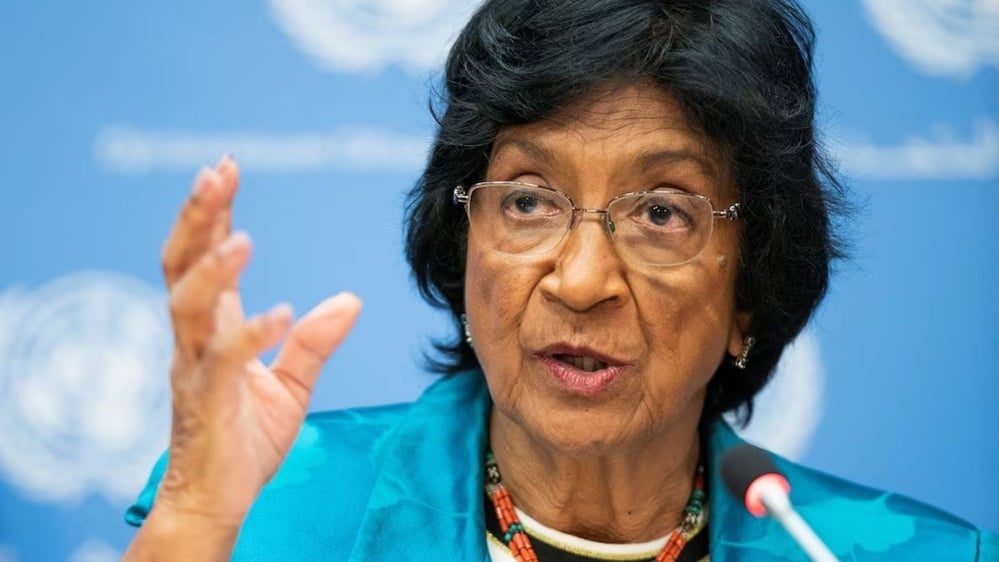
The report's strongest framing feature is a neutral, attribution-heavy presentation that reproduces the Norwegian Nobel Committee's announcement and citation without independent critical context.
Automated analysis; not human reviewed.
Limitations: The article text is a short, likely syndicated news excerpt; surrounding page content includes unrelated headlines, limiting bias assessment to a few paragraphs and quoted Nobel Committee language.
·
6 of 55 available dimensions scored; omitted dimensions are not treated as neutral.
·
Verified supporting quotes for 6 of 6 scored dimensions.
Claim: The article is objective, relying on attributed facts and quotations.
“The 2026 Nobel Peace Prize has been awarded to jurist Navanethem “Navi” Pillay of South Africa “for her efforts to promote peace and international law,” the Norwegian Nobel Committee announced on Friday.” · exact text match
Why: The report attributes its central claims to the Norwegian Nobel Committee and uses direct quotation, leaving little subjective commentary.
Claim: The article is objective and not sensational.
“The 2026 Nobel Peace Prize has been awarded to jurist Navanethem “Navi” Pillay of South Africa “for her efforts to promote peace and international law,” the Norwegian Nobel Committee announced on Friday.” · exact text match
Why: The report presents the award in straightforward news language without sensational emphasis or emotional escalation.
Claim: The article is descriptive, reporting events and biography without prescribing action.
“She studied at Harvard University in the United States, where she gained a doctorate in juridical science in 1988. She was appointed to the High Court of South Africa in 1995.” · exact text match
Why: The article states biographical and institutional facts without advocating for policies or actions.
Claim: The article's subject matter is political/international legal, though not partisan.
“The 2026 Nobel Peace Prize has been awarded to jurist Navanethem “Navi” Pillay of South Africa “for her efforts to promote peace and international law,”” · exact text match
Why: The report concerns a Nobel Peace Prize and international law, making its content political in subject matter.
Claim: The article shows credible sourcing and attribution.
“the Norwegian Nobel Committee announced on Friday” · exact text match
“the citation read” · exact text match
Why: The central claims are attributed to the Norwegian Nobel Committee and supported by direct quotations, indicating visible sourcing.
Claim: The article's framing is rational and free of logical fallacies.
“The 2026 Nobel Peace Prize has been awarded to jurist Navanethem “Navi” Pillay of South Africa “for her efforts to promote peace and international law,” the Norwegian Nobel Committee announced on Friday.” · exact text match
Why: The article presents an official announcement and attributed citation without irrational appeals or fallacious reasoning.
The article text is a short, likely syndicated news excerpt; surrounding page content includes unrelated headlines, limiting bias assessment to a few paragraphs and quoted Nobel Committee language.
October 09, 2026 · 0 shares
The report is a straightforward, attribution-bound news item on the Nobel Committee's decision, with no evident ideological framing beyond quoting the committee's and Israel's characterizations.
Navi Pillay is a South African judge who defended Nelson Mandela and others against apartheid and later served on international courts.
The Nobel Peace Prize was established in Alfred Nobel's 1895 will.
Automated analysis; not human reviewed.
Limitations: The supplied text includes duplicated blocks and navigation-like headlines, so extraction prioritizes the substantive Nobel Peace Prize report.
·
13 of 55 available dimensions scored; omitted dimensions are not treated as neutral.
·
Verified supporting quotes for 13 of 13 scored dimensions.
Claim: The report is primarily factual and attribution-bound, with no authorial opinion beyond attributed statements.
“the Norwegian Nobel Committee said on Friday.” · exact text match
Why: The framing relies on direct attribution and avoids evaluative commentary by the outlet.
Claim: The report avoids sensational or emotive language in presenting the Nobel announcement.
“has won the 2026 Nobel Peace Prize for her efforts to promote peace and international law” · exact text match
Why: The language is measured and descriptive rather than dramatic or emotionally charged.
Claim: The article adopts a mildly positive tone by reporting a peace prize award and the committee's praise.
“demonstrated a strong moral compass throughout her career” · exact text match
Why: The positive framing stems from quoted committee praise, producing a slight optimistic lean.
Claim: The article is nearly entirely factful, with almost no authorial opinion.
“The committee said Ms Pillay had held states and national leaders accountable” · exact text match
Why: Opinion content is confined to attributed quotes rather than the outlet's own voice.
Claim: The article touches on international law, apartheid, and Israel-Gaza, giving it a modest political dimension.
“concluded last year that Israel had committed genocide in Gaza” · exact text match
Why: The subject matter has political relevance, though the report remains neutral.
Claim: The article leans on the Norwegian Nobel Committee and UN as authoritative sources.
“the Norwegian Nobel Committee said” · exact text match
Why: Heavy reliance on institutional voices indicates modest appeal to authority.
Claim: The article expresses the Nobel outcome with appropriate certainty and attributes contested claims.
“the Norwegian Nobel Committee said” · exact text match
Why: Certainty is grounded in the official announcement and attributed reports.
Claim: The article leans slightly pro-establishment by centering the Norwegian Nobel Committee and UN bodies without critical challenge.
“the Norwegian Nobel Committee said on Friday.” · exact text match
Why: It relies on official institutional sources and frames them as authoritative.
Claim: The article has high credibility through attribution, specific figures, and inclusion of a rebuttal.
“Israel dismissed the report as “scandalous”.” · exact text match
Why: Clear sourcing, precise amounts, dates, and an opposing response support trustworthiness.
Claim: The article uses no observable manipulative techniques such as loaded urgency or false dichotomy.
“The award is the fifth Nobel Prize to be announced this week” · exact text match
Why: The structure is informational and avoids deceptive framing.
Claim: The article attributes claims clearly and includes a dissenting response, indicating high integrity.
“Israel dismissed the report as “scandalous”.” · exact text match
Why: Including the opposing reaction and direct attributions shows fair, honest reporting signals.
Claim: The article is clearly written and competently structured, with relevant context.
“The Nobel Peace Prize, worth 12 million Swedish kronor (about $1.2 million)” · exact text match
Why: It provides factual context and explanatory details typical of competent reporting.
The supplied text includes duplicated blocks and navigation-like headlines, so extraction prioritizes the substantive Nobel Peace Prize report.
October 09, 2026 · 0 shares
The report is largely a straight relay of the Norwegian Nobel Committee's praise for Navi Pillay, reproducing promotional quotes without independent sourcing or critical framing.
The Nobel Peace Prize is awarded annually by the Norwegian Nobel Committee under Alfred Nobel's will.
Automated analysis; not human reviewed.
Limitations: The article text appears to be a scraped aggregation that duplicates the same Nobel announcement passages multiple times and includes unrelated headline fragments, so extracted facts rely on the repeated core passage.
·
54 of 55 available dimensions scored; omitted dimensions are not treated as neutral.
·
Verified supporting quotes for 11 of 54 scored dimensions.
Claim: The framing leans mildly liberal through its human-rights and international-law emphasis.
“human rights pioneer Navanethem “Navi” Pillay” · exact text match
Why: Prioritizing a UN human-rights figure and international legal institutions aligns mildly with liberal internationalist framing.
Claim: The framing is institutionally elitist, elevating international courts, the UN, and the Nobel Committee over popular sovereignty.
“International law is no longer just a supplement to peace and security.
It is an absolute necessity.”
· not found in supplied text
Why: The quoted emphasis on international legal mechanisms as a necessity elevates supranational institutions.
Claim: The article leans mildly authoritarian by valorizing international tribunals and legal enforcement over sovereign discretion.
“advancing the use of tribunals to promote peace and justice” · exact text match
Why: Praising tribunal-based enforcement of international law suggests preference for centralized legal authority.
Claim: The report is highly reliant on committee praise and promotional quotes, making it subjectively favorable.
“Navi Pillay’s commitment to justice and human dignity is a source of hope and inspiration to all who seek to bring about a more peaceful world” · exact text match
Why: Uncritical reproduction of laudatory committee language makes the framing subjective.
Claim: The report relies heavily on the Nobel Committee's authority rather than independent evidence.
“the committee said” · exact text match
Why: Repeated appeal to the committee's press release substitutes for independent reporting.
Claim: The article is strongly pro-establishment, centering UN and international legal institutions as authoritative.
“International law is a foundation for a more peaceful world” · exact text match
Why: The framing treats established international legal bodies as foundational and unquestioned.
Claim: The tone is mildly positive, with uplifting human-rights language.
“a source of hope and inspiration” · exact text match
Why: The quoted language is positive and inspirational rather than neutral.
Claim: Credibility is modest because the report relies almost entirely on committee quotes and contains duplicated scrape artifacts.
“In its official announcement on Friday, the committee said” · exact text match
Why: Clear attribution to the committee is present, but there is no independent verification or correction context.
Claim: The piece functions partly as promotional copy for the Nobel Committee's messaging.
“Navi Pillay’s commitment to justice and human dignity is a source of hope and inspiration to all who seek to bring about a more peaceful world” · exact text match
Why: Uncritical reproduction of promotional announcement language resembles advertorial framing.
Claim: There are weak indicators of possible AI or scraped aggregation, including duplicate repeated passages and concatenated unrelated headlines.
“OSLO : Indian-origin South African jurist Navanethem “Navi” Pillay, former United Nations High Commissioner for Human Rights, was awarded the 2026 Nobel Peace Prize on Friday for her efforts to promote peace and international law, the Norwegian Nobel Committee announced.In its official announcement on Friday, the committee said Pillay had demonstrated …” · not found in supplied text
Why: Duplication and aggregation artifacts are consistent with automated scraping, but this is not strong independent AI-authorship evidence.
Claim: The article has moderate integrity with clear attribution to the Nobel Committee, though it adds no independent verification.
“the Norwegian Nobel Committee announced” · exact text match
Why: Explicit attribution exists but is limited to a single source.
Claim: The article includes identity-focused framing around Indian Tamil origin and apartheid discrimination.
“Born into a family of Indian Tamil origin under apartheid in Durban, South Africa” · exact text match
Why: Identity background is mentioned, but there is no prescriptive identity-group power framing.
Claim: The article platforms strong moral praise without critical examination.
“exceptional courage and integrity” · exact text match
Why: Repeated virtue-laden quotes from the announcement function as moral signaling.
The article text appears to be a scraped aggregation that duplicates the same Nobel announcement passages multiple times and includes unrelated headline fragments, so extracted facts rely on the repeated core passage.
October 09, 2026 · 0 shares
The article adopts a uniformly celebratory, hero-worship framing of Navi Pillay's Nobel Peace Prize, relaying the Nobel Committee's praise without any skepticism or independent verification.
Automated analysis; not human reviewed.
·
55 of 55 available dimensions scored; omitted dimensions are not treated as neutral.
·
Verified supporting quotes for 0 of 55 scored dimensions.
October 09, 2026 · 0 shares
The report is largely a straight relay of the Norwegian Nobel Committee's praise for Navi Pillay, reproducing promotional quotes without independent sourcing or critical framing.
The Nobel Peace Prize is awarded annually by the Norwegian Nobel Committee under Alfred Nobel's will.
Automated analysis; not human reviewed.
Limitations: The article text appears to be a scraped aggregation that duplicates the same Nobel announcement passages multiple times and includes unrelated headline fragments, so extracted facts rely on the repeated core passage.
·
54 of 55 available dimensions scored; omitted dimensions are not treated as neutral.
·
Verified supporting quotes for 11 of 54 scored dimensions.
Claim: The framing leans mildly liberal through its human-rights and international-law emphasis.
“human rights pioneer Navanethem “Navi” Pillay” · exact text match
Why: Prioritizing a UN human-rights figure and international legal institutions aligns mildly with liberal internationalist framing.
Claim: The framing is institutionally elitist, elevating international courts, the UN, and the Nobel Committee over popular sovereignty.
“International law is no longer just a supplement to peace and security.
It is an absolute necessity.”
· not found in supplied text
Why: The quoted emphasis on international legal mechanisms as a necessity elevates supranational institutions.
Claim: The article leans mildly authoritarian by valorizing international tribunals and legal enforcement over sovereign discretion.
“advancing the use of tribunals to promote peace and justice” · exact text match
Why: Praising tribunal-based enforcement of international law suggests preference for centralized legal authority.
Claim: The report is highly reliant on committee praise and promotional quotes, making it subjectively favorable.
“Navi Pillay’s commitment to justice and human dignity is a source of hope and inspiration to all who seek to bring about a more peaceful world” · exact text match
Why: Uncritical reproduction of laudatory committee language makes the framing subjective.
Claim: The report relies heavily on the Nobel Committee's authority rather than independent evidence.
“the committee said” · exact text match
Why: Repeated appeal to the committee's press release substitutes for independent reporting.
Claim: The article is strongly pro-establishment, centering UN and international legal institutions as authoritative.
“International law is a foundation for a more peaceful world” · exact text match
Why: The framing treats established international legal bodies as foundational and unquestioned.
Claim: The tone is mildly positive, with uplifting human-rights language.
“a source of hope and inspiration” · exact text match
Why: The quoted language is positive and inspirational rather than neutral.
Claim: Credibility is modest because the report relies almost entirely on committee quotes and contains duplicated scrape artifacts.
“In its official announcement on Friday, the committee said” · exact text match
Why: Clear attribution to the committee is present, but there is no independent verification or correction context.
Claim: The piece functions partly as promotional copy for the Nobel Committee's messaging.
“Navi Pillay’s commitment to justice and human dignity is a source of hope and inspiration to all who seek to bring about a more peaceful world” · exact text match
Why: Uncritical reproduction of promotional announcement language resembles advertorial framing.
Claim: There are weak indicators of possible AI or scraped aggregation, including duplicate repeated passages and concatenated unrelated headlines.
“OSLO : Indian-origin South African jurist Navanethem “Navi” Pillay, former United Nations High Commissioner for Human Rights, was awarded the 2026 Nobel Peace Prize on Friday for her efforts to promote peace and international law, the Norwegian Nobel Committee announced.In its official announcement on Friday, the committee said Pillay had demonstrated …” · not found in supplied text
Why: Duplication and aggregation artifacts are consistent with automated scraping, but this is not strong independent AI-authorship evidence.
Claim: The article has moderate integrity with clear attribution to the Nobel Committee, though it adds no independent verification.
“the Norwegian Nobel Committee announced” · exact text match
Why: Explicit attribution exists but is limited to a single source.
Claim: The article includes identity-focused framing around Indian Tamil origin and apartheid discrimination.
“Born into a family of Indian Tamil origin under apartheid in Durban, South Africa” · exact text match
Why: Identity background is mentioned, but there is no prescriptive identity-group power framing.
Claim: The article platforms strong moral praise without critical examination.
“exceptional courage and integrity” · exact text match
Why: Repeated virtue-laden quotes from the announcement function as moral signaling.
The article text appears to be a scraped aggregation that duplicates the same Nobel announcement passages multiple times and includes unrelated headline fragments, so extracted facts rely on the repeated core passage.
October 09, 2026 · 0 shares
The framing is largely neutral and factual, offering straightforward recognition of Pillay's international justice work with no evident ideological slant.
The Nobel Peace Prize is awarded annually by the Norwegian Nobel Committee; the 2026 award is the 125th in its history since first being awarded in 1901.
Automated analysis; not human reviewed.
Limitations: Snippet only; no full article text, with some fragmented caption and boilerplate content.
·
6 of 55 available dimensions scored; omitted dimensions are not treated as neutral.
·
Verified supporting quotes for 0 of 6 scored dimensions.
Snippet only; no full article text, with some fragmented caption and boilerplate content.
October 09, 2026 · 0 shares
The report is largely neutral wire copy, but states as fact a contested UN inquiry conclusion that Israel committed genocide while giving Israel only a one-word dismissal.
The Nobel Peace Prize is awarded annually by the Norwegian Nobel Committee and presented in Oslo on 10 December, the anniversary of Alfred Nobel's death.
Automated analysis; not human reviewed.
Limitations: The article is a short wire report, limiting decisive evidence for most bias dimensions.
·
53 of 55 available dimensions scored; omitted dimensions are not treated as neutral.
·
Verified supporting quotes for 8 of 53 scored dimensions.
Claim: Neutral wire copy with no explicit ideological framing.
“DM/Reuters” · exact text match
Why: No clear liberal or conservative framing detectable.
Claim: The text mostly reports attributed facts.
“the Norwegian Nobel Committee said” · exact text match
Why: Attribution limits subjectivity.
Claim: The tone is straightforward without sensationalism.
“won the Nobel Peace Prize on Friday, 9 October” · exact text match
Why: Plain factual reporting.
Claim: The report describes the award and does not prescribe policy.
“The Nobel Peace Prize, worth 12 million Swedish crowns” · exact text match
Why: Descriptive news report.
Claim: The article touches on political topics but is not itself political advocacy.
“Israel dismissed the report as “scandalous”.” · exact text match
Why: Reports political reaction without advocating.
Claim: The report is sourced to the Nobel Committee and Reuters.
“the Norwegian Nobel Committee said” · exact text match
Why: Moderate credibility from attribution.
Claim: The text attributes claims to the committee and Reuters.
“the Norwegian Nobel Committee said” · exact text match
Why: Visible sourcing suggests basic fairness.
Claim: The piece is competent but brief wire reporting.
“DM/Reuters” · exact text match
Why: Standard news style.
The article is a short wire report, limiting decisive evidence for most bias dimensions.
Frames the Nobel award to Navi Pillay as a defense of international law under siege while depicting Trump's Nobel ambitions as self-serving and effectively disqualified.
The Nobel Peace Prize is the only Nobel awarded in Oslo, with other disciplines announced in Stockholm; the 2025 prize went to Venezuelan opposition leader Maria Corina Machado.
Automated analysis; not human reviewed.
·
24 of 55 available dimensions scored; omitted dimensions are not treated as neutral.
·
Verified supporting quotes for 13 of 24 scored dimensions.
Claim: The framing foregrounds international legal institutions under attack and a UN genocide finding against Israel as vindication for Pillay.
“The Nobel Peace Prize was awarded on Oct 9 to South Africa’s Navi Pillay, the judge who headed the Rwanda genocide tribunal and who presided over a UN commission in 2025 that accused Israel of genocide in Gaza.” · exact text match
Why: The positive treatment of UN accountability mechanisms and the Gaza genocide accusation aligns more with liberal internationalist framing than conservative skepticism of such institutions.
Claim: The article elevates jurists, UN officials, and the Nobel Committee as authoritative voices while presenting Trump's popular appeal as disqualified.
“Navi Pillay is one of the great defenders of international legal principles in our time.” · exact text match
Why: Credibility is placed with international legal elites and institutions rather than populist or nationalist figures.
Claim: The article moves beyond reporting by asserting the prize is 'sure to anger Trump' and that his conduct 'disqualified him.'
“The prize for Pillay is sure to anger Trump, whose administration has repeatedly attacked international justice institutions.” · exact text match
Why: These are predictive and evaluative characterizations rather than strictly reported facts.
Claim: The article centers on international legal politics, Trump's ambitions, and the geopolitics of the Gaza genocide accusation.
“Since returning to the White House in January 2025, Trump has made no secret of his desire to win the prize” · exact text match
Why: The framing is heavily political throughout.
Claim: The article frames Pillay and international law as under siege from political attacks.
“as global rule of law comes under siege” · exact text match
Why: The under-attack framing gives a mild victimization cast to the institutions and honoree.
Claim: The article states Trump was disqualified based on 'experts in Oslo' without naming them or providing verifiable criteria.
“have, according to experts in Oslo, disqualified him for the prize” · exact text match
Why: This is a confident attribution to unnamed experts that exceeds the supplied support.
Claim: The article adopts a consistent international-law and human-rights framework for interpreting the award.
“Navi Pillay is one of the great defenders of international legal principles in our time.” · exact text match
Why: The organizing lens is a particular internationalist ideology rather than a neutral survey of views.
Claim: The article repeatedly frames international legal institutions as legitimate defenders under attack rather than as contested bodies.
“The system of international law is under tremendous pressure, and its institutions are under attack.” · not found in supplied text
Why: Quoting and amplifying the Nobel Committee's defense of international institutions gives the establishment framing central placement.
Claim: The article cites named officials, specific dates, and attributed claims, though some political assertions rely on unnamed experts.
“Jorgen Watne Frydnes, chair of the Norwegian Nobel Committee in Oslo” · exact text match
Why: Sourcing is visible and specific in many places but weaker in the political disqualification claim.
Claim: The article mostly presents institutionally sourced and biographical material, though it includes some unverified causal claims about why Trump was disqualified.
“according to experts in Oslo, disqualified him for the prize” · exact text match
Why: The sourcing is largely attributed but the disqualification claim rests on unnamed experts.
Claim: The article predicts Trump's reaction and attributes disqualification motives without direct evidence.
“The prize for Pillay is sure to anger Trump” · exact text match
Why: This is a forward-looking prediction about an individual's emotional response.
Claim: The article juxtaposes Pillay's moral credentials with Trump's disqualifying conduct in a way that shapes reader judgment.
“Machado even gave him her Nobel gold medal, judging he deserved it after the capture of President Nicolas Maduro, though she failed to obtain his political backing in exchange.” · exact text match
Why: The contrast structure and the dismissive treatment of Trump's exchange with Machado color the framing.
Claim: The prose is clean and structured but lacks the stylistic markers that would strongly indicate AI authorship.
“The Nobel Committee said it decided to honour Pillay at a time when international law and institutions are under attack.” · exact text match
Why: No strong independent AI indicators are present; the text is consistent with standard news agency writing.
Claim: The article synthesizes biography, institutional context, and political reaction with attributed quotes and specific dates.
“Born into an Indian Tamil family in Durban, South Africa, Pillay, 85, founded her own law firm in 1967 and earned a doctorate from Harvard University in 1988.” · exact text match
Why: The reporting shows contextual depth and structured factual detail.
Frames the Nobel award to Navi Pillay as a defense of international law under siege while depicting Trump's Nobel ambitions as self-serving and effectively disqualified.
The Nobel Peace Prize is the only Nobel awarded in Oslo, with other disciplines announced in Stockholm; the 2025 prize went to Venezuelan opposition leader Maria Corina Machado.
Automated analysis; not human reviewed.
·
24 of 55 available dimensions scored; omitted dimensions are not treated as neutral.
·
Verified supporting quotes for 13 of 24 scored dimensions.
Claim: The framing foregrounds international legal institutions under attack and a UN genocide finding against Israel as vindication for Pillay.
“The Nobel Peace Prize was awarded on Oct 9 to South Africa’s Navi Pillay, the judge who headed the Rwanda genocide tribunal and who presided over a UN commission in 2025 that accused Israel of genocide in Gaza.” · exact text match
Why: The positive treatment of UN accountability mechanisms and the Gaza genocide accusation aligns more with liberal internationalist framing than conservative skepticism of such institutions.
Claim: The article elevates jurists, UN officials, and the Nobel Committee as authoritative voices while presenting Trump's popular appeal as disqualified.
“Navi Pillay is one of the great defenders of international legal principles in our time.” · exact text match
Why: Credibility is placed with international legal elites and institutions rather than populist or nationalist figures.
Claim: The article moves beyond reporting by asserting the prize is 'sure to anger Trump' and that his conduct 'disqualified him.'
“The prize for Pillay is sure to anger Trump, whose administration has repeatedly attacked international justice institutions.” · exact text match
Why: These are predictive and evaluative characterizations rather than strictly reported facts.
Claim: The article centers on international legal politics, Trump's ambitions, and the geopolitics of the Gaza genocide accusation.
“Since returning to the White House in January 2025, Trump has made no secret of his desire to win the prize” · exact text match
Why: The framing is heavily political throughout.
Claim: The article frames Pillay and international law as under siege from political attacks.
“as global rule of law comes under siege” · exact text match
Why: The under-attack framing gives a mild victimization cast to the institutions and honoree.
Claim: The article states Trump was disqualified based on 'experts in Oslo' without naming them or providing verifiable criteria.
“have, according to experts in Oslo, disqualified him for the prize” · exact text match
Why: This is a confident attribution to unnamed experts that exceeds the supplied support.
Claim: The article adopts a consistent international-law and human-rights framework for interpreting the award.
“Navi Pillay is one of the great defenders of international legal principles in our time.” · exact text match
Why: The organizing lens is a particular internationalist ideology rather than a neutral survey of views.
Claim: The article repeatedly frames international legal institutions as legitimate defenders under attack rather than as contested bodies.
“The system of international law is under tremendous pressure, and its institutions are under attack.” · not found in supplied text
Why: Quoting and amplifying the Nobel Committee's defense of international institutions gives the establishment framing central placement.
Claim: The article cites named officials, specific dates, and attributed claims, though some political assertions rely on unnamed experts.
“Jorgen Watne Frydnes, chair of the Norwegian Nobel Committee in Oslo” · exact text match
Why: Sourcing is visible and specific in many places but weaker in the political disqualification claim.
Claim: The article mostly presents institutionally sourced and biographical material, though it includes some unverified causal claims about why Trump was disqualified.
“according to experts in Oslo, disqualified him for the prize” · exact text match
Why: The sourcing is largely attributed but the disqualification claim rests on unnamed experts.
Claim: The article predicts Trump's reaction and attributes disqualification motives without direct evidence.
“The prize for Pillay is sure to anger Trump” · exact text match
Why: This is a forward-looking prediction about an individual's emotional response.
Claim: The article juxtaposes Pillay's moral credentials with Trump's disqualifying conduct in a way that shapes reader judgment.
“Machado even gave him her Nobel gold medal, judging he deserved it after the capture of President Nicolas Maduro, though she failed to obtain his political backing in exchange.” · exact text match
Why: The contrast structure and the dismissive treatment of Trump's exchange with Machado color the framing.
Claim: The prose is clean and structured but lacks the stylistic markers that would strongly indicate AI authorship.
“The Nobel Committee said it decided to honour Pillay at a time when international law and institutions are under attack.” · exact text match
Why: No strong independent AI indicators are present; the text is consistent with standard news agency writing.
Claim: The article synthesizes biography, institutional context, and political reaction with attributed quotes and specific dates.
“Born into an Indian Tamil family in Durban, South Africa, Pillay, 85, founded her own law firm in 1967 and earned a doctorate from Harvard University in 1988.” · exact text match
Why: The reporting shows contextual depth and structured factual detail.
The reporting adopts a broadly favorable, institution-affirming tone toward the Nobel committee's choice and international legal bodies, treating the genocide conclusion as a reported finding while noting Israel's dismissal.
Automated analysis; not human reviewed.
·
48 of 55 available dimensions scored; omitted dimensions are not treated as neutral.
·
Verified supporting quotes for 4 of 48 scored dimensions.
Claim: The framing centers elite international institutions and legal order as the standard for peace.
“This year’s Nobel Peace Prize underlined the importance of maintaining an organised international order, the committee said in its citation.” · exact text match
Why: Emphasis on organized international order and institutions over popular sovereignty reflects an elitist/institutional orientation.
Claim: The report remains factual and avoids sensational language, detailing prize facts and citation quotes.
“The Nobel Peace Prize, worth 12 million Swedish crowns, or just under R20 million, is due to be presented in Oslo on 10 December, the anniversary of the death of Swedish industrialist Alfred Nobel, who founded the awards in his 1895 will.” · exact text match
Why: Straightforward factual detail without emotive amplification supports an objective rather than sensational classification.
Claim: The report is substantively political, covering international law, the ICC, Trump sanctions, and the Israel genocide inquiry.
“Navi Pillay, a former International Criminal Court (ICC) judge who oversaw a United Nations (UN) report that concluded that Israel committed genocide in Gaza, won the Nobel Peace Prize on Friday, 9 October 2026” · not found in supplied text
Why: The core subject matter is directly political and institutional conflict.
Claim: The report relies heavily on the Nobel committee's citation and expert commentary as validating authority.
“Pillay held states and national leaders accountable and brought hope to victims of violence and conflict, and demonstrated a firm moral compass in her long career, said the committee.” · not found in supplied text
Why: Claims of moral standing are presented through institutional citation rather than independent evidence.
Claim: The report amplifies the Nobel committee's defense of international legal institutions against criticism.
““The system of international law is under tremendous pressure, and its institutions are under attack,” it said.” · exact text match
Why: Uncritically foregrounding the committee's pro-institution framing without counterbalancing institutional critiques indicates pro-establishment posture.
Claim: The report attributes key claims to named institutions and experts and notes Israel's dismissal of the genocide report.
“Israel dismissed the report as “scandalous”.” · exact text match
Why: Inclusion of the opposing reaction and clear attribution to the Nobel committee and PRIO expert supports a credible sourcing assessment.
Claim: The report frames Pillay and the prize in strong moral terms.
“Pillay held states and national leaders accountable and brought hope to victims of violence and conflict, and demonstrated a firm moral compass in her long career, said the committee.” · not found in supplied text
Why: While the moral framing is quoted from the committee, it is prominently foregrounded rather than critically examined.
October 09, 2026 · 0 shares
The report is a straightforward, attribution-bound news item on the Nobel Committee's decision, with no evident ideological framing beyond quoting the committee's and Israel's characterizations.
Navi Pillay is a South African judge who defended Nelson Mandela and others against apartheid and later served on international courts.
The Nobel Peace Prize was established in Alfred Nobel's 1895 will.
Automated analysis; not human reviewed.
Limitations: The supplied text includes duplicated blocks and navigation-like headlines, so extraction prioritizes the substantive Nobel Peace Prize report.
·
13 of 55 available dimensions scored; omitted dimensions are not treated as neutral.
·
Verified supporting quotes for 13 of 13 scored dimensions.
Claim: The report is primarily factual and attribution-bound, with no authorial opinion beyond attributed statements.
“the Norwegian Nobel Committee said on Friday.” · exact text match
Why: The framing relies on direct attribution and avoids evaluative commentary by the outlet.
Claim: The report avoids sensational or emotive language in presenting the Nobel announcement.
“has won the 2026 Nobel Peace Prize for her efforts to promote peace and international law” · exact text match
Why: The language is measured and descriptive rather than dramatic or emotionally charged.
Claim: The article adopts a mildly positive tone by reporting a peace prize award and the committee's praise.
“demonstrated a strong moral compass throughout her career” · exact text match
Why: The positive framing stems from quoted committee praise, producing a slight optimistic lean.
Claim: The article is nearly entirely factful, with almost no authorial opinion.
“The committee said Ms Pillay had held states and national leaders accountable” · exact text match
Why: Opinion content is confined to attributed quotes rather than the outlet's own voice.
Claim: The article touches on international law, apartheid, and Israel-Gaza, giving it a modest political dimension.
“concluded last year that Israel had committed genocide in Gaza” · exact text match
Why: The subject matter has political relevance, though the report remains neutral.
Claim: The article leans on the Norwegian Nobel Committee and UN as authoritative sources.
“the Norwegian Nobel Committee said” · exact text match
Why: Heavy reliance on institutional voices indicates modest appeal to authority.
Claim: The article expresses the Nobel outcome with appropriate certainty and attributes contested claims.
“the Norwegian Nobel Committee said” · exact text match
Why: Certainty is grounded in the official announcement and attributed reports.
Claim: The article leans slightly pro-establishment by centering the Norwegian Nobel Committee and UN bodies without critical challenge.
“the Norwegian Nobel Committee said on Friday.” · exact text match
Why: It relies on official institutional sources and frames them as authoritative.
Claim: The article has high credibility through attribution, specific figures, and inclusion of a rebuttal.
“Israel dismissed the report as “scandalous”.” · exact text match
Why: Clear sourcing, precise amounts, dates, and an opposing response support trustworthiness.
Claim: The article uses no observable manipulative techniques such as loaded urgency or false dichotomy.
“The award is the fifth Nobel Prize to be announced this week” · exact text match
Why: The structure is informational and avoids deceptive framing.
Claim: The article attributes claims clearly and includes a dissenting response, indicating high integrity.
“Israel dismissed the report as “scandalous”.” · exact text match
Why: Including the opposing reaction and direct attributions shows fair, honest reporting signals.
Claim: The article is clearly written and competently structured, with relevant context.
“The Nobel Peace Prize, worth 12 million Swedish kronor (about $1.2 million)” · exact text match
Why: It provides factual context and explanatory details typical of competent reporting.
The supplied text includes duplicated blocks and navigation-like headlines, so extraction prioritizes the substantive Nobel Peace Prize report.
October 09, 2026 · 0 shares
The framing is a brief, positive, institution-affirming announcement that treats the Nobel Peace Prize as the planet's most prestigious honor without noting any controversy or criticism.
The Nobel Peace Prize is an annual international award announced in Oslo, Norway.
Automated analysis; not human reviewed.
Limitations: The supplied article text is extremely short and fragmentary, with repeated sentences and no substantive body content, so most bias classifications rest on very limited evidence.
·
50 of 55 available dimensions scored; omitted dimensions are not treated as neutral.
·
Verified supporting quotes for 46 of 50 scored dimensions.
Claim: The article highlights a UN human rights official's Nobel Peace Prize win positively, aligning mildly with internationalist/liberal institutional framing.
“Former UN human rights chief Navanethem “Navi” Pillay, a judge on the International Court of Justice, won the Nobel Peace Prize on Friday in Oslo, Norway.” · exact text match
Why: Positive treatment of a UN human rights figure and the Nobel institution mildly indicates a liberal/internationalist framing, though the text is too sparse to be strongly directional.
Claim: The article mixes basic factual reporting with a subjective superlative about the award's prestige.
“The award is often considered the most prestigious honour on the planet.” · exact text match
Why: Unattributed superlative language is subjective, though the core report is factual.
Claim: The article is essentially a plain announcement without sensationalism.
“Navanethem 'Navi' Pillay wins the Nobel Peace Prize.” · exact text match
Why: The headline and lede report the award directly without dramatic or inflammatory language.
Claim: The article's positive framing of the award produces a mildly optimistic tone.
“The award is often considered the most prestigious honour on the planet.” · exact text match
Why: Calling the prize the most prestigious honour on the planet is a positive/celebratory framing, though brief.
Claim: The article is a brief factual announcement with little narrative or analytical interest.
“This year marks the 125th anniversary of the peace prize.” · exact text match
Why: The sparse news item provides basic facts, offering moderate but limited interest.
Claim: The article is descriptive of the award event and does not prescribe action.
“Navanethem 'Navi' Pillay wins the Nobel Peace Prize.” · exact text match
Why: No prescriptive language appears; the text merely reports the award.
Claim: The article includes an unattributed opinion about the award's prestige.
“The award is often considered the most prestigious honour on the planet.” · exact text match
Why: The superlative claim is an evaluative statement, not a neutral fact.
Claim: The article concerns international institutions and award politics but does not argue a partisan position.
“Former UN human rights chief Navanethem “Navi” Pillay, a judge on the International Court of Justice, won the Nobel Peace Prize on Friday in Oslo, Norway.” · exact text match
Why: The subject is political/institutional, but the framing is not overtly partisan.
Claim: The article presents the award in simple, uncomplicated terms, omitting context and controversy.
“Navanethem 'Navi' Pillay wins the Nobel Peace Prize.” · exact text match
Why: The very short announcement omits nuance and context, though the central fact is simple.
Claim: The article relies on the prestige of the Nobel Prize and the laureate's institutional roles to convey significance.
“Former UN human rights chief Navanethem “Navi” Pillay, a judge on the International Court of Justice, won the Nobel Peace Prize” · exact text match
Why: Highlighting the laureate's elite roles and the award's prestige leans on authority.
Claim: The article is a straightforward announcement without immature or rage-baiting language.
“Navanethem 'Navi' Pillay wins the Nobel Peace Prize.” · exact text match
Why: The tone is neutral and factual, not immature or inflammatory.
Claim: The article does not present an argument requiring reasoning.
“Navanethem 'Navi' Pillay wins the Nobel Peace Prize.” · exact text match
Why: There is no reasoning structure, so circularity is absent.
Claim: The article does not frame the laureate as a victim.
“Navanethem 'Navi' Pillay wins the Nobel Peace Prize.” · exact text match
Why: No victimization narrative appears in this brief announcement.
Claim: The article states the prize's prestige with certainty beyond what brief reporting supports.
“The award is often considered the most prestigious honour on the planet.” · exact text match
Why: The unattributed superlative is asserted confidently without qualification.
Claim: The article is not spam or promotional fluff.
“Navanethem 'Navi' Pillay wins the Nobel Peace Prize.” · exact text match
Why: It is a straightforward news announcement, not spam.
Claim: The article is mostly a factual announcement with minimal ideological content.
“Navanethem 'Navi' Pillay wins the Nobel Peace Prize.” · exact text match
Why: No strong ideological framework is present.
Claim: The article enthusiastically presents a prestigious international institution's award to an establishment legal figure.
“The award is often considered the most prestigious honour on the planet.” · exact text match
Why: Elevating the Nobel Prize as the planet's most prestigious honour and centering an elite international official signals pro-establishment framing.
Claim: The article's tone is mildly positive through its celebratory description of the award.
“The award is often considered the most prestigious honour on the planet.” · exact text match
Why: The superlative praise gives a slightly positive emotional tone.
Claim: The article applies no differential standards to comparable cases.
“Navanethem 'Navi' Pillay wins the Nobel Peace Prize.” · exact text match
Why: No comparative or double-standard framing appears.
Claim: The article provides a dateline, attribution, and basic facts, though with little sourcing or context.
“Oslo, Oct 09: Former UN human rights chief Navanethem “Navi” Pillay, a judge on the International Court of Justice, won the Nobel Peace Prize on Friday in Oslo, Norway.” · exact text match
Why: The report includes standard dateline and factual attribution, supporting moderate credibility.
Claim: The article is not advertorial or promotional.
“Navanethem 'Navi' Pillay wins the Nobel Peace Prize.” · exact text match
Why: No commercial or promotional intent is evident.
Claim: The article honors an individual laureate while noting her international institutional roles, giving a slight collectivist/institutional tilt.
“Former UN human rights chief Navanethem “Navi” Pillay, a judge on the International Court of Justice, won the Nobel Peace Prize” · exact text match
Why: The emphasis on a UN and ICJ official mildly suggests institutional-collectivist framing, though evidence is thin.
Claim: The article text contains repeated fragments and formatting artifacts consistent with AI or automated content generation.
“['', "", 'This year marks the 125th anniversary of the peace prize', 'Oslo, Oct 09: Former UN human rights chief Navanethem “Navi” Pillay, a judge on the International Court of Justice, won the Nobel Peace Prize on Friday in Oslo, Norway.', 'The award is often considered the most prestigious honour on the planet.', 'This year marks the 125th anniversary of the peace prize.', '']” · exact text match
Why: The unusual bracketed list of repeated and empty strings suggests low-quality automated aggregation, though AI authorship is not certain.
Claim: The article provides straightforward attribution and avoids deceptive framing.
“Oslo, Oct 09: Former UN human rights chief Navanethem “Navi” Pillay, a judge on the International Court of Justice, won the Nobel Peace Prize on Friday in Oslo, Norway.” · exact text match
Why: Simple factual announcement with dateline and clear attribution supports moderate integrity, though limited by meager text.
Claim: The article is a short, simple news announcement requiring basic comprehension.
“This year marks the 125th anniversary of the peace prize.” · exact text match
Why: The content is simple and brief, indicating moderate intelligence at best.
Claim: The article does not discuss or endorse terrorism.
“Navanethem 'Navi' Pillay wins the Nobel Peace Prize.” · exact text match
Why: Terrorism is simply not mentioned.
Claim: The article does not discuss or normalize fraud.
“Navanethem 'Navi' Pillay wins the Nobel Peace Prize.” · exact text match
Why: No fraud-related content is present.
Claim: The article does not advance Marxist class analysis or ideology.
“Navanethem 'Navi' Pillay wins the Nobel Peace Prize.” · exact text match
Why: No Marxist framing or class-conflict analysis appears.
Claim: The article does not advocate Islamist governance or goals.
“Navanethem 'Navi' Pillay wins the Nobel Peace Prize.” · exact text match
Why: Islamist ideology is not discussed.
Claim: The article contains no anti-Jewish content.
“Navanethem 'Navi' Pillay wins the Nobel Peace Prize.” · exact text match
Why: No anti-Semitic generalizations or conspiracies appear.
Claim: The article contains no anti-LGBT content.
“Navanethem 'Navi' Pillay wins the Nobel Peace Prize.” · exact text match
Why: LGBT issues are not mentioned.
Claim: The article contains no racist content.
“Navanethem 'Navi' Pillay wins the Nobel Peace Prize.” · exact text match
Why: No racial generalizations or slurs appear.
Claim: The article contains no identity-politics or woke framing.
“Navanethem 'Navi' Pillay wins the Nobel Peace Prize.” · exact text match
Why: No identity-group power framing or differential moral standards appear.
Claim: The article contains no cruel or immoral framing.
“Navanethem 'Navi' Pillay wins the Nobel Peace Prize.” · exact text match
Why: The report is neutral and non-cruel.
Claim: The article mildly signals virtue by celebrating a human rights figure and the Nobel Prize's prestige.
“The award is often considered the most prestigious honour on the planet.” · exact text match
Why: The celebratory framing could be seen as virtue signaling, but the evidence is weak.
Claim: The article contains no conspiratorial framing.
“Navanethem 'Navi' Pillay wins the Nobel Peace Prize.” · exact text match
Why: No conspiracy theories are advanced.
Claim: The article does not discuss self-harm tradeoffs or compassion-based policy.
“Navanethem 'Navi' Pillay wins the Nobel Peace Prize.” · exact text match
Why: No suicidal empathy framing is evident.
Claim: The article blames no individual or group.
“Navanethem 'Navi' Pillay wins the Nobel Peace Prize.” · exact text match
Why: No scapegoating language is present.
Claim: The article shows no inconsistent standards.
“Navanethem 'Navi' Pillay wins the Nobel Peace Prize.” · exact text match
Why: No comparable cases or double standards appear.
Claim: The article does not reject reason, evidence, or universal rights.
“Navanethem 'Navi' Pillay wins the Nobel Peace Prize.” · exact text match
Why: The brief factual announcement shows no anti-enlightenment stance.
The supplied article text is extremely short and fragmentary, with repeated sentences and no substantive body content, so most bias classifications rest on very limited evidence.
October 09, 2026 · 0 shares
The report's strongest framing feature is a neutral, attribution-heavy presentation that reproduces the Norwegian Nobel Committee's announcement and citation without independent critical context.
Automated analysis; not human reviewed. Limitations: The article text is a short, likely syndicated news excerpt; surrounding page content includes unrelated headlines, limiting bias assessment to a few paragraphs and quoted Nobel Committee language. · 6 of 55 available dimensions scored; omitted dimensions are not treated as neutral. · Verified supporting quotes for 6 of 6 scored dimensions.
Claim: The article is objective, relying on attributed facts and quotations.
“The 2026 Nobel Peace Prize has been awarded to jurist Navanethem “Navi” Pillay of South Africa “for her efforts to promote peace and international law,” the Norwegian Nobel Committee announced on Friday.” · exact text match
Why: The report attributes its central claims to the Norwegian Nobel Committee and uses direct quotation, leaving little subjective commentary.
Claim: The article is objective and not sensational.
“The 2026 Nobel Peace Prize has been awarded to jurist Navanethem “Navi” Pillay of South Africa “for her efforts to promote peace and international law,” the Norwegian Nobel Committee announced on Friday.” · exact text match
Why: The report presents the award in straightforward news language without sensational emphasis or emotional escalation.
Claim: The article is descriptive, reporting events and biography without prescribing action.
“She studied at Harvard University in the United States, where she gained a doctorate in juridical science in 1988. She was appointed to the High Court of South Africa in 1995.” · exact text match
Why: The article states biographical and institutional facts without advocating for policies or actions.
Claim: The article's subject matter is political/international legal, though not partisan.
“The 2026 Nobel Peace Prize has been awarded to jurist Navanethem “Navi” Pillay of South Africa “for her efforts to promote peace and international law,”” · exact text match
Why: The report concerns a Nobel Peace Prize and international law, making its content political in subject matter.
Claim: The article shows credible sourcing and attribution.
“the Norwegian Nobel Committee announced on Friday” · exact text match
“the citation read” · exact text match
Why: The central claims are attributed to the Norwegian Nobel Committee and supported by direct quotations, indicating visible sourcing.
Claim: The article's framing is rational and free of logical fallacies.
“The 2026 Nobel Peace Prize has been awarded to jurist Navanethem “Navi” Pillay of South Africa “for her efforts to promote peace and international law,” the Norwegian Nobel Committee announced on Friday.” · exact text match
Why: The article presents an official announcement and attributed citation without irrational appeals or fallacious reasoning.
The article text is a short, likely syndicated news excerpt; surrounding page content includes unrelated headlines, limiting bias assessment to a few paragraphs and quoted Nobel Committee language.
October 09, 2026 · 0 shares
The report is largely a straight relay of the Norwegian Nobel Committee's praise for Navi Pillay, reproducing promotional quotes without independent sourcing or critical framing.
The Nobel Peace Prize is awarded annually by the Norwegian Nobel Committee under Alfred Nobel's will.
Automated analysis; not human reviewed. Limitations: The article text appears to be a scraped aggregation that duplicates the same Nobel announcement passages multiple times and includes unrelated headline fragments, so extracted facts rely on the repeated core passage. · 54 of 55 available dimensions scored; omitted dimensions are not treated as neutral. · Verified supporting quotes for 11 of 54 scored dimensions.
Claim: The framing leans mildly liberal through its human-rights and international-law emphasis.
“human rights pioneer Navanethem “Navi” Pillay” · exact text match
Why: Prioritizing a UN human-rights figure and international legal institutions aligns mildly with liberal internationalist framing.
Claim: The framing is institutionally elitist, elevating international courts, the UN, and the Nobel Committee over popular sovereignty.
“International law is no longer just a supplement to peace and security. It is an absolute necessity.” · not found in supplied text
Why: The quoted emphasis on international legal mechanisms as a necessity elevates supranational institutions.
Claim: The article leans mildly authoritarian by valorizing international tribunals and legal enforcement over sovereign discretion.
“advancing the use of tribunals to promote peace and justice” · exact text match
Why: Praising tribunal-based enforcement of international law suggests preference for centralized legal authority.
Claim: The report is highly reliant on committee praise and promotional quotes, making it subjectively favorable.
“Navi Pillay’s commitment to justice and human dignity is a source of hope and inspiration to all who seek to bring about a more peaceful world” · exact text match
Why: Uncritical reproduction of laudatory committee language makes the framing subjective.
Claim: The report relies heavily on the Nobel Committee's authority rather than independent evidence.
“the committee said” · exact text match
Why: Repeated appeal to the committee's press release substitutes for independent reporting.
Claim: The article is strongly pro-establishment, centering UN and international legal institutions as authoritative.
“International law is a foundation for a more peaceful world” · exact text match
Why: The framing treats established international legal bodies as foundational and unquestioned.
Claim: The tone is mildly positive, with uplifting human-rights language.
“a source of hope and inspiration” · exact text match
Why: The quoted language is positive and inspirational rather than neutral.
Claim: Credibility is modest because the report relies almost entirely on committee quotes and contains duplicated scrape artifacts.
“In its official announcement on Friday, the committee said” · exact text match
Why: Clear attribution to the committee is present, but there is no independent verification or correction context.
Claim: The piece functions partly as promotional copy for the Nobel Committee's messaging.
“Navi Pillay’s commitment to justice and human dignity is a source of hope and inspiration to all who seek to bring about a more peaceful world” · exact text match
Why: Uncritical reproduction of promotional announcement language resembles advertorial framing.
Claim: There are weak indicators of possible AI or scraped aggregation, including duplicate repeated passages and concatenated unrelated headlines.
“OSLO : Indian-origin South African jurist Navanethem “Navi” Pillay, former United Nations High Commissioner for Human Rights, was awarded the 2026 Nobel Peace Prize on Friday for her efforts to promote peace and international law, the Norwegian Nobel Committee announced.In its official announcement on Friday, the committee said Pillay had demonstrated …” · not found in supplied text
Why: Duplication and aggregation artifacts are consistent with automated scraping, but this is not strong independent AI-authorship evidence.
Claim: The article has moderate integrity with clear attribution to the Nobel Committee, though it adds no independent verification.
“the Norwegian Nobel Committee announced” · exact text match
Why: Explicit attribution exists but is limited to a single source.
Claim: The article includes identity-focused framing around Indian Tamil origin and apartheid discrimination.
“Born into a family of Indian Tamil origin under apartheid in Durban, South Africa” · exact text match
Why: Identity background is mentioned, but there is no prescriptive identity-group power framing.
Claim: The article platforms strong moral praise without critical examination.
“exceptional courage and integrity” · exact text match
Why: Repeated virtue-laden quotes from the announcement function as moral signaling.
The article text appears to be a scraped aggregation that duplicates the same Nobel announcement passages multiple times and includes unrelated headline fragments, so extracted facts rely on the repeated core passage.
October 09, 2026 · 0 shares
The item is a bare factual announcement with attribution to the Nobel jury and no evident framing beyond the award itself.
Navi Pillay is a South African jurist who served as UN High Commissioner for Human Rights and as a judge on the International Court of Justice.
Automated analysis; not human reviewed. Limitations: Very short article with no sourcing beyond the Nobel jury announcement and no elaboration on the award rationale. · 7 of 55 available dimensions scored; omitted dimensions are not treated as neutral. · Verified supporting quotes for 0 of 7 scored dimensions.
Very short article with no sourcing beyond the Nobel jury announcement and no elaboration on the award rationale.
Frames the Nobel award to Navi Pillay as a defense of international law under siege while depicting Trump's Nobel ambitions as self-serving and effectively disqualified.
The Nobel Peace Prize is the only Nobel awarded in Oslo, with other disciplines announced in Stockholm; the 2025 prize went to Venezuelan opposition leader Maria Corina Machado.
Automated analysis; not human reviewed. · 24 of 55 available dimensions scored; omitted dimensions are not treated as neutral. · Verified supporting quotes for 13 of 24 scored dimensions.
Claim: The framing foregrounds international legal institutions under attack and a UN genocide finding against Israel as vindication for Pillay.
“The Nobel Peace Prize was awarded on Oct 9 to South Africa’s Navi Pillay, the judge who headed the Rwanda genocide tribunal and who presided over a UN commission in 2025 that accused Israel of genocide in Gaza.” · exact text match
Why: The positive treatment of UN accountability mechanisms and the Gaza genocide accusation aligns more with liberal internationalist framing than conservative skepticism of such institutions.
Claim: The article elevates jurists, UN officials, and the Nobel Committee as authoritative voices while presenting Trump's popular appeal as disqualified.
“Navi Pillay is one of the great defenders of international legal principles in our time.” · exact text match
Why: Credibility is placed with international legal elites and institutions rather than populist or nationalist figures.
Claim: The article moves beyond reporting by asserting the prize is 'sure to anger Trump' and that his conduct 'disqualified him.'
“The prize for Pillay is sure to anger Trump, whose administration has repeatedly attacked international justice institutions.” · exact text match
Why: These are predictive and evaluative characterizations rather than strictly reported facts.
Claim: The article centers on international legal politics, Trump's ambitions, and the geopolitics of the Gaza genocide accusation.
“Since returning to the White House in January 2025, Trump has made no secret of his desire to win the prize” · exact text match
Why: The framing is heavily political throughout.
Claim: The article frames Pillay and international law as under siege from political attacks.
“as global rule of law comes under siege” · exact text match
Why: The under-attack framing gives a mild victimization cast to the institutions and honoree.
Claim: The article states Trump was disqualified based on 'experts in Oslo' without naming them or providing verifiable criteria.
“have, according to experts in Oslo, disqualified him for the prize” · exact text match
Why: This is a confident attribution to unnamed experts that exceeds the supplied support.
Claim: The article adopts a consistent international-law and human-rights framework for interpreting the award.
“Navi Pillay is one of the great defenders of international legal principles in our time.” · exact text match
Why: The organizing lens is a particular internationalist ideology rather than a neutral survey of views.
Claim: The article repeatedly frames international legal institutions as legitimate defenders under attack rather than as contested bodies.
“The system of international law is under tremendous pressure, and its institutions are under attack.” · not found in supplied text
Why: Quoting and amplifying the Nobel Committee's defense of international institutions gives the establishment framing central placement.
Claim: The article cites named officials, specific dates, and attributed claims, though some political assertions rely on unnamed experts.
“Jorgen Watne Frydnes, chair of the Norwegian Nobel Committee in Oslo” · exact text match
Why: Sourcing is visible and specific in many places but weaker in the political disqualification claim.
Claim: The article mostly presents institutionally sourced and biographical material, though it includes some unverified causal claims about why Trump was disqualified.
“according to experts in Oslo, disqualified him for the prize” · exact text match
Why: The sourcing is largely attributed but the disqualification claim rests on unnamed experts.
Claim: The article predicts Trump's reaction and attributes disqualification motives without direct evidence.
“The prize for Pillay is sure to anger Trump” · exact text match
Why: This is a forward-looking prediction about an individual's emotional response.
Claim: The article juxtaposes Pillay's moral credentials with Trump's disqualifying conduct in a way that shapes reader judgment.
“Machado even gave him her Nobel gold medal, judging he deserved it after the capture of President Nicolas Maduro, though she failed to obtain his political backing in exchange.” · exact text match
Why: The contrast structure and the dismissive treatment of Trump's exchange with Machado color the framing.
Claim: The prose is clean and structured but lacks the stylistic markers that would strongly indicate AI authorship.
“The Nobel Committee said it decided to honour Pillay at a time when international law and institutions are under attack.” · exact text match
Why: No strong independent AI indicators are present; the text is consistent with standard news agency writing.
Claim: The article synthesizes biography, institutional context, and political reaction with attributed quotes and specific dates.
“Born into an Indian Tamil family in Durban, South Africa, Pillay, 85, founded her own law firm in 1967 and earned a doctorate from Harvard University in 1988.” · exact text match
Why: The reporting shows contextual depth and structured factual detail.
October 09, 2026 · 0 shares
The report is largely neutral wire copy, but states as fact a contested UN inquiry conclusion that Israel committed genocide while giving Israel only a one-word dismissal.
The Nobel Peace Prize is awarded annually by the Norwegian Nobel Committee and presented in Oslo on 10 December, the anniversary of Alfred Nobel's death.
Automated analysis; not human reviewed. Limitations: The article is a short wire report, limiting decisive evidence for most bias dimensions. · 53 of 55 available dimensions scored; omitted dimensions are not treated as neutral. · Verified supporting quotes for 8 of 53 scored dimensions.
Claim: Neutral wire copy with no explicit ideological framing.
“DM/Reuters” · exact text match
Why: No clear liberal or conservative framing detectable.
Claim: The text mostly reports attributed facts.
“the Norwegian Nobel Committee said” · exact text match
Why: Attribution limits subjectivity.
Claim: The tone is straightforward without sensationalism.
“won the Nobel Peace Prize on Friday, 9 October” · exact text match
Why: Plain factual reporting.
Claim: The report describes the award and does not prescribe policy.
“The Nobel Peace Prize, worth 12 million Swedish crowns” · exact text match
Why: Descriptive news report.
Claim: The article touches on political topics but is not itself political advocacy.
“Israel dismissed the report as “scandalous”.” · exact text match
Why: Reports political reaction without advocating.
Claim: The report is sourced to the Nobel Committee and Reuters.
“the Norwegian Nobel Committee said” · exact text match
Why: Moderate credibility from attribution.
Claim: The text attributes claims to the committee and Reuters.
“the Norwegian Nobel Committee said” · exact text match
Why: Visible sourcing suggests basic fairness.
Claim: The piece is competent but brief wire reporting.
“DM/Reuters” · exact text match
Why: Standard news style.
The article is a short wire report, limiting decisive evidence for most bias dimensions.
October 09, 2026 · 0 shares
The report is a straightforward, attribution-bound news item on the Nobel Committee's decision, with no evident ideological framing beyond quoting the committee's and Israel's characterizations.
Navi Pillay is a South African judge who defended Nelson Mandela and others against apartheid and later served on international courts. The Nobel Peace Prize was established in Alfred Nobel's 1895 will.
Automated analysis; not human reviewed. Limitations: The supplied text includes duplicated blocks and navigation-like headlines, so extraction prioritizes the substantive Nobel Peace Prize report. · 13 of 55 available dimensions scored; omitted dimensions are not treated as neutral. · Verified supporting quotes for 13 of 13 scored dimensions.
Claim: The report is primarily factual and attribution-bound, with no authorial opinion beyond attributed statements.
“the Norwegian Nobel Committee said on Friday.” · exact text match
Why: The framing relies on direct attribution and avoids evaluative commentary by the outlet.
Claim: The report avoids sensational or emotive language in presenting the Nobel announcement.
“has won the 2026 Nobel Peace Prize for her efforts to promote peace and international law” · exact text match
Why: The language is measured and descriptive rather than dramatic or emotionally charged.
Claim: The article adopts a mildly positive tone by reporting a peace prize award and the committee's praise.
“demonstrated a strong moral compass throughout her career” · exact text match
Why: The positive framing stems from quoted committee praise, producing a slight optimistic lean.
Claim: The article is nearly entirely factful, with almost no authorial opinion.
“The committee said Ms Pillay had held states and national leaders accountable” · exact text match
Why: Opinion content is confined to attributed quotes rather than the outlet's own voice.
Claim: The article touches on international law, apartheid, and Israel-Gaza, giving it a modest political dimension.
“concluded last year that Israel had committed genocide in Gaza” · exact text match
Why: The subject matter has political relevance, though the report remains neutral.
Claim: The article leans on the Norwegian Nobel Committee and UN as authoritative sources.
“the Norwegian Nobel Committee said” · exact text match
Why: Heavy reliance on institutional voices indicates modest appeal to authority.
Claim: The article expresses the Nobel outcome with appropriate certainty and attributes contested claims.
“the Norwegian Nobel Committee said” · exact text match
Why: Certainty is grounded in the official announcement and attributed reports.
Claim: The article leans slightly pro-establishment by centering the Norwegian Nobel Committee and UN bodies without critical challenge.
“the Norwegian Nobel Committee said on Friday.” · exact text match
Why: It relies on official institutional sources and frames them as authoritative.
Claim: The article has high credibility through attribution, specific figures, and inclusion of a rebuttal.
“Israel dismissed the report as “scandalous”.” · exact text match
Why: Clear sourcing, precise amounts, dates, and an opposing response support trustworthiness.
Claim: The article uses no observable manipulative techniques such as loaded urgency or false dichotomy.
“The award is the fifth Nobel Prize to be announced this week” · exact text match
Why: The structure is informational and avoids deceptive framing.
Claim: The article attributes claims clearly and includes a dissenting response, indicating high integrity.
“Israel dismissed the report as “scandalous”.” · exact text match
Why: Including the opposing reaction and direct attributions shows fair, honest reporting signals.
Claim: The article is clearly written and competently structured, with relevant context.
“The Nobel Peace Prize, worth 12 million Swedish kronor (about $1.2 million)” · exact text match
Why: It provides factual context and explanatory details typical of competent reporting.
The supplied text includes duplicated blocks and navigation-like headlines, so extraction prioritizes the substantive Nobel Peace Prize report.
October 09, 2026 · 0 shares
The report is a straightforward, attribution-bound news item on the Nobel Committee's decision, with no evident ideological framing beyond quoting the committee's and Israel's characterizations.
Navi Pillay is a South African judge who defended Nelson Mandela and others against apartheid and later served on international courts. The Nobel Peace Prize was established in Alfred Nobel's 1895 will.
Automated analysis; not human reviewed. Limitations: The supplied text includes duplicated blocks and navigation-like headlines, so extraction prioritizes the substantive Nobel Peace Prize report. · 13 of 55 available dimensions scored; omitted dimensions are not treated as neutral. · Verified supporting quotes for 13 of 13 scored dimensions.
Claim: The report is primarily factual and attribution-bound, with no authorial opinion beyond attributed statements.
“the Norwegian Nobel Committee said on Friday.” · exact text match
Why: The framing relies on direct attribution and avoids evaluative commentary by the outlet.
Claim: The report avoids sensational or emotive language in presenting the Nobel announcement.
“has won the 2026 Nobel Peace Prize for her efforts to promote peace and international law” · exact text match
Why: The language is measured and descriptive rather than dramatic or emotionally charged.
Claim: The article adopts a mildly positive tone by reporting a peace prize award and the committee's praise.
“demonstrated a strong moral compass throughout her career” · exact text match
Why: The positive framing stems from quoted committee praise, producing a slight optimistic lean.
Claim: The article is nearly entirely factful, with almost no authorial opinion.
“The committee said Ms Pillay had held states and national leaders accountable” · exact text match
Why: Opinion content is confined to attributed quotes rather than the outlet's own voice.
Claim: The article touches on international law, apartheid, and Israel-Gaza, giving it a modest political dimension.
“concluded last year that Israel had committed genocide in Gaza” · exact text match
Why: The subject matter has political relevance, though the report remains neutral.
Claim: The article leans on the Norwegian Nobel Committee and UN as authoritative sources.
“the Norwegian Nobel Committee said” · exact text match
Why: Heavy reliance on institutional voices indicates modest appeal to authority.
Claim: The article expresses the Nobel outcome with appropriate certainty and attributes contested claims.
“the Norwegian Nobel Committee said” · exact text match
Why: Certainty is grounded in the official announcement and attributed reports.
Claim: The article leans slightly pro-establishment by centering the Norwegian Nobel Committee and UN bodies without critical challenge.
“the Norwegian Nobel Committee said on Friday.” · exact text match
Why: It relies on official institutional sources and frames them as authoritative.
Claim: The article has high credibility through attribution, specific figures, and inclusion of a rebuttal.
“Israel dismissed the report as “scandalous”.” · exact text match
Why: Clear sourcing, precise amounts, dates, and an opposing response support trustworthiness.
Claim: The article uses no observable manipulative techniques such as loaded urgency or false dichotomy.
“The award is the fifth Nobel Prize to be announced this week” · exact text match
Why: The structure is informational and avoids deceptive framing.
Claim: The article attributes claims clearly and includes a dissenting response, indicating high integrity.
“Israel dismissed the report as “scandalous”.” · exact text match
Why: Including the opposing reaction and direct attributions shows fair, honest reporting signals.
Claim: The article is clearly written and competently structured, with relevant context.
“The Nobel Peace Prize, worth 12 million Swedish kronor (about $1.2 million)” · exact text match
Why: It provides factual context and explanatory details typical of competent reporting.
The supplied text includes duplicated blocks and navigation-like headlines, so extraction prioritizes the substantive Nobel Peace Prize report.
October 09, 2026 · 0 shares
The framing is largely neutral and factual, offering straightforward recognition of Pillay's international justice work with no evident ideological slant.
The Nobel Peace Prize is awarded annually by the Norwegian Nobel Committee; the 2026 award is the 125th in its history since first being awarded in 1901.
Automated analysis; not human reviewed. Limitations: Snippet only; no full article text, with some fragmented caption and boilerplate content. · 6 of 55 available dimensions scored; omitted dimensions are not treated as neutral. · Verified supporting quotes for 0 of 6 scored dimensions.
Snippet only; no full article text, with some fragmented caption and boilerplate content.
October 09, 2026 · 0 shares
The framing is a brief, positive, institution-affirming announcement that treats the Nobel Peace Prize as the planet's most prestigious honor without noting any controversy or criticism.
The Nobel Peace Prize is an annual international award announced in Oslo, Norway.
Automated analysis; not human reviewed. Limitations: The supplied article text is extremely short and fragmentary, with repeated sentences and no substantive body content, so most bias classifications rest on very limited evidence. · 50 of 55 available dimensions scored; omitted dimensions are not treated as neutral. · Verified supporting quotes for 46 of 50 scored dimensions.
Claim: The article highlights a UN human rights official's Nobel Peace Prize win positively, aligning mildly with internationalist/liberal institutional framing.
“Former UN human rights chief Navanethem “Navi” Pillay, a judge on the International Court of Justice, won the Nobel Peace Prize on Friday in Oslo, Norway.” · exact text match
Why: Positive treatment of a UN human rights figure and the Nobel institution mildly indicates a liberal/internationalist framing, though the text is too sparse to be strongly directional.
Claim: The article mixes basic factual reporting with a subjective superlative about the award's prestige.
“The award is often considered the most prestigious honour on the planet.” · exact text match
Why: Unattributed superlative language is subjective, though the core report is factual.
Claim: The article is essentially a plain announcement without sensationalism.
“Navanethem 'Navi' Pillay wins the Nobel Peace Prize.” · exact text match
Why: The headline and lede report the award directly without dramatic or inflammatory language.
Claim: The article's positive framing of the award produces a mildly optimistic tone.
“The award is often considered the most prestigious honour on the planet.” · exact text match
Why: Calling the prize the most prestigious honour on the planet is a positive/celebratory framing, though brief.
Claim: The article is a brief factual announcement with little narrative or analytical interest.
“This year marks the 125th anniversary of the peace prize.” · exact text match
Why: The sparse news item provides basic facts, offering moderate but limited interest.
Claim: The article is descriptive of the award event and does not prescribe action.
“Navanethem 'Navi' Pillay wins the Nobel Peace Prize.” · exact text match
Why: No prescriptive language appears; the text merely reports the award.
Claim: The article includes an unattributed opinion about the award's prestige.
“The award is often considered the most prestigious honour on the planet.” · exact text match
Why: The superlative claim is an evaluative statement, not a neutral fact.
Claim: The article concerns international institutions and award politics but does not argue a partisan position.
“Former UN human rights chief Navanethem “Navi” Pillay, a judge on the International Court of Justice, won the Nobel Peace Prize on Friday in Oslo, Norway.” · exact text match
Why: The subject is political/institutional, but the framing is not overtly partisan.
Claim: The article presents the award in simple, uncomplicated terms, omitting context and controversy.
“Navanethem 'Navi' Pillay wins the Nobel Peace Prize.” · exact text match
Why: The very short announcement omits nuance and context, though the central fact is simple.
Claim: The article relies on the prestige of the Nobel Prize and the laureate's institutional roles to convey significance.
“Former UN human rights chief Navanethem “Navi” Pillay, a judge on the International Court of Justice, won the Nobel Peace Prize” · exact text match
Why: Highlighting the laureate's elite roles and the award's prestige leans on authority.
Claim: The article is a straightforward announcement without immature or rage-baiting language.
“Navanethem 'Navi' Pillay wins the Nobel Peace Prize.” · exact text match
Why: The tone is neutral and factual, not immature or inflammatory.
Claim: The article does not present an argument requiring reasoning.
“Navanethem 'Navi' Pillay wins the Nobel Peace Prize.” · exact text match
Why: There is no reasoning structure, so circularity is absent.
Claim: The article does not frame the laureate as a victim.
“Navanethem 'Navi' Pillay wins the Nobel Peace Prize.” · exact text match
Why: No victimization narrative appears in this brief announcement.
Claim: The article states the prize's prestige with certainty beyond what brief reporting supports.
“The award is often considered the most prestigious honour on the planet.” · exact text match
Why: The unattributed superlative is asserted confidently without qualification.
Claim: The article is not spam or promotional fluff.
“Navanethem 'Navi' Pillay wins the Nobel Peace Prize.” · exact text match
Why: It is a straightforward news announcement, not spam.
Claim: The article is mostly a factual announcement with minimal ideological content.
“Navanethem 'Navi' Pillay wins the Nobel Peace Prize.” · exact text match
Why: No strong ideological framework is present.
Claim: The article enthusiastically presents a prestigious international institution's award to an establishment legal figure.
“The award is often considered the most prestigious honour on the planet.” · exact text match
Why: Elevating the Nobel Prize as the planet's most prestigious honour and centering an elite international official signals pro-establishment framing.
Claim: The article's tone is mildly positive through its celebratory description of the award.
“The award is often considered the most prestigious honour on the planet.” · exact text match
Why: The superlative praise gives a slightly positive emotional tone.
Claim: The article applies no differential standards to comparable cases.
“Navanethem 'Navi' Pillay wins the Nobel Peace Prize.” · exact text match
Why: No comparative or double-standard framing appears.
Claim: The article provides a dateline, attribution, and basic facts, though with little sourcing or context.
“Oslo, Oct 09: Former UN human rights chief Navanethem “Navi” Pillay, a judge on the International Court of Justice, won the Nobel Peace Prize on Friday in Oslo, Norway.” · exact text match
Why: The report includes standard dateline and factual attribution, supporting moderate credibility.
Claim: The article is not advertorial or promotional.
“Navanethem 'Navi' Pillay wins the Nobel Peace Prize.” · exact text match
Why: No commercial or promotional intent is evident.
Claim: The article honors an individual laureate while noting her international institutional roles, giving a slight collectivist/institutional tilt.
“Former UN human rights chief Navanethem “Navi” Pillay, a judge on the International Court of Justice, won the Nobel Peace Prize” · exact text match
Why: The emphasis on a UN and ICJ official mildly suggests institutional-collectivist framing, though evidence is thin.
Claim: The article text contains repeated fragments and formatting artifacts consistent with AI or automated content generation.
“['', "", 'This year marks the 125th anniversary of the peace prize', 'Oslo, Oct 09: Former UN human rights chief Navanethem “Navi” Pillay, a judge on the International Court of Justice, won the Nobel Peace Prize on Friday in Oslo, Norway.', 'The award is often considered the most prestigious honour on the planet.', 'This year marks the 125th anniversary of the peace prize.', '']” · exact text match
Why: The unusual bracketed list of repeated and empty strings suggests low-quality automated aggregation, though AI authorship is not certain.
Claim: The article provides straightforward attribution and avoids deceptive framing.
“Oslo, Oct 09: Former UN human rights chief Navanethem “Navi” Pillay, a judge on the International Court of Justice, won the Nobel Peace Prize on Friday in Oslo, Norway.” · exact text match
Why: Simple factual announcement with dateline and clear attribution supports moderate integrity, though limited by meager text.
Claim: The article is a short, simple news announcement requiring basic comprehension.
“This year marks the 125th anniversary of the peace prize.” · exact text match
Why: The content is simple and brief, indicating moderate intelligence at best.
Claim: The article does not discuss or endorse terrorism.
“Navanethem 'Navi' Pillay wins the Nobel Peace Prize.” · exact text match
Why: Terrorism is simply not mentioned.
Claim: The article does not discuss or normalize fraud.
“Navanethem 'Navi' Pillay wins the Nobel Peace Prize.” · exact text match
Why: No fraud-related content is present.
Claim: The article does not advance Marxist class analysis or ideology.
“Navanethem 'Navi' Pillay wins the Nobel Peace Prize.” · exact text match
Why: No Marxist framing or class-conflict analysis appears.
Claim: The article does not advocate Islamist governance or goals.
“Navanethem 'Navi' Pillay wins the Nobel Peace Prize.” · exact text match
Why: Islamist ideology is not discussed.
Claim: The article contains no anti-Jewish content.
“Navanethem 'Navi' Pillay wins the Nobel Peace Prize.” · exact text match
Why: No anti-Semitic generalizations or conspiracies appear.
Claim: The article contains no anti-LGBT content.
“Navanethem 'Navi' Pillay wins the Nobel Peace Prize.” · exact text match
Why: LGBT issues are not mentioned.
Claim: The article contains no racist content.
“Navanethem 'Navi' Pillay wins the Nobel Peace Prize.” · exact text match
Why: No racial generalizations or slurs appear.
Claim: The article contains no identity-politics or woke framing.
“Navanethem 'Navi' Pillay wins the Nobel Peace Prize.” · exact text match
Why: No identity-group power framing or differential moral standards appear.
Claim: The article contains no cruel or immoral framing.
“Navanethem 'Navi' Pillay wins the Nobel Peace Prize.” · exact text match
Why: The report is neutral and non-cruel.
Claim: The article mildly signals virtue by celebrating a human rights figure and the Nobel Prize's prestige.
“The award is often considered the most prestigious honour on the planet.” · exact text match
Why: The celebratory framing could be seen as virtue signaling, but the evidence is weak.
Claim: The article contains no conspiratorial framing.
“Navanethem 'Navi' Pillay wins the Nobel Peace Prize.” · exact text match
Why: No conspiracy theories are advanced.
Claim: The article does not discuss self-harm tradeoffs or compassion-based policy.
“Navanethem 'Navi' Pillay wins the Nobel Peace Prize.” · exact text match
Why: No suicidal empathy framing is evident.
Claim: The article blames no individual or group.
“Navanethem 'Navi' Pillay wins the Nobel Peace Prize.” · exact text match
Why: No scapegoating language is present.
Claim: The article shows no inconsistent standards.
“Navanethem 'Navi' Pillay wins the Nobel Peace Prize.” · exact text match
Why: No comparable cases or double standards appear.
Claim: The article does not reject reason, evidence, or universal rights.
“Navanethem 'Navi' Pillay wins the Nobel Peace Prize.” · exact text match
Why: The brief factual announcement shows no anti-enlightenment stance.
The supplied article text is extremely short and fragmentary, with repeated sentences and no substantive body content, so most bias classifications rest on very limited evidence.
October 09, 2026 · 0 shares
The report is a straightforward, attribution-bound news item on the Nobel Committee's decision, with no evident ideological framing beyond quoting the committee's and Israel's characterizations.
Navi Pillay is a South African judge who defended Nelson Mandela and others against apartheid and later served on international courts. The Nobel Peace Prize was established in Alfred Nobel's 1895 will.
Automated analysis; not human reviewed. Limitations: The supplied text includes duplicated blocks and navigation-like headlines, so extraction prioritizes the substantive Nobel Peace Prize report. · 13 of 55 available dimensions scored; omitted dimensions are not treated as neutral. · Verified supporting quotes for 13 of 13 scored dimensions.
Claim: The report is primarily factual and attribution-bound, with no authorial opinion beyond attributed statements.
“the Norwegian Nobel Committee said on Friday.” · exact text match
Why: The framing relies on direct attribution and avoids evaluative commentary by the outlet.
Claim: The report avoids sensational or emotive language in presenting the Nobel announcement.
“has won the 2026 Nobel Peace Prize for her efforts to promote peace and international law” · exact text match
Why: The language is measured and descriptive rather than dramatic or emotionally charged.
Claim: The article adopts a mildly positive tone by reporting a peace prize award and the committee's praise.
“demonstrated a strong moral compass throughout her career” · exact text match
Why: The positive framing stems from quoted committee praise, producing a slight optimistic lean.
Claim: The article is nearly entirely factful, with almost no authorial opinion.
“The committee said Ms Pillay had held states and national leaders accountable” · exact text match
Why: Opinion content is confined to attributed quotes rather than the outlet's own voice.
Claim: The article touches on international law, apartheid, and Israel-Gaza, giving it a modest political dimension.
“concluded last year that Israel had committed genocide in Gaza” · exact text match
Why: The subject matter has political relevance, though the report remains neutral.
Claim: The article leans on the Norwegian Nobel Committee and UN as authoritative sources.
“the Norwegian Nobel Committee said” · exact text match
Why: Heavy reliance on institutional voices indicates modest appeal to authority.
Claim: The article expresses the Nobel outcome with appropriate certainty and attributes contested claims.
“the Norwegian Nobel Committee said” · exact text match
Why: Certainty is grounded in the official announcement and attributed reports.
Claim: The article leans slightly pro-establishment by centering the Norwegian Nobel Committee and UN bodies without critical challenge.
“the Norwegian Nobel Committee said on Friday.” · exact text match
Why: It relies on official institutional sources and frames them as authoritative.
Claim: The article has high credibility through attribution, specific figures, and inclusion of a rebuttal.
“Israel dismissed the report as “scandalous”.” · exact text match
Why: Clear sourcing, precise amounts, dates, and an opposing response support trustworthiness.
Claim: The article uses no observable manipulative techniques such as loaded urgency or false dichotomy.
“The award is the fifth Nobel Prize to be announced this week” · exact text match
Why: The structure is informational and avoids deceptive framing.
Claim: The article attributes claims clearly and includes a dissenting response, indicating high integrity.
“Israel dismissed the report as “scandalous”.” · exact text match
Why: Including the opposing reaction and direct attributions shows fair, honest reporting signals.
Claim: The article is clearly written and competently structured, with relevant context.
“The Nobel Peace Prize, worth 12 million Swedish kronor (about $1.2 million)” · exact text match
Why: It provides factual context and explanatory details typical of competent reporting.
The supplied text includes duplicated blocks and navigation-like headlines, so extraction prioritizes the substantive Nobel Peace Prize report.
October 09, 2026 · 0 shares
The report is largely a straight relay of the Norwegian Nobel Committee's praise for Navi Pillay, reproducing promotional quotes without independent sourcing or critical framing.
The Nobel Peace Prize is awarded annually by the Norwegian Nobel Committee under Alfred Nobel's will.
Automated analysis; not human reviewed. Limitations: The article text appears to be a scraped aggregation that duplicates the same Nobel announcement passages multiple times and includes unrelated headline fragments, so extracted facts rely on the repeated core passage. · 54 of 55 available dimensions scored; omitted dimensions are not treated as neutral. · Verified supporting quotes for 11 of 54 scored dimensions.
Claim: The framing leans mildly liberal through its human-rights and international-law emphasis.
“human rights pioneer Navanethem “Navi” Pillay” · exact text match
Why: Prioritizing a UN human-rights figure and international legal institutions aligns mildly with liberal internationalist framing.
Claim: The framing is institutionally elitist, elevating international courts, the UN, and the Nobel Committee over popular sovereignty.
“International law is no longer just a supplement to peace and security. It is an absolute necessity.” · not found in supplied text
Why: The quoted emphasis on international legal mechanisms as a necessity elevates supranational institutions.
Claim: The article leans mildly authoritarian by valorizing international tribunals and legal enforcement over sovereign discretion.
“advancing the use of tribunals to promote peace and justice” · exact text match
Why: Praising tribunal-based enforcement of international law suggests preference for centralized legal authority.
Claim: The report is highly reliant on committee praise and promotional quotes, making it subjectively favorable.
“Navi Pillay’s commitment to justice and human dignity is a source of hope and inspiration to all who seek to bring about a more peaceful world” · exact text match
Why: Uncritical reproduction of laudatory committee language makes the framing subjective.
Claim: The report relies heavily on the Nobel Committee's authority rather than independent evidence.
“the committee said” · exact text match
Why: Repeated appeal to the committee's press release substitutes for independent reporting.
Claim: The article is strongly pro-establishment, centering UN and international legal institutions as authoritative.
“International law is a foundation for a more peaceful world” · exact text match
Why: The framing treats established international legal bodies as foundational and unquestioned.
Claim: The tone is mildly positive, with uplifting human-rights language.
“a source of hope and inspiration” · exact text match
Why: The quoted language is positive and inspirational rather than neutral.
Claim: Credibility is modest because the report relies almost entirely on committee quotes and contains duplicated scrape artifacts.
“In its official announcement on Friday, the committee said” · exact text match
Why: Clear attribution to the committee is present, but there is no independent verification or correction context.
Claim: The piece functions partly as promotional copy for the Nobel Committee's messaging.
“Navi Pillay’s commitment to justice and human dignity is a source of hope and inspiration to all who seek to bring about a more peaceful world” · exact text match
Why: Uncritical reproduction of promotional announcement language resembles advertorial framing.
Claim: There are weak indicators of possible AI or scraped aggregation, including duplicate repeated passages and concatenated unrelated headlines.
“OSLO : Indian-origin South African jurist Navanethem “Navi” Pillay, former United Nations High Commissioner for Human Rights, was awarded the 2026 Nobel Peace Prize on Friday for her efforts to promote peace and international law, the Norwegian Nobel Committee announced.In its official announcement on Friday, the committee said Pillay had demonstrated …” · not found in supplied text
Why: Duplication and aggregation artifacts are consistent with automated scraping, but this is not strong independent AI-authorship evidence.
Claim: The article has moderate integrity with clear attribution to the Nobel Committee, though it adds no independent verification.
“the Norwegian Nobel Committee announced” · exact text match
Why: Explicit attribution exists but is limited to a single source.
Claim: The article includes identity-focused framing around Indian Tamil origin and apartheid discrimination.
“Born into a family of Indian Tamil origin under apartheid in Durban, South Africa” · exact text match
Why: Identity background is mentioned, but there is no prescriptive identity-group power framing.
Claim: The article platforms strong moral praise without critical examination.
“exceptional courage and integrity” · exact text match
Why: Repeated virtue-laden quotes from the announcement function as moral signaling.
The article text appears to be a scraped aggregation that duplicates the same Nobel announcement passages multiple times and includes unrelated headline fragments, so extracted facts rely on the repeated core passage.
The reporting adopts a broadly favorable, institution-affirming tone toward the Nobel committee's choice and international legal bodies, treating the genocide conclusion as a reported finding while noting Israel's dismissal.
Automated analysis; not human reviewed. · 48 of 55 available dimensions scored; omitted dimensions are not treated as neutral. · Verified supporting quotes for 4 of 48 scored dimensions.
Claim: The framing centers elite international institutions and legal order as the standard for peace.
“This year’s Nobel Peace Prize underlined the importance of maintaining an organised international order, the committee said in its citation.” · exact text match
Why: Emphasis on organized international order and institutions over popular sovereignty reflects an elitist/institutional orientation.
Claim: The report remains factual and avoids sensational language, detailing prize facts and citation quotes.
“The Nobel Peace Prize, worth 12 million Swedish crowns, or just under R20 million, is due to be presented in Oslo on 10 December, the anniversary of the death of Swedish industrialist Alfred Nobel, who founded the awards in his 1895 will.” · exact text match
Why: Straightforward factual detail without emotive amplification supports an objective rather than sensational classification.
Claim: The report is substantively political, covering international law, the ICC, Trump sanctions, and the Israel genocide inquiry.
“Navi Pillay, a former International Criminal Court (ICC) judge who oversaw a United Nations (UN) report that concluded that Israel committed genocide in Gaza, won the Nobel Peace Prize on Friday, 9 October 2026” · not found in supplied text
Why: The core subject matter is directly political and institutional conflict.
Claim: The report relies heavily on the Nobel committee's citation and expert commentary as validating authority.
“Pillay held states and national leaders accountable and brought hope to victims of violence and conflict, and demonstrated a firm moral compass in her long career, said the committee.” · not found in supplied text
Why: Claims of moral standing are presented through institutional citation rather than independent evidence.
Claim: The report amplifies the Nobel committee's defense of international legal institutions against criticism.
““The system of international law is under tremendous pressure, and its institutions are under attack,” it said.” · exact text match
Why: Uncritically foregrounding the committee's pro-institution framing without counterbalancing institutional critiques indicates pro-establishment posture.
Claim: The report attributes key claims to named institutions and experts and notes Israel's dismissal of the genocide report.
“Israel dismissed the report as “scandalous”.” · exact text match
Why: Inclusion of the opposing reaction and clear attribution to the Nobel committee and PRIO expert supports a credible sourcing assessment.
Claim: The report frames Pillay and the prize in strong moral terms.
“Pillay held states and national leaders accountable and brought hope to victims of violence and conflict, and demonstrated a firm moral compass in her long career, said the committee.” · not found in supplied text
Why: While the moral framing is quoted from the committee, it is prominently foregrounded rather than critically examined.
Frames the Nobel award to Navi Pillay as a defense of international law under siege while depicting Trump's Nobel ambitions as self-serving and effectively disqualified.
The Nobel Peace Prize is the only Nobel awarded in Oslo, with other disciplines announced in Stockholm; the 2025 prize went to Venezuelan opposition leader Maria Corina Machado.
Automated analysis; not human reviewed. · 24 of 55 available dimensions scored; omitted dimensions are not treated as neutral. · Verified supporting quotes for 13 of 24 scored dimensions.
Claim: The framing foregrounds international legal institutions under attack and a UN genocide finding against Israel as vindication for Pillay.
“The Nobel Peace Prize was awarded on Oct 9 to South Africa’s Navi Pillay, the judge who headed the Rwanda genocide tribunal and who presided over a UN commission in 2025 that accused Israel of genocide in Gaza.” · exact text match
Why: The positive treatment of UN accountability mechanisms and the Gaza genocide accusation aligns more with liberal internationalist framing than conservative skepticism of such institutions.
Claim: The article elevates jurists, UN officials, and the Nobel Committee as authoritative voices while presenting Trump's popular appeal as disqualified.
“Navi Pillay is one of the great defenders of international legal principles in our time.” · exact text match
Why: Credibility is placed with international legal elites and institutions rather than populist or nationalist figures.
Claim: The article moves beyond reporting by asserting the prize is 'sure to anger Trump' and that his conduct 'disqualified him.'
“The prize for Pillay is sure to anger Trump, whose administration has repeatedly attacked international justice institutions.” · exact text match
Why: These are predictive and evaluative characterizations rather than strictly reported facts.
Claim: The article centers on international legal politics, Trump's ambitions, and the geopolitics of the Gaza genocide accusation.
“Since returning to the White House in January 2025, Trump has made no secret of his desire to win the prize” · exact text match
Why: The framing is heavily political throughout.
Claim: The article frames Pillay and international law as under siege from political attacks.
“as global rule of law comes under siege” · exact text match
Why: The under-attack framing gives a mild victimization cast to the institutions and honoree.
Claim: The article states Trump was disqualified based on 'experts in Oslo' without naming them or providing verifiable criteria.
“have, according to experts in Oslo, disqualified him for the prize” · exact text match
Why: This is a confident attribution to unnamed experts that exceeds the supplied support.
Claim: The article adopts a consistent international-law and human-rights framework for interpreting the award.
“Navi Pillay is one of the great defenders of international legal principles in our time.” · exact text match
Why: The organizing lens is a particular internationalist ideology rather than a neutral survey of views.
Claim: The article repeatedly frames international legal institutions as legitimate defenders under attack rather than as contested bodies.
“The system of international law is under tremendous pressure, and its institutions are under attack.” · not found in supplied text
Why: Quoting and amplifying the Nobel Committee's defense of international institutions gives the establishment framing central placement.
Claim: The article cites named officials, specific dates, and attributed claims, though some political assertions rely on unnamed experts.
“Jorgen Watne Frydnes, chair of the Norwegian Nobel Committee in Oslo” · exact text match
Why: Sourcing is visible and specific in many places but weaker in the political disqualification claim.
Claim: The article mostly presents institutionally sourced and biographical material, though it includes some unverified causal claims about why Trump was disqualified.
“according to experts in Oslo, disqualified him for the prize” · exact text match
Why: The sourcing is largely attributed but the disqualification claim rests on unnamed experts.
Claim: The article predicts Trump's reaction and attributes disqualification motives without direct evidence.
“The prize for Pillay is sure to anger Trump” · exact text match
Why: This is a forward-looking prediction about an individual's emotional response.
Claim: The article juxtaposes Pillay's moral credentials with Trump's disqualifying conduct in a way that shapes reader judgment.
“Machado even gave him her Nobel gold medal, judging he deserved it after the capture of President Nicolas Maduro, though she failed to obtain his political backing in exchange.” · exact text match
Why: The contrast structure and the dismissive treatment of Trump's exchange with Machado color the framing.
Claim: The prose is clean and structured but lacks the stylistic markers that would strongly indicate AI authorship.
“The Nobel Committee said it decided to honour Pillay at a time when international law and institutions are under attack.” · exact text match
Why: No strong independent AI indicators are present; the text is consistent with standard news agency writing.
Claim: The article synthesizes biography, institutional context, and political reaction with attributed quotes and specific dates.
“Born into an Indian Tamil family in Durban, South Africa, Pillay, 85, founded her own law firm in 1967 and earned a doctorate from Harvard University in 1988.” · exact text match
Why: The reporting shows contextual depth and structured factual detail.
Institutionalist / Nobel Committee View
October 09, 2026 · 0 shares
The report is largely a straight relay of the Norwegian Nobel Committee's praise for Navi Pillay, reproducing promotional quotes without independent sourcing or critical framing.
The Nobel Peace Prize is awarded annually by the Norwegian Nobel Committee under Alfred Nobel's will.
Automated analysis; not human reviewed. Limitations: The article text appears to be a scraped aggregation that duplicates the same Nobel announcement passages multiple times and includes unrelated headline fragments, so extracted facts rely on the repeated core passage. · 54 of 55 available dimensions scored; omitted dimensions are not treated as neutral. · Verified supporting quotes for 11 of 54 scored dimensions.
Claim: The framing leans mildly liberal through its human-rights and international-law emphasis.
“human rights pioneer Navanethem “Navi” Pillay” · exact text match
Why: Prioritizing a UN human-rights figure and international legal institutions aligns mildly with liberal internationalist framing.
Claim: The framing is institutionally elitist, elevating international courts, the UN, and the Nobel Committee over popular sovereignty.
“International law is no longer just a supplement to peace and security. It is an absolute necessity.” · not found in supplied text
Why: The quoted emphasis on international legal mechanisms as a necessity elevates supranational institutions.
Claim: The article leans mildly authoritarian by valorizing international tribunals and legal enforcement over sovereign discretion.
“advancing the use of tribunals to promote peace and justice” · exact text match
Why: Praising tribunal-based enforcement of international law suggests preference for centralized legal authority.
Claim: The report is highly reliant on committee praise and promotional quotes, making it subjectively favorable.
“Navi Pillay’s commitment to justice and human dignity is a source of hope and inspiration to all who seek to bring about a more peaceful world” · exact text match
Why: Uncritical reproduction of laudatory committee language makes the framing subjective.
Claim: The report relies heavily on the Nobel Committee's authority rather than independent evidence.
“the committee said” · exact text match
Why: Repeated appeal to the committee's press release substitutes for independent reporting.
Claim: The article is strongly pro-establishment, centering UN and international legal institutions as authoritative.
“International law is a foundation for a more peaceful world” · exact text match
Why: The framing treats established international legal bodies as foundational and unquestioned.
Claim: The tone is mildly positive, with uplifting human-rights language.
“a source of hope and inspiration” · exact text match
Why: The quoted language is positive and inspirational rather than neutral.
Claim: Credibility is modest because the report relies almost entirely on committee quotes and contains duplicated scrape artifacts.
“In its official announcement on Friday, the committee said” · exact text match
Why: Clear attribution to the committee is present, but there is no independent verification or correction context.
Claim: The piece functions partly as promotional copy for the Nobel Committee's messaging.
“Navi Pillay’s commitment to justice and human dignity is a source of hope and inspiration to all who seek to bring about a more peaceful world” · exact text match
Why: Uncritical reproduction of promotional announcement language resembles advertorial framing.
Claim: There are weak indicators of possible AI or scraped aggregation, including duplicate repeated passages and concatenated unrelated headlines.
“OSLO : Indian-origin South African jurist Navanethem “Navi” Pillay, former United Nations High Commissioner for Human Rights, was awarded the 2026 Nobel Peace Prize on Friday for her efforts to promote peace and international law, the Norwegian Nobel Committee announced.In its official announcement on Friday, the committee said Pillay had demonstrated …” · not found in supplied text
Why: Duplication and aggregation artifacts are consistent with automated scraping, but this is not strong independent AI-authorship evidence.
Claim: The article has moderate integrity with clear attribution to the Nobel Committee, though it adds no independent verification.
“the Norwegian Nobel Committee announced” · exact text match
Why: Explicit attribution exists but is limited to a single source.
Claim: The article includes identity-focused framing around Indian Tamil origin and apartheid discrimination.
“Born into a family of Indian Tamil origin under apartheid in Durban, South Africa” · exact text match
Why: Identity background is mentioned, but there is no prescriptive identity-group power framing.
Claim: The article platforms strong moral praise without critical examination.
“exceptional courage and integrity” · exact text match
Why: Repeated virtue-laden quotes from the announcement function as moral signaling.
The article text appears to be a scraped aggregation that duplicates the same Nobel announcement passages multiple times and includes unrelated headline fragments, so extracted facts rely on the repeated core passage.
Frames the Nobel award to Navi Pillay as a defense of international law under siege while depicting Trump's Nobel ambitions as self-serving and effectively disqualified.
The Nobel Peace Prize is the only Nobel awarded in Oslo, with other disciplines announced in Stockholm; the 2025 prize went to Venezuelan opposition leader Maria Corina Machado.
Automated analysis; not human reviewed. · 24 of 55 available dimensions scored; omitted dimensions are not treated as neutral. · Verified supporting quotes for 13 of 24 scored dimensions.
Claim: The framing foregrounds international legal institutions under attack and a UN genocide finding against Israel as vindication for Pillay.
“The Nobel Peace Prize was awarded on Oct 9 to South Africa’s Navi Pillay, the judge who headed the Rwanda genocide tribunal and who presided over a UN commission in 2025 that accused Israel of genocide in Gaza.” · exact text match
Why: The positive treatment of UN accountability mechanisms and the Gaza genocide accusation aligns more with liberal internationalist framing than conservative skepticism of such institutions.
Claim: The article elevates jurists, UN officials, and the Nobel Committee as authoritative voices while presenting Trump's popular appeal as disqualified.
“Navi Pillay is one of the great defenders of international legal principles in our time.” · exact text match
Why: Credibility is placed with international legal elites and institutions rather than populist or nationalist figures.
Claim: The article moves beyond reporting by asserting the prize is 'sure to anger Trump' and that his conduct 'disqualified him.'
“The prize for Pillay is sure to anger Trump, whose administration has repeatedly attacked international justice institutions.” · exact text match
Why: These are predictive and evaluative characterizations rather than strictly reported facts.
Claim: The article centers on international legal politics, Trump's ambitions, and the geopolitics of the Gaza genocide accusation.
“Since returning to the White House in January 2025, Trump has made no secret of his desire to win the prize” · exact text match
Why: The framing is heavily political throughout.
Claim: The article frames Pillay and international law as under siege from political attacks.
“as global rule of law comes under siege” · exact text match
Why: The under-attack framing gives a mild victimization cast to the institutions and honoree.
Claim: The article states Trump was disqualified based on 'experts in Oslo' without naming them or providing verifiable criteria.
“have, according to experts in Oslo, disqualified him for the prize” · exact text match
Why: This is a confident attribution to unnamed experts that exceeds the supplied support.
Claim: The article adopts a consistent international-law and human-rights framework for interpreting the award.
“Navi Pillay is one of the great defenders of international legal principles in our time.” · exact text match
Why: The organizing lens is a particular internationalist ideology rather than a neutral survey of views.
Claim: The article repeatedly frames international legal institutions as legitimate defenders under attack rather than as contested bodies.
“The system of international law is under tremendous pressure, and its institutions are under attack.” · not found in supplied text
Why: Quoting and amplifying the Nobel Committee's defense of international institutions gives the establishment framing central placement.
Claim: The article cites named officials, specific dates, and attributed claims, though some political assertions rely on unnamed experts.
“Jorgen Watne Frydnes, chair of the Norwegian Nobel Committee in Oslo” · exact text match
Why: Sourcing is visible and specific in many places but weaker in the political disqualification claim.
Claim: The article mostly presents institutionally sourced and biographical material, though it includes some unverified causal claims about why Trump was disqualified.
“according to experts in Oslo, disqualified him for the prize” · exact text match
Why: The sourcing is largely attributed but the disqualification claim rests on unnamed experts.
Claim: The article predicts Trump's reaction and attributes disqualification motives without direct evidence.
“The prize for Pillay is sure to anger Trump” · exact text match
Why: This is a forward-looking prediction about an individual's emotional response.
Claim: The article juxtaposes Pillay's moral credentials with Trump's disqualifying conduct in a way that shapes reader judgment.
“Machado even gave him her Nobel gold medal, judging he deserved it after the capture of President Nicolas Maduro, though she failed to obtain his political backing in exchange.” · exact text match
Why: The contrast structure and the dismissive treatment of Trump's exchange with Machado color the framing.
Claim: The prose is clean and structured but lacks the stylistic markers that would strongly indicate AI authorship.
“The Nobel Committee said it decided to honour Pillay at a time when international law and institutions are under attack.” · exact text match
Why: No strong independent AI indicators are present; the text is consistent with standard news agency writing.
Claim: The article synthesizes biography, institutional context, and political reaction with attributed quotes and specific dates.
“Born into an Indian Tamil family in Durban, South Africa, Pillay, 85, founded her own law firm in 1967 and earned a doctorate from Harvard University in 1988.” · exact text match
Why: The reporting shows contextual depth and structured factual detail.
The reporting adopts a broadly favorable, institution-affirming tone toward the Nobel committee's choice and international legal bodies, treating the genocide conclusion as a reported finding while noting Israel's dismissal.
Automated analysis; not human reviewed. · 48 of 55 available dimensions scored; omitted dimensions are not treated as neutral. · Verified supporting quotes for 4 of 48 scored dimensions.
Claim: The framing centers elite international institutions and legal order as the standard for peace.
“This year’s Nobel Peace Prize underlined the importance of maintaining an organised international order, the committee said in its citation.” · exact text match
Why: Emphasis on organized international order and institutions over popular sovereignty reflects an elitist/institutional orientation.
Claim: The report remains factual and avoids sensational language, detailing prize facts and citation quotes.
“The Nobel Peace Prize, worth 12 million Swedish crowns, or just under R20 million, is due to be presented in Oslo on 10 December, the anniversary of the death of Swedish industrialist Alfred Nobel, who founded the awards in his 1895 will.” · exact text match
Why: Straightforward factual detail without emotive amplification supports an objective rather than sensational classification.
Claim: The report is substantively political, covering international law, the ICC, Trump sanctions, and the Israel genocide inquiry.
“Navi Pillay, a former International Criminal Court (ICC) judge who oversaw a United Nations (UN) report that concluded that Israel committed genocide in Gaza, won the Nobel Peace Prize on Friday, 9 October 2026” · not found in supplied text
Why: The core subject matter is directly political and institutional conflict.
Claim: The report relies heavily on the Nobel committee's citation and expert commentary as validating authority.
“Pillay held states and national leaders accountable and brought hope to victims of violence and conflict, and demonstrated a firm moral compass in her long career, said the committee.” · not found in supplied text
Why: Claims of moral standing are presented through institutional citation rather than independent evidence.
Claim: The report amplifies the Nobel committee's defense of international legal institutions against criticism.
““The system of international law is under tremendous pressure, and its institutions are under attack,” it said.” · exact text match
Why: Uncritically foregrounding the committee's pro-institution framing without counterbalancing institutional critiques indicates pro-establishment posture.
Claim: The report attributes key claims to named institutions and experts and notes Israel's dismissal of the genocide report.
“Israel dismissed the report as “scandalous”.” · exact text match
Why: Inclusion of the opposing reaction and clear attribution to the Nobel committee and PRIO expert supports a credible sourcing assessment.
Claim: The report frames Pillay and the prize in strong moral terms.
“Pillay held states and national leaders accountable and brought hope to victims of violence and conflict, and demonstrated a firm moral compass in her long career, said the committee.” · not found in supplied text
Why: While the moral framing is quoted from the committee, it is prominently foregrounded rather than critically examined.
October 09, 2026 · 0 shares
The report's strongest framing feature is a neutral, attribution-heavy presentation that reproduces the Norwegian Nobel Committee's announcement and citation without independent critical context.
Automated analysis; not human reviewed. Limitations: The article text is a short, likely syndicated news excerpt; surrounding page content includes unrelated headlines, limiting bias assessment to a few paragraphs and quoted Nobel Committee language. · 6 of 55 available dimensions scored; omitted dimensions are not treated as neutral. · Verified supporting quotes for 6 of 6 scored dimensions.
Claim: The article is objective, relying on attributed facts and quotations.
“The 2026 Nobel Peace Prize has been awarded to jurist Navanethem “Navi” Pillay of South Africa “for her efforts to promote peace and international law,” the Norwegian Nobel Committee announced on Friday.” · exact text match
Why: The report attributes its central claims to the Norwegian Nobel Committee and uses direct quotation, leaving little subjective commentary.
Claim: The article is objective and not sensational.
“The 2026 Nobel Peace Prize has been awarded to jurist Navanethem “Navi” Pillay of South Africa “for her efforts to promote peace and international law,” the Norwegian Nobel Committee announced on Friday.” · exact text match
Why: The report presents the award in straightforward news language without sensational emphasis or emotional escalation.
Claim: The article is descriptive, reporting events and biography without prescribing action.
“She studied at Harvard University in the United States, where she gained a doctorate in juridical science in 1988. She was appointed to the High Court of South Africa in 1995.” · exact text match
Why: The article states biographical and institutional facts without advocating for policies or actions.
Claim: The article's subject matter is political/international legal, though not partisan.
“The 2026 Nobel Peace Prize has been awarded to jurist Navanethem “Navi” Pillay of South Africa “for her efforts to promote peace and international law,”” · exact text match
Why: The report concerns a Nobel Peace Prize and international law, making its content political in subject matter.
Claim: The article shows credible sourcing and attribution.
“the Norwegian Nobel Committee announced on Friday” · exact text match
“the citation read” · exact text match
Why: The central claims are attributed to the Norwegian Nobel Committee and supported by direct quotations, indicating visible sourcing.
Claim: The article's framing is rational and free of logical fallacies.
“The 2026 Nobel Peace Prize has been awarded to jurist Navanethem “Navi” Pillay of South Africa “for her efforts to promote peace and international law,” the Norwegian Nobel Committee announced on Friday.” · exact text match
Why: The article presents an official announcement and attributed citation without irrational appeals or fallacious reasoning.
The article text is a short, likely syndicated news excerpt; surrounding page content includes unrelated headlines, limiting bias assessment to a few paragraphs and quoted Nobel Committee language.
Israeli Government and Supporters' View
October 09, 2026 · 0 shares
The report is largely neutral wire copy, but states as fact a contested UN inquiry conclusion that Israel committed genocide while giving Israel only a one-word dismissal.
The Nobel Peace Prize is awarded annually by the Norwegian Nobel Committee and presented in Oslo on 10 December, the anniversary of Alfred Nobel's death.
Automated analysis; not human reviewed. Limitations: The article is a short wire report, limiting decisive evidence for most bias dimensions. · 53 of 55 available dimensions scored; omitted dimensions are not treated as neutral. · Verified supporting quotes for 8 of 53 scored dimensions.
Claim: Neutral wire copy with no explicit ideological framing.
“DM/Reuters” · exact text match
Why: No clear liberal or conservative framing detectable.
Claim: The text mostly reports attributed facts.
“the Norwegian Nobel Committee said” · exact text match
Why: Attribution limits subjectivity.
Claim: The tone is straightforward without sensationalism.
“won the Nobel Peace Prize on Friday, 9 October” · exact text match
Why: Plain factual reporting.
Claim: The report describes the award and does not prescribe policy.
“The Nobel Peace Prize, worth 12 million Swedish crowns” · exact text match
Why: Descriptive news report.
Claim: The article touches on political topics but is not itself political advocacy.
“Israel dismissed the report as “scandalous”.” · exact text match
Why: Reports political reaction without advocating.
Claim: The report is sourced to the Nobel Committee and Reuters.
“the Norwegian Nobel Committee said” · exact text match
Why: Moderate credibility from attribution.
Claim: The text attributes claims to the committee and Reuters.
“the Norwegian Nobel Committee said” · exact text match
Why: Visible sourcing suggests basic fairness.
Claim: The piece is competent but brief wire reporting.
“DM/Reuters” · exact text match
Why: Standard news style.
The article is a short wire report, limiting decisive evidence for most bias dimensions.
October 09, 2026 · 0 shares
The report is a straightforward, attribution-bound news item on the Nobel Committee's decision, with no evident ideological framing beyond quoting the committee's and Israel's characterizations.
Navi Pillay is a South African judge who defended Nelson Mandela and others against apartheid and later served on international courts. The Nobel Peace Prize was established in Alfred Nobel's 1895 will.
Automated analysis; not human reviewed. Limitations: The supplied text includes duplicated blocks and navigation-like headlines, so extraction prioritizes the substantive Nobel Peace Prize report. · 13 of 55 available dimensions scored; omitted dimensions are not treated as neutral. · Verified supporting quotes for 13 of 13 scored dimensions.
Claim: The report is primarily factual and attribution-bound, with no authorial opinion beyond attributed statements.
“the Norwegian Nobel Committee said on Friday.” · exact text match
Why: The framing relies on direct attribution and avoids evaluative commentary by the outlet.
Claim: The report avoids sensational or emotive language in presenting the Nobel announcement.
“has won the 2026 Nobel Peace Prize for her efforts to promote peace and international law” · exact text match
Why: The language is measured and descriptive rather than dramatic or emotionally charged.
Claim: The article adopts a mildly positive tone by reporting a peace prize award and the committee's praise.
“demonstrated a strong moral compass throughout her career” · exact text match
Why: The positive framing stems from quoted committee praise, producing a slight optimistic lean.
Claim: The article is nearly entirely factful, with almost no authorial opinion.
“The committee said Ms Pillay had held states and national leaders accountable” · exact text match
Why: Opinion content is confined to attributed quotes rather than the outlet's own voice.
Claim: The article touches on international law, apartheid, and Israel-Gaza, giving it a modest political dimension.
“concluded last year that Israel had committed genocide in Gaza” · exact text match
Why: The subject matter has political relevance, though the report remains neutral.
Claim: The article leans on the Norwegian Nobel Committee and UN as authoritative sources.
“the Norwegian Nobel Committee said” · exact text match
Why: Heavy reliance on institutional voices indicates modest appeal to authority.
Claim: The article expresses the Nobel outcome with appropriate certainty and attributes contested claims.
“the Norwegian Nobel Committee said” · exact text match
Why: Certainty is grounded in the official announcement and attributed reports.
Claim: The article leans slightly pro-establishment by centering the Norwegian Nobel Committee and UN bodies without critical challenge.
“the Norwegian Nobel Committee said on Friday.” · exact text match
Why: It relies on official institutional sources and frames them as authoritative.
Claim: The article has high credibility through attribution, specific figures, and inclusion of a rebuttal.
“Israel dismissed the report as “scandalous”.” · exact text match
Why: Clear sourcing, precise amounts, dates, and an opposing response support trustworthiness.
Claim: The article uses no observable manipulative techniques such as loaded urgency or false dichotomy.
“The award is the fifth Nobel Prize to be announced this week” · exact text match
Why: The structure is informational and avoids deceptive framing.
Claim: The article attributes claims clearly and includes a dissenting response, indicating high integrity.
“Israel dismissed the report as “scandalous”.” · exact text match
Why: Including the opposing reaction and direct attributions shows fair, honest reporting signals.
Claim: The article is clearly written and competently structured, with relevant context.
“The Nobel Peace Prize, worth 12 million Swedish kronor (about $1.2 million)” · exact text match
Why: It provides factual context and explanatory details typical of competent reporting.
The supplied text includes duplicated blocks and navigation-like headlines, so extraction prioritizes the substantive Nobel Peace Prize report.
Frames the Nobel award to Navi Pillay as a defense of international law under siege while depicting Trump's Nobel ambitions as self-serving and effectively disqualified.
The Nobel Peace Prize is the only Nobel awarded in Oslo, with other disciplines announced in Stockholm; the 2025 prize went to Venezuelan opposition leader Maria Corina Machado.
Automated analysis; not human reviewed. · 24 of 55 available dimensions scored; omitted dimensions are not treated as neutral. · Verified supporting quotes for 13 of 24 scored dimensions.
Claim: The framing foregrounds international legal institutions under attack and a UN genocide finding against Israel as vindication for Pillay.
“The Nobel Peace Prize was awarded on Oct 9 to South Africa’s Navi Pillay, the judge who headed the Rwanda genocide tribunal and who presided over a UN commission in 2025 that accused Israel of genocide in Gaza.” · exact text match
Why: The positive treatment of UN accountability mechanisms and the Gaza genocide accusation aligns more with liberal internationalist framing than conservative skepticism of such institutions.
Claim: The article elevates jurists, UN officials, and the Nobel Committee as authoritative voices while presenting Trump's popular appeal as disqualified.
“Navi Pillay is one of the great defenders of international legal principles in our time.” · exact text match
Why: Credibility is placed with international legal elites and institutions rather than populist or nationalist figures.
Claim: The article moves beyond reporting by asserting the prize is 'sure to anger Trump' and that his conduct 'disqualified him.'
“The prize for Pillay is sure to anger Trump, whose administration has repeatedly attacked international justice institutions.” · exact text match
Why: These are predictive and evaluative characterizations rather than strictly reported facts.
Claim: The article centers on international legal politics, Trump's ambitions, and the geopolitics of the Gaza genocide accusation.
“Since returning to the White House in January 2025, Trump has made no secret of his desire to win the prize” · exact text match
Why: The framing is heavily political throughout.
Claim: The article frames Pillay and international law as under siege from political attacks.
“as global rule of law comes under siege” · exact text match
Why: The under-attack framing gives a mild victimization cast to the institutions and honoree.
Claim: The article states Trump was disqualified based on 'experts in Oslo' without naming them or providing verifiable criteria.
“have, according to experts in Oslo, disqualified him for the prize” · exact text match
Why: This is a confident attribution to unnamed experts that exceeds the supplied support.
Claim: The article adopts a consistent international-law and human-rights framework for interpreting the award.
“Navi Pillay is one of the great defenders of international legal principles in our time.” · exact text match
Why: The organizing lens is a particular internationalist ideology rather than a neutral survey of views.
Claim: The article repeatedly frames international legal institutions as legitimate defenders under attack rather than as contested bodies.
“The system of international law is under tremendous pressure, and its institutions are under attack.” · not found in supplied text
Why: Quoting and amplifying the Nobel Committee's defense of international institutions gives the establishment framing central placement.
Claim: The article cites named officials, specific dates, and attributed claims, though some political assertions rely on unnamed experts.
“Jorgen Watne Frydnes, chair of the Norwegian Nobel Committee in Oslo” · exact text match
Why: Sourcing is visible and specific in many places but weaker in the political disqualification claim.
Claim: The article mostly presents institutionally sourced and biographical material, though it includes some unverified causal claims about why Trump was disqualified.
“according to experts in Oslo, disqualified him for the prize” · exact text match
Why: The sourcing is largely attributed but the disqualification claim rests on unnamed experts.
Claim: The article predicts Trump's reaction and attributes disqualification motives without direct evidence.
“The prize for Pillay is sure to anger Trump” · exact text match
Why: This is a forward-looking prediction about an individual's emotional response.
Claim: The article juxtaposes Pillay's moral credentials with Trump's disqualifying conduct in a way that shapes reader judgment.
“Machado even gave him her Nobel gold medal, judging he deserved it after the capture of President Nicolas Maduro, though she failed to obtain his political backing in exchange.” · exact text match
Why: The contrast structure and the dismissive treatment of Trump's exchange with Machado color the framing.
Claim: The prose is clean and structured but lacks the stylistic markers that would strongly indicate AI authorship.
“The Nobel Committee said it decided to honour Pillay at a time when international law and institutions are under attack.” · exact text match
Why: No strong independent AI indicators are present; the text is consistent with standard news agency writing.
Claim: The article synthesizes biography, institutional context, and political reaction with attributed quotes and specific dates.
“Born into an Indian Tamil family in Durban, South Africa, Pillay, 85, founded her own law firm in 1967 and earned a doctorate from Harvard University in 1988.” · exact text match
Why: The reporting shows contextual depth and structured factual detail.
Trump / Skeptical-of-International-Institutions View
Frames the Nobel award to Navi Pillay as a defense of international law under siege while depicting Trump's Nobel ambitions as self-serving and effectively disqualified.
The Nobel Peace Prize is the only Nobel awarded in Oslo, with other disciplines announced in Stockholm; the 2025 prize went to Venezuelan opposition leader Maria Corina Machado.
Automated analysis; not human reviewed. · 24 of 55 available dimensions scored; omitted dimensions are not treated as neutral. · Verified supporting quotes for 13 of 24 scored dimensions.
Claim: The framing foregrounds international legal institutions under attack and a UN genocide finding against Israel as vindication for Pillay.
“The Nobel Peace Prize was awarded on Oct 9 to South Africa’s Navi Pillay, the judge who headed the Rwanda genocide tribunal and who presided over a UN commission in 2025 that accused Israel of genocide in Gaza.” · exact text match
Why: The positive treatment of UN accountability mechanisms and the Gaza genocide accusation aligns more with liberal internationalist framing than conservative skepticism of such institutions.
Claim: The article elevates jurists, UN officials, and the Nobel Committee as authoritative voices while presenting Trump's popular appeal as disqualified.
“Navi Pillay is one of the great defenders of international legal principles in our time.” · exact text match
Why: Credibility is placed with international legal elites and institutions rather than populist or nationalist figures.
Claim: The article moves beyond reporting by asserting the prize is 'sure to anger Trump' and that his conduct 'disqualified him.'
“The prize for Pillay is sure to anger Trump, whose administration has repeatedly attacked international justice institutions.” · exact text match
Why: These are predictive and evaluative characterizations rather than strictly reported facts.
Claim: The article centers on international legal politics, Trump's ambitions, and the geopolitics of the Gaza genocide accusation.
“Since returning to the White House in January 2025, Trump has made no secret of his desire to win the prize” · exact text match
Why: The framing is heavily political throughout.
Claim: The article frames Pillay and international law as under siege from political attacks.
“as global rule of law comes under siege” · exact text match
Why: The under-attack framing gives a mild victimization cast to the institutions and honoree.
Claim: The article states Trump was disqualified based on 'experts in Oslo' without naming them or providing verifiable criteria.
“have, according to experts in Oslo, disqualified him for the prize” · exact text match
Why: This is a confident attribution to unnamed experts that exceeds the supplied support.
Claim: The article adopts a consistent international-law and human-rights framework for interpreting the award.
“Navi Pillay is one of the great defenders of international legal principles in our time.” · exact text match
Why: The organizing lens is a particular internationalist ideology rather than a neutral survey of views.
Claim: The article repeatedly frames international legal institutions as legitimate defenders under attack rather than as contested bodies.
“The system of international law is under tremendous pressure, and its institutions are under attack.” · not found in supplied text
Why: Quoting and amplifying the Nobel Committee's defense of international institutions gives the establishment framing central placement.
Claim: The article cites named officials, specific dates, and attributed claims, though some political assertions rely on unnamed experts.
“Jorgen Watne Frydnes, chair of the Norwegian Nobel Committee in Oslo” · exact text match
Why: Sourcing is visible and specific in many places but weaker in the political disqualification claim.
Claim: The article mostly presents institutionally sourced and biographical material, though it includes some unverified causal claims about why Trump was disqualified.
“according to experts in Oslo, disqualified him for the prize” · exact text match
Why: The sourcing is largely attributed but the disqualification claim rests on unnamed experts.
Claim: The article predicts Trump's reaction and attributes disqualification motives without direct evidence.
“The prize for Pillay is sure to anger Trump” · exact text match
Why: This is a forward-looking prediction about an individual's emotional response.
Claim: The article juxtaposes Pillay's moral credentials with Trump's disqualifying conduct in a way that shapes reader judgment.
“Machado even gave him her Nobel gold medal, judging he deserved it after the capture of President Nicolas Maduro, though she failed to obtain his political backing in exchange.” · exact text match
Why: The contrast structure and the dismissive treatment of Trump's exchange with Machado color the framing.
Claim: The prose is clean and structured but lacks the stylistic markers that would strongly indicate AI authorship.
“The Nobel Committee said it decided to honour Pillay at a time when international law and institutions are under attack.” · exact text match
Why: No strong independent AI indicators are present; the text is consistent with standard news agency writing.
Claim: The article synthesizes biography, institutional context, and political reaction with attributed quotes and specific dates.
“Born into an Indian Tamil family in Durban, South Africa, Pillay, 85, founded her own law firm in 1967 and earned a doctorate from Harvard University in 1988.” · exact text match
Why: The reporting shows contextual depth and structured factual detail.
October 07, 2026 · 0 shares
Frames the Nobel Peace Prize announcement primarily through Donald Trump's perceived influence and the committee's fear of his reaction, treating critical laureate choices as desirable.
Automated analysis; not human reviewed. Limitations: The article is syndicated from AFP with duplicate text and unrelated embedded headlines; political and establishment bias scores partly reflect the choice of expert framing rather than the publisher's own reporting. · 55 of 55 available dimensions scored; omitted dimensions are not treated as neutral. · Verified supporting quotes for 6 of 55 scored dimensions.
Claim: The piece paints a negative global picture and a Trump-shadowed Nobel decision.
“it is clear that the world is not developing in the right direction” · exact text match
Why: Negative assessment of world affairs indicates pessimism.
Claim: The article is entirely about the political implications of the Nobel Peace Prize and Trump's presidency.
“his shadow over Friday's announcement of the winner in Oslo” · not found in supplied text
Why: Content is directly political.
Claim: Conclusions rest on quotes from institute heads, a committee secretary, and a historian.
“said Nobel historian Asle Sveen” · exact text match
Why: Heavy reliance on named authorities for framing.
Claim: The article centers the Nobel Committee and international institutions as legitimate arbiters.
“the Nobel committee must be asking itself” · exact text match
Why: Deference to establishment institutions indicates pro-establishment framing.
Claim: The article frames Trump negatively for criticizing institutions but does not apply similar scrutiny to other leaders it quotes.
“We live in an age of predators. We have Trump, Putin, Netanyahu” · exact text match
Why: Comparable criticisms of other actors are reported without similar contextual analysis.
Claim: It relies on AFP reporting, named experts, and specific figures while acknowledging secrecy.
“told AFP” · exact text match
Why: Sourcing and attribution support moderate credibility.
Claim: The page includes promotional links to other Khaleej Times content.
“Stay up to date with the latest news. Follow KT on WhatsApp Channels.” · exact text match
Why: Promotional callouts indicate advertorial framing.
Claim: It forecasts how the committee may act and how a prize would be interpreted.
“with strong chances that the committee's pick will ... be interpreted as direct or indirect criticism of the US president” · not found in supplied text
Why: Future-oriented interpretation is speculative.
Claim: The text includes repeated duplicates and stray headlines, but prose is standard AFP style.
“Donald Trump's chances of winning the Nobel Peace Prize are seen as minimal” · not found in supplied text
Why: Repetition and templated phrases could indicate aggregation or automated assembly.
The article is syndicated from AFP with duplicate text and unrelated embedded headlines; political and establishment bias scores partly reflect the choice of expert framing rather than the publisher's own reporting.
The reporting adopts a broadly favorable, institution-affirming tone toward the Nobel committee's choice and international legal bodies, treating the genocide conclusion as a reported finding while noting Israel's dismissal.
Automated analysis; not human reviewed. · 48 of 55 available dimensions scored; omitted dimensions are not treated as neutral. · Verified supporting quotes for 4 of 48 scored dimensions.
Claim: The framing centers elite international institutions and legal order as the standard for peace.
“This year’s Nobel Peace Prize underlined the importance of maintaining an organised international order, the committee said in its citation.” · exact text match
Why: Emphasis on organized international order and institutions over popular sovereignty reflects an elitist/institutional orientation.
Claim: The report remains factual and avoids sensational language, detailing prize facts and citation quotes.
“The Nobel Peace Prize, worth 12 million Swedish crowns, or just under R20 million, is due to be presented in Oslo on 10 December, the anniversary of the death of Swedish industrialist Alfred Nobel, who founded the awards in his 1895 will.” · exact text match
Why: Straightforward factual detail without emotive amplification supports an objective rather than sensational classification.
Claim: The report is substantively political, covering international law, the ICC, Trump sanctions, and the Israel genocide inquiry.
“Navi Pillay, a former International Criminal Court (ICC) judge who oversaw a United Nations (UN) report that concluded that Israel committed genocide in Gaza, won the Nobel Peace Prize on Friday, 9 October 2026” · not found in supplied text
Why: The core subject matter is directly political and institutional conflict.
Claim: The report relies heavily on the Nobel committee's citation and expert commentary as validating authority.
“Pillay held states and national leaders accountable and brought hope to victims of violence and conflict, and demonstrated a firm moral compass in her long career, said the committee.” · not found in supplied text
Why: Claims of moral standing are presented through institutional citation rather than independent evidence.
Claim: The report amplifies the Nobel committee's defense of international legal institutions against criticism.
““The system of international law is under tremendous pressure, and its institutions are under attack,” it said.” · exact text match
Why: Uncritically foregrounding the committee's pro-institution framing without counterbalancing institutional critiques indicates pro-establishment posture.
Claim: The report attributes key claims to named institutions and experts and notes Israel's dismissal of the genocide report.
“Israel dismissed the report as “scandalous”.” · exact text match
Why: Inclusion of the opposing reaction and clear attribution to the Nobel committee and PRIO expert supports a credible sourcing assessment.
Claim: The report frames Pillay and the prize in strong moral terms.
“Pillay held states and national leaders accountable and brought hope to victims of violence and conflict, and demonstrated a firm moral compass in her long career, said the committee.” · not found in supplied text
Why: While the moral framing is quoted from the committee, it is prominently foregrounded rather than critically examined.
Global South / Anti-Apartheid Legacy View
The reporting adopts a broadly favorable, institution-affirming tone toward the Nobel committee's choice and international legal bodies, treating the genocide conclusion as a reported finding while noting Israel's dismissal.
Automated analysis; not human reviewed. · 48 of 55 available dimensions scored; omitted dimensions are not treated as neutral. · Verified supporting quotes for 4 of 48 scored dimensions.
Claim: The framing centers elite international institutions and legal order as the standard for peace.
“This year’s Nobel Peace Prize underlined the importance of maintaining an organised international order, the committee said in its citation.” · exact text match
Why: Emphasis on organized international order and institutions over popular sovereignty reflects an elitist/institutional orientation.
Claim: The report remains factual and avoids sensational language, detailing prize facts and citation quotes.
“The Nobel Peace Prize, worth 12 million Swedish crowns, or just under R20 million, is due to be presented in Oslo on 10 December, the anniversary of the death of Swedish industrialist Alfred Nobel, who founded the awards in his 1895 will.” · exact text match
Why: Straightforward factual detail without emotive amplification supports an objective rather than sensational classification.
Claim: The report is substantively political, covering international law, the ICC, Trump sanctions, and the Israel genocide inquiry.
“Navi Pillay, a former International Criminal Court (ICC) judge who oversaw a United Nations (UN) report that concluded that Israel committed genocide in Gaza, won the Nobel Peace Prize on Friday, 9 October 2026” · not found in supplied text
Why: The core subject matter is directly political and institutional conflict.
Claim: The report relies heavily on the Nobel committee's citation and expert commentary as validating authority.
“Pillay held states and national leaders accountable and brought hope to victims of violence and conflict, and demonstrated a firm moral compass in her long career, said the committee.” · not found in supplied text
Why: Claims of moral standing are presented through institutional citation rather than independent evidence.
Claim: The report amplifies the Nobel committee's defense of international legal institutions against criticism.
““The system of international law is under tremendous pressure, and its institutions are under attack,” it said.” · exact text match
Why: Uncritically foregrounding the committee's pro-institution framing without counterbalancing institutional critiques indicates pro-establishment posture.
Claim: The report attributes key claims to named institutions and experts and notes Israel's dismissal of the genocide report.
“Israel dismissed the report as “scandalous”.” · exact text match
Why: Inclusion of the opposing reaction and clear attribution to the Nobel committee and PRIO expert supports a credible sourcing assessment.
Claim: The report frames Pillay and the prize in strong moral terms.
“Pillay held states and national leaders accountable and brought hope to victims of violence and conflict, and demonstrated a firm moral compass in her long career, said the committee.” · not found in supplied text
Why: While the moral framing is quoted from the committee, it is prominently foregrounded rather than critically examined.
October 09, 2026 · 0 shares
The article adopts a uniformly celebratory, hero-worship framing of Navi Pillay's Nobel Peace Prize, relaying the Nobel Committee's praise without any skepticism or independent verification.
Automated analysis; not human reviewed. · 55 of 55 available dimensions scored; omitted dimensions are not treated as neutral. · Verified supporting quotes for 0 of 55 scored dimensions.
The supplied text is a bare headline with no substantive article content, so no publisher framing can be assessed.
Automated analysis; not human reviewed. Limitations: Only a headline-level snippet is supplied; there is no substantive article body, sourcing, or detail to analyze.
Only a headline-level snippet is supplied; there is no substantive article body, sourcing, or detail to analyze.
October 09, 2026 · 0 shares
The report is largely neutral wire copy, but states as fact a contested UN inquiry conclusion that Israel committed genocide while giving Israel only a one-word dismissal.
The Nobel Peace Prize is awarded annually by the Norwegian Nobel Committee and presented in Oslo on 10 December, the anniversary of Alfred Nobel's death.
Automated analysis; not human reviewed. Limitations: The article is a short wire report, limiting decisive evidence for most bias dimensions. · 53 of 55 available dimensions scored; omitted dimensions are not treated as neutral. · Verified supporting quotes for 8 of 53 scored dimensions.
Claim: Neutral wire copy with no explicit ideological framing.
“DM/Reuters” · exact text match
Why: No clear liberal or conservative framing detectable.
Claim: The text mostly reports attributed facts.
“the Norwegian Nobel Committee said” · exact text match
Why: Attribution limits subjectivity.
Claim: The tone is straightforward without sensationalism.
“won the Nobel Peace Prize on Friday, 9 October” · exact text match
Why: Plain factual reporting.
Claim: The report describes the award and does not prescribe policy.
“The Nobel Peace Prize, worth 12 million Swedish crowns” · exact text match
Why: Descriptive news report.
Claim: The article touches on political topics but is not itself political advocacy.
“Israel dismissed the report as “scandalous”.” · exact text match
Why: Reports political reaction without advocating.
Claim: The report is sourced to the Nobel Committee and Reuters.
“the Norwegian Nobel Committee said” · exact text match
Why: Moderate credibility from attribution.
Claim: The text attributes claims to the committee and Reuters.
“the Norwegian Nobel Committee said” · exact text match
Why: Visible sourcing suggests basic fairness.
Claim: The piece is competent but brief wire reporting.
“DM/Reuters” · exact text match
Why: Standard news style.
The article is a short wire report, limiting decisive evidence for most bias dimensions.
Grassroots Peace Advocacy View
A strongly prescriptive advocacy essay urges a Nobel Peace Prize for Sudan's Emergency Response Rooms while framing grassroots local volunteers as the most effective humanitarian and peace-building force.
Automated analysis; not human reviewed. Limitations: The supplied article text is duplicated and truncated mid-sentence, so framing analysis covers only the available excerpt. · 14 of 55 available dimensions scored; omitted dimensions are not treated as neutral. · Verified supporting quotes for 13 of 14 scored dimensions.
Claim: The article frames grassroots local volunteers as the most effective humanitarian actors, elevating ordinary citizens over external or elite responders.
“The most effective response wasn’t coming from outside. It was rising from within — from the courage of local volunteers: teachers, engineers, students.” · not found in supplied text
Why: Praises grassroots over external actors, a populist framing.
Claim: The article emphasizes voluntary grassroots mutual aid and local civil-society organizing rather than state or coercive authority.
“Sudan’s Emergency Response Rooms are a grassroots network of humanitarian aid groups operating in the midst of a war in Sudan.” · exact text match
Why: Decentralized voluntary action is framed as the solution.
Claim: The article is an explicitly subjective advocacy argument, not a neutral report.
“They are beyond deserving of this year’s Nobel Peace Prize.” · exact text match
Why: Normative advocacy and first-person argumentation dominate.
Claim: The article uses emotive and dramatic language to describe the crisis and the ERRs.
“Sudan has plunged into chaos. Famine had spread in parts of the country and there are credible accusations of genocide committed by the Rapid Support Forces in Darfur.” · exact text match
Why: Sensational terms heighten emotional impact.
Claim: The article is strongly prescriptive, urging a specific Nobel Prize winner.
“Why Sudan’s Emergency Response Rooms Should Win the 2026 Nobel Peace Prize.” · verified after text normalization
Why: Explicit should/deserving language.
Claim: The article foregrounds mass suffering and genocide to evoke alarm and urgency.
“Some 12 million people have been forcibly displaced from their homes, and over 30 million people are in need of humanitarian assistance.” · exact text match
Why: Heavy emphasis on scale of death, displacement, and genocide.
Claim: The article is entirely an opinion essay advancing the author's argument.
“I’ve made this argument for the last two years. But now is the time!” · exact text match
Why: First-person argument and normative conclusion throughout.
Claim: The article is substantially political, focused on war, genocide, and the Nobel Peace Prize.
“The Nobel Peace Prize will be announced tomorrow. As we await the results, it’s worth revisiting an argument I have made for the past two years: Sudan’s Emergency Response Rooms should win the Nobel Peace Prize!” · exact text match
Why: Centers on a political prize and armed conflict.
Claim: The article simplifies a complex civil war into a moral contrast between local humanitarian heroes and predatory warlords.
“The ERRs are not only delivering aid in the darkest circumstances, but also building the architecture of peace from the ground up.” · exact text match
Why: Broad, simplifying moral framing.
Claim: The article asserts the ERRs' worthiness with high certainty and urgency.
“They are beyond deserving of this year’s Nobel Peace Prize.” · exact text match
Why: Unqualified certainty in normative claim.
Claim: The article provides some named attribution and specific figures but lacks sourcing for key claims.
“Hanin Ahmed, External Relations Officer for Sudan’s ERRs, told the Clinton Global Initiative last year.” · exact text match
Why: Moderate credibility due to attribution but limited sourcing in an advocacy essay.
Claim: The article emphasizes community mutual aid and collective local organizing.
“Mutual aid after disaster is nothing new. Neighbors tend to help neighbors in need.” · exact text match
Why: Community mutual-aid framing leans collectivist.
Claim: The article forecasts that the ERRs can help end the war and build peace.
“The ERRs are both saving lives and laying the foundations for peace that can help bring this awful war to an end.” · exact text match
Why: Forward-looking peace-building claim beyond present evidence.
Claim: The article uses loaded language and urgency to persuade the reader toward its advocacy position.
“I’ve made this argument for the last two years. But now is the time!” · exact text match
Why: Loaded framing and urgency are observable persuasive techniques.
The supplied article text is duplicated and truncated mid-sentence, so framing analysis covers only the available excerpt.
Helium Bias
October 09, 2026 · 0 shares
The report is largely neutral wire copy, but states as fact a contested UN inquiry conclusion that Israel committed genocide while giving Israel only a one-word dismissal.
The Nobel Peace Prize is awarded annually by the Norwegian Nobel Committee and presented in Oslo on 10 December, the anniversary of Alfred Nobel's death.
Automated analysis; not human reviewed. Limitations: The article is a short wire report, limiting decisive evidence for most bias dimensions. · 53 of 55 available dimensions scored; omitted dimensions are not treated as neutral. · Verified supporting quotes for 8 of 53 scored dimensions.
Claim: Neutral wire copy with no explicit ideological framing.
“DM/Reuters” · exact text match
Why: No clear liberal or conservative framing detectable.
Claim: The text mostly reports attributed facts.
“the Norwegian Nobel Committee said” · exact text match
Why: Attribution limits subjectivity.
Claim: The tone is straightforward without sensationalism.
“won the Nobel Peace Prize on Friday, 9 October” · exact text match
Why: Plain factual reporting.
Claim: The report describes the award and does not prescribe policy.
“The Nobel Peace Prize, worth 12 million Swedish crowns” · exact text match
Why: Descriptive news report.
Claim: The article touches on political topics but is not itself political advocacy.
“Israel dismissed the report as “scandalous”.” · exact text match
Why: Reports political reaction without advocating.
Claim: The report is sourced to the Nobel Committee and Reuters.
“the Norwegian Nobel Committee said” · exact text match
Why: Moderate credibility from attribution.
Claim: The text attributes claims to the committee and Reuters.
“the Norwegian Nobel Committee said” · exact text match
Why: Visible sourcing suggests basic fairness.
Claim: The piece is competent but brief wire reporting.
“DM/Reuters” · exact text match
Why: Standard news style.
The article is a short wire report, limiting decisive evidence for most bias dimensions.
Story Blindspots
October 09, 2026 · 0 shares
The framing is largely neutral and factual, offering straightforward recognition of Pillay's international justice work with no evident ideological slant.
The Nobel Peace Prize is awarded annually by the Norwegian Nobel Committee; the 2026 award is the 125th in its history since first being awarded in 1901.
Automated analysis; not human reviewed. Limitations: Snippet only; no full article text, with some fragmented caption and boilerplate content. · 6 of 55 available dimensions scored; omitted dimensions are not treated as neutral. · Verified supporting quotes for 0 of 6 scored dimensions.
Snippet only; no full article text, with some fragmented caption and boilerplate content.
October 07, 2026 · 0 shares
Frames the Nobel Peace Prize announcement primarily through Donald Trump's perceived influence and the committee's fear of his reaction, treating critical laureate choices as desirable.
Automated analysis; not human reviewed. Limitations: The article is syndicated from AFP with duplicate text and unrelated embedded headlines; political and establishment bias scores partly reflect the choice of expert framing rather than the publisher's own reporting. · 55 of 55 available dimensions scored; omitted dimensions are not treated as neutral. · Verified supporting quotes for 6 of 55 scored dimensions.
Claim: The piece paints a negative global picture and a Trump-shadowed Nobel decision.
“it is clear that the world is not developing in the right direction” · exact text match
Why: Negative assessment of world affairs indicates pessimism.
Claim: The article is entirely about the political implications of the Nobel Peace Prize and Trump's presidency.
“his shadow over Friday's announcement of the winner in Oslo” · not found in supplied text
Why: Content is directly political.
Claim: Conclusions rest on quotes from institute heads, a committee secretary, and a historian.
“said Nobel historian Asle Sveen” · exact text match
Why: Heavy reliance on named authorities for framing.
Claim: The article centers the Nobel Committee and international institutions as legitimate arbiters.
“the Nobel committee must be asking itself” · exact text match
Why: Deference to establishment institutions indicates pro-establishment framing.
Claim: The article frames Trump negatively for criticizing institutions but does not apply similar scrutiny to other leaders it quotes.
“We live in an age of predators. We have Trump, Putin, Netanyahu” · exact text match
Why: Comparable criticisms of other actors are reported without similar contextual analysis.
Claim: It relies on AFP reporting, named experts, and specific figures while acknowledging secrecy.
“told AFP” · exact text match
Why: Sourcing and attribution support moderate credibility.
Claim: The page includes promotional links to other Khaleej Times content.
“Stay up to date with the latest news. Follow KT on WhatsApp Channels.” · exact text match
Why: Promotional callouts indicate advertorial framing.
Claim: It forecasts how the committee may act and how a prize would be interpreted.
“with strong chances that the committee's pick will ... be interpreted as direct or indirect criticism of the US president” · not found in supplied text
Why: Future-oriented interpretation is speculative.
Claim: The text includes repeated duplicates and stray headlines, but prose is standard AFP style.
“Donald Trump's chances of winning the Nobel Peace Prize are seen as minimal” · not found in supplied text
Why: Repetition and templated phrases could indicate aggregation or automated assembly.
The article is syndicated from AFP with duplicate text and unrelated embedded headlines; political and establishment bias scores partly reflect the choice of expert framing rather than the publisher's own reporting.
A strongly prescriptive advocacy essay urges a Nobel Peace Prize for Sudan's Emergency Response Rooms while framing grassroots local volunteers as the most effective humanitarian and peace-building force.
Automated analysis; not human reviewed. Limitations: The supplied article text is duplicated and truncated mid-sentence, so framing analysis covers only the available excerpt. · 14 of 55 available dimensions scored; omitted dimensions are not treated as neutral. · Verified supporting quotes for 13 of 14 scored dimensions.
Claim: The article frames grassroots local volunteers as the most effective humanitarian actors, elevating ordinary citizens over external or elite responders.
“The most effective response wasn’t coming from outside. It was rising from within — from the courage of local volunteers: teachers, engineers, students.” · not found in supplied text
Why: Praises grassroots over external actors, a populist framing.
Claim: The article emphasizes voluntary grassroots mutual aid and local civil-society organizing rather than state or coercive authority.
“Sudan’s Emergency Response Rooms are a grassroots network of humanitarian aid groups operating in the midst of a war in Sudan.” · exact text match
Why: Decentralized voluntary action is framed as the solution.
Claim: The article is an explicitly subjective advocacy argument, not a neutral report.
“They are beyond deserving of this year’s Nobel Peace Prize.” · exact text match
Why: Normative advocacy and first-person argumentation dominate.
Claim: The article uses emotive and dramatic language to describe the crisis and the ERRs.
“Sudan has plunged into chaos. Famine had spread in parts of the country and there are credible accusations of genocide committed by the Rapid Support Forces in Darfur.” · exact text match
Why: Sensational terms heighten emotional impact.
Claim: The article is strongly prescriptive, urging a specific Nobel Prize winner.
“Why Sudan’s Emergency Response Rooms Should Win the 2026 Nobel Peace Prize.” · verified after text normalization
Why: Explicit should/deserving language.
Claim: The article foregrounds mass suffering and genocide to evoke alarm and urgency.
“Some 12 million people have been forcibly displaced from their homes, and over 30 million people are in need of humanitarian assistance.” · exact text match
Why: Heavy emphasis on scale of death, displacement, and genocide.
Claim: The article is entirely an opinion essay advancing the author's argument.
“I’ve made this argument for the last two years. But now is the time!” · exact text match
Why: First-person argument and normative conclusion throughout.
Claim: The article is substantially political, focused on war, genocide, and the Nobel Peace Prize.
“The Nobel Peace Prize will be announced tomorrow. As we await the results, it’s worth revisiting an argument I have made for the past two years: Sudan’s Emergency Response Rooms should win the Nobel Peace Prize!” · exact text match
Why: Centers on a political prize and armed conflict.
Claim: The article simplifies a complex civil war into a moral contrast between local humanitarian heroes and predatory warlords.
“The ERRs are not only delivering aid in the darkest circumstances, but also building the architecture of peace from the ground up.” · exact text match
Why: Broad, simplifying moral framing.
Claim: The article asserts the ERRs' worthiness with high certainty and urgency.
“They are beyond deserving of this year’s Nobel Peace Prize.” · exact text match
Why: Unqualified certainty in normative claim.
Claim: The article provides some named attribution and specific figures but lacks sourcing for key claims.
“Hanin Ahmed, External Relations Officer for Sudan’s ERRs, told the Clinton Global Initiative last year.” · exact text match
Why: Moderate credibility due to attribution but limited sourcing in an advocacy essay.
Claim: The article emphasizes community mutual aid and collective local organizing.
“Mutual aid after disaster is nothing new. Neighbors tend to help neighbors in need.” · exact text match
Why: Community mutual-aid framing leans collectivist.
Claim: The article forecasts that the ERRs can help end the war and build peace.
“The ERRs are both saving lives and laying the foundations for peace that can help bring this awful war to an end.” · exact text match
Why: Forward-looking peace-building claim beyond present evidence.
Claim: The article uses loaded language and urgency to persuade the reader toward its advocacy position.
“I’ve made this argument for the last two years. But now is the time!” · exact text match
Why: Loaded framing and urgency are observable persuasive techniques.
The supplied article text is duplicated and truncated mid-sentence, so framing analysis covers only the available excerpt.
October 09, 2026 · 0 shares
The report's strongest framing feature is a neutral, attribution-heavy presentation that reproduces the Norwegian Nobel Committee's announcement and citation without independent critical context.
Automated analysis; not human reviewed. Limitations: The article text is a short, likely syndicated news excerpt; surrounding page content includes unrelated headlines, limiting bias assessment to a few paragraphs and quoted Nobel Committee language. · 6 of 55 available dimensions scored; omitted dimensions are not treated as neutral. · Verified supporting quotes for 6 of 6 scored dimensions.
Claim: The article is objective, relying on attributed facts and quotations.
“The 2026 Nobel Peace Prize has been awarded to jurist Navanethem “Navi” Pillay of South Africa “for her efforts to promote peace and international law,” the Norwegian Nobel Committee announced on Friday.” · exact text match
Why: The report attributes its central claims to the Norwegian Nobel Committee and uses direct quotation, leaving little subjective commentary.
Claim: The article is objective and not sensational.
“The 2026 Nobel Peace Prize has been awarded to jurist Navanethem “Navi” Pillay of South Africa “for her efforts to promote peace and international law,” the Norwegian Nobel Committee announced on Friday.” · exact text match
Why: The report presents the award in straightforward news language without sensational emphasis or emotional escalation.
Claim: The article is descriptive, reporting events and biography without prescribing action.
“She studied at Harvard University in the United States, where she gained a doctorate in juridical science in 1988. She was appointed to the High Court of South Africa in 1995.” · exact text match
Why: The article states biographical and institutional facts without advocating for policies or actions.
Claim: The article's subject matter is political/international legal, though not partisan.
“The 2026 Nobel Peace Prize has been awarded to jurist Navanethem “Navi” Pillay of South Africa “for her efforts to promote peace and international law,”” · exact text match
Why: The report concerns a Nobel Peace Prize and international law, making its content political in subject matter.
Claim: The article shows credible sourcing and attribution.
“the Norwegian Nobel Committee announced on Friday” · exact text match
“the citation read” · exact text match
Why: The central claims are attributed to the Norwegian Nobel Committee and supported by direct quotations, indicating visible sourcing.
Claim: The article's framing is rational and free of logical fallacies.
“The 2026 Nobel Peace Prize has been awarded to jurist Navanethem “Navi” Pillay of South Africa “for her efforts to promote peace and international law,” the Norwegian Nobel Committee announced on Friday.” · exact text match
Why: The article presents an official announcement and attributed citation without irrational appeals or fallacious reasoning.
The article text is a short, likely syndicated news excerpt; surrounding page content includes unrelated headlines, limiting bias assessment to a few paragraphs and quoted Nobel Committee language.
October 09, 2026 · 0 shares
The item is a bare factual announcement with attribution to the Nobel jury and no evident framing beyond the award itself.
Navi Pillay is a South African jurist who served as UN High Commissioner for Human Rights and as a judge on the International Court of Justice.
Automated analysis; not human reviewed. Limitations: Very short article with no sourcing beyond the Nobel jury announcement and no elaboration on the award rationale. · 7 of 55 available dimensions scored; omitted dimensions are not treated as neutral. · Verified supporting quotes for 0 of 7 scored dimensions.
Very short article with no sourcing beyond the Nobel jury announcement and no elaboration on the award rationale.
October 09, 2026 · 0 shares
The report is a straightforward, attribution-bound news item on the Nobel Committee's decision, with no evident ideological framing beyond quoting the committee's and Israel's characterizations.
Navi Pillay is a South African judge who defended Nelson Mandela and others against apartheid and later served on international courts. The Nobel Peace Prize was established in Alfred Nobel's 1895 will.
Automated analysis; not human reviewed. Limitations: The supplied text includes duplicated blocks and navigation-like headlines, so extraction prioritizes the substantive Nobel Peace Prize report. · 13 of 55 available dimensions scored; omitted dimensions are not treated as neutral. · Verified supporting quotes for 13 of 13 scored dimensions.
Claim: The report is primarily factual and attribution-bound, with no authorial opinion beyond attributed statements.
“the Norwegian Nobel Committee said on Friday.” · exact text match
Why: The framing relies on direct attribution and avoids evaluative commentary by the outlet.
Claim: The report avoids sensational or emotive language in presenting the Nobel announcement.
“has won the 2026 Nobel Peace Prize for her efforts to promote peace and international law” · exact text match
Why: The language is measured and descriptive rather than dramatic or emotionally charged.
Claim: The article adopts a mildly positive tone by reporting a peace prize award and the committee's praise.
“demonstrated a strong moral compass throughout her career” · exact text match
Why: The positive framing stems from quoted committee praise, producing a slight optimistic lean.
Claim: The article is nearly entirely factful, with almost no authorial opinion.
“The committee said Ms Pillay had held states and national leaders accountable” · exact text match
Why: Opinion content is confined to attributed quotes rather than the outlet's own voice.
Claim: The article touches on international law, apartheid, and Israel-Gaza, giving it a modest political dimension.
“concluded last year that Israel had committed genocide in Gaza” · exact text match
Why: The subject matter has political relevance, though the report remains neutral.
Claim: The article leans on the Norwegian Nobel Committee and UN as authoritative sources.
“the Norwegian Nobel Committee said” · exact text match
Why: Heavy reliance on institutional voices indicates modest appeal to authority.
Claim: The article expresses the Nobel outcome with appropriate certainty and attributes contested claims.
“the Norwegian Nobel Committee said” · exact text match
Why: Certainty is grounded in the official announcement and attributed reports.
Claim: The article leans slightly pro-establishment by centering the Norwegian Nobel Committee and UN bodies without critical challenge.
“the Norwegian Nobel Committee said on Friday.” · exact text match
Why: It relies on official institutional sources and frames them as authoritative.
Claim: The article has high credibility through attribution, specific figures, and inclusion of a rebuttal.
“Israel dismissed the report as “scandalous”.” · exact text match
Why: Clear sourcing, precise amounts, dates, and an opposing response support trustworthiness.
Claim: The article uses no observable manipulative techniques such as loaded urgency or false dichotomy.
“The award is the fifth Nobel Prize to be announced this week” · exact text match
Why: The structure is informational and avoids deceptive framing.
Claim: The article attributes claims clearly and includes a dissenting response, indicating high integrity.
“Israel dismissed the report as “scandalous”.” · exact text match
Why: Including the opposing reaction and direct attributions shows fair, honest reporting signals.
Claim: The article is clearly written and competently structured, with relevant context.
“The Nobel Peace Prize, worth 12 million Swedish kronor (about $1.2 million)” · exact text match
Why: It provides factual context and explanatory details typical of competent reporting.
The supplied text includes duplicated blocks and navigation-like headlines, so extraction prioritizes the substantive Nobel Peace Prize report.
October 09, 2026 · 0 shares
The report is largely a straight relay of the Norwegian Nobel Committee's praise for Navi Pillay, reproducing promotional quotes without independent sourcing or critical framing.
The Nobel Peace Prize is awarded annually by the Norwegian Nobel Committee under Alfred Nobel's will.
Automated analysis; not human reviewed. Limitations: The article text appears to be a scraped aggregation that duplicates the same Nobel announcement passages multiple times and includes unrelated headline fragments, so extracted facts rely on the repeated core passage. · 54 of 55 available dimensions scored; omitted dimensions are not treated as neutral. · Verified supporting quotes for 11 of 54 scored dimensions.
Claim: The framing leans mildly liberal through its human-rights and international-law emphasis.
“human rights pioneer Navanethem “Navi” Pillay” · exact text match
Why: Prioritizing a UN human-rights figure and international legal institutions aligns mildly with liberal internationalist framing.
Claim: The framing is institutionally elitist, elevating international courts, the UN, and the Nobel Committee over popular sovereignty.
“International law is no longer just a supplement to peace and security. It is an absolute necessity.” · not found in supplied text
Why: The quoted emphasis on international legal mechanisms as a necessity elevates supranational institutions.
Claim: The article leans mildly authoritarian by valorizing international tribunals and legal enforcement over sovereign discretion.
“advancing the use of tribunals to promote peace and justice” · exact text match
Why: Praising tribunal-based enforcement of international law suggests preference for centralized legal authority.
Claim: The report is highly reliant on committee praise and promotional quotes, making it subjectively favorable.
“Navi Pillay’s commitment to justice and human dignity is a source of hope and inspiration to all who seek to bring about a more peaceful world” · exact text match
Why: Uncritical reproduction of laudatory committee language makes the framing subjective.
Claim: The report relies heavily on the Nobel Committee's authority rather than independent evidence.
“the committee said” · exact text match
Why: Repeated appeal to the committee's press release substitutes for independent reporting.
Claim: The article is strongly pro-establishment, centering UN and international legal institutions as authoritative.
“International law is a foundation for a more peaceful world” · exact text match
Why: The framing treats established international legal bodies as foundational and unquestioned.
Claim: The tone is mildly positive, with uplifting human-rights language.
“a source of hope and inspiration” · exact text match
Why: The quoted language is positive and inspirational rather than neutral.
Claim: Credibility is modest because the report relies almost entirely on committee quotes and contains duplicated scrape artifacts.
“In its official announcement on Friday, the committee said” · exact text match
Why: Clear attribution to the committee is present, but there is no independent verification or correction context.
Claim: The piece functions partly as promotional copy for the Nobel Committee's messaging.
“Navi Pillay’s commitment to justice and human dignity is a source of hope and inspiration to all who seek to bring about a more peaceful world” · exact text match
Why: Uncritical reproduction of promotional announcement language resembles advertorial framing.
Claim: There are weak indicators of possible AI or scraped aggregation, including duplicate repeated passages and concatenated unrelated headlines.
“OSLO : Indian-origin South African jurist Navanethem “Navi” Pillay, former United Nations High Commissioner for Human Rights, was awarded the 2026 Nobel Peace Prize on Friday for her efforts to promote peace and international law, the Norwegian Nobel Committee announced.In its official announcement on Friday, the committee said Pillay had demonstrated …” · not found in supplied text
Why: Duplication and aggregation artifacts are consistent with automated scraping, but this is not strong independent AI-authorship evidence.
Claim: The article has moderate integrity with clear attribution to the Nobel Committee, though it adds no independent verification.
“the Norwegian Nobel Committee announced” · exact text match
Why: Explicit attribution exists but is limited to a single source.
Claim: The article includes identity-focused framing around Indian Tamil origin and apartheid discrimination.
“Born into a family of Indian Tamil origin under apartheid in Durban, South Africa” · exact text match
Why: Identity background is mentioned, but there is no prescriptive identity-group power framing.
Claim: The article platforms strong moral praise without critical examination.
“exceptional courage and integrity” · exact text match
Why: Repeated virtue-laden quotes from the announcement function as moral signaling.
The article text appears to be a scraped aggregation that duplicates the same Nobel announcement passages multiple times and includes unrelated headline fragments, so extracted facts rely on the repeated core passage.
October 09, 2026 · 0 shares
The report's strongest framing feature is a neutral, attribution-heavy presentation that reproduces the Norwegian Nobel Committee's announcement and citation without independent critical context.
Automated analysis; not human reviewed. Limitations: The article text is a short, likely syndicated news excerpt; surrounding page content includes unrelated headlines, limiting bias assessment to a few paragraphs and quoted Nobel Committee language. · 6 of 55 available dimensions scored; omitted dimensions are not treated as neutral. · Verified supporting quotes for 6 of 6 scored dimensions.
Claim: The article is objective, relying on attributed facts and quotations.
“The 2026 Nobel Peace Prize has been awarded to jurist Navanethem “Navi” Pillay of South Africa “for her efforts to promote peace and international law,” the Norwegian Nobel Committee announced on Friday.” · exact text match
Why: The report attributes its central claims to the Norwegian Nobel Committee and uses direct quotation, leaving little subjective commentary.
Claim: The article is objective and not sensational.
“The 2026 Nobel Peace Prize has been awarded to jurist Navanethem “Navi” Pillay of South Africa “for her efforts to promote peace and international law,” the Norwegian Nobel Committee announced on Friday.” · exact text match
Why: The report presents the award in straightforward news language without sensational emphasis or emotional escalation.
Claim: The article is descriptive, reporting events and biography without prescribing action.
“She studied at Harvard University in the United States, where she gained a doctorate in juridical science in 1988. She was appointed to the High Court of South Africa in 1995.” · exact text match
Why: The article states biographical and institutional facts without advocating for policies or actions.
Claim: The article's subject matter is political/international legal, though not partisan.
“The 2026 Nobel Peace Prize has been awarded to jurist Navanethem “Navi” Pillay of South Africa “for her efforts to promote peace and international law,”” · exact text match
Why: The report concerns a Nobel Peace Prize and international law, making its content political in subject matter.
Claim: The article shows credible sourcing and attribution.
“the Norwegian Nobel Committee announced on Friday” · exact text match
“the citation read” · exact text match
Why: The central claims are attributed to the Norwegian Nobel Committee and supported by direct quotations, indicating visible sourcing.
Claim: The article's framing is rational and free of logical fallacies.
“The 2026 Nobel Peace Prize has been awarded to jurist Navanethem “Navi” Pillay of South Africa “for her efforts to promote peace and international law,” the Norwegian Nobel Committee announced on Friday.” · exact text match
Why: The article presents an official announcement and attributed citation without irrational appeals or fallacious reasoning.
The article text is a short, likely syndicated news excerpt; surrounding page content includes unrelated headlines, limiting bias assessment to a few paragraphs and quoted Nobel Committee language.
October 09, 2026 · 0 shares
The article adopts a uniformly celebratory, hero-worship framing of Navi Pillay's Nobel Peace Prize, relaying the Nobel Committee's praise without any skepticism or independent verification.
Automated analysis; not human reviewed. · 55 of 55 available dimensions scored; omitted dimensions are not treated as neutral. · Verified supporting quotes for 0 of 55 scored dimensions.
October 09, 2026 · 0 shares
The framing is largely neutral and factual, offering straightforward recognition of Pillay's international justice work with no evident ideological slant.
The Nobel Peace Prize is awarded annually by the Norwegian Nobel Committee; the 2026 award is the 125th in its history since first being awarded in 1901.
Automated analysis; not human reviewed. Limitations: Snippet only; no full article text, with some fragmented caption and boilerplate content. · 6 of 55 available dimensions scored; omitted dimensions are not treated as neutral. · Verified supporting quotes for 0 of 6 scored dimensions.
Snippet only; no full article text, with some fragmented caption and boilerplate content.
Frames the Nobel award to Navi Pillay as a defense of international law under siege while depicting Trump's Nobel ambitions as self-serving and effectively disqualified.
The Nobel Peace Prize is the only Nobel awarded in Oslo, with other disciplines announced in Stockholm; the 2025 prize went to Venezuelan opposition leader Maria Corina Machado.
Automated analysis; not human reviewed. · 24 of 55 available dimensions scored; omitted dimensions are not treated as neutral. · Verified supporting quotes for 13 of 24 scored dimensions.
Claim: The framing foregrounds international legal institutions under attack and a UN genocide finding against Israel as vindication for Pillay.
“The Nobel Peace Prize was awarded on Oct 9 to South Africa’s Navi Pillay, the judge who headed the Rwanda genocide tribunal and who presided over a UN commission in 2025 that accused Israel of genocide in Gaza.” · exact text match
Why: The positive treatment of UN accountability mechanisms and the Gaza genocide accusation aligns more with liberal internationalist framing than conservative skepticism of such institutions.
Claim: The article elevates jurists, UN officials, and the Nobel Committee as authoritative voices while presenting Trump's popular appeal as disqualified.
“Navi Pillay is one of the great defenders of international legal principles in our time.” · exact text match
Why: Credibility is placed with international legal elites and institutions rather than populist or nationalist figures.
Claim: The article moves beyond reporting by asserting the prize is 'sure to anger Trump' and that his conduct 'disqualified him.'
“The prize for Pillay is sure to anger Trump, whose administration has repeatedly attacked international justice institutions.” · exact text match
Why: These are predictive and evaluative characterizations rather than strictly reported facts.
Claim: The article centers on international legal politics, Trump's ambitions, and the geopolitics of the Gaza genocide accusation.
“Since returning to the White House in January 2025, Trump has made no secret of his desire to win the prize” · exact text match
Why: The framing is heavily political throughout.
Claim: The article frames Pillay and international law as under siege from political attacks.
“as global rule of law comes under siege” · exact text match
Why: The under-attack framing gives a mild victimization cast to the institutions and honoree.
Claim: The article states Trump was disqualified based on 'experts in Oslo' without naming them or providing verifiable criteria.
“have, according to experts in Oslo, disqualified him for the prize” · exact text match
Why: This is a confident attribution to unnamed experts that exceeds the supplied support.
Claim: The article adopts a consistent international-law and human-rights framework for interpreting the award.
“Navi Pillay is one of the great defenders of international legal principles in our time.” · exact text match
Why: The organizing lens is a particular internationalist ideology rather than a neutral survey of views.
Claim: The article repeatedly frames international legal institutions as legitimate defenders under attack rather than as contested bodies.
“The system of international law is under tremendous pressure, and its institutions are under attack.” · not found in supplied text
Why: Quoting and amplifying the Nobel Committee's defense of international institutions gives the establishment framing central placement.
Claim: The article cites named officials, specific dates, and attributed claims, though some political assertions rely on unnamed experts.
“Jorgen Watne Frydnes, chair of the Norwegian Nobel Committee in Oslo” · exact text match
Why: Sourcing is visible and specific in many places but weaker in the political disqualification claim.
Claim: The article mostly presents institutionally sourced and biographical material, though it includes some unverified causal claims about why Trump was disqualified.
“according to experts in Oslo, disqualified him for the prize” · exact text match
Why: The sourcing is largely attributed but the disqualification claim rests on unnamed experts.
Claim: The article predicts Trump's reaction and attributes disqualification motives without direct evidence.
“The prize for Pillay is sure to anger Trump” · exact text match
Why: This is a forward-looking prediction about an individual's emotional response.
Claim: The article juxtaposes Pillay's moral credentials with Trump's disqualifying conduct in a way that shapes reader judgment.
“Machado even gave him her Nobel gold medal, judging he deserved it after the capture of President Nicolas Maduro, though she failed to obtain his political backing in exchange.” · exact text match
Why: The contrast structure and the dismissive treatment of Trump's exchange with Machado color the framing.
Claim: The prose is clean and structured but lacks the stylistic markers that would strongly indicate AI authorship.
“The Nobel Committee said it decided to honour Pillay at a time when international law and institutions are under attack.” · exact text match
Why: No strong independent AI indicators are present; the text is consistent with standard news agency writing.
Claim: The article synthesizes biography, institutional context, and political reaction with attributed quotes and specific dates.
“Born into an Indian Tamil family in Durban, South Africa, Pillay, 85, founded her own law firm in 1967 and earned a doctorate from Harvard University in 1988.” · exact text match
Why: The reporting shows contextual depth and structured factual detail.
October 09, 2026 · 0 shares
The report is largely neutral wire copy, but states as fact a contested UN inquiry conclusion that Israel committed genocide while giving Israel only a one-word dismissal.
The Nobel Peace Prize is awarded annually by the Norwegian Nobel Committee and presented in Oslo on 10 December, the anniversary of Alfred Nobel's death.
Automated analysis; not human reviewed. Limitations: The article is a short wire report, limiting decisive evidence for most bias dimensions. · 53 of 55 available dimensions scored; omitted dimensions are not treated as neutral. · Verified supporting quotes for 8 of 53 scored dimensions.
Claim: Neutral wire copy with no explicit ideological framing.
“DM/Reuters” · exact text match
Why: No clear liberal or conservative framing detectable.
Claim: The text mostly reports attributed facts.
“the Norwegian Nobel Committee said” · exact text match
Why: Attribution limits subjectivity.
Claim: The tone is straightforward without sensationalism.
“won the Nobel Peace Prize on Friday, 9 October” · exact text match
Why: Plain factual reporting.
Claim: The report describes the award and does not prescribe policy.
“The Nobel Peace Prize, worth 12 million Swedish crowns” · exact text match
Why: Descriptive news report.
Claim: The article touches on political topics but is not itself political advocacy.
“Israel dismissed the report as “scandalous”.” · exact text match
Why: Reports political reaction without advocating.
Claim: The report is sourced to the Nobel Committee and Reuters.
“the Norwegian Nobel Committee said” · exact text match
Why: Moderate credibility from attribution.
Claim: The text attributes claims to the committee and Reuters.
“the Norwegian Nobel Committee said” · exact text match
Why: Visible sourcing suggests basic fairness.
Claim: The piece is competent but brief wire reporting.
“DM/Reuters” · exact text match
Why: Standard news style.
The article is a short wire report, limiting decisive evidence for most bias dimensions.
Frames the Nobel award to Navi Pillay as a defense of international law under siege while depicting Trump's Nobel ambitions as self-serving and effectively disqualified.
The Nobel Peace Prize is the only Nobel awarded in Oslo, with other disciplines announced in Stockholm; the 2025 prize went to Venezuelan opposition leader Maria Corina Machado.
Automated analysis; not human reviewed. · 24 of 55 available dimensions scored; omitted dimensions are not treated as neutral. · Verified supporting quotes for 13 of 24 scored dimensions.
Claim: The framing foregrounds international legal institutions under attack and a UN genocide finding against Israel as vindication for Pillay.
“The Nobel Peace Prize was awarded on Oct 9 to South Africa’s Navi Pillay, the judge who headed the Rwanda genocide tribunal and who presided over a UN commission in 2025 that accused Israel of genocide in Gaza.” · exact text match
Why: The positive treatment of UN accountability mechanisms and the Gaza genocide accusation aligns more with liberal internationalist framing than conservative skepticism of such institutions.
Claim: The article elevates jurists, UN officials, and the Nobel Committee as authoritative voices while presenting Trump's popular appeal as disqualified.
“Navi Pillay is one of the great defenders of international legal principles in our time.” · exact text match
Why: Credibility is placed with international legal elites and institutions rather than populist or nationalist figures.
Claim: The article moves beyond reporting by asserting the prize is 'sure to anger Trump' and that his conduct 'disqualified him.'
“The prize for Pillay is sure to anger Trump, whose administration has repeatedly attacked international justice institutions.” · exact text match
Why: These are predictive and evaluative characterizations rather than strictly reported facts.
Claim: The article centers on international legal politics, Trump's ambitions, and the geopolitics of the Gaza genocide accusation.
“Since returning to the White House in January 2025, Trump has made no secret of his desire to win the prize” · exact text match
Why: The framing is heavily political throughout.
Claim: The article frames Pillay and international law as under siege from political attacks.
“as global rule of law comes under siege” · exact text match
Why: The under-attack framing gives a mild victimization cast to the institutions and honoree.
Claim: The article states Trump was disqualified based on 'experts in Oslo' without naming them or providing verifiable criteria.
“have, according to experts in Oslo, disqualified him for the prize” · exact text match
Why: This is a confident attribution to unnamed experts that exceeds the supplied support.
Claim: The article adopts a consistent international-law and human-rights framework for interpreting the award.
“Navi Pillay is one of the great defenders of international legal principles in our time.” · exact text match
Why: The organizing lens is a particular internationalist ideology rather than a neutral survey of views.
Claim: The article repeatedly frames international legal institutions as legitimate defenders under attack rather than as contested bodies.
“The system of international law is under tremendous pressure, and its institutions are under attack.” · not found in supplied text
Why: Quoting and amplifying the Nobel Committee's defense of international institutions gives the establishment framing central placement.
Claim: The article cites named officials, specific dates, and attributed claims, though some political assertions rely on unnamed experts.
“Jorgen Watne Frydnes, chair of the Norwegian Nobel Committee in Oslo” · exact text match
Why: Sourcing is visible and specific in many places but weaker in the political disqualification claim.
Claim: The article mostly presents institutionally sourced and biographical material, though it includes some unverified causal claims about why Trump was disqualified.
“according to experts in Oslo, disqualified him for the prize” · exact text match
Why: The sourcing is largely attributed but the disqualification claim rests on unnamed experts.
Claim: The article predicts Trump's reaction and attributes disqualification motives without direct evidence.
“The prize for Pillay is sure to anger Trump” · exact text match
Why: This is a forward-looking prediction about an individual's emotional response.
Claim: The article juxtaposes Pillay's moral credentials with Trump's disqualifying conduct in a way that shapes reader judgment.
“Machado even gave him her Nobel gold medal, judging he deserved it after the capture of President Nicolas Maduro, though she failed to obtain his political backing in exchange.” · exact text match
Why: The contrast structure and the dismissive treatment of Trump's exchange with Machado color the framing.
Claim: The prose is clean and structured but lacks the stylistic markers that would strongly indicate AI authorship.
“The Nobel Committee said it decided to honour Pillay at a time when international law and institutions are under attack.” · exact text match
Why: No strong independent AI indicators are present; the text is consistent with standard news agency writing.
Claim: The article synthesizes biography, institutional context, and political reaction with attributed quotes and specific dates.
“Born into an Indian Tamil family in Durban, South Africa, Pillay, 85, founded her own law firm in 1967 and earned a doctorate from Harvard University in 1988.” · exact text match
Why: The reporting shows contextual depth and structured factual detail.
Frames the Nobel award to Navi Pillay as a defense of international law under siege while depicting Trump's Nobel ambitions as self-serving and effectively disqualified.
The Nobel Peace Prize is the only Nobel awarded in Oslo, with other disciplines announced in Stockholm; the 2025 prize went to Venezuelan opposition leader Maria Corina Machado.
Automated analysis; not human reviewed. · 24 of 55 available dimensions scored; omitted dimensions are not treated as neutral. · Verified supporting quotes for 13 of 24 scored dimensions.
Claim: The framing foregrounds international legal institutions under attack and a UN genocide finding against Israel as vindication for Pillay.
“The Nobel Peace Prize was awarded on Oct 9 to South Africa’s Navi Pillay, the judge who headed the Rwanda genocide tribunal and who presided over a UN commission in 2025 that accused Israel of genocide in Gaza.” · exact text match
Why: The positive treatment of UN accountability mechanisms and the Gaza genocide accusation aligns more with liberal internationalist framing than conservative skepticism of such institutions.
Claim: The article elevates jurists, UN officials, and the Nobel Committee as authoritative voices while presenting Trump's popular appeal as disqualified.
“Navi Pillay is one of the great defenders of international legal principles in our time.” · exact text match
Why: Credibility is placed with international legal elites and institutions rather than populist or nationalist figures.
Claim: The article moves beyond reporting by asserting the prize is 'sure to anger Trump' and that his conduct 'disqualified him.'
“The prize for Pillay is sure to anger Trump, whose administration has repeatedly attacked international justice institutions.” · exact text match
Why: These are predictive and evaluative characterizations rather than strictly reported facts.
Claim: The article centers on international legal politics, Trump's ambitions, and the geopolitics of the Gaza genocide accusation.
“Since returning to the White House in January 2025, Trump has made no secret of his desire to win the prize” · exact text match
Why: The framing is heavily political throughout.
Claim: The article frames Pillay and international law as under siege from political attacks.
“as global rule of law comes under siege” · exact text match
Why: The under-attack framing gives a mild victimization cast to the institutions and honoree.
Claim: The article states Trump was disqualified based on 'experts in Oslo' without naming them or providing verifiable criteria.
“have, according to experts in Oslo, disqualified him for the prize” · exact text match
Why: This is a confident attribution to unnamed experts that exceeds the supplied support.
Claim: The article adopts a consistent international-law and human-rights framework for interpreting the award.
“Navi Pillay is one of the great defenders of international legal principles in our time.” · exact text match
Why: The organizing lens is a particular internationalist ideology rather than a neutral survey of views.
Claim: The article repeatedly frames international legal institutions as legitimate defenders under attack rather than as contested bodies.
“The system of international law is under tremendous pressure, and its institutions are under attack.” · not found in supplied text
Why: Quoting and amplifying the Nobel Committee's defense of international institutions gives the establishment framing central placement.
Claim: The article cites named officials, specific dates, and attributed claims, though some political assertions rely on unnamed experts.
“Jorgen Watne Frydnes, chair of the Norwegian Nobel Committee in Oslo” · exact text match
Why: Sourcing is visible and specific in many places but weaker in the political disqualification claim.
Claim: The article mostly presents institutionally sourced and biographical material, though it includes some unverified causal claims about why Trump was disqualified.
“according to experts in Oslo, disqualified him for the prize” · exact text match
Why: The sourcing is largely attributed but the disqualification claim rests on unnamed experts.
Claim: The article predicts Trump's reaction and attributes disqualification motives without direct evidence.
“The prize for Pillay is sure to anger Trump” · exact text match
Why: This is a forward-looking prediction about an individual's emotional response.
Claim: The article juxtaposes Pillay's moral credentials with Trump's disqualifying conduct in a way that shapes reader judgment.
“Machado even gave him her Nobel gold medal, judging he deserved it after the capture of President Nicolas Maduro, though she failed to obtain his political backing in exchange.” · exact text match
Why: The contrast structure and the dismissive treatment of Trump's exchange with Machado color the framing.
Claim: The prose is clean and structured but lacks the stylistic markers that would strongly indicate AI authorship.
“The Nobel Committee said it decided to honour Pillay at a time when international law and institutions are under attack.” · exact text match
Why: No strong independent AI indicators are present; the text is consistent with standard news agency writing.
Claim: The article synthesizes biography, institutional context, and political reaction with attributed quotes and specific dates.
“Born into an Indian Tamil family in Durban, South Africa, Pillay, 85, founded her own law firm in 1967 and earned a doctorate from Harvard University in 1988.” · exact text match
Why: The reporting shows contextual depth and structured factual detail.
October 07, 2026 · 0 shares
Frames the Nobel Peace Prize announcement primarily through Donald Trump's perceived influence and the committee's fear of his reaction, treating critical laureate choices as desirable.
Automated analysis; not human reviewed. Limitations: The article is syndicated from AFP with duplicate text and unrelated embedded headlines; political and establishment bias scores partly reflect the choice of expert framing rather than the publisher's own reporting. · 55 of 55 available dimensions scored; omitted dimensions are not treated as neutral. · Verified supporting quotes for 6 of 55 scored dimensions.
Claim: The piece paints a negative global picture and a Trump-shadowed Nobel decision.
“it is clear that the world is not developing in the right direction” · exact text match
Why: Negative assessment of world affairs indicates pessimism.
Claim: The article is entirely about the political implications of the Nobel Peace Prize and Trump's presidency.
“his shadow over Friday's announcement of the winner in Oslo” · not found in supplied text
Why: Content is directly political.
Claim: Conclusions rest on quotes from institute heads, a committee secretary, and a historian.
“said Nobel historian Asle Sveen” · exact text match
Why: Heavy reliance on named authorities for framing.
Claim: The article centers the Nobel Committee and international institutions as legitimate arbiters.
“the Nobel committee must be asking itself” · exact text match
Why: Deference to establishment institutions indicates pro-establishment framing.
Claim: The article frames Trump negatively for criticizing institutions but does not apply similar scrutiny to other leaders it quotes.
“We live in an age of predators. We have Trump, Putin, Netanyahu” · exact text match
Why: Comparable criticisms of other actors are reported without similar contextual analysis.
Claim: It relies on AFP reporting, named experts, and specific figures while acknowledging secrecy.
“told AFP” · exact text match
Why: Sourcing and attribution support moderate credibility.
Claim: The page includes promotional links to other Khaleej Times content.
“Stay up to date with the latest news. Follow KT on WhatsApp Channels.” · exact text match
Why: Promotional callouts indicate advertorial framing.
Claim: It forecasts how the committee may act and how a prize would be interpreted.
“with strong chances that the committee's pick will ... be interpreted as direct or indirect criticism of the US president” · not found in supplied text
Why: Future-oriented interpretation is speculative.
Claim: The text includes repeated duplicates and stray headlines, but prose is standard AFP style.
“Donald Trump's chances of winning the Nobel Peace Prize are seen as minimal” · not found in supplied text
Why: Repetition and templated phrases could indicate aggregation or automated assembly.
The article is syndicated from AFP with duplicate text and unrelated embedded headlines; political and establishment bias scores partly reflect the choice of expert framing rather than the publisher's own reporting.
October 09, 2026 · 0 shares
The report is a straightforward, attribution-bound news item on the Nobel Committee's decision, with no evident ideological framing beyond quoting the committee's and Israel's characterizations.
Navi Pillay is a South African judge who defended Nelson Mandela and others against apartheid and later served on international courts. The Nobel Peace Prize was established in Alfred Nobel's 1895 will.
Automated analysis; not human reviewed. Limitations: The supplied text includes duplicated blocks and navigation-like headlines, so extraction prioritizes the substantive Nobel Peace Prize report. · 13 of 55 available dimensions scored; omitted dimensions are not treated as neutral. · Verified supporting quotes for 13 of 13 scored dimensions.
Claim: The report is primarily factual and attribution-bound, with no authorial opinion beyond attributed statements.
“the Norwegian Nobel Committee said on Friday.” · exact text match
Why: The framing relies on direct attribution and avoids evaluative commentary by the outlet.
Claim: The report avoids sensational or emotive language in presenting the Nobel announcement.
“has won the 2026 Nobel Peace Prize for her efforts to promote peace and international law” · exact text match
Why: The language is measured and descriptive rather than dramatic or emotionally charged.
Claim: The article adopts a mildly positive tone by reporting a peace prize award and the committee's praise.
“demonstrated a strong moral compass throughout her career” · exact text match
Why: The positive framing stems from quoted committee praise, producing a slight optimistic lean.
Claim: The article is nearly entirely factful, with almost no authorial opinion.
“The committee said Ms Pillay had held states and national leaders accountable” · exact text match
Why: Opinion content is confined to attributed quotes rather than the outlet's own voice.
Claim: The article touches on international law, apartheid, and Israel-Gaza, giving it a modest political dimension.
“concluded last year that Israel had committed genocide in Gaza” · exact text match
Why: The subject matter has political relevance, though the report remains neutral.
Claim: The article leans on the Norwegian Nobel Committee and UN as authoritative sources.
“the Norwegian Nobel Committee said” · exact text match
Why: Heavy reliance on institutional voices indicates modest appeal to authority.
Claim: The article expresses the Nobel outcome with appropriate certainty and attributes contested claims.
“the Norwegian Nobel Committee said” · exact text match
Why: Certainty is grounded in the official announcement and attributed reports.
Claim: The article leans slightly pro-establishment by centering the Norwegian Nobel Committee and UN bodies without critical challenge.
“the Norwegian Nobel Committee said on Friday.” · exact text match
Why: It relies on official institutional sources and frames them as authoritative.
Claim: The article has high credibility through attribution, specific figures, and inclusion of a rebuttal.
“Israel dismissed the report as “scandalous”.” · exact text match
Why: Clear sourcing, precise amounts, dates, and an opposing response support trustworthiness.
Claim: The article uses no observable manipulative techniques such as loaded urgency or false dichotomy.
“The award is the fifth Nobel Prize to be announced this week” · exact text match
Why: The structure is informational and avoids deceptive framing.
Claim: The article attributes claims clearly and includes a dissenting response, indicating high integrity.
“Israel dismissed the report as “scandalous”.” · exact text match
Why: Including the opposing reaction and direct attributions shows fair, honest reporting signals.
Claim: The article is clearly written and competently structured, with relevant context.
“The Nobel Peace Prize, worth 12 million Swedish kronor (about $1.2 million)” · exact text match
Why: It provides factual context and explanatory details typical of competent reporting.
The supplied text includes duplicated blocks and navigation-like headlines, so extraction prioritizes the substantive Nobel Peace Prize report.
October 09, 2026 · 0 shares
The framing is largely neutral and factual, offering straightforward recognition of Pillay's international justice work with no evident ideological slant.
The Nobel Peace Prize is awarded annually by the Norwegian Nobel Committee; the 2026 award is the 125th in its history since first being awarded in 1901.
Automated analysis; not human reviewed. Limitations: Snippet only; no full article text, with some fragmented caption and boilerplate content. · 6 of 55 available dimensions scored; omitted dimensions are not treated as neutral. · Verified supporting quotes for 0 of 6 scored dimensions.
Snippet only; no full article text, with some fragmented caption and boilerplate content.
October 09, 2026 · 0 shares
The report is largely neutral wire copy, but states as fact a contested UN inquiry conclusion that Israel committed genocide while giving Israel only a one-word dismissal.
The Nobel Peace Prize is awarded annually by the Norwegian Nobel Committee and presented in Oslo on 10 December, the anniversary of Alfred Nobel's death.
Automated analysis; not human reviewed. Limitations: The article is a short wire report, limiting decisive evidence for most bias dimensions. · 53 of 55 available dimensions scored; omitted dimensions are not treated as neutral. · Verified supporting quotes for 8 of 53 scored dimensions.
Claim: Neutral wire copy with no explicit ideological framing.
“DM/Reuters” · exact text match
Why: No clear liberal or conservative framing detectable.
Claim: The text mostly reports attributed facts.
“the Norwegian Nobel Committee said” · exact text match
Why: Attribution limits subjectivity.
Claim: The tone is straightforward without sensationalism.
“won the Nobel Peace Prize on Friday, 9 October” · exact text match
Why: Plain factual reporting.
Claim: The report describes the award and does not prescribe policy.
“The Nobel Peace Prize, worth 12 million Swedish crowns” · exact text match
Why: Descriptive news report.
Claim: The article touches on political topics but is not itself political advocacy.
“Israel dismissed the report as “scandalous”.” · exact text match
Why: Reports political reaction without advocating.
Claim: The report is sourced to the Nobel Committee and Reuters.
“the Norwegian Nobel Committee said” · exact text match
Why: Moderate credibility from attribution.
Claim: The text attributes claims to the committee and Reuters.
“the Norwegian Nobel Committee said” · exact text match
Why: Visible sourcing suggests basic fairness.
Claim: The piece is competent but brief wire reporting.
“DM/Reuters” · exact text match
Why: Standard news style.
The article is a short wire report, limiting decisive evidence for most bias dimensions.
Frames the Nobel award to Navi Pillay as a defense of international law under siege while depicting Trump's Nobel ambitions as self-serving and effectively disqualified.
The Nobel Peace Prize is the only Nobel awarded in Oslo, with other disciplines announced in Stockholm; the 2025 prize went to Venezuelan opposition leader Maria Corina Machado.
Automated analysis; not human reviewed. · 24 of 55 available dimensions scored; omitted dimensions are not treated as neutral. · Verified supporting quotes for 13 of 24 scored dimensions.
Claim: The framing foregrounds international legal institutions under attack and a UN genocide finding against Israel as vindication for Pillay.
“The Nobel Peace Prize was awarded on Oct 9 to South Africa’s Navi Pillay, the judge who headed the Rwanda genocide tribunal and who presided over a UN commission in 2025 that accused Israel of genocide in Gaza.” · exact text match
Why: The positive treatment of UN accountability mechanisms and the Gaza genocide accusation aligns more with liberal internationalist framing than conservative skepticism of such institutions.
Claim: The article elevates jurists, UN officials, and the Nobel Committee as authoritative voices while presenting Trump's popular appeal as disqualified.
“Navi Pillay is one of the great defenders of international legal principles in our time.” · exact text match
Why: Credibility is placed with international legal elites and institutions rather than populist or nationalist figures.
Claim: The article moves beyond reporting by asserting the prize is 'sure to anger Trump' and that his conduct 'disqualified him.'
“The prize for Pillay is sure to anger Trump, whose administration has repeatedly attacked international justice institutions.” · exact text match
Why: These are predictive and evaluative characterizations rather than strictly reported facts.
Claim: The article centers on international legal politics, Trump's ambitions, and the geopolitics of the Gaza genocide accusation.
“Since returning to the White House in January 2025, Trump has made no secret of his desire to win the prize” · exact text match
Why: The framing is heavily political throughout.
Claim: The article frames Pillay and international law as under siege from political attacks.
“as global rule of law comes under siege” · exact text match
Why: The under-attack framing gives a mild victimization cast to the institutions and honoree.
Claim: The article states Trump was disqualified based on 'experts in Oslo' without naming them or providing verifiable criteria.
“have, according to experts in Oslo, disqualified him for the prize” · exact text match
Why: This is a confident attribution to unnamed experts that exceeds the supplied support.
Claim: The article adopts a consistent international-law and human-rights framework for interpreting the award.
“Navi Pillay is one of the great defenders of international legal principles in our time.” · exact text match
Why: The organizing lens is a particular internationalist ideology rather than a neutral survey of views.
Claim: The article repeatedly frames international legal institutions as legitimate defenders under attack rather than as contested bodies.
“The system of international law is under tremendous pressure, and its institutions are under attack.” · not found in supplied text
Why: Quoting and amplifying the Nobel Committee's defense of international institutions gives the establishment framing central placement.
Claim: The article cites named officials, specific dates, and attributed claims, though some political assertions rely on unnamed experts.
“Jorgen Watne Frydnes, chair of the Norwegian Nobel Committee in Oslo” · exact text match
Why: Sourcing is visible and specific in many places but weaker in the political disqualification claim.
Claim: The article mostly presents institutionally sourced and biographical material, though it includes some unverified causal claims about why Trump was disqualified.
“according to experts in Oslo, disqualified him for the prize” · exact text match
Why: The sourcing is largely attributed but the disqualification claim rests on unnamed experts.
Claim: The article predicts Trump's reaction and attributes disqualification motives without direct evidence.
“The prize for Pillay is sure to anger Trump” · exact text match
Why: This is a forward-looking prediction about an individual's emotional response.
Claim: The article juxtaposes Pillay's moral credentials with Trump's disqualifying conduct in a way that shapes reader judgment.
“Machado even gave him her Nobel gold medal, judging he deserved it after the capture of President Nicolas Maduro, though she failed to obtain his political backing in exchange.” · exact text match
Why: The contrast structure and the dismissive treatment of Trump's exchange with Machado color the framing.
Claim: The prose is clean and structured but lacks the stylistic markers that would strongly indicate AI authorship.
“The Nobel Committee said it decided to honour Pillay at a time when international law and institutions are under attack.” · exact text match
Why: No strong independent AI indicators are present; the text is consistent with standard news agency writing.
Claim: The article synthesizes biography, institutional context, and political reaction with attributed quotes and specific dates.
“Born into an Indian Tamil family in Durban, South Africa, Pillay, 85, founded her own law firm in 1967 and earned a doctorate from Harvard University in 1988.” · exact text match
Why: The reporting shows contextual depth and structured factual detail.
October 09, 2026 · 0 shares
The framing is a brief, positive, institution-affirming announcement that treats the Nobel Peace Prize as the planet's most prestigious honor without noting any controversy or criticism.
The Nobel Peace Prize is an annual international award announced in Oslo, Norway.
Automated analysis; not human reviewed. Limitations: The supplied article text is extremely short and fragmentary, with repeated sentences and no substantive body content, so most bias classifications rest on very limited evidence. · 50 of 55 available dimensions scored; omitted dimensions are not treated as neutral. · Verified supporting quotes for 46 of 50 scored dimensions.
Claim: The article highlights a UN human rights official's Nobel Peace Prize win positively, aligning mildly with internationalist/liberal institutional framing.
“Former UN human rights chief Navanethem “Navi” Pillay, a judge on the International Court of Justice, won the Nobel Peace Prize on Friday in Oslo, Norway.” · exact text match
Why: Positive treatment of a UN human rights figure and the Nobel institution mildly indicates a liberal/internationalist framing, though the text is too sparse to be strongly directional.
Claim: The article mixes basic factual reporting with a subjective superlative about the award's prestige.
“The award is often considered the most prestigious honour on the planet.” · exact text match
Why: Unattributed superlative language is subjective, though the core report is factual.
Claim: The article is essentially a plain announcement without sensationalism.
“Navanethem 'Navi' Pillay wins the Nobel Peace Prize.” · exact text match
Why: The headline and lede report the award directly without dramatic or inflammatory language.
Claim: The article's positive framing of the award produces a mildly optimistic tone.
“The award is often considered the most prestigious honour on the planet.” · exact text match
Why: Calling the prize the most prestigious honour on the planet is a positive/celebratory framing, though brief.
Claim: The article is a brief factual announcement with little narrative or analytical interest.
“This year marks the 125th anniversary of the peace prize.” · exact text match
Why: The sparse news item provides basic facts, offering moderate but limited interest.
Claim: The article is descriptive of the award event and does not prescribe action.
“Navanethem 'Navi' Pillay wins the Nobel Peace Prize.” · exact text match
Why: No prescriptive language appears; the text merely reports the award.
Claim: The article includes an unattributed opinion about the award's prestige.
“The award is often considered the most prestigious honour on the planet.” · exact text match
Why: The superlative claim is an evaluative statement, not a neutral fact.
Claim: The article concerns international institutions and award politics but does not argue a partisan position.
“Former UN human rights chief Navanethem “Navi” Pillay, a judge on the International Court of Justice, won the Nobel Peace Prize on Friday in Oslo, Norway.” · exact text match
Why: The subject is political/institutional, but the framing is not overtly partisan.
Claim: The article presents the award in simple, uncomplicated terms, omitting context and controversy.
“Navanethem 'Navi' Pillay wins the Nobel Peace Prize.” · exact text match
Why: The very short announcement omits nuance and context, though the central fact is simple.
Claim: The article relies on the prestige of the Nobel Prize and the laureate's institutional roles to convey significance.
“Former UN human rights chief Navanethem “Navi” Pillay, a judge on the International Court of Justice, won the Nobel Peace Prize” · exact text match
Why: Highlighting the laureate's elite roles and the award's prestige leans on authority.
Claim: The article is a straightforward announcement without immature or rage-baiting language.
“Navanethem 'Navi' Pillay wins the Nobel Peace Prize.” · exact text match
Why: The tone is neutral and factual, not immature or inflammatory.
Claim: The article does not present an argument requiring reasoning.
“Navanethem 'Navi' Pillay wins the Nobel Peace Prize.” · exact text match
Why: There is no reasoning structure, so circularity is absent.
Claim: The article does not frame the laureate as a victim.
“Navanethem 'Navi' Pillay wins the Nobel Peace Prize.” · exact text match
Why: No victimization narrative appears in this brief announcement.
Claim: The article states the prize's prestige with certainty beyond what brief reporting supports.
“The award is often considered the most prestigious honour on the planet.” · exact text match
Why: The unattributed superlative is asserted confidently without qualification.
Claim: The article is not spam or promotional fluff.
“Navanethem 'Navi' Pillay wins the Nobel Peace Prize.” · exact text match
Why: It is a straightforward news announcement, not spam.
Claim: The article is mostly a factual announcement with minimal ideological content.
“Navanethem 'Navi' Pillay wins the Nobel Peace Prize.” · exact text match
Why: No strong ideological framework is present.
Claim: The article enthusiastically presents a prestigious international institution's award to an establishment legal figure.
“The award is often considered the most prestigious honour on the planet.” · exact text match
Why: Elevating the Nobel Prize as the planet's most prestigious honour and centering an elite international official signals pro-establishment framing.
Claim: The article's tone is mildly positive through its celebratory description of the award.
“The award is often considered the most prestigious honour on the planet.” · exact text match
Why: The superlative praise gives a slightly positive emotional tone.
Claim: The article applies no differential standards to comparable cases.
“Navanethem 'Navi' Pillay wins the Nobel Peace Prize.” · exact text match
Why: No comparative or double-standard framing appears.
Claim: The article provides a dateline, attribution, and basic facts, though with little sourcing or context.
“Oslo, Oct 09: Former UN human rights chief Navanethem “Navi” Pillay, a judge on the International Court of Justice, won the Nobel Peace Prize on Friday in Oslo, Norway.” · exact text match
Why: The report includes standard dateline and factual attribution, supporting moderate credibility.
Claim: The article is not advertorial or promotional.
“Navanethem 'Navi' Pillay wins the Nobel Peace Prize.” · exact text match
Why: No commercial or promotional intent is evident.
Claim: The article honors an individual laureate while noting her international institutional roles, giving a slight collectivist/institutional tilt.
“Former UN human rights chief Navanethem “Navi” Pillay, a judge on the International Court of Justice, won the Nobel Peace Prize” · exact text match
Why: The emphasis on a UN and ICJ official mildly suggests institutional-collectivist framing, though evidence is thin.
Claim: The article text contains repeated fragments and formatting artifacts consistent with AI or automated content generation.
“['', "", 'This year marks the 125th anniversary of the peace prize', 'Oslo, Oct 09: Former UN human rights chief Navanethem “Navi” Pillay, a judge on the International Court of Justice, won the Nobel Peace Prize on Friday in Oslo, Norway.', 'The award is often considered the most prestigious honour on the planet.', 'This year marks the 125th anniversary of the peace prize.', '']” · exact text match
Why: The unusual bracketed list of repeated and empty strings suggests low-quality automated aggregation, though AI authorship is not certain.
Claim: The article provides straightforward attribution and avoids deceptive framing.
“Oslo, Oct 09: Former UN human rights chief Navanethem “Navi” Pillay, a judge on the International Court of Justice, won the Nobel Peace Prize on Friday in Oslo, Norway.” · exact text match
Why: Simple factual announcement with dateline and clear attribution supports moderate integrity, though limited by meager text.
Claim: The article is a short, simple news announcement requiring basic comprehension.
“This year marks the 125th anniversary of the peace prize.” · exact text match
Why: The content is simple and brief, indicating moderate intelligence at best.
Claim: The article does not discuss or endorse terrorism.
“Navanethem 'Navi' Pillay wins the Nobel Peace Prize.” · exact text match
Why: Terrorism is simply not mentioned.
Claim: The article does not discuss or normalize fraud.
“Navanethem 'Navi' Pillay wins the Nobel Peace Prize.” · exact text match
Why: No fraud-related content is present.
Claim: The article does not advance Marxist class analysis or ideology.
“Navanethem 'Navi' Pillay wins the Nobel Peace Prize.” · exact text match
Why: No Marxist framing or class-conflict analysis appears.
Claim: The article does not advocate Islamist governance or goals.
“Navanethem 'Navi' Pillay wins the Nobel Peace Prize.” · exact text match
Why: Islamist ideology is not discussed.
Claim: The article contains no anti-Jewish content.
“Navanethem 'Navi' Pillay wins the Nobel Peace Prize.” · exact text match
Why: No anti-Semitic generalizations or conspiracies appear.
Claim: The article contains no anti-LGBT content.
“Navanethem 'Navi' Pillay wins the Nobel Peace Prize.” · exact text match
Why: LGBT issues are not mentioned.
Claim: The article contains no racist content.
“Navanethem 'Navi' Pillay wins the Nobel Peace Prize.” · exact text match
Why: No racial generalizations or slurs appear.
Claim: The article contains no identity-politics or woke framing.
“Navanethem 'Navi' Pillay wins the Nobel Peace Prize.” · exact text match
Why: No identity-group power framing or differential moral standards appear.
Claim: The article contains no cruel or immoral framing.
“Navanethem 'Navi' Pillay wins the Nobel Peace Prize.” · exact text match
Why: The report is neutral and non-cruel.
Claim: The article mildly signals virtue by celebrating a human rights figure and the Nobel Prize's prestige.
“The award is often considered the most prestigious honour on the planet.” · exact text match
Why: The celebratory framing could be seen as virtue signaling, but the evidence is weak.
Claim: The article contains no conspiratorial framing.
“Navanethem 'Navi' Pillay wins the Nobel Peace Prize.” · exact text match
Why: No conspiracy theories are advanced.
Claim: The article does not discuss self-harm tradeoffs or compassion-based policy.
“Navanethem 'Navi' Pillay wins the Nobel Peace Prize.” · exact text match
Why: No suicidal empathy framing is evident.
Claim: The article blames no individual or group.
“Navanethem 'Navi' Pillay wins the Nobel Peace Prize.” · exact text match
Why: No scapegoating language is present.
Claim: The article shows no inconsistent standards.
“Navanethem 'Navi' Pillay wins the Nobel Peace Prize.” · exact text match
Why: No comparable cases or double standards appear.
Claim: The article does not reject reason, evidence, or universal rights.
“Navanethem 'Navi' Pillay wins the Nobel Peace Prize.” · exact text match
Why: The brief factual announcement shows no anti-enlightenment stance.
The supplied article text is extremely short and fragmentary, with repeated sentences and no substantive body content, so most bias classifications rest on very limited evidence.
October 09, 2026 · 0 shares
The report is largely a straight relay of the Norwegian Nobel Committee's praise for Navi Pillay, reproducing promotional quotes without independent sourcing or critical framing.
The Nobel Peace Prize is awarded annually by the Norwegian Nobel Committee under Alfred Nobel's will.
Automated analysis; not human reviewed.
Limitations: The article text appears to be a scraped aggregation that duplicates the same Nobel announcement passages multiple times and includes unrelated headline fragments, so extracted facts rely on the repeated core passage.
·
54 of 55 available dimensions scored; omitted dimensions are not treated as neutral.
·
Verified supporting quotes for 11 of 54 scored dimensions.
Claim: The framing leans mildly liberal through its human-rights and international-law emphasis.
“human rights pioneer Navanethem “Navi” Pillay” · exact text match
Why: Prioritizing a UN human-rights figure and international legal institutions aligns mildly with liberal internationalist framing.
Claim: The framing is institutionally elitist, elevating international courts, the UN, and the Nobel Committee over popular sovereignty.
“International law is no longer just a supplement to peace and security.
It is an absolute necessity.”
· not found in supplied text
Why: The quoted emphasis on international legal mechanisms as a necessity elevates supranational institutions.
Claim: The article leans mildly authoritarian by valorizing international tribunals and legal enforcement over sovereign discretion.
“advancing the use of tribunals to promote peace and justice” · exact text match
Why: Praising tribunal-based enforcement of international law suggests preference for centralized legal authority.
Claim: The report is highly reliant on committee praise and promotional quotes, making it subjectively favorable.
“Navi Pillay’s commitment to justice and human dignity is a source of hope and inspiration to all who seek to bring about a more peaceful world” · exact text match
Why: Uncritical reproduction of laudatory committee language makes the framing subjective.
Claim: The report relies heavily on the Nobel Committee's authority rather than independent evidence.
“the committee said” · exact text match
Why: Repeated appeal to the committee's press release substitutes for independent reporting.
Claim: The article is strongly pro-establishment, centering UN and international legal institutions as authoritative.
“International law is a foundation for a more peaceful world” · exact text match
Why: The framing treats established international legal bodies as foundational and unquestioned.
Claim: The tone is mildly positive, with uplifting human-rights language.
“a source of hope and inspiration” · exact text match
Why: The quoted language is positive and inspirational rather than neutral.
Claim: Credibility is modest because the report relies almost entirely on committee quotes and contains duplicated scrape artifacts.
“In its official announcement on Friday, the committee said” · exact text match
Why: Clear attribution to the committee is present, but there is no independent verification or correction context.
Claim: The piece functions partly as promotional copy for the Nobel Committee's messaging.
“Navi Pillay’s commitment to justice and human dignity is a source of hope and inspiration to all who seek to bring about a more peaceful world” · exact text match
Why: Uncritical reproduction of promotional announcement language resembles advertorial framing.
Claim: There are weak indicators of possible AI or scraped aggregation, including duplicate repeated passages and concatenated unrelated headlines.
“OSLO : Indian-origin South African jurist Navanethem “Navi” Pillay, former United Nations High Commissioner for Human Rights, was awarded the 2026 Nobel Peace Prize on Friday for her efforts to promote peace and international law, the Norwegian Nobel Committee announced.In its official announcement on Friday, the committee said Pillay had demonstrated …” · not found in supplied text
Why: Duplication and aggregation artifacts are consistent with automated scraping, but this is not strong independent AI-authorship evidence.
Claim: The article has moderate integrity with clear attribution to the Nobel Committee, though it adds no independent verification.
“the Norwegian Nobel Committee announced” · exact text match
Why: Explicit attribution exists but is limited to a single source.
Claim: The article includes identity-focused framing around Indian Tamil origin and apartheid discrimination.
“Born into a family of Indian Tamil origin under apartheid in Durban, South Africa” · exact text match
Why: Identity background is mentioned, but there is no prescriptive identity-group power framing.
Claim: The article platforms strong moral praise without critical examination.
“exceptional courage and integrity” · exact text match
Why: Repeated virtue-laden quotes from the announcement function as moral signaling.
The article text appears to be a scraped aggregation that duplicates the same Nobel announcement passages multiple times and includes unrelated headline fragments, so extracted facts rely on the repeated core passage.
October 09, 2026 · 0 shares
The article adopts a uniformly celebratory, hero-worship framing of Navi Pillay's Nobel Peace Prize, relaying the Nobel Committee's praise without any skepticism or independent verification.
Automated analysis; not human reviewed.
·
55 of 55 available dimensions scored; omitted dimensions are not treated as neutral.
·
Verified supporting quotes for 0 of 55 scored dimensions.
Frames the Nobel award to Navi Pillay as a defense of international law under siege while depicting Trump's Nobel ambitions as self-serving and effectively disqualified.
The Nobel Peace Prize is the only Nobel awarded in Oslo, with other disciplines announced in Stockholm; the 2025 prize went to Venezuelan opposition leader Maria Corina Machado.
Automated analysis; not human reviewed.
·
24 of 55 available dimensions scored; omitted dimensions are not treated as neutral.
·
Verified supporting quotes for 13 of 24 scored dimensions.
Claim: The framing foregrounds international legal institutions under attack and a UN genocide finding against Israel as vindication for Pillay.
“The Nobel Peace Prize was awarded on Oct 9 to South Africa’s Navi Pillay, the judge who headed the Rwanda genocide tribunal and who presided over a UN commission in 2025 that accused Israel of genocide in Gaza.” · exact text match
Why: The positive treatment of UN accountability mechanisms and the Gaza genocide accusation aligns more with liberal internationalist framing than conservative skepticism of such institutions.
Claim: The article elevates jurists, UN officials, and the Nobel Committee as authoritative voices while presenting Trump's popular appeal as disqualified.
“Navi Pillay is one of the great defenders of international legal principles in our time.” · exact text match
Why: Credibility is placed with international legal elites and institutions rather than populist or nationalist figures.
Claim: The article moves beyond reporting by asserting the prize is 'sure to anger Trump' and that his conduct 'disqualified him.'
“The prize for Pillay is sure to anger Trump, whose administration has repeatedly attacked international justice institutions.” · exact text match
Why: These are predictive and evaluative characterizations rather than strictly reported facts.
Claim: The article centers on international legal politics, Trump's ambitions, and the geopolitics of the Gaza genocide accusation.
“Since returning to the White House in January 2025, Trump has made no secret of his desire to win the prize” · exact text match
Why: The framing is heavily political throughout.
Claim: The article frames Pillay and international law as under siege from political attacks.
“as global rule of law comes under siege” · exact text match
Why: The under-attack framing gives a mild victimization cast to the institutions and honoree.
Claim: The article states Trump was disqualified based on 'experts in Oslo' without naming them or providing verifiable criteria.
“have, according to experts in Oslo, disqualified him for the prize” · exact text match
Why: This is a confident attribution to unnamed experts that exceeds the supplied support.
Claim: The article adopts a consistent international-law and human-rights framework for interpreting the award.
“Navi Pillay is one of the great defenders of international legal principles in our time.” · exact text match
Why: The organizing lens is a particular internationalist ideology rather than a neutral survey of views.
Claim: The article repeatedly frames international legal institutions as legitimate defenders under attack rather than as contested bodies.
“The system of international law is under tremendous pressure, and its institutions are under attack.” · not found in supplied text
Why: Quoting and amplifying the Nobel Committee's defense of international institutions gives the establishment framing central placement.
Claim: The article cites named officials, specific dates, and attributed claims, though some political assertions rely on unnamed experts.
“Jorgen Watne Frydnes, chair of the Norwegian Nobel Committee in Oslo” · exact text match
Why: Sourcing is visible and specific in many places but weaker in the political disqualification claim.
Claim: The article mostly presents institutionally sourced and biographical material, though it includes some unverified causal claims about why Trump was disqualified.
“according to experts in Oslo, disqualified him for the prize” · exact text match
Why: The sourcing is largely attributed but the disqualification claim rests on unnamed experts.
Claim: The article predicts Trump's reaction and attributes disqualification motives without direct evidence.
“The prize for Pillay is sure to anger Trump” · exact text match
Why: This is a forward-looking prediction about an individual's emotional response.
Claim: The article juxtaposes Pillay's moral credentials with Trump's disqualifying conduct in a way that shapes reader judgment.
“Machado even gave him her Nobel gold medal, judging he deserved it after the capture of President Nicolas Maduro, though she failed to obtain his political backing in exchange.” · exact text match
Why: The contrast structure and the dismissive treatment of Trump's exchange with Machado color the framing.
Claim: The prose is clean and structured but lacks the stylistic markers that would strongly indicate AI authorship.
“The Nobel Committee said it decided to honour Pillay at a time when international law and institutions are under attack.” · exact text match
Why: No strong independent AI indicators are present; the text is consistent with standard news agency writing.
Claim: The article synthesizes biography, institutional context, and political reaction with attributed quotes and specific dates.
“Born into an Indian Tamil family in Durban, South Africa, Pillay, 85, founded her own law firm in 1967 and earned a doctorate from Harvard University in 1988.” · exact text match
Why: The reporting shows contextual depth and structured factual detail.
October 09, 2026 · 0 shares
The article adopts a uniformly celebratory, hero-worship framing of Navi Pillay's Nobel Peace Prize, relaying the Nobel Committee's praise without any skepticism or independent verification.
Automated analysis; not human reviewed.
·
55 of 55 available dimensions scored; omitted dimensions are not treated as neutral.
·
Verified supporting quotes for 0 of 55 scored dimensions.
October 09, 2026 · 0 shares
The report is largely a straight relay of the Norwegian Nobel Committee's praise for Navi Pillay, reproducing promotional quotes without independent sourcing or critical framing.
The Nobel Peace Prize is awarded annually by the Norwegian Nobel Committee under Alfred Nobel's will.
Automated analysis; not human reviewed.
Limitations: The article text appears to be a scraped aggregation that duplicates the same Nobel announcement passages multiple times and includes unrelated headline fragments, so extracted facts rely on the repeated core passage.
·
54 of 55 available dimensions scored; omitted dimensions are not treated as neutral.
·
Verified supporting quotes for 11 of 54 scored dimensions.
Claim: The framing leans mildly liberal through its human-rights and international-law emphasis.
“human rights pioneer Navanethem “Navi” Pillay” · exact text match
Why: Prioritizing a UN human-rights figure and international legal institutions aligns mildly with liberal internationalist framing.
Claim: The framing is institutionally elitist, elevating international courts, the UN, and the Nobel Committee over popular sovereignty.
“International law is no longer just a supplement to peace and security.
It is an absolute necessity.”
· not found in supplied text
Why: The quoted emphasis on international legal mechanisms as a necessity elevates supranational institutions.
Claim: The article leans mildly authoritarian by valorizing international tribunals and legal enforcement over sovereign discretion.
“advancing the use of tribunals to promote peace and justice” · exact text match
Why: Praising tribunal-based enforcement of international law suggests preference for centralized legal authority.
Claim: The report is highly reliant on committee praise and promotional quotes, making it subjectively favorable.
“Navi Pillay’s commitment to justice and human dignity is a source of hope and inspiration to all who seek to bring about a more peaceful world” · exact text match
Why: Uncritical reproduction of laudatory committee language makes the framing subjective.
Claim: The report relies heavily on the Nobel Committee's authority rather than independent evidence.
“the committee said” · exact text match
Why: Repeated appeal to the committee's press release substitutes for independent reporting.
Claim: The article is strongly pro-establishment, centering UN and international legal institutions as authoritative.
“International law is a foundation for a more peaceful world” · exact text match
Why: The framing treats established international legal bodies as foundational and unquestioned.
Claim: The tone is mildly positive, with uplifting human-rights language.
“a source of hope and inspiration” · exact text match
Why: The quoted language is positive and inspirational rather than neutral.
Claim: Credibility is modest because the report relies almost entirely on committee quotes and contains duplicated scrape artifacts.
“In its official announcement on Friday, the committee said” · exact text match
Why: Clear attribution to the committee is present, but there is no independent verification or correction context.
Claim: The piece functions partly as promotional copy for the Nobel Committee's messaging.
“Navi Pillay’s commitment to justice and human dignity is a source of hope and inspiration to all who seek to bring about a more peaceful world” · exact text match
Why: Uncritical reproduction of promotional announcement language resembles advertorial framing.
Claim: There are weak indicators of possible AI or scraped aggregation, including duplicate repeated passages and concatenated unrelated headlines.
“OSLO : Indian-origin South African jurist Navanethem “Navi” Pillay, former United Nations High Commissioner for Human Rights, was awarded the 2026 Nobel Peace Prize on Friday for her efforts to promote peace and international law, the Norwegian Nobel Committee announced.In its official announcement on Friday, the committee said Pillay had demonstrated …” · not found in supplied text
Why: Duplication and aggregation artifacts are consistent with automated scraping, but this is not strong independent AI-authorship evidence.
Claim: The article has moderate integrity with clear attribution to the Nobel Committee, though it adds no independent verification.
“the Norwegian Nobel Committee announced” · exact text match
Why: Explicit attribution exists but is limited to a single source.
Claim: The article includes identity-focused framing around Indian Tamil origin and apartheid discrimination.
“Born into a family of Indian Tamil origin under apartheid in Durban, South Africa” · exact text match
Why: Identity background is mentioned, but there is no prescriptive identity-group power framing.
Claim: The article platforms strong moral praise without critical examination.
“exceptional courage and integrity” · exact text match
Why: Repeated virtue-laden quotes from the announcement function as moral signaling.
The article text appears to be a scraped aggregation that duplicates the same Nobel announcement passages multiple times and includes unrelated headline fragments, so extracted facts rely on the repeated core passage.
October 09, 2026 · 0 shares
The framing is largely neutral and factual, offering straightforward recognition of Pillay's international justice work with no evident ideological slant.
The Nobel Peace Prize is awarded annually by the Norwegian Nobel Committee; the 2026 award is the 125th in its history since first being awarded in 1901.
Automated analysis; not human reviewed.
Limitations: Snippet only; no full article text, with some fragmented caption and boilerplate content.
·
6 of 55 available dimensions scored; omitted dimensions are not treated as neutral.
·
Verified supporting quotes for 0 of 6 scored dimensions.
Snippet only; no full article text, with some fragmented caption and boilerplate content.
October 09, 2026 · 0 shares
The item is a bare factual announcement with attribution to the Nobel jury and no evident framing beyond the award itself.
Navi Pillay is a South African jurist who served as UN High Commissioner for Human Rights and as a judge on the International Court of Justice.
Automated analysis; not human reviewed.
Limitations: Very short article with no sourcing beyond the Nobel jury announcement and no elaboration on the award rationale.
·
7 of 55 available dimensions scored; omitted dimensions are not treated as neutral.
·
Verified supporting quotes for 0 of 7 scored dimensions.
Very short article with no sourcing beyond the Nobel jury announcement and no elaboration on the award rationale.
October 09, 2026 · 0 shares
The report's strongest framing feature is a neutral, attribution-heavy presentation that reproduces the Norwegian Nobel Committee's announcement and citation without independent critical context.
Automated analysis; not human reviewed.
Limitations: The article text is a short, likely syndicated news excerpt; surrounding page content includes unrelated headlines, limiting bias assessment to a few paragraphs and quoted Nobel Committee language.
·
6 of 55 available dimensions scored; omitted dimensions are not treated as neutral.
·
Verified supporting quotes for 6 of 6 scored dimensions.
Claim: The article is objective, relying on attributed facts and quotations.
“The 2026 Nobel Peace Prize has been awarded to jurist Navanethem “Navi” Pillay of South Africa “for her efforts to promote peace and international law,” the Norwegian Nobel Committee announced on Friday.” · exact text match
Why: The report attributes its central claims to the Norwegian Nobel Committee and uses direct quotation, leaving little subjective commentary.
Claim: The article is objective and not sensational.
“The 2026 Nobel Peace Prize has been awarded to jurist Navanethem “Navi” Pillay of South Africa “for her efforts to promote peace and international law,” the Norwegian Nobel Committee announced on Friday.” · exact text match
Why: The report presents the award in straightforward news language without sensational emphasis or emotional escalation.
Claim: The article is descriptive, reporting events and biography without prescribing action.
“She studied at Harvard University in the United States, where she gained a doctorate in juridical science in 1988. She was appointed to the High Court of South Africa in 1995.” · exact text match
Why: The article states biographical and institutional facts without advocating for policies or actions.
Claim: The article's subject matter is political/international legal, though not partisan.
“The 2026 Nobel Peace Prize has been awarded to jurist Navanethem “Navi” Pillay of South Africa “for her efforts to promote peace and international law,”” · exact text match
Why: The report concerns a Nobel Peace Prize and international law, making its content political in subject matter.
Claim: The article shows credible sourcing and attribution.
“the Norwegian Nobel Committee announced on Friday” · exact text match
“the citation read” · exact text match
Why: The central claims are attributed to the Norwegian Nobel Committee and supported by direct quotations, indicating visible sourcing.
Claim: The article's framing is rational and free of logical fallacies.
“The 2026 Nobel Peace Prize has been awarded to jurist Navanethem “Navi” Pillay of South Africa “for her efforts to promote peace and international law,” the Norwegian Nobel Committee announced on Friday.” · exact text match
Why: The article presents an official announcement and attributed citation without irrational appeals or fallacious reasoning.
The article text is a short, likely syndicated news excerpt; surrounding page content includes unrelated headlines, limiting bias assessment to a few paragraphs and quoted Nobel Committee language.
October 09, 2026 · 0 shares
The report is largely neutral wire copy, but states as fact a contested UN inquiry conclusion that Israel committed genocide while giving Israel only a one-word dismissal.
The Nobel Peace Prize is awarded annually by the Norwegian Nobel Committee and presented in Oslo on 10 December, the anniversary of Alfred Nobel's death.
Automated analysis; not human reviewed.
Limitations: The article is a short wire report, limiting decisive evidence for most bias dimensions.
·
53 of 55 available dimensions scored; omitted dimensions are not treated as neutral.
·
Verified supporting quotes for 8 of 53 scored dimensions.
Claim: Neutral wire copy with no explicit ideological framing.
“DM/Reuters” · exact text match
Why: No clear liberal or conservative framing detectable.
Claim: The text mostly reports attributed facts.
“the Norwegian Nobel Committee said” · exact text match
Why: Attribution limits subjectivity.
Claim: The tone is straightforward without sensationalism.
“won the Nobel Peace Prize on Friday, 9 October” · exact text match
Why: Plain factual reporting.
Claim: The report describes the award and does not prescribe policy.
“The Nobel Peace Prize, worth 12 million Swedish crowns” · exact text match
Why: Descriptive news report.
Claim: The article touches on political topics but is not itself political advocacy.
“Israel dismissed the report as “scandalous”.” · exact text match
Why: Reports political reaction without advocating.
Claim: The report is sourced to the Nobel Committee and Reuters.
“the Norwegian Nobel Committee said” · exact text match
Why: Moderate credibility from attribution.
Claim: The text attributes claims to the committee and Reuters.
“the Norwegian Nobel Committee said” · exact text match
Why: Visible sourcing suggests basic fairness.
Claim: The piece is competent but brief wire reporting.
“DM/Reuters” · exact text match
Why: Standard news style.
The article is a short wire report, limiting decisive evidence for most bias dimensions.
Frames the Nobel award to Navi Pillay as a defense of international law under siege while depicting Trump's Nobel ambitions as self-serving and effectively disqualified.
The Nobel Peace Prize is the only Nobel awarded in Oslo, with other disciplines announced in Stockholm; the 2025 prize went to Venezuelan opposition leader Maria Corina Machado.
Automated analysis; not human reviewed.
·
24 of 55 available dimensions scored; omitted dimensions are not treated as neutral.
·
Verified supporting quotes for 13 of 24 scored dimensions.
Claim: The framing foregrounds international legal institutions under attack and a UN genocide finding against Israel as vindication for Pillay.
“The Nobel Peace Prize was awarded on Oct 9 to South Africa’s Navi Pillay, the judge who headed the Rwanda genocide tribunal and who presided over a UN commission in 2025 that accused Israel of genocide in Gaza.” · exact text match
Why: The positive treatment of UN accountability mechanisms and the Gaza genocide accusation aligns more with liberal internationalist framing than conservative skepticism of such institutions.
Claim: The article elevates jurists, UN officials, and the Nobel Committee as authoritative voices while presenting Trump's popular appeal as disqualified.
“Navi Pillay is one of the great defenders of international legal principles in our time.” · exact text match
Why: Credibility is placed with international legal elites and institutions rather than populist or nationalist figures.
Claim: The article moves beyond reporting by asserting the prize is 'sure to anger Trump' and that his conduct 'disqualified him.'
“The prize for Pillay is sure to anger Trump, whose administration has repeatedly attacked international justice institutions.” · exact text match
Why: These are predictive and evaluative characterizations rather than strictly reported facts.
Claim: The article centers on international legal politics, Trump's ambitions, and the geopolitics of the Gaza genocide accusation.
“Since returning to the White House in January 2025, Trump has made no secret of his desire to win the prize” · exact text match
Why: The framing is heavily political throughout.
Claim: The article frames Pillay and international law as under siege from political attacks.
“as global rule of law comes under siege” · exact text match
Why: The under-attack framing gives a mild victimization cast to the institutions and honoree.
Claim: The article states Trump was disqualified based on 'experts in Oslo' without naming them or providing verifiable criteria.
“have, according to experts in Oslo, disqualified him for the prize” · exact text match
Why: This is a confident attribution to unnamed experts that exceeds the supplied support.
Claim: The article adopts a consistent international-law and human-rights framework for interpreting the award.
“Navi Pillay is one of the great defenders of international legal principles in our time.” · exact text match
Why: The organizing lens is a particular internationalist ideology rather than a neutral survey of views.
Claim: The article repeatedly frames international legal institutions as legitimate defenders under attack rather than as contested bodies.
“The system of international law is under tremendous pressure, and its institutions are under attack.” · not found in supplied text
Why: Quoting and amplifying the Nobel Committee's defense of international institutions gives the establishment framing central placement.
Claim: The article cites named officials, specific dates, and attributed claims, though some political assertions rely on unnamed experts.
“Jorgen Watne Frydnes, chair of the Norwegian Nobel Committee in Oslo” · exact text match
Why: Sourcing is visible and specific in many places but weaker in the political disqualification claim.
Claim: The article mostly presents institutionally sourced and biographical material, though it includes some unverified causal claims about why Trump was disqualified.
“according to experts in Oslo, disqualified him for the prize” · exact text match
Why: The sourcing is largely attributed but the disqualification claim rests on unnamed experts.
Claim: The article predicts Trump's reaction and attributes disqualification motives without direct evidence.
“The prize for Pillay is sure to anger Trump” · exact text match
Why: This is a forward-looking prediction about an individual's emotional response.
Claim: The article juxtaposes Pillay's moral credentials with Trump's disqualifying conduct in a way that shapes reader judgment.
“Machado even gave him her Nobel gold medal, judging he deserved it after the capture of President Nicolas Maduro, though she failed to obtain his political backing in exchange.” · exact text match
Why: The contrast structure and the dismissive treatment of Trump's exchange with Machado color the framing.
Claim: The prose is clean and structured but lacks the stylistic markers that would strongly indicate AI authorship.
“The Nobel Committee said it decided to honour Pillay at a time when international law and institutions are under attack.” · exact text match
Why: No strong independent AI indicators are present; the text is consistent with standard news agency writing.
Claim: The article synthesizes biography, institutional context, and political reaction with attributed quotes and specific dates.
“Born into an Indian Tamil family in Durban, South Africa, Pillay, 85, founded her own law firm in 1967 and earned a doctorate from Harvard University in 1988.” · exact text match
Why: The reporting shows contextual depth and structured factual detail.
October 07, 2026 · 0 shares
Frames the Nobel Peace Prize announcement primarily through Donald Trump's perceived influence and the committee's fear of his reaction, treating critical laureate choices as desirable.
Automated analysis; not human reviewed.
Limitations: The article is syndicated from AFP with duplicate text and unrelated embedded headlines; political and establishment bias scores partly reflect the choice of expert framing rather than the publisher's own reporting.
·
55 of 55 available dimensions scored; omitted dimensions are not treated as neutral.
·
Verified supporting quotes for 6 of 55 scored dimensions.
Claim: The piece paints a negative global picture and a Trump-shadowed Nobel decision.
“it is clear that the world is not developing in the right direction” · exact text match
Why: Negative assessment of world affairs indicates pessimism.
Claim: The article is entirely about the political implications of the Nobel Peace Prize and Trump's presidency.
“his shadow over Friday's announcement of the winner in Oslo” · not found in supplied text
Why: Content is directly political.
Claim: Conclusions rest on quotes from institute heads, a committee secretary, and a historian.
“said Nobel historian Asle Sveen” · exact text match
Why: Heavy reliance on named authorities for framing.
Claim: The article centers the Nobel Committee and international institutions as legitimate arbiters.
“the Nobel committee must be asking itself” · exact text match
Why: Deference to establishment institutions indicates pro-establishment framing.
Claim: The article frames Trump negatively for criticizing institutions but does not apply similar scrutiny to other leaders it quotes.
“We live in an age of predators.
We have Trump, Putin, Netanyahu”
· exact text match
Why: Comparable criticisms of other actors are reported without similar contextual analysis.
Claim: It relies on AFP reporting, named experts, and specific figures while acknowledging secrecy.
“told AFP” · exact text match
Why: Sourcing and attribution support moderate credibility.
Claim: The page includes promotional links to other Khaleej Times content.
“Stay up to date with the latest news.
Follow KT on WhatsApp Channels.”
· exact text match
Why: Promotional callouts indicate advertorial framing.
Claim: It forecasts how the committee may act and how a prize would be interpreted.
“with strong chances that the committee's pick will ... be interpreted as direct or indirect criticism of the US president” · not found in supplied text
Why: Future-oriented interpretation is speculative.
Claim: The text includes repeated duplicates and stray headlines, but prose is standard AFP style.
“Donald Trump's chances of winning the Nobel Peace Prize are seen as minimal” · not found in supplied text
Why: Repetition and templated phrases could indicate aggregation or automated assembly.
The article is syndicated from AFP with duplicate text and unrelated embedded headlines; political and establishment bias scores partly reflect the choice of expert framing rather than the publisher's own reporting.
A strongly prescriptive advocacy essay urges a Nobel Peace Prize for Sudan's Emergency Response Rooms while framing grassroots local volunteers as the most effective humanitarian and peace-building force.
Automated analysis; not human reviewed.
Limitations: The supplied article text is duplicated and truncated mid-sentence, so framing analysis covers only the available excerpt.
·
14 of 55 available dimensions scored; omitted dimensions are not treated as neutral.
·
Verified supporting quotes for 13 of 14 scored dimensions.
Claim: The article frames grassroots local volunteers as the most effective humanitarian actors, elevating ordinary citizens over external or elite responders.
“The most effective response wasn’t coming from outside.
It was rising from within — from the courage of local volunteers: teachers, engineers, students.”
· not found in supplied text
Why: Praises grassroots over external actors, a populist framing.
Claim: The article emphasizes voluntary grassroots mutual aid and local civil-society organizing rather than state or coercive authority.
“Sudan’s Emergency Response Rooms are a grassroots network of humanitarian aid groups operating in the midst of a war in Sudan.” · exact text match
Why: Decentralized voluntary action is framed as the solution.
Claim: The article is an explicitly subjective advocacy argument, not a neutral report.
“They are beyond deserving of this year’s Nobel Peace Prize.” · exact text match
Why: Normative advocacy and first-person argumentation dominate.
Claim: The article uses emotive and dramatic language to describe the crisis and the ERRs.
“Sudan has plunged into chaos.
Famine had spread in parts of the country and there are credible accusations of genocide committed by the Rapid Support Forces in Darfur.”
· exact text match
Why: Sensational terms heighten emotional impact.
Claim: The article is strongly prescriptive, urging a specific Nobel Prize winner.
“Why Sudan’s Emergency Response Rooms Should Win the 2026 Nobel Peace Prize.” · verified after text normalization
Why: Explicit should/deserving language.
Claim: The article foregrounds mass suffering and genocide to evoke alarm and urgency.
“Some 12 million people have been forcibly displaced from their homes, and over 30 million people are in need of humanitarian assistance.” · exact text match
Why: Heavy emphasis on scale of death, displacement, and genocide.
Claim: The article is entirely an opinion essay advancing the author's argument.
“I’ve made this argument for the last two years.
But now is the time!”
· exact text match
Why: First-person argument and normative conclusion throughout.
Claim: The article is substantially political, focused on war, genocide, and the Nobel Peace Prize.
“The Nobel Peace Prize will be announced tomorrow.
As we await the results, it’s worth revisiting an argument I have made for the past two years: Sudan’s Emergency Response Rooms should win the Nobel Peace Prize!”
· exact text match
Why: Centers on a political prize and armed conflict.
Claim: The article simplifies a complex civil war into a moral contrast between local humanitarian heroes and predatory warlords.
“The ERRs are not only delivering aid in the darkest circumstances, but also building the architecture of peace from the ground up.” · exact text match
Why: Broad, simplifying moral framing.
Claim: The article asserts the ERRs' worthiness with high certainty and urgency.
“They are beyond deserving of this year’s Nobel Peace Prize.” · exact text match
Why: Unqualified certainty in normative claim.
Claim: The article provides some named attribution and specific figures but lacks sourcing for key claims.
“Hanin Ahmed, External Relations Officer for Sudan’s ERRs, told the Clinton Global Initiative last year.” · exact text match
Why: Moderate credibility due to attribution but limited sourcing in an advocacy essay.
Claim: The article emphasizes community mutual aid and collective local organizing.
“Mutual aid after disaster is nothing new. Neighbors tend to help neighbors in need.” · exact text match
Why: Community mutual-aid framing leans collectivist.
Claim: The article forecasts that the ERRs can help end the war and build peace.
“The ERRs are both saving lives and laying the foundations for peace that can help bring this awful war to an end.” · exact text match
Why: Forward-looking peace-building claim beyond present evidence.
Claim: The article uses loaded language and urgency to persuade the reader toward its advocacy position.
“I’ve made this argument for the last two years.
But now is the time!”
· exact text match
Why: Loaded framing and urgency are observable persuasive techniques.
The supplied article text is duplicated and truncated mid-sentence, so framing analysis covers only the available excerpt.
Frames the Nobel award to Navi Pillay as a defense of international law under siege while depicting Trump's Nobel ambitions as self-serving and effectively disqualified.
The Nobel Peace Prize is the only Nobel awarded in Oslo, with other disciplines announced in Stockholm; the 2025 prize went to Venezuelan opposition leader Maria Corina Machado.
Automated analysis; not human reviewed. · 24 of 55 available dimensions scored; omitted dimensions are not treated as neutral. · Verified supporting quotes for 13 of 24 scored dimensions.
Claim: The framing foregrounds international legal institutions under attack and a UN genocide finding against Israel as vindication for Pillay.
“The Nobel Peace Prize was awarded on Oct 9 to South Africa’s Navi Pillay, the judge who headed the Rwanda genocide tribunal and who presided over a UN commission in 2025 that accused Israel of genocide in Gaza.” · exact text match
Why: The positive treatment of UN accountability mechanisms and the Gaza genocide accusation aligns more with liberal internationalist framing than conservative skepticism of such institutions.
Claim: The article elevates jurists, UN officials, and the Nobel Committee as authoritative voices while presenting Trump's popular appeal as disqualified.
“Navi Pillay is one of the great defenders of international legal principles in our time.” · exact text match
Why: Credibility is placed with international legal elites and institutions rather than populist or nationalist figures.
Claim: The article moves beyond reporting by asserting the prize is 'sure to anger Trump' and that his conduct 'disqualified him.'
“The prize for Pillay is sure to anger Trump, whose administration has repeatedly attacked international justice institutions.” · exact text match
Why: These are predictive and evaluative characterizations rather than strictly reported facts.
Claim: The article centers on international legal politics, Trump's ambitions, and the geopolitics of the Gaza genocide accusation.
“Since returning to the White House in January 2025, Trump has made no secret of his desire to win the prize” · exact text match
Why: The framing is heavily political throughout.
Claim: The article frames Pillay and international law as under siege from political attacks.
“as global rule of law comes under siege” · exact text match
Why: The under-attack framing gives a mild victimization cast to the institutions and honoree.
Claim: The article states Trump was disqualified based on 'experts in Oslo' without naming them or providing verifiable criteria.
“have, according to experts in Oslo, disqualified him for the prize” · exact text match
Why: This is a confident attribution to unnamed experts that exceeds the supplied support.
Claim: The article adopts a consistent international-law and human-rights framework for interpreting the award.
“Navi Pillay is one of the great defenders of international legal principles in our time.” · exact text match
Why: The organizing lens is a particular internationalist ideology rather than a neutral survey of views.
Claim: The article repeatedly frames international legal institutions as legitimate defenders under attack rather than as contested bodies.
“The system of international law is under tremendous pressure, and its institutions are under attack.” · not found in supplied text
Why: Quoting and amplifying the Nobel Committee's defense of international institutions gives the establishment framing central placement.
Claim: The article cites named officials, specific dates, and attributed claims, though some political assertions rely on unnamed experts.
“Jorgen Watne Frydnes, chair of the Norwegian Nobel Committee in Oslo” · exact text match
Why: Sourcing is visible and specific in many places but weaker in the political disqualification claim.
Claim: The article mostly presents institutionally sourced and biographical material, though it includes some unverified causal claims about why Trump was disqualified.
“according to experts in Oslo, disqualified him for the prize” · exact text match
Why: The sourcing is largely attributed but the disqualification claim rests on unnamed experts.
Claim: The article predicts Trump's reaction and attributes disqualification motives without direct evidence.
“The prize for Pillay is sure to anger Trump” · exact text match
Why: This is a forward-looking prediction about an individual's emotional response.
Claim: The article juxtaposes Pillay's moral credentials with Trump's disqualifying conduct in a way that shapes reader judgment.
“Machado even gave him her Nobel gold medal, judging he deserved it after the capture of President Nicolas Maduro, though she failed to obtain his political backing in exchange.” · exact text match
Why: The contrast structure and the dismissive treatment of Trump's exchange with Machado color the framing.
Claim: The prose is clean and structured but lacks the stylistic markers that would strongly indicate AI authorship.
“The Nobel Committee said it decided to honour Pillay at a time when international law and institutions are under attack.” · exact text match
Why: No strong independent AI indicators are present; the text is consistent with standard news agency writing.
Claim: The article synthesizes biography, institutional context, and political reaction with attributed quotes and specific dates.
“Born into an Indian Tamil family in Durban, South Africa, Pillay, 85, founded her own law firm in 1967 and earned a doctorate from Harvard University in 1988.” · exact text match
Why: The reporting shows contextual depth and structured factual detail.
The reporting adopts a broadly favorable, institution-affirming tone toward the Nobel committee's choice and international legal bodies, treating the genocide conclusion as a reported finding while noting Israel's dismissal.
Automated analysis; not human reviewed. · 48 of 55 available dimensions scored; omitted dimensions are not treated as neutral. · Verified supporting quotes for 4 of 48 scored dimensions.
Claim: The framing centers elite international institutions and legal order as the standard for peace.
“This year’s Nobel Peace Prize underlined the importance of maintaining an organised international order, the committee said in its citation.” · exact text match
Why: Emphasis on organized international order and institutions over popular sovereignty reflects an elitist/institutional orientation.
Claim: The report remains factual and avoids sensational language, detailing prize facts and citation quotes.
“The Nobel Peace Prize, worth 12 million Swedish crowns, or just under R20 million, is due to be presented in Oslo on 10 December, the anniversary of the death of Swedish industrialist Alfred Nobel, who founded the awards in his 1895 will.” · exact text match
Why: Straightforward factual detail without emotive amplification supports an objective rather than sensational classification.
Claim: The report is substantively political, covering international law, the ICC, Trump sanctions, and the Israel genocide inquiry.
“Navi Pillay, a former International Criminal Court (ICC) judge who oversaw a United Nations (UN) report that concluded that Israel committed genocide in Gaza, won the Nobel Peace Prize on Friday, 9 October 2026” · not found in supplied text
Why: The core subject matter is directly political and institutional conflict.
Claim: The report relies heavily on the Nobel committee's citation and expert commentary as validating authority.
“Pillay held states and national leaders accountable and brought hope to victims of violence and conflict, and demonstrated a firm moral compass in her long career, said the committee.” · not found in supplied text
Why: Claims of moral standing are presented through institutional citation rather than independent evidence.
Claim: The report amplifies the Nobel committee's defense of international legal institutions against criticism.
““The system of international law is under tremendous pressure, and its institutions are under attack,” it said.” · exact text match
Why: Uncritically foregrounding the committee's pro-institution framing without counterbalancing institutional critiques indicates pro-establishment posture.
Claim: The report attributes key claims to named institutions and experts and notes Israel's dismissal of the genocide report.
“Israel dismissed the report as “scandalous”.” · exact text match
Why: Inclusion of the opposing reaction and clear attribution to the Nobel committee and PRIO expert supports a credible sourcing assessment.
Claim: The report frames Pillay and the prize in strong moral terms.
“Pillay held states and national leaders accountable and brought hope to victims of violence and conflict, and demonstrated a firm moral compass in her long career, said the committee.” · not found in supplied text
Why: While the moral framing is quoted from the committee, it is prominently foregrounded rather than critically examined.
October 09, 2026 · 0 shares
The report is largely neutral wire copy, but states as fact a contested UN inquiry conclusion that Israel committed genocide while giving Israel only a one-word dismissal.
The Nobel Peace Prize is awarded annually by the Norwegian Nobel Committee and presented in Oslo on 10 December, the anniversary of Alfred Nobel's death.
Automated analysis; not human reviewed. Limitations: The article is a short wire report, limiting decisive evidence for most bias dimensions. · 53 of 55 available dimensions scored; omitted dimensions are not treated as neutral. · Verified supporting quotes for 8 of 53 scored dimensions.
Claim: Neutral wire copy with no explicit ideological framing.
“DM/Reuters” · exact text match
Why: No clear liberal or conservative framing detectable.
Claim: The text mostly reports attributed facts.
“the Norwegian Nobel Committee said” · exact text match
Why: Attribution limits subjectivity.
Claim: The tone is straightforward without sensationalism.
“won the Nobel Peace Prize on Friday, 9 October” · exact text match
Why: Plain factual reporting.
Claim: The report describes the award and does not prescribe policy.
“The Nobel Peace Prize, worth 12 million Swedish crowns” · exact text match
Why: Descriptive news report.
Claim: The article touches on political topics but is not itself political advocacy.
“Israel dismissed the report as “scandalous”.” · exact text match
Why: Reports political reaction without advocating.
Claim: The report is sourced to the Nobel Committee and Reuters.
“the Norwegian Nobel Committee said” · exact text match
Why: Moderate credibility from attribution.
Claim: The text attributes claims to the committee and Reuters.
“the Norwegian Nobel Committee said” · exact text match
Why: Visible sourcing suggests basic fairness.
Claim: The piece is competent but brief wire reporting.
“DM/Reuters” · exact text match
Why: Standard news style.
The article is a short wire report, limiting decisive evidence for most bias dimensions.
October 07, 2026 · 0 shares
Frames the Nobel Peace Prize announcement primarily through Donald Trump's perceived influence and the committee's fear of his reaction, treating critical laureate choices as desirable.
Automated analysis; not human reviewed. Limitations: The article is syndicated from AFP with duplicate text and unrelated embedded headlines; political and establishment bias scores partly reflect the choice of expert framing rather than the publisher's own reporting. · 55 of 55 available dimensions scored; omitted dimensions are not treated as neutral. · Verified supporting quotes for 6 of 55 scored dimensions.
Claim: The piece paints a negative global picture and a Trump-shadowed Nobel decision.
“it is clear that the world is not developing in the right direction” · exact text match
Why: Negative assessment of world affairs indicates pessimism.
Claim: The article is entirely about the political implications of the Nobel Peace Prize and Trump's presidency.
“his shadow over Friday's announcement of the winner in Oslo” · not found in supplied text
Why: Content is directly political.
Claim: Conclusions rest on quotes from institute heads, a committee secretary, and a historian.
“said Nobel historian Asle Sveen” · exact text match
Why: Heavy reliance on named authorities for framing.
Claim: The article centers the Nobel Committee and international institutions as legitimate arbiters.
“the Nobel committee must be asking itself” · exact text match
Why: Deference to establishment institutions indicates pro-establishment framing.
Claim: The article frames Trump negatively for criticizing institutions but does not apply similar scrutiny to other leaders it quotes.
“We live in an age of predators. We have Trump, Putin, Netanyahu” · exact text match
Why: Comparable criticisms of other actors are reported without similar contextual analysis.
Claim: It relies on AFP reporting, named experts, and specific figures while acknowledging secrecy.
“told AFP” · exact text match
Why: Sourcing and attribution support moderate credibility.
Claim: The page includes promotional links to other Khaleej Times content.
“Stay up to date with the latest news. Follow KT on WhatsApp Channels.” · exact text match
Why: Promotional callouts indicate advertorial framing.
Claim: It forecasts how the committee may act and how a prize would be interpreted.
“with strong chances that the committee's pick will ... be interpreted as direct or indirect criticism of the US president” · not found in supplied text
Why: Future-oriented interpretation is speculative.
Claim: The text includes repeated duplicates and stray headlines, but prose is standard AFP style.
“Donald Trump's chances of winning the Nobel Peace Prize are seen as minimal” · not found in supplied text
Why: Repetition and templated phrases could indicate aggregation or automated assembly.
The article is syndicated from AFP with duplicate text and unrelated embedded headlines; political and establishment bias scores partly reflect the choice of expert framing rather than the publisher's own reporting.
2026 © Helium Trades
Privacy Policy & Disclosure
* Disclaimer: Nothing on this website constitutes investment advice, performance data or any recommendation that any particular security, portfolio of securities, transaction or investment strategy is suitable for any specific person. Helium Trades is not responsible in any way for the accuracy
of any model predictions or price data. Any mention of a particular security and related prediction data is not a recommendation to buy or sell that security. Investments in securities involve the risk of loss. Past performance is no guarantee of future results. Helium Trades is not responsible for any of your investment decisions,
you should consult a financial expert before engaging in any transaction.
Helium Research Assistant

How can I help you today?
Ask any question about this page.