See whether Helium helps you make better-informed decisions. Try every Pro Trader feature for 30 days. No credit card required.
Try every Pro Trader feature for 30 days. No credit card required.
September 28, 2026 · 0 shares
A fact-led, attribution-heavy dispatch reports SpaceX's orbital milestone and its constraints in a measured, technical register.
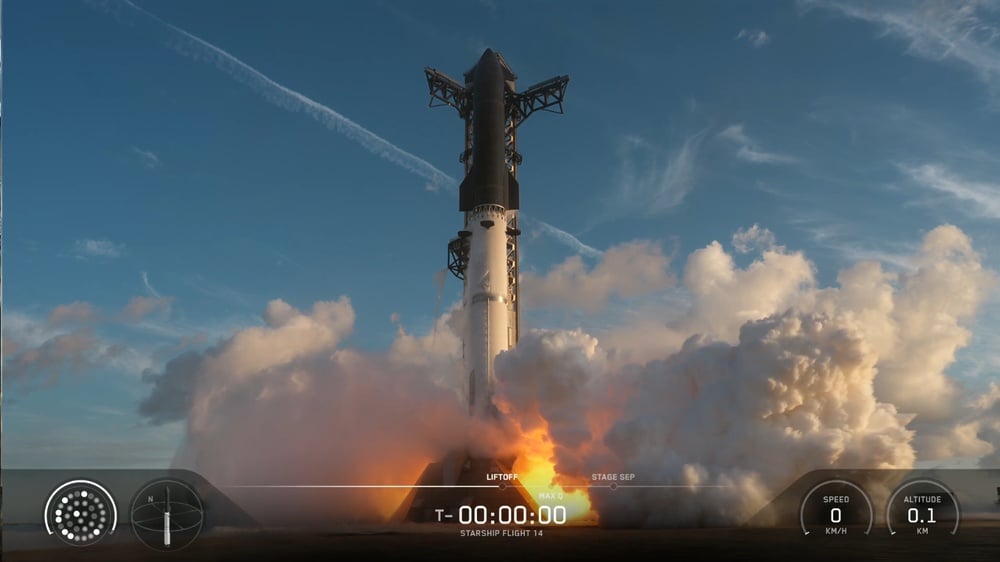
Starship is SpaceX's fully reusable super-heavy-lift launch system, developed through iterative test flights, and NASA selected it as the human landing system for the Artemis III crewed lunar mission.
Automated analysis; not human reviewed.
Limitations: The input mixes sidebar headlines and legal boilerplate with the main SpaceX report; analysis is based only on the report body.
·
7 of 55 available dimensions scored; omitted dimensions are not treated as neutral.
·
Verified supporting quotes for 6 of 7 scored dimensions.
Claim: The report is factual and attribution-based, with no first-person or evaluative judgment.
“SpaceX's Starship reached orbit for the first time on Monday, Reuters reported” · exact text match
“Musk said this month that gas turbines are "sold out through 2030"” · not found in supplied text
Why: Claims are attributed to Reuters, SpaceX, and Musk, with separate statements marked as reported or said.
Claim: The report presents a dramatic failure-and-recovery sequence in a calm, understated tone without hype.
“SpaceX's live stream initially reported the mission could not reach orbit after the engine loss.” · exact text match
Why: The initial failure report is included as a factual milestone in a chronology, not played up with emotional language.
Claim: The report describes events and plans without recommending actions or moral judgments.
“The Super Heavy booster ignited all 33 of its engines at 7:48 a.m. CT from SpaceX's Starbase facility near Brownsville, Texas” · exact text match
Why: The text sticks to what happened and what is planned, with no imperative or evaluative framing.
Claim: The report is credible based on visible sourcing, attribution, and a documented correction.
“Reuters reported” · exact text match
“Spokesperson Dan Huot reversed that assessment about 22 minutes into the flight” · exact text match
Why: Primary attribution and a transparent correction are observable credibility signals in the text.
Claim: The report reasons from engineering confirmation and technical detail rather than emotional or speculative framing.
“once engineers confirmed Starship could still complete the burn needed to reach orbital velocity, roughly 17,500 miles per hour” · exact text match
Why: The wording ties the orbit determination to engineering verification, showing a rational cause-effect approach.
Claim: The report shows epistemic care by correcting an initial assessment and attributing claims.
“Spokesperson Dan Huot reversed that assessment about 22 minutes into the flight, once engineers confirmed Starship could still complete the burn needed to reach orbital velocity” · exact text match
Why: It explicitly tracks a correction and conditions the new assessment on engineering confirmation, signaling honesty about uncertainty.
Claim: The article uses precise technical and quantitative detail, indicating competent reporting.
“one of its six upper-stage engines failed roughly two and a half minutes into the mission” · exact text match
“six orbits over 10 hours before splashing down in the Pacific Ocean off Chile” · exact text match
Why: Specific counts, timings, and trajectory details show technical comprehension rather than vague summary.
The input mixes sidebar headlines and legal boilerplate with the main SpaceX report; analysis is based only on the report body.
September 28, 2026 · 0 shares
The report frames the orbital debut as a hard-won success, emphasizing the engine failure and tense decision before reaching Mission Control's 'Starship is orbital' announcement.
Automated analysis; not human reviewed.
Limitations: The supplied text contains duplicate passages and unrelated headline links, so the analysis is based on the clearest Starship-related paragraphs and may omit context from the full article.
·
3 of 55 available dimensions scored; omitted dimensions are not treated as neutral.
·
Verified supporting quotes for 2 of 3 scored dimensions.
Claim: The report is largely factual, attributing statements and describing events without authorial opinion.
“SpaceX has launched its enormous Starship into orbit for the first time” · exact text match
“flight controllers decided after several tense minutes to proceed as planned” · exact text match
Why: The text reports outcomes, technical details, and decisions with attribution, with no direct editorial commentary.
Claim: The report frames the launch as a long-sought success and highlights positive forward plans.
“The spacecraft almost didn't achieve the long-desired goal in its Monday launch” · exact text match
“If all goes well with this orbital debut, the next Starship will return to the launch pad” · exact text match
Why: Phrases like 'long-desired goal' and 'if all goes well' convey a positive framing while acknowledging conditional next steps.
Claim: The report shows sourcing and attribution through named announcements, photo credits, and direct quotes.
“"Starship is orbital," Mission Control announced to cheers.” · not found in supplied text
“Mr Musk said at a business summit earlier this month.” · exact text match
Why: The text identifies speakers and contexts for statements, supporting verifiability, without overstating certainty.
The supplied text contains duplicate passages and unrelated headline links, so the analysis is based on the clearest Starship-related paragraphs and may omit context from the full article.
September 28, 2026 · 0 shares
A fact-led, attribution-heavy dispatch reports SpaceX's orbital milestone and its constraints in a measured, technical register.
Starship is SpaceX's fully reusable super-heavy-lift launch system, developed through iterative test flights, and NASA selected it as the human landing system for the Artemis III crewed lunar mission.
Automated analysis; not human reviewed.
Limitations: The input mixes sidebar headlines and legal boilerplate with the main SpaceX report; analysis is based only on the report body.
·
7 of 55 available dimensions scored; omitted dimensions are not treated as neutral.
·
Verified supporting quotes for 6 of 7 scored dimensions.
Claim: The report is factual and attribution-based, with no first-person or evaluative judgment.
“SpaceX's Starship reached orbit for the first time on Monday, Reuters reported” · exact text match
“Musk said this month that gas turbines are "sold out through 2030"” · not found in supplied text
Why: Claims are attributed to Reuters, SpaceX, and Musk, with separate statements marked as reported or said.
Claim: The report presents a dramatic failure-and-recovery sequence in a calm, understated tone without hype.
“SpaceX's live stream initially reported the mission could not reach orbit after the engine loss.” · exact text match
Why: The initial failure report is included as a factual milestone in a chronology, not played up with emotional language.
Claim: The report describes events and plans without recommending actions or moral judgments.
“The Super Heavy booster ignited all 33 of its engines at 7:48 a.m. CT from SpaceX's Starbase facility near Brownsville, Texas” · exact text match
Why: The text sticks to what happened and what is planned, with no imperative or evaluative framing.
Claim: The report is credible based on visible sourcing, attribution, and a documented correction.
“Reuters reported” · exact text match
“Spokesperson Dan Huot reversed that assessment about 22 minutes into the flight” · exact text match
Why: Primary attribution and a transparent correction are observable credibility signals in the text.
Claim: The report reasons from engineering confirmation and technical detail rather than emotional or speculative framing.
“once engineers confirmed Starship could still complete the burn needed to reach orbital velocity, roughly 17,500 miles per hour” · exact text match
Why: The wording ties the orbit determination to engineering verification, showing a rational cause-effect approach.
Claim: The report shows epistemic care by correcting an initial assessment and attributing claims.
“Spokesperson Dan Huot reversed that assessment about 22 minutes into the flight, once engineers confirmed Starship could still complete the burn needed to reach orbital velocity” · exact text match
Why: It explicitly tracks a correction and conditions the new assessment on engineering confirmation, signaling honesty about uncertainty.
Claim: The article uses precise technical and quantitative detail, indicating competent reporting.
“one of its six upper-stage engines failed roughly two and a half minutes into the mission” · exact text match
“six orbits over 10 hours before splashing down in the Pacific Ocean off Chile” · exact text match
Why: Specific counts, timings, and trajectory details show technical comprehension rather than vague summary.
The input mixes sidebar headlines and legal boilerplate with the main SpaceX report; analysis is based only on the report body.
September 28, 2026 · 0 shares
The event is framed as a qualified engineering and business milestone for SpaceX, with the engine failure and shortened mission presented as obstacles overcome rather than as a failure.
Automated analysis; not human reviewed.
Limitations: The supplied article text contains visible truncation marks and extraction artifacts, such as an incomplete sentence ending in 'profit nucleus,' so some wording and context may be unreliable.
·
4 of 55 available dimensions scored; omitted dimensions are not treated as neutral.
·
Verified supporting quotes for 1 of 4 scored dimensions.
Claim: The report keeps the publisher's voice largely neutral, with operational and market facts stated in attributed or third-person terms.
“"The team has made the call not to commit to orbit," Mr Huot said.” · not found in supplied text
“According to SpaceX, the V3 Starlink satellites on Monday's mission can handle 10 times more data than their predecessor V2 mini-sats” · exact text match
Counterevidence:
“Much of SpaceX's market worth and continued investor confidence in the company — valued at $2 trillion as of Friday's close — rides on the success of Starship” · exact text match
Why: Most substantive claims are attributed, and the sequence of events is reported without a first-person or overtly opinionated voice.
Claim: The lead and deployment details frame the mission as a positive milestone despite the truncated flight.
“SpaceX's SPCX.o next-generation Starship rocket reached orbit for the first time today despite having one of its engines shut down unexpectedly” · not found in supplied text
“overcoming a hitch mid-flight to deploy its first batch of new Starlink satellites in a truncated mission” · exact text match
Why: The opening treats the engine issue as a complication successfully handled and calls the deployment successful.
Claim: The reporting is sourced and attributes key operational decisions and technical specifications.
“"The team has made the call not to commit to orbit," Mr Huot said.” · not found in supplied text
“According to SpaceX, the V3 Starlink satellites on Monday's mission can handle 10 times more data than their predecessor V2 mini-sats” · exact text match
Counterevidence:
“Much of SpaceX's market worth and continued investor confidence in the company — valued at $2 trillion as of Friday's close — rides on the success of Starship” · exact text match
Why: Direct quotes and explicit attribution to SpaceX, a named spokesperson, and analysts support the visible credibility of the report.
Claim: Future revenue and launch-cadence predictions are included but attributed to analysts or identified as Musk's plans.
“Analysts predicted the successful deployment would be worth hundreds of millions of dollars in extra revenue for Elon Musk's company.” · exact text match
“Elon Musk wants to launch the higher-capacity V3s in batches of 60 per launch once Starship goes into routine operation.” · exact text match
Why: The report relies on forward-looking statements with attribution rather than asserting future outcomes as fact.
The supplied article text contains visible truncation marks and extraction artifacts, such as an incomplete sentence ending in 'profit nucleus,' so some wording and context may be unreliable.
September 28, 2026 · 0 shares
Frames the orbital insertion as a milestone and eventual success while preserving the sequence of technical uncertainty, engine issue, and later confirmation.
Automated analysis; not human reviewed.
Limitations: The supplied text is truncated and contains instruction-like fragments, limiting full-context verification and requiring analysis of only the substantive excerpts.
·
7 of 55 available dimensions scored; omitted dimensions are not treated as neutral.
·
Verified supporting quotes for 7 of 7 scored dimensions.
Claim: The report is predominantly factual and attributed, with no subjective editorializing.
“SpaceX later confirmed that Starship would continue with the planned orbital mission.” · exact text match
“The successful insertion burn moved Starship into the orbital phase of the mission, despite the engine shutdown during ascent.” · exact text match
Why: The text uses confirmations and descriptive statements rather than opinion or subjective judgment.
Claim: The tone is restrained and technical, avoiding sensational language.
“The milestone came after one of Starship’s six engines shut down earlier than planned during the climb.” · exact text match
“The burn allowed Starship to move from its flight path into Earth orbit.” · exact text match
Why: The wording is technical and event-focused, without dramatic embellishment or fear appeal.
Claim: The text is factful and neutral, separating news reporting from attributed statements.
“BBC reported that there was uncertainty about whether the spacecraft would continue with the orbital attempt.” · exact text match
“SpaceX later confirmed that Starship would continue with the planned orbital mission.” · exact text match
Why: It attributes claims to BBC and SpaceX instead of stating them as the publisher's own opinion.
Claim: The article calibrates certainty by explicitly noting uncertainty and later confirmation.
“The engine issue created uncertainty over whether the spacecraft would continue with the planned orbital mission.” · exact text match
“SpaceX later confirmed that Starship would continue with the planned orbital mission.” · exact text match
Why: It does not assert mission continuation as certain until the company confirmed it, avoiding overconfidence.
Claim: The article shows credible sourcing by attributing key facts to BBC and SpaceX's livestream.
“BBC reported that the spacecraft was seen entering orbit as the orbital insertion burn began.” · exact text match
“The company’s livestream confirmed that the spacecraft would perform the orbital insertion burn despite the earlier engine issue.” · exact text match
Why: It names multiple sources and distinguishes between reporting and confirmation, supporting credibility.
Claim: The narrative follows a logical, evidence-based sequence and avoids logical fallacies.
“The engine issue created uncertainty over whether the spacecraft would continue with the planned orbital mission.” · exact text match
“The successful insertion burn moved Starship into the orbital phase of the mission, despite the engine shutdown during ascent.” · exact text match
Why: It presents the engine issue as a cause, the uncertainty as an effect, and the later confirmation as a resolution, all coherently.
The supplied text is truncated and contains instruction-like fragments, limiting full-context verification and requiring analysis of only the substantive excerpts.
September 28, 2026 · 0 shares
The report frames the orbital debut as a hard-won success, emphasizing the engine failure and tense decision before reaching Mission Control's 'Starship is orbital' announcement.
Automated analysis; not human reviewed.
Limitations: The supplied text contains duplicate passages and unrelated headline links, so the analysis is based on the clearest Starship-related paragraphs and may omit context from the full article.
·
3 of 55 available dimensions scored; omitted dimensions are not treated as neutral.
·
Verified supporting quotes for 2 of 3 scored dimensions.
Claim: The report is largely factual, attributing statements and describing events without authorial opinion.
“SpaceX has launched its enormous Starship into orbit for the first time” · exact text match
“flight controllers decided after several tense minutes to proceed as planned” · exact text match
Why: The text reports outcomes, technical details, and decisions with attribution, with no direct editorial commentary.
Claim: The report frames the launch as a long-sought success and highlights positive forward plans.
“The spacecraft almost didn't achieve the long-desired goal in its Monday launch” · exact text match
“If all goes well with this orbital debut, the next Starship will return to the launch pad” · exact text match
Why: Phrases like 'long-desired goal' and 'if all goes well' convey a positive framing while acknowledging conditional next steps.
Claim: The report shows sourcing and attribution through named announcements, photo credits, and direct quotes.
“"Starship is orbital," Mission Control announced to cheers.” · not found in supplied text
“Mr Musk said at a business summit earlier this month.” · exact text match
Why: The text identifies speakers and contexts for statements, supporting verifiability, without overstating certainty.
The supplied text contains duplicate passages and unrelated headline links, so the analysis is based on the clearest Starship-related paragraphs and may omit context from the full article.
September 28, 2026 · 0 shares
Framing treats the orbital insertion as a clear success and progress story for SpaceX, using wire-service attribution and technical specifics.
Automated analysis; not human reviewed. Limitations: No publication date is given, so 'Monday' is not anchored to a calendar date; orbital figures and the engine anomaly originate from wire-service reports rather than direct observation.
No publication date is given, so 'Monday' is not anchored to a calendar date; orbital figures and the engine anomaly originate from wire-service reports rather than direct observation.
September 28, 2026 · 0 shares
Framing treats the orbital insertion as a clear success and progress story for SpaceX, using wire-service attribution and technical specifics.
Automated analysis; not human reviewed. Limitations: No publication date is given, so 'Monday' is not anchored to a calendar date; orbital figures and the engine anomaly originate from wire-service reports rather than direct observation.
No publication date is given, so 'Monday' is not anchored to a calendar date; orbital figures and the engine anomaly originate from wire-service reports rather than direct observation.
September 28, 2026 · 0 shares
The event is framed as a qualified engineering and business milestone for SpaceX, with the engine failure and shortened mission presented as obstacles overcome rather than as a failure.
Automated analysis; not human reviewed.
Limitations: The supplied article text contains visible truncation marks and extraction artifacts, such as an incomplete sentence ending in 'profit nucleus,' so some wording and context may be unreliable.
·
4 of 55 available dimensions scored; omitted dimensions are not treated as neutral.
·
Verified supporting quotes for 1 of 4 scored dimensions.
Claim: The report keeps the publisher's voice largely neutral, with operational and market facts stated in attributed or third-person terms.
“"The team has made the call not to commit to orbit," Mr Huot said.” · not found in supplied text
“According to SpaceX, the V3 Starlink satellites on Monday's mission can handle 10 times more data than their predecessor V2 mini-sats” · exact text match
Counterevidence:
“Much of SpaceX's market worth and continued investor confidence in the company — valued at $2 trillion as of Friday's close — rides on the success of Starship” · exact text match
Why: Most substantive claims are attributed, and the sequence of events is reported without a first-person or overtly opinionated voice.
Claim: The lead and deployment details frame the mission as a positive milestone despite the truncated flight.
“SpaceX's SPCX.o next-generation Starship rocket reached orbit for the first time today despite having one of its engines shut down unexpectedly” · not found in supplied text
“overcoming a hitch mid-flight to deploy its first batch of new Starlink satellites in a truncated mission” · exact text match
Why: The opening treats the engine issue as a complication successfully handled and calls the deployment successful.
Claim: The reporting is sourced and attributes key operational decisions and technical specifications.
“"The team has made the call not to commit to orbit," Mr Huot said.” · not found in supplied text
“According to SpaceX, the V3 Starlink satellites on Monday's mission can handle 10 times more data than their predecessor V2 mini-sats” · exact text match
Counterevidence:
“Much of SpaceX's market worth and continued investor confidence in the company — valued at $2 trillion as of Friday's close — rides on the success of Starship” · exact text match
Why: Direct quotes and explicit attribution to SpaceX, a named spokesperson, and analysts support the visible credibility of the report.
Claim: Future revenue and launch-cadence predictions are included but attributed to analysts or identified as Musk's plans.
“Analysts predicted the successful deployment would be worth hundreds of millions of dollars in extra revenue for Elon Musk's company.” · exact text match
“Elon Musk wants to launch the higher-capacity V3s in batches of 60 per launch once Starship goes into routine operation.” · exact text match
Why: The report relies on forward-looking statements with attribution rather than asserting future outcomes as fact.
The supplied article text contains visible truncation marks and extraction artifacts, such as an incomplete sentence ending in 'profit nucleus,' so some wording and context may be unreliable.
September 28, 2026 · 0 shares
Presents the first orbital Starship flight as a hard-won commercial and engineering success while transparently noting the engine failure and shortened mission.
Automated analysis; not human reviewed.
Limitations: The article text lacks an exact launch date and ends with two unrelated sidebar headlines; only the main SpaceX report was analyzed.
·
4 of 55 available dimensions scored; omitted dimensions are not treated as neutral.
·
Verified supporting quotes for 4 of 4 scored dimensions.
Claim: The report is presented in a detached, factual register with attributed quotes and explicit acknowledgment of the failure.
“SpaceX's giant Starship rocket has reached orbit for the first time and deployed new Starlink satellites, achieving key milestones despite an early engine failure and a decision to cut the mission short by seven hours.” · exact text match
“Once in orbit, Starship deployed 26 next-generation Starlink satellites one by one at an altitude of roughly 269km, marking the ship's first orbital deployments.” · exact text match
Why: The publisher narrates events with specific figures and named sources, reporting both the success and the technical problems without overt editorializing.
Claim: The text describes what happened rather than prescribing actions or policy.
“Upon reaching space, one of Starship's three main engines shut down prematurely, a development that led SpaceX spokesman Dan Huot to announce on the company's live stream of the mission that the craft would be unable to reach orbit.” · exact text match
“The company had not planned to recover and reuse the spacecraft from the sea following the mission.” · exact text match
Why: Sentences are descriptive statements of events and decisions, with no recommendations, mandates, or calls to action.
Claim: The story relies on attributable, specific sourcing and precise technical details.
“SpaceX spokesman Dan Huot to announce on the company's live stream of the mission that the craft would be unable to reach orbit.” · exact text match
“Dean Sladen, quality manager and aerospace engineer at Accu Components.” · exact text match
Why: Named spokespeople, a named outside engineer, direct quotes, and specific figures give the report a credible evidentiary base.
Claim: The report is internally honest, including the initial failed orbit call and the program's previous failures and costs.
“But Huot reversed course minutes later after an update from engineers confirmed that the craft could still attempt to fire other onboard engines that would boost it into orbit, which Starship successfully did minutes later.” · exact text match
“All 13 of Starship's previous test flights since 2023 were limited to suborbital space in a nearly decade-long development campaign that has cost SpaceX more than $US15 billion ($A21 billion) to date.” · exact text match
Why: The publisher does not hide the false initial assessment, the booster engine malfunction, or the long delay and cost of the program.
The article text lacks an exact launch date and ends with two unrelated sidebar headlines; only the main SpaceX report was analyzed.
September 28, 2026 · 0 shares
The event is framed as a qualified engineering and business milestone for SpaceX, with the engine failure and shortened mission presented as obstacles overcome rather than as a failure.
Automated analysis; not human reviewed.
Limitations: The supplied article text contains visible truncation marks and extraction artifacts, such as an incomplete sentence ending in 'profit nucleus,' so some wording and context may be unreliable.
·
4 of 55 available dimensions scored; omitted dimensions are not treated as neutral.
·
Verified supporting quotes for 1 of 4 scored dimensions.
Claim: The report keeps the publisher's voice largely neutral, with operational and market facts stated in attributed or third-person terms.
“"The team has made the call not to commit to orbit," Mr Huot said.” · not found in supplied text
“According to SpaceX, the V3 Starlink satellites on Monday's mission can handle 10 times more data than their predecessor V2 mini-sats” · exact text match
Counterevidence:
“Much of SpaceX's market worth and continued investor confidence in the company — valued at $2 trillion as of Friday's close — rides on the success of Starship” · exact text match
Why: Most substantive claims are attributed, and the sequence of events is reported without a first-person or overtly opinionated voice.
Claim: The lead and deployment details frame the mission as a positive milestone despite the truncated flight.
“SpaceX's SPCX.o next-generation Starship rocket reached orbit for the first time today despite having one of its engines shut down unexpectedly” · not found in supplied text
“overcoming a hitch mid-flight to deploy its first batch of new Starlink satellites in a truncated mission” · exact text match
Why: The opening treats the engine issue as a complication successfully handled and calls the deployment successful.
Claim: The reporting is sourced and attributes key operational decisions and technical specifications.
“"The team has made the call not to commit to orbit," Mr Huot said.” · not found in supplied text
“According to SpaceX, the V3 Starlink satellites on Monday's mission can handle 10 times more data than their predecessor V2 mini-sats” · exact text match
Counterevidence:
“Much of SpaceX's market worth and continued investor confidence in the company — valued at $2 trillion as of Friday's close — rides on the success of Starship” · exact text match
Why: Direct quotes and explicit attribution to SpaceX, a named spokesperson, and analysts support the visible credibility of the report.
Claim: Future revenue and launch-cadence predictions are included but attributed to analysts or identified as Musk's plans.
“Analysts predicted the successful deployment would be worth hundreds of millions of dollars in extra revenue for Elon Musk's company.” · exact text match
“Elon Musk wants to launch the higher-capacity V3s in batches of 60 per launch once Starship goes into routine operation.” · exact text match
Why: The report relies on forward-looking statements with attribution rather than asserting future outcomes as fact.
The supplied article text contains visible truncation marks and extraction artifacts, such as an incomplete sentence ending in 'profit nucleus,' so some wording and context may be unreliable.
September 28, 2026 · 0 shares
Presents the first orbital Starship flight as a hard-won commercial and engineering success while transparently noting the engine failure and shortened mission.
Automated analysis; not human reviewed.
Limitations: The article text lacks an exact launch date and ends with two unrelated sidebar headlines; only the main SpaceX report was analyzed.
·
4 of 55 available dimensions scored; omitted dimensions are not treated as neutral.
·
Verified supporting quotes for 4 of 4 scored dimensions.
Claim: The report is presented in a detached, factual register with attributed quotes and explicit acknowledgment of the failure.
“SpaceX's giant Starship rocket has reached orbit for the first time and deployed new Starlink satellites, achieving key milestones despite an early engine failure and a decision to cut the mission short by seven hours.” · exact text match
“Once in orbit, Starship deployed 26 next-generation Starlink satellites one by one at an altitude of roughly 269km, marking the ship's first orbital deployments.” · exact text match
Why: The publisher narrates events with specific figures and named sources, reporting both the success and the technical problems without overt editorializing.
Claim: The text describes what happened rather than prescribing actions or policy.
“Upon reaching space, one of Starship's three main engines shut down prematurely, a development that led SpaceX spokesman Dan Huot to announce on the company's live stream of the mission that the craft would be unable to reach orbit.” · exact text match
“The company had not planned to recover and reuse the spacecraft from the sea following the mission.” · exact text match
Why: Sentences are descriptive statements of events and decisions, with no recommendations, mandates, or calls to action.
Claim: The story relies on attributable, specific sourcing and precise technical details.
“SpaceX spokesman Dan Huot to announce on the company's live stream of the mission that the craft would be unable to reach orbit.” · exact text match
“Dean Sladen, quality manager and aerospace engineer at Accu Components.” · exact text match
Why: Named spokespeople, a named outside engineer, direct quotes, and specific figures give the report a credible evidentiary base.
Claim: The report is internally honest, including the initial failed orbit call and the program's previous failures and costs.
“But Huot reversed course minutes later after an update from engineers confirmed that the craft could still attempt to fire other onboard engines that would boost it into orbit, which Starship successfully did minutes later.” · exact text match
“All 13 of Starship's previous test flights since 2023 were limited to suborbital space in a nearly decade-long development campaign that has cost SpaceX more than $US15 billion ($A21 billion) to date.” · exact text match
Why: The publisher does not hide the false initial assessment, the booster engine malfunction, or the long delay and cost of the program.
The article text lacks an exact launch date and ends with two unrelated sidebar headlines; only the main SpaceX report was analyzed.
September 28, 2026 · 0 shares
Progress-focused coverage highlights mission achievements while acknowledging the thruster failure cut the flight short.
Automated analysis; not human reviewed.
Limitations: The supplied text is a fragmentary, partially quoted excerpt with ellipses, making it difficult to attribute every clause to the publisher versus a quoted tweet.
·
3 of 55 available dimensions scored; omitted dimensions are not treated as neutral.
·
Verified supporting quotes for 3 of 3 scored dimensions.
Claim: The article frames the flight as a success despite the early end, emphasizing achieved objectives.
“Despite the early end, the mission achieved two major objectives: reaching orbit and deploying 26 operational Starlink satellites.” · exact text match
“During the flight, the spacecraft successfully deployed 26 Starlink satellites, demonstrating its ability to carry and release operational payloads in orbit.” · exact text match
Counterevidence:
“The early return highlights the challenges SpaceX faces as it works to develop Starship into a fully reusable launch system.” · exact text match
Why: The publisher's own conclusion emphasizes mission achievements and uses 'successfully' and 'major objectives,' giving the story a positive valence while still acknowledging the failure.
Claim: The report provides specific, checkable mission details and attributes a quoted milestone to a named source, supporting high credibility.
“SpaceX's Starship reached Earth orbit for the first time during its 14th flight test on Monday” · exact text match
“Nasa has selected a version of Starship as the lunar landing system for its Artemis programme.” · exact text match
Why: The article supplies concrete details such as flight number and satellite count and names NASA's selection, giving readers verifiable anchors for the report.
Claim: The article includes the mission's failure mode rather than reporting only the success, supporting high-integrity framing.
“The early return highlights the challenges SpaceX faces as it works to develop Starship into a fully reusable launch system.” · exact text match
Why: By acknowledging the thruster failure and early return in the same report as the successful orbit and deployment, the publisher demonstrates balanced, non-suppressive reporting.
The supplied text is a fragmentary, partially quoted excerpt with ellipses, making it difficult to attribute every clause to the publisher versus a quoted tweet.
September 28, 2026 · 0 shares
The event is framed as a qualified engineering and business milestone for SpaceX, with the engine failure and shortened mission presented as obstacles overcome rather than as a failure.
Automated analysis; not human reviewed.
Limitations: The supplied article text contains visible truncation marks and extraction artifacts, such as an incomplete sentence ending in 'profit nucleus,' so some wording and context may be unreliable.
·
4 of 55 available dimensions scored; omitted dimensions are not treated as neutral.
·
Verified supporting quotes for 1 of 4 scored dimensions.
Claim: The report keeps the publisher's voice largely neutral, with operational and market facts stated in attributed or third-person terms.
“"The team has made the call not to commit to orbit," Mr Huot said.” · not found in supplied text
“According to SpaceX, the V3 Starlink satellites on Monday's mission can handle 10 times more data than their predecessor V2 mini-sats” · exact text match
Counterevidence:
“Much of SpaceX's market worth and continued investor confidence in the company — valued at $2 trillion as of Friday's close — rides on the success of Starship” · exact text match
Why: Most substantive claims are attributed, and the sequence of events is reported without a first-person or overtly opinionated voice.
Claim: The lead and deployment details frame the mission as a positive milestone despite the truncated flight.
“SpaceX's SPCX.o next-generation Starship rocket reached orbit for the first time today despite having one of its engines shut down unexpectedly” · not found in supplied text
“overcoming a hitch mid-flight to deploy its first batch of new Starlink satellites in a truncated mission” · exact text match
Why: The opening treats the engine issue as a complication successfully handled and calls the deployment successful.
Claim: The reporting is sourced and attributes key operational decisions and technical specifications.
“"The team has made the call not to commit to orbit," Mr Huot said.” · not found in supplied text
“According to SpaceX, the V3 Starlink satellites on Monday's mission can handle 10 times more data than their predecessor V2 mini-sats” · exact text match
Counterevidence:
“Much of SpaceX's market worth and continued investor confidence in the company — valued at $2 trillion as of Friday's close — rides on the success of Starship” · exact text match
Why: Direct quotes and explicit attribution to SpaceX, a named spokesperson, and analysts support the visible credibility of the report.
Claim: Future revenue and launch-cadence predictions are included but attributed to analysts or identified as Musk's plans.
“Analysts predicted the successful deployment would be worth hundreds of millions of dollars in extra revenue for Elon Musk's company.” · exact text match
“Elon Musk wants to launch the higher-capacity V3s in batches of 60 per launch once Starship goes into routine operation.” · exact text match
Why: The report relies on forward-looking statements with attribution rather than asserting future outcomes as fact.
The supplied article text contains visible truncation marks and extraction artifacts, such as an incomplete sentence ending in 'profit nucleus,' so some wording and context may be unreliable.
September 28, 2026 · 0 shares
Presents the first orbital Starship flight as a hard-won commercial and engineering success while transparently noting the engine failure and shortened mission.
Automated analysis; not human reviewed.
Limitations: The article text lacks an exact launch date and ends with two unrelated sidebar headlines; only the main SpaceX report was analyzed.
·
4 of 55 available dimensions scored; omitted dimensions are not treated as neutral.
·
Verified supporting quotes for 4 of 4 scored dimensions.
Claim: The report is presented in a detached, factual register with attributed quotes and explicit acknowledgment of the failure.
“SpaceX's giant Starship rocket has reached orbit for the first time and deployed new Starlink satellites, achieving key milestones despite an early engine failure and a decision to cut the mission short by seven hours.” · exact text match
“Once in orbit, Starship deployed 26 next-generation Starlink satellites one by one at an altitude of roughly 269km, marking the ship's first orbital deployments.” · exact text match
Why: The publisher narrates events with specific figures and named sources, reporting both the success and the technical problems without overt editorializing.
Claim: The text describes what happened rather than prescribing actions or policy.
“Upon reaching space, one of Starship's three main engines shut down prematurely, a development that led SpaceX spokesman Dan Huot to announce on the company's live stream of the mission that the craft would be unable to reach orbit.” · exact text match
“The company had not planned to recover and reuse the spacecraft from the sea following the mission.” · exact text match
Why: Sentences are descriptive statements of events and decisions, with no recommendations, mandates, or calls to action.
Claim: The story relies on attributable, specific sourcing and precise technical details.
“SpaceX spokesman Dan Huot to announce on the company's live stream of the mission that the craft would be unable to reach orbit.” · exact text match
“Dean Sladen, quality manager and aerospace engineer at Accu Components.” · exact text match
Why: Named spokespeople, a named outside engineer, direct quotes, and specific figures give the report a credible evidentiary base.
Claim: The report is internally honest, including the initial failed orbit call and the program's previous failures and costs.
“But Huot reversed course minutes later after an update from engineers confirmed that the craft could still attempt to fire other onboard engines that would boost it into orbit, which Starship successfully did minutes later.” · exact text match
“All 13 of Starship's previous test flights since 2023 were limited to suborbital space in a nearly decade-long development campaign that has cost SpaceX more than $US15 billion ($A21 billion) to date.” · exact text match
Why: The publisher does not hide the false initial assessment, the booster engine malfunction, or the long delay and cost of the program.
The article text lacks an exact launch date and ends with two unrelated sidebar headlines; only the main SpaceX report was analyzed.
September 28, 2026 · 0 shares
The event is framed as a qualified engineering and business milestone for SpaceX, with the engine failure and shortened mission presented as obstacles overcome rather than as a failure.
Automated analysis; not human reviewed.
Limitations: The supplied article text contains visible truncation marks and extraction artifacts, such as an incomplete sentence ending in 'profit nucleus,' so some wording and context may be unreliable.
·
4 of 55 available dimensions scored; omitted dimensions are not treated as neutral.
·
Verified supporting quotes for 1 of 4 scored dimensions.
Claim: The report keeps the publisher's voice largely neutral, with operational and market facts stated in attributed or third-person terms.
“"The team has made the call not to commit to orbit," Mr Huot said.” · not found in supplied text
“According to SpaceX, the V3 Starlink satellites on Monday's mission can handle 10 times more data than their predecessor V2 mini-sats” · exact text match
Counterevidence:
“Much of SpaceX's market worth and continued investor confidence in the company — valued at $2 trillion as of Friday's close — rides on the success of Starship” · exact text match
Why: Most substantive claims are attributed, and the sequence of events is reported without a first-person or overtly opinionated voice.
Claim: The lead and deployment details frame the mission as a positive milestone despite the truncated flight.
“SpaceX's SPCX.o next-generation Starship rocket reached orbit for the first time today despite having one of its engines shut down unexpectedly” · not found in supplied text
“overcoming a hitch mid-flight to deploy its first batch of new Starlink satellites in a truncated mission” · exact text match
Why: The opening treats the engine issue as a complication successfully handled and calls the deployment successful.
Claim: The reporting is sourced and attributes key operational decisions and technical specifications.
“"The team has made the call not to commit to orbit," Mr Huot said.” · not found in supplied text
“According to SpaceX, the V3 Starlink satellites on Monday's mission can handle 10 times more data than their predecessor V2 mini-sats” · exact text match
Counterevidence:
“Much of SpaceX's market worth and continued investor confidence in the company — valued at $2 trillion as of Friday's close — rides on the success of Starship” · exact text match
Why: Direct quotes and explicit attribution to SpaceX, a named spokesperson, and analysts support the visible credibility of the report.
Claim: Future revenue and launch-cadence predictions are included but attributed to analysts or identified as Musk's plans.
“Analysts predicted the successful deployment would be worth hundreds of millions of dollars in extra revenue for Elon Musk's company.” · exact text match
“Elon Musk wants to launch the higher-capacity V3s in batches of 60 per launch once Starship goes into routine operation.” · exact text match
Why: The report relies on forward-looking statements with attribution rather than asserting future outcomes as fact.
The supplied article text contains visible truncation marks and extraction artifacts, such as an incomplete sentence ending in 'profit nucleus,' so some wording and context may be unreliable.
September 28, 2026 · 0 shares
Framing treats the orbital insertion as a clear success and progress story for SpaceX, using wire-service attribution and technical specifics.
Automated analysis; not human reviewed. Limitations: No publication date is given, so 'Monday' is not anchored to a calendar date; orbital figures and the engine anomaly originate from wire-service reports rather than direct observation.
No publication date is given, so 'Monday' is not anchored to a calendar date; orbital figures and the engine anomaly originate from wire-service reports rather than direct observation.
September 28, 2026 · 0 shares
Framing treats the orbital insertion as a clear success and progress story for SpaceX, using wire-service attribution and technical specifics.
Automated analysis; not human reviewed. Limitations: No publication date is given, so 'Monday' is not anchored to a calendar date; orbital figures and the engine anomaly originate from wire-service reports rather than direct observation.
No publication date is given, so 'Monday' is not anchored to a calendar date; orbital figures and the engine anomaly originate from wire-service reports rather than direct observation.
September 28, 2026 · 0 shares
The event is framed as a qualified engineering and business milestone for SpaceX, with the engine failure and shortened mission presented as obstacles overcome rather than as a failure.
Automated analysis; not human reviewed. Limitations: The supplied article text contains visible truncation marks and extraction artifacts, such as an incomplete sentence ending in 'profit nucleus,' so some wording and context may be unreliable. · 4 of 55 available dimensions scored; omitted dimensions are not treated as neutral. · Verified supporting quotes for 1 of 4 scored dimensions.
Claim: The report keeps the publisher's voice largely neutral, with operational and market facts stated in attributed or third-person terms.
“"The team has made the call not to commit to orbit," Mr Huot said.” · not found in supplied text
“According to SpaceX, the V3 Starlink satellites on Monday's mission can handle 10 times more data than their predecessor V2 mini-sats” · exact text match
Counterevidence:
“Much of SpaceX's market worth and continued investor confidence in the company — valued at $2 trillion as of Friday's close — rides on the success of Starship” · exact text match
Why: Most substantive claims are attributed, and the sequence of events is reported without a first-person or overtly opinionated voice.
Claim: The lead and deployment details frame the mission as a positive milestone despite the truncated flight.
“SpaceX's SPCX.o next-generation Starship rocket reached orbit for the first time today despite having one of its engines shut down unexpectedly” · not found in supplied text
“overcoming a hitch mid-flight to deploy its first batch of new Starlink satellites in a truncated mission” · exact text match
Why: The opening treats the engine issue as a complication successfully handled and calls the deployment successful.
Claim: The reporting is sourced and attributes key operational decisions and technical specifications.
“"The team has made the call not to commit to orbit," Mr Huot said.” · not found in supplied text
“According to SpaceX, the V3 Starlink satellites on Monday's mission can handle 10 times more data than their predecessor V2 mini-sats” · exact text match
Counterevidence:
“Much of SpaceX's market worth and continued investor confidence in the company — valued at $2 trillion as of Friday's close — rides on the success of Starship” · exact text match
Why: Direct quotes and explicit attribution to SpaceX, a named spokesperson, and analysts support the visible credibility of the report.
Claim: Future revenue and launch-cadence predictions are included but attributed to analysts or identified as Musk's plans.
“Analysts predicted the successful deployment would be worth hundreds of millions of dollars in extra revenue for Elon Musk's company.” · exact text match
“Elon Musk wants to launch the higher-capacity V3s in batches of 60 per launch once Starship goes into routine operation.” · exact text match
Why: The report relies on forward-looking statements with attribution rather than asserting future outcomes as fact.
The supplied article text contains visible truncation marks and extraction artifacts, such as an incomplete sentence ending in 'profit nucleus,' so some wording and context may be unreliable.
September 28, 2026 · 0 shares
The reporting is factual and restrained, presenting the orbital achievement and business implications without commentary.
Starship is SpaceX's next-generation heavy-lift rocket, and Starlink is SpaceX's satellite-internet constellation.
Automated analysis; not human reviewed. Limitations: The supplied text is a short excerpt with no named sources or additional details, so the classification relies on surface wording. · 3 of 55 available dimensions scored; omitted dimensions are not treated as neutral. · Verified supporting quotes for 2 of 3 scored dimensions.
Claim: The report is expressed in factual terms and does not evaluate or editorialize.
“Starship reached orbit during the 14th test flight” · exact text match
Why: The sentence states an outcome and a flight number without qualifying or evaluative language.
Claim: The report avoids sensational language, hyperbole, or dramatic framing.
“One Starship rocket has the capacity to carry 60 satellites into orbit” · exact text match
Why: The wording is plain and specification-focused, with no emotional or exaggerated terms.
Claim: The report describes an event and capabilities without issuing recommendations.
“the company is depending on this massive rocket to expand its internet connectivity business” · not found in supplied text
Why: This sentence describes the company's reliance and business purpose in a declarative way rather than prescribing action.
The supplied text is a short excerpt with no named sources or additional details, so the classification relies on surface wording.
September 28, 2026 · 0 shares
Presents the first orbital Starship flight as a hard-won commercial and engineering success while transparently noting the engine failure and shortened mission.
Automated analysis; not human reviewed. Limitations: The article text lacks an exact launch date and ends with two unrelated sidebar headlines; only the main SpaceX report was analyzed. · 4 of 55 available dimensions scored; omitted dimensions are not treated as neutral. · Verified supporting quotes for 4 of 4 scored dimensions.
Claim: The report is presented in a detached, factual register with attributed quotes and explicit acknowledgment of the failure.
“SpaceX's giant Starship rocket has reached orbit for the first time and deployed new Starlink satellites, achieving key milestones despite an early engine failure and a decision to cut the mission short by seven hours.” · exact text match
“Once in orbit, Starship deployed 26 next-generation Starlink satellites one by one at an altitude of roughly 269km, marking the ship's first orbital deployments.” · exact text match
Why: The publisher narrates events with specific figures and named sources, reporting both the success and the technical problems without overt editorializing.
Claim: The text describes what happened rather than prescribing actions or policy.
“Upon reaching space, one of Starship's three main engines shut down prematurely, a development that led SpaceX spokesman Dan Huot to announce on the company's live stream of the mission that the craft would be unable to reach orbit.” · exact text match
“The company had not planned to recover and reuse the spacecraft from the sea following the mission.” · exact text match
Why: Sentences are descriptive statements of events and decisions, with no recommendations, mandates, or calls to action.
Claim: The story relies on attributable, specific sourcing and precise technical details.
“SpaceX spokesman Dan Huot to announce on the company's live stream of the mission that the craft would be unable to reach orbit.” · exact text match
“Dean Sladen, quality manager and aerospace engineer at Accu Components.” · exact text match
Why: Named spokespeople, a named outside engineer, direct quotes, and specific figures give the report a credible evidentiary base.
Claim: The report is internally honest, including the initial failed orbit call and the program's previous failures and costs.
“But Huot reversed course minutes later after an update from engineers confirmed that the craft could still attempt to fire other onboard engines that would boost it into orbit, which Starship successfully did minutes later.” · exact text match
“All 13 of Starship's previous test flights since 2023 were limited to suborbital space in a nearly decade-long development campaign that has cost SpaceX more than $US15 billion ($A21 billion) to date.” · exact text match
Why: The publisher does not hide the false initial assessment, the booster engine malfunction, or the long delay and cost of the program.
The article text lacks an exact launch date and ends with two unrelated sidebar headlines; only the main SpaceX report was analyzed.
September 28, 2026 · 0 shares
The event is framed as a qualified engineering and business milestone for SpaceX, with the engine failure and shortened mission presented as obstacles overcome rather than as a failure.
Automated analysis; not human reviewed. Limitations: The supplied article text contains visible truncation marks and extraction artifacts, such as an incomplete sentence ending in 'profit nucleus,' so some wording and context may be unreliable. · 4 of 55 available dimensions scored; omitted dimensions are not treated as neutral. · Verified supporting quotes for 1 of 4 scored dimensions.
Claim: The report keeps the publisher's voice largely neutral, with operational and market facts stated in attributed or third-person terms.
“"The team has made the call not to commit to orbit," Mr Huot said.” · not found in supplied text
“According to SpaceX, the V3 Starlink satellites on Monday's mission can handle 10 times more data than their predecessor V2 mini-sats” · exact text match
Counterevidence:
“Much of SpaceX's market worth and continued investor confidence in the company — valued at $2 trillion as of Friday's close — rides on the success of Starship” · exact text match
Why: Most substantive claims are attributed, and the sequence of events is reported without a first-person or overtly opinionated voice.
Claim: The lead and deployment details frame the mission as a positive milestone despite the truncated flight.
“SpaceX's SPCX.o next-generation Starship rocket reached orbit for the first time today despite having one of its engines shut down unexpectedly” · not found in supplied text
“overcoming a hitch mid-flight to deploy its first batch of new Starlink satellites in a truncated mission” · exact text match
Why: The opening treats the engine issue as a complication successfully handled and calls the deployment successful.
Claim: The reporting is sourced and attributes key operational decisions and technical specifications.
“"The team has made the call not to commit to orbit," Mr Huot said.” · not found in supplied text
“According to SpaceX, the V3 Starlink satellites on Monday's mission can handle 10 times more data than their predecessor V2 mini-sats” · exact text match
Counterevidence:
“Much of SpaceX's market worth and continued investor confidence in the company — valued at $2 trillion as of Friday's close — rides on the success of Starship” · exact text match
Why: Direct quotes and explicit attribution to SpaceX, a named spokesperson, and analysts support the visible credibility of the report.
Claim: Future revenue and launch-cadence predictions are included but attributed to analysts or identified as Musk's plans.
“Analysts predicted the successful deployment would be worth hundreds of millions of dollars in extra revenue for Elon Musk's company.” · exact text match
“Elon Musk wants to launch the higher-capacity V3s in batches of 60 per launch once Starship goes into routine operation.” · exact text match
Why: The report relies on forward-looking statements with attribution rather than asserting future outcomes as fact.
The supplied article text contains visible truncation marks and extraction artifacts, such as an incomplete sentence ending in 'profit nucleus,' so some wording and context may be unreliable.
September 28, 2026 · 0 shares
Presents the first orbital Starship flight as a hard-won commercial and engineering success while transparently noting the engine failure and shortened mission.
Automated analysis; not human reviewed. Limitations: The article text lacks an exact launch date and ends with two unrelated sidebar headlines; only the main SpaceX report was analyzed. · 4 of 55 available dimensions scored; omitted dimensions are not treated as neutral. · Verified supporting quotes for 4 of 4 scored dimensions.
Claim: The report is presented in a detached, factual register with attributed quotes and explicit acknowledgment of the failure.
“SpaceX's giant Starship rocket has reached orbit for the first time and deployed new Starlink satellites, achieving key milestones despite an early engine failure and a decision to cut the mission short by seven hours.” · exact text match
“Once in orbit, Starship deployed 26 next-generation Starlink satellites one by one at an altitude of roughly 269km, marking the ship's first orbital deployments.” · exact text match
Why: The publisher narrates events with specific figures and named sources, reporting both the success and the technical problems without overt editorializing.
Claim: The text describes what happened rather than prescribing actions or policy.
“Upon reaching space, one of Starship's three main engines shut down prematurely, a development that led SpaceX spokesman Dan Huot to announce on the company's live stream of the mission that the craft would be unable to reach orbit.” · exact text match
“The company had not planned to recover and reuse the spacecraft from the sea following the mission.” · exact text match
Why: Sentences are descriptive statements of events and decisions, with no recommendations, mandates, or calls to action.
Claim: The story relies on attributable, specific sourcing and precise technical details.
“SpaceX spokesman Dan Huot to announce on the company's live stream of the mission that the craft would be unable to reach orbit.” · exact text match
“Dean Sladen, quality manager and aerospace engineer at Accu Components.” · exact text match
Why: Named spokespeople, a named outside engineer, direct quotes, and specific figures give the report a credible evidentiary base.
Claim: The report is internally honest, including the initial failed orbit call and the program's previous failures and costs.
“But Huot reversed course minutes later after an update from engineers confirmed that the craft could still attempt to fire other onboard engines that would boost it into orbit, which Starship successfully did minutes later.” · exact text match
“All 13 of Starship's previous test flights since 2023 were limited to suborbital space in a nearly decade-long development campaign that has cost SpaceX more than $US15 billion ($A21 billion) to date.” · exact text match
Why: The publisher does not hide the false initial assessment, the booster engine malfunction, or the long delay and cost of the program.
The article text lacks an exact launch date and ends with two unrelated sidebar headlines; only the main SpaceX report was analyzed.
September 28, 2026 · 0 shares
Progress-focused coverage highlights mission achievements while acknowledging the thruster failure cut the flight short.
Automated analysis; not human reviewed. Limitations: The supplied text is a fragmentary, partially quoted excerpt with ellipses, making it difficult to attribute every clause to the publisher versus a quoted tweet. · 3 of 55 available dimensions scored; omitted dimensions are not treated as neutral. · Verified supporting quotes for 3 of 3 scored dimensions.
Claim: The article frames the flight as a success despite the early end, emphasizing achieved objectives.
“Despite the early end, the mission achieved two major objectives: reaching orbit and deploying 26 operational Starlink satellites.” · exact text match
“During the flight, the spacecraft successfully deployed 26 Starlink satellites, demonstrating its ability to carry and release operational payloads in orbit.” · exact text match
Counterevidence:
“The early return highlights the challenges SpaceX faces as it works to develop Starship into a fully reusable launch system.” · exact text match
Why: The publisher's own conclusion emphasizes mission achievements and uses 'successfully' and 'major objectives,' giving the story a positive valence while still acknowledging the failure.
Claim: The report provides specific, checkable mission details and attributes a quoted milestone to a named source, supporting high credibility.
“SpaceX's Starship reached Earth orbit for the first time during its 14th flight test on Monday” · exact text match
“Nasa has selected a version of Starship as the lunar landing system for its Artemis programme.” · exact text match
Why: The article supplies concrete details such as flight number and satellite count and names NASA's selection, giving readers verifiable anchors for the report.
Claim: The article includes the mission's failure mode rather than reporting only the success, supporting high-integrity framing.
“The early return highlights the challenges SpaceX faces as it works to develop Starship into a fully reusable launch system.” · exact text match
Why: By acknowledging the thruster failure and early return in the same report as the successful orbit and deployment, the publisher demonstrates balanced, non-suppressive reporting.
The supplied text is a fragmentary, partially quoted excerpt with ellipses, making it difficult to attribute every clause to the publisher versus a quoted tweet.
September 28, 2026 · 0 shares
A fact-led, attribution-heavy dispatch reports SpaceX's orbital milestone and its constraints in a measured, technical register.
Starship is SpaceX's fully reusable super-heavy-lift launch system, developed through iterative test flights, and NASA selected it as the human landing system for the Artemis III crewed lunar mission.
Automated analysis; not human reviewed. Limitations: The input mixes sidebar headlines and legal boilerplate with the main SpaceX report; analysis is based only on the report body. · 7 of 55 available dimensions scored; omitted dimensions are not treated as neutral. · Verified supporting quotes for 6 of 7 scored dimensions.
Claim: The report is factual and attribution-based, with no first-person or evaluative judgment.
“SpaceX's Starship reached orbit for the first time on Monday, Reuters reported” · exact text match
“Musk said this month that gas turbines are "sold out through 2030"” · not found in supplied text
Why: Claims are attributed to Reuters, SpaceX, and Musk, with separate statements marked as reported or said.
Claim: The report presents a dramatic failure-and-recovery sequence in a calm, understated tone without hype.
“SpaceX's live stream initially reported the mission could not reach orbit after the engine loss.” · exact text match
Why: The initial failure report is included as a factual milestone in a chronology, not played up with emotional language.
Claim: The report describes events and plans without recommending actions or moral judgments.
“The Super Heavy booster ignited all 33 of its engines at 7:48 a.m. CT from SpaceX's Starbase facility near Brownsville, Texas” · exact text match
Why: The text sticks to what happened and what is planned, with no imperative or evaluative framing.
Claim: The report is credible based on visible sourcing, attribution, and a documented correction.
“Reuters reported” · exact text match
“Spokesperson Dan Huot reversed that assessment about 22 minutes into the flight” · exact text match
Why: Primary attribution and a transparent correction are observable credibility signals in the text.
Claim: The report reasons from engineering confirmation and technical detail rather than emotional or speculative framing.
“once engineers confirmed Starship could still complete the burn needed to reach orbital velocity, roughly 17,500 miles per hour” · exact text match
Why: The wording ties the orbit determination to engineering verification, showing a rational cause-effect approach.
Claim: The report shows epistemic care by correcting an initial assessment and attributing claims.
“Spokesperson Dan Huot reversed that assessment about 22 minutes into the flight, once engineers confirmed Starship could still complete the burn needed to reach orbital velocity” · exact text match
Why: It explicitly tracks a correction and conditions the new assessment on engineering confirmation, signaling honesty about uncertainty.
Claim: The article uses precise technical and quantitative detail, indicating competent reporting.
“one of its six upper-stage engines failed roughly two and a half minutes into the mission” · exact text match
“six orbits over 10 hours before splashing down in the Pacific Ocean off Chile” · exact text match
Why: Specific counts, timings, and trajectory details show technical comprehension rather than vague summary.
The input mixes sidebar headlines and legal boilerplate with the main SpaceX report; analysis is based only on the report body.
September 28, 2026 · 0 shares
Presents the first orbital Starship flight as a hard-won commercial and engineering success while transparently noting the engine failure and shortened mission.
Automated analysis; not human reviewed. Limitations: The article text lacks an exact launch date and ends with two unrelated sidebar headlines; only the main SpaceX report was analyzed. · 4 of 55 available dimensions scored; omitted dimensions are not treated as neutral. · Verified supporting quotes for 4 of 4 scored dimensions.
Claim: The report is presented in a detached, factual register with attributed quotes and explicit acknowledgment of the failure.
“SpaceX's giant Starship rocket has reached orbit for the first time and deployed new Starlink satellites, achieving key milestones despite an early engine failure and a decision to cut the mission short by seven hours.” · exact text match
“Once in orbit, Starship deployed 26 next-generation Starlink satellites one by one at an altitude of roughly 269km, marking the ship's first orbital deployments.” · exact text match
Why: The publisher narrates events with specific figures and named sources, reporting both the success and the technical problems without overt editorializing.
Claim: The text describes what happened rather than prescribing actions or policy.
“Upon reaching space, one of Starship's three main engines shut down prematurely, a development that led SpaceX spokesman Dan Huot to announce on the company's live stream of the mission that the craft would be unable to reach orbit.” · exact text match
“The company had not planned to recover and reuse the spacecraft from the sea following the mission.” · exact text match
Why: Sentences are descriptive statements of events and decisions, with no recommendations, mandates, or calls to action.
Claim: The story relies on attributable, specific sourcing and precise technical details.
“SpaceX spokesman Dan Huot to announce on the company's live stream of the mission that the craft would be unable to reach orbit.” · exact text match
“Dean Sladen, quality manager and aerospace engineer at Accu Components.” · exact text match
Why: Named spokespeople, a named outside engineer, direct quotes, and specific figures give the report a credible evidentiary base.
Claim: The report is internally honest, including the initial failed orbit call and the program's previous failures and costs.
“But Huot reversed course minutes later after an update from engineers confirmed that the craft could still attempt to fire other onboard engines that would boost it into orbit, which Starship successfully did minutes later.” · exact text match
“All 13 of Starship's previous test flights since 2023 were limited to suborbital space in a nearly decade-long development campaign that has cost SpaceX more than $US15 billion ($A21 billion) to date.” · exact text match
Why: The publisher does not hide the false initial assessment, the booster engine malfunction, or the long delay and cost of the program.
The article text lacks an exact launch date and ends with two unrelated sidebar headlines; only the main SpaceX report was analyzed.
September 28, 2026 · 0 shares
The event is framed as a qualified engineering and business milestone for SpaceX, with the engine failure and shortened mission presented as obstacles overcome rather than as a failure.
Automated analysis; not human reviewed. Limitations: The supplied article text contains visible truncation marks and extraction artifacts, such as an incomplete sentence ending in 'profit nucleus,' so some wording and context may be unreliable. · 4 of 55 available dimensions scored; omitted dimensions are not treated as neutral. · Verified supporting quotes for 1 of 4 scored dimensions.
Claim: The report keeps the publisher's voice largely neutral, with operational and market facts stated in attributed or third-person terms.
“"The team has made the call not to commit to orbit," Mr Huot said.” · not found in supplied text
“According to SpaceX, the V3 Starlink satellites on Monday's mission can handle 10 times more data than their predecessor V2 mini-sats” · exact text match
Counterevidence:
“Much of SpaceX's market worth and continued investor confidence in the company — valued at $2 trillion as of Friday's close — rides on the success of Starship” · exact text match
Why: Most substantive claims are attributed, and the sequence of events is reported without a first-person or overtly opinionated voice.
Claim: The lead and deployment details frame the mission as a positive milestone despite the truncated flight.
“SpaceX's SPCX.o next-generation Starship rocket reached orbit for the first time today despite having one of its engines shut down unexpectedly” · not found in supplied text
“overcoming a hitch mid-flight to deploy its first batch of new Starlink satellites in a truncated mission” · exact text match
Why: The opening treats the engine issue as a complication successfully handled and calls the deployment successful.
Claim: The reporting is sourced and attributes key operational decisions and technical specifications.
“"The team has made the call not to commit to orbit," Mr Huot said.” · not found in supplied text
“According to SpaceX, the V3 Starlink satellites on Monday's mission can handle 10 times more data than their predecessor V2 mini-sats” · exact text match
Counterevidence:
“Much of SpaceX's market worth and continued investor confidence in the company — valued at $2 trillion as of Friday's close — rides on the success of Starship” · exact text match
Why: Direct quotes and explicit attribution to SpaceX, a named spokesperson, and analysts support the visible credibility of the report.
Claim: Future revenue and launch-cadence predictions are included but attributed to analysts or identified as Musk's plans.
“Analysts predicted the successful deployment would be worth hundreds of millions of dollars in extra revenue for Elon Musk's company.” · exact text match
“Elon Musk wants to launch the higher-capacity V3s in batches of 60 per launch once Starship goes into routine operation.” · exact text match
Why: The report relies on forward-looking statements with attribution rather than asserting future outcomes as fact.
The supplied article text contains visible truncation marks and extraction artifacts, such as an incomplete sentence ending in 'profit nucleus,' so some wording and context may be unreliable.
SpaceX/Musk Optimist View
September 28, 2026 · 0 shares
A fact-led, attribution-heavy dispatch reports SpaceX's orbital milestone and its constraints in a measured, technical register.
Starship is SpaceX's fully reusable super-heavy-lift launch system, developed through iterative test flights, and NASA selected it as the human landing system for the Artemis III crewed lunar mission.
Automated analysis; not human reviewed. Limitations: The input mixes sidebar headlines and legal boilerplate with the main SpaceX report; analysis is based only on the report body. · 7 of 55 available dimensions scored; omitted dimensions are not treated as neutral. · Verified supporting quotes for 6 of 7 scored dimensions.
Claim: The report is factual and attribution-based, with no first-person or evaluative judgment.
“SpaceX's Starship reached orbit for the first time on Monday, Reuters reported” · exact text match
“Musk said this month that gas turbines are "sold out through 2030"” · not found in supplied text
Why: Claims are attributed to Reuters, SpaceX, and Musk, with separate statements marked as reported or said.
Claim: The report presents a dramatic failure-and-recovery sequence in a calm, understated tone without hype.
“SpaceX's live stream initially reported the mission could not reach orbit after the engine loss.” · exact text match
Why: The initial failure report is included as a factual milestone in a chronology, not played up with emotional language.
Claim: The report describes events and plans without recommending actions or moral judgments.
“The Super Heavy booster ignited all 33 of its engines at 7:48 a.m. CT from SpaceX's Starbase facility near Brownsville, Texas” · exact text match
Why: The text sticks to what happened and what is planned, with no imperative or evaluative framing.
Claim: The report is credible based on visible sourcing, attribution, and a documented correction.
“Reuters reported” · exact text match
“Spokesperson Dan Huot reversed that assessment about 22 minutes into the flight” · exact text match
Why: Primary attribution and a transparent correction are observable credibility signals in the text.
Claim: The report reasons from engineering confirmation and technical detail rather than emotional or speculative framing.
“once engineers confirmed Starship could still complete the burn needed to reach orbital velocity, roughly 17,500 miles per hour” · exact text match
Why: The wording ties the orbit determination to engineering verification, showing a rational cause-effect approach.
Claim: The report shows epistemic care by correcting an initial assessment and attributing claims.
“Spokesperson Dan Huot reversed that assessment about 22 minutes into the flight, once engineers confirmed Starship could still complete the burn needed to reach orbital velocity” · exact text match
Why: It explicitly tracks a correction and conditions the new assessment on engineering confirmation, signaling honesty about uncertainty.
Claim: The article uses precise technical and quantitative detail, indicating competent reporting.
“one of its six upper-stage engines failed roughly two and a half minutes into the mission” · exact text match
“six orbits over 10 hours before splashing down in the Pacific Ocean off Chile” · exact text match
Why: Specific counts, timings, and trajectory details show technical comprehension rather than vague summary.
The input mixes sidebar headlines and legal boilerplate with the main SpaceX report; analysis is based only on the report body.
September 28, 2026 · 0 shares
The reporting is factual and restrained, presenting the orbital achievement and business implications without commentary.
Starship is SpaceX's next-generation heavy-lift rocket, and Starlink is SpaceX's satellite-internet constellation.
Automated analysis; not human reviewed. Limitations: The supplied text is a short excerpt with no named sources or additional details, so the classification relies on surface wording. · 3 of 55 available dimensions scored; omitted dimensions are not treated as neutral. · Verified supporting quotes for 2 of 3 scored dimensions.
Claim: The report is expressed in factual terms and does not evaluate or editorialize.
“Starship reached orbit during the 14th test flight” · exact text match
Why: The sentence states an outcome and a flight number without qualifying or evaluative language.
Claim: The report avoids sensational language, hyperbole, or dramatic framing.
“One Starship rocket has the capacity to carry 60 satellites into orbit” · exact text match
Why: The wording is plain and specification-focused, with no emotional or exaggerated terms.
Claim: The report describes an event and capabilities without issuing recommendations.
“the company is depending on this massive rocket to expand its internet connectivity business” · not found in supplied text
Why: This sentence describes the company's reliance and business purpose in a declarative way rather than prescribing action.
The supplied text is a short excerpt with no named sources or additional details, so the classification relies on surface wording.
September 28, 2026 · 0 shares
Presents the first orbital Starship flight as a hard-won commercial and engineering success while transparently noting the engine failure and shortened mission.
Automated analysis; not human reviewed. Limitations: The article text lacks an exact launch date and ends with two unrelated sidebar headlines; only the main SpaceX report was analyzed. · 4 of 55 available dimensions scored; omitted dimensions are not treated as neutral. · Verified supporting quotes for 4 of 4 scored dimensions.
Claim: The report is presented in a detached, factual register with attributed quotes and explicit acknowledgment of the failure.
“SpaceX's giant Starship rocket has reached orbit for the first time and deployed new Starlink satellites, achieving key milestones despite an early engine failure and a decision to cut the mission short by seven hours.” · exact text match
“Once in orbit, Starship deployed 26 next-generation Starlink satellites one by one at an altitude of roughly 269km, marking the ship's first orbital deployments.” · exact text match
Why: The publisher narrates events with specific figures and named sources, reporting both the success and the technical problems without overt editorializing.
Claim: The text describes what happened rather than prescribing actions or policy.
“Upon reaching space, one of Starship's three main engines shut down prematurely, a development that led SpaceX spokesman Dan Huot to announce on the company's live stream of the mission that the craft would be unable to reach orbit.” · exact text match
“The company had not planned to recover and reuse the spacecraft from the sea following the mission.” · exact text match
Why: Sentences are descriptive statements of events and decisions, with no recommendations, mandates, or calls to action.
Claim: The story relies on attributable, specific sourcing and precise technical details.
“SpaceX spokesman Dan Huot to announce on the company's live stream of the mission that the craft would be unable to reach orbit.” · exact text match
“Dean Sladen, quality manager and aerospace engineer at Accu Components.” · exact text match
Why: Named spokespeople, a named outside engineer, direct quotes, and specific figures give the report a credible evidentiary base.
Claim: The report is internally honest, including the initial failed orbit call and the program's previous failures and costs.
“But Huot reversed course minutes later after an update from engineers confirmed that the craft could still attempt to fire other onboard engines that would boost it into orbit, which Starship successfully did minutes later.” · exact text match
“All 13 of Starship's previous test flights since 2023 were limited to suborbital space in a nearly decade-long development campaign that has cost SpaceX more than $US15 billion ($A21 billion) to date.” · exact text match
Why: The publisher does not hide the false initial assessment, the booster engine malfunction, or the long delay and cost of the program.
The article text lacks an exact launch date and ends with two unrelated sidebar headlines; only the main SpaceX report was analyzed.
September 28, 2026 · 0 shares
The event is framed as a qualified engineering and business milestone for SpaceX, with the engine failure and shortened mission presented as obstacles overcome rather than as a failure.
Automated analysis; not human reviewed. Limitations: The supplied article text contains visible truncation marks and extraction artifacts, such as an incomplete sentence ending in 'profit nucleus,' so some wording and context may be unreliable. · 4 of 55 available dimensions scored; omitted dimensions are not treated as neutral. · Verified supporting quotes for 1 of 4 scored dimensions.
Claim: The report keeps the publisher's voice largely neutral, with operational and market facts stated in attributed or third-person terms.
“"The team has made the call not to commit to orbit," Mr Huot said.” · not found in supplied text
“According to SpaceX, the V3 Starlink satellites on Monday's mission can handle 10 times more data than their predecessor V2 mini-sats” · exact text match
Counterevidence:
“Much of SpaceX's market worth and continued investor confidence in the company — valued at $2 trillion as of Friday's close — rides on the success of Starship” · exact text match
Why: Most substantive claims are attributed, and the sequence of events is reported without a first-person or overtly opinionated voice.
Claim: The lead and deployment details frame the mission as a positive milestone despite the truncated flight.
“SpaceX's SPCX.o next-generation Starship rocket reached orbit for the first time today despite having one of its engines shut down unexpectedly” · not found in supplied text
“overcoming a hitch mid-flight to deploy its first batch of new Starlink satellites in a truncated mission” · exact text match
Why: The opening treats the engine issue as a complication successfully handled and calls the deployment successful.
Claim: The reporting is sourced and attributes key operational decisions and technical specifications.
“"The team has made the call not to commit to orbit," Mr Huot said.” · not found in supplied text
“According to SpaceX, the V3 Starlink satellites on Monday's mission can handle 10 times more data than their predecessor V2 mini-sats” · exact text match
Counterevidence:
“Much of SpaceX's market worth and continued investor confidence in the company — valued at $2 trillion as of Friday's close — rides on the success of Starship” · exact text match
Why: Direct quotes and explicit attribution to SpaceX, a named spokesperson, and analysts support the visible credibility of the report.
Claim: Future revenue and launch-cadence predictions are included but attributed to analysts or identified as Musk's plans.
“Analysts predicted the successful deployment would be worth hundreds of millions of dollars in extra revenue for Elon Musk's company.” · exact text match
“Elon Musk wants to launch the higher-capacity V3s in batches of 60 per launch once Starship goes into routine operation.” · exact text match
Why: The report relies on forward-looking statements with attribution rather than asserting future outcomes as fact.
The supplied article text contains visible truncation marks and extraction artifacts, such as an incomplete sentence ending in 'profit nucleus,' so some wording and context may be unreliable.
September 28, 2026 · 0 shares
Presents the first orbital Starship flight as a hard-won commercial and engineering success while transparently noting the engine failure and shortened mission.
Automated analysis; not human reviewed. Limitations: The article text lacks an exact launch date and ends with two unrelated sidebar headlines; only the main SpaceX report was analyzed. · 4 of 55 available dimensions scored; omitted dimensions are not treated as neutral. · Verified supporting quotes for 4 of 4 scored dimensions.
Claim: The report is presented in a detached, factual register with attributed quotes and explicit acknowledgment of the failure.
“SpaceX's giant Starship rocket has reached orbit for the first time and deployed new Starlink satellites, achieving key milestones despite an early engine failure and a decision to cut the mission short by seven hours.” · exact text match
“Once in orbit, Starship deployed 26 next-generation Starlink satellites one by one at an altitude of roughly 269km, marking the ship's first orbital deployments.” · exact text match
Why: The publisher narrates events with specific figures and named sources, reporting both the success and the technical problems without overt editorializing.
Claim: The text describes what happened rather than prescribing actions or policy.
“Upon reaching space, one of Starship's three main engines shut down prematurely, a development that led SpaceX spokesman Dan Huot to announce on the company's live stream of the mission that the craft would be unable to reach orbit.” · exact text match
“The company had not planned to recover and reuse the spacecraft from the sea following the mission.” · exact text match
Why: Sentences are descriptive statements of events and decisions, with no recommendations, mandates, or calls to action.
Claim: The story relies on attributable, specific sourcing and precise technical details.
“SpaceX spokesman Dan Huot to announce on the company's live stream of the mission that the craft would be unable to reach orbit.” · exact text match
“Dean Sladen, quality manager and aerospace engineer at Accu Components.” · exact text match
Why: Named spokespeople, a named outside engineer, direct quotes, and specific figures give the report a credible evidentiary base.
Claim: The report is internally honest, including the initial failed orbit call and the program's previous failures and costs.
“But Huot reversed course minutes later after an update from engineers confirmed that the craft could still attempt to fire other onboard engines that would boost it into orbit, which Starship successfully did minutes later.” · exact text match
“All 13 of Starship's previous test flights since 2023 were limited to suborbital space in a nearly decade-long development campaign that has cost SpaceX more than $US15 billion ($A21 billion) to date.” · exact text match
Why: The publisher does not hide the false initial assessment, the booster engine malfunction, or the long delay and cost of the program.
The article text lacks an exact launch date and ends with two unrelated sidebar headlines; only the main SpaceX report was analyzed.
September 28, 2026 · 0 shares
The event is framed as a qualified engineering and business milestone for SpaceX, with the engine failure and shortened mission presented as obstacles overcome rather than as a failure.
Automated analysis; not human reviewed. Limitations: The supplied article text contains visible truncation marks and extraction artifacts, such as an incomplete sentence ending in 'profit nucleus,' so some wording and context may be unreliable. · 4 of 55 available dimensions scored; omitted dimensions are not treated as neutral. · Verified supporting quotes for 1 of 4 scored dimensions.
Claim: The report keeps the publisher's voice largely neutral, with operational and market facts stated in attributed or third-person terms.
“"The team has made the call not to commit to orbit," Mr Huot said.” · not found in supplied text
“According to SpaceX, the V3 Starlink satellites on Monday's mission can handle 10 times more data than their predecessor V2 mini-sats” · exact text match
Counterevidence:
“Much of SpaceX's market worth and continued investor confidence in the company — valued at $2 trillion as of Friday's close — rides on the success of Starship” · exact text match
Why: Most substantive claims are attributed, and the sequence of events is reported without a first-person or overtly opinionated voice.
Claim: The lead and deployment details frame the mission as a positive milestone despite the truncated flight.
“SpaceX's SPCX.o next-generation Starship rocket reached orbit for the first time today despite having one of its engines shut down unexpectedly” · not found in supplied text
“overcoming a hitch mid-flight to deploy its first batch of new Starlink satellites in a truncated mission” · exact text match
Why: The opening treats the engine issue as a complication successfully handled and calls the deployment successful.
Claim: The reporting is sourced and attributes key operational decisions and technical specifications.
“"The team has made the call not to commit to orbit," Mr Huot said.” · not found in supplied text
“According to SpaceX, the V3 Starlink satellites on Monday's mission can handle 10 times more data than their predecessor V2 mini-sats” · exact text match
Counterevidence:
“Much of SpaceX's market worth and continued investor confidence in the company — valued at $2 trillion as of Friday's close — rides on the success of Starship” · exact text match
Why: Direct quotes and explicit attribution to SpaceX, a named spokesperson, and analysts support the visible credibility of the report.
Claim: Future revenue and launch-cadence predictions are included but attributed to analysts or identified as Musk's plans.
“Analysts predicted the successful deployment would be worth hundreds of millions of dollars in extra revenue for Elon Musk's company.” · exact text match
“Elon Musk wants to launch the higher-capacity V3s in batches of 60 per launch once Starship goes into routine operation.” · exact text match
Why: The report relies on forward-looking statements with attribution rather than asserting future outcomes as fact.
The supplied article text contains visible truncation marks and extraction artifacts, such as an incomplete sentence ending in 'profit nucleus,' so some wording and context may be unreliable.
September 28, 2026 · 0 shares
Frames the first orbital Starship flight as a success and a strategic milestone for Elon Musk and SpaceX, with mildly promotional language and an acknowledging caveat.
Automated analysis; not human reviewed. Limitations: The supplied text is a headline and subheading only, so the analysis is limited to a short excerpt and cannot assess broader reporting. · 2 of 55 available dimensions scored; omitted dimensions are not treated as neutral. · Verified supporting quotes for 2 of 2 scored dimensions.
Claim: The publisher uses evaluative language to characterize the launch, not purely neutral reporting.
“Successful launch marks a milestone for Musk” · exact text match
“pivotal to winning more Nasa contracts” · exact text match
Why: 'Milestone' and 'pivotal' are value judgments layered onto the factual report of orbit and engine failure.
Claim: The publisher frames the event as a success and strategic gain, an optimistic characterization.
“Successful launch marks a milestone for Musk” · exact text match
“pivotal to winning more Nasa contracts” · exact text match
Counterevidence:
“despite engine failure” · exact text match
Why: The text leads with 'successful' and 'milestone' and highlights future contract and human-spaceflight benefits, despite the engine failure.
The supplied text is a headline and subheading only, so the analysis is limited to a short excerpt and cannot assess broader reporting.
Skeptical Engineering View
September 28, 2026 · 0 shares
The event is framed as a qualified engineering and business milestone for SpaceX, with the engine failure and shortened mission presented as obstacles overcome rather than as a failure.
Automated analysis; not human reviewed. Limitations: The supplied article text contains visible truncation marks and extraction artifacts, such as an incomplete sentence ending in 'profit nucleus,' so some wording and context may be unreliable. · 4 of 55 available dimensions scored; omitted dimensions are not treated as neutral. · Verified supporting quotes for 1 of 4 scored dimensions.
Claim: The report keeps the publisher's voice largely neutral, with operational and market facts stated in attributed or third-person terms.
“"The team has made the call not to commit to orbit," Mr Huot said.” · not found in supplied text
“According to SpaceX, the V3 Starlink satellites on Monday's mission can handle 10 times more data than their predecessor V2 mini-sats” · exact text match
Counterevidence:
“Much of SpaceX's market worth and continued investor confidence in the company — valued at $2 trillion as of Friday's close — rides on the success of Starship” · exact text match
Why: Most substantive claims are attributed, and the sequence of events is reported without a first-person or overtly opinionated voice.
Claim: The lead and deployment details frame the mission as a positive milestone despite the truncated flight.
“SpaceX's SPCX.o next-generation Starship rocket reached orbit for the first time today despite having one of its engines shut down unexpectedly” · not found in supplied text
“overcoming a hitch mid-flight to deploy its first batch of new Starlink satellites in a truncated mission” · exact text match
Why: The opening treats the engine issue as a complication successfully handled and calls the deployment successful.
Claim: The reporting is sourced and attributes key operational decisions and technical specifications.
“"The team has made the call not to commit to orbit," Mr Huot said.” · not found in supplied text
“According to SpaceX, the V3 Starlink satellites on Monday's mission can handle 10 times more data than their predecessor V2 mini-sats” · exact text match
Counterevidence:
“Much of SpaceX's market worth and continued investor confidence in the company — valued at $2 trillion as of Friday's close — rides on the success of Starship” · exact text match
Why: Direct quotes and explicit attribution to SpaceX, a named spokesperson, and analysts support the visible credibility of the report.
Claim: Future revenue and launch-cadence predictions are included but attributed to analysts or identified as Musk's plans.
“Analysts predicted the successful deployment would be worth hundreds of millions of dollars in extra revenue for Elon Musk's company.” · exact text match
“Elon Musk wants to launch the higher-capacity V3s in batches of 60 per launch once Starship goes into routine operation.” · exact text match
Why: The report relies on forward-looking statements with attribution rather than asserting future outcomes as fact.
The supplied article text contains visible truncation marks and extraction artifacts, such as an incomplete sentence ending in 'profit nucleus,' so some wording and context may be unreliable.
September 28, 2026 · 0 shares
Presents the first orbital Starship flight as a hard-won commercial and engineering success while transparently noting the engine failure and shortened mission.
Automated analysis; not human reviewed. Limitations: The article text lacks an exact launch date and ends with two unrelated sidebar headlines; only the main SpaceX report was analyzed. · 4 of 55 available dimensions scored; omitted dimensions are not treated as neutral. · Verified supporting quotes for 4 of 4 scored dimensions.
Claim: The report is presented in a detached, factual register with attributed quotes and explicit acknowledgment of the failure.
“SpaceX's giant Starship rocket has reached orbit for the first time and deployed new Starlink satellites, achieving key milestones despite an early engine failure and a decision to cut the mission short by seven hours.” · exact text match
“Once in orbit, Starship deployed 26 next-generation Starlink satellites one by one at an altitude of roughly 269km, marking the ship's first orbital deployments.” · exact text match
Why: The publisher narrates events with specific figures and named sources, reporting both the success and the technical problems without overt editorializing.
Claim: The text describes what happened rather than prescribing actions or policy.
“Upon reaching space, one of Starship's three main engines shut down prematurely, a development that led SpaceX spokesman Dan Huot to announce on the company's live stream of the mission that the craft would be unable to reach orbit.” · exact text match
“The company had not planned to recover and reuse the spacecraft from the sea following the mission.” · exact text match
Why: Sentences are descriptive statements of events and decisions, with no recommendations, mandates, or calls to action.
Claim: The story relies on attributable, specific sourcing and precise technical details.
“SpaceX spokesman Dan Huot to announce on the company's live stream of the mission that the craft would be unable to reach orbit.” · exact text match
“Dean Sladen, quality manager and aerospace engineer at Accu Components.” · exact text match
Why: Named spokespeople, a named outside engineer, direct quotes, and specific figures give the report a credible evidentiary base.
Claim: The report is internally honest, including the initial failed orbit call and the program's previous failures and costs.
“But Huot reversed course minutes later after an update from engineers confirmed that the craft could still attempt to fire other onboard engines that would boost it into orbit, which Starship successfully did minutes later.” · exact text match
“All 13 of Starship's previous test flights since 2023 were limited to suborbital space in a nearly decade-long development campaign that has cost SpaceX more than $US15 billion ($A21 billion) to date.” · exact text match
Why: The publisher does not hide the false initial assessment, the booster engine malfunction, or the long delay and cost of the program.
The article text lacks an exact launch date and ends with two unrelated sidebar headlines; only the main SpaceX report was analyzed.
September 28, 2026 · 0 shares
A fact-led, attribution-heavy dispatch reports SpaceX's orbital milestone and its constraints in a measured, technical register.
Starship is SpaceX's fully reusable super-heavy-lift launch system, developed through iterative test flights, and NASA selected it as the human landing system for the Artemis III crewed lunar mission.
Automated analysis; not human reviewed. Limitations: The input mixes sidebar headlines and legal boilerplate with the main SpaceX report; analysis is based only on the report body. · 7 of 55 available dimensions scored; omitted dimensions are not treated as neutral. · Verified supporting quotes for 6 of 7 scored dimensions.
Claim: The report is factual and attribution-based, with no first-person or evaluative judgment.
“SpaceX's Starship reached orbit for the first time on Monday, Reuters reported” · exact text match
“Musk said this month that gas turbines are "sold out through 2030"” · not found in supplied text
Why: Claims are attributed to Reuters, SpaceX, and Musk, with separate statements marked as reported or said.
Claim: The report presents a dramatic failure-and-recovery sequence in a calm, understated tone without hype.
“SpaceX's live stream initially reported the mission could not reach orbit after the engine loss.” · exact text match
Why: The initial failure report is included as a factual milestone in a chronology, not played up with emotional language.
Claim: The report describes events and plans without recommending actions or moral judgments.
“The Super Heavy booster ignited all 33 of its engines at 7:48 a.m. CT from SpaceX's Starbase facility near Brownsville, Texas” · exact text match
Why: The text sticks to what happened and what is planned, with no imperative or evaluative framing.
Claim: The report is credible based on visible sourcing, attribution, and a documented correction.
“Reuters reported” · exact text match
“Spokesperson Dan Huot reversed that assessment about 22 minutes into the flight” · exact text match
Why: Primary attribution and a transparent correction are observable credibility signals in the text.
Claim: The report reasons from engineering confirmation and technical detail rather than emotional or speculative framing.
“once engineers confirmed Starship could still complete the burn needed to reach orbital velocity, roughly 17,500 miles per hour” · exact text match
Why: The wording ties the orbit determination to engineering verification, showing a rational cause-effect approach.
Claim: The report shows epistemic care by correcting an initial assessment and attributing claims.
“Spokesperson Dan Huot reversed that assessment about 22 minutes into the flight, once engineers confirmed Starship could still complete the burn needed to reach orbital velocity” · exact text match
Why: It explicitly tracks a correction and conditions the new assessment on engineering confirmation, signaling honesty about uncertainty.
Claim: The article uses precise technical and quantitative detail, indicating competent reporting.
“one of its six upper-stage engines failed roughly two and a half minutes into the mission” · exact text match
“six orbits over 10 hours before splashing down in the Pacific Ocean off Chile” · exact text match
Why: Specific counts, timings, and trajectory details show technical comprehension rather than vague summary.
The input mixes sidebar headlines and legal boilerplate with the main SpaceX report; analysis is based only on the report body.
September 28, 2026 · 0 shares
Presents the first orbital Starship flight as a hard-won commercial and engineering success while transparently noting the engine failure and shortened mission.
Automated analysis; not human reviewed. Limitations: The article text lacks an exact launch date and ends with two unrelated sidebar headlines; only the main SpaceX report was analyzed. · 4 of 55 available dimensions scored; omitted dimensions are not treated as neutral. · Verified supporting quotes for 4 of 4 scored dimensions.
Claim: The report is presented in a detached, factual register with attributed quotes and explicit acknowledgment of the failure.
“SpaceX's giant Starship rocket has reached orbit for the first time and deployed new Starlink satellites, achieving key milestones despite an early engine failure and a decision to cut the mission short by seven hours.” · exact text match
“Once in orbit, Starship deployed 26 next-generation Starlink satellites one by one at an altitude of roughly 269km, marking the ship's first orbital deployments.” · exact text match
Why: The publisher narrates events with specific figures and named sources, reporting both the success and the technical problems without overt editorializing.
Claim: The text describes what happened rather than prescribing actions or policy.
“Upon reaching space, one of Starship's three main engines shut down prematurely, a development that led SpaceX spokesman Dan Huot to announce on the company's live stream of the mission that the craft would be unable to reach orbit.” · exact text match
“The company had not planned to recover and reuse the spacecraft from the sea following the mission.” · exact text match
Why: Sentences are descriptive statements of events and decisions, with no recommendations, mandates, or calls to action.
Claim: The story relies on attributable, specific sourcing and precise technical details.
“SpaceX spokesman Dan Huot to announce on the company's live stream of the mission that the craft would be unable to reach orbit.” · exact text match
“Dean Sladen, quality manager and aerospace engineer at Accu Components.” · exact text match
Why: Named spokespeople, a named outside engineer, direct quotes, and specific figures give the report a credible evidentiary base.
Claim: The report is internally honest, including the initial failed orbit call and the program's previous failures and costs.
“But Huot reversed course minutes later after an update from engineers confirmed that the craft could still attempt to fire other onboard engines that would boost it into orbit, which Starship successfully did minutes later.” · exact text match
“All 13 of Starship's previous test flights since 2023 were limited to suborbital space in a nearly decade-long development campaign that has cost SpaceX more than $US15 billion ($A21 billion) to date.” · exact text match
Why: The publisher does not hide the false initial assessment, the booster engine malfunction, or the long delay and cost of the program.
The article text lacks an exact launch date and ends with two unrelated sidebar headlines; only the main SpaceX report was analyzed.
September 28, 2026 · 0 shares
Progress-focused coverage highlights mission achievements while acknowledging the thruster failure cut the flight short.
Automated analysis; not human reviewed. Limitations: The supplied text is a fragmentary, partially quoted excerpt with ellipses, making it difficult to attribute every clause to the publisher versus a quoted tweet. · 3 of 55 available dimensions scored; omitted dimensions are not treated as neutral. · Verified supporting quotes for 3 of 3 scored dimensions.
Claim: The article frames the flight as a success despite the early end, emphasizing achieved objectives.
“Despite the early end, the mission achieved two major objectives: reaching orbit and deploying 26 operational Starlink satellites.” · exact text match
“During the flight, the spacecraft successfully deployed 26 Starlink satellites, demonstrating its ability to carry and release operational payloads in orbit.” · exact text match
Counterevidence:
“The early return highlights the challenges SpaceX faces as it works to develop Starship into a fully reusable launch system.” · exact text match
Why: The publisher's own conclusion emphasizes mission achievements and uses 'successfully' and 'major objectives,' giving the story a positive valence while still acknowledging the failure.
Claim: The report provides specific, checkable mission details and attributes a quoted milestone to a named source, supporting high credibility.
“SpaceX's Starship reached Earth orbit for the first time during its 14th flight test on Monday” · exact text match
“Nasa has selected a version of Starship as the lunar landing system for its Artemis programme.” · exact text match
Why: The article supplies concrete details such as flight number and satellite count and names NASA's selection, giving readers verifiable anchors for the report.
Claim: The article includes the mission's failure mode rather than reporting only the success, supporting high-integrity framing.
“The early return highlights the challenges SpaceX faces as it works to develop Starship into a fully reusable launch system.” · exact text match
Why: By acknowledging the thruster failure and early return in the same report as the successful orbit and deployment, the publisher demonstrates balanced, non-suppressive reporting.
The supplied text is a fragmentary, partially quoted excerpt with ellipses, making it difficult to attribute every clause to the publisher versus a quoted tweet.
September 28, 2026 · 0 shares
The event is framed as a qualified engineering and business milestone for SpaceX, with the engine failure and shortened mission presented as obstacles overcome rather than as a failure.
Automated analysis; not human reviewed. Limitations: The supplied article text contains visible truncation marks and extraction artifacts, such as an incomplete sentence ending in 'profit nucleus,' so some wording and context may be unreliable. · 4 of 55 available dimensions scored; omitted dimensions are not treated as neutral. · Verified supporting quotes for 1 of 4 scored dimensions.
Claim: The report keeps the publisher's voice largely neutral, with operational and market facts stated in attributed or third-person terms.
“"The team has made the call not to commit to orbit," Mr Huot said.” · not found in supplied text
“According to SpaceX, the V3 Starlink satellites on Monday's mission can handle 10 times more data than their predecessor V2 mini-sats” · exact text match
Counterevidence:
“Much of SpaceX's market worth and continued investor confidence in the company — valued at $2 trillion as of Friday's close — rides on the success of Starship” · exact text match
Why: Most substantive claims are attributed, and the sequence of events is reported without a first-person or overtly opinionated voice.
Claim: The lead and deployment details frame the mission as a positive milestone despite the truncated flight.
“SpaceX's SPCX.o next-generation Starship rocket reached orbit for the first time today despite having one of its engines shut down unexpectedly” · not found in supplied text
“overcoming a hitch mid-flight to deploy its first batch of new Starlink satellites in a truncated mission” · exact text match
Why: The opening treats the engine issue as a complication successfully handled and calls the deployment successful.
Claim: The reporting is sourced and attributes key operational decisions and technical specifications.
“"The team has made the call not to commit to orbit," Mr Huot said.” · not found in supplied text
“According to SpaceX, the V3 Starlink satellites on Monday's mission can handle 10 times more data than their predecessor V2 mini-sats” · exact text match
Counterevidence:
“Much of SpaceX's market worth and continued investor confidence in the company — valued at $2 trillion as of Friday's close — rides on the success of Starship” · exact text match
Why: Direct quotes and explicit attribution to SpaceX, a named spokesperson, and analysts support the visible credibility of the report.
Claim: Future revenue and launch-cadence predictions are included but attributed to analysts or identified as Musk's plans.
“Analysts predicted the successful deployment would be worth hundreds of millions of dollars in extra revenue for Elon Musk's company.” · exact text match
“Elon Musk wants to launch the higher-capacity V3s in batches of 60 per launch once Starship goes into routine operation.” · exact text match
Why: The report relies on forward-looking statements with attribution rather than asserting future outcomes as fact.
The supplied article text contains visible truncation marks and extraction artifacts, such as an incomplete sentence ending in 'profit nucleus,' so some wording and context may be unreliable.
September 28, 2026 · 0 shares
The framing presents the 14th Starship test as a qualified engineering milestone, tempering orbital success with expert cautions about remaining technical hurdles and investor expectations.
Automated analysis; not human reviewed. Limitations: The supplied text mixes the SpaceX report with unrelated or truncated fragments, including a line about a US ambassador and a Lamola quote, so the analysis is based only on the recognizable continuous Starship narrative. · 5 of 55 available dimensions scored; omitted dimensions are not treated as neutral. · Verified supporting quotes for 5 of 5 scored dimensions.
Claim: The publisher mostly reports concrete flight parameters and steps rather than personal reactions or opinions.
“On this flight, SpaceX is aiming for a circular orbit about 275 km (171 miles) above the Earth, requiring a speed of about 28,000 km/hour.” · exact text match
“During the test, expected to last about 10 hours, the experimental rocket’s upper stage is set to orbit Earth several times and deploy 26 next-generation Starlink satellites.” · exact text match
Why: These statements present specific, checkable data and the mission plan, indicating an objective reporting style.
Claim: The article balances hope for the test program with explicit acknowledgment of difficult remaining work.
“With this new test, SpaceX hopes to usher in an “exciting new phase” of development that will include, among other things, tests of refueling the rocket in orbit.” · exact text match
“But enormous technical challenges remain before Starship, which Musk wants to make fully reusable, can conduct commercial flights, deploy data centers in orbit or reach the Moon or the Red Planet.” · exact text match
Why: The positive 'exciting new phase' framing is immediately qualified by a caution about 'enormous technical challenges,' supporting a neutral/balanced classification.
Claim: The article contains mild analytical judgments about SpaceX and investor expectations, but is still largely factual news reporting.
“Still, SpaceX continues to dominate the global space launch market, thanks to its partially reusable Falcon rockets, and has made risk-taking its mantra.” · exact text match
“But spectators and investors have different expectations.” · exact text match
Why: Phrases like 'continues to dominate' and 'has made risk-taking its mantra,' plus an unsourced generalization about expectations, carry an interpretive/opinionated tint.
Claim: The visible sourcing, attribution, and uncertainty practices support a credible report.
“The second burn to reach orbit is “the hardest part,” requiring “more forces and more complex calculations,” explained Kathleen Curlee, a senior analyst at Georgetown University’s Center for Security and Emerging Technology, before the launch.” · exact text match
“Whether or not it is successful, this 14th test flight will be followed the same week by three other SpaceX rocket launches, one of which will carry a crew of astronauts to the International Space Station.” · exact text match
Why: A named expert with an affiliation, direct attribution for quotes, and explicit acknowledgment of an uncertain outcome demonstrate transparent reporting.
Claim: The report frames the flight through expert technical reasoning rather than through superstition, speculation, or emotional appeals.
“The second burn to reach orbit is “the hardest part,” requiring “more forces and more complex calculations,” explained Kathleen Curlee, a senior analyst at Georgetown University’s Center for Security and Emerging Technology, before the launch.” · exact text match
“To reach the necessary altitude and speed, “the rocket has to do different things when it’s experiencing different levels of gravity,” she told AFP.” · exact text match
Why: The explanation is grounded in a named analyst’s technical account of orbital mechanics, supporting a rational/empirical orientation.
The supplied text mixes the SpaceX report with unrelated or truncated fragments, including a line about a US ambassador and a Lamola quote, so the analysis is based only on the recognizable continuous Starship narrative.
Commercial/Investor View
September 28, 2026 · 0 shares
The event is framed as a qualified engineering and business milestone for SpaceX, with the engine failure and shortened mission presented as obstacles overcome rather than as a failure.
Automated analysis; not human reviewed. Limitations: The supplied article text contains visible truncation marks and extraction artifacts, such as an incomplete sentence ending in 'profit nucleus,' so some wording and context may be unreliable. · 4 of 55 available dimensions scored; omitted dimensions are not treated as neutral. · Verified supporting quotes for 1 of 4 scored dimensions.
Claim: The report keeps the publisher's voice largely neutral, with operational and market facts stated in attributed or third-person terms.
“"The team has made the call not to commit to orbit," Mr Huot said.” · not found in supplied text
“According to SpaceX, the V3 Starlink satellites on Monday's mission can handle 10 times more data than their predecessor V2 mini-sats” · exact text match
Counterevidence:
“Much of SpaceX's market worth and continued investor confidence in the company — valued at $2 trillion as of Friday's close — rides on the success of Starship” · exact text match
Why: Most substantive claims are attributed, and the sequence of events is reported without a first-person or overtly opinionated voice.
Claim: The lead and deployment details frame the mission as a positive milestone despite the truncated flight.
“SpaceX's SPCX.o next-generation Starship rocket reached orbit for the first time today despite having one of its engines shut down unexpectedly” · not found in supplied text
“overcoming a hitch mid-flight to deploy its first batch of new Starlink satellites in a truncated mission” · exact text match
Why: The opening treats the engine issue as a complication successfully handled and calls the deployment successful.
Claim: The reporting is sourced and attributes key operational decisions and technical specifications.
“"The team has made the call not to commit to orbit," Mr Huot said.” · not found in supplied text
“According to SpaceX, the V3 Starlink satellites on Monday's mission can handle 10 times more data than their predecessor V2 mini-sats” · exact text match
Counterevidence:
“Much of SpaceX's market worth and continued investor confidence in the company — valued at $2 trillion as of Friday's close — rides on the success of Starship” · exact text match
Why: Direct quotes and explicit attribution to SpaceX, a named spokesperson, and analysts support the visible credibility of the report.
Claim: Future revenue and launch-cadence predictions are included but attributed to analysts or identified as Musk's plans.
“Analysts predicted the successful deployment would be worth hundreds of millions of dollars in extra revenue for Elon Musk's company.” · exact text match
“Elon Musk wants to launch the higher-capacity V3s in batches of 60 per launch once Starship goes into routine operation.” · exact text match
Why: The report relies on forward-looking statements with attribution rather than asserting future outcomes as fact.
The supplied article text contains visible truncation marks and extraction artifacts, such as an incomplete sentence ending in 'profit nucleus,' so some wording and context may be unreliable.
September 28, 2026 · 0 shares
The reporting is factual and restrained, presenting the orbital achievement and business implications without commentary.
Starship is SpaceX's next-generation heavy-lift rocket, and Starlink is SpaceX's satellite-internet constellation.
Automated analysis; not human reviewed. Limitations: The supplied text is a short excerpt with no named sources or additional details, so the classification relies on surface wording. · 3 of 55 available dimensions scored; omitted dimensions are not treated as neutral. · Verified supporting quotes for 2 of 3 scored dimensions.
Claim: The report is expressed in factual terms and does not evaluate or editorialize.
“Starship reached orbit during the 14th test flight” · exact text match
Why: The sentence states an outcome and a flight number without qualifying or evaluative language.
Claim: The report avoids sensational language, hyperbole, or dramatic framing.
“One Starship rocket has the capacity to carry 60 satellites into orbit” · exact text match
Why: The wording is plain and specification-focused, with no emotional or exaggerated terms.
Claim: The report describes an event and capabilities without issuing recommendations.
“the company is depending on this massive rocket to expand its internet connectivity business” · not found in supplied text
Why: This sentence describes the company's reliance and business purpose in a declarative way rather than prescribing action.
The supplied text is a short excerpt with no named sources or additional details, so the classification relies on surface wording.
September 28, 2026 · 0 shares
A fact-led, attribution-heavy dispatch reports SpaceX's orbital milestone and its constraints in a measured, technical register.
Starship is SpaceX's fully reusable super-heavy-lift launch system, developed through iterative test flights, and NASA selected it as the human landing system for the Artemis III crewed lunar mission.
Automated analysis; not human reviewed. Limitations: The input mixes sidebar headlines and legal boilerplate with the main SpaceX report; analysis is based only on the report body. · 7 of 55 available dimensions scored; omitted dimensions are not treated as neutral. · Verified supporting quotes for 6 of 7 scored dimensions.
Claim: The report is factual and attribution-based, with no first-person or evaluative judgment.
“SpaceX's Starship reached orbit for the first time on Monday, Reuters reported” · exact text match
“Musk said this month that gas turbines are "sold out through 2030"” · not found in supplied text
Why: Claims are attributed to Reuters, SpaceX, and Musk, with separate statements marked as reported or said.
Claim: The report presents a dramatic failure-and-recovery sequence in a calm, understated tone without hype.
“SpaceX's live stream initially reported the mission could not reach orbit after the engine loss.” · exact text match
Why: The initial failure report is included as a factual milestone in a chronology, not played up with emotional language.
Claim: The report describes events and plans without recommending actions or moral judgments.
“The Super Heavy booster ignited all 33 of its engines at 7:48 a.m. CT from SpaceX's Starbase facility near Brownsville, Texas” · exact text match
Why: The text sticks to what happened and what is planned, with no imperative or evaluative framing.
Claim: The report is credible based on visible sourcing, attribution, and a documented correction.
“Reuters reported” · exact text match
“Spokesperson Dan Huot reversed that assessment about 22 minutes into the flight” · exact text match
Why: Primary attribution and a transparent correction are observable credibility signals in the text.
Claim: The report reasons from engineering confirmation and technical detail rather than emotional or speculative framing.
“once engineers confirmed Starship could still complete the burn needed to reach orbital velocity, roughly 17,500 miles per hour” · exact text match
Why: The wording ties the orbit determination to engineering verification, showing a rational cause-effect approach.
Claim: The report shows epistemic care by correcting an initial assessment and attributing claims.
“Spokesperson Dan Huot reversed that assessment about 22 minutes into the flight, once engineers confirmed Starship could still complete the burn needed to reach orbital velocity” · exact text match
Why: It explicitly tracks a correction and conditions the new assessment on engineering confirmation, signaling honesty about uncertainty.
Claim: The article uses precise technical and quantitative detail, indicating competent reporting.
“one of its six upper-stage engines failed roughly two and a half minutes into the mission” · exact text match
“six orbits over 10 hours before splashing down in the Pacific Ocean off Chile” · exact text match
Why: Specific counts, timings, and trajectory details show technical comprehension rather than vague summary.
The input mixes sidebar headlines and legal boilerplate with the main SpaceX report; analysis is based only on the report body.
NASA/Artemis Institutional View
September 28, 2026 · 0 shares
A fact-led, attribution-heavy dispatch reports SpaceX's orbital milestone and its constraints in a measured, technical register.
Starship is SpaceX's fully reusable super-heavy-lift launch system, developed through iterative test flights, and NASA selected it as the human landing system for the Artemis III crewed lunar mission.
Automated analysis; not human reviewed. Limitations: The input mixes sidebar headlines and legal boilerplate with the main SpaceX report; analysis is based only on the report body. · 7 of 55 available dimensions scored; omitted dimensions are not treated as neutral. · Verified supporting quotes for 6 of 7 scored dimensions.
Claim: The report is factual and attribution-based, with no first-person or evaluative judgment.
“SpaceX's Starship reached orbit for the first time on Monday, Reuters reported” · exact text match
“Musk said this month that gas turbines are "sold out through 2030"” · not found in supplied text
Why: Claims are attributed to Reuters, SpaceX, and Musk, with separate statements marked as reported or said.
Claim: The report presents a dramatic failure-and-recovery sequence in a calm, understated tone without hype.
“SpaceX's live stream initially reported the mission could not reach orbit after the engine loss.” · exact text match
Why: The initial failure report is included as a factual milestone in a chronology, not played up with emotional language.
Claim: The report describes events and plans without recommending actions or moral judgments.
“The Super Heavy booster ignited all 33 of its engines at 7:48 a.m. CT from SpaceX's Starbase facility near Brownsville, Texas” · exact text match
Why: The text sticks to what happened and what is planned, with no imperative or evaluative framing.
Claim: The report is credible based on visible sourcing, attribution, and a documented correction.
“Reuters reported” · exact text match
“Spokesperson Dan Huot reversed that assessment about 22 minutes into the flight” · exact text match
Why: Primary attribution and a transparent correction are observable credibility signals in the text.
Claim: The report reasons from engineering confirmation and technical detail rather than emotional or speculative framing.
“once engineers confirmed Starship could still complete the burn needed to reach orbital velocity, roughly 17,500 miles per hour” · exact text match
Why: The wording ties the orbit determination to engineering verification, showing a rational cause-effect approach.
Claim: The report shows epistemic care by correcting an initial assessment and attributing claims.
“Spokesperson Dan Huot reversed that assessment about 22 minutes into the flight, once engineers confirmed Starship could still complete the burn needed to reach orbital velocity” · exact text match
Why: It explicitly tracks a correction and conditions the new assessment on engineering confirmation, signaling honesty about uncertainty.
Claim: The article uses precise technical and quantitative detail, indicating competent reporting.
“one of its six upper-stage engines failed roughly two and a half minutes into the mission” · exact text match
“six orbits over 10 hours before splashing down in the Pacific Ocean off Chile” · exact text match
Why: Specific counts, timings, and trajectory details show technical comprehension rather than vague summary.
The input mixes sidebar headlines and legal boilerplate with the main SpaceX report; analysis is based only on the report body.
September 28, 2026 · 0 shares
The report frames the orbital debut as a hard-won success, emphasizing the engine failure and tense decision before reaching Mission Control's 'Starship is orbital' announcement.
Automated analysis; not human reviewed. Limitations: The supplied text contains duplicate passages and unrelated headline links, so the analysis is based on the clearest Starship-related paragraphs and may omit context from the full article. · 3 of 55 available dimensions scored; omitted dimensions are not treated as neutral. · Verified supporting quotes for 2 of 3 scored dimensions.
Claim: The report is largely factual, attributing statements and describing events without authorial opinion.
“SpaceX has launched its enormous Starship into orbit for the first time” · exact text match
“flight controllers decided after several tense minutes to proceed as planned” · exact text match
Why: The text reports outcomes, technical details, and decisions with attribution, with no direct editorial commentary.
Claim: The report frames the launch as a long-sought success and highlights positive forward plans.
“The spacecraft almost didn't achieve the long-desired goal in its Monday launch” · exact text match
“If all goes well with this orbital debut, the next Starship will return to the launch pad” · exact text match
Why: Phrases like 'long-desired goal' and 'if all goes well' convey a positive framing while acknowledging conditional next steps.
Claim: The report shows sourcing and attribution through named announcements, photo credits, and direct quotes.
“"Starship is orbital," Mission Control announced to cheers.” · not found in supplied text
“Mr Musk said at a business summit earlier this month.” · exact text match
Why: The text identifies speakers and contexts for statements, supporting verifiability, without overstating certainty.
The supplied text contains duplicate passages and unrelated headline links, so the analysis is based on the clearest Starship-related paragraphs and may omit context from the full article.
Helium Bias
September 28, 2026 · 0 shares
The framing presents the 14th Starship test as a qualified engineering milestone, tempering orbital success with expert cautions about remaining technical hurdles and investor expectations.
Automated analysis; not human reviewed. Limitations: The supplied text mixes the SpaceX report with unrelated or truncated fragments, including a line about a US ambassador and a Lamola quote, so the analysis is based only on the recognizable continuous Starship narrative. · 5 of 55 available dimensions scored; omitted dimensions are not treated as neutral. · Verified supporting quotes for 5 of 5 scored dimensions.
Claim: The publisher mostly reports concrete flight parameters and steps rather than personal reactions or opinions.
“On this flight, SpaceX is aiming for a circular orbit about 275 km (171 miles) above the Earth, requiring a speed of about 28,000 km/hour.” · exact text match
“During the test, expected to last about 10 hours, the experimental rocket’s upper stage is set to orbit Earth several times and deploy 26 next-generation Starlink satellites.” · exact text match
Why: These statements present specific, checkable data and the mission plan, indicating an objective reporting style.
Claim: The article balances hope for the test program with explicit acknowledgment of difficult remaining work.
“With this new test, SpaceX hopes to usher in an “exciting new phase” of development that will include, among other things, tests of refueling the rocket in orbit.” · exact text match
“But enormous technical challenges remain before Starship, which Musk wants to make fully reusable, can conduct commercial flights, deploy data centers in orbit or reach the Moon or the Red Planet.” · exact text match
Why: The positive 'exciting new phase' framing is immediately qualified by a caution about 'enormous technical challenges,' supporting a neutral/balanced classification.
Claim: The article contains mild analytical judgments about SpaceX and investor expectations, but is still largely factual news reporting.
“Still, SpaceX continues to dominate the global space launch market, thanks to its partially reusable Falcon rockets, and has made risk-taking its mantra.” · exact text match
“But spectators and investors have different expectations.” · exact text match
Why: Phrases like 'continues to dominate' and 'has made risk-taking its mantra,' plus an unsourced generalization about expectations, carry an interpretive/opinionated tint.
Claim: The visible sourcing, attribution, and uncertainty practices support a credible report.
“The second burn to reach orbit is “the hardest part,” requiring “more forces and more complex calculations,” explained Kathleen Curlee, a senior analyst at Georgetown University’s Center for Security and Emerging Technology, before the launch.” · exact text match
“Whether or not it is successful, this 14th test flight will be followed the same week by three other SpaceX rocket launches, one of which will carry a crew of astronauts to the International Space Station.” · exact text match
Why: A named expert with an affiliation, direct attribution for quotes, and explicit acknowledgment of an uncertain outcome demonstrate transparent reporting.
Claim: The report frames the flight through expert technical reasoning rather than through superstition, speculation, or emotional appeals.
“The second burn to reach orbit is “the hardest part,” requiring “more forces and more complex calculations,” explained Kathleen Curlee, a senior analyst at Georgetown University’s Center for Security and Emerging Technology, before the launch.” · exact text match
“To reach the necessary altitude and speed, “the rocket has to do different things when it’s experiencing different levels of gravity,” she told AFP.” · exact text match
Why: The explanation is grounded in a named analyst’s technical account of orbital mechanics, supporting a rational/empirical orientation.
The supplied text mixes the SpaceX report with unrelated or truncated fragments, including a line about a US ambassador and a Lamola quote, so the analysis is based only on the recognizable continuous Starship narrative.
Story Blindspots
September 28, 2026 · 0 shares
Live-update reporting frames the flight as a historic, unprecedented success while retaining hedged technical updates.
Automated analysis; not human reviewed. Limitations: The supplied text is a repetitive, partially structured live-blog excerpt, so exact launch timing and final booster recovery status are incomplete. · 4 of 55 available dimensions scored; omitted dimensions are not treated as neutral. · Verified supporting quotes for 4 of 4 scored dimensions.
Claim: The update employs celebratory superlatives while otherwise reporting procedural mission details.
“SpaceX launched its unprecedented Starship Flight for its first-ever orbital mission on Monday.” · exact text match
Why: Dramatic qualifiers like 'unprecedented' and 'historic' push the tone slightly beyond plain factual reporting, though most content is status updates.
Claim: The tone is positive, emphasizing successful milestones.
“Right now, the Starship rocket is successfully in orbit” · exact text match
Why: Repeated success language and 'historic' framing give the update an affirmative emotional valence.
Claim: The report names a SpaceX official and cites the SpaceX livestream as sources while limiting certainty.
“SpaceX representative Dan Huot verified that out of 33 engines on the Super Heavy booster, only 31 reignited during the initial boost-back burn following stage separation.” · exact text match
“According to SpaceX livestream, one of the booster’s 33 engines may have shut down.” · exact text match
Why: Attribution to a named official and to the livestream, paired with 'may' and 'unclear,' supports visible sourcing and measured epistemic claims.
Claim: The report discloses uncertainty and does not overstate unfinished events as certain.
“The details regarding landing are still unclear.” · exact text match
“one of the booster’s 33 engines may have shut down” · exact text match
Why: Uncertainty about the booster landing and possible engine shutdown is preserved, an internally observable honesty signal.
The supplied text is a repetitive, partially structured live-blog excerpt, so exact launch timing and final booster recovery status are incomplete.
September 28, 2026 · 0 shares
The event is framed as a qualified engineering and business milestone for SpaceX, with the engine failure and shortened mission presented as obstacles overcome rather than as a failure.
Automated analysis; not human reviewed. Limitations: The supplied article text contains visible truncation marks and extraction artifacts, such as an incomplete sentence ending in 'profit nucleus,' so some wording and context may be unreliable. · 4 of 55 available dimensions scored; omitted dimensions are not treated as neutral. · Verified supporting quotes for 1 of 4 scored dimensions.
Claim: The report keeps the publisher's voice largely neutral, with operational and market facts stated in attributed or third-person terms.
“"The team has made the call not to commit to orbit," Mr Huot said.” · not found in supplied text
“According to SpaceX, the V3 Starlink satellites on Monday's mission can handle 10 times more data than their predecessor V2 mini-sats” · exact text match
Counterevidence:
“Much of SpaceX's market worth and continued investor confidence in the company — valued at $2 trillion as of Friday's close — rides on the success of Starship” · exact text match
Why: Most substantive claims are attributed, and the sequence of events is reported without a first-person or overtly opinionated voice.
Claim: The lead and deployment details frame the mission as a positive milestone despite the truncated flight.
“SpaceX's SPCX.o next-generation Starship rocket reached orbit for the first time today despite having one of its engines shut down unexpectedly” · not found in supplied text
“overcoming a hitch mid-flight to deploy its first batch of new Starlink satellites in a truncated mission” · exact text match
Why: The opening treats the engine issue as a complication successfully handled and calls the deployment successful.
Claim: The reporting is sourced and attributes key operational decisions and technical specifications.
“"The team has made the call not to commit to orbit," Mr Huot said.” · not found in supplied text
“According to SpaceX, the V3 Starlink satellites on Monday's mission can handle 10 times more data than their predecessor V2 mini-sats” · exact text match
Counterevidence:
“Much of SpaceX's market worth and continued investor confidence in the company — valued at $2 trillion as of Friday's close — rides on the success of Starship” · exact text match
Why: Direct quotes and explicit attribution to SpaceX, a named spokesperson, and analysts support the visible credibility of the report.
Claim: Future revenue and launch-cadence predictions are included but attributed to analysts or identified as Musk's plans.
“Analysts predicted the successful deployment would be worth hundreds of millions of dollars in extra revenue for Elon Musk's company.” · exact text match
“Elon Musk wants to launch the higher-capacity V3s in batches of 60 per launch once Starship goes into routine operation.” · exact text match
Why: The report relies on forward-looking statements with attribution rather than asserting future outcomes as fact.
The supplied article text contains visible truncation marks and extraction artifacts, such as an incomplete sentence ending in 'profit nucleus,' so some wording and context may be unreliable.
September 28, 2026 · 0 shares
Presents the first orbital Starship flight as a hard-won commercial and engineering success while transparently noting the engine failure and shortened mission.
Automated analysis; not human reviewed. Limitations: The article text lacks an exact launch date and ends with two unrelated sidebar headlines; only the main SpaceX report was analyzed. · 4 of 55 available dimensions scored; omitted dimensions are not treated as neutral. · Verified supporting quotes for 4 of 4 scored dimensions.
Claim: The report is presented in a detached, factual register with attributed quotes and explicit acknowledgment of the failure.
“SpaceX's giant Starship rocket has reached orbit for the first time and deployed new Starlink satellites, achieving key milestones despite an early engine failure and a decision to cut the mission short by seven hours.” · exact text match
“Once in orbit, Starship deployed 26 next-generation Starlink satellites one by one at an altitude of roughly 269km, marking the ship's first orbital deployments.” · exact text match
Why: The publisher narrates events with specific figures and named sources, reporting both the success and the technical problems without overt editorializing.
Claim: The text describes what happened rather than prescribing actions or policy.
“Upon reaching space, one of Starship's three main engines shut down prematurely, a development that led SpaceX spokesman Dan Huot to announce on the company's live stream of the mission that the craft would be unable to reach orbit.” · exact text match
“The company had not planned to recover and reuse the spacecraft from the sea following the mission.” · exact text match
Why: Sentences are descriptive statements of events and decisions, with no recommendations, mandates, or calls to action.
Claim: The story relies on attributable, specific sourcing and precise technical details.
“SpaceX spokesman Dan Huot to announce on the company's live stream of the mission that the craft would be unable to reach orbit.” · exact text match
“Dean Sladen, quality manager and aerospace engineer at Accu Components.” · exact text match
Why: Named spokespeople, a named outside engineer, direct quotes, and specific figures give the report a credible evidentiary base.
Claim: The report is internally honest, including the initial failed orbit call and the program's previous failures and costs.
“But Huot reversed course minutes later after an update from engineers confirmed that the craft could still attempt to fire other onboard engines that would boost it into orbit, which Starship successfully did minutes later.” · exact text match
“All 13 of Starship's previous test flights since 2023 were limited to suborbital space in a nearly decade-long development campaign that has cost SpaceX more than $US15 billion ($A21 billion) to date.” · exact text match
Why: The publisher does not hide the false initial assessment, the booster engine malfunction, or the long delay and cost of the program.
The article text lacks an exact launch date and ends with two unrelated sidebar headlines; only the main SpaceX report was analyzed.
September 28, 2026 · 0 shares
Progress-focused coverage highlights mission achievements while acknowledging the thruster failure cut the flight short.
Automated analysis; not human reviewed. Limitations: The supplied text is a fragmentary, partially quoted excerpt with ellipses, making it difficult to attribute every clause to the publisher versus a quoted tweet. · 3 of 55 available dimensions scored; omitted dimensions are not treated as neutral. · Verified supporting quotes for 3 of 3 scored dimensions.
Claim: The article frames the flight as a success despite the early end, emphasizing achieved objectives.
“Despite the early end, the mission achieved two major objectives: reaching orbit and deploying 26 operational Starlink satellites.” · exact text match
“During the flight, the spacecraft successfully deployed 26 Starlink satellites, demonstrating its ability to carry and release operational payloads in orbit.” · exact text match
Counterevidence:
“The early return highlights the challenges SpaceX faces as it works to develop Starship into a fully reusable launch system.” · exact text match
Why: The publisher's own conclusion emphasizes mission achievements and uses 'successfully' and 'major objectives,' giving the story a positive valence while still acknowledging the failure.
Claim: The report provides specific, checkable mission details and attributes a quoted milestone to a named source, supporting high credibility.
“SpaceX's Starship reached Earth orbit for the first time during its 14th flight test on Monday” · exact text match
“Nasa has selected a version of Starship as the lunar landing system for its Artemis programme.” · exact text match
Why: The article supplies concrete details such as flight number and satellite count and names NASA's selection, giving readers verifiable anchors for the report.
Claim: The article includes the mission's failure mode rather than reporting only the success, supporting high-integrity framing.
“The early return highlights the challenges SpaceX faces as it works to develop Starship into a fully reusable launch system.” · exact text match
Why: By acknowledging the thruster failure and early return in the same report as the successful orbit and deployment, the publisher demonstrates balanced, non-suppressive reporting.
The supplied text is a fragmentary, partially quoted excerpt with ellipses, making it difficult to attribute every clause to the publisher versus a quoted tweet.
September 28, 2026 · 0 shares
A fact-led, attribution-heavy dispatch reports SpaceX's orbital milestone and its constraints in a measured, technical register.
Starship is SpaceX's fully reusable super-heavy-lift launch system, developed through iterative test flights, and NASA selected it as the human landing system for the Artemis III crewed lunar mission.
Automated analysis; not human reviewed. Limitations: The input mixes sidebar headlines and legal boilerplate with the main SpaceX report; analysis is based only on the report body. · 7 of 55 available dimensions scored; omitted dimensions are not treated as neutral. · Verified supporting quotes for 6 of 7 scored dimensions.
Claim: The report is factual and attribution-based, with no first-person or evaluative judgment.
“SpaceX's Starship reached orbit for the first time on Monday, Reuters reported” · exact text match
“Musk said this month that gas turbines are "sold out through 2030"” · not found in supplied text
Why: Claims are attributed to Reuters, SpaceX, and Musk, with separate statements marked as reported or said.
Claim: The report presents a dramatic failure-and-recovery sequence in a calm, understated tone without hype.
“SpaceX's live stream initially reported the mission could not reach orbit after the engine loss.” · exact text match
Why: The initial failure report is included as a factual milestone in a chronology, not played up with emotional language.
Claim: The report describes events and plans without recommending actions or moral judgments.
“The Super Heavy booster ignited all 33 of its engines at 7:48 a.m. CT from SpaceX's Starbase facility near Brownsville, Texas” · exact text match
Why: The text sticks to what happened and what is planned, with no imperative or evaluative framing.
Claim: The report is credible based on visible sourcing, attribution, and a documented correction.
“Reuters reported” · exact text match
“Spokesperson Dan Huot reversed that assessment about 22 minutes into the flight” · exact text match
Why: Primary attribution and a transparent correction are observable credibility signals in the text.
Claim: The report reasons from engineering confirmation and technical detail rather than emotional or speculative framing.
“once engineers confirmed Starship could still complete the burn needed to reach orbital velocity, roughly 17,500 miles per hour” · exact text match
Why: The wording ties the orbit determination to engineering verification, showing a rational cause-effect approach.
Claim: The report shows epistemic care by correcting an initial assessment and attributing claims.
“Spokesperson Dan Huot reversed that assessment about 22 minutes into the flight, once engineers confirmed Starship could still complete the burn needed to reach orbital velocity” · exact text match
Why: It explicitly tracks a correction and conditions the new assessment on engineering confirmation, signaling honesty about uncertainty.
Claim: The article uses precise technical and quantitative detail, indicating competent reporting.
“one of its six upper-stage engines failed roughly two and a half minutes into the mission” · exact text match
“six orbits over 10 hours before splashing down in the Pacific Ocean off Chile” · exact text match
Why: Specific counts, timings, and trajectory details show technical comprehension rather than vague summary.
The input mixes sidebar headlines and legal boilerplate with the main SpaceX report; analysis is based only on the report body.
September 28, 2026 · 0 shares
The event is framed as a qualified engineering and business milestone for SpaceX, with the engine failure and shortened mission presented as obstacles overcome rather than as a failure.
Automated analysis; not human reviewed. Limitations: The supplied article text contains visible truncation marks and extraction artifacts, such as an incomplete sentence ending in 'profit nucleus,' so some wording and context may be unreliable. · 4 of 55 available dimensions scored; omitted dimensions are not treated as neutral. · Verified supporting quotes for 1 of 4 scored dimensions.
Claim: The report keeps the publisher's voice largely neutral, with operational and market facts stated in attributed or third-person terms.
“"The team has made the call not to commit to orbit," Mr Huot said.” · not found in supplied text
“According to SpaceX, the V3 Starlink satellites on Monday's mission can handle 10 times more data than their predecessor V2 mini-sats” · exact text match
Counterevidence:
“Much of SpaceX's market worth and continued investor confidence in the company — valued at $2 trillion as of Friday's close — rides on the success of Starship” · exact text match
Why: Most substantive claims are attributed, and the sequence of events is reported without a first-person or overtly opinionated voice.
Claim: The lead and deployment details frame the mission as a positive milestone despite the truncated flight.
“SpaceX's SPCX.o next-generation Starship rocket reached orbit for the first time today despite having one of its engines shut down unexpectedly” · not found in supplied text
“overcoming a hitch mid-flight to deploy its first batch of new Starlink satellites in a truncated mission” · exact text match
Why: The opening treats the engine issue as a complication successfully handled and calls the deployment successful.
Claim: The reporting is sourced and attributes key operational decisions and technical specifications.
“"The team has made the call not to commit to orbit," Mr Huot said.” · not found in supplied text
“According to SpaceX, the V3 Starlink satellites on Monday's mission can handle 10 times more data than their predecessor V2 mini-sats” · exact text match
Counterevidence:
“Much of SpaceX's market worth and continued investor confidence in the company — valued at $2 trillion as of Friday's close — rides on the success of Starship” · exact text match
Why: Direct quotes and explicit attribution to SpaceX, a named spokesperson, and analysts support the visible credibility of the report.
Claim: Future revenue and launch-cadence predictions are included but attributed to analysts or identified as Musk's plans.
“Analysts predicted the successful deployment would be worth hundreds of millions of dollars in extra revenue for Elon Musk's company.” · exact text match
“Elon Musk wants to launch the higher-capacity V3s in batches of 60 per launch once Starship goes into routine operation.” · exact text match
Why: The report relies on forward-looking statements with attribution rather than asserting future outcomes as fact.
The supplied article text contains visible truncation marks and extraction artifacts, such as an incomplete sentence ending in 'profit nucleus,' so some wording and context may be unreliable.
September 28, 2026 · 0 shares
A fact-led, attribution-heavy dispatch reports SpaceX's orbital milestone and its constraints in a measured, technical register.
Starship is SpaceX's fully reusable super-heavy-lift launch system, developed through iterative test flights, and NASA selected it as the human landing system for the Artemis III crewed lunar mission.
Automated analysis; not human reviewed. Limitations: The input mixes sidebar headlines and legal boilerplate with the main SpaceX report; analysis is based only on the report body. · 7 of 55 available dimensions scored; omitted dimensions are not treated as neutral. · Verified supporting quotes for 6 of 7 scored dimensions.
Claim: The report is factual and attribution-based, with no first-person or evaluative judgment.
“SpaceX's Starship reached orbit for the first time on Monday, Reuters reported” · exact text match
“Musk said this month that gas turbines are "sold out through 2030"” · not found in supplied text
Why: Claims are attributed to Reuters, SpaceX, and Musk, with separate statements marked as reported or said.
Claim: The report presents a dramatic failure-and-recovery sequence in a calm, understated tone without hype.
“SpaceX's live stream initially reported the mission could not reach orbit after the engine loss.” · exact text match
Why: The initial failure report is included as a factual milestone in a chronology, not played up with emotional language.
Claim: The report describes events and plans without recommending actions or moral judgments.
“The Super Heavy booster ignited all 33 of its engines at 7:48 a.m. CT from SpaceX's Starbase facility near Brownsville, Texas” · exact text match
Why: The text sticks to what happened and what is planned, with no imperative or evaluative framing.
Claim: The report is credible based on visible sourcing, attribution, and a documented correction.
“Reuters reported” · exact text match
“Spokesperson Dan Huot reversed that assessment about 22 minutes into the flight” · exact text match
Why: Primary attribution and a transparent correction are observable credibility signals in the text.
Claim: The report reasons from engineering confirmation and technical detail rather than emotional or speculative framing.
“once engineers confirmed Starship could still complete the burn needed to reach orbital velocity, roughly 17,500 miles per hour” · exact text match
Why: The wording ties the orbit determination to engineering verification, showing a rational cause-effect approach.
Claim: The report shows epistemic care by correcting an initial assessment and attributing claims.
“Spokesperson Dan Huot reversed that assessment about 22 minutes into the flight, once engineers confirmed Starship could still complete the burn needed to reach orbital velocity” · exact text match
Why: It explicitly tracks a correction and conditions the new assessment on engineering confirmation, signaling honesty about uncertainty.
Claim: The article uses precise technical and quantitative detail, indicating competent reporting.
“one of its six upper-stage engines failed roughly two and a half minutes into the mission” · exact text match
“six orbits over 10 hours before splashing down in the Pacific Ocean off Chile” · exact text match
Why: Specific counts, timings, and trajectory details show technical comprehension rather than vague summary.
The input mixes sidebar headlines and legal boilerplate with the main SpaceX report; analysis is based only on the report body.
September 28, 2026 · 0 shares
Frames the orbital insertion as a milestone and eventual success while preserving the sequence of technical uncertainty, engine issue, and later confirmation.
Automated analysis; not human reviewed. Limitations: The supplied text is truncated and contains instruction-like fragments, limiting full-context verification and requiring analysis of only the substantive excerpts. · 7 of 55 available dimensions scored; omitted dimensions are not treated as neutral. · Verified supporting quotes for 7 of 7 scored dimensions.
Claim: The report is predominantly factual and attributed, with no subjective editorializing.
“SpaceX later confirmed that Starship would continue with the planned orbital mission.” · exact text match
“The successful insertion burn moved Starship into the orbital phase of the mission, despite the engine shutdown during ascent.” · exact text match
Why: The text uses confirmations and descriptive statements rather than opinion or subjective judgment.
Claim: The tone is restrained and technical, avoiding sensational language.
“The milestone came after one of Starship’s six engines shut down earlier than planned during the climb.” · exact text match
“The burn allowed Starship to move from its flight path into Earth orbit.” · exact text match
Why: The wording is technical and event-focused, without dramatic embellishment or fear appeal.
Claim: The text is factful and neutral, separating news reporting from attributed statements.
“BBC reported that there was uncertainty about whether the spacecraft would continue with the orbital attempt.” · exact text match
“SpaceX later confirmed that Starship would continue with the planned orbital mission.” · exact text match
Why: It attributes claims to BBC and SpaceX instead of stating them as the publisher's own opinion.
Claim: The article calibrates certainty by explicitly noting uncertainty and later confirmation.
“The engine issue created uncertainty over whether the spacecraft would continue with the planned orbital mission.” · exact text match
“SpaceX later confirmed that Starship would continue with the planned orbital mission.” · exact text match
Why: It does not assert mission continuation as certain until the company confirmed it, avoiding overconfidence.
Claim: The article shows credible sourcing by attributing key facts to BBC and SpaceX's livestream.
“BBC reported that the spacecraft was seen entering orbit as the orbital insertion burn began.” · exact text match
“The company’s livestream confirmed that the spacecraft would perform the orbital insertion burn despite the earlier engine issue.” · exact text match
Why: It names multiple sources and distinguishes between reporting and confirmation, supporting credibility.
Claim: The narrative follows a logical, evidence-based sequence and avoids logical fallacies.
“The engine issue created uncertainty over whether the spacecraft would continue with the planned orbital mission.” · exact text match
“The successful insertion burn moved Starship into the orbital phase of the mission, despite the engine shutdown during ascent.” · exact text match
Why: It presents the engine issue as a cause, the uncertainty as an effect, and the later confirmation as a resolution, all coherently.
The supplied text is truncated and contains instruction-like fragments, limiting full-context verification and requiring analysis of only the substantive excerpts.
September 28, 2026 · 0 shares
The event is framed as a qualified engineering and business milestone for SpaceX, with the engine failure and shortened mission presented as obstacles overcome rather than as a failure.
Automated analysis; not human reviewed. Limitations: The supplied article text contains visible truncation marks and extraction artifacts, such as an incomplete sentence ending in 'profit nucleus,' so some wording and context may be unreliable. · 4 of 55 available dimensions scored; omitted dimensions are not treated as neutral. · Verified supporting quotes for 1 of 4 scored dimensions.
Claim: The report keeps the publisher's voice largely neutral, with operational and market facts stated in attributed or third-person terms.
“"The team has made the call not to commit to orbit," Mr Huot said.” · not found in supplied text
“According to SpaceX, the V3 Starlink satellites on Monday's mission can handle 10 times more data than their predecessor V2 mini-sats” · exact text match
Counterevidence:
“Much of SpaceX's market worth and continued investor confidence in the company — valued at $2 trillion as of Friday's close — rides on the success of Starship” · exact text match
Why: Most substantive claims are attributed, and the sequence of events is reported without a first-person or overtly opinionated voice.
Claim: The lead and deployment details frame the mission as a positive milestone despite the truncated flight.
“SpaceX's SPCX.o next-generation Starship rocket reached orbit for the first time today despite having one of its engines shut down unexpectedly” · not found in supplied text
“overcoming a hitch mid-flight to deploy its first batch of new Starlink satellites in a truncated mission” · exact text match
Why: The opening treats the engine issue as a complication successfully handled and calls the deployment successful.
Claim: The reporting is sourced and attributes key operational decisions and technical specifications.
“"The team has made the call not to commit to orbit," Mr Huot said.” · not found in supplied text
“According to SpaceX, the V3 Starlink satellites on Monday's mission can handle 10 times more data than their predecessor V2 mini-sats” · exact text match
Counterevidence:
“Much of SpaceX's market worth and continued investor confidence in the company — valued at $2 trillion as of Friday's close — rides on the success of Starship” · exact text match
Why: Direct quotes and explicit attribution to SpaceX, a named spokesperson, and analysts support the visible credibility of the report.
Claim: Future revenue and launch-cadence predictions are included but attributed to analysts or identified as Musk's plans.
“Analysts predicted the successful deployment would be worth hundreds of millions of dollars in extra revenue for Elon Musk's company.” · exact text match
“Elon Musk wants to launch the higher-capacity V3s in batches of 60 per launch once Starship goes into routine operation.” · exact text match
Why: The report relies on forward-looking statements with attribution rather than asserting future outcomes as fact.
The supplied article text contains visible truncation marks and extraction artifacts, such as an incomplete sentence ending in 'profit nucleus,' so some wording and context may be unreliable.
September 28, 2026 · 0 shares
Presents the first orbital Starship flight as a hard-won commercial and engineering success while transparently noting the engine failure and shortened mission.
Automated analysis; not human reviewed. Limitations: The article text lacks an exact launch date and ends with two unrelated sidebar headlines; only the main SpaceX report was analyzed. · 4 of 55 available dimensions scored; omitted dimensions are not treated as neutral. · Verified supporting quotes for 4 of 4 scored dimensions.
Claim: The report is presented in a detached, factual register with attributed quotes and explicit acknowledgment of the failure.
“SpaceX's giant Starship rocket has reached orbit for the first time and deployed new Starlink satellites, achieving key milestones despite an early engine failure and a decision to cut the mission short by seven hours.” · exact text match
“Once in orbit, Starship deployed 26 next-generation Starlink satellites one by one at an altitude of roughly 269km, marking the ship's first orbital deployments.” · exact text match
Why: The publisher narrates events with specific figures and named sources, reporting both the success and the technical problems without overt editorializing.
Claim: The text describes what happened rather than prescribing actions or policy.
“Upon reaching space, one of Starship's three main engines shut down prematurely, a development that led SpaceX spokesman Dan Huot to announce on the company's live stream of the mission that the craft would be unable to reach orbit.” · exact text match
“The company had not planned to recover and reuse the spacecraft from the sea following the mission.” · exact text match
Why: Sentences are descriptive statements of events and decisions, with no recommendations, mandates, or calls to action.
Claim: The story relies on attributable, specific sourcing and precise technical details.
“SpaceX spokesman Dan Huot to announce on the company's live stream of the mission that the craft would be unable to reach orbit.” · exact text match
“Dean Sladen, quality manager and aerospace engineer at Accu Components.” · exact text match
Why: Named spokespeople, a named outside engineer, direct quotes, and specific figures give the report a credible evidentiary base.
Claim: The report is internally honest, including the initial failed orbit call and the program's previous failures and costs.
“But Huot reversed course minutes later after an update from engineers confirmed that the craft could still attempt to fire other onboard engines that would boost it into orbit, which Starship successfully did minutes later.” · exact text match
“All 13 of Starship's previous test flights since 2023 were limited to suborbital space in a nearly decade-long development campaign that has cost SpaceX more than $US15 billion ($A21 billion) to date.” · exact text match
Why: The publisher does not hide the false initial assessment, the booster engine malfunction, or the long delay and cost of the program.
The article text lacks an exact launch date and ends with two unrelated sidebar headlines; only the main SpaceX report was analyzed.
September 28, 2026 · 0 shares
Progress-focused coverage highlights mission achievements while acknowledging the thruster failure cut the flight short.
Automated analysis; not human reviewed. Limitations: The supplied text is a fragmentary, partially quoted excerpt with ellipses, making it difficult to attribute every clause to the publisher versus a quoted tweet. · 3 of 55 available dimensions scored; omitted dimensions are not treated as neutral. · Verified supporting quotes for 3 of 3 scored dimensions.
Claim: The article frames the flight as a success despite the early end, emphasizing achieved objectives.
“Despite the early end, the mission achieved two major objectives: reaching orbit and deploying 26 operational Starlink satellites.” · exact text match
“During the flight, the spacecraft successfully deployed 26 Starlink satellites, demonstrating its ability to carry and release operational payloads in orbit.” · exact text match
Counterevidence:
“The early return highlights the challenges SpaceX faces as it works to develop Starship into a fully reusable launch system.” · exact text match
Why: The publisher's own conclusion emphasizes mission achievements and uses 'successfully' and 'major objectives,' giving the story a positive valence while still acknowledging the failure.
Claim: The report provides specific, checkable mission details and attributes a quoted milestone to a named source, supporting high credibility.
“SpaceX's Starship reached Earth orbit for the first time during its 14th flight test on Monday” · exact text match
“Nasa has selected a version of Starship as the lunar landing system for its Artemis programme.” · exact text match
Why: The article supplies concrete details such as flight number and satellite count and names NASA's selection, giving readers verifiable anchors for the report.
Claim: The article includes the mission's failure mode rather than reporting only the success, supporting high-integrity framing.
“The early return highlights the challenges SpaceX faces as it works to develop Starship into a fully reusable launch system.” · exact text match
Why: By acknowledging the thruster failure and early return in the same report as the successful orbit and deployment, the publisher demonstrates balanced, non-suppressive reporting.
The supplied text is a fragmentary, partially quoted excerpt with ellipses, making it difficult to attribute every clause to the publisher versus a quoted tweet.
September 28, 2026 · 0 shares
Presents the first orbital Starship flight as a hard-won commercial and engineering success while transparently noting the engine failure and shortened mission.
Automated analysis; not human reviewed. Limitations: The article text lacks an exact launch date and ends with two unrelated sidebar headlines; only the main SpaceX report was analyzed. · 4 of 55 available dimensions scored; omitted dimensions are not treated as neutral. · Verified supporting quotes for 4 of 4 scored dimensions.
Claim: The report is presented in a detached, factual register with attributed quotes and explicit acknowledgment of the failure.
“SpaceX's giant Starship rocket has reached orbit for the first time and deployed new Starlink satellites, achieving key milestones despite an early engine failure and a decision to cut the mission short by seven hours.” · exact text match
“Once in orbit, Starship deployed 26 next-generation Starlink satellites one by one at an altitude of roughly 269km, marking the ship's first orbital deployments.” · exact text match
Why: The publisher narrates events with specific figures and named sources, reporting both the success and the technical problems without overt editorializing.
Claim: The text describes what happened rather than prescribing actions or policy.
“Upon reaching space, one of Starship's three main engines shut down prematurely, a development that led SpaceX spokesman Dan Huot to announce on the company's live stream of the mission that the craft would be unable to reach orbit.” · exact text match
“The company had not planned to recover and reuse the spacecraft from the sea following the mission.” · exact text match
Why: Sentences are descriptive statements of events and decisions, with no recommendations, mandates, or calls to action.
Claim: The story relies on attributable, specific sourcing and precise technical details.
“SpaceX spokesman Dan Huot to announce on the company's live stream of the mission that the craft would be unable to reach orbit.” · exact text match
“Dean Sladen, quality manager and aerospace engineer at Accu Components.” · exact text match
Why: Named spokespeople, a named outside engineer, direct quotes, and specific figures give the report a credible evidentiary base.
Claim: The report is internally honest, including the initial failed orbit call and the program's previous failures and costs.
“But Huot reversed course minutes later after an update from engineers confirmed that the craft could still attempt to fire other onboard engines that would boost it into orbit, which Starship successfully did minutes later.” · exact text match
“All 13 of Starship's previous test flights since 2023 were limited to suborbital space in a nearly decade-long development campaign that has cost SpaceX more than $US15 billion ($A21 billion) to date.” · exact text match
Why: The publisher does not hide the false initial assessment, the booster engine malfunction, or the long delay and cost of the program.
The article text lacks an exact launch date and ends with two unrelated sidebar headlines; only the main SpaceX report was analyzed.
September 28, 2026 · 0 shares
The event is framed as a qualified engineering and business milestone for SpaceX, with the engine failure and shortened mission presented as obstacles overcome rather than as a failure.
Automated analysis; not human reviewed. Limitations: The supplied article text contains visible truncation marks and extraction artifacts, such as an incomplete sentence ending in 'profit nucleus,' so some wording and context may be unreliable. · 4 of 55 available dimensions scored; omitted dimensions are not treated as neutral. · Verified supporting quotes for 1 of 4 scored dimensions.
Claim: The report keeps the publisher's voice largely neutral, with operational and market facts stated in attributed or third-person terms.
“"The team has made the call not to commit to orbit," Mr Huot said.” · not found in supplied text
“According to SpaceX, the V3 Starlink satellites on Monday's mission can handle 10 times more data than their predecessor V2 mini-sats” · exact text match
Counterevidence:
“Much of SpaceX's market worth and continued investor confidence in the company — valued at $2 trillion as of Friday's close — rides on the success of Starship” · exact text match
Why: Most substantive claims are attributed, and the sequence of events is reported without a first-person or overtly opinionated voice.
Claim: The lead and deployment details frame the mission as a positive milestone despite the truncated flight.
“SpaceX's SPCX.o next-generation Starship rocket reached orbit for the first time today despite having one of its engines shut down unexpectedly” · not found in supplied text
“overcoming a hitch mid-flight to deploy its first batch of new Starlink satellites in a truncated mission” · exact text match
Why: The opening treats the engine issue as a complication successfully handled and calls the deployment successful.
Claim: The reporting is sourced and attributes key operational decisions and technical specifications.
“"The team has made the call not to commit to orbit," Mr Huot said.” · not found in supplied text
“According to SpaceX, the V3 Starlink satellites on Monday's mission can handle 10 times more data than their predecessor V2 mini-sats” · exact text match
Counterevidence:
“Much of SpaceX's market worth and continued investor confidence in the company — valued at $2 trillion as of Friday's close — rides on the success of Starship” · exact text match
Why: Direct quotes and explicit attribution to SpaceX, a named spokesperson, and analysts support the visible credibility of the report.
Claim: Future revenue and launch-cadence predictions are included but attributed to analysts or identified as Musk's plans.
“Analysts predicted the successful deployment would be worth hundreds of millions of dollars in extra revenue for Elon Musk's company.” · exact text match
“Elon Musk wants to launch the higher-capacity V3s in batches of 60 per launch once Starship goes into routine operation.” · exact text match
Why: The report relies on forward-looking statements with attribution rather than asserting future outcomes as fact.
The supplied article text contains visible truncation marks and extraction artifacts, such as an incomplete sentence ending in 'profit nucleus,' so some wording and context may be unreliable.
September 28, 2026 · 0 shares
Presents the first orbital Starship flight as a hard-won commercial and engineering success while transparently noting the engine failure and shortened mission.
Automated analysis; not human reviewed. Limitations: The article text lacks an exact launch date and ends with two unrelated sidebar headlines; only the main SpaceX report was analyzed. · 4 of 55 available dimensions scored; omitted dimensions are not treated as neutral. · Verified supporting quotes for 4 of 4 scored dimensions.
Claim: The report is presented in a detached, factual register with attributed quotes and explicit acknowledgment of the failure.
“SpaceX's giant Starship rocket has reached orbit for the first time and deployed new Starlink satellites, achieving key milestones despite an early engine failure and a decision to cut the mission short by seven hours.” · exact text match
“Once in orbit, Starship deployed 26 next-generation Starlink satellites one by one at an altitude of roughly 269km, marking the ship's first orbital deployments.” · exact text match
Why: The publisher narrates events with specific figures and named sources, reporting both the success and the technical problems without overt editorializing.
Claim: The text describes what happened rather than prescribing actions or policy.
“Upon reaching space, one of Starship's three main engines shut down prematurely, a development that led SpaceX spokesman Dan Huot to announce on the company's live stream of the mission that the craft would be unable to reach orbit.” · exact text match
“The company had not planned to recover and reuse the spacecraft from the sea following the mission.” · exact text match
Why: Sentences are descriptive statements of events and decisions, with no recommendations, mandates, or calls to action.
Claim: The story relies on attributable, specific sourcing and precise technical details.
“SpaceX spokesman Dan Huot to announce on the company's live stream of the mission that the craft would be unable to reach orbit.” · exact text match
“Dean Sladen, quality manager and aerospace engineer at Accu Components.” · exact text match
Why: Named spokespeople, a named outside engineer, direct quotes, and specific figures give the report a credible evidentiary base.
Claim: The report is internally honest, including the initial failed orbit call and the program's previous failures and costs.
“But Huot reversed course minutes later after an update from engineers confirmed that the craft could still attempt to fire other onboard engines that would boost it into orbit, which Starship successfully did minutes later.” · exact text match
“All 13 of Starship's previous test flights since 2023 were limited to suborbital space in a nearly decade-long development campaign that has cost SpaceX more than $US15 billion ($A21 billion) to date.” · exact text match
Why: The publisher does not hide the false initial assessment, the booster engine malfunction, or the long delay and cost of the program.
The article text lacks an exact launch date and ends with two unrelated sidebar headlines; only the main SpaceX report was analyzed.
September 28, 2026 · 0 shares
The event is framed as a qualified engineering and business milestone for SpaceX, with the engine failure and shortened mission presented as obstacles overcome rather than as a failure.
Automated analysis; not human reviewed. Limitations: The supplied article text contains visible truncation marks and extraction artifacts, such as an incomplete sentence ending in 'profit nucleus,' so some wording and context may be unreliable. · 4 of 55 available dimensions scored; omitted dimensions are not treated as neutral. · Verified supporting quotes for 1 of 4 scored dimensions.
Claim: The report keeps the publisher's voice largely neutral, with operational and market facts stated in attributed or third-person terms.
“"The team has made the call not to commit to orbit," Mr Huot said.” · not found in supplied text
“According to SpaceX, the V3 Starlink satellites on Monday's mission can handle 10 times more data than their predecessor V2 mini-sats” · exact text match
Counterevidence:
“Much of SpaceX's market worth and continued investor confidence in the company — valued at $2 trillion as of Friday's close — rides on the success of Starship” · exact text match
Why: Most substantive claims are attributed, and the sequence of events is reported without a first-person or overtly opinionated voice.
Claim: The lead and deployment details frame the mission as a positive milestone despite the truncated flight.
“SpaceX's SPCX.o next-generation Starship rocket reached orbit for the first time today despite having one of its engines shut down unexpectedly” · not found in supplied text
“overcoming a hitch mid-flight to deploy its first batch of new Starlink satellites in a truncated mission” · exact text match
Why: The opening treats the engine issue as a complication successfully handled and calls the deployment successful.
Claim: The reporting is sourced and attributes key operational decisions and technical specifications.
“"The team has made the call not to commit to orbit," Mr Huot said.” · not found in supplied text
“According to SpaceX, the V3 Starlink satellites on Monday's mission can handle 10 times more data than their predecessor V2 mini-sats” · exact text match
Counterevidence:
“Much of SpaceX's market worth and continued investor confidence in the company — valued at $2 trillion as of Friday's close — rides on the success of Starship” · exact text match
Why: Direct quotes and explicit attribution to SpaceX, a named spokesperson, and analysts support the visible credibility of the report.
Claim: Future revenue and launch-cadence predictions are included but attributed to analysts or identified as Musk's plans.
“Analysts predicted the successful deployment would be worth hundreds of millions of dollars in extra revenue for Elon Musk's company.” · exact text match
“Elon Musk wants to launch the higher-capacity V3s in batches of 60 per launch once Starship goes into routine operation.” · exact text match
Why: The report relies on forward-looking statements with attribution rather than asserting future outcomes as fact.
The supplied article text contains visible truncation marks and extraction artifacts, such as an incomplete sentence ending in 'profit nucleus,' so some wording and context may be unreliable.
September 28, 2026 · 0 shares
The reporting is factual and restrained, presenting the orbital achievement and business implications without commentary.
Starship is SpaceX's next-generation heavy-lift rocket, and Starlink is SpaceX's satellite-internet constellation.
Automated analysis; not human reviewed. Limitations: The supplied text is a short excerpt with no named sources or additional details, so the classification relies on surface wording. · 3 of 55 available dimensions scored; omitted dimensions are not treated as neutral. · Verified supporting quotes for 2 of 3 scored dimensions.
Claim: The report is expressed in factual terms and does not evaluate or editorialize.
“Starship reached orbit during the 14th test flight” · exact text match
Why: The sentence states an outcome and a flight number without qualifying or evaluative language.
Claim: The report avoids sensational language, hyperbole, or dramatic framing.
“One Starship rocket has the capacity to carry 60 satellites into orbit” · exact text match
Why: The wording is plain and specification-focused, with no emotional or exaggerated terms.
Claim: The report describes an event and capabilities without issuing recommendations.
“the company is depending on this massive rocket to expand its internet connectivity business” · not found in supplied text
Why: This sentence describes the company's reliance and business purpose in a declarative way rather than prescribing action.
The supplied text is a short excerpt with no named sources or additional details, so the classification relies on surface wording.
September 28, 2026 · 0 shares
The event is framed as a qualified engineering and business milestone for SpaceX, with the engine failure and shortened mission presented as obstacles overcome rather than as a failure.
Automated analysis; not human reviewed. Limitations: The supplied article text contains visible truncation marks and extraction artifacts, such as an incomplete sentence ending in 'profit nucleus,' so some wording and context may be unreliable. · 4 of 55 available dimensions scored; omitted dimensions are not treated as neutral. · Verified supporting quotes for 1 of 4 scored dimensions.
Claim: The report keeps the publisher's voice largely neutral, with operational and market facts stated in attributed or third-person terms.
“"The team has made the call not to commit to orbit," Mr Huot said.” · not found in supplied text
“According to SpaceX, the V3 Starlink satellites on Monday's mission can handle 10 times more data than their predecessor V2 mini-sats” · exact text match
Counterevidence:
“Much of SpaceX's market worth and continued investor confidence in the company — valued at $2 trillion as of Friday's close — rides on the success of Starship” · exact text match
Why: Most substantive claims are attributed, and the sequence of events is reported without a first-person or overtly opinionated voice.
Claim: The lead and deployment details frame the mission as a positive milestone despite the truncated flight.
“SpaceX's SPCX.o next-generation Starship rocket reached orbit for the first time today despite having one of its engines shut down unexpectedly” · not found in supplied text
“overcoming a hitch mid-flight to deploy its first batch of new Starlink satellites in a truncated mission” · exact text match
Why: The opening treats the engine issue as a complication successfully handled and calls the deployment successful.
Claim: The reporting is sourced and attributes key operational decisions and technical specifications.
“"The team has made the call not to commit to orbit," Mr Huot said.” · not found in supplied text
“According to SpaceX, the V3 Starlink satellites on Monday's mission can handle 10 times more data than their predecessor V2 mini-sats” · exact text match
Counterevidence:
“Much of SpaceX's market worth and continued investor confidence in the company — valued at $2 trillion as of Friday's close — rides on the success of Starship” · exact text match
Why: Direct quotes and explicit attribution to SpaceX, a named spokesperson, and analysts support the visible credibility of the report.
Claim: Future revenue and launch-cadence predictions are included but attributed to analysts or identified as Musk's plans.
“Analysts predicted the successful deployment would be worth hundreds of millions of dollars in extra revenue for Elon Musk's company.” · exact text match
“Elon Musk wants to launch the higher-capacity V3s in batches of 60 per launch once Starship goes into routine operation.” · exact text match
Why: The report relies on forward-looking statements with attribution rather than asserting future outcomes as fact.
The supplied article text contains visible truncation marks and extraction artifacts, such as an incomplete sentence ending in 'profit nucleus,' so some wording and context may be unreliable.
September 28, 2026 · 0 shares
The reporting is factual and restrained, presenting the orbital achievement and business implications without commentary.
Starship is SpaceX's next-generation heavy-lift rocket, and Starlink is SpaceX's satellite-internet constellation.
Automated analysis; not human reviewed. Limitations: The supplied text is a short excerpt with no named sources or additional details, so the classification relies on surface wording. · 3 of 55 available dimensions scored; omitted dimensions are not treated as neutral. · Verified supporting quotes for 2 of 3 scored dimensions.
Claim: The report is expressed in factual terms and does not evaluate or editorialize.
“Starship reached orbit during the 14th test flight” · exact text match
Why: The sentence states an outcome and a flight number without qualifying or evaluative language.
Claim: The report avoids sensational language, hyperbole, or dramatic framing.
“One Starship rocket has the capacity to carry 60 satellites into orbit” · exact text match
Why: The wording is plain and specification-focused, with no emotional or exaggerated terms.
Claim: The report describes an event and capabilities without issuing recommendations.
“the company is depending on this massive rocket to expand its internet connectivity business” · not found in supplied text
Why: This sentence describes the company's reliance and business purpose in a declarative way rather than prescribing action.
The supplied text is a short excerpt with no named sources or additional details, so the classification relies on surface wording.
September 28, 2026 · 0 shares
Framing treats the orbital insertion as a clear success and progress story for SpaceX, using wire-service attribution and technical specifics.
Automated analysis; not human reviewed. Limitations: No publication date is given, so 'Monday' is not anchored to a calendar date; orbital figures and the engine anomaly originate from wire-service reports rather than direct observation.
No publication date is given, so 'Monday' is not anchored to a calendar date; orbital figures and the engine anomaly originate from wire-service reports rather than direct observation.
September 28, 2026 · 0 shares
Framing treats the orbital insertion as a clear success and progress story for SpaceX, using wire-service attribution and technical specifics.
Automated analysis; not human reviewed. Limitations: No publication date is given, so 'Monday' is not anchored to a calendar date; orbital figures and the engine anomaly originate from wire-service reports rather than direct observation.
No publication date is given, so 'Monday' is not anchored to a calendar date; orbital figures and the engine anomaly originate from wire-service reports rather than direct observation.
September 28, 2026 · 0 shares
A fact-led, attribution-heavy dispatch reports SpaceX's orbital milestone and its constraints in a measured, technical register.
Starship is SpaceX's fully reusable super-heavy-lift launch system, developed through iterative test flights, and NASA selected it as the human landing system for the Artemis III crewed lunar mission.
Automated analysis; not human reviewed.
Limitations: The input mixes sidebar headlines and legal boilerplate with the main SpaceX report; analysis is based only on the report body.
·
7 of 55 available dimensions scored; omitted dimensions are not treated as neutral.
·
Verified supporting quotes for 6 of 7 scored dimensions.
Claim: The report is factual and attribution-based, with no first-person or evaluative judgment.
“SpaceX's Starship reached orbit for the first time on Monday, Reuters reported” · exact text match
“Musk said this month that gas turbines are "sold out through 2030"” · not found in supplied text
Why: Claims are attributed to Reuters, SpaceX, and Musk, with separate statements marked as reported or said.
Claim: The report presents a dramatic failure-and-recovery sequence in a calm, understated tone without hype.
“SpaceX's live stream initially reported the mission could not reach orbit after the engine loss.” · exact text match
Why: The initial failure report is included as a factual milestone in a chronology, not played up with emotional language.
Claim: The report describes events and plans without recommending actions or moral judgments.
“The Super Heavy booster ignited all 33 of its engines at 7:48 a.m. CT from SpaceX's Starbase facility near Brownsville, Texas” · exact text match
Why: The text sticks to what happened and what is planned, with no imperative or evaluative framing.
Claim: The report is credible based on visible sourcing, attribution, and a documented correction.
“Reuters reported” · exact text match
“Spokesperson Dan Huot reversed that assessment about 22 minutes into the flight” · exact text match
Why: Primary attribution and a transparent correction are observable credibility signals in the text.
Claim: The report reasons from engineering confirmation and technical detail rather than emotional or speculative framing.
“once engineers confirmed Starship could still complete the burn needed to reach orbital velocity, roughly 17,500 miles per hour” · exact text match
Why: The wording ties the orbit determination to engineering verification, showing a rational cause-effect approach.
Claim: The report shows epistemic care by correcting an initial assessment and attributing claims.
“Spokesperson Dan Huot reversed that assessment about 22 minutes into the flight, once engineers confirmed Starship could still complete the burn needed to reach orbital velocity” · exact text match
Why: It explicitly tracks a correction and conditions the new assessment on engineering confirmation, signaling honesty about uncertainty.
Claim: The article uses precise technical and quantitative detail, indicating competent reporting.
“one of its six upper-stage engines failed roughly two and a half minutes into the mission” · exact text match
“six orbits over 10 hours before splashing down in the Pacific Ocean off Chile” · exact text match
Why: Specific counts, timings, and trajectory details show technical comprehension rather than vague summary.
The input mixes sidebar headlines and legal boilerplate with the main SpaceX report; analysis is based only on the report body.
September 28, 2026 · 0 shares
Frames the orbital insertion as a milestone and eventual success while preserving the sequence of technical uncertainty, engine issue, and later confirmation.
Automated analysis; not human reviewed.
Limitations: The supplied text is truncated and contains instruction-like fragments, limiting full-context verification and requiring analysis of only the substantive excerpts.
·
7 of 55 available dimensions scored; omitted dimensions are not treated as neutral.
·
Verified supporting quotes for 7 of 7 scored dimensions.
Claim: The report is predominantly factual and attributed, with no subjective editorializing.
“SpaceX later confirmed that Starship would continue with the planned orbital mission.” · exact text match
“The successful insertion burn moved Starship into the orbital phase of the mission, despite the engine shutdown during ascent.” · exact text match
Why: The text uses confirmations and descriptive statements rather than opinion or subjective judgment.
Claim: The tone is restrained and technical, avoiding sensational language.
“The milestone came after one of Starship’s six engines shut down earlier than planned during the climb.” · exact text match
“The burn allowed Starship to move from its flight path into Earth orbit.” · exact text match
Why: The wording is technical and event-focused, without dramatic embellishment or fear appeal.
Claim: The text is factful and neutral, separating news reporting from attributed statements.
“BBC reported that there was uncertainty about whether the spacecraft would continue with the orbital attempt.” · exact text match
“SpaceX later confirmed that Starship would continue with the planned orbital mission.” · exact text match
Why: It attributes claims to BBC and SpaceX instead of stating them as the publisher's own opinion.
Claim: The article calibrates certainty by explicitly noting uncertainty and later confirmation.
“The engine issue created uncertainty over whether the spacecraft would continue with the planned orbital mission.” · exact text match
“SpaceX later confirmed that Starship would continue with the planned orbital mission.” · exact text match
Why: It does not assert mission continuation as certain until the company confirmed it, avoiding overconfidence.
Claim: The article shows credible sourcing by attributing key facts to BBC and SpaceX's livestream.
“BBC reported that the spacecraft was seen entering orbit as the orbital insertion burn began.” · exact text match
“The company’s livestream confirmed that the spacecraft would perform the orbital insertion burn despite the earlier engine issue.” · exact text match
Why: It names multiple sources and distinguishes between reporting and confirmation, supporting credibility.
Claim: The narrative follows a logical, evidence-based sequence and avoids logical fallacies.
“The engine issue created uncertainty over whether the spacecraft would continue with the planned orbital mission.” · exact text match
“The successful insertion burn moved Starship into the orbital phase of the mission, despite the engine shutdown during ascent.” · exact text match
Why: It presents the engine issue as a cause, the uncertainty as an effect, and the later confirmation as a resolution, all coherently.
The supplied text is truncated and contains instruction-like fragments, limiting full-context verification and requiring analysis of only the substantive excerpts.
September 28, 2026 · 0 shares
Frames the first orbital Starship flight as a success and a strategic milestone for Elon Musk and SpaceX, with mildly promotional language and an acknowledging caveat.
Automated analysis; not human reviewed.
Limitations: The supplied text is a headline and subheading only, so the analysis is limited to a short excerpt and cannot assess broader reporting.
·
2 of 55 available dimensions scored; omitted dimensions are not treated as neutral.
·
Verified supporting quotes for 2 of 2 scored dimensions.
Claim: The publisher uses evaluative language to characterize the launch, not purely neutral reporting.
“Successful launch marks a milestone for Musk” · exact text match
“pivotal to winning more Nasa contracts” · exact text match
Why: 'Milestone' and 'pivotal' are value judgments layered onto the factual report of orbit and engine failure.
Claim: The publisher frames the event as a success and strategic gain, an optimistic characterization.
“Successful launch marks a milestone for Musk” · exact text match
“pivotal to winning more Nasa contracts” · exact text match
Counterevidence:
“despite engine failure” · exact text match
Why: The text leads with 'successful' and 'milestone' and highlights future contract and human-spaceflight benefits, despite the engine failure.
The supplied text is a headline and subheading only, so the analysis is limited to a short excerpt and cannot assess broader reporting.
September 28, 2026 · 0 shares
The report frames the orbital debut as a hard-won success, emphasizing the engine failure and tense decision before reaching Mission Control's 'Starship is orbital' announcement.
Automated analysis; not human reviewed.
Limitations: The supplied text contains duplicate passages and unrelated headline links, so the analysis is based on the clearest Starship-related paragraphs and may omit context from the full article.
·
3 of 55 available dimensions scored; omitted dimensions are not treated as neutral.
·
Verified supporting quotes for 2 of 3 scored dimensions.
Claim: The report is largely factual, attributing statements and describing events without authorial opinion.
“SpaceX has launched its enormous Starship into orbit for the first time” · exact text match
“flight controllers decided after several tense minutes to proceed as planned” · exact text match
Why: The text reports outcomes, technical details, and decisions with attribution, with no direct editorial commentary.
Claim: The report frames the launch as a long-sought success and highlights positive forward plans.
“The spacecraft almost didn't achieve the long-desired goal in its Monday launch” · exact text match
“If all goes well with this orbital debut, the next Starship will return to the launch pad” · exact text match
Why: Phrases like 'long-desired goal' and 'if all goes well' convey a positive framing while acknowledging conditional next steps.
Claim: The report shows sourcing and attribution through named announcements, photo credits, and direct quotes.
“"Starship is orbital," Mission Control announced to cheers.” · not found in supplied text
“Mr Musk said at a business summit earlier this month.” · exact text match
Why: The text identifies speakers and contexts for statements, supporting verifiability, without overstating certainty.
The supplied text contains duplicate passages and unrelated headline links, so the analysis is based on the clearest Starship-related paragraphs and may omit context from the full article.
September 28, 2026 · 0 shares
The event is framed as a qualified engineering and business milestone for SpaceX, with the engine failure and shortened mission presented as obstacles overcome rather than as a failure.
Automated analysis; not human reviewed.
Limitations: The supplied article text contains visible truncation marks and extraction artifacts, such as an incomplete sentence ending in 'profit nucleus,' so some wording and context may be unreliable.
·
4 of 55 available dimensions scored; omitted dimensions are not treated as neutral.
·
Verified supporting quotes for 1 of 4 scored dimensions.
Claim: The report keeps the publisher's voice largely neutral, with operational and market facts stated in attributed or third-person terms.
“"The team has made the call not to commit to orbit," Mr Huot said.” · not found in supplied text
“According to SpaceX, the V3 Starlink satellites on Monday's mission can handle 10 times more data than their predecessor V2 mini-sats” · exact text match
Counterevidence:
“Much of SpaceX's market worth and continued investor confidence in the company — valued at $2 trillion as of Friday's close — rides on the success of Starship” · exact text match
Why: Most substantive claims are attributed, and the sequence of events is reported without a first-person or overtly opinionated voice.
Claim: The lead and deployment details frame the mission as a positive milestone despite the truncated flight.
“SpaceX's SPCX.o next-generation Starship rocket reached orbit for the first time today despite having one of its engines shut down unexpectedly” · not found in supplied text
“overcoming a hitch mid-flight to deploy its first batch of new Starlink satellites in a truncated mission” · exact text match
Why: The opening treats the engine issue as a complication successfully handled and calls the deployment successful.
Claim: The reporting is sourced and attributes key operational decisions and technical specifications.
“"The team has made the call not to commit to orbit," Mr Huot said.” · not found in supplied text
“According to SpaceX, the V3 Starlink satellites on Monday's mission can handle 10 times more data than their predecessor V2 mini-sats” · exact text match
Counterevidence:
“Much of SpaceX's market worth and continued investor confidence in the company — valued at $2 trillion as of Friday's close — rides on the success of Starship” · exact text match
Why: Direct quotes and explicit attribution to SpaceX, a named spokesperson, and analysts support the visible credibility of the report.
Claim: Future revenue and launch-cadence predictions are included but attributed to analysts or identified as Musk's plans.
“Analysts predicted the successful deployment would be worth hundreds of millions of dollars in extra revenue for Elon Musk's company.” · exact text match
“Elon Musk wants to launch the higher-capacity V3s in batches of 60 per launch once Starship goes into routine operation.” · exact text match
Why: The report relies on forward-looking statements with attribution rather than asserting future outcomes as fact.
The supplied article text contains visible truncation marks and extraction artifacts, such as an incomplete sentence ending in 'profit nucleus,' so some wording and context may be unreliable.
September 28, 2026 · 0 shares
Promotional superlatives such as "unprecedented," "massive," and "most powerful ever made" accompany an otherwise factual account of the launch and orbit.
SpaceX's Starship is a super heavy-lift launch vehicle under development; earlier integrated test flights were terminated before the vehicle reached orbit.
Automated analysis; not human reviewed.
Limitations: The supplied text is a short feed alert without sourcing, dates, or corroborating detail, limiting the depth and confidence of bias assessment.
·
3 of 55 available dimensions scored; omitted dimensions are not treated as neutral.
·
Verified supporting quotes for 3 of 3 scored dimensions.
Claim: Core statements are factual, but evaluative superlatives add a subjective layer.
“launched from Starbase, Texas, earlier, and the ship portion of the launch system reached orbit” · exact text match
“Unprecedented test flight of massive SpaceX Starship reaches orbit” · exact text match
Why: The first quote is a verifiable event report; the second relies on value-laden descriptors.
Claim: The presentation uses mild sensationalized superlatives typical of a promotional headline.
“Unprecedented test flight of massive SpaceX Starship reaches orbit” · exact text match
“the most powerful rocket ever made” · exact text match
Why: Words like 'unprecedented' and 'massive' amplify drama, though the body remains a plain factual statement.
Claim: The substantive content is descriptive, stating events and outcomes without prescribing action.
“launched from Starbase, Texas, earlier, and the ship portion of the launch system reached orbit” · exact text match
“All 26 operational Starlink satellites have been deployed” · exact text match
Why: These are statements of what happened; no recommendation, judgment, or imperative appears in the substantive text.
The supplied text is a short feed alert without sourcing, dates, or corroborating detail, limiting the depth and confidence of bias assessment.
September 28, 2026 · 0 shares
Presents the first orbital Starship flight as a hard-won commercial and engineering success while transparently noting the engine failure and shortened mission.
Automated analysis; not human reviewed.
Limitations: The article text lacks an exact launch date and ends with two unrelated sidebar headlines; only the main SpaceX report was analyzed.
·
4 of 55 available dimensions scored; omitted dimensions are not treated as neutral.
·
Verified supporting quotes for 4 of 4 scored dimensions.
Claim: The report is presented in a detached, factual register with attributed quotes and explicit acknowledgment of the failure.
“SpaceX's giant Starship rocket has reached orbit for the first time and deployed new Starlink satellites, achieving key milestones despite an early engine failure and a decision to cut the mission short by seven hours.” · exact text match
“Once in orbit, Starship deployed 26 next-generation Starlink satellites one by one at an altitude of roughly 269km, marking the ship's first orbital deployments.” · exact text match
Why: The publisher narrates events with specific figures and named sources, reporting both the success and the technical problems without overt editorializing.
Claim: The text describes what happened rather than prescribing actions or policy.
“Upon reaching space, one of Starship's three main engines shut down prematurely, a development that led SpaceX spokesman Dan Huot to announce on the company's live stream of the mission that the craft would be unable to reach orbit.” · exact text match
“The company had not planned to recover and reuse the spacecraft from the sea following the mission.” · exact text match
Why: Sentences are descriptive statements of events and decisions, with no recommendations, mandates, or calls to action.
Claim: The story relies on attributable, specific sourcing and precise technical details.
“SpaceX spokesman Dan Huot to announce on the company's live stream of the mission that the craft would be unable to reach orbit.” · exact text match
“Dean Sladen, quality manager and aerospace engineer at Accu Components.” · exact text match
Why: Named spokespeople, a named outside engineer, direct quotes, and specific figures give the report a credible evidentiary base.
Claim: The report is internally honest, including the initial failed orbit call and the program's previous failures and costs.
“But Huot reversed course minutes later after an update from engineers confirmed that the craft could still attempt to fire other onboard engines that would boost it into orbit, which Starship successfully did minutes later.” · exact text match
“All 13 of Starship's previous test flights since 2023 were limited to suborbital space in a nearly decade-long development campaign that has cost SpaceX more than $US15 billion ($A21 billion) to date.” · exact text match
Why: The publisher does not hide the false initial assessment, the booster engine malfunction, or the long delay and cost of the program.
The article text lacks an exact launch date and ends with two unrelated sidebar headlines; only the main SpaceX report was analyzed.
September 28, 2026 · 0 shares
Progress-focused coverage highlights mission achievements while acknowledging the thruster failure cut the flight short.
Automated analysis; not human reviewed.
Limitations: The supplied text is a fragmentary, partially quoted excerpt with ellipses, making it difficult to attribute every clause to the publisher versus a quoted tweet.
·
3 of 55 available dimensions scored; omitted dimensions are not treated as neutral.
·
Verified supporting quotes for 3 of 3 scored dimensions.
Claim: The article frames the flight as a success despite the early end, emphasizing achieved objectives.
“Despite the early end, the mission achieved two major objectives: reaching orbit and deploying 26 operational Starlink satellites.” · exact text match
“During the flight, the spacecraft successfully deployed 26 Starlink satellites, demonstrating its ability to carry and release operational payloads in orbit.” · exact text match
Counterevidence:
“The early return highlights the challenges SpaceX faces as it works to develop Starship into a fully reusable launch system.” · exact text match
Why: The publisher's own conclusion emphasizes mission achievements and uses 'successfully' and 'major objectives,' giving the story a positive valence while still acknowledging the failure.
Claim: The report provides specific, checkable mission details and attributes a quoted milestone to a named source, supporting high credibility.
“SpaceX's Starship reached Earth orbit for the first time during its 14th flight test on Monday” · exact text match
“Nasa has selected a version of Starship as the lunar landing system for its Artemis programme.” · exact text match
Why: The article supplies concrete details such as flight number and satellite count and names NASA's selection, giving readers verifiable anchors for the report.
Claim: The article includes the mission's failure mode rather than reporting only the success, supporting high-integrity framing.
“The early return highlights the challenges SpaceX faces as it works to develop Starship into a fully reusable launch system.” · exact text match
Why: By acknowledging the thruster failure and early return in the same report as the successful orbit and deployment, the publisher demonstrates balanced, non-suppressive reporting.
The supplied text is a fragmentary, partially quoted excerpt with ellipses, making it difficult to attribute every clause to the publisher versus a quoted tweet.
September 28, 2026 · 0 shares
Promotional superlatives such as "unprecedented," "massive," and "most powerful ever made" accompany an otherwise factual account of the launch and orbit.
SpaceX's Starship is a super heavy-lift launch vehicle under development; earlier integrated test flights were terminated before the vehicle reached orbit.
Automated analysis; not human reviewed.
Limitations: The supplied text is a short feed alert without sourcing, dates, or corroborating detail, limiting the depth and confidence of bias assessment.
·
3 of 55 available dimensions scored; omitted dimensions are not treated as neutral.
·
Verified supporting quotes for 3 of 3 scored dimensions.
Claim: Core statements are factual, but evaluative superlatives add a subjective layer.
“launched from Starbase, Texas, earlier, and the ship portion of the launch system reached orbit” · exact text match
“Unprecedented test flight of massive SpaceX Starship reaches orbit” · exact text match
Why: The first quote is a verifiable event report; the second relies on value-laden descriptors.
Claim: The presentation uses mild sensationalized superlatives typical of a promotional headline.
“Unprecedented test flight of massive SpaceX Starship reaches orbit” · exact text match
“the most powerful rocket ever made” · exact text match
Why: Words like 'unprecedented' and 'massive' amplify drama, though the body remains a plain factual statement.
Claim: The substantive content is descriptive, stating events and outcomes without prescribing action.
“launched from Starbase, Texas, earlier, and the ship portion of the launch system reached orbit” · exact text match
“All 26 operational Starlink satellites have been deployed” · exact text match
Why: These are statements of what happened; no recommendation, judgment, or imperative appears in the substantive text.
The supplied text is a short feed alert without sourcing, dates, or corroborating detail, limiting the depth and confidence of bias assessment.
September 28, 2026 · 0 shares
The reporting is factual and restrained, presenting the orbital achievement and business implications without commentary.
Starship is SpaceX's next-generation heavy-lift rocket, and Starlink is SpaceX's satellite-internet constellation.
Automated analysis; not human reviewed.
Limitations: The supplied text is a short excerpt with no named sources or additional details, so the classification relies on surface wording.
·
3 of 55 available dimensions scored; omitted dimensions are not treated as neutral.
·
Verified supporting quotes for 2 of 3 scored dimensions.
Claim: The report is expressed in factual terms and does not evaluate or editorialize.
“Starship reached orbit during the 14th test flight” · exact text match
Why: The sentence states an outcome and a flight number without qualifying or evaluative language.
Claim: The report avoids sensational language, hyperbole, or dramatic framing.
“One Starship rocket has the capacity to carry 60 satellites into orbit” · exact text match
Why: The wording is plain and specification-focused, with no emotional or exaggerated terms.
Claim: The report describes an event and capabilities without issuing recommendations.
“the company is depending on this massive rocket to expand its internet connectivity business” · not found in supplied text
Why: This sentence describes the company's reliance and business purpose in a declarative way rather than prescribing action.
The supplied text is a short excerpt with no named sources or additional details, so the classification relies on surface wording.
September 28, 2026 · 0 shares
Frames the first orbital Starship flight as a success and a strategic milestone for Elon Musk and SpaceX, with mildly promotional language and an acknowledging caveat.
Automated analysis; not human reviewed.
Limitations: The supplied text is a headline and subheading only, so the analysis is limited to a short excerpt and cannot assess broader reporting.
·
2 of 55 available dimensions scored; omitted dimensions are not treated as neutral.
·
Verified supporting quotes for 2 of 2 scored dimensions.
Claim: The publisher uses evaluative language to characterize the launch, not purely neutral reporting.
“Successful launch marks a milestone for Musk” · exact text match
“pivotal to winning more Nasa contracts” · exact text match
Why: 'Milestone' and 'pivotal' are value judgments layered onto the factual report of orbit and engine failure.
Claim: The publisher frames the event as a success and strategic gain, an optimistic characterization.
“Successful launch marks a milestone for Musk” · exact text match
“pivotal to winning more Nasa contracts” · exact text match
Counterevidence:
“despite engine failure” · exact text match
Why: The text leads with 'successful' and 'milestone' and highlights future contract and human-spaceflight benefits, despite the engine failure.
The supplied text is a headline and subheading only, so the analysis is limited to a short excerpt and cannot assess broader reporting.
September 28, 2026 · 0 shares
The event is framed as a qualified engineering and business milestone for SpaceX, with the engine failure and shortened mission presented as obstacles overcome rather than as a failure.
Automated analysis; not human reviewed.
Limitations: The supplied article text contains visible truncation marks and extraction artifacts, such as an incomplete sentence ending in 'profit nucleus,' so some wording and context may be unreliable.
·
4 of 55 available dimensions scored; omitted dimensions are not treated as neutral.
·
Verified supporting quotes for 1 of 4 scored dimensions.
Claim: The report keeps the publisher's voice largely neutral, with operational and market facts stated in attributed or third-person terms.
“"The team has made the call not to commit to orbit," Mr Huot said.” · not found in supplied text
“According to SpaceX, the V3 Starlink satellites on Monday's mission can handle 10 times more data than their predecessor V2 mini-sats” · exact text match
Counterevidence:
“Much of SpaceX's market worth and continued investor confidence in the company — valued at $2 trillion as of Friday's close — rides on the success of Starship” · exact text match
Why: Most substantive claims are attributed, and the sequence of events is reported without a first-person or overtly opinionated voice.
Claim: The lead and deployment details frame the mission as a positive milestone despite the truncated flight.
“SpaceX's SPCX.o next-generation Starship rocket reached orbit for the first time today despite having one of its engines shut down unexpectedly” · not found in supplied text
“overcoming a hitch mid-flight to deploy its first batch of new Starlink satellites in a truncated mission” · exact text match
Why: The opening treats the engine issue as a complication successfully handled and calls the deployment successful.
Claim: The reporting is sourced and attributes key operational decisions and technical specifications.
“"The team has made the call not to commit to orbit," Mr Huot said.” · not found in supplied text
“According to SpaceX, the V3 Starlink satellites on Monday's mission can handle 10 times more data than their predecessor V2 mini-sats” · exact text match
Counterevidence:
“Much of SpaceX's market worth and continued investor confidence in the company — valued at $2 trillion as of Friday's close — rides on the success of Starship” · exact text match
Why: Direct quotes and explicit attribution to SpaceX, a named spokesperson, and analysts support the visible credibility of the report.
Claim: Future revenue and launch-cadence predictions are included but attributed to analysts or identified as Musk's plans.
“Analysts predicted the successful deployment would be worth hundreds of millions of dollars in extra revenue for Elon Musk's company.” · exact text match
“Elon Musk wants to launch the higher-capacity V3s in batches of 60 per launch once Starship goes into routine operation.” · exact text match
Why: The report relies on forward-looking statements with attribution rather than asserting future outcomes as fact.
The supplied article text contains visible truncation marks and extraction artifacts, such as an incomplete sentence ending in 'profit nucleus,' so some wording and context may be unreliable.
September 28, 2026 · 0 shares
Live-update reporting frames the flight as a historic, unprecedented success while retaining hedged technical updates.
Automated analysis; not human reviewed.
Limitations: The supplied text is a repetitive, partially structured live-blog excerpt, so exact launch timing and final booster recovery status are incomplete.
·
4 of 55 available dimensions scored; omitted dimensions are not treated as neutral.
·
Verified supporting quotes for 4 of 4 scored dimensions.
Claim: The update employs celebratory superlatives while otherwise reporting procedural mission details.
“SpaceX launched its unprecedented Starship Flight for its first-ever orbital mission on Monday.” · exact text match
Why: Dramatic qualifiers like 'unprecedented' and 'historic' push the tone slightly beyond plain factual reporting, though most content is status updates.
Claim: The tone is positive, emphasizing successful milestones.
“Right now, the Starship rocket is successfully in orbit” · exact text match
Why: Repeated success language and 'historic' framing give the update an affirmative emotional valence.
Claim: The report names a SpaceX official and cites the SpaceX livestream as sources while limiting certainty.
“SpaceX representative Dan Huot verified that out of 33 engines on the Super Heavy booster, only 31 reignited during the initial boost-back burn following stage separation.” · exact text match
“According to SpaceX livestream, one of the booster’s 33 engines may have shut down.” · exact text match
Why: Attribution to a named official and to the livestream, paired with 'may' and 'unclear,' supports visible sourcing and measured epistemic claims.
Claim: The report discloses uncertainty and does not overstate unfinished events as certain.
“The details regarding landing are still unclear.” · exact text match
“one of the booster’s 33 engines may have shut down” · exact text match
Why: Uncertainty about the booster landing and possible engine shutdown is preserved, an internally observable honesty signal.
The supplied text is a repetitive, partially structured live-blog excerpt, so exact launch timing and final booster recovery status are incomplete.
September 28, 2026 · 0 shares
Framing treats the orbital insertion as a clear success and progress story for SpaceX, using wire-service attribution and technical specifics.
Automated analysis; not human reviewed. Limitations: No publication date is given, so 'Monday' is not anchored to a calendar date; orbital figures and the engine anomaly originate from wire-service reports rather than direct observation.
No publication date is given, so 'Monday' is not anchored to a calendar date; orbital figures and the engine anomaly originate from wire-service reports rather than direct observation.
September 28, 2026 · 0 shares
A fact-led, attribution-heavy dispatch reports SpaceX's orbital milestone and its constraints in a measured, technical register.
Starship is SpaceX's fully reusable super-heavy-lift launch system, developed through iterative test flights, and NASA selected it as the human landing system for the Artemis III crewed lunar mission.
Automated analysis; not human reviewed.
Limitations: The input mixes sidebar headlines and legal boilerplate with the main SpaceX report; analysis is based only on the report body.
·
7 of 55 available dimensions scored; omitted dimensions are not treated as neutral.
·
Verified supporting quotes for 6 of 7 scored dimensions.
Claim: The report is factual and attribution-based, with no first-person or evaluative judgment.
“SpaceX's Starship reached orbit for the first time on Monday, Reuters reported” · exact text match
“Musk said this month that gas turbines are "sold out through 2030"” · not found in supplied text
Why: Claims are attributed to Reuters, SpaceX, and Musk, with separate statements marked as reported or said.
Claim: The report presents a dramatic failure-and-recovery sequence in a calm, understated tone without hype.
“SpaceX's live stream initially reported the mission could not reach orbit after the engine loss.” · exact text match
Why: The initial failure report is included as a factual milestone in a chronology, not played up with emotional language.
Claim: The report describes events and plans without recommending actions or moral judgments.
“The Super Heavy booster ignited all 33 of its engines at 7:48 a.m. CT from SpaceX's Starbase facility near Brownsville, Texas” · exact text match
Why: The text sticks to what happened and what is planned, with no imperative or evaluative framing.
Claim: The report is credible based on visible sourcing, attribution, and a documented correction.
“Reuters reported” · exact text match
“Spokesperson Dan Huot reversed that assessment about 22 minutes into the flight” · exact text match
Why: Primary attribution and a transparent correction are observable credibility signals in the text.
Claim: The report reasons from engineering confirmation and technical detail rather than emotional or speculative framing.
“once engineers confirmed Starship could still complete the burn needed to reach orbital velocity, roughly 17,500 miles per hour” · exact text match
Why: The wording ties the orbit determination to engineering verification, showing a rational cause-effect approach.
Claim: The report shows epistemic care by correcting an initial assessment and attributing claims.
“Spokesperson Dan Huot reversed that assessment about 22 minutes into the flight, once engineers confirmed Starship could still complete the burn needed to reach orbital velocity” · exact text match
Why: It explicitly tracks a correction and conditions the new assessment on engineering confirmation, signaling honesty about uncertainty.
Claim: The article uses precise technical and quantitative detail, indicating competent reporting.
“one of its six upper-stage engines failed roughly two and a half minutes into the mission” · exact text match
“six orbits over 10 hours before splashing down in the Pacific Ocean off Chile” · exact text match
Why: Specific counts, timings, and trajectory details show technical comprehension rather than vague summary.
The input mixes sidebar headlines and legal boilerplate with the main SpaceX report; analysis is based only on the report body.
September 28, 2026 · 0 shares
The framing presents the 14th Starship test as a qualified engineering milestone, tempering orbital success with expert cautions about remaining technical hurdles and investor expectations.
Automated analysis; not human reviewed.
Limitations: The supplied text mixes the SpaceX report with unrelated or truncated fragments, including a line about a US ambassador and a Lamola quote, so the analysis is based only on the recognizable continuous Starship narrative.
·
5 of 55 available dimensions scored; omitted dimensions are not treated as neutral.
·
Verified supporting quotes for 5 of 5 scored dimensions.
Claim: The publisher mostly reports concrete flight parameters and steps rather than personal reactions or opinions.
“On this flight, SpaceX is aiming for a circular orbit about 275 km (171 miles) above the Earth, requiring a speed of about 28,000 km/hour.” · exact text match
“During the test, expected to last about 10 hours, the experimental rocket’s upper stage is set to orbit Earth several times and deploy 26 next-generation Starlink satellites.” · exact text match
Why: These statements present specific, checkable data and the mission plan, indicating an objective reporting style.
Claim: The article balances hope for the test program with explicit acknowledgment of difficult remaining work.
“With this new test, SpaceX hopes to usher in an “exciting new phase” of development that will include, among other things, tests of refueling the rocket in orbit.” · exact text match
“But enormous technical challenges remain before Starship, which Musk wants to make fully reusable, can conduct commercial flights, deploy data centers in orbit or reach the Moon or the Red Planet.” · exact text match
Why: The positive 'exciting new phase' framing is immediately qualified by a caution about 'enormous technical challenges,' supporting a neutral/balanced classification.
Claim: The article contains mild analytical judgments about SpaceX and investor expectations, but is still largely factual news reporting.
“Still, SpaceX continues to dominate the global space launch market, thanks to its partially reusable Falcon rockets, and has made risk-taking its mantra.” · exact text match
“But spectators and investors have different expectations.” · exact text match
Why: Phrases like 'continues to dominate' and 'has made risk-taking its mantra,' plus an unsourced generalization about expectations, carry an interpretive/opinionated tint.
Claim: The visible sourcing, attribution, and uncertainty practices support a credible report.
“The second burn to reach orbit is “the hardest part,” requiring “more forces and more complex calculations,” explained Kathleen Curlee, a senior analyst at Georgetown University’s Center for Security and Emerging Technology, before the launch.” · exact text match
“Whether or not it is successful, this 14th test flight will be followed the same week by three other SpaceX rocket launches, one of which will carry a crew of astronauts to the International Space Station.” · exact text match
Why: A named expert with an affiliation, direct attribution for quotes, and explicit acknowledgment of an uncertain outcome demonstrate transparent reporting.
Claim: The report frames the flight through expert technical reasoning rather than through superstition, speculation, or emotional appeals.
“The second burn to reach orbit is “the hardest part,” requiring “more forces and more complex calculations,” explained Kathleen Curlee, a senior analyst at Georgetown University’s Center for Security and Emerging Technology, before the launch.” · exact text match
“To reach the necessary altitude and speed, “the rocket has to do different things when it’s experiencing different levels of gravity,” she told AFP.” · exact text match
Why: The explanation is grounded in a named analyst’s technical account of orbital mechanics, supporting a rational/empirical orientation.
The supplied text mixes the SpaceX report with unrelated or truncated fragments, including a line about a US ambassador and a Lamola quote, so the analysis is based only on the recognizable continuous Starship narrative.
September 28, 2026 · 0 shares
Presents the first orbital Starship flight as a hard-won commercial and engineering success while transparently noting the engine failure and shortened mission.
Automated analysis; not human reviewed.
Limitations: The article text lacks an exact launch date and ends with two unrelated sidebar headlines; only the main SpaceX report was analyzed.
·
4 of 55 available dimensions scored; omitted dimensions are not treated as neutral.
·
Verified supporting quotes for 4 of 4 scored dimensions.
Claim: The report is presented in a detached, factual register with attributed quotes and explicit acknowledgment of the failure.
“SpaceX's giant Starship rocket has reached orbit for the first time and deployed new Starlink satellites, achieving key milestones despite an early engine failure and a decision to cut the mission short by seven hours.” · exact text match
“Once in orbit, Starship deployed 26 next-generation Starlink satellites one by one at an altitude of roughly 269km, marking the ship's first orbital deployments.” · exact text match
Why: The publisher narrates events with specific figures and named sources, reporting both the success and the technical problems without overt editorializing.
Claim: The text describes what happened rather than prescribing actions or policy.
“Upon reaching space, one of Starship's three main engines shut down prematurely, a development that led SpaceX spokesman Dan Huot to announce on the company's live stream of the mission that the craft would be unable to reach orbit.” · exact text match
“The company had not planned to recover and reuse the spacecraft from the sea following the mission.” · exact text match
Why: Sentences are descriptive statements of events and decisions, with no recommendations, mandates, or calls to action.
Claim: The story relies on attributable, specific sourcing and precise technical details.
“SpaceX spokesman Dan Huot to announce on the company's live stream of the mission that the craft would be unable to reach orbit.” · exact text match
“Dean Sladen, quality manager and aerospace engineer at Accu Components.” · exact text match
Why: Named spokespeople, a named outside engineer, direct quotes, and specific figures give the report a credible evidentiary base.
Claim: The report is internally honest, including the initial failed orbit call and the program's previous failures and costs.
“But Huot reversed course minutes later after an update from engineers confirmed that the craft could still attempt to fire other onboard engines that would boost it into orbit, which Starship successfully did minutes later.” · exact text match
“All 13 of Starship's previous test flights since 2023 were limited to suborbital space in a nearly decade-long development campaign that has cost SpaceX more than $US15 billion ($A21 billion) to date.” · exact text match
Why: The publisher does not hide the false initial assessment, the booster engine malfunction, or the long delay and cost of the program.
The article text lacks an exact launch date and ends with two unrelated sidebar headlines; only the main SpaceX report was analyzed.
2026 © Helium Trades
Privacy Policy & Disclosure
* Disclaimer: Nothing on this website constitutes investment advice, performance data or any recommendation that any particular security, portfolio of securities, transaction or investment strategy is suitable for any specific person. Helium Trades is not responsible in any way for the accuracy
of any model predictions or price data. Any mention of a particular security and related prediction data is not a recommendation to buy or sell that security. Investments in securities involve the risk of loss. Past performance is no guarantee of future results. Helium Trades is not responsible for any of your investment decisions,
you should consult a financial expert before engaging in any transaction.
Helium Research Assistant

How can I help you today?
Ask any question about this page.