See whether Helium helps you make better-informed decisions. Try every Pro Trader feature for 30 days. No credit card required.
Try every Pro Trader feature for 30 days. No credit card required.
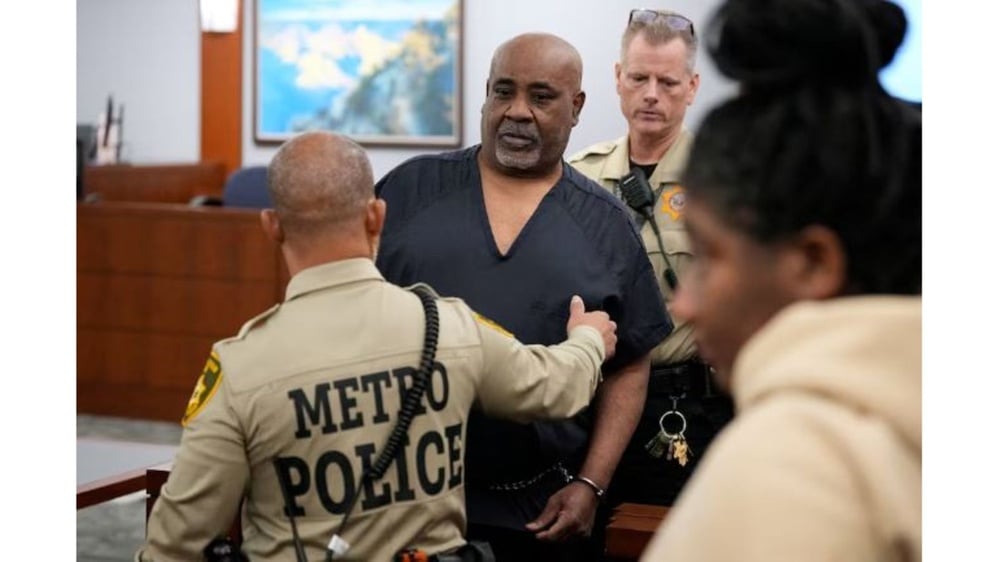
October 14, 2026 · 0 shares
Measured, attribution-heavy courtroom reporting whose only notable framing is conventional dramatizing color around a legendary unsolved killing.
Automated analysis; not human reviewed.
Limitations: The supplied text is a scrape with duplicated paragraphs, unrelated site headlines, and no byline; the only explicit date for 'Tuesday' is the photo caption's Oct. 13, 2026.
·
11 of 55 available dimensions scored; omitted dimensions are not treated as neutral.
·
Verified supporting quotes for 6 of 11 scored dimensions.
Claim: Sentencing, verdict, and case history are reported as attributed fact without editorial stance or first-person judgment.
“A former gang leader was sentenced to 40 years to life in prison on Tuesday for orchestrating the 1996 drive-by shooting death of hip-hop star Tupac Shakur” · exact text match
“the question of who pulled the trigger in the fatal shooting of the 25-year-old rap legend has never been conclusively decided” · exact text match
Why: Procedural facts are stated plainly and open questions are explicitly flagged rather than resolved editorially.
Claim: Only conventional feature-news color accompanies otherwise procedural courtroom reporting.
“during an hour-long proceeding in a Las Vegas courtroom” · exact text match
“one of America's most notorious cold cases” · not found in supplied text
Why: Matter-of-fact courtroom detail dominates; dramatization is limited to stock phrases like 'notorious cold cases'.
Claim: The item closes a nearly three-decade-old celebrity cold case with substantive narrative detail.
“one of America's most notorious cold cases” · not found in supplied text
“the only person ever charged in connection with Shakur's killing” · not found in supplied text
Why: A notorious unsolved killing, its sole prosecution, and the still-open gunman question give the story high inherent interest.
Claim: Evaluative language is confined to attributed courtroom remarks rather than the reporting voice.
“"You don't get to take a man from his family," Kierny said, referring to Shakur.” · not found in supplied text
“Addressing Davis on Tuesday, Kierny said his assertions that he had changed since the 1990s and moved on fell short.” · not found in supplied text
Why: The judge's admonitions are quoted and sourced; the report itself recommends nothing.
Claim: A few unattributed interpretive background claims accompany otherwise factual reporting.
“heightened the image of violence permeating 1990s hip-hop culture while stoking the infamous East Coast-West Coast "gangsta" rap feud of the era” · exact text match
“arguably more popular in death than in life” · exact text match
Why: Cultural-impact characterization is asserted as fact, though hedged ('arguably') and peripheral to the sentencing report.
Claim: Content is confined to criminal-justice proceedings and music-history context with no political actors or policy debate.
“sentenced to two consecutive terms of 20 years to life — one for murder, one for use of a deadly weapon” · exact text match
“stoking the infamous East Coast-West Coast "gangsta" rap feud of the era” · exact text match
Why: Nothing in the text touches parties, elections, policy, or ideological controversy.
Claim: Emotion enters only through attributed courtroom moments while the reporting voice stays flat.
“In a tearful victim-impact statement delivered in court on Tuesday” · not found in supplied text
“showed no emotion as he was sentenced to two consecutive terms of 20 years to life” · not found in supplied text
Why: The narrator describes tearful and emotional scenes descriptively without adopting an emotional register.
Claim: Central claims are sourced to court proceedings, prosecutors, and Davis's own recorded statements.
“according to an account Davis later gave police in an unrelated investigation and that prosecutors cited during his murder trial” · exact text match
“Authorities said they long believed Davis was involved in Shakur's killing but lacked sufficient evidence to charge him.” · exact text match
Why: Systematic attribution and explicit evidentiary limits mark strong visible sourcing discipline.
Claim: The shooting narrative is explicitly attributed to Davis's own statements rather than presented as independently established fact.
“according to an account Davis later gave police in an unrelated investigation and that prosecutors cited during his murder trial” · exact text match
“prosecutors have never named a suspected gunman” · exact text match
Why: Consistent attribution and explicit acknowledgment of the unresolved gunman question reflect evidence-bound reasoning.
Claim: The report presents the defense position, the defendant's own words, and exculpatory limits alongside the conviction.
“I'm good.
I'm going to appeal this case, for sure.”
· not found in supplied text
“While Davis was never accused of actually firing the shots that killed Shakur” · exact text match
Why: Including the vowed appeal and the never-accused-of-firing caveat signals even-handed handling of an adversarial case.
Claim: The report integrates verdict, sentence, motive, evidence base, and open questions into a coherent whole.
“formed the bulk of the prosecution's murder case” · verified after text normalization
“the question of who pulled the trigger in the fatal shooting of the 25-year-old rap legend has never been conclusively decided” · exact text match
Why: Dense, organized storytelling that separates established facts from attributed accounts and unresolved points.
The supplied text is a scrape with duplicated paragraphs, unrelated site headlines, and no byline; the only explicit date for 'Tuesday' is the photo caption's Oct. 13, 2026.
October 13, 2026 · 0 shares
Fact-bound, well-attributed courtroom reporting that nonetheless foregrounds emotive drama—featuring the judge's rebuke that 'Especially when that man is Tupac Shakur' and a vivid retelling of the killing—while preserving the defence's bravado objection and Combs's on-record denial.
A sentence of '40 years to life' is an indeterminate term under which parole eligibility begins only after the 40-year minimum, subject to parole board decision—needed to interpret the headline penalty.
Automated analysis; not human reviewed.
Limitations: The supplied text is a scrape mixing the main report with related-story blurbs and unrelated sidebar items; the verdict and sentencing years are never stated ('sentenced Tuesday', 'convicted... on 31 August'), and a photo caption's 'August 04, 2026' date for an 'upcoming trial' hearing is hard to reconcile, so exact dating cannot be verified from the text.
·
11 of 55 available dimensions scored; omitted dimensions are not treated as neutral.
·
Verified supporting quotes for 11 of 11 scored dimensions.
Claim: Key claims are consistently attributed to named speakers rather than asserted in the publisher's own voice.
“Prosecutors didn’t argue Davis pulled the trigger; rather, they said as a high-ranking member of the Southside Compton Crips, he orchestrated the shooting in retaliation” · exact text match
Why: The report carefully distinguishes the prosecution's theory from adjudicated fact, a hallmark of objective reporting.
Claim: The publisher adds vivid, dramatic narrative texture around the courtroom facts.
“The world of gangsters and rappers loomed large over the trial.” · exact text match
“Four bullets entered Shakur’s body, one obliterating his lung.” · exact text match
Why: Feature-style flourishes and graphic injury detail heighten drama beyond a dry court report, though the core stays factual.
Claim: The first-ever conviction in a three-decade celebrity murder case is high-interest material.
“He remains the only person ever charged in the death of Shakur, who was 25 and at the height of his career when his life ended.” · exact text match
Why: A 30-year unsolved-icon case ending in conviction, family testimony, and a celebrity murder-for-hire allegation gives the report broad narrative pull.
Claim: The publisher reports the conviction and sentence without editorializing about what should happen.
“Duane “Keffe D” Davis was sentenced Tuesday to 40 years to life in prison for orchestrating the murder of the iconic rap star.” · exact text match
Why: Evaluative and prescriptive language appears only inside attributed quotes from the judge and family, not in the publisher's voice.
Claim: The coverage emphasizes celebrity names and feud lore beyond the sentencing core.
“Another name that came up repeatedly was that of disgraced impresario Sean “Diddy” Combs.” · exact text match
Why: Highlighting the million-dollar allegation and hip-hop-feud figures adds tabloid-adjacent color, though it is attributed and denied on record.
Claim: The publisher's own narration is affect-neutral, with emotional weight carried by attributed quotes.
“Davis, a former leader of the Southside Compton Crips gang, was found guilty of first-degree murder on 31 August for plotting the 1996 killing of the rap mogul near the Las Vegas Strip.” · exact text match
Counterevidence:
““You don’t get to take his very life, his whole future from him, and just walk away from it. Especially when that man is Tupac Shakur,” the judge said.” · exact text match
Why: The narration states outcomes plainly; the emotive judicial rebuke is quoted and prominently placed, not endorsed in the publisher's voice.
Claim: The report systematically attributes claims and preserves denials and uncertainty.
“Prosecutors are relying largely on Davis' public accounts, memoir and secret meeting tapes.” · exact text match
“The defence says Davis' words were bravado and can’t be corroborated.” · exact text match
Why: Named sources, the defence position, and preserved denials support the trustworthiness of the supplied reporting.
Claim: The report lays out the central evidentiary dispute with both sides' positions rather than asserting a conclusion.
“Prosecutors are relying largely on Davis' public accounts, memoir and secret meeting tapes.
The defence says Davis' words were bravado and can’t be corroborated.”
· exact text match
Why: Presenting the prosecution's evidentiary basis alongside the defence's challenge is evidence-centered, reasoned reporting.
Claim: The text shows multiple human-newswriting markers and no strong AI signatures.
““Doesn’t it feel good, man, to get it off your chest?” one officer said.
Another joked Davis could write a book about it one day.”
· exact text match
“saying Combs agreed to pay him a million dollars to kill Shakur and Knight but stiffed him after Shakur’s death.” · exact text match
Why: Naturalistic quoted dialogue, idiomatic phrasing, and context-specific procedural detail are consistent with human reporting rather than AI-generated prose.
Claim: The report includes the defence's challenge and the on-record denial of an accused third party rather than only incriminating material.
“The defence says Davis' words were bravado and can’t be corroborated.” · exact text match
“Combs is serving time in prison on unrelated charges and denied the allegations in a statement to CNN” · exact text match
Why: Balancing the conviction narrative with the defence position and Combs's denial reflects fair, honest handling of an inflammatory allegation.
Claim: The report explains the legal mechanism that made Davis's own words admissible, adding analytic depth.
“That decision to write his book effectively negated his proffer agreement with police, prosecutors said, in which he agreed to give up information that couldn’t be used against him in exchange for a potentially lighter sentence for drug charges” · exact text match
Why: Connecting the memoir to the proffer agreement gives readers the key to why self-statements drove the case.
The supplied text is a scrape mixing the main report with related-story blurbs and unrelated sidebar items; the verdict and sentencing years are never stated ('sentenced Tuesday', 'convicted... on 31 August'), and a photo caption's 'August 04, 2026' date for an 'upcoming trial' hearing is hard to reconcile, so exact dating cannot be verified from the text.
October 14, 2026 · 0 shares
Measured, attribution-heavy wire reporting of the sentencing, with only mild dramatic color and sympathetic framing of the victim.
Automated analysis; not human reviewed.
Limitations: The supplied text bundles the AFP wire story with a pre-sentencing photo caption ("will be sentenced today"), related-story teasers, and site boilerplate, creating minor internal inconsistencies about timing; analysis focuses on the wire copy.
·
9 of 55 available dimensions scored; omitted dimensions are not treated as neutral.
·
Verified supporting quotes for 9 of 9 scored dimensions.
Claim: Reporting is predominantly factual and attributed, with only light editorial embellishment.
“was sentenced to a minimum 40 years in prison on Tuesday” · exact text match
“one of the most influential hip hop artists of the late 20th century” · exact text match
Why: Core facts are stated plainly while occasional evaluative phrases add mild subjectivity.
Claim: Dramatic subject matter is conveyed with conventional phrasing rather than inflation.
“formerly ran a branch of the feared Crips” · exact text match
“will likely see him die in custody” · exact text match
Why: A few loaded descriptors appear, but the boldest projection is hedged with 'likely'.
Claim: Resolution of a famously debated cold case gives the story broad appeal.
“one of America's most famous cold cases, prompting endless debate among music fans over who did it, and why” · exact text match
Why: A decades-late conviction in a high-profile killing is inherently compelling.
Claim: The report narrates events without advocating outcomes or policy.
“was sentenced to a minimum 40 years in prison on Tuesday” · exact text match
Why: Content is confined to events, quotes, and reactions; no prescriptions appear.
Claim: Isolated evaluative characterizations of Shakur appear amid otherwise factual reporting.
“quickly became the epitome of California hip hop” · exact text match
Why: This is the publisher's own superlative judgment, though conventional for the subject.
Claim: Named officials, precise dates, and hedged projections indicate strong sourcing practices.
“Judge Carli Kierny told Davis as she handed down the sentence in a Las Vegas courtroom” · exact text match
“will likely see him die in custody” · exact text match
Why: Named authorities, verifiable dates, and calibrated uncertainty support trustworthiness of the supplied text.
Claim: Claims are anchored to the trial, the judge's statements, and documented admissions without illogical leaps.
“A trial heard how Davis ordered the September 7, 1996 killing” · exact text match
“The name of that person has not been definitively revealed” · exact text match
Why: Attribution to the trial and explicit acknowledgment of unresolved facts reflect careful, reasoned reporting.
Claim: The report acknowledges uncertainty and includes the defendant's stance alongside the victim family's reaction.
“The name of that person has not been definitively revealed” · exact text match
“Davis offered no words of contrition ahead of the sentence being handed down, vowing only to appeal the guilty finding.” · exact text match
Why: Explicit uncertainty about the shooter and balanced inclusion of both sides signal honest practice.
Claim: A compact report efficiently combines sentencing, crime reconstruction, and reactions with specific dates.
“Davis handed the gun to someone sitting in the back seat of the Cadillac and ordered that person to shoot Shakur, who died six days later.” · exact text match
Why: Dense, specific detail is conveyed coherently in a very short space.
The supplied text bundles the AFP wire story with a pre-sentencing photo caption ("will be sentenced today"), related-story teasers, and site boilerplate, creating minor internal inconsistencies about timing; analysis focuses on the wire copy.
October 13, 2026 · 0 shares
Fact-bound, well-attributed courtroom reporting that nonetheless foregrounds emotive drama—featuring the judge's rebuke that 'Especially when that man is Tupac Shakur' and a vivid retelling of the killing—while preserving the defence's bravado objection and Combs's on-record denial.
A sentence of '40 years to life' is an indeterminate term under which parole eligibility begins only after the 40-year minimum, subject to parole board decision—needed to interpret the headline penalty.
Automated analysis; not human reviewed.
Limitations: The supplied text is a scrape mixing the main report with related-story blurbs and unrelated sidebar items; the verdict and sentencing years are never stated ('sentenced Tuesday', 'convicted... on 31 August'), and a photo caption's 'August 04, 2026' date for an 'upcoming trial' hearing is hard to reconcile, so exact dating cannot be verified from the text.
·
11 of 55 available dimensions scored; omitted dimensions are not treated as neutral.
·
Verified supporting quotes for 11 of 11 scored dimensions.
Claim: Key claims are consistently attributed to named speakers rather than asserted in the publisher's own voice.
“Prosecutors didn’t argue Davis pulled the trigger; rather, they said as a high-ranking member of the Southside Compton Crips, he orchestrated the shooting in retaliation” · exact text match
Why: The report carefully distinguishes the prosecution's theory from adjudicated fact, a hallmark of objective reporting.
Claim: The publisher adds vivid, dramatic narrative texture around the courtroom facts.
“The world of gangsters and rappers loomed large over the trial.” · exact text match
“Four bullets entered Shakur’s body, one obliterating his lung.” · exact text match
Why: Feature-style flourishes and graphic injury detail heighten drama beyond a dry court report, though the core stays factual.
Claim: The first-ever conviction in a three-decade celebrity murder case is high-interest material.
“He remains the only person ever charged in the death of Shakur, who was 25 and at the height of his career when his life ended.” · exact text match
Why: A 30-year unsolved-icon case ending in conviction, family testimony, and a celebrity murder-for-hire allegation gives the report broad narrative pull.
Claim: The publisher reports the conviction and sentence without editorializing about what should happen.
“Duane “Keffe D” Davis was sentenced Tuesday to 40 years to life in prison for orchestrating the murder of the iconic rap star.” · exact text match
Why: Evaluative and prescriptive language appears only inside attributed quotes from the judge and family, not in the publisher's voice.
Claim: The coverage emphasizes celebrity names and feud lore beyond the sentencing core.
“Another name that came up repeatedly was that of disgraced impresario Sean “Diddy” Combs.” · exact text match
Why: Highlighting the million-dollar allegation and hip-hop-feud figures adds tabloid-adjacent color, though it is attributed and denied on record.
Claim: The publisher's own narration is affect-neutral, with emotional weight carried by attributed quotes.
“Davis, a former leader of the Southside Compton Crips gang, was found guilty of first-degree murder on 31 August for plotting the 1996 killing of the rap mogul near the Las Vegas Strip.” · exact text match
Counterevidence:
““You don’t get to take his very life, his whole future from him, and just walk away from it. Especially when that man is Tupac Shakur,” the judge said.” · exact text match
Why: The narration states outcomes plainly; the emotive judicial rebuke is quoted and prominently placed, not endorsed in the publisher's voice.
Claim: The report systematically attributes claims and preserves denials and uncertainty.
“Prosecutors are relying largely on Davis' public accounts, memoir and secret meeting tapes.” · exact text match
“The defence says Davis' words were bravado and can’t be corroborated.” · exact text match
Why: Named sources, the defence position, and preserved denials support the trustworthiness of the supplied reporting.
Claim: The report lays out the central evidentiary dispute with both sides' positions rather than asserting a conclusion.
“Prosecutors are relying largely on Davis' public accounts, memoir and secret meeting tapes.
The defence says Davis' words were bravado and can’t be corroborated.”
· exact text match
Why: Presenting the prosecution's evidentiary basis alongside the defence's challenge is evidence-centered, reasoned reporting.
Claim: The text shows multiple human-newswriting markers and no strong AI signatures.
““Doesn’t it feel good, man, to get it off your chest?” one officer said.
Another joked Davis could write a book about it one day.”
· exact text match
“saying Combs agreed to pay him a million dollars to kill Shakur and Knight but stiffed him after Shakur’s death.” · exact text match
Why: Naturalistic quoted dialogue, idiomatic phrasing, and context-specific procedural detail are consistent with human reporting rather than AI-generated prose.
Claim: The report includes the defence's challenge and the on-record denial of an accused third party rather than only incriminating material.
“The defence says Davis' words were bravado and can’t be corroborated.” · exact text match
“Combs is serving time in prison on unrelated charges and denied the allegations in a statement to CNN” · exact text match
Why: Balancing the conviction narrative with the defence position and Combs's denial reflects fair, honest handling of an inflammatory allegation.
Claim: The report explains the legal mechanism that made Davis's own words admissible, adding analytic depth.
“That decision to write his book effectively negated his proffer agreement with police, prosecutors said, in which he agreed to give up information that couldn’t be used against him in exchange for a potentially lighter sentence for drug charges” · exact text match
Why: Connecting the memoir to the proffer agreement gives readers the key to why self-statements drove the case.
The supplied text is a scrape mixing the main report with related-story blurbs and unrelated sidebar items; the verdict and sentencing years are never stated ('sentenced Tuesday', 'convicted... on 31 August'), and a photo caption's 'August 04, 2026' date for an 'upcoming trial' hearing is hard to reconcile, so exact dating cannot be verified from the text.
October 13, 2026 · 0 shares
A terse, fact-bound sentencing report that presents the August conviction as settled fact without quotes, named sources, or evaluative framing.
Automated analysis; not human reviewed.
Limitations: The supplied text is a very short blurb with no quotes, named sources, or dates beyond 'August', limiting sourcing-depth and tone assessment; no crime/legal category is offered, so Entertainment is an approximation.
·
7 of 55 available dimensions scored; omitted dimensions are not treated as neutral.
·
Verified supporting quotes for 7 of 7 scored dimensions.
Claim: The sentencing and conviction are stated in plain factual language with no evaluative commentary.
“Duane (Keffe D) Davis has been sentenced to 40 years to life for orchestrating the murder of rapper Tupac Shakur in 1996.” · exact text match
Why: Terse court-outcome reporting with dates and charges and no opinion language supports objective framing.
Claim: The report avoids dramatization despite the high-profile subject.
“Duane Davis sentenced to 40 years to life for role in murder of Tupac.” · exact text match
Why: Headline and body state the outcome plainly, with no charged or dramatic wording.
Claim: The sentencing of the only person charged in Tupac Shakur's killing is a notable development in a decades-old famous case.
“He is the only person charged in the death of Shakur.” · exact text match
Why: Resolution of a long-prominent celebrity murder case gives the item broad public interest despite dry delivery.
Claim: The report purely describes the case outcome without recommendations or policy prescriptions.
“He is the only person charged in the death of Shakur.” · exact text match
Why: Every statement reports case facts; none advocate action or reform.
Claim: The report maintains a flat, unemotional tone about a violent crime.
“Duane (Keffe D) Davis has been sentenced to 40 years to life for orchestrating the murder of rapper Tupac Shakur in 1996.” · exact text match
Why: No loaded or emotive vocabulary appears; the outcome is stated neutrally.
Claim: The report gives specific, verifiable case details but cites no named sources, quotes, or documents.
“Davis, 63, was convicted of first-degree murder with the use of a deadly weapon in August.” · exact text match
Why: Concrete charge, age, and date support verifiability, but the absence of attribution limits demonstrated sourcing depth.
Claim: The report presents a concrete, checkable court outcome without speculation or unsupported inference.
“Davis, 63, was convicted of first-degree murder with the use of a deadly weapon in August.” · exact text match
Why: Fact-anchored statements about charge, age, and conviction date indicate mildly rational, evidence-based framing.
The supplied text is a very short blurb with no quotes, named sources, or dates beyond 'August', limiting sourcing-depth and tone assessment; no crime/legal category is offered, so Entertainment is an approximation.
October 13, 2026 · 0 shares
Fact-bound, well-attributed courtroom reporting that nonetheless foregrounds emotive drama—featuring the judge's rebuke that 'Especially when that man is Tupac Shakur' and a vivid retelling of the killing—while preserving the defence's bravado objection and Combs's on-record denial.
A sentence of '40 years to life' is an indeterminate term under which parole eligibility begins only after the 40-year minimum, subject to parole board decision—needed to interpret the headline penalty.
Automated analysis; not human reviewed.
Limitations: The supplied text is a scrape mixing the main report with related-story blurbs and unrelated sidebar items; the verdict and sentencing years are never stated ('sentenced Tuesday', 'convicted... on 31 August'), and a photo caption's 'August 04, 2026' date for an 'upcoming trial' hearing is hard to reconcile, so exact dating cannot be verified from the text.
·
11 of 55 available dimensions scored; omitted dimensions are not treated as neutral.
·
Verified supporting quotes for 11 of 11 scored dimensions.
Claim: Key claims are consistently attributed to named speakers rather than asserted in the publisher's own voice.
“Prosecutors didn’t argue Davis pulled the trigger; rather, they said as a high-ranking member of the Southside Compton Crips, he orchestrated the shooting in retaliation” · exact text match
Why: The report carefully distinguishes the prosecution's theory from adjudicated fact, a hallmark of objective reporting.
Claim: The publisher adds vivid, dramatic narrative texture around the courtroom facts.
“The world of gangsters and rappers loomed large over the trial.” · exact text match
“Four bullets entered Shakur’s body, one obliterating his lung.” · exact text match
Why: Feature-style flourishes and graphic injury detail heighten drama beyond a dry court report, though the core stays factual.
Claim: The first-ever conviction in a three-decade celebrity murder case is high-interest material.
“He remains the only person ever charged in the death of Shakur, who was 25 and at the height of his career when his life ended.” · exact text match
Why: A 30-year unsolved-icon case ending in conviction, family testimony, and a celebrity murder-for-hire allegation gives the report broad narrative pull.
Claim: The publisher reports the conviction and sentence without editorializing about what should happen.
“Duane “Keffe D” Davis was sentenced Tuesday to 40 years to life in prison for orchestrating the murder of the iconic rap star.” · exact text match
Why: Evaluative and prescriptive language appears only inside attributed quotes from the judge and family, not in the publisher's voice.
Claim: The coverage emphasizes celebrity names and feud lore beyond the sentencing core.
“Another name that came up repeatedly was that of disgraced impresario Sean “Diddy” Combs.” · exact text match
Why: Highlighting the million-dollar allegation and hip-hop-feud figures adds tabloid-adjacent color, though it is attributed and denied on record.
Claim: The publisher's own narration is affect-neutral, with emotional weight carried by attributed quotes.
“Davis, a former leader of the Southside Compton Crips gang, was found guilty of first-degree murder on 31 August for plotting the 1996 killing of the rap mogul near the Las Vegas Strip.” · exact text match
Counterevidence:
““You don’t get to take his very life, his whole future from him, and just walk away from it. Especially when that man is Tupac Shakur,” the judge said.” · exact text match
Why: The narration states outcomes plainly; the emotive judicial rebuke is quoted and prominently placed, not endorsed in the publisher's voice.
Claim: The report systematically attributes claims and preserves denials and uncertainty.
“Prosecutors are relying largely on Davis' public accounts, memoir and secret meeting tapes.” · exact text match
“The defence says Davis' words were bravado and can’t be corroborated.” · exact text match
Why: Named sources, the defence position, and preserved denials support the trustworthiness of the supplied reporting.
Claim: The report lays out the central evidentiary dispute with both sides' positions rather than asserting a conclusion.
“Prosecutors are relying largely on Davis' public accounts, memoir and secret meeting tapes.
The defence says Davis' words were bravado and can’t be corroborated.”
· exact text match
Why: Presenting the prosecution's evidentiary basis alongside the defence's challenge is evidence-centered, reasoned reporting.
Claim: The text shows multiple human-newswriting markers and no strong AI signatures.
““Doesn’t it feel good, man, to get it off your chest?” one officer said.
Another joked Davis could write a book about it one day.”
· exact text match
“saying Combs agreed to pay him a million dollars to kill Shakur and Knight but stiffed him after Shakur’s death.” · exact text match
Why: Naturalistic quoted dialogue, idiomatic phrasing, and context-specific procedural detail are consistent with human reporting rather than AI-generated prose.
Claim: The report includes the defence's challenge and the on-record denial of an accused third party rather than only incriminating material.
“The defence says Davis' words were bravado and can’t be corroborated.” · exact text match
“Combs is serving time in prison on unrelated charges and denied the allegations in a statement to CNN” · exact text match
Why: Balancing the conviction narrative with the defence position and Combs's denial reflects fair, honest handling of an inflammatory allegation.
Claim: The report explains the legal mechanism that made Davis's own words admissible, adding analytic depth.
“That decision to write his book effectively negated his proffer agreement with police, prosecutors said, in which he agreed to give up information that couldn’t be used against him in exchange for a potentially lighter sentence for drug charges” · exact text match
Why: Connecting the memoir to the proffer agreement gives readers the key to why self-statements drove the case.
The supplied text is a scrape mixing the main report with related-story blurbs and unrelated sidebar items; the verdict and sentencing years are never stated ('sentenced Tuesday', 'convicted... on 31 August'), and a photo caption's 'August 04, 2026' date for an 'upcoming trial' hearing is hard to reconcile, so exact dating cannot be verified from the text.
October 13, 2026 · 0 shares
Plain factual courtroom reporting that nonetheless adopts the jury verdict as settled by headlining Davis as 'Tupac Shakur murderer,' while attributing all contested characterizations to prosecutors, the defense, family members, and the judge and noting his planned appeal.
Automated analysis; not human reviewed.
Limitations: The supplied text duplicates overlapping passages and truncates mid-sentence ('In exchange say dem go block any crimina'), provides no publication date or byline, and gives the sentencing date only as 'Tuesday', so some details rest on repeated fragments.
·
9 of 55 available dimensions scored; omitted dimensions are not treated as neutral.
·
Verified supporting quotes for 9 of 9 scored dimensions.
Claim: Contested claims are attributed to prosecutors, the defense, the family, and the court rather than asserted by the publisher.
“Prosecutors argue say although Davis no fire di gun imsef, na im be di ringleader of di group wey commit di murder.” · exact text match
“Throughout di trial, Davis defence team try to persuade jurors say im comments na fiction” · exact text match
Why: Both sides' positions are reported with attribution, supporting an objective classification; the headline's settled 'murderer' label keeps it from being fully neutral.
Claim: The headline and lede report the sentence in plain factual terms without lurid or dramatic language.
“Ex-gang boss wey plan Tupac Shakur murder chop 40 years prison sentence” · exact text match
Why: The framing states the outcome and its basis directly; emotional color appears only in quoted courtroom statements.
Claim: The story's interest rests on the first conviction in a roughly 30-year-old iconic cold case.
“Davis conviction na di first in a cold case wey hip-hop fans don chook eye for nearly 30 years.” · exact text match
Why: Closure of one of America's most famous cold cases involving a globally influential rapper is a high-interest development.
Claim: The report describes proceedings and outcomes without prescribing outcomes or actions.
“Former gang boss Duane "Keffe D" Davis don chop at least 40 years in prison say e order di murder of Tupac Shakur.” · exact text match
Why: Sentencing requests and moral judgments appear only inside attributed quotes from family and the judge; the narrative voice stays descriptive.
Claim: Emotionally charged language is confined to attributed courtroom statements while the publisher's own prose stays factual.
“Sekyiwa Shakur, tell di court: "Di loss of Tupac, for a long time, cripple my family."” · exact text match
Why: Grief and condemnation appear only in quotes from family and the judge, leaving the narrative voice measured and supporting neutrality (0).
Claim: Named sources, quotes, and an explicit evidentiary basis support the report's trustworthiness within the supplied text.
“Prosecutor Marc DiGiacomo argue during Tuesday sentencing hearing say Davis spend years dey publicly brag about im role for di Shakur death” · exact text match
“Di key evidence for di case na Davis own words” · exact text match
Why: Specific attribution to a named prosecutor and a stated key-evidence basis give the report visible sourcing and verifiable anchors.
Claim: The report grounds the outcome in a stated evidentiary chain rather than bare assertion.
“Di key evidence for di case na Davis own words, wia e repeatedly and publicly acknowledge say e bin dey inside di white Cadillac from wia di deadly shots bin dey fired.” · exact text match
Why: It identifies the key evidence and explains the legal mechanism (the invalidated immunity agreement) logically, indicating reason-based reporting.
Claim: The report preserves the defendant's position, including his appeal plan and his defense's fabrication argument, alongside prosecution claims.
“E say e go appeal di verdict.” · exact text match
“Throughout di trial, Davis defence team try to persuade jurors say im comments na fiction” · exact text match
Why: Including the defense narrative and appellate context beside conviction details is a fairness and honesty signal rather than one-sided advocacy.
Claim: The report concisely explains the complex procedural path from immunity deal to trial evidence.
“Protective agreement wey im bin establish wit authorities bin make am impossible to file criminal charge, but di book and interviews wey im do on im role for Shakur killing make dat agreement invalid.” · exact text match
Why: The legal mechanism that enabled prosecution is explained in one coherent, ordered passage, showing above-average clarity and informational density.
The supplied text duplicates overlapping passages and truncates mid-sentence ('In exchange say dem go block any crimina'), provides no publication date or byline, and gives the sentencing date only as 'Tuesday', so some details rest on repeated fragments.
October 14, 2026 · 0 shares
Restrained, heavily attributed court reporting that states the conviction and sentence as fact while routing all contested characterizations — grandstanding, bravado, family grief, judicial condemnation — through named speakers.
Automated analysis; not human reviewed.
Limitations: The supplied text is a fragmented scrape with no byline or explicitly named publisher; trailing unrelated headlines and a truncated copyright line were excluded as page chrome, leaving the publisher inferable only from the 'World Service's Newsday programme' reference.
·
9 of 55 available dimensions scored; omitted dimensions are not treated as neutral.
·
Verified supporting quotes for 7 of 9 scored dimensions.
Claim: The narrative is built from dated, sourced court facts and attributed quotes with essentially no editorial voice.
“A jury found Davis, 63, guilty in September of one count of murder with a deadly weapon for the rap superstar's death in a drive-by shooting in Las Vegas on 7 September 1996.” · exact text match
Why: Specific, verifiable procedural facts dominate; characterizations come from named speakers rather than the publisher.
Claim: Dramatic material is delivered through restrained procedural detail and attributed courtroom statements.
“Davis was asked by Judge Carli Kierny if he had anything to say, to which he replied: "I'm good.
I'm gonna appeal this case for sure."”
· not found in supplied text
“Shakur's sister, Sekyiwa Shakur, told the court:” · not found in supplied text
Why: The publisher's prose stays flat while grief and condemnation appear only inside quotes, avoiding embellishment.
Claim: The central development is the first conviction in a nearly 30-year-old iconic cold case.
“Davis' conviction was the first in a cold case that has intrigued hip-hop fans for nearly 30 years.” · exact text match
Why: A landmark resolution to one of America's most famous unsolved killings carries broad, sustained public interest.
Claim: Sentencing arguments and family requests are reported as courtroom events without endorsement or recommendation.
“Prosecutor Marc DiGiacomo argued during Tuesday's sentencing hearing that Davis spent years "publicly grandstanding"” · not found in supplied text
“Sekyiwa Shakur asked the judge to give Davis the maximum sentence” · exact text match
Why: Advocacy by participants is attributed, and the report itself advances no position on punishment or policy.
Claim: The publisher's voice remains unemotional, with grief and condemnation confined to quoted speakers.
“He admitted in his memoir that he had provided the gun used in the crime.” · exact text match
Why: Even grave assertions are stated in flat factual prose; emotional content appears only within attributed quotes.
Claim: Central claims rest on named officials, dated evidence, and an independent journalist source.
“In exchange for being shielded from criminal prosecution, he told authorities about his role in Shakur's death during a secret 2008 police interview” · exact text match
“commented Cathy Scott, a journalist who first covered the murder of Shakur in the 1990s” · exact text match
Why: Specific names, dates, and source identities make the account checkable rather than anonymous.
Claim: Opposing prosecution and defence theories are presented with attribution and a clear evidentiary chain.
“Prosecutors argued that although Davis did not fire the gun himself, he was the ringleader of the group that committed the murder.” · exact text match
“Throughout the trial, Davis' defence team tried to persuade jurors that his comments were fiction - bravado and exaggeration intended to sell books and make money.” · exact text match
Why: Incriminating and exculpatory accounts are reported side by side with the reasoning behind each, rather than asserted by the publisher.
Claim: The report retains the defence's counterargument and a co-accused's denial despite reporting a conviction.
“Throughout the trial, Davis' defence team tried to persuade jurors that his comments were fiction - bravado and exaggeration intended to sell books and make money.” · exact text match
“Anderson died in an unrelated shooting in 1998, having denied involvement in the killing of Shakur.” · exact text match
Why: Including exculpatory contentions alongside the guilty verdict is an observable fairness signal.
Claim: The report concisely explains the procedural link between Davis's immunity deal, memoir, and prosecution.
“But the book and interviews he offered elaborating on his role in Shakur's killing voided a protective agreement he had established with authorities that had blocked any criminal charges from being filed.” · exact text match
Why: The pivotal legal mechanism connecting the protective agreement, the memoir, and the trial is explained clearly and economically.
The supplied text is a fragmented scrape with no byline or explicitly named publisher; trailing unrelated headlines and a truncated copyright line were excluded as page chrome, leaving the publisher inferable only from the 'World Service's Newsday programme' reference.
October 14, 2026 · 0 shares
Measured, attribution-heavy courtroom reporting whose only notable framing is conventional dramatizing color around a legendary unsolved killing.
Automated analysis; not human reviewed.
Limitations: The supplied text is a scrape with duplicated paragraphs, unrelated site headlines, and no byline; the only explicit date for 'Tuesday' is the photo caption's Oct. 13, 2026.
·
11 of 55 available dimensions scored; omitted dimensions are not treated as neutral.
·
Verified supporting quotes for 6 of 11 scored dimensions.
Claim: Sentencing, verdict, and case history are reported as attributed fact without editorial stance or first-person judgment.
“A former gang leader was sentenced to 40 years to life in prison on Tuesday for orchestrating the 1996 drive-by shooting death of hip-hop star Tupac Shakur” · exact text match
“the question of who pulled the trigger in the fatal shooting of the 25-year-old rap legend has never been conclusively decided” · exact text match
Why: Procedural facts are stated plainly and open questions are explicitly flagged rather than resolved editorially.
Claim: Only conventional feature-news color accompanies otherwise procedural courtroom reporting.
“during an hour-long proceeding in a Las Vegas courtroom” · exact text match
“one of America's most notorious cold cases” · not found in supplied text
Why: Matter-of-fact courtroom detail dominates; dramatization is limited to stock phrases like 'notorious cold cases'.
Claim: The item closes a nearly three-decade-old celebrity cold case with substantive narrative detail.
“one of America's most notorious cold cases” · not found in supplied text
“the only person ever charged in connection with Shakur's killing” · not found in supplied text
Why: A notorious unsolved killing, its sole prosecution, and the still-open gunman question give the story high inherent interest.
Claim: Evaluative language is confined to attributed courtroom remarks rather than the reporting voice.
“"You don't get to take a man from his family," Kierny said, referring to Shakur.” · not found in supplied text
“Addressing Davis on Tuesday, Kierny said his assertions that he had changed since the 1990s and moved on fell short.” · not found in supplied text
Why: The judge's admonitions are quoted and sourced; the report itself recommends nothing.
Claim: A few unattributed interpretive background claims accompany otherwise factual reporting.
“heightened the image of violence permeating 1990s hip-hop culture while stoking the infamous East Coast-West Coast "gangsta" rap feud of the era” · exact text match
“arguably more popular in death than in life” · exact text match
Why: Cultural-impact characterization is asserted as fact, though hedged ('arguably') and peripheral to the sentencing report.
Claim: Content is confined to criminal-justice proceedings and music-history context with no political actors or policy debate.
“sentenced to two consecutive terms of 20 years to life — one for murder, one for use of a deadly weapon” · exact text match
“stoking the infamous East Coast-West Coast "gangsta" rap feud of the era” · exact text match
Why: Nothing in the text touches parties, elections, policy, or ideological controversy.
Claim: Emotion enters only through attributed courtroom moments while the reporting voice stays flat.
“In a tearful victim-impact statement delivered in court on Tuesday” · not found in supplied text
“showed no emotion as he was sentenced to two consecutive terms of 20 years to life” · not found in supplied text
Why: The narrator describes tearful and emotional scenes descriptively without adopting an emotional register.
Claim: Central claims are sourced to court proceedings, prosecutors, and Davis's own recorded statements.
“according to an account Davis later gave police in an unrelated investigation and that prosecutors cited during his murder trial” · exact text match
“Authorities said they long believed Davis was involved in Shakur's killing but lacked sufficient evidence to charge him.” · exact text match
Why: Systematic attribution and explicit evidentiary limits mark strong visible sourcing discipline.
Claim: The shooting narrative is explicitly attributed to Davis's own statements rather than presented as independently established fact.
“according to an account Davis later gave police in an unrelated investigation and that prosecutors cited during his murder trial” · exact text match
“prosecutors have never named a suspected gunman” · exact text match
Why: Consistent attribution and explicit acknowledgment of the unresolved gunman question reflect evidence-bound reasoning.
Claim: The report presents the defense position, the defendant's own words, and exculpatory limits alongside the conviction.
“I'm good.
I'm going to appeal this case, for sure.”
· not found in supplied text
“While Davis was never accused of actually firing the shots that killed Shakur” · exact text match
Why: Including the vowed appeal and the never-accused-of-firing caveat signals even-handed handling of an adversarial case.
Claim: The report integrates verdict, sentence, motive, evidence base, and open questions into a coherent whole.
“formed the bulk of the prosecution's murder case” · verified after text normalization
“the question of who pulled the trigger in the fatal shooting of the 25-year-old rap legend has never been conclusively decided” · exact text match
Why: Dense, organized storytelling that separates established facts from attributed accounts and unresolved points.
The supplied text is a scrape with duplicated paragraphs, unrelated site headlines, and no byline; the only explicit date for 'Tuesday' is the photo caption's Oct. 13, 2026.
October 14, 2026 · 0 shares
Restrained, heavily attributed court reporting that states the conviction and sentence as fact while routing all contested characterizations — grandstanding, bravado, family grief, judicial condemnation — through named speakers.
Automated analysis; not human reviewed.
Limitations: The supplied text is a fragmented scrape with no byline or explicitly named publisher; trailing unrelated headlines and a truncated copyright line were excluded as page chrome, leaving the publisher inferable only from the 'World Service's Newsday programme' reference.
·
9 of 55 available dimensions scored; omitted dimensions are not treated as neutral.
·
Verified supporting quotes for 7 of 9 scored dimensions.
Claim: The narrative is built from dated, sourced court facts and attributed quotes with essentially no editorial voice.
“A jury found Davis, 63, guilty in September of one count of murder with a deadly weapon for the rap superstar's death in a drive-by shooting in Las Vegas on 7 September 1996.” · exact text match
Why: Specific, verifiable procedural facts dominate; characterizations come from named speakers rather than the publisher.
Claim: Dramatic material is delivered through restrained procedural detail and attributed courtroom statements.
“Davis was asked by Judge Carli Kierny if he had anything to say, to which he replied: "I'm good.
I'm gonna appeal this case for sure."”
· not found in supplied text
“Shakur's sister, Sekyiwa Shakur, told the court:” · not found in supplied text
Why: The publisher's prose stays flat while grief and condemnation appear only inside quotes, avoiding embellishment.
Claim: The central development is the first conviction in a nearly 30-year-old iconic cold case.
“Davis' conviction was the first in a cold case that has intrigued hip-hop fans for nearly 30 years.” · exact text match
Why: A landmark resolution to one of America's most famous unsolved killings carries broad, sustained public interest.
Claim: Sentencing arguments and family requests are reported as courtroom events without endorsement or recommendation.
“Prosecutor Marc DiGiacomo argued during Tuesday's sentencing hearing that Davis spent years "publicly grandstanding"” · not found in supplied text
“Sekyiwa Shakur asked the judge to give Davis the maximum sentence” · exact text match
Why: Advocacy by participants is attributed, and the report itself advances no position on punishment or policy.
Claim: The publisher's voice remains unemotional, with grief and condemnation confined to quoted speakers.
“He admitted in his memoir that he had provided the gun used in the crime.” · exact text match
Why: Even grave assertions are stated in flat factual prose; emotional content appears only within attributed quotes.
Claim: Central claims rest on named officials, dated evidence, and an independent journalist source.
“In exchange for being shielded from criminal prosecution, he told authorities about his role in Shakur's death during a secret 2008 police interview” · exact text match
“commented Cathy Scott, a journalist who first covered the murder of Shakur in the 1990s” · exact text match
Why: Specific names, dates, and source identities make the account checkable rather than anonymous.
Claim: Opposing prosecution and defence theories are presented with attribution and a clear evidentiary chain.
“Prosecutors argued that although Davis did not fire the gun himself, he was the ringleader of the group that committed the murder.” · exact text match
“Throughout the trial, Davis' defence team tried to persuade jurors that his comments were fiction - bravado and exaggeration intended to sell books and make money.” · exact text match
Why: Incriminating and exculpatory accounts are reported side by side with the reasoning behind each, rather than asserted by the publisher.
Claim: The report retains the defence's counterargument and a co-accused's denial despite reporting a conviction.
“Throughout the trial, Davis' defence team tried to persuade jurors that his comments were fiction - bravado and exaggeration intended to sell books and make money.” · exact text match
“Anderson died in an unrelated shooting in 1998, having denied involvement in the killing of Shakur.” · exact text match
Why: Including exculpatory contentions alongside the guilty verdict is an observable fairness signal.
Claim: The report concisely explains the procedural link between Davis's immunity deal, memoir, and prosecution.
“But the book and interviews he offered elaborating on his role in Shakur's killing voided a protective agreement he had established with authorities that had blocked any criminal charges from being filed.” · exact text match
Why: The pivotal legal mechanism connecting the protective agreement, the memoir, and the trial is explained clearly and economically.
The supplied text is a fragmented scrape with no byline or explicitly named publisher; trailing unrelated headlines and a truncated copyright line were excluded as page chrome, leaving the publisher inferable only from the 'World Service's Newsday programme' reference.
October 13, 2026 · 0 shares
Plain factual courtroom reporting that nonetheless adopts the jury verdict as settled by headlining Davis as 'Tupac Shakur murderer,' while attributing all contested characterizations to prosecutors, the defense, family members, and the judge and noting his planned appeal.
Automated analysis; not human reviewed.
Limitations: The supplied text duplicates overlapping passages and truncates mid-sentence ('In exchange say dem go block any crimina'), provides no publication date or byline, and gives the sentencing date only as 'Tuesday', so some details rest on repeated fragments.
·
9 of 55 available dimensions scored; omitted dimensions are not treated as neutral.
·
Verified supporting quotes for 9 of 9 scored dimensions.
Claim: Contested claims are attributed to prosecutors, the defense, the family, and the court rather than asserted by the publisher.
“Prosecutors argue say although Davis no fire di gun imsef, na im be di ringleader of di group wey commit di murder.” · exact text match
“Throughout di trial, Davis defence team try to persuade jurors say im comments na fiction” · exact text match
Why: Both sides' positions are reported with attribution, supporting an objective classification; the headline's settled 'murderer' label keeps it from being fully neutral.
Claim: The headline and lede report the sentence in plain factual terms without lurid or dramatic language.
“Ex-gang boss wey plan Tupac Shakur murder chop 40 years prison sentence” · exact text match
Why: The framing states the outcome and its basis directly; emotional color appears only in quoted courtroom statements.
Claim: The story's interest rests on the first conviction in a roughly 30-year-old iconic cold case.
“Davis conviction na di first in a cold case wey hip-hop fans don chook eye for nearly 30 years.” · exact text match
Why: Closure of one of America's most famous cold cases involving a globally influential rapper is a high-interest development.
Claim: The report describes proceedings and outcomes without prescribing outcomes or actions.
“Former gang boss Duane "Keffe D" Davis don chop at least 40 years in prison say e order di murder of Tupac Shakur.” · exact text match
Why: Sentencing requests and moral judgments appear only inside attributed quotes from family and the judge; the narrative voice stays descriptive.
Claim: Emotionally charged language is confined to attributed courtroom statements while the publisher's own prose stays factual.
“Sekyiwa Shakur, tell di court: "Di loss of Tupac, for a long time, cripple my family."” · exact text match
Why: Grief and condemnation appear only in quotes from family and the judge, leaving the narrative voice measured and supporting neutrality (0).
Claim: Named sources, quotes, and an explicit evidentiary basis support the report's trustworthiness within the supplied text.
“Prosecutor Marc DiGiacomo argue during Tuesday sentencing hearing say Davis spend years dey publicly brag about im role for di Shakur death” · exact text match
“Di key evidence for di case na Davis own words” · exact text match
Why: Specific attribution to a named prosecutor and a stated key-evidence basis give the report visible sourcing and verifiable anchors.
Claim: The report grounds the outcome in a stated evidentiary chain rather than bare assertion.
“Di key evidence for di case na Davis own words, wia e repeatedly and publicly acknowledge say e bin dey inside di white Cadillac from wia di deadly shots bin dey fired.” · exact text match
Why: It identifies the key evidence and explains the legal mechanism (the invalidated immunity agreement) logically, indicating reason-based reporting.
Claim: The report preserves the defendant's position, including his appeal plan and his defense's fabrication argument, alongside prosecution claims.
“E say e go appeal di verdict.” · exact text match
“Throughout di trial, Davis defence team try to persuade jurors say im comments na fiction” · exact text match
Why: Including the defense narrative and appellate context beside conviction details is a fairness and honesty signal rather than one-sided advocacy.
Claim: The report concisely explains the complex procedural path from immunity deal to trial evidence.
“Protective agreement wey im bin establish wit authorities bin make am impossible to file criminal charge, but di book and interviews wey im do on im role for Shakur killing make dat agreement invalid.” · exact text match
Why: The legal mechanism that enabled prosecution is explained in one coherent, ordered passage, showing above-average clarity and informational density.
The supplied text duplicates overlapping passages and truncates mid-sentence ('In exchange say dem go block any crimina'), provides no publication date or byline, and gives the sentencing date only as 'Tuesday', so some details rest on repeated fragments.
October 14, 2026 · 0 shares
Measured, attribution-heavy courtroom reporting whose only notable framing is conventional dramatizing color around a legendary unsolved killing.
Automated analysis; not human reviewed.
Limitations: The supplied text is a scrape with duplicated paragraphs, unrelated site headlines, and no byline; the only explicit date for 'Tuesday' is the photo caption's Oct. 13, 2026.
·
11 of 55 available dimensions scored; omitted dimensions are not treated as neutral.
·
Verified supporting quotes for 6 of 11 scored dimensions.
Claim: Sentencing, verdict, and case history are reported as attributed fact without editorial stance or first-person judgment.
“A former gang leader was sentenced to 40 years to life in prison on Tuesday for orchestrating the 1996 drive-by shooting death of hip-hop star Tupac Shakur” · exact text match
“the question of who pulled the trigger in the fatal shooting of the 25-year-old rap legend has never been conclusively decided” · exact text match
Why: Procedural facts are stated plainly and open questions are explicitly flagged rather than resolved editorially.
Claim: Only conventional feature-news color accompanies otherwise procedural courtroom reporting.
“during an hour-long proceeding in a Las Vegas courtroom” · exact text match
“one of America's most notorious cold cases” · not found in supplied text
Why: Matter-of-fact courtroom detail dominates; dramatization is limited to stock phrases like 'notorious cold cases'.
Claim: The item closes a nearly three-decade-old celebrity cold case with substantive narrative detail.
“one of America's most notorious cold cases” · not found in supplied text
“the only person ever charged in connection with Shakur's killing” · not found in supplied text
Why: A notorious unsolved killing, its sole prosecution, and the still-open gunman question give the story high inherent interest.
Claim: Evaluative language is confined to attributed courtroom remarks rather than the reporting voice.
“"You don't get to take a man from his family," Kierny said, referring to Shakur.” · not found in supplied text
“Addressing Davis on Tuesday, Kierny said his assertions that he had changed since the 1990s and moved on fell short.” · not found in supplied text
Why: The judge's admonitions are quoted and sourced; the report itself recommends nothing.
Claim: A few unattributed interpretive background claims accompany otherwise factual reporting.
“heightened the image of violence permeating 1990s hip-hop culture while stoking the infamous East Coast-West Coast "gangsta" rap feud of the era” · exact text match
“arguably more popular in death than in life” · exact text match
Why: Cultural-impact characterization is asserted as fact, though hedged ('arguably') and peripheral to the sentencing report.
Claim: Content is confined to criminal-justice proceedings and music-history context with no political actors or policy debate.
“sentenced to two consecutive terms of 20 years to life — one for murder, one for use of a deadly weapon” · exact text match
“stoking the infamous East Coast-West Coast "gangsta" rap feud of the era” · exact text match
Why: Nothing in the text touches parties, elections, policy, or ideological controversy.
Claim: Emotion enters only through attributed courtroom moments while the reporting voice stays flat.
“In a tearful victim-impact statement delivered in court on Tuesday” · not found in supplied text
“showed no emotion as he was sentenced to two consecutive terms of 20 years to life” · not found in supplied text
Why: The narrator describes tearful and emotional scenes descriptively without adopting an emotional register.
Claim: Central claims are sourced to court proceedings, prosecutors, and Davis's own recorded statements.
“according to an account Davis later gave police in an unrelated investigation and that prosecutors cited during his murder trial” · exact text match
“Authorities said they long believed Davis was involved in Shakur's killing but lacked sufficient evidence to charge him.” · exact text match
Why: Systematic attribution and explicit evidentiary limits mark strong visible sourcing discipline.
Claim: The shooting narrative is explicitly attributed to Davis's own statements rather than presented as independently established fact.
“according to an account Davis later gave police in an unrelated investigation and that prosecutors cited during his murder trial” · exact text match
“prosecutors have never named a suspected gunman” · exact text match
Why: Consistent attribution and explicit acknowledgment of the unresolved gunman question reflect evidence-bound reasoning.
Claim: The report presents the defense position, the defendant's own words, and exculpatory limits alongside the conviction.
“I'm good.
I'm going to appeal this case, for sure.”
· not found in supplied text
“While Davis was never accused of actually firing the shots that killed Shakur” · exact text match
Why: Including the vowed appeal and the never-accused-of-firing caveat signals even-handed handling of an adversarial case.
Claim: The report integrates verdict, sentence, motive, evidence base, and open questions into a coherent whole.
“formed the bulk of the prosecution's murder case” · verified after text normalization
“the question of who pulled the trigger in the fatal shooting of the 25-year-old rap legend has never been conclusively decided” · exact text match
Why: Dense, organized storytelling that separates established facts from attributed accounts and unresolved points.
The supplied text is a scrape with duplicated paragraphs, unrelated site headlines, and no byline; the only explicit date for 'Tuesday' is the photo caption's Oct. 13, 2026.
October 13, 2026 · 0 shares
Balanced, attribution-heavy wire-style court reporting that gives prosecution and defense claims comparable weight, with only mild celebrity-crime coloration in the background framing.
Automated analysis; not human reviewed.
Limitations: No author byline is present (only a note that The Associated Press contributed), and the outlet is identifiable only from excluded page chrome, so publisher attribution is uncertain.
·
9 of 55 available dimensions scored; omitted dimensions are not treated as neutral.
·
Verified supporting quotes for 9 of 9 scored dimensions.
Claim: Contested claims are consistently attributed to prosecution, defense, or officials rather than asserted as the publisher's own.
“But Michael Sanft, an attorney for Davis, argued that no evidence beyond his client's statements had placed him in Las Vegas on the night that Shakur was shot.” · exact text match
“prosecutors said at the time that the state would dismiss the gang-related portion of his charge” · exact text match
Why: Both sides' assertions are framed as statements by named parties, the hallmark of objective rather than subjective reporting.
Claim: Core coverage is factual court reporting with only mild celebrity-case coloration in background framing.
“his death is among the most notorious celebrity deaths in modern history” · exact text match
Why: Superlative celebrity framing is confined to one background sentence while sentencing facts are reported plainly, indicating a mostly objective tone.
Claim: The sentencing resolves a decades-old, high-profile celebrity homicide that long went uncharged.
“The mystery of who may have fired the shots persisted for years” · exact text match
Why: A near-30-year-old notorious unsolved-case arc culminating in conviction and sentencing is a compelling news development.
Claim: The report confines itself to describing events and statements without advocating outcomes or actions.
“A judge in Las Vegas, Nevada, sentenced Duane "Keffe D" Davis to 40 years to life in prison on Tuesday for the 1996 murder of rapper Tupac Shakur.” · exact text match
Why: The text reports the sentencing and the parties' statements with no prescriptions, recommendations, or calls to action.
Claim: The publisher's own prose is unemotional; emotive language appears only inside an attributed official quote.
“"Today, justice has been served for Tupac Shakur and his loved ones," Clark County District Attorney Steve Wolfson said in a statement.” · exact text match
Why: Emotionally charged closure language is confined to a quoted source, keeping the report's own tone measured and neutral.
Claim: The report cites named officials, specific dates, and wire contribution, with contested claims attributed.
“Judge Carli Kierny said he would receive credit for time already served.” · exact text match
“Davis, 63, was convicted in August of murder with a deadly weapon with the intent to promote, further or assist a criminal gang” · exact text match
Why: Specific names, dates, convictions, and attribution to officials and wire service support visible sourcing and verification practices.
Claim: The report presents a coherent evidentiary dispute between the absence of physical records and the consistency of Davis's self-incriminating accounts.
“Surveillance footage, phone logs or other tangible records weren't available, he told the jury.” · exact text match
Why: The framing lays out evidence-based reasoning from both sides rather than relying on assertion or speculation.
Claim: The report includes the defense's strongest challenge and acknowledges weaknesses in the prosecution's evidentiary basis.
“But Michael Sanft, an attorney for Davis, argued that no evidence beyond his client's statements had placed him in Las Vegas on the night that Shakur was shot.” · exact text match
“Palal recognized during Davis' trial that the defendant had changed his accounts somewhat” · exact text match
Why: Presenting the defense's central argument alongside the prosecutor's concession of inconsistent accounts signals fair, honest handling of an uneven evidentiary record.
Claim: The report efficiently integrates procedural outcome, motive theory, evidentiary dispute, and case history in compact form.
“But he told the jury that fundamental details of his story remained consistent, including the fact that Davis described himself as being inside a white Cadillac, from which the gunshots that killed Shakur emanated.” · exact text match
Why: The writing condenses a complex evidentiary narrative accurately within a short wire-style report.
No author byline is present (only a note that The Associated Press contributed), and the outlet is identifiable only from excluded page chrome, so publisher attribution is uncertain.
October 14, 2026 · 0 shares
Measured, attribution-heavy courtroom reporting whose only notable framing is conventional dramatizing color around a legendary unsolved killing.
Automated analysis; not human reviewed. Limitations: The supplied text is a scrape with duplicated paragraphs, unrelated site headlines, and no byline; the only explicit date for 'Tuesday' is the photo caption's Oct. 13, 2026. · 11 of 55 available dimensions scored; omitted dimensions are not treated as neutral. · Verified supporting quotes for 6 of 11 scored dimensions.
Claim: Sentencing, verdict, and case history are reported as attributed fact without editorial stance or first-person judgment.
“A former gang leader was sentenced to 40 years to life in prison on Tuesday for orchestrating the 1996 drive-by shooting death of hip-hop star Tupac Shakur” · exact text match
“the question of who pulled the trigger in the fatal shooting of the 25-year-old rap legend has never been conclusively decided” · exact text match
Why: Procedural facts are stated plainly and open questions are explicitly flagged rather than resolved editorially.
Claim: Only conventional feature-news color accompanies otherwise procedural courtroom reporting.
“during an hour-long proceeding in a Las Vegas courtroom” · exact text match
“one of America's most notorious cold cases” · not found in supplied text
Why: Matter-of-fact courtroom detail dominates; dramatization is limited to stock phrases like 'notorious cold cases'.
Claim: The item closes a nearly three-decade-old celebrity cold case with substantive narrative detail.
“one of America's most notorious cold cases” · not found in supplied text
“the only person ever charged in connection with Shakur's killing” · not found in supplied text
Why: A notorious unsolved killing, its sole prosecution, and the still-open gunman question give the story high inherent interest.
Claim: Evaluative language is confined to attributed courtroom remarks rather than the reporting voice.
“"You don't get to take a man from his family," Kierny said, referring to Shakur.” · not found in supplied text
“Addressing Davis on Tuesday, Kierny said his assertions that he had changed since the 1990s and moved on fell short.” · not found in supplied text
Why: The judge's admonitions are quoted and sourced; the report itself recommends nothing.
Claim: A few unattributed interpretive background claims accompany otherwise factual reporting.
“heightened the image of violence permeating 1990s hip-hop culture while stoking the infamous East Coast-West Coast "gangsta" rap feud of the era” · exact text match
“arguably more popular in death than in life” · exact text match
Why: Cultural-impact characterization is asserted as fact, though hedged ('arguably') and peripheral to the sentencing report.
Claim: Content is confined to criminal-justice proceedings and music-history context with no political actors or policy debate.
“sentenced to two consecutive terms of 20 years to life — one for murder, one for use of a deadly weapon” · exact text match
“stoking the infamous East Coast-West Coast "gangsta" rap feud of the era” · exact text match
Why: Nothing in the text touches parties, elections, policy, or ideological controversy.
Claim: Emotion enters only through attributed courtroom moments while the reporting voice stays flat.
“In a tearful victim-impact statement delivered in court on Tuesday” · not found in supplied text
“showed no emotion as he was sentenced to two consecutive terms of 20 years to life” · not found in supplied text
Why: The narrator describes tearful and emotional scenes descriptively without adopting an emotional register.
Claim: Central claims are sourced to court proceedings, prosecutors, and Davis's own recorded statements.
“according to an account Davis later gave police in an unrelated investigation and that prosecutors cited during his murder trial” · exact text match
“Authorities said they long believed Davis was involved in Shakur's killing but lacked sufficient evidence to charge him.” · exact text match
Why: Systematic attribution and explicit evidentiary limits mark strong visible sourcing discipline.
Claim: The shooting narrative is explicitly attributed to Davis's own statements rather than presented as independently established fact.
“according to an account Davis later gave police in an unrelated investigation and that prosecutors cited during his murder trial” · exact text match
“prosecutors have never named a suspected gunman” · exact text match
Why: Consistent attribution and explicit acknowledgment of the unresolved gunman question reflect evidence-bound reasoning.
Claim: The report presents the defense position, the defendant's own words, and exculpatory limits alongside the conviction.
“I'm good. I'm going to appeal this case, for sure.” · not found in supplied text
“While Davis was never accused of actually firing the shots that killed Shakur” · exact text match
Why: Including the vowed appeal and the never-accused-of-firing caveat signals even-handed handling of an adversarial case.
Claim: The report integrates verdict, sentence, motive, evidence base, and open questions into a coherent whole.
“formed the bulk of the prosecution's murder case” · verified after text normalization
“the question of who pulled the trigger in the fatal shooting of the 25-year-old rap legend has never been conclusively decided” · exact text match
Why: Dense, organized storytelling that separates established facts from attributed accounts and unresolved points.
The supplied text is a scrape with duplicated paragraphs, unrelated site headlines, and no byline; the only explicit date for 'Tuesday' is the photo caption's Oct. 13, 2026.
October 13, 2026 · 0 shares
Fact-bound, well-attributed courtroom reporting that nonetheless foregrounds emotive drama—featuring the judge's rebuke that 'Especially when that man is Tupac Shakur' and a vivid retelling of the killing—while preserving the defence's bravado objection and Combs's on-record denial.
A sentence of '40 years to life' is an indeterminate term under which parole eligibility begins only after the 40-year minimum, subject to parole board decision—needed to interpret the headline penalty.
Automated analysis; not human reviewed. Limitations: The supplied text is a scrape mixing the main report with related-story blurbs and unrelated sidebar items; the verdict and sentencing years are never stated ('sentenced Tuesday', 'convicted... on 31 August'), and a photo caption's 'August 04, 2026' date for an 'upcoming trial' hearing is hard to reconcile, so exact dating cannot be verified from the text. · 11 of 55 available dimensions scored; omitted dimensions are not treated as neutral. · Verified supporting quotes for 11 of 11 scored dimensions.
Claim: Key claims are consistently attributed to named speakers rather than asserted in the publisher's own voice.
“Prosecutors didn’t argue Davis pulled the trigger; rather, they said as a high-ranking member of the Southside Compton Crips, he orchestrated the shooting in retaliation” · exact text match
Why: The report carefully distinguishes the prosecution's theory from adjudicated fact, a hallmark of objective reporting.
Claim: The publisher adds vivid, dramatic narrative texture around the courtroom facts.
“The world of gangsters and rappers loomed large over the trial.” · exact text match
“Four bullets entered Shakur’s body, one obliterating his lung.” · exact text match
Why: Feature-style flourishes and graphic injury detail heighten drama beyond a dry court report, though the core stays factual.
Claim: The first-ever conviction in a three-decade celebrity murder case is high-interest material.
“He remains the only person ever charged in the death of Shakur, who was 25 and at the height of his career when his life ended.” · exact text match
Why: A 30-year unsolved-icon case ending in conviction, family testimony, and a celebrity murder-for-hire allegation gives the report broad narrative pull.
Claim: The publisher reports the conviction and sentence without editorializing about what should happen.
“Duane “Keffe D” Davis was sentenced Tuesday to 40 years to life in prison for orchestrating the murder of the iconic rap star.” · exact text match
Why: Evaluative and prescriptive language appears only inside attributed quotes from the judge and family, not in the publisher's voice.
Claim: The coverage emphasizes celebrity names and feud lore beyond the sentencing core.
“Another name that came up repeatedly was that of disgraced impresario Sean “Diddy” Combs.” · exact text match
Why: Highlighting the million-dollar allegation and hip-hop-feud figures adds tabloid-adjacent color, though it is attributed and denied on record.
Claim: The publisher's own narration is affect-neutral, with emotional weight carried by attributed quotes.
“Davis, a former leader of the Southside Compton Crips gang, was found guilty of first-degree murder on 31 August for plotting the 1996 killing of the rap mogul near the Las Vegas Strip.” · exact text match
Counterevidence:
““You don’t get to take his very life, his whole future from him, and just walk away from it. Especially when that man is Tupac Shakur,” the judge said.” · exact text match
Why: The narration states outcomes plainly; the emotive judicial rebuke is quoted and prominently placed, not endorsed in the publisher's voice.
Claim: The report systematically attributes claims and preserves denials and uncertainty.
“Prosecutors are relying largely on Davis' public accounts, memoir and secret meeting tapes.” · exact text match
“The defence says Davis' words were bravado and can’t be corroborated.” · exact text match
Why: Named sources, the defence position, and preserved denials support the trustworthiness of the supplied reporting.
Claim: The report lays out the central evidentiary dispute with both sides' positions rather than asserting a conclusion.
“Prosecutors are relying largely on Davis' public accounts, memoir and secret meeting tapes. The defence says Davis' words were bravado and can’t be corroborated.” · exact text match
Why: Presenting the prosecution's evidentiary basis alongside the defence's challenge is evidence-centered, reasoned reporting.
Claim: The text shows multiple human-newswriting markers and no strong AI signatures.
““Doesn’t it feel good, man, to get it off your chest?” one officer said. Another joked Davis could write a book about it one day.” · exact text match
“saying Combs agreed to pay him a million dollars to kill Shakur and Knight but stiffed him after Shakur’s death.” · exact text match
Why: Naturalistic quoted dialogue, idiomatic phrasing, and context-specific procedural detail are consistent with human reporting rather than AI-generated prose.
Claim: The report includes the defence's challenge and the on-record denial of an accused third party rather than only incriminating material.
“The defence says Davis' words were bravado and can’t be corroborated.” · exact text match
“Combs is serving time in prison on unrelated charges and denied the allegations in a statement to CNN” · exact text match
Why: Balancing the conviction narrative with the defence position and Combs's denial reflects fair, honest handling of an inflammatory allegation.
Claim: The report explains the legal mechanism that made Davis's own words admissible, adding analytic depth.
“That decision to write his book effectively negated his proffer agreement with police, prosecutors said, in which he agreed to give up information that couldn’t be used against him in exchange for a potentially lighter sentence for drug charges” · exact text match
Why: Connecting the memoir to the proffer agreement gives readers the key to why self-statements drove the case.
The supplied text is a scrape mixing the main report with related-story blurbs and unrelated sidebar items; the verdict and sentencing years are never stated ('sentenced Tuesday', 'convicted... on 31 August'), and a photo caption's 'August 04, 2026' date for an 'upcoming trial' hearing is hard to reconcile, so exact dating cannot be verified from the text.
October 13, 2026 · 0 shares
Balanced, attribution-heavy wire-style court reporting that gives prosecution and defense claims comparable weight, with only mild celebrity-crime coloration in the background framing.
Automated analysis; not human reviewed. Limitations: No author byline is present (only a note that The Associated Press contributed), and the outlet is identifiable only from excluded page chrome, so publisher attribution is uncertain. · 9 of 55 available dimensions scored; omitted dimensions are not treated as neutral. · Verified supporting quotes for 9 of 9 scored dimensions.
Claim: Contested claims are consistently attributed to prosecution, defense, or officials rather than asserted as the publisher's own.
“But Michael Sanft, an attorney for Davis, argued that no evidence beyond his client's statements had placed him in Las Vegas on the night that Shakur was shot.” · exact text match
“prosecutors said at the time that the state would dismiss the gang-related portion of his charge” · exact text match
Why: Both sides' assertions are framed as statements by named parties, the hallmark of objective rather than subjective reporting.
Claim: Core coverage is factual court reporting with only mild celebrity-case coloration in background framing.
“his death is among the most notorious celebrity deaths in modern history” · exact text match
Why: Superlative celebrity framing is confined to one background sentence while sentencing facts are reported plainly, indicating a mostly objective tone.
Claim: The sentencing resolves a decades-old, high-profile celebrity homicide that long went uncharged.
“The mystery of who may have fired the shots persisted for years” · exact text match
Why: A near-30-year-old notorious unsolved-case arc culminating in conviction and sentencing is a compelling news development.
Claim: The report confines itself to describing events and statements without advocating outcomes or actions.
“A judge in Las Vegas, Nevada, sentenced Duane "Keffe D" Davis to 40 years to life in prison on Tuesday for the 1996 murder of rapper Tupac Shakur.” · exact text match
Why: The text reports the sentencing and the parties' statements with no prescriptions, recommendations, or calls to action.
Claim: The publisher's own prose is unemotional; emotive language appears only inside an attributed official quote.
“"Today, justice has been served for Tupac Shakur and his loved ones," Clark County District Attorney Steve Wolfson said in a statement.” · exact text match
Why: Emotionally charged closure language is confined to a quoted source, keeping the report's own tone measured and neutral.
Claim: The report cites named officials, specific dates, and wire contribution, with contested claims attributed.
“Judge Carli Kierny said he would receive credit for time already served.” · exact text match
“Davis, 63, was convicted in August of murder with a deadly weapon with the intent to promote, further or assist a criminal gang” · exact text match
Why: Specific names, dates, convictions, and attribution to officials and wire service support visible sourcing and verification practices.
Claim: The report presents a coherent evidentiary dispute between the absence of physical records and the consistency of Davis's self-incriminating accounts.
“Surveillance footage, phone logs or other tangible records weren't available, he told the jury.” · exact text match
Why: The framing lays out evidence-based reasoning from both sides rather than relying on assertion or speculation.
Claim: The report includes the defense's strongest challenge and acknowledges weaknesses in the prosecution's evidentiary basis.
“But Michael Sanft, an attorney for Davis, argued that no evidence beyond his client's statements had placed him in Las Vegas on the night that Shakur was shot.” · exact text match
“Palal recognized during Davis' trial that the defendant had changed his accounts somewhat” · exact text match
Why: Presenting the defense's central argument alongside the prosecutor's concession of inconsistent accounts signals fair, honest handling of an uneven evidentiary record.
Claim: The report efficiently integrates procedural outcome, motive theory, evidentiary dispute, and case history in compact form.
“But he told the jury that fundamental details of his story remained consistent, including the fact that Davis described himself as being inside a white Cadillac, from which the gunshots that killed Shakur emanated.” · exact text match
Why: The writing condenses a complex evidentiary narrative accurately within a short wire-style report.
No author byline is present (only a note that The Associated Press contributed), and the outlet is identifiable only from excluded page chrome, so publisher attribution is uncertain.
October 14, 2026 · 0 shares
Measured, attribution-heavy wire reporting of the sentencing, with only mild dramatic color and sympathetic framing of the victim.
Automated analysis; not human reviewed. Limitations: The supplied text bundles the AFP wire story with a pre-sentencing photo caption ("will be sentenced today"), related-story teasers, and site boilerplate, creating minor internal inconsistencies about timing; analysis focuses on the wire copy. · 9 of 55 available dimensions scored; omitted dimensions are not treated as neutral. · Verified supporting quotes for 9 of 9 scored dimensions.
Claim: Reporting is predominantly factual and attributed, with only light editorial embellishment.
“was sentenced to a minimum 40 years in prison on Tuesday” · exact text match
“one of the most influential hip hop artists of the late 20th century” · exact text match
Why: Core facts are stated plainly while occasional evaluative phrases add mild subjectivity.
Claim: Dramatic subject matter is conveyed with conventional phrasing rather than inflation.
“formerly ran a branch of the feared Crips” · exact text match
“will likely see him die in custody” · exact text match
Why: A few loaded descriptors appear, but the boldest projection is hedged with 'likely'.
Claim: Resolution of a famously debated cold case gives the story broad appeal.
“one of America's most famous cold cases, prompting endless debate among music fans over who did it, and why” · exact text match
Why: A decades-late conviction in a high-profile killing is inherently compelling.
Claim: The report narrates events without advocating outcomes or policy.
“was sentenced to a minimum 40 years in prison on Tuesday” · exact text match
Why: Content is confined to events, quotes, and reactions; no prescriptions appear.
Claim: Isolated evaluative characterizations of Shakur appear amid otherwise factual reporting.
“quickly became the epitome of California hip hop” · exact text match
Why: This is the publisher's own superlative judgment, though conventional for the subject.
Claim: Named officials, precise dates, and hedged projections indicate strong sourcing practices.
“Judge Carli Kierny told Davis as she handed down the sentence in a Las Vegas courtroom” · exact text match
“will likely see him die in custody” · exact text match
Why: Named authorities, verifiable dates, and calibrated uncertainty support trustworthiness of the supplied text.
Claim: Claims are anchored to the trial, the judge's statements, and documented admissions without illogical leaps.
“A trial heard how Davis ordered the September 7, 1996 killing” · exact text match
“The name of that person has not been definitively revealed” · exact text match
Why: Attribution to the trial and explicit acknowledgment of unresolved facts reflect careful, reasoned reporting.
Claim: The report acknowledges uncertainty and includes the defendant's stance alongside the victim family's reaction.
“The name of that person has not been definitively revealed” · exact text match
“Davis offered no words of contrition ahead of the sentence being handed down, vowing only to appeal the guilty finding.” · exact text match
Why: Explicit uncertainty about the shooter and balanced inclusion of both sides signal honest practice.
Claim: A compact report efficiently combines sentencing, crime reconstruction, and reactions with specific dates.
“Davis handed the gun to someone sitting in the back seat of the Cadillac and ordered that person to shoot Shakur, who died six days later.” · exact text match
Why: Dense, specific detail is conveyed coherently in a very short space.
The supplied text bundles the AFP wire story with a pre-sentencing photo caption ("will be sentenced today"), related-story teasers, and site boilerplate, creating minor internal inconsistencies about timing; analysis focuses on the wire copy.
October 14, 2026 · 0 shares
Measured, attribution-heavy courtroom reporting whose only notable framing is conventional dramatizing color around a legendary unsolved killing.
Automated analysis; not human reviewed. Limitations: The supplied text is a scrape with duplicated paragraphs, unrelated site headlines, and no byline; the only explicit date for 'Tuesday' is the photo caption's Oct. 13, 2026. · 11 of 55 available dimensions scored; omitted dimensions are not treated as neutral. · Verified supporting quotes for 6 of 11 scored dimensions.
Claim: Sentencing, verdict, and case history are reported as attributed fact without editorial stance or first-person judgment.
“A former gang leader was sentenced to 40 years to life in prison on Tuesday for orchestrating the 1996 drive-by shooting death of hip-hop star Tupac Shakur” · exact text match
“the question of who pulled the trigger in the fatal shooting of the 25-year-old rap legend has never been conclusively decided” · exact text match
Why: Procedural facts are stated plainly and open questions are explicitly flagged rather than resolved editorially.
Claim: Only conventional feature-news color accompanies otherwise procedural courtroom reporting.
“during an hour-long proceeding in a Las Vegas courtroom” · exact text match
“one of America's most notorious cold cases” · not found in supplied text
Why: Matter-of-fact courtroom detail dominates; dramatization is limited to stock phrases like 'notorious cold cases'.
Claim: The item closes a nearly three-decade-old celebrity cold case with substantive narrative detail.
“one of America's most notorious cold cases” · not found in supplied text
“the only person ever charged in connection with Shakur's killing” · not found in supplied text
Why: A notorious unsolved killing, its sole prosecution, and the still-open gunman question give the story high inherent interest.
Claim: Evaluative language is confined to attributed courtroom remarks rather than the reporting voice.
“"You don't get to take a man from his family," Kierny said, referring to Shakur.” · not found in supplied text
“Addressing Davis on Tuesday, Kierny said his assertions that he had changed since the 1990s and moved on fell short.” · not found in supplied text
Why: The judge's admonitions are quoted and sourced; the report itself recommends nothing.
Claim: A few unattributed interpretive background claims accompany otherwise factual reporting.
“heightened the image of violence permeating 1990s hip-hop culture while stoking the infamous East Coast-West Coast "gangsta" rap feud of the era” · exact text match
“arguably more popular in death than in life” · exact text match
Why: Cultural-impact characterization is asserted as fact, though hedged ('arguably') and peripheral to the sentencing report.
Claim: Content is confined to criminal-justice proceedings and music-history context with no political actors or policy debate.
“sentenced to two consecutive terms of 20 years to life — one for murder, one for use of a deadly weapon” · exact text match
“stoking the infamous East Coast-West Coast "gangsta" rap feud of the era” · exact text match
Why: Nothing in the text touches parties, elections, policy, or ideological controversy.
Claim: Emotion enters only through attributed courtroom moments while the reporting voice stays flat.
“In a tearful victim-impact statement delivered in court on Tuesday” · not found in supplied text
“showed no emotion as he was sentenced to two consecutive terms of 20 years to life” · not found in supplied text
Why: The narrator describes tearful and emotional scenes descriptively without adopting an emotional register.
Claim: Central claims are sourced to court proceedings, prosecutors, and Davis's own recorded statements.
“according to an account Davis later gave police in an unrelated investigation and that prosecutors cited during his murder trial” · exact text match
“Authorities said they long believed Davis was involved in Shakur's killing but lacked sufficient evidence to charge him.” · exact text match
Why: Systematic attribution and explicit evidentiary limits mark strong visible sourcing discipline.
Claim: The shooting narrative is explicitly attributed to Davis's own statements rather than presented as independently established fact.
“according to an account Davis later gave police in an unrelated investigation and that prosecutors cited during his murder trial” · exact text match
“prosecutors have never named a suspected gunman” · exact text match
Why: Consistent attribution and explicit acknowledgment of the unresolved gunman question reflect evidence-bound reasoning.
Claim: The report presents the defense position, the defendant's own words, and exculpatory limits alongside the conviction.
“I'm good. I'm going to appeal this case, for sure.” · not found in supplied text
“While Davis was never accused of actually firing the shots that killed Shakur” · exact text match
Why: Including the vowed appeal and the never-accused-of-firing caveat signals even-handed handling of an adversarial case.
Claim: The report integrates verdict, sentence, motive, evidence base, and open questions into a coherent whole.
“formed the bulk of the prosecution's murder case” · verified after text normalization
“the question of who pulled the trigger in the fatal shooting of the 25-year-old rap legend has never been conclusively decided” · exact text match
Why: Dense, organized storytelling that separates established facts from attributed accounts and unresolved points.
The supplied text is a scrape with duplicated paragraphs, unrelated site headlines, and no byline; the only explicit date for 'Tuesday' is the photo caption's Oct. 13, 2026.
October 13, 2026 · 0 shares
Fact-bound, well-attributed courtroom reporting that nonetheless foregrounds emotive drama—featuring the judge's rebuke that 'Especially when that man is Tupac Shakur' and a vivid retelling of the killing—while preserving the defence's bravado objection and Combs's on-record denial.
A sentence of '40 years to life' is an indeterminate term under which parole eligibility begins only after the 40-year minimum, subject to parole board decision—needed to interpret the headline penalty.
Automated analysis; not human reviewed. Limitations: The supplied text is a scrape mixing the main report with related-story blurbs and unrelated sidebar items; the verdict and sentencing years are never stated ('sentenced Tuesday', 'convicted... on 31 August'), and a photo caption's 'August 04, 2026' date for an 'upcoming trial' hearing is hard to reconcile, so exact dating cannot be verified from the text. · 11 of 55 available dimensions scored; omitted dimensions are not treated as neutral. · Verified supporting quotes for 11 of 11 scored dimensions.
Claim: Key claims are consistently attributed to named speakers rather than asserted in the publisher's own voice.
“Prosecutors didn’t argue Davis pulled the trigger; rather, they said as a high-ranking member of the Southside Compton Crips, he orchestrated the shooting in retaliation” · exact text match
Why: The report carefully distinguishes the prosecution's theory from adjudicated fact, a hallmark of objective reporting.
Claim: The publisher adds vivid, dramatic narrative texture around the courtroom facts.
“The world of gangsters and rappers loomed large over the trial.” · exact text match
“Four bullets entered Shakur’s body, one obliterating his lung.” · exact text match
Why: Feature-style flourishes and graphic injury detail heighten drama beyond a dry court report, though the core stays factual.
Claim: The first-ever conviction in a three-decade celebrity murder case is high-interest material.
“He remains the only person ever charged in the death of Shakur, who was 25 and at the height of his career when his life ended.” · exact text match
Why: A 30-year unsolved-icon case ending in conviction, family testimony, and a celebrity murder-for-hire allegation gives the report broad narrative pull.
Claim: The publisher reports the conviction and sentence without editorializing about what should happen.
“Duane “Keffe D” Davis was sentenced Tuesday to 40 years to life in prison for orchestrating the murder of the iconic rap star.” · exact text match
Why: Evaluative and prescriptive language appears only inside attributed quotes from the judge and family, not in the publisher's voice.
Claim: The coverage emphasizes celebrity names and feud lore beyond the sentencing core.
“Another name that came up repeatedly was that of disgraced impresario Sean “Diddy” Combs.” · exact text match
Why: Highlighting the million-dollar allegation and hip-hop-feud figures adds tabloid-adjacent color, though it is attributed and denied on record.
Claim: The publisher's own narration is affect-neutral, with emotional weight carried by attributed quotes.
“Davis, a former leader of the Southside Compton Crips gang, was found guilty of first-degree murder on 31 August for plotting the 1996 killing of the rap mogul near the Las Vegas Strip.” · exact text match
Counterevidence:
““You don’t get to take his very life, his whole future from him, and just walk away from it. Especially when that man is Tupac Shakur,” the judge said.” · exact text match
Why: The narration states outcomes plainly; the emotive judicial rebuke is quoted and prominently placed, not endorsed in the publisher's voice.
Claim: The report systematically attributes claims and preserves denials and uncertainty.
“Prosecutors are relying largely on Davis' public accounts, memoir and secret meeting tapes.” · exact text match
“The defence says Davis' words were bravado and can’t be corroborated.” · exact text match
Why: Named sources, the defence position, and preserved denials support the trustworthiness of the supplied reporting.
Claim: The report lays out the central evidentiary dispute with both sides' positions rather than asserting a conclusion.
“Prosecutors are relying largely on Davis' public accounts, memoir and secret meeting tapes. The defence says Davis' words were bravado and can’t be corroborated.” · exact text match
Why: Presenting the prosecution's evidentiary basis alongside the defence's challenge is evidence-centered, reasoned reporting.
Claim: The text shows multiple human-newswriting markers and no strong AI signatures.
““Doesn’t it feel good, man, to get it off your chest?” one officer said. Another joked Davis could write a book about it one day.” · exact text match
“saying Combs agreed to pay him a million dollars to kill Shakur and Knight but stiffed him after Shakur’s death.” · exact text match
Why: Naturalistic quoted dialogue, idiomatic phrasing, and context-specific procedural detail are consistent with human reporting rather than AI-generated prose.
Claim: The report includes the defence's challenge and the on-record denial of an accused third party rather than only incriminating material.
“The defence says Davis' words were bravado and can’t be corroborated.” · exact text match
“Combs is serving time in prison on unrelated charges and denied the allegations in a statement to CNN” · exact text match
Why: Balancing the conviction narrative with the defence position and Combs's denial reflects fair, honest handling of an inflammatory allegation.
Claim: The report explains the legal mechanism that made Davis's own words admissible, adding analytic depth.
“That decision to write his book effectively negated his proffer agreement with police, prosecutors said, in which he agreed to give up information that couldn’t be used against him in exchange for a potentially lighter sentence for drug charges” · exact text match
Why: Connecting the memoir to the proffer agreement gives readers the key to why self-statements drove the case.
The supplied text is a scrape mixing the main report with related-story blurbs and unrelated sidebar items; the verdict and sentencing years are never stated ('sentenced Tuesday', 'convicted... on 31 August'), and a photo caption's 'August 04, 2026' date for an 'upcoming trial' hearing is hard to reconcile, so exact dating cannot be verified from the text.
October 13, 2026 · 0 shares
Plain factual courtroom reporting that nonetheless adopts the jury verdict as settled by headlining Davis as 'Tupac Shakur murderer,' while attributing all contested characterizations to prosecutors, the defense, family members, and the judge and noting his planned appeal.
Automated analysis; not human reviewed. Limitations: The supplied text duplicates overlapping passages and truncates mid-sentence ('In exchange say dem go block any crimina'), provides no publication date or byline, and gives the sentencing date only as 'Tuesday', so some details rest on repeated fragments. · 9 of 55 available dimensions scored; omitted dimensions are not treated as neutral. · Verified supporting quotes for 9 of 9 scored dimensions.
Claim: Contested claims are attributed to prosecutors, the defense, the family, and the court rather than asserted by the publisher.
“Prosecutors argue say although Davis no fire di gun imsef, na im be di ringleader of di group wey commit di murder.” · exact text match
“Throughout di trial, Davis defence team try to persuade jurors say im comments na fiction” · exact text match
Why: Both sides' positions are reported with attribution, supporting an objective classification; the headline's settled 'murderer' label keeps it from being fully neutral.
Claim: The headline and lede report the sentence in plain factual terms without lurid or dramatic language.
“Ex-gang boss wey plan Tupac Shakur murder chop 40 years prison sentence” · exact text match
Why: The framing states the outcome and its basis directly; emotional color appears only in quoted courtroom statements.
Claim: The story's interest rests on the first conviction in a roughly 30-year-old iconic cold case.
“Davis conviction na di first in a cold case wey hip-hop fans don chook eye for nearly 30 years.” · exact text match
Why: Closure of one of America's most famous cold cases involving a globally influential rapper is a high-interest development.
Claim: The report describes proceedings and outcomes without prescribing outcomes or actions.
“Former gang boss Duane "Keffe D" Davis don chop at least 40 years in prison say e order di murder of Tupac Shakur.” · exact text match
Why: Sentencing requests and moral judgments appear only inside attributed quotes from family and the judge; the narrative voice stays descriptive.
Claim: Emotionally charged language is confined to attributed courtroom statements while the publisher's own prose stays factual.
“Sekyiwa Shakur, tell di court: "Di loss of Tupac, for a long time, cripple my family."” · exact text match
Why: Grief and condemnation appear only in quotes from family and the judge, leaving the narrative voice measured and supporting neutrality (0).
Claim: Named sources, quotes, and an explicit evidentiary basis support the report's trustworthiness within the supplied text.
“Prosecutor Marc DiGiacomo argue during Tuesday sentencing hearing say Davis spend years dey publicly brag about im role for di Shakur death” · exact text match
“Di key evidence for di case na Davis own words” · exact text match
Why: Specific attribution to a named prosecutor and a stated key-evidence basis give the report visible sourcing and verifiable anchors.
Claim: The report grounds the outcome in a stated evidentiary chain rather than bare assertion.
“Di key evidence for di case na Davis own words, wia e repeatedly and publicly acknowledge say e bin dey inside di white Cadillac from wia di deadly shots bin dey fired.” · exact text match
Why: It identifies the key evidence and explains the legal mechanism (the invalidated immunity agreement) logically, indicating reason-based reporting.
Claim: The report preserves the defendant's position, including his appeal plan and his defense's fabrication argument, alongside prosecution claims.
“E say e go appeal di verdict.” · exact text match
“Throughout di trial, Davis defence team try to persuade jurors say im comments na fiction” · exact text match
Why: Including the defense narrative and appellate context beside conviction details is a fairness and honesty signal rather than one-sided advocacy.
Claim: The report concisely explains the complex procedural path from immunity deal to trial evidence.
“Protective agreement wey im bin establish wit authorities bin make am impossible to file criminal charge, but di book and interviews wey im do on im role for Shakur killing make dat agreement invalid.” · exact text match
Why: The legal mechanism that enabled prosecution is explained in one coherent, ordered passage, showing above-average clarity and informational density.
The supplied text duplicates overlapping passages and truncates mid-sentence ('In exchange say dem go block any crimina'), provides no publication date or byline, and gives the sentencing date only as 'Tuesday', so some details rest on repeated fragments.
October 14, 2026 · 0 shares
Restrained, heavily attributed court reporting that states the conviction and sentence as fact while routing all contested characterizations — grandstanding, bravado, family grief, judicial condemnation — through named speakers.
Automated analysis; not human reviewed. Limitations: The supplied text is a fragmented scrape with no byline or explicitly named publisher; trailing unrelated headlines and a truncated copyright line were excluded as page chrome, leaving the publisher inferable only from the 'World Service's Newsday programme' reference. · 9 of 55 available dimensions scored; omitted dimensions are not treated as neutral. · Verified supporting quotes for 7 of 9 scored dimensions.
Claim: The narrative is built from dated, sourced court facts and attributed quotes with essentially no editorial voice.
“A jury found Davis, 63, guilty in September of one count of murder with a deadly weapon for the rap superstar's death in a drive-by shooting in Las Vegas on 7 September 1996.” · exact text match
Why: Specific, verifiable procedural facts dominate; characterizations come from named speakers rather than the publisher.
Claim: Dramatic material is delivered through restrained procedural detail and attributed courtroom statements.
“Davis was asked by Judge Carli Kierny if he had anything to say, to which he replied: "I'm good. I'm gonna appeal this case for sure."” · not found in supplied text
“Shakur's sister, Sekyiwa Shakur, told the court:” · not found in supplied text
Why: The publisher's prose stays flat while grief and condemnation appear only inside quotes, avoiding embellishment.
Claim: The central development is the first conviction in a nearly 30-year-old iconic cold case.
“Davis' conviction was the first in a cold case that has intrigued hip-hop fans for nearly 30 years.” · exact text match
Why: A landmark resolution to one of America's most famous unsolved killings carries broad, sustained public interest.
Claim: Sentencing arguments and family requests are reported as courtroom events without endorsement or recommendation.
“Prosecutor Marc DiGiacomo argued during Tuesday's sentencing hearing that Davis spent years "publicly grandstanding"” · not found in supplied text
“Sekyiwa Shakur asked the judge to give Davis the maximum sentence” · exact text match
Why: Advocacy by participants is attributed, and the report itself advances no position on punishment or policy.
Claim: The publisher's voice remains unemotional, with grief and condemnation confined to quoted speakers.
“He admitted in his memoir that he had provided the gun used in the crime.” · exact text match
Why: Even grave assertions are stated in flat factual prose; emotional content appears only within attributed quotes.
Claim: Central claims rest on named officials, dated evidence, and an independent journalist source.
“In exchange for being shielded from criminal prosecution, he told authorities about his role in Shakur's death during a secret 2008 police interview” · exact text match
“commented Cathy Scott, a journalist who first covered the murder of Shakur in the 1990s” · exact text match
Why: Specific names, dates, and source identities make the account checkable rather than anonymous.
Claim: Opposing prosecution and defence theories are presented with attribution and a clear evidentiary chain.
“Prosecutors argued that although Davis did not fire the gun himself, he was the ringleader of the group that committed the murder.” · exact text match
“Throughout the trial, Davis' defence team tried to persuade jurors that his comments were fiction - bravado and exaggeration intended to sell books and make money.” · exact text match
Why: Incriminating and exculpatory accounts are reported side by side with the reasoning behind each, rather than asserted by the publisher.
Claim: The report retains the defence's counterargument and a co-accused's denial despite reporting a conviction.
“Throughout the trial, Davis' defence team tried to persuade jurors that his comments were fiction - bravado and exaggeration intended to sell books and make money.” · exact text match
“Anderson died in an unrelated shooting in 1998, having denied involvement in the killing of Shakur.” · exact text match
Why: Including exculpatory contentions alongside the guilty verdict is an observable fairness signal.
Claim: The report concisely explains the procedural link between Davis's immunity deal, memoir, and prosecution.
“But the book and interviews he offered elaborating on his role in Shakur's killing voided a protective agreement he had established with authorities that had blocked any criminal charges from being filed.” · exact text match
Why: The pivotal legal mechanism connecting the protective agreement, the memoir, and the trial is explained clearly and economically.
The supplied text is a fragmented scrape with no byline or explicitly named publisher; trailing unrelated headlines and a truncated copyright line were excluded as page chrome, leaving the publisher inferable only from the 'World Service's Newsday programme' reference.
Prosecution/Justice-Served View
October 13, 2026 · 0 shares
Fact-bound, well-attributed courtroom reporting that nonetheless foregrounds emotive drama—featuring the judge's rebuke that 'Especially when that man is Tupac Shakur' and a vivid retelling of the killing—while preserving the defence's bravado objection and Combs's on-record denial.
A sentence of '40 years to life' is an indeterminate term under which parole eligibility begins only after the 40-year minimum, subject to parole board decision—needed to interpret the headline penalty.
Automated analysis; not human reviewed. Limitations: The supplied text is a scrape mixing the main report with related-story blurbs and unrelated sidebar items; the verdict and sentencing years are never stated ('sentenced Tuesday', 'convicted... on 31 August'), and a photo caption's 'August 04, 2026' date for an 'upcoming trial' hearing is hard to reconcile, so exact dating cannot be verified from the text. · 11 of 55 available dimensions scored; omitted dimensions are not treated as neutral. · Verified supporting quotes for 11 of 11 scored dimensions.
Claim: Key claims are consistently attributed to named speakers rather than asserted in the publisher's own voice.
“Prosecutors didn’t argue Davis pulled the trigger; rather, they said as a high-ranking member of the Southside Compton Crips, he orchestrated the shooting in retaliation” · exact text match
Why: The report carefully distinguishes the prosecution's theory from adjudicated fact, a hallmark of objective reporting.
Claim: The publisher adds vivid, dramatic narrative texture around the courtroom facts.
“The world of gangsters and rappers loomed large over the trial.” · exact text match
“Four bullets entered Shakur’s body, one obliterating his lung.” · exact text match
Why: Feature-style flourishes and graphic injury detail heighten drama beyond a dry court report, though the core stays factual.
Claim: The first-ever conviction in a three-decade celebrity murder case is high-interest material.
“He remains the only person ever charged in the death of Shakur, who was 25 and at the height of his career when his life ended.” · exact text match
Why: A 30-year unsolved-icon case ending in conviction, family testimony, and a celebrity murder-for-hire allegation gives the report broad narrative pull.
Claim: The publisher reports the conviction and sentence without editorializing about what should happen.
“Duane “Keffe D” Davis was sentenced Tuesday to 40 years to life in prison for orchestrating the murder of the iconic rap star.” · exact text match
Why: Evaluative and prescriptive language appears only inside attributed quotes from the judge and family, not in the publisher's voice.
Claim: The coverage emphasizes celebrity names and feud lore beyond the sentencing core.
“Another name that came up repeatedly was that of disgraced impresario Sean “Diddy” Combs.” · exact text match
Why: Highlighting the million-dollar allegation and hip-hop-feud figures adds tabloid-adjacent color, though it is attributed and denied on record.
Claim: The publisher's own narration is affect-neutral, with emotional weight carried by attributed quotes.
“Davis, a former leader of the Southside Compton Crips gang, was found guilty of first-degree murder on 31 August for plotting the 1996 killing of the rap mogul near the Las Vegas Strip.” · exact text match
Counterevidence:
““You don’t get to take his very life, his whole future from him, and just walk away from it. Especially when that man is Tupac Shakur,” the judge said.” · exact text match
Why: The narration states outcomes plainly; the emotive judicial rebuke is quoted and prominently placed, not endorsed in the publisher's voice.
Claim: The report systematically attributes claims and preserves denials and uncertainty.
“Prosecutors are relying largely on Davis' public accounts, memoir and secret meeting tapes.” · exact text match
“The defence says Davis' words were bravado and can’t be corroborated.” · exact text match
Why: Named sources, the defence position, and preserved denials support the trustworthiness of the supplied reporting.
Claim: The report lays out the central evidentiary dispute with both sides' positions rather than asserting a conclusion.
“Prosecutors are relying largely on Davis' public accounts, memoir and secret meeting tapes. The defence says Davis' words were bravado and can’t be corroborated.” · exact text match
Why: Presenting the prosecution's evidentiary basis alongside the defence's challenge is evidence-centered, reasoned reporting.
Claim: The text shows multiple human-newswriting markers and no strong AI signatures.
““Doesn’t it feel good, man, to get it off your chest?” one officer said. Another joked Davis could write a book about it one day.” · exact text match
“saying Combs agreed to pay him a million dollars to kill Shakur and Knight but stiffed him after Shakur’s death.” · exact text match
Why: Naturalistic quoted dialogue, idiomatic phrasing, and context-specific procedural detail are consistent with human reporting rather than AI-generated prose.
Claim: The report includes the defence's challenge and the on-record denial of an accused third party rather than only incriminating material.
“The defence says Davis' words were bravado and can’t be corroborated.” · exact text match
“Combs is serving time in prison on unrelated charges and denied the allegations in a statement to CNN” · exact text match
Why: Balancing the conviction narrative with the defence position and Combs's denial reflects fair, honest handling of an inflammatory allegation.
Claim: The report explains the legal mechanism that made Davis's own words admissible, adding analytic depth.
“That decision to write his book effectively negated his proffer agreement with police, prosecutors said, in which he agreed to give up information that couldn’t be used against him in exchange for a potentially lighter sentence for drug charges” · exact text match
Why: Connecting the memoir to the proffer agreement gives readers the key to why self-statements drove the case.
The supplied text is a scrape mixing the main report with related-story blurbs and unrelated sidebar items; the verdict and sentencing years are never stated ('sentenced Tuesday', 'convicted... on 31 August'), and a photo caption's 'August 04, 2026' date for an 'upcoming trial' hearing is hard to reconcile, so exact dating cannot be verified from the text.
October 13, 2026 · 0 shares
Balanced, attribution-heavy wire-style court reporting that gives prosecution and defense claims comparable weight, with only mild celebrity-crime coloration in the background framing.
Automated analysis; not human reviewed. Limitations: No author byline is present (only a note that The Associated Press contributed), and the outlet is identifiable only from excluded page chrome, so publisher attribution is uncertain. · 9 of 55 available dimensions scored; omitted dimensions are not treated as neutral. · Verified supporting quotes for 9 of 9 scored dimensions.
Claim: Contested claims are consistently attributed to prosecution, defense, or officials rather than asserted as the publisher's own.
“But Michael Sanft, an attorney for Davis, argued that no evidence beyond his client's statements had placed him in Las Vegas on the night that Shakur was shot.” · exact text match
“prosecutors said at the time that the state would dismiss the gang-related portion of his charge” · exact text match
Why: Both sides' assertions are framed as statements by named parties, the hallmark of objective rather than subjective reporting.
Claim: Core coverage is factual court reporting with only mild celebrity-case coloration in background framing.
“his death is among the most notorious celebrity deaths in modern history” · exact text match
Why: Superlative celebrity framing is confined to one background sentence while sentencing facts are reported plainly, indicating a mostly objective tone.
Claim: The sentencing resolves a decades-old, high-profile celebrity homicide that long went uncharged.
“The mystery of who may have fired the shots persisted for years” · exact text match
Why: A near-30-year-old notorious unsolved-case arc culminating in conviction and sentencing is a compelling news development.
Claim: The report confines itself to describing events and statements without advocating outcomes or actions.
“A judge in Las Vegas, Nevada, sentenced Duane "Keffe D" Davis to 40 years to life in prison on Tuesday for the 1996 murder of rapper Tupac Shakur.” · exact text match
Why: The text reports the sentencing and the parties' statements with no prescriptions, recommendations, or calls to action.
Claim: The publisher's own prose is unemotional; emotive language appears only inside an attributed official quote.
“"Today, justice has been served for Tupac Shakur and his loved ones," Clark County District Attorney Steve Wolfson said in a statement.” · exact text match
Why: Emotionally charged closure language is confined to a quoted source, keeping the report's own tone measured and neutral.
Claim: The report cites named officials, specific dates, and wire contribution, with contested claims attributed.
“Judge Carli Kierny said he would receive credit for time already served.” · exact text match
“Davis, 63, was convicted in August of murder with a deadly weapon with the intent to promote, further or assist a criminal gang” · exact text match
Why: Specific names, dates, convictions, and attribution to officials and wire service support visible sourcing and verification practices.
Claim: The report presents a coherent evidentiary dispute between the absence of physical records and the consistency of Davis's self-incriminating accounts.
“Surveillance footage, phone logs or other tangible records weren't available, he told the jury.” · exact text match
Why: The framing lays out evidence-based reasoning from both sides rather than relying on assertion or speculation.
Claim: The report includes the defense's strongest challenge and acknowledges weaknesses in the prosecution's evidentiary basis.
“But Michael Sanft, an attorney for Davis, argued that no evidence beyond his client's statements had placed him in Las Vegas on the night that Shakur was shot.” · exact text match
“Palal recognized during Davis' trial that the defendant had changed his accounts somewhat” · exact text match
Why: Presenting the defense's central argument alongside the prosecutor's concession of inconsistent accounts signals fair, honest handling of an uneven evidentiary record.
Claim: The report efficiently integrates procedural outcome, motive theory, evidentiary dispute, and case history in compact form.
“But he told the jury that fundamental details of his story remained consistent, including the fact that Davis described himself as being inside a white Cadillac, from which the gunshots that killed Shakur emanated.” · exact text match
Why: The writing condenses a complex evidentiary narrative accurately within a short wire-style report.
No author byline is present (only a note that The Associated Press contributed), and the outlet is identifiable only from excluded page chrome, so publisher attribution is uncertain.
October 13, 2026 · 0 shares
Plain factual courtroom reporting that nonetheless adopts the jury verdict as settled by headlining Davis as 'Tupac Shakur murderer,' while attributing all contested characterizations to prosecutors, the defense, family members, and the judge and noting his planned appeal.
Automated analysis; not human reviewed. Limitations: The supplied text duplicates overlapping passages and truncates mid-sentence ('In exchange say dem go block any crimina'), provides no publication date or byline, and gives the sentencing date only as 'Tuesday', so some details rest on repeated fragments. · 9 of 55 available dimensions scored; omitted dimensions are not treated as neutral. · Verified supporting quotes for 9 of 9 scored dimensions.
Claim: Contested claims are attributed to prosecutors, the defense, the family, and the court rather than asserted by the publisher.
“Prosecutors argue say although Davis no fire di gun imsef, na im be di ringleader of di group wey commit di murder.” · exact text match
“Throughout di trial, Davis defence team try to persuade jurors say im comments na fiction” · exact text match
Why: Both sides' positions are reported with attribution, supporting an objective classification; the headline's settled 'murderer' label keeps it from being fully neutral.
Claim: The headline and lede report the sentence in plain factual terms without lurid or dramatic language.
“Ex-gang boss wey plan Tupac Shakur murder chop 40 years prison sentence” · exact text match
Why: The framing states the outcome and its basis directly; emotional color appears only in quoted courtroom statements.
Claim: The story's interest rests on the first conviction in a roughly 30-year-old iconic cold case.
“Davis conviction na di first in a cold case wey hip-hop fans don chook eye for nearly 30 years.” · exact text match
Why: Closure of one of America's most famous cold cases involving a globally influential rapper is a high-interest development.
Claim: The report describes proceedings and outcomes without prescribing outcomes or actions.
“Former gang boss Duane "Keffe D" Davis don chop at least 40 years in prison say e order di murder of Tupac Shakur.” · exact text match
Why: Sentencing requests and moral judgments appear only inside attributed quotes from family and the judge; the narrative voice stays descriptive.
Claim: Emotionally charged language is confined to attributed courtroom statements while the publisher's own prose stays factual.
“Sekyiwa Shakur, tell di court: "Di loss of Tupac, for a long time, cripple my family."” · exact text match
Why: Grief and condemnation appear only in quotes from family and the judge, leaving the narrative voice measured and supporting neutrality (0).
Claim: Named sources, quotes, and an explicit evidentiary basis support the report's trustworthiness within the supplied text.
“Prosecutor Marc DiGiacomo argue during Tuesday sentencing hearing say Davis spend years dey publicly brag about im role for di Shakur death” · exact text match
“Di key evidence for di case na Davis own words” · exact text match
Why: Specific attribution to a named prosecutor and a stated key-evidence basis give the report visible sourcing and verifiable anchors.
Claim: The report grounds the outcome in a stated evidentiary chain rather than bare assertion.
“Di key evidence for di case na Davis own words, wia e repeatedly and publicly acknowledge say e bin dey inside di white Cadillac from wia di deadly shots bin dey fired.” · exact text match
Why: It identifies the key evidence and explains the legal mechanism (the invalidated immunity agreement) logically, indicating reason-based reporting.
Claim: The report preserves the defendant's position, including his appeal plan and his defense's fabrication argument, alongside prosecution claims.
“E say e go appeal di verdict.” · exact text match
“Throughout di trial, Davis defence team try to persuade jurors say im comments na fiction” · exact text match
Why: Including the defense narrative and appellate context beside conviction details is a fairness and honesty signal rather than one-sided advocacy.
Claim: The report concisely explains the complex procedural path from immunity deal to trial evidence.
“Protective agreement wey im bin establish wit authorities bin make am impossible to file criminal charge, but di book and interviews wey im do on im role for Shakur killing make dat agreement invalid.” · exact text match
Why: The legal mechanism that enabled prosecution is explained in one coherent, ordered passage, showing above-average clarity and informational density.
The supplied text duplicates overlapping passages and truncates mid-sentence ('In exchange say dem go block any crimina'), provides no publication date or byline, and gives the sentencing date only as 'Tuesday', so some details rest on repeated fragments.
October 13, 2026 · 0 shares
Fact-bound, well-attributed courtroom reporting that nonetheless foregrounds emotive drama—featuring the judge's rebuke that 'Especially when that man is Tupac Shakur' and a vivid retelling of the killing—while preserving the defence's bravado objection and Combs's on-record denial.
A sentence of '40 years to life' is an indeterminate term under which parole eligibility begins only after the 40-year minimum, subject to parole board decision—needed to interpret the headline penalty.
Automated analysis; not human reviewed. Limitations: The supplied text is a scrape mixing the main report with related-story blurbs and unrelated sidebar items; the verdict and sentencing years are never stated ('sentenced Tuesday', 'convicted... on 31 August'), and a photo caption's 'August 04, 2026' date for an 'upcoming trial' hearing is hard to reconcile, so exact dating cannot be verified from the text. · 11 of 55 available dimensions scored; omitted dimensions are not treated as neutral. · Verified supporting quotes for 11 of 11 scored dimensions.
Claim: Key claims are consistently attributed to named speakers rather than asserted in the publisher's own voice.
“Prosecutors didn’t argue Davis pulled the trigger; rather, they said as a high-ranking member of the Southside Compton Crips, he orchestrated the shooting in retaliation” · exact text match
Why: The report carefully distinguishes the prosecution's theory from adjudicated fact, a hallmark of objective reporting.
Claim: The publisher adds vivid, dramatic narrative texture around the courtroom facts.
“The world of gangsters and rappers loomed large over the trial.” · exact text match
“Four bullets entered Shakur’s body, one obliterating his lung.” · exact text match
Why: Feature-style flourishes and graphic injury detail heighten drama beyond a dry court report, though the core stays factual.
Claim: The first-ever conviction in a three-decade celebrity murder case is high-interest material.
“He remains the only person ever charged in the death of Shakur, who was 25 and at the height of his career when his life ended.” · exact text match
Why: A 30-year unsolved-icon case ending in conviction, family testimony, and a celebrity murder-for-hire allegation gives the report broad narrative pull.
Claim: The publisher reports the conviction and sentence without editorializing about what should happen.
“Duane “Keffe D” Davis was sentenced Tuesday to 40 years to life in prison for orchestrating the murder of the iconic rap star.” · exact text match
Why: Evaluative and prescriptive language appears only inside attributed quotes from the judge and family, not in the publisher's voice.
Claim: The coverage emphasizes celebrity names and feud lore beyond the sentencing core.
“Another name that came up repeatedly was that of disgraced impresario Sean “Diddy” Combs.” · exact text match
Why: Highlighting the million-dollar allegation and hip-hop-feud figures adds tabloid-adjacent color, though it is attributed and denied on record.
Claim: The publisher's own narration is affect-neutral, with emotional weight carried by attributed quotes.
“Davis, a former leader of the Southside Compton Crips gang, was found guilty of first-degree murder on 31 August for plotting the 1996 killing of the rap mogul near the Las Vegas Strip.” · exact text match
Counterevidence:
““You don’t get to take his very life, his whole future from him, and just walk away from it. Especially when that man is Tupac Shakur,” the judge said.” · exact text match
Why: The narration states outcomes plainly; the emotive judicial rebuke is quoted and prominently placed, not endorsed in the publisher's voice.
Claim: The report systematically attributes claims and preserves denials and uncertainty.
“Prosecutors are relying largely on Davis' public accounts, memoir and secret meeting tapes.” · exact text match
“The defence says Davis' words were bravado and can’t be corroborated.” · exact text match
Why: Named sources, the defence position, and preserved denials support the trustworthiness of the supplied reporting.
Claim: The report lays out the central evidentiary dispute with both sides' positions rather than asserting a conclusion.
“Prosecutors are relying largely on Davis' public accounts, memoir and secret meeting tapes. The defence says Davis' words were bravado and can’t be corroborated.” · exact text match
Why: Presenting the prosecution's evidentiary basis alongside the defence's challenge is evidence-centered, reasoned reporting.
Claim: The text shows multiple human-newswriting markers and no strong AI signatures.
““Doesn’t it feel good, man, to get it off your chest?” one officer said. Another joked Davis could write a book about it one day.” · exact text match
“saying Combs agreed to pay him a million dollars to kill Shakur and Knight but stiffed him after Shakur’s death.” · exact text match
Why: Naturalistic quoted dialogue, idiomatic phrasing, and context-specific procedural detail are consistent with human reporting rather than AI-generated prose.
Claim: The report includes the defence's challenge and the on-record denial of an accused third party rather than only incriminating material.
“The defence says Davis' words were bravado and can’t be corroborated.” · exact text match
“Combs is serving time in prison on unrelated charges and denied the allegations in a statement to CNN” · exact text match
Why: Balancing the conviction narrative with the defence position and Combs's denial reflects fair, honest handling of an inflammatory allegation.
Claim: The report explains the legal mechanism that made Davis's own words admissible, adding analytic depth.
“That decision to write his book effectively negated his proffer agreement with police, prosecutors said, in which he agreed to give up information that couldn’t be used against him in exchange for a potentially lighter sentence for drug charges” · exact text match
Why: Connecting the memoir to the proffer agreement gives readers the key to why self-statements drove the case.
The supplied text is a scrape mixing the main report with related-story blurbs and unrelated sidebar items; the verdict and sentencing years are never stated ('sentenced Tuesday', 'convicted... on 31 August'), and a photo caption's 'August 04, 2026' date for an 'upcoming trial' hearing is hard to reconcile, so exact dating cannot be verified from the text.
October 13, 2026 · 0 shares
Plain factual courtroom reporting that nonetheless adopts the jury verdict as settled by headlining Davis as 'Tupac Shakur murderer,' while attributing all contested characterizations to prosecutors, the defense, family members, and the judge and noting his planned appeal.
Automated analysis; not human reviewed. Limitations: The supplied text duplicates overlapping passages and truncates mid-sentence ('In exchange say dem go block any crimina'), provides no publication date or byline, and gives the sentencing date only as 'Tuesday', so some details rest on repeated fragments. · 9 of 55 available dimensions scored; omitted dimensions are not treated as neutral. · Verified supporting quotes for 9 of 9 scored dimensions.
Claim: Contested claims are attributed to prosecutors, the defense, the family, and the court rather than asserted by the publisher.
“Prosecutors argue say although Davis no fire di gun imsef, na im be di ringleader of di group wey commit di murder.” · exact text match
“Throughout di trial, Davis defence team try to persuade jurors say im comments na fiction” · exact text match
Why: Both sides' positions are reported with attribution, supporting an objective classification; the headline's settled 'murderer' label keeps it from being fully neutral.
Claim: The headline and lede report the sentence in plain factual terms without lurid or dramatic language.
“Ex-gang boss wey plan Tupac Shakur murder chop 40 years prison sentence” · exact text match
Why: The framing states the outcome and its basis directly; emotional color appears only in quoted courtroom statements.
Claim: The story's interest rests on the first conviction in a roughly 30-year-old iconic cold case.
“Davis conviction na di first in a cold case wey hip-hop fans don chook eye for nearly 30 years.” · exact text match
Why: Closure of one of America's most famous cold cases involving a globally influential rapper is a high-interest development.
Claim: The report describes proceedings and outcomes without prescribing outcomes or actions.
“Former gang boss Duane "Keffe D" Davis don chop at least 40 years in prison say e order di murder of Tupac Shakur.” · exact text match
Why: Sentencing requests and moral judgments appear only inside attributed quotes from family and the judge; the narrative voice stays descriptive.
Claim: Emotionally charged language is confined to attributed courtroom statements while the publisher's own prose stays factual.
“Sekyiwa Shakur, tell di court: "Di loss of Tupac, for a long time, cripple my family."” · exact text match
Why: Grief and condemnation appear only in quotes from family and the judge, leaving the narrative voice measured and supporting neutrality (0).
Claim: Named sources, quotes, and an explicit evidentiary basis support the report's trustworthiness within the supplied text.
“Prosecutor Marc DiGiacomo argue during Tuesday sentencing hearing say Davis spend years dey publicly brag about im role for di Shakur death” · exact text match
“Di key evidence for di case na Davis own words” · exact text match
Why: Specific attribution to a named prosecutor and a stated key-evidence basis give the report visible sourcing and verifiable anchors.
Claim: The report grounds the outcome in a stated evidentiary chain rather than bare assertion.
“Di key evidence for di case na Davis own words, wia e repeatedly and publicly acknowledge say e bin dey inside di white Cadillac from wia di deadly shots bin dey fired.” · exact text match
Why: It identifies the key evidence and explains the legal mechanism (the invalidated immunity agreement) logically, indicating reason-based reporting.
Claim: The report preserves the defendant's position, including his appeal plan and his defense's fabrication argument, alongside prosecution claims.
“E say e go appeal di verdict.” · exact text match
“Throughout di trial, Davis defence team try to persuade jurors say im comments na fiction” · exact text match
Why: Including the defense narrative and appellate context beside conviction details is a fairness and honesty signal rather than one-sided advocacy.
Claim: The report concisely explains the complex procedural path from immunity deal to trial evidence.
“Protective agreement wey im bin establish wit authorities bin make am impossible to file criminal charge, but di book and interviews wey im do on im role for Shakur killing make dat agreement invalid.” · exact text match
Why: The legal mechanism that enabled prosecution is explained in one coherent, ordered passage, showing above-average clarity and informational density.
The supplied text duplicates overlapping passages and truncates mid-sentence ('In exchange say dem go block any crimina'), provides no publication date or byline, and gives the sentencing date only as 'Tuesday', so some details rest on repeated fragments.
October 14, 2026 · 0 shares
Measured, attribution-heavy wire reporting of the sentencing, with only mild dramatic color and sympathetic framing of the victim.
Automated analysis; not human reviewed. Limitations: The supplied text bundles the AFP wire story with a pre-sentencing photo caption ("will be sentenced today"), related-story teasers, and site boilerplate, creating minor internal inconsistencies about timing; analysis focuses on the wire copy. · 9 of 55 available dimensions scored; omitted dimensions are not treated as neutral. · Verified supporting quotes for 9 of 9 scored dimensions.
Claim: Reporting is predominantly factual and attributed, with only light editorial embellishment.
“was sentenced to a minimum 40 years in prison on Tuesday” · exact text match
“one of the most influential hip hop artists of the late 20th century” · exact text match
Why: Core facts are stated plainly while occasional evaluative phrases add mild subjectivity.
Claim: Dramatic subject matter is conveyed with conventional phrasing rather than inflation.
“formerly ran a branch of the feared Crips” · exact text match
“will likely see him die in custody” · exact text match
Why: A few loaded descriptors appear, but the boldest projection is hedged with 'likely'.
Claim: Resolution of a famously debated cold case gives the story broad appeal.
“one of America's most famous cold cases, prompting endless debate among music fans over who did it, and why” · exact text match
Why: A decades-late conviction in a high-profile killing is inherently compelling.
Claim: The report narrates events without advocating outcomes or policy.
“was sentenced to a minimum 40 years in prison on Tuesday” · exact text match
Why: Content is confined to events, quotes, and reactions; no prescriptions appear.
Claim: Isolated evaluative characterizations of Shakur appear amid otherwise factual reporting.
“quickly became the epitome of California hip hop” · exact text match
Why: This is the publisher's own superlative judgment, though conventional for the subject.
Claim: Named officials, precise dates, and hedged projections indicate strong sourcing practices.
“Judge Carli Kierny told Davis as she handed down the sentence in a Las Vegas courtroom” · exact text match
“will likely see him die in custody” · exact text match
Why: Named authorities, verifiable dates, and calibrated uncertainty support trustworthiness of the supplied text.
Claim: Claims are anchored to the trial, the judge's statements, and documented admissions without illogical leaps.
“A trial heard how Davis ordered the September 7, 1996 killing” · exact text match
“The name of that person has not been definitively revealed” · exact text match
Why: Attribution to the trial and explicit acknowledgment of unresolved facts reflect careful, reasoned reporting.
Claim: The report acknowledges uncertainty and includes the defendant's stance alongside the victim family's reaction.
“The name of that person has not been definitively revealed” · exact text match
“Davis offered no words of contrition ahead of the sentence being handed down, vowing only to appeal the guilty finding.” · exact text match
Why: Explicit uncertainty about the shooter and balanced inclusion of both sides signal honest practice.
Claim: A compact report efficiently combines sentencing, crime reconstruction, and reactions with specific dates.
“Davis handed the gun to someone sitting in the back seat of the Cadillac and ordered that person to shoot Shakur, who died six days later.” · exact text match
Why: Dense, specific detail is conveyed coherently in a very short space.
The supplied text bundles the AFP wire story with a pre-sentencing photo caption ("will be sentenced today"), related-story teasers, and site boilerplate, creating minor internal inconsistencies about timing; analysis focuses on the wire copy.
Defense/Appellate Skeptic View
October 13, 2026 · 0 shares
Balanced, attribution-heavy wire-style court reporting that gives prosecution and defense claims comparable weight, with only mild celebrity-crime coloration in the background framing.
Automated analysis; not human reviewed. Limitations: No author byline is present (only a note that The Associated Press contributed), and the outlet is identifiable only from excluded page chrome, so publisher attribution is uncertain. · 9 of 55 available dimensions scored; omitted dimensions are not treated as neutral. · Verified supporting quotes for 9 of 9 scored dimensions.
Claim: Contested claims are consistently attributed to prosecution, defense, or officials rather than asserted as the publisher's own.
“But Michael Sanft, an attorney for Davis, argued that no evidence beyond his client's statements had placed him in Las Vegas on the night that Shakur was shot.” · exact text match
“prosecutors said at the time that the state would dismiss the gang-related portion of his charge” · exact text match
Why: Both sides' assertions are framed as statements by named parties, the hallmark of objective rather than subjective reporting.
Claim: Core coverage is factual court reporting with only mild celebrity-case coloration in background framing.
“his death is among the most notorious celebrity deaths in modern history” · exact text match
Why: Superlative celebrity framing is confined to one background sentence while sentencing facts are reported plainly, indicating a mostly objective tone.
Claim: The sentencing resolves a decades-old, high-profile celebrity homicide that long went uncharged.
“The mystery of who may have fired the shots persisted for years” · exact text match
Why: A near-30-year-old notorious unsolved-case arc culminating in conviction and sentencing is a compelling news development.
Claim: The report confines itself to describing events and statements without advocating outcomes or actions.
“A judge in Las Vegas, Nevada, sentenced Duane "Keffe D" Davis to 40 years to life in prison on Tuesday for the 1996 murder of rapper Tupac Shakur.” · exact text match
Why: The text reports the sentencing and the parties' statements with no prescriptions, recommendations, or calls to action.
Claim: The publisher's own prose is unemotional; emotive language appears only inside an attributed official quote.
“"Today, justice has been served for Tupac Shakur and his loved ones," Clark County District Attorney Steve Wolfson said in a statement.” · exact text match
Why: Emotionally charged closure language is confined to a quoted source, keeping the report's own tone measured and neutral.
Claim: The report cites named officials, specific dates, and wire contribution, with contested claims attributed.
“Judge Carli Kierny said he would receive credit for time already served.” · exact text match
“Davis, 63, was convicted in August of murder with a deadly weapon with the intent to promote, further or assist a criminal gang” · exact text match
Why: Specific names, dates, convictions, and attribution to officials and wire service support visible sourcing and verification practices.
Claim: The report presents a coherent evidentiary dispute between the absence of physical records and the consistency of Davis's self-incriminating accounts.
“Surveillance footage, phone logs or other tangible records weren't available, he told the jury.” · exact text match
Why: The framing lays out evidence-based reasoning from both sides rather than relying on assertion or speculation.
Claim: The report includes the defense's strongest challenge and acknowledges weaknesses in the prosecution's evidentiary basis.
“But Michael Sanft, an attorney for Davis, argued that no evidence beyond his client's statements had placed him in Las Vegas on the night that Shakur was shot.” · exact text match
“Palal recognized during Davis' trial that the defendant had changed his accounts somewhat” · exact text match
Why: Presenting the defense's central argument alongside the prosecutor's concession of inconsistent accounts signals fair, honest handling of an uneven evidentiary record.
Claim: The report efficiently integrates procedural outcome, motive theory, evidentiary dispute, and case history in compact form.
“But he told the jury that fundamental details of his story remained consistent, including the fact that Davis described himself as being inside a white Cadillac, from which the gunshots that killed Shakur emanated.” · exact text match
Why: The writing condenses a complex evidentiary narrative accurately within a short wire-style report.
No author byline is present (only a note that The Associated Press contributed), and the outlet is identifiable only from excluded page chrome, so publisher attribution is uncertain.
October 13, 2026 · 0 shares
Fact-bound, well-attributed courtroom reporting that nonetheless foregrounds emotive drama—featuring the judge's rebuke that 'Especially when that man is Tupac Shakur' and a vivid retelling of the killing—while preserving the defence's bravado objection and Combs's on-record denial.
A sentence of '40 years to life' is an indeterminate term under which parole eligibility begins only after the 40-year minimum, subject to parole board decision—needed to interpret the headline penalty.
Automated analysis; not human reviewed. Limitations: The supplied text is a scrape mixing the main report with related-story blurbs and unrelated sidebar items; the verdict and sentencing years are never stated ('sentenced Tuesday', 'convicted... on 31 August'), and a photo caption's 'August 04, 2026' date for an 'upcoming trial' hearing is hard to reconcile, so exact dating cannot be verified from the text. · 11 of 55 available dimensions scored; omitted dimensions are not treated as neutral. · Verified supporting quotes for 11 of 11 scored dimensions.
Claim: Key claims are consistently attributed to named speakers rather than asserted in the publisher's own voice.
“Prosecutors didn’t argue Davis pulled the trigger; rather, they said as a high-ranking member of the Southside Compton Crips, he orchestrated the shooting in retaliation” · exact text match
Why: The report carefully distinguishes the prosecution's theory from adjudicated fact, a hallmark of objective reporting.
Claim: The publisher adds vivid, dramatic narrative texture around the courtroom facts.
“The world of gangsters and rappers loomed large over the trial.” · exact text match
“Four bullets entered Shakur’s body, one obliterating his lung.” · exact text match
Why: Feature-style flourishes and graphic injury detail heighten drama beyond a dry court report, though the core stays factual.
Claim: The first-ever conviction in a three-decade celebrity murder case is high-interest material.
“He remains the only person ever charged in the death of Shakur, who was 25 and at the height of his career when his life ended.” · exact text match
Why: A 30-year unsolved-icon case ending in conviction, family testimony, and a celebrity murder-for-hire allegation gives the report broad narrative pull.
Claim: The publisher reports the conviction and sentence without editorializing about what should happen.
“Duane “Keffe D” Davis was sentenced Tuesday to 40 years to life in prison for orchestrating the murder of the iconic rap star.” · exact text match
Why: Evaluative and prescriptive language appears only inside attributed quotes from the judge and family, not in the publisher's voice.
Claim: The coverage emphasizes celebrity names and feud lore beyond the sentencing core.
“Another name that came up repeatedly was that of disgraced impresario Sean “Diddy” Combs.” · exact text match
Why: Highlighting the million-dollar allegation and hip-hop-feud figures adds tabloid-adjacent color, though it is attributed and denied on record.
Claim: The publisher's own narration is affect-neutral, with emotional weight carried by attributed quotes.
“Davis, a former leader of the Southside Compton Crips gang, was found guilty of first-degree murder on 31 August for plotting the 1996 killing of the rap mogul near the Las Vegas Strip.” · exact text match
Counterevidence:
““You don’t get to take his very life, his whole future from him, and just walk away from it. Especially when that man is Tupac Shakur,” the judge said.” · exact text match
Why: The narration states outcomes plainly; the emotive judicial rebuke is quoted and prominently placed, not endorsed in the publisher's voice.
Claim: The report systematically attributes claims and preserves denials and uncertainty.
“Prosecutors are relying largely on Davis' public accounts, memoir and secret meeting tapes.” · exact text match
“The defence says Davis' words were bravado and can’t be corroborated.” · exact text match
Why: Named sources, the defence position, and preserved denials support the trustworthiness of the supplied reporting.
Claim: The report lays out the central evidentiary dispute with both sides' positions rather than asserting a conclusion.
“Prosecutors are relying largely on Davis' public accounts, memoir and secret meeting tapes. The defence says Davis' words were bravado and can’t be corroborated.” · exact text match
Why: Presenting the prosecution's evidentiary basis alongside the defence's challenge is evidence-centered, reasoned reporting.
Claim: The text shows multiple human-newswriting markers and no strong AI signatures.
““Doesn’t it feel good, man, to get it off your chest?” one officer said. Another joked Davis could write a book about it one day.” · exact text match
“saying Combs agreed to pay him a million dollars to kill Shakur and Knight but stiffed him after Shakur’s death.” · exact text match
Why: Naturalistic quoted dialogue, idiomatic phrasing, and context-specific procedural detail are consistent with human reporting rather than AI-generated prose.
Claim: The report includes the defence's challenge and the on-record denial of an accused third party rather than only incriminating material.
“The defence says Davis' words were bravado and can’t be corroborated.” · exact text match
“Combs is serving time in prison on unrelated charges and denied the allegations in a statement to CNN” · exact text match
Why: Balancing the conviction narrative with the defence position and Combs's denial reflects fair, honest handling of an inflammatory allegation.
Claim: The report explains the legal mechanism that made Davis's own words admissible, adding analytic depth.
“That decision to write his book effectively negated his proffer agreement with police, prosecutors said, in which he agreed to give up information that couldn’t be used against him in exchange for a potentially lighter sentence for drug charges” · exact text match
Why: Connecting the memoir to the proffer agreement gives readers the key to why self-statements drove the case.
The supplied text is a scrape mixing the main report with related-story blurbs and unrelated sidebar items; the verdict and sentencing years are never stated ('sentenced Tuesday', 'convicted... on 31 August'), and a photo caption's 'August 04, 2026' date for an 'upcoming trial' hearing is hard to reconcile, so exact dating cannot be verified from the text.
October 13, 2026 · 0 shares
Plain factual courtroom reporting that nonetheless adopts the jury verdict as settled by headlining Davis as 'Tupac Shakur murderer,' while attributing all contested characterizations to prosecutors, the defense, family members, and the judge and noting his planned appeal.
Automated analysis; not human reviewed. Limitations: The supplied text duplicates overlapping passages and truncates mid-sentence ('In exchange say dem go block any crimina'), provides no publication date or byline, and gives the sentencing date only as 'Tuesday', so some details rest on repeated fragments. · 9 of 55 available dimensions scored; omitted dimensions are not treated as neutral. · Verified supporting quotes for 9 of 9 scored dimensions.
Claim: Contested claims are attributed to prosecutors, the defense, the family, and the court rather than asserted by the publisher.
“Prosecutors argue say although Davis no fire di gun imsef, na im be di ringleader of di group wey commit di murder.” · exact text match
“Throughout di trial, Davis defence team try to persuade jurors say im comments na fiction” · exact text match
Why: Both sides' positions are reported with attribution, supporting an objective classification; the headline's settled 'murderer' label keeps it from being fully neutral.
Claim: The headline and lede report the sentence in plain factual terms without lurid or dramatic language.
“Ex-gang boss wey plan Tupac Shakur murder chop 40 years prison sentence” · exact text match
Why: The framing states the outcome and its basis directly; emotional color appears only in quoted courtroom statements.
Claim: The story's interest rests on the first conviction in a roughly 30-year-old iconic cold case.
“Davis conviction na di first in a cold case wey hip-hop fans don chook eye for nearly 30 years.” · exact text match
Why: Closure of one of America's most famous cold cases involving a globally influential rapper is a high-interest development.
Claim: The report describes proceedings and outcomes without prescribing outcomes or actions.
“Former gang boss Duane "Keffe D" Davis don chop at least 40 years in prison say e order di murder of Tupac Shakur.” · exact text match
Why: Sentencing requests and moral judgments appear only inside attributed quotes from family and the judge; the narrative voice stays descriptive.
Claim: Emotionally charged language is confined to attributed courtroom statements while the publisher's own prose stays factual.
“Sekyiwa Shakur, tell di court: "Di loss of Tupac, for a long time, cripple my family."” · exact text match
Why: Grief and condemnation appear only in quotes from family and the judge, leaving the narrative voice measured and supporting neutrality (0).
Claim: Named sources, quotes, and an explicit evidentiary basis support the report's trustworthiness within the supplied text.
“Prosecutor Marc DiGiacomo argue during Tuesday sentencing hearing say Davis spend years dey publicly brag about im role for di Shakur death” · exact text match
“Di key evidence for di case na Davis own words” · exact text match
Why: Specific attribution to a named prosecutor and a stated key-evidence basis give the report visible sourcing and verifiable anchors.
Claim: The report grounds the outcome in a stated evidentiary chain rather than bare assertion.
“Di key evidence for di case na Davis own words, wia e repeatedly and publicly acknowledge say e bin dey inside di white Cadillac from wia di deadly shots bin dey fired.” · exact text match
Why: It identifies the key evidence and explains the legal mechanism (the invalidated immunity agreement) logically, indicating reason-based reporting.
Claim: The report preserves the defendant's position, including his appeal plan and his defense's fabrication argument, alongside prosecution claims.
“E say e go appeal di verdict.” · exact text match
“Throughout di trial, Davis defence team try to persuade jurors say im comments na fiction” · exact text match
Why: Including the defense narrative and appellate context beside conviction details is a fairness and honesty signal rather than one-sided advocacy.
Claim: The report concisely explains the complex procedural path from immunity deal to trial evidence.
“Protective agreement wey im bin establish wit authorities bin make am impossible to file criminal charge, but di book and interviews wey im do on im role for Shakur killing make dat agreement invalid.” · exact text match
Why: The legal mechanism that enabled prosecution is explained in one coherent, ordered passage, showing above-average clarity and informational density.
The supplied text duplicates overlapping passages and truncates mid-sentence ('In exchange say dem go block any crimina'), provides no publication date or byline, and gives the sentencing date only as 'Tuesday', so some details rest on repeated fragments.
Criminal-Justice/Civil-Liberties Skeptic
October 13, 2026 · 0 shares
Fact-bound, well-attributed courtroom reporting that nonetheless foregrounds emotive drama—featuring the judge's rebuke that 'Especially when that man is Tupac Shakur' and a vivid retelling of the killing—while preserving the defence's bravado objection and Combs's on-record denial.
A sentence of '40 years to life' is an indeterminate term under which parole eligibility begins only after the 40-year minimum, subject to parole board decision—needed to interpret the headline penalty.
Automated analysis; not human reviewed. Limitations: The supplied text is a scrape mixing the main report with related-story blurbs and unrelated sidebar items; the verdict and sentencing years are never stated ('sentenced Tuesday', 'convicted... on 31 August'), and a photo caption's 'August 04, 2026' date for an 'upcoming trial' hearing is hard to reconcile, so exact dating cannot be verified from the text. · 11 of 55 available dimensions scored; omitted dimensions are not treated as neutral. · Verified supporting quotes for 11 of 11 scored dimensions.
Claim: Key claims are consistently attributed to named speakers rather than asserted in the publisher's own voice.
“Prosecutors didn’t argue Davis pulled the trigger; rather, they said as a high-ranking member of the Southside Compton Crips, he orchestrated the shooting in retaliation” · exact text match
Why: The report carefully distinguishes the prosecution's theory from adjudicated fact, a hallmark of objective reporting.
Claim: The publisher adds vivid, dramatic narrative texture around the courtroom facts.
“The world of gangsters and rappers loomed large over the trial.” · exact text match
“Four bullets entered Shakur’s body, one obliterating his lung.” · exact text match
Why: Feature-style flourishes and graphic injury detail heighten drama beyond a dry court report, though the core stays factual.
Claim: The first-ever conviction in a three-decade celebrity murder case is high-interest material.
“He remains the only person ever charged in the death of Shakur, who was 25 and at the height of his career when his life ended.” · exact text match
Why: A 30-year unsolved-icon case ending in conviction, family testimony, and a celebrity murder-for-hire allegation gives the report broad narrative pull.
Claim: The publisher reports the conviction and sentence without editorializing about what should happen.
“Duane “Keffe D” Davis was sentenced Tuesday to 40 years to life in prison for orchestrating the murder of the iconic rap star.” · exact text match
Why: Evaluative and prescriptive language appears only inside attributed quotes from the judge and family, not in the publisher's voice.
Claim: The coverage emphasizes celebrity names and feud lore beyond the sentencing core.
“Another name that came up repeatedly was that of disgraced impresario Sean “Diddy” Combs.” · exact text match
Why: Highlighting the million-dollar allegation and hip-hop-feud figures adds tabloid-adjacent color, though it is attributed and denied on record.
Claim: The publisher's own narration is affect-neutral, with emotional weight carried by attributed quotes.
“Davis, a former leader of the Southside Compton Crips gang, was found guilty of first-degree murder on 31 August for plotting the 1996 killing of the rap mogul near the Las Vegas Strip.” · exact text match
Counterevidence:
““You don’t get to take his very life, his whole future from him, and just walk away from it. Especially when that man is Tupac Shakur,” the judge said.” · exact text match
Why: The narration states outcomes plainly; the emotive judicial rebuke is quoted and prominently placed, not endorsed in the publisher's voice.
Claim: The report systematically attributes claims and preserves denials and uncertainty.
“Prosecutors are relying largely on Davis' public accounts, memoir and secret meeting tapes.” · exact text match
“The defence says Davis' words were bravado and can’t be corroborated.” · exact text match
Why: Named sources, the defence position, and preserved denials support the trustworthiness of the supplied reporting.
Claim: The report lays out the central evidentiary dispute with both sides' positions rather than asserting a conclusion.
“Prosecutors are relying largely on Davis' public accounts, memoir and secret meeting tapes. The defence says Davis' words were bravado and can’t be corroborated.” · exact text match
Why: Presenting the prosecution's evidentiary basis alongside the defence's challenge is evidence-centered, reasoned reporting.
Claim: The text shows multiple human-newswriting markers and no strong AI signatures.
““Doesn’t it feel good, man, to get it off your chest?” one officer said. Another joked Davis could write a book about it one day.” · exact text match
“saying Combs agreed to pay him a million dollars to kill Shakur and Knight but stiffed him after Shakur’s death.” · exact text match
Why: Naturalistic quoted dialogue, idiomatic phrasing, and context-specific procedural detail are consistent with human reporting rather than AI-generated prose.
Claim: The report includes the defence's challenge and the on-record denial of an accused third party rather than only incriminating material.
“The defence says Davis' words were bravado and can’t be corroborated.” · exact text match
“Combs is serving time in prison on unrelated charges and denied the allegations in a statement to CNN” · exact text match
Why: Balancing the conviction narrative with the defence position and Combs's denial reflects fair, honest handling of an inflammatory allegation.
Claim: The report explains the legal mechanism that made Davis's own words admissible, adding analytic depth.
“That decision to write his book effectively negated his proffer agreement with police, prosecutors said, in which he agreed to give up information that couldn’t be used against him in exchange for a potentially lighter sentence for drug charges” · exact text match
Why: Connecting the memoir to the proffer agreement gives readers the key to why self-statements drove the case.
The supplied text is a scrape mixing the main report with related-story blurbs and unrelated sidebar items; the verdict and sentencing years are never stated ('sentenced Tuesday', 'convicted... on 31 August'), and a photo caption's 'August 04, 2026' date for an 'upcoming trial' hearing is hard to reconcile, so exact dating cannot be verified from the text.
October 13, 2026 · 0 shares
Plain factual courtroom reporting that nonetheless adopts the jury verdict as settled by headlining Davis as 'Tupac Shakur murderer,' while attributing all contested characterizations to prosecutors, the defense, family members, and the judge and noting his planned appeal.
Automated analysis; not human reviewed. Limitations: The supplied text duplicates overlapping passages and truncates mid-sentence ('In exchange say dem go block any crimina'), provides no publication date or byline, and gives the sentencing date only as 'Tuesday', so some details rest on repeated fragments. · 9 of 55 available dimensions scored; omitted dimensions are not treated as neutral. · Verified supporting quotes for 9 of 9 scored dimensions.
Claim: Contested claims are attributed to prosecutors, the defense, the family, and the court rather than asserted by the publisher.
“Prosecutors argue say although Davis no fire di gun imsef, na im be di ringleader of di group wey commit di murder.” · exact text match
“Throughout di trial, Davis defence team try to persuade jurors say im comments na fiction” · exact text match
Why: Both sides' positions are reported with attribution, supporting an objective classification; the headline's settled 'murderer' label keeps it from being fully neutral.
Claim: The headline and lede report the sentence in plain factual terms without lurid or dramatic language.
“Ex-gang boss wey plan Tupac Shakur murder chop 40 years prison sentence” · exact text match
Why: The framing states the outcome and its basis directly; emotional color appears only in quoted courtroom statements.
Claim: The story's interest rests on the first conviction in a roughly 30-year-old iconic cold case.
“Davis conviction na di first in a cold case wey hip-hop fans don chook eye for nearly 30 years.” · exact text match
Why: Closure of one of America's most famous cold cases involving a globally influential rapper is a high-interest development.
Claim: The report describes proceedings and outcomes without prescribing outcomes or actions.
“Former gang boss Duane "Keffe D" Davis don chop at least 40 years in prison say e order di murder of Tupac Shakur.” · exact text match
Why: Sentencing requests and moral judgments appear only inside attributed quotes from family and the judge; the narrative voice stays descriptive.
Claim: Emotionally charged language is confined to attributed courtroom statements while the publisher's own prose stays factual.
“Sekyiwa Shakur, tell di court: "Di loss of Tupac, for a long time, cripple my family."” · exact text match
Why: Grief and condemnation appear only in quotes from family and the judge, leaving the narrative voice measured and supporting neutrality (0).
Claim: Named sources, quotes, and an explicit evidentiary basis support the report's trustworthiness within the supplied text.
“Prosecutor Marc DiGiacomo argue during Tuesday sentencing hearing say Davis spend years dey publicly brag about im role for di Shakur death” · exact text match
“Di key evidence for di case na Davis own words” · exact text match
Why: Specific attribution to a named prosecutor and a stated key-evidence basis give the report visible sourcing and verifiable anchors.
Claim: The report grounds the outcome in a stated evidentiary chain rather than bare assertion.
“Di key evidence for di case na Davis own words, wia e repeatedly and publicly acknowledge say e bin dey inside di white Cadillac from wia di deadly shots bin dey fired.” · exact text match
Why: It identifies the key evidence and explains the legal mechanism (the invalidated immunity agreement) logically, indicating reason-based reporting.
Claim: The report preserves the defendant's position, including his appeal plan and his defense's fabrication argument, alongside prosecution claims.
“E say e go appeal di verdict.” · exact text match
“Throughout di trial, Davis defence team try to persuade jurors say im comments na fiction” · exact text match
Why: Including the defense narrative and appellate context beside conviction details is a fairness and honesty signal rather than one-sided advocacy.
Claim: The report concisely explains the complex procedural path from immunity deal to trial evidence.
“Protective agreement wey im bin establish wit authorities bin make am impossible to file criminal charge, but di book and interviews wey im do on im role for Shakur killing make dat agreement invalid.” · exact text match
Why: The legal mechanism that enabled prosecution is explained in one coherent, ordered passage, showing above-average clarity and informational density.
The supplied text duplicates overlapping passages and truncates mid-sentence ('In exchange say dem go block any crimina'), provides no publication date or byline, and gives the sentencing date only as 'Tuesday', so some details rest on repeated fragments.
October 14, 2026 · 0 shares
Restrained, heavily attributed court reporting that states the conviction and sentence as fact while routing all contested characterizations — grandstanding, bravado, family grief, judicial condemnation — through named speakers.
Automated analysis; not human reviewed. Limitations: The supplied text is a fragmented scrape with no byline or explicitly named publisher; trailing unrelated headlines and a truncated copyright line were excluded as page chrome, leaving the publisher inferable only from the 'World Service's Newsday programme' reference. · 9 of 55 available dimensions scored; omitted dimensions are not treated as neutral. · Verified supporting quotes for 7 of 9 scored dimensions.
Claim: The narrative is built from dated, sourced court facts and attributed quotes with essentially no editorial voice.
“A jury found Davis, 63, guilty in September of one count of murder with a deadly weapon for the rap superstar's death in a drive-by shooting in Las Vegas on 7 September 1996.” · exact text match
Why: Specific, verifiable procedural facts dominate; characterizations come from named speakers rather than the publisher.
Claim: Dramatic material is delivered through restrained procedural detail and attributed courtroom statements.
“Davis was asked by Judge Carli Kierny if he had anything to say, to which he replied: "I'm good. I'm gonna appeal this case for sure."” · not found in supplied text
“Shakur's sister, Sekyiwa Shakur, told the court:” · not found in supplied text
Why: The publisher's prose stays flat while grief and condemnation appear only inside quotes, avoiding embellishment.
Claim: The central development is the first conviction in a nearly 30-year-old iconic cold case.
“Davis' conviction was the first in a cold case that has intrigued hip-hop fans for nearly 30 years.” · exact text match
Why: A landmark resolution to one of America's most famous unsolved killings carries broad, sustained public interest.
Claim: Sentencing arguments and family requests are reported as courtroom events without endorsement or recommendation.
“Prosecutor Marc DiGiacomo argued during Tuesday's sentencing hearing that Davis spent years "publicly grandstanding"” · not found in supplied text
“Sekyiwa Shakur asked the judge to give Davis the maximum sentence” · exact text match
Why: Advocacy by participants is attributed, and the report itself advances no position on punishment or policy.
Claim: The publisher's voice remains unemotional, with grief and condemnation confined to quoted speakers.
“He admitted in his memoir that he had provided the gun used in the crime.” · exact text match
Why: Even grave assertions are stated in flat factual prose; emotional content appears only within attributed quotes.
Claim: Central claims rest on named officials, dated evidence, and an independent journalist source.
“In exchange for being shielded from criminal prosecution, he told authorities about his role in Shakur's death during a secret 2008 police interview” · exact text match
“commented Cathy Scott, a journalist who first covered the murder of Shakur in the 1990s” · exact text match
Why: Specific names, dates, and source identities make the account checkable rather than anonymous.
Claim: Opposing prosecution and defence theories are presented with attribution and a clear evidentiary chain.
“Prosecutors argued that although Davis did not fire the gun himself, he was the ringleader of the group that committed the murder.” · exact text match
“Throughout the trial, Davis' defence team tried to persuade jurors that his comments were fiction - bravado and exaggeration intended to sell books and make money.” · exact text match
Why: Incriminating and exculpatory accounts are reported side by side with the reasoning behind each, rather than asserted by the publisher.
Claim: The report retains the defence's counterargument and a co-accused's denial despite reporting a conviction.
“Throughout the trial, Davis' defence team tried to persuade jurors that his comments were fiction - bravado and exaggeration intended to sell books and make money.” · exact text match
“Anderson died in an unrelated shooting in 1998, having denied involvement in the killing of Shakur.” · exact text match
Why: Including exculpatory contentions alongside the guilty verdict is an observable fairness signal.
Claim: The report concisely explains the procedural link between Davis's immunity deal, memoir, and prosecution.
“But the book and interviews he offered elaborating on his role in Shakur's killing voided a protective agreement he had established with authorities that had blocked any criminal charges from being filed.” · exact text match
Why: The pivotal legal mechanism connecting the protective agreement, the memoir, and the trial is explained clearly and economically.
The supplied text is a fragmented scrape with no byline or explicitly named publisher; trailing unrelated headlines and a truncated copyright line were excluded as page chrome, leaving the publisher inferable only from the 'World Service's Newsday programme' reference.
October 13, 2026 · 0 shares
Balanced, attribution-heavy wire-style court reporting that gives prosecution and defense claims comparable weight, with only mild celebrity-crime coloration in the background framing.
Automated analysis; not human reviewed. Limitations: No author byline is present (only a note that The Associated Press contributed), and the outlet is identifiable only from excluded page chrome, so publisher attribution is uncertain. · 9 of 55 available dimensions scored; omitted dimensions are not treated as neutral. · Verified supporting quotes for 9 of 9 scored dimensions.
Claim: Contested claims are consistently attributed to prosecution, defense, or officials rather than asserted as the publisher's own.
“But Michael Sanft, an attorney for Davis, argued that no evidence beyond his client's statements had placed him in Las Vegas on the night that Shakur was shot.” · exact text match
“prosecutors said at the time that the state would dismiss the gang-related portion of his charge” · exact text match
Why: Both sides' assertions are framed as statements by named parties, the hallmark of objective rather than subjective reporting.
Claim: Core coverage is factual court reporting with only mild celebrity-case coloration in background framing.
“his death is among the most notorious celebrity deaths in modern history” · exact text match
Why: Superlative celebrity framing is confined to one background sentence while sentencing facts are reported plainly, indicating a mostly objective tone.
Claim: The sentencing resolves a decades-old, high-profile celebrity homicide that long went uncharged.
“The mystery of who may have fired the shots persisted for years” · exact text match
Why: A near-30-year-old notorious unsolved-case arc culminating in conviction and sentencing is a compelling news development.
Claim: The report confines itself to describing events and statements without advocating outcomes or actions.
“A judge in Las Vegas, Nevada, sentenced Duane "Keffe D" Davis to 40 years to life in prison on Tuesday for the 1996 murder of rapper Tupac Shakur.” · exact text match
Why: The text reports the sentencing and the parties' statements with no prescriptions, recommendations, or calls to action.
Claim: The publisher's own prose is unemotional; emotive language appears only inside an attributed official quote.
“"Today, justice has been served for Tupac Shakur and his loved ones," Clark County District Attorney Steve Wolfson said in a statement.” · exact text match
Why: Emotionally charged closure language is confined to a quoted source, keeping the report's own tone measured and neutral.
Claim: The report cites named officials, specific dates, and wire contribution, with contested claims attributed.
“Judge Carli Kierny said he would receive credit for time already served.” · exact text match
“Davis, 63, was convicted in August of murder with a deadly weapon with the intent to promote, further or assist a criminal gang” · exact text match
Why: Specific names, dates, convictions, and attribution to officials and wire service support visible sourcing and verification practices.
Claim: The report presents a coherent evidentiary dispute between the absence of physical records and the consistency of Davis's self-incriminating accounts.
“Surveillance footage, phone logs or other tangible records weren't available, he told the jury.” · exact text match
Why: The framing lays out evidence-based reasoning from both sides rather than relying on assertion or speculation.
Claim: The report includes the defense's strongest challenge and acknowledges weaknesses in the prosecution's evidentiary basis.
“But Michael Sanft, an attorney for Davis, argued that no evidence beyond his client's statements had placed him in Las Vegas on the night that Shakur was shot.” · exact text match
“Palal recognized during Davis' trial that the defendant had changed his accounts somewhat” · exact text match
Why: Presenting the defense's central argument alongside the prosecutor's concession of inconsistent accounts signals fair, honest handling of an uneven evidentiary record.
Claim: The report efficiently integrates procedural outcome, motive theory, evidentiary dispute, and case history in compact form.
“But he told the jury that fundamental details of his story remained consistent, including the fact that Davis described himself as being inside a white Cadillac, from which the gunshots that killed Shakur emanated.” · exact text match
Why: The writing condenses a complex evidentiary narrative accurately within a short wire-style report.
No author byline is present (only a note that The Associated Press contributed), and the outlet is identifiable only from excluded page chrome, so publisher attribution is uncertain.
Cultural-Historical View
October 14, 2026 · 0 shares
Measured, attribution-heavy courtroom reporting whose only notable framing is conventional dramatizing color around a legendary unsolved killing.
Automated analysis; not human reviewed. Limitations: The supplied text is a scrape with duplicated paragraphs, unrelated site headlines, and no byline; the only explicit date for 'Tuesday' is the photo caption's Oct. 13, 2026. · 11 of 55 available dimensions scored; omitted dimensions are not treated as neutral. · Verified supporting quotes for 6 of 11 scored dimensions.
Claim: Sentencing, verdict, and case history are reported as attributed fact without editorial stance or first-person judgment.
“A former gang leader was sentenced to 40 years to life in prison on Tuesday for orchestrating the 1996 drive-by shooting death of hip-hop star Tupac Shakur” · exact text match
“the question of who pulled the trigger in the fatal shooting of the 25-year-old rap legend has never been conclusively decided” · exact text match
Why: Procedural facts are stated plainly and open questions are explicitly flagged rather than resolved editorially.
Claim: Only conventional feature-news color accompanies otherwise procedural courtroom reporting.
“during an hour-long proceeding in a Las Vegas courtroom” · exact text match
“one of America's most notorious cold cases” · not found in supplied text
Why: Matter-of-fact courtroom detail dominates; dramatization is limited to stock phrases like 'notorious cold cases'.
Claim: The item closes a nearly three-decade-old celebrity cold case with substantive narrative detail.
“one of America's most notorious cold cases” · not found in supplied text
“the only person ever charged in connection with Shakur's killing” · not found in supplied text
Why: A notorious unsolved killing, its sole prosecution, and the still-open gunman question give the story high inherent interest.
Claim: Evaluative language is confined to attributed courtroom remarks rather than the reporting voice.
“"You don't get to take a man from his family," Kierny said, referring to Shakur.” · not found in supplied text
“Addressing Davis on Tuesday, Kierny said his assertions that he had changed since the 1990s and moved on fell short.” · not found in supplied text
Why: The judge's admonitions are quoted and sourced; the report itself recommends nothing.
Claim: A few unattributed interpretive background claims accompany otherwise factual reporting.
“heightened the image of violence permeating 1990s hip-hop culture while stoking the infamous East Coast-West Coast "gangsta" rap feud of the era” · exact text match
“arguably more popular in death than in life” · exact text match
Why: Cultural-impact characterization is asserted as fact, though hedged ('arguably') and peripheral to the sentencing report.
Claim: Content is confined to criminal-justice proceedings and music-history context with no political actors or policy debate.
“sentenced to two consecutive terms of 20 years to life — one for murder, one for use of a deadly weapon” · exact text match
“stoking the infamous East Coast-West Coast "gangsta" rap feud of the era” · exact text match
Why: Nothing in the text touches parties, elections, policy, or ideological controversy.
Claim: Emotion enters only through attributed courtroom moments while the reporting voice stays flat.
“In a tearful victim-impact statement delivered in court on Tuesday” · not found in supplied text
“showed no emotion as he was sentenced to two consecutive terms of 20 years to life” · not found in supplied text
Why: The narrator describes tearful and emotional scenes descriptively without adopting an emotional register.
Claim: Central claims are sourced to court proceedings, prosecutors, and Davis's own recorded statements.
“according to an account Davis later gave police in an unrelated investigation and that prosecutors cited during his murder trial” · exact text match
“Authorities said they long believed Davis was involved in Shakur's killing but lacked sufficient evidence to charge him.” · exact text match
Why: Systematic attribution and explicit evidentiary limits mark strong visible sourcing discipline.
Claim: The shooting narrative is explicitly attributed to Davis's own statements rather than presented as independently established fact.
“according to an account Davis later gave police in an unrelated investigation and that prosecutors cited during his murder trial” · exact text match
“prosecutors have never named a suspected gunman” · exact text match
Why: Consistent attribution and explicit acknowledgment of the unresolved gunman question reflect evidence-bound reasoning.
Claim: The report presents the defense position, the defendant's own words, and exculpatory limits alongside the conviction.
“I'm good. I'm going to appeal this case, for sure.” · not found in supplied text
“While Davis was never accused of actually firing the shots that killed Shakur” · exact text match
Why: Including the vowed appeal and the never-accused-of-firing caveat signals even-handed handling of an adversarial case.
Claim: The report integrates verdict, sentence, motive, evidence base, and open questions into a coherent whole.
“formed the bulk of the prosecution's murder case” · verified after text normalization
“the question of who pulled the trigger in the fatal shooting of the 25-year-old rap legend has never been conclusively decided” · exact text match
Why: Dense, organized storytelling that separates established facts from attributed accounts and unresolved points.
The supplied text is a scrape with duplicated paragraphs, unrelated site headlines, and no byline; the only explicit date for 'Tuesday' is the photo caption's Oct. 13, 2026.
October 13, 2026 · 0 shares
Plain factual courtroom reporting that nonetheless adopts the jury verdict as settled by headlining Davis as 'Tupac Shakur murderer,' while attributing all contested characterizations to prosecutors, the defense, family members, and the judge and noting his planned appeal.
Automated analysis; not human reviewed. Limitations: The supplied text duplicates overlapping passages and truncates mid-sentence ('In exchange say dem go block any crimina'), provides no publication date or byline, and gives the sentencing date only as 'Tuesday', so some details rest on repeated fragments. · 9 of 55 available dimensions scored; omitted dimensions are not treated as neutral. · Verified supporting quotes for 9 of 9 scored dimensions.
Claim: Contested claims are attributed to prosecutors, the defense, the family, and the court rather than asserted by the publisher.
“Prosecutors argue say although Davis no fire di gun imsef, na im be di ringleader of di group wey commit di murder.” · exact text match
“Throughout di trial, Davis defence team try to persuade jurors say im comments na fiction” · exact text match
Why: Both sides' positions are reported with attribution, supporting an objective classification; the headline's settled 'murderer' label keeps it from being fully neutral.
Claim: The headline and lede report the sentence in plain factual terms without lurid or dramatic language.
“Ex-gang boss wey plan Tupac Shakur murder chop 40 years prison sentence” · exact text match
Why: The framing states the outcome and its basis directly; emotional color appears only in quoted courtroom statements.
Claim: The story's interest rests on the first conviction in a roughly 30-year-old iconic cold case.
“Davis conviction na di first in a cold case wey hip-hop fans don chook eye for nearly 30 years.” · exact text match
Why: Closure of one of America's most famous cold cases involving a globally influential rapper is a high-interest development.
Claim: The report describes proceedings and outcomes without prescribing outcomes or actions.
“Former gang boss Duane "Keffe D" Davis don chop at least 40 years in prison say e order di murder of Tupac Shakur.” · exact text match
Why: Sentencing requests and moral judgments appear only inside attributed quotes from family and the judge; the narrative voice stays descriptive.
Claim: Emotionally charged language is confined to attributed courtroom statements while the publisher's own prose stays factual.
“Sekyiwa Shakur, tell di court: "Di loss of Tupac, for a long time, cripple my family."” · exact text match
Why: Grief and condemnation appear only in quotes from family and the judge, leaving the narrative voice measured and supporting neutrality (0).
Claim: Named sources, quotes, and an explicit evidentiary basis support the report's trustworthiness within the supplied text.
“Prosecutor Marc DiGiacomo argue during Tuesday sentencing hearing say Davis spend years dey publicly brag about im role for di Shakur death” · exact text match
“Di key evidence for di case na Davis own words” · exact text match
Why: Specific attribution to a named prosecutor and a stated key-evidence basis give the report visible sourcing and verifiable anchors.
Claim: The report grounds the outcome in a stated evidentiary chain rather than bare assertion.
“Di key evidence for di case na Davis own words, wia e repeatedly and publicly acknowledge say e bin dey inside di white Cadillac from wia di deadly shots bin dey fired.” · exact text match
Why: It identifies the key evidence and explains the legal mechanism (the invalidated immunity agreement) logically, indicating reason-based reporting.
Claim: The report preserves the defendant's position, including his appeal plan and his defense's fabrication argument, alongside prosecution claims.
“E say e go appeal di verdict.” · exact text match
“Throughout di trial, Davis defence team try to persuade jurors say im comments na fiction” · exact text match
Why: Including the defense narrative and appellate context beside conviction details is a fairness and honesty signal rather than one-sided advocacy.
Claim: The report concisely explains the complex procedural path from immunity deal to trial evidence.
“Protective agreement wey im bin establish wit authorities bin make am impossible to file criminal charge, but di book and interviews wey im do on im role for Shakur killing make dat agreement invalid.” · exact text match
Why: The legal mechanism that enabled prosecution is explained in one coherent, ordered passage, showing above-average clarity and informational density.
The supplied text duplicates overlapping passages and truncates mid-sentence ('In exchange say dem go block any crimina'), provides no publication date or byline, and gives the sentencing date only as 'Tuesday', so some details rest on repeated fragments.
October 14, 2026 · 0 shares
Restrained, heavily attributed court reporting that states the conviction and sentence as fact while routing all contested characterizations — grandstanding, bravado, family grief, judicial condemnation — through named speakers.
Automated analysis; not human reviewed. Limitations: The supplied text is a fragmented scrape with no byline or explicitly named publisher; trailing unrelated headlines and a truncated copyright line were excluded as page chrome, leaving the publisher inferable only from the 'World Service's Newsday programme' reference. · 9 of 55 available dimensions scored; omitted dimensions are not treated as neutral. · Verified supporting quotes for 7 of 9 scored dimensions.
Claim: The narrative is built from dated, sourced court facts and attributed quotes with essentially no editorial voice.
“A jury found Davis, 63, guilty in September of one count of murder with a deadly weapon for the rap superstar's death in a drive-by shooting in Las Vegas on 7 September 1996.” · exact text match
Why: Specific, verifiable procedural facts dominate; characterizations come from named speakers rather than the publisher.
Claim: Dramatic material is delivered through restrained procedural detail and attributed courtroom statements.
“Davis was asked by Judge Carli Kierny if he had anything to say, to which he replied: "I'm good. I'm gonna appeal this case for sure."” · not found in supplied text
“Shakur's sister, Sekyiwa Shakur, told the court:” · not found in supplied text
Why: The publisher's prose stays flat while grief and condemnation appear only inside quotes, avoiding embellishment.
Claim: The central development is the first conviction in a nearly 30-year-old iconic cold case.
“Davis' conviction was the first in a cold case that has intrigued hip-hop fans for nearly 30 years.” · exact text match
Why: A landmark resolution to one of America's most famous unsolved killings carries broad, sustained public interest.
Claim: Sentencing arguments and family requests are reported as courtroom events without endorsement or recommendation.
“Prosecutor Marc DiGiacomo argued during Tuesday's sentencing hearing that Davis spent years "publicly grandstanding"” · not found in supplied text
“Sekyiwa Shakur asked the judge to give Davis the maximum sentence” · exact text match
Why: Advocacy by participants is attributed, and the report itself advances no position on punishment or policy.
Claim: The publisher's voice remains unemotional, with grief and condemnation confined to quoted speakers.
“He admitted in his memoir that he had provided the gun used in the crime.” · exact text match
Why: Even grave assertions are stated in flat factual prose; emotional content appears only within attributed quotes.
Claim: Central claims rest on named officials, dated evidence, and an independent journalist source.
“In exchange for being shielded from criminal prosecution, he told authorities about his role in Shakur's death during a secret 2008 police interview” · exact text match
“commented Cathy Scott, a journalist who first covered the murder of Shakur in the 1990s” · exact text match
Why: Specific names, dates, and source identities make the account checkable rather than anonymous.
Claim: Opposing prosecution and defence theories are presented with attribution and a clear evidentiary chain.
“Prosecutors argued that although Davis did not fire the gun himself, he was the ringleader of the group that committed the murder.” · exact text match
“Throughout the trial, Davis' defence team tried to persuade jurors that his comments were fiction - bravado and exaggeration intended to sell books and make money.” · exact text match
Why: Incriminating and exculpatory accounts are reported side by side with the reasoning behind each, rather than asserted by the publisher.
Claim: The report retains the defence's counterargument and a co-accused's denial despite reporting a conviction.
“Throughout the trial, Davis' defence team tried to persuade jurors that his comments were fiction - bravado and exaggeration intended to sell books and make money.” · exact text match
“Anderson died in an unrelated shooting in 1998, having denied involvement in the killing of Shakur.” · exact text match
Why: Including exculpatory contentions alongside the guilty verdict is an observable fairness signal.
Claim: The report concisely explains the procedural link between Davis's immunity deal, memoir, and prosecution.
“But the book and interviews he offered elaborating on his role in Shakur's killing voided a protective agreement he had established with authorities that had blocked any criminal charges from being filed.” · exact text match
Why: The pivotal legal mechanism connecting the protective agreement, the memoir, and the trial is explained clearly and economically.
The supplied text is a fragmented scrape with no byline or explicitly named publisher; trailing unrelated headlines and a truncated copyright line were excluded as page chrome, leaving the publisher inferable only from the 'World Service's Newsday programme' reference.
October 14, 2026 · 0 shares
Measured, attribution-heavy wire reporting of the sentencing, with only mild dramatic color and sympathetic framing of the victim.
Automated analysis; not human reviewed. Limitations: The supplied text bundles the AFP wire story with a pre-sentencing photo caption ("will be sentenced today"), related-story teasers, and site boilerplate, creating minor internal inconsistencies about timing; analysis focuses on the wire copy. · 9 of 55 available dimensions scored; omitted dimensions are not treated as neutral. · Verified supporting quotes for 9 of 9 scored dimensions.
Claim: Reporting is predominantly factual and attributed, with only light editorial embellishment.
“was sentenced to a minimum 40 years in prison on Tuesday” · exact text match
“one of the most influential hip hop artists of the late 20th century” · exact text match
Why: Core facts are stated plainly while occasional evaluative phrases add mild subjectivity.
Claim: Dramatic subject matter is conveyed with conventional phrasing rather than inflation.
“formerly ran a branch of the feared Crips” · exact text match
“will likely see him die in custody” · exact text match
Why: A few loaded descriptors appear, but the boldest projection is hedged with 'likely'.
Claim: Resolution of a famously debated cold case gives the story broad appeal.
“one of America's most famous cold cases, prompting endless debate among music fans over who did it, and why” · exact text match
Why: A decades-late conviction in a high-profile killing is inherently compelling.
Claim: The report narrates events without advocating outcomes or policy.
“was sentenced to a minimum 40 years in prison on Tuesday” · exact text match
Why: Content is confined to events, quotes, and reactions; no prescriptions appear.
Claim: Isolated evaluative characterizations of Shakur appear amid otherwise factual reporting.
“quickly became the epitome of California hip hop” · exact text match
Why: This is the publisher's own superlative judgment, though conventional for the subject.
Claim: Named officials, precise dates, and hedged projections indicate strong sourcing practices.
“Judge Carli Kierny told Davis as she handed down the sentence in a Las Vegas courtroom” · exact text match
“will likely see him die in custody” · exact text match
Why: Named authorities, verifiable dates, and calibrated uncertainty support trustworthiness of the supplied text.
Claim: Claims are anchored to the trial, the judge's statements, and documented admissions without illogical leaps.
“A trial heard how Davis ordered the September 7, 1996 killing” · exact text match
“The name of that person has not been definitively revealed” · exact text match
Why: Attribution to the trial and explicit acknowledgment of unresolved facts reflect careful, reasoned reporting.
Claim: The report acknowledges uncertainty and includes the defendant's stance alongside the victim family's reaction.
“The name of that person has not been definitively revealed” · exact text match
“Davis offered no words of contrition ahead of the sentence being handed down, vowing only to appeal the guilty finding.” · exact text match
Why: Explicit uncertainty about the shooter and balanced inclusion of both sides signal honest practice.
Claim: A compact report efficiently combines sentencing, crime reconstruction, and reactions with specific dates.
“Davis handed the gun to someone sitting in the back seat of the Cadillac and ordered that person to shoot Shakur, who died six days later.” · exact text match
Why: Dense, specific detail is conveyed coherently in a very short space.
The supplied text bundles the AFP wire story with a pre-sentencing photo caption ("will be sentenced today"), related-story teasers, and site boilerplate, creating minor internal inconsistencies about timing; analysis focuses on the wire copy.
Helium Bias
October 13, 2026 · 0 shares
Fact-bound, well-attributed courtroom reporting that nonetheless foregrounds emotive drama—featuring the judge's rebuke that 'Especially when that man is Tupac Shakur' and a vivid retelling of the killing—while preserving the defence's bravado objection and Combs's on-record denial.
A sentence of '40 years to life' is an indeterminate term under which parole eligibility begins only after the 40-year minimum, subject to parole board decision—needed to interpret the headline penalty.
Automated analysis; not human reviewed. Limitations: The supplied text is a scrape mixing the main report with related-story blurbs and unrelated sidebar items; the verdict and sentencing years are never stated ('sentenced Tuesday', 'convicted... on 31 August'), and a photo caption's 'August 04, 2026' date for an 'upcoming trial' hearing is hard to reconcile, so exact dating cannot be verified from the text. · 11 of 55 available dimensions scored; omitted dimensions are not treated as neutral. · Verified supporting quotes for 11 of 11 scored dimensions.
Claim: Key claims are consistently attributed to named speakers rather than asserted in the publisher's own voice.
“Prosecutors didn’t argue Davis pulled the trigger; rather, they said as a high-ranking member of the Southside Compton Crips, he orchestrated the shooting in retaliation” · exact text match
Why: The report carefully distinguishes the prosecution's theory from adjudicated fact, a hallmark of objective reporting.
Claim: The publisher adds vivid, dramatic narrative texture around the courtroom facts.
“The world of gangsters and rappers loomed large over the trial.” · exact text match
“Four bullets entered Shakur’s body, one obliterating his lung.” · exact text match
Why: Feature-style flourishes and graphic injury detail heighten drama beyond a dry court report, though the core stays factual.
Claim: The first-ever conviction in a three-decade celebrity murder case is high-interest material.
“He remains the only person ever charged in the death of Shakur, who was 25 and at the height of his career when his life ended.” · exact text match
Why: A 30-year unsolved-icon case ending in conviction, family testimony, and a celebrity murder-for-hire allegation gives the report broad narrative pull.
Claim: The publisher reports the conviction and sentence without editorializing about what should happen.
“Duane “Keffe D” Davis was sentenced Tuesday to 40 years to life in prison for orchestrating the murder of the iconic rap star.” · exact text match
Why: Evaluative and prescriptive language appears only inside attributed quotes from the judge and family, not in the publisher's voice.
Claim: The coverage emphasizes celebrity names and feud lore beyond the sentencing core.
“Another name that came up repeatedly was that of disgraced impresario Sean “Diddy” Combs.” · exact text match
Why: Highlighting the million-dollar allegation and hip-hop-feud figures adds tabloid-adjacent color, though it is attributed and denied on record.
Claim: The publisher's own narration is affect-neutral, with emotional weight carried by attributed quotes.
“Davis, a former leader of the Southside Compton Crips gang, was found guilty of first-degree murder on 31 August for plotting the 1996 killing of the rap mogul near the Las Vegas Strip.” · exact text match
Counterevidence:
““You don’t get to take his very life, his whole future from him, and just walk away from it. Especially when that man is Tupac Shakur,” the judge said.” · exact text match
Why: The narration states outcomes plainly; the emotive judicial rebuke is quoted and prominently placed, not endorsed in the publisher's voice.
Claim: The report systematically attributes claims and preserves denials and uncertainty.
“Prosecutors are relying largely on Davis' public accounts, memoir and secret meeting tapes.” · exact text match
“The defence says Davis' words were bravado and can’t be corroborated.” · exact text match
Why: Named sources, the defence position, and preserved denials support the trustworthiness of the supplied reporting.
Claim: The report lays out the central evidentiary dispute with both sides' positions rather than asserting a conclusion.
“Prosecutors are relying largely on Davis' public accounts, memoir and secret meeting tapes. The defence says Davis' words were bravado and can’t be corroborated.” · exact text match
Why: Presenting the prosecution's evidentiary basis alongside the defence's challenge is evidence-centered, reasoned reporting.
Claim: The text shows multiple human-newswriting markers and no strong AI signatures.
““Doesn’t it feel good, man, to get it off your chest?” one officer said. Another joked Davis could write a book about it one day.” · exact text match
“saying Combs agreed to pay him a million dollars to kill Shakur and Knight but stiffed him after Shakur’s death.” · exact text match
Why: Naturalistic quoted dialogue, idiomatic phrasing, and context-specific procedural detail are consistent with human reporting rather than AI-generated prose.
Claim: The report includes the defence's challenge and the on-record denial of an accused third party rather than only incriminating material.
“The defence says Davis' words were bravado and can’t be corroborated.” · exact text match
“Combs is serving time in prison on unrelated charges and denied the allegations in a statement to CNN” · exact text match
Why: Balancing the conviction narrative with the defence position and Combs's denial reflects fair, honest handling of an inflammatory allegation.
Claim: The report explains the legal mechanism that made Davis's own words admissible, adding analytic depth.
“That decision to write his book effectively negated his proffer agreement with police, prosecutors said, in which he agreed to give up information that couldn’t be used against him in exchange for a potentially lighter sentence for drug charges” · exact text match
Why: Connecting the memoir to the proffer agreement gives readers the key to why self-statements drove the case.
The supplied text is a scrape mixing the main report with related-story blurbs and unrelated sidebar items; the verdict and sentencing years are never stated ('sentenced Tuesday', 'convicted... on 31 August'), and a photo caption's 'August 04, 2026' date for an 'upcoming trial' hearing is hard to reconcile, so exact dating cannot be verified from the text.
Story Blindspots
October 14, 2026 · 0 shares
Measured, attribution-heavy courtroom reporting whose only notable framing is conventional dramatizing color around a legendary unsolved killing.
Automated analysis; not human reviewed. Limitations: The supplied text is a scrape with duplicated paragraphs, unrelated site headlines, and no byline; the only explicit date for 'Tuesday' is the photo caption's Oct. 13, 2026. · 11 of 55 available dimensions scored; omitted dimensions are not treated as neutral. · Verified supporting quotes for 6 of 11 scored dimensions.
Claim: Sentencing, verdict, and case history are reported as attributed fact without editorial stance or first-person judgment.
“A former gang leader was sentenced to 40 years to life in prison on Tuesday for orchestrating the 1996 drive-by shooting death of hip-hop star Tupac Shakur” · exact text match
“the question of who pulled the trigger in the fatal shooting of the 25-year-old rap legend has never been conclusively decided” · exact text match
Why: Procedural facts are stated plainly and open questions are explicitly flagged rather than resolved editorially.
Claim: Only conventional feature-news color accompanies otherwise procedural courtroom reporting.
“during an hour-long proceeding in a Las Vegas courtroom” · exact text match
“one of America's most notorious cold cases” · not found in supplied text
Why: Matter-of-fact courtroom detail dominates; dramatization is limited to stock phrases like 'notorious cold cases'.
Claim: The item closes a nearly three-decade-old celebrity cold case with substantive narrative detail.
“one of America's most notorious cold cases” · not found in supplied text
“the only person ever charged in connection with Shakur's killing” · not found in supplied text
Why: A notorious unsolved killing, its sole prosecution, and the still-open gunman question give the story high inherent interest.
Claim: Evaluative language is confined to attributed courtroom remarks rather than the reporting voice.
“"You don't get to take a man from his family," Kierny said, referring to Shakur.” · not found in supplied text
“Addressing Davis on Tuesday, Kierny said his assertions that he had changed since the 1990s and moved on fell short.” · not found in supplied text
Why: The judge's admonitions are quoted and sourced; the report itself recommends nothing.
Claim: A few unattributed interpretive background claims accompany otherwise factual reporting.
“heightened the image of violence permeating 1990s hip-hop culture while stoking the infamous East Coast-West Coast "gangsta" rap feud of the era” · exact text match
“arguably more popular in death than in life” · exact text match
Why: Cultural-impact characterization is asserted as fact, though hedged ('arguably') and peripheral to the sentencing report.
Claim: Content is confined to criminal-justice proceedings and music-history context with no political actors or policy debate.
“sentenced to two consecutive terms of 20 years to life — one for murder, one for use of a deadly weapon” · exact text match
“stoking the infamous East Coast-West Coast "gangsta" rap feud of the era” · exact text match
Why: Nothing in the text touches parties, elections, policy, or ideological controversy.
Claim: Emotion enters only through attributed courtroom moments while the reporting voice stays flat.
“In a tearful victim-impact statement delivered in court on Tuesday” · not found in supplied text
“showed no emotion as he was sentenced to two consecutive terms of 20 years to life” · not found in supplied text
Why: The narrator describes tearful and emotional scenes descriptively without adopting an emotional register.
Claim: Central claims are sourced to court proceedings, prosecutors, and Davis's own recorded statements.
“according to an account Davis later gave police in an unrelated investigation and that prosecutors cited during his murder trial” · exact text match
“Authorities said they long believed Davis was involved in Shakur's killing but lacked sufficient evidence to charge him.” · exact text match
Why: Systematic attribution and explicit evidentiary limits mark strong visible sourcing discipline.
Claim: The shooting narrative is explicitly attributed to Davis's own statements rather than presented as independently established fact.
“according to an account Davis later gave police in an unrelated investigation and that prosecutors cited during his murder trial” · exact text match
“prosecutors have never named a suspected gunman” · exact text match
Why: Consistent attribution and explicit acknowledgment of the unresolved gunman question reflect evidence-bound reasoning.
Claim: The report presents the defense position, the defendant's own words, and exculpatory limits alongside the conviction.
“I'm good. I'm going to appeal this case, for sure.” · not found in supplied text
“While Davis was never accused of actually firing the shots that killed Shakur” · exact text match
Why: Including the vowed appeal and the never-accused-of-firing caveat signals even-handed handling of an adversarial case.
Claim: The report integrates verdict, sentence, motive, evidence base, and open questions into a coherent whole.
“formed the bulk of the prosecution's murder case” · verified after text normalization
“the question of who pulled the trigger in the fatal shooting of the 25-year-old rap legend has never been conclusively decided” · exact text match
Why: Dense, organized storytelling that separates established facts from attributed accounts and unresolved points.
The supplied text is a scrape with duplicated paragraphs, unrelated site headlines, and no byline; the only explicit date for 'Tuesday' is the photo caption's Oct. 13, 2026.
October 13, 2026 · 0 shares
Fact-bound, well-attributed courtroom reporting that nonetheless foregrounds emotive drama—featuring the judge's rebuke that 'Especially when that man is Tupac Shakur' and a vivid retelling of the killing—while preserving the defence's bravado objection and Combs's on-record denial.
A sentence of '40 years to life' is an indeterminate term under which parole eligibility begins only after the 40-year minimum, subject to parole board decision—needed to interpret the headline penalty.
Automated analysis; not human reviewed. Limitations: The supplied text is a scrape mixing the main report with related-story blurbs and unrelated sidebar items; the verdict and sentencing years are never stated ('sentenced Tuesday', 'convicted... on 31 August'), and a photo caption's 'August 04, 2026' date for an 'upcoming trial' hearing is hard to reconcile, so exact dating cannot be verified from the text. · 11 of 55 available dimensions scored; omitted dimensions are not treated as neutral. · Verified supporting quotes for 11 of 11 scored dimensions.
Claim: Key claims are consistently attributed to named speakers rather than asserted in the publisher's own voice.
“Prosecutors didn’t argue Davis pulled the trigger; rather, they said as a high-ranking member of the Southside Compton Crips, he orchestrated the shooting in retaliation” · exact text match
Why: The report carefully distinguishes the prosecution's theory from adjudicated fact, a hallmark of objective reporting.
Claim: The publisher adds vivid, dramatic narrative texture around the courtroom facts.
“The world of gangsters and rappers loomed large over the trial.” · exact text match
“Four bullets entered Shakur’s body, one obliterating his lung.” · exact text match
Why: Feature-style flourishes and graphic injury detail heighten drama beyond a dry court report, though the core stays factual.
Claim: The first-ever conviction in a three-decade celebrity murder case is high-interest material.
“He remains the only person ever charged in the death of Shakur, who was 25 and at the height of his career when his life ended.” · exact text match
Why: A 30-year unsolved-icon case ending in conviction, family testimony, and a celebrity murder-for-hire allegation gives the report broad narrative pull.
Claim: The publisher reports the conviction and sentence without editorializing about what should happen.
“Duane “Keffe D” Davis was sentenced Tuesday to 40 years to life in prison for orchestrating the murder of the iconic rap star.” · exact text match
Why: Evaluative and prescriptive language appears only inside attributed quotes from the judge and family, not in the publisher's voice.
Claim: The coverage emphasizes celebrity names and feud lore beyond the sentencing core.
“Another name that came up repeatedly was that of disgraced impresario Sean “Diddy” Combs.” · exact text match
Why: Highlighting the million-dollar allegation and hip-hop-feud figures adds tabloid-adjacent color, though it is attributed and denied on record.
Claim: The publisher's own narration is affect-neutral, with emotional weight carried by attributed quotes.
“Davis, a former leader of the Southside Compton Crips gang, was found guilty of first-degree murder on 31 August for plotting the 1996 killing of the rap mogul near the Las Vegas Strip.” · exact text match
Counterevidence:
““You don’t get to take his very life, his whole future from him, and just walk away from it. Especially when that man is Tupac Shakur,” the judge said.” · exact text match
Why: The narration states outcomes plainly; the emotive judicial rebuke is quoted and prominently placed, not endorsed in the publisher's voice.
Claim: The report systematically attributes claims and preserves denials and uncertainty.
“Prosecutors are relying largely on Davis' public accounts, memoir and secret meeting tapes.” · exact text match
“The defence says Davis' words were bravado and can’t be corroborated.” · exact text match
Why: Named sources, the defence position, and preserved denials support the trustworthiness of the supplied reporting.
Claim: The report lays out the central evidentiary dispute with both sides' positions rather than asserting a conclusion.
“Prosecutors are relying largely on Davis' public accounts, memoir and secret meeting tapes. The defence says Davis' words were bravado and can’t be corroborated.” · exact text match
Why: Presenting the prosecution's evidentiary basis alongside the defence's challenge is evidence-centered, reasoned reporting.
Claim: The text shows multiple human-newswriting markers and no strong AI signatures.
““Doesn’t it feel good, man, to get it off your chest?” one officer said. Another joked Davis could write a book about it one day.” · exact text match
“saying Combs agreed to pay him a million dollars to kill Shakur and Knight but stiffed him after Shakur’s death.” · exact text match
Why: Naturalistic quoted dialogue, idiomatic phrasing, and context-specific procedural detail are consistent with human reporting rather than AI-generated prose.
Claim: The report includes the defence's challenge and the on-record denial of an accused third party rather than only incriminating material.
“The defence says Davis' words were bravado and can’t be corroborated.” · exact text match
“Combs is serving time in prison on unrelated charges and denied the allegations in a statement to CNN” · exact text match
Why: Balancing the conviction narrative with the defence position and Combs's denial reflects fair, honest handling of an inflammatory allegation.
Claim: The report explains the legal mechanism that made Davis's own words admissible, adding analytic depth.
“That decision to write his book effectively negated his proffer agreement with police, prosecutors said, in which he agreed to give up information that couldn’t be used against him in exchange for a potentially lighter sentence for drug charges” · exact text match
Why: Connecting the memoir to the proffer agreement gives readers the key to why self-statements drove the case.
The supplied text is a scrape mixing the main report with related-story blurbs and unrelated sidebar items; the verdict and sentencing years are never stated ('sentenced Tuesday', 'convicted... on 31 August'), and a photo caption's 'August 04, 2026' date for an 'upcoming trial' hearing is hard to reconcile, so exact dating cannot be verified from the text.
October 13, 2026 · 0 shares
Plain factual courtroom reporting that nonetheless adopts the jury verdict as settled by headlining Davis as 'Tupac Shakur murderer,' while attributing all contested characterizations to prosecutors, the defense, family members, and the judge and noting his planned appeal.
Automated analysis; not human reviewed. Limitations: The supplied text duplicates overlapping passages and truncates mid-sentence ('In exchange say dem go block any crimina'), provides no publication date or byline, and gives the sentencing date only as 'Tuesday', so some details rest on repeated fragments. · 9 of 55 available dimensions scored; omitted dimensions are not treated as neutral. · Verified supporting quotes for 9 of 9 scored dimensions.
Claim: Contested claims are attributed to prosecutors, the defense, the family, and the court rather than asserted by the publisher.
“Prosecutors argue say although Davis no fire di gun imsef, na im be di ringleader of di group wey commit di murder.” · exact text match
“Throughout di trial, Davis defence team try to persuade jurors say im comments na fiction” · exact text match
Why: Both sides' positions are reported with attribution, supporting an objective classification; the headline's settled 'murderer' label keeps it from being fully neutral.
Claim: The headline and lede report the sentence in plain factual terms without lurid or dramatic language.
“Ex-gang boss wey plan Tupac Shakur murder chop 40 years prison sentence” · exact text match
Why: The framing states the outcome and its basis directly; emotional color appears only in quoted courtroom statements.
Claim: The story's interest rests on the first conviction in a roughly 30-year-old iconic cold case.
“Davis conviction na di first in a cold case wey hip-hop fans don chook eye for nearly 30 years.” · exact text match
Why: Closure of one of America's most famous cold cases involving a globally influential rapper is a high-interest development.
Claim: The report describes proceedings and outcomes without prescribing outcomes or actions.
“Former gang boss Duane "Keffe D" Davis don chop at least 40 years in prison say e order di murder of Tupac Shakur.” · exact text match
Why: Sentencing requests and moral judgments appear only inside attributed quotes from family and the judge; the narrative voice stays descriptive.
Claim: Emotionally charged language is confined to attributed courtroom statements while the publisher's own prose stays factual.
“Sekyiwa Shakur, tell di court: "Di loss of Tupac, for a long time, cripple my family."” · exact text match
Why: Grief and condemnation appear only in quotes from family and the judge, leaving the narrative voice measured and supporting neutrality (0).
Claim: Named sources, quotes, and an explicit evidentiary basis support the report's trustworthiness within the supplied text.
“Prosecutor Marc DiGiacomo argue during Tuesday sentencing hearing say Davis spend years dey publicly brag about im role for di Shakur death” · exact text match
“Di key evidence for di case na Davis own words” · exact text match
Why: Specific attribution to a named prosecutor and a stated key-evidence basis give the report visible sourcing and verifiable anchors.
Claim: The report grounds the outcome in a stated evidentiary chain rather than bare assertion.
“Di key evidence for di case na Davis own words, wia e repeatedly and publicly acknowledge say e bin dey inside di white Cadillac from wia di deadly shots bin dey fired.” · exact text match
Why: It identifies the key evidence and explains the legal mechanism (the invalidated immunity agreement) logically, indicating reason-based reporting.
Claim: The report preserves the defendant's position, including his appeal plan and his defense's fabrication argument, alongside prosecution claims.
“E say e go appeal di verdict.” · exact text match
“Throughout di trial, Davis defence team try to persuade jurors say im comments na fiction” · exact text match
Why: Including the defense narrative and appellate context beside conviction details is a fairness and honesty signal rather than one-sided advocacy.
Claim: The report concisely explains the complex procedural path from immunity deal to trial evidence.
“Protective agreement wey im bin establish wit authorities bin make am impossible to file criminal charge, but di book and interviews wey im do on im role for Shakur killing make dat agreement invalid.” · exact text match
Why: The legal mechanism that enabled prosecution is explained in one coherent, ordered passage, showing above-average clarity and informational density.
The supplied text duplicates overlapping passages and truncates mid-sentence ('In exchange say dem go block any crimina'), provides no publication date or byline, and gives the sentencing date only as 'Tuesday', so some details rest on repeated fragments.
October 14, 2026 · 0 shares
Measured, attribution-heavy wire reporting of the sentencing, with only mild dramatic color and sympathetic framing of the victim.
Automated analysis; not human reviewed. Limitations: The supplied text bundles the AFP wire story with a pre-sentencing photo caption ("will be sentenced today"), related-story teasers, and site boilerplate, creating minor internal inconsistencies about timing; analysis focuses on the wire copy. · 9 of 55 available dimensions scored; omitted dimensions are not treated as neutral. · Verified supporting quotes for 9 of 9 scored dimensions.
Claim: Reporting is predominantly factual and attributed, with only light editorial embellishment.
“was sentenced to a minimum 40 years in prison on Tuesday” · exact text match
“one of the most influential hip hop artists of the late 20th century” · exact text match
Why: Core facts are stated plainly while occasional evaluative phrases add mild subjectivity.
Claim: Dramatic subject matter is conveyed with conventional phrasing rather than inflation.
“formerly ran a branch of the feared Crips” · exact text match
“will likely see him die in custody” · exact text match
Why: A few loaded descriptors appear, but the boldest projection is hedged with 'likely'.
Claim: Resolution of a famously debated cold case gives the story broad appeal.
“one of America's most famous cold cases, prompting endless debate among music fans over who did it, and why” · exact text match
Why: A decades-late conviction in a high-profile killing is inherently compelling.
Claim: The report narrates events without advocating outcomes or policy.
“was sentenced to a minimum 40 years in prison on Tuesday” · exact text match
Why: Content is confined to events, quotes, and reactions; no prescriptions appear.
Claim: Isolated evaluative characterizations of Shakur appear amid otherwise factual reporting.
“quickly became the epitome of California hip hop” · exact text match
Why: This is the publisher's own superlative judgment, though conventional for the subject.
Claim: Named officials, precise dates, and hedged projections indicate strong sourcing practices.
“Judge Carli Kierny told Davis as she handed down the sentence in a Las Vegas courtroom” · exact text match
“will likely see him die in custody” · exact text match
Why: Named authorities, verifiable dates, and calibrated uncertainty support trustworthiness of the supplied text.
Claim: Claims are anchored to the trial, the judge's statements, and documented admissions without illogical leaps.
“A trial heard how Davis ordered the September 7, 1996 killing” · exact text match
“The name of that person has not been definitively revealed” · exact text match
Why: Attribution to the trial and explicit acknowledgment of unresolved facts reflect careful, reasoned reporting.
Claim: The report acknowledges uncertainty and includes the defendant's stance alongside the victim family's reaction.
“The name of that person has not been definitively revealed” · exact text match
“Davis offered no words of contrition ahead of the sentence being handed down, vowing only to appeal the guilty finding.” · exact text match
Why: Explicit uncertainty about the shooter and balanced inclusion of both sides signal honest practice.
Claim: A compact report efficiently combines sentencing, crime reconstruction, and reactions with specific dates.
“Davis handed the gun to someone sitting in the back seat of the Cadillac and ordered that person to shoot Shakur, who died six days later.” · exact text match
Why: Dense, specific detail is conveyed coherently in a very short space.
The supplied text bundles the AFP wire story with a pre-sentencing photo caption ("will be sentenced today"), related-story teasers, and site boilerplate, creating minor internal inconsistencies about timing; analysis focuses on the wire copy.
October 14, 2026 · 0 shares
Restrained, heavily attributed court reporting that states the conviction and sentence as fact while routing all contested characterizations — grandstanding, bravado, family grief, judicial condemnation — through named speakers.
Automated analysis; not human reviewed. Limitations: The supplied text is a fragmented scrape with no byline or explicitly named publisher; trailing unrelated headlines and a truncated copyright line were excluded as page chrome, leaving the publisher inferable only from the 'World Service's Newsday programme' reference. · 9 of 55 available dimensions scored; omitted dimensions are not treated as neutral. · Verified supporting quotes for 7 of 9 scored dimensions.
Claim: The narrative is built from dated, sourced court facts and attributed quotes with essentially no editorial voice.
“A jury found Davis, 63, guilty in September of one count of murder with a deadly weapon for the rap superstar's death in a drive-by shooting in Las Vegas on 7 September 1996.” · exact text match
Why: Specific, verifiable procedural facts dominate; characterizations come from named speakers rather than the publisher.
Claim: Dramatic material is delivered through restrained procedural detail and attributed courtroom statements.
“Davis was asked by Judge Carli Kierny if he had anything to say, to which he replied: "I'm good. I'm gonna appeal this case for sure."” · not found in supplied text
“Shakur's sister, Sekyiwa Shakur, told the court:” · not found in supplied text
Why: The publisher's prose stays flat while grief and condemnation appear only inside quotes, avoiding embellishment.
Claim: The central development is the first conviction in a nearly 30-year-old iconic cold case.
“Davis' conviction was the first in a cold case that has intrigued hip-hop fans for nearly 30 years.” · exact text match
Why: A landmark resolution to one of America's most famous unsolved killings carries broad, sustained public interest.
Claim: Sentencing arguments and family requests are reported as courtroom events without endorsement or recommendation.
“Prosecutor Marc DiGiacomo argued during Tuesday's sentencing hearing that Davis spent years "publicly grandstanding"” · not found in supplied text
“Sekyiwa Shakur asked the judge to give Davis the maximum sentence” · exact text match
Why: Advocacy by participants is attributed, and the report itself advances no position on punishment or policy.
Claim: The publisher's voice remains unemotional, with grief and condemnation confined to quoted speakers.
“He admitted in his memoir that he had provided the gun used in the crime.” · exact text match
Why: Even grave assertions are stated in flat factual prose; emotional content appears only within attributed quotes.
Claim: Central claims rest on named officials, dated evidence, and an independent journalist source.
“In exchange for being shielded from criminal prosecution, he told authorities about his role in Shakur's death during a secret 2008 police interview” · exact text match
“commented Cathy Scott, a journalist who first covered the murder of Shakur in the 1990s” · exact text match
Why: Specific names, dates, and source identities make the account checkable rather than anonymous.
Claim: Opposing prosecution and defence theories are presented with attribution and a clear evidentiary chain.
“Prosecutors argued that although Davis did not fire the gun himself, he was the ringleader of the group that committed the murder.” · exact text match
“Throughout the trial, Davis' defence team tried to persuade jurors that his comments were fiction - bravado and exaggeration intended to sell books and make money.” · exact text match
Why: Incriminating and exculpatory accounts are reported side by side with the reasoning behind each, rather than asserted by the publisher.
Claim: The report retains the defence's counterargument and a co-accused's denial despite reporting a conviction.
“Throughout the trial, Davis' defence team tried to persuade jurors that his comments were fiction - bravado and exaggeration intended to sell books and make money.” · exact text match
“Anderson died in an unrelated shooting in 1998, having denied involvement in the killing of Shakur.” · exact text match
Why: Including exculpatory contentions alongside the guilty verdict is an observable fairness signal.
Claim: The report concisely explains the procedural link between Davis's immunity deal, memoir, and prosecution.
“But the book and interviews he offered elaborating on his role in Shakur's killing voided a protective agreement he had established with authorities that had blocked any criminal charges from being filed.” · exact text match
Why: The pivotal legal mechanism connecting the protective agreement, the memoir, and the trial is explained clearly and economically.
The supplied text is a fragmented scrape with no byline or explicitly named publisher; trailing unrelated headlines and a truncated copyright line were excluded as page chrome, leaving the publisher inferable only from the 'World Service's Newsday programme' reference.
October 13, 2026 · 0 shares
Fact-bound, well-attributed courtroom reporting that nonetheless foregrounds emotive drama—featuring the judge's rebuke that 'Especially when that man is Tupac Shakur' and a vivid retelling of the killing—while preserving the defence's bravado objection and Combs's on-record denial.
A sentence of '40 years to life' is an indeterminate term under which parole eligibility begins only after the 40-year minimum, subject to parole board decision—needed to interpret the headline penalty.
Automated analysis; not human reviewed. Limitations: The supplied text is a scrape mixing the main report with related-story blurbs and unrelated sidebar items; the verdict and sentencing years are never stated ('sentenced Tuesday', 'convicted... on 31 August'), and a photo caption's 'August 04, 2026' date for an 'upcoming trial' hearing is hard to reconcile, so exact dating cannot be verified from the text. · 11 of 55 available dimensions scored; omitted dimensions are not treated as neutral. · Verified supporting quotes for 11 of 11 scored dimensions.
Claim: Key claims are consistently attributed to named speakers rather than asserted in the publisher's own voice.
“Prosecutors didn’t argue Davis pulled the trigger; rather, they said as a high-ranking member of the Southside Compton Crips, he orchestrated the shooting in retaliation” · exact text match
Why: The report carefully distinguishes the prosecution's theory from adjudicated fact, a hallmark of objective reporting.
Claim: The publisher adds vivid, dramatic narrative texture around the courtroom facts.
“The world of gangsters and rappers loomed large over the trial.” · exact text match
“Four bullets entered Shakur’s body, one obliterating his lung.” · exact text match
Why: Feature-style flourishes and graphic injury detail heighten drama beyond a dry court report, though the core stays factual.
Claim: The first-ever conviction in a three-decade celebrity murder case is high-interest material.
“He remains the only person ever charged in the death of Shakur, who was 25 and at the height of his career when his life ended.” · exact text match
Why: A 30-year unsolved-icon case ending in conviction, family testimony, and a celebrity murder-for-hire allegation gives the report broad narrative pull.
Claim: The publisher reports the conviction and sentence without editorializing about what should happen.
“Duane “Keffe D” Davis was sentenced Tuesday to 40 years to life in prison for orchestrating the murder of the iconic rap star.” · exact text match
Why: Evaluative and prescriptive language appears only inside attributed quotes from the judge and family, not in the publisher's voice.
Claim: The coverage emphasizes celebrity names and feud lore beyond the sentencing core.
“Another name that came up repeatedly was that of disgraced impresario Sean “Diddy” Combs.” · exact text match
Why: Highlighting the million-dollar allegation and hip-hop-feud figures adds tabloid-adjacent color, though it is attributed and denied on record.
Claim: The publisher's own narration is affect-neutral, with emotional weight carried by attributed quotes.
“Davis, a former leader of the Southside Compton Crips gang, was found guilty of first-degree murder on 31 August for plotting the 1996 killing of the rap mogul near the Las Vegas Strip.” · exact text match
Counterevidence:
““You don’t get to take his very life, his whole future from him, and just walk away from it. Especially when that man is Tupac Shakur,” the judge said.” · exact text match
Why: The narration states outcomes plainly; the emotive judicial rebuke is quoted and prominently placed, not endorsed in the publisher's voice.
Claim: The report systematically attributes claims and preserves denials and uncertainty.
“Prosecutors are relying largely on Davis' public accounts, memoir and secret meeting tapes.” · exact text match
“The defence says Davis' words were bravado and can’t be corroborated.” · exact text match
Why: Named sources, the defence position, and preserved denials support the trustworthiness of the supplied reporting.
Claim: The report lays out the central evidentiary dispute with both sides' positions rather than asserting a conclusion.
“Prosecutors are relying largely on Davis' public accounts, memoir and secret meeting tapes. The defence says Davis' words were bravado and can’t be corroborated.” · exact text match
Why: Presenting the prosecution's evidentiary basis alongside the defence's challenge is evidence-centered, reasoned reporting.
Claim: The text shows multiple human-newswriting markers and no strong AI signatures.
““Doesn’t it feel good, man, to get it off your chest?” one officer said. Another joked Davis could write a book about it one day.” · exact text match
“saying Combs agreed to pay him a million dollars to kill Shakur and Knight but stiffed him after Shakur’s death.” · exact text match
Why: Naturalistic quoted dialogue, idiomatic phrasing, and context-specific procedural detail are consistent with human reporting rather than AI-generated prose.
Claim: The report includes the defence's challenge and the on-record denial of an accused third party rather than only incriminating material.
“The defence says Davis' words were bravado and can’t be corroborated.” · exact text match
“Combs is serving time in prison on unrelated charges and denied the allegations in a statement to CNN” · exact text match
Why: Balancing the conviction narrative with the defence position and Combs's denial reflects fair, honest handling of an inflammatory allegation.
Claim: The report explains the legal mechanism that made Davis's own words admissible, adding analytic depth.
“That decision to write his book effectively negated his proffer agreement with police, prosecutors said, in which he agreed to give up information that couldn’t be used against him in exchange for a potentially lighter sentence for drug charges” · exact text match
Why: Connecting the memoir to the proffer agreement gives readers the key to why self-statements drove the case.
The supplied text is a scrape mixing the main report with related-story blurbs and unrelated sidebar items; the verdict and sentencing years are never stated ('sentenced Tuesday', 'convicted... on 31 August'), and a photo caption's 'August 04, 2026' date for an 'upcoming trial' hearing is hard to reconcile, so exact dating cannot be verified from the text.
October 14, 2026 · 0 shares
Measured, attribution-heavy courtroom reporting whose only notable framing is conventional dramatizing color around a legendary unsolved killing.
Automated analysis; not human reviewed. Limitations: The supplied text is a scrape with duplicated paragraphs, unrelated site headlines, and no byline; the only explicit date for 'Tuesday' is the photo caption's Oct. 13, 2026. · 11 of 55 available dimensions scored; omitted dimensions are not treated as neutral. · Verified supporting quotes for 6 of 11 scored dimensions.
Claim: Sentencing, verdict, and case history are reported as attributed fact without editorial stance or first-person judgment.
“A former gang leader was sentenced to 40 years to life in prison on Tuesday for orchestrating the 1996 drive-by shooting death of hip-hop star Tupac Shakur” · exact text match
“the question of who pulled the trigger in the fatal shooting of the 25-year-old rap legend has never been conclusively decided” · exact text match
Why: Procedural facts are stated plainly and open questions are explicitly flagged rather than resolved editorially.
Claim: Only conventional feature-news color accompanies otherwise procedural courtroom reporting.
“during an hour-long proceeding in a Las Vegas courtroom” · exact text match
“one of America's most notorious cold cases” · not found in supplied text
Why: Matter-of-fact courtroom detail dominates; dramatization is limited to stock phrases like 'notorious cold cases'.
Claim: The item closes a nearly three-decade-old celebrity cold case with substantive narrative detail.
“one of America's most notorious cold cases” · not found in supplied text
“the only person ever charged in connection with Shakur's killing” · not found in supplied text
Why: A notorious unsolved killing, its sole prosecution, and the still-open gunman question give the story high inherent interest.
Claim: Evaluative language is confined to attributed courtroom remarks rather than the reporting voice.
“"You don't get to take a man from his family," Kierny said, referring to Shakur.” · not found in supplied text
“Addressing Davis on Tuesday, Kierny said his assertions that he had changed since the 1990s and moved on fell short.” · not found in supplied text
Why: The judge's admonitions are quoted and sourced; the report itself recommends nothing.
Claim: A few unattributed interpretive background claims accompany otherwise factual reporting.
“heightened the image of violence permeating 1990s hip-hop culture while stoking the infamous East Coast-West Coast "gangsta" rap feud of the era” · exact text match
“arguably more popular in death than in life” · exact text match
Why: Cultural-impact characterization is asserted as fact, though hedged ('arguably') and peripheral to the sentencing report.
Claim: Content is confined to criminal-justice proceedings and music-history context with no political actors or policy debate.
“sentenced to two consecutive terms of 20 years to life — one for murder, one for use of a deadly weapon” · exact text match
“stoking the infamous East Coast-West Coast "gangsta" rap feud of the era” · exact text match
Why: Nothing in the text touches parties, elections, policy, or ideological controversy.
Claim: Emotion enters only through attributed courtroom moments while the reporting voice stays flat.
“In a tearful victim-impact statement delivered in court on Tuesday” · not found in supplied text
“showed no emotion as he was sentenced to two consecutive terms of 20 years to life” · not found in supplied text
Why: The narrator describes tearful and emotional scenes descriptively without adopting an emotional register.
Claim: Central claims are sourced to court proceedings, prosecutors, and Davis's own recorded statements.
“according to an account Davis later gave police in an unrelated investigation and that prosecutors cited during his murder trial” · exact text match
“Authorities said they long believed Davis was involved in Shakur's killing but lacked sufficient evidence to charge him.” · exact text match
Why: Systematic attribution and explicit evidentiary limits mark strong visible sourcing discipline.
Claim: The shooting narrative is explicitly attributed to Davis's own statements rather than presented as independently established fact.
“according to an account Davis later gave police in an unrelated investigation and that prosecutors cited during his murder trial” · exact text match
“prosecutors have never named a suspected gunman” · exact text match
Why: Consistent attribution and explicit acknowledgment of the unresolved gunman question reflect evidence-bound reasoning.
Claim: The report presents the defense position, the defendant's own words, and exculpatory limits alongside the conviction.
“I'm good. I'm going to appeal this case, for sure.” · not found in supplied text
“While Davis was never accused of actually firing the shots that killed Shakur” · exact text match
Why: Including the vowed appeal and the never-accused-of-firing caveat signals even-handed handling of an adversarial case.
Claim: The report integrates verdict, sentence, motive, evidence base, and open questions into a coherent whole.
“formed the bulk of the prosecution's murder case” · verified after text normalization
“the question of who pulled the trigger in the fatal shooting of the 25-year-old rap legend has never been conclusively decided” · exact text match
Why: Dense, organized storytelling that separates established facts from attributed accounts and unresolved points.
The supplied text is a scrape with duplicated paragraphs, unrelated site headlines, and no byline; the only explicit date for 'Tuesday' is the photo caption's Oct. 13, 2026.
October 13, 2026 · 0 shares
Fact-bound, well-attributed courtroom reporting that nonetheless foregrounds emotive drama—featuring the judge's rebuke that 'Especially when that man is Tupac Shakur' and a vivid retelling of the killing—while preserving the defence's bravado objection and Combs's on-record denial.
A sentence of '40 years to life' is an indeterminate term under which parole eligibility begins only after the 40-year minimum, subject to parole board decision—needed to interpret the headline penalty.
Automated analysis; not human reviewed. Limitations: The supplied text is a scrape mixing the main report with related-story blurbs and unrelated sidebar items; the verdict and sentencing years are never stated ('sentenced Tuesday', 'convicted... on 31 August'), and a photo caption's 'August 04, 2026' date for an 'upcoming trial' hearing is hard to reconcile, so exact dating cannot be verified from the text. · 11 of 55 available dimensions scored; omitted dimensions are not treated as neutral. · Verified supporting quotes for 11 of 11 scored dimensions.
Claim: Key claims are consistently attributed to named speakers rather than asserted in the publisher's own voice.
“Prosecutors didn’t argue Davis pulled the trigger; rather, they said as a high-ranking member of the Southside Compton Crips, he orchestrated the shooting in retaliation” · exact text match
Why: The report carefully distinguishes the prosecution's theory from adjudicated fact, a hallmark of objective reporting.
Claim: The publisher adds vivid, dramatic narrative texture around the courtroom facts.
“The world of gangsters and rappers loomed large over the trial.” · exact text match
“Four bullets entered Shakur’s body, one obliterating his lung.” · exact text match
Why: Feature-style flourishes and graphic injury detail heighten drama beyond a dry court report, though the core stays factual.
Claim: The first-ever conviction in a three-decade celebrity murder case is high-interest material.
“He remains the only person ever charged in the death of Shakur, who was 25 and at the height of his career when his life ended.” · exact text match
Why: A 30-year unsolved-icon case ending in conviction, family testimony, and a celebrity murder-for-hire allegation gives the report broad narrative pull.
Claim: The publisher reports the conviction and sentence without editorializing about what should happen.
“Duane “Keffe D” Davis was sentenced Tuesday to 40 years to life in prison for orchestrating the murder of the iconic rap star.” · exact text match
Why: Evaluative and prescriptive language appears only inside attributed quotes from the judge and family, not in the publisher's voice.
Claim: The coverage emphasizes celebrity names and feud lore beyond the sentencing core.
“Another name that came up repeatedly was that of disgraced impresario Sean “Diddy” Combs.” · exact text match
Why: Highlighting the million-dollar allegation and hip-hop-feud figures adds tabloid-adjacent color, though it is attributed and denied on record.
Claim: The publisher's own narration is affect-neutral, with emotional weight carried by attributed quotes.
“Davis, a former leader of the Southside Compton Crips gang, was found guilty of first-degree murder on 31 August for plotting the 1996 killing of the rap mogul near the Las Vegas Strip.” · exact text match
Counterevidence:
““You don’t get to take his very life, his whole future from him, and just walk away from it. Especially when that man is Tupac Shakur,” the judge said.” · exact text match
Why: The narration states outcomes plainly; the emotive judicial rebuke is quoted and prominently placed, not endorsed in the publisher's voice.
Claim: The report systematically attributes claims and preserves denials and uncertainty.
“Prosecutors are relying largely on Davis' public accounts, memoir and secret meeting tapes.” · exact text match
“The defence says Davis' words were bravado and can’t be corroborated.” · exact text match
Why: Named sources, the defence position, and preserved denials support the trustworthiness of the supplied reporting.
Claim: The report lays out the central evidentiary dispute with both sides' positions rather than asserting a conclusion.
“Prosecutors are relying largely on Davis' public accounts, memoir and secret meeting tapes. The defence says Davis' words were bravado and can’t be corroborated.” · exact text match
Why: Presenting the prosecution's evidentiary basis alongside the defence's challenge is evidence-centered, reasoned reporting.
Claim: The text shows multiple human-newswriting markers and no strong AI signatures.
““Doesn’t it feel good, man, to get it off your chest?” one officer said. Another joked Davis could write a book about it one day.” · exact text match
“saying Combs agreed to pay him a million dollars to kill Shakur and Knight but stiffed him after Shakur’s death.” · exact text match
Why: Naturalistic quoted dialogue, idiomatic phrasing, and context-specific procedural detail are consistent with human reporting rather than AI-generated prose.
Claim: The report includes the defence's challenge and the on-record denial of an accused third party rather than only incriminating material.
“The defence says Davis' words were bravado and can’t be corroborated.” · exact text match
“Combs is serving time in prison on unrelated charges and denied the allegations in a statement to CNN” · exact text match
Why: Balancing the conviction narrative with the defence position and Combs's denial reflects fair, honest handling of an inflammatory allegation.
Claim: The report explains the legal mechanism that made Davis's own words admissible, adding analytic depth.
“That decision to write his book effectively negated his proffer agreement with police, prosecutors said, in which he agreed to give up information that couldn’t be used against him in exchange for a potentially lighter sentence for drug charges” · exact text match
Why: Connecting the memoir to the proffer agreement gives readers the key to why self-statements drove the case.
The supplied text is a scrape mixing the main report with related-story blurbs and unrelated sidebar items; the verdict and sentencing years are never stated ('sentenced Tuesday', 'convicted... on 31 August'), and a photo caption's 'August 04, 2026' date for an 'upcoming trial' hearing is hard to reconcile, so exact dating cannot be verified from the text.
October 13, 2026 · 0 shares
Balanced, attribution-heavy wire-style court reporting that gives prosecution and defense claims comparable weight, with only mild celebrity-crime coloration in the background framing.
Automated analysis; not human reviewed. Limitations: No author byline is present (only a note that The Associated Press contributed), and the outlet is identifiable only from excluded page chrome, so publisher attribution is uncertain. · 9 of 55 available dimensions scored; omitted dimensions are not treated as neutral. · Verified supporting quotes for 9 of 9 scored dimensions.
Claim: Contested claims are consistently attributed to prosecution, defense, or officials rather than asserted as the publisher's own.
“But Michael Sanft, an attorney for Davis, argued that no evidence beyond his client's statements had placed him in Las Vegas on the night that Shakur was shot.” · exact text match
“prosecutors said at the time that the state would dismiss the gang-related portion of his charge” · exact text match
Why: Both sides' assertions are framed as statements by named parties, the hallmark of objective rather than subjective reporting.
Claim: Core coverage is factual court reporting with only mild celebrity-case coloration in background framing.
“his death is among the most notorious celebrity deaths in modern history” · exact text match
Why: Superlative celebrity framing is confined to one background sentence while sentencing facts are reported plainly, indicating a mostly objective tone.
Claim: The sentencing resolves a decades-old, high-profile celebrity homicide that long went uncharged.
“The mystery of who may have fired the shots persisted for years” · exact text match
Why: A near-30-year-old notorious unsolved-case arc culminating in conviction and sentencing is a compelling news development.
Claim: The report confines itself to describing events and statements without advocating outcomes or actions.
“A judge in Las Vegas, Nevada, sentenced Duane "Keffe D" Davis to 40 years to life in prison on Tuesday for the 1996 murder of rapper Tupac Shakur.” · exact text match
Why: The text reports the sentencing and the parties' statements with no prescriptions, recommendations, or calls to action.
Claim: The publisher's own prose is unemotional; emotive language appears only inside an attributed official quote.
“"Today, justice has been served for Tupac Shakur and his loved ones," Clark County District Attorney Steve Wolfson said in a statement.” · exact text match
Why: Emotionally charged closure language is confined to a quoted source, keeping the report's own tone measured and neutral.
Claim: The report cites named officials, specific dates, and wire contribution, with contested claims attributed.
“Judge Carli Kierny said he would receive credit for time already served.” · exact text match
“Davis, 63, was convicted in August of murder with a deadly weapon with the intent to promote, further or assist a criminal gang” · exact text match
Why: Specific names, dates, convictions, and attribution to officials and wire service support visible sourcing and verification practices.
Claim: The report presents a coherent evidentiary dispute between the absence of physical records and the consistency of Davis's self-incriminating accounts.
“Surveillance footage, phone logs or other tangible records weren't available, he told the jury.” · exact text match
Why: The framing lays out evidence-based reasoning from both sides rather than relying on assertion or speculation.
Claim: The report includes the defense's strongest challenge and acknowledges weaknesses in the prosecution's evidentiary basis.
“But Michael Sanft, an attorney for Davis, argued that no evidence beyond his client's statements had placed him in Las Vegas on the night that Shakur was shot.” · exact text match
“Palal recognized during Davis' trial that the defendant had changed his accounts somewhat” · exact text match
Why: Presenting the defense's central argument alongside the prosecutor's concession of inconsistent accounts signals fair, honest handling of an uneven evidentiary record.
Claim: The report efficiently integrates procedural outcome, motive theory, evidentiary dispute, and case history in compact form.
“But he told the jury that fundamental details of his story remained consistent, including the fact that Davis described himself as being inside a white Cadillac, from which the gunshots that killed Shakur emanated.” · exact text match
Why: The writing condenses a complex evidentiary narrative accurately within a short wire-style report.
No author byline is present (only a note that The Associated Press contributed), and the outlet is identifiable only from excluded page chrome, so publisher attribution is uncertain.
October 14, 2026 · 0 shares
Measured, attribution-heavy wire reporting of the sentencing, with only mild dramatic color and sympathetic framing of the victim.
Automated analysis; not human reviewed. Limitations: The supplied text bundles the AFP wire story with a pre-sentencing photo caption ("will be sentenced today"), related-story teasers, and site boilerplate, creating minor internal inconsistencies about timing; analysis focuses on the wire copy. · 9 of 55 available dimensions scored; omitted dimensions are not treated as neutral. · Verified supporting quotes for 9 of 9 scored dimensions.
Claim: Reporting is predominantly factual and attributed, with only light editorial embellishment.
“was sentenced to a minimum 40 years in prison on Tuesday” · exact text match
“one of the most influential hip hop artists of the late 20th century” · exact text match
Why: Core facts are stated plainly while occasional evaluative phrases add mild subjectivity.
Claim: Dramatic subject matter is conveyed with conventional phrasing rather than inflation.
“formerly ran a branch of the feared Crips” · exact text match
“will likely see him die in custody” · exact text match
Why: A few loaded descriptors appear, but the boldest projection is hedged with 'likely'.
Claim: Resolution of a famously debated cold case gives the story broad appeal.
“one of America's most famous cold cases, prompting endless debate among music fans over who did it, and why” · exact text match
Why: A decades-late conviction in a high-profile killing is inherently compelling.
Claim: The report narrates events without advocating outcomes or policy.
“was sentenced to a minimum 40 years in prison on Tuesday” · exact text match
Why: Content is confined to events, quotes, and reactions; no prescriptions appear.
Claim: Isolated evaluative characterizations of Shakur appear amid otherwise factual reporting.
“quickly became the epitome of California hip hop” · exact text match
Why: This is the publisher's own superlative judgment, though conventional for the subject.
Claim: Named officials, precise dates, and hedged projections indicate strong sourcing practices.
“Judge Carli Kierny told Davis as she handed down the sentence in a Las Vegas courtroom” · exact text match
“will likely see him die in custody” · exact text match
Why: Named authorities, verifiable dates, and calibrated uncertainty support trustworthiness of the supplied text.
Claim: Claims are anchored to the trial, the judge's statements, and documented admissions without illogical leaps.
“A trial heard how Davis ordered the September 7, 1996 killing” · exact text match
“The name of that person has not been definitively revealed” · exact text match
Why: Attribution to the trial and explicit acknowledgment of unresolved facts reflect careful, reasoned reporting.
Claim: The report acknowledges uncertainty and includes the defendant's stance alongside the victim family's reaction.
“The name of that person has not been definitively revealed” · exact text match
“Davis offered no words of contrition ahead of the sentence being handed down, vowing only to appeal the guilty finding.” · exact text match
Why: Explicit uncertainty about the shooter and balanced inclusion of both sides signal honest practice.
Claim: A compact report efficiently combines sentencing, crime reconstruction, and reactions with specific dates.
“Davis handed the gun to someone sitting in the back seat of the Cadillac and ordered that person to shoot Shakur, who died six days later.” · exact text match
Why: Dense, specific detail is conveyed coherently in a very short space.
The supplied text bundles the AFP wire story with a pre-sentencing photo caption ("will be sentenced today"), related-story teasers, and site boilerplate, creating minor internal inconsistencies about timing; analysis focuses on the wire copy.
October 13, 2026 · 0 shares
Fact-bound, well-attributed courtroom reporting that nonetheless foregrounds emotive drama—featuring the judge's rebuke that 'Especially when that man is Tupac Shakur' and a vivid retelling of the killing—while preserving the defence's bravado objection and Combs's on-record denial.
A sentence of '40 years to life' is an indeterminate term under which parole eligibility begins only after the 40-year minimum, subject to parole board decision—needed to interpret the headline penalty.
Automated analysis; not human reviewed. Limitations: The supplied text is a scrape mixing the main report with related-story blurbs and unrelated sidebar items; the verdict and sentencing years are never stated ('sentenced Tuesday', 'convicted... on 31 August'), and a photo caption's 'August 04, 2026' date for an 'upcoming trial' hearing is hard to reconcile, so exact dating cannot be verified from the text. · 11 of 55 available dimensions scored; omitted dimensions are not treated as neutral. · Verified supporting quotes for 11 of 11 scored dimensions.
Claim: Key claims are consistently attributed to named speakers rather than asserted in the publisher's own voice.
“Prosecutors didn’t argue Davis pulled the trigger; rather, they said as a high-ranking member of the Southside Compton Crips, he orchestrated the shooting in retaliation” · exact text match
Why: The report carefully distinguishes the prosecution's theory from adjudicated fact, a hallmark of objective reporting.
Claim: The publisher adds vivid, dramatic narrative texture around the courtroom facts.
“The world of gangsters and rappers loomed large over the trial.” · exact text match
“Four bullets entered Shakur’s body, one obliterating his lung.” · exact text match
Why: Feature-style flourishes and graphic injury detail heighten drama beyond a dry court report, though the core stays factual.
Claim: The first-ever conviction in a three-decade celebrity murder case is high-interest material.
“He remains the only person ever charged in the death of Shakur, who was 25 and at the height of his career when his life ended.” · exact text match
Why: A 30-year unsolved-icon case ending in conviction, family testimony, and a celebrity murder-for-hire allegation gives the report broad narrative pull.
Claim: The publisher reports the conviction and sentence without editorializing about what should happen.
“Duane “Keffe D” Davis was sentenced Tuesday to 40 years to life in prison for orchestrating the murder of the iconic rap star.” · exact text match
Why: Evaluative and prescriptive language appears only inside attributed quotes from the judge and family, not in the publisher's voice.
Claim: The coverage emphasizes celebrity names and feud lore beyond the sentencing core.
“Another name that came up repeatedly was that of disgraced impresario Sean “Diddy” Combs.” · exact text match
Why: Highlighting the million-dollar allegation and hip-hop-feud figures adds tabloid-adjacent color, though it is attributed and denied on record.
Claim: The publisher's own narration is affect-neutral, with emotional weight carried by attributed quotes.
“Davis, a former leader of the Southside Compton Crips gang, was found guilty of first-degree murder on 31 August for plotting the 1996 killing of the rap mogul near the Las Vegas Strip.” · exact text match
Counterevidence:
““You don’t get to take his very life, his whole future from him, and just walk away from it. Especially when that man is Tupac Shakur,” the judge said.” · exact text match
Why: The narration states outcomes plainly; the emotive judicial rebuke is quoted and prominently placed, not endorsed in the publisher's voice.
Claim: The report systematically attributes claims and preserves denials and uncertainty.
“Prosecutors are relying largely on Davis' public accounts, memoir and secret meeting tapes.” · exact text match
“The defence says Davis' words were bravado and can’t be corroborated.” · exact text match
Why: Named sources, the defence position, and preserved denials support the trustworthiness of the supplied reporting.
Claim: The report lays out the central evidentiary dispute with both sides' positions rather than asserting a conclusion.
“Prosecutors are relying largely on Davis' public accounts, memoir and secret meeting tapes. The defence says Davis' words were bravado and can’t be corroborated.” · exact text match
Why: Presenting the prosecution's evidentiary basis alongside the defence's challenge is evidence-centered, reasoned reporting.
Claim: The text shows multiple human-newswriting markers and no strong AI signatures.
““Doesn’t it feel good, man, to get it off your chest?” one officer said. Another joked Davis could write a book about it one day.” · exact text match
“saying Combs agreed to pay him a million dollars to kill Shakur and Knight but stiffed him after Shakur’s death.” · exact text match
Why: Naturalistic quoted dialogue, idiomatic phrasing, and context-specific procedural detail are consistent with human reporting rather than AI-generated prose.
Claim: The report includes the defence's challenge and the on-record denial of an accused third party rather than only incriminating material.
“The defence says Davis' words were bravado and can’t be corroborated.” · exact text match
“Combs is serving time in prison on unrelated charges and denied the allegations in a statement to CNN” · exact text match
Why: Balancing the conviction narrative with the defence position and Combs's denial reflects fair, honest handling of an inflammatory allegation.
Claim: The report explains the legal mechanism that made Davis's own words admissible, adding analytic depth.
“That decision to write his book effectively negated his proffer agreement with police, prosecutors said, in which he agreed to give up information that couldn’t be used against him in exchange for a potentially lighter sentence for drug charges” · exact text match
Why: Connecting the memoir to the proffer agreement gives readers the key to why self-statements drove the case.
The supplied text is a scrape mixing the main report with related-story blurbs and unrelated sidebar items; the verdict and sentencing years are never stated ('sentenced Tuesday', 'convicted... on 31 August'), and a photo caption's 'August 04, 2026' date for an 'upcoming trial' hearing is hard to reconcile, so exact dating cannot be verified from the text.
October 13, 2026 · 0 shares
Plain factual courtroom reporting that nonetheless adopts the jury verdict as settled by headlining Davis as 'Tupac Shakur murderer,' while attributing all contested characterizations to prosecutors, the defense, family members, and the judge and noting his planned appeal.
Automated analysis; not human reviewed. Limitations: The supplied text duplicates overlapping passages and truncates mid-sentence ('In exchange say dem go block any crimina'), provides no publication date or byline, and gives the sentencing date only as 'Tuesday', so some details rest on repeated fragments. · 9 of 55 available dimensions scored; omitted dimensions are not treated as neutral. · Verified supporting quotes for 9 of 9 scored dimensions.
Claim: Contested claims are attributed to prosecutors, the defense, the family, and the court rather than asserted by the publisher.
“Prosecutors argue say although Davis no fire di gun imsef, na im be di ringleader of di group wey commit di murder.” · exact text match
“Throughout di trial, Davis defence team try to persuade jurors say im comments na fiction” · exact text match
Why: Both sides' positions are reported with attribution, supporting an objective classification; the headline's settled 'murderer' label keeps it from being fully neutral.
Claim: The headline and lede report the sentence in plain factual terms without lurid or dramatic language.
“Ex-gang boss wey plan Tupac Shakur murder chop 40 years prison sentence” · exact text match
Why: The framing states the outcome and its basis directly; emotional color appears only in quoted courtroom statements.
Claim: The story's interest rests on the first conviction in a roughly 30-year-old iconic cold case.
“Davis conviction na di first in a cold case wey hip-hop fans don chook eye for nearly 30 years.” · exact text match
Why: Closure of one of America's most famous cold cases involving a globally influential rapper is a high-interest development.
Claim: The report describes proceedings and outcomes without prescribing outcomes or actions.
“Former gang boss Duane "Keffe D" Davis don chop at least 40 years in prison say e order di murder of Tupac Shakur.” · exact text match
Why: Sentencing requests and moral judgments appear only inside attributed quotes from family and the judge; the narrative voice stays descriptive.
Claim: Emotionally charged language is confined to attributed courtroom statements while the publisher's own prose stays factual.
“Sekyiwa Shakur, tell di court: "Di loss of Tupac, for a long time, cripple my family."” · exact text match
Why: Grief and condemnation appear only in quotes from family and the judge, leaving the narrative voice measured and supporting neutrality (0).
Claim: Named sources, quotes, and an explicit evidentiary basis support the report's trustworthiness within the supplied text.
“Prosecutor Marc DiGiacomo argue during Tuesday sentencing hearing say Davis spend years dey publicly brag about im role for di Shakur death” · exact text match
“Di key evidence for di case na Davis own words” · exact text match
Why: Specific attribution to a named prosecutor and a stated key-evidence basis give the report visible sourcing and verifiable anchors.
Claim: The report grounds the outcome in a stated evidentiary chain rather than bare assertion.
“Di key evidence for di case na Davis own words, wia e repeatedly and publicly acknowledge say e bin dey inside di white Cadillac from wia di deadly shots bin dey fired.” · exact text match
Why: It identifies the key evidence and explains the legal mechanism (the invalidated immunity agreement) logically, indicating reason-based reporting.
Claim: The report preserves the defendant's position, including his appeal plan and his defense's fabrication argument, alongside prosecution claims.
“E say e go appeal di verdict.” · exact text match
“Throughout di trial, Davis defence team try to persuade jurors say im comments na fiction” · exact text match
Why: Including the defense narrative and appellate context beside conviction details is a fairness and honesty signal rather than one-sided advocacy.
Claim: The report concisely explains the complex procedural path from immunity deal to trial evidence.
“Protective agreement wey im bin establish wit authorities bin make am impossible to file criminal charge, but di book and interviews wey im do on im role for Shakur killing make dat agreement invalid.” · exact text match
Why: The legal mechanism that enabled prosecution is explained in one coherent, ordered passage, showing above-average clarity and informational density.
The supplied text duplicates overlapping passages and truncates mid-sentence ('In exchange say dem go block any crimina'), provides no publication date or byline, and gives the sentencing date only as 'Tuesday', so some details rest on repeated fragments.
October 14, 2026 · 0 shares
Restrained, heavily attributed court reporting that states the conviction and sentence as fact while routing all contested characterizations — grandstanding, bravado, family grief, judicial condemnation — through named speakers.
Automated analysis; not human reviewed. Limitations: The supplied text is a fragmented scrape with no byline or explicitly named publisher; trailing unrelated headlines and a truncated copyright line were excluded as page chrome, leaving the publisher inferable only from the 'World Service's Newsday programme' reference. · 9 of 55 available dimensions scored; omitted dimensions are not treated as neutral. · Verified supporting quotes for 7 of 9 scored dimensions.
Claim: The narrative is built from dated, sourced court facts and attributed quotes with essentially no editorial voice.
“A jury found Davis, 63, guilty in September of one count of murder with a deadly weapon for the rap superstar's death in a drive-by shooting in Las Vegas on 7 September 1996.” · exact text match
Why: Specific, verifiable procedural facts dominate; characterizations come from named speakers rather than the publisher.
Claim: Dramatic material is delivered through restrained procedural detail and attributed courtroom statements.
“Davis was asked by Judge Carli Kierny if he had anything to say, to which he replied: "I'm good. I'm gonna appeal this case for sure."” · not found in supplied text
“Shakur's sister, Sekyiwa Shakur, told the court:” · not found in supplied text
Why: The publisher's prose stays flat while grief and condemnation appear only inside quotes, avoiding embellishment.
Claim: The central development is the first conviction in a nearly 30-year-old iconic cold case.
“Davis' conviction was the first in a cold case that has intrigued hip-hop fans for nearly 30 years.” · exact text match
Why: A landmark resolution to one of America's most famous unsolved killings carries broad, sustained public interest.
Claim: Sentencing arguments and family requests are reported as courtroom events without endorsement or recommendation.
“Prosecutor Marc DiGiacomo argued during Tuesday's sentencing hearing that Davis spent years "publicly grandstanding"” · not found in supplied text
“Sekyiwa Shakur asked the judge to give Davis the maximum sentence” · exact text match
Why: Advocacy by participants is attributed, and the report itself advances no position on punishment or policy.
Claim: The publisher's voice remains unemotional, with grief and condemnation confined to quoted speakers.
“He admitted in his memoir that he had provided the gun used in the crime.” · exact text match
Why: Even grave assertions are stated in flat factual prose; emotional content appears only within attributed quotes.
Claim: Central claims rest on named officials, dated evidence, and an independent journalist source.
“In exchange for being shielded from criminal prosecution, he told authorities about his role in Shakur's death during a secret 2008 police interview” · exact text match
“commented Cathy Scott, a journalist who first covered the murder of Shakur in the 1990s” · exact text match
Why: Specific names, dates, and source identities make the account checkable rather than anonymous.
Claim: Opposing prosecution and defence theories are presented with attribution and a clear evidentiary chain.
“Prosecutors argued that although Davis did not fire the gun himself, he was the ringleader of the group that committed the murder.” · exact text match
“Throughout the trial, Davis' defence team tried to persuade jurors that his comments were fiction - bravado and exaggeration intended to sell books and make money.” · exact text match
Why: Incriminating and exculpatory accounts are reported side by side with the reasoning behind each, rather than asserted by the publisher.
Claim: The report retains the defence's counterargument and a co-accused's denial despite reporting a conviction.
“Throughout the trial, Davis' defence team tried to persuade jurors that his comments were fiction - bravado and exaggeration intended to sell books and make money.” · exact text match
“Anderson died in an unrelated shooting in 1998, having denied involvement in the killing of Shakur.” · exact text match
Why: Including exculpatory contentions alongside the guilty verdict is an observable fairness signal.
Claim: The report concisely explains the procedural link between Davis's immunity deal, memoir, and prosecution.
“But the book and interviews he offered elaborating on his role in Shakur's killing voided a protective agreement he had established with authorities that had blocked any criminal charges from being filed.” · exact text match
Why: The pivotal legal mechanism connecting the protective agreement, the memoir, and the trial is explained clearly and economically.
The supplied text is a fragmented scrape with no byline or explicitly named publisher; trailing unrelated headlines and a truncated copyright line were excluded as page chrome, leaving the publisher inferable only from the 'World Service's Newsday programme' reference.
October 13, 2026 · 0 shares
Fact-bound, well-attributed courtroom reporting that nonetheless foregrounds emotive drama—featuring the judge's rebuke that 'Especially when that man is Tupac Shakur' and a vivid retelling of the killing—while preserving the defence's bravado objection and Combs's on-record denial.
A sentence of '40 years to life' is an indeterminate term under which parole eligibility begins only after the 40-year minimum, subject to parole board decision—needed to interpret the headline penalty.
Automated analysis; not human reviewed. Limitations: The supplied text is a scrape mixing the main report with related-story blurbs and unrelated sidebar items; the verdict and sentencing years are never stated ('sentenced Tuesday', 'convicted... on 31 August'), and a photo caption's 'August 04, 2026' date for an 'upcoming trial' hearing is hard to reconcile, so exact dating cannot be verified from the text. · 11 of 55 available dimensions scored; omitted dimensions are not treated as neutral. · Verified supporting quotes for 11 of 11 scored dimensions.
Claim: Key claims are consistently attributed to named speakers rather than asserted in the publisher's own voice.
“Prosecutors didn’t argue Davis pulled the trigger; rather, they said as a high-ranking member of the Southside Compton Crips, he orchestrated the shooting in retaliation” · exact text match
Why: The report carefully distinguishes the prosecution's theory from adjudicated fact, a hallmark of objective reporting.
Claim: The publisher adds vivid, dramatic narrative texture around the courtroom facts.
“The world of gangsters and rappers loomed large over the trial.” · exact text match
“Four bullets entered Shakur’s body, one obliterating his lung.” · exact text match
Why: Feature-style flourishes and graphic injury detail heighten drama beyond a dry court report, though the core stays factual.
Claim: The first-ever conviction in a three-decade celebrity murder case is high-interest material.
“He remains the only person ever charged in the death of Shakur, who was 25 and at the height of his career when his life ended.” · exact text match
Why: A 30-year unsolved-icon case ending in conviction, family testimony, and a celebrity murder-for-hire allegation gives the report broad narrative pull.
Claim: The publisher reports the conviction and sentence without editorializing about what should happen.
“Duane “Keffe D” Davis was sentenced Tuesday to 40 years to life in prison for orchestrating the murder of the iconic rap star.” · exact text match
Why: Evaluative and prescriptive language appears only inside attributed quotes from the judge and family, not in the publisher's voice.
Claim: The coverage emphasizes celebrity names and feud lore beyond the sentencing core.
“Another name that came up repeatedly was that of disgraced impresario Sean “Diddy” Combs.” · exact text match
Why: Highlighting the million-dollar allegation and hip-hop-feud figures adds tabloid-adjacent color, though it is attributed and denied on record.
Claim: The publisher's own narration is affect-neutral, with emotional weight carried by attributed quotes.
“Davis, a former leader of the Southside Compton Crips gang, was found guilty of first-degree murder on 31 August for plotting the 1996 killing of the rap mogul near the Las Vegas Strip.” · exact text match
Counterevidence:
““You don’t get to take his very life, his whole future from him, and just walk away from it. Especially when that man is Tupac Shakur,” the judge said.” · exact text match
Why: The narration states outcomes plainly; the emotive judicial rebuke is quoted and prominently placed, not endorsed in the publisher's voice.
Claim: The report systematically attributes claims and preserves denials and uncertainty.
“Prosecutors are relying largely on Davis' public accounts, memoir and secret meeting tapes.” · exact text match
“The defence says Davis' words were bravado and can’t be corroborated.” · exact text match
Why: Named sources, the defence position, and preserved denials support the trustworthiness of the supplied reporting.
Claim: The report lays out the central evidentiary dispute with both sides' positions rather than asserting a conclusion.
“Prosecutors are relying largely on Davis' public accounts, memoir and secret meeting tapes. The defence says Davis' words were bravado and can’t be corroborated.” · exact text match
Why: Presenting the prosecution's evidentiary basis alongside the defence's challenge is evidence-centered, reasoned reporting.
Claim: The text shows multiple human-newswriting markers and no strong AI signatures.
““Doesn’t it feel good, man, to get it off your chest?” one officer said. Another joked Davis could write a book about it one day.” · exact text match
“saying Combs agreed to pay him a million dollars to kill Shakur and Knight but stiffed him after Shakur’s death.” · exact text match
Why: Naturalistic quoted dialogue, idiomatic phrasing, and context-specific procedural detail are consistent with human reporting rather than AI-generated prose.
Claim: The report includes the defence's challenge and the on-record denial of an accused third party rather than only incriminating material.
“The defence says Davis' words were bravado and can’t be corroborated.” · exact text match
“Combs is serving time in prison on unrelated charges and denied the allegations in a statement to CNN” · exact text match
Why: Balancing the conviction narrative with the defence position and Combs's denial reflects fair, honest handling of an inflammatory allegation.
Claim: The report explains the legal mechanism that made Davis's own words admissible, adding analytic depth.
“That decision to write his book effectively negated his proffer agreement with police, prosecutors said, in which he agreed to give up information that couldn’t be used against him in exchange for a potentially lighter sentence for drug charges” · exact text match
Why: Connecting the memoir to the proffer agreement gives readers the key to why self-statements drove the case.
The supplied text is a scrape mixing the main report with related-story blurbs and unrelated sidebar items; the verdict and sentencing years are never stated ('sentenced Tuesday', 'convicted... on 31 August'), and a photo caption's 'August 04, 2026' date for an 'upcoming trial' hearing is hard to reconcile, so exact dating cannot be verified from the text.
October 14, 2026 · 0 shares
Measured, attribution-heavy courtroom reporting whose only notable framing is conventional dramatizing color around a legendary unsolved killing.
Automated analysis; not human reviewed. Limitations: The supplied text is a scrape with duplicated paragraphs, unrelated site headlines, and no byline; the only explicit date for 'Tuesday' is the photo caption's Oct. 13, 2026. · 11 of 55 available dimensions scored; omitted dimensions are not treated as neutral. · Verified supporting quotes for 6 of 11 scored dimensions.
Claim: Sentencing, verdict, and case history are reported as attributed fact without editorial stance or first-person judgment.
“A former gang leader was sentenced to 40 years to life in prison on Tuesday for orchestrating the 1996 drive-by shooting death of hip-hop star Tupac Shakur” · exact text match
“the question of who pulled the trigger in the fatal shooting of the 25-year-old rap legend has never been conclusively decided” · exact text match
Why: Procedural facts are stated plainly and open questions are explicitly flagged rather than resolved editorially.
Claim: Only conventional feature-news color accompanies otherwise procedural courtroom reporting.
“during an hour-long proceeding in a Las Vegas courtroom” · exact text match
“one of America's most notorious cold cases” · not found in supplied text
Why: Matter-of-fact courtroom detail dominates; dramatization is limited to stock phrases like 'notorious cold cases'.
Claim: The item closes a nearly three-decade-old celebrity cold case with substantive narrative detail.
“one of America's most notorious cold cases” · not found in supplied text
“the only person ever charged in connection with Shakur's killing” · not found in supplied text
Why: A notorious unsolved killing, its sole prosecution, and the still-open gunman question give the story high inherent interest.
Claim: Evaluative language is confined to attributed courtroom remarks rather than the reporting voice.
“"You don't get to take a man from his family," Kierny said, referring to Shakur.” · not found in supplied text
“Addressing Davis on Tuesday, Kierny said his assertions that he had changed since the 1990s and moved on fell short.” · not found in supplied text
Why: The judge's admonitions are quoted and sourced; the report itself recommends nothing.
Claim: A few unattributed interpretive background claims accompany otherwise factual reporting.
“heightened the image of violence permeating 1990s hip-hop culture while stoking the infamous East Coast-West Coast "gangsta" rap feud of the era” · exact text match
“arguably more popular in death than in life” · exact text match
Why: Cultural-impact characterization is asserted as fact, though hedged ('arguably') and peripheral to the sentencing report.
Claim: Content is confined to criminal-justice proceedings and music-history context with no political actors or policy debate.
“sentenced to two consecutive terms of 20 years to life — one for murder, one for use of a deadly weapon” · exact text match
“stoking the infamous East Coast-West Coast "gangsta" rap feud of the era” · exact text match
Why: Nothing in the text touches parties, elections, policy, or ideological controversy.
Claim: Emotion enters only through attributed courtroom moments while the reporting voice stays flat.
“In a tearful victim-impact statement delivered in court on Tuesday” · not found in supplied text
“showed no emotion as he was sentenced to two consecutive terms of 20 years to life” · not found in supplied text
Why: The narrator describes tearful and emotional scenes descriptively without adopting an emotional register.
Claim: Central claims are sourced to court proceedings, prosecutors, and Davis's own recorded statements.
“according to an account Davis later gave police in an unrelated investigation and that prosecutors cited during his murder trial” · exact text match
“Authorities said they long believed Davis was involved in Shakur's killing but lacked sufficient evidence to charge him.” · exact text match
Why: Systematic attribution and explicit evidentiary limits mark strong visible sourcing discipline.
Claim: The shooting narrative is explicitly attributed to Davis's own statements rather than presented as independently established fact.
“according to an account Davis later gave police in an unrelated investigation and that prosecutors cited during his murder trial” · exact text match
“prosecutors have never named a suspected gunman” · exact text match
Why: Consistent attribution and explicit acknowledgment of the unresolved gunman question reflect evidence-bound reasoning.
Claim: The report presents the defense position, the defendant's own words, and exculpatory limits alongside the conviction.
“I'm good. I'm going to appeal this case, for sure.” · not found in supplied text
“While Davis was never accused of actually firing the shots that killed Shakur” · exact text match
Why: Including the vowed appeal and the never-accused-of-firing caveat signals even-handed handling of an adversarial case.
Claim: The report integrates verdict, sentence, motive, evidence base, and open questions into a coherent whole.
“formed the bulk of the prosecution's murder case” · verified after text normalization
“the question of who pulled the trigger in the fatal shooting of the 25-year-old rap legend has never been conclusively decided” · exact text match
Why: Dense, organized storytelling that separates established facts from attributed accounts and unresolved points.
The supplied text is a scrape with duplicated paragraphs, unrelated site headlines, and no byline; the only explicit date for 'Tuesday' is the photo caption's Oct. 13, 2026.
October 14, 2026 · 0 shares
Restrained, heavily attributed court reporting that states the conviction and sentence as fact while routing all contested characterizations — grandstanding, bravado, family grief, judicial condemnation — through named speakers.
Automated analysis; not human reviewed. Limitations: The supplied text is a fragmented scrape with no byline or explicitly named publisher; trailing unrelated headlines and a truncated copyright line were excluded as page chrome, leaving the publisher inferable only from the 'World Service's Newsday programme' reference. · 9 of 55 available dimensions scored; omitted dimensions are not treated as neutral. · Verified supporting quotes for 7 of 9 scored dimensions.
Claim: The narrative is built from dated, sourced court facts and attributed quotes with essentially no editorial voice.
“A jury found Davis, 63, guilty in September of one count of murder with a deadly weapon for the rap superstar's death in a drive-by shooting in Las Vegas on 7 September 1996.” · exact text match
Why: Specific, verifiable procedural facts dominate; characterizations come from named speakers rather than the publisher.
Claim: Dramatic material is delivered through restrained procedural detail and attributed courtroom statements.
“Davis was asked by Judge Carli Kierny if he had anything to say, to which he replied: "I'm good. I'm gonna appeal this case for sure."” · not found in supplied text
“Shakur's sister, Sekyiwa Shakur, told the court:” · not found in supplied text
Why: The publisher's prose stays flat while grief and condemnation appear only inside quotes, avoiding embellishment.
Claim: The central development is the first conviction in a nearly 30-year-old iconic cold case.
“Davis' conviction was the first in a cold case that has intrigued hip-hop fans for nearly 30 years.” · exact text match
Why: A landmark resolution to one of America's most famous unsolved killings carries broad, sustained public interest.
Claim: Sentencing arguments and family requests are reported as courtroom events without endorsement or recommendation.
“Prosecutor Marc DiGiacomo argued during Tuesday's sentencing hearing that Davis spent years "publicly grandstanding"” · not found in supplied text
“Sekyiwa Shakur asked the judge to give Davis the maximum sentence” · exact text match
Why: Advocacy by participants is attributed, and the report itself advances no position on punishment or policy.
Claim: The publisher's voice remains unemotional, with grief and condemnation confined to quoted speakers.
“He admitted in his memoir that he had provided the gun used in the crime.” · exact text match
Why: Even grave assertions are stated in flat factual prose; emotional content appears only within attributed quotes.
Claim: Central claims rest on named officials, dated evidence, and an independent journalist source.
“In exchange for being shielded from criminal prosecution, he told authorities about his role in Shakur's death during a secret 2008 police interview” · exact text match
“commented Cathy Scott, a journalist who first covered the murder of Shakur in the 1990s” · exact text match
Why: Specific names, dates, and source identities make the account checkable rather than anonymous.
Claim: Opposing prosecution and defence theories are presented with attribution and a clear evidentiary chain.
“Prosecutors argued that although Davis did not fire the gun himself, he was the ringleader of the group that committed the murder.” · exact text match
“Throughout the trial, Davis' defence team tried to persuade jurors that his comments were fiction - bravado and exaggeration intended to sell books and make money.” · exact text match
Why: Incriminating and exculpatory accounts are reported side by side with the reasoning behind each, rather than asserted by the publisher.
Claim: The report retains the defence's counterargument and a co-accused's denial despite reporting a conviction.
“Throughout the trial, Davis' defence team tried to persuade jurors that his comments were fiction - bravado and exaggeration intended to sell books and make money.” · exact text match
“Anderson died in an unrelated shooting in 1998, having denied involvement in the killing of Shakur.” · exact text match
Why: Including exculpatory contentions alongside the guilty verdict is an observable fairness signal.
Claim: The report concisely explains the procedural link between Davis's immunity deal, memoir, and prosecution.
“But the book and interviews he offered elaborating on his role in Shakur's killing voided a protective agreement he had established with authorities that had blocked any criminal charges from being filed.” · exact text match
Why: The pivotal legal mechanism connecting the protective agreement, the memoir, and the trial is explained clearly and economically.
The supplied text is a fragmented scrape with no byline or explicitly named publisher; trailing unrelated headlines and a truncated copyright line were excluded as page chrome, leaving the publisher inferable only from the 'World Service's Newsday programme' reference.
October 13, 2026 · 0 shares
Balanced, attribution-heavy wire-style court reporting that gives prosecution and defense claims comparable weight, with only mild celebrity-crime coloration in the background framing.
Automated analysis; not human reviewed.
Limitations: No author byline is present (only a note that The Associated Press contributed), and the outlet is identifiable only from excluded page chrome, so publisher attribution is uncertain.
·
9 of 55 available dimensions scored; omitted dimensions are not treated as neutral.
·
Verified supporting quotes for 9 of 9 scored dimensions.
Claim: Contested claims are consistently attributed to prosecution, defense, or officials rather than asserted as the publisher's own.
“But Michael Sanft, an attorney for Davis, argued that no evidence beyond his client's statements had placed him in Las Vegas on the night that Shakur was shot.” · exact text match
“prosecutors said at the time that the state would dismiss the gang-related portion of his charge” · exact text match
Why: Both sides' assertions are framed as statements by named parties, the hallmark of objective rather than subjective reporting.
Claim: Core coverage is factual court reporting with only mild celebrity-case coloration in background framing.
“his death is among the most notorious celebrity deaths in modern history” · exact text match
Why: Superlative celebrity framing is confined to one background sentence while sentencing facts are reported plainly, indicating a mostly objective tone.
Claim: The sentencing resolves a decades-old, high-profile celebrity homicide that long went uncharged.
“The mystery of who may have fired the shots persisted for years” · exact text match
Why: A near-30-year-old notorious unsolved-case arc culminating in conviction and sentencing is a compelling news development.
Claim: The report confines itself to describing events and statements without advocating outcomes or actions.
“A judge in Las Vegas, Nevada, sentenced Duane "Keffe D" Davis to 40 years to life in prison on Tuesday for the 1996 murder of rapper Tupac Shakur.” · exact text match
Why: The text reports the sentencing and the parties' statements with no prescriptions, recommendations, or calls to action.
Claim: The publisher's own prose is unemotional; emotive language appears only inside an attributed official quote.
“"Today, justice has been served for Tupac Shakur and his loved ones," Clark County District Attorney Steve Wolfson said in a statement.” · exact text match
Why: Emotionally charged closure language is confined to a quoted source, keeping the report's own tone measured and neutral.
Claim: The report cites named officials, specific dates, and wire contribution, with contested claims attributed.
“Judge Carli Kierny said he would receive credit for time already served.” · exact text match
“Davis, 63, was convicted in August of murder with a deadly weapon with the intent to promote, further or assist a criminal gang” · exact text match
Why: Specific names, dates, convictions, and attribution to officials and wire service support visible sourcing and verification practices.
Claim: The report presents a coherent evidentiary dispute between the absence of physical records and the consistency of Davis's self-incriminating accounts.
“Surveillance footage, phone logs or other tangible records weren't available, he told the jury.” · exact text match
Why: The framing lays out evidence-based reasoning from both sides rather than relying on assertion or speculation.
Claim: The report includes the defense's strongest challenge and acknowledges weaknesses in the prosecution's evidentiary basis.
“But Michael Sanft, an attorney for Davis, argued that no evidence beyond his client's statements had placed him in Las Vegas on the night that Shakur was shot.” · exact text match
“Palal recognized during Davis' trial that the defendant had changed his accounts somewhat” · exact text match
Why: Presenting the defense's central argument alongside the prosecutor's concession of inconsistent accounts signals fair, honest handling of an uneven evidentiary record.
Claim: The report efficiently integrates procedural outcome, motive theory, evidentiary dispute, and case history in compact form.
“But he told the jury that fundamental details of his story remained consistent, including the fact that Davis described himself as being inside a white Cadillac, from which the gunshots that killed Shakur emanated.” · exact text match
Why: The writing condenses a complex evidentiary narrative accurately within a short wire-style report.
No author byline is present (only a note that The Associated Press contributed), and the outlet is identifiable only from excluded page chrome, so publisher attribution is uncertain.
October 13, 2026 · 0 shares
Plain factual courtroom reporting that nonetheless adopts the jury verdict as settled by headlining Davis as 'Tupac Shakur murderer,' while attributing all contested characterizations to prosecutors, the defense, family members, and the judge and noting his planned appeal.
Automated analysis; not human reviewed.
Limitations: The supplied text duplicates overlapping passages and truncates mid-sentence ('In exchange say dem go block any crimina'), provides no publication date or byline, and gives the sentencing date only as 'Tuesday', so some details rest on repeated fragments.
·
9 of 55 available dimensions scored; omitted dimensions are not treated as neutral.
·
Verified supporting quotes for 9 of 9 scored dimensions.
Claim: Contested claims are attributed to prosecutors, the defense, the family, and the court rather than asserted by the publisher.
“Prosecutors argue say although Davis no fire di gun imsef, na im be di ringleader of di group wey commit di murder.” · exact text match
“Throughout di trial, Davis defence team try to persuade jurors say im comments na fiction” · exact text match
Why: Both sides' positions are reported with attribution, supporting an objective classification; the headline's settled 'murderer' label keeps it from being fully neutral.
Claim: The headline and lede report the sentence in plain factual terms without lurid or dramatic language.
“Ex-gang boss wey plan Tupac Shakur murder chop 40 years prison sentence” · exact text match
Why: The framing states the outcome and its basis directly; emotional color appears only in quoted courtroom statements.
Claim: The story's interest rests on the first conviction in a roughly 30-year-old iconic cold case.
“Davis conviction na di first in a cold case wey hip-hop fans don chook eye for nearly 30 years.” · exact text match
Why: Closure of one of America's most famous cold cases involving a globally influential rapper is a high-interest development.
Claim: The report describes proceedings and outcomes without prescribing outcomes or actions.
“Former gang boss Duane "Keffe D" Davis don chop at least 40 years in prison say e order di murder of Tupac Shakur.” · exact text match
Why: Sentencing requests and moral judgments appear only inside attributed quotes from family and the judge; the narrative voice stays descriptive.
Claim: Emotionally charged language is confined to attributed courtroom statements while the publisher's own prose stays factual.
“Sekyiwa Shakur, tell di court: "Di loss of Tupac, for a long time, cripple my family."” · exact text match
Why: Grief and condemnation appear only in quotes from family and the judge, leaving the narrative voice measured and supporting neutrality (0).
Claim: Named sources, quotes, and an explicit evidentiary basis support the report's trustworthiness within the supplied text.
“Prosecutor Marc DiGiacomo argue during Tuesday sentencing hearing say Davis spend years dey publicly brag about im role for di Shakur death” · exact text match
“Di key evidence for di case na Davis own words” · exact text match
Why: Specific attribution to a named prosecutor and a stated key-evidence basis give the report visible sourcing and verifiable anchors.
Claim: The report grounds the outcome in a stated evidentiary chain rather than bare assertion.
“Di key evidence for di case na Davis own words, wia e repeatedly and publicly acknowledge say e bin dey inside di white Cadillac from wia di deadly shots bin dey fired.” · exact text match
Why: It identifies the key evidence and explains the legal mechanism (the invalidated immunity agreement) logically, indicating reason-based reporting.
Claim: The report preserves the defendant's position, including his appeal plan and his defense's fabrication argument, alongside prosecution claims.
“E say e go appeal di verdict.” · exact text match
“Throughout di trial, Davis defence team try to persuade jurors say im comments na fiction” · exact text match
Why: Including the defense narrative and appellate context beside conviction details is a fairness and honesty signal rather than one-sided advocacy.
Claim: The report concisely explains the complex procedural path from immunity deal to trial evidence.
“Protective agreement wey im bin establish wit authorities bin make am impossible to file criminal charge, but di book and interviews wey im do on im role for Shakur killing make dat agreement invalid.” · exact text match
Why: The legal mechanism that enabled prosecution is explained in one coherent, ordered passage, showing above-average clarity and informational density.
The supplied text duplicates overlapping passages and truncates mid-sentence ('In exchange say dem go block any crimina'), provides no publication date or byline, and gives the sentencing date only as 'Tuesday', so some details rest on repeated fragments.
October 14, 2026 · 0 shares
Restrained, heavily attributed court reporting that states the conviction and sentence as fact while routing all contested characterizations — grandstanding, bravado, family grief, judicial condemnation — through named speakers.
Automated analysis; not human reviewed.
Limitations: The supplied text is a fragmented scrape with no byline or explicitly named publisher; trailing unrelated headlines and a truncated copyright line were excluded as page chrome, leaving the publisher inferable only from the 'World Service's Newsday programme' reference.
·
9 of 55 available dimensions scored; omitted dimensions are not treated as neutral.
·
Verified supporting quotes for 7 of 9 scored dimensions.
Claim: The narrative is built from dated, sourced court facts and attributed quotes with essentially no editorial voice.
“A jury found Davis, 63, guilty in September of one count of murder with a deadly weapon for the rap superstar's death in a drive-by shooting in Las Vegas on 7 September 1996.” · exact text match
Why: Specific, verifiable procedural facts dominate; characterizations come from named speakers rather than the publisher.
Claim: Dramatic material is delivered through restrained procedural detail and attributed courtroom statements.
“Davis was asked by Judge Carli Kierny if he had anything to say, to which he replied: "I'm good.
I'm gonna appeal this case for sure."”
· not found in supplied text
“Shakur's sister, Sekyiwa Shakur, told the court:” · not found in supplied text
Why: The publisher's prose stays flat while grief and condemnation appear only inside quotes, avoiding embellishment.
Claim: The central development is the first conviction in a nearly 30-year-old iconic cold case.
“Davis' conviction was the first in a cold case that has intrigued hip-hop fans for nearly 30 years.” · exact text match
Why: A landmark resolution to one of America's most famous unsolved killings carries broad, sustained public interest.
Claim: Sentencing arguments and family requests are reported as courtroom events without endorsement or recommendation.
“Prosecutor Marc DiGiacomo argued during Tuesday's sentencing hearing that Davis spent years "publicly grandstanding"” · not found in supplied text
“Sekyiwa Shakur asked the judge to give Davis the maximum sentence” · exact text match
Why: Advocacy by participants is attributed, and the report itself advances no position on punishment or policy.
Claim: The publisher's voice remains unemotional, with grief and condemnation confined to quoted speakers.
“He admitted in his memoir that he had provided the gun used in the crime.” · exact text match
Why: Even grave assertions are stated in flat factual prose; emotional content appears only within attributed quotes.
Claim: Central claims rest on named officials, dated evidence, and an independent journalist source.
“In exchange for being shielded from criminal prosecution, he told authorities about his role in Shakur's death during a secret 2008 police interview” · exact text match
“commented Cathy Scott, a journalist who first covered the murder of Shakur in the 1990s” · exact text match
Why: Specific names, dates, and source identities make the account checkable rather than anonymous.
Claim: Opposing prosecution and defence theories are presented with attribution and a clear evidentiary chain.
“Prosecutors argued that although Davis did not fire the gun himself, he was the ringleader of the group that committed the murder.” · exact text match
“Throughout the trial, Davis' defence team tried to persuade jurors that his comments were fiction - bravado and exaggeration intended to sell books and make money.” · exact text match
Why: Incriminating and exculpatory accounts are reported side by side with the reasoning behind each, rather than asserted by the publisher.
Claim: The report retains the defence's counterargument and a co-accused's denial despite reporting a conviction.
“Throughout the trial, Davis' defence team tried to persuade jurors that his comments were fiction - bravado and exaggeration intended to sell books and make money.” · exact text match
“Anderson died in an unrelated shooting in 1998, having denied involvement in the killing of Shakur.” · exact text match
Why: Including exculpatory contentions alongside the guilty verdict is an observable fairness signal.
Claim: The report concisely explains the procedural link between Davis's immunity deal, memoir, and prosecution.
“But the book and interviews he offered elaborating on his role in Shakur's killing voided a protective agreement he had established with authorities that had blocked any criminal charges from being filed.” · exact text match
Why: The pivotal legal mechanism connecting the protective agreement, the memoir, and the trial is explained clearly and economically.
The supplied text is a fragmented scrape with no byline or explicitly named publisher; trailing unrelated headlines and a truncated copyright line were excluded as page chrome, leaving the publisher inferable only from the 'World Service's Newsday programme' reference.
October 13, 2026 · 0 shares
Fact-bound, well-attributed courtroom reporting that nonetheless foregrounds emotive drama—featuring the judge's rebuke that 'Especially when that man is Tupac Shakur' and a vivid retelling of the killing—while preserving the defence's bravado objection and Combs's on-record denial.
A sentence of '40 years to life' is an indeterminate term under which parole eligibility begins only after the 40-year minimum, subject to parole board decision—needed to interpret the headline penalty.
Automated analysis; not human reviewed.
Limitations: The supplied text is a scrape mixing the main report with related-story blurbs and unrelated sidebar items; the verdict and sentencing years are never stated ('sentenced Tuesday', 'convicted... on 31 August'), and a photo caption's 'August 04, 2026' date for an 'upcoming trial' hearing is hard to reconcile, so exact dating cannot be verified from the text.
·
11 of 55 available dimensions scored; omitted dimensions are not treated as neutral.
·
Verified supporting quotes for 11 of 11 scored dimensions.
Claim: Key claims are consistently attributed to named speakers rather than asserted in the publisher's own voice.
“Prosecutors didn’t argue Davis pulled the trigger; rather, they said as a high-ranking member of the Southside Compton Crips, he orchestrated the shooting in retaliation” · exact text match
Why: The report carefully distinguishes the prosecution's theory from adjudicated fact, a hallmark of objective reporting.
Claim: The publisher adds vivid, dramatic narrative texture around the courtroom facts.
“The world of gangsters and rappers loomed large over the trial.” · exact text match
“Four bullets entered Shakur’s body, one obliterating his lung.” · exact text match
Why: Feature-style flourishes and graphic injury detail heighten drama beyond a dry court report, though the core stays factual.
Claim: The first-ever conviction in a three-decade celebrity murder case is high-interest material.
“He remains the only person ever charged in the death of Shakur, who was 25 and at the height of his career when his life ended.” · exact text match
Why: A 30-year unsolved-icon case ending in conviction, family testimony, and a celebrity murder-for-hire allegation gives the report broad narrative pull.
Claim: The publisher reports the conviction and sentence without editorializing about what should happen.
“Duane “Keffe D” Davis was sentenced Tuesday to 40 years to life in prison for orchestrating the murder of the iconic rap star.” · exact text match
Why: Evaluative and prescriptive language appears only inside attributed quotes from the judge and family, not in the publisher's voice.
Claim: The coverage emphasizes celebrity names and feud lore beyond the sentencing core.
“Another name that came up repeatedly was that of disgraced impresario Sean “Diddy” Combs.” · exact text match
Why: Highlighting the million-dollar allegation and hip-hop-feud figures adds tabloid-adjacent color, though it is attributed and denied on record.
Claim: The publisher's own narration is affect-neutral, with emotional weight carried by attributed quotes.
“Davis, a former leader of the Southside Compton Crips gang, was found guilty of first-degree murder on 31 August for plotting the 1996 killing of the rap mogul near the Las Vegas Strip.” · exact text match
Counterevidence:
““You don’t get to take his very life, his whole future from him, and just walk away from it. Especially when that man is Tupac Shakur,” the judge said.” · exact text match
Why: The narration states outcomes plainly; the emotive judicial rebuke is quoted and prominently placed, not endorsed in the publisher's voice.
Claim: The report systematically attributes claims and preserves denials and uncertainty.
“Prosecutors are relying largely on Davis' public accounts, memoir and secret meeting tapes.” · exact text match
“The defence says Davis' words were bravado and can’t be corroborated.” · exact text match
Why: Named sources, the defence position, and preserved denials support the trustworthiness of the supplied reporting.
Claim: The report lays out the central evidentiary dispute with both sides' positions rather than asserting a conclusion.
“Prosecutors are relying largely on Davis' public accounts, memoir and secret meeting tapes.
The defence says Davis' words were bravado and can’t be corroborated.”
· exact text match
Why: Presenting the prosecution's evidentiary basis alongside the defence's challenge is evidence-centered, reasoned reporting.
Claim: The text shows multiple human-newswriting markers and no strong AI signatures.
““Doesn’t it feel good, man, to get it off your chest?” one officer said.
Another joked Davis could write a book about it one day.”
· exact text match
“saying Combs agreed to pay him a million dollars to kill Shakur and Knight but stiffed him after Shakur’s death.” · exact text match
Why: Naturalistic quoted dialogue, idiomatic phrasing, and context-specific procedural detail are consistent with human reporting rather than AI-generated prose.
Claim: The report includes the defence's challenge and the on-record denial of an accused third party rather than only incriminating material.
“The defence says Davis' words were bravado and can’t be corroborated.” · exact text match
“Combs is serving time in prison on unrelated charges and denied the allegations in a statement to CNN” · exact text match
Why: Balancing the conviction narrative with the defence position and Combs's denial reflects fair, honest handling of an inflammatory allegation.
Claim: The report explains the legal mechanism that made Davis's own words admissible, adding analytic depth.
“That decision to write his book effectively negated his proffer agreement with police, prosecutors said, in which he agreed to give up information that couldn’t be used against him in exchange for a potentially lighter sentence for drug charges” · exact text match
Why: Connecting the memoir to the proffer agreement gives readers the key to why self-statements drove the case.
The supplied text is a scrape mixing the main report with related-story blurbs and unrelated sidebar items; the verdict and sentencing years are never stated ('sentenced Tuesday', 'convicted... on 31 August'), and a photo caption's 'August 04, 2026' date for an 'upcoming trial' hearing is hard to reconcile, so exact dating cannot be verified from the text.
October 14, 2026 · 0 shares
Measured, attribution-heavy courtroom reporting whose only notable framing is conventional dramatizing color around a legendary unsolved killing.
Automated analysis; not human reviewed.
Limitations: The supplied text is a scrape with duplicated paragraphs, unrelated site headlines, and no byline; the only explicit date for 'Tuesday' is the photo caption's Oct. 13, 2026.
·
11 of 55 available dimensions scored; omitted dimensions are not treated as neutral.
·
Verified supporting quotes for 6 of 11 scored dimensions.
Claim: Sentencing, verdict, and case history are reported as attributed fact without editorial stance or first-person judgment.
“A former gang leader was sentenced to 40 years to life in prison on Tuesday for orchestrating the 1996 drive-by shooting death of hip-hop star Tupac Shakur” · exact text match
“the question of who pulled the trigger in the fatal shooting of the 25-year-old rap legend has never been conclusively decided” · exact text match
Why: Procedural facts are stated plainly and open questions are explicitly flagged rather than resolved editorially.
Claim: Only conventional feature-news color accompanies otherwise procedural courtroom reporting.
“during an hour-long proceeding in a Las Vegas courtroom” · exact text match
“one of America's most notorious cold cases” · not found in supplied text
Why: Matter-of-fact courtroom detail dominates; dramatization is limited to stock phrases like 'notorious cold cases'.
Claim: The item closes a nearly three-decade-old celebrity cold case with substantive narrative detail.
“one of America's most notorious cold cases” · not found in supplied text
“the only person ever charged in connection with Shakur's killing” · not found in supplied text
Why: A notorious unsolved killing, its sole prosecution, and the still-open gunman question give the story high inherent interest.
Claim: Evaluative language is confined to attributed courtroom remarks rather than the reporting voice.
“"You don't get to take a man from his family," Kierny said, referring to Shakur.” · not found in supplied text
“Addressing Davis on Tuesday, Kierny said his assertions that he had changed since the 1990s and moved on fell short.” · not found in supplied text
Why: The judge's admonitions are quoted and sourced; the report itself recommends nothing.
Claim: A few unattributed interpretive background claims accompany otherwise factual reporting.
“heightened the image of violence permeating 1990s hip-hop culture while stoking the infamous East Coast-West Coast "gangsta" rap feud of the era” · exact text match
“arguably more popular in death than in life” · exact text match
Why: Cultural-impact characterization is asserted as fact, though hedged ('arguably') and peripheral to the sentencing report.
Claim: Content is confined to criminal-justice proceedings and music-history context with no political actors or policy debate.
“sentenced to two consecutive terms of 20 years to life — one for murder, one for use of a deadly weapon” · exact text match
“stoking the infamous East Coast-West Coast "gangsta" rap feud of the era” · exact text match
Why: Nothing in the text touches parties, elections, policy, or ideological controversy.
Claim: Emotion enters only through attributed courtroom moments while the reporting voice stays flat.
“In a tearful victim-impact statement delivered in court on Tuesday” · not found in supplied text
“showed no emotion as he was sentenced to two consecutive terms of 20 years to life” · not found in supplied text
Why: The narrator describes tearful and emotional scenes descriptively without adopting an emotional register.
Claim: Central claims are sourced to court proceedings, prosecutors, and Davis's own recorded statements.
“according to an account Davis later gave police in an unrelated investigation and that prosecutors cited during his murder trial” · exact text match
“Authorities said they long believed Davis was involved in Shakur's killing but lacked sufficient evidence to charge him.” · exact text match
Why: Systematic attribution and explicit evidentiary limits mark strong visible sourcing discipline.
Claim: The shooting narrative is explicitly attributed to Davis's own statements rather than presented as independently established fact.
“according to an account Davis later gave police in an unrelated investigation and that prosecutors cited during his murder trial” · exact text match
“prosecutors have never named a suspected gunman” · exact text match
Why: Consistent attribution and explicit acknowledgment of the unresolved gunman question reflect evidence-bound reasoning.
Claim: The report presents the defense position, the defendant's own words, and exculpatory limits alongside the conviction.
“I'm good.
I'm going to appeal this case, for sure.”
· not found in supplied text
“While Davis was never accused of actually firing the shots that killed Shakur” · exact text match
Why: Including the vowed appeal and the never-accused-of-firing caveat signals even-handed handling of an adversarial case.
Claim: The report integrates verdict, sentence, motive, evidence base, and open questions into a coherent whole.
“formed the bulk of the prosecution's murder case” · verified after text normalization
“the question of who pulled the trigger in the fatal shooting of the 25-year-old rap legend has never been conclusively decided” · exact text match
Why: Dense, organized storytelling that separates established facts from attributed accounts and unresolved points.
The supplied text is a scrape with duplicated paragraphs, unrelated site headlines, and no byline; the only explicit date for 'Tuesday' is the photo caption's Oct. 13, 2026.
October 13, 2026 · 0 shares
Plainly factual court-outcome reporting with no discernible ideological framing, only mild tragic emphasis in noting the victim's young age and violent death.
Automated analysis; not human reviewed.
Limitations: The supplied text is only a headline-style snippet without a full article body, publication date, or named source, which limits framing and credibility assessment.
·
5 of 55 available dimensions scored; omitted dimensions are not treated as neutral.
·
Verified supporting quotes for 5 of 5 scored dimensions.
Claim: Reporting consists of factual statements of the legal outcome and background with no subjective or evaluative commentary.
“Duane Davis sentenced to minimum 40 years for Tupac killing” · exact text match
“The former Los Angeles-area gang leader was convicted of orchestrating the 1996 killing” · exact text match
Why: Plain declarative statements of court outcome and context without opinion language support a strongly objective classification.
Claim: The sentencing represents closure in a decades-famous music-related homicide, giving the item broad public interest.
“Duane Davis sentenced to minimum 40 years for Tupac killing” · exact text match
Why: A sentence for the orchestrator of the Tupac Shakur case is a notable development beyond routine crime news.
Claim: The report solely describes a sentencing and background, offering no prescriptions or recommendations.
“Duane Davis sentenced to minimum 40 years for Tupac killing” · exact text match
Why: Purely descriptive news statement with no call to action, judgment, or policy stance.
Claim: Mild tragic emphasis appears in noting the victim's young age and violent death within otherwise neutral reporting.
“Shakur was only 25 when he was gunned down in Las Vegas” · exact text match
Why: 'only 25' and 'gunned down' add slight emotional color, but no strong emotional framing is present.
Claim: The text is a concise, competent factual summary conveying the key outcome and minimal context.
“The former Los Angeles-area gang leader was convicted of orchestrating the 1996 killing” · exact text match
Why: Key facts are communicated efficiently, but brevity and lack of depth place it at average rather than high.
The supplied text is only a headline-style snippet without a full article body, publication date, or named source, which limits framing and credibility assessment.
October 14, 2026 · 0 shares
Measured, attribution-heavy wire reporting of the sentencing, with only mild dramatic color and sympathetic framing of the victim.
Automated analysis; not human reviewed.
Limitations: The supplied text bundles the AFP wire story with a pre-sentencing photo caption ("will be sentenced today"), related-story teasers, and site boilerplate, creating minor internal inconsistencies about timing; analysis focuses on the wire copy.
·
9 of 55 available dimensions scored; omitted dimensions are not treated as neutral.
·
Verified supporting quotes for 9 of 9 scored dimensions.
Claim: Reporting is predominantly factual and attributed, with only light editorial embellishment.
“was sentenced to a minimum 40 years in prison on Tuesday” · exact text match
“one of the most influential hip hop artists of the late 20th century” · exact text match
Why: Core facts are stated plainly while occasional evaluative phrases add mild subjectivity.
Claim: Dramatic subject matter is conveyed with conventional phrasing rather than inflation.
“formerly ran a branch of the feared Crips” · exact text match
“will likely see him die in custody” · exact text match
Why: A few loaded descriptors appear, but the boldest projection is hedged with 'likely'.
Claim: Resolution of a famously debated cold case gives the story broad appeal.
“one of America's most famous cold cases, prompting endless debate among music fans over who did it, and why” · exact text match
Why: A decades-late conviction in a high-profile killing is inherently compelling.
Claim: The report narrates events without advocating outcomes or policy.
“was sentenced to a minimum 40 years in prison on Tuesday” · exact text match
Why: Content is confined to events, quotes, and reactions; no prescriptions appear.
Claim: Isolated evaluative characterizations of Shakur appear amid otherwise factual reporting.
“quickly became the epitome of California hip hop” · exact text match
Why: This is the publisher's own superlative judgment, though conventional for the subject.
Claim: Named officials, precise dates, and hedged projections indicate strong sourcing practices.
“Judge Carli Kierny told Davis as she handed down the sentence in a Las Vegas courtroom” · exact text match
“will likely see him die in custody” · exact text match
Why: Named authorities, verifiable dates, and calibrated uncertainty support trustworthiness of the supplied text.
Claim: Claims are anchored to the trial, the judge's statements, and documented admissions without illogical leaps.
“A trial heard how Davis ordered the September 7, 1996 killing” · exact text match
“The name of that person has not been definitively revealed” · exact text match
Why: Attribution to the trial and explicit acknowledgment of unresolved facts reflect careful, reasoned reporting.
Claim: The report acknowledges uncertainty and includes the defendant's stance alongside the victim family's reaction.
“The name of that person has not been definitively revealed” · exact text match
“Davis offered no words of contrition ahead of the sentence being handed down, vowing only to appeal the guilty finding.” · exact text match
Why: Explicit uncertainty about the shooter and balanced inclusion of both sides signal honest practice.
Claim: A compact report efficiently combines sentencing, crime reconstruction, and reactions with specific dates.
“Davis handed the gun to someone sitting in the back seat of the Cadillac and ordered that person to shoot Shakur, who died six days later.” · exact text match
Why: Dense, specific detail is conveyed coherently in a very short space.
The supplied text bundles the AFP wire story with a pre-sentencing photo caption ("will be sentenced today"), related-story teasers, and site boilerplate, creating minor internal inconsistencies about timing; analysis focuses on the wire copy.
October 13, 2026 · 0 shares
Terse wire-style court reporting that presents Davis's 'orchestrating' role as settled fact, adds only a reverential 'hip-hop icon' flourish, and discloses a dated correction for a minor spelling error.
Automated analysis; not human reviewed.
Limitations: The supplied text is only a headline, a one-sentence brief, and a video correction note; the underlying plea or conviction and court details are absent, so the legal characterization 'orchestrating' cannot be checked beyond the report's assertion.
·
8 of 55 available dimensions scored; omitted dimensions are not treated as neutral.
·
Verified supporting quotes for 8 of 8 scored dimensions.
Claim: The only evaluative wording is the honorific 'hip-hop icon'; the remainder is neutral court reporting.
“hip-hop icon Tupac Shakur” · exact text match
Why: A single laudatory epithet in otherwise factual copy indicates slight subjectivity rather than full neutrality.
Claim: Headline and body state the prison term without lurid or dramatizing language.
“sentenced to 40 years to life in Tupac Shakur killing” · exact text match
Why: Plain outcome wording with no emotive intensifiers supports mild objectivity on the sensational dimension.
Claim: The subject is the sentencing in the decades-old killing of a world-famous hip-hop artist.
“killing of hip-hop icon Tupac Shakur on the Las Vegas Strip over three decades ago” · exact text match
Why: Resolution of a celebrated cold-case homicide holds broad public interest, modestly above average.
Claim: The copy only reports an imposed sentence and offers no recommendations or norms.
“was sentenced to 40 years to life in prison” · exact text match
Why: Purely event-reporting content with no prescriptive language leans descriptive.
Claim: Wording is affectless, with no emotive or charged language.
“Duane 'Keffe D' Davis sentenced to 40 years to life in Tupac Shakur killing” · exact text match
Why: Neutral declarative phrasing shows measured absence of emotional coloring, supporting a zero score.
Claim: The brief shows a visible correction practice but cites no named sources for the sentencing.
“UPDATE (Oct 13, 2026): An earlier version of this video incorrectly spelled rapper in its banner.” · exact text match
Why: Self-correction supports trustworthiness; the absence of any attribution in the brief keeps the score modest.
Claim: Copy reports the sentencing as a plain declarative court outcome with no argument or rhetoric.
“was sentenced to 40 years to life in prison” · exact text match
Why: Factual, unargued reporting of an official outcome supports a mildly rational classification; the brevity of the text limits confidence.
Claim: Publisher openly issues a dated correction acknowledging a prior error in its own video banner.
“An earlier version of this video incorrectly spelled rapper in its banner” · exact text match
Why: Voluntary self-correction is a visible honesty practice supporting above-neutral integrity.
The supplied text is only a headline, a one-sentence brief, and a video correction note; the underlying plea or conviction and court details are absent, so the legal characterization 'orchestrating' cannot be checked beyond the report's assertion.
October 13, 2026 · 0 shares
A terse, fact-bound sentencing report that presents the August conviction as settled fact without quotes, named sources, or evaluative framing.
Automated analysis; not human reviewed.
Limitations: The supplied text is a very short blurb with no quotes, named sources, or dates beyond 'August', limiting sourcing-depth and tone assessment; no crime/legal category is offered, so Entertainment is an approximation.
·
7 of 55 available dimensions scored; omitted dimensions are not treated as neutral.
·
Verified supporting quotes for 7 of 7 scored dimensions.
Claim: The sentencing and conviction are stated in plain factual language with no evaluative commentary.
“Duane (Keffe D) Davis has been sentenced to 40 years to life for orchestrating the murder of rapper Tupac Shakur in 1996.” · exact text match
Why: Terse court-outcome reporting with dates and charges and no opinion language supports objective framing.
Claim: The report avoids dramatization despite the high-profile subject.
“Duane Davis sentenced to 40 years to life for role in murder of Tupac.” · exact text match
Why: Headline and body state the outcome plainly, with no charged or dramatic wording.
Claim: The sentencing of the only person charged in Tupac Shakur's killing is a notable development in a decades-old famous case.
“He is the only person charged in the death of Shakur.” · exact text match
Why: Resolution of a long-prominent celebrity murder case gives the item broad public interest despite dry delivery.
Claim: The report purely describes the case outcome without recommendations or policy prescriptions.
“He is the only person charged in the death of Shakur.” · exact text match
Why: Every statement reports case facts; none advocate action or reform.
Claim: The report maintains a flat, unemotional tone about a violent crime.
“Duane (Keffe D) Davis has been sentenced to 40 years to life for orchestrating the murder of rapper Tupac Shakur in 1996.” · exact text match
Why: No loaded or emotive vocabulary appears; the outcome is stated neutrally.
Claim: The report gives specific, verifiable case details but cites no named sources, quotes, or documents.
“Davis, 63, was convicted of first-degree murder with the use of a deadly weapon in August.” · exact text match
Why: Concrete charge, age, and date support verifiability, but the absence of attribution limits demonstrated sourcing depth.
Claim: The report presents a concrete, checkable court outcome without speculation or unsupported inference.
“Davis, 63, was convicted of first-degree murder with the use of a deadly weapon in August.” · exact text match
Why: Fact-anchored statements about charge, age, and conviction date indicate mildly rational, evidence-based framing.
The supplied text is a very short blurb with no quotes, named sources, or dates beyond 'August', limiting sourcing-depth and tone assessment; no crime/legal category is offered, so Entertainment is an approximation.
October 13, 2026 · 0 shares
Plain factual courtroom reporting that nonetheless adopts the jury verdict as settled by headlining Davis as 'Tupac Shakur murderer,' while attributing all contested characterizations to prosecutors, the defense, family members, and the judge and noting his planned appeal.
Automated analysis; not human reviewed.
Limitations: The supplied text duplicates overlapping passages and truncates mid-sentence ('In exchange say dem go block any crimina'), provides no publication date or byline, and gives the sentencing date only as 'Tuesday', so some details rest on repeated fragments.
·
9 of 55 available dimensions scored; omitted dimensions are not treated as neutral.
·
Verified supporting quotes for 9 of 9 scored dimensions.
Claim: Contested claims are attributed to prosecutors, the defense, the family, and the court rather than asserted by the publisher.
“Prosecutors argue say although Davis no fire di gun imsef, na im be di ringleader of di group wey commit di murder.” · exact text match
“Throughout di trial, Davis defence team try to persuade jurors say im comments na fiction” · exact text match
Why: Both sides' positions are reported with attribution, supporting an objective classification; the headline's settled 'murderer' label keeps it from being fully neutral.
Claim: The headline and lede report the sentence in plain factual terms without lurid or dramatic language.
“Ex-gang boss wey plan Tupac Shakur murder chop 40 years prison sentence” · exact text match
Why: The framing states the outcome and its basis directly; emotional color appears only in quoted courtroom statements.
Claim: The story's interest rests on the first conviction in a roughly 30-year-old iconic cold case.
“Davis conviction na di first in a cold case wey hip-hop fans don chook eye for nearly 30 years.” · exact text match
Why: Closure of one of America's most famous cold cases involving a globally influential rapper is a high-interest development.
Claim: The report describes proceedings and outcomes without prescribing outcomes or actions.
“Former gang boss Duane "Keffe D" Davis don chop at least 40 years in prison say e order di murder of Tupac Shakur.” · exact text match
Why: Sentencing requests and moral judgments appear only inside attributed quotes from family and the judge; the narrative voice stays descriptive.
Claim: Emotionally charged language is confined to attributed courtroom statements while the publisher's own prose stays factual.
“Sekyiwa Shakur, tell di court: "Di loss of Tupac, for a long time, cripple my family."” · exact text match
Why: Grief and condemnation appear only in quotes from family and the judge, leaving the narrative voice measured and supporting neutrality (0).
Claim: Named sources, quotes, and an explicit evidentiary basis support the report's trustworthiness within the supplied text.
“Prosecutor Marc DiGiacomo argue during Tuesday sentencing hearing say Davis spend years dey publicly brag about im role for di Shakur death” · exact text match
“Di key evidence for di case na Davis own words” · exact text match
Why: Specific attribution to a named prosecutor and a stated key-evidence basis give the report visible sourcing and verifiable anchors.
Claim: The report grounds the outcome in a stated evidentiary chain rather than bare assertion.
“Di key evidence for di case na Davis own words, wia e repeatedly and publicly acknowledge say e bin dey inside di white Cadillac from wia di deadly shots bin dey fired.” · exact text match
Why: It identifies the key evidence and explains the legal mechanism (the invalidated immunity agreement) logically, indicating reason-based reporting.
Claim: The report preserves the defendant's position, including his appeal plan and his defense's fabrication argument, alongside prosecution claims.
“E say e go appeal di verdict.” · exact text match
“Throughout di trial, Davis defence team try to persuade jurors say im comments na fiction” · exact text match
Why: Including the defense narrative and appellate context beside conviction details is a fairness and honesty signal rather than one-sided advocacy.
Claim: The report concisely explains the complex procedural path from immunity deal to trial evidence.
“Protective agreement wey im bin establish wit authorities bin make am impossible to file criminal charge, but di book and interviews wey im do on im role for Shakur killing make dat agreement invalid.” · exact text match
Why: The legal mechanism that enabled prosecution is explained in one coherent, ordered passage, showing above-average clarity and informational density.
The supplied text duplicates overlapping passages and truncates mid-sentence ('In exchange say dem go block any crimina'), provides no publication date or byline, and gives the sentencing date only as 'Tuesday', so some details rest on repeated fragments.
October 13, 2026 · 0 shares
Balanced, attribution-heavy wire-style court reporting that gives prosecution and defense claims comparable weight, with only mild celebrity-crime coloration in the background framing.
Automated analysis; not human reviewed.
Limitations: No author byline is present (only a note that The Associated Press contributed), and the outlet is identifiable only from excluded page chrome, so publisher attribution is uncertain.
·
9 of 55 available dimensions scored; omitted dimensions are not treated as neutral.
·
Verified supporting quotes for 9 of 9 scored dimensions.
Claim: Contested claims are consistently attributed to prosecution, defense, or officials rather than asserted as the publisher's own.
“But Michael Sanft, an attorney for Davis, argued that no evidence beyond his client's statements had placed him in Las Vegas on the night that Shakur was shot.” · exact text match
“prosecutors said at the time that the state would dismiss the gang-related portion of his charge” · exact text match
Why: Both sides' assertions are framed as statements by named parties, the hallmark of objective rather than subjective reporting.
Claim: Core coverage is factual court reporting with only mild celebrity-case coloration in background framing.
“his death is among the most notorious celebrity deaths in modern history” · exact text match
Why: Superlative celebrity framing is confined to one background sentence while sentencing facts are reported plainly, indicating a mostly objective tone.
Claim: The sentencing resolves a decades-old, high-profile celebrity homicide that long went uncharged.
“The mystery of who may have fired the shots persisted for years” · exact text match
Why: A near-30-year-old notorious unsolved-case arc culminating in conviction and sentencing is a compelling news development.
Claim: The report confines itself to describing events and statements without advocating outcomes or actions.
“A judge in Las Vegas, Nevada, sentenced Duane "Keffe D" Davis to 40 years to life in prison on Tuesday for the 1996 murder of rapper Tupac Shakur.” · exact text match
Why: The text reports the sentencing and the parties' statements with no prescriptions, recommendations, or calls to action.
Claim: The publisher's own prose is unemotional; emotive language appears only inside an attributed official quote.
“"Today, justice has been served for Tupac Shakur and his loved ones," Clark County District Attorney Steve Wolfson said in a statement.” · exact text match
Why: Emotionally charged closure language is confined to a quoted source, keeping the report's own tone measured and neutral.
Claim: The report cites named officials, specific dates, and wire contribution, with contested claims attributed.
“Judge Carli Kierny said he would receive credit for time already served.” · exact text match
“Davis, 63, was convicted in August of murder with a deadly weapon with the intent to promote, further or assist a criminal gang” · exact text match
Why: Specific names, dates, convictions, and attribution to officials and wire service support visible sourcing and verification practices.
Claim: The report presents a coherent evidentiary dispute between the absence of physical records and the consistency of Davis's self-incriminating accounts.
“Surveillance footage, phone logs or other tangible records weren't available, he told the jury.” · exact text match
Why: The framing lays out evidence-based reasoning from both sides rather than relying on assertion or speculation.
Claim: The report includes the defense's strongest challenge and acknowledges weaknesses in the prosecution's evidentiary basis.
“But Michael Sanft, an attorney for Davis, argued that no evidence beyond his client's statements had placed him in Las Vegas on the night that Shakur was shot.” · exact text match
“Palal recognized during Davis' trial that the defendant had changed his accounts somewhat” · exact text match
Why: Presenting the defense's central argument alongside the prosecutor's concession of inconsistent accounts signals fair, honest handling of an uneven evidentiary record.
Claim: The report efficiently integrates procedural outcome, motive theory, evidentiary dispute, and case history in compact form.
“But he told the jury that fundamental details of his story remained consistent, including the fact that Davis described himself as being inside a white Cadillac, from which the gunshots that killed Shakur emanated.” · exact text match
Why: The writing condenses a complex evidentiary narrative accurately within a short wire-style report.
No author byline is present (only a note that The Associated Press contributed), and the outlet is identifiable only from excluded page chrome, so publisher attribution is uncertain.
October 14, 2026 · 0 shares
Restrained, heavily attributed court reporting that states the conviction and sentence as fact while routing all contested characterizations — grandstanding, bravado, family grief, judicial condemnation — through named speakers.
Automated analysis; not human reviewed.
Limitations: The supplied text is a fragmented scrape with no byline or explicitly named publisher; trailing unrelated headlines and a truncated copyright line were excluded as page chrome, leaving the publisher inferable only from the 'World Service's Newsday programme' reference.
·
9 of 55 available dimensions scored; omitted dimensions are not treated as neutral.
·
Verified supporting quotes for 7 of 9 scored dimensions.
Claim: The narrative is built from dated, sourced court facts and attributed quotes with essentially no editorial voice.
“A jury found Davis, 63, guilty in September of one count of murder with a deadly weapon for the rap superstar's death in a drive-by shooting in Las Vegas on 7 September 1996.” · exact text match
Why: Specific, verifiable procedural facts dominate; characterizations come from named speakers rather than the publisher.
Claim: Dramatic material is delivered through restrained procedural detail and attributed courtroom statements.
“Davis was asked by Judge Carli Kierny if he had anything to say, to which he replied: "I'm good.
I'm gonna appeal this case for sure."”
· not found in supplied text
“Shakur's sister, Sekyiwa Shakur, told the court:” · not found in supplied text
Why: The publisher's prose stays flat while grief and condemnation appear only inside quotes, avoiding embellishment.
Claim: The central development is the first conviction in a nearly 30-year-old iconic cold case.
“Davis' conviction was the first in a cold case that has intrigued hip-hop fans for nearly 30 years.” · exact text match
Why: A landmark resolution to one of America's most famous unsolved killings carries broad, sustained public interest.
Claim: Sentencing arguments and family requests are reported as courtroom events without endorsement or recommendation.
“Prosecutor Marc DiGiacomo argued during Tuesday's sentencing hearing that Davis spent years "publicly grandstanding"” · not found in supplied text
“Sekyiwa Shakur asked the judge to give Davis the maximum sentence” · exact text match
Why: Advocacy by participants is attributed, and the report itself advances no position on punishment or policy.
Claim: The publisher's voice remains unemotional, with grief and condemnation confined to quoted speakers.
“He admitted in his memoir that he had provided the gun used in the crime.” · exact text match
Why: Even grave assertions are stated in flat factual prose; emotional content appears only within attributed quotes.
Claim: Central claims rest on named officials, dated evidence, and an independent journalist source.
“In exchange for being shielded from criminal prosecution, he told authorities about his role in Shakur's death during a secret 2008 police interview” · exact text match
“commented Cathy Scott, a journalist who first covered the murder of Shakur in the 1990s” · exact text match
Why: Specific names, dates, and source identities make the account checkable rather than anonymous.
Claim: Opposing prosecution and defence theories are presented with attribution and a clear evidentiary chain.
“Prosecutors argued that although Davis did not fire the gun himself, he was the ringleader of the group that committed the murder.” · exact text match
“Throughout the trial, Davis' defence team tried to persuade jurors that his comments were fiction - bravado and exaggeration intended to sell books and make money.” · exact text match
Why: Incriminating and exculpatory accounts are reported side by side with the reasoning behind each, rather than asserted by the publisher.
Claim: The report retains the defence's counterargument and a co-accused's denial despite reporting a conviction.
“Throughout the trial, Davis' defence team tried to persuade jurors that his comments were fiction - bravado and exaggeration intended to sell books and make money.” · exact text match
“Anderson died in an unrelated shooting in 1998, having denied involvement in the killing of Shakur.” · exact text match
Why: Including exculpatory contentions alongside the guilty verdict is an observable fairness signal.
Claim: The report concisely explains the procedural link between Davis's immunity deal, memoir, and prosecution.
“But the book and interviews he offered elaborating on his role in Shakur's killing voided a protective agreement he had established with authorities that had blocked any criminal charges from being filed.” · exact text match
Why: The pivotal legal mechanism connecting the protective agreement, the memoir, and the trial is explained clearly and economically.
The supplied text is a fragmented scrape with no byline or explicitly named publisher; trailing unrelated headlines and a truncated copyright line were excluded as page chrome, leaving the publisher inferable only from the 'World Service's Newsday programme' reference.
October 13, 2026 · 0 shares
Plain factual courtroom reporting that nonetheless adopts the jury verdict as settled by headlining Davis as 'Tupac Shakur murderer,' while attributing all contested characterizations to prosecutors, the defense, family members, and the judge and noting his planned appeal.
Automated analysis; not human reviewed.
Limitations: The supplied text duplicates overlapping passages and truncates mid-sentence ('In exchange say dem go block any crimina'), provides no publication date or byline, and gives the sentencing date only as 'Tuesday', so some details rest on repeated fragments.
·
9 of 55 available dimensions scored; omitted dimensions are not treated as neutral.
·
Verified supporting quotes for 9 of 9 scored dimensions.
Claim: Contested claims are attributed to prosecutors, the defense, the family, and the court rather than asserted by the publisher.
“Prosecutors argue say although Davis no fire di gun imsef, na im be di ringleader of di group wey commit di murder.” · exact text match
“Throughout di trial, Davis defence team try to persuade jurors say im comments na fiction” · exact text match
Why: Both sides' positions are reported with attribution, supporting an objective classification; the headline's settled 'murderer' label keeps it from being fully neutral.
Claim: The headline and lede report the sentence in plain factual terms without lurid or dramatic language.
“Ex-gang boss wey plan Tupac Shakur murder chop 40 years prison sentence” · exact text match
Why: The framing states the outcome and its basis directly; emotional color appears only in quoted courtroom statements.
Claim: The story's interest rests on the first conviction in a roughly 30-year-old iconic cold case.
“Davis conviction na di first in a cold case wey hip-hop fans don chook eye for nearly 30 years.” · exact text match
Why: Closure of one of America's most famous cold cases involving a globally influential rapper is a high-interest development.
Claim: The report describes proceedings and outcomes without prescribing outcomes or actions.
“Former gang boss Duane "Keffe D" Davis don chop at least 40 years in prison say e order di murder of Tupac Shakur.” · exact text match
Why: Sentencing requests and moral judgments appear only inside attributed quotes from family and the judge; the narrative voice stays descriptive.
Claim: Emotionally charged language is confined to attributed courtroom statements while the publisher's own prose stays factual.
“Sekyiwa Shakur, tell di court: "Di loss of Tupac, for a long time, cripple my family."” · exact text match
Why: Grief and condemnation appear only in quotes from family and the judge, leaving the narrative voice measured and supporting neutrality (0).
Claim: Named sources, quotes, and an explicit evidentiary basis support the report's trustworthiness within the supplied text.
“Prosecutor Marc DiGiacomo argue during Tuesday sentencing hearing say Davis spend years dey publicly brag about im role for di Shakur death” · exact text match
“Di key evidence for di case na Davis own words” · exact text match
Why: Specific attribution to a named prosecutor and a stated key-evidence basis give the report visible sourcing and verifiable anchors.
Claim: The report grounds the outcome in a stated evidentiary chain rather than bare assertion.
“Di key evidence for di case na Davis own words, wia e repeatedly and publicly acknowledge say e bin dey inside di white Cadillac from wia di deadly shots bin dey fired.” · exact text match
Why: It identifies the key evidence and explains the legal mechanism (the invalidated immunity agreement) logically, indicating reason-based reporting.
Claim: The report preserves the defendant's position, including his appeal plan and his defense's fabrication argument, alongside prosecution claims.
“E say e go appeal di verdict.” · exact text match
“Throughout di trial, Davis defence team try to persuade jurors say im comments na fiction” · exact text match
Why: Including the defense narrative and appellate context beside conviction details is a fairness and honesty signal rather than one-sided advocacy.
Claim: The report concisely explains the complex procedural path from immunity deal to trial evidence.
“Protective agreement wey im bin establish wit authorities bin make am impossible to file criminal charge, but di book and interviews wey im do on im role for Shakur killing make dat agreement invalid.” · exact text match
Why: The legal mechanism that enabled prosecution is explained in one coherent, ordered passage, showing above-average clarity and informational density.
The supplied text duplicates overlapping passages and truncates mid-sentence ('In exchange say dem go block any crimina'), provides no publication date or byline, and gives the sentencing date only as 'Tuesday', so some details rest on repeated fragments.
October 13, 2026 · 0 shares
Balanced, attribution-heavy wire-style court reporting that gives prosecution and defense claims comparable weight, with only mild celebrity-crime coloration in the background framing.
Automated analysis; not human reviewed.
Limitations: No author byline is present (only a note that The Associated Press contributed), and the outlet is identifiable only from excluded page chrome, so publisher attribution is uncertain.
·
9 of 55 available dimensions scored; omitted dimensions are not treated as neutral.
·
Verified supporting quotes for 9 of 9 scored dimensions.
Claim: Contested claims are consistently attributed to prosecution, defense, or officials rather than asserted as the publisher's own.
“But Michael Sanft, an attorney for Davis, argued that no evidence beyond his client's statements had placed him in Las Vegas on the night that Shakur was shot.” · exact text match
“prosecutors said at the time that the state would dismiss the gang-related portion of his charge” · exact text match
Why: Both sides' assertions are framed as statements by named parties, the hallmark of objective rather than subjective reporting.
Claim: Core coverage is factual court reporting with only mild celebrity-case coloration in background framing.
“his death is among the most notorious celebrity deaths in modern history” · exact text match
Why: Superlative celebrity framing is confined to one background sentence while sentencing facts are reported plainly, indicating a mostly objective tone.
Claim: The sentencing resolves a decades-old, high-profile celebrity homicide that long went uncharged.
“The mystery of who may have fired the shots persisted for years” · exact text match
Why: A near-30-year-old notorious unsolved-case arc culminating in conviction and sentencing is a compelling news development.
Claim: The report confines itself to describing events and statements without advocating outcomes or actions.
“A judge in Las Vegas, Nevada, sentenced Duane "Keffe D" Davis to 40 years to life in prison on Tuesday for the 1996 murder of rapper Tupac Shakur.” · exact text match
Why: The text reports the sentencing and the parties' statements with no prescriptions, recommendations, or calls to action.
Claim: The publisher's own prose is unemotional; emotive language appears only inside an attributed official quote.
“"Today, justice has been served for Tupac Shakur and his loved ones," Clark County District Attorney Steve Wolfson said in a statement.” · exact text match
Why: Emotionally charged closure language is confined to a quoted source, keeping the report's own tone measured and neutral.
Claim: The report cites named officials, specific dates, and wire contribution, with contested claims attributed.
“Judge Carli Kierny said he would receive credit for time already served.” · exact text match
“Davis, 63, was convicted in August of murder with a deadly weapon with the intent to promote, further or assist a criminal gang” · exact text match
Why: Specific names, dates, convictions, and attribution to officials and wire service support visible sourcing and verification practices.
Claim: The report presents a coherent evidentiary dispute between the absence of physical records and the consistency of Davis's self-incriminating accounts.
“Surveillance footage, phone logs or other tangible records weren't available, he told the jury.” · exact text match
Why: The framing lays out evidence-based reasoning from both sides rather than relying on assertion or speculation.
Claim: The report includes the defense's strongest challenge and acknowledges weaknesses in the prosecution's evidentiary basis.
“But Michael Sanft, an attorney for Davis, argued that no evidence beyond his client's statements had placed him in Las Vegas on the night that Shakur was shot.” · exact text match
“Palal recognized during Davis' trial that the defendant had changed his accounts somewhat” · exact text match
Why: Presenting the defense's central argument alongside the prosecutor's concession of inconsistent accounts signals fair, honest handling of an uneven evidentiary record.
Claim: The report efficiently integrates procedural outcome, motive theory, evidentiary dispute, and case history in compact form.
“But he told the jury that fundamental details of his story remained consistent, including the fact that Davis described himself as being inside a white Cadillac, from which the gunshots that killed Shakur emanated.” · exact text match
Why: The writing condenses a complex evidentiary narrative accurately within a short wire-style report.
No author byline is present (only a note that The Associated Press contributed), and the outlet is identifiable only from excluded page chrome, so publisher attribution is uncertain.
October 13, 2026 · 0 shares
Fact-bound, well-attributed courtroom reporting that nonetheless foregrounds emotive drama—featuring the judge's rebuke that 'Especially when that man is Tupac Shakur' and a vivid retelling of the killing—while preserving the defence's bravado objection and Combs's on-record denial.
A sentence of '40 years to life' is an indeterminate term under which parole eligibility begins only after the 40-year minimum, subject to parole board decision—needed to interpret the headline penalty.
Automated analysis; not human reviewed.
Limitations: The supplied text is a scrape mixing the main report with related-story blurbs and unrelated sidebar items; the verdict and sentencing years are never stated ('sentenced Tuesday', 'convicted... on 31 August'), and a photo caption's 'August 04, 2026' date for an 'upcoming trial' hearing is hard to reconcile, so exact dating cannot be verified from the text.
·
11 of 55 available dimensions scored; omitted dimensions are not treated as neutral.
·
Verified supporting quotes for 11 of 11 scored dimensions.
Claim: Key claims are consistently attributed to named speakers rather than asserted in the publisher's own voice.
“Prosecutors didn’t argue Davis pulled the trigger; rather, they said as a high-ranking member of the Southside Compton Crips, he orchestrated the shooting in retaliation” · exact text match
Why: The report carefully distinguishes the prosecution's theory from adjudicated fact, a hallmark of objective reporting.
Claim: The publisher adds vivid, dramatic narrative texture around the courtroom facts.
“The world of gangsters and rappers loomed large over the trial.” · exact text match
“Four bullets entered Shakur’s body, one obliterating his lung.” · exact text match
Why: Feature-style flourishes and graphic injury detail heighten drama beyond a dry court report, though the core stays factual.
Claim: The first-ever conviction in a three-decade celebrity murder case is high-interest material.
“He remains the only person ever charged in the death of Shakur, who was 25 and at the height of his career when his life ended.” · exact text match
Why: A 30-year unsolved-icon case ending in conviction, family testimony, and a celebrity murder-for-hire allegation gives the report broad narrative pull.
Claim: The publisher reports the conviction and sentence without editorializing about what should happen.
“Duane “Keffe D” Davis was sentenced Tuesday to 40 years to life in prison for orchestrating the murder of the iconic rap star.” · exact text match
Why: Evaluative and prescriptive language appears only inside attributed quotes from the judge and family, not in the publisher's voice.
Claim: The coverage emphasizes celebrity names and feud lore beyond the sentencing core.
“Another name that came up repeatedly was that of disgraced impresario Sean “Diddy” Combs.” · exact text match
Why: Highlighting the million-dollar allegation and hip-hop-feud figures adds tabloid-adjacent color, though it is attributed and denied on record.
Claim: The publisher's own narration is affect-neutral, with emotional weight carried by attributed quotes.
“Davis, a former leader of the Southside Compton Crips gang, was found guilty of first-degree murder on 31 August for plotting the 1996 killing of the rap mogul near the Las Vegas Strip.” · exact text match
Counterevidence:
““You don’t get to take his very life, his whole future from him, and just walk away from it. Especially when that man is Tupac Shakur,” the judge said.” · exact text match
Why: The narration states outcomes plainly; the emotive judicial rebuke is quoted and prominently placed, not endorsed in the publisher's voice.
Claim: The report systematically attributes claims and preserves denials and uncertainty.
“Prosecutors are relying largely on Davis' public accounts, memoir and secret meeting tapes.” · exact text match
“The defence says Davis' words were bravado and can’t be corroborated.” · exact text match
Why: Named sources, the defence position, and preserved denials support the trustworthiness of the supplied reporting.
Claim: The report lays out the central evidentiary dispute with both sides' positions rather than asserting a conclusion.
“Prosecutors are relying largely on Davis' public accounts, memoir and secret meeting tapes.
The defence says Davis' words were bravado and can’t be corroborated.”
· exact text match
Why: Presenting the prosecution's evidentiary basis alongside the defence's challenge is evidence-centered, reasoned reporting.
Claim: The text shows multiple human-newswriting markers and no strong AI signatures.
““Doesn’t it feel good, man, to get it off your chest?” one officer said.
Another joked Davis could write a book about it one day.”
· exact text match
“saying Combs agreed to pay him a million dollars to kill Shakur and Knight but stiffed him after Shakur’s death.” · exact text match
Why: Naturalistic quoted dialogue, idiomatic phrasing, and context-specific procedural detail are consistent with human reporting rather than AI-generated prose.
Claim: The report includes the defence's challenge and the on-record denial of an accused third party rather than only incriminating material.
“The defence says Davis' words were bravado and can’t be corroborated.” · exact text match
“Combs is serving time in prison on unrelated charges and denied the allegations in a statement to CNN” · exact text match
Why: Balancing the conviction narrative with the defence position and Combs's denial reflects fair, honest handling of an inflammatory allegation.
Claim: The report explains the legal mechanism that made Davis's own words admissible, adding analytic depth.
“That decision to write his book effectively negated his proffer agreement with police, prosecutors said, in which he agreed to give up information that couldn’t be used against him in exchange for a potentially lighter sentence for drug charges” · exact text match
Why: Connecting the memoir to the proffer agreement gives readers the key to why self-statements drove the case.
The supplied text is a scrape mixing the main report with related-story blurbs and unrelated sidebar items; the verdict and sentencing years are never stated ('sentenced Tuesday', 'convicted... on 31 August'), and a photo caption's 'August 04, 2026' date for an 'upcoming trial' hearing is hard to reconcile, so exact dating cannot be verified from the text.
October 13, 2026 · 0 shares
A terse, fact-bound sentencing report that presents the August conviction as settled fact without quotes, named sources, or evaluative framing.
Automated analysis; not human reviewed.
Limitations: The supplied text is a very short blurb with no quotes, named sources, or dates beyond 'August', limiting sourcing-depth and tone assessment; no crime/legal category is offered, so Entertainment is an approximation.
·
7 of 55 available dimensions scored; omitted dimensions are not treated as neutral.
·
Verified supporting quotes for 7 of 7 scored dimensions.
Claim: The sentencing and conviction are stated in plain factual language with no evaluative commentary.
“Duane (Keffe D) Davis has been sentenced to 40 years to life for orchestrating the murder of rapper Tupac Shakur in 1996.” · exact text match
Why: Terse court-outcome reporting with dates and charges and no opinion language supports objective framing.
Claim: The report avoids dramatization despite the high-profile subject.
“Duane Davis sentenced to 40 years to life for role in murder of Tupac.” · exact text match
Why: Headline and body state the outcome plainly, with no charged or dramatic wording.
Claim: The sentencing of the only person charged in Tupac Shakur's killing is a notable development in a decades-old famous case.
“He is the only person charged in the death of Shakur.” · exact text match
Why: Resolution of a long-prominent celebrity murder case gives the item broad public interest despite dry delivery.
Claim: The report purely describes the case outcome without recommendations or policy prescriptions.
“He is the only person charged in the death of Shakur.” · exact text match
Why: Every statement reports case facts; none advocate action or reform.
Claim: The report maintains a flat, unemotional tone about a violent crime.
“Duane (Keffe D) Davis has been sentenced to 40 years to life for orchestrating the murder of rapper Tupac Shakur in 1996.” · exact text match
Why: No loaded or emotive vocabulary appears; the outcome is stated neutrally.
Claim: The report gives specific, verifiable case details but cites no named sources, quotes, or documents.
“Davis, 63, was convicted of first-degree murder with the use of a deadly weapon in August.” · exact text match
Why: Concrete charge, age, and date support verifiability, but the absence of attribution limits demonstrated sourcing depth.
Claim: The report presents a concrete, checkable court outcome without speculation or unsupported inference.
“Davis, 63, was convicted of first-degree murder with the use of a deadly weapon in August.” · exact text match
Why: Fact-anchored statements about charge, age, and conviction date indicate mildly rational, evidence-based framing.
The supplied text is a very short blurb with no quotes, named sources, or dates beyond 'August', limiting sourcing-depth and tone assessment; no crime/legal category is offered, so Entertainment is an approximation.
October 13, 2026 · 0 shares
Terse wire-style court reporting that presents Davis's 'orchestrating' role as settled fact, adds only a reverential 'hip-hop icon' flourish, and discloses a dated correction for a minor spelling error.
Automated analysis; not human reviewed.
Limitations: The supplied text is only a headline, a one-sentence brief, and a video correction note; the underlying plea or conviction and court details are absent, so the legal characterization 'orchestrating' cannot be checked beyond the report's assertion.
·
8 of 55 available dimensions scored; omitted dimensions are not treated as neutral.
·
Verified supporting quotes for 8 of 8 scored dimensions.
Claim: The only evaluative wording is the honorific 'hip-hop icon'; the remainder is neutral court reporting.
“hip-hop icon Tupac Shakur” · exact text match
Why: A single laudatory epithet in otherwise factual copy indicates slight subjectivity rather than full neutrality.
Claim: Headline and body state the prison term without lurid or dramatizing language.
“sentenced to 40 years to life in Tupac Shakur killing” · exact text match
Why: Plain outcome wording with no emotive intensifiers supports mild objectivity on the sensational dimension.
Claim: The subject is the sentencing in the decades-old killing of a world-famous hip-hop artist.
“killing of hip-hop icon Tupac Shakur on the Las Vegas Strip over three decades ago” · exact text match
Why: Resolution of a celebrated cold-case homicide holds broad public interest, modestly above average.
Claim: The copy only reports an imposed sentence and offers no recommendations or norms.
“was sentenced to 40 years to life in prison” · exact text match
Why: Purely event-reporting content with no prescriptive language leans descriptive.
Claim: Wording is affectless, with no emotive or charged language.
“Duane 'Keffe D' Davis sentenced to 40 years to life in Tupac Shakur killing” · exact text match
Why: Neutral declarative phrasing shows measured absence of emotional coloring, supporting a zero score.
Claim: The brief shows a visible correction practice but cites no named sources for the sentencing.
“UPDATE (Oct 13, 2026): An earlier version of this video incorrectly spelled rapper in its banner.” · exact text match
Why: Self-correction supports trustworthiness; the absence of any attribution in the brief keeps the score modest.
Claim: Copy reports the sentencing as a plain declarative court outcome with no argument or rhetoric.
“was sentenced to 40 years to life in prison” · exact text match
Why: Factual, unargued reporting of an official outcome supports a mildly rational classification; the brevity of the text limits confidence.
Claim: Publisher openly issues a dated correction acknowledging a prior error in its own video banner.
“An earlier version of this video incorrectly spelled rapper in its banner” · exact text match
Why: Voluntary self-correction is a visible honesty practice supporting above-neutral integrity.
The supplied text is only a headline, a one-sentence brief, and a video correction note; the underlying plea or conviction and court details are absent, so the legal characterization 'orchestrating' cannot be checked beyond the report's assertion.
October 13, 2026 · 0 shares
Plainly factual court-outcome reporting with no discernible ideological framing, only mild tragic emphasis in noting the victim's young age and violent death.
Automated analysis; not human reviewed.
Limitations: The supplied text is only a headline-style snippet without a full article body, publication date, or named source, which limits framing and credibility assessment.
·
5 of 55 available dimensions scored; omitted dimensions are not treated as neutral.
·
Verified supporting quotes for 5 of 5 scored dimensions.
Claim: Reporting consists of factual statements of the legal outcome and background with no subjective or evaluative commentary.
“Duane Davis sentenced to minimum 40 years for Tupac killing” · exact text match
“The former Los Angeles-area gang leader was convicted of orchestrating the 1996 killing” · exact text match
Why: Plain declarative statements of court outcome and context without opinion language support a strongly objective classification.
Claim: The sentencing represents closure in a decades-famous music-related homicide, giving the item broad public interest.
“Duane Davis sentenced to minimum 40 years for Tupac killing” · exact text match
Why: A sentence for the orchestrator of the Tupac Shakur case is a notable development beyond routine crime news.
Claim: The report solely describes a sentencing and background, offering no prescriptions or recommendations.
“Duane Davis sentenced to minimum 40 years for Tupac killing” · exact text match
Why: Purely descriptive news statement with no call to action, judgment, or policy stance.
Claim: Mild tragic emphasis appears in noting the victim's young age and violent death within otherwise neutral reporting.
“Shakur was only 25 when he was gunned down in Las Vegas” · exact text match
Why: 'only 25' and 'gunned down' add slight emotional color, but no strong emotional framing is present.
Claim: The text is a concise, competent factual summary conveying the key outcome and minimal context.
“The former Los Angeles-area gang leader was convicted of orchestrating the 1996 killing” · exact text match
Why: Key facts are communicated efficiently, but brevity and lack of depth place it at average rather than high.
The supplied text is only a headline-style snippet without a full article body, publication date, or named source, which limits framing and credibility assessment.
October 14, 2026 · 0 shares
Measured, attribution-heavy courtroom reporting whose only notable framing is conventional dramatizing color around a legendary unsolved killing.
Automated analysis; not human reviewed.
Limitations: The supplied text is a scrape with duplicated paragraphs, unrelated site headlines, and no byline; the only explicit date for 'Tuesday' is the photo caption's Oct. 13, 2026.
·
11 of 55 available dimensions scored; omitted dimensions are not treated as neutral.
·
Verified supporting quotes for 6 of 11 scored dimensions.
Claim: Sentencing, verdict, and case history are reported as attributed fact without editorial stance or first-person judgment.
“A former gang leader was sentenced to 40 years to life in prison on Tuesday for orchestrating the 1996 drive-by shooting death of hip-hop star Tupac Shakur” · exact text match
“the question of who pulled the trigger in the fatal shooting of the 25-year-old rap legend has never been conclusively decided” · exact text match
Why: Procedural facts are stated plainly and open questions are explicitly flagged rather than resolved editorially.
Claim: Only conventional feature-news color accompanies otherwise procedural courtroom reporting.
“during an hour-long proceeding in a Las Vegas courtroom” · exact text match
“one of America's most notorious cold cases” · not found in supplied text
Why: Matter-of-fact courtroom detail dominates; dramatization is limited to stock phrases like 'notorious cold cases'.
Claim: The item closes a nearly three-decade-old celebrity cold case with substantive narrative detail.
“one of America's most notorious cold cases” · not found in supplied text
“the only person ever charged in connection with Shakur's killing” · not found in supplied text
Why: A notorious unsolved killing, its sole prosecution, and the still-open gunman question give the story high inherent interest.
Claim: Evaluative language is confined to attributed courtroom remarks rather than the reporting voice.
“"You don't get to take a man from his family," Kierny said, referring to Shakur.” · not found in supplied text
“Addressing Davis on Tuesday, Kierny said his assertions that he had changed since the 1990s and moved on fell short.” · not found in supplied text
Why: The judge's admonitions are quoted and sourced; the report itself recommends nothing.
Claim: A few unattributed interpretive background claims accompany otherwise factual reporting.
“heightened the image of violence permeating 1990s hip-hop culture while stoking the infamous East Coast-West Coast "gangsta" rap feud of the era” · exact text match
“arguably more popular in death than in life” · exact text match
Why: Cultural-impact characterization is asserted as fact, though hedged ('arguably') and peripheral to the sentencing report.
Claim: Content is confined to criminal-justice proceedings and music-history context with no political actors or policy debate.
“sentenced to two consecutive terms of 20 years to life — one for murder, one for use of a deadly weapon” · exact text match
“stoking the infamous East Coast-West Coast "gangsta" rap feud of the era” · exact text match
Why: Nothing in the text touches parties, elections, policy, or ideological controversy.
Claim: Emotion enters only through attributed courtroom moments while the reporting voice stays flat.
“In a tearful victim-impact statement delivered in court on Tuesday” · not found in supplied text
“showed no emotion as he was sentenced to two consecutive terms of 20 years to life” · not found in supplied text
Why: The narrator describes tearful and emotional scenes descriptively without adopting an emotional register.
Claim: Central claims are sourced to court proceedings, prosecutors, and Davis's own recorded statements.
“according to an account Davis later gave police in an unrelated investigation and that prosecutors cited during his murder trial” · exact text match
“Authorities said they long believed Davis was involved in Shakur's killing but lacked sufficient evidence to charge him.” · exact text match
Why: Systematic attribution and explicit evidentiary limits mark strong visible sourcing discipline.
Claim: The shooting narrative is explicitly attributed to Davis's own statements rather than presented as independently established fact.
“according to an account Davis later gave police in an unrelated investigation and that prosecutors cited during his murder trial” · exact text match
“prosecutors have never named a suspected gunman” · exact text match
Why: Consistent attribution and explicit acknowledgment of the unresolved gunman question reflect evidence-bound reasoning.
Claim: The report presents the defense position, the defendant's own words, and exculpatory limits alongside the conviction.
“I'm good.
I'm going to appeal this case, for sure.”
· not found in supplied text
“While Davis was never accused of actually firing the shots that killed Shakur” · exact text match
Why: Including the vowed appeal and the never-accused-of-firing caveat signals even-handed handling of an adversarial case.
Claim: The report integrates verdict, sentence, motive, evidence base, and open questions into a coherent whole.
“formed the bulk of the prosecution's murder case” · verified after text normalization
“the question of who pulled the trigger in the fatal shooting of the 25-year-old rap legend has never been conclusively decided” · exact text match
Why: Dense, organized storytelling that separates established facts from attributed accounts and unresolved points.
The supplied text is a scrape with duplicated paragraphs, unrelated site headlines, and no byline; the only explicit date for 'Tuesday' is the photo caption's Oct. 13, 2026.

2026 © Helium Trades
Privacy Policy & Disclosure
* Disclaimer: Nothing on this website constitutes investment advice, performance data or any recommendation that any particular security, portfolio of securities, transaction or investment strategy is suitable for any specific person. Helium Trades is not responsible in any way for the accuracy
of any model predictions or price data. Any mention of a particular security and related prediction data is not a recommendation to buy or sell that security. Investments in securities involve the risk of loss. Past performance is no guarantee of future results. Helium Trades is not responsible for any of your investment decisions,
you should consult a financial expert before engaging in any transaction.
Helium Research Assistant

How can I help you today?
Ask any question about this page.


