See whether Helium helps you make better-informed decisions. Try every Pro Trader feature for 30 days. No credit card required.
Try every Pro Trader feature for 30 days. No credit card required.
Dramatic, fear-laden wording in the headline and captions frames an otherwise attribution-heavy accident report.
Automated analysis; not human reviewed.
Limitations: Analysis excludes Bored Panda page chrome, newsletter prompts, and unrelated promoted headlines; some causal and date details are reported with “reportedly” or omit an explicit year.
·
55 of 55 available dimensions scored; omitted dimensions are not treated as neutral.
·
Verified supporting quotes for 52 of 55 scored dimensions.
Claim: The article does not engage left-right political framing.
“The latest accident has once again drawn attention to the risks of aviation in Nepal’s mountainous regions, where helicopters play an important role in tourism, rescue operations, and supply transport.” · exact text match
Why: No partisan or ideological political framing is evident in the substantive report.
Claim: The report does not frame the crash around populist or elitist themes.
“The remote village sits at an altitude of around 4,200 meters (13,780 feet) and is an important stop along the standard Everest Base Camp trekking route.” · exact text match
Why: Coverage is operational and geographic rather than populist or elitist.
Claim: No clear liberty-versus-authority framing appears in the report.
“CAAN has launched a formal probe, with technical teams examining the wreckage and reviewing surveillance footage to establish how the aircraft came into contact.” · exact text match
Why: The aviation regulator is described procedurally, not in ideological terms.
Claim: Dramatic adjectives and viral-reaction framing add subjectivity to an otherwise factual account.
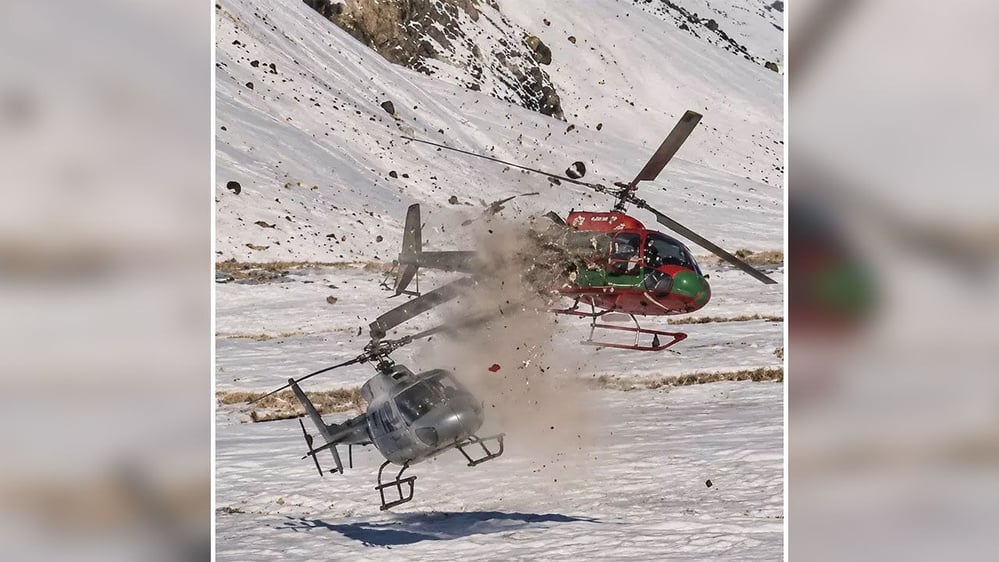
“A terrifying video captured the moment when two helicopters collided while attempting to land at a helipad in Nepal's Solukhumbu district” · exact text match
“As the video spread online, it raised questions about helicopter safety in one of the world’s most challenging aviation environments, with viewers struggling to believe what they were seeing.” · exact text match
Why: The publisher’s own wording emphasizes dramatic and audience-reaction framing rather than neutral description.
Claim: The report uses sensational language in its headline and captions to dramatize the crash.
“Terrifying Footage Shows Two Helicopters Collide Near Everest Base Camp, Tourist Among Victims.” · exact text match
“Watch as horrific footage shows two helicopters colliding with each other while trying to land” · exact text match
Why: Words such as “Terrifying” and “horrific” are strong sensational descriptors applied by the publisher.
Claim: The article is not framed around market or investment direction.
“The latest accident has once again drawn attention to the risks of aviation in Nepal’s mountainous regions, where helicopters play an important role in tourism, rescue operations, and supply transport.” · exact text match
Why: No financial-market bullish or bearish framing is present.
Claim: The report is not framed as optimistic or pessimistic overall.
“Both pilots also survived the collision but were injured.” · exact text match
Why: It reports casualties and survival without a clear optimistic or pessimistic editorial thrust.
Claim: The report combines viral footage, a fatal crash, and Everest-region context.
“Terrifying Footage Shows Two Helicopters Collide Near Everest Base Camp, Tourist Among Victims.” · exact text match
Why: The subject matter and dramatic footage make the article unusually engaging.
Claim: The article is mainly descriptive and does not prescribe policy.
“With the investigation into the Pheriche collision underway, authorities will now have to determine why the two helicopters approached the same landing area and whether coordination procedures need to change to prevent similar accidents in the future.” · exact text match
Why: It describes an investigation and possible procedural review rather than issuing a clear prescription.
Claim: The report does not address military or foreign-policy conflict in dovish or hawkish terms.
“The European Union has reportedly maintained a ban on Nepali airlines operating within its airspace because of continuing safety concerns.” · exact text match
Why: Aviation safety regulation is not a dovish-hawkish conflict framing.
Claim: Fear-laden descriptors are used around the crash footage.
“Terrifying Footage Shows Two Helicopters Collide Near Everest Base Camp, Tourist Among Victims.” · exact text match
“Watch as horrific footage shows two helicopters colliding with each other while trying to land” · exact text match
Why: The headline and caption emphasize terrifying and horrific imagery, though the body is largely factual.
Claim: The article does not build its argument on unstated circular premises.
“CAAN has launched a formal probe, with technical teams examining the wreckage and reviewing surveillance footage to establish how the aircraft came into contact.” · exact text match
Why: Causal questions are left to investigation rather than asserted circularly.
Claim: The article focuses on an accident and official response rather than personal gossip.
“The crash left one passenger deceased, who has been identified by the District Police Office of Solukhumbu as 47-year-old Vasanth Kumar Balaramaramadu, an Indian national from Chennai, Tamil Nadu.” · exact text match
Why: Identity details are reported in a standard accident-reporting manner.
Claim: Most of the report is factual, with limited opinion-like framing in adjectives and social-media reaction.
“As the video spread online, it raised questions about helicopter safety in one of the world’s most challenging aviation environments, with viewers struggling to believe what they were seeing.” · exact text match
““Looks like they were racing for that landing spot…” one social media user wrote” · exact text match
Why: The publisher includes some reaction framing, but the core remains attributed reporting.
Claim: The substantive article is not framed as political.
“The latest accident has once again drawn attention to the risks of aviation in Nepal’s mountainous regions, where helicopters play an important role in tourism, rescue operations, and supply transport.” · exact text match
Why: The report centers aviation safety and casualties, not political contestation.
Claim: The report includes multiple possible causes rather than reducing the crash to one explanation.
“Authorities are examining whether the snow-covered helipad affected the pilots’ choice of landing area, or whether a mechanical issue or another operational factor played a role.” · exact text match
“Investigators are also looking into whether a communication breakdown between the pilots or ground personnel contributed to the accident.” · exact text match
Why: It acknowledges several unresolved factors, though headline framing is simpler than the body.
Claim: The report relies on named authorities for key facts.
“CAAN Director General Mukesh Dangol said the Pheriche area falls outside the coverage zone of the Lukla Airport air traffic control tower.” · not found in supplied text
Why: Authorities are cited, but the article also includes company statements and investigation caveats.
Claim: The report is not written in an immature or rage-baiting style.
“Neither company assigned blame or speculated about the cause of the collision, saying they were cooperating with the authorities’ investigation.” · exact text match
Why: It maintains a conventional accident-reporting tone in the body.
Claim: The article does not visibly rely on circular reasoning.
“Initial reports also suggest that both helicopters may have been trying to use the same landing spot.” · exact text match
Why: Unresolved causes are presented as possibilities rather than circular conclusions.
Claim: The report includes responses from aviation companies and authorities.
“Both aviation companies also confirmed information about their aircraft and passengers.” · exact text match
“CAAN has launched a formal probe, with technical teams examining the wreckage and reviewing surveillance footage to establish how the aircraft came into contact.” · exact text match
Why: It gives space to official and company responses, though not a full adversarial range.
Claim: Victims are identified and injuries reported without victimhood framing.
“Another passenger, 49-year-old Shailesh Krishna Patel, a New Zealand citizen of Indian origin, sustained serious injuries.” · exact text match
Why: The article reports casualties as facts rather than mobilizing a victim narrative.
Claim: The report generally attributes uncertain details rather than asserting them as certain.
“The accident reportedly took place at approximately 8:11 a.m. local time on Tuesday, November 3, at the Pheriche helipad in Nepal’s Solukhumbu district.” · exact text match
“Initial reports also suggest that both helicopters may have been trying to use the same landing spot.” · exact text match
Why: Use of “reportedly,” “approximately,” and “may” limits overconfidence, though the sensational framing is assertive.
Claim: The supplied page includes unrelated promotional and newsletter material around the article.
“Join 1.2 million Panda readers who get the best art, memes, and fun stories every week!” · exact text match
“Get our best stories, memes and art every week.
Join a thriving community and brighten your day!”
· exact text match
Why: Promotional boilerplate is present but separate from the substantive article text.
Claim: The report is not organized around a strong ideology.
“The latest accident has once again drawn attention to the risks of aviation in Nepal’s mountainous regions, where helicopters play an important role in tourism, rescue operations, and supply transport.” · exact text match
Why: It focuses on aviation safety rather than ideological advocacy.
Claim: The report relies on official aviation and police sources without overt anti-establishment framing.
“According to Nepal’s Civil Aviation Authority (CAAN), the collision happened when the rotor blades of two helicopters struck each other as the aircraft approached the Pheriche helipad at nearly the same time.” · exact text match
Why: Official attribution is central, but it does not strongly advocate an establishment position.
Claim: Coverage carries a negative emotional valence through death and dramatic wording.
“Terrifying Footage Shows Two Helicopters Collide Near Everest Base Camp, Tourist Among Victims.” · exact text match
“The crash left one passenger deceased” · exact text match
Why: The combination of fatal outcome and fear-laden adjectives gives the framing a negative emotional charge.
Claim: No double standard is visible in the supplied text.
“Fishtail Air helicopter 9N-AJR was carrying passengers, while Air Dynasty helicopter 9N-AOD was operating a cargo flight with approximately 300 kilograms of supplies and no passengers on board.” · not found in supplied text
Why: Both operators are described with parallel factual details.
Claim: Key facts are attributed to police, the aviation authority, and the companies, with uncertainty marked.
“According to Nepal’s Civil Aviation Authority (CAAN), the collision happened when the rotor blades of two helicopters struck each other as the aircraft approached the Pheriche helipad at nearly the same time.” · exact text match
“Neither company assigned blame or speculated about the cause of the collision, saying they were cooperating with the authorities’ investigation.” · exact text match
Why: Visible sourcing and explicit hedging support higher credibility in the supplied text.
Claim: The report is largely factual and attributed, with limited emotional escalation.
“According to Nepal’s Civil Aviation Authority (CAAN), the collision happened when the rotor blades of two helicopters struck each other as the aircraft approached the Pheriche helipad at nearly the same time.” · exact text match
Why: Attribution and procedural detail indicate rational reporting despite sensational headline wording.
Claim: Newsletter and subscription prompts surround the article content.
“Enter the email for your subscription.
You'll use it to sign in, and we'll send your receipt there.”
· exact text match
“By entering your email and clicking Subscribe, you're agreeing to let us send you customized marketing messages about us and our advertising partners.” · exact text match
Why: Advertising and subscription material is observable in the supplied text, though not in the core report.
Claim: Some contextual and causal discussion remains provisional rather than conclusive.
“Initial reports also suggest that both helicopters may have been trying to use the same landing spot.” · exact text match
“Investigators are also looking into whether a communication breakdown between the pilots or ground personnel contributed to the accident.” · exact text match
Why: The report presents possible factors as under investigation, not settled conclusions.
Claim: Loaded headline and caption language heightens engagement around an accident report.
“Terrifying Footage Shows Two Helicopters Collide Near Everest Base Camp, Tourist Among Victims.” · exact text match
“Watch as horrific footage shows two helicopters colliding with each other while trying to land” · exact text match
Why: The observable technique is loaded wording rather than material factual omission.
Claim: The article shows few strong independent AI-authorship indicators.
“Both aviation companies also confirmed information about their aircraft and passengers.” · exact text match
Why: The prose is smooth but contains specific attributed details and no decisive AI markers.
Claim: The report avoids assigning blame and notes that companies did not speculate while an investigation proceeds.
“Neither company assigned blame or speculated about the cause of the collision, saying they were cooperating with the authorities’ investigation.” · exact text match
Why: Explicitly noting non-blame and ongoing investigation indicates fair, restrained handling of causal claims.
Claim: The report supplies contextual detail on altitude, aviation rules, and prior accidents.
“At high altitudes, thinner air reduces lift from rotor blades and affects engine performance, leaving pilots with narrower margins for maneuvering.” · exact text match
“The area around Pheriche falls outside the coverage zone of the Lukla Airport air traffic control tower, according to CAAN Director General Mukesh Dangol.” · exact text match
Why: The substantive body explains relevant operational context beyond the viral-video framing.
Claim: No terrorism or intentional violence framing is present.
“The accident reportedly took place at approximately 8:11 a.m. local time on Tuesday, November 3, at the Pheriche helipad in Nepal’s Solukhumbu district.” · exact text match
Why: The event is framed as an aviation accident, not terrorism.
Claim: No fraud-normalizing or deceptive-gain framing is present.
“Neither company assigned blame or speculated about the cause of the collision, saying they were cooperating with the authorities’ investigation.” · exact text match
Why: The report concerns an accident investigation, not fraud.
Claim: No class-conflict or Marxist framing is present.
“The remote village sits at an altitude of around 4,200 meters (13,780 feet) and is an important stop along the standard Everest Base Camp trekking route.” · exact text match
Why: The content is geographic and aviation-focused.
Claim: No Islamist political or ideological framing is present.
“Two private domestic carriers, Fishtail Air and Air Dynasty, operated the helicopters.” · exact text match
Why: The report concerns Nepali commercial aviation.
Claim: No anti-Jewish framing is present.
“The crash left one passenger deceased, who has been identified by the District Police Office of Solukhumbu as 47-year-old Vasanth Kumar Balaramaramadu, an Indian national from Chennai, Tamil Nadu.” · exact text match
Why: There is no Jewish-related content or generalization.
Claim: No anti-LGBT framing is present.
“Another passenger, 49-year-old Shailesh Krishna Patel, a New Zealand citizen of Indian origin, sustained serious injuries.” · exact text match
Why: There is no LGBT-related content.
Claim: No racial generalization or collective blame is present.
“The crash left one passenger deceased, who has been identified by the District Police Office of Solukhumbu as 47-year-old Vasanth Kumar Balaramaramadu, an Indian national from Chennai, Tamil Nadu.” · exact text match
Why: Nationality and origin are reported as identifying details, not as group generalization.
Claim: No identity-power or woke framing is present.
“The crash left one passenger deceased, who has been identified by the District Police Office of Solukhumbu as 47-year-old Vasanth Kumar Balaramaramadu, an Indian national from Chennai, Tamil Nadu.” · exact text match
Why: Identity details are descriptive rather than tied to institutional power framing.
Claim: The report does not display cruelty or callousness toward victims.
“People nearby can be seen running away from the wreckage before some return to help the crash victims.” · exact text match
Why: It notes rescue efforts and reports casualties factually.
Claim: No virtue-signaling framing is evident.
“Both aviation companies also confirmed information about their aircraft and passengers.” · exact text match
Why: The report is operational and factual.
Claim: No conspiratorial framing is present.
“Initial reports also suggest that both helicopters may have been trying to use the same landing spot.” · exact text match
Why: Possible causes are attributed to ordinary operational factors and investigation.
Claim: No compassion framing that ignores severe self-harm tradeoffs is present.
“Helicopters are frequently used in the area to transport supplies, move trekkers, and carry out medical evacuations.” · exact text match
Why: The report describes helicopter use without advocacy involving self-harm.
Claim: No individual or group is scapegoated for the crash.
“Neither company assigned blame or speculated about the cause of the collision, saying they were cooperating with the authorities’ investigation.” · exact text match
Why: Blame is explicitly not assigned in the supplied text.
Claim: No incompatible standards between comparable cases are evident.
“A similar incident occurred near Lobuche in October 2025.” · exact text match
Why: Prior accidents are noted without a double standard.
Claim: No rejection of reason or evidence is present.
“CAAN has launched a formal probe, with technical teams examining the wreckage and reviewing surveillance footage to establish how the aircraft came into contact.” · exact text match
Why: The report emphasizes investigation and physical evidence.
Analysis excludes Bored Panda page chrome, newsletter prompts, and unrelated promoted headlines; some causal and date details are reported with “reportedly” or omit an explicit year.
November 03, 2026 · 0 shares
Factual, official-source-driven accident reporting with neutral wording and no evident ideological or sensational framing.
Automated analysis; not human reviewed.
Limitations: Main report is interleaved with duplicated snippets and unrelated related-link headlines; scoring uses only the substantive accident report.
·
7 of 55 available dimensions scored; omitted dimensions are not treated as neutral.
·
Verified supporting quotes for 6 of 7 scored dimensions.
Claim: The report presents attributed events and official statements without subjective commentary.
“two officials have confirmed” · exact text match
“Fishtail Air added in a statement.” · exact text match
Why: Relies on official confirmation and company statements rather than personal interpretation.
Claim: The fatal crash is reported in restrained language without sensational embellishment.
“An Indian tourist has died after two helicopters collided while attempting to land near the base camp of Mount Everest” · exact text match
“In the video footage of the incident, the weather conditions look clear and no strong wind effects are visible.” · exact text match
Why: Describes the crash and footage plainly without dramatic or emotive language.
Claim: The report describes the accident and response without prescribing policy or action.
“The injured passengers and crew members on board were rescued and taken to Kathmandu, Fishtail Air added in a statement.” · exact text match
Why: The content is descriptive reporting rather than advocacy or recommendation.
Claim: Multiple named or institutional sources and verified footage are cited with clear attribution.
“two officials have confirmed” · exact text match
“Verified footage of the crash showed the helicopter blades” · exact text match
Why: Sourcing and attribution are visible throughout the main report.
Claim: The report is grounded in verified footage and attributed official/company statements rather than speculation.
“Verified footage of the crash showed the helicopter blades of the two aircraft clipping each other” · exact text match
“A spokesman for Nepal's Civil Aviation Authority, Gyanendra Bhul, said: "It appears the accident happened when two helicopters... attempted to land at the same spot."” · not found in supplied text
Why: Uses verification and attributed statements to structure the account.
Claim: The report consistently attributes contested details to named officials, the operator, or verified footage.
“two officials have confirmed” · exact text match
“Fishtail Air added in a statement.” · exact text match
Why: Multiple claims are explicitly attributed rather than presented as unattributed assertions.
Claim: The report is clearly organized, with chronology, locations, injuries, and operator details stated plainly.
“Verified footage of the crash showed the helicopter blades of the two aircraft clipping each other as they came into land at around 08:15 local time (02:30 GMT) in Pheriche, approximately 12km (7 miles) south of Mount Everest Base Camp.” · exact text match
“Fishtail Air named the man killed in the crash as Vasanth Kumar Balaramudu.” · verified after text normalization
Why: Presents relevant details in a coherent, factual sequence.
Main report is interleaved with duplicated snippets and unrelated related-link headlines; scoring uses only the substantive accident report.
November 03, 2026 · 0 shares
Restrained, attribution-based disaster reporting explicitly flags uncertainty about how many people were aboard.
Automated analysis; not human reviewed.
Limitations: Casualty and passenger counts rely on unnamed authorities and may be preliminary; unrelated related-link headlines were excluded as page chrome.
·
9 of 55 available dimensions scored; omitted dimensions are not treated as neutral.
·
Verified supporting quotes for 9 of 9 scored dimensions.
Claim: Reporting is limited to attributed factual details and avoids evaluative framing.
“Authorities have confirmed that a 47-year-old Indian national was killed.” · exact text match
Why: Casualty detail is attributed rather than presented through subjective commentary.
Claim: Coverage is restrained rather than sensational, explicitly noting unknown passenger counts.
“It is not clear how many people were on board the two helicopters.” · exact text match
Why: The report withholds speculation and flags missing information.
Claim: The article describes events and context without recommending actions.
“Helicopters are regularly used to evacuate trekkers and guides who have had to cut their journeys short because of sickness or exhaustion.” · exact text match
Why: Context is explanatory and descriptive, not prescriptive.
Claim: Explicit uncertainty about passenger count limits certainty.
“It is not clear how many people were on board the two helicopters.” · exact text match
Why: The report avoids asserting details it does not have.
Claim: The tone remains factual and unemotional despite the fatal crash.
“Two helicopters have collided in Nepal’s Mount Everest region, killing at least one person and injuring two others.” · exact text match
Why: The casualty information is stated plainly without emotive language.
Claim: Clear attribution and explicit uncertainty support credibility.
“Authorities have confirmed that a 47-year-old Indian national was killed.” · exact text match
“It is not clear how many people were on board the two helicopters.” · exact text match
Why: The report relies on attributed confirmation and states limits in the available information.
Claim: The account is orderly and acknowledges missing information rather than filling gaps.
“It is not clear how many people were on board the two helicopters.” · exact text match
Why: Explicit uncertainty indicates evidence-bound rather than irrational reporting.
Claim: Fair attribution and explicit uncertainty are visible in the reporting.
“Authorities have confirmed that a 47-year-old Indian national was killed.” · exact text match
“It is not clear how many people were on board the two helicopters.” · exact text match
Why: Naming official confirmation and acknowledging unknown details signals fair epistemic practice.
Claim: The report provides concise contextual explanation for helicopter use in the region.
“The Mount Everest region can be difficult to navigate because there are no roads.” · exact text match
Why: Context is used to explain why helicopters are regularly used.
Casualty and passenger counts rely on unnamed authorities and may be preliminary; unrelated related-link headlines were excluded as page chrome.
Dramatic, fear-laden wording in the headline and captions frames an otherwise attribution-heavy accident report.
Automated analysis; not human reviewed.
Limitations: Analysis excludes Bored Panda page chrome, newsletter prompts, and unrelated promoted headlines; some causal and date details are reported with “reportedly” or omit an explicit year.
·
55 of 55 available dimensions scored; omitted dimensions are not treated as neutral.
·
Verified supporting quotes for 52 of 55 scored dimensions.
Claim: The article does not engage left-right political framing.
“The latest accident has once again drawn attention to the risks of aviation in Nepal’s mountainous regions, where helicopters play an important role in tourism, rescue operations, and supply transport.” · exact text match
Why: No partisan or ideological political framing is evident in the substantive report.
Claim: The report does not frame the crash around populist or elitist themes.
“The remote village sits at an altitude of around 4,200 meters (13,780 feet) and is an important stop along the standard Everest Base Camp trekking route.” · exact text match
Why: Coverage is operational and geographic rather than populist or elitist.
Claim: No clear liberty-versus-authority framing appears in the report.
“CAAN has launched a formal probe, with technical teams examining the wreckage and reviewing surveillance footage to establish how the aircraft came into contact.” · exact text match
Why: The aviation regulator is described procedurally, not in ideological terms.
Claim: Dramatic adjectives and viral-reaction framing add subjectivity to an otherwise factual account.
“A terrifying video captured the moment when two helicopters collided while attempting to land at a helipad in Nepal's Solukhumbu district” · exact text match
“As the video spread online, it raised questions about helicopter safety in one of the world’s most challenging aviation environments, with viewers struggling to believe what they were seeing.” · exact text match
Why: The publisher’s own wording emphasizes dramatic and audience-reaction framing rather than neutral description.
Claim: The report uses sensational language in its headline and captions to dramatize the crash.
“Terrifying Footage Shows Two Helicopters Collide Near Everest Base Camp, Tourist Among Victims.” · exact text match
“Watch as horrific footage shows two helicopters colliding with each other while trying to land” · exact text match
Why: Words such as “Terrifying” and “horrific” are strong sensational descriptors applied by the publisher.
Claim: The article is not framed around market or investment direction.
“The latest accident has once again drawn attention to the risks of aviation in Nepal’s mountainous regions, where helicopters play an important role in tourism, rescue operations, and supply transport.” · exact text match
Why: No financial-market bullish or bearish framing is present.
Claim: The report is not framed as optimistic or pessimistic overall.
“Both pilots also survived the collision but were injured.” · exact text match
Why: It reports casualties and survival without a clear optimistic or pessimistic editorial thrust.
Claim: The report combines viral footage, a fatal crash, and Everest-region context.
“Terrifying Footage Shows Two Helicopters Collide Near Everest Base Camp, Tourist Among Victims.” · exact text match
Why: The subject matter and dramatic footage make the article unusually engaging.
Claim: The article is mainly descriptive and does not prescribe policy.
“With the investigation into the Pheriche collision underway, authorities will now have to determine why the two helicopters approached the same landing area and whether coordination procedures need to change to prevent similar accidents in the future.” · exact text match
Why: It describes an investigation and possible procedural review rather than issuing a clear prescription.
Claim: The report does not address military or foreign-policy conflict in dovish or hawkish terms.
“The European Union has reportedly maintained a ban on Nepali airlines operating within its airspace because of continuing safety concerns.” · exact text match
Why: Aviation safety regulation is not a dovish-hawkish conflict framing.
Claim: Fear-laden descriptors are used around the crash footage.
“Terrifying Footage Shows Two Helicopters Collide Near Everest Base Camp, Tourist Among Victims.” · exact text match
“Watch as horrific footage shows two helicopters colliding with each other while trying to land” · exact text match
Why: The headline and caption emphasize terrifying and horrific imagery, though the body is largely factual.
Claim: The article does not build its argument on unstated circular premises.
“CAAN has launched a formal probe, with technical teams examining the wreckage and reviewing surveillance footage to establish how the aircraft came into contact.” · exact text match
Why: Causal questions are left to investigation rather than asserted circularly.
Claim: The article focuses on an accident and official response rather than personal gossip.
“The crash left one passenger deceased, who has been identified by the District Police Office of Solukhumbu as 47-year-old Vasanth Kumar Balaramaramadu, an Indian national from Chennai, Tamil Nadu.” · exact text match
Why: Identity details are reported in a standard accident-reporting manner.
Claim: Most of the report is factual, with limited opinion-like framing in adjectives and social-media reaction.
“As the video spread online, it raised questions about helicopter safety in one of the world’s most challenging aviation environments, with viewers struggling to believe what they were seeing.” · exact text match
““Looks like they were racing for that landing spot…” one social media user wrote” · exact text match
Why: The publisher includes some reaction framing, but the core remains attributed reporting.
Claim: The substantive article is not framed as political.
“The latest accident has once again drawn attention to the risks of aviation in Nepal’s mountainous regions, where helicopters play an important role in tourism, rescue operations, and supply transport.” · exact text match
Why: The report centers aviation safety and casualties, not political contestation.
Claim: The report includes multiple possible causes rather than reducing the crash to one explanation.
“Authorities are examining whether the snow-covered helipad affected the pilots’ choice of landing area, or whether a mechanical issue or another operational factor played a role.” · exact text match
“Investigators are also looking into whether a communication breakdown between the pilots or ground personnel contributed to the accident.” · exact text match
Why: It acknowledges several unresolved factors, though headline framing is simpler than the body.
Claim: The report relies on named authorities for key facts.
“CAAN Director General Mukesh Dangol said the Pheriche area falls outside the coverage zone of the Lukla Airport air traffic control tower.” · not found in supplied text
Why: Authorities are cited, but the article also includes company statements and investigation caveats.
Claim: The report is not written in an immature or rage-baiting style.
“Neither company assigned blame or speculated about the cause of the collision, saying they were cooperating with the authorities’ investigation.” · exact text match
Why: It maintains a conventional accident-reporting tone in the body.
Claim: The article does not visibly rely on circular reasoning.
“Initial reports also suggest that both helicopters may have been trying to use the same landing spot.” · exact text match
Why: Unresolved causes are presented as possibilities rather than circular conclusions.
Claim: The report includes responses from aviation companies and authorities.
“Both aviation companies also confirmed information about their aircraft and passengers.” · exact text match
“CAAN has launched a formal probe, with technical teams examining the wreckage and reviewing surveillance footage to establish how the aircraft came into contact.” · exact text match
Why: It gives space to official and company responses, though not a full adversarial range.
Claim: Victims are identified and injuries reported without victimhood framing.
“Another passenger, 49-year-old Shailesh Krishna Patel, a New Zealand citizen of Indian origin, sustained serious injuries.” · exact text match
Why: The article reports casualties as facts rather than mobilizing a victim narrative.
Claim: The report generally attributes uncertain details rather than asserting them as certain.
“The accident reportedly took place at approximately 8:11 a.m. local time on Tuesday, November 3, at the Pheriche helipad in Nepal’s Solukhumbu district.” · exact text match
“Initial reports also suggest that both helicopters may have been trying to use the same landing spot.” · exact text match
Why: Use of “reportedly,” “approximately,” and “may” limits overconfidence, though the sensational framing is assertive.
Claim: The supplied page includes unrelated promotional and newsletter material around the article.
“Join 1.2 million Panda readers who get the best art, memes, and fun stories every week!” · exact text match
“Get our best stories, memes and art every week.
Join a thriving community and brighten your day!”
· exact text match
Why: Promotional boilerplate is present but separate from the substantive article text.
Claim: The report is not organized around a strong ideology.
“The latest accident has once again drawn attention to the risks of aviation in Nepal’s mountainous regions, where helicopters play an important role in tourism, rescue operations, and supply transport.” · exact text match
Why: It focuses on aviation safety rather than ideological advocacy.
Claim: The report relies on official aviation and police sources without overt anti-establishment framing.
“According to Nepal’s Civil Aviation Authority (CAAN), the collision happened when the rotor blades of two helicopters struck each other as the aircraft approached the Pheriche helipad at nearly the same time.” · exact text match
Why: Official attribution is central, but it does not strongly advocate an establishment position.
Claim: Coverage carries a negative emotional valence through death and dramatic wording.
“Terrifying Footage Shows Two Helicopters Collide Near Everest Base Camp, Tourist Among Victims.” · exact text match
“The crash left one passenger deceased” · exact text match
Why: The combination of fatal outcome and fear-laden adjectives gives the framing a negative emotional charge.
Claim: No double standard is visible in the supplied text.
“Fishtail Air helicopter 9N-AJR was carrying passengers, while Air Dynasty helicopter 9N-AOD was operating a cargo flight with approximately 300 kilograms of supplies and no passengers on board.” · not found in supplied text
Why: Both operators are described with parallel factual details.
Claim: Key facts are attributed to police, the aviation authority, and the companies, with uncertainty marked.
“According to Nepal’s Civil Aviation Authority (CAAN), the collision happened when the rotor blades of two helicopters struck each other as the aircraft approached the Pheriche helipad at nearly the same time.” · exact text match
“Neither company assigned blame or speculated about the cause of the collision, saying they were cooperating with the authorities’ investigation.” · exact text match
Why: Visible sourcing and explicit hedging support higher credibility in the supplied text.
Claim: The report is largely factual and attributed, with limited emotional escalation.
“According to Nepal’s Civil Aviation Authority (CAAN), the collision happened when the rotor blades of two helicopters struck each other as the aircraft approached the Pheriche helipad at nearly the same time.” · exact text match
Why: Attribution and procedural detail indicate rational reporting despite sensational headline wording.
Claim: Newsletter and subscription prompts surround the article content.
“Enter the email for your subscription.
You'll use it to sign in, and we'll send your receipt there.”
· exact text match
“By entering your email and clicking Subscribe, you're agreeing to let us send you customized marketing messages about us and our advertising partners.” · exact text match
Why: Advertising and subscription material is observable in the supplied text, though not in the core report.
Claim: Some contextual and causal discussion remains provisional rather than conclusive.
“Initial reports also suggest that both helicopters may have been trying to use the same landing spot.” · exact text match
“Investigators are also looking into whether a communication breakdown between the pilots or ground personnel contributed to the accident.” · exact text match
Why: The report presents possible factors as under investigation, not settled conclusions.
Claim: Loaded headline and caption language heightens engagement around an accident report.
“Terrifying Footage Shows Two Helicopters Collide Near Everest Base Camp, Tourist Among Victims.” · exact text match
“Watch as horrific footage shows two helicopters colliding with each other while trying to land” · exact text match
Why: The observable technique is loaded wording rather than material factual omission.
Claim: The article shows few strong independent AI-authorship indicators.
“Both aviation companies also confirmed information about their aircraft and passengers.” · exact text match
Why: The prose is smooth but contains specific attributed details and no decisive AI markers.
Claim: The report avoids assigning blame and notes that companies did not speculate while an investigation proceeds.
“Neither company assigned blame or speculated about the cause of the collision, saying they were cooperating with the authorities’ investigation.” · exact text match
Why: Explicitly noting non-blame and ongoing investigation indicates fair, restrained handling of causal claims.
Claim: The report supplies contextual detail on altitude, aviation rules, and prior accidents.
“At high altitudes, thinner air reduces lift from rotor blades and affects engine performance, leaving pilots with narrower margins for maneuvering.” · exact text match
“The area around Pheriche falls outside the coverage zone of the Lukla Airport air traffic control tower, according to CAAN Director General Mukesh Dangol.” · exact text match
Why: The substantive body explains relevant operational context beyond the viral-video framing.
Claim: No terrorism or intentional violence framing is present.
“The accident reportedly took place at approximately 8:11 a.m. local time on Tuesday, November 3, at the Pheriche helipad in Nepal’s Solukhumbu district.” · exact text match
Why: The event is framed as an aviation accident, not terrorism.
Claim: No fraud-normalizing or deceptive-gain framing is present.
“Neither company assigned blame or speculated about the cause of the collision, saying they were cooperating with the authorities’ investigation.” · exact text match
Why: The report concerns an accident investigation, not fraud.
Claim: No class-conflict or Marxist framing is present.
“The remote village sits at an altitude of around 4,200 meters (13,780 feet) and is an important stop along the standard Everest Base Camp trekking route.” · exact text match
Why: The content is geographic and aviation-focused.
Claim: No Islamist political or ideological framing is present.
“Two private domestic carriers, Fishtail Air and Air Dynasty, operated the helicopters.” · exact text match
Why: The report concerns Nepali commercial aviation.
Claim: No anti-Jewish framing is present.
“The crash left one passenger deceased, who has been identified by the District Police Office of Solukhumbu as 47-year-old Vasanth Kumar Balaramaramadu, an Indian national from Chennai, Tamil Nadu.” · exact text match
Why: There is no Jewish-related content or generalization.
Claim: No anti-LGBT framing is present.
“Another passenger, 49-year-old Shailesh Krishna Patel, a New Zealand citizen of Indian origin, sustained serious injuries.” · exact text match
Why: There is no LGBT-related content.
Claim: No racial generalization or collective blame is present.
“The crash left one passenger deceased, who has been identified by the District Police Office of Solukhumbu as 47-year-old Vasanth Kumar Balaramaramadu, an Indian national from Chennai, Tamil Nadu.” · exact text match
Why: Nationality and origin are reported as identifying details, not as group generalization.
Claim: No identity-power or woke framing is present.
“The crash left one passenger deceased, who has been identified by the District Police Office of Solukhumbu as 47-year-old Vasanth Kumar Balaramaramadu, an Indian national from Chennai, Tamil Nadu.” · exact text match
Why: Identity details are descriptive rather than tied to institutional power framing.
Claim: The report does not display cruelty or callousness toward victims.
“People nearby can be seen running away from the wreckage before some return to help the crash victims.” · exact text match
Why: It notes rescue efforts and reports casualties factually.
Claim: No virtue-signaling framing is evident.
“Both aviation companies also confirmed information about their aircraft and passengers.” · exact text match
Why: The report is operational and factual.
Claim: No conspiratorial framing is present.
“Initial reports also suggest that both helicopters may have been trying to use the same landing spot.” · exact text match
Why: Possible causes are attributed to ordinary operational factors and investigation.
Claim: No compassion framing that ignores severe self-harm tradeoffs is present.
“Helicopters are frequently used in the area to transport supplies, move trekkers, and carry out medical evacuations.” · exact text match
Why: The report describes helicopter use without advocacy involving self-harm.
Claim: No individual or group is scapegoated for the crash.
“Neither company assigned blame or speculated about the cause of the collision, saying they were cooperating with the authorities’ investigation.” · exact text match
Why: Blame is explicitly not assigned in the supplied text.
Claim: No incompatible standards between comparable cases are evident.
“A similar incident occurred near Lobuche in October 2025.” · exact text match
Why: Prior accidents are noted without a double standard.
Claim: No rejection of reason or evidence is present.
“CAAN has launched a formal probe, with technical teams examining the wreckage and reviewing surveillance footage to establish how the aircraft came into contact.” · exact text match
Why: The report emphasizes investigation and physical evidence.
Analysis excludes Bored Panda page chrome, newsletter prompts, and unrelated promoted headlines; some causal and date details are reported with “reportedly” or omit an explicit year.
November 03, 2026 · 0 shares
Attribution-heavy, plainly descriptive breaking-news framing that relies almost entirely on Nepal Police statements and named officials, with no evaluative or speculative language beyond a hedged line about a possible setback to tourism.
Nepal's Everest region relies heavily on helicopter transport for cargo, trekking and climbing logistics, and the country's tourism and aviation sectors are economically significant.
Automated analysis; not human reviewed.
Limitations: The text contains an internal date inconsistency, describing the crash as occurring on 'Tuesday' while photo captions and the body reference November 3, 2026; the trailing headline list includes unrelated stories, which were treated as navigation rather than content.
·
25 of 55 available dimensions scored; omitted dimensions are not treated as neutral.
·
Verified supporting quotes for 0 of 25 scored dimensions.
The text contains an internal date inconsistency, describing the crash as occurring on 'Tuesday' while photo captions and the body reference November 3, 2026; the trailing headline list includes unrelated stories, which were treated as navigation rather than content.
November 03, 2026 · 0 shares
Factual, official-source-driven accident reporting with neutral wording and no evident ideological or sensational framing.
Automated analysis; not human reviewed.
Limitations: Main report is interleaved with duplicated snippets and unrelated related-link headlines; scoring uses only the substantive accident report.
·
7 of 55 available dimensions scored; omitted dimensions are not treated as neutral.
·
Verified supporting quotes for 6 of 7 scored dimensions.
Claim: The report presents attributed events and official statements without subjective commentary.
“two officials have confirmed” · exact text match
“Fishtail Air added in a statement.” · exact text match
Why: Relies on official confirmation and company statements rather than personal interpretation.
Claim: The fatal crash is reported in restrained language without sensational embellishment.
“An Indian tourist has died after two helicopters collided while attempting to land near the base camp of Mount Everest” · exact text match
“In the video footage of the incident, the weather conditions look clear and no strong wind effects are visible.” · exact text match
Why: Describes the crash and footage plainly without dramatic or emotive language.
Claim: The report describes the accident and response without prescribing policy or action.
“The injured passengers and crew members on board were rescued and taken to Kathmandu, Fishtail Air added in a statement.” · exact text match
Why: The content is descriptive reporting rather than advocacy or recommendation.
Claim: Multiple named or institutional sources and verified footage are cited with clear attribution.
“two officials have confirmed” · exact text match
“Verified footage of the crash showed the helicopter blades” · exact text match
Why: Sourcing and attribution are visible throughout the main report.
Claim: The report is grounded in verified footage and attributed official/company statements rather than speculation.
“Verified footage of the crash showed the helicopter blades of the two aircraft clipping each other” · exact text match
“A spokesman for Nepal's Civil Aviation Authority, Gyanendra Bhul, said: "It appears the accident happened when two helicopters... attempted to land at the same spot."” · not found in supplied text
Why: Uses verification and attributed statements to structure the account.
Claim: The report consistently attributes contested details to named officials, the operator, or verified footage.
“two officials have confirmed” · exact text match
“Fishtail Air added in a statement.” · exact text match
Why: Multiple claims are explicitly attributed rather than presented as unattributed assertions.
Claim: The report is clearly organized, with chronology, locations, injuries, and operator details stated plainly.
“Verified footage of the crash showed the helicopter blades of the two aircraft clipping each other as they came into land at around 08:15 local time (02:30 GMT) in Pheriche, approximately 12km (7 miles) south of Mount Everest Base Camp.” · exact text match
“Fishtail Air named the man killed in the crash as Vasanth Kumar Balaramudu.” · verified after text normalization
Why: Presents relevant details in a coherent, factual sequence.
Main report is interleaved with duplicated snippets and unrelated related-link headlines; scoring uses only the substantive accident report.
November 03, 2026 · 0 shares
Attribution-heavy, plainly descriptive breaking-news framing that relies almost entirely on Nepal Police statements and named officials, with no evaluative or speculative language beyond a hedged line about a possible setback to tourism.
Nepal's Everest region relies heavily on helicopter transport for cargo, trekking and climbing logistics, and the country's tourism and aviation sectors are economically significant.
Automated analysis; not human reviewed.
Limitations: The text contains an internal date inconsistency, describing the crash as occurring on 'Tuesday' while photo captions and the body reference November 3, 2026; the trailing headline list includes unrelated stories, which were treated as navigation rather than content.
·
25 of 55 available dimensions scored; omitted dimensions are not treated as neutral.
·
Verified supporting quotes for 0 of 25 scored dimensions.
The text contains an internal date inconsistency, describing the crash as occurring on 'Tuesday' while photo captions and the body reference November 3, 2026; the trailing headline list includes unrelated stories, which were treated as navigation rather than content.
November 03, 2026 · 0 shares
Attributed straight-news aggregation reports the fatal helicopter collision through official and newspaper sourcing with minimal evaluative language.
Automated analysis; not human reviewed.
Limitations: The supplied text is dominated by repeated unrelated headline lists and truncated fragments, leaving only a short substantive report; framing assessment is correspondingly limited.
·
55 of 55 available dimensions scored; omitted dimensions are not treated as neutral.
·
Verified supporting quotes for 55 of 55 scored dimensions.
Claim: The substantive report does not engage liberal or conservative political framing.
“An Indian tourist was killed as two helicopters collided while landing in Solukhumbu district of Nepal on Tuesday, The Kathmandu Post reported.” · exact text match
Why: The report is an aviation accident story with no left-right political content.
Claim: The report relies on official and newspaper sources without populist or elitist framing.
“The newspaper quoted Police Inspector Mausam Tamang as having identified the deceased Indian as Vasanth Kumar Balaramaramadu, who was onboard one of the helicopters.” · exact text match
Why: Source attribution is routine and does not adopt a populist or elitist stance.
Claim: The report does not advocate libertarian or authoritarian positions.
“An Indian tourist was killed as two helicopters collided while landing in Solukhumbu district of Nepal on Tuesday, The Kathmandu Post reported.” · exact text match
Why: The story is a factual accident report with no governance or policy stance.
Claim: The report presents attributed factual details rather than interpretive commentary.
“An Indian tourist was killed as two helicopters collided while landing in Solukhumbu district of Nepal on Tuesday, The Kathmandu Post reported.” · exact text match
Why: The publisher attributes the central claim to The Kathmandu Post and sticks to event details.
Claim: Casualty details are reported in plain, non-sensational language.
“Both pilots suffered minor injuries and were also taken to the capital for treatment.” · exact text match
Why: Injury and treatment details are stated neutrally without dramatic wording.
Claim: The report has no financial-market framing.
“An Indian tourist was killed as two helicopters collided while landing in Solukhumbu district of Nepal on Tuesday, The Kathmandu Post reported.” · exact text match
Why: The content is an accident report unrelated to markets or investing.
Claim: The report does not adopt an optimistic or pessimistic outlook beyond the reported facts.
“The person injured in the accident is a New Zealand citizen of Indian origin.
The man was on the same helicopter.”
· exact text match
Why: It reports casualties and injuries without broader outlook language.
Claim: The report has moderate human-interest interest from a fatal tourist accident but is straightforward.
“An Indian tourist was killed as two helicopters collided while landing in Solukhumbu district of Nepal on Tuesday, The Kathmandu Post reported.” · exact text match
Why: The event is notable but the presentation is brief and factual.
Claim: The report describes events and casualties without prescribing actions.
“Another passenger and two pilots were injured in the accident that occurred at Pheriche, a village that serves as a stopover and an acclimatisation point for climbers on their way to the Mount Everest base camp.” · exact text match
Why: It provides descriptive context and does not recommend policy or behavior.
Claim: The report has no foreign-policy or military framing.
“An Indian tourist was killed as two helicopters collided while landing in Solukhumbu district of Nepal on Tuesday, The Kathmandu Post reported.” · exact text match
Why: The story is an aviation accident and does not involve defense or diplomacy.
Claim: The report is not framed to induce fear or outrage.
“Both pilots suffered minor injuries and were also taken to the capital for treatment.” · exact text match
Why: The language is calm and factual.
Claim: The report does not assume its conclusion in a circular manner.
“An Indian tourist was killed as two helicopters collided while landing in Solukhumbu district of Nepal on Tuesday, The Kathmandu Post reported.” · exact text match
Why: It attributes claims to a named source rather than asserting them without support.
Claim: The report is not gossip-oriented.
“The person injured in the accident is a New Zealand citizen of Indian origin.
The man was on the same helicopter.”
· exact text match
Why: It focuses on accident casualties and official details rather than private lives.
Claim: The publisher's own wording is limited to attributed factual statements.
“The newspaper quoted Police Inspector Mausam Tamang as having identified the deceased Indian as Vasanth Kumar Balaramaramadu, who was onboard one of the helicopters.” · exact text match
Why: The text relies on reported facts and quotations rather than publisher opinion.
Claim: The substantive report focuses on an aviation accident rather than political actors or policy.
“An Indian tourist was killed as two helicopters collided while landing in Solukhumbu district of Nepal on Tuesday, The Kathmandu Post reported.” · exact text match
Why: The story's subject matter is non-political.
Claim: The report is brief but does not oversimplify contested causation.
“Authorities said the helicopters’ rotor blades struck each other during the landing process.
Further details about the incident are awaited.”
· exact text match
Why: It attributes the preliminary cause and notes further details are awaited.
Claim: The report cites police and a newspaper but in routine attribution rather than as a substitute for reasoning.
“The newspaper quoted Police Inspector Mausam Tamang as having identified the deceased Indian as Vasanth Kumar Balaramaramadu, who was onboard one of the helicopters.” · exact text match
Why: Official sourcing is standard for accident reporting and is not used to argue a contested position.
Claim: The report avoids immature or rage-baiting language.
“Both pilots suffered minor injuries and were also taken to the capital for treatment.” · exact text match
Why: The tone is sober and factual.
Claim: The report does not use circular reasoning.
“An Indian tourist was killed as two helicopters collided while landing in Solukhumbu district of Nepal on Tuesday, The Kathmandu Post reported.” · exact text match
Why: Claims are attributed to a source rather than restated as their own proof.
Claim: The report does not omit an official response or present only one side of a controversy.
“The newspaper quoted Police Inspector Mausam Tamang as having identified the deceased Indian as Vasanth Kumar Balaramaramadu, who was onboard one of the helicopters.” · exact text match
Why: This is an accident report with no evident controversy requiring response coverage.
Claim: The report describes a victim without framing a broader victimization narrative.
“An Indian tourist was killed as two helicopters collided while landing in Solukhumbu district of Nepal on Tuesday, The Kathmandu Post reported.” · exact text match
Why: It reports a death factually without identity-group victim framing.
Claim: The report mostly attributes claims and notes pending details, limiting overconfidence.
“Further details about the incident are awaited.” · exact text match
Why: The explicit uncertainty marker qualifies the preliminary account.
Claim: The article body includes repeated unrelated headline lists that resemble page clutter rather than substantive reporting.
“HC says OCI cardholders don’t have right to protest, asks actor Imran Khan to apologise” · exact text match
Why: The supplied text contains repeated unrelated headlines, but the substantive report itself is not promotional.
Claim: The report is not framed through an ideological lens.
“An Indian tourist was killed as two helicopters collided while landing in Solukhumbu district of Nepal on Tuesday, The Kathmandu Post reported.” · exact text match
Why: The content is a straightforward accident report.
Claim: The report relies on official sources without either challenging or promoting establishments.
“The newspaper quoted Police Inspector Mausam Tamang as having identified the deceased Indian as Vasanth Kumar Balaramaramadu, who was onboard one of the helicopters.” · exact text match
Why: Routine police attribution does not indicate a pro- or anti-establishment stance.
Claim: The report's tone is neutral rather than emotionally charged.
“Both pilots suffered minor injuries and were also taken to the capital for treatment.” · exact text match
Why: It states injury outcomes calmly.
Claim: The report does not display a double standard.
“The newspaper quoted Police Inspector Mausam Tamang as having identified the deceased Indian as Vasanth Kumar Balaramaramadu, who was onboard one of the helicopters.” · exact text match
Why: There are no comparable cases treated inconsistently.
Claim: Credibility signals include attribution to a named newspaper and a police inspector, though the report is brief.
“An Indian tourist was killed as two helicopters collided while landing in Solukhumbu district of Nepal on Tuesday, The Kathmandu Post reported.” · exact text match
“The newspaper quoted Police Inspector Mausam Tamang as having identified the deceased Indian as Vasanth Kumar Balaramaramadu, who was onboard one of the helicopters.” · exact text match
Why: Named sourcing and direct attribution support trustworthiness in the supplied text.
Claim: The report presents factual details in a straightforward, rational manner.
“Both pilots suffered minor injuries and were also taken to the capital for treatment.” · exact text match
Why: The text supplies concrete details without emotional or irrational reasoning.
Claim: The substantive report is not advertorial or promotional.
“An Indian tourist was killed as two helicopters collided while landing in Solukhumbu district of Nepal on Tuesday, The Kathmandu Post reported.” · exact text match
Why: There is no product or marketing pitch in the accident report.
Claim: The report uses empirical accident details rather than superstitious explanation.
“Authorities said the helicopters’ rotor blades struck each other during the landing process.
Further details about the incident are awaited.”
· exact text match
Why: The preliminary cause is mechanical and attributed to authorities.
Claim: The report is mostly factual but includes a preliminary cause attributed to authorities and a note that details are awaited.
“Authorities said the helicopters’ rotor blades struck each other during the landing process.
Further details about the incident are awaited.”
· exact text match
Why: The cause is preliminary but explicitly attributed and qualified.
Claim: No strong AI-authorship indicators are evident in the short substantive report.
“An Indian tourist was killed as two helicopters collided while landing in Solukhumbu district of Nepal on Tuesday, The Kathmandu Post reported.” · exact text match
Why: The prose is plain news writing and the text is too fragmented to assess authorship reliably.
Claim: The report names sources and flags that further details are pending.
“The newspaper quoted Police Inspector Mausam Tamang as having identified the deceased Indian as Vasanth Kumar Balaramaramadu, who was onboard one of the helicopters.” · exact text match
“Further details about the incident are awaited.” · exact text match
Why: Named attribution and an explicit pending-details marker indicate fair reporting practice.
Claim: The report is clear and organized but brief.
“The person injured in the accident is a New Zealand citizen of Indian origin.
The man was on the same helicopter.”
· exact text match
Why: It conveys key facts concisely, though the supplied text is fragmented.
Claim: The report does not advance delusional or truth-averse claims.
“An Indian tourist was killed as two helicopters collided while landing in Solukhumbu district of Nepal on Tuesday, The Kathmandu Post reported.” · exact text match
Why: It reports an event through named sourcing.
Claim: The report does not endorse or justify terrorism.
“An Indian tourist was killed as two helicopters collided while landing in Solukhumbu district of Nepal on Tuesday, The Kathmandu Post reported.” · exact text match
Why: The accident is presented as a helicopter collision, not political violence.
Claim: The report does not normalize or justify fraud.
“An Indian tourist was killed as two helicopters collided while landing in Solukhumbu district of Nepal on Tuesday, The Kathmandu Post reported.” · exact text match
Why: No fraud or deceptive-gain framing is present.
Claim: The report contains no Marxist class-conflict or worker-ownership framing.
“Both pilots suffered minor injuries and were also taken to the capital for treatment.” · exact text match
Why: It is an accident report with no ideological economic content.
Claim: The report contains no Islamist advocacy or framing.
“An Indian tourist was killed as two helicopters collided while landing in Solukhumbu district of Nepal on Tuesday, The Kathmandu Post reported.” · exact text match
Why: The subject matter is an aviation accident.
Claim: The report contains no anti-Jewish framing.
“An Indian tourist was killed as two helicopters collided while landing in Solukhumbu district of Nepal on Tuesday, The Kathmandu Post reported.” · exact text match
Why: No Jewish identity or collective blame is mentioned.
Claim: The report contains no anti-LGBT framing.
“An Indian tourist was killed as two helicopters collided while landing in Solukhumbu district of Nepal on Tuesday, The Kathmandu Post reported.” · exact text match
Why: No LGBT identity or rights issue is discussed.
Claim: The report contains no negative racial generalization or collective blame.
“The person injured in the accident is a New Zealand citizen of Indian origin.
The man was on the same helicopter.”
· exact text match
Why: Nationality and origin are stated as identification details, not stereotypes.
Claim: The report does not use identity-group power framing or prescriptive remedies.
“The person injured in the accident is a New Zealand citizen of Indian origin.
The man was on the same helicopter.”
· exact text match
Why: Origin is mentioned as a factual detail only.
Claim: The report does not display cruelty or immoral framing toward victims.
“Another passenger and two pilots were injured in the accident that occurred at Pheriche, a village that serves as a stopover and an acclimatisation point for climbers on their way to the Mount Everest base camp.” · exact text match
Why: Injuries are reported factually and without mockery or dehumanization.
Claim: The report does not engage in virtue signaling.
“The person injured in the accident is a New Zealand citizen of Indian origin.
The man was on the same helicopter.”
· exact text match
Why: Identity details are factual identification, not moral display.
Claim: The report does not promote conspiratorial thinking.
“An Indian tourist was killed as two helicopters collided while landing in Solukhumbu district of Nepal on Tuesday, The Kathmandu Post reported.” · exact text match
Why: It reports a collision attributed to authorities, not a conspiracy.
Claim: The report does not contain compassion-based advocacy accepting self-harm.
“Both pilots suffered minor injuries and were also taken to the capital for treatment.” · exact text match
Why: No policy or compassion tradeoff is discussed.
Claim: The report does not scapegoat a group or individual for the accident.
“Authorities said the helicopters’ rotor blades struck each other during the landing process.
Further details about the incident are awaited.”
· exact text match
Why: It attributes a preliminary mechanical cause without assigning collective blame.
Claim: The report does not apply incompatible standards to comparable cases.
“An Indian tourist was killed as two helicopters collided while landing in Solukhumbu district of Nepal on Tuesday, The Kathmandu Post reported.” · exact text match
Why: There is no comparative standard-setting in the brief report.
Claim: The report does not reject reason or evidence.
“Authorities said the helicopters’ rotor blades struck each other during the landing process.
Further details about the incident are awaited.”
· exact text match
Why: It relies on attributed preliminary evidence and notes pending details.
The supplied text is dominated by repeated unrelated headline lists and truncated fragments, leaving only a short substantive report; framing assessment is correspondingly limited.
November 03, 2026 · 0 shares
Factual, official-source-driven accident reporting with neutral wording and no evident ideological or sensational framing.
Automated analysis; not human reviewed.
Limitations: Main report is interleaved with duplicated snippets and unrelated related-link headlines; scoring uses only the substantive accident report.
·
7 of 55 available dimensions scored; omitted dimensions are not treated as neutral.
·
Verified supporting quotes for 6 of 7 scored dimensions.
Claim: The report presents attributed events and official statements without subjective commentary.
“two officials have confirmed” · exact text match
“Fishtail Air added in a statement.” · exact text match
Why: Relies on official confirmation and company statements rather than personal interpretation.
Claim: The fatal crash is reported in restrained language without sensational embellishment.
“An Indian tourist has died after two helicopters collided while attempting to land near the base camp of Mount Everest” · exact text match
“In the video footage of the incident, the weather conditions look clear and no strong wind effects are visible.” · exact text match
Why: Describes the crash and footage plainly without dramatic or emotive language.
Claim: The report describes the accident and response without prescribing policy or action.
“The injured passengers and crew members on board were rescued and taken to Kathmandu, Fishtail Air added in a statement.” · exact text match
Why: The content is descriptive reporting rather than advocacy or recommendation.
Claim: Multiple named or institutional sources and verified footage are cited with clear attribution.
“two officials have confirmed” · exact text match
“Verified footage of the crash showed the helicopter blades” · exact text match
Why: Sourcing and attribution are visible throughout the main report.
Claim: The report is grounded in verified footage and attributed official/company statements rather than speculation.
“Verified footage of the crash showed the helicopter blades of the two aircraft clipping each other” · exact text match
“A spokesman for Nepal's Civil Aviation Authority, Gyanendra Bhul, said: "It appears the accident happened when two helicopters... attempted to land at the same spot."” · not found in supplied text
Why: Uses verification and attributed statements to structure the account.
Claim: The report consistently attributes contested details to named officials, the operator, or verified footage.
“two officials have confirmed” · exact text match
“Fishtail Air added in a statement.” · exact text match
Why: Multiple claims are explicitly attributed rather than presented as unattributed assertions.
Claim: The report is clearly organized, with chronology, locations, injuries, and operator details stated plainly.
“Verified footage of the crash showed the helicopter blades of the two aircraft clipping each other as they came into land at around 08:15 local time (02:30 GMT) in Pheriche, approximately 12km (7 miles) south of Mount Everest Base Camp.” · exact text match
“Fishtail Air named the man killed in the crash as Vasanth Kumar Balaramudu.” · verified after text normalization
Why: Presents relevant details in a coherent, factual sequence.
Main report is interleaved with duplicated snippets and unrelated related-link headlines; scoring uses only the substantive accident report.
Dramatic, fear-laden wording in the headline and captions frames an otherwise attribution-heavy accident report.
Automated analysis; not human reviewed.
Limitations: Analysis excludes Bored Panda page chrome, newsletter prompts, and unrelated promoted headlines; some causal and date details are reported with “reportedly” or omit an explicit year.
·
55 of 55 available dimensions scored; omitted dimensions are not treated as neutral.
·
Verified supporting quotes for 52 of 55 scored dimensions.
Claim: The article does not engage left-right political framing.
“The latest accident has once again drawn attention to the risks of aviation in Nepal’s mountainous regions, where helicopters play an important role in tourism, rescue operations, and supply transport.” · exact text match
Why: No partisan or ideological political framing is evident in the substantive report.
Claim: The report does not frame the crash around populist or elitist themes.
“The remote village sits at an altitude of around 4,200 meters (13,780 feet) and is an important stop along the standard Everest Base Camp trekking route.” · exact text match
Why: Coverage is operational and geographic rather than populist or elitist.
Claim: No clear liberty-versus-authority framing appears in the report.
“CAAN has launched a formal probe, with technical teams examining the wreckage and reviewing surveillance footage to establish how the aircraft came into contact.” · exact text match
Why: The aviation regulator is described procedurally, not in ideological terms.
Claim: Dramatic adjectives and viral-reaction framing add subjectivity to an otherwise factual account.
“A terrifying video captured the moment when two helicopters collided while attempting to land at a helipad in Nepal's Solukhumbu district” · exact text match
“As the video spread online, it raised questions about helicopter safety in one of the world’s most challenging aviation environments, with viewers struggling to believe what they were seeing.” · exact text match
Why: The publisher’s own wording emphasizes dramatic and audience-reaction framing rather than neutral description.
Claim: The report uses sensational language in its headline and captions to dramatize the crash.
“Terrifying Footage Shows Two Helicopters Collide Near Everest Base Camp, Tourist Among Victims.” · exact text match
“Watch as horrific footage shows two helicopters colliding with each other while trying to land” · exact text match
Why: Words such as “Terrifying” and “horrific” are strong sensational descriptors applied by the publisher.
Claim: The article is not framed around market or investment direction.
“The latest accident has once again drawn attention to the risks of aviation in Nepal’s mountainous regions, where helicopters play an important role in tourism, rescue operations, and supply transport.” · exact text match
Why: No financial-market bullish or bearish framing is present.
Claim: The report is not framed as optimistic or pessimistic overall.
“Both pilots also survived the collision but were injured.” · exact text match
Why: It reports casualties and survival without a clear optimistic or pessimistic editorial thrust.
Claim: The report combines viral footage, a fatal crash, and Everest-region context.
“Terrifying Footage Shows Two Helicopters Collide Near Everest Base Camp, Tourist Among Victims.” · exact text match
Why: The subject matter and dramatic footage make the article unusually engaging.
Claim: The article is mainly descriptive and does not prescribe policy.
“With the investigation into the Pheriche collision underway, authorities will now have to determine why the two helicopters approached the same landing area and whether coordination procedures need to change to prevent similar accidents in the future.” · exact text match
Why: It describes an investigation and possible procedural review rather than issuing a clear prescription.
Claim: The report does not address military or foreign-policy conflict in dovish or hawkish terms.
“The European Union has reportedly maintained a ban on Nepali airlines operating within its airspace because of continuing safety concerns.” · exact text match
Why: Aviation safety regulation is not a dovish-hawkish conflict framing.
Claim: Fear-laden descriptors are used around the crash footage.
“Terrifying Footage Shows Two Helicopters Collide Near Everest Base Camp, Tourist Among Victims.” · exact text match
“Watch as horrific footage shows two helicopters colliding with each other while trying to land” · exact text match
Why: The headline and caption emphasize terrifying and horrific imagery, though the body is largely factual.
Claim: The article does not build its argument on unstated circular premises.
“CAAN has launched a formal probe, with technical teams examining the wreckage and reviewing surveillance footage to establish how the aircraft came into contact.” · exact text match
Why: Causal questions are left to investigation rather than asserted circularly.
Claim: The article focuses on an accident and official response rather than personal gossip.
“The crash left one passenger deceased, who has been identified by the District Police Office of Solukhumbu as 47-year-old Vasanth Kumar Balaramaramadu, an Indian national from Chennai, Tamil Nadu.” · exact text match
Why: Identity details are reported in a standard accident-reporting manner.
Claim: Most of the report is factual, with limited opinion-like framing in adjectives and social-media reaction.
“As the video spread online, it raised questions about helicopter safety in one of the world’s most challenging aviation environments, with viewers struggling to believe what they were seeing.” · exact text match
““Looks like they were racing for that landing spot…” one social media user wrote” · exact text match
Why: The publisher includes some reaction framing, but the core remains attributed reporting.
Claim: The substantive article is not framed as political.
“The latest accident has once again drawn attention to the risks of aviation in Nepal’s mountainous regions, where helicopters play an important role in tourism, rescue operations, and supply transport.” · exact text match
Why: The report centers aviation safety and casualties, not political contestation.
Claim: The report includes multiple possible causes rather than reducing the crash to one explanation.
“Authorities are examining whether the snow-covered helipad affected the pilots’ choice of landing area, or whether a mechanical issue or another operational factor played a role.” · exact text match
“Investigators are also looking into whether a communication breakdown between the pilots or ground personnel contributed to the accident.” · exact text match
Why: It acknowledges several unresolved factors, though headline framing is simpler than the body.
Claim: The report relies on named authorities for key facts.
“CAAN Director General Mukesh Dangol said the Pheriche area falls outside the coverage zone of the Lukla Airport air traffic control tower.” · not found in supplied text
Why: Authorities are cited, but the article also includes company statements and investigation caveats.
Claim: The report is not written in an immature or rage-baiting style.
“Neither company assigned blame or speculated about the cause of the collision, saying they were cooperating with the authorities’ investigation.” · exact text match
Why: It maintains a conventional accident-reporting tone in the body.
Claim: The article does not visibly rely on circular reasoning.
“Initial reports also suggest that both helicopters may have been trying to use the same landing spot.” · exact text match
Why: Unresolved causes are presented as possibilities rather than circular conclusions.
Claim: The report includes responses from aviation companies and authorities.
“Both aviation companies also confirmed information about their aircraft and passengers.” · exact text match
“CAAN has launched a formal probe, with technical teams examining the wreckage and reviewing surveillance footage to establish how the aircraft came into contact.” · exact text match
Why: It gives space to official and company responses, though not a full adversarial range.
Claim: Victims are identified and injuries reported without victimhood framing.
“Another passenger, 49-year-old Shailesh Krishna Patel, a New Zealand citizen of Indian origin, sustained serious injuries.” · exact text match
Why: The article reports casualties as facts rather than mobilizing a victim narrative.
Claim: The report generally attributes uncertain details rather than asserting them as certain.
“The accident reportedly took place at approximately 8:11 a.m. local time on Tuesday, November 3, at the Pheriche helipad in Nepal’s Solukhumbu district.” · exact text match
“Initial reports also suggest that both helicopters may have been trying to use the same landing spot.” · exact text match
Why: Use of “reportedly,” “approximately,” and “may” limits overconfidence, though the sensational framing is assertive.
Claim: The supplied page includes unrelated promotional and newsletter material around the article.
“Join 1.2 million Panda readers who get the best art, memes, and fun stories every week!” · exact text match
“Get our best stories, memes and art every week.
Join a thriving community and brighten your day!”
· exact text match
Why: Promotional boilerplate is present but separate from the substantive article text.
Claim: The report is not organized around a strong ideology.
“The latest accident has once again drawn attention to the risks of aviation in Nepal’s mountainous regions, where helicopters play an important role in tourism, rescue operations, and supply transport.” · exact text match
Why: It focuses on aviation safety rather than ideological advocacy.
Claim: The report relies on official aviation and police sources without overt anti-establishment framing.
“According to Nepal’s Civil Aviation Authority (CAAN), the collision happened when the rotor blades of two helicopters struck each other as the aircraft approached the Pheriche helipad at nearly the same time.” · exact text match
Why: Official attribution is central, but it does not strongly advocate an establishment position.
Claim: Coverage carries a negative emotional valence through death and dramatic wording.
“Terrifying Footage Shows Two Helicopters Collide Near Everest Base Camp, Tourist Among Victims.” · exact text match
“The crash left one passenger deceased” · exact text match
Why: The combination of fatal outcome and fear-laden adjectives gives the framing a negative emotional charge.
Claim: No double standard is visible in the supplied text.
“Fishtail Air helicopter 9N-AJR was carrying passengers, while Air Dynasty helicopter 9N-AOD was operating a cargo flight with approximately 300 kilograms of supplies and no passengers on board.” · not found in supplied text
Why: Both operators are described with parallel factual details.
Claim: Key facts are attributed to police, the aviation authority, and the companies, with uncertainty marked.
“According to Nepal’s Civil Aviation Authority (CAAN), the collision happened when the rotor blades of two helicopters struck each other as the aircraft approached the Pheriche helipad at nearly the same time.” · exact text match
“Neither company assigned blame or speculated about the cause of the collision, saying they were cooperating with the authorities’ investigation.” · exact text match
Why: Visible sourcing and explicit hedging support higher credibility in the supplied text.
Claim: The report is largely factual and attributed, with limited emotional escalation.
“According to Nepal’s Civil Aviation Authority (CAAN), the collision happened when the rotor blades of two helicopters struck each other as the aircraft approached the Pheriche helipad at nearly the same time.” · exact text match
Why: Attribution and procedural detail indicate rational reporting despite sensational headline wording.
Claim: Newsletter and subscription prompts surround the article content.
“Enter the email for your subscription.
You'll use it to sign in, and we'll send your receipt there.”
· exact text match
“By entering your email and clicking Subscribe, you're agreeing to let us send you customized marketing messages about us and our advertising partners.” · exact text match
Why: Advertising and subscription material is observable in the supplied text, though not in the core report.
Claim: Some contextual and causal discussion remains provisional rather than conclusive.
“Initial reports also suggest that both helicopters may have been trying to use the same landing spot.” · exact text match
“Investigators are also looking into whether a communication breakdown between the pilots or ground personnel contributed to the accident.” · exact text match
Why: The report presents possible factors as under investigation, not settled conclusions.
Claim: Loaded headline and caption language heightens engagement around an accident report.
“Terrifying Footage Shows Two Helicopters Collide Near Everest Base Camp, Tourist Among Victims.” · exact text match
“Watch as horrific footage shows two helicopters colliding with each other while trying to land” · exact text match
Why: The observable technique is loaded wording rather than material factual omission.
Claim: The article shows few strong independent AI-authorship indicators.
“Both aviation companies also confirmed information about their aircraft and passengers.” · exact text match
Why: The prose is smooth but contains specific attributed details and no decisive AI markers.
Claim: The report avoids assigning blame and notes that companies did not speculate while an investigation proceeds.
“Neither company assigned blame or speculated about the cause of the collision, saying they were cooperating with the authorities’ investigation.” · exact text match
Why: Explicitly noting non-blame and ongoing investigation indicates fair, restrained handling of causal claims.
Claim: The report supplies contextual detail on altitude, aviation rules, and prior accidents.
“At high altitudes, thinner air reduces lift from rotor blades and affects engine performance, leaving pilots with narrower margins for maneuvering.” · exact text match
“The area around Pheriche falls outside the coverage zone of the Lukla Airport air traffic control tower, according to CAAN Director General Mukesh Dangol.” · exact text match
Why: The substantive body explains relevant operational context beyond the viral-video framing.
Claim: No terrorism or intentional violence framing is present.
“The accident reportedly took place at approximately 8:11 a.m. local time on Tuesday, November 3, at the Pheriche helipad in Nepal’s Solukhumbu district.” · exact text match
Why: The event is framed as an aviation accident, not terrorism.
Claim: No fraud-normalizing or deceptive-gain framing is present.
“Neither company assigned blame or speculated about the cause of the collision, saying they were cooperating with the authorities’ investigation.” · exact text match
Why: The report concerns an accident investigation, not fraud.
Claim: No class-conflict or Marxist framing is present.
“The remote village sits at an altitude of around 4,200 meters (13,780 feet) and is an important stop along the standard Everest Base Camp trekking route.” · exact text match
Why: The content is geographic and aviation-focused.
Claim: No Islamist political or ideological framing is present.
“Two private domestic carriers, Fishtail Air and Air Dynasty, operated the helicopters.” · exact text match
Why: The report concerns Nepali commercial aviation.
Claim: No anti-Jewish framing is present.
“The crash left one passenger deceased, who has been identified by the District Police Office of Solukhumbu as 47-year-old Vasanth Kumar Balaramaramadu, an Indian national from Chennai, Tamil Nadu.” · exact text match
Why: There is no Jewish-related content or generalization.
Claim: No anti-LGBT framing is present.
“Another passenger, 49-year-old Shailesh Krishna Patel, a New Zealand citizen of Indian origin, sustained serious injuries.” · exact text match
Why: There is no LGBT-related content.
Claim: No racial generalization or collective blame is present.
“The crash left one passenger deceased, who has been identified by the District Police Office of Solukhumbu as 47-year-old Vasanth Kumar Balaramaramadu, an Indian national from Chennai, Tamil Nadu.” · exact text match
Why: Nationality and origin are reported as identifying details, not as group generalization.
Claim: No identity-power or woke framing is present.
“The crash left one passenger deceased, who has been identified by the District Police Office of Solukhumbu as 47-year-old Vasanth Kumar Balaramaramadu, an Indian national from Chennai, Tamil Nadu.” · exact text match
Why: Identity details are descriptive rather than tied to institutional power framing.
Claim: The report does not display cruelty or callousness toward victims.
“People nearby can be seen running away from the wreckage before some return to help the crash victims.” · exact text match
Why: It notes rescue efforts and reports casualties factually.
Claim: No virtue-signaling framing is evident.
“Both aviation companies also confirmed information about their aircraft and passengers.” · exact text match
Why: The report is operational and factual.
Claim: No conspiratorial framing is present.
“Initial reports also suggest that both helicopters may have been trying to use the same landing spot.” · exact text match
Why: Possible causes are attributed to ordinary operational factors and investigation.
Claim: No compassion framing that ignores severe self-harm tradeoffs is present.
“Helicopters are frequently used in the area to transport supplies, move trekkers, and carry out medical evacuations.” · exact text match
Why: The report describes helicopter use without advocacy involving self-harm.
Claim: No individual or group is scapegoated for the crash.
“Neither company assigned blame or speculated about the cause of the collision, saying they were cooperating with the authorities’ investigation.” · exact text match
Why: Blame is explicitly not assigned in the supplied text.
Claim: No incompatible standards between comparable cases are evident.
“A similar incident occurred near Lobuche in October 2025.” · exact text match
Why: Prior accidents are noted without a double standard.
Claim: No rejection of reason or evidence is present.
“CAAN has launched a formal probe, with technical teams examining the wreckage and reviewing surveillance footage to establish how the aircraft came into contact.” · exact text match
Why: The report emphasizes investigation and physical evidence.
Analysis excludes Bored Panda page chrome, newsletter prompts, and unrelated promoted headlines; some causal and date details are reported with “reportedly” or omit an explicit year.
November 03, 2026 · 0 shares
Attribution-forward, descriptive incident reporting that credits Nepal Police and official spokespeople for nearly every fact and avoids speculation about cause.
Khumbu region, containing Everest, is served by frequent short helicopter flights to and from Lukla and high-altitude helipads.
Automated analysis; not human reviewed.
Limitations: Article text appears truncated mid-quote and includes appended unrelated headline links, limiting completeness of the source.
·
9 of 55 available dimensions scored; omitted dimensions are not treated as neutral.
·
Verified supporting quotes for 6 of 9 scored dimensions.
Claim: The report confines itself to attributed facts about the crash and avoids interpretation or commentary.
“Nepal Police said two helicopters collided while landing at a helipad in eastern Nepal’s Khumbu region.” · exact text match
Why: Facts are stated via attributed official sourcing rather than subjective framing.
Claim: Coverage is largely matter-of-fact, with vivid detail limited to describing the footage rather than escalating language.
“One of the incoming helicopter’s rotor blades shears the tail from the body of the other craft before they both plummet to the ground.” · exact text match
Why: Descriptive reconstruction of video footage is factual, though graphic; headline and body remain measured.
Claim: The article reports events without recommending actions or policies.
“The company was working with relevant authorities investigating the cause of the crash, a spokesperson said.” · exact text match
Why: Stated as attributions rather than prescriptions.
Claim: Nearly every substantive fact is attributed to Nepal Police, company statements, or government spokespeople.
“Nepal Police said the New Zealander was undergoing treatment at Medicity Hospital in Kathmandu.” · exact text match
Why: Consistent named attribution supports credibility.
Claim: Claims are sourced to police and company statements with explicit uncertainty about cause.
““At this stage we have no further information concerning the circumstances of the accident and we are not in a position to speculate on the cause of this situation.”” · exact text match
Why: Explicit refusal to speculate signals rational epistemic practice.
Claim: The report discloses sourcing, privacy limits, and conflicting/uncertain details transparently.
““For privacy reasons, no further information will be provided,” the spokesperson said.” · exact text match
Why: Clear attribution and disclosure of withheld information indicate fair practice.
Article text appears truncated mid-quote and includes appended unrelated headline links, limiting completeness of the source.
November 03, 2026 · 0 shares
Attribution-heavy, plainly descriptive breaking-news framing that relies almost entirely on Nepal Police statements and named officials, with no evaluative or speculative language beyond a hedged line about a possible setback to tourism.
Nepal's Everest region relies heavily on helicopter transport for cargo, trekking and climbing logistics, and the country's tourism and aviation sectors are economically significant.
Automated analysis; not human reviewed.
Limitations: The text contains an internal date inconsistency, describing the crash as occurring on 'Tuesday' while photo captions and the body reference November 3, 2026; the trailing headline list includes unrelated stories, which were treated as navigation rather than content.
·
25 of 55 available dimensions scored; omitted dimensions are not treated as neutral.
·
Verified supporting quotes for 0 of 25 scored dimensions.
The text contains an internal date inconsistency, describing the crash as occurring on 'Tuesday' while photo captions and the body reference November 3, 2026; the trailing headline list includes unrelated stories, which were treated as navigation rather than content.
Dramatic, fear-laden wording in the headline and captions frames an otherwise attribution-heavy accident report.
Automated analysis; not human reviewed.
Limitations: Analysis excludes Bored Panda page chrome, newsletter prompts, and unrelated promoted headlines; some causal and date details are reported with “reportedly” or omit an explicit year.
·
55 of 55 available dimensions scored; omitted dimensions are not treated as neutral.
·
Verified supporting quotes for 52 of 55 scored dimensions.
Claim: The article does not engage left-right political framing.
“The latest accident has once again drawn attention to the risks of aviation in Nepal’s mountainous regions, where helicopters play an important role in tourism, rescue operations, and supply transport.” · exact text match
Why: No partisan or ideological political framing is evident in the substantive report.
Claim: The report does not frame the crash around populist or elitist themes.
“The remote village sits at an altitude of around 4,200 meters (13,780 feet) and is an important stop along the standard Everest Base Camp trekking route.” · exact text match
Why: Coverage is operational and geographic rather than populist or elitist.
Claim: No clear liberty-versus-authority framing appears in the report.
“CAAN has launched a formal probe, with technical teams examining the wreckage and reviewing surveillance footage to establish how the aircraft came into contact.” · exact text match
Why: The aviation regulator is described procedurally, not in ideological terms.
Claim: Dramatic adjectives and viral-reaction framing add subjectivity to an otherwise factual account.
“A terrifying video captured the moment when two helicopters collided while attempting to land at a helipad in Nepal's Solukhumbu district” · exact text match
“As the video spread online, it raised questions about helicopter safety in one of the world’s most challenging aviation environments, with viewers struggling to believe what they were seeing.” · exact text match
Why: The publisher’s own wording emphasizes dramatic and audience-reaction framing rather than neutral description.
Claim: The report uses sensational language in its headline and captions to dramatize the crash.
“Terrifying Footage Shows Two Helicopters Collide Near Everest Base Camp, Tourist Among Victims.” · exact text match
“Watch as horrific footage shows two helicopters colliding with each other while trying to land” · exact text match
Why: Words such as “Terrifying” and “horrific” are strong sensational descriptors applied by the publisher.
Claim: The article is not framed around market or investment direction.
“The latest accident has once again drawn attention to the risks of aviation in Nepal’s mountainous regions, where helicopters play an important role in tourism, rescue operations, and supply transport.” · exact text match
Why: No financial-market bullish or bearish framing is present.
Claim: The report is not framed as optimistic or pessimistic overall.
“Both pilots also survived the collision but were injured.” · exact text match
Why: It reports casualties and survival without a clear optimistic or pessimistic editorial thrust.
Claim: The report combines viral footage, a fatal crash, and Everest-region context.
“Terrifying Footage Shows Two Helicopters Collide Near Everest Base Camp, Tourist Among Victims.” · exact text match
Why: The subject matter and dramatic footage make the article unusually engaging.
Claim: The article is mainly descriptive and does not prescribe policy.
“With the investigation into the Pheriche collision underway, authorities will now have to determine why the two helicopters approached the same landing area and whether coordination procedures need to change to prevent similar accidents in the future.” · exact text match
Why: It describes an investigation and possible procedural review rather than issuing a clear prescription.
Claim: The report does not address military or foreign-policy conflict in dovish or hawkish terms.
“The European Union has reportedly maintained a ban on Nepali airlines operating within its airspace because of continuing safety concerns.” · exact text match
Why: Aviation safety regulation is not a dovish-hawkish conflict framing.
Claim: Fear-laden descriptors are used around the crash footage.
“Terrifying Footage Shows Two Helicopters Collide Near Everest Base Camp, Tourist Among Victims.” · exact text match
“Watch as horrific footage shows two helicopters colliding with each other while trying to land” · exact text match
Why: The headline and caption emphasize terrifying and horrific imagery, though the body is largely factual.
Claim: The article does not build its argument on unstated circular premises.
“CAAN has launched a formal probe, with technical teams examining the wreckage and reviewing surveillance footage to establish how the aircraft came into contact.” · exact text match
Why: Causal questions are left to investigation rather than asserted circularly.
Claim: The article focuses on an accident and official response rather than personal gossip.
“The crash left one passenger deceased, who has been identified by the District Police Office of Solukhumbu as 47-year-old Vasanth Kumar Balaramaramadu, an Indian national from Chennai, Tamil Nadu.” · exact text match
Why: Identity details are reported in a standard accident-reporting manner.
Claim: Most of the report is factual, with limited opinion-like framing in adjectives and social-media reaction.
“As the video spread online, it raised questions about helicopter safety in one of the world’s most challenging aviation environments, with viewers struggling to believe what they were seeing.” · exact text match
““Looks like they were racing for that landing spot…” one social media user wrote” · exact text match
Why: The publisher includes some reaction framing, but the core remains attributed reporting.
Claim: The substantive article is not framed as political.
“The latest accident has once again drawn attention to the risks of aviation in Nepal’s mountainous regions, where helicopters play an important role in tourism, rescue operations, and supply transport.” · exact text match
Why: The report centers aviation safety and casualties, not political contestation.
Claim: The report includes multiple possible causes rather than reducing the crash to one explanation.
“Authorities are examining whether the snow-covered helipad affected the pilots’ choice of landing area, or whether a mechanical issue or another operational factor played a role.” · exact text match
“Investigators are also looking into whether a communication breakdown between the pilots or ground personnel contributed to the accident.” · exact text match
Why: It acknowledges several unresolved factors, though headline framing is simpler than the body.
Claim: The report relies on named authorities for key facts.
“CAAN Director General Mukesh Dangol said the Pheriche area falls outside the coverage zone of the Lukla Airport air traffic control tower.” · not found in supplied text
Why: Authorities are cited, but the article also includes company statements and investigation caveats.
Claim: The report is not written in an immature or rage-baiting style.
“Neither company assigned blame or speculated about the cause of the collision, saying they were cooperating with the authorities’ investigation.” · exact text match
Why: It maintains a conventional accident-reporting tone in the body.
Claim: The article does not visibly rely on circular reasoning.
“Initial reports also suggest that both helicopters may have been trying to use the same landing spot.” · exact text match
Why: Unresolved causes are presented as possibilities rather than circular conclusions.
Claim: The report includes responses from aviation companies and authorities.
“Both aviation companies also confirmed information about their aircraft and passengers.” · exact text match
“CAAN has launched a formal probe, with technical teams examining the wreckage and reviewing surveillance footage to establish how the aircraft came into contact.” · exact text match
Why: It gives space to official and company responses, though not a full adversarial range.
Claim: Victims are identified and injuries reported without victimhood framing.
“Another passenger, 49-year-old Shailesh Krishna Patel, a New Zealand citizen of Indian origin, sustained serious injuries.” · exact text match
Why: The article reports casualties as facts rather than mobilizing a victim narrative.
Claim: The report generally attributes uncertain details rather than asserting them as certain.
“The accident reportedly took place at approximately 8:11 a.m. local time on Tuesday, November 3, at the Pheriche helipad in Nepal’s Solukhumbu district.” · exact text match
“Initial reports also suggest that both helicopters may have been trying to use the same landing spot.” · exact text match
Why: Use of “reportedly,” “approximately,” and “may” limits overconfidence, though the sensational framing is assertive.
Claim: The supplied page includes unrelated promotional and newsletter material around the article.
“Join 1.2 million Panda readers who get the best art, memes, and fun stories every week!” · exact text match
“Get our best stories, memes and art every week.
Join a thriving community and brighten your day!”
· exact text match
Why: Promotional boilerplate is present but separate from the substantive article text.
Claim: The report is not organized around a strong ideology.
“The latest accident has once again drawn attention to the risks of aviation in Nepal’s mountainous regions, where helicopters play an important role in tourism, rescue operations, and supply transport.” · exact text match
Why: It focuses on aviation safety rather than ideological advocacy.
Claim: The report relies on official aviation and police sources without overt anti-establishment framing.
“According to Nepal’s Civil Aviation Authority (CAAN), the collision happened when the rotor blades of two helicopters struck each other as the aircraft approached the Pheriche helipad at nearly the same time.” · exact text match
Why: Official attribution is central, but it does not strongly advocate an establishment position.
Claim: Coverage carries a negative emotional valence through death and dramatic wording.
“Terrifying Footage Shows Two Helicopters Collide Near Everest Base Camp, Tourist Among Victims.” · exact text match
“The crash left one passenger deceased” · exact text match
Why: The combination of fatal outcome and fear-laden adjectives gives the framing a negative emotional charge.
Claim: No double standard is visible in the supplied text.
“Fishtail Air helicopter 9N-AJR was carrying passengers, while Air Dynasty helicopter 9N-AOD was operating a cargo flight with approximately 300 kilograms of supplies and no passengers on board.” · not found in supplied text
Why: Both operators are described with parallel factual details.
Claim: Key facts are attributed to police, the aviation authority, and the companies, with uncertainty marked.
“According to Nepal’s Civil Aviation Authority (CAAN), the collision happened when the rotor blades of two helicopters struck each other as the aircraft approached the Pheriche helipad at nearly the same time.” · exact text match
“Neither company assigned blame or speculated about the cause of the collision, saying they were cooperating with the authorities’ investigation.” · exact text match
Why: Visible sourcing and explicit hedging support higher credibility in the supplied text.
Claim: The report is largely factual and attributed, with limited emotional escalation.
“According to Nepal’s Civil Aviation Authority (CAAN), the collision happened when the rotor blades of two helicopters struck each other as the aircraft approached the Pheriche helipad at nearly the same time.” · exact text match
Why: Attribution and procedural detail indicate rational reporting despite sensational headline wording.
Claim: Newsletter and subscription prompts surround the article content.
“Enter the email for your subscription.
You'll use it to sign in, and we'll send your receipt there.”
· exact text match
“By entering your email and clicking Subscribe, you're agreeing to let us send you customized marketing messages about us and our advertising partners.” · exact text match
Why: Advertising and subscription material is observable in the supplied text, though not in the core report.
Claim: Some contextual and causal discussion remains provisional rather than conclusive.
“Initial reports also suggest that both helicopters may have been trying to use the same landing spot.” · exact text match
“Investigators are also looking into whether a communication breakdown between the pilots or ground personnel contributed to the accident.” · exact text match
Why: The report presents possible factors as under investigation, not settled conclusions.
Claim: Loaded headline and caption language heightens engagement around an accident report.
“Terrifying Footage Shows Two Helicopters Collide Near Everest Base Camp, Tourist Among Victims.” · exact text match
“Watch as horrific footage shows two helicopters colliding with each other while trying to land” · exact text match
Why: The observable technique is loaded wording rather than material factual omission.
Claim: The article shows few strong independent AI-authorship indicators.
“Both aviation companies also confirmed information about their aircraft and passengers.” · exact text match
Why: The prose is smooth but contains specific attributed details and no decisive AI markers.
Claim: The report avoids assigning blame and notes that companies did not speculate while an investigation proceeds.
“Neither company assigned blame or speculated about the cause of the collision, saying they were cooperating with the authorities’ investigation.” · exact text match
Why: Explicitly noting non-blame and ongoing investigation indicates fair, restrained handling of causal claims.
Claim: The report supplies contextual detail on altitude, aviation rules, and prior accidents.
“At high altitudes, thinner air reduces lift from rotor blades and affects engine performance, leaving pilots with narrower margins for maneuvering.” · exact text match
“The area around Pheriche falls outside the coverage zone of the Lukla Airport air traffic control tower, according to CAAN Director General Mukesh Dangol.” · exact text match
Why: The substantive body explains relevant operational context beyond the viral-video framing.
Claim: No terrorism or intentional violence framing is present.
“The accident reportedly took place at approximately 8:11 a.m. local time on Tuesday, November 3, at the Pheriche helipad in Nepal’s Solukhumbu district.” · exact text match
Why: The event is framed as an aviation accident, not terrorism.
Claim: No fraud-normalizing or deceptive-gain framing is present.
“Neither company assigned blame or speculated about the cause of the collision, saying they were cooperating with the authorities’ investigation.” · exact text match
Why: The report concerns an accident investigation, not fraud.
Claim: No class-conflict or Marxist framing is present.
“The remote village sits at an altitude of around 4,200 meters (13,780 feet) and is an important stop along the standard Everest Base Camp trekking route.” · exact text match
Why: The content is geographic and aviation-focused.
Claim: No Islamist political or ideological framing is present.
“Two private domestic carriers, Fishtail Air and Air Dynasty, operated the helicopters.” · exact text match
Why: The report concerns Nepali commercial aviation.
Claim: No anti-Jewish framing is present.
“The crash left one passenger deceased, who has been identified by the District Police Office of Solukhumbu as 47-year-old Vasanth Kumar Balaramaramadu, an Indian national from Chennai, Tamil Nadu.” · exact text match
Why: There is no Jewish-related content or generalization.
Claim: No anti-LGBT framing is present.
“Another passenger, 49-year-old Shailesh Krishna Patel, a New Zealand citizen of Indian origin, sustained serious injuries.” · exact text match
Why: There is no LGBT-related content.
Claim: No racial generalization or collective blame is present.
“The crash left one passenger deceased, who has been identified by the District Police Office of Solukhumbu as 47-year-old Vasanth Kumar Balaramaramadu, an Indian national from Chennai, Tamil Nadu.” · exact text match
Why: Nationality and origin are reported as identifying details, not as group generalization.
Claim: No identity-power or woke framing is present.
“The crash left one passenger deceased, who has been identified by the District Police Office of Solukhumbu as 47-year-old Vasanth Kumar Balaramaramadu, an Indian national from Chennai, Tamil Nadu.” · exact text match
Why: Identity details are descriptive rather than tied to institutional power framing.
Claim: The report does not display cruelty or callousness toward victims.
“People nearby can be seen running away from the wreckage before some return to help the crash victims.” · exact text match
Why: It notes rescue efforts and reports casualties factually.
Claim: No virtue-signaling framing is evident.
“Both aviation companies also confirmed information about their aircraft and passengers.” · exact text match
Why: The report is operational and factual.
Claim: No conspiratorial framing is present.
“Initial reports also suggest that both helicopters may have been trying to use the same landing spot.” · exact text match
Why: Possible causes are attributed to ordinary operational factors and investigation.
Claim: No compassion framing that ignores severe self-harm tradeoffs is present.
“Helicopters are frequently used in the area to transport supplies, move trekkers, and carry out medical evacuations.” · exact text match
Why: The report describes helicopter use without advocacy involving self-harm.
Claim: No individual or group is scapegoated for the crash.
“Neither company assigned blame or speculated about the cause of the collision, saying they were cooperating with the authorities’ investigation.” · exact text match
Why: Blame is explicitly not assigned in the supplied text.
Claim: No incompatible standards between comparable cases are evident.
“A similar incident occurred near Lobuche in October 2025.” · exact text match
Why: Prior accidents are noted without a double standard.
Claim: No rejection of reason or evidence is present.
“CAAN has launched a formal probe, with technical teams examining the wreckage and reviewing surveillance footage to establish how the aircraft came into contact.” · exact text match
Why: The report emphasizes investigation and physical evidence.
Analysis excludes Bored Panda page chrome, newsletter prompts, and unrelated promoted headlines; some causal and date details are reported with “reportedly” or omit an explicit year.
November 03, 2026 · 0 shares
Straight wire-style reporting that attributes casualty and identity details to named officials while explicitly flagging what remains unknown.
Helicopters are used to evacuate trekkers and guides who become sick or exhausted at high altitude, as there are no roads on Everest.
Automated analysis; not human reviewed.
Limitations: Text is a duplicated scrape of a short news item plus unrelated sidebar headlines, limiting depth of available evidence.
·
19 of 55 available dimensions scored; omitted dimensions are not treated as neutral.
·
Verified supporting quotes for 8 of 19 scored dimensions.
Claim: The report confines itself to attributed facts about the crash rather than commentary or interpretation.
“A 47-year-tourist from India was killed in the crash, according to Bhupendra Thapa, a Solukhumbhu district administration officer.” · exact text match
Why: Sourcing of specific figures to a named official supports objective, non-subjective reporting.
Claim: The language is plain and factual rather than dramatized.
“Two helicopters collided Tuesday while trying to land just below Mount Everest's base camp, killing at least one person and injuring two others, officials said.” · exact text match
Why: Neutral verb choice and attribution indicate low sensationalism.
Claim: The article describes events without prescribing action or policy.
“There are no roads on Everest, and helicopters are the only way to bring down trekkers and guides who become sick or exhausted in the cold and high altitude.” · exact text match
Why: Explanatory context is descriptive, not prescriptive.
Claim: Tone is somber but restrained and factual.
“A passenger from New Zealand was injured and was being transported to the capital, Kathmandu, for treatment.” · exact text match
Why: Matter-of-fact phrasing suggests mild negative valence without emotive coloring.
Claim: Claims are attributed to named officials and government spokespeople.
“In a statement, a Ministry of Foreign Affairs and Trade spokesperson told 1News it was "aware of reports of a New Zealand citizen injured in a helicopter accident in Nepal".” · exact text match
Why: Attribution to official sources supports credibility.
Claim: The article presents verified logistical and casualty information without emotional or illogical appeals.
“The number of people on the two helicopters wasn't clear.” · exact text match
Why: Explicit acknowledgment of uncertainty indicates rational handling.
Claim: The report avoids forecasting and notes what is unknown.
“The number of people on the two helicopters wasn't clear.” · exact text match
Why: Flagged unknowns show low speculation.
Claim: The article includes caveats and privacy statements rather than overstating.
“"For privacy reasons no further information will be provided."” · exact text match
Why: Inclusion of limiting quotes signals fair handling.
Text is a duplicated scrape of a short news item plus unrelated sidebar headlines, limiting depth of available evidence.
Dramatic, fear-laden wording in the headline and captions frames an otherwise attribution-heavy accident report.
Automated analysis; not human reviewed. Limitations: Analysis excludes Bored Panda page chrome, newsletter prompts, and unrelated promoted headlines; some causal and date details are reported with “reportedly” or omit an explicit year. · 55 of 55 available dimensions scored; omitted dimensions are not treated as neutral. · Verified supporting quotes for 52 of 55 scored dimensions.
Claim: The article does not engage left-right political framing.
“The latest accident has once again drawn attention to the risks of aviation in Nepal’s mountainous regions, where helicopters play an important role in tourism, rescue operations, and supply transport.” · exact text match
Why: No partisan or ideological political framing is evident in the substantive report.
Claim: The report does not frame the crash around populist or elitist themes.
“The remote village sits at an altitude of around 4,200 meters (13,780 feet) and is an important stop along the standard Everest Base Camp trekking route.” · exact text match
Why: Coverage is operational and geographic rather than populist or elitist.
Claim: No clear liberty-versus-authority framing appears in the report.
“CAAN has launched a formal probe, with technical teams examining the wreckage and reviewing surveillance footage to establish how the aircraft came into contact.” · exact text match
Why: The aviation regulator is described procedurally, not in ideological terms.
Claim: Dramatic adjectives and viral-reaction framing add subjectivity to an otherwise factual account.
“A terrifying video captured the moment when two helicopters collided while attempting to land at a helipad in Nepal's Solukhumbu district” · exact text match
“As the video spread online, it raised questions about helicopter safety in one of the world’s most challenging aviation environments, with viewers struggling to believe what they were seeing.” · exact text match
Why: The publisher’s own wording emphasizes dramatic and audience-reaction framing rather than neutral description.
Claim: The report uses sensational language in its headline and captions to dramatize the crash.
“Terrifying Footage Shows Two Helicopters Collide Near Everest Base Camp, Tourist Among Victims.” · exact text match
“Watch as horrific footage shows two helicopters colliding with each other while trying to land” · exact text match
Why: Words such as “Terrifying” and “horrific” are strong sensational descriptors applied by the publisher.
Claim: The article is not framed around market or investment direction.
“The latest accident has once again drawn attention to the risks of aviation in Nepal’s mountainous regions, where helicopters play an important role in tourism, rescue operations, and supply transport.” · exact text match
Why: No financial-market bullish or bearish framing is present.
Claim: The report is not framed as optimistic or pessimistic overall.
“Both pilots also survived the collision but were injured.” · exact text match
Why: It reports casualties and survival without a clear optimistic or pessimistic editorial thrust.
Claim: The report combines viral footage, a fatal crash, and Everest-region context.
“Terrifying Footage Shows Two Helicopters Collide Near Everest Base Camp, Tourist Among Victims.” · exact text match
Why: The subject matter and dramatic footage make the article unusually engaging.
Claim: The article is mainly descriptive and does not prescribe policy.
“With the investigation into the Pheriche collision underway, authorities will now have to determine why the two helicopters approached the same landing area and whether coordination procedures need to change to prevent similar accidents in the future.” · exact text match
Why: It describes an investigation and possible procedural review rather than issuing a clear prescription.
Claim: The report does not address military or foreign-policy conflict in dovish or hawkish terms.
“The European Union has reportedly maintained a ban on Nepali airlines operating within its airspace because of continuing safety concerns.” · exact text match
Why: Aviation safety regulation is not a dovish-hawkish conflict framing.
Claim: Fear-laden descriptors are used around the crash footage.
“Terrifying Footage Shows Two Helicopters Collide Near Everest Base Camp, Tourist Among Victims.” · exact text match
“Watch as horrific footage shows two helicopters colliding with each other while trying to land” · exact text match
Why: The headline and caption emphasize terrifying and horrific imagery, though the body is largely factual.
Claim: The article does not build its argument on unstated circular premises.
“CAAN has launched a formal probe, with technical teams examining the wreckage and reviewing surveillance footage to establish how the aircraft came into contact.” · exact text match
Why: Causal questions are left to investigation rather than asserted circularly.
Claim: The article focuses on an accident and official response rather than personal gossip.
“The crash left one passenger deceased, who has been identified by the District Police Office of Solukhumbu as 47-year-old Vasanth Kumar Balaramaramadu, an Indian national from Chennai, Tamil Nadu.” · exact text match
Why: Identity details are reported in a standard accident-reporting manner.
Claim: Most of the report is factual, with limited opinion-like framing in adjectives and social-media reaction.
“As the video spread online, it raised questions about helicopter safety in one of the world’s most challenging aviation environments, with viewers struggling to believe what they were seeing.” · exact text match
““Looks like they were racing for that landing spot…” one social media user wrote” · exact text match
Why: The publisher includes some reaction framing, but the core remains attributed reporting.
Claim: The substantive article is not framed as political.
“The latest accident has once again drawn attention to the risks of aviation in Nepal’s mountainous regions, where helicopters play an important role in tourism, rescue operations, and supply transport.” · exact text match
Why: The report centers aviation safety and casualties, not political contestation.
Claim: The report includes multiple possible causes rather than reducing the crash to one explanation.
“Authorities are examining whether the snow-covered helipad affected the pilots’ choice of landing area, or whether a mechanical issue or another operational factor played a role.” · exact text match
“Investigators are also looking into whether a communication breakdown between the pilots or ground personnel contributed to the accident.” · exact text match
Why: It acknowledges several unresolved factors, though headline framing is simpler than the body.
Claim: The report relies on named authorities for key facts.
“CAAN Director General Mukesh Dangol said the Pheriche area falls outside the coverage zone of the Lukla Airport air traffic control tower.” · not found in supplied text
Why: Authorities are cited, but the article also includes company statements and investigation caveats.
Claim: The report is not written in an immature or rage-baiting style.
“Neither company assigned blame or speculated about the cause of the collision, saying they were cooperating with the authorities’ investigation.” · exact text match
Why: It maintains a conventional accident-reporting tone in the body.
Claim: The article does not visibly rely on circular reasoning.
“Initial reports also suggest that both helicopters may have been trying to use the same landing spot.” · exact text match
Why: Unresolved causes are presented as possibilities rather than circular conclusions.
Claim: The report includes responses from aviation companies and authorities.
“Both aviation companies also confirmed information about their aircraft and passengers.” · exact text match
“CAAN has launched a formal probe, with technical teams examining the wreckage and reviewing surveillance footage to establish how the aircraft came into contact.” · exact text match
Why: It gives space to official and company responses, though not a full adversarial range.
Claim: Victims are identified and injuries reported without victimhood framing.
“Another passenger, 49-year-old Shailesh Krishna Patel, a New Zealand citizen of Indian origin, sustained serious injuries.” · exact text match
Why: The article reports casualties as facts rather than mobilizing a victim narrative.
Claim: The report generally attributes uncertain details rather than asserting them as certain.
“The accident reportedly took place at approximately 8:11 a.m. local time on Tuesday, November 3, at the Pheriche helipad in Nepal’s Solukhumbu district.” · exact text match
“Initial reports also suggest that both helicopters may have been trying to use the same landing spot.” · exact text match
Why: Use of “reportedly,” “approximately,” and “may” limits overconfidence, though the sensational framing is assertive.
Claim: The supplied page includes unrelated promotional and newsletter material around the article.
“Join 1.2 million Panda readers who get the best art, memes, and fun stories every week!” · exact text match
“Get our best stories, memes and art every week. Join a thriving community and brighten your day!” · exact text match
Why: Promotional boilerplate is present but separate from the substantive article text.
Claim: The report is not organized around a strong ideology.
“The latest accident has once again drawn attention to the risks of aviation in Nepal’s mountainous regions, where helicopters play an important role in tourism, rescue operations, and supply transport.” · exact text match
Why: It focuses on aviation safety rather than ideological advocacy.
Claim: The report relies on official aviation and police sources without overt anti-establishment framing.
“According to Nepal’s Civil Aviation Authority (CAAN), the collision happened when the rotor blades of two helicopters struck each other as the aircraft approached the Pheriche helipad at nearly the same time.” · exact text match
Why: Official attribution is central, but it does not strongly advocate an establishment position.
Claim: Coverage carries a negative emotional valence through death and dramatic wording.
“Terrifying Footage Shows Two Helicopters Collide Near Everest Base Camp, Tourist Among Victims.” · exact text match
“The crash left one passenger deceased” · exact text match
Why: The combination of fatal outcome and fear-laden adjectives gives the framing a negative emotional charge.
Claim: No double standard is visible in the supplied text.
“Fishtail Air helicopter 9N-AJR was carrying passengers, while Air Dynasty helicopter 9N-AOD was operating a cargo flight with approximately 300 kilograms of supplies and no passengers on board.” · not found in supplied text
Why: Both operators are described with parallel factual details.
Claim: Key facts are attributed to police, the aviation authority, and the companies, with uncertainty marked.
“According to Nepal’s Civil Aviation Authority (CAAN), the collision happened when the rotor blades of two helicopters struck each other as the aircraft approached the Pheriche helipad at nearly the same time.” · exact text match
“Neither company assigned blame or speculated about the cause of the collision, saying they were cooperating with the authorities’ investigation.” · exact text match
Why: Visible sourcing and explicit hedging support higher credibility in the supplied text.
Claim: The report is largely factual and attributed, with limited emotional escalation.
“According to Nepal’s Civil Aviation Authority (CAAN), the collision happened when the rotor blades of two helicopters struck each other as the aircraft approached the Pheriche helipad at nearly the same time.” · exact text match
Why: Attribution and procedural detail indicate rational reporting despite sensational headline wording.
Claim: Newsletter and subscription prompts surround the article content.
“Enter the email for your subscription. You'll use it to sign in, and we'll send your receipt there.” · exact text match
“By entering your email and clicking Subscribe, you're agreeing to let us send you customized marketing messages about us and our advertising partners.” · exact text match
Why: Advertising and subscription material is observable in the supplied text, though not in the core report.
Claim: Some contextual and causal discussion remains provisional rather than conclusive.
“Initial reports also suggest that both helicopters may have been trying to use the same landing spot.” · exact text match
“Investigators are also looking into whether a communication breakdown between the pilots or ground personnel contributed to the accident.” · exact text match
Why: The report presents possible factors as under investigation, not settled conclusions.
Claim: Loaded headline and caption language heightens engagement around an accident report.
“Terrifying Footage Shows Two Helicopters Collide Near Everest Base Camp, Tourist Among Victims.” · exact text match
“Watch as horrific footage shows two helicopters colliding with each other while trying to land” · exact text match
Why: The observable technique is loaded wording rather than material factual omission.
Claim: The article shows few strong independent AI-authorship indicators.
“Both aviation companies also confirmed information about their aircraft and passengers.” · exact text match
Why: The prose is smooth but contains specific attributed details and no decisive AI markers.
Claim: The report avoids assigning blame and notes that companies did not speculate while an investigation proceeds.
“Neither company assigned blame or speculated about the cause of the collision, saying they were cooperating with the authorities’ investigation.” · exact text match
Why: Explicitly noting non-blame and ongoing investigation indicates fair, restrained handling of causal claims.
Claim: The report supplies contextual detail on altitude, aviation rules, and prior accidents.
“At high altitudes, thinner air reduces lift from rotor blades and affects engine performance, leaving pilots with narrower margins for maneuvering.” · exact text match
“The area around Pheriche falls outside the coverage zone of the Lukla Airport air traffic control tower, according to CAAN Director General Mukesh Dangol.” · exact text match
Why: The substantive body explains relevant operational context beyond the viral-video framing.
Claim: No terrorism or intentional violence framing is present.
“The accident reportedly took place at approximately 8:11 a.m. local time on Tuesday, November 3, at the Pheriche helipad in Nepal’s Solukhumbu district.” · exact text match
Why: The event is framed as an aviation accident, not terrorism.
Claim: No fraud-normalizing or deceptive-gain framing is present.
“Neither company assigned blame or speculated about the cause of the collision, saying they were cooperating with the authorities’ investigation.” · exact text match
Why: The report concerns an accident investigation, not fraud.
Claim: No class-conflict or Marxist framing is present.
“The remote village sits at an altitude of around 4,200 meters (13,780 feet) and is an important stop along the standard Everest Base Camp trekking route.” · exact text match
Why: The content is geographic and aviation-focused.
Claim: No Islamist political or ideological framing is present.
“Two private domestic carriers, Fishtail Air and Air Dynasty, operated the helicopters.” · exact text match
Why: The report concerns Nepali commercial aviation.
Claim: No anti-Jewish framing is present.
“The crash left one passenger deceased, who has been identified by the District Police Office of Solukhumbu as 47-year-old Vasanth Kumar Balaramaramadu, an Indian national from Chennai, Tamil Nadu.” · exact text match
Why: There is no Jewish-related content or generalization.
Claim: No anti-LGBT framing is present.
“Another passenger, 49-year-old Shailesh Krishna Patel, a New Zealand citizen of Indian origin, sustained serious injuries.” · exact text match
Why: There is no LGBT-related content.
Claim: No racial generalization or collective blame is present.
“The crash left one passenger deceased, who has been identified by the District Police Office of Solukhumbu as 47-year-old Vasanth Kumar Balaramaramadu, an Indian national from Chennai, Tamil Nadu.” · exact text match
Why: Nationality and origin are reported as identifying details, not as group generalization.
Claim: No identity-power or woke framing is present.
“The crash left one passenger deceased, who has been identified by the District Police Office of Solukhumbu as 47-year-old Vasanth Kumar Balaramaramadu, an Indian national from Chennai, Tamil Nadu.” · exact text match
Why: Identity details are descriptive rather than tied to institutional power framing.
Claim: The report does not display cruelty or callousness toward victims.
“People nearby can be seen running away from the wreckage before some return to help the crash victims.” · exact text match
Why: It notes rescue efforts and reports casualties factually.
Claim: No virtue-signaling framing is evident.
“Both aviation companies also confirmed information about their aircraft and passengers.” · exact text match
Why: The report is operational and factual.
Claim: No conspiratorial framing is present.
“Initial reports also suggest that both helicopters may have been trying to use the same landing spot.” · exact text match
Why: Possible causes are attributed to ordinary operational factors and investigation.
Claim: No compassion framing that ignores severe self-harm tradeoffs is present.
“Helicopters are frequently used in the area to transport supplies, move trekkers, and carry out medical evacuations.” · exact text match
Why: The report describes helicopter use without advocacy involving self-harm.
Claim: No individual or group is scapegoated for the crash.
“Neither company assigned blame or speculated about the cause of the collision, saying they were cooperating with the authorities’ investigation.” · exact text match
Why: Blame is explicitly not assigned in the supplied text.
Claim: No incompatible standards between comparable cases are evident.
“A similar incident occurred near Lobuche in October 2025.” · exact text match
Why: Prior accidents are noted without a double standard.
Claim: No rejection of reason or evidence is present.
“CAAN has launched a formal probe, with technical teams examining the wreckage and reviewing surveillance footage to establish how the aircraft came into contact.” · exact text match
Why: The report emphasizes investigation and physical evidence.
Analysis excludes Bored Panda page chrome, newsletter prompts, and unrelated promoted headlines; some causal and date details are reported with “reportedly” or omit an explicit year.
November 03, 2026 · 0 shares
Attribution-heavy, plainly descriptive breaking-news framing that relies almost entirely on Nepal Police statements and named officials, with no evaluative or speculative language beyond a hedged line about a possible setback to tourism.
Nepal's Everest region relies heavily on helicopter transport for cargo, trekking and climbing logistics, and the country's tourism and aviation sectors are economically significant.
Automated analysis; not human reviewed. Limitations: The text contains an internal date inconsistency, describing the crash as occurring on 'Tuesday' while photo captions and the body reference November 3, 2026; the trailing headline list includes unrelated stories, which were treated as navigation rather than content. · 25 of 55 available dimensions scored; omitted dimensions are not treated as neutral. · Verified supporting quotes for 0 of 25 scored dimensions.
The text contains an internal date inconsistency, describing the crash as occurring on 'Tuesday' while photo captions and the body reference November 3, 2026; the trailing headline list includes unrelated stories, which were treated as navigation rather than content.
Dramatic, fear-laden wording in the headline and captions frames an otherwise attribution-heavy accident report.
Automated analysis; not human reviewed. Limitations: Analysis excludes Bored Panda page chrome, newsletter prompts, and unrelated promoted headlines; some causal and date details are reported with “reportedly” or omit an explicit year. · 55 of 55 available dimensions scored; omitted dimensions are not treated as neutral. · Verified supporting quotes for 52 of 55 scored dimensions.
Claim: The article does not engage left-right political framing.
“The latest accident has once again drawn attention to the risks of aviation in Nepal’s mountainous regions, where helicopters play an important role in tourism, rescue operations, and supply transport.” · exact text match
Why: No partisan or ideological political framing is evident in the substantive report.
Claim: The report does not frame the crash around populist or elitist themes.
“The remote village sits at an altitude of around 4,200 meters (13,780 feet) and is an important stop along the standard Everest Base Camp trekking route.” · exact text match
Why: Coverage is operational and geographic rather than populist or elitist.
Claim: No clear liberty-versus-authority framing appears in the report.
“CAAN has launched a formal probe, with technical teams examining the wreckage and reviewing surveillance footage to establish how the aircraft came into contact.” · exact text match
Why: The aviation regulator is described procedurally, not in ideological terms.
Claim: Dramatic adjectives and viral-reaction framing add subjectivity to an otherwise factual account.
“A terrifying video captured the moment when two helicopters collided while attempting to land at a helipad in Nepal's Solukhumbu district” · exact text match
“As the video spread online, it raised questions about helicopter safety in one of the world’s most challenging aviation environments, with viewers struggling to believe what they were seeing.” · exact text match
Why: The publisher’s own wording emphasizes dramatic and audience-reaction framing rather than neutral description.
Claim: The report uses sensational language in its headline and captions to dramatize the crash.
“Terrifying Footage Shows Two Helicopters Collide Near Everest Base Camp, Tourist Among Victims.” · exact text match
“Watch as horrific footage shows two helicopters colliding with each other while trying to land” · exact text match
Why: Words such as “Terrifying” and “horrific” are strong sensational descriptors applied by the publisher.
Claim: The article is not framed around market or investment direction.
“The latest accident has once again drawn attention to the risks of aviation in Nepal’s mountainous regions, where helicopters play an important role in tourism, rescue operations, and supply transport.” · exact text match
Why: No financial-market bullish or bearish framing is present.
Claim: The report is not framed as optimistic or pessimistic overall.
“Both pilots also survived the collision but were injured.” · exact text match
Why: It reports casualties and survival without a clear optimistic or pessimistic editorial thrust.
Claim: The report combines viral footage, a fatal crash, and Everest-region context.
“Terrifying Footage Shows Two Helicopters Collide Near Everest Base Camp, Tourist Among Victims.” · exact text match
Why: The subject matter and dramatic footage make the article unusually engaging.
Claim: The article is mainly descriptive and does not prescribe policy.
“With the investigation into the Pheriche collision underway, authorities will now have to determine why the two helicopters approached the same landing area and whether coordination procedures need to change to prevent similar accidents in the future.” · exact text match
Why: It describes an investigation and possible procedural review rather than issuing a clear prescription.
Claim: The report does not address military or foreign-policy conflict in dovish or hawkish terms.
“The European Union has reportedly maintained a ban on Nepali airlines operating within its airspace because of continuing safety concerns.” · exact text match
Why: Aviation safety regulation is not a dovish-hawkish conflict framing.
Claim: Fear-laden descriptors are used around the crash footage.
“Terrifying Footage Shows Two Helicopters Collide Near Everest Base Camp, Tourist Among Victims.” · exact text match
“Watch as horrific footage shows two helicopters colliding with each other while trying to land” · exact text match
Why: The headline and caption emphasize terrifying and horrific imagery, though the body is largely factual.
Claim: The article does not build its argument on unstated circular premises.
“CAAN has launched a formal probe, with technical teams examining the wreckage and reviewing surveillance footage to establish how the aircraft came into contact.” · exact text match
Why: Causal questions are left to investigation rather than asserted circularly.
Claim: The article focuses on an accident and official response rather than personal gossip.
“The crash left one passenger deceased, who has been identified by the District Police Office of Solukhumbu as 47-year-old Vasanth Kumar Balaramaramadu, an Indian national from Chennai, Tamil Nadu.” · exact text match
Why: Identity details are reported in a standard accident-reporting manner.
Claim: Most of the report is factual, with limited opinion-like framing in adjectives and social-media reaction.
“As the video spread online, it raised questions about helicopter safety in one of the world’s most challenging aviation environments, with viewers struggling to believe what they were seeing.” · exact text match
““Looks like they were racing for that landing spot…” one social media user wrote” · exact text match
Why: The publisher includes some reaction framing, but the core remains attributed reporting.
Claim: The substantive article is not framed as political.
“The latest accident has once again drawn attention to the risks of aviation in Nepal’s mountainous regions, where helicopters play an important role in tourism, rescue operations, and supply transport.” · exact text match
Why: The report centers aviation safety and casualties, not political contestation.
Claim: The report includes multiple possible causes rather than reducing the crash to one explanation.
“Authorities are examining whether the snow-covered helipad affected the pilots’ choice of landing area, or whether a mechanical issue or another operational factor played a role.” · exact text match
“Investigators are also looking into whether a communication breakdown between the pilots or ground personnel contributed to the accident.” · exact text match
Why: It acknowledges several unresolved factors, though headline framing is simpler than the body.
Claim: The report relies on named authorities for key facts.
“CAAN Director General Mukesh Dangol said the Pheriche area falls outside the coverage zone of the Lukla Airport air traffic control tower.” · not found in supplied text
Why: Authorities are cited, but the article also includes company statements and investigation caveats.
Claim: The report is not written in an immature or rage-baiting style.
“Neither company assigned blame or speculated about the cause of the collision, saying they were cooperating with the authorities’ investigation.” · exact text match
Why: It maintains a conventional accident-reporting tone in the body.
Claim: The article does not visibly rely on circular reasoning.
“Initial reports also suggest that both helicopters may have been trying to use the same landing spot.” · exact text match
Why: Unresolved causes are presented as possibilities rather than circular conclusions.
Claim: The report includes responses from aviation companies and authorities.
“Both aviation companies also confirmed information about their aircraft and passengers.” · exact text match
“CAAN has launched a formal probe, with technical teams examining the wreckage and reviewing surveillance footage to establish how the aircraft came into contact.” · exact text match
Why: It gives space to official and company responses, though not a full adversarial range.
Claim: Victims are identified and injuries reported without victimhood framing.
“Another passenger, 49-year-old Shailesh Krishna Patel, a New Zealand citizen of Indian origin, sustained serious injuries.” · exact text match
Why: The article reports casualties as facts rather than mobilizing a victim narrative.
Claim: The report generally attributes uncertain details rather than asserting them as certain.
“The accident reportedly took place at approximately 8:11 a.m. local time on Tuesday, November 3, at the Pheriche helipad in Nepal’s Solukhumbu district.” · exact text match
“Initial reports also suggest that both helicopters may have been trying to use the same landing spot.” · exact text match
Why: Use of “reportedly,” “approximately,” and “may” limits overconfidence, though the sensational framing is assertive.
Claim: The supplied page includes unrelated promotional and newsletter material around the article.
“Join 1.2 million Panda readers who get the best art, memes, and fun stories every week!” · exact text match
“Get our best stories, memes and art every week. Join a thriving community and brighten your day!” · exact text match
Why: Promotional boilerplate is present but separate from the substantive article text.
Claim: The report is not organized around a strong ideology.
“The latest accident has once again drawn attention to the risks of aviation in Nepal’s mountainous regions, where helicopters play an important role in tourism, rescue operations, and supply transport.” · exact text match
Why: It focuses on aviation safety rather than ideological advocacy.
Claim: The report relies on official aviation and police sources without overt anti-establishment framing.
“According to Nepal’s Civil Aviation Authority (CAAN), the collision happened when the rotor blades of two helicopters struck each other as the aircraft approached the Pheriche helipad at nearly the same time.” · exact text match
Why: Official attribution is central, but it does not strongly advocate an establishment position.
Claim: Coverage carries a negative emotional valence through death and dramatic wording.
“Terrifying Footage Shows Two Helicopters Collide Near Everest Base Camp, Tourist Among Victims.” · exact text match
“The crash left one passenger deceased” · exact text match
Why: The combination of fatal outcome and fear-laden adjectives gives the framing a negative emotional charge.
Claim: No double standard is visible in the supplied text.
“Fishtail Air helicopter 9N-AJR was carrying passengers, while Air Dynasty helicopter 9N-AOD was operating a cargo flight with approximately 300 kilograms of supplies and no passengers on board.” · not found in supplied text
Why: Both operators are described with parallel factual details.
Claim: Key facts are attributed to police, the aviation authority, and the companies, with uncertainty marked.
“According to Nepal’s Civil Aviation Authority (CAAN), the collision happened when the rotor blades of two helicopters struck each other as the aircraft approached the Pheriche helipad at nearly the same time.” · exact text match
“Neither company assigned blame or speculated about the cause of the collision, saying they were cooperating with the authorities’ investigation.” · exact text match
Why: Visible sourcing and explicit hedging support higher credibility in the supplied text.
Claim: The report is largely factual and attributed, with limited emotional escalation.
“According to Nepal’s Civil Aviation Authority (CAAN), the collision happened when the rotor blades of two helicopters struck each other as the aircraft approached the Pheriche helipad at nearly the same time.” · exact text match
Why: Attribution and procedural detail indicate rational reporting despite sensational headline wording.
Claim: Newsletter and subscription prompts surround the article content.
“Enter the email for your subscription. You'll use it to sign in, and we'll send your receipt there.” · exact text match
“By entering your email and clicking Subscribe, you're agreeing to let us send you customized marketing messages about us and our advertising partners.” · exact text match
Why: Advertising and subscription material is observable in the supplied text, though not in the core report.
Claim: Some contextual and causal discussion remains provisional rather than conclusive.
“Initial reports also suggest that both helicopters may have been trying to use the same landing spot.” · exact text match
“Investigators are also looking into whether a communication breakdown between the pilots or ground personnel contributed to the accident.” · exact text match
Why: The report presents possible factors as under investigation, not settled conclusions.
Claim: Loaded headline and caption language heightens engagement around an accident report.
“Terrifying Footage Shows Two Helicopters Collide Near Everest Base Camp, Tourist Among Victims.” · exact text match
“Watch as horrific footage shows two helicopters colliding with each other while trying to land” · exact text match
Why: The observable technique is loaded wording rather than material factual omission.
Claim: The article shows few strong independent AI-authorship indicators.
“Both aviation companies also confirmed information about their aircraft and passengers.” · exact text match
Why: The prose is smooth but contains specific attributed details and no decisive AI markers.
Claim: The report avoids assigning blame and notes that companies did not speculate while an investigation proceeds.
“Neither company assigned blame or speculated about the cause of the collision, saying they were cooperating with the authorities’ investigation.” · exact text match
Why: Explicitly noting non-blame and ongoing investigation indicates fair, restrained handling of causal claims.
Claim: The report supplies contextual detail on altitude, aviation rules, and prior accidents.
“At high altitudes, thinner air reduces lift from rotor blades and affects engine performance, leaving pilots with narrower margins for maneuvering.” · exact text match
“The area around Pheriche falls outside the coverage zone of the Lukla Airport air traffic control tower, according to CAAN Director General Mukesh Dangol.” · exact text match
Why: The substantive body explains relevant operational context beyond the viral-video framing.
Claim: No terrorism or intentional violence framing is present.
“The accident reportedly took place at approximately 8:11 a.m. local time on Tuesday, November 3, at the Pheriche helipad in Nepal’s Solukhumbu district.” · exact text match
Why: The event is framed as an aviation accident, not terrorism.
Claim: No fraud-normalizing or deceptive-gain framing is present.
“Neither company assigned blame or speculated about the cause of the collision, saying they were cooperating with the authorities’ investigation.” · exact text match
Why: The report concerns an accident investigation, not fraud.
Claim: No class-conflict or Marxist framing is present.
“The remote village sits at an altitude of around 4,200 meters (13,780 feet) and is an important stop along the standard Everest Base Camp trekking route.” · exact text match
Why: The content is geographic and aviation-focused.
Claim: No Islamist political or ideological framing is present.
“Two private domestic carriers, Fishtail Air and Air Dynasty, operated the helicopters.” · exact text match
Why: The report concerns Nepali commercial aviation.
Claim: No anti-Jewish framing is present.
“The crash left one passenger deceased, who has been identified by the District Police Office of Solukhumbu as 47-year-old Vasanth Kumar Balaramaramadu, an Indian national from Chennai, Tamil Nadu.” · exact text match
Why: There is no Jewish-related content or generalization.
Claim: No anti-LGBT framing is present.
“Another passenger, 49-year-old Shailesh Krishna Patel, a New Zealand citizen of Indian origin, sustained serious injuries.” · exact text match
Why: There is no LGBT-related content.
Claim: No racial generalization or collective blame is present.
“The crash left one passenger deceased, who has been identified by the District Police Office of Solukhumbu as 47-year-old Vasanth Kumar Balaramaramadu, an Indian national from Chennai, Tamil Nadu.” · exact text match
Why: Nationality and origin are reported as identifying details, not as group generalization.
Claim: No identity-power or woke framing is present.
“The crash left one passenger deceased, who has been identified by the District Police Office of Solukhumbu as 47-year-old Vasanth Kumar Balaramaramadu, an Indian national from Chennai, Tamil Nadu.” · exact text match
Why: Identity details are descriptive rather than tied to institutional power framing.
Claim: The report does not display cruelty or callousness toward victims.
“People nearby can be seen running away from the wreckage before some return to help the crash victims.” · exact text match
Why: It notes rescue efforts and reports casualties factually.
Claim: No virtue-signaling framing is evident.
“Both aviation companies also confirmed information about their aircraft and passengers.” · exact text match
Why: The report is operational and factual.
Claim: No conspiratorial framing is present.
“Initial reports also suggest that both helicopters may have been trying to use the same landing spot.” · exact text match
Why: Possible causes are attributed to ordinary operational factors and investigation.
Claim: No compassion framing that ignores severe self-harm tradeoffs is present.
“Helicopters are frequently used in the area to transport supplies, move trekkers, and carry out medical evacuations.” · exact text match
Why: The report describes helicopter use without advocacy involving self-harm.
Claim: No individual or group is scapegoated for the crash.
“Neither company assigned blame or speculated about the cause of the collision, saying they were cooperating with the authorities’ investigation.” · exact text match
Why: Blame is explicitly not assigned in the supplied text.
Claim: No incompatible standards between comparable cases are evident.
“A similar incident occurred near Lobuche in October 2025.” · exact text match
Why: Prior accidents are noted without a double standard.
Claim: No rejection of reason or evidence is present.
“CAAN has launched a formal probe, with technical teams examining the wreckage and reviewing surveillance footage to establish how the aircraft came into contact.” · exact text match
Why: The report emphasizes investigation and physical evidence.
Analysis excludes Bored Panda page chrome, newsletter prompts, and unrelated promoted headlines; some causal and date details are reported with “reportedly” or omit an explicit year.
November 03, 2026 · 0 shares
Factual, official-source-driven accident reporting with neutral wording and no evident ideological or sensational framing.
Automated analysis; not human reviewed. Limitations: Main report is interleaved with duplicated snippets and unrelated related-link headlines; scoring uses only the substantive accident report. · 7 of 55 available dimensions scored; omitted dimensions are not treated as neutral. · Verified supporting quotes for 6 of 7 scored dimensions.
Claim: The report presents attributed events and official statements without subjective commentary.
“two officials have confirmed” · exact text match
“Fishtail Air added in a statement.” · exact text match
Why: Relies on official confirmation and company statements rather than personal interpretation.
Claim: The fatal crash is reported in restrained language without sensational embellishment.
“An Indian tourist has died after two helicopters collided while attempting to land near the base camp of Mount Everest” · exact text match
“In the video footage of the incident, the weather conditions look clear and no strong wind effects are visible.” · exact text match
Why: Describes the crash and footage plainly without dramatic or emotive language.
Claim: The report describes the accident and response without prescribing policy or action.
“The injured passengers and crew members on board were rescued and taken to Kathmandu, Fishtail Air added in a statement.” · exact text match
Why: The content is descriptive reporting rather than advocacy or recommendation.
Claim: Multiple named or institutional sources and verified footage are cited with clear attribution.
“two officials have confirmed” · exact text match
“Verified footage of the crash showed the helicopter blades” · exact text match
Why: Sourcing and attribution are visible throughout the main report.
Claim: The report is grounded in verified footage and attributed official/company statements rather than speculation.
“Verified footage of the crash showed the helicopter blades of the two aircraft clipping each other” · exact text match
“A spokesman for Nepal's Civil Aviation Authority, Gyanendra Bhul, said: "It appears the accident happened when two helicopters... attempted to land at the same spot."” · not found in supplied text
Why: Uses verification and attributed statements to structure the account.
Claim: The report consistently attributes contested details to named officials, the operator, or verified footage.
“two officials have confirmed” · exact text match
“Fishtail Air added in a statement.” · exact text match
Why: Multiple claims are explicitly attributed rather than presented as unattributed assertions.
Claim: The report is clearly organized, with chronology, locations, injuries, and operator details stated plainly.
“Verified footage of the crash showed the helicopter blades of the two aircraft clipping each other as they came into land at around 08:15 local time (02:30 GMT) in Pheriche, approximately 12km (7 miles) south of Mount Everest Base Camp.” · exact text match
“Fishtail Air named the man killed in the crash as Vasanth Kumar Balaramudu.” · verified after text normalization
Why: Presents relevant details in a coherent, factual sequence.
Main report is interleaved with duplicated snippets and unrelated related-link headlines; scoring uses only the substantive accident report.
November 03, 2026 · 0 shares
Attribution-heavy, plainly descriptive breaking-news framing that relies almost entirely on Nepal Police statements and named officials, with no evaluative or speculative language beyond a hedged line about a possible setback to tourism.
Nepal's Everest region relies heavily on helicopter transport for cargo, trekking and climbing logistics, and the country's tourism and aviation sectors are economically significant.
Automated analysis; not human reviewed. Limitations: The text contains an internal date inconsistency, describing the crash as occurring on 'Tuesday' while photo captions and the body reference November 3, 2026; the trailing headline list includes unrelated stories, which were treated as navigation rather than content. · 25 of 55 available dimensions scored; omitted dimensions are not treated as neutral. · Verified supporting quotes for 0 of 25 scored dimensions.
The text contains an internal date inconsistency, describing the crash as occurring on 'Tuesday' while photo captions and the body reference November 3, 2026; the trailing headline list includes unrelated stories, which were treated as navigation rather than content.
November 03, 2026 · 0 shares
Factual, official-source-driven accident reporting with neutral wording and no evident ideological or sensational framing.
Automated analysis; not human reviewed. Limitations: Main report is interleaved with duplicated snippets and unrelated related-link headlines; scoring uses only the substantive accident report. · 7 of 55 available dimensions scored; omitted dimensions are not treated as neutral. · Verified supporting quotes for 6 of 7 scored dimensions.
Claim: The report presents attributed events and official statements without subjective commentary.
“two officials have confirmed” · exact text match
“Fishtail Air added in a statement.” · exact text match
Why: Relies on official confirmation and company statements rather than personal interpretation.
Claim: The fatal crash is reported in restrained language without sensational embellishment.
“An Indian tourist has died after two helicopters collided while attempting to land near the base camp of Mount Everest” · exact text match
“In the video footage of the incident, the weather conditions look clear and no strong wind effects are visible.” · exact text match
Why: Describes the crash and footage plainly without dramatic or emotive language.
Claim: The report describes the accident and response without prescribing policy or action.
“The injured passengers and crew members on board were rescued and taken to Kathmandu, Fishtail Air added in a statement.” · exact text match
Why: The content is descriptive reporting rather than advocacy or recommendation.
Claim: Multiple named or institutional sources and verified footage are cited with clear attribution.
“two officials have confirmed” · exact text match
“Verified footage of the crash showed the helicopter blades” · exact text match
Why: Sourcing and attribution are visible throughout the main report.
Claim: The report is grounded in verified footage and attributed official/company statements rather than speculation.
“Verified footage of the crash showed the helicopter blades of the two aircraft clipping each other” · exact text match
“A spokesman for Nepal's Civil Aviation Authority, Gyanendra Bhul, said: "It appears the accident happened when two helicopters... attempted to land at the same spot."” · not found in supplied text
Why: Uses verification and attributed statements to structure the account.
Claim: The report consistently attributes contested details to named officials, the operator, or verified footage.
“two officials have confirmed” · exact text match
“Fishtail Air added in a statement.” · exact text match
Why: Multiple claims are explicitly attributed rather than presented as unattributed assertions.
Claim: The report is clearly organized, with chronology, locations, injuries, and operator details stated plainly.
“Verified footage of the crash showed the helicopter blades of the two aircraft clipping each other as they came into land at around 08:15 local time (02:30 GMT) in Pheriche, approximately 12km (7 miles) south of Mount Everest Base Camp.” · exact text match
“Fishtail Air named the man killed in the crash as Vasanth Kumar Balaramudu.” · verified after text normalization
Why: Presents relevant details in a coherent, factual sequence.
Main report is interleaved with duplicated snippets and unrelated related-link headlines; scoring uses only the substantive accident report.
November 03, 2026 · 0 shares
Attribution-heavy, plainly descriptive breaking-news framing that relies almost entirely on Nepal Police statements and named officials, with no evaluative or speculative language beyond a hedged line about a possible setback to tourism.
Nepal's Everest region relies heavily on helicopter transport for cargo, trekking and climbing logistics, and the country's tourism and aviation sectors are economically significant.
Automated analysis; not human reviewed. Limitations: The text contains an internal date inconsistency, describing the crash as occurring on 'Tuesday' while photo captions and the body reference November 3, 2026; the trailing headline list includes unrelated stories, which were treated as navigation rather than content. · 25 of 55 available dimensions scored; omitted dimensions are not treated as neutral. · Verified supporting quotes for 0 of 25 scored dimensions.
The text contains an internal date inconsistency, describing the crash as occurring on 'Tuesday' while photo captions and the body reference November 3, 2026; the trailing headline list includes unrelated stories, which were treated as navigation rather than content.
Dramatic, fear-laden wording in the headline and captions frames an otherwise attribution-heavy accident report.
Automated analysis; not human reviewed. Limitations: Analysis excludes Bored Panda page chrome, newsletter prompts, and unrelated promoted headlines; some causal and date details are reported with “reportedly” or omit an explicit year. · 55 of 55 available dimensions scored; omitted dimensions are not treated as neutral. · Verified supporting quotes for 52 of 55 scored dimensions.
Claim: The article does not engage left-right political framing.
“The latest accident has once again drawn attention to the risks of aviation in Nepal’s mountainous regions, where helicopters play an important role in tourism, rescue operations, and supply transport.” · exact text match
Why: No partisan or ideological political framing is evident in the substantive report.
Claim: The report does not frame the crash around populist or elitist themes.
“The remote village sits at an altitude of around 4,200 meters (13,780 feet) and is an important stop along the standard Everest Base Camp trekking route.” · exact text match
Why: Coverage is operational and geographic rather than populist or elitist.
Claim: No clear liberty-versus-authority framing appears in the report.
“CAAN has launched a formal probe, with technical teams examining the wreckage and reviewing surveillance footage to establish how the aircraft came into contact.” · exact text match
Why: The aviation regulator is described procedurally, not in ideological terms.
Claim: Dramatic adjectives and viral-reaction framing add subjectivity to an otherwise factual account.
“A terrifying video captured the moment when two helicopters collided while attempting to land at a helipad in Nepal's Solukhumbu district” · exact text match
“As the video spread online, it raised questions about helicopter safety in one of the world’s most challenging aviation environments, with viewers struggling to believe what they were seeing.” · exact text match
Why: The publisher’s own wording emphasizes dramatic and audience-reaction framing rather than neutral description.
Claim: The report uses sensational language in its headline and captions to dramatize the crash.
“Terrifying Footage Shows Two Helicopters Collide Near Everest Base Camp, Tourist Among Victims.” · exact text match
“Watch as horrific footage shows two helicopters colliding with each other while trying to land” · exact text match
Why: Words such as “Terrifying” and “horrific” are strong sensational descriptors applied by the publisher.
Claim: The article is not framed around market or investment direction.
“The latest accident has once again drawn attention to the risks of aviation in Nepal’s mountainous regions, where helicopters play an important role in tourism, rescue operations, and supply transport.” · exact text match
Why: No financial-market bullish or bearish framing is present.
Claim: The report is not framed as optimistic or pessimistic overall.
“Both pilots also survived the collision but were injured.” · exact text match
Why: It reports casualties and survival without a clear optimistic or pessimistic editorial thrust.
Claim: The report combines viral footage, a fatal crash, and Everest-region context.
“Terrifying Footage Shows Two Helicopters Collide Near Everest Base Camp, Tourist Among Victims.” · exact text match
Why: The subject matter and dramatic footage make the article unusually engaging.
Claim: The article is mainly descriptive and does not prescribe policy.
“With the investigation into the Pheriche collision underway, authorities will now have to determine why the two helicopters approached the same landing area and whether coordination procedures need to change to prevent similar accidents in the future.” · exact text match
Why: It describes an investigation and possible procedural review rather than issuing a clear prescription.
Claim: The report does not address military or foreign-policy conflict in dovish or hawkish terms.
“The European Union has reportedly maintained a ban on Nepali airlines operating within its airspace because of continuing safety concerns.” · exact text match
Why: Aviation safety regulation is not a dovish-hawkish conflict framing.
Claim: Fear-laden descriptors are used around the crash footage.
“Terrifying Footage Shows Two Helicopters Collide Near Everest Base Camp, Tourist Among Victims.” · exact text match
“Watch as horrific footage shows two helicopters colliding with each other while trying to land” · exact text match
Why: The headline and caption emphasize terrifying and horrific imagery, though the body is largely factual.
Claim: The article does not build its argument on unstated circular premises.
“CAAN has launched a formal probe, with technical teams examining the wreckage and reviewing surveillance footage to establish how the aircraft came into contact.” · exact text match
Why: Causal questions are left to investigation rather than asserted circularly.
Claim: The article focuses on an accident and official response rather than personal gossip.
“The crash left one passenger deceased, who has been identified by the District Police Office of Solukhumbu as 47-year-old Vasanth Kumar Balaramaramadu, an Indian national from Chennai, Tamil Nadu.” · exact text match
Why: Identity details are reported in a standard accident-reporting manner.
Claim: Most of the report is factual, with limited opinion-like framing in adjectives and social-media reaction.
“As the video spread online, it raised questions about helicopter safety in one of the world’s most challenging aviation environments, with viewers struggling to believe what they were seeing.” · exact text match
““Looks like they were racing for that landing spot…” one social media user wrote” · exact text match
Why: The publisher includes some reaction framing, but the core remains attributed reporting.
Claim: The substantive article is not framed as political.
“The latest accident has once again drawn attention to the risks of aviation in Nepal’s mountainous regions, where helicopters play an important role in tourism, rescue operations, and supply transport.” · exact text match
Why: The report centers aviation safety and casualties, not political contestation.
Claim: The report includes multiple possible causes rather than reducing the crash to one explanation.
“Authorities are examining whether the snow-covered helipad affected the pilots’ choice of landing area, or whether a mechanical issue or another operational factor played a role.” · exact text match
“Investigators are also looking into whether a communication breakdown between the pilots or ground personnel contributed to the accident.” · exact text match
Why: It acknowledges several unresolved factors, though headline framing is simpler than the body.
Claim: The report relies on named authorities for key facts.
“CAAN Director General Mukesh Dangol said the Pheriche area falls outside the coverage zone of the Lukla Airport air traffic control tower.” · not found in supplied text
Why: Authorities are cited, but the article also includes company statements and investigation caveats.
Claim: The report is not written in an immature or rage-baiting style.
“Neither company assigned blame or speculated about the cause of the collision, saying they were cooperating with the authorities’ investigation.” · exact text match
Why: It maintains a conventional accident-reporting tone in the body.
Claim: The article does not visibly rely on circular reasoning.
“Initial reports also suggest that both helicopters may have been trying to use the same landing spot.” · exact text match
Why: Unresolved causes are presented as possibilities rather than circular conclusions.
Claim: The report includes responses from aviation companies and authorities.
“Both aviation companies also confirmed information about their aircraft and passengers.” · exact text match
“CAAN has launched a formal probe, with technical teams examining the wreckage and reviewing surveillance footage to establish how the aircraft came into contact.” · exact text match
Why: It gives space to official and company responses, though not a full adversarial range.
Claim: Victims are identified and injuries reported without victimhood framing.
“Another passenger, 49-year-old Shailesh Krishna Patel, a New Zealand citizen of Indian origin, sustained serious injuries.” · exact text match
Why: The article reports casualties as facts rather than mobilizing a victim narrative.
Claim: The report generally attributes uncertain details rather than asserting them as certain.
“The accident reportedly took place at approximately 8:11 a.m. local time on Tuesday, November 3, at the Pheriche helipad in Nepal’s Solukhumbu district.” · exact text match
“Initial reports also suggest that both helicopters may have been trying to use the same landing spot.” · exact text match
Why: Use of “reportedly,” “approximately,” and “may” limits overconfidence, though the sensational framing is assertive.
Claim: The supplied page includes unrelated promotional and newsletter material around the article.
“Join 1.2 million Panda readers who get the best art, memes, and fun stories every week!” · exact text match
“Get our best stories, memes and art every week. Join a thriving community and brighten your day!” · exact text match
Why: Promotional boilerplate is present but separate from the substantive article text.
Claim: The report is not organized around a strong ideology.
“The latest accident has once again drawn attention to the risks of aviation in Nepal’s mountainous regions, where helicopters play an important role in tourism, rescue operations, and supply transport.” · exact text match
Why: It focuses on aviation safety rather than ideological advocacy.
Claim: The report relies on official aviation and police sources without overt anti-establishment framing.
“According to Nepal’s Civil Aviation Authority (CAAN), the collision happened when the rotor blades of two helicopters struck each other as the aircraft approached the Pheriche helipad at nearly the same time.” · exact text match
Why: Official attribution is central, but it does not strongly advocate an establishment position.
Claim: Coverage carries a negative emotional valence through death and dramatic wording.
“Terrifying Footage Shows Two Helicopters Collide Near Everest Base Camp, Tourist Among Victims.” · exact text match
“The crash left one passenger deceased” · exact text match
Why: The combination of fatal outcome and fear-laden adjectives gives the framing a negative emotional charge.
Claim: No double standard is visible in the supplied text.
“Fishtail Air helicopter 9N-AJR was carrying passengers, while Air Dynasty helicopter 9N-AOD was operating a cargo flight with approximately 300 kilograms of supplies and no passengers on board.” · not found in supplied text
Why: Both operators are described with parallel factual details.
Claim: Key facts are attributed to police, the aviation authority, and the companies, with uncertainty marked.
“According to Nepal’s Civil Aviation Authority (CAAN), the collision happened when the rotor blades of two helicopters struck each other as the aircraft approached the Pheriche helipad at nearly the same time.” · exact text match
“Neither company assigned blame or speculated about the cause of the collision, saying they were cooperating with the authorities’ investigation.” · exact text match
Why: Visible sourcing and explicit hedging support higher credibility in the supplied text.
Claim: The report is largely factual and attributed, with limited emotional escalation.
“According to Nepal’s Civil Aviation Authority (CAAN), the collision happened when the rotor blades of two helicopters struck each other as the aircraft approached the Pheriche helipad at nearly the same time.” · exact text match
Why: Attribution and procedural detail indicate rational reporting despite sensational headline wording.
Claim: Newsletter and subscription prompts surround the article content.
“Enter the email for your subscription. You'll use it to sign in, and we'll send your receipt there.” · exact text match
“By entering your email and clicking Subscribe, you're agreeing to let us send you customized marketing messages about us and our advertising partners.” · exact text match
Why: Advertising and subscription material is observable in the supplied text, though not in the core report.
Claim: Some contextual and causal discussion remains provisional rather than conclusive.
“Initial reports also suggest that both helicopters may have been trying to use the same landing spot.” · exact text match
“Investigators are also looking into whether a communication breakdown between the pilots or ground personnel contributed to the accident.” · exact text match
Why: The report presents possible factors as under investigation, not settled conclusions.
Claim: Loaded headline and caption language heightens engagement around an accident report.
“Terrifying Footage Shows Two Helicopters Collide Near Everest Base Camp, Tourist Among Victims.” · exact text match
“Watch as horrific footage shows two helicopters colliding with each other while trying to land” · exact text match
Why: The observable technique is loaded wording rather than material factual omission.
Claim: The article shows few strong independent AI-authorship indicators.
“Both aviation companies also confirmed information about their aircraft and passengers.” · exact text match
Why: The prose is smooth but contains specific attributed details and no decisive AI markers.
Claim: The report avoids assigning blame and notes that companies did not speculate while an investigation proceeds.
“Neither company assigned blame or speculated about the cause of the collision, saying they were cooperating with the authorities’ investigation.” · exact text match
Why: Explicitly noting non-blame and ongoing investigation indicates fair, restrained handling of causal claims.
Claim: The report supplies contextual detail on altitude, aviation rules, and prior accidents.
“At high altitudes, thinner air reduces lift from rotor blades and affects engine performance, leaving pilots with narrower margins for maneuvering.” · exact text match
“The area around Pheriche falls outside the coverage zone of the Lukla Airport air traffic control tower, according to CAAN Director General Mukesh Dangol.” · exact text match
Why: The substantive body explains relevant operational context beyond the viral-video framing.
Claim: No terrorism or intentional violence framing is present.
“The accident reportedly took place at approximately 8:11 a.m. local time on Tuesday, November 3, at the Pheriche helipad in Nepal’s Solukhumbu district.” · exact text match
Why: The event is framed as an aviation accident, not terrorism.
Claim: No fraud-normalizing or deceptive-gain framing is present.
“Neither company assigned blame or speculated about the cause of the collision, saying they were cooperating with the authorities’ investigation.” · exact text match
Why: The report concerns an accident investigation, not fraud.
Claim: No class-conflict or Marxist framing is present.
“The remote village sits at an altitude of around 4,200 meters (13,780 feet) and is an important stop along the standard Everest Base Camp trekking route.” · exact text match
Why: The content is geographic and aviation-focused.
Claim: No Islamist political or ideological framing is present.
“Two private domestic carriers, Fishtail Air and Air Dynasty, operated the helicopters.” · exact text match
Why: The report concerns Nepali commercial aviation.
Claim: No anti-Jewish framing is present.
“The crash left one passenger deceased, who has been identified by the District Police Office of Solukhumbu as 47-year-old Vasanth Kumar Balaramaramadu, an Indian national from Chennai, Tamil Nadu.” · exact text match
Why: There is no Jewish-related content or generalization.
Claim: No anti-LGBT framing is present.
“Another passenger, 49-year-old Shailesh Krishna Patel, a New Zealand citizen of Indian origin, sustained serious injuries.” · exact text match
Why: There is no LGBT-related content.
Claim: No racial generalization or collective blame is present.
“The crash left one passenger deceased, who has been identified by the District Police Office of Solukhumbu as 47-year-old Vasanth Kumar Balaramaramadu, an Indian national from Chennai, Tamil Nadu.” · exact text match
Why: Nationality and origin are reported as identifying details, not as group generalization.
Claim: No identity-power or woke framing is present.
“The crash left one passenger deceased, who has been identified by the District Police Office of Solukhumbu as 47-year-old Vasanth Kumar Balaramaramadu, an Indian national from Chennai, Tamil Nadu.” · exact text match
Why: Identity details are descriptive rather than tied to institutional power framing.
Claim: The report does not display cruelty or callousness toward victims.
“People nearby can be seen running away from the wreckage before some return to help the crash victims.” · exact text match
Why: It notes rescue efforts and reports casualties factually.
Claim: No virtue-signaling framing is evident.
“Both aviation companies also confirmed information about their aircraft and passengers.” · exact text match
Why: The report is operational and factual.
Claim: No conspiratorial framing is present.
“Initial reports also suggest that both helicopters may have been trying to use the same landing spot.” · exact text match
Why: Possible causes are attributed to ordinary operational factors and investigation.
Claim: No compassion framing that ignores severe self-harm tradeoffs is present.
“Helicopters are frequently used in the area to transport supplies, move trekkers, and carry out medical evacuations.” · exact text match
Why: The report describes helicopter use without advocacy involving self-harm.
Claim: No individual or group is scapegoated for the crash.
“Neither company assigned blame or speculated about the cause of the collision, saying they were cooperating with the authorities’ investigation.” · exact text match
Why: Blame is explicitly not assigned in the supplied text.
Claim: No incompatible standards between comparable cases are evident.
“A similar incident occurred near Lobuche in October 2025.” · exact text match
Why: Prior accidents are noted without a double standard.
Claim: No rejection of reason or evidence is present.
“CAAN has launched a formal probe, with technical teams examining the wreckage and reviewing surveillance footage to establish how the aircraft came into contact.” · exact text match
Why: The report emphasizes investigation and physical evidence.
Analysis excludes Bored Panda page chrome, newsletter prompts, and unrelated promoted headlines; some causal and date details are reported with “reportedly” or omit an explicit year.
Helium Bias
Story Blindspots
Dramatic, fear-laden wording in the headline and captions frames an otherwise attribution-heavy accident report.
Automated analysis; not human reviewed. Limitations: Analysis excludes Bored Panda page chrome, newsletter prompts, and unrelated promoted headlines; some causal and date details are reported with “reportedly” or omit an explicit year. · 55 of 55 available dimensions scored; omitted dimensions are not treated as neutral. · Verified supporting quotes for 52 of 55 scored dimensions.
Claim: The article does not engage left-right political framing.
“The latest accident has once again drawn attention to the risks of aviation in Nepal’s mountainous regions, where helicopters play an important role in tourism, rescue operations, and supply transport.” · exact text match
Why: No partisan or ideological political framing is evident in the substantive report.
Claim: The report does not frame the crash around populist or elitist themes.
“The remote village sits at an altitude of around 4,200 meters (13,780 feet) and is an important stop along the standard Everest Base Camp trekking route.” · exact text match
Why: Coverage is operational and geographic rather than populist or elitist.
Claim: No clear liberty-versus-authority framing appears in the report.
“CAAN has launched a formal probe, with technical teams examining the wreckage and reviewing surveillance footage to establish how the aircraft came into contact.” · exact text match
Why: The aviation regulator is described procedurally, not in ideological terms.
Claim: Dramatic adjectives and viral-reaction framing add subjectivity to an otherwise factual account.
“A terrifying video captured the moment when two helicopters collided while attempting to land at a helipad in Nepal's Solukhumbu district” · exact text match
“As the video spread online, it raised questions about helicopter safety in one of the world’s most challenging aviation environments, with viewers struggling to believe what they were seeing.” · exact text match
Why: The publisher’s own wording emphasizes dramatic and audience-reaction framing rather than neutral description.
Claim: The report uses sensational language in its headline and captions to dramatize the crash.
“Terrifying Footage Shows Two Helicopters Collide Near Everest Base Camp, Tourist Among Victims.” · exact text match
“Watch as horrific footage shows two helicopters colliding with each other while trying to land” · exact text match
Why: Words such as “Terrifying” and “horrific” are strong sensational descriptors applied by the publisher.
Claim: The article is not framed around market or investment direction.
“The latest accident has once again drawn attention to the risks of aviation in Nepal’s mountainous regions, where helicopters play an important role in tourism, rescue operations, and supply transport.” · exact text match
Why: No financial-market bullish or bearish framing is present.
Claim: The report is not framed as optimistic or pessimistic overall.
“Both pilots also survived the collision but were injured.” · exact text match
Why: It reports casualties and survival without a clear optimistic or pessimistic editorial thrust.
Claim: The report combines viral footage, a fatal crash, and Everest-region context.
“Terrifying Footage Shows Two Helicopters Collide Near Everest Base Camp, Tourist Among Victims.” · exact text match
Why: The subject matter and dramatic footage make the article unusually engaging.
Claim: The article is mainly descriptive and does not prescribe policy.
“With the investigation into the Pheriche collision underway, authorities will now have to determine why the two helicopters approached the same landing area and whether coordination procedures need to change to prevent similar accidents in the future.” · exact text match
Why: It describes an investigation and possible procedural review rather than issuing a clear prescription.
Claim: The report does not address military or foreign-policy conflict in dovish or hawkish terms.
“The European Union has reportedly maintained a ban on Nepali airlines operating within its airspace because of continuing safety concerns.” · exact text match
Why: Aviation safety regulation is not a dovish-hawkish conflict framing.
Claim: Fear-laden descriptors are used around the crash footage.
“Terrifying Footage Shows Two Helicopters Collide Near Everest Base Camp, Tourist Among Victims.” · exact text match
“Watch as horrific footage shows two helicopters colliding with each other while trying to land” · exact text match
Why: The headline and caption emphasize terrifying and horrific imagery, though the body is largely factual.
Claim: The article does not build its argument on unstated circular premises.
“CAAN has launched a formal probe, with technical teams examining the wreckage and reviewing surveillance footage to establish how the aircraft came into contact.” · exact text match
Why: Causal questions are left to investigation rather than asserted circularly.
Claim: The article focuses on an accident and official response rather than personal gossip.
“The crash left one passenger deceased, who has been identified by the District Police Office of Solukhumbu as 47-year-old Vasanth Kumar Balaramaramadu, an Indian national from Chennai, Tamil Nadu.” · exact text match
Why: Identity details are reported in a standard accident-reporting manner.
Claim: Most of the report is factual, with limited opinion-like framing in adjectives and social-media reaction.
“As the video spread online, it raised questions about helicopter safety in one of the world’s most challenging aviation environments, with viewers struggling to believe what they were seeing.” · exact text match
““Looks like they were racing for that landing spot…” one social media user wrote” · exact text match
Why: The publisher includes some reaction framing, but the core remains attributed reporting.
Claim: The substantive article is not framed as political.
“The latest accident has once again drawn attention to the risks of aviation in Nepal’s mountainous regions, where helicopters play an important role in tourism, rescue operations, and supply transport.” · exact text match
Why: The report centers aviation safety and casualties, not political contestation.
Claim: The report includes multiple possible causes rather than reducing the crash to one explanation.
“Authorities are examining whether the snow-covered helipad affected the pilots’ choice of landing area, or whether a mechanical issue or another operational factor played a role.” · exact text match
“Investigators are also looking into whether a communication breakdown between the pilots or ground personnel contributed to the accident.” · exact text match
Why: It acknowledges several unresolved factors, though headline framing is simpler than the body.
Claim: The report relies on named authorities for key facts.
“CAAN Director General Mukesh Dangol said the Pheriche area falls outside the coverage zone of the Lukla Airport air traffic control tower.” · not found in supplied text
Why: Authorities are cited, but the article also includes company statements and investigation caveats.
Claim: The report is not written in an immature or rage-baiting style.
“Neither company assigned blame or speculated about the cause of the collision, saying they were cooperating with the authorities’ investigation.” · exact text match
Why: It maintains a conventional accident-reporting tone in the body.
Claim: The article does not visibly rely on circular reasoning.
“Initial reports also suggest that both helicopters may have been trying to use the same landing spot.” · exact text match
Why: Unresolved causes are presented as possibilities rather than circular conclusions.
Claim: The report includes responses from aviation companies and authorities.
“Both aviation companies also confirmed information about their aircraft and passengers.” · exact text match
“CAAN has launched a formal probe, with technical teams examining the wreckage and reviewing surveillance footage to establish how the aircraft came into contact.” · exact text match
Why: It gives space to official and company responses, though not a full adversarial range.
Claim: Victims are identified and injuries reported without victimhood framing.
“Another passenger, 49-year-old Shailesh Krishna Patel, a New Zealand citizen of Indian origin, sustained serious injuries.” · exact text match
Why: The article reports casualties as facts rather than mobilizing a victim narrative.
Claim: The report generally attributes uncertain details rather than asserting them as certain.
“The accident reportedly took place at approximately 8:11 a.m. local time on Tuesday, November 3, at the Pheriche helipad in Nepal’s Solukhumbu district.” · exact text match
“Initial reports also suggest that both helicopters may have been trying to use the same landing spot.” · exact text match
Why: Use of “reportedly,” “approximately,” and “may” limits overconfidence, though the sensational framing is assertive.
Claim: The supplied page includes unrelated promotional and newsletter material around the article.
“Join 1.2 million Panda readers who get the best art, memes, and fun stories every week!” · exact text match
“Get our best stories, memes and art every week. Join a thriving community and brighten your day!” · exact text match
Why: Promotional boilerplate is present but separate from the substantive article text.
Claim: The report is not organized around a strong ideology.
“The latest accident has once again drawn attention to the risks of aviation in Nepal’s mountainous regions, where helicopters play an important role in tourism, rescue operations, and supply transport.” · exact text match
Why: It focuses on aviation safety rather than ideological advocacy.
Claim: The report relies on official aviation and police sources without overt anti-establishment framing.
“According to Nepal’s Civil Aviation Authority (CAAN), the collision happened when the rotor blades of two helicopters struck each other as the aircraft approached the Pheriche helipad at nearly the same time.” · exact text match
Why: Official attribution is central, but it does not strongly advocate an establishment position.
Claim: Coverage carries a negative emotional valence through death and dramatic wording.
“Terrifying Footage Shows Two Helicopters Collide Near Everest Base Camp, Tourist Among Victims.” · exact text match
“The crash left one passenger deceased” · exact text match
Why: The combination of fatal outcome and fear-laden adjectives gives the framing a negative emotional charge.
Claim: No double standard is visible in the supplied text.
“Fishtail Air helicopter 9N-AJR was carrying passengers, while Air Dynasty helicopter 9N-AOD was operating a cargo flight with approximately 300 kilograms of supplies and no passengers on board.” · not found in supplied text
Why: Both operators are described with parallel factual details.
Claim: Key facts are attributed to police, the aviation authority, and the companies, with uncertainty marked.
“According to Nepal’s Civil Aviation Authority (CAAN), the collision happened when the rotor blades of two helicopters struck each other as the aircraft approached the Pheriche helipad at nearly the same time.” · exact text match
“Neither company assigned blame or speculated about the cause of the collision, saying they were cooperating with the authorities’ investigation.” · exact text match
Why: Visible sourcing and explicit hedging support higher credibility in the supplied text.
Claim: The report is largely factual and attributed, with limited emotional escalation.
“According to Nepal’s Civil Aviation Authority (CAAN), the collision happened when the rotor blades of two helicopters struck each other as the aircraft approached the Pheriche helipad at nearly the same time.” · exact text match
Why: Attribution and procedural detail indicate rational reporting despite sensational headline wording.
Claim: Newsletter and subscription prompts surround the article content.
“Enter the email for your subscription. You'll use it to sign in, and we'll send your receipt there.” · exact text match
“By entering your email and clicking Subscribe, you're agreeing to let us send you customized marketing messages about us and our advertising partners.” · exact text match
Why: Advertising and subscription material is observable in the supplied text, though not in the core report.
Claim: Some contextual and causal discussion remains provisional rather than conclusive.
“Initial reports also suggest that both helicopters may have been trying to use the same landing spot.” · exact text match
“Investigators are also looking into whether a communication breakdown between the pilots or ground personnel contributed to the accident.” · exact text match
Why: The report presents possible factors as under investigation, not settled conclusions.
Claim: Loaded headline and caption language heightens engagement around an accident report.
“Terrifying Footage Shows Two Helicopters Collide Near Everest Base Camp, Tourist Among Victims.” · exact text match
“Watch as horrific footage shows two helicopters colliding with each other while trying to land” · exact text match
Why: The observable technique is loaded wording rather than material factual omission.
Claim: The article shows few strong independent AI-authorship indicators.
“Both aviation companies also confirmed information about their aircraft and passengers.” · exact text match
Why: The prose is smooth but contains specific attributed details and no decisive AI markers.
Claim: The report avoids assigning blame and notes that companies did not speculate while an investigation proceeds.
“Neither company assigned blame or speculated about the cause of the collision, saying they were cooperating with the authorities’ investigation.” · exact text match
Why: Explicitly noting non-blame and ongoing investigation indicates fair, restrained handling of causal claims.
Claim: The report supplies contextual detail on altitude, aviation rules, and prior accidents.
“At high altitudes, thinner air reduces lift from rotor blades and affects engine performance, leaving pilots with narrower margins for maneuvering.” · exact text match
“The area around Pheriche falls outside the coverage zone of the Lukla Airport air traffic control tower, according to CAAN Director General Mukesh Dangol.” · exact text match
Why: The substantive body explains relevant operational context beyond the viral-video framing.
Claim: No terrorism or intentional violence framing is present.
“The accident reportedly took place at approximately 8:11 a.m. local time on Tuesday, November 3, at the Pheriche helipad in Nepal’s Solukhumbu district.” · exact text match
Why: The event is framed as an aviation accident, not terrorism.
Claim: No fraud-normalizing or deceptive-gain framing is present.
“Neither company assigned blame or speculated about the cause of the collision, saying they were cooperating with the authorities’ investigation.” · exact text match
Why: The report concerns an accident investigation, not fraud.
Claim: No class-conflict or Marxist framing is present.
“The remote village sits at an altitude of around 4,200 meters (13,780 feet) and is an important stop along the standard Everest Base Camp trekking route.” · exact text match
Why: The content is geographic and aviation-focused.
Claim: No Islamist political or ideological framing is present.
“Two private domestic carriers, Fishtail Air and Air Dynasty, operated the helicopters.” · exact text match
Why: The report concerns Nepali commercial aviation.
Claim: No anti-Jewish framing is present.
“The crash left one passenger deceased, who has been identified by the District Police Office of Solukhumbu as 47-year-old Vasanth Kumar Balaramaramadu, an Indian national from Chennai, Tamil Nadu.” · exact text match
Why: There is no Jewish-related content or generalization.
Claim: No anti-LGBT framing is present.
“Another passenger, 49-year-old Shailesh Krishna Patel, a New Zealand citizen of Indian origin, sustained serious injuries.” · exact text match
Why: There is no LGBT-related content.
Claim: No racial generalization or collective blame is present.
“The crash left one passenger deceased, who has been identified by the District Police Office of Solukhumbu as 47-year-old Vasanth Kumar Balaramaramadu, an Indian national from Chennai, Tamil Nadu.” · exact text match
Why: Nationality and origin are reported as identifying details, not as group generalization.
Claim: No identity-power or woke framing is present.
“The crash left one passenger deceased, who has been identified by the District Police Office of Solukhumbu as 47-year-old Vasanth Kumar Balaramaramadu, an Indian national from Chennai, Tamil Nadu.” · exact text match
Why: Identity details are descriptive rather than tied to institutional power framing.
Claim: The report does not display cruelty or callousness toward victims.
“People nearby can be seen running away from the wreckage before some return to help the crash victims.” · exact text match
Why: It notes rescue efforts and reports casualties factually.
Claim: No virtue-signaling framing is evident.
“Both aviation companies also confirmed information about their aircraft and passengers.” · exact text match
Why: The report is operational and factual.
Claim: No conspiratorial framing is present.
“Initial reports also suggest that both helicopters may have been trying to use the same landing spot.” · exact text match
Why: Possible causes are attributed to ordinary operational factors and investigation.
Claim: No compassion framing that ignores severe self-harm tradeoffs is present.
“Helicopters are frequently used in the area to transport supplies, move trekkers, and carry out medical evacuations.” · exact text match
Why: The report describes helicopter use without advocacy involving self-harm.
Claim: No individual or group is scapegoated for the crash.
“Neither company assigned blame or speculated about the cause of the collision, saying they were cooperating with the authorities’ investigation.” · exact text match
Why: Blame is explicitly not assigned in the supplied text.
Claim: No incompatible standards between comparable cases are evident.
“A similar incident occurred near Lobuche in October 2025.” · exact text match
Why: Prior accidents are noted without a double standard.
Claim: No rejection of reason or evidence is present.
“CAAN has launched a formal probe, with technical teams examining the wreckage and reviewing surveillance footage to establish how the aircraft came into contact.” · exact text match
Why: The report emphasizes investigation and physical evidence.
Analysis excludes Bored Panda page chrome, newsletter prompts, and unrelated promoted headlines; some causal and date details are reported with “reportedly” or omit an explicit year.
November 03, 2026 · 0 shares
The dispatch is attribution-heavy and restrained, with no evident political or sensational framing.
Automated analysis; not human reviewed. Limitations: The supplied text is a brief AFP-derived accident report with limited detail; scores reflect only that dispatch. · 5 of 55 available dimensions scored; omitted dimensions are not treated as neutral. · Verified supporting quotes for 5 of 5 scored dimensions.
Claim: The report presents the collision and casualties as attributed facts rather than subjective interpretation.
“An Indian tourist was killed and a New Zealand national injured when two helicopters collided and crashed while attempting to land in Nepal's Everest region on Tuesday, police told AFP.” · exact text match
Why: The central claim is stated factually and attributed to police via AFP.
Claim: The report uses restrained, factual language for a fatal accident rather than sensational emphasis.
“The 47-year-old Indian tourist died on the spot,” · exact text match
Why: The death is reported plainly with age and attribution, without dramatic or emotive embellishment.
Claim: The report describes the incident and aviation conditions without prescribing policy or action.
“The country's challenging terrain and rapidly changing weather conditions make aviation operations particularly hazardous.” · exact text match
Why: The statement explains conditions descriptively rather than recommending remedies.
Claim: The report relies on named police attribution and AFP, with no unsupported speculation in the supplied text.
“police told AFP” · exact text match
“Nabin Raja Budhathoki, in charge of Solukhumbu District Police, told AFP.” · exact text match
Why: Visible sourcing and attribution support credibility for the brief dispatch.
Claim: The report attributes casualty details to a named local police official and AFP.
“"The 47-year-old Indian tourist died on the spot," Nabin Raja Budhathoki, in charge of Solukhumbu District Police, told AFP.” · exact text match
Why: Named official attribution and AFP sourcing are visible fairness and honesty signals.
The supplied text is a brief AFP-derived accident report with limited detail; scores reflect only that dispatch.
Dramatic, fear-laden wording in the headline and captions frames an otherwise attribution-heavy accident report.
Automated analysis; not human reviewed. Limitations: Analysis excludes Bored Panda page chrome, newsletter prompts, and unrelated promoted headlines; some causal and date details are reported with “reportedly” or omit an explicit year. · 55 of 55 available dimensions scored; omitted dimensions are not treated as neutral. · Verified supporting quotes for 52 of 55 scored dimensions.
Claim: The article does not engage left-right political framing.
“The latest accident has once again drawn attention to the risks of aviation in Nepal’s mountainous regions, where helicopters play an important role in tourism, rescue operations, and supply transport.” · exact text match
Why: No partisan or ideological political framing is evident in the substantive report.
Claim: The report does not frame the crash around populist or elitist themes.
“The remote village sits at an altitude of around 4,200 meters (13,780 feet) and is an important stop along the standard Everest Base Camp trekking route.” · exact text match
Why: Coverage is operational and geographic rather than populist or elitist.
Claim: No clear liberty-versus-authority framing appears in the report.
“CAAN has launched a formal probe, with technical teams examining the wreckage and reviewing surveillance footage to establish how the aircraft came into contact.” · exact text match
Why: The aviation regulator is described procedurally, not in ideological terms.
Claim: Dramatic adjectives and viral-reaction framing add subjectivity to an otherwise factual account.
“A terrifying video captured the moment when two helicopters collided while attempting to land at a helipad in Nepal's Solukhumbu district” · exact text match
“As the video spread online, it raised questions about helicopter safety in one of the world’s most challenging aviation environments, with viewers struggling to believe what they were seeing.” · exact text match
Why: The publisher’s own wording emphasizes dramatic and audience-reaction framing rather than neutral description.
Claim: The report uses sensational language in its headline and captions to dramatize the crash.
“Terrifying Footage Shows Two Helicopters Collide Near Everest Base Camp, Tourist Among Victims.” · exact text match
“Watch as horrific footage shows two helicopters colliding with each other while trying to land” · exact text match
Why: Words such as “Terrifying” and “horrific” are strong sensational descriptors applied by the publisher.
Claim: The article is not framed around market or investment direction.
“The latest accident has once again drawn attention to the risks of aviation in Nepal’s mountainous regions, where helicopters play an important role in tourism, rescue operations, and supply transport.” · exact text match
Why: No financial-market bullish or bearish framing is present.
Claim: The report is not framed as optimistic or pessimistic overall.
“Both pilots also survived the collision but were injured.” · exact text match
Why: It reports casualties and survival without a clear optimistic or pessimistic editorial thrust.
Claim: The report combines viral footage, a fatal crash, and Everest-region context.
“Terrifying Footage Shows Two Helicopters Collide Near Everest Base Camp, Tourist Among Victims.” · exact text match
Why: The subject matter and dramatic footage make the article unusually engaging.
Claim: The article is mainly descriptive and does not prescribe policy.
“With the investigation into the Pheriche collision underway, authorities will now have to determine why the two helicopters approached the same landing area and whether coordination procedures need to change to prevent similar accidents in the future.” · exact text match
Why: It describes an investigation and possible procedural review rather than issuing a clear prescription.
Claim: The report does not address military or foreign-policy conflict in dovish or hawkish terms.
“The European Union has reportedly maintained a ban on Nepali airlines operating within its airspace because of continuing safety concerns.” · exact text match
Why: Aviation safety regulation is not a dovish-hawkish conflict framing.
Claim: Fear-laden descriptors are used around the crash footage.
“Terrifying Footage Shows Two Helicopters Collide Near Everest Base Camp, Tourist Among Victims.” · exact text match
“Watch as horrific footage shows two helicopters colliding with each other while trying to land” · exact text match
Why: The headline and caption emphasize terrifying and horrific imagery, though the body is largely factual.
Claim: The article does not build its argument on unstated circular premises.
“CAAN has launched a formal probe, with technical teams examining the wreckage and reviewing surveillance footage to establish how the aircraft came into contact.” · exact text match
Why: Causal questions are left to investigation rather than asserted circularly.
Claim: The article focuses on an accident and official response rather than personal gossip.
“The crash left one passenger deceased, who has been identified by the District Police Office of Solukhumbu as 47-year-old Vasanth Kumar Balaramaramadu, an Indian national from Chennai, Tamil Nadu.” · exact text match
Why: Identity details are reported in a standard accident-reporting manner.
Claim: Most of the report is factual, with limited opinion-like framing in adjectives and social-media reaction.
“As the video spread online, it raised questions about helicopter safety in one of the world’s most challenging aviation environments, with viewers struggling to believe what they were seeing.” · exact text match
““Looks like they were racing for that landing spot…” one social media user wrote” · exact text match
Why: The publisher includes some reaction framing, but the core remains attributed reporting.
Claim: The substantive article is not framed as political.
“The latest accident has once again drawn attention to the risks of aviation in Nepal’s mountainous regions, where helicopters play an important role in tourism, rescue operations, and supply transport.” · exact text match
Why: The report centers aviation safety and casualties, not political contestation.
Claim: The report includes multiple possible causes rather than reducing the crash to one explanation.
“Authorities are examining whether the snow-covered helipad affected the pilots’ choice of landing area, or whether a mechanical issue or another operational factor played a role.” · exact text match
“Investigators are also looking into whether a communication breakdown between the pilots or ground personnel contributed to the accident.” · exact text match
Why: It acknowledges several unresolved factors, though headline framing is simpler than the body.
Claim: The report relies on named authorities for key facts.
“CAAN Director General Mukesh Dangol said the Pheriche area falls outside the coverage zone of the Lukla Airport air traffic control tower.” · not found in supplied text
Why: Authorities are cited, but the article also includes company statements and investigation caveats.
Claim: The report is not written in an immature or rage-baiting style.
“Neither company assigned blame or speculated about the cause of the collision, saying they were cooperating with the authorities’ investigation.” · exact text match
Why: It maintains a conventional accident-reporting tone in the body.
Claim: The article does not visibly rely on circular reasoning.
“Initial reports also suggest that both helicopters may have been trying to use the same landing spot.” · exact text match
Why: Unresolved causes are presented as possibilities rather than circular conclusions.
Claim: The report includes responses from aviation companies and authorities.
“Both aviation companies also confirmed information about their aircraft and passengers.” · exact text match
“CAAN has launched a formal probe, with technical teams examining the wreckage and reviewing surveillance footage to establish how the aircraft came into contact.” · exact text match
Why: It gives space to official and company responses, though not a full adversarial range.
Claim: Victims are identified and injuries reported without victimhood framing.
“Another passenger, 49-year-old Shailesh Krishna Patel, a New Zealand citizen of Indian origin, sustained serious injuries.” · exact text match
Why: The article reports casualties as facts rather than mobilizing a victim narrative.
Claim: The report generally attributes uncertain details rather than asserting them as certain.
“The accident reportedly took place at approximately 8:11 a.m. local time on Tuesday, November 3, at the Pheriche helipad in Nepal’s Solukhumbu district.” · exact text match
“Initial reports also suggest that both helicopters may have been trying to use the same landing spot.” · exact text match
Why: Use of “reportedly,” “approximately,” and “may” limits overconfidence, though the sensational framing is assertive.
Claim: The supplied page includes unrelated promotional and newsletter material around the article.
“Join 1.2 million Panda readers who get the best art, memes, and fun stories every week!” · exact text match
“Get our best stories, memes and art every week. Join a thriving community and brighten your day!” · exact text match
Why: Promotional boilerplate is present but separate from the substantive article text.
Claim: The report is not organized around a strong ideology.
“The latest accident has once again drawn attention to the risks of aviation in Nepal’s mountainous regions, where helicopters play an important role in tourism, rescue operations, and supply transport.” · exact text match
Why: It focuses on aviation safety rather than ideological advocacy.
Claim: The report relies on official aviation and police sources without overt anti-establishment framing.
“According to Nepal’s Civil Aviation Authority (CAAN), the collision happened when the rotor blades of two helicopters struck each other as the aircraft approached the Pheriche helipad at nearly the same time.” · exact text match
Why: Official attribution is central, but it does not strongly advocate an establishment position.
Claim: Coverage carries a negative emotional valence through death and dramatic wording.
“Terrifying Footage Shows Two Helicopters Collide Near Everest Base Camp, Tourist Among Victims.” · exact text match
“The crash left one passenger deceased” · exact text match
Why: The combination of fatal outcome and fear-laden adjectives gives the framing a negative emotional charge.
Claim: No double standard is visible in the supplied text.
“Fishtail Air helicopter 9N-AJR was carrying passengers, while Air Dynasty helicopter 9N-AOD was operating a cargo flight with approximately 300 kilograms of supplies and no passengers on board.” · not found in supplied text
Why: Both operators are described with parallel factual details.
Claim: Key facts are attributed to police, the aviation authority, and the companies, with uncertainty marked.
“According to Nepal’s Civil Aviation Authority (CAAN), the collision happened when the rotor blades of two helicopters struck each other as the aircraft approached the Pheriche helipad at nearly the same time.” · exact text match
“Neither company assigned blame or speculated about the cause of the collision, saying they were cooperating with the authorities’ investigation.” · exact text match
Why: Visible sourcing and explicit hedging support higher credibility in the supplied text.
Claim: The report is largely factual and attributed, with limited emotional escalation.
“According to Nepal’s Civil Aviation Authority (CAAN), the collision happened when the rotor blades of two helicopters struck each other as the aircraft approached the Pheriche helipad at nearly the same time.” · exact text match
Why: Attribution and procedural detail indicate rational reporting despite sensational headline wording.
Claim: Newsletter and subscription prompts surround the article content.
“Enter the email for your subscription. You'll use it to sign in, and we'll send your receipt there.” · exact text match
“By entering your email and clicking Subscribe, you're agreeing to let us send you customized marketing messages about us and our advertising partners.” · exact text match
Why: Advertising and subscription material is observable in the supplied text, though not in the core report.
Claim: Some contextual and causal discussion remains provisional rather than conclusive.
“Initial reports also suggest that both helicopters may have been trying to use the same landing spot.” · exact text match
“Investigators are also looking into whether a communication breakdown between the pilots or ground personnel contributed to the accident.” · exact text match
Why: The report presents possible factors as under investigation, not settled conclusions.
Claim: Loaded headline and caption language heightens engagement around an accident report.
“Terrifying Footage Shows Two Helicopters Collide Near Everest Base Camp, Tourist Among Victims.” · exact text match
“Watch as horrific footage shows two helicopters colliding with each other while trying to land” · exact text match
Why: The observable technique is loaded wording rather than material factual omission.
Claim: The article shows few strong independent AI-authorship indicators.
“Both aviation companies also confirmed information about their aircraft and passengers.” · exact text match
Why: The prose is smooth but contains specific attributed details and no decisive AI markers.
Claim: The report avoids assigning blame and notes that companies did not speculate while an investigation proceeds.
“Neither company assigned blame or speculated about the cause of the collision, saying they were cooperating with the authorities’ investigation.” · exact text match
Why: Explicitly noting non-blame and ongoing investigation indicates fair, restrained handling of causal claims.
Claim: The report supplies contextual detail on altitude, aviation rules, and prior accidents.
“At high altitudes, thinner air reduces lift from rotor blades and affects engine performance, leaving pilots with narrower margins for maneuvering.” · exact text match
“The area around Pheriche falls outside the coverage zone of the Lukla Airport air traffic control tower, according to CAAN Director General Mukesh Dangol.” · exact text match
Why: The substantive body explains relevant operational context beyond the viral-video framing.
Claim: No terrorism or intentional violence framing is present.
“The accident reportedly took place at approximately 8:11 a.m. local time on Tuesday, November 3, at the Pheriche helipad in Nepal’s Solukhumbu district.” · exact text match
Why: The event is framed as an aviation accident, not terrorism.
Claim: No fraud-normalizing or deceptive-gain framing is present.
“Neither company assigned blame or speculated about the cause of the collision, saying they were cooperating with the authorities’ investigation.” · exact text match
Why: The report concerns an accident investigation, not fraud.
Claim: No class-conflict or Marxist framing is present.
“The remote village sits at an altitude of around 4,200 meters (13,780 feet) and is an important stop along the standard Everest Base Camp trekking route.” · exact text match
Why: The content is geographic and aviation-focused.
Claim: No Islamist political or ideological framing is present.
“Two private domestic carriers, Fishtail Air and Air Dynasty, operated the helicopters.” · exact text match
Why: The report concerns Nepali commercial aviation.
Claim: No anti-Jewish framing is present.
“The crash left one passenger deceased, who has been identified by the District Police Office of Solukhumbu as 47-year-old Vasanth Kumar Balaramaramadu, an Indian national from Chennai, Tamil Nadu.” · exact text match
Why: There is no Jewish-related content or generalization.
Claim: No anti-LGBT framing is present.
“Another passenger, 49-year-old Shailesh Krishna Patel, a New Zealand citizen of Indian origin, sustained serious injuries.” · exact text match
Why: There is no LGBT-related content.
Claim: No racial generalization or collective blame is present.
“The crash left one passenger deceased, who has been identified by the District Police Office of Solukhumbu as 47-year-old Vasanth Kumar Balaramaramadu, an Indian national from Chennai, Tamil Nadu.” · exact text match
Why: Nationality and origin are reported as identifying details, not as group generalization.
Claim: No identity-power or woke framing is present.
“The crash left one passenger deceased, who has been identified by the District Police Office of Solukhumbu as 47-year-old Vasanth Kumar Balaramaramadu, an Indian national from Chennai, Tamil Nadu.” · exact text match
Why: Identity details are descriptive rather than tied to institutional power framing.
Claim: The report does not display cruelty or callousness toward victims.
“People nearby can be seen running away from the wreckage before some return to help the crash victims.” · exact text match
Why: It notes rescue efforts and reports casualties factually.
Claim: No virtue-signaling framing is evident.
“Both aviation companies also confirmed information about their aircraft and passengers.” · exact text match
Why: The report is operational and factual.
Claim: No conspiratorial framing is present.
“Initial reports also suggest that both helicopters may have been trying to use the same landing spot.” · exact text match
Why: Possible causes are attributed to ordinary operational factors and investigation.
Claim: No compassion framing that ignores severe self-harm tradeoffs is present.
“Helicopters are frequently used in the area to transport supplies, move trekkers, and carry out medical evacuations.” · exact text match
Why: The report describes helicopter use without advocacy involving self-harm.
Claim: No individual or group is scapegoated for the crash.
“Neither company assigned blame or speculated about the cause of the collision, saying they were cooperating with the authorities’ investigation.” · exact text match
Why: Blame is explicitly not assigned in the supplied text.
Claim: No incompatible standards between comparable cases are evident.
“A similar incident occurred near Lobuche in October 2025.” · exact text match
Why: Prior accidents are noted without a double standard.
Claim: No rejection of reason or evidence is present.
“CAAN has launched a formal probe, with technical teams examining the wreckage and reviewing surveillance footage to establish how the aircraft came into contact.” · exact text match
Why: The report emphasizes investigation and physical evidence.
Analysis excludes Bored Panda page chrome, newsletter prompts, and unrelated promoted headlines; some causal and date details are reported with “reportedly” or omit an explicit year.
November 03, 2026 · 0 shares
Factual, official-source-driven accident reporting with neutral wording and no evident ideological or sensational framing.
Automated analysis; not human reviewed. Limitations: Main report is interleaved with duplicated snippets and unrelated related-link headlines; scoring uses only the substantive accident report. · 7 of 55 available dimensions scored; omitted dimensions are not treated as neutral. · Verified supporting quotes for 6 of 7 scored dimensions.
Claim: The report presents attributed events and official statements without subjective commentary.
“two officials have confirmed” · exact text match
“Fishtail Air added in a statement.” · exact text match
Why: Relies on official confirmation and company statements rather than personal interpretation.
Claim: The fatal crash is reported in restrained language without sensational embellishment.
“An Indian tourist has died after two helicopters collided while attempting to land near the base camp of Mount Everest” · exact text match
“In the video footage of the incident, the weather conditions look clear and no strong wind effects are visible.” · exact text match
Why: Describes the crash and footage plainly without dramatic or emotive language.
Claim: The report describes the accident and response without prescribing policy or action.
“The injured passengers and crew members on board were rescued and taken to Kathmandu, Fishtail Air added in a statement.” · exact text match
Why: The content is descriptive reporting rather than advocacy or recommendation.
Claim: Multiple named or institutional sources and verified footage are cited with clear attribution.
“two officials have confirmed” · exact text match
“Verified footage of the crash showed the helicopter blades” · exact text match
Why: Sourcing and attribution are visible throughout the main report.
Claim: The report is grounded in verified footage and attributed official/company statements rather than speculation.
“Verified footage of the crash showed the helicopter blades of the two aircraft clipping each other” · exact text match
“A spokesman for Nepal's Civil Aviation Authority, Gyanendra Bhul, said: "It appears the accident happened when two helicopters... attempted to land at the same spot."” · not found in supplied text
Why: Uses verification and attributed statements to structure the account.
Claim: The report consistently attributes contested details to named officials, the operator, or verified footage.
“two officials have confirmed” · exact text match
“Fishtail Air added in a statement.” · exact text match
Why: Multiple claims are explicitly attributed rather than presented as unattributed assertions.
Claim: The report is clearly organized, with chronology, locations, injuries, and operator details stated plainly.
“Verified footage of the crash showed the helicopter blades of the two aircraft clipping each other as they came into land at around 08:15 local time (02:30 GMT) in Pheriche, approximately 12km (7 miles) south of Mount Everest Base Camp.” · exact text match
“Fishtail Air named the man killed in the crash as Vasanth Kumar Balaramudu.” · verified after text normalization
Why: Presents relevant details in a coherent, factual sequence.
Main report is interleaved with duplicated snippets and unrelated related-link headlines; scoring uses only the substantive accident report.
November 03, 2026 · 0 shares
Restrained, attribution-based disaster reporting explicitly flags uncertainty about how many people were aboard.
Automated analysis; not human reviewed. Limitations: Casualty and passenger counts rely on unnamed authorities and may be preliminary; unrelated related-link headlines were excluded as page chrome. · 9 of 55 available dimensions scored; omitted dimensions are not treated as neutral. · Verified supporting quotes for 9 of 9 scored dimensions.
Claim: Reporting is limited to attributed factual details and avoids evaluative framing.
“Authorities have confirmed that a 47-year-old Indian national was killed.” · exact text match
Why: Casualty detail is attributed rather than presented through subjective commentary.
Claim: Coverage is restrained rather than sensational, explicitly noting unknown passenger counts.
“It is not clear how many people were on board the two helicopters.” · exact text match
Why: The report withholds speculation and flags missing information.
Claim: The article describes events and context without recommending actions.
“Helicopters are regularly used to evacuate trekkers and guides who have had to cut their journeys short because of sickness or exhaustion.” · exact text match
Why: Context is explanatory and descriptive, not prescriptive.
Claim: Explicit uncertainty about passenger count limits certainty.
“It is not clear how many people were on board the two helicopters.” · exact text match
Why: The report avoids asserting details it does not have.
Claim: The tone remains factual and unemotional despite the fatal crash.
“Two helicopters have collided in Nepal’s Mount Everest region, killing at least one person and injuring two others.” · exact text match
Why: The casualty information is stated plainly without emotive language.
Claim: Clear attribution and explicit uncertainty support credibility.
“Authorities have confirmed that a 47-year-old Indian national was killed.” · exact text match
“It is not clear how many people were on board the two helicopters.” · exact text match
Why: The report relies on attributed confirmation and states limits in the available information.
Claim: The account is orderly and acknowledges missing information rather than filling gaps.
“It is not clear how many people were on board the two helicopters.” · exact text match
Why: Explicit uncertainty indicates evidence-bound rather than irrational reporting.
Claim: Fair attribution and explicit uncertainty are visible in the reporting.
“Authorities have confirmed that a 47-year-old Indian national was killed.” · exact text match
“It is not clear how many people were on board the two helicopters.” · exact text match
Why: Naming official confirmation and acknowledging unknown details signals fair epistemic practice.
Claim: The report provides concise contextual explanation for helicopter use in the region.
“The Mount Everest region can be difficult to navigate because there are no roads.” · exact text match
Why: Context is used to explain why helicopters are regularly used.
Casualty and passenger counts rely on unnamed authorities and may be preliminary; unrelated related-link headlines were excluded as page chrome.
November 03, 2026 · 0 shares
Straight wire-style reporting that attributes casualty and identity details to named officials while explicitly flagging what remains unknown.
Helicopters are used to evacuate trekkers and guides who become sick or exhausted at high altitude, as there are no roads on Everest.
Automated analysis; not human reviewed. Limitations: Text is a duplicated scrape of a short news item plus unrelated sidebar headlines, limiting depth of available evidence. · 19 of 55 available dimensions scored; omitted dimensions are not treated as neutral. · Verified supporting quotes for 8 of 19 scored dimensions.
Claim: The report confines itself to attributed facts about the crash rather than commentary or interpretation.
“A 47-year-tourist from India was killed in the crash, according to Bhupendra Thapa, a Solukhumbhu district administration officer.” · exact text match
Why: Sourcing of specific figures to a named official supports objective, non-subjective reporting.
Claim: The language is plain and factual rather than dramatized.
“Two helicopters collided Tuesday while trying to land just below Mount Everest's base camp, killing at least one person and injuring two others, officials said.” · exact text match
Why: Neutral verb choice and attribution indicate low sensationalism.
Claim: The article describes events without prescribing action or policy.
“There are no roads on Everest, and helicopters are the only way to bring down trekkers and guides who become sick or exhausted in the cold and high altitude.” · exact text match
Why: Explanatory context is descriptive, not prescriptive.
Claim: Tone is somber but restrained and factual.
“A passenger from New Zealand was injured and was being transported to the capital, Kathmandu, for treatment.” · exact text match
Why: Matter-of-fact phrasing suggests mild negative valence without emotive coloring.
Claim: Claims are attributed to named officials and government spokespeople.
“In a statement, a Ministry of Foreign Affairs and Trade spokesperson told 1News it was "aware of reports of a New Zealand citizen injured in a helicopter accident in Nepal".” · exact text match
Why: Attribution to official sources supports credibility.
Claim: The article presents verified logistical and casualty information without emotional or illogical appeals.
“The number of people on the two helicopters wasn't clear.” · exact text match
Why: Explicit acknowledgment of uncertainty indicates rational handling.
Claim: The report avoids forecasting and notes what is unknown.
“The number of people on the two helicopters wasn't clear.” · exact text match
Why: Flagged unknowns show low speculation.
Claim: The article includes caveats and privacy statements rather than overstating.
“"For privacy reasons no further information will be provided."” · exact text match
Why: Inclusion of limiting quotes signals fair handling.
Text is a duplicated scrape of a short news item plus unrelated sidebar headlines, limiting depth of available evidence.
October 30, 2026 · 0 shares
Framing is measured and attribution-heavy, resting on named officials, agency statements, and a bystander quote with no sensational embellishment or editorializing.
Automated analysis; not human reviewed. Limitations: The supplied text appears duplicated and truncated near the end of the aircraft-description passage, so later details may be missing. · 16 of 55 available dimensions scored; omitted dimensions are not treated as neutral. · Verified supporting quotes for 15 of 16 scored dimensions.
Claim: No partisan or ideological framing is present in this accident report.
“Investigators were combing through debris scattered across a field in northwest Oregon Thursday after two helicopters collided midair” · exact text match
Why: Content is apolitical, supporting a neutral score.
Claim: The report does not adopt populist or elite framing, presenting officials and a bystander neutrally.
“Leo Rodriguez said he called 911 after witnessing the crash from his family vineyard.” · exact text match
Why: Both official and ordinary-voice accounts are quoted without hierarchy framing.
Claim: No freedom-versus-authority framing appears; agency involvement is reported descriptively.
“The sheriff’s office asked the public to avoid the area” · exact text match
Why: Authority statements are reported as fact without endorsement or critique.
Claim: The report is predominantly factual and attribution-based rather than impressionistic.
“Yamhill County Sheriff Sam Elliott said during a news conference” · exact text match
Why: Key facts are attributed to officials; subjective content is confined to a quoted eyewitness.
Claim: Language stays restrained and avoids sensationalized descriptions of the deaths.
“The aircraft crashed to the ground in a private farm field near McMinnville Municipal Airport, officials said” · exact text match
Why: Descriptions are plain and sourced, without dramatic embellishment.
Claim: The piece centers on a fatal accident with no optimistic framing.
“3 dead after 2 helicopters collide midair near Oregon airport, sheriff says.” · exact text match
Why: Fatalities are the central, unmitigated development reported.
Claim: The article describes events and official responses without prescribing policy or action beyond quoting officials' requests.
“The sheriff’s office asked the public to avoid the area and have “patience as we respond to this critical incident.”” · exact text match
Why: Any directive language is attributed to authorities, not the publisher.
Claim: The article contains no political content.
“The two aircraft involved were a Robinson R-22, which was the instructional flight” · exact text match
Why: The subject matter and framing are non-political.
Claim: Tone is somber rather than positive or agitated.
“Jerry Trimble Helicopters is deeply saddened to confirm that one of our aircraft was involved in an aviation incident this afternoon” · exact text match
Why: Sorrow appears only within a quoted company statement, coloring the piece mildly negative.
Claim: Sourcing is transparent, with named officials and agencies and clear attribution throughout.
“the Yamhill County Sheriff Sam Elliott said during a news conference” · not found in supplied text
Why: Multiple named official sources support verifiability of the report.
Claim: The report presents attributed factual statements from officials and agencies without fallacious reasoning.
“The investigation into the crash, which took place around 2:15 p.m. local time, is being led by the National Transportation Safety Board, according to the FAA” · exact text match
Why: Claims are sourced to named agencies and officials rather than unsupported inference.
Claim: Speculation is minimal; the report states facts and defers cause to investigators.
“giving no estimate for reopening” · exact text match
Why: The article declines to forecast or hypothesize, keeping to confirmed details.
Claim: The prose shows ordinary news-agency style with no strong AI markers.
“Investigators were combing through debris scattered across a field in northwest Oregon Thursday” · exact text match
Why: Insufficient distinctive evidence; classification held low.
Claim: The report identifies sources, distinguishes agency statements, and notes the story was updated.
“This story has been updated with additional information.” · exact text match
Why: Visible sourcing and update disclosure indicate fair reporting practice.
Claim: The report is conventionally structured and informative but not analytically deep.
“McMinnville is about 40 miles southwest of Portland.” · exact text match
Why: Standard contextual clarity without deeper analysis.
The supplied text appears duplicated and truncated near the end of the aircraft-description passage, so later details may be missing.
October 30, 2026 · 0 shares
The account is a restrained, official-source report that avoids speculation and sensational language about the fatal collision.
Automated analysis; not human reviewed. Limitations: The supplied text includes unrelated related-link headlines and boilerplate after the main report, which were excluded from analysis. · 55 of 55 available dimensions scored; omitted dimensions are not treated as neutral. · Verified supporting quotes for 8 of 55 scored dimensions.
Claim: The report attributes official statements and explicitly withholds an unknown cause rather than subjectively interpreting events.
“It was not immediately clear what caused the crash.” · exact text match
Why: The explicit uncertainty and official attribution indicate objective reporting.
Claim: The report uses restrained factual language and does not sensationalize the fatal collision.
“It was not immediately clear what caused the crash.” · exact text match
Why: The cautious wording contrasts with sensational framing.
Claim: The report describes the crash and investigation rather than prescribing actions or policy.
“The Federal Aviation Administration (FAA) and the National Transportation Safety Board (NTSB) responded to the scene and are leading the ongoing investigation.” · exact text match
Why: The sentence reports what agencies did, not what should be done.
Claim: The report calibrates certainty by stating the cause was not yet clear.
“It was not immediately clear what caused the crash.” · exact text match
Why: Explicit uncertainty prevents overconfident causal claims.
Claim: The report attributes facts to officials and a company statement and avoids unsupported causal conclusions.
“One of the aircraft was operated by Jerry Trimble Helicopters, a flight training school based at the McMinnville Municipal Airport, according to a statement from the company.” · exact text match
Why: Named sources, direct attribution, and stated uncertainty support credibility.
Claim: The report relies on official agencies and avoids emotional or irrational speculation.
“The Federal Aviation Administration (FAA) and the National Transportation Safety Board (NTSB) responded to the scene and are leading the ongoing investigation.” · exact text match
Why: Official investigative attribution supports a rational, procedural account.
Claim: The report includes named victims, attributed sources, and an explicit statement that the cause is unknown.
“It was not immediately clear what caused the crash.” · exact text match
Why: Acknowledging unknown causation and naming sources signals fair, honest reporting.
The supplied text includes unrelated related-link headlines and boilerplate after the main report, which were excluded from analysis.
October 30, 2026 · 0 shares
Straightforward, attribution-driven accident reporting that relies on named officials, flight-tracking data, and a company statement with minimal evaluative language.
Automated analysis; not human reviewed. Limitations: The supplied text is duplicated and includes a truncated company statement, limiting full verification of the complete article. · 55 of 55 available dimensions scored; omitted dimensions are not treated as neutral. · Verified supporting quotes for 7 of 55 scored dimensions.
Claim: The central facts are reported through named official attribution and specific physical details.
“Three people died when two helicopters collided in midair near McMinnville Municipal Airport on Thursday afternoon, according to Yamhill County Sheriff Sam Elliott.” · exact text match
Why: The statement is factual, attributed, and free of evaluative framing.
Claim: The fatal collision is described in restrained, attribution-based terms rather than with sensational detail.
“Three people died when two helicopters collided in midair near McMinnville Municipal Airport on Thursday afternoon, according to Yamhill County Sheriff Sam Elliott.” · exact text match
Why: The wording is direct and factual, with no graphic or emotionally charged language.
Claim: The report describes events and official actions without prescribing policy or reader behavior.
“The Oregon Department of Transportation reported closing Highway 233 one mile west of Dayton because of the crash.” · exact text match
Why: The article remains descriptive of emergency response and road closure rather than advocating action.
Claim: Key facts are attributed to named officials, and conflicting official accounts are acknowledged.
“according to Yamhill County Sheriff Sam Elliott” · exact text match
“The sheriff’s identification of which people were aboard each helicopter differed from information the Federal Aviation Administration released earlier Thursday.” · exact text match
Why: Named sourcing, specific attribution, and disclosure of a discrepancy support high visible credibility.
Claim: The report presents official identifications, timestamps, and flight-tracking data without speculative causal claims.
“FlightRadar24 tracking shows the Precision helicopter taking off from McMinnville Municipal Airport at about 1:50 p.m. Thursday.” · exact text match
Why: The article relies on observable data and attributed official statements rather than emotional or speculative reasoning.
Claim: The report openly notes a conflict between official accounts rather than smoothing it over.
“The sheriff’s identification of which people were aboard each helicopter differed from information the Federal Aviation Administration released earlier Thursday.” · exact text match
Why: Disclosing the discrepancy is a visible honesty and fairness signal.
Claim: The report incorporates flight-tracking data and specific timelines to reconstruct the aircraft’s path.
“FlightRadar24 tracking shows the Precision helicopter taking off from McMinnville Municipal Airport at about 1:50 p.m. Thursday.” · exact text match
Why: Use of tracking data and precise timing indicates above-average informational detail for a breaking-news report.
The supplied text is duplicated and includes a truncated company statement, limiting full verification of the complete article.
Breaking-news framing leans heavily on anonymous U.S. officials' characterization of undeclared strikes as 'defensive,' presenting contested military action through a single national-security lens with thin sourcing.
The article references an ongoing eight-month U.S.-Iran war, prior U.S. strikes on Qeshm since its start, and parallel mediated negotiations, without detailing the war's origins or the terms under discussion.
Automated analysis; not human reviewed. Limitations: The underlying sourcing is a Wall Street Journal report relayed secondhand with mostly anonymous officials, and the page mixes unrelated headline links, limiting verification of the operational details. · 26 of 55 available dimensions scored; omitted dimensions are not treated as neutral. · Verified supporting quotes for 13 of 26 scored dimensions.
Claim: The framing of U.S. military strikes on Iran is presented within a hawkish national-security register without critical challenge.
“The island, located at the mouth of the Strait of Hormuz, has been repeatedly targeted by US forces since the start of the war with Iran.” · exact text match
Why: Descriptive coverage of U.S. force projection without critical framing mildly tracks right-leaning foreign-policy presentation, but evidence is weak.
Claim: Military action is framed in terms of control and force rather than restraint.
“We control the Strait of Hormuz.” · exact text match
Why: Quoted emphasis on military control, presented without counterpoint, tilts the framing toward force-based authority.
Claim: Claims are largely attributed to named sources or reports rather than asserted directly.
“according to the Wall Street Journal” · exact text match
Why: Repeated hedging and attribution indicate an objective-descriptive mode.
Claim: Headline and body use dramatic 'secret strikes' framing.
“US forces hit Iran’s Qeshm Island as part of a series of secret strikes: report” · exact text match
Why: 'Secret strikes' in the headline is a dramatic framing device for thin breaking-news content.
Claim: The content is centrally about state-level military and electoral politics.
“President Trump has signaled that the eight-month war will both escalate and end soon after Tuesday’s midterm elections.” · exact text match
Why: War policy, presidential statements, and midterm elections dominate the report.
Claim: The war is summarized in stark, unqualified terms.
“We had a war with Iran. We won” · exact text match
Why: Quoted victory framing is relayed without contextual complexity about the conflict's status.
Claim: Key claims rest on unnamed officials and a secondary press report.
“a US official told the Journal” · exact text match
Why: The account depends on anonymous official authority rather than independent verification.
Claim: The report includes Iranian statements alongside the U.S. account.
““Consultations through mediators are very intensive,” Iranian Foreign Minister Abbas Araqchi said” · exact text match
Why: Inclusion of the Iranian foreign minister's remarks partially balances the official U.S. framing.
Claim: Contested military action is characterized through U.S. officials' own justification.
“which have been described by US officials as defensive in nature” · exact text match
Why: Adopting official characterization of strikes as 'defensive' without challenge reflects a pro-establishment framing.
Claim: The report attributes claims and notes non-response, though sourcing remains anonymous and secondhand.
“The assault was one of several the US secretly carried out against Iran in recent weeks” · exact text match
Why: Attribution and hedging support moderate credibility while reliance on a single relayed report limits it.
Claim: The report is largely procedural, attributing claims and noting a request for comment rather than emotive argument.
“US Central Command did not immediately respond to The Post’s request for comment.” · exact text match
Why: Standard attribution and acknowledgment of missing response indicate measured, non-emotive reporting.
Claim: The article forecasts escalation and war termination based on political signaling.
“Trump has signaled that the eight-month war will both escalate and end soon after Tuesday’s midterm elections.” · exact text match
Why: Forward-looking war expectations are presented as reported signals rather than established outcomes.
Claim: Officials' characterization of the strikes as 'defensive' is repeated without any dissenting sourcing.
“have been described by US officials as defensive in nature” · exact text match
Why: Asymmetric sourcing around a contested label constitutes a mild loaded-framing technique.
The underlying sourcing is a Wall Street Journal report relayed secondhand with mostly anonymous officials, and the page mixes unrelated headline links, limiting verification of the operational details.
Dramatic, fear-laden wording in the headline and captions frames an otherwise attribution-heavy accident report.
Automated analysis; not human reviewed. Limitations: Analysis excludes Bored Panda page chrome, newsletter prompts, and unrelated promoted headlines; some causal and date details are reported with “reportedly” or omit an explicit year. · 55 of 55 available dimensions scored; omitted dimensions are not treated as neutral. · Verified supporting quotes for 52 of 55 scored dimensions.
Claim: The article does not engage left-right political framing.
“The latest accident has once again drawn attention to the risks of aviation in Nepal’s mountainous regions, where helicopters play an important role in tourism, rescue operations, and supply transport.” · exact text match
Why: No partisan or ideological political framing is evident in the substantive report.
Claim: The report does not frame the crash around populist or elitist themes.
“The remote village sits at an altitude of around 4,200 meters (13,780 feet) and is an important stop along the standard Everest Base Camp trekking route.” · exact text match
Why: Coverage is operational and geographic rather than populist or elitist.
Claim: No clear liberty-versus-authority framing appears in the report.
“CAAN has launched a formal probe, with technical teams examining the wreckage and reviewing surveillance footage to establish how the aircraft came into contact.” · exact text match
Why: The aviation regulator is described procedurally, not in ideological terms.
Claim: Dramatic adjectives and viral-reaction framing add subjectivity to an otherwise factual account.
“A terrifying video captured the moment when two helicopters collided while attempting to land at a helipad in Nepal's Solukhumbu district” · exact text match
“As the video spread online, it raised questions about helicopter safety in one of the world’s most challenging aviation environments, with viewers struggling to believe what they were seeing.” · exact text match
Why: The publisher’s own wording emphasizes dramatic and audience-reaction framing rather than neutral description.
Claim: The report uses sensational language in its headline and captions to dramatize the crash.
“Terrifying Footage Shows Two Helicopters Collide Near Everest Base Camp, Tourist Among Victims.” · exact text match
“Watch as horrific footage shows two helicopters colliding with each other while trying to land” · exact text match
Why: Words such as “Terrifying” and “horrific” are strong sensational descriptors applied by the publisher.
Claim: The article is not framed around market or investment direction.
“The latest accident has once again drawn attention to the risks of aviation in Nepal’s mountainous regions, where helicopters play an important role in tourism, rescue operations, and supply transport.” · exact text match
Why: No financial-market bullish or bearish framing is present.
Claim: The report is not framed as optimistic or pessimistic overall.
“Both pilots also survived the collision but were injured.” · exact text match
Why: It reports casualties and survival without a clear optimistic or pessimistic editorial thrust.
Claim: The report combines viral footage, a fatal crash, and Everest-region context.
“Terrifying Footage Shows Two Helicopters Collide Near Everest Base Camp, Tourist Among Victims.” · exact text match
Why: The subject matter and dramatic footage make the article unusually engaging.
Claim: The article is mainly descriptive and does not prescribe policy.
“With the investigation into the Pheriche collision underway, authorities will now have to determine why the two helicopters approached the same landing area and whether coordination procedures need to change to prevent similar accidents in the future.” · exact text match
Why: It describes an investigation and possible procedural review rather than issuing a clear prescription.
Claim: The report does not address military or foreign-policy conflict in dovish or hawkish terms.
“The European Union has reportedly maintained a ban on Nepali airlines operating within its airspace because of continuing safety concerns.” · exact text match
Why: Aviation safety regulation is not a dovish-hawkish conflict framing.
Claim: Fear-laden descriptors are used around the crash footage.
“Terrifying Footage Shows Two Helicopters Collide Near Everest Base Camp, Tourist Among Victims.” · exact text match
“Watch as horrific footage shows two helicopters colliding with each other while trying to land” · exact text match
Why: The headline and caption emphasize terrifying and horrific imagery, though the body is largely factual.
Claim: The article does not build its argument on unstated circular premises.
“CAAN has launched a formal probe, with technical teams examining the wreckage and reviewing surveillance footage to establish how the aircraft came into contact.” · exact text match
Why: Causal questions are left to investigation rather than asserted circularly.
Claim: The article focuses on an accident and official response rather than personal gossip.
“The crash left one passenger deceased, who has been identified by the District Police Office of Solukhumbu as 47-year-old Vasanth Kumar Balaramaramadu, an Indian national from Chennai, Tamil Nadu.” · exact text match
Why: Identity details are reported in a standard accident-reporting manner.
Claim: Most of the report is factual, with limited opinion-like framing in adjectives and social-media reaction.
“As the video spread online, it raised questions about helicopter safety in one of the world’s most challenging aviation environments, with viewers struggling to believe what they were seeing.” · exact text match
““Looks like they were racing for that landing spot…” one social media user wrote” · exact text match
Why: The publisher includes some reaction framing, but the core remains attributed reporting.
Claim: The substantive article is not framed as political.
“The latest accident has once again drawn attention to the risks of aviation in Nepal’s mountainous regions, where helicopters play an important role in tourism, rescue operations, and supply transport.” · exact text match
Why: The report centers aviation safety and casualties, not political contestation.
Claim: The report includes multiple possible causes rather than reducing the crash to one explanation.
“Authorities are examining whether the snow-covered helipad affected the pilots’ choice of landing area, or whether a mechanical issue or another operational factor played a role.” · exact text match
“Investigators are also looking into whether a communication breakdown between the pilots or ground personnel contributed to the accident.” · exact text match
Why: It acknowledges several unresolved factors, though headline framing is simpler than the body.
Claim: The report relies on named authorities for key facts.
“CAAN Director General Mukesh Dangol said the Pheriche area falls outside the coverage zone of the Lukla Airport air traffic control tower.” · not found in supplied text
Why: Authorities are cited, but the article also includes company statements and investigation caveats.
Claim: The report is not written in an immature or rage-baiting style.
“Neither company assigned blame or speculated about the cause of the collision, saying they were cooperating with the authorities’ investigation.” · exact text match
Why: It maintains a conventional accident-reporting tone in the body.
Claim: The article does not visibly rely on circular reasoning.
“Initial reports also suggest that both helicopters may have been trying to use the same landing spot.” · exact text match
Why: Unresolved causes are presented as possibilities rather than circular conclusions.
Claim: The report includes responses from aviation companies and authorities.
“Both aviation companies also confirmed information about their aircraft and passengers.” · exact text match
“CAAN has launched a formal probe, with technical teams examining the wreckage and reviewing surveillance footage to establish how the aircraft came into contact.” · exact text match
Why: It gives space to official and company responses, though not a full adversarial range.
Claim: Victims are identified and injuries reported without victimhood framing.
“Another passenger, 49-year-old Shailesh Krishna Patel, a New Zealand citizen of Indian origin, sustained serious injuries.” · exact text match
Why: The article reports casualties as facts rather than mobilizing a victim narrative.
Claim: The report generally attributes uncertain details rather than asserting them as certain.
“The accident reportedly took place at approximately 8:11 a.m. local time on Tuesday, November 3, at the Pheriche helipad in Nepal’s Solukhumbu district.” · exact text match
“Initial reports also suggest that both helicopters may have been trying to use the same landing spot.” · exact text match
Why: Use of “reportedly,” “approximately,” and “may” limits overconfidence, though the sensational framing is assertive.
Claim: The supplied page includes unrelated promotional and newsletter material around the article.
“Join 1.2 million Panda readers who get the best art, memes, and fun stories every week!” · exact text match
“Get our best stories, memes and art every week. Join a thriving community and brighten your day!” · exact text match
Why: Promotional boilerplate is present but separate from the substantive article text.
Claim: The report is not organized around a strong ideology.
“The latest accident has once again drawn attention to the risks of aviation in Nepal’s mountainous regions, where helicopters play an important role in tourism, rescue operations, and supply transport.” · exact text match
Why: It focuses on aviation safety rather than ideological advocacy.
Claim: The report relies on official aviation and police sources without overt anti-establishment framing.
“According to Nepal’s Civil Aviation Authority (CAAN), the collision happened when the rotor blades of two helicopters struck each other as the aircraft approached the Pheriche helipad at nearly the same time.” · exact text match
Why: Official attribution is central, but it does not strongly advocate an establishment position.
Claim: Coverage carries a negative emotional valence through death and dramatic wording.
“Terrifying Footage Shows Two Helicopters Collide Near Everest Base Camp, Tourist Among Victims.” · exact text match
“The crash left one passenger deceased” · exact text match
Why: The combination of fatal outcome and fear-laden adjectives gives the framing a negative emotional charge.
Claim: No double standard is visible in the supplied text.
“Fishtail Air helicopter 9N-AJR was carrying passengers, while Air Dynasty helicopter 9N-AOD was operating a cargo flight with approximately 300 kilograms of supplies and no passengers on board.” · not found in supplied text
Why: Both operators are described with parallel factual details.
Claim: Key facts are attributed to police, the aviation authority, and the companies, with uncertainty marked.
“According to Nepal’s Civil Aviation Authority (CAAN), the collision happened when the rotor blades of two helicopters struck each other as the aircraft approached the Pheriche helipad at nearly the same time.” · exact text match
“Neither company assigned blame or speculated about the cause of the collision, saying they were cooperating with the authorities’ investigation.” · exact text match
Why: Visible sourcing and explicit hedging support higher credibility in the supplied text.
Claim: The report is largely factual and attributed, with limited emotional escalation.
“According to Nepal’s Civil Aviation Authority (CAAN), the collision happened when the rotor blades of two helicopters struck each other as the aircraft approached the Pheriche helipad at nearly the same time.” · exact text match
Why: Attribution and procedural detail indicate rational reporting despite sensational headline wording.
Claim: Newsletter and subscription prompts surround the article content.
“Enter the email for your subscription. You'll use it to sign in, and we'll send your receipt there.” · exact text match
“By entering your email and clicking Subscribe, you're agreeing to let us send you customized marketing messages about us and our advertising partners.” · exact text match
Why: Advertising and subscription material is observable in the supplied text, though not in the core report.
Claim: Some contextual and causal discussion remains provisional rather than conclusive.
“Initial reports also suggest that both helicopters may have been trying to use the same landing spot.” · exact text match
“Investigators are also looking into whether a communication breakdown between the pilots or ground personnel contributed to the accident.” · exact text match
Why: The report presents possible factors as under investigation, not settled conclusions.
Claim: Loaded headline and caption language heightens engagement around an accident report.
“Terrifying Footage Shows Two Helicopters Collide Near Everest Base Camp, Tourist Among Victims.” · exact text match
“Watch as horrific footage shows two helicopters colliding with each other while trying to land” · exact text match
Why: The observable technique is loaded wording rather than material factual omission.
Claim: The article shows few strong independent AI-authorship indicators.
“Both aviation companies also confirmed information about their aircraft and passengers.” · exact text match
Why: The prose is smooth but contains specific attributed details and no decisive AI markers.
Claim: The report avoids assigning blame and notes that companies did not speculate while an investigation proceeds.
“Neither company assigned blame or speculated about the cause of the collision, saying they were cooperating with the authorities’ investigation.” · exact text match
Why: Explicitly noting non-blame and ongoing investigation indicates fair, restrained handling of causal claims.
Claim: The report supplies contextual detail on altitude, aviation rules, and prior accidents.
“At high altitudes, thinner air reduces lift from rotor blades and affects engine performance, leaving pilots with narrower margins for maneuvering.” · exact text match
“The area around Pheriche falls outside the coverage zone of the Lukla Airport air traffic control tower, according to CAAN Director General Mukesh Dangol.” · exact text match
Why: The substantive body explains relevant operational context beyond the viral-video framing.
Claim: No terrorism or intentional violence framing is present.
“The accident reportedly took place at approximately 8:11 a.m. local time on Tuesday, November 3, at the Pheriche helipad in Nepal’s Solukhumbu district.” · exact text match
Why: The event is framed as an aviation accident, not terrorism.
Claim: No fraud-normalizing or deceptive-gain framing is present.
“Neither company assigned blame or speculated about the cause of the collision, saying they were cooperating with the authorities’ investigation.” · exact text match
Why: The report concerns an accident investigation, not fraud.
Claim: No class-conflict or Marxist framing is present.
“The remote village sits at an altitude of around 4,200 meters (13,780 feet) and is an important stop along the standard Everest Base Camp trekking route.” · exact text match
Why: The content is geographic and aviation-focused.
Claim: No Islamist political or ideological framing is present.
“Two private domestic carriers, Fishtail Air and Air Dynasty, operated the helicopters.” · exact text match
Why: The report concerns Nepali commercial aviation.
Claim: No anti-Jewish framing is present.
“The crash left one passenger deceased, who has been identified by the District Police Office of Solukhumbu as 47-year-old Vasanth Kumar Balaramaramadu, an Indian national from Chennai, Tamil Nadu.” · exact text match
Why: There is no Jewish-related content or generalization.
Claim: No anti-LGBT framing is present.
“Another passenger, 49-year-old Shailesh Krishna Patel, a New Zealand citizen of Indian origin, sustained serious injuries.” · exact text match
Why: There is no LGBT-related content.
Claim: No racial generalization or collective blame is present.
“The crash left one passenger deceased, who has been identified by the District Police Office of Solukhumbu as 47-year-old Vasanth Kumar Balaramaramadu, an Indian national from Chennai, Tamil Nadu.” · exact text match
Why: Nationality and origin are reported as identifying details, not as group generalization.
Claim: No identity-power or woke framing is present.
“The crash left one passenger deceased, who has been identified by the District Police Office of Solukhumbu as 47-year-old Vasanth Kumar Balaramaramadu, an Indian national from Chennai, Tamil Nadu.” · exact text match
Why: Identity details are descriptive rather than tied to institutional power framing.
Claim: The report does not display cruelty or callousness toward victims.
“People nearby can be seen running away from the wreckage before some return to help the crash victims.” · exact text match
Why: It notes rescue efforts and reports casualties factually.
Claim: No virtue-signaling framing is evident.
“Both aviation companies also confirmed information about their aircraft and passengers.” · exact text match
Why: The report is operational and factual.
Claim: No conspiratorial framing is present.
“Initial reports also suggest that both helicopters may have been trying to use the same landing spot.” · exact text match
Why: Possible causes are attributed to ordinary operational factors and investigation.
Claim: No compassion framing that ignores severe self-harm tradeoffs is present.
“Helicopters are frequently used in the area to transport supplies, move trekkers, and carry out medical evacuations.” · exact text match
Why: The report describes helicopter use without advocacy involving self-harm.
Claim: No individual or group is scapegoated for the crash.
“Neither company assigned blame or speculated about the cause of the collision, saying they were cooperating with the authorities’ investigation.” · exact text match
Why: Blame is explicitly not assigned in the supplied text.
Claim: No incompatible standards between comparable cases are evident.
“A similar incident occurred near Lobuche in October 2025.” · exact text match
Why: Prior accidents are noted without a double standard.
Claim: No rejection of reason or evidence is present.
“CAAN has launched a formal probe, with technical teams examining the wreckage and reviewing surveillance footage to establish how the aircraft came into contact.” · exact text match
Why: The report emphasizes investigation and physical evidence.
Analysis excludes Bored Panda page chrome, newsletter prompts, and unrelated promoted headlines; some causal and date details are reported with “reportedly” or omit an explicit year.
November 03, 2026 · 0 shares
Attribution-heavy, plainly descriptive breaking-news framing that relies almost entirely on Nepal Police statements and named officials, with no evaluative or speculative language beyond a hedged line about a possible setback to tourism.
Nepal's Everest region relies heavily on helicopter transport for cargo, trekking and climbing logistics, and the country's tourism and aviation sectors are economically significant.
Automated analysis; not human reviewed. Limitations: The text contains an internal date inconsistency, describing the crash as occurring on 'Tuesday' while photo captions and the body reference November 3, 2026; the trailing headline list includes unrelated stories, which were treated as navigation rather than content. · 25 of 55 available dimensions scored; omitted dimensions are not treated as neutral. · Verified supporting quotes for 0 of 25 scored dimensions.
The text contains an internal date inconsistency, describing the crash as occurring on 'Tuesday' while photo captions and the body reference November 3, 2026; the trailing headline list includes unrelated stories, which were treated as navigation rather than content.
Dramatic, fear-laden wording in the headline and captions frames an otherwise attribution-heavy accident report.
Automated analysis; not human reviewed. Limitations: Analysis excludes Bored Panda page chrome, newsletter prompts, and unrelated promoted headlines; some causal and date details are reported with “reportedly” or omit an explicit year. · 55 of 55 available dimensions scored; omitted dimensions are not treated as neutral. · Verified supporting quotes for 52 of 55 scored dimensions.
Claim: The article does not engage left-right political framing.
“The latest accident has once again drawn attention to the risks of aviation in Nepal’s mountainous regions, where helicopters play an important role in tourism, rescue operations, and supply transport.” · exact text match
Why: No partisan or ideological political framing is evident in the substantive report.
Claim: The report does not frame the crash around populist or elitist themes.
“The remote village sits at an altitude of around 4,200 meters (13,780 feet) and is an important stop along the standard Everest Base Camp trekking route.” · exact text match
Why: Coverage is operational and geographic rather than populist or elitist.
Claim: No clear liberty-versus-authority framing appears in the report.
“CAAN has launched a formal probe, with technical teams examining the wreckage and reviewing surveillance footage to establish how the aircraft came into contact.” · exact text match
Why: The aviation regulator is described procedurally, not in ideological terms.
Claim: Dramatic adjectives and viral-reaction framing add subjectivity to an otherwise factual account.
“A terrifying video captured the moment when two helicopters collided while attempting to land at a helipad in Nepal's Solukhumbu district” · exact text match
“As the video spread online, it raised questions about helicopter safety in one of the world’s most challenging aviation environments, with viewers struggling to believe what they were seeing.” · exact text match
Why: The publisher’s own wording emphasizes dramatic and audience-reaction framing rather than neutral description.
Claim: The report uses sensational language in its headline and captions to dramatize the crash.
“Terrifying Footage Shows Two Helicopters Collide Near Everest Base Camp, Tourist Among Victims.” · exact text match
“Watch as horrific footage shows two helicopters colliding with each other while trying to land” · exact text match
Why: Words such as “Terrifying” and “horrific” are strong sensational descriptors applied by the publisher.
Claim: The article is not framed around market or investment direction.
“The latest accident has once again drawn attention to the risks of aviation in Nepal’s mountainous regions, where helicopters play an important role in tourism, rescue operations, and supply transport.” · exact text match
Why: No financial-market bullish or bearish framing is present.
Claim: The report is not framed as optimistic or pessimistic overall.
“Both pilots also survived the collision but were injured.” · exact text match
Why: It reports casualties and survival without a clear optimistic or pessimistic editorial thrust.
Claim: The report combines viral footage, a fatal crash, and Everest-region context.
“Terrifying Footage Shows Two Helicopters Collide Near Everest Base Camp, Tourist Among Victims.” · exact text match
Why: The subject matter and dramatic footage make the article unusually engaging.
Claim: The article is mainly descriptive and does not prescribe policy.
“With the investigation into the Pheriche collision underway, authorities will now have to determine why the two helicopters approached the same landing area and whether coordination procedures need to change to prevent similar accidents in the future.” · exact text match
Why: It describes an investigation and possible procedural review rather than issuing a clear prescription.
Claim: The report does not address military or foreign-policy conflict in dovish or hawkish terms.
“The European Union has reportedly maintained a ban on Nepali airlines operating within its airspace because of continuing safety concerns.” · exact text match
Why: Aviation safety regulation is not a dovish-hawkish conflict framing.
Claim: Fear-laden descriptors are used around the crash footage.
“Terrifying Footage Shows Two Helicopters Collide Near Everest Base Camp, Tourist Among Victims.” · exact text match
“Watch as horrific footage shows two helicopters colliding with each other while trying to land” · exact text match
Why: The headline and caption emphasize terrifying and horrific imagery, though the body is largely factual.
Claim: The article does not build its argument on unstated circular premises.
“CAAN has launched a formal probe, with technical teams examining the wreckage and reviewing surveillance footage to establish how the aircraft came into contact.” · exact text match
Why: Causal questions are left to investigation rather than asserted circularly.
Claim: The article focuses on an accident and official response rather than personal gossip.
“The crash left one passenger deceased, who has been identified by the District Police Office of Solukhumbu as 47-year-old Vasanth Kumar Balaramaramadu, an Indian national from Chennai, Tamil Nadu.” · exact text match
Why: Identity details are reported in a standard accident-reporting manner.
Claim: Most of the report is factual, with limited opinion-like framing in adjectives and social-media reaction.
“As the video spread online, it raised questions about helicopter safety in one of the world’s most challenging aviation environments, with viewers struggling to believe what they were seeing.” · exact text match
““Looks like they were racing for that landing spot…” one social media user wrote” · exact text match
Why: The publisher includes some reaction framing, but the core remains attributed reporting.
Claim: The substantive article is not framed as political.
“The latest accident has once again drawn attention to the risks of aviation in Nepal’s mountainous regions, where helicopters play an important role in tourism, rescue operations, and supply transport.” · exact text match
Why: The report centers aviation safety and casualties, not political contestation.
Claim: The report includes multiple possible causes rather than reducing the crash to one explanation.
“Authorities are examining whether the snow-covered helipad affected the pilots’ choice of landing area, or whether a mechanical issue or another operational factor played a role.” · exact text match
“Investigators are also looking into whether a communication breakdown between the pilots or ground personnel contributed to the accident.” · exact text match
Why: It acknowledges several unresolved factors, though headline framing is simpler than the body.
Claim: The report relies on named authorities for key facts.
“CAAN Director General Mukesh Dangol said the Pheriche area falls outside the coverage zone of the Lukla Airport air traffic control tower.” · not found in supplied text
Why: Authorities are cited, but the article also includes company statements and investigation caveats.
Claim: The report is not written in an immature or rage-baiting style.
“Neither company assigned blame or speculated about the cause of the collision, saying they were cooperating with the authorities’ investigation.” · exact text match
Why: It maintains a conventional accident-reporting tone in the body.
Claim: The article does not visibly rely on circular reasoning.
“Initial reports also suggest that both helicopters may have been trying to use the same landing spot.” · exact text match
Why: Unresolved causes are presented as possibilities rather than circular conclusions.
Claim: The report includes responses from aviation companies and authorities.
“Both aviation companies also confirmed information about their aircraft and passengers.” · exact text match
“CAAN has launched a formal probe, with technical teams examining the wreckage and reviewing surveillance footage to establish how the aircraft came into contact.” · exact text match
Why: It gives space to official and company responses, though not a full adversarial range.
Claim: Victims are identified and injuries reported without victimhood framing.
“Another passenger, 49-year-old Shailesh Krishna Patel, a New Zealand citizen of Indian origin, sustained serious injuries.” · exact text match
Why: The article reports casualties as facts rather than mobilizing a victim narrative.
Claim: The report generally attributes uncertain details rather than asserting them as certain.
“The accident reportedly took place at approximately 8:11 a.m. local time on Tuesday, November 3, at the Pheriche helipad in Nepal’s Solukhumbu district.” · exact text match
“Initial reports also suggest that both helicopters may have been trying to use the same landing spot.” · exact text match
Why: Use of “reportedly,” “approximately,” and “may” limits overconfidence, though the sensational framing is assertive.
Claim: The supplied page includes unrelated promotional and newsletter material around the article.
“Join 1.2 million Panda readers who get the best art, memes, and fun stories every week!” · exact text match
“Get our best stories, memes and art every week. Join a thriving community and brighten your day!” · exact text match
Why: Promotional boilerplate is present but separate from the substantive article text.
Claim: The report is not organized around a strong ideology.
“The latest accident has once again drawn attention to the risks of aviation in Nepal’s mountainous regions, where helicopters play an important role in tourism, rescue operations, and supply transport.” · exact text match
Why: It focuses on aviation safety rather than ideological advocacy.
Claim: The report relies on official aviation and police sources without overt anti-establishment framing.
“According to Nepal’s Civil Aviation Authority (CAAN), the collision happened when the rotor blades of two helicopters struck each other as the aircraft approached the Pheriche helipad at nearly the same time.” · exact text match
Why: Official attribution is central, but it does not strongly advocate an establishment position.
Claim: Coverage carries a negative emotional valence through death and dramatic wording.
“Terrifying Footage Shows Two Helicopters Collide Near Everest Base Camp, Tourist Among Victims.” · exact text match
“The crash left one passenger deceased” · exact text match
Why: The combination of fatal outcome and fear-laden adjectives gives the framing a negative emotional charge.
Claim: No double standard is visible in the supplied text.
“Fishtail Air helicopter 9N-AJR was carrying passengers, while Air Dynasty helicopter 9N-AOD was operating a cargo flight with approximately 300 kilograms of supplies and no passengers on board.” · not found in supplied text
Why: Both operators are described with parallel factual details.
Claim: Key facts are attributed to police, the aviation authority, and the companies, with uncertainty marked.
“According to Nepal’s Civil Aviation Authority (CAAN), the collision happened when the rotor blades of two helicopters struck each other as the aircraft approached the Pheriche helipad at nearly the same time.” · exact text match
“Neither company assigned blame or speculated about the cause of the collision, saying they were cooperating with the authorities’ investigation.” · exact text match
Why: Visible sourcing and explicit hedging support higher credibility in the supplied text.
Claim: The report is largely factual and attributed, with limited emotional escalation.
“According to Nepal’s Civil Aviation Authority (CAAN), the collision happened when the rotor blades of two helicopters struck each other as the aircraft approached the Pheriche helipad at nearly the same time.” · exact text match
Why: Attribution and procedural detail indicate rational reporting despite sensational headline wording.
Claim: Newsletter and subscription prompts surround the article content.
“Enter the email for your subscription. You'll use it to sign in, and we'll send your receipt there.” · exact text match
“By entering your email and clicking Subscribe, you're agreeing to let us send you customized marketing messages about us and our advertising partners.” · exact text match
Why: Advertising and subscription material is observable in the supplied text, though not in the core report.
Claim: Some contextual and causal discussion remains provisional rather than conclusive.
“Initial reports also suggest that both helicopters may have been trying to use the same landing spot.” · exact text match
“Investigators are also looking into whether a communication breakdown between the pilots or ground personnel contributed to the accident.” · exact text match
Why: The report presents possible factors as under investigation, not settled conclusions.
Claim: Loaded headline and caption language heightens engagement around an accident report.
“Terrifying Footage Shows Two Helicopters Collide Near Everest Base Camp, Tourist Among Victims.” · exact text match
“Watch as horrific footage shows two helicopters colliding with each other while trying to land” · exact text match
Why: The observable technique is loaded wording rather than material factual omission.
Claim: The article shows few strong independent AI-authorship indicators.
“Both aviation companies also confirmed information about their aircraft and passengers.” · exact text match
Why: The prose is smooth but contains specific attributed details and no decisive AI markers.
Claim: The report avoids assigning blame and notes that companies did not speculate while an investigation proceeds.
“Neither company assigned blame or speculated about the cause of the collision, saying they were cooperating with the authorities’ investigation.” · exact text match
Why: Explicitly noting non-blame and ongoing investigation indicates fair, restrained handling of causal claims.
Claim: The report supplies contextual detail on altitude, aviation rules, and prior accidents.
“At high altitudes, thinner air reduces lift from rotor blades and affects engine performance, leaving pilots with narrower margins for maneuvering.” · exact text match
“The area around Pheriche falls outside the coverage zone of the Lukla Airport air traffic control tower, according to CAAN Director General Mukesh Dangol.” · exact text match
Why: The substantive body explains relevant operational context beyond the viral-video framing.
Claim: No terrorism or intentional violence framing is present.
“The accident reportedly took place at approximately 8:11 a.m. local time on Tuesday, November 3, at the Pheriche helipad in Nepal’s Solukhumbu district.” · exact text match
Why: The event is framed as an aviation accident, not terrorism.
Claim: No fraud-normalizing or deceptive-gain framing is present.
“Neither company assigned blame or speculated about the cause of the collision, saying they were cooperating with the authorities’ investigation.” · exact text match
Why: The report concerns an accident investigation, not fraud.
Claim: No class-conflict or Marxist framing is present.
“The remote village sits at an altitude of around 4,200 meters (13,780 feet) and is an important stop along the standard Everest Base Camp trekking route.” · exact text match
Why: The content is geographic and aviation-focused.
Claim: No Islamist political or ideological framing is present.
“Two private domestic carriers, Fishtail Air and Air Dynasty, operated the helicopters.” · exact text match
Why: The report concerns Nepali commercial aviation.
Claim: No anti-Jewish framing is present.
“The crash left one passenger deceased, who has been identified by the District Police Office of Solukhumbu as 47-year-old Vasanth Kumar Balaramaramadu, an Indian national from Chennai, Tamil Nadu.” · exact text match
Why: There is no Jewish-related content or generalization.
Claim: No anti-LGBT framing is present.
“Another passenger, 49-year-old Shailesh Krishna Patel, a New Zealand citizen of Indian origin, sustained serious injuries.” · exact text match
Why: There is no LGBT-related content.
Claim: No racial generalization or collective blame is present.
“The crash left one passenger deceased, who has been identified by the District Police Office of Solukhumbu as 47-year-old Vasanth Kumar Balaramaramadu, an Indian national from Chennai, Tamil Nadu.” · exact text match
Why: Nationality and origin are reported as identifying details, not as group generalization.
Claim: No identity-power or woke framing is present.
“The crash left one passenger deceased, who has been identified by the District Police Office of Solukhumbu as 47-year-old Vasanth Kumar Balaramaramadu, an Indian national from Chennai, Tamil Nadu.” · exact text match
Why: Identity details are descriptive rather than tied to institutional power framing.
Claim: The report does not display cruelty or callousness toward victims.
“People nearby can be seen running away from the wreckage before some return to help the crash victims.” · exact text match
Why: It notes rescue efforts and reports casualties factually.
Claim: No virtue-signaling framing is evident.
“Both aviation companies also confirmed information about their aircraft and passengers.” · exact text match
Why: The report is operational and factual.
Claim: No conspiratorial framing is present.
“Initial reports also suggest that both helicopters may have been trying to use the same landing spot.” · exact text match
Why: Possible causes are attributed to ordinary operational factors and investigation.
Claim: No compassion framing that ignores severe self-harm tradeoffs is present.
“Helicopters are frequently used in the area to transport supplies, move trekkers, and carry out medical evacuations.” · exact text match
Why: The report describes helicopter use without advocacy involving self-harm.
Claim: No individual or group is scapegoated for the crash.
“Neither company assigned blame or speculated about the cause of the collision, saying they were cooperating with the authorities’ investigation.” · exact text match
Why: Blame is explicitly not assigned in the supplied text.
Claim: No incompatible standards between comparable cases are evident.
“A similar incident occurred near Lobuche in October 2025.” · exact text match
Why: Prior accidents are noted without a double standard.
Claim: No rejection of reason or evidence is present.
“CAAN has launched a formal probe, with technical teams examining the wreckage and reviewing surveillance footage to establish how the aircraft came into contact.” · exact text match
Why: The report emphasizes investigation and physical evidence.
Analysis excludes Bored Panda page chrome, newsletter prompts, and unrelated promoted headlines; some causal and date details are reported with “reportedly” or omit an explicit year.
November 03, 2026 · 0 shares
Attribution-heavy, plainly descriptive breaking-news framing that relies almost entirely on Nepal Police statements and named officials, with no evaluative or speculative language beyond a hedged line about a possible setback to tourism.
Nepal's Everest region relies heavily on helicopter transport for cargo, trekking and climbing logistics, and the country's tourism and aviation sectors are economically significant.
Automated analysis; not human reviewed. Limitations: The text contains an internal date inconsistency, describing the crash as occurring on 'Tuesday' while photo captions and the body reference November 3, 2026; the trailing headline list includes unrelated stories, which were treated as navigation rather than content. · 25 of 55 available dimensions scored; omitted dimensions are not treated as neutral. · Verified supporting quotes for 0 of 25 scored dimensions.
The text contains an internal date inconsistency, describing the crash as occurring on 'Tuesday' while photo captions and the body reference November 3, 2026; the trailing headline list includes unrelated stories, which were treated as navigation rather than content.
November 03, 2026 · 0 shares
Attributed straight-news aggregation reports the fatal helicopter collision through official and newspaper sourcing with minimal evaluative language.
Automated analysis; not human reviewed. Limitations: The supplied text is dominated by repeated unrelated headline lists and truncated fragments, leaving only a short substantive report; framing assessment is correspondingly limited. · 55 of 55 available dimensions scored; omitted dimensions are not treated as neutral. · Verified supporting quotes for 55 of 55 scored dimensions.
Claim: The substantive report does not engage liberal or conservative political framing.
“An Indian tourist was killed as two helicopters collided while landing in Solukhumbu district of Nepal on Tuesday, The Kathmandu Post reported.” · exact text match
Why: The report is an aviation accident story with no left-right political content.
Claim: The report relies on official and newspaper sources without populist or elitist framing.
“The newspaper quoted Police Inspector Mausam Tamang as having identified the deceased Indian as Vasanth Kumar Balaramaramadu, who was onboard one of the helicopters.” · exact text match
Why: Source attribution is routine and does not adopt a populist or elitist stance.
Claim: The report does not advocate libertarian or authoritarian positions.
“An Indian tourist was killed as two helicopters collided while landing in Solukhumbu district of Nepal on Tuesday, The Kathmandu Post reported.” · exact text match
Why: The story is a factual accident report with no governance or policy stance.
Claim: The report presents attributed factual details rather than interpretive commentary.
“An Indian tourist was killed as two helicopters collided while landing in Solukhumbu district of Nepal on Tuesday, The Kathmandu Post reported.” · exact text match
Why: The publisher attributes the central claim to The Kathmandu Post and sticks to event details.
Claim: Casualty details are reported in plain, non-sensational language.
“Both pilots suffered minor injuries and were also taken to the capital for treatment.” · exact text match
Why: Injury and treatment details are stated neutrally without dramatic wording.
Claim: The report has no financial-market framing.
“An Indian tourist was killed as two helicopters collided while landing in Solukhumbu district of Nepal on Tuesday, The Kathmandu Post reported.” · exact text match
Why: The content is an accident report unrelated to markets or investing.
Claim: The report does not adopt an optimistic or pessimistic outlook beyond the reported facts.
“The person injured in the accident is a New Zealand citizen of Indian origin. The man was on the same helicopter.” · exact text match
Why: It reports casualties and injuries without broader outlook language.
Claim: The report has moderate human-interest interest from a fatal tourist accident but is straightforward.
“An Indian tourist was killed as two helicopters collided while landing in Solukhumbu district of Nepal on Tuesday, The Kathmandu Post reported.” · exact text match
Why: The event is notable but the presentation is brief and factual.
Claim: The report describes events and casualties without prescribing actions.
“Another passenger and two pilots were injured in the accident that occurred at Pheriche, a village that serves as a stopover and an acclimatisation point for climbers on their way to the Mount Everest base camp.” · exact text match
Why: It provides descriptive context and does not recommend policy or behavior.
Claim: The report has no foreign-policy or military framing.
“An Indian tourist was killed as two helicopters collided while landing in Solukhumbu district of Nepal on Tuesday, The Kathmandu Post reported.” · exact text match
Why: The story is an aviation accident and does not involve defense or diplomacy.
Claim: The report is not framed to induce fear or outrage.
“Both pilots suffered minor injuries and were also taken to the capital for treatment.” · exact text match
Why: The language is calm and factual.
Claim: The report does not assume its conclusion in a circular manner.
“An Indian tourist was killed as two helicopters collided while landing in Solukhumbu district of Nepal on Tuesday, The Kathmandu Post reported.” · exact text match
Why: It attributes claims to a named source rather than asserting them without support.
Claim: The report is not gossip-oriented.
“The person injured in the accident is a New Zealand citizen of Indian origin. The man was on the same helicopter.” · exact text match
Why: It focuses on accident casualties and official details rather than private lives.
Claim: The publisher's own wording is limited to attributed factual statements.
“The newspaper quoted Police Inspector Mausam Tamang as having identified the deceased Indian as Vasanth Kumar Balaramaramadu, who was onboard one of the helicopters.” · exact text match
Why: The text relies on reported facts and quotations rather than publisher opinion.
Claim: The substantive report focuses on an aviation accident rather than political actors or policy.
“An Indian tourist was killed as two helicopters collided while landing in Solukhumbu district of Nepal on Tuesday, The Kathmandu Post reported.” · exact text match
Why: The story's subject matter is non-political.
Claim: The report is brief but does not oversimplify contested causation.
“Authorities said the helicopters’ rotor blades struck each other during the landing process. Further details about the incident are awaited.” · exact text match
Why: It attributes the preliminary cause and notes further details are awaited.
Claim: The report cites police and a newspaper but in routine attribution rather than as a substitute for reasoning.
“The newspaper quoted Police Inspector Mausam Tamang as having identified the deceased Indian as Vasanth Kumar Balaramaramadu, who was onboard one of the helicopters.” · exact text match
Why: Official sourcing is standard for accident reporting and is not used to argue a contested position.
Claim: The report avoids immature or rage-baiting language.
“Both pilots suffered minor injuries and were also taken to the capital for treatment.” · exact text match
Why: The tone is sober and factual.
Claim: The report does not use circular reasoning.
“An Indian tourist was killed as two helicopters collided while landing in Solukhumbu district of Nepal on Tuesday, The Kathmandu Post reported.” · exact text match
Why: Claims are attributed to a source rather than restated as their own proof.
Claim: The report does not omit an official response or present only one side of a controversy.
“The newspaper quoted Police Inspector Mausam Tamang as having identified the deceased Indian as Vasanth Kumar Balaramaramadu, who was onboard one of the helicopters.” · exact text match
Why: This is an accident report with no evident controversy requiring response coverage.
Claim: The report describes a victim without framing a broader victimization narrative.
“An Indian tourist was killed as two helicopters collided while landing in Solukhumbu district of Nepal on Tuesday, The Kathmandu Post reported.” · exact text match
Why: It reports a death factually without identity-group victim framing.
Claim: The report mostly attributes claims and notes pending details, limiting overconfidence.
“Further details about the incident are awaited.” · exact text match
Why: The explicit uncertainty marker qualifies the preliminary account.
Claim: The article body includes repeated unrelated headline lists that resemble page clutter rather than substantive reporting.
“HC says OCI cardholders don’t have right to protest, asks actor Imran Khan to apologise” · exact text match
Why: The supplied text contains repeated unrelated headlines, but the substantive report itself is not promotional.
Claim: The report is not framed through an ideological lens.
“An Indian tourist was killed as two helicopters collided while landing in Solukhumbu district of Nepal on Tuesday, The Kathmandu Post reported.” · exact text match
Why: The content is a straightforward accident report.
Claim: The report relies on official sources without either challenging or promoting establishments.
“The newspaper quoted Police Inspector Mausam Tamang as having identified the deceased Indian as Vasanth Kumar Balaramaramadu, who was onboard one of the helicopters.” · exact text match
Why: Routine police attribution does not indicate a pro- or anti-establishment stance.
Claim: The report's tone is neutral rather than emotionally charged.
“Both pilots suffered minor injuries and were also taken to the capital for treatment.” · exact text match
Why: It states injury outcomes calmly.
Claim: The report does not display a double standard.
“The newspaper quoted Police Inspector Mausam Tamang as having identified the deceased Indian as Vasanth Kumar Balaramaramadu, who was onboard one of the helicopters.” · exact text match
Why: There are no comparable cases treated inconsistently.
Claim: Credibility signals include attribution to a named newspaper and a police inspector, though the report is brief.
“An Indian tourist was killed as two helicopters collided while landing in Solukhumbu district of Nepal on Tuesday, The Kathmandu Post reported.” · exact text match
“The newspaper quoted Police Inspector Mausam Tamang as having identified the deceased Indian as Vasanth Kumar Balaramaramadu, who was onboard one of the helicopters.” · exact text match
Why: Named sourcing and direct attribution support trustworthiness in the supplied text.
Claim: The report presents factual details in a straightforward, rational manner.
“Both pilots suffered minor injuries and were also taken to the capital for treatment.” · exact text match
Why: The text supplies concrete details without emotional or irrational reasoning.
Claim: The substantive report is not advertorial or promotional.
“An Indian tourist was killed as two helicopters collided while landing in Solukhumbu district of Nepal on Tuesday, The Kathmandu Post reported.” · exact text match
Why: There is no product or marketing pitch in the accident report.
Claim: The report uses empirical accident details rather than superstitious explanation.
“Authorities said the helicopters’ rotor blades struck each other during the landing process. Further details about the incident are awaited.” · exact text match
Why: The preliminary cause is mechanical and attributed to authorities.
Claim: The report is mostly factual but includes a preliminary cause attributed to authorities and a note that details are awaited.
“Authorities said the helicopters’ rotor blades struck each other during the landing process. Further details about the incident are awaited.” · exact text match
Why: The cause is preliminary but explicitly attributed and qualified.
Claim: No strong AI-authorship indicators are evident in the short substantive report.
“An Indian tourist was killed as two helicopters collided while landing in Solukhumbu district of Nepal on Tuesday, The Kathmandu Post reported.” · exact text match
Why: The prose is plain news writing and the text is too fragmented to assess authorship reliably.
Claim: The report names sources and flags that further details are pending.
“The newspaper quoted Police Inspector Mausam Tamang as having identified the deceased Indian as Vasanth Kumar Balaramaramadu, who was onboard one of the helicopters.” · exact text match
“Further details about the incident are awaited.” · exact text match
Why: Named attribution and an explicit pending-details marker indicate fair reporting practice.
Claim: The report is clear and organized but brief.
“The person injured in the accident is a New Zealand citizen of Indian origin. The man was on the same helicopter.” · exact text match
Why: It conveys key facts concisely, though the supplied text is fragmented.
Claim: The report does not advance delusional or truth-averse claims.
“An Indian tourist was killed as two helicopters collided while landing in Solukhumbu district of Nepal on Tuesday, The Kathmandu Post reported.” · exact text match
Why: It reports an event through named sourcing.
Claim: The report does not endorse or justify terrorism.
“An Indian tourist was killed as two helicopters collided while landing in Solukhumbu district of Nepal on Tuesday, The Kathmandu Post reported.” · exact text match
Why: The accident is presented as a helicopter collision, not political violence.
Claim: The report does not normalize or justify fraud.
“An Indian tourist was killed as two helicopters collided while landing in Solukhumbu district of Nepal on Tuesday, The Kathmandu Post reported.” · exact text match
Why: No fraud or deceptive-gain framing is present.
Claim: The report contains no Marxist class-conflict or worker-ownership framing.
“Both pilots suffered minor injuries and were also taken to the capital for treatment.” · exact text match
Why: It is an accident report with no ideological economic content.
Claim: The report contains no Islamist advocacy or framing.
“An Indian tourist was killed as two helicopters collided while landing in Solukhumbu district of Nepal on Tuesday, The Kathmandu Post reported.” · exact text match
Why: The subject matter is an aviation accident.
Claim: The report contains no anti-Jewish framing.
“An Indian tourist was killed as two helicopters collided while landing in Solukhumbu district of Nepal on Tuesday, The Kathmandu Post reported.” · exact text match
Why: No Jewish identity or collective blame is mentioned.
Claim: The report contains no anti-LGBT framing.
“An Indian tourist was killed as two helicopters collided while landing in Solukhumbu district of Nepal on Tuesday, The Kathmandu Post reported.” · exact text match
Why: No LGBT identity or rights issue is discussed.
Claim: The report contains no negative racial generalization or collective blame.
“The person injured in the accident is a New Zealand citizen of Indian origin. The man was on the same helicopter.” · exact text match
Why: Nationality and origin are stated as identification details, not stereotypes.
Claim: The report does not use identity-group power framing or prescriptive remedies.
“The person injured in the accident is a New Zealand citizen of Indian origin. The man was on the same helicopter.” · exact text match
Why: Origin is mentioned as a factual detail only.
Claim: The report does not display cruelty or immoral framing toward victims.
“Another passenger and two pilots were injured in the accident that occurred at Pheriche, a village that serves as a stopover and an acclimatisation point for climbers on their way to the Mount Everest base camp.” · exact text match
Why: Injuries are reported factually and without mockery or dehumanization.
Claim: The report does not engage in virtue signaling.
“The person injured in the accident is a New Zealand citizen of Indian origin. The man was on the same helicopter.” · exact text match
Why: Identity details are factual identification, not moral display.
Claim: The report does not promote conspiratorial thinking.
“An Indian tourist was killed as two helicopters collided while landing in Solukhumbu district of Nepal on Tuesday, The Kathmandu Post reported.” · exact text match
Why: It reports a collision attributed to authorities, not a conspiracy.
Claim: The report does not contain compassion-based advocacy accepting self-harm.
“Both pilots suffered minor injuries and were also taken to the capital for treatment.” · exact text match
Why: No policy or compassion tradeoff is discussed.
Claim: The report does not scapegoat a group or individual for the accident.
“Authorities said the helicopters’ rotor blades struck each other during the landing process. Further details about the incident are awaited.” · exact text match
Why: It attributes a preliminary mechanical cause without assigning collective blame.
Claim: The report does not apply incompatible standards to comparable cases.
“An Indian tourist was killed as two helicopters collided while landing in Solukhumbu district of Nepal on Tuesday, The Kathmandu Post reported.” · exact text match
Why: There is no comparative standard-setting in the brief report.
Claim: The report does not reject reason or evidence.
“Authorities said the helicopters’ rotor blades struck each other during the landing process. Further details about the incident are awaited.” · exact text match
Why: It relies on attributed preliminary evidence and notes pending details.
The supplied text is dominated by repeated unrelated headline lists and truncated fragments, leaving only a short substantive report; framing assessment is correspondingly limited.
Dramatic, fear-laden wording in the headline and captions frames an otherwise attribution-heavy accident report.
Automated analysis; not human reviewed. Limitations: Analysis excludes Bored Panda page chrome, newsletter prompts, and unrelated promoted headlines; some causal and date details are reported with “reportedly” or omit an explicit year. · 55 of 55 available dimensions scored; omitted dimensions are not treated as neutral. · Verified supporting quotes for 52 of 55 scored dimensions.
Claim: The article does not engage left-right political framing.
“The latest accident has once again drawn attention to the risks of aviation in Nepal’s mountainous regions, where helicopters play an important role in tourism, rescue operations, and supply transport.” · exact text match
Why: No partisan or ideological political framing is evident in the substantive report.
Claim: The report does not frame the crash around populist or elitist themes.
“The remote village sits at an altitude of around 4,200 meters (13,780 feet) and is an important stop along the standard Everest Base Camp trekking route.” · exact text match
Why: Coverage is operational and geographic rather than populist or elitist.
Claim: No clear liberty-versus-authority framing appears in the report.
“CAAN has launched a formal probe, with technical teams examining the wreckage and reviewing surveillance footage to establish how the aircraft came into contact.” · exact text match
Why: The aviation regulator is described procedurally, not in ideological terms.
Claim: Dramatic adjectives and viral-reaction framing add subjectivity to an otherwise factual account.
“A terrifying video captured the moment when two helicopters collided while attempting to land at a helipad in Nepal's Solukhumbu district” · exact text match
“As the video spread online, it raised questions about helicopter safety in one of the world’s most challenging aviation environments, with viewers struggling to believe what they were seeing.” · exact text match
Why: The publisher’s own wording emphasizes dramatic and audience-reaction framing rather than neutral description.
Claim: The report uses sensational language in its headline and captions to dramatize the crash.
“Terrifying Footage Shows Two Helicopters Collide Near Everest Base Camp, Tourist Among Victims.” · exact text match
“Watch as horrific footage shows two helicopters colliding with each other while trying to land” · exact text match
Why: Words such as “Terrifying” and “horrific” are strong sensational descriptors applied by the publisher.
Claim: The article is not framed around market or investment direction.
“The latest accident has once again drawn attention to the risks of aviation in Nepal’s mountainous regions, where helicopters play an important role in tourism, rescue operations, and supply transport.” · exact text match
Why: No financial-market bullish or bearish framing is present.
Claim: The report is not framed as optimistic or pessimistic overall.
“Both pilots also survived the collision but were injured.” · exact text match
Why: It reports casualties and survival without a clear optimistic or pessimistic editorial thrust.
Claim: The report combines viral footage, a fatal crash, and Everest-region context.
“Terrifying Footage Shows Two Helicopters Collide Near Everest Base Camp, Tourist Among Victims.” · exact text match
Why: The subject matter and dramatic footage make the article unusually engaging.
Claim: The article is mainly descriptive and does not prescribe policy.
“With the investigation into the Pheriche collision underway, authorities will now have to determine why the two helicopters approached the same landing area and whether coordination procedures need to change to prevent similar accidents in the future.” · exact text match
Why: It describes an investigation and possible procedural review rather than issuing a clear prescription.
Claim: The report does not address military or foreign-policy conflict in dovish or hawkish terms.
“The European Union has reportedly maintained a ban on Nepali airlines operating within its airspace because of continuing safety concerns.” · exact text match
Why: Aviation safety regulation is not a dovish-hawkish conflict framing.
Claim: Fear-laden descriptors are used around the crash footage.
“Terrifying Footage Shows Two Helicopters Collide Near Everest Base Camp, Tourist Among Victims.” · exact text match
“Watch as horrific footage shows two helicopters colliding with each other while trying to land” · exact text match
Why: The headline and caption emphasize terrifying and horrific imagery, though the body is largely factual.
Claim: The article does not build its argument on unstated circular premises.
“CAAN has launched a formal probe, with technical teams examining the wreckage and reviewing surveillance footage to establish how the aircraft came into contact.” · exact text match
Why: Causal questions are left to investigation rather than asserted circularly.
Claim: The article focuses on an accident and official response rather than personal gossip.
“The crash left one passenger deceased, who has been identified by the District Police Office of Solukhumbu as 47-year-old Vasanth Kumar Balaramaramadu, an Indian national from Chennai, Tamil Nadu.” · exact text match
Why: Identity details are reported in a standard accident-reporting manner.
Claim: Most of the report is factual, with limited opinion-like framing in adjectives and social-media reaction.
“As the video spread online, it raised questions about helicopter safety in one of the world’s most challenging aviation environments, with viewers struggling to believe what they were seeing.” · exact text match
““Looks like they were racing for that landing spot…” one social media user wrote” · exact text match
Why: The publisher includes some reaction framing, but the core remains attributed reporting.
Claim: The substantive article is not framed as political.
“The latest accident has once again drawn attention to the risks of aviation in Nepal’s mountainous regions, where helicopters play an important role in tourism, rescue operations, and supply transport.” · exact text match
Why: The report centers aviation safety and casualties, not political contestation.
Claim: The report includes multiple possible causes rather than reducing the crash to one explanation.
“Authorities are examining whether the snow-covered helipad affected the pilots’ choice of landing area, or whether a mechanical issue or another operational factor played a role.” · exact text match
“Investigators are also looking into whether a communication breakdown between the pilots or ground personnel contributed to the accident.” · exact text match
Why: It acknowledges several unresolved factors, though headline framing is simpler than the body.
Claim: The report relies on named authorities for key facts.
“CAAN Director General Mukesh Dangol said the Pheriche area falls outside the coverage zone of the Lukla Airport air traffic control tower.” · not found in supplied text
Why: Authorities are cited, but the article also includes company statements and investigation caveats.
Claim: The report is not written in an immature or rage-baiting style.
“Neither company assigned blame or speculated about the cause of the collision, saying they were cooperating with the authorities’ investigation.” · exact text match
Why: It maintains a conventional accident-reporting tone in the body.
Claim: The article does not visibly rely on circular reasoning.
“Initial reports also suggest that both helicopters may have been trying to use the same landing spot.” · exact text match
Why: Unresolved causes are presented as possibilities rather than circular conclusions.
Claim: The report includes responses from aviation companies and authorities.
“Both aviation companies also confirmed information about their aircraft and passengers.” · exact text match
“CAAN has launched a formal probe, with technical teams examining the wreckage and reviewing surveillance footage to establish how the aircraft came into contact.” · exact text match
Why: It gives space to official and company responses, though not a full adversarial range.
Claim: Victims are identified and injuries reported without victimhood framing.
“Another passenger, 49-year-old Shailesh Krishna Patel, a New Zealand citizen of Indian origin, sustained serious injuries.” · exact text match
Why: The article reports casualties as facts rather than mobilizing a victim narrative.
Claim: The report generally attributes uncertain details rather than asserting them as certain.
“The accident reportedly took place at approximately 8:11 a.m. local time on Tuesday, November 3, at the Pheriche helipad in Nepal’s Solukhumbu district.” · exact text match
“Initial reports also suggest that both helicopters may have been trying to use the same landing spot.” · exact text match
Why: Use of “reportedly,” “approximately,” and “may” limits overconfidence, though the sensational framing is assertive.
Claim: The supplied page includes unrelated promotional and newsletter material around the article.
“Join 1.2 million Panda readers who get the best art, memes, and fun stories every week!” · exact text match
“Get our best stories, memes and art every week. Join a thriving community and brighten your day!” · exact text match
Why: Promotional boilerplate is present but separate from the substantive article text.
Claim: The report is not organized around a strong ideology.
“The latest accident has once again drawn attention to the risks of aviation in Nepal’s mountainous regions, where helicopters play an important role in tourism, rescue operations, and supply transport.” · exact text match
Why: It focuses on aviation safety rather than ideological advocacy.
Claim: The report relies on official aviation and police sources without overt anti-establishment framing.
“According to Nepal’s Civil Aviation Authority (CAAN), the collision happened when the rotor blades of two helicopters struck each other as the aircraft approached the Pheriche helipad at nearly the same time.” · exact text match
Why: Official attribution is central, but it does not strongly advocate an establishment position.
Claim: Coverage carries a negative emotional valence through death and dramatic wording.
“Terrifying Footage Shows Two Helicopters Collide Near Everest Base Camp, Tourist Among Victims.” · exact text match
“The crash left one passenger deceased” · exact text match
Why: The combination of fatal outcome and fear-laden adjectives gives the framing a negative emotional charge.
Claim: No double standard is visible in the supplied text.
“Fishtail Air helicopter 9N-AJR was carrying passengers, while Air Dynasty helicopter 9N-AOD was operating a cargo flight with approximately 300 kilograms of supplies and no passengers on board.” · not found in supplied text
Why: Both operators are described with parallel factual details.
Claim: Key facts are attributed to police, the aviation authority, and the companies, with uncertainty marked.
“According to Nepal’s Civil Aviation Authority (CAAN), the collision happened when the rotor blades of two helicopters struck each other as the aircraft approached the Pheriche helipad at nearly the same time.” · exact text match
“Neither company assigned blame or speculated about the cause of the collision, saying they were cooperating with the authorities’ investigation.” · exact text match
Why: Visible sourcing and explicit hedging support higher credibility in the supplied text.
Claim: The report is largely factual and attributed, with limited emotional escalation.
“According to Nepal’s Civil Aviation Authority (CAAN), the collision happened when the rotor blades of two helicopters struck each other as the aircraft approached the Pheriche helipad at nearly the same time.” · exact text match
Why: Attribution and procedural detail indicate rational reporting despite sensational headline wording.
Claim: Newsletter and subscription prompts surround the article content.
“Enter the email for your subscription. You'll use it to sign in, and we'll send your receipt there.” · exact text match
“By entering your email and clicking Subscribe, you're agreeing to let us send you customized marketing messages about us and our advertising partners.” · exact text match
Why: Advertising and subscription material is observable in the supplied text, though not in the core report.
Claim: Some contextual and causal discussion remains provisional rather than conclusive.
“Initial reports also suggest that both helicopters may have been trying to use the same landing spot.” · exact text match
“Investigators are also looking into whether a communication breakdown between the pilots or ground personnel contributed to the accident.” · exact text match
Why: The report presents possible factors as under investigation, not settled conclusions.
Claim: Loaded headline and caption language heightens engagement around an accident report.
“Terrifying Footage Shows Two Helicopters Collide Near Everest Base Camp, Tourist Among Victims.” · exact text match
“Watch as horrific footage shows two helicopters colliding with each other while trying to land” · exact text match
Why: The observable technique is loaded wording rather than material factual omission.
Claim: The article shows few strong independent AI-authorship indicators.
“Both aviation companies also confirmed information about their aircraft and passengers.” · exact text match
Why: The prose is smooth but contains specific attributed details and no decisive AI markers.
Claim: The report avoids assigning blame and notes that companies did not speculate while an investigation proceeds.
“Neither company assigned blame or speculated about the cause of the collision, saying they were cooperating with the authorities’ investigation.” · exact text match
Why: Explicitly noting non-blame and ongoing investigation indicates fair, restrained handling of causal claims.
Claim: The report supplies contextual detail on altitude, aviation rules, and prior accidents.
“At high altitudes, thinner air reduces lift from rotor blades and affects engine performance, leaving pilots with narrower margins for maneuvering.” · exact text match
“The area around Pheriche falls outside the coverage zone of the Lukla Airport air traffic control tower, according to CAAN Director General Mukesh Dangol.” · exact text match
Why: The substantive body explains relevant operational context beyond the viral-video framing.
Claim: No terrorism or intentional violence framing is present.
“The accident reportedly took place at approximately 8:11 a.m. local time on Tuesday, November 3, at the Pheriche helipad in Nepal’s Solukhumbu district.” · exact text match
Why: The event is framed as an aviation accident, not terrorism.
Claim: No fraud-normalizing or deceptive-gain framing is present.
“Neither company assigned blame or speculated about the cause of the collision, saying they were cooperating with the authorities’ investigation.” · exact text match
Why: The report concerns an accident investigation, not fraud.
Claim: No class-conflict or Marxist framing is present.
“The remote village sits at an altitude of around 4,200 meters (13,780 feet) and is an important stop along the standard Everest Base Camp trekking route.” · exact text match
Why: The content is geographic and aviation-focused.
Claim: No Islamist political or ideological framing is present.
“Two private domestic carriers, Fishtail Air and Air Dynasty, operated the helicopters.” · exact text match
Why: The report concerns Nepali commercial aviation.
Claim: No anti-Jewish framing is present.
“The crash left one passenger deceased, who has been identified by the District Police Office of Solukhumbu as 47-year-old Vasanth Kumar Balaramaramadu, an Indian national from Chennai, Tamil Nadu.” · exact text match
Why: There is no Jewish-related content or generalization.
Claim: No anti-LGBT framing is present.
“Another passenger, 49-year-old Shailesh Krishna Patel, a New Zealand citizen of Indian origin, sustained serious injuries.” · exact text match
Why: There is no LGBT-related content.
Claim: No racial generalization or collective blame is present.
“The crash left one passenger deceased, who has been identified by the District Police Office of Solukhumbu as 47-year-old Vasanth Kumar Balaramaramadu, an Indian national from Chennai, Tamil Nadu.” · exact text match
Why: Nationality and origin are reported as identifying details, not as group generalization.
Claim: No identity-power or woke framing is present.
“The crash left one passenger deceased, who has been identified by the District Police Office of Solukhumbu as 47-year-old Vasanth Kumar Balaramaramadu, an Indian national from Chennai, Tamil Nadu.” · exact text match
Why: Identity details are descriptive rather than tied to institutional power framing.
Claim: The report does not display cruelty or callousness toward victims.
“People nearby can be seen running away from the wreckage before some return to help the crash victims.” · exact text match
Why: It notes rescue efforts and reports casualties factually.
Claim: No virtue-signaling framing is evident.
“Both aviation companies also confirmed information about their aircraft and passengers.” · exact text match
Why: The report is operational and factual.
Claim: No conspiratorial framing is present.
“Initial reports also suggest that both helicopters may have been trying to use the same landing spot.” · exact text match
Why: Possible causes are attributed to ordinary operational factors and investigation.
Claim: No compassion framing that ignores severe self-harm tradeoffs is present.
“Helicopters are frequently used in the area to transport supplies, move trekkers, and carry out medical evacuations.” · exact text match
Why: The report describes helicopter use without advocacy involving self-harm.
Claim: No individual or group is scapegoated for the crash.
“Neither company assigned blame or speculated about the cause of the collision, saying they were cooperating with the authorities’ investigation.” · exact text match
Why: Blame is explicitly not assigned in the supplied text.
Claim: No incompatible standards between comparable cases are evident.
“A similar incident occurred near Lobuche in October 2025.” · exact text match
Why: Prior accidents are noted without a double standard.
Claim: No rejection of reason or evidence is present.
“CAAN has launched a formal probe, with technical teams examining the wreckage and reviewing surveillance footage to establish how the aircraft came into contact.” · exact text match
Why: The report emphasizes investigation and physical evidence.
Analysis excludes Bored Panda page chrome, newsletter prompts, and unrelated promoted headlines; some causal and date details are reported with “reportedly” or omit an explicit year.
November 03, 2026 · 0 shares
Attribution-forward, descriptive incident reporting that credits Nepal Police and official spokespeople for nearly every fact and avoids speculation about cause.
Khumbu region, containing Everest, is served by frequent short helicopter flights to and from Lukla and high-altitude helipads.
Automated analysis; not human reviewed. Limitations: Article text appears truncated mid-quote and includes appended unrelated headline links, limiting completeness of the source. · 9 of 55 available dimensions scored; omitted dimensions are not treated as neutral. · Verified supporting quotes for 6 of 9 scored dimensions.
Claim: The report confines itself to attributed facts about the crash and avoids interpretation or commentary.
“Nepal Police said two helicopters collided while landing at a helipad in eastern Nepal’s Khumbu region.” · exact text match
Why: Facts are stated via attributed official sourcing rather than subjective framing.
Claim: Coverage is largely matter-of-fact, with vivid detail limited to describing the footage rather than escalating language.
“One of the incoming helicopter’s rotor blades shears the tail from the body of the other craft before they both plummet to the ground.” · exact text match
Why: Descriptive reconstruction of video footage is factual, though graphic; headline and body remain measured.
Claim: The article reports events without recommending actions or policies.
“The company was working with relevant authorities investigating the cause of the crash, a spokesperson said.” · exact text match
Why: Stated as attributions rather than prescriptions.
Claim: Nearly every substantive fact is attributed to Nepal Police, company statements, or government spokespeople.
“Nepal Police said the New Zealander was undergoing treatment at Medicity Hospital in Kathmandu.” · exact text match
Why: Consistent named attribution supports credibility.
Claim: Claims are sourced to police and company statements with explicit uncertainty about cause.
““At this stage we have no further information concerning the circumstances of the accident and we are not in a position to speculate on the cause of this situation.”” · exact text match
Why: Explicit refusal to speculate signals rational epistemic practice.
Claim: The report discloses sourcing, privacy limits, and conflicting/uncertain details transparently.
““For privacy reasons, no further information will be provided,” the spokesperson said.” · exact text match
Why: Clear attribution and disclosure of withheld information indicate fair practice.
Article text appears truncated mid-quote and includes appended unrelated headline links, limiting completeness of the source.
November 03, 2026 · 0 shares
Factual, official-source-driven accident reporting with neutral wording and no evident ideological or sensational framing.
Automated analysis; not human reviewed.
Limitations: Main report is interleaved with duplicated snippets and unrelated related-link headlines; scoring uses only the substantive accident report.
·
7 of 55 available dimensions scored; omitted dimensions are not treated as neutral.
·
Verified supporting quotes for 6 of 7 scored dimensions.
Claim: The report presents attributed events and official statements without subjective commentary.
“two officials have confirmed” · exact text match
“Fishtail Air added in a statement.” · exact text match
Why: Relies on official confirmation and company statements rather than personal interpretation.
Claim: The fatal crash is reported in restrained language without sensational embellishment.
“An Indian tourist has died after two helicopters collided while attempting to land near the base camp of Mount Everest” · exact text match
“In the video footage of the incident, the weather conditions look clear and no strong wind effects are visible.” · exact text match
Why: Describes the crash and footage plainly without dramatic or emotive language.
Claim: The report describes the accident and response without prescribing policy or action.
“The injured passengers and crew members on board were rescued and taken to Kathmandu, Fishtail Air added in a statement.” · exact text match
Why: The content is descriptive reporting rather than advocacy or recommendation.
Claim: Multiple named or institutional sources and verified footage are cited with clear attribution.
“two officials have confirmed” · exact text match
“Verified footage of the crash showed the helicopter blades” · exact text match
Why: Sourcing and attribution are visible throughout the main report.
Claim: The report is grounded in verified footage and attributed official/company statements rather than speculation.
“Verified footage of the crash showed the helicopter blades of the two aircraft clipping each other” · exact text match
“A spokesman for Nepal's Civil Aviation Authority, Gyanendra Bhul, said: "It appears the accident happened when two helicopters... attempted to land at the same spot."” · not found in supplied text
Why: Uses verification and attributed statements to structure the account.
Claim: The report consistently attributes contested details to named officials, the operator, or verified footage.
“two officials have confirmed” · exact text match
“Fishtail Air added in a statement.” · exact text match
Why: Multiple claims are explicitly attributed rather than presented as unattributed assertions.
Claim: The report is clearly organized, with chronology, locations, injuries, and operator details stated plainly.
“Verified footage of the crash showed the helicopter blades of the two aircraft clipping each other as they came into land at around 08:15 local time (02:30 GMT) in Pheriche, approximately 12km (7 miles) south of Mount Everest Base Camp.” · exact text match
“Fishtail Air named the man killed in the crash as Vasanth Kumar Balaramudu.” · verified after text normalization
Why: Presents relevant details in a coherent, factual sequence.
Main report is interleaved with duplicated snippets and unrelated related-link headlines; scoring uses only the substantive accident report.
November 03, 2026 · 0 shares
The dispatch is attribution-heavy and restrained, with no evident political or sensational framing.
Automated analysis; not human reviewed.
Limitations: The supplied text is a brief AFP-derived accident report with limited detail; scores reflect only that dispatch.
·
5 of 55 available dimensions scored; omitted dimensions are not treated as neutral.
·
Verified supporting quotes for 5 of 5 scored dimensions.
Claim: The report presents the collision and casualties as attributed facts rather than subjective interpretation.
“An Indian tourist was killed and a New Zealand national injured when two helicopters collided and crashed while attempting to land in Nepal's Everest region on Tuesday, police told AFP.” · exact text match
Why: The central claim is stated factually and attributed to police via AFP.
Claim: The report uses restrained, factual language for a fatal accident rather than sensational emphasis.
“The 47-year-old Indian tourist died on the spot,” · exact text match
Why: The death is reported plainly with age and attribution, without dramatic or emotive embellishment.
Claim: The report describes the incident and aviation conditions without prescribing policy or action.
“The country's challenging terrain and rapidly changing weather conditions make aviation operations particularly hazardous.” · exact text match
Why: The statement explains conditions descriptively rather than recommending remedies.
Claim: The report relies on named police attribution and AFP, with no unsupported speculation in the supplied text.
“police told AFP” · exact text match
“Nabin Raja Budhathoki, in charge of Solukhumbu District Police, told AFP.” · exact text match
Why: Visible sourcing and attribution support credibility for the brief dispatch.
Claim: The report attributes casualty details to a named local police official and AFP.
“"The 47-year-old Indian tourist died on the spot," Nabin Raja Budhathoki, in charge of Solukhumbu District Police, told AFP.” · exact text match
Why: Named official attribution and AFP sourcing are visible fairness and honesty signals.
The supplied text is a brief AFP-derived accident report with limited detail; scores reflect only that dispatch.
November 03, 2026 · 0 shares
Factual, police-attributed accident reporting with no evident ideological or sensational framing.
Automated analysis; not human reviewed.
Limitations: The supplied text is very short and includes apparent scrape duplication; assessment is limited to the factual accident report.
·
13 of 55 available dimensions scored; omitted dimensions are not treated as neutral.
·
Verified supporting quotes for 13 of 13 scored dimensions.
Claim: The report contains no partisan or ideological framing.
“An Indian tourist was killed and a New Zealand national injured when two helicopters collided and crashed while attempting to land in Nepal’s Everest region on Tuesday, police said.” · exact text match
Why: Casualty and accident details are presented without political actors or ideological language.
Claim: The report is objective, relying on attributed facts rather than subjective interpretation.
“An Indian tourist was killed and a New Zealand national injured when two helicopters collided and crashed while attempting to land in Nepal’s Everest region on Tuesday, police said.” · exact text match
Why: The central claim is a police-attributed casualty report with no interpretive commentary.
Claim: The report avoids sensational language.
“An Indian tourist was killed and a New Zealand national injured when two helicopters collided and crashed while attempting to land in Nepal’s Everest region on Tuesday, police said.” · exact text match
Why: Casualties are stated plainly with police attribution and no dramatic embellishment.
Claim: The report is descriptive, not prescriptive.
“There are few roads in the Himalayas, and helicopters are widely used to transport tourists, climbers and supplies, as well as carry out emergency evacuations.” · exact text match
Why: It describes conditions and events without recommending policies or actions.
Claim: The report does not use fear-baiting or alarmist framing.
“An Indian tourist was killed and a New Zealand national injured when two helicopters collided and crashed while attempting to land in Nepal’s Everest region on Tuesday, police said.” · exact text match
Why: It reports a fatal accident in neutral terms without amplifying threat.
Claim: The report is factual rather than opinionated.
“An Indian tourist was killed and a New Zealand national injured when two helicopters collided and crashed while attempting to land in Nepal’s Everest region on Tuesday, police said.” · exact text match
Why: The report states attributed facts without expressing a viewpoint.
Claim: The report is non-political.
“An Indian tourist was killed and a New Zealand national injured when two helicopters collided and crashed while attempting to land in Nepal’s Everest region on Tuesday, police said.” · exact text match
Why: No political actors, policies, or ideological claims appear.
Claim: The report maintains a neutral emotional tone.
“An Indian tourist was killed and a New Zealand national injured when two helicopters collided and crashed while attempting to land in Nepal’s Everest region on Tuesday, police said.” · exact text match
Why: The language is factual and does not evoke positive or negative emotion beyond the reported event.
Claim: The report is credible in its visible sourcing and specificity.
“police said” · exact text match
“The small helicopters operated by Fishtail Air and Air Dynasty crashed into each other as both came in to land on a snowy site in Solukhumbu district on Tuesday morning.” · exact text match
Why: It attributes casualty information to police and names operators and location.
Claim: The report is factual and attribution-based rather than irrational.
“An Indian tourist was killed and a New Zealand national injured when two helicopters collided and crashed while attempting to land in Nepal’s Everest region on Tuesday, police said.” · exact text match
Why: Claims are attributed to police and limited to observable accident details.
Claim: The report shows fair, attributed handling of the incident.
“police said” · exact text match
“The small helicopters operated by Fishtail Air and Air Dynasty crashed into each other as both came in to land on a snowy site in Solukhumbu district on Tuesday morning.” · exact text match
Why: Specific operators and location are attributed without loaded language.
The supplied text is very short and includes apparent scrape duplication; assessment is limited to the factual accident report.
November 03, 2026 · 0 shares
Restrained, attribution-based disaster reporting explicitly flags uncertainty about how many people were aboard.
Automated analysis; not human reviewed.
Limitations: Casualty and passenger counts rely on unnamed authorities and may be preliminary; unrelated related-link headlines were excluded as page chrome.
·
9 of 55 available dimensions scored; omitted dimensions are not treated as neutral.
·
Verified supporting quotes for 9 of 9 scored dimensions.
Claim: Reporting is limited to attributed factual details and avoids evaluative framing.
“Authorities have confirmed that a 47-year-old Indian national was killed.” · exact text match
Why: Casualty detail is attributed rather than presented through subjective commentary.
Claim: Coverage is restrained rather than sensational, explicitly noting unknown passenger counts.
“It is not clear how many people were on board the two helicopters.” · exact text match
Why: The report withholds speculation and flags missing information.
Claim: The article describes events and context without recommending actions.
“Helicopters are regularly used to evacuate trekkers and guides who have had to cut their journeys short because of sickness or exhaustion.” · exact text match
Why: Context is explanatory and descriptive, not prescriptive.
Claim: Explicit uncertainty about passenger count limits certainty.
“It is not clear how many people were on board the two helicopters.” · exact text match
Why: The report avoids asserting details it does not have.
Claim: The tone remains factual and unemotional despite the fatal crash.
“Two helicopters have collided in Nepal’s Mount Everest region, killing at least one person and injuring two others.” · exact text match
Why: The casualty information is stated plainly without emotive language.
Claim: Clear attribution and explicit uncertainty support credibility.
“Authorities have confirmed that a 47-year-old Indian national was killed.” · exact text match
“It is not clear how many people were on board the two helicopters.” · exact text match
Why: The report relies on attributed confirmation and states limits in the available information.
Claim: The account is orderly and acknowledges missing information rather than filling gaps.
“It is not clear how many people were on board the two helicopters.” · exact text match
Why: Explicit uncertainty indicates evidence-bound rather than irrational reporting.
Claim: Fair attribution and explicit uncertainty are visible in the reporting.
“Authorities have confirmed that a 47-year-old Indian national was killed.” · exact text match
“It is not clear how many people were on board the two helicopters.” · exact text match
Why: Naming official confirmation and acknowledging unknown details signals fair epistemic practice.
Claim: The report provides concise contextual explanation for helicopter use in the region.
“The Mount Everest region can be difficult to navigate because there are no roads.” · exact text match
Why: Context is used to explain why helicopters are regularly used.
Casualty and passenger counts rely on unnamed authorities and may be preliminary; unrelated related-link headlines were excluded as page chrome.
November 03, 2026 · 0 shares
A largely factual wire-style accident report with brief sensational touches ("terrifying moment") and recurring house-promotional prompts for the outlet's app.
Nepal's autumn trekking season draws foreign visitors to the Everest region, where the base camp trek runs up to two weeks from the Lukla airstrip to camp at 5,300m.
Automated analysis; not human reviewed.
Limitations: The text arrives as duplicated snippet-style blocks including promotional app lines, and key details (cause of collision, casualty totals aboard) are not reported, limiting depth of assessment.
·
12 of 55 available dimensions scored; omitted dimensions are not treated as neutral.
·
Verified supporting quotes for 12 of 12 scored dimensions.
Claim: Framing is predominantly factual and attributional, with only one clearly subjective descriptor.
“A New Zealand tourist was injured and airlifted to Kathmandu for treatment, while a Nepali pilot suffered minor injuries.” · exact text match
Counterevidence:
“A webcam at the helipad captured the terrifying moment the two helicopters collided.” · exact text match
Why: Most sentences state who, what, where and when without evaluative language, though one emotive phrase qualifies it.
Claim: Mild sensationalism appears through an emotive descriptor of the crash footage.
“A webcam at the helipad captured the terrifying moment the two helicopters collided.” · exact text match
Counterevidence:
“It remains unclear how many people were on board the two helicopters at the time.” · exact text match
Why: The 'terrifying moment' phrasing is an affective framing choice, but it is isolated amid sober reporting.
Claim: The article describes events and conditions rather than advocating actions or policies.
“There are no roads on Everest, and helicopters are the only way to bring down trekkers and guides who become sick or exhausted in the cold and high altitude.” · exact text match
Why: Contextual explanation is offered descriptively with no prescriptions for regulators or travelers.
Claim: Fear framing is minimal, confined to describing crash footage.
“A webcam at the helipad captured the terrifying moment the two helicopters collided.” · exact text match
Why: A single fear-laden word appears without alarm-raising urgency or worst-case speculation.
Claim: The text is overwhelmingly factual with negligible author opinion.
“The aircraft collided at the Pheriche helipad in the Solukhumbu district about 8am local time on Tuesday.” · exact text match
Why: Statements are event-based rather than evaluative.
Claim: Causes are attributed broadly to terrain and poor safety without detailed analysis.
“Nepal has had dozens of aviation accidents in recent years, largely attributed to its challenging terrain and poor aviation safety.” · exact text match
Why: A general causal gloss is offered as background, though the article doesn't assert it as the cause of this crash.
Claim: House promotion for the outlet's app is embedded in the article body.
“Stay informed with the free 7NEWS app. Available on iOS & Android.” · exact text match
Why: Repeated self-promotional calls appear within the reported text.
Claim: Sourcing is attributed to specific operators, locations and officials-style details, with one uncertainty flagged.
“A 47-year-old Indian tourist travelling aboard a Fishtail Air helicopter died at the scene.” · exact text match
Counterevidence:
“It remains unclear how many people were on board the two helicopters at the time.” · exact text match
Why: Named operator, precise location and time, plus acknowledged unknowns, indicate moderate reliability, though no named officials are quoted.
Claim: The report stays within verifiable description and attributed background rather than speculation.
“Nepal has had dozens of aviation accidents in recent years, largely attributed to its challenging terrain and poor aviation safety.” · exact text match
Why: Explanations are hedged and evidence-referenced rather than emotional or illogical.
Claim: Promotional copy for the publisher's app and video is interleaved with the news content.
“Know the news with the 7NEWS app: Download today Arrow” · exact text match
Why: The inserted app-download prompt functions as marketing attached to the report.
Claim: The report attributes casualties to a named operator and location and openly flags an unresolved detail.
“It remains unclear how many people were on board the two helicopters at the time.” · exact text match
Why: Explicit acknowledgment of unknown facts is a visible honesty signal in the supplied text.
Claim: The report supplies geographic, seasonal and logistical context beyond the bare incident.
“Nepal, home to eight of the world’s 14 highest peaks, is in its autumn season, which is considered one of the best times for trekking and hiking, including in the Everest region.” · exact text match
Why: Added background on terrain, season and trekking logistics raises informational value above a bare incident note.
The text arrives as duplicated snippet-style blocks including promotional app lines, and key details (cause of collision, casualty totals aboard) are not reported, limiting depth of assessment.
November 03, 2026 · 0 shares
Neutral, attribution-light disaster reporting foregrounds crash circumstances and regional safety context while explicitly leaving the total number of occupants unclear.
Automated analysis; not human reviewed.
Limitations: No named sources are given, casualty totals are incomplete, and the supplied text includes apparent related-link headlines.
·
3 of 55 available dimensions scored; omitted dimensions are not treated as neutral.
·
Verified supporting quotes for 3 of 3 scored dimensions.
Claim: The crash is reported in neutral, factual prose without evaluative or emotional framing.
“An Indian tourist has been killed in a collision between two helicopters in Nepal's Everest region.” · exact text match
Why: Straight news statement of casualty and event; no adjectives or advocacy.
Claim: Casualty and crash details are presented plainly rather than with sensational emphasis.
“The choppers' rotor blades struck each other as they were trying to land just below Mount Everest's base camp at Pheriche village on Tuesday morning.” · exact text match
Why: Descriptive mechanism and location without dramatic language.
Claim: The report openly notes an unresolved passenger total but relies on unnamed sourcing.
“The total number of people on the two helicopters wasn't clear.” · exact text match
Why: Explicit uncertainty about a key detail supports moderate credibility; lack of named sourcing limits it.
No named sources are given, casualty totals are incomplete, and the supplied text includes apparent related-link headlines.
Dramatic, fear-laden wording in the headline and captions frames an otherwise attribution-heavy accident report.
Automated analysis; not human reviewed.
Limitations: Analysis excludes Bored Panda page chrome, newsletter prompts, and unrelated promoted headlines; some causal and date details are reported with “reportedly” or omit an explicit year.
·
55 of 55 available dimensions scored; omitted dimensions are not treated as neutral.
·
Verified supporting quotes for 52 of 55 scored dimensions.
Claim: The article does not engage left-right political framing.
“The latest accident has once again drawn attention to the risks of aviation in Nepal’s mountainous regions, where helicopters play an important role in tourism, rescue operations, and supply transport.” · exact text match
Why: No partisan or ideological political framing is evident in the substantive report.
Claim: The report does not frame the crash around populist or elitist themes.
“The remote village sits at an altitude of around 4,200 meters (13,780 feet) and is an important stop along the standard Everest Base Camp trekking route.” · exact text match
Why: Coverage is operational and geographic rather than populist or elitist.
Claim: No clear liberty-versus-authority framing appears in the report.
“CAAN has launched a formal probe, with technical teams examining the wreckage and reviewing surveillance footage to establish how the aircraft came into contact.” · exact text match
Why: The aviation regulator is described procedurally, not in ideological terms.
Claim: Dramatic adjectives and viral-reaction framing add subjectivity to an otherwise factual account.
“A terrifying video captured the moment when two helicopters collided while attempting to land at a helipad in Nepal's Solukhumbu district” · exact text match
“As the video spread online, it raised questions about helicopter safety in one of the world’s most challenging aviation environments, with viewers struggling to believe what they were seeing.” · exact text match
Why: The publisher’s own wording emphasizes dramatic and audience-reaction framing rather than neutral description.
Claim: The report uses sensational language in its headline and captions to dramatize the crash.
“Terrifying Footage Shows Two Helicopters Collide Near Everest Base Camp, Tourist Among Victims.” · exact text match
“Watch as horrific footage shows two helicopters colliding with each other while trying to land” · exact text match
Why: Words such as “Terrifying” and “horrific” are strong sensational descriptors applied by the publisher.
Claim: The article is not framed around market or investment direction.
“The latest accident has once again drawn attention to the risks of aviation in Nepal’s mountainous regions, where helicopters play an important role in tourism, rescue operations, and supply transport.” · exact text match
Why: No financial-market bullish or bearish framing is present.
Claim: The report is not framed as optimistic or pessimistic overall.
“Both pilots also survived the collision but were injured.” · exact text match
Why: It reports casualties and survival without a clear optimistic or pessimistic editorial thrust.
Claim: The report combines viral footage, a fatal crash, and Everest-region context.
“Terrifying Footage Shows Two Helicopters Collide Near Everest Base Camp, Tourist Among Victims.” · exact text match
Why: The subject matter and dramatic footage make the article unusually engaging.
Claim: The article is mainly descriptive and does not prescribe policy.
“With the investigation into the Pheriche collision underway, authorities will now have to determine why the two helicopters approached the same landing area and whether coordination procedures need to change to prevent similar accidents in the future.” · exact text match
Why: It describes an investigation and possible procedural review rather than issuing a clear prescription.
Claim: The report does not address military or foreign-policy conflict in dovish or hawkish terms.
“The European Union has reportedly maintained a ban on Nepali airlines operating within its airspace because of continuing safety concerns.” · exact text match
Why: Aviation safety regulation is not a dovish-hawkish conflict framing.
Claim: Fear-laden descriptors are used around the crash footage.
“Terrifying Footage Shows Two Helicopters Collide Near Everest Base Camp, Tourist Among Victims.” · exact text match
“Watch as horrific footage shows two helicopters colliding with each other while trying to land” · exact text match
Why: The headline and caption emphasize terrifying and horrific imagery, though the body is largely factual.
Claim: The article does not build its argument on unstated circular premises.
“CAAN has launched a formal probe, with technical teams examining the wreckage and reviewing surveillance footage to establish how the aircraft came into contact.” · exact text match
Why: Causal questions are left to investigation rather than asserted circularly.
Claim: The article focuses on an accident and official response rather than personal gossip.
“The crash left one passenger deceased, who has been identified by the District Police Office of Solukhumbu as 47-year-old Vasanth Kumar Balaramaramadu, an Indian national from Chennai, Tamil Nadu.” · exact text match
Why: Identity details are reported in a standard accident-reporting manner.
Claim: Most of the report is factual, with limited opinion-like framing in adjectives and social-media reaction.
“As the video spread online, it raised questions about helicopter safety in one of the world’s most challenging aviation environments, with viewers struggling to believe what they were seeing.” · exact text match
““Looks like they were racing for that landing spot…” one social media user wrote” · exact text match
Why: The publisher includes some reaction framing, but the core remains attributed reporting.
Claim: The substantive article is not framed as political.
“The latest accident has once again drawn attention to the risks of aviation in Nepal’s mountainous regions, where helicopters play an important role in tourism, rescue operations, and supply transport.” · exact text match
Why: The report centers aviation safety and casualties, not political contestation.
Claim: The report includes multiple possible causes rather than reducing the crash to one explanation.
“Authorities are examining whether the snow-covered helipad affected the pilots’ choice of landing area, or whether a mechanical issue or another operational factor played a role.” · exact text match
“Investigators are also looking into whether a communication breakdown between the pilots or ground personnel contributed to the accident.” · exact text match
Why: It acknowledges several unresolved factors, though headline framing is simpler than the body.
Claim: The report relies on named authorities for key facts.
“CAAN Director General Mukesh Dangol said the Pheriche area falls outside the coverage zone of the Lukla Airport air traffic control tower.” · not found in supplied text
Why: Authorities are cited, but the article also includes company statements and investigation caveats.
Claim: The report is not written in an immature or rage-baiting style.
“Neither company assigned blame or speculated about the cause of the collision, saying they were cooperating with the authorities’ investigation.” · exact text match
Why: It maintains a conventional accident-reporting tone in the body.
Claim: The article does not visibly rely on circular reasoning.
“Initial reports also suggest that both helicopters may have been trying to use the same landing spot.” · exact text match
Why: Unresolved causes are presented as possibilities rather than circular conclusions.
Claim: The report includes responses from aviation companies and authorities.
“Both aviation companies also confirmed information about their aircraft and passengers.” · exact text match
“CAAN has launched a formal probe, with technical teams examining the wreckage and reviewing surveillance footage to establish how the aircraft came into contact.” · exact text match
Why: It gives space to official and company responses, though not a full adversarial range.
Claim: Victims are identified and injuries reported without victimhood framing.
“Another passenger, 49-year-old Shailesh Krishna Patel, a New Zealand citizen of Indian origin, sustained serious injuries.” · exact text match
Why: The article reports casualties as facts rather than mobilizing a victim narrative.
Claim: The report generally attributes uncertain details rather than asserting them as certain.
“The accident reportedly took place at approximately 8:11 a.m. local time on Tuesday, November 3, at the Pheriche helipad in Nepal’s Solukhumbu district.” · exact text match
“Initial reports also suggest that both helicopters may have been trying to use the same landing spot.” · exact text match
Why: Use of “reportedly,” “approximately,” and “may” limits overconfidence, though the sensational framing is assertive.
Claim: The supplied page includes unrelated promotional and newsletter material around the article.
“Join 1.2 million Panda readers who get the best art, memes, and fun stories every week!” · exact text match
“Get our best stories, memes and art every week.
Join a thriving community and brighten your day!”
· exact text match
Why: Promotional boilerplate is present but separate from the substantive article text.
Claim: The report is not organized around a strong ideology.
“The latest accident has once again drawn attention to the risks of aviation in Nepal’s mountainous regions, where helicopters play an important role in tourism, rescue operations, and supply transport.” · exact text match
Why: It focuses on aviation safety rather than ideological advocacy.
Claim: The report relies on official aviation and police sources without overt anti-establishment framing.
“According to Nepal’s Civil Aviation Authority (CAAN), the collision happened when the rotor blades of two helicopters struck each other as the aircraft approached the Pheriche helipad at nearly the same time.” · exact text match
Why: Official attribution is central, but it does not strongly advocate an establishment position.
Claim: Coverage carries a negative emotional valence through death and dramatic wording.
“Terrifying Footage Shows Two Helicopters Collide Near Everest Base Camp, Tourist Among Victims.” · exact text match
“The crash left one passenger deceased” · exact text match
Why: The combination of fatal outcome and fear-laden adjectives gives the framing a negative emotional charge.
Claim: No double standard is visible in the supplied text.
“Fishtail Air helicopter 9N-AJR was carrying passengers, while Air Dynasty helicopter 9N-AOD was operating a cargo flight with approximately 300 kilograms of supplies and no passengers on board.” · not found in supplied text
Why: Both operators are described with parallel factual details.
Claim: Key facts are attributed to police, the aviation authority, and the companies, with uncertainty marked.
“According to Nepal’s Civil Aviation Authority (CAAN), the collision happened when the rotor blades of two helicopters struck each other as the aircraft approached the Pheriche helipad at nearly the same time.” · exact text match
“Neither company assigned blame or speculated about the cause of the collision, saying they were cooperating with the authorities’ investigation.” · exact text match
Why: Visible sourcing and explicit hedging support higher credibility in the supplied text.
Claim: The report is largely factual and attributed, with limited emotional escalation.
“According to Nepal’s Civil Aviation Authority (CAAN), the collision happened when the rotor blades of two helicopters struck each other as the aircraft approached the Pheriche helipad at nearly the same time.” · exact text match
Why: Attribution and procedural detail indicate rational reporting despite sensational headline wording.
Claim: Newsletter and subscription prompts surround the article content.
“Enter the email for your subscription.
You'll use it to sign in, and we'll send your receipt there.”
· exact text match
“By entering your email and clicking Subscribe, you're agreeing to let us send you customized marketing messages about us and our advertising partners.” · exact text match
Why: Advertising and subscription material is observable in the supplied text, though not in the core report.
Claim: Some contextual and causal discussion remains provisional rather than conclusive.
“Initial reports also suggest that both helicopters may have been trying to use the same landing spot.” · exact text match
“Investigators are also looking into whether a communication breakdown between the pilots or ground personnel contributed to the accident.” · exact text match
Why: The report presents possible factors as under investigation, not settled conclusions.
Claim: Loaded headline and caption language heightens engagement around an accident report.
“Terrifying Footage Shows Two Helicopters Collide Near Everest Base Camp, Tourist Among Victims.” · exact text match
“Watch as horrific footage shows two helicopters colliding with each other while trying to land” · exact text match
Why: The observable technique is loaded wording rather than material factual omission.
Claim: The article shows few strong independent AI-authorship indicators.
“Both aviation companies also confirmed information about their aircraft and passengers.” · exact text match
Why: The prose is smooth but contains specific attributed details and no decisive AI markers.
Claim: The report avoids assigning blame and notes that companies did not speculate while an investigation proceeds.
“Neither company assigned blame or speculated about the cause of the collision, saying they were cooperating with the authorities’ investigation.” · exact text match
Why: Explicitly noting non-blame and ongoing investigation indicates fair, restrained handling of causal claims.
Claim: The report supplies contextual detail on altitude, aviation rules, and prior accidents.
“At high altitudes, thinner air reduces lift from rotor blades and affects engine performance, leaving pilots with narrower margins for maneuvering.” · exact text match
“The area around Pheriche falls outside the coverage zone of the Lukla Airport air traffic control tower, according to CAAN Director General Mukesh Dangol.” · exact text match
Why: The substantive body explains relevant operational context beyond the viral-video framing.
Claim: No terrorism or intentional violence framing is present.
“The accident reportedly took place at approximately 8:11 a.m. local time on Tuesday, November 3, at the Pheriche helipad in Nepal’s Solukhumbu district.” · exact text match
Why: The event is framed as an aviation accident, not terrorism.
Claim: No fraud-normalizing or deceptive-gain framing is present.
“Neither company assigned blame or speculated about the cause of the collision, saying they were cooperating with the authorities’ investigation.” · exact text match
Why: The report concerns an accident investigation, not fraud.
Claim: No class-conflict or Marxist framing is present.
“The remote village sits at an altitude of around 4,200 meters (13,780 feet) and is an important stop along the standard Everest Base Camp trekking route.” · exact text match
Why: The content is geographic and aviation-focused.
Claim: No Islamist political or ideological framing is present.
“Two private domestic carriers, Fishtail Air and Air Dynasty, operated the helicopters.” · exact text match
Why: The report concerns Nepali commercial aviation.
Claim: No anti-Jewish framing is present.
“The crash left one passenger deceased, who has been identified by the District Police Office of Solukhumbu as 47-year-old Vasanth Kumar Balaramaramadu, an Indian national from Chennai, Tamil Nadu.” · exact text match
Why: There is no Jewish-related content or generalization.
Claim: No anti-LGBT framing is present.
“Another passenger, 49-year-old Shailesh Krishna Patel, a New Zealand citizen of Indian origin, sustained serious injuries.” · exact text match
Why: There is no LGBT-related content.
Claim: No racial generalization or collective blame is present.
“The crash left one passenger deceased, who has been identified by the District Police Office of Solukhumbu as 47-year-old Vasanth Kumar Balaramaramadu, an Indian national from Chennai, Tamil Nadu.” · exact text match
Why: Nationality and origin are reported as identifying details, not as group generalization.
Claim: No identity-power or woke framing is present.
“The crash left one passenger deceased, who has been identified by the District Police Office of Solukhumbu as 47-year-old Vasanth Kumar Balaramaramadu, an Indian national from Chennai, Tamil Nadu.” · exact text match
Why: Identity details are descriptive rather than tied to institutional power framing.
Claim: The report does not display cruelty or callousness toward victims.
“People nearby can be seen running away from the wreckage before some return to help the crash victims.” · exact text match
Why: It notes rescue efforts and reports casualties factually.
Claim: No virtue-signaling framing is evident.
“Both aviation companies also confirmed information about their aircraft and passengers.” · exact text match
Why: The report is operational and factual.
Claim: No conspiratorial framing is present.
“Initial reports also suggest that both helicopters may have been trying to use the same landing spot.” · exact text match
Why: Possible causes are attributed to ordinary operational factors and investigation.
Claim: No compassion framing that ignores severe self-harm tradeoffs is present.
“Helicopters are frequently used in the area to transport supplies, move trekkers, and carry out medical evacuations.” · exact text match
Why: The report describes helicopter use without advocacy involving self-harm.
Claim: No individual or group is scapegoated for the crash.
“Neither company assigned blame or speculated about the cause of the collision, saying they were cooperating with the authorities’ investigation.” · exact text match
Why: Blame is explicitly not assigned in the supplied text.
Claim: No incompatible standards between comparable cases are evident.
“A similar incident occurred near Lobuche in October 2025.” · exact text match
Why: Prior accidents are noted without a double standard.
Claim: No rejection of reason or evidence is present.
“CAAN has launched a formal probe, with technical teams examining the wreckage and reviewing surveillance footage to establish how the aircraft came into contact.” · exact text match
Why: The report emphasizes investigation and physical evidence.
Analysis excludes Bored Panda page chrome, newsletter prompts, and unrelated promoted headlines; some causal and date details are reported with “reportedly” or omit an explicit year.
November 03, 2026 · 0 shares
Attribution-heavy, plainly descriptive breaking-news framing that relies almost entirely on Nepal Police statements and named officials, with no evaluative or speculative language beyond a hedged line about a possible setback to tourism.
Nepal's Everest region relies heavily on helicopter transport for cargo, trekking and climbing logistics, and the country's tourism and aviation sectors are economically significant.
Automated analysis; not human reviewed.
Limitations: The text contains an internal date inconsistency, describing the crash as occurring on 'Tuesday' while photo captions and the body reference November 3, 2026; the trailing headline list includes unrelated stories, which were treated as navigation rather than content.
·
25 of 55 available dimensions scored; omitted dimensions are not treated as neutral.
·
Verified supporting quotes for 0 of 25 scored dimensions.
The text contains an internal date inconsistency, describing the crash as occurring on 'Tuesday' while photo captions and the body reference November 3, 2026; the trailing headline list includes unrelated stories, which were treated as navigation rather than content.
November 03, 2026 · 0 shares
Attributed straight-news aggregation reports the fatal helicopter collision through official and newspaper sourcing with minimal evaluative language.
Automated analysis; not human reviewed.
Limitations: The supplied text is dominated by repeated unrelated headline lists and truncated fragments, leaving only a short substantive report; framing assessment is correspondingly limited.
·
55 of 55 available dimensions scored; omitted dimensions are not treated as neutral.
·
Verified supporting quotes for 55 of 55 scored dimensions.
Claim: The substantive report does not engage liberal or conservative political framing.
“An Indian tourist was killed as two helicopters collided while landing in Solukhumbu district of Nepal on Tuesday, The Kathmandu Post reported.” · exact text match
Why: The report is an aviation accident story with no left-right political content.
Claim: The report relies on official and newspaper sources without populist or elitist framing.
“The newspaper quoted Police Inspector Mausam Tamang as having identified the deceased Indian as Vasanth Kumar Balaramaramadu, who was onboard one of the helicopters.” · exact text match
Why: Source attribution is routine and does not adopt a populist or elitist stance.
Claim: The report does not advocate libertarian or authoritarian positions.
“An Indian tourist was killed as two helicopters collided while landing in Solukhumbu district of Nepal on Tuesday, The Kathmandu Post reported.” · exact text match
Why: The story is a factual accident report with no governance or policy stance.
Claim: The report presents attributed factual details rather than interpretive commentary.
“An Indian tourist was killed as two helicopters collided while landing in Solukhumbu district of Nepal on Tuesday, The Kathmandu Post reported.” · exact text match
Why: The publisher attributes the central claim to The Kathmandu Post and sticks to event details.
Claim: Casualty details are reported in plain, non-sensational language.
“Both pilots suffered minor injuries and were also taken to the capital for treatment.” · exact text match
Why: Injury and treatment details are stated neutrally without dramatic wording.
Claim: The report has no financial-market framing.
“An Indian tourist was killed as two helicopters collided while landing in Solukhumbu district of Nepal on Tuesday, The Kathmandu Post reported.” · exact text match
Why: The content is an accident report unrelated to markets or investing.
Claim: The report does not adopt an optimistic or pessimistic outlook beyond the reported facts.
“The person injured in the accident is a New Zealand citizen of Indian origin.
The man was on the same helicopter.”
· exact text match
Why: It reports casualties and injuries without broader outlook language.
Claim: The report has moderate human-interest interest from a fatal tourist accident but is straightforward.
“An Indian tourist was killed as two helicopters collided while landing in Solukhumbu district of Nepal on Tuesday, The Kathmandu Post reported.” · exact text match
Why: The event is notable but the presentation is brief and factual.
Claim: The report describes events and casualties without prescribing actions.
“Another passenger and two pilots were injured in the accident that occurred at Pheriche, a village that serves as a stopover and an acclimatisation point for climbers on their way to the Mount Everest base camp.” · exact text match
Why: It provides descriptive context and does not recommend policy or behavior.
Claim: The report has no foreign-policy or military framing.
“An Indian tourist was killed as two helicopters collided while landing in Solukhumbu district of Nepal on Tuesday, The Kathmandu Post reported.” · exact text match
Why: The story is an aviation accident and does not involve defense or diplomacy.
Claim: The report is not framed to induce fear or outrage.
“Both pilots suffered minor injuries and were also taken to the capital for treatment.” · exact text match
Why: The language is calm and factual.
Claim: The report does not assume its conclusion in a circular manner.
“An Indian tourist was killed as two helicopters collided while landing in Solukhumbu district of Nepal on Tuesday, The Kathmandu Post reported.” · exact text match
Why: It attributes claims to a named source rather than asserting them without support.
Claim: The report is not gossip-oriented.
“The person injured in the accident is a New Zealand citizen of Indian origin.
The man was on the same helicopter.”
· exact text match
Why: It focuses on accident casualties and official details rather than private lives.
Claim: The publisher's own wording is limited to attributed factual statements.
“The newspaper quoted Police Inspector Mausam Tamang as having identified the deceased Indian as Vasanth Kumar Balaramaramadu, who was onboard one of the helicopters.” · exact text match
Why: The text relies on reported facts and quotations rather than publisher opinion.
Claim: The substantive report focuses on an aviation accident rather than political actors or policy.
“An Indian tourist was killed as two helicopters collided while landing in Solukhumbu district of Nepal on Tuesday, The Kathmandu Post reported.” · exact text match
Why: The story's subject matter is non-political.
Claim: The report is brief but does not oversimplify contested causation.
“Authorities said the helicopters’ rotor blades struck each other during the landing process.
Further details about the incident are awaited.”
· exact text match
Why: It attributes the preliminary cause and notes further details are awaited.
Claim: The report cites police and a newspaper but in routine attribution rather than as a substitute for reasoning.
“The newspaper quoted Police Inspector Mausam Tamang as having identified the deceased Indian as Vasanth Kumar Balaramaramadu, who was onboard one of the helicopters.” · exact text match
Why: Official sourcing is standard for accident reporting and is not used to argue a contested position.
Claim: The report avoids immature or rage-baiting language.
“Both pilots suffered minor injuries and were also taken to the capital for treatment.” · exact text match
Why: The tone is sober and factual.
Claim: The report does not use circular reasoning.
“An Indian tourist was killed as two helicopters collided while landing in Solukhumbu district of Nepal on Tuesday, The Kathmandu Post reported.” · exact text match
Why: Claims are attributed to a source rather than restated as their own proof.
Claim: The report does not omit an official response or present only one side of a controversy.
“The newspaper quoted Police Inspector Mausam Tamang as having identified the deceased Indian as Vasanth Kumar Balaramaramadu, who was onboard one of the helicopters.” · exact text match
Why: This is an accident report with no evident controversy requiring response coverage.
Claim: The report describes a victim without framing a broader victimization narrative.
“An Indian tourist was killed as two helicopters collided while landing in Solukhumbu district of Nepal on Tuesday, The Kathmandu Post reported.” · exact text match
Why: It reports a death factually without identity-group victim framing.
Claim: The report mostly attributes claims and notes pending details, limiting overconfidence.
“Further details about the incident are awaited.” · exact text match
Why: The explicit uncertainty marker qualifies the preliminary account.
Claim: The article body includes repeated unrelated headline lists that resemble page clutter rather than substantive reporting.
“HC says OCI cardholders don’t have right to protest, asks actor Imran Khan to apologise” · exact text match
Why: The supplied text contains repeated unrelated headlines, but the substantive report itself is not promotional.
Claim: The report is not framed through an ideological lens.
“An Indian tourist was killed as two helicopters collided while landing in Solukhumbu district of Nepal on Tuesday, The Kathmandu Post reported.” · exact text match
Why: The content is a straightforward accident report.
Claim: The report relies on official sources without either challenging or promoting establishments.
“The newspaper quoted Police Inspector Mausam Tamang as having identified the deceased Indian as Vasanth Kumar Balaramaramadu, who was onboard one of the helicopters.” · exact text match
Why: Routine police attribution does not indicate a pro- or anti-establishment stance.
Claim: The report's tone is neutral rather than emotionally charged.
“Both pilots suffered minor injuries and were also taken to the capital for treatment.” · exact text match
Why: It states injury outcomes calmly.
Claim: The report does not display a double standard.
“The newspaper quoted Police Inspector Mausam Tamang as having identified the deceased Indian as Vasanth Kumar Balaramaramadu, who was onboard one of the helicopters.” · exact text match
Why: There are no comparable cases treated inconsistently.
Claim: Credibility signals include attribution to a named newspaper and a police inspector, though the report is brief.
“An Indian tourist was killed as two helicopters collided while landing in Solukhumbu district of Nepal on Tuesday, The Kathmandu Post reported.” · exact text match
“The newspaper quoted Police Inspector Mausam Tamang as having identified the deceased Indian as Vasanth Kumar Balaramaramadu, who was onboard one of the helicopters.” · exact text match
Why: Named sourcing and direct attribution support trustworthiness in the supplied text.
Claim: The report presents factual details in a straightforward, rational manner.
“Both pilots suffered minor injuries and were also taken to the capital for treatment.” · exact text match
Why: The text supplies concrete details without emotional or irrational reasoning.
Claim: The substantive report is not advertorial or promotional.
“An Indian tourist was killed as two helicopters collided while landing in Solukhumbu district of Nepal on Tuesday, The Kathmandu Post reported.” · exact text match
Why: There is no product or marketing pitch in the accident report.
Claim: The report uses empirical accident details rather than superstitious explanation.
“Authorities said the helicopters’ rotor blades struck each other during the landing process.
Further details about the incident are awaited.”
· exact text match
Why: The preliminary cause is mechanical and attributed to authorities.
Claim: The report is mostly factual but includes a preliminary cause attributed to authorities and a note that details are awaited.
“Authorities said the helicopters’ rotor blades struck each other during the landing process.
Further details about the incident are awaited.”
· exact text match
Why: The cause is preliminary but explicitly attributed and qualified.
Claim: No strong AI-authorship indicators are evident in the short substantive report.
“An Indian tourist was killed as two helicopters collided while landing in Solukhumbu district of Nepal on Tuesday, The Kathmandu Post reported.” · exact text match
Why: The prose is plain news writing and the text is too fragmented to assess authorship reliably.
Claim: The report names sources and flags that further details are pending.
“The newspaper quoted Police Inspector Mausam Tamang as having identified the deceased Indian as Vasanth Kumar Balaramaramadu, who was onboard one of the helicopters.” · exact text match
“Further details about the incident are awaited.” · exact text match
Why: Named attribution and an explicit pending-details marker indicate fair reporting practice.
Claim: The report is clear and organized but brief.
“The person injured in the accident is a New Zealand citizen of Indian origin.
The man was on the same helicopter.”
· exact text match
Why: It conveys key facts concisely, though the supplied text is fragmented.
Claim: The report does not advance delusional or truth-averse claims.
“An Indian tourist was killed as two helicopters collided while landing in Solukhumbu district of Nepal on Tuesday, The Kathmandu Post reported.” · exact text match
Why: It reports an event through named sourcing.
Claim: The report does not endorse or justify terrorism.
“An Indian tourist was killed as two helicopters collided while landing in Solukhumbu district of Nepal on Tuesday, The Kathmandu Post reported.” · exact text match
Why: The accident is presented as a helicopter collision, not political violence.
Claim: The report does not normalize or justify fraud.
“An Indian tourist was killed as two helicopters collided while landing in Solukhumbu district of Nepal on Tuesday, The Kathmandu Post reported.” · exact text match
Why: No fraud or deceptive-gain framing is present.
Claim: The report contains no Marxist class-conflict or worker-ownership framing.
“Both pilots suffered minor injuries and were also taken to the capital for treatment.” · exact text match
Why: It is an accident report with no ideological economic content.
Claim: The report contains no Islamist advocacy or framing.
“An Indian tourist was killed as two helicopters collided while landing in Solukhumbu district of Nepal on Tuesday, The Kathmandu Post reported.” · exact text match
Why: The subject matter is an aviation accident.
Claim: The report contains no anti-Jewish framing.
“An Indian tourist was killed as two helicopters collided while landing in Solukhumbu district of Nepal on Tuesday, The Kathmandu Post reported.” · exact text match
Why: No Jewish identity or collective blame is mentioned.
Claim: The report contains no anti-LGBT framing.
“An Indian tourist was killed as two helicopters collided while landing in Solukhumbu district of Nepal on Tuesday, The Kathmandu Post reported.” · exact text match
Why: No LGBT identity or rights issue is discussed.
Claim: The report contains no negative racial generalization or collective blame.
“The person injured in the accident is a New Zealand citizen of Indian origin.
The man was on the same helicopter.”
· exact text match
Why: Nationality and origin are stated as identification details, not stereotypes.
Claim: The report does not use identity-group power framing or prescriptive remedies.
“The person injured in the accident is a New Zealand citizen of Indian origin.
The man was on the same helicopter.”
· exact text match
Why: Origin is mentioned as a factual detail only.
Claim: The report does not display cruelty or immoral framing toward victims.
“Another passenger and two pilots were injured in the accident that occurred at Pheriche, a village that serves as a stopover and an acclimatisation point for climbers on their way to the Mount Everest base camp.” · exact text match
Why: Injuries are reported factually and without mockery or dehumanization.
Claim: The report does not engage in virtue signaling.
“The person injured in the accident is a New Zealand citizen of Indian origin.
The man was on the same helicopter.”
· exact text match
Why: Identity details are factual identification, not moral display.
Claim: The report does not promote conspiratorial thinking.
“An Indian tourist was killed as two helicopters collided while landing in Solukhumbu district of Nepal on Tuesday, The Kathmandu Post reported.” · exact text match
Why: It reports a collision attributed to authorities, not a conspiracy.
Claim: The report does not contain compassion-based advocacy accepting self-harm.
“Both pilots suffered minor injuries and were also taken to the capital for treatment.” · exact text match
Why: No policy or compassion tradeoff is discussed.
Claim: The report does not scapegoat a group or individual for the accident.
“Authorities said the helicopters’ rotor blades struck each other during the landing process.
Further details about the incident are awaited.”
· exact text match
Why: It attributes a preliminary mechanical cause without assigning collective blame.
Claim: The report does not apply incompatible standards to comparable cases.
“An Indian tourist was killed as two helicopters collided while landing in Solukhumbu district of Nepal on Tuesday, The Kathmandu Post reported.” · exact text match
Why: There is no comparative standard-setting in the brief report.
Claim: The report does not reject reason or evidence.
“Authorities said the helicopters’ rotor blades struck each other during the landing process.
Further details about the incident are awaited.”
· exact text match
Why: It relies on attributed preliminary evidence and notes pending details.
The supplied text is dominated by repeated unrelated headline lists and truncated fragments, leaving only a short substantive report; framing assessment is correspondingly limited.
November 03, 2026 · 0 shares
Attribution-forward, descriptive incident reporting that credits Nepal Police and official spokespeople for nearly every fact and avoids speculation about cause.
Khumbu region, containing Everest, is served by frequent short helicopter flights to and from Lukla and high-altitude helipads.
Automated analysis; not human reviewed.
Limitations: Article text appears truncated mid-quote and includes appended unrelated headline links, limiting completeness of the source.
·
9 of 55 available dimensions scored; omitted dimensions are not treated as neutral.
·
Verified supporting quotes for 6 of 9 scored dimensions.
Claim: The report confines itself to attributed facts about the crash and avoids interpretation or commentary.
“Nepal Police said two helicopters collided while landing at a helipad in eastern Nepal’s Khumbu region.” · exact text match
Why: Facts are stated via attributed official sourcing rather than subjective framing.
Claim: Coverage is largely matter-of-fact, with vivid detail limited to describing the footage rather than escalating language.
“One of the incoming helicopter’s rotor blades shears the tail from the body of the other craft before they both plummet to the ground.” · exact text match
Why: Descriptive reconstruction of video footage is factual, though graphic; headline and body remain measured.
Claim: The article reports events without recommending actions or policies.
“The company was working with relevant authorities investigating the cause of the crash, a spokesperson said.” · exact text match
Why: Stated as attributions rather than prescriptions.
Claim: Nearly every substantive fact is attributed to Nepal Police, company statements, or government spokespeople.
“Nepal Police said the New Zealander was undergoing treatment at Medicity Hospital in Kathmandu.” · exact text match
Why: Consistent named attribution supports credibility.
Claim: Claims are sourced to police and company statements with explicit uncertainty about cause.
““At this stage we have no further information concerning the circumstances of the accident and we are not in a position to speculate on the cause of this situation.”” · exact text match
Why: Explicit refusal to speculate signals rational epistemic practice.
Claim: The report discloses sourcing, privacy limits, and conflicting/uncertain details transparently.
““For privacy reasons, no further information will be provided,” the spokesperson said.” · exact text match
Why: Clear attribution and disclosure of withheld information indicate fair practice.
Article text appears truncated mid-quote and includes appended unrelated headline links, limiting completeness of the source.
November 03, 2026 · 0 shares
The dispatch is attribution-heavy and restrained, with no evident political or sensational framing.
Automated analysis; not human reviewed.
Limitations: The supplied text is a brief AFP-derived accident report with limited detail; scores reflect only that dispatch.
·
5 of 55 available dimensions scored; omitted dimensions are not treated as neutral.
·
Verified supporting quotes for 5 of 5 scored dimensions.
Claim: The report presents the collision and casualties as attributed facts rather than subjective interpretation.
“An Indian tourist was killed and a New Zealand national injured when two helicopters collided and crashed while attempting to land in Nepal's Everest region on Tuesday, police told AFP.” · exact text match
Why: The central claim is stated factually and attributed to police via AFP.
Claim: The report uses restrained, factual language for a fatal accident rather than sensational emphasis.
“The 47-year-old Indian tourist died on the spot,” · exact text match
Why: The death is reported plainly with age and attribution, without dramatic or emotive embellishment.
Claim: The report describes the incident and aviation conditions without prescribing policy or action.
“The country's challenging terrain and rapidly changing weather conditions make aviation operations particularly hazardous.” · exact text match
Why: The statement explains conditions descriptively rather than recommending remedies.
Claim: The report relies on named police attribution and AFP, with no unsupported speculation in the supplied text.
“police told AFP” · exact text match
“Nabin Raja Budhathoki, in charge of Solukhumbu District Police, told AFP.” · exact text match
Why: Visible sourcing and attribution support credibility for the brief dispatch.
Claim: The report attributes casualty details to a named local police official and AFP.
“"The 47-year-old Indian tourist died on the spot," Nabin Raja Budhathoki, in charge of Solukhumbu District Police, told AFP.” · exact text match
Why: Named official attribution and AFP sourcing are visible fairness and honesty signals.
The supplied text is a brief AFP-derived accident report with limited detail; scores reflect only that dispatch.
Dramatic, fear-laden wording in the headline and captions frames an otherwise attribution-heavy accident report.
Automated analysis; not human reviewed.
Limitations: Analysis excludes Bored Panda page chrome, newsletter prompts, and unrelated promoted headlines; some causal and date details are reported with “reportedly” or omit an explicit year.
·
55 of 55 available dimensions scored; omitted dimensions are not treated as neutral.
·
Verified supporting quotes for 52 of 55 scored dimensions.
Claim: The article does not engage left-right political framing.
“The latest accident has once again drawn attention to the risks of aviation in Nepal’s mountainous regions, where helicopters play an important role in tourism, rescue operations, and supply transport.” · exact text match
Why: No partisan or ideological political framing is evident in the substantive report.
Claim: The report does not frame the crash around populist or elitist themes.
“The remote village sits at an altitude of around 4,200 meters (13,780 feet) and is an important stop along the standard Everest Base Camp trekking route.” · exact text match
Why: Coverage is operational and geographic rather than populist or elitist.
Claim: No clear liberty-versus-authority framing appears in the report.
“CAAN has launched a formal probe, with technical teams examining the wreckage and reviewing surveillance footage to establish how the aircraft came into contact.” · exact text match
Why: The aviation regulator is described procedurally, not in ideological terms.
Claim: Dramatic adjectives and viral-reaction framing add subjectivity to an otherwise factual account.
“A terrifying video captured the moment when two helicopters collided while attempting to land at a helipad in Nepal's Solukhumbu district” · exact text match
“As the video spread online, it raised questions about helicopter safety in one of the world’s most challenging aviation environments, with viewers struggling to believe what they were seeing.” · exact text match
Why: The publisher’s own wording emphasizes dramatic and audience-reaction framing rather than neutral description.
Claim: The report uses sensational language in its headline and captions to dramatize the crash.
“Terrifying Footage Shows Two Helicopters Collide Near Everest Base Camp, Tourist Among Victims.” · exact text match
“Watch as horrific footage shows two helicopters colliding with each other while trying to land” · exact text match
Why: Words such as “Terrifying” and “horrific” are strong sensational descriptors applied by the publisher.
Claim: The article is not framed around market or investment direction.
“The latest accident has once again drawn attention to the risks of aviation in Nepal’s mountainous regions, where helicopters play an important role in tourism, rescue operations, and supply transport.” · exact text match
Why: No financial-market bullish or bearish framing is present.
Claim: The report is not framed as optimistic or pessimistic overall.
“Both pilots also survived the collision but were injured.” · exact text match
Why: It reports casualties and survival without a clear optimistic or pessimistic editorial thrust.
Claim: The report combines viral footage, a fatal crash, and Everest-region context.
“Terrifying Footage Shows Two Helicopters Collide Near Everest Base Camp, Tourist Among Victims.” · exact text match
Why: The subject matter and dramatic footage make the article unusually engaging.
Claim: The article is mainly descriptive and does not prescribe policy.
“With the investigation into the Pheriche collision underway, authorities will now have to determine why the two helicopters approached the same landing area and whether coordination procedures need to change to prevent similar accidents in the future.” · exact text match
Why: It describes an investigation and possible procedural review rather than issuing a clear prescription.
Claim: The report does not address military or foreign-policy conflict in dovish or hawkish terms.
“The European Union has reportedly maintained a ban on Nepali airlines operating within its airspace because of continuing safety concerns.” · exact text match
Why: Aviation safety regulation is not a dovish-hawkish conflict framing.
Claim: Fear-laden descriptors are used around the crash footage.
“Terrifying Footage Shows Two Helicopters Collide Near Everest Base Camp, Tourist Among Victims.” · exact text match
“Watch as horrific footage shows two helicopters colliding with each other while trying to land” · exact text match
Why: The headline and caption emphasize terrifying and horrific imagery, though the body is largely factual.
Claim: The article does not build its argument on unstated circular premises.
“CAAN has launched a formal probe, with technical teams examining the wreckage and reviewing surveillance footage to establish how the aircraft came into contact.” · exact text match
Why: Causal questions are left to investigation rather than asserted circularly.
Claim: The article focuses on an accident and official response rather than personal gossip.
“The crash left one passenger deceased, who has been identified by the District Police Office of Solukhumbu as 47-year-old Vasanth Kumar Balaramaramadu, an Indian national from Chennai, Tamil Nadu.” · exact text match
Why: Identity details are reported in a standard accident-reporting manner.
Claim: Most of the report is factual, with limited opinion-like framing in adjectives and social-media reaction.
“As the video spread online, it raised questions about helicopter safety in one of the world’s most challenging aviation environments, with viewers struggling to believe what they were seeing.” · exact text match
““Looks like they were racing for that landing spot…” one social media user wrote” · exact text match
Why: The publisher includes some reaction framing, but the core remains attributed reporting.
Claim: The substantive article is not framed as political.
“The latest accident has once again drawn attention to the risks of aviation in Nepal’s mountainous regions, where helicopters play an important role in tourism, rescue operations, and supply transport.” · exact text match
Why: The report centers aviation safety and casualties, not political contestation.
Claim: The report includes multiple possible causes rather than reducing the crash to one explanation.
“Authorities are examining whether the snow-covered helipad affected the pilots’ choice of landing area, or whether a mechanical issue or another operational factor played a role.” · exact text match
“Investigators are also looking into whether a communication breakdown between the pilots or ground personnel contributed to the accident.” · exact text match
Why: It acknowledges several unresolved factors, though headline framing is simpler than the body.
Claim: The report relies on named authorities for key facts.
“CAAN Director General Mukesh Dangol said the Pheriche area falls outside the coverage zone of the Lukla Airport air traffic control tower.” · not found in supplied text
Why: Authorities are cited, but the article also includes company statements and investigation caveats.
Claim: The report is not written in an immature or rage-baiting style.
“Neither company assigned blame or speculated about the cause of the collision, saying they were cooperating with the authorities’ investigation.” · exact text match
Why: It maintains a conventional accident-reporting tone in the body.
Claim: The article does not visibly rely on circular reasoning.
“Initial reports also suggest that both helicopters may have been trying to use the same landing spot.” · exact text match
Why: Unresolved causes are presented as possibilities rather than circular conclusions.
Claim: The report includes responses from aviation companies and authorities.
“Both aviation companies also confirmed information about their aircraft and passengers.” · exact text match
“CAAN has launched a formal probe, with technical teams examining the wreckage and reviewing surveillance footage to establish how the aircraft came into contact.” · exact text match
Why: It gives space to official and company responses, though not a full adversarial range.
Claim: Victims are identified and injuries reported without victimhood framing.
“Another passenger, 49-year-old Shailesh Krishna Patel, a New Zealand citizen of Indian origin, sustained serious injuries.” · exact text match
Why: The article reports casualties as facts rather than mobilizing a victim narrative.
Claim: The report generally attributes uncertain details rather than asserting them as certain.
“The accident reportedly took place at approximately 8:11 a.m. local time on Tuesday, November 3, at the Pheriche helipad in Nepal’s Solukhumbu district.” · exact text match
“Initial reports also suggest that both helicopters may have been trying to use the same landing spot.” · exact text match
Why: Use of “reportedly,” “approximately,” and “may” limits overconfidence, though the sensational framing is assertive.
Claim: The supplied page includes unrelated promotional and newsletter material around the article.
“Join 1.2 million Panda readers who get the best art, memes, and fun stories every week!” · exact text match
“Get our best stories, memes and art every week.
Join a thriving community and brighten your day!”
· exact text match
Why: Promotional boilerplate is present but separate from the substantive article text.
Claim: The report is not organized around a strong ideology.
“The latest accident has once again drawn attention to the risks of aviation in Nepal’s mountainous regions, where helicopters play an important role in tourism, rescue operations, and supply transport.” · exact text match
Why: It focuses on aviation safety rather than ideological advocacy.
Claim: The report relies on official aviation and police sources without overt anti-establishment framing.
“According to Nepal’s Civil Aviation Authority (CAAN), the collision happened when the rotor blades of two helicopters struck each other as the aircraft approached the Pheriche helipad at nearly the same time.” · exact text match
Why: Official attribution is central, but it does not strongly advocate an establishment position.
Claim: Coverage carries a negative emotional valence through death and dramatic wording.
“Terrifying Footage Shows Two Helicopters Collide Near Everest Base Camp, Tourist Among Victims.” · exact text match
“The crash left one passenger deceased” · exact text match
Why: The combination of fatal outcome and fear-laden adjectives gives the framing a negative emotional charge.
Claim: No double standard is visible in the supplied text.
“Fishtail Air helicopter 9N-AJR was carrying passengers, while Air Dynasty helicopter 9N-AOD was operating a cargo flight with approximately 300 kilograms of supplies and no passengers on board.” · not found in supplied text
Why: Both operators are described with parallel factual details.
Claim: Key facts are attributed to police, the aviation authority, and the companies, with uncertainty marked.
“According to Nepal’s Civil Aviation Authority (CAAN), the collision happened when the rotor blades of two helicopters struck each other as the aircraft approached the Pheriche helipad at nearly the same time.” · exact text match
“Neither company assigned blame or speculated about the cause of the collision, saying they were cooperating with the authorities’ investigation.” · exact text match
Why: Visible sourcing and explicit hedging support higher credibility in the supplied text.
Claim: The report is largely factual and attributed, with limited emotional escalation.
“According to Nepal’s Civil Aviation Authority (CAAN), the collision happened when the rotor blades of two helicopters struck each other as the aircraft approached the Pheriche helipad at nearly the same time.” · exact text match
Why: Attribution and procedural detail indicate rational reporting despite sensational headline wording.
Claim: Newsletter and subscription prompts surround the article content.
“Enter the email for your subscription.
You'll use it to sign in, and we'll send your receipt there.”
· exact text match
“By entering your email and clicking Subscribe, you're agreeing to let us send you customized marketing messages about us and our advertising partners.” · exact text match
Why: Advertising and subscription material is observable in the supplied text, though not in the core report.
Claim: Some contextual and causal discussion remains provisional rather than conclusive.
“Initial reports also suggest that both helicopters may have been trying to use the same landing spot.” · exact text match
“Investigators are also looking into whether a communication breakdown between the pilots or ground personnel contributed to the accident.” · exact text match
Why: The report presents possible factors as under investigation, not settled conclusions.
Claim: Loaded headline and caption language heightens engagement around an accident report.
“Terrifying Footage Shows Two Helicopters Collide Near Everest Base Camp, Tourist Among Victims.” · exact text match
“Watch as horrific footage shows two helicopters colliding with each other while trying to land” · exact text match
Why: The observable technique is loaded wording rather than material factual omission.
Claim: The article shows few strong independent AI-authorship indicators.
“Both aviation companies also confirmed information about their aircraft and passengers.” · exact text match
Why: The prose is smooth but contains specific attributed details and no decisive AI markers.
Claim: The report avoids assigning blame and notes that companies did not speculate while an investigation proceeds.
“Neither company assigned blame or speculated about the cause of the collision, saying they were cooperating with the authorities’ investigation.” · exact text match
Why: Explicitly noting non-blame and ongoing investigation indicates fair, restrained handling of causal claims.
Claim: The report supplies contextual detail on altitude, aviation rules, and prior accidents.
“At high altitudes, thinner air reduces lift from rotor blades and affects engine performance, leaving pilots with narrower margins for maneuvering.” · exact text match
“The area around Pheriche falls outside the coverage zone of the Lukla Airport air traffic control tower, according to CAAN Director General Mukesh Dangol.” · exact text match
Why: The substantive body explains relevant operational context beyond the viral-video framing.
Claim: No terrorism or intentional violence framing is present.
“The accident reportedly took place at approximately 8:11 a.m. local time on Tuesday, November 3, at the Pheriche helipad in Nepal’s Solukhumbu district.” · exact text match
Why: The event is framed as an aviation accident, not terrorism.
Claim: No fraud-normalizing or deceptive-gain framing is present.
“Neither company assigned blame or speculated about the cause of the collision, saying they were cooperating with the authorities’ investigation.” · exact text match
Why: The report concerns an accident investigation, not fraud.
Claim: No class-conflict or Marxist framing is present.
“The remote village sits at an altitude of around 4,200 meters (13,780 feet) and is an important stop along the standard Everest Base Camp trekking route.” · exact text match
Why: The content is geographic and aviation-focused.
Claim: No Islamist political or ideological framing is present.
“Two private domestic carriers, Fishtail Air and Air Dynasty, operated the helicopters.” · exact text match
Why: The report concerns Nepali commercial aviation.
Claim: No anti-Jewish framing is present.
“The crash left one passenger deceased, who has been identified by the District Police Office of Solukhumbu as 47-year-old Vasanth Kumar Balaramaramadu, an Indian national from Chennai, Tamil Nadu.” · exact text match
Why: There is no Jewish-related content or generalization.
Claim: No anti-LGBT framing is present.
“Another passenger, 49-year-old Shailesh Krishna Patel, a New Zealand citizen of Indian origin, sustained serious injuries.” · exact text match
Why: There is no LGBT-related content.
Claim: No racial generalization or collective blame is present.
“The crash left one passenger deceased, who has been identified by the District Police Office of Solukhumbu as 47-year-old Vasanth Kumar Balaramaramadu, an Indian national from Chennai, Tamil Nadu.” · exact text match
Why: Nationality and origin are reported as identifying details, not as group generalization.
Claim: No identity-power or woke framing is present.
“The crash left one passenger deceased, who has been identified by the District Police Office of Solukhumbu as 47-year-old Vasanth Kumar Balaramaramadu, an Indian national from Chennai, Tamil Nadu.” · exact text match
Why: Identity details are descriptive rather than tied to institutional power framing.
Claim: The report does not display cruelty or callousness toward victims.
“People nearby can be seen running away from the wreckage before some return to help the crash victims.” · exact text match
Why: It notes rescue efforts and reports casualties factually.
Claim: No virtue-signaling framing is evident.
“Both aviation companies also confirmed information about their aircraft and passengers.” · exact text match
Why: The report is operational and factual.
Claim: No conspiratorial framing is present.
“Initial reports also suggest that both helicopters may have been trying to use the same landing spot.” · exact text match
Why: Possible causes are attributed to ordinary operational factors and investigation.
Claim: No compassion framing that ignores severe self-harm tradeoffs is present.
“Helicopters are frequently used in the area to transport supplies, move trekkers, and carry out medical evacuations.” · exact text match
Why: The report describes helicopter use without advocacy involving self-harm.
Claim: No individual or group is scapegoated for the crash.
“Neither company assigned blame or speculated about the cause of the collision, saying they were cooperating with the authorities’ investigation.” · exact text match
Why: Blame is explicitly not assigned in the supplied text.
Claim: No incompatible standards between comparable cases are evident.
“A similar incident occurred near Lobuche in October 2025.” · exact text match
Why: Prior accidents are noted without a double standard.
Claim: No rejection of reason or evidence is present.
“CAAN has launched a formal probe, with technical teams examining the wreckage and reviewing surveillance footage to establish how the aircraft came into contact.” · exact text match
Why: The report emphasizes investigation and physical evidence.
Analysis excludes Bored Panda page chrome, newsletter prompts, and unrelated promoted headlines; some causal and date details are reported with “reportedly” or omit an explicit year.
November 03, 2026 · 0 shares
Restrained, attribution-based disaster reporting explicitly flags uncertainty about how many people were aboard.
Automated analysis; not human reviewed.
Limitations: Casualty and passenger counts rely on unnamed authorities and may be preliminary; unrelated related-link headlines were excluded as page chrome.
·
9 of 55 available dimensions scored; omitted dimensions are not treated as neutral.
·
Verified supporting quotes for 9 of 9 scored dimensions.
Claim: Reporting is limited to attributed factual details and avoids evaluative framing.
“Authorities have confirmed that a 47-year-old Indian national was killed.” · exact text match
Why: Casualty detail is attributed rather than presented through subjective commentary.
Claim: Coverage is restrained rather than sensational, explicitly noting unknown passenger counts.
“It is not clear how many people were on board the two helicopters.” · exact text match
Why: The report withholds speculation and flags missing information.
Claim: The article describes events and context without recommending actions.
“Helicopters are regularly used to evacuate trekkers and guides who have had to cut their journeys short because of sickness or exhaustion.” · exact text match
Why: Context is explanatory and descriptive, not prescriptive.
Claim: Explicit uncertainty about passenger count limits certainty.
“It is not clear how many people were on board the two helicopters.” · exact text match
Why: The report avoids asserting details it does not have.
Claim: The tone remains factual and unemotional despite the fatal crash.
“Two helicopters have collided in Nepal’s Mount Everest region, killing at least one person and injuring two others.” · exact text match
Why: The casualty information is stated plainly without emotive language.
Claim: Clear attribution and explicit uncertainty support credibility.
“Authorities have confirmed that a 47-year-old Indian national was killed.” · exact text match
“It is not clear how many people were on board the two helicopters.” · exact text match
Why: The report relies on attributed confirmation and states limits in the available information.
Claim: The account is orderly and acknowledges missing information rather than filling gaps.
“It is not clear how many people were on board the two helicopters.” · exact text match
Why: Explicit uncertainty indicates evidence-bound rather than irrational reporting.
Claim: Fair attribution and explicit uncertainty are visible in the reporting.
“Authorities have confirmed that a 47-year-old Indian national was killed.” · exact text match
“It is not clear how many people were on board the two helicopters.” · exact text match
Why: Naming official confirmation and acknowledging unknown details signals fair epistemic practice.
Claim: The report provides concise contextual explanation for helicopter use in the region.
“The Mount Everest region can be difficult to navigate because there are no roads.” · exact text match
Why: Context is used to explain why helicopters are regularly used.
Casualty and passenger counts rely on unnamed authorities and may be preliminary; unrelated related-link headlines were excluded as page chrome.
Dramatic, fear-laden wording in the headline and captions frames an otherwise attribution-heavy accident report.
Automated analysis; not human reviewed.
Limitations: Analysis excludes Bored Panda page chrome, newsletter prompts, and unrelated promoted headlines; some causal and date details are reported with “reportedly” or omit an explicit year.
·
55 of 55 available dimensions scored; omitted dimensions are not treated as neutral.
·
Verified supporting quotes for 52 of 55 scored dimensions.
Claim: The article does not engage left-right political framing.
“The latest accident has once again drawn attention to the risks of aviation in Nepal’s mountainous regions, where helicopters play an important role in tourism, rescue operations, and supply transport.” · exact text match
Why: No partisan or ideological political framing is evident in the substantive report.
Claim: The report does not frame the crash around populist or elitist themes.
“The remote village sits at an altitude of around 4,200 meters (13,780 feet) and is an important stop along the standard Everest Base Camp trekking route.” · exact text match
Why: Coverage is operational and geographic rather than populist or elitist.
Claim: No clear liberty-versus-authority framing appears in the report.
“CAAN has launched a formal probe, with technical teams examining the wreckage and reviewing surveillance footage to establish how the aircraft came into contact.” · exact text match
Why: The aviation regulator is described procedurally, not in ideological terms.
Claim: Dramatic adjectives and viral-reaction framing add subjectivity to an otherwise factual account.
“A terrifying video captured the moment when two helicopters collided while attempting to land at a helipad in Nepal's Solukhumbu district” · exact text match
“As the video spread online, it raised questions about helicopter safety in one of the world’s most challenging aviation environments, with viewers struggling to believe what they were seeing.” · exact text match
Why: The publisher’s own wording emphasizes dramatic and audience-reaction framing rather than neutral description.
Claim: The report uses sensational language in its headline and captions to dramatize the crash.
“Terrifying Footage Shows Two Helicopters Collide Near Everest Base Camp, Tourist Among Victims.” · exact text match
“Watch as horrific footage shows two helicopters colliding with each other while trying to land” · exact text match
Why: Words such as “Terrifying” and “horrific” are strong sensational descriptors applied by the publisher.
Claim: The article is not framed around market or investment direction.
“The latest accident has once again drawn attention to the risks of aviation in Nepal’s mountainous regions, where helicopters play an important role in tourism, rescue operations, and supply transport.” · exact text match
Why: No financial-market bullish or bearish framing is present.
Claim: The report is not framed as optimistic or pessimistic overall.
“Both pilots also survived the collision but were injured.” · exact text match
Why: It reports casualties and survival without a clear optimistic or pessimistic editorial thrust.
Claim: The report combines viral footage, a fatal crash, and Everest-region context.
“Terrifying Footage Shows Two Helicopters Collide Near Everest Base Camp, Tourist Among Victims.” · exact text match
Why: The subject matter and dramatic footage make the article unusually engaging.
Claim: The article is mainly descriptive and does not prescribe policy.
“With the investigation into the Pheriche collision underway, authorities will now have to determine why the two helicopters approached the same landing area and whether coordination procedures need to change to prevent similar accidents in the future.” · exact text match
Why: It describes an investigation and possible procedural review rather than issuing a clear prescription.
Claim: The report does not address military or foreign-policy conflict in dovish or hawkish terms.
“The European Union has reportedly maintained a ban on Nepali airlines operating within its airspace because of continuing safety concerns.” · exact text match
Why: Aviation safety regulation is not a dovish-hawkish conflict framing.
Claim: Fear-laden descriptors are used around the crash footage.
“Terrifying Footage Shows Two Helicopters Collide Near Everest Base Camp, Tourist Among Victims.” · exact text match
“Watch as horrific footage shows two helicopters colliding with each other while trying to land” · exact text match
Why: The headline and caption emphasize terrifying and horrific imagery, though the body is largely factual.
Claim: The article does not build its argument on unstated circular premises.
“CAAN has launched a formal probe, with technical teams examining the wreckage and reviewing surveillance footage to establish how the aircraft came into contact.” · exact text match
Why: Causal questions are left to investigation rather than asserted circularly.
Claim: The article focuses on an accident and official response rather than personal gossip.
“The crash left one passenger deceased, who has been identified by the District Police Office of Solukhumbu as 47-year-old Vasanth Kumar Balaramaramadu, an Indian national from Chennai, Tamil Nadu.” · exact text match
Why: Identity details are reported in a standard accident-reporting manner.
Claim: Most of the report is factual, with limited opinion-like framing in adjectives and social-media reaction.
“As the video spread online, it raised questions about helicopter safety in one of the world’s most challenging aviation environments, with viewers struggling to believe what they were seeing.” · exact text match
““Looks like they were racing for that landing spot…” one social media user wrote” · exact text match
Why: The publisher includes some reaction framing, but the core remains attributed reporting.
Claim: The substantive article is not framed as political.
“The latest accident has once again drawn attention to the risks of aviation in Nepal’s mountainous regions, where helicopters play an important role in tourism, rescue operations, and supply transport.” · exact text match
Why: The report centers aviation safety and casualties, not political contestation.
Claim: The report includes multiple possible causes rather than reducing the crash to one explanation.
“Authorities are examining whether the snow-covered helipad affected the pilots’ choice of landing area, or whether a mechanical issue or another operational factor played a role.” · exact text match
“Investigators are also looking into whether a communication breakdown between the pilots or ground personnel contributed to the accident.” · exact text match
Why: It acknowledges several unresolved factors, though headline framing is simpler than the body.
Claim: The report relies on named authorities for key facts.
“CAAN Director General Mukesh Dangol said the Pheriche area falls outside the coverage zone of the Lukla Airport air traffic control tower.” · not found in supplied text
Why: Authorities are cited, but the article also includes company statements and investigation caveats.
Claim: The report is not written in an immature or rage-baiting style.
“Neither company assigned blame or speculated about the cause of the collision, saying they were cooperating with the authorities’ investigation.” · exact text match
Why: It maintains a conventional accident-reporting tone in the body.
Claim: The article does not visibly rely on circular reasoning.
“Initial reports also suggest that both helicopters may have been trying to use the same landing spot.” · exact text match
Why: Unresolved causes are presented as possibilities rather than circular conclusions.
Claim: The report includes responses from aviation companies and authorities.
“Both aviation companies also confirmed information about their aircraft and passengers.” · exact text match
“CAAN has launched a formal probe, with technical teams examining the wreckage and reviewing surveillance footage to establish how the aircraft came into contact.” · exact text match
Why: It gives space to official and company responses, though not a full adversarial range.
Claim: Victims are identified and injuries reported without victimhood framing.
“Another passenger, 49-year-old Shailesh Krishna Patel, a New Zealand citizen of Indian origin, sustained serious injuries.” · exact text match
Why: The article reports casualties as facts rather than mobilizing a victim narrative.
Claim: The report generally attributes uncertain details rather than asserting them as certain.
“The accident reportedly took place at approximately 8:11 a.m. local time on Tuesday, November 3, at the Pheriche helipad in Nepal’s Solukhumbu district.” · exact text match
“Initial reports also suggest that both helicopters may have been trying to use the same landing spot.” · exact text match
Why: Use of “reportedly,” “approximately,” and “may” limits overconfidence, though the sensational framing is assertive.
Claim: The supplied page includes unrelated promotional and newsletter material around the article.
“Join 1.2 million Panda readers who get the best art, memes, and fun stories every week!” · exact text match
“Get our best stories, memes and art every week.
Join a thriving community and brighten your day!”
· exact text match
Why: Promotional boilerplate is present but separate from the substantive article text.
Claim: The report is not organized around a strong ideology.
“The latest accident has once again drawn attention to the risks of aviation in Nepal’s mountainous regions, where helicopters play an important role in tourism, rescue operations, and supply transport.” · exact text match
Why: It focuses on aviation safety rather than ideological advocacy.
Claim: The report relies on official aviation and police sources without overt anti-establishment framing.
“According to Nepal’s Civil Aviation Authority (CAAN), the collision happened when the rotor blades of two helicopters struck each other as the aircraft approached the Pheriche helipad at nearly the same time.” · exact text match
Why: Official attribution is central, but it does not strongly advocate an establishment position.
Claim: Coverage carries a negative emotional valence through death and dramatic wording.
“Terrifying Footage Shows Two Helicopters Collide Near Everest Base Camp, Tourist Among Victims.” · exact text match
“The crash left one passenger deceased” · exact text match
Why: The combination of fatal outcome and fear-laden adjectives gives the framing a negative emotional charge.
Claim: No double standard is visible in the supplied text.
“Fishtail Air helicopter 9N-AJR was carrying passengers, while Air Dynasty helicopter 9N-AOD was operating a cargo flight with approximately 300 kilograms of supplies and no passengers on board.” · not found in supplied text
Why: Both operators are described with parallel factual details.
Claim: Key facts are attributed to police, the aviation authority, and the companies, with uncertainty marked.
“According to Nepal’s Civil Aviation Authority (CAAN), the collision happened when the rotor blades of two helicopters struck each other as the aircraft approached the Pheriche helipad at nearly the same time.” · exact text match
“Neither company assigned blame or speculated about the cause of the collision, saying they were cooperating with the authorities’ investigation.” · exact text match
Why: Visible sourcing and explicit hedging support higher credibility in the supplied text.
Claim: The report is largely factual and attributed, with limited emotional escalation.
“According to Nepal’s Civil Aviation Authority (CAAN), the collision happened when the rotor blades of two helicopters struck each other as the aircraft approached the Pheriche helipad at nearly the same time.” · exact text match
Why: Attribution and procedural detail indicate rational reporting despite sensational headline wording.
Claim: Newsletter and subscription prompts surround the article content.
“Enter the email for your subscription.
You'll use it to sign in, and we'll send your receipt there.”
· exact text match
“By entering your email and clicking Subscribe, you're agreeing to let us send you customized marketing messages about us and our advertising partners.” · exact text match
Why: Advertising and subscription material is observable in the supplied text, though not in the core report.
Claim: Some contextual and causal discussion remains provisional rather than conclusive.
“Initial reports also suggest that both helicopters may have been trying to use the same landing spot.” · exact text match
“Investigators are also looking into whether a communication breakdown between the pilots or ground personnel contributed to the accident.” · exact text match
Why: The report presents possible factors as under investigation, not settled conclusions.
Claim: Loaded headline and caption language heightens engagement around an accident report.
“Terrifying Footage Shows Two Helicopters Collide Near Everest Base Camp, Tourist Among Victims.” · exact text match
“Watch as horrific footage shows two helicopters colliding with each other while trying to land” · exact text match
Why: The observable technique is loaded wording rather than material factual omission.
Claim: The article shows few strong independent AI-authorship indicators.
“Both aviation companies also confirmed information about their aircraft and passengers.” · exact text match
Why: The prose is smooth but contains specific attributed details and no decisive AI markers.
Claim: The report avoids assigning blame and notes that companies did not speculate while an investigation proceeds.
“Neither company assigned blame or speculated about the cause of the collision, saying they were cooperating with the authorities’ investigation.” · exact text match
Why: Explicitly noting non-blame and ongoing investigation indicates fair, restrained handling of causal claims.
Claim: The report supplies contextual detail on altitude, aviation rules, and prior accidents.
“At high altitudes, thinner air reduces lift from rotor blades and affects engine performance, leaving pilots with narrower margins for maneuvering.” · exact text match
“The area around Pheriche falls outside the coverage zone of the Lukla Airport air traffic control tower, according to CAAN Director General Mukesh Dangol.” · exact text match
Why: The substantive body explains relevant operational context beyond the viral-video framing.
Claim: No terrorism or intentional violence framing is present.
“The accident reportedly took place at approximately 8:11 a.m. local time on Tuesday, November 3, at the Pheriche helipad in Nepal’s Solukhumbu district.” · exact text match
Why: The event is framed as an aviation accident, not terrorism.
Claim: No fraud-normalizing or deceptive-gain framing is present.
“Neither company assigned blame or speculated about the cause of the collision, saying they were cooperating with the authorities’ investigation.” · exact text match
Why: The report concerns an accident investigation, not fraud.
Claim: No class-conflict or Marxist framing is present.
“The remote village sits at an altitude of around 4,200 meters (13,780 feet) and is an important stop along the standard Everest Base Camp trekking route.” · exact text match
Why: The content is geographic and aviation-focused.
Claim: No Islamist political or ideological framing is present.
“Two private domestic carriers, Fishtail Air and Air Dynasty, operated the helicopters.” · exact text match
Why: The report concerns Nepali commercial aviation.
Claim: No anti-Jewish framing is present.
“The crash left one passenger deceased, who has been identified by the District Police Office of Solukhumbu as 47-year-old Vasanth Kumar Balaramaramadu, an Indian national from Chennai, Tamil Nadu.” · exact text match
Why: There is no Jewish-related content or generalization.
Claim: No anti-LGBT framing is present.
“Another passenger, 49-year-old Shailesh Krishna Patel, a New Zealand citizen of Indian origin, sustained serious injuries.” · exact text match
Why: There is no LGBT-related content.
Claim: No racial generalization or collective blame is present.
“The crash left one passenger deceased, who has been identified by the District Police Office of Solukhumbu as 47-year-old Vasanth Kumar Balaramaramadu, an Indian national from Chennai, Tamil Nadu.” · exact text match
Why: Nationality and origin are reported as identifying details, not as group generalization.
Claim: No identity-power or woke framing is present.
“The crash left one passenger deceased, who has been identified by the District Police Office of Solukhumbu as 47-year-old Vasanth Kumar Balaramaramadu, an Indian national from Chennai, Tamil Nadu.” · exact text match
Why: Identity details are descriptive rather than tied to institutional power framing.
Claim: The report does not display cruelty or callousness toward victims.
“People nearby can be seen running away from the wreckage before some return to help the crash victims.” · exact text match
Why: It notes rescue efforts and reports casualties factually.
Claim: No virtue-signaling framing is evident.
“Both aviation companies also confirmed information about their aircraft and passengers.” · exact text match
Why: The report is operational and factual.
Claim: No conspiratorial framing is present.
“Initial reports also suggest that both helicopters may have been trying to use the same landing spot.” · exact text match
Why: Possible causes are attributed to ordinary operational factors and investigation.
Claim: No compassion framing that ignores severe self-harm tradeoffs is present.
“Helicopters are frequently used in the area to transport supplies, move trekkers, and carry out medical evacuations.” · exact text match
Why: The report describes helicopter use without advocacy involving self-harm.
Claim: No individual or group is scapegoated for the crash.
“Neither company assigned blame or speculated about the cause of the collision, saying they were cooperating with the authorities’ investigation.” · exact text match
Why: Blame is explicitly not assigned in the supplied text.
Claim: No incompatible standards between comparable cases are evident.
“A similar incident occurred near Lobuche in October 2025.” · exact text match
Why: Prior accidents are noted without a double standard.
Claim: No rejection of reason or evidence is present.
“CAAN has launched a formal probe, with technical teams examining the wreckage and reviewing surveillance footage to establish how the aircraft came into contact.” · exact text match
Why: The report emphasizes investigation and physical evidence.
Analysis excludes Bored Panda page chrome, newsletter prompts, and unrelated promoted headlines; some causal and date details are reported with “reportedly” or omit an explicit year.
November 03, 2026 · 0 shares
A largely factual wire-style accident report with brief sensational touches ("terrifying moment") and recurring house-promotional prompts for the outlet's app.
Nepal's autumn trekking season draws foreign visitors to the Everest region, where the base camp trek runs up to two weeks from the Lukla airstrip to camp at 5,300m.
Automated analysis; not human reviewed.
Limitations: The text arrives as duplicated snippet-style blocks including promotional app lines, and key details (cause of collision, casualty totals aboard) are not reported, limiting depth of assessment.
·
12 of 55 available dimensions scored; omitted dimensions are not treated as neutral.
·
Verified supporting quotes for 12 of 12 scored dimensions.
Claim: Framing is predominantly factual and attributional, with only one clearly subjective descriptor.
“A New Zealand tourist was injured and airlifted to Kathmandu for treatment, while a Nepali pilot suffered minor injuries.” · exact text match
Counterevidence:
“A webcam at the helipad captured the terrifying moment the two helicopters collided.” · exact text match
Why: Most sentences state who, what, where and when without evaluative language, though one emotive phrase qualifies it.
Claim: Mild sensationalism appears through an emotive descriptor of the crash footage.
“A webcam at the helipad captured the terrifying moment the two helicopters collided.” · exact text match
Counterevidence:
“It remains unclear how many people were on board the two helicopters at the time.” · exact text match
Why: The 'terrifying moment' phrasing is an affective framing choice, but it is isolated amid sober reporting.
Claim: The article describes events and conditions rather than advocating actions or policies.
“There are no roads on Everest, and helicopters are the only way to bring down trekkers and guides who become sick or exhausted in the cold and high altitude.” · exact text match
Why: Contextual explanation is offered descriptively with no prescriptions for regulators or travelers.
Claim: Fear framing is minimal, confined to describing crash footage.
“A webcam at the helipad captured the terrifying moment the two helicopters collided.” · exact text match
Why: A single fear-laden word appears without alarm-raising urgency or worst-case speculation.
Claim: The text is overwhelmingly factual with negligible author opinion.
“The aircraft collided at the Pheriche helipad in the Solukhumbu district about 8am local time on Tuesday.” · exact text match
Why: Statements are event-based rather than evaluative.
Claim: Causes are attributed broadly to terrain and poor safety without detailed analysis.
“Nepal has had dozens of aviation accidents in recent years, largely attributed to its challenging terrain and poor aviation safety.” · exact text match
Why: A general causal gloss is offered as background, though the article doesn't assert it as the cause of this crash.
Claim: House promotion for the outlet's app is embedded in the article body.
“Stay informed with the free 7NEWS app. Available on iOS & Android.” · exact text match
Why: Repeated self-promotional calls appear within the reported text.
Claim: Sourcing is attributed to specific operators, locations and officials-style details, with one uncertainty flagged.
“A 47-year-old Indian tourist travelling aboard a Fishtail Air helicopter died at the scene.” · exact text match
Counterevidence:
“It remains unclear how many people were on board the two helicopters at the time.” · exact text match
Why: Named operator, precise location and time, plus acknowledged unknowns, indicate moderate reliability, though no named officials are quoted.
Claim: The report stays within verifiable description and attributed background rather than speculation.
“Nepal has had dozens of aviation accidents in recent years, largely attributed to its challenging terrain and poor aviation safety.” · exact text match
Why: Explanations are hedged and evidence-referenced rather than emotional or illogical.
Claim: Promotional copy for the publisher's app and video is interleaved with the news content.
“Know the news with the 7NEWS app: Download today Arrow” · exact text match
Why: The inserted app-download prompt functions as marketing attached to the report.
Claim: The report attributes casualties to a named operator and location and openly flags an unresolved detail.
“It remains unclear how many people were on board the two helicopters at the time.” · exact text match
Why: Explicit acknowledgment of unknown facts is a visible honesty signal in the supplied text.
Claim: The report supplies geographic, seasonal and logistical context beyond the bare incident.
“Nepal, home to eight of the world’s 14 highest peaks, is in its autumn season, which is considered one of the best times for trekking and hiking, including in the Everest region.” · exact text match
Why: Added background on terrain, season and trekking logistics raises informational value above a bare incident note.
The text arrives as duplicated snippet-style blocks including promotional app lines, and key details (cause of collision, casualty totals aboard) are not reported, limiting depth of assessment.
October 30, 2026 · 0 shares
Framing is measured and attribution-heavy, resting on named officials, agency statements, and a bystander quote with no sensational embellishment or editorializing.
Automated analysis; not human reviewed.
Limitations: The supplied text appears duplicated and truncated near the end of the aircraft-description passage, so later details may be missing.
·
16 of 55 available dimensions scored; omitted dimensions are not treated as neutral.
·
Verified supporting quotes for 15 of 16 scored dimensions.
Claim: No partisan or ideological framing is present in this accident report.
“Investigators were combing through debris scattered across a field in northwest Oregon Thursday after two helicopters collided midair” · exact text match
Why: Content is apolitical, supporting a neutral score.
Claim: The report does not adopt populist or elite framing, presenting officials and a bystander neutrally.
“Leo Rodriguez said he called 911 after witnessing the crash from his family vineyard.” · exact text match
Why: Both official and ordinary-voice accounts are quoted without hierarchy framing.
Claim: No freedom-versus-authority framing appears; agency involvement is reported descriptively.
“The sheriff’s office asked the public to avoid the area” · exact text match
Why: Authority statements are reported as fact without endorsement or critique.
Claim: The report is predominantly factual and attribution-based rather than impressionistic.
“Yamhill County Sheriff Sam Elliott said during a news conference” · exact text match
Why: Key facts are attributed to officials; subjective content is confined to a quoted eyewitness.
Claim: Language stays restrained and avoids sensationalized descriptions of the deaths.
“The aircraft crashed to the ground in a private farm field near McMinnville Municipal Airport, officials said” · exact text match
Why: Descriptions are plain and sourced, without dramatic embellishment.
Claim: The piece centers on a fatal accident with no optimistic framing.
“3 dead after 2 helicopters collide midair near Oregon airport, sheriff says.” · exact text match
Why: Fatalities are the central, unmitigated development reported.
Claim: The article describes events and official responses without prescribing policy or action beyond quoting officials' requests.
“The sheriff’s office asked the public to avoid the area and have “patience as we respond to this critical incident.”” · exact text match
Why: Any directive language is attributed to authorities, not the publisher.
Claim: The article contains no political content.
“The two aircraft involved were a Robinson R-22, which was the instructional flight” · exact text match
Why: The subject matter and framing are non-political.
Claim: Tone is somber rather than positive or agitated.
“Jerry Trimble Helicopters is deeply saddened to confirm that one of our aircraft was involved in an aviation incident this afternoon” · exact text match
Why: Sorrow appears only within a quoted company statement, coloring the piece mildly negative.
Claim: Sourcing is transparent, with named officials and agencies and clear attribution throughout.
“the Yamhill County Sheriff Sam Elliott said during a news conference” · not found in supplied text
Why: Multiple named official sources support verifiability of the report.
Claim: The report presents attributed factual statements from officials and agencies without fallacious reasoning.
“The investigation into the crash, which took place around 2:15 p.m. local time, is being led by the National Transportation Safety Board, according to the FAA” · exact text match
Why: Claims are sourced to named agencies and officials rather than unsupported inference.
Claim: Speculation is minimal; the report states facts and defers cause to investigators.
“giving no estimate for reopening” · exact text match
Why: The article declines to forecast or hypothesize, keeping to confirmed details.
Claim: The prose shows ordinary news-agency style with no strong AI markers.
“Investigators were combing through debris scattered across a field in northwest Oregon Thursday” · exact text match
Why: Insufficient distinctive evidence; classification held low.
Claim: The report identifies sources, distinguishes agency statements, and notes the story was updated.
“This story has been updated with additional information.” · exact text match
Why: Visible sourcing and update disclosure indicate fair reporting practice.
Claim: The report is conventionally structured and informative but not analytically deep.
“McMinnville is about 40 miles southwest of Portland.” · exact text match
Why: Standard contextual clarity without deeper analysis.
The supplied text appears duplicated and truncated near the end of the aircraft-description passage, so later details may be missing.
October 30, 2026 · 0 shares
Straightforward factual reporting attributes the deaths to officials and explicitly notes the cause is undetermined, with no evident partisan or sensational framing.
Automated analysis; not human reviewed.
Limitations: Only a headline and brief snippet are supplied, limiting assessment of the full article's framing.
·
6 of 55 available dimensions scored; omitted dimensions are not treated as neutral.
·
Verified supporting quotes for 6 of 6 scored dimensions.
Claim: The report confines itself to attributed factual details and an explicit statement of uncertainty.
“The cause has not been determined.” · exact text match
Why: Stating that the cause is undetermined supports objective rather than subjective framing.
Claim: The headline states the collision and death toll plainly, without emotive adjectives or dramatic embellishment.
“2 Helicopters Collide Midair in Oregon, Killing All 3 Aboard.” · exact text match
Why: The wording is a direct factual summary rather than sensational language.
Claim: The snippet describes casualties and official attribution without recommending action or policy.
“A student pilot and a flight instructor were killed, along with the person in the second helicopter, officials said.” · exact text match
Why: The text is limited to description and does not prescribe responses.
Claim: Casualty details are attributed to officials, and causal uncertainty is stated.
“officials said” · exact text match
“The cause has not been determined.” · exact text match
Why: Attribution and explicit uncertainty in the supplied text support credibility.
Claim: The report avoids causal speculation and explicitly flags that the cause is unknown.
“The cause has not been determined.” · exact text match
Why: Explicit uncertainty about causation supports restrained, rational framing.
Claim: The report distinguishes the confirmed death toll from the undetermined cause and attributes details to officials.
“officials said” · exact text match
“The cause has not been determined.” · exact text match
Why: Clear attribution and stated uncertainty are observable honesty and fairness signals.
Only a headline and brief snippet are supplied, limiting assessment of the full article's framing.
Breaking-news framing leans heavily on anonymous U.S. officials' characterization of undeclared strikes as 'defensive,' presenting contested military action through a single national-security lens with thin sourcing.
The article references an ongoing eight-month U.S.-Iran war, prior U.S. strikes on Qeshm since its start, and parallel mediated negotiations, without detailing the war's origins or the terms under discussion.
Automated analysis; not human reviewed.
Limitations: The underlying sourcing is a Wall Street Journal report relayed secondhand with mostly anonymous officials, and the page mixes unrelated headline links, limiting verification of the operational details.
·
26 of 55 available dimensions scored; omitted dimensions are not treated as neutral.
·
Verified supporting quotes for 13 of 26 scored dimensions.
Claim: The framing of U.S. military strikes on Iran is presented within a hawkish national-security register without critical challenge.
“The island, located at the mouth of the Strait of Hormuz, has been repeatedly targeted by US forces since the start of the war with Iran.” · exact text match
Why: Descriptive coverage of U.S. force projection without critical framing mildly tracks right-leaning foreign-policy presentation, but evidence is weak.
Claim: Military action is framed in terms of control and force rather than restraint.
“We control the Strait of Hormuz.” · exact text match
Why: Quoted emphasis on military control, presented without counterpoint, tilts the framing toward force-based authority.
Claim: Claims are largely attributed to named sources or reports rather than asserted directly.
“according to the Wall Street Journal” · exact text match
Why: Repeated hedging and attribution indicate an objective-descriptive mode.
Claim: Headline and body use dramatic 'secret strikes' framing.
“US forces hit Iran’s Qeshm Island as part of a series of secret strikes: report” · exact text match
Why: 'Secret strikes' in the headline is a dramatic framing device for thin breaking-news content.
Claim: The content is centrally about state-level military and electoral politics.
“President Trump has signaled that the eight-month war will both escalate and end soon after Tuesday’s midterm elections.” · exact text match
Why: War policy, presidential statements, and midterm elections dominate the report.
Claim: The war is summarized in stark, unqualified terms.
“We had a war with Iran.
We won”
· exact text match
Why: Quoted victory framing is relayed without contextual complexity about the conflict's status.
Claim: Key claims rest on unnamed officials and a secondary press report.
“a US official told the Journal” · exact text match
Why: The account depends on anonymous official authority rather than independent verification.
Claim: The report includes Iranian statements alongside the U.S. account.
““Consultations through mediators are very intensive,” Iranian Foreign Minister Abbas Araqchi said” · exact text match
Why: Inclusion of the Iranian foreign minister's remarks partially balances the official U.S. framing.
Claim: Contested military action is characterized through U.S. officials' own justification.
“which have been described by US officials as defensive in nature” · exact text match
Why: Adopting official characterization of strikes as 'defensive' without challenge reflects a pro-establishment framing.
Claim: The report attributes claims and notes non-response, though sourcing remains anonymous and secondhand.
“The assault was one of several the US secretly carried out against Iran in recent weeks” · exact text match
Why: Attribution and hedging support moderate credibility while reliance on a single relayed report limits it.
Claim: The report is largely procedural, attributing claims and noting a request for comment rather than emotive argument.
“US Central Command did not immediately respond to The Post’s request for comment.” · exact text match
Why: Standard attribution and acknowledgment of missing response indicate measured, non-emotive reporting.
Claim: The article forecasts escalation and war termination based on political signaling.
“Trump has signaled that the eight-month war will both escalate and end soon after Tuesday’s midterm elections.” · exact text match
Why: Forward-looking war expectations are presented as reported signals rather than established outcomes.
Claim: Officials' characterization of the strikes as 'defensive' is repeated without any dissenting sourcing.
“have been described by US officials as defensive in nature” · exact text match
Why: Asymmetric sourcing around a contested label constitutes a mild loaded-framing technique.
The underlying sourcing is a Wall Street Journal report relayed secondhand with mostly anonymous officials, and the page mixes unrelated headline links, limiting verification of the operational details.
October 30, 2026 · 0 shares
Framing is measured and attribution-heavy, resting on named officials, agency statements, and a bystander quote with no sensational embellishment or editorializing.
Automated analysis; not human reviewed.
Limitations: The supplied text appears duplicated and truncated near the end of the aircraft-description passage, so later details may be missing.
·
16 of 55 available dimensions scored; omitted dimensions are not treated as neutral.
·
Verified supporting quotes for 15 of 16 scored dimensions.
Claim: No partisan or ideological framing is present in this accident report.
“Investigators were combing through debris scattered across a field in northwest Oregon Thursday after two helicopters collided midair” · exact text match
Why: Content is apolitical, supporting a neutral score.
Claim: The report does not adopt populist or elite framing, presenting officials and a bystander neutrally.
“Leo Rodriguez said he called 911 after witnessing the crash from his family vineyard.” · exact text match
Why: Both official and ordinary-voice accounts are quoted without hierarchy framing.
Claim: No freedom-versus-authority framing appears; agency involvement is reported descriptively.
“The sheriff’s office asked the public to avoid the area” · exact text match
Why: Authority statements are reported as fact without endorsement or critique.
Claim: The report is predominantly factual and attribution-based rather than impressionistic.
“Yamhill County Sheriff Sam Elliott said during a news conference” · exact text match
Why: Key facts are attributed to officials; subjective content is confined to a quoted eyewitness.
Claim: Language stays restrained and avoids sensationalized descriptions of the deaths.
“The aircraft crashed to the ground in a private farm field near McMinnville Municipal Airport, officials said” · exact text match
Why: Descriptions are plain and sourced, without dramatic embellishment.
Claim: The piece centers on a fatal accident with no optimistic framing.
“3 dead after 2 helicopters collide midair near Oregon airport, sheriff says.” · exact text match
Why: Fatalities are the central, unmitigated development reported.
Claim: The article describes events and official responses without prescribing policy or action beyond quoting officials' requests.
“The sheriff’s office asked the public to avoid the area and have “patience as we respond to this critical incident.”” · exact text match
Why: Any directive language is attributed to authorities, not the publisher.
Claim: The article contains no political content.
“The two aircraft involved were a Robinson R-22, which was the instructional flight” · exact text match
Why: The subject matter and framing are non-political.
Claim: Tone is somber rather than positive or agitated.
“Jerry Trimble Helicopters is deeply saddened to confirm that one of our aircraft was involved in an aviation incident this afternoon” · exact text match
Why: Sorrow appears only within a quoted company statement, coloring the piece mildly negative.
Claim: Sourcing is transparent, with named officials and agencies and clear attribution throughout.
“the Yamhill County Sheriff Sam Elliott said during a news conference” · not found in supplied text
Why: Multiple named official sources support verifiability of the report.
Claim: The report presents attributed factual statements from officials and agencies without fallacious reasoning.
“The investigation into the crash, which took place around 2:15 p.m. local time, is being led by the National Transportation Safety Board, according to the FAA” · exact text match
Why: Claims are sourced to named agencies and officials rather than unsupported inference.
Claim: Speculation is minimal; the report states facts and defers cause to investigators.
“giving no estimate for reopening” · exact text match
Why: The article declines to forecast or hypothesize, keeping to confirmed details.
Claim: The prose shows ordinary news-agency style with no strong AI markers.
“Investigators were combing through debris scattered across a field in northwest Oregon Thursday” · exact text match
Why: Insufficient distinctive evidence; classification held low.
Claim: The report identifies sources, distinguishes agency statements, and notes the story was updated.
“This story has been updated with additional information.” · exact text match
Why: Visible sourcing and update disclosure indicate fair reporting practice.
Claim: The report is conventionally structured and informative but not analytically deep.
“McMinnville is about 40 miles southwest of Portland.” · exact text match
Why: Standard contextual clarity without deeper analysis.
The supplied text appears duplicated and truncated near the end of the aircraft-description passage, so later details may be missing.
October 30, 2026 · 0 shares
The account is a restrained, official-source report that avoids speculation and sensational language about the fatal collision.
Automated analysis; not human reviewed.
Limitations: The supplied text includes unrelated related-link headlines and boilerplate after the main report, which were excluded from analysis.
·
55 of 55 available dimensions scored; omitted dimensions are not treated as neutral.
·
Verified supporting quotes for 8 of 55 scored dimensions.
Claim: The report attributes official statements and explicitly withholds an unknown cause rather than subjectively interpreting events.
“It was not immediately clear what caused the crash.” · exact text match
Why: The explicit uncertainty and official attribution indicate objective reporting.
Claim: The report uses restrained factual language and does not sensationalize the fatal collision.
“It was not immediately clear what caused the crash.” · exact text match
Why: The cautious wording contrasts with sensational framing.
Claim: The report describes the crash and investigation rather than prescribing actions or policy.
“The Federal Aviation Administration (FAA) and the National Transportation Safety Board (NTSB) responded to the scene and are leading the ongoing investigation.” · exact text match
Why: The sentence reports what agencies did, not what should be done.
Claim: The report calibrates certainty by stating the cause was not yet clear.
“It was not immediately clear what caused the crash.” · exact text match
Why: Explicit uncertainty prevents overconfident causal claims.
Claim: The report attributes facts to officials and a company statement and avoids unsupported causal conclusions.
“One of the aircraft was operated by Jerry Trimble Helicopters, a flight training school based at the McMinnville Municipal Airport, according to a statement from the company.” · exact text match
Why: Named sources, direct attribution, and stated uncertainty support credibility.
Claim: The report relies on official agencies and avoids emotional or irrational speculation.
“The Federal Aviation Administration (FAA) and the National Transportation Safety Board (NTSB) responded to the scene and are leading the ongoing investigation.” · exact text match
Why: Official investigative attribution supports a rational, procedural account.
Claim: The report includes named victims, attributed sources, and an explicit statement that the cause is unknown.
“It was not immediately clear what caused the crash.” · exact text match
Why: Acknowledging unknown causation and naming sources signals fair, honest reporting.
The supplied text includes unrelated related-link headlines and boilerplate after the main report, which were excluded from analysis.
October 30, 2026 · 0 shares
Straightforward, attribution-driven accident reporting that relies on named officials, flight-tracking data, and a company statement with minimal evaluative language.
Automated analysis; not human reviewed.
Limitations: The supplied text is duplicated and includes a truncated company statement, limiting full verification of the complete article.
·
55 of 55 available dimensions scored; omitted dimensions are not treated as neutral.
·
Verified supporting quotes for 7 of 55 scored dimensions.
Claim: The central facts are reported through named official attribution and specific physical details.
“Three people died when two helicopters collided in midair near McMinnville Municipal Airport on Thursday afternoon, according to Yamhill County Sheriff Sam Elliott.” · exact text match
Why: The statement is factual, attributed, and free of evaluative framing.
Claim: The fatal collision is described in restrained, attribution-based terms rather than with sensational detail.
“Three people died when two helicopters collided in midair near McMinnville Municipal Airport on Thursday afternoon, according to Yamhill County Sheriff Sam Elliott.” · exact text match
Why: The wording is direct and factual, with no graphic or emotionally charged language.
Claim: The report describes events and official actions without prescribing policy or reader behavior.
“The Oregon Department of Transportation reported closing Highway 233 one mile west of Dayton because of the crash.” · exact text match
Why: The article remains descriptive of emergency response and road closure rather than advocating action.
Claim: Key facts are attributed to named officials, and conflicting official accounts are acknowledged.
“according to Yamhill County Sheriff Sam Elliott” · exact text match
“The sheriff’s identification of which people were aboard each helicopter differed from information the Federal Aviation Administration released earlier Thursday.” · exact text match
Why: Named sourcing, specific attribution, and disclosure of a discrepancy support high visible credibility.
Claim: The report presents official identifications, timestamps, and flight-tracking data without speculative causal claims.
“FlightRadar24 tracking shows the Precision helicopter taking off from McMinnville Municipal Airport at about 1:50 p.m. Thursday.” · exact text match
Why: The article relies on observable data and attributed official statements rather than emotional or speculative reasoning.
Claim: The report openly notes a conflict between official accounts rather than smoothing it over.
“The sheriff’s identification of which people were aboard each helicopter differed from information the Federal Aviation Administration released earlier Thursday.” · exact text match
Why: Disclosing the discrepancy is a visible honesty and fairness signal.
Claim: The report incorporates flight-tracking data and specific timelines to reconstruct the aircraft’s path.
“FlightRadar24 tracking shows the Precision helicopter taking off from McMinnville Municipal Airport at about 1:50 p.m. Thursday.” · exact text match
Why: Use of tracking data and precise timing indicates above-average informational detail for a breaking-news report.
The supplied text is duplicated and includes a truncated company statement, limiting full verification of the complete article.
October 30, 2026 · 0 shares
Attribution-driven disaster reporting that leans on official sources and hedged phrasing, with minimal sensationalism and no political framing.
Automated analysis; not human reviewed.
·
9 of 55 available dimensions scored; omitted dimensions are not treated as neutral.
·
Verified supporting quotes for 8 of 9 scored dimensions.
Claim: No partisan or ideological framing is present in the report.
“The FAA and National Transportation Safety Board are investigating.” · exact text match
Why: Content is a neutral accident report with no policy or ideological dimension.
Claim: The report sticks to verifiable incident facts, official statements and attribution rather than commentary.
“The FAA and National Transportation Safety Board are investigating.” · exact text match
Why: Factual, sourcing-based statements with no evaluative or interpretive language.
Claim: Coverage avoids dramatic or emotive framing despite a fatal crash.
“The crash is understood to have killed all three people on board, the Associated Press reports.” · exact text match
Why: Casualty information is delivered in hedged, attributed prose rather than heightened language.
Claim: The text reports events without recommending actions or policies.
“The sheriff’s office urged the public to stay clear of the area.” · exact text match
Why: The only directive is attributed to authorities as reported fact, not the publisher's advocacy.
Claim: Publisher commentary is essentially absent beyond quoted statements.
““Our hearts and thoughts are with the individuals involved, their families, and everyone affected by this event,” the school said in a statement posted on social media.” · exact text match
Why: The sole emotive content is a directly quoted statement from a third party.
Claim: The report presents the incident straightforwardly without claiming a cause.
“The school, which offers everything from demonstration flights for first-time flyers to advanced training, said it is cooperating with authorities to secure the site and determine the cause of the collision.” · exact text match
Why: Cause is explicitly left undetermined and assigned to investigators rather than simplified.
Claim: Authority citations are limited to appropriate official and wire sources.
“Two of the fatalities have been named, including 38-year-old Tyler Sturdevant, a pilot from Oregon, and 22-year-old Maddie Aasbo, a flight instructor from Texas.” · exact text match
Why: Official sourcing is used for factual attribution rather than to substitute for reasoning about contested claims.
Claim: Fair and honest sourcing with multiple named authorities and attributed wire reporting.
“The student pilot from the UK has not yet been named, Yamhill County Sheriff Sam Elliott said during a news conference.” · exact text match
Why: Unnamed details are openly flagged and officials are attributed rather than paraphrased anonymously.
October 30, 2026 · 0 shares
Attribution-heavy, sober accident reporting that relies on sheriff, FAA and NTSB statements with no evident ideological framing.
McMinnville is about 35 miles southwest of Portland with roughly 34,000 residents; its airport sits on 650 acres with two paved runways and remained open Thursday.
Automated analysis; not human reviewed.
Limitations: The supplied text includes duplicated paragraphs and appended unrelated headline links, but the substantive crash report is clear.
·
21 of 55 available dimensions scored; omitted dimensions are not treated as neutral.
·
Verified supporting quotes for 0 of 21 scored dimensions.
The supplied text includes duplicated paragraphs and appended unrelated headline links, but the substantive crash report is clear.
Dramatic, fear-laden wording in the headline and captions frames an otherwise attribution-heavy accident report.
Automated analysis; not human reviewed. Limitations: Analysis excludes Bored Panda page chrome, newsletter prompts, and unrelated promoted headlines; some causal and date details are reported with “reportedly” or omit an explicit year. · 55 of 55 available dimensions scored; omitted dimensions are not treated as neutral. · Verified supporting quotes for 52 of 55 scored dimensions.
Claim: The article does not engage left-right political framing.
“The latest accident has once again drawn attention to the risks of aviation in Nepal’s mountainous regions, where helicopters play an important role in tourism, rescue operations, and supply transport.” · exact text match
Why: No partisan or ideological political framing is evident in the substantive report.
Claim: The report does not frame the crash around populist or elitist themes.
“The remote village sits at an altitude of around 4,200 meters (13,780 feet) and is an important stop along the standard Everest Base Camp trekking route.” · exact text match
Why: Coverage is operational and geographic rather than populist or elitist.
Claim: No clear liberty-versus-authority framing appears in the report.
“CAAN has launched a formal probe, with technical teams examining the wreckage and reviewing surveillance footage to establish how the aircraft came into contact.” · exact text match
Why: The aviation regulator is described procedurally, not in ideological terms.
Claim: Dramatic adjectives and viral-reaction framing add subjectivity to an otherwise factual account.
“A terrifying video captured the moment when two helicopters collided while attempting to land at a helipad in Nepal's Solukhumbu district” · exact text match
“As the video spread online, it raised questions about helicopter safety in one of the world’s most challenging aviation environments, with viewers struggling to believe what they were seeing.” · exact text match
Why: The publisher’s own wording emphasizes dramatic and audience-reaction framing rather than neutral description.
Claim: The report uses sensational language in its headline and captions to dramatize the crash.
“Terrifying Footage Shows Two Helicopters Collide Near Everest Base Camp, Tourist Among Victims.” · exact text match
“Watch as horrific footage shows two helicopters colliding with each other while trying to land” · exact text match
Why: Words such as “Terrifying” and “horrific” are strong sensational descriptors applied by the publisher.
Claim: The article is not framed around market or investment direction.
“The latest accident has once again drawn attention to the risks of aviation in Nepal’s mountainous regions, where helicopters play an important role in tourism, rescue operations, and supply transport.” · exact text match
Why: No financial-market bullish or bearish framing is present.
Claim: The report is not framed as optimistic or pessimistic overall.
“Both pilots also survived the collision but were injured.” · exact text match
Why: It reports casualties and survival without a clear optimistic or pessimistic editorial thrust.
Claim: The report combines viral footage, a fatal crash, and Everest-region context.
“Terrifying Footage Shows Two Helicopters Collide Near Everest Base Camp, Tourist Among Victims.” · exact text match
Why: The subject matter and dramatic footage make the article unusually engaging.
Claim: The article is mainly descriptive and does not prescribe policy.
“With the investigation into the Pheriche collision underway, authorities will now have to determine why the two helicopters approached the same landing area and whether coordination procedures need to change to prevent similar accidents in the future.” · exact text match
Why: It describes an investigation and possible procedural review rather than issuing a clear prescription.
Claim: The report does not address military or foreign-policy conflict in dovish or hawkish terms.
“The European Union has reportedly maintained a ban on Nepali airlines operating within its airspace because of continuing safety concerns.” · exact text match
Why: Aviation safety regulation is not a dovish-hawkish conflict framing.
Claim: Fear-laden descriptors are used around the crash footage.
“Terrifying Footage Shows Two Helicopters Collide Near Everest Base Camp, Tourist Among Victims.” · exact text match
“Watch as horrific footage shows two helicopters colliding with each other while trying to land” · exact text match
Why: The headline and caption emphasize terrifying and horrific imagery, though the body is largely factual.
Claim: The article does not build its argument on unstated circular premises.
“CAAN has launched a formal probe, with technical teams examining the wreckage and reviewing surveillance footage to establish how the aircraft came into contact.” · exact text match
Why: Causal questions are left to investigation rather than asserted circularly.
Claim: The article focuses on an accident and official response rather than personal gossip.
“The crash left one passenger deceased, who has been identified by the District Police Office of Solukhumbu as 47-year-old Vasanth Kumar Balaramaramadu, an Indian national from Chennai, Tamil Nadu.” · exact text match
Why: Identity details are reported in a standard accident-reporting manner.
Claim: Most of the report is factual, with limited opinion-like framing in adjectives and social-media reaction.
“As the video spread online, it raised questions about helicopter safety in one of the world’s most challenging aviation environments, with viewers struggling to believe what they were seeing.” · exact text match
““Looks like they were racing for that landing spot…” one social media user wrote” · exact text match
Why: The publisher includes some reaction framing, but the core remains attributed reporting.
Claim: The substantive article is not framed as political.
“The latest accident has once again drawn attention to the risks of aviation in Nepal’s mountainous regions, where helicopters play an important role in tourism, rescue operations, and supply transport.” · exact text match
Why: The report centers aviation safety and casualties, not political contestation.
Claim: The report includes multiple possible causes rather than reducing the crash to one explanation.
“Authorities are examining whether the snow-covered helipad affected the pilots’ choice of landing area, or whether a mechanical issue or another operational factor played a role.” · exact text match
“Investigators are also looking into whether a communication breakdown between the pilots or ground personnel contributed to the accident.” · exact text match
Why: It acknowledges several unresolved factors, though headline framing is simpler than the body.
Claim: The report relies on named authorities for key facts.
“CAAN Director General Mukesh Dangol said the Pheriche area falls outside the coverage zone of the Lukla Airport air traffic control tower.” · not found in supplied text
Why: Authorities are cited, but the article also includes company statements and investigation caveats.
Claim: The report is not written in an immature or rage-baiting style.
“Neither company assigned blame or speculated about the cause of the collision, saying they were cooperating with the authorities’ investigation.” · exact text match
Why: It maintains a conventional accident-reporting tone in the body.
Claim: The article does not visibly rely on circular reasoning.
“Initial reports also suggest that both helicopters may have been trying to use the same landing spot.” · exact text match
Why: Unresolved causes are presented as possibilities rather than circular conclusions.
Claim: The report includes responses from aviation companies and authorities.
“Both aviation companies also confirmed information about their aircraft and passengers.” · exact text match
“CAAN has launched a formal probe, with technical teams examining the wreckage and reviewing surveillance footage to establish how the aircraft came into contact.” · exact text match
Why: It gives space to official and company responses, though not a full adversarial range.
Claim: Victims are identified and injuries reported without victimhood framing.
“Another passenger, 49-year-old Shailesh Krishna Patel, a New Zealand citizen of Indian origin, sustained serious injuries.” · exact text match
Why: The article reports casualties as facts rather than mobilizing a victim narrative.
Claim: The report generally attributes uncertain details rather than asserting them as certain.
“The accident reportedly took place at approximately 8:11 a.m. local time on Tuesday, November 3, at the Pheriche helipad in Nepal’s Solukhumbu district.” · exact text match
“Initial reports also suggest that both helicopters may have been trying to use the same landing spot.” · exact text match
Why: Use of “reportedly,” “approximately,” and “may” limits overconfidence, though the sensational framing is assertive.
Claim: The supplied page includes unrelated promotional and newsletter material around the article.
“Join 1.2 million Panda readers who get the best art, memes, and fun stories every week!” · exact text match
“Get our best stories, memes and art every week. Join a thriving community and brighten your day!” · exact text match
Why: Promotional boilerplate is present but separate from the substantive article text.
Claim: The report is not organized around a strong ideology.
“The latest accident has once again drawn attention to the risks of aviation in Nepal’s mountainous regions, where helicopters play an important role in tourism, rescue operations, and supply transport.” · exact text match
Why: It focuses on aviation safety rather than ideological advocacy.
Claim: The report relies on official aviation and police sources without overt anti-establishment framing.
“According to Nepal’s Civil Aviation Authority (CAAN), the collision happened when the rotor blades of two helicopters struck each other as the aircraft approached the Pheriche helipad at nearly the same time.” · exact text match
Why: Official attribution is central, but it does not strongly advocate an establishment position.
Claim: Coverage carries a negative emotional valence through death and dramatic wording.
“Terrifying Footage Shows Two Helicopters Collide Near Everest Base Camp, Tourist Among Victims.” · exact text match
“The crash left one passenger deceased” · exact text match
Why: The combination of fatal outcome and fear-laden adjectives gives the framing a negative emotional charge.
Claim: No double standard is visible in the supplied text.
“Fishtail Air helicopter 9N-AJR was carrying passengers, while Air Dynasty helicopter 9N-AOD was operating a cargo flight with approximately 300 kilograms of supplies and no passengers on board.” · not found in supplied text
Why: Both operators are described with parallel factual details.
Claim: Key facts are attributed to police, the aviation authority, and the companies, with uncertainty marked.
“According to Nepal’s Civil Aviation Authority (CAAN), the collision happened when the rotor blades of two helicopters struck each other as the aircraft approached the Pheriche helipad at nearly the same time.” · exact text match
“Neither company assigned blame or speculated about the cause of the collision, saying they were cooperating with the authorities’ investigation.” · exact text match
Why: Visible sourcing and explicit hedging support higher credibility in the supplied text.
Claim: The report is largely factual and attributed, with limited emotional escalation.
“According to Nepal’s Civil Aviation Authority (CAAN), the collision happened when the rotor blades of two helicopters struck each other as the aircraft approached the Pheriche helipad at nearly the same time.” · exact text match
Why: Attribution and procedural detail indicate rational reporting despite sensational headline wording.
Claim: Newsletter and subscription prompts surround the article content.
“Enter the email for your subscription. You'll use it to sign in, and we'll send your receipt there.” · exact text match
“By entering your email and clicking Subscribe, you're agreeing to let us send you customized marketing messages about us and our advertising partners.” · exact text match
Why: Advertising and subscription material is observable in the supplied text, though not in the core report.
Claim: Some contextual and causal discussion remains provisional rather than conclusive.
“Initial reports also suggest that both helicopters may have been trying to use the same landing spot.” · exact text match
“Investigators are also looking into whether a communication breakdown between the pilots or ground personnel contributed to the accident.” · exact text match
Why: The report presents possible factors as under investigation, not settled conclusions.
Claim: Loaded headline and caption language heightens engagement around an accident report.
“Terrifying Footage Shows Two Helicopters Collide Near Everest Base Camp, Tourist Among Victims.” · exact text match
“Watch as horrific footage shows two helicopters colliding with each other while trying to land” · exact text match
Why: The observable technique is loaded wording rather than material factual omission.
Claim: The article shows few strong independent AI-authorship indicators.
“Both aviation companies also confirmed information about their aircraft and passengers.” · exact text match
Why: The prose is smooth but contains specific attributed details and no decisive AI markers.
Claim: The report avoids assigning blame and notes that companies did not speculate while an investigation proceeds.
“Neither company assigned blame or speculated about the cause of the collision, saying they were cooperating with the authorities’ investigation.” · exact text match
Why: Explicitly noting non-blame and ongoing investigation indicates fair, restrained handling of causal claims.
Claim: The report supplies contextual detail on altitude, aviation rules, and prior accidents.
“At high altitudes, thinner air reduces lift from rotor blades and affects engine performance, leaving pilots with narrower margins for maneuvering.” · exact text match
“The area around Pheriche falls outside the coverage zone of the Lukla Airport air traffic control tower, according to CAAN Director General Mukesh Dangol.” · exact text match
Why: The substantive body explains relevant operational context beyond the viral-video framing.
Claim: No terrorism or intentional violence framing is present.
“The accident reportedly took place at approximately 8:11 a.m. local time on Tuesday, November 3, at the Pheriche helipad in Nepal’s Solukhumbu district.” · exact text match
Why: The event is framed as an aviation accident, not terrorism.
Claim: No fraud-normalizing or deceptive-gain framing is present.
“Neither company assigned blame or speculated about the cause of the collision, saying they were cooperating with the authorities’ investigation.” · exact text match
Why: The report concerns an accident investigation, not fraud.
Claim: No class-conflict or Marxist framing is present.
“The remote village sits at an altitude of around 4,200 meters (13,780 feet) and is an important stop along the standard Everest Base Camp trekking route.” · exact text match
Why: The content is geographic and aviation-focused.
Claim: No Islamist political or ideological framing is present.
“Two private domestic carriers, Fishtail Air and Air Dynasty, operated the helicopters.” · exact text match
Why: The report concerns Nepali commercial aviation.
Claim: No anti-Jewish framing is present.
“The crash left one passenger deceased, who has been identified by the District Police Office of Solukhumbu as 47-year-old Vasanth Kumar Balaramaramadu, an Indian national from Chennai, Tamil Nadu.” · exact text match
Why: There is no Jewish-related content or generalization.
Claim: No anti-LGBT framing is present.
“Another passenger, 49-year-old Shailesh Krishna Patel, a New Zealand citizen of Indian origin, sustained serious injuries.” · exact text match
Why: There is no LGBT-related content.
Claim: No racial generalization or collective blame is present.
“The crash left one passenger deceased, who has been identified by the District Police Office of Solukhumbu as 47-year-old Vasanth Kumar Balaramaramadu, an Indian national from Chennai, Tamil Nadu.” · exact text match
Why: Nationality and origin are reported as identifying details, not as group generalization.
Claim: No identity-power or woke framing is present.
“The crash left one passenger deceased, who has been identified by the District Police Office of Solukhumbu as 47-year-old Vasanth Kumar Balaramaramadu, an Indian national from Chennai, Tamil Nadu.” · exact text match
Why: Identity details are descriptive rather than tied to institutional power framing.
Claim: The report does not display cruelty or callousness toward victims.
“People nearby can be seen running away from the wreckage before some return to help the crash victims.” · exact text match
Why: It notes rescue efforts and reports casualties factually.
Claim: No virtue-signaling framing is evident.
“Both aviation companies also confirmed information about their aircraft and passengers.” · exact text match
Why: The report is operational and factual.
Claim: No conspiratorial framing is present.
“Initial reports also suggest that both helicopters may have been trying to use the same landing spot.” · exact text match
Why: Possible causes are attributed to ordinary operational factors and investigation.
Claim: No compassion framing that ignores severe self-harm tradeoffs is present.
“Helicopters are frequently used in the area to transport supplies, move trekkers, and carry out medical evacuations.” · exact text match
Why: The report describes helicopter use without advocacy involving self-harm.
Claim: No individual or group is scapegoated for the crash.
“Neither company assigned blame or speculated about the cause of the collision, saying they were cooperating with the authorities’ investigation.” · exact text match
Why: Blame is explicitly not assigned in the supplied text.
Claim: No incompatible standards between comparable cases are evident.
“A similar incident occurred near Lobuche in October 2025.” · exact text match
Why: Prior accidents are noted without a double standard.
Claim: No rejection of reason or evidence is present.
“CAAN has launched a formal probe, with technical teams examining the wreckage and reviewing surveillance footage to establish how the aircraft came into contact.” · exact text match
Why: The report emphasizes investigation and physical evidence.
Analysis excludes Bored Panda page chrome, newsletter prompts, and unrelated promoted headlines; some causal and date details are reported with “reportedly” or omit an explicit year.
2026 © Helium Trades
Privacy Policy & Disclosure
* Disclaimer: Nothing on this website constitutes investment advice, performance data or any recommendation that any particular security, portfolio of securities, transaction or investment strategy is suitable for any specific person. Helium Trades is not responsible in any way for the accuracy
of any model predictions or price data. Any mention of a particular security and related prediction data is not a recommendation to buy or sell that security. Investments in securities involve the risk of loss. Past performance is no guarantee of future results. Helium Trades is not responsible for any of your investment decisions,
you should consult a financial expert before engaging in any transaction.
Helium Research Assistant

How can I help you today?
Ask any question about this page.