See whether Helium helps you make better-informed decisions. Try every Pro Trader feature for 30 days. No credit card required.
Try every Pro Trader feature for 30 days. No credit card required.
October 23, 2026 · 0 shares
The framing heavily relies on official state pronouncements and royal rhetoric to define the attack, project national resolve, and frame the perpetrators as absolute existential threats.
A 2016 deadly ISIL (ISIS) assault occurred in Karak, killing 10 people, including security officers and a Canadian tourist, serving as historical background for interfaith incidents in the region.
Automated analysis; not human reviewed.
·
55 of 55 available dimensions scored; omitted dimensions are not treated as neutral.
·
Verified supporting quotes for 0 of 55 scored dimensions.
October 24, 2026 · 0 shares
The report is predominantly factual and attribution-heavy, foregrounding official Jordanian security framing and casualty counts while explicitly flagging unverified footage and unclear attacker motives.
Automated analysis; not human reviewed.
Limitations: The supplied text includes duplicated opening fragments and video/promotional boilerplate; bias scores are based only on substantive news paragraphs.
·
7 of 55 available dimensions scored; omitted dimensions are not treated as neutral.
·
Verified supporting quotes for 7 of 7 scored dimensions.
Claim: The report separates verified facts from unverified material and acknowledges unresolved motives.
“The attackers' identities and motives remain unclear.” · exact text match
“Videos circulating online showed wounded people on the floor of the church covered in blood, but this footage cannot be verified by DW.” · exact text match
Why: The text explicitly notes uncertainty about motives and caveats unverified footage, supporting an objective classification.
Claim: Casualty information is presented in measured, attributed terms rather than dramatic prose.
“A shooting at a church in the southern Jordanian governorate of Karak left seven people dead and another 34 wounded on Friday, Jordan's public security director Obaidallah Maaytah said.” · exact text match
Why: The core casualty reporting is attributed and plainly stated, outweighing the limited graphic detail elsewhere.
Claim: The report describes events and official reactions without prescribing policy or action in its own voice.
“Jordanian government spokesperson Mohammad al-Momani said security forces have launched a probe into the attack.” · exact text match
Why: The account reports official actions descriptively and does not itself recommend a course of action.
Claim: The report foregrounds official political and diplomatic responses to the attack.
“Jordan King Abdullah II said "the terrorist attack against Karak will be met with the harshest retaliation."” · exact text match
“US Ambassador to the UN Mike Waltz said the news regarding the attack is "devastating."” · exact text match
Why: Political leaders and diplomats are quoted reacting to the attack, making the story substantially political in focus.
Claim: Sourcing is explicit and uncertainty around unverified footage and motives is acknowledged.
“Videos circulating online showed wounded people on the floor of the church covered in blood, but this footage cannot be verified by DW.” · exact text match
“The attackers' identities and motives remain unclear.” · exact text match
Why: The report attributes key facts and openly notes verification limits, supporting high credibility on the supplied text.
Claim: The report avoids speculative attribution of motive and flags uncertainty.
“The attackers' identities and motives remain unclear.” · exact text match
Why: Rather than inferring a motive, the text states that identities and motives are unknown, supporting a rational classification.
Claim: The report discloses limits on visual evidence and attributes casualty figures to named officials.
“Videos circulating online showed wounded people on the floor of the church covered in blood, but this footage cannot be verified by DW.” · exact text match
“A shooting at a church in the southern Jordanian governorate of Karak left seven people dead and another 34 wounded on Friday, Jordan's public security director Obaidallah Maaytah said.” · exact text match
Why: Named attribution and an explicit verification caveat are observable fairness and honesty signals.
The supplied text includes duplicated opening fragments and video/promotional boilerplate; bias scores are based only on substantive news paragraphs.
October 24, 2026 · 0 shares
Neutral, official-source-driven wire reporting frames the church shooting as a terrorist attack by extremists while noting the absence of a claim and unresolved investigation details.
Automated analysis; not human reviewed.
Limitations: Substantive text appears to be syndicated Reuters copy with Al-Monitor boilerplate; publisher-specific framing cannot be cleanly separated from the wire report.
·
10 of 55 available dimensions scored; omitted dimensions are not treated as neutral.
·
Verified supporting quotes for 10 of 10 scored dimensions.
Claim: The report is predominantly factual and attributed rather than subjective.
“Security was stepped up at malls, foreign embassies and other locations across Jordan on Saturday, the US embassy in Amman said” · exact text match
“Authorities said they were still searching for the attackers” · exact text match
Why: The framing relies on official attribution and concrete events, with no evident authorial opinion.
Claim: The report uses restrained, factual language rather than sensational language despite the deadly attack.
“Seven people were killed and 40 were injured” · exact text match
“There was no immediate claim of responsibility.” · exact text match
Why: Casualty and security details are stated plainly, without publisher-added dramatic language.
Claim: The report describes events and official responses without prescribing policy or behavior.
“Security was stepped up at malls, foreign embassies and other locations across Jordan on Saturday” · exact text match
“Authorities said they were still searching for the attackers” · exact text match
Why: The content is descriptive reporting of security measures and investigation status, not an argument for action.
Claim: The report includes geopolitical and governmental framing around a security incident.
“Jordan has been among the US allies in the Middle East to be hit by Iranian attacks this year after the US and Israel launched strikes against Iran in February.” · exact text match
“Prime Minister Jafar Hassan said in a post on X” · exact text match
Why: The inclusion of U.S./Iran/Israel context and official political statements gives the article moderate political content.
Claim: The article relies heavily on statements from security officials, the U.S. embassy, the prime minister, and the king.
“the head of Jordan's Public Security Directorate said” · exact text match
“Prime Minister Jafar Hassan said in a post on X” · exact text match
Why: Authority statements are central to the account, but they are attributed rather than used as an argumentative appeal.
Claim: The report largely relays the Jordanian and U.S. official framing of the attack and response.
“a deadly assault on a church that authorities described as a terrorist attack by extremists” · exact text match
“the US embassy in Amman said” · exact text match
Why: Official accounts structure the report, though the article also notes the absence of a claim and ongoing investigation, which limits the pro-establishment score.
Claim: The article is credible in its supplied text due to attribution to named officials, a wire-service byline, and acknowledgment of unresolved facts.
“HAMOUD, Jordan, Oct 24 (Reuters)” · exact text match
“There was no immediate claim of responsibility.” · exact text match
Why: Wire attribution and explicit uncertainty support high visible credibility.
Claim: The report presents the attack and response through attributed official statements and avoids emotive editorializing.
“the head of Jordan's Public Security Directorate said” · exact text match
“There was no immediate claim of responsibility.” · exact text match
Why: Attribution and acknowledgment of missing claim support a rational, evidence-bound presentation.
Claim: The report shows high internal fairness through sourcing, attribution, and explicit uncertainty.
“the head of Jordan's Public Security Directorate said” · exact text match
“it was too early to determine whether they had links to known groups inside or outside Jordan.” · exact text match
Why: Official claims are attributed and unresolved details are flagged, supporting an integrity-positive classification.
Claim: The report is coherent, sourced, and provides relevant context without excessive speculation.
“Such attacks are rare in Jordan, although authorities in the US-allied kingdom say they have repeatedly foiled plots by Islamist militants in recent years.” · exact text match
“Authorities said they were still searching for the attackers, adding it was too early to determine whether they had links to known groups inside or outside Jordan.” · exact text match
Why: Clear organization, relevant background, and calibrated uncertainty indicate high article intelligence.
Substantive text appears to be syndicated Reuters copy with Al-Monitor boilerplate; publisher-specific framing cannot be cleanly separated from the wire report.
October 24, 2026 · 0 shares
The report is predominantly factual and attribution-heavy, foregrounding official Jordanian security framing and casualty counts while explicitly flagging unverified footage and unclear attacker motives.
Automated analysis; not human reviewed.
Limitations: The supplied text includes duplicated opening fragments and video/promotional boilerplate; bias scores are based only on substantive news paragraphs.
·
7 of 55 available dimensions scored; omitted dimensions are not treated as neutral.
·
Verified supporting quotes for 7 of 7 scored dimensions.
Claim: The report separates verified facts from unverified material and acknowledges unresolved motives.
“The attackers' identities and motives remain unclear.” · exact text match
“Videos circulating online showed wounded people on the floor of the church covered in blood, but this footage cannot be verified by DW.” · exact text match
Why: The text explicitly notes uncertainty about motives and caveats unverified footage, supporting an objective classification.
Claim: Casualty information is presented in measured, attributed terms rather than dramatic prose.
“A shooting at a church in the southern Jordanian governorate of Karak left seven people dead and another 34 wounded on Friday, Jordan's public security director Obaidallah Maaytah said.” · exact text match
Why: The core casualty reporting is attributed and plainly stated, outweighing the limited graphic detail elsewhere.
Claim: The report describes events and official reactions without prescribing policy or action in its own voice.
“Jordanian government spokesperson Mohammad al-Momani said security forces have launched a probe into the attack.” · exact text match
Why: The account reports official actions descriptively and does not itself recommend a course of action.
Claim: The report foregrounds official political and diplomatic responses to the attack.
“Jordan King Abdullah II said "the terrorist attack against Karak will be met with the harshest retaliation."” · exact text match
“US Ambassador to the UN Mike Waltz said the news regarding the attack is "devastating."” · exact text match
Why: Political leaders and diplomats are quoted reacting to the attack, making the story substantially political in focus.
Claim: Sourcing is explicit and uncertainty around unverified footage and motives is acknowledged.
“Videos circulating online showed wounded people on the floor of the church covered in blood, but this footage cannot be verified by DW.” · exact text match
“The attackers' identities and motives remain unclear.” · exact text match
Why: The report attributes key facts and openly notes verification limits, supporting high credibility on the supplied text.
Claim: The report avoids speculative attribution of motive and flags uncertainty.
“The attackers' identities and motives remain unclear.” · exact text match
Why: Rather than inferring a motive, the text states that identities and motives are unknown, supporting a rational classification.
Claim: The report discloses limits on visual evidence and attributes casualty figures to named officials.
“Videos circulating online showed wounded people on the floor of the church covered in blood, but this footage cannot be verified by DW.” · exact text match
“A shooting at a church in the southern Jordanian governorate of Karak left seven people dead and another 34 wounded on Friday, Jordan's public security director Obaidallah Maaytah said.” · exact text match
Why: Named attribution and an explicit verification caveat are observable fairness and honesty signals.
The supplied text includes duplicated opening fragments and video/promotional boilerplate; bias scores are based only on substantive news paragraphs.
October 24, 2026 · 0 shares
The framing is restrained and attribution-heavy, anchoring the report in official Jordanian and US statements while avoiding independent claims about attacker motives or group links.
Automated analysis; not human reviewed.
Limitations: The substantive article content is short and appears duplicated, with unrelated headline links after the news paragraphs; analysis is limited to the news paragraphs.
·
9 of 55 available dimensions scored; omitted dimensions are not treated as neutral.
·
Verified supporting quotes for 9 of 9 scored dimensions.
Claim: The report relies on attributed official statements and concrete details rather than the reporter’s subjective interpretation.
“The US embassy in Amman says security has been stepped up at malls, foreign embassies and other locations in Jordan” · exact text match
“authorities described as a terrorist act by extremists” · exact text match
Why: Key claims are sourced to the embassy and authorities, with no first-person or evaluative language.
Claim: Casualty and attack details are presented in measured, factual terms without sensational or emotive amplification.
“Seven people were killed and 40 were wounded when gunmen opened fire continuously for several minutes” · exact text match
Why: The sentence supplies numbers and actions without loaded adjectives or exclamatory language.
Claim: The report is predominantly descriptive, recounting attack details and official responses rather than prescribing policy.
“King Abdullah, a major US partner in the fight against militant Islamist groups, visited Karak hours after the attack and said the perpetrators would be punished “with an iron fist”.” · exact text match
Why: The text narrates events and quotes officials without advocating a course of action.
Claim: The article is largely fact-based and attributes quoted judgments to officials.
“Prime Minister Jafar Hassan said in a post on X” · exact text match
Why: Evaluative language appears in quotations, not as unattributed publisher opinion.
Claim: The report’s central subject is official state and security response to a terrorist attack.
“The US embassy in Amman says security has been stepped up at malls, foreign embassies and other locations in Jordan” · exact text match
“Prime Minister Jafar Hassan said in a post on X” · exact text match
Why: The selection centers government, diplomatic, and security actors rather than non-political subjects.
Claim: The report explicitly limits certainty about attacker links.
“it was too early to determine whether they had links to known groups inside or outside Jordan” · exact text match
Why: The stated caution directly counters overconfident causal claims.
Claim: Visible sourcing, named institutions, and cautious attribution support high credibility.
“the head of Jordan’s public security directorate said” · exact text match
“it was too early to determine whether they had links to known groups inside or outside Jordan” · exact text match
Why: The report identifies official sources and avoids overstating what is known.
Claim: The report attributes key claims and openly notes unresolved questions about attacker links.
“Authorities said they are still searching for the attackers, adding it was too early to determine whether they had links to known groups inside or outside Jordan.” · exact text match
Why: Attribution and explicit uncertainty signal fair, honest reporting.
Claim: The article is coherent, context-aware, and distinguishes attributed claims from established facts.
“Such attacks are rare in Jordan, though authorities in the US ally say that in recent years they have repeatedly foiled attempted attacks by Islamist militants.” · exact text match
Why: It supplies relevant background and attributes the threat context to authorities.
The substantive article content is short and appears duplicated, with unrelated headline links after the news paragraphs; analysis is limited to the news paragraphs.
October 24, 2026 · 0 shares
Brief factual casualty reporting and a quoted royal condemnation dominate, with little independent context or interpretation.
Automated analysis; not human reviewed.
Limitations: The supplied text is very short and contains a duplicated block, limiting assessment of sourcing, context, and broader framing.
·
6 of 55 available dimensions scored; omitted dimensions are not treated as neutral.
·
Verified supporting quotes for 6 of 6 scored dimensions.
Claim: The report presents the event through factual casualty and location details rather than subjective interpretation.
“At least 34 others were injured as gunmen opened fire on a church during a funeral” · exact text match
Why: The sentence states incident facts without evaluative commentary.
Claim: The report avoids sensational language and presents the attack in plain factual terms.
“At least 34 others were injured as gunmen opened fire on a church during a funeral” · exact text match
Why: The text uses straightforward casualty and event description rather than emotive or dramatic wording.
Claim: The text describes events and an official statement rather than issuing prescriptions.
“Jordan's King Abdullah IIvisited injured in hospital following the attack” · exact text match
Why: It reports an official action and statement instead of advocating a policy.
Claim: The report remains fact-based rather than opinionated.
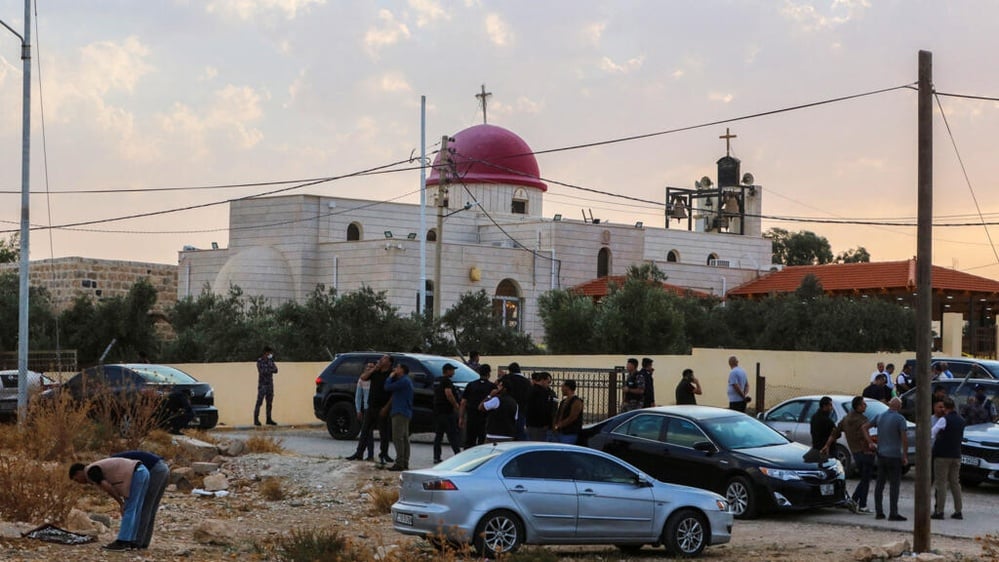
“Images show the scene after a shooting at a Greek Orthodox Church in Jordan left seven dead.” · exact text match
Why: The text states incident details without personal or editorial opinion.
Claim: The tone is unemotional and measured despite the deadly subject.
“left seven dead” · exact text match
Why: Casualty details are stated plainly without emotive language.
The supplied text is very short and contains a duplicated block, limiting assessment of sourcing, context, and broader framing.
October 23, 2026 · 0 shares
Coverage is a restrained, official-source-driven account that uses the 'terrorist attack' framing while attributing the 'extremist takfiri ideology' characterization to Jordanian officials and noting the investigation remains open.
Automated analysis; not human reviewed.
Limitations: The short report is based almost entirely on official Jordanian government and royal statements, with no independent sourcing or investigative detail supplied.
·
4 of 55 available dimensions scored; omitted dimensions are not treated as neutral.
·
Verified supporting quotes for 4 of 4 scored dimensions.
Claim: The report ties assertions to named officials and open investigation status rather than authorial commentary.
“Momani said investigators were examining whether the perpetrators had links to any organizations.” · exact text match
“Prime Minister Jafar Hassan ordered the nationwide mourning period to begin on Friday, Oct 23, 2026.” · exact text match
Why: Both statements report actions or attributed claims without subjective interpretation, supporting an objective classification.
Claim: The lede presents the attack and death toll in restrained, factual terms rather than with sensational emphasis.
“Jordan has declared three days of national mourning following a terrorist attack on a Greek Orthodox church in Hamoud village in the southern governorate of Karak that killed seven people.” · exact text match
Why: The sentence reports mourning, location, and casualties directly; the terrorism wording is a standard designation and not embellished.
Claim: The text reports official actions and statements without prescribing policy or behavior.
“Prime Minister Jafar Hassan ordered the nationwide mourning period to begin on Friday, Oct 23, 2026.” · exact text match
“King Abdullah II visited the injured at Karak Government Hospital on Friday evening.” · exact text match
Why: The selected sentences describe orders and visits; they do not advocate a course of action.
Claim: The report names official sources and explicitly acknowledges unresolved investigative questions.
“Momani said investigators were examining whether the perpetrators had links to any organizations.
The findings would be announced after the investigation is completed, he added.”
· exact text match
“The investigation remains ongoing as Jordan mourns the victims and authorities work to establish the circumstances surrounding the deadly assault.” · exact text match
Why: Named attribution and stated uncertainty about findings support credible visible sourcing, though reliance is largely on official statements.
The short report is based almost entirely on official Jordanian government and royal statements, with no independent sourcing or investigative detail supplied.
October 24, 2026 · 0 shares
The framing is restrained and attribution-heavy, anchoring the report in official Jordanian and US statements while avoiding independent claims about attacker motives or group links.
Automated analysis; not human reviewed.
Limitations: The substantive article content is short and appears duplicated, with unrelated headline links after the news paragraphs; analysis is limited to the news paragraphs.
·
9 of 55 available dimensions scored; omitted dimensions are not treated as neutral.
·
Verified supporting quotes for 9 of 9 scored dimensions.
Claim: The report relies on attributed official statements and concrete details rather than the reporter’s subjective interpretation.
“The US embassy in Amman says security has been stepped up at malls, foreign embassies and other locations in Jordan” · exact text match
“authorities described as a terrorist act by extremists” · exact text match
Why: Key claims are sourced to the embassy and authorities, with no first-person or evaluative language.
Claim: Casualty and attack details are presented in measured, factual terms without sensational or emotive amplification.
“Seven people were killed and 40 were wounded when gunmen opened fire continuously for several minutes” · exact text match
Why: The sentence supplies numbers and actions without loaded adjectives or exclamatory language.
Claim: The report is predominantly descriptive, recounting attack details and official responses rather than prescribing policy.
“King Abdullah, a major US partner in the fight against militant Islamist groups, visited Karak hours after the attack and said the perpetrators would be punished “with an iron fist”.” · exact text match
Why: The text narrates events and quotes officials without advocating a course of action.
Claim: The article is largely fact-based and attributes quoted judgments to officials.
“Prime Minister Jafar Hassan said in a post on X” · exact text match
Why: Evaluative language appears in quotations, not as unattributed publisher opinion.
Claim: The report’s central subject is official state and security response to a terrorist attack.
“The US embassy in Amman says security has been stepped up at malls, foreign embassies and other locations in Jordan” · exact text match
“Prime Minister Jafar Hassan said in a post on X” · exact text match
Why: The selection centers government, diplomatic, and security actors rather than non-political subjects.
Claim: The report explicitly limits certainty about attacker links.
“it was too early to determine whether they had links to known groups inside or outside Jordan” · exact text match
Why: The stated caution directly counters overconfident causal claims.
Claim: Visible sourcing, named institutions, and cautious attribution support high credibility.
“the head of Jordan’s public security directorate said” · exact text match
“it was too early to determine whether they had links to known groups inside or outside Jordan” · exact text match
Why: The report identifies official sources and avoids overstating what is known.
Claim: The report attributes key claims and openly notes unresolved questions about attacker links.
“Authorities said they are still searching for the attackers, adding it was too early to determine whether they had links to known groups inside or outside Jordan.” · exact text match
Why: Attribution and explicit uncertainty signal fair, honest reporting.
Claim: The article is coherent, context-aware, and distinguishes attributed claims from established facts.
“Such attacks are rare in Jordan, though authorities in the US ally say that in recent years they have repeatedly foiled attempted attacks by Islamist militants.” · exact text match
Why: It supplies relevant background and attributes the threat context to authorities.
The substantive article content is short and appears duplicated, with unrelated headline links after the news paragraphs; analysis is limited to the news paragraphs.
October 24, 2026 · 0 shares
Neutral, official-source-driven wire reporting frames the church shooting as a terrorist attack by extremists while noting the absence of a claim and unresolved investigation details.
Automated analysis; not human reviewed.
Limitations: Substantive text appears to be syndicated Reuters copy with Al-Monitor boilerplate; publisher-specific framing cannot be cleanly separated from the wire report.
·
10 of 55 available dimensions scored; omitted dimensions are not treated as neutral.
·
Verified supporting quotes for 10 of 10 scored dimensions.
Claim: The report is predominantly factual and attributed rather than subjective.
“Security was stepped up at malls, foreign embassies and other locations across Jordan on Saturday, the US embassy in Amman said” · exact text match
“Authorities said they were still searching for the attackers” · exact text match
Why: The framing relies on official attribution and concrete events, with no evident authorial opinion.
Claim: The report uses restrained, factual language rather than sensational language despite the deadly attack.
“Seven people were killed and 40 were injured” · exact text match
“There was no immediate claim of responsibility.” · exact text match
Why: Casualty and security details are stated plainly, without publisher-added dramatic language.
Claim: The report describes events and official responses without prescribing policy or behavior.
“Security was stepped up at malls, foreign embassies and other locations across Jordan on Saturday” · exact text match
“Authorities said they were still searching for the attackers” · exact text match
Why: The content is descriptive reporting of security measures and investigation status, not an argument for action.
Claim: The report includes geopolitical and governmental framing around a security incident.
“Jordan has been among the US allies in the Middle East to be hit by Iranian attacks this year after the US and Israel launched strikes against Iran in February.” · exact text match
“Prime Minister Jafar Hassan said in a post on X” · exact text match
Why: The inclusion of U.S./Iran/Israel context and official political statements gives the article moderate political content.
Claim: The article relies heavily on statements from security officials, the U.S. embassy, the prime minister, and the king.
“the head of Jordan's Public Security Directorate said” · exact text match
“Prime Minister Jafar Hassan said in a post on X” · exact text match
Why: Authority statements are central to the account, but they are attributed rather than used as an argumentative appeal.
Claim: The report largely relays the Jordanian and U.S. official framing of the attack and response.
“a deadly assault on a church that authorities described as a terrorist attack by extremists” · exact text match
“the US embassy in Amman said” · exact text match
Why: Official accounts structure the report, though the article also notes the absence of a claim and ongoing investigation, which limits the pro-establishment score.
Claim: The article is credible in its supplied text due to attribution to named officials, a wire-service byline, and acknowledgment of unresolved facts.
“HAMOUD, Jordan, Oct 24 (Reuters)” · exact text match
“There was no immediate claim of responsibility.” · exact text match
Why: Wire attribution and explicit uncertainty support high visible credibility.
Claim: The report presents the attack and response through attributed official statements and avoids emotive editorializing.
“the head of Jordan's Public Security Directorate said” · exact text match
“There was no immediate claim of responsibility.” · exact text match
Why: Attribution and acknowledgment of missing claim support a rational, evidence-bound presentation.
Claim: The report shows high internal fairness through sourcing, attribution, and explicit uncertainty.
“the head of Jordan's Public Security Directorate said” · exact text match
“it was too early to determine whether they had links to known groups inside or outside Jordan.” · exact text match
Why: Official claims are attributed and unresolved details are flagged, supporting an integrity-positive classification.
Claim: The report is coherent, sourced, and provides relevant context without excessive speculation.
“Such attacks are rare in Jordan, although authorities in the US-allied kingdom say they have repeatedly foiled plots by Islamist militants in recent years.” · exact text match
“Authorities said they were still searching for the attackers, adding it was too early to determine whether they had links to known groups inside or outside Jordan.” · exact text match
Why: Clear organization, relevant background, and calibrated uncertainty indicate high article intelligence.
Substantive text appears to be syndicated Reuters copy with Al-Monitor boilerplate; publisher-specific framing cannot be cleanly separated from the wire report.
The framing is source-driven and official-statement centered, foregrounding the Patriarchate’s condemnation and emotive language while presenting the attack as terrorism without independent corroboration.
The Greek Orthodox Patriarchate of Jerusalem is a church authority in the Holy Land; Jordan’s Hashemite monarchy is the country’s ruling dynasty.
Automated analysis; not human reviewed.
Limitations: The supplied text repeats the substantive article block and includes unrelated headline fragments, so the analysis is limited to the substantive Patriarchate statement.
·
6 of 55 available dimensions scored; omitted dimensions are not treated as neutral.
·
Verified supporting quotes for 6 of 6 scored dimensions.
Claim: The report frames the attack response around Jordanian national unity and Hashemite political leadership.
“uniting us more firmly around our Hashemite leadership” · exact text match
Why: The statement explicitly ties communal resilience to the Hashemite leadership.
Claim: The substantive account relies almost entirely on the Patriarchate's statement rather than independent evidence.
“the Patriarchate said in a statement” · exact text match
Why: The report attributes its core claims and quotations to a single religious authority.
Claim: The report favorably presents official religious and Jordanian state institutions without countervailing voices.
“full confidence in the Jordanian security services” · exact text match
“uniting us more firmly around our Hashemite leadership” · exact text match
Why: Confidence in security services and allegiance to Hashemite leadership are central quoted themes.
Claim: The report's framing is strongly negative toward the attack, using intense condemnatory language.
“abhorrent, bloody act” · exact text match
Why: The quoted condemnation supplies a distinctly negative emotional valence that structures the report.
Claim: Credibility is supported by named attribution and direct quotation, though the report remains single-source.
“the Patriarchate said in a statement” · exact text match
Why: Clear attribution is present, but no independent corroboration appears in the supplied text.
Claim: The report transparently attributes claims to the Patriarchate and named church leaders.
“Patriarch Theophilos III and the members of the Holy Synod” · exact text match
Why: Named sourcing and direct attribution are observable honesty and fairness signals.
The supplied text repeats the substantive article block and includes unrelated headline fragments, so the analysis is limited to the substantive Patriarchate statement.
October 23, 2026 · 0 shares
The framing heavily relies on official state pronouncements and royal rhetoric to define the attack, project national resolve, and frame the perpetrators as absolute existential threats.
A 2016 deadly ISIL (ISIS) assault occurred in Karak, killing 10 people, including security officers and a Canadian tourist, serving as historical background for interfaith incidents in the region.
Automated analysis; not human reviewed. · 55 of 55 available dimensions scored; omitted dimensions are not treated as neutral. · Verified supporting quotes for 0 of 55 scored dimensions.
October 24, 2026 · 0 shares
The report is predominantly factual and attribution-heavy, foregrounding official Jordanian security framing and casualty counts while explicitly flagging unverified footage and unclear attacker motives.
Automated analysis; not human reviewed. Limitations: The supplied text includes duplicated opening fragments and video/promotional boilerplate; bias scores are based only on substantive news paragraphs. · 7 of 55 available dimensions scored; omitted dimensions are not treated as neutral. · Verified supporting quotes for 7 of 7 scored dimensions.
Claim: The report separates verified facts from unverified material and acknowledges unresolved motives.
“The attackers' identities and motives remain unclear.” · exact text match
“Videos circulating online showed wounded people on the floor of the church covered in blood, but this footage cannot be verified by DW.” · exact text match
Why: The text explicitly notes uncertainty about motives and caveats unverified footage, supporting an objective classification.
Claim: Casualty information is presented in measured, attributed terms rather than dramatic prose.
“A shooting at a church in the southern Jordanian governorate of Karak left seven people dead and another 34 wounded on Friday, Jordan's public security director Obaidallah Maaytah said.” · exact text match
Why: The core casualty reporting is attributed and plainly stated, outweighing the limited graphic detail elsewhere.
Claim: The report describes events and official reactions without prescribing policy or action in its own voice.
“Jordanian government spokesperson Mohammad al-Momani said security forces have launched a probe into the attack.” · exact text match
Why: The account reports official actions descriptively and does not itself recommend a course of action.
Claim: The report foregrounds official political and diplomatic responses to the attack.
“Jordan King Abdullah II said "the terrorist attack against Karak will be met with the harshest retaliation."” · exact text match
“US Ambassador to the UN Mike Waltz said the news regarding the attack is "devastating."” · exact text match
Why: Political leaders and diplomats are quoted reacting to the attack, making the story substantially political in focus.
Claim: Sourcing is explicit and uncertainty around unverified footage and motives is acknowledged.
“Videos circulating online showed wounded people on the floor of the church covered in blood, but this footage cannot be verified by DW.” · exact text match
“The attackers' identities and motives remain unclear.” · exact text match
Why: The report attributes key facts and openly notes verification limits, supporting high credibility on the supplied text.
Claim: The report avoids speculative attribution of motive and flags uncertainty.
“The attackers' identities and motives remain unclear.” · exact text match
Why: Rather than inferring a motive, the text states that identities and motives are unknown, supporting a rational classification.
Claim: The report discloses limits on visual evidence and attributes casualty figures to named officials.
“Videos circulating online showed wounded people on the floor of the church covered in blood, but this footage cannot be verified by DW.” · exact text match
“A shooting at a church in the southern Jordanian governorate of Karak left seven people dead and another 34 wounded on Friday, Jordan's public security director Obaidallah Maaytah said.” · exact text match
Why: Named attribution and an explicit verification caveat are observable fairness and honesty signals.
The supplied text includes duplicated opening fragments and video/promotional boilerplate; bias scores are based only on substantive news paragraphs.
October 24, 2026 · 0 shares
The framing is restrained and attribution-heavy, anchoring the report in official Jordanian and US statements while avoiding independent claims about attacker motives or group links.
Automated analysis; not human reviewed. Limitations: The substantive article content is short and appears duplicated, with unrelated headline links after the news paragraphs; analysis is limited to the news paragraphs. · 9 of 55 available dimensions scored; omitted dimensions are not treated as neutral. · Verified supporting quotes for 9 of 9 scored dimensions.
Claim: The report relies on attributed official statements and concrete details rather than the reporter’s subjective interpretation.
“The US embassy in Amman says security has been stepped up at malls, foreign embassies and other locations in Jordan” · exact text match
“authorities described as a terrorist act by extremists” · exact text match
Why: Key claims are sourced to the embassy and authorities, with no first-person or evaluative language.
Claim: Casualty and attack details are presented in measured, factual terms without sensational or emotive amplification.
“Seven people were killed and 40 were wounded when gunmen opened fire continuously for several minutes” · exact text match
Why: The sentence supplies numbers and actions without loaded adjectives or exclamatory language.
Claim: The report is predominantly descriptive, recounting attack details and official responses rather than prescribing policy.
“King Abdullah, a major US partner in the fight against militant Islamist groups, visited Karak hours after the attack and said the perpetrators would be punished “with an iron fist”.” · exact text match
Why: The text narrates events and quotes officials without advocating a course of action.
Claim: The article is largely fact-based and attributes quoted judgments to officials.
“Prime Minister Jafar Hassan said in a post on X” · exact text match
Why: Evaluative language appears in quotations, not as unattributed publisher opinion.
Claim: The report’s central subject is official state and security response to a terrorist attack.
“The US embassy in Amman says security has been stepped up at malls, foreign embassies and other locations in Jordan” · exact text match
“Prime Minister Jafar Hassan said in a post on X” · exact text match
Why: The selection centers government, diplomatic, and security actors rather than non-political subjects.
Claim: The report explicitly limits certainty about attacker links.
“it was too early to determine whether they had links to known groups inside or outside Jordan” · exact text match
Why: The stated caution directly counters overconfident causal claims.
Claim: Visible sourcing, named institutions, and cautious attribution support high credibility.
“the head of Jordan’s public security directorate said” · exact text match
“it was too early to determine whether they had links to known groups inside or outside Jordan” · exact text match
Why: The report identifies official sources and avoids overstating what is known.
Claim: The report attributes key claims and openly notes unresolved questions about attacker links.
“Authorities said they are still searching for the attackers, adding it was too early to determine whether they had links to known groups inside or outside Jordan.” · exact text match
Why: Attribution and explicit uncertainty signal fair, honest reporting.
Claim: The article is coherent, context-aware, and distinguishes attributed claims from established facts.
“Such attacks are rare in Jordan, though authorities in the US ally say that in recent years they have repeatedly foiled attempted attacks by Islamist militants.” · exact text match
Why: It supplies relevant background and attributes the threat context to authorities.
The substantive article content is short and appears duplicated, with unrelated headline links after the news paragraphs; analysis is limited to the news paragraphs.
October 24, 2026 · 0 shares
Neutral, official-source-driven wire reporting frames the church shooting as a terrorist attack by extremists while noting the absence of a claim and unresolved investigation details.
Automated analysis; not human reviewed. Limitations: Substantive text appears to be syndicated Reuters copy with Al-Monitor boilerplate; publisher-specific framing cannot be cleanly separated from the wire report. · 10 of 55 available dimensions scored; omitted dimensions are not treated as neutral. · Verified supporting quotes for 10 of 10 scored dimensions.
Claim: The report is predominantly factual and attributed rather than subjective.
“Security was stepped up at malls, foreign embassies and other locations across Jordan on Saturday, the US embassy in Amman said” · exact text match
“Authorities said they were still searching for the attackers” · exact text match
Why: The framing relies on official attribution and concrete events, with no evident authorial opinion.
Claim: The report uses restrained, factual language rather than sensational language despite the deadly attack.
“Seven people were killed and 40 were injured” · exact text match
“There was no immediate claim of responsibility.” · exact text match
Why: Casualty and security details are stated plainly, without publisher-added dramatic language.
Claim: The report describes events and official responses without prescribing policy or behavior.
“Security was stepped up at malls, foreign embassies and other locations across Jordan on Saturday” · exact text match
“Authorities said they were still searching for the attackers” · exact text match
Why: The content is descriptive reporting of security measures and investigation status, not an argument for action.
Claim: The report includes geopolitical and governmental framing around a security incident.
“Jordan has been among the US allies in the Middle East to be hit by Iranian attacks this year after the US and Israel launched strikes against Iran in February.” · exact text match
“Prime Minister Jafar Hassan said in a post on X” · exact text match
Why: The inclusion of U.S./Iran/Israel context and official political statements gives the article moderate political content.
Claim: The article relies heavily on statements from security officials, the U.S. embassy, the prime minister, and the king.
“the head of Jordan's Public Security Directorate said” · exact text match
“Prime Minister Jafar Hassan said in a post on X” · exact text match
Why: Authority statements are central to the account, but they are attributed rather than used as an argumentative appeal.
Claim: The report largely relays the Jordanian and U.S. official framing of the attack and response.
“a deadly assault on a church that authorities described as a terrorist attack by extremists” · exact text match
“the US embassy in Amman said” · exact text match
Why: Official accounts structure the report, though the article also notes the absence of a claim and ongoing investigation, which limits the pro-establishment score.
Claim: The article is credible in its supplied text due to attribution to named officials, a wire-service byline, and acknowledgment of unresolved facts.
“HAMOUD, Jordan, Oct 24 (Reuters)” · exact text match
“There was no immediate claim of responsibility.” · exact text match
Why: Wire attribution and explicit uncertainty support high visible credibility.
Claim: The report presents the attack and response through attributed official statements and avoids emotive editorializing.
“the head of Jordan's Public Security Directorate said” · exact text match
“There was no immediate claim of responsibility.” · exact text match
Why: Attribution and acknowledgment of missing claim support a rational, evidence-bound presentation.
Claim: The report shows high internal fairness through sourcing, attribution, and explicit uncertainty.
“the head of Jordan's Public Security Directorate said” · exact text match
“it was too early to determine whether they had links to known groups inside or outside Jordan.” · exact text match
Why: Official claims are attributed and unresolved details are flagged, supporting an integrity-positive classification.
Claim: The report is coherent, sourced, and provides relevant context without excessive speculation.
“Such attacks are rare in Jordan, although authorities in the US-allied kingdom say they have repeatedly foiled plots by Islamist militants in recent years.” · exact text match
“Authorities said they were still searching for the attackers, adding it was too early to determine whether they had links to known groups inside or outside Jordan.” · exact text match
Why: Clear organization, relevant background, and calibrated uncertainty indicate high article intelligence.
Substantive text appears to be syndicated Reuters copy with Al-Monitor boilerplate; publisher-specific framing cannot be cleanly separated from the wire report.
October 24, 2026 · 0 shares
The report is predominantly factual and attribution-heavy, foregrounding official Jordanian security framing and casualty counts while explicitly flagging unverified footage and unclear attacker motives.
Automated analysis; not human reviewed. Limitations: The supplied text includes duplicated opening fragments and video/promotional boilerplate; bias scores are based only on substantive news paragraphs. · 7 of 55 available dimensions scored; omitted dimensions are not treated as neutral. · Verified supporting quotes for 7 of 7 scored dimensions.
Claim: The report separates verified facts from unverified material and acknowledges unresolved motives.
“The attackers' identities and motives remain unclear.” · exact text match
“Videos circulating online showed wounded people on the floor of the church covered in blood, but this footage cannot be verified by DW.” · exact text match
Why: The text explicitly notes uncertainty about motives and caveats unverified footage, supporting an objective classification.
Claim: Casualty information is presented in measured, attributed terms rather than dramatic prose.
“A shooting at a church in the southern Jordanian governorate of Karak left seven people dead and another 34 wounded on Friday, Jordan's public security director Obaidallah Maaytah said.” · exact text match
Why: The core casualty reporting is attributed and plainly stated, outweighing the limited graphic detail elsewhere.
Claim: The report describes events and official reactions without prescribing policy or action in its own voice.
“Jordanian government spokesperson Mohammad al-Momani said security forces have launched a probe into the attack.” · exact text match
Why: The account reports official actions descriptively and does not itself recommend a course of action.
Claim: The report foregrounds official political and diplomatic responses to the attack.
“Jordan King Abdullah II said "the terrorist attack against Karak will be met with the harshest retaliation."” · exact text match
“US Ambassador to the UN Mike Waltz said the news regarding the attack is "devastating."” · exact text match
Why: Political leaders and diplomats are quoted reacting to the attack, making the story substantially political in focus.
Claim: Sourcing is explicit and uncertainty around unverified footage and motives is acknowledged.
“Videos circulating online showed wounded people on the floor of the church covered in blood, but this footage cannot be verified by DW.” · exact text match
“The attackers' identities and motives remain unclear.” · exact text match
Why: The report attributes key facts and openly notes verification limits, supporting high credibility on the supplied text.
Claim: The report avoids speculative attribution of motive and flags uncertainty.
“The attackers' identities and motives remain unclear.” · exact text match
Why: Rather than inferring a motive, the text states that identities and motives are unknown, supporting a rational classification.
Claim: The report discloses limits on visual evidence and attributes casualty figures to named officials.
“Videos circulating online showed wounded people on the floor of the church covered in blood, but this footage cannot be verified by DW.” · exact text match
“A shooting at a church in the southern Jordanian governorate of Karak left seven people dead and another 34 wounded on Friday, Jordan's public security director Obaidallah Maaytah said.” · exact text match
Why: Named attribution and an explicit verification caveat are observable fairness and honesty signals.
The supplied text includes duplicated opening fragments and video/promotional boilerplate; bias scores are based only on substantive news paragraphs.
October 23, 2026 · 0 shares
Coverage is a restrained, official-source-driven account that uses the 'terrorist attack' framing while attributing the 'extremist takfiri ideology' characterization to Jordanian officials and noting the investigation remains open.
Automated analysis; not human reviewed. Limitations: The short report is based almost entirely on official Jordanian government and royal statements, with no independent sourcing or investigative detail supplied. · 4 of 55 available dimensions scored; omitted dimensions are not treated as neutral. · Verified supporting quotes for 4 of 4 scored dimensions.
Claim: The report ties assertions to named officials and open investigation status rather than authorial commentary.
“Momani said investigators were examining whether the perpetrators had links to any organizations.” · exact text match
“Prime Minister Jafar Hassan ordered the nationwide mourning period to begin on Friday, Oct 23, 2026.” · exact text match
Why: Both statements report actions or attributed claims without subjective interpretation, supporting an objective classification.
Claim: The lede presents the attack and death toll in restrained, factual terms rather than with sensational emphasis.
“Jordan has declared three days of national mourning following a terrorist attack on a Greek Orthodox church in Hamoud village in the southern governorate of Karak that killed seven people.” · exact text match
Why: The sentence reports mourning, location, and casualties directly; the terrorism wording is a standard designation and not embellished.
Claim: The text reports official actions and statements without prescribing policy or behavior.
“Prime Minister Jafar Hassan ordered the nationwide mourning period to begin on Friday, Oct 23, 2026.” · exact text match
“King Abdullah II visited the injured at Karak Government Hospital on Friday evening.” · exact text match
Why: The selected sentences describe orders and visits; they do not advocate a course of action.
Claim: The report names official sources and explicitly acknowledges unresolved investigative questions.
“Momani said investigators were examining whether the perpetrators had links to any organizations. The findings would be announced after the investigation is completed, he added.” · exact text match
“The investigation remains ongoing as Jordan mourns the victims and authorities work to establish the circumstances surrounding the deadly assault.” · exact text match
Why: Named attribution and stated uncertainty about findings support credible visible sourcing, though reliance is largely on official statements.
The short report is based almost entirely on official Jordanian government and royal statements, with no independent sourcing or investigative detail supplied.
October 24, 2026 · 0 shares
The framing is restrained and attribution-heavy, anchoring the report in official Jordanian and US statements while avoiding independent claims about attacker motives or group links.
Automated analysis; not human reviewed. Limitations: The substantive article content is short and appears duplicated, with unrelated headline links after the news paragraphs; analysis is limited to the news paragraphs. · 9 of 55 available dimensions scored; omitted dimensions are not treated as neutral. · Verified supporting quotes for 9 of 9 scored dimensions.
Claim: The report relies on attributed official statements and concrete details rather than the reporter’s subjective interpretation.
“The US embassy in Amman says security has been stepped up at malls, foreign embassies and other locations in Jordan” · exact text match
“authorities described as a terrorist act by extremists” · exact text match
Why: Key claims are sourced to the embassy and authorities, with no first-person or evaluative language.
Claim: Casualty and attack details are presented in measured, factual terms without sensational or emotive amplification.
“Seven people were killed and 40 were wounded when gunmen opened fire continuously for several minutes” · exact text match
Why: The sentence supplies numbers and actions without loaded adjectives or exclamatory language.
Claim: The report is predominantly descriptive, recounting attack details and official responses rather than prescribing policy.
“King Abdullah, a major US partner in the fight against militant Islamist groups, visited Karak hours after the attack and said the perpetrators would be punished “with an iron fist”.” · exact text match
Why: The text narrates events and quotes officials without advocating a course of action.
Claim: The article is largely fact-based and attributes quoted judgments to officials.
“Prime Minister Jafar Hassan said in a post on X” · exact text match
Why: Evaluative language appears in quotations, not as unattributed publisher opinion.
Claim: The report’s central subject is official state and security response to a terrorist attack.
“The US embassy in Amman says security has been stepped up at malls, foreign embassies and other locations in Jordan” · exact text match
“Prime Minister Jafar Hassan said in a post on X” · exact text match
Why: The selection centers government, diplomatic, and security actors rather than non-political subjects.
Claim: The report explicitly limits certainty about attacker links.
“it was too early to determine whether they had links to known groups inside or outside Jordan” · exact text match
Why: The stated caution directly counters overconfident causal claims.
Claim: Visible sourcing, named institutions, and cautious attribution support high credibility.
“the head of Jordan’s public security directorate said” · exact text match
“it was too early to determine whether they had links to known groups inside or outside Jordan” · exact text match
Why: The report identifies official sources and avoids overstating what is known.
Claim: The report attributes key claims and openly notes unresolved questions about attacker links.
“Authorities said they are still searching for the attackers, adding it was too early to determine whether they had links to known groups inside or outside Jordan.” · exact text match
Why: Attribution and explicit uncertainty signal fair, honest reporting.
Claim: The article is coherent, context-aware, and distinguishes attributed claims from established facts.
“Such attacks are rare in Jordan, though authorities in the US ally say that in recent years they have repeatedly foiled attempted attacks by Islamist militants.” · exact text match
Why: It supplies relevant background and attributes the threat context to authorities.
The substantive article content is short and appears duplicated, with unrelated headline links after the news paragraphs; analysis is limited to the news paragraphs.
October 24, 2026 · 0 shares
Neutral, official-source-driven wire reporting frames the church shooting as a terrorist attack by extremists while noting the absence of a claim and unresolved investigation details.
Automated analysis; not human reviewed. Limitations: Substantive text appears to be syndicated Reuters copy with Al-Monitor boilerplate; publisher-specific framing cannot be cleanly separated from the wire report. · 10 of 55 available dimensions scored; omitted dimensions are not treated as neutral. · Verified supporting quotes for 10 of 10 scored dimensions.
Claim: The report is predominantly factual and attributed rather than subjective.
“Security was stepped up at malls, foreign embassies and other locations across Jordan on Saturday, the US embassy in Amman said” · exact text match
“Authorities said they were still searching for the attackers” · exact text match
Why: The framing relies on official attribution and concrete events, with no evident authorial opinion.
Claim: The report uses restrained, factual language rather than sensational language despite the deadly attack.
“Seven people were killed and 40 were injured” · exact text match
“There was no immediate claim of responsibility.” · exact text match
Why: Casualty and security details are stated plainly, without publisher-added dramatic language.
Claim: The report describes events and official responses without prescribing policy or behavior.
“Security was stepped up at malls, foreign embassies and other locations across Jordan on Saturday” · exact text match
“Authorities said they were still searching for the attackers” · exact text match
Why: The content is descriptive reporting of security measures and investigation status, not an argument for action.
Claim: The report includes geopolitical and governmental framing around a security incident.
“Jordan has been among the US allies in the Middle East to be hit by Iranian attacks this year after the US and Israel launched strikes against Iran in February.” · exact text match
“Prime Minister Jafar Hassan said in a post on X” · exact text match
Why: The inclusion of U.S./Iran/Israel context and official political statements gives the article moderate political content.
Claim: The article relies heavily on statements from security officials, the U.S. embassy, the prime minister, and the king.
“the head of Jordan's Public Security Directorate said” · exact text match
“Prime Minister Jafar Hassan said in a post on X” · exact text match
Why: Authority statements are central to the account, but they are attributed rather than used as an argumentative appeal.
Claim: The report largely relays the Jordanian and U.S. official framing of the attack and response.
“a deadly assault on a church that authorities described as a terrorist attack by extremists” · exact text match
“the US embassy in Amman said” · exact text match
Why: Official accounts structure the report, though the article also notes the absence of a claim and ongoing investigation, which limits the pro-establishment score.
Claim: The article is credible in its supplied text due to attribution to named officials, a wire-service byline, and acknowledgment of unresolved facts.
“HAMOUD, Jordan, Oct 24 (Reuters)” · exact text match
“There was no immediate claim of responsibility.” · exact text match
Why: Wire attribution and explicit uncertainty support high visible credibility.
Claim: The report presents the attack and response through attributed official statements and avoids emotive editorializing.
“the head of Jordan's Public Security Directorate said” · exact text match
“There was no immediate claim of responsibility.” · exact text match
Why: Attribution and acknowledgment of missing claim support a rational, evidence-bound presentation.
Claim: The report shows high internal fairness through sourcing, attribution, and explicit uncertainty.
“the head of Jordan's Public Security Directorate said” · exact text match
“it was too early to determine whether they had links to known groups inside or outside Jordan.” · exact text match
Why: Official claims are attributed and unresolved details are flagged, supporting an integrity-positive classification.
Claim: The report is coherent, sourced, and provides relevant context without excessive speculation.
“Such attacks are rare in Jordan, although authorities in the US-allied kingdom say they have repeatedly foiled plots by Islamist militants in recent years.” · exact text match
“Authorities said they were still searching for the attackers, adding it was too early to determine whether they had links to known groups inside or outside Jordan.” · exact text match
Why: Clear organization, relevant background, and calibrated uncertainty indicate high article intelligence.
Substantive text appears to be syndicated Reuters copy with Al-Monitor boilerplate; publisher-specific framing cannot be cleanly separated from the wire report.
Regional Geopolitical Lens
October 24, 2026 · 0 shares
Neutral, official-source-driven wire reporting frames the church shooting as a terrorist attack by extremists while noting the absence of a claim and unresolved investigation details.
Automated analysis; not human reviewed. Limitations: Substantive text appears to be syndicated Reuters copy with Al-Monitor boilerplate; publisher-specific framing cannot be cleanly separated from the wire report. · 10 of 55 available dimensions scored; omitted dimensions are not treated as neutral. · Verified supporting quotes for 10 of 10 scored dimensions.
Claim: The report is predominantly factual and attributed rather than subjective.
“Security was stepped up at malls, foreign embassies and other locations across Jordan on Saturday, the US embassy in Amman said” · exact text match
“Authorities said they were still searching for the attackers” · exact text match
Why: The framing relies on official attribution and concrete events, with no evident authorial opinion.
Claim: The report uses restrained, factual language rather than sensational language despite the deadly attack.
“Seven people were killed and 40 were injured” · exact text match
“There was no immediate claim of responsibility.” · exact text match
Why: Casualty and security details are stated plainly, without publisher-added dramatic language.
Claim: The report describes events and official responses without prescribing policy or behavior.
“Security was stepped up at malls, foreign embassies and other locations across Jordan on Saturday” · exact text match
“Authorities said they were still searching for the attackers” · exact text match
Why: The content is descriptive reporting of security measures and investigation status, not an argument for action.
Claim: The report includes geopolitical and governmental framing around a security incident.
“Jordan has been among the US allies in the Middle East to be hit by Iranian attacks this year after the US and Israel launched strikes against Iran in February.” · exact text match
“Prime Minister Jafar Hassan said in a post on X” · exact text match
Why: The inclusion of U.S./Iran/Israel context and official political statements gives the article moderate political content.
Claim: The article relies heavily on statements from security officials, the U.S. embassy, the prime minister, and the king.
“the head of Jordan's Public Security Directorate said” · exact text match
“Prime Minister Jafar Hassan said in a post on X” · exact text match
Why: Authority statements are central to the account, but they are attributed rather than used as an argumentative appeal.
Claim: The report largely relays the Jordanian and U.S. official framing of the attack and response.
“a deadly assault on a church that authorities described as a terrorist attack by extremists” · exact text match
“the US embassy in Amman said” · exact text match
Why: Official accounts structure the report, though the article also notes the absence of a claim and ongoing investigation, which limits the pro-establishment score.
Claim: The article is credible in its supplied text due to attribution to named officials, a wire-service byline, and acknowledgment of unresolved facts.
“HAMOUD, Jordan, Oct 24 (Reuters)” · exact text match
“There was no immediate claim of responsibility.” · exact text match
Why: Wire attribution and explicit uncertainty support high visible credibility.
Claim: The report presents the attack and response through attributed official statements and avoids emotive editorializing.
“the head of Jordan's Public Security Directorate said” · exact text match
“There was no immediate claim of responsibility.” · exact text match
Why: Attribution and acknowledgment of missing claim support a rational, evidence-bound presentation.
Claim: The report shows high internal fairness through sourcing, attribution, and explicit uncertainty.
“the head of Jordan's Public Security Directorate said” · exact text match
“it was too early to determine whether they had links to known groups inside or outside Jordan.” · exact text match
Why: Official claims are attributed and unresolved details are flagged, supporting an integrity-positive classification.
Claim: The report is coherent, sourced, and provides relevant context without excessive speculation.
“Such attacks are rare in Jordan, although authorities in the US-allied kingdom say they have repeatedly foiled plots by Islamist militants in recent years.” · exact text match
“Authorities said they were still searching for the attackers, adding it was too early to determine whether they had links to known groups inside or outside Jordan.” · exact text match
Why: Clear organization, relevant background, and calibrated uncertainty indicate high article intelligence.
Substantive text appears to be syndicated Reuters copy with Al-Monitor boilerplate; publisher-specific framing cannot be cleanly separated from the wire report.
October 24, 2026 · 0 shares
The framing is restrained and attribution-heavy, anchoring the report in official Jordanian and US statements while avoiding independent claims about attacker motives or group links.
Automated analysis; not human reviewed. Limitations: The substantive article content is short and appears duplicated, with unrelated headline links after the news paragraphs; analysis is limited to the news paragraphs. · 9 of 55 available dimensions scored; omitted dimensions are not treated as neutral. · Verified supporting quotes for 9 of 9 scored dimensions.
Claim: The report relies on attributed official statements and concrete details rather than the reporter’s subjective interpretation.
“The US embassy in Amman says security has been stepped up at malls, foreign embassies and other locations in Jordan” · exact text match
“authorities described as a terrorist act by extremists” · exact text match
Why: Key claims are sourced to the embassy and authorities, with no first-person or evaluative language.
Claim: Casualty and attack details are presented in measured, factual terms without sensational or emotive amplification.
“Seven people were killed and 40 were wounded when gunmen opened fire continuously for several minutes” · exact text match
Why: The sentence supplies numbers and actions without loaded adjectives or exclamatory language.
Claim: The report is predominantly descriptive, recounting attack details and official responses rather than prescribing policy.
“King Abdullah, a major US partner in the fight against militant Islamist groups, visited Karak hours after the attack and said the perpetrators would be punished “with an iron fist”.” · exact text match
Why: The text narrates events and quotes officials without advocating a course of action.
Claim: The article is largely fact-based and attributes quoted judgments to officials.
“Prime Minister Jafar Hassan said in a post on X” · exact text match
Why: Evaluative language appears in quotations, not as unattributed publisher opinion.
Claim: The report’s central subject is official state and security response to a terrorist attack.
“The US embassy in Amman says security has been stepped up at malls, foreign embassies and other locations in Jordan” · exact text match
“Prime Minister Jafar Hassan said in a post on X” · exact text match
Why: The selection centers government, diplomatic, and security actors rather than non-political subjects.
Claim: The report explicitly limits certainty about attacker links.
“it was too early to determine whether they had links to known groups inside or outside Jordan” · exact text match
Why: The stated caution directly counters overconfident causal claims.
Claim: Visible sourcing, named institutions, and cautious attribution support high credibility.
“the head of Jordan’s public security directorate said” · exact text match
“it was too early to determine whether they had links to known groups inside or outside Jordan” · exact text match
Why: The report identifies official sources and avoids overstating what is known.
Claim: The report attributes key claims and openly notes unresolved questions about attacker links.
“Authorities said they are still searching for the attackers, adding it was too early to determine whether they had links to known groups inside or outside Jordan.” · exact text match
Why: Attribution and explicit uncertainty signal fair, honest reporting.
Claim: The article is coherent, context-aware, and distinguishes attributed claims from established facts.
“Such attacks are rare in Jordan, though authorities in the US ally say that in recent years they have repeatedly foiled attempted attacks by Islamist militants.” · exact text match
Why: It supplies relevant background and attributes the threat context to authorities.
The substantive article content is short and appears duplicated, with unrelated headline links after the news paragraphs; analysis is limited to the news paragraphs.
October 24, 2026 · 0 shares
Neutral, official-source-driven wire reporting frames the church shooting as a terrorist attack by extremists while noting the absence of a claim and unresolved investigation details.
Automated analysis; not human reviewed. Limitations: Substantive text appears to be syndicated Reuters copy with Al-Monitor boilerplate; publisher-specific framing cannot be cleanly separated from the wire report. · 10 of 55 available dimensions scored; omitted dimensions are not treated as neutral. · Verified supporting quotes for 10 of 10 scored dimensions.
Claim: The report is predominantly factual and attributed rather than subjective.
“Security was stepped up at malls, foreign embassies and other locations across Jordan on Saturday, the US embassy in Amman said” · exact text match
“Authorities said they were still searching for the attackers” · exact text match
Why: The framing relies on official attribution and concrete events, with no evident authorial opinion.
Claim: The report uses restrained, factual language rather than sensational language despite the deadly attack.
“Seven people were killed and 40 were injured” · exact text match
“There was no immediate claim of responsibility.” · exact text match
Why: Casualty and security details are stated plainly, without publisher-added dramatic language.
Claim: The report describes events and official responses without prescribing policy or behavior.
“Security was stepped up at malls, foreign embassies and other locations across Jordan on Saturday” · exact text match
“Authorities said they were still searching for the attackers” · exact text match
Why: The content is descriptive reporting of security measures and investigation status, not an argument for action.
Claim: The report includes geopolitical and governmental framing around a security incident.
“Jordan has been among the US allies in the Middle East to be hit by Iranian attacks this year after the US and Israel launched strikes against Iran in February.” · exact text match
“Prime Minister Jafar Hassan said in a post on X” · exact text match
Why: The inclusion of U.S./Iran/Israel context and official political statements gives the article moderate political content.
Claim: The article relies heavily on statements from security officials, the U.S. embassy, the prime minister, and the king.
“the head of Jordan's Public Security Directorate said” · exact text match
“Prime Minister Jafar Hassan said in a post on X” · exact text match
Why: Authority statements are central to the account, but they are attributed rather than used as an argumentative appeal.
Claim: The report largely relays the Jordanian and U.S. official framing of the attack and response.
“a deadly assault on a church that authorities described as a terrorist attack by extremists” · exact text match
“the US embassy in Amman said” · exact text match
Why: Official accounts structure the report, though the article also notes the absence of a claim and ongoing investigation, which limits the pro-establishment score.
Claim: The article is credible in its supplied text due to attribution to named officials, a wire-service byline, and acknowledgment of unresolved facts.
“HAMOUD, Jordan, Oct 24 (Reuters)” · exact text match
“There was no immediate claim of responsibility.” · exact text match
Why: Wire attribution and explicit uncertainty support high visible credibility.
Claim: The report presents the attack and response through attributed official statements and avoids emotive editorializing.
“the head of Jordan's Public Security Directorate said” · exact text match
“There was no immediate claim of responsibility.” · exact text match
Why: Attribution and acknowledgment of missing claim support a rational, evidence-bound presentation.
Claim: The report shows high internal fairness through sourcing, attribution, and explicit uncertainty.
“the head of Jordan's Public Security Directorate said” · exact text match
“it was too early to determine whether they had links to known groups inside or outside Jordan.” · exact text match
Why: Official claims are attributed and unresolved details are flagged, supporting an integrity-positive classification.
Claim: The report is coherent, sourced, and provides relevant context without excessive speculation.
“Such attacks are rare in Jordan, although authorities in the US-allied kingdom say they have repeatedly foiled plots by Islamist militants in recent years.” · exact text match
“Authorities said they were still searching for the attackers, adding it was too early to determine whether they had links to known groups inside or outside Jordan.” · exact text match
Why: Clear organization, relevant background, and calibrated uncertainty indicate high article intelligence.
Substantive text appears to be syndicated Reuters copy with Al-Monitor boilerplate; publisher-specific framing cannot be cleanly separated from the wire report.
Helium Bias
Story Blindspots
October 23, 2026 · 0 shares
The framing heavily relies on official state pronouncements and royal rhetoric to define the attack, project national resolve, and frame the perpetrators as absolute existential threats.
A 2016 deadly ISIL (ISIS) assault occurred in Karak, killing 10 people, including security officers and a Canadian tourist, serving as historical background for interfaith incidents in the region.
Automated analysis; not human reviewed. · 55 of 55 available dimensions scored; omitted dimensions are not treated as neutral. · Verified supporting quotes for 0 of 55 scored dimensions.
October 24, 2026 · 0 shares
The framing is restrained and attribution-heavy, anchoring the report in official Jordanian and US statements while avoiding independent claims about attacker motives or group links.
Automated analysis; not human reviewed. Limitations: The substantive article content is short and appears duplicated, with unrelated headline links after the news paragraphs; analysis is limited to the news paragraphs. · 9 of 55 available dimensions scored; omitted dimensions are not treated as neutral. · Verified supporting quotes for 9 of 9 scored dimensions.
Claim: The report relies on attributed official statements and concrete details rather than the reporter’s subjective interpretation.
“The US embassy in Amman says security has been stepped up at malls, foreign embassies and other locations in Jordan” · exact text match
“authorities described as a terrorist act by extremists” · exact text match
Why: Key claims are sourced to the embassy and authorities, with no first-person or evaluative language.
Claim: Casualty and attack details are presented in measured, factual terms without sensational or emotive amplification.
“Seven people were killed and 40 were wounded when gunmen opened fire continuously for several minutes” · exact text match
Why: The sentence supplies numbers and actions without loaded adjectives or exclamatory language.
Claim: The report is predominantly descriptive, recounting attack details and official responses rather than prescribing policy.
“King Abdullah, a major US partner in the fight against militant Islamist groups, visited Karak hours after the attack and said the perpetrators would be punished “with an iron fist”.” · exact text match
Why: The text narrates events and quotes officials without advocating a course of action.
Claim: The article is largely fact-based and attributes quoted judgments to officials.
“Prime Minister Jafar Hassan said in a post on X” · exact text match
Why: Evaluative language appears in quotations, not as unattributed publisher opinion.
Claim: The report’s central subject is official state and security response to a terrorist attack.
“The US embassy in Amman says security has been stepped up at malls, foreign embassies and other locations in Jordan” · exact text match
“Prime Minister Jafar Hassan said in a post on X” · exact text match
Why: The selection centers government, diplomatic, and security actors rather than non-political subjects.
Claim: The report explicitly limits certainty about attacker links.
“it was too early to determine whether they had links to known groups inside or outside Jordan” · exact text match
Why: The stated caution directly counters overconfident causal claims.
Claim: Visible sourcing, named institutions, and cautious attribution support high credibility.
“the head of Jordan’s public security directorate said” · exact text match
“it was too early to determine whether they had links to known groups inside or outside Jordan” · exact text match
Why: The report identifies official sources and avoids overstating what is known.
Claim: The report attributes key claims and openly notes unresolved questions about attacker links.
“Authorities said they are still searching for the attackers, adding it was too early to determine whether they had links to known groups inside or outside Jordan.” · exact text match
Why: Attribution and explicit uncertainty signal fair, honest reporting.
Claim: The article is coherent, context-aware, and distinguishes attributed claims from established facts.
“Such attacks are rare in Jordan, though authorities in the US ally say that in recent years they have repeatedly foiled attempted attacks by Islamist militants.” · exact text match
Why: It supplies relevant background and attributes the threat context to authorities.
The substantive article content is short and appears duplicated, with unrelated headline links after the news paragraphs; analysis is limited to the news paragraphs.
October 24, 2026 · 0 shares
The report is predominantly factual and attribution-heavy, foregrounding official Jordanian security framing and casualty counts while explicitly flagging unverified footage and unclear attacker motives.
Automated analysis; not human reviewed. Limitations: The supplied text includes duplicated opening fragments and video/promotional boilerplate; bias scores are based only on substantive news paragraphs. · 7 of 55 available dimensions scored; omitted dimensions are not treated as neutral. · Verified supporting quotes for 7 of 7 scored dimensions.
Claim: The report separates verified facts from unverified material and acknowledges unresolved motives.
“The attackers' identities and motives remain unclear.” · exact text match
“Videos circulating online showed wounded people on the floor of the church covered in blood, but this footage cannot be verified by DW.” · exact text match
Why: The text explicitly notes uncertainty about motives and caveats unverified footage, supporting an objective classification.
Claim: Casualty information is presented in measured, attributed terms rather than dramatic prose.
“A shooting at a church in the southern Jordanian governorate of Karak left seven people dead and another 34 wounded on Friday, Jordan's public security director Obaidallah Maaytah said.” · exact text match
Why: The core casualty reporting is attributed and plainly stated, outweighing the limited graphic detail elsewhere.
Claim: The report describes events and official reactions without prescribing policy or action in its own voice.
“Jordanian government spokesperson Mohammad al-Momani said security forces have launched a probe into the attack.” · exact text match
Why: The account reports official actions descriptively and does not itself recommend a course of action.
Claim: The report foregrounds official political and diplomatic responses to the attack.
“Jordan King Abdullah II said "the terrorist attack against Karak will be met with the harshest retaliation."” · exact text match
“US Ambassador to the UN Mike Waltz said the news regarding the attack is "devastating."” · exact text match
Why: Political leaders and diplomats are quoted reacting to the attack, making the story substantially political in focus.
Claim: Sourcing is explicit and uncertainty around unverified footage and motives is acknowledged.
“Videos circulating online showed wounded people on the floor of the church covered in blood, but this footage cannot be verified by DW.” · exact text match
“The attackers' identities and motives remain unclear.” · exact text match
Why: The report attributes key facts and openly notes verification limits, supporting high credibility on the supplied text.
Claim: The report avoids speculative attribution of motive and flags uncertainty.
“The attackers' identities and motives remain unclear.” · exact text match
Why: Rather than inferring a motive, the text states that identities and motives are unknown, supporting a rational classification.
Claim: The report discloses limits on visual evidence and attributes casualty figures to named officials.
“Videos circulating online showed wounded people on the floor of the church covered in blood, but this footage cannot be verified by DW.” · exact text match
“A shooting at a church in the southern Jordanian governorate of Karak left seven people dead and another 34 wounded on Friday, Jordan's public security director Obaidallah Maaytah said.” · exact text match
Why: Named attribution and an explicit verification caveat are observable fairness and honesty signals.
The supplied text includes duplicated opening fragments and video/promotional boilerplate; bias scores are based only on substantive news paragraphs.
October 23, 2026 · 0 shares
The framing heavily relies on official state pronouncements and royal rhetoric to define the attack, project national resolve, and frame the perpetrators as absolute existential threats.
A 2016 deadly ISIL (ISIS) assault occurred in Karak, killing 10 people, including security officers and a Canadian tourist, serving as historical background for interfaith incidents in the region.
Automated analysis; not human reviewed. · 55 of 55 available dimensions scored; omitted dimensions are not treated as neutral. · Verified supporting quotes for 0 of 55 scored dimensions.
October 24, 2026 · 0 shares
Neutral, official-source-driven wire reporting frames the church shooting as a terrorist attack by extremists while noting the absence of a claim and unresolved investigation details.
Automated analysis; not human reviewed. Limitations: Substantive text appears to be syndicated Reuters copy with Al-Monitor boilerplate; publisher-specific framing cannot be cleanly separated from the wire report. · 10 of 55 available dimensions scored; omitted dimensions are not treated as neutral. · Verified supporting quotes for 10 of 10 scored dimensions.
Claim: The report is predominantly factual and attributed rather than subjective.
“Security was stepped up at malls, foreign embassies and other locations across Jordan on Saturday, the US embassy in Amman said” · exact text match
“Authorities said they were still searching for the attackers” · exact text match
Why: The framing relies on official attribution and concrete events, with no evident authorial opinion.
Claim: The report uses restrained, factual language rather than sensational language despite the deadly attack.
“Seven people were killed and 40 were injured” · exact text match
“There was no immediate claim of responsibility.” · exact text match
Why: Casualty and security details are stated plainly, without publisher-added dramatic language.
Claim: The report describes events and official responses without prescribing policy or behavior.
“Security was stepped up at malls, foreign embassies and other locations across Jordan on Saturday” · exact text match
“Authorities said they were still searching for the attackers” · exact text match
Why: The content is descriptive reporting of security measures and investigation status, not an argument for action.
Claim: The report includes geopolitical and governmental framing around a security incident.
“Jordan has been among the US allies in the Middle East to be hit by Iranian attacks this year after the US and Israel launched strikes against Iran in February.” · exact text match
“Prime Minister Jafar Hassan said in a post on X” · exact text match
Why: The inclusion of U.S./Iran/Israel context and official political statements gives the article moderate political content.
Claim: The article relies heavily on statements from security officials, the U.S. embassy, the prime minister, and the king.
“the head of Jordan's Public Security Directorate said” · exact text match
“Prime Minister Jafar Hassan said in a post on X” · exact text match
Why: Authority statements are central to the account, but they are attributed rather than used as an argumentative appeal.
Claim: The report largely relays the Jordanian and U.S. official framing of the attack and response.
“a deadly assault on a church that authorities described as a terrorist attack by extremists” · exact text match
“the US embassy in Amman said” · exact text match
Why: Official accounts structure the report, though the article also notes the absence of a claim and ongoing investigation, which limits the pro-establishment score.
Claim: The article is credible in its supplied text due to attribution to named officials, a wire-service byline, and acknowledgment of unresolved facts.
“HAMOUD, Jordan, Oct 24 (Reuters)” · exact text match
“There was no immediate claim of responsibility.” · exact text match
Why: Wire attribution and explicit uncertainty support high visible credibility.
Claim: The report presents the attack and response through attributed official statements and avoids emotive editorializing.
“the head of Jordan's Public Security Directorate said” · exact text match
“There was no immediate claim of responsibility.” · exact text match
Why: Attribution and acknowledgment of missing claim support a rational, evidence-bound presentation.
Claim: The report shows high internal fairness through sourcing, attribution, and explicit uncertainty.
“the head of Jordan's Public Security Directorate said” · exact text match
“it was too early to determine whether they had links to known groups inside or outside Jordan.” · exact text match
Why: Official claims are attributed and unresolved details are flagged, supporting an integrity-positive classification.
Claim: The report is coherent, sourced, and provides relevant context without excessive speculation.
“Such attacks are rare in Jordan, although authorities in the US-allied kingdom say they have repeatedly foiled plots by Islamist militants in recent years.” · exact text match
“Authorities said they were still searching for the attackers, adding it was too early to determine whether they had links to known groups inside or outside Jordan.” · exact text match
Why: Clear organization, relevant background, and calibrated uncertainty indicate high article intelligence.
Substantive text appears to be syndicated Reuters copy with Al-Monitor boilerplate; publisher-specific framing cannot be cleanly separated from the wire report.
October 24, 2026 · 0 shares
The framing is restrained and attribution-heavy, anchoring the report in official Jordanian and US statements while avoiding independent claims about attacker motives or group links.
Automated analysis; not human reviewed. Limitations: The substantive article content is short and appears duplicated, with unrelated headline links after the news paragraphs; analysis is limited to the news paragraphs. · 9 of 55 available dimensions scored; omitted dimensions are not treated as neutral. · Verified supporting quotes for 9 of 9 scored dimensions.
Claim: The report relies on attributed official statements and concrete details rather than the reporter’s subjective interpretation.
“The US embassy in Amman says security has been stepped up at malls, foreign embassies and other locations in Jordan” · exact text match
“authorities described as a terrorist act by extremists” · exact text match
Why: Key claims are sourced to the embassy and authorities, with no first-person or evaluative language.
Claim: Casualty and attack details are presented in measured, factual terms without sensational or emotive amplification.
“Seven people were killed and 40 were wounded when gunmen opened fire continuously for several minutes” · exact text match
Why: The sentence supplies numbers and actions without loaded adjectives or exclamatory language.
Claim: The report is predominantly descriptive, recounting attack details and official responses rather than prescribing policy.
“King Abdullah, a major US partner in the fight against militant Islamist groups, visited Karak hours after the attack and said the perpetrators would be punished “with an iron fist”.” · exact text match
Why: The text narrates events and quotes officials without advocating a course of action.
Claim: The article is largely fact-based and attributes quoted judgments to officials.
“Prime Minister Jafar Hassan said in a post on X” · exact text match
Why: Evaluative language appears in quotations, not as unattributed publisher opinion.
Claim: The report’s central subject is official state and security response to a terrorist attack.
“The US embassy in Amman says security has been stepped up at malls, foreign embassies and other locations in Jordan” · exact text match
“Prime Minister Jafar Hassan said in a post on X” · exact text match
Why: The selection centers government, diplomatic, and security actors rather than non-political subjects.
Claim: The report explicitly limits certainty about attacker links.
“it was too early to determine whether they had links to known groups inside or outside Jordan” · exact text match
Why: The stated caution directly counters overconfident causal claims.
Claim: Visible sourcing, named institutions, and cautious attribution support high credibility.
“the head of Jordan’s public security directorate said” · exact text match
“it was too early to determine whether they had links to known groups inside or outside Jordan” · exact text match
Why: The report identifies official sources and avoids overstating what is known.
Claim: The report attributes key claims and openly notes unresolved questions about attacker links.
“Authorities said they are still searching for the attackers, adding it was too early to determine whether they had links to known groups inside or outside Jordan.” · exact text match
Why: Attribution and explicit uncertainty signal fair, honest reporting.
Claim: The article is coherent, context-aware, and distinguishes attributed claims from established facts.
“Such attacks are rare in Jordan, though authorities in the US ally say that in recent years they have repeatedly foiled attempted attacks by Islamist militants.” · exact text match
Why: It supplies relevant background and attributes the threat context to authorities.
The substantive article content is short and appears duplicated, with unrelated headline links after the news paragraphs; analysis is limited to the news paragraphs.
October 24, 2026 · 0 shares
The report is predominantly factual and attribution-heavy, foregrounding official Jordanian security framing and casualty counts while explicitly flagging unverified footage and unclear attacker motives.
Automated analysis; not human reviewed. Limitations: The supplied text includes duplicated opening fragments and video/promotional boilerplate; bias scores are based only on substantive news paragraphs. · 7 of 55 available dimensions scored; omitted dimensions are not treated as neutral. · Verified supporting quotes for 7 of 7 scored dimensions.
Claim: The report separates verified facts from unverified material and acknowledges unresolved motives.
“The attackers' identities and motives remain unclear.” · exact text match
“Videos circulating online showed wounded people on the floor of the church covered in blood, but this footage cannot be verified by DW.” · exact text match
Why: The text explicitly notes uncertainty about motives and caveats unverified footage, supporting an objective classification.
Claim: Casualty information is presented in measured, attributed terms rather than dramatic prose.
“A shooting at a church in the southern Jordanian governorate of Karak left seven people dead and another 34 wounded on Friday, Jordan's public security director Obaidallah Maaytah said.” · exact text match
Why: The core casualty reporting is attributed and plainly stated, outweighing the limited graphic detail elsewhere.
Claim: The report describes events and official reactions without prescribing policy or action in its own voice.
“Jordanian government spokesperson Mohammad al-Momani said security forces have launched a probe into the attack.” · exact text match
Why: The account reports official actions descriptively and does not itself recommend a course of action.
Claim: The report foregrounds official political and diplomatic responses to the attack.
“Jordan King Abdullah II said "the terrorist attack against Karak will be met with the harshest retaliation."” · exact text match
“US Ambassador to the UN Mike Waltz said the news regarding the attack is "devastating."” · exact text match
Why: Political leaders and diplomats are quoted reacting to the attack, making the story substantially political in focus.
Claim: Sourcing is explicit and uncertainty around unverified footage and motives is acknowledged.
“Videos circulating online showed wounded people on the floor of the church covered in blood, but this footage cannot be verified by DW.” · exact text match
“The attackers' identities and motives remain unclear.” · exact text match
Why: The report attributes key facts and openly notes verification limits, supporting high credibility on the supplied text.
Claim: The report avoids speculative attribution of motive and flags uncertainty.
“The attackers' identities and motives remain unclear.” · exact text match
Why: Rather than inferring a motive, the text states that identities and motives are unknown, supporting a rational classification.
Claim: The report discloses limits on visual evidence and attributes casualty figures to named officials.
“Videos circulating online showed wounded people on the floor of the church covered in blood, but this footage cannot be verified by DW.” · exact text match
“A shooting at a church in the southern Jordanian governorate of Karak left seven people dead and another 34 wounded on Friday, Jordan's public security director Obaidallah Maaytah said.” · exact text match
Why: Named attribution and an explicit verification caveat are observable fairness and honesty signals.
The supplied text includes duplicated opening fragments and video/promotional boilerplate; bias scores are based only on substantive news paragraphs.
October 24, 2026 · 0 shares
Neutral, official-source-driven wire reporting frames the church shooting as a terrorist attack by extremists while noting the absence of a claim and unresolved investigation details.
Automated analysis; not human reviewed. Limitations: Substantive text appears to be syndicated Reuters copy with Al-Monitor boilerplate; publisher-specific framing cannot be cleanly separated from the wire report. · 10 of 55 available dimensions scored; omitted dimensions are not treated as neutral. · Verified supporting quotes for 10 of 10 scored dimensions.
Claim: The report is predominantly factual and attributed rather than subjective.
“Security was stepped up at malls, foreign embassies and other locations across Jordan on Saturday, the US embassy in Amman said” · exact text match
“Authorities said they were still searching for the attackers” · exact text match
Why: The framing relies on official attribution and concrete events, with no evident authorial opinion.
Claim: The report uses restrained, factual language rather than sensational language despite the deadly attack.
“Seven people were killed and 40 were injured” · exact text match
“There was no immediate claim of responsibility.” · exact text match
Why: Casualty and security details are stated plainly, without publisher-added dramatic language.
Claim: The report describes events and official responses without prescribing policy or behavior.
“Security was stepped up at malls, foreign embassies and other locations across Jordan on Saturday” · exact text match
“Authorities said they were still searching for the attackers” · exact text match
Why: The content is descriptive reporting of security measures and investigation status, not an argument for action.
Claim: The report includes geopolitical and governmental framing around a security incident.
“Jordan has been among the US allies in the Middle East to be hit by Iranian attacks this year after the US and Israel launched strikes against Iran in February.” · exact text match
“Prime Minister Jafar Hassan said in a post on X” · exact text match
Why: The inclusion of U.S./Iran/Israel context and official political statements gives the article moderate political content.
Claim: The article relies heavily on statements from security officials, the U.S. embassy, the prime minister, and the king.
“the head of Jordan's Public Security Directorate said” · exact text match
“Prime Minister Jafar Hassan said in a post on X” · exact text match
Why: Authority statements are central to the account, but they are attributed rather than used as an argumentative appeal.
Claim: The report largely relays the Jordanian and U.S. official framing of the attack and response.
“a deadly assault on a church that authorities described as a terrorist attack by extremists” · exact text match
“the US embassy in Amman said” · exact text match
Why: Official accounts structure the report, though the article also notes the absence of a claim and ongoing investigation, which limits the pro-establishment score.
Claim: The article is credible in its supplied text due to attribution to named officials, a wire-service byline, and acknowledgment of unresolved facts.
“HAMOUD, Jordan, Oct 24 (Reuters)” · exact text match
“There was no immediate claim of responsibility.” · exact text match
Why: Wire attribution and explicit uncertainty support high visible credibility.
Claim: The report presents the attack and response through attributed official statements and avoids emotive editorializing.
“the head of Jordan's Public Security Directorate said” · exact text match
“There was no immediate claim of responsibility.” · exact text match
Why: Attribution and acknowledgment of missing claim support a rational, evidence-bound presentation.
Claim: The report shows high internal fairness through sourcing, attribution, and explicit uncertainty.
“the head of Jordan's Public Security Directorate said” · exact text match
“it was too early to determine whether they had links to known groups inside or outside Jordan.” · exact text match
Why: Official claims are attributed and unresolved details are flagged, supporting an integrity-positive classification.
Claim: The report is coherent, sourced, and provides relevant context without excessive speculation.
“Such attacks are rare in Jordan, although authorities in the US-allied kingdom say they have repeatedly foiled plots by Islamist militants in recent years.” · exact text match
“Authorities said they were still searching for the attackers, adding it was too early to determine whether they had links to known groups inside or outside Jordan.” · exact text match
Why: Clear organization, relevant background, and calibrated uncertainty indicate high article intelligence.
Substantive text appears to be syndicated Reuters copy with Al-Monitor boilerplate; publisher-specific framing cannot be cleanly separated from the wire report.
October 24, 2026 · 0 shares
Neutral, official-source-driven wire reporting frames the church shooting as a terrorist attack by extremists while noting the absence of a claim and unresolved investigation details.
Automated analysis; not human reviewed.
Limitations: Substantive text appears to be syndicated Reuters copy with Al-Monitor boilerplate; publisher-specific framing cannot be cleanly separated from the wire report.
·
10 of 55 available dimensions scored; omitted dimensions are not treated as neutral.
·
Verified supporting quotes for 10 of 10 scored dimensions.
Claim: The report is predominantly factual and attributed rather than subjective.
“Security was stepped up at malls, foreign embassies and other locations across Jordan on Saturday, the US embassy in Amman said” · exact text match
“Authorities said they were still searching for the attackers” · exact text match
Why: The framing relies on official attribution and concrete events, with no evident authorial opinion.
Claim: The report uses restrained, factual language rather than sensational language despite the deadly attack.
“Seven people were killed and 40 were injured” · exact text match
“There was no immediate claim of responsibility.” · exact text match
Why: Casualty and security details are stated plainly, without publisher-added dramatic language.
Claim: The report describes events and official responses without prescribing policy or behavior.
“Security was stepped up at malls, foreign embassies and other locations across Jordan on Saturday” · exact text match
“Authorities said they were still searching for the attackers” · exact text match
Why: The content is descriptive reporting of security measures and investigation status, not an argument for action.
Claim: The report includes geopolitical and governmental framing around a security incident.
“Jordan has been among the US allies in the Middle East to be hit by Iranian attacks this year after the US and Israel launched strikes against Iran in February.” · exact text match
“Prime Minister Jafar Hassan said in a post on X” · exact text match
Why: The inclusion of U.S./Iran/Israel context and official political statements gives the article moderate political content.
Claim: The article relies heavily on statements from security officials, the U.S. embassy, the prime minister, and the king.
“the head of Jordan's Public Security Directorate said” · exact text match
“Prime Minister Jafar Hassan said in a post on X” · exact text match
Why: Authority statements are central to the account, but they are attributed rather than used as an argumentative appeal.
Claim: The report largely relays the Jordanian and U.S. official framing of the attack and response.
“a deadly assault on a church that authorities described as a terrorist attack by extremists” · exact text match
“the US embassy in Amman said” · exact text match
Why: Official accounts structure the report, though the article also notes the absence of a claim and ongoing investigation, which limits the pro-establishment score.
Claim: The article is credible in its supplied text due to attribution to named officials, a wire-service byline, and acknowledgment of unresolved facts.
“HAMOUD, Jordan, Oct 24 (Reuters)” · exact text match
“There was no immediate claim of responsibility.” · exact text match
Why: Wire attribution and explicit uncertainty support high visible credibility.
Claim: The report presents the attack and response through attributed official statements and avoids emotive editorializing.
“the head of Jordan's Public Security Directorate said” · exact text match
“There was no immediate claim of responsibility.” · exact text match
Why: Attribution and acknowledgment of missing claim support a rational, evidence-bound presentation.
Claim: The report shows high internal fairness through sourcing, attribution, and explicit uncertainty.
“the head of Jordan's Public Security Directorate said” · exact text match
“it was too early to determine whether they had links to known groups inside or outside Jordan.” · exact text match
Why: Official claims are attributed and unresolved details are flagged, supporting an integrity-positive classification.
Claim: The report is coherent, sourced, and provides relevant context without excessive speculation.
“Such attacks are rare in Jordan, although authorities in the US-allied kingdom say they have repeatedly foiled plots by Islamist militants in recent years.” · exact text match
“Authorities said they were still searching for the attackers, adding it was too early to determine whether they had links to known groups inside or outside Jordan.” · exact text match
Why: Clear organization, relevant background, and calibrated uncertainty indicate high article intelligence.
Substantive text appears to be syndicated Reuters copy with Al-Monitor boilerplate; publisher-specific framing cannot be cleanly separated from the wire report.
October 24, 2026 · 0 shares
The report is predominantly factual and attribution-heavy, foregrounding official Jordanian security framing and casualty counts while explicitly flagging unverified footage and unclear attacker motives.
Automated analysis; not human reviewed.
Limitations: The supplied text includes duplicated opening fragments and video/promotional boilerplate; bias scores are based only on substantive news paragraphs.
·
7 of 55 available dimensions scored; omitted dimensions are not treated as neutral.
·
Verified supporting quotes for 7 of 7 scored dimensions.
Claim: The report separates verified facts from unverified material and acknowledges unresolved motives.
“The attackers' identities and motives remain unclear.” · exact text match
“Videos circulating online showed wounded people on the floor of the church covered in blood, but this footage cannot be verified by DW.” · exact text match
Why: The text explicitly notes uncertainty about motives and caveats unverified footage, supporting an objective classification.
Claim: Casualty information is presented in measured, attributed terms rather than dramatic prose.
“A shooting at a church in the southern Jordanian governorate of Karak left seven people dead and another 34 wounded on Friday, Jordan's public security director Obaidallah Maaytah said.” · exact text match
Why: The core casualty reporting is attributed and plainly stated, outweighing the limited graphic detail elsewhere.
Claim: The report describes events and official reactions without prescribing policy or action in its own voice.
“Jordanian government spokesperson Mohammad al-Momani said security forces have launched a probe into the attack.” · exact text match
Why: The account reports official actions descriptively and does not itself recommend a course of action.
Claim: The report foregrounds official political and diplomatic responses to the attack.
“Jordan King Abdullah II said "the terrorist attack against Karak will be met with the harshest retaliation."” · exact text match
“US Ambassador to the UN Mike Waltz said the news regarding the attack is "devastating."” · exact text match
Why: Political leaders and diplomats are quoted reacting to the attack, making the story substantially political in focus.
Claim: Sourcing is explicit and uncertainty around unverified footage and motives is acknowledged.
“Videos circulating online showed wounded people on the floor of the church covered in blood, but this footage cannot be verified by DW.” · exact text match
“The attackers' identities and motives remain unclear.” · exact text match
Why: The report attributes key facts and openly notes verification limits, supporting high credibility on the supplied text.
Claim: The report avoids speculative attribution of motive and flags uncertainty.
“The attackers' identities and motives remain unclear.” · exact text match
Why: Rather than inferring a motive, the text states that identities and motives are unknown, supporting a rational classification.
Claim: The report discloses limits on visual evidence and attributes casualty figures to named officials.
“Videos circulating online showed wounded people on the floor of the church covered in blood, but this footage cannot be verified by DW.” · exact text match
“A shooting at a church in the southern Jordanian governorate of Karak left seven people dead and another 34 wounded on Friday, Jordan's public security director Obaidallah Maaytah said.” · exact text match
Why: Named attribution and an explicit verification caveat are observable fairness and honesty signals.
The supplied text includes duplicated opening fragments and video/promotional boilerplate; bias scores are based only on substantive news paragraphs.
October 23, 2026 · 0 shares
Attribution to authorities and the qualifier 'allegedly' frame the report as preliminary and non-sensational.
Automated analysis; not human reviewed.
Limitations: The supplied text is a very short news brief without a byline, so some bias dimensions are not assessable.
·
3 of 55 available dimensions scored; omitted dimensions are not treated as neutral.
·
Verified supporting quotes for 3 of 3 scored dimensions.
Claim: The report attributes casualty figures to authorities and hedges the perpetrators' role as alleged rather than asserting it unqualifiedly.
“authorities said Friday” · exact text match
“allegedly attacked” · exact text match
Why: Visible sourcing and hedging support an objective, non-subjective classification.
Claim: Casualty reporting is stated in plain figures without emotive or dramatic emphasis.
“At least seven people have been killed and 34 others wounded” · exact text match
Why: The plain casualty count and lack of sensational wording support an objective framing.
Claim: The report relies on attributed official information and marks the allegation as unconfirmed.
“authorities said Friday” · exact text match
“allegedly attacked” · exact text match
Why: Attribution and hedging are visible credibility signals in the supplied text.
The supplied text is a very short news brief without a byline, so some bias dimensions are not assessable.
October 23, 2026 · 0 shares
The framing heavily relies on official state pronouncements and royal rhetoric to define the attack, project national resolve, and frame the perpetrators as absolute existential threats.
A 2016 deadly ISIL (ISIS) assault occurred in Karak, killing 10 people, including security officers and a Canadian tourist, serving as historical background for interfaith incidents in the region.
Automated analysis; not human reviewed.
·
55 of 55 available dimensions scored; omitted dimensions are not treated as neutral.
·
Verified supporting quotes for 0 of 55 scored dimensions.
October 24, 2026 · 0 shares
The framing is restrained and attribution-heavy, anchoring the report in official Jordanian and US statements while avoiding independent claims about attacker motives or group links.
Automated analysis; not human reviewed.
Limitations: The substantive article content is short and appears duplicated, with unrelated headline links after the news paragraphs; analysis is limited to the news paragraphs.
·
9 of 55 available dimensions scored; omitted dimensions are not treated as neutral.
·
Verified supporting quotes for 9 of 9 scored dimensions.
Claim: The report relies on attributed official statements and concrete details rather than the reporter’s subjective interpretation.
“The US embassy in Amman says security has been stepped up at malls, foreign embassies and other locations in Jordan” · exact text match
“authorities described as a terrorist act by extremists” · exact text match
Why: Key claims are sourced to the embassy and authorities, with no first-person or evaluative language.
Claim: Casualty and attack details are presented in measured, factual terms without sensational or emotive amplification.
“Seven people were killed and 40 were wounded when gunmen opened fire continuously for several minutes” · exact text match
Why: The sentence supplies numbers and actions without loaded adjectives or exclamatory language.
Claim: The report is predominantly descriptive, recounting attack details and official responses rather than prescribing policy.
“King Abdullah, a major US partner in the fight against militant Islamist groups, visited Karak hours after the attack and said the perpetrators would be punished “with an iron fist”.” · exact text match
Why: The text narrates events and quotes officials without advocating a course of action.
Claim: The article is largely fact-based and attributes quoted judgments to officials.
“Prime Minister Jafar Hassan said in a post on X” · exact text match
Why: Evaluative language appears in quotations, not as unattributed publisher opinion.
Claim: The report’s central subject is official state and security response to a terrorist attack.
“The US embassy in Amman says security has been stepped up at malls, foreign embassies and other locations in Jordan” · exact text match
“Prime Minister Jafar Hassan said in a post on X” · exact text match
Why: The selection centers government, diplomatic, and security actors rather than non-political subjects.
Claim: The report explicitly limits certainty about attacker links.
“it was too early to determine whether they had links to known groups inside or outside Jordan” · exact text match
Why: The stated caution directly counters overconfident causal claims.
Claim: Visible sourcing, named institutions, and cautious attribution support high credibility.
“the head of Jordan’s public security directorate said” · exact text match
“it was too early to determine whether they had links to known groups inside or outside Jordan” · exact text match
Why: The report identifies official sources and avoids overstating what is known.
Claim: The report attributes key claims and openly notes unresolved questions about attacker links.
“Authorities said they are still searching for the attackers, adding it was too early to determine whether they had links to known groups inside or outside Jordan.” · exact text match
Why: Attribution and explicit uncertainty signal fair, honest reporting.
Claim: The article is coherent, context-aware, and distinguishes attributed claims from established facts.
“Such attacks are rare in Jordan, though authorities in the US ally say that in recent years they have repeatedly foiled attempted attacks by Islamist militants.” · exact text match
Why: It supplies relevant background and attributes the threat context to authorities.
The substantive article content is short and appears duplicated, with unrelated headline links after the news paragraphs; analysis is limited to the news paragraphs.
October 23, 2026 · 0 shares
Coverage is a restrained, official-source-driven account that uses the 'terrorist attack' framing while attributing the 'extremist takfiri ideology' characterization to Jordanian officials and noting the investigation remains open.
Automated analysis; not human reviewed.
Limitations: The short report is based almost entirely on official Jordanian government and royal statements, with no independent sourcing or investigative detail supplied.
·
4 of 55 available dimensions scored; omitted dimensions are not treated as neutral.
·
Verified supporting quotes for 4 of 4 scored dimensions.
Claim: The report ties assertions to named officials and open investigation status rather than authorial commentary.
“Momani said investigators were examining whether the perpetrators had links to any organizations.” · exact text match
“Prime Minister Jafar Hassan ordered the nationwide mourning period to begin on Friday, Oct 23, 2026.” · exact text match
Why: Both statements report actions or attributed claims without subjective interpretation, supporting an objective classification.
Claim: The lede presents the attack and death toll in restrained, factual terms rather than with sensational emphasis.
“Jordan has declared three days of national mourning following a terrorist attack on a Greek Orthodox church in Hamoud village in the southern governorate of Karak that killed seven people.” · exact text match
Why: The sentence reports mourning, location, and casualties directly; the terrorism wording is a standard designation and not embellished.
Claim: The text reports official actions and statements without prescribing policy or behavior.
“Prime Minister Jafar Hassan ordered the nationwide mourning period to begin on Friday, Oct 23, 2026.” · exact text match
“King Abdullah II visited the injured at Karak Government Hospital on Friday evening.” · exact text match
Why: The selected sentences describe orders and visits; they do not advocate a course of action.
Claim: The report names official sources and explicitly acknowledges unresolved investigative questions.
“Momani said investigators were examining whether the perpetrators had links to any organizations.
The findings would be announced after the investigation is completed, he added.”
· exact text match
“The investigation remains ongoing as Jordan mourns the victims and authorities work to establish the circumstances surrounding the deadly assault.” · exact text match
Why: Named attribution and stated uncertainty about findings support credible visible sourcing, though reliance is largely on official statements.
The short report is based almost entirely on official Jordanian government and royal statements, with no independent sourcing or investigative detail supplied.
October 24, 2026 · 0 shares
The framing is restrained and attribution-heavy, anchoring the report in official Jordanian and US statements while avoiding independent claims about attacker motives or group links.
Automated analysis; not human reviewed.
Limitations: The substantive article content is short and appears duplicated, with unrelated headline links after the news paragraphs; analysis is limited to the news paragraphs.
·
9 of 55 available dimensions scored; omitted dimensions are not treated as neutral.
·
Verified supporting quotes for 9 of 9 scored dimensions.
Claim: The report relies on attributed official statements and concrete details rather than the reporter’s subjective interpretation.
“The US embassy in Amman says security has been stepped up at malls, foreign embassies and other locations in Jordan” · exact text match
“authorities described as a terrorist act by extremists” · exact text match
Why: Key claims are sourced to the embassy and authorities, with no first-person or evaluative language.
Claim: Casualty and attack details are presented in measured, factual terms without sensational or emotive amplification.
“Seven people were killed and 40 were wounded when gunmen opened fire continuously for several minutes” · exact text match
Why: The sentence supplies numbers and actions without loaded adjectives or exclamatory language.
Claim: The report is predominantly descriptive, recounting attack details and official responses rather than prescribing policy.
“King Abdullah, a major US partner in the fight against militant Islamist groups, visited Karak hours after the attack and said the perpetrators would be punished “with an iron fist”.” · exact text match
Why: The text narrates events and quotes officials without advocating a course of action.
Claim: The article is largely fact-based and attributes quoted judgments to officials.
“Prime Minister Jafar Hassan said in a post on X” · exact text match
Why: Evaluative language appears in quotations, not as unattributed publisher opinion.
Claim: The report’s central subject is official state and security response to a terrorist attack.
“The US embassy in Amman says security has been stepped up at malls, foreign embassies and other locations in Jordan” · exact text match
“Prime Minister Jafar Hassan said in a post on X” · exact text match
Why: The selection centers government, diplomatic, and security actors rather than non-political subjects.
Claim: The report explicitly limits certainty about attacker links.
“it was too early to determine whether they had links to known groups inside or outside Jordan” · exact text match
Why: The stated caution directly counters overconfident causal claims.
Claim: Visible sourcing, named institutions, and cautious attribution support high credibility.
“the head of Jordan’s public security directorate said” · exact text match
“it was too early to determine whether they had links to known groups inside or outside Jordan” · exact text match
Why: The report identifies official sources and avoids overstating what is known.
Claim: The report attributes key claims and openly notes unresolved questions about attacker links.
“Authorities said they are still searching for the attackers, adding it was too early to determine whether they had links to known groups inside or outside Jordan.” · exact text match
Why: Attribution and explicit uncertainty signal fair, honest reporting.
Claim: The article is coherent, context-aware, and distinguishes attributed claims from established facts.
“Such attacks are rare in Jordan, though authorities in the US ally say that in recent years they have repeatedly foiled attempted attacks by Islamist militants.” · exact text match
Why: It supplies relevant background and attributes the threat context to authorities.
The substantive article content is short and appears duplicated, with unrelated headline links after the news paragraphs; analysis is limited to the news paragraphs.
October 24, 2026 · 0 shares
Neutral, official-source-driven wire reporting frames the church shooting as a terrorist attack by extremists while noting the absence of a claim and unresolved investigation details.
Automated analysis; not human reviewed.
Limitations: Substantive text appears to be syndicated Reuters copy with Al-Monitor boilerplate; publisher-specific framing cannot be cleanly separated from the wire report.
·
10 of 55 available dimensions scored; omitted dimensions are not treated as neutral.
·
Verified supporting quotes for 10 of 10 scored dimensions.
Claim: The report is predominantly factual and attributed rather than subjective.
“Security was stepped up at malls, foreign embassies and other locations across Jordan on Saturday, the US embassy in Amman said” · exact text match
“Authorities said they were still searching for the attackers” · exact text match
Why: The framing relies on official attribution and concrete events, with no evident authorial opinion.
Claim: The report uses restrained, factual language rather than sensational language despite the deadly attack.
“Seven people were killed and 40 were injured” · exact text match
“There was no immediate claim of responsibility.” · exact text match
Why: Casualty and security details are stated plainly, without publisher-added dramatic language.
Claim: The report describes events and official responses without prescribing policy or behavior.
“Security was stepped up at malls, foreign embassies and other locations across Jordan on Saturday” · exact text match
“Authorities said they were still searching for the attackers” · exact text match
Why: The content is descriptive reporting of security measures and investigation status, not an argument for action.
Claim: The report includes geopolitical and governmental framing around a security incident.
“Jordan has been among the US allies in the Middle East to be hit by Iranian attacks this year after the US and Israel launched strikes against Iran in February.” · exact text match
“Prime Minister Jafar Hassan said in a post on X” · exact text match
Why: The inclusion of U.S./Iran/Israel context and official political statements gives the article moderate political content.
Claim: The article relies heavily on statements from security officials, the U.S. embassy, the prime minister, and the king.
“the head of Jordan's Public Security Directorate said” · exact text match
“Prime Minister Jafar Hassan said in a post on X” · exact text match
Why: Authority statements are central to the account, but they are attributed rather than used as an argumentative appeal.
Claim: The report largely relays the Jordanian and U.S. official framing of the attack and response.
“a deadly assault on a church that authorities described as a terrorist attack by extremists” · exact text match
“the US embassy in Amman said” · exact text match
Why: Official accounts structure the report, though the article also notes the absence of a claim and ongoing investigation, which limits the pro-establishment score.
Claim: The article is credible in its supplied text due to attribution to named officials, a wire-service byline, and acknowledgment of unresolved facts.
“HAMOUD, Jordan, Oct 24 (Reuters)” · exact text match
“There was no immediate claim of responsibility.” · exact text match
Why: Wire attribution and explicit uncertainty support high visible credibility.
Claim: The report presents the attack and response through attributed official statements and avoids emotive editorializing.
“the head of Jordan's Public Security Directorate said” · exact text match
“There was no immediate claim of responsibility.” · exact text match
Why: Attribution and acknowledgment of missing claim support a rational, evidence-bound presentation.
Claim: The report shows high internal fairness through sourcing, attribution, and explicit uncertainty.
“the head of Jordan's Public Security Directorate said” · exact text match
“it was too early to determine whether they had links to known groups inside or outside Jordan.” · exact text match
Why: Official claims are attributed and unresolved details are flagged, supporting an integrity-positive classification.
Claim: The report is coherent, sourced, and provides relevant context without excessive speculation.
“Such attacks are rare in Jordan, although authorities in the US-allied kingdom say they have repeatedly foiled plots by Islamist militants in recent years.” · exact text match
“Authorities said they were still searching for the attackers, adding it was too early to determine whether they had links to known groups inside or outside Jordan.” · exact text match
Why: Clear organization, relevant background, and calibrated uncertainty indicate high article intelligence.
Substantive text appears to be syndicated Reuters copy with Al-Monitor boilerplate; publisher-specific framing cannot be cleanly separated from the wire report.
October 23, 2026 · 0 shares
The framing heavily relies on official state pronouncements and royal rhetoric to define the attack, project national resolve, and frame the perpetrators as absolute existential threats.
A 2016 deadly ISIL (ISIS) assault occurred in Karak, killing 10 people, including security officers and a Canadian tourist, serving as historical background for interfaith incidents in the region.
Automated analysis; not human reviewed.
·
55 of 55 available dimensions scored; omitted dimensions are not treated as neutral.
·
Verified supporting quotes for 0 of 55 scored dimensions.
The framing is source-driven and official-statement centered, foregrounding the Patriarchate’s condemnation and emotive language while presenting the attack as terrorism without independent corroboration.
The Greek Orthodox Patriarchate of Jerusalem is a church authority in the Holy Land; Jordan’s Hashemite monarchy is the country’s ruling dynasty.
Automated analysis; not human reviewed.
Limitations: The supplied text repeats the substantive article block and includes unrelated headline fragments, so the analysis is limited to the substantive Patriarchate statement.
·
6 of 55 available dimensions scored; omitted dimensions are not treated as neutral.
·
Verified supporting quotes for 6 of 6 scored dimensions.
Claim: The report frames the attack response around Jordanian national unity and Hashemite political leadership.
“uniting us more firmly around our Hashemite leadership” · exact text match
Why: The statement explicitly ties communal resilience to the Hashemite leadership.
Claim: The substantive account relies almost entirely on the Patriarchate's statement rather than independent evidence.
“the Patriarchate said in a statement” · exact text match
Why: The report attributes its core claims and quotations to a single religious authority.
Claim: The report favorably presents official religious and Jordanian state institutions without countervailing voices.
“full confidence in the Jordanian security services” · exact text match
“uniting us more firmly around our Hashemite leadership” · exact text match
Why: Confidence in security services and allegiance to Hashemite leadership are central quoted themes.
Claim: The report's framing is strongly negative toward the attack, using intense condemnatory language.
“abhorrent, bloody act” · exact text match
Why: The quoted condemnation supplies a distinctly negative emotional valence that structures the report.
Claim: Credibility is supported by named attribution and direct quotation, though the report remains single-source.
“the Patriarchate said in a statement” · exact text match
Why: Clear attribution is present, but no independent corroboration appears in the supplied text.
Claim: The report transparently attributes claims to the Patriarchate and named church leaders.
“Patriarch Theophilos III and the members of the Holy Synod” · exact text match
Why: Named sourcing and direct attribution are observable honesty and fairness signals.
The supplied text repeats the substantive article block and includes unrelated headline fragments, so the analysis is limited to the substantive Patriarchate statement.
October 24, 2026 · 0 shares
The report is predominantly factual and attribution-heavy, foregrounding official Jordanian security framing and casualty counts while explicitly flagging unverified footage and unclear attacker motives.
Automated analysis; not human reviewed.
Limitations: The supplied text includes duplicated opening fragments and video/promotional boilerplate; bias scores are based only on substantive news paragraphs.
·
7 of 55 available dimensions scored; omitted dimensions are not treated as neutral.
·
Verified supporting quotes for 7 of 7 scored dimensions.
Claim: The report separates verified facts from unverified material and acknowledges unresolved motives.
“The attackers' identities and motives remain unclear.” · exact text match
“Videos circulating online showed wounded people on the floor of the church covered in blood, but this footage cannot be verified by DW.” · exact text match
Why: The text explicitly notes uncertainty about motives and caveats unverified footage, supporting an objective classification.
Claim: Casualty information is presented in measured, attributed terms rather than dramatic prose.
“A shooting at a church in the southern Jordanian governorate of Karak left seven people dead and another 34 wounded on Friday, Jordan's public security director Obaidallah Maaytah said.” · exact text match
Why: The core casualty reporting is attributed and plainly stated, outweighing the limited graphic detail elsewhere.
Claim: The report describes events and official reactions without prescribing policy or action in its own voice.
“Jordanian government spokesperson Mohammad al-Momani said security forces have launched a probe into the attack.” · exact text match
Why: The account reports official actions descriptively and does not itself recommend a course of action.
Claim: The report foregrounds official political and diplomatic responses to the attack.
“Jordan King Abdullah II said "the terrorist attack against Karak will be met with the harshest retaliation."” · exact text match
“US Ambassador to the UN Mike Waltz said the news regarding the attack is "devastating."” · exact text match
Why: Political leaders and diplomats are quoted reacting to the attack, making the story substantially political in focus.
Claim: Sourcing is explicit and uncertainty around unverified footage and motives is acknowledged.
“Videos circulating online showed wounded people on the floor of the church covered in blood, but this footage cannot be verified by DW.” · exact text match
“The attackers' identities and motives remain unclear.” · exact text match
Why: The report attributes key facts and openly notes verification limits, supporting high credibility on the supplied text.
Claim: The report avoids speculative attribution of motive and flags uncertainty.
“The attackers' identities and motives remain unclear.” · exact text match
Why: Rather than inferring a motive, the text states that identities and motives are unknown, supporting a rational classification.
Claim: The report discloses limits on visual evidence and attributes casualty figures to named officials.
“Videos circulating online showed wounded people on the floor of the church covered in blood, but this footage cannot be verified by DW.” · exact text match
“A shooting at a church in the southern Jordanian governorate of Karak left seven people dead and another 34 wounded on Friday, Jordan's public security director Obaidallah Maaytah said.” · exact text match
Why: Named attribution and an explicit verification caveat are observable fairness and honesty signals.
The supplied text includes duplicated opening fragments and video/promotional boilerplate; bias scores are based only on substantive news paragraphs.
October 24, 2026 · 0 shares
The report is predominantly factual and attribution-heavy, foregrounding official Jordanian security framing and casualty counts while explicitly flagging unverified footage and unclear attacker motives.
Automated analysis; not human reviewed. Limitations: The supplied text includes duplicated opening fragments and video/promotional boilerplate; bias scores are based only on substantive news paragraphs. · 7 of 55 available dimensions scored; omitted dimensions are not treated as neutral. · Verified supporting quotes for 7 of 7 scored dimensions.
Claim: The report separates verified facts from unverified material and acknowledges unresolved motives.
“The attackers' identities and motives remain unclear.” · exact text match
“Videos circulating online showed wounded people on the floor of the church covered in blood, but this footage cannot be verified by DW.” · exact text match
Why: The text explicitly notes uncertainty about motives and caveats unverified footage, supporting an objective classification.
Claim: Casualty information is presented in measured, attributed terms rather than dramatic prose.
“A shooting at a church in the southern Jordanian governorate of Karak left seven people dead and another 34 wounded on Friday, Jordan's public security director Obaidallah Maaytah said.” · exact text match
Why: The core casualty reporting is attributed and plainly stated, outweighing the limited graphic detail elsewhere.
Claim: The report describes events and official reactions without prescribing policy or action in its own voice.
“Jordanian government spokesperson Mohammad al-Momani said security forces have launched a probe into the attack.” · exact text match
Why: The account reports official actions descriptively and does not itself recommend a course of action.
Claim: The report foregrounds official political and diplomatic responses to the attack.
“Jordan King Abdullah II said "the terrorist attack against Karak will be met with the harshest retaliation."” · exact text match
“US Ambassador to the UN Mike Waltz said the news regarding the attack is "devastating."” · exact text match
Why: Political leaders and diplomats are quoted reacting to the attack, making the story substantially political in focus.
Claim: Sourcing is explicit and uncertainty around unverified footage and motives is acknowledged.
“Videos circulating online showed wounded people on the floor of the church covered in blood, but this footage cannot be verified by DW.” · exact text match
“The attackers' identities and motives remain unclear.” · exact text match
Why: The report attributes key facts and openly notes verification limits, supporting high credibility on the supplied text.
Claim: The report avoids speculative attribution of motive and flags uncertainty.
“The attackers' identities and motives remain unclear.” · exact text match
Why: Rather than inferring a motive, the text states that identities and motives are unknown, supporting a rational classification.
Claim: The report discloses limits on visual evidence and attributes casualty figures to named officials.
“Videos circulating online showed wounded people on the floor of the church covered in blood, but this footage cannot be verified by DW.” · exact text match
“A shooting at a church in the southern Jordanian governorate of Karak left seven people dead and another 34 wounded on Friday, Jordan's public security director Obaidallah Maaytah said.” · exact text match
Why: Named attribution and an explicit verification caveat are observable fairness and honesty signals.
The supplied text includes duplicated opening fragments and video/promotional boilerplate; bias scores are based only on substantive news paragraphs.
October 23, 2026 · 0 shares
Coverage is a restrained, official-source-driven account that uses the 'terrorist attack' framing while attributing the 'extremist takfiri ideology' characterization to Jordanian officials and noting the investigation remains open.
Automated analysis; not human reviewed. Limitations: The short report is based almost entirely on official Jordanian government and royal statements, with no independent sourcing or investigative detail supplied. · 4 of 55 available dimensions scored; omitted dimensions are not treated as neutral. · Verified supporting quotes for 4 of 4 scored dimensions.
Claim: The report ties assertions to named officials and open investigation status rather than authorial commentary.
“Momani said investigators were examining whether the perpetrators had links to any organizations.” · exact text match
“Prime Minister Jafar Hassan ordered the nationwide mourning period to begin on Friday, Oct 23, 2026.” · exact text match
Why: Both statements report actions or attributed claims without subjective interpretation, supporting an objective classification.
Claim: The lede presents the attack and death toll in restrained, factual terms rather than with sensational emphasis.
“Jordan has declared three days of national mourning following a terrorist attack on a Greek Orthodox church in Hamoud village in the southern governorate of Karak that killed seven people.” · exact text match
Why: The sentence reports mourning, location, and casualties directly; the terrorism wording is a standard designation and not embellished.
Claim: The text reports official actions and statements without prescribing policy or behavior.
“Prime Minister Jafar Hassan ordered the nationwide mourning period to begin on Friday, Oct 23, 2026.” · exact text match
“King Abdullah II visited the injured at Karak Government Hospital on Friday evening.” · exact text match
Why: The selected sentences describe orders and visits; they do not advocate a course of action.
Claim: The report names official sources and explicitly acknowledges unresolved investigative questions.
“Momani said investigators were examining whether the perpetrators had links to any organizations. The findings would be announced after the investigation is completed, he added.” · exact text match
“The investigation remains ongoing as Jordan mourns the victims and authorities work to establish the circumstances surrounding the deadly assault.” · exact text match
Why: Named attribution and stated uncertainty about findings support credible visible sourcing, though reliance is largely on official statements.
The short report is based almost entirely on official Jordanian government and royal statements, with no independent sourcing or investigative detail supplied.
October 24, 2026 · 0 shares
Neutral, official-source-driven wire reporting frames the church shooting as a terrorist attack by extremists while noting the absence of a claim and unresolved investigation details.
Automated analysis; not human reviewed. Limitations: Substantive text appears to be syndicated Reuters copy with Al-Monitor boilerplate; publisher-specific framing cannot be cleanly separated from the wire report. · 10 of 55 available dimensions scored; omitted dimensions are not treated as neutral. · Verified supporting quotes for 10 of 10 scored dimensions.
Claim: The report is predominantly factual and attributed rather than subjective.
“Security was stepped up at malls, foreign embassies and other locations across Jordan on Saturday, the US embassy in Amman said” · exact text match
“Authorities said they were still searching for the attackers” · exact text match
Why: The framing relies on official attribution and concrete events, with no evident authorial opinion.
Claim: The report uses restrained, factual language rather than sensational language despite the deadly attack.
“Seven people were killed and 40 were injured” · exact text match
“There was no immediate claim of responsibility.” · exact text match
Why: Casualty and security details are stated plainly, without publisher-added dramatic language.
Claim: The report describes events and official responses without prescribing policy or behavior.
“Security was stepped up at malls, foreign embassies and other locations across Jordan on Saturday” · exact text match
“Authorities said they were still searching for the attackers” · exact text match
Why: The content is descriptive reporting of security measures and investigation status, not an argument for action.
Claim: The report includes geopolitical and governmental framing around a security incident.
“Jordan has been among the US allies in the Middle East to be hit by Iranian attacks this year after the US and Israel launched strikes against Iran in February.” · exact text match
“Prime Minister Jafar Hassan said in a post on X” · exact text match
Why: The inclusion of U.S./Iran/Israel context and official political statements gives the article moderate political content.
Claim: The article relies heavily on statements from security officials, the U.S. embassy, the prime minister, and the king.
“the head of Jordan's Public Security Directorate said” · exact text match
“Prime Minister Jafar Hassan said in a post on X” · exact text match
Why: Authority statements are central to the account, but they are attributed rather than used as an argumentative appeal.
Claim: The report largely relays the Jordanian and U.S. official framing of the attack and response.
“a deadly assault on a church that authorities described as a terrorist attack by extremists” · exact text match
“the US embassy in Amman said” · exact text match
Why: Official accounts structure the report, though the article also notes the absence of a claim and ongoing investigation, which limits the pro-establishment score.
Claim: The article is credible in its supplied text due to attribution to named officials, a wire-service byline, and acknowledgment of unresolved facts.
“HAMOUD, Jordan, Oct 24 (Reuters)” · exact text match
“There was no immediate claim of responsibility.” · exact text match
Why: Wire attribution and explicit uncertainty support high visible credibility.
Claim: The report presents the attack and response through attributed official statements and avoids emotive editorializing.
“the head of Jordan's Public Security Directorate said” · exact text match
“There was no immediate claim of responsibility.” · exact text match
Why: Attribution and acknowledgment of missing claim support a rational, evidence-bound presentation.
Claim: The report shows high internal fairness through sourcing, attribution, and explicit uncertainty.
“the head of Jordan's Public Security Directorate said” · exact text match
“it was too early to determine whether they had links to known groups inside or outside Jordan.” · exact text match
Why: Official claims are attributed and unresolved details are flagged, supporting an integrity-positive classification.
Claim: The report is coherent, sourced, and provides relevant context without excessive speculation.
“Such attacks are rare in Jordan, although authorities in the US-allied kingdom say they have repeatedly foiled plots by Islamist militants in recent years.” · exact text match
“Authorities said they were still searching for the attackers, adding it was too early to determine whether they had links to known groups inside or outside Jordan.” · exact text match
Why: Clear organization, relevant background, and calibrated uncertainty indicate high article intelligence.
Substantive text appears to be syndicated Reuters copy with Al-Monitor boilerplate; publisher-specific framing cannot be cleanly separated from the wire report.



2026 © Helium Trades
Privacy Policy & Disclosure
* Disclaimer: Nothing on this website constitutes investment advice, performance data or any recommendation that any particular security, portfolio of securities, transaction or investment strategy is suitable for any specific person. Helium Trades is not responsible in any way for the accuracy
of any model predictions or price data. Any mention of a particular security and related prediction data is not a recommendation to buy or sell that security. Investments in securities involve the risk of loss. Past performance is no guarantee of future results. Helium Trades is not responsible for any of your investment decisions,
you should consult a financial expert before engaging in any transaction.
Helium Research Assistant

How can I help you today?
Ask any question about this page.


