See whether Helium helps you make better-informed decisions. Try every Pro Trader feature for 30 days. No credit card required.
Try every Pro Trader feature for 30 days. No credit card required.
October 07, 2026 · 0 shares
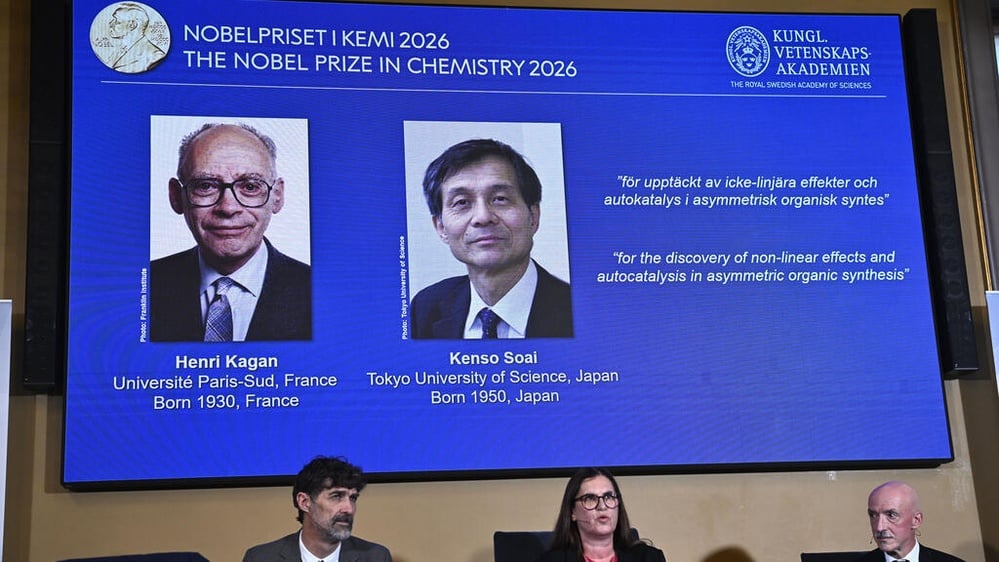
A neutral, straightforward announcement relays the Nobel jury's citation and the chair's characterization without added commentary.
Automated analysis; not human reviewed.
Limitations: Article text is a single-sentence excerpt; no publisher framing, headline, or additional context is available for analysis.
·
4 of 55 available dimensions scored; omitted dimensions are not treated as neutral.
·
Verified supporting quotes for 3 of 4 scored dimensions.
Claim: The report is framed as a factual announcement.
“2026 Nobel Prize in Chemistry goes to France's Henri Kagan and Japan's Kenso Soai.” · exact text match
Why: The sentence states the award and recipients directly with no evaluative or emotional framing.
Claim: The report is presented without sensational language or dramatic embellishment.
“2026 Nobel Prize in Chemistry goes to France's Henri Kagan and Japan's Kenso Soai.” · exact text match
Why: The announcement is plain and declarative, with no alarming or hype-driven wording.
Claim: The report describes an award decision rather than prescribing any action or policy.
“The two chemists were honored 'for the discovery of non-linear effects and autocatalysis in asymmetric organic synthesis,' the jury said” · exact text match
Why: It reports what happened and attributes the citation to the jury, without instructing readers what to do.
Claim: The report visibly attributes its key claims to the Nobel jury and the chair.
“'the jury said'” · not found in supplied text
“'according to the chair'” · not found in supplied text
Why: The citation and the significance claim are explicitly sourced to named institutional authorities rather than presented as the reporter's own assertions.
Article text is a single-sentence excerpt; no publisher framing, headline, or additional context is available for analysis.
October 08, 2026 · 0 shares
A straightforward wire-news report that relays the Nobel Committee's chemistry prize announcement, with only minor celebratory context.
Automated analysis; not human reviewed.
Limitations: The analysis is limited to a short wire report with no byline; deeper editorial framing cannot be assessed.
·
5 of 55 available dimensions scored; omitted dimensions are not treated as neutral.
·
Verified supporting quotes for 4 of 5 scored dimensions.
Claim: The report is essentially objective and source-attributed, with only minor un-attributed evaluative language.
“the award-giving body said on Wednesday” · exact text match
Counterevidence:
“the fame of winning arguably the world's most prestigious science award” · exact text match
Why: The main claims are attributed to the award body and most details are factual; one superlative about the award's prestige introduces a small subjective element.
Claim: No sensational framing is present; the article is a plain factual announcement.
“Scientists Henri Kagan and Kenso Soai won the 2026 Nobel Prize in Chemistry "for the discovery of non-linear effects and autocatalysis in asymmetric organic synthesis," the award-giving body said on Wednesday.” · exact text match
Why: The lead states the winner and citation without drama, hyperbole, or emotional appeal; later details are conventional Nobel background.
Claim: The article is purely descriptive and does not prescribe actions or policies.
“Established in the will of Swedish inventor and businessman Alfred Nobel, the prizes for achievements in science, literature and peace have been awarded since 1901, with a few interruptions mostly due to the world wars.” · exact text match
Why: The text reports what happened and provides background facts; it makes no recommendations, demands, or normative calls.
Claim: The article demonstrates high sourcing and attribution, with transparent presentation of the announcement and quoted official.
“the award-giving body said on Wednesday” · exact text match
“Heiner Linke, Chair of the Nobel Committee for Chemistry, said” · exact text match
Counterevidence:
“arguably the world's most prestigious science award” · exact text match
Why: The main claim is grounded in an institutional announcement and the explanatory quote is attributed by name; dates, amounts, and historical facts are concrete.
The un-attributed superlative is a minor blemish.
Claim: The report relies on attributed facts and historical context rather than emotional, speculative, or conspiratorial reasoning.
“The chemistry Nobel, always the third prize to be awarded during Nobel week, followed those for medicine and physics announced on Monday and Tuesday.” · not found in supplied text
Why: The article's statements are organized around verifiable dates, institutional decisions, and historical facts.
The analysis is limited to a short wire report with no byline; deeper editorial framing cannot be assessed.
October 07, 2026 · 0 shares
The report is a brief, largely factual announcement with repeated wire-style text and no evident ideological framing.
The Nobel Prize in Chemistry is a more than century-old award presented by the Royal Swedish Academy of Sciences.
Automated analysis; not human reviewed.
·
4 of 55 available dimensions scored; omitted dimensions are not treated as neutral.
·
Verified supporting quotes for 4 of 4 scored dimensions.
Claim: The report stays close to attributed factual announcement details rather than subjective commentary.
“Scientists Henri Kagan and Kenso Soai won the 2026 Nobel Prize in Chemistry "for the discovery of non-linear effects and autocatalysis in asymmetric organic synthesis," the award-giving body said on Wednesday.” · exact text match
Why: The central claim is attributed to the award-giving body and presented without evaluative language.
Claim: The article uses restrained, non-sensational wire-style wording.
“The more than a century-old prize is awarded by the Royal Swedish Academy of Sciences” · exact text match
Why: The prize is described factually, and there is no dramatic or emotionally charged framing.
Claim: The report contains only a small amount of evaluative language beyond factual reporting.
“as well as the fame of winning arguably the world's most prestigious science award” · exact text match
Why: The only notable evaluative phrase is a widely used descriptor of the prize, not the publisher's own argument.
Claim: The report identifies the award, the awarding institution, and the prize amount, but provides little elaboration or independent sourcing.
“The more than a century-old prize is awarded by the Royal Swedish Academy of Sciences and the winners share 12 million Swedish crowns ($1.2 million)” · exact text match
Why: Attribution is clear and details are specific, but the brief text does not include broader verification or context.
October 07, 2026 · 0 shares
The Nobel announcement is framed as an accessible chemistry explainer, emphasizing the practical usefulness of the laureates’ work and presenting the science as a clear, evidence-based sequence of discoveries.
Automated analysis; not human reviewed.
Limitations: The supplied article text is a duplicated/list-wrapped block without a visible original publisher masthead or URL, so analysis treated the deduplicated substantive body text as the article.
·
7 of 55 available dimensions scored; omitted dimensions are not treated as neutral.
·
Verified supporting quotes for 7 of 7 scored dimensions.
Claim: The article reports the Nobel announcement and related chemistry in an unopinionated, factual register.
“The 2026 Nobel prize for chemistry has been awarded to two researchers for their work on mirror-image molecules.” · exact text match
Why: The central sentence is a factual announcement, and the rest of the piece explains mechanisms and examples rather than offering personal editorial judgments.
Claim: The article is restrained, explanatory, and free of sensational or dramatic language.
“Some molecules, like amino acids, the building blocks of proteins in living beings, exist in two forms that are each other’s mirror-image – like our left and right hands.” · exact text match
Why: No hyperbole, alarm, exclamation, or emotional appeal appears; even surprising results are stated plainly.
Claim: The article is descriptive, explaining what the laureates found and why it matters, without prescribing actions or policies.
“Kagan and Soai developed reactions to produce only one variant of a mirror-image molecule.” · exact text match
Why: The text focuses on what happened and how, not on what readers or institutions ought to do.
Claim: The report separates known results from open questions and provides specific, falsifiable identifiers.
“We don’t know the conditions on Earth four billion years ago that caused only left handed amino acids to form naturally.” · exact text match
Why: The article names researchers, dates, institutions, and a Nobel announcement, while also explicitly acknowledging an unresolved scientific question, supporting visible credibility.
Claim: The article presents the Nobel-winning chemistry as a causally ordered, evidence-based sequence rather than as an irrational or unexplained event.
“Kagan then showed how a mixture of the left and right hand versions of the catalyst could enhance the percentage of either the left or right hand version of the product.” · exact text match
Why: The explanation uses controlled chemical mechanisms, timestamps, and causal reasoning, with no supernatural or non-empirical explanation offered.
Claim: The article treats chirality and catalysis as observable, natural phenomena explained by scientific mechanism.
“To do this, he used a chemical reaction that is auto-catalytic – meaning that the product of the reaction is also the catalyst for the reaction.” · exact text match
Why: The piece gives mechanistic, non-mystical explanations for chiral chemistry and does not rely on superstition or non-scientific causes.
Claim: The piece is transparent about authorship and funding rather than presenting the content as anonymous or independent.
“Matthew Addicoat receives funding from The Leverhulme Trust and ARIA.” · exact text match
Why: A funding disclosure and author affiliation are visible honesty signals, and no deceptive hedging or advertorial framing is apparent.
The supplied article text is a duplicated/list-wrapped block without a visible original publisher masthead or URL, so analysis treated the deduplicated substantive body text as the article.
October 07, 2026 · 0 shares
The report is a straight, agency-style news brief that relies on official Nobel Committee attribution and neutral explanatory framing without discernible ideological loading.
Homochirality is the feature of living systems in which molecules favor one of two possible mirror-image forms, such as proteins using only one mirror-image form of amino acids.
Automated analysis; not human reviewed.
Limitations: The supplied text is a truncated news brief with a mixed navigation tail; only headline, opening paragraphs, and a stray list of unrelated headlines are available, limiting full framing analysis.
·
55 of 55 available dimensions scored; omitted dimensions are not treated as neutral.
·
Verified supporting quotes for 15 of 55 scored dimensions.
Claim: The report presents no left-right political framing.
“French scientist Henri B. Kagan and Japanese scientist Kenso Soai won the 2026 Nobel Prize in Chemistry” · exact text match
Why: The text is a science news report without partisan political content.
Claim: The report defers entirely to elite scientific institutions without populist or anti-elite framing.
“The Royal Swedish Academy of Sciences awarded the prize” · exact text match
Why: Attribution to an elite scientific body without challenge indicates a mild institutional-elite orientation rather than populist framing.
Claim: The report is descriptive and neutral rather than subjective.
“according to a statement” · exact text match
Why: Facts are attributed to official sources with neutral language.
Claim: The report avoids sensationalism and stays factual.
“French scientist Henri B. Kagan and Japanese scientist Kenso Soai won the 2026 Nobel Prize in Chemistry” · exact text match
Why: The tone is measured and informative with no sensational embellishment.
Claim: The report describes the prize and research without prescribing action.
“The Royal Swedish Academy of Sciences awarded the prize” · exact text match
Why: It is purely descriptive of an award event.
Claim: The report relies heavily on Nobel Committee and academy authority.
“said Heiner Linke, chair of the Nobel Committee for Chemistry” · exact text match
Why: Uncritical citation of institutional authority is the dominant epistemic mode.
Claim: The report states scientific findings with certainty based on official announcement.
“Kagan made a decisive breakthrough in 1986” · exact text match
Why: Certainty tracks the official announcement but is not independently verified in text.
Claim: The report frames the prize through official establishment sources without challenge.
“said Heiner Linke, chair of the Nobel Committee for Chemistry” · exact text match
Why: Reliance on official institutional voices indicates mild pro-establishment framing.
Claim: The report is credible with clear institutional sourcing.
“according to a statement” · exact text match
Why: Attribution to the Royal Swedish Academy of Sciences supports trustworthiness.
Claim: The report is evidence-based and reasoned without irrational or emotional framing.
“Their research addressed a longstanding question about homochirality” · exact text match
Why: The content is empirical scientific explanation with no irrational appeals.
Claim: The report is scientific and empirical.
“discoveries that helped explain how the molecular asymmetry essential to life can emerge” · exact text match
Why: Content is grounded in chemistry research rather than superstition.
Claim: The text shows some smoothing typical of wire-service writing but lacks strong AI indicators.
“French scientist Henri B. Kagan and Japanese scientist Kenso Soai won the 2026 Nobel Prize in Chemistry” · exact text match
Why: Standard news agency prose offers weak evidence of AI authorship.
Claim: The report transparently attributes claims to the academy and committee.
“according to the academy” · exact text match
Why: Clear sourcing supports honesty and fairness signals.
Claim: The report is clear and informative but brief.
“Understanding how this asymmetry emerges has also been crucial to pharmaceutical development” · exact text match
Why: It conveys technical scientific concepts accessibly.
Claim: The report is truth-seeking and evidence-bound.
“according to the academy” · exact text match
Why: Claims are tied to official scientific sources.
The supplied text is a truncated news brief with a mixed navigation tail; only headline, opening paragraphs, and a stray list of unrelated headlines are available, limiting full framing analysis.
Publisher framing treats the Nobel award as resolving a fundamental scientific enigma, with a slightly dramatic 'Life Is Asymmetric' headline but otherwise sober, attribution-heavy explanatory science reporting.
Automated analysis; not human reviewed.
Limitations: The supplied text is a translated excerpt with extraction duplication/truncation and appended WIRED promotional links; scoring relies on the substantive Nobel science-reporting portion.
·
9 of 55 available dimensions scored; omitted dimensions are not treated as neutral.
·
Verified supporting quotes for 9 of 9 scored dimensions.
Claim: The article's framing is predominantly objective, presenting definitions and attributed facts rather than personal evaluation.
“Both versions of the molecules—each called an enantiomer—have similar physical properties but can behave differently.” · exact text match
Why: Neutral definitional exposition supports an objective classification.
Claim: The headline uses mildly sensational phrasing while the body remains sober and explanatory.
“Life Is Asymmetric.
The Scientists Who Figured Out Why Won the 2026 Nobel Prize in Chemistry”
· exact text match
Why: The title's dramatic wording is the main sensational element; technical exposition dominates the body.
Claim: The article's topic and narrative are moderately to highly interesting due to a Nobel discovery and scientific mystery.
“One of the most mysterious chemical phenomena in biology is that living organisms contain almost exclusively one of the two forms.” · exact text match
“Other than life itself, no one had previously achieved this feat.” · exact text match
Why: The novelty of the discovery and the unresolved mystery engage reader interest.
Claim: The article is primarily descriptive, explaining the phenomenon and its scientific history rather than prescribing actions.
“In the development of new drugs that use, for example, amino acids or sugar molecules as a basis, homochirality poses a problem: While one of the enantiomers of these chiral molecules produces the desired therapeutic effect, the other can cause unnecessary and, at times, harmful side effects.” · exact text match
Why: It states a problem and historical development without policy recommendations.
Claim: Credibility is supported by explicit attribution and disclosure of translation, though not every historical claim has a direct citation.
“This story originally appeared on WIRED en Español and has been translated from Spanish.” · exact text match
“As the Nobel Committee stated” · exact text match
Why: Transparency about translation and named sources support credibility.
Claim: The article emphasizes rational explanation of mechanisms and quantitative experimental outcomes.
“Later, in 1953, theoretical physicist Charles Frank proposed a mathematical model that outlined three conditions for reproducing homochirality.” · exact text match
“At the beginning of the experiment, one version was just 2 percent more abundant than the other version of the molecule.
By the end of the reaction, that advantage had jumped to 87 percent.”
· exact text match
Why: The text lays out theoretical conditions and measurable results rather than emotive claims.
Claim: The article is strongly scientific/empirical, explaining chemical mechanisms and experimental evidence without superstitious claims.
“Some molecules are chiral, meaning a molecule has two forms that are mirror images of each other but not identical, like your left and right hand.” · exact text match
“The phenomenon was called the “nonlinear effect” and represented a new way to manipulate chemical reactions.” · exact text match
Why: The content is framed through empirical chemistry and mechanistic explanation.
Claim: The article shows fair attribution by naming expert and committee sources for quoted material.
“explained José María Andrés García, a professor in the Department of Organic Chemistry at the University of Valladolid, in a statement reported by SMC Spain.” · exact text match
“As the Nobel Committee stated, “Other than life itself, no one had previously achieved this feat.”” · exact text match
Why: Direct attribution reduces unacknowledged borrowing and supports honest presentation.
Claim: The article explains complex chemistry clearly and sequentially.
“Charles Frank proposed a mathematical model that outlined three conditions for reproducing homochirality.” · exact text match
“This last characteristic is called autocatalysis and generates a kind of positive feedback loop, in which a small initial advantage can cause one of the variants to assemble at an ever-faster rate until it dominates the reaction.” · exact text match
Why: Structured explanation of theoretical and experimental concepts supports high article intelligence.
The supplied text is a translated excerpt with extraction duplication/truncation and appended WIRED promotional links; scoring relies on the substantive Nobel science-reporting portion.
October 07, 2026 · 0 shares
The Nobel announcement is framed as an accessible chemistry explainer, emphasizing the practical usefulness of the laureates’ work and presenting the science as a clear, evidence-based sequence of discoveries.
Automated analysis; not human reviewed.
Limitations: The supplied article text is a duplicated/list-wrapped block without a visible original publisher masthead or URL, so analysis treated the deduplicated substantive body text as the article.
·
7 of 55 available dimensions scored; omitted dimensions are not treated as neutral.
·
Verified supporting quotes for 7 of 7 scored dimensions.
Claim: The article reports the Nobel announcement and related chemistry in an unopinionated, factual register.
“The 2026 Nobel prize for chemistry has been awarded to two researchers for their work on mirror-image molecules.” · exact text match
Why: The central sentence is a factual announcement, and the rest of the piece explains mechanisms and examples rather than offering personal editorial judgments.
Claim: The article is restrained, explanatory, and free of sensational or dramatic language.
“Some molecules, like amino acids, the building blocks of proteins in living beings, exist in two forms that are each other’s mirror-image – like our left and right hands.” · exact text match
Why: No hyperbole, alarm, exclamation, or emotional appeal appears; even surprising results are stated plainly.
Claim: The article is descriptive, explaining what the laureates found and why it matters, without prescribing actions or policies.
“Kagan and Soai developed reactions to produce only one variant of a mirror-image molecule.” · exact text match
Why: The text focuses on what happened and how, not on what readers or institutions ought to do.
Claim: The report separates known results from open questions and provides specific, falsifiable identifiers.
“We don’t know the conditions on Earth four billion years ago that caused only left handed amino acids to form naturally.” · exact text match
Why: The article names researchers, dates, institutions, and a Nobel announcement, while also explicitly acknowledging an unresolved scientific question, supporting visible credibility.
Claim: The article presents the Nobel-winning chemistry as a causally ordered, evidence-based sequence rather than as an irrational or unexplained event.
“Kagan then showed how a mixture of the left and right hand versions of the catalyst could enhance the percentage of either the left or right hand version of the product.” · exact text match
Why: The explanation uses controlled chemical mechanisms, timestamps, and causal reasoning, with no supernatural or non-empirical explanation offered.
Claim: The article treats chirality and catalysis as observable, natural phenomena explained by scientific mechanism.
“To do this, he used a chemical reaction that is auto-catalytic – meaning that the product of the reaction is also the catalyst for the reaction.” · exact text match
Why: The piece gives mechanistic, non-mystical explanations for chiral chemistry and does not rely on superstition or non-scientific causes.
Claim: The piece is transparent about authorship and funding rather than presenting the content as anonymous or independent.
“Matthew Addicoat receives funding from The Leverhulme Trust and ARIA.” · exact text match
Why: A funding disclosure and author affiliation are visible honesty signals, and no deceptive hedging or advertorial framing is apparent.
The supplied article text is a duplicated/list-wrapped block without a visible original publisher masthead or URL, so analysis treated the deduplicated substantive body text as the article.
October 07, 2026 · 0 shares
The report is a straight, agency-style news brief that relies on official Nobel Committee attribution and neutral explanatory framing without discernible ideological loading.
Homochirality is the feature of living systems in which molecules favor one of two possible mirror-image forms, such as proteins using only one mirror-image form of amino acids.
Automated analysis; not human reviewed.
Limitations: The supplied text is a truncated news brief with a mixed navigation tail; only headline, opening paragraphs, and a stray list of unrelated headlines are available, limiting full framing analysis.
·
55 of 55 available dimensions scored; omitted dimensions are not treated as neutral.
·
Verified supporting quotes for 15 of 55 scored dimensions.
Claim: The report presents no left-right political framing.
“French scientist Henri B. Kagan and Japanese scientist Kenso Soai won the 2026 Nobel Prize in Chemistry” · exact text match
Why: The text is a science news report without partisan political content.
Claim: The report defers entirely to elite scientific institutions without populist or anti-elite framing.
“The Royal Swedish Academy of Sciences awarded the prize” · exact text match
Why: Attribution to an elite scientific body without challenge indicates a mild institutional-elite orientation rather than populist framing.
Claim: The report is descriptive and neutral rather than subjective.
“according to a statement” · exact text match
Why: Facts are attributed to official sources with neutral language.
Claim: The report avoids sensationalism and stays factual.
“French scientist Henri B. Kagan and Japanese scientist Kenso Soai won the 2026 Nobel Prize in Chemistry” · exact text match
Why: The tone is measured and informative with no sensational embellishment.
Claim: The report describes the prize and research without prescribing action.
“The Royal Swedish Academy of Sciences awarded the prize” · exact text match
Why: It is purely descriptive of an award event.
Claim: The report relies heavily on Nobel Committee and academy authority.
“said Heiner Linke, chair of the Nobel Committee for Chemistry” · exact text match
Why: Uncritical citation of institutional authority is the dominant epistemic mode.
Claim: The report states scientific findings with certainty based on official announcement.
“Kagan made a decisive breakthrough in 1986” · exact text match
Why: Certainty tracks the official announcement but is not independently verified in text.
Claim: The report frames the prize through official establishment sources without challenge.
“said Heiner Linke, chair of the Nobel Committee for Chemistry” · exact text match
Why: Reliance on official institutional voices indicates mild pro-establishment framing.
Claim: The report is credible with clear institutional sourcing.
“according to a statement” · exact text match
Why: Attribution to the Royal Swedish Academy of Sciences supports trustworthiness.
Claim: The report is evidence-based and reasoned without irrational or emotional framing.
“Their research addressed a longstanding question about homochirality” · exact text match
Why: The content is empirical scientific explanation with no irrational appeals.
Claim: The report is scientific and empirical.
“discoveries that helped explain how the molecular asymmetry essential to life can emerge” · exact text match
Why: Content is grounded in chemistry research rather than superstition.
Claim: The text shows some smoothing typical of wire-service writing but lacks strong AI indicators.
“French scientist Henri B. Kagan and Japanese scientist Kenso Soai won the 2026 Nobel Prize in Chemistry” · exact text match
Why: Standard news agency prose offers weak evidence of AI authorship.
Claim: The report transparently attributes claims to the academy and committee.
“according to the academy” · exact text match
Why: Clear sourcing supports honesty and fairness signals.
Claim: The report is clear and informative but brief.
“Understanding how this asymmetry emerges has also been crucial to pharmaceutical development” · exact text match
Why: It conveys technical scientific concepts accessibly.
Claim: The report is truth-seeking and evidence-bound.
“according to the academy” · exact text match
Why: Claims are tied to official scientific sources.
The supplied text is a truncated news brief with a mixed navigation tail; only headline, opening paragraphs, and a stray list of unrelated headlines are available, limiting full framing analysis.
October 08, 2026 · 0 shares
The article is a straight, institutionally sourced report on the 2026 Nobel Chemistry Prize, with no evident ideological or sensational framing beyond the factual announcement and background.
The Nobel Prizes were established in Alfred Nobel's will and have been awarded since 1901, with the chemistry prize always announced third during Nobel week.
Automated analysis; not human reviewed.
Limitations: The article text includes unrelated AI and Nepal flood headline fragments, likely page chrome or related-link clutter, which may slightly complicate parsing but do not affect the core Nobel report.
·
55 of 55 available dimensions scored; omitted dimensions are not treated as neutral.
·
Verified supporting quotes for 10 of 55 scored dimensions.
Claim: The article frames the prize through elite scientific and royal institutions rather than populist themes.
“The laureates will receive their medals from Sweden’s King Carl XVI Gustaf at a ceremony in Stockholm on December 10” · not found in supplied text
Why: Emphasis on royal ceremony and formal scientific establishment indicates mild elitist framing.
Claim: The article relies on attributed factual statements and direct quotes rather than subjective commentary.
“the award-giving body said on Wednesday” · exact text match
Why: Attribution to the awarding body supports an objective, non-subjective presentation.
Claim: The article reports the prize in a calm, factual manner without sensational language.
““This is the most exciting day in my life, I am very glad to share this prize with professor Henri Kagan,” Soai said” · not found in supplied text
Why: The only heightened language is a direct laureate quote, not publisher sensationalism.
Claim: The article conveys a positive tone about scientific progress and pharmaceutical applications.
“a discovery hugely important for pharmaceutical manufacturing” · exact text match
Why: Positive framing of the discovery's importance suggests mild bullishness, though it is not market-focused.
Claim: The article presents the prize and its implications in a positive, optimistic light.
““So this year’s prize is about foundational chemistry,” said Heiner Linke, chair of the Nobel Committee for Chemistry.” · not found in supplied text
Why: The overall tone is celebratory and optimistic about scientific achievement.
Claim: The article describes the award and its background without prescribing actions or policies.
“The chemistry Nobel, always the third prize to be awarded during Nobel week, followed those for medicine and physics announced on Monday and Tuesday.” · exact text match
Why: The text is purely descriptive of the award announcement.
Claim: The article relies on Nobel Committee and Foundation statements as primary sources of authority.
“said Heiner Linke, chair of the Nobel Committee for Chemistry” · exact text match
Why: Multiple appeals to named institutional authorities support this classification.
Claim: The article centers the Nobel institution, Swedish royalty, and official scientific bodies as authoritative.
“Established in the will of Swedish inventor and businessman Alfred Nobel, the prizes for achievements in science, literature and peace have been awarded since 1901” · not found in supplied text
Why: Strong deference to established institutions and traditions suggests pro-establishment framing.
Claim: The article maintains a largely neutral tone with a slightly positive emotional valence from the celebratory context.
““This is the most exciting day in my life, I am very glad to share this prize with professor Henri Kagan,” Soai said” · not found in supplied text
Why: The laureate's positive quote gives a mild positive emotional cast without publisher editorializing.
Claim: The article is credible, citing the Nobel Foundation and committee chair with specific details.
“the Nobel Foundation said” · exact text match
Why: Clear attribution and absence of unverified claims support high credibility.
Claim: The article presents scientific discovery and expert explanation as rational inquiry.
“This year’s prize was awarded for discoveries that showed how chemical reactions can be driven to favour a single molecular mirror image, work that has been key for chemists who design reactions for the manufacture of pharmaceuticals.” · exact text match
Why: The framing consistently treats the award and chemistry as evidence-based and rational.
Claim: The article is strongly scientific and empirical in its framing.
“This year’s prize was awarded for discoveries that showed how chemical reactions can be driven to favour a single molecular mirror image” · exact text match
Why: The content is entirely about scientific discovery and empirical explanation.
Claim: The article appears human-written based on conventional news structure and specific contextual details.
“The chemistry Nobel, always the third prize to be awarded during Nobel week, followed those for medicine and physics announced on Monday and Tuesday.” · exact text match
Why: Standard news formatting and unusual embedded characters suggest human authorship, though the text has some fragmented elements.
Claim: The article attributes key claims to the Nobel Foundation and committee members and includes standard historical context.
“the Nobel Foundation said” · exact text match
Why: Clear sourcing and neutral reporting indicate high integrity.
Claim: The article notes pharmaceutical importance of the discovery without advocating for medical mandates or industry interests.
“a discovery hugely important for pharmaceutical manufacturing” · exact text match
Why: Mildly favorable to pharmaceutical applications but does not reflexively trust or advocate for coercive health measures.
Claim: The article provides accurate scientific and historical context with clear structure.
“Many of the molecules essential to life exist in two forms that are mirror images of each other, like left and right hands, he said.” · not found in supplied text
Why: Explanatory depth and coherent organization indicate above-average intelligence.
Claim: The article is truth-seeking, presenting established scientific findings and official award information.
“a phenomenon known as “homochirality” – from the Greek word for hand – that has puzzled chemists for more than a century” · not found in supplied text
Why: The reporting is grounded in verifiable scientific and institutional facts.
The article text includes unrelated AI and Nepal flood headline fragments, likely page chrome or related-link clutter, which may slightly complicate parsing but do not affect the core Nobel report.
October 08, 2026 · 0 shares
The article is a straight, institutionally sourced report on the 2026 Nobel Chemistry Prize, with no evident ideological or sensational framing beyond the factual announcement and background.
The Nobel Prizes were established in Alfred Nobel's will and have been awarded since 1901, with the chemistry prize always announced third during Nobel week.
Automated analysis; not human reviewed.
Limitations: The article text includes unrelated AI and Nepal flood headline fragments, likely page chrome or related-link clutter, which may slightly complicate parsing but do not affect the core Nobel report.
·
55 of 55 available dimensions scored; omitted dimensions are not treated as neutral.
·
Verified supporting quotes for 10 of 55 scored dimensions.
Claim: The article frames the prize through elite scientific and royal institutions rather than populist themes.
“The laureates will receive their medals from Sweden’s King Carl XVI Gustaf at a ceremony in Stockholm on December 10” · not found in supplied text
Why: Emphasis on royal ceremony and formal scientific establishment indicates mild elitist framing.
Claim: The article relies on attributed factual statements and direct quotes rather than subjective commentary.
“the award-giving body said on Wednesday” · exact text match
Why: Attribution to the awarding body supports an objective, non-subjective presentation.
Claim: The article reports the prize in a calm, factual manner without sensational language.
““This is the most exciting day in my life, I am very glad to share this prize with professor Henri Kagan,” Soai said” · not found in supplied text
Why: The only heightened language is a direct laureate quote, not publisher sensationalism.
Claim: The article conveys a positive tone about scientific progress and pharmaceutical applications.
“a discovery hugely important for pharmaceutical manufacturing” · exact text match
Why: Positive framing of the discovery's importance suggests mild bullishness, though it is not market-focused.
Claim: The article presents the prize and its implications in a positive, optimistic light.
““So this year’s prize is about foundational chemistry,” said Heiner Linke, chair of the Nobel Committee for Chemistry.” · not found in supplied text
Why: The overall tone is celebratory and optimistic about scientific achievement.
Claim: The article describes the award and its background without prescribing actions or policies.
“The chemistry Nobel, always the third prize to be awarded during Nobel week, followed those for medicine and physics announced on Monday and Tuesday.” · exact text match
Why: The text is purely descriptive of the award announcement.
Claim: The article relies on Nobel Committee and Foundation statements as primary sources of authority.
“said Heiner Linke, chair of the Nobel Committee for Chemistry” · exact text match
Why: Multiple appeals to named institutional authorities support this classification.
Claim: The article centers the Nobel institution, Swedish royalty, and official scientific bodies as authoritative.
“Established in the will of Swedish inventor and businessman Alfred Nobel, the prizes for achievements in science, literature and peace have been awarded since 1901” · not found in supplied text
Why: Strong deference to established institutions and traditions suggests pro-establishment framing.
Claim: The article maintains a largely neutral tone with a slightly positive emotional valence from the celebratory context.
““This is the most exciting day in my life, I am very glad to share this prize with professor Henri Kagan,” Soai said” · not found in supplied text
Why: The laureate's positive quote gives a mild positive emotional cast without publisher editorializing.
Claim: The article is credible, citing the Nobel Foundation and committee chair with specific details.
“the Nobel Foundation said” · exact text match
Why: Clear attribution and absence of unverified claims support high credibility.
Claim: The article presents scientific discovery and expert explanation as rational inquiry.
“This year’s prize was awarded for discoveries that showed how chemical reactions can be driven to favour a single molecular mirror image, work that has been key for chemists who design reactions for the manufacture of pharmaceuticals.” · exact text match
Why: The framing consistently treats the award and chemistry as evidence-based and rational.
Claim: The article is strongly scientific and empirical in its framing.
“This year’s prize was awarded for discoveries that showed how chemical reactions can be driven to favour a single molecular mirror image” · exact text match
Why: The content is entirely about scientific discovery and empirical explanation.
Claim: The article appears human-written based on conventional news structure and specific contextual details.
“The chemistry Nobel, always the third prize to be awarded during Nobel week, followed those for medicine and physics announced on Monday and Tuesday.” · exact text match
Why: Standard news formatting and unusual embedded characters suggest human authorship, though the text has some fragmented elements.
Claim: The article attributes key claims to the Nobel Foundation and committee members and includes standard historical context.
“the Nobel Foundation said” · exact text match
Why: Clear sourcing and neutral reporting indicate high integrity.
Claim: The article notes pharmaceutical importance of the discovery without advocating for medical mandates or industry interests.
“a discovery hugely important for pharmaceutical manufacturing” · exact text match
Why: Mildly favorable to pharmaceutical applications but does not reflexively trust or advocate for coercive health measures.
Claim: The article provides accurate scientific and historical context with clear structure.
“Many of the molecules essential to life exist in two forms that are mirror images of each other, like left and right hands, he said.” · not found in supplied text
Why: Explanatory depth and coherent organization indicate above-average intelligence.
Claim: The article is truth-seeking, presenting established scientific findings and official award information.
“a phenomenon known as “homochirality” – from the Greek word for hand – that has puzzled chemists for more than a century” · not found in supplied text
Why: The reporting is grounded in verifiable scientific and institutional facts.
The article text includes unrelated AI and Nepal flood headline fragments, likely page chrome or related-link clutter, which may slightly complicate parsing but do not affect the core Nobel report.
October 07, 2026 · 0 shares
The Nobel announcement is framed as an accessible chemistry explainer, emphasizing the practical usefulness of the laureates’ work and presenting the science as a clear, evidence-based sequence of discoveries.
Automated analysis; not human reviewed.
Limitations: The supplied article text is a duplicated/list-wrapped block without a visible original publisher masthead or URL, so analysis treated the deduplicated substantive body text as the article.
·
7 of 55 available dimensions scored; omitted dimensions are not treated as neutral.
·
Verified supporting quotes for 7 of 7 scored dimensions.
Claim: The article reports the Nobel announcement and related chemistry in an unopinionated, factual register.
“The 2026 Nobel prize for chemistry has been awarded to two researchers for their work on mirror-image molecules.” · exact text match
Why: The central sentence is a factual announcement, and the rest of the piece explains mechanisms and examples rather than offering personal editorial judgments.
Claim: The article is restrained, explanatory, and free of sensational or dramatic language.
“Some molecules, like amino acids, the building blocks of proteins in living beings, exist in two forms that are each other’s mirror-image – like our left and right hands.” · exact text match
Why: No hyperbole, alarm, exclamation, or emotional appeal appears; even surprising results are stated plainly.
Claim: The article is descriptive, explaining what the laureates found and why it matters, without prescribing actions or policies.
“Kagan and Soai developed reactions to produce only one variant of a mirror-image molecule.” · exact text match
Why: The text focuses on what happened and how, not on what readers or institutions ought to do.
Claim: The report separates known results from open questions and provides specific, falsifiable identifiers.
“We don’t know the conditions on Earth four billion years ago that caused only left handed amino acids to form naturally.” · exact text match
Why: The article names researchers, dates, institutions, and a Nobel announcement, while also explicitly acknowledging an unresolved scientific question, supporting visible credibility.
Claim: The article presents the Nobel-winning chemistry as a causally ordered, evidence-based sequence rather than as an irrational or unexplained event.
“Kagan then showed how a mixture of the left and right hand versions of the catalyst could enhance the percentage of either the left or right hand version of the product.” · exact text match
Why: The explanation uses controlled chemical mechanisms, timestamps, and causal reasoning, with no supernatural or non-empirical explanation offered.
Claim: The article treats chirality and catalysis as observable, natural phenomena explained by scientific mechanism.
“To do this, he used a chemical reaction that is auto-catalytic – meaning that the product of the reaction is also the catalyst for the reaction.” · exact text match
Why: The piece gives mechanistic, non-mystical explanations for chiral chemistry and does not rely on superstition or non-scientific causes.
Claim: The piece is transparent about authorship and funding rather than presenting the content as anonymous or independent.
“Matthew Addicoat receives funding from The Leverhulme Trust and ARIA.” · exact text match
Why: A funding disclosure and author affiliation are visible honesty signals, and no deceptive hedging or advertorial framing is apparent.
The supplied article text is a duplicated/list-wrapped block without a visible original publisher masthead or URL, so analysis treated the deduplicated substantive body text as the article.
October 08, 2026 · 0 shares
A straightforward wire-news report that relays the Nobel Committee's chemistry prize announcement, with only minor celebratory context.
Automated analysis; not human reviewed.
Limitations: The analysis is limited to a short wire report with no byline; deeper editorial framing cannot be assessed.
·
5 of 55 available dimensions scored; omitted dimensions are not treated as neutral.
·
Verified supporting quotes for 4 of 5 scored dimensions.
Claim: The report is essentially objective and source-attributed, with only minor un-attributed evaluative language.
“the award-giving body said on Wednesday” · exact text match
Counterevidence:
“the fame of winning arguably the world's most prestigious science award” · exact text match
Why: The main claims are attributed to the award body and most details are factual; one superlative about the award's prestige introduces a small subjective element.
Claim: No sensational framing is present; the article is a plain factual announcement.
“Scientists Henri Kagan and Kenso Soai won the 2026 Nobel Prize in Chemistry "for the discovery of non-linear effects and autocatalysis in asymmetric organic synthesis," the award-giving body said on Wednesday.” · exact text match
Why: The lead states the winner and citation without drama, hyperbole, or emotional appeal; later details are conventional Nobel background.
Claim: The article is purely descriptive and does not prescribe actions or policies.
“Established in the will of Swedish inventor and businessman Alfred Nobel, the prizes for achievements in science, literature and peace have been awarded since 1901, with a few interruptions mostly due to the world wars.” · exact text match
Why: The text reports what happened and provides background facts; it makes no recommendations, demands, or normative calls.
Claim: The article demonstrates high sourcing and attribution, with transparent presentation of the announcement and quoted official.
“the award-giving body said on Wednesday” · exact text match
“Heiner Linke, Chair of the Nobel Committee for Chemistry, said” · exact text match
Counterevidence:
“arguably the world's most prestigious science award” · exact text match
Why: The main claim is grounded in an institutional announcement and the explanatory quote is attributed by name; dates, amounts, and historical facts are concrete.
The un-attributed superlative is a minor blemish.
Claim: The report relies on attributed facts and historical context rather than emotional, speculative, or conspiratorial reasoning.
“The chemistry Nobel, always the third prize to be awarded during Nobel week, followed those for medicine and physics announced on Monday and Tuesday.” · not found in supplied text
Why: The article's statements are organized around verifiable dates, institutional decisions, and historical facts.
The analysis is limited to a short wire report with no byline; deeper editorial framing cannot be assessed.
October 07, 2026 · 0 shares
A brief, source-attributed Nobel preview that uses hedged 'could' language and separates reported outcomes from analyst predictions.
Automated analysis; not human reviewed.
Limitations: No byline is provided, and the article is a short wire brief; scores are based on this single preview item rather than a broader editorial record.
·
4 of 55 available dimensions scored; omitted dimensions are not treated as neutral.
·
Verified supporting quotes for 4 of 4 scored dimensions.
Claim: The report is objective, using factual scheduling and attributed analyst forecasts rather than the publisher's own opinion.
“The Royal Swedish Academy of Sciences will name the 2026 Nobel Prize in Chemistry winner on Wednesday at 11:45 am (0945 GMT), with research into molecules regulating sleep and appetite, gene-editing methods and molecular-scale materials among the leading contenders, according to analysts.” · exact text match
Why: The sentence frames predictions as 'according to analysts' and states the announcement as a scheduled event, indicating objective reporting.
Claim: The writing is plain and procedural rather than sensationalized.
“The award consists of a diploma, a gold medal and 12 million kronor ($1.2 million), shared among recipients if there is more than one winner in a discipline.” · exact text match
Why: The article uses routine, matter-of-fact details and avoids dramatic or emotionally loaded language.
Claim: Predictions and descriptions are consistently attributed to named sources.
“However, David Pendlebury, head of research analysis at Clarivate, said GLP-1 research could receive the chemistry prize instead.” · exact text match
“which science journalist Lars Brostrom, editor for public broadcaster Sveriges Radio, described as "overdue" for recognition.” · exact text match
Why: Named attribution to Clarivate, Pendlebury, Brostrom, and Liu supports visible credibility, although outside claims cannot be independently verified within the text.
Claim: The article's main substance is a forecast of likely Nobel chemistry winners.
“with research into molecules regulating sleep and appetite, gene-editing methods and molecular-scale materials among the leading contenders, according to analysts.” · exact text match
Why: The story is organized around predictions, but it consistently attributes them and uses hedged wording such as 'could receive,' so it is moderately speculative rather than definitive.
No byline is provided, and the article is a short wire brief; scores are based on this single preview item rather than a broader editorial record.
October 07, 2026 · 0 shares
A neutral, straightforward announcement relays the Nobel jury's citation and the chair's characterization without added commentary.
Automated analysis; not human reviewed. Limitations: Article text is a single-sentence excerpt; no publisher framing, headline, or additional context is available for analysis. · 4 of 55 available dimensions scored; omitted dimensions are not treated as neutral. · Verified supporting quotes for 3 of 4 scored dimensions.
Claim: The report is framed as a factual announcement.
“2026 Nobel Prize in Chemistry goes to France's Henri Kagan and Japan's Kenso Soai.” · exact text match
Why: The sentence states the award and recipients directly with no evaluative or emotional framing.
Claim: The report is presented without sensational language or dramatic embellishment.
“2026 Nobel Prize in Chemistry goes to France's Henri Kagan and Japan's Kenso Soai.” · exact text match
Why: The announcement is plain and declarative, with no alarming or hype-driven wording.
Claim: The report describes an award decision rather than prescribing any action or policy.
“The two chemists were honored 'for the discovery of non-linear effects and autocatalysis in asymmetric organic synthesis,' the jury said” · exact text match
Why: It reports what happened and attributes the citation to the jury, without instructing readers what to do.
Claim: The report visibly attributes its key claims to the Nobel jury and the chair.
“'the jury said'” · not found in supplied text
“'according to the chair'” · not found in supplied text
Why: The citation and the significance claim are explicitly sourced to named institutional authorities rather than presented as the reporter's own assertions.
Article text is a single-sentence excerpt; no publisher framing, headline, or additional context is available for analysis.
October 07, 2026 · 0 shares
The report is a straight, agency-style news brief that relies on official Nobel Committee attribution and neutral explanatory framing without discernible ideological loading.
Homochirality is the feature of living systems in which molecules favor one of two possible mirror-image forms, such as proteins using only one mirror-image form of amino acids.
Automated analysis; not human reviewed. Limitations: The supplied text is a truncated news brief with a mixed navigation tail; only headline, opening paragraphs, and a stray list of unrelated headlines are available, limiting full framing analysis. · 55 of 55 available dimensions scored; omitted dimensions are not treated as neutral. · Verified supporting quotes for 15 of 55 scored dimensions.
Claim: The report presents no left-right political framing.
“French scientist Henri B. Kagan and Japanese scientist Kenso Soai won the 2026 Nobel Prize in Chemistry” · exact text match
Why: The text is a science news report without partisan political content.
Claim: The report defers entirely to elite scientific institutions without populist or anti-elite framing.
“The Royal Swedish Academy of Sciences awarded the prize” · exact text match
Why: Attribution to an elite scientific body without challenge indicates a mild institutional-elite orientation rather than populist framing.
Claim: The report is descriptive and neutral rather than subjective.
“according to a statement” · exact text match
Why: Facts are attributed to official sources with neutral language.
Claim: The report avoids sensationalism and stays factual.
“French scientist Henri B. Kagan and Japanese scientist Kenso Soai won the 2026 Nobel Prize in Chemistry” · exact text match
Why: The tone is measured and informative with no sensational embellishment.
Claim: The report describes the prize and research without prescribing action.
“The Royal Swedish Academy of Sciences awarded the prize” · exact text match
Why: It is purely descriptive of an award event.
Claim: The report relies heavily on Nobel Committee and academy authority.
“said Heiner Linke, chair of the Nobel Committee for Chemistry” · exact text match
Why: Uncritical citation of institutional authority is the dominant epistemic mode.
Claim: The report states scientific findings with certainty based on official announcement.
“Kagan made a decisive breakthrough in 1986” · exact text match
Why: Certainty tracks the official announcement but is not independently verified in text.
Claim: The report frames the prize through official establishment sources without challenge.
“said Heiner Linke, chair of the Nobel Committee for Chemistry” · exact text match
Why: Reliance on official institutional voices indicates mild pro-establishment framing.
Claim: The report is credible with clear institutional sourcing.
“according to a statement” · exact text match
Why: Attribution to the Royal Swedish Academy of Sciences supports trustworthiness.
Claim: The report is evidence-based and reasoned without irrational or emotional framing.
“Their research addressed a longstanding question about homochirality” · exact text match
Why: The content is empirical scientific explanation with no irrational appeals.
Claim: The report is scientific and empirical.
“discoveries that helped explain how the molecular asymmetry essential to life can emerge” · exact text match
Why: Content is grounded in chemistry research rather than superstition.
Claim: The text shows some smoothing typical of wire-service writing but lacks strong AI indicators.
“French scientist Henri B. Kagan and Japanese scientist Kenso Soai won the 2026 Nobel Prize in Chemistry” · exact text match
Why: Standard news agency prose offers weak evidence of AI authorship.
Claim: The report transparently attributes claims to the academy and committee.
“according to the academy” · exact text match
Why: Clear sourcing supports honesty and fairness signals.
Claim: The report is clear and informative but brief.
“Understanding how this asymmetry emerges has also been crucial to pharmaceutical development” · exact text match
Why: It conveys technical scientific concepts accessibly.
Claim: The report is truth-seeking and evidence-bound.
“according to the academy” · exact text match
Why: Claims are tied to official scientific sources.
The supplied text is a truncated news brief with a mixed navigation tail; only headline, opening paragraphs, and a stray list of unrelated headlines are available, limiting full framing analysis.
October 08, 2026 · 0 shares
A straightforward wire-news report that relays the Nobel Committee's chemistry prize announcement, with only minor celebratory context.
Automated analysis; not human reviewed. Limitations: The analysis is limited to a short wire report with no byline; deeper editorial framing cannot be assessed. · 5 of 55 available dimensions scored; omitted dimensions are not treated as neutral. · Verified supporting quotes for 4 of 5 scored dimensions.
Claim: The report is essentially objective and source-attributed, with only minor un-attributed evaluative language.
“the award-giving body said on Wednesday” · exact text match
Counterevidence:
“the fame of winning arguably the world's most prestigious science award” · exact text match
Why: The main claims are attributed to the award body and most details are factual; one superlative about the award's prestige introduces a small subjective element.
Claim: No sensational framing is present; the article is a plain factual announcement.
“Scientists Henri Kagan and Kenso Soai won the 2026 Nobel Prize in Chemistry "for the discovery of non-linear effects and autocatalysis in asymmetric organic synthesis," the award-giving body said on Wednesday.” · exact text match
Why: The lead states the winner and citation without drama, hyperbole, or emotional appeal; later details are conventional Nobel background.
Claim: The article is purely descriptive and does not prescribe actions or policies.
“Established in the will of Swedish inventor and businessman Alfred Nobel, the prizes for achievements in science, literature and peace have been awarded since 1901, with a few interruptions mostly due to the world wars.” · exact text match
Why: The text reports what happened and provides background facts; it makes no recommendations, demands, or normative calls.
Claim: The article demonstrates high sourcing and attribution, with transparent presentation of the announcement and quoted official.
“the award-giving body said on Wednesday” · exact text match
“Heiner Linke, Chair of the Nobel Committee for Chemistry, said” · exact text match
Counterevidence:
“arguably the world's most prestigious science award” · exact text match
Why: The main claim is grounded in an institutional announcement and the explanatory quote is attributed by name; dates, amounts, and historical facts are concrete. The un-attributed superlative is a minor blemish.
Claim: The report relies on attributed facts and historical context rather than emotional, speculative, or conspiratorial reasoning.
“The chemistry Nobel, always the third prize to be awarded during Nobel week, followed those for medicine and physics announced on Monday and Tuesday.” · not found in supplied text
Why: The article's statements are organized around verifiable dates, institutional decisions, and historical facts.
The analysis is limited to a short wire report with no byline; deeper editorial framing cannot be assessed.
October 07, 2026 · 0 shares
The report is a brief, largely factual announcement with repeated wire-style text and no evident ideological framing.
The Nobel Prize in Chemistry is a more than century-old award presented by the Royal Swedish Academy of Sciences.
Automated analysis; not human reviewed. · 4 of 55 available dimensions scored; omitted dimensions are not treated as neutral. · Verified supporting quotes for 4 of 4 scored dimensions.
Claim: The report stays close to attributed factual announcement details rather than subjective commentary.
“Scientists Henri Kagan and Kenso Soai won the 2026 Nobel Prize in Chemistry "for the discovery of non-linear effects and autocatalysis in asymmetric organic synthesis," the award-giving body said on Wednesday.” · exact text match
Why: The central claim is attributed to the award-giving body and presented without evaluative language.
Claim: The article uses restrained, non-sensational wire-style wording.
“The more than a century-old prize is awarded by the Royal Swedish Academy of Sciences” · exact text match
Why: The prize is described factually, and there is no dramatic or emotionally charged framing.
Claim: The report contains only a small amount of evaluative language beyond factual reporting.
“as well as the fame of winning arguably the world's most prestigious science award” · exact text match
Why: The only notable evaluative phrase is a widely used descriptor of the prize, not the publisher's own argument.
Claim: The report identifies the award, the awarding institution, and the prize amount, but provides little elaboration or independent sourcing.
“The more than a century-old prize is awarded by the Royal Swedish Academy of Sciences and the winners share 12 million Swedish crowns ($1.2 million)” · exact text match
Why: Attribution is clear and details are specific, but the brief text does not include broader verification or context.
Publisher framing treats the Nobel award as resolving a fundamental scientific enigma, with a slightly dramatic 'Life Is Asymmetric' headline but otherwise sober, attribution-heavy explanatory science reporting.
Automated analysis; not human reviewed. Limitations: The supplied text is a translated excerpt with extraction duplication/truncation and appended WIRED promotional links; scoring relies on the substantive Nobel science-reporting portion. · 9 of 55 available dimensions scored; omitted dimensions are not treated as neutral. · Verified supporting quotes for 9 of 9 scored dimensions.
Claim: The article's framing is predominantly objective, presenting definitions and attributed facts rather than personal evaluation.
“Both versions of the molecules—each called an enantiomer—have similar physical properties but can behave differently.” · exact text match
Why: Neutral definitional exposition supports an objective classification.
Claim: The headline uses mildly sensational phrasing while the body remains sober and explanatory.
“Life Is Asymmetric. The Scientists Who Figured Out Why Won the 2026 Nobel Prize in Chemistry” · exact text match
Why: The title's dramatic wording is the main sensational element; technical exposition dominates the body.
Claim: The article's topic and narrative are moderately to highly interesting due to a Nobel discovery and scientific mystery.
“One of the most mysterious chemical phenomena in biology is that living organisms contain almost exclusively one of the two forms.” · exact text match
“Other than life itself, no one had previously achieved this feat.” · exact text match
Why: The novelty of the discovery and the unresolved mystery engage reader interest.
Claim: The article is primarily descriptive, explaining the phenomenon and its scientific history rather than prescribing actions.
“In the development of new drugs that use, for example, amino acids or sugar molecules as a basis, homochirality poses a problem: While one of the enantiomers of these chiral molecules produces the desired therapeutic effect, the other can cause unnecessary and, at times, harmful side effects.” · exact text match
Why: It states a problem and historical development without policy recommendations.
Claim: Credibility is supported by explicit attribution and disclosure of translation, though not every historical claim has a direct citation.
“This story originally appeared on WIRED en Español and has been translated from Spanish.” · exact text match
“As the Nobel Committee stated” · exact text match
Why: Transparency about translation and named sources support credibility.
Claim: The article emphasizes rational explanation of mechanisms and quantitative experimental outcomes.
“Later, in 1953, theoretical physicist Charles Frank proposed a mathematical model that outlined three conditions for reproducing homochirality.” · exact text match
“At the beginning of the experiment, one version was just 2 percent more abundant than the other version of the molecule. By the end of the reaction, that advantage had jumped to 87 percent.” · exact text match
Why: The text lays out theoretical conditions and measurable results rather than emotive claims.
Claim: The article is strongly scientific/empirical, explaining chemical mechanisms and experimental evidence without superstitious claims.
“Some molecules are chiral, meaning a molecule has two forms that are mirror images of each other but not identical, like your left and right hand.” · exact text match
“The phenomenon was called the “nonlinear effect” and represented a new way to manipulate chemical reactions.” · exact text match
Why: The content is framed through empirical chemistry and mechanistic explanation.
Claim: The article shows fair attribution by naming expert and committee sources for quoted material.
“explained José María Andrés García, a professor in the Department of Organic Chemistry at the University of Valladolid, in a statement reported by SMC Spain.” · exact text match
“As the Nobel Committee stated, “Other than life itself, no one had previously achieved this feat.”” · exact text match
Why: Direct attribution reduces unacknowledged borrowing and supports honest presentation.
Claim: The article explains complex chemistry clearly and sequentially.
“Charles Frank proposed a mathematical model that outlined three conditions for reproducing homochirality.” · exact text match
“This last characteristic is called autocatalysis and generates a kind of positive feedback loop, in which a small initial advantage can cause one of the variants to assemble at an ever-faster rate until it dominates the reaction.” · exact text match
Why: Structured explanation of theoretical and experimental concepts supports high article intelligence.
The supplied text is a translated excerpt with extraction duplication/truncation and appended WIRED promotional links; scoring relies on the substantive Nobel science-reporting portion.
October 07, 2026 · 0 shares
The Nobel announcement is framed as an accessible chemistry explainer, emphasizing the practical usefulness of the laureates’ work and presenting the science as a clear, evidence-based sequence of discoveries.
Automated analysis; not human reviewed. Limitations: The supplied article text is a duplicated/list-wrapped block without a visible original publisher masthead or URL, so analysis treated the deduplicated substantive body text as the article. · 7 of 55 available dimensions scored; omitted dimensions are not treated as neutral. · Verified supporting quotes for 7 of 7 scored dimensions.
Claim: The article reports the Nobel announcement and related chemistry in an unopinionated, factual register.
“The 2026 Nobel prize for chemistry has been awarded to two researchers for their work on mirror-image molecules.” · exact text match
Why: The central sentence is a factual announcement, and the rest of the piece explains mechanisms and examples rather than offering personal editorial judgments.
Claim: The article is restrained, explanatory, and free of sensational or dramatic language.
“Some molecules, like amino acids, the building blocks of proteins in living beings, exist in two forms that are each other’s mirror-image – like our left and right hands.” · exact text match
Why: No hyperbole, alarm, exclamation, or emotional appeal appears; even surprising results are stated plainly.
Claim: The article is descriptive, explaining what the laureates found and why it matters, without prescribing actions or policies.
“Kagan and Soai developed reactions to produce only one variant of a mirror-image molecule.” · exact text match
Why: The text focuses on what happened and how, not on what readers or institutions ought to do.
Claim: The report separates known results from open questions and provides specific, falsifiable identifiers.
“We don’t know the conditions on Earth four billion years ago that caused only left handed amino acids to form naturally.” · exact text match
Why: The article names researchers, dates, institutions, and a Nobel announcement, while also explicitly acknowledging an unresolved scientific question, supporting visible credibility.
Claim: The article presents the Nobel-winning chemistry as a causally ordered, evidence-based sequence rather than as an irrational or unexplained event.
“Kagan then showed how a mixture of the left and right hand versions of the catalyst could enhance the percentage of either the left or right hand version of the product.” · exact text match
Why: The explanation uses controlled chemical mechanisms, timestamps, and causal reasoning, with no supernatural or non-empirical explanation offered.
Claim: The article treats chirality and catalysis as observable, natural phenomena explained by scientific mechanism.
“To do this, he used a chemical reaction that is auto-catalytic – meaning that the product of the reaction is also the catalyst for the reaction.” · exact text match
Why: The piece gives mechanistic, non-mystical explanations for chiral chemistry and does not rely on superstition or non-scientific causes.
Claim: The piece is transparent about authorship and funding rather than presenting the content as anonymous or independent.
“Matthew Addicoat receives funding from The Leverhulme Trust and ARIA.” · exact text match
Why: A funding disclosure and author affiliation are visible honesty signals, and no deceptive hedging or advertorial framing is apparent.
The supplied article text is a duplicated/list-wrapped block without a visible original publisher masthead or URL, so analysis treated the deduplicated substantive body text as the article.
October 08, 2026 · 0 shares
The article is a straight, institutionally sourced report on the 2026 Nobel Chemistry Prize, with no evident ideological or sensational framing beyond the factual announcement and background.
The Nobel Prizes were established in Alfred Nobel's will and have been awarded since 1901, with the chemistry prize always announced third during Nobel week.
Automated analysis; not human reviewed. Limitations: The article text includes unrelated AI and Nepal flood headline fragments, likely page chrome or related-link clutter, which may slightly complicate parsing but do not affect the core Nobel report. · 55 of 55 available dimensions scored; omitted dimensions are not treated as neutral. · Verified supporting quotes for 10 of 55 scored dimensions.
Claim: The article frames the prize through elite scientific and royal institutions rather than populist themes.
“The laureates will receive their medals from Sweden’s King Carl XVI Gustaf at a ceremony in Stockholm on December 10” · not found in supplied text
Why: Emphasis on royal ceremony and formal scientific establishment indicates mild elitist framing.
Claim: The article relies on attributed factual statements and direct quotes rather than subjective commentary.
“the award-giving body said on Wednesday” · exact text match
Why: Attribution to the awarding body supports an objective, non-subjective presentation.
Claim: The article reports the prize in a calm, factual manner without sensational language.
““This is the most exciting day in my life, I am very glad to share this prize with professor Henri Kagan,” Soai said” · not found in supplied text
Why: The only heightened language is a direct laureate quote, not publisher sensationalism.
Claim: The article conveys a positive tone about scientific progress and pharmaceutical applications.
“a discovery hugely important for pharmaceutical manufacturing” · exact text match
Why: Positive framing of the discovery's importance suggests mild bullishness, though it is not market-focused.
Claim: The article presents the prize and its implications in a positive, optimistic light.
““So this year’s prize is about foundational chemistry,” said Heiner Linke, chair of the Nobel Committee for Chemistry.” · not found in supplied text
Why: The overall tone is celebratory and optimistic about scientific achievement.
Claim: The article describes the award and its background without prescribing actions or policies.
“The chemistry Nobel, always the third prize to be awarded during Nobel week, followed those for medicine and physics announced on Monday and Tuesday.” · exact text match
Why: The text is purely descriptive of the award announcement.
Claim: The article relies on Nobel Committee and Foundation statements as primary sources of authority.
“said Heiner Linke, chair of the Nobel Committee for Chemistry” · exact text match
Why: Multiple appeals to named institutional authorities support this classification.
Claim: The article centers the Nobel institution, Swedish royalty, and official scientific bodies as authoritative.
“Established in the will of Swedish inventor and businessman Alfred Nobel, the prizes for achievements in science, literature and peace have been awarded since 1901” · not found in supplied text
Why: Strong deference to established institutions and traditions suggests pro-establishment framing.
Claim: The article maintains a largely neutral tone with a slightly positive emotional valence from the celebratory context.
““This is the most exciting day in my life, I am very glad to share this prize with professor Henri Kagan,” Soai said” · not found in supplied text
Why: The laureate's positive quote gives a mild positive emotional cast without publisher editorializing.
Claim: The article is credible, citing the Nobel Foundation and committee chair with specific details.
“the Nobel Foundation said” · exact text match
Why: Clear attribution and absence of unverified claims support high credibility.
Claim: The article presents scientific discovery and expert explanation as rational inquiry.
“This year’s prize was awarded for discoveries that showed how chemical reactions can be driven to favour a single molecular mirror image, work that has been key for chemists who design reactions for the manufacture of pharmaceuticals.” · exact text match
Why: The framing consistently treats the award and chemistry as evidence-based and rational.
Claim: The article is strongly scientific and empirical in its framing.
“This year’s prize was awarded for discoveries that showed how chemical reactions can be driven to favour a single molecular mirror image” · exact text match
Why: The content is entirely about scientific discovery and empirical explanation.
Claim: The article appears human-written based on conventional news structure and specific contextual details.
“The chemistry Nobel, always the third prize to be awarded during Nobel week, followed those for medicine and physics announced on Monday and Tuesday.” · exact text match
Why: Standard news formatting and unusual embedded characters suggest human authorship, though the text has some fragmented elements.
Claim: The article attributes key claims to the Nobel Foundation and committee members and includes standard historical context.
“the Nobel Foundation said” · exact text match
Why: Clear sourcing and neutral reporting indicate high integrity.
Claim: The article notes pharmaceutical importance of the discovery without advocating for medical mandates or industry interests.
“a discovery hugely important for pharmaceutical manufacturing” · exact text match
Why: Mildly favorable to pharmaceutical applications but does not reflexively trust or advocate for coercive health measures.
Claim: The article provides accurate scientific and historical context with clear structure.
“Many of the molecules essential to life exist in two forms that are mirror images of each other, like left and right hands, he said.” · not found in supplied text
Why: Explanatory depth and coherent organization indicate above-average intelligence.
Claim: The article is truth-seeking, presenting established scientific findings and official award information.
“a phenomenon known as “homochirality” – from the Greek word for hand – that has puzzled chemists for more than a century” · not found in supplied text
Why: The reporting is grounded in verifiable scientific and institutional facts.
The article text includes unrelated AI and Nepal flood headline fragments, likely page chrome or related-link clutter, which may slightly complicate parsing but do not affect the core Nobel report.
October 07, 2026 · 0 shares
A brief, source-attributed Nobel preview that uses hedged 'could' language and separates reported outcomes from analyst predictions.
Automated analysis; not human reviewed. Limitations: No byline is provided, and the article is a short wire brief; scores are based on this single preview item rather than a broader editorial record. · 4 of 55 available dimensions scored; omitted dimensions are not treated as neutral. · Verified supporting quotes for 4 of 4 scored dimensions.
Claim: The report is objective, using factual scheduling and attributed analyst forecasts rather than the publisher's own opinion.
“The Royal Swedish Academy of Sciences will name the 2026 Nobel Prize in Chemistry winner on Wednesday at 11:45 am (0945 GMT), with research into molecules regulating sleep and appetite, gene-editing methods and molecular-scale materials among the leading contenders, according to analysts.” · exact text match
Why: The sentence frames predictions as 'according to analysts' and states the announcement as a scheduled event, indicating objective reporting.
Claim: The writing is plain and procedural rather than sensationalized.
“The award consists of a diploma, a gold medal and 12 million kronor ($1.2 million), shared among recipients if there is more than one winner in a discipline.” · exact text match
Why: The article uses routine, matter-of-fact details and avoids dramatic or emotionally loaded language.
Claim: Predictions and descriptions are consistently attributed to named sources.
“However, David Pendlebury, head of research analysis at Clarivate, said GLP-1 research could receive the chemistry prize instead.” · exact text match
“which science journalist Lars Brostrom, editor for public broadcaster Sveriges Radio, described as "overdue" for recognition.” · exact text match
Why: Named attribution to Clarivate, Pendlebury, Brostrom, and Liu supports visible credibility, although outside claims cannot be independently verified within the text.
Claim: The article's main substance is a forecast of likely Nobel chemistry winners.
“with research into molecules regulating sleep and appetite, gene-editing methods and molecular-scale materials among the leading contenders, according to analysts.” · exact text match
Why: The story is organized around predictions, but it consistently attributes them and uses hedged wording such as 'could receive,' so it is moderately speculative rather than definitive.
No byline is provided, and the article is a short wire brief; scores are based on this single preview item rather than a broader editorial record.
October 07, 2026 · 0 shares
A neutral, straightforward announcement relays the Nobel jury's citation and the chair's characterization without added commentary.
Automated analysis; not human reviewed. Limitations: Article text is a single-sentence excerpt; no publisher framing, headline, or additional context is available for analysis. · 4 of 55 available dimensions scored; omitted dimensions are not treated as neutral. · Verified supporting quotes for 3 of 4 scored dimensions.
Claim: The report is framed as a factual announcement.
“2026 Nobel Prize in Chemistry goes to France's Henri Kagan and Japan's Kenso Soai.” · exact text match
Why: The sentence states the award and recipients directly with no evaluative or emotional framing.
Claim: The report is presented without sensational language or dramatic embellishment.
“2026 Nobel Prize in Chemistry goes to France's Henri Kagan and Japan's Kenso Soai.” · exact text match
Why: The announcement is plain and declarative, with no alarming or hype-driven wording.
Claim: The report describes an award decision rather than prescribing any action or policy.
“The two chemists were honored 'for the discovery of non-linear effects and autocatalysis in asymmetric organic synthesis,' the jury said” · exact text match
Why: It reports what happened and attributes the citation to the jury, without instructing readers what to do.
Claim: The report visibly attributes its key claims to the Nobel jury and the chair.
“'the jury said'” · not found in supplied text
“'according to the chair'” · not found in supplied text
Why: The citation and the significance claim are explicitly sourced to named institutional authorities rather than presented as the reporter's own assertions.
Article text is a single-sentence excerpt; no publisher framing, headline, or additional context is available for analysis.
Mainstream Science Reporting
October 08, 2026 · 0 shares
A straightforward wire-news report that relays the Nobel Committee's chemistry prize announcement, with only minor celebratory context.
Automated analysis; not human reviewed. Limitations: The analysis is limited to a short wire report with no byline; deeper editorial framing cannot be assessed. · 5 of 55 available dimensions scored; omitted dimensions are not treated as neutral. · Verified supporting quotes for 4 of 5 scored dimensions.
Claim: The report is essentially objective and source-attributed, with only minor un-attributed evaluative language.
“the award-giving body said on Wednesday” · exact text match
Counterevidence:
“the fame of winning arguably the world's most prestigious science award” · exact text match
Why: The main claims are attributed to the award body and most details are factual; one superlative about the award's prestige introduces a small subjective element.
Claim: No sensational framing is present; the article is a plain factual announcement.
“Scientists Henri Kagan and Kenso Soai won the 2026 Nobel Prize in Chemistry "for the discovery of non-linear effects and autocatalysis in asymmetric organic synthesis," the award-giving body said on Wednesday.” · exact text match
Why: The lead states the winner and citation without drama, hyperbole, or emotional appeal; later details are conventional Nobel background.
Claim: The article is purely descriptive and does not prescribe actions or policies.
“Established in the will of Swedish inventor and businessman Alfred Nobel, the prizes for achievements in science, literature and peace have been awarded since 1901, with a few interruptions mostly due to the world wars.” · exact text match
Why: The text reports what happened and provides background facts; it makes no recommendations, demands, or normative calls.
Claim: The article demonstrates high sourcing and attribution, with transparent presentation of the announcement and quoted official.
“the award-giving body said on Wednesday” · exact text match
“Heiner Linke, Chair of the Nobel Committee for Chemistry, said” · exact text match
Counterevidence:
“arguably the world's most prestigious science award” · exact text match
Why: The main claim is grounded in an institutional announcement and the explanatory quote is attributed by name; dates, amounts, and historical facts are concrete. The un-attributed superlative is a minor blemish.
Claim: The report relies on attributed facts and historical context rather than emotional, speculative, or conspiratorial reasoning.
“The chemistry Nobel, always the third prize to be awarded during Nobel week, followed those for medicine and physics announced on Monday and Tuesday.” · not found in supplied text
Why: The article's statements are organized around verifiable dates, institutional decisions, and historical facts.
The analysis is limited to a short wire report with no byline; deeper editorial framing cannot be assessed.
October 08, 2026 · 0 shares
The article is a straight, institutionally sourced report on the 2026 Nobel Chemistry Prize, with no evident ideological or sensational framing beyond the factual announcement and background.
The Nobel Prizes were established in Alfred Nobel's will and have been awarded since 1901, with the chemistry prize always announced third during Nobel week.
Automated analysis; not human reviewed. Limitations: The article text includes unrelated AI and Nepal flood headline fragments, likely page chrome or related-link clutter, which may slightly complicate parsing but do not affect the core Nobel report. · 55 of 55 available dimensions scored; omitted dimensions are not treated as neutral. · Verified supporting quotes for 10 of 55 scored dimensions.
Claim: The article frames the prize through elite scientific and royal institutions rather than populist themes.
“The laureates will receive their medals from Sweden’s King Carl XVI Gustaf at a ceremony in Stockholm on December 10” · not found in supplied text
Why: Emphasis on royal ceremony and formal scientific establishment indicates mild elitist framing.
Claim: The article relies on attributed factual statements and direct quotes rather than subjective commentary.
“the award-giving body said on Wednesday” · exact text match
Why: Attribution to the awarding body supports an objective, non-subjective presentation.
Claim: The article reports the prize in a calm, factual manner without sensational language.
““This is the most exciting day in my life, I am very glad to share this prize with professor Henri Kagan,” Soai said” · not found in supplied text
Why: The only heightened language is a direct laureate quote, not publisher sensationalism.
Claim: The article conveys a positive tone about scientific progress and pharmaceutical applications.
“a discovery hugely important for pharmaceutical manufacturing” · exact text match
Why: Positive framing of the discovery's importance suggests mild bullishness, though it is not market-focused.
Claim: The article presents the prize and its implications in a positive, optimistic light.
““So this year’s prize is about foundational chemistry,” said Heiner Linke, chair of the Nobel Committee for Chemistry.” · not found in supplied text
Why: The overall tone is celebratory and optimistic about scientific achievement.
Claim: The article describes the award and its background without prescribing actions or policies.
“The chemistry Nobel, always the third prize to be awarded during Nobel week, followed those for medicine and physics announced on Monday and Tuesday.” · exact text match
Why: The text is purely descriptive of the award announcement.
Claim: The article relies on Nobel Committee and Foundation statements as primary sources of authority.
“said Heiner Linke, chair of the Nobel Committee for Chemistry” · exact text match
Why: Multiple appeals to named institutional authorities support this classification.
Claim: The article centers the Nobel institution, Swedish royalty, and official scientific bodies as authoritative.
“Established in the will of Swedish inventor and businessman Alfred Nobel, the prizes for achievements in science, literature and peace have been awarded since 1901” · not found in supplied text
Why: Strong deference to established institutions and traditions suggests pro-establishment framing.
Claim: The article maintains a largely neutral tone with a slightly positive emotional valence from the celebratory context.
““This is the most exciting day in my life, I am very glad to share this prize with professor Henri Kagan,” Soai said” · not found in supplied text
Why: The laureate's positive quote gives a mild positive emotional cast without publisher editorializing.
Claim: The article is credible, citing the Nobel Foundation and committee chair with specific details.
“the Nobel Foundation said” · exact text match
Why: Clear attribution and absence of unverified claims support high credibility.
Claim: The article presents scientific discovery and expert explanation as rational inquiry.
“This year’s prize was awarded for discoveries that showed how chemical reactions can be driven to favour a single molecular mirror image, work that has been key for chemists who design reactions for the manufacture of pharmaceuticals.” · exact text match
Why: The framing consistently treats the award and chemistry as evidence-based and rational.
Claim: The article is strongly scientific and empirical in its framing.
“This year’s prize was awarded for discoveries that showed how chemical reactions can be driven to favour a single molecular mirror image” · exact text match
Why: The content is entirely about scientific discovery and empirical explanation.
Claim: The article appears human-written based on conventional news structure and specific contextual details.
“The chemistry Nobel, always the third prize to be awarded during Nobel week, followed those for medicine and physics announced on Monday and Tuesday.” · exact text match
Why: Standard news formatting and unusual embedded characters suggest human authorship, though the text has some fragmented elements.
Claim: The article attributes key claims to the Nobel Foundation and committee members and includes standard historical context.
“the Nobel Foundation said” · exact text match
Why: Clear sourcing and neutral reporting indicate high integrity.
Claim: The article notes pharmaceutical importance of the discovery without advocating for medical mandates or industry interests.
“a discovery hugely important for pharmaceutical manufacturing” · exact text match
Why: Mildly favorable to pharmaceutical applications but does not reflexively trust or advocate for coercive health measures.
Claim: The article provides accurate scientific and historical context with clear structure.
“Many of the molecules essential to life exist in two forms that are mirror images of each other, like left and right hands, he said.” · not found in supplied text
Why: Explanatory depth and coherent organization indicate above-average intelligence.
Claim: The article is truth-seeking, presenting established scientific findings and official award information.
“a phenomenon known as “homochirality” – from the Greek word for hand – that has puzzled chemists for more than a century” · not found in supplied text
Why: The reporting is grounded in verifiable scientific and institutional facts.
The article text includes unrelated AI and Nepal flood headline fragments, likely page chrome or related-link clutter, which may slightly complicate parsing but do not affect the core Nobel report.
October 07, 2026 · 0 shares
A neutral, straightforward announcement relays the Nobel jury's citation and the chair's characterization without added commentary.
Automated analysis; not human reviewed. Limitations: Article text is a single-sentence excerpt; no publisher framing, headline, or additional context is available for analysis. · 4 of 55 available dimensions scored; omitted dimensions are not treated as neutral. · Verified supporting quotes for 3 of 4 scored dimensions.
Claim: The report is framed as a factual announcement.
“2026 Nobel Prize in Chemistry goes to France's Henri Kagan and Japan's Kenso Soai.” · exact text match
Why: The sentence states the award and recipients directly with no evaluative or emotional framing.
Claim: The report is presented without sensational language or dramatic embellishment.
“2026 Nobel Prize in Chemistry goes to France's Henri Kagan and Japan's Kenso Soai.” · exact text match
Why: The announcement is plain and declarative, with no alarming or hype-driven wording.
Claim: The report describes an award decision rather than prescribing any action or policy.
“The two chemists were honored 'for the discovery of non-linear effects and autocatalysis in asymmetric organic synthesis,' the jury said” · exact text match
Why: It reports what happened and attributes the citation to the jury, without instructing readers what to do.
Claim: The report visibly attributes its key claims to the Nobel jury and the chair.
“'the jury said'” · not found in supplied text
“'according to the chair'” · not found in supplied text
Why: The citation and the significance claim are explicitly sourced to named institutional authorities rather than presented as the reporter's own assertions.
Article text is a single-sentence excerpt; no publisher framing, headline, or additional context is available for analysis.
October 07, 2026 · 0 shares
The report is a brief, neutral news item that states the award and its scientific rationale without evaluative framing.
Automated analysis; not human reviewed. · 22 of 55 available dimensions scored; omitted dimensions are not treated as neutral. · Verified supporting quotes for 11 of 22 scored dimensions.
Claim: The report presents only factual award details without subjective interpretation.
“The Nobel Prize in chemistry was awarded on Wednesday to French scientist Henri B. Kagan and Japan’s Kenso Soai for unravelling the mystery of why only one of two forms of certain molecules occurs in nature.” · exact text match
Why: No opinion, judgment, or first-person language appears in the text.
Claim: The article uses a plain, non-sensational tone.
“The Nobel Prize in chemistry was awarded on Wednesday to French scientist Henri B. Kagan and Japan’s Kenso Soai for unravelling the mystery of why only one of two forms of certain molecules occurs in nature.” · exact text match
Why: No superlatives, urgency cues, or dramatic language are present.
Claim: The item merely describes the award and does not prescribe action or policy.
“The Nobel Prize in chemistry was awarded on Wednesday to French scientist Henri B. Kagan and Japan’s Kenso Soai for unravelling the mystery of why only one of two forms of certain molecules occurs in nature.” · exact text match
Why: Only descriptive information about the prize is provided.
Claim: The scientific rationale is simplified into one clause but remains accurate at a high level.
“unravelling the mystery of why only one of two forms of certain molecules occurs in nature” · exact text match
Why: The summary compresses a complex discovery into a brief phrase.
Claim: The text states the award and its purpose with certainty appropriate for a news brief.
“The Nobel Prize in chemistry was awarded on Wednesday to French scientist Henri B. Kagan and Japan’s Kenso Soai for unravelling the mystery of why only one of two forms of certain molecules occurs in nature.” · exact text match
Why: The claims are simple announcement facts, not extended inference.
Claim: The item provides clear, attributed facts about a Nobel Prize award.
“The Nobel Prize in chemistry was awarded on Wednesday to French scientist Henri B. Kagan and Japan’s Kenso Soai for unravelling the mystery of why only one of two forms of certain molecules occurs in nature.” · exact text match
Why: Basic sourcing and attribution are present through reference to the Nobel Prize and named recipients.
Claim: The item reports the award and its scientific rationale without emotive or irrational framing.
“The Nobel Prize in chemistry was awarded on Wednesday to French scientist Henri B. Kagan and Japan’s Kenso Soai for unravelling the mystery of why only one of two forms of certain molecules occurs in nature.” · exact text match
Why: The sentence states the prize, recipients, and scientific reason in a dispassionate, factual manner.
Claim: The report is grounded in empirical science and award recognition.
“The Nobel Prize in chemistry was awarded on Wednesday to French scientist Henri B. Kagan and Japan’s Kenso Soai for unravelling the mystery of why only one of two forms of certain molecules occurs in nature.” · exact text match
Why: The content is about a scientific prize and a chemical discovery, showing empirical orientation.
Claim: The text is very short and generic, offering no strong independent indicators of human authorship.
“Franco-Japanese duo Kagan and Soai win 2026 Nobel Prize in chemistry.” · exact text match
Why: A brief headline-style statement can be produced by either a human or an AI, so evidence is weak.
Claim: The report is internally honest and attributes the award and purpose accurately.
“The Nobel Prize in chemistry was awarded on Wednesday to French scientist Henri B. Kagan and Japan’s Kenso Soai for unravelling the mystery of why only one of two forms of certain molecules occurs in nature.” · exact text match
Why: The statement is straightforward and contains no deceptive or misleading signals.
Claim: The report is concise and accurately summarizes a scientific award.
“The Nobel Prize in chemistry was awarded on Wednesday to French scientist Henri B. Kagan and Japan’s Kenso Soai for unravelling the mystery of why only one of two forms of certain molecules occurs in nature.” · exact text match
Why: It correctly identifies the award, recipients, and scientific contribution in a compact form.
October 07, 2026 · 0 shares
The report is a straight, agency-style news brief that relies on official Nobel Committee attribution and neutral explanatory framing without discernible ideological loading.
Homochirality is the feature of living systems in which molecules favor one of two possible mirror-image forms, such as proteins using only one mirror-image form of amino acids.
Automated analysis; not human reviewed. Limitations: The supplied text is a truncated news brief with a mixed navigation tail; only headline, opening paragraphs, and a stray list of unrelated headlines are available, limiting full framing analysis. · 55 of 55 available dimensions scored; omitted dimensions are not treated as neutral. · Verified supporting quotes for 15 of 55 scored dimensions.
Claim: The report presents no left-right political framing.
“French scientist Henri B. Kagan and Japanese scientist Kenso Soai won the 2026 Nobel Prize in Chemistry” · exact text match
Why: The text is a science news report without partisan political content.
Claim: The report defers entirely to elite scientific institutions without populist or anti-elite framing.
“The Royal Swedish Academy of Sciences awarded the prize” · exact text match
Why: Attribution to an elite scientific body without challenge indicates a mild institutional-elite orientation rather than populist framing.
Claim: The report is descriptive and neutral rather than subjective.
“according to a statement” · exact text match
Why: Facts are attributed to official sources with neutral language.
Claim: The report avoids sensationalism and stays factual.
“French scientist Henri B. Kagan and Japanese scientist Kenso Soai won the 2026 Nobel Prize in Chemistry” · exact text match
Why: The tone is measured and informative with no sensational embellishment.
Claim: The report describes the prize and research without prescribing action.
“The Royal Swedish Academy of Sciences awarded the prize” · exact text match
Why: It is purely descriptive of an award event.
Claim: The report relies heavily on Nobel Committee and academy authority.
“said Heiner Linke, chair of the Nobel Committee for Chemistry” · exact text match
Why: Uncritical citation of institutional authority is the dominant epistemic mode.
Claim: The report states scientific findings with certainty based on official announcement.
“Kagan made a decisive breakthrough in 1986” · exact text match
Why: Certainty tracks the official announcement but is not independently verified in text.
Claim: The report frames the prize through official establishment sources without challenge.
“said Heiner Linke, chair of the Nobel Committee for Chemistry” · exact text match
Why: Reliance on official institutional voices indicates mild pro-establishment framing.
Claim: The report is credible with clear institutional sourcing.
“according to a statement” · exact text match
Why: Attribution to the Royal Swedish Academy of Sciences supports trustworthiness.
Claim: The report is evidence-based and reasoned without irrational or emotional framing.
“Their research addressed a longstanding question about homochirality” · exact text match
Why: The content is empirical scientific explanation with no irrational appeals.
Claim: The report is scientific and empirical.
“discoveries that helped explain how the molecular asymmetry essential to life can emerge” · exact text match
Why: Content is grounded in chemistry research rather than superstition.
Claim: The text shows some smoothing typical of wire-service writing but lacks strong AI indicators.
“French scientist Henri B. Kagan and Japanese scientist Kenso Soai won the 2026 Nobel Prize in Chemistry” · exact text match
Why: Standard news agency prose offers weak evidence of AI authorship.
Claim: The report transparently attributes claims to the academy and committee.
“according to the academy” · exact text match
Why: Clear sourcing supports honesty and fairness signals.
Claim: The report is clear and informative but brief.
“Understanding how this asymmetry emerges has also been crucial to pharmaceutical development” · exact text match
Why: It conveys technical scientific concepts accessibly.
Claim: The report is truth-seeking and evidence-bound.
“according to the academy” · exact text match
Why: Claims are tied to official scientific sources.
The supplied text is a truncated news brief with a mixed navigation tail; only headline, opening paragraphs, and a stray list of unrelated headlines are available, limiting full framing analysis.
October 07, 2026 · 0 shares
The report is a brief, largely factual announcement with repeated wire-style text and no evident ideological framing.
The Nobel Prize in Chemistry is a more than century-old award presented by the Royal Swedish Academy of Sciences.
Automated analysis; not human reviewed. · 4 of 55 available dimensions scored; omitted dimensions are not treated as neutral. · Verified supporting quotes for 4 of 4 scored dimensions.
Claim: The report stays close to attributed factual announcement details rather than subjective commentary.
“Scientists Henri Kagan and Kenso Soai won the 2026 Nobel Prize in Chemistry "for the discovery of non-linear effects and autocatalysis in asymmetric organic synthesis," the award-giving body said on Wednesday.” · exact text match
Why: The central claim is attributed to the award-giving body and presented without evaluative language.
Claim: The article uses restrained, non-sensational wire-style wording.
“The more than a century-old prize is awarded by the Royal Swedish Academy of Sciences” · exact text match
Why: The prize is described factually, and there is no dramatic or emotionally charged framing.
Claim: The report contains only a small amount of evaluative language beyond factual reporting.
“as well as the fame of winning arguably the world's most prestigious science award” · exact text match
Why: The only notable evaluative phrase is a widely used descriptor of the prize, not the publisher's own argument.
Claim: The report identifies the award, the awarding institution, and the prize amount, but provides little elaboration or independent sourcing.
“The more than a century-old prize is awarded by the Royal Swedish Academy of Sciences and the winners share 12 million Swedish crowns ($1.2 million)” · exact text match
Why: Attribution is clear and details are specific, but the brief text does not include broader verification or context.
October 07, 2026 · 0 shares
The report is a straight, agency-style news brief that relies on official Nobel Committee attribution and neutral explanatory framing without discernible ideological loading.
Homochirality is the feature of living systems in which molecules favor one of two possible mirror-image forms, such as proteins using only one mirror-image form of amino acids.
Automated analysis; not human reviewed. Limitations: The supplied text is a truncated news brief with a mixed navigation tail; only headline, opening paragraphs, and a stray list of unrelated headlines are available, limiting full framing analysis. · 55 of 55 available dimensions scored; omitted dimensions are not treated as neutral. · Verified supporting quotes for 15 of 55 scored dimensions.
Claim: The report presents no left-right political framing.
“French scientist Henri B. Kagan and Japanese scientist Kenso Soai won the 2026 Nobel Prize in Chemistry” · exact text match
Why: The text is a science news report without partisan political content.
Claim: The report defers entirely to elite scientific institutions without populist or anti-elite framing.
“The Royal Swedish Academy of Sciences awarded the prize” · exact text match
Why: Attribution to an elite scientific body without challenge indicates a mild institutional-elite orientation rather than populist framing.
Claim: The report is descriptive and neutral rather than subjective.
“according to a statement” · exact text match
Why: Facts are attributed to official sources with neutral language.
Claim: The report avoids sensationalism and stays factual.
“French scientist Henri B. Kagan and Japanese scientist Kenso Soai won the 2026 Nobel Prize in Chemistry” · exact text match
Why: The tone is measured and informative with no sensational embellishment.
Claim: The report describes the prize and research without prescribing action.
“The Royal Swedish Academy of Sciences awarded the prize” · exact text match
Why: It is purely descriptive of an award event.
Claim: The report relies heavily on Nobel Committee and academy authority.
“said Heiner Linke, chair of the Nobel Committee for Chemistry” · exact text match
Why: Uncritical citation of institutional authority is the dominant epistemic mode.
Claim: The report states scientific findings with certainty based on official announcement.
“Kagan made a decisive breakthrough in 1986” · exact text match
Why: Certainty tracks the official announcement but is not independently verified in text.
Claim: The report frames the prize through official establishment sources without challenge.
“said Heiner Linke, chair of the Nobel Committee for Chemistry” · exact text match
Why: Reliance on official institutional voices indicates mild pro-establishment framing.
Claim: The report is credible with clear institutional sourcing.
“according to a statement” · exact text match
Why: Attribution to the Royal Swedish Academy of Sciences supports trustworthiness.
Claim: The report is evidence-based and reasoned without irrational or emotional framing.
“Their research addressed a longstanding question about homochirality” · exact text match
Why: The content is empirical scientific explanation with no irrational appeals.
Claim: The report is scientific and empirical.
“discoveries that helped explain how the molecular asymmetry essential to life can emerge” · exact text match
Why: Content is grounded in chemistry research rather than superstition.
Claim: The text shows some smoothing typical of wire-service writing but lacks strong AI indicators.
“French scientist Henri B. Kagan and Japanese scientist Kenso Soai won the 2026 Nobel Prize in Chemistry” · exact text match
Why: Standard news agency prose offers weak evidence of AI authorship.
Claim: The report transparently attributes claims to the academy and committee.
“according to the academy” · exact text match
Why: Clear sourcing supports honesty and fairness signals.
Claim: The report is clear and informative but brief.
“Understanding how this asymmetry emerges has also been crucial to pharmaceutical development” · exact text match
Why: It conveys technical scientific concepts accessibly.
Claim: The report is truth-seeking and evidence-bound.
“according to the academy” · exact text match
Why: Claims are tied to official scientific sources.
The supplied text is a truncated news brief with a mixed navigation tail; only headline, opening paragraphs, and a stray list of unrelated headlines are available, limiting full framing analysis.
October 07, 2026 · 0 shares
A neutral, straightforward announcement relays the Nobel jury's citation and the chair's characterization without added commentary.
Automated analysis; not human reviewed. Limitations: Article text is a single-sentence excerpt; no publisher framing, headline, or additional context is available for analysis. · 4 of 55 available dimensions scored; omitted dimensions are not treated as neutral. · Verified supporting quotes for 3 of 4 scored dimensions.
Claim: The report is framed as a factual announcement.
“2026 Nobel Prize in Chemistry goes to France's Henri Kagan and Japan's Kenso Soai.” · exact text match
Why: The sentence states the award and recipients directly with no evaluative or emotional framing.
Claim: The report is presented without sensational language or dramatic embellishment.
“2026 Nobel Prize in Chemistry goes to France's Henri Kagan and Japan's Kenso Soai.” · exact text match
Why: The announcement is plain and declarative, with no alarming or hype-driven wording.
Claim: The report describes an award decision rather than prescribing any action or policy.
“The two chemists were honored 'for the discovery of non-linear effects and autocatalysis in asymmetric organic synthesis,' the jury said” · exact text match
Why: It reports what happened and attributes the citation to the jury, without instructing readers what to do.
Claim: The report visibly attributes its key claims to the Nobel jury and the chair.
“'the jury said'” · not found in supplied text
“'according to the chair'” · not found in supplied text
Why: The citation and the significance claim are explicitly sourced to named institutional authorities rather than presented as the reporter's own assertions.
Article text is a single-sentence excerpt; no publisher framing, headline, or additional context is available for analysis.
Publisher framing treats the Nobel award as resolving a fundamental scientific enigma, with a slightly dramatic 'Life Is Asymmetric' headline but otherwise sober, attribution-heavy explanatory science reporting.
Automated analysis; not human reviewed. Limitations: The supplied text is a translated excerpt with extraction duplication/truncation and appended WIRED promotional links; scoring relies on the substantive Nobel science-reporting portion. · 9 of 55 available dimensions scored; omitted dimensions are not treated as neutral. · Verified supporting quotes for 9 of 9 scored dimensions.
Claim: The article's framing is predominantly objective, presenting definitions and attributed facts rather than personal evaluation.
“Both versions of the molecules—each called an enantiomer—have similar physical properties but can behave differently.” · exact text match
Why: Neutral definitional exposition supports an objective classification.
Claim: The headline uses mildly sensational phrasing while the body remains sober and explanatory.
“Life Is Asymmetric. The Scientists Who Figured Out Why Won the 2026 Nobel Prize in Chemistry” · exact text match
Why: The title's dramatic wording is the main sensational element; technical exposition dominates the body.
Claim: The article's topic and narrative are moderately to highly interesting due to a Nobel discovery and scientific mystery.
“One of the most mysterious chemical phenomena in biology is that living organisms contain almost exclusively one of the two forms.” · exact text match
“Other than life itself, no one had previously achieved this feat.” · exact text match
Why: The novelty of the discovery and the unresolved mystery engage reader interest.
Claim: The article is primarily descriptive, explaining the phenomenon and its scientific history rather than prescribing actions.
“In the development of new drugs that use, for example, amino acids or sugar molecules as a basis, homochirality poses a problem: While one of the enantiomers of these chiral molecules produces the desired therapeutic effect, the other can cause unnecessary and, at times, harmful side effects.” · exact text match
Why: It states a problem and historical development without policy recommendations.
Claim: Credibility is supported by explicit attribution and disclosure of translation, though not every historical claim has a direct citation.
“This story originally appeared on WIRED en Español and has been translated from Spanish.” · exact text match
“As the Nobel Committee stated” · exact text match
Why: Transparency about translation and named sources support credibility.
Claim: The article emphasizes rational explanation of mechanisms and quantitative experimental outcomes.
“Later, in 1953, theoretical physicist Charles Frank proposed a mathematical model that outlined three conditions for reproducing homochirality.” · exact text match
“At the beginning of the experiment, one version was just 2 percent more abundant than the other version of the molecule. By the end of the reaction, that advantage had jumped to 87 percent.” · exact text match
Why: The text lays out theoretical conditions and measurable results rather than emotive claims.
Claim: The article is strongly scientific/empirical, explaining chemical mechanisms and experimental evidence without superstitious claims.
“Some molecules are chiral, meaning a molecule has two forms that are mirror images of each other but not identical, like your left and right hand.” · exact text match
“The phenomenon was called the “nonlinear effect” and represented a new way to manipulate chemical reactions.” · exact text match
Why: The content is framed through empirical chemistry and mechanistic explanation.
Claim: The article shows fair attribution by naming expert and committee sources for quoted material.
“explained José María Andrés García, a professor in the Department of Organic Chemistry at the University of Valladolid, in a statement reported by SMC Spain.” · exact text match
“As the Nobel Committee stated, “Other than life itself, no one had previously achieved this feat.”” · exact text match
Why: Direct attribution reduces unacknowledged borrowing and supports honest presentation.
Claim: The article explains complex chemistry clearly and sequentially.
“Charles Frank proposed a mathematical model that outlined three conditions for reproducing homochirality.” · exact text match
“This last characteristic is called autocatalysis and generates a kind of positive feedback loop, in which a small initial advantage can cause one of the variants to assemble at an ever-faster rate until it dominates the reaction.” · exact text match
Why: Structured explanation of theoretical and experimental concepts supports high article intelligence.
The supplied text is a translated excerpt with extraction duplication/truncation and appended WIRED promotional links; scoring relies on the substantive Nobel science-reporting portion.
October 07, 2026 · 0 shares
The Nobel announcement is framed as an accessible chemistry explainer, emphasizing the practical usefulness of the laureates’ work and presenting the science as a clear, evidence-based sequence of discoveries.
Automated analysis; not human reviewed. Limitations: The supplied article text is a duplicated/list-wrapped block without a visible original publisher masthead or URL, so analysis treated the deduplicated substantive body text as the article. · 7 of 55 available dimensions scored; omitted dimensions are not treated as neutral. · Verified supporting quotes for 7 of 7 scored dimensions.
Claim: The article reports the Nobel announcement and related chemistry in an unopinionated, factual register.
“The 2026 Nobel prize for chemistry has been awarded to two researchers for their work on mirror-image molecules.” · exact text match
Why: The central sentence is a factual announcement, and the rest of the piece explains mechanisms and examples rather than offering personal editorial judgments.
Claim: The article is restrained, explanatory, and free of sensational or dramatic language.
“Some molecules, like amino acids, the building blocks of proteins in living beings, exist in two forms that are each other’s mirror-image – like our left and right hands.” · exact text match
Why: No hyperbole, alarm, exclamation, or emotional appeal appears; even surprising results are stated plainly.
Claim: The article is descriptive, explaining what the laureates found and why it matters, without prescribing actions or policies.
“Kagan and Soai developed reactions to produce only one variant of a mirror-image molecule.” · exact text match
Why: The text focuses on what happened and how, not on what readers or institutions ought to do.
Claim: The report separates known results from open questions and provides specific, falsifiable identifiers.
“We don’t know the conditions on Earth four billion years ago that caused only left handed amino acids to form naturally.” · exact text match
Why: The article names researchers, dates, institutions, and a Nobel announcement, while also explicitly acknowledging an unresolved scientific question, supporting visible credibility.
Claim: The article presents the Nobel-winning chemistry as a causally ordered, evidence-based sequence rather than as an irrational or unexplained event.
“Kagan then showed how a mixture of the left and right hand versions of the catalyst could enhance the percentage of either the left or right hand version of the product.” · exact text match
Why: The explanation uses controlled chemical mechanisms, timestamps, and causal reasoning, with no supernatural or non-empirical explanation offered.
Claim: The article treats chirality and catalysis as observable, natural phenomena explained by scientific mechanism.
“To do this, he used a chemical reaction that is auto-catalytic – meaning that the product of the reaction is also the catalyst for the reaction.” · exact text match
Why: The piece gives mechanistic, non-mystical explanations for chiral chemistry and does not rely on superstition or non-scientific causes.
Claim: The piece is transparent about authorship and funding rather than presenting the content as anonymous or independent.
“Matthew Addicoat receives funding from The Leverhulme Trust and ARIA.” · exact text match
Why: A funding disclosure and author affiliation are visible honesty signals, and no deceptive hedging or advertorial framing is apparent.
The supplied article text is a duplicated/list-wrapped block without a visible original publisher masthead or URL, so analysis treated the deduplicated substantive body text as the article.
A straightforward, mildly celebratory prize-announcement framing, built from attributed Nobel Committee statements and a short scientific primer.
Automated analysis; not human reviewed. Limitations: The supplied text includes a malformed duplicate headline and embedded subscription prompts; I ignored the prompts and based scores on the substantive news passages. · 6 of 55 available dimensions scored; omitted dimensions are not treated as neutral. · Verified supporting quotes for 6 of 6 scored dimensions.
Claim: The report is predominantly factual and neutral in presenting the award, with minimal evaluative language.
“The 2026 Nobel Prize for Chemistry has been awarded to Henri Kagan of the Universite Paris-Sud, in France, and Kenso Soai of the Tokyo University of Science, in Japan, for their work exploring the fundamental geometry of molecules.” · exact text match
Counterevidence:
“The pair are known for pioneering research into autocatalysis in asymmetric organic synthesis.” · exact text match
Why: The core is a declarative announcement naming people and institutions; 'pioneering' is a mild evaluative phrase that slightly tempers full objectivity.
Claim: The framing is calm and informational but includes mildly celebratory language picked by the publisher.
“The pair are known for pioneering research into autocatalysis in asymmetric organic synthesis.” · exact text match
Counterevidence:
“The 2026 Nobel Prize for Chemistry has been awarded to Henri Kagan of the Universite Paris-Sud, in France, and Kenso Soai of the Tokyo University of Science, in Japan, for their work exploring the fundamental geometry of molecules.” · exact text match
Why: 'Pioneering' adds an approving tone but is surrounded by straightforward reporting, so the effect is only mildly sensational rather than hype-driven.
Claim: The main content describes an award result and background; it does not tell readers what to do or believe.
“The 2026 Nobel Prize for Chemistry has been awarded to Henri Kagan of the Universite Paris-Sud, in France, and Kenso Soai of the Tokyo University of Science, in Japan, for their work exploring the fundamental geometry of molecules.” · exact text match
Why: This sentence reports what happened; nothing in the news content prescribes action.
Claim: The article is credible on its face due to named authorship, direct attribution to a named Nobel Committee member, and a clear breaking-news caveat.
“Peter Somfai, a member of the Nobel Committee, said after the announcement that "taken together, the groundbreaking discoveries by Henri Kagan and Kenso Soai have reshaped our understanding of molecular chirality, how it is created, amplified and transmitted."” · exact text match
“Adam Kovac is a breaking news reporter at Scientific American.” · exact text match
Why: Central claims are attributed to identifiable sources and the reporter is named, supporting trustworthiness within the scope of this text.
Claim: The article uses clear scientific explanation and attributed statements rather than emotional or irrational argument.
“Molecules that are chiral are those whose mirror images cannot be superimposed on one another.” · exact text match
Why: It defines a technical term precisely and structures the story around verifiable award facts.
Claim: The report signals internal honesty by naming its reporter and explicitly labeling the story as breaking and subject to update.
“Editor’s note (10/07/2026: This is a breaking news story and will be updated.” · exact text match
“Adam Kovac is a breaking news reporter at Scientific American.” · exact text match
Why: Disclosure of provisional status and authorship are observable transparency signals; no deceptive framing is apparent.
The supplied text includes a malformed duplicate headline and embedded subscription prompts; I ignored the prompts and based scores on the substantive news passages.
Clarivate/Forecasting Community
October 07, 2026 · 0 shares
A brief, source-attributed Nobel preview that uses hedged 'could' language and separates reported outcomes from analyst predictions.
Automated analysis; not human reviewed. Limitations: No byline is provided, and the article is a short wire brief; scores are based on this single preview item rather than a broader editorial record. · 4 of 55 available dimensions scored; omitted dimensions are not treated as neutral. · Verified supporting quotes for 4 of 4 scored dimensions.
Claim: The report is objective, using factual scheduling and attributed analyst forecasts rather than the publisher's own opinion.
“The Royal Swedish Academy of Sciences will name the 2026 Nobel Prize in Chemistry winner on Wednesday at 11:45 am (0945 GMT), with research into molecules regulating sleep and appetite, gene-editing methods and molecular-scale materials among the leading contenders, according to analysts.” · exact text match
Why: The sentence frames predictions as 'according to analysts' and states the announcement as a scheduled event, indicating objective reporting.
Claim: The writing is plain and procedural rather than sensationalized.
“The award consists of a diploma, a gold medal and 12 million kronor ($1.2 million), shared among recipients if there is more than one winner in a discipline.” · exact text match
Why: The article uses routine, matter-of-fact details and avoids dramatic or emotionally loaded language.
Claim: Predictions and descriptions are consistently attributed to named sources.
“However, David Pendlebury, head of research analysis at Clarivate, said GLP-1 research could receive the chemistry prize instead.” · exact text match
“which science journalist Lars Brostrom, editor for public broadcaster Sveriges Radio, described as "overdue" for recognition.” · exact text match
Why: Named attribution to Clarivate, Pendlebury, Brostrom, and Liu supports visible credibility, although outside claims cannot be independently verified within the text.
Claim: The article's main substance is a forecast of likely Nobel chemistry winners.
“with research into molecules regulating sleep and appetite, gene-editing methods and molecular-scale materials among the leading contenders, according to analysts.” · exact text match
Why: The story is organized around predictions, but it consistently attributes them and uses hedged wording such as 'could receive,' so it is moderately speculative rather than definitive.
No byline is provided, and the article is a short wire brief; scores are based on this single preview item rather than a broader editorial record.
GLP-1 Advocacy Critique
October 07, 2026 · 0 shares
A brief, source-attributed Nobel preview that uses hedged 'could' language and separates reported outcomes from analyst predictions.
Automated analysis; not human reviewed. Limitations: No byline is provided, and the article is a short wire brief; scores are based on this single preview item rather than a broader editorial record. · 4 of 55 available dimensions scored; omitted dimensions are not treated as neutral. · Verified supporting quotes for 4 of 4 scored dimensions.
Claim: The report is objective, using factual scheduling and attributed analyst forecasts rather than the publisher's own opinion.
“The Royal Swedish Academy of Sciences will name the 2026 Nobel Prize in Chemistry winner on Wednesday at 11:45 am (0945 GMT), with research into molecules regulating sleep and appetite, gene-editing methods and molecular-scale materials among the leading contenders, according to analysts.” · exact text match
Why: The sentence frames predictions as 'according to analysts' and states the announcement as a scheduled event, indicating objective reporting.
Claim: The writing is plain and procedural rather than sensationalized.
“The award consists of a diploma, a gold medal and 12 million kronor ($1.2 million), shared among recipients if there is more than one winner in a discipline.” · exact text match
Why: The article uses routine, matter-of-fact details and avoids dramatic or emotionally loaded language.
Claim: Predictions and descriptions are consistently attributed to named sources.
“However, David Pendlebury, head of research analysis at Clarivate, said GLP-1 research could receive the chemistry prize instead.” · exact text match
“which science journalist Lars Brostrom, editor for public broadcaster Sveriges Radio, described as "overdue" for recognition.” · exact text match
Why: Named attribution to Clarivate, Pendlebury, Brostrom, and Liu supports visible credibility, although outside claims cannot be independently verified within the text.
Claim: The article's main substance is a forecast of likely Nobel chemistry winners.
“with research into molecules regulating sleep and appetite, gene-editing methods and molecular-scale materials among the leading contenders, according to analysts.” · exact text match
Why: The story is organized around predictions, but it consistently attributes them and uses hedged wording such as 'could receive,' so it is moderately speculative rather than definitive.
No byline is provided, and the article is a short wire brief; scores are based on this single preview item rather than a broader editorial record.
Social Media / Science Enthusiasts
Helium Bias
Story Blindspots
October 07, 2026 · 0 shares
The report is a straight, agency-style news brief that relies on official Nobel Committee attribution and neutral explanatory framing without discernible ideological loading.
Homochirality is the feature of living systems in which molecules favor one of two possible mirror-image forms, such as proteins using only one mirror-image form of amino acids.
Automated analysis; not human reviewed. Limitations: The supplied text is a truncated news brief with a mixed navigation tail; only headline, opening paragraphs, and a stray list of unrelated headlines are available, limiting full framing analysis. · 55 of 55 available dimensions scored; omitted dimensions are not treated as neutral. · Verified supporting quotes for 15 of 55 scored dimensions.
Claim: The report presents no left-right political framing.
“French scientist Henri B. Kagan and Japanese scientist Kenso Soai won the 2026 Nobel Prize in Chemistry” · exact text match
Why: The text is a science news report without partisan political content.
Claim: The report defers entirely to elite scientific institutions without populist or anti-elite framing.
“The Royal Swedish Academy of Sciences awarded the prize” · exact text match
Why: Attribution to an elite scientific body without challenge indicates a mild institutional-elite orientation rather than populist framing.
Claim: The report is descriptive and neutral rather than subjective.
“according to a statement” · exact text match
Why: Facts are attributed to official sources with neutral language.
Claim: The report avoids sensationalism and stays factual.
“French scientist Henri B. Kagan and Japanese scientist Kenso Soai won the 2026 Nobel Prize in Chemistry” · exact text match
Why: The tone is measured and informative with no sensational embellishment.
Claim: The report describes the prize and research without prescribing action.
“The Royal Swedish Academy of Sciences awarded the prize” · exact text match
Why: It is purely descriptive of an award event.
Claim: The report relies heavily on Nobel Committee and academy authority.
“said Heiner Linke, chair of the Nobel Committee for Chemistry” · exact text match
Why: Uncritical citation of institutional authority is the dominant epistemic mode.
Claim: The report states scientific findings with certainty based on official announcement.
“Kagan made a decisive breakthrough in 1986” · exact text match
Why: Certainty tracks the official announcement but is not independently verified in text.
Claim: The report frames the prize through official establishment sources without challenge.
“said Heiner Linke, chair of the Nobel Committee for Chemistry” · exact text match
Why: Reliance on official institutional voices indicates mild pro-establishment framing.
Claim: The report is credible with clear institutional sourcing.
“according to a statement” · exact text match
Why: Attribution to the Royal Swedish Academy of Sciences supports trustworthiness.
Claim: The report is evidence-based and reasoned without irrational or emotional framing.
“Their research addressed a longstanding question about homochirality” · exact text match
Why: The content is empirical scientific explanation with no irrational appeals.
Claim: The report is scientific and empirical.
“discoveries that helped explain how the molecular asymmetry essential to life can emerge” · exact text match
Why: Content is grounded in chemistry research rather than superstition.
Claim: The text shows some smoothing typical of wire-service writing but lacks strong AI indicators.
“French scientist Henri B. Kagan and Japanese scientist Kenso Soai won the 2026 Nobel Prize in Chemistry” · exact text match
Why: Standard news agency prose offers weak evidence of AI authorship.
Claim: The report transparently attributes claims to the academy and committee.
“according to the academy” · exact text match
Why: Clear sourcing supports honesty and fairness signals.
Claim: The report is clear and informative but brief.
“Understanding how this asymmetry emerges has also been crucial to pharmaceutical development” · exact text match
Why: It conveys technical scientific concepts accessibly.
Claim: The report is truth-seeking and evidence-bound.
“according to the academy” · exact text match
Why: Claims are tied to official scientific sources.
The supplied text is a truncated news brief with a mixed navigation tail; only headline, opening paragraphs, and a stray list of unrelated headlines are available, limiting full framing analysis.
October 07, 2026 · 0 shares
The Nobel announcement is framed as an accessible chemistry explainer, emphasizing the practical usefulness of the laureates’ work and presenting the science as a clear, evidence-based sequence of discoveries.
Automated analysis; not human reviewed. Limitations: The supplied article text is a duplicated/list-wrapped block without a visible original publisher masthead or URL, so analysis treated the deduplicated substantive body text as the article. · 7 of 55 available dimensions scored; omitted dimensions are not treated as neutral. · Verified supporting quotes for 7 of 7 scored dimensions.
Claim: The article reports the Nobel announcement and related chemistry in an unopinionated, factual register.
“The 2026 Nobel prize for chemistry has been awarded to two researchers for their work on mirror-image molecules.” · exact text match
Why: The central sentence is a factual announcement, and the rest of the piece explains mechanisms and examples rather than offering personal editorial judgments.
Claim: The article is restrained, explanatory, and free of sensational or dramatic language.
“Some molecules, like amino acids, the building blocks of proteins in living beings, exist in two forms that are each other’s mirror-image – like our left and right hands.” · exact text match
Why: No hyperbole, alarm, exclamation, or emotional appeal appears; even surprising results are stated plainly.
Claim: The article is descriptive, explaining what the laureates found and why it matters, without prescribing actions or policies.
“Kagan and Soai developed reactions to produce only one variant of a mirror-image molecule.” · exact text match
Why: The text focuses on what happened and how, not on what readers or institutions ought to do.
Claim: The report separates known results from open questions and provides specific, falsifiable identifiers.
“We don’t know the conditions on Earth four billion years ago that caused only left handed amino acids to form naturally.” · exact text match
Why: The article names researchers, dates, institutions, and a Nobel announcement, while also explicitly acknowledging an unresolved scientific question, supporting visible credibility.
Claim: The article presents the Nobel-winning chemistry as a causally ordered, evidence-based sequence rather than as an irrational or unexplained event.
“Kagan then showed how a mixture of the left and right hand versions of the catalyst could enhance the percentage of either the left or right hand version of the product.” · exact text match
Why: The explanation uses controlled chemical mechanisms, timestamps, and causal reasoning, with no supernatural or non-empirical explanation offered.
Claim: The article treats chirality and catalysis as observable, natural phenomena explained by scientific mechanism.
“To do this, he used a chemical reaction that is auto-catalytic – meaning that the product of the reaction is also the catalyst for the reaction.” · exact text match
Why: The piece gives mechanistic, non-mystical explanations for chiral chemistry and does not rely on superstition or non-scientific causes.
Claim: The piece is transparent about authorship and funding rather than presenting the content as anonymous or independent.
“Matthew Addicoat receives funding from The Leverhulme Trust and ARIA.” · exact text match
Why: A funding disclosure and author affiliation are visible honesty signals, and no deceptive hedging or advertorial framing is apparent.
The supplied article text is a duplicated/list-wrapped block without a visible original publisher masthead or URL, so analysis treated the deduplicated substantive body text as the article.
October 07, 2026 · 0 shares
The Nobel announcement is framed as an accessible chemistry explainer, emphasizing the practical usefulness of the laureates’ work and presenting the science as a clear, evidence-based sequence of discoveries.
Automated analysis; not human reviewed. Limitations: The supplied article text is a duplicated/list-wrapped block without a visible original publisher masthead or URL, so analysis treated the deduplicated substantive body text as the article. · 7 of 55 available dimensions scored; omitted dimensions are not treated as neutral. · Verified supporting quotes for 7 of 7 scored dimensions.
Claim: The article reports the Nobel announcement and related chemistry in an unopinionated, factual register.
“The 2026 Nobel prize for chemistry has been awarded to two researchers for their work on mirror-image molecules.” · exact text match
Why: The central sentence is a factual announcement, and the rest of the piece explains mechanisms and examples rather than offering personal editorial judgments.
Claim: The article is restrained, explanatory, and free of sensational or dramatic language.
“Some molecules, like amino acids, the building blocks of proteins in living beings, exist in two forms that are each other’s mirror-image – like our left and right hands.” · exact text match
Why: No hyperbole, alarm, exclamation, or emotional appeal appears; even surprising results are stated plainly.
Claim: The article is descriptive, explaining what the laureates found and why it matters, without prescribing actions or policies.
“Kagan and Soai developed reactions to produce only one variant of a mirror-image molecule.” · exact text match
Why: The text focuses on what happened and how, not on what readers or institutions ought to do.
Claim: The report separates known results from open questions and provides specific, falsifiable identifiers.
“We don’t know the conditions on Earth four billion years ago that caused only left handed amino acids to form naturally.” · exact text match
Why: The article names researchers, dates, institutions, and a Nobel announcement, while also explicitly acknowledging an unresolved scientific question, supporting visible credibility.
Claim: The article presents the Nobel-winning chemistry as a causally ordered, evidence-based sequence rather than as an irrational or unexplained event.
“Kagan then showed how a mixture of the left and right hand versions of the catalyst could enhance the percentage of either the left or right hand version of the product.” · exact text match
Why: The explanation uses controlled chemical mechanisms, timestamps, and causal reasoning, with no supernatural or non-empirical explanation offered.
Claim: The article treats chirality and catalysis as observable, natural phenomena explained by scientific mechanism.
“To do this, he used a chemical reaction that is auto-catalytic – meaning that the product of the reaction is also the catalyst for the reaction.” · exact text match
Why: The piece gives mechanistic, non-mystical explanations for chiral chemistry and does not rely on superstition or non-scientific causes.
Claim: The piece is transparent about authorship and funding rather than presenting the content as anonymous or independent.
“Matthew Addicoat receives funding from The Leverhulme Trust and ARIA.” · exact text match
Why: A funding disclosure and author affiliation are visible honesty signals, and no deceptive hedging or advertorial framing is apparent.
The supplied article text is a duplicated/list-wrapped block without a visible original publisher masthead or URL, so analysis treated the deduplicated substantive body text as the article.
October 08, 2026 · 0 shares
A straightforward wire-news report that relays the Nobel Committee's chemistry prize announcement, with only minor celebratory context.
Automated analysis; not human reviewed. Limitations: The analysis is limited to a short wire report with no byline; deeper editorial framing cannot be assessed. · 5 of 55 available dimensions scored; omitted dimensions are not treated as neutral. · Verified supporting quotes for 4 of 5 scored dimensions.
Claim: The report is essentially objective and source-attributed, with only minor un-attributed evaluative language.
“the award-giving body said on Wednesday” · exact text match
Counterevidence:
“the fame of winning arguably the world's most prestigious science award” · exact text match
Why: The main claims are attributed to the award body and most details are factual; one superlative about the award's prestige introduces a small subjective element.
Claim: No sensational framing is present; the article is a plain factual announcement.
“Scientists Henri Kagan and Kenso Soai won the 2026 Nobel Prize in Chemistry "for the discovery of non-linear effects and autocatalysis in asymmetric organic synthesis," the award-giving body said on Wednesday.” · exact text match
Why: The lead states the winner and citation without drama, hyperbole, or emotional appeal; later details are conventional Nobel background.
Claim: The article is purely descriptive and does not prescribe actions or policies.
“Established in the will of Swedish inventor and businessman Alfred Nobel, the prizes for achievements in science, literature and peace have been awarded since 1901, with a few interruptions mostly due to the world wars.” · exact text match
Why: The text reports what happened and provides background facts; it makes no recommendations, demands, or normative calls.
Claim: The article demonstrates high sourcing and attribution, with transparent presentation of the announcement and quoted official.
“the award-giving body said on Wednesday” · exact text match
“Heiner Linke, Chair of the Nobel Committee for Chemistry, said” · exact text match
Counterevidence:
“arguably the world's most prestigious science award” · exact text match
Why: The main claim is grounded in an institutional announcement and the explanatory quote is attributed by name; dates, amounts, and historical facts are concrete. The un-attributed superlative is a minor blemish.
Claim: The report relies on attributed facts and historical context rather than emotional, speculative, or conspiratorial reasoning.
“The chemistry Nobel, always the third prize to be awarded during Nobel week, followed those for medicine and physics announced on Monday and Tuesday.” · not found in supplied text
Why: The article's statements are organized around verifiable dates, institutional decisions, and historical facts.
The analysis is limited to a short wire report with no byline; deeper editorial framing cannot be assessed.
October 07, 2026 · 0 shares
The report is a brief, largely factual announcement with repeated wire-style text and no evident ideological framing.
The Nobel Prize in Chemistry is a more than century-old award presented by the Royal Swedish Academy of Sciences.
Automated analysis; not human reviewed. · 4 of 55 available dimensions scored; omitted dimensions are not treated as neutral. · Verified supporting quotes for 4 of 4 scored dimensions.
Claim: The report stays close to attributed factual announcement details rather than subjective commentary.
“Scientists Henri Kagan and Kenso Soai won the 2026 Nobel Prize in Chemistry "for the discovery of non-linear effects and autocatalysis in asymmetric organic synthesis," the award-giving body said on Wednesday.” · exact text match
Why: The central claim is attributed to the award-giving body and presented without evaluative language.
Claim: The article uses restrained, non-sensational wire-style wording.
“The more than a century-old prize is awarded by the Royal Swedish Academy of Sciences” · exact text match
Why: The prize is described factually, and there is no dramatic or emotionally charged framing.
Claim: The report contains only a small amount of evaluative language beyond factual reporting.
“as well as the fame of winning arguably the world's most prestigious science award” · exact text match
Why: The only notable evaluative phrase is a widely used descriptor of the prize, not the publisher's own argument.
Claim: The report identifies the award, the awarding institution, and the prize amount, but provides little elaboration or independent sourcing.
“The more than a century-old prize is awarded by the Royal Swedish Academy of Sciences and the winners share 12 million Swedish crowns ($1.2 million)” · exact text match
Why: Attribution is clear and details are specific, but the brief text does not include broader verification or context.
October 07, 2026 · 0 shares
The Nobel announcement is framed as an accessible chemistry explainer, emphasizing the practical usefulness of the laureates’ work and presenting the science as a clear, evidence-based sequence of discoveries.
Automated analysis; not human reviewed. Limitations: The supplied article text is a duplicated/list-wrapped block without a visible original publisher masthead or URL, so analysis treated the deduplicated substantive body text as the article. · 7 of 55 available dimensions scored; omitted dimensions are not treated as neutral. · Verified supporting quotes for 7 of 7 scored dimensions.
Claim: The article reports the Nobel announcement and related chemistry in an unopinionated, factual register.
“The 2026 Nobel prize for chemistry has been awarded to two researchers for their work on mirror-image molecules.” · exact text match
Why: The central sentence is a factual announcement, and the rest of the piece explains mechanisms and examples rather than offering personal editorial judgments.
Claim: The article is restrained, explanatory, and free of sensational or dramatic language.
“Some molecules, like amino acids, the building blocks of proteins in living beings, exist in two forms that are each other’s mirror-image – like our left and right hands.” · exact text match
Why: No hyperbole, alarm, exclamation, or emotional appeal appears; even surprising results are stated plainly.
Claim: The article is descriptive, explaining what the laureates found and why it matters, without prescribing actions or policies.
“Kagan and Soai developed reactions to produce only one variant of a mirror-image molecule.” · exact text match
Why: The text focuses on what happened and how, not on what readers or institutions ought to do.
Claim: The report separates known results from open questions and provides specific, falsifiable identifiers.
“We don’t know the conditions on Earth four billion years ago that caused only left handed amino acids to form naturally.” · exact text match
Why: The article names researchers, dates, institutions, and a Nobel announcement, while also explicitly acknowledging an unresolved scientific question, supporting visible credibility.
Claim: The article presents the Nobel-winning chemistry as a causally ordered, evidence-based sequence rather than as an irrational or unexplained event.
“Kagan then showed how a mixture of the left and right hand versions of the catalyst could enhance the percentage of either the left or right hand version of the product.” · exact text match
Why: The explanation uses controlled chemical mechanisms, timestamps, and causal reasoning, with no supernatural or non-empirical explanation offered.
Claim: The article treats chirality and catalysis as observable, natural phenomena explained by scientific mechanism.
“To do this, he used a chemical reaction that is auto-catalytic – meaning that the product of the reaction is also the catalyst for the reaction.” · exact text match
Why: The piece gives mechanistic, non-mystical explanations for chiral chemistry and does not rely on superstition or non-scientific causes.
Claim: The piece is transparent about authorship and funding rather than presenting the content as anonymous or independent.
“Matthew Addicoat receives funding from The Leverhulme Trust and ARIA.” · exact text match
Why: A funding disclosure and author affiliation are visible honesty signals, and no deceptive hedging or advertorial framing is apparent.
The supplied article text is a duplicated/list-wrapped block without a visible original publisher masthead or URL, so analysis treated the deduplicated substantive body text as the article.
October 07, 2026 · 0 shares
The report is a straight, agency-style news brief that relies on official Nobel Committee attribution and neutral explanatory framing without discernible ideological loading.
Homochirality is the feature of living systems in which molecules favor one of two possible mirror-image forms, such as proteins using only one mirror-image form of amino acids.
Automated analysis; not human reviewed. Limitations: The supplied text is a truncated news brief with a mixed navigation tail; only headline, opening paragraphs, and a stray list of unrelated headlines are available, limiting full framing analysis. · 55 of 55 available dimensions scored; omitted dimensions are not treated as neutral. · Verified supporting quotes for 15 of 55 scored dimensions.
Claim: The report presents no left-right political framing.
“French scientist Henri B. Kagan and Japanese scientist Kenso Soai won the 2026 Nobel Prize in Chemistry” · exact text match
Why: The text is a science news report without partisan political content.
Claim: The report defers entirely to elite scientific institutions without populist or anti-elite framing.
“The Royal Swedish Academy of Sciences awarded the prize” · exact text match
Why: Attribution to an elite scientific body without challenge indicates a mild institutional-elite orientation rather than populist framing.
Claim: The report is descriptive and neutral rather than subjective.
“according to a statement” · exact text match
Why: Facts are attributed to official sources with neutral language.
Claim: The report avoids sensationalism and stays factual.
“French scientist Henri B. Kagan and Japanese scientist Kenso Soai won the 2026 Nobel Prize in Chemistry” · exact text match
Why: The tone is measured and informative with no sensational embellishment.
Claim: The report describes the prize and research without prescribing action.
“The Royal Swedish Academy of Sciences awarded the prize” · exact text match
Why: It is purely descriptive of an award event.
Claim: The report relies heavily on Nobel Committee and academy authority.
“said Heiner Linke, chair of the Nobel Committee for Chemistry” · exact text match
Why: Uncritical citation of institutional authority is the dominant epistemic mode.
Claim: The report states scientific findings with certainty based on official announcement.
“Kagan made a decisive breakthrough in 1986” · exact text match
Why: Certainty tracks the official announcement but is not independently verified in text.
Claim: The report frames the prize through official establishment sources without challenge.
“said Heiner Linke, chair of the Nobel Committee for Chemistry” · exact text match
Why: Reliance on official institutional voices indicates mild pro-establishment framing.
Claim: The report is credible with clear institutional sourcing.
“according to a statement” · exact text match
Why: Attribution to the Royal Swedish Academy of Sciences supports trustworthiness.
Claim: The report is evidence-based and reasoned without irrational or emotional framing.
“Their research addressed a longstanding question about homochirality” · exact text match
Why: The content is empirical scientific explanation with no irrational appeals.
Claim: The report is scientific and empirical.
“discoveries that helped explain how the molecular asymmetry essential to life can emerge” · exact text match
Why: Content is grounded in chemistry research rather than superstition.
Claim: The text shows some smoothing typical of wire-service writing but lacks strong AI indicators.
“French scientist Henri B. Kagan and Japanese scientist Kenso Soai won the 2026 Nobel Prize in Chemistry” · exact text match
Why: Standard news agency prose offers weak evidence of AI authorship.
Claim: The report transparently attributes claims to the academy and committee.
“according to the academy” · exact text match
Why: Clear sourcing supports honesty and fairness signals.
Claim: The report is clear and informative but brief.
“Understanding how this asymmetry emerges has also been crucial to pharmaceutical development” · exact text match
Why: It conveys technical scientific concepts accessibly.
Claim: The report is truth-seeking and evidence-bound.
“according to the academy” · exact text match
Why: Claims are tied to official scientific sources.
The supplied text is a truncated news brief with a mixed navigation tail; only headline, opening paragraphs, and a stray list of unrelated headlines are available, limiting full framing analysis.
Publisher framing treats the Nobel award as resolving a fundamental scientific enigma, with a slightly dramatic 'Life Is Asymmetric' headline but otherwise sober, attribution-heavy explanatory science reporting.
Automated analysis; not human reviewed. Limitations: The supplied text is a translated excerpt with extraction duplication/truncation and appended WIRED promotional links; scoring relies on the substantive Nobel science-reporting portion. · 9 of 55 available dimensions scored; omitted dimensions are not treated as neutral. · Verified supporting quotes for 9 of 9 scored dimensions.
Claim: The article's framing is predominantly objective, presenting definitions and attributed facts rather than personal evaluation.
“Both versions of the molecules—each called an enantiomer—have similar physical properties but can behave differently.” · exact text match
Why: Neutral definitional exposition supports an objective classification.
Claim: The headline uses mildly sensational phrasing while the body remains sober and explanatory.
“Life Is Asymmetric. The Scientists Who Figured Out Why Won the 2026 Nobel Prize in Chemistry” · exact text match
Why: The title's dramatic wording is the main sensational element; technical exposition dominates the body.
Claim: The article's topic and narrative are moderately to highly interesting due to a Nobel discovery and scientific mystery.
“One of the most mysterious chemical phenomena in biology is that living organisms contain almost exclusively one of the two forms.” · exact text match
“Other than life itself, no one had previously achieved this feat.” · exact text match
Why: The novelty of the discovery and the unresolved mystery engage reader interest.
Claim: The article is primarily descriptive, explaining the phenomenon and its scientific history rather than prescribing actions.
“In the development of new drugs that use, for example, amino acids or sugar molecules as a basis, homochirality poses a problem: While one of the enantiomers of these chiral molecules produces the desired therapeutic effect, the other can cause unnecessary and, at times, harmful side effects.” · exact text match
Why: It states a problem and historical development without policy recommendations.
Claim: Credibility is supported by explicit attribution and disclosure of translation, though not every historical claim has a direct citation.
“This story originally appeared on WIRED en Español and has been translated from Spanish.” · exact text match
“As the Nobel Committee stated” · exact text match
Why: Transparency about translation and named sources support credibility.
Claim: The article emphasizes rational explanation of mechanisms and quantitative experimental outcomes.
“Later, in 1953, theoretical physicist Charles Frank proposed a mathematical model that outlined three conditions for reproducing homochirality.” · exact text match
“At the beginning of the experiment, one version was just 2 percent more abundant than the other version of the molecule. By the end of the reaction, that advantage had jumped to 87 percent.” · exact text match
Why: The text lays out theoretical conditions and measurable results rather than emotive claims.
Claim: The article is strongly scientific/empirical, explaining chemical mechanisms and experimental evidence without superstitious claims.
“Some molecules are chiral, meaning a molecule has two forms that are mirror images of each other but not identical, like your left and right hand.” · exact text match
“The phenomenon was called the “nonlinear effect” and represented a new way to manipulate chemical reactions.” · exact text match
Why: The content is framed through empirical chemistry and mechanistic explanation.
Claim: The article shows fair attribution by naming expert and committee sources for quoted material.
“explained José María Andrés García, a professor in the Department of Organic Chemistry at the University of Valladolid, in a statement reported by SMC Spain.” · exact text match
“As the Nobel Committee stated, “Other than life itself, no one had previously achieved this feat.”” · exact text match
Why: Direct attribution reduces unacknowledged borrowing and supports honest presentation.
Claim: The article explains complex chemistry clearly and sequentially.
“Charles Frank proposed a mathematical model that outlined three conditions for reproducing homochirality.” · exact text match
“This last characteristic is called autocatalysis and generates a kind of positive feedback loop, in which a small initial advantage can cause one of the variants to assemble at an ever-faster rate until it dominates the reaction.” · exact text match
Why: Structured explanation of theoretical and experimental concepts supports high article intelligence.
The supplied text is a translated excerpt with extraction duplication/truncation and appended WIRED promotional links; scoring relies on the substantive Nobel science-reporting portion.
October 07, 2026 · 0 shares
The Nobel announcement is framed as an accessible chemistry explainer, emphasizing the practical usefulness of the laureates’ work and presenting the science as a clear, evidence-based sequence of discoveries.
Automated analysis; not human reviewed. Limitations: The supplied article text is a duplicated/list-wrapped block without a visible original publisher masthead or URL, so analysis treated the deduplicated substantive body text as the article. · 7 of 55 available dimensions scored; omitted dimensions are not treated as neutral. · Verified supporting quotes for 7 of 7 scored dimensions.
Claim: The article reports the Nobel announcement and related chemistry in an unopinionated, factual register.
“The 2026 Nobel prize for chemistry has been awarded to two researchers for their work on mirror-image molecules.” · exact text match
Why: The central sentence is a factual announcement, and the rest of the piece explains mechanisms and examples rather than offering personal editorial judgments.
Claim: The article is restrained, explanatory, and free of sensational or dramatic language.
“Some molecules, like amino acids, the building blocks of proteins in living beings, exist in two forms that are each other’s mirror-image – like our left and right hands.” · exact text match
Why: No hyperbole, alarm, exclamation, or emotional appeal appears; even surprising results are stated plainly.
Claim: The article is descriptive, explaining what the laureates found and why it matters, without prescribing actions or policies.
“Kagan and Soai developed reactions to produce only one variant of a mirror-image molecule.” · exact text match
Why: The text focuses on what happened and how, not on what readers or institutions ought to do.
Claim: The report separates known results from open questions and provides specific, falsifiable identifiers.
“We don’t know the conditions on Earth four billion years ago that caused only left handed amino acids to form naturally.” · exact text match
Why: The article names researchers, dates, institutions, and a Nobel announcement, while also explicitly acknowledging an unresolved scientific question, supporting visible credibility.
Claim: The article presents the Nobel-winning chemistry as a causally ordered, evidence-based sequence rather than as an irrational or unexplained event.
“Kagan then showed how a mixture of the left and right hand versions of the catalyst could enhance the percentage of either the left or right hand version of the product.” · exact text match
Why: The explanation uses controlled chemical mechanisms, timestamps, and causal reasoning, with no supernatural or non-empirical explanation offered.
Claim: The article treats chirality and catalysis as observable, natural phenomena explained by scientific mechanism.
“To do this, he used a chemical reaction that is auto-catalytic – meaning that the product of the reaction is also the catalyst for the reaction.” · exact text match
Why: The piece gives mechanistic, non-mystical explanations for chiral chemistry and does not rely on superstition or non-scientific causes.
Claim: The piece is transparent about authorship and funding rather than presenting the content as anonymous or independent.
“Matthew Addicoat receives funding from The Leverhulme Trust and ARIA.” · exact text match
Why: A funding disclosure and author affiliation are visible honesty signals, and no deceptive hedging or advertorial framing is apparent.
The supplied article text is a duplicated/list-wrapped block without a visible original publisher masthead or URL, so analysis treated the deduplicated substantive body text as the article.
October 07, 2026 · 0 shares
A brief, source-attributed Nobel preview that uses hedged 'could' language and separates reported outcomes from analyst predictions.
Automated analysis; not human reviewed. Limitations: No byline is provided, and the article is a short wire brief; scores are based on this single preview item rather than a broader editorial record. · 4 of 55 available dimensions scored; omitted dimensions are not treated as neutral. · Verified supporting quotes for 4 of 4 scored dimensions.
Claim: The report is objective, using factual scheduling and attributed analyst forecasts rather than the publisher's own opinion.
“The Royal Swedish Academy of Sciences will name the 2026 Nobel Prize in Chemistry winner on Wednesday at 11:45 am (0945 GMT), with research into molecules regulating sleep and appetite, gene-editing methods and molecular-scale materials among the leading contenders, according to analysts.” · exact text match
Why: The sentence frames predictions as 'according to analysts' and states the announcement as a scheduled event, indicating objective reporting.
Claim: The writing is plain and procedural rather than sensationalized.
“The award consists of a diploma, a gold medal and 12 million kronor ($1.2 million), shared among recipients if there is more than one winner in a discipline.” · exact text match
Why: The article uses routine, matter-of-fact details and avoids dramatic or emotionally loaded language.
Claim: Predictions and descriptions are consistently attributed to named sources.
“However, David Pendlebury, head of research analysis at Clarivate, said GLP-1 research could receive the chemistry prize instead.” · exact text match
“which science journalist Lars Brostrom, editor for public broadcaster Sveriges Radio, described as "overdue" for recognition.” · exact text match
Why: Named attribution to Clarivate, Pendlebury, Brostrom, and Liu supports visible credibility, although outside claims cannot be independently verified within the text.
Claim: The article's main substance is a forecast of likely Nobel chemistry winners.
“with research into molecules regulating sleep and appetite, gene-editing methods and molecular-scale materials among the leading contenders, according to analysts.” · exact text match
Why: The story is organized around predictions, but it consistently attributes them and uses hedged wording such as 'could receive,' so it is moderately speculative rather than definitive.
No byline is provided, and the article is a short wire brief; scores are based on this single preview item rather than a broader editorial record.
October 07, 2026 · 0 shares
A neutral, straightforward announcement relays the Nobel jury's citation and the chair's characterization without added commentary.
Automated analysis; not human reviewed. Limitations: Article text is a single-sentence excerpt; no publisher framing, headline, or additional context is available for analysis. · 4 of 55 available dimensions scored; omitted dimensions are not treated as neutral. · Verified supporting quotes for 3 of 4 scored dimensions.
Claim: The report is framed as a factual announcement.
“2026 Nobel Prize in Chemistry goes to France's Henri Kagan and Japan's Kenso Soai.” · exact text match
Why: The sentence states the award and recipients directly with no evaluative or emotional framing.
Claim: The report is presented without sensational language or dramatic embellishment.
“2026 Nobel Prize in Chemistry goes to France's Henri Kagan and Japan's Kenso Soai.” · exact text match
Why: The announcement is plain and declarative, with no alarming or hype-driven wording.
Claim: The report describes an award decision rather than prescribing any action or policy.
“The two chemists were honored 'for the discovery of non-linear effects and autocatalysis in asymmetric organic synthesis,' the jury said” · exact text match
Why: It reports what happened and attributes the citation to the jury, without instructing readers what to do.
Claim: The report visibly attributes its key claims to the Nobel jury and the chair.
“'the jury said'” · not found in supplied text
“'according to the chair'” · not found in supplied text
Why: The citation and the significance claim are explicitly sourced to named institutional authorities rather than presented as the reporter's own assertions.
Article text is a single-sentence excerpt; no publisher framing, headline, or additional context is available for analysis.
October 08, 2026 · 0 shares
A straightforward wire-news report that relays the Nobel Committee's chemistry prize announcement, with only minor celebratory context.
Automated analysis; not human reviewed. Limitations: The analysis is limited to a short wire report with no byline; deeper editorial framing cannot be assessed. · 5 of 55 available dimensions scored; omitted dimensions are not treated as neutral. · Verified supporting quotes for 4 of 5 scored dimensions.
Claim: The report is essentially objective and source-attributed, with only minor un-attributed evaluative language.
“the award-giving body said on Wednesday” · exact text match
Counterevidence:
“the fame of winning arguably the world's most prestigious science award” · exact text match
Why: The main claims are attributed to the award body and most details are factual; one superlative about the award's prestige introduces a small subjective element.
Claim: No sensational framing is present; the article is a plain factual announcement.
“Scientists Henri Kagan and Kenso Soai won the 2026 Nobel Prize in Chemistry "for the discovery of non-linear effects and autocatalysis in asymmetric organic synthesis," the award-giving body said on Wednesday.” · exact text match
Why: The lead states the winner and citation without drama, hyperbole, or emotional appeal; later details are conventional Nobel background.
Claim: The article is purely descriptive and does not prescribe actions or policies.
“Established in the will of Swedish inventor and businessman Alfred Nobel, the prizes for achievements in science, literature and peace have been awarded since 1901, with a few interruptions mostly due to the world wars.” · exact text match
Why: The text reports what happened and provides background facts; it makes no recommendations, demands, or normative calls.
Claim: The article demonstrates high sourcing and attribution, with transparent presentation of the announcement and quoted official.
“the award-giving body said on Wednesday” · exact text match
“Heiner Linke, Chair of the Nobel Committee for Chemistry, said” · exact text match
Counterevidence:
“arguably the world's most prestigious science award” · exact text match
Why: The main claim is grounded in an institutional announcement and the explanatory quote is attributed by name; dates, amounts, and historical facts are concrete. The un-attributed superlative is a minor blemish.
Claim: The report relies on attributed facts and historical context rather than emotional, speculative, or conspiratorial reasoning.
“The chemistry Nobel, always the third prize to be awarded during Nobel week, followed those for medicine and physics announced on Monday and Tuesday.” · not found in supplied text
Why: The article's statements are organized around verifiable dates, institutional decisions, and historical facts.
The analysis is limited to a short wire report with no byline; deeper editorial framing cannot be assessed.
October 08, 2026 · 0 shares
The article is a straight, institutionally sourced report on the 2026 Nobel Chemistry Prize, with no evident ideological or sensational framing beyond the factual announcement and background.
The Nobel Prizes were established in Alfred Nobel's will and have been awarded since 1901, with the chemistry prize always announced third during Nobel week.
Automated analysis; not human reviewed. Limitations: The article text includes unrelated AI and Nepal flood headline fragments, likely page chrome or related-link clutter, which may slightly complicate parsing but do not affect the core Nobel report. · 55 of 55 available dimensions scored; omitted dimensions are not treated as neutral. · Verified supporting quotes for 10 of 55 scored dimensions.
Claim: The article frames the prize through elite scientific and royal institutions rather than populist themes.
“The laureates will receive their medals from Sweden’s King Carl XVI Gustaf at a ceremony in Stockholm on December 10” · not found in supplied text
Why: Emphasis on royal ceremony and formal scientific establishment indicates mild elitist framing.
Claim: The article relies on attributed factual statements and direct quotes rather than subjective commentary.
“the award-giving body said on Wednesday” · exact text match
Why: Attribution to the awarding body supports an objective, non-subjective presentation.
Claim: The article reports the prize in a calm, factual manner without sensational language.
““This is the most exciting day in my life, I am very glad to share this prize with professor Henri Kagan,” Soai said” · not found in supplied text
Why: The only heightened language is a direct laureate quote, not publisher sensationalism.
Claim: The article conveys a positive tone about scientific progress and pharmaceutical applications.
“a discovery hugely important for pharmaceutical manufacturing” · exact text match
Why: Positive framing of the discovery's importance suggests mild bullishness, though it is not market-focused.
Claim: The article presents the prize and its implications in a positive, optimistic light.
““So this year’s prize is about foundational chemistry,” said Heiner Linke, chair of the Nobel Committee for Chemistry.” · not found in supplied text
Why: The overall tone is celebratory and optimistic about scientific achievement.
Claim: The article describes the award and its background without prescribing actions or policies.
“The chemistry Nobel, always the third prize to be awarded during Nobel week, followed those for medicine and physics announced on Monday and Tuesday.” · exact text match
Why: The text is purely descriptive of the award announcement.
Claim: The article relies on Nobel Committee and Foundation statements as primary sources of authority.
“said Heiner Linke, chair of the Nobel Committee for Chemistry” · exact text match
Why: Multiple appeals to named institutional authorities support this classification.
Claim: The article centers the Nobel institution, Swedish royalty, and official scientific bodies as authoritative.
“Established in the will of Swedish inventor and businessman Alfred Nobel, the prizes for achievements in science, literature and peace have been awarded since 1901” · not found in supplied text
Why: Strong deference to established institutions and traditions suggests pro-establishment framing.
Claim: The article maintains a largely neutral tone with a slightly positive emotional valence from the celebratory context.
““This is the most exciting day in my life, I am very glad to share this prize with professor Henri Kagan,” Soai said” · not found in supplied text
Why: The laureate's positive quote gives a mild positive emotional cast without publisher editorializing.
Claim: The article is credible, citing the Nobel Foundation and committee chair with specific details.
“the Nobel Foundation said” · exact text match
Why: Clear attribution and absence of unverified claims support high credibility.
Claim: The article presents scientific discovery and expert explanation as rational inquiry.
“This year’s prize was awarded for discoveries that showed how chemical reactions can be driven to favour a single molecular mirror image, work that has been key for chemists who design reactions for the manufacture of pharmaceuticals.” · exact text match
Why: The framing consistently treats the award and chemistry as evidence-based and rational.
Claim: The article is strongly scientific and empirical in its framing.
“This year’s prize was awarded for discoveries that showed how chemical reactions can be driven to favour a single molecular mirror image” · exact text match
Why: The content is entirely about scientific discovery and empirical explanation.
Claim: The article appears human-written based on conventional news structure and specific contextual details.
“The chemistry Nobel, always the third prize to be awarded during Nobel week, followed those for medicine and physics announced on Monday and Tuesday.” · exact text match
Why: Standard news formatting and unusual embedded characters suggest human authorship, though the text has some fragmented elements.
Claim: The article attributes key claims to the Nobel Foundation and committee members and includes standard historical context.
“the Nobel Foundation said” · exact text match
Why: Clear sourcing and neutral reporting indicate high integrity.
Claim: The article notes pharmaceutical importance of the discovery without advocating for medical mandates or industry interests.
“a discovery hugely important for pharmaceutical manufacturing” · exact text match
Why: Mildly favorable to pharmaceutical applications but does not reflexively trust or advocate for coercive health measures.
Claim: The article provides accurate scientific and historical context with clear structure.
“Many of the molecules essential to life exist in two forms that are mirror images of each other, like left and right hands, he said.” · not found in supplied text
Why: Explanatory depth and coherent organization indicate above-average intelligence.
Claim: The article is truth-seeking, presenting established scientific findings and official award information.
“a phenomenon known as “homochirality” – from the Greek word for hand – that has puzzled chemists for more than a century” · not found in supplied text
Why: The reporting is grounded in verifiable scientific and institutional facts.
The article text includes unrelated AI and Nepal flood headline fragments, likely page chrome or related-link clutter, which may slightly complicate parsing but do not affect the core Nobel report.
October 07, 2026 · 0 shares
The Nobel announcement is framed as an accessible chemistry explainer, emphasizing the practical usefulness of the laureates’ work and presenting the science as a clear, evidence-based sequence of discoveries.
Automated analysis; not human reviewed. Limitations: The supplied article text is a duplicated/list-wrapped block without a visible original publisher masthead or URL, so analysis treated the deduplicated substantive body text as the article. · 7 of 55 available dimensions scored; omitted dimensions are not treated as neutral. · Verified supporting quotes for 7 of 7 scored dimensions.
Claim: The article reports the Nobel announcement and related chemistry in an unopinionated, factual register.
“The 2026 Nobel prize for chemistry has been awarded to two researchers for their work on mirror-image molecules.” · exact text match
Why: The central sentence is a factual announcement, and the rest of the piece explains mechanisms and examples rather than offering personal editorial judgments.
Claim: The article is restrained, explanatory, and free of sensational or dramatic language.
“Some molecules, like amino acids, the building blocks of proteins in living beings, exist in two forms that are each other’s mirror-image – like our left and right hands.” · exact text match
Why: No hyperbole, alarm, exclamation, or emotional appeal appears; even surprising results are stated plainly.
Claim: The article is descriptive, explaining what the laureates found and why it matters, without prescribing actions or policies.
“Kagan and Soai developed reactions to produce only one variant of a mirror-image molecule.” · exact text match
Why: The text focuses on what happened and how, not on what readers or institutions ought to do.
Claim: The report separates known results from open questions and provides specific, falsifiable identifiers.
“We don’t know the conditions on Earth four billion years ago that caused only left handed amino acids to form naturally.” · exact text match
Why: The article names researchers, dates, institutions, and a Nobel announcement, while also explicitly acknowledging an unresolved scientific question, supporting visible credibility.
Claim: The article presents the Nobel-winning chemistry as a causally ordered, evidence-based sequence rather than as an irrational or unexplained event.
“Kagan then showed how a mixture of the left and right hand versions of the catalyst could enhance the percentage of either the left or right hand version of the product.” · exact text match
Why: The explanation uses controlled chemical mechanisms, timestamps, and causal reasoning, with no supernatural or non-empirical explanation offered.
Claim: The article treats chirality and catalysis as observable, natural phenomena explained by scientific mechanism.
“To do this, he used a chemical reaction that is auto-catalytic – meaning that the product of the reaction is also the catalyst for the reaction.” · exact text match
Why: The piece gives mechanistic, non-mystical explanations for chiral chemistry and does not rely on superstition or non-scientific causes.
Claim: The piece is transparent about authorship and funding rather than presenting the content as anonymous or independent.
“Matthew Addicoat receives funding from The Leverhulme Trust and ARIA.” · exact text match
Why: A funding disclosure and author affiliation are visible honesty signals, and no deceptive hedging or advertorial framing is apparent.
The supplied article text is a duplicated/list-wrapped block without a visible original publisher masthead or URL, so analysis treated the deduplicated substantive body text as the article.
Publisher framing treats the Nobel award as resolving a fundamental scientific enigma, with a slightly dramatic 'Life Is Asymmetric' headline but otherwise sober, attribution-heavy explanatory science reporting.
Automated analysis; not human reviewed. Limitations: The supplied text is a translated excerpt with extraction duplication/truncation and appended WIRED promotional links; scoring relies on the substantive Nobel science-reporting portion. · 9 of 55 available dimensions scored; omitted dimensions are not treated as neutral. · Verified supporting quotes for 9 of 9 scored dimensions.
Claim: The article's framing is predominantly objective, presenting definitions and attributed facts rather than personal evaluation.
“Both versions of the molecules—each called an enantiomer—have similar physical properties but can behave differently.” · exact text match
Why: Neutral definitional exposition supports an objective classification.
Claim: The headline uses mildly sensational phrasing while the body remains sober and explanatory.
“Life Is Asymmetric. The Scientists Who Figured Out Why Won the 2026 Nobel Prize in Chemistry” · exact text match
Why: The title's dramatic wording is the main sensational element; technical exposition dominates the body.
Claim: The article's topic and narrative are moderately to highly interesting due to a Nobel discovery and scientific mystery.
“One of the most mysterious chemical phenomena in biology is that living organisms contain almost exclusively one of the two forms.” · exact text match
“Other than life itself, no one had previously achieved this feat.” · exact text match
Why: The novelty of the discovery and the unresolved mystery engage reader interest.
Claim: The article is primarily descriptive, explaining the phenomenon and its scientific history rather than prescribing actions.
“In the development of new drugs that use, for example, amino acids or sugar molecules as a basis, homochirality poses a problem: While one of the enantiomers of these chiral molecules produces the desired therapeutic effect, the other can cause unnecessary and, at times, harmful side effects.” · exact text match
Why: It states a problem and historical development without policy recommendations.
Claim: Credibility is supported by explicit attribution and disclosure of translation, though not every historical claim has a direct citation.
“This story originally appeared on WIRED en Español and has been translated from Spanish.” · exact text match
“As the Nobel Committee stated” · exact text match
Why: Transparency about translation and named sources support credibility.
Claim: The article emphasizes rational explanation of mechanisms and quantitative experimental outcomes.
“Later, in 1953, theoretical physicist Charles Frank proposed a mathematical model that outlined three conditions for reproducing homochirality.” · exact text match
“At the beginning of the experiment, one version was just 2 percent more abundant than the other version of the molecule. By the end of the reaction, that advantage had jumped to 87 percent.” · exact text match
Why: The text lays out theoretical conditions and measurable results rather than emotive claims.
Claim: The article is strongly scientific/empirical, explaining chemical mechanisms and experimental evidence without superstitious claims.
“Some molecules are chiral, meaning a molecule has two forms that are mirror images of each other but not identical, like your left and right hand.” · exact text match
“The phenomenon was called the “nonlinear effect” and represented a new way to manipulate chemical reactions.” · exact text match
Why: The content is framed through empirical chemistry and mechanistic explanation.
Claim: The article shows fair attribution by naming expert and committee sources for quoted material.
“explained José María Andrés García, a professor in the Department of Organic Chemistry at the University of Valladolid, in a statement reported by SMC Spain.” · exact text match
“As the Nobel Committee stated, “Other than life itself, no one had previously achieved this feat.”” · exact text match
Why: Direct attribution reduces unacknowledged borrowing and supports honest presentation.
Claim: The article explains complex chemistry clearly and sequentially.
“Charles Frank proposed a mathematical model that outlined three conditions for reproducing homochirality.” · exact text match
“This last characteristic is called autocatalysis and generates a kind of positive feedback loop, in which a small initial advantage can cause one of the variants to assemble at an ever-faster rate until it dominates the reaction.” · exact text match
Why: Structured explanation of theoretical and experimental concepts supports high article intelligence.
The supplied text is a translated excerpt with extraction duplication/truncation and appended WIRED promotional links; scoring relies on the substantive Nobel science-reporting portion.
October 07, 2026 · 0 shares
The report is a straight, agency-style news brief that relies on official Nobel Committee attribution and neutral explanatory framing without discernible ideological loading.
Homochirality is the feature of living systems in which molecules favor one of two possible mirror-image forms, such as proteins using only one mirror-image form of amino acids.
Automated analysis; not human reviewed.
Limitations: The supplied text is a truncated news brief with a mixed navigation tail; only headline, opening paragraphs, and a stray list of unrelated headlines are available, limiting full framing analysis.
·
55 of 55 available dimensions scored; omitted dimensions are not treated as neutral.
·
Verified supporting quotes for 15 of 55 scored dimensions.
Claim: The report presents no left-right political framing.
“French scientist Henri B. Kagan and Japanese scientist Kenso Soai won the 2026 Nobel Prize in Chemistry” · exact text match
Why: The text is a science news report without partisan political content.
Claim: The report defers entirely to elite scientific institutions without populist or anti-elite framing.
“The Royal Swedish Academy of Sciences awarded the prize” · exact text match
Why: Attribution to an elite scientific body without challenge indicates a mild institutional-elite orientation rather than populist framing.
Claim: The report is descriptive and neutral rather than subjective.
“according to a statement” · exact text match
Why: Facts are attributed to official sources with neutral language.
Claim: The report avoids sensationalism and stays factual.
“French scientist Henri B. Kagan and Japanese scientist Kenso Soai won the 2026 Nobel Prize in Chemistry” · exact text match
Why: The tone is measured and informative with no sensational embellishment.
Claim: The report describes the prize and research without prescribing action.
“The Royal Swedish Academy of Sciences awarded the prize” · exact text match
Why: It is purely descriptive of an award event.
Claim: The report relies heavily on Nobel Committee and academy authority.
“said Heiner Linke, chair of the Nobel Committee for Chemistry” · exact text match
Why: Uncritical citation of institutional authority is the dominant epistemic mode.
Claim: The report states scientific findings with certainty based on official announcement.
“Kagan made a decisive breakthrough in 1986” · exact text match
Why: Certainty tracks the official announcement but is not independently verified in text.
Claim: The report frames the prize through official establishment sources without challenge.
“said Heiner Linke, chair of the Nobel Committee for Chemistry” · exact text match
Why: Reliance on official institutional voices indicates mild pro-establishment framing.
Claim: The report is credible with clear institutional sourcing.
“according to a statement” · exact text match
Why: Attribution to the Royal Swedish Academy of Sciences supports trustworthiness.
Claim: The report is evidence-based and reasoned without irrational or emotional framing.
“Their research addressed a longstanding question about homochirality” · exact text match
Why: The content is empirical scientific explanation with no irrational appeals.
Claim: The report is scientific and empirical.
“discoveries that helped explain how the molecular asymmetry essential to life can emerge” · exact text match
Why: Content is grounded in chemistry research rather than superstition.
Claim: The text shows some smoothing typical of wire-service writing but lacks strong AI indicators.
“French scientist Henri B. Kagan and Japanese scientist Kenso Soai won the 2026 Nobel Prize in Chemistry” · exact text match
Why: Standard news agency prose offers weak evidence of AI authorship.
Claim: The report transparently attributes claims to the academy and committee.
“according to the academy” · exact text match
Why: Clear sourcing supports honesty and fairness signals.
Claim: The report is clear and informative but brief.
“Understanding how this asymmetry emerges has also been crucial to pharmaceutical development” · exact text match
Why: It conveys technical scientific concepts accessibly.
Claim: The report is truth-seeking and evidence-bound.
“according to the academy” · exact text match
Why: Claims are tied to official scientific sources.
The supplied text is a truncated news brief with a mixed navigation tail; only headline, opening paragraphs, and a stray list of unrelated headlines are available, limiting full framing analysis.
October 07, 2026 · 0 shares
A neutral, straightforward announcement relays the Nobel jury's citation and the chair's characterization without added commentary.
Automated analysis; not human reviewed.
Limitations: Article text is a single-sentence excerpt; no publisher framing, headline, or additional context is available for analysis.
·
4 of 55 available dimensions scored; omitted dimensions are not treated as neutral.
·
Verified supporting quotes for 3 of 4 scored dimensions.
Claim: The report is framed as a factual announcement.
“2026 Nobel Prize in Chemistry goes to France's Henri Kagan and Japan's Kenso Soai.” · exact text match
Why: The sentence states the award and recipients directly with no evaluative or emotional framing.
Claim: The report is presented without sensational language or dramatic embellishment.
“2026 Nobel Prize in Chemistry goes to France's Henri Kagan and Japan's Kenso Soai.” · exact text match
Why: The announcement is plain and declarative, with no alarming or hype-driven wording.
Claim: The report describes an award decision rather than prescribing any action or policy.
“The two chemists were honored 'for the discovery of non-linear effects and autocatalysis in asymmetric organic synthesis,' the jury said” · exact text match
Why: It reports what happened and attributes the citation to the jury, without instructing readers what to do.
Claim: The report visibly attributes its key claims to the Nobel jury and the chair.
“'the jury said'” · not found in supplied text
“'according to the chair'” · not found in supplied text
Why: The citation and the significance claim are explicitly sourced to named institutional authorities rather than presented as the reporter's own assertions.
Article text is a single-sentence excerpt; no publisher framing, headline, or additional context is available for analysis.
Publisher framing treats the Nobel award as resolving a fundamental scientific enigma, with a slightly dramatic 'Life Is Asymmetric' headline but otherwise sober, attribution-heavy explanatory science reporting.
Automated analysis; not human reviewed.
Limitations: The supplied text is a translated excerpt with extraction duplication/truncation and appended WIRED promotional links; scoring relies on the substantive Nobel science-reporting portion.
·
9 of 55 available dimensions scored; omitted dimensions are not treated as neutral.
·
Verified supporting quotes for 9 of 9 scored dimensions.
Claim: The article's framing is predominantly objective, presenting definitions and attributed facts rather than personal evaluation.
“Both versions of the molecules—each called an enantiomer—have similar physical properties but can behave differently.” · exact text match
Why: Neutral definitional exposition supports an objective classification.
Claim: The headline uses mildly sensational phrasing while the body remains sober and explanatory.
“Life Is Asymmetric.
The Scientists Who Figured Out Why Won the 2026 Nobel Prize in Chemistry”
· exact text match
Why: The title's dramatic wording is the main sensational element; technical exposition dominates the body.
Claim: The article's topic and narrative are moderately to highly interesting due to a Nobel discovery and scientific mystery.
“One of the most mysterious chemical phenomena in biology is that living organisms contain almost exclusively one of the two forms.” · exact text match
“Other than life itself, no one had previously achieved this feat.” · exact text match
Why: The novelty of the discovery and the unresolved mystery engage reader interest.
Claim: The article is primarily descriptive, explaining the phenomenon and its scientific history rather than prescribing actions.
“In the development of new drugs that use, for example, amino acids or sugar molecules as a basis, homochirality poses a problem: While one of the enantiomers of these chiral molecules produces the desired therapeutic effect, the other can cause unnecessary and, at times, harmful side effects.” · exact text match
Why: It states a problem and historical development without policy recommendations.
Claim: Credibility is supported by explicit attribution and disclosure of translation, though not every historical claim has a direct citation.
“This story originally appeared on WIRED en Español and has been translated from Spanish.” · exact text match
“As the Nobel Committee stated” · exact text match
Why: Transparency about translation and named sources support credibility.
Claim: The article emphasizes rational explanation of mechanisms and quantitative experimental outcomes.
“Later, in 1953, theoretical physicist Charles Frank proposed a mathematical model that outlined three conditions for reproducing homochirality.” · exact text match
“At the beginning of the experiment, one version was just 2 percent more abundant than the other version of the molecule.
By the end of the reaction, that advantage had jumped to 87 percent.”
· exact text match
Why: The text lays out theoretical conditions and measurable results rather than emotive claims.
Claim: The article is strongly scientific/empirical, explaining chemical mechanisms and experimental evidence without superstitious claims.
“Some molecules are chiral, meaning a molecule has two forms that are mirror images of each other but not identical, like your left and right hand.” · exact text match
“The phenomenon was called the “nonlinear effect” and represented a new way to manipulate chemical reactions.” · exact text match
Why: The content is framed through empirical chemistry and mechanistic explanation.
Claim: The article shows fair attribution by naming expert and committee sources for quoted material.
“explained José María Andrés García, a professor in the Department of Organic Chemistry at the University of Valladolid, in a statement reported by SMC Spain.” · exact text match
“As the Nobel Committee stated, “Other than life itself, no one had previously achieved this feat.”” · exact text match
Why: Direct attribution reduces unacknowledged borrowing and supports honest presentation.
Claim: The article explains complex chemistry clearly and sequentially.
“Charles Frank proposed a mathematical model that outlined three conditions for reproducing homochirality.” · exact text match
“This last characteristic is called autocatalysis and generates a kind of positive feedback loop, in which a small initial advantage can cause one of the variants to assemble at an ever-faster rate until it dominates the reaction.” · exact text match
Why: Structured explanation of theoretical and experimental concepts supports high article intelligence.
The supplied text is a translated excerpt with extraction duplication/truncation and appended WIRED promotional links; scoring relies on the substantive Nobel science-reporting portion.
October 08, 2026 · 0 shares
A straightforward wire-news report that relays the Nobel Committee's chemistry prize announcement, with only minor celebratory context.
Automated analysis; not human reviewed.
Limitations: The analysis is limited to a short wire report with no byline; deeper editorial framing cannot be assessed.
·
5 of 55 available dimensions scored; omitted dimensions are not treated as neutral.
·
Verified supporting quotes for 4 of 5 scored dimensions.
Claim: The report is essentially objective and source-attributed, with only minor un-attributed evaluative language.
“the award-giving body said on Wednesday” · exact text match
Counterevidence:
“the fame of winning arguably the world's most prestigious science award” · exact text match
Why: The main claims are attributed to the award body and most details are factual; one superlative about the award's prestige introduces a small subjective element.
Claim: No sensational framing is present; the article is a plain factual announcement.
“Scientists Henri Kagan and Kenso Soai won the 2026 Nobel Prize in Chemistry "for the discovery of non-linear effects and autocatalysis in asymmetric organic synthesis," the award-giving body said on Wednesday.” · exact text match
Why: The lead states the winner and citation without drama, hyperbole, or emotional appeal; later details are conventional Nobel background.
Claim: The article is purely descriptive and does not prescribe actions or policies.
“Established in the will of Swedish inventor and businessman Alfred Nobel, the prizes for achievements in science, literature and peace have been awarded since 1901, with a few interruptions mostly due to the world wars.” · exact text match
Why: The text reports what happened and provides background facts; it makes no recommendations, demands, or normative calls.
Claim: The article demonstrates high sourcing and attribution, with transparent presentation of the announcement and quoted official.
“the award-giving body said on Wednesday” · exact text match
“Heiner Linke, Chair of the Nobel Committee for Chemistry, said” · exact text match
Counterevidence:
“arguably the world's most prestigious science award” · exact text match
Why: The main claim is grounded in an institutional announcement and the explanatory quote is attributed by name; dates, amounts, and historical facts are concrete.
The un-attributed superlative is a minor blemish.
Claim: The report relies on attributed facts and historical context rather than emotional, speculative, or conspiratorial reasoning.
“The chemistry Nobel, always the third prize to be awarded during Nobel week, followed those for medicine and physics announced on Monday and Tuesday.” · not found in supplied text
Why: The article's statements are organized around verifiable dates, institutional decisions, and historical facts.
The analysis is limited to a short wire report with no byline; deeper editorial framing cannot be assessed.
October 07, 2026 · 0 shares
The report is a brief, largely factual announcement with repeated wire-style text and no evident ideological framing.
The Nobel Prize in Chemistry is a more than century-old award presented by the Royal Swedish Academy of Sciences.
Automated analysis; not human reviewed.
·
4 of 55 available dimensions scored; omitted dimensions are not treated as neutral.
·
Verified supporting quotes for 4 of 4 scored dimensions.
Claim: The report stays close to attributed factual announcement details rather than subjective commentary.
“Scientists Henri Kagan and Kenso Soai won the 2026 Nobel Prize in Chemistry "for the discovery of non-linear effects and autocatalysis in asymmetric organic synthesis," the award-giving body said on Wednesday.” · exact text match
Why: The central claim is attributed to the award-giving body and presented without evaluative language.
Claim: The article uses restrained, non-sensational wire-style wording.
“The more than a century-old prize is awarded by the Royal Swedish Academy of Sciences” · exact text match
Why: The prize is described factually, and there is no dramatic or emotionally charged framing.
Claim: The report contains only a small amount of evaluative language beyond factual reporting.
“as well as the fame of winning arguably the world's most prestigious science award” · exact text match
Why: The only notable evaluative phrase is a widely used descriptor of the prize, not the publisher's own argument.
Claim: The report identifies the award, the awarding institution, and the prize amount, but provides little elaboration or independent sourcing.
“The more than a century-old prize is awarded by the Royal Swedish Academy of Sciences and the winners share 12 million Swedish crowns ($1.2 million)” · exact text match
Why: Attribution is clear and details are specific, but the brief text does not include broader verification or context.
October 08, 2026 · 0 shares
The article is a straight, institutionally sourced report on the 2026 Nobel Chemistry Prize, with no evident ideological or sensational framing beyond the factual announcement and background.
The Nobel Prizes were established in Alfred Nobel's will and have been awarded since 1901, with the chemistry prize always announced third during Nobel week.
Automated analysis; not human reviewed.
Limitations: The article text includes unrelated AI and Nepal flood headline fragments, likely page chrome or related-link clutter, which may slightly complicate parsing but do not affect the core Nobel report.
·
55 of 55 available dimensions scored; omitted dimensions are not treated as neutral.
·
Verified supporting quotes for 10 of 55 scored dimensions.
Claim: The article frames the prize through elite scientific and royal institutions rather than populist themes.
“The laureates will receive their medals from Sweden’s King Carl XVI Gustaf at a ceremony in Stockholm on December 10” · not found in supplied text
Why: Emphasis on royal ceremony and formal scientific establishment indicates mild elitist framing.
Claim: The article relies on attributed factual statements and direct quotes rather than subjective commentary.
“the award-giving body said on Wednesday” · exact text match
Why: Attribution to the awarding body supports an objective, non-subjective presentation.
Claim: The article reports the prize in a calm, factual manner without sensational language.
““This is the most exciting day in my life, I am very glad to share this prize with professor Henri Kagan,” Soai said” · not found in supplied text
Why: The only heightened language is a direct laureate quote, not publisher sensationalism.
Claim: The article conveys a positive tone about scientific progress and pharmaceutical applications.
“a discovery hugely important for pharmaceutical manufacturing” · exact text match
Why: Positive framing of the discovery's importance suggests mild bullishness, though it is not market-focused.
Claim: The article presents the prize and its implications in a positive, optimistic light.
““So this year’s prize is about foundational chemistry,” said Heiner Linke, chair of the Nobel Committee for Chemistry.” · not found in supplied text
Why: The overall tone is celebratory and optimistic about scientific achievement.
Claim: The article describes the award and its background without prescribing actions or policies.
“The chemistry Nobel, always the third prize to be awarded during Nobel week, followed those for medicine and physics announced on Monday and Tuesday.” · exact text match
Why: The text is purely descriptive of the award announcement.
Claim: The article relies on Nobel Committee and Foundation statements as primary sources of authority.
“said Heiner Linke, chair of the Nobel Committee for Chemistry” · exact text match
Why: Multiple appeals to named institutional authorities support this classification.
Claim: The article centers the Nobel institution, Swedish royalty, and official scientific bodies as authoritative.
“Established in the will of Swedish inventor and businessman Alfred Nobel, the prizes for achievements in science, literature and peace have been awarded since 1901” · not found in supplied text
Why: Strong deference to established institutions and traditions suggests pro-establishment framing.
Claim: The article maintains a largely neutral tone with a slightly positive emotional valence from the celebratory context.
““This is the most exciting day in my life, I am very glad to share this prize with professor Henri Kagan,” Soai said” · not found in supplied text
Why: The laureate's positive quote gives a mild positive emotional cast without publisher editorializing.
Claim: The article is credible, citing the Nobel Foundation and committee chair with specific details.
“the Nobel Foundation said” · exact text match
Why: Clear attribution and absence of unverified claims support high credibility.
Claim: The article presents scientific discovery and expert explanation as rational inquiry.
“This year’s prize was awarded for discoveries that showed how chemical reactions can be driven to favour a single molecular mirror image, work that has been key for chemists who design reactions for the manufacture of pharmaceuticals.” · exact text match
Why: The framing consistently treats the award and chemistry as evidence-based and rational.
Claim: The article is strongly scientific and empirical in its framing.
“This year’s prize was awarded for discoveries that showed how chemical reactions can be driven to favour a single molecular mirror image” · exact text match
Why: The content is entirely about scientific discovery and empirical explanation.
Claim: The article appears human-written based on conventional news structure and specific contextual details.
“The chemistry Nobel, always the third prize to be awarded during Nobel week, followed those for medicine and physics announced on Monday and Tuesday.” · exact text match
Why: Standard news formatting and unusual embedded characters suggest human authorship, though the text has some fragmented elements.
Claim: The article attributes key claims to the Nobel Foundation and committee members and includes standard historical context.
“the Nobel Foundation said” · exact text match
Why: Clear sourcing and neutral reporting indicate high integrity.
Claim: The article notes pharmaceutical importance of the discovery without advocating for medical mandates or industry interests.
“a discovery hugely important for pharmaceutical manufacturing” · exact text match
Why: Mildly favorable to pharmaceutical applications but does not reflexively trust or advocate for coercive health measures.
Claim: The article provides accurate scientific and historical context with clear structure.
“Many of the molecules essential to life exist in two forms that are mirror images of each other, like left and right hands, he said.” · not found in supplied text
Why: Explanatory depth and coherent organization indicate above-average intelligence.
Claim: The article is truth-seeking, presenting established scientific findings and official award information.
“a phenomenon known as “homochirality” – from the Greek word for hand – that has puzzled chemists for more than a century” · not found in supplied text
Why: The reporting is grounded in verifiable scientific and institutional facts.
The article text includes unrelated AI and Nepal flood headline fragments, likely page chrome or related-link clutter, which may slightly complicate parsing but do not affect the core Nobel report.
October 07, 2026 · 0 shares
The report is a straight, agency-style news brief that relies on official Nobel Committee attribution and neutral explanatory framing without discernible ideological loading.
Homochirality is the feature of living systems in which molecules favor one of two possible mirror-image forms, such as proteins using only one mirror-image form of amino acids.
Automated analysis; not human reviewed.
Limitations: The supplied text is a truncated news brief with a mixed navigation tail; only headline, opening paragraphs, and a stray list of unrelated headlines are available, limiting full framing analysis.
·
55 of 55 available dimensions scored; omitted dimensions are not treated as neutral.
·
Verified supporting quotes for 15 of 55 scored dimensions.
Claim: The report presents no left-right political framing.
“French scientist Henri B. Kagan and Japanese scientist Kenso Soai won the 2026 Nobel Prize in Chemistry” · exact text match
Why: The text is a science news report without partisan political content.
Claim: The report defers entirely to elite scientific institutions without populist or anti-elite framing.
“The Royal Swedish Academy of Sciences awarded the prize” · exact text match
Why: Attribution to an elite scientific body without challenge indicates a mild institutional-elite orientation rather than populist framing.
Claim: The report is descriptive and neutral rather than subjective.
“according to a statement” · exact text match
Why: Facts are attributed to official sources with neutral language.
Claim: The report avoids sensationalism and stays factual.
“French scientist Henri B. Kagan and Japanese scientist Kenso Soai won the 2026 Nobel Prize in Chemistry” · exact text match
Why: The tone is measured and informative with no sensational embellishment.
Claim: The report describes the prize and research without prescribing action.
“The Royal Swedish Academy of Sciences awarded the prize” · exact text match
Why: It is purely descriptive of an award event.
Claim: The report relies heavily on Nobel Committee and academy authority.
“said Heiner Linke, chair of the Nobel Committee for Chemistry” · exact text match
Why: Uncritical citation of institutional authority is the dominant epistemic mode.
Claim: The report states scientific findings with certainty based on official announcement.
“Kagan made a decisive breakthrough in 1986” · exact text match
Why: Certainty tracks the official announcement but is not independently verified in text.
Claim: The report frames the prize through official establishment sources without challenge.
“said Heiner Linke, chair of the Nobel Committee for Chemistry” · exact text match
Why: Reliance on official institutional voices indicates mild pro-establishment framing.
Claim: The report is credible with clear institutional sourcing.
“according to a statement” · exact text match
Why: Attribution to the Royal Swedish Academy of Sciences supports trustworthiness.
Claim: The report is evidence-based and reasoned without irrational or emotional framing.
“Their research addressed a longstanding question about homochirality” · exact text match
Why: The content is empirical scientific explanation with no irrational appeals.
Claim: The report is scientific and empirical.
“discoveries that helped explain how the molecular asymmetry essential to life can emerge” · exact text match
Why: Content is grounded in chemistry research rather than superstition.
Claim: The text shows some smoothing typical of wire-service writing but lacks strong AI indicators.
“French scientist Henri B. Kagan and Japanese scientist Kenso Soai won the 2026 Nobel Prize in Chemistry” · exact text match
Why: Standard news agency prose offers weak evidence of AI authorship.
Claim: The report transparently attributes claims to the academy and committee.
“according to the academy” · exact text match
Why: Clear sourcing supports honesty and fairness signals.
Claim: The report is clear and informative but brief.
“Understanding how this asymmetry emerges has also been crucial to pharmaceutical development” · exact text match
Why: It conveys technical scientific concepts accessibly.
Claim: The report is truth-seeking and evidence-bound.
“according to the academy” · exact text match
Why: Claims are tied to official scientific sources.
The supplied text is a truncated news brief with a mixed navigation tail; only headline, opening paragraphs, and a stray list of unrelated headlines are available, limiting full framing analysis.
October 07, 2026 · 0 shares
The report is a brief, neutral news item that states the award and its scientific rationale without evaluative framing.
Automated analysis; not human reviewed.
·
22 of 55 available dimensions scored; omitted dimensions are not treated as neutral.
·
Verified supporting quotes for 11 of 22 scored dimensions.
Claim: The report presents only factual award details without subjective interpretation.
“The Nobel Prize in chemistry was awarded on Wednesday to French scientist Henri B. Kagan and Japan’s Kenso Soai for unravelling the mystery of why only one of two forms of certain molecules occurs in nature.” · exact text match
Why: No opinion, judgment, or first-person language appears in the text.
Claim: The article uses a plain, non-sensational tone.
“The Nobel Prize in chemistry was awarded on Wednesday to French scientist Henri B. Kagan and Japan’s Kenso Soai for unravelling the mystery of why only one of two forms of certain molecules occurs in nature.” · exact text match
Why: No superlatives, urgency cues, or dramatic language are present.
Claim: The item merely describes the award and does not prescribe action or policy.
“The Nobel Prize in chemistry was awarded on Wednesday to French scientist Henri B. Kagan and Japan’s Kenso Soai for unravelling the mystery of why only one of two forms of certain molecules occurs in nature.” · exact text match
Why: Only descriptive information about the prize is provided.
Claim: The scientific rationale is simplified into one clause but remains accurate at a high level.
“unravelling the mystery of why only one of two forms of certain molecules occurs in nature” · exact text match
Why: The summary compresses a complex discovery into a brief phrase.
Claim: The text states the award and its purpose with certainty appropriate for a news brief.
“The Nobel Prize in chemistry was awarded on Wednesday to French scientist Henri B. Kagan and Japan’s Kenso Soai for unravelling the mystery of why only one of two forms of certain molecules occurs in nature.” · exact text match
Why: The claims are simple announcement facts, not extended inference.
Claim: The item provides clear, attributed facts about a Nobel Prize award.
“The Nobel Prize in chemistry was awarded on Wednesday to French scientist Henri B. Kagan and Japan’s Kenso Soai for unravelling the mystery of why only one of two forms of certain molecules occurs in nature.” · exact text match
Why: Basic sourcing and attribution are present through reference to the Nobel Prize and named recipients.
Claim: The item reports the award and its scientific rationale without emotive or irrational framing.
“The Nobel Prize in chemistry was awarded on Wednesday to French scientist Henri B. Kagan and Japan’s Kenso Soai for unravelling the mystery of why only one of two forms of certain molecules occurs in nature.” · exact text match
Why: The sentence states the prize, recipients, and scientific reason in a dispassionate, factual manner.
Claim: The report is grounded in empirical science and award recognition.
“The Nobel Prize in chemistry was awarded on Wednesday to French scientist Henri B. Kagan and Japan’s Kenso Soai for unravelling the mystery of why only one of two forms of certain molecules occurs in nature.” · exact text match
Why: The content is about a scientific prize and a chemical discovery, showing empirical orientation.
Claim: The text is very short and generic, offering no strong independent indicators of human authorship.
“Franco-Japanese duo Kagan and Soai win 2026 Nobel Prize in chemistry.” · exact text match
Why: A brief headline-style statement can be produced by either a human or an AI, so evidence is weak.
Claim: The report is internally honest and attributes the award and purpose accurately.
“The Nobel Prize in chemistry was awarded on Wednesday to French scientist Henri B. Kagan and Japan’s Kenso Soai for unravelling the mystery of why only one of two forms of certain molecules occurs in nature.” · exact text match
Why: The statement is straightforward and contains no deceptive or misleading signals.
Claim: The report is concise and accurately summarizes a scientific award.
“The Nobel Prize in chemistry was awarded on Wednesday to French scientist Henri B. Kagan and Japan’s Kenso Soai for unravelling the mystery of why only one of two forms of certain molecules occurs in nature.” · exact text match
Why: It correctly identifies the award, recipients, and scientific contribution in a compact form.
October 07, 2026 · 0 shares
A neutral, straightforward announcement relays the Nobel jury's citation and the chair's characterization without added commentary.
Automated analysis; not human reviewed.
Limitations: Article text is a single-sentence excerpt; no publisher framing, headline, or additional context is available for analysis.
·
4 of 55 available dimensions scored; omitted dimensions are not treated as neutral.
·
Verified supporting quotes for 3 of 4 scored dimensions.
Claim: The report is framed as a factual announcement.
“2026 Nobel Prize in Chemistry goes to France's Henri Kagan and Japan's Kenso Soai.” · exact text match
Why: The sentence states the award and recipients directly with no evaluative or emotional framing.
Claim: The report is presented without sensational language or dramatic embellishment.
“2026 Nobel Prize in Chemistry goes to France's Henri Kagan and Japan's Kenso Soai.” · exact text match
Why: The announcement is plain and declarative, with no alarming or hype-driven wording.
Claim: The report describes an award decision rather than prescribing any action or policy.
“The two chemists were honored 'for the discovery of non-linear effects and autocatalysis in asymmetric organic synthesis,' the jury said” · exact text match
Why: It reports what happened and attributes the citation to the jury, without instructing readers what to do.
Claim: The report visibly attributes its key claims to the Nobel jury and the chair.
“'the jury said'” · not found in supplied text
“'according to the chair'” · not found in supplied text
Why: The citation and the significance claim are explicitly sourced to named institutional authorities rather than presented as the reporter's own assertions.
Article text is a single-sentence excerpt; no publisher framing, headline, or additional context is available for analysis.
Publisher framing treats the Nobel award as resolving a fundamental scientific enigma, with a slightly dramatic 'Life Is Asymmetric' headline but otherwise sober, attribution-heavy explanatory science reporting.
Automated analysis; not human reviewed.
Limitations: The supplied text is a translated excerpt with extraction duplication/truncation and appended WIRED promotional links; scoring relies on the substantive Nobel science-reporting portion.
·
9 of 55 available dimensions scored; omitted dimensions are not treated as neutral.
·
Verified supporting quotes for 9 of 9 scored dimensions.
Claim: The article's framing is predominantly objective, presenting definitions and attributed facts rather than personal evaluation.
“Both versions of the molecules—each called an enantiomer—have similar physical properties but can behave differently.” · exact text match
Why: Neutral definitional exposition supports an objective classification.
Claim: The headline uses mildly sensational phrasing while the body remains sober and explanatory.
“Life Is Asymmetric.
The Scientists Who Figured Out Why Won the 2026 Nobel Prize in Chemistry”
· exact text match
Why: The title's dramatic wording is the main sensational element; technical exposition dominates the body.
Claim: The article's topic and narrative are moderately to highly interesting due to a Nobel discovery and scientific mystery.
“One of the most mysterious chemical phenomena in biology is that living organisms contain almost exclusively one of the two forms.” · exact text match
“Other than life itself, no one had previously achieved this feat.” · exact text match
Why: The novelty of the discovery and the unresolved mystery engage reader interest.
Claim: The article is primarily descriptive, explaining the phenomenon and its scientific history rather than prescribing actions.
“In the development of new drugs that use, for example, amino acids or sugar molecules as a basis, homochirality poses a problem: While one of the enantiomers of these chiral molecules produces the desired therapeutic effect, the other can cause unnecessary and, at times, harmful side effects.” · exact text match
Why: It states a problem and historical development without policy recommendations.
Claim: Credibility is supported by explicit attribution and disclosure of translation, though not every historical claim has a direct citation.
“This story originally appeared on WIRED en Español and has been translated from Spanish.” · exact text match
“As the Nobel Committee stated” · exact text match
Why: Transparency about translation and named sources support credibility.
Claim: The article emphasizes rational explanation of mechanisms and quantitative experimental outcomes.
“Later, in 1953, theoretical physicist Charles Frank proposed a mathematical model that outlined three conditions for reproducing homochirality.” · exact text match
“At the beginning of the experiment, one version was just 2 percent more abundant than the other version of the molecule.
By the end of the reaction, that advantage had jumped to 87 percent.”
· exact text match
Why: The text lays out theoretical conditions and measurable results rather than emotive claims.
Claim: The article is strongly scientific/empirical, explaining chemical mechanisms and experimental evidence without superstitious claims.
“Some molecules are chiral, meaning a molecule has two forms that are mirror images of each other but not identical, like your left and right hand.” · exact text match
“The phenomenon was called the “nonlinear effect” and represented a new way to manipulate chemical reactions.” · exact text match
Why: The content is framed through empirical chemistry and mechanistic explanation.
Claim: The article shows fair attribution by naming expert and committee sources for quoted material.
“explained José María Andrés García, a professor in the Department of Organic Chemistry at the University of Valladolid, in a statement reported by SMC Spain.” · exact text match
“As the Nobel Committee stated, “Other than life itself, no one had previously achieved this feat.”” · exact text match
Why: Direct attribution reduces unacknowledged borrowing and supports honest presentation.
Claim: The article explains complex chemistry clearly and sequentially.
“Charles Frank proposed a mathematical model that outlined three conditions for reproducing homochirality.” · exact text match
“This last characteristic is called autocatalysis and generates a kind of positive feedback loop, in which a small initial advantage can cause one of the variants to assemble at an ever-faster rate until it dominates the reaction.” · exact text match
Why: Structured explanation of theoretical and experimental concepts supports high article intelligence.
The supplied text is a translated excerpt with extraction duplication/truncation and appended WIRED promotional links; scoring relies on the substantive Nobel science-reporting portion.
October 07, 2026 · 0 shares
The Nobel announcement is framed as an accessible chemistry explainer, emphasizing the practical usefulness of the laureates’ work and presenting the science as a clear, evidence-based sequence of discoveries.
Automated analysis; not human reviewed.
Limitations: The supplied article text is a duplicated/list-wrapped block without a visible original publisher masthead or URL, so analysis treated the deduplicated substantive body text as the article.
·
7 of 55 available dimensions scored; omitted dimensions are not treated as neutral.
·
Verified supporting quotes for 7 of 7 scored dimensions.
Claim: The article reports the Nobel announcement and related chemistry in an unopinionated, factual register.
“The 2026 Nobel prize for chemistry has been awarded to two researchers for their work on mirror-image molecules.” · exact text match
Why: The central sentence is a factual announcement, and the rest of the piece explains mechanisms and examples rather than offering personal editorial judgments.
Claim: The article is restrained, explanatory, and free of sensational or dramatic language.
“Some molecules, like amino acids, the building blocks of proteins in living beings, exist in two forms that are each other’s mirror-image – like our left and right hands.” · exact text match
Why: No hyperbole, alarm, exclamation, or emotional appeal appears; even surprising results are stated plainly.
Claim: The article is descriptive, explaining what the laureates found and why it matters, without prescribing actions or policies.
“Kagan and Soai developed reactions to produce only one variant of a mirror-image molecule.” · exact text match
Why: The text focuses on what happened and how, not on what readers or institutions ought to do.
Claim: The report separates known results from open questions and provides specific, falsifiable identifiers.
“We don’t know the conditions on Earth four billion years ago that caused only left handed amino acids to form naturally.” · exact text match
Why: The article names researchers, dates, institutions, and a Nobel announcement, while also explicitly acknowledging an unresolved scientific question, supporting visible credibility.
Claim: The article presents the Nobel-winning chemistry as a causally ordered, evidence-based sequence rather than as an irrational or unexplained event.
“Kagan then showed how a mixture of the left and right hand versions of the catalyst could enhance the percentage of either the left or right hand version of the product.” · exact text match
Why: The explanation uses controlled chemical mechanisms, timestamps, and causal reasoning, with no supernatural or non-empirical explanation offered.
Claim: The article treats chirality and catalysis as observable, natural phenomena explained by scientific mechanism.
“To do this, he used a chemical reaction that is auto-catalytic – meaning that the product of the reaction is also the catalyst for the reaction.” · exact text match
Why: The piece gives mechanistic, non-mystical explanations for chiral chemistry and does not rely on superstition or non-scientific causes.
Claim: The piece is transparent about authorship and funding rather than presenting the content as anonymous or independent.
“Matthew Addicoat receives funding from The Leverhulme Trust and ARIA.” · exact text match
Why: A funding disclosure and author affiliation are visible honesty signals, and no deceptive hedging or advertorial framing is apparent.
The supplied article text is a duplicated/list-wrapped block without a visible original publisher masthead or URL, so analysis treated the deduplicated substantive body text as the article.
A straightforward, mildly celebratory prize-announcement framing, built from attributed Nobel Committee statements and a short scientific primer.
Automated analysis; not human reviewed.
Limitations: The supplied text includes a malformed duplicate headline and embedded subscription prompts; I ignored the prompts and based scores on the substantive news passages.
·
6 of 55 available dimensions scored; omitted dimensions are not treated as neutral.
·
Verified supporting quotes for 6 of 6 scored dimensions.
Claim: The report is predominantly factual and neutral in presenting the award, with minimal evaluative language.
“The 2026 Nobel Prize for Chemistry has been awarded to Henri Kagan of the Universite Paris-Sud, in France, and Kenso Soai of the Tokyo University of Science, in Japan, for their work exploring the fundamental geometry of molecules.” · exact text match
Counterevidence:
“The pair are known for pioneering research into autocatalysis in asymmetric organic synthesis.” · exact text match
Why: The core is a declarative announcement naming people and institutions; 'pioneering' is a mild evaluative phrase that slightly tempers full objectivity.
Claim: The framing is calm and informational but includes mildly celebratory language picked by the publisher.
“The pair are known for pioneering research into autocatalysis in asymmetric organic synthesis.” · exact text match
Counterevidence:
“The 2026 Nobel Prize for Chemistry has been awarded to Henri Kagan of the Universite Paris-Sud, in France, and Kenso Soai of the Tokyo University of Science, in Japan, for their work exploring the fundamental geometry of molecules.” · exact text match
Why: 'Pioneering' adds an approving tone but is surrounded by straightforward reporting, so the effect is only mildly sensational rather than hype-driven.
Claim: The main content describes an award result and background; it does not tell readers what to do or believe.
“The 2026 Nobel Prize for Chemistry has been awarded to Henri Kagan of the Universite Paris-Sud, in France, and Kenso Soai of the Tokyo University of Science, in Japan, for their work exploring the fundamental geometry of molecules.” · exact text match
Why: This sentence reports what happened; nothing in the news content prescribes action.
Claim: The article is credible on its face due to named authorship, direct attribution to a named Nobel Committee member, and a clear breaking-news caveat.
“Peter Somfai, a member of the Nobel Committee, said after the announcement that "taken together, the groundbreaking discoveries by Henri Kagan and Kenso Soai have reshaped our understanding of molecular chirality, how it is created, amplified and transmitted."” · exact text match
“Adam Kovac is a breaking news reporter at Scientific American.” · exact text match
Why: Central claims are attributed to identifiable sources and the reporter is named, supporting trustworthiness within the scope of this text.
Claim: The article uses clear scientific explanation and attributed statements rather than emotional or irrational argument.
“Molecules that are chiral are those whose mirror images cannot be superimposed on one another.” · exact text match
Why: It defines a technical term precisely and structures the story around verifiable award facts.
Claim: The report signals internal honesty by naming its reporter and explicitly labeling the story as breaking and subject to update.
“Editor’s note (10/07/2026: This is a breaking news story and will be updated.” · exact text match
“Adam Kovac is a breaking news reporter at Scientific American.” · exact text match
Why: Disclosure of provisional status and authorship are observable transparency signals; no deceptive framing is apparent.
The supplied text includes a malformed duplicate headline and embedded subscription prompts; I ignored the prompts and based scores on the substantive news passages.
October 07, 2026 · 0 shares
A brief, source-attributed Nobel preview that uses hedged 'could' language and separates reported outcomes from analyst predictions.
Automated analysis; not human reviewed.
Limitations: No byline is provided, and the article is a short wire brief; scores are based on this single preview item rather than a broader editorial record.
·
4 of 55 available dimensions scored; omitted dimensions are not treated as neutral.
·
Verified supporting quotes for 4 of 4 scored dimensions.
Claim: The report is objective, using factual scheduling and attributed analyst forecasts rather than the publisher's own opinion.
“The Royal Swedish Academy of Sciences will name the 2026 Nobel Prize in Chemistry winner on Wednesday at 11:45 am (0945 GMT), with research into molecules regulating sleep and appetite, gene-editing methods and molecular-scale materials among the leading contenders, according to analysts.” · exact text match
Why: The sentence frames predictions as 'according to analysts' and states the announcement as a scheduled event, indicating objective reporting.
Claim: The writing is plain and procedural rather than sensationalized.
“The award consists of a diploma, a gold medal and 12 million kronor ($1.2 million), shared among recipients if there is more than one winner in a discipline.” · exact text match
Why: The article uses routine, matter-of-fact details and avoids dramatic or emotionally loaded language.
Claim: Predictions and descriptions are consistently attributed to named sources.
“However, David Pendlebury, head of research analysis at Clarivate, said GLP-1 research could receive the chemistry prize instead.” · exact text match
“which science journalist Lars Brostrom, editor for public broadcaster Sveriges Radio, described as "overdue" for recognition.” · exact text match
Why: Named attribution to Clarivate, Pendlebury, Brostrom, and Liu supports visible credibility, although outside claims cannot be independently verified within the text.
Claim: The article's main substance is a forecast of likely Nobel chemistry winners.
“with research into molecules regulating sleep and appetite, gene-editing methods and molecular-scale materials among the leading contenders, according to analysts.” · exact text match
Why: The story is organized around predictions, but it consistently attributes them and uses hedged wording such as 'could receive,' so it is moderately speculative rather than definitive.
No byline is provided, and the article is a short wire brief; scores are based on this single preview item rather than a broader editorial record.
October 07, 2026 · 0 shares
The Nobel announcement is framed as an accessible chemistry explainer, emphasizing the practical usefulness of the laureates’ work and presenting the science as a clear, evidence-based sequence of discoveries.
Automated analysis; not human reviewed.
Limitations: The supplied article text is a duplicated/list-wrapped block without a visible original publisher masthead or URL, so analysis treated the deduplicated substantive body text as the article.
·
7 of 55 available dimensions scored; omitted dimensions are not treated as neutral.
·
Verified supporting quotes for 7 of 7 scored dimensions.
Claim: The article reports the Nobel announcement and related chemistry in an unopinionated, factual register.
“The 2026 Nobel prize for chemistry has been awarded to two researchers for their work on mirror-image molecules.” · exact text match
Why: The central sentence is a factual announcement, and the rest of the piece explains mechanisms and examples rather than offering personal editorial judgments.
Claim: The article is restrained, explanatory, and free of sensational or dramatic language.
“Some molecules, like amino acids, the building blocks of proteins in living beings, exist in two forms that are each other’s mirror-image – like our left and right hands.” · exact text match
Why: No hyperbole, alarm, exclamation, or emotional appeal appears; even surprising results are stated plainly.
Claim: The article is descriptive, explaining what the laureates found and why it matters, without prescribing actions or policies.
“Kagan and Soai developed reactions to produce only one variant of a mirror-image molecule.” · exact text match
Why: The text focuses on what happened and how, not on what readers or institutions ought to do.
Claim: The report separates known results from open questions and provides specific, falsifiable identifiers.
“We don’t know the conditions on Earth four billion years ago that caused only left handed amino acids to form naturally.” · exact text match
Why: The article names researchers, dates, institutions, and a Nobel announcement, while also explicitly acknowledging an unresolved scientific question, supporting visible credibility.
Claim: The article presents the Nobel-winning chemistry as a causally ordered, evidence-based sequence rather than as an irrational or unexplained event.
“Kagan then showed how a mixture of the left and right hand versions of the catalyst could enhance the percentage of either the left or right hand version of the product.” · exact text match
Why: The explanation uses controlled chemical mechanisms, timestamps, and causal reasoning, with no supernatural or non-empirical explanation offered.
Claim: The article treats chirality and catalysis as observable, natural phenomena explained by scientific mechanism.
“To do this, he used a chemical reaction that is auto-catalytic – meaning that the product of the reaction is also the catalyst for the reaction.” · exact text match
Why: The piece gives mechanistic, non-mystical explanations for chiral chemistry and does not rely on superstition or non-scientific causes.
Claim: The piece is transparent about authorship and funding rather than presenting the content as anonymous or independent.
“Matthew Addicoat receives funding from The Leverhulme Trust and ARIA.” · exact text match
Why: A funding disclosure and author affiliation are visible honesty signals, and no deceptive hedging or advertorial framing is apparent.
The supplied article text is a duplicated/list-wrapped block without a visible original publisher masthead or URL, so analysis treated the deduplicated substantive body text as the article.
October 07, 2026 · 0 shares
The Nobel announcement is framed as an accessible chemistry explainer, emphasizing the practical usefulness of the laureates’ work and presenting the science as a clear, evidence-based sequence of discoveries.
Automated analysis; not human reviewed.
Limitations: The supplied article text is a duplicated/list-wrapped block without a visible original publisher masthead or URL, so analysis treated the deduplicated substantive body text as the article.
·
7 of 55 available dimensions scored; omitted dimensions are not treated as neutral.
·
Verified supporting quotes for 7 of 7 scored dimensions.
Claim: The article reports the Nobel announcement and related chemistry in an unopinionated, factual register.
“The 2026 Nobel prize for chemistry has been awarded to two researchers for their work on mirror-image molecules.” · exact text match
Why: The central sentence is a factual announcement, and the rest of the piece explains mechanisms and examples rather than offering personal editorial judgments.
Claim: The article is restrained, explanatory, and free of sensational or dramatic language.
“Some molecules, like amino acids, the building blocks of proteins in living beings, exist in two forms that are each other’s mirror-image – like our left and right hands.” · exact text match
Why: No hyperbole, alarm, exclamation, or emotional appeal appears; even surprising results are stated plainly.
Claim: The article is descriptive, explaining what the laureates found and why it matters, without prescribing actions or policies.
“Kagan and Soai developed reactions to produce only one variant of a mirror-image molecule.” · exact text match
Why: The text focuses on what happened and how, not on what readers or institutions ought to do.
Claim: The report separates known results from open questions and provides specific, falsifiable identifiers.
“We don’t know the conditions on Earth four billion years ago that caused only left handed amino acids to form naturally.” · exact text match
Why: The article names researchers, dates, institutions, and a Nobel announcement, while also explicitly acknowledging an unresolved scientific question, supporting visible credibility.
Claim: The article presents the Nobel-winning chemistry as a causally ordered, evidence-based sequence rather than as an irrational or unexplained event.
“Kagan then showed how a mixture of the left and right hand versions of the catalyst could enhance the percentage of either the left or right hand version of the product.” · exact text match
Why: The explanation uses controlled chemical mechanisms, timestamps, and causal reasoning, with no supernatural or non-empirical explanation offered.
Claim: The article treats chirality and catalysis as observable, natural phenomena explained by scientific mechanism.
“To do this, he used a chemical reaction that is auto-catalytic – meaning that the product of the reaction is also the catalyst for the reaction.” · exact text match
Why: The piece gives mechanistic, non-mystical explanations for chiral chemistry and does not rely on superstition or non-scientific causes.
Claim: The piece is transparent about authorship and funding rather than presenting the content as anonymous or independent.
“Matthew Addicoat receives funding from The Leverhulme Trust and ARIA.” · exact text match
Why: A funding disclosure and author affiliation are visible honesty signals, and no deceptive hedging or advertorial framing is apparent.
The supplied article text is a duplicated/list-wrapped block without a visible original publisher masthead or URL, so analysis treated the deduplicated substantive body text as the article.

2026 © Helium Trades
Privacy Policy & Disclosure
* Disclaimer: Nothing on this website constitutes investment advice, performance data or any recommendation that any particular security, portfolio of securities, transaction or investment strategy is suitable for any specific person. Helium Trades is not responsible in any way for the accuracy
of any model predictions or price data. Any mention of a particular security and related prediction data is not a recommendation to buy or sell that security. Investments in securities involve the risk of loss. Past performance is no guarantee of future results. Helium Trades is not responsible for any of your investment decisions,
you should consult a financial expert before engaging in any transaction.
Helium Research Assistant

How can I help you today?
Ask any question about this page.


