See whether Helium helps you make better-informed decisions. Try every Pro Trader feature for 30 days. No credit card required.
Try every Pro Trader feature for 30 days. No credit card required.
October 13, 2026 · 0 shares
Enthusiastic, affiliate-linked launch coverage that uncritically relays Apple's marketing framing with mild hype and no independent testing or critical perspective.
Automated analysis; not human reviewed.
Limitations: Coverage rests entirely on Apple's event and press-release material plus one analyst quote, with no independent verification, and site boilerplate (affiliate and gift-guide lines) is interleaved with the article body, complicating attribution of framing.
·
16 of 55 available dimensions scored; omitted dimensions are not treated as neutral.
·
Verified supporting quotes for 16 of 16 scored dimensions.
Claim: Verifiable product facts are interwoven with the publisher's own value judgments about appeal and enjoyment.
“which sounds like a fun feature for a kitchen dance party” · exact text match
“so there’s bound to be at least one option that will fit your home decor scheme” · exact text match
Why: Subjective impressions about fun and decor fit appear alongside specs in the publisher's voice.
Claim: Headline framing mildly dramatizes the launch as a home takeover.
“Apple’s $299 HomeView Is Ready to Take Over Your Countertops and Walls” · exact text match
Why: The takeover metaphor overstates a routine product announcement beyond plain reporting.
Claim: Outlook on the product is positive, framing it as distinctive and positioned to outdo rivals.
“this bold design choice will set Apple’s smart speaker apart from most rivals on the market” · exact text match
Why: Bullish framing of the product's market prospects appears without counterweights.
Claim: Tone is consistently upbeat about the device and its uses.
“which sounds like a fun feature for a kitchen dance party” · exact text match
Why: Playful, positive depictions appear with no downsides or drawbacks discussed.
Claim: A first-of-its-kind Apple product launch with concrete details is a high-interest tech story.
“Apple has welcomed an entirely new product type to its ever-growing family of devices.” · exact text match
Why: A novel product-category announcement with specifics sustains above-average reader interest.
Claim: The publisher nudges readers to change behavior (adopt Apple services) to benefit from the device.
“it sounds like it might be time to tap into shared photo albums and shared Apple Music playlists in order to make the most of the HomeView” · exact text match
Why: A prescriptive recommendation appears, though the piece is otherwise mostly descriptive.
Claim: Uncited evaluative judgments about design and market appeal are stated in the publisher's own voice.
“this bold design choice will set Apple’s smart speaker apart from most rivals on the market” · exact text match
Why: Opinionated assessment is presented as fact rather than attributed.
Claim: A competitive-outcome prediction is asserted as certainty without support.
“will set Apple’s smart speaker apart from most rivals on the market” · exact text match
Why: Certainty about future market differentiation exceeds what announcement facts can establish.
Claim: Tone is consistently positive and playful.
“which sounds like a fun feature for a kitchen dance party” · exact text match
Why: Cheerful framing throughout with no negative emotion elicited.
Claim: Named sources, dates, and specs support moderate reliability, but the piece is unverified announcement stenography with copy errors.
“said Ben Wood, chief analyst at FDM CCS, speaking from the company’s New York event” · exact text match
Counterevidence:
“These faces respond dynamically to your physical and presence and movement” · exact text match
Why: Attribution and concreteness aid trust; no independent testing, no critical voices, and a garbled sentence limit it.
Claim: The piece rests mainly on concrete specifications and attributed statements rather than fallacious argument.
“The device is powered by Apple’s homegrown A18 chip — the same silicon inside the iPhone 16 Series and the MacBook Neo.” · exact text match
Why: Verifiable product details and named attribution dominate; editorializing is mild.
Claim: Affiliate monetization plus direct preorder promotion gives the coverage advertorial character.
“If you buy through our links, we may earn a commission.” · exact text match
“Customers in the US, Australia, Canada, India, New Zealand and the UK can preorder the HomeView right now for $299” · exact text match
Why: Commercial link incentives and purchase prompting accompany uniformly promotional product framing; the disclosure mitigates but does not remove the advertorial lean.
Claim: Apple is framed uniformly favorably with no criticism or downside.
“this bold design choice will set Apple’s smart speaker apart from most rivals on the market” · exact text match
Why: Only positive claims about the company and product appear in the publisher's own voice.
Claim: A few forward-looking claims extend beyond the announced facts.
“will set Apple’s smart speaker apart from most rivals on the market” · exact text match
Why: A competitive-outcome prediction goes beyond the announcement's specifications.
Claim: Commission relationship is disclosed and claims are attributed to named sources.
“If you buy through our links, we may earn a commission.” · exact text match
“said Greg Joswiak, Apple’s senior vice president of Worldwide Marketing in a press release” · exact text match
Why: Affiliate disclosure and named attribution are visible honesty signals despite the promotional slant.
Claim: Organized, specification-rich product reporting is offset by copy-editing errors, netting average quality.
“The device is powered by Apple’s homegrown A18 chip — the same silicon inside the iPhone 16 Series and the MacBook Neo.” · exact text match
Counterevidence:
“quite unobstrusive” · exact text match
Why: Concrete structure and detail reflect competence; typos and a garbled sentence offset it.
Coverage rests entirely on Apple's event and press-release material plus one analyst quote, with no independent verification, and site boilerplate (affiliate and gift-guide lines) is interleaved with the article body, complicating attribution of framing.
A neutral wire-style launch report that relays Apple's personalization and privacy claims almost entirely through the company's own executives, with no independent or skeptical voice.
Automated analysis; not human reviewed.
Limitations: All capability and privacy claims originate solely from Apple's event demonstrations and named executives, so no independent verification is possible from the text; no byline or publication year is supplied.
·
10 of 55 available dimensions scored; omitted dimensions are not treated as neutral.
·
Verified supporting quotes for 9 of 10 scored dimensions.
Claim: The report is largely objective, attributing product and privacy claims to Apple rather than asserting them as the publisher's own views.
“Apple said none of the data is used for marketing, including first-party advertising efforts.” · exact text match
Why: Consistent attribution keeps the piece objective, but all substantive claims come from one interested party with no independent voice, tempering the objectivity score.
Claim: The coverage is measured product news without hype, urgency, or alarm language.
“Apple on Tuesday unveiled a smart-home hub that taps iPhone user data to make Siri more personal, but promised privacy safeguards designed to keep that information out of the company's hands.” · exact text match
Why: Flat, descriptive wire-style lead with hedged wording ('designed to') indicates low sensationalism.
Claim: A major Apple hardware launch centered on AI personalization and privacy is moderately more interesting than average tech news.
“Apple's HomeView brings personalized Siri to smart home, takes on Amazon and Google” · exact text match
Why: High-profile company, a new device, and a privacy-versus-personalization angle give broad reader interest, though the coverage itself is routine.
Claim: The report describes the launch and features without advising readers or prescribing any action.
“Apple demonstrated HomeView juggling requests from family members during the morning rush to school and work.” · exact text match
Why: Purely descriptive event coverage with no recommendations or normative claims anywhere in the text.
Claim: The tone is neutral and unemotional wire-style reporting.
“The HomeView smart-home hub, which took center stage at an event in New York, is an important test of Apple's AI strategy as it tries to close the gap with rivals Amazon and Alphabet's Google” · exact text match
Why: Matter-of-fact framing without positive or negative emotive language supports measured neutrality on the emotional dimension.
Claim: Sourcing practices are visible and specific, supporting moderate credibility within the supplied text.
“Apple said it will make decisions on which user to prioritize based on who last touched the device and other factors” · exact text match
Why: A dateline, named executive sources, and attributed specifics support credibility; the lack of any independent verification of privacy claims tempers the score.
Claim: The report presents a factual product announcement with specific attributed technical claims rather than emotive or illogical argument.
“HomeView has its own operating system and runs on Apple's A18 chip, designed to process encrypted user data in a walled-off part of the chip.” · exact text match
Why: Concrete, checkable technical details attributed to the company support a mildly rational classification, though the substance rests entirely on Apple's claims.
Claim: The framing favors Apple by presenting its privacy and design claims largely without challenge or independent scrutiny.
“A key difference between Siri AI and rival systems is that it does not end each interaction with a follow-up question designed to elicit more information from the user” · exact text match
Why: Apple's self-characterization against rivals is adopted as the article's own framing, with no skeptical or independent voice included.
Claim: The report consistently attributes claims to named Apple executives and to Apple as a company.
“Kaiann Drance, Apple's vice president of product marketing for home products, said in an interview.” · not found in supplied text
Why: Named on-record sourcing and explicit attribution are observable honesty signals, though single-source reliance limits the score.
Claim: The report efficiently explains the product's technical architecture and competitive stakes.
“To access private data, a user's iPhone has to be connected to the same home network as HomeView, and no private data is stored on the HomeView device itself.” · exact text match
Why: Clear synthesis of how personalization and the privacy design work, though the piece adds no independent analysis beyond company claims.
All capability and privacy claims originate solely from Apple's event demonstrations and named executives, so no independent verification is possible from the text; no byline or publication year is supplied.
October 14, 2026 · 0 shares
Plain wire-style product coverage whose only discernible slants are mildly promotional Apple framing and analyst-sourced strategy interpretation, with no ideological or emotional coloring.
Automated analysis; not human reviewed.
Limitations: The supplied text is partially garbled by scrape artifacts and a dangling sentence fragment; the October 2026 dateline and the reported Ternus-for-Cook CEO transition cannot be verified from the supplied material, so all facts are reported as stated.
·
9 of 55 available dimensions scored; omitted dimensions are not treated as neutral.
·
Verified supporting quotes for 9 of 9 scored dimensions.
Claim: The report is descriptive throughout and attributes all interpretive claims to analysts or the company rather than asserting publisher opinion.
“Analysts see the new hardware as an effort to deepen customers' ties to the Apple ecosystem as AI rivals, including OpenAI, eye devices of their own.” · exact text match
Why: Interpretive and strategic claims are consistently sourced to analysts or company statements; the publisher adds no evaluative commentary of its own.
Claim: Coverage conveys plain product facts such as specs, price, and date without hype, alarm, or exaggerated language.
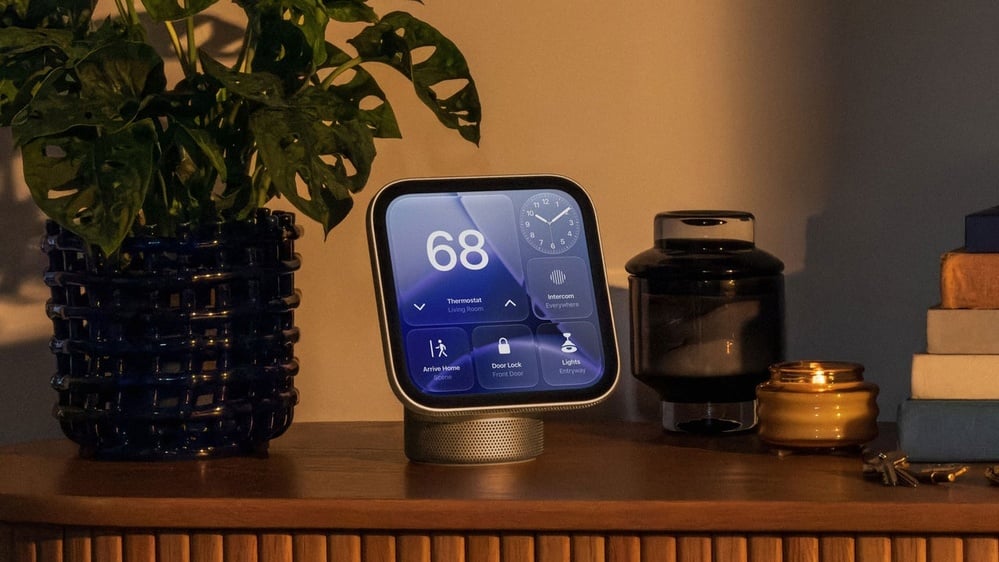
“The device, which pairs a square seven-inch touchscreen with a speaker base, will sell for $299 in the United States starting November 13.” · exact text match
Why: Concrete, checkable specifics presented flatly; no urgency framing or superlatives appear in the supplied text.
Claim: Beyond the launch itself, the report packs consequential secondary angles: a new CEO's early products, Gemini-based Siri, and EU non-availability.
“The launch is one of the first under John Ternus, Apple's former hardware engineering chief, who took over as chief executive from Tim Cook on September 1.” · exact text match
Counterevidence:
“it is built on AI technology from Google Gemini.” · exact text match
Why: Multiple independent angles of real consumer and industry interest lift routine launch coverage above the mundane.
Claim: The report only describes the launch and its context and offers no recommendations, judgments, or normative prescriptions.
“HomeView is meant to act as a family command center, controlling connected features such as lights, locks, thermostats and cameras.” · exact text match
Why: Every sentence reports facts or attributed views; no should-claims or advice to readers, companies, or regulators appear.
Claim: Tone is uniformly neutral, using plain descriptive verbs and no charged or emotive modifiers in either direction.
“Apple on Tuesday unveiled HomeView, a voice-driven smart display built around its revamped Siri AI assistant” · exact text match
Why: Neutral vocabulary throughout, with neither gushing praise nor disparagement of any party.
Claim: Claims are visibly attributed to the company and to analysts and anchored to specific figures, dates, and a dateline.
“Apple stated that it is working constructively with the EU to find a way for these products to enter the European market.” · exact text match
Counterevidence:
“Published - October 14, 2026 08:59 am IST” · exact text match
Why: Explicit attribution and concrete specifics are visible credibility practices, though analyst sources are unnamed and no independent verification is shown.
Claim: The report's claims are specific, internally consistent, and sourced, showing sound epistemic practice without logical lapses.
“Siri AI is central to Apple's effort to catch up with rivals in generative artificial intelligence, and it is built on AI technology from Google Gemini.” · exact text match
Why: Claims are concrete and coherently connected across product, strategy, and regulatory points, with no unsupported inferential leaps.
Claim: The report balances launch news with unfavorable context about Apple's past smart-home performance and its EU unavailability.
“Apple has struggled for years to gain ground in the smart home, where its HomePod speakers have trailed Amazon's Alexa and Google AI-amped devices.” · exact text match
Counterevidence:
“The company said that HomeView would not be sold in the European Union for the time being” · exact text match
Why: Including material drawbacks alongside a product launch is a fairness signal rather than one-sided promotion.
Claim: The short report efficiently integrates specs, pricing, competitive history, partnerships, leadership change, and regulatory constraints into a coherent narrative.
“The company said that HomeView would not be sold in the European Union for the time being as the company finds ways to make Siri AI compliant with Europe's competition rules.” · exact text match
Why: Dense, well-organized synthesis of product, strategy, and regulatory detail for its length, though it relies on unnamed analysts.
The supplied text is partially garbled by scrape artifacts and a dangling sentence fragment; the October 2026 dateline and the reported Ternus-for-Cook CEO transition cannot be verified from the supplied material, so all facts are reported as stated.
October 13, 2026 · 0 shares
Enthusiastic, affiliate-linked launch coverage that uncritically relays Apple's marketing framing with mild hype and no independent testing or critical perspective.
Automated analysis; not human reviewed.
Limitations: Coverage rests entirely on Apple's event and press-release material plus one analyst quote, with no independent verification, and site boilerplate (affiliate and gift-guide lines) is interleaved with the article body, complicating attribution of framing.
·
16 of 55 available dimensions scored; omitted dimensions are not treated as neutral.
·
Verified supporting quotes for 16 of 16 scored dimensions.
Claim: Verifiable product facts are interwoven with the publisher's own value judgments about appeal and enjoyment.
“which sounds like a fun feature for a kitchen dance party” · exact text match
“so there’s bound to be at least one option that will fit your home decor scheme” · exact text match
Why: Subjective impressions about fun and decor fit appear alongside specs in the publisher's voice.
Claim: Headline framing mildly dramatizes the launch as a home takeover.
“Apple’s $299 HomeView Is Ready to Take Over Your Countertops and Walls” · exact text match
Why: The takeover metaphor overstates a routine product announcement beyond plain reporting.
Claim: Outlook on the product is positive, framing it as distinctive and positioned to outdo rivals.
“this bold design choice will set Apple’s smart speaker apart from most rivals on the market” · exact text match
Why: Bullish framing of the product's market prospects appears without counterweights.
Claim: Tone is consistently upbeat about the device and its uses.
“which sounds like a fun feature for a kitchen dance party” · exact text match
Why: Playful, positive depictions appear with no downsides or drawbacks discussed.
Claim: A first-of-its-kind Apple product launch with concrete details is a high-interest tech story.
“Apple has welcomed an entirely new product type to its ever-growing family of devices.” · exact text match
Why: A novel product-category announcement with specifics sustains above-average reader interest.
Claim: The publisher nudges readers to change behavior (adopt Apple services) to benefit from the device.
“it sounds like it might be time to tap into shared photo albums and shared Apple Music playlists in order to make the most of the HomeView” · exact text match
Why: A prescriptive recommendation appears, though the piece is otherwise mostly descriptive.
Claim: Uncited evaluative judgments about design and market appeal are stated in the publisher's own voice.
“this bold design choice will set Apple’s smart speaker apart from most rivals on the market” · exact text match
Why: Opinionated assessment is presented as fact rather than attributed.
Claim: A competitive-outcome prediction is asserted as certainty without support.
“will set Apple’s smart speaker apart from most rivals on the market” · exact text match
Why: Certainty about future market differentiation exceeds what announcement facts can establish.
Claim: Tone is consistently positive and playful.
“which sounds like a fun feature for a kitchen dance party” · exact text match
Why: Cheerful framing throughout with no negative emotion elicited.
Claim: Named sources, dates, and specs support moderate reliability, but the piece is unverified announcement stenography with copy errors.
“said Ben Wood, chief analyst at FDM CCS, speaking from the company’s New York event” · exact text match
Counterevidence:
“These faces respond dynamically to your physical and presence and movement” · exact text match
Why: Attribution and concreteness aid trust; no independent testing, no critical voices, and a garbled sentence limit it.
Claim: The piece rests mainly on concrete specifications and attributed statements rather than fallacious argument.
“The device is powered by Apple’s homegrown A18 chip — the same silicon inside the iPhone 16 Series and the MacBook Neo.” · exact text match
Why: Verifiable product details and named attribution dominate; editorializing is mild.
Claim: Affiliate monetization plus direct preorder promotion gives the coverage advertorial character.
“If you buy through our links, we may earn a commission.” · exact text match
“Customers in the US, Australia, Canada, India, New Zealand and the UK can preorder the HomeView right now for $299” · exact text match
Why: Commercial link incentives and purchase prompting accompany uniformly promotional product framing; the disclosure mitigates but does not remove the advertorial lean.
Claim: Apple is framed uniformly favorably with no criticism or downside.
“this bold design choice will set Apple’s smart speaker apart from most rivals on the market” · exact text match
Why: Only positive claims about the company and product appear in the publisher's own voice.
Claim: A few forward-looking claims extend beyond the announced facts.
“will set Apple’s smart speaker apart from most rivals on the market” · exact text match
Why: A competitive-outcome prediction goes beyond the announcement's specifications.
Claim: Commission relationship is disclosed and claims are attributed to named sources.
“If you buy through our links, we may earn a commission.” · exact text match
“said Greg Joswiak, Apple’s senior vice president of Worldwide Marketing in a press release” · exact text match
Why: Affiliate disclosure and named attribution are visible honesty signals despite the promotional slant.
Claim: Organized, specification-rich product reporting is offset by copy-editing errors, netting average quality.
“The device is powered by Apple’s homegrown A18 chip — the same silicon inside the iPhone 16 Series and the MacBook Neo.” · exact text match
Counterevidence:
“quite unobstrusive” · exact text match
Why: Concrete structure and detail reflect competence; typos and a garbled sentence offset it.
Coverage rests entirely on Apple's event and press-release material plus one analyst quote, with no independent verification, and site boilerplate (affiliate and gift-guide lines) is interleaved with the article body, complicating attribution of framing.
October 14, 2026 · 0 shares
Plain wire-style product coverage whose only discernible slants are mildly promotional Apple framing and analyst-sourced strategy interpretation, with no ideological or emotional coloring.
Automated analysis; not human reviewed.
Limitations: The supplied text is partially garbled by scrape artifacts and a dangling sentence fragment; the October 2026 dateline and the reported Ternus-for-Cook CEO transition cannot be verified from the supplied material, so all facts are reported as stated.
·
9 of 55 available dimensions scored; omitted dimensions are not treated as neutral.
·
Verified supporting quotes for 9 of 9 scored dimensions.
Claim: The report is descriptive throughout and attributes all interpretive claims to analysts or the company rather than asserting publisher opinion.
“Analysts see the new hardware as an effort to deepen customers' ties to the Apple ecosystem as AI rivals, including OpenAI, eye devices of their own.” · exact text match
Why: Interpretive and strategic claims are consistently sourced to analysts or company statements; the publisher adds no evaluative commentary of its own.
Claim: Coverage conveys plain product facts such as specs, price, and date without hype, alarm, or exaggerated language.
“The device, which pairs a square seven-inch touchscreen with a speaker base, will sell for $299 in the United States starting November 13.” · exact text match
Why: Concrete, checkable specifics presented flatly; no urgency framing or superlatives appear in the supplied text.
Claim: Beyond the launch itself, the report packs consequential secondary angles: a new CEO's early products, Gemini-based Siri, and EU non-availability.
“The launch is one of the first under John Ternus, Apple's former hardware engineering chief, who took over as chief executive from Tim Cook on September 1.” · exact text match
Counterevidence:
“it is built on AI technology from Google Gemini.” · exact text match
Why: Multiple independent angles of real consumer and industry interest lift routine launch coverage above the mundane.
Claim: The report only describes the launch and its context and offers no recommendations, judgments, or normative prescriptions.
“HomeView is meant to act as a family command center, controlling connected features such as lights, locks, thermostats and cameras.” · exact text match
Why: Every sentence reports facts or attributed views; no should-claims or advice to readers, companies, or regulators appear.
Claim: Tone is uniformly neutral, using plain descriptive verbs and no charged or emotive modifiers in either direction.
“Apple on Tuesday unveiled HomeView, a voice-driven smart display built around its revamped Siri AI assistant” · exact text match
Why: Neutral vocabulary throughout, with neither gushing praise nor disparagement of any party.
Claim: Claims are visibly attributed to the company and to analysts and anchored to specific figures, dates, and a dateline.
“Apple stated that it is working constructively with the EU to find a way for these products to enter the European market.” · exact text match
Counterevidence:
“Published - October 14, 2026 08:59 am IST” · exact text match
Why: Explicit attribution and concrete specifics are visible credibility practices, though analyst sources are unnamed and no independent verification is shown.
Claim: The report's claims are specific, internally consistent, and sourced, showing sound epistemic practice without logical lapses.
“Siri AI is central to Apple's effort to catch up with rivals in generative artificial intelligence, and it is built on AI technology from Google Gemini.” · exact text match
Why: Claims are concrete and coherently connected across product, strategy, and regulatory points, with no unsupported inferential leaps.
Claim: The report balances launch news with unfavorable context about Apple's past smart-home performance and its EU unavailability.
“Apple has struggled for years to gain ground in the smart home, where its HomePod speakers have trailed Amazon's Alexa and Google AI-amped devices.” · exact text match
Counterevidence:
“The company said that HomeView would not be sold in the European Union for the time being” · exact text match
Why: Including material drawbacks alongside a product launch is a fairness signal rather than one-sided promotion.
Claim: The short report efficiently integrates specs, pricing, competitive history, partnerships, leadership change, and regulatory constraints into a coherent narrative.
“The company said that HomeView would not be sold in the European Union for the time being as the company finds ways to make Siri AI compliant with Europe's competition rules.” · exact text match
Why: Dense, well-organized synthesis of product, strategy, and regulatory detail for its length, though it relies on unnamed analysts.
The supplied text is partially garbled by scrape artifacts and a dangling sentence fragment; the October 2026 dateline and the reported Ternus-for-Cook CEO transition cannot be verified from the supplied material, so all facts are reported as stated.
October 14, 2026 · 0 shares
Tech-newsletter framing presents Apple's new home hardware chiefly as a strategic distribution play for an AI catch-up effort, blending sourced analyst assessment with light editorial wit and self-promotion.
Automated analysis; not human reviewed.
Limitations: The supplied text shows scrape artifacts — duplicated intro paragraphs, a truncated sentence, and stripped brand/outlet names — and it identifies John Ternus as Apple CEO, which conflicts with commonly known Apple leadership; byline and outlet attribution are therefore ambiguous.
·
10 of 55 available dimensions scored; omitted dimensions are not treated as neutral.
·
Verified supporting quotes for 10 of 10 scored dimensions.
Claim: Coverage is predominantly factual with only mild editorial characterization of Apple's strategy.
“More importantly, they’re ideal hosts for Apple’s upgraded Siri” · exact text match
“HomeView, which has a 7-inch display, costs $299 and is available Nov.
13.”
· exact text match
Why: Concrete specs and sourced assessment dominate, with occasional evaluative phrasing tilting the score only slightly from neutral.
Claim: Product and corporate news is presented in measured, quantified terms without hype or alarm.
“HomeView, which has a 7-inch display, costs $299 and is available Nov.
13.”
· exact text match
Why: Flat factual presentation of prices, dates, and specs shows no sensational amplification.
Claim: Playful voice and a broad cross-industry brief list add engagement beyond a plain product report.
““My goodness,” Meta CEO Mark Zuckerberg seemed to think, staring down at his roasted brew.
“My Guinness.””
· exact text match
“Is the SaaSpocalypse overblown?” · exact text match
Why: Wit and a varied news sweep make the roundup mildly more engaging than routine.
Claim: Content reports launches, prices, and corporate events without advising what anyone should do.
“HomeView, which has a 7-inch display, costs $299 and is available Nov.
13.”
· exact text match
Why: The text describes products and events descriptively and issues no recommendations.
Claim: Light interpretive framing appears atop mostly factual reporting.
“HomeView is Apple’s latest bet on Siri AI” · exact text match
“More importantly, they’re ideal hosts for Apple’s upgraded Siri” · exact text match
Why: Words like "bet" and "More importantly" add editorial judgment, but the bulk remains sourced fact.
Claim: The newsletter includes a short self-promotional plug for its own feature story.
“Please give it a read.
More tech news follows.”
· exact text match
Why: Mild house promotion is present but does not dominate the content.
Claim: Named-source attribution, hedged claims, and concrete specifics support above-average visible credibility.
“Anshel Sag, an analyst at market research firm Moor Insights & Strategy” · exact text match
“the general public seems largely unaware that Apple has upgraded Siri” · exact text match
Why: Sourcing to an identified analyst and hedged characterizations indicate sound epistemic practice in the visible text.
Claim: Reporting rests on named-source assessment and concrete product details rather than assertion or speculation.
“Anshel Sag, an analyst at market research firm Moor Insights & Strategy” · exact text match
“Siri has lagged well behind leading chatbots from OpenAI and Anthropic.” · exact text match
Why: Claims are tied to an identified analyst and verifiable specs, indicating mildly reasoned, evidence-bound reporting.
Claim: The piece attributes assessments to a named analyst and flags beta status and hedged public awareness.
“will be available in beta on HomeView and the new Apple TV 4K” · exact text match
“the general public seems largely unaware that Apple has upgraded Siri” · exact text match
Why: Visible attribution and hedging are honesty signals supporting mildly above-neutral integrity.
Claim: The roundup links product launches to AI distribution strategy but remains a brief, surface-level digest.
“giving the company a new distribution channel as it plays catch-up in AI” · exact text match
Why: Strategic synthesis is present in the framing, but depth is limited by the brief format, scoring slightly above average.
The supplied text shows scrape artifacts — duplicated intro paragraphs, a truncated sentence, and stripped brand/outlet names — and it identifies John Ternus as Apple CEO, which conflicts with commonly known Apple leadership; byline and outlet attribution are therefore ambiguous.
Near press-release relay: every capability, privacy, and design claim is attributed to Apple or its marketing chief, with no independent evaluation, drawbacks, or pricing.
Automated analysis; not human reviewed.
Limitations: The source arrived as a scraped flat list of sentences interleaved with subscription prompts, so original paragraphing is lost and completeness (e.g., whether pricing or a spec table existed) cannot be verified.
·
10 of 55 available dimensions scored; omitted dimensions are not treated as neutral.
·
Verified supporting quotes for 10 of 10 scored dimensions.
Claim: Product and privacy claims are consistently attributed to Apple rather than asserted as the outlet's own judgments.
“In a press statement, the corporation said that the new version of Siri installed in the latest product has expansive world knowledge” · exact text match
“Apple claimed that the device comes in two designs — tabletop and wall-mounted- and can fit in any space.” · exact text match
Why: Attribution verbs ('said', 'claimed', 'According to the company') keep vendor claims at arm's length, making the framing mildly objective despite promotional source material.
Claim: The piece uses plain feature-description language with no hype, urgency, or alarm.
“Apple’s HomeView puts smart-home controls, video calls and family photos on one screen” · exact text match
Why: The headline and body are flat, spec-level descriptions; no superlatives, urgency cues, or emotional triggers appear outside attributed quotes.
Claim: A major vendor's new AI-enabled smart-home display is moderately newsworthy, but the write-up adds no exclusive detail.
“Apple has unveiled a new artificial-intelligence-enabled device called Apple ‘HomeView’ equipped with a 7-inch Liquid Retina display” · exact text match
Why: Consumer-tech launches of this type draw moderate general interest; the content is standard announcement relay without deeper insight, warranting a mildly positive score.
Claim: The text reports what the device does without urging readers to buy, adopt, or judge it.
“The touchscreen also provides a more direct way to access these functions without relying entirely on voice commands.” · exact text match
Why: The entire piece is feature and quote description; there is no recommendation, advice, or normative claim.
Claim: Tone is uniformly neutral and unemotional, limited to specs, quotes, and logistics.
“With a stainless steel body, Apple’s latest smart gadget comes in different hues ranging from silver, starlight, rose pink, to space gray — each finished with a matching cable.” · exact text match
Why: Language stays descriptive and affect-free throughout; the only evaluative wording sits inside attributed company quotes.
Claim: Sourcing is visible and consistent (company statements, named executive), but the piece rests on a single source and shows editing lapses.
“In a press statement, the corporation said that the new version of Siri installed in the latest product has expansive world knowledge” · exact text match
“the company’s AI tools let users can get more personalized responses to their queries” · exact text match
Why: Attribution supports baseline reliability for what Apple announced, while single-source press-release dependence and grammatical errors cap credibility at a modest level.
Claim: The piece functions as a near press-release rewrite, relaying Apple's marketing claims approvingly with no independent evaluation, drawbacks, or price.
““Apple HomeView is designed to be shared by everyone in the home yet feel completely personal to each user,” said Greg Joswiak” · exact text match
“Security remains paramount for the company, even in the latest addition to their range of products” · exact text match
Why: Every claim is sourced to Apple's announcement or an executive quote and presented without criticism, testing, pricing, or competitive context — a promotional, advertorial-leaning structure.
Claim: The framing is mildly favorable to Apple, adopting the company's self-presentation on security and personalization at face value.
“Security remains paramount for the company, even in the latest addition to their range of products that offers a personal experience to the users.” · exact text match
Why: The publisher's own voice endorses Apple's security posture and lists only benefits; consistent attribution keeps the tilt modest rather than strong.
Claim: Grammatical anomalies and non-native phrasing indicate human authorship rather than AI generation.
“However, customers could get hold of the product only after a month’s time, it added.” · exact text match
Why: Human-typical errors ('let users can get', 'comes handy') contrast with the polished fluency typical of AI text; no AI-signature patterns appear, though the evidence base is small.
Claim: Average-quality launch report: facts are conveyed with attribution but marred by grammatical slips and zero added analysis or context.
“the company’s AI tools let users can get more personalized responses to their queries” · exact text match
Why: The piece competently relays specs and quotes, but errors like 'let users can get' and the absence of pricing, competition, or analysis net out to average.
The source arrived as a scraped flat list of sentences interleaved with subscription prompts, so original paragraphing is lost and completeness (e.g., whether pricing or a spec table existed) cannot be verified.
A neutral wire-style launch report that relays Apple's personalization and privacy claims almost entirely through the company's own executives, with no independent or skeptical voice.
Automated analysis; not human reviewed.
Limitations: All capability and privacy claims originate solely from Apple's event demonstrations and named executives, so no independent verification is possible from the text; no byline or publication year is supplied.
·
10 of 55 available dimensions scored; omitted dimensions are not treated as neutral.
·
Verified supporting quotes for 9 of 10 scored dimensions.
Claim: The report is largely objective, attributing product and privacy claims to Apple rather than asserting them as the publisher's own views.
“Apple said none of the data is used for marketing, including first-party advertising efforts.” · exact text match
Why: Consistent attribution keeps the piece objective, but all substantive claims come from one interested party with no independent voice, tempering the objectivity score.
Claim: The coverage is measured product news without hype, urgency, or alarm language.
“Apple on Tuesday unveiled a smart-home hub that taps iPhone user data to make Siri more personal, but promised privacy safeguards designed to keep that information out of the company's hands.” · exact text match
Why: Flat, descriptive wire-style lead with hedged wording ('designed to') indicates low sensationalism.
Claim: A major Apple hardware launch centered on AI personalization and privacy is moderately more interesting than average tech news.
“Apple's HomeView brings personalized Siri to smart home, takes on Amazon and Google” · exact text match
Why: High-profile company, a new device, and a privacy-versus-personalization angle give broad reader interest, though the coverage itself is routine.
Claim: The report describes the launch and features without advising readers or prescribing any action.
“Apple demonstrated HomeView juggling requests from family members during the morning rush to school and work.” · exact text match
Why: Purely descriptive event coverage with no recommendations or normative claims anywhere in the text.
Claim: The tone is neutral and unemotional wire-style reporting.
“The HomeView smart-home hub, which took center stage at an event in New York, is an important test of Apple's AI strategy as it tries to close the gap with rivals Amazon and Alphabet's Google” · exact text match
Why: Matter-of-fact framing without positive or negative emotive language supports measured neutrality on the emotional dimension.
Claim: Sourcing practices are visible and specific, supporting moderate credibility within the supplied text.
“Apple said it will make decisions on which user to prioritize based on who last touched the device and other factors” · exact text match
Why: A dateline, named executive sources, and attributed specifics support credibility; the lack of any independent verification of privacy claims tempers the score.
Claim: The report presents a factual product announcement with specific attributed technical claims rather than emotive or illogical argument.
“HomeView has its own operating system and runs on Apple's A18 chip, designed to process encrypted user data in a walled-off part of the chip.” · exact text match
Why: Concrete, checkable technical details attributed to the company support a mildly rational classification, though the substance rests entirely on Apple's claims.
Claim: The framing favors Apple by presenting its privacy and design claims largely without challenge or independent scrutiny.
“A key difference between Siri AI and rival systems is that it does not end each interaction with a follow-up question designed to elicit more information from the user” · exact text match
Why: Apple's self-characterization against rivals is adopted as the article's own framing, with no skeptical or independent voice included.
Claim: The report consistently attributes claims to named Apple executives and to Apple as a company.
“Kaiann Drance, Apple's vice president of product marketing for home products, said in an interview.” · not found in supplied text
Why: Named on-record sourcing and explicit attribution are observable honesty signals, though single-source reliance limits the score.
Claim: The report efficiently explains the product's technical architecture and competitive stakes.
“To access private data, a user's iPhone has to be connected to the same home network as HomeView, and no private data is stored on the HomeView device itself.” · exact text match
Why: Clear synthesis of how personalization and the privacy design work, though the piece adds no independent analysis beyond company claims.
All capability and privacy claims originate solely from Apple's event demonstrations and named executives, so no independent verification is possible from the text; no byline or publication year is supplied.
Near press-release relay: every capability, privacy, and design claim is attributed to Apple or its marketing chief, with no independent evaluation, drawbacks, or pricing.
Automated analysis; not human reviewed.
Limitations: The source arrived as a scraped flat list of sentences interleaved with subscription prompts, so original paragraphing is lost and completeness (e.g., whether pricing or a spec table existed) cannot be verified.
·
10 of 55 available dimensions scored; omitted dimensions are not treated as neutral.
·
Verified supporting quotes for 10 of 10 scored dimensions.
Claim: Product and privacy claims are consistently attributed to Apple rather than asserted as the outlet's own judgments.
“In a press statement, the corporation said that the new version of Siri installed in the latest product has expansive world knowledge” · exact text match
“Apple claimed that the device comes in two designs — tabletop and wall-mounted- and can fit in any space.” · exact text match
Why: Attribution verbs ('said', 'claimed', 'According to the company') keep vendor claims at arm's length, making the framing mildly objective despite promotional source material.
Claim: The piece uses plain feature-description language with no hype, urgency, or alarm.
“Apple’s HomeView puts smart-home controls, video calls and family photos on one screen” · exact text match
Why: The headline and body are flat, spec-level descriptions; no superlatives, urgency cues, or emotional triggers appear outside attributed quotes.
Claim: A major vendor's new AI-enabled smart-home display is moderately newsworthy, but the write-up adds no exclusive detail.
“Apple has unveiled a new artificial-intelligence-enabled device called Apple ‘HomeView’ equipped with a 7-inch Liquid Retina display” · exact text match
Why: Consumer-tech launches of this type draw moderate general interest; the content is standard announcement relay without deeper insight, warranting a mildly positive score.
Claim: The text reports what the device does without urging readers to buy, adopt, or judge it.
“The touchscreen also provides a more direct way to access these functions without relying entirely on voice commands.” · exact text match
Why: The entire piece is feature and quote description; there is no recommendation, advice, or normative claim.
Claim: Tone is uniformly neutral and unemotional, limited to specs, quotes, and logistics.
“With a stainless steel body, Apple’s latest smart gadget comes in different hues ranging from silver, starlight, rose pink, to space gray — each finished with a matching cable.” · exact text match
Why: Language stays descriptive and affect-free throughout; the only evaluative wording sits inside attributed company quotes.
Claim: Sourcing is visible and consistent (company statements, named executive), but the piece rests on a single source and shows editing lapses.
“In a press statement, the corporation said that the new version of Siri installed in the latest product has expansive world knowledge” · exact text match
“the company’s AI tools let users can get more personalized responses to their queries” · exact text match
Why: Attribution supports baseline reliability for what Apple announced, while single-source press-release dependence and grammatical errors cap credibility at a modest level.
Claim: The piece functions as a near press-release rewrite, relaying Apple's marketing claims approvingly with no independent evaluation, drawbacks, or price.
““Apple HomeView is designed to be shared by everyone in the home yet feel completely personal to each user,” said Greg Joswiak” · exact text match
“Security remains paramount for the company, even in the latest addition to their range of products” · exact text match
Why: Every claim is sourced to Apple's announcement or an executive quote and presented without criticism, testing, pricing, or competitive context — a promotional, advertorial-leaning structure.
Claim: The framing is mildly favorable to Apple, adopting the company's self-presentation on security and personalization at face value.
“Security remains paramount for the company, even in the latest addition to their range of products that offers a personal experience to the users.” · exact text match
Why: The publisher's own voice endorses Apple's security posture and lists only benefits; consistent attribution keeps the tilt modest rather than strong.
Claim: Grammatical anomalies and non-native phrasing indicate human authorship rather than AI generation.
“However, customers could get hold of the product only after a month’s time, it added.” · exact text match
Why: Human-typical errors ('let users can get', 'comes handy') contrast with the polished fluency typical of AI text; no AI-signature patterns appear, though the evidence base is small.
Claim: Average-quality launch report: facts are conveyed with attribution but marred by grammatical slips and zero added analysis or context.
“the company’s AI tools let users can get more personalized responses to their queries” · exact text match
Why: The piece competently relays specs and quotes, but errors like 'let users can get' and the absence of pricing, competition, or analysis net out to average.
The source arrived as a scraped flat list of sentences interleaved with subscription prompts, so original paragraphing is lost and completeness (e.g., whether pricing or a spec table existed) cannot be verified.
October 13, 2026 · 0 shares
Enthusiastic, affiliate-linked launch coverage that uncritically relays Apple's marketing framing with mild hype and no independent testing or critical perspective.
Automated analysis; not human reviewed.
Limitations: Coverage rests entirely on Apple's event and press-release material plus one analyst quote, with no independent verification, and site boilerplate (affiliate and gift-guide lines) is interleaved with the article body, complicating attribution of framing.
·
16 of 55 available dimensions scored; omitted dimensions are not treated as neutral.
·
Verified supporting quotes for 16 of 16 scored dimensions.
Claim: Verifiable product facts are interwoven with the publisher's own value judgments about appeal and enjoyment.
“which sounds like a fun feature for a kitchen dance party” · exact text match
“so there’s bound to be at least one option that will fit your home decor scheme” · exact text match
Why: Subjective impressions about fun and decor fit appear alongside specs in the publisher's voice.
Claim: Headline framing mildly dramatizes the launch as a home takeover.
“Apple’s $299 HomeView Is Ready to Take Over Your Countertops and Walls” · exact text match
Why: The takeover metaphor overstates a routine product announcement beyond plain reporting.
Claim: Outlook on the product is positive, framing it as distinctive and positioned to outdo rivals.
“this bold design choice will set Apple’s smart speaker apart from most rivals on the market” · exact text match
Why: Bullish framing of the product's market prospects appears without counterweights.
Claim: Tone is consistently upbeat about the device and its uses.
“which sounds like a fun feature for a kitchen dance party” · exact text match
Why: Playful, positive depictions appear with no downsides or drawbacks discussed.
Claim: A first-of-its-kind Apple product launch with concrete details is a high-interest tech story.
“Apple has welcomed an entirely new product type to its ever-growing family of devices.” · exact text match
Why: A novel product-category announcement with specifics sustains above-average reader interest.
Claim: The publisher nudges readers to change behavior (adopt Apple services) to benefit from the device.
“it sounds like it might be time to tap into shared photo albums and shared Apple Music playlists in order to make the most of the HomeView” · exact text match
Why: A prescriptive recommendation appears, though the piece is otherwise mostly descriptive.
Claim: Uncited evaluative judgments about design and market appeal are stated in the publisher's own voice.
“this bold design choice will set Apple’s smart speaker apart from most rivals on the market” · exact text match
Why: Opinionated assessment is presented as fact rather than attributed.
Claim: A competitive-outcome prediction is asserted as certainty without support.
“will set Apple’s smart speaker apart from most rivals on the market” · exact text match
Why: Certainty about future market differentiation exceeds what announcement facts can establish.
Claim: Tone is consistently positive and playful.
“which sounds like a fun feature for a kitchen dance party” · exact text match
Why: Cheerful framing throughout with no negative emotion elicited.
Claim: Named sources, dates, and specs support moderate reliability, but the piece is unverified announcement stenography with copy errors.
“said Ben Wood, chief analyst at FDM CCS, speaking from the company’s New York event” · exact text match
Counterevidence:
“These faces respond dynamically to your physical and presence and movement” · exact text match
Why: Attribution and concreteness aid trust; no independent testing, no critical voices, and a garbled sentence limit it.
Claim: The piece rests mainly on concrete specifications and attributed statements rather than fallacious argument.
“The device is powered by Apple’s homegrown A18 chip — the same silicon inside the iPhone 16 Series and the MacBook Neo.” · exact text match
Why: Verifiable product details and named attribution dominate; editorializing is mild.
Claim: Affiliate monetization plus direct preorder promotion gives the coverage advertorial character.
“If you buy through our links, we may earn a commission.” · exact text match
“Customers in the US, Australia, Canada, India, New Zealand and the UK can preorder the HomeView right now for $299” · exact text match
Why: Commercial link incentives and purchase prompting accompany uniformly promotional product framing; the disclosure mitigates but does not remove the advertorial lean.
Claim: Apple is framed uniformly favorably with no criticism or downside.
“this bold design choice will set Apple’s smart speaker apart from most rivals on the market” · exact text match
Why: Only positive claims about the company and product appear in the publisher's own voice.
Claim: A few forward-looking claims extend beyond the announced facts.
“will set Apple’s smart speaker apart from most rivals on the market” · exact text match
Why: A competitive-outcome prediction goes beyond the announcement's specifications.
Claim: Commission relationship is disclosed and claims are attributed to named sources.
“If you buy through our links, we may earn a commission.” · exact text match
“said Greg Joswiak, Apple’s senior vice president of Worldwide Marketing in a press release” · exact text match
Why: Affiliate disclosure and named attribution are visible honesty signals despite the promotional slant.
Claim: Organized, specification-rich product reporting is offset by copy-editing errors, netting average quality.
“The device is powered by Apple’s homegrown A18 chip — the same silicon inside the iPhone 16 Series and the MacBook Neo.” · exact text match
Counterevidence:
“quite unobstrusive” · exact text match
Why: Concrete structure and detail reflect competence; typos and a garbled sentence offset it.
Coverage rests entirely on Apple's event and press-release material plus one analyst quote, with no independent verification, and site boilerplate (affiliate and gift-guide lines) is interleaved with the article body, complicating attribution of framing.
October 13, 2026 · 0 shares
Practical consumer-guidance framing that converts Apple's own speaker specifications into a direct which-model-to-buy recommendation, packaged under a lightly teasered 'hidden difference' headline.
As a newly announced product, the HomeView is evaluated solely through Apple's own marketing descriptions and technical specifications page rather than independent testing.
Automated analysis; not human reviewed.
Limitations: The $299 pre-order price appears only in a related-article headline rather than the body, and the author is identified solely by the first name 'Ryan' in the closing bio, limiting attribution precision.
·
10 of 55 available dimensions scored; omitted dimensions are not treated as neutral.
·
Verified supporting quotes for 10 of 10 scored dimensions.
Claim: The comparison is grounded in Apple's published descriptions and specs rather than unsupported assertion.
“Echoing this, Apple’s technical specs page confirms both models have two custom full-range drivers, but the HomeView with domed base adds:” · exact text match
“Here are Apple’s descriptions of each speaker setup:” · exact text match
Counterevidence:
“Essentially, if you want the best sound experience from your HomeView, you’ll want to buy the standard model.” · exact text match
Why: Verifying claims against Apple's official specs page and quoting sourced descriptions is an objective practice.
Claim: Headline framing teases a 'hidden' difference, a mildly hype-styled hook that the body substantiates.
“Apple’s two HomeViews have one big hidden difference” · exact text match
Why: Teaser phrasing implies concealed information, though the difference is real and documented via Apple's specs page.
Claim: A concrete, decision-relevant product detail gives the item practical interest for smart-home buyers.
“If you’re trying to decide which HomeView form factor to buy, there’s a key detail you should know about.” · exact text match
Why: A hidden spec difference affecting a purchase choice is engaging for the target audience, though niche overall.
Claim: The piece moves beyond describing the difference into explicit purchase advice.
“Essentially, if you want the best sound experience from your HomeView, you’ll want to buy the standard model.” · exact text match
Why: A direct which-to-buy recommendation is prescriptive, though the overall report remains primarily descriptive.
Claim: Mild subjective assessment accompanies the factual spec reporting.
“But if audio quality isn’t as important to you, the wall-mounted version will probably get the job done.” · exact text match
Why: A hedged judgment about adequacy is opinion layered on the spec facts, keeping the score low.
Claim: Claims are attributed to Apple's official descriptions and technical specs page, with hedged language where the author judges performance.
“Echoing this, Apple’s technical specs page confirms both models have two custom full-range drivers, but the HomeView with domed base adds:” · exact text match
“But if audio quality isn’t as important to you, the wall-mounted version will probably get the job done.” · exact text match
Why: Attribution to a verifiable primary source and hedged conclusions support above-average credibility within the supplied text.
Claim: The purchase guidance follows logically from the quoted speaker specifications.
“Essentially, if you want the best sound experience from your HomeView, you’ll want to buy the standard model.” · exact text match
Why: The recommendation directly follows from the cited spec difference, the added down-firing woofer confirmed by Apple's specs page.
Claim: Purchase advocacy coexists with an on-page affiliate-income model, a mild commercial lean.
“Essentially, if you want the best sound experience from your HomeView, you’ll want to buy the standard model.” · exact text match
“FTC: We use income earning auto affiliate links.
More.”
· exact text match
Why: Direct buy advice paired with a disclosed affiliate model creates slight advertorial tension, though the content itself is informative.
Claim: Personal author bio and first-person reader engagement indicate human authorship.
“Ryan got his start in journalism as an Editor at MacStories” · exact text match
“Does the difference in audio quality change your HomeView purchase decision at all? Let us know in the comments.” · exact text match
Why: A named author history and direct audience address are human editorial conventions; AI detection is probabilistic, so confidence stays moderate.
Claim: The publisher discloses affiliate-link income and attributes audio claims to Apple.
“FTC: We use income earning auto affiliate links.
More.”
· exact text match
“Echoing this, Apple’s technical specs page confirms both models have two custom full-range drivers, but the HomeView with domed base adds:” · exact text match
Why: An on-page affiliate disclosure and sourcing to a verifiable primary source are observable transparency signals.
The $299 pre-order price appears only in a related-article headline rather than the body, and the author is identified solely by the first name 'Ryan' in the closing bio, limiting attribution precision.
Consumer-critical headline framing spotlights Apple charging the same price for a HomeView variant with less hardware ('Same Price, Less Performance'), while the supplied text itself remains at plain factual announcement level.
Automated analysis; not human reviewed.
Limitations: The supplied text is only a headline plus a one-sentence teaser (with the headline and sentence duplicated), so the full article's sourcing and evidence for the 'less performance' claim are unavailable, and the link between the omitted hardware and the Wall Version rests on the headline rather than the body text.
·
5 of 55 available dimensions scored; omitted dimensions are not treated as neutral.
·
Verified supporting quotes for 5 of 5 scored dimensions.
Claim: Framing is descriptive and fact-based, reporting price parity and hardware omission without editorial opinion.
“Both HomeView variants are the same price, even though Apple is omitting hardware in one version.” · exact text match
Why: The supplied text states concrete product facts with no evaluative or opinion language.
Claim: No sensational language; the headline uses a factual price-versus-hardware contrast rather than alarm or exaggeration.
“Apple HomeView Wall Version: Same Price, Less Performance” · exact text match
Why: The contrast is factual and muted; no emotive, alarmist, or exaggerated wording appears anywhere in the supplied text.
Claim: Moderately interesting tech news: a new Apple home-hub line with an unusual equal-pricing decision.
“There was surprise at the presentation of the new home hub.” · exact text match
Why: Reported surprise at the launch plus a pricing quirk give the story moderate reader interest.
Claim: The report is purely descriptive, announcing product facts without recommendations or guidance.
“Both HomeView variants are the same price, even though Apple is omitting hardware in one version.” · exact text match
Why: The text reports what was presented and priced, with no advice on buying, policy, or action.
Claim: Mildly consumer-critical framing of Apple foregrounds that a reduced-hardware variant costs the same as the full one.
“Same Price, Less Performance” · exact text match
“even though Apple is omitting hardware in one version” · exact text match
Why: The headline and the concessive 'even though' clause emphasize Apple charging full price for less hardware, a slight lean against the company rather than neutral announcement coverage.
The supplied text is only a headline plus a one-sentence teaser (with the headline and sentence duplicated), so the full article's sourcing and evidence for the 'less performance' claim are unavailable, and the link between the omitted hardware and the Wall Version rests on the headline rather than the body text.
October 14, 2026 · 0 shares
Plain wire-style product coverage whose only discernible slants are mildly promotional Apple framing and analyst-sourced strategy interpretation, with no ideological or emotional coloring.
Automated analysis; not human reviewed.
Limitations: The supplied text is partially garbled by scrape artifacts and a dangling sentence fragment; the October 2026 dateline and the reported Ternus-for-Cook CEO transition cannot be verified from the supplied material, so all facts are reported as stated.
·
9 of 55 available dimensions scored; omitted dimensions are not treated as neutral.
·
Verified supporting quotes for 9 of 9 scored dimensions.
Claim: The report is descriptive throughout and attributes all interpretive claims to analysts or the company rather than asserting publisher opinion.
“Analysts see the new hardware as an effort to deepen customers' ties to the Apple ecosystem as AI rivals, including OpenAI, eye devices of their own.” · exact text match
Why: Interpretive and strategic claims are consistently sourced to analysts or company statements; the publisher adds no evaluative commentary of its own.
Claim: Coverage conveys plain product facts such as specs, price, and date without hype, alarm, or exaggerated language.
“The device, which pairs a square seven-inch touchscreen with a speaker base, will sell for $299 in the United States starting November 13.” · exact text match
Why: Concrete, checkable specifics presented flatly; no urgency framing or superlatives appear in the supplied text.
Claim: Beyond the launch itself, the report packs consequential secondary angles: a new CEO's early products, Gemini-based Siri, and EU non-availability.
“The launch is one of the first under John Ternus, Apple's former hardware engineering chief, who took over as chief executive from Tim Cook on September 1.” · exact text match
Counterevidence:
“it is built on AI technology from Google Gemini.” · exact text match
Why: Multiple independent angles of real consumer and industry interest lift routine launch coverage above the mundane.
Claim: The report only describes the launch and its context and offers no recommendations, judgments, or normative prescriptions.
“HomeView is meant to act as a family command center, controlling connected features such as lights, locks, thermostats and cameras.” · exact text match
Why: Every sentence reports facts or attributed views; no should-claims or advice to readers, companies, or regulators appear.
Claim: Tone is uniformly neutral, using plain descriptive verbs and no charged or emotive modifiers in either direction.
“Apple on Tuesday unveiled HomeView, a voice-driven smart display built around its revamped Siri AI assistant” · exact text match
Why: Neutral vocabulary throughout, with neither gushing praise nor disparagement of any party.
Claim: Claims are visibly attributed to the company and to analysts and anchored to specific figures, dates, and a dateline.
“Apple stated that it is working constructively with the EU to find a way for these products to enter the European market.” · exact text match
Counterevidence:
“Published - October 14, 2026 08:59 am IST” · exact text match
Why: Explicit attribution and concrete specifics are visible credibility practices, though analyst sources are unnamed and no independent verification is shown.
Claim: The report's claims are specific, internally consistent, and sourced, showing sound epistemic practice without logical lapses.
“Siri AI is central to Apple's effort to catch up with rivals in generative artificial intelligence, and it is built on AI technology from Google Gemini.” · exact text match
Why: Claims are concrete and coherently connected across product, strategy, and regulatory points, with no unsupported inferential leaps.
Claim: The report balances launch news with unfavorable context about Apple's past smart-home performance and its EU unavailability.
“Apple has struggled for years to gain ground in the smart home, where its HomePod speakers have trailed Amazon's Alexa and Google AI-amped devices.” · exact text match
Counterevidence:
“The company said that HomeView would not be sold in the European Union for the time being” · exact text match
Why: Including material drawbacks alongside a product launch is a fairness signal rather than one-sided promotion.
Claim: The short report efficiently integrates specs, pricing, competitive history, partnerships, leadership change, and regulatory constraints into a coherent narrative.
“The company said that HomeView would not be sold in the European Union for the time being as the company finds ways to make Siri AI compliant with Europe's competition rules.” · exact text match
Why: Dense, well-organized synthesis of product, strategy, and regulatory detail for its length, though it relies on unnamed analysts.
The supplied text is partially garbled by scrape artifacts and a dangling sentence fragment; the October 2026 dateline and the reported Ternus-for-Cook CEO transition cannot be verified from the supplied material, so all facts are reported as stated.
October 14, 2026 · 0 shares
AFP-sourced technology coverage that hedges Apple's smart-home prospects with repeated uncertainty framing and attributes all strategic interpretation to analysts rather than asserting it.
Automated analysis; not human reviewed.
Limitations: Scrape artifacts — a duplicated lede and unrelated syndicated headlines interleaved with the report — blur article boundaries, and the Tim Cook-to-John Ternus handover is asserted without attribution, limiting verification.
·
13 of 55 available dimensions scored; omitted dimensions are not treated as neutral.
·
Verified supporting quotes for 13 of 13 scored dimensions.
Claim: Coverage stays factual and attributes strategic interpretation to outside analysts rather than asserting it.
“Analysts see HomeView as part of Apple's broader strategy to deepen customer ties to its ecosystem as AI-driven devices become an increasingly important battleground, according to AFP.” · verified after text normalization
“Apple says the upgraded assistant is more conversational than previous versions of Siri” · exact text match
Why: Attributed analysis, specific dates and prices, and attribution of company claims indicate descriptive reporting rather than subjective assertion.
Claim: The framing is measured and qualified, without hype or alarmist language about the product or market.
“HomeView's success remains uncertain in a crowded, highly competitive market.” · verified after text normalization
Why: Calm, explicitly hedged wording is the opposite of sensational amplification.
Claim: Framing leans mildly cautious on HomeView's commercial prospects despite acknowledging upside.
“Whether HomeView can attract significant market share remains unclear, particularly in a segment where Amazon and Google already have established user bases.” · exact text match
Counterevidence:
“While the device could strengthen Apple's ecosystem and offer existing customers another connected product” · verified after text normalization
Why: Repeated doubt about market share slightly outweighs the hedged upside, tilting sentiment mildly bearish without overall negativity.
Claim: The outlook framing is slightly negative, foregrounding struggle and uncertainty before potential benefit.
“Apple's push into the smart home sector faces challenges.” · verified after text normalization
Counterevidence:
“It gives Apple a stronger presence in the smart home market” · exact text match
Why: Challenges and unclear prospects are emphasized while benefits are stated as aims or hedged with 'could'.
Claim: The item carries modest novelty beyond a routine launch: a new CEO's first major products and an EU regulatory hold.
“The product is also among the first major launches under Apple's new chief executive, John Ternus, who took over from Tim Cook on 1 September after previously serving as the company's hardware engineering chief.” · verified after text normalization
Why: Leadership transition and regulatory friction lift engagement slightly above a standard product announcement.
Claim: The report describes events and attributed views without prescribing actions or judgments.
“Apple said it is still working to ensure Siri AI complies with the bloc's competition regulations before launching the device there.” · verified after text normalization
Why: Statements report what the company and analysts say; no recommendations appear in the text.
Claim: The publisher's voice is factual; evaluative content is attributed to Apple or analysts.
“Apple says HomeView is intended to function as a central control point for connected household devices.” · exact text match
“although its performance against rival AI assistants remains to be seen” · exact text match
Why: Claims are attributed rather than asserted, keeping the text factful.
Claim: The report repeatedly flags uncertainty instead of asserting outcomes.
“Whether HomeView can attract significant market share remains unclear, particularly in a segment where Amazon and Google already have established user bases.” · exact text match
“HomeView's success remains uncertain in a crowded, highly competitive market.” · verified after text normalization
Why: Explicit uncertainty markers match the limited evidence available, showing no excess certainty.
Claim: Language is neutral and unemotional throughout.
“The device, announced on Tuesday, features a seven-inch touchscreen mounted on a speaker base and will go on sale in the United States on 13 November for $299 (About R4 900).” · exact text match
Why: Plain specification language with no emotive or charged wording.
Claim: The report cites a named agency for analysis, reports company statements as claims, and provides checkable specifics.
“will go on sale in the United States on 13 November for $299 (About R4 900)” · exact text match
“according to AFP” · exact text match
Why: Concrete verifiable details and attribution support trust, tempered by an unattributed CEO-transition claim and duplicated lede text.
Claim: The report weighs product strengths against documented competitive weaknesses and regulatory obstacles instead of asserting a conclusion.
“While the company has built a loyal customer base around products such as the iPhone, its HomePod speakers have lagged behind Amazon's Alexa-powered devices and Google's smart home offerings.” · verified after text normalization
Why: Balanced consideration of both supporting and limiting evidence reflects reasoned analysis.
Claim: The report presents both Apple's shortcomings and strengths and attributes interpretive claims to a named source.
“its HomePod speakers have lagged behind Amazon's Alexa-powered devices and Google's smart home offerings.” · verified after text normalization
“Analysts see HomeView as part of Apple's broader strategy to deepen customer ties to its ecosystem as AI-driven devices become an increasingly important battleground, according to AFP.” · verified after text normalization
Why: Willingness to report the subject's failures alongside its launch, plus visible sourcing, signals fair handling.
Claim: The report integrates product details, competitive context, a leadership change, partnerships, and regulatory status into a coherent account.
“To expand its smart home capabilities, Apple has announced partnerships with South Korea's LG and France's Schneider for smart door locks and thermostat integration, broadening the range of connected devices that can work with HomeView.” · verified after text normalization
Why: Synthesis of multiple relevant contexts exceeds a bare announcement rewrite, though some sentences repeat.
Scrape artifacts — a duplicated lede and unrelated syndicated headlines interleaved with the report — blur article boundaries, and the Tim Cook-to-John Ternus handover is asserted without attribution, limiting verification.
October 14, 2026 · 0 shares
Tech-newsletter framing presents Apple's new home hardware chiefly as a strategic distribution play for an AI catch-up effort, blending sourced analyst assessment with light editorial wit and self-promotion.
Automated analysis; not human reviewed.
Limitations: The supplied text shows scrape artifacts — duplicated intro paragraphs, a truncated sentence, and stripped brand/outlet names — and it identifies John Ternus as Apple CEO, which conflicts with commonly known Apple leadership; byline and outlet attribution are therefore ambiguous.
·
10 of 55 available dimensions scored; omitted dimensions are not treated as neutral.
·
Verified supporting quotes for 10 of 10 scored dimensions.
Claim: Coverage is predominantly factual with only mild editorial characterization of Apple's strategy.
“More importantly, they’re ideal hosts for Apple’s upgraded Siri” · exact text match
“HomeView, which has a 7-inch display, costs $299 and is available Nov.
13.”
· exact text match
Why: Concrete specs and sourced assessment dominate, with occasional evaluative phrasing tilting the score only slightly from neutral.
Claim: Product and corporate news is presented in measured, quantified terms without hype or alarm.
“HomeView, which has a 7-inch display, costs $299 and is available Nov.
13.”
· exact text match
Why: Flat factual presentation of prices, dates, and specs shows no sensational amplification.
Claim: Playful voice and a broad cross-industry brief list add engagement beyond a plain product report.
““My goodness,” Meta CEO Mark Zuckerberg seemed to think, staring down at his roasted brew.
“My Guinness.””
· exact text match
“Is the SaaSpocalypse overblown?” · exact text match
Why: Wit and a varied news sweep make the roundup mildly more engaging than routine.
Claim: Content reports launches, prices, and corporate events without advising what anyone should do.
“HomeView, which has a 7-inch display, costs $299 and is available Nov.
13.”
· exact text match
Why: The text describes products and events descriptively and issues no recommendations.
Claim: Light interpretive framing appears atop mostly factual reporting.
“HomeView is Apple’s latest bet on Siri AI” · exact text match
“More importantly, they’re ideal hosts for Apple’s upgraded Siri” · exact text match
Why: Words like "bet" and "More importantly" add editorial judgment, but the bulk remains sourced fact.
Claim: The newsletter includes a short self-promotional plug for its own feature story.
“Please give it a read.
More tech news follows.”
· exact text match
Why: Mild house promotion is present but does not dominate the content.
Claim: Named-source attribution, hedged claims, and concrete specifics support above-average visible credibility.
“Anshel Sag, an analyst at market research firm Moor Insights & Strategy” · exact text match
“the general public seems largely unaware that Apple has upgraded Siri” · exact text match
Why: Sourcing to an identified analyst and hedged characterizations indicate sound epistemic practice in the visible text.
Claim: Reporting rests on named-source assessment and concrete product details rather than assertion or speculation.
“Anshel Sag, an analyst at market research firm Moor Insights & Strategy” · exact text match
“Siri has lagged well behind leading chatbots from OpenAI and Anthropic.” · exact text match
Why: Claims are tied to an identified analyst and verifiable specs, indicating mildly reasoned, evidence-bound reporting.
Claim: The piece attributes assessments to a named analyst and flags beta status and hedged public awareness.
“will be available in beta on HomeView and the new Apple TV 4K” · exact text match
“the general public seems largely unaware that Apple has upgraded Siri” · exact text match
Why: Visible attribution and hedging are honesty signals supporting mildly above-neutral integrity.
Claim: The roundup links product launches to AI distribution strategy but remains a brief, surface-level digest.
“giving the company a new distribution channel as it plays catch-up in AI” · exact text match
Why: Strategic synthesis is present in the framing, but depth is limited by the brief format, scoring slightly above average.
The supplied text shows scrape artifacts — duplicated intro paragraphs, a truncated sentence, and stripped brand/outlet names — and it identifies John Ternus as Apple CEO, which conflicts with commonly known Apple leadership; byline and outlet attribution are therefore ambiguous.
October 14, 2026 · 0 shares
Plain wire-style product coverage whose only discernible slants are mildly promotional Apple framing and analyst-sourced strategy interpretation, with no ideological or emotional coloring.
Automated analysis; not human reviewed.
Limitations: The supplied text is partially garbled by scrape artifacts and a dangling sentence fragment; the October 2026 dateline and the reported Ternus-for-Cook CEO transition cannot be verified from the supplied material, so all facts are reported as stated.
·
9 of 55 available dimensions scored; omitted dimensions are not treated as neutral.
·
Verified supporting quotes for 9 of 9 scored dimensions.
Claim: The report is descriptive throughout and attributes all interpretive claims to analysts or the company rather than asserting publisher opinion.
“Analysts see the new hardware as an effort to deepen customers' ties to the Apple ecosystem as AI rivals, including OpenAI, eye devices of their own.” · exact text match
Why: Interpretive and strategic claims are consistently sourced to analysts or company statements; the publisher adds no evaluative commentary of its own.
Claim: Coverage conveys plain product facts such as specs, price, and date without hype, alarm, or exaggerated language.
“The device, which pairs a square seven-inch touchscreen with a speaker base, will sell for $299 in the United States starting November 13.” · exact text match
Why: Concrete, checkable specifics presented flatly; no urgency framing or superlatives appear in the supplied text.
Claim: Beyond the launch itself, the report packs consequential secondary angles: a new CEO's early products, Gemini-based Siri, and EU non-availability.
“The launch is one of the first under John Ternus, Apple's former hardware engineering chief, who took over as chief executive from Tim Cook on September 1.” · exact text match
Counterevidence:
“it is built on AI technology from Google Gemini.” · exact text match
Why: Multiple independent angles of real consumer and industry interest lift routine launch coverage above the mundane.
Claim: The report only describes the launch and its context and offers no recommendations, judgments, or normative prescriptions.
“HomeView is meant to act as a family command center, controlling connected features such as lights, locks, thermostats and cameras.” · exact text match
Why: Every sentence reports facts or attributed views; no should-claims or advice to readers, companies, or regulators appear.
Claim: Tone is uniformly neutral, using plain descriptive verbs and no charged or emotive modifiers in either direction.
“Apple on Tuesday unveiled HomeView, a voice-driven smart display built around its revamped Siri AI assistant” · exact text match
Why: Neutral vocabulary throughout, with neither gushing praise nor disparagement of any party.
Claim: Claims are visibly attributed to the company and to analysts and anchored to specific figures, dates, and a dateline.
“Apple stated that it is working constructively with the EU to find a way for these products to enter the European market.” · exact text match
Counterevidence:
“Published - October 14, 2026 08:59 am IST” · exact text match
Why: Explicit attribution and concrete specifics are visible credibility practices, though analyst sources are unnamed and no independent verification is shown.
Claim: The report's claims are specific, internally consistent, and sourced, showing sound epistemic practice without logical lapses.
“Siri AI is central to Apple's effort to catch up with rivals in generative artificial intelligence, and it is built on AI technology from Google Gemini.” · exact text match
Why: Claims are concrete and coherently connected across product, strategy, and regulatory points, with no unsupported inferential leaps.
Claim: The report balances launch news with unfavorable context about Apple's past smart-home performance and its EU unavailability.
“Apple has struggled for years to gain ground in the smart home, where its HomePod speakers have trailed Amazon's Alexa and Google AI-amped devices.” · exact text match
Counterevidence:
“The company said that HomeView would not be sold in the European Union for the time being” · exact text match
Why: Including material drawbacks alongside a product launch is a fairness signal rather than one-sided promotion.
Claim: The short report efficiently integrates specs, pricing, competitive history, partnerships, leadership change, and regulatory constraints into a coherent narrative.
“The company said that HomeView would not be sold in the European Union for the time being as the company finds ways to make Siri AI compliant with Europe's competition rules.” · exact text match
Why: Dense, well-organized synthesis of product, strategy, and regulatory detail for its length, though it relies on unnamed analysts.
The supplied text is partially garbled by scrape artifacts and a dangling sentence fragment; the October 2026 dateline and the reported Ternus-for-Cook CEO transition cannot be verified from the supplied material, so all facts are reported as stated.
October 14, 2026 · 0 shares
AFP-sourced technology coverage that hedges Apple's smart-home prospects with repeated uncertainty framing and attributes all strategic interpretation to analysts rather than asserting it.
Automated analysis; not human reviewed.
Limitations: Scrape artifacts — a duplicated lede and unrelated syndicated headlines interleaved with the report — blur article boundaries, and the Tim Cook-to-John Ternus handover is asserted without attribution, limiting verification.
·
13 of 55 available dimensions scored; omitted dimensions are not treated as neutral.
·
Verified supporting quotes for 13 of 13 scored dimensions.
Claim: Coverage stays factual and attributes strategic interpretation to outside analysts rather than asserting it.
“Analysts see HomeView as part of Apple's broader strategy to deepen customer ties to its ecosystem as AI-driven devices become an increasingly important battleground, according to AFP.” · verified after text normalization
“Apple says the upgraded assistant is more conversational than previous versions of Siri” · exact text match
Why: Attributed analysis, specific dates and prices, and attribution of company claims indicate descriptive reporting rather than subjective assertion.
Claim: The framing is measured and qualified, without hype or alarmist language about the product or market.
“HomeView's success remains uncertain in a crowded, highly competitive market.” · verified after text normalization
Why: Calm, explicitly hedged wording is the opposite of sensational amplification.
Claim: Framing leans mildly cautious on HomeView's commercial prospects despite acknowledging upside.
“Whether HomeView can attract significant market share remains unclear, particularly in a segment where Amazon and Google already have established user bases.” · exact text match
Counterevidence:
“While the device could strengthen Apple's ecosystem and offer existing customers another connected product” · verified after text normalization
Why: Repeated doubt about market share slightly outweighs the hedged upside, tilting sentiment mildly bearish without overall negativity.
Claim: The outlook framing is slightly negative, foregrounding struggle and uncertainty before potential benefit.
“Apple's push into the smart home sector faces challenges.” · verified after text normalization
Counterevidence:
“It gives Apple a stronger presence in the smart home market” · exact text match
Why: Challenges and unclear prospects are emphasized while benefits are stated as aims or hedged with 'could'.
Claim: The item carries modest novelty beyond a routine launch: a new CEO's first major products and an EU regulatory hold.
“The product is also among the first major launches under Apple's new chief executive, John Ternus, who took over from Tim Cook on 1 September after previously serving as the company's hardware engineering chief.” · verified after text normalization
Why: Leadership transition and regulatory friction lift engagement slightly above a standard product announcement.
Claim: The report describes events and attributed views without prescribing actions or judgments.
“Apple said it is still working to ensure Siri AI complies with the bloc's competition regulations before launching the device there.” · verified after text normalization
Why: Statements report what the company and analysts say; no recommendations appear in the text.
Claim: The publisher's voice is factual; evaluative content is attributed to Apple or analysts.
“Apple says HomeView is intended to function as a central control point for connected household devices.” · exact text match
“although its performance against rival AI assistants remains to be seen” · exact text match
Why: Claims are attributed rather than asserted, keeping the text factful.
Claim: The report repeatedly flags uncertainty instead of asserting outcomes.
“Whether HomeView can attract significant market share remains unclear, particularly in a segment where Amazon and Google already have established user bases.” · exact text match
“HomeView's success remains uncertain in a crowded, highly competitive market.” · verified after text normalization
Why: Explicit uncertainty markers match the limited evidence available, showing no excess certainty.
Claim: Language is neutral and unemotional throughout.
“The device, announced on Tuesday, features a seven-inch touchscreen mounted on a speaker base and will go on sale in the United States on 13 November for $299 (About R4 900).” · exact text match
Why: Plain specification language with no emotive or charged wording.
Claim: The report cites a named agency for analysis, reports company statements as claims, and provides checkable specifics.
“will go on sale in the United States on 13 November for $299 (About R4 900)” · exact text match
“according to AFP” · exact text match
Why: Concrete verifiable details and attribution support trust, tempered by an unattributed CEO-transition claim and duplicated lede text.
Claim: The report weighs product strengths against documented competitive weaknesses and regulatory obstacles instead of asserting a conclusion.
“While the company has built a loyal customer base around products such as the iPhone, its HomePod speakers have lagged behind Amazon's Alexa-powered devices and Google's smart home offerings.” · verified after text normalization
Why: Balanced consideration of both supporting and limiting evidence reflects reasoned analysis.
Claim: The report presents both Apple's shortcomings and strengths and attributes interpretive claims to a named source.
“its HomePod speakers have lagged behind Amazon's Alexa-powered devices and Google's smart home offerings.” · verified after text normalization
“Analysts see HomeView as part of Apple's broader strategy to deepen customer ties to its ecosystem as AI-driven devices become an increasingly important battleground, according to AFP.” · verified after text normalization
Why: Willingness to report the subject's failures alongside its launch, plus visible sourcing, signals fair handling.
Claim: The report integrates product details, competitive context, a leadership change, partnerships, and regulatory status into a coherent account.
“To expand its smart home capabilities, Apple has announced partnerships with South Korea's LG and France's Schneider for smart door locks and thermostat integration, broadening the range of connected devices that can work with HomeView.” · verified after text normalization
Why: Synthesis of multiple relevant contexts exceeds a bare announcement rewrite, though some sentences repeat.
Scrape artifacts — a duplicated lede and unrelated syndicated headlines interleaved with the report — blur article boundaries, and the Tim Cook-to-John Ternus handover is asserted without attribution, limiting verification.
October 13, 2026 · 0 shares
Attribution-heavy, matter-of-fact product-launch reporting that frames Apple's smart-home expansion through rival price gaps and sourced analyst skepticism rather than promotional or editorial voice.
Automated analysis; not human reviewed.
Limitations: The supplied text is a scrape interleaving the Apple report with unrelated site headlines and duplicated blocks, and one sentence ('However, analyst') is truncated mid-thought, so any missing analyst detail cannot be assessed.
·
10 of 55 available dimensions scored; omitted dimensions are not treated as neutral.
·
Verified supporting quotes for 10 of 10 scored dimensions.
Claim: Claims, prices, and market data are consistently attributed to Apple, Reuters, and named analysts rather than asserted in the publisher's own voice.
“according to Reuters” · exact text match
“Paolo Pescatore, an analyst at PP Foresight, told Reuters” · exact text match
Why: Dense sourcing and hedged risk language indicate objective framing; light reliance on Apple's announcement details keeps the score from being more strongly negative.
Claim: Headline and body use plain, non-dramatic language without urgency or emotional amplification.
“Apple Unveils HomeView Smart Display in Push to Expand Smart Home Business” · exact text match
Why: The launch is stated factually, and the security-risk passage is attributed and hedged rather than alarmist.
Claim: Market framing balances positive share performance against attributed analyst caution and pricing disadvantages.
“Apple shares rose 1.6% in early trading on Tuesday” · exact text match
“analysts have questioned whether the assistant’s improved capabilities will be enough to persuade consumers to buy additional devices” · exact text match
Why: Positive stock data and skeptical assessments appear in comparable measure without publisher endorsement of either direction.
Claim: Beyond a routine launch note, the EU exclusion and rival price gaps add substantive angles.
“Apple said HomeView would not be sold in the European Union because Siri AI is not currently available there under the applicable regulatory conditions.” · exact text match
Why: Regulatory unavailability and concrete price comparisons give the story above-average interest for a product announcement.
Claim: The report describes the launch, market context, and concerns without recommending actions or rendering judgments.
“Apple said orders opened on Tuesday, with availability beginning November 13.” · exact text match
Why: No normative claim or advice appears; even drawbacks are reported descriptively through attributed sources.
Claim: Tone stays flat and unemotional, including on the security-risk topic.
“wider concerns about the security of internet-connected household devices” · exact text match
Why: The risk topic is delivered in hedged, attributed language with no emotive diction elsewhere in the text.
Claim: Visible sourcing practice is strong, with repeated attribution to Reuters, company statements, and a named analyst.
“according to Reuters” · exact text match
“Apple said orders opened on Tuesday” · exact text match
Why: Dense attribution and hedged uncertainty support above-neutral credibility, tempered by the absence of a visible byline in the supplied text.
Claim: The narrative rests on quantified comparisons and sourced assessments rather than assertion.
“At $299, HomeView is priced above Amazon’s Echo Show 8, which costs about $200, and Google’s Nest Hub, priced at around $100.” · exact text match
Why: Concrete figures and attributed analyst reasoning support an evidence-based presentation.
Claim: The report volunteers unfavorable context and third-party criticism about the company it covers.
“Apple has faced challenges in expanding its smart home business” · exact text match
“Apple said HomeView would not be sold in the European Union” · exact text match
Why: Including the company's own setbacks, competitive price gaps, and exclusion from the EU signals fair handling rather than one-sided promotion.
Claim: The report efficiently synthesizes launch details, competitive context, regulatory limits, and market reaction in a short brief.
“Apple is seeking to compete more directly with Amazon and Google, whose Echo Show and Nest Hub devices already offer smart displays and voice-controlled home management.” · exact text match
Why: Multi-angle context packed into concise copy indicates above-average informational density.
The supplied text is a scrape interleaving the Apple report with unrelated site headlines and duplicated blocks, and one sentence ('However, analyst') is truncated mid-thought, so any missing analyst detail cannot be assessed.
October 13, 2026 · 0 shares
Framing leans on a wry lateness motif — 'nearly a decade late' echoed by 'late to the party' — softened by the hedge that timing might not matter, yielding mildly skeptical rather than neutral coverage of Apple's market entry.
Automated analysis; not human reviewed.
Limitations: The supplied text is a brief excerpt with no sourcing, no year for the announcement date, and no product details beyond price and timing, limiting depth and verification.
·
10 of 55 available dimensions scored; omitted dimensions are not treated as neutral.
·
Verified supporting quotes for 10 of 10 scored dimensions.
Claim: Light authorial editorializing sits alongside mostly factual reporting.
“That might not matter.” · exact text match
Counterevidence:
“with its $299 HomeView, announced on October 13” · exact text match
Why: An unsupported authorial judgment about the significance of Apple's timing adds mild subjectivity, while dense factual specifics keep the piece mostly descriptive.
Claim: Reporting stays plain and factual without hype or urgency language.
“with its $299 HomeView, announced on October 13” · exact text match
Why: Concrete price and date details are presented in neutral news prose with no alarm or exaggeration.
Claim: The product outlook is framed with mild skepticism about Apple's late entry.
“Apple's HomeView is nearly a decade late.” · exact text match
Counterevidence:
“That might not matter.” · exact text match
Why: The lead foregrounds competitive lateness as the defining fact, tilting the outlook slightly negative, though the explicit hedge limits the tilt.
Claim: The tone conveys mild doubt about HomeView's prospects.
“It’s nearly a decade late to the party” · exact text match
Why: The idiom stresses disadvantage; Apple's own optimism is only reported, leaving the framing on the doubting side.
Claim: Informational depth is thin for a product-launch story.
“Apple's HomeView is nearly a decade late.
That might not matter.”
· exact text match
Why: The note offers only timing, price, and competitor comparisons, with no specs, quotes, or analysis.
Claim: A small amount of authorial opinion is mixed into the reporting.
“That might not matter.” · exact text match
Why: The writer volunteers a judgment on market significance beyond the stated facts.
Claim: Specific checkable details and hedged attribution support baseline trust.
“with its $299 HomeView, announced on October 13” · exact text match
Why: Concrete figures and dates plus clearly attributed claims are visible credibility signals, though no named sources appear.
Claim: The lateness judgment is grounded in concrete, checkable comparisons rather than rhetoric.
“arriving nine years after Amazon unveiled the Echo Show, and eight after Google came out with its own Home Hub” · exact text match
Why: Specific competitor timelines support the central claim, indicating measured, fact-based reasoning.
Claim: Forward-looking success and demand claims dominate the assessment.
“Apple is betting that its familiar combination of sleek design and clever engineering can make HomeView a hit.” · exact text match
“Apple thinks you might want a screen in your kitchen or bedroom.” · exact text match
Why: The content centers on unproven forecasts of consumer demand and commercial success, though both are attributed to Apple.
Claim: Competent, concise timing comparison without deeper analysis.
“arriving nine years after Amazon unveiled the Echo Show, and eight after Google came out with its own Home Hub” · exact text match
Why: Precise relative dating shows capable synthesis, but the piece adds little beyond price, date, and timing.
The supplied text is a brief excerpt with no sourcing, no year for the announcement date, and no product details beyond price and timing, limiting depth and verification.
October 13, 2026 · 0 shares
Attribution-heavy, matter-of-fact product-launch reporting that frames Apple's smart-home expansion through rival price gaps and sourced analyst skepticism rather than promotional or editorial voice.
Automated analysis; not human reviewed.
Limitations: The supplied text is a scrape interleaving the Apple report with unrelated site headlines and duplicated blocks, and one sentence ('However, analyst') is truncated mid-thought, so any missing analyst detail cannot be assessed.
·
10 of 55 available dimensions scored; omitted dimensions are not treated as neutral.
·
Verified supporting quotes for 10 of 10 scored dimensions.
Claim: Claims, prices, and market data are consistently attributed to Apple, Reuters, and named analysts rather than asserted in the publisher's own voice.
“according to Reuters” · exact text match
“Paolo Pescatore, an analyst at PP Foresight, told Reuters” · exact text match
Why: Dense sourcing and hedged risk language indicate objective framing; light reliance on Apple's announcement details keeps the score from being more strongly negative.
Claim: Headline and body use plain, non-dramatic language without urgency or emotional amplification.
“Apple Unveils HomeView Smart Display in Push to Expand Smart Home Business” · exact text match
Why: The launch is stated factually, and the security-risk passage is attributed and hedged rather than alarmist.
Claim: Market framing balances positive share performance against attributed analyst caution and pricing disadvantages.
“Apple shares rose 1.6% in early trading on Tuesday” · exact text match
“analysts have questioned whether the assistant’s improved capabilities will be enough to persuade consumers to buy additional devices” · exact text match
Why: Positive stock data and skeptical assessments appear in comparable measure without publisher endorsement of either direction.
Claim: Beyond a routine launch note, the EU exclusion and rival price gaps add substantive angles.
“Apple said HomeView would not be sold in the European Union because Siri AI is not currently available there under the applicable regulatory conditions.” · exact text match
Why: Regulatory unavailability and concrete price comparisons give the story above-average interest for a product announcement.
Claim: The report describes the launch, market context, and concerns without recommending actions or rendering judgments.
“Apple said orders opened on Tuesday, with availability beginning November 13.” · exact text match
Why: No normative claim or advice appears; even drawbacks are reported descriptively through attributed sources.
Claim: Tone stays flat and unemotional, including on the security-risk topic.
“wider concerns about the security of internet-connected household devices” · exact text match
Why: The risk topic is delivered in hedged, attributed language with no emotive diction elsewhere in the text.
Claim: Visible sourcing practice is strong, with repeated attribution to Reuters, company statements, and a named analyst.
“according to Reuters” · exact text match
“Apple said orders opened on Tuesday” · exact text match
Why: Dense attribution and hedged uncertainty support above-neutral credibility, tempered by the absence of a visible byline in the supplied text.
Claim: The narrative rests on quantified comparisons and sourced assessments rather than assertion.
“At $299, HomeView is priced above Amazon’s Echo Show 8, which costs about $200, and Google’s Nest Hub, priced at around $100.” · exact text match
Why: Concrete figures and attributed analyst reasoning support an evidence-based presentation.
Claim: The report volunteers unfavorable context and third-party criticism about the company it covers.
“Apple has faced challenges in expanding its smart home business” · exact text match
“Apple said HomeView would not be sold in the European Union” · exact text match
Why: Including the company's own setbacks, competitive price gaps, and exclusion from the EU signals fair handling rather than one-sided promotion.
Claim: The report efficiently synthesizes launch details, competitive context, regulatory limits, and market reaction in a short brief.
“Apple is seeking to compete more directly with Amazon and Google, whose Echo Show and Nest Hub devices already offer smart displays and voice-controlled home management.” · exact text match
Why: Multi-angle context packed into concise copy indicates above-average informational density.
The supplied text is a scrape interleaving the Apple report with unrelated site headlines and duplicated blocks, and one sentence ('However, analyst') is truncated mid-thought, so any missing analyst detail cannot be assessed.
October 13, 2026 · 0 shares
Enthusiastic, affiliate-linked launch coverage that uncritically relays Apple's marketing framing with mild hype and no independent testing or critical perspective.
Automated analysis; not human reviewed. Limitations: Coverage rests entirely on Apple's event and press-release material plus one analyst quote, with no independent verification, and site boilerplate (affiliate and gift-guide lines) is interleaved with the article body, complicating attribution of framing. · 16 of 55 available dimensions scored; omitted dimensions are not treated as neutral. · Verified supporting quotes for 16 of 16 scored dimensions.
Claim: Verifiable product facts are interwoven with the publisher's own value judgments about appeal and enjoyment.
“which sounds like a fun feature for a kitchen dance party” · exact text match
“so there’s bound to be at least one option that will fit your home decor scheme” · exact text match
Why: Subjective impressions about fun and decor fit appear alongside specs in the publisher's voice.
Claim: Headline framing mildly dramatizes the launch as a home takeover.
“Apple’s $299 HomeView Is Ready to Take Over Your Countertops and Walls” · exact text match
Why: The takeover metaphor overstates a routine product announcement beyond plain reporting.
Claim: Outlook on the product is positive, framing it as distinctive and positioned to outdo rivals.
“this bold design choice will set Apple’s smart speaker apart from most rivals on the market” · exact text match
Why: Bullish framing of the product's market prospects appears without counterweights.
Claim: Tone is consistently upbeat about the device and its uses.
“which sounds like a fun feature for a kitchen dance party” · exact text match
Why: Playful, positive depictions appear with no downsides or drawbacks discussed.
Claim: A first-of-its-kind Apple product launch with concrete details is a high-interest tech story.
“Apple has welcomed an entirely new product type to its ever-growing family of devices.” · exact text match
Why: A novel product-category announcement with specifics sustains above-average reader interest.
Claim: The publisher nudges readers to change behavior (adopt Apple services) to benefit from the device.
“it sounds like it might be time to tap into shared photo albums and shared Apple Music playlists in order to make the most of the HomeView” · exact text match
Why: A prescriptive recommendation appears, though the piece is otherwise mostly descriptive.
Claim: Uncited evaluative judgments about design and market appeal are stated in the publisher's own voice.
“this bold design choice will set Apple’s smart speaker apart from most rivals on the market” · exact text match
Why: Opinionated assessment is presented as fact rather than attributed.
Claim: A competitive-outcome prediction is asserted as certainty without support.
“will set Apple’s smart speaker apart from most rivals on the market” · exact text match
Why: Certainty about future market differentiation exceeds what announcement facts can establish.
Claim: Tone is consistently positive and playful.
“which sounds like a fun feature for a kitchen dance party” · exact text match
Why: Cheerful framing throughout with no negative emotion elicited.
Claim: Named sources, dates, and specs support moderate reliability, but the piece is unverified announcement stenography with copy errors.
“said Ben Wood, chief analyst at FDM CCS, speaking from the company’s New York event” · exact text match
Counterevidence:
“These faces respond dynamically to your physical and presence and movement” · exact text match
Why: Attribution and concreteness aid trust; no independent testing, no critical voices, and a garbled sentence limit it.
Claim: The piece rests mainly on concrete specifications and attributed statements rather than fallacious argument.
“The device is powered by Apple’s homegrown A18 chip — the same silicon inside the iPhone 16 Series and the MacBook Neo.” · exact text match
Why: Verifiable product details and named attribution dominate; editorializing is mild.
Claim: Affiliate monetization plus direct preorder promotion gives the coverage advertorial character.
“If you buy through our links, we may earn a commission.” · exact text match
“Customers in the US, Australia, Canada, India, New Zealand and the UK can preorder the HomeView right now for $299” · exact text match
Why: Commercial link incentives and purchase prompting accompany uniformly promotional product framing; the disclosure mitigates but does not remove the advertorial lean.
Claim: Apple is framed uniformly favorably with no criticism or downside.
“this bold design choice will set Apple’s smart speaker apart from most rivals on the market” · exact text match
Why: Only positive claims about the company and product appear in the publisher's own voice.
Claim: A few forward-looking claims extend beyond the announced facts.
“will set Apple’s smart speaker apart from most rivals on the market” · exact text match
Why: A competitive-outcome prediction goes beyond the announcement's specifications.
Claim: Commission relationship is disclosed and claims are attributed to named sources.
“If you buy through our links, we may earn a commission.” · exact text match
“said Greg Joswiak, Apple’s senior vice president of Worldwide Marketing in a press release” · exact text match
Why: Affiliate disclosure and named attribution are visible honesty signals despite the promotional slant.
Claim: Organized, specification-rich product reporting is offset by copy-editing errors, netting average quality.
“The device is powered by Apple’s homegrown A18 chip — the same silicon inside the iPhone 16 Series and the MacBook Neo.” · exact text match
Counterevidence:
“quite unobstrusive” · exact text match
Why: Concrete structure and detail reflect competence; typos and a garbled sentence offset it.
Coverage rests entirely on Apple's event and press-release material plus one analyst quote, with no independent verification, and site boilerplate (affiliate and gift-guide lines) is interleaved with the article body, complicating attribution of framing.
October 14, 2026 · 0 shares
Plain wire-style product coverage whose only discernible slants are mildly promotional Apple framing and analyst-sourced strategy interpretation, with no ideological or emotional coloring.
Automated analysis; not human reviewed. Limitations: The supplied text is partially garbled by scrape artifacts and a dangling sentence fragment; the October 2026 dateline and the reported Ternus-for-Cook CEO transition cannot be verified from the supplied material, so all facts are reported as stated. · 9 of 55 available dimensions scored; omitted dimensions are not treated as neutral. · Verified supporting quotes for 9 of 9 scored dimensions.
Claim: The report is descriptive throughout and attributes all interpretive claims to analysts or the company rather than asserting publisher opinion.
“Analysts see the new hardware as an effort to deepen customers' ties to the Apple ecosystem as AI rivals, including OpenAI, eye devices of their own.” · exact text match
Why: Interpretive and strategic claims are consistently sourced to analysts or company statements; the publisher adds no evaluative commentary of its own.
Claim: Coverage conveys plain product facts such as specs, price, and date without hype, alarm, or exaggerated language.
“The device, which pairs a square seven-inch touchscreen with a speaker base, will sell for $299 in the United States starting November 13.” · exact text match
Why: Concrete, checkable specifics presented flatly; no urgency framing or superlatives appear in the supplied text.
Claim: Beyond the launch itself, the report packs consequential secondary angles: a new CEO's early products, Gemini-based Siri, and EU non-availability.
“The launch is one of the first under John Ternus, Apple's former hardware engineering chief, who took over as chief executive from Tim Cook on September 1.” · exact text match
Counterevidence:
“it is built on AI technology from Google Gemini.” · exact text match
Why: Multiple independent angles of real consumer and industry interest lift routine launch coverage above the mundane.
Claim: The report only describes the launch and its context and offers no recommendations, judgments, or normative prescriptions.
“HomeView is meant to act as a family command center, controlling connected features such as lights, locks, thermostats and cameras.” · exact text match
Why: Every sentence reports facts or attributed views; no should-claims or advice to readers, companies, or regulators appear.
Claim: Tone is uniformly neutral, using plain descriptive verbs and no charged or emotive modifiers in either direction.
“Apple on Tuesday unveiled HomeView, a voice-driven smart display built around its revamped Siri AI assistant” · exact text match
Why: Neutral vocabulary throughout, with neither gushing praise nor disparagement of any party.
Claim: Claims are visibly attributed to the company and to analysts and anchored to specific figures, dates, and a dateline.
“Apple stated that it is working constructively with the EU to find a way for these products to enter the European market.” · exact text match
Counterevidence:
“Published - October 14, 2026 08:59 am IST” · exact text match
Why: Explicit attribution and concrete specifics are visible credibility practices, though analyst sources are unnamed and no independent verification is shown.
Claim: The report's claims are specific, internally consistent, and sourced, showing sound epistemic practice without logical lapses.
“Siri AI is central to Apple's effort to catch up with rivals in generative artificial intelligence, and it is built on AI technology from Google Gemini.” · exact text match
Why: Claims are concrete and coherently connected across product, strategy, and regulatory points, with no unsupported inferential leaps.
Claim: The report balances launch news with unfavorable context about Apple's past smart-home performance and its EU unavailability.
“Apple has struggled for years to gain ground in the smart home, where its HomePod speakers have trailed Amazon's Alexa and Google AI-amped devices.” · exact text match
Counterevidence:
“The company said that HomeView would not be sold in the European Union for the time being” · exact text match
Why: Including material drawbacks alongside a product launch is a fairness signal rather than one-sided promotion.
Claim: The short report efficiently integrates specs, pricing, competitive history, partnerships, leadership change, and regulatory constraints into a coherent narrative.
“The company said that HomeView would not be sold in the European Union for the time being as the company finds ways to make Siri AI compliant with Europe's competition rules.” · exact text match
Why: Dense, well-organized synthesis of product, strategy, and regulatory detail for its length, though it relies on unnamed analysts.
The supplied text is partially garbled by scrape artifacts and a dangling sentence fragment; the October 2026 dateline and the reported Ternus-for-Cook CEO transition cannot be verified from the supplied material, so all facts are reported as stated.
A neutral wire-style launch report that relays Apple's personalization and privacy claims almost entirely through the company's own executives, with no independent or skeptical voice.
Automated analysis; not human reviewed. Limitations: All capability and privacy claims originate solely from Apple's event demonstrations and named executives, so no independent verification is possible from the text; no byline or publication year is supplied. · 10 of 55 available dimensions scored; omitted dimensions are not treated as neutral. · Verified supporting quotes for 9 of 10 scored dimensions.
Claim: The report is largely objective, attributing product and privacy claims to Apple rather than asserting them as the publisher's own views.
“Apple said none of the data is used for marketing, including first-party advertising efforts.” · exact text match
Why: Consistent attribution keeps the piece objective, but all substantive claims come from one interested party with no independent voice, tempering the objectivity score.
Claim: The coverage is measured product news without hype, urgency, or alarm language.
“Apple on Tuesday unveiled a smart-home hub that taps iPhone user data to make Siri more personal, but promised privacy safeguards designed to keep that information out of the company's hands.” · exact text match
Why: Flat, descriptive wire-style lead with hedged wording ('designed to') indicates low sensationalism.
Claim: A major Apple hardware launch centered on AI personalization and privacy is moderately more interesting than average tech news.
“Apple's HomeView brings personalized Siri to smart home, takes on Amazon and Google” · exact text match
Why: High-profile company, a new device, and a privacy-versus-personalization angle give broad reader interest, though the coverage itself is routine.
Claim: The report describes the launch and features without advising readers or prescribing any action.
“Apple demonstrated HomeView juggling requests from family members during the morning rush to school and work.” · exact text match
Why: Purely descriptive event coverage with no recommendations or normative claims anywhere in the text.
Claim: The tone is neutral and unemotional wire-style reporting.
“The HomeView smart-home hub, which took center stage at an event in New York, is an important test of Apple's AI strategy as it tries to close the gap with rivals Amazon and Alphabet's Google” · exact text match
Why: Matter-of-fact framing without positive or negative emotive language supports measured neutrality on the emotional dimension.
Claim: Sourcing practices are visible and specific, supporting moderate credibility within the supplied text.
“Apple said it will make decisions on which user to prioritize based on who last touched the device and other factors” · exact text match
Why: A dateline, named executive sources, and attributed specifics support credibility; the lack of any independent verification of privacy claims tempers the score.
Claim: The report presents a factual product announcement with specific attributed technical claims rather than emotive or illogical argument.
“HomeView has its own operating system and runs on Apple's A18 chip, designed to process encrypted user data in a walled-off part of the chip.” · exact text match
Why: Concrete, checkable technical details attributed to the company support a mildly rational classification, though the substance rests entirely on Apple's claims.
Claim: The framing favors Apple by presenting its privacy and design claims largely without challenge or independent scrutiny.
“A key difference between Siri AI and rival systems is that it does not end each interaction with a follow-up question designed to elicit more information from the user” · exact text match
Why: Apple's self-characterization against rivals is adopted as the article's own framing, with no skeptical or independent voice included.
Claim: The report consistently attributes claims to named Apple executives and to Apple as a company.
“Kaiann Drance, Apple's vice president of product marketing for home products, said in an interview.” · not found in supplied text
Why: Named on-record sourcing and explicit attribution are observable honesty signals, though single-source reliance limits the score.
Claim: The report efficiently explains the product's technical architecture and competitive stakes.
“To access private data, a user's iPhone has to be connected to the same home network as HomeView, and no private data is stored on the HomeView device itself.” · exact text match
Why: Clear synthesis of how personalization and the privacy design work, though the piece adds no independent analysis beyond company claims.
All capability and privacy claims originate solely from Apple's event demonstrations and named executives, so no independent verification is possible from the text; no byline or publication year is supplied.
Near press-release relay: every capability, privacy, and design claim is attributed to Apple or its marketing chief, with no independent evaluation, drawbacks, or pricing.
Automated analysis; not human reviewed. Limitations: The source arrived as a scraped flat list of sentences interleaved with subscription prompts, so original paragraphing is lost and completeness (e.g., whether pricing or a spec table existed) cannot be verified. · 10 of 55 available dimensions scored; omitted dimensions are not treated as neutral. · Verified supporting quotes for 10 of 10 scored dimensions.
Claim: Product and privacy claims are consistently attributed to Apple rather than asserted as the outlet's own judgments.
“In a press statement, the corporation said that the new version of Siri installed in the latest product has expansive world knowledge” · exact text match
“Apple claimed that the device comes in two designs — tabletop and wall-mounted- and can fit in any space.” · exact text match
Why: Attribution verbs ('said', 'claimed', 'According to the company') keep vendor claims at arm's length, making the framing mildly objective despite promotional source material.
Claim: The piece uses plain feature-description language with no hype, urgency, or alarm.
“Apple’s HomeView puts smart-home controls, video calls and family photos on one screen” · exact text match
Why: The headline and body are flat, spec-level descriptions; no superlatives, urgency cues, or emotional triggers appear outside attributed quotes.
Claim: A major vendor's new AI-enabled smart-home display is moderately newsworthy, but the write-up adds no exclusive detail.
“Apple has unveiled a new artificial-intelligence-enabled device called Apple ‘HomeView’ equipped with a 7-inch Liquid Retina display” · exact text match
Why: Consumer-tech launches of this type draw moderate general interest; the content is standard announcement relay without deeper insight, warranting a mildly positive score.
Claim: The text reports what the device does without urging readers to buy, adopt, or judge it.
“The touchscreen also provides a more direct way to access these functions without relying entirely on voice commands.” · exact text match
Why: The entire piece is feature and quote description; there is no recommendation, advice, or normative claim.
Claim: Tone is uniformly neutral and unemotional, limited to specs, quotes, and logistics.
“With a stainless steel body, Apple’s latest smart gadget comes in different hues ranging from silver, starlight, rose pink, to space gray — each finished with a matching cable.” · exact text match
Why: Language stays descriptive and affect-free throughout; the only evaluative wording sits inside attributed company quotes.
Claim: Sourcing is visible and consistent (company statements, named executive), but the piece rests on a single source and shows editing lapses.
“In a press statement, the corporation said that the new version of Siri installed in the latest product has expansive world knowledge” · exact text match
“the company’s AI tools let users can get more personalized responses to their queries” · exact text match
Why: Attribution supports baseline reliability for what Apple announced, while single-source press-release dependence and grammatical errors cap credibility at a modest level.
Claim: The piece functions as a near press-release rewrite, relaying Apple's marketing claims approvingly with no independent evaluation, drawbacks, or price.
““Apple HomeView is designed to be shared by everyone in the home yet feel completely personal to each user,” said Greg Joswiak” · exact text match
“Security remains paramount for the company, even in the latest addition to their range of products” · exact text match
Why: Every claim is sourced to Apple's announcement or an executive quote and presented without criticism, testing, pricing, or competitive context — a promotional, advertorial-leaning structure.
Claim: The framing is mildly favorable to Apple, adopting the company's self-presentation on security and personalization at face value.
“Security remains paramount for the company, even in the latest addition to their range of products that offers a personal experience to the users.” · exact text match
Why: The publisher's own voice endorses Apple's security posture and lists only benefits; consistent attribution keeps the tilt modest rather than strong.
Claim: Grammatical anomalies and non-native phrasing indicate human authorship rather than AI generation.
“However, customers could get hold of the product only after a month’s time, it added.” · exact text match
Why: Human-typical errors ('let users can get', 'comes handy') contrast with the polished fluency typical of AI text; no AI-signature patterns appear, though the evidence base is small.
Claim: Average-quality launch report: facts are conveyed with attribution but marred by grammatical slips and zero added analysis or context.
“the company’s AI tools let users can get more personalized responses to their queries” · exact text match
Why: The piece competently relays specs and quotes, but errors like 'let users can get' and the absence of pricing, competition, or analysis net out to average.
The source arrived as a scraped flat list of sentences interleaved with subscription prompts, so original paragraphing is lost and completeness (e.g., whether pricing or a spec table existed) cannot be verified.
October 14, 2026 · 0 shares
Plain wire-style product coverage whose only discernible slants are mildly promotional Apple framing and analyst-sourced strategy interpretation, with no ideological or emotional coloring.
Automated analysis; not human reviewed. Limitations: The supplied text is partially garbled by scrape artifacts and a dangling sentence fragment; the October 2026 dateline and the reported Ternus-for-Cook CEO transition cannot be verified from the supplied material, so all facts are reported as stated. · 9 of 55 available dimensions scored; omitted dimensions are not treated as neutral. · Verified supporting quotes for 9 of 9 scored dimensions.
Claim: The report is descriptive throughout and attributes all interpretive claims to analysts or the company rather than asserting publisher opinion.
“Analysts see the new hardware as an effort to deepen customers' ties to the Apple ecosystem as AI rivals, including OpenAI, eye devices of their own.” · exact text match
Why: Interpretive and strategic claims are consistently sourced to analysts or company statements; the publisher adds no evaluative commentary of its own.
Claim: Coverage conveys plain product facts such as specs, price, and date without hype, alarm, or exaggerated language.
“The device, which pairs a square seven-inch touchscreen with a speaker base, will sell for $299 in the United States starting November 13.” · exact text match
Why: Concrete, checkable specifics presented flatly; no urgency framing or superlatives appear in the supplied text.
Claim: Beyond the launch itself, the report packs consequential secondary angles: a new CEO's early products, Gemini-based Siri, and EU non-availability.
“The launch is one of the first under John Ternus, Apple's former hardware engineering chief, who took over as chief executive from Tim Cook on September 1.” · exact text match
Counterevidence:
“it is built on AI technology from Google Gemini.” · exact text match
Why: Multiple independent angles of real consumer and industry interest lift routine launch coverage above the mundane.
Claim: The report only describes the launch and its context and offers no recommendations, judgments, or normative prescriptions.
“HomeView is meant to act as a family command center, controlling connected features such as lights, locks, thermostats and cameras.” · exact text match
Why: Every sentence reports facts or attributed views; no should-claims or advice to readers, companies, or regulators appear.
Claim: Tone is uniformly neutral, using plain descriptive verbs and no charged or emotive modifiers in either direction.
“Apple on Tuesday unveiled HomeView, a voice-driven smart display built around its revamped Siri AI assistant” · exact text match
Why: Neutral vocabulary throughout, with neither gushing praise nor disparagement of any party.
Claim: Claims are visibly attributed to the company and to analysts and anchored to specific figures, dates, and a dateline.
“Apple stated that it is working constructively with the EU to find a way for these products to enter the European market.” · exact text match
Counterevidence:
“Published - October 14, 2026 08:59 am IST” · exact text match
Why: Explicit attribution and concrete specifics are visible credibility practices, though analyst sources are unnamed and no independent verification is shown.
Claim: The report's claims are specific, internally consistent, and sourced, showing sound epistemic practice without logical lapses.
“Siri AI is central to Apple's effort to catch up with rivals in generative artificial intelligence, and it is built on AI technology from Google Gemini.” · exact text match
Why: Claims are concrete and coherently connected across product, strategy, and regulatory points, with no unsupported inferential leaps.
Claim: The report balances launch news with unfavorable context about Apple's past smart-home performance and its EU unavailability.
“Apple has struggled for years to gain ground in the smart home, where its HomePod speakers have trailed Amazon's Alexa and Google AI-amped devices.” · exact text match
Counterevidence:
“The company said that HomeView would not be sold in the European Union for the time being” · exact text match
Why: Including material drawbacks alongside a product launch is a fairness signal rather than one-sided promotion.
Claim: The short report efficiently integrates specs, pricing, competitive history, partnerships, leadership change, and regulatory constraints into a coherent narrative.
“The company said that HomeView would not be sold in the European Union for the time being as the company finds ways to make Siri AI compliant with Europe's competition rules.” · exact text match
Why: Dense, well-organized synthesis of product, strategy, and regulatory detail for its length, though it relies on unnamed analysts.
The supplied text is partially garbled by scrape artifacts and a dangling sentence fragment; the October 2026 dateline and the reported Ternus-for-Cook CEO transition cannot be verified from the supplied material, so all facts are reported as stated.
October 14, 2026 · 0 shares
AFP-sourced technology coverage that hedges Apple's smart-home prospects with repeated uncertainty framing and attributes all strategic interpretation to analysts rather than asserting it.
Automated analysis; not human reviewed. Limitations: Scrape artifacts — a duplicated lede and unrelated syndicated headlines interleaved with the report — blur article boundaries, and the Tim Cook-to-John Ternus handover is asserted without attribution, limiting verification. · 13 of 55 available dimensions scored; omitted dimensions are not treated as neutral. · Verified supporting quotes for 13 of 13 scored dimensions.
Claim: Coverage stays factual and attributes strategic interpretation to outside analysts rather than asserting it.
“Analysts see HomeView as part of Apple's broader strategy to deepen customer ties to its ecosystem as AI-driven devices become an increasingly important battleground, according to AFP.” · verified after text normalization
“Apple says the upgraded assistant is more conversational than previous versions of Siri” · exact text match
Why: Attributed analysis, specific dates and prices, and attribution of company claims indicate descriptive reporting rather than subjective assertion.
Claim: The framing is measured and qualified, without hype or alarmist language about the product or market.
“HomeView's success remains uncertain in a crowded, highly competitive market.” · verified after text normalization
Why: Calm, explicitly hedged wording is the opposite of sensational amplification.
Claim: Framing leans mildly cautious on HomeView's commercial prospects despite acknowledging upside.
“Whether HomeView can attract significant market share remains unclear, particularly in a segment where Amazon and Google already have established user bases.” · exact text match
Counterevidence:
“While the device could strengthen Apple's ecosystem and offer existing customers another connected product” · verified after text normalization
Why: Repeated doubt about market share slightly outweighs the hedged upside, tilting sentiment mildly bearish without overall negativity.
Claim: The outlook framing is slightly negative, foregrounding struggle and uncertainty before potential benefit.
“Apple's push into the smart home sector faces challenges.” · verified after text normalization
Counterevidence:
“It gives Apple a stronger presence in the smart home market” · exact text match
Why: Challenges and unclear prospects are emphasized while benefits are stated as aims or hedged with 'could'.
Claim: The item carries modest novelty beyond a routine launch: a new CEO's first major products and an EU regulatory hold.
“The product is also among the first major launches under Apple's new chief executive, John Ternus, who took over from Tim Cook on 1 September after previously serving as the company's hardware engineering chief.” · verified after text normalization
Why: Leadership transition and regulatory friction lift engagement slightly above a standard product announcement.
Claim: The report describes events and attributed views without prescribing actions or judgments.
“Apple said it is still working to ensure Siri AI complies with the bloc's competition regulations before launching the device there.” · verified after text normalization
Why: Statements report what the company and analysts say; no recommendations appear in the text.
Claim: The publisher's voice is factual; evaluative content is attributed to Apple or analysts.
“Apple says HomeView is intended to function as a central control point for connected household devices.” · exact text match
“although its performance against rival AI assistants remains to be seen” · exact text match
Why: Claims are attributed rather than asserted, keeping the text factful.
Claim: The report repeatedly flags uncertainty instead of asserting outcomes.
“Whether HomeView can attract significant market share remains unclear, particularly in a segment where Amazon and Google already have established user bases.” · exact text match
“HomeView's success remains uncertain in a crowded, highly competitive market.” · verified after text normalization
Why: Explicit uncertainty markers match the limited evidence available, showing no excess certainty.
Claim: Language is neutral and unemotional throughout.
“The device, announced on Tuesday, features a seven-inch touchscreen mounted on a speaker base and will go on sale in the United States on 13 November for $299 (About R4 900).” · exact text match
Why: Plain specification language with no emotive or charged wording.
Claim: The report cites a named agency for analysis, reports company statements as claims, and provides checkable specifics.
“will go on sale in the United States on 13 November for $299 (About R4 900)” · exact text match
“according to AFP” · exact text match
Why: Concrete verifiable details and attribution support trust, tempered by an unattributed CEO-transition claim and duplicated lede text.
Claim: The report weighs product strengths against documented competitive weaknesses and regulatory obstacles instead of asserting a conclusion.
“While the company has built a loyal customer base around products such as the iPhone, its HomePod speakers have lagged behind Amazon's Alexa-powered devices and Google's smart home offerings.” · verified after text normalization
Why: Balanced consideration of both supporting and limiting evidence reflects reasoned analysis.
Claim: The report presents both Apple's shortcomings and strengths and attributes interpretive claims to a named source.
“its HomePod speakers have lagged behind Amazon's Alexa-powered devices and Google's smart home offerings.” · verified after text normalization
“Analysts see HomeView as part of Apple's broader strategy to deepen customer ties to its ecosystem as AI-driven devices become an increasingly important battleground, according to AFP.” · verified after text normalization
Why: Willingness to report the subject's failures alongside its launch, plus visible sourcing, signals fair handling.
Claim: The report integrates product details, competitive context, a leadership change, partnerships, and regulatory status into a coherent account.
“To expand its smart home capabilities, Apple has announced partnerships with South Korea's LG and France's Schneider for smart door locks and thermostat integration, broadening the range of connected devices that can work with HomeView.” · verified after text normalization
Why: Synthesis of multiple relevant contexts exceeds a bare announcement rewrite, though some sentences repeat.
Scrape artifacts — a duplicated lede and unrelated syndicated headlines interleaved with the report — blur article boundaries, and the Tim Cook-to-John Ternus handover is asserted without attribution, limiting verification.
October 13, 2026 · 0 shares
Attribution-heavy, matter-of-fact product-launch reporting that frames Apple's smart-home expansion through rival price gaps and sourced analyst skepticism rather than promotional or editorial voice.
Automated analysis; not human reviewed. Limitations: The supplied text is a scrape interleaving the Apple report with unrelated site headlines and duplicated blocks, and one sentence ('However, analyst') is truncated mid-thought, so any missing analyst detail cannot be assessed. · 10 of 55 available dimensions scored; omitted dimensions are not treated as neutral. · Verified supporting quotes for 10 of 10 scored dimensions.
Claim: Claims, prices, and market data are consistently attributed to Apple, Reuters, and named analysts rather than asserted in the publisher's own voice.
“according to Reuters” · exact text match
“Paolo Pescatore, an analyst at PP Foresight, told Reuters” · exact text match
Why: Dense sourcing and hedged risk language indicate objective framing; light reliance on Apple's announcement details keeps the score from being more strongly negative.
Claim: Headline and body use plain, non-dramatic language without urgency or emotional amplification.
“Apple Unveils HomeView Smart Display in Push to Expand Smart Home Business” · exact text match
Why: The launch is stated factually, and the security-risk passage is attributed and hedged rather than alarmist.
Claim: Market framing balances positive share performance against attributed analyst caution and pricing disadvantages.
“Apple shares rose 1.6% in early trading on Tuesday” · exact text match
“analysts have questioned whether the assistant’s improved capabilities will be enough to persuade consumers to buy additional devices” · exact text match
Why: Positive stock data and skeptical assessments appear in comparable measure without publisher endorsement of either direction.
Claim: Beyond a routine launch note, the EU exclusion and rival price gaps add substantive angles.
“Apple said HomeView would not be sold in the European Union because Siri AI is not currently available there under the applicable regulatory conditions.” · exact text match
Why: Regulatory unavailability and concrete price comparisons give the story above-average interest for a product announcement.
Claim: The report describes the launch, market context, and concerns without recommending actions or rendering judgments.
“Apple said orders opened on Tuesday, with availability beginning November 13.” · exact text match
Why: No normative claim or advice appears; even drawbacks are reported descriptively through attributed sources.
Claim: Tone stays flat and unemotional, including on the security-risk topic.
“wider concerns about the security of internet-connected household devices” · exact text match
Why: The risk topic is delivered in hedged, attributed language with no emotive diction elsewhere in the text.
Claim: Visible sourcing practice is strong, with repeated attribution to Reuters, company statements, and a named analyst.
“according to Reuters” · exact text match
“Apple said orders opened on Tuesday” · exact text match
Why: Dense attribution and hedged uncertainty support above-neutral credibility, tempered by the absence of a visible byline in the supplied text.
Claim: The narrative rests on quantified comparisons and sourced assessments rather than assertion.
“At $299, HomeView is priced above Amazon’s Echo Show 8, which costs about $200, and Google’s Nest Hub, priced at around $100.” · exact text match
Why: Concrete figures and attributed analyst reasoning support an evidence-based presentation.
Claim: The report volunteers unfavorable context and third-party criticism about the company it covers.
“Apple has faced challenges in expanding its smart home business” · exact text match
“Apple said HomeView would not be sold in the European Union” · exact text match
Why: Including the company's own setbacks, competitive price gaps, and exclusion from the EU signals fair handling rather than one-sided promotion.
Claim: The report efficiently synthesizes launch details, competitive context, regulatory limits, and market reaction in a short brief.
“Apple is seeking to compete more directly with Amazon and Google, whose Echo Show and Nest Hub devices already offer smart displays and voice-controlled home management.” · exact text match
Why: Multi-angle context packed into concise copy indicates above-average informational density.
The supplied text is a scrape interleaving the Apple report with unrelated site headlines and duplicated blocks, and one sentence ('However, analyst') is truncated mid-thought, so any missing analyst detail cannot be assessed.
October 14, 2026 · 0 shares
Tech-newsletter framing presents Apple's new home hardware chiefly as a strategic distribution play for an AI catch-up effort, blending sourced analyst assessment with light editorial wit and self-promotion.
Automated analysis; not human reviewed. Limitations: The supplied text shows scrape artifacts — duplicated intro paragraphs, a truncated sentence, and stripped brand/outlet names — and it identifies John Ternus as Apple CEO, which conflicts with commonly known Apple leadership; byline and outlet attribution are therefore ambiguous. · 10 of 55 available dimensions scored; omitted dimensions are not treated as neutral. · Verified supporting quotes for 10 of 10 scored dimensions.
Claim: Coverage is predominantly factual with only mild editorial characterization of Apple's strategy.
“More importantly, they’re ideal hosts for Apple’s upgraded Siri” · exact text match
“HomeView, which has a 7-inch display, costs $299 and is available Nov. 13.” · exact text match
Why: Concrete specs and sourced assessment dominate, with occasional evaluative phrasing tilting the score only slightly from neutral.
Claim: Product and corporate news is presented in measured, quantified terms without hype or alarm.
“HomeView, which has a 7-inch display, costs $299 and is available Nov. 13.” · exact text match
Why: Flat factual presentation of prices, dates, and specs shows no sensational amplification.
Claim: Playful voice and a broad cross-industry brief list add engagement beyond a plain product report.
““My goodness,” Meta CEO Mark Zuckerberg seemed to think, staring down at his roasted brew. “My Guinness.”” · exact text match
“Is the SaaSpocalypse overblown?” · exact text match
Why: Wit and a varied news sweep make the roundup mildly more engaging than routine.
Claim: Content reports launches, prices, and corporate events without advising what anyone should do.
“HomeView, which has a 7-inch display, costs $299 and is available Nov. 13.” · exact text match
Why: The text describes products and events descriptively and issues no recommendations.
Claim: Light interpretive framing appears atop mostly factual reporting.
“HomeView is Apple’s latest bet on Siri AI” · exact text match
“More importantly, they’re ideal hosts for Apple’s upgraded Siri” · exact text match
Why: Words like "bet" and "More importantly" add editorial judgment, but the bulk remains sourced fact.
Claim: The newsletter includes a short self-promotional plug for its own feature story.
“Please give it a read. More tech news follows.” · exact text match
Why: Mild house promotion is present but does not dominate the content.
Claim: Named-source attribution, hedged claims, and concrete specifics support above-average visible credibility.
“Anshel Sag, an analyst at market research firm Moor Insights & Strategy” · exact text match
“the general public seems largely unaware that Apple has upgraded Siri” · exact text match
Why: Sourcing to an identified analyst and hedged characterizations indicate sound epistemic practice in the visible text.
Claim: Reporting rests on named-source assessment and concrete product details rather than assertion or speculation.
“Anshel Sag, an analyst at market research firm Moor Insights & Strategy” · exact text match
“Siri has lagged well behind leading chatbots from OpenAI and Anthropic.” · exact text match
Why: Claims are tied to an identified analyst and verifiable specs, indicating mildly reasoned, evidence-bound reporting.
Claim: The piece attributes assessments to a named analyst and flags beta status and hedged public awareness.
“will be available in beta on HomeView and the new Apple TV 4K” · exact text match
“the general public seems largely unaware that Apple has upgraded Siri” · exact text match
Why: Visible attribution and hedging are honesty signals supporting mildly above-neutral integrity.
Claim: The roundup links product launches to AI distribution strategy but remains a brief, surface-level digest.
“giving the company a new distribution channel as it plays catch-up in AI” · exact text match
Why: Strategic synthesis is present in the framing, but depth is limited by the brief format, scoring slightly above average.
The supplied text shows scrape artifacts — duplicated intro paragraphs, a truncated sentence, and stripped brand/outlet names — and it identifies John Ternus as Apple CEO, which conflicts with commonly known Apple leadership; byline and outlet attribution are therefore ambiguous.
October 13, 2026 · 0 shares
Practical consumer-guidance framing that converts Apple's own speaker specifications into a direct which-model-to-buy recommendation, packaged under a lightly teasered 'hidden difference' headline.
As a newly announced product, the HomeView is evaluated solely through Apple's own marketing descriptions and technical specifications page rather than independent testing.
Automated analysis; not human reviewed. Limitations: The $299 pre-order price appears only in a related-article headline rather than the body, and the author is identified solely by the first name 'Ryan' in the closing bio, limiting attribution precision. · 10 of 55 available dimensions scored; omitted dimensions are not treated as neutral. · Verified supporting quotes for 10 of 10 scored dimensions.
Claim: The comparison is grounded in Apple's published descriptions and specs rather than unsupported assertion.
“Echoing this, Apple’s technical specs page confirms both models have two custom full-range drivers, but the HomeView with domed base adds:” · exact text match
“Here are Apple’s descriptions of each speaker setup:” · exact text match
Counterevidence:
“Essentially, if you want the best sound experience from your HomeView, you’ll want to buy the standard model.” · exact text match
Why: Verifying claims against Apple's official specs page and quoting sourced descriptions is an objective practice.
Claim: Headline framing teases a 'hidden' difference, a mildly hype-styled hook that the body substantiates.
“Apple’s two HomeViews have one big hidden difference” · exact text match
Why: Teaser phrasing implies concealed information, though the difference is real and documented via Apple's specs page.
Claim: A concrete, decision-relevant product detail gives the item practical interest for smart-home buyers.
“If you’re trying to decide which HomeView form factor to buy, there’s a key detail you should know about.” · exact text match
Why: A hidden spec difference affecting a purchase choice is engaging for the target audience, though niche overall.
Claim: The piece moves beyond describing the difference into explicit purchase advice.
“Essentially, if you want the best sound experience from your HomeView, you’ll want to buy the standard model.” · exact text match
Why: A direct which-to-buy recommendation is prescriptive, though the overall report remains primarily descriptive.
Claim: Mild subjective assessment accompanies the factual spec reporting.
“But if audio quality isn’t as important to you, the wall-mounted version will probably get the job done.” · exact text match
Why: A hedged judgment about adequacy is opinion layered on the spec facts, keeping the score low.
Claim: Claims are attributed to Apple's official descriptions and technical specs page, with hedged language where the author judges performance.
“Echoing this, Apple’s technical specs page confirms both models have two custom full-range drivers, but the HomeView with domed base adds:” · exact text match
“But if audio quality isn’t as important to you, the wall-mounted version will probably get the job done.” · exact text match
Why: Attribution to a verifiable primary source and hedged conclusions support above-average credibility within the supplied text.
Claim: The purchase guidance follows logically from the quoted speaker specifications.
“Essentially, if you want the best sound experience from your HomeView, you’ll want to buy the standard model.” · exact text match
Why: The recommendation directly follows from the cited spec difference, the added down-firing woofer confirmed by Apple's specs page.
Claim: Purchase advocacy coexists with an on-page affiliate-income model, a mild commercial lean.
“Essentially, if you want the best sound experience from your HomeView, you’ll want to buy the standard model.” · exact text match
“FTC: We use income earning auto affiliate links. More.” · exact text match
Why: Direct buy advice paired with a disclosed affiliate model creates slight advertorial tension, though the content itself is informative.
Claim: Personal author bio and first-person reader engagement indicate human authorship.
“Ryan got his start in journalism as an Editor at MacStories” · exact text match
“Does the difference in audio quality change your HomeView purchase decision at all? Let us know in the comments.” · exact text match
Why: A named author history and direct audience address are human editorial conventions; AI detection is probabilistic, so confidence stays moderate.
Claim: The publisher discloses affiliate-link income and attributes audio claims to Apple.
“FTC: We use income earning auto affiliate links. More.” · exact text match
“Echoing this, Apple’s technical specs page confirms both models have two custom full-range drivers, but the HomeView with domed base adds:” · exact text match
Why: An on-page affiliate disclosure and sourcing to a verifiable primary source are observable transparency signals.
The $299 pre-order price appears only in a related-article headline rather than the body, and the author is identified solely by the first name 'Ryan' in the closing bio, limiting attribution precision.
Consumer-critical headline framing spotlights Apple charging the same price for a HomeView variant with less hardware ('Same Price, Less Performance'), while the supplied text itself remains at plain factual announcement level.
Automated analysis; not human reviewed. Limitations: The supplied text is only a headline plus a one-sentence teaser (with the headline and sentence duplicated), so the full article's sourcing and evidence for the 'less performance' claim are unavailable, and the link between the omitted hardware and the Wall Version rests on the headline rather than the body text. · 5 of 55 available dimensions scored; omitted dimensions are not treated as neutral. · Verified supporting quotes for 5 of 5 scored dimensions.
Claim: Framing is descriptive and fact-based, reporting price parity and hardware omission without editorial opinion.
“Both HomeView variants are the same price, even though Apple is omitting hardware in one version.” · exact text match
Why: The supplied text states concrete product facts with no evaluative or opinion language.
Claim: No sensational language; the headline uses a factual price-versus-hardware contrast rather than alarm or exaggeration.
“Apple HomeView Wall Version: Same Price, Less Performance” · exact text match
Why: The contrast is factual and muted; no emotive, alarmist, or exaggerated wording appears anywhere in the supplied text.
Claim: Moderately interesting tech news: a new Apple home-hub line with an unusual equal-pricing decision.
“There was surprise at the presentation of the new home hub.” · exact text match
Why: Reported surprise at the launch plus a pricing quirk give the story moderate reader interest.
Claim: The report is purely descriptive, announcing product facts without recommendations or guidance.
“Both HomeView variants are the same price, even though Apple is omitting hardware in one version.” · exact text match
Why: The text reports what was presented and priced, with no advice on buying, policy, or action.
Claim: Mildly consumer-critical framing of Apple foregrounds that a reduced-hardware variant costs the same as the full one.
“Same Price, Less Performance” · exact text match
“even though Apple is omitting hardware in one version” · exact text match
Why: The headline and the concessive 'even though' clause emphasize Apple charging full price for less hardware, a slight lean against the company rather than neutral announcement coverage.
The supplied text is only a headline plus a one-sentence teaser (with the headline and sentence duplicated), so the full article's sourcing and evidence for the 'less performance' claim are unavailable, and the link between the omitted hardware and the Wall Version rests on the headline rather than the body text.
Apple / Ecosystem Advocate
A neutral wire-style launch report that relays Apple's personalization and privacy claims almost entirely through the company's own executives, with no independent or skeptical voice.
Automated analysis; not human reviewed. Limitations: All capability and privacy claims originate solely from Apple's event demonstrations and named executives, so no independent verification is possible from the text; no byline or publication year is supplied. · 10 of 55 available dimensions scored; omitted dimensions are not treated as neutral. · Verified supporting quotes for 9 of 10 scored dimensions.
Claim: The report is largely objective, attributing product and privacy claims to Apple rather than asserting them as the publisher's own views.
“Apple said none of the data is used for marketing, including first-party advertising efforts.” · exact text match
Why: Consistent attribution keeps the piece objective, but all substantive claims come from one interested party with no independent voice, tempering the objectivity score.
Claim: The coverage is measured product news without hype, urgency, or alarm language.
“Apple on Tuesday unveiled a smart-home hub that taps iPhone user data to make Siri more personal, but promised privacy safeguards designed to keep that information out of the company's hands.” · exact text match
Why: Flat, descriptive wire-style lead with hedged wording ('designed to') indicates low sensationalism.
Claim: A major Apple hardware launch centered on AI personalization and privacy is moderately more interesting than average tech news.
“Apple's HomeView brings personalized Siri to smart home, takes on Amazon and Google” · exact text match
Why: High-profile company, a new device, and a privacy-versus-personalization angle give broad reader interest, though the coverage itself is routine.
Claim: The report describes the launch and features without advising readers or prescribing any action.
“Apple demonstrated HomeView juggling requests from family members during the morning rush to school and work.” · exact text match
Why: Purely descriptive event coverage with no recommendations or normative claims anywhere in the text.
Claim: The tone is neutral and unemotional wire-style reporting.
“The HomeView smart-home hub, which took center stage at an event in New York, is an important test of Apple's AI strategy as it tries to close the gap with rivals Amazon and Alphabet's Google” · exact text match
Why: Matter-of-fact framing without positive or negative emotive language supports measured neutrality on the emotional dimension.
Claim: Sourcing practices are visible and specific, supporting moderate credibility within the supplied text.
“Apple said it will make decisions on which user to prioritize based on who last touched the device and other factors” · exact text match
Why: A dateline, named executive sources, and attributed specifics support credibility; the lack of any independent verification of privacy claims tempers the score.
Claim: The report presents a factual product announcement with specific attributed technical claims rather than emotive or illogical argument.
“HomeView has its own operating system and runs on Apple's A18 chip, designed to process encrypted user data in a walled-off part of the chip.” · exact text match
Why: Concrete, checkable technical details attributed to the company support a mildly rational classification, though the substance rests entirely on Apple's claims.
Claim: The framing favors Apple by presenting its privacy and design claims largely without challenge or independent scrutiny.
“A key difference between Siri AI and rival systems is that it does not end each interaction with a follow-up question designed to elicit more information from the user” · exact text match
Why: Apple's self-characterization against rivals is adopted as the article's own framing, with no skeptical or independent voice included.
Claim: The report consistently attributes claims to named Apple executives and to Apple as a company.
“Kaiann Drance, Apple's vice president of product marketing for home products, said in an interview.” · not found in supplied text
Why: Named on-record sourcing and explicit attribution are observable honesty signals, though single-source reliance limits the score.
Claim: The report efficiently explains the product's technical architecture and competitive stakes.
“To access private data, a user's iPhone has to be connected to the same home network as HomeView, and no private data is stored on the HomeView device itself.” · exact text match
Why: Clear synthesis of how personalization and the privacy design work, though the piece adds no independent analysis beyond company claims.
All capability and privacy claims originate solely from Apple's event demonstrations and named executives, so no independent verification is possible from the text; no byline or publication year is supplied.
A neutral wire-style launch report that relays Apple's personalization and privacy claims almost entirely through the company's own executives, with no independent or skeptical voice.
Automated analysis; not human reviewed. Limitations: All capability and privacy claims originate solely from Apple's event demonstrations and named executives, so no independent verification is possible from the text; no byline or publication year is supplied. · 10 of 55 available dimensions scored; omitted dimensions are not treated as neutral. · Verified supporting quotes for 9 of 10 scored dimensions.
Claim: The report is largely objective, attributing product and privacy claims to Apple rather than asserting them as the publisher's own views.
“Apple said none of the data is used for marketing, including first-party advertising efforts.” · exact text match
Why: Consistent attribution keeps the piece objective, but all substantive claims come from one interested party with no independent voice, tempering the objectivity score.
Claim: The coverage is measured product news without hype, urgency, or alarm language.
“Apple on Tuesday unveiled a smart-home hub that taps iPhone user data to make Siri more personal, but promised privacy safeguards designed to keep that information out of the company's hands.” · exact text match
Why: Flat, descriptive wire-style lead with hedged wording ('designed to') indicates low sensationalism.
Claim: A major Apple hardware launch centered on AI personalization and privacy is moderately more interesting than average tech news.
“Apple's HomeView brings personalized Siri to smart home, takes on Amazon and Google” · exact text match
Why: High-profile company, a new device, and a privacy-versus-personalization angle give broad reader interest, though the coverage itself is routine.
Claim: The report describes the launch and features without advising readers or prescribing any action.
“Apple demonstrated HomeView juggling requests from family members during the morning rush to school and work.” · exact text match
Why: Purely descriptive event coverage with no recommendations or normative claims anywhere in the text.
Claim: The tone is neutral and unemotional wire-style reporting.
“The HomeView smart-home hub, which took center stage at an event in New York, is an important test of Apple's AI strategy as it tries to close the gap with rivals Amazon and Alphabet's Google” · exact text match
Why: Matter-of-fact framing without positive or negative emotive language supports measured neutrality on the emotional dimension.
Claim: Sourcing practices are visible and specific, supporting moderate credibility within the supplied text.
“Apple said it will make decisions on which user to prioritize based on who last touched the device and other factors” · exact text match
Why: A dateline, named executive sources, and attributed specifics support credibility; the lack of any independent verification of privacy claims tempers the score.
Claim: The report presents a factual product announcement with specific attributed technical claims rather than emotive or illogical argument.
“HomeView has its own operating system and runs on Apple's A18 chip, designed to process encrypted user data in a walled-off part of the chip.” · exact text match
Why: Concrete, checkable technical details attributed to the company support a mildly rational classification, though the substance rests entirely on Apple's claims.
Claim: The framing favors Apple by presenting its privacy and design claims largely without challenge or independent scrutiny.
“A key difference between Siri AI and rival systems is that it does not end each interaction with a follow-up question designed to elicit more information from the user” · exact text match
Why: Apple's self-characterization against rivals is adopted as the article's own framing, with no skeptical or independent voice included.
Claim: The report consistently attributes claims to named Apple executives and to Apple as a company.
“Kaiann Drance, Apple's vice president of product marketing for home products, said in an interview.” · not found in supplied text
Why: Named on-record sourcing and explicit attribution are observable honesty signals, though single-source reliance limits the score.
Claim: The report efficiently explains the product's technical architecture and competitive stakes.
“To access private data, a user's iPhone has to be connected to the same home network as HomeView, and no private data is stored on the HomeView device itself.” · exact text match
Why: Clear synthesis of how personalization and the privacy design work, though the piece adds no independent analysis beyond company claims.
All capability and privacy claims originate solely from Apple's event demonstrations and named executives, so no independent verification is possible from the text; no byline or publication year is supplied.
Near press-release relay: every capability, privacy, and design claim is attributed to Apple or its marketing chief, with no independent evaluation, drawbacks, or pricing.
Automated analysis; not human reviewed. Limitations: The source arrived as a scraped flat list of sentences interleaved with subscription prompts, so original paragraphing is lost and completeness (e.g., whether pricing or a spec table existed) cannot be verified. · 10 of 55 available dimensions scored; omitted dimensions are not treated as neutral. · Verified supporting quotes for 10 of 10 scored dimensions.
Claim: Product and privacy claims are consistently attributed to Apple rather than asserted as the outlet's own judgments.
“In a press statement, the corporation said that the new version of Siri installed in the latest product has expansive world knowledge” · exact text match
“Apple claimed that the device comes in two designs — tabletop and wall-mounted- and can fit in any space.” · exact text match
Why: Attribution verbs ('said', 'claimed', 'According to the company') keep vendor claims at arm's length, making the framing mildly objective despite promotional source material.
Claim: The piece uses plain feature-description language with no hype, urgency, or alarm.
“Apple’s HomeView puts smart-home controls, video calls and family photos on one screen” · exact text match
Why: The headline and body are flat, spec-level descriptions; no superlatives, urgency cues, or emotional triggers appear outside attributed quotes.
Claim: A major vendor's new AI-enabled smart-home display is moderately newsworthy, but the write-up adds no exclusive detail.
“Apple has unveiled a new artificial-intelligence-enabled device called Apple ‘HomeView’ equipped with a 7-inch Liquid Retina display” · exact text match
Why: Consumer-tech launches of this type draw moderate general interest; the content is standard announcement relay without deeper insight, warranting a mildly positive score.
Claim: The text reports what the device does without urging readers to buy, adopt, or judge it.
“The touchscreen also provides a more direct way to access these functions without relying entirely on voice commands.” · exact text match
Why: The entire piece is feature and quote description; there is no recommendation, advice, or normative claim.
Claim: Tone is uniformly neutral and unemotional, limited to specs, quotes, and logistics.
“With a stainless steel body, Apple’s latest smart gadget comes in different hues ranging from silver, starlight, rose pink, to space gray — each finished with a matching cable.” · exact text match
Why: Language stays descriptive and affect-free throughout; the only evaluative wording sits inside attributed company quotes.
Claim: Sourcing is visible and consistent (company statements, named executive), but the piece rests on a single source and shows editing lapses.
“In a press statement, the corporation said that the new version of Siri installed in the latest product has expansive world knowledge” · exact text match
“the company’s AI tools let users can get more personalized responses to their queries” · exact text match
Why: Attribution supports baseline reliability for what Apple announced, while single-source press-release dependence and grammatical errors cap credibility at a modest level.
Claim: The piece functions as a near press-release rewrite, relaying Apple's marketing claims approvingly with no independent evaluation, drawbacks, or price.
““Apple HomeView is designed to be shared by everyone in the home yet feel completely personal to each user,” said Greg Joswiak” · exact text match
“Security remains paramount for the company, even in the latest addition to their range of products” · exact text match
Why: Every claim is sourced to Apple's announcement or an executive quote and presented without criticism, testing, pricing, or competitive context — a promotional, advertorial-leaning structure.
Claim: The framing is mildly favorable to Apple, adopting the company's self-presentation on security and personalization at face value.
“Security remains paramount for the company, even in the latest addition to their range of products that offers a personal experience to the users.” · exact text match
Why: The publisher's own voice endorses Apple's security posture and lists only benefits; consistent attribution keeps the tilt modest rather than strong.
Claim: Grammatical anomalies and non-native phrasing indicate human authorship rather than AI generation.
“However, customers could get hold of the product only after a month’s time, it added.” · exact text match
Why: Human-typical errors ('let users can get', 'comes handy') contrast with the polished fluency typical of AI text; no AI-signature patterns appear, though the evidence base is small.
Claim: Average-quality launch report: facts are conveyed with attribution but marred by grammatical slips and zero added analysis or context.
“the company’s AI tools let users can get more personalized responses to their queries” · exact text match
Why: The piece competently relays specs and quotes, but errors like 'let users can get' and the absence of pricing, competition, or analysis net out to average.
The source arrived as a scraped flat list of sentences interleaved with subscription prompts, so original paragraphing is lost and completeness (e.g., whether pricing or a spec table existed) cannot be verified.
October 14, 2026 · 0 shares
Plain wire-style product coverage whose only discernible slants are mildly promotional Apple framing and analyst-sourced strategy interpretation, with no ideological or emotional coloring.
Automated analysis; not human reviewed. Limitations: The supplied text is partially garbled by scrape artifacts and a dangling sentence fragment; the October 2026 dateline and the reported Ternus-for-Cook CEO transition cannot be verified from the supplied material, so all facts are reported as stated. · 9 of 55 available dimensions scored; omitted dimensions are not treated as neutral. · Verified supporting quotes for 9 of 9 scored dimensions.
Claim: The report is descriptive throughout and attributes all interpretive claims to analysts or the company rather than asserting publisher opinion.
“Analysts see the new hardware as an effort to deepen customers' ties to the Apple ecosystem as AI rivals, including OpenAI, eye devices of their own.” · exact text match
Why: Interpretive and strategic claims are consistently sourced to analysts or company statements; the publisher adds no evaluative commentary of its own.
Claim: Coverage conveys plain product facts such as specs, price, and date without hype, alarm, or exaggerated language.
“The device, which pairs a square seven-inch touchscreen with a speaker base, will sell for $299 in the United States starting November 13.” · exact text match
Why: Concrete, checkable specifics presented flatly; no urgency framing or superlatives appear in the supplied text.
Claim: Beyond the launch itself, the report packs consequential secondary angles: a new CEO's early products, Gemini-based Siri, and EU non-availability.
“The launch is one of the first under John Ternus, Apple's former hardware engineering chief, who took over as chief executive from Tim Cook on September 1.” · exact text match
Counterevidence:
“it is built on AI technology from Google Gemini.” · exact text match
Why: Multiple independent angles of real consumer and industry interest lift routine launch coverage above the mundane.
Claim: The report only describes the launch and its context and offers no recommendations, judgments, or normative prescriptions.
“HomeView is meant to act as a family command center, controlling connected features such as lights, locks, thermostats and cameras.” · exact text match
Why: Every sentence reports facts or attributed views; no should-claims or advice to readers, companies, or regulators appear.
Claim: Tone is uniformly neutral, using plain descriptive verbs and no charged or emotive modifiers in either direction.
“Apple on Tuesday unveiled HomeView, a voice-driven smart display built around its revamped Siri AI assistant” · exact text match
Why: Neutral vocabulary throughout, with neither gushing praise nor disparagement of any party.
Claim: Claims are visibly attributed to the company and to analysts and anchored to specific figures, dates, and a dateline.
“Apple stated that it is working constructively with the EU to find a way for these products to enter the European market.” · exact text match
Counterevidence:
“Published - October 14, 2026 08:59 am IST” · exact text match
Why: Explicit attribution and concrete specifics are visible credibility practices, though analyst sources are unnamed and no independent verification is shown.
Claim: The report's claims are specific, internally consistent, and sourced, showing sound epistemic practice without logical lapses.
“Siri AI is central to Apple's effort to catch up with rivals in generative artificial intelligence, and it is built on AI technology from Google Gemini.” · exact text match
Why: Claims are concrete and coherently connected across product, strategy, and regulatory points, with no unsupported inferential leaps.
Claim: The report balances launch news with unfavorable context about Apple's past smart-home performance and its EU unavailability.
“Apple has struggled for years to gain ground in the smart home, where its HomePod speakers have trailed Amazon's Alexa and Google AI-amped devices.” · exact text match
Counterevidence:
“The company said that HomeView would not be sold in the European Union for the time being” · exact text match
Why: Including material drawbacks alongside a product launch is a fairness signal rather than one-sided promotion.
Claim: The short report efficiently integrates specs, pricing, competitive history, partnerships, leadership change, and regulatory constraints into a coherent narrative.
“The company said that HomeView would not be sold in the European Union for the time being as the company finds ways to make Siri AI compliant with Europe's competition rules.” · exact text match
Why: Dense, well-organized synthesis of product, strategy, and regulatory detail for its length, though it relies on unnamed analysts.
The supplied text is partially garbled by scrape artifacts and a dangling sentence fragment; the October 2026 dateline and the reported Ternus-for-Cook CEO transition cannot be verified from the supplied material, so all facts are reported as stated.
Skeptical Analyst / Competitive Realist
October 13, 2026 · 0 shares
Attribution-heavy, matter-of-fact product-launch reporting that frames Apple's smart-home expansion through rival price gaps and sourced analyst skepticism rather than promotional or editorial voice.
Automated analysis; not human reviewed. Limitations: The supplied text is a scrape interleaving the Apple report with unrelated site headlines and duplicated blocks, and one sentence ('However, analyst') is truncated mid-thought, so any missing analyst detail cannot be assessed. · 10 of 55 available dimensions scored; omitted dimensions are not treated as neutral. · Verified supporting quotes for 10 of 10 scored dimensions.
Claim: Claims, prices, and market data are consistently attributed to Apple, Reuters, and named analysts rather than asserted in the publisher's own voice.
“according to Reuters” · exact text match
“Paolo Pescatore, an analyst at PP Foresight, told Reuters” · exact text match
Why: Dense sourcing and hedged risk language indicate objective framing; light reliance on Apple's announcement details keeps the score from being more strongly negative.
Claim: Headline and body use plain, non-dramatic language without urgency or emotional amplification.
“Apple Unveils HomeView Smart Display in Push to Expand Smart Home Business” · exact text match
Why: The launch is stated factually, and the security-risk passage is attributed and hedged rather than alarmist.
Claim: Market framing balances positive share performance against attributed analyst caution and pricing disadvantages.
“Apple shares rose 1.6% in early trading on Tuesday” · exact text match
“analysts have questioned whether the assistant’s improved capabilities will be enough to persuade consumers to buy additional devices” · exact text match
Why: Positive stock data and skeptical assessments appear in comparable measure without publisher endorsement of either direction.
Claim: Beyond a routine launch note, the EU exclusion and rival price gaps add substantive angles.
“Apple said HomeView would not be sold in the European Union because Siri AI is not currently available there under the applicable regulatory conditions.” · exact text match
Why: Regulatory unavailability and concrete price comparisons give the story above-average interest for a product announcement.
Claim: The report describes the launch, market context, and concerns without recommending actions or rendering judgments.
“Apple said orders opened on Tuesday, with availability beginning November 13.” · exact text match
Why: No normative claim or advice appears; even drawbacks are reported descriptively through attributed sources.
Claim: Tone stays flat and unemotional, including on the security-risk topic.
“wider concerns about the security of internet-connected household devices” · exact text match
Why: The risk topic is delivered in hedged, attributed language with no emotive diction elsewhere in the text.
Claim: Visible sourcing practice is strong, with repeated attribution to Reuters, company statements, and a named analyst.
“according to Reuters” · exact text match
“Apple said orders opened on Tuesday” · exact text match
Why: Dense attribution and hedged uncertainty support above-neutral credibility, tempered by the absence of a visible byline in the supplied text.
Claim: The narrative rests on quantified comparisons and sourced assessments rather than assertion.
“At $299, HomeView is priced above Amazon’s Echo Show 8, which costs about $200, and Google’s Nest Hub, priced at around $100.” · exact text match
Why: Concrete figures and attributed analyst reasoning support an evidence-based presentation.
Claim: The report volunteers unfavorable context and third-party criticism about the company it covers.
“Apple has faced challenges in expanding its smart home business” · exact text match
“Apple said HomeView would not be sold in the European Union” · exact text match
Why: Including the company's own setbacks, competitive price gaps, and exclusion from the EU signals fair handling rather than one-sided promotion.
Claim: The report efficiently synthesizes launch details, competitive context, regulatory limits, and market reaction in a short brief.
“Apple is seeking to compete more directly with Amazon and Google, whose Echo Show and Nest Hub devices already offer smart displays and voice-controlled home management.” · exact text match
Why: Multi-angle context packed into concise copy indicates above-average informational density.
The supplied text is a scrape interleaving the Apple report with unrelated site headlines and duplicated blocks, and one sentence ('However, analyst') is truncated mid-thought, so any missing analyst detail cannot be assessed.
October 14, 2026 · 0 shares
Tech-newsletter framing presents Apple's new home hardware chiefly as a strategic distribution play for an AI catch-up effort, blending sourced analyst assessment with light editorial wit and self-promotion.
Automated analysis; not human reviewed. Limitations: The supplied text shows scrape artifacts — duplicated intro paragraphs, a truncated sentence, and stripped brand/outlet names — and it identifies John Ternus as Apple CEO, which conflicts with commonly known Apple leadership; byline and outlet attribution are therefore ambiguous. · 10 of 55 available dimensions scored; omitted dimensions are not treated as neutral. · Verified supporting quotes for 10 of 10 scored dimensions.
Claim: Coverage is predominantly factual with only mild editorial characterization of Apple's strategy.
“More importantly, they’re ideal hosts for Apple’s upgraded Siri” · exact text match
“HomeView, which has a 7-inch display, costs $299 and is available Nov. 13.” · exact text match
Why: Concrete specs and sourced assessment dominate, with occasional evaluative phrasing tilting the score only slightly from neutral.
Claim: Product and corporate news is presented in measured, quantified terms without hype or alarm.
“HomeView, which has a 7-inch display, costs $299 and is available Nov. 13.” · exact text match
Why: Flat factual presentation of prices, dates, and specs shows no sensational amplification.
Claim: Playful voice and a broad cross-industry brief list add engagement beyond a plain product report.
““My goodness,” Meta CEO Mark Zuckerberg seemed to think, staring down at his roasted brew. “My Guinness.”” · exact text match
“Is the SaaSpocalypse overblown?” · exact text match
Why: Wit and a varied news sweep make the roundup mildly more engaging than routine.
Claim: Content reports launches, prices, and corporate events without advising what anyone should do.
“HomeView, which has a 7-inch display, costs $299 and is available Nov. 13.” · exact text match
Why: The text describes products and events descriptively and issues no recommendations.
Claim: Light interpretive framing appears atop mostly factual reporting.
“HomeView is Apple’s latest bet on Siri AI” · exact text match
“More importantly, they’re ideal hosts for Apple’s upgraded Siri” · exact text match
Why: Words like "bet" and "More importantly" add editorial judgment, but the bulk remains sourced fact.
Claim: The newsletter includes a short self-promotional plug for its own feature story.
“Please give it a read. More tech news follows.” · exact text match
Why: Mild house promotion is present but does not dominate the content.
Claim: Named-source attribution, hedged claims, and concrete specifics support above-average visible credibility.
“Anshel Sag, an analyst at market research firm Moor Insights & Strategy” · exact text match
“the general public seems largely unaware that Apple has upgraded Siri” · exact text match
Why: Sourcing to an identified analyst and hedged characterizations indicate sound epistemic practice in the visible text.
Claim: Reporting rests on named-source assessment and concrete product details rather than assertion or speculation.
“Anshel Sag, an analyst at market research firm Moor Insights & Strategy” · exact text match
“Siri has lagged well behind leading chatbots from OpenAI and Anthropic.” · exact text match
Why: Claims are tied to an identified analyst and verifiable specs, indicating mildly reasoned, evidence-bound reporting.
Claim: The piece attributes assessments to a named analyst and flags beta status and hedged public awareness.
“will be available in beta on HomeView and the new Apple TV 4K” · exact text match
“the general public seems largely unaware that Apple has upgraded Siri” · exact text match
Why: Visible attribution and hedging are honesty signals supporting mildly above-neutral integrity.
Claim: The roundup links product launches to AI distribution strategy but remains a brief, surface-level digest.
“giving the company a new distribution channel as it plays catch-up in AI” · exact text match
Why: Strategic synthesis is present in the framing, but depth is limited by the brief format, scoring slightly above average.
The supplied text shows scrape artifacts — duplicated intro paragraphs, a truncated sentence, and stripped brand/outlet names — and it identifies John Ternus as Apple CEO, which conflicts with commonly known Apple leadership; byline and outlet attribution are therefore ambiguous.
October 13, 2026 · 0 shares
Framing leans on a wry lateness motif — 'nearly a decade late' echoed by 'late to the party' — softened by the hedge that timing might not matter, yielding mildly skeptical rather than neutral coverage of Apple's market entry.
Automated analysis; not human reviewed. Limitations: The supplied text is a brief excerpt with no sourcing, no year for the announcement date, and no product details beyond price and timing, limiting depth and verification. · 10 of 55 available dimensions scored; omitted dimensions are not treated as neutral. · Verified supporting quotes for 10 of 10 scored dimensions.
Claim: Light authorial editorializing sits alongside mostly factual reporting.
“That might not matter.” · exact text match
Counterevidence:
“with its $299 HomeView, announced on October 13” · exact text match
Why: An unsupported authorial judgment about the significance of Apple's timing adds mild subjectivity, while dense factual specifics keep the piece mostly descriptive.
Claim: Reporting stays plain and factual without hype or urgency language.
“with its $299 HomeView, announced on October 13” · exact text match
Why: Concrete price and date details are presented in neutral news prose with no alarm or exaggeration.
Claim: The product outlook is framed with mild skepticism about Apple's late entry.
“Apple's HomeView is nearly a decade late.” · exact text match
Counterevidence:
“That might not matter.” · exact text match
Why: The lead foregrounds competitive lateness as the defining fact, tilting the outlook slightly negative, though the explicit hedge limits the tilt.
Claim: The tone conveys mild doubt about HomeView's prospects.
“It’s nearly a decade late to the party” · exact text match
Why: The idiom stresses disadvantage; Apple's own optimism is only reported, leaving the framing on the doubting side.
Claim: Informational depth is thin for a product-launch story.
“Apple's HomeView is nearly a decade late. That might not matter.” · exact text match
Why: The note offers only timing, price, and competitor comparisons, with no specs, quotes, or analysis.
Claim: A small amount of authorial opinion is mixed into the reporting.
“That might not matter.” · exact text match
Why: The writer volunteers a judgment on market significance beyond the stated facts.
Claim: Specific checkable details and hedged attribution support baseline trust.
“with its $299 HomeView, announced on October 13” · exact text match
Why: Concrete figures and dates plus clearly attributed claims are visible credibility signals, though no named sources appear.
Claim: The lateness judgment is grounded in concrete, checkable comparisons rather than rhetoric.
“arriving nine years after Amazon unveiled the Echo Show, and eight after Google came out with its own Home Hub” · exact text match
Why: Specific competitor timelines support the central claim, indicating measured, fact-based reasoning.
Claim: Forward-looking success and demand claims dominate the assessment.
“Apple is betting that its familiar combination of sleek design and clever engineering can make HomeView a hit.” · exact text match
“Apple thinks you might want a screen in your kitchen or bedroom.” · exact text match
Why: The content centers on unproven forecasts of consumer demand and commercial success, though both are attributed to Apple.
Claim: Competent, concise timing comparison without deeper analysis.
“arriving nine years after Amazon unveiled the Echo Show, and eight after Google came out with its own Home Hub” · exact text match
Why: Precise relative dating shows capable synthesis, but the piece adds little beyond price, date, and timing.
The supplied text is a brief excerpt with no sourcing, no year for the announcement date, and no product details beyond price and timing, limiting depth and verification.
October 13, 2026 · 0 shares
Framing leans on a wry lateness motif — 'nearly a decade late' echoed by 'late to the party' — softened by the hedge that timing might not matter, yielding mildly skeptical rather than neutral coverage of Apple's market entry.
Automated analysis; not human reviewed. Limitations: The supplied text is a brief excerpt with no sourcing, no year for the announcement date, and no product details beyond price and timing, limiting depth and verification. · 10 of 55 available dimensions scored; omitted dimensions are not treated as neutral. · Verified supporting quotes for 10 of 10 scored dimensions.
Claim: Light authorial editorializing sits alongside mostly factual reporting.
“That might not matter.” · exact text match
Counterevidence:
“with its $299 HomeView, announced on October 13” · exact text match
Why: An unsupported authorial judgment about the significance of Apple's timing adds mild subjectivity, while dense factual specifics keep the piece mostly descriptive.
Claim: Reporting stays plain and factual without hype or urgency language.
“with its $299 HomeView, announced on October 13” · exact text match
Why: Concrete price and date details are presented in neutral news prose with no alarm or exaggeration.
Claim: The product outlook is framed with mild skepticism about Apple's late entry.
“Apple's HomeView is nearly a decade late.” · exact text match
Counterevidence:
“That might not matter.” · exact text match
Why: The lead foregrounds competitive lateness as the defining fact, tilting the outlook slightly negative, though the explicit hedge limits the tilt.
Claim: The tone conveys mild doubt about HomeView's prospects.
“It’s nearly a decade late to the party” · exact text match
Why: The idiom stresses disadvantage; Apple's own optimism is only reported, leaving the framing on the doubting side.
Claim: Informational depth is thin for a product-launch story.
“Apple's HomeView is nearly a decade late. That might not matter.” · exact text match
Why: The note offers only timing, price, and competitor comparisons, with no specs, quotes, or analysis.
Claim: A small amount of authorial opinion is mixed into the reporting.
“That might not matter.” · exact text match
Why: The writer volunteers a judgment on market significance beyond the stated facts.
Claim: Specific checkable details and hedged attribution support baseline trust.
“with its $299 HomeView, announced on October 13” · exact text match
Why: Concrete figures and dates plus clearly attributed claims are visible credibility signals, though no named sources appear.
Claim: The lateness judgment is grounded in concrete, checkable comparisons rather than rhetoric.
“arriving nine years after Amazon unveiled the Echo Show, and eight after Google came out with its own Home Hub” · exact text match
Why: Specific competitor timelines support the central claim, indicating measured, fact-based reasoning.
Claim: Forward-looking success and demand claims dominate the assessment.
“Apple is betting that its familiar combination of sleek design and clever engineering can make HomeView a hit.” · exact text match
“Apple thinks you might want a screen in your kitchen or bedroom.” · exact text match
Why: The content centers on unproven forecasts of consumer demand and commercial success, though both are attributed to Apple.
Claim: Competent, concise timing comparison without deeper analysis.
“arriving nine years after Amazon unveiled the Echo Show, and eight after Google came out with its own Home Hub” · exact text match
Why: Precise relative dating shows capable synthesis, but the piece adds little beyond price, date, and timing.
The supplied text is a brief excerpt with no sourcing, no year for the announcement date, and no product details beyond price and timing, limiting depth and verification.
October 14, 2026 · 0 shares
Tech-newsletter framing presents Apple's new home hardware chiefly as a strategic distribution play for an AI catch-up effort, blending sourced analyst assessment with light editorial wit and self-promotion.
Automated analysis; not human reviewed. Limitations: The supplied text shows scrape artifacts — duplicated intro paragraphs, a truncated sentence, and stripped brand/outlet names — and it identifies John Ternus as Apple CEO, which conflicts with commonly known Apple leadership; byline and outlet attribution are therefore ambiguous. · 10 of 55 available dimensions scored; omitted dimensions are not treated as neutral. · Verified supporting quotes for 10 of 10 scored dimensions.
Claim: Coverage is predominantly factual with only mild editorial characterization of Apple's strategy.
“More importantly, they’re ideal hosts for Apple’s upgraded Siri” · exact text match
“HomeView, which has a 7-inch display, costs $299 and is available Nov. 13.” · exact text match
Why: Concrete specs and sourced assessment dominate, with occasional evaluative phrasing tilting the score only slightly from neutral.
Claim: Product and corporate news is presented in measured, quantified terms without hype or alarm.
“HomeView, which has a 7-inch display, costs $299 and is available Nov. 13.” · exact text match
Why: Flat factual presentation of prices, dates, and specs shows no sensational amplification.
Claim: Playful voice and a broad cross-industry brief list add engagement beyond a plain product report.
““My goodness,” Meta CEO Mark Zuckerberg seemed to think, staring down at his roasted brew. “My Guinness.”” · exact text match
“Is the SaaSpocalypse overblown?” · exact text match
Why: Wit and a varied news sweep make the roundup mildly more engaging than routine.
Claim: Content reports launches, prices, and corporate events without advising what anyone should do.
“HomeView, which has a 7-inch display, costs $299 and is available Nov. 13.” · exact text match
Why: The text describes products and events descriptively and issues no recommendations.
Claim: Light interpretive framing appears atop mostly factual reporting.
“HomeView is Apple’s latest bet on Siri AI” · exact text match
“More importantly, they’re ideal hosts for Apple’s upgraded Siri” · exact text match
Why: Words like "bet" and "More importantly" add editorial judgment, but the bulk remains sourced fact.
Claim: The newsletter includes a short self-promotional plug for its own feature story.
“Please give it a read. More tech news follows.” · exact text match
Why: Mild house promotion is present but does not dominate the content.
Claim: Named-source attribution, hedged claims, and concrete specifics support above-average visible credibility.
“Anshel Sag, an analyst at market research firm Moor Insights & Strategy” · exact text match
“the general public seems largely unaware that Apple has upgraded Siri” · exact text match
Why: Sourcing to an identified analyst and hedged characterizations indicate sound epistemic practice in the visible text.
Claim: Reporting rests on named-source assessment and concrete product details rather than assertion or speculation.
“Anshel Sag, an analyst at market research firm Moor Insights & Strategy” · exact text match
“Siri has lagged well behind leading chatbots from OpenAI and Anthropic.” · exact text match
Why: Claims are tied to an identified analyst and verifiable specs, indicating mildly reasoned, evidence-bound reporting.
Claim: The piece attributes assessments to a named analyst and flags beta status and hedged public awareness.
“will be available in beta on HomeView and the new Apple TV 4K” · exact text match
“the general public seems largely unaware that Apple has upgraded Siri” · exact text match
Why: Visible attribution and hedging are honesty signals supporting mildly above-neutral integrity.
Claim: The roundup links product launches to AI distribution strategy but remains a brief, surface-level digest.
“giving the company a new distribution channel as it plays catch-up in AI” · exact text match
Why: Strategic synthesis is present in the framing, but depth is limited by the brief format, scoring slightly above average.
The supplied text shows scrape artifacts — duplicated intro paragraphs, a truncated sentence, and stripped brand/outlet names — and it identifies John Ternus as Apple CEO, which conflicts with commonly known Apple leadership; byline and outlet attribution are therefore ambiguous.
Privacy / Civil-Liberties Watchdog
A neutral wire-style launch report that relays Apple's personalization and privacy claims almost entirely through the company's own executives, with no independent or skeptical voice.
Automated analysis; not human reviewed. Limitations: All capability and privacy claims originate solely from Apple's event demonstrations and named executives, so no independent verification is possible from the text; no byline or publication year is supplied. · 10 of 55 available dimensions scored; omitted dimensions are not treated as neutral. · Verified supporting quotes for 9 of 10 scored dimensions.
Claim: The report is largely objective, attributing product and privacy claims to Apple rather than asserting them as the publisher's own views.
“Apple said none of the data is used for marketing, including first-party advertising efforts.” · exact text match
Why: Consistent attribution keeps the piece objective, but all substantive claims come from one interested party with no independent voice, tempering the objectivity score.
Claim: The coverage is measured product news without hype, urgency, or alarm language.
“Apple on Tuesday unveiled a smart-home hub that taps iPhone user data to make Siri more personal, but promised privacy safeguards designed to keep that information out of the company's hands.” · exact text match
Why: Flat, descriptive wire-style lead with hedged wording ('designed to') indicates low sensationalism.
Claim: A major Apple hardware launch centered on AI personalization and privacy is moderately more interesting than average tech news.
“Apple's HomeView brings personalized Siri to smart home, takes on Amazon and Google” · exact text match
Why: High-profile company, a new device, and a privacy-versus-personalization angle give broad reader interest, though the coverage itself is routine.
Claim: The report describes the launch and features without advising readers or prescribing any action.
“Apple demonstrated HomeView juggling requests from family members during the morning rush to school and work.” · exact text match
Why: Purely descriptive event coverage with no recommendations or normative claims anywhere in the text.
Claim: The tone is neutral and unemotional wire-style reporting.
“The HomeView smart-home hub, which took center stage at an event in New York, is an important test of Apple's AI strategy as it tries to close the gap with rivals Amazon and Alphabet's Google” · exact text match
Why: Matter-of-fact framing without positive or negative emotive language supports measured neutrality on the emotional dimension.
Claim: Sourcing practices are visible and specific, supporting moderate credibility within the supplied text.
“Apple said it will make decisions on which user to prioritize based on who last touched the device and other factors” · exact text match
Why: A dateline, named executive sources, and attributed specifics support credibility; the lack of any independent verification of privacy claims tempers the score.
Claim: The report presents a factual product announcement with specific attributed technical claims rather than emotive or illogical argument.
“HomeView has its own operating system and runs on Apple's A18 chip, designed to process encrypted user data in a walled-off part of the chip.” · exact text match
Why: Concrete, checkable technical details attributed to the company support a mildly rational classification, though the substance rests entirely on Apple's claims.
Claim: The framing favors Apple by presenting its privacy and design claims largely without challenge or independent scrutiny.
“A key difference between Siri AI and rival systems is that it does not end each interaction with a follow-up question designed to elicit more information from the user” · exact text match
Why: Apple's self-characterization against rivals is adopted as the article's own framing, with no skeptical or independent voice included.
Claim: The report consistently attributes claims to named Apple executives and to Apple as a company.
“Kaiann Drance, Apple's vice president of product marketing for home products, said in an interview.” · not found in supplied text
Why: Named on-record sourcing and explicit attribution are observable honesty signals, though single-source reliance limits the score.
Claim: The report efficiently explains the product's technical architecture and competitive stakes.
“To access private data, a user's iPhone has to be connected to the same home network as HomeView, and no private data is stored on the HomeView device itself.” · exact text match
Why: Clear synthesis of how personalization and the privacy design work, though the piece adds no independent analysis beyond company claims.
All capability and privacy claims originate solely from Apple's event demonstrations and named executives, so no independent verification is possible from the text; no byline or publication year is supplied.
Near press-release relay: every capability, privacy, and design claim is attributed to Apple or its marketing chief, with no independent evaluation, drawbacks, or pricing.
Automated analysis; not human reviewed. Limitations: The source arrived as a scraped flat list of sentences interleaved with subscription prompts, so original paragraphing is lost and completeness (e.g., whether pricing or a spec table existed) cannot be verified. · 10 of 55 available dimensions scored; omitted dimensions are not treated as neutral. · Verified supporting quotes for 10 of 10 scored dimensions.
Claim: Product and privacy claims are consistently attributed to Apple rather than asserted as the outlet's own judgments.
“In a press statement, the corporation said that the new version of Siri installed in the latest product has expansive world knowledge” · exact text match
“Apple claimed that the device comes in two designs — tabletop and wall-mounted- and can fit in any space.” · exact text match
Why: Attribution verbs ('said', 'claimed', 'According to the company') keep vendor claims at arm's length, making the framing mildly objective despite promotional source material.
Claim: The piece uses plain feature-description language with no hype, urgency, or alarm.
“Apple’s HomeView puts smart-home controls, video calls and family photos on one screen” · exact text match
Why: The headline and body are flat, spec-level descriptions; no superlatives, urgency cues, or emotional triggers appear outside attributed quotes.
Claim: A major vendor's new AI-enabled smart-home display is moderately newsworthy, but the write-up adds no exclusive detail.
“Apple has unveiled a new artificial-intelligence-enabled device called Apple ‘HomeView’ equipped with a 7-inch Liquid Retina display” · exact text match
Why: Consumer-tech launches of this type draw moderate general interest; the content is standard announcement relay without deeper insight, warranting a mildly positive score.
Claim: The text reports what the device does without urging readers to buy, adopt, or judge it.
“The touchscreen also provides a more direct way to access these functions without relying entirely on voice commands.” · exact text match
Why: The entire piece is feature and quote description; there is no recommendation, advice, or normative claim.
Claim: Tone is uniformly neutral and unemotional, limited to specs, quotes, and logistics.
“With a stainless steel body, Apple’s latest smart gadget comes in different hues ranging from silver, starlight, rose pink, to space gray — each finished with a matching cable.” · exact text match
Why: Language stays descriptive and affect-free throughout; the only evaluative wording sits inside attributed company quotes.
Claim: Sourcing is visible and consistent (company statements, named executive), but the piece rests on a single source and shows editing lapses.
“In a press statement, the corporation said that the new version of Siri installed in the latest product has expansive world knowledge” · exact text match
“the company’s AI tools let users can get more personalized responses to their queries” · exact text match
Why: Attribution supports baseline reliability for what Apple announced, while single-source press-release dependence and grammatical errors cap credibility at a modest level.
Claim: The piece functions as a near press-release rewrite, relaying Apple's marketing claims approvingly with no independent evaluation, drawbacks, or price.
““Apple HomeView is designed to be shared by everyone in the home yet feel completely personal to each user,” said Greg Joswiak” · exact text match
“Security remains paramount for the company, even in the latest addition to their range of products” · exact text match
Why: Every claim is sourced to Apple's announcement or an executive quote and presented without criticism, testing, pricing, or competitive context — a promotional, advertorial-leaning structure.
Claim: The framing is mildly favorable to Apple, adopting the company's self-presentation on security and personalization at face value.
“Security remains paramount for the company, even in the latest addition to their range of products that offers a personal experience to the users.” · exact text match
Why: The publisher's own voice endorses Apple's security posture and lists only benefits; consistent attribution keeps the tilt modest rather than strong.
Claim: Grammatical anomalies and non-native phrasing indicate human authorship rather than AI generation.
“However, customers could get hold of the product only after a month’s time, it added.” · exact text match
Why: Human-typical errors ('let users can get', 'comes handy') contrast with the polished fluency typical of AI text; no AI-signature patterns appear, though the evidence base is small.
Claim: Average-quality launch report: facts are conveyed with attribution but marred by grammatical slips and zero added analysis or context.
“the company’s AI tools let users can get more personalized responses to their queries” · exact text match
Why: The piece competently relays specs and quotes, but errors like 'let users can get' and the absence of pricing, competition, or analysis net out to average.
The source arrived as a scraped flat list of sentences interleaved with subscription prompts, so original paragraphing is lost and completeness (e.g., whether pricing or a spec table existed) cannot be verified.
October 13, 2026 · 0 shares
Attribution-heavy, matter-of-fact product-launch reporting that frames Apple's smart-home expansion through rival price gaps and sourced analyst skepticism rather than promotional or editorial voice.
Automated analysis; not human reviewed. Limitations: The supplied text is a scrape interleaving the Apple report with unrelated site headlines and duplicated blocks, and one sentence ('However, analyst') is truncated mid-thought, so any missing analyst detail cannot be assessed. · 10 of 55 available dimensions scored; omitted dimensions are not treated as neutral. · Verified supporting quotes for 10 of 10 scored dimensions.
Claim: Claims, prices, and market data are consistently attributed to Apple, Reuters, and named analysts rather than asserted in the publisher's own voice.
“according to Reuters” · exact text match
“Paolo Pescatore, an analyst at PP Foresight, told Reuters” · exact text match
Why: Dense sourcing and hedged risk language indicate objective framing; light reliance on Apple's announcement details keeps the score from being more strongly negative.
Claim: Headline and body use plain, non-dramatic language without urgency or emotional amplification.
“Apple Unveils HomeView Smart Display in Push to Expand Smart Home Business” · exact text match
Why: The launch is stated factually, and the security-risk passage is attributed and hedged rather than alarmist.
Claim: Market framing balances positive share performance against attributed analyst caution and pricing disadvantages.
“Apple shares rose 1.6% in early trading on Tuesday” · exact text match
“analysts have questioned whether the assistant’s improved capabilities will be enough to persuade consumers to buy additional devices” · exact text match
Why: Positive stock data and skeptical assessments appear in comparable measure without publisher endorsement of either direction.
Claim: Beyond a routine launch note, the EU exclusion and rival price gaps add substantive angles.
“Apple said HomeView would not be sold in the European Union because Siri AI is not currently available there under the applicable regulatory conditions.” · exact text match
Why: Regulatory unavailability and concrete price comparisons give the story above-average interest for a product announcement.
Claim: The report describes the launch, market context, and concerns without recommending actions or rendering judgments.
“Apple said orders opened on Tuesday, with availability beginning November 13.” · exact text match
Why: No normative claim or advice appears; even drawbacks are reported descriptively through attributed sources.
Claim: Tone stays flat and unemotional, including on the security-risk topic.
“wider concerns about the security of internet-connected household devices” · exact text match
Why: The risk topic is delivered in hedged, attributed language with no emotive diction elsewhere in the text.
Claim: Visible sourcing practice is strong, with repeated attribution to Reuters, company statements, and a named analyst.
“according to Reuters” · exact text match
“Apple said orders opened on Tuesday” · exact text match
Why: Dense attribution and hedged uncertainty support above-neutral credibility, tempered by the absence of a visible byline in the supplied text.
Claim: The narrative rests on quantified comparisons and sourced assessments rather than assertion.
“At $299, HomeView is priced above Amazon’s Echo Show 8, which costs about $200, and Google’s Nest Hub, priced at around $100.” · exact text match
Why: Concrete figures and attributed analyst reasoning support an evidence-based presentation.
Claim: The report volunteers unfavorable context and third-party criticism about the company it covers.
“Apple has faced challenges in expanding its smart home business” · exact text match
“Apple said HomeView would not be sold in the European Union” · exact text match
Why: Including the company's own setbacks, competitive price gaps, and exclusion from the EU signals fair handling rather than one-sided promotion.
Claim: The report efficiently synthesizes launch details, competitive context, regulatory limits, and market reaction in a short brief.
“Apple is seeking to compete more directly with Amazon and Google, whose Echo Show and Nest Hub devices already offer smart displays and voice-controlled home management.” · exact text match
Why: Multi-angle context packed into concise copy indicates above-average informational density.
The supplied text is a scrape interleaving the Apple report with unrelated site headlines and duplicated blocks, and one sentence ('However, analyst') is truncated mid-thought, so any missing analyst detail cannot be assessed.
October 14, 2026 · 0 shares
Plain wire-style product coverage whose only discernible slants are mildly promotional Apple framing and analyst-sourced strategy interpretation, with no ideological or emotional coloring.
Automated analysis; not human reviewed. Limitations: The supplied text is partially garbled by scrape artifacts and a dangling sentence fragment; the October 2026 dateline and the reported Ternus-for-Cook CEO transition cannot be verified from the supplied material, so all facts are reported as stated. · 9 of 55 available dimensions scored; omitted dimensions are not treated as neutral. · Verified supporting quotes for 9 of 9 scored dimensions.
Claim: The report is descriptive throughout and attributes all interpretive claims to analysts or the company rather than asserting publisher opinion.
“Analysts see the new hardware as an effort to deepen customers' ties to the Apple ecosystem as AI rivals, including OpenAI, eye devices of their own.” · exact text match
Why: Interpretive and strategic claims are consistently sourced to analysts or company statements; the publisher adds no evaluative commentary of its own.
Claim: Coverage conveys plain product facts such as specs, price, and date without hype, alarm, or exaggerated language.
“The device, which pairs a square seven-inch touchscreen with a speaker base, will sell for $299 in the United States starting November 13.” · exact text match
Why: Concrete, checkable specifics presented flatly; no urgency framing or superlatives appear in the supplied text.
Claim: Beyond the launch itself, the report packs consequential secondary angles: a new CEO's early products, Gemini-based Siri, and EU non-availability.
“The launch is one of the first under John Ternus, Apple's former hardware engineering chief, who took over as chief executive from Tim Cook on September 1.” · exact text match
Counterevidence:
“it is built on AI technology from Google Gemini.” · exact text match
Why: Multiple independent angles of real consumer and industry interest lift routine launch coverage above the mundane.
Claim: The report only describes the launch and its context and offers no recommendations, judgments, or normative prescriptions.
“HomeView is meant to act as a family command center, controlling connected features such as lights, locks, thermostats and cameras.” · exact text match
Why: Every sentence reports facts or attributed views; no should-claims or advice to readers, companies, or regulators appear.
Claim: Tone is uniformly neutral, using plain descriptive verbs and no charged or emotive modifiers in either direction.
“Apple on Tuesday unveiled HomeView, a voice-driven smart display built around its revamped Siri AI assistant” · exact text match
Why: Neutral vocabulary throughout, with neither gushing praise nor disparagement of any party.
Claim: Claims are visibly attributed to the company and to analysts and anchored to specific figures, dates, and a dateline.
“Apple stated that it is working constructively with the EU to find a way for these products to enter the European market.” · exact text match
Counterevidence:
“Published - October 14, 2026 08:59 am IST” · exact text match
Why: Explicit attribution and concrete specifics are visible credibility practices, though analyst sources are unnamed and no independent verification is shown.
Claim: The report's claims are specific, internally consistent, and sourced, showing sound epistemic practice without logical lapses.
“Siri AI is central to Apple's effort to catch up with rivals in generative artificial intelligence, and it is built on AI technology from Google Gemini.” · exact text match
Why: Claims are concrete and coherently connected across product, strategy, and regulatory points, with no unsupported inferential leaps.
Claim: The report balances launch news with unfavorable context about Apple's past smart-home performance and its EU unavailability.
“Apple has struggled for years to gain ground in the smart home, where its HomePod speakers have trailed Amazon's Alexa and Google AI-amped devices.” · exact text match
Counterevidence:
“The company said that HomeView would not be sold in the European Union for the time being” · exact text match
Why: Including material drawbacks alongside a product launch is a fairness signal rather than one-sided promotion.
Claim: The short report efficiently integrates specs, pricing, competitive history, partnerships, leadership change, and regulatory constraints into a coherent narrative.
“The company said that HomeView would not be sold in the European Union for the time being as the company finds ways to make Siri AI compliant with Europe's competition rules.” · exact text match
Why: Dense, well-organized synthesis of product, strategy, and regulatory detail for its length, though it relies on unnamed analysts.
The supplied text is partially garbled by scrape artifacts and a dangling sentence fragment; the October 2026 dateline and the reported Ternus-for-Cook CEO transition cannot be verified from the supplied material, so all facts are reported as stated.
October 14, 2026 · 0 shares
AFP-sourced technology coverage that hedges Apple's smart-home prospects with repeated uncertainty framing and attributes all strategic interpretation to analysts rather than asserting it.
Automated analysis; not human reviewed. Limitations: Scrape artifacts — a duplicated lede and unrelated syndicated headlines interleaved with the report — blur article boundaries, and the Tim Cook-to-John Ternus handover is asserted without attribution, limiting verification. · 13 of 55 available dimensions scored; omitted dimensions are not treated as neutral. · Verified supporting quotes for 13 of 13 scored dimensions.
Claim: Coverage stays factual and attributes strategic interpretation to outside analysts rather than asserting it.
“Analysts see HomeView as part of Apple's broader strategy to deepen customer ties to its ecosystem as AI-driven devices become an increasingly important battleground, according to AFP.” · verified after text normalization
“Apple says the upgraded assistant is more conversational than previous versions of Siri” · exact text match
Why: Attributed analysis, specific dates and prices, and attribution of company claims indicate descriptive reporting rather than subjective assertion.
Claim: The framing is measured and qualified, without hype or alarmist language about the product or market.
“HomeView's success remains uncertain in a crowded, highly competitive market.” · verified after text normalization
Why: Calm, explicitly hedged wording is the opposite of sensational amplification.
Claim: Framing leans mildly cautious on HomeView's commercial prospects despite acknowledging upside.
“Whether HomeView can attract significant market share remains unclear, particularly in a segment where Amazon and Google already have established user bases.” · exact text match
Counterevidence:
“While the device could strengthen Apple's ecosystem and offer existing customers another connected product” · verified after text normalization
Why: Repeated doubt about market share slightly outweighs the hedged upside, tilting sentiment mildly bearish without overall negativity.
Claim: The outlook framing is slightly negative, foregrounding struggle and uncertainty before potential benefit.
“Apple's push into the smart home sector faces challenges.” · verified after text normalization
Counterevidence:
“It gives Apple a stronger presence in the smart home market” · exact text match
Why: Challenges and unclear prospects are emphasized while benefits are stated as aims or hedged with 'could'.
Claim: The item carries modest novelty beyond a routine launch: a new CEO's first major products and an EU regulatory hold.
“The product is also among the first major launches under Apple's new chief executive, John Ternus, who took over from Tim Cook on 1 September after previously serving as the company's hardware engineering chief.” · verified after text normalization
Why: Leadership transition and regulatory friction lift engagement slightly above a standard product announcement.
Claim: The report describes events and attributed views without prescribing actions or judgments.
“Apple said it is still working to ensure Siri AI complies with the bloc's competition regulations before launching the device there.” · verified after text normalization
Why: Statements report what the company and analysts say; no recommendations appear in the text.
Claim: The publisher's voice is factual; evaluative content is attributed to Apple or analysts.
“Apple says HomeView is intended to function as a central control point for connected household devices.” · exact text match
“although its performance against rival AI assistants remains to be seen” · exact text match
Why: Claims are attributed rather than asserted, keeping the text factful.
Claim: The report repeatedly flags uncertainty instead of asserting outcomes.
“Whether HomeView can attract significant market share remains unclear, particularly in a segment where Amazon and Google already have established user bases.” · exact text match
“HomeView's success remains uncertain in a crowded, highly competitive market.” · verified after text normalization
Why: Explicit uncertainty markers match the limited evidence available, showing no excess certainty.
Claim: Language is neutral and unemotional throughout.
“The device, announced on Tuesday, features a seven-inch touchscreen mounted on a speaker base and will go on sale in the United States on 13 November for $299 (About R4 900).” · exact text match
Why: Plain specification language with no emotive or charged wording.
Claim: The report cites a named agency for analysis, reports company statements as claims, and provides checkable specifics.
“will go on sale in the United States on 13 November for $299 (About R4 900)” · exact text match
“according to AFP” · exact text match
Why: Concrete verifiable details and attribution support trust, tempered by an unattributed CEO-transition claim and duplicated lede text.
Claim: The report weighs product strengths against documented competitive weaknesses and regulatory obstacles instead of asserting a conclusion.
“While the company has built a loyal customer base around products such as the iPhone, its HomePod speakers have lagged behind Amazon's Alexa-powered devices and Google's smart home offerings.” · verified after text normalization
Why: Balanced consideration of both supporting and limiting evidence reflects reasoned analysis.
Claim: The report presents both Apple's shortcomings and strengths and attributes interpretive claims to a named source.
“its HomePod speakers have lagged behind Amazon's Alexa-powered devices and Google's smart home offerings.” · verified after text normalization
“Analysts see HomeView as part of Apple's broader strategy to deepen customer ties to its ecosystem as AI-driven devices become an increasingly important battleground, according to AFP.” · verified after text normalization
Why: Willingness to report the subject's failures alongside its launch, plus visible sourcing, signals fair handling.
Claim: The report integrates product details, competitive context, a leadership change, partnerships, and regulatory status into a coherent account.
“To expand its smart home capabilities, Apple has announced partnerships with South Korea's LG and France's Schneider for smart door locks and thermostat integration, broadening the range of connected devices that can work with HomeView.” · verified after text normalization
Why: Synthesis of multiple relevant contexts exceeds a bare announcement rewrite, though some sentences repeat.
Scrape artifacts — a duplicated lede and unrelated syndicated headlines interleaved with the report — blur article boundaries, and the Tim Cook-to-John Ternus handover is asserted without attribution, limiting verification.
Consumer-Value Critic
October 13, 2026 · 0 shares
Practical consumer-guidance framing that converts Apple's own speaker specifications into a direct which-model-to-buy recommendation, packaged under a lightly teasered 'hidden difference' headline.
As a newly announced product, the HomeView is evaluated solely through Apple's own marketing descriptions and technical specifications page rather than independent testing.
Automated analysis; not human reviewed. Limitations: The $299 pre-order price appears only in a related-article headline rather than the body, and the author is identified solely by the first name 'Ryan' in the closing bio, limiting attribution precision. · 10 of 55 available dimensions scored; omitted dimensions are not treated as neutral. · Verified supporting quotes for 10 of 10 scored dimensions.
Claim: The comparison is grounded in Apple's published descriptions and specs rather than unsupported assertion.
“Echoing this, Apple’s technical specs page confirms both models have two custom full-range drivers, but the HomeView with domed base adds:” · exact text match
“Here are Apple’s descriptions of each speaker setup:” · exact text match
Counterevidence:
“Essentially, if you want the best sound experience from your HomeView, you’ll want to buy the standard model.” · exact text match
Why: Verifying claims against Apple's official specs page and quoting sourced descriptions is an objective practice.
Claim: Headline framing teases a 'hidden' difference, a mildly hype-styled hook that the body substantiates.
“Apple’s two HomeViews have one big hidden difference” · exact text match
Why: Teaser phrasing implies concealed information, though the difference is real and documented via Apple's specs page.
Claim: A concrete, decision-relevant product detail gives the item practical interest for smart-home buyers.
“If you’re trying to decide which HomeView form factor to buy, there’s a key detail you should know about.” · exact text match
Why: A hidden spec difference affecting a purchase choice is engaging for the target audience, though niche overall.
Claim: The piece moves beyond describing the difference into explicit purchase advice.
“Essentially, if you want the best sound experience from your HomeView, you’ll want to buy the standard model.” · exact text match
Why: A direct which-to-buy recommendation is prescriptive, though the overall report remains primarily descriptive.
Claim: Mild subjective assessment accompanies the factual spec reporting.
“But if audio quality isn’t as important to you, the wall-mounted version will probably get the job done.” · exact text match
Why: A hedged judgment about adequacy is opinion layered on the spec facts, keeping the score low.
Claim: Claims are attributed to Apple's official descriptions and technical specs page, with hedged language where the author judges performance.
“Echoing this, Apple’s technical specs page confirms both models have two custom full-range drivers, but the HomeView with domed base adds:” · exact text match
“But if audio quality isn’t as important to you, the wall-mounted version will probably get the job done.” · exact text match
Why: Attribution to a verifiable primary source and hedged conclusions support above-average credibility within the supplied text.
Claim: The purchase guidance follows logically from the quoted speaker specifications.
“Essentially, if you want the best sound experience from your HomeView, you’ll want to buy the standard model.” · exact text match
Why: The recommendation directly follows from the cited spec difference, the added down-firing woofer confirmed by Apple's specs page.
Claim: Purchase advocacy coexists with an on-page affiliate-income model, a mild commercial lean.
“Essentially, if you want the best sound experience from your HomeView, you’ll want to buy the standard model.” · exact text match
“FTC: We use income earning auto affiliate links. More.” · exact text match
Why: Direct buy advice paired with a disclosed affiliate model creates slight advertorial tension, though the content itself is informative.
Claim: Personal author bio and first-person reader engagement indicate human authorship.
“Ryan got his start in journalism as an Editor at MacStories” · exact text match
“Does the difference in audio quality change your HomeView purchase decision at all? Let us know in the comments.” · exact text match
Why: A named author history and direct audience address are human editorial conventions; AI detection is probabilistic, so confidence stays moderate.
Claim: The publisher discloses affiliate-link income and attributes audio claims to Apple.
“FTC: We use income earning auto affiliate links. More.” · exact text match
“Echoing this, Apple’s technical specs page confirms both models have two custom full-range drivers, but the HomeView with domed base adds:” · exact text match
Why: An on-page affiliate disclosure and sourcing to a verifiable primary source are observable transparency signals.
The $299 pre-order price appears only in a related-article headline rather than the body, and the author is identified solely by the first name 'Ryan' in the closing bio, limiting attribution precision.
Consumer-critical headline framing spotlights Apple charging the same price for a HomeView variant with less hardware ('Same Price, Less Performance'), while the supplied text itself remains at plain factual announcement level.
Automated analysis; not human reviewed. Limitations: The supplied text is only a headline plus a one-sentence teaser (with the headline and sentence duplicated), so the full article's sourcing and evidence for the 'less performance' claim are unavailable, and the link between the omitted hardware and the Wall Version rests on the headline rather than the body text. · 5 of 55 available dimensions scored; omitted dimensions are not treated as neutral. · Verified supporting quotes for 5 of 5 scored dimensions.
Claim: Framing is descriptive and fact-based, reporting price parity and hardware omission without editorial opinion.
“Both HomeView variants are the same price, even though Apple is omitting hardware in one version.” · exact text match
Why: The supplied text states concrete product facts with no evaluative or opinion language.
Claim: No sensational language; the headline uses a factual price-versus-hardware contrast rather than alarm or exaggeration.
“Apple HomeView Wall Version: Same Price, Less Performance” · exact text match
Why: The contrast is factual and muted; no emotive, alarmist, or exaggerated wording appears anywhere in the supplied text.
Claim: Moderately interesting tech news: a new Apple home-hub line with an unusual equal-pricing decision.
“There was surprise at the presentation of the new home hub.” · exact text match
Why: Reported surprise at the launch plus a pricing quirk give the story moderate reader interest.
Claim: The report is purely descriptive, announcing product facts without recommendations or guidance.
“Both HomeView variants are the same price, even though Apple is omitting hardware in one version.” · exact text match
Why: The text reports what was presented and priced, with no advice on buying, policy, or action.
Claim: Mildly consumer-critical framing of Apple foregrounds that a reduced-hardware variant costs the same as the full one.
“Same Price, Less Performance” · exact text match
“even though Apple is omitting hardware in one version” · exact text match
Why: The headline and the concessive 'even though' clause emphasize Apple charging full price for less hardware, a slight lean against the company rather than neutral announcement coverage.
The supplied text is only a headline plus a one-sentence teaser (with the headline and sentence duplicated), so the full article's sourcing and evidence for the 'less performance' claim are unavailable, and the link between the omitted hardware and the Wall Version rests on the headline rather than the body text.
October 13, 2026 · 0 shares
Attribution-heavy, matter-of-fact product-launch reporting that frames Apple's smart-home expansion through rival price gaps and sourced analyst skepticism rather than promotional or editorial voice.
Automated analysis; not human reviewed. Limitations: The supplied text is a scrape interleaving the Apple report with unrelated site headlines and duplicated blocks, and one sentence ('However, analyst') is truncated mid-thought, so any missing analyst detail cannot be assessed. · 10 of 55 available dimensions scored; omitted dimensions are not treated as neutral. · Verified supporting quotes for 10 of 10 scored dimensions.
Claim: Claims, prices, and market data are consistently attributed to Apple, Reuters, and named analysts rather than asserted in the publisher's own voice.
“according to Reuters” · exact text match
“Paolo Pescatore, an analyst at PP Foresight, told Reuters” · exact text match
Why: Dense sourcing and hedged risk language indicate objective framing; light reliance on Apple's announcement details keeps the score from being more strongly negative.
Claim: Headline and body use plain, non-dramatic language without urgency or emotional amplification.
“Apple Unveils HomeView Smart Display in Push to Expand Smart Home Business” · exact text match
Why: The launch is stated factually, and the security-risk passage is attributed and hedged rather than alarmist.
Claim: Market framing balances positive share performance against attributed analyst caution and pricing disadvantages.
“Apple shares rose 1.6% in early trading on Tuesday” · exact text match
“analysts have questioned whether the assistant’s improved capabilities will be enough to persuade consumers to buy additional devices” · exact text match
Why: Positive stock data and skeptical assessments appear in comparable measure without publisher endorsement of either direction.
Claim: Beyond a routine launch note, the EU exclusion and rival price gaps add substantive angles.
“Apple said HomeView would not be sold in the European Union because Siri AI is not currently available there under the applicable regulatory conditions.” · exact text match
Why: Regulatory unavailability and concrete price comparisons give the story above-average interest for a product announcement.
Claim: The report describes the launch, market context, and concerns without recommending actions or rendering judgments.
“Apple said orders opened on Tuesday, with availability beginning November 13.” · exact text match
Why: No normative claim or advice appears; even drawbacks are reported descriptively through attributed sources.
Claim: Tone stays flat and unemotional, including on the security-risk topic.
“wider concerns about the security of internet-connected household devices” · exact text match
Why: The risk topic is delivered in hedged, attributed language with no emotive diction elsewhere in the text.
Claim: Visible sourcing practice is strong, with repeated attribution to Reuters, company statements, and a named analyst.
“according to Reuters” · exact text match
“Apple said orders opened on Tuesday” · exact text match
Why: Dense attribution and hedged uncertainty support above-neutral credibility, tempered by the absence of a visible byline in the supplied text.
Claim: The narrative rests on quantified comparisons and sourced assessments rather than assertion.
“At $299, HomeView is priced above Amazon’s Echo Show 8, which costs about $200, and Google’s Nest Hub, priced at around $100.” · exact text match
Why: Concrete figures and attributed analyst reasoning support an evidence-based presentation.
Claim: The report volunteers unfavorable context and third-party criticism about the company it covers.
“Apple has faced challenges in expanding its smart home business” · exact text match
“Apple said HomeView would not be sold in the European Union” · exact text match
Why: Including the company's own setbacks, competitive price gaps, and exclusion from the EU signals fair handling rather than one-sided promotion.
Claim: The report efficiently synthesizes launch details, competitive context, regulatory limits, and market reaction in a short brief.
“Apple is seeking to compete more directly with Amazon and Google, whose Echo Show and Nest Hub devices already offer smart displays and voice-controlled home management.” · exact text match
Why: Multi-angle context packed into concise copy indicates above-average informational density.
The supplied text is a scrape interleaving the Apple report with unrelated site headlines and duplicated blocks, and one sentence ('However, analyst') is truncated mid-thought, so any missing analyst detail cannot be assessed.
Helium Bias
Story Blindspots
Near press-release relay: every capability, privacy, and design claim is attributed to Apple or its marketing chief, with no independent evaluation, drawbacks, or pricing.
Automated analysis; not human reviewed. Limitations: The source arrived as a scraped flat list of sentences interleaved with subscription prompts, so original paragraphing is lost and completeness (e.g., whether pricing or a spec table existed) cannot be verified. · 10 of 55 available dimensions scored; omitted dimensions are not treated as neutral. · Verified supporting quotes for 10 of 10 scored dimensions.
Claim: Product and privacy claims are consistently attributed to Apple rather than asserted as the outlet's own judgments.
“In a press statement, the corporation said that the new version of Siri installed in the latest product has expansive world knowledge” · exact text match
“Apple claimed that the device comes in two designs — tabletop and wall-mounted- and can fit in any space.” · exact text match
Why: Attribution verbs ('said', 'claimed', 'According to the company') keep vendor claims at arm's length, making the framing mildly objective despite promotional source material.
Claim: The piece uses plain feature-description language with no hype, urgency, or alarm.
“Apple’s HomeView puts smart-home controls, video calls and family photos on one screen” · exact text match
Why: The headline and body are flat, spec-level descriptions; no superlatives, urgency cues, or emotional triggers appear outside attributed quotes.
Claim: A major vendor's new AI-enabled smart-home display is moderately newsworthy, but the write-up adds no exclusive detail.
“Apple has unveiled a new artificial-intelligence-enabled device called Apple ‘HomeView’ equipped with a 7-inch Liquid Retina display” · exact text match
Why: Consumer-tech launches of this type draw moderate general interest; the content is standard announcement relay without deeper insight, warranting a mildly positive score.
Claim: The text reports what the device does without urging readers to buy, adopt, or judge it.
“The touchscreen also provides a more direct way to access these functions without relying entirely on voice commands.” · exact text match
Why: The entire piece is feature and quote description; there is no recommendation, advice, or normative claim.
Claim: Tone is uniformly neutral and unemotional, limited to specs, quotes, and logistics.
“With a stainless steel body, Apple’s latest smart gadget comes in different hues ranging from silver, starlight, rose pink, to space gray — each finished with a matching cable.” · exact text match
Why: Language stays descriptive and affect-free throughout; the only evaluative wording sits inside attributed company quotes.
Claim: Sourcing is visible and consistent (company statements, named executive), but the piece rests on a single source and shows editing lapses.
“In a press statement, the corporation said that the new version of Siri installed in the latest product has expansive world knowledge” · exact text match
“the company’s AI tools let users can get more personalized responses to their queries” · exact text match
Why: Attribution supports baseline reliability for what Apple announced, while single-source press-release dependence and grammatical errors cap credibility at a modest level.
Claim: The piece functions as a near press-release rewrite, relaying Apple's marketing claims approvingly with no independent evaluation, drawbacks, or price.
““Apple HomeView is designed to be shared by everyone in the home yet feel completely personal to each user,” said Greg Joswiak” · exact text match
“Security remains paramount for the company, even in the latest addition to their range of products” · exact text match
Why: Every claim is sourced to Apple's announcement or an executive quote and presented without criticism, testing, pricing, or competitive context — a promotional, advertorial-leaning structure.
Claim: The framing is mildly favorable to Apple, adopting the company's self-presentation on security and personalization at face value.
“Security remains paramount for the company, even in the latest addition to their range of products that offers a personal experience to the users.” · exact text match
Why: The publisher's own voice endorses Apple's security posture and lists only benefits; consistent attribution keeps the tilt modest rather than strong.
Claim: Grammatical anomalies and non-native phrasing indicate human authorship rather than AI generation.
“However, customers could get hold of the product only after a month’s time, it added.” · exact text match
Why: Human-typical errors ('let users can get', 'comes handy') contrast with the polished fluency typical of AI text; no AI-signature patterns appear, though the evidence base is small.
Claim: Average-quality launch report: facts are conveyed with attribution but marred by grammatical slips and zero added analysis or context.
“the company’s AI tools let users can get more personalized responses to their queries” · exact text match
Why: The piece competently relays specs and quotes, but errors like 'let users can get' and the absence of pricing, competition, or analysis net out to average.
The source arrived as a scraped flat list of sentences interleaved with subscription prompts, so original paragraphing is lost and completeness (e.g., whether pricing or a spec table existed) cannot be verified.
October 13, 2026 · 0 shares
Enthusiastic, affiliate-linked launch coverage that uncritically relays Apple's marketing framing with mild hype and no independent testing or critical perspective.
Automated analysis; not human reviewed. Limitations: Coverage rests entirely on Apple's event and press-release material plus one analyst quote, with no independent verification, and site boilerplate (affiliate and gift-guide lines) is interleaved with the article body, complicating attribution of framing. · 16 of 55 available dimensions scored; omitted dimensions are not treated as neutral. · Verified supporting quotes for 16 of 16 scored dimensions.
Claim: Verifiable product facts are interwoven with the publisher's own value judgments about appeal and enjoyment.
“which sounds like a fun feature for a kitchen dance party” · exact text match
“so there’s bound to be at least one option that will fit your home decor scheme” · exact text match
Why: Subjective impressions about fun and decor fit appear alongside specs in the publisher's voice.
Claim: Headline framing mildly dramatizes the launch as a home takeover.
“Apple’s $299 HomeView Is Ready to Take Over Your Countertops and Walls” · exact text match
Why: The takeover metaphor overstates a routine product announcement beyond plain reporting.
Claim: Outlook on the product is positive, framing it as distinctive and positioned to outdo rivals.
“this bold design choice will set Apple’s smart speaker apart from most rivals on the market” · exact text match
Why: Bullish framing of the product's market prospects appears without counterweights.
Claim: Tone is consistently upbeat about the device and its uses.
“which sounds like a fun feature for a kitchen dance party” · exact text match
Why: Playful, positive depictions appear with no downsides or drawbacks discussed.
Claim: A first-of-its-kind Apple product launch with concrete details is a high-interest tech story.
“Apple has welcomed an entirely new product type to its ever-growing family of devices.” · exact text match
Why: A novel product-category announcement with specifics sustains above-average reader interest.
Claim: The publisher nudges readers to change behavior (adopt Apple services) to benefit from the device.
“it sounds like it might be time to tap into shared photo albums and shared Apple Music playlists in order to make the most of the HomeView” · exact text match
Why: A prescriptive recommendation appears, though the piece is otherwise mostly descriptive.
Claim: Uncited evaluative judgments about design and market appeal are stated in the publisher's own voice.
“this bold design choice will set Apple’s smart speaker apart from most rivals on the market” · exact text match
Why: Opinionated assessment is presented as fact rather than attributed.
Claim: A competitive-outcome prediction is asserted as certainty without support.
“will set Apple’s smart speaker apart from most rivals on the market” · exact text match
Why: Certainty about future market differentiation exceeds what announcement facts can establish.
Claim: Tone is consistently positive and playful.
“which sounds like a fun feature for a kitchen dance party” · exact text match
Why: Cheerful framing throughout with no negative emotion elicited.
Claim: Named sources, dates, and specs support moderate reliability, but the piece is unverified announcement stenography with copy errors.
“said Ben Wood, chief analyst at FDM CCS, speaking from the company’s New York event” · exact text match
Counterevidence:
“These faces respond dynamically to your physical and presence and movement” · exact text match
Why: Attribution and concreteness aid trust; no independent testing, no critical voices, and a garbled sentence limit it.
Claim: The piece rests mainly on concrete specifications and attributed statements rather than fallacious argument.
“The device is powered by Apple’s homegrown A18 chip — the same silicon inside the iPhone 16 Series and the MacBook Neo.” · exact text match
Why: Verifiable product details and named attribution dominate; editorializing is mild.
Claim: Affiliate monetization plus direct preorder promotion gives the coverage advertorial character.
“If you buy through our links, we may earn a commission.” · exact text match
“Customers in the US, Australia, Canada, India, New Zealand and the UK can preorder the HomeView right now for $299” · exact text match
Why: Commercial link incentives and purchase prompting accompany uniformly promotional product framing; the disclosure mitigates but does not remove the advertorial lean.
Claim: Apple is framed uniformly favorably with no criticism or downside.
“this bold design choice will set Apple’s smart speaker apart from most rivals on the market” · exact text match
Why: Only positive claims about the company and product appear in the publisher's own voice.
Claim: A few forward-looking claims extend beyond the announced facts.
“will set Apple’s smart speaker apart from most rivals on the market” · exact text match
Why: A competitive-outcome prediction goes beyond the announcement's specifications.
Claim: Commission relationship is disclosed and claims are attributed to named sources.
“If you buy through our links, we may earn a commission.” · exact text match
“said Greg Joswiak, Apple’s senior vice president of Worldwide Marketing in a press release” · exact text match
Why: Affiliate disclosure and named attribution are visible honesty signals despite the promotional slant.
Claim: Organized, specification-rich product reporting is offset by copy-editing errors, netting average quality.
“The device is powered by Apple’s homegrown A18 chip — the same silicon inside the iPhone 16 Series and the MacBook Neo.” · exact text match
Counterevidence:
“quite unobstrusive” · exact text match
Why: Concrete structure and detail reflect competence; typos and a garbled sentence offset it.
Coverage rests entirely on Apple's event and press-release material plus one analyst quote, with no independent verification, and site boilerplate (affiliate and gift-guide lines) is interleaved with the article body, complicating attribution of framing.
October 13, 2026 · 0 shares
Attribution-heavy, matter-of-fact product-launch reporting that frames Apple's smart-home expansion through rival price gaps and sourced analyst skepticism rather than promotional or editorial voice.
Automated analysis; not human reviewed. Limitations: The supplied text is a scrape interleaving the Apple report with unrelated site headlines and duplicated blocks, and one sentence ('However, analyst') is truncated mid-thought, so any missing analyst detail cannot be assessed. · 10 of 55 available dimensions scored; omitted dimensions are not treated as neutral. · Verified supporting quotes for 10 of 10 scored dimensions.
Claim: Claims, prices, and market data are consistently attributed to Apple, Reuters, and named analysts rather than asserted in the publisher's own voice.
“according to Reuters” · exact text match
“Paolo Pescatore, an analyst at PP Foresight, told Reuters” · exact text match
Why: Dense sourcing and hedged risk language indicate objective framing; light reliance on Apple's announcement details keeps the score from being more strongly negative.
Claim: Headline and body use plain, non-dramatic language without urgency or emotional amplification.
“Apple Unveils HomeView Smart Display in Push to Expand Smart Home Business” · exact text match
Why: The launch is stated factually, and the security-risk passage is attributed and hedged rather than alarmist.
Claim: Market framing balances positive share performance against attributed analyst caution and pricing disadvantages.
“Apple shares rose 1.6% in early trading on Tuesday” · exact text match
“analysts have questioned whether the assistant’s improved capabilities will be enough to persuade consumers to buy additional devices” · exact text match
Why: Positive stock data and skeptical assessments appear in comparable measure without publisher endorsement of either direction.
Claim: Beyond a routine launch note, the EU exclusion and rival price gaps add substantive angles.
“Apple said HomeView would not be sold in the European Union because Siri AI is not currently available there under the applicable regulatory conditions.” · exact text match
Why: Regulatory unavailability and concrete price comparisons give the story above-average interest for a product announcement.
Claim: The report describes the launch, market context, and concerns without recommending actions or rendering judgments.
“Apple said orders opened on Tuesday, with availability beginning November 13.” · exact text match
Why: No normative claim or advice appears; even drawbacks are reported descriptively through attributed sources.
Claim: Tone stays flat and unemotional, including on the security-risk topic.
“wider concerns about the security of internet-connected household devices” · exact text match
Why: The risk topic is delivered in hedged, attributed language with no emotive diction elsewhere in the text.
Claim: Visible sourcing practice is strong, with repeated attribution to Reuters, company statements, and a named analyst.
“according to Reuters” · exact text match
“Apple said orders opened on Tuesday” · exact text match
Why: Dense attribution and hedged uncertainty support above-neutral credibility, tempered by the absence of a visible byline in the supplied text.
Claim: The narrative rests on quantified comparisons and sourced assessments rather than assertion.
“At $299, HomeView is priced above Amazon’s Echo Show 8, which costs about $200, and Google’s Nest Hub, priced at around $100.” · exact text match
Why: Concrete figures and attributed analyst reasoning support an evidence-based presentation.
Claim: The report volunteers unfavorable context and third-party criticism about the company it covers.
“Apple has faced challenges in expanding its smart home business” · exact text match
“Apple said HomeView would not be sold in the European Union” · exact text match
Why: Including the company's own setbacks, competitive price gaps, and exclusion from the EU signals fair handling rather than one-sided promotion.
Claim: The report efficiently synthesizes launch details, competitive context, regulatory limits, and market reaction in a short brief.
“Apple is seeking to compete more directly with Amazon and Google, whose Echo Show and Nest Hub devices already offer smart displays and voice-controlled home management.” · exact text match
Why: Multi-angle context packed into concise copy indicates above-average informational density.
The supplied text is a scrape interleaving the Apple report with unrelated site headlines and duplicated blocks, and one sentence ('However, analyst') is truncated mid-thought, so any missing analyst detail cannot be assessed.
October 14, 2026 · 0 shares
Plain wire-style product coverage whose only discernible slants are mildly promotional Apple framing and analyst-sourced strategy interpretation, with no ideological or emotional coloring.
Automated analysis; not human reviewed. Limitations: The supplied text is partially garbled by scrape artifacts and a dangling sentence fragment; the October 2026 dateline and the reported Ternus-for-Cook CEO transition cannot be verified from the supplied material, so all facts are reported as stated. · 9 of 55 available dimensions scored; omitted dimensions are not treated as neutral. · Verified supporting quotes for 9 of 9 scored dimensions.
Claim: The report is descriptive throughout and attributes all interpretive claims to analysts or the company rather than asserting publisher opinion.
“Analysts see the new hardware as an effort to deepen customers' ties to the Apple ecosystem as AI rivals, including OpenAI, eye devices of their own.” · exact text match
Why: Interpretive and strategic claims are consistently sourced to analysts or company statements; the publisher adds no evaluative commentary of its own.
Claim: Coverage conveys plain product facts such as specs, price, and date without hype, alarm, or exaggerated language.
“The device, which pairs a square seven-inch touchscreen with a speaker base, will sell for $299 in the United States starting November 13.” · exact text match
Why: Concrete, checkable specifics presented flatly; no urgency framing or superlatives appear in the supplied text.
Claim: Beyond the launch itself, the report packs consequential secondary angles: a new CEO's early products, Gemini-based Siri, and EU non-availability.
“The launch is one of the first under John Ternus, Apple's former hardware engineering chief, who took over as chief executive from Tim Cook on September 1.” · exact text match
Counterevidence:
“it is built on AI technology from Google Gemini.” · exact text match
Why: Multiple independent angles of real consumer and industry interest lift routine launch coverage above the mundane.
Claim: The report only describes the launch and its context and offers no recommendations, judgments, or normative prescriptions.
“HomeView is meant to act as a family command center, controlling connected features such as lights, locks, thermostats and cameras.” · exact text match
Why: Every sentence reports facts or attributed views; no should-claims or advice to readers, companies, or regulators appear.
Claim: Tone is uniformly neutral, using plain descriptive verbs and no charged or emotive modifiers in either direction.
“Apple on Tuesday unveiled HomeView, a voice-driven smart display built around its revamped Siri AI assistant” · exact text match
Why: Neutral vocabulary throughout, with neither gushing praise nor disparagement of any party.
Claim: Claims are visibly attributed to the company and to analysts and anchored to specific figures, dates, and a dateline.
“Apple stated that it is working constructively with the EU to find a way for these products to enter the European market.” · exact text match
Counterevidence:
“Published - October 14, 2026 08:59 am IST” · exact text match
Why: Explicit attribution and concrete specifics are visible credibility practices, though analyst sources are unnamed and no independent verification is shown.
Claim: The report's claims are specific, internally consistent, and sourced, showing sound epistemic practice without logical lapses.
“Siri AI is central to Apple's effort to catch up with rivals in generative artificial intelligence, and it is built on AI technology from Google Gemini.” · exact text match
Why: Claims are concrete and coherently connected across product, strategy, and regulatory points, with no unsupported inferential leaps.
Claim: The report balances launch news with unfavorable context about Apple's past smart-home performance and its EU unavailability.
“Apple has struggled for years to gain ground in the smart home, where its HomePod speakers have trailed Amazon's Alexa and Google AI-amped devices.” · exact text match
Counterevidence:
“The company said that HomeView would not be sold in the European Union for the time being” · exact text match
Why: Including material drawbacks alongside a product launch is a fairness signal rather than one-sided promotion.
Claim: The short report efficiently integrates specs, pricing, competitive history, partnerships, leadership change, and regulatory constraints into a coherent narrative.
“The company said that HomeView would not be sold in the European Union for the time being as the company finds ways to make Siri AI compliant with Europe's competition rules.” · exact text match
Why: Dense, well-organized synthesis of product, strategy, and regulatory detail for its length, though it relies on unnamed analysts.
The supplied text is partially garbled by scrape artifacts and a dangling sentence fragment; the October 2026 dateline and the reported Ternus-for-Cook CEO transition cannot be verified from the supplied material, so all facts are reported as stated.
October 14, 2026 · 0 shares
Plain wire-style product coverage whose only discernible slants are mildly promotional Apple framing and analyst-sourced strategy interpretation, with no ideological or emotional coloring.
Automated analysis; not human reviewed. Limitations: The supplied text is partially garbled by scrape artifacts and a dangling sentence fragment; the October 2026 dateline and the reported Ternus-for-Cook CEO transition cannot be verified from the supplied material, so all facts are reported as stated. · 9 of 55 available dimensions scored; omitted dimensions are not treated as neutral. · Verified supporting quotes for 9 of 9 scored dimensions.
Claim: The report is descriptive throughout and attributes all interpretive claims to analysts or the company rather than asserting publisher opinion.
“Analysts see the new hardware as an effort to deepen customers' ties to the Apple ecosystem as AI rivals, including OpenAI, eye devices of their own.” · exact text match
Why: Interpretive and strategic claims are consistently sourced to analysts or company statements; the publisher adds no evaluative commentary of its own.
Claim: Coverage conveys plain product facts such as specs, price, and date without hype, alarm, or exaggerated language.
“The device, which pairs a square seven-inch touchscreen with a speaker base, will sell for $299 in the United States starting November 13.” · exact text match
Why: Concrete, checkable specifics presented flatly; no urgency framing or superlatives appear in the supplied text.
Claim: Beyond the launch itself, the report packs consequential secondary angles: a new CEO's early products, Gemini-based Siri, and EU non-availability.
“The launch is one of the first under John Ternus, Apple's former hardware engineering chief, who took over as chief executive from Tim Cook on September 1.” · exact text match
Counterevidence:
“it is built on AI technology from Google Gemini.” · exact text match
Why: Multiple independent angles of real consumer and industry interest lift routine launch coverage above the mundane.
Claim: The report only describes the launch and its context and offers no recommendations, judgments, or normative prescriptions.
“HomeView is meant to act as a family command center, controlling connected features such as lights, locks, thermostats and cameras.” · exact text match
Why: Every sentence reports facts or attributed views; no should-claims or advice to readers, companies, or regulators appear.
Claim: Tone is uniformly neutral, using plain descriptive verbs and no charged or emotive modifiers in either direction.
“Apple on Tuesday unveiled HomeView, a voice-driven smart display built around its revamped Siri AI assistant” · exact text match
Why: Neutral vocabulary throughout, with neither gushing praise nor disparagement of any party.
Claim: Claims are visibly attributed to the company and to analysts and anchored to specific figures, dates, and a dateline.
“Apple stated that it is working constructively with the EU to find a way for these products to enter the European market.” · exact text match
Counterevidence:
“Published - October 14, 2026 08:59 am IST” · exact text match
Why: Explicit attribution and concrete specifics are visible credibility practices, though analyst sources are unnamed and no independent verification is shown.
Claim: The report's claims are specific, internally consistent, and sourced, showing sound epistemic practice without logical lapses.
“Siri AI is central to Apple's effort to catch up with rivals in generative artificial intelligence, and it is built on AI technology from Google Gemini.” · exact text match
Why: Claims are concrete and coherently connected across product, strategy, and regulatory points, with no unsupported inferential leaps.
Claim: The report balances launch news with unfavorable context about Apple's past smart-home performance and its EU unavailability.
“Apple has struggled for years to gain ground in the smart home, where its HomePod speakers have trailed Amazon's Alexa and Google AI-amped devices.” · exact text match
Counterevidence:
“The company said that HomeView would not be sold in the European Union for the time being” · exact text match
Why: Including material drawbacks alongside a product launch is a fairness signal rather than one-sided promotion.
Claim: The short report efficiently integrates specs, pricing, competitive history, partnerships, leadership change, and regulatory constraints into a coherent narrative.
“The company said that HomeView would not be sold in the European Union for the time being as the company finds ways to make Siri AI compliant with Europe's competition rules.” · exact text match
Why: Dense, well-organized synthesis of product, strategy, and regulatory detail for its length, though it relies on unnamed analysts.
The supplied text is partially garbled by scrape artifacts and a dangling sentence fragment; the October 2026 dateline and the reported Ternus-for-Cook CEO transition cannot be verified from the supplied material, so all facts are reported as stated.
October 14, 2026 · 0 shares
AFP-sourced technology coverage that hedges Apple's smart-home prospects with repeated uncertainty framing and attributes all strategic interpretation to analysts rather than asserting it.
Automated analysis; not human reviewed. Limitations: Scrape artifacts — a duplicated lede and unrelated syndicated headlines interleaved with the report — blur article boundaries, and the Tim Cook-to-John Ternus handover is asserted without attribution, limiting verification. · 13 of 55 available dimensions scored; omitted dimensions are not treated as neutral. · Verified supporting quotes for 13 of 13 scored dimensions.
Claim: Coverage stays factual and attributes strategic interpretation to outside analysts rather than asserting it.
“Analysts see HomeView as part of Apple's broader strategy to deepen customer ties to its ecosystem as AI-driven devices become an increasingly important battleground, according to AFP.” · verified after text normalization
“Apple says the upgraded assistant is more conversational than previous versions of Siri” · exact text match
Why: Attributed analysis, specific dates and prices, and attribution of company claims indicate descriptive reporting rather than subjective assertion.
Claim: The framing is measured and qualified, without hype or alarmist language about the product or market.
“HomeView's success remains uncertain in a crowded, highly competitive market.” · verified after text normalization
Why: Calm, explicitly hedged wording is the opposite of sensational amplification.
Claim: Framing leans mildly cautious on HomeView's commercial prospects despite acknowledging upside.
“Whether HomeView can attract significant market share remains unclear, particularly in a segment where Amazon and Google already have established user bases.” · exact text match
Counterevidence:
“While the device could strengthen Apple's ecosystem and offer existing customers another connected product” · verified after text normalization
Why: Repeated doubt about market share slightly outweighs the hedged upside, tilting sentiment mildly bearish without overall negativity.
Claim: The outlook framing is slightly negative, foregrounding struggle and uncertainty before potential benefit.
“Apple's push into the smart home sector faces challenges.” · verified after text normalization
Counterevidence:
“It gives Apple a stronger presence in the smart home market” · exact text match
Why: Challenges and unclear prospects are emphasized while benefits are stated as aims or hedged with 'could'.
Claim: The item carries modest novelty beyond a routine launch: a new CEO's first major products and an EU regulatory hold.
“The product is also among the first major launches under Apple's new chief executive, John Ternus, who took over from Tim Cook on 1 September after previously serving as the company's hardware engineering chief.” · verified after text normalization
Why: Leadership transition and regulatory friction lift engagement slightly above a standard product announcement.
Claim: The report describes events and attributed views without prescribing actions or judgments.
“Apple said it is still working to ensure Siri AI complies with the bloc's competition regulations before launching the device there.” · verified after text normalization
Why: Statements report what the company and analysts say; no recommendations appear in the text.
Claim: The publisher's voice is factual; evaluative content is attributed to Apple or analysts.
“Apple says HomeView is intended to function as a central control point for connected household devices.” · exact text match
“although its performance against rival AI assistants remains to be seen” · exact text match
Why: Claims are attributed rather than asserted, keeping the text factful.
Claim: The report repeatedly flags uncertainty instead of asserting outcomes.
“Whether HomeView can attract significant market share remains unclear, particularly in a segment where Amazon and Google already have established user bases.” · exact text match
“HomeView's success remains uncertain in a crowded, highly competitive market.” · verified after text normalization
Why: Explicit uncertainty markers match the limited evidence available, showing no excess certainty.
Claim: Language is neutral and unemotional throughout.
“The device, announced on Tuesday, features a seven-inch touchscreen mounted on a speaker base and will go on sale in the United States on 13 November for $299 (About R4 900).” · exact text match
Why: Plain specification language with no emotive or charged wording.
Claim: The report cites a named agency for analysis, reports company statements as claims, and provides checkable specifics.
“will go on sale in the United States on 13 November for $299 (About R4 900)” · exact text match
“according to AFP” · exact text match
Why: Concrete verifiable details and attribution support trust, tempered by an unattributed CEO-transition claim and duplicated lede text.
Claim: The report weighs product strengths against documented competitive weaknesses and regulatory obstacles instead of asserting a conclusion.
“While the company has built a loyal customer base around products such as the iPhone, its HomePod speakers have lagged behind Amazon's Alexa-powered devices and Google's smart home offerings.” · verified after text normalization
Why: Balanced consideration of both supporting and limiting evidence reflects reasoned analysis.
Claim: The report presents both Apple's shortcomings and strengths and attributes interpretive claims to a named source.
“its HomePod speakers have lagged behind Amazon's Alexa-powered devices and Google's smart home offerings.” · verified after text normalization
“Analysts see HomeView as part of Apple's broader strategy to deepen customer ties to its ecosystem as AI-driven devices become an increasingly important battleground, according to AFP.” · verified after text normalization
Why: Willingness to report the subject's failures alongside its launch, plus visible sourcing, signals fair handling.
Claim: The report integrates product details, competitive context, a leadership change, partnerships, and regulatory status into a coherent account.
“To expand its smart home capabilities, Apple has announced partnerships with South Korea's LG and France's Schneider for smart door locks and thermostat integration, broadening the range of connected devices that can work with HomeView.” · verified after text normalization
Why: Synthesis of multiple relevant contexts exceeds a bare announcement rewrite, though some sentences repeat.
Scrape artifacts — a duplicated lede and unrelated syndicated headlines interleaved with the report — blur article boundaries, and the Tim Cook-to-John Ternus handover is asserted without attribution, limiting verification.
October 13, 2026 · 0 shares
Attribution-heavy, matter-of-fact product-launch reporting that frames Apple's smart-home expansion through rival price gaps and sourced analyst skepticism rather than promotional or editorial voice.
Automated analysis; not human reviewed. Limitations: The supplied text is a scrape interleaving the Apple report with unrelated site headlines and duplicated blocks, and one sentence ('However, analyst') is truncated mid-thought, so any missing analyst detail cannot be assessed. · 10 of 55 available dimensions scored; omitted dimensions are not treated as neutral. · Verified supporting quotes for 10 of 10 scored dimensions.
Claim: Claims, prices, and market data are consistently attributed to Apple, Reuters, and named analysts rather than asserted in the publisher's own voice.
“according to Reuters” · exact text match
“Paolo Pescatore, an analyst at PP Foresight, told Reuters” · exact text match
Why: Dense sourcing and hedged risk language indicate objective framing; light reliance on Apple's announcement details keeps the score from being more strongly negative.
Claim: Headline and body use plain, non-dramatic language without urgency or emotional amplification.
“Apple Unveils HomeView Smart Display in Push to Expand Smart Home Business” · exact text match
Why: The launch is stated factually, and the security-risk passage is attributed and hedged rather than alarmist.
Claim: Market framing balances positive share performance against attributed analyst caution and pricing disadvantages.
“Apple shares rose 1.6% in early trading on Tuesday” · exact text match
“analysts have questioned whether the assistant’s improved capabilities will be enough to persuade consumers to buy additional devices” · exact text match
Why: Positive stock data and skeptical assessments appear in comparable measure without publisher endorsement of either direction.
Claim: Beyond a routine launch note, the EU exclusion and rival price gaps add substantive angles.
“Apple said HomeView would not be sold in the European Union because Siri AI is not currently available there under the applicable regulatory conditions.” · exact text match
Why: Regulatory unavailability and concrete price comparisons give the story above-average interest for a product announcement.
Claim: The report describes the launch, market context, and concerns without recommending actions or rendering judgments.
“Apple said orders opened on Tuesday, with availability beginning November 13.” · exact text match
Why: No normative claim or advice appears; even drawbacks are reported descriptively through attributed sources.
Claim: Tone stays flat and unemotional, including on the security-risk topic.
“wider concerns about the security of internet-connected household devices” · exact text match
Why: The risk topic is delivered in hedged, attributed language with no emotive diction elsewhere in the text.
Claim: Visible sourcing practice is strong, with repeated attribution to Reuters, company statements, and a named analyst.
“according to Reuters” · exact text match
“Apple said orders opened on Tuesday” · exact text match
Why: Dense attribution and hedged uncertainty support above-neutral credibility, tempered by the absence of a visible byline in the supplied text.
Claim: The narrative rests on quantified comparisons and sourced assessments rather than assertion.
“At $299, HomeView is priced above Amazon’s Echo Show 8, which costs about $200, and Google’s Nest Hub, priced at around $100.” · exact text match
Why: Concrete figures and attributed analyst reasoning support an evidence-based presentation.
Claim: The report volunteers unfavorable context and third-party criticism about the company it covers.
“Apple has faced challenges in expanding its smart home business” · exact text match
“Apple said HomeView would not be sold in the European Union” · exact text match
Why: Including the company's own setbacks, competitive price gaps, and exclusion from the EU signals fair handling rather than one-sided promotion.
Claim: The report efficiently synthesizes launch details, competitive context, regulatory limits, and market reaction in a short brief.
“Apple is seeking to compete more directly with Amazon and Google, whose Echo Show and Nest Hub devices already offer smart displays and voice-controlled home management.” · exact text match
Why: Multi-angle context packed into concise copy indicates above-average informational density.
The supplied text is a scrape interleaving the Apple report with unrelated site headlines and duplicated blocks, and one sentence ('However, analyst') is truncated mid-thought, so any missing analyst detail cannot be assessed.
October 13, 2026 · 0 shares
Practical consumer-guidance framing that converts Apple's own speaker specifications into a direct which-model-to-buy recommendation, packaged under a lightly teasered 'hidden difference' headline.
As a newly announced product, the HomeView is evaluated solely through Apple's own marketing descriptions and technical specifications page rather than independent testing.
Automated analysis; not human reviewed. Limitations: The $299 pre-order price appears only in a related-article headline rather than the body, and the author is identified solely by the first name 'Ryan' in the closing bio, limiting attribution precision. · 10 of 55 available dimensions scored; omitted dimensions are not treated as neutral. · Verified supporting quotes for 10 of 10 scored dimensions.
Claim: The comparison is grounded in Apple's published descriptions and specs rather than unsupported assertion.
“Echoing this, Apple’s technical specs page confirms both models have two custom full-range drivers, but the HomeView with domed base adds:” · exact text match
“Here are Apple’s descriptions of each speaker setup:” · exact text match
Counterevidence:
“Essentially, if you want the best sound experience from your HomeView, you’ll want to buy the standard model.” · exact text match
Why: Verifying claims against Apple's official specs page and quoting sourced descriptions is an objective practice.
Claim: Headline framing teases a 'hidden' difference, a mildly hype-styled hook that the body substantiates.
“Apple’s two HomeViews have one big hidden difference” · exact text match
Why: Teaser phrasing implies concealed information, though the difference is real and documented via Apple's specs page.
Claim: A concrete, decision-relevant product detail gives the item practical interest for smart-home buyers.
“If you’re trying to decide which HomeView form factor to buy, there’s a key detail you should know about.” · exact text match
Why: A hidden spec difference affecting a purchase choice is engaging for the target audience, though niche overall.
Claim: The piece moves beyond describing the difference into explicit purchase advice.
“Essentially, if you want the best sound experience from your HomeView, you’ll want to buy the standard model.” · exact text match
Why: A direct which-to-buy recommendation is prescriptive, though the overall report remains primarily descriptive.
Claim: Mild subjective assessment accompanies the factual spec reporting.
“But if audio quality isn’t as important to you, the wall-mounted version will probably get the job done.” · exact text match
Why: A hedged judgment about adequacy is opinion layered on the spec facts, keeping the score low.
Claim: Claims are attributed to Apple's official descriptions and technical specs page, with hedged language where the author judges performance.
“Echoing this, Apple’s technical specs page confirms both models have two custom full-range drivers, but the HomeView with domed base adds:” · exact text match
“But if audio quality isn’t as important to you, the wall-mounted version will probably get the job done.” · exact text match
Why: Attribution to a verifiable primary source and hedged conclusions support above-average credibility within the supplied text.
Claim: The purchase guidance follows logically from the quoted speaker specifications.
“Essentially, if you want the best sound experience from your HomeView, you’ll want to buy the standard model.” · exact text match
Why: The recommendation directly follows from the cited spec difference, the added down-firing woofer confirmed by Apple's specs page.
Claim: Purchase advocacy coexists with an on-page affiliate-income model, a mild commercial lean.
“Essentially, if you want the best sound experience from your HomeView, you’ll want to buy the standard model.” · exact text match
“FTC: We use income earning auto affiliate links. More.” · exact text match
Why: Direct buy advice paired with a disclosed affiliate model creates slight advertorial tension, though the content itself is informative.
Claim: Personal author bio and first-person reader engagement indicate human authorship.
“Ryan got his start in journalism as an Editor at MacStories” · exact text match
“Does the difference in audio quality change your HomeView purchase decision at all? Let us know in the comments.” · exact text match
Why: A named author history and direct audience address are human editorial conventions; AI detection is probabilistic, so confidence stays moderate.
Claim: The publisher discloses affiliate-link income and attributes audio claims to Apple.
“FTC: We use income earning auto affiliate links. More.” · exact text match
“Echoing this, Apple’s technical specs page confirms both models have two custom full-range drivers, but the HomeView with domed base adds:” · exact text match
Why: An on-page affiliate disclosure and sourcing to a verifiable primary source are observable transparency signals.
The $299 pre-order price appears only in a related-article headline rather than the body, and the author is identified solely by the first name 'Ryan' in the closing bio, limiting attribution precision.
Consumer-critical headline framing spotlights Apple charging the same price for a HomeView variant with less hardware ('Same Price, Less Performance'), while the supplied text itself remains at plain factual announcement level.
Automated analysis; not human reviewed. Limitations: The supplied text is only a headline plus a one-sentence teaser (with the headline and sentence duplicated), so the full article's sourcing and evidence for the 'less performance' claim are unavailable, and the link between the omitted hardware and the Wall Version rests on the headline rather than the body text. · 5 of 55 available dimensions scored; omitted dimensions are not treated as neutral. · Verified supporting quotes for 5 of 5 scored dimensions.
Claim: Framing is descriptive and fact-based, reporting price parity and hardware omission without editorial opinion.
“Both HomeView variants are the same price, even though Apple is omitting hardware in one version.” · exact text match
Why: The supplied text states concrete product facts with no evaluative or opinion language.
Claim: No sensational language; the headline uses a factual price-versus-hardware contrast rather than alarm or exaggeration.
“Apple HomeView Wall Version: Same Price, Less Performance” · exact text match
Why: The contrast is factual and muted; no emotive, alarmist, or exaggerated wording appears anywhere in the supplied text.
Claim: Moderately interesting tech news: a new Apple home-hub line with an unusual equal-pricing decision.
“There was surprise at the presentation of the new home hub.” · exact text match
Why: Reported surprise at the launch plus a pricing quirk give the story moderate reader interest.
Claim: The report is purely descriptive, announcing product facts without recommendations or guidance.
“Both HomeView variants are the same price, even though Apple is omitting hardware in one version.” · exact text match
Why: The text reports what was presented and priced, with no advice on buying, policy, or action.
Claim: Mildly consumer-critical framing of Apple foregrounds that a reduced-hardware variant costs the same as the full one.
“Same Price, Less Performance” · exact text match
“even though Apple is omitting hardware in one version” · exact text match
Why: The headline and the concessive 'even though' clause emphasize Apple charging full price for less hardware, a slight lean against the company rather than neutral announcement coverage.
The supplied text is only a headline plus a one-sentence teaser (with the headline and sentence duplicated), so the full article's sourcing and evidence for the 'less performance' claim are unavailable, and the link between the omitted hardware and the Wall Version rests on the headline rather than the body text.
October 13, 2026 · 0 shares
Enthusiastic, affiliate-linked launch coverage that uncritically relays Apple's marketing framing with mild hype and no independent testing or critical perspective.
Automated analysis; not human reviewed. Limitations: Coverage rests entirely on Apple's event and press-release material plus one analyst quote, with no independent verification, and site boilerplate (affiliate and gift-guide lines) is interleaved with the article body, complicating attribution of framing. · 16 of 55 available dimensions scored; omitted dimensions are not treated as neutral. · Verified supporting quotes for 16 of 16 scored dimensions.
Claim: Verifiable product facts are interwoven with the publisher's own value judgments about appeal and enjoyment.
“which sounds like a fun feature for a kitchen dance party” · exact text match
“so there’s bound to be at least one option that will fit your home decor scheme” · exact text match
Why: Subjective impressions about fun and decor fit appear alongside specs in the publisher's voice.
Claim: Headline framing mildly dramatizes the launch as a home takeover.
“Apple’s $299 HomeView Is Ready to Take Over Your Countertops and Walls” · exact text match
Why: The takeover metaphor overstates a routine product announcement beyond plain reporting.
Claim: Outlook on the product is positive, framing it as distinctive and positioned to outdo rivals.
“this bold design choice will set Apple’s smart speaker apart from most rivals on the market” · exact text match
Why: Bullish framing of the product's market prospects appears without counterweights.
Claim: Tone is consistently upbeat about the device and its uses.
“which sounds like a fun feature for a kitchen dance party” · exact text match
Why: Playful, positive depictions appear with no downsides or drawbacks discussed.
Claim: A first-of-its-kind Apple product launch with concrete details is a high-interest tech story.
“Apple has welcomed an entirely new product type to its ever-growing family of devices.” · exact text match
Why: A novel product-category announcement with specifics sustains above-average reader interest.
Claim: The publisher nudges readers to change behavior (adopt Apple services) to benefit from the device.
“it sounds like it might be time to tap into shared photo albums and shared Apple Music playlists in order to make the most of the HomeView” · exact text match
Why: A prescriptive recommendation appears, though the piece is otherwise mostly descriptive.
Claim: Uncited evaluative judgments about design and market appeal are stated in the publisher's own voice.
“this bold design choice will set Apple’s smart speaker apart from most rivals on the market” · exact text match
Why: Opinionated assessment is presented as fact rather than attributed.
Claim: A competitive-outcome prediction is asserted as certainty without support.
“will set Apple’s smart speaker apart from most rivals on the market” · exact text match
Why: Certainty about future market differentiation exceeds what announcement facts can establish.
Claim: Tone is consistently positive and playful.
“which sounds like a fun feature for a kitchen dance party” · exact text match
Why: Cheerful framing throughout with no negative emotion elicited.
Claim: Named sources, dates, and specs support moderate reliability, but the piece is unverified announcement stenography with copy errors.
“said Ben Wood, chief analyst at FDM CCS, speaking from the company’s New York event” · exact text match
Counterevidence:
“These faces respond dynamically to your physical and presence and movement” · exact text match
Why: Attribution and concreteness aid trust; no independent testing, no critical voices, and a garbled sentence limit it.
Claim: The piece rests mainly on concrete specifications and attributed statements rather than fallacious argument.
“The device is powered by Apple’s homegrown A18 chip — the same silicon inside the iPhone 16 Series and the MacBook Neo.” · exact text match
Why: Verifiable product details and named attribution dominate; editorializing is mild.
Claim: Affiliate monetization plus direct preorder promotion gives the coverage advertorial character.
“If you buy through our links, we may earn a commission.” · exact text match
“Customers in the US, Australia, Canada, India, New Zealand and the UK can preorder the HomeView right now for $299” · exact text match
Why: Commercial link incentives and purchase prompting accompany uniformly promotional product framing; the disclosure mitigates but does not remove the advertorial lean.
Claim: Apple is framed uniformly favorably with no criticism or downside.
“this bold design choice will set Apple’s smart speaker apart from most rivals on the market” · exact text match
Why: Only positive claims about the company and product appear in the publisher's own voice.
Claim: A few forward-looking claims extend beyond the announced facts.
“will set Apple’s smart speaker apart from most rivals on the market” · exact text match
Why: A competitive-outcome prediction goes beyond the announcement's specifications.
Claim: Commission relationship is disclosed and claims are attributed to named sources.
“If you buy through our links, we may earn a commission.” · exact text match
“said Greg Joswiak, Apple’s senior vice president of Worldwide Marketing in a press release” · exact text match
Why: Affiliate disclosure and named attribution are visible honesty signals despite the promotional slant.
Claim: Organized, specification-rich product reporting is offset by copy-editing errors, netting average quality.
“The device is powered by Apple’s homegrown A18 chip — the same silicon inside the iPhone 16 Series and the MacBook Neo.” · exact text match
Counterevidence:
“quite unobstrusive” · exact text match
Why: Concrete structure and detail reflect competence; typos and a garbled sentence offset it.
Coverage rests entirely on Apple's event and press-release material plus one analyst quote, with no independent verification, and site boilerplate (affiliate and gift-guide lines) is interleaved with the article body, complicating attribution of framing.
October 14, 2026 · 0 shares
Tech-newsletter framing presents Apple's new home hardware chiefly as a strategic distribution play for an AI catch-up effort, blending sourced analyst assessment with light editorial wit and self-promotion.
Automated analysis; not human reviewed. Limitations: The supplied text shows scrape artifacts — duplicated intro paragraphs, a truncated sentence, and stripped brand/outlet names — and it identifies John Ternus as Apple CEO, which conflicts with commonly known Apple leadership; byline and outlet attribution are therefore ambiguous. · 10 of 55 available dimensions scored; omitted dimensions are not treated as neutral. · Verified supporting quotes for 10 of 10 scored dimensions.
Claim: Coverage is predominantly factual with only mild editorial characterization of Apple's strategy.
“More importantly, they’re ideal hosts for Apple’s upgraded Siri” · exact text match
“HomeView, which has a 7-inch display, costs $299 and is available Nov. 13.” · exact text match
Why: Concrete specs and sourced assessment dominate, with occasional evaluative phrasing tilting the score only slightly from neutral.
Claim: Product and corporate news is presented in measured, quantified terms without hype or alarm.
“HomeView, which has a 7-inch display, costs $299 and is available Nov. 13.” · exact text match
Why: Flat factual presentation of prices, dates, and specs shows no sensational amplification.
Claim: Playful voice and a broad cross-industry brief list add engagement beyond a plain product report.
““My goodness,” Meta CEO Mark Zuckerberg seemed to think, staring down at his roasted brew. “My Guinness.”” · exact text match
“Is the SaaSpocalypse overblown?” · exact text match
Why: Wit and a varied news sweep make the roundup mildly more engaging than routine.
Claim: Content reports launches, prices, and corporate events without advising what anyone should do.
“HomeView, which has a 7-inch display, costs $299 and is available Nov. 13.” · exact text match
Why: The text describes products and events descriptively and issues no recommendations.
Claim: Light interpretive framing appears atop mostly factual reporting.
“HomeView is Apple’s latest bet on Siri AI” · exact text match
“More importantly, they’re ideal hosts for Apple’s upgraded Siri” · exact text match
Why: Words like "bet" and "More importantly" add editorial judgment, but the bulk remains sourced fact.
Claim: The newsletter includes a short self-promotional plug for its own feature story.
“Please give it a read. More tech news follows.” · exact text match
Why: Mild house promotion is present but does not dominate the content.
Claim: Named-source attribution, hedged claims, and concrete specifics support above-average visible credibility.
“Anshel Sag, an analyst at market research firm Moor Insights & Strategy” · exact text match
“the general public seems largely unaware that Apple has upgraded Siri” · exact text match
Why: Sourcing to an identified analyst and hedged characterizations indicate sound epistemic practice in the visible text.
Claim: Reporting rests on named-source assessment and concrete product details rather than assertion or speculation.
“Anshel Sag, an analyst at market research firm Moor Insights & Strategy” · exact text match
“Siri has lagged well behind leading chatbots from OpenAI and Anthropic.” · exact text match
Why: Claims are tied to an identified analyst and verifiable specs, indicating mildly reasoned, evidence-bound reporting.
Claim: The piece attributes assessments to a named analyst and flags beta status and hedged public awareness.
“will be available in beta on HomeView and the new Apple TV 4K” · exact text match
“the general public seems largely unaware that Apple has upgraded Siri” · exact text match
Why: Visible attribution and hedging are honesty signals supporting mildly above-neutral integrity.
Claim: The roundup links product launches to AI distribution strategy but remains a brief, surface-level digest.
“giving the company a new distribution channel as it plays catch-up in AI” · exact text match
Why: Strategic synthesis is present in the framing, but depth is limited by the brief format, scoring slightly above average.
The supplied text shows scrape artifacts — duplicated intro paragraphs, a truncated sentence, and stripped brand/outlet names — and it identifies John Ternus as Apple CEO, which conflicts with commonly known Apple leadership; byline and outlet attribution are therefore ambiguous.
October 14, 2026 · 0 shares
Plain wire-style product coverage whose only discernible slants are mildly promotional Apple framing and analyst-sourced strategy interpretation, with no ideological or emotional coloring.
Automated analysis; not human reviewed. Limitations: The supplied text is partially garbled by scrape artifacts and a dangling sentence fragment; the October 2026 dateline and the reported Ternus-for-Cook CEO transition cannot be verified from the supplied material, so all facts are reported as stated. · 9 of 55 available dimensions scored; omitted dimensions are not treated as neutral. · Verified supporting quotes for 9 of 9 scored dimensions.
Claim: The report is descriptive throughout and attributes all interpretive claims to analysts or the company rather than asserting publisher opinion.
“Analysts see the new hardware as an effort to deepen customers' ties to the Apple ecosystem as AI rivals, including OpenAI, eye devices of their own.” · exact text match
Why: Interpretive and strategic claims are consistently sourced to analysts or company statements; the publisher adds no evaluative commentary of its own.
Claim: Coverage conveys plain product facts such as specs, price, and date without hype, alarm, or exaggerated language.
“The device, which pairs a square seven-inch touchscreen with a speaker base, will sell for $299 in the United States starting November 13.” · exact text match
Why: Concrete, checkable specifics presented flatly; no urgency framing or superlatives appear in the supplied text.
Claim: Beyond the launch itself, the report packs consequential secondary angles: a new CEO's early products, Gemini-based Siri, and EU non-availability.
“The launch is one of the first under John Ternus, Apple's former hardware engineering chief, who took over as chief executive from Tim Cook on September 1.” · exact text match
Counterevidence:
“it is built on AI technology from Google Gemini.” · exact text match
Why: Multiple independent angles of real consumer and industry interest lift routine launch coverage above the mundane.
Claim: The report only describes the launch and its context and offers no recommendations, judgments, or normative prescriptions.
“HomeView is meant to act as a family command center, controlling connected features such as lights, locks, thermostats and cameras.” · exact text match
Why: Every sentence reports facts or attributed views; no should-claims or advice to readers, companies, or regulators appear.
Claim: Tone is uniformly neutral, using plain descriptive verbs and no charged or emotive modifiers in either direction.
“Apple on Tuesday unveiled HomeView, a voice-driven smart display built around its revamped Siri AI assistant” · exact text match
Why: Neutral vocabulary throughout, with neither gushing praise nor disparagement of any party.
Claim: Claims are visibly attributed to the company and to analysts and anchored to specific figures, dates, and a dateline.
“Apple stated that it is working constructively with the EU to find a way for these products to enter the European market.” · exact text match
Counterevidence:
“Published - October 14, 2026 08:59 am IST” · exact text match
Why: Explicit attribution and concrete specifics are visible credibility practices, though analyst sources are unnamed and no independent verification is shown.
Claim: The report's claims are specific, internally consistent, and sourced, showing sound epistemic practice without logical lapses.
“Siri AI is central to Apple's effort to catch up with rivals in generative artificial intelligence, and it is built on AI technology from Google Gemini.” · exact text match
Why: Claims are concrete and coherently connected across product, strategy, and regulatory points, with no unsupported inferential leaps.
Claim: The report balances launch news with unfavorable context about Apple's past smart-home performance and its EU unavailability.
“Apple has struggled for years to gain ground in the smart home, where its HomePod speakers have trailed Amazon's Alexa and Google AI-amped devices.” · exact text match
Counterevidence:
“The company said that HomeView would not be sold in the European Union for the time being” · exact text match
Why: Including material drawbacks alongside a product launch is a fairness signal rather than one-sided promotion.
Claim: The short report efficiently integrates specs, pricing, competitive history, partnerships, leadership change, and regulatory constraints into a coherent narrative.
“The company said that HomeView would not be sold in the European Union for the time being as the company finds ways to make Siri AI compliant with Europe's competition rules.” · exact text match
Why: Dense, well-organized synthesis of product, strategy, and regulatory detail for its length, though it relies on unnamed analysts.
The supplied text is partially garbled by scrape artifacts and a dangling sentence fragment; the October 2026 dateline and the reported Ternus-for-Cook CEO transition cannot be verified from the supplied material, so all facts are reported as stated.
October 14, 2026 · 0 shares
Tech-newsletter framing presents Apple's new home hardware chiefly as a strategic distribution play for an AI catch-up effort, blending sourced analyst assessment with light editorial wit and self-promotion.
Automated analysis; not human reviewed. Limitations: The supplied text shows scrape artifacts — duplicated intro paragraphs, a truncated sentence, and stripped brand/outlet names — and it identifies John Ternus as Apple CEO, which conflicts with commonly known Apple leadership; byline and outlet attribution are therefore ambiguous. · 10 of 55 available dimensions scored; omitted dimensions are not treated as neutral. · Verified supporting quotes for 10 of 10 scored dimensions.
Claim: Coverage is predominantly factual with only mild editorial characterization of Apple's strategy.
“More importantly, they’re ideal hosts for Apple’s upgraded Siri” · exact text match
“HomeView, which has a 7-inch display, costs $299 and is available Nov. 13.” · exact text match
Why: Concrete specs and sourced assessment dominate, with occasional evaluative phrasing tilting the score only slightly from neutral.
Claim: Product and corporate news is presented in measured, quantified terms without hype or alarm.
“HomeView, which has a 7-inch display, costs $299 and is available Nov. 13.” · exact text match
Why: Flat factual presentation of prices, dates, and specs shows no sensational amplification.
Claim: Playful voice and a broad cross-industry brief list add engagement beyond a plain product report.
““My goodness,” Meta CEO Mark Zuckerberg seemed to think, staring down at his roasted brew. “My Guinness.”” · exact text match
“Is the SaaSpocalypse overblown?” · exact text match
Why: Wit and a varied news sweep make the roundup mildly more engaging than routine.
Claim: Content reports launches, prices, and corporate events without advising what anyone should do.
“HomeView, which has a 7-inch display, costs $299 and is available Nov. 13.” · exact text match
Why: The text describes products and events descriptively and issues no recommendations.
Claim: Light interpretive framing appears atop mostly factual reporting.
“HomeView is Apple’s latest bet on Siri AI” · exact text match
“More importantly, they’re ideal hosts for Apple’s upgraded Siri” · exact text match
Why: Words like "bet" and "More importantly" add editorial judgment, but the bulk remains sourced fact.
Claim: The newsletter includes a short self-promotional plug for its own feature story.
“Please give it a read. More tech news follows.” · exact text match
Why: Mild house promotion is present but does not dominate the content.
Claim: Named-source attribution, hedged claims, and concrete specifics support above-average visible credibility.
“Anshel Sag, an analyst at market research firm Moor Insights & Strategy” · exact text match
“the general public seems largely unaware that Apple has upgraded Siri” · exact text match
Why: Sourcing to an identified analyst and hedged characterizations indicate sound epistemic practice in the visible text.
Claim: Reporting rests on named-source assessment and concrete product details rather than assertion or speculation.
“Anshel Sag, an analyst at market research firm Moor Insights & Strategy” · exact text match
“Siri has lagged well behind leading chatbots from OpenAI and Anthropic.” · exact text match
Why: Claims are tied to an identified analyst and verifiable specs, indicating mildly reasoned, evidence-bound reporting.
Claim: The piece attributes assessments to a named analyst and flags beta status and hedged public awareness.
“will be available in beta on HomeView and the new Apple TV 4K” · exact text match
“the general public seems largely unaware that Apple has upgraded Siri” · exact text match
Why: Visible attribution and hedging are honesty signals supporting mildly above-neutral integrity.
Claim: The roundup links product launches to AI distribution strategy but remains a brief, surface-level digest.
“giving the company a new distribution channel as it plays catch-up in AI” · exact text match
Why: Strategic synthesis is present in the framing, but depth is limited by the brief format, scoring slightly above average.
The supplied text shows scrape artifacts — duplicated intro paragraphs, a truncated sentence, and stripped brand/outlet names — and it identifies John Ternus as Apple CEO, which conflicts with commonly known Apple leadership; byline and outlet attribution are therefore ambiguous.
October 14, 2026 · 0 shares
AFP-sourced technology coverage that hedges Apple's smart-home prospects with repeated uncertainty framing and attributes all strategic interpretation to analysts rather than asserting it.
Automated analysis; not human reviewed. Limitations: Scrape artifacts — a duplicated lede and unrelated syndicated headlines interleaved with the report — blur article boundaries, and the Tim Cook-to-John Ternus handover is asserted without attribution, limiting verification. · 13 of 55 available dimensions scored; omitted dimensions are not treated as neutral. · Verified supporting quotes for 13 of 13 scored dimensions.
Claim: Coverage stays factual and attributes strategic interpretation to outside analysts rather than asserting it.
“Analysts see HomeView as part of Apple's broader strategy to deepen customer ties to its ecosystem as AI-driven devices become an increasingly important battleground, according to AFP.” · verified after text normalization
“Apple says the upgraded assistant is more conversational than previous versions of Siri” · exact text match
Why: Attributed analysis, specific dates and prices, and attribution of company claims indicate descriptive reporting rather than subjective assertion.
Claim: The framing is measured and qualified, without hype or alarmist language about the product or market.
“HomeView's success remains uncertain in a crowded, highly competitive market.” · verified after text normalization
Why: Calm, explicitly hedged wording is the opposite of sensational amplification.
Claim: Framing leans mildly cautious on HomeView's commercial prospects despite acknowledging upside.
“Whether HomeView can attract significant market share remains unclear, particularly in a segment where Amazon and Google already have established user bases.” · exact text match
Counterevidence:
“While the device could strengthen Apple's ecosystem and offer existing customers another connected product” · verified after text normalization
Why: Repeated doubt about market share slightly outweighs the hedged upside, tilting sentiment mildly bearish without overall negativity.
Claim: The outlook framing is slightly negative, foregrounding struggle and uncertainty before potential benefit.
“Apple's push into the smart home sector faces challenges.” · verified after text normalization
Counterevidence:
“It gives Apple a stronger presence in the smart home market” · exact text match
Why: Challenges and unclear prospects are emphasized while benefits are stated as aims or hedged with 'could'.
Claim: The item carries modest novelty beyond a routine launch: a new CEO's first major products and an EU regulatory hold.
“The product is also among the first major launches under Apple's new chief executive, John Ternus, who took over from Tim Cook on 1 September after previously serving as the company's hardware engineering chief.” · verified after text normalization
Why: Leadership transition and regulatory friction lift engagement slightly above a standard product announcement.
Claim: The report describes events and attributed views without prescribing actions or judgments.
“Apple said it is still working to ensure Siri AI complies with the bloc's competition regulations before launching the device there.” · verified after text normalization
Why: Statements report what the company and analysts say; no recommendations appear in the text.
Claim: The publisher's voice is factual; evaluative content is attributed to Apple or analysts.
“Apple says HomeView is intended to function as a central control point for connected household devices.” · exact text match
“although its performance against rival AI assistants remains to be seen” · exact text match
Why: Claims are attributed rather than asserted, keeping the text factful.
Claim: The report repeatedly flags uncertainty instead of asserting outcomes.
“Whether HomeView can attract significant market share remains unclear, particularly in a segment where Amazon and Google already have established user bases.” · exact text match
“HomeView's success remains uncertain in a crowded, highly competitive market.” · verified after text normalization
Why: Explicit uncertainty markers match the limited evidence available, showing no excess certainty.
Claim: Language is neutral and unemotional throughout.
“The device, announced on Tuesday, features a seven-inch touchscreen mounted on a speaker base and will go on sale in the United States on 13 November for $299 (About R4 900).” · exact text match
Why: Plain specification language with no emotive or charged wording.
Claim: The report cites a named agency for analysis, reports company statements as claims, and provides checkable specifics.
“will go on sale in the United States on 13 November for $299 (About R4 900)” · exact text match
“according to AFP” · exact text match
Why: Concrete verifiable details and attribution support trust, tempered by an unattributed CEO-transition claim and duplicated lede text.
Claim: The report weighs product strengths against documented competitive weaknesses and regulatory obstacles instead of asserting a conclusion.
“While the company has built a loyal customer base around products such as the iPhone, its HomePod speakers have lagged behind Amazon's Alexa-powered devices and Google's smart home offerings.” · verified after text normalization
Why: Balanced consideration of both supporting and limiting evidence reflects reasoned analysis.
Claim: The report presents both Apple's shortcomings and strengths and attributes interpretive claims to a named source.
“its HomePod speakers have lagged behind Amazon's Alexa-powered devices and Google's smart home offerings.” · verified after text normalization
“Analysts see HomeView as part of Apple's broader strategy to deepen customer ties to its ecosystem as AI-driven devices become an increasingly important battleground, according to AFP.” · verified after text normalization
Why: Willingness to report the subject's failures alongside its launch, plus visible sourcing, signals fair handling.
Claim: The report integrates product details, competitive context, a leadership change, partnerships, and regulatory status into a coherent account.
“To expand its smart home capabilities, Apple has announced partnerships with South Korea's LG and France's Schneider for smart door locks and thermostat integration, broadening the range of connected devices that can work with HomeView.” · verified after text normalization
Why: Synthesis of multiple relevant contexts exceeds a bare announcement rewrite, though some sentences repeat.
Scrape artifacts — a duplicated lede and unrelated syndicated headlines interleaved with the report — blur article boundaries, and the Tim Cook-to-John Ternus handover is asserted without attribution, limiting verification.
October 13, 2026 · 0 shares
Enthusiastic, affiliate-linked launch coverage that uncritically relays Apple's marketing framing with mild hype and no independent testing or critical perspective.
Automated analysis; not human reviewed.
Limitations: Coverage rests entirely on Apple's event and press-release material plus one analyst quote, with no independent verification, and site boilerplate (affiliate and gift-guide lines) is interleaved with the article body, complicating attribution of framing.
·
16 of 55 available dimensions scored; omitted dimensions are not treated as neutral.
·
Verified supporting quotes for 16 of 16 scored dimensions.
Claim: Verifiable product facts are interwoven with the publisher's own value judgments about appeal and enjoyment.
“which sounds like a fun feature for a kitchen dance party” · exact text match
“so there’s bound to be at least one option that will fit your home decor scheme” · exact text match
Why: Subjective impressions about fun and decor fit appear alongside specs in the publisher's voice.
Claim: Headline framing mildly dramatizes the launch as a home takeover.
“Apple’s $299 HomeView Is Ready to Take Over Your Countertops and Walls” · exact text match
Why: The takeover metaphor overstates a routine product announcement beyond plain reporting.
Claim: Outlook on the product is positive, framing it as distinctive and positioned to outdo rivals.
“this bold design choice will set Apple’s smart speaker apart from most rivals on the market” · exact text match
Why: Bullish framing of the product's market prospects appears without counterweights.
Claim: Tone is consistently upbeat about the device and its uses.
“which sounds like a fun feature for a kitchen dance party” · exact text match
Why: Playful, positive depictions appear with no downsides or drawbacks discussed.
Claim: A first-of-its-kind Apple product launch with concrete details is a high-interest tech story.
“Apple has welcomed an entirely new product type to its ever-growing family of devices.” · exact text match
Why: A novel product-category announcement with specifics sustains above-average reader interest.
Claim: The publisher nudges readers to change behavior (adopt Apple services) to benefit from the device.
“it sounds like it might be time to tap into shared photo albums and shared Apple Music playlists in order to make the most of the HomeView” · exact text match
Why: A prescriptive recommendation appears, though the piece is otherwise mostly descriptive.
Claim: Uncited evaluative judgments about design and market appeal are stated in the publisher's own voice.
“this bold design choice will set Apple’s smart speaker apart from most rivals on the market” · exact text match
Why: Opinionated assessment is presented as fact rather than attributed.
Claim: A competitive-outcome prediction is asserted as certainty without support.
“will set Apple’s smart speaker apart from most rivals on the market” · exact text match
Why: Certainty about future market differentiation exceeds what announcement facts can establish.
Claim: Tone is consistently positive and playful.
“which sounds like a fun feature for a kitchen dance party” · exact text match
Why: Cheerful framing throughout with no negative emotion elicited.
Claim: Named sources, dates, and specs support moderate reliability, but the piece is unverified announcement stenography with copy errors.
“said Ben Wood, chief analyst at FDM CCS, speaking from the company’s New York event” · exact text match
Counterevidence:
“These faces respond dynamically to your physical and presence and movement” · exact text match
Why: Attribution and concreteness aid trust; no independent testing, no critical voices, and a garbled sentence limit it.
Claim: The piece rests mainly on concrete specifications and attributed statements rather than fallacious argument.
“The device is powered by Apple’s homegrown A18 chip — the same silicon inside the iPhone 16 Series and the MacBook Neo.” · exact text match
Why: Verifiable product details and named attribution dominate; editorializing is mild.
Claim: Affiliate monetization plus direct preorder promotion gives the coverage advertorial character.
“If you buy through our links, we may earn a commission.” · exact text match
“Customers in the US, Australia, Canada, India, New Zealand and the UK can preorder the HomeView right now for $299” · exact text match
Why: Commercial link incentives and purchase prompting accompany uniformly promotional product framing; the disclosure mitigates but does not remove the advertorial lean.
Claim: Apple is framed uniformly favorably with no criticism or downside.
“this bold design choice will set Apple’s smart speaker apart from most rivals on the market” · exact text match
Why: Only positive claims about the company and product appear in the publisher's own voice.
Claim: A few forward-looking claims extend beyond the announced facts.
“will set Apple’s smart speaker apart from most rivals on the market” · exact text match
Why: A competitive-outcome prediction goes beyond the announcement's specifications.
Claim: Commission relationship is disclosed and claims are attributed to named sources.
“If you buy through our links, we may earn a commission.” · exact text match
“said Greg Joswiak, Apple’s senior vice president of Worldwide Marketing in a press release” · exact text match
Why: Affiliate disclosure and named attribution are visible honesty signals despite the promotional slant.
Claim: Organized, specification-rich product reporting is offset by copy-editing errors, netting average quality.
“The device is powered by Apple’s homegrown A18 chip — the same silicon inside the iPhone 16 Series and the MacBook Neo.” · exact text match
Counterevidence:
“quite unobstrusive” · exact text match
Why: Concrete structure and detail reflect competence; typos and a garbled sentence offset it.
Coverage rests entirely on Apple's event and press-release material plus one analyst quote, with no independent verification, and site boilerplate (affiliate and gift-guide lines) is interleaved with the article body, complicating attribution of framing.
Near press-release relay: every capability, privacy, and design claim is attributed to Apple or its marketing chief, with no independent evaluation, drawbacks, or pricing.
Automated analysis; not human reviewed.
Limitations: The source arrived as a scraped flat list of sentences interleaved with subscription prompts, so original paragraphing is lost and completeness (e.g., whether pricing or a spec table existed) cannot be verified.
·
10 of 55 available dimensions scored; omitted dimensions are not treated as neutral.
·
Verified supporting quotes for 10 of 10 scored dimensions.
Claim: Product and privacy claims are consistently attributed to Apple rather than asserted as the outlet's own judgments.
“In a press statement, the corporation said that the new version of Siri installed in the latest product has expansive world knowledge” · exact text match
“Apple claimed that the device comes in two designs — tabletop and wall-mounted- and can fit in any space.” · exact text match
Why: Attribution verbs ('said', 'claimed', 'According to the company') keep vendor claims at arm's length, making the framing mildly objective despite promotional source material.
Claim: The piece uses plain feature-description language with no hype, urgency, or alarm.
“Apple’s HomeView puts smart-home controls, video calls and family photos on one screen” · exact text match
Why: The headline and body are flat, spec-level descriptions; no superlatives, urgency cues, or emotional triggers appear outside attributed quotes.
Claim: A major vendor's new AI-enabled smart-home display is moderately newsworthy, but the write-up adds no exclusive detail.
“Apple has unveiled a new artificial-intelligence-enabled device called Apple ‘HomeView’ equipped with a 7-inch Liquid Retina display” · exact text match
Why: Consumer-tech launches of this type draw moderate general interest; the content is standard announcement relay without deeper insight, warranting a mildly positive score.
Claim: The text reports what the device does without urging readers to buy, adopt, or judge it.
“The touchscreen also provides a more direct way to access these functions without relying entirely on voice commands.” · exact text match
Why: The entire piece is feature and quote description; there is no recommendation, advice, or normative claim.
Claim: Tone is uniformly neutral and unemotional, limited to specs, quotes, and logistics.
“With a stainless steel body, Apple’s latest smart gadget comes in different hues ranging from silver, starlight, rose pink, to space gray — each finished with a matching cable.” · exact text match
Why: Language stays descriptive and affect-free throughout; the only evaluative wording sits inside attributed company quotes.
Claim: Sourcing is visible and consistent (company statements, named executive), but the piece rests on a single source and shows editing lapses.
“In a press statement, the corporation said that the new version of Siri installed in the latest product has expansive world knowledge” · exact text match
“the company’s AI tools let users can get more personalized responses to their queries” · exact text match
Why: Attribution supports baseline reliability for what Apple announced, while single-source press-release dependence and grammatical errors cap credibility at a modest level.
Claim: The piece functions as a near press-release rewrite, relaying Apple's marketing claims approvingly with no independent evaluation, drawbacks, or price.
““Apple HomeView is designed to be shared by everyone in the home yet feel completely personal to each user,” said Greg Joswiak” · exact text match
“Security remains paramount for the company, even in the latest addition to their range of products” · exact text match
Why: Every claim is sourced to Apple's announcement or an executive quote and presented without criticism, testing, pricing, or competitive context — a promotional, advertorial-leaning structure.
Claim: The framing is mildly favorable to Apple, adopting the company's self-presentation on security and personalization at face value.
“Security remains paramount for the company, even in the latest addition to their range of products that offers a personal experience to the users.” · exact text match
Why: The publisher's own voice endorses Apple's security posture and lists only benefits; consistent attribution keeps the tilt modest rather than strong.
Claim: Grammatical anomalies and non-native phrasing indicate human authorship rather than AI generation.
“However, customers could get hold of the product only after a month’s time, it added.” · exact text match
Why: Human-typical errors ('let users can get', 'comes handy') contrast with the polished fluency typical of AI text; no AI-signature patterns appear, though the evidence base is small.
Claim: Average-quality launch report: facts are conveyed with attribution but marred by grammatical slips and zero added analysis or context.
“the company’s AI tools let users can get more personalized responses to their queries” · exact text match
Why: The piece competently relays specs and quotes, but errors like 'let users can get' and the absence of pricing, competition, or analysis net out to average.
The source arrived as a scraped flat list of sentences interleaved with subscription prompts, so original paragraphing is lost and completeness (e.g., whether pricing or a spec table existed) cannot be verified.
October 13, 2026 · 0 shares
Attribution-heavy, matter-of-fact product-launch reporting that frames Apple's smart-home expansion through rival price gaps and sourced analyst skepticism rather than promotional or editorial voice.
Automated analysis; not human reviewed.
Limitations: The supplied text is a scrape interleaving the Apple report with unrelated site headlines and duplicated blocks, and one sentence ('However, analyst') is truncated mid-thought, so any missing analyst detail cannot be assessed.
·
10 of 55 available dimensions scored; omitted dimensions are not treated as neutral.
·
Verified supporting quotes for 10 of 10 scored dimensions.
Claim: Claims, prices, and market data are consistently attributed to Apple, Reuters, and named analysts rather than asserted in the publisher's own voice.
“according to Reuters” · exact text match
“Paolo Pescatore, an analyst at PP Foresight, told Reuters” · exact text match
Why: Dense sourcing and hedged risk language indicate objective framing; light reliance on Apple's announcement details keeps the score from being more strongly negative.
Claim: Headline and body use plain, non-dramatic language without urgency or emotional amplification.
“Apple Unveils HomeView Smart Display in Push to Expand Smart Home Business” · exact text match
Why: The launch is stated factually, and the security-risk passage is attributed and hedged rather than alarmist.
Claim: Market framing balances positive share performance against attributed analyst caution and pricing disadvantages.
“Apple shares rose 1.6% in early trading on Tuesday” · exact text match
“analysts have questioned whether the assistant’s improved capabilities will be enough to persuade consumers to buy additional devices” · exact text match
Why: Positive stock data and skeptical assessments appear in comparable measure without publisher endorsement of either direction.
Claim: Beyond a routine launch note, the EU exclusion and rival price gaps add substantive angles.
“Apple said HomeView would not be sold in the European Union because Siri AI is not currently available there under the applicable regulatory conditions.” · exact text match
Why: Regulatory unavailability and concrete price comparisons give the story above-average interest for a product announcement.
Claim: The report describes the launch, market context, and concerns without recommending actions or rendering judgments.
“Apple said orders opened on Tuesday, with availability beginning November 13.” · exact text match
Why: No normative claim or advice appears; even drawbacks are reported descriptively through attributed sources.
Claim: Tone stays flat and unemotional, including on the security-risk topic.
“wider concerns about the security of internet-connected household devices” · exact text match
Why: The risk topic is delivered in hedged, attributed language with no emotive diction elsewhere in the text.
Claim: Visible sourcing practice is strong, with repeated attribution to Reuters, company statements, and a named analyst.
“according to Reuters” · exact text match
“Apple said orders opened on Tuesday” · exact text match
Why: Dense attribution and hedged uncertainty support above-neutral credibility, tempered by the absence of a visible byline in the supplied text.
Claim: The narrative rests on quantified comparisons and sourced assessments rather than assertion.
“At $299, HomeView is priced above Amazon’s Echo Show 8, which costs about $200, and Google’s Nest Hub, priced at around $100.” · exact text match
Why: Concrete figures and attributed analyst reasoning support an evidence-based presentation.
Claim: The report volunteers unfavorable context and third-party criticism about the company it covers.
“Apple has faced challenges in expanding its smart home business” · exact text match
“Apple said HomeView would not be sold in the European Union” · exact text match
Why: Including the company's own setbacks, competitive price gaps, and exclusion from the EU signals fair handling rather than one-sided promotion.
Claim: The report efficiently synthesizes launch details, competitive context, regulatory limits, and market reaction in a short brief.
“Apple is seeking to compete more directly with Amazon and Google, whose Echo Show and Nest Hub devices already offer smart displays and voice-controlled home management.” · exact text match
Why: Multi-angle context packed into concise copy indicates above-average informational density.
The supplied text is a scrape interleaving the Apple report with unrelated site headlines and duplicated blocks, and one sentence ('However, analyst') is truncated mid-thought, so any missing analyst detail cannot be assessed.
October 13, 2026 · 0 shares
Framing leans on a wry lateness motif — 'nearly a decade late' echoed by 'late to the party' — softened by the hedge that timing might not matter, yielding mildly skeptical rather than neutral coverage of Apple's market entry.
Automated analysis; not human reviewed.
Limitations: The supplied text is a brief excerpt with no sourcing, no year for the announcement date, and no product details beyond price and timing, limiting depth and verification.
·
10 of 55 available dimensions scored; omitted dimensions are not treated as neutral.
·
Verified supporting quotes for 10 of 10 scored dimensions.
Claim: Light authorial editorializing sits alongside mostly factual reporting.
“That might not matter.” · exact text match
Counterevidence:
“with its $299 HomeView, announced on October 13” · exact text match
Why: An unsupported authorial judgment about the significance of Apple's timing adds mild subjectivity, while dense factual specifics keep the piece mostly descriptive.
Claim: Reporting stays plain and factual without hype or urgency language.
“with its $299 HomeView, announced on October 13” · exact text match
Why: Concrete price and date details are presented in neutral news prose with no alarm or exaggeration.
Claim: The product outlook is framed with mild skepticism about Apple's late entry.
“Apple's HomeView is nearly a decade late.” · exact text match
Counterevidence:
“That might not matter.” · exact text match
Why: The lead foregrounds competitive lateness as the defining fact, tilting the outlook slightly negative, though the explicit hedge limits the tilt.
Claim: The tone conveys mild doubt about HomeView's prospects.
“It’s nearly a decade late to the party” · exact text match
Why: The idiom stresses disadvantage; Apple's own optimism is only reported, leaving the framing on the doubting side.
Claim: Informational depth is thin for a product-launch story.
“Apple's HomeView is nearly a decade late.
That might not matter.”
· exact text match
Why: The note offers only timing, price, and competitor comparisons, with no specs, quotes, or analysis.
Claim: A small amount of authorial opinion is mixed into the reporting.
“That might not matter.” · exact text match
Why: The writer volunteers a judgment on market significance beyond the stated facts.
Claim: Specific checkable details and hedged attribution support baseline trust.
“with its $299 HomeView, announced on October 13” · exact text match
Why: Concrete figures and dates plus clearly attributed claims are visible credibility signals, though no named sources appear.
Claim: The lateness judgment is grounded in concrete, checkable comparisons rather than rhetoric.
“arriving nine years after Amazon unveiled the Echo Show, and eight after Google came out with its own Home Hub” · exact text match
Why: Specific competitor timelines support the central claim, indicating measured, fact-based reasoning.
Claim: Forward-looking success and demand claims dominate the assessment.
“Apple is betting that its familiar combination of sleek design and clever engineering can make HomeView a hit.” · exact text match
“Apple thinks you might want a screen in your kitchen or bedroom.” · exact text match
Why: The content centers on unproven forecasts of consumer demand and commercial success, though both are attributed to Apple.
Claim: Competent, concise timing comparison without deeper analysis.
“arriving nine years after Amazon unveiled the Echo Show, and eight after Google came out with its own Home Hub” · exact text match
Why: Precise relative dating shows capable synthesis, but the piece adds little beyond price, date, and timing.
The supplied text is a brief excerpt with no sourcing, no year for the announcement date, and no product details beyond price and timing, limiting depth and verification.
October 13, 2026 · 0 shares
Framing leans on a wry lateness motif — 'nearly a decade late' echoed by 'late to the party' — softened by the hedge that timing might not matter, yielding mildly skeptical rather than neutral coverage of Apple's market entry.
Automated analysis; not human reviewed.
Limitations: The supplied text is a brief excerpt with no sourcing, no year for the announcement date, and no product details beyond price and timing, limiting depth and verification.
·
10 of 55 available dimensions scored; omitted dimensions are not treated as neutral.
·
Verified supporting quotes for 10 of 10 scored dimensions.
Claim: Light authorial editorializing sits alongside mostly factual reporting.
“That might not matter.” · exact text match
Counterevidence:
“with its $299 HomeView, announced on October 13” · exact text match
Why: An unsupported authorial judgment about the significance of Apple's timing adds mild subjectivity, while dense factual specifics keep the piece mostly descriptive.
Claim: Reporting stays plain and factual without hype or urgency language.
“with its $299 HomeView, announced on October 13” · exact text match
Why: Concrete price and date details are presented in neutral news prose with no alarm or exaggeration.
Claim: The product outlook is framed with mild skepticism about Apple's late entry.
“Apple's HomeView is nearly a decade late.” · exact text match
Counterevidence:
“That might not matter.” · exact text match
Why: The lead foregrounds competitive lateness as the defining fact, tilting the outlook slightly negative, though the explicit hedge limits the tilt.
Claim: The tone conveys mild doubt about HomeView's prospects.
“It’s nearly a decade late to the party” · exact text match
Why: The idiom stresses disadvantage; Apple's own optimism is only reported, leaving the framing on the doubting side.
Claim: Informational depth is thin for a product-launch story.
“Apple's HomeView is nearly a decade late.
That might not matter.”
· exact text match
Why: The note offers only timing, price, and competitor comparisons, with no specs, quotes, or analysis.
Claim: A small amount of authorial opinion is mixed into the reporting.
“That might not matter.” · exact text match
Why: The writer volunteers a judgment on market significance beyond the stated facts.
Claim: Specific checkable details and hedged attribution support baseline trust.
“with its $299 HomeView, announced on October 13” · exact text match
Why: Concrete figures and dates plus clearly attributed claims are visible credibility signals, though no named sources appear.
Claim: The lateness judgment is grounded in concrete, checkable comparisons rather than rhetoric.
“arriving nine years after Amazon unveiled the Echo Show, and eight after Google came out with its own Home Hub” · exact text match
Why: Specific competitor timelines support the central claim, indicating measured, fact-based reasoning.
Claim: Forward-looking success and demand claims dominate the assessment.
“Apple is betting that its familiar combination of sleek design and clever engineering can make HomeView a hit.” · exact text match
“Apple thinks you might want a screen in your kitchen or bedroom.” · exact text match
Why: The content centers on unproven forecasts of consumer demand and commercial success, though both are attributed to Apple.
Claim: Competent, concise timing comparison without deeper analysis.
“arriving nine years after Amazon unveiled the Echo Show, and eight after Google came out with its own Home Hub” · exact text match
Why: Precise relative dating shows capable synthesis, but the piece adds little beyond price, date, and timing.
The supplied text is a brief excerpt with no sourcing, no year for the announcement date, and no product details beyond price and timing, limiting depth and verification.
October 14, 2026 · 0 shares
AFP-sourced technology coverage that hedges Apple's smart-home prospects with repeated uncertainty framing and attributes all strategic interpretation to analysts rather than asserting it.
Automated analysis; not human reviewed.
Limitations: Scrape artifacts — a duplicated lede and unrelated syndicated headlines interleaved with the report — blur article boundaries, and the Tim Cook-to-John Ternus handover is asserted without attribution, limiting verification.
·
13 of 55 available dimensions scored; omitted dimensions are not treated as neutral.
·
Verified supporting quotes for 13 of 13 scored dimensions.
Claim: Coverage stays factual and attributes strategic interpretation to outside analysts rather than asserting it.
“Analysts see HomeView as part of Apple's broader strategy to deepen customer ties to its ecosystem as AI-driven devices become an increasingly important battleground, according to AFP.” · verified after text normalization
“Apple says the upgraded assistant is more conversational than previous versions of Siri” · exact text match
Why: Attributed analysis, specific dates and prices, and attribution of company claims indicate descriptive reporting rather than subjective assertion.
Claim: The framing is measured and qualified, without hype or alarmist language about the product or market.
“HomeView's success remains uncertain in a crowded, highly competitive market.” · verified after text normalization
Why: Calm, explicitly hedged wording is the opposite of sensational amplification.
Claim: Framing leans mildly cautious on HomeView's commercial prospects despite acknowledging upside.
“Whether HomeView can attract significant market share remains unclear, particularly in a segment where Amazon and Google already have established user bases.” · exact text match
Counterevidence:
“While the device could strengthen Apple's ecosystem and offer existing customers another connected product” · verified after text normalization
Why: Repeated doubt about market share slightly outweighs the hedged upside, tilting sentiment mildly bearish without overall negativity.
Claim: The outlook framing is slightly negative, foregrounding struggle and uncertainty before potential benefit.
“Apple's push into the smart home sector faces challenges.” · verified after text normalization
Counterevidence:
“It gives Apple a stronger presence in the smart home market” · exact text match
Why: Challenges and unclear prospects are emphasized while benefits are stated as aims or hedged with 'could'.
Claim: The item carries modest novelty beyond a routine launch: a new CEO's first major products and an EU regulatory hold.
“The product is also among the first major launches under Apple's new chief executive, John Ternus, who took over from Tim Cook on 1 September after previously serving as the company's hardware engineering chief.” · verified after text normalization
Why: Leadership transition and regulatory friction lift engagement slightly above a standard product announcement.
Claim: The report describes events and attributed views without prescribing actions or judgments.
“Apple said it is still working to ensure Siri AI complies with the bloc's competition regulations before launching the device there.” · verified after text normalization
Why: Statements report what the company and analysts say; no recommendations appear in the text.
Claim: The publisher's voice is factual; evaluative content is attributed to Apple or analysts.
“Apple says HomeView is intended to function as a central control point for connected household devices.” · exact text match
“although its performance against rival AI assistants remains to be seen” · exact text match
Why: Claims are attributed rather than asserted, keeping the text factful.
Claim: The report repeatedly flags uncertainty instead of asserting outcomes.
“Whether HomeView can attract significant market share remains unclear, particularly in a segment where Amazon and Google already have established user bases.” · exact text match
“HomeView's success remains uncertain in a crowded, highly competitive market.” · verified after text normalization
Why: Explicit uncertainty markers match the limited evidence available, showing no excess certainty.
Claim: Language is neutral and unemotional throughout.
“The device, announced on Tuesday, features a seven-inch touchscreen mounted on a speaker base and will go on sale in the United States on 13 November for $299 (About R4 900).” · exact text match
Why: Plain specification language with no emotive or charged wording.
Claim: The report cites a named agency for analysis, reports company statements as claims, and provides checkable specifics.
“will go on sale in the United States on 13 November for $299 (About R4 900)” · exact text match
“according to AFP” · exact text match
Why: Concrete verifiable details and attribution support trust, tempered by an unattributed CEO-transition claim and duplicated lede text.
Claim: The report weighs product strengths against documented competitive weaknesses and regulatory obstacles instead of asserting a conclusion.
“While the company has built a loyal customer base around products such as the iPhone, its HomePod speakers have lagged behind Amazon's Alexa-powered devices and Google's smart home offerings.” · verified after text normalization
Why: Balanced consideration of both supporting and limiting evidence reflects reasoned analysis.
Claim: The report presents both Apple's shortcomings and strengths and attributes interpretive claims to a named source.
“its HomePod speakers have lagged behind Amazon's Alexa-powered devices and Google's smart home offerings.” · verified after text normalization
“Analysts see HomeView as part of Apple's broader strategy to deepen customer ties to its ecosystem as AI-driven devices become an increasingly important battleground, according to AFP.” · verified after text normalization
Why: Willingness to report the subject's failures alongside its launch, plus visible sourcing, signals fair handling.
Claim: The report integrates product details, competitive context, a leadership change, partnerships, and regulatory status into a coherent account.
“To expand its smart home capabilities, Apple has announced partnerships with South Korea's LG and France's Schneider for smart door locks and thermostat integration, broadening the range of connected devices that can work with HomeView.” · verified after text normalization
Why: Synthesis of multiple relevant contexts exceeds a bare announcement rewrite, though some sentences repeat.
Scrape artifacts — a duplicated lede and unrelated syndicated headlines interleaved with the report — blur article boundaries, and the Tim Cook-to-John Ternus handover is asserted without attribution, limiting verification.
October 14, 2026 · 0 shares
Tech-newsletter framing presents Apple's new home hardware chiefly as a strategic distribution play for an AI catch-up effort, blending sourced analyst assessment with light editorial wit and self-promotion.
Automated analysis; not human reviewed.
Limitations: The supplied text shows scrape artifacts — duplicated intro paragraphs, a truncated sentence, and stripped brand/outlet names — and it identifies John Ternus as Apple CEO, which conflicts with commonly known Apple leadership; byline and outlet attribution are therefore ambiguous.
·
10 of 55 available dimensions scored; omitted dimensions are not treated as neutral.
·
Verified supporting quotes for 10 of 10 scored dimensions.
Claim: Coverage is predominantly factual with only mild editorial characterization of Apple's strategy.
“More importantly, they’re ideal hosts for Apple’s upgraded Siri” · exact text match
“HomeView, which has a 7-inch display, costs $299 and is available Nov.
13.”
· exact text match
Why: Concrete specs and sourced assessment dominate, with occasional evaluative phrasing tilting the score only slightly from neutral.
Claim: Product and corporate news is presented in measured, quantified terms without hype or alarm.
“HomeView, which has a 7-inch display, costs $299 and is available Nov.
13.”
· exact text match
Why: Flat factual presentation of prices, dates, and specs shows no sensational amplification.
Claim: Playful voice and a broad cross-industry brief list add engagement beyond a plain product report.
““My goodness,” Meta CEO Mark Zuckerberg seemed to think, staring down at his roasted brew.
“My Guinness.””
· exact text match
“Is the SaaSpocalypse overblown?” · exact text match
Why: Wit and a varied news sweep make the roundup mildly more engaging than routine.
Claim: Content reports launches, prices, and corporate events without advising what anyone should do.
“HomeView, which has a 7-inch display, costs $299 and is available Nov.
13.”
· exact text match
Why: The text describes products and events descriptively and issues no recommendations.
Claim: Light interpretive framing appears atop mostly factual reporting.
“HomeView is Apple’s latest bet on Siri AI” · exact text match
“More importantly, they’re ideal hosts for Apple’s upgraded Siri” · exact text match
Why: Words like "bet" and "More importantly" add editorial judgment, but the bulk remains sourced fact.
Claim: The newsletter includes a short self-promotional plug for its own feature story.
“Please give it a read.
More tech news follows.”
· exact text match
Why: Mild house promotion is present but does not dominate the content.
Claim: Named-source attribution, hedged claims, and concrete specifics support above-average visible credibility.
“Anshel Sag, an analyst at market research firm Moor Insights & Strategy” · exact text match
“the general public seems largely unaware that Apple has upgraded Siri” · exact text match
Why: Sourcing to an identified analyst and hedged characterizations indicate sound epistemic practice in the visible text.
Claim: Reporting rests on named-source assessment and concrete product details rather than assertion or speculation.
“Anshel Sag, an analyst at market research firm Moor Insights & Strategy” · exact text match
“Siri has lagged well behind leading chatbots from OpenAI and Anthropic.” · exact text match
Why: Claims are tied to an identified analyst and verifiable specs, indicating mildly reasoned, evidence-bound reporting.
Claim: The piece attributes assessments to a named analyst and flags beta status and hedged public awareness.
“will be available in beta on HomeView and the new Apple TV 4K” · exact text match
“the general public seems largely unaware that Apple has upgraded Siri” · exact text match
Why: Visible attribution and hedging are honesty signals supporting mildly above-neutral integrity.
Claim: The roundup links product launches to AI distribution strategy but remains a brief, surface-level digest.
“giving the company a new distribution channel as it plays catch-up in AI” · exact text match
Why: Strategic synthesis is present in the framing, but depth is limited by the brief format, scoring slightly above average.
The supplied text shows scrape artifacts — duplicated intro paragraphs, a truncated sentence, and stripped brand/outlet names — and it identifies John Ternus as Apple CEO, which conflicts with commonly known Apple leadership; byline and outlet attribution are therefore ambiguous.
October 13, 2026 · 0 shares
Attribution-heavy, matter-of-fact product-launch reporting that frames Apple's smart-home expansion through rival price gaps and sourced analyst skepticism rather than promotional or editorial voice.
Automated analysis; not human reviewed.
Limitations: The supplied text is a scrape interleaving the Apple report with unrelated site headlines and duplicated blocks, and one sentence ('However, analyst') is truncated mid-thought, so any missing analyst detail cannot be assessed.
·
10 of 55 available dimensions scored; omitted dimensions are not treated as neutral.
·
Verified supporting quotes for 10 of 10 scored dimensions.
Claim: Claims, prices, and market data are consistently attributed to Apple, Reuters, and named analysts rather than asserted in the publisher's own voice.
“according to Reuters” · exact text match
“Paolo Pescatore, an analyst at PP Foresight, told Reuters” · exact text match
Why: Dense sourcing and hedged risk language indicate objective framing; light reliance on Apple's announcement details keeps the score from being more strongly negative.
Claim: Headline and body use plain, non-dramatic language without urgency or emotional amplification.
“Apple Unveils HomeView Smart Display in Push to Expand Smart Home Business” · exact text match
Why: The launch is stated factually, and the security-risk passage is attributed and hedged rather than alarmist.
Claim: Market framing balances positive share performance against attributed analyst caution and pricing disadvantages.
“Apple shares rose 1.6% in early trading on Tuesday” · exact text match
“analysts have questioned whether the assistant’s improved capabilities will be enough to persuade consumers to buy additional devices” · exact text match
Why: Positive stock data and skeptical assessments appear in comparable measure without publisher endorsement of either direction.
Claim: Beyond a routine launch note, the EU exclusion and rival price gaps add substantive angles.
“Apple said HomeView would not be sold in the European Union because Siri AI is not currently available there under the applicable regulatory conditions.” · exact text match
Why: Regulatory unavailability and concrete price comparisons give the story above-average interest for a product announcement.
Claim: The report describes the launch, market context, and concerns without recommending actions or rendering judgments.
“Apple said orders opened on Tuesday, with availability beginning November 13.” · exact text match
Why: No normative claim or advice appears; even drawbacks are reported descriptively through attributed sources.
Claim: Tone stays flat and unemotional, including on the security-risk topic.
“wider concerns about the security of internet-connected household devices” · exact text match
Why: The risk topic is delivered in hedged, attributed language with no emotive diction elsewhere in the text.
Claim: Visible sourcing practice is strong, with repeated attribution to Reuters, company statements, and a named analyst.
“according to Reuters” · exact text match
“Apple said orders opened on Tuesday” · exact text match
Why: Dense attribution and hedged uncertainty support above-neutral credibility, tempered by the absence of a visible byline in the supplied text.
Claim: The narrative rests on quantified comparisons and sourced assessments rather than assertion.
“At $299, HomeView is priced above Amazon’s Echo Show 8, which costs about $200, and Google’s Nest Hub, priced at around $100.” · exact text match
Why: Concrete figures and attributed analyst reasoning support an evidence-based presentation.
Claim: The report volunteers unfavorable context and third-party criticism about the company it covers.
“Apple has faced challenges in expanding its smart home business” · exact text match
“Apple said HomeView would not be sold in the European Union” · exact text match
Why: Including the company's own setbacks, competitive price gaps, and exclusion from the EU signals fair handling rather than one-sided promotion.
Claim: The report efficiently synthesizes launch details, competitive context, regulatory limits, and market reaction in a short brief.
“Apple is seeking to compete more directly with Amazon and Google, whose Echo Show and Nest Hub devices already offer smart displays and voice-controlled home management.” · exact text match
Why: Multi-angle context packed into concise copy indicates above-average informational density.
The supplied text is a scrape interleaving the Apple report with unrelated site headlines and duplicated blocks, and one sentence ('However, analyst') is truncated mid-thought, so any missing analyst detail cannot be assessed.
October 14, 2026 · 0 shares
Plain wire-style product coverage whose only discernible slants are mildly promotional Apple framing and analyst-sourced strategy interpretation, with no ideological or emotional coloring.
Automated analysis; not human reviewed.
Limitations: The supplied text is partially garbled by scrape artifacts and a dangling sentence fragment; the October 2026 dateline and the reported Ternus-for-Cook CEO transition cannot be verified from the supplied material, so all facts are reported as stated.
·
9 of 55 available dimensions scored; omitted dimensions are not treated as neutral.
·
Verified supporting quotes for 9 of 9 scored dimensions.
Claim: The report is descriptive throughout and attributes all interpretive claims to analysts or the company rather than asserting publisher opinion.
“Analysts see the new hardware as an effort to deepen customers' ties to the Apple ecosystem as AI rivals, including OpenAI, eye devices of their own.” · exact text match
Why: Interpretive and strategic claims are consistently sourced to analysts or company statements; the publisher adds no evaluative commentary of its own.
Claim: Coverage conveys plain product facts such as specs, price, and date without hype, alarm, or exaggerated language.
“The device, which pairs a square seven-inch touchscreen with a speaker base, will sell for $299 in the United States starting November 13.” · exact text match
Why: Concrete, checkable specifics presented flatly; no urgency framing or superlatives appear in the supplied text.
Claim: Beyond the launch itself, the report packs consequential secondary angles: a new CEO's early products, Gemini-based Siri, and EU non-availability.
“The launch is one of the first under John Ternus, Apple's former hardware engineering chief, who took over as chief executive from Tim Cook on September 1.” · exact text match
Counterevidence:
“it is built on AI technology from Google Gemini.” · exact text match
Why: Multiple independent angles of real consumer and industry interest lift routine launch coverage above the mundane.
Claim: The report only describes the launch and its context and offers no recommendations, judgments, or normative prescriptions.
“HomeView is meant to act as a family command center, controlling connected features such as lights, locks, thermostats and cameras.” · exact text match
Why: Every sentence reports facts or attributed views; no should-claims or advice to readers, companies, or regulators appear.
Claim: Tone is uniformly neutral, using plain descriptive verbs and no charged or emotive modifiers in either direction.
“Apple on Tuesday unveiled HomeView, a voice-driven smart display built around its revamped Siri AI assistant” · exact text match
Why: Neutral vocabulary throughout, with neither gushing praise nor disparagement of any party.
Claim: Claims are visibly attributed to the company and to analysts and anchored to specific figures, dates, and a dateline.
“Apple stated that it is working constructively with the EU to find a way for these products to enter the European market.” · exact text match
Counterevidence:
“Published - October 14, 2026 08:59 am IST” · exact text match
Why: Explicit attribution and concrete specifics are visible credibility practices, though analyst sources are unnamed and no independent verification is shown.
Claim: The report's claims are specific, internally consistent, and sourced, showing sound epistemic practice without logical lapses.
“Siri AI is central to Apple's effort to catch up with rivals in generative artificial intelligence, and it is built on AI technology from Google Gemini.” · exact text match
Why: Claims are concrete and coherently connected across product, strategy, and regulatory points, with no unsupported inferential leaps.
Claim: The report balances launch news with unfavorable context about Apple's past smart-home performance and its EU unavailability.
“Apple has struggled for years to gain ground in the smart home, where its HomePod speakers have trailed Amazon's Alexa and Google AI-amped devices.” · exact text match
Counterevidence:
“The company said that HomeView would not be sold in the European Union for the time being” · exact text match
Why: Including material drawbacks alongside a product launch is a fairness signal rather than one-sided promotion.
Claim: The short report efficiently integrates specs, pricing, competitive history, partnerships, leadership change, and regulatory constraints into a coherent narrative.
“The company said that HomeView would not be sold in the European Union for the time being as the company finds ways to make Siri AI compliant with Europe's competition rules.” · exact text match
Why: Dense, well-organized synthesis of product, strategy, and regulatory detail for its length, though it relies on unnamed analysts.
The supplied text is partially garbled by scrape artifacts and a dangling sentence fragment; the October 2026 dateline and the reported Ternus-for-Cook CEO transition cannot be verified from the supplied material, so all facts are reported as stated.
October 14, 2026 · 0 shares
AFP-sourced technology coverage that hedges Apple's smart-home prospects with repeated uncertainty framing and attributes all strategic interpretation to analysts rather than asserting it.
Automated analysis; not human reviewed.
Limitations: Scrape artifacts — a duplicated lede and unrelated syndicated headlines interleaved with the report — blur article boundaries, and the Tim Cook-to-John Ternus handover is asserted without attribution, limiting verification.
·
13 of 55 available dimensions scored; omitted dimensions are not treated as neutral.
·
Verified supporting quotes for 13 of 13 scored dimensions.
Claim: Coverage stays factual and attributes strategic interpretation to outside analysts rather than asserting it.
“Analysts see HomeView as part of Apple's broader strategy to deepen customer ties to its ecosystem as AI-driven devices become an increasingly important battleground, according to AFP.” · verified after text normalization
“Apple says the upgraded assistant is more conversational than previous versions of Siri” · exact text match
Why: Attributed analysis, specific dates and prices, and attribution of company claims indicate descriptive reporting rather than subjective assertion.
Claim: The framing is measured and qualified, without hype or alarmist language about the product or market.
“HomeView's success remains uncertain in a crowded, highly competitive market.” · verified after text normalization
Why: Calm, explicitly hedged wording is the opposite of sensational amplification.
Claim: Framing leans mildly cautious on HomeView's commercial prospects despite acknowledging upside.
“Whether HomeView can attract significant market share remains unclear, particularly in a segment where Amazon and Google already have established user bases.” · exact text match
Counterevidence:
“While the device could strengthen Apple's ecosystem and offer existing customers another connected product” · verified after text normalization
Why: Repeated doubt about market share slightly outweighs the hedged upside, tilting sentiment mildly bearish without overall negativity.
Claim: The outlook framing is slightly negative, foregrounding struggle and uncertainty before potential benefit.
“Apple's push into the smart home sector faces challenges.” · verified after text normalization
Counterevidence:
“It gives Apple a stronger presence in the smart home market” · exact text match
Why: Challenges and unclear prospects are emphasized while benefits are stated as aims or hedged with 'could'.
Claim: The item carries modest novelty beyond a routine launch: a new CEO's first major products and an EU regulatory hold.
“The product is also among the first major launches under Apple's new chief executive, John Ternus, who took over from Tim Cook on 1 September after previously serving as the company's hardware engineering chief.” · verified after text normalization
Why: Leadership transition and regulatory friction lift engagement slightly above a standard product announcement.
Claim: The report describes events and attributed views without prescribing actions or judgments.
“Apple said it is still working to ensure Siri AI complies with the bloc's competition regulations before launching the device there.” · verified after text normalization
Why: Statements report what the company and analysts say; no recommendations appear in the text.
Claim: The publisher's voice is factual; evaluative content is attributed to Apple or analysts.
“Apple says HomeView is intended to function as a central control point for connected household devices.” · exact text match
“although its performance against rival AI assistants remains to be seen” · exact text match
Why: Claims are attributed rather than asserted, keeping the text factful.
Claim: The report repeatedly flags uncertainty instead of asserting outcomes.
“Whether HomeView can attract significant market share remains unclear, particularly in a segment where Amazon and Google already have established user bases.” · exact text match
“HomeView's success remains uncertain in a crowded, highly competitive market.” · verified after text normalization
Why: Explicit uncertainty markers match the limited evidence available, showing no excess certainty.
Claim: Language is neutral and unemotional throughout.
“The device, announced on Tuesday, features a seven-inch touchscreen mounted on a speaker base and will go on sale in the United States on 13 November for $299 (About R4 900).” · exact text match
Why: Plain specification language with no emotive or charged wording.
Claim: The report cites a named agency for analysis, reports company statements as claims, and provides checkable specifics.
“will go on sale in the United States on 13 November for $299 (About R4 900)” · exact text match
“according to AFP” · exact text match
Why: Concrete verifiable details and attribution support trust, tempered by an unattributed CEO-transition claim and duplicated lede text.
Claim: The report weighs product strengths against documented competitive weaknesses and regulatory obstacles instead of asserting a conclusion.
“While the company has built a loyal customer base around products such as the iPhone, its HomePod speakers have lagged behind Amazon's Alexa-powered devices and Google's smart home offerings.” · verified after text normalization
Why: Balanced consideration of both supporting and limiting evidence reflects reasoned analysis.
Claim: The report presents both Apple's shortcomings and strengths and attributes interpretive claims to a named source.
“its HomePod speakers have lagged behind Amazon's Alexa-powered devices and Google's smart home offerings.” · verified after text normalization
“Analysts see HomeView as part of Apple's broader strategy to deepen customer ties to its ecosystem as AI-driven devices become an increasingly important battleground, according to AFP.” · verified after text normalization
Why: Willingness to report the subject's failures alongside its launch, plus visible sourcing, signals fair handling.
Claim: The report integrates product details, competitive context, a leadership change, partnerships, and regulatory status into a coherent account.
“To expand its smart home capabilities, Apple has announced partnerships with South Korea's LG and France's Schneider for smart door locks and thermostat integration, broadening the range of connected devices that can work with HomeView.” · verified after text normalization
Why: Synthesis of multiple relevant contexts exceeds a bare announcement rewrite, though some sentences repeat.
Scrape artifacts — a duplicated lede and unrelated syndicated headlines interleaved with the report — blur article boundaries, and the Tim Cook-to-John Ternus handover is asserted without attribution, limiting verification.
October 14, 2026 · 0 shares
Tech-newsletter framing presents Apple's new home hardware chiefly as a strategic distribution play for an AI catch-up effort, blending sourced analyst assessment with light editorial wit and self-promotion.
Automated analysis; not human reviewed.
Limitations: The supplied text shows scrape artifacts — duplicated intro paragraphs, a truncated sentence, and stripped brand/outlet names — and it identifies John Ternus as Apple CEO, which conflicts with commonly known Apple leadership; byline and outlet attribution are therefore ambiguous.
·
10 of 55 available dimensions scored; omitted dimensions are not treated as neutral.
·
Verified supporting quotes for 10 of 10 scored dimensions.
Claim: Coverage is predominantly factual with only mild editorial characterization of Apple's strategy.
“More importantly, they’re ideal hosts for Apple’s upgraded Siri” · exact text match
“HomeView, which has a 7-inch display, costs $299 and is available Nov.
13.”
· exact text match
Why: Concrete specs and sourced assessment dominate, with occasional evaluative phrasing tilting the score only slightly from neutral.
Claim: Product and corporate news is presented in measured, quantified terms without hype or alarm.
“HomeView, which has a 7-inch display, costs $299 and is available Nov.
13.”
· exact text match
Why: Flat factual presentation of prices, dates, and specs shows no sensational amplification.
Claim: Playful voice and a broad cross-industry brief list add engagement beyond a plain product report.
““My goodness,” Meta CEO Mark Zuckerberg seemed to think, staring down at his roasted brew.
“My Guinness.””
· exact text match
“Is the SaaSpocalypse overblown?” · exact text match
Why: Wit and a varied news sweep make the roundup mildly more engaging than routine.
Claim: Content reports launches, prices, and corporate events without advising what anyone should do.
“HomeView, which has a 7-inch display, costs $299 and is available Nov.
13.”
· exact text match
Why: The text describes products and events descriptively and issues no recommendations.
Claim: Light interpretive framing appears atop mostly factual reporting.
“HomeView is Apple’s latest bet on Siri AI” · exact text match
“More importantly, they’re ideal hosts for Apple’s upgraded Siri” · exact text match
Why: Words like "bet" and "More importantly" add editorial judgment, but the bulk remains sourced fact.
Claim: The newsletter includes a short self-promotional plug for its own feature story.
“Please give it a read.
More tech news follows.”
· exact text match
Why: Mild house promotion is present but does not dominate the content.
Claim: Named-source attribution, hedged claims, and concrete specifics support above-average visible credibility.
“Anshel Sag, an analyst at market research firm Moor Insights & Strategy” · exact text match
“the general public seems largely unaware that Apple has upgraded Siri” · exact text match
Why: Sourcing to an identified analyst and hedged characterizations indicate sound epistemic practice in the visible text.
Claim: Reporting rests on named-source assessment and concrete product details rather than assertion or speculation.
“Anshel Sag, an analyst at market research firm Moor Insights & Strategy” · exact text match
“Siri has lagged well behind leading chatbots from OpenAI and Anthropic.” · exact text match
Why: Claims are tied to an identified analyst and verifiable specs, indicating mildly reasoned, evidence-bound reporting.
Claim: The piece attributes assessments to a named analyst and flags beta status and hedged public awareness.
“will be available in beta on HomeView and the new Apple TV 4K” · exact text match
“the general public seems largely unaware that Apple has upgraded Siri” · exact text match
Why: Visible attribution and hedging are honesty signals supporting mildly above-neutral integrity.
Claim: The roundup links product launches to AI distribution strategy but remains a brief, surface-level digest.
“giving the company a new distribution channel as it plays catch-up in AI” · exact text match
Why: Strategic synthesis is present in the framing, but depth is limited by the brief format, scoring slightly above average.
The supplied text shows scrape artifacts — duplicated intro paragraphs, a truncated sentence, and stripped brand/outlet names — and it identifies John Ternus as Apple CEO, which conflicts with commonly known Apple leadership; byline and outlet attribution are therefore ambiguous.
October 14, 2026 · 0 shares
Tech-newsletter framing presents Apple's new home hardware chiefly as a strategic distribution play for an AI catch-up effort, blending sourced analyst assessment with light editorial wit and self-promotion.
Automated analysis; not human reviewed.
Limitations: The supplied text shows scrape artifacts — duplicated intro paragraphs, a truncated sentence, and stripped brand/outlet names — and it identifies John Ternus as Apple CEO, which conflicts with commonly known Apple leadership; byline and outlet attribution are therefore ambiguous.
·
10 of 55 available dimensions scored; omitted dimensions are not treated as neutral.
·
Verified supporting quotes for 10 of 10 scored dimensions.
Claim: Coverage is predominantly factual with only mild editorial characterization of Apple's strategy.
“More importantly, they’re ideal hosts for Apple’s upgraded Siri” · exact text match
“HomeView, which has a 7-inch display, costs $299 and is available Nov.
13.”
· exact text match
Why: Concrete specs and sourced assessment dominate, with occasional evaluative phrasing tilting the score only slightly from neutral.
Claim: Product and corporate news is presented in measured, quantified terms without hype or alarm.
“HomeView, which has a 7-inch display, costs $299 and is available Nov.
13.”
· exact text match
Why: Flat factual presentation of prices, dates, and specs shows no sensational amplification.
Claim: Playful voice and a broad cross-industry brief list add engagement beyond a plain product report.
““My goodness,” Meta CEO Mark Zuckerberg seemed to think, staring down at his roasted brew.
“My Guinness.””
· exact text match
“Is the SaaSpocalypse overblown?” · exact text match
Why: Wit and a varied news sweep make the roundup mildly more engaging than routine.
Claim: Content reports launches, prices, and corporate events without advising what anyone should do.
“HomeView, which has a 7-inch display, costs $299 and is available Nov.
13.”
· exact text match
Why: The text describes products and events descriptively and issues no recommendations.
Claim: Light interpretive framing appears atop mostly factual reporting.
“HomeView is Apple’s latest bet on Siri AI” · exact text match
“More importantly, they’re ideal hosts for Apple’s upgraded Siri” · exact text match
Why: Words like "bet" and "More importantly" add editorial judgment, but the bulk remains sourced fact.
Claim: The newsletter includes a short self-promotional plug for its own feature story.
“Please give it a read.
More tech news follows.”
· exact text match
Why: Mild house promotion is present but does not dominate the content.
Claim: Named-source attribution, hedged claims, and concrete specifics support above-average visible credibility.
“Anshel Sag, an analyst at market research firm Moor Insights & Strategy” · exact text match
“the general public seems largely unaware that Apple has upgraded Siri” · exact text match
Why: Sourcing to an identified analyst and hedged characterizations indicate sound epistemic practice in the visible text.
Claim: Reporting rests on named-source assessment and concrete product details rather than assertion or speculation.
“Anshel Sag, an analyst at market research firm Moor Insights & Strategy” · exact text match
“Siri has lagged well behind leading chatbots from OpenAI and Anthropic.” · exact text match
Why: Claims are tied to an identified analyst and verifiable specs, indicating mildly reasoned, evidence-bound reporting.
Claim: The piece attributes assessments to a named analyst and flags beta status and hedged public awareness.
“will be available in beta on HomeView and the new Apple TV 4K” · exact text match
“the general public seems largely unaware that Apple has upgraded Siri” · exact text match
Why: Visible attribution and hedging are honesty signals supporting mildly above-neutral integrity.
Claim: The roundup links product launches to AI distribution strategy but remains a brief, surface-level digest.
“giving the company a new distribution channel as it plays catch-up in AI” · exact text match
Why: Strategic synthesis is present in the framing, but depth is limited by the brief format, scoring slightly above average.
The supplied text shows scrape artifacts — duplicated intro paragraphs, a truncated sentence, and stripped brand/outlet names — and it identifies John Ternus as Apple CEO, which conflicts with commonly known Apple leadership; byline and outlet attribution are therefore ambiguous.
October 14, 2026 · 0 shares
Plain wire-style product coverage whose only discernible slants are mildly promotional Apple framing and analyst-sourced strategy interpretation, with no ideological or emotional coloring.
Automated analysis; not human reviewed.
Limitations: The supplied text is partially garbled by scrape artifacts and a dangling sentence fragment; the October 2026 dateline and the reported Ternus-for-Cook CEO transition cannot be verified from the supplied material, so all facts are reported as stated.
·
9 of 55 available dimensions scored; omitted dimensions are not treated as neutral.
·
Verified supporting quotes for 9 of 9 scored dimensions.
Claim: The report is descriptive throughout and attributes all interpretive claims to analysts or the company rather than asserting publisher opinion.
“Analysts see the new hardware as an effort to deepen customers' ties to the Apple ecosystem as AI rivals, including OpenAI, eye devices of their own.” · exact text match
Why: Interpretive and strategic claims are consistently sourced to analysts or company statements; the publisher adds no evaluative commentary of its own.
Claim: Coverage conveys plain product facts such as specs, price, and date without hype, alarm, or exaggerated language.
“The device, which pairs a square seven-inch touchscreen with a speaker base, will sell for $299 in the United States starting November 13.” · exact text match
Why: Concrete, checkable specifics presented flatly; no urgency framing or superlatives appear in the supplied text.
Claim: Beyond the launch itself, the report packs consequential secondary angles: a new CEO's early products, Gemini-based Siri, and EU non-availability.
“The launch is one of the first under John Ternus, Apple's former hardware engineering chief, who took over as chief executive from Tim Cook on September 1.” · exact text match
Counterevidence:
“it is built on AI technology from Google Gemini.” · exact text match
Why: Multiple independent angles of real consumer and industry interest lift routine launch coverage above the mundane.
Claim: The report only describes the launch and its context and offers no recommendations, judgments, or normative prescriptions.
“HomeView is meant to act as a family command center, controlling connected features such as lights, locks, thermostats and cameras.” · exact text match
Why: Every sentence reports facts or attributed views; no should-claims or advice to readers, companies, or regulators appear.
Claim: Tone is uniformly neutral, using plain descriptive verbs and no charged or emotive modifiers in either direction.
“Apple on Tuesday unveiled HomeView, a voice-driven smart display built around its revamped Siri AI assistant” · exact text match
Why: Neutral vocabulary throughout, with neither gushing praise nor disparagement of any party.
Claim: Claims are visibly attributed to the company and to analysts and anchored to specific figures, dates, and a dateline.
“Apple stated that it is working constructively with the EU to find a way for these products to enter the European market.” · exact text match
Counterevidence:
“Published - October 14, 2026 08:59 am IST” · exact text match
Why: Explicit attribution and concrete specifics are visible credibility practices, though analyst sources are unnamed and no independent verification is shown.
Claim: The report's claims are specific, internally consistent, and sourced, showing sound epistemic practice without logical lapses.
“Siri AI is central to Apple's effort to catch up with rivals in generative artificial intelligence, and it is built on AI technology from Google Gemini.” · exact text match
Why: Claims are concrete and coherently connected across product, strategy, and regulatory points, with no unsupported inferential leaps.
Claim: The report balances launch news with unfavorable context about Apple's past smart-home performance and its EU unavailability.
“Apple has struggled for years to gain ground in the smart home, where its HomePod speakers have trailed Amazon's Alexa and Google AI-amped devices.” · exact text match
Counterevidence:
“The company said that HomeView would not be sold in the European Union for the time being” · exact text match
Why: Including material drawbacks alongside a product launch is a fairness signal rather than one-sided promotion.
Claim: The short report efficiently integrates specs, pricing, competitive history, partnerships, leadership change, and regulatory constraints into a coherent narrative.
“The company said that HomeView would not be sold in the European Union for the time being as the company finds ways to make Siri AI compliant with Europe's competition rules.” · exact text match
Why: Dense, well-organized synthesis of product, strategy, and regulatory detail for its length, though it relies on unnamed analysts.
The supplied text is partially garbled by scrape artifacts and a dangling sentence fragment; the October 2026 dateline and the reported Ternus-for-Cook CEO transition cannot be verified from the supplied material, so all facts are reported as stated.
A neutral wire-style launch report that relays Apple's personalization and privacy claims almost entirely through the company's own executives, with no independent or skeptical voice.
Automated analysis; not human reviewed.
Limitations: All capability and privacy claims originate solely from Apple's event demonstrations and named executives, so no independent verification is possible from the text; no byline or publication year is supplied.
·
10 of 55 available dimensions scored; omitted dimensions are not treated as neutral.
·
Verified supporting quotes for 9 of 10 scored dimensions.
Claim: The report is largely objective, attributing product and privacy claims to Apple rather than asserting them as the publisher's own views.
“Apple said none of the data is used for marketing, including first-party advertising efforts.” · exact text match
Why: Consistent attribution keeps the piece objective, but all substantive claims come from one interested party with no independent voice, tempering the objectivity score.
Claim: The coverage is measured product news without hype, urgency, or alarm language.
“Apple on Tuesday unveiled a smart-home hub that taps iPhone user data to make Siri more personal, but promised privacy safeguards designed to keep that information out of the company's hands.” · exact text match
Why: Flat, descriptive wire-style lead with hedged wording ('designed to') indicates low sensationalism.
Claim: A major Apple hardware launch centered on AI personalization and privacy is moderately more interesting than average tech news.
“Apple's HomeView brings personalized Siri to smart home, takes on Amazon and Google” · exact text match
Why: High-profile company, a new device, and a privacy-versus-personalization angle give broad reader interest, though the coverage itself is routine.
Claim: The report describes the launch and features without advising readers or prescribing any action.
“Apple demonstrated HomeView juggling requests from family members during the morning rush to school and work.” · exact text match
Why: Purely descriptive event coverage with no recommendations or normative claims anywhere in the text.
Claim: The tone is neutral and unemotional wire-style reporting.
“The HomeView smart-home hub, which took center stage at an event in New York, is an important test of Apple's AI strategy as it tries to close the gap with rivals Amazon and Alphabet's Google” · exact text match
Why: Matter-of-fact framing without positive or negative emotive language supports measured neutrality on the emotional dimension.
Claim: Sourcing practices are visible and specific, supporting moderate credibility within the supplied text.
“Apple said it will make decisions on which user to prioritize based on who last touched the device and other factors” · exact text match
Why: A dateline, named executive sources, and attributed specifics support credibility; the lack of any independent verification of privacy claims tempers the score.
Claim: The report presents a factual product announcement with specific attributed technical claims rather than emotive or illogical argument.
“HomeView has its own operating system and runs on Apple's A18 chip, designed to process encrypted user data in a walled-off part of the chip.” · exact text match
Why: Concrete, checkable technical details attributed to the company support a mildly rational classification, though the substance rests entirely on Apple's claims.
Claim: The framing favors Apple by presenting its privacy and design claims largely without challenge or independent scrutiny.
“A key difference between Siri AI and rival systems is that it does not end each interaction with a follow-up question designed to elicit more information from the user” · exact text match
Why: Apple's self-characterization against rivals is adopted as the article's own framing, with no skeptical or independent voice included.
Claim: The report consistently attributes claims to named Apple executives and to Apple as a company.
“Kaiann Drance, Apple's vice president of product marketing for home products, said in an interview.” · not found in supplied text
Why: Named on-record sourcing and explicit attribution are observable honesty signals, though single-source reliance limits the score.
Claim: The report efficiently explains the product's technical architecture and competitive stakes.
“To access private data, a user's iPhone has to be connected to the same home network as HomeView, and no private data is stored on the HomeView device itself.” · exact text match
Why: Clear synthesis of how personalization and the privacy design work, though the piece adds no independent analysis beyond company claims.
All capability and privacy claims originate solely from Apple's event demonstrations and named executives, so no independent verification is possible from the text; no byline or publication year is supplied.
Consumer-critical headline framing spotlights Apple charging the same price for a HomeView variant with less hardware ('Same Price, Less Performance'), while the supplied text itself remains at plain factual announcement level.
Automated analysis; not human reviewed.
Limitations: The supplied text is only a headline plus a one-sentence teaser (with the headline and sentence duplicated), so the full article's sourcing and evidence for the 'less performance' claim are unavailable, and the link between the omitted hardware and the Wall Version rests on the headline rather than the body text.
·
5 of 55 available dimensions scored; omitted dimensions are not treated as neutral.
·
Verified supporting quotes for 5 of 5 scored dimensions.
Claim: Framing is descriptive and fact-based, reporting price parity and hardware omission without editorial opinion.
“Both HomeView variants are the same price, even though Apple is omitting hardware in one version.” · exact text match
Why: The supplied text states concrete product facts with no evaluative or opinion language.
Claim: No sensational language; the headline uses a factual price-versus-hardware contrast rather than alarm or exaggeration.
“Apple HomeView Wall Version: Same Price, Less Performance” · exact text match
Why: The contrast is factual and muted; no emotive, alarmist, or exaggerated wording appears anywhere in the supplied text.
Claim: Moderately interesting tech news: a new Apple home-hub line with an unusual equal-pricing decision.
“There was surprise at the presentation of the new home hub.” · exact text match
Why: Reported surprise at the launch plus a pricing quirk give the story moderate reader interest.
Claim: The report is purely descriptive, announcing product facts without recommendations or guidance.
“Both HomeView variants are the same price, even though Apple is omitting hardware in one version.” · exact text match
Why: The text reports what was presented and priced, with no advice on buying, policy, or action.
Claim: Mildly consumer-critical framing of Apple foregrounds that a reduced-hardware variant costs the same as the full one.
“Same Price, Less Performance” · exact text match
“even though Apple is omitting hardware in one version” · exact text match
Why: The headline and the concessive 'even though' clause emphasize Apple charging full price for less hardware, a slight lean against the company rather than neutral announcement coverage.
The supplied text is only a headline plus a one-sentence teaser (with the headline and sentence duplicated), so the full article's sourcing and evidence for the 'less performance' claim are unavailable, and the link between the omitted hardware and the Wall Version rests on the headline rather than the body text.
October 13, 2026 · 0 shares
Practical consumer-guidance framing that converts Apple's own speaker specifications into a direct which-model-to-buy recommendation, packaged under a lightly teasered 'hidden difference' headline.
As a newly announced product, the HomeView is evaluated solely through Apple's own marketing descriptions and technical specifications page rather than independent testing.
Automated analysis; not human reviewed.
Limitations: The $299 pre-order price appears only in a related-article headline rather than the body, and the author is identified solely by the first name 'Ryan' in the closing bio, limiting attribution precision.
·
10 of 55 available dimensions scored; omitted dimensions are not treated as neutral.
·
Verified supporting quotes for 10 of 10 scored dimensions.
Claim: The comparison is grounded in Apple's published descriptions and specs rather than unsupported assertion.
“Echoing this, Apple’s technical specs page confirms both models have two custom full-range drivers, but the HomeView with domed base adds:” · exact text match
“Here are Apple’s descriptions of each speaker setup:” · exact text match
Counterevidence:
“Essentially, if you want the best sound experience from your HomeView, you’ll want to buy the standard model.” · exact text match
Why: Verifying claims against Apple's official specs page and quoting sourced descriptions is an objective practice.
Claim: Headline framing teases a 'hidden' difference, a mildly hype-styled hook that the body substantiates.
“Apple’s two HomeViews have one big hidden difference” · exact text match
Why: Teaser phrasing implies concealed information, though the difference is real and documented via Apple's specs page.
Claim: A concrete, decision-relevant product detail gives the item practical interest for smart-home buyers.
“If you’re trying to decide which HomeView form factor to buy, there’s a key detail you should know about.” · exact text match
Why: A hidden spec difference affecting a purchase choice is engaging for the target audience, though niche overall.
Claim: The piece moves beyond describing the difference into explicit purchase advice.
“Essentially, if you want the best sound experience from your HomeView, you’ll want to buy the standard model.” · exact text match
Why: A direct which-to-buy recommendation is prescriptive, though the overall report remains primarily descriptive.
Claim: Mild subjective assessment accompanies the factual spec reporting.
“But if audio quality isn’t as important to you, the wall-mounted version will probably get the job done.” · exact text match
Why: A hedged judgment about adequacy is opinion layered on the spec facts, keeping the score low.
Claim: Claims are attributed to Apple's official descriptions and technical specs page, with hedged language where the author judges performance.
“Echoing this, Apple’s technical specs page confirms both models have two custom full-range drivers, but the HomeView with domed base adds:” · exact text match
“But if audio quality isn’t as important to you, the wall-mounted version will probably get the job done.” · exact text match
Why: Attribution to a verifiable primary source and hedged conclusions support above-average credibility within the supplied text.
Claim: The purchase guidance follows logically from the quoted speaker specifications.
“Essentially, if you want the best sound experience from your HomeView, you’ll want to buy the standard model.” · exact text match
Why: The recommendation directly follows from the cited spec difference, the added down-firing woofer confirmed by Apple's specs page.
Claim: Purchase advocacy coexists with an on-page affiliate-income model, a mild commercial lean.
“Essentially, if you want the best sound experience from your HomeView, you’ll want to buy the standard model.” · exact text match
“FTC: We use income earning auto affiliate links.
More.”
· exact text match
Why: Direct buy advice paired with a disclosed affiliate model creates slight advertorial tension, though the content itself is informative.
Claim: Personal author bio and first-person reader engagement indicate human authorship.
“Ryan got his start in journalism as an Editor at MacStories” · exact text match
“Does the difference in audio quality change your HomeView purchase decision at all? Let us know in the comments.” · exact text match
Why: A named author history and direct audience address are human editorial conventions; AI detection is probabilistic, so confidence stays moderate.
Claim: The publisher discloses affiliate-link income and attributes audio claims to Apple.
“FTC: We use income earning auto affiliate links.
More.”
· exact text match
“Echoing this, Apple’s technical specs page confirms both models have two custom full-range drivers, but the HomeView with domed base adds:” · exact text match
Why: An on-page affiliate disclosure and sourcing to a verifiable primary source are observable transparency signals.
The $299 pre-order price appears only in a related-article headline rather than the body, and the author is identified solely by the first name 'Ryan' in the closing bio, limiting attribution precision.
Consumer-critical headline framing spotlights Apple charging the same price for a HomeView variant with less hardware ('Same Price, Less Performance'), while the supplied text itself remains at plain factual announcement level.
Automated analysis; not human reviewed. Limitations: The supplied text is only a headline plus a one-sentence teaser (with the headline and sentence duplicated), so the full article's sourcing and evidence for the 'less performance' claim are unavailable, and the link between the omitted hardware and the Wall Version rests on the headline rather than the body text. · 5 of 55 available dimensions scored; omitted dimensions are not treated as neutral. · Verified supporting quotes for 5 of 5 scored dimensions.
Claim: Framing is descriptive and fact-based, reporting price parity and hardware omission without editorial opinion.
“Both HomeView variants are the same price, even though Apple is omitting hardware in one version.” · exact text match
Why: The supplied text states concrete product facts with no evaluative or opinion language.
Claim: No sensational language; the headline uses a factual price-versus-hardware contrast rather than alarm or exaggeration.
“Apple HomeView Wall Version: Same Price, Less Performance” · exact text match
Why: The contrast is factual and muted; no emotive, alarmist, or exaggerated wording appears anywhere in the supplied text.
Claim: Moderately interesting tech news: a new Apple home-hub line with an unusual equal-pricing decision.
“There was surprise at the presentation of the new home hub.” · exact text match
Why: Reported surprise at the launch plus a pricing quirk give the story moderate reader interest.
Claim: The report is purely descriptive, announcing product facts without recommendations or guidance.
“Both HomeView variants are the same price, even though Apple is omitting hardware in one version.” · exact text match
Why: The text reports what was presented and priced, with no advice on buying, policy, or action.
Claim: Mildly consumer-critical framing of Apple foregrounds that a reduced-hardware variant costs the same as the full one.
“Same Price, Less Performance” · exact text match
“even though Apple is omitting hardware in one version” · exact text match
Why: The headline and the concessive 'even though' clause emphasize Apple charging full price for less hardware, a slight lean against the company rather than neutral announcement coverage.
The supplied text is only a headline plus a one-sentence teaser (with the headline and sentence duplicated), so the full article's sourcing and evidence for the 'less performance' claim are unavailable, and the link between the omitted hardware and the Wall Version rests on the headline rather than the body text.
October 13, 2026 · 0 shares
Practical consumer-guidance framing that converts Apple's own speaker specifications into a direct which-model-to-buy recommendation, packaged under a lightly teasered 'hidden difference' headline.
As a newly announced product, the HomeView is evaluated solely through Apple's own marketing descriptions and technical specifications page rather than independent testing.
Automated analysis; not human reviewed. Limitations: The $299 pre-order price appears only in a related-article headline rather than the body, and the author is identified solely by the first name 'Ryan' in the closing bio, limiting attribution precision. · 10 of 55 available dimensions scored; omitted dimensions are not treated as neutral. · Verified supporting quotes for 10 of 10 scored dimensions.
Claim: The comparison is grounded in Apple's published descriptions and specs rather than unsupported assertion.
“Echoing this, Apple’s technical specs page confirms both models have two custom full-range drivers, but the HomeView with domed base adds:” · exact text match
“Here are Apple’s descriptions of each speaker setup:” · exact text match
Counterevidence:
“Essentially, if you want the best sound experience from your HomeView, you’ll want to buy the standard model.” · exact text match
Why: Verifying claims against Apple's official specs page and quoting sourced descriptions is an objective practice.
Claim: Headline framing teases a 'hidden' difference, a mildly hype-styled hook that the body substantiates.
“Apple’s two HomeViews have one big hidden difference” · exact text match
Why: Teaser phrasing implies concealed information, though the difference is real and documented via Apple's specs page.
Claim: A concrete, decision-relevant product detail gives the item practical interest for smart-home buyers.
“If you’re trying to decide which HomeView form factor to buy, there’s a key detail you should know about.” · exact text match
Why: A hidden spec difference affecting a purchase choice is engaging for the target audience, though niche overall.
Claim: The piece moves beyond describing the difference into explicit purchase advice.
“Essentially, if you want the best sound experience from your HomeView, you’ll want to buy the standard model.” · exact text match
Why: A direct which-to-buy recommendation is prescriptive, though the overall report remains primarily descriptive.
Claim: Mild subjective assessment accompanies the factual spec reporting.
“But if audio quality isn’t as important to you, the wall-mounted version will probably get the job done.” · exact text match
Why: A hedged judgment about adequacy is opinion layered on the spec facts, keeping the score low.
Claim: Claims are attributed to Apple's official descriptions and technical specs page, with hedged language where the author judges performance.
“Echoing this, Apple’s technical specs page confirms both models have two custom full-range drivers, but the HomeView with domed base adds:” · exact text match
“But if audio quality isn’t as important to you, the wall-mounted version will probably get the job done.” · exact text match
Why: Attribution to a verifiable primary source and hedged conclusions support above-average credibility within the supplied text.
Claim: The purchase guidance follows logically from the quoted speaker specifications.
“Essentially, if you want the best sound experience from your HomeView, you’ll want to buy the standard model.” · exact text match
Why: The recommendation directly follows from the cited spec difference, the added down-firing woofer confirmed by Apple's specs page.
Claim: Purchase advocacy coexists with an on-page affiliate-income model, a mild commercial lean.
“Essentially, if you want the best sound experience from your HomeView, you’ll want to buy the standard model.” · exact text match
“FTC: We use income earning auto affiliate links. More.” · exact text match
Why: Direct buy advice paired with a disclosed affiliate model creates slight advertorial tension, though the content itself is informative.
Claim: Personal author bio and first-person reader engagement indicate human authorship.
“Ryan got his start in journalism as an Editor at MacStories” · exact text match
“Does the difference in audio quality change your HomeView purchase decision at all? Let us know in the comments.” · exact text match
Why: A named author history and direct audience address are human editorial conventions; AI detection is probabilistic, so confidence stays moderate.
Claim: The publisher discloses affiliate-link income and attributes audio claims to Apple.
“FTC: We use income earning auto affiliate links. More.” · exact text match
“Echoing this, Apple’s technical specs page confirms both models have two custom full-range drivers, but the HomeView with domed base adds:” · exact text match
Why: An on-page affiliate disclosure and sourcing to a verifiable primary source are observable transparency signals.
The $299 pre-order price appears only in a related-article headline rather than the body, and the author is identified solely by the first name 'Ryan' in the closing bio, limiting attribution precision.



2026 © Helium Trades
Privacy Policy & Disclosure
* Disclaimer: Nothing on this website constitutes investment advice, performance data or any recommendation that any particular security, portfolio of securities, transaction or investment strategy is suitable for any specific person. Helium Trades is not responsible in any way for the accuracy
of any model predictions or price data. Any mention of a particular security and related prediction data is not a recommendation to buy or sell that security. Investments in securities involve the risk of loss. Past performance is no guarantee of future results. Helium Trades is not responsible for any of your investment decisions,
you should consult a financial expert before engaging in any transaction.
Helium Research Assistant

How can I help you today?
Ask any question about this page.


