See whether Helium helps you make better-informed decisions. Try every Pro Trader feature for 30 days. No credit card required.
Try every Pro Trader feature for 30 days. No credit card required.
October 03, 2026 · 0 shares
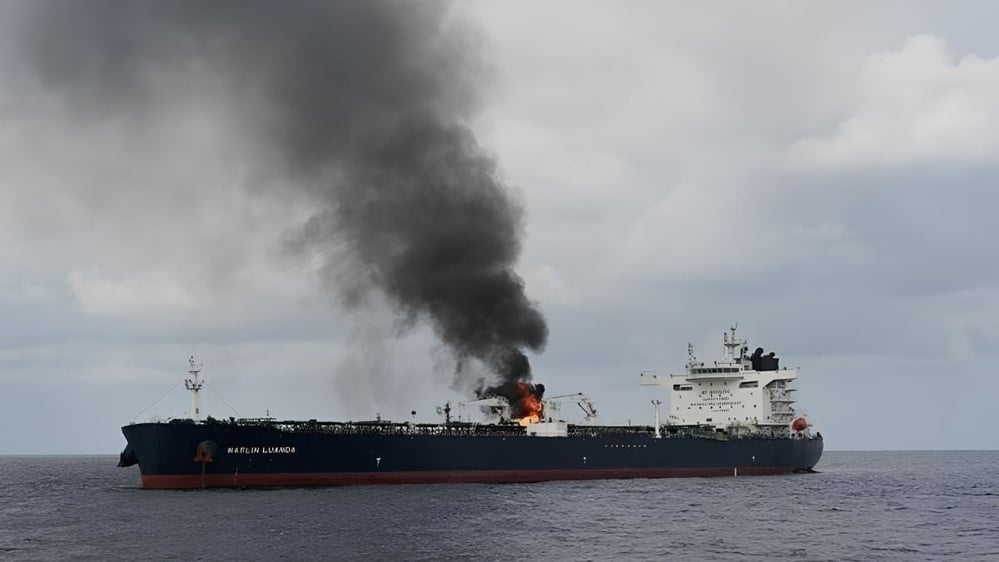
The account is restrained and agency-sourced, framing the tanker incidents as the latest threat to Hormuz shipping while attributing the wider conflict to US-Israeli strikes on Iran.
The UK Maritime Trade Operations (UKMTO) is a Royal Navy unit that monitors maritime security incidents affecting shipping.
Automated analysis; not human reviewed.
Limitations: The supplied text is partly duplicated and mixed with unrelated headlines; only the tanker incident report was analyzed.
·
6 of 55 available dimensions scored; omitted dimensions are not treated as neutral.
·
Verified supporting quotes for 6 of 6 scored dimensions.
Claim: The article is factual and heavily attributed, with no editorializing or subjective evaluation.
“Two oil tankers have been struck by “unidentified projectiles” in the Strait of Hormuz region, a British maritime agency said Friday” · exact text match
Why: Key claims are placed in reported speech and attributed to UKMTO.
Claim: The article reports outcomes plainly and does not sensationalize danger.
“There were no reported casualties or environmental impact, it added.” · exact text match
Why: It foregrounds the absence of casualties and environmental harm rather than amplifying threat.
Claim: The article describes events and statements without offering recommendations or prescriptions.
“The agency said authorities were investigating the incidents.” · exact text match
Why: It closes with an investigative status rather than any policy call.
Claim: The article attributes its central incident details to a named British maritime agency and avoids unsupported assertions.
“a British maritime agency said Friday” · exact text match
“according to the UKMTO” · exact text match
Why: Visible sourcing and specific incident details support a credible, verifiable report.
Claim: The report is restrained and avoids emotional or conspiratorial reasoning.
“The agency said authorities were investigating the incidents.” · exact text match
Why: The account ends on an open investigation rather than speculation or alarm.
Claim: The reporting is transparently sourced and distinguishes agency statements from inference.
“according to the UKMTO” · exact text match
“The agency said authorities were investigating the incidents.” · exact text match
Why: Attribution is consistent and no unlabelled speculation is presented as fact.
The supplied text is partly duplicated and mixed with unrelated headlines; only the tanker incident report was analyzed.
October 03, 2026 · 0 shares
Framing is neutral and source-driven, restricting the account to UKMTO's attributed statements and adding no editorial commentary.
Automated analysis; not human reviewed.
Limitations: The article is a short wire-style brief; analysis is limited to visible wording and cannot assess editorial selection beyond the supplied text.
·
2 of 55 available dimensions scored; omitted dimensions are not treated as neutral.
·
Verified supporting quotes for 1 of 2 scored dimensions.
Claim: Visible sourcing and explicit caveats make the report credible on its face.
“according to the UKMTO” · exact text match
“The agency said authorities were investigating the incidents.” · exact text match
Why: Claims are tied to a named official body and open questions are acknowledged, which are credibility-positive practices.
Claim: The article displays internally consistent source attribution and marks uncertainty, rather than overstating what is known.
“Two oil tankers have been struck by 'unidentified projectiles' in the Strait of Hormuz region, a British maritime agency said Friday” · not found in supplied text
“The agency said authorities were investigating the incidents.” · exact text match
Why: It repeatedly attributes to UKMTO and states that incidents are under investigation, preserving the 'unidentified' status of the projectiles.
The article is a short wire-style brief; analysis is limited to visible wording and cannot assess editorial selection beyond the supplied text.
October 03, 2026 · 0 shares
The account is restrained and agency-sourced, framing the tanker incidents as the latest threat to Hormuz shipping while attributing the wider conflict to US-Israeli strikes on Iran.
The UK Maritime Trade Operations (UKMTO) is a Royal Navy unit that monitors maritime security incidents affecting shipping.
Automated analysis; not human reviewed.
Limitations: The supplied text is partly duplicated and mixed with unrelated headlines; only the tanker incident report was analyzed.
·
6 of 55 available dimensions scored; omitted dimensions are not treated as neutral.
·
Verified supporting quotes for 6 of 6 scored dimensions.
Claim: The article is factual and heavily attributed, with no editorializing or subjective evaluation.
“Two oil tankers have been struck by “unidentified projectiles” in the Strait of Hormuz region, a British maritime agency said Friday” · exact text match
Why: Key claims are placed in reported speech and attributed to UKMTO.
Claim: The article reports outcomes plainly and does not sensationalize danger.
“There were no reported casualties or environmental impact, it added.” · exact text match
Why: It foregrounds the absence of casualties and environmental harm rather than amplifying threat.
Claim: The article describes events and statements without offering recommendations or prescriptions.
“The agency said authorities were investigating the incidents.” · exact text match
Why: It closes with an investigative status rather than any policy call.
Claim: The article attributes its central incident details to a named British maritime agency and avoids unsupported assertions.
“a British maritime agency said Friday” · exact text match
“according to the UKMTO” · exact text match
Why: Visible sourcing and specific incident details support a credible, verifiable report.
Claim: The report is restrained and avoids emotional or conspiratorial reasoning.
“The agency said authorities were investigating the incidents.” · exact text match
Why: The account ends on an open investigation rather than speculation or alarm.
Claim: The reporting is transparently sourced and distinguishes agency statements from inference.
“according to the UKMTO” · exact text match
“The agency said authorities were investigating the incidents.” · exact text match
Why: Attribution is consistent and no unlabelled speculation is presented as fact.
The supplied text is partly duplicated and mixed with unrelated headlines; only the tanker incident report was analyzed.
October 03, 2026 · 0 shares
The reporting is attribution-heavy and restrained, framing the tanker hits as an investigated security incident within a two-sided U.S.–Iran blockade conflict.
Automated analysis; not human reviewed.
Limitations: The input includes only a short AFP wire brief plus unrelated headline links; I treated the unrelated headlines as page chrome and could not assess the host publisher's own editorial framing.
·
7 of 55 available dimensions scored; omitted dimensions are not treated as neutral.
·
Verified supporting quotes for 7 of 7 scored dimensions.
Claim: The dispatch is written in an objective, source-attributed news style rather than a subjective or interpretive style.
“Two oil tankers have been hit by "unidentified projectiles" in the Strait of Hormuz region, a British maritime agency said on Friday” · exact text match
“There were no reported casualties or environmental impact, UKMTO said.” · exact text match
Counterevidence:
“in the latest threat to shipping in the waterway” · exact text match
Why: The facts are attributed to UKMTO and phrased with qualifying quotation marks and 'reported', with no editorializing adjectives.
Claim: The article avoids sensational language, reporting the incident in a calm, understated manner.
“The fire was later put out.” · exact text match
“All crew were safe and no environmental damage was reported, according to UKMTO” · exact text match
Why: Although the topic is dramatic, the wording emphasizes containment and safety rather than alarm.
Claim: The report is descriptive, stating events and attributing them to sources without recommending action.
“Hours later, another crude oil tanker reported being hit by an "unknown projectile" east of Oman.” · exact text match
“The waterway remains at the heart of the conflict.” · exact text match
Why: It reports occurrences and context rather than prescribing policy or urging a response.
Claim: The article is heavily political because its core subject is a geopolitical conflict over the Strait of Hormuz and U.S.–Iran blockade.
“Before the United States and Israel launched strikes on Iran in late February, sparking the Middle East war, a fifth of the world's oil and liquefied natural gas (LNG) passed through the Strait of Hormuz.” · exact text match
“Washington has responded with a counter-blockade of Iranian ports to stop Tehran from exporting its oil.” · exact text match
Why: The central facts involve state military action and international oil trade, making the report inherently political.
Claim: The emotional valence is neutral, with emphasis on the absence of casualties and damage rather than fear or hope.
“There were no reported casualties or environmental impact, UKMTO said.” · exact text match
Why: The statement is factual and non-alarming, indicating measured neutrality.
Claim: The article is credible as a wire report because it attributes information to a named agency and flags uncertainty.
“according to UKMTO” · exact text match
“The agency did not give the ship's ports of origin or destination.” · exact text match
Why: It clearly identifies the source of the facts and acknowledges what is unknown, supporting trustworthiness.
Claim: The reporting is fair and balanced, presenting actions by both Tehran and Washington without taking sides.
“Tehran has been blocking commercial shipping, firing on vessels it accuses of unauthorized crossings.” · exact text match
“Washington has responded with a counter-blockade of Iranian ports to stop Tehran from exporting its oil.” · exact text match
Why: It includes both states' actions in parallel, showing no one-sided framing.
The input includes only a short AFP wire brief plus unrelated headline links; I treated the unrelated headlines as page chrome and could not assess the host publisher's own editorial framing.
October 05, 2026 · 0 shares
Framing stresses the frequency of tanker strikes and the strategic importance of the Strait of Hormuz while staying tied to official UKMTO reporting and avoiding attribution.
UKMTO is the United Kingdom Maritime Trade Operations, a Royal Navy-linked unit that issues maritime security warnings; the Strait of Hormuz connects the Persian Gulf and the Gulf of Oman and is a major route for seaborne oil.
Automated analysis; not human reviewed.
Limitations: The supplied article text is fragmented and internally repeated, but enough substantive content remains for classification.
·
4 of 55 available dimensions scored; omitted dimensions are not treated as neutral.
·
Verified supporting quotes for 4 of 4 scored dimensions.
Claim: The article presents the event in a largely objective, sourced manner with a small amount of interpretive framing.
“Another tanker was struck by an unidentified projectile in the Strait of Hormuz on Monday, triggering a fire in the vessel’s engine room and marking the third tanker hit in the strategic waterway in two days, according to the United Kingdom Maritime Trade Operations (UKMTO).” · exact text match
Counterevidence:
“The latest incident adds to growing security concerns in the Strait of Hormuz, a vital global energy shipping route, amid heightened regional tensions.” · exact text match
Why: The central claim is attributed to UKMTO and described factually; the closing reference to 'growing security concerns' adds interpretive framing.
Claim: The article is factual rather than lurid, though it highlights the repetition and strategic importance of the attacks.
“The latest incident adds to growing security concerns in the Strait of Hormuz, a vital global energy shipping route, amid heightened regional tensions.” · exact text match
Why: It uses measured context phrases rather than lurid language, but the framing as 'third tanker hit in two days' and 'vital global energy shipping route' adds significance.
Claim: The article describes the incident and reports others' advice without itself prescribing action.
“UKMTO said authorities were investigating the incident and urged vessels transiting the Strait of Hormuz to exercise caution and report any suspicious activity.” · exact text match
Why: The urging is attributed to UKMTO rather than issued by the publisher.
Claim: The report displays high visible credibility through named sourcing and careful qualifiers.
“according to the United Kingdom Maritime Trade Operations (UKMTO)” · exact text match
“while no casualties or environmental impact had been reported at the time of the alert.” · exact text match
Why: It identifies the source and limits the casualty statement to what was known at alert time.
The supplied article text is fragmented and internally repeated, but enough substantive content remains for classification.
October 07, 2026 · 0 shares
The framing consistently labels the conflict a 'US-Israel war on Iran,' foregrounds the human toll on Indian seafarers, and pairs the attack report with data showing Middle East oil exports have recovered.
The Strait of Hormuz is a critical chokepoint for global oil shipments, which explains the article's inclusion of crude export and price data alongside the attack report.
Automated analysis; not human reviewed.
Limitations: The supplied article text is truncated mid-sentence ('according to Marisks, a shippin [') and lacks a stated publication date or byline, so the full article could not be assessed; related-link headlines appended at the end were treated as page chrome and excluded.
·
7 of 55 available dimensions scored; omitted dimensions are not treated as neutral.
·
Verified supporting quotes for 7 of 7 scored dimensions.
Claim: The publisher characterizes the regional conflict as a 'US-Israel war on Iran,' a framing that attributes the war to the United States and Israel.
“amid the United States and Israel’s war on Iran” · exact text match
“after the US-Israel war began on February 28” · exact text match
Why: Repeated use of the label 'US-Israel war on Iran' positions the US and Israel as the war's protagonists, a framing associated with left-leaning, anti-war editorial perspectives.
Claim: The report is predominantly factual, with claims attributed to named institutions and data providers.
“according to the Omani Ministry of Defence” · exact text match
“according to provisional data from Kpler, a data firm” · exact text match
Why: Most assertions are sourced or attributed, and the article uses uncertainty markers such as 'provisional' and 'at least,' indicating an objective reporting mode.
Claim: The article presents the attack and evacuation in plain, non-sensational language.
“Oman’s air force has evacuated 10 crew members of a Panamanian-flagged oil tanker following an attack in the Strait of Hormuz.” · exact text match
Why: The lead sentence states facts directly without hyperbolic adjectives, emotional appeals, or dramatic imagery.
Claim: The article is politically charged because it covers a war and uses a politically loaded label for the conflict.
“amid the United States and Israel’s war on Iran” · exact text match
“Iran effectively closed the waterway after the US-Israel war began on February 28” · exact text match
Why: The subject matter is a geopolitical war, and the repeated 'war on Iran' label is itself a political characterization.
Claim: The article displays credible sourcing and attribution for its key factual claims.
“according to the Omani Ministry of Defence” · exact text match
“according to provisional data from Kpler, a data firm” · exact text match
“India’s foreign ministry, the Ministry of External Affairs, said” · exact text match
Why: Key facts are tied to named official and commercial sources, with qualifiers such as 'provisional' and 'at least' indicating epistemic care, though some central claims (e.g., the 'war on Iran' timeline) are asserted without sourcing.
Claim: The article shows internal fairness by including Iran's stated policy and actions alongside casualty and response reporting.
“It has frequently attacked commercial vessels that do not use its designated route in the waterway, and has said it wants to charge ships for passage.” · exact text match
Counterevidence:
“amid the United States and Israel’s war on Iran” · exact text match
Why: Including Iran's stated rationale and the fact of Iranian attacks provides some balance, though the 'war on Iran' label undercuts full neutrality.
Claim: The article adds analytical depth by incorporating specific quantitative market and logistics data.
“The seven-day moving average of Middle East crude exports reached 18.3 million barrels per day (bpd) on September 30” · exact text match
“Brent crude futures rising to $101.51 a barrel on Tuesday” · exact text match
Why: Precise figures from Kpler and Brent futures data demonstrate integration of market analysis beyond a simple incident account.
The supplied article text is truncated mid-sentence ('according to Marisks, a shippin [') and lacks a stated publication date or byline, so the full article could not be assessed; related-link headlines appended at the end were treated as page chrome and excluded.
October 06, 2026 · 0 shares
Framing is source-driven and clinical, emphasizing crew casualties and regional shipping risk while leaving the attacker unidentified.
UKMTO is the United Kingdom Maritime Trade Operations, a Royal Navy-run reporting and warning body for merchant shipping.
Khasab is a port on Oman's Musandam peninsula, which overlooks the Strait of Hormuz, a major chokepoint for global seaborne oil.
Automated analysis; not human reviewed.
Limitations: No author byline; the connection between the On Peace and UKMTO Warning 156-26 remains formally unconfirmed, and related-headline teasers and boiling boilerplate were excluded from analysis.
·
3 of 55 available dimensions scored; omitted dimensions are not treated as neutral.
·
Verified supporting quotes for 3 of 3 scored dimensions.
Claim: The report is objective, relies on attributed official sources, and explicitly notes unconfirmed links.
“according to India’s Ministry of External Affairs” · exact text match
“The incident appears to be connected to an attack reported Monday by United Kingdom Maritime Trade Operations, although the link has not been formally confirmed.” · exact text match
Why: The article attributes claims to named official bodies, avoids naming a culprit, and explicitly flags an unconfirmed connection.
Claim: The article cites named official bodies and distinguishes confirmed from unconfirmed details.
“according to India’s Ministry of External Affairs” · exact text match
“UKMTO initially reported no casualties or environmental impact.” · exact text match
Why: Visible sourcing, attribution, and epistemic hedging support the article's credibility.
Claim: The reporting is transparent about sourcing and uncertainty and avoids overstating what is known.
“India did not identify who carried out the attack.” · exact text match
“The incident appears to be connected to an attack reported Monday by United Kingdom Maritime Trade Operations, although the link has not been formally confirmed.” · exact text match
Why: Disclosing non-attribution and an unconfirmed link signals honesty about the limits of knowledge.
No author byline; the connection between the On Peace and UKMTO Warning 156-26 remains formally unconfirmed, and related-headline teasers and boiling boilerplate were excluded from analysis.
The publisher frames the episode as a straightforward rescue after a tanker attack, with no evaluative, political, or sensational commentary.
Automated analysis; not human reviewed.
Limitations: The supplied text is only a headline/snippet, offering minimal material for framing analysis.
·
2 of 55 available dimensions scored; omitted dimensions are not treated as neutral.
·
Verified supporting quotes for 2 of 2 scored dimensions.
Claim: The publisher presents the event without evaluative language.
“Oman evacuates injured crew from attacked tanker in Strait of Hormuz” · exact text match
Why: The headline uses concrete, neutral words and gives no opinion, judgment, or qualification.
Claim: The publisher does not sensationalize the attack or evacuation.
“Oman evacuates injured crew from attacked tanker in Strait of Hormuz” · exact text match
Why: The wording is plain and factual; 'attacked' and 'injured' are core reported facts, not hyperbolic or dramatic embellishments.
The supplied text is only a headline/snippet, offering minimal material for framing analysis.
October 03, 2026 · 0 shares
A terse, attribution-heavy wire bulletin that reports India's rescue of five citizens while framing the regional crisis through a stated causal chain of US-Israeli strikes on Iran prompting Iranian retaliation, without editorial commentary.
Automated analysis; not human reviewed.
Limitations: The supplied text contains apparent parsing artifacts, including duplicated passages and appended unrelated headlines, which were treated as chrome and excluded; the publisher and byline are absent, and "Saturday" is not tied to a calendar date.
·
13 of 55 available dimensions scored; omitted dimensions are not treated as neutral.
·
Verified supporting quotes for 13 of 13 scored dimensions.
Claim: The report shows no partisan alignment; it relays official statements and Iran's stated conditions without endorsement or criticism.
“India on Saturday said five of its citizens had been rescued after a Kuwait-flagged tanker was hit by a projectile in the Strait of Hormuz.” · exact text match
“Iran has since linked the full reopening of the Strait of Hormuz to measures including an end to hostilities, sanctions relief, the release of frozen assets and the implementation of commitments by Washington.” · exact text match
Counterevidence:
“Regional tensions have remained high since the US and Israel launched attacks on Iran on Feb. 28, prompting Tehran to retaliate against Israeli targets and US military facilities across the region.” · exact text match
Why: Both the Indian government's account and Iran's position are reported with attribution and no observable approval or disapproval, indicating a measured absence of partisan framing.
Claim: The piece is purely factual and attribution-driven, with no subjective or evaluative language from the publisher.
“"All 5 Indian nationals have been shifted ashore safely," the embassy said.” · verified after text normalization
“India's Ministry of External Affairs spokesman Randhir Jaiswal said on X.” · exact text match
Why: Every substantive assertion is attributed to a named official body or presented as reported background; the publisher adds no commentary, opinion, or value judgment.
Claim: The report is a flat, formulaic news bulletin with no dramatic, emotional, or alarmist wording.
“India on Saturday said five of its citizens had been rescued after a Kuwait-flagged tanker was hit by a projectile in the Strait of Hormuz.” · exact text match
Why: Language is restrained ("rescued," "shifted ashore safely") and the incident is described in a single matter-of-fact clause, with no hyperbole or fear-mongering.
Claim: The article is a routine, brief diplomatic announcement with little narrative or analytical depth.
“India on Saturday said five of its citizens had been rescued after a Kuwait-flagged tanker was hit by a projectile in the Strait of Hormuz.” · exact text match
Why: The item is short and formulaic, offering the rescue confirmation, thanks to Oman, a commitment quote, and generic regional context, with no detail, analysis, or narrative texture.
Claim: The text only describes events and statements; it contains no recommendations, demands, or policy prescriptions.
“"We remain committed to the safety, security and welfare of our seafarers abroad," India's Ministry of External Affairs spokesman Randhir Jaiswal said on X.” · verified after text normalization
Why: The only normative-sounding content is an official's quoted commitment, not the publisher's prescription; the article never urges any action.
Claim: The background compresses a complex conflict into a single unconditional causal chain.
“Regional tensions have remained high since the US and Israel launched attacks on Iran on Feb. 28, prompting Tehran to retaliate against Israeli targets and US military facilities across the region.” · exact text match
Why: Iranian attacks are summarized as retaliation triggered by the Feb. 28 strikes, and "the war" and its navigation impact are asserted with no qualification, detail, or alternative accounts; the compression is mild and typical of brief wire context.
Claim: The article's substance is built almost entirely on official government statements, with no independent or non-official sourcing for the incident.
“The Indian Embassy in Oman said on US social media company X that it had coordinated the rescue of five Indian citizens on board the Kuwait-flagged tanker MT Kazimah III” · exact text match
“"We remain committed to the safety, security and welfare of our seafarers abroad," India's Ministry of External Affairs spokesman Randhir Jaiswal said on X.” · verified after text normalization
Why: Facts about the strike and rescue come only from the embassy and the MEA spokesman; the article does not cite the tanker operator, maritime authorities, or independent witnesses.
Claim: The article centers on the official rescue response and government messaging rather than on the incident itself (cause, damage, or responsible party).
“The Indian Embassy in Oman said on US social media company X that it had coordinated the rescue of five Indian citizens” · exact text match
“"All 5 Indian nationals have been shifted ashore safely," the embassy said.” · verified after text normalization
Why: Most of the text reports embassy coordination, safe transfer, thanks to Oman, and MEA commitment; the strike itself is one attributed clause with no details on perpetrator, motive, damage, or investigation.
Claim: The article is emotionally neutral, neither alarmist nor celebratory in its own voice.
“"All 5 Indian nationals have been shifted ashore safely," the embassy said.” · verified after text normalization
Why: The tone is matter-of-fact; any reassurance comes from the quoted outcome, and the regional-tension background is stated without emotional charge.
Claim: Credibility is high because the central claims are tied to identifiable official sources and marked quotations.
“India's Ministry of External Affairs spokesman Randhir Jaiswal said on X.” · exact text match
“The Indian Embassy in Oman said on US social media company X” · exact text match
Why: Central facts (rescue, safe outcome, tanker name) are sourced to the embassy and a named MEA spokesman; the unsourced context sentence on navigation is a minor offset common to wire briefs.
Claim: The article is dispassionate and source-based, presenting a coherent causal account without emotional or fallacious reasoning.
“The Indian Embassy in Oman said on US social media company X that it had coordinated the rescue of five Indian citizens on board the Kuwait-flagged tanker MT Kazimah III, that were "struck by a projectile in the Strait of Hormuz."” · verified after text normalization
Counterevidence:
“The war has also severely disrupted navigation through the Strait of Hormuz, a key route for global energy supplies.” · exact text match
Why: The report rests on attributed official statements and a clear causal sequence (strike, rescue, context, Iran's conditions), with no appeal to emotion, fear, or superstition.
Claim: The article displays honest reporting practices through direct quotes, named sources, and separation of reported claims from background.
“The Indian Embassy in Oman said on US social media company X that it had coordinated the rescue of five Indian citizens” · exact text match
“Iran has since linked the full reopening of the Strait of Hormuz to measures including an end to hostilities, sanctions relief, the release of frozen assets and the implementation of commitments by Washington.” · exact text match
Why: Attribution is specific (embassy, named spokesman), quotations are marked, and Iran's position is attributed rather than asserted as the publisher's own; no distortion or misleading paraphrase is visible.
Claim: The article is clear and competently structured but formulaic and shallow in analysis.
“Iran has since linked the full reopening of the Strait of Hormuz to measures including an end to hostilities, sanctions relief, the release of frozen assets and the implementation of commitments by Washington.” · exact text match
Why: It accurately attributes claims, places the event in regional context, and states Iran's conditions precisely, showing competent wire writing, but adds no analysis or depth beyond the official record.
The supplied text contains apparent parsing artifacts, including duplicated passages and appended unrelated headlines, which were treated as chrome and excluded; the publisher and byline are absent, and "Saturday" is not tied to a calendar date.
October 03, 2026 · 0 shares
Framing is neutral and source-driven, restricting the account to UKMTO's attributed statements and adding no editorial commentary.
Automated analysis; not human reviewed.
Limitations: The article is a short wire-style brief; analysis is limited to visible wording and cannot assess editorial selection beyond the supplied text.
·
2 of 55 available dimensions scored; omitted dimensions are not treated as neutral.
·
Verified supporting quotes for 1 of 2 scored dimensions.
Claim: Visible sourcing and explicit caveats make the report credible on its face.
“according to the UKMTO” · exact text match
“The agency said authorities were investigating the incidents.” · exact text match
Why: Claims are tied to a named official body and open questions are acknowledged, which are credibility-positive practices.
Claim: The article displays internally consistent source attribution and marks uncertainty, rather than overstating what is known.
“Two oil tankers have been struck by 'unidentified projectiles' in the Strait of Hormuz region, a British maritime agency said Friday” · not found in supplied text
“The agency said authorities were investigating the incidents.” · exact text match
Why: It repeatedly attributes to UKMTO and states that incidents are under investigation, preserving the 'unidentified' status of the projectiles.
The article is a short wire-style brief; analysis is limited to visible wording and cannot assess editorial selection beyond the supplied text.
October 03, 2026 · 0 shares
The account is restrained and agency-sourced, framing the tanker incidents as the latest threat to Hormuz shipping while attributing the wider conflict to US-Israeli strikes on Iran.
The UK Maritime Trade Operations (UKMTO) is a Royal Navy unit that monitors maritime security incidents affecting shipping.
Automated analysis; not human reviewed.
Limitations: The supplied text is partly duplicated and mixed with unrelated headlines; only the tanker incident report was analyzed.
·
6 of 55 available dimensions scored; omitted dimensions are not treated as neutral.
·
Verified supporting quotes for 6 of 6 scored dimensions.
Claim: The article is factual and heavily attributed, with no editorializing or subjective evaluation.
“Two oil tankers have been struck by “unidentified projectiles” in the Strait of Hormuz region, a British maritime agency said Friday” · exact text match
Why: Key claims are placed in reported speech and attributed to UKMTO.
Claim: The article reports outcomes plainly and does not sensationalize danger.
“There were no reported casualties or environmental impact, it added.” · exact text match
Why: It foregrounds the absence of casualties and environmental harm rather than amplifying threat.
Claim: The article describes events and statements without offering recommendations or prescriptions.
“The agency said authorities were investigating the incidents.” · exact text match
Why: It closes with an investigative status rather than any policy call.
Claim: The article attributes its central incident details to a named British maritime agency and avoids unsupported assertions.
“a British maritime agency said Friday” · exact text match
“according to the UKMTO” · exact text match
Why: Visible sourcing and specific incident details support a credible, verifiable report.
Claim: The report is restrained and avoids emotional or conspiratorial reasoning.
“The agency said authorities were investigating the incidents.” · exact text match
Why: The account ends on an open investigation rather than speculation or alarm.
Claim: The reporting is transparently sourced and distinguishes agency statements from inference.
“according to the UKMTO” · exact text match
“The agency said authorities were investigating the incidents.” · exact text match
Why: Attribution is consistent and no unlabelled speculation is presented as fact.
The supplied text is partly duplicated and mixed with unrelated headlines; only the tanker incident report was analyzed.
October 06, 2026 · 0 shares
Framing is source-driven and clinical, emphasizing crew casualties and regional shipping risk while leaving the attacker unidentified.
UKMTO is the United Kingdom Maritime Trade Operations, a Royal Navy-run reporting and warning body for merchant shipping.
Khasab is a port on Oman's Musandam peninsula, which overlooks the Strait of Hormuz, a major chokepoint for global seaborne oil.
Automated analysis; not human reviewed.
Limitations: No author byline; the connection between the On Peace and UKMTO Warning 156-26 remains formally unconfirmed, and related-headline teasers and boiling boilerplate were excluded from analysis.
·
3 of 55 available dimensions scored; omitted dimensions are not treated as neutral.
·
Verified supporting quotes for 3 of 3 scored dimensions.
Claim: The report is objective, relies on attributed official sources, and explicitly notes unconfirmed links.
“according to India’s Ministry of External Affairs” · exact text match
“The incident appears to be connected to an attack reported Monday by United Kingdom Maritime Trade Operations, although the link has not been formally confirmed.” · exact text match
Why: The article attributes claims to named official bodies, avoids naming a culprit, and explicitly flags an unconfirmed connection.
Claim: The article cites named official bodies and distinguishes confirmed from unconfirmed details.
“according to India’s Ministry of External Affairs” · exact text match
“UKMTO initially reported no casualties or environmental impact.” · exact text match
Why: Visible sourcing, attribution, and epistemic hedging support the article's credibility.
Claim: The reporting is transparent about sourcing and uncertainty and avoids overstating what is known.
“India did not identify who carried out the attack.” · exact text match
“The incident appears to be connected to an attack reported Monday by United Kingdom Maritime Trade Operations, although the link has not been formally confirmed.” · exact text match
Why: Disclosing non-attribution and an unconfirmed link signals honesty about the limits of knowledge.
No author byline; the connection between the On Peace and UKMTO Warning 156-26 remains formally unconfirmed, and related-headline teasers and boiling boilerplate were excluded from analysis.
October 07, 2026 · 0 shares
The framing consistently labels the conflict a 'US-Israel war on Iran,' foregrounds the human toll on Indian seafarers, and pairs the attack report with data showing Middle East oil exports have recovered.
The Strait of Hormuz is a critical chokepoint for global oil shipments, which explains the article's inclusion of crude export and price data alongside the attack report.
Automated analysis; not human reviewed.
Limitations: The supplied article text is truncated mid-sentence ('according to Marisks, a shippin [') and lacks a stated publication date or byline, so the full article could not be assessed; related-link headlines appended at the end were treated as page chrome and excluded.
·
7 of 55 available dimensions scored; omitted dimensions are not treated as neutral.
·
Verified supporting quotes for 7 of 7 scored dimensions.
Claim: The publisher characterizes the regional conflict as a 'US-Israel war on Iran,' a framing that attributes the war to the United States and Israel.
“amid the United States and Israel’s war on Iran” · exact text match
“after the US-Israel war began on February 28” · exact text match
Why: Repeated use of the label 'US-Israel war on Iran' positions the US and Israel as the war's protagonists, a framing associated with left-leaning, anti-war editorial perspectives.
Claim: The report is predominantly factual, with claims attributed to named institutions and data providers.
“according to the Omani Ministry of Defence” · exact text match
“according to provisional data from Kpler, a data firm” · exact text match
Why: Most assertions are sourced or attributed, and the article uses uncertainty markers such as 'provisional' and 'at least,' indicating an objective reporting mode.
Claim: The article presents the attack and evacuation in plain, non-sensational language.
“Oman’s air force has evacuated 10 crew members of a Panamanian-flagged oil tanker following an attack in the Strait of Hormuz.” · exact text match
Why: The lead sentence states facts directly without hyperbolic adjectives, emotional appeals, or dramatic imagery.
Claim: The article is politically charged because it covers a war and uses a politically loaded label for the conflict.
“amid the United States and Israel’s war on Iran” · exact text match
“Iran effectively closed the waterway after the US-Israel war began on February 28” · exact text match
Why: The subject matter is a geopolitical war, and the repeated 'war on Iran' label is itself a political characterization.
Claim: The article displays credible sourcing and attribution for its key factual claims.
“according to the Omani Ministry of Defence” · exact text match
“according to provisional data from Kpler, a data firm” · exact text match
“India’s foreign ministry, the Ministry of External Affairs, said” · exact text match
Why: Key facts are tied to named official and commercial sources, with qualifiers such as 'provisional' and 'at least' indicating epistemic care, though some central claims (e.g., the 'war on Iran' timeline) are asserted without sourcing.
Claim: The article shows internal fairness by including Iran's stated policy and actions alongside casualty and response reporting.
“It has frequently attacked commercial vessels that do not use its designated route in the waterway, and has said it wants to charge ships for passage.” · exact text match
Counterevidence:
“amid the United States and Israel’s war on Iran” · exact text match
Why: Including Iran's stated rationale and the fact of Iranian attacks provides some balance, though the 'war on Iran' label undercuts full neutrality.
Claim: The article adds analytical depth by incorporating specific quantitative market and logistics data.
“The seven-day moving average of Middle East crude exports reached 18.3 million barrels per day (bpd) on September 30” · exact text match
“Brent crude futures rising to $101.51 a barrel on Tuesday” · exact text match
Why: Precise figures from Kpler and Brent futures data demonstrate integration of market analysis beyond a simple incident account.
The supplied article text is truncated mid-sentence ('according to Marisks, a shippin [') and lacks a stated publication date or byline, so the full article could not be assessed; related-link headlines appended at the end were treated as page chrome and excluded.
October 07, 2026 · 0 shares
The framing consistently labels the conflict a 'US-Israel war on Iran,' foregrounds the human toll on Indian seafarers, and pairs the attack report with data showing Middle East oil exports have recovered.
The Strait of Hormuz is a critical chokepoint for global oil shipments, which explains the article's inclusion of crude export and price data alongside the attack report.
Automated analysis; not human reviewed.
Limitations: The supplied article text is truncated mid-sentence ('according to Marisks, a shippin [') and lacks a stated publication date or byline, so the full article could not be assessed; related-link headlines appended at the end were treated as page chrome and excluded.
·
7 of 55 available dimensions scored; omitted dimensions are not treated as neutral.
·
Verified supporting quotes for 7 of 7 scored dimensions.
Claim: The publisher characterizes the regional conflict as a 'US-Israel war on Iran,' a framing that attributes the war to the United States and Israel.
“amid the United States and Israel’s war on Iran” · exact text match
“after the US-Israel war began on February 28” · exact text match
Why: Repeated use of the label 'US-Israel war on Iran' positions the US and Israel as the war's protagonists, a framing associated with left-leaning, anti-war editorial perspectives.
Claim: The report is predominantly factual, with claims attributed to named institutions and data providers.
“according to the Omani Ministry of Defence” · exact text match
“according to provisional data from Kpler, a data firm” · exact text match
Why: Most assertions are sourced or attributed, and the article uses uncertainty markers such as 'provisional' and 'at least,' indicating an objective reporting mode.
Claim: The article presents the attack and evacuation in plain, non-sensational language.
“Oman’s air force has evacuated 10 crew members of a Panamanian-flagged oil tanker following an attack in the Strait of Hormuz.” · exact text match
Why: The lead sentence states facts directly without hyperbolic adjectives, emotional appeals, or dramatic imagery.
Claim: The article is politically charged because it covers a war and uses a politically loaded label for the conflict.
“amid the United States and Israel’s war on Iran” · exact text match
“Iran effectively closed the waterway after the US-Israel war began on February 28” · exact text match
Why: The subject matter is a geopolitical war, and the repeated 'war on Iran' label is itself a political characterization.
Claim: The article displays credible sourcing and attribution for its key factual claims.
“according to the Omani Ministry of Defence” · exact text match
“according to provisional data from Kpler, a data firm” · exact text match
“India’s foreign ministry, the Ministry of External Affairs, said” · exact text match
Why: Key facts are tied to named official and commercial sources, with qualifiers such as 'provisional' and 'at least' indicating epistemic care, though some central claims (e.g., the 'war on Iran' timeline) are asserted without sourcing.
Claim: The article shows internal fairness by including Iran's stated policy and actions alongside casualty and response reporting.
“It has frequently attacked commercial vessels that do not use its designated route in the waterway, and has said it wants to charge ships for passage.” · exact text match
Counterevidence:
“amid the United States and Israel’s war on Iran” · exact text match
Why: Including Iran's stated rationale and the fact of Iranian attacks provides some balance, though the 'war on Iran' label undercuts full neutrality.
Claim: The article adds analytical depth by incorporating specific quantitative market and logistics data.
“The seven-day moving average of Middle East crude exports reached 18.3 million barrels per day (bpd) on September 30” · exact text match
“Brent crude futures rising to $101.51 a barrel on Tuesday” · exact text match
Why: Precise figures from Kpler and Brent futures data demonstrate integration of market analysis beyond a simple incident account.
The supplied article text is truncated mid-sentence ('according to Marisks, a shippin [') and lacks a stated publication date or byline, so the full article could not be assessed; related-link headlines appended at the end were treated as page chrome and excluded.
October 03, 2026 · 0 shares
The account is restrained and agency-sourced, framing the tanker incidents as the latest threat to Hormuz shipping while attributing the wider conflict to US-Israeli strikes on Iran.
The UK Maritime Trade Operations (UKMTO) is a Royal Navy unit that monitors maritime security incidents affecting shipping.
Automated analysis; not human reviewed. Limitations: The supplied text is partly duplicated and mixed with unrelated headlines; only the tanker incident report was analyzed. · 6 of 55 available dimensions scored; omitted dimensions are not treated as neutral. · Verified supporting quotes for 6 of 6 scored dimensions.
Claim: The article is factual and heavily attributed, with no editorializing or subjective evaluation.
“Two oil tankers have been struck by “unidentified projectiles” in the Strait of Hormuz region, a British maritime agency said Friday” · exact text match
Why: Key claims are placed in reported speech and attributed to UKMTO.
Claim: The article reports outcomes plainly and does not sensationalize danger.
“There were no reported casualties or environmental impact, it added.” · exact text match
Why: It foregrounds the absence of casualties and environmental harm rather than amplifying threat.
Claim: The article describes events and statements without offering recommendations or prescriptions.
“The agency said authorities were investigating the incidents.” · exact text match
Why: It closes with an investigative status rather than any policy call.
Claim: The article attributes its central incident details to a named British maritime agency and avoids unsupported assertions.
“a British maritime agency said Friday” · exact text match
“according to the UKMTO” · exact text match
Why: Visible sourcing and specific incident details support a credible, verifiable report.
Claim: The report is restrained and avoids emotional or conspiratorial reasoning.
“The agency said authorities were investigating the incidents.” · exact text match
Why: The account ends on an open investigation rather than speculation or alarm.
Claim: The reporting is transparently sourced and distinguishes agency statements from inference.
“according to the UKMTO” · exact text match
“The agency said authorities were investigating the incidents.” · exact text match
Why: Attribution is consistent and no unlabelled speculation is presented as fact.
The supplied text is partly duplicated and mixed with unrelated headlines; only the tanker incident report was analyzed.
October 03, 2026 · 0 shares
Framing is neutral and source-driven, restricting the account to UKMTO's attributed statements and adding no editorial commentary.
Automated analysis; not human reviewed. Limitations: The article is a short wire-style brief; analysis is limited to visible wording and cannot assess editorial selection beyond the supplied text. · 2 of 55 available dimensions scored; omitted dimensions are not treated as neutral. · Verified supporting quotes for 1 of 2 scored dimensions.
Claim: Visible sourcing and explicit caveats make the report credible on its face.
“according to the UKMTO” · exact text match
“The agency said authorities were investigating the incidents.” · exact text match
Why: Claims are tied to a named official body and open questions are acknowledged, which are credibility-positive practices.
Claim: The article displays internally consistent source attribution and marks uncertainty, rather than overstating what is known.
“Two oil tankers have been struck by 'unidentified projectiles' in the Strait of Hormuz region, a British maritime agency said Friday” · not found in supplied text
“The agency said authorities were investigating the incidents.” · exact text match
Why: It repeatedly attributes to UKMTO and states that incidents are under investigation, preserving the 'unidentified' status of the projectiles.
The article is a short wire-style brief; analysis is limited to visible wording and cannot assess editorial selection beyond the supplied text.
October 03, 2026 · 0 shares
The account is restrained and agency-sourced, framing the tanker incidents as the latest threat to Hormuz shipping while attributing the wider conflict to US-Israeli strikes on Iran.
The UK Maritime Trade Operations (UKMTO) is a Royal Navy unit that monitors maritime security incidents affecting shipping.
Automated analysis; not human reviewed. Limitations: The supplied text is partly duplicated and mixed with unrelated headlines; only the tanker incident report was analyzed. · 6 of 55 available dimensions scored; omitted dimensions are not treated as neutral. · Verified supporting quotes for 6 of 6 scored dimensions.
Claim: The article is factual and heavily attributed, with no editorializing or subjective evaluation.
“Two oil tankers have been struck by “unidentified projectiles” in the Strait of Hormuz region, a British maritime agency said Friday” · exact text match
Why: Key claims are placed in reported speech and attributed to UKMTO.
Claim: The article reports outcomes plainly and does not sensationalize danger.
“There were no reported casualties or environmental impact, it added.” · exact text match
Why: It foregrounds the absence of casualties and environmental harm rather than amplifying threat.
Claim: The article describes events and statements without offering recommendations or prescriptions.
“The agency said authorities were investigating the incidents.” · exact text match
Why: It closes with an investigative status rather than any policy call.
Claim: The article attributes its central incident details to a named British maritime agency and avoids unsupported assertions.
“a British maritime agency said Friday” · exact text match
“according to the UKMTO” · exact text match
Why: Visible sourcing and specific incident details support a credible, verifiable report.
Claim: The report is restrained and avoids emotional or conspiratorial reasoning.
“The agency said authorities were investigating the incidents.” · exact text match
Why: The account ends on an open investigation rather than speculation or alarm.
Claim: The reporting is transparently sourced and distinguishes agency statements from inference.
“according to the UKMTO” · exact text match
“The agency said authorities were investigating the incidents.” · exact text match
Why: Attribution is consistent and no unlabelled speculation is presented as fact.
The supplied text is partly duplicated and mixed with unrelated headlines; only the tanker incident report was analyzed.
October 03, 2026 · 0 shares
The reporting is attribution-heavy and restrained, framing the tanker hits as an investigated security incident within a two-sided U.S.–Iran blockade conflict.
Automated analysis; not human reviewed. Limitations: The input includes only a short AFP wire brief plus unrelated headline links; I treated the unrelated headlines as page chrome and could not assess the host publisher's own editorial framing. · 7 of 55 available dimensions scored; omitted dimensions are not treated as neutral. · Verified supporting quotes for 7 of 7 scored dimensions.
Claim: The dispatch is written in an objective, source-attributed news style rather than a subjective or interpretive style.
“Two oil tankers have been hit by "unidentified projectiles" in the Strait of Hormuz region, a British maritime agency said on Friday” · exact text match
“There were no reported casualties or environmental impact, UKMTO said.” · exact text match
Counterevidence:
“in the latest threat to shipping in the waterway” · exact text match
Why: The facts are attributed to UKMTO and phrased with qualifying quotation marks and 'reported', with no editorializing adjectives.
Claim: The article avoids sensational language, reporting the incident in a calm, understated manner.
“The fire was later put out.” · exact text match
“All crew were safe and no environmental damage was reported, according to UKMTO” · exact text match
Why: Although the topic is dramatic, the wording emphasizes containment and safety rather than alarm.
Claim: The report is descriptive, stating events and attributing them to sources without recommending action.
“Hours later, another crude oil tanker reported being hit by an "unknown projectile" east of Oman.” · exact text match
“The waterway remains at the heart of the conflict.” · exact text match
Why: It reports occurrences and context rather than prescribing policy or urging a response.
Claim: The article is heavily political because its core subject is a geopolitical conflict over the Strait of Hormuz and U.S.–Iran blockade.
“Before the United States and Israel launched strikes on Iran in late February, sparking the Middle East war, a fifth of the world's oil and liquefied natural gas (LNG) passed through the Strait of Hormuz.” · exact text match
“Washington has responded with a counter-blockade of Iranian ports to stop Tehran from exporting its oil.” · exact text match
Why: The central facts involve state military action and international oil trade, making the report inherently political.
Claim: The emotional valence is neutral, with emphasis on the absence of casualties and damage rather than fear or hope.
“There were no reported casualties or environmental impact, UKMTO said.” · exact text match
Why: The statement is factual and non-alarming, indicating measured neutrality.
Claim: The article is credible as a wire report because it attributes information to a named agency and flags uncertainty.
“according to UKMTO” · exact text match
“The agency did not give the ship's ports of origin or destination.” · exact text match
Why: It clearly identifies the source of the facts and acknowledges what is unknown, supporting trustworthiness.
Claim: The reporting is fair and balanced, presenting actions by both Tehran and Washington without taking sides.
“Tehran has been blocking commercial shipping, firing on vessels it accuses of unauthorized crossings.” · exact text match
“Washington has responded with a counter-blockade of Iranian ports to stop Tehran from exporting its oil.” · exact text match
Why: It includes both states' actions in parallel, showing no one-sided framing.
The input includes only a short AFP wire brief plus unrelated headline links; I treated the unrelated headlines as page chrome and could not assess the host publisher's own editorial framing.
October 05, 2026 · 0 shares
Framing stresses the frequency of tanker strikes and the strategic importance of the Strait of Hormuz while staying tied to official UKMTO reporting and avoiding attribution.
UKMTO is the United Kingdom Maritime Trade Operations, a Royal Navy-linked unit that issues maritime security warnings; the Strait of Hormuz connects the Persian Gulf and the Gulf of Oman and is a major route for seaborne oil.
Automated analysis; not human reviewed. Limitations: The supplied article text is fragmented and internally repeated, but enough substantive content remains for classification. · 4 of 55 available dimensions scored; omitted dimensions are not treated as neutral. · Verified supporting quotes for 4 of 4 scored dimensions.
Claim: The article presents the event in a largely objective, sourced manner with a small amount of interpretive framing.
“Another tanker was struck by an unidentified projectile in the Strait of Hormuz on Monday, triggering a fire in the vessel’s engine room and marking the third tanker hit in the strategic waterway in two days, according to the United Kingdom Maritime Trade Operations (UKMTO).” · exact text match
Counterevidence:
“The latest incident adds to growing security concerns in the Strait of Hormuz, a vital global energy shipping route, amid heightened regional tensions.” · exact text match
Why: The central claim is attributed to UKMTO and described factually; the closing reference to 'growing security concerns' adds interpretive framing.
Claim: The article is factual rather than lurid, though it highlights the repetition and strategic importance of the attacks.
“The latest incident adds to growing security concerns in the Strait of Hormuz, a vital global energy shipping route, amid heightened regional tensions.” · exact text match
Why: It uses measured context phrases rather than lurid language, but the framing as 'third tanker hit in two days' and 'vital global energy shipping route' adds significance.
Claim: The article describes the incident and reports others' advice without itself prescribing action.
“UKMTO said authorities were investigating the incident and urged vessels transiting the Strait of Hormuz to exercise caution and report any suspicious activity.” · exact text match
Why: The urging is attributed to UKMTO rather than issued by the publisher.
Claim: The report displays high visible credibility through named sourcing and careful qualifiers.
“according to the United Kingdom Maritime Trade Operations (UKMTO)” · exact text match
“while no casualties or environmental impact had been reported at the time of the alert.” · exact text match
Why: It identifies the source and limits the casualty statement to what was known at alert time.
The supplied article text is fragmented and internally repeated, but enough substantive content remains for classification.
October 07, 2026 · 0 shares
The framing consistently labels the conflict a 'US-Israel war on Iran,' foregrounds the human toll on Indian seafarers, and pairs the attack report with data showing Middle East oil exports have recovered.
The Strait of Hormuz is a critical chokepoint for global oil shipments, which explains the article's inclusion of crude export and price data alongside the attack report.
Automated analysis; not human reviewed. Limitations: The supplied article text is truncated mid-sentence ('according to Marisks, a shippin [') and lacks a stated publication date or byline, so the full article could not be assessed; related-link headlines appended at the end were treated as page chrome and excluded. · 7 of 55 available dimensions scored; omitted dimensions are not treated as neutral. · Verified supporting quotes for 7 of 7 scored dimensions.
Claim: The publisher characterizes the regional conflict as a 'US-Israel war on Iran,' a framing that attributes the war to the United States and Israel.
“amid the United States and Israel’s war on Iran” · exact text match
“after the US-Israel war began on February 28” · exact text match
Why: Repeated use of the label 'US-Israel war on Iran' positions the US and Israel as the war's protagonists, a framing associated with left-leaning, anti-war editorial perspectives.
Claim: The report is predominantly factual, with claims attributed to named institutions and data providers.
“according to the Omani Ministry of Defence” · exact text match
“according to provisional data from Kpler, a data firm” · exact text match
Why: Most assertions are sourced or attributed, and the article uses uncertainty markers such as 'provisional' and 'at least,' indicating an objective reporting mode.
Claim: The article presents the attack and evacuation in plain, non-sensational language.
“Oman’s air force has evacuated 10 crew members of a Panamanian-flagged oil tanker following an attack in the Strait of Hormuz.” · exact text match
Why: The lead sentence states facts directly without hyperbolic adjectives, emotional appeals, or dramatic imagery.
Claim: The article is politically charged because it covers a war and uses a politically loaded label for the conflict.
“amid the United States and Israel’s war on Iran” · exact text match
“Iran effectively closed the waterway after the US-Israel war began on February 28” · exact text match
Why: The subject matter is a geopolitical war, and the repeated 'war on Iran' label is itself a political characterization.
Claim: The article displays credible sourcing and attribution for its key factual claims.
“according to the Omani Ministry of Defence” · exact text match
“according to provisional data from Kpler, a data firm” · exact text match
“India’s foreign ministry, the Ministry of External Affairs, said” · exact text match
Why: Key facts are tied to named official and commercial sources, with qualifiers such as 'provisional' and 'at least' indicating epistemic care, though some central claims (e.g., the 'war on Iran' timeline) are asserted without sourcing.
Claim: The article shows internal fairness by including Iran's stated policy and actions alongside casualty and response reporting.
“It has frequently attacked commercial vessels that do not use its designated route in the waterway, and has said it wants to charge ships for passage.” · exact text match
Counterevidence:
“amid the United States and Israel’s war on Iran” · exact text match
Why: Including Iran's stated rationale and the fact of Iranian attacks provides some balance, though the 'war on Iran' label undercuts full neutrality.
Claim: The article adds analytical depth by incorporating specific quantitative market and logistics data.
“The seven-day moving average of Middle East crude exports reached 18.3 million barrels per day (bpd) on September 30” · exact text match
“Brent crude futures rising to $101.51 a barrel on Tuesday” · exact text match
Why: Precise figures from Kpler and Brent futures data demonstrate integration of market analysis beyond a simple incident account.
The supplied article text is truncated mid-sentence ('according to Marisks, a shippin [') and lacks a stated publication date or byline, so the full article could not be assessed; related-link headlines appended at the end were treated as page chrome and excluded.
October 06, 2026 · 0 shares
Framing is source-driven and clinical, emphasizing crew casualties and regional shipping risk while leaving the attacker unidentified.
UKMTO is the United Kingdom Maritime Trade Operations, a Royal Navy-run reporting and warning body for merchant shipping. Khasab is a port on Oman's Musandam peninsula, which overlooks the Strait of Hormuz, a major chokepoint for global seaborne oil.
Automated analysis; not human reviewed. Limitations: No author byline; the connection between the On Peace and UKMTO Warning 156-26 remains formally unconfirmed, and related-headline teasers and boiling boilerplate were excluded from analysis. · 3 of 55 available dimensions scored; omitted dimensions are not treated as neutral. · Verified supporting quotes for 3 of 3 scored dimensions.
Claim: The report is objective, relies on attributed official sources, and explicitly notes unconfirmed links.
“according to India’s Ministry of External Affairs” · exact text match
“The incident appears to be connected to an attack reported Monday by United Kingdom Maritime Trade Operations, although the link has not been formally confirmed.” · exact text match
Why: The article attributes claims to named official bodies, avoids naming a culprit, and explicitly flags an unconfirmed connection.
Claim: The article cites named official bodies and distinguishes confirmed from unconfirmed details.
“according to India’s Ministry of External Affairs” · exact text match
“UKMTO initially reported no casualties or environmental impact.” · exact text match
Why: Visible sourcing, attribution, and epistemic hedging support the article's credibility.
Claim: The reporting is transparent about sourcing and uncertainty and avoids overstating what is known.
“India did not identify who carried out the attack.” · exact text match
“The incident appears to be connected to an attack reported Monday by United Kingdom Maritime Trade Operations, although the link has not been formally confirmed.” · exact text match
Why: Disclosing non-attribution and an unconfirmed link signals honesty about the limits of knowledge.
No author byline; the connection between the On Peace and UKMTO Warning 156-26 remains formally unconfirmed, and related-headline teasers and boiling boilerplate were excluded from analysis.
October 07, 2026 · 0 shares
The framing consistently labels the conflict a 'US-Israel war on Iran,' foregrounds the human toll on Indian seafarers, and pairs the attack report with data showing Middle East oil exports have recovered.
The Strait of Hormuz is a critical chokepoint for global oil shipments, which explains the article's inclusion of crude export and price data alongside the attack report.
Automated analysis; not human reviewed. Limitations: The supplied article text is truncated mid-sentence ('according to Marisks, a shippin [') and lacks a stated publication date or byline, so the full article could not be assessed; related-link headlines appended at the end were treated as page chrome and excluded. · 7 of 55 available dimensions scored; omitted dimensions are not treated as neutral. · Verified supporting quotes for 7 of 7 scored dimensions.
Claim: The publisher characterizes the regional conflict as a 'US-Israel war on Iran,' a framing that attributes the war to the United States and Israel.
“amid the United States and Israel’s war on Iran” · exact text match
“after the US-Israel war began on February 28” · exact text match
Why: Repeated use of the label 'US-Israel war on Iran' positions the US and Israel as the war's protagonists, a framing associated with left-leaning, anti-war editorial perspectives.
Claim: The report is predominantly factual, with claims attributed to named institutions and data providers.
“according to the Omani Ministry of Defence” · exact text match
“according to provisional data from Kpler, a data firm” · exact text match
Why: Most assertions are sourced or attributed, and the article uses uncertainty markers such as 'provisional' and 'at least,' indicating an objective reporting mode.
Claim: The article presents the attack and evacuation in plain, non-sensational language.
“Oman’s air force has evacuated 10 crew members of a Panamanian-flagged oil tanker following an attack in the Strait of Hormuz.” · exact text match
Why: The lead sentence states facts directly without hyperbolic adjectives, emotional appeals, or dramatic imagery.
Claim: The article is politically charged because it covers a war and uses a politically loaded label for the conflict.
“amid the United States and Israel’s war on Iran” · exact text match
“Iran effectively closed the waterway after the US-Israel war began on February 28” · exact text match
Why: The subject matter is a geopolitical war, and the repeated 'war on Iran' label is itself a political characterization.
Claim: The article displays credible sourcing and attribution for its key factual claims.
“according to the Omani Ministry of Defence” · exact text match
“according to provisional data from Kpler, a data firm” · exact text match
“India’s foreign ministry, the Ministry of External Affairs, said” · exact text match
Why: Key facts are tied to named official and commercial sources, with qualifiers such as 'provisional' and 'at least' indicating epistemic care, though some central claims (e.g., the 'war on Iran' timeline) are asserted without sourcing.
Claim: The article shows internal fairness by including Iran's stated policy and actions alongside casualty and response reporting.
“It has frequently attacked commercial vessels that do not use its designated route in the waterway, and has said it wants to charge ships for passage.” · exact text match
Counterevidence:
“amid the United States and Israel’s war on Iran” · exact text match
Why: Including Iran's stated rationale and the fact of Iranian attacks provides some balance, though the 'war on Iran' label undercuts full neutrality.
Claim: The article adds analytical depth by incorporating specific quantitative market and logistics data.
“The seven-day moving average of Middle East crude exports reached 18.3 million barrels per day (bpd) on September 30” · exact text match
“Brent crude futures rising to $101.51 a barrel on Tuesday” · exact text match
Why: Precise figures from Kpler and Brent futures data demonstrate integration of market analysis beyond a simple incident account.
The supplied article text is truncated mid-sentence ('according to Marisks, a shippin [') and lacks a stated publication date or byline, so the full article could not be assessed; related-link headlines appended at the end were treated as page chrome and excluded.
Iranian/regional framing
October 06, 2026 · 0 shares
Framing is source-driven and clinical, emphasizing crew casualties and regional shipping risk while leaving the attacker unidentified.
UKMTO is the United Kingdom Maritime Trade Operations, a Royal Navy-run reporting and warning body for merchant shipping. Khasab is a port on Oman's Musandam peninsula, which overlooks the Strait of Hormuz, a major chokepoint for global seaborne oil.
Automated analysis; not human reviewed. Limitations: No author byline; the connection between the On Peace and UKMTO Warning 156-26 remains formally unconfirmed, and related-headline teasers and boiling boilerplate were excluded from analysis. · 3 of 55 available dimensions scored; omitted dimensions are not treated as neutral. · Verified supporting quotes for 3 of 3 scored dimensions.
Claim: The report is objective, relies on attributed official sources, and explicitly notes unconfirmed links.
“according to India’s Ministry of External Affairs” · exact text match
“The incident appears to be connected to an attack reported Monday by United Kingdom Maritime Trade Operations, although the link has not been formally confirmed.” · exact text match
Why: The article attributes claims to named official bodies, avoids naming a culprit, and explicitly flags an unconfirmed connection.
Claim: The article cites named official bodies and distinguishes confirmed from unconfirmed details.
“according to India’s Ministry of External Affairs” · exact text match
“UKMTO initially reported no casualties or environmental impact.” · exact text match
Why: Visible sourcing, attribution, and epistemic hedging support the article's credibility.
Claim: The reporting is transparent about sourcing and uncertainty and avoids overstating what is known.
“India did not identify who carried out the attack.” · exact text match
“The incident appears to be connected to an attack reported Monday by United Kingdom Maritime Trade Operations, although the link has not been formally confirmed.” · exact text match
Why: Disclosing non-attribution and an unconfirmed link signals honesty about the limits of knowledge.
No author byline; the connection between the On Peace and UKMTO Warning 156-26 remains formally unconfirmed, and related-headline teasers and boiling boilerplate were excluded from analysis.
October 03, 2026 · 0 shares
A terse, attribution-heavy wire bulletin that reports India's rescue of five citizens while framing the regional crisis through a stated causal chain of US-Israeli strikes on Iran prompting Iranian retaliation, without editorial commentary.
Automated analysis; not human reviewed. Limitations: The supplied text contains apparent parsing artifacts, including duplicated passages and appended unrelated headlines, which were treated as chrome and excluded; the publisher and byline are absent, and "Saturday" is not tied to a calendar date. · 13 of 55 available dimensions scored; omitted dimensions are not treated as neutral. · Verified supporting quotes for 13 of 13 scored dimensions.
Claim: The report shows no partisan alignment; it relays official statements and Iran's stated conditions without endorsement or criticism.
“India on Saturday said five of its citizens had been rescued after a Kuwait-flagged tanker was hit by a projectile in the Strait of Hormuz.” · exact text match
“Iran has since linked the full reopening of the Strait of Hormuz to measures including an end to hostilities, sanctions relief, the release of frozen assets and the implementation of commitments by Washington.” · exact text match
Counterevidence:
“Regional tensions have remained high since the US and Israel launched attacks on Iran on Feb. 28, prompting Tehran to retaliate against Israeli targets and US military facilities across the region.” · exact text match
Why: Both the Indian government's account and Iran's position are reported with attribution and no observable approval or disapproval, indicating a measured absence of partisan framing.
Claim: The piece is purely factual and attribution-driven, with no subjective or evaluative language from the publisher.
“"All 5 Indian nationals have been shifted ashore safely," the embassy said.” · verified after text normalization
“India's Ministry of External Affairs spokesman Randhir Jaiswal said on X.” · exact text match
Why: Every substantive assertion is attributed to a named official body or presented as reported background; the publisher adds no commentary, opinion, or value judgment.
Claim: The report is a flat, formulaic news bulletin with no dramatic, emotional, or alarmist wording.
“India on Saturday said five of its citizens had been rescued after a Kuwait-flagged tanker was hit by a projectile in the Strait of Hormuz.” · exact text match
Why: Language is restrained ("rescued," "shifted ashore safely") and the incident is described in a single matter-of-fact clause, with no hyperbole or fear-mongering.
Claim: The article is a routine, brief diplomatic announcement with little narrative or analytical depth.
“India on Saturday said five of its citizens had been rescued after a Kuwait-flagged tanker was hit by a projectile in the Strait of Hormuz.” · exact text match
Why: The item is short and formulaic, offering the rescue confirmation, thanks to Oman, a commitment quote, and generic regional context, with no detail, analysis, or narrative texture.
Claim: The text only describes events and statements; it contains no recommendations, demands, or policy prescriptions.
“"We remain committed to the safety, security and welfare of our seafarers abroad," India's Ministry of External Affairs spokesman Randhir Jaiswal said on X.” · verified after text normalization
Why: The only normative-sounding content is an official's quoted commitment, not the publisher's prescription; the article never urges any action.
Claim: The background compresses a complex conflict into a single unconditional causal chain.
“Regional tensions have remained high since the US and Israel launched attacks on Iran on Feb. 28, prompting Tehran to retaliate against Israeli targets and US military facilities across the region.” · exact text match
Why: Iranian attacks are summarized as retaliation triggered by the Feb. 28 strikes, and "the war" and its navigation impact are asserted with no qualification, detail, or alternative accounts; the compression is mild and typical of brief wire context.
Claim: The article's substance is built almost entirely on official government statements, with no independent or non-official sourcing for the incident.
“The Indian Embassy in Oman said on US social media company X that it had coordinated the rescue of five Indian citizens on board the Kuwait-flagged tanker MT Kazimah III” · exact text match
“"We remain committed to the safety, security and welfare of our seafarers abroad," India's Ministry of External Affairs spokesman Randhir Jaiswal said on X.” · verified after text normalization
Why: Facts about the strike and rescue come only from the embassy and the MEA spokesman; the article does not cite the tanker operator, maritime authorities, or independent witnesses.
Claim: The article centers on the official rescue response and government messaging rather than on the incident itself (cause, damage, or responsible party).
“The Indian Embassy in Oman said on US social media company X that it had coordinated the rescue of five Indian citizens” · exact text match
“"All 5 Indian nationals have been shifted ashore safely," the embassy said.” · verified after text normalization
Why: Most of the text reports embassy coordination, safe transfer, thanks to Oman, and MEA commitment; the strike itself is one attributed clause with no details on perpetrator, motive, damage, or investigation.
Claim: The article is emotionally neutral, neither alarmist nor celebratory in its own voice.
“"All 5 Indian nationals have been shifted ashore safely," the embassy said.” · verified after text normalization
Why: The tone is matter-of-fact; any reassurance comes from the quoted outcome, and the regional-tension background is stated without emotional charge.
Claim: Credibility is high because the central claims are tied to identifiable official sources and marked quotations.
“India's Ministry of External Affairs spokesman Randhir Jaiswal said on X.” · exact text match
“The Indian Embassy in Oman said on US social media company X” · exact text match
Why: Central facts (rescue, safe outcome, tanker name) are sourced to the embassy and a named MEA spokesman; the unsourced context sentence on navigation is a minor offset common to wire briefs.
Claim: The article is dispassionate and source-based, presenting a coherent causal account without emotional or fallacious reasoning.
“The Indian Embassy in Oman said on US social media company X that it had coordinated the rescue of five Indian citizens on board the Kuwait-flagged tanker MT Kazimah III, that were "struck by a projectile in the Strait of Hormuz."” · verified after text normalization
Counterevidence:
“The war has also severely disrupted navigation through the Strait of Hormuz, a key route for global energy supplies.” · exact text match
Why: The report rests on attributed official statements and a clear causal sequence (strike, rescue, context, Iran's conditions), with no appeal to emotion, fear, or superstition.
Claim: The article displays honest reporting practices through direct quotes, named sources, and separation of reported claims from background.
“The Indian Embassy in Oman said on US social media company X that it had coordinated the rescue of five Indian citizens” · exact text match
“Iran has since linked the full reopening of the Strait of Hormuz to measures including an end to hostilities, sanctions relief, the release of frozen assets and the implementation of commitments by Washington.” · exact text match
Why: Attribution is specific (embassy, named spokesman), quotations are marked, and Iran's position is attributed rather than asserted as the publisher's own; no distortion or misleading paraphrase is visible.
Claim: The article is clear and competently structured but formulaic and shallow in analysis.
“Iran has since linked the full reopening of the Strait of Hormuz to measures including an end to hostilities, sanctions relief, the release of frozen assets and the implementation of commitments by Washington.” · exact text match
Why: It accurately attributes claims, places the event in regional context, and states Iran's conditions precisely, showing competent wire writing, but adds no analysis or depth beyond the official record.
The supplied text contains apparent parsing artifacts, including duplicated passages and appended unrelated headlines, which were treated as chrome and excluded; the publisher and byline are absent, and "Saturday" is not tied to a calendar date.
October 03, 2026 · 0 shares
Framing is neutral and source-driven, restricting the account to UKMTO's attributed statements and adding no editorial commentary.
Automated analysis; not human reviewed. Limitations: The article is a short wire-style brief; analysis is limited to visible wording and cannot assess editorial selection beyond the supplied text. · 2 of 55 available dimensions scored; omitted dimensions are not treated as neutral. · Verified supporting quotes for 1 of 2 scored dimensions.
Claim: Visible sourcing and explicit caveats make the report credible on its face.
“according to the UKMTO” · exact text match
“The agency said authorities were investigating the incidents.” · exact text match
Why: Claims are tied to a named official body and open questions are acknowledged, which are credibility-positive practices.
Claim: The article displays internally consistent source attribution and marks uncertainty, rather than overstating what is known.
“Two oil tankers have been struck by 'unidentified projectiles' in the Strait of Hormuz region, a British maritime agency said Friday” · not found in supplied text
“The agency said authorities were investigating the incidents.” · exact text match
Why: It repeatedly attributes to UKMTO and states that incidents are under investigation, preserving the 'unidentified' status of the projectiles.
The article is a short wire-style brief; analysis is limited to visible wording and cannot assess editorial selection beyond the supplied text.
October 03, 2026 · 0 shares
The account is restrained and agency-sourced, framing the tanker incidents as the latest threat to Hormuz shipping while attributing the wider conflict to US-Israeli strikes on Iran.
The UK Maritime Trade Operations (UKMTO) is a Royal Navy unit that monitors maritime security incidents affecting shipping.
Automated analysis; not human reviewed. Limitations: The supplied text is partly duplicated and mixed with unrelated headlines; only the tanker incident report was analyzed. · 6 of 55 available dimensions scored; omitted dimensions are not treated as neutral. · Verified supporting quotes for 6 of 6 scored dimensions.
Claim: The article is factual and heavily attributed, with no editorializing or subjective evaluation.
“Two oil tankers have been struck by “unidentified projectiles” in the Strait of Hormuz region, a British maritime agency said Friday” · exact text match
Why: Key claims are placed in reported speech and attributed to UKMTO.
Claim: The article reports outcomes plainly and does not sensationalize danger.
“There were no reported casualties or environmental impact, it added.” · exact text match
Why: It foregrounds the absence of casualties and environmental harm rather than amplifying threat.
Claim: The article describes events and statements without offering recommendations or prescriptions.
“The agency said authorities were investigating the incidents.” · exact text match
Why: It closes with an investigative status rather than any policy call.
Claim: The article attributes its central incident details to a named British maritime agency and avoids unsupported assertions.
“a British maritime agency said Friday” · exact text match
“according to the UKMTO” · exact text match
Why: Visible sourcing and specific incident details support a credible, verifiable report.
Claim: The report is restrained and avoids emotional or conspiratorial reasoning.
“The agency said authorities were investigating the incidents.” · exact text match
Why: The account ends on an open investigation rather than speculation or alarm.
Claim: The reporting is transparently sourced and distinguishes agency statements from inference.
“according to the UKMTO” · exact text match
“The agency said authorities were investigating the incidents.” · exact text match
Why: Attribution is consistent and no unlabelled speculation is presented as fact.
The supplied text is partly duplicated and mixed with unrelated headlines; only the tanker incident report was analyzed.
Helium Bias
Story Blindspots
October 03, 2026 · 0 shares
The account is restrained and agency-sourced, framing the tanker incidents as the latest threat to Hormuz shipping while attributing the wider conflict to US-Israeli strikes on Iran.
The UK Maritime Trade Operations (UKMTO) is a Royal Navy unit that monitors maritime security incidents affecting shipping.
Automated analysis; not human reviewed. Limitations: The supplied text is partly duplicated and mixed with unrelated headlines; only the tanker incident report was analyzed. · 6 of 55 available dimensions scored; omitted dimensions are not treated as neutral. · Verified supporting quotes for 6 of 6 scored dimensions.
Claim: The article is factual and heavily attributed, with no editorializing or subjective evaluation.
“Two oil tankers have been struck by “unidentified projectiles” in the Strait of Hormuz region, a British maritime agency said Friday” · exact text match
Why: Key claims are placed in reported speech and attributed to UKMTO.
Claim: The article reports outcomes plainly and does not sensationalize danger.
“There were no reported casualties or environmental impact, it added.” · exact text match
Why: It foregrounds the absence of casualties and environmental harm rather than amplifying threat.
Claim: The article describes events and statements without offering recommendations or prescriptions.
“The agency said authorities were investigating the incidents.” · exact text match
Why: It closes with an investigative status rather than any policy call.
Claim: The article attributes its central incident details to a named British maritime agency and avoids unsupported assertions.
“a British maritime agency said Friday” · exact text match
“according to the UKMTO” · exact text match
Why: Visible sourcing and specific incident details support a credible, verifiable report.
Claim: The report is restrained and avoids emotional or conspiratorial reasoning.
“The agency said authorities were investigating the incidents.” · exact text match
Why: The account ends on an open investigation rather than speculation or alarm.
Claim: The reporting is transparently sourced and distinguishes agency statements from inference.
“according to the UKMTO” · exact text match
“The agency said authorities were investigating the incidents.” · exact text match
Why: Attribution is consistent and no unlabelled speculation is presented as fact.
The supplied text is partly duplicated and mixed with unrelated headlines; only the tanker incident report was analyzed.
October 03, 2026 · 0 shares
The account is restrained and agency-sourced, framing the tanker incidents as the latest threat to Hormuz shipping while attributing the wider conflict to US-Israeli strikes on Iran.
The UK Maritime Trade Operations (UKMTO) is a Royal Navy unit that monitors maritime security incidents affecting shipping.
Automated analysis; not human reviewed. Limitations: The supplied text is partly duplicated and mixed with unrelated headlines; only the tanker incident report was analyzed. · 6 of 55 available dimensions scored; omitted dimensions are not treated as neutral. · Verified supporting quotes for 6 of 6 scored dimensions.
Claim: The article is factual and heavily attributed, with no editorializing or subjective evaluation.
“Two oil tankers have been struck by “unidentified projectiles” in the Strait of Hormuz region, a British maritime agency said Friday” · exact text match
Why: Key claims are placed in reported speech and attributed to UKMTO.
Claim: The article reports outcomes plainly and does not sensationalize danger.
“There were no reported casualties or environmental impact, it added.” · exact text match
Why: It foregrounds the absence of casualties and environmental harm rather than amplifying threat.
Claim: The article describes events and statements without offering recommendations or prescriptions.
“The agency said authorities were investigating the incidents.” · exact text match
Why: It closes with an investigative status rather than any policy call.
Claim: The article attributes its central incident details to a named British maritime agency and avoids unsupported assertions.
“a British maritime agency said Friday” · exact text match
“according to the UKMTO” · exact text match
Why: Visible sourcing and specific incident details support a credible, verifiable report.
Claim: The report is restrained and avoids emotional or conspiratorial reasoning.
“The agency said authorities were investigating the incidents.” · exact text match
Why: The account ends on an open investigation rather than speculation or alarm.
Claim: The reporting is transparently sourced and distinguishes agency statements from inference.
“according to the UKMTO” · exact text match
“The agency said authorities were investigating the incidents.” · exact text match
Why: Attribution is consistent and no unlabelled speculation is presented as fact.
The supplied text is partly duplicated and mixed with unrelated headlines; only the tanker incident report was analyzed.
October 03, 2026 · 0 shares
The reporting is attribution-heavy and restrained, framing the tanker hits as an investigated security incident within a two-sided U.S.–Iran blockade conflict.
Automated analysis; not human reviewed. Limitations: The input includes only a short AFP wire brief plus unrelated headline links; I treated the unrelated headlines as page chrome and could not assess the host publisher's own editorial framing. · 7 of 55 available dimensions scored; omitted dimensions are not treated as neutral. · Verified supporting quotes for 7 of 7 scored dimensions.
Claim: The dispatch is written in an objective, source-attributed news style rather than a subjective or interpretive style.
“Two oil tankers have been hit by "unidentified projectiles" in the Strait of Hormuz region, a British maritime agency said on Friday” · exact text match
“There were no reported casualties or environmental impact, UKMTO said.” · exact text match
Counterevidence:
“in the latest threat to shipping in the waterway” · exact text match
Why: The facts are attributed to UKMTO and phrased with qualifying quotation marks and 'reported', with no editorializing adjectives.
Claim: The article avoids sensational language, reporting the incident in a calm, understated manner.
“The fire was later put out.” · exact text match
“All crew were safe and no environmental damage was reported, according to UKMTO” · exact text match
Why: Although the topic is dramatic, the wording emphasizes containment and safety rather than alarm.
Claim: The report is descriptive, stating events and attributing them to sources without recommending action.
“Hours later, another crude oil tanker reported being hit by an "unknown projectile" east of Oman.” · exact text match
“The waterway remains at the heart of the conflict.” · exact text match
Why: It reports occurrences and context rather than prescribing policy or urging a response.
Claim: The article is heavily political because its core subject is a geopolitical conflict over the Strait of Hormuz and U.S.–Iran blockade.
“Before the United States and Israel launched strikes on Iran in late February, sparking the Middle East war, a fifth of the world's oil and liquefied natural gas (LNG) passed through the Strait of Hormuz.” · exact text match
“Washington has responded with a counter-blockade of Iranian ports to stop Tehran from exporting its oil.” · exact text match
Why: The central facts involve state military action and international oil trade, making the report inherently political.
Claim: The emotional valence is neutral, with emphasis on the absence of casualties and damage rather than fear or hope.
“There were no reported casualties or environmental impact, UKMTO said.” · exact text match
Why: The statement is factual and non-alarming, indicating measured neutrality.
Claim: The article is credible as a wire report because it attributes information to a named agency and flags uncertainty.
“according to UKMTO” · exact text match
“The agency did not give the ship's ports of origin or destination.” · exact text match
Why: It clearly identifies the source of the facts and acknowledges what is unknown, supporting trustworthiness.
Claim: The reporting is fair and balanced, presenting actions by both Tehran and Washington without taking sides.
“Tehran has been blocking commercial shipping, firing on vessels it accuses of unauthorized crossings.” · exact text match
“Washington has responded with a counter-blockade of Iranian ports to stop Tehran from exporting its oil.” · exact text match
Why: It includes both states' actions in parallel, showing no one-sided framing.
The input includes only a short AFP wire brief plus unrelated headline links; I treated the unrelated headlines as page chrome and could not assess the host publisher's own editorial framing.
October 03, 2026 · 0 shares
The account is restrained and agency-sourced, framing the tanker incidents as the latest threat to Hormuz shipping while attributing the wider conflict to US-Israeli strikes on Iran.
The UK Maritime Trade Operations (UKMTO) is a Royal Navy unit that monitors maritime security incidents affecting shipping.
Automated analysis; not human reviewed. Limitations: The supplied text is partly duplicated and mixed with unrelated headlines; only the tanker incident report was analyzed. · 6 of 55 available dimensions scored; omitted dimensions are not treated as neutral. · Verified supporting quotes for 6 of 6 scored dimensions.
Claim: The article is factual and heavily attributed, with no editorializing or subjective evaluation.
“Two oil tankers have been struck by “unidentified projectiles” in the Strait of Hormuz region, a British maritime agency said Friday” · exact text match
Why: Key claims are placed in reported speech and attributed to UKMTO.
Claim: The article reports outcomes plainly and does not sensationalize danger.
“There were no reported casualties or environmental impact, it added.” · exact text match
Why: It foregrounds the absence of casualties and environmental harm rather than amplifying threat.
Claim: The article describes events and statements without offering recommendations or prescriptions.
“The agency said authorities were investigating the incidents.” · exact text match
Why: It closes with an investigative status rather than any policy call.
Claim: The article attributes its central incident details to a named British maritime agency and avoids unsupported assertions.
“a British maritime agency said Friday” · exact text match
“according to the UKMTO” · exact text match
Why: Visible sourcing and specific incident details support a credible, verifiable report.
Claim: The report is restrained and avoids emotional or conspiratorial reasoning.
“The agency said authorities were investigating the incidents.” · exact text match
Why: The account ends on an open investigation rather than speculation or alarm.
Claim: The reporting is transparently sourced and distinguishes agency statements from inference.
“according to the UKMTO” · exact text match
“The agency said authorities were investigating the incidents.” · exact text match
Why: Attribution is consistent and no unlabelled speculation is presented as fact.
The supplied text is partly duplicated and mixed with unrelated headlines; only the tanker incident report was analyzed.
October 03, 2026 · 0 shares
Framing is neutral and source-driven, restricting the account to UKMTO's attributed statements and adding no editorial commentary.
Automated analysis; not human reviewed. Limitations: The article is a short wire-style brief; analysis is limited to visible wording and cannot assess editorial selection beyond the supplied text. · 2 of 55 available dimensions scored; omitted dimensions are not treated as neutral. · Verified supporting quotes for 1 of 2 scored dimensions.
Claim: Visible sourcing and explicit caveats make the report credible on its face.
“according to the UKMTO” · exact text match
“The agency said authorities were investigating the incidents.” · exact text match
Why: Claims are tied to a named official body and open questions are acknowledged, which are credibility-positive practices.
Claim: The article displays internally consistent source attribution and marks uncertainty, rather than overstating what is known.
“Two oil tankers have been struck by 'unidentified projectiles' in the Strait of Hormuz region, a British maritime agency said Friday” · not found in supplied text
“The agency said authorities were investigating the incidents.” · exact text match
Why: It repeatedly attributes to UKMTO and states that incidents are under investigation, preserving the 'unidentified' status of the projectiles.
The article is a short wire-style brief; analysis is limited to visible wording and cannot assess editorial selection beyond the supplied text.
October 03, 2026 · 0 shares
The reporting is attribution-heavy and restrained, framing the tanker hits as an investigated security incident within a two-sided U.S.–Iran blockade conflict.
Automated analysis; not human reviewed. Limitations: The input includes only a short AFP wire brief plus unrelated headline links; I treated the unrelated headlines as page chrome and could not assess the host publisher's own editorial framing. · 7 of 55 available dimensions scored; omitted dimensions are not treated as neutral. · Verified supporting quotes for 7 of 7 scored dimensions.
Claim: The dispatch is written in an objective, source-attributed news style rather than a subjective or interpretive style.
“Two oil tankers have been hit by "unidentified projectiles" in the Strait of Hormuz region, a British maritime agency said on Friday” · exact text match
“There were no reported casualties or environmental impact, UKMTO said.” · exact text match
Counterevidence:
“in the latest threat to shipping in the waterway” · exact text match
Why: The facts are attributed to UKMTO and phrased with qualifying quotation marks and 'reported', with no editorializing adjectives.
Claim: The article avoids sensational language, reporting the incident in a calm, understated manner.
“The fire was later put out.” · exact text match
“All crew were safe and no environmental damage was reported, according to UKMTO” · exact text match
Why: Although the topic is dramatic, the wording emphasizes containment and safety rather than alarm.
Claim: The report is descriptive, stating events and attributing them to sources without recommending action.
“Hours later, another crude oil tanker reported being hit by an "unknown projectile" east of Oman.” · exact text match
“The waterway remains at the heart of the conflict.” · exact text match
Why: It reports occurrences and context rather than prescribing policy or urging a response.
Claim: The article is heavily political because its core subject is a geopolitical conflict over the Strait of Hormuz and U.S.–Iran blockade.
“Before the United States and Israel launched strikes on Iran in late February, sparking the Middle East war, a fifth of the world's oil and liquefied natural gas (LNG) passed through the Strait of Hormuz.” · exact text match
“Washington has responded with a counter-blockade of Iranian ports to stop Tehran from exporting its oil.” · exact text match
Why: The central facts involve state military action and international oil trade, making the report inherently political.
Claim: The emotional valence is neutral, with emphasis on the absence of casualties and damage rather than fear or hope.
“There were no reported casualties or environmental impact, UKMTO said.” · exact text match
Why: The statement is factual and non-alarming, indicating measured neutrality.
Claim: The article is credible as a wire report because it attributes information to a named agency and flags uncertainty.
“according to UKMTO” · exact text match
“The agency did not give the ship's ports of origin or destination.” · exact text match
Why: It clearly identifies the source of the facts and acknowledges what is unknown, supporting trustworthiness.
Claim: The reporting is fair and balanced, presenting actions by both Tehran and Washington without taking sides.
“Tehran has been blocking commercial shipping, firing on vessels it accuses of unauthorized crossings.” · exact text match
“Washington has responded with a counter-blockade of Iranian ports to stop Tehran from exporting its oil.” · exact text match
Why: It includes both states' actions in parallel, showing no one-sided framing.
The input includes only a short AFP wire brief plus unrelated headline links; I treated the unrelated headlines as page chrome and could not assess the host publisher's own editorial framing.
October 05, 2026 · 0 shares
Framing stresses the frequency of tanker strikes and the strategic importance of the Strait of Hormuz while staying tied to official UKMTO reporting and avoiding attribution.
UKMTO is the United Kingdom Maritime Trade Operations, a Royal Navy-linked unit that issues maritime security warnings; the Strait of Hormuz connects the Persian Gulf and the Gulf of Oman and is a major route for seaborne oil.
Automated analysis; not human reviewed. Limitations: The supplied article text is fragmented and internally repeated, but enough substantive content remains for classification. · 4 of 55 available dimensions scored; omitted dimensions are not treated as neutral. · Verified supporting quotes for 4 of 4 scored dimensions.
Claim: The article presents the event in a largely objective, sourced manner with a small amount of interpretive framing.
“Another tanker was struck by an unidentified projectile in the Strait of Hormuz on Monday, triggering a fire in the vessel’s engine room and marking the third tanker hit in the strategic waterway in two days, according to the United Kingdom Maritime Trade Operations (UKMTO).” · exact text match
Counterevidence:
“The latest incident adds to growing security concerns in the Strait of Hormuz, a vital global energy shipping route, amid heightened regional tensions.” · exact text match
Why: The central claim is attributed to UKMTO and described factually; the closing reference to 'growing security concerns' adds interpretive framing.
Claim: The article is factual rather than lurid, though it highlights the repetition and strategic importance of the attacks.
“The latest incident adds to growing security concerns in the Strait of Hormuz, a vital global energy shipping route, amid heightened regional tensions.” · exact text match
Why: It uses measured context phrases rather than lurid language, but the framing as 'third tanker hit in two days' and 'vital global energy shipping route' adds significance.
Claim: The article describes the incident and reports others' advice without itself prescribing action.
“UKMTO said authorities were investigating the incident and urged vessels transiting the Strait of Hormuz to exercise caution and report any suspicious activity.” · exact text match
Why: The urging is attributed to UKMTO rather than issued by the publisher.
Claim: The report displays high visible credibility through named sourcing and careful qualifiers.
“according to the United Kingdom Maritime Trade Operations (UKMTO)” · exact text match
“while no casualties or environmental impact had been reported at the time of the alert.” · exact text match
Why: It identifies the source and limits the casualty statement to what was known at alert time.
The supplied article text is fragmented and internally repeated, but enough substantive content remains for classification.
October 06, 2026 · 0 shares
Framing is source-driven and clinical, emphasizing crew casualties and regional shipping risk while leaving the attacker unidentified.
UKMTO is the United Kingdom Maritime Trade Operations, a Royal Navy-run reporting and warning body for merchant shipping. Khasab is a port on Oman's Musandam peninsula, which overlooks the Strait of Hormuz, a major chokepoint for global seaborne oil.
Automated analysis; not human reviewed. Limitations: No author byline; the connection between the On Peace and UKMTO Warning 156-26 remains formally unconfirmed, and related-headline teasers and boiling boilerplate were excluded from analysis. · 3 of 55 available dimensions scored; omitted dimensions are not treated as neutral. · Verified supporting quotes for 3 of 3 scored dimensions.
Claim: The report is objective, relies on attributed official sources, and explicitly notes unconfirmed links.
“according to India’s Ministry of External Affairs” · exact text match
“The incident appears to be connected to an attack reported Monday by United Kingdom Maritime Trade Operations, although the link has not been formally confirmed.” · exact text match
Why: The article attributes claims to named official bodies, avoids naming a culprit, and explicitly flags an unconfirmed connection.
Claim: The article cites named official bodies and distinguishes confirmed from unconfirmed details.
“according to India’s Ministry of External Affairs” · exact text match
“UKMTO initially reported no casualties or environmental impact.” · exact text match
Why: Visible sourcing, attribution, and epistemic hedging support the article's credibility.
Claim: The reporting is transparent about sourcing and uncertainty and avoids overstating what is known.
“India did not identify who carried out the attack.” · exact text match
“The incident appears to be connected to an attack reported Monday by United Kingdom Maritime Trade Operations, although the link has not been formally confirmed.” · exact text match
Why: Disclosing non-attribution and an unconfirmed link signals honesty about the limits of knowledge.
No author byline; the connection between the On Peace and UKMTO Warning 156-26 remains formally unconfirmed, and related-headline teasers and boiling boilerplate were excluded from analysis.
October 03, 2026 · 0 shares
Framing is neutral and source-driven, restricting the account to UKMTO's attributed statements and adding no editorial commentary.
Automated analysis; not human reviewed. Limitations: The article is a short wire-style brief; analysis is limited to visible wording and cannot assess editorial selection beyond the supplied text. · 2 of 55 available dimensions scored; omitted dimensions are not treated as neutral. · Verified supporting quotes for 1 of 2 scored dimensions.
Claim: Visible sourcing and explicit caveats make the report credible on its face.
“according to the UKMTO” · exact text match
“The agency said authorities were investigating the incidents.” · exact text match
Why: Claims are tied to a named official body and open questions are acknowledged, which are credibility-positive practices.
Claim: The article displays internally consistent source attribution and marks uncertainty, rather than overstating what is known.
“Two oil tankers have been struck by 'unidentified projectiles' in the Strait of Hormuz region, a British maritime agency said Friday” · not found in supplied text
“The agency said authorities were investigating the incidents.” · exact text match
Why: It repeatedly attributes to UKMTO and states that incidents are under investigation, preserving the 'unidentified' status of the projectiles.
The article is a short wire-style brief; analysis is limited to visible wording and cannot assess editorial selection beyond the supplied text.
October 03, 2026 · 0 shares
The account is restrained and agency-sourced, framing the tanker incidents as the latest threat to Hormuz shipping while attributing the wider conflict to US-Israeli strikes on Iran.
The UK Maritime Trade Operations (UKMTO) is a Royal Navy unit that monitors maritime security incidents affecting shipping.
Automated analysis; not human reviewed. Limitations: The supplied text is partly duplicated and mixed with unrelated headlines; only the tanker incident report was analyzed. · 6 of 55 available dimensions scored; omitted dimensions are not treated as neutral. · Verified supporting quotes for 6 of 6 scored dimensions.
Claim: The article is factual and heavily attributed, with no editorializing or subjective evaluation.
“Two oil tankers have been struck by “unidentified projectiles” in the Strait of Hormuz region, a British maritime agency said Friday” · exact text match
Why: Key claims are placed in reported speech and attributed to UKMTO.
Claim: The article reports outcomes plainly and does not sensationalize danger.
“There were no reported casualties or environmental impact, it added.” · exact text match
Why: It foregrounds the absence of casualties and environmental harm rather than amplifying threat.
Claim: The article describes events and statements without offering recommendations or prescriptions.
“The agency said authorities were investigating the incidents.” · exact text match
Why: It closes with an investigative status rather than any policy call.
Claim: The article attributes its central incident details to a named British maritime agency and avoids unsupported assertions.
“a British maritime agency said Friday” · exact text match
“according to the UKMTO” · exact text match
Why: Visible sourcing and specific incident details support a credible, verifiable report.
Claim: The report is restrained and avoids emotional or conspiratorial reasoning.
“The agency said authorities were investigating the incidents.” · exact text match
Why: The account ends on an open investigation rather than speculation or alarm.
Claim: The reporting is transparently sourced and distinguishes agency statements from inference.
“according to the UKMTO” · exact text match
“The agency said authorities were investigating the incidents.” · exact text match
Why: Attribution is consistent and no unlabelled speculation is presented as fact.
The supplied text is partly duplicated and mixed with unrelated headlines; only the tanker incident report was analyzed.
October 06, 2026 · 0 shares
Framing is source-driven and clinical, emphasizing crew casualties and regional shipping risk while leaving the attacker unidentified.
UKMTO is the United Kingdom Maritime Trade Operations, a Royal Navy-run reporting and warning body for merchant shipping. Khasab is a port on Oman's Musandam peninsula, which overlooks the Strait of Hormuz, a major chokepoint for global seaborne oil.
Automated analysis; not human reviewed. Limitations: No author byline; the connection between the On Peace and UKMTO Warning 156-26 remains formally unconfirmed, and related-headline teasers and boiling boilerplate were excluded from analysis. · 3 of 55 available dimensions scored; omitted dimensions are not treated as neutral. · Verified supporting quotes for 3 of 3 scored dimensions.
Claim: The report is objective, relies on attributed official sources, and explicitly notes unconfirmed links.
“according to India’s Ministry of External Affairs” · exact text match
“The incident appears to be connected to an attack reported Monday by United Kingdom Maritime Trade Operations, although the link has not been formally confirmed.” · exact text match
Why: The article attributes claims to named official bodies, avoids naming a culprit, and explicitly flags an unconfirmed connection.
Claim: The article cites named official bodies and distinguishes confirmed from unconfirmed details.
“according to India’s Ministry of External Affairs” · exact text match
“UKMTO initially reported no casualties or environmental impact.” · exact text match
Why: Visible sourcing, attribution, and epistemic hedging support the article's credibility.
Claim: The reporting is transparent about sourcing and uncertainty and avoids overstating what is known.
“India did not identify who carried out the attack.” · exact text match
“The incident appears to be connected to an attack reported Monday by United Kingdom Maritime Trade Operations, although the link has not been formally confirmed.” · exact text match
Why: Disclosing non-attribution and an unconfirmed link signals honesty about the limits of knowledge.
No author byline; the connection between the On Peace and UKMTO Warning 156-26 remains formally unconfirmed, and related-headline teasers and boiling boilerplate were excluded from analysis.
October 07, 2026 · 0 shares
The framing consistently labels the conflict a 'US-Israel war on Iran,' foregrounds the human toll on Indian seafarers, and pairs the attack report with data showing Middle East oil exports have recovered.
The Strait of Hormuz is a critical chokepoint for global oil shipments, which explains the article's inclusion of crude export and price data alongside the attack report.
Automated analysis; not human reviewed. Limitations: The supplied article text is truncated mid-sentence ('according to Marisks, a shippin [') and lacks a stated publication date or byline, so the full article could not be assessed; related-link headlines appended at the end were treated as page chrome and excluded. · 7 of 55 available dimensions scored; omitted dimensions are not treated as neutral. · Verified supporting quotes for 7 of 7 scored dimensions.
Claim: The publisher characterizes the regional conflict as a 'US-Israel war on Iran,' a framing that attributes the war to the United States and Israel.
“amid the United States and Israel’s war on Iran” · exact text match
“after the US-Israel war began on February 28” · exact text match
Why: Repeated use of the label 'US-Israel war on Iran' positions the US and Israel as the war's protagonists, a framing associated with left-leaning, anti-war editorial perspectives.
Claim: The report is predominantly factual, with claims attributed to named institutions and data providers.
“according to the Omani Ministry of Defence” · exact text match
“according to provisional data from Kpler, a data firm” · exact text match
Why: Most assertions are sourced or attributed, and the article uses uncertainty markers such as 'provisional' and 'at least,' indicating an objective reporting mode.
Claim: The article presents the attack and evacuation in plain, non-sensational language.
“Oman’s air force has evacuated 10 crew members of a Panamanian-flagged oil tanker following an attack in the Strait of Hormuz.” · exact text match
Why: The lead sentence states facts directly without hyperbolic adjectives, emotional appeals, or dramatic imagery.
Claim: The article is politically charged because it covers a war and uses a politically loaded label for the conflict.
“amid the United States and Israel’s war on Iran” · exact text match
“Iran effectively closed the waterway after the US-Israel war began on February 28” · exact text match
Why: The subject matter is a geopolitical war, and the repeated 'war on Iran' label is itself a political characterization.
Claim: The article displays credible sourcing and attribution for its key factual claims.
“according to the Omani Ministry of Defence” · exact text match
“according to provisional data from Kpler, a data firm” · exact text match
“India’s foreign ministry, the Ministry of External Affairs, said” · exact text match
Why: Key facts are tied to named official and commercial sources, with qualifiers such as 'provisional' and 'at least' indicating epistemic care, though some central claims (e.g., the 'war on Iran' timeline) are asserted without sourcing.
Claim: The article shows internal fairness by including Iran's stated policy and actions alongside casualty and response reporting.
“It has frequently attacked commercial vessels that do not use its designated route in the waterway, and has said it wants to charge ships for passage.” · exact text match
Counterevidence:
“amid the United States and Israel’s war on Iran” · exact text match
Why: Including Iran's stated rationale and the fact of Iranian attacks provides some balance, though the 'war on Iran' label undercuts full neutrality.
Claim: The article adds analytical depth by incorporating specific quantitative market and logistics data.
“The seven-day moving average of Middle East crude exports reached 18.3 million barrels per day (bpd) on September 30” · exact text match
“Brent crude futures rising to $101.51 a barrel on Tuesday” · exact text match
Why: Precise figures from Kpler and Brent futures data demonstrate integration of market analysis beyond a simple incident account.
The supplied article text is truncated mid-sentence ('according to Marisks, a shippin [') and lacks a stated publication date or byline, so the full article could not be assessed; related-link headlines appended at the end were treated as page chrome and excluded.
October 07, 2026 · 0 shares
The framing consistently labels the conflict a 'US-Israel war on Iran,' foregrounds the human toll on Indian seafarers, and pairs the attack report with data showing Middle East oil exports have recovered.
The Strait of Hormuz is a critical chokepoint for global oil shipments, which explains the article's inclusion of crude export and price data alongside the attack report.
Automated analysis; not human reviewed. Limitations: The supplied article text is truncated mid-sentence ('according to Marisks, a shippin [') and lacks a stated publication date or byline, so the full article could not be assessed; related-link headlines appended at the end were treated as page chrome and excluded. · 7 of 55 available dimensions scored; omitted dimensions are not treated as neutral. · Verified supporting quotes for 7 of 7 scored dimensions.
Claim: The publisher characterizes the regional conflict as a 'US-Israel war on Iran,' a framing that attributes the war to the United States and Israel.
“amid the United States and Israel’s war on Iran” · exact text match
“after the US-Israel war began on February 28” · exact text match
Why: Repeated use of the label 'US-Israel war on Iran' positions the US and Israel as the war's protagonists, a framing associated with left-leaning, anti-war editorial perspectives.
Claim: The report is predominantly factual, with claims attributed to named institutions and data providers.
“according to the Omani Ministry of Defence” · exact text match
“according to provisional data from Kpler, a data firm” · exact text match
Why: Most assertions are sourced or attributed, and the article uses uncertainty markers such as 'provisional' and 'at least,' indicating an objective reporting mode.
Claim: The article presents the attack and evacuation in plain, non-sensational language.
“Oman’s air force has evacuated 10 crew members of a Panamanian-flagged oil tanker following an attack in the Strait of Hormuz.” · exact text match
Why: The lead sentence states facts directly without hyperbolic adjectives, emotional appeals, or dramatic imagery.
Claim: The article is politically charged because it covers a war and uses a politically loaded label for the conflict.
“amid the United States and Israel’s war on Iran” · exact text match
“Iran effectively closed the waterway after the US-Israel war began on February 28” · exact text match
Why: The subject matter is a geopolitical war, and the repeated 'war on Iran' label is itself a political characterization.
Claim: The article displays credible sourcing and attribution for its key factual claims.
“according to the Omani Ministry of Defence” · exact text match
“according to provisional data from Kpler, a data firm” · exact text match
“India’s foreign ministry, the Ministry of External Affairs, said” · exact text match
Why: Key facts are tied to named official and commercial sources, with qualifiers such as 'provisional' and 'at least' indicating epistemic care, though some central claims (e.g., the 'war on Iran' timeline) are asserted without sourcing.
Claim: The article shows internal fairness by including Iran's stated policy and actions alongside casualty and response reporting.
“It has frequently attacked commercial vessels that do not use its designated route in the waterway, and has said it wants to charge ships for passage.” · exact text match
Counterevidence:
“amid the United States and Israel’s war on Iran” · exact text match
Why: Including Iran's stated rationale and the fact of Iranian attacks provides some balance, though the 'war on Iran' label undercuts full neutrality.
Claim: The article adds analytical depth by incorporating specific quantitative market and logistics data.
“The seven-day moving average of Middle East crude exports reached 18.3 million barrels per day (bpd) on September 30” · exact text match
“Brent crude futures rising to $101.51 a barrel on Tuesday” · exact text match
Why: Precise figures from Kpler and Brent futures data demonstrate integration of market analysis beyond a simple incident account.
The supplied article text is truncated mid-sentence ('according to Marisks, a shippin [') and lacks a stated publication date or byline, so the full article could not be assessed; related-link headlines appended at the end were treated as page chrome and excluded.
October 07, 2026 · 0 shares
The framing consistently labels the conflict a 'US-Israel war on Iran,' foregrounds the human toll on Indian seafarers, and pairs the attack report with data showing Middle East oil exports have recovered.
The Strait of Hormuz is a critical chokepoint for global oil shipments, which explains the article's inclusion of crude export and price data alongside the attack report.
Automated analysis; not human reviewed. Limitations: The supplied article text is truncated mid-sentence ('according to Marisks, a shippin [') and lacks a stated publication date or byline, so the full article could not be assessed; related-link headlines appended at the end were treated as page chrome and excluded. · 7 of 55 available dimensions scored; omitted dimensions are not treated as neutral. · Verified supporting quotes for 7 of 7 scored dimensions.
Claim: The publisher characterizes the regional conflict as a 'US-Israel war on Iran,' a framing that attributes the war to the United States and Israel.
“amid the United States and Israel’s war on Iran” · exact text match
“after the US-Israel war began on February 28” · exact text match
Why: Repeated use of the label 'US-Israel war on Iran' positions the US and Israel as the war's protagonists, a framing associated with left-leaning, anti-war editorial perspectives.
Claim: The report is predominantly factual, with claims attributed to named institutions and data providers.
“according to the Omani Ministry of Defence” · exact text match
“according to provisional data from Kpler, a data firm” · exact text match
Why: Most assertions are sourced or attributed, and the article uses uncertainty markers such as 'provisional' and 'at least,' indicating an objective reporting mode.
Claim: The article presents the attack and evacuation in plain, non-sensational language.
“Oman’s air force has evacuated 10 crew members of a Panamanian-flagged oil tanker following an attack in the Strait of Hormuz.” · exact text match
Why: The lead sentence states facts directly without hyperbolic adjectives, emotional appeals, or dramatic imagery.
Claim: The article is politically charged because it covers a war and uses a politically loaded label for the conflict.
“amid the United States and Israel’s war on Iran” · exact text match
“Iran effectively closed the waterway after the US-Israel war began on February 28” · exact text match
Why: The subject matter is a geopolitical war, and the repeated 'war on Iran' label is itself a political characterization.
Claim: The article displays credible sourcing and attribution for its key factual claims.
“according to the Omani Ministry of Defence” · exact text match
“according to provisional data from Kpler, a data firm” · exact text match
“India’s foreign ministry, the Ministry of External Affairs, said” · exact text match
Why: Key facts are tied to named official and commercial sources, with qualifiers such as 'provisional' and 'at least' indicating epistemic care, though some central claims (e.g., the 'war on Iran' timeline) are asserted without sourcing.
Claim: The article shows internal fairness by including Iran's stated policy and actions alongside casualty and response reporting.
“It has frequently attacked commercial vessels that do not use its designated route in the waterway, and has said it wants to charge ships for passage.” · exact text match
Counterevidence:
“amid the United States and Israel’s war on Iran” · exact text match
Why: Including Iran's stated rationale and the fact of Iranian attacks provides some balance, though the 'war on Iran' label undercuts full neutrality.
Claim: The article adds analytical depth by incorporating specific quantitative market and logistics data.
“The seven-day moving average of Middle East crude exports reached 18.3 million barrels per day (bpd) on September 30” · exact text match
“Brent crude futures rising to $101.51 a barrel on Tuesday” · exact text match
Why: Precise figures from Kpler and Brent futures data demonstrate integration of market analysis beyond a simple incident account.
The supplied article text is truncated mid-sentence ('according to Marisks, a shippin [') and lacks a stated publication date or byline, so the full article could not be assessed; related-link headlines appended at the end were treated as page chrome and excluded.
October 06, 2026 · 0 shares
Framing is source-driven and clinical, emphasizing crew casualties and regional shipping risk while leaving the attacker unidentified.
UKMTO is the United Kingdom Maritime Trade Operations, a Royal Navy-run reporting and warning body for merchant shipping. Khasab is a port on Oman's Musandam peninsula, which overlooks the Strait of Hormuz, a major chokepoint for global seaborne oil.
Automated analysis; not human reviewed. Limitations: No author byline; the connection between the On Peace and UKMTO Warning 156-26 remains formally unconfirmed, and related-headline teasers and boiling boilerplate were excluded from analysis. · 3 of 55 available dimensions scored; omitted dimensions are not treated as neutral. · Verified supporting quotes for 3 of 3 scored dimensions.
Claim: The report is objective, relies on attributed official sources, and explicitly notes unconfirmed links.
“according to India’s Ministry of External Affairs” · exact text match
“The incident appears to be connected to an attack reported Monday by United Kingdom Maritime Trade Operations, although the link has not been formally confirmed.” · exact text match
Why: The article attributes claims to named official bodies, avoids naming a culprit, and explicitly flags an unconfirmed connection.
Claim: The article cites named official bodies and distinguishes confirmed from unconfirmed details.
“according to India’s Ministry of External Affairs” · exact text match
“UKMTO initially reported no casualties or environmental impact.” · exact text match
Why: Visible sourcing, attribution, and epistemic hedging support the article's credibility.
Claim: The reporting is transparent about sourcing and uncertainty and avoids overstating what is known.
“India did not identify who carried out the attack.” · exact text match
“The incident appears to be connected to an attack reported Monday by United Kingdom Maritime Trade Operations, although the link has not been formally confirmed.” · exact text match
Why: Disclosing non-attribution and an unconfirmed link signals honesty about the limits of knowledge.
No author byline; the connection between the On Peace and UKMTO Warning 156-26 remains formally unconfirmed, and related-headline teasers and boiling boilerplate were excluded from analysis.
October 07, 2026 · 0 shares
The framing consistently labels the conflict a 'US-Israel war on Iran,' foregrounds the human toll on Indian seafarers, and pairs the attack report with data showing Middle East oil exports have recovered.
The Strait of Hormuz is a critical chokepoint for global oil shipments, which explains the article's inclusion of crude export and price data alongside the attack report.
Automated analysis; not human reviewed. Limitations: The supplied article text is truncated mid-sentence ('according to Marisks, a shippin [') and lacks a stated publication date or byline, so the full article could not be assessed; related-link headlines appended at the end were treated as page chrome and excluded. · 7 of 55 available dimensions scored; omitted dimensions are not treated as neutral. · Verified supporting quotes for 7 of 7 scored dimensions.
Claim: The publisher characterizes the regional conflict as a 'US-Israel war on Iran,' a framing that attributes the war to the United States and Israel.
“amid the United States and Israel’s war on Iran” · exact text match
“after the US-Israel war began on February 28” · exact text match
Why: Repeated use of the label 'US-Israel war on Iran' positions the US and Israel as the war's protagonists, a framing associated with left-leaning, anti-war editorial perspectives.
Claim: The report is predominantly factual, with claims attributed to named institutions and data providers.
“according to the Omani Ministry of Defence” · exact text match
“according to provisional data from Kpler, a data firm” · exact text match
Why: Most assertions are sourced or attributed, and the article uses uncertainty markers such as 'provisional' and 'at least,' indicating an objective reporting mode.
Claim: The article presents the attack and evacuation in plain, non-sensational language.
“Oman’s air force has evacuated 10 crew members of a Panamanian-flagged oil tanker following an attack in the Strait of Hormuz.” · exact text match
Why: The lead sentence states facts directly without hyperbolic adjectives, emotional appeals, or dramatic imagery.
Claim: The article is politically charged because it covers a war and uses a politically loaded label for the conflict.
“amid the United States and Israel’s war on Iran” · exact text match
“Iran effectively closed the waterway after the US-Israel war began on February 28” · exact text match
Why: The subject matter is a geopolitical war, and the repeated 'war on Iran' label is itself a political characterization.
Claim: The article displays credible sourcing and attribution for its key factual claims.
“according to the Omani Ministry of Defence” · exact text match
“according to provisional data from Kpler, a data firm” · exact text match
“India’s foreign ministry, the Ministry of External Affairs, said” · exact text match
Why: Key facts are tied to named official and commercial sources, with qualifiers such as 'provisional' and 'at least' indicating epistemic care, though some central claims (e.g., the 'war on Iran' timeline) are asserted without sourcing.
Claim: The article shows internal fairness by including Iran's stated policy and actions alongside casualty and response reporting.
“It has frequently attacked commercial vessels that do not use its designated route in the waterway, and has said it wants to charge ships for passage.” · exact text match
Counterevidence:
“amid the United States and Israel’s war on Iran” · exact text match
Why: Including Iran's stated rationale and the fact of Iranian attacks provides some balance, though the 'war on Iran' label undercuts full neutrality.
Claim: The article adds analytical depth by incorporating specific quantitative market and logistics data.
“The seven-day moving average of Middle East crude exports reached 18.3 million barrels per day (bpd) on September 30” · exact text match
“Brent crude futures rising to $101.51 a barrel on Tuesday” · exact text match
Why: Precise figures from Kpler and Brent futures data demonstrate integration of market analysis beyond a simple incident account.
The supplied article text is truncated mid-sentence ('according to Marisks, a shippin [') and lacks a stated publication date or byline, so the full article could not be assessed; related-link headlines appended at the end were treated as page chrome and excluded.
October 03, 2026 · 0 shares
The account is restrained and agency-sourced, framing the tanker incidents as the latest threat to Hormuz shipping while attributing the wider conflict to US-Israeli strikes on Iran.
The UK Maritime Trade Operations (UKMTO) is a Royal Navy unit that monitors maritime security incidents affecting shipping.
Automated analysis; not human reviewed. Limitations: The supplied text is partly duplicated and mixed with unrelated headlines; only the tanker incident report was analyzed. · 6 of 55 available dimensions scored; omitted dimensions are not treated as neutral. · Verified supporting quotes for 6 of 6 scored dimensions.
Claim: The article is factual and heavily attributed, with no editorializing or subjective evaluation.
“Two oil tankers have been struck by “unidentified projectiles” in the Strait of Hormuz region, a British maritime agency said Friday” · exact text match
Why: Key claims are placed in reported speech and attributed to UKMTO.
Claim: The article reports outcomes plainly and does not sensationalize danger.
“There were no reported casualties or environmental impact, it added.” · exact text match
Why: It foregrounds the absence of casualties and environmental harm rather than amplifying threat.
Claim: The article describes events and statements without offering recommendations or prescriptions.
“The agency said authorities were investigating the incidents.” · exact text match
Why: It closes with an investigative status rather than any policy call.
Claim: The article attributes its central incident details to a named British maritime agency and avoids unsupported assertions.
“a British maritime agency said Friday” · exact text match
“according to the UKMTO” · exact text match
Why: Visible sourcing and specific incident details support a credible, verifiable report.
Claim: The report is restrained and avoids emotional or conspiratorial reasoning.
“The agency said authorities were investigating the incidents.” · exact text match
Why: The account ends on an open investigation rather than speculation or alarm.
Claim: The reporting is transparently sourced and distinguishes agency statements from inference.
“according to the UKMTO” · exact text match
“The agency said authorities were investigating the incidents.” · exact text match
Why: Attribution is consistent and no unlabelled speculation is presented as fact.
The supplied text is partly duplicated and mixed with unrelated headlines; only the tanker incident report was analyzed.
October 03, 2026 · 0 shares
Framing is neutral and source-driven, restricting the account to UKMTO's attributed statements and adding no editorial commentary.
Automated analysis; not human reviewed. Limitations: The article is a short wire-style brief; analysis is limited to visible wording and cannot assess editorial selection beyond the supplied text. · 2 of 55 available dimensions scored; omitted dimensions are not treated as neutral. · Verified supporting quotes for 1 of 2 scored dimensions.
Claim: Visible sourcing and explicit caveats make the report credible on its face.
“according to the UKMTO” · exact text match
“The agency said authorities were investigating the incidents.” · exact text match
Why: Claims are tied to a named official body and open questions are acknowledged, which are credibility-positive practices.
Claim: The article displays internally consistent source attribution and marks uncertainty, rather than overstating what is known.
“Two oil tankers have been struck by 'unidentified projectiles' in the Strait of Hormuz region, a British maritime agency said Friday” · not found in supplied text
“The agency said authorities were investigating the incidents.” · exact text match
Why: It repeatedly attributes to UKMTO and states that incidents are under investigation, preserving the 'unidentified' status of the projectiles.
The article is a short wire-style brief; analysis is limited to visible wording and cannot assess editorial selection beyond the supplied text.
October 03, 2026 · 0 shares
The account is restrained and agency-sourced, framing the tanker incidents as the latest threat to Hormuz shipping while attributing the wider conflict to US-Israeli strikes on Iran.
The UK Maritime Trade Operations (UKMTO) is a Royal Navy unit that monitors maritime security incidents affecting shipping.
Automated analysis; not human reviewed.
Limitations: The supplied text is partly duplicated and mixed with unrelated headlines; only the tanker incident report was analyzed.
·
6 of 55 available dimensions scored; omitted dimensions are not treated as neutral.
·
Verified supporting quotes for 6 of 6 scored dimensions.
Claim: The article is factual and heavily attributed, with no editorializing or subjective evaluation.
“Two oil tankers have been struck by “unidentified projectiles” in the Strait of Hormuz region, a British maritime agency said Friday” · exact text match
Why: Key claims are placed in reported speech and attributed to UKMTO.
Claim: The article reports outcomes plainly and does not sensationalize danger.
“There were no reported casualties or environmental impact, it added.” · exact text match
Why: It foregrounds the absence of casualties and environmental harm rather than amplifying threat.
Claim: The article describes events and statements without offering recommendations or prescriptions.
“The agency said authorities were investigating the incidents.” · exact text match
Why: It closes with an investigative status rather than any policy call.
Claim: The article attributes its central incident details to a named British maritime agency and avoids unsupported assertions.
“a British maritime agency said Friday” · exact text match
“according to the UKMTO” · exact text match
Why: Visible sourcing and specific incident details support a credible, verifiable report.
Claim: The report is restrained and avoids emotional or conspiratorial reasoning.
“The agency said authorities were investigating the incidents.” · exact text match
Why: The account ends on an open investigation rather than speculation or alarm.
Claim: The reporting is transparently sourced and distinguishes agency statements from inference.
“according to the UKMTO” · exact text match
“The agency said authorities were investigating the incidents.” · exact text match
Why: Attribution is consistent and no unlabelled speculation is presented as fact.
The supplied text is partly duplicated and mixed with unrelated headlines; only the tanker incident report was analyzed.
October 03, 2026 · 0 shares
Framing is neutral and source-driven, restricting the account to UKMTO's attributed statements and adding no editorial commentary.
Automated analysis; not human reviewed.
Limitations: The article is a short wire-style brief; analysis is limited to visible wording and cannot assess editorial selection beyond the supplied text.
·
2 of 55 available dimensions scored; omitted dimensions are not treated as neutral.
·
Verified supporting quotes for 1 of 2 scored dimensions.
Claim: Visible sourcing and explicit caveats make the report credible on its face.
“according to the UKMTO” · exact text match
“The agency said authorities were investigating the incidents.” · exact text match
Why: Claims are tied to a named official body and open questions are acknowledged, which are credibility-positive practices.
Claim: The article displays internally consistent source attribution and marks uncertainty, rather than overstating what is known.
“Two oil tankers have been struck by 'unidentified projectiles' in the Strait of Hormuz region, a British maritime agency said Friday” · not found in supplied text
“The agency said authorities were investigating the incidents.” · exact text match
Why: It repeatedly attributes to UKMTO and states that incidents are under investigation, preserving the 'unidentified' status of the projectiles.
The article is a short wire-style brief; analysis is limited to visible wording and cannot assess editorial selection beyond the supplied text.
October 03, 2026 · 0 shares
The account is restrained and agency-sourced, framing the tanker incidents as the latest threat to Hormuz shipping while attributing the wider conflict to US-Israeli strikes on Iran.
The UK Maritime Trade Operations (UKMTO) is a Royal Navy unit that monitors maritime security incidents affecting shipping.
Automated analysis; not human reviewed.
Limitations: The supplied text is partly duplicated and mixed with unrelated headlines; only the tanker incident report was analyzed.
·
6 of 55 available dimensions scored; omitted dimensions are not treated as neutral.
·
Verified supporting quotes for 6 of 6 scored dimensions.
Claim: The article is factual and heavily attributed, with no editorializing or subjective evaluation.
“Two oil tankers have been struck by “unidentified projectiles” in the Strait of Hormuz region, a British maritime agency said Friday” · exact text match
Why: Key claims are placed in reported speech and attributed to UKMTO.
Claim: The article reports outcomes plainly and does not sensationalize danger.
“There were no reported casualties or environmental impact, it added.” · exact text match
Why: It foregrounds the absence of casualties and environmental harm rather than amplifying threat.
Claim: The article describes events and statements without offering recommendations or prescriptions.
“The agency said authorities were investigating the incidents.” · exact text match
Why: It closes with an investigative status rather than any policy call.
Claim: The article attributes its central incident details to a named British maritime agency and avoids unsupported assertions.
“a British maritime agency said Friday” · exact text match
“according to the UKMTO” · exact text match
Why: Visible sourcing and specific incident details support a credible, verifiable report.
Claim: The report is restrained and avoids emotional or conspiratorial reasoning.
“The agency said authorities were investigating the incidents.” · exact text match
Why: The account ends on an open investigation rather than speculation or alarm.
Claim: The reporting is transparently sourced and distinguishes agency statements from inference.
“according to the UKMTO” · exact text match
“The agency said authorities were investigating the incidents.” · exact text match
Why: Attribution is consistent and no unlabelled speculation is presented as fact.
The supplied text is partly duplicated and mixed with unrelated headlines; only the tanker incident report was analyzed.
October 03, 2026 · 0 shares
The reporting is attribution-heavy and restrained, framing the tanker hits as an investigated security incident within a two-sided U.S.–Iran blockade conflict.
Automated analysis; not human reviewed.
Limitations: The input includes only a short AFP wire brief plus unrelated headline links; I treated the unrelated headlines as page chrome and could not assess the host publisher's own editorial framing.
·
7 of 55 available dimensions scored; omitted dimensions are not treated as neutral.
·
Verified supporting quotes for 7 of 7 scored dimensions.
Claim: The dispatch is written in an objective, source-attributed news style rather than a subjective or interpretive style.
“Two oil tankers have been hit by "unidentified projectiles" in the Strait of Hormuz region, a British maritime agency said on Friday” · exact text match
“There were no reported casualties or environmental impact, UKMTO said.” · exact text match
Counterevidence:
“in the latest threat to shipping in the waterway” · exact text match
Why: The facts are attributed to UKMTO and phrased with qualifying quotation marks and 'reported', with no editorializing adjectives.
Claim: The article avoids sensational language, reporting the incident in a calm, understated manner.
“The fire was later put out.” · exact text match
“All crew were safe and no environmental damage was reported, according to UKMTO” · exact text match
Why: Although the topic is dramatic, the wording emphasizes containment and safety rather than alarm.
Claim: The report is descriptive, stating events and attributing them to sources without recommending action.
“Hours later, another crude oil tanker reported being hit by an "unknown projectile" east of Oman.” · exact text match
“The waterway remains at the heart of the conflict.” · exact text match
Why: It reports occurrences and context rather than prescribing policy or urging a response.
Claim: The article is heavily political because its core subject is a geopolitical conflict over the Strait of Hormuz and U.S.–Iran blockade.
“Before the United States and Israel launched strikes on Iran in late February, sparking the Middle East war, a fifth of the world's oil and liquefied natural gas (LNG) passed through the Strait of Hormuz.” · exact text match
“Washington has responded with a counter-blockade of Iranian ports to stop Tehran from exporting its oil.” · exact text match
Why: The central facts involve state military action and international oil trade, making the report inherently political.
Claim: The emotional valence is neutral, with emphasis on the absence of casualties and damage rather than fear or hope.
“There were no reported casualties or environmental impact, UKMTO said.” · exact text match
Why: The statement is factual and non-alarming, indicating measured neutrality.
Claim: The article is credible as a wire report because it attributes information to a named agency and flags uncertainty.
“according to UKMTO” · exact text match
“The agency did not give the ship's ports of origin or destination.” · exact text match
Why: It clearly identifies the source of the facts and acknowledges what is unknown, supporting trustworthiness.
Claim: The reporting is fair and balanced, presenting actions by both Tehran and Washington without taking sides.
“Tehran has been blocking commercial shipping, firing on vessels it accuses of unauthorized crossings.” · exact text match
“Washington has responded with a counter-blockade of Iranian ports to stop Tehran from exporting its oil.” · exact text match
Why: It includes both states' actions in parallel, showing no one-sided framing.
The input includes only a short AFP wire brief plus unrelated headline links; I treated the unrelated headlines as page chrome and could not assess the host publisher's own editorial framing.
October 07, 2026 · 0 shares
The framing consistently labels the conflict a 'US-Israel war on Iran,' foregrounds the human toll on Indian seafarers, and pairs the attack report with data showing Middle East oil exports have recovered.
The Strait of Hormuz is a critical chokepoint for global oil shipments, which explains the article's inclusion of crude export and price data alongside the attack report.
Automated analysis; not human reviewed.
Limitations: The supplied article text is truncated mid-sentence ('according to Marisks, a shippin [') and lacks a stated publication date or byline, so the full article could not be assessed; related-link headlines appended at the end were treated as page chrome and excluded.
·
7 of 55 available dimensions scored; omitted dimensions are not treated as neutral.
·
Verified supporting quotes for 7 of 7 scored dimensions.
Claim: The publisher characterizes the regional conflict as a 'US-Israel war on Iran,' a framing that attributes the war to the United States and Israel.
“amid the United States and Israel’s war on Iran” · exact text match
“after the US-Israel war began on February 28” · exact text match
Why: Repeated use of the label 'US-Israel war on Iran' positions the US and Israel as the war's protagonists, a framing associated with left-leaning, anti-war editorial perspectives.
Claim: The report is predominantly factual, with claims attributed to named institutions and data providers.
“according to the Omani Ministry of Defence” · exact text match
“according to provisional data from Kpler, a data firm” · exact text match
Why: Most assertions are sourced or attributed, and the article uses uncertainty markers such as 'provisional' and 'at least,' indicating an objective reporting mode.
Claim: The article presents the attack and evacuation in plain, non-sensational language.
“Oman’s air force has evacuated 10 crew members of a Panamanian-flagged oil tanker following an attack in the Strait of Hormuz.” · exact text match
Why: The lead sentence states facts directly without hyperbolic adjectives, emotional appeals, or dramatic imagery.
Claim: The article is politically charged because it covers a war and uses a politically loaded label for the conflict.
“amid the United States and Israel’s war on Iran” · exact text match
“Iran effectively closed the waterway after the US-Israel war began on February 28” · exact text match
Why: The subject matter is a geopolitical war, and the repeated 'war on Iran' label is itself a political characterization.
Claim: The article displays credible sourcing and attribution for its key factual claims.
“according to the Omani Ministry of Defence” · exact text match
“according to provisional data from Kpler, a data firm” · exact text match
“India’s foreign ministry, the Ministry of External Affairs, said” · exact text match
Why: Key facts are tied to named official and commercial sources, with qualifiers such as 'provisional' and 'at least' indicating epistemic care, though some central claims (e.g., the 'war on Iran' timeline) are asserted without sourcing.
Claim: The article shows internal fairness by including Iran's stated policy and actions alongside casualty and response reporting.
“It has frequently attacked commercial vessels that do not use its designated route in the waterway, and has said it wants to charge ships for passage.” · exact text match
Counterevidence:
“amid the United States and Israel’s war on Iran” · exact text match
Why: Including Iran's stated rationale and the fact of Iranian attacks provides some balance, though the 'war on Iran' label undercuts full neutrality.
Claim: The article adds analytical depth by incorporating specific quantitative market and logistics data.
“The seven-day moving average of Middle East crude exports reached 18.3 million barrels per day (bpd) on September 30” · exact text match
“Brent crude futures rising to $101.51 a barrel on Tuesday” · exact text match
Why: Precise figures from Kpler and Brent futures data demonstrate integration of market analysis beyond a simple incident account.
The supplied article text is truncated mid-sentence ('according to Marisks, a shippin [') and lacks a stated publication date or byline, so the full article could not be assessed; related-link headlines appended at the end were treated as page chrome and excluded.
October 06, 2026 · 0 shares
Framing is source-driven and clinical, emphasizing crew casualties and regional shipping risk while leaving the attacker unidentified.
UKMTO is the United Kingdom Maritime Trade Operations, a Royal Navy-run reporting and warning body for merchant shipping.
Khasab is a port on Oman's Musandam peninsula, which overlooks the Strait of Hormuz, a major chokepoint for global seaborne oil.
Automated analysis; not human reviewed.
Limitations: No author byline; the connection between the On Peace and UKMTO Warning 156-26 remains formally unconfirmed, and related-headline teasers and boiling boilerplate were excluded from analysis.
·
3 of 55 available dimensions scored; omitted dimensions are not treated as neutral.
·
Verified supporting quotes for 3 of 3 scored dimensions.
Claim: The report is objective, relies on attributed official sources, and explicitly notes unconfirmed links.
“according to India’s Ministry of External Affairs” · exact text match
“The incident appears to be connected to an attack reported Monday by United Kingdom Maritime Trade Operations, although the link has not been formally confirmed.” · exact text match
Why: The article attributes claims to named official bodies, avoids naming a culprit, and explicitly flags an unconfirmed connection.
Claim: The article cites named official bodies and distinguishes confirmed from unconfirmed details.
“according to India’s Ministry of External Affairs” · exact text match
“UKMTO initially reported no casualties or environmental impact.” · exact text match
Why: Visible sourcing, attribution, and epistemic hedging support the article's credibility.
Claim: The reporting is transparent about sourcing and uncertainty and avoids overstating what is known.
“India did not identify who carried out the attack.” · exact text match
“The incident appears to be connected to an attack reported Monday by United Kingdom Maritime Trade Operations, although the link has not been formally confirmed.” · exact text match
Why: Disclosing non-attribution and an unconfirmed link signals honesty about the limits of knowledge.
No author byline; the connection between the On Peace and UKMTO Warning 156-26 remains formally unconfirmed, and related-headline teasers and boiling boilerplate were excluded from analysis.
October 03, 2026 · 0 shares
A terse, attribution-heavy wire bulletin that reports India's rescue of five citizens while framing the regional crisis through a stated causal chain of US-Israeli strikes on Iran prompting Iranian retaliation, without editorial commentary.
Automated analysis; not human reviewed.
Limitations: The supplied text contains apparent parsing artifacts, including duplicated passages and appended unrelated headlines, which were treated as chrome and excluded; the publisher and byline are absent, and "Saturday" is not tied to a calendar date.
·
13 of 55 available dimensions scored; omitted dimensions are not treated as neutral.
·
Verified supporting quotes for 13 of 13 scored dimensions.
Claim: The report shows no partisan alignment; it relays official statements and Iran's stated conditions without endorsement or criticism.
“India on Saturday said five of its citizens had been rescued after a Kuwait-flagged tanker was hit by a projectile in the Strait of Hormuz.” · exact text match
“Iran has since linked the full reopening of the Strait of Hormuz to measures including an end to hostilities, sanctions relief, the release of frozen assets and the implementation of commitments by Washington.” · exact text match
Counterevidence:
“Regional tensions have remained high since the US and Israel launched attacks on Iran on Feb. 28, prompting Tehran to retaliate against Israeli targets and US military facilities across the region.” · exact text match
Why: Both the Indian government's account and Iran's position are reported with attribution and no observable approval or disapproval, indicating a measured absence of partisan framing.
Claim: The piece is purely factual and attribution-driven, with no subjective or evaluative language from the publisher.
“"All 5 Indian nationals have been shifted ashore safely," the embassy said.” · verified after text normalization
“India's Ministry of External Affairs spokesman Randhir Jaiswal said on X.” · exact text match
Why: Every substantive assertion is attributed to a named official body or presented as reported background; the publisher adds no commentary, opinion, or value judgment.
Claim: The report is a flat, formulaic news bulletin with no dramatic, emotional, or alarmist wording.
“India on Saturday said five of its citizens had been rescued after a Kuwait-flagged tanker was hit by a projectile in the Strait of Hormuz.” · exact text match
Why: Language is restrained ("rescued," "shifted ashore safely") and the incident is described in a single matter-of-fact clause, with no hyperbole or fear-mongering.
Claim: The article is a routine, brief diplomatic announcement with little narrative or analytical depth.
“India on Saturday said five of its citizens had been rescued after a Kuwait-flagged tanker was hit by a projectile in the Strait of Hormuz.” · exact text match
Why: The item is short and formulaic, offering the rescue confirmation, thanks to Oman, a commitment quote, and generic regional context, with no detail, analysis, or narrative texture.
Claim: The text only describes events and statements; it contains no recommendations, demands, or policy prescriptions.
“"We remain committed to the safety, security and welfare of our seafarers abroad," India's Ministry of External Affairs spokesman Randhir Jaiswal said on X.” · verified after text normalization
Why: The only normative-sounding content is an official's quoted commitment, not the publisher's prescription; the article never urges any action.
Claim: The background compresses a complex conflict into a single unconditional causal chain.
“Regional tensions have remained high since the US and Israel launched attacks on Iran on Feb. 28, prompting Tehran to retaliate against Israeli targets and US military facilities across the region.” · exact text match
Why: Iranian attacks are summarized as retaliation triggered by the Feb. 28 strikes, and "the war" and its navigation impact are asserted with no qualification, detail, or alternative accounts; the compression is mild and typical of brief wire context.
Claim: The article's substance is built almost entirely on official government statements, with no independent or non-official sourcing for the incident.
“The Indian Embassy in Oman said on US social media company X that it had coordinated the rescue of five Indian citizens on board the Kuwait-flagged tanker MT Kazimah III” · exact text match
“"We remain committed to the safety, security and welfare of our seafarers abroad," India's Ministry of External Affairs spokesman Randhir Jaiswal said on X.” · verified after text normalization
Why: Facts about the strike and rescue come only from the embassy and the MEA spokesman; the article does not cite the tanker operator, maritime authorities, or independent witnesses.
Claim: The article centers on the official rescue response and government messaging rather than on the incident itself (cause, damage, or responsible party).
“The Indian Embassy in Oman said on US social media company X that it had coordinated the rescue of five Indian citizens” · exact text match
“"All 5 Indian nationals have been shifted ashore safely," the embassy said.” · verified after text normalization
Why: Most of the text reports embassy coordination, safe transfer, thanks to Oman, and MEA commitment; the strike itself is one attributed clause with no details on perpetrator, motive, damage, or investigation.
Claim: The article is emotionally neutral, neither alarmist nor celebratory in its own voice.
“"All 5 Indian nationals have been shifted ashore safely," the embassy said.” · verified after text normalization
Why: The tone is matter-of-fact; any reassurance comes from the quoted outcome, and the regional-tension background is stated without emotional charge.
Claim: Credibility is high because the central claims are tied to identifiable official sources and marked quotations.
“India's Ministry of External Affairs spokesman Randhir Jaiswal said on X.” · exact text match
“The Indian Embassy in Oman said on US social media company X” · exact text match
Why: Central facts (rescue, safe outcome, tanker name) are sourced to the embassy and a named MEA spokesman; the unsourced context sentence on navigation is a minor offset common to wire briefs.
Claim: The article is dispassionate and source-based, presenting a coherent causal account without emotional or fallacious reasoning.
“The Indian Embassy in Oman said on US social media company X that it had coordinated the rescue of five Indian citizens on board the Kuwait-flagged tanker MT Kazimah III, that were "struck by a projectile in the Strait of Hormuz."” · verified after text normalization
Counterevidence:
“The war has also severely disrupted navigation through the Strait of Hormuz, a key route for global energy supplies.” · exact text match
Why: The report rests on attributed official statements and a clear causal sequence (strike, rescue, context, Iran's conditions), with no appeal to emotion, fear, or superstition.
Claim: The article displays honest reporting practices through direct quotes, named sources, and separation of reported claims from background.
“The Indian Embassy in Oman said on US social media company X that it had coordinated the rescue of five Indian citizens” · exact text match
“Iran has since linked the full reopening of the Strait of Hormuz to measures including an end to hostilities, sanctions relief, the release of frozen assets and the implementation of commitments by Washington.” · exact text match
Why: Attribution is specific (embassy, named spokesman), quotations are marked, and Iran's position is attributed rather than asserted as the publisher's own; no distortion or misleading paraphrase is visible.
Claim: The article is clear and competently structured but formulaic and shallow in analysis.
“Iran has since linked the full reopening of the Strait of Hormuz to measures including an end to hostilities, sanctions relief, the release of frozen assets and the implementation of commitments by Washington.” · exact text match
Why: It accurately attributes claims, places the event in regional context, and states Iran's conditions precisely, showing competent wire writing, but adds no analysis or depth beyond the official record.
The supplied text contains apparent parsing artifacts, including duplicated passages and appended unrelated headlines, which were treated as chrome and excluded; the publisher and byline are absent, and "Saturday" is not tied to a calendar date.
October 03, 2026 · 0 shares
The account is restrained and agency-sourced, framing the tanker incidents as the latest threat to Hormuz shipping while attributing the wider conflict to US-Israeli strikes on Iran.
The UK Maritime Trade Operations (UKMTO) is a Royal Navy unit that monitors maritime security incidents affecting shipping.
Automated analysis; not human reviewed.
Limitations: The supplied text is partly duplicated and mixed with unrelated headlines; only the tanker incident report was analyzed.
·
6 of 55 available dimensions scored; omitted dimensions are not treated as neutral.
·
Verified supporting quotes for 6 of 6 scored dimensions.
Claim: The article is factual and heavily attributed, with no editorializing or subjective evaluation.
“Two oil tankers have been struck by “unidentified projectiles” in the Strait of Hormuz region, a British maritime agency said Friday” · exact text match
Why: Key claims are placed in reported speech and attributed to UKMTO.
Claim: The article reports outcomes plainly and does not sensationalize danger.
“There were no reported casualties or environmental impact, it added.” · exact text match
Why: It foregrounds the absence of casualties and environmental harm rather than amplifying threat.
Claim: The article describes events and statements without offering recommendations or prescriptions.
“The agency said authorities were investigating the incidents.” · exact text match
Why: It closes with an investigative status rather than any policy call.
Claim: The article attributes its central incident details to a named British maritime agency and avoids unsupported assertions.
“a British maritime agency said Friday” · exact text match
“according to the UKMTO” · exact text match
Why: Visible sourcing and specific incident details support a credible, verifiable report.
Claim: The report is restrained and avoids emotional or conspiratorial reasoning.
“The agency said authorities were investigating the incidents.” · exact text match
Why: The account ends on an open investigation rather than speculation or alarm.
Claim: The reporting is transparently sourced and distinguishes agency statements from inference.
“according to the UKMTO” · exact text match
“The agency said authorities were investigating the incidents.” · exact text match
Why: Attribution is consistent and no unlabelled speculation is presented as fact.
The supplied text is partly duplicated and mixed with unrelated headlines; only the tanker incident report was analyzed.
October 03, 2026 · 0 shares
The account is restrained and agency-sourced, framing the tanker incidents as the latest threat to Hormuz shipping while attributing the wider conflict to US-Israeli strikes on Iran.
The UK Maritime Trade Operations (UKMTO) is a Royal Navy unit that monitors maritime security incidents affecting shipping.
Automated analysis; not human reviewed.
Limitations: The supplied text is partly duplicated and mixed with unrelated headlines; only the tanker incident report was analyzed.
·
6 of 55 available dimensions scored; omitted dimensions are not treated as neutral.
·
Verified supporting quotes for 6 of 6 scored dimensions.
Claim: The article is factual and heavily attributed, with no editorializing or subjective evaluation.
“Two oil tankers have been struck by “unidentified projectiles” in the Strait of Hormuz region, a British maritime agency said Friday” · exact text match
Why: Key claims are placed in reported speech and attributed to UKMTO.
Claim: The article reports outcomes plainly and does not sensationalize danger.
“There were no reported casualties or environmental impact, it added.” · exact text match
Why: It foregrounds the absence of casualties and environmental harm rather than amplifying threat.
Claim: The article describes events and statements without offering recommendations or prescriptions.
“The agency said authorities were investigating the incidents.” · exact text match
Why: It closes with an investigative status rather than any policy call.
Claim: The article attributes its central incident details to a named British maritime agency and avoids unsupported assertions.
“a British maritime agency said Friday” · exact text match
“according to the UKMTO” · exact text match
Why: Visible sourcing and specific incident details support a credible, verifiable report.
Claim: The report is restrained and avoids emotional or conspiratorial reasoning.
“The agency said authorities were investigating the incidents.” · exact text match
Why: The account ends on an open investigation rather than speculation or alarm.
Claim: The reporting is transparently sourced and distinguishes agency statements from inference.
“according to the UKMTO” · exact text match
“The agency said authorities were investigating the incidents.” · exact text match
Why: Attribution is consistent and no unlabelled speculation is presented as fact.
The supplied text is partly duplicated and mixed with unrelated headlines; only the tanker incident report was analyzed.
October 07, 2026 · 0 shares
The framing consistently labels the conflict a 'US-Israel war on Iran,' foregrounds the human toll on Indian seafarers, and pairs the attack report with data showing Middle East oil exports have recovered.
The Strait of Hormuz is a critical chokepoint for global oil shipments, which explains the article's inclusion of crude export and price data alongside the attack report.
Automated analysis; not human reviewed.
Limitations: The supplied article text is truncated mid-sentence ('according to Marisks, a shippin [') and lacks a stated publication date or byline, so the full article could not be assessed; related-link headlines appended at the end were treated as page chrome and excluded.
·
7 of 55 available dimensions scored; omitted dimensions are not treated as neutral.
·
Verified supporting quotes for 7 of 7 scored dimensions.
Claim: The publisher characterizes the regional conflict as a 'US-Israel war on Iran,' a framing that attributes the war to the United States and Israel.
“amid the United States and Israel’s war on Iran” · exact text match
“after the US-Israel war began on February 28” · exact text match
Why: Repeated use of the label 'US-Israel war on Iran' positions the US and Israel as the war's protagonists, a framing associated with left-leaning, anti-war editorial perspectives.
Claim: The report is predominantly factual, with claims attributed to named institutions and data providers.
“according to the Omani Ministry of Defence” · exact text match
“according to provisional data from Kpler, a data firm” · exact text match
Why: Most assertions are sourced or attributed, and the article uses uncertainty markers such as 'provisional' and 'at least,' indicating an objective reporting mode.
Claim: The article presents the attack and evacuation in plain, non-sensational language.
“Oman’s air force has evacuated 10 crew members of a Panamanian-flagged oil tanker following an attack in the Strait of Hormuz.” · exact text match
Why: The lead sentence states facts directly without hyperbolic adjectives, emotional appeals, or dramatic imagery.
Claim: The article is politically charged because it covers a war and uses a politically loaded label for the conflict.
“amid the United States and Israel’s war on Iran” · exact text match
“Iran effectively closed the waterway after the US-Israel war began on February 28” · exact text match
Why: The subject matter is a geopolitical war, and the repeated 'war on Iran' label is itself a political characterization.
Claim: The article displays credible sourcing and attribution for its key factual claims.
“according to the Omani Ministry of Defence” · exact text match
“according to provisional data from Kpler, a data firm” · exact text match
“India’s foreign ministry, the Ministry of External Affairs, said” · exact text match
Why: Key facts are tied to named official and commercial sources, with qualifiers such as 'provisional' and 'at least' indicating epistemic care, though some central claims (e.g., the 'war on Iran' timeline) are asserted without sourcing.
Claim: The article shows internal fairness by including Iran's stated policy and actions alongside casualty and response reporting.
“It has frequently attacked commercial vessels that do not use its designated route in the waterway, and has said it wants to charge ships for passage.” · exact text match
Counterevidence:
“amid the United States and Israel’s war on Iran” · exact text match
Why: Including Iran's stated rationale and the fact of Iranian attacks provides some balance, though the 'war on Iran' label undercuts full neutrality.
Claim: The article adds analytical depth by incorporating specific quantitative market and logistics data.
“The seven-day moving average of Middle East crude exports reached 18.3 million barrels per day (bpd) on September 30” · exact text match
“Brent crude futures rising to $101.51 a barrel on Tuesday” · exact text match
Why: Precise figures from Kpler and Brent futures data demonstrate integration of market analysis beyond a simple incident account.
The supplied article text is truncated mid-sentence ('according to Marisks, a shippin [') and lacks a stated publication date or byline, so the full article could not be assessed; related-link headlines appended at the end were treated as page chrome and excluded.
The publisher frames the episode as a straightforward rescue after a tanker attack, with no evaluative, political, or sensational commentary.
Automated analysis; not human reviewed.
Limitations: The supplied text is only a headline/snippet, offering minimal material for framing analysis.
·
2 of 55 available dimensions scored; omitted dimensions are not treated as neutral.
·
Verified supporting quotes for 2 of 2 scored dimensions.
Claim: The publisher presents the event without evaluative language.
“Oman evacuates injured crew from attacked tanker in Strait of Hormuz” · exact text match
Why: The headline uses concrete, neutral words and gives no opinion, judgment, or qualification.
Claim: The publisher does not sensationalize the attack or evacuation.
“Oman evacuates injured crew from attacked tanker in Strait of Hormuz” · exact text match
Why: The wording is plain and factual; 'attacked' and 'injured' are core reported facts, not hyperbolic or dramatic embellishments.
The supplied text is only a headline/snippet, offering minimal material for framing analysis.
October 03, 2026 · 0 shares
A terse, attribution-heavy wire bulletin that reports India's rescue of five citizens while framing the regional crisis through a stated causal chain of US-Israeli strikes on Iran prompting Iranian retaliation, without editorial commentary.
Automated analysis; not human reviewed.
Limitations: The supplied text contains apparent parsing artifacts, including duplicated passages and appended unrelated headlines, which were treated as chrome and excluded; the publisher and byline are absent, and "Saturday" is not tied to a calendar date.
·
13 of 55 available dimensions scored; omitted dimensions are not treated as neutral.
·
Verified supporting quotes for 13 of 13 scored dimensions.
Claim: The report shows no partisan alignment; it relays official statements and Iran's stated conditions without endorsement or criticism.
“India on Saturday said five of its citizens had been rescued after a Kuwait-flagged tanker was hit by a projectile in the Strait of Hormuz.” · exact text match
“Iran has since linked the full reopening of the Strait of Hormuz to measures including an end to hostilities, sanctions relief, the release of frozen assets and the implementation of commitments by Washington.” · exact text match
Counterevidence:
“Regional tensions have remained high since the US and Israel launched attacks on Iran on Feb. 28, prompting Tehran to retaliate against Israeli targets and US military facilities across the region.” · exact text match
Why: Both the Indian government's account and Iran's position are reported with attribution and no observable approval or disapproval, indicating a measured absence of partisan framing.
Claim: The piece is purely factual and attribution-driven, with no subjective or evaluative language from the publisher.
“"All 5 Indian nationals have been shifted ashore safely," the embassy said.” · verified after text normalization
“India's Ministry of External Affairs spokesman Randhir Jaiswal said on X.” · exact text match
Why: Every substantive assertion is attributed to a named official body or presented as reported background; the publisher adds no commentary, opinion, or value judgment.
Claim: The report is a flat, formulaic news bulletin with no dramatic, emotional, or alarmist wording.
“India on Saturday said five of its citizens had been rescued after a Kuwait-flagged tanker was hit by a projectile in the Strait of Hormuz.” · exact text match
Why: Language is restrained ("rescued," "shifted ashore safely") and the incident is described in a single matter-of-fact clause, with no hyperbole or fear-mongering.
Claim: The article is a routine, brief diplomatic announcement with little narrative or analytical depth.
“India on Saturday said five of its citizens had been rescued after a Kuwait-flagged tanker was hit by a projectile in the Strait of Hormuz.” · exact text match
Why: The item is short and formulaic, offering the rescue confirmation, thanks to Oman, a commitment quote, and generic regional context, with no detail, analysis, or narrative texture.
Claim: The text only describes events and statements; it contains no recommendations, demands, or policy prescriptions.
“"We remain committed to the safety, security and welfare of our seafarers abroad," India's Ministry of External Affairs spokesman Randhir Jaiswal said on X.” · verified after text normalization
Why: The only normative-sounding content is an official's quoted commitment, not the publisher's prescription; the article never urges any action.
Claim: The background compresses a complex conflict into a single unconditional causal chain.
“Regional tensions have remained high since the US and Israel launched attacks on Iran on Feb. 28, prompting Tehran to retaliate against Israeli targets and US military facilities across the region.” · exact text match
Why: Iranian attacks are summarized as retaliation triggered by the Feb. 28 strikes, and "the war" and its navigation impact are asserted with no qualification, detail, or alternative accounts; the compression is mild and typical of brief wire context.
Claim: The article's substance is built almost entirely on official government statements, with no independent or non-official sourcing for the incident.
“The Indian Embassy in Oman said on US social media company X that it had coordinated the rescue of five Indian citizens on board the Kuwait-flagged tanker MT Kazimah III” · exact text match
“"We remain committed to the safety, security and welfare of our seafarers abroad," India's Ministry of External Affairs spokesman Randhir Jaiswal said on X.” · verified after text normalization
Why: Facts about the strike and rescue come only from the embassy and the MEA spokesman; the article does not cite the tanker operator, maritime authorities, or independent witnesses.
Claim: The article centers on the official rescue response and government messaging rather than on the incident itself (cause, damage, or responsible party).
“The Indian Embassy in Oman said on US social media company X that it had coordinated the rescue of five Indian citizens” · exact text match
“"All 5 Indian nationals have been shifted ashore safely," the embassy said.” · verified after text normalization
Why: Most of the text reports embassy coordination, safe transfer, thanks to Oman, and MEA commitment; the strike itself is one attributed clause with no details on perpetrator, motive, damage, or investigation.
Claim: The article is emotionally neutral, neither alarmist nor celebratory in its own voice.
“"All 5 Indian nationals have been shifted ashore safely," the embassy said.” · verified after text normalization
Why: The tone is matter-of-fact; any reassurance comes from the quoted outcome, and the regional-tension background is stated without emotional charge.
Claim: Credibility is high because the central claims are tied to identifiable official sources and marked quotations.
“India's Ministry of External Affairs spokesman Randhir Jaiswal said on X.” · exact text match
“The Indian Embassy in Oman said on US social media company X” · exact text match
Why: Central facts (rescue, safe outcome, tanker name) are sourced to the embassy and a named MEA spokesman; the unsourced context sentence on navigation is a minor offset common to wire briefs.
Claim: The article is dispassionate and source-based, presenting a coherent causal account without emotional or fallacious reasoning.
“The Indian Embassy in Oman said on US social media company X that it had coordinated the rescue of five Indian citizens on board the Kuwait-flagged tanker MT Kazimah III, that were "struck by a projectile in the Strait of Hormuz."” · verified after text normalization
Counterevidence:
“The war has also severely disrupted navigation through the Strait of Hormuz, a key route for global energy supplies.” · exact text match
Why: The report rests on attributed official statements and a clear causal sequence (strike, rescue, context, Iran's conditions), with no appeal to emotion, fear, or superstition.
Claim: The article displays honest reporting practices through direct quotes, named sources, and separation of reported claims from background.
“The Indian Embassy in Oman said on US social media company X that it had coordinated the rescue of five Indian citizens” · exact text match
“Iran has since linked the full reopening of the Strait of Hormuz to measures including an end to hostilities, sanctions relief, the release of frozen assets and the implementation of commitments by Washington.” · exact text match
Why: Attribution is specific (embassy, named spokesman), quotations are marked, and Iran's position is attributed rather than asserted as the publisher's own; no distortion or misleading paraphrase is visible.
Claim: The article is clear and competently structured but formulaic and shallow in analysis.
“Iran has since linked the full reopening of the Strait of Hormuz to measures including an end to hostilities, sanctions relief, the release of frozen assets and the implementation of commitments by Washington.” · exact text match
Why: It accurately attributes claims, places the event in regional context, and states Iran's conditions precisely, showing competent wire writing, but adds no analysis or depth beyond the official record.
The supplied text contains apparent parsing artifacts, including duplicated passages and appended unrelated headlines, which were treated as chrome and excluded; the publisher and byline are absent, and "Saturday" is not tied to a calendar date.
October 07, 2026 · 0 shares
The framing consistently labels the conflict a 'US-Israel war on Iran,' foregrounds the human toll on Indian seafarers, and pairs the attack report with data showing Middle East oil exports have recovered.
The Strait of Hormuz is a critical chokepoint for global oil shipments, which explains the article's inclusion of crude export and price data alongside the attack report.
Automated analysis; not human reviewed. Limitations: The supplied article text is truncated mid-sentence ('according to Marisks, a shippin [') and lacks a stated publication date or byline, so the full article could not be assessed; related-link headlines appended at the end were treated as page chrome and excluded. · 7 of 55 available dimensions scored; omitted dimensions are not treated as neutral. · Verified supporting quotes for 7 of 7 scored dimensions.
Claim: The publisher characterizes the regional conflict as a 'US-Israel war on Iran,' a framing that attributes the war to the United States and Israel.
“amid the United States and Israel’s war on Iran” · exact text match
“after the US-Israel war began on February 28” · exact text match
Why: Repeated use of the label 'US-Israel war on Iran' positions the US and Israel as the war's protagonists, a framing associated with left-leaning, anti-war editorial perspectives.
Claim: The report is predominantly factual, with claims attributed to named institutions and data providers.
“according to the Omani Ministry of Defence” · exact text match
“according to provisional data from Kpler, a data firm” · exact text match
Why: Most assertions are sourced or attributed, and the article uses uncertainty markers such as 'provisional' and 'at least,' indicating an objective reporting mode.
Claim: The article presents the attack and evacuation in plain, non-sensational language.
“Oman’s air force has evacuated 10 crew members of a Panamanian-flagged oil tanker following an attack in the Strait of Hormuz.” · exact text match
Why: The lead sentence states facts directly without hyperbolic adjectives, emotional appeals, or dramatic imagery.
Claim: The article is politically charged because it covers a war and uses a politically loaded label for the conflict.
“amid the United States and Israel’s war on Iran” · exact text match
“Iran effectively closed the waterway after the US-Israel war began on February 28” · exact text match
Why: The subject matter is a geopolitical war, and the repeated 'war on Iran' label is itself a political characterization.
Claim: The article displays credible sourcing and attribution for its key factual claims.
“according to the Omani Ministry of Defence” · exact text match
“according to provisional data from Kpler, a data firm” · exact text match
“India’s foreign ministry, the Ministry of External Affairs, said” · exact text match
Why: Key facts are tied to named official and commercial sources, with qualifiers such as 'provisional' and 'at least' indicating epistemic care, though some central claims (e.g., the 'war on Iran' timeline) are asserted without sourcing.
Claim: The article shows internal fairness by including Iran's stated policy and actions alongside casualty and response reporting.
“It has frequently attacked commercial vessels that do not use its designated route in the waterway, and has said it wants to charge ships for passage.” · exact text match
Counterevidence:
“amid the United States and Israel’s war on Iran” · exact text match
Why: Including Iran's stated rationale and the fact of Iranian attacks provides some balance, though the 'war on Iran' label undercuts full neutrality.
Claim: The article adds analytical depth by incorporating specific quantitative market and logistics data.
“The seven-day moving average of Middle East crude exports reached 18.3 million barrels per day (bpd) on September 30” · exact text match
“Brent crude futures rising to $101.51 a barrel on Tuesday” · exact text match
Why: Precise figures from Kpler and Brent futures data demonstrate integration of market analysis beyond a simple incident account.
The supplied article text is truncated mid-sentence ('according to Marisks, a shippin [') and lacks a stated publication date or byline, so the full article could not be assessed; related-link headlines appended at the end were treated as page chrome and excluded.
October 06, 2026 · 0 shares
Framing is source-driven and clinical, emphasizing crew casualties and regional shipping risk while leaving the attacker unidentified.
UKMTO is the United Kingdom Maritime Trade Operations, a Royal Navy-run reporting and warning body for merchant shipping. Khasab is a port on Oman's Musandam peninsula, which overlooks the Strait of Hormuz, a major chokepoint for global seaborne oil.
Automated analysis; not human reviewed. Limitations: No author byline; the connection between the On Peace and UKMTO Warning 156-26 remains formally unconfirmed, and related-headline teasers and boiling boilerplate were excluded from analysis. · 3 of 55 available dimensions scored; omitted dimensions are not treated as neutral. · Verified supporting quotes for 3 of 3 scored dimensions.
Claim: The report is objective, relies on attributed official sources, and explicitly notes unconfirmed links.
“according to India’s Ministry of External Affairs” · exact text match
“The incident appears to be connected to an attack reported Monday by United Kingdom Maritime Trade Operations, although the link has not been formally confirmed.” · exact text match
Why: The article attributes claims to named official bodies, avoids naming a culprit, and explicitly flags an unconfirmed connection.
Claim: The article cites named official bodies and distinguishes confirmed from unconfirmed details.
“according to India’s Ministry of External Affairs” · exact text match
“UKMTO initially reported no casualties or environmental impact.” · exact text match
Why: Visible sourcing, attribution, and epistemic hedging support the article's credibility.
Claim: The reporting is transparent about sourcing and uncertainty and avoids overstating what is known.
“India did not identify who carried out the attack.” · exact text match
“The incident appears to be connected to an attack reported Monday by United Kingdom Maritime Trade Operations, although the link has not been formally confirmed.” · exact text match
Why: Disclosing non-attribution and an unconfirmed link signals honesty about the limits of knowledge.
No author byline; the connection between the On Peace and UKMTO Warning 156-26 remains formally unconfirmed, and related-headline teasers and boiling boilerplate were excluded from analysis.
October 03, 2026 · 0 shares
A terse, attribution-heavy wire bulletin that reports India's rescue of five citizens while framing the regional crisis through a stated causal chain of US-Israeli strikes on Iran prompting Iranian retaliation, without editorial commentary.
Automated analysis; not human reviewed. Limitations: The supplied text contains apparent parsing artifacts, including duplicated passages and appended unrelated headlines, which were treated as chrome and excluded; the publisher and byline are absent, and "Saturday" is not tied to a calendar date. · 13 of 55 available dimensions scored; omitted dimensions are not treated as neutral. · Verified supporting quotes for 13 of 13 scored dimensions.
Claim: The report shows no partisan alignment; it relays official statements and Iran's stated conditions without endorsement or criticism.
“India on Saturday said five of its citizens had been rescued after a Kuwait-flagged tanker was hit by a projectile in the Strait of Hormuz.” · exact text match
“Iran has since linked the full reopening of the Strait of Hormuz to measures including an end to hostilities, sanctions relief, the release of frozen assets and the implementation of commitments by Washington.” · exact text match
Counterevidence:
“Regional tensions have remained high since the US and Israel launched attacks on Iran on Feb. 28, prompting Tehran to retaliate against Israeli targets and US military facilities across the region.” · exact text match
Why: Both the Indian government's account and Iran's position are reported with attribution and no observable approval or disapproval, indicating a measured absence of partisan framing.
Claim: The piece is purely factual and attribution-driven, with no subjective or evaluative language from the publisher.
“"All 5 Indian nationals have been shifted ashore safely," the embassy said.” · verified after text normalization
“India's Ministry of External Affairs spokesman Randhir Jaiswal said on X.” · exact text match
Why: Every substantive assertion is attributed to a named official body or presented as reported background; the publisher adds no commentary, opinion, or value judgment.
Claim: The report is a flat, formulaic news bulletin with no dramatic, emotional, or alarmist wording.
“India on Saturday said five of its citizens had been rescued after a Kuwait-flagged tanker was hit by a projectile in the Strait of Hormuz.” · exact text match
Why: Language is restrained ("rescued," "shifted ashore safely") and the incident is described in a single matter-of-fact clause, with no hyperbole or fear-mongering.
Claim: The article is a routine, brief diplomatic announcement with little narrative or analytical depth.
“India on Saturday said five of its citizens had been rescued after a Kuwait-flagged tanker was hit by a projectile in the Strait of Hormuz.” · exact text match
Why: The item is short and formulaic, offering the rescue confirmation, thanks to Oman, a commitment quote, and generic regional context, with no detail, analysis, or narrative texture.
Claim: The text only describes events and statements; it contains no recommendations, demands, or policy prescriptions.
“"We remain committed to the safety, security and welfare of our seafarers abroad," India's Ministry of External Affairs spokesman Randhir Jaiswal said on X.” · verified after text normalization
Why: The only normative-sounding content is an official's quoted commitment, not the publisher's prescription; the article never urges any action.
Claim: The background compresses a complex conflict into a single unconditional causal chain.
“Regional tensions have remained high since the US and Israel launched attacks on Iran on Feb. 28, prompting Tehran to retaliate against Israeli targets and US military facilities across the region.” · exact text match
Why: Iranian attacks are summarized as retaliation triggered by the Feb. 28 strikes, and "the war" and its navigation impact are asserted with no qualification, detail, or alternative accounts; the compression is mild and typical of brief wire context.
Claim: The article's substance is built almost entirely on official government statements, with no independent or non-official sourcing for the incident.
“The Indian Embassy in Oman said on US social media company X that it had coordinated the rescue of five Indian citizens on board the Kuwait-flagged tanker MT Kazimah III” · exact text match
“"We remain committed to the safety, security and welfare of our seafarers abroad," India's Ministry of External Affairs spokesman Randhir Jaiswal said on X.” · verified after text normalization
Why: Facts about the strike and rescue come only from the embassy and the MEA spokesman; the article does not cite the tanker operator, maritime authorities, or independent witnesses.
Claim: The article centers on the official rescue response and government messaging rather than on the incident itself (cause, damage, or responsible party).
“The Indian Embassy in Oman said on US social media company X that it had coordinated the rescue of five Indian citizens” · exact text match
“"All 5 Indian nationals have been shifted ashore safely," the embassy said.” · verified after text normalization
Why: Most of the text reports embassy coordination, safe transfer, thanks to Oman, and MEA commitment; the strike itself is one attributed clause with no details on perpetrator, motive, damage, or investigation.
Claim: The article is emotionally neutral, neither alarmist nor celebratory in its own voice.
“"All 5 Indian nationals have been shifted ashore safely," the embassy said.” · verified after text normalization
Why: The tone is matter-of-fact; any reassurance comes from the quoted outcome, and the regional-tension background is stated without emotional charge.
Claim: Credibility is high because the central claims are tied to identifiable official sources and marked quotations.
“India's Ministry of External Affairs spokesman Randhir Jaiswal said on X.” · exact text match
“The Indian Embassy in Oman said on US social media company X” · exact text match
Why: Central facts (rescue, safe outcome, tanker name) are sourced to the embassy and a named MEA spokesman; the unsourced context sentence on navigation is a minor offset common to wire briefs.
Claim: The article is dispassionate and source-based, presenting a coherent causal account without emotional or fallacious reasoning.
“The Indian Embassy in Oman said on US social media company X that it had coordinated the rescue of five Indian citizens on board the Kuwait-flagged tanker MT Kazimah III, that were "struck by a projectile in the Strait of Hormuz."” · verified after text normalization
Counterevidence:
“The war has also severely disrupted navigation through the Strait of Hormuz, a key route for global energy supplies.” · exact text match
Why: The report rests on attributed official statements and a clear causal sequence (strike, rescue, context, Iran's conditions), with no appeal to emotion, fear, or superstition.
Claim: The article displays honest reporting practices through direct quotes, named sources, and separation of reported claims from background.
“The Indian Embassy in Oman said on US social media company X that it had coordinated the rescue of five Indian citizens” · exact text match
“Iran has since linked the full reopening of the Strait of Hormuz to measures including an end to hostilities, sanctions relief, the release of frozen assets and the implementation of commitments by Washington.” · exact text match
Why: Attribution is specific (embassy, named spokesman), quotations are marked, and Iran's position is attributed rather than asserted as the publisher's own; no distortion or misleading paraphrase is visible.
Claim: The article is clear and competently structured but formulaic and shallow in analysis.
“Iran has since linked the full reopening of the Strait of Hormuz to measures including an end to hostilities, sanctions relief, the release of frozen assets and the implementation of commitments by Washington.” · exact text match
Why: It accurately attributes claims, places the event in regional context, and states Iran's conditions precisely, showing competent wire writing, but adds no analysis or depth beyond the official record.
The supplied text contains apparent parsing artifacts, including duplicated passages and appended unrelated headlines, which were treated as chrome and excluded; the publisher and byline are absent, and "Saturday" is not tied to a calendar date.
October 07, 2026 · 0 shares
The framing consistently labels the conflict a 'US-Israel war on Iran,' foregrounds the human toll on Indian seafarers, and pairs the attack report with data showing Middle East oil exports have recovered.
The Strait of Hormuz is a critical chokepoint for global oil shipments, which explains the article's inclusion of crude export and price data alongside the attack report.
Automated analysis; not human reviewed. Limitations: The supplied article text is truncated mid-sentence ('according to Marisks, a shippin [') and lacks a stated publication date or byline, so the full article could not be assessed; related-link headlines appended at the end were treated as page chrome and excluded. · 7 of 55 available dimensions scored; omitted dimensions are not treated as neutral. · Verified supporting quotes for 7 of 7 scored dimensions.
Claim: The publisher characterizes the regional conflict as a 'US-Israel war on Iran,' a framing that attributes the war to the United States and Israel.
“amid the United States and Israel’s war on Iran” · exact text match
“after the US-Israel war began on February 28” · exact text match
Why: Repeated use of the label 'US-Israel war on Iran' positions the US and Israel as the war's protagonists, a framing associated with left-leaning, anti-war editorial perspectives.
Claim: The report is predominantly factual, with claims attributed to named institutions and data providers.
“according to the Omani Ministry of Defence” · exact text match
“according to provisional data from Kpler, a data firm” · exact text match
Why: Most assertions are sourced or attributed, and the article uses uncertainty markers such as 'provisional' and 'at least,' indicating an objective reporting mode.
Claim: The article presents the attack and evacuation in plain, non-sensational language.
“Oman’s air force has evacuated 10 crew members of a Panamanian-flagged oil tanker following an attack in the Strait of Hormuz.” · exact text match
Why: The lead sentence states facts directly without hyperbolic adjectives, emotional appeals, or dramatic imagery.
Claim: The article is politically charged because it covers a war and uses a politically loaded label for the conflict.
“amid the United States and Israel’s war on Iran” · exact text match
“Iran effectively closed the waterway after the US-Israel war began on February 28” · exact text match
Why: The subject matter is a geopolitical war, and the repeated 'war on Iran' label is itself a political characterization.
Claim: The article displays credible sourcing and attribution for its key factual claims.
“according to the Omani Ministry of Defence” · exact text match
“according to provisional data from Kpler, a data firm” · exact text match
“India’s foreign ministry, the Ministry of External Affairs, said” · exact text match
Why: Key facts are tied to named official and commercial sources, with qualifiers such as 'provisional' and 'at least' indicating epistemic care, though some central claims (e.g., the 'war on Iran' timeline) are asserted without sourcing.
Claim: The article shows internal fairness by including Iran's stated policy and actions alongside casualty and response reporting.
“It has frequently attacked commercial vessels that do not use its designated route in the waterway, and has said it wants to charge ships for passage.” · exact text match
Counterevidence:
“amid the United States and Israel’s war on Iran” · exact text match
Why: Including Iran's stated rationale and the fact of Iranian attacks provides some balance, though the 'war on Iran' label undercuts full neutrality.
Claim: The article adds analytical depth by incorporating specific quantitative market and logistics data.
“The seven-day moving average of Middle East crude exports reached 18.3 million barrels per day (bpd) on September 30” · exact text match
“Brent crude futures rising to $101.51 a barrel on Tuesday” · exact text match
Why: Precise figures from Kpler and Brent futures data demonstrate integration of market analysis beyond a simple incident account.
The supplied article text is truncated mid-sentence ('according to Marisks, a shippin [') and lacks a stated publication date or byline, so the full article could not be assessed; related-link headlines appended at the end were treated as page chrome and excluded.
2026 © Helium Trades
Privacy Policy & Disclosure
* Disclaimer: Nothing on this website constitutes investment advice, performance data or any recommendation that any particular security, portfolio of securities, transaction or investment strategy is suitable for any specific person. Helium Trades is not responsible in any way for the accuracy
of any model predictions or price data. Any mention of a particular security and related prediction data is not a recommendation to buy or sell that security. Investments in securities involve the risk of loss. Past performance is no guarantee of future results. Helium Trades is not responsible for any of your investment decisions,
you should consult a financial expert before engaging in any transaction.
Helium Research Assistant

How can I help you today?
Ask any question about this page.