See whether Helium helps you make better-informed decisions. Try every Pro Trader feature for 30 days. No credit card required.
Try every Pro Trader feature for 30 days. No credit card required.
July 16, 2026 · 0 shares
Reporting is neutral and evidence-driven, balancing event description, quotes, and official rules with restrained language and minimal editorializing.
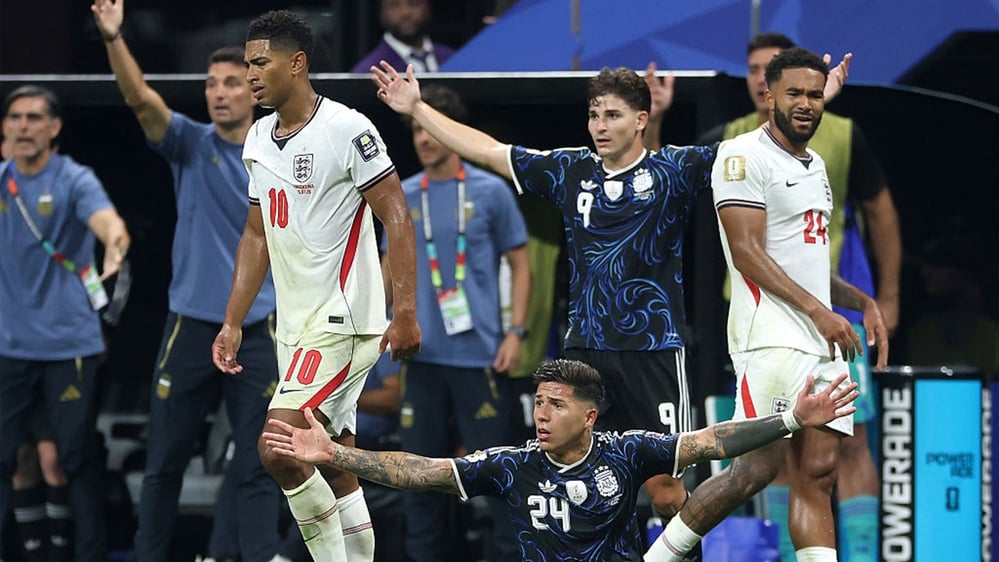
England's World Cup semi-final exit to Argentina in Atlanta featured Lautaro Martinez's stoppage-time winner and a post-match incident involving Bellingham's slap on Barco.
Automated analysis; not human reviewed.
Limitations: Concise, case-specific limitations and plausible alternative interpretations.
·
21 of 52 available dimensions scored; omitted dimensions are not treated as neutral.
·
Verified supporting quotes for 1 of 21 scored dimensions.
Claim: No evident ideological framing; article centers on event and rules.
“Bellingham slapped Argentina substitute Valentin Barco on the back of the head following England's 2-1 World Cup semi-final defeat.” · exact text match
“The laws of the game state there is no red-card offence if a player deliberately strikes an opponent on the head and the force used is negligible.” · exact text match
Counterevidence:
“Former England goalkeeper Paul Robinson described Barco's actions as 'probably the worst example of sportsmanship we've seen at this World Cup'.” · not found in supplied text
Why: Neutral event framing with rule context and a single opinion quote.
Claim: Overall tone is factual with occasional subjective descriptors.
“The first half of Wednesday's match in Atlanta was feisty with 19 fouls.” · not found in supplied text
Counterevidence:
“The article uses quotes from players describing events; and calls the actions 'worst' as described by Robinson.” · not found in supplied text
Why: Mix of objective data and subjective descriptors.
Claim: Mild sensational language; not the main framing.
“It sparked a small melee as players from both sides got involved before Bellingham walked away.” · exact text match
“The first half of Wednesday's match in Atlanta was feisty with 19 fouls.” · not found in supplied text
Counterevidence:
“Main reporting remains factual and cautious in assessment.” · not found in supplied text
Why: Some sensational phrasing, but overall restrained.
Claim: Article relies on verifiable facts and official statements; not speculation.
“Bellingham could face action from FIFA's disciplinary committee for violent conduct.” · not found in supplied text
“However, FIFA is more likely to consider the act as petulant rather than violent.” · not found in supplied text
“The laws of the game state there is no red-card offence if a player deliberately strikes an opponent on the head and the force used is negligible.” · exact text match
Counterevidence:
“'sparks melee' and 'feisty' language introduce mild sensationalism.” · not found in supplied text
Why: Anchored in regulation and direct quotes; but minor sensational phrasing exists.
Claim: Reporting shows fairness by including official statements and quotes.
“Former England goalkeeper Paul Robinson, commentating on the match for BBC Radio 5 Live, described Barco's actions as 'probably the worst example of sportsmanship we've seen at this World Cup'.” · not found in supplied text
“The laws of the game state there is no red-card offence if a player deliberately strikes an opponent on the head and the force used is negligible.” · exact text match
Why: Quotes and rule references support balanced coverage.
Ambiguity about motive; quotes limited; no video evidence.
July 15, 2026 · 0 shares
Balanced sports reporting that neutrally recounts England's 2-1 World Cup semifinal loss to Argentina after England led 1-0 for 78 minutes, highlighting Jude Bellingham's tournament impact and Kane/Tuchel's postmatch reflections without partisan framing.
Sports news report on the 2026 World Cup semifinal between England and Argentina, detailing the final score, lead duration, key player performances, and postmatch reflections.
Automated analysis; not human reviewed.
·
51 of 52 available dimensions scored; omitted dimensions are not treated as neutral.
·
Supporting quotes supplied for 0 of 51 scored dimensions; exact matching was not run.
Neutral stance; confidence ~0.65.
July 15, 2026 · 0 shares
Balanced sports reporting that neutrally recounts England's 2-1 World Cup semifinal loss to Argentina after England led 1-0 for 78 minutes, highlighting Jude Bellingham's tournament impact and Kane/Tuchel's postmatch reflections without partisan framing.
Sports news report on the 2026 World Cup semifinal between England and Argentina, detailing the final score, lead duration, key player performances, and postmatch reflections.
Automated analysis; not human reviewed.
·
51 of 52 available dimensions scored; omitted dimensions are not treated as neutral.
·
Supporting quotes supplied for 0 of 51 scored dimensions; exact matching was not run.
Neutral stance; confidence ~0.65.
July 15, 2026 · 0 shares
Balanced sports reporting that neutrally recounts England's 2-1 World Cup semifinal loss to Argentina after England led 1-0 for 78 minutes, highlighting Jude Bellingham's tournament impact and Kane/Tuchel's postmatch reflections without partisan framing.
Sports news report on the 2026 World Cup semifinal between England and Argentina, detailing the final score, lead duration, key player performances, and postmatch reflections.
Automated analysis; not human reviewed.
·
51 of 52 available dimensions scored; omitted dimensions are not treated as neutral.
·
Supporting quotes supplied for 0 of 51 scored dimensions; exact matching was not run.
Neutral stance; confidence ~0.65.
July 15, 2026 · 0 shares
Balanced sports reporting that neutrally recounts England's 2-1 World Cup semifinal loss to Argentina after England led 1-0 for 78 minutes, highlighting Jude Bellingham's tournament impact and Kane/Tuchel's postmatch reflections without partisan framing.
Sports news report on the 2026 World Cup semifinal between England and Argentina, detailing the final score, lead duration, key player performances, and postmatch reflections.
Automated analysis; not human reviewed.
·
51 of 52 available dimensions scored; omitted dimensions are not treated as neutral.
·
Supporting quotes supplied for 0 of 51 scored dimensions; exact matching was not run.
Neutral stance; confidence ~0.65.
Minimal explicit political bias detected; overall framing is neutral sports reporting with embedded promotional/page content that could color reader perception but does not advance a political agenda.
World Cup semi-final recap focusing on Bellingham-Messi confrontation, England’s tactical approach, Barco incident, and upcoming bronze final against France, with promotional content present on the page.
Automated analysis; not human reviewed.
Limitations: Case context limited to the provided article text; promotional material may not reflect core sports reporting.
·
1 of 52 available dimensions scored; omitted dimensions are not treated as neutral.
·
Verified supporting quotes for 1 of 1 scored dimensions.
Claim: Promotional content and donation appeals indicate promotional framing rather than purely informational reporting
“From reproductive rights to climate change to Big Tech, is on the ground when the story is developing.
Whether it's investigating the financials of Elon Musk's pro-Trump PAC or producing our latest documentary, 'The A Word', which shines a light on the American women fighting for reproductive rights, we know how important it is to parse out the facts from the messaging.”
· verified after text normalization
“At such a critical moment in US history, we need reporters on the ground.
Your donation allows us to keep sending journalists to speak to both sides of the story.”
· exact text match
“is trusted by Americans across the entire political spectrum.
And unlike many other quality news outlets, we choose not to lock Americans out of our reporting and analysis with paywalls.
We believe quality journalism should be available to everyone, paid for by those who can afford it.”
· exact text match
Counterevidence:
“Asked about the confrontation after the game, Bellingham played down the incident, saying: “We was discussing a foul actually, it was nothing bad. I’m sure everyone will do their thing and make it a big deal but it was nothing big really.” · exact text match
““We played one of our better matches, maybe our best match in the circumstances.
The team was top; we couldn’t get over the line, but no regrets.””
· exact text match
Why: Promotional page copy presents advertising framing; nonetheless, the inclusion of direct quotes and objective results provides counterweights indicating the reporting contains neutral elements.
Ads clutter; uncertain source reliability; limited context.
July 16, 2026 · 0 shares
Reporting is neutral and evidence-driven, balancing event description, quotes, and official rules with restrained language and minimal editorializing.
England's World Cup semi-final exit to Argentina in Atlanta featured Lautaro Martinez's stoppage-time winner and a post-match incident involving Bellingham's slap on Barco.
Automated analysis; not human reviewed.
Limitations: Concise, case-specific limitations and plausible alternative interpretations.
·
21 of 52 available dimensions scored; omitted dimensions are not treated as neutral.
·
Verified supporting quotes for 1 of 21 scored dimensions.
Claim: No evident ideological framing; article centers on event and rules.
“Bellingham slapped Argentina substitute Valentin Barco on the back of the head following England's 2-1 World Cup semi-final defeat.” · exact text match
“The laws of the game state there is no red-card offence if a player deliberately strikes an opponent on the head and the force used is negligible.” · exact text match
Counterevidence:
“Former England goalkeeper Paul Robinson described Barco's actions as 'probably the worst example of sportsmanship we've seen at this World Cup'.” · not found in supplied text
Why: Neutral event framing with rule context and a single opinion quote.
Claim: Overall tone is factual with occasional subjective descriptors.
“The first half of Wednesday's match in Atlanta was feisty with 19 fouls.” · not found in supplied text
Counterevidence:
“The article uses quotes from players describing events; and calls the actions 'worst' as described by Robinson.” · not found in supplied text
Why: Mix of objective data and subjective descriptors.
Claim: Mild sensational language; not the main framing.
“It sparked a small melee as players from both sides got involved before Bellingham walked away.” · exact text match
“The first half of Wednesday's match in Atlanta was feisty with 19 fouls.” · not found in supplied text
Counterevidence:
“Main reporting remains factual and cautious in assessment.” · not found in supplied text
Why: Some sensational phrasing, but overall restrained.
Claim: Article relies on verifiable facts and official statements; not speculation.
“Bellingham could face action from FIFA's disciplinary committee for violent conduct.” · not found in supplied text
“However, FIFA is more likely to consider the act as petulant rather than violent.” · not found in supplied text
“The laws of the game state there is no red-card offence if a player deliberately strikes an opponent on the head and the force used is negligible.” · exact text match
Counterevidence:
“'sparks melee' and 'feisty' language introduce mild sensationalism.” · not found in supplied text
Why: Anchored in regulation and direct quotes; but minor sensational phrasing exists.
Claim: Reporting shows fairness by including official statements and quotes.
“Former England goalkeeper Paul Robinson, commentating on the match for BBC Radio 5 Live, described Barco's actions as 'probably the worst example of sportsmanship we've seen at this World Cup'.” · not found in supplied text
“The laws of the game state there is no red-card offence if a player deliberately strikes an opponent on the head and the force used is negligible.” · exact text match
Why: Quotes and rule references support balanced coverage.
Ambiguity about motive; quotes limited; no video evidence.
July 16, 2026 · 0 shares
Reporting is neutral and evidence-driven, balancing event description, quotes, and official rules with restrained language and minimal editorializing.
England's World Cup semi-final exit to Argentina in Atlanta featured Lautaro Martinez's stoppage-time winner and a post-match incident involving Bellingham's slap on Barco.
Automated analysis; not human reviewed.
Limitations: Concise, case-specific limitations and plausible alternative interpretations.
·
21 of 52 available dimensions scored; omitted dimensions are not treated as neutral.
·
Verified supporting quotes for 1 of 21 scored dimensions.
Claim: No evident ideological framing; article centers on event and rules.
“Bellingham slapped Argentina substitute Valentin Barco on the back of the head following England's 2-1 World Cup semi-final defeat.” · exact text match
“The laws of the game state there is no red-card offence if a player deliberately strikes an opponent on the head and the force used is negligible.” · exact text match
Counterevidence:
“Former England goalkeeper Paul Robinson described Barco's actions as 'probably the worst example of sportsmanship we've seen at this World Cup'.” · not found in supplied text
Why: Neutral event framing with rule context and a single opinion quote.
Claim: Overall tone is factual with occasional subjective descriptors.
“The first half of Wednesday's match in Atlanta was feisty with 19 fouls.” · not found in supplied text
Counterevidence:
“The article uses quotes from players describing events; and calls the actions 'worst' as described by Robinson.” · not found in supplied text
Why: Mix of objective data and subjective descriptors.
Claim: Mild sensational language; not the main framing.
“It sparked a small melee as players from both sides got involved before Bellingham walked away.” · exact text match
“The first half of Wednesday's match in Atlanta was feisty with 19 fouls.” · not found in supplied text
Counterevidence:
“Main reporting remains factual and cautious in assessment.” · not found in supplied text
Why: Some sensational phrasing, but overall restrained.
Claim: Article relies on verifiable facts and official statements; not speculation.
“Bellingham could face action from FIFA's disciplinary committee for violent conduct.” · not found in supplied text
“However, FIFA is more likely to consider the act as petulant rather than violent.” · not found in supplied text
“The laws of the game state there is no red-card offence if a player deliberately strikes an opponent on the head and the force used is negligible.” · exact text match
Counterevidence:
“'sparks melee' and 'feisty' language introduce mild sensationalism.” · not found in supplied text
Why: Anchored in regulation and direct quotes; but minor sensational phrasing exists.
Claim: Reporting shows fairness by including official statements and quotes.
“Former England goalkeeper Paul Robinson, commentating on the match for BBC Radio 5 Live, described Barco's actions as 'probably the worst example of sportsmanship we've seen at this World Cup'.” · not found in supplied text
“The laws of the game state there is no red-card offence if a player deliberately strikes an opponent on the head and the force used is negligible.” · exact text match
Why: Quotes and rule references support balanced coverage.
Ambiguity about motive; quotes limited; no video evidence.
Balanced, source-driven coverage that quotes Tuchel and Bellingham, frames the dispute as media amplification, and emphasizes England's unity and readiness for a World Cup semi-final.
Sports reporting on Tuchel's response to Bellingham's ITV comments following England's World Cup quarter-final win, highlighting team mentality and media framing.
Automated analysis; not human reviewed.
·
51 of 52 available dimensions scored; omitted dimensions are not treated as neutral.
·
Supporting quotes supplied for 0 of 51 scored dimensions; exact matching was not run.
Objectivity-focused; bias judgments ~0.6 accuracy
July 14, 2026 · 0 shares
Balanced reporting presents multiple quotes to downplay a rift between Tuchel and Bellingham and centers on performance rather than controversy.
Concise, factful context: post-match reaction coverage of alleged tension between Tuchel and Bellingham, supported by multiple quotes and focused on England's World Cup progress.
Automated analysis; not human reviewed.
·
51 of 52 available dimensions scored; omitted dimensions are not treated as neutral.
·
Supporting quotes supplied for 0 of 51 scored dimensions; exact matching was not run.
I may misinterpret sports framing; bias accuracy ~65%
Minimal explicit political bias detected; overall framing is neutral sports reporting with embedded promotional/page content that could color reader perception but does not advance a political agenda.
World Cup semi-final recap focusing on Bellingham-Messi confrontation, England’s tactical approach, Barco incident, and upcoming bronze final against France, with promotional content present on the page.
Automated analysis; not human reviewed.
Limitations: Case context limited to the provided article text; promotional material may not reflect core sports reporting.
·
1 of 52 available dimensions scored; omitted dimensions are not treated as neutral.
·
Verified supporting quotes for 1 of 1 scored dimensions.
Claim: Promotional content and donation appeals indicate promotional framing rather than purely informational reporting
“From reproductive rights to climate change to Big Tech, is on the ground when the story is developing.
Whether it's investigating the financials of Elon Musk's pro-Trump PAC or producing our latest documentary, 'The A Word', which shines a light on the American women fighting for reproductive rights, we know how important it is to parse out the facts from the messaging.”
· verified after text normalization
“At such a critical moment in US history, we need reporters on the ground.
Your donation allows us to keep sending journalists to speak to both sides of the story.”
· exact text match
“is trusted by Americans across the entire political spectrum.
And unlike many other quality news outlets, we choose not to lock Americans out of our reporting and analysis with paywalls.
We believe quality journalism should be available to everyone, paid for by those who can afford it.”
· exact text match
Counterevidence:
“Asked about the confrontation after the game, Bellingham played down the incident, saying: “We was discussing a foul actually, it was nothing bad. I’m sure everyone will do their thing and make it a big deal but it was nothing big really.” · exact text match
““We played one of our better matches, maybe our best match in the circumstances.
The team was top; we couldn’t get over the line, but no regrets.””
· exact text match
Why: Promotional page copy presents advertising framing; nonetheless, the inclusion of direct quotes and objective results provides counterweights indicating the reporting contains neutral elements.
Ads clutter; uncertain source reliability; limited context.
July 16, 2026 · 0 shares
Reporting is neutral and evidence-driven, balancing event description, quotes, and official rules with restrained language and minimal editorializing.
England's World Cup semi-final exit to Argentina in Atlanta featured Lautaro Martinez's stoppage-time winner and a post-match incident involving Bellingham's slap on Barco.
Automated analysis; not human reviewed. Limitations: Concise, case-specific limitations and plausible alternative interpretations. · 21 of 52 available dimensions scored; omitted dimensions are not treated as neutral. · Verified supporting quotes for 1 of 21 scored dimensions.
Claim: No evident ideological framing; article centers on event and rules.
“Bellingham slapped Argentina substitute Valentin Barco on the back of the head following England's 2-1 World Cup semi-final defeat.” · exact text match
“The laws of the game state there is no red-card offence if a player deliberately strikes an opponent on the head and the force used is negligible.” · exact text match
Counterevidence:
“Former England goalkeeper Paul Robinson described Barco's actions as 'probably the worst example of sportsmanship we've seen at this World Cup'.” · not found in supplied text
Why: Neutral event framing with rule context and a single opinion quote.
Claim: Overall tone is factual with occasional subjective descriptors.
“The first half of Wednesday's match in Atlanta was feisty with 19 fouls.” · not found in supplied text
Counterevidence:
“The article uses quotes from players describing events; and calls the actions 'worst' as described by Robinson.” · not found in supplied text
Why: Mix of objective data and subjective descriptors.
Claim: Mild sensational language; not the main framing.
“It sparked a small melee as players from both sides got involved before Bellingham walked away.” · exact text match
“The first half of Wednesday's match in Atlanta was feisty with 19 fouls.” · not found in supplied text
Counterevidence:
“Main reporting remains factual and cautious in assessment.” · not found in supplied text
Why: Some sensational phrasing, but overall restrained.
Claim: Article relies on verifiable facts and official statements; not speculation.
“Bellingham could face action from FIFA's disciplinary committee for violent conduct.” · not found in supplied text
“However, FIFA is more likely to consider the act as petulant rather than violent.” · not found in supplied text
“The laws of the game state there is no red-card offence if a player deliberately strikes an opponent on the head and the force used is negligible.” · exact text match
Counterevidence:
“'sparks melee' and 'feisty' language introduce mild sensationalism.” · not found in supplied text
Why: Anchored in regulation and direct quotes; but minor sensational phrasing exists.
Claim: Reporting shows fairness by including official statements and quotes.
“Former England goalkeeper Paul Robinson, commentating on the match for BBC Radio 5 Live, described Barco's actions as 'probably the worst example of sportsmanship we've seen at this World Cup'.” · not found in supplied text
“The laws of the game state there is no red-card offence if a player deliberately strikes an opponent on the head and the force used is negligible.” · exact text match
Why: Quotes and rule references support balanced coverage.
Ambiguity about motive; quotes limited; no video evidence.
Balanced, source-driven coverage that quotes Tuchel and Bellingham, frames the dispute as media amplification, and emphasizes England's unity and readiness for a World Cup semi-final.
Sports reporting on Tuchel's response to Bellingham's ITV comments following England's World Cup quarter-final win, highlighting team mentality and media framing.
Automated analysis; not human reviewed. · 51 of 52 available dimensions scored; omitted dimensions are not treated as neutral. · Supporting quotes supplied for 0 of 51 scored dimensions; exact matching was not run.
Objectivity-focused; bias judgments ~0.6 accuracy
July 14, 2026 · 0 shares
Balanced reporting presents multiple quotes to downplay a rift between Tuchel and Bellingham and centers on performance rather than controversy.
Concise, factful context: post-match reaction coverage of alleged tension between Tuchel and Bellingham, supported by multiple quotes and focused on England's World Cup progress.
Automated analysis; not human reviewed. · 51 of 52 available dimensions scored; omitted dimensions are not treated as neutral. · Supporting quotes supplied for 0 of 51 scored dimensions; exact matching was not run.
I may misinterpret sports framing; bias accuracy ~65%
Match-impact + performance narrative (Bellingham as England’s focal point)
July 15, 2026 · 0 shares
Balanced sports reporting that neutrally recounts England's 2-1 World Cup semifinal loss to Argentina after England led 1-0 for 78 minutes, highlighting Jude Bellingham's tournament impact and Kane/Tuchel's postmatch reflections without partisan framing.
Sports news report on the 2026 World Cup semifinal between England and Argentina, detailing the final score, lead duration, key player performances, and postmatch reflections.
Automated analysis; not human reviewed. · 51 of 52 available dimensions scored; omitted dimensions are not treated as neutral. · Supporting quotes supplied for 0 of 51 scored dimensions; exact matching was not run.
Neutral stance; confidence ~0.65.
July 15, 2026 · 0 shares
Balanced sports reporting that neutrally recounts England's 2-1 World Cup semifinal loss to Argentina after England led 1-0 for 78 minutes, highlighting Jude Bellingham's tournament impact and Kane/Tuchel's postmatch reflections without partisan framing.
Sports news report on the 2026 World Cup semifinal between England and Argentina, detailing the final score, lead duration, key player performances, and postmatch reflections.
Automated analysis; not human reviewed. · 51 of 52 available dimensions scored; omitted dimensions are not treated as neutral. · Supporting quotes supplied for 0 of 51 scored dimensions; exact matching was not run.
Neutral stance; confidence ~0.65.
Highly favorable portrayal of Jude Bellingham uses selective statistics and emotive language to present him as the keystone of England's World Cup campaign, reframing prior criticisms as noise and elevating him above peers through a narrative of transformative excellence.
Profile highlighting Jude Bellingham's World Cup impact, supported by metrics and references to prior criticism and comparisons to peers.
I may overvalue positive sports narratives; accuracy ~0.65
Positive and celebratory in tone, the coverage casts Jude Bellingham as a standout star rising from local roots to national prominence, framing his World Cup journey as a heroic ascent.
Profile of Jude Bellingham's rise from a local youth player to England's World Cup semifinal performer ahead of a match against Argentina.
Automated analysis; not human reviewed. · 1 of 52 available dimensions scored; omitted dimensions are not treated as neutral. · Supporting quotes supplied for 0 of 1 scored dimensions; exact matching was not run.
My bias: mild positivity toward success narratives; confidence 0.65.
Highly favorable portrayal of Jude Bellingham uses selective statistics and emotive language to present him as the keystone of England's World Cup campaign, reframing prior criticisms as noise and elevating him above peers through a narrative of transformative excellence.
Profile highlighting Jude Bellingham's World Cup impact, supported by metrics and references to prior criticism and comparisons to peers.
I may overvalue positive sports narratives; accuracy ~0.65
July 16, 2026 · 0 shares
Reporting is neutral and evidence-driven, balancing event description, quotes, and official rules with restrained language and minimal editorializing.
England's World Cup semi-final exit to Argentina in Atlanta featured Lautaro Martinez's stoppage-time winner and a post-match incident involving Bellingham's slap on Barco.
Automated analysis; not human reviewed. Limitations: Concise, case-specific limitations and plausible alternative interpretations. · 21 of 52 available dimensions scored; omitted dimensions are not treated as neutral. · Verified supporting quotes for 1 of 21 scored dimensions.
Claim: No evident ideological framing; article centers on event and rules.
“Bellingham slapped Argentina substitute Valentin Barco on the back of the head following England's 2-1 World Cup semi-final defeat.” · exact text match
“The laws of the game state there is no red-card offence if a player deliberately strikes an opponent on the head and the force used is negligible.” · exact text match
Counterevidence:
“Former England goalkeeper Paul Robinson described Barco's actions as 'probably the worst example of sportsmanship we've seen at this World Cup'.” · not found in supplied text
Why: Neutral event framing with rule context and a single opinion quote.
Claim: Overall tone is factual with occasional subjective descriptors.
“The first half of Wednesday's match in Atlanta was feisty with 19 fouls.” · not found in supplied text
Counterevidence:
“The article uses quotes from players describing events; and calls the actions 'worst' as described by Robinson.” · not found in supplied text
Why: Mix of objective data and subjective descriptors.
Claim: Mild sensational language; not the main framing.
“It sparked a small melee as players from both sides got involved before Bellingham walked away.” · exact text match
“The first half of Wednesday's match in Atlanta was feisty with 19 fouls.” · not found in supplied text
Counterevidence:
“Main reporting remains factual and cautious in assessment.” · not found in supplied text
Why: Some sensational phrasing, but overall restrained.
Claim: Article relies on verifiable facts and official statements; not speculation.
“Bellingham could face action from FIFA's disciplinary committee for violent conduct.” · not found in supplied text
“However, FIFA is more likely to consider the act as petulant rather than violent.” · not found in supplied text
“The laws of the game state there is no red-card offence if a player deliberately strikes an opponent on the head and the force used is negligible.” · exact text match
Counterevidence:
“'sparks melee' and 'feisty' language introduce mild sensationalism.” · not found in supplied text
Why: Anchored in regulation and direct quotes; but minor sensational phrasing exists.
Claim: Reporting shows fairness by including official statements and quotes.
“Former England goalkeeper Paul Robinson, commentating on the match for BBC Radio 5 Live, described Barco's actions as 'probably the worst example of sportsmanship we've seen at this World Cup'.” · not found in supplied text
“The laws of the game state there is no red-card offence if a player deliberately strikes an opponent on the head and the force used is negligible.” · exact text match
Why: Quotes and rule references support balanced coverage.
Ambiguity about motive; quotes limited; no video evidence.
Discipline/behavior and rule-interpretation narrative (what FIFA might do)
July 16, 2026 · 0 shares
Reporting is neutral and evidence-driven, balancing event description, quotes, and official rules with restrained language and minimal editorializing.
England's World Cup semi-final exit to Argentina in Atlanta featured Lautaro Martinez's stoppage-time winner and a post-match incident involving Bellingham's slap on Barco.
Automated analysis; not human reviewed. Limitations: Concise, case-specific limitations and plausible alternative interpretations. · 21 of 52 available dimensions scored; omitted dimensions are not treated as neutral. · Verified supporting quotes for 1 of 21 scored dimensions.
Claim: No evident ideological framing; article centers on event and rules.
“Bellingham slapped Argentina substitute Valentin Barco on the back of the head following England's 2-1 World Cup semi-final defeat.” · exact text match
“The laws of the game state there is no red-card offence if a player deliberately strikes an opponent on the head and the force used is negligible.” · exact text match
Counterevidence:
“Former England goalkeeper Paul Robinson described Barco's actions as 'probably the worst example of sportsmanship we've seen at this World Cup'.” · not found in supplied text
Why: Neutral event framing with rule context and a single opinion quote.
Claim: Overall tone is factual with occasional subjective descriptors.
“The first half of Wednesday's match in Atlanta was feisty with 19 fouls.” · not found in supplied text
Counterevidence:
“The article uses quotes from players describing events; and calls the actions 'worst' as described by Robinson.” · not found in supplied text
Why: Mix of objective data and subjective descriptors.
Claim: Mild sensational language; not the main framing.
“It sparked a small melee as players from both sides got involved before Bellingham walked away.” · exact text match
“The first half of Wednesday's match in Atlanta was feisty with 19 fouls.” · not found in supplied text
Counterevidence:
“Main reporting remains factual and cautious in assessment.” · not found in supplied text
Why: Some sensational phrasing, but overall restrained.
Claim: Article relies on verifiable facts and official statements; not speculation.
“Bellingham could face action from FIFA's disciplinary committee for violent conduct.” · not found in supplied text
“However, FIFA is more likely to consider the act as petulant rather than violent.” · not found in supplied text
“The laws of the game state there is no red-card offence if a player deliberately strikes an opponent on the head and the force used is negligible.” · exact text match
Counterevidence:
“'sparks melee' and 'feisty' language introduce mild sensationalism.” · not found in supplied text
Why: Anchored in regulation and direct quotes; but minor sensational phrasing exists.
Claim: Reporting shows fairness by including official statements and quotes.
“Former England goalkeeper Paul Robinson, commentating on the match for BBC Radio 5 Live, described Barco's actions as 'probably the worst example of sportsmanship we've seen at this World Cup'.” · not found in supplied text
“The laws of the game state there is no red-card offence if a player deliberately strikes an opponent on the head and the force used is negligible.” · exact text match
Why: Quotes and rule references support balanced coverage.
Ambiguity about motive; quotes limited; no video evidence.
Minimal explicit political bias detected; overall framing is neutral sports reporting with embedded promotional/page content that could color reader perception but does not advance a political agenda.
World Cup semi-final recap focusing on Bellingham-Messi confrontation, England’s tactical approach, Barco incident, and upcoming bronze final against France, with promotional content present on the page.
Automated analysis; not human reviewed. Limitations: Case context limited to the provided article text; promotional material may not reflect core sports reporting. · 1 of 52 available dimensions scored; omitted dimensions are not treated as neutral. · Verified supporting quotes for 1 of 1 scored dimensions.
Claim: Promotional content and donation appeals indicate promotional framing rather than purely informational reporting
“From reproductive rights to climate change to Big Tech, is on the ground when the story is developing. Whether it's investigating the financials of Elon Musk's pro-Trump PAC or producing our latest documentary, 'The A Word', which shines a light on the American women fighting for reproductive rights, we know how important it is to parse out the facts from the messaging.” · verified after text normalization
“At such a critical moment in US history, we need reporters on the ground. Your donation allows us to keep sending journalists to speak to both sides of the story.” · exact text match
“is trusted by Americans across the entire political spectrum. And unlike many other quality news outlets, we choose not to lock Americans out of our reporting and analysis with paywalls. We believe quality journalism should be available to everyone, paid for by those who can afford it.” · exact text match
Counterevidence:
“Asked about the confrontation after the game, Bellingham played down the incident, saying: “We was discussing a foul actually, it was nothing bad. I’m sure everyone will do their thing and make it a big deal but it was nothing big really.” · exact text match
““We played one of our better matches, maybe our best match in the circumstances. The team was top; we couldn’t get over the line, but no regrets.”” · exact text match
Why: Promotional page copy presents advertising framing; nonetheless, the inclusion of direct quotes and objective results provides counterweights indicating the reporting contains neutral elements.
Ads clutter; uncertain source reliability; limited context.
July 16, 2026 · 0 shares
Reporting is neutral and evidence-driven, balancing event description, quotes, and official rules with restrained language and minimal editorializing.
England's World Cup semi-final exit to Argentina in Atlanta featured Lautaro Martinez's stoppage-time winner and a post-match incident involving Bellingham's slap on Barco.
Automated analysis; not human reviewed. Limitations: Concise, case-specific limitations and plausible alternative interpretations. · 21 of 52 available dimensions scored; omitted dimensions are not treated as neutral. · Verified supporting quotes for 1 of 21 scored dimensions.
Claim: No evident ideological framing; article centers on event and rules.
“Bellingham slapped Argentina substitute Valentin Barco on the back of the head following England's 2-1 World Cup semi-final defeat.” · exact text match
“The laws of the game state there is no red-card offence if a player deliberately strikes an opponent on the head and the force used is negligible.” · exact text match
Counterevidence:
“Former England goalkeeper Paul Robinson described Barco's actions as 'probably the worst example of sportsmanship we've seen at this World Cup'.” · not found in supplied text
Why: Neutral event framing with rule context and a single opinion quote.
Claim: Overall tone is factual with occasional subjective descriptors.
“The first half of Wednesday's match in Atlanta was feisty with 19 fouls.” · not found in supplied text
Counterevidence:
“The article uses quotes from players describing events; and calls the actions 'worst' as described by Robinson.” · not found in supplied text
Why: Mix of objective data and subjective descriptors.
Claim: Mild sensational language; not the main framing.
“It sparked a small melee as players from both sides got involved before Bellingham walked away.” · exact text match
“The first half of Wednesday's match in Atlanta was feisty with 19 fouls.” · not found in supplied text
Counterevidence:
“Main reporting remains factual and cautious in assessment.” · not found in supplied text
Why: Some sensational phrasing, but overall restrained.
Claim: Article relies on verifiable facts and official statements; not speculation.
“Bellingham could face action from FIFA's disciplinary committee for violent conduct.” · not found in supplied text
“However, FIFA is more likely to consider the act as petulant rather than violent.” · not found in supplied text
“The laws of the game state there is no red-card offence if a player deliberately strikes an opponent on the head and the force used is negligible.” · exact text match
Counterevidence:
“'sparks melee' and 'feisty' language introduce mild sensationalism.” · not found in supplied text
Why: Anchored in regulation and direct quotes; but minor sensational phrasing exists.
Claim: Reporting shows fairness by including official statements and quotes.
“Former England goalkeeper Paul Robinson, commentating on the match for BBC Radio 5 Live, described Barco's actions as 'probably the worst example of sportsmanship we've seen at this World Cup'.” · not found in supplied text
“The laws of the game state there is no red-card offence if a player deliberately strikes an opponent on the head and the force used is negligible.” · exact text match
Why: Quotes and rule references support balanced coverage.
Ambiguity about motive; quotes limited; no video evidence.
July 15, 2026 · 0 shares
Balanced sports reporting that neutrally recounts England's 2-1 World Cup semifinal loss to Argentina after England led 1-0 for 78 minutes, highlighting Jude Bellingham's tournament impact and Kane/Tuchel's postmatch reflections without partisan framing.
Sports news report on the 2026 World Cup semifinal between England and Argentina, detailing the final score, lead duration, key player performances, and postmatch reflections.
Automated analysis; not human reviewed. · 51 of 52 available dimensions scored; omitted dimensions are not treated as neutral. · Supporting quotes supplied for 0 of 51 scored dimensions; exact matching was not run.
Neutral stance; confidence ~0.65.
Manager-media unity narrative (Tuchel, interviews, and “camp issues”)
Balanced, source-driven coverage that quotes Tuchel and Bellingham, frames the dispute as media amplification, and emphasizes England's unity and readiness for a World Cup semi-final.
Sports reporting on Tuchel's response to Bellingham's ITV comments following England's World Cup quarter-final win, highlighting team mentality and media framing.
Automated analysis; not human reviewed. · 51 of 52 available dimensions scored; omitted dimensions are not treated as neutral. · Supporting quotes supplied for 0 of 51 scored dimensions; exact matching was not run.
Objectivity-focused; bias judgments ~0.6 accuracy
July 14, 2026 · 0 shares
Balanced reporting presents multiple quotes to downplay a rift between Tuchel and Bellingham and centers on performance rather than controversy.
Concise, factful context: post-match reaction coverage of alleged tension between Tuchel and Bellingham, supported by multiple quotes and focused on England's World Cup progress.
Automated analysis; not human reviewed. · 51 of 52 available dimensions scored; omitted dimensions are not treated as neutral. · Supporting quotes supplied for 0 of 51 scored dimensions; exact matching was not run.
I may misinterpret sports framing; bias accuracy ~65%
Balanced, source-driven coverage that quotes Tuchel and Bellingham, frames the dispute as media amplification, and emphasizes England's unity and readiness for a World Cup semi-final.
Sports reporting on Tuchel's response to Bellingham's ITV comments following England's World Cup quarter-final win, highlighting team mentality and media framing.
Automated analysis; not human reviewed. · 51 of 52 available dimensions scored; omitted dimensions are not treated as neutral. · Supporting quotes supplied for 0 of 51 scored dimensions; exact matching was not run.
Objectivity-focused; bias judgments ~0.6 accuracy
July 14, 2026 · 0 shares
Balanced reporting presents multiple quotes to downplay a rift between Tuchel and Bellingham and centers on performance rather than controversy.
Concise, factful context: post-match reaction coverage of alleged tension between Tuchel and Bellingham, supported by multiple quotes and focused on England's World Cup progress.
Automated analysis; not human reviewed. · 51 of 52 available dimensions scored; omitted dimensions are not treated as neutral. · Supporting quotes supplied for 0 of 51 scored dimensions; exact matching was not run.
I may misinterpret sports framing; bias accuracy ~65%
Conservative-leaning tactical critique narrative (Tuchel’s plan vs breakdown)
Pro-Argentina bias with Messi worship and England as the fallible side; sensational tone, portraying late goals as decisive in a 2-1 World Cup semi-final in Atlanta, while highlighting England's defensive rigidity.
World Cup semi-final narrative describing late goals by Argentina to overturn England's lead in Atlanta, with Messi highlighted, England criticized for conservative defending, and a Falklands banner incident noted.
Automated analysis; not human reviewed. · 9 of 52 available dimensions scored; omitted dimensions are not treated as neutral. · Supporting quotes supplied for 0 of 9 scored dimensions; exact matching was not run.
Overweights drama; pro-Argentina tilt; ~0.6 accuracy.
Loaded framing emphasizes Tuchel's decisions and England's mentality as central to the exit, using evaluative language and questions to present the outcome as a controversy rather than a neutral recap, while still acknowledging Kane's contribution and contextual rankings.
Sports analysis of England's World Cup exit focusing on Tuchel's tactical decisions, squad mentality, and Kane's contribution within the rankings and forthcoming fixtures.
Automated analysis; not human reviewed. Limitations: Case-specific; relies on excerpted quotes and narrative; possible alternative interpretations exist; lacks external corroboration in this excerpt. · 1 of 52 available dimensions scored; omitted dimensions are not treated as neutral. · Verified supporting quotes for 1 of 1 scored dimensions.
Claim: The piece relies on evaluative framing and rhetorical devices to interpret events rather than presenting a strictly neutral report.
“The manager who criticised England for fearing defeat appeared, in the biggest moment of his reign, to coach exactly that emotion into his own team.” · exact text match
“They were more afraid to drop out of the tournament than having the hunger and excitement to win it.” · exact text match
“Tuchel arrived promising courage over caution. He wanted England to dictate games, to make opponents uncomfortable and to embrace the biggest occasions without fear.” · exact text match
Counterevidence:
“Tuchel's selections got England to a World Cup semi-final, but they looked run ragged in the Stateside heat from the last-16 onwards.” · exact text match
“What was the point of taking Kobbie Mainoo to this World Cup? He hasn't got on for a single minute.” · exact text match
Why: Multiple evaluative statements and narrative framing indicate subjectivity, though some factual details ground the analysis.
Ambiguity in whether evidence fully supports evaluative claims; framing may shift with different editorial emphasis.
Pro-Argentina bias with Messi worship and England as the fallible side; sensational tone, portraying late goals as decisive in a 2-1 World Cup semi-final in Atlanta, while highlighting England's defensive rigidity.
World Cup semi-final narrative describing late goals by Argentina to overturn England's lead in Atlanta, with Messi highlighted, England criticized for conservative defending, and a Falklands banner incident noted.
Automated analysis; not human reviewed. · 9 of 52 available dimensions scored; omitted dimensions are not treated as neutral. · Supporting quotes supplied for 0 of 9 scored dimensions; exact matching was not run.
Overweights drama; pro-Argentina tilt; ~0.6 accuracy.
Loaded framing emphasizes Tuchel's decisions and England's mentality as central to the exit, using evaluative language and questions to present the outcome as a controversy rather than a neutral recap, while still acknowledging Kane's contribution and contextual rankings.
Sports analysis of England's World Cup exit focusing on Tuchel's tactical decisions, squad mentality, and Kane's contribution within the rankings and forthcoming fixtures.
Automated analysis; not human reviewed. Limitations: Case-specific; relies on excerpted quotes and narrative; possible alternative interpretations exist; lacks external corroboration in this excerpt. · 1 of 52 available dimensions scored; omitted dimensions are not treated as neutral. · Verified supporting quotes for 1 of 1 scored dimensions.
Claim: The piece relies on evaluative framing and rhetorical devices to interpret events rather than presenting a strictly neutral report.
“The manager who criticised England for fearing defeat appeared, in the biggest moment of his reign, to coach exactly that emotion into his own team.” · exact text match
“They were more afraid to drop out of the tournament than having the hunger and excitement to win it.” · exact text match
“Tuchel arrived promising courage over caution. He wanted England to dictate games, to make opponents uncomfortable and to embrace the biggest occasions without fear.” · exact text match
Counterevidence:
“Tuchel's selections got England to a World Cup semi-final, but they looked run ragged in the Stateside heat from the last-16 onwards.” · exact text match
“What was the point of taking Kobbie Mainoo to this World Cup? He hasn't got on for a single minute.” · exact text match
Why: Multiple evaluative statements and narrative framing indicate subjectivity, though some factual details ground the analysis.
Ambiguity in whether evidence fully supports evaluative claims; framing may shift with different editorial emphasis.
Helium Bias
July 16, 2026 · 0 shares
Reporting is neutral and evidence-driven, balancing event description, quotes, and official rules with restrained language and minimal editorializing.
England's World Cup semi-final exit to Argentina in Atlanta featured Lautaro Martinez's stoppage-time winner and a post-match incident involving Bellingham's slap on Barco.
Automated analysis; not human reviewed. Limitations: Concise, case-specific limitations and plausible alternative interpretations. · 21 of 52 available dimensions scored; omitted dimensions are not treated as neutral. · Verified supporting quotes for 1 of 21 scored dimensions.
Claim: No evident ideological framing; article centers on event and rules.
“Bellingham slapped Argentina substitute Valentin Barco on the back of the head following England's 2-1 World Cup semi-final defeat.” · exact text match
“The laws of the game state there is no red-card offence if a player deliberately strikes an opponent on the head and the force used is negligible.” · exact text match
Counterevidence:
“Former England goalkeeper Paul Robinson described Barco's actions as 'probably the worst example of sportsmanship we've seen at this World Cup'.” · not found in supplied text
Why: Neutral event framing with rule context and a single opinion quote.
Claim: Overall tone is factual with occasional subjective descriptors.
“The first half of Wednesday's match in Atlanta was feisty with 19 fouls.” · not found in supplied text
Counterevidence:
“The article uses quotes from players describing events; and calls the actions 'worst' as described by Robinson.” · not found in supplied text
Why: Mix of objective data and subjective descriptors.
Claim: Mild sensational language; not the main framing.
“It sparked a small melee as players from both sides got involved before Bellingham walked away.” · exact text match
“The first half of Wednesday's match in Atlanta was feisty with 19 fouls.” · not found in supplied text
Counterevidence:
“Main reporting remains factual and cautious in assessment.” · not found in supplied text
Why: Some sensational phrasing, but overall restrained.
Claim: Article relies on verifiable facts and official statements; not speculation.
“Bellingham could face action from FIFA's disciplinary committee for violent conduct.” · not found in supplied text
“However, FIFA is more likely to consider the act as petulant rather than violent.” · not found in supplied text
“The laws of the game state there is no red-card offence if a player deliberately strikes an opponent on the head and the force used is negligible.” · exact text match
Counterevidence:
“'sparks melee' and 'feisty' language introduce mild sensationalism.” · not found in supplied text
Why: Anchored in regulation and direct quotes; but minor sensational phrasing exists.
Claim: Reporting shows fairness by including official statements and quotes.
“Former England goalkeeper Paul Robinson, commentating on the match for BBC Radio 5 Live, described Barco's actions as 'probably the worst example of sportsmanship we've seen at this World Cup'.” · not found in supplied text
“The laws of the game state there is no red-card offence if a player deliberately strikes an opponent on the head and the force used is negligible.” · exact text match
Why: Quotes and rule references support balanced coverage.
Ambiguity about motive; quotes limited; no video evidence.
Balanced, source-driven coverage that quotes Tuchel and Bellingham, frames the dispute as media amplification, and emphasizes England's unity and readiness for a World Cup semi-final.
Sports reporting on Tuchel's response to Bellingham's ITV comments following England's World Cup quarter-final win, highlighting team mentality and media framing.
Automated analysis; not human reviewed. · 51 of 52 available dimensions scored; omitted dimensions are not treated as neutral. · Supporting quotes supplied for 0 of 51 scored dimensions; exact matching was not run.
Objectivity-focused; bias judgments ~0.6 accuracy
July 14, 2026 · 0 shares
Balanced reporting presents multiple quotes to downplay a rift between Tuchel and Bellingham and centers on performance rather than controversy.
Concise, factful context: post-match reaction coverage of alleged tension between Tuchel and Bellingham, supported by multiple quotes and focused on England's World Cup progress.
Automated analysis; not human reviewed. · 51 of 52 available dimensions scored; omitted dimensions are not treated as neutral. · Supporting quotes supplied for 0 of 51 scored dimensions; exact matching was not run.
I may misinterpret sports framing; bias accuracy ~65%
Story Blindspots
July 16, 2026 · 0 shares
Reporting is neutral and evidence-driven, balancing event description, quotes, and official rules with restrained language and minimal editorializing.
England's World Cup semi-final exit to Argentina in Atlanta featured Lautaro Martinez's stoppage-time winner and a post-match incident involving Bellingham's slap on Barco.
Automated analysis; not human reviewed. Limitations: Concise, case-specific limitations and plausible alternative interpretations. · 21 of 52 available dimensions scored; omitted dimensions are not treated as neutral. · Verified supporting quotes for 1 of 21 scored dimensions.
Claim: No evident ideological framing; article centers on event and rules.
“Bellingham slapped Argentina substitute Valentin Barco on the back of the head following England's 2-1 World Cup semi-final defeat.” · exact text match
“The laws of the game state there is no red-card offence if a player deliberately strikes an opponent on the head and the force used is negligible.” · exact text match
Counterevidence:
“Former England goalkeeper Paul Robinson described Barco's actions as 'probably the worst example of sportsmanship we've seen at this World Cup'.” · not found in supplied text
Why: Neutral event framing with rule context and a single opinion quote.
Claim: Overall tone is factual with occasional subjective descriptors.
“The first half of Wednesday's match in Atlanta was feisty with 19 fouls.” · not found in supplied text
Counterevidence:
“The article uses quotes from players describing events; and calls the actions 'worst' as described by Robinson.” · not found in supplied text
Why: Mix of objective data and subjective descriptors.
Claim: Mild sensational language; not the main framing.
“It sparked a small melee as players from both sides got involved before Bellingham walked away.” · exact text match
“The first half of Wednesday's match in Atlanta was feisty with 19 fouls.” · not found in supplied text
Counterevidence:
“Main reporting remains factual and cautious in assessment.” · not found in supplied text
Why: Some sensational phrasing, but overall restrained.
Claim: Article relies on verifiable facts and official statements; not speculation.
“Bellingham could face action from FIFA's disciplinary committee for violent conduct.” · not found in supplied text
“However, FIFA is more likely to consider the act as petulant rather than violent.” · not found in supplied text
“The laws of the game state there is no red-card offence if a player deliberately strikes an opponent on the head and the force used is negligible.” · exact text match
Counterevidence:
“'sparks melee' and 'feisty' language introduce mild sensationalism.” · not found in supplied text
Why: Anchored in regulation and direct quotes; but minor sensational phrasing exists.
Claim: Reporting shows fairness by including official statements and quotes.
“Former England goalkeeper Paul Robinson, commentating on the match for BBC Radio 5 Live, described Barco's actions as 'probably the worst example of sportsmanship we've seen at this World Cup'.” · not found in supplied text
“The laws of the game state there is no red-card offence if a player deliberately strikes an opponent on the head and the force used is negligible.” · exact text match
Why: Quotes and rule references support balanced coverage.
Ambiguity about motive; quotes limited; no video evidence.
Pro-Argentina bias with Messi worship and England as the fallible side; sensational tone, portraying late goals as decisive in a 2-1 World Cup semi-final in Atlanta, while highlighting England's defensive rigidity.
World Cup semi-final narrative describing late goals by Argentina to overturn England's lead in Atlanta, with Messi highlighted, England criticized for conservative defending, and a Falklands banner incident noted.
Automated analysis; not human reviewed. · 9 of 52 available dimensions scored; omitted dimensions are not treated as neutral. · Supporting quotes supplied for 0 of 9 scored dimensions; exact matching was not run.
Overweights drama; pro-Argentina tilt; ~0.6 accuracy.
Loaded framing emphasizes Tuchel's decisions and England's mentality as central to the exit, using evaluative language and questions to present the outcome as a controversy rather than a neutral recap, while still acknowledging Kane's contribution and contextual rankings.
Sports analysis of England's World Cup exit focusing on Tuchel's tactical decisions, squad mentality, and Kane's contribution within the rankings and forthcoming fixtures.
Automated analysis; not human reviewed. Limitations: Case-specific; relies on excerpted quotes and narrative; possible alternative interpretations exist; lacks external corroboration in this excerpt. · 1 of 52 available dimensions scored; omitted dimensions are not treated as neutral. · Verified supporting quotes for 1 of 1 scored dimensions.
Claim: The piece relies on evaluative framing and rhetorical devices to interpret events rather than presenting a strictly neutral report.
“The manager who criticised England for fearing defeat appeared, in the biggest moment of his reign, to coach exactly that emotion into his own team.” · exact text match
“They were more afraid to drop out of the tournament than having the hunger and excitement to win it.” · exact text match
“Tuchel arrived promising courage over caution. He wanted England to dictate games, to make opponents uncomfortable and to embrace the biggest occasions without fear.” · exact text match
Counterevidence:
“Tuchel's selections got England to a World Cup semi-final, but they looked run ragged in the Stateside heat from the last-16 onwards.” · exact text match
“What was the point of taking Kobbie Mainoo to this World Cup? He hasn't got on for a single minute.” · exact text match
Why: Multiple evaluative statements and narrative framing indicate subjectivity, though some factual details ground the analysis.
Ambiguity in whether evidence fully supports evaluative claims; framing may shift with different editorial emphasis.
July 16, 2026 · 0 shares
Reporting is neutral and evidence-driven, balancing event description, quotes, and official rules with restrained language and minimal editorializing.
England's World Cup semi-final exit to Argentina in Atlanta featured Lautaro Martinez's stoppage-time winner and a post-match incident involving Bellingham's slap on Barco.
Automated analysis; not human reviewed. Limitations: Concise, case-specific limitations and plausible alternative interpretations. · 21 of 52 available dimensions scored; omitted dimensions are not treated as neutral. · Verified supporting quotes for 1 of 21 scored dimensions.
Claim: No evident ideological framing; article centers on event and rules.
“Bellingham slapped Argentina substitute Valentin Barco on the back of the head following England's 2-1 World Cup semi-final defeat.” · exact text match
“The laws of the game state there is no red-card offence if a player deliberately strikes an opponent on the head and the force used is negligible.” · exact text match
Counterevidence:
“Former England goalkeeper Paul Robinson described Barco's actions as 'probably the worst example of sportsmanship we've seen at this World Cup'.” · not found in supplied text
Why: Neutral event framing with rule context and a single opinion quote.
Claim: Overall tone is factual with occasional subjective descriptors.
“The first half of Wednesday's match in Atlanta was feisty with 19 fouls.” · not found in supplied text
Counterevidence:
“The article uses quotes from players describing events; and calls the actions 'worst' as described by Robinson.” · not found in supplied text
Why: Mix of objective data and subjective descriptors.
Claim: Mild sensational language; not the main framing.
“It sparked a small melee as players from both sides got involved before Bellingham walked away.” · exact text match
“The first half of Wednesday's match in Atlanta was feisty with 19 fouls.” · not found in supplied text
Counterevidence:
“Main reporting remains factual and cautious in assessment.” · not found in supplied text
Why: Some sensational phrasing, but overall restrained.
Claim: Article relies on verifiable facts and official statements; not speculation.
“Bellingham could face action from FIFA's disciplinary committee for violent conduct.” · not found in supplied text
“However, FIFA is more likely to consider the act as petulant rather than violent.” · not found in supplied text
“The laws of the game state there is no red-card offence if a player deliberately strikes an opponent on the head and the force used is negligible.” · exact text match
Counterevidence:
“'sparks melee' and 'feisty' language introduce mild sensationalism.” · not found in supplied text
Why: Anchored in regulation and direct quotes; but minor sensational phrasing exists.
Claim: Reporting shows fairness by including official statements and quotes.
“Former England goalkeeper Paul Robinson, commentating on the match for BBC Radio 5 Live, described Barco's actions as 'probably the worst example of sportsmanship we've seen at this World Cup'.” · not found in supplied text
“The laws of the game state there is no red-card offence if a player deliberately strikes an opponent on the head and the force used is negligible.” · exact text match
Why: Quotes and rule references support balanced coverage.
Ambiguity about motive; quotes limited; no video evidence.
July 16, 2026 · 0 shares
Reporting is neutral and evidence-driven, balancing event description, quotes, and official rules with restrained language and minimal editorializing.
England's World Cup semi-final exit to Argentina in Atlanta featured Lautaro Martinez's stoppage-time winner and a post-match incident involving Bellingham's slap on Barco.
Automated analysis; not human reviewed. Limitations: Concise, case-specific limitations and plausible alternative interpretations. · 21 of 52 available dimensions scored; omitted dimensions are not treated as neutral. · Verified supporting quotes for 1 of 21 scored dimensions.
Claim: No evident ideological framing; article centers on event and rules.
“Bellingham slapped Argentina substitute Valentin Barco on the back of the head following England's 2-1 World Cup semi-final defeat.” · exact text match
“The laws of the game state there is no red-card offence if a player deliberately strikes an opponent on the head and the force used is negligible.” · exact text match
Counterevidence:
“Former England goalkeeper Paul Robinson described Barco's actions as 'probably the worst example of sportsmanship we've seen at this World Cup'.” · not found in supplied text
Why: Neutral event framing with rule context and a single opinion quote.
Claim: Overall tone is factual with occasional subjective descriptors.
“The first half of Wednesday's match in Atlanta was feisty with 19 fouls.” · not found in supplied text
Counterevidence:
“The article uses quotes from players describing events; and calls the actions 'worst' as described by Robinson.” · not found in supplied text
Why: Mix of objective data and subjective descriptors.
Claim: Mild sensational language; not the main framing.
“It sparked a small melee as players from both sides got involved before Bellingham walked away.” · exact text match
“The first half of Wednesday's match in Atlanta was feisty with 19 fouls.” · not found in supplied text
Counterevidence:
“Main reporting remains factual and cautious in assessment.” · not found in supplied text
Why: Some sensational phrasing, but overall restrained.
Claim: Article relies on verifiable facts and official statements; not speculation.
“Bellingham could face action from FIFA's disciplinary committee for violent conduct.” · not found in supplied text
“However, FIFA is more likely to consider the act as petulant rather than violent.” · not found in supplied text
“The laws of the game state there is no red-card offence if a player deliberately strikes an opponent on the head and the force used is negligible.” · exact text match
Counterevidence:
“'sparks melee' and 'feisty' language introduce mild sensationalism.” · not found in supplied text
Why: Anchored in regulation and direct quotes; but minor sensational phrasing exists.
Claim: Reporting shows fairness by including official statements and quotes.
“Former England goalkeeper Paul Robinson, commentating on the match for BBC Radio 5 Live, described Barco's actions as 'probably the worst example of sportsmanship we've seen at this World Cup'.” · not found in supplied text
“The laws of the game state there is no red-card offence if a player deliberately strikes an opponent on the head and the force used is negligible.” · exact text match
Why: Quotes and rule references support balanced coverage.
Ambiguity about motive; quotes limited; no video evidence.
Balanced, source-driven coverage that quotes Tuchel and Bellingham, frames the dispute as media amplification, and emphasizes England's unity and readiness for a World Cup semi-final.
Sports reporting on Tuchel's response to Bellingham's ITV comments following England's World Cup quarter-final win, highlighting team mentality and media framing.
Automated analysis; not human reviewed. · 51 of 52 available dimensions scored; omitted dimensions are not treated as neutral. · Supporting quotes supplied for 0 of 51 scored dimensions; exact matching was not run.
Objectivity-focused; bias judgments ~0.6 accuracy
July 14, 2026 · 0 shares
Balanced reporting presents multiple quotes to downplay a rift between Tuchel and Bellingham and centers on performance rather than controversy.
Concise, factful context: post-match reaction coverage of alleged tension between Tuchel and Bellingham, supported by multiple quotes and focused on England's World Cup progress.
Automated analysis; not human reviewed. · 51 of 52 available dimensions scored; omitted dimensions are not treated as neutral. · Supporting quotes supplied for 0 of 51 scored dimensions; exact matching was not run.
I may misinterpret sports framing; bias accuracy ~65%
Highly favorable portrayal of Jude Bellingham uses selective statistics and emotive language to present him as the keystone of England's World Cup campaign, reframing prior criticisms as noise and elevating him above peers through a narrative of transformative excellence.
Profile highlighting Jude Bellingham's World Cup impact, supported by metrics and references to prior criticism and comparisons to peers.
I may overvalue positive sports narratives; accuracy ~0.65
Positive and celebratory in tone, the coverage casts Jude Bellingham as a standout star rising from local roots to national prominence, framing his World Cup journey as a heroic ascent.
Profile of Jude Bellingham's rise from a local youth player to England's World Cup semifinal performer ahead of a match against Argentina.
Automated analysis; not human reviewed.
·
1 of 52 available dimensions scored; omitted dimensions are not treated as neutral.
·
Supporting quotes supplied for 0 of 1 scored dimensions; exact matching was not run.
My bias: mild positivity toward success narratives; confidence 0.65.
July 16, 2026 · 0 shares
Reporting is neutral and evidence-driven, balancing event description, quotes, and official rules with restrained language and minimal editorializing.
England's World Cup semi-final exit to Argentina in Atlanta featured Lautaro Martinez's stoppage-time winner and a post-match incident involving Bellingham's slap on Barco.
Automated analysis; not human reviewed.
Limitations: Concise, case-specific limitations and plausible alternative interpretations.
·
21 of 52 available dimensions scored; omitted dimensions are not treated as neutral.
·
Verified supporting quotes for 1 of 21 scored dimensions.
Claim: No evident ideological framing; article centers on event and rules.
“Bellingham slapped Argentina substitute Valentin Barco on the back of the head following England's 2-1 World Cup semi-final defeat.” · exact text match
“The laws of the game state there is no red-card offence if a player deliberately strikes an opponent on the head and the force used is negligible.” · exact text match
Counterevidence:
“Former England goalkeeper Paul Robinson described Barco's actions as 'probably the worst example of sportsmanship we've seen at this World Cup'.” · not found in supplied text
Why: Neutral event framing with rule context and a single opinion quote.
Claim: Overall tone is factual with occasional subjective descriptors.
“The first half of Wednesday's match in Atlanta was feisty with 19 fouls.” · not found in supplied text
Counterevidence:
“The article uses quotes from players describing events; and calls the actions 'worst' as described by Robinson.” · not found in supplied text
Why: Mix of objective data and subjective descriptors.
Claim: Mild sensational language; not the main framing.
“It sparked a small melee as players from both sides got involved before Bellingham walked away.” · exact text match
“The first half of Wednesday's match in Atlanta was feisty with 19 fouls.” · not found in supplied text
Counterevidence:
“Main reporting remains factual and cautious in assessment.” · not found in supplied text
Why: Some sensational phrasing, but overall restrained.
Claim: Article relies on verifiable facts and official statements; not speculation.
“Bellingham could face action from FIFA's disciplinary committee for violent conduct.” · not found in supplied text
“However, FIFA is more likely to consider the act as petulant rather than violent.” · not found in supplied text
“The laws of the game state there is no red-card offence if a player deliberately strikes an opponent on the head and the force used is negligible.” · exact text match
Counterevidence:
“'sparks melee' and 'feisty' language introduce mild sensationalism.” · not found in supplied text
Why: Anchored in regulation and direct quotes; but minor sensational phrasing exists.
Claim: Reporting shows fairness by including official statements and quotes.
“Former England goalkeeper Paul Robinson, commentating on the match for BBC Radio 5 Live, described Barco's actions as 'probably the worst example of sportsmanship we've seen at this World Cup'.” · not found in supplied text
“The laws of the game state there is no red-card offence if a player deliberately strikes an opponent on the head and the force used is negligible.” · exact text match
Why: Quotes and rule references support balanced coverage.
Ambiguity about motive; quotes limited; no video evidence.
Minimal explicit political bias detected; overall framing is neutral sports reporting with embedded promotional/page content that could color reader perception but does not advance a political agenda.
World Cup semi-final recap focusing on Bellingham-Messi confrontation, England’s tactical approach, Barco incident, and upcoming bronze final against France, with promotional content present on the page.
Automated analysis; not human reviewed.
Limitations: Case context limited to the provided article text; promotional material may not reflect core sports reporting.
·
1 of 52 available dimensions scored; omitted dimensions are not treated as neutral.
·
Verified supporting quotes for 1 of 1 scored dimensions.
Claim: Promotional content and donation appeals indicate promotional framing rather than purely informational reporting
“From reproductive rights to climate change to Big Tech, is on the ground when the story is developing.
Whether it's investigating the financials of Elon Musk's pro-Trump PAC or producing our latest documentary, 'The A Word', which shines a light on the American women fighting for reproductive rights, we know how important it is to parse out the facts from the messaging.”
· verified after text normalization
“At such a critical moment in US history, we need reporters on the ground.
Your donation allows us to keep sending journalists to speak to both sides of the story.”
· exact text match
“is trusted by Americans across the entire political spectrum.
And unlike many other quality news outlets, we choose not to lock Americans out of our reporting and analysis with paywalls.
We believe quality journalism should be available to everyone, paid for by those who can afford it.”
· exact text match
Counterevidence:
“Asked about the confrontation after the game, Bellingham played down the incident, saying: “We was discussing a foul actually, it was nothing bad. I’m sure everyone will do their thing and make it a big deal but it was nothing big really.” · exact text match
““We played one of our better matches, maybe our best match in the circumstances.
The team was top; we couldn’t get over the line, but no regrets.””
· exact text match
Why: Promotional page copy presents advertising framing; nonetheless, the inclusion of direct quotes and objective results provides counterweights indicating the reporting contains neutral elements.
Ads clutter; uncertain source reliability; limited context.
Balanced, source-driven coverage that quotes Tuchel and Bellingham, frames the dispute as media amplification, and emphasizes England's unity and readiness for a World Cup semi-final.
Sports reporting on Tuchel's response to Bellingham's ITV comments following England's World Cup quarter-final win, highlighting team mentality and media framing.
Automated analysis; not human reviewed.
·
51 of 52 available dimensions scored; omitted dimensions are not treated as neutral.
·
Supporting quotes supplied for 0 of 51 scored dimensions; exact matching was not run.
Objectivity-focused; bias judgments ~0.6 accuracy
July 14, 2026 · 0 shares
Balanced reporting presents multiple quotes to downplay a rift between Tuchel and Bellingham and centers on performance rather than controversy.
Concise, factful context: post-match reaction coverage of alleged tension between Tuchel and Bellingham, supported by multiple quotes and focused on England's World Cup progress.
Automated analysis; not human reviewed.
·
51 of 52 available dimensions scored; omitted dimensions are not treated as neutral.
·
Supporting quotes supplied for 0 of 51 scored dimensions; exact matching was not run.
I may misinterpret sports framing; bias accuracy ~65%
Pro-Argentina bias with Messi worship and England as the fallible side; sensational tone, portraying late goals as decisive in a 2-1 World Cup semi-final in Atlanta, while highlighting England's defensive rigidity.
World Cup semi-final narrative describing late goals by Argentina to overturn England's lead in Atlanta, with Messi highlighted, England criticized for conservative defending, and a Falklands banner incident noted.
Automated analysis; not human reviewed.
·
9 of 52 available dimensions scored; omitted dimensions are not treated as neutral.
·
Supporting quotes supplied for 0 of 9 scored dimensions; exact matching was not run.
Overweights drama; pro-Argentina tilt; ~0.6 accuracy.
Loaded framing emphasizes Tuchel's decisions and England's mentality as central to the exit, using evaluative language and questions to present the outcome as a controversy rather than a neutral recap, while still acknowledging Kane's contribution and contextual rankings.
Sports analysis of England's World Cup exit focusing on Tuchel's tactical decisions, squad mentality, and Kane's contribution within the rankings and forthcoming fixtures.
Automated analysis; not human reviewed.
Limitations: Case-specific; relies on excerpted quotes and narrative; possible alternative interpretations exist; lacks external corroboration in this excerpt.
·
1 of 52 available dimensions scored; omitted dimensions are not treated as neutral.
·
Verified supporting quotes for 1 of 1 scored dimensions.
Claim: The piece relies on evaluative framing and rhetorical devices to interpret events rather than presenting a strictly neutral report.
“The manager who criticised England for fearing defeat appeared, in the biggest moment of his reign, to coach exactly that emotion into his own team.” · exact text match
“They were more afraid to drop out of the tournament than having the hunger and excitement to win it.” · exact text match
“Tuchel arrived promising courage over caution.
He wanted England to dictate games, to make opponents uncomfortable and to embrace the biggest occasions without fear.”
· exact text match
Counterevidence:
“Tuchel's selections got England to a World Cup semi-final, but they looked run ragged in the Stateside heat from the last-16 onwards.” · exact text match
“What was the point of taking Kobbie Mainoo to this World Cup? He hasn't got on for a single minute.” · exact text match
Why: Multiple evaluative statements and narrative framing indicate subjectivity, though some factual details ground the analysis.
Ambiguity in whether evidence fully supports evaluative claims; framing may shift with different editorial emphasis.
Loaded framing emphasizes Tuchel's decisions and England's mentality as central to the exit, using evaluative language and questions to present the outcome as a controversy rather than a neutral recap, while still acknowledging Kane's contribution and contextual rankings.
Sports analysis of England's World Cup exit focusing on Tuchel's tactical decisions, squad mentality, and Kane's contribution within the rankings and forthcoming fixtures.
Automated analysis; not human reviewed.
Limitations: Case-specific; relies on excerpted quotes and narrative; possible alternative interpretations exist; lacks external corroboration in this excerpt.
·
1 of 52 available dimensions scored; omitted dimensions are not treated as neutral.
·
Verified supporting quotes for 1 of 1 scored dimensions.
Claim: The piece relies on evaluative framing and rhetorical devices to interpret events rather than presenting a strictly neutral report.
“The manager who criticised England for fearing defeat appeared, in the biggest moment of his reign, to coach exactly that emotion into his own team.” · exact text match
“They were more afraid to drop out of the tournament than having the hunger and excitement to win it.” · exact text match
“Tuchel arrived promising courage over caution.
He wanted England to dictate games, to make opponents uncomfortable and to embrace the biggest occasions without fear.”
· exact text match
Counterevidence:
“Tuchel's selections got England to a World Cup semi-final, but they looked run ragged in the Stateside heat from the last-16 onwards.” · exact text match
“What was the point of taking Kobbie Mainoo to this World Cup? He hasn't got on for a single minute.” · exact text match
Why: Multiple evaluative statements and narrative framing indicate subjectivity, though some factual details ground the analysis.
Ambiguity in whether evidence fully supports evaluative claims; framing may shift with different editorial emphasis.
Pro-Argentina bias with Messi worship and England as the fallible side; sensational tone, portraying late goals as decisive in a 2-1 World Cup semi-final in Atlanta, while highlighting England's defensive rigidity.
World Cup semi-final narrative describing late goals by Argentina to overturn England's lead in Atlanta, with Messi highlighted, England criticized for conservative defending, and a Falklands banner incident noted.
Automated analysis; not human reviewed.
·
9 of 52 available dimensions scored; omitted dimensions are not treated as neutral.
·
Supporting quotes supplied for 0 of 9 scored dimensions; exact matching was not run.
Overweights drama; pro-Argentina tilt; ~0.6 accuracy.
July 16, 2026 · 0 shares
Reporting is neutral and evidence-driven, balancing event description, quotes, and official rules with restrained language and minimal editorializing.
England's World Cup semi-final exit to Argentina in Atlanta featured Lautaro Martinez's stoppage-time winner and a post-match incident involving Bellingham's slap on Barco.
Automated analysis; not human reviewed.
Limitations: Concise, case-specific limitations and plausible alternative interpretations.
·
21 of 52 available dimensions scored; omitted dimensions are not treated as neutral.
·
Verified supporting quotes for 1 of 21 scored dimensions.
Claim: No evident ideological framing; article centers on event and rules.
“Bellingham slapped Argentina substitute Valentin Barco on the back of the head following England's 2-1 World Cup semi-final defeat.” · exact text match
“The laws of the game state there is no red-card offence if a player deliberately strikes an opponent on the head and the force used is negligible.” · exact text match
Counterevidence:
“Former England goalkeeper Paul Robinson described Barco's actions as 'probably the worst example of sportsmanship we've seen at this World Cup'.” · not found in supplied text
Why: Neutral event framing with rule context and a single opinion quote.
Claim: Overall tone is factual with occasional subjective descriptors.
“The first half of Wednesday's match in Atlanta was feisty with 19 fouls.” · not found in supplied text
Counterevidence:
“The article uses quotes from players describing events; and calls the actions 'worst' as described by Robinson.” · not found in supplied text
Why: Mix of objective data and subjective descriptors.
Claim: Mild sensational language; not the main framing.
“It sparked a small melee as players from both sides got involved before Bellingham walked away.” · exact text match
“The first half of Wednesday's match in Atlanta was feisty with 19 fouls.” · not found in supplied text
Counterevidence:
“Main reporting remains factual and cautious in assessment.” · not found in supplied text
Why: Some sensational phrasing, but overall restrained.
Claim: Article relies on verifiable facts and official statements; not speculation.
“Bellingham could face action from FIFA's disciplinary committee for violent conduct.” · not found in supplied text
“However, FIFA is more likely to consider the act as petulant rather than violent.” · not found in supplied text
“The laws of the game state there is no red-card offence if a player deliberately strikes an opponent on the head and the force used is negligible.” · exact text match
Counterevidence:
“'sparks melee' and 'feisty' language introduce mild sensationalism.” · not found in supplied text
Why: Anchored in regulation and direct quotes; but minor sensational phrasing exists.
Claim: Reporting shows fairness by including official statements and quotes.
“Former England goalkeeper Paul Robinson, commentating on the match for BBC Radio 5 Live, described Barco's actions as 'probably the worst example of sportsmanship we've seen at this World Cup'.” · not found in supplied text
“The laws of the game state there is no red-card offence if a player deliberately strikes an opponent on the head and the force used is negligible.” · exact text match
Why: Quotes and rule references support balanced coverage.
Ambiguity about motive; quotes limited; no video evidence.
July 15, 2026 · 0 shares
Balanced sports reporting that neutrally recounts England's 2-1 World Cup semifinal loss to Argentina after England led 1-0 for 78 minutes, highlighting Jude Bellingham's tournament impact and Kane/Tuchel's postmatch reflections without partisan framing.
Sports news report on the 2026 World Cup semifinal between England and Argentina, detailing the final score, lead duration, key player performances, and postmatch reflections.
Automated analysis; not human reviewed.
·
51 of 52 available dimensions scored; omitted dimensions are not treated as neutral.
·
Supporting quotes supplied for 0 of 51 scored dimensions; exact matching was not run.
Neutral stance; confidence ~0.65.
July 16, 2026 · 0 shares
Reporting is neutral and evidence-driven, balancing event description, quotes, and official rules with restrained language and minimal editorializing.
England's World Cup semi-final exit to Argentina in Atlanta featured Lautaro Martinez's stoppage-time winner and a post-match incident involving Bellingham's slap on Barco.
Automated analysis; not human reviewed.
Limitations: Concise, case-specific limitations and plausible alternative interpretations.
·
21 of 52 available dimensions scored; omitted dimensions are not treated as neutral.
·
Verified supporting quotes for 1 of 21 scored dimensions.
Claim: No evident ideological framing; article centers on event and rules.
“Bellingham slapped Argentina substitute Valentin Barco on the back of the head following England's 2-1 World Cup semi-final defeat.” · exact text match
“The laws of the game state there is no red-card offence if a player deliberately strikes an opponent on the head and the force used is negligible.” · exact text match
Counterevidence:
“Former England goalkeeper Paul Robinson described Barco's actions as 'probably the worst example of sportsmanship we've seen at this World Cup'.” · not found in supplied text
Why: Neutral event framing with rule context and a single opinion quote.
Claim: Overall tone is factual with occasional subjective descriptors.
“The first half of Wednesday's match in Atlanta was feisty with 19 fouls.” · not found in supplied text
Counterevidence:
“The article uses quotes from players describing events; and calls the actions 'worst' as described by Robinson.” · not found in supplied text
Why: Mix of objective data and subjective descriptors.
Claim: Mild sensational language; not the main framing.
“It sparked a small melee as players from both sides got involved before Bellingham walked away.” · exact text match
“The first half of Wednesday's match in Atlanta was feisty with 19 fouls.” · not found in supplied text
Counterevidence:
“Main reporting remains factual and cautious in assessment.” · not found in supplied text
Why: Some sensational phrasing, but overall restrained.
Claim: Article relies on verifiable facts and official statements; not speculation.
“Bellingham could face action from FIFA's disciplinary committee for violent conduct.” · not found in supplied text
“However, FIFA is more likely to consider the act as petulant rather than violent.” · not found in supplied text
“The laws of the game state there is no red-card offence if a player deliberately strikes an opponent on the head and the force used is negligible.” · exact text match
Counterevidence:
“'sparks melee' and 'feisty' language introduce mild sensationalism.” · not found in supplied text
Why: Anchored in regulation and direct quotes; but minor sensational phrasing exists.
Claim: Reporting shows fairness by including official statements and quotes.
“Former England goalkeeper Paul Robinson, commentating on the match for BBC Radio 5 Live, described Barco's actions as 'probably the worst example of sportsmanship we've seen at this World Cup'.” · not found in supplied text
“The laws of the game state there is no red-card offence if a player deliberately strikes an opponent on the head and the force used is negligible.” · exact text match
Why: Quotes and rule references support balanced coverage.
Ambiguity about motive; quotes limited; no video evidence.
Minimal explicit political bias detected; overall framing is neutral sports reporting with embedded promotional/page content that could color reader perception but does not advance a political agenda.
World Cup semi-final recap focusing on Bellingham-Messi confrontation, England’s tactical approach, Barco incident, and upcoming bronze final against France, with promotional content present on the page.
Automated analysis; not human reviewed.
Limitations: Case context limited to the provided article text; promotional material may not reflect core sports reporting.
·
1 of 52 available dimensions scored; omitted dimensions are not treated as neutral.
·
Verified supporting quotes for 1 of 1 scored dimensions.
Claim: Promotional content and donation appeals indicate promotional framing rather than purely informational reporting
“From reproductive rights to climate change to Big Tech, is on the ground when the story is developing.
Whether it's investigating the financials of Elon Musk's pro-Trump PAC or producing our latest documentary, 'The A Word', which shines a light on the American women fighting for reproductive rights, we know how important it is to parse out the facts from the messaging.”
· verified after text normalization
“At such a critical moment in US history, we need reporters on the ground.
Your donation allows us to keep sending journalists to speak to both sides of the story.”
· exact text match
“is trusted by Americans across the entire political spectrum.
And unlike many other quality news outlets, we choose not to lock Americans out of our reporting and analysis with paywalls.
We believe quality journalism should be available to everyone, paid for by those who can afford it.”
· exact text match
Counterevidence:
“Asked about the confrontation after the game, Bellingham played down the incident, saying: “We was discussing a foul actually, it was nothing bad. I’m sure everyone will do their thing and make it a big deal but it was nothing big really.” · exact text match
““We played one of our better matches, maybe our best match in the circumstances.
The team was top; we couldn’t get over the line, but no regrets.””
· exact text match
Why: Promotional page copy presents advertising framing; nonetheless, the inclusion of direct quotes and objective results provides counterweights indicating the reporting contains neutral elements.
Ads clutter; uncertain source reliability; limited context.
July 15, 2026 · 0 shares
Balanced sports reporting that neutrally recounts England's 2-1 World Cup semifinal loss to Argentina after England led 1-0 for 78 minutes, highlighting Jude Bellingham's tournament impact and Kane/Tuchel's postmatch reflections without partisan framing.
Sports news report on the 2026 World Cup semifinal between England and Argentina, detailing the final score, lead duration, key player performances, and postmatch reflections.
Automated analysis; not human reviewed. · 51 of 52 available dimensions scored; omitted dimensions are not treated as neutral. · Supporting quotes supplied for 0 of 51 scored dimensions; exact matching was not run.
Neutral stance; confidence ~0.65.
July 16, 2026 · 0 shares
Reporting is neutral and evidence-driven, balancing event description, quotes, and official rules with restrained language and minimal editorializing.
England's World Cup semi-final exit to Argentina in Atlanta featured Lautaro Martinez's stoppage-time winner and a post-match incident involving Bellingham's slap on Barco.
Automated analysis; not human reviewed. Limitations: Concise, case-specific limitations and plausible alternative interpretations. · 21 of 52 available dimensions scored; omitted dimensions are not treated as neutral. · Verified supporting quotes for 1 of 21 scored dimensions.
Claim: No evident ideological framing; article centers on event and rules.
“Bellingham slapped Argentina substitute Valentin Barco on the back of the head following England's 2-1 World Cup semi-final defeat.” · exact text match
“The laws of the game state there is no red-card offence if a player deliberately strikes an opponent on the head and the force used is negligible.” · exact text match
Counterevidence:
“Former England goalkeeper Paul Robinson described Barco's actions as 'probably the worst example of sportsmanship we've seen at this World Cup'.” · not found in supplied text
Why: Neutral event framing with rule context and a single opinion quote.
Claim: Overall tone is factual with occasional subjective descriptors.
“The first half of Wednesday's match in Atlanta was feisty with 19 fouls.” · not found in supplied text
Counterevidence:
“The article uses quotes from players describing events; and calls the actions 'worst' as described by Robinson.” · not found in supplied text
Why: Mix of objective data and subjective descriptors.
Claim: Mild sensational language; not the main framing.
“It sparked a small melee as players from both sides got involved before Bellingham walked away.” · exact text match
“The first half of Wednesday's match in Atlanta was feisty with 19 fouls.” · not found in supplied text
Counterevidence:
“Main reporting remains factual and cautious in assessment.” · not found in supplied text
Why: Some sensational phrasing, but overall restrained.
Claim: Article relies on verifiable facts and official statements; not speculation.
“Bellingham could face action from FIFA's disciplinary committee for violent conduct.” · not found in supplied text
“However, FIFA is more likely to consider the act as petulant rather than violent.” · not found in supplied text
“The laws of the game state there is no red-card offence if a player deliberately strikes an opponent on the head and the force used is negligible.” · exact text match
Counterevidence:
“'sparks melee' and 'feisty' language introduce mild sensationalism.” · not found in supplied text
Why: Anchored in regulation and direct quotes; but minor sensational phrasing exists.
Claim: Reporting shows fairness by including official statements and quotes.
“Former England goalkeeper Paul Robinson, commentating on the match for BBC Radio 5 Live, described Barco's actions as 'probably the worst example of sportsmanship we've seen at this World Cup'.” · not found in supplied text
“The laws of the game state there is no red-card offence if a player deliberately strikes an opponent on the head and the force used is negligible.” · exact text match
Why: Quotes and rule references support balanced coverage.
Ambiguity about motive; quotes limited; no video evidence.
Balanced, source-driven coverage that quotes Tuchel and Bellingham, frames the dispute as media amplification, and emphasizes England's unity and readiness for a World Cup semi-final.
Sports reporting on Tuchel's response to Bellingham's ITV comments following England's World Cup quarter-final win, highlighting team mentality and media framing.
Automated analysis; not human reviewed. · 51 of 52 available dimensions scored; omitted dimensions are not treated as neutral. · Supporting quotes supplied for 0 of 51 scored dimensions; exact matching was not run.
Objectivity-focused; bias judgments ~0.6 accuracy
July 14, 2026 · 0 shares
Balanced reporting presents multiple quotes to downplay a rift between Tuchel and Bellingham and centers on performance rather than controversy.
Concise, factful context: post-match reaction coverage of alleged tension between Tuchel and Bellingham, supported by multiple quotes and focused on England's World Cup progress.
Automated analysis; not human reviewed. · 51 of 52 available dimensions scored; omitted dimensions are not treated as neutral. · Supporting quotes supplied for 0 of 51 scored dimensions; exact matching was not run.
I may misinterpret sports framing; bias accuracy ~65%
Loaded framing emphasizes Tuchel's decisions and England's mentality as central to the exit, using evaluative language and questions to present the outcome as a controversy rather than a neutral recap, while still acknowledging Kane's contribution and contextual rankings.
Sports analysis of England's World Cup exit focusing on Tuchel's tactical decisions, squad mentality, and Kane's contribution within the rankings and forthcoming fixtures.
Automated analysis; not human reviewed. Limitations: Case-specific; relies on excerpted quotes and narrative; possible alternative interpretations exist; lacks external corroboration in this excerpt. · 1 of 52 available dimensions scored; omitted dimensions are not treated as neutral. · Verified supporting quotes for 1 of 1 scored dimensions.
Claim: The piece relies on evaluative framing and rhetorical devices to interpret events rather than presenting a strictly neutral report.
“The manager who criticised England for fearing defeat appeared, in the biggest moment of his reign, to coach exactly that emotion into his own team.” · exact text match
“They were more afraid to drop out of the tournament than having the hunger and excitement to win it.” · exact text match
“Tuchel arrived promising courage over caution. He wanted England to dictate games, to make opponents uncomfortable and to embrace the biggest occasions without fear.” · exact text match
Counterevidence:
“Tuchel's selections got England to a World Cup semi-final, but they looked run ragged in the Stateside heat from the last-16 onwards.” · exact text match
“What was the point of taking Kobbie Mainoo to this World Cup? He hasn't got on for a single minute.” · exact text match
Why: Multiple evaluative statements and narrative framing indicate subjectivity, though some factual details ground the analysis.
Ambiguity in whether evidence fully supports evaluative claims; framing may shift with different editorial emphasis.
Pro-Argentina bias with Messi worship and England as the fallible side; sensational tone, portraying late goals as decisive in a 2-1 World Cup semi-final in Atlanta, while highlighting England's defensive rigidity.
World Cup semi-final narrative describing late goals by Argentina to overturn England's lead in Atlanta, with Messi highlighted, England criticized for conservative defending, and a Falklands banner incident noted.
Automated analysis; not human reviewed. · 9 of 52 available dimensions scored; omitted dimensions are not treated as neutral. · Supporting quotes supplied for 0 of 9 scored dimensions; exact matching was not run.
Overweights drama; pro-Argentina tilt; ~0.6 accuracy.
2026 © Helium Trades
Privacy Policy & Disclosure
* Disclaimer: Nothing on this website constitutes investment advice, performance data or any recommendation that any particular security, portfolio of securities, transaction or investment strategy is suitable for any specific person. Helium Trades is not responsible in any way for the accuracy
of any model predictions or price data. Any mention of a particular security and related prediction data is not a recommendation to buy or sell that security. Investments in securities involve the risk of loss. Past performance is no guarantee of future results. Helium Trades is not responsible for any of your investment decisions,
you should consult a financial expert before engaging in any transaction.
Helium Research Assistant

How can I help you today?
Ask any question about this page.