See whether Helium helps you make better-informed decisions. Try every Pro Trader feature for 30 days. No credit card required.
Try every Pro Trader feature for 30 days. No credit card required.
October 07, 2026 · 0 shares
Neutral, wire-style institutional announcement framing, with mostly factual Nobel context and only a mild celebratory prestige note.
Automated analysis; not human reviewed.
Limitations: The article text contains embedded related-story headlines; I treated only the chemistry Nobel report as substantive page content.
·
5 of 55 available dimensions scored; omitted dimensions are not treated as neutral.
·
Verified supporting quotes for 2 of 5 scored dimensions.
Claim: The article is apolitical and gives no liberal or conservative orientation.
“Scientists Henri Kagan and Kenso Soai won the 2026 Nobel Prize in Chemistry” · exact text match
“The economics prize is a later addition funded by the Swedish central bank” · not found in supplied text
Why: The report contains no partisan ideology, policy advocacy, or left-right framing; the neutral value is supported by the absence of political content.
Claim: The article reports the Nobel announcement primarily through attributed facts rather than the publisher's own evaluation.
“award-giving body said on Wednesday” · exact text match
“The laureates will receive their medals from Sweden’s King Carl XVI Gustaf at a ceremony in Stockholm on December 10” · exact text match
Counterevidence:
“the fame of winning arguably the world’s most prestigious science award” · exact text match
Why: Nearly all sentences are factual or attributed, but the closing phrase inserts a hedged prestige judgment, so the score is strongly objective rather than fully neutral.
Claim: The article avoids sensational or exaggerated treatment of the prize.
“The chemistry Nobel, always the third prize to be awarded during Nobel week, followed those for medicine and physics announced on Monday and Tuesday” · not found in supplied text
“The laureates will receive their medals from Sweden’s King Carl XVI Gustaf at a ceremony in Stockholm on December 10” · exact text match
Why: The tone is largely routine wire reporting; the mild prestige phrase prevents a maximum objective score but does not turn the report sensational.
Claim: The article describes the announcement and ceremony without prescribing any action.
“They also share 12 million Swedish crowns ($1.2 million), as well as the fame of winning arguably the world’s most prestigious science award” · exact text match
“The laureates will receive their medals from Sweden’s King Carl XVI Gustaf at a ceremony in Stockholm on December 10” · exact text match
Why: The story uses declarative, future-tense and historical statements; there are no calls to action, policy recommendations, or 'should' judgments.
Claim: The article shows visible sourcing and attribution for the award decision and explanatory statements.
“award-giving body said on Wednesday” · exact text match
“Heiner Linke, Chair of the Nobel Committee for Chemistry, said” · not found in supplied text
Why: The award fact and explanation are attributed to named or identifiable institutional sources, supporting high credibility; the absence of independent verification or correction practice keeps it below the maximum.
The article text contains embedded related-story headlines; I treated only the chemistry Nobel report as substantive page content.
October 07, 2026 · 0 shares
The framing treats the 2026 chemistry Nobel as a consequential scientific advance, using positive impact statements and expert quotations while staying factually descriptive.
Automated analysis; not human reviewed.
Limitations: No byline or explicit publication date is present; the 2026 prize date cannot be independently verified from the supplied text.
·
5 of 55 available dimensions scored; omitted dimensions are not treated as neutral.
·
Verified supporting quotes for 5 of 5 scored dimensions.
Claim: The article reports the award and its context in a factual manner, with evaluative statements limited to attributed quotes.
“The Royal Swedish Academy of Sciences announced the winners in Stockholm, Sweden, on Wednesday.” · exact text match
Counterevidence:
““You have to be aware, this is probably the coolest experiment in organic chemistry ever,” said Prof Peter Somfai, an organic chemist at Lund University and a member of the Nobel committee for chemistry.” · exact text match
Why: The publisher states verifiable institutional facts and attributes colorful or evaluative language to a named expert rather than presenting it as its own judgment.
Claim: The article uses sober, expository prose and avoids dramatic framing.
“They will each receive an equal share of a prize of 12m Swedish kronor (about £900,000).” · exact text match
Why: The factual, understated presentation of the prize amount indicates a non-sensational approach.
Claim: The article presents the discovery as having lasting positive impact and significance.
“These insights have since become embedded in the development of catalysts that steer chemical reactions towards producing a particular mirror image form across different industries.” · exact text match
Why: The use of “embedded” and “across different industries” frames the work as an enduring practical success, a positive rather than neutral or negative reading.
Claim: The article is credible because it identifies institutions, named experts, and an exact award citation.
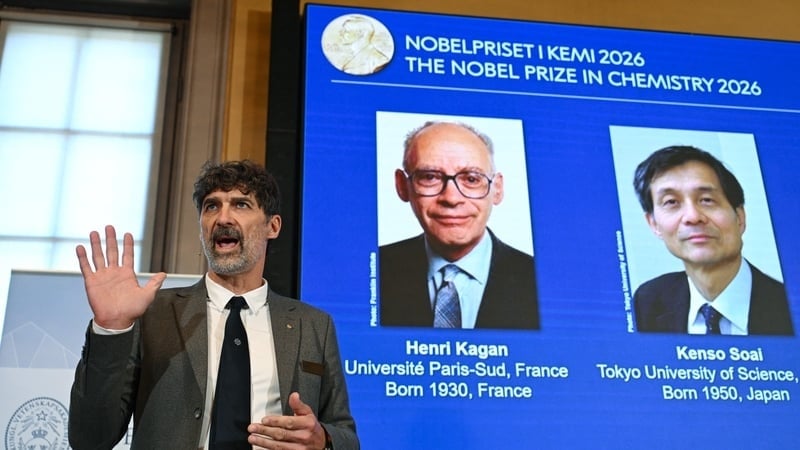
“Henri B Kagan at Paris-Sud University in France and Kensō Soai at Tokyo University of Science in Japan have been awarded the prize “for the discovery of nonlinear effects and autocatalysis in asymmetric organic synthesis”.” · exact text match
Why: It provides specific affiliations and the official citation, giving readers a verifiable basis for the report.
Claim: The article clearly explains a technical chemistry subject for a general audience using coherent analogy.
“Many molecules, including amino acids that form the building blocks of proteins, can exist in two forms that contain the same atoms, but are mirror images of one another, much like a person’s left and right hands.” · exact text match
Why: The passage translates chirality into an everyday hand analogy without distorting the concept.
No byline or explicit publication date is present; the 2026 prize date cannot be independently verified from the supplied text.
October 07, 2026 · 0 shares
The strongest framing is positive but matter-of-fact, treating the Nobel Committee's chirality research as a definitive scientific breakthrough and supporting it with explanatory neutral prose.
Automated analysis; not human reviewed.
Limitations: The supplied text mixes the news report with unrelated BBC promotional and 'most read' content; that material was excluded from the analysis.
·
4 of 55 available dimensions scored; omitted dimensions are not treated as neutral.
·
Verified supporting quotes for 2 of 4 scored dimensions.
Claim: The report is written in a neutral, fact-focused register without editorializing.
“The Nobel Prize in Chemistry has been awarded to French scientist Henri B. Kagan and Japan's Kenso Soai for providing a solution to the chemical mystery of life's asymmetry.” · exact text match
“The researchers discovered how nature exclusively makes the correct version of a molecule - rather than its mirror image.” · exact text match
Why: The article's key statements are declarative and factual, and evaluative comments are attributed to named experts rather than voiced by the publisher.
Claim: The report describes and explains the science and the award without prescribing actions or policy.
“By solving the mystery of chirality, Henri Kagan and Kenso Soai worked out how to design chemical reactions to produce much more of the desired version of a molecule.” · exact text match
Why: The text is explanatory and contains no recommendations, calls to action, or policy judgments.
Claim: The article's own prose is factual and neutral; evaluative language appears only in attributed quotations.
“But living organisms on Earth only function with one of those forms.” · exact text match
“Professor Robert Mokaya, president of the UK's Royal Society of Chemistry said it was a "powerful example of how fundamental chemistry can underpin solutions to some of the biggest challenges facing society".” · not found in supplied text
Why: All praise and significance statements are placed with named scientists or officials, while the publisher's own text is descriptive.
Claim: The article is credible in its visible attribution, named sourcing, and contextual explanation.
“Heiner Linke, chair of the Nobel Committee for Chemistry, explained: "Henri Kagan and Kenso Soai have provided a solution to a chemical mystery that is over a century old: how homochirality - the selective production of the correct version of a molecule - can emerge spontaneously."” · not found in supplied text
“Prof Angus Davison, from the University of Nottingham, studies the biology of chirality and said that the Nobel-winning chemistry could help reveal how and why life favours "one-handedness".” · exact text match
Why: The report names institutions and people, identifies sources by role, and quotes them directly while explaining technical context.
The supplied text mixes the news report with unrelated BBC promotional and 'most read' content; that material was excluded from the analysis.
October 07, 2026 · 0 shares
A neutral, attribution-heavy announcement frames the chemistry Nobel as solving a century-old chemical mystery and highlights its pharmaceutical usefulness.
Automated analysis; not human reviewed.
Limitations: The analysis is limited by the absence of a byline, publication date, and publication context; unrelated page headlines and promotional boilerplate in the supplied text were ignored.
·
5 of 55 available dimensions scored; omitted dimensions are not treated as neutral.
·
Verified supporting quotes for 5 of 5 scored dimensions.
Claim: The body is factual and source-attributed, with only the headline using an evaluative word.
“Henri B. Kagan and Kenso Soai have won the Nobel Prize in Chemistry for their discovery of non-linear effects and autocatalysis in asymmetric organic synthesis.” · exact text match
“The Royal Swedish Academy of Sciences announced the winners in Stockholm.” · exact text match
Counterevidence:
“Nobel Prize in Chemistry awarded to duo for 'spectacular' chemical reaction” · exact text match
Why: Declarative, attributed reporting dominates; the headline's quoted 'spectacular' is a mild promotional framing but not echoed by the article's own prose.
Claim: The article is descriptive, reporting the award and explaining the science without prescribing action.
“They won for their discovery of non-linear effects and autocatalysis in asymmetric organic synthesis.” · exact text match
“Dr Kagan and Dr Soai found ways to make chemistry pick a side, designing and manipulating reactions to produce the desired mirror-image.” · exact text match
Why: No imperative, advocacy, or policy recommendation appears.
Claim: The article uses emotionally neutral language in its body.
“Henri B. Kagan and Kenso Soai have won the Nobel Prize in Chemistry for their discovery of non-linear effects and autocatalysis in asymmetric organic synthesis.” · exact text match
Why: The tone is informational; no fear, anger, or celebratory emotion appears in the body.
Claim: The report attributes its central facts to the Royal Swedish Academy of Sciences and quotes the committee chair.
“The Royal Swedish Academy of Sciences announced the winners in Stockholm.” · exact text match
“Heiner Linke, chair of the Nobel Committee for Chemistry, said in a press release.” · exact text match
Why: Official institutional sourcing and direct quotation support the report's reliability; no unsubstantiated claims are apparent.
Claim: The science is explained through reason and analogy rather than irrational or mystical framing.
“Many molecules of life come in versions that look alike but are not exactly identical, like right and left hands.” · exact text match
“Dr Kagan and Dr Soai found ways to make chemistry pick a side, designing and manipulating reactions to produce the desired mirror-image.” · exact text match
Why: The analogies and causal descriptions are grounded in chemistry, not speculation or irrationality.
The analysis is limited by the absence of a byline, publication date, and publication context; unrelated page headlines and promotional boilerplate in the supplied text were ignored.
October 07, 2026 · 0 shares
The strongest framing is positive but matter-of-fact, treating the Nobel Committee's chirality research as a definitive scientific breakthrough and supporting it with explanatory neutral prose.
Automated analysis; not human reviewed.
Limitations: The supplied text mixes the news report with unrelated BBC promotional and 'most read' content; that material was excluded from the analysis.
·
4 of 55 available dimensions scored; omitted dimensions are not treated as neutral.
·
Verified supporting quotes for 2 of 4 scored dimensions.
Claim: The report is written in a neutral, fact-focused register without editorializing.
“The Nobel Prize in Chemistry has been awarded to French scientist Henri B. Kagan and Japan's Kenso Soai for providing a solution to the chemical mystery of life's asymmetry.” · exact text match
“The researchers discovered how nature exclusively makes the correct version of a molecule - rather than its mirror image.” · exact text match
Why: The article's key statements are declarative and factual, and evaluative comments are attributed to named experts rather than voiced by the publisher.
Claim: The report describes and explains the science and the award without prescribing actions or policy.
“By solving the mystery of chirality, Henri Kagan and Kenso Soai worked out how to design chemical reactions to produce much more of the desired version of a molecule.” · exact text match
Why: The text is explanatory and contains no recommendations, calls to action, or policy judgments.
Claim: The article's own prose is factual and neutral; evaluative language appears only in attributed quotations.
“But living organisms on Earth only function with one of those forms.” · exact text match
“Professor Robert Mokaya, president of the UK's Royal Society of Chemistry said it was a "powerful example of how fundamental chemistry can underpin solutions to some of the biggest challenges facing society".” · not found in supplied text
Why: All praise and significance statements are placed with named scientists or officials, while the publisher's own text is descriptive.
Claim: The article is credible in its visible attribution, named sourcing, and contextual explanation.
“Heiner Linke, chair of the Nobel Committee for Chemistry, explained: "Henri Kagan and Kenso Soai have provided a solution to a chemical mystery that is over a century old: how homochirality - the selective production of the correct version of a molecule - can emerge spontaneously."” · not found in supplied text
“Prof Angus Davison, from the University of Nottingham, studies the biology of chirality and said that the Nobel-winning chemistry could help reveal how and why life favours "one-handedness".” · exact text match
Why: The report names institutions and people, identifies sources by role, and quotes them directly while explaining technical context.
The supplied text mixes the news report with unrelated BBC promotional and 'most read' content; that material was excluded from the analysis.
October 07, 2026 · 0 shares
The framing treats the 2026 chemistry Nobel as a consequential scientific advance, using positive impact statements and expert quotations while staying factually descriptive.
Automated analysis; not human reviewed.
Limitations: No byline or explicit publication date is present; the 2026 prize date cannot be independently verified from the supplied text.
·
5 of 55 available dimensions scored; omitted dimensions are not treated as neutral.
·
Verified supporting quotes for 5 of 5 scored dimensions.
Claim: The article reports the award and its context in a factual manner, with evaluative statements limited to attributed quotes.
“The Royal Swedish Academy of Sciences announced the winners in Stockholm, Sweden, on Wednesday.” · exact text match
Counterevidence:
““You have to be aware, this is probably the coolest experiment in organic chemistry ever,” said Prof Peter Somfai, an organic chemist at Lund University and a member of the Nobel committee for chemistry.” · exact text match
Why: The publisher states verifiable institutional facts and attributes colorful or evaluative language to a named expert rather than presenting it as its own judgment.
Claim: The article uses sober, expository prose and avoids dramatic framing.
“They will each receive an equal share of a prize of 12m Swedish kronor (about £900,000).” · exact text match
Why: The factual, understated presentation of the prize amount indicates a non-sensational approach.
Claim: The article presents the discovery as having lasting positive impact and significance.
“These insights have since become embedded in the development of catalysts that steer chemical reactions towards producing a particular mirror image form across different industries.” · exact text match
Why: The use of “embedded” and “across different industries” frames the work as an enduring practical success, a positive rather than neutral or negative reading.
Claim: The article is credible because it identifies institutions, named experts, and an exact award citation.
“Henri B Kagan at Paris-Sud University in France and Kensō Soai at Tokyo University of Science in Japan have been awarded the prize “for the discovery of nonlinear effects and autocatalysis in asymmetric organic synthesis”.” · exact text match
Why: It provides specific affiliations and the official citation, giving readers a verifiable basis for the report.
Claim: The article clearly explains a technical chemistry subject for a general audience using coherent analogy.
“Many molecules, including amino acids that form the building blocks of proteins, can exist in two forms that contain the same atoms, but are mirror images of one another, much like a person’s left and right hands.” · exact text match
Why: The passage translates chirality into an everyday hand analogy without distorting the concept.
No byline or explicit publication date is present; the 2026 prize date cannot be independently verified from the supplied text.
The Nobel chemistry prize is reported through a factual, attribution-heavy account, with praise confined to quoted experts rather than adopted as the publisher's own editorial view.
Automated analysis; not human reviewed.
Limitations: The supplied text is short wire copy without a byline or full editorial layer; scores are based only on the visible text.
·
2 of 55 available dimensions scored; omitted dimensions are not treated as neutral.
·
Verified supporting quotes for 2 of 2 scored dimensions.
Claim: The publisher's framing is factual and objective, relying on attributed quotations rather than editorial opinion.
“STOCKHOLM: Henri B Kagan and Kenso Soai won the Nobel Prize in chemistry Wednesday for their efforts to resolve mysterious mirror images in chemical molecules.” · exact text match
Why: The lead states the award and subject declaratively, and subjective praise is clearly attributed to named committee members and scientists rather than presented as the publisher's judgment.
Claim: The article displays high visible credibility through named sources, direct quotes, and disclosure of unreturned requests for comment.
“The French Academy of Sciences, of which Kagan is a member, did not immediately respond to AP request for comment, nor did the Université Paris-Sud.” · exact text match
“The Royal Swedish Academy of Sciences announced the winner in Stockholm.” · exact text match
Why: It names institutions and individuals, repeatedly attributes statements, and notes where comment could not be obtained, supporting trustworthiness.
The supplied text is short wire copy without a byline or full editorial layer; scores are based only on the visible text.
October 07, 2026 · 0 shares
A neutral, attribution-heavy announcement frames the chemistry Nobel as solving a century-old chemical mystery and highlights its pharmaceutical usefulness.
Automated analysis; not human reviewed.
Limitations: The analysis is limited by the absence of a byline, publication date, and publication context; unrelated page headlines and promotional boilerplate in the supplied text were ignored.
·
5 of 55 available dimensions scored; omitted dimensions are not treated as neutral.
·
Verified supporting quotes for 5 of 5 scored dimensions.
Claim: The body is factual and source-attributed, with only the headline using an evaluative word.
“Henri B. Kagan and Kenso Soai have won the Nobel Prize in Chemistry for their discovery of non-linear effects and autocatalysis in asymmetric organic synthesis.” · exact text match
“The Royal Swedish Academy of Sciences announced the winners in Stockholm.” · exact text match
Counterevidence:
“Nobel Prize in Chemistry awarded to duo for 'spectacular' chemical reaction” · exact text match
Why: Declarative, attributed reporting dominates; the headline's quoted 'spectacular' is a mild promotional framing but not echoed by the article's own prose.
Claim: The article is descriptive, reporting the award and explaining the science without prescribing action.
“They won for their discovery of non-linear effects and autocatalysis in asymmetric organic synthesis.” · exact text match
“Dr Kagan and Dr Soai found ways to make chemistry pick a side, designing and manipulating reactions to produce the desired mirror-image.” · exact text match
Why: No imperative, advocacy, or policy recommendation appears.
Claim: The article uses emotionally neutral language in its body.
“Henri B. Kagan and Kenso Soai have won the Nobel Prize in Chemistry for their discovery of non-linear effects and autocatalysis in asymmetric organic synthesis.” · exact text match
Why: The tone is informational; no fear, anger, or celebratory emotion appears in the body.
Claim: The report attributes its central facts to the Royal Swedish Academy of Sciences and quotes the committee chair.
“The Royal Swedish Academy of Sciences announced the winners in Stockholm.” · exact text match
“Heiner Linke, chair of the Nobel Committee for Chemistry, said in a press release.” · exact text match
Why: Official institutional sourcing and direct quotation support the report's reliability; no unsubstantiated claims are apparent.
Claim: The science is explained through reason and analogy rather than irrational or mystical framing.
“Many molecules of life come in versions that look alike but are not exactly identical, like right and left hands.” · exact text match
“Dr Kagan and Dr Soai found ways to make chemistry pick a side, designing and manipulating reactions to produce the desired mirror-image.” · exact text match
Why: The analogies and causal descriptions are grounded in chemistry, not speculation or irrationality.
The analysis is limited by the absence of a byline, publication date, and publication context; unrelated page headlines and promotional boilerplate in the supplied text were ignored.
October 07, 2026 · 0 shares
The reporting is neutral and academy-sourced, presenting the Nobel chemistry award as a decisive breakthrough while otherwise staying descriptive.
The Nobel chemistry prize is awarded annually by the Royal Swedish Academy of Sciences; "last year" in the report refers to the preceding annual prize cycle.
Automated analysis; not human reviewed.
Limitations: No byline, publication source, or issue date is provided, so I could not compare institutional framing or externally verify the factual claims.
·
3 of 55 available dimensions scored; omitted dimensions are not treated as neutral.
·
Verified supporting quotes for 3 of 3 scored dimensions.
Claim: The report is descriptive and source-attributed rather than subjective.
“The pair were honoured "for the discovery of non-linear effects and autocatalysis in asymmetric organic synthesis", the jury said.” · exact text match
“"Henri Kagan and Kenso Soai have provided a solution to a chemical mystery that is over a century old: how homochirality can emerge spontaneously.
The chemical reactions they have developed are spectacular," said Heiner Linke, chair of the Nobel Committee for Chemistry.”
· exact text match
Why: The article relays the academy's citation and committee quotes, names the source, and avoids evaluative language of its own.
Claim: The article is factful and neutral, containing no editorializing in the publisher's own voice.
“The pair were honoured "for the discovery of non-linear effects and autocatalysis in asymmetric organic synthesis", the jury said.” · exact text match
Why: The only positive evaluations appear in attributed quotes from the Nobel committee chair or in the prize citation, not in the publisher's own commentary.
Claim: The article shows strong visible sourcing and attribution.
“the Royal Swedish Academy of Sciences explained.” · exact text match
“said Heiner Linke, chair of the Nobel Committee for Chemistry.” · exact text match
Why: It names the awarding body and committee chair, gives the citation verbatim, and uses direct quotes rather than unlabeled assertions.
No byline, publication source, or issue date is provided, so I could not compare institutional framing or externally verify the factual claims.
October 07, 2026 · 0 shares
A neutral, announcement-led roundup reports the Nobel chemistry award and surrounding prize-schedule details without advocacy.
Automated analysis; not human reviewed.
Limitations: The supplied text repeats the same passages several times and omits publisher or byline, limiting certainty about the original article's exact wording and framing.
·
3 of 55 available dimensions scored; omitted dimensions are not treated as neutral.
·
Verified supporting quotes for 0 of 3 scored dimensions.
Claim: The report is largely objective, with a passing promotional claim.
“"Stockholm: The Nobel Prize in Chemistry on Wednesday was awarded to Henri B. Kagan and Kenso Soai"” · not found in supplied text
Counterevidence:
“"Their discoveries can help tackle some of the world's most pressing problems, like climate change."” · not found in supplied text
Why: Most statements are factual award-and-schedule reports, but the climate-change relevance sentence adds mild evaluative framing.
Claim: The article is descriptive, not prescriptive, focusing on who won and when.
“"Stockholm: The Nobel Prize in Chemistry on Wednesday was awarded to Henri B. Kagan and Kenso Soai"” · not found in supplied text
Why: It reports award outcomes and schedules rather than recommending action.
Claim: The article shows credible visible sourcing by attributing award facts and schedules to the Nobel Prize organisation.
“"Stockholm: The Nobel Prize in Chemistry on Wednesday was awarded to Henri B. Kagan and Kenso Soai"” · not found in supplied text
“"All prize announcements are streamed live by the Nobel Prize organisation."” · not found in supplied text
Why: It provides specific names, citation, monetary amount, and schedule, and identifies the Nobel Prize organisation as the source; no unsupported allegations are present.
The supplied text repeats the same passages several times and omits publisher or byline, limiting certainty about the original article's exact wording and framing.
October 07, 2026 · 0 shares
Neutral, wire-style institutional announcement framing, with mostly factual Nobel context and only a mild celebratory prestige note.
Automated analysis; not human reviewed.
Limitations: The article text contains embedded related-story headlines; I treated only the chemistry Nobel report as substantive page content.
·
5 of 55 available dimensions scored; omitted dimensions are not treated as neutral.
·
Verified supporting quotes for 2 of 5 scored dimensions.
Claim: The article is apolitical and gives no liberal or conservative orientation.
“Scientists Henri Kagan and Kenso Soai won the 2026 Nobel Prize in Chemistry” · exact text match
“The economics prize is a later addition funded by the Swedish central bank” · not found in supplied text
Why: The report contains no partisan ideology, policy advocacy, or left-right framing; the neutral value is supported by the absence of political content.
Claim: The article reports the Nobel announcement primarily through attributed facts rather than the publisher's own evaluation.
“award-giving body said on Wednesday” · exact text match
“The laureates will receive their medals from Sweden’s King Carl XVI Gustaf at a ceremony in Stockholm on December 10” · exact text match
Counterevidence:
“the fame of winning arguably the world’s most prestigious science award” · exact text match
Why: Nearly all sentences are factual or attributed, but the closing phrase inserts a hedged prestige judgment, so the score is strongly objective rather than fully neutral.
Claim: The article avoids sensational or exaggerated treatment of the prize.
“The chemistry Nobel, always the third prize to be awarded during Nobel week, followed those for medicine and physics announced on Monday and Tuesday” · not found in supplied text
“The laureates will receive their medals from Sweden’s King Carl XVI Gustaf at a ceremony in Stockholm on December 10” · exact text match
Why: The tone is largely routine wire reporting; the mild prestige phrase prevents a maximum objective score but does not turn the report sensational.
Claim: The article describes the announcement and ceremony without prescribing any action.
“They also share 12 million Swedish crowns ($1.2 million), as well as the fame of winning arguably the world’s most prestigious science award” · exact text match
“The laureates will receive their medals from Sweden’s King Carl XVI Gustaf at a ceremony in Stockholm on December 10” · exact text match
Why: The story uses declarative, future-tense and historical statements; there are no calls to action, policy recommendations, or 'should' judgments.
Claim: The article shows visible sourcing and attribution for the award decision and explanatory statements.
“award-giving body said on Wednesday” · exact text match
“Heiner Linke, Chair of the Nobel Committee for Chemistry, said” · not found in supplied text
Why: The award fact and explanation are attributed to named or identifiable institutional sources, supporting high credibility; the absence of independent verification or correction practice keeps it below the maximum.
The article text contains embedded related-story headlines; I treated only the chemistry Nobel report as substantive page content.
October 07, 2026 · 0 shares
A brief, source-attributed Nobel preview that uses hedged 'could' language and separates reported outcomes from analyst predictions.
Automated analysis; not human reviewed.
Limitations: No byline is provided, and the article is a short wire brief; scores are based on this single preview item rather than a broader editorial record.
·
4 of 55 available dimensions scored; omitted dimensions are not treated as neutral.
·
Verified supporting quotes for 4 of 4 scored dimensions.
Claim: The report is objective, using factual scheduling and attributed analyst forecasts rather than the publisher's own opinion.
“The Royal Swedish Academy of Sciences will name the 2026 Nobel Prize in Chemistry winner on Wednesday at 11:45 am (0945 GMT), with research into molecules regulating sleep and appetite, gene-editing methods and molecular-scale materials among the leading contenders, according to analysts.” · exact text match
Why: The sentence frames predictions as 'according to analysts' and states the announcement as a scheduled event, indicating objective reporting.
Claim: The writing is plain and procedural rather than sensationalized.
“The award consists of a diploma, a gold medal and 12 million kronor ($1.2 million), shared among recipients if there is more than one winner in a discipline.” · exact text match
Why: The article uses routine, matter-of-fact details and avoids dramatic or emotionally loaded language.
Claim: Predictions and descriptions are consistently attributed to named sources.
“However, David Pendlebury, head of research analysis at Clarivate, said GLP-1 research could receive the chemistry prize instead.” · exact text match
“which science journalist Lars Brostrom, editor for public broadcaster Sveriges Radio, described as "overdue" for recognition.” · exact text match
Why: Named attribution to Clarivate, Pendlebury, Brostrom, and Liu supports visible credibility, although outside claims cannot be independently verified within the text.
Claim: The article's main substance is a forecast of likely Nobel chemistry winners.
“with research into molecules regulating sleep and appetite, gene-editing methods and molecular-scale materials among the leading contenders, according to analysts.” · exact text match
Why: The story is organized around predictions, but it consistently attributes them and uses hedged wording such as 'could receive,' so it is moderately speculative rather than definitive.
No byline is provided, and the article is a short wire brief; scores are based on this single preview item rather than a broader editorial record.
October 07, 2026 · 0 shares
Neutral, wire-style institutional announcement framing, with mostly factual Nobel context and only a mild celebratory prestige note.
Automated analysis; not human reviewed. Limitations: The article text contains embedded related-story headlines; I treated only the chemistry Nobel report as substantive page content. · 5 of 55 available dimensions scored; omitted dimensions are not treated as neutral. · Verified supporting quotes for 2 of 5 scored dimensions.
Claim: The article is apolitical and gives no liberal or conservative orientation.
“Scientists Henri Kagan and Kenso Soai won the 2026 Nobel Prize in Chemistry” · exact text match
“The economics prize is a later addition funded by the Swedish central bank” · not found in supplied text
Why: The report contains no partisan ideology, policy advocacy, or left-right framing; the neutral value is supported by the absence of political content.
Claim: The article reports the Nobel announcement primarily through attributed facts rather than the publisher's own evaluation.
“award-giving body said on Wednesday” · exact text match
“The laureates will receive their medals from Sweden’s King Carl XVI Gustaf at a ceremony in Stockholm on December 10” · exact text match
Counterevidence:
“the fame of winning arguably the world’s most prestigious science award” · exact text match
Why: Nearly all sentences are factual or attributed, but the closing phrase inserts a hedged prestige judgment, so the score is strongly objective rather than fully neutral.
Claim: The article avoids sensational or exaggerated treatment of the prize.
“The chemistry Nobel, always the third prize to be awarded during Nobel week, followed those for medicine and physics announced on Monday and Tuesday” · not found in supplied text
“The laureates will receive their medals from Sweden’s King Carl XVI Gustaf at a ceremony in Stockholm on December 10” · exact text match
Why: The tone is largely routine wire reporting; the mild prestige phrase prevents a maximum objective score but does not turn the report sensational.
Claim: The article describes the announcement and ceremony without prescribing any action.
“They also share 12 million Swedish crowns ($1.2 million), as well as the fame of winning arguably the world’s most prestigious science award” · exact text match
“The laureates will receive their medals from Sweden’s King Carl XVI Gustaf at a ceremony in Stockholm on December 10” · exact text match
Why: The story uses declarative, future-tense and historical statements; there are no calls to action, policy recommendations, or 'should' judgments.
Claim: The article shows visible sourcing and attribution for the award decision and explanatory statements.
“award-giving body said on Wednesday” · exact text match
“Heiner Linke, Chair of the Nobel Committee for Chemistry, said” · not found in supplied text
Why: The award fact and explanation are attributed to named or identifiable institutional sources, supporting high credibility; the absence of independent verification or correction practice keeps it below the maximum.
The article text contains embedded related-story headlines; I treated only the chemistry Nobel report as substantive page content.
October 07, 2026 · 0 shares
A neutral, announcement-led roundup reports the Nobel chemistry award and surrounding prize-schedule details without advocacy.
Automated analysis; not human reviewed. Limitations: The supplied text repeats the same passages several times and omits publisher or byline, limiting certainty about the original article's exact wording and framing. · 3 of 55 available dimensions scored; omitted dimensions are not treated as neutral. · Verified supporting quotes for 0 of 3 scored dimensions.
Claim: The report is largely objective, with a passing promotional claim.
“"Stockholm: The Nobel Prize in Chemistry on Wednesday was awarded to Henri B. Kagan and Kenso Soai"” · not found in supplied text
Counterevidence:
“"Their discoveries can help tackle some of the world's most pressing problems, like climate change."” · not found in supplied text
Why: Most statements are factual award-and-schedule reports, but the climate-change relevance sentence adds mild evaluative framing.
Claim: The article is descriptive, not prescriptive, focusing on who won and when.
“"Stockholm: The Nobel Prize in Chemistry on Wednesday was awarded to Henri B. Kagan and Kenso Soai"” · not found in supplied text
Why: It reports award outcomes and schedules rather than recommending action.
Claim: The article shows credible visible sourcing by attributing award facts and schedules to the Nobel Prize organisation.
“"Stockholm: The Nobel Prize in Chemistry on Wednesday was awarded to Henri B. Kagan and Kenso Soai"” · not found in supplied text
“"All prize announcements are streamed live by the Nobel Prize organisation."” · not found in supplied text
Why: It provides specific names, citation, monetary amount, and schedule, and identifies the Nobel Prize organisation as the source; no unsupported allegations are present.
The supplied text repeats the same passages several times and omits publisher or byline, limiting certainty about the original article's exact wording and framing.
October 07, 2026 · 0 shares
The framing treats the 2026 chemistry Nobel as a consequential scientific advance, using positive impact statements and expert quotations while staying factually descriptive.
Automated analysis; not human reviewed. Limitations: No byline or explicit publication date is present; the 2026 prize date cannot be independently verified from the supplied text. · 5 of 55 available dimensions scored; omitted dimensions are not treated as neutral. · Verified supporting quotes for 5 of 5 scored dimensions.
Claim: The article reports the award and its context in a factual manner, with evaluative statements limited to attributed quotes.
“The Royal Swedish Academy of Sciences announced the winners in Stockholm, Sweden, on Wednesday.” · exact text match
Counterevidence:
““You have to be aware, this is probably the coolest experiment in organic chemistry ever,” said Prof Peter Somfai, an organic chemist at Lund University and a member of the Nobel committee for chemistry.” · exact text match
Why: The publisher states verifiable institutional facts and attributes colorful or evaluative language to a named expert rather than presenting it as its own judgment.
Claim: The article uses sober, expository prose and avoids dramatic framing.
“They will each receive an equal share of a prize of 12m Swedish kronor (about £900,000).” · exact text match
Why: The factual, understated presentation of the prize amount indicates a non-sensational approach.
Claim: The article presents the discovery as having lasting positive impact and significance.
“These insights have since become embedded in the development of catalysts that steer chemical reactions towards producing a particular mirror image form across different industries.” · exact text match
Why: The use of “embedded” and “across different industries” frames the work as an enduring practical success, a positive rather than neutral or negative reading.
Claim: The article is credible because it identifies institutions, named experts, and an exact award citation.
“Henri B Kagan at Paris-Sud University in France and Kensō Soai at Tokyo University of Science in Japan have been awarded the prize “for the discovery of nonlinear effects and autocatalysis in asymmetric organic synthesis”.” · exact text match
Why: It provides specific affiliations and the official citation, giving readers a verifiable basis for the report.
Claim: The article clearly explains a technical chemistry subject for a general audience using coherent analogy.
“Many molecules, including amino acids that form the building blocks of proteins, can exist in two forms that contain the same atoms, but are mirror images of one another, much like a person’s left and right hands.” · exact text match
Why: The passage translates chirality into an everyday hand analogy without distorting the concept.
No byline or explicit publication date is present; the 2026 prize date cannot be independently verified from the supplied text.
October 07, 2026 · 0 shares
A neutral, attribution-heavy announcement frames the chemistry Nobel as solving a century-old chemical mystery and highlights its pharmaceutical usefulness.
Automated analysis; not human reviewed. Limitations: The analysis is limited by the absence of a byline, publication date, and publication context; unrelated page headlines and promotional boilerplate in the supplied text were ignored. · 5 of 55 available dimensions scored; omitted dimensions are not treated as neutral. · Verified supporting quotes for 5 of 5 scored dimensions.
Claim: The body is factual and source-attributed, with only the headline using an evaluative word.
“Henri B. Kagan and Kenso Soai have won the Nobel Prize in Chemistry for their discovery of non-linear effects and autocatalysis in asymmetric organic synthesis.” · exact text match
“The Royal Swedish Academy of Sciences announced the winners in Stockholm.” · exact text match
Counterevidence:
“Nobel Prize in Chemistry awarded to duo for 'spectacular' chemical reaction” · exact text match
Why: Declarative, attributed reporting dominates; the headline's quoted 'spectacular' is a mild promotional framing but not echoed by the article's own prose.
Claim: The article is descriptive, reporting the award and explaining the science without prescribing action.
“They won for their discovery of non-linear effects and autocatalysis in asymmetric organic synthesis.” · exact text match
“Dr Kagan and Dr Soai found ways to make chemistry pick a side, designing and manipulating reactions to produce the desired mirror-image.” · exact text match
Why: No imperative, advocacy, or policy recommendation appears.
Claim: The article uses emotionally neutral language in its body.
“Henri B. Kagan and Kenso Soai have won the Nobel Prize in Chemistry for their discovery of non-linear effects and autocatalysis in asymmetric organic synthesis.” · exact text match
Why: The tone is informational; no fear, anger, or celebratory emotion appears in the body.
Claim: The report attributes its central facts to the Royal Swedish Academy of Sciences and quotes the committee chair.
“The Royal Swedish Academy of Sciences announced the winners in Stockholm.” · exact text match
“Heiner Linke, chair of the Nobel Committee for Chemistry, said in a press release.” · exact text match
Why: Official institutional sourcing and direct quotation support the report's reliability; no unsubstantiated claims are apparent.
Claim: The science is explained through reason and analogy rather than irrational or mystical framing.
“Many molecules of life come in versions that look alike but are not exactly identical, like right and left hands.” · exact text match
“Dr Kagan and Dr Soai found ways to make chemistry pick a side, designing and manipulating reactions to produce the desired mirror-image.” · exact text match
Why: The analogies and causal descriptions are grounded in chemistry, not speculation or irrationality.
The analysis is limited by the absence of a byline, publication date, and publication context; unrelated page headlines and promotional boilerplate in the supplied text were ignored.
October 07, 2026 · 0 shares
The strongest framing is positive but matter-of-fact, treating the Nobel Committee's chirality research as a definitive scientific breakthrough and supporting it with explanatory neutral prose.
Automated analysis; not human reviewed. Limitations: The supplied text mixes the news report with unrelated BBC promotional and 'most read' content; that material was excluded from the analysis. · 4 of 55 available dimensions scored; omitted dimensions are not treated as neutral. · Verified supporting quotes for 2 of 4 scored dimensions.
Claim: The report is written in a neutral, fact-focused register without editorializing.
“The Nobel Prize in Chemistry has been awarded to French scientist Henri B. Kagan and Japan's Kenso Soai for providing a solution to the chemical mystery of life's asymmetry.” · exact text match
“The researchers discovered how nature exclusively makes the correct version of a molecule - rather than its mirror image.” · exact text match
Why: The article's key statements are declarative and factual, and evaluative comments are attributed to named experts rather than voiced by the publisher.
Claim: The report describes and explains the science and the award without prescribing actions or policy.
“By solving the mystery of chirality, Henri Kagan and Kenso Soai worked out how to design chemical reactions to produce much more of the desired version of a molecule.” · exact text match
Why: The text is explanatory and contains no recommendations, calls to action, or policy judgments.
Claim: The article's own prose is factual and neutral; evaluative language appears only in attributed quotations.
“But living organisms on Earth only function with one of those forms.” · exact text match
“Professor Robert Mokaya, president of the UK's Royal Society of Chemistry said it was a "powerful example of how fundamental chemistry can underpin solutions to some of the biggest challenges facing society".” · not found in supplied text
Why: All praise and significance statements are placed with named scientists or officials, while the publisher's own text is descriptive.
Claim: The article is credible in its visible attribution, named sourcing, and contextual explanation.
“Heiner Linke, chair of the Nobel Committee for Chemistry, explained: "Henri Kagan and Kenso Soai have provided a solution to a chemical mystery that is over a century old: how homochirality - the selective production of the correct version of a molecule - can emerge spontaneously."” · not found in supplied text
“Prof Angus Davison, from the University of Nottingham, studies the biology of chirality and said that the Nobel-winning chemistry could help reveal how and why life favours "one-handedness".” · exact text match
Why: The report names institutions and people, identifies sources by role, and quotes them directly while explaining technical context.
The supplied text mixes the news report with unrelated BBC promotional and 'most read' content; that material was excluded from the analysis.
The Nobel chemistry prize is reported through a factual, attribution-heavy account, with praise confined to quoted experts rather than adopted as the publisher's own editorial view.
Automated analysis; not human reviewed. Limitations: The supplied text is short wire copy without a byline or full editorial layer; scores are based only on the visible text. · 2 of 55 available dimensions scored; omitted dimensions are not treated as neutral. · Verified supporting quotes for 2 of 2 scored dimensions.
Claim: The publisher's framing is factual and objective, relying on attributed quotations rather than editorial opinion.
“STOCKHOLM: Henri B Kagan and Kenso Soai won the Nobel Prize in chemistry Wednesday for their efforts to resolve mysterious mirror images in chemical molecules.” · exact text match
Why: The lead states the award and subject declaratively, and subjective praise is clearly attributed to named committee members and scientists rather than presented as the publisher's judgment.
Claim: The article displays high visible credibility through named sources, direct quotes, and disclosure of unreturned requests for comment.
“The French Academy of Sciences, of which Kagan is a member, did not immediately respond to AP request for comment, nor did the Université Paris-Sud.” · exact text match
“The Royal Swedish Academy of Sciences announced the winner in Stockholm.” · exact text match
Why: It names institutions and individuals, repeatedly attributes statements, and notes where comment could not be obtained, supporting trustworthiness.
The supplied text is short wire copy without a byline or full editorial layer; scores are based only on the visible text.
October 07, 2026 · 0 shares
A brief, source-attributed Nobel preview that uses hedged 'could' language and separates reported outcomes from analyst predictions.
Automated analysis; not human reviewed. Limitations: No byline is provided, and the article is a short wire brief; scores are based on this single preview item rather than a broader editorial record. · 4 of 55 available dimensions scored; omitted dimensions are not treated as neutral. · Verified supporting quotes for 4 of 4 scored dimensions.
Claim: The report is objective, using factual scheduling and attributed analyst forecasts rather than the publisher's own opinion.
“The Royal Swedish Academy of Sciences will name the 2026 Nobel Prize in Chemistry winner on Wednesday at 11:45 am (0945 GMT), with research into molecules regulating sleep and appetite, gene-editing methods and molecular-scale materials among the leading contenders, according to analysts.” · exact text match
Why: The sentence frames predictions as 'according to analysts' and states the announcement as a scheduled event, indicating objective reporting.
Claim: The writing is plain and procedural rather than sensationalized.
“The award consists of a diploma, a gold medal and 12 million kronor ($1.2 million), shared among recipients if there is more than one winner in a discipline.” · exact text match
Why: The article uses routine, matter-of-fact details and avoids dramatic or emotionally loaded language.
Claim: Predictions and descriptions are consistently attributed to named sources.
“However, David Pendlebury, head of research analysis at Clarivate, said GLP-1 research could receive the chemistry prize instead.” · exact text match
“which science journalist Lars Brostrom, editor for public broadcaster Sveriges Radio, described as "overdue" for recognition.” · exact text match
Why: Named attribution to Clarivate, Pendlebury, Brostrom, and Liu supports visible credibility, although outside claims cannot be independently verified within the text.
Claim: The article's main substance is a forecast of likely Nobel chemistry winners.
“with research into molecules regulating sleep and appetite, gene-editing methods and molecular-scale materials among the leading contenders, according to analysts.” · exact text match
Why: The story is organized around predictions, but it consistently attributes them and uses hedged wording such as 'could receive,' so it is moderately speculative rather than definitive.
No byline is provided, and the article is a short wire brief; scores are based on this single preview item rather than a broader editorial record.
Nobel Committee / Institutional Science Establishment
October 07, 2026 · 0 shares
A neutral, attribution-heavy announcement frames the chemistry Nobel as solving a century-old chemical mystery and highlights its pharmaceutical usefulness.
Automated analysis; not human reviewed. Limitations: The analysis is limited by the absence of a byline, publication date, and publication context; unrelated page headlines and promotional boilerplate in the supplied text were ignored. · 5 of 55 available dimensions scored; omitted dimensions are not treated as neutral. · Verified supporting quotes for 5 of 5 scored dimensions.
Claim: The body is factual and source-attributed, with only the headline using an evaluative word.
“Henri B. Kagan and Kenso Soai have won the Nobel Prize in Chemistry for their discovery of non-linear effects and autocatalysis in asymmetric organic synthesis.” · exact text match
“The Royal Swedish Academy of Sciences announced the winners in Stockholm.” · exact text match
Counterevidence:
“Nobel Prize in Chemistry awarded to duo for 'spectacular' chemical reaction” · exact text match
Why: Declarative, attributed reporting dominates; the headline's quoted 'spectacular' is a mild promotional framing but not echoed by the article's own prose.
Claim: The article is descriptive, reporting the award and explaining the science without prescribing action.
“They won for their discovery of non-linear effects and autocatalysis in asymmetric organic synthesis.” · exact text match
“Dr Kagan and Dr Soai found ways to make chemistry pick a side, designing and manipulating reactions to produce the desired mirror-image.” · exact text match
Why: No imperative, advocacy, or policy recommendation appears.
Claim: The article uses emotionally neutral language in its body.
“Henri B. Kagan and Kenso Soai have won the Nobel Prize in Chemistry for their discovery of non-linear effects and autocatalysis in asymmetric organic synthesis.” · exact text match
Why: The tone is informational; no fear, anger, or celebratory emotion appears in the body.
Claim: The report attributes its central facts to the Royal Swedish Academy of Sciences and quotes the committee chair.
“The Royal Swedish Academy of Sciences announced the winners in Stockholm.” · exact text match
“Heiner Linke, chair of the Nobel Committee for Chemistry, said in a press release.” · exact text match
Why: Official institutional sourcing and direct quotation support the report's reliability; no unsubstantiated claims are apparent.
Claim: The science is explained through reason and analogy rather than irrational or mystical framing.
“Many molecules of life come in versions that look alike but are not exactly identical, like right and left hands.” · exact text match
“Dr Kagan and Dr Soai found ways to make chemistry pick a side, designing and manipulating reactions to produce the desired mirror-image.” · exact text match
Why: The analogies and causal descriptions are grounded in chemistry, not speculation or irrationality.
The analysis is limited by the absence of a byline, publication date, and publication context; unrelated page headlines and promotional boilerplate in the supplied text were ignored.
October 07, 2026 · 0 shares
The strongest framing is positive but matter-of-fact, treating the Nobel Committee's chirality research as a definitive scientific breakthrough and supporting it with explanatory neutral prose.
Automated analysis; not human reviewed. Limitations: The supplied text mixes the news report with unrelated BBC promotional and 'most read' content; that material was excluded from the analysis. · 4 of 55 available dimensions scored; omitted dimensions are not treated as neutral. · Verified supporting quotes for 2 of 4 scored dimensions.
Claim: The report is written in a neutral, fact-focused register without editorializing.
“The Nobel Prize in Chemistry has been awarded to French scientist Henri B. Kagan and Japan's Kenso Soai for providing a solution to the chemical mystery of life's asymmetry.” · exact text match
“The researchers discovered how nature exclusively makes the correct version of a molecule - rather than its mirror image.” · exact text match
Why: The article's key statements are declarative and factual, and evaluative comments are attributed to named experts rather than voiced by the publisher.
Claim: The report describes and explains the science and the award without prescribing actions or policy.
“By solving the mystery of chirality, Henri Kagan and Kenso Soai worked out how to design chemical reactions to produce much more of the desired version of a molecule.” · exact text match
Why: The text is explanatory and contains no recommendations, calls to action, or policy judgments.
Claim: The article's own prose is factual and neutral; evaluative language appears only in attributed quotations.
“But living organisms on Earth only function with one of those forms.” · exact text match
“Professor Robert Mokaya, president of the UK's Royal Society of Chemistry said it was a "powerful example of how fundamental chemistry can underpin solutions to some of the biggest challenges facing society".” · not found in supplied text
Why: All praise and significance statements are placed with named scientists or officials, while the publisher's own text is descriptive.
Claim: The article is credible in its visible attribution, named sourcing, and contextual explanation.
“Heiner Linke, chair of the Nobel Committee for Chemistry, explained: "Henri Kagan and Kenso Soai have provided a solution to a chemical mystery that is over a century old: how homochirality - the selective production of the correct version of a molecule - can emerge spontaneously."” · not found in supplied text
“Prof Angus Davison, from the University of Nottingham, studies the biology of chirality and said that the Nobel-winning chemistry could help reveal how and why life favours "one-handedness".” · exact text match
Why: The report names institutions and people, identifies sources by role, and quotes them directly while explaining technical context.
The supplied text mixes the news report with unrelated BBC promotional and 'most read' content; that material was excluded from the analysis.
October 07, 2026 · 0 shares
A wire-style announcement treats the Nobel Committee's award and scientific rationale as settled facts, adding prize-season schedule details rather than commentary.
Automated analysis; not human reviewed. Limitations: The supplied text includes scraper artifacts and no publication metadata, so the award result, date, and source context could not be independently verified; two appended headline snippets were treated as page chrome. · 6 of 55 available dimensions scored; omitted dimensions are not treated as neutral. · Verified supporting quotes for 5 of 6 scored dimensions.
Claim: The article conveys the award mainly through attributed jury and Academy statements rather than through the writer's own evaluation.
“The jury honored the pair "for the discovery of non-linear effects and autocatalysis in asymmetric organic synthesis."” · exact text match
“a phenomenon known as "homochirality," the Royal Swedish Academy of Sciences explained” · exact text match
Why: The award citation and scientific explanation are attributed to named institutional sources, with only a brief evaluative phrase elsewhere.
Claim: The report is dry and announcement-like, without dramatic or shocking presentation.
“The Nobel consists of a diploma, a gold medal and a prize sum of 12 million kronor ($1.2 million), which is shared if there is more than one winner in a discipline.” · exact text match
Why: It includes routine prize logistics rather than emotive or crisis framing.
Claim: The article reports past and scheduled Nobel announcements rather than telling readers what should be done.
“The chemistry prize follows the physics prize, which on Tuesday honored Belgian physicist Francis Halzen for groundbreaking work using Antarctic ice to capture particles originating in the distant cosmos.” · exact text match
Why: The sentence describes the sequence of award announcements without recommending action.
Claim: The story presents an internally well-sourced news report, with claims attributed to the Nobel jury, the Academy, and a named committee chair.
“a phenomenon known as "homochirality," the Royal Swedish Academy of Sciences explained” · exact text match
“said Heiner Linke, chair of the Nobel Committee for Chemistry” · exact text match
Why: The visible sourcing and attribution are strong, but the report lacks a date and independent confirmation within the supplied text.
Claim: The article frames the award through a scientific explanation of homochirality and asymmetric synthesis.
“Like hands, all amino acids exist as two mirrored variants, but only one of them is found in the proteins in the body's cells.” · not found in supplied text
Why: It adopts the Academy's empirical and scientific framing of the laureates' work.
Claim: A secondary passage includes pundit speculation about future Nobel awards.
“The literature laureate will be revealed Thursday, with some pundits suggesting that the Swedish Academy could follow last year's award to Hungary's Laszlo Krasznahorkai with a prize for a woman writer, possibly from Latin America.” · exact text match
Why: The future literature prize is explicitly described as pundits' suggestion rather than as established fact.
The supplied text includes scraper artifacts and no publication metadata, so the award result, date, and source context could not be independently verified; two appended headline snippets were treated as page chrome.
The Nobel chemistry prize is reported through a factual, attribution-heavy account, with praise confined to quoted experts rather than adopted as the publisher's own editorial view.
Automated analysis; not human reviewed. Limitations: The supplied text is short wire copy without a byline or full editorial layer; scores are based only on the visible text. · 2 of 55 available dimensions scored; omitted dimensions are not treated as neutral. · Verified supporting quotes for 2 of 2 scored dimensions.
Claim: The publisher's framing is factual and objective, relying on attributed quotations rather than editorial opinion.
“STOCKHOLM: Henri B Kagan and Kenso Soai won the Nobel Prize in chemistry Wednesday for their efforts to resolve mysterious mirror images in chemical molecules.” · exact text match
Why: The lead states the award and subject declaratively, and subjective praise is clearly attributed to named committee members and scientists rather than presented as the publisher's judgment.
Claim: The article displays high visible credibility through named sources, direct quotes, and disclosure of unreturned requests for comment.
“The French Academy of Sciences, of which Kagan is a member, did not immediately respond to AP request for comment, nor did the Université Paris-Sud.” · exact text match
“The Royal Swedish Academy of Sciences announced the winner in Stockholm.” · exact text match
Why: It names institutions and individuals, repeatedly attributes statements, and notes where comment could not be obtained, supporting trustworthiness.
The supplied text is short wire copy without a byline or full editorial layer; scores are based only on the visible text.
October 07, 2026 · 0 shares
The strongest framing is positive but matter-of-fact, treating the Nobel Committee's chirality research as a definitive scientific breakthrough and supporting it with explanatory neutral prose.
Automated analysis; not human reviewed. Limitations: The supplied text mixes the news report with unrelated BBC promotional and 'most read' content; that material was excluded from the analysis. · 4 of 55 available dimensions scored; omitted dimensions are not treated as neutral. · Verified supporting quotes for 2 of 4 scored dimensions.
Claim: The report is written in a neutral, fact-focused register without editorializing.
“The Nobel Prize in Chemistry has been awarded to French scientist Henri B. Kagan and Japan's Kenso Soai for providing a solution to the chemical mystery of life's asymmetry.” · exact text match
“The researchers discovered how nature exclusively makes the correct version of a molecule - rather than its mirror image.” · exact text match
Why: The article's key statements are declarative and factual, and evaluative comments are attributed to named experts rather than voiced by the publisher.
Claim: The report describes and explains the science and the award without prescribing actions or policy.
“By solving the mystery of chirality, Henri Kagan and Kenso Soai worked out how to design chemical reactions to produce much more of the desired version of a molecule.” · exact text match
Why: The text is explanatory and contains no recommendations, calls to action, or policy judgments.
Claim: The article's own prose is factual and neutral; evaluative language appears only in attributed quotations.
“But living organisms on Earth only function with one of those forms.” · exact text match
“Professor Robert Mokaya, president of the UK's Royal Society of Chemistry said it was a "powerful example of how fundamental chemistry can underpin solutions to some of the biggest challenges facing society".” · not found in supplied text
Why: All praise and significance statements are placed with named scientists or officials, while the publisher's own text is descriptive.
Claim: The article is credible in its visible attribution, named sourcing, and contextual explanation.
“Heiner Linke, chair of the Nobel Committee for Chemistry, explained: "Henri Kagan and Kenso Soai have provided a solution to a chemical mystery that is over a century old: how homochirality - the selective production of the correct version of a molecule - can emerge spontaneously."” · not found in supplied text
“Prof Angus Davison, from the University of Nottingham, studies the biology of chirality and said that the Nobel-winning chemistry could help reveal how and why life favours "one-handedness".” · exact text match
Why: The report names institutions and people, identifies sources by role, and quotes them directly while explaining technical context.
The supplied text mixes the news report with unrelated BBC promotional and 'most read' content; that material was excluded from the analysis.
Pharma/Industry Angle
October 07, 2026 · 0 shares
A neutral, attribution-heavy announcement frames the chemistry Nobel as solving a century-old chemical mystery and highlights its pharmaceutical usefulness.
Automated analysis; not human reviewed. Limitations: The analysis is limited by the absence of a byline, publication date, and publication context; unrelated page headlines and promotional boilerplate in the supplied text were ignored. · 5 of 55 available dimensions scored; omitted dimensions are not treated as neutral. · Verified supporting quotes for 5 of 5 scored dimensions.
Claim: The body is factual and source-attributed, with only the headline using an evaluative word.
“Henri B. Kagan and Kenso Soai have won the Nobel Prize in Chemistry for their discovery of non-linear effects and autocatalysis in asymmetric organic synthesis.” · exact text match
“The Royal Swedish Academy of Sciences announced the winners in Stockholm.” · exact text match
Counterevidence:
“Nobel Prize in Chemistry awarded to duo for 'spectacular' chemical reaction” · exact text match
Why: Declarative, attributed reporting dominates; the headline's quoted 'spectacular' is a mild promotional framing but not echoed by the article's own prose.
Claim: The article is descriptive, reporting the award and explaining the science without prescribing action.
“They won for their discovery of non-linear effects and autocatalysis in asymmetric organic synthesis.” · exact text match
“Dr Kagan and Dr Soai found ways to make chemistry pick a side, designing and manipulating reactions to produce the desired mirror-image.” · exact text match
Why: No imperative, advocacy, or policy recommendation appears.
Claim: The article uses emotionally neutral language in its body.
“Henri B. Kagan and Kenso Soai have won the Nobel Prize in Chemistry for their discovery of non-linear effects and autocatalysis in asymmetric organic synthesis.” · exact text match
Why: The tone is informational; no fear, anger, or celebratory emotion appears in the body.
Claim: The report attributes its central facts to the Royal Swedish Academy of Sciences and quotes the committee chair.
“The Royal Swedish Academy of Sciences announced the winners in Stockholm.” · exact text match
“Heiner Linke, chair of the Nobel Committee for Chemistry, said in a press release.” · exact text match
Why: Official institutional sourcing and direct quotation support the report's reliability; no unsubstantiated claims are apparent.
Claim: The science is explained through reason and analogy rather than irrational or mystical framing.
“Many molecules of life come in versions that look alike but are not exactly identical, like right and left hands.” · exact text match
“Dr Kagan and Dr Soai found ways to make chemistry pick a side, designing and manipulating reactions to produce the desired mirror-image.” · exact text match
Why: The analogies and causal descriptions are grounded in chemistry, not speculation or irrationality.
The analysis is limited by the absence of a byline, publication date, and publication context; unrelated page headlines and promotional boilerplate in the supplied text were ignored.
October 07, 2026 · 0 shares
The reporting is neutral and academy-sourced, presenting the Nobel chemistry award as a decisive breakthrough while otherwise staying descriptive.
The Nobel chemistry prize is awarded annually by the Royal Swedish Academy of Sciences; "last year" in the report refers to the preceding annual prize cycle.
Automated analysis; not human reviewed. Limitations: No byline, publication source, or issue date is provided, so I could not compare institutional framing or externally verify the factual claims. · 3 of 55 available dimensions scored; omitted dimensions are not treated as neutral. · Verified supporting quotes for 3 of 3 scored dimensions.
Claim: The report is descriptive and source-attributed rather than subjective.
“The pair were honoured "for the discovery of non-linear effects and autocatalysis in asymmetric organic synthesis", the jury said.” · exact text match
“"Henri Kagan and Kenso Soai have provided a solution to a chemical mystery that is over a century old: how homochirality can emerge spontaneously. The chemical reactions they have developed are spectacular," said Heiner Linke, chair of the Nobel Committee for Chemistry.” · exact text match
Why: The article relays the academy's citation and committee quotes, names the source, and avoids evaluative language of its own.
Claim: The article is factful and neutral, containing no editorializing in the publisher's own voice.
“The pair were honoured "for the discovery of non-linear effects and autocatalysis in asymmetric organic synthesis", the jury said.” · exact text match
Why: The only positive evaluations appear in attributed quotes from the Nobel committee chair or in the prize citation, not in the publisher's own commentary.
Claim: The article shows strong visible sourcing and attribution.
“the Royal Swedish Academy of Sciences explained.” · exact text match
“said Heiner Linke, chair of the Nobel Committee for Chemistry.” · exact text match
Why: It names the awarding body and committee chair, gives the citation verbatim, and uses direct quotes rather than unlabeled assertions.
No byline, publication source, or issue date is provided, so I could not compare institutional framing or externally verify the factual claims.
The Nobel chemistry prize is reported through a factual, attribution-heavy account, with praise confined to quoted experts rather than adopted as the publisher's own editorial view.
Automated analysis; not human reviewed. Limitations: The supplied text is short wire copy without a byline or full editorial layer; scores are based only on the visible text. · 2 of 55 available dimensions scored; omitted dimensions are not treated as neutral. · Verified supporting quotes for 2 of 2 scored dimensions.
Claim: The publisher's framing is factual and objective, relying on attributed quotations rather than editorial opinion.
“STOCKHOLM: Henri B Kagan and Kenso Soai won the Nobel Prize in chemistry Wednesday for their efforts to resolve mysterious mirror images in chemical molecules.” · exact text match
Why: The lead states the award and subject declaratively, and subjective praise is clearly attributed to named committee members and scientists rather than presented as the publisher's judgment.
Claim: The article displays high visible credibility through named sources, direct quotes, and disclosure of unreturned requests for comment.
“The French Academy of Sciences, of which Kagan is a member, did not immediately respond to AP request for comment, nor did the Université Paris-Sud.” · exact text match
“The Royal Swedish Academy of Sciences announced the winner in Stockholm.” · exact text match
Why: It names institutions and individuals, repeatedly attributes statements, and notes where comment could not be obtained, supporting trustworthiness.
The supplied text is short wire copy without a byline or full editorial layer; scores are based only on the visible text.
October 07, 2026 · 0 shares
The framing treats the 2026 chemistry Nobel as a consequential scientific advance, using positive impact statements and expert quotations while staying factually descriptive.
Automated analysis; not human reviewed. Limitations: No byline or explicit publication date is present; the 2026 prize date cannot be independently verified from the supplied text. · 5 of 55 available dimensions scored; omitted dimensions are not treated as neutral. · Verified supporting quotes for 5 of 5 scored dimensions.
Claim: The article reports the award and its context in a factual manner, with evaluative statements limited to attributed quotes.
“The Royal Swedish Academy of Sciences announced the winners in Stockholm, Sweden, on Wednesday.” · exact text match
Counterevidence:
““You have to be aware, this is probably the coolest experiment in organic chemistry ever,” said Prof Peter Somfai, an organic chemist at Lund University and a member of the Nobel committee for chemistry.” · exact text match
Why: The publisher states verifiable institutional facts and attributes colorful or evaluative language to a named expert rather than presenting it as its own judgment.
Claim: The article uses sober, expository prose and avoids dramatic framing.
“They will each receive an equal share of a prize of 12m Swedish kronor (about £900,000).” · exact text match
Why: The factual, understated presentation of the prize amount indicates a non-sensational approach.
Claim: The article presents the discovery as having lasting positive impact and significance.
“These insights have since become embedded in the development of catalysts that steer chemical reactions towards producing a particular mirror image form across different industries.” · exact text match
Why: The use of “embedded” and “across different industries” frames the work as an enduring practical success, a positive rather than neutral or negative reading.
Claim: The article is credible because it identifies institutions, named experts, and an exact award citation.
“Henri B Kagan at Paris-Sud University in France and Kensō Soai at Tokyo University of Science in Japan have been awarded the prize “for the discovery of nonlinear effects and autocatalysis in asymmetric organic synthesis”.” · exact text match
Why: It provides specific affiliations and the official citation, giving readers a verifiable basis for the report.
Claim: The article clearly explains a technical chemistry subject for a general audience using coherent analogy.
“Many molecules, including amino acids that form the building blocks of proteins, can exist in two forms that contain the same atoms, but are mirror images of one another, much like a person’s left and right hands.” · exact text match
Why: The passage translates chirality into an everyday hand analogy without distorting the concept.
No byline or explicit publication date is present; the 2026 prize date cannot be independently verified from the supplied text.
October 07, 2026 · 0 shares
The strongest framing is positive but matter-of-fact, treating the Nobel Committee's chirality research as a definitive scientific breakthrough and supporting it with explanatory neutral prose.
Automated analysis; not human reviewed. Limitations: The supplied text mixes the news report with unrelated BBC promotional and 'most read' content; that material was excluded from the analysis. · 4 of 55 available dimensions scored; omitted dimensions are not treated as neutral. · Verified supporting quotes for 2 of 4 scored dimensions.
Claim: The report is written in a neutral, fact-focused register without editorializing.
“The Nobel Prize in Chemistry has been awarded to French scientist Henri B. Kagan and Japan's Kenso Soai for providing a solution to the chemical mystery of life's asymmetry.” · exact text match
“The researchers discovered how nature exclusively makes the correct version of a molecule - rather than its mirror image.” · exact text match
Why: The article's key statements are declarative and factual, and evaluative comments are attributed to named experts rather than voiced by the publisher.
Claim: The report describes and explains the science and the award without prescribing actions or policy.
“By solving the mystery of chirality, Henri Kagan and Kenso Soai worked out how to design chemical reactions to produce much more of the desired version of a molecule.” · exact text match
Why: The text is explanatory and contains no recommendations, calls to action, or policy judgments.
Claim: The article's own prose is factual and neutral; evaluative language appears only in attributed quotations.
“But living organisms on Earth only function with one of those forms.” · exact text match
“Professor Robert Mokaya, president of the UK's Royal Society of Chemistry said it was a "powerful example of how fundamental chemistry can underpin solutions to some of the biggest challenges facing society".” · not found in supplied text
Why: All praise and significance statements are placed with named scientists or officials, while the publisher's own text is descriptive.
Claim: The article is credible in its visible attribution, named sourcing, and contextual explanation.
“Heiner Linke, chair of the Nobel Committee for Chemistry, explained: "Henri Kagan and Kenso Soai have provided a solution to a chemical mystery that is over a century old: how homochirality - the selective production of the correct version of a molecule - can emerge spontaneously."” · not found in supplied text
“Prof Angus Davison, from the University of Nottingham, studies the biology of chirality and said that the Nobel-winning chemistry could help reveal how and why life favours "one-handedness".” · exact text match
Why: The report names institutions and people, identifies sources by role, and quotes them directly while explaining technical context.
The supplied text mixes the news report with unrelated BBC promotional and 'most read' content; that material was excluded from the analysis.
Prediction-Market / Clarivate Skeptic View
October 07, 2026 · 0 shares
A brief, source-attributed Nobel preview that uses hedged 'could' language and separates reported outcomes from analyst predictions.
Automated analysis; not human reviewed. Limitations: No byline is provided, and the article is a short wire brief; scores are based on this single preview item rather than a broader editorial record. · 4 of 55 available dimensions scored; omitted dimensions are not treated as neutral. · Verified supporting quotes for 4 of 4 scored dimensions.
Claim: The report is objective, using factual scheduling and attributed analyst forecasts rather than the publisher's own opinion.
“The Royal Swedish Academy of Sciences will name the 2026 Nobel Prize in Chemistry winner on Wednesday at 11:45 am (0945 GMT), with research into molecules regulating sleep and appetite, gene-editing methods and molecular-scale materials among the leading contenders, according to analysts.” · exact text match
Why: The sentence frames predictions as 'according to analysts' and states the announcement as a scheduled event, indicating objective reporting.
Claim: The writing is plain and procedural rather than sensationalized.
“The award consists of a diploma, a gold medal and 12 million kronor ($1.2 million), shared among recipients if there is more than one winner in a discipline.” · exact text match
Why: The article uses routine, matter-of-fact details and avoids dramatic or emotionally loaded language.
Claim: Predictions and descriptions are consistently attributed to named sources.
“However, David Pendlebury, head of research analysis at Clarivate, said GLP-1 research could receive the chemistry prize instead.” · exact text match
“which science journalist Lars Brostrom, editor for public broadcaster Sveriges Radio, described as "overdue" for recognition.” · exact text match
Why: Named attribution to Clarivate, Pendlebury, Brostrom, and Liu supports visible credibility, although outside claims cannot be independently verified within the text.
Claim: The article's main substance is a forecast of likely Nobel chemistry winners.
“with research into molecules regulating sleep and appetite, gene-editing methods and molecular-scale materials among the leading contenders, according to analysts.” · exact text match
Why: The story is organized around predictions, but it consistently attributes them and uses hedged wording such as 'could receive,' so it is moderately speculative rather than definitive.
No byline is provided, and the article is a short wire brief; scores are based on this single preview item rather than a broader editorial record.
Prize-Structure Critics
October 07, 2026 · 0 shares
The framing treats the 2026 chemistry Nobel as a consequential scientific advance, using positive impact statements and expert quotations while staying factually descriptive.
Automated analysis; not human reviewed. Limitations: No byline or explicit publication date is present; the 2026 prize date cannot be independently verified from the supplied text. · 5 of 55 available dimensions scored; omitted dimensions are not treated as neutral. · Verified supporting quotes for 5 of 5 scored dimensions.
Claim: The article reports the award and its context in a factual manner, with evaluative statements limited to attributed quotes.
“The Royal Swedish Academy of Sciences announced the winners in Stockholm, Sweden, on Wednesday.” · exact text match
Counterevidence:
““You have to be aware, this is probably the coolest experiment in organic chemistry ever,” said Prof Peter Somfai, an organic chemist at Lund University and a member of the Nobel committee for chemistry.” · exact text match
Why: The publisher states verifiable institutional facts and attributes colorful or evaluative language to a named expert rather than presenting it as its own judgment.
Claim: The article uses sober, expository prose and avoids dramatic framing.
“They will each receive an equal share of a prize of 12m Swedish kronor (about £900,000).” · exact text match
Why: The factual, understated presentation of the prize amount indicates a non-sensational approach.
Claim: The article presents the discovery as having lasting positive impact and significance.
“These insights have since become embedded in the development of catalysts that steer chemical reactions towards producing a particular mirror image form across different industries.” · exact text match
Why: The use of “embedded” and “across different industries” frames the work as an enduring practical success, a positive rather than neutral or negative reading.
Claim: The article is credible because it identifies institutions, named experts, and an exact award citation.
“Henri B Kagan at Paris-Sud University in France and Kensō Soai at Tokyo University of Science in Japan have been awarded the prize “for the discovery of nonlinear effects and autocatalysis in asymmetric organic synthesis”.” · exact text match
Why: It provides specific affiliations and the official citation, giving readers a verifiable basis for the report.
Claim: The article clearly explains a technical chemistry subject for a general audience using coherent analogy.
“Many molecules, including amino acids that form the building blocks of proteins, can exist in two forms that contain the same atoms, but are mirror images of one another, much like a person’s left and right hands.” · exact text match
Why: The passage translates chirality into an everyday hand analogy without distorting the concept.
No byline or explicit publication date is present; the 2026 prize date cannot be independently verified from the supplied text.
The Nobel chemistry prize is reported through a factual, attribution-heavy account, with praise confined to quoted experts rather than adopted as the publisher's own editorial view.
Automated analysis; not human reviewed. Limitations: The supplied text is short wire copy without a byline or full editorial layer; scores are based only on the visible text. · 2 of 55 available dimensions scored; omitted dimensions are not treated as neutral. · Verified supporting quotes for 2 of 2 scored dimensions.
Claim: The publisher's framing is factual and objective, relying on attributed quotations rather than editorial opinion.
“STOCKHOLM: Henri B Kagan and Kenso Soai won the Nobel Prize in chemistry Wednesday for their efforts to resolve mysterious mirror images in chemical molecules.” · exact text match
Why: The lead states the award and subject declaratively, and subjective praise is clearly attributed to named committee members and scientists rather than presented as the publisher's judgment.
Claim: The article displays high visible credibility through named sources, direct quotes, and disclosure of unreturned requests for comment.
“The French Academy of Sciences, of which Kagan is a member, did not immediately respond to AP request for comment, nor did the Université Paris-Sud.” · exact text match
“The Royal Swedish Academy of Sciences announced the winner in Stockholm.” · exact text match
Why: It names institutions and individuals, repeatedly attributes statements, and notes where comment could not be obtained, supporting trustworthiness.
The supplied text is short wire copy without a byline or full editorial layer; scores are based only on the visible text.
Helium Bias
Story Blindspots
October 07, 2026 · 0 shares
A brief, source-attributed Nobel preview that uses hedged 'could' language and separates reported outcomes from analyst predictions.
Automated analysis; not human reviewed. Limitations: No byline is provided, and the article is a short wire brief; scores are based on this single preview item rather than a broader editorial record. · 4 of 55 available dimensions scored; omitted dimensions are not treated as neutral. · Verified supporting quotes for 4 of 4 scored dimensions.
Claim: The report is objective, using factual scheduling and attributed analyst forecasts rather than the publisher's own opinion.
“The Royal Swedish Academy of Sciences will name the 2026 Nobel Prize in Chemistry winner on Wednesday at 11:45 am (0945 GMT), with research into molecules regulating sleep and appetite, gene-editing methods and molecular-scale materials among the leading contenders, according to analysts.” · exact text match
Why: The sentence frames predictions as 'according to analysts' and states the announcement as a scheduled event, indicating objective reporting.
Claim: The writing is plain and procedural rather than sensationalized.
“The award consists of a diploma, a gold medal and 12 million kronor ($1.2 million), shared among recipients if there is more than one winner in a discipline.” · exact text match
Why: The article uses routine, matter-of-fact details and avoids dramatic or emotionally loaded language.
Claim: Predictions and descriptions are consistently attributed to named sources.
“However, David Pendlebury, head of research analysis at Clarivate, said GLP-1 research could receive the chemistry prize instead.” · exact text match
“which science journalist Lars Brostrom, editor for public broadcaster Sveriges Radio, described as "overdue" for recognition.” · exact text match
Why: Named attribution to Clarivate, Pendlebury, Brostrom, and Liu supports visible credibility, although outside claims cannot be independently verified within the text.
Claim: The article's main substance is a forecast of likely Nobel chemistry winners.
“with research into molecules regulating sleep and appetite, gene-editing methods and molecular-scale materials among the leading contenders, according to analysts.” · exact text match
Why: The story is organized around predictions, but it consistently attributes them and uses hedged wording such as 'could receive,' so it is moderately speculative rather than definitive.
No byline is provided, and the article is a short wire brief; scores are based on this single preview item rather than a broader editorial record.
October 07, 2026 · 0 shares
The framing treats the 2026 chemistry Nobel as a consequential scientific advance, using positive impact statements and expert quotations while staying factually descriptive.
Automated analysis; not human reviewed. Limitations: No byline or explicit publication date is present; the 2026 prize date cannot be independently verified from the supplied text. · 5 of 55 available dimensions scored; omitted dimensions are not treated as neutral. · Verified supporting quotes for 5 of 5 scored dimensions.
Claim: The article reports the award and its context in a factual manner, with evaluative statements limited to attributed quotes.
“The Royal Swedish Academy of Sciences announced the winners in Stockholm, Sweden, on Wednesday.” · exact text match
Counterevidence:
““You have to be aware, this is probably the coolest experiment in organic chemistry ever,” said Prof Peter Somfai, an organic chemist at Lund University and a member of the Nobel committee for chemistry.” · exact text match
Why: The publisher states verifiable institutional facts and attributes colorful or evaluative language to a named expert rather than presenting it as its own judgment.
Claim: The article uses sober, expository prose and avoids dramatic framing.
“They will each receive an equal share of a prize of 12m Swedish kronor (about £900,000).” · exact text match
Why: The factual, understated presentation of the prize amount indicates a non-sensational approach.
Claim: The article presents the discovery as having lasting positive impact and significance.
“These insights have since become embedded in the development of catalysts that steer chemical reactions towards producing a particular mirror image form across different industries.” · exact text match
Why: The use of “embedded” and “across different industries” frames the work as an enduring practical success, a positive rather than neutral or negative reading.
Claim: The article is credible because it identifies institutions, named experts, and an exact award citation.
“Henri B Kagan at Paris-Sud University in France and Kensō Soai at Tokyo University of Science in Japan have been awarded the prize “for the discovery of nonlinear effects and autocatalysis in asymmetric organic synthesis”.” · exact text match
Why: It provides specific affiliations and the official citation, giving readers a verifiable basis for the report.
Claim: The article clearly explains a technical chemistry subject for a general audience using coherent analogy.
“Many molecules, including amino acids that form the building blocks of proteins, can exist in two forms that contain the same atoms, but are mirror images of one another, much like a person’s left and right hands.” · exact text match
Why: The passage translates chirality into an everyday hand analogy without distorting the concept.
No byline or explicit publication date is present; the 2026 prize date cannot be independently verified from the supplied text.
October 07, 2026 · 0 shares
A neutral, announcement-led roundup reports the Nobel chemistry award and surrounding prize-schedule details without advocacy.
Automated analysis; not human reviewed. Limitations: The supplied text repeats the same passages several times and omits publisher or byline, limiting certainty about the original article's exact wording and framing. · 3 of 55 available dimensions scored; omitted dimensions are not treated as neutral. · Verified supporting quotes for 0 of 3 scored dimensions.
Claim: The report is largely objective, with a passing promotional claim.
“"Stockholm: The Nobel Prize in Chemistry on Wednesday was awarded to Henri B. Kagan and Kenso Soai"” · not found in supplied text
Counterevidence:
“"Their discoveries can help tackle some of the world's most pressing problems, like climate change."” · not found in supplied text
Why: Most statements are factual award-and-schedule reports, but the climate-change relevance sentence adds mild evaluative framing.
Claim: The article is descriptive, not prescriptive, focusing on who won and when.
“"Stockholm: The Nobel Prize in Chemistry on Wednesday was awarded to Henri B. Kagan and Kenso Soai"” · not found in supplied text
Why: It reports award outcomes and schedules rather than recommending action.
Claim: The article shows credible visible sourcing by attributing award facts and schedules to the Nobel Prize organisation.
“"Stockholm: The Nobel Prize in Chemistry on Wednesday was awarded to Henri B. Kagan and Kenso Soai"” · not found in supplied text
“"All prize announcements are streamed live by the Nobel Prize organisation."” · not found in supplied text
Why: It provides specific names, citation, monetary amount, and schedule, and identifies the Nobel Prize organisation as the source; no unsupported allegations are present.
The supplied text repeats the same passages several times and omits publisher or byline, limiting certainty about the original article's exact wording and framing.
October 07, 2026 · 0 shares
A brief, source-attributed Nobel preview that uses hedged 'could' language and separates reported outcomes from analyst predictions.
Automated analysis; not human reviewed. Limitations: No byline is provided, and the article is a short wire brief; scores are based on this single preview item rather than a broader editorial record. · 4 of 55 available dimensions scored; omitted dimensions are not treated as neutral. · Verified supporting quotes for 4 of 4 scored dimensions.
Claim: The report is objective, using factual scheduling and attributed analyst forecasts rather than the publisher's own opinion.
“The Royal Swedish Academy of Sciences will name the 2026 Nobel Prize in Chemistry winner on Wednesday at 11:45 am (0945 GMT), with research into molecules regulating sleep and appetite, gene-editing methods and molecular-scale materials among the leading contenders, according to analysts.” · exact text match
Why: The sentence frames predictions as 'according to analysts' and states the announcement as a scheduled event, indicating objective reporting.
Claim: The writing is plain and procedural rather than sensationalized.
“The award consists of a diploma, a gold medal and 12 million kronor ($1.2 million), shared among recipients if there is more than one winner in a discipline.” · exact text match
Why: The article uses routine, matter-of-fact details and avoids dramatic or emotionally loaded language.
Claim: Predictions and descriptions are consistently attributed to named sources.
“However, David Pendlebury, head of research analysis at Clarivate, said GLP-1 research could receive the chemistry prize instead.” · exact text match
“which science journalist Lars Brostrom, editor for public broadcaster Sveriges Radio, described as "overdue" for recognition.” · exact text match
Why: Named attribution to Clarivate, Pendlebury, Brostrom, and Liu supports visible credibility, although outside claims cannot be independently verified within the text.
Claim: The article's main substance is a forecast of likely Nobel chemistry winners.
“with research into molecules regulating sleep and appetite, gene-editing methods and molecular-scale materials among the leading contenders, according to analysts.” · exact text match
Why: The story is organized around predictions, but it consistently attributes them and uses hedged wording such as 'could receive,' so it is moderately speculative rather than definitive.
No byline is provided, and the article is a short wire brief; scores are based on this single preview item rather than a broader editorial record.
October 07, 2026 · 0 shares
The framing treats the 2026 chemistry Nobel as a consequential scientific advance, using positive impact statements and expert quotations while staying factually descriptive.
Automated analysis; not human reviewed. Limitations: No byline or explicit publication date is present; the 2026 prize date cannot be independently verified from the supplied text. · 5 of 55 available dimensions scored; omitted dimensions are not treated as neutral. · Verified supporting quotes for 5 of 5 scored dimensions.
Claim: The article reports the award and its context in a factual manner, with evaluative statements limited to attributed quotes.
“The Royal Swedish Academy of Sciences announced the winners in Stockholm, Sweden, on Wednesday.” · exact text match
Counterevidence:
““You have to be aware, this is probably the coolest experiment in organic chemistry ever,” said Prof Peter Somfai, an organic chemist at Lund University and a member of the Nobel committee for chemistry.” · exact text match
Why: The publisher states verifiable institutional facts and attributes colorful or evaluative language to a named expert rather than presenting it as its own judgment.
Claim: The article uses sober, expository prose and avoids dramatic framing.
“They will each receive an equal share of a prize of 12m Swedish kronor (about £900,000).” · exact text match
Why: The factual, understated presentation of the prize amount indicates a non-sensational approach.
Claim: The article presents the discovery as having lasting positive impact and significance.
“These insights have since become embedded in the development of catalysts that steer chemical reactions towards producing a particular mirror image form across different industries.” · exact text match
Why: The use of “embedded” and “across different industries” frames the work as an enduring practical success, a positive rather than neutral or negative reading.
Claim: The article is credible because it identifies institutions, named experts, and an exact award citation.
“Henri B Kagan at Paris-Sud University in France and Kensō Soai at Tokyo University of Science in Japan have been awarded the prize “for the discovery of nonlinear effects and autocatalysis in asymmetric organic synthesis”.” · exact text match
Why: It provides specific affiliations and the official citation, giving readers a verifiable basis for the report.
Claim: The article clearly explains a technical chemistry subject for a general audience using coherent analogy.
“Many molecules, including amino acids that form the building blocks of proteins, can exist in two forms that contain the same atoms, but are mirror images of one another, much like a person’s left and right hands.” · exact text match
Why: The passage translates chirality into an everyday hand analogy without distorting the concept.
No byline or explicit publication date is present; the 2026 prize date cannot be independently verified from the supplied text.
October 07, 2026 · 0 shares
The strongest framing is positive but matter-of-fact, treating the Nobel Committee's chirality research as a definitive scientific breakthrough and supporting it with explanatory neutral prose.
Automated analysis; not human reviewed. Limitations: The supplied text mixes the news report with unrelated BBC promotional and 'most read' content; that material was excluded from the analysis. · 4 of 55 available dimensions scored; omitted dimensions are not treated as neutral. · Verified supporting quotes for 2 of 4 scored dimensions.
Claim: The report is written in a neutral, fact-focused register without editorializing.
“The Nobel Prize in Chemistry has been awarded to French scientist Henri B. Kagan and Japan's Kenso Soai for providing a solution to the chemical mystery of life's asymmetry.” · exact text match
“The researchers discovered how nature exclusively makes the correct version of a molecule - rather than its mirror image.” · exact text match
Why: The article's key statements are declarative and factual, and evaluative comments are attributed to named experts rather than voiced by the publisher.
Claim: The report describes and explains the science and the award without prescribing actions or policy.
“By solving the mystery of chirality, Henri Kagan and Kenso Soai worked out how to design chemical reactions to produce much more of the desired version of a molecule.” · exact text match
Why: The text is explanatory and contains no recommendations, calls to action, or policy judgments.
Claim: The article's own prose is factual and neutral; evaluative language appears only in attributed quotations.
“But living organisms on Earth only function with one of those forms.” · exact text match
“Professor Robert Mokaya, president of the UK's Royal Society of Chemistry said it was a "powerful example of how fundamental chemistry can underpin solutions to some of the biggest challenges facing society".” · not found in supplied text
Why: All praise and significance statements are placed with named scientists or officials, while the publisher's own text is descriptive.
Claim: The article is credible in its visible attribution, named sourcing, and contextual explanation.
“Heiner Linke, chair of the Nobel Committee for Chemistry, explained: "Henri Kagan and Kenso Soai have provided a solution to a chemical mystery that is over a century old: how homochirality - the selective production of the correct version of a molecule - can emerge spontaneously."” · not found in supplied text
“Prof Angus Davison, from the University of Nottingham, studies the biology of chirality and said that the Nobel-winning chemistry could help reveal how and why life favours "one-handedness".” · exact text match
Why: The report names institutions and people, identifies sources by role, and quotes them directly while explaining technical context.
The supplied text mixes the news report with unrelated BBC promotional and 'most read' content; that material was excluded from the analysis.
October 07, 2026 · 0 shares
The strongest framing is positive but matter-of-fact, treating the Nobel Committee's chirality research as a definitive scientific breakthrough and supporting it with explanatory neutral prose.
Automated analysis; not human reviewed. Limitations: The supplied text mixes the news report with unrelated BBC promotional and 'most read' content; that material was excluded from the analysis. · 4 of 55 available dimensions scored; omitted dimensions are not treated as neutral. · Verified supporting quotes for 2 of 4 scored dimensions.
Claim: The report is written in a neutral, fact-focused register without editorializing.
“The Nobel Prize in Chemistry has been awarded to French scientist Henri B. Kagan and Japan's Kenso Soai for providing a solution to the chemical mystery of life's asymmetry.” · exact text match
“The researchers discovered how nature exclusively makes the correct version of a molecule - rather than its mirror image.” · exact text match
Why: The article's key statements are declarative and factual, and evaluative comments are attributed to named experts rather than voiced by the publisher.
Claim: The report describes and explains the science and the award without prescribing actions or policy.
“By solving the mystery of chirality, Henri Kagan and Kenso Soai worked out how to design chemical reactions to produce much more of the desired version of a molecule.” · exact text match
Why: The text is explanatory and contains no recommendations, calls to action, or policy judgments.
Claim: The article's own prose is factual and neutral; evaluative language appears only in attributed quotations.
“But living organisms on Earth only function with one of those forms.” · exact text match
“Professor Robert Mokaya, president of the UK's Royal Society of Chemistry said it was a "powerful example of how fundamental chemistry can underpin solutions to some of the biggest challenges facing society".” · not found in supplied text
Why: All praise and significance statements are placed with named scientists or officials, while the publisher's own text is descriptive.
Claim: The article is credible in its visible attribution, named sourcing, and contextual explanation.
“Heiner Linke, chair of the Nobel Committee for Chemistry, explained: "Henri Kagan and Kenso Soai have provided a solution to a chemical mystery that is over a century old: how homochirality - the selective production of the correct version of a molecule - can emerge spontaneously."” · not found in supplied text
“Prof Angus Davison, from the University of Nottingham, studies the biology of chirality and said that the Nobel-winning chemistry could help reveal how and why life favours "one-handedness".” · exact text match
Why: The report names institutions and people, identifies sources by role, and quotes them directly while explaining technical context.
The supplied text mixes the news report with unrelated BBC promotional and 'most read' content; that material was excluded from the analysis.
October 07, 2026 · 0 shares
The framing treats the 2026 chemistry Nobel as a consequential scientific advance, using positive impact statements and expert quotations while staying factually descriptive.
Automated analysis; not human reviewed. Limitations: No byline or explicit publication date is present; the 2026 prize date cannot be independently verified from the supplied text. · 5 of 55 available dimensions scored; omitted dimensions are not treated as neutral. · Verified supporting quotes for 5 of 5 scored dimensions.
Claim: The article reports the award and its context in a factual manner, with evaluative statements limited to attributed quotes.
“The Royal Swedish Academy of Sciences announced the winners in Stockholm, Sweden, on Wednesday.” · exact text match
Counterevidence:
““You have to be aware, this is probably the coolest experiment in organic chemistry ever,” said Prof Peter Somfai, an organic chemist at Lund University and a member of the Nobel committee for chemistry.” · exact text match
Why: The publisher states verifiable institutional facts and attributes colorful or evaluative language to a named expert rather than presenting it as its own judgment.
Claim: The article uses sober, expository prose and avoids dramatic framing.
“They will each receive an equal share of a prize of 12m Swedish kronor (about £900,000).” · exact text match
Why: The factual, understated presentation of the prize amount indicates a non-sensational approach.
Claim: The article presents the discovery as having lasting positive impact and significance.
“These insights have since become embedded in the development of catalysts that steer chemical reactions towards producing a particular mirror image form across different industries.” · exact text match
Why: The use of “embedded” and “across different industries” frames the work as an enduring practical success, a positive rather than neutral or negative reading.
Claim: The article is credible because it identifies institutions, named experts, and an exact award citation.
“Henri B Kagan at Paris-Sud University in France and Kensō Soai at Tokyo University of Science in Japan have been awarded the prize “for the discovery of nonlinear effects and autocatalysis in asymmetric organic synthesis”.” · exact text match
Why: It provides specific affiliations and the official citation, giving readers a verifiable basis for the report.
Claim: The article clearly explains a technical chemistry subject for a general audience using coherent analogy.
“Many molecules, including amino acids that form the building blocks of proteins, can exist in two forms that contain the same atoms, but are mirror images of one another, much like a person’s left and right hands.” · exact text match
Why: The passage translates chirality into an everyday hand analogy without distorting the concept.
No byline or explicit publication date is present; the 2026 prize date cannot be independently verified from the supplied text.
The Nobel chemistry prize is reported through a factual, attribution-heavy account, with praise confined to quoted experts rather than adopted as the publisher's own editorial view.
Automated analysis; not human reviewed. Limitations: The supplied text is short wire copy without a byline or full editorial layer; scores are based only on the visible text. · 2 of 55 available dimensions scored; omitted dimensions are not treated as neutral. · Verified supporting quotes for 2 of 2 scored dimensions.
Claim: The publisher's framing is factual and objective, relying on attributed quotations rather than editorial opinion.
“STOCKHOLM: Henri B Kagan and Kenso Soai won the Nobel Prize in chemistry Wednesday for their efforts to resolve mysterious mirror images in chemical molecules.” · exact text match
Why: The lead states the award and subject declaratively, and subjective praise is clearly attributed to named committee members and scientists rather than presented as the publisher's judgment.
Claim: The article displays high visible credibility through named sources, direct quotes, and disclosure of unreturned requests for comment.
“The French Academy of Sciences, of which Kagan is a member, did not immediately respond to AP request for comment, nor did the Université Paris-Sud.” · exact text match
“The Royal Swedish Academy of Sciences announced the winner in Stockholm.” · exact text match
Why: It names institutions and individuals, repeatedly attributes statements, and notes where comment could not be obtained, supporting trustworthiness.
The supplied text is short wire copy without a byline or full editorial layer; scores are based only on the visible text.
October 07, 2026 · 0 shares
The reporting is neutral and academy-sourced, presenting the Nobel chemistry award as a decisive breakthrough while otherwise staying descriptive.
The Nobel chemistry prize is awarded annually by the Royal Swedish Academy of Sciences; "last year" in the report refers to the preceding annual prize cycle.
Automated analysis; not human reviewed. Limitations: No byline, publication source, or issue date is provided, so I could not compare institutional framing or externally verify the factual claims. · 3 of 55 available dimensions scored; omitted dimensions are not treated as neutral. · Verified supporting quotes for 3 of 3 scored dimensions.
Claim: The report is descriptive and source-attributed rather than subjective.
“The pair were honoured "for the discovery of non-linear effects and autocatalysis in asymmetric organic synthesis", the jury said.” · exact text match
“"Henri Kagan and Kenso Soai have provided a solution to a chemical mystery that is over a century old: how homochirality can emerge spontaneously. The chemical reactions they have developed are spectacular," said Heiner Linke, chair of the Nobel Committee for Chemistry.” · exact text match
Why: The article relays the academy's citation and committee quotes, names the source, and avoids evaluative language of its own.
Claim: The article is factful and neutral, containing no editorializing in the publisher's own voice.
“The pair were honoured "for the discovery of non-linear effects and autocatalysis in asymmetric organic synthesis", the jury said.” · exact text match
Why: The only positive evaluations appear in attributed quotes from the Nobel committee chair or in the prize citation, not in the publisher's own commentary.
Claim: The article shows strong visible sourcing and attribution.
“the Royal Swedish Academy of Sciences explained.” · exact text match
“said Heiner Linke, chair of the Nobel Committee for Chemistry.” · exact text match
Why: It names the awarding body and committee chair, gives the citation verbatim, and uses direct quotes rather than unlabeled assertions.
No byline, publication source, or issue date is provided, so I could not compare institutional framing or externally verify the factual claims.
October 07, 2026 · 0 shares
The strongest framing is positive but matter-of-fact, treating the Nobel Committee's chirality research as a definitive scientific breakthrough and supporting it with explanatory neutral prose.
Automated analysis; not human reviewed. Limitations: The supplied text mixes the news report with unrelated BBC promotional and 'most read' content; that material was excluded from the analysis. · 4 of 55 available dimensions scored; omitted dimensions are not treated as neutral. · Verified supporting quotes for 2 of 4 scored dimensions.
Claim: The report is written in a neutral, fact-focused register without editorializing.
“The Nobel Prize in Chemistry has been awarded to French scientist Henri B. Kagan and Japan's Kenso Soai for providing a solution to the chemical mystery of life's asymmetry.” · exact text match
“The researchers discovered how nature exclusively makes the correct version of a molecule - rather than its mirror image.” · exact text match
Why: The article's key statements are declarative and factual, and evaluative comments are attributed to named experts rather than voiced by the publisher.
Claim: The report describes and explains the science and the award without prescribing actions or policy.
“By solving the mystery of chirality, Henri Kagan and Kenso Soai worked out how to design chemical reactions to produce much more of the desired version of a molecule.” · exact text match
Why: The text is explanatory and contains no recommendations, calls to action, or policy judgments.
Claim: The article's own prose is factual and neutral; evaluative language appears only in attributed quotations.
“But living organisms on Earth only function with one of those forms.” · exact text match
“Professor Robert Mokaya, president of the UK's Royal Society of Chemistry said it was a "powerful example of how fundamental chemistry can underpin solutions to some of the biggest challenges facing society".” · not found in supplied text
Why: All praise and significance statements are placed with named scientists or officials, while the publisher's own text is descriptive.
Claim: The article is credible in its visible attribution, named sourcing, and contextual explanation.
“Heiner Linke, chair of the Nobel Committee for Chemistry, explained: "Henri Kagan and Kenso Soai have provided a solution to a chemical mystery that is over a century old: how homochirality - the selective production of the correct version of a molecule - can emerge spontaneously."” · not found in supplied text
“Prof Angus Davison, from the University of Nottingham, studies the biology of chirality and said that the Nobel-winning chemistry could help reveal how and why life favours "one-handedness".” · exact text match
Why: The report names institutions and people, identifies sources by role, and quotes them directly while explaining technical context.
The supplied text mixes the news report with unrelated BBC promotional and 'most read' content; that material was excluded from the analysis.
October 07, 2026 · 0 shares
The framing treats the 2026 chemistry Nobel as a consequential scientific advance, using positive impact statements and expert quotations while staying factually descriptive.
Automated analysis; not human reviewed. Limitations: No byline or explicit publication date is present; the 2026 prize date cannot be independently verified from the supplied text. · 5 of 55 available dimensions scored; omitted dimensions are not treated as neutral. · Verified supporting quotes for 5 of 5 scored dimensions.
Claim: The article reports the award and its context in a factual manner, with evaluative statements limited to attributed quotes.
“The Royal Swedish Academy of Sciences announced the winners in Stockholm, Sweden, on Wednesday.” · exact text match
Counterevidence:
““You have to be aware, this is probably the coolest experiment in organic chemistry ever,” said Prof Peter Somfai, an organic chemist at Lund University and a member of the Nobel committee for chemistry.” · exact text match
Why: The publisher states verifiable institutional facts and attributes colorful or evaluative language to a named expert rather than presenting it as its own judgment.
Claim: The article uses sober, expository prose and avoids dramatic framing.
“They will each receive an equal share of a prize of 12m Swedish kronor (about £900,000).” · exact text match
Why: The factual, understated presentation of the prize amount indicates a non-sensational approach.
Claim: The article presents the discovery as having lasting positive impact and significance.
“These insights have since become embedded in the development of catalysts that steer chemical reactions towards producing a particular mirror image form across different industries.” · exact text match
Why: The use of “embedded” and “across different industries” frames the work as an enduring practical success, a positive rather than neutral or negative reading.
Claim: The article is credible because it identifies institutions, named experts, and an exact award citation.
“Henri B Kagan at Paris-Sud University in France and Kensō Soai at Tokyo University of Science in Japan have been awarded the prize “for the discovery of nonlinear effects and autocatalysis in asymmetric organic synthesis”.” · exact text match
Why: It provides specific affiliations and the official citation, giving readers a verifiable basis for the report.
Claim: The article clearly explains a technical chemistry subject for a general audience using coherent analogy.
“Many molecules, including amino acids that form the building blocks of proteins, can exist in two forms that contain the same atoms, but are mirror images of one another, much like a person’s left and right hands.” · exact text match
Why: The passage translates chirality into an everyday hand analogy without distorting the concept.
No byline or explicit publication date is present; the 2026 prize date cannot be independently verified from the supplied text.
October 07, 2026 · 0 shares
A neutral, attribution-heavy announcement frames the chemistry Nobel as solving a century-old chemical mystery and highlights its pharmaceutical usefulness.
Automated analysis; not human reviewed. Limitations: The analysis is limited by the absence of a byline, publication date, and publication context; unrelated page headlines and promotional boilerplate in the supplied text were ignored. · 5 of 55 available dimensions scored; omitted dimensions are not treated as neutral. · Verified supporting quotes for 5 of 5 scored dimensions.
Claim: The body is factual and source-attributed, with only the headline using an evaluative word.
“Henri B. Kagan and Kenso Soai have won the Nobel Prize in Chemistry for their discovery of non-linear effects and autocatalysis in asymmetric organic synthesis.” · exact text match
“The Royal Swedish Academy of Sciences announced the winners in Stockholm.” · exact text match
Counterevidence:
“Nobel Prize in Chemistry awarded to duo for 'spectacular' chemical reaction” · exact text match
Why: Declarative, attributed reporting dominates; the headline's quoted 'spectacular' is a mild promotional framing but not echoed by the article's own prose.
Claim: The article is descriptive, reporting the award and explaining the science without prescribing action.
“They won for their discovery of non-linear effects and autocatalysis in asymmetric organic synthesis.” · exact text match
“Dr Kagan and Dr Soai found ways to make chemistry pick a side, designing and manipulating reactions to produce the desired mirror-image.” · exact text match
Why: No imperative, advocacy, or policy recommendation appears.
Claim: The article uses emotionally neutral language in its body.
“Henri B. Kagan and Kenso Soai have won the Nobel Prize in Chemistry for their discovery of non-linear effects and autocatalysis in asymmetric organic synthesis.” · exact text match
Why: The tone is informational; no fear, anger, or celebratory emotion appears in the body.
Claim: The report attributes its central facts to the Royal Swedish Academy of Sciences and quotes the committee chair.
“The Royal Swedish Academy of Sciences announced the winners in Stockholm.” · exact text match
“Heiner Linke, chair of the Nobel Committee for Chemistry, said in a press release.” · exact text match
Why: Official institutional sourcing and direct quotation support the report's reliability; no unsubstantiated claims are apparent.
Claim: The science is explained through reason and analogy rather than irrational or mystical framing.
“Many molecules of life come in versions that look alike but are not exactly identical, like right and left hands.” · exact text match
“Dr Kagan and Dr Soai found ways to make chemistry pick a side, designing and manipulating reactions to produce the desired mirror-image.” · exact text match
Why: The analogies and causal descriptions are grounded in chemistry, not speculation or irrationality.
The analysis is limited by the absence of a byline, publication date, and publication context; unrelated page headlines and promotional boilerplate in the supplied text were ignored.
October 07, 2026 · 0 shares
A brief, source-attributed Nobel preview that uses hedged 'could' language and separates reported outcomes from analyst predictions.
Automated analysis; not human reviewed. Limitations: No byline is provided, and the article is a short wire brief; scores are based on this single preview item rather than a broader editorial record. · 4 of 55 available dimensions scored; omitted dimensions are not treated as neutral. · Verified supporting quotes for 4 of 4 scored dimensions.
Claim: The report is objective, using factual scheduling and attributed analyst forecasts rather than the publisher's own opinion.
“The Royal Swedish Academy of Sciences will name the 2026 Nobel Prize in Chemistry winner on Wednesday at 11:45 am (0945 GMT), with research into molecules regulating sleep and appetite, gene-editing methods and molecular-scale materials among the leading contenders, according to analysts.” · exact text match
Why: The sentence frames predictions as 'according to analysts' and states the announcement as a scheduled event, indicating objective reporting.
Claim: The writing is plain and procedural rather than sensationalized.
“The award consists of a diploma, a gold medal and 12 million kronor ($1.2 million), shared among recipients if there is more than one winner in a discipline.” · exact text match
Why: The article uses routine, matter-of-fact details and avoids dramatic or emotionally loaded language.
Claim: Predictions and descriptions are consistently attributed to named sources.
“However, David Pendlebury, head of research analysis at Clarivate, said GLP-1 research could receive the chemistry prize instead.” · exact text match
“which science journalist Lars Brostrom, editor for public broadcaster Sveriges Radio, described as "overdue" for recognition.” · exact text match
Why: Named attribution to Clarivate, Pendlebury, Brostrom, and Liu supports visible credibility, although outside claims cannot be independently verified within the text.
Claim: The article's main substance is a forecast of likely Nobel chemistry winners.
“with research into molecules regulating sleep and appetite, gene-editing methods and molecular-scale materials among the leading contenders, according to analysts.” · exact text match
Why: The story is organized around predictions, but it consistently attributes them and uses hedged wording such as 'could receive,' so it is moderately speculative rather than definitive.
No byline is provided, and the article is a short wire brief; scores are based on this single preview item rather than a broader editorial record.
October 07, 2026 · 0 shares
A neutral, attribution-heavy announcement frames the chemistry Nobel as solving a century-old chemical mystery and highlights its pharmaceutical usefulness.
Automated analysis; not human reviewed.
Limitations: The analysis is limited by the absence of a byline, publication date, and publication context; unrelated page headlines and promotional boilerplate in the supplied text were ignored.
·
5 of 55 available dimensions scored; omitted dimensions are not treated as neutral.
·
Verified supporting quotes for 5 of 5 scored dimensions.
Claim: The body is factual and source-attributed, with only the headline using an evaluative word.
“Henri B. Kagan and Kenso Soai have won the Nobel Prize in Chemistry for their discovery of non-linear effects and autocatalysis in asymmetric organic synthesis.” · exact text match
“The Royal Swedish Academy of Sciences announced the winners in Stockholm.” · exact text match
Counterevidence:
“Nobel Prize in Chemistry awarded to duo for 'spectacular' chemical reaction” · exact text match
Why: Declarative, attributed reporting dominates; the headline's quoted 'spectacular' is a mild promotional framing but not echoed by the article's own prose.
Claim: The article is descriptive, reporting the award and explaining the science without prescribing action.
“They won for their discovery of non-linear effects and autocatalysis in asymmetric organic synthesis.” · exact text match
“Dr Kagan and Dr Soai found ways to make chemistry pick a side, designing and manipulating reactions to produce the desired mirror-image.” · exact text match
Why: No imperative, advocacy, or policy recommendation appears.
Claim: The article uses emotionally neutral language in its body.
“Henri B. Kagan and Kenso Soai have won the Nobel Prize in Chemistry for their discovery of non-linear effects and autocatalysis in asymmetric organic synthesis.” · exact text match
Why: The tone is informational; no fear, anger, or celebratory emotion appears in the body.
Claim: The report attributes its central facts to the Royal Swedish Academy of Sciences and quotes the committee chair.
“The Royal Swedish Academy of Sciences announced the winners in Stockholm.” · exact text match
“Heiner Linke, chair of the Nobel Committee for Chemistry, said in a press release.” · exact text match
Why: Official institutional sourcing and direct quotation support the report's reliability; no unsubstantiated claims are apparent.
Claim: The science is explained through reason and analogy rather than irrational or mystical framing.
“Many molecules of life come in versions that look alike but are not exactly identical, like right and left hands.” · exact text match
“Dr Kagan and Dr Soai found ways to make chemistry pick a side, designing and manipulating reactions to produce the desired mirror-image.” · exact text match
Why: The analogies and causal descriptions are grounded in chemistry, not speculation or irrationality.
The analysis is limited by the absence of a byline, publication date, and publication context; unrelated page headlines and promotional boilerplate in the supplied text were ignored.
October 07, 2026 · 0 shares
A wire-style announcement treats the Nobel Committee's award and scientific rationale as settled facts, adding prize-season schedule details rather than commentary.
Automated analysis; not human reviewed.
Limitations: The supplied text includes scraper artifacts and no publication metadata, so the award result, date, and source context could not be independently verified; two appended headline snippets were treated as page chrome.
·
6 of 55 available dimensions scored; omitted dimensions are not treated as neutral.
·
Verified supporting quotes for 5 of 6 scored dimensions.
Claim: The article conveys the award mainly through attributed jury and Academy statements rather than through the writer's own evaluation.
“The jury honored the pair "for the discovery of non-linear effects and autocatalysis in asymmetric organic synthesis."” · exact text match
“a phenomenon known as "homochirality," the Royal Swedish Academy of Sciences explained” · exact text match
Why: The award citation and scientific explanation are attributed to named institutional sources, with only a brief evaluative phrase elsewhere.
Claim: The report is dry and announcement-like, without dramatic or shocking presentation.
“The Nobel consists of a diploma, a gold medal and a prize sum of 12 million kronor ($1.2 million), which is shared if there is more than one winner in a discipline.” · exact text match
Why: It includes routine prize logistics rather than emotive or crisis framing.
Claim: The article reports past and scheduled Nobel announcements rather than telling readers what should be done.
“The chemistry prize follows the physics prize, which on Tuesday honored Belgian physicist Francis Halzen for groundbreaking work using Antarctic ice to capture particles originating in the distant cosmos.” · exact text match
Why: The sentence describes the sequence of award announcements without recommending action.
Claim: The story presents an internally well-sourced news report, with claims attributed to the Nobel jury, the Academy, and a named committee chair.
“a phenomenon known as "homochirality," the Royal Swedish Academy of Sciences explained” · exact text match
“said Heiner Linke, chair of the Nobel Committee for Chemistry” · exact text match
Why: The visible sourcing and attribution are strong, but the report lacks a date and independent confirmation within the supplied text.
Claim: The article frames the award through a scientific explanation of homochirality and asymmetric synthesis.
“Like hands, all amino acids exist as two mirrored variants, but only one of them is found in the proteins in the body's cells.” · not found in supplied text
Why: It adopts the Academy's empirical and scientific framing of the laureates' work.
Claim: A secondary passage includes pundit speculation about future Nobel awards.
“The literature laureate will be revealed Thursday, with some pundits suggesting that the Swedish Academy could follow last year's award to Hungary's Laszlo Krasznahorkai with a prize for a woman writer, possibly from Latin America.” · exact text match
Why: The future literature prize is explicitly described as pundits' suggestion rather than as established fact.
The supplied text includes scraper artifacts and no publication metadata, so the award result, date, and source context could not be independently verified; two appended headline snippets were treated as page chrome.
October 07, 2026 · 0 shares
The reporting is neutral and academy-sourced, presenting the Nobel chemistry award as a decisive breakthrough while otherwise staying descriptive.
The Nobel chemistry prize is awarded annually by the Royal Swedish Academy of Sciences; "last year" in the report refers to the preceding annual prize cycle.
Automated analysis; not human reviewed.
Limitations: No byline, publication source, or issue date is provided, so I could not compare institutional framing or externally verify the factual claims.
·
3 of 55 available dimensions scored; omitted dimensions are not treated as neutral.
·
Verified supporting quotes for 3 of 3 scored dimensions.
Claim: The report is descriptive and source-attributed rather than subjective.
“The pair were honoured "for the discovery of non-linear effects and autocatalysis in asymmetric organic synthesis", the jury said.” · exact text match
“"Henri Kagan and Kenso Soai have provided a solution to a chemical mystery that is over a century old: how homochirality can emerge spontaneously.
The chemical reactions they have developed are spectacular," said Heiner Linke, chair of the Nobel Committee for Chemistry.”
· exact text match
Why: The article relays the academy's citation and committee quotes, names the source, and avoids evaluative language of its own.
Claim: The article is factful and neutral, containing no editorializing in the publisher's own voice.
“The pair were honoured "for the discovery of non-linear effects and autocatalysis in asymmetric organic synthesis", the jury said.” · exact text match
Why: The only positive evaluations appear in attributed quotes from the Nobel committee chair or in the prize citation, not in the publisher's own commentary.
Claim: The article shows strong visible sourcing and attribution.
“the Royal Swedish Academy of Sciences explained.” · exact text match
“said Heiner Linke, chair of the Nobel Committee for Chemistry.” · exact text match
Why: It names the awarding body and committee chair, gives the citation verbatim, and uses direct quotes rather than unlabeled assertions.
No byline, publication source, or issue date is provided, so I could not compare institutional framing or externally verify the factual claims.
October 07, 2026 · 0 shares
The reporting is neutral and academy-sourced, presenting the Nobel chemistry award as a decisive breakthrough while otherwise staying descriptive.
The Nobel chemistry prize is awarded annually by the Royal Swedish Academy of Sciences; "last year" in the report refers to the preceding annual prize cycle.
Automated analysis; not human reviewed.
Limitations: No byline, publication source, or issue date is provided, so I could not compare institutional framing or externally verify the factual claims.
·
3 of 55 available dimensions scored; omitted dimensions are not treated as neutral.
·
Verified supporting quotes for 3 of 3 scored dimensions.
Claim: The report is descriptive and source-attributed rather than subjective.
“The pair were honoured "for the discovery of non-linear effects and autocatalysis in asymmetric organic synthesis", the jury said.” · exact text match
“"Henri Kagan and Kenso Soai have provided a solution to a chemical mystery that is over a century old: how homochirality can emerge spontaneously.
The chemical reactions they have developed are spectacular," said Heiner Linke, chair of the Nobel Committee for Chemistry.”
· exact text match
Why: The article relays the academy's citation and committee quotes, names the source, and avoids evaluative language of its own.
Claim: The article is factful and neutral, containing no editorializing in the publisher's own voice.
“The pair were honoured "for the discovery of non-linear effects and autocatalysis in asymmetric organic synthesis", the jury said.” · exact text match
Why: The only positive evaluations appear in attributed quotes from the Nobel committee chair or in the prize citation, not in the publisher's own commentary.
Claim: The article shows strong visible sourcing and attribution.
“the Royal Swedish Academy of Sciences explained.” · exact text match
“said Heiner Linke, chair of the Nobel Committee for Chemistry.” · exact text match
Why: It names the awarding body and committee chair, gives the citation verbatim, and uses direct quotes rather than unlabeled assertions.
No byline, publication source, or issue date is provided, so I could not compare institutional framing or externally verify the factual claims.
October 07, 2026 · 0 shares
The reporting is neutral and academy-sourced, presenting the Nobel chemistry award as a decisive breakthrough while otherwise staying descriptive.
The Nobel chemistry prize is awarded annually by the Royal Swedish Academy of Sciences; "last year" in the report refers to the preceding annual prize cycle.
Automated analysis; not human reviewed.
Limitations: No byline, publication source, or issue date is provided, so I could not compare institutional framing or externally verify the factual claims.
·
3 of 55 available dimensions scored; omitted dimensions are not treated as neutral.
·
Verified supporting quotes for 3 of 3 scored dimensions.
Claim: The report is descriptive and source-attributed rather than subjective.
“The pair were honoured "for the discovery of non-linear effects and autocatalysis in asymmetric organic synthesis", the jury said.” · exact text match
“"Henri Kagan and Kenso Soai have provided a solution to a chemical mystery that is over a century old: how homochirality can emerge spontaneously.
The chemical reactions they have developed are spectacular," said Heiner Linke, chair of the Nobel Committee for Chemistry.”
· exact text match
Why: The article relays the academy's citation and committee quotes, names the source, and avoids evaluative language of its own.
Claim: The article is factful and neutral, containing no editorializing in the publisher's own voice.
“The pair were honoured "for the discovery of non-linear effects and autocatalysis in asymmetric organic synthesis", the jury said.” · exact text match
Why: The only positive evaluations appear in attributed quotes from the Nobel committee chair or in the prize citation, not in the publisher's own commentary.
Claim: The article shows strong visible sourcing and attribution.
“the Royal Swedish Academy of Sciences explained.” · exact text match
“said Heiner Linke, chair of the Nobel Committee for Chemistry.” · exact text match
Why: It names the awarding body and committee chair, gives the citation verbatim, and uses direct quotes rather than unlabeled assertions.
No byline, publication source, or issue date is provided, so I could not compare institutional framing or externally verify the factual claims.
October 07, 2026 · 0 shares
Neutral, wire-style institutional announcement framing, with mostly factual Nobel context and only a mild celebratory prestige note.
Automated analysis; not human reviewed.
Limitations: The article text contains embedded related-story headlines; I treated only the chemistry Nobel report as substantive page content.
·
5 of 55 available dimensions scored; omitted dimensions are not treated as neutral.
·
Verified supporting quotes for 2 of 5 scored dimensions.
Claim: The article is apolitical and gives no liberal or conservative orientation.
“Scientists Henri Kagan and Kenso Soai won the 2026 Nobel Prize in Chemistry” · exact text match
“The economics prize is a later addition funded by the Swedish central bank” · not found in supplied text
Why: The report contains no partisan ideology, policy advocacy, or left-right framing; the neutral value is supported by the absence of political content.
Claim: The article reports the Nobel announcement primarily through attributed facts rather than the publisher's own evaluation.
“award-giving body said on Wednesday” · exact text match
“The laureates will receive their medals from Sweden’s King Carl XVI Gustaf at a ceremony in Stockholm on December 10” · exact text match
Counterevidence:
“the fame of winning arguably the world’s most prestigious science award” · exact text match
Why: Nearly all sentences are factual or attributed, but the closing phrase inserts a hedged prestige judgment, so the score is strongly objective rather than fully neutral.
Claim: The article avoids sensational or exaggerated treatment of the prize.
“The chemistry Nobel, always the third prize to be awarded during Nobel week, followed those for medicine and physics announced on Monday and Tuesday” · not found in supplied text
“The laureates will receive their medals from Sweden’s King Carl XVI Gustaf at a ceremony in Stockholm on December 10” · exact text match
Why: The tone is largely routine wire reporting; the mild prestige phrase prevents a maximum objective score but does not turn the report sensational.
Claim: The article describes the announcement and ceremony without prescribing any action.
“They also share 12 million Swedish crowns ($1.2 million), as well as the fame of winning arguably the world’s most prestigious science award” · exact text match
“The laureates will receive their medals from Sweden’s King Carl XVI Gustaf at a ceremony in Stockholm on December 10” · exact text match
Why: The story uses declarative, future-tense and historical statements; there are no calls to action, policy recommendations, or 'should' judgments.
Claim: The article shows visible sourcing and attribution for the award decision and explanatory statements.
“award-giving body said on Wednesday” · exact text match
“Heiner Linke, Chair of the Nobel Committee for Chemistry, said” · not found in supplied text
Why: The award fact and explanation are attributed to named or identifiable institutional sources, supporting high credibility; the absence of independent verification or correction practice keeps it below the maximum.
The article text contains embedded related-story headlines; I treated only the chemistry Nobel report as substantive page content.
October 07, 2026 · 0 shares
A wire-style announcement treats the Nobel Committee's award and scientific rationale as settled facts, adding prize-season schedule details rather than commentary.
Automated analysis; not human reviewed.
Limitations: The supplied text includes scraper artifacts and no publication metadata, so the award result, date, and source context could not be independently verified; two appended headline snippets were treated as page chrome.
·
6 of 55 available dimensions scored; omitted dimensions are not treated as neutral.
·
Verified supporting quotes for 5 of 6 scored dimensions.
Claim: The article conveys the award mainly through attributed jury and Academy statements rather than through the writer's own evaluation.
“The jury honored the pair "for the discovery of non-linear effects and autocatalysis in asymmetric organic synthesis."” · exact text match
“a phenomenon known as "homochirality," the Royal Swedish Academy of Sciences explained” · exact text match
Why: The award citation and scientific explanation are attributed to named institutional sources, with only a brief evaluative phrase elsewhere.
Claim: The report is dry and announcement-like, without dramatic or shocking presentation.
“The Nobel consists of a diploma, a gold medal and a prize sum of 12 million kronor ($1.2 million), which is shared if there is more than one winner in a discipline.” · exact text match
Why: It includes routine prize logistics rather than emotive or crisis framing.
Claim: The article reports past and scheduled Nobel announcements rather than telling readers what should be done.
“The chemistry prize follows the physics prize, which on Tuesday honored Belgian physicist Francis Halzen for groundbreaking work using Antarctic ice to capture particles originating in the distant cosmos.” · exact text match
Why: The sentence describes the sequence of award announcements without recommending action.
Claim: The story presents an internally well-sourced news report, with claims attributed to the Nobel jury, the Academy, and a named committee chair.
“a phenomenon known as "homochirality," the Royal Swedish Academy of Sciences explained” · exact text match
“said Heiner Linke, chair of the Nobel Committee for Chemistry” · exact text match
Why: The visible sourcing and attribution are strong, but the report lacks a date and independent confirmation within the supplied text.
Claim: The article frames the award through a scientific explanation of homochirality and asymmetric synthesis.
“Like hands, all amino acids exist as two mirrored variants, but only one of them is found in the proteins in the body's cells.” · not found in supplied text
Why: It adopts the Academy's empirical and scientific framing of the laureates' work.
Claim: A secondary passage includes pundit speculation about future Nobel awards.
“The literature laureate will be revealed Thursday, with some pundits suggesting that the Swedish Academy could follow last year's award to Hungary's Laszlo Krasznahorkai with a prize for a woman writer, possibly from Latin America.” · exact text match
Why: The future literature prize is explicitly described as pundits' suggestion rather than as established fact.
The supplied text includes scraper artifacts and no publication metadata, so the award result, date, and source context could not be independently verified; two appended headline snippets were treated as page chrome.
October 07, 2026 · 0 shares
A neutral, attribution-heavy announcement frames the chemistry Nobel as solving a century-old chemical mystery and highlights its pharmaceutical usefulness.
Automated analysis; not human reviewed.
Limitations: The analysis is limited by the absence of a byline, publication date, and publication context; unrelated page headlines and promotional boilerplate in the supplied text were ignored.
·
5 of 55 available dimensions scored; omitted dimensions are not treated as neutral.
·
Verified supporting quotes for 5 of 5 scored dimensions.
Claim: The body is factual and source-attributed, with only the headline using an evaluative word.
“Henri B. Kagan and Kenso Soai have won the Nobel Prize in Chemistry for their discovery of non-linear effects and autocatalysis in asymmetric organic synthesis.” · exact text match
“The Royal Swedish Academy of Sciences announced the winners in Stockholm.” · exact text match
Counterevidence:
“Nobel Prize in Chemistry awarded to duo for 'spectacular' chemical reaction” · exact text match
Why: Declarative, attributed reporting dominates; the headline's quoted 'spectacular' is a mild promotional framing but not echoed by the article's own prose.
Claim: The article is descriptive, reporting the award and explaining the science without prescribing action.
“They won for their discovery of non-linear effects and autocatalysis in asymmetric organic synthesis.” · exact text match
“Dr Kagan and Dr Soai found ways to make chemistry pick a side, designing and manipulating reactions to produce the desired mirror-image.” · exact text match
Why: No imperative, advocacy, or policy recommendation appears.
Claim: The article uses emotionally neutral language in its body.
“Henri B. Kagan and Kenso Soai have won the Nobel Prize in Chemistry for their discovery of non-linear effects and autocatalysis in asymmetric organic synthesis.” · exact text match
Why: The tone is informational; no fear, anger, or celebratory emotion appears in the body.
Claim: The report attributes its central facts to the Royal Swedish Academy of Sciences and quotes the committee chair.
“The Royal Swedish Academy of Sciences announced the winners in Stockholm.” · exact text match
“Heiner Linke, chair of the Nobel Committee for Chemistry, said in a press release.” · exact text match
Why: Official institutional sourcing and direct quotation support the report's reliability; no unsubstantiated claims are apparent.
Claim: The science is explained through reason and analogy rather than irrational or mystical framing.
“Many molecules of life come in versions that look alike but are not exactly identical, like right and left hands.” · exact text match
“Dr Kagan and Dr Soai found ways to make chemistry pick a side, designing and manipulating reactions to produce the desired mirror-image.” · exact text match
Why: The analogies and causal descriptions are grounded in chemistry, not speculation or irrationality.
The analysis is limited by the absence of a byline, publication date, and publication context; unrelated page headlines and promotional boilerplate in the supplied text were ignored.
The Nobel chemistry prize is reported through a factual, attribution-heavy account, with praise confined to quoted experts rather than adopted as the publisher's own editorial view.
Automated analysis; not human reviewed.
Limitations: The supplied text is short wire copy without a byline or full editorial layer; scores are based only on the visible text.
·
2 of 55 available dimensions scored; omitted dimensions are not treated as neutral.
·
Verified supporting quotes for 2 of 2 scored dimensions.
Claim: The publisher's framing is factual and objective, relying on attributed quotations rather than editorial opinion.
“STOCKHOLM: Henri B Kagan and Kenso Soai won the Nobel Prize in chemistry Wednesday for their efforts to resolve mysterious mirror images in chemical molecules.” · exact text match
Why: The lead states the award and subject declaratively, and subjective praise is clearly attributed to named committee members and scientists rather than presented as the publisher's judgment.
Claim: The article displays high visible credibility through named sources, direct quotes, and disclosure of unreturned requests for comment.
“The French Academy of Sciences, of which Kagan is a member, did not immediately respond to AP request for comment, nor did the Université Paris-Sud.” · exact text match
“The Royal Swedish Academy of Sciences announced the winner in Stockholm.” · exact text match
Why: It names institutions and individuals, repeatedly attributes statements, and notes where comment could not be obtained, supporting trustworthiness.
The supplied text is short wire copy without a byline or full editorial layer; scores are based only on the visible text.
October 07, 2026 · 0 shares
The framing treats the 2026 chemistry Nobel as a consequential scientific advance, using positive impact statements and expert quotations while staying factually descriptive.
Automated analysis; not human reviewed.
Limitations: No byline or explicit publication date is present; the 2026 prize date cannot be independently verified from the supplied text.
·
5 of 55 available dimensions scored; omitted dimensions are not treated as neutral.
·
Verified supporting quotes for 5 of 5 scored dimensions.
Claim: The article reports the award and its context in a factual manner, with evaluative statements limited to attributed quotes.
“The Royal Swedish Academy of Sciences announced the winners in Stockholm, Sweden, on Wednesday.” · exact text match
Counterevidence:
““You have to be aware, this is probably the coolest experiment in organic chemistry ever,” said Prof Peter Somfai, an organic chemist at Lund University and a member of the Nobel committee for chemistry.” · exact text match
Why: The publisher states verifiable institutional facts and attributes colorful or evaluative language to a named expert rather than presenting it as its own judgment.
Claim: The article uses sober, expository prose and avoids dramatic framing.
“They will each receive an equal share of a prize of 12m Swedish kronor (about £900,000).” · exact text match
Why: The factual, understated presentation of the prize amount indicates a non-sensational approach.
Claim: The article presents the discovery as having lasting positive impact and significance.
“These insights have since become embedded in the development of catalysts that steer chemical reactions towards producing a particular mirror image form across different industries.” · exact text match
Why: The use of “embedded” and “across different industries” frames the work as an enduring practical success, a positive rather than neutral or negative reading.
Claim: The article is credible because it identifies institutions, named experts, and an exact award citation.
“Henri B Kagan at Paris-Sud University in France and Kensō Soai at Tokyo University of Science in Japan have been awarded the prize “for the discovery of nonlinear effects and autocatalysis in asymmetric organic synthesis”.” · exact text match
Why: It provides specific affiliations and the official citation, giving readers a verifiable basis for the report.
Claim: The article clearly explains a technical chemistry subject for a general audience using coherent analogy.
“Many molecules, including amino acids that form the building blocks of proteins, can exist in two forms that contain the same atoms, but are mirror images of one another, much like a person’s left and right hands.” · exact text match
Why: The passage translates chirality into an everyday hand analogy without distorting the concept.
No byline or explicit publication date is present; the 2026 prize date cannot be independently verified from the supplied text.
October 07, 2026 · 0 shares
The strongest framing is positive but matter-of-fact, treating the Nobel Committee's chirality research as a definitive scientific breakthrough and supporting it with explanatory neutral prose.
Automated analysis; not human reviewed.
Limitations: The supplied text mixes the news report with unrelated BBC promotional and 'most read' content; that material was excluded from the analysis.
·
4 of 55 available dimensions scored; omitted dimensions are not treated as neutral.
·
Verified supporting quotes for 2 of 4 scored dimensions.
Claim: The report is written in a neutral, fact-focused register without editorializing.
“The Nobel Prize in Chemistry has been awarded to French scientist Henri B. Kagan and Japan's Kenso Soai for providing a solution to the chemical mystery of life's asymmetry.” · exact text match
“The researchers discovered how nature exclusively makes the correct version of a molecule - rather than its mirror image.” · exact text match
Why: The article's key statements are declarative and factual, and evaluative comments are attributed to named experts rather than voiced by the publisher.
Claim: The report describes and explains the science and the award without prescribing actions or policy.
“By solving the mystery of chirality, Henri Kagan and Kenso Soai worked out how to design chemical reactions to produce much more of the desired version of a molecule.” · exact text match
Why: The text is explanatory and contains no recommendations, calls to action, or policy judgments.
Claim: The article's own prose is factual and neutral; evaluative language appears only in attributed quotations.
“But living organisms on Earth only function with one of those forms.” · exact text match
“Professor Robert Mokaya, president of the UK's Royal Society of Chemistry said it was a "powerful example of how fundamental chemistry can underpin solutions to some of the biggest challenges facing society".” · not found in supplied text
Why: All praise and significance statements are placed with named scientists or officials, while the publisher's own text is descriptive.
Claim: The article is credible in its visible attribution, named sourcing, and contextual explanation.
“Heiner Linke, chair of the Nobel Committee for Chemistry, explained: "Henri Kagan and Kenso Soai have provided a solution to a chemical mystery that is over a century old: how homochirality - the selective production of the correct version of a molecule - can emerge spontaneously."” · not found in supplied text
“Prof Angus Davison, from the University of Nottingham, studies the biology of chirality and said that the Nobel-winning chemistry could help reveal how and why life favours "one-handedness".” · exact text match
Why: The report names institutions and people, identifies sources by role, and quotes them directly while explaining technical context.
The supplied text mixes the news report with unrelated BBC promotional and 'most read' content; that material was excluded from the analysis.
October 07, 2026 · 0 shares
A brief, source-attributed Nobel preview that uses hedged 'could' language and separates reported outcomes from analyst predictions.
Automated analysis; not human reviewed.
Limitations: No byline is provided, and the article is a short wire brief; scores are based on this single preview item rather than a broader editorial record.
·
4 of 55 available dimensions scored; omitted dimensions are not treated as neutral.
·
Verified supporting quotes for 4 of 4 scored dimensions.
Claim: The report is objective, using factual scheduling and attributed analyst forecasts rather than the publisher's own opinion.
“The Royal Swedish Academy of Sciences will name the 2026 Nobel Prize in Chemistry winner on Wednesday at 11:45 am (0945 GMT), with research into molecules regulating sleep and appetite, gene-editing methods and molecular-scale materials among the leading contenders, according to analysts.” · exact text match
Why: The sentence frames predictions as 'according to analysts' and states the announcement as a scheduled event, indicating objective reporting.
Claim: The writing is plain and procedural rather than sensationalized.
“The award consists of a diploma, a gold medal and 12 million kronor ($1.2 million), shared among recipients if there is more than one winner in a discipline.” · exact text match
Why: The article uses routine, matter-of-fact details and avoids dramatic or emotionally loaded language.
Claim: Predictions and descriptions are consistently attributed to named sources.
“However, David Pendlebury, head of research analysis at Clarivate, said GLP-1 research could receive the chemistry prize instead.” · exact text match
“which science journalist Lars Brostrom, editor for public broadcaster Sveriges Radio, described as "overdue" for recognition.” · exact text match
Why: Named attribution to Clarivate, Pendlebury, Brostrom, and Liu supports visible credibility, although outside claims cannot be independently verified within the text.
Claim: The article's main substance is a forecast of likely Nobel chemistry winners.
“with research into molecules regulating sleep and appetite, gene-editing methods and molecular-scale materials among the leading contenders, according to analysts.” · exact text match
Why: The story is organized around predictions, but it consistently attributes them and uses hedged wording such as 'could receive,' so it is moderately speculative rather than definitive.
No byline is provided, and the article is a short wire brief; scores are based on this single preview item rather than a broader editorial record.
October 07, 2026 · 0 shares
The framing treats the 2026 chemistry Nobel as a consequential scientific advance, using positive impact statements and expert quotations while staying factually descriptive.
Automated analysis; not human reviewed.
Limitations: No byline or explicit publication date is present; the 2026 prize date cannot be independently verified from the supplied text.
·
5 of 55 available dimensions scored; omitted dimensions are not treated as neutral.
·
Verified supporting quotes for 5 of 5 scored dimensions.
Claim: The article reports the award and its context in a factual manner, with evaluative statements limited to attributed quotes.
“The Royal Swedish Academy of Sciences announced the winners in Stockholm, Sweden, on Wednesday.” · exact text match
Counterevidence:
““You have to be aware, this is probably the coolest experiment in organic chemistry ever,” said Prof Peter Somfai, an organic chemist at Lund University and a member of the Nobel committee for chemistry.” · exact text match
Why: The publisher states verifiable institutional facts and attributes colorful or evaluative language to a named expert rather than presenting it as its own judgment.
Claim: The article uses sober, expository prose and avoids dramatic framing.
“They will each receive an equal share of a prize of 12m Swedish kronor (about £900,000).” · exact text match
Why: The factual, understated presentation of the prize amount indicates a non-sensational approach.
Claim: The article presents the discovery as having lasting positive impact and significance.
“These insights have since become embedded in the development of catalysts that steer chemical reactions towards producing a particular mirror image form across different industries.” · exact text match
Why: The use of “embedded” and “across different industries” frames the work as an enduring practical success, a positive rather than neutral or negative reading.
Claim: The article is credible because it identifies institutions, named experts, and an exact award citation.
“Henri B Kagan at Paris-Sud University in France and Kensō Soai at Tokyo University of Science in Japan have been awarded the prize “for the discovery of nonlinear effects and autocatalysis in asymmetric organic synthesis”.” · exact text match
Why: It provides specific affiliations and the official citation, giving readers a verifiable basis for the report.
Claim: The article clearly explains a technical chemistry subject for a general audience using coherent analogy.
“Many molecules, including amino acids that form the building blocks of proteins, can exist in two forms that contain the same atoms, but are mirror images of one another, much like a person’s left and right hands.” · exact text match
Why: The passage translates chirality into an everyday hand analogy without distorting the concept.
No byline or explicit publication date is present; the 2026 prize date cannot be independently verified from the supplied text.
October 07, 2026 · 0 shares
The strongest framing is positive but matter-of-fact, treating the Nobel Committee's chirality research as a definitive scientific breakthrough and supporting it with explanatory neutral prose.
Automated analysis; not human reviewed.
Limitations: The supplied text mixes the news report with unrelated BBC promotional and 'most read' content; that material was excluded from the analysis.
·
4 of 55 available dimensions scored; omitted dimensions are not treated as neutral.
·
Verified supporting quotes for 2 of 4 scored dimensions.
Claim: The report is written in a neutral, fact-focused register without editorializing.
“The Nobel Prize in Chemistry has been awarded to French scientist Henri B. Kagan and Japan's Kenso Soai for providing a solution to the chemical mystery of life's asymmetry.” · exact text match
“The researchers discovered how nature exclusively makes the correct version of a molecule - rather than its mirror image.” · exact text match
Why: The article's key statements are declarative and factual, and evaluative comments are attributed to named experts rather than voiced by the publisher.
Claim: The report describes and explains the science and the award without prescribing actions or policy.
“By solving the mystery of chirality, Henri Kagan and Kenso Soai worked out how to design chemical reactions to produce much more of the desired version of a molecule.” · exact text match
Why: The text is explanatory and contains no recommendations, calls to action, or policy judgments.
Claim: The article's own prose is factual and neutral; evaluative language appears only in attributed quotations.
“But living organisms on Earth only function with one of those forms.” · exact text match
“Professor Robert Mokaya, president of the UK's Royal Society of Chemistry said it was a "powerful example of how fundamental chemistry can underpin solutions to some of the biggest challenges facing society".” · not found in supplied text
Why: All praise and significance statements are placed with named scientists or officials, while the publisher's own text is descriptive.
Claim: The article is credible in its visible attribution, named sourcing, and contextual explanation.
“Heiner Linke, chair of the Nobel Committee for Chemistry, explained: "Henri Kagan and Kenso Soai have provided a solution to a chemical mystery that is over a century old: how homochirality - the selective production of the correct version of a molecule - can emerge spontaneously."” · not found in supplied text
“Prof Angus Davison, from the University of Nottingham, studies the biology of chirality and said that the Nobel-winning chemistry could help reveal how and why life favours "one-handedness".” · exact text match
Why: The report names institutions and people, identifies sources by role, and quotes them directly while explaining technical context.
The supplied text mixes the news report with unrelated BBC promotional and 'most read' content; that material was excluded from the analysis.
The Nobel chemistry prize is reported through a factual, attribution-heavy account, with praise confined to quoted experts rather than adopted as the publisher's own editorial view.
Automated analysis; not human reviewed.
Limitations: The supplied text is short wire copy without a byline or full editorial layer; scores are based only on the visible text.
·
2 of 55 available dimensions scored; omitted dimensions are not treated as neutral.
·
Verified supporting quotes for 2 of 2 scored dimensions.
Claim: The publisher's framing is factual and objective, relying on attributed quotations rather than editorial opinion.
“STOCKHOLM: Henri B Kagan and Kenso Soai won the Nobel Prize in chemistry Wednesday for their efforts to resolve mysterious mirror images in chemical molecules.” · exact text match
Why: The lead states the award and subject declaratively, and subjective praise is clearly attributed to named committee members and scientists rather than presented as the publisher's judgment.
Claim: The article displays high visible credibility through named sources, direct quotes, and disclosure of unreturned requests for comment.
“The French Academy of Sciences, of which Kagan is a member, did not immediately respond to AP request for comment, nor did the Université Paris-Sud.” · exact text match
“The Royal Swedish Academy of Sciences announced the winner in Stockholm.” · exact text match
Why: It names institutions and individuals, repeatedly attributes statements, and notes where comment could not be obtained, supporting trustworthiness.
The supplied text is short wire copy without a byline or full editorial layer; scores are based only on the visible text.
October 07, 2026 · 0 shares
A brief, source-attributed Nobel preview that uses hedged 'could' language and separates reported outcomes from analyst predictions.
Automated analysis; not human reviewed. Limitations: No byline is provided, and the article is a short wire brief; scores are based on this single preview item rather than a broader editorial record. · 4 of 55 available dimensions scored; omitted dimensions are not treated as neutral. · Verified supporting quotes for 4 of 4 scored dimensions.
Claim: The report is objective, using factual scheduling and attributed analyst forecasts rather than the publisher's own opinion.
“The Royal Swedish Academy of Sciences will name the 2026 Nobel Prize in Chemistry winner on Wednesday at 11:45 am (0945 GMT), with research into molecules regulating sleep and appetite, gene-editing methods and molecular-scale materials among the leading contenders, according to analysts.” · exact text match
Why: The sentence frames predictions as 'according to analysts' and states the announcement as a scheduled event, indicating objective reporting.
Claim: The writing is plain and procedural rather than sensationalized.
“The award consists of a diploma, a gold medal and 12 million kronor ($1.2 million), shared among recipients if there is more than one winner in a discipline.” · exact text match
Why: The article uses routine, matter-of-fact details and avoids dramatic or emotionally loaded language.
Claim: Predictions and descriptions are consistently attributed to named sources.
“However, David Pendlebury, head of research analysis at Clarivate, said GLP-1 research could receive the chemistry prize instead.” · exact text match
“which science journalist Lars Brostrom, editor for public broadcaster Sveriges Radio, described as "overdue" for recognition.” · exact text match
Why: Named attribution to Clarivate, Pendlebury, Brostrom, and Liu supports visible credibility, although outside claims cannot be independently verified within the text.
Claim: The article's main substance is a forecast of likely Nobel chemistry winners.
“with research into molecules regulating sleep and appetite, gene-editing methods and molecular-scale materials among the leading contenders, according to analysts.” · exact text match
Why: The story is organized around predictions, but it consistently attributes them and uses hedged wording such as 'could receive,' so it is moderately speculative rather than definitive.
No byline is provided, and the article is a short wire brief; scores are based on this single preview item rather than a broader editorial record.


2026 © Helium Trades
Privacy Policy & Disclosure
* Disclaimer: Nothing on this website constitutes investment advice, performance data or any recommendation that any particular security, portfolio of securities, transaction or investment strategy is suitable for any specific person. Helium Trades is not responsible in any way for the accuracy
of any model predictions or price data. Any mention of a particular security and related prediction data is not a recommendation to buy or sell that security. Investments in securities involve the risk of loss. Past performance is no guarantee of future results. Helium Trades is not responsible for any of your investment decisions,
you should consult a financial expert before engaging in any transaction.
Helium Research Assistant

How can I help you today?
Ask any question about this page.