See whether Helium helps you make better-informed decisions. Try every Pro Trader feature for 30 days. No credit card required.
Try every Pro Trader feature for 30 days. No credit card required.
October 04, 2026 · 0 shares
Framing treats German military aid to Ukraine as necessary allied support while foregrounding falling domestic approval.
Automated analysis; not human reviewed.
Limitations: No byline is supplied; the text mixes the main report with repeated promotional blocks and unrelated headlines, which were ignored.
·
5 of 55 available dimensions scored; omitted dimensions are not treated as neutral.
·
Verified supporting quotes for 5 of 5 scored dimensions.
Claim: The report predominantly relies on attributed source statements rather than the publisher's own subjective evaluation.
“According to German government sources, thousands of interceptor drones are to be delivered to the Ukrainian armed forces in the coming months.” · exact text match
“According to Reuters, the two sides are seeking to advance an agreement on the joint development and production of drones.” · exact text match
Counterevidence:
“The trend is clear: support for Ukraine remains, but approval of Germany’s current aid policy is coming under increasing pressure.” · exact text match
Why: Most reporting is source-attributed and factual; the sole interpretive conclusion is a mild summary, so the article is strongly objective but not perfectly neutral.
Claim: The article's factual reporting is restrained and does not sensationalize the dramatic elements.
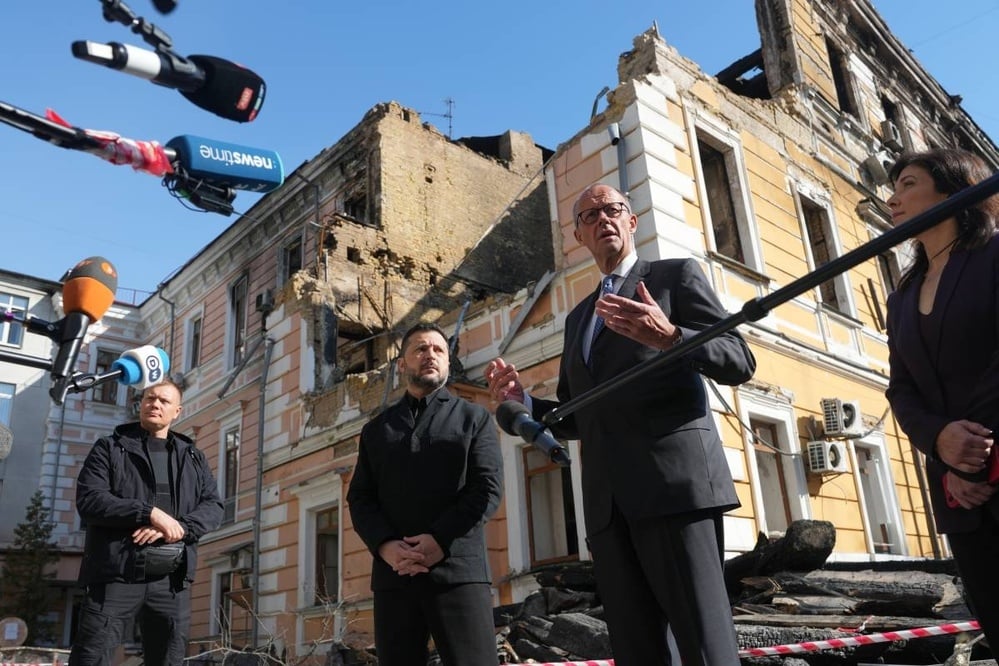
“Friedrich Merz arrived in the Ukrainian capital, Kyiv, by special train on Sunday morning.
The visit had not been publicly announced beforehand.”
· exact text match
“In the morning, according to Kyiv Mayor Vitali Klitschko, a road on the northern bridge over the Dnipro River was hit by at least one Russian drone.” · exact text match
Why: Surprise and attack details are presented with concrete attribution and without emotive adjectives or alarmist language.
Claim: The article describes policies and events rather than prescribing a course of action.
“The focus of the trip is further support for Ukraine in its war against Russia.” · exact text match
“In Kyiv, Merz was welcomed by Ukrainian President Volodymyr Zelenskyy.” · exact text match
Why: The sentences state what the trip is and what happened, with no direct recommendations or imperatives from the publisher.
Claim: The article is credible because it identifies sources, quotes principals, and specifies polling methodology.
“According to Reuters, the two sides are seeking to advance an agreement on the joint development and production of drones.” · exact text match
“The figures on satisfaction with the chancellor and federal government are based on a separate survey of 1,001 people conducted on October 1 and 2.” · exact text match
Why: Visible sourcing and precise methodological detail make the report trustworthy on its face.
Claim: The article shows internal fairness through clear attribution and methodological transparency.
“According to German government sources, thousands of interceptor drones are to be delivered to the Ukrainian armed forces in the coming months.” · exact text match
“For the Sunday trend, INSA surveyed 1,202 people between September 28 and October 2.” · exact text match
Why: Attribution to sources and reporting exact survey dates and sample sizes are observable honesty signals.
No byline is supplied; the text mixes the main report with repeated promotional blocks and unrelated headlines, which were ignored.
October 04, 2026 · 0 shares
The reporting frames Merz's Kyiv visit as a high-stakes Western stand against Russian aggression, treating military aid as vital and casting domestic opposition as 'pro-Kremlin.'
Automated analysis; not human reviewed.
Limitations: The input is an excerpt without an author byline, and the article boundary around the embedded tweet and related links is somewhat ambiguous.
·
10 of 55 available dimensions scored; omitted dimensions are not treated as neutral.
·
Verified supporting quotes for 9 of 10 scored dimensions.
Claim: The publisher's framing treats populist political forces negatively while presenting high-level government and corporate delegations favorably.
“populist and pro-Kremlin factions have mobilized voter discontent over economic pressures and military spending” · exact text match
“The chancellor is accompanied on the mission by German Minister for Economic Affairs Katharina Reiche alongside a 10-member delegation of chief executives and senior industrialists” · exact text match
Why: The phrase 'populist and pro-Kremlin factions' is pejorative, while the delegation is described in positive 'high-level' and 'senior' terms.
Claim: The article mixes factual reporting with emotionally loaded terms to characterize the war and the visit.
“Ukrainian society refuses to buckle under military terror” · exact text match
“high-stakes solidarity visi” · exact text match
Why: Terms such as 'military terror' and 'high-stakes solidarity' are value-laden judgments rather than neutral description.
Claim: The article uses mildly dramatic framing but remains largely grounded in reported facts.
“high-stakes solidarity visi” · exact text match
Why: The phrase dramatizes the visit, but the article otherwise avoids exaggerated claims.
Claim: The article emphasizes dire predictions and threats rather than positive prospects.
“If Russia is not stopped, its war machine will sooner or later turn against us” · exact text match
“a Russian-dictated peace would destabilize the continent, trigger mass refugee movements, and leave Europe structurally insecure” · exact text match
Why: Both selected statements stress severe consequences and impending danger.
Claim: The article's framing treats expanded military aid as essential and prudent.
“pledging long-range weapons and 1,000 specialized interceptors to counter Russian jet-powered Shahed drones” · exact text match
“warning that failing to halt Russian forces would endanger NATO itself” · not found in supplied text
Why: The coverage centers on weapons pledges and warns of NATO danger if Russia is not stopped.
Claim: The article amplifies threat warnings about Russian expansion and NATO vulnerability.
“If Russia is not stopped, its war machine will sooner or later turn against us” · exact text match
“repeated warnings from Berlin that air defense shortfalls represent the primary threat to Ukraine’s wartime resilience ahead of the heating season” · exact text match
Why: Threat warnings are prominent, though they largely reflect official statements rather than invented fear.
Claim: The publisher uses evaluative adjectives and political labels that go beyond neutral reporting.
“high-stakes solidarity visi” · exact text match
“populist and pro-Kremlin factions” · exact text match
Why: The wording carries judgments about the visit and about domestic opposition.
Claim: The coverage is centered on political conflict, alliances, and electoral consequences.
“The high-profile trip also unfolds against acute domestic political friction within Germany” · exact text match
“far-right Alternative for Germany (AfD) – which opposes arms shipments to Kyiv and demands an immediate resumption of Russian natural gas imports – achieved historic electoral gains” · exact text match
Why: It situates a military-diplomatic event inside domestic political polarization and electoral results.
Claim: The article aligns with mainstream Western and German establishment positions and criticizes anti-establishment factions.
“reaffirm Berlin’s strategic reliability” · exact text match
“populist and pro-Kremlin factions have mobilized voter discontent” · exact text match
Why: The emphasis on strategic reliability and dismissal of populist factions signal establishment alignment.
Claim: The article attributes key claims to officials, Der Spiegel, and Merz, giving a traceable sourcing trail.
“According to German government officials cited by Der Spiegel” · exact text match
“Merz told reporters upon arrival at Kyiv’s central railway station” · exact text match
Why: Central pledges and quotes are sourced, though some framing language is editorialized.
The input is an excerpt without an author byline, and the article boundary around the embedded tweet and related links is somewhat ambiguous.
October 04, 2026 · 0 shares
The report frames Russian strikes as escalating aggression while presenting German military aid as necessary defensive support, without critical scrutiny.
Automated analysis; not human reviewed.
Limitations: The supplied text appears to be a truncated aggregator feed containing duplicate headlines and end-of-page links, so the analysis may miss the full article's original context.
·
3 of 55 available dimensions scored; omitted dimensions are not treated as neutral.
·
Verified supporting quotes for 3 of 3 scored dimensions.
Claim: The article stays close to attributed facts and named officials rather than offering subjective analysis.
“according to a social media statement from Kyiv Mayor Vitali Klitschko.” · exact text match
“Merz said he “travelled to Kyiv today because Ukraine needs all our support in the coming weeks”.” · exact text match
Why: Most claims are sourced to officials or statements, with direct quotes and specific figures; no overall subjective evaluation is offered by the publisher.
Claim: The report frames expanded Western military support as a necessary response to Russian aggression.
“Germany has been one of Ukraine’s staunchest supporters.” · exact text match
““If Russia is not stopped, its war machine will sooner or later turn against us,” he said.” · exact text match
Why: The publisher's wording characterizes Germany as a key supporter and includes Merz's threat rationale without rebuttal or alternative perspective, indicating a hawkish-leaning frame.
Claim: The report cites named officials and gives concrete, checkable figures.
“according to a social media statement from Kyiv Mayor Vitali Klitschko.” · exact text match
“a $1.1bn military aid package is set to be announced” · exact text match
Why: Visible sourcing and attribution to named officials and specific dollar amounts support reliability, although no byline is present in the supplied text.
The supplied text appears to be a truncated aggregator feed containing duplicate headlines and end-of-page links, so the analysis may miss the full article's original context.
October 04, 2026 · 0 shares
The dispatch is a straight-news account but frames the war from the Western/Ukrainian side, presenting Russian strikes as escalation and aggression while carrying official statements without independent verification.
Automated analysis; not human reviewed.
Limitations: The only material limitation is that the article does not state the calendar date of 'Sunday,' so temporal verification is constrained.
·
6 of 55 available dimensions scored; omitted dimensions are not treated as neutral.
·
Verified supporting quotes for 4 of 6 scored dimensions.
Claim: The report relies on attributed statements and specific figures rather than editorial opinion.
“Merz said he traveled to the Ukrainian capital on his second trip as chancellor to demonstrate his country’s solidarity with Ukraine.” · exact text match
“Russia’s Foreign Ministry said Saturday it would continue to carry out “mass retaliatory strikes” on Kyiv and other Ukrainian cities, urging foreign nationals and diplomats to leave the country.” · exact text match
Why: Claims are mostly presented through named speakers and official statements, with visible AP wire attribution and explicit sourcing.
Claim: The article uses measured, specific reporting rather than exaggerated or fear-driven language.
“There was no immediate word on casualties.” · exact text match
“Seven people were wounded Sunday in a Russian aerial bomb attack on the Ukrainian city of Sumy, local officials said.” · exact text match
Why: Casualty details are stated conservatively and attributed to officials; the article does not inflate numbers or use dramatic hypotheticals.
Claim: The news text is descriptive rather than prescriptive, with policy demands confined to direct quotations.
“Russian attacks forced the full or partial closure of three of Kyiv’s six road bridges over the Dnipro River earlier this week, suspending traffic and causing tailbacks in Moscow’s latest effort to disrupt life in the Ukrainian capital.” · not found in supplied text
“There was no immediate word on casualties.” · exact text match
Why: Apart from attributed calls to action, the prose is event-focused and explanatory.
Claim: The article is credible on its face: it names institutions, gives exact aid figures, and flags missing casualty data.
“Germany is Ukraine’s largest donor, sending Kyiv more than EUR43.3 billion ($48.8 billion) since the war began, along with equipment and weapons.” · exact text match
“There was no immediate word on casualties.” · exact text match
Why: Precise figures, named officials, and explicit uncertainty support high observable credibility.
Claim: The report is careful and evidence-bound, explicitly noting uncertainty.
“There are no concrete signs that a peace settlement might be possible.” · not found in supplied text
“There was no immediate word on casualties.” · exact text match
Why: Explicit acknowledgment of absent information and an absence of speculation support a rational, measured mode.
Claim: The article quotes both the Russian Foreign Ministry and Ukrainian officials and acknowledges Ukrainian strikes on Russia.
“Russia’s Foreign Ministry said Saturday it would continue to carry out “mass retaliatory strikes” on Kyiv and other Ukrainian cities, urging foreign nationals and diplomats to leave the country.” · exact text match
“The aerial war has intensified, with Moscow menacing cities across Ukraine with hard-to-intercept ballistic missiles and jet-powered drones, while Kyiv has been striking Russia’s oil industry and businesses.” · exact text match
Why: The dispatch includes Russia's stated position and notes Ukrainian attacks on Russian targets, a balanced presentation of both sides.
The only material limitation is that the article does not state the calendar date of 'Sunday,' so temporal verification is constrained.
October 04, 2026 · 0 shares
Framing treats German military aid to Ukraine as necessary allied support while foregrounding falling domestic approval.
Automated analysis; not human reviewed. Limitations: No byline is supplied; the text mixes the main report with repeated promotional blocks and unrelated headlines, which were ignored. · 5 of 55 available dimensions scored; omitted dimensions are not treated as neutral. · Verified supporting quotes for 5 of 5 scored dimensions.
Claim: The report predominantly relies on attributed source statements rather than the publisher's own subjective evaluation.
“According to German government sources, thousands of interceptor drones are to be delivered to the Ukrainian armed forces in the coming months.” · exact text match
“According to Reuters, the two sides are seeking to advance an agreement on the joint development and production of drones.” · exact text match
Counterevidence:
“The trend is clear: support for Ukraine remains, but approval of Germany’s current aid policy is coming under increasing pressure.” · exact text match
Why: Most reporting is source-attributed and factual; the sole interpretive conclusion is a mild summary, so the article is strongly objective but not perfectly neutral.
Claim: The article's factual reporting is restrained and does not sensationalize the dramatic elements.
“Friedrich Merz arrived in the Ukrainian capital, Kyiv, by special train on Sunday morning. The visit had not been publicly announced beforehand.” · exact text match
“In the morning, according to Kyiv Mayor Vitali Klitschko, a road on the northern bridge over the Dnipro River was hit by at least one Russian drone.” · exact text match
Why: Surprise and attack details are presented with concrete attribution and without emotive adjectives or alarmist language.
Claim: The article describes policies and events rather than prescribing a course of action.
“The focus of the trip is further support for Ukraine in its war against Russia.” · exact text match
“In Kyiv, Merz was welcomed by Ukrainian President Volodymyr Zelenskyy.” · exact text match
Why: The sentences state what the trip is and what happened, with no direct recommendations or imperatives from the publisher.
Claim: The article is credible because it identifies sources, quotes principals, and specifies polling methodology.
“According to Reuters, the two sides are seeking to advance an agreement on the joint development and production of drones.” · exact text match
“The figures on satisfaction with the chancellor and federal government are based on a separate survey of 1,001 people conducted on October 1 and 2.” · exact text match
Why: Visible sourcing and precise methodological detail make the report trustworthy on its face.
Claim: The article shows internal fairness through clear attribution and methodological transparency.
“According to German government sources, thousands of interceptor drones are to be delivered to the Ukrainian armed forces in the coming months.” · exact text match
“For the Sunday trend, INSA surveyed 1,202 people between September 28 and October 2.” · exact text match
Why: Attribution to sources and reporting exact survey dates and sample sizes are observable honesty signals.
No byline is supplied; the text mixes the main report with repeated promotional blocks and unrelated headlines, which were ignored.
October 04, 2026 · 0 shares
The reporting frames Merz's Kyiv visit as a high-stakes Western stand against Russian aggression, treating military aid as vital and casting domestic opposition as 'pro-Kremlin.'
Automated analysis; not human reviewed. Limitations: The input is an excerpt without an author byline, and the article boundary around the embedded tweet and related links is somewhat ambiguous. · 10 of 55 available dimensions scored; omitted dimensions are not treated as neutral. · Verified supporting quotes for 9 of 10 scored dimensions.
Claim: The publisher's framing treats populist political forces negatively while presenting high-level government and corporate delegations favorably.
“populist and pro-Kremlin factions have mobilized voter discontent over economic pressures and military spending” · exact text match
“The chancellor is accompanied on the mission by German Minister for Economic Affairs Katharina Reiche alongside a 10-member delegation of chief executives and senior industrialists” · exact text match
Why: The phrase 'populist and pro-Kremlin factions' is pejorative, while the delegation is described in positive 'high-level' and 'senior' terms.
Claim: The article mixes factual reporting with emotionally loaded terms to characterize the war and the visit.
“Ukrainian society refuses to buckle under military terror” · exact text match
“high-stakes solidarity visi” · exact text match
Why: Terms such as 'military terror' and 'high-stakes solidarity' are value-laden judgments rather than neutral description.
Claim: The article uses mildly dramatic framing but remains largely grounded in reported facts.
“high-stakes solidarity visi” · exact text match
Why: The phrase dramatizes the visit, but the article otherwise avoids exaggerated claims.
Claim: The article emphasizes dire predictions and threats rather than positive prospects.
“If Russia is not stopped, its war machine will sooner or later turn against us” · exact text match
“a Russian-dictated peace would destabilize the continent, trigger mass refugee movements, and leave Europe structurally insecure” · exact text match
Why: Both selected statements stress severe consequences and impending danger.
Claim: The article's framing treats expanded military aid as essential and prudent.
“pledging long-range weapons and 1,000 specialized interceptors to counter Russian jet-powered Shahed drones” · exact text match
“warning that failing to halt Russian forces would endanger NATO itself” · not found in supplied text
Why: The coverage centers on weapons pledges and warns of NATO danger if Russia is not stopped.
Claim: The article amplifies threat warnings about Russian expansion and NATO vulnerability.
“If Russia is not stopped, its war machine will sooner or later turn against us” · exact text match
“repeated warnings from Berlin that air defense shortfalls represent the primary threat to Ukraine’s wartime resilience ahead of the heating season” · exact text match
Why: Threat warnings are prominent, though they largely reflect official statements rather than invented fear.
Claim: The publisher uses evaluative adjectives and political labels that go beyond neutral reporting.
“high-stakes solidarity visi” · exact text match
“populist and pro-Kremlin factions” · exact text match
Why: The wording carries judgments about the visit and about domestic opposition.
Claim: The coverage is centered on political conflict, alliances, and electoral consequences.
“The high-profile trip also unfolds against acute domestic political friction within Germany” · exact text match
“far-right Alternative for Germany (AfD) – which opposes arms shipments to Kyiv and demands an immediate resumption of Russian natural gas imports – achieved historic electoral gains” · exact text match
Why: It situates a military-diplomatic event inside domestic political polarization and electoral results.
Claim: The article aligns with mainstream Western and German establishment positions and criticizes anti-establishment factions.
“reaffirm Berlin’s strategic reliability” · exact text match
“populist and pro-Kremlin factions have mobilized voter discontent” · exact text match
Why: The emphasis on strategic reliability and dismissal of populist factions signal establishment alignment.
Claim: The article attributes key claims to officials, Der Spiegel, and Merz, giving a traceable sourcing trail.
“According to German government officials cited by Der Spiegel” · exact text match
“Merz told reporters upon arrival at Kyiv’s central railway station” · exact text match
Why: Central pledges and quotes are sourced, though some framing language is editorialized.
The input is an excerpt without an author byline, and the article boundary around the embedded tweet and related links is somewhat ambiguous.
October 04, 2026 · 0 shares
The report frames Russian strikes as escalating aggression while presenting German military aid as necessary defensive support, without critical scrutiny.
Automated analysis; not human reviewed. Limitations: The supplied text appears to be a truncated aggregator feed containing duplicate headlines and end-of-page links, so the analysis may miss the full article's original context. · 3 of 55 available dimensions scored; omitted dimensions are not treated as neutral. · Verified supporting quotes for 3 of 3 scored dimensions.
Claim: The article stays close to attributed facts and named officials rather than offering subjective analysis.
“according to a social media statement from Kyiv Mayor Vitali Klitschko.” · exact text match
“Merz said he “travelled to Kyiv today because Ukraine needs all our support in the coming weeks”.” · exact text match
Why: Most claims are sourced to officials or statements, with direct quotes and specific figures; no overall subjective evaluation is offered by the publisher.
Claim: The report frames expanded Western military support as a necessary response to Russian aggression.
“Germany has been one of Ukraine’s staunchest supporters.” · exact text match
““If Russia is not stopped, its war machine will sooner or later turn against us,” he said.” · exact text match
Why: The publisher's wording characterizes Germany as a key supporter and includes Merz's threat rationale without rebuttal or alternative perspective, indicating a hawkish-leaning frame.
Claim: The report cites named officials and gives concrete, checkable figures.
“according to a social media statement from Kyiv Mayor Vitali Klitschko.” · exact text match
“a $1.1bn military aid package is set to be announced” · exact text match
Why: Visible sourcing and attribution to named officials and specific dollar amounts support reliability, although no byline is present in the supplied text.
The supplied text appears to be a truncated aggregator feed containing duplicate headlines and end-of-page links, so the analysis may miss the full article's original context.
October 04, 2026 · 0 shares
The dispatch is a straight-news account but frames the war from the Western/Ukrainian side, presenting Russian strikes as escalation and aggression while carrying official statements without independent verification.
Automated analysis; not human reviewed. Limitations: The only material limitation is that the article does not state the calendar date of 'Sunday,' so temporal verification is constrained. · 6 of 55 available dimensions scored; omitted dimensions are not treated as neutral. · Verified supporting quotes for 4 of 6 scored dimensions.
Claim: The report relies on attributed statements and specific figures rather than editorial opinion.
“Merz said he traveled to the Ukrainian capital on his second trip as chancellor to demonstrate his country’s solidarity with Ukraine.” · exact text match
“Russia’s Foreign Ministry said Saturday it would continue to carry out “mass retaliatory strikes” on Kyiv and other Ukrainian cities, urging foreign nationals and diplomats to leave the country.” · exact text match
Why: Claims are mostly presented through named speakers and official statements, with visible AP wire attribution and explicit sourcing.
Claim: The article uses measured, specific reporting rather than exaggerated or fear-driven language.
“There was no immediate word on casualties.” · exact text match
“Seven people were wounded Sunday in a Russian aerial bomb attack on the Ukrainian city of Sumy, local officials said.” · exact text match
Why: Casualty details are stated conservatively and attributed to officials; the article does not inflate numbers or use dramatic hypotheticals.
Claim: The news text is descriptive rather than prescriptive, with policy demands confined to direct quotations.
“Russian attacks forced the full or partial closure of three of Kyiv’s six road bridges over the Dnipro River earlier this week, suspending traffic and causing tailbacks in Moscow’s latest effort to disrupt life in the Ukrainian capital.” · not found in supplied text
“There was no immediate word on casualties.” · exact text match
Why: Apart from attributed calls to action, the prose is event-focused and explanatory.
Claim: The article is credible on its face: it names institutions, gives exact aid figures, and flags missing casualty data.
“Germany is Ukraine’s largest donor, sending Kyiv more than EUR43.3 billion ($48.8 billion) since the war began, along with equipment and weapons.” · exact text match
“There was no immediate word on casualties.” · exact text match
Why: Precise figures, named officials, and explicit uncertainty support high observable credibility.
Claim: The report is careful and evidence-bound, explicitly noting uncertainty.
“There are no concrete signs that a peace settlement might be possible.” · not found in supplied text
“There was no immediate word on casualties.” · exact text match
Why: Explicit acknowledgment of absent information and an absence of speculation support a rational, measured mode.
Claim: The article quotes both the Russian Foreign Ministry and Ukrainian officials and acknowledges Ukrainian strikes on Russia.
“Russia’s Foreign Ministry said Saturday it would continue to carry out “mass retaliatory strikes” on Kyiv and other Ukrainian cities, urging foreign nationals and diplomats to leave the country.” · exact text match
“The aerial war has intensified, with Moscow menacing cities across Ukraine with hard-to-intercept ballistic missiles and jet-powered drones, while Kyiv has been striking Russia’s oil industry and businesses.” · exact text match
Why: The dispatch includes Russia's stated position and notes Ukrainian attacks on Russian targets, a balanced presentation of both sides.
The only material limitation is that the article does not state the calendar date of 'Sunday,' so temporal verification is constrained.
October 04, 2026 · 0 shares
Straight, attributed reporting that centers the Ukrainian and European response, presenting Russia's strike and evacuation warning as threats without including a Russian or dissenting European perspective.
The Russia-Ukraine war is ongoing, and Germany is one of Ukraine's main Western military backers.
Automated analysis; not human reviewed. Limitations: The source text is a digest that bundles the Ukraine report with unrelated headlines; I therefore analyzed only the Ukraine item and could not assess surrounding editorial context or the original article's full framing. · 4 of 55 available dimensions scored; omitted dimensions are not treated as neutral. · Verified supporting quotes for 3 of 4 scored dimensions.
Claim: The article reports in a neutral, attributed style without overt editorial commentary.
“Berlin government sources said” · exact text match
“Kyiv Mayor Vitali Klitschko confirmed a strike damaged the road surface on the Northern Bridge” · exact text match
Why: Key claims are attributed to government sources or named officials, and the publisher does not insert direct evaluation.
Claim: The presentation is factual and does not exaggerate the event.
“Russian forces struck a bridge in Kyiv on Oct. 4 shortly after German Chancellor Friedrich Merz arrived on an unannounced visit to demonstrate European support, triggering air raid sirens across the capital.” · exact text match
Why: The lead sentence states the sequence and concrete outcome without exaggerated adjectives or speculative framing.
Claim: The story describes events and statements rather than urging a course of action.
“Merz and Ukrainian President Volodymyr Zelensky were scheduled to meet to finalize a new German military aid package worth more than $1 billion, German government sources said.” · exact text match
Why: The aid package is reported as a scheduled, sourced fact, with no editorial call for readers to support or oppose it.
Claim: The report shows consistent sourcing, attribution, and named officials.
“Berlin government sources said” · exact text match
“Kyiv Mayor Vitali Klitschko confirmed” · exact text match
“EU Ambassador Katarina Mathernova said” · not found in supplied text
Why: Multiple key claims are attributed to named or described sources, and direct quotes are used.
The source text is a digest that bundles the Ukraine report with unrelated headlines; I therefore analyzed only the Ukraine item and could not assess surrounding editorial context or the original article's full framing.
October 04, 2026 · 0 shares
The reporting frames Merz's Kyiv visit as a high-stakes Western stand against Russian aggression, treating military aid as vital and casting domestic opposition as 'pro-Kremlin.'
Automated analysis; not human reviewed. Limitations: The input is an excerpt without an author byline, and the article boundary around the embedded tweet and related links is somewhat ambiguous. · 10 of 55 available dimensions scored; omitted dimensions are not treated as neutral. · Verified supporting quotes for 9 of 10 scored dimensions.
Claim: The publisher's framing treats populist political forces negatively while presenting high-level government and corporate delegations favorably.
“populist and pro-Kremlin factions have mobilized voter discontent over economic pressures and military spending” · exact text match
“The chancellor is accompanied on the mission by German Minister for Economic Affairs Katharina Reiche alongside a 10-member delegation of chief executives and senior industrialists” · exact text match
Why: The phrase 'populist and pro-Kremlin factions' is pejorative, while the delegation is described in positive 'high-level' and 'senior' terms.
Claim: The article mixes factual reporting with emotionally loaded terms to characterize the war and the visit.
“Ukrainian society refuses to buckle under military terror” · exact text match
“high-stakes solidarity visi” · exact text match
Why: Terms such as 'military terror' and 'high-stakes solidarity' are value-laden judgments rather than neutral description.
Claim: The article uses mildly dramatic framing but remains largely grounded in reported facts.
“high-stakes solidarity visi” · exact text match
Why: The phrase dramatizes the visit, but the article otherwise avoids exaggerated claims.
Claim: The article emphasizes dire predictions and threats rather than positive prospects.
“If Russia is not stopped, its war machine will sooner or later turn against us” · exact text match
“a Russian-dictated peace would destabilize the continent, trigger mass refugee movements, and leave Europe structurally insecure” · exact text match
Why: Both selected statements stress severe consequences and impending danger.
Claim: The article's framing treats expanded military aid as essential and prudent.
“pledging long-range weapons and 1,000 specialized interceptors to counter Russian jet-powered Shahed drones” · exact text match
“warning that failing to halt Russian forces would endanger NATO itself” · not found in supplied text
Why: The coverage centers on weapons pledges and warns of NATO danger if Russia is not stopped.
Claim: The article amplifies threat warnings about Russian expansion and NATO vulnerability.
“If Russia is not stopped, its war machine will sooner or later turn against us” · exact text match
“repeated warnings from Berlin that air defense shortfalls represent the primary threat to Ukraine’s wartime resilience ahead of the heating season” · exact text match
Why: Threat warnings are prominent, though they largely reflect official statements rather than invented fear.
Claim: The publisher uses evaluative adjectives and political labels that go beyond neutral reporting.
“high-stakes solidarity visi” · exact text match
“populist and pro-Kremlin factions” · exact text match
Why: The wording carries judgments about the visit and about domestic opposition.
Claim: The coverage is centered on political conflict, alliances, and electoral consequences.
“The high-profile trip also unfolds against acute domestic political friction within Germany” · exact text match
“far-right Alternative for Germany (AfD) – which opposes arms shipments to Kyiv and demands an immediate resumption of Russian natural gas imports – achieved historic electoral gains” · exact text match
Why: It situates a military-diplomatic event inside domestic political polarization and electoral results.
Claim: The article aligns with mainstream Western and German establishment positions and criticizes anti-establishment factions.
“reaffirm Berlin’s strategic reliability” · exact text match
“populist and pro-Kremlin factions have mobilized voter discontent” · exact text match
Why: The emphasis on strategic reliability and dismissal of populist factions signal establishment alignment.
Claim: The article attributes key claims to officials, Der Spiegel, and Merz, giving a traceable sourcing trail.
“According to German government officials cited by Der Spiegel” · exact text match
“Merz told reporters upon arrival at Kyiv’s central railway station” · exact text match
Why: Central pledges and quotes are sourced, though some framing language is editorialized.
The input is an excerpt without an author byline, and the article boundary around the embedded tweet and related links is somewhat ambiguous.
October 04, 2026 · 0 shares
Framing treats German military aid to Ukraine as necessary allied support while foregrounding falling domestic approval.
Automated analysis; not human reviewed. Limitations: No byline is supplied; the text mixes the main report with repeated promotional blocks and unrelated headlines, which were ignored. · 5 of 55 available dimensions scored; omitted dimensions are not treated as neutral. · Verified supporting quotes for 5 of 5 scored dimensions.
Claim: The report predominantly relies on attributed source statements rather than the publisher's own subjective evaluation.
“According to German government sources, thousands of interceptor drones are to be delivered to the Ukrainian armed forces in the coming months.” · exact text match
“According to Reuters, the two sides are seeking to advance an agreement on the joint development and production of drones.” · exact text match
Counterevidence:
“The trend is clear: support for Ukraine remains, but approval of Germany’s current aid policy is coming under increasing pressure.” · exact text match
Why: Most reporting is source-attributed and factual; the sole interpretive conclusion is a mild summary, so the article is strongly objective but not perfectly neutral.
Claim: The article's factual reporting is restrained and does not sensationalize the dramatic elements.
“Friedrich Merz arrived in the Ukrainian capital, Kyiv, by special train on Sunday morning. The visit had not been publicly announced beforehand.” · exact text match
“In the morning, according to Kyiv Mayor Vitali Klitschko, a road on the northern bridge over the Dnipro River was hit by at least one Russian drone.” · exact text match
Why: Surprise and attack details are presented with concrete attribution and without emotive adjectives or alarmist language.
Claim: The article describes policies and events rather than prescribing a course of action.
“The focus of the trip is further support for Ukraine in its war against Russia.” · exact text match
“In Kyiv, Merz was welcomed by Ukrainian President Volodymyr Zelenskyy.” · exact text match
Why: The sentences state what the trip is and what happened, with no direct recommendations or imperatives from the publisher.
Claim: The article is credible because it identifies sources, quotes principals, and specifies polling methodology.
“According to Reuters, the two sides are seeking to advance an agreement on the joint development and production of drones.” · exact text match
“The figures on satisfaction with the chancellor and federal government are based on a separate survey of 1,001 people conducted on October 1 and 2.” · exact text match
Why: Visible sourcing and precise methodological detail make the report trustworthy on its face.
Claim: The article shows internal fairness through clear attribution and methodological transparency.
“According to German government sources, thousands of interceptor drones are to be delivered to the Ukrainian armed forces in the coming months.” · exact text match
“For the Sunday trend, INSA surveyed 1,202 people between September 28 and October 2.” · exact text match
Why: Attribution to sources and reporting exact survey dates and sample sizes are observable honesty signals.
No byline is supplied; the text mixes the main report with repeated promotional blocks and unrelated headlines, which were ignored.
October 04, 2026 · 0 shares
The report frames Russian strikes as escalating aggression while presenting German military aid as necessary defensive support, without critical scrutiny.
Automated analysis; not human reviewed. Limitations: The supplied text appears to be a truncated aggregator feed containing duplicate headlines and end-of-page links, so the analysis may miss the full article's original context. · 3 of 55 available dimensions scored; omitted dimensions are not treated as neutral. · Verified supporting quotes for 3 of 3 scored dimensions.
Claim: The article stays close to attributed facts and named officials rather than offering subjective analysis.
“according to a social media statement from Kyiv Mayor Vitali Klitschko.” · exact text match
“Merz said he “travelled to Kyiv today because Ukraine needs all our support in the coming weeks”.” · exact text match
Why: Most claims are sourced to officials or statements, with direct quotes and specific figures; no overall subjective evaluation is offered by the publisher.
Claim: The report frames expanded Western military support as a necessary response to Russian aggression.
“Germany has been one of Ukraine’s staunchest supporters.” · exact text match
““If Russia is not stopped, its war machine will sooner or later turn against us,” he said.” · exact text match
Why: The publisher's wording characterizes Germany as a key supporter and includes Merz's threat rationale without rebuttal or alternative perspective, indicating a hawkish-leaning frame.
Claim: The report cites named officials and gives concrete, checkable figures.
“according to a social media statement from Kyiv Mayor Vitali Klitschko.” · exact text match
“a $1.1bn military aid package is set to be announced” · exact text match
Why: Visible sourcing and attribution to named officials and specific dollar amounts support reliability, although no byline is present in the supplied text.
The supplied text appears to be a truncated aggregator feed containing duplicate headlines and end-of-page links, so the analysis may miss the full article's original context.
Helium Bias
Story Blindspots
Attribution skepticism
October 04, 2026 · 0 shares
The report frames Russian strikes as escalating aggression while presenting German military aid as necessary defensive support, without critical scrutiny.
Automated analysis; not human reviewed. Limitations: The supplied text appears to be a truncated aggregator feed containing duplicate headlines and end-of-page links, so the analysis may miss the full article's original context. · 3 of 55 available dimensions scored; omitted dimensions are not treated as neutral. · Verified supporting quotes for 3 of 3 scored dimensions.
Claim: The article stays close to attributed facts and named officials rather than offering subjective analysis.
“according to a social media statement from Kyiv Mayor Vitali Klitschko.” · exact text match
“Merz said he “travelled to Kyiv today because Ukraine needs all our support in the coming weeks”.” · exact text match
Why: Most claims are sourced to officials or statements, with direct quotes and specific figures; no overall subjective evaluation is offered by the publisher.
Claim: The report frames expanded Western military support as a necessary response to Russian aggression.
“Germany has been one of Ukraine’s staunchest supporters.” · exact text match
““If Russia is not stopped, its war machine will sooner or later turn against us,” he said.” · exact text match
Why: The publisher's wording characterizes Germany as a key supporter and includes Merz's threat rationale without rebuttal or alternative perspective, indicating a hawkish-leaning frame.
Claim: The report cites named officials and gives concrete, checkable figures.
“according to a social media statement from Kyiv Mayor Vitali Klitschko.” · exact text match
“a $1.1bn military aid package is set to be announced” · exact text match
Why: Visible sourcing and attribution to named officials and specific dollar amounts support reliability, although no byline is present in the supplied text.
The supplied text appears to be a truncated aggregator feed containing duplicate headlines and end-of-page links, so the analysis may miss the full article's original context.
October 04, 2026 · 0 shares
Straight, attributed reporting that centers the Ukrainian and European response, presenting Russia's strike and evacuation warning as threats without including a Russian or dissenting European perspective.
The Russia-Ukraine war is ongoing, and Germany is one of Ukraine's main Western military backers.
Automated analysis; not human reviewed. Limitations: The source text is a digest that bundles the Ukraine report with unrelated headlines; I therefore analyzed only the Ukraine item and could not assess surrounding editorial context or the original article's full framing. · 4 of 55 available dimensions scored; omitted dimensions are not treated as neutral. · Verified supporting quotes for 3 of 4 scored dimensions.
Claim: The article reports in a neutral, attributed style without overt editorial commentary.
“Berlin government sources said” · exact text match
“Kyiv Mayor Vitali Klitschko confirmed a strike damaged the road surface on the Northern Bridge” · exact text match
Why: Key claims are attributed to government sources or named officials, and the publisher does not insert direct evaluation.
Claim: The presentation is factual and does not exaggerate the event.
“Russian forces struck a bridge in Kyiv on Oct. 4 shortly after German Chancellor Friedrich Merz arrived on an unannounced visit to demonstrate European support, triggering air raid sirens across the capital.” · exact text match
Why: The lead sentence states the sequence and concrete outcome without exaggerated adjectives or speculative framing.
Claim: The story describes events and statements rather than urging a course of action.
“Merz and Ukrainian President Volodymyr Zelensky were scheduled to meet to finalize a new German military aid package worth more than $1 billion, German government sources said.” · exact text match
Why: The aid package is reported as a scheduled, sourced fact, with no editorial call for readers to support or oppose it.
Claim: The report shows consistent sourcing, attribution, and named officials.
“Berlin government sources said” · exact text match
“Kyiv Mayor Vitali Klitschko confirmed” · exact text match
“EU Ambassador Katarina Mathernova said” · not found in supplied text
Why: Multiple key claims are attributed to named or described sources, and direct quotes are used.
The source text is a digest that bundles the Ukraine report with unrelated headlines; I therefore analyzed only the Ukraine item and could not assess surrounding editorial context or the original article's full framing.
October 04, 2026 · 0 shares
The reporting frames Merz's Kyiv visit as an act of Western solidarity against Russian escalation while maintaining neutral attribution and explicit uncertainty.
Automated analysis; not human reviewed. Limitations: The supplied article text is truncated/malformed in one passage and lacks a byline, limiting full-context confidence. · 9 of 55 available dimensions scored; omitted dimensions are not treated as neutral. · Verified supporting quotes for 8 of 9 scored dimensions.
Claim: The article reports events and statements with attribution and avoids authorial editorializing.
“There was no immediate word on casualties.” · exact text match
Why: The reporting foregrounds verified or attributed facts and states uncertainty rather than inserting subjective judgment.
Claim: The article uses restrained, wire-style phrasing rather than sensational or hyperbolic presentation.
“Fighting along the roughly 1,250-kilometer (780-mile) front line snaking through northern, eastern and southern Ukraine has been virtually deadlocked in recent months.” · exact text match
Why: The description is concrete and measured, with no melodramatic language or manufactured stakes.
Claim: The article describes events and statements rather than prescribing policy.
“Merz said he traveled to the Ukrainian capital on his second trip as chancellor to demonstrate his country's solidarity with Ukraine.” · exact text match
Why: The text reports what leaders said and did, without instructing readers on what should be done.
Claim: The publisher does not express its own opinion; all evaluative or prescriptive statements are attributed to named officials.
“In a post on X, Zelenskyy thanked Germany and said the two countries would make "important agreements" during the visit to strengthen Ukraine’s defenses and those of the rest of Europe.” · verified after text normalization
Why: The only opinions in the text are explicitly quoted from sources, not asserted by the publisher.
Claim: The article is heavily political because its subject is heads of government, foreign ministries, and election consequences.
“German Chancellor Friedrich Merz arrived in Kyiv Sunday in a show of support as Russia escalated its attacks on Ukrainian cities.” · exact text match
“Ukrainian Foreign Minister Andrii Sybiha said the agenda would focus on "strengthening Ukraine, our defense and resilience, and our shared European security."” · verified after text normalization
Why: The central content consists of diplomatic positions, government statements, and political fallout.
Claim: The article maintains an emotionally neutral tone even when reporting harm and danger.
“There was no immediate word on casualties.” · exact text match
Why: The report states uncertainty and outcomes plainly, without positive or negative emotional appeal.
Claim: The article demonstrates strong sourcing, attribution, and uncertainty practices.
“Russia’s Foreign Ministry said Saturday it would continue to carry out “mass retaliatory strikes” on Kyiv and other Ukrainian cities.” · not found in supplied text
“There was no immediate word on casualties.” · exact text match
Why: Claims are attributed to named officials and ministries, and the report explicitly flags missing casualty information.
Claim: The article reasons from observable conditions and avoids unsupported conclusions.
“Russia invaded its neighbor more than 4½ years ago, and there are no concrete signs that a peace settlement might be possible.” · exact text match
Why: The article ties its assessment of deadlock to the absence of concrete settlement signs rather than to speculation.
Claim: The article provides contextual detail and balanced attribution that support understanding of the situation.
“Fighting along the roughly 1,250-kilometer (780-mile) front line snaking through northern, eastern and southern Ukraine has been virtually deadlocked in recent months.” · exact text match
Why: The article integrates military context, diplomatic history, funding figures, and political consequences without oversimplifying.
The supplied article text is truncated/malformed in one passage and lacks a byline, limiting full-context confidence.
Domestic German political capture risk
October 04, 2026 · 0 shares
Framing treats German military aid to Ukraine as necessary allied support while foregrounding falling domestic approval.
Automated analysis; not human reviewed. Limitations: No byline is supplied; the text mixes the main report with repeated promotional blocks and unrelated headlines, which were ignored. · 5 of 55 available dimensions scored; omitted dimensions are not treated as neutral. · Verified supporting quotes for 5 of 5 scored dimensions.
Claim: The report predominantly relies on attributed source statements rather than the publisher's own subjective evaluation.
“According to German government sources, thousands of interceptor drones are to be delivered to the Ukrainian armed forces in the coming months.” · exact text match
“According to Reuters, the two sides are seeking to advance an agreement on the joint development and production of drones.” · exact text match
Counterevidence:
“The trend is clear: support for Ukraine remains, but approval of Germany’s current aid policy is coming under increasing pressure.” · exact text match
Why: Most reporting is source-attributed and factual; the sole interpretive conclusion is a mild summary, so the article is strongly objective but not perfectly neutral.
Claim: The article's factual reporting is restrained and does not sensationalize the dramatic elements.
“Friedrich Merz arrived in the Ukrainian capital, Kyiv, by special train on Sunday morning. The visit had not been publicly announced beforehand.” · exact text match
“In the morning, according to Kyiv Mayor Vitali Klitschko, a road on the northern bridge over the Dnipro River was hit by at least one Russian drone.” · exact text match
Why: Surprise and attack details are presented with concrete attribution and without emotive adjectives or alarmist language.
Claim: The article describes policies and events rather than prescribing a course of action.
“The focus of the trip is further support for Ukraine in its war against Russia.” · exact text match
“In Kyiv, Merz was welcomed by Ukrainian President Volodymyr Zelenskyy.” · exact text match
Why: The sentences state what the trip is and what happened, with no direct recommendations or imperatives from the publisher.
Claim: The article is credible because it identifies sources, quotes principals, and specifies polling methodology.
“According to Reuters, the two sides are seeking to advance an agreement on the joint development and production of drones.” · exact text match
“The figures on satisfaction with the chancellor and federal government are based on a separate survey of 1,001 people conducted on October 1 and 2.” · exact text match
Why: Visible sourcing and precise methodological detail make the report trustworthy on its face.
Claim: The article shows internal fairness through clear attribution and methodological transparency.
“According to German government sources, thousands of interceptor drones are to be delivered to the Ukrainian armed forces in the coming months.” · exact text match
“For the Sunday trend, INSA surveyed 1,202 people between September 28 and October 2.” · exact text match
Why: Attribution to sources and reporting exact survey dates and sample sizes are observable honesty signals.
No byline is supplied; the text mixes the main report with repeated promotional blocks and unrelated headlines, which were ignored.
October 04, 2026 · 0 shares
The reporting frames Merz's Kyiv visit as an act of Western solidarity against Russian escalation while maintaining neutral attribution and explicit uncertainty.
Automated analysis; not human reviewed. Limitations: The supplied article text is truncated/malformed in one passage and lacks a byline, limiting full-context confidence. · 9 of 55 available dimensions scored; omitted dimensions are not treated as neutral. · Verified supporting quotes for 8 of 9 scored dimensions.
Claim: The article reports events and statements with attribution and avoids authorial editorializing.
“There was no immediate word on casualties.” · exact text match
Why: The reporting foregrounds verified or attributed facts and states uncertainty rather than inserting subjective judgment.
Claim: The article uses restrained, wire-style phrasing rather than sensational or hyperbolic presentation.
“Fighting along the roughly 1,250-kilometer (780-mile) front line snaking through northern, eastern and southern Ukraine has been virtually deadlocked in recent months.” · exact text match
Why: The description is concrete and measured, with no melodramatic language or manufactured stakes.
Claim: The article describes events and statements rather than prescribing policy.
“Merz said he traveled to the Ukrainian capital on his second trip as chancellor to demonstrate his country's solidarity with Ukraine.” · exact text match
Why: The text reports what leaders said and did, without instructing readers on what should be done.
Claim: The publisher does not express its own opinion; all evaluative or prescriptive statements are attributed to named officials.
“In a post on X, Zelenskyy thanked Germany and said the two countries would make "important agreements" during the visit to strengthen Ukraine’s defenses and those of the rest of Europe.” · verified after text normalization
Why: The only opinions in the text are explicitly quoted from sources, not asserted by the publisher.
Claim: The article is heavily political because its subject is heads of government, foreign ministries, and election consequences.
“German Chancellor Friedrich Merz arrived in Kyiv Sunday in a show of support as Russia escalated its attacks on Ukrainian cities.” · exact text match
“Ukrainian Foreign Minister Andrii Sybiha said the agenda would focus on "strengthening Ukraine, our defense and resilience, and our shared European security."” · verified after text normalization
Why: The central content consists of diplomatic positions, government statements, and political fallout.
Claim: The article maintains an emotionally neutral tone even when reporting harm and danger.
“There was no immediate word on casualties.” · exact text match
Why: The report states uncertainty and outcomes plainly, without positive or negative emotional appeal.
Claim: The article demonstrates strong sourcing, attribution, and uncertainty practices.
“Russia’s Foreign Ministry said Saturday it would continue to carry out “mass retaliatory strikes” on Kyiv and other Ukrainian cities.” · not found in supplied text
“There was no immediate word on casualties.” · exact text match
Why: Claims are attributed to named officials and ministries, and the report explicitly flags missing casualty information.
Claim: The article reasons from observable conditions and avoids unsupported conclusions.
“Russia invaded its neighbor more than 4½ years ago, and there are no concrete signs that a peace settlement might be possible.” · exact text match
Why: The article ties its assessment of deadlock to the absence of concrete settlement signs rather than to speculation.
Claim: The article provides contextual detail and balanced attribution that support understanding of the situation.
“Fighting along the roughly 1,250-kilometer (780-mile) front line snaking through northern, eastern and southern Ukraine has been virtually deadlocked in recent months.” · exact text match
Why: The article integrates military context, diplomatic history, funding figures, and political consequences without oversimplifying.
The supplied article text is truncated/malformed in one passage and lacks a byline, limiting full-context confidence.
October 04, 2026 · 0 shares
Framing treats German military aid to Ukraine as necessary allied support while foregrounding falling domestic approval.
Automated analysis; not human reviewed. Limitations: No byline is supplied; the text mixes the main report with repeated promotional blocks and unrelated headlines, which were ignored. · 5 of 55 available dimensions scored; omitted dimensions are not treated as neutral. · Verified supporting quotes for 5 of 5 scored dimensions.
Claim: The report predominantly relies on attributed source statements rather than the publisher's own subjective evaluation.
“According to German government sources, thousands of interceptor drones are to be delivered to the Ukrainian armed forces in the coming months.” · exact text match
“According to Reuters, the two sides are seeking to advance an agreement on the joint development and production of drones.” · exact text match
Counterevidence:
“The trend is clear: support for Ukraine remains, but approval of Germany’s current aid policy is coming under increasing pressure.” · exact text match
Why: Most reporting is source-attributed and factual; the sole interpretive conclusion is a mild summary, so the article is strongly objective but not perfectly neutral.
Claim: The article's factual reporting is restrained and does not sensationalize the dramatic elements.
“Friedrich Merz arrived in the Ukrainian capital, Kyiv, by special train on Sunday morning. The visit had not been publicly announced beforehand.” · exact text match
“In the morning, according to Kyiv Mayor Vitali Klitschko, a road on the northern bridge over the Dnipro River was hit by at least one Russian drone.” · exact text match
Why: Surprise and attack details are presented with concrete attribution and without emotive adjectives or alarmist language.
Claim: The article describes policies and events rather than prescribing a course of action.
“The focus of the trip is further support for Ukraine in its war against Russia.” · exact text match
“In Kyiv, Merz was welcomed by Ukrainian President Volodymyr Zelenskyy.” · exact text match
Why: The sentences state what the trip is and what happened, with no direct recommendations or imperatives from the publisher.
Claim: The article is credible because it identifies sources, quotes principals, and specifies polling methodology.
“According to Reuters, the two sides are seeking to advance an agreement on the joint development and production of drones.” · exact text match
“The figures on satisfaction with the chancellor and federal government are based on a separate survey of 1,001 people conducted on October 1 and 2.” · exact text match
Why: Visible sourcing and precise methodological detail make the report trustworthy on its face.
Claim: The article shows internal fairness through clear attribution and methodological transparency.
“According to German government sources, thousands of interceptor drones are to be delivered to the Ukrainian armed forces in the coming months.” · exact text match
“For the Sunday trend, INSA surveyed 1,202 people between September 28 and October 2.” · exact text match
Why: Attribution to sources and reporting exact survey dates and sample sizes are observable honesty signals.
No byline is supplied; the text mixes the main report with repeated promotional blocks and unrelated headlines, which were ignored.
October 04, 2026 · 0 shares
The reporting frames Merz's Kyiv visit as a high-stakes Western stand against Russian aggression, treating military aid as vital and casting domestic opposition as 'pro-Kremlin.'
Automated analysis; not human reviewed. Limitations: The input is an excerpt without an author byline, and the article boundary around the embedded tweet and related links is somewhat ambiguous. · 10 of 55 available dimensions scored; omitted dimensions are not treated as neutral. · Verified supporting quotes for 9 of 10 scored dimensions.
Claim: The publisher's framing treats populist political forces negatively while presenting high-level government and corporate delegations favorably.
“populist and pro-Kremlin factions have mobilized voter discontent over economic pressures and military spending” · exact text match
“The chancellor is accompanied on the mission by German Minister for Economic Affairs Katharina Reiche alongside a 10-member delegation of chief executives and senior industrialists” · exact text match
Why: The phrase 'populist and pro-Kremlin factions' is pejorative, while the delegation is described in positive 'high-level' and 'senior' terms.
Claim: The article mixes factual reporting with emotionally loaded terms to characterize the war and the visit.
“Ukrainian society refuses to buckle under military terror” · exact text match
“high-stakes solidarity visi” · exact text match
Why: Terms such as 'military terror' and 'high-stakes solidarity' are value-laden judgments rather than neutral description.
Claim: The article uses mildly dramatic framing but remains largely grounded in reported facts.
“high-stakes solidarity visi” · exact text match
Why: The phrase dramatizes the visit, but the article otherwise avoids exaggerated claims.
Claim: The article emphasizes dire predictions and threats rather than positive prospects.
“If Russia is not stopped, its war machine will sooner or later turn against us” · exact text match
“a Russian-dictated peace would destabilize the continent, trigger mass refugee movements, and leave Europe structurally insecure” · exact text match
Why: Both selected statements stress severe consequences and impending danger.
Claim: The article's framing treats expanded military aid as essential and prudent.
“pledging long-range weapons and 1,000 specialized interceptors to counter Russian jet-powered Shahed drones” · exact text match
“warning that failing to halt Russian forces would endanger NATO itself” · not found in supplied text
Why: The coverage centers on weapons pledges and warns of NATO danger if Russia is not stopped.
Claim: The article amplifies threat warnings about Russian expansion and NATO vulnerability.
“If Russia is not stopped, its war machine will sooner or later turn against us” · exact text match
“repeated warnings from Berlin that air defense shortfalls represent the primary threat to Ukraine’s wartime resilience ahead of the heating season” · exact text match
Why: Threat warnings are prominent, though they largely reflect official statements rather than invented fear.
Claim: The publisher uses evaluative adjectives and political labels that go beyond neutral reporting.
“high-stakes solidarity visi” · exact text match
“populist and pro-Kremlin factions” · exact text match
Why: The wording carries judgments about the visit and about domestic opposition.
Claim: The coverage is centered on political conflict, alliances, and electoral consequences.
“The high-profile trip also unfolds against acute domestic political friction within Germany” · exact text match
“far-right Alternative for Germany (AfD) – which opposes arms shipments to Kyiv and demands an immediate resumption of Russian natural gas imports – achieved historic electoral gains” · exact text match
Why: It situates a military-diplomatic event inside domestic political polarization and electoral results.
Claim: The article aligns with mainstream Western and German establishment positions and criticizes anti-establishment factions.
“reaffirm Berlin’s strategic reliability” · exact text match
“populist and pro-Kremlin factions have mobilized voter discontent” · exact text match
Why: The emphasis on strategic reliability and dismissal of populist factions signal establishment alignment.
Claim: The article attributes key claims to officials, Der Spiegel, and Merz, giving a traceable sourcing trail.
“According to German government officials cited by Der Spiegel” · exact text match
“Merz told reporters upon arrival at Kyiv’s central railway station” · exact text match
Why: Central pledges and quotes are sourced, though some framing language is editorialized.
The input is an excerpt without an author byline, and the article boundary around the embedded tweet and related links is somewhat ambiguous.
October 04, 2026 · 0 shares
The reporting frames Merz's Kyiv visit as a high-stakes Western stand against Russian aggression, treating military aid as vital and casting domestic opposition as 'pro-Kremlin.'
Automated analysis; not human reviewed. Limitations: The input is an excerpt without an author byline, and the article boundary around the embedded tweet and related links is somewhat ambiguous. · 10 of 55 available dimensions scored; omitted dimensions are not treated as neutral. · Verified supporting quotes for 9 of 10 scored dimensions.
Claim: The publisher's framing treats populist political forces negatively while presenting high-level government and corporate delegations favorably.
“populist and pro-Kremlin factions have mobilized voter discontent over economic pressures and military spending” · exact text match
“The chancellor is accompanied on the mission by German Minister for Economic Affairs Katharina Reiche alongside a 10-member delegation of chief executives and senior industrialists” · exact text match
Why: The phrase 'populist and pro-Kremlin factions' is pejorative, while the delegation is described in positive 'high-level' and 'senior' terms.
Claim: The article mixes factual reporting with emotionally loaded terms to characterize the war and the visit.
“Ukrainian society refuses to buckle under military terror” · exact text match
“high-stakes solidarity visi” · exact text match
Why: Terms such as 'military terror' and 'high-stakes solidarity' are value-laden judgments rather than neutral description.
Claim: The article uses mildly dramatic framing but remains largely grounded in reported facts.
“high-stakes solidarity visi” · exact text match
Why: The phrase dramatizes the visit, but the article otherwise avoids exaggerated claims.
Claim: The article emphasizes dire predictions and threats rather than positive prospects.
“If Russia is not stopped, its war machine will sooner or later turn against us” · exact text match
“a Russian-dictated peace would destabilize the continent, trigger mass refugee movements, and leave Europe structurally insecure” · exact text match
Why: Both selected statements stress severe consequences and impending danger.
Claim: The article's framing treats expanded military aid as essential and prudent.
“pledging long-range weapons and 1,000 specialized interceptors to counter Russian jet-powered Shahed drones” · exact text match
“warning that failing to halt Russian forces would endanger NATO itself” · not found in supplied text
Why: The coverage centers on weapons pledges and warns of NATO danger if Russia is not stopped.
Claim: The article amplifies threat warnings about Russian expansion and NATO vulnerability.
“If Russia is not stopped, its war machine will sooner or later turn against us” · exact text match
“repeated warnings from Berlin that air defense shortfalls represent the primary threat to Ukraine’s wartime resilience ahead of the heating season” · exact text match
Why: Threat warnings are prominent, though they largely reflect official statements rather than invented fear.
Claim: The publisher uses evaluative adjectives and political labels that go beyond neutral reporting.
“high-stakes solidarity visi” · exact text match
“populist and pro-Kremlin factions” · exact text match
Why: The wording carries judgments about the visit and about domestic opposition.
Claim: The coverage is centered on political conflict, alliances, and electoral consequences.
“The high-profile trip also unfolds against acute domestic political friction within Germany” · exact text match
“far-right Alternative for Germany (AfD) – which opposes arms shipments to Kyiv and demands an immediate resumption of Russian natural gas imports – achieved historic electoral gains” · exact text match
Why: It situates a military-diplomatic event inside domestic political polarization and electoral results.
Claim: The article aligns with mainstream Western and German establishment positions and criticizes anti-establishment factions.
“reaffirm Berlin’s strategic reliability” · exact text match
“populist and pro-Kremlin factions have mobilized voter discontent” · exact text match
Why: The emphasis on strategic reliability and dismissal of populist factions signal establishment alignment.
Claim: The article attributes key claims to officials, Der Spiegel, and Merz, giving a traceable sourcing trail.
“According to German government officials cited by Der Spiegel” · exact text match
“Merz told reporters upon arrival at Kyiv’s central railway station” · exact text match
Why: Central pledges and quotes are sourced, though some framing language is editorialized.
The input is an excerpt without an author byline, and the article boundary around the embedded tweet and related links is somewhat ambiguous.
October 04, 2026 · 0 shares
The dispatch is a straight-news account but frames the war from the Western/Ukrainian side, presenting Russian strikes as escalation and aggression while carrying official statements without independent verification.
Automated analysis; not human reviewed. Limitations: The only material limitation is that the article does not state the calendar date of 'Sunday,' so temporal verification is constrained. · 6 of 55 available dimensions scored; omitted dimensions are not treated as neutral. · Verified supporting quotes for 4 of 6 scored dimensions.
Claim: The report relies on attributed statements and specific figures rather than editorial opinion.
“Merz said he traveled to the Ukrainian capital on his second trip as chancellor to demonstrate his country’s solidarity with Ukraine.” · exact text match
“Russia’s Foreign Ministry said Saturday it would continue to carry out “mass retaliatory strikes” on Kyiv and other Ukrainian cities, urging foreign nationals and diplomats to leave the country.” · exact text match
Why: Claims are mostly presented through named speakers and official statements, with visible AP wire attribution and explicit sourcing.
Claim: The article uses measured, specific reporting rather than exaggerated or fear-driven language.
“There was no immediate word on casualties.” · exact text match
“Seven people were wounded Sunday in a Russian aerial bomb attack on the Ukrainian city of Sumy, local officials said.” · exact text match
Why: Casualty details are stated conservatively and attributed to officials; the article does not inflate numbers or use dramatic hypotheticals.
Claim: The news text is descriptive rather than prescriptive, with policy demands confined to direct quotations.
“Russian attacks forced the full or partial closure of three of Kyiv’s six road bridges over the Dnipro River earlier this week, suspending traffic and causing tailbacks in Moscow’s latest effort to disrupt life in the Ukrainian capital.” · not found in supplied text
“There was no immediate word on casualties.” · exact text match
Why: Apart from attributed calls to action, the prose is event-focused and explanatory.
Claim: The article is credible on its face: it names institutions, gives exact aid figures, and flags missing casualty data.
“Germany is Ukraine’s largest donor, sending Kyiv more than EUR43.3 billion ($48.8 billion) since the war began, along with equipment and weapons.” · exact text match
“There was no immediate word on casualties.” · exact text match
Why: Precise figures, named officials, and explicit uncertainty support high observable credibility.
Claim: The report is careful and evidence-bound, explicitly noting uncertainty.
“There are no concrete signs that a peace settlement might be possible.” · not found in supplied text
“There was no immediate word on casualties.” · exact text match
Why: Explicit acknowledgment of absent information and an absence of speculation support a rational, measured mode.
Claim: The article quotes both the Russian Foreign Ministry and Ukrainian officials and acknowledges Ukrainian strikes on Russia.
“Russia’s Foreign Ministry said Saturday it would continue to carry out “mass retaliatory strikes” on Kyiv and other Ukrainian cities, urging foreign nationals and diplomats to leave the country.” · exact text match
“The aerial war has intensified, with Moscow menacing cities across Ukraine with hard-to-intercept ballistic missiles and jet-powered drones, while Kyiv has been striking Russia’s oil industry and businesses.” · exact text match
Why: The dispatch includes Russia's stated position and notes Ukrainian attacks on Russian targets, a balanced presentation of both sides.
The only material limitation is that the article does not state the calendar date of 'Sunday,' so temporal verification is constrained.
October 04, 2026 · 0 shares
Straight, attributed reporting that centers the Ukrainian and European response, presenting Russia's strike and evacuation warning as threats without including a Russian or dissenting European perspective.
The Russia-Ukraine war is ongoing, and Germany is one of Ukraine's main Western military backers.
Automated analysis; not human reviewed. Limitations: The source text is a digest that bundles the Ukraine report with unrelated headlines; I therefore analyzed only the Ukraine item and could not assess surrounding editorial context or the original article's full framing. · 4 of 55 available dimensions scored; omitted dimensions are not treated as neutral. · Verified supporting quotes for 3 of 4 scored dimensions.
Claim: The article reports in a neutral, attributed style without overt editorial commentary.
“Berlin government sources said” · exact text match
“Kyiv Mayor Vitali Klitschko confirmed a strike damaged the road surface on the Northern Bridge” · exact text match
Why: Key claims are attributed to government sources or named officials, and the publisher does not insert direct evaluation.
Claim: The presentation is factual and does not exaggerate the event.
“Russian forces struck a bridge in Kyiv on Oct. 4 shortly after German Chancellor Friedrich Merz arrived on an unannounced visit to demonstrate European support, triggering air raid sirens across the capital.” · exact text match
Why: The lead sentence states the sequence and concrete outcome without exaggerated adjectives or speculative framing.
Claim: The story describes events and statements rather than urging a course of action.
“Merz and Ukrainian President Volodymyr Zelensky were scheduled to meet to finalize a new German military aid package worth more than $1 billion, German government sources said.” · exact text match
Why: The aid package is reported as a scheduled, sourced fact, with no editorial call for readers to support or oppose it.
Claim: The report shows consistent sourcing, attribution, and named officials.
“Berlin government sources said” · exact text match
“Kyiv Mayor Vitali Klitschko confirmed” · exact text match
“EU Ambassador Katarina Mathernova said” · not found in supplied text
Why: Multiple key claims are attributed to named or described sources, and direct quotes are used.
The source text is a digest that bundles the Ukraine report with unrelated headlines; I therefore analyzed only the Ukraine item and could not assess surrounding editorial context or the original article's full framing.
October 04, 2026 · 0 shares
The reporting frames Merz's Kyiv visit as a high-stakes Western stand against Russian aggression, treating military aid as vital and casting domestic opposition as 'pro-Kremlin.'
Automated analysis; not human reviewed. Limitations: The input is an excerpt without an author byline, and the article boundary around the embedded tweet and related links is somewhat ambiguous. · 10 of 55 available dimensions scored; omitted dimensions are not treated as neutral. · Verified supporting quotes for 9 of 10 scored dimensions.
Claim: The publisher's framing treats populist political forces negatively while presenting high-level government and corporate delegations favorably.
“populist and pro-Kremlin factions have mobilized voter discontent over economic pressures and military spending” · exact text match
“The chancellor is accompanied on the mission by German Minister for Economic Affairs Katharina Reiche alongside a 10-member delegation of chief executives and senior industrialists” · exact text match
Why: The phrase 'populist and pro-Kremlin factions' is pejorative, while the delegation is described in positive 'high-level' and 'senior' terms.
Claim: The article mixes factual reporting with emotionally loaded terms to characterize the war and the visit.
“Ukrainian society refuses to buckle under military terror” · exact text match
“high-stakes solidarity visi” · exact text match
Why: Terms such as 'military terror' and 'high-stakes solidarity' are value-laden judgments rather than neutral description.
Claim: The article uses mildly dramatic framing but remains largely grounded in reported facts.
“high-stakes solidarity visi” · exact text match
Why: The phrase dramatizes the visit, but the article otherwise avoids exaggerated claims.
Claim: The article emphasizes dire predictions and threats rather than positive prospects.
“If Russia is not stopped, its war machine will sooner or later turn against us” · exact text match
“a Russian-dictated peace would destabilize the continent, trigger mass refugee movements, and leave Europe structurally insecure” · exact text match
Why: Both selected statements stress severe consequences and impending danger.
Claim: The article's framing treats expanded military aid as essential and prudent.
“pledging long-range weapons and 1,000 specialized interceptors to counter Russian jet-powered Shahed drones” · exact text match
“warning that failing to halt Russian forces would endanger NATO itself” · not found in supplied text
Why: The coverage centers on weapons pledges and warns of NATO danger if Russia is not stopped.
Claim: The article amplifies threat warnings about Russian expansion and NATO vulnerability.
“If Russia is not stopped, its war machine will sooner or later turn against us” · exact text match
“repeated warnings from Berlin that air defense shortfalls represent the primary threat to Ukraine’s wartime resilience ahead of the heating season” · exact text match
Why: Threat warnings are prominent, though they largely reflect official statements rather than invented fear.
Claim: The publisher uses evaluative adjectives and political labels that go beyond neutral reporting.
“high-stakes solidarity visi” · exact text match
“populist and pro-Kremlin factions” · exact text match
Why: The wording carries judgments about the visit and about domestic opposition.
Claim: The coverage is centered on political conflict, alliances, and electoral consequences.
“The high-profile trip also unfolds against acute domestic political friction within Germany” · exact text match
“far-right Alternative for Germany (AfD) – which opposes arms shipments to Kyiv and demands an immediate resumption of Russian natural gas imports – achieved historic electoral gains” · exact text match
Why: It situates a military-diplomatic event inside domestic political polarization and electoral results.
Claim: The article aligns with mainstream Western and German establishment positions and criticizes anti-establishment factions.
“reaffirm Berlin’s strategic reliability” · exact text match
“populist and pro-Kremlin factions have mobilized voter discontent” · exact text match
Why: The emphasis on strategic reliability and dismissal of populist factions signal establishment alignment.
Claim: The article attributes key claims to officials, Der Spiegel, and Merz, giving a traceable sourcing trail.
“According to German government officials cited by Der Spiegel” · exact text match
“Merz told reporters upon arrival at Kyiv’s central railway station” · exact text match
Why: Central pledges and quotes are sourced, though some framing language is editorialized.
The input is an excerpt without an author byline, and the article boundary around the embedded tweet and related links is somewhat ambiguous.
October 04, 2026 · 0 shares
Framing treats German military aid to Ukraine as necessary allied support while foregrounding falling domestic approval.
Automated analysis; not human reviewed. Limitations: No byline is supplied; the text mixes the main report with repeated promotional blocks and unrelated headlines, which were ignored. · 5 of 55 available dimensions scored; omitted dimensions are not treated as neutral. · Verified supporting quotes for 5 of 5 scored dimensions.
Claim: The report predominantly relies on attributed source statements rather than the publisher's own subjective evaluation.
“According to German government sources, thousands of interceptor drones are to be delivered to the Ukrainian armed forces in the coming months.” · exact text match
“According to Reuters, the two sides are seeking to advance an agreement on the joint development and production of drones.” · exact text match
Counterevidence:
“The trend is clear: support for Ukraine remains, but approval of Germany’s current aid policy is coming under increasing pressure.” · exact text match
Why: Most reporting is source-attributed and factual; the sole interpretive conclusion is a mild summary, so the article is strongly objective but not perfectly neutral.
Claim: The article's factual reporting is restrained and does not sensationalize the dramatic elements.
“Friedrich Merz arrived in the Ukrainian capital, Kyiv, by special train on Sunday morning. The visit had not been publicly announced beforehand.” · exact text match
“In the morning, according to Kyiv Mayor Vitali Klitschko, a road on the northern bridge over the Dnipro River was hit by at least one Russian drone.” · exact text match
Why: Surprise and attack details are presented with concrete attribution and without emotive adjectives or alarmist language.
Claim: The article describes policies and events rather than prescribing a course of action.
“The focus of the trip is further support for Ukraine in its war against Russia.” · exact text match
“In Kyiv, Merz was welcomed by Ukrainian President Volodymyr Zelenskyy.” · exact text match
Why: The sentences state what the trip is and what happened, with no direct recommendations or imperatives from the publisher.
Claim: The article is credible because it identifies sources, quotes principals, and specifies polling methodology.
“According to Reuters, the two sides are seeking to advance an agreement on the joint development and production of drones.” · exact text match
“The figures on satisfaction with the chancellor and federal government are based on a separate survey of 1,001 people conducted on October 1 and 2.” · exact text match
Why: Visible sourcing and precise methodological detail make the report trustworthy on its face.
Claim: The article shows internal fairness through clear attribution and methodological transparency.
“According to German government sources, thousands of interceptor drones are to be delivered to the Ukrainian armed forces in the coming months.” · exact text match
“For the Sunday trend, INSA surveyed 1,202 people between September 28 and October 2.” · exact text match
Why: Attribution to sources and reporting exact survey dates and sample sizes are observable honesty signals.
No byline is supplied; the text mixes the main report with repeated promotional blocks and unrelated headlines, which were ignored.
October 04, 2026 · 0 shares
Framing treats German military aid to Ukraine as necessary allied support while foregrounding falling domestic approval.
Automated analysis; not human reviewed. Limitations: No byline is supplied; the text mixes the main report with repeated promotional blocks and unrelated headlines, which were ignored. · 5 of 55 available dimensions scored; omitted dimensions are not treated as neutral. · Verified supporting quotes for 5 of 5 scored dimensions.
Claim: The report predominantly relies on attributed source statements rather than the publisher's own subjective evaluation.
“According to German government sources, thousands of interceptor drones are to be delivered to the Ukrainian armed forces in the coming months.” · exact text match
“According to Reuters, the two sides are seeking to advance an agreement on the joint development and production of drones.” · exact text match
Counterevidence:
“The trend is clear: support for Ukraine remains, but approval of Germany’s current aid policy is coming under increasing pressure.” · exact text match
Why: Most reporting is source-attributed and factual; the sole interpretive conclusion is a mild summary, so the article is strongly objective but not perfectly neutral.
Claim: The article's factual reporting is restrained and does not sensationalize the dramatic elements.
“Friedrich Merz arrived in the Ukrainian capital, Kyiv, by special train on Sunday morning. The visit had not been publicly announced beforehand.” · exact text match
“In the morning, according to Kyiv Mayor Vitali Klitschko, a road on the northern bridge over the Dnipro River was hit by at least one Russian drone.” · exact text match
Why: Surprise and attack details are presented with concrete attribution and without emotive adjectives or alarmist language.
Claim: The article describes policies and events rather than prescribing a course of action.
“The focus of the trip is further support for Ukraine in its war against Russia.” · exact text match
“In Kyiv, Merz was welcomed by Ukrainian President Volodymyr Zelenskyy.” · exact text match
Why: The sentences state what the trip is and what happened, with no direct recommendations or imperatives from the publisher.
Claim: The article is credible because it identifies sources, quotes principals, and specifies polling methodology.
“According to Reuters, the two sides are seeking to advance an agreement on the joint development and production of drones.” · exact text match
“The figures on satisfaction with the chancellor and federal government are based on a separate survey of 1,001 people conducted on October 1 and 2.” · exact text match
Why: Visible sourcing and precise methodological detail make the report trustworthy on its face.
Claim: The article shows internal fairness through clear attribution and methodological transparency.
“According to German government sources, thousands of interceptor drones are to be delivered to the Ukrainian armed forces in the coming months.” · exact text match
“For the Sunday trend, INSA surveyed 1,202 people between September 28 and October 2.” · exact text match
Why: Attribution to sources and reporting exact survey dates and sample sizes are observable honesty signals.
No byline is supplied; the text mixes the main report with repeated promotional blocks and unrelated headlines, which were ignored.
October 04, 2026 · 0 shares
The report frames Russian strikes as escalating aggression while presenting German military aid as necessary defensive support, without critical scrutiny.
Automated analysis; not human reviewed. Limitations: The supplied text appears to be a truncated aggregator feed containing duplicate headlines and end-of-page links, so the analysis may miss the full article's original context. · 3 of 55 available dimensions scored; omitted dimensions are not treated as neutral. · Verified supporting quotes for 3 of 3 scored dimensions.
Claim: The article stays close to attributed facts and named officials rather than offering subjective analysis.
“according to a social media statement from Kyiv Mayor Vitali Klitschko.” · exact text match
“Merz said he “travelled to Kyiv today because Ukraine needs all our support in the coming weeks”.” · exact text match
Why: Most claims are sourced to officials or statements, with direct quotes and specific figures; no overall subjective evaluation is offered by the publisher.
Claim: The report frames expanded Western military support as a necessary response to Russian aggression.
“Germany has been one of Ukraine’s staunchest supporters.” · exact text match
““If Russia is not stopped, its war machine will sooner or later turn against us,” he said.” · exact text match
Why: The publisher's wording characterizes Germany as a key supporter and includes Merz's threat rationale without rebuttal or alternative perspective, indicating a hawkish-leaning frame.
Claim: The report cites named officials and gives concrete, checkable figures.
“according to a social media statement from Kyiv Mayor Vitali Klitschko.” · exact text match
“a $1.1bn military aid package is set to be announced” · exact text match
Why: Visible sourcing and attribution to named officials and specific dollar amounts support reliability, although no byline is present in the supplied text.
The supplied text appears to be a truncated aggregator feed containing duplicate headlines and end-of-page links, so the analysis may miss the full article's original context.
October 04, 2026 · 0 shares
Framing treats German military aid to Ukraine as necessary allied support while foregrounding falling domestic approval.
Automated analysis; not human reviewed. Limitations: No byline is supplied; the text mixes the main report with repeated promotional blocks and unrelated headlines, which were ignored. · 5 of 55 available dimensions scored; omitted dimensions are not treated as neutral. · Verified supporting quotes for 5 of 5 scored dimensions.
Claim: The report predominantly relies on attributed source statements rather than the publisher's own subjective evaluation.
“According to German government sources, thousands of interceptor drones are to be delivered to the Ukrainian armed forces in the coming months.” · exact text match
“According to Reuters, the two sides are seeking to advance an agreement on the joint development and production of drones.” · exact text match
Counterevidence:
“The trend is clear: support for Ukraine remains, but approval of Germany’s current aid policy is coming under increasing pressure.” · exact text match
Why: Most reporting is source-attributed and factual; the sole interpretive conclusion is a mild summary, so the article is strongly objective but not perfectly neutral.
Claim: The article's factual reporting is restrained and does not sensationalize the dramatic elements.
“Friedrich Merz arrived in the Ukrainian capital, Kyiv, by special train on Sunday morning. The visit had not been publicly announced beforehand.” · exact text match
“In the morning, according to Kyiv Mayor Vitali Klitschko, a road on the northern bridge over the Dnipro River was hit by at least one Russian drone.” · exact text match
Why: Surprise and attack details are presented with concrete attribution and without emotive adjectives or alarmist language.
Claim: The article describes policies and events rather than prescribing a course of action.
“The focus of the trip is further support for Ukraine in its war against Russia.” · exact text match
“In Kyiv, Merz was welcomed by Ukrainian President Volodymyr Zelenskyy.” · exact text match
Why: The sentences state what the trip is and what happened, with no direct recommendations or imperatives from the publisher.
Claim: The article is credible because it identifies sources, quotes principals, and specifies polling methodology.
“According to Reuters, the two sides are seeking to advance an agreement on the joint development and production of drones.” · exact text match
“The figures on satisfaction with the chancellor and federal government are based on a separate survey of 1,001 people conducted on October 1 and 2.” · exact text match
Why: Visible sourcing and precise methodological detail make the report trustworthy on its face.
Claim: The article shows internal fairness through clear attribution and methodological transparency.
“According to German government sources, thousands of interceptor drones are to be delivered to the Ukrainian armed forces in the coming months.” · exact text match
“For the Sunday trend, INSA surveyed 1,202 people between September 28 and October 2.” · exact text match
Why: Attribution to sources and reporting exact survey dates and sample sizes are observable honesty signals.
No byline is supplied; the text mixes the main report with repeated promotional blocks and unrelated headlines, which were ignored.
October 04, 2026 · 0 shares
Straight, attributed reporting that centers the Ukrainian and European response, presenting Russia's strike and evacuation warning as threats without including a Russian or dissenting European perspective.
The Russia-Ukraine war is ongoing, and Germany is one of Ukraine's main Western military backers.
Automated analysis; not human reviewed. Limitations: The source text is a digest that bundles the Ukraine report with unrelated headlines; I therefore analyzed only the Ukraine item and could not assess surrounding editorial context or the original article's full framing. · 4 of 55 available dimensions scored; omitted dimensions are not treated as neutral. · Verified supporting quotes for 3 of 4 scored dimensions.
Claim: The article reports in a neutral, attributed style without overt editorial commentary.
“Berlin government sources said” · exact text match
“Kyiv Mayor Vitali Klitschko confirmed a strike damaged the road surface on the Northern Bridge” · exact text match
Why: Key claims are attributed to government sources or named officials, and the publisher does not insert direct evaluation.
Claim: The presentation is factual and does not exaggerate the event.
“Russian forces struck a bridge in Kyiv on Oct. 4 shortly after German Chancellor Friedrich Merz arrived on an unannounced visit to demonstrate European support, triggering air raid sirens across the capital.” · exact text match
Why: The lead sentence states the sequence and concrete outcome without exaggerated adjectives or speculative framing.
Claim: The story describes events and statements rather than urging a course of action.
“Merz and Ukrainian President Volodymyr Zelensky were scheduled to meet to finalize a new German military aid package worth more than $1 billion, German government sources said.” · exact text match
Why: The aid package is reported as a scheduled, sourced fact, with no editorial call for readers to support or oppose it.
Claim: The report shows consistent sourcing, attribution, and named officials.
“Berlin government sources said” · exact text match
“Kyiv Mayor Vitali Klitschko confirmed” · exact text match
“EU Ambassador Katarina Mathernova said” · not found in supplied text
Why: Multiple key claims are attributed to named or described sources, and direct quotes are used.
The source text is a digest that bundles the Ukraine report with unrelated headlines; I therefore analyzed only the Ukraine item and could not assess surrounding editorial context or the original article's full framing.
October 04, 2026 · 0 shares
The report frames Russian strikes as escalating aggression while presenting German military aid as necessary defensive support, without critical scrutiny.
Automated analysis; not human reviewed. Limitations: The supplied text appears to be a truncated aggregator feed containing duplicate headlines and end-of-page links, so the analysis may miss the full article's original context. · 3 of 55 available dimensions scored; omitted dimensions are not treated as neutral. · Verified supporting quotes for 3 of 3 scored dimensions.
Claim: The article stays close to attributed facts and named officials rather than offering subjective analysis.
“according to a social media statement from Kyiv Mayor Vitali Klitschko.” · exact text match
“Merz said he “travelled to Kyiv today because Ukraine needs all our support in the coming weeks”.” · exact text match
Why: Most claims are sourced to officials or statements, with direct quotes and specific figures; no overall subjective evaluation is offered by the publisher.
Claim: The report frames expanded Western military support as a necessary response to Russian aggression.
“Germany has been one of Ukraine’s staunchest supporters.” · exact text match
““If Russia is not stopped, its war machine will sooner or later turn against us,” he said.” · exact text match
Why: The publisher's wording characterizes Germany as a key supporter and includes Merz's threat rationale without rebuttal or alternative perspective, indicating a hawkish-leaning frame.
Claim: The report cites named officials and gives concrete, checkable figures.
“according to a social media statement from Kyiv Mayor Vitali Klitschko.” · exact text match
“a $1.1bn military aid package is set to be announced” · exact text match
Why: Visible sourcing and attribution to named officials and specific dollar amounts support reliability, although no byline is present in the supplied text.
The supplied text appears to be a truncated aggregator feed containing duplicate headlines and end-of-page links, so the analysis may miss the full article's original context.
October 04, 2026 · 0 shares
The reporting frames Merz's Kyiv visit as an act of Western solidarity against Russian escalation while maintaining neutral attribution and explicit uncertainty.
Automated analysis; not human reviewed. Limitations: The supplied article text is truncated/malformed in one passage and lacks a byline, limiting full-context confidence. · 9 of 55 available dimensions scored; omitted dimensions are not treated as neutral. · Verified supporting quotes for 8 of 9 scored dimensions.
Claim: The article reports events and statements with attribution and avoids authorial editorializing.
“There was no immediate word on casualties.” · exact text match
Why: The reporting foregrounds verified or attributed facts and states uncertainty rather than inserting subjective judgment.
Claim: The article uses restrained, wire-style phrasing rather than sensational or hyperbolic presentation.
“Fighting along the roughly 1,250-kilometer (780-mile) front line snaking through northern, eastern and southern Ukraine has been virtually deadlocked in recent months.” · exact text match
Why: The description is concrete and measured, with no melodramatic language or manufactured stakes.
Claim: The article describes events and statements rather than prescribing policy.
“Merz said he traveled to the Ukrainian capital on his second trip as chancellor to demonstrate his country's solidarity with Ukraine.” · exact text match
Why: The text reports what leaders said and did, without instructing readers on what should be done.
Claim: The publisher does not express its own opinion; all evaluative or prescriptive statements are attributed to named officials.
“In a post on X, Zelenskyy thanked Germany and said the two countries would make "important agreements" during the visit to strengthen Ukraine’s defenses and those of the rest of Europe.” · verified after text normalization
Why: The only opinions in the text are explicitly quoted from sources, not asserted by the publisher.
Claim: The article is heavily political because its subject is heads of government, foreign ministries, and election consequences.
“German Chancellor Friedrich Merz arrived in Kyiv Sunday in a show of support as Russia escalated its attacks on Ukrainian cities.” · exact text match
“Ukrainian Foreign Minister Andrii Sybiha said the agenda would focus on "strengthening Ukraine, our defense and resilience, and our shared European security."” · verified after text normalization
Why: The central content consists of diplomatic positions, government statements, and political fallout.
Claim: The article maintains an emotionally neutral tone even when reporting harm and danger.
“There was no immediate word on casualties.” · exact text match
Why: The report states uncertainty and outcomes plainly, without positive or negative emotional appeal.
Claim: The article demonstrates strong sourcing, attribution, and uncertainty practices.
“Russia’s Foreign Ministry said Saturday it would continue to carry out “mass retaliatory strikes” on Kyiv and other Ukrainian cities.” · not found in supplied text
“There was no immediate word on casualties.” · exact text match
Why: Claims are attributed to named officials and ministries, and the report explicitly flags missing casualty information.
Claim: The article reasons from observable conditions and avoids unsupported conclusions.
“Russia invaded its neighbor more than 4½ years ago, and there are no concrete signs that a peace settlement might be possible.” · exact text match
Why: The article ties its assessment of deadlock to the absence of concrete settlement signs rather than to speculation.
Claim: The article provides contextual detail and balanced attribution that support understanding of the situation.
“Fighting along the roughly 1,250-kilometer (780-mile) front line snaking through northern, eastern and southern Ukraine has been virtually deadlocked in recent months.” · exact text match
Why: The article integrates military context, diplomatic history, funding figures, and political consequences without oversimplifying.
The supplied article text is truncated/malformed in one passage and lacks a byline, limiting full-context confidence.
October 04, 2026 · 0 shares
The dispatch is a straight-news account but frames the war from the Western/Ukrainian side, presenting Russian strikes as escalation and aggression while carrying official statements without independent verification.
Automated analysis; not human reviewed. Limitations: The only material limitation is that the article does not state the calendar date of 'Sunday,' so temporal verification is constrained. · 6 of 55 available dimensions scored; omitted dimensions are not treated as neutral. · Verified supporting quotes for 4 of 6 scored dimensions.
Claim: The report relies on attributed statements and specific figures rather than editorial opinion.
“Merz said he traveled to the Ukrainian capital on his second trip as chancellor to demonstrate his country’s solidarity with Ukraine.” · exact text match
“Russia’s Foreign Ministry said Saturday it would continue to carry out “mass retaliatory strikes” on Kyiv and other Ukrainian cities, urging foreign nationals and diplomats to leave the country.” · exact text match
Why: Claims are mostly presented through named speakers and official statements, with visible AP wire attribution and explicit sourcing.
Claim: The article uses measured, specific reporting rather than exaggerated or fear-driven language.
“There was no immediate word on casualties.” · exact text match
“Seven people were wounded Sunday in a Russian aerial bomb attack on the Ukrainian city of Sumy, local officials said.” · exact text match
Why: Casualty details are stated conservatively and attributed to officials; the article does not inflate numbers or use dramatic hypotheticals.
Claim: The news text is descriptive rather than prescriptive, with policy demands confined to direct quotations.
“Russian attacks forced the full or partial closure of three of Kyiv’s six road bridges over the Dnipro River earlier this week, suspending traffic and causing tailbacks in Moscow’s latest effort to disrupt life in the Ukrainian capital.” · not found in supplied text
“There was no immediate word on casualties.” · exact text match
Why: Apart from attributed calls to action, the prose is event-focused and explanatory.
Claim: The article is credible on its face: it names institutions, gives exact aid figures, and flags missing casualty data.
“Germany is Ukraine’s largest donor, sending Kyiv more than EUR43.3 billion ($48.8 billion) since the war began, along with equipment and weapons.” · exact text match
“There was no immediate word on casualties.” · exact text match
Why: Precise figures, named officials, and explicit uncertainty support high observable credibility.
Claim: The report is careful and evidence-bound, explicitly noting uncertainty.
“There are no concrete signs that a peace settlement might be possible.” · not found in supplied text
“There was no immediate word on casualties.” · exact text match
Why: Explicit acknowledgment of absent information and an absence of speculation support a rational, measured mode.
Claim: The article quotes both the Russian Foreign Ministry and Ukrainian officials and acknowledges Ukrainian strikes on Russia.
“Russia’s Foreign Ministry said Saturday it would continue to carry out “mass retaliatory strikes” on Kyiv and other Ukrainian cities, urging foreign nationals and diplomats to leave the country.” · exact text match
“The aerial war has intensified, with Moscow menacing cities across Ukraine with hard-to-intercept ballistic missiles and jet-powered drones, while Kyiv has been striking Russia’s oil industry and businesses.” · exact text match
Why: The dispatch includes Russia's stated position and notes Ukrainian attacks on Russian targets, a balanced presentation of both sides.
The only material limitation is that the article does not state the calendar date of 'Sunday,' so temporal verification is constrained.
October 04, 2026 · 0 shares
Framing treats German military aid to Ukraine as necessary allied support while foregrounding falling domestic approval.
Automated analysis; not human reviewed. Limitations: No byline is supplied; the text mixes the main report with repeated promotional blocks and unrelated headlines, which were ignored. · 5 of 55 available dimensions scored; omitted dimensions are not treated as neutral. · Verified supporting quotes for 5 of 5 scored dimensions.
Claim: The report predominantly relies on attributed source statements rather than the publisher's own subjective evaluation.
“According to German government sources, thousands of interceptor drones are to be delivered to the Ukrainian armed forces in the coming months.” · exact text match
“According to Reuters, the two sides are seeking to advance an agreement on the joint development and production of drones.” · exact text match
Counterevidence:
“The trend is clear: support for Ukraine remains, but approval of Germany’s current aid policy is coming under increasing pressure.” · exact text match
Why: Most reporting is source-attributed and factual; the sole interpretive conclusion is a mild summary, so the article is strongly objective but not perfectly neutral.
Claim: The article's factual reporting is restrained and does not sensationalize the dramatic elements.
“Friedrich Merz arrived in the Ukrainian capital, Kyiv, by special train on Sunday morning. The visit had not been publicly announced beforehand.” · exact text match
“In the morning, according to Kyiv Mayor Vitali Klitschko, a road on the northern bridge over the Dnipro River was hit by at least one Russian drone.” · exact text match
Why: Surprise and attack details are presented with concrete attribution and without emotive adjectives or alarmist language.
Claim: The article describes policies and events rather than prescribing a course of action.
“The focus of the trip is further support for Ukraine in its war against Russia.” · exact text match
“In Kyiv, Merz was welcomed by Ukrainian President Volodymyr Zelenskyy.” · exact text match
Why: The sentences state what the trip is and what happened, with no direct recommendations or imperatives from the publisher.
Claim: The article is credible because it identifies sources, quotes principals, and specifies polling methodology.
“According to Reuters, the two sides are seeking to advance an agreement on the joint development and production of drones.” · exact text match
“The figures on satisfaction with the chancellor and federal government are based on a separate survey of 1,001 people conducted on October 1 and 2.” · exact text match
Why: Visible sourcing and precise methodological detail make the report trustworthy on its face.
Claim: The article shows internal fairness through clear attribution and methodological transparency.
“According to German government sources, thousands of interceptor drones are to be delivered to the Ukrainian armed forces in the coming months.” · exact text match
“For the Sunday trend, INSA surveyed 1,202 people between September 28 and October 2.” · exact text match
Why: Attribution to sources and reporting exact survey dates and sample sizes are observable honesty signals.
No byline is supplied; the text mixes the main report with repeated promotional blocks and unrelated headlines, which were ignored.
October 04, 2026 · 0 shares
Framing treats German military aid to Ukraine as necessary allied support while foregrounding falling domestic approval.
Automated analysis; not human reviewed. Limitations: No byline is supplied; the text mixes the main report with repeated promotional blocks and unrelated headlines, which were ignored. · 5 of 55 available dimensions scored; omitted dimensions are not treated as neutral. · Verified supporting quotes for 5 of 5 scored dimensions.
Claim: The report predominantly relies on attributed source statements rather than the publisher's own subjective evaluation.
“According to German government sources, thousands of interceptor drones are to be delivered to the Ukrainian armed forces in the coming months.” · exact text match
“According to Reuters, the two sides are seeking to advance an agreement on the joint development and production of drones.” · exact text match
Counterevidence:
“The trend is clear: support for Ukraine remains, but approval of Germany’s current aid policy is coming under increasing pressure.” · exact text match
Why: Most reporting is source-attributed and factual; the sole interpretive conclusion is a mild summary, so the article is strongly objective but not perfectly neutral.
Claim: The article's factual reporting is restrained and does not sensationalize the dramatic elements.
“Friedrich Merz arrived in the Ukrainian capital, Kyiv, by special train on Sunday morning. The visit had not been publicly announced beforehand.” · exact text match
“In the morning, according to Kyiv Mayor Vitali Klitschko, a road on the northern bridge over the Dnipro River was hit by at least one Russian drone.” · exact text match
Why: Surprise and attack details are presented with concrete attribution and without emotive adjectives or alarmist language.
Claim: The article describes policies and events rather than prescribing a course of action.
“The focus of the trip is further support for Ukraine in its war against Russia.” · exact text match
“In Kyiv, Merz was welcomed by Ukrainian President Volodymyr Zelenskyy.” · exact text match
Why: The sentences state what the trip is and what happened, with no direct recommendations or imperatives from the publisher.
Claim: The article is credible because it identifies sources, quotes principals, and specifies polling methodology.
“According to Reuters, the two sides are seeking to advance an agreement on the joint development and production of drones.” · exact text match
“The figures on satisfaction with the chancellor and federal government are based on a separate survey of 1,001 people conducted on October 1 and 2.” · exact text match
Why: Visible sourcing and precise methodological detail make the report trustworthy on its face.
Claim: The article shows internal fairness through clear attribution and methodological transparency.
“According to German government sources, thousands of interceptor drones are to be delivered to the Ukrainian armed forces in the coming months.” · exact text match
“For the Sunday trend, INSA surveyed 1,202 people between September 28 and October 2.” · exact text match
Why: Attribution to sources and reporting exact survey dates and sample sizes are observable honesty signals.
No byline is supplied; the text mixes the main report with repeated promotional blocks and unrelated headlines, which were ignored.
October 04, 2026 · 0 shares
The reporting frames Merz's Kyiv visit as an act of Western solidarity against Russian escalation while maintaining neutral attribution and explicit uncertainty.
Automated analysis; not human reviewed. Limitations: The supplied article text is truncated/malformed in one passage and lacks a byline, limiting full-context confidence. · 9 of 55 available dimensions scored; omitted dimensions are not treated as neutral. · Verified supporting quotes for 8 of 9 scored dimensions.
Claim: The article reports events and statements with attribution and avoids authorial editorializing.
“There was no immediate word on casualties.” · exact text match
Why: The reporting foregrounds verified or attributed facts and states uncertainty rather than inserting subjective judgment.
Claim: The article uses restrained, wire-style phrasing rather than sensational or hyperbolic presentation.
“Fighting along the roughly 1,250-kilometer (780-mile) front line snaking through northern, eastern and southern Ukraine has been virtually deadlocked in recent months.” · exact text match
Why: The description is concrete and measured, with no melodramatic language or manufactured stakes.
Claim: The article describes events and statements rather than prescribing policy.
“Merz said he traveled to the Ukrainian capital on his second trip as chancellor to demonstrate his country's solidarity with Ukraine.” · exact text match
Why: The text reports what leaders said and did, without instructing readers on what should be done.
Claim: The publisher does not express its own opinion; all evaluative or prescriptive statements are attributed to named officials.
“In a post on X, Zelenskyy thanked Germany and said the two countries would make "important agreements" during the visit to strengthen Ukraine’s defenses and those of the rest of Europe.” · verified after text normalization
Why: The only opinions in the text are explicitly quoted from sources, not asserted by the publisher.
Claim: The article is heavily political because its subject is heads of government, foreign ministries, and election consequences.
“German Chancellor Friedrich Merz arrived in Kyiv Sunday in a show of support as Russia escalated its attacks on Ukrainian cities.” · exact text match
“Ukrainian Foreign Minister Andrii Sybiha said the agenda would focus on "strengthening Ukraine, our defense and resilience, and our shared European security."” · verified after text normalization
Why: The central content consists of diplomatic positions, government statements, and political fallout.
Claim: The article maintains an emotionally neutral tone even when reporting harm and danger.
“There was no immediate word on casualties.” · exact text match
Why: The report states uncertainty and outcomes plainly, without positive or negative emotional appeal.
Claim: The article demonstrates strong sourcing, attribution, and uncertainty practices.
“Russia’s Foreign Ministry said Saturday it would continue to carry out “mass retaliatory strikes” on Kyiv and other Ukrainian cities.” · not found in supplied text
“There was no immediate word on casualties.” · exact text match
Why: Claims are attributed to named officials and ministries, and the report explicitly flags missing casualty information.
Claim: The article reasons from observable conditions and avoids unsupported conclusions.
“Russia invaded its neighbor more than 4½ years ago, and there are no concrete signs that a peace settlement might be possible.” · exact text match
Why: The article ties its assessment of deadlock to the absence of concrete settlement signs rather than to speculation.
Claim: The article provides contextual detail and balanced attribution that support understanding of the situation.
“Fighting along the roughly 1,250-kilometer (780-mile) front line snaking through northern, eastern and southern Ukraine has been virtually deadlocked in recent months.” · exact text match
Why: The article integrates military context, diplomatic history, funding figures, and political consequences without oversimplifying.
The supplied article text is truncated/malformed in one passage and lacks a byline, limiting full-context confidence.
October 04, 2026 · 0 shares
The reporting frames Merz's Kyiv visit as an act of Western solidarity against Russian escalation while maintaining neutral attribution and explicit uncertainty.
Automated analysis; not human reviewed. Limitations: The supplied article text is truncated/malformed in one passage and lacks a byline, limiting full-context confidence. · 9 of 55 available dimensions scored; omitted dimensions are not treated as neutral. · Verified supporting quotes for 8 of 9 scored dimensions.
Claim: The article reports events and statements with attribution and avoids authorial editorializing.
“There was no immediate word on casualties.” · exact text match
Why: The reporting foregrounds verified or attributed facts and states uncertainty rather than inserting subjective judgment.
Claim: The article uses restrained, wire-style phrasing rather than sensational or hyperbolic presentation.
“Fighting along the roughly 1,250-kilometer (780-mile) front line snaking through northern, eastern and southern Ukraine has been virtually deadlocked in recent months.” · exact text match
Why: The description is concrete and measured, with no melodramatic language or manufactured stakes.
Claim: The article describes events and statements rather than prescribing policy.
“Merz said he traveled to the Ukrainian capital on his second trip as chancellor to demonstrate his country's solidarity with Ukraine.” · exact text match
Why: The text reports what leaders said and did, without instructing readers on what should be done.
Claim: The publisher does not express its own opinion; all evaluative or prescriptive statements are attributed to named officials.
“In a post on X, Zelenskyy thanked Germany and said the two countries would make "important agreements" during the visit to strengthen Ukraine’s defenses and those of the rest of Europe.” · verified after text normalization
Why: The only opinions in the text are explicitly quoted from sources, not asserted by the publisher.
Claim: The article is heavily political because its subject is heads of government, foreign ministries, and election consequences.
“German Chancellor Friedrich Merz arrived in Kyiv Sunday in a show of support as Russia escalated its attacks on Ukrainian cities.” · exact text match
“Ukrainian Foreign Minister Andrii Sybiha said the agenda would focus on "strengthening Ukraine, our defense and resilience, and our shared European security."” · verified after text normalization
Why: The central content consists of diplomatic positions, government statements, and political fallout.
Claim: The article maintains an emotionally neutral tone even when reporting harm and danger.
“There was no immediate word on casualties.” · exact text match
Why: The report states uncertainty and outcomes plainly, without positive or negative emotional appeal.
Claim: The article demonstrates strong sourcing, attribution, and uncertainty practices.
“Russia’s Foreign Ministry said Saturday it would continue to carry out “mass retaliatory strikes” on Kyiv and other Ukrainian cities.” · not found in supplied text
“There was no immediate word on casualties.” · exact text match
Why: Claims are attributed to named officials and ministries, and the report explicitly flags missing casualty information.
Claim: The article reasons from observable conditions and avoids unsupported conclusions.
“Russia invaded its neighbor more than 4½ years ago, and there are no concrete signs that a peace settlement might be possible.” · exact text match
Why: The article ties its assessment of deadlock to the absence of concrete settlement signs rather than to speculation.
Claim: The article provides contextual detail and balanced attribution that support understanding of the situation.
“Fighting along the roughly 1,250-kilometer (780-mile) front line snaking through northern, eastern and southern Ukraine has been virtually deadlocked in recent months.” · exact text match
Why: The article integrates military context, diplomatic history, funding figures, and political consequences without oversimplifying.
The supplied article text is truncated/malformed in one passage and lacks a byline, limiting full-context confidence.
October 04, 2026 · 0 shares
The reporting frames Merz's Kyiv visit as an act of Western solidarity against Russian escalation while maintaining neutral attribution and explicit uncertainty.
Automated analysis; not human reviewed.
Limitations: The supplied article text is truncated/malformed in one passage and lacks a byline, limiting full-context confidence.
·
9 of 55 available dimensions scored; omitted dimensions are not treated as neutral.
·
Verified supporting quotes for 8 of 9 scored dimensions.
Claim: The article reports events and statements with attribution and avoids authorial editorializing.
“There was no immediate word on casualties.” · exact text match
Why: The reporting foregrounds verified or attributed facts and states uncertainty rather than inserting subjective judgment.
Claim: The article uses restrained, wire-style phrasing rather than sensational or hyperbolic presentation.
“Fighting along the roughly 1,250-kilometer (780-mile) front line snaking through northern, eastern and southern Ukraine has been virtually deadlocked in recent months.” · exact text match
Why: The description is concrete and measured, with no melodramatic language or manufactured stakes.
Claim: The article describes events and statements rather than prescribing policy.
“Merz said he traveled to the Ukrainian capital on his second trip as chancellor to demonstrate his country's solidarity with Ukraine.” · exact text match
Why: The text reports what leaders said and did, without instructing readers on what should be done.
Claim: The publisher does not express its own opinion; all evaluative or prescriptive statements are attributed to named officials.
“In a post on X, Zelenskyy thanked Germany and said the two countries would make "important agreements" during the visit to strengthen Ukraine’s defenses and those of the rest of Europe.” · verified after text normalization
Why: The only opinions in the text are explicitly quoted from sources, not asserted by the publisher.
Claim: The article is heavily political because its subject is heads of government, foreign ministries, and election consequences.
“German Chancellor Friedrich Merz arrived in Kyiv Sunday in a show of support as Russia escalated its attacks on Ukrainian cities.” · exact text match
“Ukrainian Foreign Minister Andrii Sybiha said the agenda would focus on "strengthening Ukraine, our defense and resilience, and our shared European security."” · verified after text normalization
Why: The central content consists of diplomatic positions, government statements, and political fallout.
Claim: The article maintains an emotionally neutral tone even when reporting harm and danger.
“There was no immediate word on casualties.” · exact text match
Why: The report states uncertainty and outcomes plainly, without positive or negative emotional appeal.
Claim: The article demonstrates strong sourcing, attribution, and uncertainty practices.
“Russia’s Foreign Ministry said Saturday it would continue to carry out “mass retaliatory strikes” on Kyiv and other Ukrainian cities.” · not found in supplied text
“There was no immediate word on casualties.” · exact text match
Why: Claims are attributed to named officials and ministries, and the report explicitly flags missing casualty information.
Claim: The article reasons from observable conditions and avoids unsupported conclusions.
“Russia invaded its neighbor more than 4½ years ago, and there are no concrete signs that a peace settlement might be possible.” · exact text match
Why: The article ties its assessment of deadlock to the absence of concrete settlement signs rather than to speculation.
Claim: The article provides contextual detail and balanced attribution that support understanding of the situation.
“Fighting along the roughly 1,250-kilometer (780-mile) front line snaking through northern, eastern and southern Ukraine has been virtually deadlocked in recent months.” · exact text match
Why: The article integrates military context, diplomatic history, funding figures, and political consequences without oversimplifying.
The supplied article text is truncated/malformed in one passage and lacks a byline, limiting full-context confidence.
October 04, 2026 · 0 shares
The reporting frames Merz's Kyiv visit as an act of Western solidarity against Russian escalation while maintaining neutral attribution and explicit uncertainty.
Automated analysis; not human reviewed.
Limitations: The supplied article text is truncated/malformed in one passage and lacks a byline, limiting full-context confidence.
·
9 of 55 available dimensions scored; omitted dimensions are not treated as neutral.
·
Verified supporting quotes for 8 of 9 scored dimensions.
Claim: The article reports events and statements with attribution and avoids authorial editorializing.
“There was no immediate word on casualties.” · exact text match
Why: The reporting foregrounds verified or attributed facts and states uncertainty rather than inserting subjective judgment.
Claim: The article uses restrained, wire-style phrasing rather than sensational or hyperbolic presentation.
“Fighting along the roughly 1,250-kilometer (780-mile) front line snaking through northern, eastern and southern Ukraine has been virtually deadlocked in recent months.” · exact text match
Why: The description is concrete and measured, with no melodramatic language or manufactured stakes.
Claim: The article describes events and statements rather than prescribing policy.
“Merz said he traveled to the Ukrainian capital on his second trip as chancellor to demonstrate his country's solidarity with Ukraine.” · exact text match
Why: The text reports what leaders said and did, without instructing readers on what should be done.
Claim: The publisher does not express its own opinion; all evaluative or prescriptive statements are attributed to named officials.
“In a post on X, Zelenskyy thanked Germany and said the two countries would make "important agreements" during the visit to strengthen Ukraine’s defenses and those of the rest of Europe.” · verified after text normalization
Why: The only opinions in the text are explicitly quoted from sources, not asserted by the publisher.
Claim: The article is heavily political because its subject is heads of government, foreign ministries, and election consequences.
“German Chancellor Friedrich Merz arrived in Kyiv Sunday in a show of support as Russia escalated its attacks on Ukrainian cities.” · exact text match
“Ukrainian Foreign Minister Andrii Sybiha said the agenda would focus on "strengthening Ukraine, our defense and resilience, and our shared European security."” · verified after text normalization
Why: The central content consists of diplomatic positions, government statements, and political fallout.
Claim: The article maintains an emotionally neutral tone even when reporting harm and danger.
“There was no immediate word on casualties.” · exact text match
Why: The report states uncertainty and outcomes plainly, without positive or negative emotional appeal.
Claim: The article demonstrates strong sourcing, attribution, and uncertainty practices.
“Russia’s Foreign Ministry said Saturday it would continue to carry out “mass retaliatory strikes” on Kyiv and other Ukrainian cities.” · not found in supplied text
“There was no immediate word on casualties.” · exact text match
Why: Claims are attributed to named officials and ministries, and the report explicitly flags missing casualty information.
Claim: The article reasons from observable conditions and avoids unsupported conclusions.
“Russia invaded its neighbor more than 4½ years ago, and there are no concrete signs that a peace settlement might be possible.” · exact text match
Why: The article ties its assessment of deadlock to the absence of concrete settlement signs rather than to speculation.
Claim: The article provides contextual detail and balanced attribution that support understanding of the situation.
“Fighting along the roughly 1,250-kilometer (780-mile) front line snaking through northern, eastern and southern Ukraine has been virtually deadlocked in recent months.” · exact text match
Why: The article integrates military context, diplomatic history, funding figures, and political consequences without oversimplifying.
The supplied article text is truncated/malformed in one passage and lacks a byline, limiting full-context confidence.
October 04, 2026 · 0 shares
The report frames Russian strikes as escalating aggression while presenting German military aid as necessary defensive support, without critical scrutiny.
Automated analysis; not human reviewed.
Limitations: The supplied text appears to be a truncated aggregator feed containing duplicate headlines and end-of-page links, so the analysis may miss the full article's original context.
·
3 of 55 available dimensions scored; omitted dimensions are not treated as neutral.
·
Verified supporting quotes for 3 of 3 scored dimensions.
Claim: The article stays close to attributed facts and named officials rather than offering subjective analysis.
“according to a social media statement from Kyiv Mayor Vitali Klitschko.” · exact text match
“Merz said he “travelled to Kyiv today because Ukraine needs all our support in the coming weeks”.” · exact text match
Why: Most claims are sourced to officials or statements, with direct quotes and specific figures; no overall subjective evaluation is offered by the publisher.
Claim: The report frames expanded Western military support as a necessary response to Russian aggression.
“Germany has been one of Ukraine’s staunchest supporters.” · exact text match
““If Russia is not stopped, its war machine will sooner or later turn against us,” he said.” · exact text match
Why: The publisher's wording characterizes Germany as a key supporter and includes Merz's threat rationale without rebuttal or alternative perspective, indicating a hawkish-leaning frame.
Claim: The report cites named officials and gives concrete, checkable figures.
“according to a social media statement from Kyiv Mayor Vitali Klitschko.” · exact text match
“a $1.1bn military aid package is set to be announced” · exact text match
Why: Visible sourcing and attribution to named officials and specific dollar amounts support reliability, although no byline is present in the supplied text.
The supplied text appears to be a truncated aggregator feed containing duplicate headlines and end-of-page links, so the analysis may miss the full article's original context.
October 04, 2026 · 0 shares
Framing treats German military aid to Ukraine as necessary allied support while foregrounding falling domestic approval.
Automated analysis; not human reviewed.
Limitations: No byline is supplied; the text mixes the main report with repeated promotional blocks and unrelated headlines, which were ignored.
·
5 of 55 available dimensions scored; omitted dimensions are not treated as neutral.
·
Verified supporting quotes for 5 of 5 scored dimensions.
Claim: The report predominantly relies on attributed source statements rather than the publisher's own subjective evaluation.
“According to German government sources, thousands of interceptor drones are to be delivered to the Ukrainian armed forces in the coming months.” · exact text match
“According to Reuters, the two sides are seeking to advance an agreement on the joint development and production of drones.” · exact text match
Counterevidence:
“The trend is clear: support for Ukraine remains, but approval of Germany’s current aid policy is coming under increasing pressure.” · exact text match
Why: Most reporting is source-attributed and factual; the sole interpretive conclusion is a mild summary, so the article is strongly objective but not perfectly neutral.
Claim: The article's factual reporting is restrained and does not sensationalize the dramatic elements.
“Friedrich Merz arrived in the Ukrainian capital, Kyiv, by special train on Sunday morning.
The visit had not been publicly announced beforehand.”
· exact text match
“In the morning, according to Kyiv Mayor Vitali Klitschko, a road on the northern bridge over the Dnipro River was hit by at least one Russian drone.” · exact text match
Why: Surprise and attack details are presented with concrete attribution and without emotive adjectives or alarmist language.
Claim: The article describes policies and events rather than prescribing a course of action.
“The focus of the trip is further support for Ukraine in its war against Russia.” · exact text match
“In Kyiv, Merz was welcomed by Ukrainian President Volodymyr Zelenskyy.” · exact text match
Why: The sentences state what the trip is and what happened, with no direct recommendations or imperatives from the publisher.
Claim: The article is credible because it identifies sources, quotes principals, and specifies polling methodology.
“According to Reuters, the two sides are seeking to advance an agreement on the joint development and production of drones.” · exact text match
“The figures on satisfaction with the chancellor and federal government are based on a separate survey of 1,001 people conducted on October 1 and 2.” · exact text match
Why: Visible sourcing and precise methodological detail make the report trustworthy on its face.
Claim: The article shows internal fairness through clear attribution and methodological transparency.
“According to German government sources, thousands of interceptor drones are to be delivered to the Ukrainian armed forces in the coming months.” · exact text match
“For the Sunday trend, INSA surveyed 1,202 people between September 28 and October 2.” · exact text match
Why: Attribution to sources and reporting exact survey dates and sample sizes are observable honesty signals.
No byline is supplied; the text mixes the main report with repeated promotional blocks and unrelated headlines, which were ignored.
October 04, 2026 · 0 shares
A hard-news brief that highlights the strike's timing 'despite' Merz's visit while keeping the account factual, attributed, and reassuring.
Since Russia's full-scale invasion in February 2022, Kyiv has been a recurring target of Russian missile and drone strikes; Germany has been one of Ukraine's key Western allies, and high-level visits are used to signal support.
Automated analysis; not human reviewed.
Limitations: Only the supplied short brief was available; no byline or external verification, and the article's key causal claim is reported rather than independently established.
·
3 of 55 available dimensions scored; omitted dimensions are not treated as neutral.
·
Verified supporting quotes for 3 of 3 scored dimensions.
Claim: The report is largely observational and attributed, with only mild interpretive framing.
“Video shows a large hole in the roadway.” · exact text match
“France 24 correspondent Gulliver Cragg, reporting from Kyiv, says traffic has resumed on the bridge, though slowly.” · exact text match
Counterevidence:
“Moscow has once again bombed one of Kyiv’s bridges, despite the presence of German Chancellor Friedrich Merz in the Ukrainian capital.” · exact text match
Why: It reports visual evidence and a correspondent's observation, but the word 'despite' adds an interpretive framing about the visit.
Claim: The brief describes events and attributed statements without issuing prescriptions or recommendations.
“Merz says it was intended to show Germany’s support for Ukraine.” · exact text match
“Experts say the bridges are extremely solid and difficult to destroy, even with ballistic missiles.” · exact text match
Why: No imperative, policy recommendation, or call to action appears; even the expert comment is explanatory.
Claim: The article uses named on-the-ground reporting, visual evidence, and attributed expert assessment to support its account.
“France 24 correspondent Gulliver Cragg, reporting from Kyiv, says traffic has resumed on the bridge, though slowly.” · exact text match
“Experts say the bridges are extremely solid and difficult to destroy, even with ballistic missiles.” · exact text match
Counterevidence:
“Moscow has once again bombed one of Kyiv’s bridges, despite the presence of German Chancellor Friedrich Merz in the Ukrainian capital.” · exact text match
Why: Named attribution and video support credibility, but the central attribution to Moscow is asserted without an explicit source in the text.
Only the supplied short brief was available; no byline or external verification, and the article's key causal claim is reported rather than independently established.
October 04, 2026 · 0 shares
Straight, attributed reporting that centers the Ukrainian and European response, presenting Russia's strike and evacuation warning as threats without including a Russian or dissenting European perspective.
The Russia-Ukraine war is ongoing, and Germany is one of Ukraine's main Western military backers.
Automated analysis; not human reviewed.
Limitations: The source text is a digest that bundles the Ukraine report with unrelated headlines; I therefore analyzed only the Ukraine item and could not assess surrounding editorial context or the original article's full framing.
·
4 of 55 available dimensions scored; omitted dimensions are not treated as neutral.
·
Verified supporting quotes for 3 of 4 scored dimensions.
Claim: The article reports in a neutral, attributed style without overt editorial commentary.
“Berlin government sources said” · exact text match
“Kyiv Mayor Vitali Klitschko confirmed a strike damaged the road surface on the Northern Bridge” · exact text match
Why: Key claims are attributed to government sources or named officials, and the publisher does not insert direct evaluation.
Claim: The presentation is factual and does not exaggerate the event.
“Russian forces struck a bridge in Kyiv on Oct. 4 shortly after German Chancellor Friedrich Merz arrived on an unannounced visit to demonstrate European support, triggering air raid sirens across the capital.” · exact text match
Why: The lead sentence states the sequence and concrete outcome without exaggerated adjectives or speculative framing.
Claim: The story describes events and statements rather than urging a course of action.
“Merz and Ukrainian President Volodymyr Zelensky were scheduled to meet to finalize a new German military aid package worth more than $1 billion, German government sources said.” · exact text match
Why: The aid package is reported as a scheduled, sourced fact, with no editorial call for readers to support or oppose it.
Claim: The report shows consistent sourcing, attribution, and named officials.
“Berlin government sources said” · exact text match
“Kyiv Mayor Vitali Klitschko confirmed” · exact text match
“EU Ambassador Katarina Mathernova said” · not found in supplied text
Why: Multiple key claims are attributed to named or described sources, and direct quotes are used.
The source text is a digest that bundles the Ukraine report with unrelated headlines; I therefore analyzed only the Ukraine item and could not assess surrounding editorial context or the original article's full framing.
October 04, 2026 · 0 shares
Neutral wire-style reporting frames Germany's support for Ukraine as solidarity against Russian escalation, with evaluative judgments confined to quoted officials.
Automated analysis; not human reviewed.
Limitations: The supplied text duplicates the opening paragraph and mixes unrelated headlines from the same page, so analysis was confined to the core Merz/Kyiv report; no byline or publication date is available.
·
6 of 55 available dimensions scored; omitted dimensions are not treated as neutral.
·
Verified supporting quotes for 4 of 6 scored dimensions.
Claim: The article reports events and statements with attributed sources and explicit uncertainty markers.
“There was no immediate word on casualties.” · exact text match
“Russia's Foreign Ministry said on Saturday that it would continue to carry out "mass retaliatory strikes" on Kyiv and other Ukrainian cities, and urged foreign nationals and diplomats to leave the country.” · not found in supplied text
Why: The text attributes official statements and flags missing casualty information, avoiding subjective commentary.
Claim: The framing is sober and avoids hyperbolic or sensational language.
“More than four-and-a-half years after Russia invaded its neighbour, there are no concrete signs of a possible peace settlement.” · exact text match
“Videos shared on social media showed the drone striking the bridge and exploding as vehicles crossed.
There was no immediate word on casualties.”
· exact text match
Why: Even vivid footage is attributed to social media and followed by a casualty-uncertainty note rather than dramatic elaboration.
Claim: The article is descriptive, relaying events and statements without telling the reader what should be done.
“The latest strike followed Russian assaults earlier this week that forced the full or partial closure of three of Kyiv's six road bridges over the Dnipro River, suspending traffic and causing tailbacks in the latest effort to disrupt life in the Ukrainian capital.” · exact text match
Why: The only prescriptive language appears inside direct quotations, not in the publisher's own voice.
Claim: Visible sourcing and uncertainty disclosures support a credible report.
“Videos shared on social media showed the drone striking the bridge and exploding as vehicles crossed.
There was no immediate word on casualties.”
· exact text match
Why: The article identifies the basis for the video claim and explicitly notes the absence of casualty information, consistent with careful attribution.
Claim: The article provides contextual, cause-and-effect reporting without emotional appeals.
“The visit came as the aerial war intensified, with Moscow using hard-to-intercept ballistic missiles and jet-powered drones, while Kyiv targeted Russia's oil industry and businesses.” · exact text match
Why: It pairs the visit with both sides' military actions and relies on attributed reasoning rather than rhetoric.
Claim: The article shows balanced attribution by including both Russian and Ukrainian actions and statements.
“The visit came as the aerial war intensified, with Moscow using hard-to-intercept ballistic missiles and jet-powered drones, while Kyiv targeted Russia's oil industry and businesses.” · exact text match
“Russia's Foreign Ministry said on Saturday that it would continue to carry out "mass retaliatory strikes" on Kyiv and other Ukrainian cities, and urged foreign nationals and diplomats to leave the country.” · not found in supplied text
Why: It reports actions by both sides and gives official positions for both, with no apparent omission of context.
The supplied text duplicates the opening paragraph and mixes unrelated headlines from the same page, so analysis was confined to the core Merz/Kyiv report; no byline or publication date is available.

2026 © Helium Trades
Privacy Policy & Disclosure
* Disclaimer: Nothing on this website constitutes investment advice, performance data or any recommendation that any particular security, portfolio of securities, transaction or investment strategy is suitable for any specific person. Helium Trades is not responsible in any way for the accuracy
of any model predictions or price data. Any mention of a particular security and related prediction data is not a recommendation to buy or sell that security. Investments in securities involve the risk of loss. Past performance is no guarantee of future results. Helium Trades is not responsible for any of your investment decisions,
you should consult a financial expert before engaging in any transaction.
Helium Research Assistant

How can I help you today?
Ask any question about this page.


