See whether Helium helps you make better-informed decisions. Try every Pro Trader feature for 30 days. No credit card required.
Try every Pro Trader feature for 30 days. No credit card required.
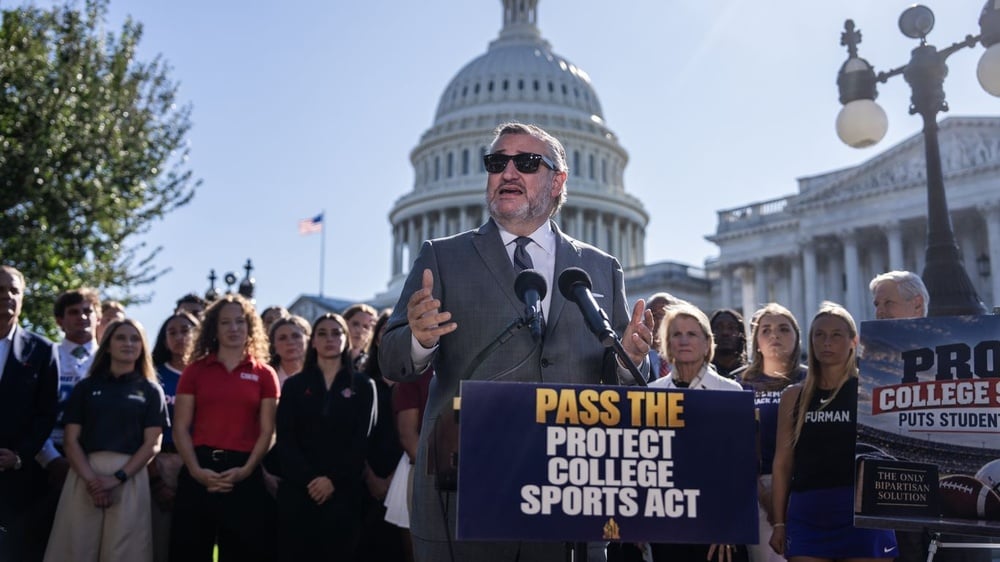
Frames the Protect College Sports Act's 77-22 Senate passage as straightforward, inside-the-Beltway legislative news, portraying the bipartisan deal as substantial while signaling pessimism about House passage.
The Act is the latest congressional attempt to set a uniform national framework for college athletics, an area historically governed by the NCAA and state laws that have diverged on athlete compensation and player movement.
Automated analysis; not human reviewed.
Limitations: The supplied text is a compressed news brief with no direct quotes or named sources, so framing and attribution assessments rely on the summarized provisions and process language; the Politics/Sports category boundary is also ambiguous.
·
14 of 55 available dimensions scored; omitted dimensions are not treated as neutral.
·
Verified supporting quotes for 14 of 14 scored dimensions.
Claim: The report conveys Republican and Democratic concerns symmetrically without siding with either party.
“reassured Republicans that it would not supersede state laws on transgender athletes and fended off union language pushed by some Democrats” · exact text match
Why: Both parties' policy demands are stated as equivalent legislative facts, with no favorable or unfavorable spin on either.
Claim: The article states the bill's terms descriptively rather than advocating a position.
“The bill allows the NCAA to set and enforce standardized rules on transfers, recruits and pay-for-play NIL arrangements.” · exact text match
Why: Core content is declarative description of what the legislation does; evaluative language is confined to labeled analysis sections.
Claim: The reporting is procedural and dry rather than sensational.
“It gives student athletes five years of eligibility, starting when they enroll or turn 19 years old, and permits one free transfer.” · exact text match
Why: The detail is delivered as matter-of-fact rule summary; no dramatic, alarmist, or outrage-oriented language appears.
Claim: The article tilts negative on the bill's future prospects.
“The bill faces an uphill battle in the House, and don't expect lawmakers to cut their six-week pre-election recess short to pass it.” · exact text match
Why: The 'What's next' section emphasizes obstacles and anticipates inaction, casting doubt on passage.
Claim: The report contains concrete, non-obvious legislative details that engage a reader.
“The bill reduces — from five to three years —the time a school has to remain independent before moving from one Power Four conference to another.” · exact text match
Why: Specific figures on eligibility, revenue caps, and conference moves add substance beyond a routine vote announcement.
Claim: The article limits itself to describing the bill's contents and procedural status.
“It gives student athletes five years of eligibility, starting when they enroll or turn 19 years old, and permits one free transfer.” · exact text match
Why: No recommendations, calls to action, or normative judgments about how the issue should be resolved are present.
Claim: The article embeds qualitative judgments in its analysis sections, such as labeling the bill 'massive.'
“It is a massive piece of legislation, setting national rules on everything from name, image and likeness compensation and the transfer portal to conference realignment and pooled media rights.” · exact text match
Why: 'Massive' and 'on everything' are evaluative claims, though confined to a clearly marked 'Why it matters' analysis block.
Claim: The story's substance is legislative politics — votes, coalitions, and floor strategy — rather than sports competition or athlete experience.
“The Senate passed the bipartisan Protect College Sports Act on Monday, voting 77 to 22 in favor of the sweeping overhaul of college athletics.” · exact text match
Why: Nearly every reported element is about the political process: the vote, concessions, opposition, and House prospects.
Claim: The narrative treats congressional process and institutional deal-making as the normal, unproblematic way to govern college sports.
“Between the lines: The bill's path through the Senate has been long and full of hiccups.” · exact text match
Why: The process is described in insider, procedural terms without questioning the legitimacy or role of Congress, the NCAA, or the major conferences.
Claim: The report offers specific, checkable figures and hedges where precision is uncertain.
“voting 77 to 22” · exact text match
“around $50 million per school” · exact text match
Why: It states an exact vote count and uses 'around' to qualify the revenue cap, and it attributes positions to named groups and leaders, supporting verifiability.
Claim: The report's conclusions about the bill's prospects follow logically from reported procedural facts.
“The bill faces an uphill battle in the House, and don't expect lawmakers to cut their six-week pre-election recess short to pass it.” · exact text match
Why: The forecast is grounded in the reported recess schedule and the earlier failure of the House SCORE Act rather than in assertion or emotion.
Claim: The report makes conditional forward-looking predictions about the bill's prospects and coalition stability.
“Some House Republicans also want to add restrictions on foreign athletes, a change that would jeopardize the bipartisan coalition behind the bill in the Senate.” · exact text match
Why: The predicted effect on the coalition and the expectation that the recess will not be shortened go beyond settled facts.
Claim: The report is candid about the compromises and unresolved opposition surrounding the bill.
“Legislators made changes to convince the Big Ten and SEC, secured President Trump's backing, reassured Republicans that it would not supersede state laws on transgender athletes and fended off union language pushed by some Democrats.” · exact text match
Why: It openly recounts deal-making and dissenting concerns rather than presenting the legislation as uncontroversial.
Claim: The report compresses a complex bill into precise, accurate-looking specifics and connects them to the political landscape.
“It also codifies a caps on the revenue schools can share with current players, raising it to around $50 million per school.” · exact text match
Why: Numeric details, conditions, and process context are presented concisely and with hedging where appropriate.
The supplied text is a compressed news brief with no direct quotes or named sources, so framing and attribution assessments rely on the summarized provisions and process language; the Politics/Sports category boundary is also ambiguous.
Framing treats the Senate vote as a historic first step toward stabilizing college sports while foregrounding House uncertainty and including opposition quotes.
The bill would codify the antitrust settlement in House v. NCAA and give the NCAA limited antitrust protection; NCAA v. Alston (2021) and state NIL laws ended the NCAA's long-standing prohibition on athlete compensation and created the patchwork the bill addresses.
Automated analysis; not human reviewed.
Limitations: No publication date or byline is supplied; 'Monday night' and the midterm date cannot be independently anchored from the text.
·
7 of 55 available dimensions scored; omitted dimensions are not treated as neutral.
·
Verified supporting quotes for 3 of 7 scored dimensions.
Claim: The report is balanced along the liberal-conservative axis, presenting bipartisan support and opposition rather than a partisan slant.
“On the other side stood the supporters of the bill: Senate leadership, President Trump, 32 conferences and more than 370 schools, according to the White House.” · exact text match
“"I've been fighting against an institution called the NCAA that has violated [players'] rights all throughout my lifetime," Booker said on the Senate floor before the roll call.” · not found in supplied text
Why: Inclusion of both the bill's supporter list and a leading opponent's criticism on a bipartisan bill is positive evidence of neutrality.
Claim: The report is predominantly factual and attributed, but uses evaluative language such as 'historic' and 'chaos.'
“The U.S. Senate passed the Protect College Sports Act by a 77-22 vote” · exact text match
“The bill would write the NCAA's rules into federal law, give the industry a limited antitrust exemption to enforce rules on transfers and eligibility, and codify the House v. NCAA settlement” · not found in supplied text
Counterevidence:
“Late Monday night, they ultimately secured the first historic vote they sought.” · exact text match
Why: Most statements are checkable and attributed, but 'historic' is an evaluative characterization, so the text is only somewhat objective.
Claim: The report describes the bill's provisions and legislative path rather than advocating a specific outcome.
“The bill would write the NCAA's rules into federal law” · not found in supplied text
“Under the bill, athletes can transfer once without sitting out a season” · exact text match
Counterevidence:
“Regardless of what lies ahead, Monday night marked a historic turning point.” · exact text match
Why: The main body is descriptive, but the closing characterization is evaluative, making the overall text somewhat descriptive rather than prescriptive.
Claim: The article is highly political because its central subject is a Senate vote, House scheduling, and election-year maneuvering.
“The U.S. Senate passed the Protect College Sports Act by a 77-22 vote following nearly six hours of debate” · exact text match
“The bill now heads to the House of Representatives, where it is unlikely to reach the floor before the Nov. 3 midterm elections” · exact text match
Why: The report's event, timeline, and stakes are defined by congressional action and electoral timing.
Claim: The report is highly credible on its face because it supplies specific vote counts, named actors, attributed quotes, and explicit uncertainty.
“The U.S. Senate passed the Protect College Sports Act by a 77-22 vote following nearly six hours of debate and consideration of seven amendments on the floor.” · exact text match
“32 conferences and more than 370 schools, according to the White House.” · exact text match
Why: Precise legislative details, named officials, and source attributions are visible; no unsupported assertion is presented as settled fact.
Claim: The report includes conditional forecasts about House timing and presidential pressure, though it attributes much of it to sources.
“The House is not scheduled to return to work until Nov. 9, raising concerns about whether a college sports bill would even be considered during a lame-duck session.” · exact text match
“President Trump has pressed House leaders to return in October, and he may do so again after the Senate passed the bill Monday.” · exact text match
Why: The text uses words like 'unlikely,' 'raising concerns,' and 'may do so again' to project future events rather than only report settled facts.
Claim: The report is internally fair, giving direct quotation space to both supporters and critics.
“"This bill puts an end to the chaos plaguing college athletics," Cruz said Monday on the Senate floor.” · not found in supplied text
“"I've been fighting against an institution called the NCAA that has violated [players'] rights all throughout my lifetime," Booker said on the Senate floor before the roll call.” · not found in supplied text
Why: Direct quotes from a supporter and an opponent show the publisher is not suppressing either side of the legislative dispute.
No publication date or byline is supplied; 'Monday night' and the midterm date cannot be independently anchored from the text.
September 29, 2026 · 0 shares
A bipartisan legislative scorecard frames the Senate vote as historic while foregrounding procedural uncertainty and cross-party objections.
NCAA v. Alston found that the NCAA's limits on education-related compensation violated antitrust law, so the bill's antitrust protections are intended to override that precedent; the article references the case but does not explain its holding.
Automated analysis; not human reviewed.
Limitations: Text includes promotional/link material alongside reporting; no external verification was attempted.
·
4 of 55 available dimensions scored; omitted dimensions are not treated as neutral.
·
Verified supporting quotes for 4 of 4 scored dimensions.
Claim: The report gives no partisan endorsement and names opposition from both parties.
“passed the Senate with an overwhelmingly bipartisan vote of 77-22” · exact text match
“It’s also expected to see opposition from Democrats and left-leaning advocacy groups, as well as a number of Republicans.” · exact text match
Why: The publisher includes bipartisan passage and cross-party opposition without endorsing either side.
Claim: The report sticks to attributable events and procedures rather than editorial commentary.
“Senators also voted on seven amendments, three of which were adopted” · exact text match
Why: The sentence is a dry factual summary of amendment outcomes.
Claim: The piece attributes statements and includes specific vote and amendment counts.
“The vote, which took six hours between debate and amendment consideration, was historic.” · exact text match
“Moody said USF, Miami, and FSU would benefit from the change.” · exact text match
Why: Named attribution and direct quotes support visible sourcing, while some procedural detail is sourced only to the outlet itself.
Claim: Forward-looking analysis is present but clearly hedged.
“The deciding factor in the House, which needs a narrow majority to pass the bill, could be the ability for Trump to convince enough Republicans to support it.” · exact text match
Why: The use of 'could' signals probabilistic analysis rather than asserted fact.
Text includes promotional/link material alongside reporting; no external verification was attempted.
Frames the Protect College Sports Act's 77-22 Senate passage as straightforward, inside-the-Beltway legislative news, portraying the bipartisan deal as substantial while signaling pessimism about House passage.
The Act is the latest congressional attempt to set a uniform national framework for college athletics, an area historically governed by the NCAA and state laws that have diverged on athlete compensation and player movement.
Automated analysis; not human reviewed.
Limitations: The supplied text is a compressed news brief with no direct quotes or named sources, so framing and attribution assessments rely on the summarized provisions and process language; the Politics/Sports category boundary is also ambiguous.
·
14 of 55 available dimensions scored; omitted dimensions are not treated as neutral.
·
Verified supporting quotes for 14 of 14 scored dimensions.
Claim: The report conveys Republican and Democratic concerns symmetrically without siding with either party.
“reassured Republicans that it would not supersede state laws on transgender athletes and fended off union language pushed by some Democrats” · exact text match
Why: Both parties' policy demands are stated as equivalent legislative facts, with no favorable or unfavorable spin on either.
Claim: The article states the bill's terms descriptively rather than advocating a position.
“The bill allows the NCAA to set and enforce standardized rules on transfers, recruits and pay-for-play NIL arrangements.” · exact text match
Why: Core content is declarative description of what the legislation does; evaluative language is confined to labeled analysis sections.
Claim: The reporting is procedural and dry rather than sensational.
“It gives student athletes five years of eligibility, starting when they enroll or turn 19 years old, and permits one free transfer.” · exact text match
Why: The detail is delivered as matter-of-fact rule summary; no dramatic, alarmist, or outrage-oriented language appears.
Claim: The article tilts negative on the bill's future prospects.
“The bill faces an uphill battle in the House, and don't expect lawmakers to cut their six-week pre-election recess short to pass it.” · exact text match
Why: The 'What's next' section emphasizes obstacles and anticipates inaction, casting doubt on passage.
Claim: The report contains concrete, non-obvious legislative details that engage a reader.
“The bill reduces — from five to three years —the time a school has to remain independent before moving from one Power Four conference to another.” · exact text match
Why: Specific figures on eligibility, revenue caps, and conference moves add substance beyond a routine vote announcement.
Claim: The article limits itself to describing the bill's contents and procedural status.
“It gives student athletes five years of eligibility, starting when they enroll or turn 19 years old, and permits one free transfer.” · exact text match
Why: No recommendations, calls to action, or normative judgments about how the issue should be resolved are present.
Claim: The article embeds qualitative judgments in its analysis sections, such as labeling the bill 'massive.'
“It is a massive piece of legislation, setting national rules on everything from name, image and likeness compensation and the transfer portal to conference realignment and pooled media rights.” · exact text match
Why: 'Massive' and 'on everything' are evaluative claims, though confined to a clearly marked 'Why it matters' analysis block.
Claim: The story's substance is legislative politics — votes, coalitions, and floor strategy — rather than sports competition or athlete experience.
“The Senate passed the bipartisan Protect College Sports Act on Monday, voting 77 to 22 in favor of the sweeping overhaul of college athletics.” · exact text match
Why: Nearly every reported element is about the political process: the vote, concessions, opposition, and House prospects.
Claim: The narrative treats congressional process and institutional deal-making as the normal, unproblematic way to govern college sports.
“Between the lines: The bill's path through the Senate has been long and full of hiccups.” · exact text match
Why: The process is described in insider, procedural terms without questioning the legitimacy or role of Congress, the NCAA, or the major conferences.
Claim: The report offers specific, checkable figures and hedges where precision is uncertain.
“voting 77 to 22” · exact text match
“around $50 million per school” · exact text match
Why: It states an exact vote count and uses 'around' to qualify the revenue cap, and it attributes positions to named groups and leaders, supporting verifiability.
Claim: The report's conclusions about the bill's prospects follow logically from reported procedural facts.
“The bill faces an uphill battle in the House, and don't expect lawmakers to cut their six-week pre-election recess short to pass it.” · exact text match
Why: The forecast is grounded in the reported recess schedule and the earlier failure of the House SCORE Act rather than in assertion or emotion.
Claim: The report makes conditional forward-looking predictions about the bill's prospects and coalition stability.
“Some House Republicans also want to add restrictions on foreign athletes, a change that would jeopardize the bipartisan coalition behind the bill in the Senate.” · exact text match
Why: The predicted effect on the coalition and the expectation that the recess will not be shortened go beyond settled facts.
Claim: The report is candid about the compromises and unresolved opposition surrounding the bill.
“Legislators made changes to convince the Big Ten and SEC, secured President Trump's backing, reassured Republicans that it would not supersede state laws on transgender athletes and fended off union language pushed by some Democrats.” · exact text match
Why: It openly recounts deal-making and dissenting concerns rather than presenting the legislation as uncontroversial.
Claim: The report compresses a complex bill into precise, accurate-looking specifics and connects them to the political landscape.
“It also codifies a caps on the revenue schools can share with current players, raising it to around $50 million per school.” · exact text match
Why: Numeric details, conditions, and process context are presented concisely and with hedging where appropriate.
The supplied text is a compressed news brief with no direct quotes or named sources, so framing and attribution assessments rely on the summarized provisions and process language; the Politics/Sports category boundary is also ambiguous.
Framing treats the Senate vote as a historic first step toward stabilizing college sports while foregrounding House uncertainty and including opposition quotes.
The bill would codify the antitrust settlement in House v. NCAA and give the NCAA limited antitrust protection; NCAA v. Alston (2021) and state NIL laws ended the NCAA's long-standing prohibition on athlete compensation and created the patchwork the bill addresses.
Automated analysis; not human reviewed.
Limitations: No publication date or byline is supplied; 'Monday night' and the midterm date cannot be independently anchored from the text.
·
7 of 55 available dimensions scored; omitted dimensions are not treated as neutral.
·
Verified supporting quotes for 3 of 7 scored dimensions.
Claim: The report is balanced along the liberal-conservative axis, presenting bipartisan support and opposition rather than a partisan slant.
“On the other side stood the supporters of the bill: Senate leadership, President Trump, 32 conferences and more than 370 schools, according to the White House.” · exact text match
“"I've been fighting against an institution called the NCAA that has violated [players'] rights all throughout my lifetime," Booker said on the Senate floor before the roll call.” · not found in supplied text
Why: Inclusion of both the bill's supporter list and a leading opponent's criticism on a bipartisan bill is positive evidence of neutrality.
Claim: The report is predominantly factual and attributed, but uses evaluative language such as 'historic' and 'chaos.'
“The U.S. Senate passed the Protect College Sports Act by a 77-22 vote” · exact text match
“The bill would write the NCAA's rules into federal law, give the industry a limited antitrust exemption to enforce rules on transfers and eligibility, and codify the House v. NCAA settlement” · not found in supplied text
Counterevidence:
“Late Monday night, they ultimately secured the first historic vote they sought.” · exact text match
Why: Most statements are checkable and attributed, but 'historic' is an evaluative characterization, so the text is only somewhat objective.
Claim: The report describes the bill's provisions and legislative path rather than advocating a specific outcome.
“The bill would write the NCAA's rules into federal law” · not found in supplied text
“Under the bill, athletes can transfer once without sitting out a season” · exact text match
Counterevidence:
“Regardless of what lies ahead, Monday night marked a historic turning point.” · exact text match
Why: The main body is descriptive, but the closing characterization is evaluative, making the overall text somewhat descriptive rather than prescriptive.
Claim: The article is highly political because its central subject is a Senate vote, House scheduling, and election-year maneuvering.
“The U.S. Senate passed the Protect College Sports Act by a 77-22 vote following nearly six hours of debate” · exact text match
“The bill now heads to the House of Representatives, where it is unlikely to reach the floor before the Nov. 3 midterm elections” · exact text match
Why: The report's event, timeline, and stakes are defined by congressional action and electoral timing.
Claim: The report is highly credible on its face because it supplies specific vote counts, named actors, attributed quotes, and explicit uncertainty.
“The U.S. Senate passed the Protect College Sports Act by a 77-22 vote following nearly six hours of debate and consideration of seven amendments on the floor.” · exact text match
“32 conferences and more than 370 schools, according to the White House.” · exact text match
Why: Precise legislative details, named officials, and source attributions are visible; no unsupported assertion is presented as settled fact.
Claim: The report includes conditional forecasts about House timing and presidential pressure, though it attributes much of it to sources.
“The House is not scheduled to return to work until Nov. 9, raising concerns about whether a college sports bill would even be considered during a lame-duck session.” · exact text match
“President Trump has pressed House leaders to return in October, and he may do so again after the Senate passed the bill Monday.” · exact text match
Why: The text uses words like 'unlikely,' 'raising concerns,' and 'may do so again' to project future events rather than only report settled facts.
Claim: The report is internally fair, giving direct quotation space to both supporters and critics.
“"This bill puts an end to the chaos plaguing college athletics," Cruz said Monday on the Senate floor.” · not found in supplied text
“"I've been fighting against an institution called the NCAA that has violated [players'] rights all throughout my lifetime," Booker said on the Senate floor before the roll call.” · not found in supplied text
Why: Direct quotes from a supporter and an opponent show the publisher is not suppressing either side of the legislative dispute.
No publication date or byline is supplied; 'Monday night' and the midterm date cannot be independently anchored from the text.
September 29, 2026 · 0 shares
The Senate-passed PCSA is cast as a lobbying-driven antitrust carve-out that sidesteps athletes’ most consequential rights questions.
The NCAA is the main U.S. college athletics governing body.
Federal antitrust law has been used to challenge NCAA compensation limits in O’Bannon v. NCAA and Alston v. NCAA.
The House v. NCAA settlement is a class-action deal creating a multibillion-dollar revenue-sharing structure for athletes.
NIL refers to college athletes’ right to earn from their name, image, and likeness; the Sherman Act is the main U.S. antitrust statute.
Automated analysis; not human reviewed.
Limitations: The supplied text is a single article; no independent verification of vote counts, quotes, or legislative details was possible.
·
8 of 55 available dimensions scored; omitted dimensions are not treated as neutral.
·
Verified supporting quotes for 8 of 8 scored dimensions.
Claim: PCSA passage is framed through the influence of wealthy donors, lobbying money, and corporate media interests.
“billionaire Texas Tech booster and GOP donor Cody Campbell, whose advocacy group, Saving College Sports, became the major financial force behind the legislation” · exact text match
“ESPN—a network whose parent company has lobbied for the measure and has a massive financial interest in its outcome” · exact text match
Why: The selection and emphasis of donor wealth and corporate lobbying creates an anti-elite lens on the legislative process, though the reporting remains factual.
Claim: Factual reporting is punctuated by editorial characterizations of people and events.
“whose views on the Sherman Act have been notably selective” · exact text match
“making an awkward Sept.
12 appearance on ESPN’s College GameDay”
· exact text match
Why: The phrases 'notably selective' and 'awkward' inject subjective judgment into an otherwise factual account.
Claim: The text is almost entirely descriptive, explaining what the bill does and how it fared, without urging action.
“The bill now heads to the House of Representatives, where Republicans hold a slim, four-seat majority, and where, ahead of the midterm elections, it still faces plenty of opportunities to get scuttled or sidelined.” · exact text match
Why: The sentence reports a condition rather than recommending a course of action.
Claim: The article mixes factual reporting with explicit evaluative opinions.
“whose views on the Sherman Act have been notably selective” · exact text match
“Sampson’s advocacy for the NCAA-backed bill was especially notable, if not ironic” · exact text match
Why: These are the publisher’s own judgments about Cruz and Sampson, not attributed views.
Claim: The report is densely sourced with exact vote counts, named officials, and a published correction.
“the Senate voted 77-22 to give the PCSA final passage” · exact text match
“CORRECTION: An early version of this story said the Republicans hold a six-seat majority in the House of Representatives.
They hold a four-seat majority.”
· exact text match
Why: Specific vote tallies and a correction are observable credibility signals.
Claim: The reporting uses reasoned legislative and legal analysis rather than emotional or conspiratorial framing.
“By addressing many of the issues that could otherwise be subjects of collective bargaining, the legislation would significantly narrow what athletes and their potential unions could seek at the bargaining table.” · exact text match
Why: A causal analytical inference about collective bargaining shows measured, rational reasoning.
Claim: The reporting is transparent about its own correction and attributes contested claims to opponents.
“CORRECTION: An early version of this story said the Republicans hold a six-seat majority in the House of Representatives.
They hold a four-seat majority.”
· exact text match
“Opponents of the bill have contended that the PCSA disadvantages college athletes, particularly Black football and basketball players, in the name of imposing order on a system they contend has already been tilted against them.” · exact text match
Why: Publishing a correction and attributing criticism to opponents signals internal fairness and honesty.
Claim: The coverage weaves together legislative history, legal context, and strategic analysis.
“By addressing many of the issues that could otherwise be subjects of collective bargaining, the legislation would significantly narrow what athletes and their potential unions could seek at the bargaining table.” · exact text match
Why: The synthesis of legal and labor implications demonstrates analytical complexity.
The supplied text is a single article; no independent verification of vote counts, quotes, or legislative details was possible.
September 29, 2026 · 0 shares
The framing is neutral legislative reporting: it records the vote, identifies the amendment's sponsor and bill, and offers ticket-price context without endorsing either side.
Automated analysis; not human reviewed.
Limitations: The supplied text is truncated mid-sentence, so analysis covers only the opening of the report.
·
2 of 55 available dimensions scored; omitted dimensions are not treated as neutral.
·
Verified supporting quotes for 2 of 2 scored dimensions.
Claim: The publisher reports the Senate vote and amendment details without evaluative or opinionated language.
“The Senate voted Monday evening to defeat an amendment sponsored by Sen. John Kennedy (R-La.) to cap ticket price increases for college sporting events to four percent a year” · exact text match
Why: The sentence is a direct factual report of a legislative outcome and attributes the proposal to its sponsor; the price-increase context is background rather than advocacy.
Claim: The report is politically neutral rather than partisan or advocacy-oriented.
“Senate voted Monday evening to defeat an amendment sponsored by Sen. John Kennedy (R-La.)” · exact text match
Why: It covers a U.S. Senate legislative vote and identifies the amendment's sponsor, but uses no ideological or partisan evaluative language.
The supplied text is truncated mid-sentence, so analysis covers only the opening of the report.
September 29, 2026 · 0 shares
The Senate-passed PCSA is cast as a lobbying-driven antitrust carve-out that sidesteps athletes’ most consequential rights questions.
The NCAA is the main U.S. college athletics governing body.
Federal antitrust law has been used to challenge NCAA compensation limits in O’Bannon v. NCAA and Alston v. NCAA.
The House v. NCAA settlement is a class-action deal creating a multibillion-dollar revenue-sharing structure for athletes.
NIL refers to college athletes’ right to earn from their name, image, and likeness; the Sherman Act is the main U.S. antitrust statute.
Automated analysis; not human reviewed.
Limitations: The supplied text is a single article; no independent verification of vote counts, quotes, or legislative details was possible.
·
8 of 55 available dimensions scored; omitted dimensions are not treated as neutral.
·
Verified supporting quotes for 8 of 8 scored dimensions.
Claim: PCSA passage is framed through the influence of wealthy donors, lobbying money, and corporate media interests.
“billionaire Texas Tech booster and GOP donor Cody Campbell, whose advocacy group, Saving College Sports, became the major financial force behind the legislation” · exact text match
“ESPN—a network whose parent company has lobbied for the measure and has a massive financial interest in its outcome” · exact text match
Why: The selection and emphasis of donor wealth and corporate lobbying creates an anti-elite lens on the legislative process, though the reporting remains factual.
Claim: Factual reporting is punctuated by editorial characterizations of people and events.
“whose views on the Sherman Act have been notably selective” · exact text match
“making an awkward Sept.
12 appearance on ESPN’s College GameDay”
· exact text match
Why: The phrases 'notably selective' and 'awkward' inject subjective judgment into an otherwise factual account.
Claim: The text is almost entirely descriptive, explaining what the bill does and how it fared, without urging action.
“The bill now heads to the House of Representatives, where Republicans hold a slim, four-seat majority, and where, ahead of the midterm elections, it still faces plenty of opportunities to get scuttled or sidelined.” · exact text match
Why: The sentence reports a condition rather than recommending a course of action.
Claim: The article mixes factual reporting with explicit evaluative opinions.
“whose views on the Sherman Act have been notably selective” · exact text match
“Sampson’s advocacy for the NCAA-backed bill was especially notable, if not ironic” · exact text match
Why: These are the publisher’s own judgments about Cruz and Sampson, not attributed views.
Claim: The report is densely sourced with exact vote counts, named officials, and a published correction.
“the Senate voted 77-22 to give the PCSA final passage” · exact text match
“CORRECTION: An early version of this story said the Republicans hold a six-seat majority in the House of Representatives.
They hold a four-seat majority.”
· exact text match
Why: Specific vote tallies and a correction are observable credibility signals.
Claim: The reporting uses reasoned legislative and legal analysis rather than emotional or conspiratorial framing.
“By addressing many of the issues that could otherwise be subjects of collective bargaining, the legislation would significantly narrow what athletes and their potential unions could seek at the bargaining table.” · exact text match
Why: A causal analytical inference about collective bargaining shows measured, rational reasoning.
Claim: The reporting is transparent about its own correction and attributes contested claims to opponents.
“CORRECTION: An early version of this story said the Republicans hold a six-seat majority in the House of Representatives.
They hold a four-seat majority.”
· exact text match
“Opponents of the bill have contended that the PCSA disadvantages college athletes, particularly Black football and basketball players, in the name of imposing order on a system they contend has already been tilted against them.” · exact text match
Why: Publishing a correction and attributing criticism to opponents signals internal fairness and honesty.
Claim: The coverage weaves together legislative history, legal context, and strategic analysis.
“By addressing many of the issues that could otherwise be subjects of collective bargaining, the legislation would significantly narrow what athletes and their potential unions could seek at the bargaining table.” · exact text match
Why: The synthesis of legal and labor implications demonstrates analytical complexity.
The supplied text is a single article; no independent verification of vote counts, quotes, or legislative details was possible.
September 29, 2026 · 0 shares
Senate passage is framed as a decisive, Trump-backed bipartisan fix for a chaotic college-sports system, with the main opponent presented through a race-focused quote.
Automated analysis; not human reviewed.
Limitations: The input contained several unrelated headlines and promotional boxes around the main report; only the Senate bill report was scored.
·
4 of 55 available dimensions scored; omitted dimensions are not treated as neutral.
·
Verified supporting quotes for 3 of 4 scored dimensions.
Claim: The report's selection and framing is conservative-leaning, presenting the bill as necessary and Trump-backed while making the race-laced Democratic objection the emblematic opposition.
“"It has been the federal antitrust laws applied in litigation after litigation after litigation that have had the effect of tearing down essentially all the rules," he continued.
"So right now it is the Wild West."”
· not found in supplied text
“"The 'chaos' is that (mostly Black) athletes now have bargaining power and White coaches and sports industry execs hate it," Murphy said on X earlier this month.” · not found in supplied text
Why: Supporters' 'Wild West' diagnosis and Trump's endorsement are foregrounded, while the only extended opposition content is a named Democrat's race-focused quote.
Claim: The report is primarily objective in form: it attributes claims and reports precise legislative details without first-person publisher editorializing.
“The bill, led by Sen. Ted Cruz, R-Texas, and Sen. Maria Cantwell, D-Wash., was passed by a vote of 77-22 on Monday night.” · exact text match
“There are opponents of the bill, however, including Sen. Chris Murphy, D-Conn.
who said it would take away bargaining power from the athletes, while creating exemptions from antitrust law for schools.”
· exact text match
Why: The report gives a specific vote count, names sponsors, and attributes the opposing position to a named senator rather than stating it as fact.
Claim: The supplied text demonstrates credible sourcing and specificity through a named vote margin, sponsors, and direct attributed quotes.
“The bipartisan bill, led by Ted Cruz and Maria Cantwell, passed 77-22 on Monday night” · exact text match
“Hawley said earlier this month he voted to advance the legislation after saying his concern was addressed and fixed within the bill to his satisfaction.” · exact text match
Why: The report provides checkable identifiers—bill name, sponsors, vote count—and distinguishes an official's statement from the news report's own assertions.
Claim: The report shows moderate internal fairness by acknowledging opposition and procedural uncertainty alongside the bill's supporters.
“There are opponents of the bill, however, including Sen. Chris Murphy, D-Conn.
who said it would take away bargaining power from the athletes, while creating exemptions from antitrust law for schools.”
· exact text match
“The House is under recess until after the midterm elections, meaning a potential vote on the bill to send it to Trump's desk would have to wait.” · exact text match
Why: It names a critic and his rationale and states the next-step uncertainty rather than claiming immediate enactment.
The input contained several unrelated headlines and promotional boxes around the main report; only the Senate bill report was scored.
Framing treats the Senate vote as a historic first step toward stabilizing college sports while foregrounding House uncertainty and including opposition quotes.
The bill would codify the antitrust settlement in House v. NCAA and give the NCAA limited antitrust protection; NCAA v. Alston (2021) and state NIL laws ended the NCAA's long-standing prohibition on athlete compensation and created the patchwork the bill addresses.
Automated analysis; not human reviewed.
Limitations: No publication date or byline is supplied; 'Monday night' and the midterm date cannot be independently anchored from the text.
·
7 of 55 available dimensions scored; omitted dimensions are not treated as neutral.
·
Verified supporting quotes for 3 of 7 scored dimensions.
Claim: The report is balanced along the liberal-conservative axis, presenting bipartisan support and opposition rather than a partisan slant.
“On the other side stood the supporters of the bill: Senate leadership, President Trump, 32 conferences and more than 370 schools, according to the White House.” · exact text match
“"I've been fighting against an institution called the NCAA that has violated [players'] rights all throughout my lifetime," Booker said on the Senate floor before the roll call.” · not found in supplied text
Why: Inclusion of both the bill's supporter list and a leading opponent's criticism on a bipartisan bill is positive evidence of neutrality.
Claim: The report is predominantly factual and attributed, but uses evaluative language such as 'historic' and 'chaos.'
“The U.S. Senate passed the Protect College Sports Act by a 77-22 vote” · exact text match
“The bill would write the NCAA's rules into federal law, give the industry a limited antitrust exemption to enforce rules on transfers and eligibility, and codify the House v. NCAA settlement” · not found in supplied text
Counterevidence:
“Late Monday night, they ultimately secured the first historic vote they sought.” · exact text match
Why: Most statements are checkable and attributed, but 'historic' is an evaluative characterization, so the text is only somewhat objective.
Claim: The report describes the bill's provisions and legislative path rather than advocating a specific outcome.
“The bill would write the NCAA's rules into federal law” · not found in supplied text
“Under the bill, athletes can transfer once without sitting out a season” · exact text match
Counterevidence:
“Regardless of what lies ahead, Monday night marked a historic turning point.” · exact text match
Why: The main body is descriptive, but the closing characterization is evaluative, making the overall text somewhat descriptive rather than prescriptive.
Claim: The article is highly political because its central subject is a Senate vote, House scheduling, and election-year maneuvering.
“The U.S. Senate passed the Protect College Sports Act by a 77-22 vote following nearly six hours of debate” · exact text match
“The bill now heads to the House of Representatives, where it is unlikely to reach the floor before the Nov. 3 midterm elections” · exact text match
Why: The report's event, timeline, and stakes are defined by congressional action and electoral timing.
Claim: The report is highly credible on its face because it supplies specific vote counts, named actors, attributed quotes, and explicit uncertainty.
“The U.S. Senate passed the Protect College Sports Act by a 77-22 vote following nearly six hours of debate and consideration of seven amendments on the floor.” · exact text match
“32 conferences and more than 370 schools, according to the White House.” · exact text match
Why: Precise legislative details, named officials, and source attributions are visible; no unsupported assertion is presented as settled fact.
Claim: The report includes conditional forecasts about House timing and presidential pressure, though it attributes much of it to sources.
“The House is not scheduled to return to work until Nov. 9, raising concerns about whether a college sports bill would even be considered during a lame-duck session.” · exact text match
“President Trump has pressed House leaders to return in October, and he may do so again after the Senate passed the bill Monday.” · exact text match
Why: The text uses words like 'unlikely,' 'raising concerns,' and 'may do so again' to project future events rather than only report settled facts.
Claim: The report is internally fair, giving direct quotation space to both supporters and critics.
“"This bill puts an end to the chaos plaguing college athletics," Cruz said Monday on the Senate floor.” · not found in supplied text
“"I've been fighting against an institution called the NCAA that has violated [players'] rights all throughout my lifetime," Booker said on the Senate floor before the roll call.” · not found in supplied text
Why: Direct quotes from a supporter and an opponent show the publisher is not suppressing either side of the legislative dispute.
No publication date or byline is supplied; 'Monday night' and the midterm date cannot be independently anchored from the text.
September 29, 2026 · 0 shares
The roundup frames the Senate passage of the Protect College Sports Act as a hard-won but uncertain milestone for college sports lobbyists and otherwise reports sports-business items in neutral, factual terms.
Automated analysis; not human reviewed.
Limitations: The supplied text is a newsletter roundup; it does not include the bill's provisions, actual House scheduling decisions beyond the return date, or sources for 'heavy skepticism,' so the classifications reflect only the visible framing.
·
5 of 55 available dimensions scored; omitted dimensions are not treated as neutral.
·
Verified supporting quotes for 5 of 5 scored dimensions.
Claim: The Senate vote is reported with balanced factual treatment, giving no partisan valence.
“77-22 bipartisan vote” · exact text match
“President Trump, a supporter of the bill” · exact text match
Why: The bipartisan margin, the bill's Trump support, and Speaker Johnson's scheduling decision are all reported as neutral facts without praise or criticism of either party.
Claim: The report is predominantly factual but uses mild evaluative language in the lead item.
“77-22 bipartisan vote” · exact text match
“People involved in the process expect the House to be a harder climb than the Senate” · exact text match
Counterevidence:
“college sports lobbyists got their biggest win yet” · exact text match
Why: Specific vote totals, dates, and attributed expectations dominate; the main subjective overlay is calling the Senate vote the lobbyists' 'biggest win yet.'
Claim: No sensational or exaggerated presentation; the items are dense factual briefs.
“Peacock will stream every inning of MLB’s Wild Card round this week” · exact text match
“The existing schedule calls for House members to return Nov. 9 after the midterms on Nov.
3.”
· exact text match
Why: The language is mostly straightforward sports-business reporting, with no dramatic imagery or hype; the mild 'biggest win yet' remains within normal trade-journal framing.
Claim: The text describes events and schedules without prescribing action or policy.
“The House hasn’t been in session since Sept.
17”
· exact text match
“Blazers brass says the desire is to remain in Portland amid lease talks” · exact text match
Why: Every item reports an event, status, or expectation; there are no calls to action, recommendations, or policy prescriptions.
Claim: Sourcing and specificity support high internal credibility.
“reports SBJ’s Irving Mejia-Hilario” · exact text match
“77-22 bipartisan vote” · exact text match
“bumping his salary from $2.09 million a year to $2.675 million annually” · exact text match
Why: The publisher names a reporter, cites a specific bipartisan tally, and includes precise contract and schedule figures, allowing verification.
The supplied text is a newsletter roundup; it does not include the bill's provisions, actual House scheduling decisions beyond the return date, or sources for 'heavy skepticism,' so the classifications reflect only the visible framing.
Frames the Protect College Sports Act's 77-22 Senate passage as straightforward, inside-the-Beltway legislative news, portraying the bipartisan deal as substantial while signaling pessimism about House passage.
The Act is the latest congressional attempt to set a uniform national framework for college athletics, an area historically governed by the NCAA and state laws that have diverged on athlete compensation and player movement.
Automated analysis; not human reviewed. Limitations: The supplied text is a compressed news brief with no direct quotes or named sources, so framing and attribution assessments rely on the summarized provisions and process language; the Politics/Sports category boundary is also ambiguous. · 14 of 55 available dimensions scored; omitted dimensions are not treated as neutral. · Verified supporting quotes for 14 of 14 scored dimensions.
Claim: The report conveys Republican and Democratic concerns symmetrically without siding with either party.
“reassured Republicans that it would not supersede state laws on transgender athletes and fended off union language pushed by some Democrats” · exact text match
Why: Both parties' policy demands are stated as equivalent legislative facts, with no favorable or unfavorable spin on either.
Claim: The article states the bill's terms descriptively rather than advocating a position.
“The bill allows the NCAA to set and enforce standardized rules on transfers, recruits and pay-for-play NIL arrangements.” · exact text match
Why: Core content is declarative description of what the legislation does; evaluative language is confined to labeled analysis sections.
Claim: The reporting is procedural and dry rather than sensational.
“It gives student athletes five years of eligibility, starting when they enroll or turn 19 years old, and permits one free transfer.” · exact text match
Why: The detail is delivered as matter-of-fact rule summary; no dramatic, alarmist, or outrage-oriented language appears.
Claim: The article tilts negative on the bill's future prospects.
“The bill faces an uphill battle in the House, and don't expect lawmakers to cut their six-week pre-election recess short to pass it.” · exact text match
Why: The 'What's next' section emphasizes obstacles and anticipates inaction, casting doubt on passage.
Claim: The report contains concrete, non-obvious legislative details that engage a reader.
“The bill reduces — from five to three years —the time a school has to remain independent before moving from one Power Four conference to another.” · exact text match
Why: Specific figures on eligibility, revenue caps, and conference moves add substance beyond a routine vote announcement.
Claim: The article limits itself to describing the bill's contents and procedural status.
“It gives student athletes five years of eligibility, starting when they enroll or turn 19 years old, and permits one free transfer.” · exact text match
Why: No recommendations, calls to action, or normative judgments about how the issue should be resolved are present.
Claim: The article embeds qualitative judgments in its analysis sections, such as labeling the bill 'massive.'
“It is a massive piece of legislation, setting national rules on everything from name, image and likeness compensation and the transfer portal to conference realignment and pooled media rights.” · exact text match
Why: 'Massive' and 'on everything' are evaluative claims, though confined to a clearly marked 'Why it matters' analysis block.
Claim: The story's substance is legislative politics — votes, coalitions, and floor strategy — rather than sports competition or athlete experience.
“The Senate passed the bipartisan Protect College Sports Act on Monday, voting 77 to 22 in favor of the sweeping overhaul of college athletics.” · exact text match
Why: Nearly every reported element is about the political process: the vote, concessions, opposition, and House prospects.
Claim: The narrative treats congressional process and institutional deal-making as the normal, unproblematic way to govern college sports.
“Between the lines: The bill's path through the Senate has been long and full of hiccups.” · exact text match
Why: The process is described in insider, procedural terms without questioning the legitimacy or role of Congress, the NCAA, or the major conferences.
Claim: The report offers specific, checkable figures and hedges where precision is uncertain.
“voting 77 to 22” · exact text match
“around $50 million per school” · exact text match
Why: It states an exact vote count and uses 'around' to qualify the revenue cap, and it attributes positions to named groups and leaders, supporting verifiability.
Claim: The report's conclusions about the bill's prospects follow logically from reported procedural facts.
“The bill faces an uphill battle in the House, and don't expect lawmakers to cut their six-week pre-election recess short to pass it.” · exact text match
Why: The forecast is grounded in the reported recess schedule and the earlier failure of the House SCORE Act rather than in assertion or emotion.
Claim: The report makes conditional forward-looking predictions about the bill's prospects and coalition stability.
“Some House Republicans also want to add restrictions on foreign athletes, a change that would jeopardize the bipartisan coalition behind the bill in the Senate.” · exact text match
Why: The predicted effect on the coalition and the expectation that the recess will not be shortened go beyond settled facts.
Claim: The report is candid about the compromises and unresolved opposition surrounding the bill.
“Legislators made changes to convince the Big Ten and SEC, secured President Trump's backing, reassured Republicans that it would not supersede state laws on transgender athletes and fended off union language pushed by some Democrats.” · exact text match
Why: It openly recounts deal-making and dissenting concerns rather than presenting the legislation as uncontroversial.
Claim: The report compresses a complex bill into precise, accurate-looking specifics and connects them to the political landscape.
“It also codifies a caps on the revenue schools can share with current players, raising it to around $50 million per school.” · exact text match
Why: Numeric details, conditions, and process context are presented concisely and with hedging where appropriate.
The supplied text is a compressed news brief with no direct quotes or named sources, so framing and attribution assessments rely on the summarized provisions and process language; the Politics/Sports category boundary is also ambiguous.
Framing treats the Senate vote as a historic first step toward stabilizing college sports while foregrounding House uncertainty and including opposition quotes.
The bill would codify the antitrust settlement in House v. NCAA and give the NCAA limited antitrust protection; NCAA v. Alston (2021) and state NIL laws ended the NCAA's long-standing prohibition on athlete compensation and created the patchwork the bill addresses.
Automated analysis; not human reviewed. Limitations: No publication date or byline is supplied; 'Monday night' and the midterm date cannot be independently anchored from the text. · 7 of 55 available dimensions scored; omitted dimensions are not treated as neutral. · Verified supporting quotes for 3 of 7 scored dimensions.
Claim: The report is balanced along the liberal-conservative axis, presenting bipartisan support and opposition rather than a partisan slant.
“On the other side stood the supporters of the bill: Senate leadership, President Trump, 32 conferences and more than 370 schools, according to the White House.” · exact text match
“"I've been fighting against an institution called the NCAA that has violated [players'] rights all throughout my lifetime," Booker said on the Senate floor before the roll call.” · not found in supplied text
Why: Inclusion of both the bill's supporter list and a leading opponent's criticism on a bipartisan bill is positive evidence of neutrality.
Claim: The report is predominantly factual and attributed, but uses evaluative language such as 'historic' and 'chaos.'
“The U.S. Senate passed the Protect College Sports Act by a 77-22 vote” · exact text match
“The bill would write the NCAA's rules into federal law, give the industry a limited antitrust exemption to enforce rules on transfers and eligibility, and codify the House v. NCAA settlement” · not found in supplied text
Counterevidence:
“Late Monday night, they ultimately secured the first historic vote they sought.” · exact text match
Why: Most statements are checkable and attributed, but 'historic' is an evaluative characterization, so the text is only somewhat objective.
Claim: The report describes the bill's provisions and legislative path rather than advocating a specific outcome.
“The bill would write the NCAA's rules into federal law” · not found in supplied text
“Under the bill, athletes can transfer once without sitting out a season” · exact text match
Counterevidence:
“Regardless of what lies ahead, Monday night marked a historic turning point.” · exact text match
Why: The main body is descriptive, but the closing characterization is evaluative, making the overall text somewhat descriptive rather than prescriptive.
Claim: The article is highly political because its central subject is a Senate vote, House scheduling, and election-year maneuvering.
“The U.S. Senate passed the Protect College Sports Act by a 77-22 vote following nearly six hours of debate” · exact text match
“The bill now heads to the House of Representatives, where it is unlikely to reach the floor before the Nov. 3 midterm elections” · exact text match
Why: The report's event, timeline, and stakes are defined by congressional action and electoral timing.
Claim: The report is highly credible on its face because it supplies specific vote counts, named actors, attributed quotes, and explicit uncertainty.
“The U.S. Senate passed the Protect College Sports Act by a 77-22 vote following nearly six hours of debate and consideration of seven amendments on the floor.” · exact text match
“32 conferences and more than 370 schools, according to the White House.” · exact text match
Why: Precise legislative details, named officials, and source attributions are visible; no unsupported assertion is presented as settled fact.
Claim: The report includes conditional forecasts about House timing and presidential pressure, though it attributes much of it to sources.
“The House is not scheduled to return to work until Nov. 9, raising concerns about whether a college sports bill would even be considered during a lame-duck session.” · exact text match
“President Trump has pressed House leaders to return in October, and he may do so again after the Senate passed the bill Monday.” · exact text match
Why: The text uses words like 'unlikely,' 'raising concerns,' and 'may do so again' to project future events rather than only report settled facts.
Claim: The report is internally fair, giving direct quotation space to both supporters and critics.
“"This bill puts an end to the chaos plaguing college athletics," Cruz said Monday on the Senate floor.” · not found in supplied text
“"I've been fighting against an institution called the NCAA that has violated [players'] rights all throughout my lifetime," Booker said on the Senate floor before the roll call.” · not found in supplied text
Why: Direct quotes from a supporter and an opponent show the publisher is not suppressing either side of the legislative dispute.
No publication date or byline is supplied; 'Monday night' and the midterm date cannot be independently anchored from the text.
September 29, 2026 · 0 shares
A bipartisan legislative scorecard frames the Senate vote as historic while foregrounding procedural uncertainty and cross-party objections.
NCAA v. Alston found that the NCAA's limits on education-related compensation violated antitrust law, so the bill's antitrust protections are intended to override that precedent; the article references the case but does not explain its holding.
Automated analysis; not human reviewed. Limitations: Text includes promotional/link material alongside reporting; no external verification was attempted. · 4 of 55 available dimensions scored; omitted dimensions are not treated as neutral. · Verified supporting quotes for 4 of 4 scored dimensions.
Claim: The report gives no partisan endorsement and names opposition from both parties.
“passed the Senate with an overwhelmingly bipartisan vote of 77-22” · exact text match
“It’s also expected to see opposition from Democrats and left-leaning advocacy groups, as well as a number of Republicans.” · exact text match
Why: The publisher includes bipartisan passage and cross-party opposition without endorsing either side.
Claim: The report sticks to attributable events and procedures rather than editorial commentary.
“Senators also voted on seven amendments, three of which were adopted” · exact text match
Why: The sentence is a dry factual summary of amendment outcomes.
Claim: The piece attributes statements and includes specific vote and amendment counts.
“The vote, which took six hours between debate and amendment consideration, was historic.” · exact text match
“Moody said USF, Miami, and FSU would benefit from the change.” · exact text match
Why: Named attribution and direct quotes support visible sourcing, while some procedural detail is sourced only to the outlet itself.
Claim: Forward-looking analysis is present but clearly hedged.
“The deciding factor in the House, which needs a narrow majority to pass the bill, could be the ability for Trump to convince enough Republicans to support it.” · exact text match
Why: The use of 'could' signals probabilistic analysis rather than asserted fact.
Text includes promotional/link material alongside reporting; no external verification was attempted.
September 29, 2026 · 0 shares
The Senate-passed PCSA is cast as a lobbying-driven antitrust carve-out that sidesteps athletes’ most consequential rights questions.
The NCAA is the main U.S. college athletics governing body. Federal antitrust law has been used to challenge NCAA compensation limits in O’Bannon v. NCAA and Alston v. NCAA. The House v. NCAA settlement is a class-action deal creating a multibillion-dollar revenue-sharing structure for athletes. NIL refers to college athletes’ right to earn from their name, image, and likeness; the Sherman Act is the main U.S. antitrust statute.
Automated analysis; not human reviewed. Limitations: The supplied text is a single article; no independent verification of vote counts, quotes, or legislative details was possible. · 8 of 55 available dimensions scored; omitted dimensions are not treated as neutral. · Verified supporting quotes for 8 of 8 scored dimensions.
Claim: PCSA passage is framed through the influence of wealthy donors, lobbying money, and corporate media interests.
“billionaire Texas Tech booster and GOP donor Cody Campbell, whose advocacy group, Saving College Sports, became the major financial force behind the legislation” · exact text match
“ESPN—a network whose parent company has lobbied for the measure and has a massive financial interest in its outcome” · exact text match
Why: The selection and emphasis of donor wealth and corporate lobbying creates an anti-elite lens on the legislative process, though the reporting remains factual.
Claim: Factual reporting is punctuated by editorial characterizations of people and events.
“whose views on the Sherman Act have been notably selective” · exact text match
“making an awkward Sept. 12 appearance on ESPN’s College GameDay” · exact text match
Why: The phrases 'notably selective' and 'awkward' inject subjective judgment into an otherwise factual account.
Claim: The text is almost entirely descriptive, explaining what the bill does and how it fared, without urging action.
“The bill now heads to the House of Representatives, where Republicans hold a slim, four-seat majority, and where, ahead of the midterm elections, it still faces plenty of opportunities to get scuttled or sidelined.” · exact text match
Why: The sentence reports a condition rather than recommending a course of action.
Claim: The article mixes factual reporting with explicit evaluative opinions.
“whose views on the Sherman Act have been notably selective” · exact text match
“Sampson’s advocacy for the NCAA-backed bill was especially notable, if not ironic” · exact text match
Why: These are the publisher’s own judgments about Cruz and Sampson, not attributed views.
Claim: The report is densely sourced with exact vote counts, named officials, and a published correction.
“the Senate voted 77-22 to give the PCSA final passage” · exact text match
“CORRECTION: An early version of this story said the Republicans hold a six-seat majority in the House of Representatives. They hold a four-seat majority.” · exact text match
Why: Specific vote tallies and a correction are observable credibility signals.
Claim: The reporting uses reasoned legislative and legal analysis rather than emotional or conspiratorial framing.
“By addressing many of the issues that could otherwise be subjects of collective bargaining, the legislation would significantly narrow what athletes and their potential unions could seek at the bargaining table.” · exact text match
Why: A causal analytical inference about collective bargaining shows measured, rational reasoning.
Claim: The reporting is transparent about its own correction and attributes contested claims to opponents.
“CORRECTION: An early version of this story said the Republicans hold a six-seat majority in the House of Representatives. They hold a four-seat majority.” · exact text match
“Opponents of the bill have contended that the PCSA disadvantages college athletes, particularly Black football and basketball players, in the name of imposing order on a system they contend has already been tilted against them.” · exact text match
Why: Publishing a correction and attributing criticism to opponents signals internal fairness and honesty.
Claim: The coverage weaves together legislative history, legal context, and strategic analysis.
“By addressing many of the issues that could otherwise be subjects of collective bargaining, the legislation would significantly narrow what athletes and their potential unions could seek at the bargaining table.” · exact text match
Why: The synthesis of legal and labor implications demonstrates analytical complexity.
The supplied text is a single article; no independent verification of vote counts, quotes, or legislative details was possible.
Framing treats the Senate vote as a historic first step toward stabilizing college sports while foregrounding House uncertainty and including opposition quotes.
The bill would codify the antitrust settlement in House v. NCAA and give the NCAA limited antitrust protection; NCAA v. Alston (2021) and state NIL laws ended the NCAA's long-standing prohibition on athlete compensation and created the patchwork the bill addresses.
Automated analysis; not human reviewed. Limitations: No publication date or byline is supplied; 'Monday night' and the midterm date cannot be independently anchored from the text. · 7 of 55 available dimensions scored; omitted dimensions are not treated as neutral. · Verified supporting quotes for 3 of 7 scored dimensions.
Claim: The report is balanced along the liberal-conservative axis, presenting bipartisan support and opposition rather than a partisan slant.
“On the other side stood the supporters of the bill: Senate leadership, President Trump, 32 conferences and more than 370 schools, according to the White House.” · exact text match
“"I've been fighting against an institution called the NCAA that has violated [players'] rights all throughout my lifetime," Booker said on the Senate floor before the roll call.” · not found in supplied text
Why: Inclusion of both the bill's supporter list and a leading opponent's criticism on a bipartisan bill is positive evidence of neutrality.
Claim: The report is predominantly factual and attributed, but uses evaluative language such as 'historic' and 'chaos.'
“The U.S. Senate passed the Protect College Sports Act by a 77-22 vote” · exact text match
“The bill would write the NCAA's rules into federal law, give the industry a limited antitrust exemption to enforce rules on transfers and eligibility, and codify the House v. NCAA settlement” · not found in supplied text
Counterevidence:
“Late Monday night, they ultimately secured the first historic vote they sought.” · exact text match
Why: Most statements are checkable and attributed, but 'historic' is an evaluative characterization, so the text is only somewhat objective.
Claim: The report describes the bill's provisions and legislative path rather than advocating a specific outcome.
“The bill would write the NCAA's rules into federal law” · not found in supplied text
“Under the bill, athletes can transfer once without sitting out a season” · exact text match
Counterevidence:
“Regardless of what lies ahead, Monday night marked a historic turning point.” · exact text match
Why: The main body is descriptive, but the closing characterization is evaluative, making the overall text somewhat descriptive rather than prescriptive.
Claim: The article is highly political because its central subject is a Senate vote, House scheduling, and election-year maneuvering.
“The U.S. Senate passed the Protect College Sports Act by a 77-22 vote following nearly six hours of debate” · exact text match
“The bill now heads to the House of Representatives, where it is unlikely to reach the floor before the Nov. 3 midterm elections” · exact text match
Why: The report's event, timeline, and stakes are defined by congressional action and electoral timing.
Claim: The report is highly credible on its face because it supplies specific vote counts, named actors, attributed quotes, and explicit uncertainty.
“The U.S. Senate passed the Protect College Sports Act by a 77-22 vote following nearly six hours of debate and consideration of seven amendments on the floor.” · exact text match
“32 conferences and more than 370 schools, according to the White House.” · exact text match
Why: Precise legislative details, named officials, and source attributions are visible; no unsupported assertion is presented as settled fact.
Claim: The report includes conditional forecasts about House timing and presidential pressure, though it attributes much of it to sources.
“The House is not scheduled to return to work until Nov. 9, raising concerns about whether a college sports bill would even be considered during a lame-duck session.” · exact text match
“President Trump has pressed House leaders to return in October, and he may do so again after the Senate passed the bill Monday.” · exact text match
Why: The text uses words like 'unlikely,' 'raising concerns,' and 'may do so again' to project future events rather than only report settled facts.
Claim: The report is internally fair, giving direct quotation space to both supporters and critics.
“"This bill puts an end to the chaos plaguing college athletics," Cruz said Monday on the Senate floor.” · not found in supplied text
“"I've been fighting against an institution called the NCAA that has violated [players'] rights all throughout my lifetime," Booker said on the Senate floor before the roll call.” · not found in supplied text
Why: Direct quotes from a supporter and an opponent show the publisher is not suppressing either side of the legislative dispute.
No publication date or byline is supplied; 'Monday night' and the midterm date cannot be independently anchored from the text.
Frames the Protect College Sports Act's 77-22 Senate passage as straightforward, inside-the-Beltway legislative news, portraying the bipartisan deal as substantial while signaling pessimism about House passage.
The Act is the latest congressional attempt to set a uniform national framework for college athletics, an area historically governed by the NCAA and state laws that have diverged on athlete compensation and player movement.
Automated analysis; not human reviewed. Limitations: The supplied text is a compressed news brief with no direct quotes or named sources, so framing and attribution assessments rely on the summarized provisions and process language; the Politics/Sports category boundary is also ambiguous. · 14 of 55 available dimensions scored; omitted dimensions are not treated as neutral. · Verified supporting quotes for 14 of 14 scored dimensions.
Claim: The report conveys Republican and Democratic concerns symmetrically without siding with either party.
“reassured Republicans that it would not supersede state laws on transgender athletes and fended off union language pushed by some Democrats” · exact text match
Why: Both parties' policy demands are stated as equivalent legislative facts, with no favorable or unfavorable spin on either.
Claim: The article states the bill's terms descriptively rather than advocating a position.
“The bill allows the NCAA to set and enforce standardized rules on transfers, recruits and pay-for-play NIL arrangements.” · exact text match
Why: Core content is declarative description of what the legislation does; evaluative language is confined to labeled analysis sections.
Claim: The reporting is procedural and dry rather than sensational.
“It gives student athletes five years of eligibility, starting when they enroll or turn 19 years old, and permits one free transfer.” · exact text match
Why: The detail is delivered as matter-of-fact rule summary; no dramatic, alarmist, or outrage-oriented language appears.
Claim: The article tilts negative on the bill's future prospects.
“The bill faces an uphill battle in the House, and don't expect lawmakers to cut their six-week pre-election recess short to pass it.” · exact text match
Why: The 'What's next' section emphasizes obstacles and anticipates inaction, casting doubt on passage.
Claim: The report contains concrete, non-obvious legislative details that engage a reader.
“The bill reduces — from five to three years —the time a school has to remain independent before moving from one Power Four conference to another.” · exact text match
Why: Specific figures on eligibility, revenue caps, and conference moves add substance beyond a routine vote announcement.
Claim: The article limits itself to describing the bill's contents and procedural status.
“It gives student athletes five years of eligibility, starting when they enroll or turn 19 years old, and permits one free transfer.” · exact text match
Why: No recommendations, calls to action, or normative judgments about how the issue should be resolved are present.
Claim: The article embeds qualitative judgments in its analysis sections, such as labeling the bill 'massive.'
“It is a massive piece of legislation, setting national rules on everything from name, image and likeness compensation and the transfer portal to conference realignment and pooled media rights.” · exact text match
Why: 'Massive' and 'on everything' are evaluative claims, though confined to a clearly marked 'Why it matters' analysis block.
Claim: The story's substance is legislative politics — votes, coalitions, and floor strategy — rather than sports competition or athlete experience.
“The Senate passed the bipartisan Protect College Sports Act on Monday, voting 77 to 22 in favor of the sweeping overhaul of college athletics.” · exact text match
Why: Nearly every reported element is about the political process: the vote, concessions, opposition, and House prospects.
Claim: The narrative treats congressional process and institutional deal-making as the normal, unproblematic way to govern college sports.
“Between the lines: The bill's path through the Senate has been long and full of hiccups.” · exact text match
Why: The process is described in insider, procedural terms without questioning the legitimacy or role of Congress, the NCAA, or the major conferences.
Claim: The report offers specific, checkable figures and hedges where precision is uncertain.
“voting 77 to 22” · exact text match
“around $50 million per school” · exact text match
Why: It states an exact vote count and uses 'around' to qualify the revenue cap, and it attributes positions to named groups and leaders, supporting verifiability.
Claim: The report's conclusions about the bill's prospects follow logically from reported procedural facts.
“The bill faces an uphill battle in the House, and don't expect lawmakers to cut their six-week pre-election recess short to pass it.” · exact text match
Why: The forecast is grounded in the reported recess schedule and the earlier failure of the House SCORE Act rather than in assertion or emotion.
Claim: The report makes conditional forward-looking predictions about the bill's prospects and coalition stability.
“Some House Republicans also want to add restrictions on foreign athletes, a change that would jeopardize the bipartisan coalition behind the bill in the Senate.” · exact text match
Why: The predicted effect on the coalition and the expectation that the recess will not be shortened go beyond settled facts.
Claim: The report is candid about the compromises and unresolved opposition surrounding the bill.
“Legislators made changes to convince the Big Ten and SEC, secured President Trump's backing, reassured Republicans that it would not supersede state laws on transgender athletes and fended off union language pushed by some Democrats.” · exact text match
Why: It openly recounts deal-making and dissenting concerns rather than presenting the legislation as uncontroversial.
Claim: The report compresses a complex bill into precise, accurate-looking specifics and connects them to the political landscape.
“It also codifies a caps on the revenue schools can share with current players, raising it to around $50 million per school.” · exact text match
Why: Numeric details, conditions, and process context are presented concisely and with hedging where appropriate.
The supplied text is a compressed news brief with no direct quotes or named sources, so framing and attribution assessments rely on the summarized provisions and process language; the Politics/Sports category boundary is also ambiguous.
Framing treats the Senate vote as a historic first step toward stabilizing college sports while foregrounding House uncertainty and including opposition quotes.
The bill would codify the antitrust settlement in House v. NCAA and give the NCAA limited antitrust protection; NCAA v. Alston (2021) and state NIL laws ended the NCAA's long-standing prohibition on athlete compensation and created the patchwork the bill addresses.
Automated analysis; not human reviewed. Limitations: No publication date or byline is supplied; 'Monday night' and the midterm date cannot be independently anchored from the text. · 7 of 55 available dimensions scored; omitted dimensions are not treated as neutral. · Verified supporting quotes for 3 of 7 scored dimensions.
Claim: The report is balanced along the liberal-conservative axis, presenting bipartisan support and opposition rather than a partisan slant.
“On the other side stood the supporters of the bill: Senate leadership, President Trump, 32 conferences and more than 370 schools, according to the White House.” · exact text match
“"I've been fighting against an institution called the NCAA that has violated [players'] rights all throughout my lifetime," Booker said on the Senate floor before the roll call.” · not found in supplied text
Why: Inclusion of both the bill's supporter list and a leading opponent's criticism on a bipartisan bill is positive evidence of neutrality.
Claim: The report is predominantly factual and attributed, but uses evaluative language such as 'historic' and 'chaos.'
“The U.S. Senate passed the Protect College Sports Act by a 77-22 vote” · exact text match
“The bill would write the NCAA's rules into federal law, give the industry a limited antitrust exemption to enforce rules on transfers and eligibility, and codify the House v. NCAA settlement” · not found in supplied text
Counterevidence:
“Late Monday night, they ultimately secured the first historic vote they sought.” · exact text match
Why: Most statements are checkable and attributed, but 'historic' is an evaluative characterization, so the text is only somewhat objective.
Claim: The report describes the bill's provisions and legislative path rather than advocating a specific outcome.
“The bill would write the NCAA's rules into federal law” · not found in supplied text
“Under the bill, athletes can transfer once without sitting out a season” · exact text match
Counterevidence:
“Regardless of what lies ahead, Monday night marked a historic turning point.” · exact text match
Why: The main body is descriptive, but the closing characterization is evaluative, making the overall text somewhat descriptive rather than prescriptive.
Claim: The article is highly political because its central subject is a Senate vote, House scheduling, and election-year maneuvering.
“The U.S. Senate passed the Protect College Sports Act by a 77-22 vote following nearly six hours of debate” · exact text match
“The bill now heads to the House of Representatives, where it is unlikely to reach the floor before the Nov. 3 midterm elections” · exact text match
Why: The report's event, timeline, and stakes are defined by congressional action and electoral timing.
Claim: The report is highly credible on its face because it supplies specific vote counts, named actors, attributed quotes, and explicit uncertainty.
“The U.S. Senate passed the Protect College Sports Act by a 77-22 vote following nearly six hours of debate and consideration of seven amendments on the floor.” · exact text match
“32 conferences and more than 370 schools, according to the White House.” · exact text match
Why: Precise legislative details, named officials, and source attributions are visible; no unsupported assertion is presented as settled fact.
Claim: The report includes conditional forecasts about House timing and presidential pressure, though it attributes much of it to sources.
“The House is not scheduled to return to work until Nov. 9, raising concerns about whether a college sports bill would even be considered during a lame-duck session.” · exact text match
“President Trump has pressed House leaders to return in October, and he may do so again after the Senate passed the bill Monday.” · exact text match
Why: The text uses words like 'unlikely,' 'raising concerns,' and 'may do so again' to project future events rather than only report settled facts.
Claim: The report is internally fair, giving direct quotation space to both supporters and critics.
“"This bill puts an end to the chaos plaguing college athletics," Cruz said Monday on the Senate floor.” · not found in supplied text
“"I've been fighting against an institution called the NCAA that has violated [players'] rights all throughout my lifetime," Booker said on the Senate floor before the roll call.” · not found in supplied text
Why: Direct quotes from a supporter and an opponent show the publisher is not suppressing either side of the legislative dispute.
No publication date or byline is supplied; 'Monday night' and the midterm date cannot be independently anchored from the text.
September 29, 2026 · 0 shares
The roundup frames the Senate passage of the Protect College Sports Act as a hard-won but uncertain milestone for college sports lobbyists and otherwise reports sports-business items in neutral, factual terms.
Automated analysis; not human reviewed. Limitations: The supplied text is a newsletter roundup; it does not include the bill's provisions, actual House scheduling decisions beyond the return date, or sources for 'heavy skepticism,' so the classifications reflect only the visible framing. · 5 of 55 available dimensions scored; omitted dimensions are not treated as neutral. · Verified supporting quotes for 5 of 5 scored dimensions.
Claim: The Senate vote is reported with balanced factual treatment, giving no partisan valence.
“77-22 bipartisan vote” · exact text match
“President Trump, a supporter of the bill” · exact text match
Why: The bipartisan margin, the bill's Trump support, and Speaker Johnson's scheduling decision are all reported as neutral facts without praise or criticism of either party.
Claim: The report is predominantly factual but uses mild evaluative language in the lead item.
“77-22 bipartisan vote” · exact text match
“People involved in the process expect the House to be a harder climb than the Senate” · exact text match
Counterevidence:
“college sports lobbyists got their biggest win yet” · exact text match
Why: Specific vote totals, dates, and attributed expectations dominate; the main subjective overlay is calling the Senate vote the lobbyists' 'biggest win yet.'
Claim: No sensational or exaggerated presentation; the items are dense factual briefs.
“Peacock will stream every inning of MLB’s Wild Card round this week” · exact text match
“The existing schedule calls for House members to return Nov. 9 after the midterms on Nov. 3.” · exact text match
Why: The language is mostly straightforward sports-business reporting, with no dramatic imagery or hype; the mild 'biggest win yet' remains within normal trade-journal framing.
Claim: The text describes events and schedules without prescribing action or policy.
“The House hasn’t been in session since Sept. 17” · exact text match
“Blazers brass says the desire is to remain in Portland amid lease talks” · exact text match
Why: Every item reports an event, status, or expectation; there are no calls to action, recommendations, or policy prescriptions.
Claim: Sourcing and specificity support high internal credibility.
“reports SBJ’s Irving Mejia-Hilario” · exact text match
“77-22 bipartisan vote” · exact text match
“bumping his salary from $2.09 million a year to $2.675 million annually” · exact text match
Why: The publisher names a reporter, cites a specific bipartisan tally, and includes precise contract and schedule figures, allowing verification.
The supplied text is a newsletter roundup; it does not include the bill's provisions, actual House scheduling decisions beyond the return date, or sources for 'heavy skepticism,' so the classifications reflect only the visible framing.
Frames the Protect College Sports Act's 77-22 Senate passage as straightforward, inside-the-Beltway legislative news, portraying the bipartisan deal as substantial while signaling pessimism about House passage.
The Act is the latest congressional attempt to set a uniform national framework for college athletics, an area historically governed by the NCAA and state laws that have diverged on athlete compensation and player movement.
Automated analysis; not human reviewed. Limitations: The supplied text is a compressed news brief with no direct quotes or named sources, so framing and attribution assessments rely on the summarized provisions and process language; the Politics/Sports category boundary is also ambiguous. · 14 of 55 available dimensions scored; omitted dimensions are not treated as neutral. · Verified supporting quotes for 14 of 14 scored dimensions.
Claim: The report conveys Republican and Democratic concerns symmetrically without siding with either party.
“reassured Republicans that it would not supersede state laws on transgender athletes and fended off union language pushed by some Democrats” · exact text match
Why: Both parties' policy demands are stated as equivalent legislative facts, with no favorable or unfavorable spin on either.
Claim: The article states the bill's terms descriptively rather than advocating a position.
“The bill allows the NCAA to set and enforce standardized rules on transfers, recruits and pay-for-play NIL arrangements.” · exact text match
Why: Core content is declarative description of what the legislation does; evaluative language is confined to labeled analysis sections.
Claim: The reporting is procedural and dry rather than sensational.
“It gives student athletes five years of eligibility, starting when they enroll or turn 19 years old, and permits one free transfer.” · exact text match
Why: The detail is delivered as matter-of-fact rule summary; no dramatic, alarmist, or outrage-oriented language appears.
Claim: The article tilts negative on the bill's future prospects.
“The bill faces an uphill battle in the House, and don't expect lawmakers to cut their six-week pre-election recess short to pass it.” · exact text match
Why: The 'What's next' section emphasizes obstacles and anticipates inaction, casting doubt on passage.
Claim: The report contains concrete, non-obvious legislative details that engage a reader.
“The bill reduces — from five to three years —the time a school has to remain independent before moving from one Power Four conference to another.” · exact text match
Why: Specific figures on eligibility, revenue caps, and conference moves add substance beyond a routine vote announcement.
Claim: The article limits itself to describing the bill's contents and procedural status.
“It gives student athletes five years of eligibility, starting when they enroll or turn 19 years old, and permits one free transfer.” · exact text match
Why: No recommendations, calls to action, or normative judgments about how the issue should be resolved are present.
Claim: The article embeds qualitative judgments in its analysis sections, such as labeling the bill 'massive.'
“It is a massive piece of legislation, setting national rules on everything from name, image and likeness compensation and the transfer portal to conference realignment and pooled media rights.” · exact text match
Why: 'Massive' and 'on everything' are evaluative claims, though confined to a clearly marked 'Why it matters' analysis block.
Claim: The story's substance is legislative politics — votes, coalitions, and floor strategy — rather than sports competition or athlete experience.
“The Senate passed the bipartisan Protect College Sports Act on Monday, voting 77 to 22 in favor of the sweeping overhaul of college athletics.” · exact text match
Why: Nearly every reported element is about the political process: the vote, concessions, opposition, and House prospects.
Claim: The narrative treats congressional process and institutional deal-making as the normal, unproblematic way to govern college sports.
“Between the lines: The bill's path through the Senate has been long and full of hiccups.” · exact text match
Why: The process is described in insider, procedural terms without questioning the legitimacy or role of Congress, the NCAA, or the major conferences.
Claim: The report offers specific, checkable figures and hedges where precision is uncertain.
“voting 77 to 22” · exact text match
“around $50 million per school” · exact text match
Why: It states an exact vote count and uses 'around' to qualify the revenue cap, and it attributes positions to named groups and leaders, supporting verifiability.
Claim: The report's conclusions about the bill's prospects follow logically from reported procedural facts.
“The bill faces an uphill battle in the House, and don't expect lawmakers to cut their six-week pre-election recess short to pass it.” · exact text match
Why: The forecast is grounded in the reported recess schedule and the earlier failure of the House SCORE Act rather than in assertion or emotion.
Claim: The report makes conditional forward-looking predictions about the bill's prospects and coalition stability.
“Some House Republicans also want to add restrictions on foreign athletes, a change that would jeopardize the bipartisan coalition behind the bill in the Senate.” · exact text match
Why: The predicted effect on the coalition and the expectation that the recess will not be shortened go beyond settled facts.
Claim: The report is candid about the compromises and unresolved opposition surrounding the bill.
“Legislators made changes to convince the Big Ten and SEC, secured President Trump's backing, reassured Republicans that it would not supersede state laws on transgender athletes and fended off union language pushed by some Democrats.” · exact text match
Why: It openly recounts deal-making and dissenting concerns rather than presenting the legislation as uncontroversial.
Claim: The report compresses a complex bill into precise, accurate-looking specifics and connects them to the political landscape.
“It also codifies a caps on the revenue schools can share with current players, raising it to around $50 million per school.” · exact text match
Why: Numeric details, conditions, and process context are presented concisely and with hedging where appropriate.
The supplied text is a compressed news brief with no direct quotes or named sources, so framing and attribution assessments rely on the summarized provisions and process language; the Politics/Sports category boundary is also ambiguous.
September 29, 2026 · 0 shares
The framing is neutral legislative reporting: it records the vote, identifies the amendment's sponsor and bill, and offers ticket-price context without endorsing either side.
Automated analysis; not human reviewed. Limitations: The supplied text is truncated mid-sentence, so analysis covers only the opening of the report. · 2 of 55 available dimensions scored; omitted dimensions are not treated as neutral. · Verified supporting quotes for 2 of 2 scored dimensions.
Claim: The publisher reports the Senate vote and amendment details without evaluative or opinionated language.
“The Senate voted Monday evening to defeat an amendment sponsored by Sen. John Kennedy (R-La.) to cap ticket price increases for college sporting events to four percent a year” · exact text match
Why: The sentence is a direct factual report of a legislative outcome and attributes the proposal to its sponsor; the price-increase context is background rather than advocacy.
Claim: The report is politically neutral rather than partisan or advocacy-oriented.
“Senate voted Monday evening to defeat an amendment sponsored by Sen. John Kennedy (R-La.)” · exact text match
Why: It covers a U.S. Senate legislative vote and identifies the amendment's sponsor, but uses no ideological or partisan evaluative language.
The supplied text is truncated mid-sentence, so analysis covers only the opening of the report.
September 29, 2026 · 0 shares
The Senate-passed PCSA is cast as a lobbying-driven antitrust carve-out that sidesteps athletes’ most consequential rights questions.
The NCAA is the main U.S. college athletics governing body. Federal antitrust law has been used to challenge NCAA compensation limits in O’Bannon v. NCAA and Alston v. NCAA. The House v. NCAA settlement is a class-action deal creating a multibillion-dollar revenue-sharing structure for athletes. NIL refers to college athletes’ right to earn from their name, image, and likeness; the Sherman Act is the main U.S. antitrust statute.
Automated analysis; not human reviewed. Limitations: The supplied text is a single article; no independent verification of vote counts, quotes, or legislative details was possible. · 8 of 55 available dimensions scored; omitted dimensions are not treated as neutral. · Verified supporting quotes for 8 of 8 scored dimensions.
Claim: PCSA passage is framed through the influence of wealthy donors, lobbying money, and corporate media interests.
“billionaire Texas Tech booster and GOP donor Cody Campbell, whose advocacy group, Saving College Sports, became the major financial force behind the legislation” · exact text match
“ESPN—a network whose parent company has lobbied for the measure and has a massive financial interest in its outcome” · exact text match
Why: The selection and emphasis of donor wealth and corporate lobbying creates an anti-elite lens on the legislative process, though the reporting remains factual.
Claim: Factual reporting is punctuated by editorial characterizations of people and events.
“whose views on the Sherman Act have been notably selective” · exact text match
“making an awkward Sept. 12 appearance on ESPN’s College GameDay” · exact text match
Why: The phrases 'notably selective' and 'awkward' inject subjective judgment into an otherwise factual account.
Claim: The text is almost entirely descriptive, explaining what the bill does and how it fared, without urging action.
“The bill now heads to the House of Representatives, where Republicans hold a slim, four-seat majority, and where, ahead of the midterm elections, it still faces plenty of opportunities to get scuttled or sidelined.” · exact text match
Why: The sentence reports a condition rather than recommending a course of action.
Claim: The article mixes factual reporting with explicit evaluative opinions.
“whose views on the Sherman Act have been notably selective” · exact text match
“Sampson’s advocacy for the NCAA-backed bill was especially notable, if not ironic” · exact text match
Why: These are the publisher’s own judgments about Cruz and Sampson, not attributed views.
Claim: The report is densely sourced with exact vote counts, named officials, and a published correction.
“the Senate voted 77-22 to give the PCSA final passage” · exact text match
“CORRECTION: An early version of this story said the Republicans hold a six-seat majority in the House of Representatives. They hold a four-seat majority.” · exact text match
Why: Specific vote tallies and a correction are observable credibility signals.
Claim: The reporting uses reasoned legislative and legal analysis rather than emotional or conspiratorial framing.
“By addressing many of the issues that could otherwise be subjects of collective bargaining, the legislation would significantly narrow what athletes and their potential unions could seek at the bargaining table.” · exact text match
Why: A causal analytical inference about collective bargaining shows measured, rational reasoning.
Claim: The reporting is transparent about its own correction and attributes contested claims to opponents.
“CORRECTION: An early version of this story said the Republicans hold a six-seat majority in the House of Representatives. They hold a four-seat majority.” · exact text match
“Opponents of the bill have contended that the PCSA disadvantages college athletes, particularly Black football and basketball players, in the name of imposing order on a system they contend has already been tilted against them.” · exact text match
Why: Publishing a correction and attributing criticism to opponents signals internal fairness and honesty.
Claim: The coverage weaves together legislative history, legal context, and strategic analysis.
“By addressing many of the issues that could otherwise be subjects of collective bargaining, the legislation would significantly narrow what athletes and their potential unions could seek at the bargaining table.” · exact text match
Why: The synthesis of legal and labor implications demonstrates analytical complexity.
The supplied text is a single article; no independent verification of vote counts, quotes, or legislative details was possible.
September 29, 2026 · 0 shares
A bipartisan legislative scorecard frames the Senate vote as historic while foregrounding procedural uncertainty and cross-party objections.
NCAA v. Alston found that the NCAA's limits on education-related compensation violated antitrust law, so the bill's antitrust protections are intended to override that precedent; the article references the case but does not explain its holding.
Automated analysis; not human reviewed. Limitations: Text includes promotional/link material alongside reporting; no external verification was attempted. · 4 of 55 available dimensions scored; omitted dimensions are not treated as neutral. · Verified supporting quotes for 4 of 4 scored dimensions.
Claim: The report gives no partisan endorsement and names opposition from both parties.
“passed the Senate with an overwhelmingly bipartisan vote of 77-22” · exact text match
“It’s also expected to see opposition from Democrats and left-leaning advocacy groups, as well as a number of Republicans.” · exact text match
Why: The publisher includes bipartisan passage and cross-party opposition without endorsing either side.
Claim: The report sticks to attributable events and procedures rather than editorial commentary.
“Senators also voted on seven amendments, three of which were adopted” · exact text match
Why: The sentence is a dry factual summary of amendment outcomes.
Claim: The piece attributes statements and includes specific vote and amendment counts.
“The vote, which took six hours between debate and amendment consideration, was historic.” · exact text match
“Moody said USF, Miami, and FSU would benefit from the change.” · exact text match
Why: Named attribution and direct quotes support visible sourcing, while some procedural detail is sourced only to the outlet itself.
Claim: Forward-looking analysis is present but clearly hedged.
“The deciding factor in the House, which needs a narrow majority to pass the bill, could be the ability for Trump to convince enough Republicans to support it.” · exact text match
Why: The use of 'could' signals probabilistic analysis rather than asserted fact.
Text includes promotional/link material alongside reporting; no external verification was attempted.
Bipartisan Stabilizers (Cruz, Cantwell, NCAA, conferences)
September 29, 2026 · 0 shares
A sparse legislative brief reports Senate passage and attributes the 'Wild West' framing to supporters rather than endorsing it.
Automated analysis; not human reviewed. Limitations: The supplied text is only one sentence, so the classifications rely on very limited content and framing cues. · 4 of 55 available dimensions scored; omitted dimensions are not treated as neutral. · Verified supporting quotes for 4 of 4 scored dimensions.
Claim: The brief relays the legislative development in a detached, attributed manner rather than evaluating the bill.
“The bill's supporters, which include the NCAA, say it will tame what they call a "Wild West" era of college sports as litigation chips away at long-held rules around eligibility, transfers and pay.” · exact text match
Why: The contested phrase 'Wild West' is quarantined by 'what they call,' and the passage of the bill is stated without evaluative adjectives.
Claim: The brief avoids dramatic presentation, with the only colorful term expressly attributed to supporters.
“The bill's supporters, which include the NCAA, say it will tame what they call a "Wild West" era of college sports as litigation chips away at long-held rules around eligibility, transfers and pay.” · exact text match
Why: The potentially dramatic 'Wild West' framing is attributed to supporters, while the surrounding text is spare and event-focused.
Claim: The text describes a legislative action and a supporter position without recommending a course of action.
“The Senate passes the Protect College Sports Act, but the bill's future is unclear.” · exact text match
Why: The text uses event reporting and attributed claims only, with no imperative or policy recommendation.
Claim: The brief shows visible attribution and uncertainty within its limited scope.
“The bill's supporters, which include the NCAA, say it will tame what they call a "Wild West" era of college sports as litigation chips away at long-held rules around eligibility, transfers and pay.” · exact text match
“The Senate passes the Protect College Sports Act, but the bill's future is unclear.” · exact text match
Why: It identifies the bill and chamber, attributes the interpretive claim to supporters, and hedges the future with 'unclear,' though the supporters are not individually named.
The supplied text is only one sentence, so the classifications rely on very limited content and framing cues.
September 29, 2026 · 0 shares
Senate passage is framed as a decisive, Trump-backed bipartisan fix for a chaotic college-sports system, with the main opponent presented through a race-focused quote.
Automated analysis; not human reviewed. Limitations: The input contained several unrelated headlines and promotional boxes around the main report; only the Senate bill report was scored. · 4 of 55 available dimensions scored; omitted dimensions are not treated as neutral. · Verified supporting quotes for 3 of 4 scored dimensions.
Claim: The report's selection and framing is conservative-leaning, presenting the bill as necessary and Trump-backed while making the race-laced Democratic objection the emblematic opposition.
“"It has been the federal antitrust laws applied in litigation after litigation after litigation that have had the effect of tearing down essentially all the rules," he continued. "So right now it is the Wild West."” · not found in supplied text
“"The 'chaos' is that (mostly Black) athletes now have bargaining power and White coaches and sports industry execs hate it," Murphy said on X earlier this month.” · not found in supplied text
Why: Supporters' 'Wild West' diagnosis and Trump's endorsement are foregrounded, while the only extended opposition content is a named Democrat's race-focused quote.
Claim: The report is primarily objective in form: it attributes claims and reports precise legislative details without first-person publisher editorializing.
“The bill, led by Sen. Ted Cruz, R-Texas, and Sen. Maria Cantwell, D-Wash., was passed by a vote of 77-22 on Monday night.” · exact text match
“There are opponents of the bill, however, including Sen. Chris Murphy, D-Conn. who said it would take away bargaining power from the athletes, while creating exemptions from antitrust law for schools.” · exact text match
Why: The report gives a specific vote count, names sponsors, and attributes the opposing position to a named senator rather than stating it as fact.
Claim: The supplied text demonstrates credible sourcing and specificity through a named vote margin, sponsors, and direct attributed quotes.
“The bipartisan bill, led by Ted Cruz and Maria Cantwell, passed 77-22 on Monday night” · exact text match
“Hawley said earlier this month he voted to advance the legislation after saying his concern was addressed and fixed within the bill to his satisfaction.” · exact text match
Why: The report provides checkable identifiers—bill name, sponsors, vote count—and distinguishes an official's statement from the news report's own assertions.
Claim: The report shows moderate internal fairness by acknowledging opposition and procedural uncertainty alongside the bill's supporters.
“There are opponents of the bill, however, including Sen. Chris Murphy, D-Conn. who said it would take away bargaining power from the athletes, while creating exemptions from antitrust law for schools.” · exact text match
“The House is under recess until after the midterm elections, meaning a potential vote on the bill to send it to Trump's desk would have to wait.” · exact text match
Why: It names a critic and his rationale and states the next-step uncertainty rather than claiming immediate enactment.
The input contained several unrelated headlines and promotional boxes around the main report; only the Senate bill report was scored.
September 29, 2026 · 0 shares
A bipartisan legislative scorecard frames the Senate vote as historic while foregrounding procedural uncertainty and cross-party objections.
NCAA v. Alston found that the NCAA's limits on education-related compensation violated antitrust law, so the bill's antitrust protections are intended to override that precedent; the article references the case but does not explain its holding.
Automated analysis; not human reviewed. Limitations: Text includes promotional/link material alongside reporting; no external verification was attempted. · 4 of 55 available dimensions scored; omitted dimensions are not treated as neutral. · Verified supporting quotes for 4 of 4 scored dimensions.
Claim: The report gives no partisan endorsement and names opposition from both parties.
“passed the Senate with an overwhelmingly bipartisan vote of 77-22” · exact text match
“It’s also expected to see opposition from Democrats and left-leaning advocacy groups, as well as a number of Republicans.” · exact text match
Why: The publisher includes bipartisan passage and cross-party opposition without endorsing either side.
Claim: The report sticks to attributable events and procedures rather than editorial commentary.
“Senators also voted on seven amendments, three of which were adopted” · exact text match
Why: The sentence is a dry factual summary of amendment outcomes.
Claim: The piece attributes statements and includes specific vote and amendment counts.
“The vote, which took six hours between debate and amendment consideration, was historic.” · exact text match
“Moody said USF, Miami, and FSU would benefit from the change.” · exact text match
Why: Named attribution and direct quotes support visible sourcing, while some procedural detail is sourced only to the outlet itself.
Claim: Forward-looking analysis is present but clearly hedged.
“The deciding factor in the House, which needs a narrow majority to pass the bill, could be the ability for Trump to convince enough Republicans to support it.” · exact text match
Why: The use of 'could' signals probabilistic analysis rather than asserted fact.
Text includes promotional/link material alongside reporting; no external verification was attempted.
September 29, 2026 · 0 shares
The Senate-passed PCSA is cast as a lobbying-driven antitrust carve-out that sidesteps athletes’ most consequential rights questions.
The NCAA is the main U.S. college athletics governing body. Federal antitrust law has been used to challenge NCAA compensation limits in O’Bannon v. NCAA and Alston v. NCAA. The House v. NCAA settlement is a class-action deal creating a multibillion-dollar revenue-sharing structure for athletes. NIL refers to college athletes’ right to earn from their name, image, and likeness; the Sherman Act is the main U.S. antitrust statute.
Automated analysis; not human reviewed. Limitations: The supplied text is a single article; no independent verification of vote counts, quotes, or legislative details was possible. · 8 of 55 available dimensions scored; omitted dimensions are not treated as neutral. · Verified supporting quotes for 8 of 8 scored dimensions.
Claim: PCSA passage is framed through the influence of wealthy donors, lobbying money, and corporate media interests.
“billionaire Texas Tech booster and GOP donor Cody Campbell, whose advocacy group, Saving College Sports, became the major financial force behind the legislation” · exact text match
“ESPN—a network whose parent company has lobbied for the measure and has a massive financial interest in its outcome” · exact text match
Why: The selection and emphasis of donor wealth and corporate lobbying creates an anti-elite lens on the legislative process, though the reporting remains factual.
Claim: Factual reporting is punctuated by editorial characterizations of people and events.
“whose views on the Sherman Act have been notably selective” · exact text match
“making an awkward Sept. 12 appearance on ESPN’s College GameDay” · exact text match
Why: The phrases 'notably selective' and 'awkward' inject subjective judgment into an otherwise factual account.
Claim: The text is almost entirely descriptive, explaining what the bill does and how it fared, without urging action.
“The bill now heads to the House of Representatives, where Republicans hold a slim, four-seat majority, and where, ahead of the midterm elections, it still faces plenty of opportunities to get scuttled or sidelined.” · exact text match
Why: The sentence reports a condition rather than recommending a course of action.
Claim: The article mixes factual reporting with explicit evaluative opinions.
“whose views on the Sherman Act have been notably selective” · exact text match
“Sampson’s advocacy for the NCAA-backed bill was especially notable, if not ironic” · exact text match
Why: These are the publisher’s own judgments about Cruz and Sampson, not attributed views.
Claim: The report is densely sourced with exact vote counts, named officials, and a published correction.
“the Senate voted 77-22 to give the PCSA final passage” · exact text match
“CORRECTION: An early version of this story said the Republicans hold a six-seat majority in the House of Representatives. They hold a four-seat majority.” · exact text match
Why: Specific vote tallies and a correction are observable credibility signals.
Claim: The reporting uses reasoned legislative and legal analysis rather than emotional or conspiratorial framing.
“By addressing many of the issues that could otherwise be subjects of collective bargaining, the legislation would significantly narrow what athletes and their potential unions could seek at the bargaining table.” · exact text match
Why: A causal analytical inference about collective bargaining shows measured, rational reasoning.
Claim: The reporting is transparent about its own correction and attributes contested claims to opponents.
“CORRECTION: An early version of this story said the Republicans hold a six-seat majority in the House of Representatives. They hold a four-seat majority.” · exact text match
“Opponents of the bill have contended that the PCSA disadvantages college athletes, particularly Black football and basketball players, in the name of imposing order on a system they contend has already been tilted against them.” · exact text match
Why: Publishing a correction and attributing criticism to opponents signals internal fairness and honesty.
Claim: The coverage weaves together legislative history, legal context, and strategic analysis.
“By addressing many of the issues that could otherwise be subjects of collective bargaining, the legislation would significantly narrow what athletes and their potential unions could seek at the bargaining table.” · exact text match
Why: The synthesis of legal and labor implications demonstrates analytical complexity.
The supplied text is a single article; no independent verification of vote counts, quotes, or legislative details was possible.
September 29, 2026 · 0 shares
The Senate-passed PCSA is cast as a lobbying-driven antitrust carve-out that sidesteps athletes’ most consequential rights questions.
The NCAA is the main U.S. college athletics governing body. Federal antitrust law has been used to challenge NCAA compensation limits in O’Bannon v. NCAA and Alston v. NCAA. The House v. NCAA settlement is a class-action deal creating a multibillion-dollar revenue-sharing structure for athletes. NIL refers to college athletes’ right to earn from their name, image, and likeness; the Sherman Act is the main U.S. antitrust statute.
Automated analysis; not human reviewed. Limitations: The supplied text is a single article; no independent verification of vote counts, quotes, or legislative details was possible. · 8 of 55 available dimensions scored; omitted dimensions are not treated as neutral. · Verified supporting quotes for 8 of 8 scored dimensions.
Claim: PCSA passage is framed through the influence of wealthy donors, lobbying money, and corporate media interests.
“billionaire Texas Tech booster and GOP donor Cody Campbell, whose advocacy group, Saving College Sports, became the major financial force behind the legislation” · exact text match
“ESPN—a network whose parent company has lobbied for the measure and has a massive financial interest in its outcome” · exact text match
Why: The selection and emphasis of donor wealth and corporate lobbying creates an anti-elite lens on the legislative process, though the reporting remains factual.
Claim: Factual reporting is punctuated by editorial characterizations of people and events.
“whose views on the Sherman Act have been notably selective” · exact text match
“making an awkward Sept. 12 appearance on ESPN’s College GameDay” · exact text match
Why: The phrases 'notably selective' and 'awkward' inject subjective judgment into an otherwise factual account.
Claim: The text is almost entirely descriptive, explaining what the bill does and how it fared, without urging action.
“The bill now heads to the House of Representatives, where Republicans hold a slim, four-seat majority, and where, ahead of the midterm elections, it still faces plenty of opportunities to get scuttled or sidelined.” · exact text match
Why: The sentence reports a condition rather than recommending a course of action.
Claim: The article mixes factual reporting with explicit evaluative opinions.
“whose views on the Sherman Act have been notably selective” · exact text match
“Sampson’s advocacy for the NCAA-backed bill was especially notable, if not ironic” · exact text match
Why: These are the publisher’s own judgments about Cruz and Sampson, not attributed views.
Claim: The report is densely sourced with exact vote counts, named officials, and a published correction.
“the Senate voted 77-22 to give the PCSA final passage” · exact text match
“CORRECTION: An early version of this story said the Republicans hold a six-seat majority in the House of Representatives. They hold a four-seat majority.” · exact text match
Why: Specific vote tallies and a correction are observable credibility signals.
Claim: The reporting uses reasoned legislative and legal analysis rather than emotional or conspiratorial framing.
“By addressing many of the issues that could otherwise be subjects of collective bargaining, the legislation would significantly narrow what athletes and their potential unions could seek at the bargaining table.” · exact text match
Why: A causal analytical inference about collective bargaining shows measured, rational reasoning.
Claim: The reporting is transparent about its own correction and attributes contested claims to opponents.
“CORRECTION: An early version of this story said the Republicans hold a six-seat majority in the House of Representatives. They hold a four-seat majority.” · exact text match
“Opponents of the bill have contended that the PCSA disadvantages college athletes, particularly Black football and basketball players, in the name of imposing order on a system they contend has already been tilted against them.” · exact text match
Why: Publishing a correction and attributing criticism to opponents signals internal fairness and honesty.
Claim: The coverage weaves together legislative history, legal context, and strategic analysis.
“By addressing many of the issues that could otherwise be subjects of collective bargaining, the legislation would significantly narrow what athletes and their potential unions could seek at the bargaining table.” · exact text match
Why: The synthesis of legal and labor implications demonstrates analytical complexity.
The supplied text is a single article; no independent verification of vote counts, quotes, or legislative details was possible.
September 29, 2026 · 0 shares
The Senate-passed PCSA is cast as a lobbying-driven antitrust carve-out that sidesteps athletes’ most consequential rights questions.
The NCAA is the main U.S. college athletics governing body. Federal antitrust law has been used to challenge NCAA compensation limits in O’Bannon v. NCAA and Alston v. NCAA. The House v. NCAA settlement is a class-action deal creating a multibillion-dollar revenue-sharing structure for athletes. NIL refers to college athletes’ right to earn from their name, image, and likeness; the Sherman Act is the main U.S. antitrust statute.
Automated analysis; not human reviewed. Limitations: The supplied text is a single article; no independent verification of vote counts, quotes, or legislative details was possible. · 8 of 55 available dimensions scored; omitted dimensions are not treated as neutral. · Verified supporting quotes for 8 of 8 scored dimensions.
Claim: PCSA passage is framed through the influence of wealthy donors, lobbying money, and corporate media interests.
“billionaire Texas Tech booster and GOP donor Cody Campbell, whose advocacy group, Saving College Sports, became the major financial force behind the legislation” · exact text match
“ESPN—a network whose parent company has lobbied for the measure and has a massive financial interest in its outcome” · exact text match
Why: The selection and emphasis of donor wealth and corporate lobbying creates an anti-elite lens on the legislative process, though the reporting remains factual.
Claim: Factual reporting is punctuated by editorial characterizations of people and events.
“whose views on the Sherman Act have been notably selective” · exact text match
“making an awkward Sept. 12 appearance on ESPN’s College GameDay” · exact text match
Why: The phrases 'notably selective' and 'awkward' inject subjective judgment into an otherwise factual account.
Claim: The text is almost entirely descriptive, explaining what the bill does and how it fared, without urging action.
“The bill now heads to the House of Representatives, where Republicans hold a slim, four-seat majority, and where, ahead of the midterm elections, it still faces plenty of opportunities to get scuttled or sidelined.” · exact text match
Why: The sentence reports a condition rather than recommending a course of action.
Claim: The article mixes factual reporting with explicit evaluative opinions.
“whose views on the Sherman Act have been notably selective” · exact text match
“Sampson’s advocacy for the NCAA-backed bill was especially notable, if not ironic” · exact text match
Why: These are the publisher’s own judgments about Cruz and Sampson, not attributed views.
Claim: The report is densely sourced with exact vote counts, named officials, and a published correction.
“the Senate voted 77-22 to give the PCSA final passage” · exact text match
“CORRECTION: An early version of this story said the Republicans hold a six-seat majority in the House of Representatives. They hold a four-seat majority.” · exact text match
Why: Specific vote tallies and a correction are observable credibility signals.
Claim: The reporting uses reasoned legislative and legal analysis rather than emotional or conspiratorial framing.
“By addressing many of the issues that could otherwise be subjects of collective bargaining, the legislation would significantly narrow what athletes and their potential unions could seek at the bargaining table.” · exact text match
Why: A causal analytical inference about collective bargaining shows measured, rational reasoning.
Claim: The reporting is transparent about its own correction and attributes contested claims to opponents.
“CORRECTION: An early version of this story said the Republicans hold a six-seat majority in the House of Representatives. They hold a four-seat majority.” · exact text match
“Opponents of the bill have contended that the PCSA disadvantages college athletes, particularly Black football and basketball players, in the name of imposing order on a system they contend has already been tilted against them.” · exact text match
Why: Publishing a correction and attributing criticism to opponents signals internal fairness and honesty.
Claim: The coverage weaves together legislative history, legal context, and strategic analysis.
“By addressing many of the issues that could otherwise be subjects of collective bargaining, the legislation would significantly narrow what athletes and their potential unions could seek at the bargaining table.” · exact text match
Why: The synthesis of legal and labor implications demonstrates analytical complexity.
The supplied text is a single article; no independent verification of vote counts, quotes, or legislative details was possible.
Athlete-Rights and Labor Critics (Murphy, AFL-CIO, CBC, Athletes.org, CFBPA, NAACP)
Framing treats the Senate vote as a historic first step toward stabilizing college sports while foregrounding House uncertainty and including opposition quotes.
The bill would codify the antitrust settlement in House v. NCAA and give the NCAA limited antitrust protection; NCAA v. Alston (2021) and state NIL laws ended the NCAA's long-standing prohibition on athlete compensation and created the patchwork the bill addresses.
Automated analysis; not human reviewed. Limitations: No publication date or byline is supplied; 'Monday night' and the midterm date cannot be independently anchored from the text. · 7 of 55 available dimensions scored; omitted dimensions are not treated as neutral. · Verified supporting quotes for 3 of 7 scored dimensions.
Claim: The report is balanced along the liberal-conservative axis, presenting bipartisan support and opposition rather than a partisan slant.
“On the other side stood the supporters of the bill: Senate leadership, President Trump, 32 conferences and more than 370 schools, according to the White House.” · exact text match
“"I've been fighting against an institution called the NCAA that has violated [players'] rights all throughout my lifetime," Booker said on the Senate floor before the roll call.” · not found in supplied text
Why: Inclusion of both the bill's supporter list and a leading opponent's criticism on a bipartisan bill is positive evidence of neutrality.
Claim: The report is predominantly factual and attributed, but uses evaluative language such as 'historic' and 'chaos.'
“The U.S. Senate passed the Protect College Sports Act by a 77-22 vote” · exact text match
“The bill would write the NCAA's rules into federal law, give the industry a limited antitrust exemption to enforce rules on transfers and eligibility, and codify the House v. NCAA settlement” · not found in supplied text
Counterevidence:
“Late Monday night, they ultimately secured the first historic vote they sought.” · exact text match
Why: Most statements are checkable and attributed, but 'historic' is an evaluative characterization, so the text is only somewhat objective.
Claim: The report describes the bill's provisions and legislative path rather than advocating a specific outcome.
“The bill would write the NCAA's rules into federal law” · not found in supplied text
“Under the bill, athletes can transfer once without sitting out a season” · exact text match
Counterevidence:
“Regardless of what lies ahead, Monday night marked a historic turning point.” · exact text match
Why: The main body is descriptive, but the closing characterization is evaluative, making the overall text somewhat descriptive rather than prescriptive.
Claim: The article is highly political because its central subject is a Senate vote, House scheduling, and election-year maneuvering.
“The U.S. Senate passed the Protect College Sports Act by a 77-22 vote following nearly six hours of debate” · exact text match
“The bill now heads to the House of Representatives, where it is unlikely to reach the floor before the Nov. 3 midterm elections” · exact text match
Why: The report's event, timeline, and stakes are defined by congressional action and electoral timing.
Claim: The report is highly credible on its face because it supplies specific vote counts, named actors, attributed quotes, and explicit uncertainty.
“The U.S. Senate passed the Protect College Sports Act by a 77-22 vote following nearly six hours of debate and consideration of seven amendments on the floor.” · exact text match
“32 conferences and more than 370 schools, according to the White House.” · exact text match
Why: Precise legislative details, named officials, and source attributions are visible; no unsupported assertion is presented as settled fact.
Claim: The report includes conditional forecasts about House timing and presidential pressure, though it attributes much of it to sources.
“The House is not scheduled to return to work until Nov. 9, raising concerns about whether a college sports bill would even be considered during a lame-duck session.” · exact text match
“President Trump has pressed House leaders to return in October, and he may do so again after the Senate passed the bill Monday.” · exact text match
Why: The text uses words like 'unlikely,' 'raising concerns,' and 'may do so again' to project future events rather than only report settled facts.
Claim: The report is internally fair, giving direct quotation space to both supporters and critics.
“"This bill puts an end to the chaos plaguing college athletics," Cruz said Monday on the Senate floor.” · not found in supplied text
“"I've been fighting against an institution called the NCAA that has violated [players'] rights all throughout my lifetime," Booker said on the Senate floor before the roll call.” · not found in supplied text
Why: Direct quotes from a supporter and an opponent show the publisher is not suppressing either side of the legislative dispute.
No publication date or byline is supplied; 'Monday night' and the midterm date cannot be independently anchored from the text.
September 29, 2026 · 0 shares
The Senate-passed PCSA is cast as a lobbying-driven antitrust carve-out that sidesteps athletes’ most consequential rights questions.
The NCAA is the main U.S. college athletics governing body. Federal antitrust law has been used to challenge NCAA compensation limits in O’Bannon v. NCAA and Alston v. NCAA. The House v. NCAA settlement is a class-action deal creating a multibillion-dollar revenue-sharing structure for athletes. NIL refers to college athletes’ right to earn from their name, image, and likeness; the Sherman Act is the main U.S. antitrust statute.
Automated analysis; not human reviewed. Limitations: The supplied text is a single article; no independent verification of vote counts, quotes, or legislative details was possible. · 8 of 55 available dimensions scored; omitted dimensions are not treated as neutral. · Verified supporting quotes for 8 of 8 scored dimensions.
Claim: PCSA passage is framed through the influence of wealthy donors, lobbying money, and corporate media interests.
“billionaire Texas Tech booster and GOP donor Cody Campbell, whose advocacy group, Saving College Sports, became the major financial force behind the legislation” · exact text match
“ESPN—a network whose parent company has lobbied for the measure and has a massive financial interest in its outcome” · exact text match
Why: The selection and emphasis of donor wealth and corporate lobbying creates an anti-elite lens on the legislative process, though the reporting remains factual.
Claim: Factual reporting is punctuated by editorial characterizations of people and events.
“whose views on the Sherman Act have been notably selective” · exact text match
“making an awkward Sept. 12 appearance on ESPN’s College GameDay” · exact text match
Why: The phrases 'notably selective' and 'awkward' inject subjective judgment into an otherwise factual account.
Claim: The text is almost entirely descriptive, explaining what the bill does and how it fared, without urging action.
“The bill now heads to the House of Representatives, where Republicans hold a slim, four-seat majority, and where, ahead of the midterm elections, it still faces plenty of opportunities to get scuttled or sidelined.” · exact text match
Why: The sentence reports a condition rather than recommending a course of action.
Claim: The article mixes factual reporting with explicit evaluative opinions.
“whose views on the Sherman Act have been notably selective” · exact text match
“Sampson’s advocacy for the NCAA-backed bill was especially notable, if not ironic” · exact text match
Why: These are the publisher’s own judgments about Cruz and Sampson, not attributed views.
Claim: The report is densely sourced with exact vote counts, named officials, and a published correction.
“the Senate voted 77-22 to give the PCSA final passage” · exact text match
“CORRECTION: An early version of this story said the Republicans hold a six-seat majority in the House of Representatives. They hold a four-seat majority.” · exact text match
Why: Specific vote tallies and a correction are observable credibility signals.
Claim: The reporting uses reasoned legislative and legal analysis rather than emotional or conspiratorial framing.
“By addressing many of the issues that could otherwise be subjects of collective bargaining, the legislation would significantly narrow what athletes and their potential unions could seek at the bargaining table.” · exact text match
Why: A causal analytical inference about collective bargaining shows measured, rational reasoning.
Claim: The reporting is transparent about its own correction and attributes contested claims to opponents.
“CORRECTION: An early version of this story said the Republicans hold a six-seat majority in the House of Representatives. They hold a four-seat majority.” · exact text match
“Opponents of the bill have contended that the PCSA disadvantages college athletes, particularly Black football and basketball players, in the name of imposing order on a system they contend has already been tilted against them.” · exact text match
Why: Publishing a correction and attributing criticism to opponents signals internal fairness and honesty.
Claim: The coverage weaves together legislative history, legal context, and strategic analysis.
“By addressing many of the issues that could otherwise be subjects of collective bargaining, the legislation would significantly narrow what athletes and their potential unions could seek at the bargaining table.” · exact text match
Why: The synthesis of legal and labor implications demonstrates analytical complexity.
The supplied text is a single article; no independent verification of vote counts, quotes, or legislative details was possible.
September 29, 2026 · 0 shares
Senate passage is framed as a decisive, Trump-backed bipartisan fix for a chaotic college-sports system, with the main opponent presented through a race-focused quote.
Automated analysis; not human reviewed. Limitations: The input contained several unrelated headlines and promotional boxes around the main report; only the Senate bill report was scored. · 4 of 55 available dimensions scored; omitted dimensions are not treated as neutral. · Verified supporting quotes for 3 of 4 scored dimensions.
Claim: The report's selection and framing is conservative-leaning, presenting the bill as necessary and Trump-backed while making the race-laced Democratic objection the emblematic opposition.
“"It has been the federal antitrust laws applied in litigation after litigation after litigation that have had the effect of tearing down essentially all the rules," he continued. "So right now it is the Wild West."” · not found in supplied text
“"The 'chaos' is that (mostly Black) athletes now have bargaining power and White coaches and sports industry execs hate it," Murphy said on X earlier this month.” · not found in supplied text
Why: Supporters' 'Wild West' diagnosis and Trump's endorsement are foregrounded, while the only extended opposition content is a named Democrat's race-focused quote.
Claim: The report is primarily objective in form: it attributes claims and reports precise legislative details without first-person publisher editorializing.
“The bill, led by Sen. Ted Cruz, R-Texas, and Sen. Maria Cantwell, D-Wash., was passed by a vote of 77-22 on Monday night.” · exact text match
“There are opponents of the bill, however, including Sen. Chris Murphy, D-Conn. who said it would take away bargaining power from the athletes, while creating exemptions from antitrust law for schools.” · exact text match
Why: The report gives a specific vote count, names sponsors, and attributes the opposing position to a named senator rather than stating it as fact.
Claim: The supplied text demonstrates credible sourcing and specificity through a named vote margin, sponsors, and direct attributed quotes.
“The bipartisan bill, led by Ted Cruz and Maria Cantwell, passed 77-22 on Monday night” · exact text match
“Hawley said earlier this month he voted to advance the legislation after saying his concern was addressed and fixed within the bill to his satisfaction.” · exact text match
Why: The report provides checkable identifiers—bill name, sponsors, vote count—and distinguishes an official's statement from the news report's own assertions.
Claim: The report shows moderate internal fairness by acknowledging opposition and procedural uncertainty alongside the bill's supporters.
“There are opponents of the bill, however, including Sen. Chris Murphy, D-Conn. who said it would take away bargaining power from the athletes, while creating exemptions from antitrust law for schools.” · exact text match
“The House is under recess until after the midterm elections, meaning a potential vote on the bill to send it to Trump's desk would have to wait.” · exact text match
Why: It names a critic and his rationale and states the next-step uncertainty rather than claiming immediate enactment.
The input contained several unrelated headlines and promotional boxes around the main report; only the Senate bill report was scored.
Framing treats the Senate vote as a historic first step toward stabilizing college sports while foregrounding House uncertainty and including opposition quotes.
The bill would codify the antitrust settlement in House v. NCAA and give the NCAA limited antitrust protection; NCAA v. Alston (2021) and state NIL laws ended the NCAA's long-standing prohibition on athlete compensation and created the patchwork the bill addresses.
Automated analysis; not human reviewed. Limitations: No publication date or byline is supplied; 'Monday night' and the midterm date cannot be independently anchored from the text. · 7 of 55 available dimensions scored; omitted dimensions are not treated as neutral. · Verified supporting quotes for 3 of 7 scored dimensions.
Claim: The report is balanced along the liberal-conservative axis, presenting bipartisan support and opposition rather than a partisan slant.
“On the other side stood the supporters of the bill: Senate leadership, President Trump, 32 conferences and more than 370 schools, according to the White House.” · exact text match
“"I've been fighting against an institution called the NCAA that has violated [players'] rights all throughout my lifetime," Booker said on the Senate floor before the roll call.” · not found in supplied text
Why: Inclusion of both the bill's supporter list and a leading opponent's criticism on a bipartisan bill is positive evidence of neutrality.
Claim: The report is predominantly factual and attributed, but uses evaluative language such as 'historic' and 'chaos.'
“The U.S. Senate passed the Protect College Sports Act by a 77-22 vote” · exact text match
“The bill would write the NCAA's rules into federal law, give the industry a limited antitrust exemption to enforce rules on transfers and eligibility, and codify the House v. NCAA settlement” · not found in supplied text
Counterevidence:
“Late Monday night, they ultimately secured the first historic vote they sought.” · exact text match
Why: Most statements are checkable and attributed, but 'historic' is an evaluative characterization, so the text is only somewhat objective.
Claim: The report describes the bill's provisions and legislative path rather than advocating a specific outcome.
“The bill would write the NCAA's rules into federal law” · not found in supplied text
“Under the bill, athletes can transfer once without sitting out a season” · exact text match
Counterevidence:
“Regardless of what lies ahead, Monday night marked a historic turning point.” · exact text match
Why: The main body is descriptive, but the closing characterization is evaluative, making the overall text somewhat descriptive rather than prescriptive.
Claim: The article is highly political because its central subject is a Senate vote, House scheduling, and election-year maneuvering.
“The U.S. Senate passed the Protect College Sports Act by a 77-22 vote following nearly six hours of debate” · exact text match
“The bill now heads to the House of Representatives, where it is unlikely to reach the floor before the Nov. 3 midterm elections” · exact text match
Why: The report's event, timeline, and stakes are defined by congressional action and electoral timing.
Claim: The report is highly credible on its face because it supplies specific vote counts, named actors, attributed quotes, and explicit uncertainty.
“The U.S. Senate passed the Protect College Sports Act by a 77-22 vote following nearly six hours of debate and consideration of seven amendments on the floor.” · exact text match
“32 conferences and more than 370 schools, according to the White House.” · exact text match
Why: Precise legislative details, named officials, and source attributions are visible; no unsupported assertion is presented as settled fact.
Claim: The report includes conditional forecasts about House timing and presidential pressure, though it attributes much of it to sources.
“The House is not scheduled to return to work until Nov. 9, raising concerns about whether a college sports bill would even be considered during a lame-duck session.” · exact text match
“President Trump has pressed House leaders to return in October, and he may do so again after the Senate passed the bill Monday.” · exact text match
Why: The text uses words like 'unlikely,' 'raising concerns,' and 'may do so again' to project future events rather than only report settled facts.
Claim: The report is internally fair, giving direct quotation space to both supporters and critics.
“"This bill puts an end to the chaos plaguing college athletics," Cruz said Monday on the Senate floor.” · not found in supplied text
“"I've been fighting against an institution called the NCAA that has violated [players'] rights all throughout my lifetime," Booker said on the Senate floor before the roll call.” · not found in supplied text
Why: Direct quotes from a supporter and an opponent show the publisher is not suppressing either side of the legislative dispute.
No publication date or byline is supplied; 'Monday night' and the midterm date cannot be independently anchored from the text.
September 29, 2026 · 0 shares
The Senate-passed PCSA is cast as a lobbying-driven antitrust carve-out that sidesteps athletes’ most consequential rights questions.
The NCAA is the main U.S. college athletics governing body. Federal antitrust law has been used to challenge NCAA compensation limits in O’Bannon v. NCAA and Alston v. NCAA. The House v. NCAA settlement is a class-action deal creating a multibillion-dollar revenue-sharing structure for athletes. NIL refers to college athletes’ right to earn from their name, image, and likeness; the Sherman Act is the main U.S. antitrust statute.
Automated analysis; not human reviewed. Limitations: The supplied text is a single article; no independent verification of vote counts, quotes, or legislative details was possible. · 8 of 55 available dimensions scored; omitted dimensions are not treated as neutral. · Verified supporting quotes for 8 of 8 scored dimensions.
Claim: PCSA passage is framed through the influence of wealthy donors, lobbying money, and corporate media interests.
“billionaire Texas Tech booster and GOP donor Cody Campbell, whose advocacy group, Saving College Sports, became the major financial force behind the legislation” · exact text match
“ESPN—a network whose parent company has lobbied for the measure and has a massive financial interest in its outcome” · exact text match
Why: The selection and emphasis of donor wealth and corporate lobbying creates an anti-elite lens on the legislative process, though the reporting remains factual.
Claim: Factual reporting is punctuated by editorial characterizations of people and events.
“whose views on the Sherman Act have been notably selective” · exact text match
“making an awkward Sept. 12 appearance on ESPN’s College GameDay” · exact text match
Why: The phrases 'notably selective' and 'awkward' inject subjective judgment into an otherwise factual account.
Claim: The text is almost entirely descriptive, explaining what the bill does and how it fared, without urging action.
“The bill now heads to the House of Representatives, where Republicans hold a slim, four-seat majority, and where, ahead of the midterm elections, it still faces plenty of opportunities to get scuttled or sidelined.” · exact text match
Why: The sentence reports a condition rather than recommending a course of action.
Claim: The article mixes factual reporting with explicit evaluative opinions.
“whose views on the Sherman Act have been notably selective” · exact text match
“Sampson’s advocacy for the NCAA-backed bill was especially notable, if not ironic” · exact text match
Why: These are the publisher’s own judgments about Cruz and Sampson, not attributed views.
Claim: The report is densely sourced with exact vote counts, named officials, and a published correction.
“the Senate voted 77-22 to give the PCSA final passage” · exact text match
“CORRECTION: An early version of this story said the Republicans hold a six-seat majority in the House of Representatives. They hold a four-seat majority.” · exact text match
Why: Specific vote tallies and a correction are observable credibility signals.
Claim: The reporting uses reasoned legislative and legal analysis rather than emotional or conspiratorial framing.
“By addressing many of the issues that could otherwise be subjects of collective bargaining, the legislation would significantly narrow what athletes and their potential unions could seek at the bargaining table.” · exact text match
Why: A causal analytical inference about collective bargaining shows measured, rational reasoning.
Claim: The reporting is transparent about its own correction and attributes contested claims to opponents.
“CORRECTION: An early version of this story said the Republicans hold a six-seat majority in the House of Representatives. They hold a four-seat majority.” · exact text match
“Opponents of the bill have contended that the PCSA disadvantages college athletes, particularly Black football and basketball players, in the name of imposing order on a system they contend has already been tilted against them.” · exact text match
Why: Publishing a correction and attributing criticism to opponents signals internal fairness and honesty.
Claim: The coverage weaves together legislative history, legal context, and strategic analysis.
“By addressing many of the issues that could otherwise be subjects of collective bargaining, the legislation would significantly narrow what athletes and their potential unions could seek at the bargaining table.” · exact text match
Why: The synthesis of legal and labor implications demonstrates analytical complexity.
The supplied text is a single article; no independent verification of vote counts, quotes, or legislative details was possible.
Free-Market/Antitrust Skeptics
September 29, 2026 · 0 shares
The Senate-passed PCSA is cast as a lobbying-driven antitrust carve-out that sidesteps athletes’ most consequential rights questions.
The NCAA is the main U.S. college athletics governing body. Federal antitrust law has been used to challenge NCAA compensation limits in O’Bannon v. NCAA and Alston v. NCAA. The House v. NCAA settlement is a class-action deal creating a multibillion-dollar revenue-sharing structure for athletes. NIL refers to college athletes’ right to earn from their name, image, and likeness; the Sherman Act is the main U.S. antitrust statute.
Automated analysis; not human reviewed. Limitations: The supplied text is a single article; no independent verification of vote counts, quotes, or legislative details was possible. · 8 of 55 available dimensions scored; omitted dimensions are not treated as neutral. · Verified supporting quotes for 8 of 8 scored dimensions.
Claim: PCSA passage is framed through the influence of wealthy donors, lobbying money, and corporate media interests.
“billionaire Texas Tech booster and GOP donor Cody Campbell, whose advocacy group, Saving College Sports, became the major financial force behind the legislation” · exact text match
“ESPN—a network whose parent company has lobbied for the measure and has a massive financial interest in its outcome” · exact text match
Why: The selection and emphasis of donor wealth and corporate lobbying creates an anti-elite lens on the legislative process, though the reporting remains factual.
Claim: Factual reporting is punctuated by editorial characterizations of people and events.
“whose views on the Sherman Act have been notably selective” · exact text match
“making an awkward Sept. 12 appearance on ESPN’s College GameDay” · exact text match
Why: The phrases 'notably selective' and 'awkward' inject subjective judgment into an otherwise factual account.
Claim: The text is almost entirely descriptive, explaining what the bill does and how it fared, without urging action.
“The bill now heads to the House of Representatives, where Republicans hold a slim, four-seat majority, and where, ahead of the midterm elections, it still faces plenty of opportunities to get scuttled or sidelined.” · exact text match
Why: The sentence reports a condition rather than recommending a course of action.
Claim: The article mixes factual reporting with explicit evaluative opinions.
“whose views on the Sherman Act have been notably selective” · exact text match
“Sampson’s advocacy for the NCAA-backed bill was especially notable, if not ironic” · exact text match
Why: These are the publisher’s own judgments about Cruz and Sampson, not attributed views.
Claim: The report is densely sourced with exact vote counts, named officials, and a published correction.
“the Senate voted 77-22 to give the PCSA final passage” · exact text match
“CORRECTION: An early version of this story said the Republicans hold a six-seat majority in the House of Representatives. They hold a four-seat majority.” · exact text match
Why: Specific vote tallies and a correction are observable credibility signals.
Claim: The reporting uses reasoned legislative and legal analysis rather than emotional or conspiratorial framing.
“By addressing many of the issues that could otherwise be subjects of collective bargaining, the legislation would significantly narrow what athletes and their potential unions could seek at the bargaining table.” · exact text match
Why: A causal analytical inference about collective bargaining shows measured, rational reasoning.
Claim: The reporting is transparent about its own correction and attributes contested claims to opponents.
“CORRECTION: An early version of this story said the Republicans hold a six-seat majority in the House of Representatives. They hold a four-seat majority.” · exact text match
“Opponents of the bill have contended that the PCSA disadvantages college athletes, particularly Black football and basketball players, in the name of imposing order on a system they contend has already been tilted against them.” · exact text match
Why: Publishing a correction and attributing criticism to opponents signals internal fairness and honesty.
Claim: The coverage weaves together legislative history, legal context, and strategic analysis.
“By addressing many of the issues that could otherwise be subjects of collective bargaining, the legislation would significantly narrow what athletes and their potential unions could seek at the bargaining table.” · exact text match
Why: The synthesis of legal and labor implications demonstrates analytical complexity.
The supplied text is a single article; no independent verification of vote counts, quotes, or legislative details was possible.
September 29, 2026 · 0 shares
The Senate-passed PCSA is cast as a lobbying-driven antitrust carve-out that sidesteps athletes’ most consequential rights questions.
The NCAA is the main U.S. college athletics governing body. Federal antitrust law has been used to challenge NCAA compensation limits in O’Bannon v. NCAA and Alston v. NCAA. The House v. NCAA settlement is a class-action deal creating a multibillion-dollar revenue-sharing structure for athletes. NIL refers to college athletes’ right to earn from their name, image, and likeness; the Sherman Act is the main U.S. antitrust statute.
Automated analysis; not human reviewed. Limitations: The supplied text is a single article; no independent verification of vote counts, quotes, or legislative details was possible. · 8 of 55 available dimensions scored; omitted dimensions are not treated as neutral. · Verified supporting quotes for 8 of 8 scored dimensions.
Claim: PCSA passage is framed through the influence of wealthy donors, lobbying money, and corporate media interests.
“billionaire Texas Tech booster and GOP donor Cody Campbell, whose advocacy group, Saving College Sports, became the major financial force behind the legislation” · exact text match
“ESPN—a network whose parent company has lobbied for the measure and has a massive financial interest in its outcome” · exact text match
Why: The selection and emphasis of donor wealth and corporate lobbying creates an anti-elite lens on the legislative process, though the reporting remains factual.
Claim: Factual reporting is punctuated by editorial characterizations of people and events.
“whose views on the Sherman Act have been notably selective” · exact text match
“making an awkward Sept. 12 appearance on ESPN’s College GameDay” · exact text match
Why: The phrases 'notably selective' and 'awkward' inject subjective judgment into an otherwise factual account.
Claim: The text is almost entirely descriptive, explaining what the bill does and how it fared, without urging action.
“The bill now heads to the House of Representatives, where Republicans hold a slim, four-seat majority, and where, ahead of the midterm elections, it still faces plenty of opportunities to get scuttled or sidelined.” · exact text match
Why: The sentence reports a condition rather than recommending a course of action.
Claim: The article mixes factual reporting with explicit evaluative opinions.
“whose views on the Sherman Act have been notably selective” · exact text match
“Sampson’s advocacy for the NCAA-backed bill was especially notable, if not ironic” · exact text match
Why: These are the publisher’s own judgments about Cruz and Sampson, not attributed views.
Claim: The report is densely sourced with exact vote counts, named officials, and a published correction.
“the Senate voted 77-22 to give the PCSA final passage” · exact text match
“CORRECTION: An early version of this story said the Republicans hold a six-seat majority in the House of Representatives. They hold a four-seat majority.” · exact text match
Why: Specific vote tallies and a correction are observable credibility signals.
Claim: The reporting uses reasoned legislative and legal analysis rather than emotional or conspiratorial framing.
“By addressing many of the issues that could otherwise be subjects of collective bargaining, the legislation would significantly narrow what athletes and their potential unions could seek at the bargaining table.” · exact text match
Why: A causal analytical inference about collective bargaining shows measured, rational reasoning.
Claim: The reporting is transparent about its own correction and attributes contested claims to opponents.
“CORRECTION: An early version of this story said the Republicans hold a six-seat majority in the House of Representatives. They hold a four-seat majority.” · exact text match
“Opponents of the bill have contended that the PCSA disadvantages college athletes, particularly Black football and basketball players, in the name of imposing order on a system they contend has already been tilted against them.” · exact text match
Why: Publishing a correction and attributing criticism to opponents signals internal fairness and honesty.
Claim: The coverage weaves together legislative history, legal context, and strategic analysis.
“By addressing many of the issues that could otherwise be subjects of collective bargaining, the legislation would significantly narrow what athletes and their potential unions could seek at the bargaining table.” · exact text match
Why: The synthesis of legal and labor implications demonstrates analytical complexity.
The supplied text is a single article; no independent verification of vote counts, quotes, or legislative details was possible.
Conservative Caucuses
September 29, 2026 · 0 shares
Senate passage is framed as a decisive, Trump-backed bipartisan fix for a chaotic college-sports system, with the main opponent presented through a race-focused quote.
Automated analysis; not human reviewed. Limitations: The input contained several unrelated headlines and promotional boxes around the main report; only the Senate bill report was scored. · 4 of 55 available dimensions scored; omitted dimensions are not treated as neutral. · Verified supporting quotes for 3 of 4 scored dimensions.
Claim: The report's selection and framing is conservative-leaning, presenting the bill as necessary and Trump-backed while making the race-laced Democratic objection the emblematic opposition.
“"It has been the federal antitrust laws applied in litigation after litigation after litigation that have had the effect of tearing down essentially all the rules," he continued. "So right now it is the Wild West."” · not found in supplied text
“"The 'chaos' is that (mostly Black) athletes now have bargaining power and White coaches and sports industry execs hate it," Murphy said on X earlier this month.” · not found in supplied text
Why: Supporters' 'Wild West' diagnosis and Trump's endorsement are foregrounded, while the only extended opposition content is a named Democrat's race-focused quote.
Claim: The report is primarily objective in form: it attributes claims and reports precise legislative details without first-person publisher editorializing.
“The bill, led by Sen. Ted Cruz, R-Texas, and Sen. Maria Cantwell, D-Wash., was passed by a vote of 77-22 on Monday night.” · exact text match
“There are opponents of the bill, however, including Sen. Chris Murphy, D-Conn. who said it would take away bargaining power from the athletes, while creating exemptions from antitrust law for schools.” · exact text match
Why: The report gives a specific vote count, names sponsors, and attributes the opposing position to a named senator rather than stating it as fact.
Claim: The supplied text demonstrates credible sourcing and specificity through a named vote margin, sponsors, and direct attributed quotes.
“The bipartisan bill, led by Ted Cruz and Maria Cantwell, passed 77-22 on Monday night” · exact text match
“Hawley said earlier this month he voted to advance the legislation after saying his concern was addressed and fixed within the bill to his satisfaction.” · exact text match
Why: The report provides checkable identifiers—bill name, sponsors, vote count—and distinguishes an official's statement from the news report's own assertions.
Claim: The report shows moderate internal fairness by acknowledging opposition and procedural uncertainty alongside the bill's supporters.
“There are opponents of the bill, however, including Sen. Chris Murphy, D-Conn. who said it would take away bargaining power from the athletes, while creating exemptions from antitrust law for schools.” · exact text match
“The House is under recess until after the midterm elections, meaning a potential vote on the bill to send it to Trump's desk would have to wait.” · exact text match
Why: It names a critic and his rationale and states the next-step uncertainty rather than claiming immediate enactment.
The input contained several unrelated headlines and promotional boxes around the main report; only the Senate bill report was scored.
Frames the Protect College Sports Act's 77-22 Senate passage as straightforward, inside-the-Beltway legislative news, portraying the bipartisan deal as substantial while signaling pessimism about House passage.
The Act is the latest congressional attempt to set a uniform national framework for college athletics, an area historically governed by the NCAA and state laws that have diverged on athlete compensation and player movement.
Automated analysis; not human reviewed. Limitations: The supplied text is a compressed news brief with no direct quotes or named sources, so framing and attribution assessments rely on the summarized provisions and process language; the Politics/Sports category boundary is also ambiguous. · 14 of 55 available dimensions scored; omitted dimensions are not treated as neutral. · Verified supporting quotes for 14 of 14 scored dimensions.
Claim: The report conveys Republican and Democratic concerns symmetrically without siding with either party.
“reassured Republicans that it would not supersede state laws on transgender athletes and fended off union language pushed by some Democrats” · exact text match
Why: Both parties' policy demands are stated as equivalent legislative facts, with no favorable or unfavorable spin on either.
Claim: The article states the bill's terms descriptively rather than advocating a position.
“The bill allows the NCAA to set and enforce standardized rules on transfers, recruits and pay-for-play NIL arrangements.” · exact text match
Why: Core content is declarative description of what the legislation does; evaluative language is confined to labeled analysis sections.
Claim: The reporting is procedural and dry rather than sensational.
“It gives student athletes five years of eligibility, starting when they enroll or turn 19 years old, and permits one free transfer.” · exact text match
Why: The detail is delivered as matter-of-fact rule summary; no dramatic, alarmist, or outrage-oriented language appears.
Claim: The article tilts negative on the bill's future prospects.
“The bill faces an uphill battle in the House, and don't expect lawmakers to cut their six-week pre-election recess short to pass it.” · exact text match
Why: The 'What's next' section emphasizes obstacles and anticipates inaction, casting doubt on passage.
Claim: The report contains concrete, non-obvious legislative details that engage a reader.
“The bill reduces — from five to three years —the time a school has to remain independent before moving from one Power Four conference to another.” · exact text match
Why: Specific figures on eligibility, revenue caps, and conference moves add substance beyond a routine vote announcement.
Claim: The article limits itself to describing the bill's contents and procedural status.
“It gives student athletes five years of eligibility, starting when they enroll or turn 19 years old, and permits one free transfer.” · exact text match
Why: No recommendations, calls to action, or normative judgments about how the issue should be resolved are present.
Claim: The article embeds qualitative judgments in its analysis sections, such as labeling the bill 'massive.'
“It is a massive piece of legislation, setting national rules on everything from name, image and likeness compensation and the transfer portal to conference realignment and pooled media rights.” · exact text match
Why: 'Massive' and 'on everything' are evaluative claims, though confined to a clearly marked 'Why it matters' analysis block.
Claim: The story's substance is legislative politics — votes, coalitions, and floor strategy — rather than sports competition or athlete experience.
“The Senate passed the bipartisan Protect College Sports Act on Monday, voting 77 to 22 in favor of the sweeping overhaul of college athletics.” · exact text match
Why: Nearly every reported element is about the political process: the vote, concessions, opposition, and House prospects.
Claim: The narrative treats congressional process and institutional deal-making as the normal, unproblematic way to govern college sports.
“Between the lines: The bill's path through the Senate has been long and full of hiccups.” · exact text match
Why: The process is described in insider, procedural terms without questioning the legitimacy or role of Congress, the NCAA, or the major conferences.
Claim: The report offers specific, checkable figures and hedges where precision is uncertain.
“voting 77 to 22” · exact text match
“around $50 million per school” · exact text match
Why: It states an exact vote count and uses 'around' to qualify the revenue cap, and it attributes positions to named groups and leaders, supporting verifiability.
Claim: The report's conclusions about the bill's prospects follow logically from reported procedural facts.
“The bill faces an uphill battle in the House, and don't expect lawmakers to cut their six-week pre-election recess short to pass it.” · exact text match
Why: The forecast is grounded in the reported recess schedule and the earlier failure of the House SCORE Act rather than in assertion or emotion.
Claim: The report makes conditional forward-looking predictions about the bill's prospects and coalition stability.
“Some House Republicans also want to add restrictions on foreign athletes, a change that would jeopardize the bipartisan coalition behind the bill in the Senate.” · exact text match
Why: The predicted effect on the coalition and the expectation that the recess will not be shortened go beyond settled facts.
Claim: The report is candid about the compromises and unresolved opposition surrounding the bill.
“Legislators made changes to convince the Big Ten and SEC, secured President Trump's backing, reassured Republicans that it would not supersede state laws on transgender athletes and fended off union language pushed by some Democrats.” · exact text match
Why: It openly recounts deal-making and dissenting concerns rather than presenting the legislation as uncontroversial.
Claim: The report compresses a complex bill into precise, accurate-looking specifics and connects them to the political landscape.
“It also codifies a caps on the revenue schools can share with current players, raising it to around $50 million per school.” · exact text match
Why: Numeric details, conditions, and process context are presented concisely and with hedging where appropriate.
The supplied text is a compressed news brief with no direct quotes or named sources, so framing and attribution assessments rely on the summarized provisions and process language; the Politics/Sports category boundary is also ambiguous.
Frames the Protect College Sports Act's 77-22 Senate passage as straightforward, inside-the-Beltway legislative news, portraying the bipartisan deal as substantial while signaling pessimism about House passage.
The Act is the latest congressional attempt to set a uniform national framework for college athletics, an area historically governed by the NCAA and state laws that have diverged on athlete compensation and player movement.
Automated analysis; not human reviewed. Limitations: The supplied text is a compressed news brief with no direct quotes or named sources, so framing and attribution assessments rely on the summarized provisions and process language; the Politics/Sports category boundary is also ambiguous. · 14 of 55 available dimensions scored; omitted dimensions are not treated as neutral. · Verified supporting quotes for 14 of 14 scored dimensions.
Claim: The report conveys Republican and Democratic concerns symmetrically without siding with either party.
“reassured Republicans that it would not supersede state laws on transgender athletes and fended off union language pushed by some Democrats” · exact text match
Why: Both parties' policy demands are stated as equivalent legislative facts, with no favorable or unfavorable spin on either.
Claim: The article states the bill's terms descriptively rather than advocating a position.
“The bill allows the NCAA to set and enforce standardized rules on transfers, recruits and pay-for-play NIL arrangements.” · exact text match
Why: Core content is declarative description of what the legislation does; evaluative language is confined to labeled analysis sections.
Claim: The reporting is procedural and dry rather than sensational.
“It gives student athletes five years of eligibility, starting when they enroll or turn 19 years old, and permits one free transfer.” · exact text match
Why: The detail is delivered as matter-of-fact rule summary; no dramatic, alarmist, or outrage-oriented language appears.
Claim: The article tilts negative on the bill's future prospects.
“The bill faces an uphill battle in the House, and don't expect lawmakers to cut their six-week pre-election recess short to pass it.” · exact text match
Why: The 'What's next' section emphasizes obstacles and anticipates inaction, casting doubt on passage.
Claim: The report contains concrete, non-obvious legislative details that engage a reader.
“The bill reduces — from five to three years —the time a school has to remain independent before moving from one Power Four conference to another.” · exact text match
Why: Specific figures on eligibility, revenue caps, and conference moves add substance beyond a routine vote announcement.
Claim: The article limits itself to describing the bill's contents and procedural status.
“It gives student athletes five years of eligibility, starting when they enroll or turn 19 years old, and permits one free transfer.” · exact text match
Why: No recommendations, calls to action, or normative judgments about how the issue should be resolved are present.
Claim: The article embeds qualitative judgments in its analysis sections, such as labeling the bill 'massive.'
“It is a massive piece of legislation, setting national rules on everything from name, image and likeness compensation and the transfer portal to conference realignment and pooled media rights.” · exact text match
Why: 'Massive' and 'on everything' are evaluative claims, though confined to a clearly marked 'Why it matters' analysis block.
Claim: The story's substance is legislative politics — votes, coalitions, and floor strategy — rather than sports competition or athlete experience.
“The Senate passed the bipartisan Protect College Sports Act on Monday, voting 77 to 22 in favor of the sweeping overhaul of college athletics.” · exact text match
Why: Nearly every reported element is about the political process: the vote, concessions, opposition, and House prospects.
Claim: The narrative treats congressional process and institutional deal-making as the normal, unproblematic way to govern college sports.
“Between the lines: The bill's path through the Senate has been long and full of hiccups.” · exact text match
Why: The process is described in insider, procedural terms without questioning the legitimacy or role of Congress, the NCAA, or the major conferences.
Claim: The report offers specific, checkable figures and hedges where precision is uncertain.
“voting 77 to 22” · exact text match
“around $50 million per school” · exact text match
Why: It states an exact vote count and uses 'around' to qualify the revenue cap, and it attributes positions to named groups and leaders, supporting verifiability.
Claim: The report's conclusions about the bill's prospects follow logically from reported procedural facts.
“The bill faces an uphill battle in the House, and don't expect lawmakers to cut their six-week pre-election recess short to pass it.” · exact text match
Why: The forecast is grounded in the reported recess schedule and the earlier failure of the House SCORE Act rather than in assertion or emotion.
Claim: The report makes conditional forward-looking predictions about the bill's prospects and coalition stability.
“Some House Republicans also want to add restrictions on foreign athletes, a change that would jeopardize the bipartisan coalition behind the bill in the Senate.” · exact text match
Why: The predicted effect on the coalition and the expectation that the recess will not be shortened go beyond settled facts.
Claim: The report is candid about the compromises and unresolved opposition surrounding the bill.
“Legislators made changes to convince the Big Ten and SEC, secured President Trump's backing, reassured Republicans that it would not supersede state laws on transgender athletes and fended off union language pushed by some Democrats.” · exact text match
Why: It openly recounts deal-making and dissenting concerns rather than presenting the legislation as uncontroversial.
Claim: The report compresses a complex bill into precise, accurate-looking specifics and connects them to the political landscape.
“It also codifies a caps on the revenue schools can share with current players, raising it to around $50 million per school.” · exact text match
Why: Numeric details, conditions, and process context are presented concisely and with hedging where appropriate.
The supplied text is a compressed news brief with no direct quotes or named sources, so framing and attribution assessments rely on the summarized provisions and process language; the Politics/Sports category boundary is also ambiguous.
September 29, 2026 · 0 shares
The framing is neutral legislative reporting: it records the vote, identifies the amendment's sponsor and bill, and offers ticket-price context without endorsing either side.
Automated analysis; not human reviewed. Limitations: The supplied text is truncated mid-sentence, so analysis covers only the opening of the report. · 2 of 55 available dimensions scored; omitted dimensions are not treated as neutral. · Verified supporting quotes for 2 of 2 scored dimensions.
Claim: The publisher reports the Senate vote and amendment details without evaluative or opinionated language.
“The Senate voted Monday evening to defeat an amendment sponsored by Sen. John Kennedy (R-La.) to cap ticket price increases for college sporting events to four percent a year” · exact text match
Why: The sentence is a direct factual report of a legislative outcome and attributes the proposal to its sponsor; the price-increase context is background rather than advocacy.
Claim: The report is politically neutral rather than partisan or advocacy-oriented.
“Senate voted Monday evening to defeat an amendment sponsored by Sen. John Kennedy (R-La.)” · exact text match
Why: It covers a U.S. Senate legislative vote and identifies the amendment's sponsor, but uses no ideological or partisan evaluative language.
The supplied text is truncated mid-sentence, so analysis covers only the opening of the report.
Helium Bias
Story Blindspots
Framing treats the Senate vote as a historic first step toward stabilizing college sports while foregrounding House uncertainty and including opposition quotes.
The bill would codify the antitrust settlement in House v. NCAA and give the NCAA limited antitrust protection; NCAA v. Alston (2021) and state NIL laws ended the NCAA's long-standing prohibition on athlete compensation and created the patchwork the bill addresses.
Automated analysis; not human reviewed. Limitations: No publication date or byline is supplied; 'Monday night' and the midterm date cannot be independently anchored from the text. · 7 of 55 available dimensions scored; omitted dimensions are not treated as neutral. · Verified supporting quotes for 3 of 7 scored dimensions.
Claim: The report is balanced along the liberal-conservative axis, presenting bipartisan support and opposition rather than a partisan slant.
“On the other side stood the supporters of the bill: Senate leadership, President Trump, 32 conferences and more than 370 schools, according to the White House.” · exact text match
“"I've been fighting against an institution called the NCAA that has violated [players'] rights all throughout my lifetime," Booker said on the Senate floor before the roll call.” · not found in supplied text
Why: Inclusion of both the bill's supporter list and a leading opponent's criticism on a bipartisan bill is positive evidence of neutrality.
Claim: The report is predominantly factual and attributed, but uses evaluative language such as 'historic' and 'chaos.'
“The U.S. Senate passed the Protect College Sports Act by a 77-22 vote” · exact text match
“The bill would write the NCAA's rules into federal law, give the industry a limited antitrust exemption to enforce rules on transfers and eligibility, and codify the House v. NCAA settlement” · not found in supplied text
Counterevidence:
“Late Monday night, they ultimately secured the first historic vote they sought.” · exact text match
Why: Most statements are checkable and attributed, but 'historic' is an evaluative characterization, so the text is only somewhat objective.
Claim: The report describes the bill's provisions and legislative path rather than advocating a specific outcome.
“The bill would write the NCAA's rules into federal law” · not found in supplied text
“Under the bill, athletes can transfer once without sitting out a season” · exact text match
Counterevidence:
“Regardless of what lies ahead, Monday night marked a historic turning point.” · exact text match
Why: The main body is descriptive, but the closing characterization is evaluative, making the overall text somewhat descriptive rather than prescriptive.
Claim: The article is highly political because its central subject is a Senate vote, House scheduling, and election-year maneuvering.
“The U.S. Senate passed the Protect College Sports Act by a 77-22 vote following nearly six hours of debate” · exact text match
“The bill now heads to the House of Representatives, where it is unlikely to reach the floor before the Nov. 3 midterm elections” · exact text match
Why: The report's event, timeline, and stakes are defined by congressional action and electoral timing.
Claim: The report is highly credible on its face because it supplies specific vote counts, named actors, attributed quotes, and explicit uncertainty.
“The U.S. Senate passed the Protect College Sports Act by a 77-22 vote following nearly six hours of debate and consideration of seven amendments on the floor.” · exact text match
“32 conferences and more than 370 schools, according to the White House.” · exact text match
Why: Precise legislative details, named officials, and source attributions are visible; no unsupported assertion is presented as settled fact.
Claim: The report includes conditional forecasts about House timing and presidential pressure, though it attributes much of it to sources.
“The House is not scheduled to return to work until Nov. 9, raising concerns about whether a college sports bill would even be considered during a lame-duck session.” · exact text match
“President Trump has pressed House leaders to return in October, and he may do so again after the Senate passed the bill Monday.” · exact text match
Why: The text uses words like 'unlikely,' 'raising concerns,' and 'may do so again' to project future events rather than only report settled facts.
Claim: The report is internally fair, giving direct quotation space to both supporters and critics.
“"This bill puts an end to the chaos plaguing college athletics," Cruz said Monday on the Senate floor.” · not found in supplied text
“"I've been fighting against an institution called the NCAA that has violated [players'] rights all throughout my lifetime," Booker said on the Senate floor before the roll call.” · not found in supplied text
Why: Direct quotes from a supporter and an opponent show the publisher is not suppressing either side of the legislative dispute.
No publication date or byline is supplied; 'Monday night' and the midterm date cannot be independently anchored from the text.
September 29, 2026 · 0 shares
A bipartisan legislative scorecard frames the Senate vote as historic while foregrounding procedural uncertainty and cross-party objections.
NCAA v. Alston found that the NCAA's limits on education-related compensation violated antitrust law, so the bill's antitrust protections are intended to override that precedent; the article references the case but does not explain its holding.
Automated analysis; not human reviewed. Limitations: Text includes promotional/link material alongside reporting; no external verification was attempted. · 4 of 55 available dimensions scored; omitted dimensions are not treated as neutral. · Verified supporting quotes for 4 of 4 scored dimensions.
Claim: The report gives no partisan endorsement and names opposition from both parties.
“passed the Senate with an overwhelmingly bipartisan vote of 77-22” · exact text match
“It’s also expected to see opposition from Democrats and left-leaning advocacy groups, as well as a number of Republicans.” · exact text match
Why: The publisher includes bipartisan passage and cross-party opposition without endorsing either side.
Claim: The report sticks to attributable events and procedures rather than editorial commentary.
“Senators also voted on seven amendments, three of which were adopted” · exact text match
Why: The sentence is a dry factual summary of amendment outcomes.
Claim: The piece attributes statements and includes specific vote and amendment counts.
“The vote, which took six hours between debate and amendment consideration, was historic.” · exact text match
“Moody said USF, Miami, and FSU would benefit from the change.” · exact text match
Why: Named attribution and direct quotes support visible sourcing, while some procedural detail is sourced only to the outlet itself.
Claim: Forward-looking analysis is present but clearly hedged.
“The deciding factor in the House, which needs a narrow majority to pass the bill, could be the ability for Trump to convince enough Republicans to support it.” · exact text match
Why: The use of 'could' signals probabilistic analysis rather than asserted fact.
Text includes promotional/link material alongside reporting; no external verification was attempted.
September 29, 2026 · 0 shares
The Senate-passed PCSA is cast as a lobbying-driven antitrust carve-out that sidesteps athletes’ most consequential rights questions.
The NCAA is the main U.S. college athletics governing body. Federal antitrust law has been used to challenge NCAA compensation limits in O’Bannon v. NCAA and Alston v. NCAA. The House v. NCAA settlement is a class-action deal creating a multibillion-dollar revenue-sharing structure for athletes. NIL refers to college athletes’ right to earn from their name, image, and likeness; the Sherman Act is the main U.S. antitrust statute.
Automated analysis; not human reviewed. Limitations: The supplied text is a single article; no independent verification of vote counts, quotes, or legislative details was possible. · 8 of 55 available dimensions scored; omitted dimensions are not treated as neutral. · Verified supporting quotes for 8 of 8 scored dimensions.
Claim: PCSA passage is framed through the influence of wealthy donors, lobbying money, and corporate media interests.
“billionaire Texas Tech booster and GOP donor Cody Campbell, whose advocacy group, Saving College Sports, became the major financial force behind the legislation” · exact text match
“ESPN—a network whose parent company has lobbied for the measure and has a massive financial interest in its outcome” · exact text match
Why: The selection and emphasis of donor wealth and corporate lobbying creates an anti-elite lens on the legislative process, though the reporting remains factual.
Claim: Factual reporting is punctuated by editorial characterizations of people and events.
“whose views on the Sherman Act have been notably selective” · exact text match
“making an awkward Sept. 12 appearance on ESPN’s College GameDay” · exact text match
Why: The phrases 'notably selective' and 'awkward' inject subjective judgment into an otherwise factual account.
Claim: The text is almost entirely descriptive, explaining what the bill does and how it fared, without urging action.
“The bill now heads to the House of Representatives, where Republicans hold a slim, four-seat majority, and where, ahead of the midterm elections, it still faces plenty of opportunities to get scuttled or sidelined.” · exact text match
Why: The sentence reports a condition rather than recommending a course of action.
Claim: The article mixes factual reporting with explicit evaluative opinions.
“whose views on the Sherman Act have been notably selective” · exact text match
“Sampson’s advocacy for the NCAA-backed bill was especially notable, if not ironic” · exact text match
Why: These are the publisher’s own judgments about Cruz and Sampson, not attributed views.
Claim: The report is densely sourced with exact vote counts, named officials, and a published correction.
“the Senate voted 77-22 to give the PCSA final passage” · exact text match
“CORRECTION: An early version of this story said the Republicans hold a six-seat majority in the House of Representatives. They hold a four-seat majority.” · exact text match
Why: Specific vote tallies and a correction are observable credibility signals.
Claim: The reporting uses reasoned legislative and legal analysis rather than emotional or conspiratorial framing.
“By addressing many of the issues that could otherwise be subjects of collective bargaining, the legislation would significantly narrow what athletes and their potential unions could seek at the bargaining table.” · exact text match
Why: A causal analytical inference about collective bargaining shows measured, rational reasoning.
Claim: The reporting is transparent about its own correction and attributes contested claims to opponents.
“CORRECTION: An early version of this story said the Republicans hold a six-seat majority in the House of Representatives. They hold a four-seat majority.” · exact text match
“Opponents of the bill have contended that the PCSA disadvantages college athletes, particularly Black football and basketball players, in the name of imposing order on a system they contend has already been tilted against them.” · exact text match
Why: Publishing a correction and attributing criticism to opponents signals internal fairness and honesty.
Claim: The coverage weaves together legislative history, legal context, and strategic analysis.
“By addressing many of the issues that could otherwise be subjects of collective bargaining, the legislation would significantly narrow what athletes and their potential unions could seek at the bargaining table.” · exact text match
Why: The synthesis of legal and labor implications demonstrates analytical complexity.
The supplied text is a single article; no independent verification of vote counts, quotes, or legislative details was possible.
Framing treats the Senate vote as a historic first step toward stabilizing college sports while foregrounding House uncertainty and including opposition quotes.
The bill would codify the antitrust settlement in House v. NCAA and give the NCAA limited antitrust protection; NCAA v. Alston (2021) and state NIL laws ended the NCAA's long-standing prohibition on athlete compensation and created the patchwork the bill addresses.
Automated analysis; not human reviewed. Limitations: No publication date or byline is supplied; 'Monday night' and the midterm date cannot be independently anchored from the text. · 7 of 55 available dimensions scored; omitted dimensions are not treated as neutral. · Verified supporting quotes for 3 of 7 scored dimensions.
Claim: The report is balanced along the liberal-conservative axis, presenting bipartisan support and opposition rather than a partisan slant.
“On the other side stood the supporters of the bill: Senate leadership, President Trump, 32 conferences and more than 370 schools, according to the White House.” · exact text match
“"I've been fighting against an institution called the NCAA that has violated [players'] rights all throughout my lifetime," Booker said on the Senate floor before the roll call.” · not found in supplied text
Why: Inclusion of both the bill's supporter list and a leading opponent's criticism on a bipartisan bill is positive evidence of neutrality.
Claim: The report is predominantly factual and attributed, but uses evaluative language such as 'historic' and 'chaos.'
“The U.S. Senate passed the Protect College Sports Act by a 77-22 vote” · exact text match
“The bill would write the NCAA's rules into federal law, give the industry a limited antitrust exemption to enforce rules on transfers and eligibility, and codify the House v. NCAA settlement” · not found in supplied text
Counterevidence:
“Late Monday night, they ultimately secured the first historic vote they sought.” · exact text match
Why: Most statements are checkable and attributed, but 'historic' is an evaluative characterization, so the text is only somewhat objective.
Claim: The report describes the bill's provisions and legislative path rather than advocating a specific outcome.
“The bill would write the NCAA's rules into federal law” · not found in supplied text
“Under the bill, athletes can transfer once without sitting out a season” · exact text match
Counterevidence:
“Regardless of what lies ahead, Monday night marked a historic turning point.” · exact text match
Why: The main body is descriptive, but the closing characterization is evaluative, making the overall text somewhat descriptive rather than prescriptive.
Claim: The article is highly political because its central subject is a Senate vote, House scheduling, and election-year maneuvering.
“The U.S. Senate passed the Protect College Sports Act by a 77-22 vote following nearly six hours of debate” · exact text match
“The bill now heads to the House of Representatives, where it is unlikely to reach the floor before the Nov. 3 midterm elections” · exact text match
Why: The report's event, timeline, and stakes are defined by congressional action and electoral timing.
Claim: The report is highly credible on its face because it supplies specific vote counts, named actors, attributed quotes, and explicit uncertainty.
“The U.S. Senate passed the Protect College Sports Act by a 77-22 vote following nearly six hours of debate and consideration of seven amendments on the floor.” · exact text match
“32 conferences and more than 370 schools, according to the White House.” · exact text match
Why: Precise legislative details, named officials, and source attributions are visible; no unsupported assertion is presented as settled fact.
Claim: The report includes conditional forecasts about House timing and presidential pressure, though it attributes much of it to sources.
“The House is not scheduled to return to work until Nov. 9, raising concerns about whether a college sports bill would even be considered during a lame-duck session.” · exact text match
“President Trump has pressed House leaders to return in October, and he may do so again after the Senate passed the bill Monday.” · exact text match
Why: The text uses words like 'unlikely,' 'raising concerns,' and 'may do so again' to project future events rather than only report settled facts.
Claim: The report is internally fair, giving direct quotation space to both supporters and critics.
“"This bill puts an end to the chaos plaguing college athletics," Cruz said Monday on the Senate floor.” · not found in supplied text
“"I've been fighting against an institution called the NCAA that has violated [players'] rights all throughout my lifetime," Booker said on the Senate floor before the roll call.” · not found in supplied text
Why: Direct quotes from a supporter and an opponent show the publisher is not suppressing either side of the legislative dispute.
No publication date or byline is supplied; 'Monday night' and the midterm date cannot be independently anchored from the text.
Frames the Protect College Sports Act's 77-22 Senate passage as straightforward, inside-the-Beltway legislative news, portraying the bipartisan deal as substantial while signaling pessimism about House passage.
The Act is the latest congressional attempt to set a uniform national framework for college athletics, an area historically governed by the NCAA and state laws that have diverged on athlete compensation and player movement.
Automated analysis; not human reviewed. Limitations: The supplied text is a compressed news brief with no direct quotes or named sources, so framing and attribution assessments rely on the summarized provisions and process language; the Politics/Sports category boundary is also ambiguous. · 14 of 55 available dimensions scored; omitted dimensions are not treated as neutral. · Verified supporting quotes for 14 of 14 scored dimensions.
Claim: The report conveys Republican and Democratic concerns symmetrically without siding with either party.
“reassured Republicans that it would not supersede state laws on transgender athletes and fended off union language pushed by some Democrats” · exact text match
Why: Both parties' policy demands are stated as equivalent legislative facts, with no favorable or unfavorable spin on either.
Claim: The article states the bill's terms descriptively rather than advocating a position.
“The bill allows the NCAA to set and enforce standardized rules on transfers, recruits and pay-for-play NIL arrangements.” · exact text match
Why: Core content is declarative description of what the legislation does; evaluative language is confined to labeled analysis sections.
Claim: The reporting is procedural and dry rather than sensational.
“It gives student athletes five years of eligibility, starting when they enroll or turn 19 years old, and permits one free transfer.” · exact text match
Why: The detail is delivered as matter-of-fact rule summary; no dramatic, alarmist, or outrage-oriented language appears.
Claim: The article tilts negative on the bill's future prospects.
“The bill faces an uphill battle in the House, and don't expect lawmakers to cut their six-week pre-election recess short to pass it.” · exact text match
Why: The 'What's next' section emphasizes obstacles and anticipates inaction, casting doubt on passage.
Claim: The report contains concrete, non-obvious legislative details that engage a reader.
“The bill reduces — from five to three years —the time a school has to remain independent before moving from one Power Four conference to another.” · exact text match
Why: Specific figures on eligibility, revenue caps, and conference moves add substance beyond a routine vote announcement.
Claim: The article limits itself to describing the bill's contents and procedural status.
“It gives student athletes five years of eligibility, starting when they enroll or turn 19 years old, and permits one free transfer.” · exact text match
Why: No recommendations, calls to action, or normative judgments about how the issue should be resolved are present.
Claim: The article embeds qualitative judgments in its analysis sections, such as labeling the bill 'massive.'
“It is a massive piece of legislation, setting national rules on everything from name, image and likeness compensation and the transfer portal to conference realignment and pooled media rights.” · exact text match
Why: 'Massive' and 'on everything' are evaluative claims, though confined to a clearly marked 'Why it matters' analysis block.
Claim: The story's substance is legislative politics — votes, coalitions, and floor strategy — rather than sports competition or athlete experience.
“The Senate passed the bipartisan Protect College Sports Act on Monday, voting 77 to 22 in favor of the sweeping overhaul of college athletics.” · exact text match
Why: Nearly every reported element is about the political process: the vote, concessions, opposition, and House prospects.
Claim: The narrative treats congressional process and institutional deal-making as the normal, unproblematic way to govern college sports.
“Between the lines: The bill's path through the Senate has been long and full of hiccups.” · exact text match
Why: The process is described in insider, procedural terms without questioning the legitimacy or role of Congress, the NCAA, or the major conferences.
Claim: The report offers specific, checkable figures and hedges where precision is uncertain.
“voting 77 to 22” · exact text match
“around $50 million per school” · exact text match
Why: It states an exact vote count and uses 'around' to qualify the revenue cap, and it attributes positions to named groups and leaders, supporting verifiability.
Claim: The report's conclusions about the bill's prospects follow logically from reported procedural facts.
“The bill faces an uphill battle in the House, and don't expect lawmakers to cut their six-week pre-election recess short to pass it.” · exact text match
Why: The forecast is grounded in the reported recess schedule and the earlier failure of the House SCORE Act rather than in assertion or emotion.
Claim: The report makes conditional forward-looking predictions about the bill's prospects and coalition stability.
“Some House Republicans also want to add restrictions on foreign athletes, a change that would jeopardize the bipartisan coalition behind the bill in the Senate.” · exact text match
Why: The predicted effect on the coalition and the expectation that the recess will not be shortened go beyond settled facts.
Claim: The report is candid about the compromises and unresolved opposition surrounding the bill.
“Legislators made changes to convince the Big Ten and SEC, secured President Trump's backing, reassured Republicans that it would not supersede state laws on transgender athletes and fended off union language pushed by some Democrats.” · exact text match
Why: It openly recounts deal-making and dissenting concerns rather than presenting the legislation as uncontroversial.
Claim: The report compresses a complex bill into precise, accurate-looking specifics and connects them to the political landscape.
“It also codifies a caps on the revenue schools can share with current players, raising it to around $50 million per school.” · exact text match
Why: Numeric details, conditions, and process context are presented concisely and with hedging where appropriate.
The supplied text is a compressed news brief with no direct quotes or named sources, so framing and attribution assessments rely on the summarized provisions and process language; the Politics/Sports category boundary is also ambiguous.
Framing treats the Senate vote as a historic first step toward stabilizing college sports while foregrounding House uncertainty and including opposition quotes.
The bill would codify the antitrust settlement in House v. NCAA and give the NCAA limited antitrust protection; NCAA v. Alston (2021) and state NIL laws ended the NCAA's long-standing prohibition on athlete compensation and created the patchwork the bill addresses.
Automated analysis; not human reviewed. Limitations: No publication date or byline is supplied; 'Monday night' and the midterm date cannot be independently anchored from the text. · 7 of 55 available dimensions scored; omitted dimensions are not treated as neutral. · Verified supporting quotes for 3 of 7 scored dimensions.
Claim: The report is balanced along the liberal-conservative axis, presenting bipartisan support and opposition rather than a partisan slant.
“On the other side stood the supporters of the bill: Senate leadership, President Trump, 32 conferences and more than 370 schools, according to the White House.” · exact text match
“"I've been fighting against an institution called the NCAA that has violated [players'] rights all throughout my lifetime," Booker said on the Senate floor before the roll call.” · not found in supplied text
Why: Inclusion of both the bill's supporter list and a leading opponent's criticism on a bipartisan bill is positive evidence of neutrality.
Claim: The report is predominantly factual and attributed, but uses evaluative language such as 'historic' and 'chaos.'
“The U.S. Senate passed the Protect College Sports Act by a 77-22 vote” · exact text match
“The bill would write the NCAA's rules into federal law, give the industry a limited antitrust exemption to enforce rules on transfers and eligibility, and codify the House v. NCAA settlement” · not found in supplied text
Counterevidence:
“Late Monday night, they ultimately secured the first historic vote they sought.” · exact text match
Why: Most statements are checkable and attributed, but 'historic' is an evaluative characterization, so the text is only somewhat objective.
Claim: The report describes the bill's provisions and legislative path rather than advocating a specific outcome.
“The bill would write the NCAA's rules into federal law” · not found in supplied text
“Under the bill, athletes can transfer once without sitting out a season” · exact text match
Counterevidence:
“Regardless of what lies ahead, Monday night marked a historic turning point.” · exact text match
Why: The main body is descriptive, but the closing characterization is evaluative, making the overall text somewhat descriptive rather than prescriptive.
Claim: The article is highly political because its central subject is a Senate vote, House scheduling, and election-year maneuvering.
“The U.S. Senate passed the Protect College Sports Act by a 77-22 vote following nearly six hours of debate” · exact text match
“The bill now heads to the House of Representatives, where it is unlikely to reach the floor before the Nov. 3 midterm elections” · exact text match
Why: The report's event, timeline, and stakes are defined by congressional action and electoral timing.
Claim: The report is highly credible on its face because it supplies specific vote counts, named actors, attributed quotes, and explicit uncertainty.
“The U.S. Senate passed the Protect College Sports Act by a 77-22 vote following nearly six hours of debate and consideration of seven amendments on the floor.” · exact text match
“32 conferences and more than 370 schools, according to the White House.” · exact text match
Why: Precise legislative details, named officials, and source attributions are visible; no unsupported assertion is presented as settled fact.
Claim: The report includes conditional forecasts about House timing and presidential pressure, though it attributes much of it to sources.
“The House is not scheduled to return to work until Nov. 9, raising concerns about whether a college sports bill would even be considered during a lame-duck session.” · exact text match
“President Trump has pressed House leaders to return in October, and he may do so again after the Senate passed the bill Monday.” · exact text match
Why: The text uses words like 'unlikely,' 'raising concerns,' and 'may do so again' to project future events rather than only report settled facts.
Claim: The report is internally fair, giving direct quotation space to both supporters and critics.
“"This bill puts an end to the chaos plaguing college athletics," Cruz said Monday on the Senate floor.” · not found in supplied text
“"I've been fighting against an institution called the NCAA that has violated [players'] rights all throughout my lifetime," Booker said on the Senate floor before the roll call.” · not found in supplied text
Why: Direct quotes from a supporter and an opponent show the publisher is not suppressing either side of the legislative dispute.
No publication date or byline is supplied; 'Monday night' and the midterm date cannot be independently anchored from the text.
September 29, 2026 · 0 shares
The Senate-passed PCSA is cast as a lobbying-driven antitrust carve-out that sidesteps athletes’ most consequential rights questions.
The NCAA is the main U.S. college athletics governing body. Federal antitrust law has been used to challenge NCAA compensation limits in O’Bannon v. NCAA and Alston v. NCAA. The House v. NCAA settlement is a class-action deal creating a multibillion-dollar revenue-sharing structure for athletes. NIL refers to college athletes’ right to earn from their name, image, and likeness; the Sherman Act is the main U.S. antitrust statute.
Automated analysis; not human reviewed. Limitations: The supplied text is a single article; no independent verification of vote counts, quotes, or legislative details was possible. · 8 of 55 available dimensions scored; omitted dimensions are not treated as neutral. · Verified supporting quotes for 8 of 8 scored dimensions.
Claim: PCSA passage is framed through the influence of wealthy donors, lobbying money, and corporate media interests.
“billionaire Texas Tech booster and GOP donor Cody Campbell, whose advocacy group, Saving College Sports, became the major financial force behind the legislation” · exact text match
“ESPN—a network whose parent company has lobbied for the measure and has a massive financial interest in its outcome” · exact text match
Why: The selection and emphasis of donor wealth and corporate lobbying creates an anti-elite lens on the legislative process, though the reporting remains factual.
Claim: Factual reporting is punctuated by editorial characterizations of people and events.
“whose views on the Sherman Act have been notably selective” · exact text match
“making an awkward Sept. 12 appearance on ESPN’s College GameDay” · exact text match
Why: The phrases 'notably selective' and 'awkward' inject subjective judgment into an otherwise factual account.
Claim: The text is almost entirely descriptive, explaining what the bill does and how it fared, without urging action.
“The bill now heads to the House of Representatives, where Republicans hold a slim, four-seat majority, and where, ahead of the midterm elections, it still faces plenty of opportunities to get scuttled or sidelined.” · exact text match
Why: The sentence reports a condition rather than recommending a course of action.
Claim: The article mixes factual reporting with explicit evaluative opinions.
“whose views on the Sherman Act have been notably selective” · exact text match
“Sampson’s advocacy for the NCAA-backed bill was especially notable, if not ironic” · exact text match
Why: These are the publisher’s own judgments about Cruz and Sampson, not attributed views.
Claim: The report is densely sourced with exact vote counts, named officials, and a published correction.
“the Senate voted 77-22 to give the PCSA final passage” · exact text match
“CORRECTION: An early version of this story said the Republicans hold a six-seat majority in the House of Representatives. They hold a four-seat majority.” · exact text match
Why: Specific vote tallies and a correction are observable credibility signals.
Claim: The reporting uses reasoned legislative and legal analysis rather than emotional or conspiratorial framing.
“By addressing many of the issues that could otherwise be subjects of collective bargaining, the legislation would significantly narrow what athletes and their potential unions could seek at the bargaining table.” · exact text match
Why: A causal analytical inference about collective bargaining shows measured, rational reasoning.
Claim: The reporting is transparent about its own correction and attributes contested claims to opponents.
“CORRECTION: An early version of this story said the Republicans hold a six-seat majority in the House of Representatives. They hold a four-seat majority.” · exact text match
“Opponents of the bill have contended that the PCSA disadvantages college athletes, particularly Black football and basketball players, in the name of imposing order on a system they contend has already been tilted against them.” · exact text match
Why: Publishing a correction and attributing criticism to opponents signals internal fairness and honesty.
Claim: The coverage weaves together legislative history, legal context, and strategic analysis.
“By addressing many of the issues that could otherwise be subjects of collective bargaining, the legislation would significantly narrow what athletes and their potential unions could seek at the bargaining table.” · exact text match
Why: The synthesis of legal and labor implications demonstrates analytical complexity.
The supplied text is a single article; no independent verification of vote counts, quotes, or legislative details was possible.
Framing treats the Senate vote as a historic first step toward stabilizing college sports while foregrounding House uncertainty and including opposition quotes.
The bill would codify the antitrust settlement in House v. NCAA and give the NCAA limited antitrust protection; NCAA v. Alston (2021) and state NIL laws ended the NCAA's long-standing prohibition on athlete compensation and created the patchwork the bill addresses.
Automated analysis; not human reviewed. Limitations: No publication date or byline is supplied; 'Monday night' and the midterm date cannot be independently anchored from the text. · 7 of 55 available dimensions scored; omitted dimensions are not treated as neutral. · Verified supporting quotes for 3 of 7 scored dimensions.
Claim: The report is balanced along the liberal-conservative axis, presenting bipartisan support and opposition rather than a partisan slant.
“On the other side stood the supporters of the bill: Senate leadership, President Trump, 32 conferences and more than 370 schools, according to the White House.” · exact text match
“"I've been fighting against an institution called the NCAA that has violated [players'] rights all throughout my lifetime," Booker said on the Senate floor before the roll call.” · not found in supplied text
Why: Inclusion of both the bill's supporter list and a leading opponent's criticism on a bipartisan bill is positive evidence of neutrality.
Claim: The report is predominantly factual and attributed, but uses evaluative language such as 'historic' and 'chaos.'
“The U.S. Senate passed the Protect College Sports Act by a 77-22 vote” · exact text match
“The bill would write the NCAA's rules into federal law, give the industry a limited antitrust exemption to enforce rules on transfers and eligibility, and codify the House v. NCAA settlement” · not found in supplied text
Counterevidence:
“Late Monday night, they ultimately secured the first historic vote they sought.” · exact text match
Why: Most statements are checkable and attributed, but 'historic' is an evaluative characterization, so the text is only somewhat objective.
Claim: The report describes the bill's provisions and legislative path rather than advocating a specific outcome.
“The bill would write the NCAA's rules into federal law” · not found in supplied text
“Under the bill, athletes can transfer once without sitting out a season” · exact text match
Counterevidence:
“Regardless of what lies ahead, Monday night marked a historic turning point.” · exact text match
Why: The main body is descriptive, but the closing characterization is evaluative, making the overall text somewhat descriptive rather than prescriptive.
Claim: The article is highly political because its central subject is a Senate vote, House scheduling, and election-year maneuvering.
“The U.S. Senate passed the Protect College Sports Act by a 77-22 vote following nearly six hours of debate” · exact text match
“The bill now heads to the House of Representatives, where it is unlikely to reach the floor before the Nov. 3 midterm elections” · exact text match
Why: The report's event, timeline, and stakes are defined by congressional action and electoral timing.
Claim: The report is highly credible on its face because it supplies specific vote counts, named actors, attributed quotes, and explicit uncertainty.
“The U.S. Senate passed the Protect College Sports Act by a 77-22 vote following nearly six hours of debate and consideration of seven amendments on the floor.” · exact text match
“32 conferences and more than 370 schools, according to the White House.” · exact text match
Why: Precise legislative details, named officials, and source attributions are visible; no unsupported assertion is presented as settled fact.
Claim: The report includes conditional forecasts about House timing and presidential pressure, though it attributes much of it to sources.
“The House is not scheduled to return to work until Nov. 9, raising concerns about whether a college sports bill would even be considered during a lame-duck session.” · exact text match
“President Trump has pressed House leaders to return in October, and he may do so again after the Senate passed the bill Monday.” · exact text match
Why: The text uses words like 'unlikely,' 'raising concerns,' and 'may do so again' to project future events rather than only report settled facts.
Claim: The report is internally fair, giving direct quotation space to both supporters and critics.
“"This bill puts an end to the chaos plaguing college athletics," Cruz said Monday on the Senate floor.” · not found in supplied text
“"I've been fighting against an institution called the NCAA that has violated [players'] rights all throughout my lifetime," Booker said on the Senate floor before the roll call.” · not found in supplied text
Why: Direct quotes from a supporter and an opponent show the publisher is not suppressing either side of the legislative dispute.
No publication date or byline is supplied; 'Monday night' and the midterm date cannot be independently anchored from the text.
September 29, 2026 · 0 shares
A bipartisan legislative scorecard frames the Senate vote as historic while foregrounding procedural uncertainty and cross-party objections.
NCAA v. Alston found that the NCAA's limits on education-related compensation violated antitrust law, so the bill's antitrust protections are intended to override that precedent; the article references the case but does not explain its holding.
Automated analysis; not human reviewed. Limitations: Text includes promotional/link material alongside reporting; no external verification was attempted. · 4 of 55 available dimensions scored; omitted dimensions are not treated as neutral. · Verified supporting quotes for 4 of 4 scored dimensions.
Claim: The report gives no partisan endorsement and names opposition from both parties.
“passed the Senate with an overwhelmingly bipartisan vote of 77-22” · exact text match
“It’s also expected to see opposition from Democrats and left-leaning advocacy groups, as well as a number of Republicans.” · exact text match
Why: The publisher includes bipartisan passage and cross-party opposition without endorsing either side.
Claim: The report sticks to attributable events and procedures rather than editorial commentary.
“Senators also voted on seven amendments, three of which were adopted” · exact text match
Why: The sentence is a dry factual summary of amendment outcomes.
Claim: The piece attributes statements and includes specific vote and amendment counts.
“The vote, which took six hours between debate and amendment consideration, was historic.” · exact text match
“Moody said USF, Miami, and FSU would benefit from the change.” · exact text match
Why: Named attribution and direct quotes support visible sourcing, while some procedural detail is sourced only to the outlet itself.
Claim: Forward-looking analysis is present but clearly hedged.
“The deciding factor in the House, which needs a narrow majority to pass the bill, could be the ability for Trump to convince enough Republicans to support it.” · exact text match
Why: The use of 'could' signals probabilistic analysis rather than asserted fact.
Text includes promotional/link material alongside reporting; no external verification was attempted.
September 29, 2026 · 0 shares
The Senate-passed PCSA is cast as a lobbying-driven antitrust carve-out that sidesteps athletes’ most consequential rights questions.
The NCAA is the main U.S. college athletics governing body. Federal antitrust law has been used to challenge NCAA compensation limits in O’Bannon v. NCAA and Alston v. NCAA. The House v. NCAA settlement is a class-action deal creating a multibillion-dollar revenue-sharing structure for athletes. NIL refers to college athletes’ right to earn from their name, image, and likeness; the Sherman Act is the main U.S. antitrust statute.
Automated analysis; not human reviewed. Limitations: The supplied text is a single article; no independent verification of vote counts, quotes, or legislative details was possible. · 8 of 55 available dimensions scored; omitted dimensions are not treated as neutral. · Verified supporting quotes for 8 of 8 scored dimensions.
Claim: PCSA passage is framed through the influence of wealthy donors, lobbying money, and corporate media interests.
“billionaire Texas Tech booster and GOP donor Cody Campbell, whose advocacy group, Saving College Sports, became the major financial force behind the legislation” · exact text match
“ESPN—a network whose parent company has lobbied for the measure and has a massive financial interest in its outcome” · exact text match
Why: The selection and emphasis of donor wealth and corporate lobbying creates an anti-elite lens on the legislative process, though the reporting remains factual.
Claim: Factual reporting is punctuated by editorial characterizations of people and events.
“whose views on the Sherman Act have been notably selective” · exact text match
“making an awkward Sept. 12 appearance on ESPN’s College GameDay” · exact text match
Why: The phrases 'notably selective' and 'awkward' inject subjective judgment into an otherwise factual account.
Claim: The text is almost entirely descriptive, explaining what the bill does and how it fared, without urging action.
“The bill now heads to the House of Representatives, where Republicans hold a slim, four-seat majority, and where, ahead of the midterm elections, it still faces plenty of opportunities to get scuttled or sidelined.” · exact text match
Why: The sentence reports a condition rather than recommending a course of action.
Claim: The article mixes factual reporting with explicit evaluative opinions.
“whose views on the Sherman Act have been notably selective” · exact text match
“Sampson’s advocacy for the NCAA-backed bill was especially notable, if not ironic” · exact text match
Why: These are the publisher’s own judgments about Cruz and Sampson, not attributed views.
Claim: The report is densely sourced with exact vote counts, named officials, and a published correction.
“the Senate voted 77-22 to give the PCSA final passage” · exact text match
“CORRECTION: An early version of this story said the Republicans hold a six-seat majority in the House of Representatives. They hold a four-seat majority.” · exact text match
Why: Specific vote tallies and a correction are observable credibility signals.
Claim: The reporting uses reasoned legislative and legal analysis rather than emotional or conspiratorial framing.
“By addressing many of the issues that could otherwise be subjects of collective bargaining, the legislation would significantly narrow what athletes and their potential unions could seek at the bargaining table.” · exact text match
Why: A causal analytical inference about collective bargaining shows measured, rational reasoning.
Claim: The reporting is transparent about its own correction and attributes contested claims to opponents.
“CORRECTION: An early version of this story said the Republicans hold a six-seat majority in the House of Representatives. They hold a four-seat majority.” · exact text match
“Opponents of the bill have contended that the PCSA disadvantages college athletes, particularly Black football and basketball players, in the name of imposing order on a system they contend has already been tilted against them.” · exact text match
Why: Publishing a correction and attributing criticism to opponents signals internal fairness and honesty.
Claim: The coverage weaves together legislative history, legal context, and strategic analysis.
“By addressing many of the issues that could otherwise be subjects of collective bargaining, the legislation would significantly narrow what athletes and their potential unions could seek at the bargaining table.” · exact text match
Why: The synthesis of legal and labor implications demonstrates analytical complexity.
The supplied text is a single article; no independent verification of vote counts, quotes, or legislative details was possible.
Framing treats the Senate vote as a historic first step toward stabilizing college sports while foregrounding House uncertainty and including opposition quotes.
The bill would codify the antitrust settlement in House v. NCAA and give the NCAA limited antitrust protection; NCAA v. Alston (2021) and state NIL laws ended the NCAA's long-standing prohibition on athlete compensation and created the patchwork the bill addresses.
Automated analysis; not human reviewed. Limitations: No publication date or byline is supplied; 'Monday night' and the midterm date cannot be independently anchored from the text. · 7 of 55 available dimensions scored; omitted dimensions are not treated as neutral. · Verified supporting quotes for 3 of 7 scored dimensions.
Claim: The report is balanced along the liberal-conservative axis, presenting bipartisan support and opposition rather than a partisan slant.
“On the other side stood the supporters of the bill: Senate leadership, President Trump, 32 conferences and more than 370 schools, according to the White House.” · exact text match
“"I've been fighting against an institution called the NCAA that has violated [players'] rights all throughout my lifetime," Booker said on the Senate floor before the roll call.” · not found in supplied text
Why: Inclusion of both the bill's supporter list and a leading opponent's criticism on a bipartisan bill is positive evidence of neutrality.
Claim: The report is predominantly factual and attributed, but uses evaluative language such as 'historic' and 'chaos.'
“The U.S. Senate passed the Protect College Sports Act by a 77-22 vote” · exact text match
“The bill would write the NCAA's rules into federal law, give the industry a limited antitrust exemption to enforce rules on transfers and eligibility, and codify the House v. NCAA settlement” · not found in supplied text
Counterevidence:
“Late Monday night, they ultimately secured the first historic vote they sought.” · exact text match
Why: Most statements are checkable and attributed, but 'historic' is an evaluative characterization, so the text is only somewhat objective.
Claim: The report describes the bill's provisions and legislative path rather than advocating a specific outcome.
“The bill would write the NCAA's rules into federal law” · not found in supplied text
“Under the bill, athletes can transfer once without sitting out a season” · exact text match
Counterevidence:
“Regardless of what lies ahead, Monday night marked a historic turning point.” · exact text match
Why: The main body is descriptive, but the closing characterization is evaluative, making the overall text somewhat descriptive rather than prescriptive.
Claim: The article is highly political because its central subject is a Senate vote, House scheduling, and election-year maneuvering.
“The U.S. Senate passed the Protect College Sports Act by a 77-22 vote following nearly six hours of debate” · exact text match
“The bill now heads to the House of Representatives, where it is unlikely to reach the floor before the Nov. 3 midterm elections” · exact text match
Why: The report's event, timeline, and stakes are defined by congressional action and electoral timing.
Claim: The report is highly credible on its face because it supplies specific vote counts, named actors, attributed quotes, and explicit uncertainty.
“The U.S. Senate passed the Protect College Sports Act by a 77-22 vote following nearly six hours of debate and consideration of seven amendments on the floor.” · exact text match
“32 conferences and more than 370 schools, according to the White House.” · exact text match
Why: Precise legislative details, named officials, and source attributions are visible; no unsupported assertion is presented as settled fact.
Claim: The report includes conditional forecasts about House timing and presidential pressure, though it attributes much of it to sources.
“The House is not scheduled to return to work until Nov. 9, raising concerns about whether a college sports bill would even be considered during a lame-duck session.” · exact text match
“President Trump has pressed House leaders to return in October, and he may do so again after the Senate passed the bill Monday.” · exact text match
Why: The text uses words like 'unlikely,' 'raising concerns,' and 'may do so again' to project future events rather than only report settled facts.
Claim: The report is internally fair, giving direct quotation space to both supporters and critics.
“"This bill puts an end to the chaos plaguing college athletics," Cruz said Monday on the Senate floor.” · not found in supplied text
“"I've been fighting against an institution called the NCAA that has violated [players'] rights all throughout my lifetime," Booker said on the Senate floor before the roll call.” · not found in supplied text
Why: Direct quotes from a supporter and an opponent show the publisher is not suppressing either side of the legislative dispute.
No publication date or byline is supplied; 'Monday night' and the midterm date cannot be independently anchored from the text.
September 29, 2026 · 0 shares
The framing is neutral legislative reporting: it records the vote, identifies the amendment's sponsor and bill, and offers ticket-price context without endorsing either side.
Automated analysis; not human reviewed. Limitations: The supplied text is truncated mid-sentence, so analysis covers only the opening of the report. · 2 of 55 available dimensions scored; omitted dimensions are not treated as neutral. · Verified supporting quotes for 2 of 2 scored dimensions.
Claim: The publisher reports the Senate vote and amendment details without evaluative or opinionated language.
“The Senate voted Monday evening to defeat an amendment sponsored by Sen. John Kennedy (R-La.) to cap ticket price increases for college sporting events to four percent a year” · exact text match
Why: The sentence is a direct factual report of a legislative outcome and attributes the proposal to its sponsor; the price-increase context is background rather than advocacy.
Claim: The report is politically neutral rather than partisan or advocacy-oriented.
“Senate voted Monday evening to defeat an amendment sponsored by Sen. John Kennedy (R-La.)” · exact text match
Why: It covers a U.S. Senate legislative vote and identifies the amendment's sponsor, but uses no ideological or partisan evaluative language.
The supplied text is truncated mid-sentence, so analysis covers only the opening of the report.
September 29, 2026 · 0 shares
The Senate-passed PCSA is cast as a lobbying-driven antitrust carve-out that sidesteps athletes’ most consequential rights questions.
The NCAA is the main U.S. college athletics governing body. Federal antitrust law has been used to challenge NCAA compensation limits in O’Bannon v. NCAA and Alston v. NCAA. The House v. NCAA settlement is a class-action deal creating a multibillion-dollar revenue-sharing structure for athletes. NIL refers to college athletes’ right to earn from their name, image, and likeness; the Sherman Act is the main U.S. antitrust statute.
Automated analysis; not human reviewed. Limitations: The supplied text is a single article; no independent verification of vote counts, quotes, or legislative details was possible. · 8 of 55 available dimensions scored; omitted dimensions are not treated as neutral. · Verified supporting quotes for 8 of 8 scored dimensions.
Claim: PCSA passage is framed through the influence of wealthy donors, lobbying money, and corporate media interests.
“billionaire Texas Tech booster and GOP donor Cody Campbell, whose advocacy group, Saving College Sports, became the major financial force behind the legislation” · exact text match
“ESPN—a network whose parent company has lobbied for the measure and has a massive financial interest in its outcome” · exact text match
Why: The selection and emphasis of donor wealth and corporate lobbying creates an anti-elite lens on the legislative process, though the reporting remains factual.
Claim: Factual reporting is punctuated by editorial characterizations of people and events.
“whose views on the Sherman Act have been notably selective” · exact text match
“making an awkward Sept. 12 appearance on ESPN’s College GameDay” · exact text match
Why: The phrases 'notably selective' and 'awkward' inject subjective judgment into an otherwise factual account.
Claim: The text is almost entirely descriptive, explaining what the bill does and how it fared, without urging action.
“The bill now heads to the House of Representatives, where Republicans hold a slim, four-seat majority, and where, ahead of the midterm elections, it still faces plenty of opportunities to get scuttled or sidelined.” · exact text match
Why: The sentence reports a condition rather than recommending a course of action.
Claim: The article mixes factual reporting with explicit evaluative opinions.
“whose views on the Sherman Act have been notably selective” · exact text match
“Sampson’s advocacy for the NCAA-backed bill was especially notable, if not ironic” · exact text match
Why: These are the publisher’s own judgments about Cruz and Sampson, not attributed views.
Claim: The report is densely sourced with exact vote counts, named officials, and a published correction.
“the Senate voted 77-22 to give the PCSA final passage” · exact text match
“CORRECTION: An early version of this story said the Republicans hold a six-seat majority in the House of Representatives. They hold a four-seat majority.” · exact text match
Why: Specific vote tallies and a correction are observable credibility signals.
Claim: The reporting uses reasoned legislative and legal analysis rather than emotional or conspiratorial framing.
“By addressing many of the issues that could otherwise be subjects of collective bargaining, the legislation would significantly narrow what athletes and their potential unions could seek at the bargaining table.” · exact text match
Why: A causal analytical inference about collective bargaining shows measured, rational reasoning.
Claim: The reporting is transparent about its own correction and attributes contested claims to opponents.
“CORRECTION: An early version of this story said the Republicans hold a six-seat majority in the House of Representatives. They hold a four-seat majority.” · exact text match
“Opponents of the bill have contended that the PCSA disadvantages college athletes, particularly Black football and basketball players, in the name of imposing order on a system they contend has already been tilted against them.” · exact text match
Why: Publishing a correction and attributing criticism to opponents signals internal fairness and honesty.
Claim: The coverage weaves together legislative history, legal context, and strategic analysis.
“By addressing many of the issues that could otherwise be subjects of collective bargaining, the legislation would significantly narrow what athletes and their potential unions could seek at the bargaining table.” · exact text match
Why: The synthesis of legal and labor implications demonstrates analytical complexity.
The supplied text is a single article; no independent verification of vote counts, quotes, or legislative details was possible.
Framing treats the Senate vote as a historic first step toward stabilizing college sports while foregrounding House uncertainty and including opposition quotes.
The bill would codify the antitrust settlement in House v. NCAA and give the NCAA limited antitrust protection; NCAA v. Alston (2021) and state NIL laws ended the NCAA's long-standing prohibition on athlete compensation and created the patchwork the bill addresses.
Automated analysis; not human reviewed. Limitations: No publication date or byline is supplied; 'Monday night' and the midterm date cannot be independently anchored from the text. · 7 of 55 available dimensions scored; omitted dimensions are not treated as neutral. · Verified supporting quotes for 3 of 7 scored dimensions.
Claim: The report is balanced along the liberal-conservative axis, presenting bipartisan support and opposition rather than a partisan slant.
“On the other side stood the supporters of the bill: Senate leadership, President Trump, 32 conferences and more than 370 schools, according to the White House.” · exact text match
“"I've been fighting against an institution called the NCAA that has violated [players'] rights all throughout my lifetime," Booker said on the Senate floor before the roll call.” · not found in supplied text
Why: Inclusion of both the bill's supporter list and a leading opponent's criticism on a bipartisan bill is positive evidence of neutrality.
Claim: The report is predominantly factual and attributed, but uses evaluative language such as 'historic' and 'chaos.'
“The U.S. Senate passed the Protect College Sports Act by a 77-22 vote” · exact text match
“The bill would write the NCAA's rules into federal law, give the industry a limited antitrust exemption to enforce rules on transfers and eligibility, and codify the House v. NCAA settlement” · not found in supplied text
Counterevidence:
“Late Monday night, they ultimately secured the first historic vote they sought.” · exact text match
Why: Most statements are checkable and attributed, but 'historic' is an evaluative characterization, so the text is only somewhat objective.
Claim: The report describes the bill's provisions and legislative path rather than advocating a specific outcome.
“The bill would write the NCAA's rules into federal law” · not found in supplied text
“Under the bill, athletes can transfer once without sitting out a season” · exact text match
Counterevidence:
“Regardless of what lies ahead, Monday night marked a historic turning point.” · exact text match
Why: The main body is descriptive, but the closing characterization is evaluative, making the overall text somewhat descriptive rather than prescriptive.
Claim: The article is highly political because its central subject is a Senate vote, House scheduling, and election-year maneuvering.
“The U.S. Senate passed the Protect College Sports Act by a 77-22 vote following nearly six hours of debate” · exact text match
“The bill now heads to the House of Representatives, where it is unlikely to reach the floor before the Nov. 3 midterm elections” · exact text match
Why: The report's event, timeline, and stakes are defined by congressional action and electoral timing.
Claim: The report is highly credible on its face because it supplies specific vote counts, named actors, attributed quotes, and explicit uncertainty.
“The U.S. Senate passed the Protect College Sports Act by a 77-22 vote following nearly six hours of debate and consideration of seven amendments on the floor.” · exact text match
“32 conferences and more than 370 schools, according to the White House.” · exact text match
Why: Precise legislative details, named officials, and source attributions are visible; no unsupported assertion is presented as settled fact.
Claim: The report includes conditional forecasts about House timing and presidential pressure, though it attributes much of it to sources.
“The House is not scheduled to return to work until Nov. 9, raising concerns about whether a college sports bill would even be considered during a lame-duck session.” · exact text match
“President Trump has pressed House leaders to return in October, and he may do so again after the Senate passed the bill Monday.” · exact text match
Why: The text uses words like 'unlikely,' 'raising concerns,' and 'may do so again' to project future events rather than only report settled facts.
Claim: The report is internally fair, giving direct quotation space to both supporters and critics.
“"This bill puts an end to the chaos plaguing college athletics," Cruz said Monday on the Senate floor.” · not found in supplied text
“"I've been fighting against an institution called the NCAA that has violated [players'] rights all throughout my lifetime," Booker said on the Senate floor before the roll call.” · not found in supplied text
Why: Direct quotes from a supporter and an opponent show the publisher is not suppressing either side of the legislative dispute.
No publication date or byline is supplied; 'Monday night' and the midterm date cannot be independently anchored from the text.
September 29, 2026 · 0 shares
The roundup frames the Senate passage of the Protect College Sports Act as a hard-won but uncertain milestone for college sports lobbyists and otherwise reports sports-business items in neutral, factual terms.
Automated analysis; not human reviewed. Limitations: The supplied text is a newsletter roundup; it does not include the bill's provisions, actual House scheduling decisions beyond the return date, or sources for 'heavy skepticism,' so the classifications reflect only the visible framing. · 5 of 55 available dimensions scored; omitted dimensions are not treated as neutral. · Verified supporting quotes for 5 of 5 scored dimensions.
Claim: The Senate vote is reported with balanced factual treatment, giving no partisan valence.
“77-22 bipartisan vote” · exact text match
“President Trump, a supporter of the bill” · exact text match
Why: The bipartisan margin, the bill's Trump support, and Speaker Johnson's scheduling decision are all reported as neutral facts without praise or criticism of either party.
Claim: The report is predominantly factual but uses mild evaluative language in the lead item.
“77-22 bipartisan vote” · exact text match
“People involved in the process expect the House to be a harder climb than the Senate” · exact text match
Counterevidence:
“college sports lobbyists got their biggest win yet” · exact text match
Why: Specific vote totals, dates, and attributed expectations dominate; the main subjective overlay is calling the Senate vote the lobbyists' 'biggest win yet.'
Claim: No sensational or exaggerated presentation; the items are dense factual briefs.
“Peacock will stream every inning of MLB’s Wild Card round this week” · exact text match
“The existing schedule calls for House members to return Nov. 9 after the midterms on Nov. 3.” · exact text match
Why: The language is mostly straightforward sports-business reporting, with no dramatic imagery or hype; the mild 'biggest win yet' remains within normal trade-journal framing.
Claim: The text describes events and schedules without prescribing action or policy.
“The House hasn’t been in session since Sept. 17” · exact text match
“Blazers brass says the desire is to remain in Portland amid lease talks” · exact text match
Why: Every item reports an event, status, or expectation; there are no calls to action, recommendations, or policy prescriptions.
Claim: Sourcing and specificity support high internal credibility.
“reports SBJ’s Irving Mejia-Hilario” · exact text match
“77-22 bipartisan vote” · exact text match
“bumping his salary from $2.09 million a year to $2.675 million annually” · exact text match
Why: The publisher names a reporter, cites a specific bipartisan tally, and includes precise contract and schedule figures, allowing verification.
The supplied text is a newsletter roundup; it does not include the bill's provisions, actual House scheduling decisions beyond the return date, or sources for 'heavy skepticism,' so the classifications reflect only the visible framing.
Frames the Protect College Sports Act's 77-22 Senate passage as straightforward, inside-the-Beltway legislative news, portraying the bipartisan deal as substantial while signaling pessimism about House passage.
The Act is the latest congressional attempt to set a uniform national framework for college athletics, an area historically governed by the NCAA and state laws that have diverged on athlete compensation and player movement.
Automated analysis; not human reviewed. Limitations: The supplied text is a compressed news brief with no direct quotes or named sources, so framing and attribution assessments rely on the summarized provisions and process language; the Politics/Sports category boundary is also ambiguous. · 14 of 55 available dimensions scored; omitted dimensions are not treated as neutral. · Verified supporting quotes for 14 of 14 scored dimensions.
Claim: The report conveys Republican and Democratic concerns symmetrically without siding with either party.
“reassured Republicans that it would not supersede state laws on transgender athletes and fended off union language pushed by some Democrats” · exact text match
Why: Both parties' policy demands are stated as equivalent legislative facts, with no favorable or unfavorable spin on either.
Claim: The article states the bill's terms descriptively rather than advocating a position.
“The bill allows the NCAA to set and enforce standardized rules on transfers, recruits and pay-for-play NIL arrangements.” · exact text match
Why: Core content is declarative description of what the legislation does; evaluative language is confined to labeled analysis sections.
Claim: The reporting is procedural and dry rather than sensational.
“It gives student athletes five years of eligibility, starting when they enroll or turn 19 years old, and permits one free transfer.” · exact text match
Why: The detail is delivered as matter-of-fact rule summary; no dramatic, alarmist, or outrage-oriented language appears.
Claim: The article tilts negative on the bill's future prospects.
“The bill faces an uphill battle in the House, and don't expect lawmakers to cut their six-week pre-election recess short to pass it.” · exact text match
Why: The 'What's next' section emphasizes obstacles and anticipates inaction, casting doubt on passage.
Claim: The report contains concrete, non-obvious legislative details that engage a reader.
“The bill reduces — from five to three years —the time a school has to remain independent before moving from one Power Four conference to another.” · exact text match
Why: Specific figures on eligibility, revenue caps, and conference moves add substance beyond a routine vote announcement.
Claim: The article limits itself to describing the bill's contents and procedural status.
“It gives student athletes five years of eligibility, starting when they enroll or turn 19 years old, and permits one free transfer.” · exact text match
Why: No recommendations, calls to action, or normative judgments about how the issue should be resolved are present.
Claim: The article embeds qualitative judgments in its analysis sections, such as labeling the bill 'massive.'
“It is a massive piece of legislation, setting national rules on everything from name, image and likeness compensation and the transfer portal to conference realignment and pooled media rights.” · exact text match
Why: 'Massive' and 'on everything' are evaluative claims, though confined to a clearly marked 'Why it matters' analysis block.
Claim: The story's substance is legislative politics — votes, coalitions, and floor strategy — rather than sports competition or athlete experience.
“The Senate passed the bipartisan Protect College Sports Act on Monday, voting 77 to 22 in favor of the sweeping overhaul of college athletics.” · exact text match
Why: Nearly every reported element is about the political process: the vote, concessions, opposition, and House prospects.
Claim: The narrative treats congressional process and institutional deal-making as the normal, unproblematic way to govern college sports.
“Between the lines: The bill's path through the Senate has been long and full of hiccups.” · exact text match
Why: The process is described in insider, procedural terms without questioning the legitimacy or role of Congress, the NCAA, or the major conferences.
Claim: The report offers specific, checkable figures and hedges where precision is uncertain.
“voting 77 to 22” · exact text match
“around $50 million per school” · exact text match
Why: It states an exact vote count and uses 'around' to qualify the revenue cap, and it attributes positions to named groups and leaders, supporting verifiability.
Claim: The report's conclusions about the bill's prospects follow logically from reported procedural facts.
“The bill faces an uphill battle in the House, and don't expect lawmakers to cut their six-week pre-election recess short to pass it.” · exact text match
Why: The forecast is grounded in the reported recess schedule and the earlier failure of the House SCORE Act rather than in assertion or emotion.
Claim: The report makes conditional forward-looking predictions about the bill's prospects and coalition stability.
“Some House Republicans also want to add restrictions on foreign athletes, a change that would jeopardize the bipartisan coalition behind the bill in the Senate.” · exact text match
Why: The predicted effect on the coalition and the expectation that the recess will not be shortened go beyond settled facts.
Claim: The report is candid about the compromises and unresolved opposition surrounding the bill.
“Legislators made changes to convince the Big Ten and SEC, secured President Trump's backing, reassured Republicans that it would not supersede state laws on transgender athletes and fended off union language pushed by some Democrats.” · exact text match
Why: It openly recounts deal-making and dissenting concerns rather than presenting the legislation as uncontroversial.
Claim: The report compresses a complex bill into precise, accurate-looking specifics and connects them to the political landscape.
“It also codifies a caps on the revenue schools can share with current players, raising it to around $50 million per school.” · exact text match
Why: Numeric details, conditions, and process context are presented concisely and with hedging where appropriate.
The supplied text is a compressed news brief with no direct quotes or named sources, so framing and attribution assessments rely on the summarized provisions and process language; the Politics/Sports category boundary is also ambiguous.
Framing treats the Senate vote as a historic first step toward stabilizing college sports while foregrounding House uncertainty and including opposition quotes.
The bill would codify the antitrust settlement in House v. NCAA and give the NCAA limited antitrust protection; NCAA v. Alston (2021) and state NIL laws ended the NCAA's long-standing prohibition on athlete compensation and created the patchwork the bill addresses.
Automated analysis; not human reviewed. Limitations: No publication date or byline is supplied; 'Monday night' and the midterm date cannot be independently anchored from the text. · 7 of 55 available dimensions scored; omitted dimensions are not treated as neutral. · Verified supporting quotes for 3 of 7 scored dimensions.
Claim: The report is balanced along the liberal-conservative axis, presenting bipartisan support and opposition rather than a partisan slant.
“On the other side stood the supporters of the bill: Senate leadership, President Trump, 32 conferences and more than 370 schools, according to the White House.” · exact text match
“"I've been fighting against an institution called the NCAA that has violated [players'] rights all throughout my lifetime," Booker said on the Senate floor before the roll call.” · not found in supplied text
Why: Inclusion of both the bill's supporter list and a leading opponent's criticism on a bipartisan bill is positive evidence of neutrality.
Claim: The report is predominantly factual and attributed, but uses evaluative language such as 'historic' and 'chaos.'
“The U.S. Senate passed the Protect College Sports Act by a 77-22 vote” · exact text match
“The bill would write the NCAA's rules into federal law, give the industry a limited antitrust exemption to enforce rules on transfers and eligibility, and codify the House v. NCAA settlement” · not found in supplied text
Counterevidence:
“Late Monday night, they ultimately secured the first historic vote they sought.” · exact text match
Why: Most statements are checkable and attributed, but 'historic' is an evaluative characterization, so the text is only somewhat objective.
Claim: The report describes the bill's provisions and legislative path rather than advocating a specific outcome.
“The bill would write the NCAA's rules into federal law” · not found in supplied text
“Under the bill, athletes can transfer once without sitting out a season” · exact text match
Counterevidence:
“Regardless of what lies ahead, Monday night marked a historic turning point.” · exact text match
Why: The main body is descriptive, but the closing characterization is evaluative, making the overall text somewhat descriptive rather than prescriptive.
Claim: The article is highly political because its central subject is a Senate vote, House scheduling, and election-year maneuvering.
“The U.S. Senate passed the Protect College Sports Act by a 77-22 vote following nearly six hours of debate” · exact text match
“The bill now heads to the House of Representatives, where it is unlikely to reach the floor before the Nov. 3 midterm elections” · exact text match
Why: The report's event, timeline, and stakes are defined by congressional action and electoral timing.
Claim: The report is highly credible on its face because it supplies specific vote counts, named actors, attributed quotes, and explicit uncertainty.
“The U.S. Senate passed the Protect College Sports Act by a 77-22 vote following nearly six hours of debate and consideration of seven amendments on the floor.” · exact text match
“32 conferences and more than 370 schools, according to the White House.” · exact text match
Why: Precise legislative details, named officials, and source attributions are visible; no unsupported assertion is presented as settled fact.
Claim: The report includes conditional forecasts about House timing and presidential pressure, though it attributes much of it to sources.
“The House is not scheduled to return to work until Nov. 9, raising concerns about whether a college sports bill would even be considered during a lame-duck session.” · exact text match
“President Trump has pressed House leaders to return in October, and he may do so again after the Senate passed the bill Monday.” · exact text match
Why: The text uses words like 'unlikely,' 'raising concerns,' and 'may do so again' to project future events rather than only report settled facts.
Claim: The report is internally fair, giving direct quotation space to both supporters and critics.
“"This bill puts an end to the chaos plaguing college athletics," Cruz said Monday on the Senate floor.” · not found in supplied text
“"I've been fighting against an institution called the NCAA that has violated [players'] rights all throughout my lifetime," Booker said on the Senate floor before the roll call.” · not found in supplied text
Why: Direct quotes from a supporter and an opponent show the publisher is not suppressing either side of the legislative dispute.
No publication date or byline is supplied; 'Monday night' and the midterm date cannot be independently anchored from the text.
Frames the Protect College Sports Act's 77-22 Senate passage as straightforward, inside-the-Beltway legislative news, portraying the bipartisan deal as substantial while signaling pessimism about House passage.
The Act is the latest congressional attempt to set a uniform national framework for college athletics, an area historically governed by the NCAA and state laws that have diverged on athlete compensation and player movement.
Automated analysis; not human reviewed.
Limitations: The supplied text is a compressed news brief with no direct quotes or named sources, so framing and attribution assessments rely on the summarized provisions and process language; the Politics/Sports category boundary is also ambiguous.
·
14 of 55 available dimensions scored; omitted dimensions are not treated as neutral.
·
Verified supporting quotes for 14 of 14 scored dimensions.
Claim: The report conveys Republican and Democratic concerns symmetrically without siding with either party.
“reassured Republicans that it would not supersede state laws on transgender athletes and fended off union language pushed by some Democrats” · exact text match
Why: Both parties' policy demands are stated as equivalent legislative facts, with no favorable or unfavorable spin on either.
Claim: The article states the bill's terms descriptively rather than advocating a position.
“The bill allows the NCAA to set and enforce standardized rules on transfers, recruits and pay-for-play NIL arrangements.” · exact text match
Why: Core content is declarative description of what the legislation does; evaluative language is confined to labeled analysis sections.
Claim: The reporting is procedural and dry rather than sensational.
“It gives student athletes five years of eligibility, starting when they enroll or turn 19 years old, and permits one free transfer.” · exact text match
Why: The detail is delivered as matter-of-fact rule summary; no dramatic, alarmist, or outrage-oriented language appears.
Claim: The article tilts negative on the bill's future prospects.
“The bill faces an uphill battle in the House, and don't expect lawmakers to cut their six-week pre-election recess short to pass it.” · exact text match
Why: The 'What's next' section emphasizes obstacles and anticipates inaction, casting doubt on passage.
Claim: The report contains concrete, non-obvious legislative details that engage a reader.
“The bill reduces — from five to three years —the time a school has to remain independent before moving from one Power Four conference to another.” · exact text match
Why: Specific figures on eligibility, revenue caps, and conference moves add substance beyond a routine vote announcement.
Claim: The article limits itself to describing the bill's contents and procedural status.
“It gives student athletes five years of eligibility, starting when they enroll or turn 19 years old, and permits one free transfer.” · exact text match
Why: No recommendations, calls to action, or normative judgments about how the issue should be resolved are present.
Claim: The article embeds qualitative judgments in its analysis sections, such as labeling the bill 'massive.'
“It is a massive piece of legislation, setting national rules on everything from name, image and likeness compensation and the transfer portal to conference realignment and pooled media rights.” · exact text match
Why: 'Massive' and 'on everything' are evaluative claims, though confined to a clearly marked 'Why it matters' analysis block.
Claim: The story's substance is legislative politics — votes, coalitions, and floor strategy — rather than sports competition or athlete experience.
“The Senate passed the bipartisan Protect College Sports Act on Monday, voting 77 to 22 in favor of the sweeping overhaul of college athletics.” · exact text match
Why: Nearly every reported element is about the political process: the vote, concessions, opposition, and House prospects.
Claim: The narrative treats congressional process and institutional deal-making as the normal, unproblematic way to govern college sports.
“Between the lines: The bill's path through the Senate has been long and full of hiccups.” · exact text match
Why: The process is described in insider, procedural terms without questioning the legitimacy or role of Congress, the NCAA, or the major conferences.
Claim: The report offers specific, checkable figures and hedges where precision is uncertain.
“voting 77 to 22” · exact text match
“around $50 million per school” · exact text match
Why: It states an exact vote count and uses 'around' to qualify the revenue cap, and it attributes positions to named groups and leaders, supporting verifiability.
Claim: The report's conclusions about the bill's prospects follow logically from reported procedural facts.
“The bill faces an uphill battle in the House, and don't expect lawmakers to cut their six-week pre-election recess short to pass it.” · exact text match
Why: The forecast is grounded in the reported recess schedule and the earlier failure of the House SCORE Act rather than in assertion or emotion.
Claim: The report makes conditional forward-looking predictions about the bill's prospects and coalition stability.
“Some House Republicans also want to add restrictions on foreign athletes, a change that would jeopardize the bipartisan coalition behind the bill in the Senate.” · exact text match
Why: The predicted effect on the coalition and the expectation that the recess will not be shortened go beyond settled facts.
Claim: The report is candid about the compromises and unresolved opposition surrounding the bill.
“Legislators made changes to convince the Big Ten and SEC, secured President Trump's backing, reassured Republicans that it would not supersede state laws on transgender athletes and fended off union language pushed by some Democrats.” · exact text match
Why: It openly recounts deal-making and dissenting concerns rather than presenting the legislation as uncontroversial.
Claim: The report compresses a complex bill into precise, accurate-looking specifics and connects them to the political landscape.
“It also codifies a caps on the revenue schools can share with current players, raising it to around $50 million per school.” · exact text match
Why: Numeric details, conditions, and process context are presented concisely and with hedging where appropriate.
The supplied text is a compressed news brief with no direct quotes or named sources, so framing and attribution assessments rely on the summarized provisions and process language; the Politics/Sports category boundary is also ambiguous.
Frames the Protect College Sports Act's 77-22 Senate passage as straightforward, inside-the-Beltway legislative news, portraying the bipartisan deal as substantial while signaling pessimism about House passage.
The Act is the latest congressional attempt to set a uniform national framework for college athletics, an area historically governed by the NCAA and state laws that have diverged on athlete compensation and player movement.
Automated analysis; not human reviewed.
Limitations: The supplied text is a compressed news brief with no direct quotes or named sources, so framing and attribution assessments rely on the summarized provisions and process language; the Politics/Sports category boundary is also ambiguous.
·
14 of 55 available dimensions scored; omitted dimensions are not treated as neutral.
·
Verified supporting quotes for 14 of 14 scored dimensions.
Claim: The report conveys Republican and Democratic concerns symmetrically without siding with either party.
“reassured Republicans that it would not supersede state laws on transgender athletes and fended off union language pushed by some Democrats” · exact text match
Why: Both parties' policy demands are stated as equivalent legislative facts, with no favorable or unfavorable spin on either.
Claim: The article states the bill's terms descriptively rather than advocating a position.
“The bill allows the NCAA to set and enforce standardized rules on transfers, recruits and pay-for-play NIL arrangements.” · exact text match
Why: Core content is declarative description of what the legislation does; evaluative language is confined to labeled analysis sections.
Claim: The reporting is procedural and dry rather than sensational.
“It gives student athletes five years of eligibility, starting when they enroll or turn 19 years old, and permits one free transfer.” · exact text match
Why: The detail is delivered as matter-of-fact rule summary; no dramatic, alarmist, or outrage-oriented language appears.
Claim: The article tilts negative on the bill's future prospects.
“The bill faces an uphill battle in the House, and don't expect lawmakers to cut their six-week pre-election recess short to pass it.” · exact text match
Why: The 'What's next' section emphasizes obstacles and anticipates inaction, casting doubt on passage.
Claim: The report contains concrete, non-obvious legislative details that engage a reader.
“The bill reduces — from five to three years —the time a school has to remain independent before moving from one Power Four conference to another.” · exact text match
Why: Specific figures on eligibility, revenue caps, and conference moves add substance beyond a routine vote announcement.
Claim: The article limits itself to describing the bill's contents and procedural status.
“It gives student athletes five years of eligibility, starting when they enroll or turn 19 years old, and permits one free transfer.” · exact text match
Why: No recommendations, calls to action, or normative judgments about how the issue should be resolved are present.
Claim: The article embeds qualitative judgments in its analysis sections, such as labeling the bill 'massive.'
“It is a massive piece of legislation, setting national rules on everything from name, image and likeness compensation and the transfer portal to conference realignment and pooled media rights.” · exact text match
Why: 'Massive' and 'on everything' are evaluative claims, though confined to a clearly marked 'Why it matters' analysis block.
Claim: The story's substance is legislative politics — votes, coalitions, and floor strategy — rather than sports competition or athlete experience.
“The Senate passed the bipartisan Protect College Sports Act on Monday, voting 77 to 22 in favor of the sweeping overhaul of college athletics.” · exact text match
Why: Nearly every reported element is about the political process: the vote, concessions, opposition, and House prospects.
Claim: The narrative treats congressional process and institutional deal-making as the normal, unproblematic way to govern college sports.
“Between the lines: The bill's path through the Senate has been long and full of hiccups.” · exact text match
Why: The process is described in insider, procedural terms without questioning the legitimacy or role of Congress, the NCAA, or the major conferences.
Claim: The report offers specific, checkable figures and hedges where precision is uncertain.
“voting 77 to 22” · exact text match
“around $50 million per school” · exact text match
Why: It states an exact vote count and uses 'around' to qualify the revenue cap, and it attributes positions to named groups and leaders, supporting verifiability.
Claim: The report's conclusions about the bill's prospects follow logically from reported procedural facts.
“The bill faces an uphill battle in the House, and don't expect lawmakers to cut their six-week pre-election recess short to pass it.” · exact text match
Why: The forecast is grounded in the reported recess schedule and the earlier failure of the House SCORE Act rather than in assertion or emotion.
Claim: The report makes conditional forward-looking predictions about the bill's prospects and coalition stability.
“Some House Republicans also want to add restrictions on foreign athletes, a change that would jeopardize the bipartisan coalition behind the bill in the Senate.” · exact text match
Why: The predicted effect on the coalition and the expectation that the recess will not be shortened go beyond settled facts.
Claim: The report is candid about the compromises and unresolved opposition surrounding the bill.
“Legislators made changes to convince the Big Ten and SEC, secured President Trump's backing, reassured Republicans that it would not supersede state laws on transgender athletes and fended off union language pushed by some Democrats.” · exact text match
Why: It openly recounts deal-making and dissenting concerns rather than presenting the legislation as uncontroversial.
Claim: The report compresses a complex bill into precise, accurate-looking specifics and connects them to the political landscape.
“It also codifies a caps on the revenue schools can share with current players, raising it to around $50 million per school.” · exact text match
Why: Numeric details, conditions, and process context are presented concisely and with hedging where appropriate.
The supplied text is a compressed news brief with no direct quotes or named sources, so framing and attribution assessments rely on the summarized provisions and process language; the Politics/Sports category boundary is also ambiguous.
September 29, 2026 · 0 shares
The framing is neutral legislative reporting: it records the vote, identifies the amendment's sponsor and bill, and offers ticket-price context without endorsing either side.
Automated analysis; not human reviewed.
Limitations: The supplied text is truncated mid-sentence, so analysis covers only the opening of the report.
·
2 of 55 available dimensions scored; omitted dimensions are not treated as neutral.
·
Verified supporting quotes for 2 of 2 scored dimensions.
Claim: The publisher reports the Senate vote and amendment details without evaluative or opinionated language.
“The Senate voted Monday evening to defeat an amendment sponsored by Sen. John Kennedy (R-La.) to cap ticket price increases for college sporting events to four percent a year” · exact text match
Why: The sentence is a direct factual report of a legislative outcome and attributes the proposal to its sponsor; the price-increase context is background rather than advocacy.
Claim: The report is politically neutral rather than partisan or advocacy-oriented.
“Senate voted Monday evening to defeat an amendment sponsored by Sen. John Kennedy (R-La.)” · exact text match
Why: It covers a U.S. Senate legislative vote and identifies the amendment's sponsor, but uses no ideological or partisan evaluative language.
The supplied text is truncated mid-sentence, so analysis covers only the opening of the report.
September 29, 2026 · 0 shares
A sparse legislative brief reports Senate passage and attributes the 'Wild West' framing to supporters rather than endorsing it.
Automated analysis; not human reviewed.
Limitations: The supplied text is only one sentence, so the classifications rely on very limited content and framing cues.
·
4 of 55 available dimensions scored; omitted dimensions are not treated as neutral.
·
Verified supporting quotes for 4 of 4 scored dimensions.
Claim: The brief relays the legislative development in a detached, attributed manner rather than evaluating the bill.
“The bill's supporters, which include the NCAA, say it will tame what they call a "Wild West" era of college sports as litigation chips away at long-held rules around eligibility, transfers and pay.” · exact text match
Why: The contested phrase 'Wild West' is quarantined by 'what they call,' and the passage of the bill is stated without evaluative adjectives.
Claim: The brief avoids dramatic presentation, with the only colorful term expressly attributed to supporters.
“The bill's supporters, which include the NCAA, say it will tame what they call a "Wild West" era of college sports as litigation chips away at long-held rules around eligibility, transfers and pay.” · exact text match
Why: The potentially dramatic 'Wild West' framing is attributed to supporters, while the surrounding text is spare and event-focused.
Claim: The text describes a legislative action and a supporter position without recommending a course of action.
“The Senate passes the Protect College Sports Act, but the bill's future is unclear.” · exact text match
Why: The text uses event reporting and attributed claims only, with no imperative or policy recommendation.
Claim: The brief shows visible attribution and uncertainty within its limited scope.
“The bill's supporters, which include the NCAA, say it will tame what they call a "Wild West" era of college sports as litigation chips away at long-held rules around eligibility, transfers and pay.” · exact text match
“The Senate passes the Protect College Sports Act, but the bill's future is unclear.” · exact text match
Why: It identifies the bill and chamber, attributes the interpretive claim to supporters, and hedges the future with 'unclear,' though the supporters are not individually named.
The supplied text is only one sentence, so the classifications rely on very limited content and framing cues.
September 29, 2026 · 0 shares
Senate passage is framed as a decisive, Trump-backed bipartisan fix for a chaotic college-sports system, with the main opponent presented through a race-focused quote.
Automated analysis; not human reviewed.
Limitations: The input contained several unrelated headlines and promotional boxes around the main report; only the Senate bill report was scored.
·
4 of 55 available dimensions scored; omitted dimensions are not treated as neutral.
·
Verified supporting quotes for 3 of 4 scored dimensions.
Claim: The report's selection and framing is conservative-leaning, presenting the bill as necessary and Trump-backed while making the race-laced Democratic objection the emblematic opposition.
“"It has been the federal antitrust laws applied in litigation after litigation after litigation that have had the effect of tearing down essentially all the rules," he continued.
"So right now it is the Wild West."”
· not found in supplied text
“"The 'chaos' is that (mostly Black) athletes now have bargaining power and White coaches and sports industry execs hate it," Murphy said on X earlier this month.” · not found in supplied text
Why: Supporters' 'Wild West' diagnosis and Trump's endorsement are foregrounded, while the only extended opposition content is a named Democrat's race-focused quote.
Claim: The report is primarily objective in form: it attributes claims and reports precise legislative details without first-person publisher editorializing.
“The bill, led by Sen. Ted Cruz, R-Texas, and Sen. Maria Cantwell, D-Wash., was passed by a vote of 77-22 on Monday night.” · exact text match
“There are opponents of the bill, however, including Sen. Chris Murphy, D-Conn.
who said it would take away bargaining power from the athletes, while creating exemptions from antitrust law for schools.”
· exact text match
Why: The report gives a specific vote count, names sponsors, and attributes the opposing position to a named senator rather than stating it as fact.
Claim: The supplied text demonstrates credible sourcing and specificity through a named vote margin, sponsors, and direct attributed quotes.
“The bipartisan bill, led by Ted Cruz and Maria Cantwell, passed 77-22 on Monday night” · exact text match
“Hawley said earlier this month he voted to advance the legislation after saying his concern was addressed and fixed within the bill to his satisfaction.” · exact text match
Why: The report provides checkable identifiers—bill name, sponsors, vote count—and distinguishes an official's statement from the news report's own assertions.
Claim: The report shows moderate internal fairness by acknowledging opposition and procedural uncertainty alongside the bill's supporters.
“There are opponents of the bill, however, including Sen. Chris Murphy, D-Conn.
who said it would take away bargaining power from the athletes, while creating exemptions from antitrust law for schools.”
· exact text match
“The House is under recess until after the midterm elections, meaning a potential vote on the bill to send it to Trump's desk would have to wait.” · exact text match
Why: It names a critic and his rationale and states the next-step uncertainty rather than claiming immediate enactment.
The input contained several unrelated headlines and promotional boxes around the main report; only the Senate bill report was scored.
September 29, 2026 · 0 shares
Senate passage is framed as a decisive, Trump-backed bipartisan fix for a chaotic college-sports system, with the main opponent presented through a race-focused quote.
Automated analysis; not human reviewed.
Limitations: The input contained several unrelated headlines and promotional boxes around the main report; only the Senate bill report was scored.
·
4 of 55 available dimensions scored; omitted dimensions are not treated as neutral.
·
Verified supporting quotes for 3 of 4 scored dimensions.
Claim: The report's selection and framing is conservative-leaning, presenting the bill as necessary and Trump-backed while making the race-laced Democratic objection the emblematic opposition.
“"It has been the federal antitrust laws applied in litigation after litigation after litigation that have had the effect of tearing down essentially all the rules," he continued.
"So right now it is the Wild West."”
· not found in supplied text
“"The 'chaos' is that (mostly Black) athletes now have bargaining power and White coaches and sports industry execs hate it," Murphy said on X earlier this month.” · not found in supplied text
Why: Supporters' 'Wild West' diagnosis and Trump's endorsement are foregrounded, while the only extended opposition content is a named Democrat's race-focused quote.
Claim: The report is primarily objective in form: it attributes claims and reports precise legislative details without first-person publisher editorializing.
“The bill, led by Sen. Ted Cruz, R-Texas, and Sen. Maria Cantwell, D-Wash., was passed by a vote of 77-22 on Monday night.” · exact text match
“There are opponents of the bill, however, including Sen. Chris Murphy, D-Conn.
who said it would take away bargaining power from the athletes, while creating exemptions from antitrust law for schools.”
· exact text match
Why: The report gives a specific vote count, names sponsors, and attributes the opposing position to a named senator rather than stating it as fact.
Claim: The supplied text demonstrates credible sourcing and specificity through a named vote margin, sponsors, and direct attributed quotes.
“The bipartisan bill, led by Ted Cruz and Maria Cantwell, passed 77-22 on Monday night” · exact text match
“Hawley said earlier this month he voted to advance the legislation after saying his concern was addressed and fixed within the bill to his satisfaction.” · exact text match
Why: The report provides checkable identifiers—bill name, sponsors, vote count—and distinguishes an official's statement from the news report's own assertions.
Claim: The report shows moderate internal fairness by acknowledging opposition and procedural uncertainty alongside the bill's supporters.
“There are opponents of the bill, however, including Sen. Chris Murphy, D-Conn.
who said it would take away bargaining power from the athletes, while creating exemptions from antitrust law for schools.”
· exact text match
“The House is under recess until after the midterm elections, meaning a potential vote on the bill to send it to Trump's desk would have to wait.” · exact text match
Why: It names a critic and his rationale and states the next-step uncertainty rather than claiming immediate enactment.
The input contained several unrelated headlines and promotional boxes around the main report; only the Senate bill report was scored.
Framing treats the Senate vote as a historic first step toward stabilizing college sports while foregrounding House uncertainty and including opposition quotes.
The bill would codify the antitrust settlement in House v. NCAA and give the NCAA limited antitrust protection; NCAA v. Alston (2021) and state NIL laws ended the NCAA's long-standing prohibition on athlete compensation and created the patchwork the bill addresses.
Automated analysis; not human reviewed.
Limitations: No publication date or byline is supplied; 'Monday night' and the midterm date cannot be independently anchored from the text.
·
7 of 55 available dimensions scored; omitted dimensions are not treated as neutral.
·
Verified supporting quotes for 3 of 7 scored dimensions.
Claim: The report is balanced along the liberal-conservative axis, presenting bipartisan support and opposition rather than a partisan slant.
“On the other side stood the supporters of the bill: Senate leadership, President Trump, 32 conferences and more than 370 schools, according to the White House.” · exact text match
“"I've been fighting against an institution called the NCAA that has violated [players'] rights all throughout my lifetime," Booker said on the Senate floor before the roll call.” · not found in supplied text
Why: Inclusion of both the bill's supporter list and a leading opponent's criticism on a bipartisan bill is positive evidence of neutrality.
Claim: The report is predominantly factual and attributed, but uses evaluative language such as 'historic' and 'chaos.'
“The U.S. Senate passed the Protect College Sports Act by a 77-22 vote” · exact text match
“The bill would write the NCAA's rules into federal law, give the industry a limited antitrust exemption to enforce rules on transfers and eligibility, and codify the House v. NCAA settlement” · not found in supplied text
Counterevidence:
“Late Monday night, they ultimately secured the first historic vote they sought.” · exact text match
Why: Most statements are checkable and attributed, but 'historic' is an evaluative characterization, so the text is only somewhat objective.
Claim: The report describes the bill's provisions and legislative path rather than advocating a specific outcome.
“The bill would write the NCAA's rules into federal law” · not found in supplied text
“Under the bill, athletes can transfer once without sitting out a season” · exact text match
Counterevidence:
“Regardless of what lies ahead, Monday night marked a historic turning point.” · exact text match
Why: The main body is descriptive, but the closing characterization is evaluative, making the overall text somewhat descriptive rather than prescriptive.
Claim: The article is highly political because its central subject is a Senate vote, House scheduling, and election-year maneuvering.
“The U.S. Senate passed the Protect College Sports Act by a 77-22 vote following nearly six hours of debate” · exact text match
“The bill now heads to the House of Representatives, where it is unlikely to reach the floor before the Nov. 3 midterm elections” · exact text match
Why: The report's event, timeline, and stakes are defined by congressional action and electoral timing.
Claim: The report is highly credible on its face because it supplies specific vote counts, named actors, attributed quotes, and explicit uncertainty.
“The U.S. Senate passed the Protect College Sports Act by a 77-22 vote following nearly six hours of debate and consideration of seven amendments on the floor.” · exact text match
“32 conferences and more than 370 schools, according to the White House.” · exact text match
Why: Precise legislative details, named officials, and source attributions are visible; no unsupported assertion is presented as settled fact.
Claim: The report includes conditional forecasts about House timing and presidential pressure, though it attributes much of it to sources.
“The House is not scheduled to return to work until Nov. 9, raising concerns about whether a college sports bill would even be considered during a lame-duck session.” · exact text match
“President Trump has pressed House leaders to return in October, and he may do so again after the Senate passed the bill Monday.” · exact text match
Why: The text uses words like 'unlikely,' 'raising concerns,' and 'may do so again' to project future events rather than only report settled facts.
Claim: The report is internally fair, giving direct quotation space to both supporters and critics.
“"This bill puts an end to the chaos plaguing college athletics," Cruz said Monday on the Senate floor.” · not found in supplied text
“"I've been fighting against an institution called the NCAA that has violated [players'] rights all throughout my lifetime," Booker said on the Senate floor before the roll call.” · not found in supplied text
Why: Direct quotes from a supporter and an opponent show the publisher is not suppressing either side of the legislative dispute.
No publication date or byline is supplied; 'Monday night' and the midterm date cannot be independently anchored from the text.
September 29, 2026 · 0 shares
A bipartisan legislative scorecard frames the Senate vote as historic while foregrounding procedural uncertainty and cross-party objections.
NCAA v. Alston found that the NCAA's limits on education-related compensation violated antitrust law, so the bill's antitrust protections are intended to override that precedent; the article references the case but does not explain its holding.
Automated analysis; not human reviewed.
Limitations: Text includes promotional/link material alongside reporting; no external verification was attempted.
·
4 of 55 available dimensions scored; omitted dimensions are not treated as neutral.
·
Verified supporting quotes for 4 of 4 scored dimensions.
Claim: The report gives no partisan endorsement and names opposition from both parties.
“passed the Senate with an overwhelmingly bipartisan vote of 77-22” · exact text match
“It’s also expected to see opposition from Democrats and left-leaning advocacy groups, as well as a number of Republicans.” · exact text match
Why: The publisher includes bipartisan passage and cross-party opposition without endorsing either side.
Claim: The report sticks to attributable events and procedures rather than editorial commentary.
“Senators also voted on seven amendments, three of which were adopted” · exact text match
Why: The sentence is a dry factual summary of amendment outcomes.
Claim: The piece attributes statements and includes specific vote and amendment counts.
“The vote, which took six hours between debate and amendment consideration, was historic.” · exact text match
“Moody said USF, Miami, and FSU would benefit from the change.” · exact text match
Why: Named attribution and direct quotes support visible sourcing, while some procedural detail is sourced only to the outlet itself.
Claim: Forward-looking analysis is present but clearly hedged.
“The deciding factor in the House, which needs a narrow majority to pass the bill, could be the ability for Trump to convince enough Republicans to support it.” · exact text match
Why: The use of 'could' signals probabilistic analysis rather than asserted fact.
Text includes promotional/link material alongside reporting; no external verification was attempted.
September 29, 2026 · 0 shares
The roundup frames the Senate passage of the Protect College Sports Act as a hard-won but uncertain milestone for college sports lobbyists and otherwise reports sports-business items in neutral, factual terms.
Automated analysis; not human reviewed.
Limitations: The supplied text is a newsletter roundup; it does not include the bill's provisions, actual House scheduling decisions beyond the return date, or sources for 'heavy skepticism,' so the classifications reflect only the visible framing.
·
5 of 55 available dimensions scored; omitted dimensions are not treated as neutral.
·
Verified supporting quotes for 5 of 5 scored dimensions.
Claim: The Senate vote is reported with balanced factual treatment, giving no partisan valence.
“77-22 bipartisan vote” · exact text match
“President Trump, a supporter of the bill” · exact text match
Why: The bipartisan margin, the bill's Trump support, and Speaker Johnson's scheduling decision are all reported as neutral facts without praise or criticism of either party.
Claim: The report is predominantly factual but uses mild evaluative language in the lead item.
“77-22 bipartisan vote” · exact text match
“People involved in the process expect the House to be a harder climb than the Senate” · exact text match
Counterevidence:
“college sports lobbyists got their biggest win yet” · exact text match
Why: Specific vote totals, dates, and attributed expectations dominate; the main subjective overlay is calling the Senate vote the lobbyists' 'biggest win yet.'
Claim: No sensational or exaggerated presentation; the items are dense factual briefs.
“Peacock will stream every inning of MLB’s Wild Card round this week” · exact text match
“The existing schedule calls for House members to return Nov. 9 after the midterms on Nov.
3.”
· exact text match
Why: The language is mostly straightforward sports-business reporting, with no dramatic imagery or hype; the mild 'biggest win yet' remains within normal trade-journal framing.
Claim: The text describes events and schedules without prescribing action or policy.
“The House hasn’t been in session since Sept.
17”
· exact text match
“Blazers brass says the desire is to remain in Portland amid lease talks” · exact text match
Why: Every item reports an event, status, or expectation; there are no calls to action, recommendations, or policy prescriptions.
Claim: Sourcing and specificity support high internal credibility.
“reports SBJ’s Irving Mejia-Hilario” · exact text match
“77-22 bipartisan vote” · exact text match
“bumping his salary from $2.09 million a year to $2.675 million annually” · exact text match
Why: The publisher names a reporter, cites a specific bipartisan tally, and includes precise contract and schedule figures, allowing verification.
The supplied text is a newsletter roundup; it does not include the bill's provisions, actual House scheduling decisions beyond the return date, or sources for 'heavy skepticism,' so the classifications reflect only the visible framing.
September 29, 2026 · 0 shares
The Senate-passed PCSA is cast as a lobbying-driven antitrust carve-out that sidesteps athletes’ most consequential rights questions.
The NCAA is the main U.S. college athletics governing body.
Federal antitrust law has been used to challenge NCAA compensation limits in O’Bannon v. NCAA and Alston v. NCAA.
The House v. NCAA settlement is a class-action deal creating a multibillion-dollar revenue-sharing structure for athletes.
NIL refers to college athletes’ right to earn from their name, image, and likeness; the Sherman Act is the main U.S. antitrust statute.
Automated analysis; not human reviewed.
Limitations: The supplied text is a single article; no independent verification of vote counts, quotes, or legislative details was possible.
·
8 of 55 available dimensions scored; omitted dimensions are not treated as neutral.
·
Verified supporting quotes for 8 of 8 scored dimensions.
Claim: PCSA passage is framed through the influence of wealthy donors, lobbying money, and corporate media interests.
“billionaire Texas Tech booster and GOP donor Cody Campbell, whose advocacy group, Saving College Sports, became the major financial force behind the legislation” · exact text match
“ESPN—a network whose parent company has lobbied for the measure and has a massive financial interest in its outcome” · exact text match
Why: The selection and emphasis of donor wealth and corporate lobbying creates an anti-elite lens on the legislative process, though the reporting remains factual.
Claim: Factual reporting is punctuated by editorial characterizations of people and events.
“whose views on the Sherman Act have been notably selective” · exact text match
“making an awkward Sept.
12 appearance on ESPN’s College GameDay”
· exact text match
Why: The phrases 'notably selective' and 'awkward' inject subjective judgment into an otherwise factual account.
Claim: The text is almost entirely descriptive, explaining what the bill does and how it fared, without urging action.
“The bill now heads to the House of Representatives, where Republicans hold a slim, four-seat majority, and where, ahead of the midterm elections, it still faces plenty of opportunities to get scuttled or sidelined.” · exact text match
Why: The sentence reports a condition rather than recommending a course of action.
Claim: The article mixes factual reporting with explicit evaluative opinions.
“whose views on the Sherman Act have been notably selective” · exact text match
“Sampson’s advocacy for the NCAA-backed bill was especially notable, if not ironic” · exact text match
Why: These are the publisher’s own judgments about Cruz and Sampson, not attributed views.
Claim: The report is densely sourced with exact vote counts, named officials, and a published correction.
“the Senate voted 77-22 to give the PCSA final passage” · exact text match
“CORRECTION: An early version of this story said the Republicans hold a six-seat majority in the House of Representatives.
They hold a four-seat majority.”
· exact text match
Why: Specific vote tallies and a correction are observable credibility signals.
Claim: The reporting uses reasoned legislative and legal analysis rather than emotional or conspiratorial framing.
“By addressing many of the issues that could otherwise be subjects of collective bargaining, the legislation would significantly narrow what athletes and their potential unions could seek at the bargaining table.” · exact text match
Why: A causal analytical inference about collective bargaining shows measured, rational reasoning.
Claim: The reporting is transparent about its own correction and attributes contested claims to opponents.
“CORRECTION: An early version of this story said the Republicans hold a six-seat majority in the House of Representatives.
They hold a four-seat majority.”
· exact text match
“Opponents of the bill have contended that the PCSA disadvantages college athletes, particularly Black football and basketball players, in the name of imposing order on a system they contend has already been tilted against them.” · exact text match
Why: Publishing a correction and attributing criticism to opponents signals internal fairness and honesty.
Claim: The coverage weaves together legislative history, legal context, and strategic analysis.
“By addressing many of the issues that could otherwise be subjects of collective bargaining, the legislation would significantly narrow what athletes and their potential unions could seek at the bargaining table.” · exact text match
Why: The synthesis of legal and labor implications demonstrates analytical complexity.
The supplied text is a single article; no independent verification of vote counts, quotes, or legislative details was possible.
Framing treats the Senate vote as a historic first step toward stabilizing college sports while foregrounding House uncertainty and including opposition quotes.
The bill would codify the antitrust settlement in House v. NCAA and give the NCAA limited antitrust protection; NCAA v. Alston (2021) and state NIL laws ended the NCAA's long-standing prohibition on athlete compensation and created the patchwork the bill addresses.
Automated analysis; not human reviewed.
Limitations: No publication date or byline is supplied; 'Monday night' and the midterm date cannot be independently anchored from the text.
·
7 of 55 available dimensions scored; omitted dimensions are not treated as neutral.
·
Verified supporting quotes for 3 of 7 scored dimensions.
Claim: The report is balanced along the liberal-conservative axis, presenting bipartisan support and opposition rather than a partisan slant.
“On the other side stood the supporters of the bill: Senate leadership, President Trump, 32 conferences and more than 370 schools, according to the White House.” · exact text match
“"I've been fighting against an institution called the NCAA that has violated [players'] rights all throughout my lifetime," Booker said on the Senate floor before the roll call.” · not found in supplied text
Why: Inclusion of both the bill's supporter list and a leading opponent's criticism on a bipartisan bill is positive evidence of neutrality.
Claim: The report is predominantly factual and attributed, but uses evaluative language such as 'historic' and 'chaos.'
“The U.S. Senate passed the Protect College Sports Act by a 77-22 vote” · exact text match
“The bill would write the NCAA's rules into federal law, give the industry a limited antitrust exemption to enforce rules on transfers and eligibility, and codify the House v. NCAA settlement” · not found in supplied text
Counterevidence:
“Late Monday night, they ultimately secured the first historic vote they sought.” · exact text match
Why: Most statements are checkable and attributed, but 'historic' is an evaluative characterization, so the text is only somewhat objective.
Claim: The report describes the bill's provisions and legislative path rather than advocating a specific outcome.
“The bill would write the NCAA's rules into federal law” · not found in supplied text
“Under the bill, athletes can transfer once without sitting out a season” · exact text match
Counterevidence:
“Regardless of what lies ahead, Monday night marked a historic turning point.” · exact text match
Why: The main body is descriptive, but the closing characterization is evaluative, making the overall text somewhat descriptive rather than prescriptive.
Claim: The article is highly political because its central subject is a Senate vote, House scheduling, and election-year maneuvering.
“The U.S. Senate passed the Protect College Sports Act by a 77-22 vote following nearly six hours of debate” · exact text match
“The bill now heads to the House of Representatives, where it is unlikely to reach the floor before the Nov. 3 midterm elections” · exact text match
Why: The report's event, timeline, and stakes are defined by congressional action and electoral timing.
Claim: The report is highly credible on its face because it supplies specific vote counts, named actors, attributed quotes, and explicit uncertainty.
“The U.S. Senate passed the Protect College Sports Act by a 77-22 vote following nearly six hours of debate and consideration of seven amendments on the floor.” · exact text match
“32 conferences and more than 370 schools, according to the White House.” · exact text match
Why: Precise legislative details, named officials, and source attributions are visible; no unsupported assertion is presented as settled fact.
Claim: The report includes conditional forecasts about House timing and presidential pressure, though it attributes much of it to sources.
“The House is not scheduled to return to work until Nov. 9, raising concerns about whether a college sports bill would even be considered during a lame-duck session.” · exact text match
“President Trump has pressed House leaders to return in October, and he may do so again after the Senate passed the bill Monday.” · exact text match
Why: The text uses words like 'unlikely,' 'raising concerns,' and 'may do so again' to project future events rather than only report settled facts.
Claim: The report is internally fair, giving direct quotation space to both supporters and critics.
“"This bill puts an end to the chaos plaguing college athletics," Cruz said Monday on the Senate floor.” · not found in supplied text
“"I've been fighting against an institution called the NCAA that has violated [players'] rights all throughout my lifetime," Booker said on the Senate floor before the roll call.” · not found in supplied text
Why: Direct quotes from a supporter and an opponent show the publisher is not suppressing either side of the legislative dispute.
No publication date or byline is supplied; 'Monday night' and the midterm date cannot be independently anchored from the text.
September 29, 2026 · 0 shares
The Senate-passed PCSA is cast as a lobbying-driven antitrust carve-out that sidesteps athletes’ most consequential rights questions.
The NCAA is the main U.S. college athletics governing body.
Federal antitrust law has been used to challenge NCAA compensation limits in O’Bannon v. NCAA and Alston v. NCAA.
The House v. NCAA settlement is a class-action deal creating a multibillion-dollar revenue-sharing structure for athletes.
NIL refers to college athletes’ right to earn from their name, image, and likeness; the Sherman Act is the main U.S. antitrust statute.
Automated analysis; not human reviewed.
Limitations: The supplied text is a single article; no independent verification of vote counts, quotes, or legislative details was possible.
·
8 of 55 available dimensions scored; omitted dimensions are not treated as neutral.
·
Verified supporting quotes for 8 of 8 scored dimensions.
Claim: PCSA passage is framed through the influence of wealthy donors, lobbying money, and corporate media interests.
“billionaire Texas Tech booster and GOP donor Cody Campbell, whose advocacy group, Saving College Sports, became the major financial force behind the legislation” · exact text match
“ESPN—a network whose parent company has lobbied for the measure and has a massive financial interest in its outcome” · exact text match
Why: The selection and emphasis of donor wealth and corporate lobbying creates an anti-elite lens on the legislative process, though the reporting remains factual.
Claim: Factual reporting is punctuated by editorial characterizations of people and events.
“whose views on the Sherman Act have been notably selective” · exact text match
“making an awkward Sept.
12 appearance on ESPN’s College GameDay”
· exact text match
Why: The phrases 'notably selective' and 'awkward' inject subjective judgment into an otherwise factual account.
Claim: The text is almost entirely descriptive, explaining what the bill does and how it fared, without urging action.
“The bill now heads to the House of Representatives, where Republicans hold a slim, four-seat majority, and where, ahead of the midterm elections, it still faces plenty of opportunities to get scuttled or sidelined.” · exact text match
Why: The sentence reports a condition rather than recommending a course of action.
Claim: The article mixes factual reporting with explicit evaluative opinions.
“whose views on the Sherman Act have been notably selective” · exact text match
“Sampson’s advocacy for the NCAA-backed bill was especially notable, if not ironic” · exact text match
Why: These are the publisher’s own judgments about Cruz and Sampson, not attributed views.
Claim: The report is densely sourced with exact vote counts, named officials, and a published correction.
“the Senate voted 77-22 to give the PCSA final passage” · exact text match
“CORRECTION: An early version of this story said the Republicans hold a six-seat majority in the House of Representatives.
They hold a four-seat majority.”
· exact text match
Why: Specific vote tallies and a correction are observable credibility signals.
Claim: The reporting uses reasoned legislative and legal analysis rather than emotional or conspiratorial framing.
“By addressing many of the issues that could otherwise be subjects of collective bargaining, the legislation would significantly narrow what athletes and their potential unions could seek at the bargaining table.” · exact text match
Why: A causal analytical inference about collective bargaining shows measured, rational reasoning.
Claim: The reporting is transparent about its own correction and attributes contested claims to opponents.
“CORRECTION: An early version of this story said the Republicans hold a six-seat majority in the House of Representatives.
They hold a four-seat majority.”
· exact text match
“Opponents of the bill have contended that the PCSA disadvantages college athletes, particularly Black football and basketball players, in the name of imposing order on a system they contend has already been tilted against them.” · exact text match
Why: Publishing a correction and attributing criticism to opponents signals internal fairness and honesty.
Claim: The coverage weaves together legislative history, legal context, and strategic analysis.
“By addressing many of the issues that could otherwise be subjects of collective bargaining, the legislation would significantly narrow what athletes and their potential unions could seek at the bargaining table.” · exact text match
Why: The synthesis of legal and labor implications demonstrates analytical complexity.
The supplied text is a single article; no independent verification of vote counts, quotes, or legislative details was possible.
September 29, 2026 · 0 shares
A sparse legislative brief reports Senate passage and attributes the 'Wild West' framing to supporters rather than endorsing it.
Automated analysis; not human reviewed.
Limitations: The supplied text is only one sentence, so the classifications rely on very limited content and framing cues.
·
4 of 55 available dimensions scored; omitted dimensions are not treated as neutral.
·
Verified supporting quotes for 4 of 4 scored dimensions.
Claim: The brief relays the legislative development in a detached, attributed manner rather than evaluating the bill.
“The bill's supporters, which include the NCAA, say it will tame what they call a "Wild West" era of college sports as litigation chips away at long-held rules around eligibility, transfers and pay.” · exact text match
Why: The contested phrase 'Wild West' is quarantined by 'what they call,' and the passage of the bill is stated without evaluative adjectives.
Claim: The brief avoids dramatic presentation, with the only colorful term expressly attributed to supporters.
“The bill's supporters, which include the NCAA, say it will tame what they call a "Wild West" era of college sports as litigation chips away at long-held rules around eligibility, transfers and pay.” · exact text match
Why: The potentially dramatic 'Wild West' framing is attributed to supporters, while the surrounding text is spare and event-focused.
Claim: The text describes a legislative action and a supporter position without recommending a course of action.
“The Senate passes the Protect College Sports Act, but the bill's future is unclear.” · exact text match
Why: The text uses event reporting and attributed claims only, with no imperative or policy recommendation.
Claim: The brief shows visible attribution and uncertainty within its limited scope.
“The bill's supporters, which include the NCAA, say it will tame what they call a "Wild West" era of college sports as litigation chips away at long-held rules around eligibility, transfers and pay.” · exact text match
“The Senate passes the Protect College Sports Act, but the bill's future is unclear.” · exact text match
Why: It identifies the bill and chamber, attributes the interpretive claim to supporters, and hedges the future with 'unclear,' though the supporters are not individually named.
The supplied text is only one sentence, so the classifications rely on very limited content and framing cues.
September 29, 2026 · 0 shares
Senate passage is framed as a decisive, Trump-backed bipartisan fix for a chaotic college-sports system, with the main opponent presented through a race-focused quote.
Automated analysis; not human reviewed.
Limitations: The input contained several unrelated headlines and promotional boxes around the main report; only the Senate bill report was scored.
·
4 of 55 available dimensions scored; omitted dimensions are not treated as neutral.
·
Verified supporting quotes for 3 of 4 scored dimensions.
Claim: The report's selection and framing is conservative-leaning, presenting the bill as necessary and Trump-backed while making the race-laced Democratic objection the emblematic opposition.
“"It has been the federal antitrust laws applied in litigation after litigation after litigation that have had the effect of tearing down essentially all the rules," he continued.
"So right now it is the Wild West."”
· not found in supplied text
“"The 'chaos' is that (mostly Black) athletes now have bargaining power and White coaches and sports industry execs hate it," Murphy said on X earlier this month.” · not found in supplied text
Why: Supporters' 'Wild West' diagnosis and Trump's endorsement are foregrounded, while the only extended opposition content is a named Democrat's race-focused quote.
Claim: The report is primarily objective in form: it attributes claims and reports precise legislative details without first-person publisher editorializing.
“The bill, led by Sen. Ted Cruz, R-Texas, and Sen. Maria Cantwell, D-Wash., was passed by a vote of 77-22 on Monday night.” · exact text match
“There are opponents of the bill, however, including Sen. Chris Murphy, D-Conn.
who said it would take away bargaining power from the athletes, while creating exemptions from antitrust law for schools.”
· exact text match
Why: The report gives a specific vote count, names sponsors, and attributes the opposing position to a named senator rather than stating it as fact.
Claim: The supplied text demonstrates credible sourcing and specificity through a named vote margin, sponsors, and direct attributed quotes.
“The bipartisan bill, led by Ted Cruz and Maria Cantwell, passed 77-22 on Monday night” · exact text match
“Hawley said earlier this month he voted to advance the legislation after saying his concern was addressed and fixed within the bill to his satisfaction.” · exact text match
Why: The report provides checkable identifiers—bill name, sponsors, vote count—and distinguishes an official's statement from the news report's own assertions.
Claim: The report shows moderate internal fairness by acknowledging opposition and procedural uncertainty alongside the bill's supporters.
“There are opponents of the bill, however, including Sen. Chris Murphy, D-Conn.
who said it would take away bargaining power from the athletes, while creating exemptions from antitrust law for schools.”
· exact text match
“The House is under recess until after the midterm elections, meaning a potential vote on the bill to send it to Trump's desk would have to wait.” · exact text match
Why: It names a critic and his rationale and states the next-step uncertainty rather than claiming immediate enactment.
The input contained several unrelated headlines and promotional boxes around the main report; only the Senate bill report was scored.
Frames the Protect College Sports Act's 77-22 Senate passage as straightforward, inside-the-Beltway legislative news, portraying the bipartisan deal as substantial while signaling pessimism about House passage.
The Act is the latest congressional attempt to set a uniform national framework for college athletics, an area historically governed by the NCAA and state laws that have diverged on athlete compensation and player movement.
Automated analysis; not human reviewed.
Limitations: The supplied text is a compressed news brief with no direct quotes or named sources, so framing and attribution assessments rely on the summarized provisions and process language; the Politics/Sports category boundary is also ambiguous.
·
14 of 55 available dimensions scored; omitted dimensions are not treated as neutral.
·
Verified supporting quotes for 14 of 14 scored dimensions.
Claim: The report conveys Republican and Democratic concerns symmetrically without siding with either party.
“reassured Republicans that it would not supersede state laws on transgender athletes and fended off union language pushed by some Democrats” · exact text match
Why: Both parties' policy demands are stated as equivalent legislative facts, with no favorable or unfavorable spin on either.
Claim: The article states the bill's terms descriptively rather than advocating a position.
“The bill allows the NCAA to set and enforce standardized rules on transfers, recruits and pay-for-play NIL arrangements.” · exact text match
Why: Core content is declarative description of what the legislation does; evaluative language is confined to labeled analysis sections.
Claim: The reporting is procedural and dry rather than sensational.
“It gives student athletes five years of eligibility, starting when they enroll or turn 19 years old, and permits one free transfer.” · exact text match
Why: The detail is delivered as matter-of-fact rule summary; no dramatic, alarmist, or outrage-oriented language appears.
Claim: The article tilts negative on the bill's future prospects.
“The bill faces an uphill battle in the House, and don't expect lawmakers to cut their six-week pre-election recess short to pass it.” · exact text match
Why: The 'What's next' section emphasizes obstacles and anticipates inaction, casting doubt on passage.
Claim: The report contains concrete, non-obvious legislative details that engage a reader.
“The bill reduces — from five to three years —the time a school has to remain independent before moving from one Power Four conference to another.” · exact text match
Why: Specific figures on eligibility, revenue caps, and conference moves add substance beyond a routine vote announcement.
Claim: The article limits itself to describing the bill's contents and procedural status.
“It gives student athletes five years of eligibility, starting when they enroll or turn 19 years old, and permits one free transfer.” · exact text match
Why: No recommendations, calls to action, or normative judgments about how the issue should be resolved are present.
Claim: The article embeds qualitative judgments in its analysis sections, such as labeling the bill 'massive.'
“It is a massive piece of legislation, setting national rules on everything from name, image and likeness compensation and the transfer portal to conference realignment and pooled media rights.” · exact text match
Why: 'Massive' and 'on everything' are evaluative claims, though confined to a clearly marked 'Why it matters' analysis block.
Claim: The story's substance is legislative politics — votes, coalitions, and floor strategy — rather than sports competition or athlete experience.
“The Senate passed the bipartisan Protect College Sports Act on Monday, voting 77 to 22 in favor of the sweeping overhaul of college athletics.” · exact text match
Why: Nearly every reported element is about the political process: the vote, concessions, opposition, and House prospects.
Claim: The narrative treats congressional process and institutional deal-making as the normal, unproblematic way to govern college sports.
“Between the lines: The bill's path through the Senate has been long and full of hiccups.” · exact text match
Why: The process is described in insider, procedural terms without questioning the legitimacy or role of Congress, the NCAA, or the major conferences.
Claim: The report offers specific, checkable figures and hedges where precision is uncertain.
“voting 77 to 22” · exact text match
“around $50 million per school” · exact text match
Why: It states an exact vote count and uses 'around' to qualify the revenue cap, and it attributes positions to named groups and leaders, supporting verifiability.
Claim: The report's conclusions about the bill's prospects follow logically from reported procedural facts.
“The bill faces an uphill battle in the House, and don't expect lawmakers to cut their six-week pre-election recess short to pass it.” · exact text match
Why: The forecast is grounded in the reported recess schedule and the earlier failure of the House SCORE Act rather than in assertion or emotion.
Claim: The report makes conditional forward-looking predictions about the bill's prospects and coalition stability.
“Some House Republicans also want to add restrictions on foreign athletes, a change that would jeopardize the bipartisan coalition behind the bill in the Senate.” · exact text match
Why: The predicted effect on the coalition and the expectation that the recess will not be shortened go beyond settled facts.
Claim: The report is candid about the compromises and unresolved opposition surrounding the bill.
“Legislators made changes to convince the Big Ten and SEC, secured President Trump's backing, reassured Republicans that it would not supersede state laws on transgender athletes and fended off union language pushed by some Democrats.” · exact text match
Why: It openly recounts deal-making and dissenting concerns rather than presenting the legislation as uncontroversial.
Claim: The report compresses a complex bill into precise, accurate-looking specifics and connects them to the political landscape.
“It also codifies a caps on the revenue schools can share with current players, raising it to around $50 million per school.” · exact text match
Why: Numeric details, conditions, and process context are presented concisely and with hedging where appropriate.
The supplied text is a compressed news brief with no direct quotes or named sources, so framing and attribution assessments rely on the summarized provisions and process language; the Politics/Sports category boundary is also ambiguous.



2026 © Helium Trades
Privacy Policy & Disclosure
* Disclaimer: Nothing on this website constitutes investment advice, performance data or any recommendation that any particular security, portfolio of securities, transaction or investment strategy is suitable for any specific person. Helium Trades is not responsible in any way for the accuracy
of any model predictions or price data. Any mention of a particular security and related prediction data is not a recommendation to buy or sell that security. Investments in securities involve the risk of loss. Past performance is no guarantee of future results. Helium Trades is not responsible for any of your investment decisions,
you should consult a financial expert before engaging in any transaction.
Helium Research Assistant

How can I help you today?
Ask any question about this page.


