See whether Helium helps you make better-informed decisions. Try every Pro Trader feature for 30 days. No credit card required.
Try every Pro Trader feature for 30 days. No credit card required.
August 27, 2026 · 0 shares
The framing is sparse and event-focused, presenting the renaming order and the trade-collapse context as plain facts without commentary or explicit evaluation.
Lake Ontario is one of the five Great Lakes and lies on the U.S.-Canada border, so it is a body of water shared with Canada.
Automated analysis; not human reviewed.
Limitations: The supplied text is a short excerpt without a named source, date, or surrounding reporting, limiting assessment of sourcing and selection.
·
3 of 54 available dimensions scored; omitted dimensions are not treated as neutral.
·
Verified supporting quotes for 3 of 3 scored dimensions.
Claim: The report is neutral and fact-led rather than opinion-led.
“The president also reiterated his criticism that Canada “treats us very badly.”” · exact text match
Why: The only value-laden statement is explicitly attributed to Trump and labeled criticism; the surrounding sentences are unadorned declarative reports.
Claim: The presentation is plain and unembellished rather than sensational.
“Trump Signs Executive Order to Rename Lake Ontario to Lake America.” · exact text match
Why: The lead sentence is a declarative, adjective-free statement with no exclamation, scare quotes, or dramatic modifiers, even though the action is unusual.
Claim: The text is strictly descriptive and offers no prescription.
“Trade talks between the nations collapsed last week.” · exact text match
Why: It reports a development as settled fact without recommending any action or assigning blame.
The supplied text is a short excerpt without a named source, date, or surrounding reporting, limiting assessment of sourcing and selection.
August 27, 2026 · 0 shares
The reporting is fact-based and balanced, attributing all quotes and avoiding editorial commentary.
Automated analysis; not human reviewed.
·
1 of 54 available dimensions scored; omitted dimensions are not treated as neutral.
·
Verified supporting quotes for 1 of 1 scored dimensions.
Claim: The report relies on named officials, direct quotes, and explicit attribution of claims.
“US President Donald Trump has signed an executive order seeking to change the name of Lake Ontario to Lake America.” · exact text match
“Canadian Prime Minister Mark Carney noted the name Lake Ontario can be traced back more than 400 years, adding in a social media post on Thursday that preceded the formation of the Canadian Confederation and the US Declaration of Independence.” · exact text match
Why: The article consistently attributes statements to named individuals and provides factual context, demonstrating high sourcing standards.
August 28, 2026 · 0 shares
The framing treats the renaming as a provocative trade-driven escalation, pairing Trump's blunt justification with Carney's Indigenous-historical rebuttal.
Lake Ontario is one of the five Great Lakes along the U.S.-Canada border.
Automated analysis; not human reviewed.
Limitations: The supplied text is a brief, unlabeled excerpt with embedded subscription and comment prompts; no publication date, outlet identity, or full article context was available.
·
4 of 54 available dimensions scored; omitted dimensions are not treated as neutral.
·
Verified supporting quotes for 4 of 4 scored dimensions.
Claim: The report is mostly factual and attributed, but its headline inserts an evaluative characterization of Trump's action.
“Trump fans Canada spat by renaming Lake Ontario as Lake America.” · exact text match
“Trump on Thursday signed a directive changing the name of the lake and said the move would take place “effective immediately.”” · exact text match
Why: The body uses concrete reporting and direct attribution, while the headline's phrase 'fans ... spat' frames the action as deliberate provocation, making the piece moderately objective rather than purely neutral.
Claim: The article describes events and quotes participants without calling for any action or policy outcome.
“The order signed by Trump said the Interior Department had 30 days to change the name in federal databases and materials.” · exact text match
Why: No recommendation, demand, or policy preference appears; the reporting remains in descriptive mode.
Claim: The piece is sourced to a signed presidential order, presidential remarks to reporters, and a named foreign leader's statement.
“The order signed by Trump said the Interior Department had 30 days to change the name in federal databases and materials.” · exact text match
“Trump on Thursday signed a directive changing the name of the lake and said the move would take place “effective immediately.”” · exact text match
Why: The reporting attributes its factual assertions to identifiable documents and speakers with exact quotes, supporting credibility, though the full record cannot be independently verified from the excerpt.
Claim: The report attributes its central claims to named speakers and the president's signed order, including direct quotes.
““Canada has been ripping us off for a long time on trade,” Trump told reporters when asked what message he was sending to the U.S.’s northern neighbor.” · exact text match
“Canadian Prime Minister Mark Carney said the name Ontario has Indigenous roots and predates both Canada's confederation and America's Declaration of Independence.” · exact text match
Why: The main assertions are tied to explicit speakers and the signed order, and both Trump's and Carney's statements are included, indicating transparent sourcing and balanced attribution.
The supplied text is a brief, unlabeled excerpt with embedded subscription and comment prompts; no publication date, outlet identity, or full article context was available.
August 27, 2026 · 0 shares
Framing treats the renaming as a trivial spectacle, using an ironic 'Now, on to important matters' interjection and letting the executive order's language carry the story.
Lake Ontario is one of the five Great Lakes and lies along the U.S.-Canada border; Ontario is also Canada's most populous province.
The referenced U.S.-Canada trade dispute is broader than the renaming.
Automated analysis; not human reviewed.
Limitations: The supplied text is short and partly garbled by formatting artifacts; the exact wording of the Truth Social image preview is ambiguous, and the executive order is available only through the publisher's quotation.
·
4 of 54 available dimensions scored; omitted dimensions are not treated as neutral.
·
Verified supporting quotes for 4 of 4 scored dimensions.
Claim: The supplied text mixes factual reporting with an ironic editorial interjection that dismisses the story as unimportant.
“Now, on to important matters” · exact text match
Why: The phrase 'Now, on to important matters' is an editorial judgment inserted after the headline, pushing the text away from purely objective reporting.
Claim: The publisher injects its own judgment that the renaming is unimportant.
“Now, on to important matters” · exact text match
Why: The interjection explicitly frames the preceding story as less important than other matters, which is opinion rather than neutral reporting.
Claim: The supplied text centers on a presidential action taken in the context of an international trade dispute.
“US President Donald J. Trump renamed Lake Ontario to Lake America” · exact text match
“amid an ongoing trade spat with Canada” · exact text match
Why: The subject is a presidential executive order and a U.S.-Canada trade dispute, making the content inherently political.
Claim: The supplied text provides specific, checkable sourcing for the executive action.
“The order directs Interior Secretary Doug Burgum to update the Geographic Names Information System (GNIS) within 30 days” · exact text match
“I am directing that the Lake officially be renamed as Lake America.” · exact text match
Why: The supplied text names the implementing official, database, deadline, and quotes the order's operative language, giving concretely checkable details despite the editorial tone.
The supplied text is short and partly garbled by formatting artifacts; the exact wording of the Truth Social image preview is ambiguous, and the executive order is available only through the publisher's quotation.
August 28, 2026 · 0 shares
Framing treats the renaming as an absurd political stunt, pairing official reporting with sarcastic asides, Democratic mockery, and playful map-name stunts.
Lake Ontario is one of the Great Lakes, bordered by Ontario, Canada, and New York State; federal geographic names in the U.S. are standardized through the Board on Geographic Names/GNIS, but a U.S. executive order does not determine internationally recognized geographic names.
Automated analysis; not human reviewed.
Limitations: The supplied text includes no exact date for the executive order and appears to omit the actual content of Kathy Hochul's 'blunter response,' so contextual completeness is limited.
·
6 of 54 available dimensions scored; omitted dimensions are not treated as neutral.
·
Verified supporting quotes for 4 of 6 scored dimensions.
Claim: The publisher's framing leans liberal by presenting the renaming as ridiculous and highlighting Democratic mockery.
“President Donald Trump's fight with Canada has spilled into Lake Ontario — er, Lake America?” · exact text match
“See, I can sign napkins that say things, too.” · not found in supplied text
Why: The editorializing 'er, Lake America?' and the prominent placement of Democratic mockery create an anti-Trump, liberal-leaning tone within an otherwise factual report.
Claim: The report mixes factual reporting with subjective editorial asides and characterizations.
“President Donald Trump's fight with Canada has spilled into Lake Ontario — er, Lake America?” · exact text match
“New York Gov. Kathy Hochul had a blunter response.” · exact text match
Why: The editorializing aside and unquoted characterization of Hochul's response reflect the publisher's subjective framing rather than purely objective description.
Claim: The article uses viral and absurdist details that heighten the story's entertainment value.
“The site posted a map of the lake on X, with 'Lake Are We Doing This Again?' written over it.” · not found in supplied text
“Some new names created for the lake include 'Lake Epstein Files,' 'Lake of Hormuz,' and 'Lake Gulf of Mexico.'” · not found in supplied text
Why: Including MapQuest's joke label and user-created joke names emphasizes the absurd side of the story, giving it a mildly sensational cast.
Claim: The publisher inserts a brief opinionated aside into an otherwise factual news report.
“President Donald Trump's fight with Canada has spilled into Lake Ontario — er, Lake America?” · exact text match
Why: The 'er, Lake America?' aside is an editorial judgment rather than a purely neutral factual statement.
Claim: The story is centered on a presidential executive order and international/trade conflict between the U.S. and Canada.
“The move comes as relations between Washington and Ottawa rapidly deteriorate.” · exact text match
“Trade talks between the neighboring countries broke down on Friday, which prompted new tariffs from the US.” · exact text match
Why: The subject matter is explicitly political: executive action, diplomatic refusal, tariffs, and partisan reactions.
Claim: The reporting shows transparent sourcing and careful attribution.
“According to a US Geological Survey update, the agency is updating the Geographic Names Information System to reflect the change.” · exact text match
“Apple and Google didn't immediately respond to questions about whether they would update their maps.” · exact text match
Why: Attributions to named institutions and explicit note of non-responses indicate verifiable sourcing, supporting credibility.
The supplied text includes no exact date for the executive order and appears to omit the actual content of Kathy Hochul's 'blunter response,' so contextual completeness is limited.
Framing casts the rename and trade dispute as a bitter personal feud, using emotive, sensational language and foregrounding opposition quotes.
Automated analysis; not human reviewed.
Limitations: The supplied material mixes the main report with unrelated sidebar headlines and boilerplate; scoring was based only on the main report.
·
7 of 54 available dimensions scored; omitted dimensions are not treated as neutral.
·
Verified supporting quotes for 7 of 7 scored dimensions.
Claim: The report uses emotionally loaded language to describe the conflict.
“DONALD Trump has ordered Lake Ontario to be renamed “Lake America” amid a bitter feud with Canada as a fresh trade war rages between the neighbours.” · exact text match
Why: Terms such as 'bitter feud' and 'rages' characterize the events subjectively rather than neutrally.
Claim: The report uses dramatic, tabloid-style wording that heightens the conflict.
“The furious row comes as US-Canada trade talks have spectacularly collapsed” · exact text match
Why: 'Furious row' and 'spectacularly collapsed' are sensationalized descriptions beyond the factual core.
Claim: The article highlights an unusual, quirky development.
“We have a gulf and we have a lake, now all we need is an ocean, so maybe we’ll have to change the name of the Atlantic and or the Pacific.” · exact text match
Why: The reported possibility of renaming oceans is an unexpected, attention-catching detail.
Claim: The report emphasizes personal taunts and jokes over substantive negotiation details.
“Trump has now hinted that his naming spree could stretch even further – joking that he could target the world’s oceans next.” · exact text match
Why: Focusing on a personal 'naming spree' and a joking remark gives the report a gossipy, personality-driven angle.
Claim: The article is centered on political and intergovernmental conflict.
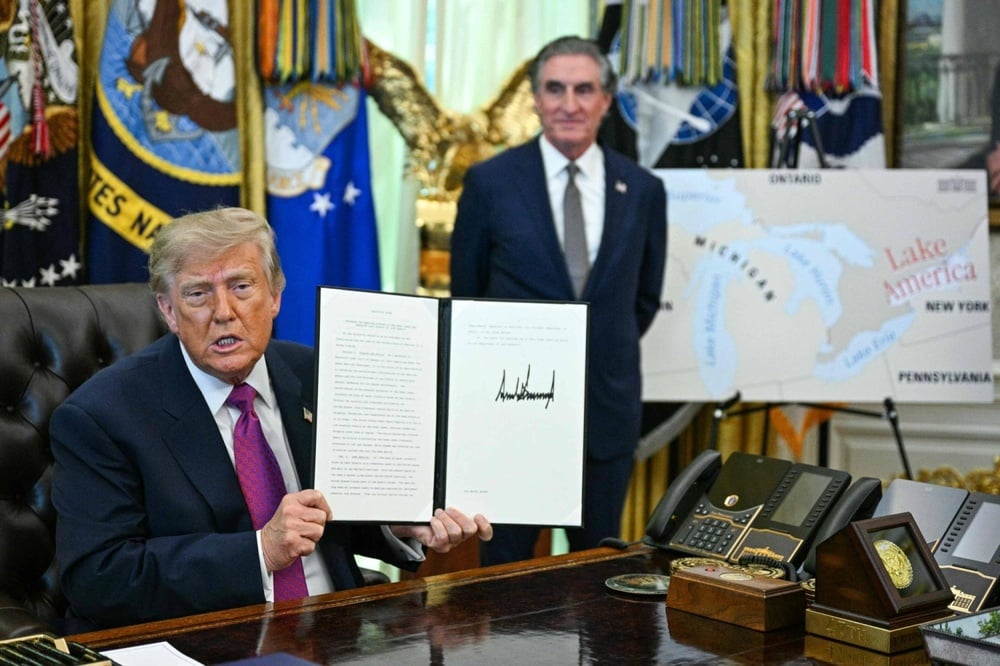
“The US President signed an executive order on Thursday demanding the historic lake be known as Lake America for US federal purposes.” · exact text match
Why: The primary subject is an executive order and diplomatic/trade dispute between governments.
Claim: The article's tone is predominantly negative toward the dispute and relationship.
“The latest salvo has plunged relations between the long-standing allies to fresh lows” · exact text match
Why: Words like 'plunged' and 'fresh lows' create a negative emotional frame.
Claim: The report attributes statements to named officials and includes a scope limitation.
“Yet the dramatic order only applies to US federal usage and cannot force Canada, international organisations or other bodies to ditch the lake’s 400-year-old name.” · exact text match
Why: The article includes a concrete caveat and named attributions, supporting trustworthiness despite emotive wording.
The supplied material mixes the main report with unrelated sidebar headlines and boilerplate; scoring was based only on the main report.
August 28, 2026 · 0 shares
Framing treats the renaming as an absurd political stunt, pairing official reporting with sarcastic asides, Democratic mockery, and playful map-name stunts.
Lake Ontario is one of the Great Lakes, bordered by Ontario, Canada, and New York State; federal geographic names in the U.S. are standardized through the Board on Geographic Names/GNIS, but a U.S. executive order does not determine internationally recognized geographic names.
Automated analysis; not human reviewed.
Limitations: The supplied text includes no exact date for the executive order and appears to omit the actual content of Kathy Hochul's 'blunter response,' so contextual completeness is limited.
·
6 of 54 available dimensions scored; omitted dimensions are not treated as neutral.
·
Verified supporting quotes for 4 of 6 scored dimensions.
Claim: The publisher's framing leans liberal by presenting the renaming as ridiculous and highlighting Democratic mockery.
“President Donald Trump's fight with Canada has spilled into Lake Ontario — er, Lake America?” · exact text match
“See, I can sign napkins that say things, too.” · not found in supplied text
Why: The editorializing 'er, Lake America?' and the prominent placement of Democratic mockery create an anti-Trump, liberal-leaning tone within an otherwise factual report.
Claim: The report mixes factual reporting with subjective editorial asides and characterizations.
“President Donald Trump's fight with Canada has spilled into Lake Ontario — er, Lake America?” · exact text match
“New York Gov. Kathy Hochul had a blunter response.” · exact text match
Why: The editorializing aside and unquoted characterization of Hochul's response reflect the publisher's subjective framing rather than purely objective description.
Claim: The article uses viral and absurdist details that heighten the story's entertainment value.
“The site posted a map of the lake on X, with 'Lake Are We Doing This Again?' written over it.” · not found in supplied text
“Some new names created for the lake include 'Lake Epstein Files,' 'Lake of Hormuz,' and 'Lake Gulf of Mexico.'” · not found in supplied text
Why: Including MapQuest's joke label and user-created joke names emphasizes the absurd side of the story, giving it a mildly sensational cast.
Claim: The publisher inserts a brief opinionated aside into an otherwise factual news report.
“President Donald Trump's fight with Canada has spilled into Lake Ontario — er, Lake America?” · exact text match
Why: The 'er, Lake America?' aside is an editorial judgment rather than a purely neutral factual statement.
Claim: The story is centered on a presidential executive order and international/trade conflict between the U.S. and Canada.
“The move comes as relations between Washington and Ottawa rapidly deteriorate.” · exact text match
“Trade talks between the neighboring countries broke down on Friday, which prompted new tariffs from the US.” · exact text match
Why: The subject matter is explicitly political: executive action, diplomatic refusal, tariffs, and partisan reactions.
Claim: The reporting shows transparent sourcing and careful attribution.
“According to a US Geological Survey update, the agency is updating the Geographic Names Information System to reflect the change.” · exact text match
“Apple and Google didn't immediately respond to questions about whether they would update their maps.” · exact text match
Why: Attributions to named institutions and explicit note of non-responses indicate verifiable sourcing, supporting credibility.
The supplied text includes no exact date for the executive order and appears to omit the actual content of Kathy Hochul's 'blunter response,' so contextual completeness is limited.
August 27, 2026 · 0 shares
The reporting is fact-based and balanced, attributing all quotes and avoiding editorial commentary.
Automated analysis; not human reviewed.
·
1 of 54 available dimensions scored; omitted dimensions are not treated as neutral.
·
Verified supporting quotes for 1 of 1 scored dimensions.
Claim: The report relies on named officials, direct quotes, and explicit attribution of claims.
“US President Donald Trump has signed an executive order seeking to change the name of Lake Ontario to Lake America.” · exact text match
“Canadian Prime Minister Mark Carney noted the name Lake Ontario can be traced back more than 400 years, adding in a social media post on Thursday that preceded the formation of the Canadian Confederation and the US Declaration of Independence.” · exact text match
Why: The article consistently attributes statements to named individuals and provides factual context, demonstrating high sourcing standards.
Framing casts the rename and trade dispute as a bitter personal feud, using emotive, sensational language and foregrounding opposition quotes.
Automated analysis; not human reviewed.
Limitations: The supplied material mixes the main report with unrelated sidebar headlines and boilerplate; scoring was based only on the main report.
·
7 of 54 available dimensions scored; omitted dimensions are not treated as neutral.
·
Verified supporting quotes for 7 of 7 scored dimensions.
Claim: The report uses emotionally loaded language to describe the conflict.
“DONALD Trump has ordered Lake Ontario to be renamed “Lake America” amid a bitter feud with Canada as a fresh trade war rages between the neighbours.” · exact text match
Why: Terms such as 'bitter feud' and 'rages' characterize the events subjectively rather than neutrally.
Claim: The report uses dramatic, tabloid-style wording that heightens the conflict.
“The furious row comes as US-Canada trade talks have spectacularly collapsed” · exact text match
Why: 'Furious row' and 'spectacularly collapsed' are sensationalized descriptions beyond the factual core.
Claim: The article highlights an unusual, quirky development.
“We have a gulf and we have a lake, now all we need is an ocean, so maybe we’ll have to change the name of the Atlantic and or the Pacific.” · exact text match
Why: The reported possibility of renaming oceans is an unexpected, attention-catching detail.
Claim: The report emphasizes personal taunts and jokes over substantive negotiation details.
“Trump has now hinted that his naming spree could stretch even further – joking that he could target the world’s oceans next.” · exact text match
Why: Focusing on a personal 'naming spree' and a joking remark gives the report a gossipy, personality-driven angle.
Claim: The article is centered on political and intergovernmental conflict.
“The US President signed an executive order on Thursday demanding the historic lake be known as Lake America for US federal purposes.” · exact text match
Why: The primary subject is an executive order and diplomatic/trade dispute between governments.
Claim: The article's tone is predominantly negative toward the dispute and relationship.
“The latest salvo has plunged relations between the long-standing allies to fresh lows” · exact text match
Why: Words like 'plunged' and 'fresh lows' create a negative emotional frame.
Claim: The report attributes statements to named officials and includes a scope limitation.
“Yet the dramatic order only applies to US federal usage and cannot force Canada, international organisations or other bodies to ditch the lake’s 400-year-old name.” · exact text match
Why: The article includes a concrete caveat and named attributions, supporting trustworthiness despite emotive wording.
The supplied material mixes the main report with unrelated sidebar headlines and boilerplate; scoring was based only on the main report.
August 28, 2026 · 0 shares
Framing treats the renaming as an absurd political stunt, pairing official reporting with sarcastic asides, Democratic mockery, and playful map-name stunts.
Lake Ontario is one of the Great Lakes, bordered by Ontario, Canada, and New York State; federal geographic names in the U.S. are standardized through the Board on Geographic Names/GNIS, but a U.S. executive order does not determine internationally recognized geographic names.
Automated analysis; not human reviewed.
Limitations: The supplied text includes no exact date for the executive order and appears to omit the actual content of Kathy Hochul's 'blunter response,' so contextual completeness is limited.
·
6 of 54 available dimensions scored; omitted dimensions are not treated as neutral.
·
Verified supporting quotes for 4 of 6 scored dimensions.
Claim: The publisher's framing leans liberal by presenting the renaming as ridiculous and highlighting Democratic mockery.
“President Donald Trump's fight with Canada has spilled into Lake Ontario — er, Lake America?” · exact text match
“See, I can sign napkins that say things, too.” · not found in supplied text
Why: The editorializing 'er, Lake America?' and the prominent placement of Democratic mockery create an anti-Trump, liberal-leaning tone within an otherwise factual report.
Claim: The report mixes factual reporting with subjective editorial asides and characterizations.
“President Donald Trump's fight with Canada has spilled into Lake Ontario — er, Lake America?” · exact text match
“New York Gov. Kathy Hochul had a blunter response.” · exact text match
Why: The editorializing aside and unquoted characterization of Hochul's response reflect the publisher's subjective framing rather than purely objective description.
Claim: The article uses viral and absurdist details that heighten the story's entertainment value.
“The site posted a map of the lake on X, with 'Lake Are We Doing This Again?' written over it.” · not found in supplied text
“Some new names created for the lake include 'Lake Epstein Files,' 'Lake of Hormuz,' and 'Lake Gulf of Mexico.'” · not found in supplied text
Why: Including MapQuest's joke label and user-created joke names emphasizes the absurd side of the story, giving it a mildly sensational cast.
Claim: The publisher inserts a brief opinionated aside into an otherwise factual news report.
“President Donald Trump's fight with Canada has spilled into Lake Ontario — er, Lake America?” · exact text match
Why: The 'er, Lake America?' aside is an editorial judgment rather than a purely neutral factual statement.
Claim: The story is centered on a presidential executive order and international/trade conflict between the U.S. and Canada.
“The move comes as relations between Washington and Ottawa rapidly deteriorate.” · exact text match
“Trade talks between the neighboring countries broke down on Friday, which prompted new tariffs from the US.” · exact text match
Why: The subject matter is explicitly political: executive action, diplomatic refusal, tariffs, and partisan reactions.
Claim: The reporting shows transparent sourcing and careful attribution.
“According to a US Geological Survey update, the agency is updating the Geographic Names Information System to reflect the change.” · exact text match
“Apple and Google didn't immediately respond to questions about whether they would update their maps.” · exact text match
Why: Attributions to named institutions and explicit note of non-responses indicate verifiable sourcing, supporting credibility.
The supplied text includes no exact date for the executive order and appears to omit the actual content of Kathy Hochul's 'blunter response,' so contextual completeness is limited.
August 28, 2026 · 0 shares
Framing treats the renaming as an absurd political stunt, pairing official reporting with sarcastic asides, Democratic mockery, and playful map-name stunts.
Lake Ontario is one of the Great Lakes, bordered by Ontario, Canada, and New York State; federal geographic names in the U.S. are standardized through the Board on Geographic Names/GNIS, but a U.S. executive order does not determine internationally recognized geographic names.
Automated analysis; not human reviewed.
Limitations: The supplied text includes no exact date for the executive order and appears to omit the actual content of Kathy Hochul's 'blunter response,' so contextual completeness is limited.
·
6 of 54 available dimensions scored; omitted dimensions are not treated as neutral.
·
Verified supporting quotes for 4 of 6 scored dimensions.
Claim: The publisher's framing leans liberal by presenting the renaming as ridiculous and highlighting Democratic mockery.
“President Donald Trump's fight with Canada has spilled into Lake Ontario — er, Lake America?” · exact text match
“See, I can sign napkins that say things, too.” · not found in supplied text
Why: The editorializing 'er, Lake America?' and the prominent placement of Democratic mockery create an anti-Trump, liberal-leaning tone within an otherwise factual report.
Claim: The report mixes factual reporting with subjective editorial asides and characterizations.
“President Donald Trump's fight with Canada has spilled into Lake Ontario — er, Lake America?” · exact text match
“New York Gov. Kathy Hochul had a blunter response.” · exact text match
Why: The editorializing aside and unquoted characterization of Hochul's response reflect the publisher's subjective framing rather than purely objective description.
Claim: The article uses viral and absurdist details that heighten the story's entertainment value.
“The site posted a map of the lake on X, with 'Lake Are We Doing This Again?' written over it.” · not found in supplied text
“Some new names created for the lake include 'Lake Epstein Files,' 'Lake of Hormuz,' and 'Lake Gulf of Mexico.'” · not found in supplied text
Why: Including MapQuest's joke label and user-created joke names emphasizes the absurd side of the story, giving it a mildly sensational cast.
Claim: The publisher inserts a brief opinionated aside into an otherwise factual news report.
“President Donald Trump's fight with Canada has spilled into Lake Ontario — er, Lake America?” · exact text match
Why: The 'er, Lake America?' aside is an editorial judgment rather than a purely neutral factual statement.
Claim: The story is centered on a presidential executive order and international/trade conflict between the U.S. and Canada.
“The move comes as relations between Washington and Ottawa rapidly deteriorate.” · exact text match
“Trade talks between the neighboring countries broke down on Friday, which prompted new tariffs from the US.” · exact text match
Why: The subject matter is explicitly political: executive action, diplomatic refusal, tariffs, and partisan reactions.
Claim: The reporting shows transparent sourcing and careful attribution.
“According to a US Geological Survey update, the agency is updating the Geographic Names Information System to reflect the change.” · exact text match
“Apple and Google didn't immediately respond to questions about whether they would update their maps.” · exact text match
Why: Attributions to named institutions and explicit note of non-responses indicate verifiable sourcing, supporting credibility.
The supplied text includes no exact date for the executive order and appears to omit the actual content of Kathy Hochul's 'blunter response,' so contextual completeness is limited.
August 27, 2026 · 0 shares
The article is a straightforward factual report without editorializing.
Automated analysis; not human reviewed. Limitations: Limited context: no details on the order or the trade dispute.
Limited context: no details on the order or the trade dispute.
August 27, 2026 · 0 shares
The framing is sparse and event-focused, presenting the renaming order and the trade-collapse context as plain facts without commentary or explicit evaluation.
Lake Ontario is one of the five Great Lakes and lies on the U.S.-Canada border, so it is a body of water shared with Canada.
Automated analysis; not human reviewed. Limitations: The supplied text is a short excerpt without a named source, date, or surrounding reporting, limiting assessment of sourcing and selection. · 3 of 54 available dimensions scored; omitted dimensions are not treated as neutral. · Verified supporting quotes for 3 of 3 scored dimensions.
Claim: The report is neutral and fact-led rather than opinion-led.
“The president also reiterated his criticism that Canada “treats us very badly.”” · exact text match
Why: The only value-laden statement is explicitly attributed to Trump and labeled criticism; the surrounding sentences are unadorned declarative reports.
Claim: The presentation is plain and unembellished rather than sensational.
“Trump Signs Executive Order to Rename Lake Ontario to Lake America.” · exact text match
Why: The lead sentence is a declarative, adjective-free statement with no exclamation, scare quotes, or dramatic modifiers, even though the action is unusual.
Claim: The text is strictly descriptive and offers no prescription.
“Trade talks between the nations collapsed last week.” · exact text match
Why: It reports a development as settled fact without recommending any action or assigning blame.
The supplied text is a short excerpt without a named source, date, or surrounding reporting, limiting assessment of sourcing and selection.
August 27, 2026 · 0 shares
The reporting is fact-based and balanced, attributing all quotes and avoiding editorial commentary.
Automated analysis; not human reviewed. · 1 of 54 available dimensions scored; omitted dimensions are not treated as neutral. · Verified supporting quotes for 1 of 1 scored dimensions.
Claim: The report relies on named officials, direct quotes, and explicit attribution of claims.
“US President Donald Trump has signed an executive order seeking to change the name of Lake Ontario to Lake America.” · exact text match
“Canadian Prime Minister Mark Carney noted the name Lake Ontario can be traced back more than 400 years, adding in a social media post on Thursday that preceded the formation of the Canadian Confederation and the US Declaration of Independence.” · exact text match
Why: The article consistently attributes statements to named individuals and provides factual context, demonstrating high sourcing standards.
August 27, 2026 · 0 shares
The article is a straightforward factual report without editorializing.
Automated analysis; not human reviewed. Limitations: Limited context: no details on the order or the trade dispute.
Limited context: no details on the order or the trade dispute.
August 28, 2026 · 0 shares
The framing treats the renaming as a provocative trade-driven escalation, pairing Trump's blunt justification with Carney's Indigenous-historical rebuttal.
Lake Ontario is one of the five Great Lakes along the U.S.-Canada border.
Automated analysis; not human reviewed. Limitations: The supplied text is a brief, unlabeled excerpt with embedded subscription and comment prompts; no publication date, outlet identity, or full article context was available. · 4 of 54 available dimensions scored; omitted dimensions are not treated as neutral. · Verified supporting quotes for 4 of 4 scored dimensions.
Claim: The report is mostly factual and attributed, but its headline inserts an evaluative characterization of Trump's action.
“Trump fans Canada spat by renaming Lake Ontario as Lake America.” · exact text match
“Trump on Thursday signed a directive changing the name of the lake and said the move would take place “effective immediately.”” · exact text match
Why: The body uses concrete reporting and direct attribution, while the headline's phrase 'fans ... spat' frames the action as deliberate provocation, making the piece moderately objective rather than purely neutral.
Claim: The article describes events and quotes participants without calling for any action or policy outcome.
“The order signed by Trump said the Interior Department had 30 days to change the name in federal databases and materials.” · exact text match
Why: No recommendation, demand, or policy preference appears; the reporting remains in descriptive mode.
Claim: The piece is sourced to a signed presidential order, presidential remarks to reporters, and a named foreign leader's statement.
“The order signed by Trump said the Interior Department had 30 days to change the name in federal databases and materials.” · exact text match
“Trump on Thursday signed a directive changing the name of the lake and said the move would take place “effective immediately.”” · exact text match
Why: The reporting attributes its factual assertions to identifiable documents and speakers with exact quotes, supporting credibility, though the full record cannot be independently verified from the excerpt.
Claim: The report attributes its central claims to named speakers and the president's signed order, including direct quotes.
““Canada has been ripping us off for a long time on trade,” Trump told reporters when asked what message he was sending to the U.S.’s northern neighbor.” · exact text match
“Canadian Prime Minister Mark Carney said the name Ontario has Indigenous roots and predates both Canada's confederation and America's Declaration of Independence.” · exact text match
Why: The main assertions are tied to explicit speakers and the signed order, and both Trump's and Carney's statements are included, indicating transparent sourcing and balanced attribution.
The supplied text is a brief, unlabeled excerpt with embedded subscription and comment prompts; no publication date, outlet identity, or full article context was available.
August 27, 2026 · 0 shares
Framing treats the renaming as a trivial spectacle, using an ironic 'Now, on to important matters' interjection and letting the executive order's language carry the story.
Lake Ontario is one of the five Great Lakes and lies along the U.S.-Canada border; Ontario is also Canada's most populous province. The referenced U.S.-Canada trade dispute is broader than the renaming.
Automated analysis; not human reviewed. Limitations: The supplied text is short and partly garbled by formatting artifacts; the exact wording of the Truth Social image preview is ambiguous, and the executive order is available only through the publisher's quotation. · 4 of 54 available dimensions scored; omitted dimensions are not treated as neutral. · Verified supporting quotes for 4 of 4 scored dimensions.
Claim: The supplied text mixes factual reporting with an ironic editorial interjection that dismisses the story as unimportant.
“Now, on to important matters” · exact text match
Why: The phrase 'Now, on to important matters' is an editorial judgment inserted after the headline, pushing the text away from purely objective reporting.
Claim: The publisher injects its own judgment that the renaming is unimportant.
“Now, on to important matters” · exact text match
Why: The interjection explicitly frames the preceding story as less important than other matters, which is opinion rather than neutral reporting.
Claim: The supplied text centers on a presidential action taken in the context of an international trade dispute.
“US President Donald J. Trump renamed Lake Ontario to Lake America” · exact text match
“amid an ongoing trade spat with Canada” · exact text match
Why: The subject is a presidential executive order and a U.S.-Canada trade dispute, making the content inherently political.
Claim: The supplied text provides specific, checkable sourcing for the executive action.
“The order directs Interior Secretary Doug Burgum to update the Geographic Names Information System (GNIS) within 30 days” · exact text match
“I am directing that the Lake officially be renamed as Lake America.” · exact text match
Why: The supplied text names the implementing official, database, deadline, and quotes the order's operative language, giving concretely checkable details despite the editorial tone.
The supplied text is short and partly garbled by formatting artifacts; the exact wording of the Truth Social image preview is ambiguous, and the executive order is available only through the publisher's quotation.
August 28, 2026 · 0 shares
Framing treats the renaming as an absurd political stunt, pairing official reporting with sarcastic asides, Democratic mockery, and playful map-name stunts.
Lake Ontario is one of the Great Lakes, bordered by Ontario, Canada, and New York State; federal geographic names in the U.S. are standardized through the Board on Geographic Names/GNIS, but a U.S. executive order does not determine internationally recognized geographic names.
Automated analysis; not human reviewed. Limitations: The supplied text includes no exact date for the executive order and appears to omit the actual content of Kathy Hochul's 'blunter response,' so contextual completeness is limited. · 6 of 54 available dimensions scored; omitted dimensions are not treated as neutral. · Verified supporting quotes for 4 of 6 scored dimensions.
Claim: The publisher's framing leans liberal by presenting the renaming as ridiculous and highlighting Democratic mockery.
“President Donald Trump's fight with Canada has spilled into Lake Ontario — er, Lake America?” · exact text match
“See, I can sign napkins that say things, too.” · not found in supplied text
Why: The editorializing 'er, Lake America?' and the prominent placement of Democratic mockery create an anti-Trump, liberal-leaning tone within an otherwise factual report.
Claim: The report mixes factual reporting with subjective editorial asides and characterizations.
“President Donald Trump's fight with Canada has spilled into Lake Ontario — er, Lake America?” · exact text match
“New York Gov. Kathy Hochul had a blunter response.” · exact text match
Why: The editorializing aside and unquoted characterization of Hochul's response reflect the publisher's subjective framing rather than purely objective description.
Claim: The article uses viral and absurdist details that heighten the story's entertainment value.
“The site posted a map of the lake on X, with 'Lake Are We Doing This Again?' written over it.” · not found in supplied text
“Some new names created for the lake include 'Lake Epstein Files,' 'Lake of Hormuz,' and 'Lake Gulf of Mexico.'” · not found in supplied text
Why: Including MapQuest's joke label and user-created joke names emphasizes the absurd side of the story, giving it a mildly sensational cast.
Claim: The publisher inserts a brief opinionated aside into an otherwise factual news report.
“President Donald Trump's fight with Canada has spilled into Lake Ontario — er, Lake America?” · exact text match
Why: The 'er, Lake America?' aside is an editorial judgment rather than a purely neutral factual statement.
Claim: The story is centered on a presidential executive order and international/trade conflict between the U.S. and Canada.
“The move comes as relations between Washington and Ottawa rapidly deteriorate.” · exact text match
“Trade talks between the neighboring countries broke down on Friday, which prompted new tariffs from the US.” · exact text match
Why: The subject matter is explicitly political: executive action, diplomatic refusal, tariffs, and partisan reactions.
Claim: The reporting shows transparent sourcing and careful attribution.
“According to a US Geological Survey update, the agency is updating the Geographic Names Information System to reflect the change.” · exact text match
“Apple and Google didn't immediately respond to questions about whether they would update their maps.” · exact text match
Why: Attributions to named institutions and explicit note of non-responses indicate verifiable sourcing, supporting credibility.
The supplied text includes no exact date for the executive order and appears to omit the actual content of Kathy Hochul's 'blunter response,' so contextual completeness is limited.
Framing casts the rename and trade dispute as a bitter personal feud, using emotive, sensational language and foregrounding opposition quotes.
Automated analysis; not human reviewed. Limitations: The supplied material mixes the main report with unrelated sidebar headlines and boilerplate; scoring was based only on the main report. · 7 of 54 available dimensions scored; omitted dimensions are not treated as neutral. · Verified supporting quotes for 7 of 7 scored dimensions.
Claim: The report uses emotionally loaded language to describe the conflict.
“DONALD Trump has ordered Lake Ontario to be renamed “Lake America” amid a bitter feud with Canada as a fresh trade war rages between the neighbours.” · exact text match
Why: Terms such as 'bitter feud' and 'rages' characterize the events subjectively rather than neutrally.
Claim: The report uses dramatic, tabloid-style wording that heightens the conflict.
“The furious row comes as US-Canada trade talks have spectacularly collapsed” · exact text match
Why: 'Furious row' and 'spectacularly collapsed' are sensationalized descriptions beyond the factual core.
Claim: The article highlights an unusual, quirky development.
“We have a gulf and we have a lake, now all we need is an ocean, so maybe we’ll have to change the name of the Atlantic and or the Pacific.” · exact text match
Why: The reported possibility of renaming oceans is an unexpected, attention-catching detail.
Claim: The report emphasizes personal taunts and jokes over substantive negotiation details.
“Trump has now hinted that his naming spree could stretch even further – joking that he could target the world’s oceans next.” · exact text match
Why: Focusing on a personal 'naming spree' and a joking remark gives the report a gossipy, personality-driven angle.
Claim: The article is centered on political and intergovernmental conflict.
“The US President signed an executive order on Thursday demanding the historic lake be known as Lake America for US federal purposes.” · exact text match
Why: The primary subject is an executive order and diplomatic/trade dispute between governments.
Claim: The article's tone is predominantly negative toward the dispute and relationship.
“The latest salvo has plunged relations between the long-standing allies to fresh lows” · exact text match
Why: Words like 'plunged' and 'fresh lows' create a negative emotional frame.
Claim: The report attributes statements to named officials and includes a scope limitation.
“Yet the dramatic order only applies to US federal usage and cannot force Canada, international organisations or other bodies to ditch the lake’s 400-year-old name.” · exact text match
Why: The article includes a concrete caveat and named attributions, supporting trustworthiness despite emotive wording.
The supplied material mixes the main report with unrelated sidebar headlines and boilerplate; scoring was based only on the main report.
August 27, 2026 · 0 shares
The reporting is fact-based and balanced, attributing all quotes and avoiding editorial commentary.
Automated analysis; not human reviewed. · 1 of 54 available dimensions scored; omitted dimensions are not treated as neutral. · Verified supporting quotes for 1 of 1 scored dimensions.
Claim: The report relies on named officials, direct quotes, and explicit attribution of claims.
“US President Donald Trump has signed an executive order seeking to change the name of Lake Ontario to Lake America.” · exact text match
“Canadian Prime Minister Mark Carney noted the name Lake Ontario can be traced back more than 400 years, adding in a social media post on Thursday that preceded the formation of the Canadian Confederation and the US Declaration of Independence.” · exact text match
Why: The article consistently attributes statements to named individuals and provides factual context, demonstrating high sourcing standards.
August 28, 2026 · 0 shares
The framing treats the renaming as a provocative trade-driven escalation, pairing Trump's blunt justification with Carney's Indigenous-historical rebuttal.
Lake Ontario is one of the five Great Lakes along the U.S.-Canada border.
Automated analysis; not human reviewed. Limitations: The supplied text is a brief, unlabeled excerpt with embedded subscription and comment prompts; no publication date, outlet identity, or full article context was available. · 4 of 54 available dimensions scored; omitted dimensions are not treated as neutral. · Verified supporting quotes for 4 of 4 scored dimensions.
Claim: The report is mostly factual and attributed, but its headline inserts an evaluative characterization of Trump's action.
“Trump fans Canada spat by renaming Lake Ontario as Lake America.” · exact text match
“Trump on Thursday signed a directive changing the name of the lake and said the move would take place “effective immediately.”” · exact text match
Why: The body uses concrete reporting and direct attribution, while the headline's phrase 'fans ... spat' frames the action as deliberate provocation, making the piece moderately objective rather than purely neutral.
Claim: The article describes events and quotes participants without calling for any action or policy outcome.
“The order signed by Trump said the Interior Department had 30 days to change the name in federal databases and materials.” · exact text match
Why: No recommendation, demand, or policy preference appears; the reporting remains in descriptive mode.
Claim: The piece is sourced to a signed presidential order, presidential remarks to reporters, and a named foreign leader's statement.
“The order signed by Trump said the Interior Department had 30 days to change the name in federal databases and materials.” · exact text match
“Trump on Thursday signed a directive changing the name of the lake and said the move would take place “effective immediately.”” · exact text match
Why: The reporting attributes its factual assertions to identifiable documents and speakers with exact quotes, supporting credibility, though the full record cannot be independently verified from the excerpt.
Claim: The report attributes its central claims to named speakers and the president's signed order, including direct quotes.
““Canada has been ripping us off for a long time on trade,” Trump told reporters when asked what message he was sending to the U.S.’s northern neighbor.” · exact text match
“Canadian Prime Minister Mark Carney said the name Ontario has Indigenous roots and predates both Canada's confederation and America's Declaration of Independence.” · exact text match
Why: The main assertions are tied to explicit speakers and the signed order, and both Trump's and Carney's statements are included, indicating transparent sourcing and balanced attribution.
The supplied text is a brief, unlabeled excerpt with embedded subscription and comment prompts; no publication date, outlet identity, or full article context was available.
Helium Bias
Story Blindspots
August 27, 2026 · 0 shares
The reporting is fact-based and balanced, attributing all quotes and avoiding editorial commentary.
Automated analysis; not human reviewed. · 1 of 54 available dimensions scored; omitted dimensions are not treated as neutral. · Verified supporting quotes for 1 of 1 scored dimensions.
Claim: The report relies on named officials, direct quotes, and explicit attribution of claims.
“US President Donald Trump has signed an executive order seeking to change the name of Lake Ontario to Lake America.” · exact text match
“Canadian Prime Minister Mark Carney noted the name Lake Ontario can be traced back more than 400 years, adding in a social media post on Thursday that preceded the formation of the Canadian Confederation and the US Declaration of Independence.” · exact text match
Why: The article consistently attributes statements to named individuals and provides factual context, demonstrating high sourcing standards.
Framing casts the rename and trade dispute as a bitter personal feud, using emotive, sensational language and foregrounding opposition quotes.
Automated analysis; not human reviewed. Limitations: The supplied material mixes the main report with unrelated sidebar headlines and boilerplate; scoring was based only on the main report. · 7 of 54 available dimensions scored; omitted dimensions are not treated as neutral. · Verified supporting quotes for 7 of 7 scored dimensions.
Claim: The report uses emotionally loaded language to describe the conflict.
“DONALD Trump has ordered Lake Ontario to be renamed “Lake America” amid a bitter feud with Canada as a fresh trade war rages between the neighbours.” · exact text match
Why: Terms such as 'bitter feud' and 'rages' characterize the events subjectively rather than neutrally.
Claim: The report uses dramatic, tabloid-style wording that heightens the conflict.
“The furious row comes as US-Canada trade talks have spectacularly collapsed” · exact text match
Why: 'Furious row' and 'spectacularly collapsed' are sensationalized descriptions beyond the factual core.
Claim: The article highlights an unusual, quirky development.
“We have a gulf and we have a lake, now all we need is an ocean, so maybe we’ll have to change the name of the Atlantic and or the Pacific.” · exact text match
Why: The reported possibility of renaming oceans is an unexpected, attention-catching detail.
Claim: The report emphasizes personal taunts and jokes over substantive negotiation details.
“Trump has now hinted that his naming spree could stretch even further – joking that he could target the world’s oceans next.” · exact text match
Why: Focusing on a personal 'naming spree' and a joking remark gives the report a gossipy, personality-driven angle.
Claim: The article is centered on political and intergovernmental conflict.
“The US President signed an executive order on Thursday demanding the historic lake be known as Lake America for US federal purposes.” · exact text match
Why: The primary subject is an executive order and diplomatic/trade dispute between governments.
Claim: The article's tone is predominantly negative toward the dispute and relationship.
“The latest salvo has plunged relations between the long-standing allies to fresh lows” · exact text match
Why: Words like 'plunged' and 'fresh lows' create a negative emotional frame.
Claim: The report attributes statements to named officials and includes a scope limitation.
“Yet the dramatic order only applies to US federal usage and cannot force Canada, international organisations or other bodies to ditch the lake’s 400-year-old name.” · exact text match
Why: The article includes a concrete caveat and named attributions, supporting trustworthiness despite emotive wording.
The supplied material mixes the main report with unrelated sidebar headlines and boilerplate; scoring was based only on the main report.
August 28, 2026 · 0 shares
The framing treats the renaming as a provocative trade-driven escalation, pairing Trump's blunt justification with Carney's Indigenous-historical rebuttal.
Lake Ontario is one of the five Great Lakes along the U.S.-Canada border.
Automated analysis; not human reviewed. Limitations: The supplied text is a brief, unlabeled excerpt with embedded subscription and comment prompts; no publication date, outlet identity, or full article context was available. · 4 of 54 available dimensions scored; omitted dimensions are not treated as neutral. · Verified supporting quotes for 4 of 4 scored dimensions.
Claim: The report is mostly factual and attributed, but its headline inserts an evaluative characterization of Trump's action.
“Trump fans Canada spat by renaming Lake Ontario as Lake America.” · exact text match
“Trump on Thursday signed a directive changing the name of the lake and said the move would take place “effective immediately.”” · exact text match
Why: The body uses concrete reporting and direct attribution, while the headline's phrase 'fans ... spat' frames the action as deliberate provocation, making the piece moderately objective rather than purely neutral.
Claim: The article describes events and quotes participants without calling for any action or policy outcome.
“The order signed by Trump said the Interior Department had 30 days to change the name in federal databases and materials.” · exact text match
Why: No recommendation, demand, or policy preference appears; the reporting remains in descriptive mode.
Claim: The piece is sourced to a signed presidential order, presidential remarks to reporters, and a named foreign leader's statement.
“The order signed by Trump said the Interior Department had 30 days to change the name in federal databases and materials.” · exact text match
“Trump on Thursday signed a directive changing the name of the lake and said the move would take place “effective immediately.”” · exact text match
Why: The reporting attributes its factual assertions to identifiable documents and speakers with exact quotes, supporting credibility, though the full record cannot be independently verified from the excerpt.
Claim: The report attributes its central claims to named speakers and the president's signed order, including direct quotes.
““Canada has been ripping us off for a long time on trade,” Trump told reporters when asked what message he was sending to the U.S.’s northern neighbor.” · exact text match
“Canadian Prime Minister Mark Carney said the name Ontario has Indigenous roots and predates both Canada's confederation and America's Declaration of Independence.” · exact text match
Why: The main assertions are tied to explicit speakers and the signed order, and both Trump's and Carney's statements are included, indicating transparent sourcing and balanced attribution.
The supplied text is a brief, unlabeled excerpt with embedded subscription and comment prompts; no publication date, outlet identity, or full article context was available.
August 27, 2026 · 0 shares
Framing treats the renaming as a trivial spectacle, using an ironic 'Now, on to important matters' interjection and letting the executive order's language carry the story.
Lake Ontario is one of the five Great Lakes and lies along the U.S.-Canada border; Ontario is also Canada's most populous province. The referenced U.S.-Canada trade dispute is broader than the renaming.
Automated analysis; not human reviewed. Limitations: The supplied text is short and partly garbled by formatting artifacts; the exact wording of the Truth Social image preview is ambiguous, and the executive order is available only through the publisher's quotation. · 4 of 54 available dimensions scored; omitted dimensions are not treated as neutral. · Verified supporting quotes for 4 of 4 scored dimensions.
Claim: The supplied text mixes factual reporting with an ironic editorial interjection that dismisses the story as unimportant.
“Now, on to important matters” · exact text match
Why: The phrase 'Now, on to important matters' is an editorial judgment inserted after the headline, pushing the text away from purely objective reporting.
Claim: The publisher injects its own judgment that the renaming is unimportant.
“Now, on to important matters” · exact text match
Why: The interjection explicitly frames the preceding story as less important than other matters, which is opinion rather than neutral reporting.
Claim: The supplied text centers on a presidential action taken in the context of an international trade dispute.
“US President Donald J. Trump renamed Lake Ontario to Lake America” · exact text match
“amid an ongoing trade spat with Canada” · exact text match
Why: The subject is a presidential executive order and a U.S.-Canada trade dispute, making the content inherently political.
Claim: The supplied text provides specific, checkable sourcing for the executive action.
“The order directs Interior Secretary Doug Burgum to update the Geographic Names Information System (GNIS) within 30 days” · exact text match
“I am directing that the Lake officially be renamed as Lake America.” · exact text match
Why: The supplied text names the implementing official, database, deadline, and quotes the order's operative language, giving concretely checkable details despite the editorial tone.
The supplied text is short and partly garbled by formatting artifacts; the exact wording of the Truth Social image preview is ambiguous, and the executive order is available only through the publisher's quotation.
August 27, 2026 · 0 shares
Framing treats the renaming as a trivial spectacle, using an ironic 'Now, on to important matters' interjection and letting the executive order's language carry the story.
Lake Ontario is one of the five Great Lakes and lies along the U.S.-Canada border; Ontario is also Canada's most populous province. The referenced U.S.-Canada trade dispute is broader than the renaming.
Automated analysis; not human reviewed. Limitations: The supplied text is short and partly garbled by formatting artifacts; the exact wording of the Truth Social image preview is ambiguous, and the executive order is available only through the publisher's quotation. · 4 of 54 available dimensions scored; omitted dimensions are not treated as neutral. · Verified supporting quotes for 4 of 4 scored dimensions.
Claim: The supplied text mixes factual reporting with an ironic editorial interjection that dismisses the story as unimportant.
“Now, on to important matters” · exact text match
Why: The phrase 'Now, on to important matters' is an editorial judgment inserted after the headline, pushing the text away from purely objective reporting.
Claim: The publisher injects its own judgment that the renaming is unimportant.
“Now, on to important matters” · exact text match
Why: The interjection explicitly frames the preceding story as less important than other matters, which is opinion rather than neutral reporting.
Claim: The supplied text centers on a presidential action taken in the context of an international trade dispute.
“US President Donald J. Trump renamed Lake Ontario to Lake America” · exact text match
“amid an ongoing trade spat with Canada” · exact text match
Why: The subject is a presidential executive order and a U.S.-Canada trade dispute, making the content inherently political.
Claim: The supplied text provides specific, checkable sourcing for the executive action.
“The order directs Interior Secretary Doug Burgum to update the Geographic Names Information System (GNIS) within 30 days” · exact text match
“I am directing that the Lake officially be renamed as Lake America.” · exact text match
Why: The supplied text names the implementing official, database, deadline, and quotes the order's operative language, giving concretely checkable details despite the editorial tone.
The supplied text is short and partly garbled by formatting artifacts; the exact wording of the Truth Social image preview is ambiguous, and the executive order is available only through the publisher's quotation.
August 28, 2026 · 0 shares
The framing treats the renaming as a provocative trade-driven escalation, pairing Trump's blunt justification with Carney's Indigenous-historical rebuttal.
Lake Ontario is one of the five Great Lakes along the U.S.-Canada border.
Automated analysis; not human reviewed. Limitations: The supplied text is a brief, unlabeled excerpt with embedded subscription and comment prompts; no publication date, outlet identity, or full article context was available. · 4 of 54 available dimensions scored; omitted dimensions are not treated as neutral. · Verified supporting quotes for 4 of 4 scored dimensions.
Claim: The report is mostly factual and attributed, but its headline inserts an evaluative characterization of Trump's action.
“Trump fans Canada spat by renaming Lake Ontario as Lake America.” · exact text match
“Trump on Thursday signed a directive changing the name of the lake and said the move would take place “effective immediately.”” · exact text match
Why: The body uses concrete reporting and direct attribution, while the headline's phrase 'fans ... spat' frames the action as deliberate provocation, making the piece moderately objective rather than purely neutral.
Claim: The article describes events and quotes participants without calling for any action or policy outcome.
“The order signed by Trump said the Interior Department had 30 days to change the name in federal databases and materials.” · exact text match
Why: No recommendation, demand, or policy preference appears; the reporting remains in descriptive mode.
Claim: The piece is sourced to a signed presidential order, presidential remarks to reporters, and a named foreign leader's statement.
“The order signed by Trump said the Interior Department had 30 days to change the name in federal databases and materials.” · exact text match
“Trump on Thursday signed a directive changing the name of the lake and said the move would take place “effective immediately.”” · exact text match
Why: The reporting attributes its factual assertions to identifiable documents and speakers with exact quotes, supporting credibility, though the full record cannot be independently verified from the excerpt.
Claim: The report attributes its central claims to named speakers and the president's signed order, including direct quotes.
““Canada has been ripping us off for a long time on trade,” Trump told reporters when asked what message he was sending to the U.S.’s northern neighbor.” · exact text match
“Canadian Prime Minister Mark Carney said the name Ontario has Indigenous roots and predates both Canada's confederation and America's Declaration of Independence.” · exact text match
Why: The main assertions are tied to explicit speakers and the signed order, and both Trump's and Carney's statements are included, indicating transparent sourcing and balanced attribution.
The supplied text is a brief, unlabeled excerpt with embedded subscription and comment prompts; no publication date, outlet identity, or full article context was available.
Framing casts the rename and trade dispute as a bitter personal feud, using emotive, sensational language and foregrounding opposition quotes.
Automated analysis; not human reviewed. Limitations: The supplied material mixes the main report with unrelated sidebar headlines and boilerplate; scoring was based only on the main report. · 7 of 54 available dimensions scored; omitted dimensions are not treated as neutral. · Verified supporting quotes for 7 of 7 scored dimensions.
Claim: The report uses emotionally loaded language to describe the conflict.
“DONALD Trump has ordered Lake Ontario to be renamed “Lake America” amid a bitter feud with Canada as a fresh trade war rages between the neighbours.” · exact text match
Why: Terms such as 'bitter feud' and 'rages' characterize the events subjectively rather than neutrally.
Claim: The report uses dramatic, tabloid-style wording that heightens the conflict.
“The furious row comes as US-Canada trade talks have spectacularly collapsed” · exact text match
Why: 'Furious row' and 'spectacularly collapsed' are sensationalized descriptions beyond the factual core.
Claim: The article highlights an unusual, quirky development.
“We have a gulf and we have a lake, now all we need is an ocean, so maybe we’ll have to change the name of the Atlantic and or the Pacific.” · exact text match
Why: The reported possibility of renaming oceans is an unexpected, attention-catching detail.
Claim: The report emphasizes personal taunts and jokes over substantive negotiation details.
“Trump has now hinted that his naming spree could stretch even further – joking that he could target the world’s oceans next.” · exact text match
Why: Focusing on a personal 'naming spree' and a joking remark gives the report a gossipy, personality-driven angle.
Claim: The article is centered on political and intergovernmental conflict.
“The US President signed an executive order on Thursday demanding the historic lake be known as Lake America for US federal purposes.” · exact text match
Why: The primary subject is an executive order and diplomatic/trade dispute between governments.
Claim: The article's tone is predominantly negative toward the dispute and relationship.
“The latest salvo has plunged relations between the long-standing allies to fresh lows” · exact text match
Why: Words like 'plunged' and 'fresh lows' create a negative emotional frame.
Claim: The report attributes statements to named officials and includes a scope limitation.
“Yet the dramatic order only applies to US federal usage and cannot force Canada, international organisations or other bodies to ditch the lake’s 400-year-old name.” · exact text match
Why: The article includes a concrete caveat and named attributions, supporting trustworthiness despite emotive wording.
The supplied material mixes the main report with unrelated sidebar headlines and boilerplate; scoring was based only on the main report.
August 28, 2026 · 0 shares
Framing treats the renaming as an absurd political stunt, pairing official reporting with sarcastic asides, Democratic mockery, and playful map-name stunts.
Lake Ontario is one of the Great Lakes, bordered by Ontario, Canada, and New York State; federal geographic names in the U.S. are standardized through the Board on Geographic Names/GNIS, but a U.S. executive order does not determine internationally recognized geographic names.
Automated analysis; not human reviewed. Limitations: The supplied text includes no exact date for the executive order and appears to omit the actual content of Kathy Hochul's 'blunter response,' so contextual completeness is limited. · 6 of 54 available dimensions scored; omitted dimensions are not treated as neutral. · Verified supporting quotes for 4 of 6 scored dimensions.
Claim: The publisher's framing leans liberal by presenting the renaming as ridiculous and highlighting Democratic mockery.
“President Donald Trump's fight with Canada has spilled into Lake Ontario — er, Lake America?” · exact text match
“See, I can sign napkins that say things, too.” · not found in supplied text
Why: The editorializing 'er, Lake America?' and the prominent placement of Democratic mockery create an anti-Trump, liberal-leaning tone within an otherwise factual report.
Claim: The report mixes factual reporting with subjective editorial asides and characterizations.
“President Donald Trump's fight with Canada has spilled into Lake Ontario — er, Lake America?” · exact text match
“New York Gov. Kathy Hochul had a blunter response.” · exact text match
Why: The editorializing aside and unquoted characterization of Hochul's response reflect the publisher's subjective framing rather than purely objective description.
Claim: The article uses viral and absurdist details that heighten the story's entertainment value.
“The site posted a map of the lake on X, with 'Lake Are We Doing This Again?' written over it.” · not found in supplied text
“Some new names created for the lake include 'Lake Epstein Files,' 'Lake of Hormuz,' and 'Lake Gulf of Mexico.'” · not found in supplied text
Why: Including MapQuest's joke label and user-created joke names emphasizes the absurd side of the story, giving it a mildly sensational cast.
Claim: The publisher inserts a brief opinionated aside into an otherwise factual news report.
“President Donald Trump's fight with Canada has spilled into Lake Ontario — er, Lake America?” · exact text match
Why: The 'er, Lake America?' aside is an editorial judgment rather than a purely neutral factual statement.
Claim: The story is centered on a presidential executive order and international/trade conflict between the U.S. and Canada.
“The move comes as relations between Washington and Ottawa rapidly deteriorate.” · exact text match
“Trade talks between the neighboring countries broke down on Friday, which prompted new tariffs from the US.” · exact text match
Why: The subject matter is explicitly political: executive action, diplomatic refusal, tariffs, and partisan reactions.
Claim: The reporting shows transparent sourcing and careful attribution.
“According to a US Geological Survey update, the agency is updating the Geographic Names Information System to reflect the change.” · exact text match
“Apple and Google didn't immediately respond to questions about whether they would update their maps.” · exact text match
Why: Attributions to named institutions and explicit note of non-responses indicate verifiable sourcing, supporting credibility.
The supplied text includes no exact date for the executive order and appears to omit the actual content of Kathy Hochul's 'blunter response,' so contextual completeness is limited.
August 28, 2026 · 0 shares
Framing treats the renaming as an absurd political stunt, pairing official reporting with sarcastic asides, Democratic mockery, and playful map-name stunts.
Lake Ontario is one of the Great Lakes, bordered by Ontario, Canada, and New York State; federal geographic names in the U.S. are standardized through the Board on Geographic Names/GNIS, but a U.S. executive order does not determine internationally recognized geographic names.
Automated analysis; not human reviewed. Limitations: The supplied text includes no exact date for the executive order and appears to omit the actual content of Kathy Hochul's 'blunter response,' so contextual completeness is limited. · 6 of 54 available dimensions scored; omitted dimensions are not treated as neutral. · Verified supporting quotes for 4 of 6 scored dimensions.
Claim: The publisher's framing leans liberal by presenting the renaming as ridiculous and highlighting Democratic mockery.
“President Donald Trump's fight with Canada has spilled into Lake Ontario — er, Lake America?” · exact text match
“See, I can sign napkins that say things, too.” · not found in supplied text
Why: The editorializing 'er, Lake America?' and the prominent placement of Democratic mockery create an anti-Trump, liberal-leaning tone within an otherwise factual report.
Claim: The report mixes factual reporting with subjective editorial asides and characterizations.
“President Donald Trump's fight with Canada has spilled into Lake Ontario — er, Lake America?” · exact text match
“New York Gov. Kathy Hochul had a blunter response.” · exact text match
Why: The editorializing aside and unquoted characterization of Hochul's response reflect the publisher's subjective framing rather than purely objective description.
Claim: The article uses viral and absurdist details that heighten the story's entertainment value.
“The site posted a map of the lake on X, with 'Lake Are We Doing This Again?' written over it.” · not found in supplied text
“Some new names created for the lake include 'Lake Epstein Files,' 'Lake of Hormuz,' and 'Lake Gulf of Mexico.'” · not found in supplied text
Why: Including MapQuest's joke label and user-created joke names emphasizes the absurd side of the story, giving it a mildly sensational cast.
Claim: The publisher inserts a brief opinionated aside into an otherwise factual news report.
“President Donald Trump's fight with Canada has spilled into Lake Ontario — er, Lake America?” · exact text match
Why: The 'er, Lake America?' aside is an editorial judgment rather than a purely neutral factual statement.
Claim: The story is centered on a presidential executive order and international/trade conflict between the U.S. and Canada.
“The move comes as relations between Washington and Ottawa rapidly deteriorate.” · exact text match
“Trade talks between the neighboring countries broke down on Friday, which prompted new tariffs from the US.” · exact text match
Why: The subject matter is explicitly political: executive action, diplomatic refusal, tariffs, and partisan reactions.
Claim: The reporting shows transparent sourcing and careful attribution.
“According to a US Geological Survey update, the agency is updating the Geographic Names Information System to reflect the change.” · exact text match
“Apple and Google didn't immediately respond to questions about whether they would update their maps.” · exact text match
Why: Attributions to named institutions and explicit note of non-responses indicate verifiable sourcing, supporting credibility.
The supplied text includes no exact date for the executive order and appears to omit the actual content of Kathy Hochul's 'blunter response,' so contextual completeness is limited.
Framing casts the rename and trade dispute as a bitter personal feud, using emotive, sensational language and foregrounding opposition quotes.
Automated analysis; not human reviewed. Limitations: The supplied material mixes the main report with unrelated sidebar headlines and boilerplate; scoring was based only on the main report. · 7 of 54 available dimensions scored; omitted dimensions are not treated as neutral. · Verified supporting quotes for 7 of 7 scored dimensions.
Claim: The report uses emotionally loaded language to describe the conflict.
“DONALD Trump has ordered Lake Ontario to be renamed “Lake America” amid a bitter feud with Canada as a fresh trade war rages between the neighbours.” · exact text match
Why: Terms such as 'bitter feud' and 'rages' characterize the events subjectively rather than neutrally.
Claim: The report uses dramatic, tabloid-style wording that heightens the conflict.
“The furious row comes as US-Canada trade talks have spectacularly collapsed” · exact text match
Why: 'Furious row' and 'spectacularly collapsed' are sensationalized descriptions beyond the factual core.
Claim: The article highlights an unusual, quirky development.
“We have a gulf and we have a lake, now all we need is an ocean, so maybe we’ll have to change the name of the Atlantic and or the Pacific.” · exact text match
Why: The reported possibility of renaming oceans is an unexpected, attention-catching detail.
Claim: The report emphasizes personal taunts and jokes over substantive negotiation details.
“Trump has now hinted that his naming spree could stretch even further – joking that he could target the world’s oceans next.” · exact text match
Why: Focusing on a personal 'naming spree' and a joking remark gives the report a gossipy, personality-driven angle.
Claim: The article is centered on political and intergovernmental conflict.
“The US President signed an executive order on Thursday demanding the historic lake be known as Lake America for US federal purposes.” · exact text match
Why: The primary subject is an executive order and diplomatic/trade dispute between governments.
Claim: The article's tone is predominantly negative toward the dispute and relationship.
“The latest salvo has plunged relations between the long-standing allies to fresh lows” · exact text match
Why: Words like 'plunged' and 'fresh lows' create a negative emotional frame.
Claim: The report attributes statements to named officials and includes a scope limitation.
“Yet the dramatic order only applies to US federal usage and cannot force Canada, international organisations or other bodies to ditch the lake’s 400-year-old name.” · exact text match
Why: The article includes a concrete caveat and named attributions, supporting trustworthiness despite emotive wording.
The supplied material mixes the main report with unrelated sidebar headlines and boilerplate; scoring was based only on the main report.
August 27, 2026 · 0 shares
The reporting is fact-based and balanced, attributing all quotes and avoiding editorial commentary.
Automated analysis; not human reviewed. · 1 of 54 available dimensions scored; omitted dimensions are not treated as neutral. · Verified supporting quotes for 1 of 1 scored dimensions.
Claim: The report relies on named officials, direct quotes, and explicit attribution of claims.
“US President Donald Trump has signed an executive order seeking to change the name of Lake Ontario to Lake America.” · exact text match
“Canadian Prime Minister Mark Carney noted the name Lake Ontario can be traced back more than 400 years, adding in a social media post on Thursday that preceded the formation of the Canadian Confederation and the US Declaration of Independence.” · exact text match
Why: The article consistently attributes statements to named individuals and provides factual context, demonstrating high sourcing standards.
Framing casts the rename and trade dispute as a bitter personal feud, using emotive, sensational language and foregrounding opposition quotes.
Automated analysis; not human reviewed. Limitations: The supplied material mixes the main report with unrelated sidebar headlines and boilerplate; scoring was based only on the main report. · 7 of 54 available dimensions scored; omitted dimensions are not treated as neutral. · Verified supporting quotes for 7 of 7 scored dimensions.
Claim: The report uses emotionally loaded language to describe the conflict.
“DONALD Trump has ordered Lake Ontario to be renamed “Lake America” amid a bitter feud with Canada as a fresh trade war rages between the neighbours.” · exact text match
Why: Terms such as 'bitter feud' and 'rages' characterize the events subjectively rather than neutrally.
Claim: The report uses dramatic, tabloid-style wording that heightens the conflict.
“The furious row comes as US-Canada trade talks have spectacularly collapsed” · exact text match
Why: 'Furious row' and 'spectacularly collapsed' are sensationalized descriptions beyond the factual core.
Claim: The article highlights an unusual, quirky development.
“We have a gulf and we have a lake, now all we need is an ocean, so maybe we’ll have to change the name of the Atlantic and or the Pacific.” · exact text match
Why: The reported possibility of renaming oceans is an unexpected, attention-catching detail.
Claim: The report emphasizes personal taunts and jokes over substantive negotiation details.
“Trump has now hinted that his naming spree could stretch even further – joking that he could target the world’s oceans next.” · exact text match
Why: Focusing on a personal 'naming spree' and a joking remark gives the report a gossipy, personality-driven angle.
Claim: The article is centered on political and intergovernmental conflict.
“The US President signed an executive order on Thursday demanding the historic lake be known as Lake America for US federal purposes.” · exact text match
Why: The primary subject is an executive order and diplomatic/trade dispute between governments.
Claim: The article's tone is predominantly negative toward the dispute and relationship.
“The latest salvo has plunged relations between the long-standing allies to fresh lows” · exact text match
Why: Words like 'plunged' and 'fresh lows' create a negative emotional frame.
Claim: The report attributes statements to named officials and includes a scope limitation.
“Yet the dramatic order only applies to US federal usage and cannot force Canada, international organisations or other bodies to ditch the lake’s 400-year-old name.” · exact text match
Why: The article includes a concrete caveat and named attributions, supporting trustworthiness despite emotive wording.
The supplied material mixes the main report with unrelated sidebar headlines and boilerplate; scoring was based only on the main report.
August 28, 2026 · 0 shares
The framing treats the renaming as a provocative trade-driven escalation, pairing Trump's blunt justification with Carney's Indigenous-historical rebuttal.
Lake Ontario is one of the five Great Lakes along the U.S.-Canada border.
Automated analysis; not human reviewed. Limitations: The supplied text is a brief, unlabeled excerpt with embedded subscription and comment prompts; no publication date, outlet identity, or full article context was available. · 4 of 54 available dimensions scored; omitted dimensions are not treated as neutral. · Verified supporting quotes for 4 of 4 scored dimensions.
Claim: The report is mostly factual and attributed, but its headline inserts an evaluative characterization of Trump's action.
“Trump fans Canada spat by renaming Lake Ontario as Lake America.” · exact text match
“Trump on Thursday signed a directive changing the name of the lake and said the move would take place “effective immediately.”” · exact text match
Why: The body uses concrete reporting and direct attribution, while the headline's phrase 'fans ... spat' frames the action as deliberate provocation, making the piece moderately objective rather than purely neutral.
Claim: The article describes events and quotes participants without calling for any action or policy outcome.
“The order signed by Trump said the Interior Department had 30 days to change the name in federal databases and materials.” · exact text match
Why: No recommendation, demand, or policy preference appears; the reporting remains in descriptive mode.
Claim: The piece is sourced to a signed presidential order, presidential remarks to reporters, and a named foreign leader's statement.
“The order signed by Trump said the Interior Department had 30 days to change the name in federal databases and materials.” · exact text match
“Trump on Thursday signed a directive changing the name of the lake and said the move would take place “effective immediately.”” · exact text match
Why: The reporting attributes its factual assertions to identifiable documents and speakers with exact quotes, supporting credibility, though the full record cannot be independently verified from the excerpt.
Claim: The report attributes its central claims to named speakers and the president's signed order, including direct quotes.
““Canada has been ripping us off for a long time on trade,” Trump told reporters when asked what message he was sending to the U.S.’s northern neighbor.” · exact text match
“Canadian Prime Minister Mark Carney said the name Ontario has Indigenous roots and predates both Canada's confederation and America's Declaration of Independence.” · exact text match
Why: The main assertions are tied to explicit speakers and the signed order, and both Trump's and Carney's statements are included, indicating transparent sourcing and balanced attribution.
The supplied text is a brief, unlabeled excerpt with embedded subscription and comment prompts; no publication date, outlet identity, or full article context was available.
Neutral reporting of a presidential proposal to rename a lake amid a trade dispute.
Automated analysis; not human reviewed. · 2 of 54 available dimensions scored; omitted dimensions are not treated as neutral. · Verified supporting quotes for 1 of 2 scored dimensions.
Claim: The report uses neutral, factual language without commentary.
“Trump says U.S. could rename Lake Ontario as Lake America amid Canada trade war.” · exact text match
“President Donald Trump said he is considering changing the name of Lake Ontario... to Lake America, as the U.S.-Canada trade fight escalates.” · not found in supplied text
Why: The text uses 'said' and 'cited' without evaluative words, maintaining an objective tone.
Claim: The report attributes statements to the president and quotes a social media post.
“The president cited his tariff fight in a social media post” · exact text match
“President Donald Trump said” · exact text match
Why: Clear attribution to a named source and explicit reference to a social media post support credibility.
August 28, 2026 · 0 shares
Framing treats the renaming as an absurd political stunt, pairing official reporting with sarcastic asides, Democratic mockery, and playful map-name stunts.
Lake Ontario is one of the Great Lakes, bordered by Ontario, Canada, and New York State; federal geographic names in the U.S. are standardized through the Board on Geographic Names/GNIS, but a U.S. executive order does not determine internationally recognized geographic names.
Automated analysis; not human reviewed. Limitations: The supplied text includes no exact date for the executive order and appears to omit the actual content of Kathy Hochul's 'blunter response,' so contextual completeness is limited. · 6 of 54 available dimensions scored; omitted dimensions are not treated as neutral. · Verified supporting quotes for 4 of 6 scored dimensions.
Claim: The publisher's framing leans liberal by presenting the renaming as ridiculous and highlighting Democratic mockery.
“President Donald Trump's fight with Canada has spilled into Lake Ontario — er, Lake America?” · exact text match
“See, I can sign napkins that say things, too.” · not found in supplied text
Why: The editorializing 'er, Lake America?' and the prominent placement of Democratic mockery create an anti-Trump, liberal-leaning tone within an otherwise factual report.
Claim: The report mixes factual reporting with subjective editorial asides and characterizations.
“President Donald Trump's fight with Canada has spilled into Lake Ontario — er, Lake America?” · exact text match
“New York Gov. Kathy Hochul had a blunter response.” · exact text match
Why: The editorializing aside and unquoted characterization of Hochul's response reflect the publisher's subjective framing rather than purely objective description.
Claim: The article uses viral and absurdist details that heighten the story's entertainment value.
“The site posted a map of the lake on X, with 'Lake Are We Doing This Again?' written over it.” · not found in supplied text
“Some new names created for the lake include 'Lake Epstein Files,' 'Lake of Hormuz,' and 'Lake Gulf of Mexico.'” · not found in supplied text
Why: Including MapQuest's joke label and user-created joke names emphasizes the absurd side of the story, giving it a mildly sensational cast.
Claim: The publisher inserts a brief opinionated aside into an otherwise factual news report.
“President Donald Trump's fight with Canada has spilled into Lake Ontario — er, Lake America?” · exact text match
Why: The 'er, Lake America?' aside is an editorial judgment rather than a purely neutral factual statement.
Claim: The story is centered on a presidential executive order and international/trade conflict between the U.S. and Canada.
“The move comes as relations between Washington and Ottawa rapidly deteriorate.” · exact text match
“Trade talks between the neighboring countries broke down on Friday, which prompted new tariffs from the US.” · exact text match
Why: The subject matter is explicitly political: executive action, diplomatic refusal, tariffs, and partisan reactions.
Claim: The reporting shows transparent sourcing and careful attribution.
“According to a US Geological Survey update, the agency is updating the Geographic Names Information System to reflect the change.” · exact text match
“Apple and Google didn't immediately respond to questions about whether they would update their maps.” · exact text match
Why: Attributions to named institutions and explicit note of non-responses indicate verifiable sourcing, supporting credibility.
The supplied text includes no exact date for the executive order and appears to omit the actual content of Kathy Hochul's 'blunter response,' so contextual completeness is limited.
August 28, 2026 · 0 shares
Framing treats the renaming as an absurd political stunt, pairing official reporting with sarcastic asides, Democratic mockery, and playful map-name stunts.
Lake Ontario is one of the Great Lakes, bordered by Ontario, Canada, and New York State; federal geographic names in the U.S. are standardized through the Board on Geographic Names/GNIS, but a U.S. executive order does not determine internationally recognized geographic names.
Automated analysis; not human reviewed. Limitations: The supplied text includes no exact date for the executive order and appears to omit the actual content of Kathy Hochul's 'blunter response,' so contextual completeness is limited. · 6 of 54 available dimensions scored; omitted dimensions are not treated as neutral. · Verified supporting quotes for 4 of 6 scored dimensions.
Claim: The publisher's framing leans liberal by presenting the renaming as ridiculous and highlighting Democratic mockery.
“President Donald Trump's fight with Canada has spilled into Lake Ontario — er, Lake America?” · exact text match
“See, I can sign napkins that say things, too.” · not found in supplied text
Why: The editorializing 'er, Lake America?' and the prominent placement of Democratic mockery create an anti-Trump, liberal-leaning tone within an otherwise factual report.
Claim: The report mixes factual reporting with subjective editorial asides and characterizations.
“President Donald Trump's fight with Canada has spilled into Lake Ontario — er, Lake America?” · exact text match
“New York Gov. Kathy Hochul had a blunter response.” · exact text match
Why: The editorializing aside and unquoted characterization of Hochul's response reflect the publisher's subjective framing rather than purely objective description.
Claim: The article uses viral and absurdist details that heighten the story's entertainment value.
“The site posted a map of the lake on X, with 'Lake Are We Doing This Again?' written over it.” · not found in supplied text
“Some new names created for the lake include 'Lake Epstein Files,' 'Lake of Hormuz,' and 'Lake Gulf of Mexico.'” · not found in supplied text
Why: Including MapQuest's joke label and user-created joke names emphasizes the absurd side of the story, giving it a mildly sensational cast.
Claim: The publisher inserts a brief opinionated aside into an otherwise factual news report.
“President Donald Trump's fight with Canada has spilled into Lake Ontario — er, Lake America?” · exact text match
Why: The 'er, Lake America?' aside is an editorial judgment rather than a purely neutral factual statement.
Claim: The story is centered on a presidential executive order and international/trade conflict between the U.S. and Canada.
“The move comes as relations between Washington and Ottawa rapidly deteriorate.” · exact text match
“Trade talks between the neighboring countries broke down on Friday, which prompted new tariffs from the US.” · exact text match
Why: The subject matter is explicitly political: executive action, diplomatic refusal, tariffs, and partisan reactions.
Claim: The reporting shows transparent sourcing and careful attribution.
“According to a US Geological Survey update, the agency is updating the Geographic Names Information System to reflect the change.” · exact text match
“Apple and Google didn't immediately respond to questions about whether they would update their maps.” · exact text match
Why: Attributions to named institutions and explicit note of non-responses indicate verifiable sourcing, supporting credibility.
The supplied text includes no exact date for the executive order and appears to omit the actual content of Kathy Hochul's 'blunter response,' so contextual completeness is limited.
August 27, 2026 · 0 shares
The reporting is fact-based and balanced, attributing all quotes and avoiding editorial commentary.
Automated analysis; not human reviewed.
·
1 of 54 available dimensions scored; omitted dimensions are not treated as neutral.
·
Verified supporting quotes for 1 of 1 scored dimensions.
Claim: The report relies on named officials, direct quotes, and explicit attribution of claims.
“US President Donald Trump has signed an executive order seeking to change the name of Lake Ontario to Lake America.” · exact text match
“Canadian Prime Minister Mark Carney noted the name Lake Ontario can be traced back more than 400 years, adding in a social media post on Thursday that preceded the formation of the Canadian Confederation and the US Declaration of Independence.” · exact text match
Why: The article consistently attributes statements to named individuals and provides factual context, demonstrating high sourcing standards.
August 28, 2026 · 0 shares
Framing treats the renaming as an absurd political stunt, pairing official reporting with sarcastic asides, Democratic mockery, and playful map-name stunts.
Lake Ontario is one of the Great Lakes, bordered by Ontario, Canada, and New York State; federal geographic names in the U.S. are standardized through the Board on Geographic Names/GNIS, but a U.S. executive order does not determine internationally recognized geographic names.
Automated analysis; not human reviewed.
Limitations: The supplied text includes no exact date for the executive order and appears to omit the actual content of Kathy Hochul's 'blunter response,' so contextual completeness is limited.
·
6 of 54 available dimensions scored; omitted dimensions are not treated as neutral.
·
Verified supporting quotes for 4 of 6 scored dimensions.
Claim: The publisher's framing leans liberal by presenting the renaming as ridiculous and highlighting Democratic mockery.
“President Donald Trump's fight with Canada has spilled into Lake Ontario — er, Lake America?” · exact text match
“See, I can sign napkins that say things, too.” · not found in supplied text
Why: The editorializing 'er, Lake America?' and the prominent placement of Democratic mockery create an anti-Trump, liberal-leaning tone within an otherwise factual report.
Claim: The report mixes factual reporting with subjective editorial asides and characterizations.
“President Donald Trump's fight with Canada has spilled into Lake Ontario — er, Lake America?” · exact text match
“New York Gov. Kathy Hochul had a blunter response.” · exact text match
Why: The editorializing aside and unquoted characterization of Hochul's response reflect the publisher's subjective framing rather than purely objective description.
Claim: The article uses viral and absurdist details that heighten the story's entertainment value.
“The site posted a map of the lake on X, with 'Lake Are We Doing This Again?' written over it.” · not found in supplied text
“Some new names created for the lake include 'Lake Epstein Files,' 'Lake of Hormuz,' and 'Lake Gulf of Mexico.'” · not found in supplied text
Why: Including MapQuest's joke label and user-created joke names emphasizes the absurd side of the story, giving it a mildly sensational cast.
Claim: The publisher inserts a brief opinionated aside into an otherwise factual news report.
“President Donald Trump's fight with Canada has spilled into Lake Ontario — er, Lake America?” · exact text match
Why: The 'er, Lake America?' aside is an editorial judgment rather than a purely neutral factual statement.
Claim: The story is centered on a presidential executive order and international/trade conflict between the U.S. and Canada.
“The move comes as relations between Washington and Ottawa rapidly deteriorate.” · exact text match
“Trade talks between the neighboring countries broke down on Friday, which prompted new tariffs from the US.” · exact text match
Why: The subject matter is explicitly political: executive action, diplomatic refusal, tariffs, and partisan reactions.
Claim: The reporting shows transparent sourcing and careful attribution.
“According to a US Geological Survey update, the agency is updating the Geographic Names Information System to reflect the change.” · exact text match
“Apple and Google didn't immediately respond to questions about whether they would update their maps.” · exact text match
Why: Attributions to named institutions and explicit note of non-responses indicate verifiable sourcing, supporting credibility.
The supplied text includes no exact date for the executive order and appears to omit the actual content of Kathy Hochul's 'blunter response,' so contextual completeness is limited.
August 27, 2026 · 0 shares
The reporting is fact-based and balanced, attributing all quotes and avoiding editorial commentary.
Automated analysis; not human reviewed.
·
1 of 54 available dimensions scored; omitted dimensions are not treated as neutral.
·
Verified supporting quotes for 1 of 1 scored dimensions.
Claim: The report relies on named officials, direct quotes, and explicit attribution of claims.
“US President Donald Trump has signed an executive order seeking to change the name of Lake Ontario to Lake America.” · exact text match
“Canadian Prime Minister Mark Carney noted the name Lake Ontario can be traced back more than 400 years, adding in a social media post on Thursday that preceded the formation of the Canadian Confederation and the US Declaration of Independence.” · exact text match
Why: The article consistently attributes statements to named individuals and provides factual context, demonstrating high sourcing standards.
Framing casts the rename and trade dispute as a bitter personal feud, using emotive, sensational language and foregrounding opposition quotes.
Automated analysis; not human reviewed.
Limitations: The supplied material mixes the main report with unrelated sidebar headlines and boilerplate; scoring was based only on the main report.
·
7 of 54 available dimensions scored; omitted dimensions are not treated as neutral.
·
Verified supporting quotes for 7 of 7 scored dimensions.
Claim: The report uses emotionally loaded language to describe the conflict.
“DONALD Trump has ordered Lake Ontario to be renamed “Lake America” amid a bitter feud with Canada as a fresh trade war rages between the neighbours.” · exact text match
Why: Terms such as 'bitter feud' and 'rages' characterize the events subjectively rather than neutrally.
Claim: The report uses dramatic, tabloid-style wording that heightens the conflict.
“The furious row comes as US-Canada trade talks have spectacularly collapsed” · exact text match
Why: 'Furious row' and 'spectacularly collapsed' are sensationalized descriptions beyond the factual core.
Claim: The article highlights an unusual, quirky development.
“We have a gulf and we have a lake, now all we need is an ocean, so maybe we’ll have to change the name of the Atlantic and or the Pacific.” · exact text match
Why: The reported possibility of renaming oceans is an unexpected, attention-catching detail.
Claim: The report emphasizes personal taunts and jokes over substantive negotiation details.
“Trump has now hinted that his naming spree could stretch even further – joking that he could target the world’s oceans next.” · exact text match
Why: Focusing on a personal 'naming spree' and a joking remark gives the report a gossipy, personality-driven angle.
Claim: The article is centered on political and intergovernmental conflict.
“The US President signed an executive order on Thursday demanding the historic lake be known as Lake America for US federal purposes.” · exact text match
Why: The primary subject is an executive order and diplomatic/trade dispute between governments.
Claim: The article's tone is predominantly negative toward the dispute and relationship.
“The latest salvo has plunged relations between the long-standing allies to fresh lows” · exact text match
Why: Words like 'plunged' and 'fresh lows' create a negative emotional frame.
Claim: The report attributes statements to named officials and includes a scope limitation.
“Yet the dramatic order only applies to US federal usage and cannot force Canada, international organisations or other bodies to ditch the lake’s 400-year-old name.” · exact text match
Why: The article includes a concrete caveat and named attributions, supporting trustworthiness despite emotive wording.
The supplied material mixes the main report with unrelated sidebar headlines and boilerplate; scoring was based only on the main report.
August 28, 2026 · 0 shares
The framing treats the renaming as a provocative trade-driven escalation, pairing Trump's blunt justification with Carney's Indigenous-historical rebuttal.
Lake Ontario is one of the five Great Lakes along the U.S.-Canada border.
Automated analysis; not human reviewed.
Limitations: The supplied text is a brief, unlabeled excerpt with embedded subscription and comment prompts; no publication date, outlet identity, or full article context was available.
·
4 of 54 available dimensions scored; omitted dimensions are not treated as neutral.
·
Verified supporting quotes for 4 of 4 scored dimensions.
Claim: The report is mostly factual and attributed, but its headline inserts an evaluative characterization of Trump's action.
“Trump fans Canada spat by renaming Lake Ontario as Lake America.” · exact text match
“Trump on Thursday signed a directive changing the name of the lake and said the move would take place “effective immediately.”” · exact text match
Why: The body uses concrete reporting and direct attribution, while the headline's phrase 'fans ... spat' frames the action as deliberate provocation, making the piece moderately objective rather than purely neutral.
Claim: The article describes events and quotes participants without calling for any action or policy outcome.
“The order signed by Trump said the Interior Department had 30 days to change the name in federal databases and materials.” · exact text match
Why: No recommendation, demand, or policy preference appears; the reporting remains in descriptive mode.
Claim: The piece is sourced to a signed presidential order, presidential remarks to reporters, and a named foreign leader's statement.
“The order signed by Trump said the Interior Department had 30 days to change the name in federal databases and materials.” · exact text match
“Trump on Thursday signed a directive changing the name of the lake and said the move would take place “effective immediately.”” · exact text match
Why: The reporting attributes its factual assertions to identifiable documents and speakers with exact quotes, supporting credibility, though the full record cannot be independently verified from the excerpt.
Claim: The report attributes its central claims to named speakers and the president's signed order, including direct quotes.
““Canada has been ripping us off for a long time on trade,” Trump told reporters when asked what message he was sending to the U.S.’s northern neighbor.” · exact text match
“Canadian Prime Minister Mark Carney said the name Ontario has Indigenous roots and predates both Canada's confederation and America's Declaration of Independence.” · exact text match
Why: The main assertions are tied to explicit speakers and the signed order, and both Trump's and Carney's statements are included, indicating transparent sourcing and balanced attribution.
The supplied text is a brief, unlabeled excerpt with embedded subscription and comment prompts; no publication date, outlet identity, or full article context was available.
August 28, 2026 · 0 shares
Framing treats the renaming as an absurd political stunt, pairing official reporting with sarcastic asides, Democratic mockery, and playful map-name stunts.
Lake Ontario is one of the Great Lakes, bordered by Ontario, Canada, and New York State; federal geographic names in the U.S. are standardized through the Board on Geographic Names/GNIS, but a U.S. executive order does not determine internationally recognized geographic names.
Automated analysis; not human reviewed.
Limitations: The supplied text includes no exact date for the executive order and appears to omit the actual content of Kathy Hochul's 'blunter response,' so contextual completeness is limited.
·
6 of 54 available dimensions scored; omitted dimensions are not treated as neutral.
·
Verified supporting quotes for 4 of 6 scored dimensions.
Claim: The publisher's framing leans liberal by presenting the renaming as ridiculous and highlighting Democratic mockery.
“President Donald Trump's fight with Canada has spilled into Lake Ontario — er, Lake America?” · exact text match
“See, I can sign napkins that say things, too.” · not found in supplied text
Why: The editorializing 'er, Lake America?' and the prominent placement of Democratic mockery create an anti-Trump, liberal-leaning tone within an otherwise factual report.
Claim: The report mixes factual reporting with subjective editorial asides and characterizations.
“President Donald Trump's fight with Canada has spilled into Lake Ontario — er, Lake America?” · exact text match
“New York Gov. Kathy Hochul had a blunter response.” · exact text match
Why: The editorializing aside and unquoted characterization of Hochul's response reflect the publisher's subjective framing rather than purely objective description.
Claim: The article uses viral and absurdist details that heighten the story's entertainment value.
“The site posted a map of the lake on X, with 'Lake Are We Doing This Again?' written over it.” · not found in supplied text
“Some new names created for the lake include 'Lake Epstein Files,' 'Lake of Hormuz,' and 'Lake Gulf of Mexico.'” · not found in supplied text
Why: Including MapQuest's joke label and user-created joke names emphasizes the absurd side of the story, giving it a mildly sensational cast.
Claim: The publisher inserts a brief opinionated aside into an otherwise factual news report.
“President Donald Trump's fight with Canada has spilled into Lake Ontario — er, Lake America?” · exact text match
Why: The 'er, Lake America?' aside is an editorial judgment rather than a purely neutral factual statement.
Claim: The story is centered on a presidential executive order and international/trade conflict between the U.S. and Canada.
“The move comes as relations between Washington and Ottawa rapidly deteriorate.” · exact text match
“Trade talks between the neighboring countries broke down on Friday, which prompted new tariffs from the US.” · exact text match
Why: The subject matter is explicitly political: executive action, diplomatic refusal, tariffs, and partisan reactions.
Claim: The reporting shows transparent sourcing and careful attribution.
“According to a US Geological Survey update, the agency is updating the Geographic Names Information System to reflect the change.” · exact text match
“Apple and Google didn't immediately respond to questions about whether they would update their maps.” · exact text match
Why: Attributions to named institutions and explicit note of non-responses indicate verifiable sourcing, supporting credibility.
The supplied text includes no exact date for the executive order and appears to omit the actual content of Kathy Hochul's 'blunter response,' so contextual completeness is limited.
August 27, 2026 · 0 shares
Framing treats the renaming as a trivial spectacle, using an ironic 'Now, on to important matters' interjection and letting the executive order's language carry the story.
Lake Ontario is one of the five Great Lakes and lies along the U.S.-Canada border; Ontario is also Canada's most populous province.
The referenced U.S.-Canada trade dispute is broader than the renaming.
Automated analysis; not human reviewed.
Limitations: The supplied text is short and partly garbled by formatting artifacts; the exact wording of the Truth Social image preview is ambiguous, and the executive order is available only through the publisher's quotation.
·
4 of 54 available dimensions scored; omitted dimensions are not treated as neutral.
·
Verified supporting quotes for 4 of 4 scored dimensions.
Claim: The supplied text mixes factual reporting with an ironic editorial interjection that dismisses the story as unimportant.
“Now, on to important matters” · exact text match
Why: The phrase 'Now, on to important matters' is an editorial judgment inserted after the headline, pushing the text away from purely objective reporting.
Claim: The publisher injects its own judgment that the renaming is unimportant.
“Now, on to important matters” · exact text match
Why: The interjection explicitly frames the preceding story as less important than other matters, which is opinion rather than neutral reporting.
Claim: The supplied text centers on a presidential action taken in the context of an international trade dispute.
“US President Donald J. Trump renamed Lake Ontario to Lake America” · exact text match
“amid an ongoing trade spat with Canada” · exact text match
Why: The subject is a presidential executive order and a U.S.-Canada trade dispute, making the content inherently political.
Claim: The supplied text provides specific, checkable sourcing for the executive action.
“The order directs Interior Secretary Doug Burgum to update the Geographic Names Information System (GNIS) within 30 days” · exact text match
“I am directing that the Lake officially be renamed as Lake America.” · exact text match
Why: The supplied text names the implementing official, database, deadline, and quotes the order's operative language, giving concretely checkable details despite the editorial tone.
The supplied text is short and partly garbled by formatting artifacts; the exact wording of the Truth Social image preview is ambiguous, and the executive order is available only through the publisher's quotation.
August 28, 2026 · 0 shares
Framing treats the renaming as an absurd political stunt, pairing official reporting with sarcastic asides, Democratic mockery, and playful map-name stunts.
Lake Ontario is one of the Great Lakes, bordered by Ontario, Canada, and New York State; federal geographic names in the U.S. are standardized through the Board on Geographic Names/GNIS, but a U.S. executive order does not determine internationally recognized geographic names.
Automated analysis; not human reviewed. Limitations: The supplied text includes no exact date for the executive order and appears to omit the actual content of Kathy Hochul's 'blunter response,' so contextual completeness is limited. · 6 of 54 available dimensions scored; omitted dimensions are not treated as neutral. · Verified supporting quotes for 4 of 6 scored dimensions.
Claim: The publisher's framing leans liberal by presenting the renaming as ridiculous and highlighting Democratic mockery.
“President Donald Trump's fight with Canada has spilled into Lake Ontario — er, Lake America?” · exact text match
“See, I can sign napkins that say things, too.” · not found in supplied text
Why: The editorializing 'er, Lake America?' and the prominent placement of Democratic mockery create an anti-Trump, liberal-leaning tone within an otherwise factual report.
Claim: The report mixes factual reporting with subjective editorial asides and characterizations.
“President Donald Trump's fight with Canada has spilled into Lake Ontario — er, Lake America?” · exact text match
“New York Gov. Kathy Hochul had a blunter response.” · exact text match
Why: The editorializing aside and unquoted characterization of Hochul's response reflect the publisher's subjective framing rather than purely objective description.
Claim: The article uses viral and absurdist details that heighten the story's entertainment value.
“The site posted a map of the lake on X, with 'Lake Are We Doing This Again?' written over it.” · not found in supplied text
“Some new names created for the lake include 'Lake Epstein Files,' 'Lake of Hormuz,' and 'Lake Gulf of Mexico.'” · not found in supplied text
Why: Including MapQuest's joke label and user-created joke names emphasizes the absurd side of the story, giving it a mildly sensational cast.
Claim: The publisher inserts a brief opinionated aside into an otherwise factual news report.
“President Donald Trump's fight with Canada has spilled into Lake Ontario — er, Lake America?” · exact text match
Why: The 'er, Lake America?' aside is an editorial judgment rather than a purely neutral factual statement.
Claim: The story is centered on a presidential executive order and international/trade conflict between the U.S. and Canada.
“The move comes as relations between Washington and Ottawa rapidly deteriorate.” · exact text match
“Trade talks between the neighboring countries broke down on Friday, which prompted new tariffs from the US.” · exact text match
Why: The subject matter is explicitly political: executive action, diplomatic refusal, tariffs, and partisan reactions.
Claim: The reporting shows transparent sourcing and careful attribution.
“According to a US Geological Survey update, the agency is updating the Geographic Names Information System to reflect the change.” · exact text match
“Apple and Google didn't immediately respond to questions about whether they would update their maps.” · exact text match
Why: Attributions to named institutions and explicit note of non-responses indicate verifiable sourcing, supporting credibility.
The supplied text includes no exact date for the executive order and appears to omit the actual content of Kathy Hochul's 'blunter response,' so contextual completeness is limited.
Framing casts the rename and trade dispute as a bitter personal feud, using emotive, sensational language and foregrounding opposition quotes.
Automated analysis; not human reviewed. Limitations: The supplied material mixes the main report with unrelated sidebar headlines and boilerplate; scoring was based only on the main report. · 7 of 54 available dimensions scored; omitted dimensions are not treated as neutral. · Verified supporting quotes for 7 of 7 scored dimensions.
Claim: The report uses emotionally loaded language to describe the conflict.
“DONALD Trump has ordered Lake Ontario to be renamed “Lake America” amid a bitter feud with Canada as a fresh trade war rages between the neighbours.” · exact text match
Why: Terms such as 'bitter feud' and 'rages' characterize the events subjectively rather than neutrally.
Claim: The report uses dramatic, tabloid-style wording that heightens the conflict.
“The furious row comes as US-Canada trade talks have spectacularly collapsed” · exact text match
Why: 'Furious row' and 'spectacularly collapsed' are sensationalized descriptions beyond the factual core.
Claim: The article highlights an unusual, quirky development.
“We have a gulf and we have a lake, now all we need is an ocean, so maybe we’ll have to change the name of the Atlantic and or the Pacific.” · exact text match
Why: The reported possibility of renaming oceans is an unexpected, attention-catching detail.
Claim: The report emphasizes personal taunts and jokes over substantive negotiation details.
“Trump has now hinted that his naming spree could stretch even further – joking that he could target the world’s oceans next.” · exact text match
Why: Focusing on a personal 'naming spree' and a joking remark gives the report a gossipy, personality-driven angle.
Claim: The article is centered on political and intergovernmental conflict.
“The US President signed an executive order on Thursday demanding the historic lake be known as Lake America for US federal purposes.” · exact text match
Why: The primary subject is an executive order and diplomatic/trade dispute between governments.
Claim: The article's tone is predominantly negative toward the dispute and relationship.
“The latest salvo has plunged relations between the long-standing allies to fresh lows” · exact text match
Why: Words like 'plunged' and 'fresh lows' create a negative emotional frame.
Claim: The report attributes statements to named officials and includes a scope limitation.
“Yet the dramatic order only applies to US federal usage and cannot force Canada, international organisations or other bodies to ditch the lake’s 400-year-old name.” · exact text match
Why: The article includes a concrete caveat and named attributions, supporting trustworthiness despite emotive wording.
The supplied material mixes the main report with unrelated sidebar headlines and boilerplate; scoring was based only on the main report.



2026 © Helium Trades
Privacy Policy & Disclosure
* Disclaimer: Nothing on this website constitutes investment advice, performance data or any recommendation that any particular security, portfolio of securities, transaction or investment strategy is suitable for any specific person. Helium Trades is not responsible in any way for the accuracy
of any model predictions or price data. Any mention of a particular security and related prediction data is not a recommendation to buy or sell that security. Investments in securities involve the risk of loss. Past performance is no guarantee of future results. Helium Trades is not responsible for any of your investment decisions,
you should consult a financial expert before engaging in any transaction.
Helium Research Assistant

How can I help you today?
Ask any question about this page.